Bitcoin (CRYPTO: BTC) is trading in one of its quietest stretches in months, with 9-month volatility falling to a yearly low even as macro uncertainty, ETF outflows and geopolitical risk keep markets on edge.

Why Bitcoin Is So Quiet

Bitwise’s Jeff Park said on Tuesday in an interview with Scott Melker that espite a noisy global backdrop Bitcoin volatility has dropped to the lowest level of the year.

The muted move does not necessarily signal fading interest in Bitcoin. Instead, investors may be using other assets with cleaner risk profiles to hedge portfolios.

Park noted that Bitcoin ETF outflows topped $1 billion last week, yet …

Full story available on Benzinga.com

This post was originally published here

Bitcoin (CRYPTO: BTC) and Ethereum (CRYPTO: ETH) ETFs shed over $1.4 billion last week as capital rotated into altcoin ETF products chasing newer narratives.

Bitcoin ETFs Lost $1.26B, Total Assets Dipped Below $100B

Spot Bitcoin ETFs posted $1.26 billion in net outflows last week, bringing the two-week total to more than $2.2 billion. 

Total assets dipped below $100 billion as Bitcoin trades around $78,000. Meanwhile, Ethereum ETFs saw $215 million exit over the same period, marking two consecutive weeks of outflows for the second-largest cryptocurrency.

The rotation into alternative assets was sharp. Hyperliquid (CRYPTO: HYPE) ETFs pulled in $72 million, Solana (CRYPTO: SOL) ETFs attracted $22 million, and …

Full story available on Benzinga.com

This post was originally published here

Strategy Inc. (NASDAQ:MSTR) Executive Chairman Michael Saylor doubled down on his long-running Bitcoin (CRYPTO: BTC) thesis, arguing that it has already won the global digital monetary race due to its massive network effects and institutional adoption.

“There’s no second-best crypto asset,” Saylor said during a recent interview. “There’s only one crypto asset and that’s Bitcoin.”

Why Saylor Thinks Bitcoin Already Won

On the “When Shift Happens” podcast last week, Saylor compared Bitcoin’s rise to dominant global protocols like the English language, Arabic numerals and TCP/IP …

Full story available on Benzinga.com

This post was originally published here

Bitcoin (CRYPTO: BTC) is down 2% over the past 24 hours, falling below its bear market resistance band in what resembles previous midterm-year fakeouts, according to crypto analyst Benjamin Cowen.

Why Traders Are Watching This Level

In a podcast on Wednesdyay, Cowen said Bitcoin’s move above the 20-week SMA near $74,000 and the 21-week EMA lacked the follow-through typically seen during true trend reversals.

Instead, the structure looks like prior midterm-year rallies that briefly pushed above key resistance before rolling over again.

“Bulls come out, dunk on the bears, and then the air gets let out,” Cowen said while comparing the current setup to 2018 and 2022 …

Full story available on Benzinga.com

This post was originally published here

Market commentator The Kobeissi Letter spotlighted on Wednesday a sharp spike in cryptocurrency card payments, linking it to increased stablecoin adoption.

Cumulative Card Volume Nearing $8 Billion

Kobeissi Letter drew attention to cumulative payment volumes reaching $7.8 billion as of Wednesday, citing data from on-chain payment analytics firm Paymentscan. The monthly volumes have more than doubled from $271 million in May 2025 to $656 million in May 2026.

An overwhelming 72% of the total payment volume has been settled in Tether (CRYPTO: USDT), while USDC’s (CRYPTO: USDC) share stood at roughly 18%.

Fintech giant Visa Inc. (NYSE:V) was the dominant payment network, commanding over 90% market share, followed by Mastercard Inc.

Full story available on Benzinga.com

This post was originally published here

Brian Armstrong, CEO of Coinbase Global (NASDAQ:COIN), announced on Wednesday that the new “Direct Deposit” feature is now live, enabling users to split their paychecks directly into cash and cryptocurrency.

Payday Becomes More Exciting

Armstrong confirmed the development on X, sharing a request from a user who had asked for it back in January 2025.

“You got it. Direct deposit is live on Coinbase,” Armstrong said.

The new feature lets users send their paychecks or a portion of it directly to Coinbase. Every payday, the funds can be automatically split between cash and cryptocurrency based on a predetermined allocation percentage.

Users would also have the option of spending the funds using Coinbase’s cryptocurrency card and earn 4% back on every purchase.

Legal Disclaimers

Coinbase added that funds …

Full story available on Benzinga.com

This post was originally published here

Genius Group (AMEX:GNS) shares are trading sharply higher in after-hours trading on Wednesday.

GNS shares surged 83.72% to $0.40 in after-hours trading after the company announced the expansion of its treasury strategy with the launch of a new AGI Infinity Portfolio.

Genius Group is a Singapore-based AI-powered education company that provides AI training, digital learning and entrepreneurial education solutions globally.

AI Treasury Strategy

The company said its Board approved an initial target investment of up to $100 million into its AGI Infinity Portfolio, which is expected to provide exposure to artificial intelligence, robotics and space companies.

According to the announcement, the portfolio will include exposure to pre-IPO companies including SpaceX, OpenAI, Anthropic, Figure AI, Databricks, Anduril and Replit.

Genius Group said the treasury strategy combines both Bitcoin holdings and AI-focused …

Full story available on Benzinga.com

This post was originally published here

Sen. Elizabeth Warren (D-Mass.) accused President Donald Trump on Wednesday of reducing enforcement on cryptocurrency and prediction markets to benefit firms linked to his family.

Warren Wants Better Laws To Address Trump’s ‘Corruption’

In an X post, Warren said that Trump is “gutting” the Commodity Futures Trading Commission so that his family and friends can “enrich” themselves.

“We need crypto legislation that stops this corruption and protects Americans from getting scammed,” the senior Democratic lawmaker said.

Warren has been one of the fiercest critics of Trump family-linked cryptocurrency businesses,  including the Official Trump (CRYPTO: TRUMP) and the World Liberty Financial platform.

She has also vigorously opposed the cryptocurrency legislation, citing its failure to 

Full story available on Benzinga.com

This post was originally published here

(Editor’s note: The future prices of benchmark tracking ETFs and the headline, were updated in the story.)

U.S. stock futures rose on Wednesday, after a mixed close on Tuesday as the Nasdaq advanced, led by tech stocks, while the Dow Jones index ended lower.

During Tuesday’s trading, Micron Technology Inc. (NASDAQ:MU) surged to surpass a $1 trillion market capitalization for the first time, anchoring a major technology sector rally during the regular session. Conversely, Zscaler Inc. (NASDAQ:ZS) tumbled after issuing a current-quarter revenue forecast that fell short of Wall Street’s expectations. –

Meanwhile, the 10-year Treasury bond yielded 4.46%, and the two-year bond was at 4.02%. The CME Group’s FedWatch tool‘s projections show markets pricing a 99.9% likelihood of the Federal Reserve leaving the current interest rates unchanged during June’s meeting.

Index Performance (+/-)
Dow Jones 0.39%
S&P 500 0.28%
Nasdaq 100 0.42%
Russell 2000 0.67%

The SPDR S&P 500 ETF Trust (NYSE:SPY) and Invesco QQQ Trust ETF (NASDAQ:QQQ), which track the S&P 500 and Nasdaq 100, respectively, were higher in premarket on Wednesday. The SPY was up 0.35% at $753.18, while the QQQ was higher by 0.88% to $736.70.

data-variant=”card”
data-news-mode=”manual”

>


Read Also:

Jensen Huang Says Nvidia Will Pour $150 Billion A Year Into ‘Booming’ AI Hub Taiwan

This post was originally published here

The Justice Department charged a software engineer at Alphabet Inc. (NASDAQ:GOOG) (NASDAQ:GOOGL)-owned Google on Wednesday with allegedly profiting over $1 million on Polymarket by misusing confidential information.

Insider Trading In Google?

Michele Spagnuolo, an Italian citizen residing in Switzerland, was charged with commodities fraud, wire fraud, and money laundering, according to a DOJ press release.

The complaint stated that Spagnuolo had access to Google’s internal software tool, which provided him with confidential company information.

He created an account on Polymarket, a Polygon (CRYPTO: POL)-based prediction market, with a pseudonym “AlphaRaccoon,” and placed several bets related to Google’s internal information. When the information was finally made public, he profited roughly $1.2 million on all his wagers.

“The FBI remains committed to hunting down fraudsters who betray their employer for personal financial gains,” stated FBI Assistant Director in Charge James C. Barnacle, Jr.

data-variant=”card”
data-news-mode=”manual”

>


This post was originally published here

President Donald Trump voiced his unwavering support for the cryptocurrency industry on Wednesday, stating that his administration is working to build a robust regulatory framework for digital assets.

Trump Claims Credit For Turning Crypto Around In US

On Truth Social, Trump accused former SEC Chair Gary Gensler and the so-called “Anti-Crypto Army” of destroying the industry by driving Bitcoin (CRYPTO: BTC), cryptocurrency perpetuals, and other innovations out of the U.S.

He claimed credit for “saving” the industry and turning America into the “cryptocurrency capital of the world.”

“Builders and Entrepreneurs are coming BACK to the United States where they belong,” Trump said. “The new Frontier of Finance is being Built in America, and “TRUMP” will NEVER let Crypto down!”

He also promised to codify a “future-proof” market structure for the industry that will never be undone by “Crypto Haters.”

data-variant=”card”
…

This post was originally published here

Leading cryptocurrencies fell sharply on Wednesday, while stocks rallied to record highs with no breakthrough in sight for a U.S.-Iran deal.

Cryptocurrency 24-Hour Gains +/- Price (Recorded at 9:20 p.m. EDT)
Bitcoin (CRYPTO: BTC) -2.03% $74,176.96
Ethereum (CRYPTO: ETH)
               
-2.65% $2,017.29
XRP (CRYPTO: XRP)                          -2.03% $1.30
Solana (CRYPTO: SOL)                          -1.83% $82.27
Dogecoin (CRYPTO: DOGE)              -1.39% $0.1000

Crypto Market Slides

Bitcoin tumbled, coming close to sinking below $74,000, while Ethereum battled bears to defend the key $2,000 support. Selling pressure intensified for XRP and Dogecoin as well.

Cryptocurrency-related stocks also fell, with Strategy Inc. (NASDAQ:MSTR) and Bitmine Immersion Technologies Inc. (NYSE:BMNR) closing down 3.58% and 1.98%, respectively.

Over $450 million was liquidated from the cryptocurrency market in the past 24 hours, with $400 million in long position erased, according to Coinglass data.

Bitcoin’s open interest fell 0.89% over the last 24 hours. Meanwhile, both retail and whale derivatives traders turned bullish, aggressively building long positions in the leading cryptocurrency

“Extreme Fear” sentiment prevailed in the market, according to the Crypto Fear & Greed Index.

Top Gainers (24 Hours) 

Cryptocurrency (Market Cap>$100 M) Gains +/- Price (Recorded at 9:20 p.m. EDT)
Rain (RAIN)       +25.15%     $0.01447
Audiera …

Full story available on Benzinga.com

This post was originally published here

Anthropic has acquired developer-tools startup Stainless for more than $300 million in a deal that quietly removes a critical software tool used by rivals including OpenAI and Google, escalating the infrastructure war inside the artificial intelligence industry.

The acquisition, announced by Anthropic on May 18, 2026, gives the AI company control over one of the most widely used developer connection platforms in the industry.

The significance goes far beyond the purchase price.

Anthropic is not simply buying a software company.

It is taking ownership of a tool relied upon by competing AI firms — and plans to phase out access for outsiders.

Stainless builds software libraries and API connectors that allow developers to easily integrate AI models into applications across multiple programming languages including Python, Java, Go, TypeScript, and Kotlin.

Those tools became deeply embedded throughout the AI ecosystem.

Companies using Stainless included:

  • OpenAI
  • Google
  • Cloudflare
  • Meta
  • Runway
  • Replicate

Millions of developers globally have used software generated through the platform.

Under Anthropic’s ownership, the hosted Stainless platform will eventually shut down for outside customers.

Existing integrations are expected to continue functioning, but competitors will no longer receive ongoing updates or infrastructure support through the service.

That forces companies like OpenAI and Google either to rebuild similar internal systems or seek alternative providers.

The move reflects how aggressively the AI industry is now competing beyond just model quality.

Developer infrastructure has become one of the most important battlegrounds in artificial intelligence.

The easier an AI platform is for outside developers to integrate into products, the more usage and revenue that platform ultimately generates.

That is exactly why Stainless mattered.

The company was founded by former Stripe engineer Alex Rattray, who built Stainless specifically to automate the process of generating developer libraries and SDKs used to connect applications with APIs.

Rattray confirmed the entire Stainless team would join Anthropic as part of the acquisition.

The deal continues a broader acquisition push by Anthropic over the past year as the company rapidly expands beyond being purely an AI research lab.

Anthropic previously acquired:

  • Bun
  • Vercept
  • Coefficient Bio

Each purchase added another layer of infrastructure, tooling, or operational capability around the company’s AI platform.

The company now appears focused on building a fully integrated AI ecosystem spanning:

  • Models
  • Developer tools
  • Infrastructure
  • Automation systems
  • Enterprise deployment

The strategy increasingly resembles how major cloud companies built vertically integrated software ecosystems during earlier technology cycles.

The acquisition is especially problematic for OpenAI because the company reportedly relied heavily on Stainless-generated tooling for portions of its API ecosystem.

Replacing those systems internally could require meaningful engineering resources and development time.

Google maintains larger internal developer infrastructure operations but still used portions of Stainless technology within certain AI initiatives.

Anthropic, meanwhile, has the financial resources to continue expanding aggressively.

The company’s valuation recently climbed above $180 billion following major investment commitments from firms including Microsoft and Nvidia.

Anthropic has also signed enormous computing agreements tied to AI infrastructure expansion, including multibillion-dollar arrangements involving SpaceX compute capacity.

The broader AI market is increasingly shifting into what resembles an arms race over infrastructure dependencies.

Rather than competing solely through consumer-facing products, companies are now buying suppliers, developer tools, infrastructure providers, and compute networks their rivals depend on.

The goal is not simply growth.

It is strategic leverage.

For developers currently using Stainless-generated tools tied to OpenAI or Google systems, little changes immediately.

Existing integrations should continue functioning.

But over time, companies relying on those tools may need to migrate infrastructure or adopt replacement SDK systems as support winds down.

The acquisition also highlights how quickly AI competition is evolving.

Only a year ago, most public discussion around artificial intelligence centered on chatbot quality and model performance.

Today the competition increasingly revolves around deeper infrastructure:
developer ecosystems, compute access, APIs, integrations, deployment systems, and software tooling.

Anthropic’s purchase of Stainless may ultimately matter less because of the revenue Stainless generated and more because of the operational pressure it now places on competitors.

In the AI industry of 2026, companies are no longer just building products.

They are buying the roads their rivals drive on.

JBizNews Desk — New York

© JBizNews.com All Rights Reserved. Reproduction or distribution without written permission is prohibited.

This past week saw global sovereign debt markets absolutely dump. Here’s how it might get a lot worse.

Bond Yields Soar

Friday saw global sovereign debt markets in free fall. Yields spiked across the board- not because of some sudden inflation panic, but because of a much deeper, more structural force at work.

The trigger?

The Strait of Hormuz is effectively shut down.That narrow waterway carries about 20% of the global oil supply(and a third of global seaborne oil). With it throttled, oil prices have shot higher, slamming net oil importers in EU, Asia, and the UK with a brutal terms-of-trade shock.

For countries like the UK and France, their trade deficit is the primary driver of their current account deficits, and are therefore widening rapidly, as energy import bills balloon.

To finance those bigger deficits, these countries have two choices: sell foreign exchange reserves (i.e. dump U.S. Treasuries) or borrow even more. Both paths put immediate upward pressure on bond yields.

If they dump US Treasuries, that’s selling pressure that leads to lower bond prices (i.e. higher rates), and if they choose to issue debt, that debt must then compete in the global bond market with a rate that is satisfactory to attract demand.

The End of the Backstop

At the same time, the Gulf oil exporters, the same players who normally recycle petrodollars back into …

Full story available on Benzinga.com

This post was originally published here

Crypto’s “rising tide lifts all boats” mantra has broken, according to a prominent analyst, who argues that liquidity has become too scarce in the industry.

Major Shifts Reshaping Market

Analyst Crypto Cred explained on May 26 that the crypto market has fundamentally changed, pointing to four major shifts reshaping the market:

  • The explosion of new coins and near-zero barriers to launching tokens.
  • Competition from AI, semiconductors, tech stocks, commodities and 0DTE options for speculative capital.
  • Greater institutional and TradFi participation through ETFs and professional trading firms.
  • Retail liquidity spreading across countless exchanges, meme coins and niche ecosystems instead of concentrating in a few major tokens.

According to Cred, earlier crypto cycles rewarded broad market exposure because strong momentum lifted nearly all …

Full story available on Benzinga.com

This post was originally published here

Dogecoin (CRYPTO: DOGE) is down about 3% over the past week, with traders watching whether the meme coin can hold a key support level near $0.10.

Deeper Correction Ahead?

Crypto chart analyst Ali Martinez said Dogecoin may be setting up for a deeper correction after trading inside a parallel channel for the past three months.

The latest rejection from the channel’s upper boundary pushed DOGE back toward the midrange, which also lines up with its 50-day SMA. Martinez said this is now the most important support zone for the token.

A …

Full story available on Benzinga.com

This post was originally published here

Bitcoin fell below on Wednesday $75,000 as heavy spot ETF selling pressure and weak short-term sentiment pushes crypto markets lower.

Cryptocurrency Ticker Price
Bitcoin (CRYPTO: BTC) $74,653.21
Ethereum (CRYPTO: ETH) $2,046.05
Solana (CRYPTO: SOL) $83.28
XRP (CRYPTO: XRP) $1.31
Dogecoin (CRYPTO: DOGE) $0.1010
Shiba Inu (CRYPTO: SHIB) $ 0.055477

Notable Statistics:

  • Coinglass data shows 77,734 traders were liquidated in the past 24 hours for $285.55 million.       
  • SoSoValue data shows net outflows of $333.7 million from spot Bitcoin ETFs on Tuesday. Spot Ethereum ETFs saw net …

Full story available on Benzinga.com

This post was originally published here

Stansberry Research founder Porter Stansberry says Bitcoin (CRYPTO: BTC) is more mispriced today than at any point he has seen in his model, with his fair value estimate sitting at $134,000 against a current price around $75,000.

Fast Money Fled Into Tech Stocks, Leaving Bitcoin Behind

Stansberry explained on Anthony Pompliano’s podcast that Bitcoin’s gap to fair value exists because risk capital rotated aggressively into Nvidia Corporation and memory stocks, pulling money out of crypto in the process. 

Hedge fund allocations confirm the shift, with fast money concentrated in tech while Bitcoin sits largely ignored.

His Bitcoin pricing model ties fair value directly to banking system liquidity and monetary aggregates like M2, which he distinguishes from gold, which tracks global credit growth instead. 

As the Federal Reserve resumed bond purchases in December and monetary aggregates begin expanding again, Stansberry argues the conditions …

Full story available on Benzinga.com

This post was originally published here

Arthur Hayes, CIO of Maelstrom, says governments will print money to fund Artificial Intelligence and wartime economies, while NEAR Protocol (CRYPTO: NEAR), Zcash (CRYPTO: ZEC) and Hyperliquid (CRYPTO: HYPE) are likely to become core trades in the next crypto cycle.

Crypto Bull Market Underway

In an interview with The Rollup, Hayes said the next crypto bull market is already underway, driven by a liquidity boom tied to AI capex and renewed demand for financial privacy.

Hayes argues governments in the U.S., China and Europe will keep printing …

Full story available on Benzinga.com

This post was originally published here

Robinhood Markets Inc (NASDAQ:HOOD) is pushing deeper into AI-powered finance, launching a new feature that lets customers connect artificial-intelligence agents to trade stocks and make purchases through Robinhood accounts and credit cards.

What AI Agents Can Do

Robinhood said users can link AI agents like Anthropic’s Claude or Cursor to dedicated Robinhood investing accounts, allowing the tools to place trades using customer instructions.

The rollout marks Robinhood’s latest push into “agentic AI,” where software tools move beyond recommendations and execute actions automatically.

“One thing that we’ve learned from talking to our customers is that they …

Full story available on Benzinga.com

This post was originally published here

XRP’s (CRYPTO: XRP) on-chain sentiment shows traders are heavily underwater, even as technical indicators are beginning to show early reversal signals.

XRP Traders Are Watching This Zone

Santiment data shows the average XRP trader active over the past 30 days is now down roughly 47%, pushing the token’s 30-day Market Value to Realized Value (MVRV) ratio to its lowest level since December 2020.

The analytics platform said the deeply negative MVRV reading suggests panic selling and retail capitulation may be reaching exhaustion levels.

Historically, MVRV readings tend to revert toward …

Full story available on Benzinga.com

This post was originally published here

Circle Internet Group (NYSE:CRCL) announced a partnership with global payments platform Nium on Wednesday, connecting USDC settlement to payout infrastructure across 190 countries.

Single Integration Replaces Fragmented Cross-Border Payment Rails

Nium joins the Circle Payments Network as a global payout partner, giving financial institutions direct access to payouts across more than 100 local currencies through a single integration. 

Previously, institutions moving money across multiple corridors had to manage fragmented providers and prefund accounts in each market separately.

The partnership allows banks, fintechs, and enterprises to use USDC-powered settlement to route payments through the Circle Payments Network directly into Nium’s infrastructure, delivering local currency funds into accounts, wallets, and cards worldwide. 

The Circle Payments Network already manages $8.3 billion in annualized transaction volume based on trailing 30-day activity as of March 31.

“Traditional and on-chain payment rails are converging, and that convergence demands …

Full story available on Benzinga.com

This post was originally published here

Strategy Inc. (NASDAQ:MSTR) completed a $1.5 billion debt repurchase last week, prompting gold advocate Peter Schiff to publicly question whether the company is running out of cash.

Strategy Bought Back Debt At 8% Discount, Added 24,869 Bitcoin

Strategy repurchased $1.5 billion of its 2029 convertible notes for approximately $1.38 billion in cash, an 8% discount to par value. 

The transaction generated a Bitcoin (CRYPTO: BTC) gain of 4,391 coins and a dollar gain of $333 million, while lowering total convertible notes outstanding from $8.2 billion to $6.7 billion.

Alongside the debt repurchase, Strategy issued $2 billion of STRC preferred stock and $84 million of common stock, using those proceeds to purchase an additional 24,869 Bitcoin.

The company now holds 843,738 Bitcoin with a USD reserve of $871 million following …

Full story available on Benzinga.com

This post was originally published here

SpaceX will become the largest diversified public company holding Bitcoin (CRYPTO: BTC) when it lists June 12, according to Grayscale Research.

SpaceX Holds 0.1% Of IPO Valuation In Bitcoin

The rocket maker’s 18,712 coins are worth roughly $1.4 billion—just 0.1% of its $1.75 trillion expected post-IPO market cap. 

That makes it a very different animal from Strategy Inc. (NASDAQ:MSTR), which holds 843,738 Bitcoin representing over 80% of its market value.

Grayscale separates corporate Bitcoin holders into two camps. Strategy operates as a pure-play Digital Asset Treasury where Bitcoin defines the whole business. 

SpaceX, Tesla Inc. (NASDAQ:TSLA), Coinbase Inc. (NASDAQ:COIN), and Block Inc. (NYSE:XYZ) …

Full story available on Benzinga.com

This post was originally published here

Spot Bitcoin (CRYPTO: BTC) ETFs extended their losing streak Tuesday, as investors pulled another $333.7 million from U.S.-listed funds, marking the seventh consecutive day of net outflows.

Why Bitcoin ETFs Are Seeing Outflows

According to SoSoValue data, BlackRock’s (NASDAQ:IBIT) led the withdrawals with $192.4 million in outflows. Fidelity’s (NYSE:FBTC) lost $57.7 million, while Grayscale’s GBTC shed another $41.3 million.

The seven-day streak has now erased roughly $1.88 billion from spot Bitcoin ETF products marking the longest run of outflows since December …

Full story available on Benzinga.com

This post was originally published here

HTX (CRYPTO: HTX) advisor Justin Sun assured full legal compliance after the U.K. authorities sanctioned the cryptocurrency exchange on Tuesday for allegedly providing financial services to Russia-based entities.

Sun Says ‘Concerns’ Will Be Addressed

Sun, a member of the HTX Global Advisory Board, said on X that he’s closely monitoring the proceedings and expressed confidence that the exchange will work with UK agencies to address their concerns.

“We believe in full compliance with all applicable laws and cooperation with law‑enforcement agencies worldwide,” the cryptocurrency billionaire stated.

Russia Dealings Under Scanner?

The situation escalated after the UK sanctioned Huobi Global S.A.—the corporate entity responsible for managing HTX—for allegedly providing funds, economic resources, goods, or technology to individuals and entities in the …

Full story available on Benzinga.com

This post was originally published here

Cryptocurrency bookmakers are not pricing in particularly high chances of the U.S. gaining possession of Iran’s enriched uranium stockpile anytime soon.

Polymarket Sees Aggressive Betting

Polygon (CRYPTO: POL)-based Polymarket showed a 22% possibility of this happening anytime this year, down 6 percentage points in a week.

The odds of the U.S. obtaining Iran’s nuclear dust by the end of June were only 7% as of this writing.

The bet has already garnered over $22 million. To qualify, the U.S. government or military must confirm that they have physical custody or control of the enriched uranium, regardless of whether it is held within U.S. territory or in another location.

Meanwhile, the odds that Iran ends uranium enrichment before the end of the …

Full story available on Benzinga.com

This post was originally published here

President Donald Trump backed the Commodity Futures Trading Commission’s exclusive authority over prediction markets on Tuesday, while also declaring the U.S. as the world’s Bitcoin (CRYPTO: BTC) capital.

Trump Says States Must Follow ‘Rules Of The Road’

Trump said via his Truth Social that prediction platforms will “thrive” under the CFTC’s exclusive jurisdiction and that states should be prohibited from creating separate rules for this industry.

“Under my leadership, we are setting ‘rules of the road’ that are the Gold Standard for the States,” Trump said. “Other Countries are after this new form of Financial Market, and we want to remain at the top.”

Trump also targeted New York Attorney General Letitia James, Minnesota Governor Tim Walz, Illinois Governor J.B. Pritzker and Former New Jersey Gov. Chris Christie for opposing prediction markets.

Crypto A ‘Major Industry’

Trump also reiterated that the U.S. is the “Crypto Capital of the World” and his administration …

Full story available on Benzinga.com

This post was originally published here

Leading cryptocurrencies dived, while stocks closed at record highs on Tuesday as Middle East tensions remained elevated.

Cryptocurrency 24-Hour Gains +/- Price (Recorded at 9:25 p.m. EDT)
Bitcoin (CRYPTO: BTC) -1.26% $75,755.83
Ethereum (CRYPTO: ETH)
               
-1.14% $2,072.15
XRP (CRYPTO: XRP)                          -1.01% $1.32
Solana (CRYPTO: SOL)                          -0.71% $83.75
Dogecoin (CRYPTO: DOGE)              -0.35% $0.1013

Bears Dominate Crypto Market

Bitcoin sank below $76,000, with trading volume soaring 76% in the last 24 hours. Selling pressure also increased for Ethereum, while XRP and Dogecoin stalled.

Cryptocurrency-related stocks gained, with Strategy Inc. (NASDAQ:MSTR) and Bitmine Immersion Technologies Inc. (NYSE:BMNR) closing up 0.025% and 1.69%, respectively.

Over $300 million was liquidated from the cryptocurrency market in the past 24 hours, with $200 million in long position erased, according to Coinglass data.

Bitcoin’s open interest jumped 4% over the last 24 hours. An increase in Open Interest alongside a drop in the spot price typically indicates that short sellers are entering new positions, which in turn reflects high bearish sentiment.

“Extreme Fear” …

Full story available on Benzinga.com

This post was originally published here

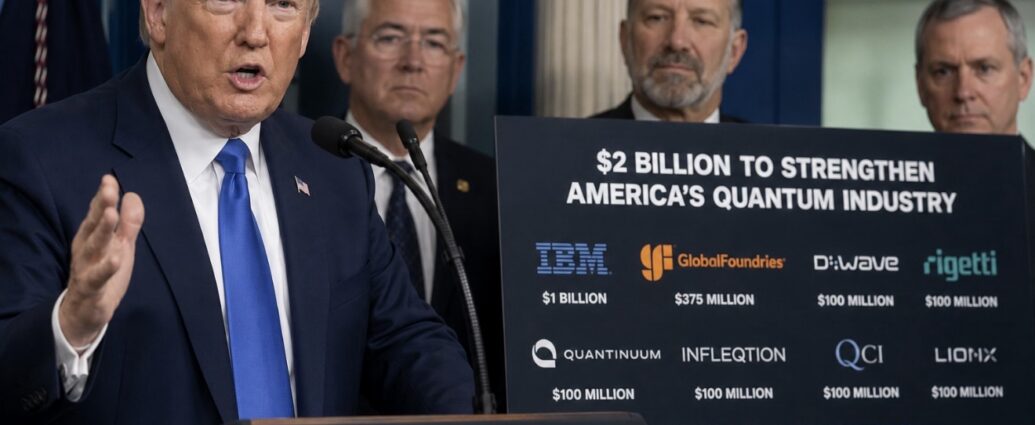
President Donald Trump’s administration is giving roughly $2 billion in federal funding to nine American quantum computing companies while taking ownership stakes in each business, marking one of the most aggressive industrial-policy moves yet in the emerging quantum technology race.

The funding package, announced by Commerce Secretary Howard Lutnick on May 21, 2026, represents a major shift in how Washington supports strategic industries.

Instead of simply issuing grants, the federal government is now becoming a shareholder.

The largest recipient is IBM, which will receive approximately $1 billion tied to quantum computing manufacturing and infrastructure expansion in the United States.

GlobalFoundries will receive roughly $375 million, while companies including D-Wave Quantum, Rigetti Computing, Quantinuum, and Infleqtion are each expected to receive around $100 million.

Additional funding is being distributed among smaller quantum startups and infrastructure firms.

Quantum computing is widely viewed as one of the next major technology frontiers after artificial intelligence.

Unlike traditional computers, which process information using binary bits, quantum computers use quantum bits known as qubits that can process enormous combinations of calculations simultaneously.

The technology remains early and highly experimental, but researchers believe it could eventually transform:

  • Drug discovery
  • National security
  • Materials science
  • Logistics
  • Financial modeling
  • Encryption systems

The administration’s move reflects growing concern in Washington over technological competition with China, which has invested billions into national quantum research programs.

The White House now classifies quantum computing alongside semiconductors, artificial intelligence, and rare earth minerals as core national-security technologies.

The structure of the funding package is what makes the announcement especially significant.

The federal government is not just subsidizing development.

It is taking equity ownership in the companies receiving taxpayer support.

That model mirrors the administration’s earlier investment strategy involving companies including:

  • Intel
  • MP Materials
  • Lithium Americas
  • Critical Metals

Supporters argue taxpayers should benefit financially if government-backed technologies become highly valuable.

The administration frequently points to its earlier investment in Intel, where government-owned shares appreciated substantially after the company’s recovery.

Critics argue government ownership creates conflicts of interest when regulators also become shareholders in the same companies they oversee.

IBM confirmed it will match federal support with an additional $1 billion private investment focused on building advanced quantum chip manufacturing infrastructure in the United States.

The company clarified the federal government’s ownership stake applies to a dedicated quantum subsidiary rather than the broader IBM corporation.

Markets reacted immediately after the announcement.

Shares of publicly traded quantum firms including D-Wave Quantum and Rigetti Computing surged sharply following the news as investors interpreted the funding as major federal validation of the sector.

The technology itself still faces enormous challenges.

Quantum computers today remain highly unstable and error-prone.

Most quantum systems require complex error-correction layers simply to maintain calculations long enough to complete useful tasks.

Researchers still debate how quickly commercially viable quantum systems can emerge at scale.

But Washington increasingly views the race itself as strategically important regardless of the exact commercialization timeline.

The funding originates from the CHIPS and Science Act, originally signed into law in 2022.

Under the original framework, most of the money would have been distributed as traditional grants.

The Trump administration restructured the program to require ownership participation in return for federal capital.

Industry leaders largely welcomed the move.

Rebecca Krauthamer, founder of Quantum Thought and CEO of QuSecure, said the announcement reflects a major shift in Washington’s approach to quantum technology.

“The administration’s $2 billion equity stake across nine quantum companies marks the moment Washington stopped treating quantum as a speculative bet and started treating it as critical national infrastructure,” Krauthamer said.

The announcement also signals how aggressively governments globally are now intervening in advanced technology markets.

The United States, China, Europe, and parts of the Middle East are increasingly treating strategic technologies not simply as commercial sectors but as geopolitical assets.

For investors, the move gives the quantum industry significantly stronger financial backing at a time when many companies in the sector remain years away from profitability.

But it also introduces new political considerations into future mergers, acquisitions, and strategic partnerships involving government-backed firms.

The broader message from Washington is becoming increasingly clear.

Quantum computing is no longer viewed as a speculative science experiment.

It is now officially part of American industrial policy.

JBizNews Desk — Washington

© JBizNews.com All Rights Reserved. Reproduction or distribution without written permission is prohibited.

The race to bring ETFs tied to Hyperliquid to U.S. markets is heating up after Grayscale Investments reportedly filed another amended registration statement for its proposed Hyperliquid ETF, according to Bloomberg ETF analyst James Seyffart. The proposed fund is expected to trade under the ticker GHYP, adding fresh momentum to a growing wave of altcoin-focused ETF launches.

The filing update arrived as HYPE traded near $55, retreating from its May 21 all-time high above $62. Despite the pullback, the token remains among the largest crypto assets by market capitalization, with a valuation nearing $14.1 billion and 24-hour trading volume surpassing $1.2 billion. The latest amendment suggests Grayscale is continuing discussions with regulators as issuers push beyond spot Bitcoin and Ethereum products into newer blockchain ecosystems with strong trading activity.

Staking Feature Could …

Full story available on Benzinga.com

This post was originally published here

Trading in Coinbase Global, Inc. (NASDAQ:COIN) is quiet on Tuesday. The shares are getting close to the $182 level.

Coinbase is the Stock of the Day. It is in a trading range, and these dynamics offer profit opportunities.

• Coinbase Global shares are experiencing downward pressure. What’s driving COIN stock lower?

Some traders like to buy at the bottom of the range and sell near the top of the range. Trading ranges have support at the lower end and resistance at the top.

Support is a level where there is a large amount of demand, or buy orders, for a stock. This is why stocks stop going lower when they reach support.

Stocks tend to rally after they reach support. This happens when some of the buyers who created the support become anxious and …

Full story available on Benzinga.com

This post was originally published here

Bitcoin will have better days, But Right Now AI infrastructure tokens Are Taking The Lead

Bitcoin (CRYPTO: BTC) is having one of those days where the best thing you can say about it is that it hasn’t collapsed entirely. Everything else? A different story.

The world’s largest cryptocurrency by market cap is sitting around $76,600 as of this morning, down less than a percent since midnight but carrying the weight of a 7% slide over the past two weeks. That kind of slow bleed is its own type of painful, particularly when you glance one level down the market and see tokens posting double-digit gains like Bitcoin’s struggles don’t even register.

That’s exactly what’s happening right now. AI infrastructure tokens are on a tear, and the gap between their performance and Bitcoin’s is wide enough to make you wonder whether they’re even reacting to the same market conditions, because increasingly, they’re not.

The CoinDesk Computing Select Index is up 1.9% today. RENDER (CRYPTO: RNDR) and (CRYPTO: FET) are setting the pace. Worldcoin, NEAR Protocol, and several others in the AI compute space have added double digits in a single session. Meanwhile Bitcoin can’t hold $77,000. The rotation is real, it’s deliberate, and it’s accelerating.

The RENDER Headline You’re Seeing Everywhere and What It Actually Means

If you’ve been watching crypto Twitter this morning, you’ve probably seen some version of the same alarming post: Coinbase is delisting RENDER. The price dropped 8%. Volume exploded past $200 million. People are selling.

Here’s the part most of those posts leave out: what Coinbase is actually removing is the old Ethereum-based RNDR token, the version that the Render Network itself retired back in 2023 when it moved operations over to Solana. That migration happened nearly three years ago. The current Solana-based RENDER token, the one actively traded today, remains fully listed on Coinbase and every other significant exchange without interruption.

Coinbase’s reasoning isn’t complicated. When a project issues …

Full story available on Benzinga.com

This post was originally published here

Bitcoin fell below $76,000 on Tuesday as a lack of positive geopolitical developments contributed to risk-off sentiment.

Cryptocurrency Ticker Price
Bitcoin (CRYPTO: BTC) $75,876.92
Ethereum (CRYPTO: ETH) $2,069.87
Solana (CRYPTO: SOL) $83.47
XRP (CRYPTO: XRP) $1.33
Dogecoin (CRYPTO: DOGE) $0.1009
Shiba Inu (CRYPTO: SHIB) $0.055509

Notable Statistics:

  • Coinglass data shows 98,017 traders were liquidated in the past 24 hours for $322.94 million.       
  • SoSoValue data shows net outflows of $105.2 million from spot Bitcoin ETFs on May 22. Spot Ethereum ET’Fs saw net outflows of $6.7 million.
  • In the past 24 hours, top gainers include Worldcoin, Artificial Superintelligence Alliance and Kite.

Notable …

Full story available on Benzinga.com

This post was originally published here

By JBizNews Desk

Hartford, Conn. — May 26, 2026 — Employers across New York, New Jersey and Connecticut are entering one of the most aggressive labor-compliance expansions in years as new warehouse regulations, wage-and-hour rulings, clawback restrictions and worker-protection laws begin reshaping payroll exposure and employment practices throughout the tri-state economy.

The changes span multiple states and industries simultaneously, forcing companies to rework employment agreements, scheduling systems, productivity metrics and compensation policies heading into the second half of 2026.

Connecticut has emerged as one of the latest states targeting warehouse productivity systems tied to algorithmic performance monitoring.

A new law approved by the Connecticut General Assembly and taking effect July 1 regulates productivity quotas used by warehouse and logistics operators, joining similar frameworks already enacted in California, New York and Minnesota.

The statute requires employers to disclose productivity quotas in writing, prohibits quota structures that interfere with legally required meal or bathroom breaks and creates new legal pathways for workers disciplined under undisclosed performance systems.

The law directly affects distribution operations tied to companies including Amazon, FedEx, UPS and a rapidly expanding network of third-party logistics firms operating across the Bridgeport, Hartford and New Haven corridors.

At the same time, the Connecticut Supreme Court unanimously ruled in February that employees must be compensated for time spent undergoing mandatory pre-shift security screenings conducted on employer property.

The ruling immediately expanded wage-and-hour exposure for casinos, warehouse operators, retailers and distribution employers across the state.

Operators including Foxwoods Resort Casino, Mohegan Sun and major retail centers are now facing both prospective payroll increases and potential retroactive litigation tied to uncompensated screening time.

Plaintiffs’ attorneys reportedly began filing test cases within weeks of the ruling.

New York employers are confronting a separate but equally significant regulatory shift.

The state recently enacted new restrictions limiting the use of employer clawback clauses tied to signing bonuses, training expenses and relocation packages.

The law narrows employers’ ability to demand repayment from workers who voluntarily resign under ordinary circumstances, while still preserving more limited clawback authority tied to misconduct or cause-based termination.

The changes are already forcing reviews of standard employment agreements across Wall Street, private equity, technology and biotech sectors.

Major firms including JPMorgan Chase, Goldman Sachs, Morgan Stanley, Citigroup, Pfizer and Regeneron Pharmaceuticals are reportedly reassessing portions of existing compensation and retention structures in response to the new framework.

The broader labor-regulation map across the tri-state region is also continuing to expand.

New York City has broadened paid sick and safe leave rules, added new paid prenatal leave requirements and tightened restrictions surrounding employer use of consumer credit history in hiring decisions.

Meanwhile, the New York City Council continues debating a proposal supported by Mayor Zohran Mamdani that would raise the city’s minimum wage to $30 per hour — potentially the highest municipal wage floor in the United States.

New Jersey is simultaneously expanding transparency rules, anti-discrimination standards and pay-data reporting obligations through the state Department of Labor and Workforce Development.

Governor Mikie Sherrill’s administration has also signaled support for additional worker-protection legislation during the 2026 session.

At the federal level, the National Labor Relations Board recently reinstated the narrower pre-Biden joint-employer standard first adopted in 2020, modestly easing employer exposure tied to staffing agencies, contractors and franchise relationships.

But for most companies, state-level regulation is increasingly driving the larger compliance burden.

Insurance and risk-management firms say the complexity is accelerating quickly.

Acrisure warned in a recent 2026 compliance briefing that even a single remote employee working from another jurisdiction can expose an employer to an entirely different state’s labor requirements and litigation standards.

For businesses operating across New York, New Jersey, Connecticut and Pennsylvania, the practical implications are becoming unavoidable.

Employment contracts, leave policies, productivity systems, payroll practices, screening procedures and wage forecasting models all increasingly require state-by-state restructuring.

The cost of compliance is rising rapidly.

The cost of getting it wrong is rising even faster.

JBizNews Desk

© 2026 JBizNews. All Rights Reserved. Reproduction or distribution without written permission is prohibited.

Bitcoin (CRYPTO: BTC) may still be locked inside its historical four-year cycle despite ETF adoption, institutional buying and strategic reserve narratives, according to a prominent analyst.

Do Not Overcomplicate The Cycle

In his May 25 podcast, analyst Benjamin Cowen argued that Bitcoin’s latest peak followed the same timing structure seen in prior cycles, with BTC topping in Q4 of the post-halving year before entering a prolonged correction phase.

The market is overcomplicating the cycle narrative when price behavior still closely resembles prior bear market structures from 2014, 2018 and 2022.          

Bitcoin historically bottoms near the …

Full story available on Benzinga.com

This post was originally published here

BitMine Immersion Technologies Inc. (NASDAQ:BMNR) purchased 111,942 Ethereum (CRYPTO: ETH), saying the recent pullback is an attractive opportunity.

‘Alchemy Of 5%’

Bitmine’s Ethereum holdings climbed to 5.39 million ETH, worth $11.5 billion, giving the company control of roughly 4.47% of Ethereum’s total circulating supply.

The firm said its combined crypto, cash and “moonshot” investments now total $12.3 billion.

The company added 111,942 ETH over the past week, continuing what Chairman Tom Lee called an aggressive accumulation strategy.

“Bitmine is expected to reach the ‘alchemy of 5%’ …

Full story available on Benzinga.com

This post was originally published here

XRP (CRYPTO: XRP) is down over 5% over the past month, as diminishing liquidity and bearish sentiment weigh on price action.

XRP’s Falling Liquidity To Lowest Level

In a detailed X post, CryptoQuant data showed that the 30-day XRP liquidity index on Binance dropped to around 0.043, a steep decline from the elevated readings above 3 and 4 seen during the high-volatility trading periods between 2022 and 2024.

With less market depth available, even relatively large orders can move price aggressively in either direction. Thinner liquidity can amplify volatility.

At the same time, …

Full story available on Benzinga.com

This post was originally published here

Coinbase Global Inc. (NASDAQ:COIN) and CEO Brian Armstrong are helping build a major pro-crypto political war chest ahead of what the exchange calls the industry’s “most consequential” U.S. election.

Political War Chest

Armstrong personally donated $1 million to Fairshake, a super PAC backing crypto-friendly candidates, while Coinbase contributed another $24.5 million, according to the report.

Fairshake has raised $85 million so far, with Armstrong and Coinbase accounting for roughly one-third of the total, Bloomberg reported on Tuesday.

The PAC supports pro-crypto candidates from …

Full story available on Benzinga.com

This post was originally published here

Strategy Inc (NASDAQ:MSTR) executive chairman Michael Saylor has said the company could sell some Bitcoin (CRYPTO: BTC) before year-end as it optimizes its capital structure around growing “Bitcoin per share.”

Saylor Defends Strategy’s Model

Speaking on Thursday, May 22, during a live Q&A hosted by Coin Stories’ Natalie Brunell alongside CEO Phong Le, Saylor pushed back against concerns that potential Bitcoin sales signal weakness in Strategy’s treasury model.

“I think it’s not unlikely that we’ll sell some Bitcoin between now and the end of the year,” Saylor said. “The goal of the company is to drive Bitcoin per share and to increase its Bitcoin …

Full story available on Benzinga.com

This post was originally published here

Bitcoin trades around $77,000 as rising Middle East tensions weigh on sentiment.

Bitcoin ETFs saw $105.2 million in net outflows on Friday, while Ethereum ETFs reported $6.7 million in net outflows.    


Cryptocurrency

Ticker

Price
Bitcoin (CRYPTO: BTC) $77,450
Ethereum (CRYPTO: ETH) $2,129
Solana (CRYPTO: SOL) $85.18
XRP (CRYPTO: XRP) $1.35
Dogecoin (CRYPTO: DOGE) $0.1020
Shiba Inu (CRYPTO: SHIB) $0.055594

Meme coin market capitalization is trading 0.7% lower to …

Full story available on Benzinga.com

This post was originally published here

Anthony Pompliano, CEO of Professional Capital Management, emphasized on Monday the importance of holding gold and Bitcoin (CRYPTO: BTC) as a hedge against dollar debasement.

Warning Or Advice?

In an X post, Pompliano warned that dollar debasement would drive asset inflation, ultimately harming savings.

The Bitcoin advocate then theorized that inflation would lead to frustration among the middle class and savers, creating ideal conditions for the government to introduce socialist or populist policies.

“If savers fall behind, socialism will rise. If socialism rises, the government will default. If the government defaults, you better hope you are holding gold and Bitcoin,” he stated.

data-variant=”card”
…

This post was originally published here

Cryptocurrency bettors are pricing in slim chances of XRP (CRYPTO: XRP) reaching new highs this year.

Prediction Market Grows Less Optimistic

Polygon (CRYPTO: POL)-based Polymarket currently gives only a 14% chance to XRP bettering its all-time high of $3.84—set in January 2018—before the end of the year. The odds at the beginning of the year were 41%.

Similarly, chances of XRP hitting all-time highs by Sept. 30 stood at just 4%, down from 35% at the start of 2026.

Over $260,000 has been wagered on the outcome. The market resolves to “Yes” if any XRP/USDT 1-minute candle on Binance on the specified date has a final “High” price higher than any previous Binance 1-minute candle for the same pair.

data-variant=”card”
data-news-mode=”manual”

>


Read Also:

Michael Saylor Is Looking Forward …

This post was originally published here

Popular cryptocurrency analyst Michaël van de Poppe spotlighted on Monday veteran Wall Street investor Jordi Visser‘s view that artificial intelligence would destroy assets, but Bitcoin (CRYPTO: BTC) would remain unscathed.

Visser’s AI Prediction

Van De Poppe posted on X a clip from his May 19 chat with Visser, highlighting some striking quotes by the macro strategist.

Visser prophesied that AI would “disrupt all wealthy people” because assets would all be destroyed.

Bitcoin Detached From AI?

Visser pointed out that software companies like Salesforce Inc. (NYSE:CRM) and Adobe Inc. (NASDAQ:ADBE), winners for the past 17 years, struggled in 2026 due to AI.

On the other hand, he noted that the “picks and shovels” are benefiting from AI, referring to the …

Full story available on Benzinga.com

This post was originally published here

Indonesia blocked access to Polymarket after the platform allowed bets on the premature termination of President Prabowo Subianto’s term, local media reported on Monday.

Indonesia Tightens Online Gambling Rules

The Indonesian Ministry of Communications and Digital Affairs classified Polymarket as an online gambling platform, considered illegal in the Southeast Asian country, according to a report by The Jakarta Post.

Ministry official Alexander Sabar was quoted in the report saying the platform contains elements of monetary betting over “uncertain events” and therefore violates prevailing laws.

Authorities would also track social media accounts linked to the platform to further restrict its spread in the country, the report said.

Polymarket found itself under Indonesian scrutiny last week when it initiated a bet on the early end of Prabowo’s term. The bet …

Full story available on Benzinga.com

This post was originally published here

Strategy Inc. (NASDAQ:MSTR) Chair Michael Saylor voiced optimism for a “Bitcoin (CRYPTO: BTC) Summer” on Monday, even as the apex cryptocurrency battled macroeconomic uncertainty.

Will Summer Warm Up Bitcoin?

Saylor wrote “Looking forward to Bitcoin Summer” on X with a smiling face with sunglasses emoji.

Saylor’s upbeat stance was interesting, given that Bitcoin tends to weaken during the summer months of May through September.

Bitcoin gains an annualized average of 15.01% during this period, according to market analytics firm Seasonax, compared to an annualized gain of 138% from September to May. August was particularly damaging, with median losses of 7.49% during the month.

Meanwhile, widely followed cryptocurrency analyst Kevin, who earlier called …

Full story available on Benzinga.com

This post was originally published here

Rep. Thomas Massie (R-Ky.) filed on Monday to run for his Kentucky House seat in 2028, and cryptocurrency punters are wagering big on his chances of becoming the GOP presidential nominee.

Not Yet Among The Favorites

Although Polygon (CRYPTO: POL)-based Polymarket assigns only a 3% possibility of this happening, nearly $5 million has been wagered on the outcome.

Vice President J.D. Vance remains the bettors’ favorite to win the nomination with 34% odds in favor, followed by Secretary of State Marco Rubio at 24%.

data-variant=”card”
data-news-mode=”manual”

>


Read Also:

Kalshi Becomes Target Of Prediction Market ‘Watchdog’ Ad Campaign: They Have ‘Lot Of Explaining To Do’

This post was originally published here

Leading cryptocurrencies fell sharply overnight on Monday after the military said it carried out “defensive” strikes in southern Iran.

Cryptocurrency 24-Hour Gains +/- Price (Recorded at 9:25 p.m. EDT)
Bitcoin (CRYPTO: BTC) -0.49% $76,752.41
Ethereum (CRYPTO: ETH)
               
-0.38% $2,096.41
XRP (CRYPTO: XRP)                          -0.75% $1.34
Solana (CRYPTO: SOL)                          -1.22% $84.38
Dogecoin (CRYPTO: DOGE)              -1.35% $0.1010

Major Cryptos Sink

Bitcoin dived sharply to $76.500 overnight, triggering similar declines in Ethereum and the broader cryptocurrency market.

Nearly $200 million was liquidated in the past 24 hours, with long position traders suffering more losses, according to Coinglass data.

Bitcoin’s open interest dipped 0.47% over the last 24 hours, broadly aligning with the drop in spot price. Retail and whale derivatives traders on Binance, meanwhile, remained “Neutral” on the leading cryptocurrency.

“Fear” sentiment persisted in the market, according to the Crypto Fear & Greed Index.

Top Gainers (24 Hours) 

Cryptocurrency (Market Cap>$100 M) Gains +/- Price (Recorded at 9:25 p.m. EDT)
SUPERFORTUNE (GUA)       +24.65%     $1.61
Keeta (KTA)                    +20.86%     $0.2038
Unibase (UB)               +16.03%     $0.1857

The global …

Full story available on Benzinga.com

This post was originally published here

Bitcoin (CRYPTO: BTC) is approaching two key price levels that could decide whether the market enters its next expansion phase or extends its ongoing reset lower.

BTC Consolidation

In a detailed X post on May 25, crypto chart analyst Ali Martinez noted that Bitcoin remains stuck in a consolidation structure, with price continuing to trade inside a defined channel as liquidity builds for the next major move.

The current range reflects a broader structural reset rather than a confirmed trend …

Full story available on Benzinga.com

This post was originally published here