Ethereum (CRYPTO: ETH) recorded all-time highs in users, transactions and throughput during Q1, even as its market capitalization, trading activity and fee generation declined amid broader crypto market weakness.

Activity Surge, But Financial Metrics Dive

Ethereum’s network delivered record levels of usage during the quarter, with monthly active users, transaction counts and throughput reaching new highs, the Token Terminal Q1 ecosystem report stated on June 18.

ETH holder addresses rose 8.1% over prior quarter, while 25% from prior year quarter, suggesting ownership continued broadening despite the market downturn.

The growth came as ETH continued to cement its position as the leading blockchain for tokenized assets, stablecoins and on-chain financial applications.

The report highlighted several key developments during the quarter, including the rollout of …

Full story available on Benzinga.com

This post was originally published here

Bitcoin (CRYPTO: BTC) briefly bounced to $65,000 following the Iran peace deal, but Glassnode’s weekly report shows 95% of recent buyers remain underwater, with the market still in bear territory.

Why Did The Peace Deal Bounce Bitcoin But Not Fix The Chart?

WTI crude fell from $86 to $76 in 48 hours after the June 14 peace deal, draining the geopolitical risk premium that had compressed Bitcoin for three weeks. 

Bitcoin recovered from its lows but remains 15% below the True Market Mean at $77,200, the on-chain threshold that separates bear from bull market regimes. Until price reclaims that level, the structural read stays bearish.

The Short-Term Holder MVRV, which measures whether recent buyers are in profit or loss, recovered from 0.81 to 0.90 but stays below the …

Full story available on Benzinga.com

This post was originally published here

Bitcoin extended losses as markets reacted to a hawkish Federal Reserve stance under new Chair Kevin Warsh, boosting the U.S. dollar and weighing on risk assets.

Cryptocurrency Ticker Price
Bitcoin (CRYPTO: BTC) $63,077
Ethereum (CRYPTO: ETH) $1,712
Solana (CRYPTO: SOL) $69.75
XRP (CRYPTO: XRP) $1.14
Dogecoin (CRYPTO: DOGE) $0.08245
Shiba Inu (CRYPTO: SHIB) $0.054672

Notable Statistics:

  • Coinglass data shows 136,366 traders were liquidated in the past 24 hours for $558.38 million.       
  • SoSoValue data shows net outflows of $82.2 million from spot Bitcoin ETFs on Wednesday. Spot Ethereum ET’Fs saw net outflows of $29.4 million.
  • In the past 24 hours, top losers include Lighter, SPX6900 and Aerodrome Finance.

Notable Developments:

Full story available on Benzinga.com

This post was originally published here

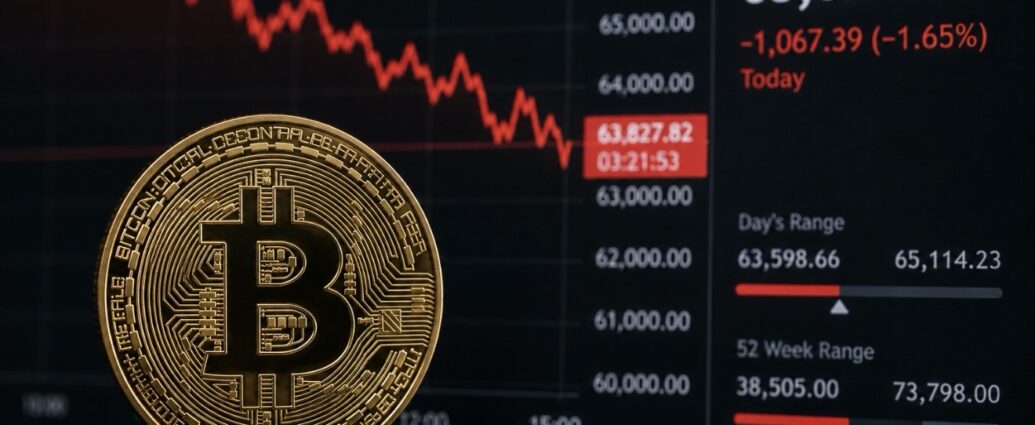
Bitcoin fell below $64,000 on Thursday as investors reacted to a more hawkish Federal Reserve and growing concerns surrounding Strategy, the company formerly known as MicroStrategy and the world’s largest corporate holder of Bitcoin.

The cryptocurrency was trading near $63,800, down about 1% over the previous 24 hours, after briefly climbing toward $67,000 earlier in the week. That rally had been fueled by optimism surrounding a developing agreement between the United States and Iran aimed at ending hostilities and reopening the Strait of Hormuz, easing concerns about inflation and energy prices.

The mood changed sharply following Wednesday’s Federal Reserve meeting, the first chaired by Kevin Warsh. While policymakers left interest rates unchanged, they signaled that rates may remain elevated longer than expected and could even move higher before year-end.

The Fed’s updated projections showed the median policymaker expects the benchmark federal funds rate to finish 2026 at 3.8%, up from 3.4% projected in March. Nine of the eighteen officials who submitted forecasts now expect at least one additional rate increase before the end of the year.

Higher interest rates generally weigh on speculative assets because they increase returns on safer investments and reduce demand for assets that generate no income. Bitcoin, which pays no yield, often struggles when investors expect tighter monetary policy.

Investors responded by pulling money from cryptocurrency investment products. Spot Bitcoin and Ethereum exchange-traded funds recorded approximately $111 million in net outflows following the Fed announcement.

A second source of concern is Strategy, led by executive chairman Michael Saylor, which owns approximately 846,842 Bitcoin, more than any other publicly traded company.

Shares of MSTR fell roughly 5% on Wednesday and extended losses Thursday as investors questioned the company’s ability to continue financing its aggressive Bitcoin acquisition strategy.

Particular attention has focused on the company’s preferred-share offerings. One series, known as STRC, recently traded around $89, well below its $100 face value. When preferred shares trade below par value, raising new capital becomes more difficult and more expensive.

Analysts at QCP Capital have warned that if financing conditions deteriorate further, Strategy could eventually face pressure to sell portions of its Bitcoin holdings to meet dividend obligations and other funding needs.

Those concerns intensified after Strategy disclosed in late May that it had sold 32 Bitcoin for approximately $2.5 million. While small relative to its overall holdings, the sale marked the first time the company had sold Bitcoin after years of promoting a “never sell” philosophy.

The move sparked debate among investors who viewed Strategy’s Bitcoin reserves as effectively untouchable.

Saylor has pushed back on those concerns, arguing that the company’s long-term commitment to Bitcoin remains unchanged. On Thursday, he reiterated that message by publicly highlighting Strategy’s holding of 846,842 Bitcoin and emphasizing the firm’s continued confidence in the asset.

Additional pressure has come from shifting investor attention toward new opportunities elsewhere in the market. The recent public debut of SpaceX, which disclosed holding 18,712 Bitcoin, has attracted significant investor interest and added competition for capital flowing into crypto-related investments.

Market sentiment has also weakened. The widely followed Crypto Fear & Greed Index recently fell into “extreme fear” territory, reflecting growing caution among traders. Bitcoin briefly touched a 2026 low near $59,100 last week before recovering.

Analysts now view $60,000 as a critical support level. A successful defense of that level could stabilize prices and encourage buyers to return. A decisive break below it, however, could open the door to additional declines toward $57,500 or lower.

Gerry O’Shea, head of global market insights at Hashdex, said he expects Bitcoin to trade largely between $60,000 and $70,000 in the near term unless a major catalyst emerges.

The next major driver remains inflation and Federal Reserve policy. If inflation cools and expectations for future rate hikes fade, pressure on both Bitcoin and Strategy could ease. If inflation remains elevated and the Fed signals additional tightening, cryptocurrency markets may face further headwinds.

For now, a market that spent much of the spring chasing record highs is increasingly focused on defense, with traders watching closely to see whether $60,000 can hold.

JBizNews Desk

© JBizNews.com All Rights Reserved. Reproduction or distribution without written permission is prohibited.

Bryan Choe, Head of Research at RWA.xyz, says the tokenized real-world asset market is entering a new phase,  but warns that the industry still misunderstands what is required to turn tokenized products into functioning markets.

With roughly $30 billion worth of tokenized real-world assets on-chain and major financial institutions increasingly experimenting with tokenized products and blockchain-based distribution models, a growing number of market participants view tokenization as one of the most important trends shaping the future of finance.

Yet the market’s most important questions have changed and whether assets can be tokenized is no longer questioned. The debate rises up whether tokenization can create functioning markets around those assets. While issuing a token is pretty straightforward, what is far more complicated is building liquidity and infrastructure, along with distribution and user trust.

To better understand where tokenization stands today—and where it may be heading next—I spoke with Bryan Choe, Head of Research at RWA.xyz, a data and analytics platform tracking tokenized real-world assets across public blockchains.

On-Chain Capital Markets Are Still in Their Infrastructure Phase   

According to Choe, one of the biggest misconceptions about tokenization is that it was always a technology problem: 

“Every market needs infrastructure and participant buy-in to develop, and tokenization is no exception.” 

Actually, tokenization remained largely a niche concept for years, although the technology already existed.

It was institutions that first brought tokenized assets closer to the financial mainstream. Custodians, broker-dealers, fund administrators, auditors, oracles, and other service providers entered the ecosystem, making institutional investors increasingly comfortable holding and transacting in tokenized assets, according to Choe, and not because the technology improved overnight. 

The second catalyst came from stablecoins, which Choe sees as the capital base that made today’s tokenized asset market possible. The rapid growth and broader acceptance of stablecoins since 2022 helped create the conditions for tokenized assets to scale.

“We view total stablecoin market capitalization as a useful proxy for on-chain ‘dry powder’ that can rotate into tokenized assets.”

At the same time, the macro environment changed. Higher interest rates and declining DeFi yields after the 2022 bear market pushed crypto-native capital toward tokenized Treasury products, he notes.

On the institutional side, asset managers began looking at tokenization through a different lens — not only as a cost-saving tool, but also as a revenue opportunity.

“BlackRock’s 2024 launch of BUIDL helped establish a playbook and encouraged other financial institutions to tokenize existing products or launch new ones,” he argues.

That difference between institutional and crypto-native demand helps explain why the first scalable use cases did not follow the consumer-focused narrative.

“We are still in the early stages of building a new on-chain capital market, and liquidity infrastructure use cases are the first major phase of this evolution.”

As Choe puts it:

“For the reasons above, crypto-native capital initially moved into tokenized Treasury products for treasury management and yield. From there, onchain allocators have become more comfortable venturing out the risk curve as they have become more comfortable with additional structural risks that tokenized assets carry. Some investors are now seeking longer-duration or higher-risk opportunities that can generate incremental yield. We expect this progression to continue as onchain capital markets mature.”

According to him, it is also worth distinguishing these products from non-yielding assets such as tokenized stocks and commodities, which are seeing stronger consumer-facing adoption in certain markets.

“These products provide easier access to dollar-denominated assets for offshore and non-U.S. users, particularly those already using stablecoins,” he explains.

The Rise of Exposure Without Ownership

While tokenized Treasury products have attracted capital looking for yield and operational efficiency, another corner of the market has been growing for almost the opposite reason: exposure.

Recent months have seen rapid growth in synthetic RWA products and equity-linked perpetuals, highlighting demand that extends well beyond traditional notions of ownership.

“This shows that the market is split into two broad segments: participants who want exposure to an asset’s price performance, and participants who want ownership of the underlying asset,” Choe says.

According to Choe, demand currently appears strongest from the first group. Many of the characteristics that made crypto markets attractive in the first place — leverage, 24/7 trading, and frictionless directional exposure — naturally translate to synthetic RWA products.

Actual tokenized securities are much harder.

“They are directly connected to the underlying securities and therefore need to account for corporate actions, transfer-agent integration, custody, disclosures, redemption mechanics, voting rights, tax treatment, and legal enforceability. …

Full story available on Benzinga.com

This post was originally published here

Sam Bankman-Fried told a fellow inmate he plans to launch his own coin upon release, according to a New York Magazine profile published Wednesday drawing on months of phone calls and an in-person prison visit.

Life At Lompoc: Pickleball, Pixel Dungeon, and a Vegan Cookbook

Bankman-Fried, 34, now lives at FCI Lompoc in California after transferring from Terminal Island this spring, roughly 30 pounds lighter and tanned from daily pickleball. 

He has played the mobile game Shattered Pixel Dungeon approximately 6,000 times, written a tongue-in-cheek Vegan Prison Cookbook, and spent months serializing a prison memoir called Manfred, distributed to a small email list through the prison’s CorrLinks system.

Beyond the games and writing, his daily routine revolves around CorrLinks terminals where he drafts X posts for his father to publish on his behalf, works on legal motions, and maintains outside …

Full story available on Benzinga.com

This post was originally published here

Mexican billionaire Ricardo Salinas says Bitcoin (CRYPTO: BTC) remains his preferred financial asset, arguing that fiat currencies are being debased globally.

Investors should treat crypto more like long-term property than a short-term trade, according to the billionaire.

“I Turn Fiat Into Bitcoin“

In a CoinDesk interview on June 17, Salinas highlighted his exposure to Bitcoin has increased during the recent market pullback. Over the past year, BTC prices plunged around 40%.

“As soon as I get my hands on some fiat, I turn it into Bitcoin,” Salinas said.

The Grupo Salinas chairman clarified that earlier comments about his wealth being heavily allocated to Bitcoin referred to his liquid financial portfolio, not his total net worth, which includes businesses, homes, boats, planes and other real assets.

Salinas said about 80% of his liquid investment portfolio is now …

Full story available on Benzinga.com

This post was originally published here

Bitcoin (CRYPTO: BTC) dropped back below $63,000 on Thursday as the broader crypto market shed 4%.

Why Is Crypto Falling While AI Stocks Hit New Highs?

The divergence between crypto and AI-linked equities is widening sharply. 

Cipher Digital (NASDAQ:CIFR) hit new all-time highs up 10%, WhiteFiber (NASDAQ:WYFI) surged 15%, TerraWulf (NASDAQ:WULF) added 4%, Galaxy Digital (NASDAQ:GLXY) gained 4%, and IREN (NASDAQ:IREN) rose 3%.

Moreover, Kevin Warsh’s FOMC decision Wednesday is adding pressure. Warsh held rates but provided no forward guidance, leaving markets pricing only a 15% chance rates stay flat through December. 

Nine committee members already project a rate hike before year-end. The 2-year Treasury yield heading higher repeats the pattern seen before …

Full story available on Benzinga.com

This post was originally published here

Bitcoin (CRYPTO: BTC) remains under pressure, but FalconX Head of Trading Strategy Hassan Baseri says institutional traders are increasingly looking at Ethereum (CRYPTO: ETH) and Hyperliquid (CRYPTO: HYPE) as higher-conviction opportunities.

What Happened

Speaking on June 18 on the Milk Road Show, Baseri highlighted the dominant trade among institutional clients has been “short crypto, long AI,” as artificial intelligence stocks continue absorbing market attention and capital.

However, within crypto, Baseri said traders are watching Ethereum and Hyperliquid closely, while Bitcoin remains clouded by concerns around Michael Saylor’s Strategy

Full story available on Benzinga.com

This post was originally published here

While most are looking at the recent public feud between Changpeng Zhao and Star Xu as some like of popcorn moment, I looked at it as a misunderstanding about decentralized finance regulations. Changpeng Zhao recently praised the decentralized exchange Hyperliquid for its technological brilliance. He acknowledged its unique market position and admitted Binance cannot easily replicate it. However, he also made a crucial point about compliance. He stated clearly that operating a decentralized exchange without Know Your Customer (KYC) checks in the United States violates federal law. Star Xu immediately fired back, accusing Zhao of hypocrisy and pointing out that Binance secretly backed a similar project called Aster. While this drama makes for great entertainment, it distracts from a fundamental legal reality. This debate goes far beyond mere corporate rivalry and strikes at the very heart of how global finance operates. Changpeng Zhao correctly interprets the law. A decentralized exchange simply cannot offer derivatives or leveraged trading to American residents without strict identity verification.

Let us break down exactly why this legal wall exists. The United States Commodity Futures Trading Commission and the Securities and Exchange Commission maintain absolute jurisdiction over any platform offering financial services to Americans. When a platform offers perpetual swaps or leveraged trading, the law requires that entity to register as a designated contract market or a swap execution facility. The government simply will not grant these registrations to any entity lacking a robust identity verification framework. Regulators need these checks to block illicit funds and enforce tax laws. Some developers mistakenly believe that writing open-source code and deploying it to a blockchain grants them magical legal immunity. The government completely rejects this ownerless software myth. If American citizens can access a platform and trade derivatives without identity checks, regulators view the developers, the foundation, or the website hosts as legally liable.

We do not have to guess how regulators will react because they have already established clear precedents. The Commodity Futures Trading Commission and the Securities and Exchange Commission targeted the creators, foundations, and front-end websites of protocols like Uniswap Labs, Opyn, and ZeroEx. They established a firm rule that hosting a website interface allowing Americans to trade unregistered derivatives constitutes operating an unregistered exchange. The most …

Full story available on Benzinga.com

This post was originally published here

BitGo Holdings, Inc. (NASDAQ) stock rose in Thursday’s premarket session as the company expanded its regulated crypto infrastructure offering in Europe.

Launches MiCAR-Compliant CaaS Platform

BitGo said its subsidiary, BitGo Europe GmbH, has launched a Markets in Crypto-Assets Regulation (MiCAR)-compliant Crypto-as-a-Service platform for eligible virtual asset service providers (VASPs), fintechs and digital asset platforms across the European Economic Area.

The launch comes as legacy national VASP registration regimes are phased out under MiCAR. The transition is especially important for crypto firms in Poland and Lithuania, where businesses are moving to the EU’s harmonized licensing framework.

BitGo Europe, which is authorized by Germany’s Federal Financial Supervisory Authority (BaFin), said its platform provides regulated custody, trading, transfer, wallet infrastructure, onboarding, KYC, SEPA payment rails and insurance coverage of up to $250 million for custodial wallets, subject to terms and conditions.

“MiCAR is raising the standard for digital asset businesses across Europe, and many VASPs now need a practical way to adapt without disrupting their customers,” said Jody Mettler, COO of BitGo.

Recent Buyback Program

BitGo recently announced a $50 million share repurchase program, equal to about 8% of its Class A shares outstanding. CFO Ed Reginelli said …

Full story available on Benzinga.com

This post was originally published here

Michael Saylor‘s (NASDAQ:STRC) dropped below $89.50 Wednesday as crypto analyst DonAlt called Strategy Inc.’s (NASDAQ:MSTR) preferred stock “the worst Ponzi” he has ever seen, with buyers who paid $100 already down over 10%.

DonAlt Lays Out The Death Loop In Plain Terms

DonAlt posted the full breakdown on X: Saylor buys Bitcoin (CRYPTO: BTC), issues STRC, buys more Bitcoin with proceeds, average buy price rises. 

When the market drops, STRC depegs, Saylor sells Bitcoin below his average to repeg it, which pushes Bitcoin lower, forcing more Bitcoin sales.

When the market recovers, he issues more STRC at higher Bitcoin prices and the cycle repeats with a higher cost basis each time.

Peter Schiff added the immediate damage. STRC closed at …

Full story available on Benzinga.com

This post was originally published here

Bitcoin (CRYPTO: BTC), Ethereum (CRYPTO: ETH) are rebounding from one of the industry’s deepest downturns, but StarkWare co-founder and Zcash creator Eli Ben-Sasson says crypto still faces an existential question.

“Worst Crypto Winter”

In a series of posts on X and a recent Privacy Podcast appearance, Ben-Sasson described the current downturn as “the worst crypto winter” he has witnessed since entering the industry in 2013.

Over the past month, BTC and ETH have eroded more than 16% amid geopolitical uncertainty and capital rotation into AI-focussed companies.

Despite improving prices and growing institutional interest, he argued that crypto remains in the middle of an identity crisis.

Ben-Sasson attributed the recent market recovery primarily to macroeconomic developments rather than industry-specific catalysts.

“Crypto will be the …

Full story available on Benzinga.com

This post was originally published here

Evernorth CEO Ashish Birla says blockchain is no longer a futuristic concept but a technology solving real financial problems today.

According to Birla, networks like Bitcoin (CRYPTO: BTC), Ethereum (CRYPTO: ETH) and XRP (CRYPTO: XRP) are increasingly becoming trusted rails for moving value, challenging incumbents such as PayPal.

Tokenization As The Next Big Shift

In a National Cryptocurrency Association podcast on June 17, Birla highlighted that blockchain’s core value lies in removing intermediaries and replacing them with decentralized trust.

Instead of relying on platforms such as PayPal (NASDAQ:PYPL) to move money, users can send stablecoins …

Full story available on Benzinga.com

This post was originally published here

Kevin Warsh announced the Fed’s decision to hold rates steady at his first FOMC meeting Wednesday and deliberately avoided forward guidance, leaving markets to price in a rate hike by year-end as Bitcoin (CRYPTO: BTC) faces a fresh headwind.

Warsh Killed Forward Guidance and Nine Committee Members Want a Rate Hike

The FOMC statement under Warsh ran barely half a page compared to the page-and-a-half releases under Jerome Powell. 

Warsh did not add his own position to the dot plot. Nine committee members already project a rate hike before year-end, and the CME FedWatch tool shows markets pricing only a 15% chance that rates stay flat through December.

Analyst Benjamin Cowen argued Wednesday that the pricing-in of a rate hike is itself the headwind, regardless of whether one actually happens. 

Bitcoin depends on looser monetary policy to outperform, …

Full story available on Benzinga.com

This post was originally published here

Bitcoin (CRYPTO: BTC) is pulling back near the $64,000 level, but some crypto-linked equities are telling a stronger story: Galaxy Digital Inc. (NASDAQ:GLXY) and BitMine Immersion Technologies Inc. (NYSE:BMNR) have climbed into top-tier momentum zones.

At last check, Bitcoin traded around $64,200, down about 1.9% over 24 hours, with the world’s largest cryptocurrency still nearly 49% below its all-time high of $126,198.07.

Crypto Stocks Outrun Bitcoin

According to Benzinga Edge Stock Rankings, BitMine Immersion Technologies posted a week-on-week jump in its momentum score from 80.29 to 91.08. The stock was down 42.17% year-to-date, 20.99% over the month, but it gained 225.73% over the last year.

Benzinga Edge Stock Rankings for BMNR.

Meanwhile, Galaxy Digital’s momentum score rose from 86.71 to 90.87, despite having a poor growth score. The stock was 47.76% higher YTD, 11.58% over the month, and 78.69% over the year.

Benzinga Edge Stock Rankings for GLXY.

Robinhood Markets Inc. (NASDAQ:HOOD), another crypto-adjacent stock tied to retail trading activity, also showed strength with a momentum score of 75.60, rising from a mere 20.55 score.

It maintained a strong price trend in the short and medium terms but a weak trend in the long term. The stock …

Full story available on Benzinga.com

This post was originally published here

Shiba Inu’s (CRYPTO: SHIB) official X account highlighted on Wednesday the approval of a new exchange-traded fund that could hold SHIB, signaling growing institutional recognition for the memecoin.

SHIB Achieves Regulated Entry In Wall Street

The SEC approved the T. Rowe Price Active Crypto ETF last week, which is slated to list on the NYSE Arca exchange under the ticker TKNZ.

The T. Rowe Price Group Inc. (NASDAQ:TROW), a global investment firm with over $1 trillion in assets under management, is expected to hold multiple cryptocurrencies in the fund, with SHIB classified as one among the many “eligible” assets.

“‘Just a meme coin,’ they said,” SHIB’s X account noted, countering the long-standing skepticism that memecoins work purely on speculation and are not fit to be institutional-grade assets.

Full story available on Benzinga.com

This post was originally published here

XRP (CRYPTO: XRP) has pulled back from this week’s gains, but analysts believe the recovery structure stays “intact” as long as the coin defends the key support at $1.20.

The Headwinds And Tailwinds

In a note shared with Benzinga, Shawn Young, Chief Analyst at MEXC Research, stated that XRP’s biggest headwind is “weak follow-through” across the broader cryptocurrency market, though he noted that inflows into spot exchange-traded funds are providing support.

The ETFs, including Bitwise XRP ETF (NYSE:XRP) and Canary XRP ETF (NASDAQ:XRPC), have drawn $1.44 billion in cumulative net inflows since launch and seven straight weeks of positive flows, according to SoSo Value.

The analyst viewed progress on the Clarity Act as a key catalyst that could improve “institutional confidence” in XRP.

Key Levels To Watch Out For

XRP surged to $1.28 earlier this week on reports of a U.S.–Iran peace deal, but it pulled back afterward and …

Full story available on Benzinga.com

This post was originally published here

Popular cryptocurrency analyst Ali Martinez drew attention to the fact that Elon Musk, who became the world’s first trillionaire, owns Bitcoin (CRYPTO: BTC) and Dogecoin (CRYPTO: DOGE).

Is Musk ‘Orange-Pilled’?

In an X post, Martinez paired a line drawing of Musk with the Bitcoin logo, with the caption, “The world’s first TRILLIONAIRE owns Bitcoin. Let that sink in.”

Both of Musk’s companies, Space Exploration Technologies Corp.  (NASDAQ:SPCX) and Tesla Inc. (NASDAQ:TSLA), indeed hold BTC in their reserves. In fact, these two are the only companies in the top 10 by market capitalization that hold BTC on their balance sheets.

SpaceX holds 18,712 BTC on hand as of March 31, recognized at a fair value of $1.29 billion. At current prices, this stash would be worth $1.19 billion. Tesla holds 11,509 BTC, worth more than $734 million, according to on-chain data.

Details about Musk’s personal BTC holdings remain sketchy. Back in 2020, he

Full story available on Benzinga.com

This post was originally published here

SkyBridge Capital founder Anthony Scaramucci threw his weight on Wednesday behind fellow Bitcoin (CRYPTO: BTC) bull Michael Saylor and his firm Strategy Inc. (NASDAQ:MSTR), suggesting they’ll be “right” in the nick of time.

Michael Saylor Not In Trouble, Scaramucci Says

During an interview with CNBC, Scaramucci stated that Saylor is “definitely not in trouble,” pointing to a “very deep capital pool” at his disposal.

“You have to really understand the mechanisms of the balance sheet to understand that Bitcoin can go a lot lower, and he’s virtually not in trouble,” the money manager said.

Scaramucci said that the MSTR stock still trades at a premium to its underlying Bitcoin reserves, which gives people the “necessary arbitrage” to get comfortable with.

“I like him. I think he’s going to be right,” Scaramucci added.

Saylor has defended the company’s model, …

Full story available on Benzinga.com

This post was originally published here

Cryptocurrency bettors aren’t expecting any change to the Federal Reserve’s policy in July, following the central bank’s unanimous decision to keep the federal funds rate unchanged on Wednesday.

Polyamarket Projects Rates To Remain Steady

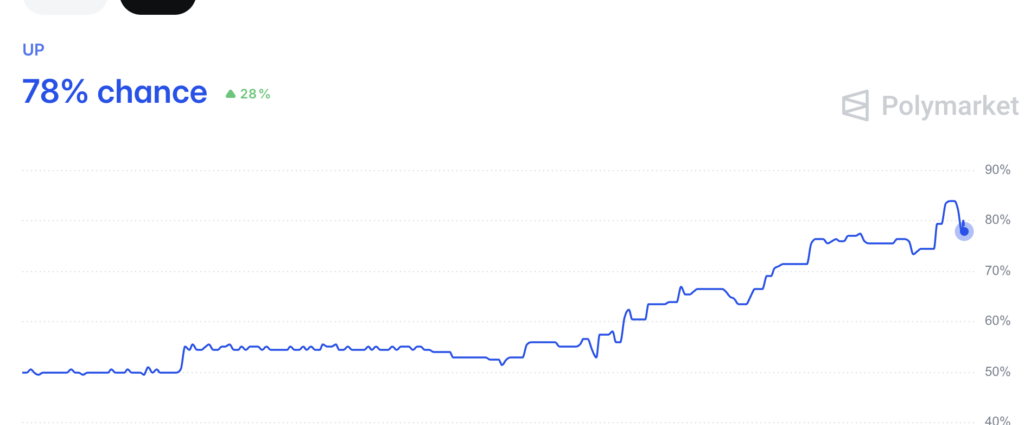
Traders on Polygon (CRYPTO: POL)-based Polymarket believed there was roughly an 80% chance that rates would remain unchanged during the next meeting on July 29, while the chances of a 25 basis point increase stood at 25%.

Bets in favor of rates falling below the current 3.50%–3.75% range remained very low. Over $11.8 million has already been wagered on the outcome, making it one of the most traded contracts on Polymarket.

These predictions broadly aligned with the CME FedWatch tracker, …

Full story available on Benzinga.com

This post was originally published here

Leading cryptocurrencies were red, while stock futures rallied overnight on Wednesday after President Donald Trump signed a historic “Memorandum of Understanding” with Iran to end all hostilities.

Cryptocurrency 24-Hour Gains +/- Price (Recorded at 9:25 p.m. EDT)
Bitcoin (CRYPTO: BTC) -1.36% $64,604.40
Ethereum (CRYPTO: ETH)
               
-1.61% $1,755.43
XRP (CRYPTO: XRP)                          -1.70% $1.18
Solana (CRYPTO: SOL)                          -1.29% $72.35
Dogecoin (CRYPTO: DOGE)              -1.02% $0.08619

Crypto Market Fails To Rally

Bitcoin retreated from $66,000 to below $64,000, as trading volume jumped 25% over the last 24 hours. Ethereum slid below $1,800, while XRP and Dogecoin also recorded intraday declines.

Cryptocurrency-related stocks also fell, with Strategy Inc. (NASDAQ:MSTR) and Bitmine Immersion Technologies Inc. (NYSE:BMNR) closing down 5.09% and 3.15%, respectively. 

Nearly $440 million was liquidated from the market in the last 24 hours, with $300 million in long  positions traders alone wiped out, according to Coinglass data. 

Bitcoin’s open interest fell by 2.62% over the last 24 hours. That said, the majority of the retail and whale derivatives traders on Binance were positioned long on the apex cryptocurrency.

Top Gainers (24 Hours) 

Cryptocurrency (Market Cap>$100 M) Gains +/- Price (Recorded at 9:25 p.m. EDT)
Yooldo (ESPORTS)       +145.98%     $0.2055
o1.exchange (O)                    +89.86%     $0.6317
Tac Protocol (TAC)               +45.05%     $0.02388

The global cryptocurrency market capitalization stood at $2.25 trillion, following a modest dip of 0.85% over the last 24 hours.

data-variant=”card”
data-news-mode=”manual”

>


Read Also:

‘If …

This post was originally published here

Bitwise advisor Jeff Park says investors should start thinking less about Bitcoin’s (CRYPTO: BTC) upside speculation and more about the risk of not owning it at all.

“If You Don’t Own Bitcoin, You’re Basically Short BTC”                

In a “When Shift Happens” interview clip published on June 17, Park argued that Bitcoin remains a hedge against fiat currency debasement.

But its relevance could grow further as artificial intelligence reshapes labor, data ownership and wealth distribution.

“If you don’t own Bitcoin, you’re basically short Bitcoin,” Park said.

He said investors often focus on whether Bitcoin is too expensive, but …

Full story available on Benzinga.com

This post was originally published here

Cryptocurrency is having a moment and it’s not a good one. Bitcoin (CRYPTO: BTC) is underperforming the Dow and Nasdaq. Ethereum (CRYPTO: ETH) and Solana (CRYPTO: SOL) blockchains have been duds for investors all year and are underperforming Bitcoin. Investors’ dwindling crypto holdings are being stolen. Crypto theft broke a record in 2025. What more can go wrong? How about “wrench attacks” now? They’re on the rise, too.

At least 32 individuals suffered wrench attacks last year, with industry reports highlighting the surge in these violent, in-person thefts. These are beyond open your wallet to discover a $0 account balance. Wrench attacks are actual physical violence against crypto holders. Incidents involve home invasions, kidnappings, and torture with high losses reported, according to CertiK.

Wrench attacks are a global phenomenon. French crypto holders witnessed at least five in January – one per week. Jameson Lopp, CTO at Casa, a  digital assets security company, compiled a list on GitHub of known Bitcoin ransom activity worldwide.

Lopp’s data tells a clear story: what was once a rare occurrence has become a global and increasingly violent phenomenon. In 2025, he documented 74 attacks versus 41 in 2024 and more than triple the count from 2023. The first few months of 2026 suggest no slowdown. Roughly 23 attacks have been documented in the first quarter.

Certik estimates over $100 million lost so far this year to wrench attacks.

“There are signs that international organizations are using crypto leaks and other sources to identify targets, and then hiring local criminals to execute the actual attacks,” said Hugh Karp, founder of Nexus Mutual, an insurance firm that provides crypto risk coverage.  “The first reported kidnappings or attacks were back in 2015, but it has accelerated dramatically over the last few years.”

In January 2026, Waltio, a company specializing in crypto accounting, issued a warning about a data breach. Multiple sources established an operational link between these leaks and the wave of kidnappings observed in France shortly afterwards. 

Crypto risk managers and insurers …

Full story available on Benzinga.com

This post was originally published here

Bitcoin and major cryptocurrencies traded largely unchanged ahead of Kevin Warsh’s first FOMC meeting, supported by improving ETF inflows as traders brace for potential volatility around the Fed decision.

Cryptocurrency Ticker Price
Bitcoin (CRYPTO: BTC) $65,912
Ethereum (CRYPTO: ETH) $1,781
Solana (CRYPTO: SOL) $73.56
XRP (CRYPTO: XRP) $1.21
Dogecoin (CRYPTO: DOGE) $0.08694
Shiba Inu (CRYPTO: SHIB) $0.054986

Notable Statistics:

  • Coinglass data shows 82,131 traders were liquidated in the past 24 hours for $297.87 million.       
  • SoSoValue data shows net inflows of $10.06 million from spot Bitcoin ETFs on Tuesday. Spot Ethereum ETFs saw net inflows of $9.6 million.
  • In the past 24 hours, top losers include Audiera, DeXe and Humanity.

Notable Developments:

Full story available on Benzinga.com

This post was originally published here

The S&P 500 fell on Tuesday as investors rotated out of chip stocks and into cyclical sectors, but Polymarket traders are betting the benchmark index will rebound at Wednesday’s open.

The S&P 500 closed down 0.57% at 7,511.35, while the June 17 Polymarket contract implied an 78% probability that the index will open higher on Wednesday.

Why That Number Matters

Investors are closely watching Wednesday’s Federal Open Market Committee meeting, the first under new Fed Chair Kevin Warsh.

Markets broadly expect policymakers to leave interest rates unchanged at 3.5% to 3.75%, but traders will scrutinize the Fed’s economic projections and commentary for clues on the path …

Full story available on Benzinga.com

This post was originally published here

Strategy Inc. (NASDAQ:MSTR) Executive Chairman Michael Saylor rejected claims that his company poses a systemic risk to Bitcoin (CRYPTO: BTC), arguing that the company has instead acted as a major source of liquidity and support during the current bear market.

‘We Are A Shock Absorber‘

Speaking at BTCPrague in a fireside chat with Julian Liniger, Saylor reassured Bitcoin remains the dominant global digital capital network and compared its current price action to prior periods when high-quality assets traded near long-term support.

Bitcoin has fallen from around $120,000 to roughly $60,000 over the past eight months, bringing it near its 200-week moving average.

Saylor described that level …

Full story available on Benzinga.com

This post was originally published here

XRP (CRYPTO: XRP) holds flat Tuesday, compressing between two Fibonacci levels for a third straight day after the June 15 breakout, while ETF inflows resume and top traders stay aggressively long.

Post-Breakout Compression Is Healthy, Not A Reversal Signal

XRP has spent three days coiling between the 0.5 Fibonacci level at $1.2071 and the 0.618 Fib at $1.2440. 

The 20 EMA at $1.2081 is holding as active support with the SAR firmly bullish at $1.0716. Three consecutive days of consolidation above the 20 EMA after a breakout is constructive price action, not a failed move.

Derivatives confirm the digestion is healthy rather than deteriorating. Volume dropped 33.42% and open interest sits relatively flat at $2.77 billion, meaning the leverage-driven euphoria from June 15 has cleared …

Full story available on Benzinga.com

This post was originally published here

While many investors view blockbuster AI-related IPOs as a threat to crypto liquidity, the SpaceX public offering could create a wealth effect that finds its way into Bitcoin (CRYPTO: BTC) and digital assets.

“Crypto Is A Value Trade”

In an interview on June 16, Aaron Arnold, co-founder of Altcoin Daily, argued that capital currently flowing into AI investments is unlikely to remain concentrated there indefinitely.

He said that investors are currently favoring AI because it represents the market’s strongest momentum trade, while crypto has become a value opportunity after an extended bear market.

“Crypto is a value trade. If you’re a value investor, …

Full story available on Benzinga.com

This post was originally published here

David Nage, portfolio manager at Arca, stated that the final hurdle facing the CLARITY Act may have less to do with crypto regulation and more to do with ethics provisions tied to elected officials and senior government leaders.

“Three Mechanical Things“

In an X post on June 16, Jeff Dorman, CIO at Arca, cited Nage, who revealed that after spending a week meeting lawmakers and congressional staff in Washington, the core policy framework behind digital asset market structure legislation is largely complete.

“We are very close,” Nage wrote. “Call it 80%–85% finished.”

The House passed the CLARITY Act in July 2025 and Senate Banking Committee advanced its version in May by a 15-9 vote. But the bill currently sits on the Senate calendar awaiting further action.

Nage highlighted three major items remain before the legislation can reach the Senate floor:

  • Merging the Banking Committee and Agriculture Committee versions of the …

Full story available on Benzinga.com

This post was originally published here

Senators Cynthia Lummis (R-Wyo.) and Ruben Gallego (D-AZ) introduced a bipartisan resolution Wednesday, urging President Trump not to pardon Sam Bankman-Fried, days after a federal appeals court upheld his 25-year sentence.

Senate Resolution Calls SBF Pardon Off-Limits Under Any Circumstances

The four-page resolution states that under no circumstances should Bankman-Fried receive executive clemency. 

The move carries added weight because both senators are central figures in negotiating the CLARITY Act, the crypto market structure legislation currently advancing through Congress.

“He had his day in court,” Lummis said. “A jury didn’t buy the act, and a judge gave him 25 years for a reason. Mr. Bankman-Fried can spend that time chasing clemency he hasn’t earned, or he can finally do something novel and take accountability,” she added.

Gallego went further. “He …

Full story available on Benzinga.com

This post was originally published here

Two weeks ago, traders on X and on Reddit were posting “even Saylor is selling now.” Bitcoin (CRYPTO: BTC) had broken below $60,000 for the first time since the 2024 election, wiping $160 billion in crypto market value in a few days. The Fear and Greed Index hit single digits. The kind of panic that doesn’t leave so quickly.

Today, BTC is back at $66,000. Leverage has been flushed. ETF inflows have quietly turned positive. Whale wallets are pulling coins off exchanges. so, by most measures, the bounce looks real.

But there’s something else that the price chart doesn’t show: the story that held Bitcoin together for years just cracked. And BlackRock’s answer to that crack launched on Nasdaq this morning. Those two things, taken together, tell you more about where Bitcoin goes from here than any technical indicator.

The 32 Coins That Shook a $2 Trillion Market

On June 1, Strategy disclosed it had sold 32 Bitcoin between May 26 and May 31 to cover preferred stock dividends. The proceeds were about $2.5 million. But look at the company’s total Bitcoin position: 843,706 coins worth over $60 billion. That’s 0.0038% of their holdings, the kind of number that shouldn’t move anything. Less than a rounding error.

However, it moved everything.

Bitcoin dropped 14%. ETF outflows hit $4.3 billion across 12 consecutive sessions, a record streak. More than $800 million in leveraged positions got liquidated in a single day. And Strategy’s own stock fell nearly 6%.

None of that happened because just 32 coins changed the supply picture. Think of it like a bank run. Banks don’t collapse because everyone withdraws their money at once for rational reasons. They collapse because people stop believing the bank will be fine. The moment that belief cracks, it becomes self-fulfilling.

That’s what happened here. Since 2020, Strategy’s entire value to the Bitcoin market wasn’t just the 840,000 coins it held. More than that. It was the certainty that Saylor would never sell them. Every Bitcoin holder, consciously or not, was pricing in that promise. When it cracked, even by just 32 coins, the market didn’t reprice the coins. It repriced the whole belief.

And that belief doesn’t snap back in ten days. Saylor himself has said on a podcast that selling more this year is “not unlikely.” Prediction markets, which previously priced Strategy sales as nearly impossible, now treat them as near-certain. That’s a different company than the one the crypto world held in its head for five years.

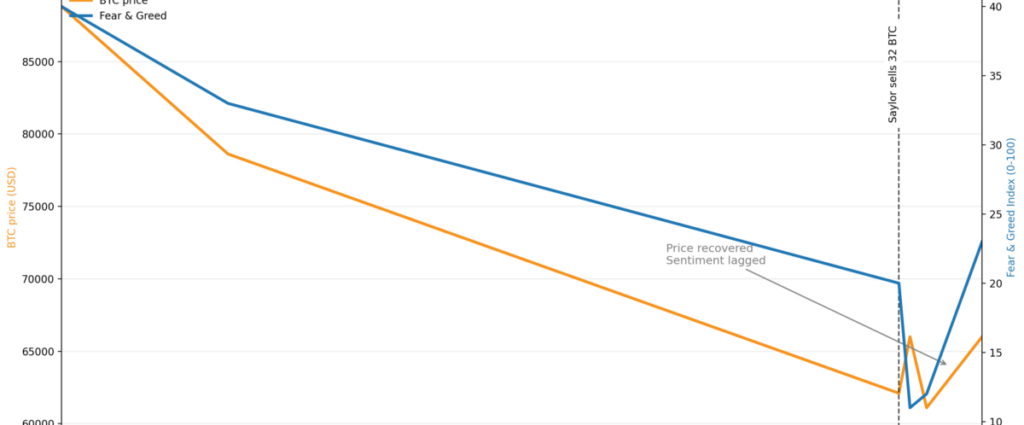
The price recovered. But the certainty didn’t.

This chart shows the gap between Bitcoin’s price recovery and the market’s mood. BTC bounced back after the early-June drop, but the Fear and Greed Index stayed weak, showing that confidence lagged behind price even as the market stabilized. The vertical marker for Strategy’s 32 BTC sale …

Full story available on Benzinga.com

This post was originally published here

Solana (CRYPTO: SOL) has clocked $100 million in SpaceX (NASDAQ:SPCX) tokenized stock volume in 24 hours, more than all tokenized equities traded across August and September last year combined.

SpaceX Tokenized Trading Is Turning Solana Into A Derivatives Powerhouse

The SPCX trading explosion on Solana spans multiple products. Jupiter launched a SpaceX rewards campaign with gamified card packs and leaderboard competitions, with top 100 traders earning cash rewards on positions as small as $55,000. 

Frontier Traders added its own SPCX leaderboard on Solana rails. Sunrise DeFi now lets traders borrow against SpaceX positions on its order book, a product unavailable anywhere in traditional finance.

With Anthropic, OpenAI, ByteDance, Stripe, and Revolut IPOs all expected this year, analyst Paul Barron argued Tuesday that Solana is positioned to capture …

Full story available on Benzinga.com

This post was originally published here

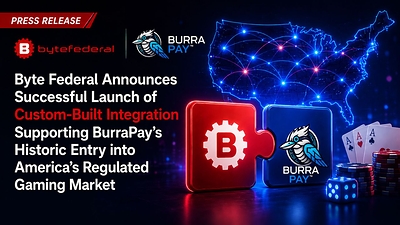
VENICE, Fla., June 17, 2026 /PRNewswire/ — Byte Federal, Inc. is excited to announce the integration of our payment and exchange services with BurraPay, the first cryptocurrency payments processor to operate inside Nevada’s regulated gaming market. Byte Federal is enabling BurraPay’s secure, compliant cryptocurrency transactions within licensed casino and sportsbook environments – a barrier that, until now, has kept digital assets entirely out of the regulated U.S. gaming ecosystem.

BurraPay announced its U.S. debut last week with its first client, Circa Resort & Casino in downtown Las Vegas, home of The World’s Largest Sportsbook. On June 4th, the platform processed the first legal cryptocurrency-funded sports wager in Nevada history.

“The Nevada Gaming Control Board’s willingness to engage with compliant crypto infrastructure reflects the forward-thinking regulatory leadership that has kept Nevada at the forefront of the global gaming industry for decades,” said Luke Millanta, CTO and Co-Founder of BurraPay. “Nevada has set a blueprint. Our focus now is to continue working directly with regulators in other jurisdictions to replicate that – giving them full visibility into our compliance framework and the proven infrastructure we’ve deployed with Byte Federal, so they can move forward with confidence.” Players wishing to fund their wagering activity using cryptocurrency, including Bitcoin, Ethereum and Litecoin, can now do so by visiting the sportsbook …

Full story available on Benzinga.com

This post was originally published here

The U.S. Securities and Exchange Commission (SEC) is reportedly moving closer to allowing crypto firms to offer blockchain-based stocks.

The crypto industry is optimistic about the potential of tokenized stocks to transform the stock markets. The new model could enable 24/7 trading and instant settlement, thereby increasing liquidity and reducing transaction costs, Reuters reported on Wednesday.

SEC Chair Paul Atkins is expected to introduce an “innovation exemption” in the coming weeks that would allow companies to venture into new digital asset business models without strictly adhering to all of the SEC’s disclosure and investor-protection rules, according to the report.

The exemption could allow companies to offer tokenized versions of U.S. stocks, potentially reshaping equity markets over time. If adopted more broadly, it could enable crypto firms to compete directly with traditional brokerages such as Morgan Stanley (NYSE:MS), E*Trade, and Charles Schwab Corporation (NYSE:SCHW).

Some regulators and Wall Street …

Full story available on Benzinga.com

This post was originally published here

Bitcoin (CRYPTO: BTC) has dropped 10% within days of each of the last six FOMC decisions,—and today the Federal Reserve meets under new Chair Kevin Warsh for the first time.

Two Words From Warsh Will Move Bitcoin: Transitory or Persistent

Analyst Andre Jek laid out the two-scenario framework traders need to watch. If Warsh uses language suggesting Iran war inflation is temporary, that dovish read sends risk assets higher. 

If he signals inflation is persistent, markets sell off. A third path matters just as much: any mention of bond market stress or Fed tools to support Treasuries signals quantitative easing is coming, and historically that sends gold and Bitcoin up almost immediately.

US 10-year yields have already fallen from 4.68% to 4.42% over the past 30 days, and Japan’s 20-year yield dropped 9.5% in 27 days. 

Bond prices are rising globally as money flows into safety. Rate …

Full story available on Benzinga.com

This post was originally published here

Bitcoin (CRYPTO: BTC), Ethereum (CRYPTO: ETH) and XRP (CRYPTO: XRP) sentiment is improving after the U.S.-Iran agreement eased geopolitical fears, though traders remain cautious after months of volatility.

“Healthy” Sentiment For Majors

Santiment Intelligence said on X on June 17 that sentiment across crypto’s three largest communities has moved out of recent fear zones following the reduction in geopolitical uncertainty.

The crypto intelligence platform said bullish-to-bearish commentary now stands at 1.52 bullish posts for every bearish post on BTC, 1.40 for ETH and 1.65 for XRP.

These readings are termed “healthy” noting that optimism has improved …

Full story available on Benzinga.com

This post was originally published here

SpaceX (NASDAQ:SPCX) has surged 50% since its June 12 IPO to $201.80 while Dogecoin (CRYPTO: DOGE) is trading flat, exposing the clearest evidence yet that the Elon Musk effect on DOGE is dead.

SPCX Has Real Revenue, DOGE Has Tweets

SpaceX priced at $135, opened at $150, and hit an all-time high of $225.64 on June 16. 

The company posted $18.7 billion in revenue in 2025, holds 12 million Starlink subscribers across 160 countries, and just announced a $60 billion acquisition of Cursor, the AI coding tool running at $4 billion in annual recurring revenue. 

Combined with compute deals with Google and Anthropic, SpaceX’s projected 2026 revenue run rate reaches an estimated $55 billion.

DOGE’s response to Musk becoming the world’s first trillionaire was a 7.6% intraday …

Full story available on Benzinga.com

This post was originally published here

The long-awaited U.S.–Iran peace agreement sparked a rally in top tokens in the cryptocurrency market, but the biggest gains didn’t come from Ethereum (CRYPTO: ETH) or Bitcoin (CRYPTO: BTC).

Solana Outperforms The Biggies

Over the past week, Ethereum advanced by nearly 9% and Bitcoin rose 5.89%, as investors boosted risk exposure amid hopes for prolonged global peace.

However, Solana (CRYPTO: SOL), a much smaller asset in terms of market capitalization, has rallied 14%.

Cryptocurrency 7-Day Gains +/- Price (Recorded at 4:30 a.m. EDT)
Solana +13.76% $72.26
Bitcoin +5.89% $64,935.22
Ethereum
               
+8.91% $1,760.91

SpaceX-Led Surge?

The outperformance could be linked to SpaceX’s blockbuster IPO, which has had a pronounced …

Full story available on Benzinga.com

This post was originally published here

Market commentator The Kobeissi Letter highlighted on Tuesday a record surge in tokenized stocks on Solana (CRYPTO: SOL), led by strong demand following Space Exploration Technologies Corp. (NASDAQ:SPCX)‘s blockbuster IPO.

SpaceX Accelerates Tokenization Push

Kobeissi Letter drew attention to $4.3 billion in on-chain volume of tokenized stocks over the last 30 days, citing data from asset tokenization analytics platform rwa.xyz. This marked the highest monthly volume ever, and a 140% year-to-date increase.

In fact, tokenized stocks on Solana pulled in over $100 million in spot trades for the first time on Friday, following SpaceX’s IPO.

“Solana dwarfed all other chains for tokenized SpaceX, with a peak of 99% volume share across all chains,” Kobeissi Letter noted.

The latest spike has pushed the cumulative transfer volume of tokenized stocks above $20 billion for the first time.

Full story available on Benzinga.com

This post was originally published here

Brian Armstrong, CEO of Coinbase Global Inc. (NASDAQ:COIN), announced on Tuesday the rollout of an AI-powered investment advisor that provides “personalized guidance” by analyzing users’ portfolios and account history.

Your Personal Strategist On Coinbase

Armstrong said on X that the AI agent, named Coinbase Advisor, has been registered with the SEC. Leveraging Coinbase data, it claims to recommend improved trading strategies across stocks, commodities and cryptocurrencies

“Speak to it in plain English to take action on your account. It will even prompt you with ideas you hadn’t thought of,” Armstrong said.

However, Coinbase cautioned users that the AI’s outputs may be “inaccurate or incomplete” and should not be relied upon as the sole source of information.

Initially, the tool would be rolled out to members of the premium subscription service, Coinbase One.

Full story available on Benzinga.com

This post was originally published here

Scilex Holding Company (NASDAQ:SCLX) shares surged 18.79% in Tuesday’s regular session after the company announced that its Dream Bowl I Meme Coin tokens could begin trading on Biconomy Exchange as early as June 23.

Scilex is a revenue-generating biotech company focused on non-opioid pain management products for acute and chronic pain, along with neurodegenerative and cardiometabolic diseases.

Meme Coin Listing Fuels Rally

Scilex said the token listing could improve liquidity and enable broader distribution for eligible token holders.

Biconomy serves more than 10 million users across over 180 countries and ranks among the top 40 global crypto exchanges by trading volume, with an average daily volume of about $2 billion.

As previously announced, Scilex stockholders and certain eligible equityholders as of the April 30 record date became entitled to …

Full story available on Benzinga.com

This post was originally published here

Cryptocurrency analyst Ali Martinez said on Tuesday that Dogecoin (CRYPTO: DOGE) may continue its upward trend, provided it does not lose key support levels.

Will DOGE Sustain The Rally?

In an X post, Martinez highlighted DOGE trading in a rising channel on its 1-hour chart, with the lower boundary at $0.087 acting as a crucial support level.

“As long as the $0.087 support level holds, I think price could rebound toward the mid-range at $0.092 or even the channel top at $0.095,” the analyst projected.

If DOGE reaches $0.095, that would be roughly an 8% increase from its current level.

A rising channel pattern consists of two upward-sloping parallel lines, indicating that an asset’s price is moving steadily upward, characterized by a pattern of “higher highs” and “higher lows.”

Full story available on Benzinga.com

This post was originally published here

Warsaw, June 17, 2026 – Virtune, the Swedish regulated crypto asset manager, today announces the listing of the Virtune Crypto Altcoin Index ETP (VIRALT) on the Warsaw Stock Exchange (GPW), further expanding its offering in the Polish market.

The listing marks Virtune’s sixth exchange-traded product (ETP) listed on GPW since entering Poland in February 2026 and reflects the company’s continued commitment to providing Polish investors with regulated and innovative crypto investment products.

Diversified Exposure to the Altcoin Market

The Virtune Crypto Altcoin Index ETP provides investors with diversified exposure to up to 10 leading altcoins through a single exchange-traded product.

Through one investment, investors gain equal-weighted exposure to a basket of established crypto assets, excluding Bitcoin and Ethereum, allowing investors to participate in the broader altcoin market without having to select individual assets.

Learn more on the product page: https://www.virtune.com/product/altcoin-index

Allocation as of June 15, 2026:

  • Hyperliquid: 11.39%
  • Stellar: 11.05%
  • Toncoin: 10.98%
  • BNB: 10.54%
  • XRP: 10.13%
  • Chainlink: 10.13%
  • Solana: 9.66%
  • Litecoin: 9.46%
  • Cardano: 8.58%
  • Bitcoin Cash: 8.08%

The index is rebalanced monthly to maintain its equal-weight methodology and ensure continued diversified exposure across the constituent altcoins.

Rather than selecting individual crypto assets, investors gain diversified exposure to a broad segment of the crypto market through an exchange-traded investment product traded in Polish złoty.

Meeting Growing Demand for Diversified Crypto Investments

As the crypto market continues to mature, investor demand for diversified investment products has increased significantly.

The Virtune Crypto Altcoin Index …

Full story available on Benzinga.com

This post was originally published here

Elon Musk reiterated on Tuesday the importance of solar energy for the future, while cryptocurrency punters bet on how many Space Exploration Technologies Corp. (NASDAQ:SPCX) Starship launches would successfully land in space.

Polymarket Wagers On Space Exploration

Polygon (CRYPTO: POL)-based Polymarket assigned a 40% chance that fewer than five launches will succeed in 2026, down from 56% a week earlier.

There was a 28% chance of 5–6 successful launches, and a 14% chance of 7–8 succeeding.

Over $470,000 has already been wagered on the outcome. The launch counts as successful if Starship lifts off and climbs at least 62 miles above sea level between Jan. 1 and Dec. 31.

data-variant=”card”
data-news-mode=”manual”

>


Read Also:

Could SpaceX Overtake Nvidia As The World’s Biggest Company In 2026?

This post was originally published here

Leading cryptocurrencies retreated alongside stocks on Tuesday as investors cashed in on recent gains.

Cryptocurrency 24-Hour Gains +/- Price (Recorded at 9:25 p.m. EDT)
Bitcoin (CRYPTO: BTC) -1.18% $65,513.55
Ethereum (CRYPTO: ETH)
               
-0.45% $1,784.83
XRP (CRYPTO: XRP)                          -1.77% $1.20
Solana (CRYPTO: SOL)                          -1.16% $73.30
Dogecoin (CRYPTO: DOGE)              -0.97% $0.08708

Crypto Market Takes A Breather

Bitcoin gave back some of its recent gains, falling back into the $65,000 zone after coming close to breaking $67,000. Ethereum followed suit, reversing from the intraday high of $1,837 to the high $1,700s. XRP and Dogecoin also pulled back.

Cryptocurrency-related stocks also retreated, with Strategy Inc. (NASDAQ:MSTR) and Bitmine Immersion Technologies Inc. (NYSE:BMNR) closing down 6.35% and 5.26%, respectively. 

Over $340 million was liquidated from the market in the last 24 hours, with long position traders bearing the brunt of the losses, according to Coinglass data. 

Alongside the spot price dip, Bitcoin’s open interest contracted by 1.59% over the last 24 hours. Retail and whale derivatives traders on Binance, meanwhile, remained long on the apex cryptocurrency.

“Extreme Fear” sentiment prevailed in the market, according to the Crypto Fear & Greed Index.

Top Gainers (24 Hours) 

Cryptocurrency (Market Cap>$100 M) Gains +/- Price (Recorded at 9:25 p.m. EDT)
Block Street (BSB)       +42.54%     $0.5404
LAB (LAB)                    +37.97%     $13.51
SKYAI …

Full story available on Benzinga.com

This post was originally published here

Strategy Inc. (NASDAQ:MSTR) Executive Chairman Michael Saylor pushed back against critics of the company’s recent Bitcoin (CRYPTO: BTC) sale, arguing that the move was a rational part of its capital markets business and not a retreat from its long-term Bitcoin thesis.

“Will Continue As Long As We Act Rationally”

Speaking with Natalie Brunell at BTC Prague on June 16, Saylor addressed criticism that Strategy sold 32 Bitcoin despite his long-standing public message urging investors not to sell their Bitcoin.

“I got very famous for saying you do not sell your Bitcoin to the plebs,” Saylor said, adding that the comment was directed at individual investors, not at how to operate a Bitcoin finance company.

Saylor said Strategy exists to create Bitcoin-backed credit, not simply …

Full story available on Benzinga.com

This post was originally published here

Bitcoin holds above $65,000 despite a hawkish Bank of Japan rate hike that tightened global liquidity conditions.

With crypto sentiment improving from extreme fear to fear, investors are now focused on the Federal Reserve’s upcoming policy decision for the next major market catalyst.

Cryptocurrency Ticker Price
Bitcoin (CRYPTO: BTC) $66,031.54
Ethereum (CRYPTO: ETH) $1,802.16
Solana (CRYPTO: SOL) $73.99
XRP (CRYPTO: XRP) $1.22
Dogecoin (CRYPTO: DOGE) $0.08757
Shiba Inu (CRYPTO: SHIB) $0.054996

Notable Statistics:

  • Coinglass data shows 100,849 traders were liquidated in the past 24 hours for $411.24 million.       
  • SoSoValue data shows net outflows of $64.09 million from spot Bitcoin ETFs on Monday. Spot Ethereum ETFs saw net inflows of $22.5 million.
  • In the past 24 hours, top losers include Audiera, Toncoin and Venice Token.

Notable Developments:

This post was originally published here

A congressional hearing on digital asset taxation has exposed sharply contrasting views on the future of crypto regulation.

While supporters argue that clear tax rules are essential for maintaining U.S. competitiveness, critics warn that proposed legislation could create special advantages for the industry and increase systemic risks.

Supporters: “We Have To Bring Stability To The Tax Code”

On June 16 in a house hearing, Rep. Max Miller (R-Ohio) said digital asset tax policy should be “coherent, administrable, and technologically neutral” and warned that isolated policy changes could create unintended consequences across the broader tax code.

“Every one in five Ohioans owns a form of cryptocurrency,” Miller said. “We have to bring stability to the tax code.”

The Ohio Republican argued that …

Full story available on Benzinga.com

This post was originally published here