Bitcoin’s plunge below the key $60,000 level last week created winners in leveraged inverse ETFs betting against some of the crypto market’s most closely watched stocks.

The T-Rex 2X Inverse CRCL Daily Target ETF (BATS:CRCD) surged roughly 82% last week, while the T-Rex 2X Inverse MSTR Daily Target ETF (BATS:MSTZ) gained more than 63%, as investors rushed to hedge against mounting pressure on crypto-related equities.

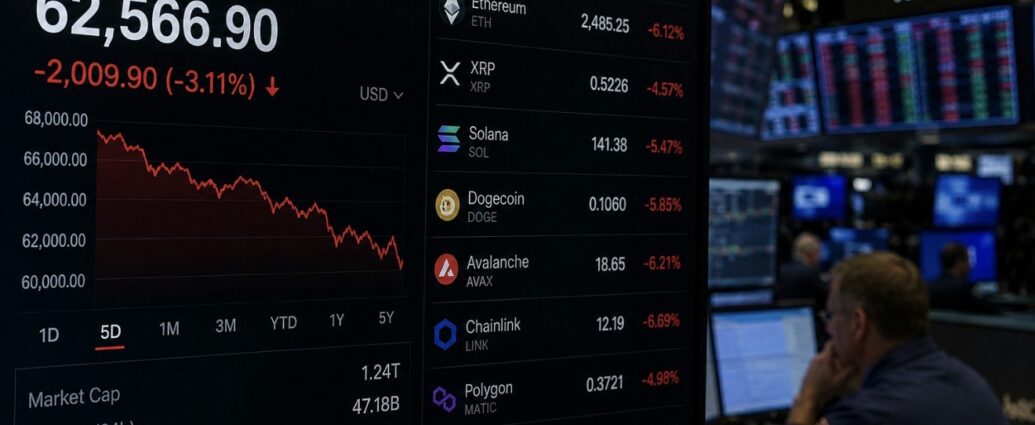
The rally in bearish ETFs coincided with one of Bitcoin’s sharpest declines this year. The world’s largest cryptocurrency fell about 18% last week and briefly dropped to $59,101 on Friday, marking its first move below $60,000 since late 2024.

Strategy’s Weakness Boosts MSTZ

The selloff reverberated across crypto-linked stocks, particularly Strategy Inc (NASDAQ:MSTR), the company widely viewed as a leveraged Bitcoin proxy.

Strategy came under pressure after disclosing a small Bitcoin sale, its first since 2022. The announcement raised concerns about the durability of the company’s long-standing buy-and-hold strategy and added to fears surrounding corporate Bitcoin treasury models.

Those concerns …

Full story available on Benzinga.com

This post was originally published here

Bitcoin is rebounding off the back of a relief rally after hitting some of its most oversold levels ever.

Cryptocurrency Ticker Price
Bitcoin (CRYPTO: BTC) $63,446.58
Ethereum (CRYPTO: ETH) $1,683.20
Solana (CRYPTO: SOL) $67.23
XRP (CRYPTO: XRP) $1.17
Dogecoin (CRYPTO: DOGE) $0.08665
Shiba Inu (CRYPTO: SHIB) $0.054762

Notable Statistics:

  • Coinglass data shows 102,093 traders were liquidated in the past 24 hours for $608.09 million.       
  • SoSoValue data shows net outflows of $325.7 million from spot Bitcoin ETFs on Friday. Spot Ethereum ETFs saw net outflows of $4.8 million.
  • In the past 24 hours, top gainers include Audiera, DeXe and Lighter.

Notable Developments:

Full story available on Benzinga.com

This post was originally published here

Bitcoin (CRYPTO: BTC) bounced above $63,000 on Monday, yet the bottom may take a while to form, according to a prominent technical analyst.

“BTC Has Entered Stage Three“

In a podcast on June 7, crypto analyst Benjamin Cowen argued that investor psychology is now approaching the point historically associated with major bottoms.

He outlined a three-stage bear market framework based on sentiment shifts rather than traditional technical indicators.

Cowen said the first phase began after Bitcoin’s October 2025 peak, when only a small group of investors believed a bear market had started.

The second …

Full story available on Benzinga.com

This post was originally published here

Strategy Inc. (NASDAQ:MSTR) added 1,550 Bitcoin (CRYPTO: BTC) worth approximately $101 million last week, but critic Peter Schiff is not impressed.

“Damage Control”

Schiff argued that the transaction highlighted a growing problem for Strategy’s capital allocation model.

In an X post on June 8, Schiff called the purchase “damage control, while also increasing its U.S. dollar reserves by $100 million.”

He claimed that if Strategy sold common stock below the level required to make …

Full story available on Benzinga.com

This post was originally published here

Hyperliquid Strategies Inc. (NASDAQ:PURR) stock surged Monday as a sharp rally in the Hyperliquid ecosystem boosted demand for one of the few publicly traded stocks offering investors indirect exposure to the HYPE token.

The rally comes as the broader cryptocurrency market rebounds and investors position for multiple potential catalysts, including a possible gamma squeeze and the company’s upcoming addition to the Russell 2000 and Russell 3000 indexes.

The Nasdaq gained 2.30%, while the S&P 500 advanced 0.84%.

Public-Market Proxy For HYPE

The stock’s momentum is closely tied to Hyperliquid Strategies’ role as a corporate treasury vehicle for the Hyperliquid ecosystem. As interest in HYPE accelerates, investors seeking regulated equity exposure have increasingly turned to PURR.

Gamma Squeeze Narrative Builds

Last week, financial research newsletter Capital Flows identified PURR as a leading candidate …

Full story available on Benzinga.com

This post was originally published here

Galaxy Digital Inc. (NASDAQ:GLXY) shares are ripping higher on Monday. The sudden breakout follows a massive institutional announcement alongside a broader relief rally across the digital asset market.

Galaxy is building what is expected to be the largest single-campus data center in America. The Nasdaq is up 1.99% while the S&P 500 has gained 0.77%.

Speaking on All Things Markets with Anthony Scaramucci, Galaxy Digital Founder and CEO Michael Novogratz said the company expects to have the entire 1.6 GW campus leased by July 4, or by the end of the summer at the latest.

data-variant=”banner”
data-news-mode=”manual”

>


Read Also:

Micron Rallies, Nasdaq 100 Rebounds As Trump Calls For Immediate Iran-Israel Ceasefire

This post was originally published here

Sam Bankman-Fried officially filed for a presidential pardon Monday, even as the White House pointed back to Trump’s January statement that he has no plans to grant one.

SBF Spent A Year Courting Trump On X And Got Nothing Back

Bankman-Fried submitted his application through the Justice Department’s Office of the Pardon Attorney, the standard federal channel used by thousands of people annually. 

Over the past year, the 34-year-old has been active on X, publicly praising Trump’s actions including the pardon of former Honduran President Juan Orlando Hernández, in what appeared to be a deliberate effort to attract executive attention.

The strategy has not worked. Trump told the New York Times in January he had no plans to pardon Bankman-Fried. 

When asked Monday about the formal filing, a White House spokesperson simply …

Full story available on Benzinga.com

This post was originally published here

Dogecoin (CRYPTO: DOGE) is trading near a critical long-term support zone, with whale accumulation and on-chain data pointing to a potential inflection point for the meme coin.

DOGE Testing Key Level

Crypto chart analyst Ali Martinez said on June 8 that DOGE is testing the $0.081 level, a key area that aligns with the lower mid-range boundary of a multi-year parallel channel that has guided price action since 2021.

According to on-chain data, more than 30 billion DOGE last changed hands near this price …

Full story available on Benzinga.com

This post was originally published here

SpaceX will launch at a $1.8 trillion valuation on Nasdaq on Thursday, yet traders on Hyperliquid are pricing the company as high as $2.15 trillion in pre-IPO perpetual contracts.

85% Of Hyperliquid Traders Are Long But 78% Are Currently Losing

Of the 4,528 traders holding open positions on Hyperliquid’s SpaceX contract, 3,865 are long and 663 are short, an 85 to 15 ratio. 

Despite that bullish lean, 78% of all position holders are currently underwater, with only 1,001 of 4,528 traders in profit. More than $450 million in notional volume has traded across 917,000 trades in just three weeks.

The biggest short positions belong to institutional names. Cumberland sits second with a $3.1 million short, with three other large shorts ranging from $2.5 million to $4.5 million. 

Pre-IPO perpetual volume on Hyperliquid, as measured by Hyperliquid Strategies Inc (NASDAQ:PURR), …

Full story available on Benzinga.com

This post was originally published here

Strategy Inc. (NASDAQ:MSTR) bought 1,550 Bitcoin (CRYPTO: BTC) for $101 million at an average price of $65,332, its first purchase since selling 32 coins at $77,135 last week.

Strategy Bought Below Its Own Average Cost For The First Time

The 1,550 Bitcoin purchase brings total holdings to 845,256 BTC acquired for just under $64 billion at an average of $75,680 per coin. 

The latest buy came in $10,000 below that average, meaning Strategy lowered its cost basis for the first time since beginning its accumulation strategy.

To fund the purchase and rebuild its cash position simultaneously, Strategy issued $181 million of common stock. 

The company also increased its USD reserve by $100 million, bringing total cash reserves to $1 billion, directly addressing the liquidity concerns Peter Schiff and others raised after the reserve dipped to $871 …

Full story available on Benzinga.com

This post was originally published here

Zcash (CRYPTO: ZEC) has bounced 45% from last week’s $300 low to $437 after developers proposed an upgrade to fix the counterfeiting bug, while XRP (CRYPTO: XRP) attempts a fragile recovery after falling nearly 19% last week.

Ironwood Proposal Would Let Anyone Verify Zcash Supply Is Clean

Developers from Shielded Labs, the Zcash Foundation, and the Zcash Open Development Lab proposed creating a new privacy pool using repaired code.

Once active, anyone running Zcash software can add up balances across pools and confirm no more than the correct amount of ZEC exists.

The proposal also examines whether anyone ever exploited the bug.

Shielded Labs maintains that attackers were unlikely to …

Full story available on Benzinga.com

This post was originally published here

Bitmine Immersion (NYSE:BMNR) made its largest weekly Ethereum (CRYPTO: ETH) purchase of 2026, buying 126,971 ETH worth roughly $214 million as prices tanked, reversing its earlier stance to slow accumulation.

Biggest Weekly ETH Purchase Of 2026 Despite Earlier Slowdown Call

The 126,971 ETH acquisition triples the prior week’s 26,497 ETH purchase and brings total holdings to 5.54 million ETH, representing 4.59% of Ethereum’s total supply. 

The company now sits 92% of the way toward its stated goal of owning 5% of ETH’s circulating supply, which Chairman Tom Lee said the company expects to reach later this year.

“We increased our buying as we believe this pullback in ETH prices does not reflect the strengthening of Ethereum fundamentals,” Lee stated. 

“This is not surprising given we are in the early stages of crypto spring,” he added.

Total holdings including cash and investment stakes reach $9.6 billion. Beyond ETH, Bitmine holds …

Full story available on Benzinga.com

This post was originally published here

XRP (CRYPTO: XRP) is approaching a critical weekly support zone as one analyst warns that the cryptocurrency could “trick everyone” before its next major move.

“Bears Are In Control”

In a podcast on June 7, Mango Research, who earlier turned bearish on XRP, said the token was one of the first assets to signal weakness before the broader market selloff hit cryptocurrencies and equities alike.

The analyst admitted ignoring a bearish signal from her trading dashboard because she expected Bitcoin (CRYPTO: BTC) to continue higher, a decision she now calls a lesson in avoiding market bias.

Instead …

Full story available on Benzinga.com

This post was originally published here

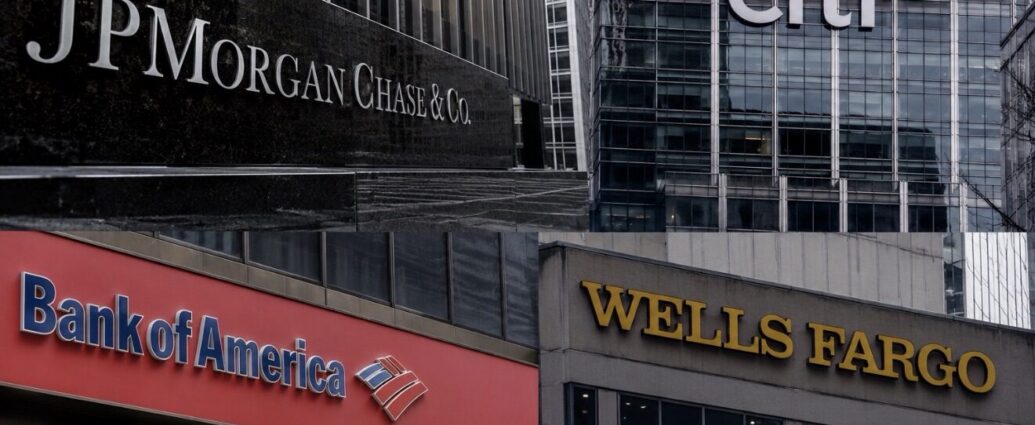
The largest U.S. banks, led by JPMorgan Chase and Citigroup, are planning a shared system for tokenized deposits as the traditional banking industry’s coordinated answer to cryptocurrency, according to people familiar with the discussions in a plan reported Thursday, June 4. The effort would move banks beyond their separate, in-house projects toward common infrastructure for moving digital dollars.

A tokenized deposit is, in plain terms, a digital token that represents real money sitting in a bank account. It is a claim on deposits held at a regulated bank, moved across blockchain-style rails that allow payments to settle in seconds at any hour. That makes it different from a stablecoin, which is a token pegged to the dollar and often issued outside the banking system.

The distinction matters to banks.

A tokenized deposit keeps the money on their books, where they can still lend against it, while a stablecoin does not.

That is the core reason the banks are acting.

Stablecoins issued by crypto-native firms have grown into a large pool of dollars parked outside the banking system. Tether and Circle, the two biggest issuers, together controlled more than $310 billion in stablecoins as of early 2026.

Every dollar held in their tokens, USDT and USDC, is a dollar not held as a bank deposit—money banks earn nothing on and cannot use to make loans.

Left unchecked, that shift threatens the deposit and payments businesses that are central to how banks make money.

The pieces of a joint system already exist inside the biggest banks.

JPMorgan Chase launched a deposit token called JPMD in June 2025 on Coinbase’s public blockchain, known as Base, through its blockchain division Kinexys.

Naveen Mallela, the division’s global co-head, has said the token lets institutional clients send and receive money in seconds, around the clock, bypassing the delays of traditional banking.

The bank expanded the token to public blockchains later in 2025.

Citigroup runs its own service, Citi Token Services, which offers tokenized deposits for corporate treasury and trade-finance clients with near real-time settlement.

The new plan builds on talks that began in 2025, when JPMorgan Chase, Bank of America, Citigroup, and Wells Fargo explored issuing a joint stablecoin.

Those discussions ran through two jointly owned bank ventures: Early Warning Services, which operates the Zelle payment network and the Paze wallet, and The Clearing House, which runs a real-time payments network used by major banks.

A shared tokenized-deposit system would use similar shared rails while keeping the money as bank deposits rather than a separate stablecoin.

The logic mirrors how banks already cooperate.

Just as rival banks share the Zelle network for person-to-person transfers while keeping their own apps and brands, a shared tokenized-deposit system would let them agree on common plumbing to ensure the tokens work across institutions.

That interoperability is the point.

A token that only works inside one bank’s network is far less useful than one that can move seamlessly between banks for faster domestic payments, cross-border transfers, and around-the-clock settlement.

For JPMorgan, the approach reflects a strategy of competing and cooperating at once.

The bank has its own deposit token to keep a first-mover edge while joining an industry group to ensure it has a seat at the table if the market settles on a shared standard.

Other banks are hedging too.

Wells Fargo has filed a trademark for a branded digital dollar, suggesting it may want both a proprietary product and access to shared infrastructure.

The timing is tied to policy.

A federal framework for digital dollars, advanced under the GENIUS Act, has given banks more legal clarity to issue tokens, and the current administration has been broadly supportive of digital finance.

Clearer rules tend to favor regulated, compliant issuers, which is the position banks want to occupy.

There are reasons for caution.

The discussions remain at an early stage and could change.

Profitability is not guaranteed. Analysts have warned that the rich margins crypto-native issuers like Tether currently earn may not be sustainable as competition grows and regulation tightens.

The banks are still weighing how much demand a shared token would actually draw.

For now, the systems are aimed mainly at institutional and corporate clients rather than everyday consumers, used for moving large sums and settling trades.

But the broader direction is clear: the country’s biggest banks are moving to build their own version of the technology that crypto firms pioneered—and to do it together—so that the digital dollars of the future remain bank deposits rather than something issued outside their walls.

JBizNews Desk — Banking & Financial Technology

© JBizNews.com All Rights Reserved. Reproduction or distribution without written permission is prohibited.

Bitcoin (CRYPTO: BTC) and other cryptocurrencies are entering the “single biggest macro investment opportunity of all time,” says industry expert Dan Tapiero, who expects the digital asset industry to further integrate with traditional finance.

Bitcoin Is Core Store-Of-Value Asset

Speaking on June 7 on Scott Melker’s podcast, Tapiero said that stablecoins, tokenized assets and AI agents are pushing finance on chain faster than most investors realize.

He said these are no longer theory but instead they are becoming the rails for payments, trading and autonomous AI transactions.

“We think that they’re going to be thousands of trillions, not tens or hundreds, thousands of trillions of transactions within the next five to 10 years done by autonomous agents,” Tapiero said.

Tapiero argued that AI agents will not use wire transfers. They …

Full story available on Benzinga.com

This post was originally published here

Strategy Inc. (NASDAQ:MSTR) Chair Michael Saylor hinted on Saturday that the firm could disclose fresh Bitcoin (CRYPTO: BTC) purchases in the week ahead, days after its reported sale of BTC roiled the cryptocurrency market.

Will Saylor Buy The Dip?

Saylor posted the customary accumulation chart on X, using orange circles or “dots” to pinpoint Strategy’s Bitcoin purchases.

“A good time to add more dots,” Saylor wrote, suggesting the company could buy more Bitcoin. Historically, these weekend posts have always preceded purchase disclosures on the coming Monday.

Quoting Saylor’s post, Strategy CEO Phong Le reaffirmed the company’s commitment to increasing net Bitcoin holdings and Bitcoin per share.

“Rumors otherwise are just rumors,” the CEO said.

Full story available on Benzinga.com

This post was originally published here

Gold’s reputation as the market’s ultimate safe haven is facing one of its toughest tests in recent times.

Since the beginning of June, the yellow metal is down by over 4.3%, hitting an intraday low of $4,268.9 per ounce on Monday. The decline is the aftermath of a stronger-than-expected U.S. nonfarm payrolls report that reignited expectations for higher interest rates.

Overall, it is a dramatic round trip for bullion, erasing the entire year’s gain. When the metal reached near $5,600 an ounce in January, it was up nearly 30%.

What makes the selloff remarkable is the broader context. The United States and Iran remain locked in conflict, the Strait of Hormuz remains disrupted, and U.S. inflation is running at 3.8%—conditions that would traditionally trigger a rush into defensive assets.

Instead, gold is behaving less like portfolio insurance and more like a risk asset. Rather than responding to geopolitical fear, precious metals are increasingly trading on monetary policy expectations and the rising cost of carry.

Yet, the breakdown extends beyond commodities. Bitcoin (CRYPTO: BTC/USD) has also experienced significant outflows. ProShares Bitcoin ETF (NYSE:BITO) is down 32.7% year-to-date, suggesting …

Full story available on Benzinga.com

This post was originally published here

Veteran Wall Street investor Jordi Visser emphasized in an interview aired Saturday the importance of Bitcoin (CRYPTO: BTC) in investment portfolios, irrespective of short-term price volatility.

Bitcoin Not A Bubble That’s About To Burst, Says Visser

During an interview with entrepreneur and investor Anthony Pompliano, Visser voiced his perspective on Bitcoin’s price fluctuations. He indicated that even if Bitcoin’s value drops much below the $60,000 mark, it doesn’t concern him.

“Let it start to base. Let it look like supply and demand have met a place where it’s positive and then let it break a long-term moving average,” said Visser, head of AI Macro Nexus Research at 22V Research.

He also dismissed the idea of Bitcoin being a “bubble” that’s about to burst, stating, “None of that’s true…I believe we’re at a rotation point that’s going to last for at least the next 3 to 6 months.”

Full story available on Benzinga.com

This post was originally published here

Cryptocurrency exchange Bybit announced on Saturday that it will enable investors to participate in the tokenized initial public offering linked to Elon Musk’s aerospace giant, SpaceX.

Use USDC To Buy SpaceX

The offering will be via Bybit IPO Express, a platform that lets users submit a subscription request for a tokenized representation of an IPO.

Eligible users can sign up for the SpaceX IPO offering and submit subscription requests using supported cryptocurrencies, including USDC (CRYPTO: USDC) stablecoin, until early Thursday. Once these requests are submitted, the subscription funds will be temporarily locked until the allocation process concludes.

Upon the completion of the allocation process, SpaceX will officially begin spot trading on the platform on Friday.

What You Should Know

Bybit stated that the final allocation …

Full story available on Benzinga.com

This post was originally published here

Hunter Biden declared his commitment to blockchain-based art and Bitcoin (CRYPTO: BTC) on Saturday, while praising fellow artist Mike Winkelmann, better known as Beeple.

Hunter Biden: The Crypto Messiah?

Beeple posted an artwork on X, titled “HUNTER BIDEN SAVING CRYPTO,” which depicted Hunter Biden in a suit pulling a giant golden Bitcoin.

Michael Saylor and Ethereum (CRYPTO: ETH) creator Vitalik Buterin sit aboard, looking messy and tired. The message: cryptocurrency’s big names can’t fix the industry anymore.

Biden responded, saying, “Thanks, Beeple. I’ve been a fan of your art for a long time. This is my new favorite.”

Beeple made headlines in 2021 by selling his non-fungible token-based artwork “Everydays: The First 5000 Days” for $69 million. However, days later, he declared that the NFT art was in a “bubble.”

Full story available on Benzinga.com

This post was originally published here

Economist Peter Schiff lashed out on Sunday at JPMorgan Chase (NYSE:JPM) CEO Jamie Dimon‘s push to treat cryptocurrency firms offering interest-bearing products as traditional banks.

Schiff Contrasts Banks With Stablecoin Issuers

Schiff dismissed Dimon’s position as “nonsense” in an X post, arguing that banks uniquely benefit from Federal Deposit Insurance Corporation insurance while operating on fractional reserves and “risky loans.” Stablecoin issuers, he said, operate without this protection.

Being FDIC-insured means that the federal government protects bank deposits up to $250,000 per depositor in the event of bank failure. Fractional reserve banking means banks hold only a specific percentage of their deposits in liquid reserves and are allowed to use the remaining to extend credit.

JPMorgan didn’t immediately return Benzinga’s request for comment.

Full story available on Benzinga.com

This post was originally published here

Leading cryptocurrencies rallied Sunday evening, even as rising tensions in the Middle East fueled doubts about sustained market momentum.

Cryptocurrency 24-Hour Gains +/- Price (Recorded at 9:20 p.m. EDT)
Bitcoin (CRYPTO: BTC) +2.30% $63,078.37
Ethereum (CRYPTO: ETH)
               
+5.50% $1,681.11
XRP (CRYPTO: XRP)                          +3.85% $1.15
Solana (CRYPTO: SOL)                          +3.96% $65.92
Dogecoin (CRYPTO: DOGE)              +2.55% $0.08533

Crypto Market Rebounds

Bitcoin exceeded $64,000 late evening, fueled by a 15% jump in trading volume, as the apex cryptocurrency recovered part of its losses from a tough week. Ethereum also topped $1,700, while XRP and Dogecoin recorded sharp recoveries.

Over $660 million was erased from the market in the last 24 hours, according to Coinglass data, predominantly in short liquidations. 

Bitcoin’s open interest fell 0.61% in the last 24 hours. Typically, when OI falls while the price increases, it typically indicates short covering, meaning that traders who had previously bet on the price falling  are buying back their positions.

“Extreme Fear” sentiment prevailed in the market, according to the Crypto Fear & Greed Index.

Top Gainers (24 Hours) 

Cryptocurrency (Market Cap>$100 M) Gains +/- Price (Recorded at 9:20 p.m. EDT)
Audiera (BEAT)       +64.34%     $3.71
Siren (SIREN)                    +46.34%     $1.28
Velvet (VELVET)               +37.03%     $0.2574

The global cryptocurrency market capitalization stood at $2.23 trillion, following a decline of 3.53% over the last 24 hours.

data-variant=”card”
data-news-mode=”manual”

>


Read Also:

This post was originally published here

BitMine Immersion (NYSE:BMNR) stock continued its strong downward trend and dropped below a key make-or-break level as its unrealized losses accelerated. It plunged to $15.90, its lowest level since June last year and 90% below its highest point in 2025. 

BitMine Stock at Risk as Unrealized Losses Jump Amid Ethereum Woes

Tom Lee‘s BitMine Immersion is facing major challenges amid the ongoing crypto market crash. Ethereum (CRYPTO: ETH) token plunged to $1,515, its lowest level since April last year, and 67% below its all-time high.

Its performance is notable as BitMine has become the biggest holder of Ethereum with over 5.4 million tokens worth $8.8 billion. At Ethereum’s peak price of $4,948, these coins would be worth over $26 billion. Its unrealized loss is over $10 billion.

BitMine’s challenge is that Ethereum’s fundamentals are deteriorating. For example, Wall Street investors have continued dumping the ETFs. Spot Ethereum ETFs have had over $168 million in outflows this month after losing $540 million in the previous month. They have lost over $2 billion in assets in …

Full story available on Benzinga.com

This post was originally published here

Bitcoin (CRYPTO: BTC) price is attempting to rebound after falling to a 2024-year low on Saturday. It jumped to $62,230, up modestly from the weekend low of $59,093. Still, this rebound may be a dead-cat bounce as ETF outflows are soaring and a death cross pattern is nearing.

Bitcoin Price Rises Amid ETF Outflows

BTC price has been in a strong sell-off in the past few weeks as Wall Street investors continued dumping its ETFs. Data shows that these funds have shed over $5.4 billion in the last four weeks. They now have a cumulative total net inflow of $53.94 billion and hold $75 billion in assets. At Bitcoin’s peak, these funds held over $130 billion in assets.

American investors have mostly sold their Bitcoin ETFs and moved to the booming stock market. The Nasdaq 100 Index has jumped by over 20% this year, while the S&P 500 has soared by 10%. Top companies like Sandisk (NASDAQ:SNDK), Micron (NASDAQ:MU), and Intel (NASDAQ:INTC) have soared by triple digits this year.

…

This post was originally published here

This week was a rollercoaster ride in the world of cryptocurrencies. Bitcoin’s crash to $60,000 has stirred up a storm, with Two Prime’s CEO suggesting that Strategy’s CEO may have flown too close to the sun. Meanwhile, economist Peter Schiff speculated about the potential implications of Bitcoin’s latest crash for the broader risk-asset market.

Let’s dive into the details.

Bitcoin’s Crash: A Sign of Strategy’s Overreach?

According to Two Prime’s CEO, Strategy’s average cost basis near $75,700 has led to more than $10 billion in unrealized losses. With three competing camps to satisfy, DACM founder Richard Galvin warns that one group will have to “take the pain to protect the other two.”

Read the full article here.

Peter Schiff’s Bitcoin Speculations

Economist Peter Schiff has speculated on the potential implications of Bitcoin’s latest crash on the broader risk asset market. He wonders …

Full story available on Benzinga.com

This post was originally published here

The decentralized finance (DeFi) industry is facing major challenges this year, with its total value locked (TVL) in a freefall and hacks in an uptrend. Most DeFi tokens have also plunged.

Most DeFi Protocols Have Shed Billions in Assets

Data shows that the TVL locked in the DeFi industry dropped to $69 billion from last year’s high of $150 billion, a 55% retreat. This retreat has affected most platforms in the industry. 

Aave (CRYPTO: AAVE), the biggest lending protocol in the industry, has seen its assets drop to $11 billion from a high of $43 billion in September last year. Compound Finance’s TVL has dropped to $1 billion from a peak of $12 billion in 2021. The same has happened across other DeFi protocols like Uniswap (CRYPTO: UNI), Morpho, and JustLend.

data-variant=”card”
data-news-mode=”manual”

>


Read Also:

This post was originally published here

Bitcoin (CRYPTO: BTC) and most altcoins like Ethereum (CRYPTO: ETH), Cardano (CRYPTO: ADA), and Ripple (CRYPTO: XRP) prices have crashed, erasing over $2 trillion dollars in value in the past two years. 

The crypto market crash intensified this week, with Bitcoin moving slightly below the key support of $60,000. Ethereum dropped to $1,500, while XRP is approaching the important support level at $1.0.

Brian Armstrong Defends Bitcoin and Crypto

Brian Armstrong, the CEO of Coinbase (NASDAQ:COIN) is defending Bitcoin. In an X post, he noted that the crypto industry was thriving despite the ongoing crypto market crash. He pointed to the ongoing boom in the derivatives, stablecoins, and prediction markets.

For example, data compiled by DeFi Llama shows that perpetual exchange networks like Hyperliquid and Aster handled over $2.37 trillion in the first quarter and $1.37 trillion this one. 

More data shows that the volume in the prediction markets surged to $34.7 billion in Q1, and has jumped to $24.6 billion in the current one. This growth will accelerate in the …

Full story available on Benzinga.com

This post was originally published here

Pi Network (CRYPTO: PI), a viral cryptocurrency project that attracted over 60 million users known as ‘Pioneers,’ saw its price crash to a record low during the ongoing crypto winter. It slipped to a record low of $0.1232, down by 96% from its all-time high of $3. 

This painful crash has led to a substantial decline in its market capitalization, moving from $20 billion to $1.3 billion today. 

The Rise and Fall of Pi Network

Pi Network is a popular crypto project that was inspired by Bitcoin (CRYPTO: BTC). Chengdiao Fan and Nikolas Kokkalis, the founders, believed that they could solve Bitcoin’s main challenges, including the high transaction costs and the need for expensive mining hardware. 

They launched Pi Network on 3rd March 2019, a date that coincided with Pi Day, day that commemorates the mathematical constant that represents the ratio of a circle’s circumference to its diameter.

Pi became an instant hit, with over 60 million users participating in its …

Full story available on Benzinga.com

This post was originally published here

Crypto prices continued their strong downtrend Saturday, with Bitcoin (CRYPTO: BTC) crashing to a low of $59,163, its lowest level since 2024, and 52% from its all-time high. The crypto market cap has plunged from over $4 trillion to $2.1 trillion today.

Crypto Prices Have Plunged as AI Demand Jumps

The main reason behind the ongoing crypto market crash is that attention among investors has been on the artificial intelligence (AI) industry. Data shows that most AI stocks like Sandisk (NASDAQ:SNDK), Micron (NASDAQ:MU), Intel (NASDAQ:INTC), and Seagate Technology (NASDAQ:STX) have soared to a record high.

Another sign for this is that the Roundhill Memory ETF (CBOE: DRAM) soared to a record high. It has added over $15 billion in assets under management (AUM), making it the fastest-growing ETF ever. Also, space-related ETFs like UFO and NASA have added major assets ahead of the SpaceX IPO. 

This demand has happened at a time when demand for spot Bitcoin, Ethereum, and gold has waned. Bitcoin ETFs have …

Full story available on Benzinga.com

This post was originally published here

Cardano (CRYPTO: ADA) price retreated for the fourth consecutive weeks and reached a record low, continuing a downward spiral that started in September 2021 when it peaked at $3.08. It dropped to $0.1608, with its market capitalization falling from a record high of $91 billion to $5.8 billion today.

Cardano Price Has Crashed Amid Ghost Chain Status

ADA price has sunk in the past few years, erasing over $85 billion in value, and making it one of the top disappointments in the crypto industry. 

Cardano, which Charles Hoskinson created, became a popular name in the crypto industry during the first major crypto bull run in 2021. Its popularity was mostly due to Hoskinson, an Ethereum (CRYPTO: ETH) co-founder, which helped validate its promise.

Cardano was seen as a major Ethereum alternative because of its significant decentralization, lower carbon emissions, faster speeds, and lower transaction costs. Most notably, Cardano presented itself as the first peer-reviewed crypto project. It also made major claims, including its plan to bring Ethiopia’s education sector to the blockchain.

data-variant=”card”
…

This post was originally published here

(Editor’s note: The future prices of benchmark tracking ETFs, economic data and the headline were updated in the story.)

U.S. stock futures were mixed on Friday, as the Nasdaq 100 and S&P 500 fell, and the Dow Jones index gained, following a mixed close on Thursday.

Investors digested the latest labor data as U.S. nonfarm payrolls increased by 172,000 in May, matching April’s steady hiring pace, while the unemployment rate held flat at 4.3%.

Wage growth showed modest acceleration, with average hourly earnings ticking up 0.3% ($0.12) to $37.53 for the month, pushing the year-over-year increase to 3.4%.

Following an Oval Office coal policy announcement, President Donald Trump stated he would consider meeting Iranian Supreme Leader Ayatollah Mojtaba Khamenei if diplomacy progresses.

“If we make a deal, it’s possible that I would meet,” Trump said. “I’d be okay with that.” His comments come amid mixed signals from negotiations as the U.S.-Iran conflict enters its fourth month under a fragile ceasefire.

Meanwhile, the 10-year Treasury bond yielded 4.46%, and the two-year bond was at 4.03%. The CME Group’s FedWatch tool‘s projections show markets pricing a 96.4% likelihood of the Federal Reserve leaving the current interest rates unchanged during June’s meeting.

Index Performance (+/-)
Dow Jones 0.06%
S&P 500 -0.53%
Nasdaq 100 -1.09%
Russell 2000 -0.63%

The SPDR S&P 500 ETF Trust (NYSE:SPY) and Invesco QQQ Trust ETF (NASDAQ:QQQ), which track the S&P 500 and Nasdaq 100, respectively, were lower in premarket on Friday. The SPY was down 0.53% at $753.09, while the QQQ declined by 1.27% to $731.18.

data-variant=”card”
data-news-mode=”manual”

>


Read Also:

Stock Market: Will S&P 500 Open Up Or Down Today?

This post was originally published here

Prominent macro strategist Tom Lee once took objection to what he viewed as a popular perception that if something isn’t working now, it will never work in the future.

Lee’s Pitches That Have Faced Pushback

During an interview aired Oct. 3, Lee was asked which of his ideas he believes are being “overlooked” by investors and still haven’t caught on.

The Head of Research at Fundstrat replied that Bitcoin (CRYPTO: BTC) has consistently received the most pushback.

Lee pointed out that the leading cryptocurrency has risen from $1,000 to $72,000 in just eight years, but people still tell him, “Bitcoin doesn’t do anything.”

This post was originally published here

Bitcoin’s (CRYPTO: BTC) sharp decline over the past month has reignited concerns about the broader cryptocurrency market. However, Coinbase Global Inc. (NASDAQ:COIN) CEO Brian Armstrong says investors are still underestimating how much the industry has evolved beyond its largest token.

Bitcoin Price Decline Sparks Broader Crypto Debate

On Friday, Armstrong pushed back against the idea that weakness in Bitcoin automatically means weakness across digital assets, arguing that many corners of the crypto ecosystem continue to expand despite the recent sell-off.

“People still think (or feel) because Bitcoin is down crypto is down,” Armstrong said in a post on X, adding, “Crypto touches every area of finance, and is much broader than Bitcoin now. It will take some time for this to sink in.”

data-variant=”card”
…

This post was originally published here

Dogecoin (CRYPTO: DOGE) and Shiba Inu (CRYPTO: SHIB) each shed roughly 8% on Friday as Bitcoin (CRYPTO: BTC) drifted toward $60,000, with the heaviest selling concentrated in the most speculative corners of the crypto market.

Both Tokens Broke Key Support On Heavy Volume With Sellers In Control

Dogecoin fell from $0.0891 to $0.0830, breaking the ascending channel that held since February and landing directly on the $0.080 horizontal support, the last structural level visible on the chart. 

Shiba Inu dropped from $0.000004997 to $0.000004630, slicing through support near $0.000004780 on heavy selling pressure. 

Both tokens saw their biggest volume spikes during the breakdown rather than on any recovery attempt, confirming sellers remained in control throughout the session.

Derivatives traders moved into defensive positioning, with DOGE futures open …

Full story available on Benzinga.com

This post was originally published here

Democratic House Representative AI Green, a vocal opponent of President Donald Trump, on Thursday criticized the President’s involvement in meme coins.

Meme Coins Draw Criticism

Speaking during a congressional hearing, Green took aim at meme coins, describing them as investments that rely primarily on the “greater fool theory.”

According to Green, meme coins and other “speculative assets” provide no underlying value and are driven largely by speculation.

Green specifically criticized Trump and his family’s meme coin ventures alleging that they have generated hundreds of millions of dollars through meme …

Full story available on Benzinga.com

This post was originally published here

Bitcoin is having its roughest week in nearly two years, sliding to around $62,500 by midday Friday, June 5, 2026, after a steady stream of selling that erased gains built up through the spring. The world’s largest cryptocurrency has lost nearly 15% since Monday, marking its worst weekly performance since July 2024. Ether has fallen more than 17%, while overall crypto trading activity has dropped to its lowest monthly volume since October 2023.

The decline has unfolded as a sustained sell-off rather than a single dramatic crash, but the damage has been significant. Bitcoin now trades more than 50% below its October 2025 record high near $126,200, after reaching an intraweek high around $75,850 before falling roughly 22%. The move has pushed prices back to levels last seen in early February and toward a closely watched long-term support area near $61,626.

What Is Driving the Sell-Off

Three major developments have fueled this week’s decline.

The first was the disclosure of the first known bitcoin sale by Strategy, the company formerly known as MicroStrategy and still the largest corporate holder of bitcoin. The second was a wave of withdrawals from spot bitcoin exchange-traded funds. The third was a large transfer from a wallet linked to the long-defunct Mt. Gox exchange, reviving fears of additional supply entering the market.

Among those factors, ETF withdrawals may have the broadest impact on everyday investors.

Spot bitcoin ETFs experienced approximately $2.97 billion in outflows during a 10-session withdrawal streak in late May, one of the largest periods of redemptions since the products were introduced. When investors withdraw money from these funds, managers typically sell bitcoin to meet redemption requests, increasing downward pressure on prices.

Macro Forces Add Pressure

Crypto markets are also facing broader economic headwinds.

Investors continue to grapple with persistent inflation, uncertainty surrounding future Federal Reserve rate cuts, and a stronger U.S. dollar. Higher interest rates make cash and bonds more attractive while reducing demand for riskier assets that generate no income.

Geopolitical tensions also weighed on sentiment. Escalating concerns surrounding U.S.-Iran relations during late May contributed to a broader shift away from speculative investments.

A Rare Split Between Stocks and Crypto

One of the most notable developments this week is the divergence between traditional financial markets and digital assets.

Major U.S. stock indexes have continued to approach or reach record highs while bitcoin and ether have suffered sharp losses. For much of the past two years, cryptocurrencies and equities moved largely in tandem as investors embraced risk assets. This week, however, money flowed into stocks while leaving crypto markets.

The disconnect has puzzled many market participants.

According to CryptoQuant founder Ki Young Ju, U.S. spot bitcoin ETFs have accumulated more than 509,000 bitcoin since bitcoin last traded near current levels in March 2024. During the same period, Strategy acquired roughly 650,000 additional bitcoin.

Combined, those buyers absorbed more than 1.24 million bitcoin, yet prices have returned to roughly the same level.

The implication is straightforward: despite enormous institutional demand, enough selling pressure elsewhere in the market has offset those purchases.

Trouble in the Altcoin Market

The week’s sharpest decline occurred outside bitcoin.

Privacy-focused cryptocurrency Zcash plunged more than 30% after a security researcher disclosed a vulnerability that could potentially have allowed an unlimited number of tokens to be created.

The news quickly spread across the privacy-coin sector, dragging down competitors including Monero and Dash. Selling intensified after investor Arthur Hayes disclosed that his firm had exited its entire Zcash position.

The episode highlighted how technical vulnerabilities in a single cryptocurrency can rapidly impact confidence across related sectors of the market.

Where Things Stand Now

Forced liquidations have accelerated the decline.

Data from Coinglass showed approximately $1.2 billion in liquidations over a 24-hour period, with roughly three-quarters of those losses coming from traders who had wagered on higher prices.

Technical analysts are closely watching the $65,000 level as a key support zone. A sustained move below that threshold could open the door to further downside toward $60,000, while a successful hold could trigger a short-term recovery.

For crypto exchanges, miners, and corporate holders such as Strategy, a prolonged downturn could pressure asset values and reduce trading-related revenue. For retail investors who entered through bitcoin ETFs during the spring rally, the week serves as a reminder that cryptocurrency prices remain highly sensitive to broader economic conditions, including Federal Reserve policy and movements in the U.S. dollar.

As always, crypto remains one of the fastest-moving sectors in financial markets, and conditions can change rapidly.

Sources: Coinglass liquidation data; CryptoQuant founder Ki Young Ju; spot bitcoin ETF flow data; CoinDesk market data as of June 5, 2026.

JBizNews Desk — Markets

© JBizNews.com All Rights Reserved. Reproduction or distribution without written permission is prohibited.

Bitcoin plunged below $60,000 for the first time since October 2024, extending losses in what has become its worst week since November 2022.

Sentiment deteriorated further into extreme fear, signaling rising market anxiety heading into the weekend.

Cryptocurrency Ticker Price
Bitcoin (CRYPTO: BTC) $59,668
Ethereum (CRYPTO: ETH) $1,551
Solana (CRYPTO: SOL) $62.25
XRP (CRYPTO: XRP) $1.08
Dogecoin (CRYPTO: DOGE) $0.08276
Shiba Inu (CRYPTO: SHIB) $0.054585

Notable Statistics:

  • Coinglass data shows 310,873 traders were liquidated in the past 24 hours for $1.56 billion.       
  • SoSoValue data shows net inflows of $3.05 million from spot Bitcoin ETFs on Thursday. Spot Ethereum ETFs saw net inflows of $19.3 million.
  • In the past 24 hours, top …

Full story available on Benzinga.com

This post was originally published here

Capital is shifting from crypto to AI stocks. While AI stocks are reaching new highs, Bitcoin(CRYPTO: BTC) has suffered a total Realized Loss of $1.35 billion per day over the past week. This direct comparison underscores that as investors favor AI, the crypto sector is declining, marking a clear shift in investor preferences.

In light of these developments, a crucial question arises: is this a temporary event, or is the financial market undergoing restructuring?

​This liquidation event has erased long-leveraged positions totaling $1.7 billion. Leading this decline is the driver of institutional adoption: spot Bitcoin ETFs. Those pessimistic about Bitcoin are highlighting these downturns. The digital gold has dropped below $67,000, marking a nine-week low. This significant decline leads to a natural question: “Is Bitcoin dead?”

​At the same time, while Bitcoin struggles, NVIDIA (NASDAQ:NVDA) and Microsoft (NASDAQ:MSFT) are driving the S&P 500’s gains. Currently, AI stocks account for 45% of the index’s market capitalization. In contrast, excluding AI-related stocks, the remainder of the index has seen almost no growth since February.

How Bitcoin Established Itself As A Dominant Asset

Bitcoin has evolved from a digital curiosity to an asset recognized by portfolio managers, who now recommend it for inclusion in investment portfolios. It has paved the way for increased corporate interest in cryptocurrency.

​Although volatility and regulation present challenges, Bitcoin remains attractive due to its history and key milestones.

​Bitcoin’s supply cap of 21 million units creates scarcity. Its decentralized protocol allows investors to trust the system. Many countries have improved regulatory clarity. This encourages both institutional and individual adoption.  Since their inception, Bitcoin ETFs have attracted over $54 billion in net inflows. This capital influx shows growing investor confidence.

​Market conditions have been challenging. Crypto is responding to geopolitical tensions. The US Treasury recently targeted four Iranian crypto exchanges as part of an enforcement campaign. In addition, Michael Saylor’s company diverged from its ‘never sell’ approach by selling BTC for the first time since 2022. While the sale was small relative to the company’s holdings, this …

Full story available on Benzinga.com

This post was originally published here

Bitcoin (CRYPTO: BTC) remains under pressure after Strategy’s (NASDAQ:MSTR) 32 BTC sale rattled market confidence, tapping $60,000 on Friday afternoon.

Ethereum (CRYPTO: ETH) fell up to 9% while XRP (CRYPTO: XRP) and Solana (CRYPTO: SOL) dropped 5%, respectively.

Analysts warn Bitcoin could break below $60,000 before forming a bottom.

Saylor “Fake Out” Theory

Speaking at the Milk Road interview panel on June 5, analysts floated the idea …

Full story available on Benzinga.com

This post was originally published here

XRP (CRYPTO: XRP) dropped 7% on Friday, capping a 17% weekly loss as the token tests the critical $1 to $1.20 historical support zone that triggered the February recovery.

RSI At 18 Is The Most Oversold Reading In Two Years

XRP is now in capitulation territory with RSI at 18.79, the lowest reading on the entire two-year chart, sitting below both previous oversold signals that each produced substantial recoveries. 

The full EMA stack sits bearishly overhead with the nearest moving average, the 20 EMA, at $1.2900, more than $0.20 above current price. 

The descending trendline from August 2025’s $3.60 peak continues to reject every rally attempt.

Despite the brutal price action, June 4 printed $3.83 …

Full story available on Benzinga.com

This post was originally published here

Peter Schiff fired at Strategy Inc. (NASDAQ:MSTR) on Friday, warning that retirees who put savings into STRC (NASDAQ:STRC) have already lost over 7% as the preferred stock trades at $92.62, well below its $100 par value target.

STRC Broke Its 10-Month Rising Trendline As Bitcoin Bleeds

“Saylor better lawyer up fast,” Schiff half-jokingly wrote on X.

Meanwhile, STRC has violated the rising trendline that held from August 2025’s $81 lows through nearly 10 months of higher highs. 

Grayscale Head of Research Zach Pandl argued in a Thursday note that STRC trading below $100 creates a compounding problem. 

Strategy must raise its dividend rate to attract buyers back to par, but higher dividend obligations increase cash flow pressure, potentially forcing more Bitcoin sales, which pushes Bitcoin lower and sends STRC further below par.

“Strategy’s levered business model is under pressure, and this …

Full story available on Benzinga.com

This post was originally published here

Grayscale Head of Research Zach Pandl says Strategy Inc.’s (NASDAQ:MSTR) ability to accumulate more Bitcoin (CRYPTO: BTC) is effectively gone at current share prices, as the company now sits on a record $10.8 billion unrealized loss on its holdings.

STRC Below $100 Is The Core Problem

Pandl’s Thursday note argued that the real issue is not Strategy’s 32 Bitcoin sale but what it did to (NASDAQ:STRC), the company’s variable rate preferred stock designed to trade near $100.

STRC closed Thursday at $95.42 with $10.5 billion in total notional outstanding. A price below $100 means investors demand higher returns, forcing Strategy to raise dividends and increasing cash obligations tied to its Bitcoin-backed balance sheet.

“Strategy’s levered business model is under pressure, and this has increased the volatility for the BTC market as a whole,” Pandl wrote. 

“We think that Strategy, which historically has been …

Full story available on Benzinga.com

This post was originally published here

CleanSpark Inc. (NASDAQ:CLSK) stock is experiencing a volatile session this Friday, dropping sharply as crypto-linked equities face intense macro and operational headwinds. The pullback follows an early-morning trading session where the stock initially held positive territory on fresh institutional backing.

The Nasdaq is down 1.65% while the S&P 500 has shed 0.77%.

Bitcoin Downturn Presses High-Beta Miners

CleanSpark’s drop stems primarily from a broader decline in Bitcoin (CRYPTO: BTC) prices, which plummeted toward the $60,000 psychological threshold.

Escalating geopolitical tensions have further weakened risk appetite among stock market traders. As a high-beta Bitcoin miner, CleanSpark remains highly sensitive to these sharp price swings. Bitcoin has shed more than 15% of its value over the trailing …

Full story available on Benzinga.com

This post was originally published here

Bitcoin (CRYPTO: BTC), Ethereum (CRYPTO: ETH) and Solana (CRYPTO: SOL) have fallen between 15% and 20% over the past week, pushing sentiment deeper into fear territory.

Bitcoin Flashes Rare Oversold Signal

Crypto analyst Lark Davis noted on June 4 that Bitcoin’s daily RSI dropped to 17, one of the most oversold readings in the past decade and a level previously seen during the March 2020 COVID crash and February 2026 selloff.

On-chain data also shows Bitcoin trading at one of its largest historical discounts relative to gold.

Analysts are closely watching key support …

Full story available on Benzinga.com

This post was originally published here

Bitcoin (CRYPTO: BTC) is testing one of the most important support levels in its history just as Washington inches closer to delivering something the crypto industry has been chasing for years: regulatory clarity.

According to data from Barchart, Bitcoin has fallen to its 200-week moving average for the first time since 2023. For long-term crypto investors, that level is more than just another line on a chart. Historically, major Bitcoin bear markets have ended near the 200-week moving average, making it one of the asset’s most closely watched long-term indicators.

The timing may not be a coincidence that investors can afford to ignore.

Bitcoin’s Ultimate Support Test

Bitcoin’s previous encounters with the 200-week moving average have often come during moments of peak pessimism.

The cryptocurrency approached the level during the 2018 crypto winter and again following the industry turmoil of 2022. In both cases, the area eventually became a launching pad for the next major uptrend as long-term investors stepped in while sentiment remained overwhelmingly negative.

That’s why many Bitcoin bulls …

Full story available on Benzinga.com

This post was originally published here

Fundstrat founder Tom Lee told investors at a Paris conference Tuesday that Ethereum (CRYPTO: ETH) mirrors Amazon (NASDAQ:AMZN) when its stock sat at $6, predicting ETH reaches $22,000 next bull cycle.

Five Macro Tailwinds Point To Crypto Spring Right Now

Lee laid out five reasons he believes crypto spring has already arrived. An Iran war ceasefire would collapse oil prices, potentially to $40, removing the biggest inflation driver keeping central banks hawkish. 

Ethereum has its highest ever inverse correlation to oil, meaning lower oil directly supports ETH price. 

Beyond oil, Lee pointed to four more tailwinds: the CLARITY Act advancing through Congress, a pro-crypto White House, new Fed Chair Kevin Warsh’s publicly stated support for Bitcoin (CRYPTO: BTC), and a structurally bullish stock market driven by millennial …

Full story available on Benzinga.com

This post was originally published here

Bitcoin (CRYPTO: BTC) around $62,000 is sitting directly on the 200-week moving average, a level that only broke during the FTX, Terra, and Three Arrows Capital collapses in 2022.

ETF Outflows Finally Printed One Green Day After $5B Exit

After four weeks of relentless selling that drained ETF net assets from $109 billion to $80.40 billion, June 4 printed a modest $3.05 million net inflow. 

BlackRock’s iShares Bitcoin Trust (NASDAQ:IBIT) led with $47.66 million in inflows, offset by continued bleeding from Fidelity’s FBTC (NASDAQ:FBTC) at $5.54 million, Bitwise’s Bitcoin ETF (NYSE:BITB) at $15.57 million, and ARK 21Shares Bitcoin ETF (CBOE: ARKB) at $20.72 million.

One green day …

Full story available on Benzinga.com

This post was originally published here

Bitcoin’s (CRYPTO: BTC) drop to $62,000 resembles previous crypto winter bottoms rather than a structural breakdown in the asset class, according to Bitwise Chief Investment Officer Matt Hougan.

ETF Selling

In a podcast interview with Scott Melker on June 5, Hougan highlighted that Bitcoin ETFs have seen roughly $4 billion in outflows across 12 consecutive trading days, marking the worst withdrawal streak since launch.

Hougan attributed much of the pressure to a capital rotation into artificial intelligence stocks and high-profile private market opportunities like SpaceX.

Despite ETF outflows, he noted institutional interest in crypto remains strong among financial advisors, …

Full story available on Benzinga.com

This post was originally published here

Zcash (CRYPTO: ZEC) crashed as low as 50% over the past 36 hours after Shielded Labs disclosed a critical vulnerability allowing unlimited counterfeit ZEC creation—a bug sitting undetected for four years until Anthropic’s Claude AI found it.

Security Engineer Used Claude Opus 4.8 To Find The Bug On May 29

On May 29, Shielded Labs security engineer Taylor Hornby discovered the Orchard circuit vulnerability using Anthropic’s newly released Opus 4.8 model and immediately shared findings with engineers at the Zcash Open Development Lab.

The flaw made it possible to mint counterfeit ZEC that would be completely undetectable within the shielded pool.

“Taylor, with the help of Opus 4.8, wrote a complete exploit which, when he tested it in a local regtest environment, generated unlimited, …

Full story available on Benzinga.com

This post was originally published here

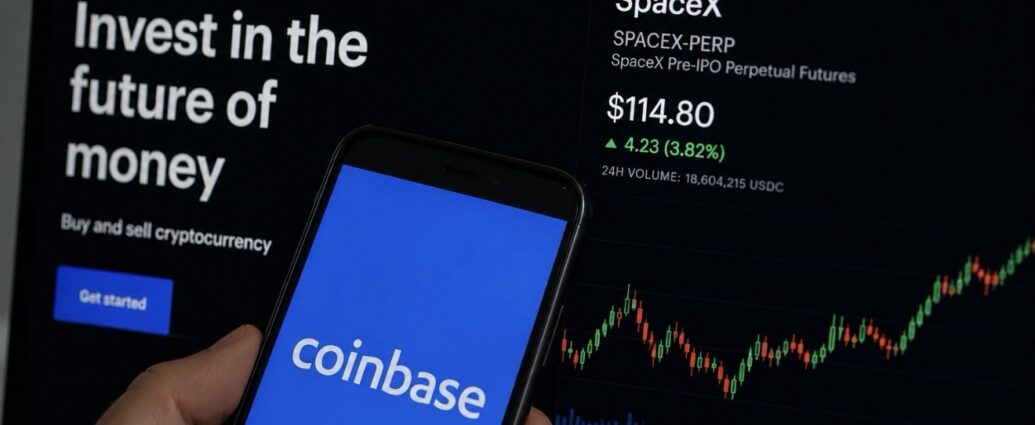
For years, ordinary investors could only watch from the outside as SpaceX grew into one of the most valuable private companies on earth. On Thursday, Coinbase said it would change that — sort of. The cryptocurrency exchange announced a new product that lets traders place bets on the rising or falling value of SpaceX before the rocket company ever lists on a stock exchange. The catch: you are not actually buying anything close to a share.

The product is called a pre-IPO perpetual futures contract, or “perp” for short. In plain terms, it is a side bet on where a company’s value is heading. According to Coinbase, the SpaceX contract tracks the company’s estimated private-market valuation, trades around the clock with no expiration date, and settles in USDC, a digital dollar token. Traders can open or close a position whenever they want, and they can use up to 5x leverage — meaning a small amount of money controls a much larger bet.

Here is what it is not. The contract carries no ownership of SpaceX, no voting rights, no dividends, and no claim on actual shares. It is purely a wager on price. If you guess the direction right, you make money. If you guess wrong, you lose — and leverage means losses pile up faster than they would with plain stock.

The timing is deliberate. SpaceX, run by Elon Musk, is set to go public on June 12. The company filed its IPO terms this week, planning to sell about 555 million shares of Class A common stock at $135 each. That would raise roughly $75 billion and value the company near $1.75 trillion — making it the largest stock-market debut in history, dwarfing the $29.4 billion raised by Saudi Aramco in 2019.

Coinbase built in a feature for that moment. When SpaceX completes its IPO, existing pre-IPO positions automatically convert into a standard SpaceX futures contract tied to the public stock price. Traders do not have to do anything; their bet simply rolls from the private phase into the public one.

There is one important limit. The product is available only to eligible traders outside the United States through a Coinbase unit based in Bermuda. American customers cannot buy it. That restriction reflects the murky regulatory status of these contracts, which blur the line between a derivative, a private-market investment, and a crypto product.

Why is Coinbase doing this? The company describes it as part of its push to become an “everything exchange,” a single place to trade not just cryptocurrencies but exposure to almost any asset. SpaceX is only the first listing. Coinbase said it plans a pipeline of pre-IPO contracts spanning technology, artificial intelligence, energy, and space — the hottest corners of private investing, where demand has long outrun access.

It is also playing catch-up. Coinbase is the latest entrant in a market that has heated up quickly. Crypto.com launched a similar SpaceX product on May 12, Hyperliquid followed on May 18 and reportedly generated $33 million in first-day trading volume, and Binance, the world’s largest crypto exchange, entered on May 21 and reportedly saw more than $280 million in trading within five days.

That eagerness is the real story for everyday investors, and the reason for caution. Pre-IPO shares have traditionally been reserved for venture capital funds, private equity firms, company employees, and wealthy accredited investors. Most people have had no way in. These new contracts crack that door open — but they do it through one of the riskiest tools in finance.

A few things are worth understanding before anyone is tempted. Different exchanges price their SpaceX contracts using different methods, so the “value” you are betting on is not standardized and can move independently of the company’s eventual stock price. Leverage cuts both ways and can wipe out a position quickly. And because the contracts are settled in crypto rather than dollars, traders also take on the risks and mechanics of the cryptocurrency market itself.

For Coinbase, the business logic is clear. The company, which trades on the Nasdaq under the ticker COIN, earns fees on every trade, and a blockbuster like the SpaceX IPO is a once-in-a-generation draw. By letting traders take positions days before the listing, it captures activity that would otherwise wait for the opening bell — or never reach retail traders at all.

The broader shift is the one to watch. Private companies are staying private far longer than they used to, leaving public investors locked out of the fastest-growing names for years. Products like this are Wall Street’s workaround — a way to sell the feeling of early access without the ownership that traditionally came with it.

Markets & Technology — JBizNews Desk

© JBizNews.com All Rights Reserved. Reproduction or distribution without written permission is prohibited.