
JPMorgan Chase (NYSE:JPM) notes that the crypto industry’s long-awaited market structure legislation, the CLARITY Act, could face further delays as political hurdles mount ahead of the U.S. midterm elections.

“Timing May Also Prove Pivotal”

JPMorgan analysts led by Nikolaos Panigirtzoglou on Wednesday raised the risk that crypto market structure reform may not be completed this year.

The analysts had previously viewed passage of the bill as a potential bullish catalyst for digital assets in the second half of 2026.

However, the legislation still faces several hurdles, including securing 60 votes in the Senate, reconciling differences with the House version and …


Full story available on Benzinga.com

This post was originally published here

Bitcoin traded near $63,000 on Thursday as cryptocurrency markets extended their decline amid more than $1 billion in liquidations, worsening fear sentiment.

Strategy (NASDAQ:MSTR) executive chairman Michael Saylor attributed the drawdown to a $400 billion capital rotation into AI-related investments.

Cryptocurrency Ticker Price
Bitcoin (CRYPTO: BTC) $63,346.75
Ethereum (CRYPTO: ETH) $1,765.65
Solana (CRYPTO: SOL) $68.96
XRP (CRYPTO: XRP) $1.16
Dogecoin (CRYPTO: DOGE) $0.08895
Shiba Inu (CRYPTO: SHIB) $0.054985

Notable Statistics:

  • Coinglass data shows 288,483 traders were liquidated in the past 24 hours for $1.74 billion.       
  • SoSoValue data shows net outflows of $396.6 million from spot Bitcoin ETFs on Tuesday. Spot Ethereum ETFs saw net outflows of $52.9 million.
  • In the past 24 hours, top …

Full story available on Benzinga.com

This post was originally published here

Arthur Hayes sold his entire Hyperliquid and NEAR (CRYPTO: NEAR) positions on Thursday, just three days after placing a $100,000 charitable bet that HYPE would outperform every top 10 crypto by year-end.

Hayes Cites AI IPOs, Iran War, and Trump Midterm Pivot

Hayes outlined his reasoning on X, pointing to four macro factors that changed his near-term view. 

Higher energy prices from the Iran war and inventory restocking, three major AI IPOs expected between now and early Q3, a prediction that Trump turns anti-AI to win the midterms, and a belief that market highs arrive between now and September all contributed to the exit.

“Time to take profit, and two-step in beefa without worrying about my positions,” Hayes posted. 

He transferred approximately $18 million in HYPE to market maker Flowdesk according to on-chain data. 

When asked whether he would keep his Hyperliquid-themed profile picture, Hayes …

Full story available on Benzinga.com

This post was originally published here

XRP (CRYPTO: XRP) could be better positioned than Bitcoin (CRYPTO: BTC) for a rebound thanks to growing ETF demand, according to a prominent market commentator.

XRP Could Outperform Bitcoin

In an X post on June 4, analyst Cryptoinsightuk said nearly all downside hourly liquidity in XRP has already been cleared, while upside liquidity now far exceeds remaining downside targets.

The analyst noted XRP is trading at one of its most oversold daily RSI readings on record, a level previously seen during the COVID-19 market …

Full story available on Benzinga.com

This post was originally published here

IREN Limited (NASDAQ:IREN) shares faced intense selling pressure on Thursday. This downward movement follows a sharp reversal from Wednesday’s gains, which were driven by a major network expansion announcement.

• IREN stock is taking a hit today. Why is IREN stock dropping?

Broader Cryptocurrency Market Sell-Off

The primary catalyst behind the drop is a significant downturn in the broader cryptocurrency market. Bitcoin (CRYPTO: BTC) recently fell below the $63,000 threshold. This macro weakness directly dragged down the entire crypto-infrastructure sector.

Transitioning Business Model Exposure

Despite its active pivot toward artificial intelligence (AI), market experts emphasize that IREN remains highly sensitive to Bitcoin’s price fluctuations.

The company operates data centers powered by renewable energy across Canada and the U.S. While IREN is converting its …

Full story available on Benzinga.com

This post was originally published here

SPCX is set to hit the NASDAQ in June, and crypto markets have already begun pricing the asset. A rapidly growing shadow market now lets retail investors speculate on SpaceX’s valuation before public trading.​

A perpetual contract platform, Trade.xyz, has launched a futures contract that tracks the expected market value of SpaceX, without any affiliation with the company. The contract has seen a 44% increase in value ever since.​

According to the BBC, some analysts believe the SpaceX IPO could impact the net worth of its major shareholders. Elon Musk, who holds substantial SpaceX shares, may see these valued at over $600 billion. Pre-IPO trading suggests that current valuations may serve as a starting point.

​What is SpaceX?

SpaceX is a space exploration company founded by Elon Musk. The company’s largest product, Starlink, has over 10 million subscribers and reported 1.9 billion in Q1 profit. SpaceX remains committed to space travel, having evolved from reusable rocket missions to becoming a key partner with NASA for orbital journeys.​

Recent engagements include rocket launching services for Spaceship and Falcon 9. In these programs, SpaceX continues to focus on reducing the costs of space exploration. The company has reduced launching costs from as much as $54,000 per kg on the Space Shuttle to under $3,000 per kg on the Falcon 9.

Other business areas associated with SpaceX include xAI and X (formerly Twitter). In February 2026, Musk merged xAI with SpaceX. xAI, which develops the AI product Grok as a competitor to ChatGPT, Claude, and Gemini, has yet to report profit due to ongoing expenditures.​

Last year, xAI reported that 78% of its 465 million revenue from AI solutions and infrastructure came from X and Grok subscriptions. However, SpaceX filings show that only 21% of X’s monthly active users engage with Grok. This metric implies a large user base but a relatively slow adoption of the AI feature. Musk believes xAI will benefit from the impending IPO for continued expansion in AI compute.

Plans and Expectations Surrounding the Upcoming Initial Public Offering Launch.

Elon Musk is setting the stage for one of the largest IPOs in history. It is expected to raise $70 billion, exceeding Aramco’s $29.4 billion IPO in 2020. SpaceX will …

Full story available on Benzinga.com

This post was originally published here

Bitcoin (CRYPTO: BTC) may not have found its bottom yet, with veteran trader Gareth Soloway warning that the cryptocurrency could still retest $60,000 before a durable recovery forms.

“Don’t Think We’ve Reached A Bottom Yet”

Speaking with Paul Barron on June 3, Soloway said Bitcoin’s current structure resembles a larger bear flag, with recent sideways price action following a steep decline.

BTC recently slipped back into the $60,000 range as crypto traders faced another wave of liquidations and renewed fear across the market.

Soloway said Bitcoin has already tagged minor support near $65,500, but warned that the larger technical test remains closer to $60,000.

“I don’t think we’ve quite reached a bottom yet on Bitcoin,” Soloway said.

He added that if …

Full story available on Benzinga.com

This post was originally published here

XRP (CRYPTO: XRP) is down almost 5% on Thursday, entering a month that has delivered losses between 17% and 39% in every prior midterm election year.

June Has Never Been Kind To XRP In Midterm Years

Crypto analyst EGRAG laid out the historical pattern on X.

XRP fell 17% in June 2014, 39% in June 2018, and 32% in June 2022. 

All three years shared the same setup: price opening below the 50 EMA during macro compression phases with sentiment turning extremely bearish before structure eventually formed a bottoming zone.

“The market moves hardest when the majority expects the opposite,” EGRAG wrote, noting the current setup could become one of the biggest bear traps of the cycle if XRP reclaims the 50 EMA and the macro …

Full story available on Benzinga.com

This post was originally published here

The Resolv incident in March 2026 led to a stablecoin losing around 70% of its value, preceding a wave of notable DeFi exploits that included the Drift and KelpDAO incidents in April.

Direct financial losses aside, so many failings happening in such short order is a signal of a broader problem — and no, it’s not that DeFi protocols are broken, like some loudly worry. The real issue is how the industry defines what “DeFi” actually is.

The Resolv case showed a pattern that just keeps repeating: systems marketed as “decentralized” still in truth rely on centralized control points, and that’s where the failure occurs.

The Illusion of Decentralization

Many protocols labeled as DeFi still depend on admin keys, upgradeable contracts, or multisig governance structures. These mechanisms are often introduced as safety features — a way to fix bugs or respond to emergencies. There is nothing inherently wrong about this desire, but the problem is that, in practice, such measures only end up creating risks of a different type.

If a small group of actors can change critical protocol parameters, introduce new collateral, or modify contracts, they effectively control the system. That is not decentralization in its true state. It is closer to a hybrid model (what the market often calls “CeDeFi”) where trust is still placed in people rather than in code.

Any system that allows value extraction through privileged access should not be treated as trustless. The problem is that an average user often does not really see this difference until something breaks.

Audits Don’t Solve Governance Risk

There is a common belief that audits are the primary line of defense in DeFi. That is only partially correct. Yes, they are important, and no protocol serious about its safety should ever neglect them — but audits by …

Full story available on Benzinga.com

This post was originally published here

Peter Schiff says Bitmine Immersion (NYSE:BMNR) is “borrowing a page from Saylor’s Ponzi playbook” after filing to raise $300 million through preferred shares to buy more Ethereum (CRYPTO: ETH).

3 Million Shares At 9.5% Yield Filing With NYSE Under BMNP

Bitmine filed with the SEC to offer 3 million shares of Series A perpetual preferred stock at a fixed cumulative dividend rate of 9.5% annually on a $100 per share base. 

Dividends pay weekly in cash, with unpaid amounts accruing compounded interest starting at 9.55% and rising by 5 basis points per period up to a maximum of 15%.

The shares will list on the NYSE under the ticker BMNP within 30 days of first issuance. Moelis and Cantor are acting as joint lead bookrunners. 

Proceeds will fund general corporate purposes including purchasing additional ETH and expanding staking operations.

Copying Strategy’s STRC But With ETH Losses …

Full story available on Benzinga.com

This post was originally published here

Standard Chartered Global Head of Digital Assets Research Geoffrey Kendrick on Thursday said the Bitcoin (CRYPTO: BTC) bottom is “almost in”, calling $63,000 the buying zone as the token trades down 22% over the past month.

ETF Holdings Held Firm, Proving More Resilient Than February Fear

Kendrick’s call is a direct reversal of his February 12 note, where he warned of “pain and final capitulation” and cut his near-term Bitcoin target to $50,000. 

The key variable that changed his view is spot ETF holdings.

In February, he flagged ETF capitulation as a real downside risk. Instead, holdings went from 682,000 Bitcoin to a peak and settled back to roughly 674,000, broadly flat over the period.

“This tells me that ETF holdings are more structurally strong than I had feared in February,” Kendrick wrote in a …

Full story available on Benzinga.com

This post was originally published here

Cipher Digital Inc. (NASDAQ:CIFR) is rapidly emerging as a standout in the high-performance computing space, boasting blistering technical momentum and fresh backing from Wall Street.

While peers like IREN Ltd. (NASDAQ:IREN) are also transitioning from traditional Bitcoin (CRYPTO: BTC) mining to AI data center hosting, Cipher Digital’s recent metrics suggest it is currently capturing the market’s attention.

Technical Momentum Reaches Top Tier

According to Benzinga Edge, the CIFR‘s stock momentum score surged week-on-week to reach a near-perfect 98.89. This proprietary ranking evaluates a stock’s relative strength based on its price movement patterns and volatility across multiple timeframes, ranking it as a percentile relative to other stocks.

The technical surge is backed by staggering price action. Shares are up 663.90% over …

Full story available on Benzinga.com

This post was originally published here

Cardano (CRYPTO: ADA) founder Charles Hoskinson announced he is “taking a break” on Thursday after warning of a coming “wave of failures” in the ecosystem, sending ADA down 6%.

Hoskinson Frustrated With Community Treasury Resistance

Hoskinson’s comments came in response to TapTools, a Cardano analytics platform that shut down after four years building on the network. 

He said he had warned earlier this year that deteriorating market conditions would force projects to close.

“I said at the beginning of the year, we’re going to see a lot of people collapse because the markets are really bad,” Hoskinson said in a video posted this week. “There’s going to be a wave of failures in the ecosystem,” he added.

Beyond the market conditions, Hoskinson expressed frustration with the community’s reluctance to deploy …

Full story available on Benzinga.com

This post was originally published here

Strategy Inc. (NASDAQ:MSTR) is facing renewed scrutiny as the company faces an unprecedented $10 billion unrealized loss on its Bitcoin (CRYPTO: BTC) holdings.

What Is Going Wrong For Michael Saylor

Market commentator Kyle argued on X on June 4 that the company’s preferred-share dividend obligations could turn Michael Saylor from Bitcoin’s biggest buyer into a potential forced seller.

The company’s Bitcoin accumulation model worked while the company funded purchases through equity issuance, convertible notes and other financing tools that did not require near-term cash payments.

The concern now is that Strategy’s newer preferred-share products, including (NASDAQ:STRC) and (NASDAQ:STRD), carry yield obligations.

Strategy owns roughly 4% of …

Full story available on Benzinga.com

This post was originally published here

Bitcoin’s (CRYPTO: BTC) has imploded 15% over the past week, plunging below $62,000 in early morning hours Thursday.

Yet, macro investor Raoul Pal says this is not the start of a bear market but rather another painful correction within a broader bull cycle.

“Nasty Correction In A Bull Market”

Speaking on the “When Shift Happens” podcast the previous week, Pal argued that Bitcoin has historically experienced multiple 50% drawdowns during bull markets and that the current weakness is following a familiar pattern.

“It’s a nasty correction in a bull market,” Pal said.

The investor pointed to past examples where assets like Bitcoin, …

Full story available on Benzinga.com

This post was originally published here

U.S. stocks retreated from record highs at midday Wednesday as hotter-than-expected economic data and a renewed surge in Treasury yields revived fears the Federal Reserve could soon raise interest rates.

The S&P 500 fell 0.6% to around 7,568, putting a nine-session winning streak in jeopardy. A late-day rebound back into positive territory would instead stretch the run to 10 days, its longest since 1995.

Treasuries Sold Off Sharply

The yield on the 10-year note climbed about 6 basis points to 4.50%, the 2-year rose to 4.10%, and the 30-year held at 5.00%.

The move followed ADP data showing the private sector added 122,000 jobs in May, above forecasts and the strongest reading since January 2025, alongside a stronger-than-expected ISM Services index at 54.5 and a 4.8% jump in factory orders.

The Nasdaq 100 dipped 0.5% to about 30,513 as the rise in yields hammered the largest growth names. Within Magnificent Seven stocks, Microsoft Corp. (NASDAQ:MSFT) fell 3.4%, Nvidia Corp. (NASDAQ:NVDA) dropped 3.0% and Amazon.com Inc. (NASDAQ:AMZN) lost 2.4%.

The small-cap Russell 2000 underperformed, falling 1.2%.

Meanwhile, the latest Iranian strikes and a sharp drop in U.S. crude inventories lifted oil for a third straight session.

West Texas Intermediate crude rose 2.5% to trade above $96 a barrel, while Brent climbed 2.0% toward $98, extending a third consecutive daily advance after government data showed U.S. crude inventories fell by roughly 8 million barrels last week, far more than expected.

Gold pulled back from recent strength, sliding 1.1% to about $4,440 an ounce as the stronger dollar and rising real yields sapped demand, dragging the SPDR Gold Shares (NYSE:GLD) lower. Silver fell 2.3%.

Bitcoin (CRYPTO: BTC) fell for the fourth straight session to $65,900, reaching lows last seen in late March.

Wednesday’s Performance In Major US Indices

Index Last % Change
S&P 500 7,567.66 -0.6%
Dow Jones 50,900 -0.8%
Nasdaq 100 30,513 -0.5%
Russell 2000 2,897.89 -1.2%

Updated by 12:15 PM ET

According to

Full story available on Benzinga.com

This post was originally published here

Macro strategist Callum Thomas shared a chart-based observation on Wednesday, highlighting how a sudden rally in space stocks aligned with Bitcoin’s (CRYPTO: BTC) decline.

Crypto Bros Channeling Liquidity To Space Stocks?

Thomas, the head of research and founder of Top Down Charts, replied to an X post asking whether cryptocurrency investors might be selling Bitcoin to buy AI, semiconductor and space stocks ahead of SpaceX’s IPO.

“Sort of looks like that– the recent pop in space stocks (linked to SpaceX IPO) took place just as Bitcoin rolled over,” Thomas said, pointing to the chart.

Comparing Bitcoin’s monthly returns with those of major space-related firms and ETFs showed a similar trend.

Asset 1-Month Gains +/-
Bitcoin -21.23%
Rocket Lab Corp. (NASDAQ:RKLB)
               
-42.82%
Firefly Aerospace Inc. (NASDAQ:FLY)                   +19.21%
Intuitive Machines Inc. (NASDAQ:LUNR)              +33.45%
Tema Space Innovators ETF (NYSE:NASA) +20.29%

‘Exit Liquidity Rotation’

Financial analyst Thierry Borgeat argued that roughly $350 billion in …

Full story available on Benzinga.com

This post was originally published here

New crypto trading products are exploding across U.S. markets, but analysts say the surge is also exposing a growing identity crisis for digital assets.

Perpetual Bitcoin Futures

Prediction market platform Kalshi launched regulated perpetual Bitcoin (CRYPTO: BTC) futures last week after receiving approval from the Commodity Futures Trading Commission.                 

Perpetual futures, or “perps,” are futures contracts with no expiration date, allowing traders to maintain leveraged long or short exposure indefinitely.

Kalshi CEO Tarek Mansour called perpetuals “the purest form of trading,” saying traders only need a directional view on Bitcoin and can hold positions if they choose.

The product marks the first regulated U.S. offering of crypto …

Full story available on Benzinga.com

This post was originally published here

Editor’s note: The story has been updated to correct the amount being raised.

Strategy Inc. (NASDAQ:MSTR) CEO Phong Le said on Wednesday that financial tools popularized by the firm were employed in Google parent Alphabet Inc.’s (NASDAQ:GOOG) (NASDAQ:GOOGL) proposed capital raise.

CEO Sees Strategy’s Win In Google’s Raise

In an X post, Le pointed out that Google’s proposed $80 billion equity capital raise, now upsized to $84.75 billion, includes  $15 billion convertible preferred stock and a $40 billion at-the-market offering, instruments that Strategy has used before.

The fundraising initiative, by far the largest and most notable capital raise in Alphabet’s public history, is explicitly designed to expand its AI infrastructure and global compute capabilities.

“Financing tools popularized by MSTR to acquire Bitcoin are now being used by a Mag 7 company to build AI,” Le said. “AI and Bitcoin are the digital rails of the future.”

Le attached a graphic that traces the preferred capital’s trajectory, its mid-20th century decline, and “re-emergence” in digital asset and compute financing in the 21st century.

Full story available on Benzinga.com

This post was originally published here

Economist Peter Schiff took a dig on Wednesday at “unqualified” cryptocurrency advisors who mistake Bitcoin’s (CRYPTO: BTC) early gains as validation of a smart long-term investment.

Schiff Scoffs At ‘Young’ Crypto Commentators

In an X post, Schiff observed that many “young” and “unqualified” individuals in the cryptocurrency industry have begun offering financial advice.

“They think they are smart just because they bought into Bitcoin early and made some money,” the Bitcoin critic said.

To make his point, Schiff referred to one of the most famous pieces of wisdom in investing, “Don’t confuse brains with a bull market,” meaning that investors often mistake a market’s tailwinds for their own personal genius.

The Counter Arguments

The post drew a range …

Full story available on Benzinga.com

This post was originally published here

JBizNews Desk

NEW YORK — June 4, 2026

Bitcoin fell for a fourth straight day this week, slipping below $68,000 to around $67,000, after the cryptocurrency’s most prominent corporate champion did something he had long vowed never to do: sell.

In an 8-K filing with the U.S. Securities and Exchange Commission on Monday, June 1, Strategy, the company led by Executive Chairman Michael Saylor and the largest publicly traded holder of bitcoin, disclosed that it had sold a small slice of its holdings. It marked the company’s first bitcoin sale in four years.

The amount was tiny. The symbolism was not.

According to the filing, Strategy sold 32 bitcoin between May 26 and May 31 for approximately $2.5 million, at an average price of roughly $77,135 per coin. The proceeds were used to help fund dividends on one of the company’s preferred stock offerings.

Against the backdrop of 843,706 bitcoin still held by Strategy—worth more than $60 billion at current prices—the transaction barely registers as a rounding error.

Yet markets reacted sharply.

The reason has less to do with the number of coins sold and more to do with who sold them. For years, Saylor became synonymous with bitcoin’s long-term investment thesis, repeatedly stating that Strategy would not sell its holdings and promoting the concept of holding through volatility regardless of market conditions.

That unwavering stance helped shape the company’s identity and turned Strategy into a proxy investment for investors seeking bitcoin exposure through public markets.

So when the company disclosed a sale—however small—it challenged a narrative many investors assumed was untouchable.

Several crypto market analytics firms reported a rapid deterioration in sentiment following the filing, with some measures showing traders moving into what they described as “extreme fear.”

Still, attributing bitcoin’s decline entirely to Strategy’s transaction oversimplifies what has been a difficult year for the cryptocurrency.

Bitcoin remains down more than 45% from the all-time high above $126,000 reached in 2025, and several larger forces have been weighing on prices.

The first is continued outflows from spot bitcoin exchange-traded funds. Those products, which became one of the primary gateways for retail and institutional investors, have experienced a record streak of withdrawals in recent weeks. Approximately $4 billion has left bitcoin ETFs over roughly a dozen trading sessions, removing a significant source of demand.

The second pressure point is leverage.

Many traders entered the year with aggressive bullish positions financed through borrowed money. As bitcoin prices declined, exchanges automatically liquidated those positions, creating one of the largest forced-selling cascades seen in months. Each liquidation pushed prices lower, triggering additional liquidations and accelerating the decline.

The third factor is competition for investment capital elsewhere in the market.

Wall Street’s enthusiasm for artificial intelligence continues to attract massive flows into technology stocks. Pierre Rochard, a well-known bitcoin researcher, recently argued that AI-related equities are effectively “vacuuming up all excess liquidity” that might otherwise flow into crypto assets.

At the same time, a resilient labor market and elevated energy prices have reduced expectations for near-term Federal Reserve rate cuts, limiting the availability of cheap capital that often supports speculative investments.

For investors, the Strategy story introduces another layer of concern.

The company’s shares, trading under the ticker MSTR, fell approximately 5% to 6% following the disclosure. Because Strategy employs substantial leverage to acquire bitcoin, its stock frequently experiences larger swings than bitcoin itself.

Some investors worry that if markets begin to believe Strategy may eventually need to sell additional bitcoin to satisfy financial obligations, a self-reinforcing cycle could emerge. Traders could rush to exit positions ahead of any future sales, pushing prices lower and intensifying fears about further liquidation.

That scenario remains speculative, but it explains why such a small transaction attracted so much attention.

Analysts remain divided over what the sale ultimately signifies.

Several Wall Street observers characterized the transaction as economically insignificant and purely tactical, noting that the proceeds were earmarked for a dividend payment and represented a microscopic fraction of Strategy’s holdings.

Others believe the move may signal a subtle shift in philosophy, suggesting the company’s previously absolute commitment to never selling bitcoin may be becoming more flexible as its capital structure grows increasingly complex.

Both sides agree on one point: the sale itself was trivial. The debate centers on whether it was an isolated event or the beginning of a broader change in approach.

For everyday investors, the episode highlights a fundamental characteristic of bitcoin. Unlike stocks that generate earnings or dividends, or bonds that pay interest, bitcoin produces no cash flow. Its value depends largely on what future buyers are willing to pay, making confidence a critical driver of price.

When confidence weakens—whether because of ETF outflows, leveraged liquidations, macroeconomic uncertainty, or a high-profile holder selling—the effects can be amplified quickly.

With millions of Americans now holding bitcoin through ETFs, retirement accounts, and brokerage portfolios, those swings are no longer confined to crypto enthusiasts.

The next major catalyst may come from economic data. A stronger-than-expected labor market could further reduce expectations for Federal Reserve rate cuts and continue pressuring risk assets, including cryptocurrencies.

For now, bitcoin’s latest downturn appears to be about far more than 32 coins. The broader question facing investors is whether the recent weakness represents a temporary setback—or the early stages of a deeper and more prolonged crypto downturn.

New York — JBizNews Desk

© JBizNews.com All Rights Reserved. Reproduction or distribution without written permission is prohibited.

Anthony Pompliano, CEO of Professional Capital Management, urged investors on Wednesday to stop paying attention to the recurring declarations that Bitcoin (CRYPTO: BTC) is “dead.”

‘Careful Who You Listen To’

Pompliano expressed frustration on X about how some bears start “screeching” every four years that Bitcoin is going to zero.

“They are wrong every time. Careful who you listen to,” Pompliano advised investors.

Bitcoin’s ‘Obituaries’

As of this writing, a website called Bitcoindeaths.com has tracked 472 Bitcoin obituaries, including those by economists Nouriel Roubini and Peter Schiff, as well as business magnates Warren Buffett and Jamie Dimon.

In fact, …

Full story available on Benzinga.com

This post was originally published here

Leading cryptocurrencies descended further on Wednesday as whale sell-offs and geopolitical uncertainty dampened risk appetite.

Cryptocurrency 24-Hour Gains +/- Price (Recorded at 9:25 p.m. EDT)
Bitcoin (CRYPTO: BTC) -6.06% $62,746.22
Ethereum (CRYPTO: ETH)
               
-4.66% $1,773.87
XRP (CRYPTO: XRP)                          -3.85% $1.17
Solana (CRYPTO: SOL)                          -6.76% $69.70
Dogecoin (CRYPTO: DOGE)              -3.39% $0.08968

Crypto Long Liquidations Surge

Bitcoin plunged to a four-month low as sentiment worsened following Strategy Inc.’s (NASDAQ:COIN) sale of its BTC. Ethereum tumbled to an intraday low of $1,764, while XRP and Dogecoin also battled selling pressure

Cryptocurrency-related stocks bled, with Strategy and Bitmine Immersion Technologies Inc. (NYSE:BMNR) closing down 7.01% and 5.95%, respectively.

Liquidations continued to surge, with over a billion wiped out in long positions over the last 24 hours, according to Coinglass data. Bitcoin’s open interest collapsed 8.56% over the last 24 hours. 

“Extreme Fear” sentiment prevailed in the market, according to the Crypto Fear & Greed Index.

Top Gainers (24 Hours) 

Cryptocurrency (Market Cap>$100 M) Gains +/- Price (Recorded at 9:25 p.m. EDT)
SUPERFORTUNE (GUA)       +36.62%     $1.09
Worldcoin (WLD)                    +30.03%     $0.5224
Ethena (ENA)               +18.51%     $0.1091

The global cryptocurrency market capitalization stood at $2.29 trillion, following a decline of 5.58% over the last 24 …

Full story available on Benzinga.com

This post was originally published here

North Korea’s state-backed hackers have an “aggressive, relentless” knack for finding and exploiting vulnerabilities, making them more dangerous than other groups, a former FBI agent told Benzinga.

Social Engineering Hacks?

North Korean hackers pose an existential threat to cryptocurrency ecosystems, having stolen over $2 billion worth of assets in 2025 alone. Things have worsened in 2026, with April recording the highest number of cryptocurrency hacking incidents on record.

The U.S. government claims that the illegal proceeds from the thefts are used to fund North Korea’s weapons and missile program.

Stephanie Talamantez, who spent more than 20 years with the FBI and now serves as Senior Managing Director at Guidepost Solutions, said that these actors have progressed from simple hacking to sophisticated social engineering techniques.

“A company can put all the guardrails in place possible, but attacks that exploit human psychology can bypass those defenses within moments,” she said.

Talamantez stated that North Korea is running an “aggressive recruitment fraud” in which perpetrators impersonate reputable cryptocurrency companies or headhunters, and that even she was approached in one such attempt on LinkedIn.

It’s worth also highlighting the notorious 2022 Ronin Network breach, in which the Lazarus Group stole nearly $620 …

Full story available on Benzinga.com

This post was originally published here

Editor’s note: This article was updated to add the correct ticker for Grayscale Hyperliquid Staking ETF.

Grayscale Investments said its exchange-traded fund tracking the price of the Hyperliquid (CRYPTO: HYPE) token will begin trading on Wall Street starting Wednesday.

HYPE Grows On Wall Street

The Grayscale Hyperliquid Staking ETF will list on the Nasdaq Stock Exchange under the ticker HYPG.

The fund offers exposure to HYPE’s price performance—a token boasting a market capitalization of over $18 billion—as well as potential staking rewards that have historically averaged between 2.2% and 2.3% annually.

The ETF offers a competitive gross management fee of 0.29%, below that of current HYPE-linked funds on Wall Street.

Grayscale is the world’s largest cryptocurrency-focused asset manager and a subsidiary of Barry Silbert-founded Digital Currency Group. Last year, Silbert returned as Chair of Grayscale’s board.

Full story available on Benzinga.com

This post was originally published here

Veteran commodity strategist and Bloomberg analyst Mike McGlone says Bitcoin (CRYPTO: BTC) and broader crypto markets may still be far from a true bottom, warning that excessive speculation and stretched risk markets could trigger a deeper reset.

Bitcoin in “Purge Mode“

Speaking in a CoinTelegraph interview on June 2, McGlone argued Bitcoin remains stuck in a broader “purge mode,” with the next major support zone likely around $50,000 before potentially falling toward $10,000 longer term.

He said Bitcoin is unlikely to hold above its 200-day moving average and warned that meme assets like Dogecoin

Full story available on Benzinga.com

This post was originally published here

Gold just reclaimed its place at the top of global reserves. Tokenized gold is emerging as the infrastructure layer that follows.

Gold now represents a larger share of global official reserves than U.S. Treasury holdings, according to the ECB’s latest report on the international monetary system. The numbers are not subtle. The ECB’s June 2, 2026 report, “The International Role of the Euro,” shows the share of gold in total official foreign reserves rising to 27% at the end of 2025, up from 20% a year earlier, surpassing both U.S. Treasuries at 22% and the euro at 15%. For anyone paying attention to the future of tokenized gold, this is not a footnote. It is the headline.

What the ECB Data Actually Shows About Gold’s Rise in Global Reserves

The ECB is careful about the mechanics. Much of the shift reflects valuation effects rather than a wholesale restructuring of central bank portfolios. Gold prices rose roughly 30% in 2024 and approximately 60% in 2025, which mechanically lifted gold’s market-value share relative to fixed-income holdings priced in nominal terms. That distinction matters for analytical honesty, but it does not diminish the broader signal.

Central bank buying has been sustained at historically elevated levels. Official-sector purchases reached approximately 850 tonnes in 2025, below the record pace of more than 1,000 tonnes annually from 2022 through 2024, but still high by any recent standard. Since Russia’s full-scale invasion of Ukraine, China has acquired more than 350 tonnes, Poland 320 tonnes, Turkey 220 tonnes, and India 130 tonnes. The ECB links this accumulation directly to geopolitical risk and the desire to hold assets outside the reach of dollar-denominated sanctions. ECB President Christine Lagarde wrote plainly in the report: “Geopolitical tensions continue to drive strong central bank demand for gold.”

One data point worth flagging: stablecoin issuer Tether purchased more than 100 tonnes of gold in 2025, making it one of the largest single buyers globally that year. The ECB flagged this directly, noting that stablecoin growth could carry broader macroeconomic implications. Its inclusion in a central bank reserve report highlights how digital asset infrastructure is becoming increasingly relevant to global precious metals markets.

One important nuance: dollar-denominated assets still represented the largest share of global reserves at 42%. This is a re-ranking of individual …

Full story available on Benzinga.com

This post was originally published here

Bitcoin dropped towards $65,000 on Wednesday as crypto markets face a wave of ETF outflows, more than $1 billion in liquidations, and worsening fear sentiment.

Cryptocurrency Ticker Price
Bitcoin (CRYPTO: BTC) $65,948
Ethereum (CRYPTO: ETH) $1,830
Solana (CRYPTO: SOL) $73.01
XRP (CRYPTO: XRP) $1.21
Dogecoin (CRYPTO: DOGE) $0.09217
Shiba Inu (CRYPTO: SHIB) $0.055226

Notable Statistics:

  • Coinglass data shows 202,991 traders were liquidated in the past 24 hours for $ $1.14 billion.       
  • SoSoValue data shows net outflows of $519.2 million from spot Bitcoin ETFs on Tuesday. Spot Ethereum ETFs saw net outflows of $90.2 million.
  • In the past 24 hours, top gainers include Worldcoin, Ethena …

Full story available on Benzinga.com

This post was originally published here

Treasury Secretary Scott Bessent told Senate lawmakers Wednesday that the Strategic Bitcoin Reserve is moving forward and pressed them to pass the CLARITY Act before summer recess.

Bessent Wants CLARITY Act Done This Summer

Speaking at a Senate Finance Committee hearing on the 2027 budget, Bessent urged lawmakers to get behind the CLARITY Act and push it across the finish line before August.

The House passed the bill last year, but lawmakers have stalled it in the Senate over stablecoin yield provisions, software developer protections, and conflicts of interest related to President Trump’s crypto ventures.

“It’s very necessary to bring U.S. best practices onshore, and we work tirelessly in terms of custodying these assets and making the US the innovation capital of the world,” Bessent said. 

Moreover, time is running short. Midterm elections in November will consume most of Congress’s attention …

Full story available on Benzinga.com

This post was originally published here

Bloomberg Odd Lots co-host Joe Weisenthal expanded his bearish case for crypto on Tuesday, adding two new reasons to the ten he outlined in February for why this is the worst crypto winter ever.

The Original 10 Reasons Still Stand

Weisenthal’s full list covers every structural headwind crypto faces right now:

  • Crypto is falling while dollar anxiety is rising.
  • The industry is too mature to argue adoption is still early.
  • Crypto Twitter is essentially dead.
  • Institutional adoption already happened, removing future tailwinds.
  • Regulation is already as friendly as it gets, leaving no policy catalysts ahead.
  • AI data centers are competing with miners for electricity.
  • Crypto faces reputational damage from its presence in the Epstein files.
  • Quantum computing raises long-term questions about Bitcoin‘s (CRYPTO: BTC) security model.
  • Strategy and other corporate Bitcoin holders have started selling …

Full story available on Benzinga.com

This post was originally published here

Senator Bernie Sanders (D-VT) announced plans to introduce a bill forcing the largest AI companies to hand over a 50% ownership stake to the public.

Ripple (CRYPTO: XRP) Chief Technology Officer David Schwartz calls it an attack on freedom of speech.

Sanders Wants A 50% Stock Tax To Create An AI Sovereign Wealth Fund

Sanders announced the American AI Sovereign Wealth Fund Act on Tuesday, describing it as a one-time 50% tax not on profits but directly on stock. 

The fund would give the American public a direct ownership stake in the largest AI companies and a say in how the technology develops.

Bernie Sanders argued that collective human knowledge built AI, drawing on generations of books, songs, artwork, journalism, and scientific research.

“The creative work of millions and hundreds of millions of people has …

Full story available on Benzinga.com

This post was originally published here

Macro analyst Alex Krüger declared crypto a “failed asset class” on Tuesday but carved out four exceptions he still considers worth owning as Bitcoin (CRYPTO: BTC) slides toward $65,000.

Most Crypto Is Worthless But Four Categories Are Different

Krüger’s case against crypto covers the full picture.

Most assets have poor value accrual, founders dumped on retail without consequences, the meme coin cycle wiped out capital and trust, and DeFi hacks have accelerated sharply since last April.

His view is that “crypto” as most people know it has failed.

Despite that, Krüger draws a clear line between failed crypto and blockchain applications that are actually working. 

His four exceptions are:

  • Prediction markets, now embedded in everyday life
  • Perpetual futures, with usage exploding on offshore and DeFi exchanges
  • Privacy assets, led by Zcash …

Full story available on Benzinga.com

This post was originally published here

Crypto investor Andrew Kang, CEO of Robo Strategy, says humanoid robotics is the biggest investment opportunity since Bitcoin (CRYPTO: BTC), with a path to tens of trillions in market cap.

One Robot At $50K Does The Work Of Three Humans At $2 Per Hour

Kang built his case on unit economics. A single humanoid robot costs $50,000 upfront, works multiple shifts without breaks, and breaks down to roughly $2 per hour when spread across its lifespan. 

The average American worker costs $35 to $40 per hour all-in. That cost gap holds even against low-income countries like India and the Philippines.

Scaling the math shows the full opportunity. Selling 100,000 robots at $50,000 each generates $5 billion in revenue. 

A million robots hits $50 billion. Tens of millions reaches $500 billion. Kang …

Full story available on Benzinga.com

This post was originally published here

Bitcoin (CRYPTO: BTC) could face another major test in June, as analysts warn the asset is losing momentum and weakening against stocks and gold.

“Date With Destiny“

In a June 2 podcast, crypto analyst Benjamin Cowen said Bitcoin’s next “date with destiny” may arrive in mid-June, with price potentially testing the 200-week moving average.

He compared current Bitcoin price action to prior mid-cycle weakness in 2018 and 2022, when BTC found local lows around June before staging relief rallies into July.

Overall, the 2026 structure looks similar to 2018, when BTC set a February low, …

Full story available on Benzinga.com

This post was originally published here

TapTools, Cardano’s (CRYPTO: ADA) primary analytics and infrastructure platform, announced Tuesday it will wind down operations over the next two weeks.

Leadership Exits And Rising Costs Made Operations Unsustainable

TapTools lost two co-founders earlier this year, including its Chief Technology Officer and Chief Operating Officer, followed by the exit of a backend developer who had stepped into the CTO role. 

The departures left the platform unable to justify the ongoing cost of running large-scale infrastructure, development, and support operations.

“The question is not whether we want to continue,” the team wrote. “The question is whether we can responsibly commit to the future under the current circumstances. Right now, we do not believe we can.” 

TapTools said it remains open to acquisition discussions or alternative arrangements that could allow operations to continue sustainably.

Hoskinson …

Full story available on Benzinga.com

This post was originally published here

Strategy (NASDAQ:MSTR) may have created a capital structure problem that could hurt either Bitcoin (CRYPTO: BTC), MSTR shareholders or preferred holders, according to a prominent industry expert.

Strategy’s Changing Risk Profile

Speaking on Unchained’s “Bits + Bips” podcast, Arca Chief Investment Officer Jeff Dorman said Strategy’s decision to add large, preferred stock obligations has changed the risk profile around Michael Saylor‘s Bitcoin strategy.

Strategy recently disclosed it sold 32 Bitcoin at the end of May for roughly $2.5 million, marking a notable shift for a company long known as one of Bitcoin’s most aggressive buyers.

Dorman said the sale itself was small, but …

Full story available on Benzinga.com

This post was originally published here

Mastercard (NYSE:MA) embarks on its next settlement infrastructure expansion for supporting stablecoins including Circle’s (NYSE:CRCL) USDC (CRYPTO: USDC), Ripple’s RLUSD (CRYPOT: RLUSD) and Paxos-issued PYUSD (CRYPTO: PYUSD).

Global Payments Network Expansion

Mastercard said the new capabilities will allow partners to settle card transactions using both fiat currencies and on chain stablecoins across Mastercard’s global payments network.

Initially, stablecoin settlement infrastructure will support USDC, PYUSD, USDG, USDP, RLUSD and SoFiUSD.

The assets will …

Full story available on Benzinga.com

This post was originally published here

U.S. spot Bitcoin (CRYPTO: BTC) ETFs shed $519 million on Tuesday while altcoin ETFs stayed green across the board as Bitcoin crashed to $66,000 overnight.

BlackRock Alone Sold $440M As Five-Week Outflow Total Hits $5B

BlackRock’s iShares Bitcoin Trust (NASDAQ:IBIT) sold 5,800 Bitcoin worth $440.29 million on Tuesday, accounting for the bulk of the day’s total outflow. 

Fidelity‘s (NASDAQ:FBTC) sold 674 Bitcoin for $45.14 million and Grayscale‘s (NASDAQ:BTC) sold 1,250 Bitcoin for $83.51 million. Morgan Stanley‘s (NASDAQ:MSBT) was the only buyer, picking up 220 Bitcoin worth $14.77 million against the tide.

The broader picture is worse. Bitcoin ETFs have shed $5 billion over the past four weeks while Ethereum (CRYPTO: ETH) ETFs recorded $911.75 million in outflows over five weeks. 

Tuesday’s selling alone represented 17 days …

Full story available on Benzinga.com

This post was originally published here

Bitcoin (CRYPTO: BTC), Ethereum (CRYPTO: ETH) and Solana (CRYPTO: SOL) may no longer be the strongest crypto trade heading into the next cycle as capital rotates toward protocols tied to AI, privacy and on-chain applications, according to Real Vision chief crypto analyst Jamie Coutts.

The “Lull In Crypto”

Speaking on the Milk Road Show on June 2, Coutts argued the next 12 to 24 months could mark the beginning of an “agentic” economy powered by blockchain infrastructure rather than speculative meme-driven narratives.

Coutts believes liquidity continues flowing into AI equities because those businesses currently have stronger earnings and growth narratives than crypto.

On the other hand, …

Full story available on Benzinga.com

This post was originally published here

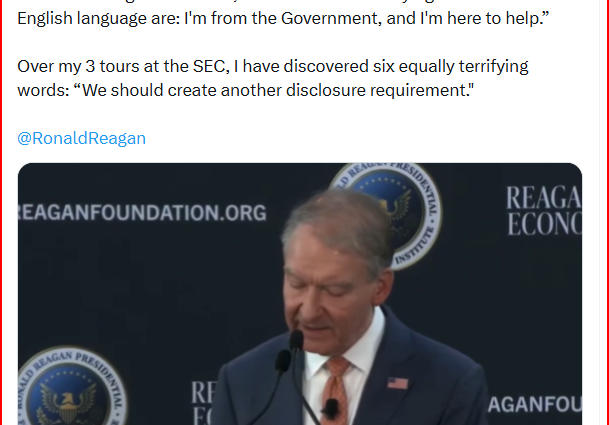
Securities and Exchange Commission (SEC) Chairman Paul Atkins recently expressed his concern over increasing government regulation, quoting a famous line from former Republican President Ronald Reagan.

Atkins took to X on Tuesday to voice his disapproval of the government’s increasing role in the private sector. He wrote, “President Reagan once said, ‘The nine most terrifying words in the English language are: I’m from the Government, and I’m here to help.’ 

Paul Atkins joked that the six most frightening words at the SEC are: “We should create another disclosure requirement,” criticizing the tendency to add more regulations.

Atkins has served three terms at the SEC, where he is known for his criticism of regulatory overreach.

data-variant=”card”
data-news-mode=”manual”

>


This post was originally published here

Stockholm, 3rd of June 2026 – Virtune today announces the completion of the monthly rebalancing for the Virtune Crypto Top 10 Index ETP, listed on Nasdaq Stockholm for both the SEK-denominated (ISIN code SE0020052207, ticker name VIR10SEK) and the EUR-denominated (ISIN code SE0020052215, ticker name VIR10EUR) ETP.

In addition to the Virtune Crypto Top 10 Index ETP, Virtune’s product portfolio includes:

Virtune Bitcoin ETP
Virtune Stellar ETP
Virtune Staked Ethereum ETP
Virtune Staked Solana ETP
Virtune Staked Polkadot ETP
Virtune XRP ETP
Virtune Avalanche ETP
Virtune Litecoin ETP
Virtune Chainlink ETP
Virtune Arbitrum ETP
Virtune Staked Polygon ETP
Virtune Staked Cardano ETP
Virtune Crypto Altcoin Index ETP
Virtune Bitcoin Prime ETP
Virtune Coinbase 50 Index ETP
Virtune Staked Near ETP
Virtune Sui ETP
Virtune Stablecoin ETP
Virtune Bittensor ETP
Virtune BNB ETP
Virtune Hyperliquid ETP

Index allocation as of 29 May (before rebalancing):

Bitcoin: 41.13%
Ethereum: 28.53%
BNB: 10.10%
XRP: 9.51%
Solana: 5.53%
Hyperliquid: 1.92%
Cardano: 0.99%
Stellar: 0.81%
Chainlink: 0.76%
Bitcoin Cash: 0.71%

Index allocation as of …

Full story available on Benzinga.com

This post was originally published here

Bitcoin has plunged below $67,000 as uncertainty around Strategy (NASDAQ:MSTR) continues to instill fear in the market.

Cryptocurrency Ticker Price
Bitcoin (CRYPTO: BTC) $66,732
Ethereum (CRYPTO: ETH) $1,873
Solana (CRYPTO: SOL) $74.78
XRP (CRYPTO: XRP) $1.23
Dogecoin (CRYPTO: DOGE) $0.09363
Shiba Inu (CRYPTO: SHIB) $0.055313

Notable Developments:

Full story available on Benzinga.com

This post was originally published here

Cardano (CRYPTO: ADA) founder Charles Hoskinson said in an interview aired Tuesday that the future of cryptocurrency lies in the hands of AI agents.

Blockchain And AI Agents Compliment Each Other, Says Hoskinson

Speaking with cryptocurrency influencer Michaël van de Poppe, Hoskinson deemed the cryptocurrency space a “near-perfect complement” to agentic commerce.

He said that AI agents are “creative” and don’t have rules by default, in contrast to blockchains, which are “rigid” and rule-based.

“So, if you put these two things together, you basically create a perfect neutral symbolic AI system where you get the best of both worlds.

Full story available on Benzinga.com

This post was originally published here

Cryptocurrency bettors are raising the possibility of Bitcoin (CRYPTO: BTC) diving below $50,000 this year as sentiment toward the leading digital asset continues to deteriorate.

Bookmakers Turn Bearish On BTC

As of this writing, Polygon (CRYPTO: POL)-based Polymarket assigned a 53% chance of Bitcoin sliding below the key milestone, up from 44% the day before, and 28% last week.

Bearish expectations intensified overall, with the odds of Bitcoin falling below $45,000 rising to 38%, while the probability of a move below $55,000 jumping to 66%.

Nearly $40 million has been wagered on the outcome, making it one of the most keenly watched bets on Polymarket.

data-variant=”banner”
data-news-mode=”manual”

>

Add …

This post was originally published here

Economist and market commentator Peter Schiff speculated on Tuesday on the potential implications of Bitcoin’s (CRYPTO: BTC) latest crash on the broader risk asset market.

Will It Get Worse For Risk-On Assets?

In an X post, Schiff wondered if the decline is a “harbinger” of a broader downturn in risk assets, or if it would remain a “one-off” event within the cryptocurrency sphere.

“Whichever it is, we should find out soon enough. Maybe it will also be a catalyst to drive investors into value and safety.” the Bitcoin critic said.

Schiff’s remarks appeared to suggest capital reallocation into precious metals such as gold and silver, which he views as safe havens.

Full story available on Benzinga.com

This post was originally published here

Wall Street strategist Tom Lee framed Mark Cuban’s sale of Bitcoin (CRYPTO: BTC) as a sign of “rage-quitting,” the kind of move that, according to him, typically happens at the end of cryptocurrency winter

A Sign Of Bottom?

During an interview with CNBC, Lee partially agreed with Cuban’s rationale that Bitcoin hasn’t acted the way it was supposed to.

“I think Mark is right. Crypto has been disappointing because crypto should move with equity markets, and it should be rallying with software. Software is really starting to rally big, and crypto hasn’t moved,” Lee said.

However, Fundstrat’s head of research viewed the move as “rage quitting” — people selling because they sense something is “wrong” with cryptocurrency.

“I think that’s what always happens at the end of crypto winter,” Lee said.

This post was originally published here

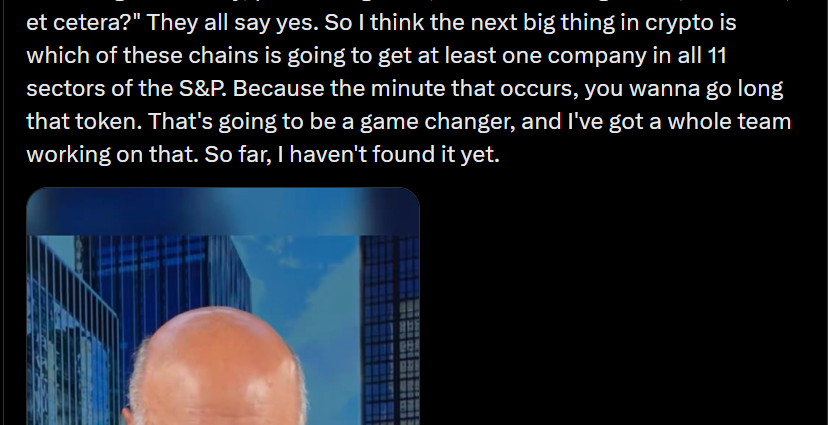
Influential investor and media personality Kevin O’Leary said on Monday that the “next big thing” in cryptocurrency would be determined by its adoption across different sectors of the S&P 500.

What’ll Be The Gamechanger?

O’Leary took to X, sharing a clip from his recent interview, in which he predicted the trajectory of cryptocurrency.

The “Shark” highlighted the untapped potential of tokenizing S&P 500 elements such as contracts, inventory, and logistics on blockchain, deeming it as the “next big” opportunity.

“If you talk to any S&P 500 company and ask them, ‘Are you planning to use blockchain technology to manage inventory, provide logistics, contract management, et cetera, et cetera?’ They all say yes,” O’Leary, also known as “Mr Wonderful,” stated.

Why S&P 500 Adoption Matters

O’Leary said that the first chain to secure clients across all 11 S&P 500 sectors, including financials, information technology and energy, could be a “game changer.”

“Because the minute that occurs, …

Full story available on Benzinga.com

This post was originally published here

Leading cryptocurrencies crashed on Tuesday as geopolitical uncertainty and Strategy Inc.‘s (NASDAQ:MSTR) sale of Bitcoin hammered sentiment.

Cryptocurrency 24-Hour Gains +/- Price (Recorded at 9:20 p.m. EDT)
Bitcoin (CRYPTO: BTC) -6.15% $66,829.58
Ethereum (CRYPTO: ETH)
               
-6.65% $1,860.68
XRP (CRYPTO: XRP)                          -4.84% $1.22
Solana (CRYPTO: SOL)                          -7.47% $74.74
Dogecoin (CRYPTO: DOGE)              -7.70% $0.09277

Crypto Market In Blood Red

Bitcoin nearly fell below $66,000, as the apex cryptocurrency’s decline triggered an aggressive sell-off across the broader market. Ethereum plunged to a nearly three-month low, while XRP and Dogecoin also posted sharp declines.

The drop accelerated after Strategy reported selling BTC worth $2.5 million, flipping from being Bitcoin’s largest hoarder to a seller. 

A whopping $1.78 billion was liquidated from the cryptocurrency market in the last 24 hours, with $1.59 billion in long positions erased, according to Coinglass data.

Bitcoin’s open interest dropped 3.22% over the last 24 hours. Curiously, Binance derivatives traders with open BTC positions were betting on the cryptocurrency’s increase.

Moreover, “Extreme Fear” sentiment deepened, according to the Crypto Fear & Greed Index.

Top Gainers (24 Hours) 

Cryptocurrency (Market Cap>$100 M) Gains +/- Price (Recorded at …

Full story available on Benzinga.com

This post was originally published here

More than $1 billion in liquidations, persistent ETF outflows, and fading momentum hit digital assets even as stocks continue riding the AI boom.

By JBizNews Desk

June 2, 2026

Bitcoin fell below $68,000 on Tuesday, extending a sharp cryptocurrency selloff that wiped out more than $1 billion in leveraged positions and underscored the growing divergence between digital assets and a stock market that continues to march toward record highs.

The world’s largest cryptocurrency traded as low as approximately $67,200 during the session, its weakest level in roughly a month, according to market data. The decline came as investors pulled hundreds of millions of dollars from crypto exchange-traded funds and traders rushed to unwind bullish bets that had accumulated during this year’s rally.

The weakness was broad-based across digital assets.

Ethereum fell nearly 5% to around $1,900, while Solana dropped approximately 6% to the mid-$70s. XRP declined about 5%, adding to losses across the sector. The total cryptocurrency market capitalization fell roughly 3.5%, erasing tens of billions of dollars in value in a single trading session.

For many investors, the bigger question is not why crypto is falling.

It is why crypto is falling while stocks keep rising.

The S&P 500 remains near record highs, fueled by continued enthusiasm surrounding artificial intelligence, strong corporate earnings, and steady capital spending by technology giants. The Nasdaq Composite has continued benefiting from AI-driven optimism, while investors have increasingly favored large-cap equities over more speculative assets.

In effect, money that might have flowed into cryptocurrencies earlier in the cycle is finding a home elsewhere.

The first major factor weighing on crypto is the continued exodus from exchange-traded funds.

Bitcoin ETFs recorded approximately $483 million in net outflows on Monday, extending an outflow streak that has now lasted nearly two weeks. Ethereum funds have experienced a similar pattern, with investors steadily reducing exposure despite hopes that ETF adoption would provide a durable institutional bid.

The significance is straightforward.

During much of the previous rally, ETFs served as a powerful source of new demand, helping absorb available supply and support rising prices. When those flows reverse, markets lose an important source of support.

“The institutional buyer has stepped away,” one digital-asset strategist said Tuesday. “The question becomes who replaces that demand.”

At the same time, leverage amplified the decline.

According to CoinGlass, more than $1 billion in crypto positions were liquidated over a 24-hour period, with nearly all of the losses concentrated among traders betting on higher prices.

When leveraged positions are forced to close, exchanges automatically sell assets to cover losses. That selling can trigger additional liquidations, creating a cascade effect that accelerates downward moves.

The result is often a decline that appears sudden but is actually fueled by automated selling mechanisms embedded throughout the market.

Adding to investor concerns was news involving Strategy (NASDAQ: MSTR), the company led by Michael Saylor and widely regarded as the largest corporate holder of Bitcoin.

The company disclosed the sale of 32 Bitcoin for approximately $2.5 million, representing an average sale price of roughly $77,000 per coin.

While the transaction was tiny relative to Strategy’s overall holdings, traders viewed it as another negative headline in an already fragile market.

Analysts largely dismissed the sale as immaterial, noting that it does not appear to signal any broader shift in Strategy’s long-term commitment to Bitcoin.

Still, markets often react more to sentiment than size.

The contrast between crypto and equities has become increasingly difficult to ignore.

Just a few months ago, many investors expected cryptocurrencies and technology stocks to move higher together as enthusiasm surrounding artificial intelligence, digital infrastructure, and innovation accelerated.

Instead, stocks have continued attracting capital while crypto has struggled to maintain momentum.

For companies operating within the digital-asset ecosystem, including ETF issuers, exchanges, custodians, and publicly traded firms holding Bitcoin on their balance sheets, price volatility remains central to the business model.

Higher prices attract inflows, trading activity, and investor attention. Lower prices can quickly reverse those trends.

The next test for crypto markets may arrive sooner than many investors expected.

Technical analysts are closely watching the $66,000 to $65,000 range as the next major support area for Bitcoin. Should that level fail to hold, some traders believe the market could revisit levels closer to $60,000, an area that previously attracted strong buying interest earlier this year.

For now, the message from markets is clear.

Wall Street remains focused on earnings growth, artificial intelligence, and corporate investment. Crypto investors, meanwhile, are confronting a different reality—one defined by weakening fund flows, fading momentum, and a market searching for its next catalyst.

New York — JBizNews Desk

© JBizNews.com All Rights Reserved. Reproduction or distribution without written permission is prohibited.