Long before she became a real estate agent helping lead one of the nation’s top-performing small teams, Molly Horak was spending her days in an infant carrier beneath her mother’s desk.

The story has become part of The Horak Group’s family lore — and part of the reason the team’s connection to REMAX stretches back nearly four decades.

“I was in that pumpkin seat under the desk at another brokerage when [my mother] was doing board duty, desk duty,” Molly told HousingWire. “The owner came in and asked why a baby was here, said it wasn’t professional. She was in her early 20s, so what are you going to do? So, she went across the street to REMAX, and I ended up growing up in that office.

“They passed me and my sister around, and it was a very family atmosphere. My kids now have all worn little knit REMAX baby hoodies from the 1980s my mom had for us when we were little.”

Today, that family-centered approach remains a defining characteristic of The Horak Group, which operates under REMAX Boone Realty in Columbia, Missouri.

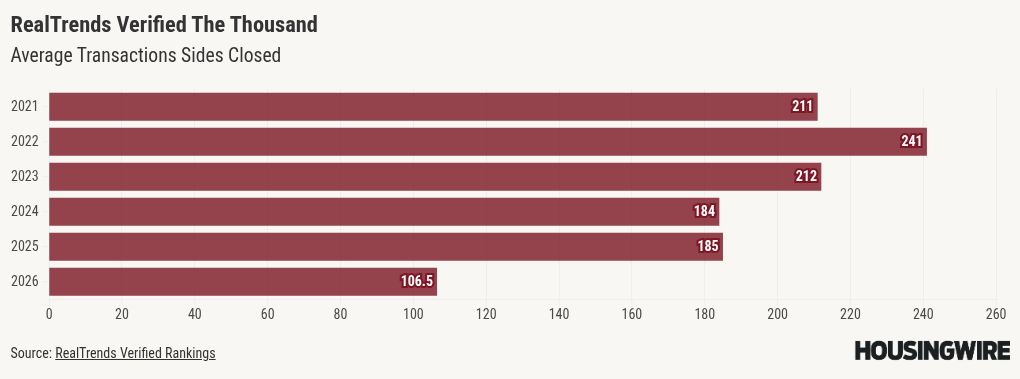
The three-agent team — Molly Horak, her mother Susan Horak and Jan Wertzberger — earned a No. 16 national ranking among small teams for transaction sides on RealTrends Verified’s 2026 rankings — closing 247 in 2025.

For Molly, the explanation for the team’s sustained success is straightforward.

“We do have longevity,” she said. “I think my mother started in 1984, 1985, somewhere around there,” she said. “We’ve all just been doing this for a very long time, and have routines set and know what we need to do. It takes a lot of late nights and weekends, but we just keep going and it’s what we’ve always done.”

Susan Horak founded the business and remains its leader, with Molly helping on day-to-day operations and Wertzberger having been with the group for 30 years.

Technology and people

Although the team consists of only three agents, it has continued to evolve with changing technology.

Molly remembers a time when marketing a listing required far more time than it does today.

“I remember starting off in the company in the graphics and marketing office,” she said. “It was so funny, because back then it took like six of us to do 10% of what we do now with two people. You had to build the website from nothing, and it felt like every single time you had a new listing it was this long process of getting everything put on there.

“The websites would crash if you had more than nine photos, because the internet just wasn’t what it is now, and the technology has just gotten so much better — so much faster.”

Despite advances in technology, the team’s investment philosophy has remained consistent.

“I don’t feel like we spend a ridiculous amount buying every new shiny thing,” Molly said. “But we do invest in people. We have a dedicated, full-time graphics and marketing [person]. It’s not always been the same person — but for probably 25 years, 30 years, we’ve just always had one because you need someone to run the website.”

That includes maintaining dedicated marketing support.

“We’ve always had a pretty decent listing volume [so] it’s never made sense to have someone where we had to wait on their schedule when we needed new photos, especially during the recession years,” Molly said. “When things were sitting on the market for a very long time, you have to send people out to retake photos when the season changes and there’s snow on the ground.”

Working with family

As The Horak Group hits 40 years in business, Molly believes the key to making a family business work is surprisingly simple.

“You’ve got to like each other,” she said. “I genuinely love working together. Frequently, we’ll be at the office till 8:30 at night or longer, just to get more done after the staff has left. Everybody goes home and then, all of a sudden, you get peak productivity. We work really well together then, or at any time.”

Still, she acknowledged that family partnerships aren’t for everyone.

“Not every parent-child relationship is right for that,” Molly said. “And you can’t try to force it when it’s not. We’ve just always had this family environment, and we really appreciated that about REMAX. My kids came to the office their first couple of years. When [my mother] got into real estate, back then, I think there was a higher concentration of men in real estate.

“It just wasn’t as normal to have a business be welcoming [to a woman who needed to bring kids to the office]. Now things are different, but REMAX was just so welcoming when it wasn’t what everyone did.”

For the Horaks, a family-friendly office that welcomed a baby in a pumpkin seat helped launch a real estate legacy that now ranks among the nation’s best.


This post was originally published on here

eXp World Holdings, Inc. has completed its corporate transformation to AGNT, Inc., including a formal name change and a move of its legal domicile from Delaware to Texas, the company announced Thursday.

The holding company for eXp Realty, NextHome, FrameVR.io and SUCCESS Enterprises now trades on Nasdaq under the AGNT ticker and will operate under the AGNT, Inc. name going forward. The shift follows the May 2026 adoption of the AGNT ticker and the addition of NextHome to the platform, which the company describes as a multi-model, agent-focused ecosystem spanning cloud brokerage, franchise and ancillary services.

Glenn Sanford, founder, chairman and CEO of AGNT, said the new corporate identity is intended to formalize the company’s longstanding strategy of building economic and technology models around independent real estate agents. At the brokerage level, eXp Realty CEO Leo Pareja pointed to the firm’s scale — it bills itself as the world’s largest independent brokerage — and said the AGNT structure is designed to give that agent-first mission “a permanent home” at the holding company level.

Redomestication to Texas

As part of the transformation, AGNT has completed its redomestication from Delaware to Texas. The move was recommended by a special committee of independent directors after a review process that lasted more than a year and was supported by outside counsel, according to the announcement. Shareholders approved the change at the company’s May 8, 2026, annual meeting.

The company said Texas law better matches its agent-driven business model because it expressly allows directors and officers to consider the interests of constituencies such as agents when exercising fiduciary duties. That framing is notable for broker-owners and shareholders watching how public real estate platforms navigate pressure to balance agent economics, profitability and litigation or regulatory risk.

This move comes despite New York State Comptroller Thomas DiNapoli, who is a trustee of the New York State Common Retirement Fund, an AGNT shareholder, calling on investors to block the firm’s attempt to move its place of incorporation to Texas. 

Critics of the firm claimed that it was trying to reincorporate to dodge allegations that the company and its executives enabled the drugging and rapes of women attending recruiting events. 

AGNT has repeatedly told HousingWire that it “has zero tolerance for abuse, harassment or misconduct of any kind — including by the independent real estate agents who use our services,” and that it believes the claims against Sanford and the firm “are without merit.”

In mid-April, an AGNT spokesperson told HousingWire that the decision to reincorporate in Texas reflected “the Board’s considered judgment about the long-term operational and governance interests of the company and its shareholders. “

“Any characterization of the timing as ‘suspect’ misrepresents a lengthy, good-faith process and a misunderstanding of the reincorporation impacts on existing litigation,” the spokesperson said. 

AGNT said it will continue to use its website, www.agntinc.com, Securities and Exchange Commission filings, press releases, calls, webcasts and social channels as primary outlets for investor information.

This article was written by Brooklee Han and generated with the assistance of HousingWire Automation, then reviewed by a HousingWire editor before publication.

This post was originally published on here

The Mortgage Bankers Association (MBA) is urging the mortgage industry to develop a unified framework for managing artificial intelligence as lenders increasingly deploy AI tools across origination, servicing and customer engagement.

In a white paper released Wednesday, the association said AI technologies are rapidly becoming embedded throughout the mortgage process, from customer service chatbots and fraud detection systems to underwriting and servicing operations.

The paper argues that while AI offers significant efficiency gains, the industry faces growing uncertainty about regulatory expectations and legal compliance.

The paper, prepared for the MBA by law firm Orrick, Herrington & Sutcliffe, examines how existing federal laws apply to AI-powered mortgage lending and outlines best practices for lenders that adopt the technology. It also provides an up-to-date overview of MBA members’ engagement and implementation around AI use and regulation, while also posing and analyzing key legal questions about the use of AI.

“AI’s assistance with — and, in some cases, performance of — a broader range of mortgage-related tasks raises novel questions about expectations for human involvement with AI models, as well as risk management more broadly,” the report explained.

SAFE Act ambiguity

MBA noted that mortgage companies are increasingly exploring generative AI, predictive AI and agentic AI systems, with many lenders already using AI-powered chatbots to answer simple questions or support servicing functions. But the paper also said that more advanced systems may soon be capable of handling nearly every stage of the mortgage process.

The association noted that while existing laws like the Secure and Fair Enforcement for Mortgage Licensing Act of 2008 (“SAFE Act”) exist to establish a nationwide licensing system and ensure loan originators are subject to regulatory oversight, the act does not answer whether mortgage companies can offer completely human-free loan originations.

“While it does require human MLOs to be licensed or registered (depending on the nature of their employment), the SAFE Act does not require AI tools to have their own MLO license or registration to engage in loan origination activities,” the report reads.

MBA argued that current federal disclosure requirements effectively require lenders to assign a human mortgage originator to every transaction. Under the Truth in Lending Act and Regulation Z, lenders must disclose the name and Nationwide Multistate Licensing System (NMLS) identification number of an individual loan officer associated with the loan.

The report recommends that lenders maintain a “human in the loop” approach, ensuring a licensed mortgage originator remains available to borrowers and participates in some level of oversight, even when AI performs substantial portions of the origination process.

MBA also warned that lenders could face risks under federal and state consumer protection laws if borrowers are led to believe a human loan officer is overseeing their application when the process is handled entirely by AI.

GSE guidance already in place

The white paper comes as regulators and investors have begun to address AI governance. Earlier this year, Freddie Mac updated its seller-servicer guide to include AI and machine learning governance requirements, while Fannie Mae issued guidance calling on lenders to establish policies and procedures that govern AI systems.

MBA said federal policymakers have provided limited guidance on how existing lending and consumer protection laws apply to AI-enabled mortgage processes. To address that uncertainty, the association is advocating for a principles-based AI risk management framework tailored to the mortgage industry. This would include standards for governance, model validation, fair lending tests, explainability, data privacy and vendor oversight.

MBA also encouraged lenders to implement robust testing programs to monitor AI systems for disparate treatment or disparate impact on protected groups and to maintain documentation showing compliance with fair lending requirements. The report identified several risks associated with AI adoption, including potential fair lending violations, bias in automated decision-making, improper steering of borrowers to certain loan products and consumer privacy concerns.

The association said lenders should prepare for evolving regulatory expectations while also engaging with lawmakers and regulators as states consider legislation governing AI use in financial services.

“The rapid adoption of AI across the mortgage industry presents both significant opportunities and complex legal and regulatory challenges,” the report concluded. “The absence of comprehensive federal and state guidance on AI in mortgage lending creates an imperative for the industry to develop and adopt a unified, principles-based risk management framework.”

This article was written by Sarah Wolak and generated with the assistance of HousingWire Automation, then reviewed by a HousingWire editor before publication.

This post was originally published on here

At an event in France, an eXp Realty agent who had relocated from Southern California pulled eXp Realty CEO Leo Pareja aside with a warning from the other side of the Atlantic.

“She goes, Leo, let me just tell you how horrible it is to sell real estate here,” Pareja said. “I have to go to eight different weeks, I have to go to the portals like SeLoger and all the other ones, and then I have to go to REMAX and KW and eXp, and that may get me 60% of the inventory, and then I have to call the local offices around the area the client is curious about. They may or may not call me back.”

Her conclusion was blunt: “It feels like 100 years compared to what we have in the U.S.”

For Pareja and NextHome CEO James Dwiggins, that is not just a cautionary tale. It is the future they are trying to avoid as consolidation accelerates, private listings expand and the industry’s long-standing system of shared listing data comes under pressure.

The two executives recently discussed eXp Realty’s acquisition of NextHome on the RealTrending podcast, but the conversation quickly moved beyond deal mechanics. To them, the tie-up is part of a larger fight over consumer access, listing distribution, artificial intelligence and the future structure of brokerage.

Pareja said consolidation in real estate is following a familiar historical pattern.

“If you look at American history, when industries start to consolidate, they tend to not stop, and so consolidation begets consolidation,” he said. “Industries that for decades were fragmented all of a sudden become consolidated.”

He compared the current moment to the airline industry and even the railroad consolidation of the late 1800s. For real estate, he said, the pressure is coming from a combination of national platforms, technology, industry downturns and capital.

For eXp, Pareja said, NextHome offered something different from a pure scale play.

“We were looking for a platform that was synergistic and complimentary, that didn’t cannibalize our business,” he said. “We recruited a total of 28 agents in 2025 away from them, right? So there was almost zero overlap.”

Dwiggins said NextHome’s leadership had reached similar conclusions about where the industry was headed.

“We built this business from the ground up, no investors, from a garage, mortgaged our houses and took all of our savings accounts to create the company,” he said. “We (James and co-CEO Keith Robinson) built this beautiful boutique franchise business.”

But, he added, the market was changing fast.

The private listings war

“We needed protection from a private listings war, which I unfortunately think is here and about to get accelerated,” Dwiggins said.

Private listings were a central concern for both executives. Dwiggins said they have a limited place in the market, but he believes they are being pushed far beyond that.

“I think private listings are a really bad thing for the industry,” he said. “It’s always been, in my opinion, something that should be used in a very small use case.”

He framed the issue around the seller’s interests. “Isn’t our job supposed to be about putting the seller’s interests forward?” Dwiggins said. “Did we forget who we actually work for in this process?”

Pareja said the North American MLS system remains one of the industry’s greatest advantages, especially compared with markets where portals dominate access to inventory.

“What makes North American real estate wonderful is we have MLS, and we also syndicate data to actual competitors that fiercely compete for those positions,” Pareja said. “Creating more distribution of our seller’s listings is better, and like, fight me on that one.”

That belief also underpins eXp’s deal with Google, HouseCanary and ComeHome. Pareja said the arrangement gives the brokerage more control over how its listings are distributed. “The fact that we are the ones sending the data via my state and the relationship with HouseCanary, that actually puts me in control to take it away if they go back on their word or we don’t like the position they take,” he said.

He also said scale matters in a fragmented environment. “NextHome could not have done the Google deal that we did, purely just because they didn’t have enough scale to do it,” Pareja said. “But now that we’re together, we went from 72,000 active listings to 80,000 active listings.”

Is AI a black swan event for the listing ecosystem?

Both executives argued that broader distribution is not only good for sellers, but necessary as search changes. Dwiggins said the home search experience remains outdated. “When you go to portals today, the search experience is basically the same as it’s been for, I don’t know, like 15 or 20 years — bedrooms, bathrooms, and square footage,” he said.

He said buyers want a more intuitive search experience, one that reflects how people actually think about where they want to live. “I want a pool, and I want to have it [on a] north-facing slope, and I want to have this, and I want to have that, and I want it to be this far from my favorite restaurants in downtown,” he said.

Pareja sees AI as a possible “black swan event” for the listing ecosystem. “There is a black swan event, which is that LLMs really get to understand every nook and cranny of any listing available,” he said.

If AI-powered search becomes the default consumer experience, Pareja said, brokerages need to think carefully about positioning. “What puts us in pole position if that statement is true?” he said. “Wouldn’t it be good to give the world’s biggest LLM all of our properties that are actively available for sale in real time?”

Leadership structure is moving too slowly

Still, both leaders said the industry’s leadership structure is moving too slowly. Pareja called it “an abdication of leadership.” Dwiggins was equally direct.

“There are too many unqualified people, and I say that as respectfully as possible, on boards making decisions that they’re not qualified to make,” he said. “That is the problem with organized real estate, from associations to MLSs all the way down.”

For broker-owners and agents, however, both executives said the answer is not to obsess over every technology headline. It is to return to relationships and value.

“In a hyper AI tech focus world, I think the human is going to be at a premium,” Pareja said. “I would obsess with relationships and value, and everything else is noise.”

Dwiggins agreed. “A human connection, I think, is going to be the most important thing to remember in an AI-based world,” he said. “This is an infrequent transaction that people do once every eight to 13 years. It’s not an Amazon package, it’s something that’s scary, it’s expensive.”

For Dwiggins, the industry’s future still rests on a simple question.

“If you wouldn’t do it with the sale of your own home, then don’t do it with other people,” he said.

Listen to the full RealTrending podcast.

This article was generated using HousingWire Automation and reviewed by a HousingWire editor before publication.

This post was originally published on here

U.S. foreclosure activity continued its gradual annual rise in May 2026 even as filings declined from April, according to ATTOM’s latest Foreclosure Market Report.

The report, released Thursday, found 40,355 properties with foreclosure filings — including default notices, scheduled auctions or bank repossessions. That was down 5% from April but up 14% from May 2025.

Foreclosure starts increased 13% year over year to 27,304, while completed foreclosures — or real estate-owned (REO) properties — rose 6% to 4,092. ATTOM CEO Rob Barber said in the company announcement that elevated mortgage rates, higher homeownership costs and ongoing affordability pressures are contributing to the increase even as foreclosure activity “remains well below historical norms.”

Where foreclosure risk is highest

Nationwide, one in every 3,562 housing units had a foreclosure filing in May. The states with the highest foreclosure rates were:

  • Florida: one in every 2,110 housing units
  • South Carolina: one in every 2,287 units
  • Maryland: one in every 2,369
  • Nevada: one in every 2,386
  • Indiana: one in every 2,516

Among metro areas with at least 2 million residents, Cleveland posted the highest rate, with one filing for every 1,524 housing units. It was followed by Baltimore (one in 1,804); Tampa (one in 1,878); Riverside, California (one in 1,980); and Orlando (one in 2,034).

For mortgage servicers, real estate investors and other market stakeholders, these state and metro-level rates highlight where distressed housing pipelines are thickening and where loss-mitigation or REO disposition resources may need to be rebalanced.

Texas, Florida and California lead in foreclosure starts

Lenders started foreclosures on 27,304 properties in May, down 4% from April but up 13% from a year earlier. The states with the highest number of foreclosure starts were:

  • Texas: 3,590 starts
  • Florida: 3,315 starts
  • California: 2,530 starts
  • Georgia: 1,161 starts
  • Illinois: 1,150 starts

Some midsized metros are moving in the opposite direction. Among markets with at least 200,000 people and at least 20 foreclosure starts, the largest year-over-year drops in May occurred in:

  • Santa Rosa, California (down from 93 starts in May 2025 to 21 in May 2026)
  • Honolulu (68 to 30)
  • Seattle (196 to 99)
  • Visalia, California (39 to 22)
  • Greeley, Colorado (78 to 45)

For lenders and servicers, higher starts in large states like Texas, Florida and California point to growing early-stage distressed pipelines. Conversely, sharp declines in select West Coast markets suggest local labor or affordability dynamics are improving relative to last year.

Completed foreclosures stay above 2025 levels

Lenders repossessed 4,092 properties through completed foreclosures in May, a 20% decline from April but a 6% increase from May 2025. The states with the most REO properties were:

  • Texas: 519 REOs
  • California: 427 REOs
  • Florida: 340 REOs
  • Illinois: 223 REOs
  • Michigan: 222 REOs

Among metros with more than 200,000 residents, the highest REO counts were in:

  • Chicago (204 REOs)
  • Detroit (124)
  • Houston (122)
  • Dallas (88)
  • New York City (84)

Elevated REO totals in large Midwest and Sun Belt markets point to steady inflows of distressed inventory for investors, fix-and-flip operators and single-family rental buyers, although volumes remain far below pre-2008 levels.

This article was generated using HousingWire Automation and reviewed by a HousingWire editor before publication. 

This post was originally published on here

The New York City Council wants to build affordable housing on top of public libraries to ease the current housing crisis. Council Speaker Julie Menin on Thursday called on the Mamdani administration to invest $60 million to support the redevelopment of three initial library sites, one in each of the city’s three public library systems. The plan builds on the city’s existing model of co-locating affordable housing and libraries, including Bensonhurst’s New Utrecht Library, which the city issued a request for proposals for just this week, as well as ongoing projects at Grand Concourse and on the Upper West Side. Similar projects in Sunset Park and Inwood opened in 2023 and 2024, respectively.

Sunset Park Library and Apartments. Credit: Brooklyn Public Library

“For years, New Yorkers have talked about the promise of building housing above libraries, but only a handful of projects have moved forward,” Menin said. “Today, the Council is taking action with a comprehensive plan to unlock deeply affordable housing alongside transformed library facilities across the city.“

“By pairing new library construction with residential development, we can deliver modern community spaces, create new homes for New Yorkers, and maximize the value of public land,” she added. “This is exactly the kind of innovative and proactive thinking our city needs to address both our housing crisis and our infrastructure needs.”

Menin’s proposal calls for funding three initial sites that would pair expanded libraries with affordable housing above them: the Parkchester Branch Library of the New York Public Library (NYPL) in the Bronx, the Marcy Branch Library of the Brooklyn Public Library (BPL), and the Sunnyside Branch Library of the Queens Public Library (QPL).

Three additional sites have been identified for future phases: the Francis Martin Branch Library (NYPL), the Windsor Terrace Branch Library (BPL), and the Lefferts Branch Library (QPL).

According to the New York Times, each project could include about 100 apartments on top of the library, with units priced from about $1,215/month to $2,430/month.

Menin’s proposal builds on a model that has delivered new public facilities across the five boroughs through partnerships with private developers, in which housing and public facilities are constructed as part of a single project.

This approach can significantly reduce costs and speed up delivery compared with traditional standalone public construction projects.

The Sunset Park Library, completed in November 2023, was the first example of this type of affordable housing in the city. Located at 372 51st Street, the aging branch was redeveloped into the Sunset Park Library and Apartments, an eight-story mixed-use building with a new library and 100 percent affordable housing above it.

The Eliza in Inwood. Image courtesy of Molly Stromoski

In June 2024, the Inwood Library was redeveloped into The Eliza, a 14-story building with 174 deeply affordable apartments above a two-level NYPL branch. Designed by Fogarty Finger in collaboration with Andrew Berman Architect, the project was delivered at roughly half the capital cost and in about half the time of a standalone library built through the city’s typical construction process.

According to the Council, the city should prioritize this model when facilities such as libraries, senior centers, and childcare centers are in need of upgrades and are located on sites suitable for housing development.

If capital funding is secured through the budget process, individual sites would move through the city’s standard public development process, including requests for proposals (RFPs) and the Uniform Land Use Review Procedure.

On Wednesday, the city’s Department of Housing Preservation and Development released a request for proposals to transform the New Utrecht Library at 1743 86th Street in Bensonhurst into a modern branch with housing above it. The existing facility has millions of dollars in deferred maintenance needs, and parts of the building are in disrepair.

“The New Utrecht Library has long served as a vital resource—offering a space for learning, connection, and community,” Council Member Alexa Avilés said. “I’m proud to support the City’s partnership with the Brooklyn Public Library to pursue a long-overdue renovation of this beloved institution, alongside the development of new affordable housing in my district.”

“At a time when our city is facing a severe housing crisis and cuts to vital services, this project represents a meaningful step forward,” she added.

The initiative builds on the city’s “Living Libraries” program, which pairs modernized library facilities with affordable housing. Other projects in the program include the Upper West Side’s Bloomingdale Library, which will feature 850 housing units.

RELATED:

The post City Council unveils proposal to build affordable housing on top of libraries first appeared on 6sqft.

This post was originally published here

Florida homeowners didn’t vote for higher property tax bills, but they’re getting them anyway.

A historic wave of in-migration caused the hike.

Gov. Ron DeSantis called lawmakers into a special session last week and pushed through a resolution to put a constitutional amendment before voters in November that would more than quadruple the state’s homestead property tax exemption.

Lawmakers blessed the proposal with modifications to protect school funding.

DeSantis is asking voters to solve the tax bill problem created when companies and employees arrived in droves from high-cost Northeast cities, notably New York City, during the COVID-19 pandemic. The influx overwhelmed existing housing supply and drove up home values for longtime residents.

Even though state and local tax rates barely budged, a protracted period of rising property values ratcheted up tax assessments.

It is not the first time DeSantis has used state power to override local housing decisions. When the migration wave exposed a crippling supply shortage, he signed legislation stripping local governments of zoning control to clear the way for more development targeting workforce housing.

That addressed supply.

But for homeowners already sitting on assessments inflated by the state’s nation-leading pandemic-era domestic in-migration, adding new supply doesn’t amount to property tax relief.

Florida is not alone. Across the Sun Belt — Texas, Georgia, North Carolina, Tennessee, Arizona — the same migration dynamic reshaped housing markets and sent tax bills climbing even where local governments cut rates.

Florida, however, is the first to take the fight directly to voters with a constitutional remedy.

New York adds to the squeeze

If Florida voters approve the amendment, New Yorkers who flocked to the Sunshine State would face higher taxation pressure from both directions.

New York City Mayor Zohran Mamdani proposed a pied-a-terre tax on luxury second homes. Gov. Kathy Hochul pushed the state legislature to pass it into law as part of the state’s new budget just before Memorial Day weekend.

Those who never made Florida their official domicile won’t qualify for the expanded homestead exemption. Local governments scrambling to offset lost revenue may have little choice but to raise rates on non-homestead properties — the homes those part-time Floridians own.

But New Yorkers who made Florida their permanent home could land a property tax break, one offset by holding on to a home in the Big Apple. New Yorkers have long chosen Florida for a vacation home or permanent move, citing the high cost of living in the Northeast.

“The Northeast is expensive to live in because that’s where all the people are,” Gary Bingel, a state and local tax expert with Eisner Advisory Group, a New Jersey-based consulting firm, said in an interview with The Builder’s Daily.

He said moving to Florida is now tantamount to “creating the same problems people are moving away from.”

Florida’s pain by the numbers

Between 2020 and 2022, Florida home prices surged more than 50%, driven largely by buyers relocating from New York — the top source of new Florida residents — along with Georgia and Texas.

Since then, prices have stalled. Florida’s average home value fell 3.7% over the past year as new construction added more supply than the market could absorb. Florida’s in-migration has subsided as housing costs rose.

“The affordability picture has changed in Florida almost more than anywhere else in the country,” Eric Finnigan, vice president of demographics research at John Burns Research & Consulting, told the Wall Street Journal.

Assessed home values haven’t returned to pre-in-migration-surge means. Under Florida’s Save Our Homes recapture rule, assessed values continue climbing by up to 3% annually even when market prices fall — until the two figures converge, according to St. Johns County Property Appraiser Eddie Creamer’s explanation posted on the county’s website.

Most Florida counties held millage rates steady or even lowered them. Marion County commissioners voted in September 2025 to cut the countywide rate. Homeowners there still saw their bills climb.

Tax bills in cities statewide increased an average of about 50% over the past several years.

At a news conference announcing the amendment, DeSantis noted Florida’s economy has grown from $1.1 trillion to $1.85 trillion during his seven years as governor.

“That’s a really significant increase in a seven-year period,” he said. “We’ve done close to $10 billion in tax relief since I became governor.”

He said the rise in home values made property taxes a much bigger burden for millions of Floridians.

“Fortunately, because we’ve had success, we have the ability to do something about it,” he said.

Florida’s amendment goes to voters

DeSantis proposed a broader exemption than what the Legislature passed.

The amendment would replace the current $50,000 homestead exemption with a phased increase — rising to $150,000 in 2027 and $250,000 in 2028 — for homeowners who establish Florida residency on or before Dec. 31, 2026. The relief is reserved for primary residences. Second-home and investment-property owners do not qualify.

The school board levy is carved out entirely, the key concession lawmakers extracted before giving DeSantis his supermajority vote.

New residents arriving after Dec. 31, 2026, receive the existing $50,000 exemption for four years before qualifying for the full break.

The amendment cuts the annual assessment cap on non-homestead commercial properties from 10% to 5% beginning Jan. 1, 2027. It needs 60% voter approval to take effect. Renters — who occupy about a third of Florida’s housing units — get no relief.

New York tightens the vise

Just before Florida lawmakers put the amendment on the ballot, New York passed a budget instituting the pied-a-terre tax on non-primary residences within New York City.

“New York City is the greatest city in the world, and the people who call it home should not be left carrying the burden alone,” Hochul said in a statement announcing the tax.

The law rolls out in two phases. Phase 1 runs from July 1, 2026, through June 30, 2028. It covers one- to three-family homes valued at $5 million or more, and condos and co-op units valued at $1 million or more.

Phase 2 begins July 1, 2028, and runs through June 30, 2031. The threshold for condos and co-ops rises to $5 million, aligning with single-family homes, under a new comparable sales-based valuation method the city must develop.

Tax rates on condos during Phase 1 range from 4% on units valued between $1 million and $3 million to 6.5% on units above $5 million. Single-family home rates range from 0.8% to 1.3% depending on value.

The city’s Department of Finance must notify affected owners by Aug. 30. The measure is projected to generate between $340 million and $500 million annually.

The path forward

New York City’s program is set. Florida’s amendment must be sold to voters.

A dispute has already begun. Cities and counties are questioning how they cover budget gaps for services and infrastructure when their key revenue source shrinks.

“Money has to still come from somewhere,” Bingel said, adding it could mean higher tourism or sales taxes. “It’s not as straightforward as everybody says. There’s always some sort of trade-off.”

Ken Johnson, a real estate professor at the University of Mississippi, told The Builder’s Daily that a national recession presents the greatest risk for the amendment, noting it could “drain state and county coffers to the point that essential services could not be delivered.”

Otherwise, property owners could gain a significant financial benefit.

“But that is a ‘big if’ as recessions are cyclical, and it is not a matter of ‘if’ but rather ‘when’ a recession will hit,” Johnson said.

This post was originally published on here

The 137-year-old Carroll Street Bridge in Gowanus will reopen next week after a five-year rehabilitation, with access limited to pedestrians, cyclists, and emergency vehicles. The city’s Department of Transportation on Wednesday announced that the historic 1889 structure—one of just four remaining retractable bridges in the country—will reopen on June 15. The trapezoid-shaped one-lane bridge, closed since 2021, has been locked in an open position throughout the rehabilitation and barred to all vehicular traffic.

The Carroll Street Bridge in 1903. Credit: NYC Department of Records and Information Services

Built for $29,600 by the New Jersey Steel and Iron Company, a subsidiary of Cooper, Hewitt & Company, the Carroll Street Bridge opened in 1889. Spanning 107 feet, the structure consists of two riveted steel plate girders, the shorter of which is counterweighted. It features a wood plank deck with one traffic lane and two bracketed cantilever sidewalks.

A small polygonal brick operator’s house with rounded arches sits on the bridge’s west side. The structure opens and closes like a drawer, rather than lifting vertically or swinging open like many other retractable bridges.

Designated a city landmark in 1987, it is one of just four bridges of its kind remaining in the United States. New York City has another on Borden Avenue in Queens, while Boston has two, neither of which is operable.

The Carroll Street Bridge in 1903. Credit: NYC Department of Records and Information Services

“Our infrastructure tells the story of our city, and the Carroll Street Bridge captures both the maritime industry that built New York and the micromobility that will anchor our sustainable future,” Mayor Zohran Mamdani said. “After five years of careful restoration, the historic bridge will once again connect Brooklyn, this time as a space that belongs to pedestrians, cyclists, and the community first.

“While Gowanus may have changed quite a bit, our neighbors’ love for the landmarks of our city hasn’t, and I am thrilled this rare bridge is up and running and ready to welcome visitors from all over,” he added.

As part of the rehabilitation, crews repaired the bridge’s abutments and approaches and installed a new timber wearing surface. New signage and pavement markings will designate the bridge for pedestrian and cyclist use only, with emergency vehicles the only permitted traffic.

Vintage signage on the bridge also references a century-old statute stating that no “person driving over” the bridge may travel faster than walking speed, with violators subject to a $5 fine. Planters and other elements will further discourage vehicle use.

The Carroll Street bridge in 2013, photo by Steven Pisano on Flickr

Of the four bridges that cross the Gowanus Canal, traffic analyses showed the Carroll Street Bridge was the least used. Traffic counts taken during the project suggested the closure had no measurable effect on vehicle volumes at the other crossings at Union, Third, and Ninth Streets.

“Gowanus has been dramatically transformed in recent years as more and more New Yorkers call the neighborhood home,” DOT Commissioner Mike Flynn said. “As the community becomes more residential, we are pleased that we could preserve this historic bridge while adapting our infrastructure to make it more welcoming to Brooklynites on two feet and two wheels.”

“The newly renovated Carroll Street Bridge, with new restrictions barring truck and vehicular traffic, will help ensure that transition. This humble and restored old beauty of a bridge will endure among the new apartment towers and pedestrian esplanades—and proudly serve Brooklyn for a third century,” he added.

RELATED:

The post Historic Carroll Street Bridge in Gowanus reopens after 5-year renovation first appeared on 6sqft.

This post was originally published here

A new research report from Alloy Advisors finds that a typical $400,000 home sale in the U.S. generates about $39,660 in transaction costs, with real estate commissions making up the majority of the friction. According to the report, AI is poised to accelerate downward pressure on the traditional 5%-plus commission model.

In “The Home Sale Transaction, Reconsidered,” authors Amit Kulkarni and Russ Cofano of Alloy Advisors, dissect the economics of a standard U.S. resale transaction in 2025 and argue that the current real estate commission structure is misaligned with the actual value delivered.

Using a $400,000 sale as a benchmark, the authors estimate a combined $39,660 in “hard” transaction costs — about 9.92% of the sale price — flowing to third parties, based on national averages and cross-market data. Sellers bear about three-quarters of that total, or $30,200, while buyers pay roughly $9,460 at closing beyond their down payment.

According to Kulkarni and Cofano, for housing professionals, the findings of the report present both a margin risk and a competitive opening: AI-enabled consumers will be able to see, question and negotiate specific line items in ways that were not possible even a few years ago.

“The real estate industry thinks that AI is just here to serve the industry and real estate professionals, but that is not the case,” Kulkarni told HousingWire. “AI is here to serve whoever wants to use it and that could mean a variety of different things for different industries, but when it comes to the real estate transaction, I think it will mean that consumers will soon find it overpriced.” 

For Kulkarni, AI is putting a point on the cost of transacting real estate as it is becoming clearer the value the human being can provide and the value AI provides. 

Commissions dominate the friction

According to the analysis, real estate commissions account for $23,000 of the $39,660 in total costs on the sample transaction — 5.75% of the sale price and 76% of all seller-paid friction. The remaining $16,660 is taken up by things like transfer taxes, owner’s title insurance, settlement fees, loan origination fees, underwriting fees, appraisals and home inspections. Additionally, the analysis argues that embedded in an agent’s commission is a “platform tax,” which it attributes to portal referral programs and MLS fees that rarely appear as standalone charges to consumers.

Post-settlement commissions have not fallen

The report directly addresses expectations that the National Association of Realtors’ (NAR) commission lawsuit settlement would compress real estate commission rates. Citing data from Clever Real Estate and Redfin, the authors note that the national average commission rose to 5.44% in mid-2025, up from 5.32% the prior year. Additionally a HousingWire survey from April 2025, found that 58.8% of agents said their buy-side commissions had not changed since the settlement went into effect in August 2024, while 11.76% reported that their commissions had increased. 

According to the report, there are several structural reasons why commission rates have not changed, including that the business practice changes did not remove seller-paid buyer commissions in practice, that 13 states and Washington, D.C., effectively ban à la carte brokerage services and the system is structured in a way that only compensates agents when a deal closes. 

Kulkarni and Cofano write in the report that these factors help explain why overall commission levels have been sticky despite significant legal and regulatory change — and why simple disclosure shifts may not be enough to move the national average.

What the agent’s work is actually worth

A central thesis of the paper is that most of the tasks historically bundled into a 3% listing commission have been commoditized by software and AI, while the remaining “human core” of the job does not scale with home price. The report separates agent tasks into two tiers:

  • Tier 1 – AI-compressed tasks: Comparative market analyses, MLS entry, listing descriptions, offer modeling, transaction coordination and basic disclosure checks. Pre-AI, the report pegs their combined market value at roughly $1,500 to $3,500 per listing. With modern tools, the authors estimate the marginal cost of these services has fallen close to zero for a competent AI user, aside from $10 to $30 per deal for workflow software.
  • Tier 2 – Human-value tasks: Skilled negotiation execution, emotional coaching, on-site judgment, hyperlocal knowledge and licensed fiduciary accountability. Using comparable professional service benchmarks, Alloy Advisors estimates this “human core” is worth roughly $2,000 to $6,500 per transaction, regardless of home price.

By comparison, a 3% listing commission on a $400,000 property is $12,000, and on a $1.5 million property it is $45,000, even though the underlying Tier 2 work does not increase proportionally.

Where agents continue to bring value 

According to Cofano and Kulkarni, the commission model’s indifference to skill is the heart of the problem, as consumers cannot reliably distinguish a top-decile agent from a median one before signing a contract with one, yet both typically charge the same percentage rate.

For agents, teams and brokerages, the implication is that sustained premium pricing will increasingly require demonstrable performance on the specific tasks where human skill still moves outcomes — particularly negotiation and local market insight — as AI not only automates more tasks for agents, but provides consumers with more information. 

“The more AI is used by consumers and the more information about a transaction it can provide them, becoming a real legitimate tool for them to process information as opposed to the human hand they are holding through the transaction. For the industry to not expect that to impact the fundamental economics of this, is just fantasy,” Cofano said. 

The report cites Realtor.com research from 2025, that shows that about 82% of active or potential buyers and sellers reported using AI for housing insights and respondents rated agents and AI nearly evenly on which source made them “smarter” about the market, with agents still perceived as more accurate overall. However, a YouGov survey from December 2025 cited in the paper found that 65% of Americans trust AI to compare prices on major purchases, including homes, but only 14% expressed trust in AI to act on their behalf in such decisions.

This level of information trust, according to Kulkarni and Cofano, is sufficient to put downward pressure on real estate commissions and other fees because AI can evaluate proposed terms, line items and alternatives in real time. 

“Whether they like it or not, these things are happening and they will have an impact on the structure of the business, the compensation of the business, how services are delivered and what services need to be delivered,” Kulkarni said. “Folks need to understand that this is not going to be the status quo. Things are going to change now that consumers are empowered with these tools.” 

Change is afoot 

For housing professionals, the authors say the takeaway is that near-term competitive pressure will come from AI-assisted consumers and new pricing options, long before large-scale regulatory overhaul or pure AI listing platforms reshape the landscape.

“People have always said they wanted a better way to transact real estate, but there really has not been a viable alternative that allows them to do it, but this is an actual viable alternative,” Cofano said. “There are consumers buying and selling just with the help of AI now — it’s still on the edges, but it could eventually become mainstream.” 

For agents, Alloy Advisors said this means they will have to work hard to hone the skills that support tasks AI is not suited to do, such as mentally supporting consumers through what can be an emotionally charged process and negotiating on behalf of their clients. 

“There is a reason consumers dislike buying cars and it is because, for most consumers, the stress around negotiating on their own behalf is something that’s very unpleasant and they’re not good at it,” Cofano said. “So, it is important to highlight here that we believe that the role of the agent as active negotiator and trust companion in the transaction plays a meaningful role and is worth money. And I don’t think that is going away anytime soon.” 

Alloy Advisors hopes this serves as a wake up call for agents and brokers to begin thinking about what their business will look like in an AI-forward world. 

Regardless of exactly what that world will look like, Cofano and Kulkarni agree that the “great agent will win.”

“Great agents win because they put the consumer at the heart of their business. They generally do what is right for the person that they are actually serving and who is paying money,” Kulkarni said. “For brokers this means that many may need to pivot their model to put the consumer at the center and find ways to help the agent better serve this new well-informed consumer.”

This article was written by Brooklee Han and generated with the assistance of HousingWire Automation, then reviewed by a HousingWire editor before publication.

This post was originally published on here

Qualia has launched Qualia Clear Essentials, a new artificial intelligence (AI) feature suite available at no additional cost to users of its Core platform — as the company seeks to broaden AI adoption among title and escrow professionals.

While AI tools have become more common, many title and escrow firms remain uncertain about how to implement the technology effectively within their existing workflows.

Qualia CEO Nate Baker said the company believes that hesitation is becoming increasingly difficult for businesses to afford.

“I think the single most important thing happening in the world right now is AI getting better very quickly,” Baker told HousingWire. “Every company, every title company needs to answer the question of, ‘Next month, when AI gets better, how does that instantly cause my business to be better?’

“If you can’t answer that question, you’re going to be on the losing end of AI.”

Qualia Clear Essentials is built directly into the company’s Core platform and includes three primary tools at launch — the Qualia Clear Support Assistant, the AI Order Opener and the CD Processor.

The company is introducing Clear Essentials less than a year after launching Qualia Clear, a broader AI platform designed to automate workflows and perform tasks within transaction files.

According to Baker, Clear Essentials is intended to help companies become comfortable using AI before adopting more advanced capabilities.

“I think that a lot of people hear about AI, and they’re afraid of it,” Baker said. “They’re afraid that it’s going to take their job or replace them, but our view is that AI is going to amplify people and make people far more effective and provide a much better service to people who are buying and selling homes.”

He described the new offering as “a smooth on ramp” for organizations that have not yet incorporated AI into day-to-day operations.

Support functionality

The Support Assistant functions as an AI-powered chat tool that can answer questions about transactions, platform usage and operational issues — accessing information tied to specific files within the Qualia system.

Baker said the assistant is being used for everything from troubleshooting balancing issues to helping employees learn the platform.

“One thing that’s interesting is I expected that this would reduce the number of support tickets that we received from our customers,” he said. “What we’re seeing is that clients are asking Clear Essentials 10 times-plus more support questions.”

The trend suggests employees often need assistance throughout the day but may be reluctant to interrupt managers or contact support teams for smaller questions, Baker added.

Automation benefits

Two additional tools included in the launch focus on reducing repetitive administrative work.

The AI Order Opener extracts information from purchase and refinance contracts and automatically populates order information within the platform.

Users review and approve the information before proceeding.

Baker said the process addresses one of the most time-consuming tasks in title operations.

“Opening an order takes 30 minutes to an hour for the average title company, and you do that on every transaction,” he said. “This just does that entire process. In the last day, I’ve heard many anecdotes from customers saying, ‘This is the best feature you’ve ever launched,’ because they hadn’t been familiar with Clear or with AI.”

The CD Processor is designed to analyze lender closing disclosures, import charges into files and identify discrepancies between lender documents and information already contained in the transaction record.

“It’s a tedious process of identifying differences in documents, and it’s error prone,” Baker said. “That super tedious process of staring and comparing is just automated at this point. Reducing time spent reviewing documents could allow employees to focus more on communicating with homebuyers and sellers — to explain what’s different or why the transaction is happening this way.”

Data protection, future development

Baker said nothing changes with customer and consumer information confidentiality.

“The consumer data is bound by all the same confidentiality that we already have with our customers and with the platform,” he said. “Additionally, we’re reviewing the answers that it is providing to make sure there’s a human in the loop that’s getting it right.”

Looking ahead, Baker said Clear Essentials will continue to evolve as AI capabilities advance.

“I think Clear Essentials is going to be a rapidly changing and evolving product,” he said. “[That could include] core types of documents, more actions, more integration with email.”

For Qualia, the launch reflects a broader belief that AI is becoming a necessity rather than an optional technology investment.

“Maybe a year ago it was optional as a title company to use AI, and today it is a requirement,” Baker said. “If you are not using AI in your business, you will not be competitive today — and you will not be competitive in 12 months.”

This post was originally published on here

As reverse mortgage lenders and servicers find innovative ways to incorporate artificial intelligence (AI) into their operations, compliance issues are likely to pop up.

Jim Brodsky, a founding member of Washington, D.C.-based law firm Weiner Brodsky Kider PC, says that AI should be categorized as an assistant but not a replacement for humans. Licensed mortgage originators and companies that delegate work to AI must be in control of the process as legal and operational challenges can follow if the relationship is inverted.

Brodsky delivered his message to attendees at this week’s Western Regional Meeting of the National Reverse Mortgage Lenders Association. As general counsel to NRMLA and its 300 member companies, Brodsky said that companywide policy adoption and partnerships with knowledgeable vendors are essential to staying out of hot water.

“If AI is not introduced in your company on an enterprise-wide basis … you’re going to have issues. It’s just inevitable,” Brodsky said. “The choice among providers requires a level of understanding of our business that some have and some don’t, and that’s a critical choice as well.

“When this is done right, it’s going to offer compliance and increased productivity opportunities for lenders and institutions … a force multiplier.”

Existing laws that apply to AI communications

Brodsky’s presentation touched on the federal Telephone Consumer Protection Act (TCPA) and its application to AI voice assistants used for inbound or outbound calls. He said that consumers must express prior consent before companies can initiate contact while noting exceptions for established business relationships that are active within the past 18 months. But exceptions do not extend to affiliate companies.

The National Do Not Call Registry, maintained by the Federal Trade Commission (FTC), also applies to AI-driven communications — i.e., “do not call means do not chat,” according to Brodsky. All outgoing communications, whether conducted by a human or technology, must identify the caller and provide contact information.

Unfair, deceptive or abuse acts or practices (UDAAP) — which were established under the Dodd-Frank Act and enforced by the FTC and the Consumer Financial Protection Bureau (CFPB) — also apply. Consumers must be notified upfront whenever a lender or servicer chooses to interact with them using AI, whether it’s inbound or outbound calls. They also must be provided an easy and accessible way to opt out of the AI interaction and speak with a human representative instead. Brodsky stressed that making it difficult for customers to reach a real person creates potential liability under UDAAP.

When it comes to privacy and security tied to the information received by AI, the Gramm-Leach-Bliley Act of 1999 applies. It states that companies must know where consumer data is stored, how it’s used and who controls it.

“That data is now absorbed in the learning facility of the AI as it’s learning from that data,” Brodsky explained. “Where does it go? Where does it stay? You need to be very robust there.”

Loan officers that use AI for marketing, application or processing tasks should remember that their bots aren’t licensed at the state or federal levels. Brodsky said they should ensure their technology identifies a human LO by name and includes their Nationwide Multistate Licensing System (NMLS) number so consumers know a credential person is in charge.

“Those licensing requirements still envision having you, a licensed natural person and a real company, be responsible to do the tasks,” he said.

Colorado law could provide a template

Lastly, Brodsky mentioned a state-level law that’s set to take effect Jan. 1, 2027. Colorado’s Automated Decision-Making Technology Act repeals similar legislation that was passed in 2024 and slated for adoption in February 2026.

Brodsky said the statute creates a framework for AI regulations across the financial services industry and is likely to serves as guidance for other states. For mortgage lenders, it applies to “consequential decisions” around credit access and eligibility.

Technology developers have obligations under the law to disclose the intended uses and classify the data that’s training their tools. They also must provide any known limitations and risks along with instructions for human oversight.

Lenders that deploy the tools must inform consumers that AI is being used to make credit decisions. If a loan applicant is rejected, they must explain the reasoning reached by AI and offer “meaningful human review and reconsideration,” according to Brodsky.

This post was originally published on here

This duplex loft in the Jackson Foundry Lofts at 130 Jackson Street in Williamsburg has classic loft bones made modern with 21st-century design highlights. But the condo’s private outdoor space is truly extraordinary. Constructed within the building’s industrial architecture, the multilevel garden is anchored by a towering 70-foot-high smokestack that contains a wood-burning outdoor fireplace. Asking $2,095,000, the one-bedroom duplex loft is a standout among the look-alike new construction offerings of the coveted neighborhood.

Built circa 1863, the property, set on a quiet, tree-lined street just steps from the L train, was constructed as a Civil War munitions factory. Post-war, it housed the C.W. Weld tool manufacturing works, a printing house, and a book depository. It was converted to residential condos in 2007.

The garden-level unit has wide-plank white oak flooring, recessed Philips Hue lighting, and a newly-installed central air-conditioning and heating system. The building is topped by a shared roof deck.

The apartment spans 1,130 square feet on two levels. The lower level has a loft layout with an open great room framed by 17-foot ceilings and floor-to-ceiling windows with remote-controlled shades. A well-appointed kitchen, anchored by a large prep island, serves the adjacent living and dining rooms.

A powder room and a concealed Bosch washer/dryer can also be found on this level.

Up a cast-iron staircase is a large L-shaped bedroom with an en-suite bath. This sleeping space, open to the room below, has two large closets. A landing area at the top of the stairs offers space for a home office or den.

The star of this north Brooklyn home is the 750-square-foot back garden. Features include a split-level Brazilian walnut wood deck, automatic lighting, irrigated landscaped plantings, and a retractable electric awning.

A custom storage shed is perfect for keeping cushions and other outdoor items safe from the elements. The most notable fixture, of course, is the massive smokestack and its outdoor fireplace, reminiscent of the home’s industrial past.

[Listing details: 130 Jackson Street, #1E at CityRealty]

[At The Corcoran Group by Rhonda Vitoulis]

RELATED:

The post A 70-foot brick smokestack anchors a private garden at this $2.1M Williamsburg loft first appeared on 6sqft.

This post was originally published here

Residential construction input costs jumped in May at their fastest pace in more than three years, putting fresh pressure on builder margins and project underwriting just as many builders were counting on cost stability to offset higher mortgage rates.

According to new analysis from the National Association of Home Builders’ Eye on Housing economics team, prices for goods used in new residential construction, including energy, rose 2.1% in May from April and 8.3% year over year. The monthly gain is the largest since March 2022, during the post-pandemic run-up in materials costs.

Stripping out energy, residential building material prices rose 0.7% for the month and 4.4% from a year earlier — the fastest annual pace since January 2023. Services inputs were flat on the month but up 4.7% year over year.

Energy shock returns as key cost driver

The NAHB data, based on the Bureau of Labor Statistics’ Producer Price Index, show energy once again emerging as the primary driver of cost volatility:

  • Energy input prices to residential construction surged 17.2% in May and are 62.8% higher than a year ago.
  • No. 2 diesel fuel posted the largest annual increase among tracked inputs, with prices up 105.9% year over year.

Energy represents a relatively small share of the overall inputs index but has an outsized impact on construction logistics, excavation, trucking and on-site operations. For builders, the diesel move alone can quickly erode already-thin gross margins on fixed-price contracts signed months earlier.

Core materials: moderate but persistent inflation

The underlying building materials component — roughly 93% of the goods index — is showing steadier but still meaningful inflation:

  • Building material prices: +0.7% month over month; +4.4% year over year.
  • Softwood lumber: +5.6% year over year.
  • Ready-mix concrete: +1.7% year over year.
  • Metal molding and trim: +42.9% year over year.
  • Gypsum building materials: −1.1% year over year.

While lumber inflation is modest compared to the 2021–2022 spikes, the combination of higher lumber, metals and diesel translates into higher structural, framing and sitework costs. The small decline in gypsum offers limited relief relative to more volatile categories.

Services costs hold firm

Service inputs to residential construction were unchanged in May but remain elevated compared with a year ago:

  • Total service inputs: flat month over month; +4.7% year over year.
  • Trade services (about 60% of the services index): +3.8% year over year.
  • Transportation and warehousing services (about 11%): +17.3% year over year.
  • Other services (about 29%): +1.7% year over year.

For builders, the combination of higher diesel and sharply higher transportation and warehousing costs signals ongoing pressure in the delivered cost of materials and components, even before labor and overhead.

Why this matters for builders

The PPI for inputs to new residential construction rose 1.3% in May and is up 6.9% year over year, outpacing many builders’ 2025–2026 underwriting assumptions that were built around slower inflation and improved supply chains.

For homebuilders, this environment has several immediate implications:

  • Spec vs. to-be-built: Rising input prices favor shorter cycle times and tighter purchasing windows. Long lead-time, to-be-built contracts locked months in advance face greater margin risk.
  • Escalation and allowances: The return of high monthly volatility, especially in energy and transportation, may justify revisiting escalation clauses and material allowances in contracts with buyers and trade partners.
  • Product and option mix: Categories with outsized inflation — metals, transportation-intensive components — may warrant value engineering or substitution, particularly in entry-level and first move-up segments sensitive to total monthly payment.
  • Land and deal underwriting: Pro formas that assumed flat or disinflating materials over the next 12–18 months may need to be re-run with higher construction cost contingencies.

The broader Producer Price Index for final demand rose 1.1% in both April and May and is up 6.5% year over year, reinforcing that pipeline inflation has not fully subsided even as the Federal Reserve weighs the timing of rate cuts. For builders, that means fewer tailwinds from cost deflation to offset still-elevated borrowing costs and affordability constraints.

Key takeaway for the field

After a period of relative stability, residential input costs are reaccelerating, led by energy and logistics. Builders that update bids and budgets quickly, shorten build cycles where possible and tighten purchasing coordination with trades will be better positioned if volatility persists through the second half of 2026.

This post was originally published on here

Two plaintiffs have joined a federal class-action lawsuit in Colorado against home equity investment (HEI) company Unison Agreement Corp. and its affiliates, expanding allegations that the company’s HEI products function as high-cost mortgages despite being marketed as interest-free alternatives.

The amended complaint, filed June 8 by law firm Singleton Schreiber in the U.S. District Court for the District of Colorado, adds Jamie and Alicia Williams of Weld County and Douglas Clayton of Longmont as named plaintiffs alongside original plaintiffs Katharine and Charles Kane of Centennial.

The case builds on a class-action lawsuit initially filed in April 2026 by the Kanes, who allege Unison deceptively marketed its home equity agreements as a simple, debt-free alternative to traditional mortgages. According to that complaint, the Kanes received roughly $87,000 after fees at the start of their agreement, but Unison estimated they could owe as much as $278,618 to terminate the contract as of March 31, 2026.

Unison’s product, similar to competitor offerings, provides homeowners with an upfront cash payment in exchange for a share of the home’s future value. The company has promoted the agreements as involving “no debt, no interest, no monthly payments” while describing itself as a “partner” that shares in a home’s gains and losses.

The lawsuit argues these claims are misleading because homeowners are still obligated to repay the company, typically through a large lump-sum payment when the agreement ends or the home is sold. The amended complaint alleges the new plaintiffs experienced similar outcomes.

“Every new plaintiff in this case tells the same story; they trusted Unison’s promise of a simple, interest-free product, and they are now trapped,” Elizabeth Aniskevich, senior counsel at Singleton Schreiber, said in a statement. “This amended complaint shows that what happened to the Kanes is a reflection of how Unison operates, rather than an isolated incident, happening to hundreds of Colorado homeowners right now.”

Unison did not respond to HousingWire‘s request for comment at the time of publication.

According to the amended complaint, the Williamses entered into an agreement with Unison in 2019 as they sought funds to help cover business expenses. They say they received $30,861 of a $64,600 advance after Unison required them to use a portion of the funds to pay down their primary mortgage.

The couple has since moved to Adams County after Jamie Williams accepted a job nearly two hours from their Weld County home and listed the property for sale. They are awaiting a final payoff amount and are concerned about their ability to purchase another home, according to the filing.

Meanwhile, Clayton — a 66-year-old middle school custodian from Longmont — initially sought a home equity line of credit but instead entered into a Unison HEI agreement, the complaint alleges. Out of a $63,750 advance, Clayton received $28,294 after more than half of the funds were directed toward debts selected by the company. The lawsuit notes that the agreement will not terminate until Clayton is 94 years old.

The amended complaint also includes accounts from other Colorado homeowners. These include a disabled U.S. Army veteran on a fixed income who allegedly faces an effective interest rate ranging from 13% to 19.2%, and a firefighter who inherited responsibility for a Unison agreement after his father died of pancreatic cancer at age 62.

Broader scrutiny of HEI products

The lawsuit alleges violations of the Colorado Consumer Protection Act, the Colorado Uniform Consumer Credit Code, and Colorado laws governing forward and reverse mortgages. According to the complaint, the Colorado Division of Real Estate has stated that home equity agreements, such as those offered by Unison, may qualify as residential mortgages that require licensure, and the plaintiffs contend Unison does not hold the required license.

“Unison also engages in a variety of practices during marketing, signing, and servicing of the agreement that keep homeowners in the dark when it comes to the true nature of the Unison product, in violation of the Colorado Consumer Protection Act,” the amended complaint reads.

The original complaint also alleged that Unison structured agreements to maximize its returns while limiting its own risk. This includes discounting a home’s initial value, requiring homeowners to pay all property-related costs during the contract term and retaining control over the appraisal process used to determine the home’s final value.

The plaintiffs argued that these practices can leave homeowners with little remaining equity after a sale despite years of ownership.

The Colorado case is one of several legal challenges facing Unison and the broader home equity investment industry. A separate lawsuit filed earlier this year in California alleges the company uses equity-sharing contracts that function as unlicensed, high-interest mortgages disguised as investment partnerships.

In another case, the Ninth Circuit Court of Appeals ruled last year in Olson v. Unison that the company’s product functioned as a reverse mortgage under Washington state law, and that the company engaged in deceptive marketing practices, although the case was later settled.

This post was originally published on here

The market reaction to events around the Iran conflict, specifically oil prices and bond yields, has made it one of the most interesting weeks of the year. President Trump is frustrated that a peace deal hasn’t happened and could be worried that Iran is trying to string this out as long as possible to create a lot of political pain for him and other Republicans, as midterms are coming up soon. I wrote about that in this article and discussed it on this episode of the HousingWire Daily podcast.

However, the market reaction to this week’s news is very telling to me. Mortgage rates and oil prices haven’t skyrocketed higher — in fact, oil prices and the 10-year yield have tended to fade lower after each headline. Let’s look at what is going on and what it could mean for rates the rest of the year.

Oil prices

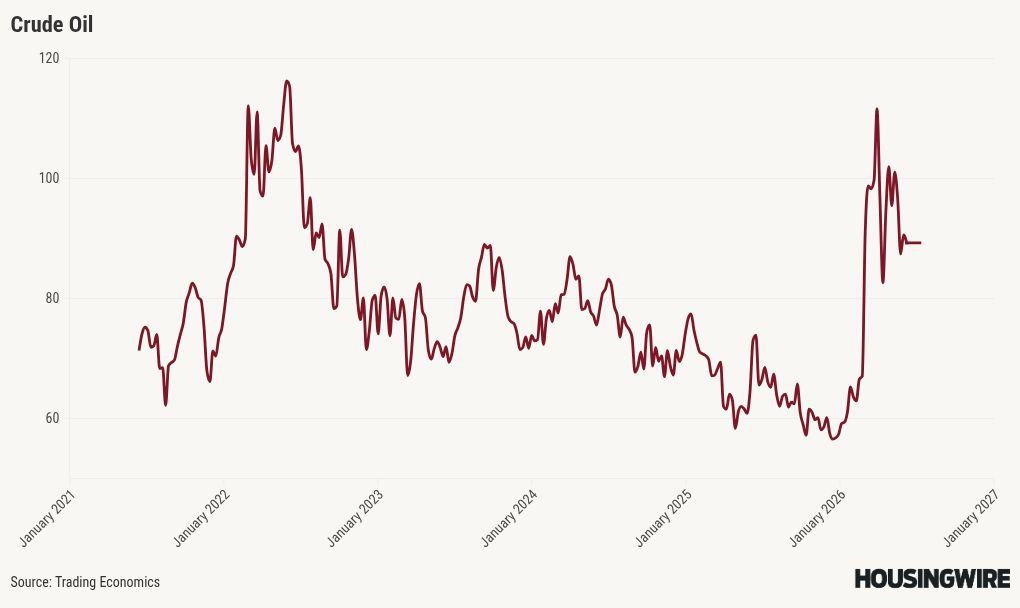
We are well into June and oil inventories are being drained fast, which is a big problem for the world economies. This week, the U.S. attacked Iran twice and President Trump has threatened to attack them later tonight and seize their oil fields. With every headline, oil prices haven’t regained the previous high. Why?

chart visualization

I believe the oil market thinks we are closer to a deal than the general public does. Traders don’t want to commit more money at higher prices because they don’t want to be caught off guard. We saw how quickly fertilizer prices peaked at $986 on April 10, 2026, and have since collapsed to $799. Pre-conflict prices were $753 and commodity traders are all well aware of how wild trading can get. This week, we have had crazy headlines and we haven’t been able to get WTI oil prices above $94.

We might be at the point where traders believe Iran itself can’t hold out much longer, especially if NATO gets involved in July, as they promised, with oil revenues falling due to the blockade.

Mortgage rates and the 10-year yield

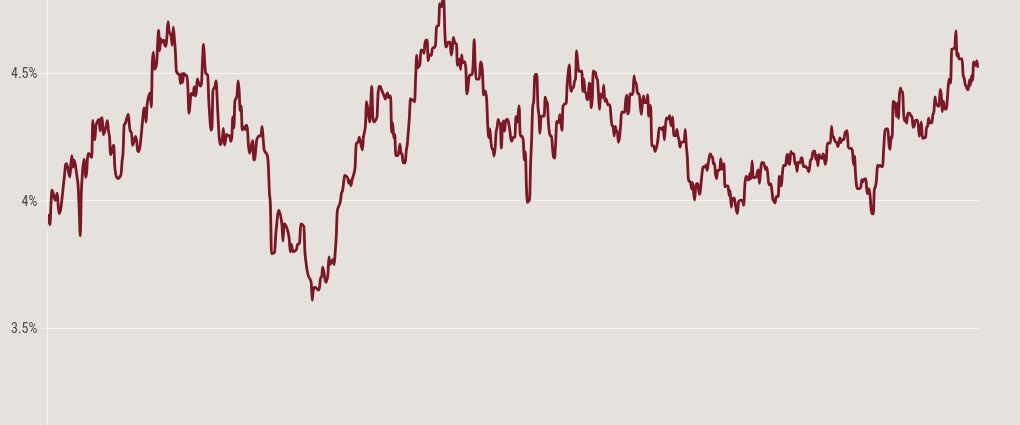
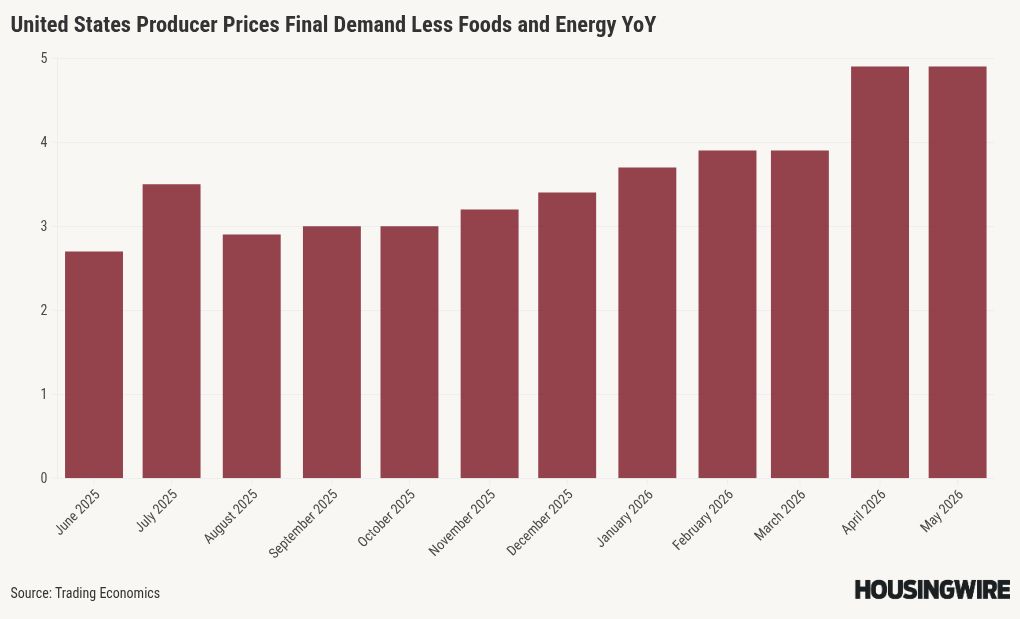
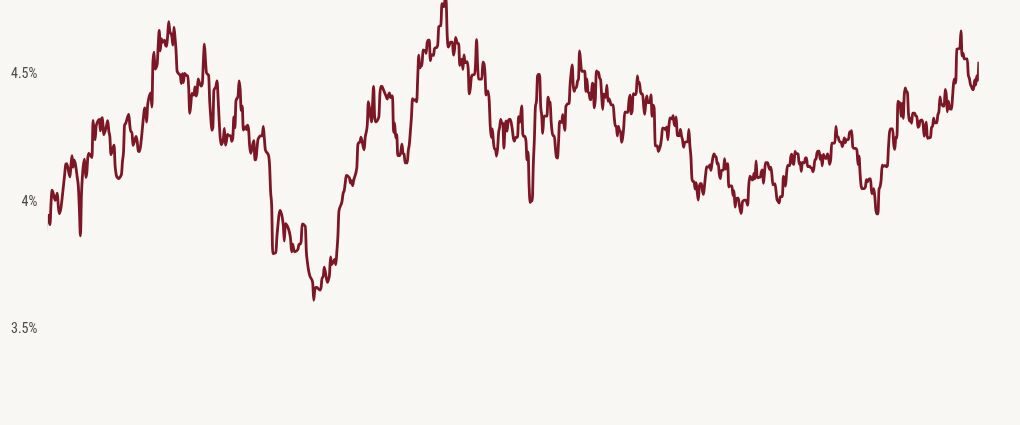
Mortgage rates are near yearly highs, and the 10-year yield has behaved similarly to oil prices this week: it rises on headlines and then tends to fade. Currently, the 10-year yield is 4.52%, below the peak of 4.68% we have seen this year. This, even with all the crazy headlines this week and PPI inflation was very hot today.

chart visualization

For now, the 10-year yield has only exceeded my peak forecast of 4.60% once, during the most hectic headline-driven events of the conflict, and is currently 16 basis points lower the top of 4.68%.

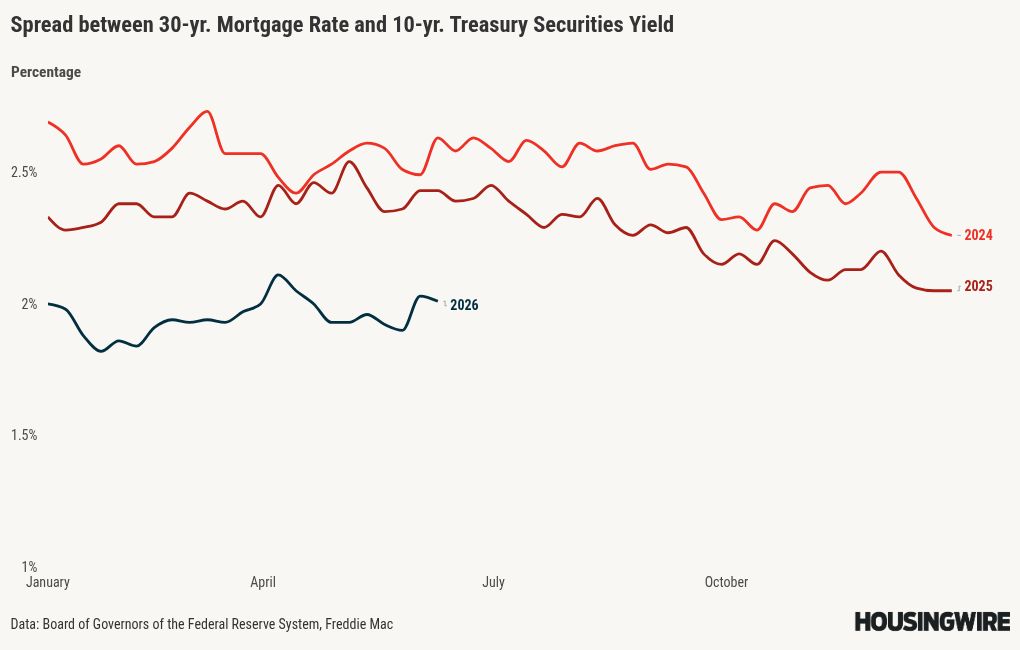
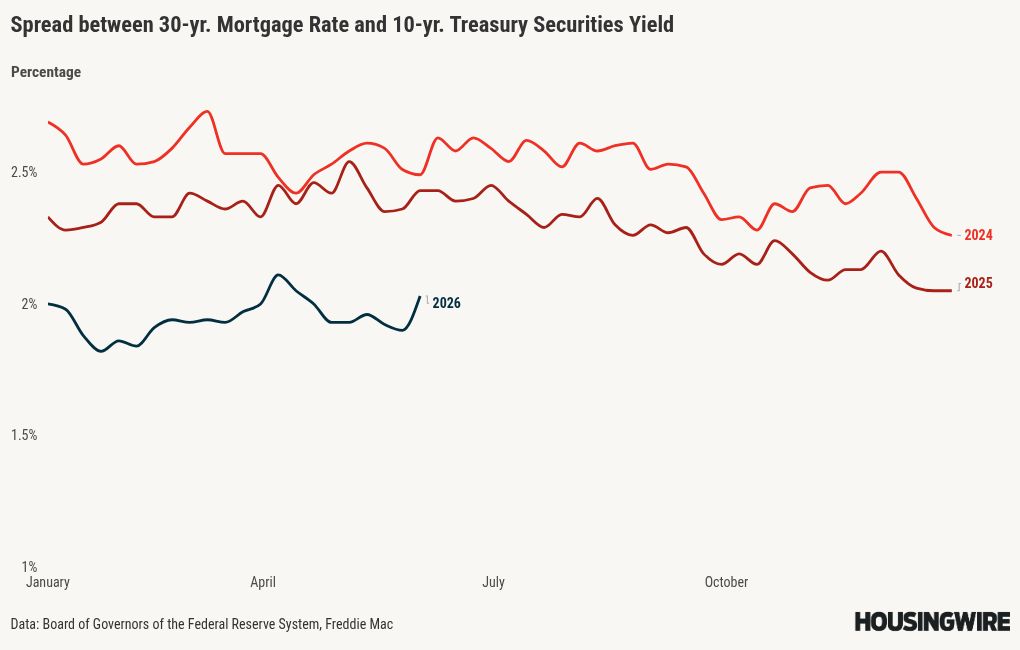
On another note, we should give a medal to mortgage spreads, which are the only reason mortgage rates haven’t ranged between 7%-7.875% this year.

chart visualization

Mortgage rates do have some upside potential above my target peak forecast of 6.75% for the rest of the year, but for now, better mortgage spreads and how bond and oil traders are acting this week have kept a lid on rates getting above that.

Conclusion

If you’re confused on why oil prices and the 10-year yield aren’t higher, I totally get it. Remember, traders don’t care about politics or what the next pundit says on TV — they’re here to make money.

This week, we had many reasons for oil prices and the 10-year yield to go much higher, but currently they’re fading lower despite these headlines, taking oil prices and the 10-year yield slightly lower. I’ll continue to watch the headlines and how these markets behave to see how these factor affect mortgage rates.

This post was originally published on here

A lot of industries have subpar reputations and bad actors. Lawyers have their own subset of comedians telling jokes about them. Doctors have a peculiar word for their faulty fellows. The “used car salesman” was always a foil for us real estate agents by having a reputation for being worse. Private listings may do more damage to our reputation than good.

However, we work hard to boost our reputation. During the height of the short-sale market, sales stifled to a quarter of what they were, and the average price sold went down 35%. It was like getting a 35% pay cut and having your hours compensated cut by 75%!

Plus, no health insurance or 401k. I once paid $10 for gas with a set of quarters found around the house and waited for a check to clear to bring one of our kids to a needed doctor’s appointment. Those short-sale clients who see me around town today still give the biggest hugs and gratitude for the work I did. Those sales were fulfilling as well, seeing people move on with their lives.

I’ve hired hundreds of real estate agents over the years and every single one of them wants to help people. Of course, money is important. My advice — which I tell every new agent — is to concentrate on getting the letter of recommendation and doing a wonderful job. The money will follow in referrals and take care of itself. 

Private listings keep sellers from getting the best possible price

Today, we real estate professionals are forced to offer a new program to sellers who we represent. It’s called a “private listing.

This new option is mandated by the Dark Powers in our industry.  It’s a weird idea. Mostly because it can keep the seller from getting the best possible price.

We offer it because a small number of our customers want to keep their business out of the public eye.  They have their reasons. None of our business.

Unless Law enforcement shows up to the Open House.

Private listings are something I don’t recommend

Private listings keep the listing secret from much of the buyer population.

If a buyer is unaware of a product, how is the seller supposed to get the best price with the most advantaged terms? If you’re a homeowner, selling your home and this sounds a bit crazy to you, it’s because it is.

As a real estate broker for 26 years, I’m accustomed to crazy. So, a question might come to mind.

Why in the world is this private listing craziness occurring?  Giant corporate brokers have been suing each over and scrambling to come up with private listing plans in the last year.  The pitch to the seller goes as follows: Wouldn’t you like to not have to have people trampling through your home? Client nods yes. And I’m sure you’d find it nice to not have days on the market accumulate in the MLS?  Bigger nod by client. And, wouldn’t it be great to test the market first?  Of course!

But, in my opinion what happening here is straight-up gaslighting. Our brokerage posts a disclosure upfront that our sellers read and sign before we list a property for a private sale. No different than how the public discovered cigarettes were bad for your health and officials were forced to tell the truth about aftereffects. We are saying that private listings may be bad for the terms you get and for your wallet. Our disclaimer reads as follows:

Your home will not be listed with any public Multiple Listing Service (MLS). Potential Buyers will be unable to view homes not listed on a public MLS website and will not receive alerts for new listings and price adjustments.

Certain real estate brokerages and online portals may have policies which may restrict you from listing on their websites and might prevent your listing from having a full exposure to the buyer pool. Anything less than 100% exposure to all potential Buyers could result in a lower selling price.

Listing your home as an Echo Fine Properties Private Exclusive can limit the number of buyers who will see your home, extend your marketing timeline and create awareness among Echo Fine Properties agents regarding upcoming inventory. The Echo Fine Properties protocol generates interest with private marketing and provides valuable feedback before deciding to go public. Since the entire pool of Buyers may not have access to view your home, private listings is not a true indication of price and marketing.

Private exclusive listings, also known as off-market or pocket listings, are legal in Florida, but private listings are subject to the rules and regulations of the Multiple Listing Service (MLS) and the National Association of Realtors (NAR). Florida law requires that a listing agreement include the commission details agreed upon between the seller and the listing agent, but this information is no longer allowed in MLS listings. Exclusive private listing may result in Limited Exposure of Properties.

So, the next question is, why would the brokers be promoting this if it can harm their own client? Easy answer. The double dip, although that’s been disputed. No, not the George Costanza from Seinfeld double dipping. This double dipping is more nefarious. The modus operandi in my opinion by having both sides of the transaction is so the real estate agent can double dip their earnings. Not mentioned in the advertising flyer so much, right? 

Are we setting ourselves up?

On August 17, 2024, NAR mandated that real estate agents must have Buyer Broker Agreements (BBA) explained, negotiated and signed by their clients the same way a listing agreement is signed by the homeowner. Their purpose was to disclose that commissions were really paid by the buyer. The industry lost hundreds of millions of dollars in lawsuits and settled hundreds of millions more. 

I see the exact same thing coming from sellers who are unaware of the potential loss of terms and dollars. In no case can you test the market by not exposing all potential homebuyers to a property available for them. Even if someone bought a home at full price off market, by not having all potential buyers witness it, a bidding war may have been stifled. And some buyers are going to meet a seller in the grocery store and tell them that, “I was in the market and would have paid more money if I was only aware.” Just like that our industry will have the next class action lawsuit. 

While I can’t carry a tune and never played a musical instrument, I can blow a whistle. Hopefully, this sounds an alarm.

Jeff Lichtenstein is the broker of Echo Fine Properties in Florida.

This column does not necessarily reflect the opinion of HousingWire’s editorial department and its owners.

To contact the editor responsible for this piece: tracey@hwmedia.com

This post was originally published on here

MISMO, the mortgage industry’s standards organization, launched a new artificial intelligence governance toolkit on Thursday, which is designed to help lenders, servicers and other housing finance companies manage AI-related risks while supporting innovation.

The Framework for Responsible AI in the Mortgage Ecosystem, known as FRAME, is now available to MISMO member companies through MISMO Connect.

FRAME was introduced during MISMO’s Spring Summit in Louisville, Kentucky, where lenders, servicers, technology providers and compliance professionals received an overview of the framework and its implementation tools.

The framework was developed in collaboration with MISMO’s AI Community of Practice and is intended to help organizations establish policies, procedures, controls and oversight mechanisms for the responsible use of artificial intelligence.

The initiative originated with the Mortgage Bankers Association’s Residential Board of Governors, which asked MISMO to lead the development of an AI governance framework tailored to the mortgage industry.

“RESBOG recognized early that our industry needed practical guidance for responsible AI adoption,” said Dan Sugg, 2026 chairman of the Residential Board of Governors and chief mortgage lending officer at Michigan First Credit Union. “Mortgage companies are increasingly utilizing AI-enabled systems, and they need a framework that helps them manage risk while supporting innovation.”

FRAME includes a governance policy template, an AI system inventory, an AI system risk assessment, implementation guidance and a getting-started guide. The tools are designed to help organizations identify, assess, monitor and govern AI-enabled systems used across their operations.

Rick Hill, vice president of industry technology at MBA and a contributor to the framework, said the toolkit is intended to serve as a risk management resource rather than create additional regulatory requirements.

“The goal is not to create new regulations or additional bureaucracy, but to help mortgage companies understand where AI is being used, assess the risks associated with those use cases, document their decision-making, and establish a repeatable governance process,” Hill said.

MISMO President Brian Vieaux said the organization plans to continue refining the framework through engagement with regulators, government-sponsored enterprises, investors and other stakeholders.

“Our goal is to create a practical framework that lenders can use today while helping build broader understanding and acceptance across the industry,” Vieaux said.

The announcement comes a day after the MBA released a white paper urging the mortgage industry to develop a unified framework for managing artificial intelligence. The white paper, which warned about the risks that AI poses to the financial services industry, recommended that lenders maintain a “human in the loop” approach.

Government agencies have started to address the issue of AI governance. Earlier this year, Freddie Mac updated its seller-servicer guide to include AI and machine learning governance requirements, and Fannie Mae issued guidance calling on lenders to establish policies and procedures that govern AI systems.

This article was written by Sarah Wolak and generated with the assistance of HousingWire Automation, then reviewed by a HousingWire editor before publication.

This post was originally published on here

Google is taking its real estate listing pilot program nationwide, according to an announcement on Thursday. 

In a blog post, Google said it is rolling out enhanced Local Services Ads (LSAs) for home listings across all 50 U.S. states following a limited pilot program. The company said this expands a paid lead-generation option for real estate agents who advertise on Google. In order to use LSAs, Google said a business must have a physical location asset linked to their advertising campaign. 

These advertisements showcase property information — including price, photos and core home features — directly within LSAs, according to a company announcement. The listing data is powered by HouseCanary’s ComeHome.com platform. Through the listings, consumers have access to links to request a tour of a property or contact a buyer’s agent.

When consumers search for homes on Google, the updated LSAs are designed to connect them with local real estate agents at the moment they begin their search. From the ad unit, buyers can call, message or book an appointment with an agent.

“Our goal is to deliver a helpful real estate experience by acting as a supporting bridge,” the blog post stated.

Existing LSA agents will automatically appear in the enhanced home listing experience. New agents can enroll in Local Services Ads directly, while portal partners can onboard their agents through the LSA managed partner program, Google said.

Google began testing this advertising program that embeds for-sale home listings directly into mobile search results back in December 2025 before appearing to pull these listings in early January. In mid-May, however, the listings reappeared in search results in many of the original test markets, including Miami, New York, Cleveland, Chicago, Austin, San Francisco and Los Angeles.  

As real estate listing portals, including Zillow, Redfin and Realtor.com, have begun launching application integrations within LLMs like OpenAI’s ChatGPT, many in the housing industry have questioned if this usage falls within MLS data usage and IDX feed rules. In turn, this has opened a discussion surrounding both the modernization of MLS rules and listing data control.

This article was written by Brooklee Han and generated with the assistance of HousingWire Automation, then reviewed by a HousingWire editor before publication.

This post was originally published on here

Gotham Football Club has tapped renowned architectural firm SHoP Architects to design a new $35 million training facility in New Jersey for the championship-winning women’s soccer team. Announced on Wednesday, the project will transform the former New York Red Bulls training facility in Whippany into a purpose-built training hub focused on player performance, recovery, and well-being, making it one of the first facilities to meet the National Women’s Soccer League’s new training standards. Renovations are expected to begin later this summer, with completion targeted for summer 2027.

SHoP Architects, the team behind notable New York City residential buildings like the Brooklyn Tower and 111 West 57th Street, will renovate the existing buildings and infrastructure with a focus on athlete-centered design, durability, and campus cohesion.

The facility will feature upgraded recovery and wellness spaces, a new locker room, dining hall, meeting rooms, and offices, all designed to support player performance, preparation, and staff efficiency.

SHoP Architects will design social spaces intended to connect existing buildings with key areas of the campus. The Gotham Quad, for example, will serve as a communal space for relaxation, celebration, and reflection, with wood elements used throughout to create a sense of warmth and cohesion.

“Our goal is to create a practice facility that reflects Gotham FC’s identity and ambition through a design that is elite yet grounded,” Dana Getman, principal of SHoP Architects, said. “Through sustainable adaptive reuse and warm, timber-intensive new interventions like the Gotham Quad, we’re going to deliver a new model for a state-of-the-art training campus.”

“It’s a facility designed to support world-class athletes on the pitch while fostering deep team chemistry and community connection,” she added.

In addition to three outdoor fields, a new pre-engineered metal building will house a full-size synthetic turf pitch, allowing for year-round on-site training. The indoor field will improve scheduling flexibility and support consistent player development while maximizing campus resources and strengthening team identity and cohesion.

“Gotham FC is being built with the ambition to become one of the defining clubs in women’s soccer and a global brand in sport,” Carolyn Tisch Blodgett, governor of Gotham FC, said. “Transforming this site into our first dedicated training facility is a critical part of that vision, giving our players and staff a true home base designed around performance, recovery, development and connection.”

“As the game continues to grow globally, investments like this reinforce the standard we are setting across the club and help us compete for championships, attract world-class talent and build something that lasts,” she added.

Gotham FC is set to face the Washington Spirit at Citi Field on July 15 in a rematch of one of women’s professional soccer’s biggest rivalries.

The match will mark the first women’s sporting event held at the home of the New York Mets and comes four days before the men’s FIFA World Cup final at MetLife Stadium, adding to the wave of soccer events set to sweep the tri-state region this summer.

Rendering courtesy of New York Liberty

In Brooklyn, the New York Liberty are building an $80 million state-of-the-art training facility on the waterfront in Greenpoint. Designed by Populous, the design team behind the Sphere in Las Vegas, the 75,000-square-foot facility will be one of the few dedicated practice spaces for a WNBA team. Construction is expected to wrap up in 2027.

RELATED:

The post SHoP Architects to design new Gotham FC training hub in NJ first appeared on 6sqft.

This post was originally published here

The Council of Multiple Listing Services (CMLS) has appointed Jessica Edgerton as its next chief executive officer, effective July 1, the MLS trade group announced on Thursday.

Edgerton joins CMLS from Leading Real Estate Companies of the World, where she has served as chief legal officer for the past nine years. She brings 16 years of leadership experience in organized real estate, including five years as legal counsel at the National Association of Realtors (NAR).

“I am deeply honored to lead CMLS at a moment when our work has never mattered more,” Edgerton said in the announcement. “Our industry created the MLS for a vital purpose: to give real estate professionals a shared foundation of trusted information and to give consumers the data they need to confidently make the most significant financial decisions of their lives.”

As CEO, Edgerton will lead CMLS’s work to advance the multiple listing service community, strengthen member value and promote an accessible, efficient and transparent housing market enabled by the MLS, the organization said in its announcement.

“Jessica brings the vision, credibility and collaborative leadership CMLS needs for this important moment,” said Nicole Jensen, 2026 chair of CMLS and CEO of realMLS. “She understands the essential role MLSs play in creating access to trusted real estate information, supporting informed decisions and helping the market work for consumers and professionals.”

Edgerton is filling a role previously held by Denee Evans. In May of 2025, CMLS announced Evans’ plans to step down from her role after 11 years at the organization, joining in 2014 as CMLS’s first full-time staff member.

At LeadingRE, Edgerton supported a global network of more than 500 brokerages across 70 countries, many of which operate in markets without an MLS system. CMLS said that experience gives her firsthand perspective on the market impact of complete, accurate and trusted listing data.

Through my work with brokerages around the world, I have seen what real estate markets look like when professionals and consumers do not have access to the complete, trusted information an MLS provides,” Edgerton said. “It gives me an even deeper appreciation for the MLS as essential market infrastructure and for the leaders who make that system work every day.”

Edgerton will work with the CMLS board, staff, members and partners to advance the organization’s mission and “strengthen the role of MLSs across North America,” according to the announcement.

This article was written by Brooklee Han and generated with the assistance of HousingWire Automation, then reviewed by a HousingWire editor before publication.

This post was originally published on here

Pini Dunner’s “The Blackest of Lies” opened with: “Benjamin Franklin declared that ‘half the truth is often a great lie.’ Mark Twain put it slightly differently: ‘A half-truth is the most cowardly of lies.’ And this, from Tennyson: ‘The lie which is half a truth is ever the blackest of lies.’”

What Dunner is describing is known as paltering, an active use of selective, factually truthful statements to mislead someone or create a false impression. There is an evidence-based argument that, without needed amendments, the 21st Century ROAD to Housing Act is just the latest bipartisan deception, which strong-willed advocates, Congress and/or the White House should demand be fixed or flushed.

This pushback survey illustrates the following:

Per the Wall Street Journal Editorial Board.

  • “A Bipartisan Housing Fiasco,” “The new House legislation will raise costs and give more power to regulators.” “Housing shortages are the result of restrictive state and local zoning and permitting” and “…eager to claim a victory on affordability, even if it’s likely to be pyrrhic.”

Per the WNG.org.

  • Heritage economist E.J. Antoni, whose Bureau of Labor Statistics (BLS) nomination was pulled by the White House, said: “Unfortunately, though, a lot of them [aspects of the ROAD bill] are just more demand subsidies, and they’re more government programs, which aren’t actually going to fix the fundamental mismatch between supply and demand that we face today.”
  • “Norbert Michel, director of the Cato Institute’s Center for Monetary and Financial Alternatives, told WORLD”…“Whatever outcome current government policy and previous government policies have wrought, that’s where we are now. And you really shouldn’t expect anything radically different from this [housing] bill,” Michel said. “It really doesn’t radically change what we’ve been doing for the past several decades.”
  • “Francis Torres, director of the Bipartisan Policy Center’s housing and infrastructure projects…” said: “I wouldn’t say that, as a renter, I would expect my rent to go down the month after this bill passes just because of this bill. I think in the long run, me and other people who rent would benefit from a more abundant rental housing market—would benefit from housing being easier and faster to build in the places where there’s most access to jobs and opportunities.”

AEI Housing Center’s Edward Pinto and Tobias Peter asserted the ROAD bill’s leftward subsidy-minded lurch is a “pork-filled potpourri,” a “ROAD to less housing” and “Elizabeth Warren’s Housing Coup: The GOP Senate Is About to Pass a Bill That Is Great for Progressives.”

Antoni argued that more migrant deportations can help the housing crisis, because it opens up existing housing. Roughly three million people have been deported or self-deported. But at that pace, a housing crisis estimated at some five to eight-plus million units isn’t enough.

Construction is needed near where demand is and requires federal preemption.

HousingWire:

  • “Recall HUD’s Pamela Blumenthal and Regina Gray said: “Without significant new supply, cost burdens are likely to increase as current home prices reach all-time highs…” and “The regulatory environment — federal, state, and local — that contributes to the extensive mismatch between supply and need has worsened over time. Federally sponsored commissions, task forces, and councils under both Democratic and Republican administrations have examined the effects of land use regulations on affordable housing for more than 50 years.”
  • Perverse incentives and the fingerprints of the Iron Triangle or AmeRegCorp are in evidence.”

For six months, an evidence-backed op-ed series via HousingWire made the argument, advanced by cited sources including MHARR, that without amendments to preempt zoning barriers plus affordable lending for more “inherently affordable manufactured homes” the ROAD bill won’t work.

Stating the obvious can be clarifying.

Subsidies are a leftist ‘solution.’ Applying economic insights from Thomas Sowell reminds us that subsidies shift and mask costs without fixing problems. “TANSTAAFL” is short for “There Ain’t No Such Thing As A Free Lunch” because someone must always pay.

Both NAR and NAHB have provided research documenting how modern manufactured homes defy decades of outdated mockery as “trailers” or “mobile homes.” HUD and NAR documented that manufactured homes appreciate at similar or sometimes greater rates than conventional housing.

Per Catherine Koh/NAHB.

“The gap widens among homeowners, with manufactured homeowners earning a median of $41,500 versus $93,000 for single-family homeowners.

Household Characteristic Manufactured Homes Household Single-Family Household
Age (Median) 55 55
Majority Education Attainment Level High school or equivalency (37.8%) Bachelor’s degree (24.8%)
Annual Household Income (Median) $40,000 $85,000
Annual Household Income of Homeowners (Median) $41,500 $93,000
Sources: 2023 American Housing Survey (AHS) and NAHB analysis.

…The average cost per square foot for a new manufactured home in 2023 was $86.62, compared to $165.94 for a site-built home (excluding land costs)…”

The Biblical wisdom and ancient principle of ‘separating the wheat from the chaff’ must be applied to all sources, including purportedly notorious Manufactured Housing Institute (MHI) member Frank Rolfe. “So don’t tell me ‘we can’t solve affordable housing‘ because the correct statement is ‘we don’t want to solve affordable housing.’ ‘American incomes cannot support $400,000 homes and $2,000 apartment rents. Not even close. How did we end up in such a mess?’ ‘But there’s nothing more annoying than watching state and federal bureaucrats and non-profits that come up with ideas that don’t have a prayer of working and just throw good money after bad…news articles are a cornucopia of such idiocy. If you want to solve U.S. affordable housing you would have to eliminate all the barriers…’”

Per HousingWire: “Manufactured housing is the homeownership solve we keep ignoring” and “Comparing RV and manufactured housing data sheds critical light on U.S. affordable housing crisis.”

National Homeownership Month is typically celebrated by NAR and NAHB to promote their members’ products and services. Understandable. So, why has MHI for years failed to similarly promote it, as MHProNews repeatedly documented?

Why have smaller businesses and professionals within the MHI orbit asked them for years for a proper image and educational campaign, one mimicking for manufactured housing what the GoRVing campaign does for the RV industry?

Will detail- and honest-minded souls gaze beyond half-truths and paltering?

Without more inherently affordable manufactured homes, there will be more homelessness and more struggling to pay rent or higher-cost mortgages. 

Perverse incentives – AmeRegCorp, the Iron Triangle – keep housing constrained due to “man-made barriers.” Who says? Artificial intelligence-powered Gemini, Grok, Copilot and ChatGPT. Let’s be clear, AI and all computing rely on Two GIGOs: “Garbage In-Garbage Out” or “Good In-Good Out.” Given accurate information, AI is adept at pattern recognition.

Most MHI leaders, corporate and staff, for years declined directly mentioning MHARR or yours truly. Why? AIs suggest strategic avoidance. Consolidation-focused MHI insiders want low production. Low 21st-century production, EconomicLiberties.us throttling plus limiting capital access foster consolidation into deeper pockets.

Table 1    
Manufactured Home Production National Totals Average for years shown
1995-2000 2,033,545 338,924
2001-2025 2,333,138 93,326
     
Average Annual Deficit =   245,598
     
Table 2   Cumulative 21st Century Deficit
21st Century Annual Deficit in MH Production 245,598 x 25 = 6,139,950

Those tables are evidence that without millions more manufactured homes, the housing crisis will continue. 

Congress and the White House can patch the potholes in the ROAD bill by adding the MHARR amendments. Fix it or flush it. 

L. A. “Tony” Kovach is the co-founder and publisher of ManufacturedHomeProNews.com and ManufacturedHomeLivingNews.com. 
This column does not necessarily reflect the opinion of HousingWire’s editorial department and its owners. To contact the editor responsible for this piece: zeb@hwmedia.com.

This post was originally published on here

One year after introducing Mia at UWM LIVE!, the Mia AI-powered LO assistant has evolved from a borrower communication tool into a broader engagement platform supporting millions of conversations. Driven largely by broker feedback, Mia now includes multilingual capabilities, including Spanish, expanded outreach functions and new capabilities designed to help brokers strengthen relationships with borrowers and referral partners.

In this conversation, Jason Bressler, Chief Technology Officer at United Wholesale Mortgage (UWM), discusses what the company learned from Mia’s first year in the market, how broker adoption exceeded expectations and why AI-powered communication is becoming an increasingly important part of the mortgage experience.

HousingWire: Mia was introduced as an AI-powered LO assistant designed to help brokers manage borrower communication more efficiently. What has surprised you most about how brokers have adopted and used it? 

Jason Bressler: The biggest surprise was how quickly adoption changed. Early on, there was a lot of hesitation. Brokers and loan officers didn’t want Mia communicating with their leads, borrowers or past clients without knowing exactly how it would perform.

We saw a decent amount of immediate opt-outs because people simply didn’t know what to expect. But within three to four months, that changed dramatically. Brokers started seeing real results. Our CEO, Mat Ishbia, highlighted success stories in sales meetings, shared testimonials and played recordings of Mia’s conversations. Some loan officers were generating multiple new deals each week through Mia’s outreach efforts.

Once brokers saw the business impact, adoption accelerated quickly. Today, the response is overwhelmingly positive. Brokers want more functionality, more customization and more ways to integrate Mia into their businesses. From a technology standpoint, that feedback loop is invaluable because it helps us continually improve the product based on real-world usage.

HW: Mia has now supported nearly three million calls and more than 80,000 closed loans. What have you learned about what brokers and borrowers expect from AI-powered communication? 

JB: At the beginning, there really weren’t many expectations because this was such a new concept, especially at the scale we launched it. We gave roughly 50,000 loan officers access to their own Mia phone number and the ability to have AI handle inbound and outbound communication.

Initially, there was a lot of curiosity and caution. Over time, however, we learned that brokers want Mia to have increasingly detailed and natural conversations. They want her to understand UWM products, know information about their business, understand licensing limitations and communicate as an extension of their team.

As adoption has grown, expectations have grown as well. Brokers increasingly want Mia to speak on their behalf and handle more complex conversations. The goal is to make those interactions as informative, personalized and comprehensive as possible.

HW: UWM launched Mia On Demand at UWM LIVE!, which now includes call options for listing-agent outreach, pre-qualification follow-up and mortgage reviews. Why were those the next use cases to prioritize? 

JB: Those enhancements came directly from broker feedback. The easiest way to describe it is that many people hesitate to initiate conversations. Whether it’s reaching out to a potential referral partner or making a cold call, there’s always some level of discomfort. 

Mia eliminates that barrier.

She can make those initial outreach calls, start conversations and create opportunities that many people might otherwise avoid. That opens the door for brokers to develop new relationships and create more business opportunities.

The new use cases reflect areas where brokers wanted help starting and maintaining conversations. We listened to that feedback and built solutions around it.

HW: Spanish-language support was one of the most requested enhancements. How important is multilingual communication to the future of AI borrower engagement?

JB: It’s extremely important. We have a large Hispanic broker community, and many brokers told us they were hesitant to use Mia with certain borrowers due to language limitations. Once we introduced Spanish functionality, Mia’s AI adoption increased significantly.

Today, if a borrower begins speaking Spanish, Mia automatically recognizes it and switches languages. We’re also adding functionality through Brand 360, UWM’s marketing portal for clients, that will allow loan officers to designate specific contacts for Spanish communication from the beginning of the conversation.

What’s exciting is that this extends beyond Spanish. Mia can currently support roughly 32 languages. If a borrower begins speaking Korean or another supported language, Mia can automatically transition into that language as well.

That creates a much more accessible experience for borrowers while allowing brokers to engage a broader audience.

HW: As Mia continues to evolve, how has your perspective on AI’s role in mortgage lending changed over the past year? 

JB: I think Mia’s role will continue to expand significantly. She already has the capability to handle many parts of the mortgage conversation process, and over time, she’ll be able to assist with nearly every aspect of the loan application journey, except for actually quoting rates.

The future is about moving beyond simple voice AI and creating increasingly sophisticated, conversational interactions, making Mia more knowledgeable, more responsive and more capable of handling a much wider range of borrower and broker questions.

The next major evolution for the industry will likely be AI-powered call centers. Many voice AI providers can have conversations, but what’s much harder is responding intelligently to objections, adjusting in real time and handling complex interactions at scale.

That requires extensive infrastructure, training, scripting and ongoing refinement. We’ve invested heavily in building that foundation. As the technology matures, I believe the industry will see a new generation of AI capable of handling much more advanced customer engagement and support functions.

HW: UWM LIVE! also introduced Refi ’86. How do you see AI and pricing strategy working together to help brokers capture refinance and retention opportunities?

JB: Some of the most impactful AI applications in mortgage lending won’t necessarily be customer-facing. AI-driven data modeling and machine learning will increasingly power dynamic pricing strategies. Lenders will be able to evaluate not only borrower characteristics, but also broker performance patterns, geographic factors, income profiles and numerous other variables to identify the best product and pricing options almost instantly.

The ability to deliver highly personalized recommendations quickly will become a major competitive advantage. Much of that technology already exists today. The question is how aggressively lenders and brokers choose to invest in it and integrate it into their workflows.

Ultimately, technology and pricing strategy will continue working together to help brokers identify opportunities, improve borrower retention and deliver more tailored mortgage solutions.

Click Here

This post was originally published on here

For many lenders, UAD 3.6 (Uniform Appraisal Dataset) may still feel like something the appraisal world needs to own and lenders only need to monitor, but that sentiment may leave some organizations underprepared. 

UAD 3.6 is not a back-office update. It is a meaningful shift in how appraisal data is structured, delivered and interpreted, and lenders who engage with it early will be better positioned for the transition ahead.

The reality is that this change touches both the appraisal and lending sides of the business. For those who haven’t started preparing, now would be a good time to begin.

No one will have all the answers, and that’s OK

Many lenders are asking how to “train for UAD 3.6” as if it’s a one-time event, but the transition will be more of an ongoing adjustment. This is not a system update to install and move on from. It’s a shift that will call for flexibility, patience and a willingness to learn as things unfold.

Your teams shouldn’t expect to have every answer on day one. Underwriters won’t have a perfect playbook, and QC teams won’t immediately know what to prioritize. That’s completely normal for a change of this magnitude. The lenders that navigate it well will be the ones who understand what UAD 3.6 is asking of them and stay open to adapting in real time, rather than waiting for certainty before they act.

A chance to revisit workflows 

One thing UAD 3.6 does is invite lenders to take a closer look at how their appraisal processes are structured today. For years, those workflows have followed a familiar pattern: reports come in, underwriters review them line by line, conditions are issued and revisions follow. The pattern works, but it doesn’t always work efficiently, and many teams have grown so accustomed to it that improvement can be hard to see from the inside.

UAD 3.6 introduces a more structured, data-driven format that changes how information is presented and evaluated. That shift will require some adjustment, particularly for underwriters who have developed precise review habits over time. Those habits are valuable, but they may need revision as teams learn to work with a new data structure.

Rather than treating that adjustment as a disruption, lenders can use it as a prompt to ask which parts of their current workflow genuinely serve the process and which have simply persisted out of habit. There’s often more room to improve than teams realize until something pushes them to look.

What lenders can do right now

For those who want to move into UAD 3.6 smoothly, these steps can make a real difference.

  1. Start with education. Rather than reducing UAD 3.6 to a checklist or a single training session, help teams understand what is changing and why. Underwriters, operations leaders and anyone who touches the appraisal process will benefit from a broader context. The goal is to build the judgment to work with new data over time, not memorize a new format.
  2. Audit your current workflow. Map out how an appraisal moves through the organization today. Where do delays happen most often? Where do revisions cluster? Which steps consume the most time without necessarily requiring it? Understanding those patterns now means UAD 3.6 doesn’t have to surface them under pressure.
  3. Prepare your underwriters. This may be the most human part of the transition. Underwriters are trained to be precise and consistent, and those qualities remain essential. UAD 3.6 will simply ask them to bring an adaptive mindset alongside that precision, with the expectation that they’ll learn and adjust as the new format becomes more and more familiar.
  4. Engage partners early. AMCs, valuation providers and technology partners all have a stake in how this transition goes. Lenders that bring them into the conversation early will have a clearer picture of how appraisal data will be delivered and what process changes may follow.
  5. Set realistic expectations. There will be an adjustment period. Turn times may fluctuate and review processes may need refinement before they settle. Communicating that now, before the pressure is on, will help teams stay focused on steady progress rather than measuring themselves against a standard of immediate perfection.

Get ahead while there’s still time

It’s easy to defer UAD 3.6 planning when rates are moving, volume is unpredictable and teams are stretched. But that’s precisely when early preparation has the most value. Lenders that build some familiarity with the change now will have a steadier path when volume picks back up. Those that haven’t will likely feel the strain in underwriting queues, extended turn times and operational friction that takes real time to unwind.

UAD 3.6 brings more structure, more consistency and real potential for greater efficiency. Capturing that potential will require a willingness to let go of familiar processes that may no longer be serving the organization well. 

Forward-thinking lenders will resist the urge to simply recreate old workflows in a new format. Instead, they’ll ask where time is being spent, where reviews overlap and where decisions could move faster without sacrificing quality. The inefficiencies that exist in many appraisal processes today aren’t there because they’re necessary, but because they’re familiar. UAD 3.6 gives lenders a reasonable basis to revisit them.

For organizations with appraisal processes that are already efficient and adaptable, UAD 3.6 will likely be an uncomplicated update. For those navigating longer turn times, duplicative reviews or recurring revision loops, this transition offers the opportunity to address those challenges rather than carry them forward.

Nikkita Phanda is Senior Vice President of Digital Operations at Class Valuation.
This column does not necessarily reflect the opinion of HousingWire’s editorial department and its owners. To contact the editor responsible for this piece: zeb@hwmedia.com.

This post was originally published on here

While modular construction comprises a small niche in the U.S. ground-up residential development market – roughly 3% of new homebuilding – it’s an outsized opportunity for urban infill projects, where developers face tight labor constraints, regulatory barriers and high land costs. 

Kinexx Modular Construction, which has built more than 100 housing units on urban infill sites in Chicago, believes it has identified an opportunity to leverage modular construction to deliver attainable for-sale and rental housing in neighborhoods in the inner rings of downtown urban centers, frequently overlooked by developers. 

Having proof-tested its concept in Chicago, the company is eyeing other cities for expansion and has recently announced a new crowdfunding campaign to finance its growth. 

The developer has a roster of about 20 current and former pro athletes who have invested in the business, including the likes of NFL quarterbacks Jameis Winston and Cam Ward, former Pro Bowl running back Mark Ingram and retired MLB stars Rickie Weeks and Edwin Jackson. 

“We have the blessing of being backed by a number of professional athletes. This adds some measure of influence to that campaign as well,” Adrian Muhammad, Chairman, Kinexx Modular Construction and Managing Partner at LaPhair Capital Partners, told HousingWire’s The Builder’s Daily

But beyond the buzz that comes with celebrity investors, Kinexx believes it has a proven and profitable model – focused on often-overlooked infill parcels in underserved communities, paired with the cost savings and production efficiency of modular construction.

Converting speed into savings

Kinexx, founded in 2020, builds a mix of detached and attached single-family homes, small ranch homes and multifamily buildings. The company builds housing on both scattered lots and larger projects that can span an entire city block. 

“We thrive in both environments,” Paul Tebben, Kinexx Modular Construction Co-Founder and Chief Design Officer, said. “Whether those 20 units go to a single lot or to an entire block, it equals the same efficiency for us, because we’re building off-site.”

Modular construction can work well for Chicago, a city with high labor costs, stringent building codes and a lot of narrow lots and tight streets, Tebben explained. The company further says that it can build at roughly 20% lower cost and 30% to 50% faster than traditional site-built methods. 

That speed lowers financing and carrying costs, generating savings that can be passed on to buyers. Because Kinexx can build homes more quickly, it can borrow money for a shorter period of time, which lowers the overall cost of financing each project.

“Modular is a process. It’s not a product,” Muhammad said. “The process is where the value is, and the process gives us speed.”

Beyond accelerating construction timelines, Kinexx’s modular approach can make assembly more efficient by utilizing precision-built components produced in a controlled factory setting. This process reduces costs by minimizing material waste, improving quality control and keeping costly mistakes to a minimum. 

The company operates a roughly 60,000-square-foot factory in Chicago that can produce four to six modules per day. A typical 1,600-square-foot single-family home requires six modules, so production allows such a home to move off the assembly line roughly every one to two days.

Keeping production indoors at this facility means that the developer eliminates many of the variables that drive up costs in traditional construction, including weather delays, labor constraints and material disruptions.

Leveraging crowdfunding to expand

Kinexx’s recently announced crowdfunding campaign allows investors to participate starting at $500 with no institutional minimum. 

As Kinexx leadership put it, crowdfunding enables everyday people to invest, broadening access to capital while generating public engagement. Crowdfunding can also help bridge a financing gap created by the modular construction model, which often moves faster than traditional development and construction lending systems are designed to accommodate. 

With the crowdfunding campaign launched, Kinexx plans to ultimately expand its model into eight additional cities, including Baltimore, Cleveland, Philadelphia and Detroit. 

As Muhammad put it, every modular construction company struggles with generating a consistent pipeline of projects that produces a stable and predictable revenue-based company. However, Kinexx believes that it has a successful and proven model that it can bring to other cities, and that it has found the solution to this problem in plain sight. 

Muhammad cited Bronzeville, a neighborhood in Chicago located just south of the city’s Central Business District, as proof that the Kinexx model works. According to Muhammad, the average value of townhomes, condos, and single-family homes in the neighborhood is roughly twice what it costs Kinexx to deliver a home there.

At the same time, there is little competition from other developers in the neighborhoods that Kinexx builds in, as many traditional site-built operators have dismissed those lots. 

“We don’t have to worry about competition, because no one wants to build there for some ungodly reason. Well, we found gold there, and if we can summon the capital, and we can produce units that actually can service the aesthetic and the value reflected in those markets, then we believe that not only will we service a legitimate good, but we can actually profit in a very meaningful way,” Muhammed said.

The company further believes that there is an unmet need for smaller, newly built homes around 1,600 square feet or less.

Data from the National Association of Home Builders indicates that only about 13% to 16% of newly built single-family homes are under 1,600 square feet, despite roughly 26% to 28% of buyers desiring a home of such size. This supply gap indicates that there is a great deal of demand for smaller, more affordable homes that isn’t fully met by the market. 

Kinexx believes its focus on smaller infill projects and a disciplined growth strategy positions it differently from many of the off-site construction companies that have struggled to scale.

Despite attracting significant investment and attention, many well-known off-site construction companies have struggled to successfully scale their operations in recent years. Katerra, which received over $2 billion in funding before filing for bankruptcy in 2021, is the most prominent example. 

Tebben argued that, as Kinexx expands to other cities, maintaining design flexibility will be key. While the construction process will remain standardized, the finished product can be adapted to reflect the unique look and feel of different cities and communities.

“I think one of the resounding mistakes or undertones of those failures has been that they have painted everything with the same brush. I think the idea is that they have a formula that works, and without alteration, they should apply it one-to-one to another market, and that’s not true,” he said. 

This post was originally published on here

When Joe McNally earned his real estate license at age 18, he became the youngest licensed agent in Maine.

That distinction was notable — but early success proved elusive.

“My mother got her real estate license, and I got mine a year later,” McNally told HousingWire. “I was so young, and I never closed a deal. It was hard to earn trust from homeowners, buyers, that sort of thing. I was there more to help my mother close deals.”

Two years later, he moved with his wife to her home state of Michigan, where McNally closed 55 deals in his first year.

Now a 20-year industry veteran, McNally has built one of the nation’s most productive small real estate operations.

The Joe McNally Team — part of REMAX Together in Big Rapids, Michigan — earned the No. 28 national ranking among small teams for transaction sides on RealTrends Verified’s 2026 The Thousand rankings after closing 203 transaction sides last year.

McNally attributes much of his long-term success to a business model centered on referrals and repeat clients.

“I have been extremely intentional about building a relationship-based business,” he said. “It’s everyone’s dream. It’s what everyone obsesses about — every conference, every book, all of it, right? And there’s a good reason for that.

“I’ve been quietly building that foundation for 14 or 15 years. And I’m so blessed. I don’t advertise much for myself at all. I actually don’t advertise myself at all.”

A top 30 ranking during a ‘down year’

Despite national recognition, McNally said 2025 was not one of the team’s strongest years.

“It was a down year,” he said. “I’ve closed over 240 or 250— me and my two buyers agents — every year for the past five or six years. In the past, I want to say that we’ve ranked in the top 10 nationwide a couple times. It’s just me and two agents, and one of them went back to school for her master’s and worked part time through the year, that impacted us.”

Another personnel change added to the challenge.

“My other buyer’s agent actually quit halfway through the year, had to replace her,” McNally said. “So yeah, little speed bump there.”

He continued to carry a significant share of the production himself.

“I personally closed around 138 last year, which was down from 172 the year before,” McNally said. “I just basically remarket to my past clients, I’m coming up on 2,000 personal career transactions under my belt, and it’s served me well. I think last year, 110 of my closings were direct referral, just word of mouth referral, which is a lot.”

Growing through REMAX

McNally has been affiliated with REMAX for 11 years.

“I actually started a REMAX franchise in Big Rapids, Michigan,” he said. “There wasn’t one there. I continued to maintain my personal business, and then I was at a point — I actually came to this point too late, but better late than never — where I knew I needed to find a way to better serve my sellers and the buyers. I wanted a little more of a traditional team structure.

“I say team very loosely, because they’re on my team, but they do their own volume and their volume goes under their name. They close, they list and they buy, but they’re there to help me serve the sellers and the buyers that come along for my listings.”

Looking ahead, McNally believes the team is positioned to return to the production levels it achieved in previous years.

“I think getting my two agents recentered around priorities [will help business],” he said. “One of them graduated school about two months ago, so she’s back rip-roaring. My other girl, she’s back in the saddle full time, so I think we’re looking good.

“I think we’re re-centering around that. I love what I do so much and I’ve got incredible systems in place.”

As for the secret behind his production, McNally insists there isn’t one.

“I’ve been number one agent in in west Michigan market for a very long time, and everyone thinks there’s some big mystery,” he said. “It’s pretty boring. It’s just really about being committed and consistent every single day of the year, and I’ve always been good at that.

“I’m good at being consistent and good at communicating with clients and putting them first. I do it every day, every time, no matter what.”

For McNally, the principle that carried him from a teenager struggling to earn trust to a nationally ranked team leader remains unchanged.

“Never, never put yourself over a client,” he said. “Always making sure they feel like they are number one in every way.”

This post was originally published on here

Mark Luzi has joined Logan Finance Corp. as Western managing director of sales as the non-QM lender looks to grow its footprint across more states.

Luzi, who has nearly 30 years of consumer finance and mortgage sales experience, will report to chief operating officer Aaron Samples. His official start date was May 26, according to the company announcement.

In his new role, Luzi will be responsible for leading Logan’s sales strategy and execution across Western markets, including broker and correspondent channels.

“Mark brings a rare combination of scale and relationship depth to this role,” Samples said in a statement. “He has led large, distributed sales organizations and knows how to build the kind of trust that drives long-term growth. As we continue expanding our presence in the Western market, having a leader of his caliber leading that effort is a meaningful step forward for Logan and for the broker and correspondent partners we serve.”

Luzi joins Logan Finance from LendSure Mortgage Corp., where he most recently served as West division sales manager and oversaw three regions across all Western states, including Hawaii. Before that, he was a division manager at Accredited Home Lenders, leading eight regions and a team of 340 people.

He began his career at Ford Consumer Finance in 1997, and he has spent nearly three decades building and managing large, distributed mortgage sales organizations in the western U.S. His background centers on team building and broker relationship management at scale — key capabilities as non-QM lenders lean on third-party originations for growth.

“The non-QM space is evolving fast, and Logan Finance is one of the few genuinely built to keep pace with that,” Luzi said. “I chose to join Logan Finance because of the strong leadership under the executive team, along with the company’s clear focus on competing and growing in such a competitive space. My job is to make sure brokers across the West know what Logan is capable of and feel that difference every time they work with us.”

This article was generated using HousingWire Automation and reviewed by a HousingWire editor before publication. 

This post was originally published on here

Unlock Technologies completed a $358.5 million securitization backed by home equity agreements (HEAs), marking the company’s first transaction of 2026 and the largest HEA securitization completed in the market this year.

The financial technology company announced on Tuesday that its Unlock HEA Trust 2026-1 transaction closed on May 21 and securitized approximately $358.5 million of home equity agreements originated and managed by Unlock. The deal was issued and sponsored by D2 Asset Management.

The transaction is backed by a pool of 3,546 HEAs. It represents Unlock’s seventh rated securitization and eighth overall.

According to Unlock, the offering was oversubscribed and attracted strong demand from institutional investors, including six first-time participants in the company’s securitization program.

“That breadth of participation underscores how this market is maturing and how investor appetite for the asset class continues to deepen,” Peter Silberstein, Unlock’s chief capital officer, said in a statement.

The deal marks the first broadly syndicated HEA securitization sponsored by D2 Asset Management. D2 previously sponsored Unlock’s UNLOK 2025-3 transaction, a privately placed securitization completed in December 2025 that the companies said was the largest HEA securitization at the time.

The securitization included $254 million of senior Class A notes rated A (low) (sf), $48.5 million of mezzanine Class B notes rated BBB (low) (sf), and $42.2 million of subordinate Class C notes rated BB (low) (sf), according to Morningstar DBRS. The Class A and Class B notes received investment-grade ratings.

The collateral pool includes both senior- and junior-lien home equity agreements, with first-lien HEAs accounting for about 19% of the pool by investment payment.

Jefferies served as sole structuring lead and bookrunner. Cantor Fitzgerald and TCBI Securities Inc., doing business as Texas Capital Securities, acted as co-managers.

Unlock CEO Jim Riccitelli said the transaction reflects growing institutional acceptance of HEAs as an asset class.

“The strong, oversubscribed demand reflects the continued maturation of this market and the confidence investors have in the HEA,” Riccitelli said.

Luke Doramus, co-founder and managing partner of D2, said the transaction reinforces the firm’s confidence in both the HEA market and Unlock’s growth prospects.

“As one of the most active participants in this market, we bring the structuring and capital markets expertise to scale a strong originator, and Unlock is exactly the kind of partner we want to do that with,” Doramus said.

This article was written by Sarah Wolak and generated with the assistance of HousingWire Automation, then reviewed by a HousingWire editor before publication.

This post was originally published on here

The White House has sent the nomination of Brian Johnson to serve as director of the Consumer Financial Protection Bureau (CFPB) to the Senate, according to a notice filed on Wednesday.

The agency has been under the leadership of acting director Russell Vought for the past 16 months. During his tenure, Vought — who also serves as the current head of the White House Office of Management and Budget (OMB) — has moved to scale back the bureau’s enforcement and regulatory activities.

In November 2025, President Donald Trump nominated Stuart Levenbach, an associate director at the OMB, to serve as CFPB director. Critics, including Sen. Elizabeth Warren (D-Mass.), argued the move allowed Vought to remain in charge beyond the 210-day limit set by the Federal Vacancies Reform Act (FVRA), as the clock is paused while a nomination is pending.

Johnson has previously served as deputy director of the CFPB during Trump’s first term, where he oversaw the agency’s rulemaking, supervision and enforcement activities.

A spokesperson for the CFPB stated that Johnson is the White House’s nominee to be the next Senate-confirmed CFPB director. He will “continue the CFPB wind down and de-weaponization that acting director Vought has been leading for the last year and a half” as Vought’s term ends this summer.

In April 2025, the Trump administration moved to dismiss roughly 90% of the CFPB’s workforce, triggering a court fight that temporarily blocked the layoffs. In August, a federal appeals court panel allowed the reductions to proceed, leading to the dismissal of about 1,500 employees.

Trade groups have commended Brian Johnson’s nomination. Consumer Bankers Association (CBA) president and CEO Lindsey Johnson said the association welcomes the opportunity to work with him as the bureau enters its next chapter.

“America’s leading Main Street banks look forward to engaging with Director-designate Johnson on policies that provide certainty and create a more durable, stable CFPB where the Bureau meets its mission of consumer protection in a manner consistent with its congressional mandate,” Lindsey Johnson said.

“A transparent, accountable CFPB focused on its core mission will strengthen outcomes for consumers, financial institutions, and the U.S. economy.”

This post was originally published on here

No homebuilder would have asked for the headwinds that 2026 brought to both would-be homebuyers and the organizations that serve them.

Still, given the level of preparation and de-risking most homebuilding firms have pursued since before the COVID-19 pandemic in 2020, this year’s raft of challenges may be delivering exactly the operating discipline the business needs.

That probably sounds counterintuitive.

At a moment many U.S. homebuilders are grappling with soft demand, affordability fatigue, fragile consumer confidence, cancellation anxiety, incentive creep, and elevated cost-of-living pressures weighing on would-be buyers, it’s hard to imagine, let alone appreciate, a silver lining.

However, strategic leaders in this business know something others sometimes forget: Downturns reveal operational truths that can create renewed – sometimes redoubled – opportunities when markets recover.

When absorption slows, cycle times matter more. Margin leakage becomes more visible. Hand-off friction among land, design, purchasing, construction, sales, finance and warranty becomes harder to hide. Waste compounds. Delays cost more. Fragmented systems become strategic liabilities.

The companies that emerge stronger from these “middle innings” of constrained demand will likely not be simply those that cut costs the hardest.

They’ll be the ones who improve most continuously, and ultimately, the fastest.

That’s what makes the launch of Stella AI by Constellation HomeBuilder Systems strategically interesting – not as another AI product announcement, but as a marker of where the homebuilding industry’s next operational competitive frontier may be forming.

McKinsey recently argued that “investments into an improved data foundation will always help scale AI in the future.”

A Harvard Business Review analysis we came across in the past few weeks carried an equally pointed warning:

“Instead of testing lots of [AI] use cases across the company, pick one area and go deep.”

For homebuilders, this blend of messages clarifies the context that can offset business leaders’ hesitations about plunging into AI-powered digital transformation of operations and workflows.

Because the industry now faces a classic damned-if-you-do, damned-if-you-don’t moment on AI.

Ignore it and risk falling behind competitors who use technology to compress cycle times, reduce waste, sharpen pricing, and enable faster decision-making.

Chase dozens of disconnected AI experiments, and risk creating expensive noise with little tangible return or durable value.

The better path may be to embed AI operationally into the core enterprise workflow itself.

The hidden cost of “good enough”

Chris Graham, president of Constellation HomeBuilder Systems, framed the issue with unusual clarity in an interview with The Builder’s Daily. Graham’s observation that “data has always been messy” will resonate with almost any homebuilding business or operational executive who has spent years trying to get fast, reliable answers from across a sprawling enterprise.

This is, after all, a business whose workflows evolved in layers.

Land acquisition teams operate on one cadence. Development teams follow another. Product design and architecture often run on their own systems and timelines. Purchasing leaders juggle option libraries, vendor agreements, and price variances. Construction teams live within schedules, starts, inspections, and trade performance metrics. Sales and marketing teams track absorption, incentives, traffic, and cancellations. Finance reconciles it all after the fact, often trying to make sense of data generated by systems that were never designed to talk to one another seamlessly.

For years, “ERP” in homebuilding has too often meant something more transactional than transformational, at least among business leaders who have been reluctant to commit to and invest in it.

Even strategists and operational leaders who have invested may still view such solutions as a necessary but cumbersome infrastructure layer that records activity but doesn’t help leaders interpret, interrogate, and act on it quickly enough to materially improve outcomes.

That’s where the current wave of AI discussion becomes strategically more than just hype.

McKinsey’s recent analysis of AI’s impact on ERP argues that enterprise software may be entering a fundamental reinvention, in which systems of record evolve into systems of decision support.

For homebuilders, that dialed-up capability means even more, as today’s market economics increasingly punish delayed decision-making.

Heading off compromises to net margins

A slowdown in the sales pace doesn’t just reduce revenue velocity. It pressures overhead absorption. It strains construction cycle economics. It can expose latent inefficiencies in subcontractor performance, option pricing, purchasing execution, field scheduling, and customer conversion that are often overlooked in stronger demand environments.

The difference between identifying a margin leak in days versus in weeks can be meaningful. The difference between spotting recurring scheduling bottlenecks in real time and discovering them after quarter-close can be costly.

Bob Swainhart, Constellation HomeBuilder Systems’ General Manager of Enterprise Solutions, framed the operational implications in terms that builders immediately understand. Looking at purchasing, for example.

“Many of our builders might be managing an option library of five to 7,000 options,” Swainhart said. “If they wanted, for instance, to know which are the top 20 options that actually sell, I could probably, if my data is good, pull a full report, and now I’m sifting through five to 7,000 options to try to find the ones that are actually important to me.” 

That’s not a theoretical matter.

  • That’s time.
  • That’s labor.
  • That’s decision friction.
  • That’s margin management delayed.

Swainhart continued with an equally recognizable construction scenario.

“If I have 600 or let’s say, 7,000 homes under construction at any one time, the reality is, I’m going to be looking through a lot of scheduling data to try to pinpoint where schedule delays are happening,” he said. “What trades are causing me delays more than others?”

For builders in a cost-sensitive operating environment, those are not peripheral questions. They are material, cost-impacting operating questions.

And they illuminate why the current AI moment feels particularly consequential.

AI’s less-is-more impact

The HBR warning against scattered AI experimentation is especially relevant to homebuilding because fragmentation is already endemic to the business.

The temptation will be familiar: pilot one AI tool for estimating, another for customer care, another for sales scripting, another for marketing content, another for purchasing analytics, another for warranty response.

That approach risks creating exactly the kind of disconnected digital sprawl many builders already struggle to manage.

The stronger strategic question is whether AI can be embedded where operating decisions already happen. That’s what makes Constellation’s Stella AI proposition more compelling than a generic chatbot overlay.

For Chris Graham, that distinction stems from decades of working at a homegrown level with homebuilding operators to unpack every operational workflow in the build cycle and then reassemble them into a cohesive, data-unified system.

“It’s not an experiment for us,” Graham said. “We’ve built a platform. We’ve been at it for many years.”

That proven commitment and investment to operational fluency and business systems alignment shines a bright line that separates AI hype from AI reality.

One of the clearest messages from enterprise AI thinkers right now is that organizations chasing isolated AI pilots without fixing underlying data architecture are likely to create more noise than value.

McKinsey’s point about data foundations is not abstract in homebuilding.

Homebuilders’ operational data often lives in an archaeological landscape of ERP systems, spreadsheets, CRM tools, accounting systems, field reporting platforms, vendor data sources and manually assembled reporting layers.

Working up from well-trained, unified data

AI doesn’t and can’t solve that multilayered mess by magic.

If anything, it amplifies the importance of getting enterprise data discipline right, even as it stands to increase and accelerate the risks of not doing so.

That’s where Constellation’s Director of Data Services, Seamus Mulroy, offers an operational key to grasping the practical, workflow-specific impacts of Stella AI.

“The first thing that comes to mind was really figuring out how we balance both the uniqueness of builder data and the messiness,” he said.

Homebuilders, Mulroy’s observation attests, are each unique even though they may appear to be made out of the same business and operating model.

Regional product differences. Market-specific workflows. Division structures. Trade ecosystems. Land strategies. Sales models. No off-the-shelf abstraction can cleanly capture that complexity and the nuances that go hand in hand with local conditions and resources.

Mulroy described Constellation’s BuilderMetrix infrastructure as a “standardized, intuitive source of truth” feeding Stella AI.

The biggest question: Will builders trust it?

Whether builders embrace that particular architecture remains to be seen. But the broader strategic principle is difficult to dispute: AI without trusted operating data is unlikely to become a durable enterprise advantage.

Trust, in fact, may prove to be the deciding issue.

Homebuilders are not likely to embrace AI enthusiastically if it introduces governance uncertainty, role confusion, data exposure risks or inconsistent outputs. As they say, trust takes a long time to earn, but it can be broken irreversibly in an instant.

Mulroy addressed that concern head-on, emphasizing enterprise-level architecture and protections for the handling of non-public data.  After all, this is not a novelty market. Homebuilders are pragmatic adopters, apt to be ultra-skeptical about shiny new toys for their own sake. Technology is embraced when it demonstrably saves time, reduces costs, improves visibility or strengthens execution.

Not because it sounds innovative.

Improve now … or never

Which brings us to the strategic point. This market moment may feel punishing.

Soft buyer confidence, affordability-struggle fatigue, elevated borrowing costs and persistent uncertainty have given the new-home landscape a grinding, trench-warfare feeling.

However, difficult – specifically “slow” – periods also create clarity in operations. The strongest builders invariably use slower environments not merely to defend margins, but to rewire how the business performs. They become adaptive, nimble, agile.

  • To shorten cycle times.
  • To remove workflow friction.
  • To reduce waste.
  • To empower better frontline decision-making.
  • To create repeatable operating intelligence rather than episodic problem-solving.

If demand remains sluggish through the balance of 2026, those investments could materially strengthen competitive positioning.

If the market unexpectedly reaccelerates, those same capabilities become even more valuable in revving up the engines of opportunistic growth and market share expansion.

Either way, the risk and cost of standing still grow larger.

In our eyes, the Stella AI capability may be less an AI story and more a continuous improvement story in the Japanese “kaizen” sense. One where technology simply becomes the means, not the end.

This post was originally published on here

A few weeks after announcing the master developer for the redevelopment of Penn Station, Amtrak released the first renderings of the project on Monday. Penn Transformation Partners (PTP), a joint venture led by Halmar and Skanska, is leading the long-awaited redesign of the detested Midtown commuter hub, which aims to transform the station from cramped, dark, and overcrowded into a modern, light-filled civic landmark that can serve 600,000 daily riders. The overhaul could cost $8 billion; construction is expected to begin late next year.

8th Avenue elevation before
8th Avenue elevation after

Designed by Practice for Architecture and Urbanism (PAU), the new train hall references the architectural legacy of the original Penn Station, designed by McKim, Mead & White and demolished in the 1960s, and the Farley Building across 8th Avenue.

Rather than demolishing blocks to relocate Madison Square Garden and build a new station, the design preserves much of the existing structure through “surgical reconstruction paired with radical thinking,” according to PAU.

View from the corner of 8th Avenue and 31st Street, before.
View from the corner of 8th Avenue and 31st Street, after.

The project uses structural elements of MSG in the new building. Existing columns will become a series of stone entry porticos, and the arena’s mast columns will be clad in ribbed bronze and incorporated into the train hall’s interior.

A full block square structure will be built around Madison Square Garden, stretching from 31st Street to 33rd Street and from 8th Avenue to the west side of the taxiway. The plan calls for a 450-foot colonnaded facade, inspired by the city’s Art Deco architecture and classical civic style of buildings in D.C., to replace the Infosys Theater at MSG and open onto 8th Avenue.

View from 8th Avenue and 33rd Street, before.
View from 8th Avenue and 33rd Street, after.

The facade will combine “stone, bronze, layered entablatures, and expansive glazing to create a civic facade that is both porous and monumental,” according to the architects.

View of the concourse before.
View of the concourse after.

Inside, the station is organized around a 50-foot-tall train hall with light-filled public spaces, including shops, restaurants, bars, and waiting areas, integrated throughout. A sculptural stair connects the street to the single-level concourse level, which will include widened corridors, ceiling heights of at least 20 feet, and upgraded public amenities.

The train hall’s coffered street grid reflects the Manhattan street grid and a blue-tiled wall that represents the Hudson River, according to Curbed. As Gothamist first reported the new renderings last month, a plaque with “President Donald J. Trump” is etched into marble with a presidential seal next to the new 8th Avenue entrance.

32nd Street corridor before.
32nd Street corridor after.

The project will also expand track capacity, including possibly through-running on the regional rail network to increase efficiency.

“After more than 30 years of thinking about and working on the seemingly intractable problem of Penn Station, it is beyond thrilling to unveil this ambitious vision for a re-imagined civic icon,” Vishaan Chakrabarti, founder of PAU, said.

“Our design not only creates more capacity and improves operations for the busiest transit hub in the Western hemisphere, but it also will create – once again – a gateway to New York that is befitting our great city and will bring a sense of dignity to the experience of train travel to and from New York.”

Starting this summer, Amtrak will start the community engagement process and allow for public comment on the plan. According to Amtrak and the U.S. Department of Transportation, construction is scheduled to begin in 2027. The project team includes Skanska, HNTB New York Engineering, Vornado, Severud Associates, and Langan.

The overhaul could cost between $7 billion and $8 billion. According to Amtrak, the project will be funded through federal grants to Amtrak, federal loans, private financing, and equity raised by PTP. Penn Station would remain in operation throughout construction, which could last about six years.

Last year, the federal government kicked out the MTA from the project and gave it to Amtrak to take over. As 6sqft previously reported, the agency had come up with its own plan to replace Penn Station with a single-level facility, but progress was delayed for years.

“We named this project Penn Station Transformation for the exact reason depicted in these renderings; a world-class, beautiful, and modern train station is coming to New York City,” Andy Byford, special advisor to the Amtrak Board, said.

“With the continued support of the President and USDOT, and the expertise of Halmar, Skanska, and the rest of our partners, we are continuing to drive momentum and meet more milestones to get shovels in the ground next year and turn these renderings into reality.”

RELATED:

The post Amtrak reveals first renderings of the new Penn Station first appeared on 6sqft.

This post was originally published here

Veterans United Home Loans and its real estate brokerage affiliate are pushing back against an amended class-action lawsuit that accuses the companies of operating an illegal kickback scheme by misleading consumers about government affiliation and using “bait-and-switch” practices. 

In a motion to dismiss that was filed Tuesday, the companies characterized the expanded lawsuit as a baseless copycat case driven by anonymous competitor complaints rather than actual consumer harm. The lender is seeking a dismissal with prejudice.

“This complaint is recycled from lawsuits filed against other large mortgage lenders, fueled by anonymous competitor remarks, and built on allegations that this complaint itself contradicts,” Chad Moller, corporate communications manager at Veterans United, told HousingWire. “As we have said from day one, these allegations are false.”

Hagens Berman, who represents the plaintiffs, did not immediately respond to a request for comment.

The lawsuit names Mortgage Research Center (doing business as Veterans United Home Loans) and Veterans United Realty (VUR), along with its marketing subsidiary Realty Search Solutions, as defendants. Veterans United employs roughly 4,500 people, while VUR operates a referral network of 5,000 agents, including more than 200 licensed in Missouri.

The plaintiffs allege the companies intentionally misled consumers into believing Veterans United is affiliated with the U.S. Department of Veterans Affairs (VA). They also claim the companies operate an illegal kickback scheme in which VUR provides leads to network real estate agents, who in turn pay the company about 35% of their commissions upon closing (roughly 1.05% of the home sale price) and steer buyers back to Veterans United for financing.

The amended complaint brings claims of Real Estate Settlement Procedures Act (RESPA) violations, unjust enrichment, and violations of consumer protection laws in Missouri, Illinois, New York, Ohio and Texas. Plaintiffs allege the “bait-and-switch” and misleading advertising tactics ultimately caused them to overpay for their mortgages.

‘No concrete injury’

In their motion to dismiss, the defendants argue the borrowers fail to allege a concrete and specific injury. According to the filing, each plaintiff uses identical boilerplate language to claim they “overpaid” without providing specifics on interest rates, fees or costs, nor do they allege they qualified for better terms from another VA lender.

“Rather than including allegations about Plaintiffs’ specific experience, the amended complaint contains 57 paragraphs of hearsay from ‘confidential’ real estate agents and loan officers who presumably compete with Defendants,” the motion states.

Addressing the “bait-and-switch” rate claims, the defense said just one named plaintiff, Scott Brickey, claims his rate suddenly increased at closing. The defendants argued Brickey failed to detail what he actually paid versus prevailing market rates or whether he qualified for better terms elsewhere, noting he received standard disclosures and was free to shop around for other lenders.

The companies denied claims of deceptive marketing regarding their VA relationship. Moller said that the plaintiffs’ attorneys unsuccessfully scoured the internet — including websites, social media, emails and brochures — when looking for instances of the companies holding themselves out as the VA.

“They could not find a single instance. That is because VUHL and VUR have never done so. Never,” he said.

RESPA defense

Regarding the RESPA claims, Veterans United argues the referral arrangement between VUR and its network agents falls within a safe harbor for “cooperative brokerage and referral arrangements between real estate agents and brokers.”

Even outside the safe harbor, the company said the borrowers failed to adequately plead the statutory requirements for RESPA liability, such as a “thing of value,” an “agreement or understanding,” or a “charge” paid by them. The possibility of future referrals, the lender argues, is too speculative.

The motion highlights that 13 of the 14 plaintiffs asserting RESPA claims do not allege they closed with an agent within the VUR network, thereby failing to connect the alleged scheme to their specific transactions. The lender also asserts that 11 of the 14 RESPA claims are time barred.

Additionally, the defendants took aim at the state consumer protection claims, arguing there was no deceptive conduct or actual damages. Claims in Missouri and Ohio exceed their respective five- and two-year statutes of limitations, the filing states, while claims in Texas failed to provide mandatory pre-suit notice.

This post was originally published on here

Brands By Integra has been named a 2026 GameChanger by RealTrends Verified — increasing transaction sides by 65% between 2021 and 2025 as it navigated one of the most challenging housing environments in recent memory.

The real estate platform operates prominent Century 21 and Coldwell Banker affiliates alongside New Fed Mortgage Corp., New Fed Insurance and James Rose Asset Management.

Founder Jim D’Amico told HousingWire the company’s growth has been driven less by market conditions and more by a disciplined focus on recruiting, retention and production.

“Most of the growth has been national,” he said. “I would say the biggest differentiator for us is just recruiting and growth. It’s also about knowing that it doesn’t matter how many transactions there are [in the entire housing market], it matters how many you do.”

That mindset has helped the company maintain momentum even as many brokerages faced slower transaction activity amid elevated mortgage rates and affordability challenges.

Today, Brands By Integra encompasses approximately 2,000 agents across 18 states and tracks roughly 6,000 annual transaction sides and $2.64 billion in annual sales volume.

Preparing for leadership transition

GameChanger recognition comes as D’Amico prepares to transition from CEO to chairman — a move that will allow him to focus more heavily on long-term strategic initiatives, acquisitions and growth opportunities.

Although his title is changing, D’Amico said he expects many of his day-to-day responsibilities to remain similar.

“My job is to bring in excellent talent to run the company for the agents here and for the businesses here that we own and operate,” he said. “I think having someone like [incoming CEO Dan Firda], who’s been in the industry for a very long time and has the type of experience that I value here, is huge. He definitely has the disposition of a leader.”

Firda will take over as CEO after serving as national vice president of franchise growth at Compass International Holdings — formerly Anywhere Real Estate — and at Century 21

“[Firda] will be effective within this culture,” said D’Amico. “He’s a very humble guy who’s going to be very collaborative with the team. I think I’m handing that torch to someone who’s going to maintain what I feel I’ve brought this business to. I do think that, as chairman, I’ll have a lot of time to spend in the field, at events and meeting with broker-owners that want to join and consolidate with us.”

A numbers-driven growth strategy

D’Amico described the company’s approach as a constant evaluation of production levels rather than simply agent headcount.

Whether replacing departing top performers or recruiting multiple agents with smaller books of business, the objective remains achieving transaction targets.

The strategy has produced consistent results. Brands By Integra has become a familiar presence in the RealTrends GameChangers rankings over the years — reflecting sustained commitment to expansion through recruiting and acquisitions.

“This year the goal is 7,000 [transaction sides] and we’re on pace right now for that,” D’Amico said. “It’s still early in the year, even though we’re in June. I always feel like you end up paying 35% of your overhead in the first quarter, so it’s always lopsided for us this time of year.

“We do have some acquisitions that we’re looking at, and some really great growth opportunities.”

While the company operates across multiple market segments, D’Amico noted that its core business remains focused on everyday homebuyers rather than luxury clientele.

“We do luxury brokerage, but we don’t have a reliance on that end of the business,” he said. “We kind of touch everything, but I would say our meat and potatoes is the first-time home buyer and the move-up or move-down buyer.”

Building density and consumer value

Looking ahead, D’Amico sees the Brands By Integra’s next chapter centered on deepening its presence within existing markets — while creating stronger connections among its brokerage, mortgage, insurance and wealth management businesses.

He also sees opportunities to develop additional consumer-focused programs that leverage the company’s scale while strengthening its role in local communities.

“I do think we can help consumers, and I also would like to be at the helm of our community interactions,” D’Amico said. “I think that we’ve always been big with our communities and really try to give back, so I’d like to spend a little bit more time ensuring that we’re continuing to do that, but at a higher level.”

As Brands By Integra enters its next phase, the company’s 2026 GameChanger recognition highlights a growth strategy that’s remained consistent through changing market cycles — focusing on recruitment, production and long-term scale while preparing for continued expansion across a national footprint.

This post was originally published on here

For much of the past year, the housing conversation has focused on whether demand is improving.

Weekly pending sales continue to run ahead of last year’s pace despite mortgage rates hovering near 2026 highs. Purchase applications have remained positive for most of 2026, reinforcing a broader trend of housing demand holding up better than many expected under elevated borrowing costs.

On the surface, that looks like a straightforward demand recovery.

But beneath the encouraging national numbers, a growing divide is emerging.

The latest HousingWire analysis suggests demand growth is being generated in very different ways across local markets. In some markets, demand is returning as sellers adjust to post-pandemic realities. Price cuts remain elevated, inventory levels are higher and absorption rates remain relatively weak. Transaction activity is improving, but much of that improvement is being driven by repricing and market correction.

In other markets, demand is growing while inventory remains tight, absorption rates remain strong and sellers are making fewer concessions. These markets are generating positive sales growth without the same degree of adjustment.

Both can produce positive demand growth. But the underlying market conditions driving that growth can look dramatically different.

Demand is holding up nationally

The broader housing market continues to show resilience despite elevated mortgage rates.

Weekly pending sales reached 75,935 last week, up from 69,636 during the same week a year ago. Mortgage purchase applications, a leading indicator of future sales activity, were also up 7% year over year.

“Last week was another example of that, as our weekly pending home sales data and purchase application data were both positive year over year, even with rates near yearly highs,” HousingWire Lead Analyst Logan Mohtashami wrote in this week’s Housing Market Tracker.

At the national level, the story remains encouraging. Buyers continue to engage with the market despite affordability pressure, geopolitical uncertainty and mortgage rates that recently approached 6.75%.

Not all demand growth is created equal

HousingWire compared a group of pandemic boom markets, including Phoenix, Austin, Tampa and Miami, against a group of markets showing stronger underlying market fundamentals, including Rochester, Hartford, Detroit and Worcester.

Both groups are generating positive demand growth, but the similarities largely end there.

The pandemic boom group is posting average pending sales growth of 11.2%. The structurally stronger group is posting average pending sales growth of 21.0%.

The difference becomes even more pronounced when looking at the underlying market conditions supporting that growth.

The stronger markets are posting an average absorption rate of 18.5%, compared with just 9.0% in the pandemic boom group. They are also carrying an average of 1.4 months of inventory, while the pandemic boom markets are carrying 2.9 months.

Price reductions reveal perhaps the most important distinction.

The pandemic boom markets are seeing price cuts on 43.9% of active listings. The stronger markets are seeing price cuts on 28.2% of listings.

In other words, the markets generating stronger demand growth are often the markets requiring fewer concessions.

The pattern extends beyond a handful of individual metros. Across hundreds of markets analyzed by HousingWire, stronger absorption, tighter inventory and fewer concessions were consistently associated with stronger demand growth.

Growth through adjustment

Many of the markets that defined the pandemic housing boom continue to attract buyers.

Phoenix posted pending sales growth of 28.6% year over year. Austin posted growth of 15.2%.

Those numbers appear strong in isolation. But they exist alongside elevated inventory levels, weaker absorption rates and significant seller concessions.

More than half of active listings in Phoenix have taken price cuts. Austin continues to post elevated price-cut activity while carrying nearly three months of inventory.

These markets are not failing. In many cases, demand is improving because sellers have adjusted to today’s affordability realities.

That adjustment is helping restore transaction activity. But it is also a reminder that positive demand growth can emerge from a market still working through correction.

Growth from strength

A different pattern is emerging in several Midwest and Northeast metros.

Many of these markets experienced more measured appreciation during the pandemic and avoided some of the inventory distortions that later emerged in faster-growing markets.

Rochester is posting 41.1% pending sales growth while just 13.0% of listings have reduced prices. Hartford is generating 22.3% pending growth with price cuts on only 21.2% of listings. Detroit is posting 27.7% pending growth while maintaining stronger absorption and tighter inventory conditions than many larger markets.

These markets are not generating demand through aggressive repricing. Instead, they appear to be benefiting from healthier alignment between supply, demand and pricing.

Inventory remains relatively constrained. Buyers and sellers appear closer to agreement. Homes continue moving through the market without requiring the same degree of adjustment.

The distinction matters because two markets can both report positive demand growth while operating from very different positions of strength.

One market may be improving because sellers have finally adjusted expectations. Another may be improving because buyers never left in the first place.

What housing leaders should watch

For much of the past year, the housing market debate has centered on whether demand would return under higher mortgage rates.

In many markets, it already has.

The more important question now may be what kind of demand is driving growth.

HousingWire’s analysis suggests the strongest housing markets are not necessarily the markets cutting prices the most or posting the biggest year-over-year sales gains. Instead, they are the markets where demand growth is supported by stronger absorption, tighter inventory and fewer concessions.

That distinction matters because not all demand growth is equally durable.

Markets generating demand through repricing may continue improving as sellers adjust expectations, but their recovery remains more dependent on continued buyer engagement and affordability conditions.

Markets generating demand while maintaining stronger absorption and tighter inventory may be operating from a healthier foundation.

In today’s housing market, demand growth alone may no longer be enough to identify strength. The more revealing question is whether that growth is supported by strong absorption, constrained inventory and pricing power, or whether it is being sustained through concessions and repricing.

As mortgage rates remain elevated and affordability continues to pressure buyers, understanding what is driving demand may become just as important as measuring demand itself.

To track these trends and current pricing, demand and market signals at the national, metro and ZIP-code level, explore HousingWire Intelligence. For deeper context on rates, demand signals and the macro backdrop shaping housing activity, read HousingWire’s Housing Market Tracker weekly analysis.

HousingWire used HousingWire Data to source this story. This article is based on single-family residence data through June 5, 2026. For enterprise clients looking to license the same market data at a larger scale, visit HousingWire Data.

This post was originally published on here

On Wednesday morning, Figure Technology Solutions announced it would acquire fix-and-flip lender Kiavi, a move executives say will add about 40% to Figure’s first-lien volume and extend its lead in real-world asset tokenization.

The move marks Figure’s first acquisition and is expected to close in August, according to a company spokesperson. Under the agreement, Figure will acquire Kiavi’s technology and operating platform, while a joint venture formed by Figure and investment firm Sixth Street will acquire Kiavi’s balance-sheet assets.

In a note to investors, Keefe, Bruyette & Woods said that the deal was viewed favorably as it expands Figure into a new category of residential transition loans (RTLs) and “adds scale with a 40%+ immediate uplift to Figure’s loan volume.”

Just hours after the acquisition was announced, Figure CEO Michael Tannenbaum sat down with HousingWire to share his expectations for how the deal is designed to turn Kiavi’s valuation and lending technology — which also covers debt-service-coverage ratio (DSCR) products — into a marketplace offering for Figure’s 380 partners. Kiavi will also serve as the inaugural use case for Adaptor, Figure’s new AI product aimed at automating agent-to-agent onboarding.

Editor’s note: This conversation has been lightly edited for length and clarity.

Sarah Wolak: Michael, what made Kiavi the right acquisition target for Figure and how did this deal come together?

Michael Tannenbaum: We have some shared investors, so that kind of introduced us to the name. They’re also professionally invested; they had some venture capital financing when they started, so we’re familiar with the name. I actually had dinner with the CEO, Arvin Mohan — we were introduced by one of our mutual investors in January 2025. So, it’s been a pretty long time since we’ve been tracking the opportunity and it always seemed like a great fit.

They’re in the housing space; they’re a market leader in what they do. There’s a lot of alignment with them as a company, but also the products that they’re in, because we really focus on home equity and mortgage. They’re also kind of broadly non-QM, but at the same time they have focused their business more on direct to consumer, whereas we are a marketplace for our partners. And that’s also why we worked with Sixth Street as a partner here to essentially turn their platform into a marketplace.

Wolak: What do you think the main selling point was for Kiavi in agreeing to this partnership/acquisition?

Tannenbaum: Kiavi is going to still do RTL, fix-and-flip loans and DSCR, it’s just going to be that they’re offering that technology to all of the 380 partners that we work with. So it’ll become more of a marketplace versus a direct-to-consumer lending company.

I think, for them, they want to grow in the partner space very much. That was a big part of their growth plans. We already have that business and we have these partners we’ve been working with — sometimes as long as five years — and doing lots of business with us, running their platforms on Figure Technology. Being able to combine made a lot of sense.

Wolak: Thinking about the umbrella that this acquisition creates, how will Kiavi continue to operate after the transaction closes? Will it remain a distinct brand?

Tannenbaum: We do want to keep their brand because I think they have a great brand in the investor market. We probably will include some of Figure in that as well, but our brand tends to be more in the capital markets and more as a private label, right?

Most of the people that partner with us use their own name and brand, so it actually makes it easier because the Figure brand — as an investor brand and as a partner brand — is really strong. But as a customer brand, I think we’ll keep Kiavi.

Wolak: Part of the acquisition has to do with Kiavi’s technology platform. Can you talk about why that was attractive to Figure?

Tannenbaum: Yes, it was primarily due to their valuation technology. They ingest documentation from contractors and investors that helps determine what post-renovation value will be and what the power of that is.

Ultimately, people tend to focus on two things when they borrow in this space. One is rate and the other is loan to value, meaning maximizing the amount of loan they can get relative to the future value. And Kiavi is the best at that. They have a lot of investor support for what they do, so we can take that technology and help improve our home valuation approach.

As an example, a lot of homes are newly developed or newly renovated, it’s hard to understand what they might be valued at. Our existing Figure approach may undervalue them, because as you know, if you redo your kitchen, Zillow doesn’t necessarily know that. But what this now allows people to do is prove that the house is worth more with investor support for that, and that’s a technology we can actually use to improve our own business as well.

And when you think about what we announced with Adaptor, that’s also relevant here. What we can do is convert the schema of how Kiavi funds its loans and how it uses its capital market, adapt that to what we’re doing and get those synergies — for example, this post-renovation value.

Wolak: I’m glad you brought up Adaptor, because Kiavi is going to be the first use case for that product. Why start there?

Tannenbaum: When we add a new asset class onto Figure Connect, we want to make sure that existing investors on Figure Connect can understand the data approach that Kiavi is taking, because it’s a new asset class for them. What we build with Adaptor is, people can have all kinds of naming conventions and spreadsheets that are hard to match. Someone might call something LTV, other people call it loan to value, and so Adaptor is a valid and important use of AI to kind of smooth this out and save a ton of time.

We’ve also launched it with an agenda functionality, so it’s basically like an API that also has APIs for agents. If an agent were going to be performing this activity as a customer, it could access the Adaptor agentically, so it’s kind of like an MCP server and you can access their technology agentically.

Wolak: You mentioned earlier how Kiavi will still be doing RTL and DSCR loans. Are those attractive asset classes for Figure today?

Tannenbaum: They’re attractive today in that we have about 10 partners that do those loans with us, so we do offer those products. We’re not the market leader the way that Kiavi is, and so now we’re bringing on the market-leading technology to do that.

They’ve been doing it for 13 years, and what we’re going to do is jointly roll out the Kiavi RTL and DSCR products to our 380 partners later this year, once we close the acquisition. But we’re going to also keep the relationships that Kiavi has, because one thing that’s unique about the RTL space is that these fix-and-flip investors are repeat borrowers. We want to keep those valuable relationships, and nurture and grow them as well.

Wolak: You’ve mentioned how Figure has been growing its first-lien business organically and that these products could reach roughly 40% of marketplace volume by the end of 2027. How much of that growth is expected to come from this acquisition/partnership?

Tannenbaum: We can never talk too much about forward guidance, because we’re a public company. But today, roughly, we have about $17 billion of volume that is standalone. And we’re adding another $7 billion, which is all first liens, so we’re adding 40% of our volume. Of course, Figure itself is growing really quickly, so you know we’re kind of making some projections forward there when we say 40% in 2027. But we do expect this to be a very material “pole vault” in our efforts in first lien.

Wolak: Given that this is Figure’s first acquisition, what does this signal about the company’s future M&A strategy?

Tannenbaum: Well, we are a really disciplined company. We went public back in the fall, and that does make it easier to do acquisitions. When you have a company that has access to the public markets, can raise capital, is well known, our financials are visible, it makes people more likely to want to sell to us than they would otherwise. And that does open up opportunities.

We probably saw around 30 or so opportunities over the past nine months or so, and this is the one that we chose to act on. So I think we are going to be very disciplined and continue to be good stewards of capital.

One of the things that we shared was that the unlevered — meaning without the debt payback — is under four years, which is really strong from an acquisition perspective. This is also something that we really know how to do; it’s very adjacent to our core business. It’s not like running this company is going to be a huge challenge, because we’re familiar. And I think it’s a good opportunity to leverage Figure’s really strong distribution network of tens of thousands of loan officers to scale this product quickly.

Wolak: It sounds like it was a very intentional process if you evaluated nearly 30 other options. What were the specific metrics Figure was looking for?

Tannenbaum: Profitability is important. As a company, we’re really high margin. We confirm that we’re going to stay on our medium-term goal of 60% EBITDA margin, so we want to make sure that the fact that Kiavi made money is really valuable.

We use this concept of the rule of 40, which is like your margin plus your growth rate should equal 40, and Kiavi was well above that. They were growing fast, but also high margin, so that was important to us. And I think the distribution that we have with the loan officers, a lot of things we see are much more tangential to what we do, versus this is really kind of focused in our core. And when you’re doing your first acquisition, I think it’s helpful to have something where you feel like you know what makes that company tick. This was definitely that transaction for us.

I think this deal is accelerating and amplifying. We’ve been clear that we want to be the future of the capital markets on blockchain rails, and we’ve also been clear that this includes asset classes that we’re not in today.

This post was originally published on here

Yesterday, existing home sales data beat estimates, with revisions that show a positive trend in home sales, and then today the purchase application data shows 7% week-to-week growth and 17% year-over-year growth!  This is happening with mortgage rates near yearly highs. What gives?

I wrote about existing home sales here and discussed the report on this episode of the HousingWire Daily podcast as so many people were confused about the data.

For purchase applications, let me give some context that explains the double-digit, year-over-year growth and how this impacts the rest of the year.

Purchase application data

Two weeks ago, we saw a holiday slowdown in our Housing Market Tracker data, followed by a rebound. You can see a similar trend in purchase application data with the holiday, both this year and last. We have weeks in the year where purchase applications will fall week to week and rebound the next week. However, this year we have shown consistent year-over-year growth every week but two weeks. Those two weeks had hard comps to work from.

Now, when we take the purchase application data and string it out over the long term, we are working from extremely low levels. However, the growth this year is legit, where last year, we were working from mid-1990 levels. I joke that in 2025, the bar was so low that the last time we saw these levels, No Doubt was the top new hot band and “Gangsta’s Paradise” was the No. 1 song in America.

Today, we are closer to 2014 levels, a two-decade jump in music that means One Direction and One Republic were topping the charts. To be clear, we are still working off a low bar. As you can see in the chart below, we aren’t even back to 2015 levels here in this index. The growth in purchase application data this year is a much more positive story than last year, but context is still key.

chart visualization

Now, looking at the data below, the year-to-date count includes the purchase application data I track for our readers. I always prefer to see at least 12-14 weeks of positive weekly growth alongside the year-over-year. In the past few years, our better sales prints have come with better weekly data than year-over-year. However, this index has been growing year over year, which is a positive.

  • 10 positive week-to-week prints
  • 10  negative week-to-week prints
  • 2 flat week-to-week prints
  • 10 weeks of double-digit year-over-year growth
  • 20 weeks of positive year-over-year growth
  • 2 negative year-over-year prints

Conclusion

With everything happening in 2026, just think of existing home sales showing a little bit of growth this year versus last. If mortgage rates had stayed under 6.25% for the year — a level we saw earlier this year — my target of 237,000 more home sales would have been met.

Even though mortgage rates have moved up 0.76% from the lows, they are still lower year over year for 2026. In fact, we had the lowest mortgage rate curve to start the year since 2022. This has benefited the housing market, and the only reason it happened this year is better mortgage spreads.

chart visualization

Going forward, keep an eye on mortgage rates and how they affect purchase application data and our weekly tracker. In the past, when mortgage rates got above 6.64% and headed above 7%, that’s where we see demand get hit.

This post was originally published on here

Twenty-three soccer ball sculptures are popping up across New York City and New Jersey to celebrate the arrival of the FIFA World Cup this week. The initiative, dubbed “Art of the Game,” includes large-scale public artworks by internationally recognized artists on major streets, parks, museums, and watch party locations across all five boroughs and New Jersey. The sculptures will remain on view through Labor Day; 12 of the works will be installed permanently, and five will be auctioned for charity through Christie’s.

Bony Ramirez’s sculpture at MetLife Stadium. Credit: Arts 14C

The project’s reach to some of the city’s most prominent museums is due to support from the late Agnes Gund, who died in September. “Art of the Game” marks Gund’s final philanthropic project; she was not asked to contribute financially, but instead to help connect organizers with partners at leading museums.

Participating artists were nominated by institutions including the MoMA, the Whitney Museum, and the Brooklyn Museum. ARTS 14C and the FIFA World Cup 2026 New York/New Jersey Host Committee organized the exhibition.

“The FIFA World Cup is the largest shared moment on earth–and that’s exactly where art belongs,” Robinson Holloway, CEO and Founder of ARTS 14C, said.

“The powerful thing about public art is that it belongs to everyone, just like the beautiful game. Art and soccer both cross borders, ignite passion, and bring people together in ways few other things can.”

Edgar Heap of Birds’ sculpture at SIUH Community Park. Photo by Megan Maloy, courtesy of ARTS 14C

Sculptures from artists Katherine Bernhardt and Hank Willis Thomas will be installed at Rockefeller Plaza in front of Christie’s, while Futura 2000’s piece will be placed in Jersey City’s Journal Square.

Melissa McGill’s work will be on view at Hoboken’s Maxwell Pier, and Edgar Heap of Birds’ sculpture will be located at Staten Island’s SIUH Community Park.

Leo Castañeda’s sculpture at Gansevoort Landing near the Whitney. Credit: Tim Kovolinko

Other installations include Madeline Hollander in Asbury Park; Kevin Beasley in Newark’s Lincoln Park; Wyatt Kahn at Gotham Park near the Brooklyn Bridge; Eddie Martinez at Newark Riverfront Park; Mario Ayala at Pershing Square Plaza near Grand Central; and Leo Castañeda near the Whitney at Gansevoort Landing.

Bassim al-Shaker’s sculpture at Exchange Place. Credit: ARTS 14C
Fred Wilson’s sculpture at Hudson Yards. Photo by Alyssa Ki for ARTS 14C

Additional works include Taína H. Cruz at The Yard in New Brunswick; Fred Wilson at Hudson Yards; Ronny Quevedo at El Museo del Barrio; Bony Ramirez at MetLife Stadium; Tomokazu Matsuyama at Columbus Circle; Bassim Al-Shaker at Exchange Place in Jersey City; Matthew Day Jackson at the Brooklyn Museum; and Gabriel Lester at Paseo Park in Jackson Heights.

Finally, Cemille Sahin’s work will be installed at Alianza Dominicana Plaza in Washington Heights; Gabriel Fontana at Fordham Plaza; Dan Funderburgh at Mana Contemporary in Jersey City; and Nyugen Smith at Jersey City City Hall.

Hank Willis Thomas, Katherine Bernhardt, Fred Wilson, Bony Ramirez, and Tomokazu Matsuyama’s works will be auctioned, while the remaining non-permanent sculptures will be sold privately, with proceeds split between the artists and ARTS 14C.

“The World Cup is going to put an enormous global spotlight on our region, and we saw this as a chance to bring together artists whose work can reflect the scale, energy, and diversity of this moment,” Alex Lasry, CEO of the FIFA World Cup 2026 NY/NJ Host Committee, said.

“We want this initiative to leave something behind after the final match is played—creating pieces and experiences that continue to live in neighborhoods and public spaces as part of the tournament’s lasting cultural legacy in NY and NJ,” he added.

Katherine Bernhardt working on her sculpture. Photo by Megan Maloy, courtesy of ARTS 14C

The sculptures were fabricated at Powerhouse Arts in Gowanus, Brooklyn, and assembled at Mana Contemporary in Jersey City. Each modular sculpture features 12 pentagon and 20 hexagon aluminum composite panels arranged in a traditional soccer ball pattern over a stainless-steel interior frame.

The 32 panels are designed for painting, mixed media, or UV-printed artwork. For example, Bernhardt spray-painted her piece in her signature style, while Matsuyama submitted high-resolution graphic designs for UV printing.

RELATED:

The post 23 soccer ball sculptures installed across NYC and NJ ahead of World Cup first appeared on 6sqft.

This post was originally published here

Frank Cassidy’s tenure as Federal Housing Administration (FHA) Commissioner and Assistant Secretary for Housing in the U.S. Department of Housing and Urban Development (HUD) was brief but eventful, he told HousingWire.   

Cassidy joined HUD in April 2025 and was confirmed as FHA Commissioner by the Senate in December. He took a leave of absence in April and resigned on Monday to return to his family in Philadelphia and the private sector. Ginnie Mae President Joseph Gormley will continue to lead the office in an acting capacity, a HUD spokesperson told HousingWire.

Despite the short stint, Cassidy says he hit the ground running to execute the Trump administration’s marching orders: deregulate, streamline, and expand access to mortgage credit.

“I felt like we needed to run the FHA more like a business. Most people don’t know, but the FHA made a $50 billion profit over the last two years,” Cassidy said. 

During his time at the agency, key initiatives included revising the loss mitigation waterfall, opening access to alternative credit reporting, slashing mortgage insurance premiums for multifamily loan programs and a request for information seeking comments on possible improvements to the Home Equity Conversion Mortgage (HECM) and HECM Mortgage-Backed Securities (HMBS) programs.

“The one thing I learned about the government and the FHA is that it’s set up to be like a big cruise ship — it goes straight and slow, and it’s hard to move left, hard to move right,” Cassidy said. “Single-family mortgages have always been the priority, because that makes up 80% to 90% of the FHA’s portfolio.”

Looking ahead, Cassidy remains focused on the housing landscape, expressing excitement for the pending Road to Housing bill and its potential to unlock new supply through manufactured housing deregulation. While acknowledging the challenges of a high-interest-rate environment, he expects the FHA to continue its countercyclical role in providing liquidity to the market.

In this exclusive interview, Cassidy discusses his accomplishments at the agency, his stance on zero-down payment programs, and his plans to continue championing the administration’s housing agenda from the private sector. 

Flávia Nunes: The U.S. Senate confirmed you in December. You took a leave of absence in April and are resigning after two months. Can you elaborate on the timing of the decision?

Frank Cassidy: I was ready to get back to spending time with my family. I have a one-year-old daughter. When the White House called in February, my wife was eight months pregnant, so it was a sacrifice to start working in the administration in D.C. in April and commuting between Philly and D.C. I’d always planned to do a short stint. There’s a saying in government when it comes to private sector people: you want to be in and out and don’t stay too long. I had my initiatives, my goals, and what I wanted to get done, and we were able to hit the ground running on the single-family side.

We tackled revisions to the loss mitigation waterfall. We officially turned the page on COVID. Borrowers had been getting multiple loan modifications — three, four, or five times — and we revised the waterfall guidance to two modifications. That will save billions and billions of dollars for the FHA Single Family Insurance Fund moving forward. I was very excited to tackle that on day one. 

Additionally, opening access to credit reporting was something that I really wanted to push for. There are so many Americans, particularly younger Americans, who have rented an apartment for four years, paid their rent on time, but when they go to pull their credit score, they have no credit, and therefore can’t get a mortgage. By bringing additional competition into the credit space, it will lower costs and expand access to mortgages for millions of Americans who are creditworthy but just couldn’t get a mortgage.

FN: Before joining the department, you originated loans for multifamily properties as senior managing director of FHA Finance at Walker & Dunlop. How did your background help in the FHA role?

FC: Coming from the private sector and the commercial mortgage banking world, I had worked with FHA and HUD my entire career on the multifamily and healthcare sides, but I had never even been in HUD headquarters. I hosted the first-ever single-family executive roundtable, where we brought executives from the top single-family lenders to HUD. Secretary Turner attended, and it was really a listening session to hear what’s working, what isn’t working, and what we should be focused on. I can’t tell you how many executives said, “I’ve been working with FHA for 10 to 15 years”—some of the largest lenders—who had never even been in the building. It was really that private-sector approach that we were able to bring to FHA.

FN: How is the Trump administration changing the strategic direction and operations of the FHA compared to the previous administration?

FC: If you look at the president’s housing executive orders, they talk a lot about expanding access to mortgage credit, bringing more lenders into the mortgage market, and providing more liquidity. Ultimately, if you have more competition and more lenders in the space, it will bring costs to the consumer down. It was all about bringing in liquidity, expanding access to mortgage credit, deregulating, and streamlining a lot of these federal programs.

There’s so much bureaucratic red tape that was put in place over the Biden administration that we’ve now pulled back. Those were the marching orders from the president: expand access to mortgage credit, deregulate, and streamline.

I felt like we needed to run the FHA more like a business. Most people don’t know, but the FHA made a $50 billion profit over the last two years. They call that in D.C. a “negative credit subsidy.” I didn’t even know what that term meant, but essentially, we bring in more money than we cost, and it’s a great public-private partnership that has stood the test of time.

The FHA has been around since 1934, long before HUD even existed. It started to bring liquidity to the mortgage market, and that’s why our housing finance system is the envy of the world. We have 30-year fixed-rate mortgages that a lot of other countries don’t have, and it’s because of that government guarantee in the background. Private lenders still make the loans they originate, underwrite them, and service them, but the FHA, Fannie, and Freddie guarantee those loans against loss to the lenders. That’s why we have so much liquidity in the mortgage market.

FN: How far is the administration in its goal to streamline the FHA? What do you consider your biggest piece of unfinished business?

FC: We’ve got a lot done. There’s obviously still work to do, but I feel like the president has assembled a great team to see a lot of these initiatives happen.

What we did on the multifamily side on day one — we worked to lower the mortgage insurance premium to 25 basis points across the board for all multifamily loan programs. That was huge. Prior to that, under the Biden administration, every multifamily building had to get a green energy certification to get those 25 basis points. What I said was, ‘Every building is going to get the 25 basis points minimum, because the reality of it is, most buildings are being built to those standards anyway.’

Additionally, on our nursing home and assisted living portfolio, we put in place an Express Lane process that took deals that used to take six to nine months to get firm commitments down to seven to 14 days. Overall, the single-family portfolio is in great shape. The capital ratio is above 11.5%. Under my watch, it was the healthiest that it’s ever been. I feel like the FHA is in a great place right now. 

What I am very passionate about is that the average age of a first-time homebuyer right now is up to 40. Back in the day, it used to be in the 20s. As a younger guy myself, I was fortunate to buy my first home at 20 years old. I was a sophomore at St. Joseph’s University here in Philadelphia, and I was looking to move off campus with three college roommates. We looked at a property, and the landlord said, ‘You can either buy it for $200,000 or you could rent it for $1,500 a month.’

I said I’d buy it. I had no idea how I’d finance it, but I discovered the FHA, and I got an FHA loan. I put down 3.5% — $7,000. In 2010, they did a first-time homebuyer tax credit, and I got $8,000 back. My buddies moved in. They paid $500 a month each, and that paid the mortgage of $1,200. I still have that property to this day, and it’s more than doubled in value.

It’s those types of opportunities that we need to expand and educate younger Americans about. We’re becoming a nation of renters, and we need to bring the average age of the first-time homebuyer back down into the 20s.

FN: A recent Urban Institute study suggests that, under certain parameters, a zero-down payment program wouldn’t pose an increased risk to the FHA. Given your inside perspective at the agency, what are your thoughts on zero-down mortgages?

FC: When people buy a home, they should have some skin in the game, whether it be 1%, 3%, 4%, or 5%. Having skin in the game is an important part. I understand there are studies that say it’s not riskier, but I think when somebody saves up, builds that cash reserve, and goes to buy a house, they have a feeling that they have skin in the game, which is what is important. They feel like, ‘I bought this, I did this.’

FN: HUD recently issued a request for information on changes to the HECM and HMBS reverse mortgage programs. What may come out of that?

FC: When I first started in the position, I didn’t really know a lot about reverse mortgages, but I did get coached up quite a bit, and it’s an important program. Seniors sit on $10 trillion of equity in their homes that a reverse mortgage allows them to tap into. And by the way, they don’t have to make any payments when they get the mortgage; the interest just accrues. So, it’s definitely a program that serves a need in the market and is important to seniors. I would like to see efficiencies created in the reverse mortgage space.

FN: How much of a priority is the reverse mortgage space for the agency right now?

FC: Well, you can only get so much done. The government moves slowly. The one thing I learned about the government and the FHA is that it’s set up to be like a big cruise ship — it goes straight and slow, and it’s hard to move left, hard to move right. Now, fortunately, I was able to bring that private-sector spirit to the FHA and get a lot done in the first year, but it’s all about priorities. You have to prioritize initiatives. Single-family mortgages have always been the priority, because that makes up 80% to 90% of the FHA’s portfolio.

FN: As you transition out of the administration, what are your immediate plans in the private sector?

FC: I’m planning on returning to the private sector, to the commercial mortgage banking origination world that I come from. However, I’d like to use my voice to support President Trump and his initiatives as they relate to housing. The Road to Housing bill may pass, and that will be the biggest piece of housing legislation to ever pass. It will affect our kids and our grandkids, and it will happen under President Trump’s watch because of his bold leadership.

I’m really excited about the Road to Housing bill and some of the deregulatory and streamlining initiatives in it. When I was the HUD Assistant Secretary for Housing, in addition to the FHA commissioner, I oversaw HUD’s Office of Manufactured Housing Programs, which oversees the design, build, and installation of manufactured homes. The Road to Housing bill allows for manufactured homes to now be built as two-, three-, and four-story complexes. Right now, manufactured homes are just one story because they have that steel chassis on the first floor. Road to Housing gets rid of that requirement, and it combines a lot of the technology from modular homes to manufactured homes. I feel that will allow for a lot of new supply to come online in an inexpensive manner.

I made a lot of relationships with the senators in D.C., particularly on the Senate Banking and Housing Committee, so I plan to advise them and to use my voice as the former FHA commissioner and Assistant HUD Secretary for Housing to basically champion the president’s housing agenda. 

FN: With interest rates remaining high and ongoing geopolitical tensions, how do you see the macro environment impacting the market in the near term?

FC: We’re in a high-interest rate environment right now. We should put in a new Fed chair. I don’t have a crystal ball, but I do think by the end of the year interest rates will start to tighten, and hopefully, we’ll be in an environment where rates are below 6% or so. I’m excited about that.

The FHA really plays a countercyclical role in the market. When rates are higher and capital is less available, the FHA, as well as Fannie and Freddie, tend to step up. We’re in a good place right now in the market. It’s obviously harder to get deals done in a higher interest rate environment, but that’s part of real estate, and as part of the housing finance system, it very much goes in cycles.

FN: What are your thoughts on Bill Pulte stepping into the role of acting DNI?

FC: Bill is a proven leader who knows how to get results. President Trump trusts him, and he’s done a great job at Fannie and Freddie. He’ll bring that same spirit of getting results to the position of acting DNI director. Bill’s a good friend, and we work very closely together. The president often picks leaders with unconventional backgrounds but who have a proven track record of success. Bill has experience running big bureaucratic organizations — just look at what he’s done at Fannie and Freddie.

This post was originally published on here

The Agency, a global luxury real estate brokerage founded in 2011 by Mauricio Umansky, is adding a tri-state brokerage operation formerly affiliated with Christie’s International Real Estate, according to an announcement on Wednesday.

The incoming operation, led by industry veteran Ilija Pavlovic, will operate as The Agency One Rock, and have its headquarters at Rockefeller Center in Manhattan and an additional flagship office in the Flatiron District. The group brings approximately 1,200 agents and 26 offices across New York City, Westchester County, the Hudson Valley and New Jersey into The Agency’s network, which currently includes roughly 2,500 agents and more than 160 offices across at least 16 countries, according to the company announcement.

Pavlovic will serve as president and CEO of The Agency One Rock, the firm said in the announcement.

“At this historic crossroads within the real estate industry, we had to make a choice between a corporate Wall Street driven model that prioritizes a fiduciary duty to investors and a model that still protects the best interests of both our clients and our agents,” Pavlovic said in a statement. “We decided to align ourselves with a company that unites boutique culture, a global luxury brand, ensures maximum exposure for our clients’ properties and provides a cutting-edge, custom, advanced technology base in order to focus on the permanent growth of individual agents.”

The tri-state expansion builds on the firm’s existing New York and New Jersey footprint. The move comes as large brokerages and franchises continue to consolidate market share through mergers and acquisitions, while independent firms evaluate whether to join larger platforms to gain access to technology, marketing and referral networks. 

Growth over volume

Umansky framed the affiliation as part of a deliberate, culture-first growth strategy rather than a pursuit of raw transaction volume.

“We are in a moment of remarkable opportunity. While the industry consolidates around transaction volume and scale, we are growing around something more enduring: shared values, genuine culture, and a commitment to our agents’ success,” Umansky, founder and CEO of The Agency, said in the announcement. “The New York metro has always been a cornerstone market for us, and today it becomes even stronger.”

This article was generated using HousingWire Automation and reviewed by a HousingWire editor before publication.

This post was originally published on here

Leaders at the National Reverse Mortgage Lenders Association offered updates on key regulatory and legislative initiatives at this week’s NRMLA Western Regional Meeting in Irvine, California.

NRMLA President Steve Irwin, alongside board co-chairs Jim Cory of Guild Mortgage and Mike Kent of Onity Mortgage, spoke about the trade group’s engagement efforts with Congress. They noted that the House appropriations committee passed a funding package for the next fiscal year that ensures the operations of the federally insured Home Equity Conversion Mortgage (HECM) program.

They also said that NRMLA successfully lobbied to have funds for housing counseling assistance included in the package after President Donald Trump’s proposed budget for fiscal year 2027 sought to eliminate it. Counseling is a pre-funding requirement for all HECM borrowers and the current budget for FY 2026 includes $57.5 million in assistance across all types of counseling.

“We have dodged that bullet once again on your behalf and on behalf of the consumers you oversee,” Irwin told the audience.

Second appraisals

The NRMLA officials also spoke to key components of the HECM and HECM Mortgage-Backed Securities (HMBS) programs that are being scrutinized after the U.S. Department of Housing and Urban Development (HUD) issued a request for information in October 2025.

A rule that requires lenders to order second appraisals on a portion of HECM applications is something the trade group has wanted to eliminate for many years. Irwin said recent discussions with HUD and Federal Housing Administration (FHA) officials were more productive in that regard compared to previous efforts.

“This is not the first time we fought the second appraisal,” he said. “This is the first time that they’ve actually listened.”

Second appraisals add significant time and cost to the HECM origination process, lenders say. Estimates on how often they’re required vary. Former FHA Commissioner Brian Montgomery said that prior to the COVID-19 pandemic, they represented 20% to 30% of transactions. Erik Morin, CEO of appraisal management company Atlas VMS, recently told HousingWire’s Reverse Mortgage Daily that roughly 8% to 10% of his company’s business in the past year included a second appraisal.

“A second full appraisal is not only excessively expensive for the consumer, it’s very time intensive,” Kent told the audience. “It drags out the process. It’s very difficult to explain to seniors why yet another appraiser is coming out to their house.”

While the trade group said that collateral risk assessment remains integral to safe and sound reverse mortgage practices, it is calling for automated valuation models (AVMs) to be used more frequently. They noted that in traditional forward lending, Fannie Mae and Freddie Mac already use alternative valuation methods that have collectively saved borrowers billions of dollars.

“You bring into it a certain level of appraisal bias that AI and technology doesn’t really have,” Kent said. “We think by using technology tools to eliminate appraisal bias, you eliminate the problems you may have in the first appraisal that you can have in the second appraisal — and we think it’s cheaper, it’s faster and it’s more efficient.”

Mortgage insurance premiums

Initial mortgage insurance premiums (IMIP) are another prime target for change across the industry. Loan officers and executives say that paying 2% of the property value or 2% of the maximum claim amount (MCA) — whichever is lower — is a hurdle that many borrowers cannot overcome, which has contributed to low origination volumes for years.

“We think that 200 basis points of MCA is excessive, especially as interest rates rise, because it becomes a bigger percentage of the proceeds,” Kent said.

NRMLA has proposed a risk-based structure for IMIP and has suggested a figure as low as 50 basis points for borrowers who want to withdraw 60% or less of their available proceeds. Kent said the trade group is pushing ideas that will have positive or neutral impacts to the FHA’s Mutual Mortgage Insurance Fund.

FHA reported that the MMI Fund ended the 2025 fiscal year with a capital ratio of 11.47%, nearly six times higher than its statutory minimum requirement of 2%. And the HECM portfolio’s standalone capital ratio was 24.06%, meaning that revenue from current premiums are more than offsetting any losses.

Kent said that HUD and FHA officials have been receptive to the concept of lower premiums. He placed the odds of a 50-bps IMIP requirement at “maybe better than 50/50.”

“We’re trying to propose them in a way where it’s kind of an easy lift, where it doesn’t take a lot of work on their end, because time is short, right? This administration has a couple years left — that’s it,” he said.

“Lowering costs to homeowners is one of the central pillars of this current administration, and this aligns with that. We think it comes at a very good time, because the health of the MMI Fund is very solid.”

This post was originally published on here

For James Harris, the leader and founder of Harris & Partners, a top-producing large team based in Beverly Hills, California, the key to his team’s success is its size and tight-knit culture. 

“I’ve always run a very lean and mean team,” Harris said. “I don’t want 50 agents because with a team that large it is hard to incentivize and support everyone.” 

Harris said the smaller size of his team, allows him to easily host a weekly Monday meeting with the entire team where everyone discusses the deals they are working on or challenges they may be having with a buyer or seller, which he said fosters a collaborative culture and incentivizes the agents to make sure they aren’t the only one turning up to the meeting with no projects going on. 

This approach helped Harris and his Carolwood Estates-brokered team close 83 transaction sides totaling $938.0 million in sales volume in 2025, earning the team the No. 2 rank in the country for sales volume among large team, according to the 2026 RealTrends Verified The Thousand rankings. 

Harris says he values quality over quantity

“I would rather have 10 superb agents than 100 where the vast majority are mediocre,” he said. “If I have a smaller team, it helps with camaraderie, but it also allows me to be more hands-on in an individual way with each of those team members and ensuring that I am doing everything I can as a team lead to support each of them. But most importantly, it allows me to work alongside each of my team members, who I really consider partners.” 

Harris said he finds it incredibly rewarding to watch the agents grow and evolve into better versions of themselves. Having started in real estate at just 15-years-old, Harris said he thinks it is very important for him to give back to and support the younger generations of agents entering the business in the same way he was mentored and supported in the early days of his career. 

A focus on retention

Right now, Harris said he is thrilled with the current make up of his team and he is not looking to recruit, but he would not pass up any perfect opportunities that presented themselves. However, due to this his primary focus as a team leader is on agent retention.

“For me, it is really about how do I focus my attention and time towards the people that I already have to ensure that they’re becoming the best version of themselves?” he said. “If I have someone great, I want to do everything in my power to never lose them.”

According to Harris, this means making sure that he is incentivizing agents, building them up and collaborating on deals with them. He added that this desire to support his agents and help them better serve their clients is what inspired him to create Breezy, an AI operating system tool. 

It is with tools like Breezy as well as the collaborative culture he has built, that Harris hopes will enable his team to close over $1 billion in sales volume in 2026. 

“I am feeling more and more confident that we can do it,” Harris said. “But we are always looking ahead of us and thinking about how we can beat last year, but more importantly, how I can enable every agent to achieve to the best of their ability.”

This post was originally published on here

The number of New Yorkers sleeping in homeless shelters rose 27 percent under Mayor Eric Adams’ four years in office, driven by overcrowded housing conditions and evictions, according to a new report. The Coalition for the Homeless released its annual “State of the Homeless” report, which found that the number of non-migrant New York City residents needing shelter grew by more than 12,000 between January 2022 and December 2025. Plus, last year, 194,531 individuals used the city’s shelter system over the course of the year, the most in its history. The increase excludes asylum seekers and other new arrivals who entered the shelter system during that period.

Credit: Coalition for the Homeless

While the Coalition recognizes the city’s Department of Social Services’ efforts to move more New Yorkers from shelters into permanent housing through subsidies and support, the group says the number of people entering the shelter system continues to outpace those leaving.

The report estimates that nearly 100,000 people sleep in homeless shelters each night, including disabled New Yorkers and people who are working but still cannot afford rent. Thousands more are unsheltered on the streets, while about 250,000 are “doubled up” in the homes of others.

In 2025, 194,531 unique individuals used the city’s shelter system, the highest number in a single year in the system’s history. The number of schoolchildren living doubled-up increased 29 percent from 2022 to 2025.

Eviction filings rose from a pandemic low of 42,110 in 2021 to 114,832 in 2025, resulting in 17,821 marshal-executed evictions that year, surpassing the 17,036 recorded in 2019. Meanwhile, the number of extremely low-income (ELI) households grew by more than 91,000 during the Adams administration, while only about 10,000 ELI units were financed.

Credit: Coalition for the Homeless

According to the Coalition, the surge in homelessness can be attributed to rising housing costs in the five boroughs, where more than half of New Yorkers are rent-burdened, meaning they spend more than 30 percent of their income on rent.

These issues are further exacerbated by continued threats from the federal government under President Donald Trump, who has proposed major cuts to the Continuum of Care program, the nation’s largest homeless assistance program, which could put 7,000 formerly homeless New Yorkers at risk of returning to the streets.

Trump has also cut funding to the Supplemental Nutrition Assistance Program (SNAP), which more than 1.7 million New Yorkers facing economic strain rely on for food assistance. Last July, he approved $186 billion in cuts to the program over 10 years, and in March, he instituted new work requirements that could affect eligibility for millions of New Yorkers.

The Coalition said Adams and Gov. Kathy Hochul “squandered” an opportunity to build on the city and state’s previous success in reducing chronic veteran homelessness. Instead of expanding a model centered on permanent supportive housing and mental health services, city and state officials relied on approaches aimed at moving unhoused people out of public view.

The group also called on Mayor Zohran Mamdani to pay more attention to homeless New Yorkers and criticized the mayor for backtracking on campaign promises.

Notably, in March, the mayor reneged on a previous promise to support the expansion of the CityFHEPS housing voucher program, one of the nation’s largest rental assistance programs, which serves as a lifeline for roughly 65,000 New Yorkers, or about 140,000 people. Mamdani has also overseen encampment sweeps despite previously pledging to end the practice under the former administration.

“The lesson of the last four years could not be more clear: if the City continues to ignore the fundamental causes of mass homelessness, the number of people sleeping in shelters and on the streets will just keep going up. And no one in our city wants to see that happen,” Dave Giffen, executive director of the Coalition for the Homeless, said in a press release.

“Mayor Mamdani won the election on a promise of affordability, and we share that goal. But the ‘affordability agenda’ must include the nearly 100,000 people sleeping in shelters tonight, the thousands on the streets and in the subways, and the quarter-million more doubled up in someone else’s home. The mayor cannot reduce mass homelessness without targeting resources where they are most needed and building on the approaches proven to work.”

However, the report also highlights several housing-related actions taken by the Mamdani administration. The mayor’s Streamlining Procedures to Expedite Equitable Development (SPEED) reforms, unveiled in May, are credited with helping accelerate housing production and could allow new affordable homes to be developed up to two years faster.

Last month, Mamdani also announced a plan to build 200,000 new affordable homes over the next decade, the most ambitious target set by an NYC mayor. The plan calls for $22 billion in capital investments over the next five years to fund new affordable housing and preserve an additional 200,000 existing homes.

According to the report, the data show that Adams and Hochul did not achieve positive outcomes in addressing the surge in homelessness. It argues that policymakers should move away from unsuccessful approaches and instead expand affordable housing and increase access to permanent housing and mental health services for unsheltered New Yorkers.

The report concludes with a series of recommendations. The Coalition says the city must build at least 12,000 new deeply subsidized affordable housing units for homeless and ELI households annually over the next five years, while also accelerating placement timelines into homeless set-aside units and other housing financed by the city’s Department of Housing Preservation and Development to ensure shelter residents can access those units.

The group also urges Mamdani to connect 2,000 unsheltered people with serious mental illness living in the transit system to a portion of the roughly 5,000 vacant supportive housing units, and to allocate $98 million to create 2,000 new single-occupancy safe haven beds for unsheltered New Yorkers.

RELATED:

The post Nearly 195,000 people slept in NYC shelters in 2025, the most ever first appeared on 6sqft.

This post was originally published here

The landmarked brick townhouse at 306 State Street is a rare 25-foot-wide home built in the Greek Revival and Italianate styles on the same Boerum Hill block as the notable 9 Townhouses row. The 1847 townhouse, asking $6,250,000, was thoroughly renovated in 2004. The six-bedroom home is currently configured as a two-family dwelling with a spacious garden flat, but can easily be converted to an oversized single-family residence. While historic details have been preserved, peerless additions like a glass solarium and a deVol kitchen make it a 21st-century standout.

Throughout the home, you’ll find six fireplaces–three wood-burning and three gas–for timeless warmth. Central A/C has been installed for contemporary comfort.

The parlor level has all of the classic elegance you’d expect beneath high ceilings, highlighted by crown moldings, graceful arches, and solid wood floors. At the rear of this floor is a dramatic south-facing glass solarium for the feel of an indoor garden.

A hand-crafted deVOL kitchen was installed in 2023, complete with a vented La Cornue range, exemplifying the modern English farmhouse style. Two sets of French doors open from the sunroom onto a deck with stairs that lead to the verdant rear garden.

On the third floor are three additional bedrooms. The home’s entire top floor is devoted to an indulgent primary suite. The main chamber is paired with a second bedroom or home office, both with ensuite baths. There is a convenient laundry room on this floor as well.

The garden level holds a one-bedroom duplex rental apartment. A living room with a wood-burning fireplace, a dining room, and a lower-level den offer plenty of space. There is another washer/dryer for tenant use, and direct access to the back garden.

[Listing: 306 State Street at CityRealty]

[At Compass by Lindsay Barton Barrett and Annika Grove]

RELATED:

The post For $6.25M, a stately 1847 Boerum Hill townhouse has historic charm and a dramatic glass solarium first appeared on 6sqft.

This post was originally published here

Affordable housing developers are being squeezed from all sides as operating costs surge, supply shrinks and policy responses race to keep pace, according to a June 2026 report from the Local Initiatives Support Corporation (LISC). 

The report, “The State of Affordable Housing: Saving Affordable Housing Assets,” identifies five major headwinds reshaping the economics of affordable housing — supply constraints, rising insurance premiums, escalating utility costs, inflation and broad-based operating cost increases. 

Valerie White, Head of National Housing Strategic Initiatives at LISC, told HousingWire’s The Builder’s Daily that these pressures and cost increases make it increasingly difficult to develop and preserve affordable housing at the scale needed to meet demand.

“When you have this multitude of factors that are happening all together, what started out quiet now becomes a noisy storm,” White said. “There’s not a lot of cushion to absorb these market changes.”

The report also outlines how LISC plans to deploy more than $5 billion by 2027 for the development of 57,000 affordable housing units, as well as policy reforms that the organization believes would help stimulate more affordable housing creation and preservation.

The following analysis digs into some of the main findings of the report and how organizations like LISC can help affordable housing developers deliver and preserve more units.

The five main headwinds for affordable housing developers

1. Supply constraints and expiring affordability

The report noted that homebuilders and developers, both market-rate and affordable, are operating in a market defined by chronic underbuilding and shrinking affordability restrictions. Most economists argue that there is a housing shortage of several million homes in the United States. 

For affordable housing, a growing concern is that many subsidized units may lose that status in the coming years. Affordability restrictions on 374,497 federally assisted homes are expected to expire over the next five years, based on data from the National Housing Preservation Database

The National Low Income Housing Coalition (NLIHC) estimates a national shortage of 7.2 million affordable homes for extremely low-income renters. Yardi Matrix further forecasts affordable unit starts falling to 68,000 in 2026 and 51,000 in 2027, widening the gap just as restrictions roll off.

For affordable housing developers, this combination of fewer starts and expiring subsidies means more competition for capital, tougher preservation decisions and a rising risk of displacement for low-income renters. 

2. Inflation and the cost of housing

Inflation has widened the gap between incomes and housing costs. JCHS estimates, as cited by LISC, show:

  • The annual income needed to afford the median-priced U.S. home rose from roughly $68,000 in 2020 to more than $130,000 in 2025.
  • A first-time buyer’s monthly mortgage payment on a median-priced home jumped from about $1,200 in 2020 to more than $2,500 in mid-2025, assuming a 3.5% down payment and a 30-year fixed-rate mortgage.

For affordable housing developers, this sustained affordability gap means continued and growing demand for rental housing, including below-market units. 

3. Surging insurance premiums

Insurance has become one of the fastest-rising line items in affordable portfolios, according to LISC. Some notable data points include the following:

  • Property insurance costs for Low-Income Housing Tax Credit (LIHTC) properties have posted six consecutive years of double-digit increases, Novogradac data show.
  • The median per-unit insurance cost on LIHTC-financed homes reached $697 in 2023, more than 20% above 2022 and well above the 2016 level of $286 per unit. The report notes some owners have seen premiums jump as much as 300% despite not filing claims.

Because LIHTC and other regulated properties face rent caps, owners cannot easily pass along higher premiums to tenants. The U.S. Department of Housing and Urban Development (HUD) also capped maximum rent increases at 10% in 2024, and local jurisdictions can restrict rent growth even further.

For nonprofit developers operating on thin margins, rising insurance costs can erode debt coverage ratios and can trigger compliance problems or forced sales. 

4. Escalating utility costs and pressure from data center demand

Utility costs are another major driver of operating pressure for affordable housing operators. LISC highlights that residential electricity prices have outpaced inflation from 2018 to 2026, with more increases projected through at least 2027:

Between 2018 and 2026, residential electricity prices rose faster than the Consumer Price Index, while residential natural gas and gasoline prices swung sharply.

The report also flags a newer structural factor in rising utility prices: rapid growth in data centers and artificial intelligence. Data centers draw heavily from the same power grids used by households, contributing to higher systemwide energy costs. 

While some affordable housing operators are pursuing energy-efficient designs, revenue-sharing and local benefits like broadband builds, the near-term impact on electricity prices is an additional burden on properties and tenants.

5. Rising labor, materials and operating costs

Expenses are rising faster than revenues in affordable portfolios across the board. LISC’s analysis of operating cost trends since 2017 shows severe pressure in several categories:

  • Insurance costs are up 110%.  
  • Administrative costs, including staffing, health insurance and payroll taxes, are up 51%.
  • Repairs and maintenance are up 35%. 
  • Overall operating expenses per affordable housing unit have increased 35.3% since 2018, when they averaged $6,089 per unit.

On the development side, JCHS data show a 42% increase in multifamily material costs from 2020 to 2025, compared with just 7% from 2014 to 2019. This cost spike pushes rents higher across the board. 

The number of units renting for less than $1,400 fell by 9.3 million from 2014 to 2024, including a 2.5 million decline in units under $600. This upward shift in rent distribution leaves fewer “naturally affordable” options and increases reliance on subsidized developments, which are themselves under financial strain.

LISC’s $5.2 billion affordable housing response

Given these headwinds, LISC plans to invest $5.2 billion by 2027 to aid with the development or preservation of more than 50,000 affordable housing units across the country. with a housing-focused strategy for 2025–2027. The strategy involves:

  • Scaling affordable housing production through lending, fund structures and tax credit investments.
  • Preserving and improving existing single-family and multifamily housing
  • Advancing “industry-leading innovation” with replicable investment models

LISC’s housing work centers on three core approaches. 

1. Creative capital deployment and financing innovation

LISC describes a financing environment where all types of sponsors — for-profit, nonprofit and public agencies — are seeking new ways to raise capital for development and preservation. The report highlights several emerging practices and tools:

  • Credit-rated housing authorities issuing bonds backed by their balance sheets to support new production and preservation.
  • Nonprofit 501(c)(3) organizations exploring “as-of-right” bond issuances to fund mission-driven projects. 
  • Workforce housing and Naturally Occurring Affordable Housing (NOAH) strategies that preserve existing moderate-rent stock and address housing stress for working families, including first responders and health care workers.

LISC positions its own lending and fund-management activity as a way to structure this capital efficiently and steer it toward developments most at risk from today’s cost and revenue pressures.

“Affordable housing in general is a very, very complex financial endeavor. Underwriting the parts of the capital stack that you need to even get it done — it’s a lot. It’s a combination of subsidies, some soft debt and regular debt, some is market rate interest and some is lower interest; it’s a really complex puzzle that you have to put together,” White said in an interview. 

2. Capacity building for emerging and nonprofit developers

The report underscores the importance — and vulnerability — of smaller, mission-driven developers. Emerging and nonprofit sponsors often spearhead projects in under-resourced communities but operate with thin staff, limited balance sheets and constrained back-office capacity.

LISC’s strategy to help these developers includes:

  • Developer training through the LISC Developers Training Program.
  • Operational and technical support for community development corporations (CDCs).
  • Capacity-building grants and advisory services aimed at improving pipeline management, financial structuring and long-term asset management.

LISC argues that scaling this capacity-building support is essential to increasing both production and preservation opportunities, particularly for organizations that are closest to communities but least able to absorb today’s financial shocks.

3. Policy advocacy at federal, state and local levels

LISC’s report outlines policy moves that could materially change affordable housing economics if adopted or scaled. On the federal level, these reforms include the following:

  • LIHTC expansions: Recent changes could add 1.2 million units over 10 years, with Congress considering more allocation authority and deeper-targeting tools for extremely low-income households
  • Neighborhood Homes Investment Act: A proposed tax credit would fill the gap between development costs and sale prices for starter homes, aiming to support 500,000+ homes over a decade.
  • Broader housing measures: Housing provisions embedded in larger federal bills could shift capital flows, incentives and the scale of subsidized production.

The report flagged some state and local policy reforms, including:

  • By-right zoning and faith-based development, including by-right policies that cut discretionary approvals, and let faith-based institutions develop housing on their land.  
  • New York City insurance pooling: A new program in NYC will pool property and liability coverage for affordable and rent-stabilized housing, targeting 20,000 homes in year one and 100,000 by 2030.
  • PILOT tax tools: Some cities support a Payment In Lieu Of Tax (PILOT) program to reduce tax burdens and encourage new and preserved affordable units.
  • Local zoning reforms: Cities like Cambridge, Massachusetts, now allow four-story multifamily buildings in all residential zones to boost supply and support small-scale infill.

LISC argues that these local tools and reforms must be paired with federal credits and flexible Community Development Financial Institution (CDFI) capital for projects to remain viable amid rising costs and flat revenues.

This article was written by Tyler Williams with the assistance of HousingWire Automation. It was reviewed by a HousingWire editor before publication.

This post was originally published on here

Author’s Note: I worked for KB Home during two periods of my career and remain grateful for the experience. This analysis is based solely on publicly reported information and reflects my independent views on the company’s land strategy and industry positioning.

Regardless of whether Dream Finders Homes succeeds in its pursuit of Beazer Homes, the case for its further acquisitions is easy to make.

The company has used M&A as a growth strategy, from its 2021 acquisition of McGuyer Homebuilders’ assets to its 2024 acquisition of Crescent Ventures and its 2026 public proposal to acquire Beazer Homes.

That track record raises a natural question for investors: if Dream Finders continues down the consolidation path, what could come after Beazer?

One logical name is KB Home. There is no public indication that either company is pursuing such a transaction. From a purely strategic standpoint, KB is one of the few remaining public builders with the scale, geographic reach and market positions that could transform Dream Finders overnight.

Homebuilding is increasingly a scale business

The strategic backdrop is straightforward. In U.S. homebuilding, scale creates purchasing power, capital flexibility, land access and better absorption of overhead across a broader production base. Builders already operating at substantial scale can spread fixed costs across more closings, negotiate more effectively with suppliers and trades, and maintain stronger balance-sheet flexibility during cyclical downturns.

Dream Finders has demonstrated that it understands this dynamic. Its proposed all-cash acquisition of Beazer Homes at $25.75 per share, implying an equity value of roughly $704 million, was presented as a way to create a larger builder with expected cost synergies, complementary geography and a land-light structure.

That framing makes clear that management is not treating acquisitions as merely opportunistic. They are part of a broader strategy to accelerate scale rather than wait years to build it organically.

Why KB Home stands out

KB Home brings something difficult to recreate organically: long-established operating positions in harder-to-enter markets. The company says it operates in 49 markets across nine states, with its strongest strategic positions on the West Coast: California, Arizona, Las Vegas and Orlando.

These are markets where local relationships, entitlement history and operating infrastructure are often built over decades, not quarters.

That matters because these are not easy markets to expand into. California, in particular, remains one of the most complex housing markets in the country, with long entitlement timelines, regulatory friction, infrastructure burdens and persistent land scarcity that favor builders already operating at meaningful scale.

For Dream Finders, acquiring established positions in those markets would be much faster than building them from the ground up.

The Texas gap

The strategic logic is more compelling through a Texas lens. Dream Finders has spent years deepening its presence in Texas and the Southeast, including the McGuyer transaction, which added backlog and lot positions in Houston, Dallas-Fort Worth, Austin and San Antonio. Crescent Ventures also extended the platform to Nashville and South Carolina, reinforcing the company’s pattern of expanding along growth corridors tied to migration and job creation.

KB’s story is different. It remains a respected national builder, but its footprint is better known in California, Arizona, Las Vegas and Orlando than its dominant scale in Dallas-Fort Worth.

DFW continues to rank among the country’s most important real estate and housing markets, supported by strong population growth, corporate relocations and broad investor attention heading into 2027 and beyond. A combination would effectively merge Dream Finders’ stronger growth orientation in Texas and the Southeast with KB’s entrenched positions in the West and Orlando.

From a map perspective alone, the fit is easy to understand. Dream Finders would gain immediate scale in high-barrier Western markets, while KB would be paired with a company that has demonstrated a greater appetite for aggressive expansion in Texas and adjacent Sun Belt growth markets.

Leadership adds intrigue

Leadership is another area to watch. Dream Finders recently appointed Clint Szubinski as Chief Operating Officer following his tenure as Executive Vice President and COO at Meritage Homes.

Szubinski also spent nearly a decade at KB Home in a variety of leadership roles, giving him firsthand knowledge of the company’s operations, markets, culture and strategic strengths. Meanwhile, KB Home is undergoing a leadership transition, with longtime CEO Jeffrey Mezger stepping down and moving into the role of Executive Chairman as part of a planned succession. 

Leadership changes alone do not create acquisition opportunities, but they often catalyze a fresh review of strategy, capital allocation and long-term competitive positioning.

When a potential acquirer has a senior executive who knows a target company exceptionally well, future strategic discussions become easier to envision. That matters in an industry where scale has become more valuable, technology investments are increasingly costly and competition for finished lots and land positions remains intense. A new CEO inherits not only the existing business but also a strategic environment different from the one that shaped the prior two decades.

That does not mean a transaction is likely, but it does strengthen the argument that if Dream Finders were to study a larger public-builder acquisition, KB would be one of the few companies the leadership team could assess with a meaningful degree of firsthand operating context.

The platform math

The financial case would make the story truly transformational. KB generated approximately $6.24 billion in revenue in fiscal 2025. Dream Finders generated approximately $4.32 billion in revenue in 2025.

Combined, that implies a builder with annual revenue of $10.5 billion to $10.6 billion, before considering any subsequent growth or synergies.

That would catapult the combined enterprise into a different competitive category. The strategic appeal would extend beyond geography to operating leverage. A larger platform could improve purchasing leverage, supplier negotiations, trade relationships, overhead absorption, capital efficiency and land sourcing opportunities.

It would likely be marketed not simply as an acquisition but as a platform-enhancement story.

The cultural story would also be easy to frame. Dream Finders brings an entrepreneurial, acquisition-driven model and a more capital-efficient land strategy. KB brings mature operating systems, larger scale and longstanding positions in difficult-to-enter markets.

In theory, the combination would be positioned as complementary strengths rather than redundant overlap.

The obstacle: size

The reason this remains a strategic thought exercise is simple: KB is large. Recent reporting has placed KB Home’s market value in the several billion-dollar range, with one report citing around $3.7 billion in spring 2026. Any transaction would likely require a substantial stock component, meaningful financing commitments and probably support from institutional capital providers.

Dream Finders has already shown a willingness to pursue ambitious deals. Its Beazer proposal was backed by highly confident financing letters from Kennedy Lewis, Goldman Sachs and Bank of America Securities. But moving from transactions measured in the hundreds of millions to one measured in multiple billions would pose a very different set of challenges around leverage, dilution, execution risk and shareholder approval.

Complexity does not invalidate the strategic rationale. It simply means the financial structure would need to be compelling enough to justify the effort.

Why this deal will appeal to institutional investors

Dream Finders is arguably a more efficient organization because it generates outsized earnings and growth from a smaller capital base by running an asset-light, high-turnover model. The company’s own filings describe an asset-light lot acquisition strategy that relies heavily on options, allowing it to secure land “just-in-time” with reduced upfront capital and higher inventory turnover, which in turn has boosted returns on equity relative to traditional, land-heavy builders. 

Independent analyses show that Dream Finders’ ROE is in the low to mid-teens today and, at times, above 30%, materially above typical industry averages and ahead of many larger peers, indicating that each dollar of equity generates more profit than at most competitors. 

As of late 2025, roughly 98% of its controlled lots were held under options, an extreme level of land-light exposure that keeps land off the balance sheet and supports very high returns on equity by minimizing idle capital tied up in raw and developed land.

In addition, Dream Finders has achieved rapid growth in homes closed and revenue over a relatively short operating history while maintaining positive net margins and strong ROE, indicating it is not just growing but doing so with disciplined capital deployment rather than bloating the balance sheet with owned land.

Why KB Home might attract activist investor pressure

KB Home appears bloated relative to more efficient peers because it has a heavier fixed-cost structure and more capital on its balance sheet for the level of output it generates. Recent results show SG&A running at roughly 12.2%-12.8% of housing revenues, compared with Lennar’s 7.9%-8.8%, a gap that external analysts estimate could translate into about $250M–$300M in annual cost savings if KB operated at peer efficiency levels. 

At the same time, KB has seen revenue down more than 20% year over year and EPS down roughly 60–70% in recent quarters, which means that a relatively high SG&A base is being spread over fewer closings, compressing margins and highlighting the extent of fixed overhead embedded in the model. 

On the balance-sheet side, KB controlled about 63,257 lots as of early 2026, with roughly 59% owned and only 41% under contract, indicating a more land-heavy, capital-intensive posture than option-heavy builders that keep a higher share of lots off the balance sheet. Put together, KB is tying up more capital in owned land while running a structurally higher SG&A load than the leanest operators. As a result, each dollar of deployed capital supports more overhead and land carry and less pure margin and growth than you’d see in a truly optimized, asset-light platform.

End game

The real question is not whether KB Home is a strong standalone builder. Its scale, long operating history and market positions make that clear. The more interesting question is whether KB’s valuable positions in California, Las Vegas, Arizona, Orlando, and other key markets could eventually be worth more within a larger consolidating platform than as a standalone company.

As homebuilding continues to reward scale, capital efficiency and market access, investors ask exactly that question before consolidation occurs.

Regardless of the outcome of the Beazer proposal, one conclusion appears reasonable: Dream Finders has given investors every reason to believe it is unlikely to complete the acquisition.

This post was originally published on here

Rocket Companies has priced the issuance of $1.5 billion in senior notes in an oversubscribed transaction, with proceeds to refinance an existing term loan, the company announced Tuesday.

The Detroit-based parent of Rocket Mortgage priced $900 million in 6.125% senior notes due in 2031 and $600 million in 6.5% senior notes due in 2034. The aggregate principal amount was upsized from a previously announced $1.2 billion.

The offering is expected to close June 16, subject to customary closing conditions. The notes will be fully and unconditionally guaranteed on a senior unsecured basis by Rocket’s direct and indirect domestic subsidiaries that guarantee its existing senior notes.

The company plans to use proceeds to repay Rocket Mortgage’s 2.875% senior notes due in 2026 and to pay down other indebtedness across the platform. Any remaining proceeds will be used for general corporate purposes.

The transaction extends a portion of Rocket’s debt profile into the next decade and locks in fixed-rate funding. But it comes at higher rates due to the current macroeconomic environment.

The notes are being offered in a private placement to qualified institutional buyers under Rule 144A and to non-U.S. investors under Regulation S. They will not be registered under the Securities Act of 1933, and may not be offered or sold in the U.S. absent registration or an applicable exemption.

Rocket’s move comes amid rate volatility and compressed margins across the mortgage sector, where access to term funding and balance-sheet flexibility remain key advantages for large originators and servicers.

Companies that recently issued debt include Mr. Cooper Group — which was recently acquired by Rocket — as well as Pennymac Financial ServicesloanDepot, and Rithm Capital.

This article was written by Flávia Furlan Nunes and generated with the assistance of HousingWire Automation, then reviewed by a HousingWire editor before publication. 

This post was originally published on here

The New York Police Department will once again close several blocks around Madison Square Garden during Game 4 of the NBA Finals on Wednesday. In a post on X, the NYPD said the same “secure zone” implemented around the arena on Monday, when President Donald Trump attended the game, will be in effect. Unlike Game 3 earlier this week, when the normal free outdoor watch party outside MSG was canceled, there will be a watch party at Plaza33 on Wednesday, but it will be ticketed with a capacity of 1,000.

Starting at 4 p.m., the police will close the area from West 29th Street to West 35th Street between 6th Avenue and 8th Avenue to everyone except those “going to the game, restaurant, or bar, or traveling through the train station,” the police said. Everyone who can enter will be screened.

Seventh Avenue between West 29th Street and West 35th Street will be closed to vehicular and general pedestrian traffic.

On Monday, the police said the frozen zone around the arena was necessary because of Trump’s attendance at the Knicks game. On Wednesday, the department said the area will be closed because “we want everyone to be safe.”

When the party outside MSG was canceled on Monday, Mayor Zohran Mamdani announced another free event would take place at Bryant Park instead, in addition to several other events happening across the city. According to the New York Times, after the game, some people were fighting, climbing onto cars, and being combative with police officers. The police arrested eight people and issued court summonses for 13 more.

The party drew more than 7,000 people to the park to watch the Knicks lose to the San Antonio Spurs 115-111.

When asked about the restricted space at an unrelated press conference on Wednesday, Mamdani said MSG applied for a permit for an event on Plaza33 for between 500 and 1,000 people, and the city approved the maximum capacity. The mayor said the security measures will be in line with those for gatherings of this size, similar to what the police do for the Fourth of July and New Year’s Eve events.

“What we’re speaking about here is a moment where this team has brought an extraordinary amount of energy, pride, excitement to every corner of our city, and we want to encourage every New Yorker to celebrate this moment and do so responsibly,” Mamdani said. “We want this to be a memorable night for the right reasons.”

In a statement, MSG Sports called Mamdani and NYPD Police Commissioner Jessica Tisch “New York City’s biggest party poopers.”

“The last several victories the Knicks have had have been celebrated by thousands and thousands outside MSG. The joy and happiness were palpable everywhere. Apparently, Mayor Mamdani and Police Commissioner Tisch, despite what they say, don’t want to see these celebrations happen,” MSG Sports said.

MSG urged the mayor and commissioner to lift the restrictions, adding: “The complete closing of areas around MSG is going to affect not only the celebration but also all the small businesses that rely on Garden fans for their livelihood.”

According to the police, screening sites will be open at 4:30 p.m.; fans attending the game or going to a bar or restaurant in the area should arrive early.

Entry points to the secure zone include:

-West side of Sixth Avenue at West 33rd Street
-West side of Sixth Avenue at West 32nd Street
-West side of Eighth Avenue at West 33rd Street
-Northeast corner of Eighth Avenue and West 30th Street

Tonight’s watch party outside of MSG will be a ticketed event. For past games, the event, which includes large outdoor screens, a live DJ, and giveaways, was free and open to the public. No additional details have been released for the Game 4 watch party yet, but keep an eye on this page.

RELATED:

The post NYPD closes area around MSG for Knicks game first appeared on 6sqft.

This post was originally published here

Prices of goods and services continued to climb in May, according to data released Wednesday by the U.S. Bureau of Labor Statistics (BLS)

In May, the Consumer Price Index for all items rose 0.5% from a month, down from a 0.6% monthly increase in April. However, annually, the all items index rose 4.2% in May, up from the 3.8% annual increase recorded in April. This is the fastest annual pace of inflation since April 2023. 

According to the BLS, the energy index, which rose 3.9% month-over-month and 23.5% year-over-year,  accounted for over 60% of the monthly all-items index increase. 

The index for all items less food and energy rose 0.2% month-over-month in May, thanks to increases in the indexes for communication (+1.3%), airline fares (+2.7%), medical care (+0.3%), personal care (+1.0%) and recreation (+0.3%). Year-over-year, the all items less food and energy index rose 2.9%, up from a 2.8% increase in April.

“May’s inflation report was a tale of two CPIs: higher energy costs pushed headline inflation to its fastest pace in two years, but underlying inflation remained relatively contained,” Odeta Kushi, First American’s deputy chief economist, said in a statement. 

The index for shelter rose 0.3% month-over-month and 3.4% compared to a year prior, while the food index jumped 0.2% on a monthly basis and 3.2% on a yearly basis. 

Fed unlikely to change its near-term policy outlook

Economists said that due to the softer increase and relative stability of core inflation, the Federal Reserve is unlikely to change its near-term policy outlook. 

“Inflation remains higher than policymakers would like and a resilient labor market gives the Fed little urgency to lower interest rates,” Khushi said. “At the same time, the relatively tame core reading should provide some reassurance that underlying inflation has not reaccelerated. The result is likely to reinforce the Fed’s current wait-and-see approach and keep rate cuts on hold for now, as officials look for greater confidence that inflation is moving sustainably back toward target before considering any policy easing. The softer-than-expected monthly core reading also reduces the likelihood that policymakers will need to consider rate hikes.”

While mortgage rate relief may not be coming anytime soon, Khushi believes increasing inventory levels and improving consumer confidence in the labor market and overall economy will still help propel the housing market forward. 

“The encouraging news for housing is that demand appears to be waiting on the sidelines, rather than disappearing altogether,” she said. “Existing home sales posted their strongest monthly gain of the year in May and reached their highest level since December, despite mortgage rates moving higher during the month.”

This post was originally published on here

While most of the industry kept its eyes on Zillow and the portals, a bill quietly cleared a full chamber of the New York State Legislature, and almost nobody noticed. On May 29, the Assembly passed the Fair and Transparent Real Estate Listings Act, which now sits in the Senate Judiciary Committee. When it was introduced in March, it earned a polite round of coverage. The passage, the part that actually matters, has gone almost entirely unreported.

Here is why broker-owners and brokerage executives should care — and care now. The bill does what the Clear Cooperation Policy never could. CCP was an association rule that the industry could amend, dilute or walk away from. This is statute with license revocation standing behind it.

The mechanics are simple. A listing agent representing a seller or a landlord must publicly market the property on an MLS or a platform that costs the consumer nothing and does not require them to work with the listing brokerage to see it. The agent also has to share listing information with buyer agents, respond to their inquiries and make the property available for showings.

The provision aimed at one company

Compass built its growth engine on the three-phase marketing strategy. Phase one is the Private Exclusive, marketed only to Compass agents and their buyers, off the public market. Phase two is Compass Coming Soon, launched only on Compass.com. Phase three is the public launch on the MLS and the portals. The first two phases are the entire product.

Read New York’s definitions against that model and the target comes into focus. A platform that requires a consumer to work with the listing brokerage to view a listing does not count as public marketing. Compass Private Exclusives fail that test by design. Then comes the line that does the real work: If a property sits on a private or limited-access channel, the agent must concurrently market it publicly. That one word, concurrently, collapses the dark-launch window. There is no phase one anymore.

Compass has a ready answer, and you should expect to hear it. After Washington passed its ban, CEO Robert Reffkin argued that such laws do not block the phased strategy, because Private Exclusive is merely a label and, as he put it, you cannot sell something to yourself, so the listings end up publicly marketed anyway. That is a tidy argument against a sloppy ban. New York did not write a sloppy ban. The definitions read as though they were drafted with that quote taped to the wall.

The opt-out is the real weapon

Here is the part that should hold a broker-owner’s attention. New York did not outlaw the model. It left an opt-out. A seller can sign a state-prescribed disclosure and direct the agent to keep the listing private. The mechanism survives. The sales story does not. That form makes the seller initial, line by line, that they understand a private listing may mean reduced visibility, fewer offers, and a lower sale price.

Picture the moment. Your agent is selling the homeowner on the brilliance of going private, and the State of New York hands that same homeowner a document that says, in plain English, this choice may cost you money. The state is not banning the pitch. It is making your client sign a sworn rebuttal to it.

Teeth, data and a trend line

The enforcement is not symbolic. The bill raises the maximum fine from $2,000 to $5,000, routes half of every penalty to the state’s anti-discrimination in housing fund, and treats each listing marketed in violation as a separate offense. For a firm carrying hundreds of listings, that arithmetic compounds quickly, and a license suspension sits at the end of the road.

It is not landing in a vacuum either. A Consumer Federation analysis found Compass double-ending, both sides of the deal kept in-house, at 41% in Washington, D.C., against a historical norm that researcher Stephen Brobeck put at 3% to 12%. The bill’s findings section, with its language about shrinking the pool of offers and making homes invisible to certain buyers, reads almost like a summary of that report. And New York is not first. Washington and Wisconsin already have laws on the books, with bills pending in Illinois, Connecticut and Hawaii. The fight that began inside MLS policy committees has moved to the statehouses, and the statehouses hit harder.

What to do before it becomes law

Two caveats, because precision matters. This is not law yet. It cleared the Assembly, but it still needs the Senate and the Governor’s signature, and the New York State Association of Realtors has not taken a position. Plenty can still change. But a bill that clears a full chamber in one of the country’s largest housing markets is not background noise. It is a signal flare.

So treat it like one. Read the actual bill, not the summary. Ask whether your firm’s pre-marketing playbook can survive a concurrent-publication requirement, and what your disclosure paperwork looks like if it cannot. Decide now whether your value proposition rests on transparency or on controlling who gets to see a listing, because New York is about to make that a very expensive distinction. What we teach is that the value was never the listing you controlled, it was the expertise and the trust you brought to the table. A law like this rewards the firms that already believed that.

The walled garden was always going to meet a fence law eventually. New York just poured the footings.

Darryl Davis, CSP, has spoken to, trained, and coached more than 600,000 real estate professionals around the globe. He is a bestselling author for McGraw-Hill Publishing, and his book, How to Become a Power Agent in Real Estate, tops Amazon’s charts for most sold book to real estate agents.

This column does not necessarily reflect the opinion of HousingWire’s editorial department and its owners.

To contact the editor responsible for this piece: tracey@hwmedia.com

This post was originally published on here

Figure Technology Solutions will acquire Kiavi in a $717 million deal that increases its exposure to real estate investor loans and the first-lien mortgage market, the companies announced Wednesday.

Under the deal, Figure will acquire Kiavi’s technology and operating platform, while a joint venture between Figure and global investment firm Sixth Street will purchase Kiavi’s balance-sheet assets.

Figure said the transaction will add more than $7 billion per year in new first-lien volume to its Figure Connect marketplace and more than $100 million in monthly volume to Democratized Prime, its on-chain warehouse platform. Kiavi’s products include short-term residential transition loans (RTLs) and long-term rental property loans known as debt-service-coverage ratio (DSCR) loans.

Following the close of the transaction, Kiavi CEO Arvind Mohan will join Figure’s executive team as chief business officer.

The deal deepens Figure’s push into first-lien products and investor-focused credit at a time when aging housing stock and tight for-sale inventory are driving demand for renovation and rental strategies. 

“The rental market is booming and many properties require short-term transition financing to cover renovation before they’re made rental-ready. Then, they’re often refinanced with DSCRs to cover permanent upkeep,” Figure CEO Michael Tannenbaum wrote in a blog post.

According to Tannenbaum, Figure’s first-lien business grew from 10% to 20% of its mix last year. It expects first-lien products to reach about 40% of its marketplace volume by the end of 2027. 

Deal financing

Figure plans to contribute $538 million to the acquisition via a $600 million issuance of senior unsecured notes. Ryan Tomasello, an analyst at Keefe, Bruyette & Woods, noted after the announcement that this will result in an estimated pro forma corporate leverage of about 2x. Sixth Street will contribute $179 million and is providing $3 billion in forward purchase commitments, he added. 

Figure characterized the Kiavi platform as high margin and asset light, and it reaffirmed its medium-term EBITDA margin target of roughly 60%. It expects the transaction to be accretive to earnings per share and to deliver an unlevered cash payback in less than four years.

The companies said the combination represents a roughly $200 billion annual addressable origination opportunity that Figure intends to move onto its tokenized rails. 

Figure said it currently accounts for about 75% of real-world asset tokenization. The Kiavi deal is meant to scale that foothold and accelerate its shift toward first-lien assets, a market it estimates is about 25 times larger than second liens.

Founded as LendingHome in 2013, Kiavi focuses on financing investors who buy, renovate, and rent or resell properties. It reported more than $250 million in revenue and more than $100 million in EBITDA last year, and it has funded more than $30 billion in loans to date, according to the announcement. 

“For the past 13 years, Kiavi has been focused on powering our data flywheel and proving what’s possible when technology and industry expertise converge,” Mohan said. “This transaction represents a massive leap forward for the asset class.”

Artificial intelligence

Kiavi’s loans will be the first use case for Adaptor, Figure’s new AI product aimed at automating agent-to-agent onboarding by normalizing originator data across assets on Figure Connect and Democratized Prime.

Blockchain is a big idea, but the on-chain capital markets are in their infancy,” Mike Cagney, Figure co-founder and executive chairman, said in the announcement. “Figure needs to make bold moves to bring entire asset classes on chain.”

Barclays Capital Inc. served as exclusive financial adviser to Figure and Sixth Street, while Jefferies LLC advised Kiavi.

This article was written by Flávia Furlan Nunes and generated with the assistance of HousingWire Automation, then reviewed by a HousingWire editor before publication. 

This post was originally published on here

Industrial outdoor storage (IOS) has long been a familiar sight near ports, airports and industrial corridors. Yet despite its visibility, the sector remained largely overlooked by institutional investors for years. That is changing rapidly.

In a recent episode of NAIOP’s Inside CRE podcast, NAIOP President and CEO Marc Selvitelli, CAE, spoke with Leo Addimando, managing partner and cofounder of Alterra Property Group, about the evolution of IOS from an under-the-radar property type into one of commercial real estate’s fastest-growing sectors.

Defining a Once-ambiguous Sector

Alterra has been at the forefront of that transformation, acquiring more than 470 IOS properties nationwide. According to Addimando, one of the biggest reasons the sector remained overlooked for so long was that it lacked a clear identity.

“It was the largest category of real estate that had not been institutionalized and frankly had been hiding in plain sight,” he said.

For years, investors struggled to define what constituted IOS and how to evaluate it. The sector’s fragmented ownership structure, inconsistent zoning classifications and relatively small property sizes made it difficult for institutional capital to gain traction.

Today, however, a more standardized understanding of IOS is emerging. Addimando defines the asset class as properties ranging from one to 100 acres with limited building coverage and zoning that supports outdoor storage and operational uses.

Infrastructure Investment Fuels Growth

While logistics and transportation companies were historically the dominant users of IOS properties, demand patterns have shifted.

“Three or four years ago,” Addimando explained, “I would have told you it was two-thirds to three-quarters logistics- and transportation-related tenancy.”

Today, federal infrastructure spending, population growth in key markets and the rapid expansion of data centers are generating significant needs for construction equipment, utility contractors and service providers that rely on IOS facilities.

“The logistics folks are not growing right now, and the infrastructure folks are growing. So that’s where the demand comes from right now.”

The data center boom is proving particularly significant. Beyond the facilities themselves, supporting infrastructure for power, water and fiber networks is creating sustained demand for IOS properties across many markets.

Transportation Costs Drive Decision-making

Like every real estate sector, success in IOS begins with location. But the economics driving site selection are somewhat different.

According to Addimando, transportation expenses typically account for about half of an IOS tenant’s operating costs, while occupancy costs represent only a small fraction of the overall budget.

“When your transport costs are 50% of your cost base and your rent costs are 5%, how location-sensitive are you going to be? Very, very location sensitive.”

Proximity to customers, transportation networks and labor pools often outweigh land cost considerations. For many tenants, paying a premium for a well-located site is far more economical than absorbing higher transportation costs over time.

Zoning: The Critical Factor Investors Can’t Overlook

One of the most important lessons for investors entering the sector is understanding zoning. While environmental concerns often receive significant attention, Addimando argues that zoning presents greater risk.

Because few jurisdictions have zoning categories specifically designed for IOS, investors must carefully evaluate whether local regulations support long-term operational uses. Misjudging zoning requirements can significantly impact a property’s value and usability.

Early Innings of Institutional Adoption

Despite growing interest from large investors, Addimando believes IOS remains in the early stages of institutional adoption.

Major private equity firms, sovereign wealth funds and public REITs have begun exploring the sector, but its highly fragmented nature continues to present challenges. Building scale requires aggregating hundreds of smaller properties rather than acquiring a handful of large assets.

However, while challenges around scale and zoning remain, the sector’s fundamentals suggest IOS will play an increasingly central role in supporting infrastructure, logistics and emerging industries. What was once “hiding in plain sight” is now emerging as a recognizable and indispensable segment of the commercial real estate landscape.

Listen to the full episode of the Inside CRE podcast.

This post was created with the assistance of AI tools; all content was reviewed by the author.

This post was originally published here

The Bringas Home Team, a California real estate team serving Riverside and San Diego counties, has left LPT Realty to join simpliHŌM, a national brokerage that has expanded to more than 1,100 agents across 22 states since 2024.

Led by founder Justin Bringas, the 20-agent team serves Murrieta, Temecula and surrounding communities.

Partnering with simpliHŌM is expected to support the team’s continued growth, with plans to expand to more than 40 agents and open a dedicated office in northern Murrieta by the end of 2026.

The Bringas Home Team has completed more than 450 home sales throughout its history. In 2026, the team said it has already closed more than $61 million in sales volume, with an additional $28 million currently under contract.

“Joining simpliHŌM was an easy decision because I was looking for more than just a brokerage — I was looking for leadership, vision and a community that truly supports its agents,” said Bringas. “Agents aren’t treated like competitors here. They’re treated like partners.”

Bringas also brings more than 19 years of experience in both real estate and mortgage lending.

“We are incredibly excited to partner with a top-producing team that has a massive vision for continued growth,” said Sean Miku, founder and CEO of simpliHŌM. “Justin Bringas is exactly the kind of leader we built simpliHŌM for. We created this company so that people like him can realize that whatever they dream, they can achieve it — and we’ll be right by their side.”

For Bringas, the move provides additional resources and opportunities for his team while supporting agents in building long-term careers within the industry.

“Real estate is more than a business — it’s about helping people realize their dreams,” he said. “I want every agent on my team to feel that same level of support in building their own careers.”

This article was generated using HousingWire Automation and reviewed by a HousingWire editor before publication.

This post was originally published on here

CoStar Group is looking to insert itself into Zillow’s ongoing antitrust battle with Midwest Real Estate Data (MRED) and Compass International Holdings

On Wednesday, the parent company of residential real estate listing portal Homes.com, filed an amicus brief in opposition to Zillow’s motion for a preliminary injunction seeking to prevent MRED from suspending its listing feed. A hearing on this motion is scheduled for early July

“Zillow’s Motion paints Zillow as a fledgling, pro-transparency actor victimized by the powerful Defendants because Zillow courageously spoke out against them,” the filing states. “That narrative could not be further from the truth. Zillow’s Motion is just another tool for Zillow to kneecap competition in an apparent effort to replace the current MLS regime.”

In the filing, CoStar claims that Zillow’s motion is part of its “scheme to expand its ecosystem and replace the non-profit MLS system.” 

“It seeks to fragment the market in its favor, locking out rivals like Homes.com, while barring others’ pre-market listings and maintaining broad access to MLS feeds, until it no longer needs them,” the brief states.

According to CoStar, Zillow believes that it has grown so large that a listing on Zillow’s network alone is, by definition, pro-consumer. Thus, Zillow need not share it further. And a listing not available to Zillow’s network is, by definition, anti-consumer. Zillow needs a reality check.”

CoStar claims in the brief that Homes.com has been “directly harmed” by Zillow’s exclusive pre-market listing practices. 

In mid-March, Zillow launched Zillow Preview, a new offering providing agents and their sellers with the option to publicly pre-market their listings before the properties transition to an active listing status. Zillow launched the product in partnership with Keller Williams, REMAX, HomeServices of America, United Real Estate and Side but it has since expanded the offering to include dozens of other brokerages and franchisors. 

According to Zillow, listings may only be in a preview status for as long as local MLS rules allow and agents are responsible for understanding and complying with their local MLS rules regarding pre-marketing and statuses like ‘coming soon.’ 

“Hypocritical”

In the brief, CoStar calls the product “hypocritical,” claiming that Zillow Preview is the same thing as the defendants’ private listing networks, stating in the filing that the losing portal “trumpeted the very thing it had said was anathema when offered by a rival.”

According to CoStar, Zillow “audaciously complains about brokerages (1) ‘walling off the listings in their large networks from outside competitors,’ and (2) ‘using their large networks to lure buyers and sellers, capturing so-called network effects.’ But the practices that Zillow vociferously condemns describe precisely Zillow’s own behavior and objectives with respect to Zillow Preview.”

The Andy Florance-helmed firm goes on to claim that not only does it feel Zillow Preview anticompetitive but it is also anti-consumer. 

“Zillow uses sellers’ listings as bait to divert consumer leads toward Zillow’s affiliated buy-side brokers, so that Zillow can obtain a cut of the buy-side commission,” the filing states. “Zillow dupes consumers by presenting a ‘Contact Agent’ and ‘Request a Tour’ button beside property listings . . . And the vast majority of consumers do not understand this deception, evidenced by a recent study that found 99.7% of respondents incorrectly identified whom they were contacting on the Zillow platform.”

Zillow has previously stated that on Preview listings, consumers will be able to contact the listing agent directly via the “Contact Agent” button or schedule a tour of the property after the listing becomes active with the help of a Zillow Preferred buyer’s agent through the “Schedule a Tour” button. Additionally, Zillow has said that agents with Zillow Preview listings will not be charged for any leads they obtain through the contact agent button on their own listings when they are in the preview status.

In CoStar’s view, Zillow wants things “both ways.”

“On one hand, Zillow wants immediate access to brokerages’ MLS listings so it can profit from those listings as a brokerage competitor and an MLS replacement,” the filing states. “On the other, Zillow wants to hoard pre-market listings and market them exclusively through Zillow’s own channels, to the detriment of competition and consumers.”

Zillow’s agreement with Realtor.com

The filing, which also claims that Zillow is a “monopolist,” examines Zillow’s agreement with Realtor.com to syndicate Zillow Preview listings on the site. CoStar argues that the agreement allows Zillow “to lock up high-value ‘coming soon’ listings provided by brokerages, while its exclusive horizontal partnership with Realtor.com allows Zillow to capture a dominant marketplace share through elimination of a major competitor and exclusion of all others.”

“Zillow wants a court order forcing MLSs to hand over their listings while Zillow hoards its own exclusive pre-market inventory — a breathtaking ‘heads I win, tails you lose’ proposition,” Gene Boxer, CoStar’s general counsel, said in a statement. “The Court should see this motion for what it is: an attempt to weaponize the judicial system to  entrench Zillow’s dominance at the expense of competition, consumers, and the MLS system  that has served the industry for decades.” 

According to Boxer, CoStar filed the brief “because the Court deserves the full picture, and the full picture reveals that Zillow’s claims of concern for consumers and competition are a smokescreen for its own anticompetitive ambitions.”

Zillow did not immediately return HousingWire’s request for comment. 

CoStar and Zillow are currently locked in a legal battle of their own over alleged copyright infringement related to photos of rental listings. In an amended complaint filed in March, CoStar claimed  that Zillow has infringed on CoStar’s copyright on more than 53,000 watermarked photos across Zillow and the platforms it syndicates rental listings to, including Redfin and Realtor.com.

This post was originally published on here

President Donald Trump’s long-promised effort to remove mortgage giants Fannie Mae and Freddie Mac from government control is facing new questions after the official leading the project was handed a second, unrelated assignment running the nation’s intelligence agencies.

Trump announced on June 2 in a post on Truth Social that he was appointing Bill Pulte — director of the Federal Housing Finance Agency (FHFA) and chairman of Fannie Mae and Freddie Mac — as acting Director of National Intelligence, while allowing him to retain his housing responsibilities.

Speaking aboard Air Force One last Friday, Trump signaled that any move to take Fannie and Freddie public is not imminent.

He said he has not ruled out pursuing an initial public offering but emphasized, “It’s not a rush.” A day earlier, Trump praised Pulte’s work overseeing the mortgage giants and noted that the intelligence position is “not a permanent position.” Requests from CNN last week for updated timelines from the White House, FHFA, Fannie Mae, and Freddie Mac went unanswered.

To understand why this matters, it helps to know the role Fannie and Freddie play in the housing market.

The two government-sponsored enterprises do not issue mortgages directly. Instead, they purchase home loans from banks and lenders, package them into securities, and sell them to investors. That process replenishes lenders’ capital, allowing them to make new loans while helping keep mortgage rates lower and more widely available.

As a result, Fannie and Freddie sit beneath a substantial portion of the U.S. mortgage market and are deeply intertwined with how Americans finance home purchases.

The companies have remained under government conservatorship since the 2008 financial crisis, when federal officials stepped in to prevent their collapse and stabilize the housing market. What was intended as a temporary measure has now lasted nearly two decades.

Susan Wachter, a professor of real estate and finance at the Wharton School of the University of Pennsylvania, told CNN that few observers expected the arrangement to still be in place 18 years later.

Trump has long argued that the companies should eventually return to private ownership. During his first term, efforts to end conservatorship stalled, but supporters continue to argue that Fannie and Freddie are financially strong enough to operate independently and that a public offering could generate billions of dollars in value.

The challenge now may be execution.

Pulte, 38, whose grandfather founded one of the nation’s largest homebuilders, is now responsible for overseeing more than $10 trillion in mortgage exposure while simultaneously leading the sprawling U.S. intelligence apparatus, including agencies such as the CIA and the National Security Agency.

Housing experts note that restructuring and privatizing Fannie and Freddie is itself a highly complex undertaking requiring extensive regulatory, financial, and political coordination.

Wachter told CNN that the effort is effectively a full-time job and suggested that progress that once appeared to be moving forward may now be slowing.

The stakes are significant.

If the government mishandles an exit from conservatorship, it could unsettle the market for mortgage-backed securities that supports much of the U.S. housing finance system. If investors demand higher returns to compensate for increased uncertainty, mortgage rates could rise as a result.

That risk comes at a difficult time for prospective homebuyers, who are already confronting elevated home prices and mortgage rates that remain well above pre-pandemic levels.

Pulte’s growing portfolio of responsibilities has also attracted political scrutiny.

In his role overseeing housing finance, he has filed criminal referrals alleging mortgage fraud against several prominent political figures, including Federal Reserve Governor Lisa Cook and New York Attorney General Letitia James. Those allegations have been denied by the individuals involved.

His appointment as acting Director of National Intelligence has also drawn criticism from Democrats and concern from some Republicans, who note that the position was created after the September 11 attacks with the expectation that its holder would possess substantial national security experience.

For homeowners and prospective buyers, the immediate takeaway is relatively simple.

A privatization of Fannie Mae and Freddie Mac could eventually reshape how mortgage lending is funded in the United States. Whether that change ultimately lowers costs, raises them, or leaves the system largely unchanged remains a matter of debate.

What appears more certain today is that the process is unlikely to accelerate. With the official overseeing the effort now balancing responsibilities in both housing finance and national security, a slower and more cautious timetable looks increasingly likely.

That may provide some short-term stability. Financial markets generally prefer gradual transitions over rushed restructurings, particularly when trillions of dollars in mortgages are involved.

The larger question—whether the federal government will ultimately relinquish control of the two institutions that underpin much of America’s housing market—remains unresolved.

JBizNews Desk — Business

© JBizNews.com All Rights Reserved. Reproduction or distribution without written permission is prohibited.

PennyMac Financial Services Inc. announced on Tuesday that Tiffany To, the CEO and co-founder of AI and operational intelligence software company Ontollo, has joined its board of directors.

David Spector, chairman and chief executive officer of PennyMac, said To’s experience in AI, business transformation and enterprise technology will help support the company’s continued investment in technology-driven mortgage operations.

“We are pleased to welcome Tiffany to PFSI’s Board of Directors,” Spector said in a statement. “She has spent her career at the forefront of AI and business transformation, building products, leading organizations and helping enterprises turn technology into real competitive advantage.”

Before founding Ontollo, To served as executive vice president and general manager of enterprise and platform at Atlassian, where she oversaw the company’s enterprise business and platform teams and helped develop AI-powered tools for customers.

Earlier in her career, To was chief operating officer and a board member at cybersecurity company ForAllSecure, where she helped commercialize technology developed at Carnegie Mellon University for government and enterprise customers. She also held leadership positions at Cohesity, Coho Data, Nutanix, VMware, Intel, Silicon Graphics and Symbol Technologies.

To earned a bachelor’s degree in computer systems engineering from Stanford University and an MBA from the University of California, Berkeley’s Haas School of Business.

This article was generated using HousingWire Automation and reviewed by a HousingWire editor before publication. 

This post was originally published on here

Mortgage applications increased 10.8% from one week earlier, according to data from the Mortgage Bankers Association’s (MBA) weekly mortgage applications survey for the week ending June 5, 2026.

Last week’s results included an adjustment for the Memorial Day holiday. On an unadjusted basis, the index increased 21% compared with the previous week.

The refinance index increased 15% from the previous week and was 20% higher than the same week one year ago. The refinance share of mortgage activity increased to 40.2% of total applications from 38.0% the previous week.

The seasonally adjusted purchase index increased 7% from one week earlier, while the unadjusted purchase index increased 17% compared with the previous week and was 4% higher than the same week one year ago.

“Mortgage rates were volatile last week as news from the Middle East continues to drive markets,” said Mike Fratantoni, MBA’s SVP and chief economist. “While the average rate was up slightly, with the 30-year fixed rate now at 6.6%, there were opportunities where borrowers were seeing somewhat lower rates. Both refinance and purchase applications rebounded coming out of the Memorial Day holiday week, with refinance applications up 15% and purchase applications up 7%.”

By product, the Federal Housing Administration (FHA) share of total applications increased to 17.4% from 17% the week prior. The U.S. Department of Veterans Affairs (VA) share of total applications decreased to 13.4% from 14.4% the week prior. The U.S. Department of Agriculture (USDA) share of total applications decreased to 0.4% from 0.5% the week prior.

The adjustable-rate mortgage (ARM) share of activity increased to 8.6% of total applications.

The average contract interest rate for 30-year fixed-rate mortgages with conforming loan balances increased to 6.6% from 6.57%, while rates for 30-year fixed-rate mortgages with jumbo loan balances remained unchanged at 6.66%.

The average contract interest rate for 30-year fixed-rate mortgages backed by the FHA increased to 6.27% from 6.26%, and rates for 15-year fixed-rate mortgages increased to 5.99% from 5.93%. The average contract interest rate for 5/1 ARMs increased to 5.96% from 5.82%.

Xactus Mortgage Intent Index

Xactus‘s Mortgage Intent Index — which analyzes aggregated, anonymized credit-pull activity across the Xactus Intelligent Verification Platform — increased to a reading of 134.8, a week-over-week change of 20.57%.

“The Xactus Mortgage Intent Index rebounded approximately 21% from the prior week, which was impacted by the Memorial Day holiday,” said Thomas Lloyd, Xactus’ chief strategy officer.

chart visualization

Lloyd said that despite the increase, activity remains “modestly below” both month-over-month and year-over-year levels, with the index down just under 2% on each measure.

He continued, “As the interest rate environment has remained relatively stable over the past several weeks, the data may suggest that borrowers are beginning to adjust to a higher-for-longer rate environment. Supporting that view, year-over-year declines have moderated from negative 3%–4% range earlier in May to approximately negative 1%–2% over the past two weeks.”

This post was originally published on here

Every year, thousands of aspiring real estate agents complete their pre-licensing education only to discover that earning course credit and passing the licensing exam are not the same thing. Industry estimates suggest that only about 50% to 60% of candidates pass the real estate licensing exam on their first attempt.

One reason so many candidates struggle is that the exam tests more than vocabulary. Knowing a definition is one thing; applying that knowledge in a scenario-based question is another. Success depends on understanding how concepts connect. That’s why practice exams, targeted review and personalized study plans have become some of the most effective tools for exam preparation.

Exam prep is also becoming more personalized. Today’s students have access to AI-powered study tools that can help pinpoint weak areas, generate targeted practice questions and tailor review sessions based on where they need the most support.

From your first pre-licensing lesson to the weeks leading up to exam day, the right study strategy can help you prepare more efficiently and improve your chances of passing on the first try.

Tip #1: Understand what you’re preparing for

Before creating a study plan, it’s important to understand how the real estate exam is organized.

Real estate licensing exams vary by state, including the number of questions, time limits and passing score requirements.

Most licensing exams include both a national and a state-specific portion. The national section covers foundational topics such as property ownership, contracts, financing, agency relationships, valuation and real estate math. The state portion focuses on local laws, regulations and licensing requirements.

Knowing how your state’s exam is organized can help you allocate study time appropriately and avoid focusing too heavily on one topic at the expense of another. AI-powered study tools can further support this process by generating practice questions tied to specific content areas, helping you reinforce concepts as you learn them.

Tip #2: Build a real estate study plan that works for you

The most effective exam prep doesn’t happen after you finish your coursework. It happens alongside it.

Rather than treating exam preparation as a separate phase, build review and practice into your study routine from the start. Revisiting material as you learn it can improve retention, reinforce key concepts and help you identify weak areas early.

Just as important, leave time for a final review period before your exam. The weeks leading up to test day should focus on practice exams, reinforcing knowledge and addressing weaker areas, not learning everything for the first time.

AI-powered learning tools can make it easier for you to stay on track by providing support whenever questions arise. Colibri Real Estate’s Rubi AI Tutor is built directly into the learning experience, allowing you to ask questions, get explanations for difficult concepts and generate practice questions based on the material you’re currently studying.

Tip #3: Prioritize real estate practice exams

If there is one study strategy that consistently separates successful candidates from unsuccessful ones, it’s practice testing.

Many students spend too much time reading and highlighting materials. While those activities may feel productive, they often create a false sense of confidence. Practice exams require you to recall information, apply concepts to realistic scenarios and think the way you’ll be expected to on test day.

A quality real estate practice test also helps candidates:

  • Become familiar with exam wording
  • Improve pacing and time management
  • Identify areas that need additional review
  • Build confidence through repetition

The most effective approach is to review every question after completing a practice exam, not just the ones you answered incorrectly. Understanding why an answer is correct is often just as valuable as understanding why another option is wrong.

AI-powered study tools can make this review process more effective by turning missed questions into learning opportunities, helping students explore the reasoning behind correct answers, clarify confusing concepts and deepen their understanding before moving on to the next topic.

Tip #4: Focus on the topics that matter most

Although every state has its own exam requirements, several subject areas consistently appear on licensing exams.

Pay particular attention to:

  • Property ownership and land use
  • Contracts and agency relationships
  • Financing and settlement procedures
  • Property valuation and market analysis
  • Real estate mathematics
  • State-specific laws and regulations

Many students spend too much time reviewing topics they’re already comfortable with. Concentrating on weaker areas often produces greater score improvements than repeatedly reviewing familiar material.

AI-powered learning tools can make this process more efficient. Instead of spending equal time on every topic, students can use AI to identify weaker areas, reinforce difficult concepts and generate targeted practice questions that focus on the subjects most likely to impact their exam performance.

Tip #5:  Get personalized support throughout the learning process

Traditional study guides provide the same experience for every learner. AI real estate exam study tools can help create a more personalized approach.

AI can help students spend less time guessing what to study next and more time focusing on the material that will have the greatest impact on exam readiness.

Ready to study smarter?

Passing the real estate exam takes preparation, but it doesn’t have to be overwhelming.

Candidates who create a structured study plan, prioritize practice testing, focus on high-value content areas and consistently monitor their progress give themselves the best opportunity for success.

Passing the real estate exam starts with the right foundation. Colibri Real Estate’s pre-licensing courses combine state-required education with exam prep resources and AI-powered support through Rubi AI Tutor, helping students build confidence from their first lesson through exam day.

Click Here

This post was originally published on here

As mortgage originators navigate one of the tightest margin environments in a generation, the pressure to slash operational costs has reached a fever pitch. In response, a polarizing debate has emerged across the industry: Can lenders safely cut corners on credit data to achieve short-term line-item savings?

While comparing a 30-year home loan to a 60-month auto loan is a risky race to the bottom, understanding the reality of the single-bureau blind spot is critical for lenders trying to protect thin margins without choking off vital origination volume.

A history of safety and soundness in housing finance

To understand why this standard matters, we must look at the history of housing finance. Prior to the 1990s, fragmented credit data frequently resulted in inconsistent lending decisions.

The Tri-Merge Credit Report was established to solve this systemic problem, ensuring all lenders had access to the comprehensive data needed to evaluate a 30-year financial commitment. This standardized system was specifically designed to shield the secondary market from systemic risk and ensure the ongoing safety of government-sponsored enterprises (GSEs).

Debunking the myth of data uniformity and the “66% risk”

Despite decades of consistency, a misconception has emerged: the idea that a single-bureau report is sufficient for comprehensive risk assessment. This perspective overlooks how data is gathered. Because lenders are not legally mandated to report data to all three National Credit Reporting Agencies (NCRA), data furnishing remains voluntary. Consequently, credit profiles are rarely uniform across the three major bureaus.

Moving to a single-file system introduces a dangerous blind spot, effectively ignoring 66% of available national credit data. A single-bureau credit pull can completely miss past delinquencies, high revolving utilization or other critical financial insights reported to the other two bureaus. This lack of visibility ultimately increases borrower defaults and exposure to risk downstream.

To visualize this disparity, consider a typical consumer profile where data varies dramatically:

  • Bureau 1: Reflects a 720 score with few recent inquiries.
  • Bureau 2: Reflects a 634 score, driven down by high utilization.
  • Bureau 3: Reflects a 618 score, severely impacted by an active 90-day auto loan delinquency.

A lender relying solely on Bureau 1 remains completely blind to the critical risks exposed by Bureaus 2 and 3. The industry widely recognizes this danger. In a recent National Mortgage News (NMN) survey of 123 mortgage professionals, lenders ranked comprehensive three-bureau data as essential to avoiding hidden liabilities during origination. Furthermore, high-volume originators emphasized that missing even a single tradeline can significantly shift an applicant’s score band, drastically altering their perceived underwriting risk.

Exposing the “700+ score” shortcut

Some observers argue that single-file reports predict risk equally well for borrowers with credit scores over 700. However, this argument contains a fundamental analytical flaw: their conclusion is based entirely on historical loans that were already fully vetted through a complete Tri-Merge pull.

The similar performance observed in these profiles is the direct result of the Tri-Merge filtering out high-risk anomalies before closing. Localized reporting variations mean a 700+ score at one bureau can easily mask a 600-level reality at another.

The high stakes of short-term cost-cutting

In an environment focused on margin compression, comparing the extensive due diligence required for a 30-year mortgage to a 60-month auto loan is a dangerous race to the bottom. A mortgage is a multi-decade asset demanding the highest scrutiny.

The NMN survey reinforces this, finding that mortgage professionals rank accuracy of risk assessment as the single most important factor when evaluating credit models. Reducing transparency for short-term cost savings inevitably increases defaults. If this erodes credit quality within the Mortgage-Backed Securities (MBS) market, taxpayers will ultimately bear the cost of GSE volatility.

Protecting the future of homeownership safely

Protecting the housing ecosystem from systemic risk does not mean shutting down growth. By providing a 360-degree view, the Tri-Merge Standard prevents the blind spots that lead to taxpayer-funded volatility. At the same time, legacy credit models often leave creditworthy Americans underserved. Lenders can safely expand homeownership by pairing comprehensive three-bureau data with modern, forward-looking scoring models like VantageScore 4.0.

For instance, VantageScore 4.0 illuminates these consumers by using a 24-month lookback period to assess credit trajectories. This enhanced visibility allows lenders to safely expand their traditional buy box, uncovering highly qualified borrowers legacy systems miss entirely. Ultimately, this methodology helps qualify 10% more borrowers, many of whom are first-time homebuyers.

The Tri-Merge Credit Report is not an outdated hurdle; it is the fundamental safeguard protecting the safety, soundness and long-term stability of the American mortgage market.

Want to see how the Tri-Merge Standard became the definitive shield for the U.S. housing market and unpack the historical data behind the 66% risk gap?

Click Here

This post was originally published on here

Every technology adoption cycle reaches a point where the question shifts from “should we?” to “how fast can we?” In mortgage lending, AI has reached that moment. Lenders are deploying AI tools for document processing, income analysis, borrower communication and, increasingly, credit decisioning. The productivity gains are real, the efficiency improvements are measurable and the competitive pressure is accelerating.

But mortgage lending is not a typical industry when it comes to deploying new technology. It is one of the most heavily regulated consumer finance activities, with obligations spanning the Equal Credit Opportunity Act, the Fair Housing Act, RESPA, TILA, TRID and a growing body of state-level AI-specific legislation. The consequences of getting AI deployment wrong aren’t just technical—they’re legal, reputational and, in some cases, tied directly to individual loans.

The good news is that responsible AI deployment isn’t the enemy of competitive advantage. Done correctly, it is the foundation of it.

The regulatory environment has already changed

Lenders who believe they can deploy AI now and figure out compliance later are misreading the regulatory environment. The rules are still evolving—but they are further along than most executives realize.

Freddie Mac updated its servicer guide in late 2025 to include explicit requirements for AI and machine learning governance, covering transparency, accountability and ethical stewardship of AI systems. Those requirements went into effect on March 3, 2026. Fannie Mae separately published cybersecurity and business resiliency requirements that apply directly to lenders using technology platforms with AI components.

At the state level, the patchwork is developing rapidly. Colorado was the first state to enact AI-specific legislation governing automated decision-making tools in 2024; Texas followed in 2025. New York has proposed legislation that would directly regulate automated decisioning in lending. California has clarified that existing consumer protection laws apply to AI-driven decisions, with explicit application to mortgage companies. 

Meanwhile, the Consumer Financial Protection Bureau (CFPB) has been clear for several years that AI-driven credit decisions must produce specific, explainable reasons for adverse action, not generic ones. An AI model that cannot generate a precise, accurate explanation for why it denied a borrower isn’t just a compliance risk; it’s a loan that cannot be defended if challenged.

The four pillars of a responsible AI framework

Across regulatory guidance, industry standards and recent enforcement trends, four consistent requirements define responsible AI in lending:

  1. Explainability: Every AI-influenced decision must be traceable to a clear, documentable rationale. 
  2. Fairness testing: Models must be tested for disparate impact before deployment and monitored continuously. Neutral data inputs can still function as proxies for race, income or geography.
  3. Human oversight: AI should assist decisioning, not replace accountability. A clear escalation path with human review and override.
  4. Audit readiness: Lenders must be able to document how models are built, trained, monitored and governed over time.

These pillars are worth examining not just as compliance checkboxes, but as operational commitments that require infrastructure, process and accountability structures to support them.

The ‘black box’ problem is not theoretical

One of the most significant risks in AI deployment is model opacity. Many AI and machine learning systems used in lending today function in ways that are difficult to interpret from the outside. The model produces an output—but the path from input to conclusion isn’t easily explainable.

This creates a specific compliance problem in the mortgage industry. The CFPB has been explicit: When AI influences a credit decision, lenders must be able to provide specific, accurate reasons for adverse actions. A lender that cannot identify why their AI scored a particular borrower the way it did cannot meet this obligation, regardless of how good the model’s aggregate performance statistics are.

There is also a subtler risk. AI models can inadvertently use seemingly neutral data — device type, application timing, behavioral patterns during the application process — as proxies for protected characteristics. A model that’s never been tested for disparate impact on race, income or geography may be producing discriminatory outcomes without anyone at the lender realizing it. Regulators are increasingly equipped to detect these patterns, with agencies building out their own analytical capabilities to flag lending anomalies.

The responsible answer to this is not to avoid AI — it’s to choose and monitor AI tools that are designed for explainability from the ground up, and to build testing protocols that surface these issues before regulators do. 

Governance is a program, not a policy document

One of the most common mistakes lenders make in AI deployment is treating governance as a documentation exercise. A policy is written, a vendor attestation is collected and the system goes live. That approach may satisfy a checklist momentarily; it won’t hold up under scrutiny.

Effective AI governance in lending requires a living inventory of every AI tool in production — what it does, what data it uses, who is accountable for its performance and how it is monitored over time. Models drift. Data distributions change. A model trained on one market environment may behave differently as rates, demographics or economic conditions shift.

Without ongoing monitoring, a system that was fair and accurate at launch can degrade in ways that create both performance and compliance risk. Governance is not a document—it’s an operating system.

Responsible AI is a competitive advantage, not a constraint

It is worth being direct about something that sometimes gets lost in compliance discussions: Lenders who build responsible AI frameworks are not just protecting themselves from downside risk. They are building infrastructure that gives them durable advantages.

A lending operation with explainable AI can defend its decisions — to regulators, to borrowers and to investors. That defensibility reduces legal exposure and audit risk in ways that translate directly to cost. An operation with strong fairness testing and bias monitoring can serve a broader borrower population responsibly — including the underserved segments that represent significant future market opportunity as demographics shift. And an operation with genuine human oversight and clear escalation paths builds the kind of borrower trust that drives retention and referrals in ways that pure automation cannot.

The lenders racing to deploy AI without this foundation are taking on risk they may not fully see yet. The lenders building the framework first are creating something harder to replicate: The operational credibility to scale AI confidently as the technology and regulatory environment continue to evolve.

Where to start

For lenders who are early in their AI governance journey, the most useful first step is an honest inventory. What AI tools are currently in production or being evaluated? What decisions do they influence? Who owns each tool’s performance? What documentation exists for how they were trained, validated and tested for bias?

Most lenders find that this inventory reveals gaps — not because of negligence, but because AI capabilities have been adopted incrementally, often through vendor relationships, without a unified governance view across the organization. That gap is solvable, but it needs to be visible before it can be addressed.

From there, the priority should be building monitoring and human oversight into deployments before expanding them — not as an afterthought once scale is reached. The regulatory and reputational cost of a compliance failure in AI-driven lending will far exceed the cost of building the governance infrastructure upfront.

The lenders who treat responsible deployment as foundational — not optional — will be the ones who can scale it furthest, fastest, and with the least exposure when the scrutiny inevitably arrives.

David Aach is the COO of Blue Sage Solutions
This column does not necessarily reflect the opinion of HousingWire’s editorial department and its owners. To contact the editor responsible for this piece: zeb@hwmedia.com.

This post was originally published on here

Part of this is telling you what you already know. So, make sure you get to the second part.

A string of better-than-expected quarters for new-home development players following the pandemic’s onset in 2020 had to end sometime. It did. The first half of 2026 delivered a worse-than-expected spring selling season for many homebuilders — particularly those focused on first-time and entry-level buyers.

Heading into 2026, expectations for lower mortgage rates, cooling inflation and modest affordability gains were supposed to pull more buyers off the sidelines. Instead, the season underscored how fragile demand remains when the monthly payment is still out of reach.

For builders that rely on renters becoming first-time homeowners, the problem is not a lack of interest. It’s conversion.

Demand is there: the issue is turning it into orders

Entry-level buyers aren’t simply rate-sensitive. They are payment-sensitive, job-security-sensitive and cost-of-living-sensitive. For many households, buying a home is a budget decision, not a lifestyle upgrade.

That shift has made 2026 a different kind of test. Few doubt whether demand exists. It does. Can homebuilders convert that demand into signed contracts without sacrificing margins, schedules or customer experience?

Not right now.

And, not unless friction – ranging from global political, trade and economic risk, to AI-fueled business disruption, to local policy chokeholds, labor capacity constraint, to consumer angst, to homebuilders’ own chronic struggles with cost and systems efficiency – subsides.

Homebuilders, almost everywhere, are buying their sales. They can’t do that forever. How long they can is a function of how well many of them have prepared their firms, de-risked their balance sheets, and toughened up through bumpy, earlier warnings of rigors ahead. But it’s also a function of money’s cost, and to whom and when it’s got to be paid back.

Now that the year’s “bumper-crop” selling season is winding down, the mantra, like old Brooklyn Dodgers fans, is “wait’ll next year.”

Is your firm fit to do that? Here’s what operators and enterprises face for the back half.

The latest data points to a familiar affordability ceiling

Affordability improved modestly in the first quarter, but not enough to bring the entry-level buyer meaningfully back. A median-income household still needed roughly one-third of its income to cover the mortgage payment on a median-priced new home. For lower-income households, the burden remained far above traditional affordability thresholds.

April new-home sales added to the picture. Sales fell from March and were down year over year. Inventory stayed elevated, increasing pressure on pricing, incentives and margin discipline. Completed inventory remains a key watch point because standing homes force faster operating decisions than starts or permits.

Feedback from private builders has largely matched the data. May orders were not a collapse, but they were not strong enough to support the idea of an extended spring selling season. Incentives increased, gross margins weakened, and many operators expected normal or below-normal summer seasonality.

The industry did not get a clean handoff from spring to summer.

For the back half of 2026, many builders are looking at a more demanding operating environment that will require tighter control over pricing, product-market fit and the sales process.

Geography is becoming an operating decision, not just a land decision

Single-family construction declined across regions in the first quarter, with sharper pullbacks in large metro core counties. The longer-term shift toward smaller, outlying and more attainable geographies continues — but it brings additional challenges.

Moving farther out can reduce land costs and create more room for product and community design. It can also mean longer entitlement timelines, weaker infrastructure, tougher trade coverage, longer commutes and more consumer hesitation about location.

In this environment, land strategy and operating strategy must move together.

A lower-cost land position is only an advantage if the builder can deliver the right home at the right monthly payment, on schedule, without adding hidden complexity that later shows up as cycle-time delays, purchase-order variances, warranty claims or margin leakage.

In a slower market, complexity gets expensive

In stronger markets, complexity can ride along with accelerated turns and higher margins. Builders can carry too many plans, elevations and options, rely on workarounds, and operate with disconnected systems because demand absorbs the mistakes.

That cover is gone for now.

In a weaker demand environment, complexity shows up quickly: bad handoffs, higher direct costs, longer cycle times, field errors, purchasing leakage, construction manager overload, sales confusion and buyers who demand more certainty before signing.

Not to mention morale doldrums and accountability lapses in the people value chain.

That is why the response to a disappointing spring selling season can’t rely solely on price cuts and incentives. Mortgage buydowns and standing-inventory tactics may be necessary, but they don’t fix the business — they buy time.

Builders that are holding up best are using that time to reduce friction: tightening plan libraries, rationalizing options, aligning product architecture with purchasing, attacking cycle-time bottlenecks and using data to identify recurring variance. Many are also pulling trade partners into earlier planning and training field leaders to manage by process instead of heroics.

Leadership is the constraint

Most organizations already know where friction lives. They can name the plans that cause problems, the options that break schedules, the communities that are hardest to build and the handoffs where sales promises and field reality diverge.

The challenge is acting on what the organization already knows.

That requires leaders who can connect departments that historically optimized around their own goals. It also requires a deliberate handoff of operating knowledge: younger leaders tend to be fluent in data, dashboards, automation and AI-enabled tools, while experienced leaders bring cycle-tested judgment about land risk, trade relationships and consumer behavior.

The companies best positioned for the next phase will combine both. They will use technology to expose friction, not bury it — and they will use AI to speed up work where it fits, without treating it as a substitute for judgment.

What the back half of 2026 will test

For many builders, the next six months will come down to execution:

  • Can they reset pricing without training buyers to wait?
  • Can they reduce incentives without losing conversion?
  • Can they open communities at market-clearing prices without damaging backlog value?
  • Can they slow land spend without starving 2027 and 2028 growth?
  • Can they simplify product without weakening buyer appeal?
  • Can they improve workflow with tech and AI rather than layering software on top of a fragmented process?
  • Can they retain and develop rising leaders through a lower-velocity market?

A weak spring does not mean housing demand has disappeared. The structural need for homes remains. But the path from demand to signed contract has narrowed, and operating discipline will determine which builders emerge stronger — not just smaller.

The market may improve. Still, fact is, internal work cannot wait

This post was originally published on here

From teaming up with brokerages to expand private listing networks nationwide, to opening up membership to real estate professionals outside of their traditional service area, to launching joint ventures supplying listing input and distribution technology, MLSs are employing a variety of diverse strategies as they look to compete with one another. 

For Saul Klein, a real estate industry veteran and the CEO of San Diego MLS (SDMLS), these different strategies and partnerships, on top of the changes experienced by the industry via the National Association of Realtors (NAR) commission lawsuit settlement agreement, have led the industry to split into four camps: 

  • Brokerage-controlled listing networks that want more power over their own inventory.
  • Portal-driven consumer platforms that want comprehensive public visibility on every home.
  • MLSs trying to preserve the cooperative marketplace while adapting to new competitive realities.
  • Regulators and lawmakers stepping into a space that used to govern itself.

According to Klein, these camps are the different ways industry players are trying to answer the question of who controls a listing and while some may feel this debate may lead to the death of the MLS, Klein believes it will only lead to the demise of those MLSs that refuse to grow and change with the industry. 

“With NAR derisking and leaving more to local decision-making, it is very logical that this is leading to different models and creating, in some cases, a lack of continuity where we once had more continuity,” Klein said.

Despite all of the changes, Klein feels the core function of the MLS as the “apparatus to maintain and enforce standards, creating a clean and accurate” source of true listing information is essential, and issues may arise if MLSs start pulling away from this core function. 

“Because of this competition, we are seeing different MLSs around the country looking at these beliefs that were once universal that are now being challenged or having alternatives being offered,” he said. “On top of this you have legislators stepping into things with laws surrounding public marketing and industry consolidation, so the question becomes: how do MLSs continue to provide this resource to everyone without tearing it apart?” 

For Klein, there are five competing forces currently influencing the MLS industry: litigation, regulation, legislation, consolidation and innovation. And while he feels we are starting to see these forces make their presence known, he believes it is still unclear where things are headed, leading different MLSs to create different visions of the future. 

A source of truth

According to the Council of MLSs (CMLS), however, these disparate visions and strategies should not be a detriment to the industry. 

“Diversification should strengthen, not fragment, the marketplace. MLSs can innovate and differentiate while preserving the shared data infrastructure that makes the market more transparent, more competitive and more useful for consumers and professionals,” A CMLS spokesperson told HousingWire. “No two MLSs operate in exactly the same environment, and CMLS does not dictate how an MLS should structure local rules, services, or strategic priorities.”

Like Klein, CMLS also rejects the idea that the MLS is becoming irrelevant. 

“MLSs are and always have been the source of truth for local market information,” the spokesperson said. “The MLS keeps the housing market open, transparent, fair, accurate, and competitive. It gives buyers a more complete view of available homes, gives sellers broad exposure to the market, and gives brokerages of all sizes access to the same factual information. That shared access allows brokers to compete on service, expertise and client outcomes rather than on control over information.”

For CMLS, the MLS will remain relevant as long as it continues to solve the industry’s need for someone or something to gather, verify and distribute listing information in a way that helps consumers and professionals make informed decisions.

In Klein’s view, this is why the view of the future that will ultimately succeed and benefit everyone is the one with the MLS at the core.

“All of these different models are in need of a source of truth, otherwise they are not going to be able to serve whatever constituencies they think they are serving — they all need the same thing,” Klein said. “So, I think the model that reinforces clean data, up-to-date data, accuracy of status and benefits practitioners, appraisers, consumers, the lenders and housing finance industry that make all of this possible, and the secondary money market, that is who is going to succeed. There might be different models for a while, but it is going to come back to having access to timely, accurate, clean and transparent data.”

Strengthening the agent-client relationship

CMLS echoes this, noting that the “MLS is essential transaction infrastructure that strengthens the agent-client relationship.”

“When listings don’t flow through the MLS, buyers see an incomplete market and sellers may lose exposure,” the CMLS spokesperson said. “Agents caught in the middle are left trying to advise clients without the full picture. The agent-client relationship depends on complete information. The MLS is how that information gets delivered in a fair and efficient way.”

Although this may be the eventual future the industry arrives at, in the meantime, there is a real concern about listing fragmentation as brokerages, portals and MLSs explore private listing networks and coming soon or pre-market listing statuses.

Tech could make the debate irrelevant

According to Marx Sterbcow, an industry expert and the managing attorney at Sterbcow Law Group, technology should make this should less of a concern, regardless of what happens in this new phase of MLS competition. 

“The thing that no one is really talking about is the ability of these LLM AI agents to go in and scrape the data off of sites with private listing networks and aggregate that with the stuff that is publicly available through IDX and VOW data feeds,” Sterbcow said. “This makes so much of this debate obsolete.”

While this may be a period full of growing pains for the MLS industry, CMLS is confident that the MLS will be here to stay even as the housing industry continues to evolve. 

“MLS growth will come from leaning into what makes it uniquely valuable and genuinely difficult to replicate: shared information, broad participation, reliable data, and open market access,” the CMLS spokesperson said. “This is not the first evolution of the MLS. From printed books to the internet to AI, MLSs have always adapted.” 

However, the spokesperson warned that any evolution the MLS undergoes as MLSs compete more with one another “should not come at the expense of transparency and reliability.”

This post was originally published on here

Illinois Gov. J.B. Pritzker’s push to reshape the state’s housing landscape ended with nary a whimper last week, with no votes as National Homeownership Month began.

His sweeping Building Up Illinois Developments plan stalled before the legislature adjourned, leaving the most ambitious housing proposals with little room to maneuver until fall.

His plan sought to strip local governments of broad zoning authority, legalize missing-middle housing and accessory dwelling units statewide, and set hard deadlines for permit reviews. It also would have eliminated excessive parking minimums, allowed single-stair construction in buildings up to six stories and replaced unpredictable local impact fees with a uniform formula.

The stall is a reminder of how powerful – and intractable – municipalities can be when arguing that state mandates have no place in local planning decisions. But there have been victories.

In Texas, California, Florida, Colorado and other states, lawmakers have passed legislation that preempts local zoning authority. Even so, they have had to continue strengthening those laws to prevent local governments from circumventing them.

Pritzker’s plan wasn’t the only failed housing effort in the spring legislative session. A separate bill targeting large institutional investors scooping up homes passed the Senate but never reached a House floor vote.

Plans to fight on

At a news conference, Pritzker noted that some legislation takes years to pass. Illinois REALTORS have spent five years pushing for policies to address a housing shortage estimated at 270,000 units statewide.

“I believe that the people of Illinois want action on housing,” he said. “They want to make sure we make it easier for people to build homes.”

He vowed to continue his housing push, framing the Spring setback as a delay rather than a defeat.

Although most of his plan stalled, the state’s new budget includes the $250 million he sought when he unveiled his BUILD plan in February during his State of the State address. The funds target site preparation, middle housing development, and first-time homebuyer assistance.

How his plan stalled

The Illinois Municipal League led the charge against the package’s zoning elements, arguing that the plan would preempt zoning authority, which cities and villages consider a core function of self-governance. Suburban mayors were particularly vocal, with several holding news conferences in May to declare their opposition.

Pritzker’s plan would have allowed multifamily housing by right on residential lots larger than 2,500 square feet, legalized accessory dwelling units statewide, and standardized impact fee practices. Illinois REALTORS, which has spent more than five years pushing to expand housing opportunities, backed the effort.

Taking on institutional rental owners

In last-minute maneuvering, state Sen. Rachel Ventura moved to put Illinois on a nationwide legislative trend to limit institutional single-family ownership.

A bill that originated as a measure requiring menstrual hygiene dispensers in state buildings became the Restock the Block Act. Ventura’s amendment, filed May 31 and passed by the Senate that same day, gutted the original bill and replaced it with new language targeting institutional real estate investors owning 10 or more residential properties with $30 million or more in assets under management.

Those investors would pay an annual fee equal to 10% of each home’s property value beyond 10 properties, escalating to 50% as a portfolio of single-family holdings grows. They would also face a 90-day waiting period before purchasing any home listed for public sale, giving individual buyers first crack. Penalties for violations could reach $250,000.

Revenue would flow into the Illinois Affordable Housing Trust Fund to support public housing development and rental assistance.

The amended bill passed in the early morning hours of June 1, went to the House calendar, and did not move.

Pritzker’s BUILD plan and Ventura’s bill remain alive. The 104th General Assembly does not adjourn “sine die” – used to signify that a meeting, session, or case has been adjourned or suspended indefinitely, without a specific date set to reconvene – until January 2027, leaving open the possibility of action when lawmakers return for the fall veto session.

This post was originally published on here

AppFolio has announced a new integration between its Realm-X AI platform and Anthropic’s Claude, enabling property management professionals to trigger and execute operational tasks directly through Claude while maintaining AppFolio’s built-in compliance, accounting and workflow safeguards.

The new agent-to-agent connection allows Claude to initiate operational jobs that are executed within AppFolio’s platform.

Unlike traditional integrations that primarily provide access to data or API results, the connector is designed to perform operational work while adhering to the rules, permissions and governance structures already established within the AppFolio ecosystem, leaders said.

“Our mission has always been to build the platform where real estate comes to do business, and we recognize that our customers are more than just consumers of our platform – they are builders of real businesses and thriving communities,” said Kyle Triplett, chief product officer at AppFolio. “By bringing the power of Realm-X to Claude, we are giving those builders the access and capabilities to deliver unparalleled performance. Whether they are at their desk or mobile, they can work through Claude, and have the same trusted AppFolio Performance Platform with a unified system of action.”

The integration combines Claude’s reasoning capabilities with Realm-X’s understanding of property management operations, including workflows, accounting practices, compliance requirements and business processes.

“The next frontier of AI is moving beyond simple chat to sophisticated agents that can execute meaningful work within complex industries,” said Travis Bryant, head of Americas mid-market at Anthropic. “By leveraging Claude’s high-reasoning capabilities and AppFolio’s deep real estate expertise, this connector demonstrates how AI can safely navigate professional workflows.”

The companies highlighted several potential use cases for the integration, including portfolio reporting, occupancy and maintenance monitoring, leasing and marketing optimization, accounting reconciliation and resident experience management.

Property managers can combine AppFolio portfolio data with external market research through Claude to create investor-ready reports, analyze maintenance and occupancy trends, update marketing content and property listings, review financial exceptions and evaluate resident interactions to improve service levels.

This article was generated using HousingWire Automation and reviewed by a HousingWire editor before publication.

This post was originally published on here

The Mortgage Bankers Association (MBA) on Tuesday announced the launch of a new member forum dedicated to reverse mortgages and other senior-focused mortgage products.

The Senior Mortgage Solutions Network (SMSN) will provide MBA members a venue to discuss emerging trends, policy developments and business challenges tied to lending to older homeowners. Its scope includes Home Equity Conversion Mortgages (HECMs), proprietary reverse mortgages and other home equity products designed for seniors.

MBA said the network will work to identify key policy, regulatory and operational issues affecting senior-focused products and the broader age-based mortgage market. The group is also intended to ensure senior-lending priorities are reflected in MBA’s advocacy agenda, education programming and member engagement efforts.

The inaugural co-chairs — serving two-year terms — are Longbridge Financial CEO Christopher Mayer and Guild Mortgage managing director of reverse Jim Cory.

“MBA has recognized that there’s really an opportunity in supporting senior lending,” Mayer said in an interview with HousingWire’s Reverse Mortgage Daily. “If you want growth, you’re either going to have to help more people buy homes at a younger age — you’re going to have to focus on first-time home buyers — or you’re going to have to focus on seniors, where there’s a lot of demand for using home equity and for products that support seniors in retirement.”

The announcement comes as reverse and proprietary lending expands. In 2025, roughly $4 billion in first-lien reverse mortgages were originated in the U.S., with proprietary (non-HECM) products accounting for about half of all volume — roughly double 2024’s proprietary production.

Major forward lenders including Rate, Guild, and loanDepot have also been moving into the space, Mayer said.

According to Cory, the network is intended for companies already active in, or evaluating entry into, the senior-lending segment. “The challenges and opportunities in this segment are immense, and this network will play a key role in advancing solutions that make a real difference for borrowers and lenders alike,” he said in a statement.

Broader than just reverse

Mayer added that the group was intentionally not branded as a reverse-mortgage forum because it is designed to address the senior demographic broadly, not a single product. He pointed that 1.5 million people age 62 and older applied for a mortgage last year, and 29% — about 450,000 — were rejected, often due to income-related qualification hurdles despite significant home equity.

Mayer also emphasized that SMSN is meant to complement, not compete with, the National Reverse Mortgage Lenders Association (NRMLA). Mayer sits on NRMLA’s executive committee, while Cory co-chairs NRMLA.

“NRMLA does a really good job supporting reverse mortgages, and what MBA is able to bring to the table, that’s additive here, is institutions that don’t offer reverse mortgages,” Mayer said. “This is sort of: ‘How do we grow the pie? How do we bring people in?’”

Participation in SMSN will require MBA membership, and operational details are still being finalized. MBA said the network will meet quarterly — primarily virtually — with at least one in-person meeting each year at an MBA conference. A kickoff call is scheduled for July 8.

Older borrowers are a vital segment of today’s housing market, and it is important for the mortgage industry to support innovative solutions that will help seniors achieve greater financial security,” said Anthony Siller, MBA’s policy manager for strategic industry engagement and staff lead for SMSN, in the announcement.

This post was originally published on here

As the real estate sector continues to recover from the stagnation of 2025, asset managers are repositioning themselves to best navigate a softened market. Amid AI-driven trends and shifting investor attitudes, novel priorities are emerging with regard to property performance.

With mortgage rates remaining around 6% and home prices expected to rise by 4% through 2026, asset managers face some uncertainties. To help secure net operating income (NOI), many consultants are reevaluating how security influences long-term property performance.

The value-driving benefits of strong security

Physical security solutions deployed to protect real estate assets are no longer considered purely defensive measures as more stakeholders begin to notice their value-driving benefits.

Data suggests almost 60% of renters prioritize properties with smart home features, namely smart locks and security cameras, with almost 55% expecting such features as standard. In addition, smart security systems have been shown to raise property value by at least 5%, as well as contribute to homes selling up to 8.5 days faster than those without security features.

Properties with strong security features can command higher sale prices and appreciation rates by way of both enhancing the intrinsic value of the asset and limiting operational risks. 

Considering that around 2.5 million burglaries are reported across the U.S. in an average year, and that 83% of criminals look for signs of security measures like alarms before attempting break-ins, strong security measures can be attractive features for both investors and buyers.

The link between security and tenant retention

Asset managers are increasingly considering the importance of strong, adaptable and visible security systems installed at rental properties as a way to improve the long-term performance of real estate assets, primarily as features deployed to attract and retain high-quality tenants.

Systems and infrastructure designed to ensure safe and secure living environments continue to rank as top priorities for high-value tenants, with almost 50% of renters ranking safety and security among their top priorities and 66% citing safety concerns as tenancy deal breakers.

Research suggests a clear link between strong property security measures and high tenant retention rates. Physical security technologies like coded entries have been linked to a 40% increase in retention rates, while video intercom systems and access control measures have been shown to improve tenant satisfaction scores by as much as 40% and 24%, respectively.

By facilitating a safe and secure environment for tenants via visible, well-maintained and convenience-focused physical security measures, asset managers can raise the perceived value of real estate assets on the rental market and improve long-term property performance.

How proactive security measures minimize risk 

The presence of smart, integrated physical security systems can also be leveraged as a way to minimize operational risks for asset owners. Proactive security measures can be used to lower risk profiles and, in turn, decrease insurance premiums, a major expense area in 2026.

With the average annual cost of home insurance projected to reach over $3,000 by the end of 2026 and premiums expected to surge by 10% or more across some states, asset holders are viewing practical ways to minimize risk as attractive investments in property performance.

Research suggests that proactive security measures such as monitored alarms, surveillance systems and access control solutions can help to reduce insurance premiums by minimizing liability risk, with proactive security measures linked to an 80% reduction in physical security incidents in some instances and as high as a 20% reduction in property insurance premiums.

By leveraging proactive security solutions to lower risk profiles, asset managers can protect the physical asset value of real estate and reduce unexpected repair costs, thereby improving long-term property performance by safeguarding assets against physical damage.

Final word

As asset managers look to make the most of 2026’s housing market reset by implementing strategies to improve long-term property performance, many stakeholders are reconsidering the potential for proactive physical security measures to boost the value of real estate assets.

By installing new and upgrading existing security protections at residential and commercial properties, asset holders can raise property value, meet the needs of high-value tenants and safeguard themselves from risk, helping to positively impact long-term property performance.

Emma Williams is the founder and CEO of seene.online
This column does not necessarily reflect the opinion of HousingWire’s editorial department and its owners. To contact the editor responsible for this piece: zeb@hwmedia.com.

This post was originally published on here

Trinity Family Builders, a family-owned homebuilder in Central Florida led by the Orosz brothers, earned the title of the fastest-growing homebuilder in the country in 2025, according to HousingWire’s inaugural Homebuilder Rankings

The builder grew sales volume by an impressive 373.7% in its second year of operations to just over 200 homes in 2025, despite navigating soft Central Florida market conditions.

The results, while impressive, have become standard operating procedure for Co-Presidents/Co-Owners Steve, Andrew and Matt Orosz. Together, they have founded, scaled and sold two other fast-growing homebuilding companies in the Greater Orlando area. Now, the brothers are leveraging the strategy that has proven successful in their earlier ventures to fuel Trinity Family Builders’ growth. 

Steve, a CPA by training, acts as the company’s CFO, overseeing finance, lender relationships, cash-flow planning, back-office operations and strategic financial management. 

Andrew, an attorney, provides in-house legal counsel, helping with land acquisition negotiations, HOA relationship management, closing matters, loan documentation and other legal and operational matters. 

Matt heads up the company’s growth initiatives, with a focus on marketing, sales, land acquisitions and commercial investments.

Together, they lead Trinity Family Builders, the latest chapter in a multigenerational family legacy of homebuilding. Following their landing at the top of the fastest-growing list, the Orosz brothers sat down with HousingWire’s The Builder’s Daily to discuss the company’s origins and the strategy that has propelled them to success in both their current and former homebuilding ventures. 

The brothers cited the company’s land strategy, which prioritizes acquiring and developing entitled land through its affiliated land company, as the primary driver of the trio’s achievements over the last 15 years.

The land strategy fueling the company’s growth

The Orosz brothers own another company, Hanover Capital Partners, that handles the land development side of the business. Over the years, the family has developed more than 25,000 residential lots. 

“We’ve always been a land company first, and a builder second. I think we’ve been really good at positioning our acquisitions and entitlement to the point where it makes things easy to scale,” Steve said. 

This land-leaning business and investment model – not subject to the ticking stopwatch of interest on debt and lot take-down obligations – gives Trinity Family Builders “optionality” to sit patiently on their lots until challenging conditions show signs of improvement. Once that shift occurs, the company can immediately activate fully developed and entitled lots, allowing it to capture demand nimbly as it arises. The brothers likened their operation to “a snake that’s coiled up, and ready to go at all times.”

“Sourcing our own land is a huge advantage. We operate our land company as a completely separate entity. It’s got a different capital structure, and it gives us more flexibility than we’d have otherwise. If we had all of our deals contracted with third parties who were like, ‘Hey, you have a takedown this month,’ this would be a different story,” Andrew said. 

“But we have the ability to just … wait this out. We see all these other builders in town burning through their inventory to make up 2% margin, and we would rather save the land and wait for sunnier skies. The ability to control our land pipeline is huge,” Andrew added. 

Trinity Family Builders currently sits on about 8,000 lots, with roughly half set aside for its own homebuilding operations, about a quarter for other builders, and a quarter earmarked for a to-be-determined use. The team sells lots mainly to competing public builders. 

“Our primary strategy is to sell out the first phase to a public builder, get a big number that returns all your capital in the land deal, and then you have flexibility to wait and see what you want to do,” Steve said. 

This land strategy, which enables the flexibility to go at their own pace, is something that the Orosz brothers have successfully leveraged in past business ventures, to great success. 

Carrying on a family legacy

The Orosz family homebuilding legacy goes back multiple generations. The brothers’ grandfather, William Orosz, Sr., was a homebuilder in Royal Oak, Michigan. Their father, William Orosz, Jr., moved to Orlando in the 1980s, where he became the President of Catalina Homes, which grew to 1,200 annual home deliveries by the end of his tenure. 

In the early 1990s, Orosz, Jr. founded Cambridge Homes, which grew to become the most prominent private homebuilder in Central Florida before being acquired by K. Hovnanian Homes in 2005. 

The next generation of brothers, inspired by this family legacy, teamed up to found Royal Oak Homes in 2011. The company grew quickly and earned recognition as one of the fastest-growing homebuilders in the nation before selling to AV Homes, now part of Taylor Morrison, in 2014 for $65 million in cash. Royal Oak Homes had 8 closings in year one, 100 in year two, and 273 in year three.

“We were just three guys who had knowledge of homebuilding, but had never run a company before,” Steve said. 

Shortly after selling Royal Oak Homes, the Orosz brothers founded Hanover Family Builders, which the Orlando Business Journal named as Central Florida’s fastest-growing company in 2020. 

The company grew exponentially year after year, growing from 98 closings in year one to 535 in the third year. By the time it sold to Landsea Homes, now rebranded along with New Home Company as Risewell Homes, in 2022 for $179.3 million plus the assumption of $69.3 million in debt, the company had grown to 1,250 annual closings.

In just under five years of operations, it had eclipsed the 3,000-home mark. 

In their latest move, the Orosz brothers founded Trinity Family Builders in 2024. Even in the throes of a volatile, choppy and air-pocked-filled housing market, they are leaning on the same playbook that proved successful in earlier ventures.

The company got off to a quick start. The builder, which has focused on tertiary markets outside Orlando, opened Trinity Family Builders with eight projects on day one, with a sales team assembled in advance. 

“We had all the trades already lined up. Our software system was already done and set. We basically just turned it off for the acquisition, then turned it back on for the new company, and used all the same option codes and everything,” Steve said. 

Kickstarting in a challenging market

The brothers officially launched in March 2024, at a time when the Orlando market had already become fickle and uncertain. Like many markets in Florida, the Greater Orlando area saw a surge in population growth during and immediately after the pandemic. 

By 2024, however, that population growth had begun to moderate, and so had home prices. According to Zillow’s Home Value Index, the average home value in the Orlando market peaked at $393,500 in 2024 and has since fallen nearly 5% to just over $375,000. Prices have held roughly steady over the last six months but remain below peak levels. 

The Orlando market, similar to many other regions in the country, hasn’t been favorable to homebuilders over the last couple of years. 

“We’re on the same type of growth trajectory, although the market’s not as complementary as it used to be,” Steve said. 

The brothers believe that the market in Central Florida is going to pick up again in about 12 months. When conditions do improve, the company can lean on its land-first formula to quickly capture that demand. For now, though, Trinity Family Builders is focused on keeping its sales pace slow and preserving margins until that improvement materializes.

Running a tight ship

As a private builder, the Orosz brothers understand the importance of running a tight ship, with a strong focus on operational efficiency. One way to compete with the public operators is by being more hands-on with customers and handling customer problems and concerns as soon as possible. 

A third-party firm, Woodland, O’Brien & Scott, which the Orosz family contracted while running their previous company, Hanover Family Builders, found that the Orosz-run company had high marks from surveyed customers. This included a 98% approval rating and a 96% willingness to refer rating, which ranked highest among Woodland, O’brien & Scott’s homebuilder clients. 

Within their own organization, Trinity Family Builders also hosts monthly interpersonal development programs for both the land and homebuilding teams, as well as trades partners that have decades-long relationships with the Orosz family. Speakers on topics like land development, retirement planning, financial literacy, leadership and business ethics share their insights with the team and partners, fostering continued career development. 

Among all of the company’s core operations, its disciplined approach to finance may be one of the most important drivers of its long-term success.

Trinity Family Builders’ financial strategy centers on maximizing return on capital rather than focusing solely on return on equity or closing volumes. A key component of the company’s capital management is looking at cash flow daily for 90 days. This detailed visibility allows the company to optimize construction loan draws, reduce financing costs and identify potential liquidity challenges months before they become problems.

However, Trinity Family Builders views its land strategy as the primary differentiating factor behind its success.

“I think it is why we’ve been a successful acquisition target in the past. We have the flexibility to make a builder look however the buyer wants it to look. We can be on balance sheet, we can be off balance sheet, we can use option contracts, we can develop for you and we can be a land bank. We’ve just got a ton of built-in flexibility by virtue of the land operation,” Steve said.

This post was originally published on here

MISMO, the real estate finance industry’s standards organization, released an update to its Property and Valuation Services (PaVS) Procurement Dataset Specification on Tuesday, aiming to modernize how valuation services are ordered across the mortgage ecosystem.

The updated specification replaces legacy form-based ordering with a standardized, data-driven framework for exchanging valuation service orders. It is designed to support the industry’s transition to UAD 3.6 and uses structured data elements to streamline communication between lenders, appraisal management companies (AMCs) and valuation service providers such as appraisers.

The intended users are primarily technology teams responsible for integrating order data across those systems.

“The Property and Valuation Services Procurement specification provides a standardized approach to requesting services using the MISMO vocabulary. This enables trading partners to more quickly develop and deploy integrations to transact services without getting bogged down in proprietary approaches,” said Elizabeth Green, SVP of valuation solutions at ServiceLink. “Further, the specification provides for recommendations that support the new UAD 3.6 style of valuation services and includes the GSE recommended elements for ordering without form numbers.”

The standard was developed by the MISMO Property and Valuation Services Community of Practice in response to industry demand for a more data-centric approach to valuation ordering. The group is led by Green as chair and Darlene Swain, executive vice president at Consolidated Analytics, Inc., as vice chair.

MISMO said the specification has reached “Candidate Recommendation” status, meaning it has undergone broad industry review, achieved consensus and is ready for implementation.

The organization is encouraging lenders, AMCs, valuation providers and technology vendors to download and evaluate the standard as adoption efforts move forward.

This article was generated using HousingWire Automation and reviewed by a HousingWire editor before publication.

This post was originally published on here

When Kelli Salter launched Anchor Real Estate in 2020, the military spouse and real estate professional was searching for a better way to serve members of the armed forces who form the backbone of the Jacksonville, North Carolina, housing market.

Six years later, that decision has helped propel Anchor Real Estate to national recognition.

The business earned the No. 16 spot for transaction sides among medium-sized teams in RealTrends Verified’s 2026 The Thousand rankings — closing 285 transaction sides last year and accounting for nearly $86 million in volume.

Anchor has built its business around helping service members and their families navigate frequent relocations, tight timelines and long-distance transactions.

The team’s growth has continued through changing market conditions and affiliation with eXp Realty in February 2025.

“I founded Anchor when I did not see what I needed in the marketplace to support me in growing my business, so we created what I needed,” Salter said. “We certainly appreciate our military families for trusting us with the buying and selling of their homes as they come to our area for to be stationed here and trust us with selling them when they leave.”

Meeting the needs of military families

Jacksonville’s market is heavily influenced by military assignments and transfers, creating a unique environment for real estate professionals.

The city is primarily built around Marine Corps Base Camp Lejeune and the adjacent Marine Corps Air Station New River. They support a massive military community of more than 130,000 individuals — including active-duty personnel, family members, civilian employees and retirees.

Salter noted that market conditions and national events often affect the pace of military relocations and, in turn, local transaction activity.

Despite those variables, Anchor said its production levels last year were consistent with other recent periods.

“Open, transparent communication is so important,” Salter said of working with military clients. Understand that timelines are critical and that those timelines are changing — they’re moving targets. They’re often trusting [real estate agents] with a purchase or sale while they are not local. You need to truly understand what being their fiduciary means, that you are their eyes and ears on the ground.

“They are trusting you with a substantial purchase, and we have to treat it with that kind of importance. In my opinion, there is a much greater level of skill and care that is required when you are working with a client that has extenuating circumstances.”

Why Anchor joined eXp

Salter said the move to join eXp Realty was the result of careful evaluation rather than a sudden change in strategy.

“Anybody who’s ever owned or operated an independent brokerage understands the level of work that comes with that,” she said. “[eXp] provided me, as a broker, with a platform to be able to do what I love, which is coach agents and take care of the consumer without the need to have to deal with back office or with legal accounting and broker compliance support.”

Seeing respected leaders and major franchise operators move their businesses to eXp prompted a closer look at whether an independent model would continue to support long-term growth goals, Salter added.

“Ultimately we decided that we had spent our entire real estate careers ensuring that we were in the right rooms, and it became very apparent that eXp was the right room for us to move to — moving our independent brokerage to the eXp platform,” she said.

The business mindset behind transaction success

While technology has transformed many aspects of real estate, Salter believes many fundamentals remain unchanged.

“Always understand that real estate is a business,” she said. “I oftentimes see agents get in the business for a plethora of reasons, but not truly understand that real estate is a business. I have been known to say, ‘You are the CEO of You Incorporated, so hire, fire and promote accordingly.’

“If you don’t work your business, your business is not going to be where you want it to be or provide the life for your family that you want. As flashy and fun as it is, at the end of the day, it is a business and it is a full contact sport.”

Salter said agents often become distracted by technology platforms, marketing tools and industry trends while overlooking the most important aspect of the profession: relationships.

“The people that win in real estate are the people who talk to the most people who want to buy and sell real estate,” she said. “The tech is great. I have wonderful tech partners that I absolutely love and would consider friends, but your tech, your platform, your broker — all of the tertiary things mean nothing if you don’t actually work your business and go talk to the consumer.”

Advice for agents considering a major move

Having successfully launched an independent brokerage and later transitioned it to a national platform, Salter encourages agents considering major career moves to seek guidance from the right sources.

“Ensure that you explore your options and talk to people that are doing what you want to do,” Salter said. “Go outside of your current peer group to talk to people who are actually at the level that you want to be at and understand that they’re talking to people that are also at the level that they want to be at.

“There are a lot of people who want to reach back and help you on your journey. Ask a lot of questions. In the real estate industry, it’s so important that you ensure that you are talking to people who have a business and live a life that you actually want to live.”

For Anchor Real Estate, that willingness to evaluate options, embrace change and remain focused on serving military families has helped transform a brokerage founded to solve a local need into one of the country’s top-performing real estate teams.

This post was originally published on here

When June arrives in New York City, the five boroughs come alive with celebrations honoring the contributions and impact of the lesbian, gay, bisexual, transgender, and queer communities. In today’s political climate, marked by continued attacks and hostile rhetoric directed towards the LGBTQIA+ community, honoring Pride is more crucial than ever. Ahead, here’s a guide to make the most out of Pride Month in the five boroughs, from the iconic Pride March to a vast selection of vibrant parties, live performances, and cultural events.

Official NYC Pride 2026 events

NYC Pride March
Sunday, June 28 at 12 p.m.

Credit: Tong Su on Unsplash

Stepping off at 12 p.m. from 26th Street and Fifth Avenue, this year’s NYC Pride March will head south along Fifth Avenue before turning west onto Eighth Street. The procession then continues through Christopher Street past the Stonewall National Monument, turns north on Seventh Avenue, and concludes near 16th Street after passing the NYC AIDS Memorial.

This year’s grand marshals are Bowen Yang, Dominique Jackson, Peppermint, the advocacy group Gays Against Guns, and Bernie Wagenblast, the “voice of the MTA,” according to Gothamist.

The theme of this year’s NYC Pride is “For All of Us,” referencing a quote widely attributed to LGBTQIA+ activist and Stonewall veteran Marsha P. Johnson: “There is no pride for some of us without liberation for all of us.” As transgender and nonbinary Americans continue to face political and legal challenges, organizers say the theme highlights both the legacy of early queer activists and the ongoing fight for equality today.

PrideFest
Sunday, June 28, at 11 a.m., Greenwich Village

As the largest LGBTQIA+ street fair in the United States, PrideFest will take over Fourth Avenue from East 14th Street to East 8th Street in Manhattan for a day of free activities. The all-day celebration features local businesses alongside live entertainment, food vendors, interactive activities, and more.

Re-United Pride 2026
Sunday, June 28, at 3 p.m., HK Hall, 605 West 48th Street
NYC Pride’s official womxn event, Re-United Pride, will once again bring its high-energy celebration of lesbian, queer, trans, and non-binary individuals to HK Hall in Hell’s Kitchen. Hosted by Cynthia Russo, LoverGirlNYC, LasReinasNYC, and NYC Pride, the party spans two floors and features nonstop music, DJs, live performances, dancers, full bars, food, and surprises. Early bird tickets start at $25, while general admission ranges from $30 to $40. More information and tickets are available here.

Youth Pride
Friday, June 26, at 11 a.m., South Street Seaport Museum
The annual Youth Pride event offers a safe and inclusive space for young people to express themselves, connect with others, and celebrate their identities. Hosted at Pier 16, this year’s celebration is expected to attract more than 5,000 queer youth for a day of programming, including free food and snacks, carnival activations, musical performances, DJs, special guest appearances, and more.

Planet Pride: The Great Return
Saturday, June 27, Pacha New York, 140 Stewart Street

Planet Pride, one of the largest Pride parties in North America, returns with a 12-hour celebration spanning two stages and running late into the night and early morning. The event will take over Pacha New York in Brooklyn, an 80,000-square-foot indoor-outdoor venue, with a lineup featuring three announced headliners, one surprise guest, and more than 15 international DJs and performers. General admission tickets start at $109.49 and can be purchased here.

Waack to the Future
Friday, June 26 at 7:30 p.m., 3 Dollar Bill, 260 Meserole Street

Some of the world’s most prominent street dancers are set to converge at 3 Dollar Bill in East Williamsburg for an awe-inspiring night of performances. Born in the Black and LGBTQ+ disco clubs of 1970s Los Angeles, Waacking has since become a global street dance movement known for its high expressivity and theatricality. The theme of this year’s event is “Waack X K-Pop,” shining a spotlight on the ways aspects of Waacking can be seen in the world of K-Pop. General admission tickets cost $45 and can be purchased here.

Dance on the River Cruise
Sunday, June 28, from 7 p.m. to 11 p.m., Pier 83 at West 42nd Street

The official sober event for NYC Pride, the Dance on the River Cruise promises the same level of excitement as other celebrations without the hangover. The alcohol-free cruise departs from Pier 83 at sunset, drifting past the Statue of Liberty and other Manhattan landmarks as guests celebrate Pride and sobriety through dance and celebration. General admission tickets cost $65 and are available for purchase here.

Sports

Legacy of Pride Night with the New York Yankees
Wednesday, June 17, at 7:05 p.m., Yankee Stadium

The Yankees’ “Legacy of Pride” night returns on June 17, when the team takes on the Chicago White Sox. Each ticket comes with a $15 food and beverage voucher and a New York Yankees hat with the Yankees logo in the colors of the Progress Pride Flag. A portion of every ticket sold as part of the special offer will benefit The Stonewall Inn Gives Back Initiative, which awards $10,000 scholarships to student leaders in each borough every year.

New York Mets Pride Night
Friday, June 26 at 7:10 p.m., Citi Field
The Mets’ annual Pride Night returns to Citi Field on June 26 as the team takes on the Philadelphia Phillies. The event will feature DJs, in-game entertainment, Mets Pride-themed merchandise, themed cocktails, and more. The first 15,000 fans will receive a Mets Pride sleeveless jersey, presented by Delta Air Lines, and the night will conclude with Pride-themed fireworks.

Fans can start the celebration early at a free pregame party at Willets Point Brewery on Seaver Way, hosted by Jan Sport from RuPaul’s Drag Race, from 5 to 7 p.m. The party will feature a live DJ, mascot appearances, and performances by the Queens Crew. Tickets to the game are available for purchase here.

Pride Ride 2026
Sunday, June 14, from 3 p.m. to 12 a.m.
The largest single-day queer cycling event and fundraiser in the country is inviting riders to celebrate Pride on two wheels. Hosted by OutCycling, the annual Pride Ride brings together LGBTQIA+ and allied cyclists of all skill levels for a day on the road, with route options of 40, 65, or 100 miles. Each route is fully marked, features rest stops, and is supported by on-course mechanics to help ensure a safe and enjoyable experience for participants. The event concludes with a barbecue, drinks, and a community celebration. Registration costs $149 and includes an official Pride Ride jersey.

Neighborhood & borough Pride

Brooklyn Pride Twilight Parade
Saturday, June 13, from 7:30 p.m. to 10 p.m., Fifth Avenue from Lincoln Place to Eighth Street

The annual Brooklyn Pride Twilight Parade is the only evening Pride parade in the Northeast, capping the end of a full day of festivities in Park Slope. As part of two weeks of Brooklyn Pride events, the streets will be filled with organizations and community members marching in support of Brooklyn’s LGBTQIA+ community. Sidewalks along the parade route tend to fill up quickly, so attendees are encouraged to arrive early to secure a spot.

Da Bronx Pride Festival
Saturday, June 20, from 12 p.m. to 6 p.m., Westchester and Third Avenues

Da Bronx Pride Festival promises an entire day of unapologetic Pride in the heart of the borough, complete with live performances, local vendors, and community programming. This year’s festival is hosted by June Jambalaya from “RuPaul’s Drag Race,” with performers including Safire, Infinite Coles, and JoJo. There will also be dance crews, soccer-themed ball games with prizes, and more.

Brooklyn Youth Pride
Saturday, June 20, from 12 p.m. to 5 p.m., Industry City
Young Brooklynites in the LGBTQIA+ community are invited to a day of celebration and self-expression at Sunset Park’s Industry City. The event, designed as a safe space for youth ages 11 to 19, will feature arts and crafts, a talent show, guest DJs, giveaways, food vendors, carnival games, photo opportunities, and more. RSVP for the free event here.

Harlem Pride
Saturday, June 27, from 12 p.m. to 6 p.m., 12th Avenue

The vibrant LGBTQIA+ community of Harlem comes together for the neighborhood’s signature Pride event. This year’s celebration will feature guest appearances, live performances, food, vendors, and remarks from community leaders, health practitioners, and elected officials.

Flatiron NoMad Partnership
Events throughout June
Returning for its second year, the monthlong Pride celebration “PRIDE: Start with Love” is bringing the Flatiron and Nomad neighborhoods to life with LGBTQIA+ programming and public art. Designed to uplift LGBTQIA+ artists, business owners, and community members, the initiative features installations, local business promotions, and giveaways.

Throughout the month, the clock tower of the New York EDITION building will be illuminated in Pride colors. At Flatiron North Plaza, visitors can take photos in a seasonal Pride frame designed by artist Charlotte Hailstone Wu.

From June 15 to 30, a tape art installation by artist Kuki Go will activate pedestrian extensions along Broadway, guiding visitors along a route that highlights sites connected to LGBTQIA+ history. Beginning June 18, QR codes along the trail will offer chances to win prizes from local businesses, including a grand prize for visitors who check in at all seven locations.

Museums & cultural institutions

NYC Aids Memorial
Events throughout June

Photography by Alexander Sargent. Image courtesy of the New York City AIDS Memorial © 2026 New York City AIDS Memorial

The New York City AIDS Memorial has revealed its schedule of Pride events for June. The memorial, which holds deep historical significance for the LGBTQIA+ community, is a notable stop on the NYC Pride March and an important site for remembrance and dialogue.

This year’s programming arrives amid renewed calls for LGBTQIA+ activism and advocacy as legislative and governmental challenges to LGBTQIA+ rights continue nationwide. The memorial will also celebrate its 10th anniversary in December. Events will take place at the Memorial at St. Vincent’s Triangle in the West Village.

On June 20, the Memorial will unveil “Eternal Flame for Scott Burton” by Oscar Tuazon, a new public art commission that will serve as the centerpiece of the memorial’s 10th anniversary programming. The artwork honors artist Scott Burton, an acclaimed sculptor who died from AIDS-related complications in 1989.

Following the unveiling, the memorial will host an open house featuring live music and performances. A floral installation by “Legends of Drag” creators Devin Antheus and Harry James Hanson will anchor the space, inspired by Gilbert Baker’s original 1978 Pride flag. Featured performers include drag icons Barbara Herr, Egyptt LaBeija, and Simone, along with a lineup of DJs.

NYC LGBTQ Historic Sites Project
Events throughout June
June marks a time of celebration for the NYC LGBTQ Historic Sites Project, and its 10th anniversary adds even more to honor. Throughout the month, the organization is hosting a series of tours where participants can learn about LGBTQIA+ history across Manhattan neighborhoods and landmarks.

Featured events include a “Lesbian Herstory” walking tour of Greenwich Village on June 16, an East Village walking tour on June 18, a “Park-to-Park Pride” tour of the Upper West Side, and a June 24 webinar on ongoing efforts to preserve LGBTQ+ historic sites. The month also includes a walking tour of the area surrounding the Stonewall Inn on June 24.

Whitney Museum of American Art
Events throughout June

Credit: Filip Wolak

The Whitney Museum of American Art has a full slate of Pride Month programming, returning with a stacked lineup of events ranging from free admission and live performances to arts and crafts workshops and tours.

On Friday, June 12, visitors can enjoy free admission, art, drinks, and city views from 5 to 10 p.m., while experiencing the fifth edition of Mixtape Vol. 5, hosted by Ms. Carrie Stacks and Ms. Z Tye, who will perform in the museum’s lobby. Earlier that evening at 6 p.m., visitors can join a Queer History Walk through the Meatpacking District to learn about the impact of LGBTQIA+ communities in the area surrounding the Whitney.

On Sunday, June 14, the museum will offer free admission from 10:30 a.m. to 6 p.m. as part of its Free Second Sunday program. At 11 a.m., Spiral Books will lead a storytime in the lobby, while from 11 a.m. to 3 p.m. in the third-floor Artspace, artists can contribute to the Whitney Community Pride Mural, a yearly tradition. At 11:30 a.m. and 1:30 p.m. in the third-floor theater, the museum will welcome the Queer Urban Orchestra for family-friendly performances inspired by works in the 2026 Biennial.

Musical programming continues at 3 p.m. and 4:30 p.m. in the third-floor theater with the return of WICKED on Broadway, where visitors will be immersed in the Land of Oz through performances by Natalia Vivino, Amanda Jane Cooper, and Ryan Mac, followed by a themed figure drawing session led by Whitney educators.

Additional programming includes a guided close-looking-through-dialogue session on June 14 at 3 p.m., and another Queer History Walk at 4 p.m.

Cathedral of St. John the Divine
1047 Amsterdam Avenue at 112th Street

Events throughout June

Credit: August Kissel

Morningside Heights’ Cathedral of St. John the Divine is hosting a vibrant lineup of Pride Month festivities, continuing its celebration of LGBTQIA+ voices and stories. Programming includes an “Evensong” service on June 21 featuring LGBTQIA+ composers and performances by the Cathedral Community Choir, and a celebration of Pauli Murray on July 1, hosted in collaboration with the American LGBTQ+ Museum.

Pride & Preservation
Tuesday, June 9, from 6 p.m. to 8 p.m., The J.M. Kaplan Fund, 71 West 23rd Street, #903, Nomad

Presented by the NYC LGBTQ Historic Sites Project, this moderated conversation explores the often-overlooked role LGBTQ individuals played in shaping preservation movements from Virginia to New York City. Spanning the 1930s through the late 20th century, the discussion will focus on preservationists Albert Bard, Thom Bess, and Mary Wingfield Scott. Speakers Anthony C. Wood, John Reddick, and Blake McDonald will examine their lasting influence on preservation work and the relevance of their legacy today. Advance registration is required.

Other events

Criminal Queerness Festival
Wednesday, June 10 to Saturday, June 27, HERE Arts Center, 145 Sixth Avenue

Hosted by the National Queer Theater, the award-winning Criminal Queerness Festival showcases works by artists from countries where queerness is criminalized or censored. First held in 2019, the annual festival provides a platform for artists to share their stories in a safer space while raising awareness and building solidarity.

This year’s lineup includes “Area D” by LOUR; “faggy faafi Cairo Boy” by Bazeed; and “Syrian Soap” by E. Zaalan. Learn more about the festival and purchase tickets here.

Zestyworld: A Pride Celebration
Thursday, June 11, from 6 p.m. to 9 p.m., High Line between 15th and 16th Streets

The Friends of the High Line is collaborating with Zestyworld, a Black- and Brown-centered LGBTQ+ party collective, for a Pride celebration on the iconic elevated park. Taking place on the covered passage on the High Line at 15th Street, the free, 21+ event will feature music, movement, and community programming for LGBTQIA+ attendees and allies. You can RSVP for the 21+ event here.

NYC Dyke March
Saturday, June 27, at 5 p.m., Bryant Park

Credit: Elvert Barnes on Flickr

The annual NYC Dyke March is an important exercise of First Amendment rights and, importantly, a protest rather than a parade. The march is organized by and for the Dyke community, and centers collective advocacy against discrimination, harassment, and violence, while also celebrating its diversity and presence. Anyone who identifies as a Dyke is encouraged to march, regardless of gender expression or identity, sex assigned at birth, sexual orientation, race, age, political affiliation, religion, ability, class, or immigration status.

Queer Liberation March
Sunday, June 28, at 3 p.m., Union Square West

Credit: Elvert Barnes on Flickr

Created to honor the spirit of the Stonewall Riots and elevate the voices and needs of marginalized LGBTQIA+ communities, the annual Queer Liberation March is a major demonstration of LGBTQIA+ advocacy. Organized by the Reclaim Pride Coalition, the march follows the tradition of early Pride events by rejecting corporate sponsorship and police presence.

This year’s theme is “Breaking the Chains of War and Oppression for Trans and Immigrant Rights.” The march will gather at 2:30 p.m. at Union Square West before stepping off at 3 p.m. toward Foley Square.

RELATED:

The post Your guide to Pride in NYC: Parades, parties, and more first appeared on 6sqft.

This post was originally published here

RED BANK, N.J. — Just one week after closing a major acquisition, a New Jersey bank is already shedding one of the largest risks it inherited.

OceanFirst Financial Corp., the parent company of OceanFirst Bank, announced Monday that it has agreed to sell approximately $1.4 billion of multifamily apartment loans acquired through its recent purchase of Flushing Financial Corporation, a transaction that officially closed on June 1, 2026.

The move will dramatically reduce OceanFirst’s exposure to New York City’s heavily regulated apartment market and lower the bank’s overall concentration in commercial real estate.

For investors, regulators, and borrowers alike, the sale highlights how New York housing policy is increasingly influencing decisions far beyond the city itself.

The loans being sold are primarily mortgages backed by multifamily apartment buildings throughout New York City, many of which contain rent-stabilized units. Those properties operate under regulations that limit how much landlords can increase rents and restrict their ability to remove apartments from rent regulation.

OceanFirst inherited the portfolio through its acquisition of Flushing Financial, the parent company of Flushing Bank, one of the largest lenders to multifamily property owners in New York’s outer boroughs.

The acquisition also included a $225 million strategic investment from Warburg Pincus, providing additional capital for the combined institution.

So why sell the loans almost immediately after buying them?

The answer lies in New York’s changing housing landscape.

Since the passage of New York’s Housing Stability and Tenant Protection Act of 2019, many rent-regulated apartment buildings have become more difficult to finance. The law sharply limited landlords’ ability to raise rents and reduced opportunities to increase property values through renovations and unit turnover.

As a result, many lenders have become increasingly cautious about holding large concentrations of loans backed by rent-stabilized buildings.

The uncertainty has only intensified in recent years.

New York City Mayor Zohran Mamdani has repeatedly advocated freezing rent increases for stabilized apartments, a proposal that landlords argue would further reduce building income and make it more difficult to cover maintenance costs, taxes, insurance, and mortgage payments.

For banks holding billions of dollars in apartment loans, those policy debates directly affect risk calculations.

In practical terms, OceanFirst is choosing to reduce its exposure before conditions potentially become more challenging.

The bank noted that it had already anticipated the sale when it announced the Flushing acquisition. The loans were marked down appropriately during the merger process, meaning the transaction is expected to align with previous financial assumptions rather than create an unexpected loss.

According to disclosures made during the merger, the multifamily portfolio consisted largely of relatively conservative loans.

Average loan balances were approximately $1.3 million, and the portfolio carried an average loan-to-value ratio of roughly 55%, meaning borrowers generally had substantial equity invested in their properties.

The concern is less about current borrower performance and more about long-term regulatory risk.

Nearly half of the portfolio was tied to fully rent-regulated buildings, placing it squarely in one of the most politically sensitive segments of New York real estate.

Bank of America has been overseeing the sales process, though OceanFirst has not publicly identified the buyer or buyers involved.

The proceeds will not sit idle.

OceanFirst said it plans to reinvest the funds into highly liquid, investment-grade securities that are expected to generate yields comparable to the loans being sold.

That allows the bank to reduce risk without significantly sacrificing earnings.

The strategy reflects a broader shift occurring across the regional banking industry.

Since the regional banking turmoil of 2023, regulators and investors have paid closer attention to commercial real estate concentrations, particularly among midsize and regional institutions.

Banks with large exposures to office buildings, multifamily properties, or other specialized real estate categories have faced increased scrutiny.

By reducing its commercial real estate exposure by $1.4 billion in a single transaction, OceanFirst is sending a clear message that it intends to pursue growth while maintaining a more conservative risk profile.

The implications extend beyond banking.

When lenders become less willing to finance rent-regulated apartment buildings, financing becomes more expensive and less available for property owners.

That can affect refinancing options, renovation projects, building maintenance, and long-term investment in housing stock.

In that sense, the decision by OceanFirst reflects a broader trend reshaping New York’s housing market.

The regulatory environment is influencing not only who owns apartment buildings but also who is willing to lend against them.

For OceanFirst, the transaction appears straightforward.

The company gains the branches, deposits, customers, and market presence that came with the Flushing acquisition while reducing exposure to one of the most heavily scrutinized segments of New York real estate.

The combined institution now operates approximately 71 branches across the Northeast, stretching from Massachusetts to Virginia, with approximately $23 billion in assets.

Chairman and Chief Executive Officer Christopher Maher has repeatedly emphasized that the Flushing acquisition strengthens OceanFirst’s presence in the New York metropolitan market.

The loan sale suggests the bank’s strategy is equally clear: expand in New York, but do so without carrying the apartment-loan exposure that many lenders increasingly view as a growing source of uncertainty.

JBizNews Desk — New Jersey

© JBizNews.com All Rights Reserved. Reproduction or distribution without written permission is prohibited.

Existing home sales beat to the upside today, which is not shocking for those who follow our Housing Market Tracker, as most of the tracker article headlines have shown that housing demand is holding up this year. The question is whether this growth can last amid higher mortgage rates, and why sales haven’t been hit as much by higher rates in 2026 as in previous years. I do have an explanation for this, so we can make sense of what is going on in 2026.

Existing home sales

From NAR: Existing-home sales increased by 3.2% month-over-month and year-over-year, according to the National Association of REALTORS® Existing-Home Sales report. The report provides the real estate ecosystem—including agents, homebuyers and sellers—with data on the level of home sales, price, and inventory.

First, I want to remind people that NAR tends to have more revisions lately, so when we beat to the upside in a big way or miss estimates to the downside in a big way, there will likely be a minor revision to the number in the next report. Even so, it isn’t shocking to see this growth; our weekly tracker data has been mostly positive all year long. 

chart visualization

We had a series of events that slowed things down early in 2026, including Christmas and New Year’s falling on Wednesday, an epic snowstorm, and higher mortgage rates due to the Iran conflict. Still, housing demand has held up ok this year, as our weekly pending home sales data shows. Mind that this data line takes 30-60 days to reflect in the sales data.

chart visualization

Our total pending sales data has shown year-over-year growth since the end of March. Mind that the epic snowstorm really did a number on home sales in March for the states that got hit.

chart visualization

Mortgage purchase application data has been showing growth on a year-over-year basis for almost every week this year.

chart visualization

Most of the growth in purchase applications is due to better mortgage spreads this year, which have kept mortgage rates below 6.64% for most of the year. Why is that important? Because housing data tends to do better when mortgage rates are below 6.64% and head toward 6%.

chart visualization

Can it last?

First, let’s bring reality to this picture. Existing home sales are working from the lowest bar ever, so, as I always like to remind people, take any growth you see in context with how low existing home sales are today. We are at the lowest levels of sales ever in history relative to civilian labor force growth.

We tend not to have a calendar year of sales below 4 million after 1996, regardless of what’s happening with the economy. So, 2026 data was working from a low bar, as it should have, because affordability has only slightly improved recently. 

As long as wages grow faster than home prices and mortgage rates stay near 6%, this sales growth can last as affordability improves over time. It’s a very slow-moving process, but a process that history shows we can grow sales in the future.

If mortgage rates rise above 6.75% and head toward 7% as they have in the past few years, sales tend to fade, and this conflict isn’t helping. Again, however, better mortgage spreads this year have prevented mortgage rates from being above 7%. If this were 2023, 2024 or even 2025, mortgage rates today would be between 7.20%-7.75%.

Conclusion

Existing home sales beat the estimate today. We have year-over-year growth in sales, and even the first-time homebuyer percentage grew from 30% to 35% — one of the highest first-time homebuyer percentages in the past 10 years. How is that possible? I call it the denominator factor. 

When mortgage demand is growing, it tends to increase among first-time homebuyers, since they finance 93% or more of their home purchases. As we have seen mortgage demand grow a little, we have seen a slight increase in first-time homebuyers this month. Try not to make too much of this — I know it shocked a lot of people today but it is more of a denominator factor than real growth. 

I’ll be keeping an eye out on weekly data to see if higher rates slow things down, but for now, housing has done ok with higher rates in 2026.

This post was originally published on here

MetroList, northern California’s largest multiple listing service (MLS), has partnered with Lundy, Inc. to introduce nora, an AI assistant designed to help real estate professionals manage daily tasks across multiple business platforms.

Through natural language interactions, agents can manage emails and calendars, search property and market data, answer MLS compliance questions and more.

The platform is also designed to learn user preferences and workflows over time, allowing it to provide increasingly personalized support while handling tasks in the background.

“MetroList has embraced several products from Lundy because we are committed to delivering practical innovation that helps our subscribers succeed,” said Dave Howe, president and CEO of MetroList. “nora represents the next step forward providing agents with a powerful new way to save time, reduce administrative work and stay focused on the needs of their clients.”

By combining MLS-connected intelligence with workflow automation and system integrations, nora is intended to help agents spend less time on administrative tasks, the company said.

“nora was built to give real estate professionals a true AI assistant that can help with the work they do every day,” said Justin Lundy, CEO of Lundy, Inc. “This is another collaboration with MetroList to provide an AI assistant that understands which tasks agents need to succeed.”

The platform operates on a wallet-based payment system powered by Stripe. To encourage adoption, MetroList is providing subscribers with an initial balance that allows them to test the platform and evaluate how it fits into their business operations before deciding whether to purchase additional services.

MetroList Services serves real estate brokers and agents across 15 northern California counties.

This article was generated using HousingWire Automation and reviewed by a HousingWire editor before publication.

This post was originally published on here

The Insurance Institute for Business & Home Safety (IBHS) has expanded its Wildfire Prepared program with new standards for neighborhoods and multifamily buildings and updated requirements for single-family homes, creating a more complete design roadmap for builders in fire-prone communities.

The nonprofit research organization announced the changes in an IBHS release, framing them as the final major pieces of a program aimed at helping the housing industry reduce wildfire losses through design, materials and site planning, rather than relying solely on emergency response.

For homebuilders working in the West and other wildfire-exposed regions, the expanded standards offer a clearer set of design and construction practices that can be applied at the lot, building and community scale. They are intended to complement model codes and may be adopted voluntarily by developers, builders, local governments and HOAs.

What changed in the Wildfire Prepared program

According to IBHS, the program now includes:

  • Neighborhood standards that address how homes are sited and spaced, street layout, vegetation management in common areas and edge conditions at the wildland-urban interface.
  • Multifamily standards focused on attached and stacked housing types, where shared walls, decks and vents can increase pathways for ember intrusion and structure-to-structure fire spread.
  • Updated home requirements for single-family detached homes, refining earlier guidance on roofs, vents, decks, gutters, siding and the immediate 0–5 foot zone around structures.

The neighborhood and multifamily components are meant to “round out” earlier single-family guidance, creating a more integrated framework so that resilience is not undermined by adjacent properties or common spaces, IBHS said.

Why this matters for builders and developers

Wildfire risk has become a core land-use and underwriting issue in much of the West. In California and other high-risk states, insurers have pulled back in some markets, regulators are reassessing property-insurance rules and local governments are tightening building and defensible-space requirements.

For production and custom builders, the IBHS framework may serve several functions:

  • Design baseline in high-risk markets: A structured checklist of wildfire-resistant assemblies and site features that can be integrated into standard plans and community design guidelines.
  • Risk conversations with capital and insurers: A third-party, research-based framework that can be cited in discussions with insurers, equity partners and lenders about long-term property risk and insurability.
  • Differentiation in competitive subdivisions: A way to formalize “fire-wise” or resilience branding through specific standards on lot layout, materials and landscape, rather than general marketing language.

IBHS bases its recommendations on testing at its research facility, where it studies how embers, direct flame contact and radiant heat cause home ignition. The updated program continues to emphasize the vulnerability of the first five feet around a building and details how to treat that zone with noncombustible materials and controlled vegetation.

Key elements for neighborhood and multifamily design

While the press materials do not read like a prescriptive code, they highlight several themes that can be translated into development decisions:

  • Building separation and orientation: Guidance on spacing, staggering and orientation to reduce structure-to-structure ignition potential.
  • Common-area fuels: Treatment of open space, slopes, greenbelts and recreational areas so they do not become conduits for fire approaching homes.
  • Edge conditions: Specific attention to lots that back up to wildland fuels, including fencing, outbuildings and landscaping at the perimeter.
  • Multifamily vulnerability points: Details for attached garages, shared attics, exterior stairs and stacked decks/balconies that can otherwise allow fire to move quickly through a building.

For multifamily developers, incorporating these details at the entitlement and early design stages can be less costly than retrofitting later and may support more stable operating costs if insurance markets continue to tighten in wildfire corridors.

How builders can use the IBHS standards

Unlike building codes, participation in the Wildfire Prepared program is voluntary. IBHS positions it as a resource that can be written into:

  • Developer design manuals and pattern books
  • Architect and engineer scopes of work
  • HOA CC&Rs and landscape guidelines
  • Local incentive programs for resilient construction

Embedding wildfire-resilient details at the community planning level can also reduce friction with local fire authorities during approvals, particularly in jurisdictions where wildfire evacuation and access are already political flashpoints.

For builders, the practical question is cost and constructability. IBHS materials note that many wildfire-resistant features involve material substitutions (such as ember-resistant vents, Class A roofs and noncombustible surfaces near the home) and site-planning decisions that can be incorporated into standard workflows, rather than bespoke custom solutions.

Regulatory and market backdrop

The expanded Wildfire Prepared program lands amid a broader recalibration of fire risk in the housing market:

  • Western states continue to rewrite codes and defensible-space rules as fire seasons lengthen.
  • Insurers in California, Colorado and other states have either tightened underwriting or requested rate increases tied in part to wildfire exposure.
  • Investors and lenders are asking more pointed questions about physical climate risks to housing assets.

In that context, standardized, research-backed design guidance can help homebuilders and multifamily developers respond consistently across projects, rather than on a jurisdiction-by-jurisdiction basis.


This post was originally published on here

All 11 Democrats on the Senate Banking Committee have introduced legislation that would
“automatically and fully fund” the Consumer Financial Protection Bureau, seeking to shield the agency from future funding cuts and political interference.

The bill, introduced June 4 and led by Ranking Member Sen. Elizabeth Warren, would require mandatory transfers to the CFPB equal to at least 12% of the Federal Reserve’s total operating expenses. The Federal Reserve is typically the agency’s primary source of funding.

Funding would continue up to the amount deemed reasonably necessary for the agency to carry out its responsibilities under federal consumer financial laws.

“The Trump Administration launched an assault on the Consumer Financial Protection Bureau, trying to drain it of its resources so it could no longer stop big banks and giant corporations from scamming Americans out of their money,” Warren said in a statement. “Democrats are united in fully funding the CFPB when we take back Congress.”

According to Warren and her colleagues, the CFPB has returned more than $21 billion to consumers through enforcement actions and other remedies since its creation following the 2008 financial crisis.

The legislation is backed by several consumer advocacy groups, including the National Consumer Law Center, Consumer Federation of America, the National Community Reinvestment Coalition and more.

Alys Cohen, director of federal housing advocacy and acting co-director of federal advocacy at the National Consumer Law Center, said restoring CFPB funding is critical as consumers face growing threats.

“The cost of living has skyrocketed, and in the face of growing risks from predatory payday lending apps and crypto scams, this Administration is actively gutting the Consumer Financial Protection Bureau,” Cohen said in a statement.

Adam Rust, director of financial services at the Consumer Federation of America, said the legislation would establish a funding floor and make transfers mandatory, ensuring the agency can continue pursuing enforcement actions against financial firms.

“This bill ensures that invented legal theories cannot sideline the CFPB from protecting people from financial predators. The CFPB’s record speaks for itself. Every dollar the Fed has sent to the CFPB has been returned many times over to consumers through direct remedies and avoided harms,” Rust said.

The backstory

The proposal comes as Democrats accuse President Donald Trump and his administration of weakening the consumer watchdog by restricting its resources. In November of last year, the administration declared that the agency’s funding is unlawful in a court filing and that the agency cannot legally request funds from the Federal Reserve under the Dodd-Frank Act.

Following that filing, a coalition of consumer advocacy groups sued Dec. 5 to block what it described as an effort by acting CFPB Director and White House budget chief Russell Vought to effectively dismantle the agency by cutting off its funding. The coalition’s suit claimed that since February 2025, Vought has not sought new funding for the CFPB, instead relying on reserve funds, which were expected to be depleted in early 2026.

In March, a federal judge ruled that the agency must continue to get its funding from the Federal Reserve as the law requires, ultimately squashing Vought’s public intentions to shut the agency down that he vocalized in October 2025.

This post was originally published on here

Dan Firda moves to Brands By Integra as CEO from Compass International Holdings, taking the reins of a 2,000-agent, multi-brand real estate platform operating across 18 states, the company announced on Monday.

As part of the leadership transition, the company said founder and current CEO Jim D’Amico will become chairman of Brands By Integra and will focus on long-term strategy while Firda oversees day-to-day operations and national growth.

Firda joins the firm after serving as national vice president of franchise growth at Compass International Holdings, formerly Anywhere Real Estate Inc., and at Century 21, according to the announcement. He brings more than 20 years of corporate real estate experience, including leading a growth consultant team focused on franchise retention and franchisee growth.

Between 2018 and 2025, Firda’s division achieved a 96% franchisee renewal rate and executed some of the largest franchise mergers in the corporation’s history, the company said. 

“Dan Firda is a generational talent in real estate brokerage growth, and his track record of scaling operations while maintaining elite franchise retention levels speaks for itself,” D’Amico said in the announcement. “We started this company with just two agents in Massachusetts, and today we stand as a 2,000-agent company that is generating over $3 billion in sales volume.”

Brands By Integra has built what it describes as a “house of brands” model, operating prominent Century 21 and Coldwell Banker affiliates alongside New Fed Mortgage Corp., New Fed Insurance and James Rose Asset Management. The platform encompasses roughly 2,000 agents across 18 states, tracking about 6,000 transaction sides and $2.64 billion in annual sales volume, according to the company.

The firm said Firda’s appointment will support a strategy centered on building deeper market density, advancing corporate technology and pursuing additional independent brokerage acquisitions. That focus aligns with broader industry consolidation as brokerages seek scale, diversified revenue streams and tech-enabled efficiencies to offset margin compression and rising compliance costs.

“I am incredibly honored to join Brands By Integra during such a transformative era for residential real estate,” Firda said. “Jim D’Amico has built an extraordinary culture that successfully blends a family-first environment with institutional-grade scale. My primary objective is to preserve this incredible momentum, unlock new value for our franchise partners, and aggressively drive our growth infrastructure forward into the company’s next phase.”

In 2025, agents at Brands by Integra closed 5,839 transaction sides totaling $2.64 billion in sales volume, according to RealTrends Verified data.

This article was written by Brooklee Han with the assistance of HousingWire Automation, then reviewed by a HousingWire editor before publication. 

This post was originally published on here

Wendy Forsythe has been promoted to chief operating officer of eXp Realty, moving into the role after two years as the brokerage’s chief marketing officer, the company announced Tuesday.

Forsythe brings experience as an agent, brokerage owner and senior executive at multiple large firms. Before joining eXp, she served as chief operating officer at HomeSmart International, president for Compass’ California and Hawaii region, and chief strategy officer at Fathom Holdings, according to the announcement.

She began her career as a real estate agent and later owned and operated a brokerage, a background eXp is highlighting as the company focuses on what it calls an “agent-centric” model across its cloud-based platform.

“As eXp Realty continues to scale, our operations must be as agile and innovative as our brand,” Leo Pareja, CEO of eXp Realty, said in a statement. “Wendy’s combination of field-level agent empathy, operational excellence, and a proven track record of scaling large brokerages and brands makes her the right leader for our next chapter.”

During her tenure as CMO, Forsythe led what the company described as its most significant brand transformation to date, including modernizing its global brand identity, expanding social media reach and elevating agent events such as eXpcon.

In the new role, Forsythe will oversee brokerage operations, technology integration, agent programs and transaction support. She will also continue to provide strategic direction for the marketing organization during a transition period, the company said in its announcement.

“Having started my career as an agent and a brokerage owner, I view every operational system and technology tool through the lens of our customer, the eXp agent and team leader,” Forsythe said in the release. She added that the company is positioning for an inflection point driven by AI, technology and a shifting competitive landscape.

Forsythe succeeds Patrick O’Neill, who is departing the company. eXp thanked O’Neill for his “leadership and operational contributions” in the announcement.

The COO change comes as large national brokerages work to streamline operations, integrate new technology and manage margin pressure in a slower transaction market. For brokers and team leaders at eXp, operational leadership will shape how quickly new tools, support programs and process changes reach the field and impact agent productivity and profitability.

This article was generated using HousingWire Automation and reviewed by a HousingWire editor before publication.

This post was originally published on here

WINCHESTER, Va.Trex Company has formed a brand partnership with Martha Stewart to promote composite decking and outdoor living products, a move aimed at driving higher-end exterior upgrades among homeowners, the company announced.

The collaboration grew out of Stewart’s decision to use Trex decking, railing and other products in an outdoor renovation at her Bedford, New York, property, according to the announcement. That project is now the centerpiece of a broader content and marketing push built around design guidance, product selection and the contractor–homeowner process.

For homebuilders and remodeling firms, the tie-up pairs one of the most recognizable home-design personalities with what Trex describes as the world’s No. 1 brand of wood-alternative decking and residential railing. Trex products are sold through more than 6,700 retail outlets across six continents.

Under the agreement, Stewart will collaborate with Trex on educational and inspirational content that walks through the deck planning journey, from layout and aesthetics to product specs and installation considerations. The companies plan to share updates, behind-the-scenes footage and design takeaways from the Bedford project throughout the summer on Trex.com and across both brands’ social channels.

The Bedford outdoor space, now under construction, will showcase a mix of Trex products, including Trex Transcend Lineage decking, Trex Select aluminum railing, a custom Trex Pergola and Trex Outdoor Deck Lighting. Trex said Stewart personally curated the package to balance appearance, long-term performance and sustainability, a key selling point for many production and custom builders trying to meet buyer expectations on durability and environmental performance.

“Partnering with Martha Stewart feels incredibly natural,” Jodi Lee, senior vice president of marketing for Trex, said in the release. “She is the trusted authority on all things home, and Trex is the most trusted authority in outdoor living. Together, we aim to give homeowners the confidence to create beautiful outdoor spaces with the right guidance and products.”

Stewart said she chose Trex in part because of the company’s focus on design options and recycled content. “Their attention to detail, design versatility and wide range of products make it easy to create outdoor spaces with the warmth of wood and far less upkeep,” she said. “I also value that Trex prioritizes sustainability by using recycled and reclaimed materials, proving homeowners don’t have to sacrifice beauty, quality or performance to make a responsible choice.”

Trex emphasized that Stewart is closely involved in design and product decisions for the project, with the company’s TrexPro contractors handling installation. “She was deeply involved in every detail and extremely intentional about balancing elevated aesthetics with sustainability and long-term performance,” Mike Onderko, senior director of product management for Trex, said.

Why this matters for builders and remodelers

The partnership underscores how outdoor spaces remain a key battleground for differentiation in both new-home construction and large-scale remodeling. Higher interest rates have slowed transaction volume but pushed more households toward stay-in-place upgrades, with decks, patios and outdoor kitchens among the top-ticket exterior projects.

For production builders, the collaboration is likely to push more consumers toward composite systems and aluminum railings instead of pressure-treated lumber, especially at mid- to upper-price points where buyers follow design media and influencer trends. That can reshape option menus and supplier negotiations as more buyers come in asking for specific SKUs or finishes they see in Stewart-branded content.

For remodelers and design-build firms, the Trex–Stewart project will effectively serve as a case study in premium outdoor living — one that homeowners will be able to reference in consultations. The focus on planning, product mix and working with qualified contractors may also help set expectations around budget, lead times and trade coordination for complex outdoor rooms that incorporate lighting, shade structures and integrated furnishings.

Trex, which has been named to sustainability and “most trusted” brand lists by multiple outlets in recent years, is also leaning into ESG themes that resonate with institutional investors and municipal stakeholders on larger developments. Builders working in jurisdictions with green-building incentives or HOA-driven design controls may find it easier to justify composite systems when consumers see them framed through a mass-market lifestyle brand.

The companies encouraged design professionals and homeowners to follow progress on the Bedford project via Trex’s Instagram account (@trexcompany) and Trex.com, where additional design resources and product details are available.

This post was originally published on here

Mortgage rates continue to stay above 6.7%, but housing demand remains positive, with growth in weekly pending sales, new listings and active inventory combatting a high rate cycle.

At HousingWire’s Mortgage Rates Center on Tuesday, 30-year conforming loan rates averaged 6.78%, while rates for 30-year jumbo loans averaged 6.77% and rates for 30-year loans backed by the Federal Housing Administration (FHA) were at 6.33% — all increases from data one week ago.

HousingWire lead analyst Logan Mohtashami recently noted that weekly pending home sales continue to post year-over-year gains, while active inventory and new listings have increased, suggesting that buyers are continuing to engage with the market despite elevated borrowing costs.

In an analysis published June 6, Mohtashami attributed the recent rise in mortgage rates largely to higher bond yields rather than weakness in housing fundamentals, arguing that demand has held up better than many analysts anticipated.

Analysts like Mohtashami are paying attention to what the Federal Reserve will do and the ongoing conflict in the Middle East.

“Mortgage rates are near yearly highs because the conflict is still going on, and the Fed is talking about rate hikes instead of cuts now. With that said, we still haven’t gone above my yearly peak forecast in rates, but that is in jeopardy if this conflict lasts until the end of summer,” Mohtashami said.

Kyle Bass, production business manager at Refi.com — an affiliate of Veterans United Home Loans — pointed out that while Freddie Mac reported a slight decrease in rates last Thursday, refinance activity remains “repressed.”

“Recent application trends show many homeowners choosing to remain on the sidelines as they wait for a more meaningful decline in borrowing costs,” Bass said. “As a result, today’s refinance market is increasingly driven by borrowers with specific financial goals rather than those simply seeking a lower interest rate.”

However, Bass said that borrowers who have improved their credit scores, reduced other debts or accumulated substantial home equity “may find opportunities that make financial sense” regardless of where mortgage rates are today.

What it means for refis

Optimal Blue’s May 2026 Market Advantage report, released today, also saw refinance activity drop. The refinance share declined to 19% of total lock volume in May, its lowest level since June 2025. As a result, the company observed that borrowers are turning to adjustable-rate mortgages (ARMs), which accounted for 11% of total production in May, the highest level since October 2022 outside of March 2026.

Mike Vough, senior vice president of corporate strategy at Optimal Blue, said pull-through rates, which measure the percentage of locked loans that ultimately close, declined for both purchase and refinance loans as borrowers reacted to changing rate conditions.

“Instead of waiting on the sidelines, [buyers] are doing things like pursuing rate buydowns, ARMs, and buying now with the intention of refinancing later,” said John Donikian, vice president at Best Interest Financial. “The market is also now adversely selecting borrowers.”

He continued, “Mortgage rates aren’t high because of a weak housing market. They’re remaining elevated because of inflation and widespread economic uncertainty pushing bond yields. Until investors believe inflation is fully controlled, many prospective homebuyers will see elevated mortgage rates as the new norm.

Inflation, jobs data shape rate outlook

Other mortgage professionals point to broader bond-market dynamics as a key driver of borrowing costs. Cody Schuiteboer, president and CEO of Best Interest Financial and Donikian’s colleague, noted that the spread between mortgage rates and Treasury yields remains wider than historical norms, reflecting investors’ continued caution toward mortgage-backed securities.

“There are three main factors that keep rates high. The Treasury Department needs to sell lots of bonds due to the growing budget deficit. Increased supply means investors need higher returns on their investment, which results in increased rates for mortgages,” Schuiteboer said. “Inflation, [ too]. Prices are stubborn and haven’t stopped growing, which means the markets are preparing for potential future hikes and/or rate cuts from the Fed.”

Schuiteboer added that he’s watching the ongoing geopolitical uncertainty and rising oil prices.

Steven Parangi, a loan officer and owner of Alpine Mortgage Services, said stronger-than-expected employment data and persistent inflation pressures have contributed to the recent rise in mortgage rates. Data released last week by the U.S. Bureau of Labor Statistics found that 172,000 total nonfarm payroll jobs were added, and April’s job numbers were revised upward from 115,000 jobs to 179,000 jobs added.

Mike Fratantoni, the senior vice president and chief economist of the Mortgage Bankers Association, said last week that the job market is showing “surprising resilience” but that overall inflation is too high.

“MBA continues to anticipate that the Federal Reserve’s next move will be a rate hike, and that means mortgage rates are unlikely to drop anytime soon,” Fratantoni added.

Parangi shares this sentiment.

“When inflation is reaccelerating at the same time employment is holding firm, it becomes very difficult for the Fed to justify cutting rates,” he said. “Until investors see evidence of softer inflation and a weaker economy, mortgage rates will have a hard time moving much lower.”

Affordability challenges

Parangi added that although mortgage rates remain near historical norms, affordability challenges are being amplified by home prices that have risen sharply since 2020, making today’s borrowing costs more difficult for prospective buyers to absorb.

“While today’s rates are not unusually high from a historical perspective, what makes them feel so high is the combination of today’s rate with today’s home prices. Home prices moved up dramatically over the past few years and wages have not kept up in many markets. A 6.5% mortgage rate on a home price that already rose 40%, 50% or more since 2020 is significantly different than the same rate ten years ago,” he said.

Melissa Cohn, regional vice president of William Raveis Mortgage, said that market sentiment has shifted from hopes for a rate cut to “fears of a rate hike” by the Fed this year.

“Mortgage rates are hovering at 9-month highs due to war-driven energy shocks, persistent inflationary fears and a stronger-than-expected employment sector,” she said. “All of these factors are keeping mortgage rates higher than we had hoped for this year.”

This post was originally published on here

The pace of existing home sales jumped 3.2% month-over-month in May to a seasonally adjusted annual rate of 4.17 million units, according to the National Association of Realtors’ (NAR) May Existing Home Sales report released Tuesday.

This pace is up 3.2% compared to a year ago. 

“More Americans are on the move, with home sales rising to the highest level since December. This is great news for the housing market and the economy,” Lawrence Yun, NAR’s chief economist said in a statement. “Increased home sales mean more economic activity — lawn care, furniture purchases, moving services, mortgage originations and other related business activities all get a boost.”

The inventory of existing homes for sale at the end of May came in at 1.55 million, up 3.3% from April and 0.6% compared to a year ago. This represents 4.5 months of supply at the current sales pace.

The median sales price of existing homes also continued to rise on a yearly basis in May, jumping 1.3% annually to $429,300. This marks the 35th consecutive month of year-over-year price increases. 

“The new record-high May home price reflects solid fundamentals for homeowners and ongoing supply constraints,” Yun said. 

Despite this price increase, NAR’s Housing Affordability Index showed improvement in May, registering at 105.6, up from 97.5 a year ago. NAR said affordability improved year-over-year across all four regions with the West recording the largest affordability increase at 11.0% and the Northeast with the smallest at 5.1%. 

“Improving affordability is helping drive this momentum. Even with mortgage rates ticking up compared to earlier in the year, they remain lower than a year ago and are essentially at the long-term historical average. Income gains are also outpacing home price growth by a small margin in most parts of the country,” Yun said.

The Realtors Confidence Index, also released Tuesday by NAR, shows that the median time on market was 29 days in May, down from 32 days in April, but up from 27 days a year ago. The share of first-time homebuyers also rose in May, jumping to 35% from 33% in April and 30% a year ago. Additionally, the share of all-cash transactions remained unchanged month-over-month in May at 25%, but this is below the 27% recorded a year ago. 

Regionally, existing home sales were up on a monthly basis in the Northeast (+2.2%), Midwest (+6.4%) and South (+2.0%), while the pace of exiting home sales remained flat month-over-month in the West at an annual rate of 750,000. 

On a yearly basis, existing home sales were down 8.0% in the Northeast to an annual rate of 460,000 units, however they rose 2.0% in the Midwest (1.0 million units), 5.9% in the South (1.96 million units) and 5.6% in the West. 

In more recent data, HousingWire Data shows that an estimated 79,042 single family homes were sold during the week ending on June 5, 2026, down 0.1% year-over-year. The median sales price was also down 1.9% to $409,990, while active inventory of single-family homes has dropped 0.3% to 806,198 homes.

This post was originally published on here

A federal judge has ordered United Wholesale Mortgage (UWM) to make its CEO, Mat Ishbia, available for a deposition in a dispute with Atlantic Trust Mortgage Corporation. The judge also imposed a sanction for civil contempt due to UWM’s failure to obey a previous court order regarding this matter.

U.S. District Judge Terrence Berg ordered on Monday that Ishbia must be available for a deposition of up to four hours within the next 30 days in the case filed by UWM against the brokerage shop two years ago.

The judge granted Atlantic Trust’s motion to hold UWM in civil contempt, ordering the company to pay the brokerage attorney’s fees related to bringing the motion. Atlantic Trust has 14 days to submit its bill to the court for approval.

“Failure to comply with this Order will be grounds for a second finding of contempt of court and will result in additional financial sanctions,” Judge Berg wrote.

In a statement to HousingWire, a UWM spokesperson said, “While UWM disagrees with this finding, UWM respects the Court’s order and will comply with the order. UWM remains confident in its position and this should not detract from the substance of the matter.”

UWM filed the lawsuit in a U.S. district court in Michigan in 2024 against Atlantic Trust, a Florida-based broker shop with 20 loan officers, according to the Nationwide Multistate Licensing System (NMLS).

The lender sued Atlantic Trust for breach of contract, specifically for violating its “All-In Initiative.” This initiative required independent mortgage brokers to stop working with two competitors to continue doing business with UWM. UWM alleges that Atlantic Trust submitted 71 loans to these competitors, resulting in $335,000 in liquidated damages.

During a telephonic conference on December 12, the court ordered UWM to produce Ishbia for a deposition to answer questions about the lawsuit, as the defendant had identified him as a person with relevant information.

In March, Atlantic Trust reported that UWM indicated it would not comply with the decision, and the court reaffirmed its order. UWM then filed a motion opposing the determination. 

“From the Court’s perspective, this appeared to be a contumacious stratagem because by then the Court had twice ordered UWM to conduct the deposition,” the Judge wrote. “Nevertheless, the Court carefully considered the motion and on April 9, 2026, because the motion violated the Local Rules, the Court struck the motion.”

The judge gave Atlantic Trust the opportunity to file a motion addressing whether Ishbia’s deposition was lawful and whether the company should be held in contempt for not complying with the previous order.

At some point, UWM proposed producing its chief legal counsel, Adam Wolfe. Atlantic Trust rejected, stating that Wolfe is not an adequate or appropriate substitute. 

Atlantic Trust argues that Ishbia has unique, direct personal knowledge regarding the creation of the “All-In Initiative” and its liquidated damages provision. Meanwhile, UWM contended his deposition would provide no relevant information, be exceptionally burdensome and appear to be sought solely for the purpose of harassment.

The judge rejected UWM’s arguments, noting that under the Sixth Circuit, corporate officers cannot avoid depositions simply because of their high-ranking titles. 

This post was originally published on here

Mortgage credit availability inched higher in May, driven by a modest loosening in jumbo loan programs, according to the Mortgage Credit Availability Index (MCAI) from the Mortgage Bankers Association (MBA) that analyzes data from ICE Mortgage Technology.

The MCAI rose 0.1% to 108.0 in May. The index, which was benchmarked to 100 in March 2012, increases when lending standards loosen and declines when credit tightens.

The Conventional MCAI increased 0.2%, while the Government MCAI — which includes Federal Housing Administration (FHA), U.S. Department of Veterans Affairs (VA) and U.S. Department of Agriculture (USDA) loan programs — was unchanged.

Within the conventional segment, the Jumbo MCAI rose 0.3% and the Conforming MCAI was flat, MBA reported.

“Mortgage credit availability in May stayed close to the previous month’s levels,” said Joel Kan, CMB, MBA’s vice president and deputy chief economist. “Mortgage rates reached 9-month highs over the month, which put pressure on homebuyers and reduced the demand for refinancing. Given the economic uncertainty and rate volatility, lenders held their loan program offerings fairly stable, although based on the subindexes, jumbo credit availability increased slightly over the month. The jumbo index increased 0.3 percent, with most of the increase coming from ARM loan offerings.”

The flat overall credit profile underscores that lenders are still cautious despite pressure from weak refinance volume and affordability-constrained purchase demand. Small changes in the jumbo segment — particularly growth in adjustable-rate mortgage (ARM) offerings — suggest some lenders are targeting higher-income borrowers who are less rate-sensitive and may still transact despite elevated rates.

The MCAI is a standardized, quantitative index focused exclusively on mortgage credit availability. It is calculated using borrower eligibility factors such as credit score, loan type and loan-to-value ratio, along with underwriting criteria from more than 95 lenders and investors.

This article was generated using HousingWire Automation and reviewed by a HousingWire editor before publication.

This post was originally published on here

New York officials on Monday broke ground on phase two of the Second Avenue Subway, which will bring the Q train to 125th Street. Gov. Kathy Hochul announced that excavation has begun at East 119th Street and Second Avenue, where next year a tunnel-boring machine will begin mining the new subway tunnels from 120th Street and Second Avenue to 125th Street and Malcolm X Boulevard. The groundbreaking marks a major milestone for a project first proposed nearly a century ago that has faced multiple failed attempts to bring subway service to East Harlem.

City officials broke ground on the Second Avenue Subway in 1972. Credit: MTA Photos on Flickr

The nearly $7 billion second phase will extend the Second Avenue Subway from 96th Street north to 125th Street and Park Avenue and add three new ADA-accessible stations at 106th, 116th, and 125th Streets.

The 125th Street station will connect the Q train to the Lexington Avenue 4, 5, and 6 lines, as well as Metro-North. The project is set for completion in 2032 and is expected to serve roughly 100,000 daily riders.

Officials have sought to bring subway access to East Harlem since the 1920s, but the Great Depression halted plans. In 1948, voters approved bonds to fund the extension, but the project was left unbuilt after the start of the Korean War.

In 1972, construction on the line finally began, but the city’s fiscal crisis stopped work in 1975. A groundbreaking for phase one, expanding the Q to 96th Street, took place in 2007; the line finally opened in 2017. At $2.5 billion per mile, construction costs for the 1.8-mile segment were among the highest per-mile costs for a rail project in history, according to Bloomberg.

Earlier this year, the project’s future was again threatened when President Donald Trump’s administration withheld funding for the extension despite earlier commitments to cover roughly half of its cost. The Metropolitan Transportation Authority sued the federal government, and the funding was released in April shortly before a court hearing.

Photo credit: Susan Watts/Office of Governor Kathy Hochul on Flickr

The start of phase two builds on a century of stalled efforts in a historically transit-deprived area where about 70 percent of residents rely on public transit.

“The Second Avenue Subway will change everything for East Harlem, saving people precious time and making possible opportunities that have for too long been out of reach for too many,” Hochul said.

“The last groundbreaking for a Second Avenue Subway in East Harlem was 54 years ago, only for the project to be abandoned and this community left behind,” she added. “By breaking ground on the major construction phase of this project, we are one giant step closer to realizing a dream nearly a century in the making.”

Hochul also announced that, following the resumption of federal funding, the MTA has awarded a major contract to build the final tunnel segment of this phase, running from East 105th Street to 110th Street and including the future East 106th Street station, using a “cut-and-cover” approach.

The MTA said it is applying lessons learned from the first phase of the project to deliver more than $1 billion in savings and expects to complete utility relocations ahead of schedule, allowing construction to begin about six months earlier than originally planned.

Tunnel boring machines are expected to be delivered early next year. Weighing more than 1.5 million pounds, the machines feature 23-foot tungsten carbide cutterheads that adjust to different types of materials, switching between drill heads for hard rock and for softer soil or sand. The machines also reinforce the tunnel lining as they move forward.

The second phase is divided into four contracts, compared with 10 in phase one, in an effort to improve project efficiency. Tunnel boring falls under Contract 2, valued at $1.97 billion, which includes excavation for the tunnel boring machines, controlled blasting for future stations, and asbestos and lead abatement in the existing 1970s-era tunnels.

Contract 3 will construct the structural shell of the new East 106th Street station, along with associated tunneling to connect existing segments north and south of the station. Contractors are expected to begin work in the coming months.

“Today’s groundbreaking, along with the award of another construction contract for Phase Two of the Second Avenue Subway, brings us even closer to achieving transportation equity and excellence in New York,” Sen. Chuck Schumer said.

“This project will ensure that East Harlem has greater access to jobs, health care, family, and other essential services while reducing congestion and subway crowding, and improving air quality,” he added.

RELATED:

The post Work to bring Second Avenue Subway to East Harlem begins first appeared on 6sqft.

This post was originally published here

A new asphalt mural in Hudson Square turns pedestrian movement into bold, swirling stripes of rainbow colors. Unveiled Monday by the Hudson Square Business Improvement District (HSBID), “Urban Flow” by Dasic Fernández spans Little Sixth Avenue and Dominick Street, featuring an evolving network of colorful bands that expand and contract to reflect patterns of circulation and gathering. The mural is intended to complement the future Hudson Square Plaza, a 6,000-square-foot public space set to open this summer.

The mural was fabricated on site by Fernández and a team of artists. It also widens in select areas to accommodate street furniture and create space for public activity, offering a variety of pedestrian-friendly zones.

The final coating of paint was applied over four days from June 2 to June 5, with assistance from Fernández, his team, and community volunteers.

The artwork visually expands the pedestrian environment of the new Hudson Square Plaza, reflecting the bid’s ongoing efforts to enhance the public realm. The 6,000-square-foot plaza follows a $6 million renovation of the adjacent Spring Street Park in 2018.

The group has also created additional open space through the renovation of Freeman Plaza East and West, providing accessible outdoor areas for both relaxation and work.

“Urban Flow” is not Fernández’s first public work in New York City. In 2021, he completed a 4,800-square-foot asphalt mural on Doyers Street in Chinatown, commissioned by the city’s Department of Transportation and the Chinatown Business Improvement District.

“‘Urban Flow’ will breathe additional life and color into the busiest entry point in the neighborhood, inviting visitors to experience the creative energy of our streets,” Samara Karasyk, president and CEO of the HSBID, said.

“Dasic’s striking artwork creates a beautiful carpet for the new plaza, extending Spring Street Park into a vibrant outdoor living room that sparks imagination and connection,” she added.

The mural is part of the large-scale public art program, Hudson Square Canvas, which launched in 2019. Since its creation, the program has completed more than 15 large-scale installations across the neighborhood. In a 2025 neighborhood survey, three in four respondents said public art improved their pedestrian experience.

HSBID now plans to deliver at least two installations annually as part of the program.

RELATED:

The post Swirling street mural in Hudson Square ‘flows’ with the movement of pedestrians first appeared on 6sqft.

This post was originally published here

Eric Gedalje has been a staple of the Lake Havasu City, Arizona, real estate scene since he made his first commercial real estate investment at the age of 19.

“No one in my family had ever owned a home, let alone invested in real estate, but I did it. And then I did like six more times, and then eventually I got my real estate license,” said Gedalje, the leader of the eXp Realty-brokered large team The Gedalje Group.

After his early days as a solo agent, Gedalje went on to form his team in 2016. Since then, the team has grown to 20 agents, who closed 468 transaction sides totaling $245 million in sales volume in 2025. This earned the team the No. 10 and No. 48 ranks in the nation for sides and volume, respectively, in the 2026 RealTrends Verified The Thousand rankings. 

Gedalje credits both the drive and productivity of his agents — each of whom average roughly 25 units per year — as well as his strong roots in Lake Havasu City for helping the team achieve strong results. 

While the team does have a Zillow Flex partnership, which Gedalje said is helpful for some agents with a less established business, he feels his team is best suited for agents with an established book of business looking to up their game. 

“Depending on the agent, their skill set and their personal book of business, the leads they receive from me or our online lead generation are individually tailored to what they need,” he said. 

Due to Gedalje’s hands-on leadership with his team members, he said he plans on capping the team at 20 agents. 

“Real estate sales is only part of my business. I started in the industry as an investor and that organically grew into real estate development,” he said. “So to keep the quality there for the agents and for them to still find value in being part of the organization, I think if there were more than 20 agents, it just wouldn’t be sustainable for me as a team leader.” 

As for the team’s high volume of production in 2025, Gedalje said much of the success comes from the self-discipline and lead generation skills of his agents. 

“A lot of my team members have come from firms or teams that gave them really strong foundations in the business — and we have seen them join us and just really take off,” he said. 

While Gedalje said the team is not set up to take on inexperienced agents, he does assign each new team member a mentor whom they can consult with as they look to further develop their own business. 

Looking ahead to the second half of 2026, Gedalje said that despite continued slow housing market conditions nationwide, his team is on track for potentially its biggest year ever. 

“I’m not superstitious — but I hate to even say it out loud — but we are on track for June 2026 to be our best month ever, and it looks like 2026 will be our best year by quite a distance,” he said. “I know the market is not as strong as some people hoped and that interest rates aren’t improving, but we are just keeping our heads down and continuing to work.”

This post was originally published on here

HousingWire has acquired Keeping Current Matters (KCM), adding the subscription content platform for real estate professionals to its HousingWire Solutions division and expanding local market intelligence inside the tools agents use to win listings.

The deal, announced Tuesday, makes KCM a core component of HousingWire Solutions alongside Altos and RealTrends under the leadership of Mark Adams, executive vice president. It is HousingWire’s fifth acquisition since 2020 as the company broadens its platform for real estate, mortgage and homebuilding professionals.

For the tens of thousands of agents who subscribe to KCM, the company said the move is aimed at one outcome: helping them win more business in a market where listing opportunities are scarce and sellers are more selective about who they hire.

“Agents don’t need more data, they need the right intelligence in the moment they’re sitting across from a client,” HousingWire CEO Clayton Collins said. “KCM has earned agents’ trust for years by making the market easy to explain. With HousingWire’s data behind it, that story becomes local and specific to the exact market each agent works in — driving sharper conversations, stronger listing presentations and more transactions.”

KCM delivers presentations, charts, scripts and ready-to-use content that agents use in listing appointments, buyer consultations and ongoing client outreach. By integrating KCM with HousingWire’s data infrastructure, the companies said they will deliver more localized and timely views of the housing market directly inside those assets.

HousingWire data already powers KCM Local, which brings property-level market intelligence into the KCM platform. The companies plan to extend that local data across KCM’s content, scripts and client-facing materials so agents can ground their messaging in hyperlocal pricing, inventory and demand trends.

“We built KCM to help agents explain the market with confidence, and our members have rewarded that with their trust for years,” said Bill Harney, CEO of Keeping Current Matters. “With HousingWire’s data and resources behind the platform, our customers get a more local, more powerful product and an even better reason to bring KCM into every client conversation.”

David Childers, president of KCM, said the integration aligns with how KCM members already use the platform in their day-to-day business.

“The integration with HousingWire makes our users more local, more relevant and more valuable to the clients they serve,” Childers said. “It’s a natural next step in the direction our members have been moving all along.”

Why this matters for housing professionals

The acquisition comes as agents navigate a low-inventory, high-competition landscape, shifting commission structures and more scrutiny of agent value. In this environment, listing agents in particular need to demonstrate local expertise and use data-driven narratives to justify pricing and marketing strategies.

For real estate teams and brokerages, the combined HousingWire-KCM platform could streamline how market data and messaging flow into listing presentations, CMA tools and automated marketing. Embedding local-level data into scripts and client-facing content may help standardize how agents talk about rates, inventory and affordability in specific ZIP codes or neighborhoods.

For lenders and other housing companies, the deal signals HousingWire’s continued push to pair media and data with workflow-oriented tools, potentially opening up more integration points into loan officer, agent and builder tech stacks over time.

Monhegan Partners LLC and Newport LLC served as transaction advisers, and The Miller Law Firm PLLC served as legal counsel to Keeping Current Matters.

Members can expect more local depth across the content, scripts and presentations they use every day, according to the companies. Prospective members can explore KCM Local at KeepingCurrentMatters.com.

This post was originally published on here

Rocket Companies plans to issue $1.2 billion in debt, with proceeds earmarked to pay upcoming maturities and other debt obligations, the company announced Tuesday.

The move comes as nonbank mortgage lenders continue to manage liability profiles built during the low-rate era and address “maturity walls” in 2025-2027.

In this case, Rocket intends to sell $600 million of notes due in 2031 and $600 million of notes due in 2034, with the notes fully and unconditionally guaranteed on a senior unsecured basis by Rocket Companies’ direct and indirect domestic subsidiaries that already guarantee the firm’s existing senior notes. The Detroit-based firm is the parent of companies like Rocket Mortgage and Amrock

The company plans to use proceeds to repay Rocket Mortgage LLC’s 2.875% senior notes due in 2026 and to pay down other indebtedness across the platform. Refinancing the 2026 issue in the current rate environment is likely to increase Rocket’s interest expense, but it can extend the company’s debt stack and preserve liquidity.

The offering will be exempt from registration under the Securities Act of 1933 and is being marketed only to qualified institutional buyers under Rule 144A and to certain non-U.S. investors under Regulation S, according to the company announcement.

Rocket has previously issued unsecured senior notes, including the 2.875% 2026 notes now targeted for repayment, as part of a broader strategy to diversify funding beyond warehouse lines and mortgage servicing rights (MSR) financing. 

Mr. Cooper Group, recently acquired by the company, has repeatedly tapped the unsecured bond market, including multiple nine-figure senior note offerings, to refinance existing debt and fund MSR acquisitions.

Pennymac Financial Services has issued senior notes to term out corporate borrowings and reduce reliance on shorter-term warehouse and secured financing. loanDepot, Rithm Capital and others have used corporate debt markets and convertible notes at various points to shore up liquidity and extend maturities as origination volumes fell from 2020–2021 peaks.


This post was originally published on here

For Noble Black and his New York-based mega team Noble Black & Partners, 2025 was an eventful year. Not only did the team of 25 licensed agents close 220 transaction sides totaling $546.03 million in sales volume, earning the team the No. 7 rank in the nation among mega teams for sales volume in the 2026 RealTrends Verified The Thousand, but after a decade at Douglas Elliman, the team moved to Corcoran in September 2025.

The move was a homecoming of sorts for team lead Black, who had previously been brokered with the Anywhere brand. 

“Culture was part of why we moved to Corcoran from Elliman last year,” Black said. “Culture has always been important at Corcoran — what they value, how they treat people — and I think everyone on the team has recognized and really appreciated the support, culture and how well the company is run, since we moved here.” 

Black acknowledges that a team the size of his is not typical for Corcoran and he is grateful for the support of Pamela Liebman, the president and CEO of Corcoran. 

“With Corcoran we appreciate that it is such an established brand and Pam just runs a great business and she makes very logical business decisions that are good for the health of the overall company,” Black said. “For us that was really important, plus the systems, the advertising, the staff here — they are all amazing. It is a great backbone for us to build our business off of.” 

Building a team

He added that Liebman is also a great mentor, something he greatly values and something that he has worked to cultivate in his team, creating a collaborative culture among the agents. 

“I think there are so many teams out there that are just a bunch of agents putting their numbers together to get a ranking, but we are very much a team in the sense that people are pitching in to help each other out with showings or sharing information   — it is just a very collaborative group,” he said. 

Having worked so hard to create this collaborative, tight knit group, Black said he is very careful with who he adds to the team. 

“There have been cases where I have foregone hiring somebody because I didn’t think they were a fit personality-wise or ethics-wise because I want my people to enjoy working with one another,” Black said. “We are not looking to grow for the sake of growing. I am very aware of the downside of having a bigger team because it makes it harder to keep that culture and it’s harder to make everyone feel like they are valuable and that they have time to work with me.” 

While Black is selective about who he brings into the team, one person he now couldn’t imagine running the team without is COO Jamie Gagliano.

“Jamie joined me going on four years ago and that has been the biggest difference,” Black said. “I really wanted someone that could help organize the team structure and we are very big on making sure we meet a certain standard of service we are delivering to clients and she has been so good with that. Having her part of the team is what has allowed us to produce the larger numbers we are now and do things like open up a wing of the team in the Hamptons.” 

While Black is thrilled with where his career has gone, he said he never thought he would be the guy with a team of over 20 agents. 

“I’ve been doing real estate for 22 years now and about two years in it became clear that I have more business than what I could handle on my own, so I hired somebody and then eventually needed to hire a second and a third and we’ve grown from there,” Black said. 

Market conditions

As he looks ahead to the rest of the year, despite the continued slow market conditions and the recently enacted “pied-à-terre” tax enacted in New York, Black said he and his team are looking to continue to grow and improve productivity. 

“The main lesson for us that we keep coming back to is that there are always going to be people buying and selling, so it is important that we always know what we are talking about from the latest market conditions to home values and then just making sure we are delivering a product that is at the very top of the market,” Black said. “We want to be distinct from others in the city and make sure that we are putting their interests ahead of ours.” 

This post was originally published on here

WASHINGTON — Home shoppers got more bad news this week as mortgage rates moved higher following a stronger-than-expected jobs report, reinforcing expectations that borrowing costs may remain elevated for months to come.

According to recent mortgage market data, the average rate on a 30-year fixed mortgage climbed to approximately 6.65%, remaining near the highest levels seen this year. The increase follows Friday’s employment report from the U.S. Bureau of Labor Statistics, which showed employers added 172,000 jobs in May while the unemployment rate held at 4.3%.

The jobs number came in stronger than economists expected and immediately changed how investors viewed future interest-rate cuts.

For prospective homebuyers, the result is frustrating. A healthy labor market is generally good news for the economy, but it also gives the Federal Reserve less incentive to lower interest rates. Mortgage rates tend to follow expectations for Fed policy, meaning strong economic data can actually make homeownership more expensive.

The impact on household budgets is substantial.

A buyer financing the same home today faces significantly higher monthly payments than a few years ago. According to housing market data, the typical monthly payment on a newly purchased home has climbed to roughly $2,623, near the highest level in almost a year.

At the same time, home prices continue to rise.

Recent market figures show the typical sale price remains about 2.3% higher than a year ago, creating a double burden for buyers: higher home prices and higher borrowing costs.

The situation has created a standoff across much of the housing market.

Many existing homeowners locked in mortgages below 4% during the pandemic and are reluctant to sell because doing so would require financing a new home at today’s much higher rates. That limits inventory, keeps prices elevated, and leaves buyers competing for a relatively small number of available homes.

The labor market itself also presents a more complicated picture than the headline suggests.

While layoffs remain relatively low and hiring continues, workers who do lose their jobs are taking longer to find new employment. Government data shows approximately 2 million Americans have been unemployed for at least 27 weeks, a figure that has risen significantly over the past year.

In practical terms, most employed workers remain in relatively good shape, but those seeking work face a more difficult hiring environment than headline numbers suggest.

Mortgage rates have experienced an extraordinary journey over the past five years.

The average 30-year fixed mortgage fell to a record low of approximately 2.65% in early 2021 before climbing near 8% in 2023. Today’s rates remain well below historic peaks seen in the early 1980s but are substantially higher than many buyers became accustomed to during the pandemic era.

The timing is particularly difficult because late spring and early summer traditionally represent the busiest homebuying season of the year.

Families hoping to move before the next school year are encountering affordability challenges that continue to keep many on the sidelines.

For those still planning to purchase, housing experts continue to recommend comparing offers from multiple lenders. Even small differences in mortgage rates can save thousands of dollars over the life of a loan.

For now, however, the message from both the labor market and the mortgage market is clear: the economy remains strong enough to keep interest rates elevated, and that strength continues to make homeownership more expensive for millions of Americans.

JBizNews Desk

© JBizNews.com All Rights Reserved. Reproduction or distribution without written permission is prohibited.

Mortgage activity slowed in May as rising interest rates dampened both purchase and refinance demand, according to Optimal Blue‘s May 2026 Market Advantage report.

The report, released Tuesday, found that total mortgage rate lock volume fell 9% from April, although it remained 7% higher than a year earlier. Purchase loans continued to dominate the market, accounting for more than 81% of all rate locks, while refinances represented 19% of volume, the lowest share since June 2025.

The average 30-year conforming mortgage rate, as measured by Optimal Blue’s Mortgage Market Indices, rose 13 basis points during the month to 6.44%. The yield on the 10-year Treasury note increased 5 bps to 4.45%, while the spread between mortgage rates and Treasury yields widened to just under 200 basis points.

“Purchase activity continues to be the loan purpose leader in spite of affordability pressures,” Mike Vough, senior vice president of corporate strategy at Optimal Blue, said in a statement. “More than four out of five mortgage locks were tied to purchase transactions in May, but the more notable shift may be what happened after borrowers locked.”

Vough said pull-through rates, which measure the percentage of locked loans that ultimately close, declined for both purchase and refinance loans as borrowers reacted to changing rate conditions.

Refinance activity saw some of the sharpest declines. Rate-and-term refi volume fell 34% from April, although it remained 46% above year-ago levels. Cash-out refinances declined 13% month over month but were still 7% higher than in May 2025.

Purchase lock volume decreased 5% from April but remained 3% above the same period a year earlier.

The report also showed borrowers increasingly turning to alternative loan products. Adjustable-rate mortgages accounted for 11% of production in May, the highest level since October 2022, excluding March 2026. Nonqualified mortgage (non-QM) loans made up 9% of total lock volume, up 83 bps from April and 207 bps from a year earlier.

Meanwhile, conforming loans continued to lose market share. Conforming mortgages accounted for just under 49% of total lock volume in May, extending a decline that pushed the category below 50% for the first time in April.

Federal Housing Administration (FHA) and nonconforming loans each accounted for 19% of volume, while U.S. Department of Veterans Affairs (VA) loans accounted for 13%.

On the secondary market side, lenders shifted execution strategies. Hedged loan sales into agency mortgage-backed securities fell to 41% of funded loan sales, while cash executions increased to 32%.

“We saw lenders continue to balance different execution options during May,” Vough said. “Agency MBS share declined while cash executions gained ground.”

Mortgage servicing rights (MSRs) values also increased during the month. Servicing values on conforming 30-year loans rose 7 basis points to 1.36%, reflecting stronger servicing economics as rates moved higher.

The report found some signs of softening demand among first-time homebuyers, who accounted for 44% of conforming purchase locks, 70% of FHA purchase locks and 44% of VA purchase locks. Each of these shares represented modest declines from April.

Borrower credit profiles remained largely unchanged. The average credit score for purchase borrowers held at 731, while average debt-to-income ratios remained stable across major loan programs.

Loan sizes edged higher, with the average locked loan amount rising to $395,536 in May, up from $394,046 in April. The average loan-to-value ratio was 81.6%.

Pipeline conversion weakened during the month. Purchase pull-through rates fell to 76.7%, down 539 basis points from April, while refinance pull-through dropped to 65.3%, a decline of 1,332 bps month over month.

This post was originally published on here

Marketers have long used endorsements and testimonials in their ads. Even though it goes by multiple names, this is a playbook dating back centuries. You have something to sell.  You borrow the trust of a known personality.  You sell more product.

For years, influencer marketing and user-generated content (UGC) have been widely considered a brand’s best hopes of going viral.  Preferably for the right reasons.

AI adoption has introduced a new wrinkle to this practice in that it’s easier than ever to create these kinds of ads at scale and cost-effectively. And the debate around its usage and governance is quickly becoming a heated topic.

As a marketing professional, I have a very strong, unwavering opinion on the topic of leveraging AI-generated content in promoting your services… just don’t.

Regulatory and legal consequences

As innately curious beings wielding new tech, we’ll often make one discovery and immediately ask, “If it can do this, I wonder if it can do… that?” Fair question. One to which I might respond, “How well versed are you on federal and state guidelines that already exist and are enforceable?”

In 2024, the FTC finalized and enacted1 a rule that prohibits the use of fake and AI-generated reviews, client testimonials or endorsements.  

“But James, we’d never use AI to make up fake reviews.  We already have 1,000’s to choose from.”  

Good. Were you also aware that this rule applies to endorsements created by a third-party that’s later discovered to be a fake account or a bot? Further, the argument “we didn’t know” will be a tough case to make because the regulation includes “should have known.” This alone should underscore the need to audit your online reputation relentlessly.

Two other regulations to consider are the MAPS Rule2 and UDAAP3. Both cover public communications specifically related to mortgage products4 including voice, written text, images or video content-based advertisement. Further, these rules cover both overt deception and implied deception. Mess these up, and you’re not only answering to the FTC, but to the CFPB5 as well.

Additionally, State legislators have made it clear they will not wait for the feds to lead the way and are acting now on AI and consumer protection.

How up-to-speed are you on the regulatory changes taking place in states where you operate?  

  • New York6: Starting June 9, 2026, NY requires the disclosure of AI-generated actors (e.g., “synthetic performers”) in advertisements.
  • California7: August 2, 2026, CA will require that AI-generated content contain a visible tag as well as invisible background data (metadata) that’s detectable electronically.
  • Tennessee:  Since July 2024, the state has instituted a rule that AI voice clones without consent are a criminal misdemeanor.  Violations are potential jail time plus fines.

Additional state-specific regulations are either on the books, pending deliberation and votes or in the proposal stages.  So, it’s safe to assume that the regulatory environment will continue to be more explicit.

Financial exposure

Decisions become a higher-stakes game when the consequences for the wrong path impact your cash flow.  

If you had $50K available, what would you invest in to improve your business?  Better yet, who would you be able to hire to fill a gap in your operations to drive greater revenue?  

What if that $50K had to be committed to covering a fine from a regulator instead?  That’s the crossroads executives face when choosing between easy and smart.  

Penalties for violating the FTC’s Consumer Review Rule are $51,744 per violation.  Now, multiply that number by the total quantity of content you run and the math starts spiraling quicker than you can say “Marry the house, date the rate.”

Just ask Growth Cave about their $48.6 million judgment8 earlier this year, which forced them to liquidate assets (both corporate and personal) and prohibited them from marketing activities.

What to do about it…

Fines are quantifiable, but if that’s not enough to dissuade a company from being careless about the regulations, there’s another consequence to consider.

Your brand.  

More specifically, your brand equity.  A federal or state injunction becomes a part of the public record and, thereby, discoverable to any potential client.

Everyone knows AI is a very powerful tool.  Using it publicly, especially in marketing and advertising, brings a new set of constraints that must be clearly defined.  Here’s what you can do to avoid the traps:

  • Audit your content rigorously, and not just AI content either.  Nothing beats feedback from a team of humans aligned on what’s permissible and beneficial.
  • Pressure-test your vendors’ processes and liability exposure.  Especially if you use a vendor for lead-generation (TCPA compliance, anyone?).
  • Get your compliance and marketing teams in the same room often to cover your policies concerning the proper use of AI-generated content.  One rogue LO doing their own thing can get you in the same trouble as a corporate asset.
  • Know the rules in every state where you are licensed to do business.  It’s rapidly evolving, and a marketing division of a couple people is not sufficient to keep up with the changes.

Trust is one of the hardest things to earn with consumers, and when it’s broken, you’re not getting it back.  If you survive the fines, the loss of brand equity – and what you claim to stand for – will be the final straw that shutters your doors.

James Duncan is the Founder of Caelum Advisers, a consultancy that helps
mortgage lenders and financial brands clarify who they want to reach, what they
need to say, and which channels should carry that message.

This column does not necessarily reflect the opinion of HousingWire’s editorial department and its owners. To contact the editor responsible for this piece: zeb@hwmedia.com.

Sources:

  1. https://www.ftc.gov/news-events/news/press-releases/2024/08/federal-trade-commission-announces-final-rule-banning-fake-reviews-testimonials
  2. https://www.ecfr.gov/current/title-12/chapter-X/part-1014
  3. https://www.goodwinlaw.com/en/insights/publications/2024/10/insights-finance-ftec-double-clicking-on-innovation-in-consumer
  4. https://www.activecomply.com/compliance-resources/understanding-the-map-rule-regulation-n-and-mortgage-advertising
  5. https://www.consumerfinance.gov/about-us/blog/cfpb-has-entered-the-chat/
  6. https://www.dglaw.com/ai-legal-updates-synthetic-performer-transparency-state-federal-conflict/
  7. https://www.bakerbotts.com/thought-leadership/publications/2026/january/us-ai-law-update
  8. https://www.ftc.gov/news-events/news/press-releases/2026/01/ftc-secures-settlement-banning-growth-cave-defendants-marketing-selling-business-opportunities

This post was originally published on here

For decades, financial systems operated on a quiet assumption: most information entering the system was fundamentally real.

Documents might arrive incomplete. Borrowers might omit details. Fraud existed at the margins. But lending infrastructure was built around a world where verification happened slowly enough for human judgment and institutional friction to absorb uncertainty.

The system was imperfect, but stable.

Manual underwriting created pauses. Processing delays created inspection windows. Human review acted as a crude but effective verification layer. Ironically, many of the inefficiencies the industry spent years trying to eliminate also slowed the movement of bad information through the system.

That assumption is now breaking down.

The acceleration of uncertainty

Artificial intelligence (AI) is accelerating the production, movement and interpretation of financial information faster than the underlying trust infrastructure can validate reality.

This is not simply a fraud problem. It is an infrastructure problem.

Most conversations around AI in lending remain focused on efficiency: faster underwriting, automated workflows, instant approvals, lower fulfillment costs, conversational borrower experiences and AI-assisted servicing.

But automation does not only accelerate efficiency. It also accelerates uncertainty.

Synthetic income records can now be generated in minutes. Payroll histories can be manipulated convincingly. Bank statements can be altered with near-photorealistic precision. AI-generated financial artifacts are becoming increasingly difficult to distinguish from legitimate records, particularly as institutions continue optimizing for speed.

At the same time, decision cycles continue to compress.

Financial institutions are moving toward real-time underwriting, automated conditions, AI-driven servicing, and eventually autonomous financial decisioning. Entire operating models are being redesigned around reducing latency.

But reducing latency without strengthening verification creates a dangerous imbalance.

Because faster systems do not necessarily produce more reliable outcomes, they often propagate unresolved contradictions more quickly.

Reconciling conflicting realities

For years, financial institutions accumulated what could be called verification debt: an expanding gap between the speed of automated decision-making and the systems capable of establishing trusted financial truth beneath those decisions.

That debt remained manageable when humans still acted as the primary reconciliation layer. But automated finance changes the equation.

Modern lending already operates across fragmented truth environments. A borrower’s financial identity exists across payroll providers, tax transcripts, bank records, uploaded documents, servicing histories, cash-flow data, AUS findings, investor overlays and, increasingly, AI-generated interpretations layered on top of all of them.

These systems frequently produce conflicting versions of reality.

Income calculations differ. Employment data changes between verification checkpoints. Cash-flow analysis conflicts with tax returns. Investor overlays reinterpret eligibility after automated approvals occur. AI systems may generate recommendations that conflict with both borrower-submitted documentation and institutional policy logic.

Historically, humans reconciled these inconsistencies manually. Tomorrow’s systems may no longer have that luxury.

Verification as core infrastructure

As AI expands further into financial operations, the central challenge will not simply be to make decisions faster. We need to determine which version of financial reality to trust before automated decisions are made.

That distinction matters enormously.

Financial systems do not fail only when fraud enters the system. They fail when unresolved contradictions compound faster than institutions can detect, reconcile and contain them.

This is the emerging fault line beneath automated finance.

A new category of infrastructure is quietly forming beneath financial systems: systems designed to establish trusted financial truth across fragmented data environments before decisions occur.

Not after capital moves. Before it moves.

Verification is no longer evolving as a compliance function or a back-office quality-control process. It is becoming operational infrastructure. AI governance infrastructure. Economic infrastructure.

In increasingly autonomous markets, verification becomes the mechanism that stabilizes automation itself.

Without trusted verification, AI models amplify uncertainty. Automated workflows accelerate inconsistencies. Real-time financial systems become fragile precisely because they lack sufficient mechanisms for establishing defensible truth before action is taken.

This shift extends far beyond mortgage lending.

The true value of a defensible truth

A mortgage is where the pressure is becoming visible first because of the transaction’s size, complexity and regulatory sensitivity. But the same structural problem is emerging across HELOCs, consumer lending, auto finance, SMB underwriting, insurance, embedded finance and eventually agentic commerce.

Every system moving toward autonomous financial decision-making inherits the same underlying constraint: Automation scales faster than trust.

And when trust infrastructure lags behind automation infrastructure, systemic fragility begins to compound invisibly within the financial system itself.

As autonomous financial systems scale, trust itself becomes a constraint. The risk is no longer limited to isolated fraud events. Financial systems become vulnerable when automated decisions compound faster than institutions can determine whether underlying financial information is legitimate, contradictory or synthetic.

Markets currently assume the dominant companies of the AI era will be the model builders — the organizations capable of generating the fastest predictions, automating the most workflows and compressing the most operational labor.

But another possibility is emerging.

The next infrastructure leaders may instead be the systems that determine what information can actually be trusted. Not merely detecting fraud after decisions occur. Not simply verifying isolated documents.

But continuously reconciling contradictory financial states into a defensible truth across automated systems before capital moves.

That is a fundamentally different category.

Because every automated financial system ultimately inherits the quality of the truth beneath it.

If that truth layer weakens while automation accelerates, financial systems do not simply become less efficient. They become structurally unstable.

The next generation of financial infrastructure may not be defined by who can automate decisions fastest. It may be defined by who can establish the financial truth before automated decisions are made.

Gerald M. Green is a 33-year veteran of the mortgage industry with deep expertise in
evaluating, implementing, and improving loan origination systems.

This column does not necessarily reflect the opinion of HousingWire’s editorial department and its owners. To contact the editor responsible for this piece: zeb@hwmedia.com.

This post was originally published on here

WASHINGTON — American households will get two important readings on the economy within 24 hours this week as the housing industry and the federal government release back-to-back reports on home sales and inflation. The National Association of Realtors will report May existing-home sales on Tuesday, June 9, followed by the Consumer Price Index from the U.S. Bureau of Labor Statistics on Wednesday, June 10.

Together, the reports address two questions affecting millions of Americans: Can families afford to buy a home, and how quickly are everyday costs continuing to rise?

Start with housing.

The market remains slow and expensive. In April, existing-home sales ran at an annual pace of 4.02 million units, while the median home price reached $417,800, near record levels. Inventory stood at 4.4 months of supply, reflecting a market still constrained by limited listings.

The reason is straightforward. Mortgage rates remain elevated, hovering near 6.65% for a 30-year fixed loan. That keeps monthly payments high for buyers while discouraging current homeowners from selling homes financed at much lower rates. The result is a housing market trapped between reluctant sellers and frustrated buyers.

Recent data suggests little relief.

Redfin reported that new listings recently fell 1.3%, one of the largest weekly declines of the year, even as the typical home-sale price rose 2.3% from a year earlier. The estimated monthly payment for a typical buyer climbed to approximately $2,623, underscoring the affordability challenge facing many households.

Housing matters far beyond real estate agents and mortgage lenders. Every home sale generates spending on moving services, furniture, appliances, home improvement projects, inspections, title services, and renovations. When sales slow, those economic ripple effects slow as well, affecting businesses and workers far beyond the housing market itself.

The following morning, attention shifts to inflation.

The latest Consumer Price Index report is expected to show inflation remaining above the Federal Reserve’s comfort zone. In April, headline CPI rose 0.6% for the month and 3.8% over the previous year. Core inflation, which excludes food and energy, increased 0.4% monthly and 2.8% annually.

Those figures remain well above the Federal Reserve’s long-term 2% inflation target.

Economists say gasoline prices likely played a major role in May. Wells Fargo estimates energy prices rose roughly 8% during the month, while food prices increased about 0.3%.

There may be some encouraging news beneath the headline number, however.

Wells Fargo expects core inflation to rise only 0.2% in May, slower than April’s pace. If that proves accurate, it would suggest that underlying inflation pressures may be easing even as energy prices continue pushing up overall costs.

In plain English, the gas pump may be doing most of the damage while the rest of the shopping cart begins to stabilize.

That distinction matters because policymakers focus heavily on core inflation when determining interest-rate policy.

The housing and inflation reports are closely connected.

Inflation largely determines what the Federal Reserve does with interest rates, and interest rates largely determine what Americans pay for mortgages. A hotter-than-expected inflation report would make rate cuts less likely and keep mortgage costs elevated. A cooler reading could strengthen expectations that borrowing costs will eventually decline.

Consumer confidence remains fragile.

Recent surveys from the University of Michigan found that inflation continues to rank among Americans’ top economic concerns. When households expect prices to keep rising, they often become more cautious with spending decisions, affecting everything from retail purchases to travel and major investments.

That caution is already appearing in several economic indicators. Consumers are carrying higher credit-card balances, delinquency rates have risen, and surveys show many households feel financially worse off than they did a year ago. Businesses ranging from retailers to airlines are watching closely for signs that consumers may begin pulling back on discretionary spending.

Investors, businesses, and policymakers will therefore be watching both reports closely.

On Tuesday, attention will focus on whether home sales can climb back above an annual pace of 4.1 million units and whether inventory begins improving. On Wednesday, the key question will be whether core inflation cools as expected or whether higher energy prices continue driving broader inflation pressures.

Both reports arrive just days before the Federal Reserve’s next policy meeting and could influence expectations for the direction of interest rates through the remainder of 2026.

For American families, the message should become clearer by midweek.

If housing remains frozen and inflation stays elevated, the pressure on household budgets is likely to continue while interest rates remain higher for longer. If home sales improve and inflation moderates, it could provide one of the first meaningful signs that affordability pressures are finally beginning to ease.

For now, the economy remains caught between two competing realities: prices are still too high for many households, but any meaningful relief may depend on inflation cooling enough for borrowing costs to come down. This week’s reports will offer one of the clearest snapshots yet of whether the country is moving closer to that turning point.

JBizNews Desk

© JBizNews.com All Rights Reserved. Reproduction or distribution without written permission is prohibited.

The nation’s housing shortage is often framed as a challenge for first-time buyers and growing families. But another group is increasingly feeling the impact — older homeowners who want to downsize yet find themselves with few practical options.

Across the country, many seniors remain in large family homes long after their children have moved away.

While aging in place is often portrayed as a lifestyle choice, housing professionals quoted in a Realtor.com article said many older Americans are staying put because moving no longer makes financial sense.

“We have quietly created a generation of ‘lonely nests,’” said Wendy Newman, a Northern California–area real estate agent. “Many boomers aren’t choosing to age in place. They’re trapped there economically.”

For decades, downsizing offered retirees a chance to reduce housing expenses while moving closer to family or into a home better suited to their needs. Today, however, many smaller homes, condominiums and townhouses carry price tags that rival or exceed the value of longtime family residences.

Homeowners who have paid off their mortgages often struggle to justify taking on new housing costs that include homeowners association fees, insurance premiums and higher property taxes. This has hit some traditional retirement destinations — like Florida — especially hard.

And the struggles of older homeowners affect the whole housing market. When older homeowners delay selling, fewer homes become available for younger buyers.

In many established neighborhoods, homes that once would have cycled to new owners remain occupied longer, creating additional competition for limited inventory, Realtor.com said.

New housing models gain momentum

As affordability challenges persist, multigenerational living is becoming an increasingly popular alternative.

According to the NAR 2026 Home Buyer and Seller Generational Trends Report, 14% of buyers purchased a multigenerational home in 2025.

Redfin reported in March 2025 that nearly one in five Americans now live in multigenerational households — while Zillow identified rising searches for “multi-use homes” as one of the defining housing trends of 2025.

Housing policy is also evolving to support changing family needs.

Fannie Mae recently expanded eligibility standards for accessory dwelling units (ADU), allowing up to four on certain two- and three-unit properties and up to three on single-family homes.

The agency also broadened eligibility for manufactured housing and introduced HomeStyle Refresh — a renovation financing program that allows borrowers to fund improvements and repairs as part of a purchase or refinance transaction.

For older buyers, another option exists through Home Equity Conversion Mortgages (HECM) for Purchase. Available to homeowners age 62 and older, the program allows proceeds from a previous home sale to be used toward purchasing a new residence through a reverse mortgage structure.

Despite its potential benefits, the product remains relatively uncommon. Federal Housing Administration data from August 2025 showed HECMs for Purchase accounted for only 6.1% of all HECM activity.

The cost of staying put

Beyond economics, housing experts said the emotional toll of remaining in a home that no longer fits can be significant.

“We romanticize aging in place, but sometimes it’s just isolation with a mortgage paid off,” Newman said in the Realtor article. “People picture retirees endlessly gardening, but often the reality is sadder. Someone living mostly in two rooms of a four-bedroom house will no longer host holidays because maintaining and prepping the home is exhausting.”

This article was written by Jonathan Delozier with the assistance of HousingWire Automation. It was reviewed by a HousingWire editor before publication.

This post was originally published on here

Like many mortgage professionals, Vipul Hapani can see the wave of industry consolidation forming on the horizon and knows it is only a matter of time before it reaches his shores.

As the broker-owner of Waxhaw, North Carolina-based Vema Mortgage—the third-largest brokerage originator in the U.S. in 2025, according to HousingWire Mortgage Rankings—Hapani hasn’t yet felt a direct, measurable impact from the deals forging mega-players in real estate and mortgage. However, he firmly believes the ripple effects are imminent.

“Nothing dramatic has shifted for us yet, but I’m watching this closely,” Hapani told HousingWire. “The industry is consolidating around a few very large closed ecosystems…  Leads, which used to flow more openly to the broader market, are increasingly going to be captured and routed internally.” 

With interest rates in a higher-for-longer environment, mortgage and real estate companies have realized that long-term survival requires market share growth. To achieve this, industry titans are constructing housing ecosystems designed to capture buyers at every stage: beginning with the home search, funneling into pre-approval and application, securing the home contract and transitioning into a post-close servicing relationship.

This drive for scale is manifesting in various strategies: mortgage companies are acquiring real estate portals, brokerage firms are joining forces and combining their affiliated mortgage operations, and lenders are striking strategic partnerships with real estate firms to offer exclusive financial benefits to mutual borrowers.

The biggest theme across these transactions is the race to control consumer leads at scale.

Rocket’s acquisition of Redfin gives it access to roughly 50 million monthly visitors, while its later alliance with Compass International Holdings expands distribution through Compass’s large agent network. Lower’s acquisition of Movoto adds more than 150 million annual portal visits, while Compass’s acquisition of Anywhere creates a combined network of roughly 340,000 agents.

Coby Hakalir, who leads the mortgage banking division at real estate consultancy firm T3 Sixty, said these transactions are the result of a market starved of growth for four to five consecutive years. The industry has been bottlenecked at roughly 5 million purchase mortgages annually, supplemented by only small, fleeting pockets of refinance activity.

“What we have is both mortgage and real estate going through this period where there’s not a lot of organic market growth and the margins are thinning,” Hakalir said.

To illustrate the squeeze, Hakalir noted that the average profit margin for a mortgage lender currently hovers around $700 per loan, while real estate margins sit at just $600 per transaction. Citing Mortgage Bankers Association (MBA) data, he pointed out that while 76% of mortgage companies remain profitable, some are clearing just a few dollars per file. On the real estate side, the picture is even bleaker: 32% of companies actively lost money in 2025, with the remaining 68% posting EBITDA margins between zero and 3%.

“That’s the necessity side: shrinking margins, a market that is not as dynamic as we would hope it would be, elevated interest rates, constrained supply, and an overall lackluster buyer demand. Those are all components of a market that requires consolidation, innovation, a combination of those two, and if you don’t do one of those two things, then you’re probably unprofitable, and you’re probably going to die.” 

The consolidation on the real estate side, Hakalir added, showcases exactly what happens when bigger players try to figure out how to dominate market share: “If I am going to be only marginally profitable, then I better do a lot of volume.”

Implication for mortgage lenders 

But the consolidation of large real estate companies, driven largely by the financial advantages of scale, is likely to create headwinds for independent mortgage lenders, according to Brett Ludden, managing director of mortgage solutions at Milliman.

“Referrals from real estate relationships remain the primary source of purchase lead generation. As real estate agencies consolidate, those transactions are increasingly likely to steer leads away from lenders’ existing referral networks and toward entities affiliated with the real estate firms,” Ludden said. 

On the mortgage side, lenders are acquiring real estate portals specifically for their lead-generation power, according to Michael Linger, director of Houlihan Lokey‘s financial services group. These platforms often feature built-in real estate broker networks as a core part of their monetization model.

“There are firms whose bread and butter is in distributed retail, so they’re looking for ways through direct-to-consumer to jump up the funnel,” Linger said. “This is a way to get a consumer at the first inkling, when they’re starting to look for a transaction, which is particularly valuable in a purchase-heavy market. It’s been one of the natural market adaptations from people that don’t foresee in the near future – setting aside exigent circumstances – that there’s going to be a material rate decrease.”

This aggressive maneuvering naturally has the potential to create significant channel conflicts. For instance, Compass — which previously maintained several joint ventures with Rate — recently inked a major partnership with Rocket Mortgage and Rocket Pro.

“When you see the chess pieces moving around the board, at some point somebody’s chess piece is going to fall off the end when there’s a lot of movement, and I think that Rate is experiencing some of that with the JVs that they had in place with Compass,” Hakalir said. “Compass is clearly trying to make some big moves and position themselves for the long term, and I think that they’ve made the bet that Rocket is probably a better partner for that.”

Potential conflicts 

Another challenge stems from how portals position themselves in the ongoing listings debate. The real estate industry is increasingly fracturing into three distinct listing strategies.

  • Private/off-MLS: Compass and Midwest Real Estate Data
  • Public MLS listing: Zillow via its Listing Access Standards and Google displays MLS listings through partnerships with HouseCanary and California Regional MLS
  • “Coming soon” listings: Zillow preview

Simultaneously, major legal battles are reshaping the landscape. Zillow sued Compass and MRED in an antitrust dispute over listing access, leading a judge to restore Zillow’s MRED data feed. Compass briefly sued Zillow over its listing policies, which Compass felt harmed its ability to compete, before dropping the case. CoStar (Homes.com) is suing Zillow for alleged copyright infringement, while Zillow and HouseCanary also face industry scrutiny over sharing MLS data with Google and AI platforms.

“When roughly 43,000 active listings briefly disappeared from Zillow, covering the vast majority of the Chicago MLS, that’s not just a legal dispute, it’s real disruption to buyer search behavior and agent workflows,” Hapani said. “Compass reportedly controls about 35% of unit sales in the Chicago market after acquiring Anywhere Real Estate; when that kind of market concentration starts influencing MLS governance, independent agents and brokers feel the squeeze first.”

Industry relationships 

So, how exactly does this macro-level consolidation affect ground-level industry relationships?

“If you are a local loan officer that has relationships on the ground with real estate agents, built a good following, and you know how to work your sphere of influence, how to market and take care of your customers, then you should still be fine, because relationships are what matter most in our business,” Hakalir said. 

Linger doesn’t believe lenders and loan officers operating outside these mega-ecosystems will be starved of business, simply because the overall housing market remains vast. However, those operating inside the ecosystem will undoubtedly need to adapt their approaches to a different kind of consumer lifecycle.

“The lead coming from the portal is an opportunity to build the relationship, but it’s more transactional at first … Instead of a hotter lead, it’s further up the funnel– you’re going to get a lot of people that are more in the anticipation phase versus the actual execution phase.”

Ultimately, Hapani added, the rise of these massive, vertically integrated ecosystems creates a distinct opportunity for independent brokers, allowing them to offer something the mega-platforms structurally cannot provide: an unbiased advocate for the borrower.

“Agents who were previously funneling buyers toward Zillow or Rocket Mortgage as a default may find themselves looking for mortgage partners they can actually control and trust and that’s where independent brokers come in,” Hapani said. “We can offer those agents something the big vertically integrated platforms can’t: flexibility, lender optionality and a relationship that isn’t pulling their client away from them.”

This post was originally published on here

Policymakers have been making the case that more supply is a better check on housing costs than rent stabilization. May apartment rental data backs up that narrative.

Rents ticked up modestly last month, the fifth consecutive month of sequential growth. But May’s reading was the lowest for that month since 2010, according to apartment data company RealPage. A more benign increase signals that new apartment deliveries are doing exactly what housing advocates predict: restraining rent growth when demand could otherwise push costs higher.

“The market’s ability to generate some demand despite macroeconomic pressures and while simultaneously working to absorb the largest block of new apartment supply since 40-plus years shouldn’t go understated,” Carl Whitaker, chief economist at RealPage, wrote in an analysis.

The data makes a case for more building, which also makes a case for zoning, entitling and permitting more new construction. Some cities and states, however, have responded to rising rents with a competing instinct: cap what landlords can charge.

Evidence suggests that the tradeoff comes at a cost.

Building boom subsiding

The country has absorbed roughly 1.5 million new market-rate multifamily units since early 2023. Developers are still delivering, even if at a slower pace than two years ago.

But the pipeline of new projects coming online is shrinking fast. Construction has dropped more than 50% from its early 2023 peak. That slowdown sets up a potential supply crunch, one that could flip the tenant-friendly market into landlord rent pressure.

Demand has held up despite a shaky economy and sluggish job growth. Lease retention is near record highs, and renters are spending a below-average share of income on rent.

“Deeper underlying demand stats indicate a sturdy foundation for demand, all the while supply continues to normalize,” Whitaker said.

Whitaker is cautious about what lies ahead. “Moving into the second half of 2026, the range of possible outcomes is large,” he wrote, noting that the labor market is showing early signs of stabilization but could use a boost.

The question is what happens when supply normalization tips into a shortage. Housing policy reformers argue that streamlining permitting, loosening zoning restrictions and fast-tracking approvals can sustain the delivery pipeline even as construction starts fall. A growing number of states have enacted laws to narrow the gap between project approval and completion.

Austin, Texas, has become a shining national example of what happens when laws are changed to ease the construction of more housing. The Texas capital has led the country in rent price decline.

Rent stabilization challenges

A Minneapolis Federal Reserve analysis offers a cautionary case from St. Paul, Minnesota. The city adopted rent stabilization in 2021 and watched multifamily permits plunge from more than 2,000 annually to 357 in 2025. One developer told Minneapolis Fed researchers the stabilization policy had a “chilling effect” on the housing market, discouraging new development.

After St. Paul amended its ordinance last year to permanently exempt new construction, developers began re-engaging with stalled projects. Housing experts also cite rent stabilization’s drag on new apartment construction in Montgomery County, Maryland.

Both cases reinforce a central tension and policy paradox: artificially protecting current renters from rent increases can discourage the supply needed to price future renters into the market.

Rent stabilization efforts continue despite the evidence. Providence, Rhode Island’s mayor vetoed a rent stabilization ordinance in May. The city council failed to override the veto, but the mayor faces a primary challenge from a lawmaker promising to institute it.

Massachusetts voters will decide in November whether to reinstate rent control, which was eliminated in the 1990s after roughly two decades of falling short of its goals.

“With operating costs rising and rent increases constrained, the per-unit sales price of apartments has fallen,” the Minneapolis Fed economists wrote. “With lower market valuation for multifamily properties, homeowners are paying a larger share of the property tax levy.”

Jay Parsons, a rental housing economist, wrote on LinkedIn that the finding presents a “huge problem” for Massachusetts voters and anyone else weighing rent stabilization.

“If you want to improve affordability, do the one thing everyone agrees on: build more housing,” Parsons wrote.

This post was originally published on here

Class Valuation has partnered with Makena to provide appraisers with new mobile data-collection tools ahead of the mortgage industry’s transition to the Uniform Appraisal Dataset (UAD) 3.6 standards later this year.

The appraisal management company announced last week that appraisers working through Class Valuation will gain access to InstaPlan, Makena’s mobile property data collection and floor plan application, as the industry prepares for the Nov. 2, 2026, implementation deadline for UAD 3.6.

“Instaplan is an app that lets an appraiser walk through a property and quickly and efficiently it builds the floor plan as they move through the property. It lets them easily collect the other data that’s required for both UAV 2.6 but also for 3.6,” said Anthony Guarascio, co-founder and chief executive officer of Makena in an interview with HousingWire.

“We wanted to make sure that appraisers at large were not kind of caught flat-footed when 3.6 came and gave them enough time to start preparing now, and not wait till the 11th hour,” Guarascio added.

The partnership is intended to help appraisers adapt to new appraisal reporting requirements by streamlining property inspections and data collection, Guarascio and Chris Flynn, chief operating officer of Class Valuation, explained.

InstaPlan generates ANSI-compliant floor plans, calculates gross living area in real time and captures property data during inspections through a mobile workflow.

The application also allows appraisers to pause and resume data collection and complete required fields before leaving a property.

Flynn said that Class Valuation is already using UAD 3.6 for inspections, and the partnership is allowing the appraisers to achieve “muscle memory” before the mandate is in effect.

“I’d say every day we’re getting more and more prepared for the transition,” Flynn said. “We are actively controlling what we can control, and so for Class Valuation, it’s ensuring that we’re working with our appraisers in the field and know where they are from their readiness, their CE, their appraisal software, and then working with our customers and seeing where they are with their underwriting, their technologies, etc.”

According to the companies, appraisers using InstaPlan have reduced average inspection times for a standard 3,300-square-foot property from about 1.3 hours to less than 30 minutes.

Steve Yatko, Makena’s co-founder and chief technology officer, said the application supports the industry’s shift toward more detailed and standardized property data collection by enabling appraisers to capture floor plans, photographs and room-level information during a single inspection.

UAD 3.6 represents a significant overhaul of appraisal reporting standards for loans sold to government-sponsored enterprises and is expected to require more structured property data than current appraisal formats. The new standards are scheduled to become mandatory across the industry on Nov. 2.

This post was originally published on here

A pair of ultra-modest, little-noticed funding opportunities from the U.S. Department of Housing and Urban Development may signal a new strategy taking shape in Washington.

The Builder’s Daily has learned that HUD recently opened applications for two new demonstration programs totaling $13 million that target two of the industry’s chronic obstacles to delivering housing at scale: the speed and cost of construction, and the time it takes local governments to approve projects.

While the Trump administration’s well-publicized efforts to dismantle regulatory barriers to housing development amount to carrot-and-stick attention-getters, many of them hinge on local elected and appointed officials to release impacts.

The new HUD initiatives, in contrast, could catalyze a cascade of private-sector manufacturing and investment if HUD-backed research identifies viable, scalable, and sustainable business models capable of bending housing affordability cost curves in favor of more people.

One program would provide up to $10 million to support demonstrations of advanced robotics and artificial intelligence in factory-built housing and off-site manufacturing. A second program would provide up to $3 million to test automated permitting systems within state and local government jurisdictions.

Applications for both programs are due July 13.

The dollar amounts are minuscule, but industry sources familiar with the initiatives said the programs could presage a broader federal approach taking shape — one that pairs construction productivity and process speed with regulatory reform as levers to expand supply.

Housing policy debates have typically centered on zoning, entitlement timelines, environmental reviews and financing constraints. HUD’s two demonstrations point to another reality builders and developers face: Even if regulations ease, homes still have to be manufactured, permitted and delivered faster — and at a lower cost — than they are today.

HUD’s $10M bet on robotics and AI in factory-built housing

The larger of the two initiatives, formally titled the “Mass Market Solutions for Leveraging Robotics and AI Technologies for Home Construction Demonstration,” seeks projects that can accelerate the production of factory-built housing and offsite components using advanced automation technologies.

HUD said it will assess whether robotics and AI-enabled manufacturing can reduce build times and costs compared with conventional construction. The agency cited potential applications, ranging from panelized construction systems to fully volumetric modular housing.

The timing is notable.

Over the past decade, a growing number of companies have sought to industrialize housing production using robotics, automation, AI and factory-based processes. Many have raised significant private capital, yet sustainable profitability – and adoption at scale across the broader homebuilding industry – has remained elusive.

The HUD demonstration could provide something many emerging housing technologies have struggled to secure: federal validation, which, at the very least, could give private-sector building and robotics tech innovators more runway and better capital investment terms and conditions to reach profitability.

One industry executive familiar with the programs described the funding opportunity as a potential catalyst for increased private-sector engagement.

“Can the private sector leverage this capital to move the needle in the advancement of this offsite technology?” the executive said. “If the federal government is starting to look at this, maybe others should, too.”

In other sectors, targeted government support has helped de-risk early-stage technologies and attract additional private investment. Housing innovation advocates have argued that construction technology should receive similar consideration given the nation’s housing shortage and affordability pressures.

HUD’s $3M push to test automated permitting in real jurisdictions

HUD’s second initiative — the “Automated Permitting Systems Demonstration” — targets a different bottleneck: permitting.

The program is designed to help jurisdictions deploy technology to streamline building permit reviews and approvals. HUD said it will measure outcomes in real-world government settings, including processing timelines, workflow efficiency, staffing requirements, applicant experience, and costs.

For builders and developers, permitting delays remain a persistent source of friction. Timelines can vary widely by jurisdiction, adding uncertainty, increasing carrying costs, and extending delivery schedules.

Sources familiar with the initiative said HUD’s goal is not digitization for its own sake but to determine whether automated permitting can improve the speed and consistency of housing approvals. One executive familiar with the program said the demonstration could provide momentum for jurisdictions that have been slow to modernize.

One executive familiar with the initiative said the permitting demonstration could help provide “the tailwind needed” for jurisdictions that have been slow to adopt modern technologies.

The upshot

Taken together, the two research studies and demonstration aim to achieve measurable productivity gains across the housing delivery system – from approvals to production.

The programs are not large enough to reshape the market on their own, and outcomes will depend on participation and results. But the move suggests HUD is interested in testing operational solutions – and generating data – that could influence both private investment and public-sector adoption.

“We talk about housing, but we don’t ever do anything,” said one industry executive familiar with the programs. The executive added that the demonstrations could be “the first of many dollars coming in from the federal side to support all the talk that we have.”

The coming weeks will show whether builders, manufacturers, technology providers, and local governments respond with the level of interest HUD appears to seek.

This post was originally published on here

Christie’s International Real Estate Southern California has expanded its presence in the Silicon Beach and South Bay luxury markets with the addition of luxury real estate adviser Kris Zacuto as director of luxury estates.

Zacuto brings more than a decade of experience in luxury real estate and more than $300 million in career sales volume. He reported roughly $27.6 million in 2025 volume to RealTrends Verified.

Known for his service-driven approach and expertise in both luxury resale and new development, Zacuto most recently worked with Compass and previously spent four years at Hilton & Hyland.

“Christie’s SoCal blends a boutique, luxury feel with a globally recognized brand built on more than 250 years of unparalleled service,” he said. “Partnering to expand the Christie’s SoCal presence across my markets is an exciting opportunity with significant long-term upside.”

Among his notable accomplishments, Zacuto served as the exclusive listing agent for Jewel Playa Vista, a luxury residential development by Brookfield Residential.

In that role, he set multiple sales records for the community and achieved the highest residential sale in Playa Vista history at $5.15 million, leaders said.

“Kris has built an impressive reputation across Silicon Beach through a combination of market knowledge, professionalism, and long-standing relationships,” Aaron Kirman, founder and CEO of Christie’s International Real Estate Southern California, said in a statement.

“What stands out most is his ability to navigate both luxury resale and high-level new development with equal expertise. He understands these communities deeply, and that local insight paired with his client-first approach, makes him an incredible addition to our firm.”

In addition to his real estate career, Zacuto has more than 10 years of experience in luxury estate management across Aspen, Colorado; Hawaii; Palm Springs, California; Los Angeles and New York City.

Founded in 2022 by Kirman, Christie’s International Real Estate Southern California reported $4.2 billion in 2025 sales volume and is home to more than 300 agents serving Southern California’s luxury real estate market.

This article was generated using HousingWire Automation and reviewed by a HousingWire editor before publication.

This post was originally published on here

On a tree-lined block in the Park Slope Historic District, the 23-foot-wide townhouse at 7 Saint Marks Avenue is recognizable by its dramatic brick façade accented with Gothic arch detailing. Built in 1872, the property served as the rectory for the former St. Augustine’s Church. Asking $6,750,000, the 4,400-square-foot residence boasts interiors that are as architecturally exquisite as its exterior. The two-unit home also has a landscaped back garden and a finished roof deck.

Currently set up as an owner’s triplex with a two-bedroom garden apartment below, the home has been completely renovated with its original architectural character restored.

The home’s infrastructure has been upgraded to modern standards with all-new mechanical systems, including an advanced heat pump system for central heating and cooling. Custom storage integrated throughout makes full use of the space.

Period-specific details like Gothic pointed-arch windows, three working marble fireplaces, and a dramatic entryway frame tasteful contemporary upgrades. At the home’s center is a restored walnut stair.

A sophisticated kitchen combines design and purpose. Custom cabinetry and a built-in pantry frame premium appliances, including a Sub-Zero refrigerator and Miele induction oven.

A custom desk tucked into a tidy wall space makes a mini-office just off the kitchen. At the back, a large terrace leads to the home’s private garden.

The home’s top floor offers the generous surprise of a wet bar. A private roof deck with dramatic Brooklyn and Manhattan skyline views makes this a perfect space for entertaining.

At street level, a sunny garden flat offers two bedrooms, a living room, and a kitchen. This spacious apartment has the same classic details and top-quality finishes found throughout the home. A full cellar has high ceilings, making it perfect for recreation or storage.

A unique facade features a restored Italianate cornice, accented with Gothic arch detailing; a classic, hefty Italianate stoop is a suitably grand welcome to the home.

[At Sotheby’s International Realty – Downtown Manhattan Brokerage by Steve Sallion]

RELATED:

The post This $6.75M Gothic Revival townhouse in Park Slope was once a church rectory first appeared on 6sqft.

This post was originally published here

Marissa Ghesquiere has been appointed as regional president for the East Coast and Central regions at Sotheby’s International Realty Inc. It’s a newly created role for the firm in which Ghesquiere will oversee brokerage operations across several key markets while continuing to lead the firm’s East Side Manhattan brokerage, the company announced Monday.

In the regional post, Ghesquiere will be responsible for sales, strategy and operations, with a focus on company-owned offices in New York City; the Hamptons, New York; Greenwich, Connecticut; Palm Beach and Wellington, Florida; Cape Cod, Massachusetts; Houston; and Santa Fe, New Mexico.

She will work with sales leadership, sales professionals and operational teams to support business development and client service across the portfolio. Ghesquiere also continues to serve as managing broker of the East Side Manhattan brokerage and holds real estate licenses in New York, Florida and Massachusetts.

A native New Yorker, Ghesquiere brings nearly two decades of combined real estate and legal experience to the role, according to the company. 

Before moving into brokerage leadership, Ghesquiere practiced real estate law in New York and Massachusetts. She later served as corporate counsel for the company-owned brokerage from 2007 to 2016. She remains admitted to the New York and Massachusetts bars.

This article was generated using HousingWire Automation and reviewed by a HousingWire editor before publication.

This post was originally published on here

As part of HousingWire’s Editor’s Choice awards spotlight series, we’re highlighting past Insiders honorees whose leadership, innovation and behind-the-scenes contributions continue to shape the housing industry. The HousingWire Insiders award recognizes the operational leaders, problem-solvers and change-makers who help their organizations succeed through exceptional execution and impact.

HousingWire reached out to Nicholas Hartigan, director of program management at DocMagic, to learn more about the experiences that have shaped his career, the industry trends he’s watching most closely and the leadership principles that continue to guide his work.

Hartigan was selected as a 2025 HousingWire Insider for his leadership in managing complex enterprise initiatives that help drive the company’s growth and operational excellence. Known for his ability to bring structure, clarity and accountability to complex initiatives, Hartigan plays a key role in helping DocMagic remain agile and responsive in a rapidly evolving mortgage technology landscape.

In this interview, Hartigan shares insights on execution, collaboration and creating clarity in complex environments, as well as his perspective on digital mortgage adoption, operational excellence and building a successful career in housing.


HousingWire: What does being named a 2025 HousingWire Insider mean to you personally and professionally?

Nicholas Hartigan: Being named a HousingWire Insider is a meaningful recognition of the work that happens behind the scenes to move both organizations and the industry forward. In this industry, the work that has the greatest impact is often the least visible, and this recognition reinforces the importance of execution, accountability and collaboration. It’s also a reminder that consistent, high-quality execution done the right way over time has a compounding impact.

HousingWire: Looking back on your career journey, what experiences or opportunities have had the biggest impact on your professional growth?

Hartigan: The most impactful opportunities have been leading complex client implementations and cross-functional initiatives where alignment, adaptability and accountability are critical. These experiences have shaped my ability to navigate ambiguity, build trust and deliver outcomes that scale across the organization.

HousingWire: What trends, challenges or opportunities in the housing industry are you most focused on in your current role right now?

Hartigan: DocMagic has always been focused on the continued evolution of digital mortgage adoption, particularly around end-to-end eClosing. Right now, as co-chair of DocMagic’s AI Working Group, I am focused on operational efficiencies across the organization to better leverage both people and technology. Making our client services and onboarding teams more efficient increases their ability to provide the high-touch customer support that DocMagic is known for, while scaling our ability to support a growing client base without compromising service quality.

HousingWire: What’s one project, initiative or accomplishment from the past year that you’re especially proud of?

Hartigan: I’m especially proud of leading a client onboarding engagement for the top lender in the nation. Through our partnership, we went live across all products in all states in an accelerated time frame while maintaining consistency and quality across a highly complex rollout. Delivering that level of speed, scale and consistency was a significant achievement for both organizations.

HousingWire: What motivates you most in your day-to-day work?

Hartigan: I’m motivated by solving complex problems and creating clarity in situations where there’s ambiguity. Helping teams align around a common goal and translating that into measurable results is what drives me.

HousingWire: What advice would you give someone joining the housing industry?

Hartigan: Focus on understanding both the regulatory landscape and the operational realities of the business. The housing industry rewards those who can bridge compliance, technology and customer experience while staying adaptable in a constantly evolving environment.

Click here to nominate a 2026 Insider.

This post was originally published on here

Equity Residential and AvalonBay Communities have outlined who will run the combined multifamily REIT after their planned merger of equals, naming a C-suite team that blends leaders from both companies.

The executive lineup, announced Thursday and reported by the companies, will take effect when the all-stock transaction closes, which the firms expect in the second half of 2026.

Benjamin W. Schall, currently president and CEO of AvalonBay Communities, will serve as president and CEO of the combined company. The post-merger REIT is slated to control more than 180,000 rental apartments and carry a pro forma enterprise value of about $69 billion, according to the May 21 deal announcement.

Chicago-based Equity Residential and Arlington, Virginia-based AvalonBay will maintain dual headquarters in both cities and operate under a new name to be unveiled at closing.

Who’s in the C-suite

The following executives are set to report directly to Schall once the merger is complete:

  • Michael Manelis — Executive Vice President and Chief Operating Officer. Currently COO of Equity Residential, Manelis will run day-to-day operations across the enlarged portfolio, including leasing, maintenance, engineering, technology, centralized services, revenue management and marketing.
  • Kevin O’Shea — Executive Vice President and Chief Financial Officer. Presently AvalonBay’s CFO, O’Shea will oversee the balance sheet, capital markets activity, investor relations and financial reporting and controls for the new company.
  • Matthew Birenbaum — Executive Vice President and Chief Development Officer. Now AvalonBay’s chief investment officer, Birenbaum will direct all development activity, including regional development and construction teams, and chair the Management Investment Committee.
  • Sean Breslin — Executive Vice President and Chief Investment and Growth Officer. Currently AvalonBay’s COO, Breslin will lead the investments platform, covering acquisitions, dispositions, capital partnerships and new business initiatives, as well as data analytics and market research.
  • Scott Fenster — Executive Vice President, General Counsel and Corporate Secretary. Fenster, who holds the same role at Equity Residential, will run the legal function, including regulatory affairs, for the combined REIT.
  • Pamela Thomas — Executive Vice President, Portfolio and Asset Management. Now AvalonBay’s EVP of portfolio and asset management, Thomas will oversee portfolio strategy, asset management, capital expenditure programs, sustainability, retail and mixed-use assets and joint venture relationships.
  • Alaine Walsh — Executive Vice President, Human Capital and Administration. Walsh, who holds the same post at AvalonBay, will lead human resources, compensation, learning and development and talent management.

In addition, Ted Schulman, AvalonBay’s current executive vice president and general counsel, will serve as Executive Vice President of Legal Affairs during the integration and later become a senior adviser.

Why this matters for multifamily builders and developers

The two S&P 500 REITs are among the largest institutional owners and developers of Class A apartments in major coastal and high-growth Sun Belt markets. Equity Residential owns and manages 312 properties with 85,211 units, while AvalonBay owns, develops and manages roughly 90,000 apartment homes.

For developers, general contractors and land sellers, the leadership slate signals how the combined company may approach:

  • Pipeline and capital allocation: With Birenbaum overseeing development and Breslin leading investments and capital partnerships, builders can expect continued emphasis on large-scale, infill and mixed-use projects in supply-constrained coastal markets and select high-growth metros.
  • Operations and technology: Manelis’ remit over operations and technology suggests further centralization in leasing, maintenance and revenue management, which can influence design standards, unit specs and service expectations on new projects.
  • ESG and mixed-use strategy: Thomas’ responsibility for sustainability, retail and mixed-use points to ongoing investment in energy performance, resilience and ground-floor retail, areas that affect construction scope and underwriting.

The companies still face regulatory and shareholder approvals, along with integration risk, but naming a unified C-suite more than a year ahead of the expected closing provides counterparties with clearer visibility into who will control development, acquisitions and capital deployment decisions.

Deal status and next steps

The merger, announced May 21, 2026, is structured as an all-stock merger of equals. It remains subject to shareholder votes at both companies and other customary closing conditions, including regulatory clearances.

If completed as planned in the back half of 2026, the combination would create one of the largest multifamily REITs in the country by enterprise value and apartment count, with strategic concentration in Boston, New York/New Jersey, the Mid-Atlantic, Seattle, California and high-growth markets such as Atlanta, Austin, Dallas-Fort Worth, Denver, North Carolina, Southeast Florida, Texas and Colorado.

This post was originally published on here

Whole Foods continues to expand in Brooklyn. The Amazon-owned supermarket chain is set to open a new store at 1224 Flushing Avenue in Bushwick after signing a 15-year lease for a 10,000-square-foot space where it is expected to open one of its small-format convenience stores, according to Crain’s. The Bushwick location is the second new lease the supermarket giant signed for a Brooklyn store last week, following a 10-year deal at a former Rite Aid at 182 Smith Street in Cobble Hill.

Situated between Stewart and Wyckoff avenues, the 20,000-square-foot retail building sits on a prime corner adjacent to the Jefferson Street L train station and several of the neighborhood’s most popular entertainment venues, including House of Yes, just around the corner.

The building’s owner, Flushing 1224 LLC, bought the property in 2015 for $12 million, according to Crain’s. David Moore, the entity’s managing member, told Crain’s that he expects to open in late 2027.

Due to its more modest size compared to the grocery chain’s usual multilevel stores, the Bushwick location will likely take the form of a small-format grab-and-go convenience store, the first of which Whole Foods piloted on the Upper East Side in 2024 and remains open at 1175 Third Avenue.

The compact shops range from 7,000 to 14,000 square feet and offer the same high-quality products synonymous with the brand, but in a significantly smaller footprint. The stores sell grab-and-go meals and snacks, weekly essentials, and more, as 6sqft previously reported.

182 Smith Street © 2024 Google

Whole Foods also signed a lease at a three-story building in Cobble Hill that formerly housed a Rite Aid. The pharmacy chain occupied the space until 2023, when it filed for Chapter 11 bankruptcy protection and began closing locations across the country and city. The property has sat vacant since then.

The lease is for 10 years with two five-year extension options. The building includes 23,334 square feet of office space and 11,666 square feet of ground-floor retail space, with a nursery school occupying a portion of the property. It is unclear whether the grocery chain intends to occupy all of the retail space or only part of it, according to Crain’s.

Since opening its first Manhattan store in 2001, Whole Foods has expanded across Manhattan and Brooklyn. In April 2025, the grocer signed a 12-year lease for 10,707 square feet for its small-format market concept at 774 Grand Street in Williamsburg, as reported by Commercial Observer.

Whole Foods also opened a 10,000-square-foot store in Stuytown in May and an 8,500-square-foot store in Hell’s Kitchen in June of that year.

In December, the grocer announced its first Queens location, in a former Rite Aid space inside a Beaux-Arts bank building at 55-60 Myrtle Avenue in Ridgewood. Whole Foods signed a 15-year lease for 28,000 square feet in the three-story property, with three five-year extension options.

RELATED:

The post Whole Foods to open new stores in Bushwick, Cobble Hill first appeared on 6sqft.

This post was originally published here

For more than a year, the warning has been constant: high taxes, a new left-wing mayor, and remote work would hollow out Manhattan’s office towers and chase businesses south. The latest data tells a different story. New York’s commercial real estate market isn’t collapsing — demand is rising.

Figures from the real estate firm JLL covering the first quarter of 2026 show that office leasing activity and rents in Manhattan are up while the vacancy rate is falling, as corporations keep signing new leases — with AI companies particularly active. That is the opposite of what critics predicted when Zohran Mamdani took office as mayor on a platform of higher taxes and tenant-friendly policies.

The lending market tells the same story. Commercial real estate loan originations jumped 80% year over year in the first quarter of 2026, totaling $455 billion — a sharp resurgence in the financing that fuels building purchases and development. Money does not flow into a market that investors expect to crater.

None of this has silenced the exodus talk. Reports that Apollo Global Management was planning a second headquarters in Florida or Texas revived concerns about businesses fleeing New York over Mamdani’s tax policies. The trend is real over the long run: Wall Street firms have steadily expanded in lower-cost southern states for years. JPMorgan Chase now has more workers in its Dallas office than in New York City, and CEO Jamie Dimon wrote in his annual shareholder letter that the trend will likely continue.

But there is a difference between a slow, multi-year migration of back-office jobs and a sudden flight of capital — and the first-quarter numbers show no sign of the latter. The strength in Manhattan leasing demand and rents continued a trend already in place before Mamdani’s term began, suggesting the market is being driven by economic fundamentals rather than political fear.

The single biggest force lifting the market is artificial intelligence. AI companies, flush with investment and racing to expand, have been among the most aggressive tenants signing new leases in the city. Their appetite for space is helping offset the well-documented pullback in traditional office demand from finance and law firms that embraced hybrid work. In effect, one boom is filling the gap left by another sector’s retreat.

That dynamic matters far beyond landlords. A healthy office market supports the restaurants, shops, transit systems, and construction jobs that depend on workers coming into the city. When towers fill up, the sidewalks below them fill up too, and the tax revenue that funds city services holds steady. A genuine commercial real estate collapse would have ripped a hole in the city’s budget; instead, the sector is providing a cushion.

The political backdrop remains a genuine risk that bears watching. Mamdani’s housing agenda — including proposals that landlords warn could discourage development — and the broader tax debate could still alter the calculus for businesses weighing whether to grow in New York or somewhere cheaper. The Apollo and JPMorgan moves are reminders that companies have options and are willing to use them.

For now, though, the hard numbers undercut the most dire predictions. Leasing activity is rising, vacancies are falling, lenders are writing checks again, and the AI industry is helping drive a new wave of demand for Manhattan office space. Far from emptying out, many of the city’s highest-quality buildings remain in demand as companies compete for premium locations. The exodus may yet come in slow motion over the years ahead. But in the first full quarter of the Mamdani era, Manhattan’s office market is doing something its critics insisted it couldn’t: attracting tenants, supporting higher rents, and strengthening rather than weakening.

JBizNews Desk — New York

© JBizNews.com All Rights Reserved. Reproduction or distribution without written permission is prohibited.

Two Harbors Investment Corp. postponed a special shareholder meeting to vote on its existing agreement to be acquired by CrossCountry Mortgage LLC. The delay will allow Two Harbors to solicit more votes while engaging directly with UWM Holdings Corp. (UWMC) on a potential all-cash acquisition proposal.

The upcoming shareholder vote, originally scheduled for June 11, will now take place on June 23. The subsidiary of CrossCountry Mortgage (CCM) waived its non-solicitation provision through June 12 to enable direct engagement with UWM.

However, the New York-based company continues to recommend that shareholders vote in favor of its existing agreement with CCM for $12 per share in cash, plus a stub dividend. CCM has stated this is its “best and final offer.” Two Harbors noted that the CCM offer is fully financed, with 46 of 53 required state and agency approvals secured and early termination under the Hart-Scott-Rodino Act already granted. The transaction is positioned to close in August 2026.

UWM has offered $12.50 per share in cash, or if a stockholder chooses, 2.3328 shares of UWMC stock. Based on its experience with similar elections, Two Harbors estimates that roughly 25% to 30% of shareholders would fail to complete the necessary paperwork on time and would therefore receive stock instead of cash.

Default stock consideration a non-starter

With UWMC shares closing at $2.59 on June 5, the default stock consideration would be worth about $6.04 per Two Harbors share — less than half of the $12.50 headline figure, the company said.

“TWO believes UWMC is counting on that in order to issue devalued stock at the expense of TWO stockholders,” the board said in a statement. “TWO continues to consider the default stock consideration a non-starter and inconsistent with its fiduciary duties to all stockholders, and has communicated this repeatedly.”

Two Harbors is demanding an all-cash offer from UWM with no stock component, fully committed financing for the entire $12.50 per share in cash (including termination and transaction fees), and definitive documents reflecting those terms.

If UWM cannot meet those conditions, Two Harbors said the company “should step aside” and allow shareholders to vote on the only actionable transaction on the table.

Keefe, Bruyette & Woods note from Thursday mentioned that “the acquisition of TWO no longer appears compelling if it’s largely for cash” for UWM. “The company has recently sounded more open to a dividend cut, and we believe that once the TWO acquisition is resolved, a dividend cut is probable,” the KBW analysts wrote.

Two Harbors believes UWM’s financial condition has deteriorated since it closed a deal with the company in December 2025. At announcement, that deal was valued at $11.94 per Two Harbors share, but within three months the value dropped below $8.25 per share as UWM’s stock slid to about $3.50. That was roughly 20% below Two Harbors’ book value at the time.

The seller also mentioned UWM’s leverage ratio stood at 3.18x in the first quarter of 2026 (compared to peer levels of 1.0x to 1.5x). Furthermore, Fitch Ratings has twice downgraded UWM’s credit outlook in four months, and credit spreads on UWM’s 6.5% notes due March 2031 and comparable CCM bonds are at 185 basis points.

This article was written by Flávia Furlan Nunes with the assistance of HousingWire Automation, then reviewed by a HousingWire editor before publication. 

This post was originally published on here

Despite the passing of the June 8 deadline, Tennessee-based MLS Realtracs has told subscribers that listing distribution to Zillow will continue uninterrupted as contract negotiations between the two parties more forward. 

In an email sent to subscribers on Friday, obtained and verified by HousingWire, Realtracs said that it remained “actively engaged in discussions with Zillow, Homes.com, Redfin and Realtor.com regarding our new licensing agreements.”

“We continue to believe those discussions are productive and progressing,” the email stated. “We remain focused on reaching agreements that reflect the principles outlined below. Discussions remain active and productive, and we expect negotiations to continue beyond the June 8 timeline we had originally been working toward.” 

The email also noted that regardless of the outcome of these negotiations, brokers will still be able to directly send listings to the portals of their choosing through MLS GRID’s Broker Only Export program. 

Realtracs said it is doing this because the licensing agreements it had been operating under “reflected a very different real estate industry.”

The rise of artificial intelligence, data aggregation, lead generation platforms, and large-scale consumer portals has only reinforced the need for clarification around ownership, usage rights, and the value of broker-created content,” the email stated. “In many ways, this conversation is long overdue.”

Realtracs: Brokers own their data

According to Realtracs, over the past 20 years, listing data was distributed in a way that allowed third-party companies and vendors to use, retain, modify, market and monetize the content that was created by listing brokers. 

“Our position is built on a simple belief: brokers and their clients own their data – not outside vendors, platforms, or technology providers,” the email stated. “That belief guides everything we’re working to accomplish through our new licensing model.”

Due to this view, Realtracs said it believes that brokers own the listing data they create, that the listing data has value and that there is a need for a modern framework that reflects these beliefs. 

“Our goal is not to restrict opportunity. Our goal is to ensure transparency, choice, and respect for broker-created content,” the email stated. “The future of listing data should be shaped by the professionals who create it, not solely by the companies that consume it. We appreciate your support as we work toward that goal.” 

In an emailed statement a Zillow spokesperson told HousingWire that the company remains “hopeful that we can find a path forward that keeps Nashville listings visible to the millions of buyers who search Zillow every month.”

“Our commitment to transparency in real estate is unwavering, and we believe it is possible to honor that commitment while continuing to serve the Nashville market together,” the spokesperson added.

What happened with Zillow

In May, Realtracs told brokers that it would suspend Zillow’s listing data feed on June 1 if the listing portal did not comply with the MLS’s updated IDX display policy by May 31. However, just before the June 1 deadline, Realtracs announced that it would continue sending the listing feed to Zillow until June 8, when Zillow’s licensing agreement was set to expire. 

In late April, Realtracs updated its IDX display rules adding a requirement that “if a seller wants their listing publicly marketed, it must appear in search results that match a buyer’s criteria.” 

This means all listings entered into Realtracs that match a consumer’s search criteria must be returned in a vendor’s or portal’s consumer search results unless the seller has specifically elected to not include their property listing or address in public displays. 

As of May 31, Realtracs said Zillow was the only listing portal or vendor that was not in compliance with the updated policy. 

Part of a larger legal battle

In mid-May, Chicagoland-based MLS Midwest Real Estate Data (MRED) suspended Zillow’s listing feed for two days over a “material breach of its license agreements.”  The feed was restored after a Chicago federal court partially granted Zillow’s temporary restraining order, forcing MRED to restore the listing feed. The two parties extended the temporary restraining order, which also prevents Zillow from banning any MRED listings, last week. This dispute was part of a larger legal battle between Zillow, MRED and Compass International Holdings, in which Zillow has accused MRED and Compass of colluding. 

Earlier this spring, both MRED and Realtracs announced plans to expand nationwide, with both securing national listing feed agreements with Compass, as well as with United Real Estate for Realtracs. 

This post was originally published on here

California Attorney General Rob Bonta on Friday announced a $4.6 million settlement with California-based mortgage servicer Select Portfolio Servicing (SPS). Under the agreement, which is subject to court approval, SPS will pay $1.6 million in civil penalties and provide $3 million in consumer restitution to affected borrowers.

The settlement also requires the company to overhaul parts of its servicing practices, including how it communicates with borrowers who seek loan modifications and other foreclosure-prevention assistance.

The move resolves allegations that the company violated state and federal mortgage servicing and debt collection laws while handling homeowners affected by the COVID-19 pandemic.

The California Department of Justice alleged that SPS failed to provide borrowers with adequate information about COVID-19 mortgage forbearance programs and their options for avoiding foreclosure after these programs ended.

The state also alleged that SPS sent inaccurate mortgage statements to some borrowers in forbearance, indicating they could be charged late fees for missed payments.

“Californians are facing a crisis of affordability, and many of our residents struggle every month to keep a roof over their heads,” Bonta said in a statement.

Bonta said the settlement resolves findings that SPS violated homeowner protection laws during the pandemic, leaving some borrowers without clear or accurate information during a period of financial uncertainty.

The investigation — which was based in part on information provided by housing advocacy groups Housing and Economic Rights Advocates and California Rural Legal Assistance, Inc. — determined that SPS also failed to conduct individualized discussions with borrowers nearing the end of their forbearance periods and did not provide adequate support through the single points of contact required under California law.

State investigators further alleged that SPS failed to ensure borrowers could submit loan modification applications within timelines established under California’s Homeowner Bill of Rights. The law mandates that mortgage servicers provide foreclosure-prevention information to struggling borrowers; assign a dedicated point of contact for loss-mitigation applications; and generally halt foreclosure proceedings while a completed loan modification application is under review.

Borrowers eligible for restitution have already been identified and will receive payments automatically, according to the attorney general’s office.

SPS did not respond to HousingWire‘s request for comment at the time of publication.

This post was originally published on here

Author’s note: I worked for KB Home during two periods of my career and remain grateful for the experience. This analysis is based solely on publicly reported information and reflects my independent views on the company’s land strategy and industry positioning.

KB Home’s land pipeline is telling investors something important: a 2024 rebuild, a 2025 slowdown — and why it could matter in consolidation. By any conventional homebuilding metric, KB Home is not staring at an immediate land shortage. The company spent aggressively in 2024, expanded its community count and carried a substantial lot position across its footprint.

But a closer look at recent disclosures suggests something more nuanced: This is not a story of scarcity. It is a story of momentum — and momentum that appears to be slowing.

The data suggest KB Home executed a meaningful land replenishment effort in 2024, then moderated that pace in 2025. It is not a crisis. But it is a shift worth watching because land is the fuel for future growth. When replenishment slows, future community growth often follows.

The 2024 reload

For homebuilders, few metrics matter more than controlled lots. They represent future communities, starts, revenue and ultimately earnings. Builders can manage margins, pricing, incentives and production pace — but without a healthy land pipeline, sustaining growth gets difficult.

In 2024, KB Home appeared to recognize that reality and act decisively.

The company’s lots owned or under contract rose from 55,976 at year-end 2023 to 76,703 at year-end 2024 — an increase of more than 20,000 lots in a single year.

Just as notable was the composition of that land position. In 2023, about 73% of KB Home’s lots were owned outright and 27% were controlled through contracts and options. By 2024, the mix had shifted to roughly 51% owned and 49% under contract.

That pivot matters. Option-controlled lots typically require less upfront capital and provide more flexibility if market conditions deteriorate. Over the past decade, builders have increasingly favored option structures because they improve returns on capital and reduce balance-sheet risk.

In short, 2024 looked like a classic replenishment year.

Then the pipeline started to shrink

The more interesting development showed up in 2025.

Despite entering the year with one of its largest lot positions in recent history, KB Home ended 2025 with 63,257 lots owned or under contract — a decline of more than 13,000 lots from the prior year.

At the same time, the mix shifted back toward ownership: about 59% owned and 41% under contract.

Taken together, those changes suggest KB Home was consuming land inventory faster than it was replacing it. That does not necessarily indicate poor execution. It may reflect disciplined capital allocation in an uncertain housing environment. But it does signal a move from accumulation to utilization — and that distinction is important.

Builders that consistently replenish their pipelines tend to keep lot inventories relatively stable over time. Builders that reduce replenishment begin drawing down previously accumulated positions. KB Home’s recent data increasingly resembles the latter.

Community growth can mask the trend

One reason the shift may be easy to miss: community count continued to move higher. KB Home reported ending community counts of:

  • 242 in 2023
  • About 250 in 2024
  • 271 in 2025

On the surface, that is encouraging. More communities typically translate into more sales opportunities and broader market penetration.

But community count is often a lagging indicator of land strategy. The growth seen in 2025 likely reflects investments made during the 2024 land build — not necessarily evidence of continued replenishment.

The question is not whether communities are growing today. It is whether the land pipeline is being rebuilt fast enough to support growth tomorrow.

The capital allocation signal

Spending trends add another data point.

KB Home invested approximately:

  • $1.80 billion in land and land development during 2023
  • $2.84 billion during 2024
  • $567.2 million during the first quarter of 2025

The first-quarter 2025 figure represented a 38% year-over-year decline, pro-rated for full-year 2025.

Capital spending alone never tells the full story. Builders adjust acquisition activity in response to pricing, market conditions and available opportunities. But when lower spending coincides with a shrinking lot inventory, the message becomes harder to ignore: replacement activity appears to have slowed.

That does not mean KB Home cannot grow. It means future growth increasingly depends on extracting value from the existing land bank rather than expanding it.

Why it matters

The homebuilding industry is moving into a period in which lot supply may become one of its most valuable strategic assets. Entitlement timelines continue to lengthen. Infrastructure costs remain elevated. Municipal approvals are becoming more complex. In many growth markets, finished lots remain the scarcest resource in the development chain.

Builders with durable replenishment pipelines can keep opening communities and capture market share even when conditions turn challenging. Builders that allow pipelines to shrink can eventually find themselves competing for land from a weaker negotiating position.

For KB Home, the issue is not today’s inventory. It is tomorrow’s replacement rate.

The company remains a meaningful national builder with strong positions in California, Las Vegas, Arizona and Florida. Yet it remains notably underrepresented in Texas — the country’s largest homebuilding market and arguably its most strategically important growth market.

According to recent rankings, KB Home is not among the top builders in Dallas-Fort Worth, even though DFW is the nation’s largest new-home market.

Over time, the company has entered and exited major markets, including Atlanta, while maintaining its strongest concentration in the West. That geographic profile creates both strengths and vulnerabilities.

Why consolidation becomes a relevant discussion

There is another implication beyond land strategy.

In today’s homebuilding environment, companies are increasingly valued not simply on earnings but on the quality, duration and geographic relevance of their land pipelines. Scale matters more than ever. As land becomes harder to secure and development costs rise, larger builders enjoy advantages in purchasing power, land acquisition, financing, technology and overhead absorption.

The result is an industry that continues to consolidate.

Against that backdrop, KB Home starts to look increasingly interesting. It has a recognized brand, meaningful scale, attractive positions in several high-barrier-to-entry markets and a substantial operating platform.

At the same time, it is showing signs of drawing down a previously replenished land position rather than aggressively rebuilding it. For a strategic acquirer, that combination can be compelling.

A larger builder with stronger Texas exposure — or simply a deeper land acquisition platform — could view KB Home as a way to gain immediate scale in California, Nevada, Arizona and Florida, while using its own sourcing capabilities to accelerate future replenishment.

There is also the operational side of the equation. KB Home’s selling, general and administrative expense structure has often been viewed as heavier than that of some peers — by as much as 40% — according to the contributor. In a consolidating industry, overhead rationalization is frequently one of the biggest sources of acquisition synergies.

KB Home’s leadership profile may also contribute to investor speculation. Jeffrey Mezger led the company for nearly two decades and spent more than 30 years at KB Home. Continuity has benefits, but long-tenured leadership teams can raise questions about succession planning.

None of this means KB Home is actively pursuing a sale. Nor does it suggest a transaction is imminent. But several characteristics that often attract strategic interest are increasingly present:

  • A recognized national brand
  • Strong positions in attractive Western markets
  • Limited exposure to Texas relative to larger peers
  • A land bank that appears to be shrinking rather than expanding
  • Potential SG&A synergies
  • Long-tenured leadership
  • A market capitalization that remains digestible for multiple strategic buyers

The Phoenix move adds another layer

KB Home’s decision to relocate its headquarters from California to Phoenix may matter for reasons beyond operating efficiency. On its face, the move aligns with broader corporate migration trends. Arizona offers a lower-cost operating environment, a more favorable tax structure and proximity to several of KB Home’s largest operating divisions.

It also places executive leadership closer to where both Mezger (now executive chairman) and Rob McGibney (now CEO) have long maintained professional and personal ties.

Headquarters relocations can also serve another purpose: strategic flexibility. In an era of consolidation, corporate domicile matters. Lower state tax burdens can improve ongoing profitability, and corporate structure can influence shareholder value in future strategic transactions.

Investors should also note that KB Home’s leadership team is unusually tenured and collectively owns a meaningful amount of company stock. Mezger alone has accumulated a substantial equity stake over his decades with the company.

That does not mean the Phoenix move was undertaken in anticipation of a sale. There is no public evidence of such a motive. But if the homebuilding industry continues to consolidate, the relocation may eventually be seen as a decision that reduced operating costs and positioned the company for a wider range of strategic outcomes.

In corporate strategy, the best defensive moves are often the ones that create offensive optionality. In a housing industry increasingly defined by scale, optionality has value.

What to take away

KB Home’s recent land strategy does not signal distress. It signals transition.

The company appears to have executed a major replenishment effort in 2024, building a larger and more flexible land position. But 2025 points to moderation rather than continuation: lot inventory declined, the portfolio became more ownership-heavy, and land spending slowed. Community growth remained positive but appears increasingly supported by prior investments.

Viewed independently, those developments raise questions about future replacement rates. Viewed through the lens of a consolidating homebuilding industry, they raise a different question:

Is KB Home positioning itself for another cycle of aggressive growth — or is it becoming one of the more logical strategic acquisition candidates in U.S. homebuilding?

Investors may not know the answer today. But as land becomes harder to find, scale becomes more valuable and consolidation continues to reshape the industry, it is a question that may get harder to ignore.

This post was originally published on here

Homeowners tapped their housing wealth at the fastest pace for any first quarter in four years as more borrowers turned to home equity loans and lines of credit instead of refinancing their existing mortgages, according to Intercontinental Exchange (ICE)’s June 2026 ICE Mortgage Monitor report.

The June report, released Monday — which tracks delinquency and foreclosure trends through the end of April — found that homeowners withdrew an estimated $47 billion in equity during the first quarter, up 2% from a year earlier and the highest first-quarter total since 2021.

ICE said that trend was driven by second-lien loans, which reached their strongest first-quarter volume in almost 20 years. About 248,000 borrowers tapped home equity through second-lien loans and lines of credit during the quarter, withdrawing roughly $25 billion. Another 234,000 homeowners completed cash-out refinances, extracting approximately $22 billion.

“The housing market continues to be defined by the lock-in effect,” Andy Walden, head of mortgage and housing market research at ICE, said in a statement. “Millions of homeowners are sitting on first mortgages with rates well below current market levels, making second liens and HELOCs an attractive way to access equity without giving up those loans.”

Second liens grow in popularity

Borrowers who obtained mortgages during the low-rate years of 2020 through 2022 accounted for nearly two-thirds of all second-lien originations in the first quarter of 2026. According to the Mortgage Monitor report, an estimated 3.9 million homeowners with primary mortgages originated during that period now also carry a second lien.

The trend comes as home equity products become increasingly attractive relative to traditional refinancing options. ICE reported that the average introductory rate on second-lien HELOCs fell to 6.6% in March, the lowest level since late 2022. At that rate, a homeowner could borrow $50,000 of their home equity for a monthly payment of about $275, down sharply from more than $400 in early 2024.

At the same time, higher mortgage rates have dampened refinancing opportunities. The number of homeowners with a financial incentive to refinance fell to roughly 1.8 million in May, down from a peak of 5.4 million in late February when mortgage rates briefly dipped below 6%.

Since then, rates have risen about 50 basis points amid stronger-than-expected economic data, persistent inflation concerns and shifting expectations for Federal Reserve policy. Average rates for 30-year mortgages climbed as high as 6.6% in May, their highest level since last summer.

While the increase has eroded some affordability gains made earlier this year, housing affordability remains improved from a year ago, according to ICE.

Purchasing the average-priced home now requires 29.8% of median household income, down from 31.6% a year earlier. Homebuyers also have about 3% more purchasing power than they did last May, and the monthly payment on an average-priced home remains about $48 lower than a year ago.

Affordability pressures continue to weigh on some prospective buyers, with ICE identifying that the share of purchase mortgage rate locks going to first-time homebuyers fell to its lowest level in nearly a year and a half, while average borrower credit scores increased.

Annual home price growth accelerated to 1% in May, marking the third consecutive month of gains. Nearly 70% of major housing markets posted annual price increases, the largest share since July 2025, while almost 90% recorded month-over-month appreciation on a seasonally adjusted basis.

Northeastern markets led annual price growth, with Scranton, Pennsylvania; Rochester, New York; and Bridgeport, Connecticut posting some of the strongest gains. Several formerly high-flying Sun Belt markets, including Cape Coral, Florida, and Austin continued to see annual price declines.

“As refinance opportunities become more limited, home equity products are playing a larger role in helping homeowners access liquidity and meet financial goals,” Bob Hart, president of ICE Mortgage Technology, said in a statement.

Delinquencies hold steady in April

The report found that the national delinquency rate held steady in April at 3.35%. ICE observed that delinquency levels are 45 bps below pre-pandemic benchmarks set in January 2020, but are up 13
bps from the same period last year.

The increase, ICE said, is driven by a rise in serious delinquencies — which despite a seasonal decline in April are up 21%, or 101,000 loans, from year-ago levels. The rise is largely attributable to Federal Housing Administration loans, where serious delinquencies are up 105,000 from a year ago.

Early-stage delinquencies, however, are down 5,000 over the same period.

General foreclosure starts reached 37,000 in April, up 26% from a year ago and the highest April count since 2019. But start volumes remain 19% below 2019 levels.

This post was originally published on here

Bryant Park will host a Knicks watch party on Monday after the usual event outside of Madison Square Garden was canceled due to heightened security for President Donald Trump, who is attending the game. Mayor Zohran Mamdani announced that the Midtown park will be showing Game 3 of the NBA Finals for 5,000 fans. The event is free to attend, but registration is required. You can sign up for a spot starting at 12 p.m. here.

Mamdani, who is also attending Monday night’s game, said in a statement that the Bryant Park event was added after “the U.S. Secret Service and the NYPD determined that a watch party could not be held outside Madison Square Garden due to the heightened security requirements associated with President Trump’s attendance at Game 3 of the NBA Finals.”

The permit for the Game 3 watch party on Plaza33 outside of MSG was denied by the city in consultation with the police department and U.S. Secret Service on Sunday, ABC reported.

“This is a historic run, and it’s great to see the energy and pride Knicks fans are bringing to New York City,” Matt McCool, special agent in charge of the Secret Service’s New York Field Office, said in a statement.

“At the same time, our responsibility is to ensure the highest level of public safety. After careful coordination and assessment, the Secret Service and the NYPD jointly determined that outdoor watch parties could not be accommodated in the immediate vicinity of Madison Square Garden due to the security requirements associated with an event of this scale and the need to maintain a secure environment for protective operations.”

The watch parties outside of the Garden were briefly canceled last month after the NYPD cited “very rough” crowds, but fans still poured into the street to celebrate the team’s historic run. Permits were later granted for subsequent games. On Friday, after the Knicks beat the San Antonio Spurs by one point, police arrested 17 people and issued summonses for disorderly conduct to nine others, according to the New York Times.

An NYPD spokesperson told the New York Post the watch parties will likely return for Game 4.

Official watch parties will also be held on Monday at Wollman Rink and Brooklyn Bowl. Unofficial parties are happening basically anywhere with a TV.

“These watch parties have become a celebration of New York City itself,” Mamdani said. “From every borough and every neighborhood, this city has come together to cheer on the Knicks and share in a moment that belongs to all of us.”

“That’s why we’re adding Bryant Park as an additional watch party location, so even more fans can be part of this incredible Knicks Finals run. Whether you join us in Bryant Park, Central Park or at Brooklyn Bowl, we invite New Yorkers to come together and support our team. Let’s go Knicks.”

For lucky fans attending the game on Monday, the Knicks announced stricter security measures, including a no-bag policy. The team encouraged attendees to arrive two hours before tip-off.

RELATED:

The post Bryant Park to host Knicks watch party for Game 3 first appeared on 6sqft.

This post was originally published here

One of the largest FIFA World Cup 2026 Final watch parties in the world will take place in Central Park. Gov. Kathy Hochul and Mayor Zohran Mamdani on Monday announced that a watch party for 50,000 people will be held on the famous Great Lawn on July 19. The event, which will include giant LED screens, food vendors, and live performances, will be free to attend, but tickets are required.

The Central Park watch party will be hosted in partnership with Global Citizen, which organizes the musical festival that takes place annually on the Great Lawn.

According to the governor, the watch party is being funded with $6 million from the Empire State Development and $3.5 million from New York City. Hosted by media partner iHeartRadio, the event will be emceed by Charlamagne Tha God and Elvis Duran. Doors will open at noon on July 19 ahead of the Final match at 3 p.m.

Those interested in attending should register here. The lottery opens Thursday, June 11, at 10 a.m. and closes July 16. Lottery winners will be notified on a rolling basis.

According to officials, 20 percent of tickets will be reserved for youth soccer groups, local nonprofit organizations, and NYC service volunteers.

The Central Park event is one of several free or discounted events hosted in the city for the World Cup, including free official watch parties in every borough, the $26 for 2026 program, and $50 tickets for 1,000 New Yorkers.

“You shouldn’t have to spend tens of thousands of dollars to be part of the World Cup. Under our administration, you won’t have to,” Mamdani said in a statement. “From a free watch party for 50,000 New Yorkers on the Great Lawn to fan festivals in every borough and investments that help small businesses share in the benefits of this tournament, we’re making sure the World Cup belongs to the people who make this city what it is.”

The mayor added: “This is a once-in-a-generation event, and working-class New Yorkers deserve to experience it, celebrate it, and benefit from it.”

Also on Monday, the mayor, governor, FIFA President Gianni Infantino, NYNJ Host Committee CEO Alex Lasry, Global Citizen CEO Hugh Evans, and Central Park Conservancy CEO Betsy Smith opened the “FIFA Arena,” a temporary mini soccer pitch in the park. Open throughout the six-week tournament, the pitch will offer free clinics, tournaments, and open-play opportunities.

“The FIFA World Cup Final will be one of the most watched sporting events in the world, and we’re thrilled that 50,000 people will be able to experience it together in the heart of New York City, free of charge,” Lasry said.

“This watch party creates an opportunity for residents and visitors to be part of a truly historic moment, regardless of whether they have a ticket to the match itself. Combined with the opening of FIFA Arena, we’re creating free, accessible ways for people to come together, celebrate the game, and be part of the excitement of the tournament throughout the summer.”

RELATED:

The post New York announces free World Cup Final watch party in Central Park for 50,000 fans first appeared on 6sqft.

This post was originally published here

NEW YORK— BlackRock, the world’s largest money manager, opened a $25 million nationwide grant competition on June 1 to help train electricians, mechanics, plumbers, and HVAC workers as employers across the country struggle to fill hundreds of thousands of skilled-trade jobs.

The reason is simple: America is running short of the very people it needs to build its future. The same artificial-intelligence boom that is threatening some office jobs cannot happen without people who work with their hands. Building a single AI data center takes armies of electricians to wire it and HVAC mechanics to keep the machines cool.

BlackRock Chief Executive Larry Fink has been blunt about the challenge. He has warned—including to officials in Washington—that the United States could simply run out of the electricians needed to build the data centers powering the AI revolution.

The numbers back him up. The trade group Associated Builders and Contractors estimates the country needs about 349,000 additional construction workers in 2026 just to keep up with demand, with even more needed next year. The Bureau of Labor Statistics projects roughly 81,000 electrician openings and 40,100 HVAC technician openings every year over the next decade. Many of those openings are being created because experienced workers are retiring faster than younger workers are entering the trades.

Hiring has become so difficult that staffing firm Randstad found it now takes about 56 days to fill an electrician or plumbing position—longer than it takes to hire many office workers.

That is the workforce gap BlackRock is trying to help close.

Its $25 million initiative is the next phase of a broader $100 million workforce effort known as Future Builders, operated through The BlackRock Foundation. The program will award grants ranging from $500,000 to $1 million to nonprofit organizations that provide hands-on training and career pathways into the skilled trades. The foundation hopes the initiative will help prepare 50,000 workers over the next five years.

“Skilled trades are essential to America,” said Arielle Gurman, who leads strategy for The BlackRock Foundation and oversees the Future Builders initiative. She said demand for trained workers continues to rise while too many people still lack access to quality training opportunities.

Applications opened June 1 and will remain open through July 10. A nonprofit workforce organization, Jobs for the Future, will help select grant recipients, with the first awards expected to be announced this fall.

The effort follows a separate $30 million BlackRock commitment in Texas announced last month that aims to train more than 12,000 workers for electrical and related skilled-trade careers.

BlackRock is not alone.

In April, Lowe’s announced a $250 million commitment through its foundation to help train 250,000 tradespeople by 2035. Chief Executive Marvin Ellison has repeatedly argued that while AI may transform many jobs, it cannot replace workers who install electrical systems, repair furnaces, or build homes.

Google has committed $15 million toward electrical workforce development programs. The Home Depot Foundation has pledged $10 million to support skilled-trade training. Television host Mike Rowe, best known for “Dirty Jobs,” is contributing another $10 million through his foundation to encourage more young people to pursue careers in the trades.

For workers, the economics are becoming increasingly attractive.

A fully trained electrician earns roughly $59.50 per hour, equivalent to more than $120,000 annually, often with strong benefits and without the burden of college debt. On some of the nation’s busiest AI data-center projects, electricians working significant overtime have reportedly earned between $240,000 and $280,000 per year.

For the first time in roughly half a century, government data shows that skilled-trade workers are now less likely to be unemployed than college graduates.

In the short term, $25 million will not eliminate a shortage measured in the hundreds of thousands. Skilled-trade training takes time, and the construction boom tied to AI, energy infrastructure, manufacturing, and housing is moving faster than training programs can produce workers.

But a larger shift is becoming clear. Some of the biggest names in finance, retail, and technology now view America’s shortage of mechanics, electricians, plumbers, and HVAC technicians as a major economic challenge—and they are increasingly willing to spend their own money to address it.

JBizNews Desk — New York

© JBizNews.com All Rights Reserved. Reproduction or distribution without written permission is prohibited.

MIAMI — Jim Parker has been promoted to chief operating officer and David Grove to executive vice president of homebuilding at Lennar Corp., the company announced June 5.

The appointments are effective immediately and keep both executives reporting to Stuart Miller, Lennar’s executive chairman, CEO and president, according to the company statement.

Parker and Grove most recently served as area presidents leading Lennar’s East and West operations, respectively. Each brings roughly 30 years of homebuilding experience to the new roles, Lennar said in its announcement.

Parker joined Lennar in 2018 through the builder’s merger with CalAtlantic Homes. He had been a region president at CalAtlantic following the Ryland Homes–Standard Pacific combination. His earlier career included leadership positions at John Wieland Homes and Beazer Homes. He also founded and later sold Parker Chandler Homes, which operated in Atlanta, Charlotte and Myrtle Beach, and went on to serve as Atlanta division president and area president at Ryland Homes.

Grove began his career with Lennar in 1999 as a construction area manager in Austin and has spent his entire professional tenure with the company. He moved through construction management and operations roles before becoming division president in 2004. Grove led Lennar’s San Antonio division for more than a decade, later overseeing both Austin and San Antonio. In 2017 he relocated to Dallas as division president of the Dallas-Fort Worth division and was named regional president for Texas in 2022 before becoming an area president.

Miller said in the release that Parker and Grove are “tenured, proven Lennar leaders” who have delivered strong results and reflect the company’s focus on quality and value.

The leadership moves come as Lennar, one of the nation’s largest homebuilders, continues to navigate a market defined by elevated mortgage rates, persistent supply constraints and strong structural demand for new homes. Public builders have been leaning heavily on operational efficiency, tighter cost controls and disciplined land strategies, making experienced operators central to execution.

For homebuilding executives and land, trade and capital partners, the promotions signal that Lennar is doubling down on operational leadership at a time when scale players are seeking to protect margins while keeping product attainable. Concentrating East and West oversight under a COO and homebuilding EVP with deep regional and divisional experience could also shape how Lennar allocates capital, manages cycle time and approaches community count growth across its 30-state footprint.

Lennar, founded in 1954, builds affordable, move-up and active adult homes primarily under the Lennar brand. The company also operates mortgage, title and closing services through its financial services segment, develops multifamily rental properties and invests in housing-related technology through its LENX platform.

This post was originally published on here

Netcapital Inc. struck a deal to acquire all of the mortgage banking assets and assumed liabilities of Resmac Inc. from parent company RezyFi Inc., a move that would create a new residential mortgage subsidiary and potential spinout.

Netcapital, a Boston-based capital markets technology firm, announced Thursday that it signed a nonbinding letter of intent (LOI) with RezyFi. Under the terms, a newly formed and wholly owned South Dakota subsidiary, SD Holdco, would purchase the Resmac assets in an all-stock deal valued at $5 million.

Resmac is a residential mortgage bank that operates in 11 states and originated about $110 million in mortgages in 2025, according to mortgage tech platform RETR. It holds active Title II nonsupervised direct endorsement lender approval through the U.S. Department of Housing and Urban Development (HUD) and maintains warehouse credit facilities.

If the deal closes, RezyFi will transfer Resmac’s state mortgage lending licenses; HUD and Federal Housing Administration (FHA) approvals; mortgage servicing rights and loans; loan origination and technology systems, trade names and trademarks; and customer and borrower relationships, the companies announced.

“Entering into this LOI reflects our strategy to pursue opportunities that can add new revenue streams while leveraging our existing business, technology infrastructure and capital markets capabilities,” Todd Violette, Netcapital’s CEO, said in a statement.

“SD Holdco could become a dedicated platform for growth in financial services while allowing Netcapital to remain focused on its AI-powered private capital markets strategy.” 

The proposed transaction would be structured as an asset purchase by SD Holdco, which would issue 2.5 million shares of Series A convertible preferred stock with a stated value of $2 per share to RezyFi. 

RezyFi could earn up to 1 million additional preferred shares if the Resmac business unit generates at least $10 million in cumulative GAAP revenue within 24 months of closing, and a further 500,000 preferred shares if SD Holdco completes a filing for a public offering with at least $10 million in gross proceeds, Netcapital said.

Netcapital is considering distributing its SD Holdco interest to existing Netcapital shareholders as a dividend-type spinout. That structure would result in a separate public financial services company in which both Netcapital shareholders and RezyFi would hold equity stakes.

This post was originally published on here

In a 2026 mortgage market defined by higher-for-longer interest rates and softening home values, the traditional reverse mortgage playbook is facing headwinds. But top-producing originators are finding an avenue for growth by selling the product as a wealth management tool for affluent, asset-rich retirees rather than a lifeline of last resort.

Gabe Bodner, a reverse mortgage planner and president at OneTrust Home Loans — a national retail lender featuring a consumer-direct division— exemplifies this strategic shift. 

Bodner originated about $40 million last year, according to mortgage platform RETR, by targeting borrowers who don’t necessarily need a reverse mortgage but can leverage one to optimize their retirement portfolios. His pitch to high net worth borrowers centers heavily on tax mitigation and cash-flow analysis.

To execute this strategy effectively, Bodner has increasingly turned to proprietary reverse mortgages. These products, which he said have surged to 35% of the pipeline at OneTrust, allow borrowers to access more equity on higher-priced homes without the friction of the Federal Housing Administration (FHA)’s steep upfront mortgage insurance premiums.

In this interview with HousingWire’s Reverse Mortgage Daily, Bodner breaks down the mechanics of his sales pitch to affluent clients and explains how he overcomes cost objections. He also discusses the pressing need to modernize Home Equity Conversion Mortgage (HECM) guidelines, the changing dynamic between proprietary and FHA products, and the positive impacts of the recent ban on abusive trigger leads.

Editor’s note: This interview has been edited for length and clarity.

Flávia Nunes: With higher-for-longer interest rates, how has 2026 been so far for reverse mortgage originators? Do you expect any changes to the macroeconomic environment? 

Gabe Bodner: Overall, 2026 has been a challenging year. Part of the reason is that with interest rates being higher, it has reduced principal limit factors, and we’re finding many borrowers are short cash to close, unfortunately.

The other interesting thing is we’ve seen home values softening across most markets, but homeowners have an inflated opinion of the value of their home. And that has resulted in quite a few instances where values are coming in short or low, which is again causing borrowers to be short cash to close. 

I do think that we’re going to continue to see the same challenges throughout the rest of the year, especially as it relates to HECM. On the flip side, there’s a lot of opportunity within the proprietary space. I’m very excited that Tennessee is now allowing proprietary products. We have one of our top loan officers in Tennessee, and that’s going to be a big lift for him and his business.

Nunes: How is your portfolio currently divided between proprietary and HECM products?

Bodner: If you had asked me maybe a year ago, I would have said, as a company, we are a lot more HECM than proprietary — probably 80% HECM and 20% proprietary. But this year we’ve seen a very large increase in our product mix for proprietary. I’m estimating 65% HECM and 35% proprietary.

That is because proprietary guidelines are growing and expanding, and they’re more flexible than HECMs. No. 1, proprietary products allow for higher-value homes, meaning it allows borrowers to access more equity. No. 2, it allows borrowers to pay off debt to qualify. FHA still does not allow that.

Additionally, FHA has made it very challenging to finance condominiums with a HECM. Proprietary has opened up the doors in many cases to be able to offer financing for non-FHA-approved condominiums. 

Nunes: What are the main issues with HECM products, in your opinion?

Bodner: The FHA and HUD have not done enough to improve the HECM product. It’s a wonderful product. I call it the gold standard of reverse mortgages. But HUD has to, in my opinion, continue to evolve the product and make changes to serve the need.

There are challenges for some borrowers with the mortgage insurance fee structure. There’s a 2% upfront mortgage insurance premium based on home value and a half percent of mortgage insurance annually. And many borrowers, especially non-needs-based borrowers, have a really hard time paying that large upfront mortgage insurance premium when they have a significant amount of equity in their home.

Nunes: Are you seeing a larger share of affluent or “asset-rich/cash-flow constrained” retirees entering the market?

Bodner: I would still say the majority of borrowers, by far, are needs-based borrowers. I personally do quite a bit of business with planning-based borrowers, as I call them, who don’t need a reverse mortgage, but they see the value, whether their adviser showed them the value or they attended one of my classes. There are a lot of those borrowers that we can serve, but those are the borrowers that have the most friction when it comes to the upfront mortgage insurance premium.

As an example, I’m in Boulder, Colorado. We have a lot of home values that are over $1 million. I speak with a lot of people who have a million-dollar home and either own their home free and clear or have a very small mortgage. And they have to pay $20,000 in upfront mortgage insurance in a very low loan-to-value situation. They have to assess, does the cost outweigh the benefit? I believe it does personally, but not all borrowers can see that value.

Nunes: How do you convince these borrowers to access the equity in their homes? 

Bodner: I try to do a cash-flow analysis and ultimately compare where they are getting money from today. Let’s just say they have a million-dollar home and they have a million dollars of assets under management, and they have some type of fixed income in retirement, but they’re drawing money from their portfolio every month to live off of.

Well, that money they’re taking out of their portfolio, in most cases, is taxable. So when they take money out of their portfolio, they’re increasing their overall adjusted gross income, and therefore increasing their overall tax liability. They’re depleting their portfolio at the same time, which means they’re losing future growth opportunities on the portfolio.

I present the reverse mortgage line of credit as a way to come in and utilize funds from the line of credit as an orchestrated strategy with their portfolio. This reduces their adjusted gross income, reduces their tax liability, and sometimes can even help them stay in a lower tax bracket.” 

Nunes: So that’s the segment where you see more opportunity for growth in the next 12 months?

Bodner: Currently, with the FHA guidelines, yes. But my hope is that with some lobbying efforts from the National Reverse Mortgage Lenders Association and the Mortgage Bankers Association, HUD will consider making some changes to the guidelines and to the mortgage insurance premium structure.

HUD actually opened up for comments several months ago, and I made some comments and suggestions on how HUD could enhance and improve the HECM product.

I do believe that if HUD is willing and open to adjusting the principal limit factors, increasing the borrowing potential, and changing the structure of the upfront mortgage insurance premium, that will absolutely open up more opportunities and more doors with the FHA product. If they don’t make any changes, I do predict that proprietary products will continue to exceed FHA volume.

Nunes: Who are your primary lead sources today? 

Bodner: My primary referral partners are financial advisers. No. 2 are Realtors, and No. 3 are other loan officers — what I would call forward or traditional loan officers who don’t do reverse mortgages.

As the stock market has continued to perform beyond my expectations and many people’s expectations, many financial advisers are riding that wave. When there was a lot more volatility in the stock market, I was seeing more referrals from financial advisers.

I personally feel like financial advisers value this product in a volatile or down market. But as the stock market continues to just go through the roof — or so it seems, regardless of the fact that all economic signs point to the contrary — advisers are just sort of letting their clients’ assets ride and not worrying as much as they probably should about what happens if there’s a downturn.

Nunes: How do referrals from real estate agents compare to those from financial advisers? 

Bodner: Realtors will usually refer a client for a reverse mortgage only when somebody asks them about it. Most Realtors are not utilizing it proactively in their real estate business.

It’s usually only when a client asks them, “Hey, do you know anybody who does reverse mortgages?” That’s typically when they will refer them to me, versus a financial adviser who is incorporating it into their financial planning practices with each of their clients who are of retirement age.

With many Realtors, advisers and other referral partners, they really do want to work with a specialist in this space. That’s not to say that a loan originator can’t do both, but I feel like it’s such a niche product with a client base that really needs a lot of hand holding, guidance and education. 

Nunes: Have you noticed any recent changes due to the ban on abusive trigger leads?

Bodner: We have been impacted by trigger leads, but I have seen a dramatic improvement there. It used to be that when we would run a credit report for a borrower, they would immediately start getting phone calls, emails and solicitations from other lenders.

I’m not kidding — they’d be sitting in my office, I’d be running the credit report and the application, and their phone would start ringing while they were still sitting there. Then it would be nonstop for several days. It seems to have improved, though. Also, as a company, we are starting to incorporate direct mail as part of our consumer-direct team.

Nunes: With OneTrust actively growing its reverse mortgage division, what do you see as the primary opportunities and challenges for originators entering this space right now?

Bodner: There’s a significant amount of opportunity. When we consider the number of seniors who are reaching retirement age today — somewhere in the ballpark of 12,000 a day — there’s about $14 trillion worth of senior home equity. Given the fact that, as an industry, we’re only serving 2% to 3% of the potential market, there’s a ton of opportunity.

I would encourage anybody who wants to get into the space to do it, because it’s a wonderful product that’s very misunderstood, especially by forward mortgage originators. When you have a 65-year-old client walk into your office and ask for a 30-year mortgage, that’s probably not the best product to serve them long-term, right?

Those opportunities just don’t always fall into your lap. You have to go out, be proactive, network and develop relationships. It’s like getting back to the basics of selling. An originator has to know that most people they speak to already have a preconceived notion of what this is. You can’t get offended and you can’t get your feelings hurt. You have to have a way to handle objections, if that makes sense.

This post was originally published on here

The Consumer Financial Protection Bureau (CFPB) said Friday that lenders may be required to consider a borrower’s immigration status when evaluating their ability to repay a mortgage or other credit product if that status could affect the borrower’s future income.

In a policy statement scheduled for publication in the Federal Register on June 8, the CFPB said existing federal lending laws may obligate creditors to consider information indicating that a consumer’s ability to earn income in the U.S. could change due to immigration-related circumstances.

Fox Business first reported the news.

Existing requirements under TILA

The guidance centers on existing requirements under the Truth in Lending Act (TILA), which require lenders to make a reasonable, good-faith determination that a borrower can repay a loan before extending certain types of credit.

“The Truth in Lending Act and its implementing Regulation Z require creditors to assess consumers’ ability to repay before offering mortgages and certain open-end credit products. This statement emphasizes to creditors that these requirements may obligate consideration of a consumer’s immigration status, especially where removal from the United States may disrupt the consumer’s income,” the document read.

The bureau said that when a lender has information suggesting a consumer’s immigration status could affect continued employment in the U.S., that information may be relevant to assessing future income and repayment ability.

“For example, a creditor may regard a credit applicant who is neither lawfully present nor permitted to work in the United States as being subject to removal,” the CFPB wrote, citing the Trump administration’s January 2025 executive order to enforce immigration laws against people who are unlawfully present in the country.

The CFPB noted that lenders already have the authority under the Equal Credit Opportunity Act (ECOA) to consider a borrower’s immigration status when evaluating repayment risk.

The agency said that if information available during the application process suggests a borrower’s income could change in the future due to immigration-related issues, lenders may need to factor that into their assessment of whether the borrower can afford the loan.

The bureau emphasized that the guidance “does not have the force or effect of law” and does not create new legal requirements. Instead, it is intended to clarify how existing lending regulations apply when a borrower’s immigration status may affect future earnings.

The policy statement marks the latest move by the CFPB under acting director Russell Vought, who is set to remain as its leader until Aug. 1.

According to a May 29 staff email obtained by Bloomberg Law, the CFPB is reportedly preparing for Vought’s departure. The outlet reported that Mark Paoletta, the CFPB’s chief legal officer, was named deputy director while retaining his role as the agency’s top lawyer and continuing as general counsel for the White House Office of Management and Budget (OMB).

Industry reactions

Industry groups and consumer advocates are expected to closely examine the guidance for its potential impact on mortgage lending and credit access for noncitizens.

“Credit decisions should be based on a borrower’s actual ability to repay, not hypotheticals based on the borrower’s immigration status,” Jesse Van Tol, president and CEO of the National Community Reinvestment Coalition (NCRC), said in a statement. “Access to credit expands opportunity for families, entrepreneurs and communities. Policies that encourage lenders to consider immigration status risk excluding qualified borrowers from the financial mainstream.

“The hypocrisy of discouraging lending to hard-working immigrants who pay taxes, while claiming that banks improperly ‘debanked’ some wealthy people based on their highly risky, often international, crypto transactions should be lost on no one,” Van Tol added. “Favoring one while denigrating the other makes clear that this policy is not about risk: it’s about picking winners and losers.”

Richard Horn, co-managing partner at Garris Horn and a former senior counsel and special adviser in the CFPB’s Office of Regulations, told HousingWire that he’s had clients experience higher levels of defaults and property abandonments due to deportations.

“Of course, this represents a huge change from the previous Democrat administrations that thought any inquiry about immigration status was discriminatory,” Horn said. “But in reality, this is common sense compliance if a consumer is potentially subject to deportation, because then that income could disappear. … It’s protecting investors from these very risky loans.”

Horn added that the risk for lenders is that the policy statement makes this an obligation in certain situations.

“This creates compliance risks, especially because, as the policy statement points out, immigration is a very complex and changing area,” he said. “Just take DACA for example — which is a mushy, amorphous status. I think lenders will need to talk to their counsel about how to implement this.”

Elena Babinecz, a partner at Baker Donelson and former manager of the CFPB’s ECOA rulemakings and guidance, pointed to language used by the bureau in its guidance.

The guidance reads: “Indications that an individual may not be lawfully present, and therefore may be at risk of removal, may come from various sources, including direct inquiry or the consumer’s reliance on atypical identification methods, such as an Individual Taxpayer Identification Number (ITIN), typically issued to taxpayers to individuals who lack proof of legal residency.”

“What they’re saying is, ‘Hey, this is a red flag for the CFPB. If you’re using a consumer’s ITIN as proof of their residency, you’re going to violate TILA,’” Babinecz said. “This statement is clearly a signal to industry that when a consumer’s ability to repay a loan or line of credit could change in the future on account of immigration status, then you’re under a legal obligation, in the view of the CFPB, to consider that information.”

Babinecz said that the guidance, while not an order that changes law, indicates that as the agency moves forward in its supervisory work and in potential enforcement matters, it will be extra vigilant about a borrower’s immigration status.

“They’re going to want documentation shown to them from the lender that you made sure that you verified, with appropriate information, whether this consumer is lawfully present or not,” she said.

For lenders, Babinecz says this is a sign to be alert about what the agency is evaluating. “I think what lenders are now going to be figuring out is, with our current practices, policies and procedures, are they good enough to comply with this new statement?”

This post was originally published on here

A lot of real estate investors know the power of a traditional 1031 exchange. Sell one investment property, roll the proceeds into another, and defer the capital gains taxes. It is one of the most valuable tools in real estate investing.

But what many smaller investors do not realize is that there is another strategy that can create a similar result — at least temporarily — without ever touching Section 1031 of the tax code.

I call it the “poor man’s 1031 exchange.”

What is the “poor man’s 1031 exchange”?

To be clear, this is not an actual 1031 exchange. There is no intermediary involved, no strict identification timelines and no requirement to directly swap one property for another. Instead, this strategy became possible because of accelerated depreciation rules, bonus depreciation and cost segregation studies. When structured correctly, an investor can potentially offset a large taxable gain from a property sale by purchasing another property in the same calendar year and aggressively depreciating components of that new asset.

The key phrase is “same calendar year.”

That timing requirement is what makes this strategy work.

How the strategy works in practice

Let’s walk through a simple example.

Imagine an investor sells a rental property for $1,000,000. After accounting for basis, closing costs and depreciation recapture, the investor is staring at roughly a $500,000 taxable gain.

Under normal circumstances, that gain could create a massive tax bill. Depending on the investor’s state and tax bracket, they could easily lose well over $100,000 to taxes.

Traditionally, many investors would immediately think about a 1031 exchange. But maybe they missed the timeline. Maybe they want access to some of the sale proceeds. Or maybe they simply do not want the restrictions that come with formal exchange.

This is where the “poor man’s 1031 exchange” comes into play.

Instead of performing a 1031 exchange, the investor purchases another investment property before the end of that same tax year. Let’s say they purchase multifamily property for $1,500,000.

On the surface, buying another property does not automatically eliminate the taxable gain. Real estate typically depreciates over 27.5 years for residential property or 39 years for commercial property. Under standard straight-line depreciation, the deduction would not come close to offsetting a $500,000 gain.

However, a cost segregation study changes the equation dramatically.

The power of cost segregation

A cost segregation study breaks down the building into shorter-life components such as flooring, cabinetry, parking lots, appliances, lighting, landscaping and other improvements. Instead of depreciating those items over nearly three decades, many of them can be depreciated over five, seven or 15 years.

More importantly, current accelerated depreciation rules may allow a significant portion of those assets to be deducted immediately in the first year.

For example, suppose the investor’s new $1,500,000 property receives a cost segregation study that identifies $600,000 of assets eligible for accelerated depreciation. Depending on the current bonus depreciation percentage and the investor’s tax situation, they may be able to claim hundreds of thousands of dollars in first-year depreciation deductions.

Those paper losses can potentially offset much — or even all — of the $500,000 gain from the earlier sale.

In practical terms, the investor may have sold one property, recognized a taxable gain on paper, and then neutralized much of that gain through accelerated depreciation generated by the newly acquired property.

That is why some investor’s view this as a “poor man’s 1031 exchange.” It can create a similar short-term tax result without formally using Section 1031.

But investors need to understand the limitations and risks.

Limitations and risks to consider

First, this is not tax-free forever.

Depreciation is generally recaptured later when the replacement property is sold unless additional strategies are used in the future. In many cases, this strategy is more accurately described as tax deferral rather than true tax elimination.

Second, passive activity rules matter.

Not every investor can fully utilize accelerated depreciation losses. Real estate professional status, passive income limitations and income thresholds can all impact whether the deductions are immediately usable. An investor may generate large paper losses but still be unable to fully apply them against active income.

Third, timing is critical.

Unlike a traditional 1031 exchange, which has its own specific identification and closing windows, this strategy generally depends on both the gain and the new depreciation occurring within the same taxable year. Miss December 31, and the strategy may not work the way the investor intended.

Fourth, cost segregation studies are not magic.

A quality study should be performed by reputable professionals who understand engineering-based cost allocation. Investors who attempt overly aggressive depreciation positions without proper documentation can increase audit risk.

Finally, investors should remember that tax laws change.

Much of the popularity of this strategy exploded after bonus depreciation rules were expanded in recent years. As bonus depreciation phases down over time, the effectiveness of this approach may change as well unless Congress modifies the rules again.

Still, for many investors — especially smaller operators who may not have perfectly structured their sale in advance — this strategy can be an incredibly valuable planning tool.

A powerful alternative

In today’s market, many investors are trapped by low-basis properties and large embedded capital gains. Traditional 1031 exchanges remain powerful, but they are not the only option available.

The “poor man’s 1031 exchange” highlights something sophisticated investors have understood for years: tax strategy often matters just as much as the real estate itself.

The investors who win long-term are not simply the ones who buy the best properties. They are the ones who understand how to legally and strategically use the tax code to preserve capital, improve cash flow and continue scaling their portfolios.

And sometimes, the best opportunities are not found directly in the tax code at all — but instead in the interaction between multiple sections of it.

Jesse Brewer is a local county commissioner in Boone County, Kentucky, and has been serving his constituents for 8 years. 
This column does not necessarily reflect the opinion of HousingWire’s editorial department and its owners. To contact the editor responsible for this piece: zeb@hwmedia.com.

This post was originally published on here

The share of first-time buyers in the U.S. housing market has fallen to 21%, the lowest on record. The historical norm is closer to 40%. That gap isn’t a blip, nor is it a rate-cycle artifact that corrects itself when the Fed moves. It’s a structural condition, and it sits at the root of why transaction volume has stalled in ways that price data alone cannot explain. 

Why the math stopped working

Repeat buyers and first-time buyers are not really in the same market. They are experiencing different versions of it.

A repeat buyer in 2026 is bringing $200,000, $300,000 or sometimes $500,000 in equity to the transaction. They hate the rate. But they can buy down points, put 40% down and still land at a payment they can stomach.

A first-time buyer brings income, savings and the expectation that hard work and discipline should eventually open a door. Yet the qualifying income required to purchase a median-priced home has roughly doubled since 2020. At current rates and prices, that door has been locked without anyone handing them a key.

Meanwhile, wages have not kept pace. The down payment target keeps moving up with home prices. And every month a first-time buyer spends saving, the goalposts move further.

That asymmetry is what makes the first-time buyer situation structurally distinct. Everyone feels rate pain. But only one group has the equity cushion to absorb it. 

From missing buyer to missing market

The housing market operates as a chain of sequential transactions, and the consequences of a missing first link travel the entire length of it.

When a young couple cannot purchase a $450,000 starter home, the family in that home cannot sell and move up to the $700,000 property they’ve been eyeing. That seller, in turn, cannot free up the house that someone else has been waiting on above them. One missing buyer at the bottom removes three or four transactions from the system. This is why existing-home sales nationally came in at roughly 4.06 million in 2025, well below the historical norm of around 5.2 million, and near levels last seen in the mid-1990s, when the country had 70 million fewer people.

The lock-in effect compounds this from the other direction. Roughly two-thirds of mortgaged homeowners carry rates below 4%, and trading up means trading those rates away. Most are choosing not to. So the market is jammed at both ends: Existing owners holding onto rates they cannot replicate, and first-time buyers unable to get a rate worth holding onto. What you get is a market that has stopped without quite falling.

If your pipeline feels frozen right now, this is the structural explanation.

Volume over price

Price headlines are a distorted signal in a low-volume market, and this is a low-volume market.

When volume collapses, the transactions that do close skew toward buyers who can still transact: move-up and higher-end buyers. Median price data reflects those deals. It does not reflect the larger portion of the market that never materialized. Price tells you what cleared. Volume tells you how much of the market is genuinely liquid.

Right now, volume is the more honest signal, and it is pointing at constraint. Inventory, while modestly improved, remains below pre-pandemic levels. The market isn’t suffering from weak demand meeting ample supply. It is a weak demand meeting constrained supply, with the weakest demand concentrated where the market needs it most: the entry level. 

What this means for how we work

None of this resolves quickly. The barriers facing first-time buyers, qualifying income, down payment accumulation and compounding home prices aren’t problems that one rate cut will fix. Agents waiting for the market to return to 2021 conditions are going to be waiting for a long time.

Three things are worth adjusting now.

Working with first-time buyers requires a different skill set than it did three years ago. It’s less about finding the right property and more about solving a financial puzzle. Down payment assistance, lender relationships that actually execute 2-1 buydowns well, builder incentives, parental gifts structured correctly: the agents winning in this segment are essentially financial coordinators with a real estate license.

On the listing side, your move-up sellers need a buyer’s agent before they need a listing agent. Do not take the listing without a clear plan for where that seller is going and how they are getting qualified. A listing with no Plan B is a withdrawal waiting to happen.

And the benchmark matters. Measuring current performance against 2021 volume produces a distorted read. The agents doing well right now are running boring, disciplined SOI programs and treating every lead with the urgency it deserves. Because in this market, some weeks that lead is the only one.

The bottom line

The missing first-time buyer isn’t a symptom of a slow market. It’s the cause of one. Their absence pulls the foundation out from under move-up activity, suppresses transaction volume and leaves the chain above them with nowhere to go.

The barriers keeping them out are structural and not self-correcting. Agents who understand why the market is stuck are already operating differently. The ones still waiting for the market to come back may find they have been waiting for something that requires more than time.

Eric Bramlett is the broker-owner of Bramlett Partners, a fast-growing independent real estate brokerage headquartered in Austin, Texas. 
This column does not necessarily reflect the opinion of HousingWire’s editorial department and its owners. To contact the editor responsible for this piece: zeb@hwmedia.com.

This post was originally published on here

The U.S. Department of Housing and Urban Development (HUD) is seeking public feedback on whether the Federal Housing Administration (FHA)’s property requirements for single-family homes should be updated to better reflect current market conditions and reduce barriers to homeownership.

In a request for information (RFI) published in the Federal Register, HUD said it is reviewing FHA’s Minimum Property Requirements, or MPRs, which establish the standards homes must meet to qualify for FHA-insured financing.

The agency said the effort is intended to help inform future policy changes aimed at supporting sustainable homeownership while maintaining safeguards for borrowers and the FHA’s Mutual Mortgage Insurance (MMI) Fund. Comments are due by June 29.

FHA has required homes securing FHA-insured mortgages to meet minimum standards since the program’s inception. The requirements are intended to ensure that properties are safe, sound and secure while protecting the financial stability of the MMI Fund.

Under current rules, FHA-approved lenders are responsible for determining whether a property meets FHA standards. When appraisals or inspections identify deficiencies that prevent a property from meeting FHA requirements, repairs generally must be completed before the loan becomes eligible for FHA insurance.

HUD said the last major overhaul of the MPR framework occurred more than 20 years ago. That update, implemented through Mortgagee Letter 2005-48, reduced the agency’s emphasis on requiring repairs for minor cosmetic issues and normal wear and tear.

According to HUD, many FHA appraisals still result in repair conditions or additional inspection requirements. While similar property standards exist for loans backed by the government-sponsored enterprises Fannie Mae and Freddie Mac, some industry stakeholders contend that FHA transactions experience higher rates of repair requirements and reinspections.

HUD said these requirements can add costs and delays that may not always provide corresponding benefits to home quality or safety. The agency also noted concerns that some sellers may be reluctant to accept offers from buyers using FHA financing, due to a perception that FHA loans are more likely to require repairs before closing.

Through the request for information, FHA is seeking feedback on whether current MPRs adequately protect borrowers and the mortgage insurance fund, which requirements may no longer be necessary, and whether additional flexibility for post-closing repairs should be considered.

The agency is also requesting input on whether FHA’s appraisal process and appraisers’ role in identifying property deficiencies remain consistent with modern appraisal practices, as well as ways to simplify and clarify the requirements for lenders, appraisers and borrowers.

HUD’s RFI follows a letter sent last month from industry trade groups — including the Mortgage Bankers Association (MBA), Broker Action Coalition (BAC) and Community Home Lenders of America (CHLA) — to HUD Secretary Scott Turner that urged the FHA to address MPRs and other appraisal reforms. 

MBA has long urged FHA to modernize its MPRs and better align its standards with the property condition rating frameworks used by Fannie Mae and Freddie Mac (the GSEs),” a spokesperson told HousingWire. “This would reduce operational friction while maintaining appropriate safety and soundness protections.”

“We believe alignment between FHA and GSE property standards could help reduce appraisal-related delays, improve consistency across the market, and expand access to qualified appraisers. We will meet with our members to formulate our response by the June 29 deadline.”

Steve Irwin, president of the National Reverse Mortgage Lenders Association (NRMLA), also issued a statement about the RFI.

NRMLA and its membership appreciate HUD’s publishing of the recent RFI on minimum property requirements. We’ve put our committee structure in motion to begin drafting NRMLA’s response. There is always an opportunity to revisit rules and regulations and modernize that guidance to current realities and technology advances,” Irwin said.

Coby Hakalir, vice president of mortgage banking and core services for consultancy firm T3 Sixty, issued a statement in which he called FHA “its own worst enemy” in this situation.

“Fannie and Freddie insure plenty of safe homes without flagging chipped paint surfaces or missing handrails for a mandatory repair-and-reinspects. FHA’s far higher repair rates aren’t buying borrowers meaningfully safer houses. What they’re buying is a reputation that makes sellers reject FHA offers,” Hakalir said.

“When a first-time buyer using the program designed for them gets passed over for a conventional offer, the property standard moved from protecting that buyer to locking them out. Modernizing MPRs to match the GSEs’ risk-based approach is long overdue, and HUD should be aggressive about it.”

This post was originally published on here

The conflict with Iran continues to be a threat to mortgage rates, and even today, 100 days into this conflict, Iran shot missiles at Israel and President Trump is trying to stop Israel from firing back, pushing oil prices up 3% late Sunday. This made me think: what if everyone is wrong on the timeline, and there is no end to this conflict until after the midterms?

If Iran wants to inflict as much political pain on President Trump and the Republicans as possible, it could try to keep the conflict going for the next six months until after the elections in November. What would that mean for mortgage rates? 

First, things have already gotten a bit more complicated for mortgage rates this year as the labor data has improved. However, the 10-year yield and mortgage spreads have behaved well, and for the most part, we have remained within my 2026 forecast range.

In the 2026 HousingWire forecast, I anticipated the following ranges:

  • Mortgage rates between 5.75% and 6.75%
  • The 10-year yield fluctuating between 3.80% and 4.60%

Now, my higher rates and bond market forecasts in 2026 were based on a premise that if the labor data improved and inflation stayed firm, it would be reasonable for the 10-year to stay in the upper range between 4.30%-4.60% and mortgage rates to be between 6.375%-6.75%.

However, clearly, the Iranian conflict has changed the ball game altogether, because I didn’t have the labor data improving, a conflict in the Middle East pushing energy prices up or the U.S. dollar heading higher. So, what if this conflict lasts until after the midterms?

10-year yield and the Iran conflict

The Iran conflict has been going on longer than people expected. I made the case in this article on May 20 that rates could go at most 0.375%-0.4375% above my peak of 6.75% if the conflict continued a bit longer. This assumed back then that the labor data would stay better, inflation would be firmer and the Fed couldn’t ignore either. However, that article was still based on a premise that the conflict would end in a reasonable period, not last past the midterms.

So far, 100 days into the conflict, the 10-year yield and rates haven’t acted like this conflict would last that long, as they have stayed in my forecast range most of the year.

However, the labor data has improved enough this year to show that the labor market wasn’t breaking in 2025 but hit a soft patch during a crazy year when we had Godzilla tariffs, government shutdowns, firing of government workers and canceled funding for certain programs.

I wrote about the jobs report and what has changed recently in this article. The labor data firming up along with rising inflation makes that upper level range of 4.30%-4.60% for the 10-year yield seem very reasonable. However, now we have a new variable, the Fed is getting hawkish when people thought they would still stay dovish long enough to get the last two to three rate cuts in.

The Federal Reserve now

I’m going to keep it simple here. We went from expecting two to three rate cuts in 2026 to one hike already priced into markets, but now we have to factor in another rate-hike cycle, where three to four more rate hikes can be in play.

The only reason the bond market fell below 4% this year is the same reason it did in 2025, 2024 and 2023: bond investors were afraid of economic growth and labor-market risks. I was a bit shocked that the 10-year yield fell below 4% this year as inflation picked up, but we did have that one negative jobs report, which was the anomaly among the past five reports. Lets remember the 10-year yield got as high as 4.31% before the conflict started.  Now the labor data has a bit more breadth.

chart visualization

If the conflict lasts past the midterms and if the economic data stays firm, then look for a lot of Fed members to talk about more than one rate hike; they will be guiding the market to multiple rate hikes.

chart visualization

The risk with higher energy costs and high short- and long-term rates is that they can further slow growth going into 2027. If the Fed sees any evidence of growth and a weakening in the labor market, look for their verbiage to change. But for now and over the next five to six months, look for more of a hawkish Fed — and that will only get worse if the conflict doesn’t end soon.

What happens next

If the conflict continues for another five to six months, there are so many scenarios that could happen. If the economy outperforms and inflation worsens, higher mortgage rates, peaking at 0.435% above 6.75%, might not be high enough. However, if the economy and the stock market do worse over the next five to six months, then that peak level should hold because spreads are better. The reality is that mortgage spreads have been the only reason why mortgage rates are not above 7%.

chart visualization

Let’s compare last week’s mortgage rates to where they would have been over the last three years, given the 10-year yield’s current level:

  • If we had the worst mortgage spread levels of 2023, mortgage rates would be 7.76% today, not 6.66%.
  • If we had the worst levels of 2024, mortgage rates would be 7.38% today 
  • If we had the worst levels of 2025, mortgage rates would be 7.19% today.

Conclusion

The Iran conflict lasting another five to six months isn’t my base case because that is a lot of pain for Iran and the world, which might get NATO, China and others to be more aggressive in finding a solution. So, for now, I am sticking with the original premise that if the conflict lasts longer but not past July 4, the labor data improvement could add 0.375%-0.435% to the peak forecast of 6.75% I had for 2026.

At the end of May, when it looked like we had some resolution, I wrote here about what could happen to mortgage rates with a quicker end to the conflict.

However, with Sunday’s news, it doesn’t look like we are close to a deal again as the weekend war storyline continues to make headlines. The question now for mortgage rates is whether this actually goes to the midterms or beyond.

This post was originally published on here

A year ago, many of New York City’s real estate developers spent millions of dollars opposing Zohran Mamdani’s rise in city politics. Today, the democratic-socialist candidate is proposing a housing strategy that depends heavily on those same developers to help solve one of New York’s biggest challenges: affordability.

That is the central surprise behind Mamdani’s housing proposal, a sweeping blueprint released in late May that calls for $22 billion in city capital spending over five years to build 200,000 affordable homes and preserve another 200,000 over the following decade. The approach is not what many supporters or critics expected. Rather than relying primarily on government construction, much of the plan depends on private-sector investment, private developers, and market-driven construction.

To understand why that matters, it helps to start with how Mamdani built his political brand.

Throughout his political career, Mamdani has championed aggressive tenant protections, rent relief, and a larger public role in housing. During the campaign, he frequently pointed to international models such as Vienna’s social housing system, where government involvement plays a far larger role than it does in the United States. His message resonated with voters frustrated by rising rents, shrinking affordability, and a housing shortage that has pushed many middle-class families out of the city.

Yet housing policy eventually runs into a simple reality: math.

Building and preserving hundreds of thousands of homes requires enormous amounts of capital, construction labor, financing expertise, and development capacity. No city government possesses enough resources to do that alone. The overwhelming majority of those capabilities remain in private hands.

That reality appears to have influenced Mamdani’s thinking. His proposal effectively embraces a model in which government sets the goals and provides incentives, while private developers perform much of the actual building. In many respects, it is a housing strategy built around socialist objectives pursued through capitalist mechanisms.

The mechanics of the proposal reflect that shift.

Rather than positioning the city primarily as a builder, the plan focuses on making construction easier and faster. It relies heavily on zoning changes, streamlined approvals, and expanded development opportunities in areas where housing density can be increased. The proposal builds upon many of the broader housing-production concepts that have gained traction in New York over recent years, including efforts to encourage residential growth near transit corridors and underutilized properties.

For public housing, the plan envisions significant investment in the New York City Housing Authority (NYCHA), using new financing tools and capital partnerships to modernize aging developments that face billions of dollars in repair needs.

The proposal also includes a substantial emphasis on homeownership.

Mamdani has called for expanding programs that help working families purchase homes and has proposed new pathways for permanently affordable cooperative ownership. That focus on ownership is notable because homeownership has traditionally been viewed as one of the most market-oriented forms of wealth creation. For a politician frequently labeled a socialist, encouraging ownership represents a pragmatic recognition that long-term affordability often depends on helping families build equity rather than remaining renters indefinitely.

At the same time, the proposal maintains many of the tenant-focused priorities that have defined Mamdani’s political identity.

The plan seeks to reduce housing costs for lower-income residents, strengthen tenant protections, improve enforcement against negligent landlords, and expand affordability requirements in city-supported developments. Supporters argue these measures are necessary to ensure that new housing production benefits existing residents rather than accelerating displacement.

However, some of the most ambitious tenant protections face political limitations beyond City Hall.

Major changes to rent regulation generally require action from state lawmakers in Albany. That means any future mayor, regardless of ideology, would need cooperation from the governor and the state legislature to implement some of the more sweeping housing reforms often discussed during campaigns.

The business implications of the proposal are significant.

Developers are not merely participants in the plan; they are essential to its success. If private capital does not flow into projects, if financing becomes more difficult, or if builders determine the economics no longer work, housing production could fall well short of projections.

Construction companies, labor unions, engineering firms, architects, lenders, and suppliers would all stand to benefit if the proposal generates the level of development envisioned. Large-scale projects such as the long-discussed redevelopment of Sunnyside Yard in Queens illustrate the scale of construction opportunities that housing advocates hope to unlock over the coming decade.

Critics remain skeptical.

Some argue the housing targets are overly ambitious and depend on optimistic assumptions about financing, political cooperation, and market conditions. Others question whether developers will fully embrace a program that could also include stronger tenant protections and additional regulations.

Those concerns highlight the central tension at the heart of the proposal.

For years, New York’s housing debate has often been framed as a conflict between tenants and landlords, government and developers, regulation and markets. Mamdani’s housing blueprint attempts to bridge those competing interests by using private-sector resources to pursue public-sector goals.

Whether that balance can actually work remains the unanswered question.

The true test will not come from campaign speeches, policy rollouts, or headline-grabbing announcements. It will come years from now, when New Yorkers can measure whether more homes were built, whether affordability improved, and whether working families found it easier to remain in the city.

If the strategy succeeds, it could become a model for other high-cost cities struggling with housing shortages. If it fails, it may reinforce a lesson that urban leaders across the political spectrum have learned repeatedly: solving a housing crisis is far easier to promise than to accomplish.

JBizNews Desk

© JBizNews.com All Rights Reserved. Reproduction or distribution without written permission is prohibited.

TIRANA, Albania — A proposed $1.4 billion luxury resort development linked to Jared Kushner has become the center of one of Albania’s most visible political and environmental battles, with protesters taking to the streets for a seventh consecutive day as the government insists the project will move forward.

The dispute centers on Sazan Island, a largely undeveloped island in the Adriatic Sea that was once used as a secret military installation during Albania’s communist era. Plans backed by a company affiliated with Affinity Partners, Kushner’s private investment firm, would transform the island and nearby coastal areas into a luxury tourism destination featuring hotels, villas, restaurants, and a marina. Aman Resorts is expected to manage the flagship property.

Despite mounting opposition, Prime Minister Edi Rama said in remarks reported by Reuters that the investment will not be halted while he remains in office.

The project has become a test case for Albania’s efforts to attract major foreign investment while balancing environmental concerns and public opposition.

For the government, the economic argument is straightforward.

Tourism has emerged as one of Albania’s fastest-growing industries, helping fuel economic growth in one of Europe’s lower-income nations. Officials view the Sazan project as an opportunity to elevate Albania’s profile among high-end international travelers and compete more directly with luxury destinations across the Mediterranean.

When Albania’s Strategic Investment Committee granted the project “strategic investor” status in December 2024, officials cited a planned investment of approximately €1.4 billion and projected the development would create roughly 1,000 jobs during construction and operation.

The designation provides expedited permitting and other incentives designed to accelerate major investments.

Project developers say the resort would generate long-term economic benefits while protecting the surrounding environment.

Asher Abehsera, Chief Executive Officer of Sazan Real Estate Development LLC, told CBS News that the company intends to create a world-class destination while focusing on environmental stewardship, job creation, and lasting value for local communities.

He said the company respects the legal and public review processes and remains prepared to move forward as those processes continue.

Opponents see the project very differently.

Environmental activists have organized demonstrations under the banner of the “Flamingo Revolution,” a reference to the flamingo populations that inhabit nearby protected wetlands.

The protests intensified after construction equipment reportedly began arriving at portions of the site last month. Images and videos circulating on social media, including footage showing an activist being removed from a demonstration, helped draw larger crowds into the streets of Tirana.

Conservation groups argue the development threatens environmentally sensitive habitats that support flamingos, loggerhead sea turtles, and the endangered Mediterranean monk seal.

Critics also contend that the approval process lacked transparency.

Aleksandr Trajce, executive director of environmental organization PPNEA, told CBS News that local residents were never given meaningful public consultation before work began.

According to the group, many residents first learned of the development only after machinery appeared at the site and work had already started.

Environmental advocates further allege that portions of protected dunes have been damaged and that at least one sea turtle nesting area may have been destroyed.

The controversy has now expanded beyond environmental concerns into legal and political territory.

Earlier this week, SPAK, Albania’s anti-corruption prosecution office, opened an investigation into aspects of the project, including land transactions connected to the development and legislative changes approved in 2024 that reduced certain environmental protections in the area.

The investigation arrives during a period of heightened scrutiny of Albania’s government amid separate corruption allegations involving senior officials.

The project’s connection to Kushner has added another layer of attention.

Kushner, the founder of Affinity Partners, is married to Ivanka Trump, daughter of President Donald Trump. The couple has publicly discussed their interest in the island, with Ivanka Trump recently describing on the “Founders” podcast how they discovered Sazan while sailing and became captivated by its natural beauty and development potential.

That connection has fueled criticism from opponents, some of whom have carried banners reading “Albania Is Not For Sale.”

For now, neither side appears willing to compromise.

Supporters see the development as a transformational investment capable of generating jobs, expanding tourism, and attracting international capital. Opponents argue that the environmental and public costs are too high and that the approval process has lacked transparency.

With prosecutors now reviewing elements of the project and demonstrations continuing across the country, the future of one of the largest proposed tourism investments in Albania’s history may ultimately be decided in courtrooms as much as on construction sites.

JBizNews Desk — Europe

© JBizNews.com All Rights Reserved. Reproduction or distribution without written permission is prohibited.

In 2020, well before the real estate industry began debating the enforcement of buyer broker agreements — which became the norm after the National Association of Realtors‘ (NAR) commission lawsuit settlement agreement — the leader of a Florida-based brokerage filed a lawsuit against a client for backing out of a deal and not reimbursing the broker-owner for his work.

Last month, the six-year legal battle came to an end after a jury in Miami-Dade County found Reuben Ezekiel; his business partner, Roman Diakiwski; and his sister, Irene Ezekiel Ishay, liable for fraud, tortious interference, conspiracy to defraud and conspiracy to interfere in a business relationship,

The jury awarded Alexander Goldstein of Miles Goldstein Real Estate $47.8 million in damages, which included compensatory and punitive damages. The court has yet to issue its final judgment. 

The lawsuit stems from Ezekiel’s and Diakiwski’s purchase of a $2.8 million waterfront property in Golden Beach, Florida, through their investment firm R&R GB Investment Group, which the court characterized as a “fictitious company” during the lawsuit.

According to the suit, the business partners began working with Goldstein in 2018 to find an investment property. In court filings, Goldstein said he spent more than a year searching for homes and submitting offers on properties with Ezekiel and Diakiwski. 

Case details, attorneys’ responses

After finding the Golden Beach property, which was listed at $2.9 million, Goldstein said he worked to negotiate with the sellers on behalf of his clients. He found out through the process that $2.8 million was the price the sellers were after.

According to the filings, Goldstein relayed this information to his clients, who then told him that they were no longer interested in the property. But less than two hours later, Ishay — Ezekiel’s sister — submitted an offer on the property for $2.8 million while acting as the buyer’s broker for Ezekiel and Diakiwski. This allegedly caused Goldstein to lose out on what would have been an $84,000 commission.

Filings show that Ishay was paid $5,000 for the deal. The rest of the buyer broker’s commission offered by the listing agent was credited back to Ezekiel and Diakiwski, who worked directly with the seller’s agent after the contract was executed. 

In filings, Goldstein alleged that when he asked Ezekiel and Diakiwski about his commission, they “taunted him and told him to sue them demonstrating no remorse, no care, and no actual acknowledgement their behavior is morally broken.” 

In a statement given to HousingWire, plaintiff’s counsel Josef Timlichman of Josef Timlichman Law PLLC said the suit was “about righting a wrong and sending a message.” 

“South Florida is a serious place, doing serious business at the highest levels. For too long, Florida has carried a stigma as a sunny place for shady people,” Timlichman said in a statement. “We are not that. Brokers like Alex Goldstein, who built his career by playing it straight, should not have to watch their commission stolen through a fictitious LLC and a sister paid to pose as their replacement, or watch a defendant try to shape public opinion against them on local television during the case.

“The Court ruled in our favor twice. The jury saw it for what it was. The investors who finance these arrangements should take notice.”

Peter Solnik, the defendants’ attorney, also issued a statement to HousingWire in which he said the tort claims should not have proceeded to the jury because the case involved “nothing more than a breach of contract — a non-payment of a commission.”

“Additionally, the record proves that the record lacked any evidence of reputational harm or lost profits, and therefore, the verdict bore no reasonable relationship to the lack of damages proven at trial,” Solnik’s statement read in part. “Furthermore, the punitive damage award was also grossly excessive.  Pursuant to Fla. Stat. 768.73, punitive damages are capped at an award of punitive damages to the compensatory damages at a ratio of 3:1.  Therefore, the most amount that could have been awarded was approximately $240,000.  

“I am cautiously optimistic that the Presiding Judge will either 1) order a new trial 2) substantially reduce the verdict, and/or grant my clients a Judgment Notwithstanding the Verdict. I look forward to arguing my clients’ Post Trial Motion.”

Larger meaning for the industry

With buyer broker agreements that outline an agent’s compensation having become the norm across the country, real estate professionals are now pondering what to do when a buyer violates their contract. 

Jonathan Lickstein, the broker-owner of LoKation Real Estate, is one broker who has decided to enforce the agreements in court. 

“A first-time homebuyer who’s bringing together money to do an FHA loan, we’re not going to go after that person. But if we have an exclusive agreement with somebody, and they turn around and they go with their cousin, sister, uncle or nephew, then we’re going to enforce that agreement because they took advantage,” Lickstein told attendees in April at HousingWire’s The Gathering.

Lickstein said he is aware of the optics presented to the consumer in choosing to enforce these agreements in court, but he noted that if a company is large enough, people are always going to complain about something.

“You’ll get negative complaints about how somebody showed a house or the way they advertised a rental, but as far as filing a suit about enforcing an agreement, we have yet to receive one negative complaint,” Lickstein said.

This post was originally published on here

Despite rising mortgage rates, the conflict in the Middle East pushing oil prices higher and headlines that say AI is going to take all the jobs, housing demand remains positive year over year. It sounds strange, but for the most part, especially if we take the snowstorm data away from early in the year, housing demand has held firm. Last week was another example of that, as our weekly pending home sales data and purchase application data were both positive year-over-year, even with rates near yearly highs.

Housing activity snapped back, as it traditionally does after a holiday weekend. We saw growth in weekly pending sales, new listings and active inventory, which is still negative year over year by just a smidge. Housing has weathered the 2026 storm of crazy headlines and inflation as well as it possibly can. We shall see whether it remains resilient amid rising rates. 

Weekly pending sales

Our pending home sales data provides a week-to-week perspective, though results can be affected by holidays and short-term fluctuations.  The snapback we saw this week is to be expected, and rates are closer to this year’s high, so we  shall see how long this resilience lasts. 

Housing data tends to soften when mortgage rates are above 6.64% and especially when rates break above 7%, as they have over the past few years, but tends to do better when rates are below 6.64% and heading toward 6%. 

Weekly pending sales last week over the last two years:

  • 2026: 75,935
  • 2025: 69,636

Mortgage purchase application data

Purchase application data is a forward-looking indicator: growth here leads home sales by roughly 30-90 days. Last week, we were down 3% week-to-week in purchase apps, but they were up 7% year over year.  

For purchase apps, what I really value is at least 12-14 weeks of positive week-to-week data. If we can get that positive week-to-week data to go with year-over-year growth, then we have something cooking. For 2026, we are basically flat on a week-on-week basis, and given the rise in rates, that is a victory. On the other hand, most of the year has seen positive year-over-year growth, aside from two weeks with tough year-over-year comps.

chart visualization

Here’s 2026 so far:

  • 9 positive week-to-week prints
  • 10  negative week-to-week prints
  • 2 flat week-to-week prints
  • 9 weeks of double-digit year-over-year growth
  • 19 weeks of positive year-over-year growth
  • 2 negative year-over-year prints

10-year yield and mortgage rates

In the 2026 HousingWire forecast, I anticipated the following ranges:

  • Mortgage rates between 5.75% and 6.75%
  • The 10-year yield fluctuating between 3.80% and 4.60%

Last week was jobs week, and the labor data, job openings, ADP and job Friday numbers were all good, sending the 10-year yield higher and mortgage rates with it. Even before jobs Friday, I wrote about how the labor over inflation model isn’t working and shouldn’t work in 2026 as the labor data is improving I discussed this in this episode of the HousingWire Daily podcast with Editor in Chief Sarah Wheeler.

Now the question is: with rising inflation and improving labor data, can the peak of the 10-year yield at 4.60% hold? If inflation gets worse and the economy keeps pushing along, that top end of my forecast is at risk for sure.

chart visualization

Mortgage spreads

Mortgage spreads remain a positive story for housing in 2026, as mortgage rates would have spent considerable time above 7% without better spreads. Mortgage spreads are off the year’s lows but remain in an area that keeps mortgage rates from rising above 7%.

chart visualization

Historically, mortgage spreads have ranged from 1.60% to 1.80%. Last week, spreads closed at 2.01%, down from 2.03% the week before.

Let’s compare last week’s mortgage rates to where they would have been over the last three years, given the 10-year yield’s current level:

  • If we had the worst mortgage spread levels of 2023, mortgage rates would be 7.76% today, not 6.66%.
  • If we had the worst levels of 2024, mortgage rates would be 7.38% today 
  • If we had the worst levels of 2025, mortgage rates would be 7.19% today.

Housing inventory

Housing inventory saw its traditional snapback in growth after the Memorial Day holiday, but it’s still down slightly year over year. However, we are at much healthier levels than during 2020-2023. As we move on from this week, all the extremely low comps for inventory will fade, as the housing market shifted mid-June 2025.

  • Weekly inventory change: (May 29 -June 5): Inventory rose from 795,921 to 806,198
  • Same week last year: (May 30-June 6): Inventory rose from 803,479 to 808,524

chart visualization

New listings

New listings data also made its normal snapback after the Memorial Day weekend hit. We are showing year-over-year growth here, which is a good thing. Normal new listings from 2013-2019 ranged from 80,000 to 100,000 per week during the seasonal peak, so right now we are working our way back to normal, which is very healthy.

Some context for those who believe that the new listings data resembles the housing bubble years: new listings during that time ranged from 250,000 to 400,000 per week for several years. Even if I took the highest levels of new listings data from the past few years and doubled them, it wouldn’t even reach the seasonal low of the housing bubble crash era. 

Here is last week’s new listings data for the past two years:

  • 2026: 76,766
  • 2025: 73,436

chart visualization

Price-cut percentage

Typically, about one-third of homes undergo price reductions before they sell, reflecting the dynamic nature of the housing market. For the most part, this year’s price-cut percentage has been lower than last year’s.

In my 2026 home-price forecast, I had a negative 0.62% call for the year nationally. Mortgage rates fell more than I anticipated early in the year, and housing demand has remained firm even as rates have risen. My forecast will be hard to be correct if rates go lower and inventory trends are negative year over year. However, if I am wrong, it shouldn’t be by a lot, as inventory and higher rates will keep a lid on home-price growth in 2026

So far, we see no material change in the percentage of price cuts this year, as the data has been slightly lower than last year — even with mortgage rates rising over the last few weeks. I am a bit surprised the price cut percentage didn’t rebound more this week. 

The price-cut percentage for last week:

  • 2026: 37.53%
  • 2025: 39%

chart visualization

The week ahead: Iran, inflation week and existing home sales

Of course, we are all still waiting for a real deal to be signed in Iran and oil prices to fall, but that hasn’t happened yet, and it’s June, which means the longer this goes, the more inflation gets embedded, fueling the Fed to talk more about rate hikes. 

It’s also inflation week. With bond yields elevated now, it’s a good test to see how much higher they can go if inflation is hotter than anticipated. Existing home sales will come out as well, don’t expect too much to happen there either.

This post was originally published on here

For Boston real estate agents scanning for the next wave of demand, the most important market signal may not come through mortgage rates or listings — but from where multinational corporations decide to plant their flag.

Boston has been named the top U.S. city for foreign multinational business activity in the Financial Times–Nikkei Investing in America ranking, a survey that evaluates major cities across more than three dozen metrics that matter to international investors.

The study cites Boston’s concentration of universities, highly educated workforce, innovation economy and infrastructure strength as key drivers of its No. 1 position.

For real estate professionals, that result increasingly shows up in relocation traffic, rental demand and luxury purchases tied to corporate expansion.

George Sarkis, co-founder and CEO of The Sarkis Team at Douglas Elliman, said Boston’s position in the ranking reflects structural strengths that have long defined the market.

“It’s one of the strongest and most resilient real estate markets in the country, and that’s because of the diverse economy, world-class institutions, and the industries that continue to attract global talent and investment,” Sarkis told HousingWire. “If you’re an international business player, why would you not want to go where the talent is?

“They want these younger, tech-savvy college grads who can help build their business — not just now but for the next 30-plus years.”

More than 40 colleges and universities operate in the region, enrolling more than 160,000 students who feed a steady pipeline of talent into the local economy, according to the FT-Nikkei report.

Sarkis also cited the recent $6.1 billion sale of the Boston Celtics as a major part of the city becoming an international business hub.

One of my clients, Steve Pagliuca, was part of the sale,” Sarkis said. “There’s international partners on the team now who are not all U.S. residents.”

Boston’s luxury housing segment remains in strong seller’s market territory, according to HousingWire Data as of June 5.

The Boston–Cambridge–Quincy metro area has a median single-family list price near $997,750 and a luxury average above $1.68 million, with inventory spanning roughly 3,842 properties.

Conditions remain extremely tight with just one month of supply. Homes are moving quickly, with a median of 21 days on market and strong weekly absorption that exceeds new listings.

Condominiums show similar pressure, with higher price-per-square-foot levels that reflect urban scarcity.

From corporate hiring to housing demand

While the FT-Nikkei ranking focuses on business competitiveness, its effects on housing are hard to miss. Corporate expansion typically triggers relocation activity that eventually flows from rentals into home purchases.

Sarkis said he’s already seeing that pipeline play out in real time.

“It’s huge. For example, I work very closely with a lot of these companies that are hiring right now,” he said. “One just went on a hiring spree of 800 new employees. They have designers coming from Germany that are helping them and people relocating from all around the world, all around the country.

“I continue to get inside referrals throughout this company for [relocation] help. These are people not only looking to buy but looking to rent and also just kind of figuring out where they want to be. They get familiar with the city and the suburbs outside of Boston. They then always end up buying.”

He added that Boston’s diversified economy amplifies that effect.

“Boston’s strength isn’t tied to just one industry,” Sarkis said. “The region benefits from life sciences, health care, technology, higher education — you name it. “There was a professor I was working with who came here from Switzerland. He literally just bought a pied-à-terre here, and then he decided he loved it so much he bought something bigger.

“The venture capital markets, they’re just creating multiple sources of housing demand in all of these different industries.”

Young wealth, shifting migration

The FT-Nikkei ranking arrives amid broader national debates about wealth migration and affordability pressures in major U.S. markets.

While some high-income households continue to relocate to lower-tax states, Sarkis said Boston is simultaneously developing a younger base of affluent residents.

Massachusetts and Boston has so much young wealth right now under 40 — billionaires under 40,” he said. “When you’re 50 and under, and you have kids who need schooling, there’s no better place in the world to get an education than Massachusetts, middle school to high school, all the way to the college level.”

Sarkis added that much of the region’s wealth is less visible than in other markets.

“The fact that we have so many young high net worth individuals and families now, they can’t just pick up and go to Florida,” he said. “You’re seeing a lot of the empty nesters downsize, always keeping the home here in Boston, but the young wealth in Massachusetts is not spoken about — because it’s quiet money.”

What agents should watch for

For real estate professionals, Sarkis said success in the Boston region increasingly depends on tracking economic development alongside traditional housing metrics.

“They just have to understand the wealth and they have to follow the opportunities,” he said. “Boston attracts more companies, capital and talent, then the housing market benefits from that increased demand across multiple price points.”

He said agents should monitor corporate hiring, initial public offering activity and expansion announcements as leading indicators of housing demand.

Large hiring events, he added, often translate directly into housing demand.

“If you’re in the know as a real estate agent, then you realize there’s going to be more demand coming your way,” said Sarkis. “You can’t sit back. You have to know if there’s a company with Deutsche Bank expanding in Boston. See if there any big banks opening offices here and for what reasons. You have to be knowledgeable — you have to read.”

The FT-Nikkei report also details a structural constraint: housing supply that lags demand for years, contributing to affordability pressures across Greater Boston.

Researchers warned that if high housing costs continue to push out younger households while immigration restrictions limit the arrival of skilled workers, the region could eventually weaken the labor force that has become its primary economic advantage.

Still, Boston’s fundamentals remain strong. Its global connectivity, academic pipeline and diversified economy continue to attract multinational companies and skilled workers at a steady pace.

For Sarkis, that consistency is what separates Boston from more cyclical markets.

“Unlike other markets that rely on tourism and seasonal demand for a single industry, Boston housing is supported by year-round economic activity,” he said. “International companies choose cities for the same reasons people choose places to live — opportunity, stability, long-term growth potential year over year.

“Boston’s numbers are strong and Boston’s rankings reflect the strength of those fundamentals, plain and simple.”

This post was originally published on here

President Donald Trump said Friday that his administration is still considering a public offering of shares in mortgage finance giants Fannie Mae and Freddie Mac, despite naming the government’s top housing regulator to temporarily lead the nation’s intelligence agencies.

Bloomberg reported that while speaking to journalists aboard Air Force One, Trump dismissed suggestions that plans for an initial public offering (IPO) of the government-sponsored enterprises (GSEs) had been shelved following his decision to appoint Federal Housing Finance Agency Director Bill Pulte as acting director of national intelligence.

“No, it’s not,” Trump said when asked whether an offering was off the table. “We’re thinking about an IPO for that. It’s not a rush.”

The last reported talk around the GSEs’ potential IPO was back in November. At that time, Pulte said while speaking at a conference in New York City that Fannie and Freddie would remain in federal conservatorship, but that the government was exploring the sale of up to 5% of their shares.

The future of the GSEs has been a closely watched issue during Trump’s second term. The companies have operated under federal conservatorship since the 2008 financial crisis and now support roughly 70% of the U.S. mortgage market, making any changes to their ownership structure highly consequential for housing finance.

Trump revived discussion of Fannie Mae’s and Freddie Mac’s future in May 2025 when he said he was giving “serious consideration” to taking the companies public while maintaining the government’s implicit guarantee.

Since then, the administration has consulted with major bank executives, including JPMorgan Chase‘s Jamie Dimon, Goldman Sachs‘ David Solomon and Bank of America‘s Brian Moynihan. In August, the president signaled plans for an IPO.

Investor enthusiasm surrounding the possibility of an IPO boosted shares of Fannie and Freddie last year. But Bloomberg reported that both companies’ stocks have fallen more than 30% this year as doubts emerged about whether the administration would ultimately move forward with the plan.

As of Friday at 4:15 p.m. EtT, Fannie Mae’s stock (FNMA) had dropped 0.74% and Freddie Mac’s (FMCC) was down 1.07%.

Pulte’s double duty

As Pulte is gearing up to add acting director of national intelligence to his resume on June 30, Trump told The Wall Street Journal on Friday that he wants him to begin reducing staffing across the U.S. intelligence community. The president said he believes the Office of the Director of National Intelligence is “unnecessary” or “too big.”

Trump also indicated this week that he does not plan to nominate Pulte for the position permanently once his temporary appointment expires. He told reporters on Thursday that Pulte “is not going to be permanent” because “I don’t think he’d want to be permanent,” according to multiple media reports.

Pulte’s selection has drawn criticism from Democrats and some Republicans who have questioned his lack of national security experience.

The role requires Senate confirmation, although some lawmakers have indicated that they would not approve the nomination. Sens. Bill Cassidy (R-La.), Susan Collins (R-Maine) and Lisa Murkowski (R-Alaska) joined Democrats on Thursday in backing an amendment that would bar Pulte from serving as acting director of national intelligence while simultaneously leading the FHFA.

This post was originally published on here

Leaders in Akron, a heartland city nearly 40 miles south of Cleveland, hope to shed the city’s “Rust Belt” label and drive its emerging revival by making it easier to build new homes.

To achieve the objective, planners believe they’re on the verge of eliminating minimum lot sizes to counteract a shrinking-city paradox. Population loss left hundreds of vacant lots behind, but decades-old zoning rules make building on them a virtual nonstarter.

The one-time Rubber Capital of the World lost much of its manufacturing base. Now, with housing affordability a national concern, Akron is re-emerging as an increasingly attractive and affordable city.

Across the Midwest, legacy industrial cities like Akron are showing quiet signs of renewed interest after years of neglect. Rust Belt cities largely sat out the COVID-19 pandemic housing frenzy that sent Sun Belt prices skyrocketing in Austin, Phoenix and Nashville. Remote work drove a wave of relocations toward warmer, faster-growing regions, pulling workers and investment away from the industrial heartland.

That same dynamic left Midwest cities with something Sun Belt metros lost – relative affordability. Akron and similar cities are positioning themselves as accessible alternatives for buyers priced out elsewhere.

“In older American cities, arbitrary zoning rules like minimum lot size regulations often make it illegal to redevelop existing vacant lots and build naturally affordable housing in closer-in neighborhoods,” Nolan Gray, a historian and author of “Arbitrary Lines: How Zoning Broke the American City and How to Fix It,” wrote on social media. “Akron is wising up and eliminating these mandates.”

Tire industry goes flat

Akron’s industrialization began in the 1870s when Benjamin Goodrich established a rubber company there. Cheap water, skilled labor and rail access made the city an ideal fit.

Goodyear, Firestone and U.S. Rubber followed, and together they produced most of the nation’s tires. The city’s population peaked near 290,000 in the 1960s.

Radial tires eventually overtook the market, and the major tire companies failed to pivot. Foreign competition accelerated factory closures. Goodyear is the only one that still maintains its headquarters in Akron.

Jobs disappeared, neighborhoods hollowed out and residents left. Today, the population is about 190,000.

Turning around

Since the 1990s, Akron has pursued various efforts to revive its urban core. In 2017, the Downtown Akron Partnership and the city launched a coordinated strategy targeting Main Street – public realm improvements, streetscaping and attracting residential and retail development.

The effort sparked significant adaptive reuse. In the Bowery District, a conversion delivered 92 luxury apartments and opened in 2020 as the flagship project of that era. Market-rate downtown apartments grew from roughly 450 in 2019 to more than 1,000 units complete or under construction by last year.

The most ambitious conversion yet involves two former B.F. Goodrich industrial buildings at the site where Akron’s rubber empire first took root. Developers are transforming the complex into market-rate apartments.

Goodrich Building 10, constructed in 1915, will yield 46 units. The $18 million project is backed by $4.4 million in historic tax credits. Its neighbor, Goodrich Building 17, is the larger bet. It will have 82 units at a $30.3 million cost, with $5 million in tax credits helping close the financing gap.

Filling in vacant lots

Zoning changes in the 1960s, ’70s and ’80s pushed development outward with bigger lot requirements suited for sprawl, not Akron’s denser urban grid, Planning Director Kyle Julien told the Akron Beacon Journal. To build a duplex today, builders must navigate a special permitting process.

“We have to ask ourselves as a city, why do we make them do that extra step?” Julien said. “Let’s remove the extra step and get them spending their time and their money building houses and putting people in quality homes instead of going through bureaucracy.”

Eliminating the minimum lot size would allow builders to place homes on existing small lots without seeking a variance. The Akron Planning Commission recently renewed three programs to sell nearly 400 city-owned vacant lots to builders, individual buyers and neighboring homeowners. But officials acknowledge that many parcels remain legally off-limits for new construction without a zoning code change.

Julien has been making the case publicly, presenting historical population density maps showing how much land the city once built on – and how much sits idle today. The reform aims to simplify development, expand housing options and raise the quality standard for new homes.

Akron’s population posted modest gains in 2023 and 2024 before slipping again. City officials argue that reversing the long-term decline requires attracting builders and middle-income residents — not just managing the losses. A more flexible zoning code, they say, is a prerequisite.

This post was originally published on here

American Pacific Mortgage (APM) has closed a merger deal to bring Synergy One Lending under its umbrella as a DBA, creating a mortgage production platform with roughly $14 billion in annual volume, the companies announced Friday.

The combination of the two California-based lenders aims to scale their nationwide retail operations. The merger remains subject to regulatory approvals, and financial terms were not disclosed.

As part of the restructuring, Synergy One CEO Steve Majerus will join APM as president, pending regulatory clearance. Majerus brings decades of leadership experience and a “progressive approach to technology, AI, platform innovation, and production strategy,” the companies said.

Aaron Nemec will maintain his role as president of Synergy One Lending, continuing to lead its daily operations and growth initiatives as it functions as a division of APM.

“Bringing Steve on as president accelerates our vision to modernize the mortgage experience through innovation, technology and a relentless focus on people,” APM CEO Dustin Sheppard said in a statement.

Majerus added that the merger is about gaining the scale needed to invest in pricing, products and customer acquisition in a market being reshaped by consumer expectations and technology.

“APM has built an incredible platform and culture centered around empowering originators, leaders and entrepreneurs,” Majerus said. “This merger gives us the platform to continue innovating and compete in a market shaped by evolving consumer expectations.”

Last year, in a companywide address, Majerus criticized “unscrupulous” recruiters who attempted to poach Synergy One’s loan officers using claims of “financial instability or margin calls and challenges.”

Under the agreement, Synergy One will maintain its brand name through APM’s divisional DBA model, a structure APM has utilized to allow local brands to operate with centralized corporate support. The companies indicated the combination will provide originators with expanded product offerings and stronger infrastructure.

APM is currently licensed in 49 states, employing more than 2,900 people across nearly 300 branches. The company is 49% employee-owned through an employee stock ownership plan (ESOP). Mortgage tech platform RETR shows it has originated about $4.2 billion year to date and has 1,809 licensed LOs.

Meanwhile, Synergy One Lending brings an additional 540 employees and 65 branches across 49 states to the combined entity. It has originated about $1.4 billion year to date and had 349 loan officers as of Friday afternoon, per RETR.

This article was written by Flávia Furlan Nunes and generated with the assistance of HousingWire Automation, then reviewed by a HousingWire editor before publication. 

This post was originally published on here

[Image (left to right): Scott Drees, Midwest Regional President, Barbara Drees Jones, VP Marketing, David Drees, Chairman, Alexa Drees Walker, Director of Midwest Design Centers. Drawing: Maggie Goldstone]

The resonant image of a German immigrant’s handiwork – a brick Cape Cod house built on a shoestring, very nearly a century ago in Wilder, Kentucky – might itself have cast an almost deterministic hereditary effect on family members for generations to come.

Prescott “Scott” Drees’ pathway into Drees Homes – our No. 25-ranked organization on the HousingWire Homebuilder Rankings – was not so predestined but rather of his own free will. Arguably, however, it may well have been meant to be.

It began with Legos, with company outings he attended by virtue of being his father’s son, … and with listening, osmosing, if you will, a livelihood and life purpose that come with a well-trusted name.

There was no family edict, he says. No heavy-handed expectation that the great-grandson of Theodore Drees, who founded the company in 1928, would one day enter the business.

Instead, the interest formed gradually. It was almost as if the calling seeped into his coming of age, his evolving true-north identity and steps forward, as he found himself among the people who had helped make Drees Homes what it had become over nearly 100 years.

“I feel blessed that there wasn’t that intense pressure or expectation you sometimes hear about with family businesses,” Drees says. “Our family did an excellent job of cultivating that interest naturally – starting with a steady flow of Legos early on. What likely had the biggest impact on me, though, were the community grand openings and other company events, which were staples of Drees family vacations.”

What stayed with him were not only the homes, new neighborhoods or the family name. It was the people.

“My interactions with our employees at those events were especially meaningful,” he says. “They would share stories about my grandfather and how proud they were to work at Drees. Being around that level of enthusiasm and pride, it felt only natural to want to be part of it myself.”

Generation-4 steps up

Drees Homes is entering another generational handoff moment, and Scott Drees’ own “origin story” for a livelihood choice has become part of that handoff milestone.

The Fort Mitchell, Ky.-based builder has appointed Scott Drees as Midwest Regional President, overseeing Cincinnati, Northern Kentucky, Cleveland, Columbus, and Indianapolis. He succeeds Steve Tuckerman, who is retiring after nearly 39 years in homebuilding, including more than two decades at Drees and 11 years as Midwest Regional President.

The move adds a new chapter to an ongoing leadership transition. David Drees, Theodore’s grandson and Scott’s father, has spent the past quarter-century strengthening and transforming the company’s culture, expanding its footprint, and preparing the organization for its 100th anniversary in 2028. Tim Terrell, now president, has brought operating discipline and urgency to Drees’ Centennial Strategy. Randy Mickle, Southeast Regional President, has brought public-builder-scale experience to the company’s regional leadership ranks.

Now Scott Drees brings something different: a fourth-generation family member whose career within the company has been deliberately operational, and quite intentionally as a worker-among-workers.

He began as a Builder Trainee in 2015, then moved through land acquisition, sales leadership in Indianapolis, and, most recently, the presidency of the Townhome Division. Before Drees, he worked as a project engineer for national construction and development companies. His résumé is a job history, a sequence of rungs on a career ladder.

It is the record of someone learning the business from the field, from land, from sales, from process, and from customers.

Asked whether he feels more responsibility to protect the Drees legacy or to evolve the company, Scott doesn’t miss a beat.

“Our employees and our culture do a tremendous job every day of protecting that legacy,” he says. “I definitely see it as my job to evolve the company going forward, to give us the ability to do that every single day.”

First principles come first

At Drees, legacy is not for show. It is a working system, a first principle that places customer care and trust at the center of a Drees four-generation ecosystem. It lives or dies in daily decisions: how land is acquired, how homes are designed, how schedules are kept, how trade partners are treated, how customers are served, and how leaders develop into accountable roles.

CEO David Drees once told The Builder’s Daily that one of his proudest accomplishments was helping build a capable leadership team to carry the company forward. Scott’s own progression is that idea come to life.

“There was learning at every step of the way,” Scott says, “whether earlier on it was just providing excellent customer service and doing right by the customer, or what it takes to underwrite a good land deal. We’ve been very thoughtful in this development process, and it’s been exciting along the way to hit on different facets of the business.”

He is also candid about the burden that comes with the name.

“I was always conscious of that, more so than I would ever admit along the way,” he says. “My older sister, Alexa (Drees Homes director of Midwest Design Centers), showed me a pretty early example that with hard work and the ability to contribute, credibility will quickly follow. I was really blessed to have her be the trailblazer of my generation in the company.”

That ground-up, worker-among-workers credibility will matter in the Midwest for operational performance benchmarks rather than mere abstractions. Under its Centennial Strategy, Drees’ stated goal is to achieve roughly 300 closings per division annually. Scott’s region includes mature and growth divisions, as well as a new Columbus opportunity. He says each market will require a different operating emphasis.

“Each of these divisions can, should, and does have a different focus on how to achieve that,” he says. “Almost all of them involve excelling in land acquisitions and even developing the expertise in stealth land development in these markets.”

That phrase – stealth land development – captures one of Drees’ enviable, secret-sauce strengths. The company is not trying to outbid every national public or even other private builders on every obvious parcel. Its edge often lies in harder-to-solve sites, smaller tracts, local knowledge, strong relationships and a product that can justify a more thoughtful, concierge-like land strategy.

“Our model allows us sometimes to get in those tracts of land with those builders to serve on the higher level of those communities,” Scott says. “Quite often, we’ll be going after smaller, maybe more difficult tracts of land that will complement our upper-end product. You might not be able to get density, but you can get really quality lots that higher-end buyers will pay for.”

He adds, “Maybe there’s not 300 acres. It’s 30 acres, and those can be pretty special developments.”

The learning curve

The Townhome Division gave Scott another important lens into Drees’ future. In recent years, Drees has been expanding its product range, not abandoning its move-up and custom strengths but broadening them. Townhomes, Pure Style, smartly sized products, and other forms of attainable design are becoming more central as affordability pressures reshape demand.

“The townhomes experience was a phenomenal experience for me,” Scott says. “It really taught me the value of a disciplined process, and that’s something that’s in operations, in sales, in production, and in how they all match up together.”

Without rigor, a fretting-the-details focus and execution, Drees’ brand promise – custom homes made easy – can become operationally complex if not managed carefully.

“Sometimes it’s easy for a certain level of customization to allow you to lose discipline in some operational aspects,” he says.

Scott’s second big lesson was in the nuance and balances around product.

“Our buyers of townhomes and in our lower price point segments, such as our Pure Style line, they really value the same intentional architecture, design, thoughtfully designed spaces and overall style,” Scott says. “You have to be so intentional, so disciplined to be able to meet those desires at the price point that they’re at. If you can do that, and we can, there is room for us in that market.”

Those nuanced understandings – and smart, precise execution of them – may be among the most important in the company’s next phase. Drees’ future growth is not only about more units. It is about whether the company can bring its reputation for design, personalization, customer care and local trust into more product types without breaking the operating model that makes those attributes possible.

Customer focus sets all the priorities

The non-negotiable, Scott says, remains customer focus.

“It’s our customer focus and always doing the right thing,” he says. “Obviously they go hand in hand.”

Today’s realities, moreover, take a conventional understanding of “who” a customer is and expand radially outward to an array of customer-like stakeholders.

“The customers that we talk about aren’t just the homeowners, but our internal customers as well,” he says. “Our frontline builders and sales representatives are the clearest example of that. In the office, we’re always thinking, how can we help those people with their jobs, make their jobs easier, so they can perform better for that home buyer?”

That is the Drees culture David Drees has talked about for years: human capability as a business advantage. Not culture as a slogan. Culture as an accountability chain, an operating system.

Scott also understands that culture alone will not be enough. The homebuilding business is becoming more data-driven, more professionalized, more competitive and more capital-intensive. Drees is bringing in outside talent, sharpening its systems, and increasing its use of data.

“Fresh thinking can occur in many ways,” Scott says. “It can be cultivated in many ways. That does not just include outside hiring, but we’ve certainly accomplished that in recent years.”

The key, he says, is hiring first for character.

“We’ve been able to preserve our culture, and the reason we’ve been able to do that is through hiring through character and making sure that’s a box that’s checked before you bring those external candidates along,” he says.

The other kind of adaptability and agility requirement is speed of learning.

“Data-driven decisions and models that our employees at all levels can use to get instant feedback from that data – it’s been an absolute game changer for this organization,” Scott says. “It’s going to be a driving force behind so many incremental improvements over the next 10 years.”

Local intel, local trust

Compared with larger public builders, Drees will almost never have the lowest cost of capital or the broadest national scale. There’s just no pretending otherwise, and Scott Drees knows that. But he believes homebuilding remains local enough for a company like Drees to win by knowing its markets better.

“At its core, I believe homebuilding is a hyper-local business,” he says. “Our divisions know their home buyers so well, and Drees Homes gives them the ability to deliver those home types, those design options, and those community styles that allow them to be successful in their particular city.”

Its private structure helps, too.

“Everyone’s got David Drees’ phone number. Everyone has my phone number,” Scott says. “We’re able to be really nimble in process change, which allows us to move the needle in this ever-changing landscape.”

For almost 100 years, Drees Homes has endured by doing two things at once: staying recognizably true to itself and evolving.

Scott Drees now steps into a role and dons a mantle where both will be required.

“Drees has been providing an exceptional home-buying experience for about 100 years now,” he says. “Yet, at no other point in history have we had the operational prowess as we do today, nor the amount of instant information at our fingertips. That’s going to allow us to execute at a level we haven’t before.”

As the company approaches its centennial, Scott hopes the court-of-public-opinion verdict will be simple.

“I’d like people to say that Drees truly provides an exceptional experience, both in home buying, but also working for them and with them,” he says. “That it’s not too different than how Theodore Drees did it back in 1928.”

Then he adds the forward-looking part.

“I hope they say of this team that’s taking them into the second century, that we’re poised to allow more families to experience that Drees difference than ever before.”

This post was originally published on here

Rep. Nicole Malliotakis (R-N.Y.) has introduced federal legislation that would temporarily raise the capital gains tax exclusion to $1 million for senior homeowners who sell their longtime primary residences. The move aims to ease tax burdens on older Americans and free up inventory for younger homebuyers.

The bill, H.R. 9064, known as the Nest Egg Protection Act, was introduced June 1 and would apply to individuals and married couples ages 65 or older, according to an announcement from Malliotakis’ office.

Under the proposal, qualifying sellers could exclude up to $1 million in capital gains from federal taxes on the sale of a primary residence, provided they have owned the home for at least 25 years. The exclusion level would be the same for single and joint filers.

Tax thresholds haven’t changed in decades

Current law allows homeowners to exclude up to $250,000 in capital gains for individuals and $500,000 for married couples filing jointly. These thresholds have not been raised since 1997, despite substantial home price appreciation in many markets.

In New York’s 11th Congressional District, which covers Staten Island and parts of Brooklyn, the median home price is above $700,000, according to the congresswoman’s office. Longtime owners in high-cost markets increasingly risk hitting or exceeding today’s capital gains exclusion limit, especially if they bought decades ago at much lower prices.

“Too many seniors on Staten Island and in Brooklyn who purchased their homes decades ago and built equity over a lifetime are now facing the possibility of a significant capital gains tax bill if they choose to sell or downsize,” Malliotakis said in a statement. She said the bill is intended to remove a tax “barrier that discourages seniors from selling when they want to” and to make homeownership “more attainable for younger families and first-time homebuyers.”

Local real estate organizations and brokers backed the proposal in the congresswoman’s announcement, framing it as both a tax relief measure and a strategy to boost inventory. Trade groups including the Staten Island Board of Realtors and the Brooklyn Real Estate Board said the proposal could encourage “right-sizing” among seniors and unlock homes that have been effectively “frozen” due to tax concerns.

For housing professionals, the measure highlights a policy lever that directly affects listing decisions for older homeowners. In high-appreciation markets, tax exposure on gains above the current caps of $250,000 and $500,000 can be a key reason seniors stay in place rather than downsize or relocate, limiting available inventory for first-time and move-up buyers.

Malliotakis’ office positioned the bill within a broader push to address affordability for homeowners and seniors. The congresswoman has supported raising the state and local tax (SALT) deduction cap to $40,000. She also authored a “bonus senior deduction” in the Working Families Tax Cuts package, which provides an additional deduction of up to $6,000 for individuals and $12,000 for married couples ages 65 and older, according to the announcement.

Malliotakis is also a co-sponsor of H.R. 1340, the More Homes on the Market Act, which would double the current home sale capital gains exclusion to $500,000 for individuals and $1 million for married couples while indexing these amounts to inflation.

The Nest Egg Protection Act goes further by setting the exclusion at $1 million for both individuals and joint filers while targeting a narrower group — homeowners 65 and older who have owned their primary residence for at least 25 years.

Similar moves under the Trump administration

Modernized capital gains thresholds began to grab attention last summer when Rep. Marjorie Taylor Greene (R-Ga.) introduced the No Tax on Home Sales Act, which aimed to eliminate all capital gains taxes on the sale of a primary residence.

A release from Greene’s office at the time also explained that the limits hadn’t been updated since 1997, when the median U.S. home price was $145,000 — a number that had climbed to more than $360,000 in 2025.

Data published last year by the National Association of Realtors (NAR) showed that 29 million homeowners — or 34% — could face capital gains taxes when selling based on accumulated equity above the $250,000 exclusion cap. NAR projected the number to climb to 59 million (or 70% of all homeowners) by 2035.

President Donald Trump lent credibility to Greene’s proposal by saying that “we’re thinking about that,” while arguing that lower benchmark interest rates from the Federal Reserve could accomplish a similar goal of incentivizing home buyers and sellers. But the bill didn’t advance out of committee and Greene is no longer serving in Congress.

In January, Rep. Craig Goldman (R-Texas) introduced H.R. 7034, dubbed the Don’t Tax the American Dream Act, which would eliminate federal capital gains taxes on the sale of primary residences. That bill has also yet to advance out of committee.

“Americans are overtaxed. The Don’t Tax the American Dream Act repeals costly capital gains taxes on home sales so that Americans keep more of their hard-earned money,” Goldman said in statement. “Repealing these taxes will unleash the housing market and help restore the American Dream of homeownership.”

This post was originally published on here

Mortgage Forward announced Friday that it has agreed to acquire the third-party origination (TPO) division of First Federal Bank, including QRL Financial, in a deal the companies say will expand Mortgage Forward’s national mortgage lending platform and broaden its product offerings.

The companies confirmed that they have signed a definitive agreement for the acquisition, although the financial terms of the transaction were not disclosed. The deal is expected to close in the third quarter of 2026.

First Federal Bank, based in Florida, said the sale aligns with its strategic focus on efficiency and growth in its retail mortgage business.

“We are pleased that this agreement allows our talented and dedicated team supporting TPO clients and institutions to continue to flourish,” John Medina, president and CEO of First Federal Bank, said in a statement.

Mortgage Forward, headquartered in Illinois and a part of the Great Lakes Credit Union family of companies, said the acquisition will strengthen its ability to serve third-party origination clients through expanded technology capabilities and a broader range of mortgage products. The company said it plans to continue investing in digital mortgage solutions and credit union service organization expertise.

“This acquisition strengthens Mortgage Forward’s commitment to delivering innovative mortgage options for TPO clients,” Mortgage Forward President Chip Adkins said in a statement. “We are excited to welcome the talented First Federal Bank team and build on their strong foundation for future growth.”

The acquisition also supports Mortgage Forward’s efforts to expand services for credit unions and mortgage partners nationwide, according to Michael Abraham, chief strategy officer of Great Lakes Credit Union.

“This acquisition aligns with our vision for Mortgage Forward and our commitment to supporting credit unions and all mortgage partners nationwide,” Abraham said. “Together, we will expand our capabilities while maintaining the service and relationships our partners value.”

This article was written by Sarah Wolak and generated with the assistance of HousingWire Automation. It was reviewed by a HousingWire editor before publication.

This post was originally published on here

A former employee of the District of Columbia Housing Authority who later became a real estate developer has pleaded guilty to federal charges — stemming from a yearslong scheme to secure millions of dollars in financing from private mortgage lenders.

The announcement was made by the office of Jeanine Pirro, the U.S. Attorney for the District of Columbia.

Richard Cunningham, 55, of the District of Columbia, pleaded guilty Wednesday in U.S. District Court to making false statements to a mortgage lending business. He faces a maximum sentence of 30 years in prison and a fine of up to $1 million — with sentencing scheduled for Dec. 4.

“Richard Cunningham didn’t just defraud lenders, he fabricated federal voucher documents, forged signatures and invented a veterans housing program that never existed, all to line his own pockets,” Pirro stated. “Exploiting the name and sacrifice of American veterans to commit fraud is particularly offensive, and my office will pursue those abuses with the full weight of federal law.”

Scheme specifics

According to the announcement, Cunningham carried out the scheme between August 2020 and May 2024 while seeking financing for multifamily properties he owned or controlled in Washington, D.C.

Federal prosecutors said Cunningham submitted false statements and fraudulent documents to private lenders in an effort to obtain loans totaling nearly $15 million.

In one phase of the scheme, Cunningham is said to have applied for six renovation loans through a Virginia-based private mortgage company. The lender required borrowers to demonstrate sufficient equity in their properties to qualify for financing.

Prosecutors said Cunningham knew he lacked the required equity and submitted falsified mortgage statements that understated the balances owed on primary loans tied to the properties.

Altered records reportedly made it appear he held substantially more equity than he actually did. Based on these documents, the lender approved and funded six loans totaling approximately $7.4 million, Pirro’s office added.

Fabricated veterans housing program cited

Authorities said Cunningham later sought additional renovation financing from an Oregon-based private mortgage company for two other properties.

To support these applications, prosecutors said Cunningham created fraudulent lease documents that purported to be associated with a federal housing assistance program for veterans administered by the U.S. Department of Housing and Urban Development (HUD).

Investigators determined that no such program existed.

According to court filings, Cunningham altered legitimate Housing Assistance Payments documents used in HUD’s Housing Choice Voucher program by changing references from “HAP” to “VAP.”

Prosecutors said he then added forged information and signatures to create the appearance that veterans were already residing at the properties under a federal voucher program.

Authorities also said Cunningham submitted fabricated rent rolls, which falsely indicated that all tenants received housing vouchers through the U.S. Department of Veterans Affairs (VA).

One of the two loan applications was approved, resulting in funding of approximately $4.7 million. The second application was denied, federal officials said.

In total, Cunningham sought about $14.9 million in financing and received roughly $12.1 million based on false representations, according to prosecutors.

The FBI‘s Washington Field Office and the HUD Office of Inspector General (OIG) investigated the case. Prosecution is being handled by HUD OIG Special Assistant U.S. Attorney Samantha Miller for the U.S. Attorney’s Office for the District of Columbia.

This article was written by Jonathan Delozier and generated with the assistance of HousingWire Automation. It was reviewed by a HousingWire editor before publication.

This post was originally published on here

A federal judge in Chicago has extended Zillow’s temporary restraining order against Midwest Real Estate Data (MRED) in the listing portal giant’s antitrust lawsuit against the Chicagoland MLS and Compass International Holdings

On Thursday morning, Zillow filed a motion to extend its temporary restraining order against MRED, which required MRED to restore its listing feed to Zillow after the MLS suspended the feed for two days in May and for Zillow to not ban any MRED listings. The motion was unopposed and Judge John Tharp granted it Thursday afternoon.

The original temporary restraining order was set to expire on Friday.

According to Tharp’s ruling, the temporary restraining order will continue to be enforced until the court either rules on Zillow’s motion for a preliminary injunction seeking to block MRED from suspending Zillow’s listing feed or grants MRED’s motion to compel arbitration. A hearing for Zillow’s preliminary injunction motion is scheduled for early July

The temporary restraining order is part of an antitrust lawsuit Zillow filed in mid-May, claiming that MRED and Compass conspired to withhold listing data and pressure Zillow to carry private “hidden” listings nationwide. 

In an emailed statement, a Zillow spokesperson told HousingWire that the ruling is “great news for buyers and sellers, who will maintain full access to the Chicagoland real estate market on Zillow at least until our motion for a preliminary injunction is decided.”

“Notably, MRED did not oppose our motion to extend the order, and we are pleased they’ve agreed not to cut the listing feed again in the meantime,” the spokesperson added. “Zillow believes buyers, sellers and agents are best served by an open, transparent marketplace where listings are broadly accessible, and we will continue advocating for that principle.”

MRED did not immediately responded to HousingWire’s request for comment.

But while Zillow’s listing feed in the Chicagoland area is safe for at least another month, the portal’s listing feed for properties in the Nashville area appears to still be at risk. 

Last weekend, Nashville-based MLS Realtracs warned brokers that Zillow’s access to its listing data could end June 8 if the two sides do not reach a new licensing agreement that complies with the MLS’s updated listing display rules.

Realtracs updated its IDX display rules in April, requiring vendors or portals displaying its IDX data feed to display all listings that meet a buyer’s search criteria, as long as the seller has consented to the listing being publicly marketed.

The rule took effect on May 13 and the MLS required compliance by all vendors and portals by May 31. As of Monday, Realtracs said Zillow was the only platform that has not complied with the updated agreement terms. 

Neither Zillow or Realtracs responded to HousingWire’s request for an update on the situation as the June 8 deadline approaches. 

Last week, brokers across Tennessee were exploring their options to set up direct listing feeds to Zillow in order for their listings to still appear on the site even if Realtracs suspends Zillow’s listing feed.

This post was originally published on here

Stretching from Fifth Avenue to the West Side Highway and 34th Street to the southern tip of Central Park, Midtown West includes iconic Manhattan districts like Times Square, Clinton (also known by its classic moniker, Hell’s Kitchen), the newly-minted Hudson Yards, and Central Park South. From architecture, music, and theater to restaurants, bars, and shops, Midtown West is a study in New York City diversity and a destination for visitors from all over the world.

Some of the properties featured here are part of paid partnerships, which help support our editorial work. All buildings are selected and independently reviewed by the 6sqft team.

The neighborhood

Restaurant Row via Wiki Commons

A growing collection of celebrated residential and professional towers has transformed what was once a patchwork of urban cacophony and low-rise commerce into a 21st-century architectural showcase and a coveted residential location, surrounded by parks and gardens, bike lanes and running paths.

The apartment buildings

Mercedes House
550 West 54th Street

Completed in 2012, Mercedes House exemplifies Manhattan’s new wave of modern luxury rentals. Developed and managed by Two Trees Management and designed by Enrique Norten (TEN Arquitectos), the building’s dramatic glass-and-steel frame forms a unique geometry that makes it one of Hell’s Kitchen’s most recognizable buildings.

Within the building’s 864 apartments, interiors are light-filled, with oversized windows. One side of the building offers unobstructed views of the Hudson River, while the other opens to the city’s skyline and its vibrant center.

Stylish finishes like wide-plank white oak flooring, stainless steel appliances, and Caesarstone kitchen countertops join high-end conveniences like in-unit Bosch washers and dryers and capacious closets. Many units offer private terraces.

The building’s amenities are next-level, with 80,000 square feet of space devoted to the Mercedes Club health club with indoor and outdoor pools, weekly fitness classes, an indoor basketball court, and a spa. For entertainment, you’ll find a chef’s kitchen, open-air movie venue, and Playa Bowls on-site café. Additional perks include a 24-hour doorman, a concierge, and a VIP pet concierge.

Current availabilities range between $4,895/month for a one-bedroom and $8,494/month for a two-bedroom. See all available apartments here.

The Set
455 Tenth Avenue

The Set. Rendering courtesy of Related Companies by JORG

The Set at 455 10th Avenue is a Hudson Yards luxury high-rise residence with five-star hotel perks. Developed by Related Companies, the 44-story mixed-use building offers 270 studio, one-, and two-bedroom apartments. Opened in 2022, The Set is the rental portion of the building, which is also home to Coterie Hudson Yards, a luxury assisted living facility developed by Related and Atria Senior Living.

Designed by Handel Architects, the building is recognizable by its glass, metal, and terracotta facade, finished in glazed bronze. The rental has a dedicated lobby on 10th Avenue and another on 35th Street for the senior residences.

A fully appointed one-bedroom. Images by Colin Miller for Related Companies

With the feel of a hotel/residential hybrid, The Set’s turnkey apartments start 15 stories up and feature interiors by March and White Design. Floor-to-ceiling windows frame high-floor city and Hudson River views, and luxury finishes like European oak plank flooring, custom cabinetry, high-end appliances, baths with walk-in showers, voice-controlled smart home technology, and in-unit washer-dryers can be found throughout.

The building’s hotel-inspired services include weekly housekeeping, package and grocery delivery, laundry services, and room service. Fully furnished residences are available, as are flexible lease terms, making it the perfect place for a west side pied-à-terre.

Rooftop pool. Photo by Colin Miller for Related Companies.

Exclusive amenities at the penthouse-level Set Club include a state-of-the-art fitness center, a lounge, a fully stocked bar, a tasting room for private dining, a work-from-home center, and a rooftop pool with cabanas and lounge chairs. In the building is a restaurant and a cocktail bar from chef Dan Kluger.

Additional perks include a terrace with barbecue grills, a demo kitchen, and a virtual reality room. Residents get priority reservations at Hudson Yards restaurants, access to personal shoppers and stylists, special benefits at The Equinox Hotel and Spa, and more.

Current availabilities for rentals start at $5,540/month for a furnished studio.

Starline Tower
250 West 49th Street

Credit: NYC Department of Housing Preservation and Development

With completion planned for 2027, the 28-story building at 250 West 49th Street offers spacious apartments and impressive amenities in a classic Manhattan location. Developed by Chess Builders and designed by S. Weider Architect, the project includes 138 rental units with 2,500 square feet of retail on the street level.

Credit: NYC Department of Housing Preservation and Development

Studios and one-, two-, and three-bedroom apartments have hardwood floors, high-end kitchens, in-unit laundry, air conditioning, and high-speed internet. Bathrooms feature spacious walk-in showers. Stylish finishes feature warm materials, soft tones, and clean, contemporary lines.

Amenities are the real draw here. Perks for residents include a fitness center, a screening room, a coworking lounge, a kids’ playroom, a courtyard, and a landscaped rooftop terrace. Additional services include virtual doorman service, a package room, and bike storage. There are plenty of transportation options nearby.

Current availabilities for rentals start at $5,042/month for a one-bedroom and go up to $14,154/month for a three-bedroom.

Aro
252 West 53rd Street

Completed in 2016, this 60-story rental residence in Manhattan’s Midtown West neighborhood, just blocks from Central Park, the Museum of Modern Art, and the Theater District, was designed for Algin Management by CetraRuddy. The building’s dramatic, curved white-steel latticed exterior holds 426 luxury apartments and 40,000 square feet of indoor and outdoor amenity spaces. At its base, there is 15,000 square feet of retail space and attended parking.

The building’s curving form highlights dramatic Manhattan views–including Central Park and Columbus Circle–and accentuates transparency and light. Within are studios, one-bedroom, two-bedroom, and three-bedroom rental homes, topped by a four-bedroom duplex penthouse. Many apartments have private terraces, and all are light-filled with high ceilings and oak floors.

Kitchens feature stainless-steel appliances, Caesarstone countertops, and custom cabinetry; baths feature Carrara marble floors, Dolomiti marble-tiled walls, and glass showers. Each unit has a washer and dryer.

Perks include a 24-hour doorman and concierge, and 40,000 square feet of luxury indoor and outdoor amenities, including the ARO Club, an indoor pool, a game room, and landscaped outdoor terraces.

A private chef’s kitchen allows residents to entertain on a grand scale; fitness amenities include a basketball court, a golf simulator, and a state-of-the-art fitness center and yoga room. The exclusive ARO Sky Club offers a lounge and outdoor pool with dazzling city views, and there’s an attended underground parking garage.

Current availabilities at Aro start at $4,750/month for a studio and go up to $8,295/month for a 789-square-foot one-bedroom penthouse. See all available apartments here.

Henry Hall
515 West 38th Street

Photo courtesy of JLL

This 30-story luxury rental tower at 515 West 38th Street near the Jacob K. Javits Convention Center and north of the Hudson Yards in Midtown West was completed in 2017 by Imperial Companies. Located at the junction of Hudson Yards, the Garment District, Theater District, and Hell’s Kitchen, the building was designed by BKSK Architects in the style of a classic pre-war loft, with a red brick exterior, steel-encased factory windows, tall ceilings, and an articulated crown. Within are 225 studios and one- and two-bedroom layouts with interiors by Ken Fulk.

Apartments begin on the 6th floor; the top four floors have only four apartments each. The loft aesthetic continues inside each home with ash hardwood flooring, kitchens with white quartz countertops, stainless steel appliances and brass fixtures, and simple, classic bathrooms.

Amenities include a planted roof deck with Hudson River views, a 24-hour concierge, a lounge and parlor, a private dining room, a library, and a fitness center. In the Jam Room, a private recording studio, residents can play and record music on professional equipment.

Current availabilities start at $4,550/month for a studio and go up to $8,821/month for a two-bedroom penthouse.

Lyra
555 West 38th Street

Image courtesy of the NYC Department of Housing Preservation and Development

Developed by Rockrose and designed by Pelli Clarke & Partners with SLCE as the architect of record, this 52-story rental tower rises from the heart of Manhattan’s 21st-century neighborhood of Hudson Yards. Within are condominium-level finishes, stunning city views, and an impressive collection of amenities.

Studio, one-bedroom, and two-bedroom homes offer high-end finishes and considered design details, including oak wood flooring, oversized windows with roller shades, individually controlled HVAC, in-unit laundry, and chrome Grohe fixtures. Kitchens feature Bertazzoni appliances, quartz countertops, and custom cabinetry.

Amenities include a rooftop terrace with Hudson River vistas, a state-of-the-art fitness center, resident lounges, a golf simulator, and a squash court. The surrounding Hudson Yards development offers world-class dining and shopping, The Shed cultural venue, and easy access to the rest of the city via the nearby 7 subway line.

Current availabilities at 555 West 38th Street start at $3,740/month for a studio and go up to $8,704/month for a two-bedroom. See all available apartments here.

Culture and lifestyle

Photo by James and Karla Murray exclusively for 6sqft.

In addition to the bright lights and bustle of Times Square and the Theater District, surrounding residential enclaves like Hell’s Kitchen and Hudson Yards boast covetable recreational, culinary, and cultural amenities like Hudson River Park, The Shed, and the Museum of Modern Art. Just beyond the Theater District, stretching to the river, Hell’s Kitchen has long been the choice for Broadway babies who wanted a short commute.

Once known as much for its community gardens as its gritty street scene, the grit has gone, but the green has remained. DeWitt Clinton Park and Hudson River Park offer respite from city life. The latter is part of a 4.5-mile-long recreation zone that stretches south all the way to Battery Park, offering a sun deck, ballfields, playgrounds, and more.

A spin-the-compass collection of international restaurants lines Eighth and Ninth Avenues. Colorful Spanish food market Mercado serves Hudson Yards, and many of the city’s best eateries, Locanda Verde, Eataly Caffe, and Russ & Daughters, to name a few, have opened outposts here.

Hudson Yards transformed more than 28 acres of rail yard into the city’s newest business, retail, and residential district. Skyline-changing towers designed by noted architects from SOM to Bjarke Ingels Group (BIG) rose from its midst, surrounded by the Shops at Hudson Yards and The Shed, a world-class arts venue that recently hosted the Frieze Art Fair and offers an impressive slate of performances and other programming all year ’round.

The newly-completed 7 subway station makes the neighborhood even more convenient, with Amtrak, LIRR, and New Jersey Transit nearby as well.

RELATED:

The post A renter’s guide to Midtown West, from Hell’s Kitchen to Hudson Yards first appeared on 6sqft.

This post was originally published here

Atlantic Builders has appointed Brian Davidson as Central Virginia president and Robert L. Dodd Jr. as director of commercial construction, moves that expand the Fredericksburg, Virginia-based company’s leadership across its residential and commercial businesses.

The appointments reflect the company’s focus on disciplined growth, operational performance and a larger presence across Central Virginia and the surrounding region, according to the company announcement.

Davidson to lead Central Virginia division

Davidson will serve as president of Atlantic Builders’ Central Virginia division with responsibility for profit-and-loss performance, land acquisition, sales, construction and team development. He will also join the company’s executive leadership team and contribute to overall strategy.

He brings more than 36 years of experience in residential construction and land development, with a track record of scaling homebuilding operations and driving sustained financial growth.

Most recently, Davidson was chief operating officer at Van Metre Homes, where he oversaw homebuilding, manufacturing and land divisions with more than 300 employees. Over his tenure, he helped grow revenue from $100 million to $500 million and significantly increased annual home production, according to the announcement.

“Brian brings exceptional leadership experience and a proven ability to grow high-performing homebuilding operations,” Gene Brown, president of Atlantic Builders, said in the release. “He will play a critical role in expanding our Central Virginia footprint.”

Davidson said he is focused on building on the company’s existing platform.

“I’m excited to join Atlantic Builders and build on its strong reputation for quality and customer experience,” Davidson said.”

Dodd to build out commercial platform

Dodd will lead Atlantic Builders’ commercial construction division, overseeing all commercial construction activities from preconstruction through project completion. His role includes responsibility for operational execution, financial performance and strategic growth on the commercial side of the business.

Dodd has more than four decades of experience in commercial construction and business leadership. He is the founder and owner of DLR Contracting Inc., a Class A general contracting firm that has delivered a wide range of commercial projects in the region.

His project portfolio includes the Fredericksburg Expo and Conference Center, as well as retail and office developments in Central Park and the Quantico Corporate Campus, among other assignments.

“Rob’s deep experience and strong reputation in the Fredericksburg region make him an outstanding addition to our team,” Brian Roinestad, vice president of purchasing and business development at Atlantic Builders, said in the announcement. “He brings the leadership needed to grow our commercial platform.”

“I’m honored to join Atlantic Builders and help expand its commercial construction capabilities,” Dodd said.

This post was originally published on here

Frank Cassidy is stepping down from his role as Federal Housing Administration (FHA) commissioner and principal deputy assistant secretary for the U.S. Department of Housing and Urban Development (HUD) after a brief temporary leave. His resignation was effective Monday, June 1.

“I’m excited to return to the private sector and get back to my passion of doing deals,” Cassidy said in a social media post on Friday. “I look forward to continuing to be a voice for the Trump Administration’s housing agenda from the outside, supporting efforts to make housing more affordable for American families.”

Cassidy joined HUD in April 2025 and was confirmed by the Senate in December, alongside the confirmation of Joe Gormley as Ginnie Mae‘s new president. Prior to his departure, Cassidy took a temporary leave of absence in April due to family matters.

A spokesperson for HUD did not immediately respond to HousingWire‘s request for comment or provide information on how the position will be filled moving forward.

Before joining the department, Cassidy was a senior managing director at Walker & Dunlop, a commercial real estate finance and advisory services firm. He also previously held positions at Newmark Knight Frank, Berkeley Point Capital and Oppenheimer & Co. His appointment to HUD was supported by mortgage trade groups.

Reflecting on his tenure, Cassidy highlighted several key FHA policy changes.

“In just over a year, our team modernized FHA, cut red tape, reduced costs, accelerated processing times, and strengthened one of the largest financial institutions in the world — a portfolio responsible for $2 trillion in mortgages,” he noted in his post.

Specifically, Cassidy pointed to the reduction of multifamily mortgage insurance premiums to the statutory minimum of 25 basis points across all multifamily loan programs; the modernization of the FHA’s single-family loss-mitigation waterfall; and the agency’s announcement that it would adopt VantageScore 4.0 and FICO 10T.

Cassidy told Politico that he’s looking for opportunities to rejoin the private sector and plans to continue advocating for the passage of bipartisan housing affordability legislation.

This post was originally published on here

Though New York City’s storefront vacancy rate has rebounded since the pandemic, some neighborhoods still have retail vacancy rates as high as 20 percent, according to a new report. Released on Thursday by the city’s Comptroller Mark Levine, the report, titled “Who’s Minding the Storefront? An Analysis of Storefront Vacancies,” found that while the citywide vacancy rate has returned to near pre-pandemic levels, parts of Lower Manhattan, Battery Park City, Northern Brooklyn, and Western Queens continue to see retail vacancy rates at or above 20 percent. Citywide, roughly 15,700 storefronts remain vacant, representing an 11 percent vacancy rate, about half a percentage point above pre-pandemic levels.

Storefront vacancy rate by borough. Credit: NYC Comptroller’s Office

According to the report, the pandemic had a significant impact on storefront businesses citywide, with the vacancy rate rising from 10.5 percent at the start of 2020 to 11.6 percent in late 2023. Since then, the rate has improved to 11 percent as of April 15, 2026.

However, this rebound has been uneven, with certain areas of the city still struggling to return to pre-pandemic levels. In the Financial District and Battery Park City, 21.1 percent of retail spaces remain vacant, followed by Old Astoria-Hallets Point at 20.1 percent, Ocean Hill at 19.5 percent, Tribeca-Civic Center at 19.5 percent, and East New York at 19.4 percent.

Neighborhoods with the highest small business vacancy rate. Credit: NYC Comptroller’s Office

In many neighborhoods, 80 to 90 percent of storefronts that were vacant in early 2026 had already been vacant for at least nine months. In Lower Manhattan, Harlem, Bedford-Stuyvesant, Crown Heights, Williamsburg, East Flatbush, Astoria, and parts of Southeast Queens, more than one in 10 storefronts that were previously occupied by small businesses remain vacant.

The report also found that vacancies tend to cluster, with storefronts located within one block, or 250 feet, of a vacant business 30 percent more likely to be vacant than the city average. Storefronts within roughly three Manhattan blocks, or 750 feet, are still two percentage points more likely to be vacant than the overall rate.

Additionally, despite retail demand largely recovering from the pandemic nationwide, neighborhoods across the five boroughs show a wider range of vacancy rates compared to peer cities. Among the nine largest metropolitan areas in the nation, NYC had the widest disparity in neighborhood retail vacancy rates in 2024.

Vacancy rate by business category in 2026 Q1. Credit: NYC Comptroller’s Office

Of the vacant storefronts, nearly one in six are art galleries, breweries, tour operators, visitor information centers, or businesses classified as “arts and culture,” the highest category vacancy rate at 16.1 percent.

Other sectors with high vacancy rates include business-to-business fields such as real estate firms, tax services, and travel agencies at 13.3 percent, and bars and nightclubs at 10.9 percent.

Closed storefronts that last operated as food-related businesses account for 13.6 percent of vacancies, while shuttered essential goods providers, such as grocery stores, pharmacies, and vitamin shops, make up 10.5 percent of vacancies.

In more optimistic news for small businesses, the report found that, despite the growth of larger chain retailers displacing independent shops, 84 percent of the 96,500 storefronts occupied by small businesses in early 2020 were either still operating or had been replaced by another small business.

Levine concludes that in order to address this unevenness in vacancies, policymakers and stakeholders should develop a more comprehensive understanding of the drivers, duration, and localized impacts of storefront vacancies when considering future interventions.

“Retail storefront occupancy is a key indicator of the economic health, vibrancy, and strength of a neighborhood, as well as our entire city,” Levine said. “This report gives us a clear picture of how we’ve recovered since the pandemic and provides a clear roadmap for the areas we still need to address.”

“As we rethink the future of New York City’s economy, we must remain focused on cultivating the conditions to help entrepreneurs thrive, in turn modernizing, sustaining, and growing our commercial corridors,” he added.

Last week, Levine announced a new partnership with the Hebrew Free Loan Society to deliver $8 million in interest-free loans to small businesses. Eligible low- and middle-income entrepreneurs will be able to access loans of up to $60,000 at zero interest, providing an alternative to high-interest debt and predatory lending that often burdens small businesses.

RELATED:

The post Here are the NYC neighborhoods with the highest storefront vacancy rates first appeared on 6sqft.

This post was originally published here

As the TruAdvantage Team builds momentum in the competitive Pennsylvania real estate market, its leaders are pairing rapid production with another focus — building structured paths for struggling agents who often lack consistent training and support.

The initiative comes as the team, affiliated with The Real Brokerage since 2021, reports one of its strongest years to date.

TruAdvantage Team — based in York, Pennsylvania — closed 283 transaction sides and nearly $78 million in sales volume in 2025, securing the No. 17 national placement among medium-sized teams for sides in the RealTrends Verified The Thousand rankings.

Company leaders told HousingWire that performance and mentorship are increasingly linked, a mindset that’s helped spearhead creation of a nearby 5,000-square-foot office space that will serve as a Real Brokerage hub.

Jack Lehr, TruAdvantage Team’s co-founder, president and CEO, and director of operations Sara Cain said the new hub will support agents and small teams in need of systems, coaching and accountability structures.

“We hold everyone to a certain standard,” Cain said. “There is a very high standard where if it’s not being met, we’re going to have the conversations and we’re going to get it corrected,” Cain said. “Everybody wants everyone else to continue performing. We love to celebrate each other and also compete against each other.”

Lehr — who founded TruAdvantage with his wife, Realtor Kim Lehr — said the business philosophy has always been rooted in controlling standards internally rather than reacting to external conditions.

“I think you put your head down and you go after it,” he said. “You enforce standards that you set and it’s hardcore accountability. Whether you’re a sales training team, a script-based team, you just grind, and you need to have it where everybody’s buying in from top down and from bottom up.”

Expansion aimed at struggling agents

The new office initiative is designed to extend that structure beyond TruAdvantage’s core team.

Rather than focusing solely on internal growth, leadership plans to open access to agents who have struggled to find stability elsewhere in the industry.

Cain said the goal is not to build a mega team but to create an environment where agents can develop the fundamentals that often determine long-term success.

“We’re not looking to market our team heavier with it — we’re looking to help others market themselves and build their business,” she said. “It’s more about coaching up others to build something of their own. Our hope is that somebody will come in there and we can help them build a team, or maybe next year they become a part of this team.”

The office — located less than 10 minutes from TruAdvantage’s headquarters — will offer coaching, sales training and lead generation systems for agents and small teams seeking more structured support.

“It’s a great way to help a lot of agents who are truly struggling, and it’s unfortunate when they feel as if they’re in a little bit of isolation,” Lehr said. “There’s a lot of folks out there who are struggling and just need the proper voice. Doggone it, if we can help them, they can bless this world many times over.”

National recognition amid local focus

Much of TruAdvantage’s production comes from a mix of experienced agents and newer producers developed internally through the team’s structured system.

“I just had a conversation with a young lady today,” Cain said. “She’s been in the industry for a year and has barely had anything happen. She’s gone through three different mentors at the same brokerage, because they keep leaving and then they just keep placing her with somebody else.

“Those kinds of things happen far too often and we’re trying to build something different here.”

Lehr pointed to a wide range of agent performance levels — from newer professionals closing steady monthly deals to long-tenured agents producing high annual volume.

“We have a young man who just turned 20, heavily committed to prospecting and consistently selling nine to 11 homes a month,” he said. “Another one has been with us six years, right out of high school. He’ll sell 80 homes this year and we’ll flip 25 together. And my long-tenured Emily, she’ll sell 90-plus homes this year, and she’s been with me going on 11 years.”

Despite growth, Lehr said TruAdvantage’s primary focus remains unchanged: standards, training and accountability.

“We want to build highly trained sales professionals who just go out and grind and are held accountable to very high standards that are heavily enforced,” he said. “There are lots of lead opportunities and they’re trained in the Sandler sales method to help maintain the levels that we expect of them.”

As the TruAdvantage Team looks ahead to more closed transaction sides and further educational outreach, it will continue to define its role within Pennsylvania and the broader Real Brokerage network.

This post was originally published on here

Don’t call it a comeback, the labor market has been here for years, sending those recession scrubs back to another hemisphere. I digress with my Gen X music references, but the jobs data once again beat estimates today, so what is really going on here? How did the jobs data flip positive in such a crazy period in 2026?

To keep it short and simple, in 2025 the Godzilla tariffs, the government shutdown, higher mortgage rates and the lack of growth in housing construction all affected the labor data last year, especially in the second half of 2025. Now some of that is working itself off, much like what we saw with the first trade war in 2018-2019.

This has been a recurring theme for me for some time and I talked about in both today’s episode of the HousingWire Daily podcast and in yesterday’s episode. I also wrote an article this week saying the labor-over-inflation model is dead in 2026 due to better jobs data and hotter inflation.

So, lets take a look at today’s jobs report and the past 12 months to get a real picture of what’s happening.

Jobs Friday

From BLS: “Total nonfarm payroll employment increased by 172,000 in May, and the unemployment rate was unchanged at 4.3 percent, the U.S. Bureau of Labor Statistics reported today. Job gains occurred in leisure and hospitality, local government, and health care. Employment in financial activities declined.”

Now, some could say we have a hospitality staffing surge due to the World Cup coming to the U.S. However, we have seen more breadth in the jobs data over the past few months, where that wasn’t the case in 2025.

The Fed’s breakeven employment growth rate

The Federal Reserve has repeatedly said that no one is looking for work anymore due to a lack of immigration, and that job numbers can be permanently lower. I estimate the Federal Reserve’s breakeven to be around 33,000, meaning they’d be fine with the labor market if they saw 33,000 jobs created. I hope they now go back and revise their take on this.

My breakeven — meaning the number of jobs needed to keep the unemployment rate from rising — has been 78,000 since 2025. So the softness in labor was legit last year; now it looks like we are making up for that softness by getting back to normal.

If I take the last six months of labor data, we are now averaging 92,000 jobs per month. If I go back 12 months, it’s 42,000 per month. We are basically going back to what I deem normal, very similar to what I believe the labor market was in 2024. Back in 2024, the labor data was being revised downward, but it was just getting back to what I deem normal.

chart visualization

With that premise above, it isn’t shocking now that the unemployment rate has fallen back to 4.3% from the high of nearly 4.6% last year.

chart visualization

Conclusion

Now I have had a different take on the labor market than most since 2022. The labor data was softening in 2025, but it never broke, as the jobless claims data has been telling us since 2022. I believe higher rates, the trade war, the government shutdown and all the drama in 2025 impacted the labor market more than the slowdown in population growth.

Now it looks like we are returning to normal job growth in our labor force. Can this continue? Time will tell, but job openings are still over 7 million, jobless claims are low and the economy is still growing. This will make life for the Federal Reserve much more interesting over the next 12 months.

This post was originally published on here

The 36th-floor cupola of New York City’s historic David N. Dinkins Manhattan Municipal Building will open to the public for the first time next week. Mayor Zohran Mamdani and the Department of Citywide Administrative Services on Thursday opened reservations for the “Centre 360” experience, a free rooftop tour of the century-old Beaux-Arts government building at 1 Centre Street. The cupola offers 360-degree views nearly 600 feet above the city, with many iconic landmarks in full view. Originally intended to be accessible to the public when the building opened in 1914, the cupola has been off-limits for nearly 100 years. Tours begin June 11, with tickets becoming available on the first day of each month.

“Our Centre 360 experience has taken the historic cupola of the David N. Dinkins municipal building and created an experience for visitors that will not only deliver panoramic views of the five boroughs but showcase the city’s rich civic history,” DCAS Commissioner Yume Kitasei said.

“We are thrilled to officially open reservations for Centre 360 and welcome New Yorkers into this remarkable space for the very first time.”

Designed by William M. Kendall of McKim, Mead & White, the firm behind the old Penn Station and the Brooklyn Museum, the Municipal Building, as it was originally known, was constructed to serve the growing city after the five boroughs consolidated in 1898. Inspired by the City Beautiful movement calling for grand civic buildings, the structure’s design features a soaring classical exterior and Roman architecture, including the central arch inspired by the Arch of Constantine.

Designated an individual landmark by the Landmarks Preservation Commission in 1966, the building was the first in New York to incorporate a subway station at its base. The station entrance was modeled after the arched entrance of the Palazzo Farnese in Rome and features vaulted Guastavino tiles.

The “Civic Fame” statue, a gilded copper figure designed by Adolph A. Weinman, tops the building. The 25-foot-tall statue carries a shield bearing the New York City coat of arms, a branch of leaves, and a mural crown with five points symbolizing each borough. The city renamed the building the David N. Dinkins Manhattan Municipal Building in 2015 to honor the former mayor.

In February, the mayor announced the rooftop would open to the public following a $6 million restoration project to repair the cupola, install glass safety barriers, and restore the rotunda landing.

The Centre 360 tour will allow visitors to walk a full circle for 360-degree views. The city even launched a “landmark hunt” digital game where guests can try to find 10 iconic landmarks during their visit, from the Empire State Building and Brooklyn Bridge to the Woolworth Building and New York City Hall.

The new rooftop experience offers a free activity during the city’s very busy summer, from the World Cup at MetLife, the Knicks’ final run, and celebrations for the 250th anniversary of America this July 4.

“It shouldn’t cost a cent to take in the unbeatable views of the city we call home,” Mamdani said in a press release.

“After a $6 million restoration, we’re opening the doors of this iconic building and inviting New Yorkers and visitors to see the city from a new perspective. Just in time for a summer of soccer, we’re making one of New York’s breathtaking views available to everyone, for free.”

Tours will be restricted to five people. DCAS will lead eight viewing sessions Monday through Friday, from 9 a.m. to 5 p.m. Learn more and reserve your free visit here.

RELATED:

The post Free rooftop tours open at Manhattan Municipal Building first appeared on 6sqft.

This post was originally published here

The U.S. economy’s strong job growth continued in May, adding 172,000 total nonfarm payroll jobs, according to data released Friday by the U.S. Bureau of Labor Statistics. In addition to this growth, April’s job numbers were revised upward from 115,000 jobs to 179,000 jobs added. 

chart visualization

Despite the stronger than anticipated job growth, unemployment remained at 4.3% with 7.5 million people unemployed. The unemployment rate has remained within a range of 4.3% to 4.5% since July 2025. 

Most of the job gains in May occurred in leisure and hospitality, which added 70,000 jobs, followed by local government (+55,000 jobs) and health care (+35,000 jobs).

“Combined, these three sectors’ gains accounted for 160,000 of the total 172,000 jobs, a 93% share,” Mike Fratantoni, the senior vice president and chief economist of the Mortgage Bankers Association, said in a statement. “By contrast, there were job losses in the financial sector, and the report showed that finance has lost 107,000 jobs since last May.”

chart visualization

The construction sector also experienced growth in May, adding 17,000 jobs. However, residential building construction lost 1,700 jobs, while residential specialty trade contractors added 2,600 jobs. The majority of the construction sector’s job growth occurred within the nonresidential specialty trade contractor segment, which added 11,400 jobs. 

Additionally, the real estate sector lost 2,500 jobs. 

“While the job market is not showing broad-based strength, overall, there is surprising resilience,” Fratantoni said. “Meanwhile, inflation is too high. MBA continues to anticipate that the Federal Reserve’s next move will be a rate hike, and that means mortgage rates are unlikely to drop anytime soon.”

This post was originally published on here

The U.S. economy’s strong job growth continued in May, adding 172,000 total nonfarm payroll jobs, according to data released Friday by the U.S. Bureau of Labor Statistics. In addition to this growth, April’s job numbers were revised upward from 115,000 jobs to 179,000 jobs added. 

chart visualization

Despite the stronger than anticipated job growth, unemployment remained at 4.3% with 7.5 million people unemployed. The unemployment rate has remained within a range of 4.3% to 4.5% since July 2025. 

Most of the job gains in May occurred in leisure and hospitality, which added 70,000 jobs, followed by local government (+55,000 jobs) and health care (+35,000 jobs).

“Combined, these three sectors’ gains accounted for 160,000 of the total 172,000 jobs, a 93% share,” Mike Fratantoni, the senior vice president and chief economist of the Mortgage Bankers Association, said in a statement. “By contrast, there were job losses in the financial sector, and the report showed that finance has lost 107,000 jobs since last May.”

chart visualization

The construction sector also experienced growth in May, adding 17,000 jobs. However, residential building construction lost 1,700 jobs, while residential specialty trade contractors added 2,600 jobs. The majority of the construction sector’s job growth occurred within the nonresidential specialty trade contractor segment, which added 11,400 jobs. 

Additionally, the real estate sector lost 2,500 jobs. 

“While the job market is not showing broad-based strength, overall, there is surprising resilience,” Fratantoni said. “Meanwhile, inflation is too high. MBA continues to anticipate that the Federal Reserve’s next move will be a rate hike, and that means mortgage rates are unlikely to drop anytime soon.”

This post was originally published on here

Bill Pulte, the director of the Federal Housing Finance Agency (FHFA), will not be the permanent director of national intelligence (DNI), President Donald Trump told reporters Thursday, following bipartisan resistance to Pulte’s temporary assignment.

Pulte was appointed this week to serve as acting DNI while also remaining as FHFA director and chairman of the government-sponsored enterprises (GSEs) Fannie Mae and Freddie Mac. He is stepping in after Tulsi Gabbard said she will leave the DNI role later this month.

Asked about Pulte’s future in the post, Trump said he “is not going to be permanent” because “I don’t think he’d want to be permanent,” according to multiple media reports.

The appointment has drawn attention because Pulte does not have a traditional intelligence or military background for a job that oversees the U.S. intelligence community. His new department coordinates roughly 20 agencies and advises senior officials on threats such as terrorism, espionage, cyberattacks and foreign influence operations.

Trump also suggested Pulte would focus attention on domestic issues, telling reporters, “He’s a very smart guy, and you may find out some things about the rigged elections,” according to multiple outlets.

Trump said other candidates are being interviewed.

The DNI role requires Senate confirmation. But lawmakers signaled they would be unlikely to approve a Pulte nomination.

Senate Republicans and Democrats clashed Thursday over guardrails on acting appointments. Sens. Bill Cassidy (R-La.), Susan Collins (R-Maine) and Lisa Murkowski (R-Alaska) joined Democrats in supporting an amendment to a budget reconciliation package that would bar Senate-confirmed agency heads from simultaneously performing the DNI role in an acting capacity.

The amendment failed in a 49–49 vote.

In the housing finance world, the move prompted concern that FHFA initiatives — including a potential GSE reform effort — could slow. Markets also reacted as shares tied to Fannie and Freddie fell sharply, with investor optimism around a potential stock offering and an eventual exit from conservatorship appearing to cool.

This post was originally published on here

While some real estate team leaders begin their careers as solo agents, expanding into a team only when they feel established enough, being a team leader is all Kyle Yeatman knows.

“I come from the homebuilder space, where I worked for Ryan Homes, PulteGroup, and later, a local Richmond, Virginia, builder where I took them from 75 homes a year to 300 homes a year before I left,” said Yeatman, who leads The Yeatman Group, a Long & Foster-brokered mega team.

“But I saw a huge opportunity in the market in our area where Realtors seemed to shy away from new construction, and I felt like I could bridge that gap between the real estate community and builders.” 

In order to bridge this gap, in 2014, Yeatman teamed up with his sister-in-law, who had also worked in the homebuilding space, to form a small real estate team.

“We started off representing small custom homebuilders that were doing maybe eight to 10 homes a year and were doing everything, soup to nuts, themselves,” Yeatman said. “Every builder we took on would double their business in the first 12 months, so after about the first year and half, it really took off.” 

Diversified lead generation

In 2025, Yeatman’s team closed 747 transaction sides for a total of $371.68 million in sales volume, earning the team the No. 10 and No. 26 rankings in the country among mega teams for sides and volume, respectively, in the 2026 RealTrends Verified The Thousand. 

Yeatman said it was never his intention to balloon to a mega team with roughly 40 agents, but the desire to take on different opportunities that were presented resulted in company growth. But things really picked up, he said, when the brokerage brought on one of the first sales trainers he worked with in his early homebuilding days.

“He built us an online wing, and we brought on four online sales consultants that handled all of the leads coming in and matched the consumers with the agent on the team they felt was the best fit for that buyer or seller,” Yeatman said. 

Today, Yeatman said his business has three different streams of leads: online leads from a variety of portals as well as organic internet traffic; the new construction segment he originally built the team around; and repeat and referral business. 

“We feel like we have built a business that can withstand even a bit of a recession. We haven’t had any major economic challenges yet, but the couple of blips we’ve seen, we have been able to get through pretty easily,” he said. 

As Yeatman has grown his team, he said he has primarily focused on hiring new or less experienced agents.

“This allows us to teach them the right way to do things versus having to fix bad habits,” Yeatman said. 

Eye for growth and cultural continuity

Due to this, Yeatman said he has crafted a robust agent education and training program known at TYG University. Every month, a new crop of agents begins the program together, taking part in three weeks of what Yeatman called a “pretty rigorous kind of boot camp” before embarking on individual training plans.

“We also provide them with a mentor who is not a team manager but someone who has been on the team for a while, to guide them and answer any questions they may have,” Yeatman said.

While he is pleased with the growth and performance of the team, Yeatman is aiming for more, noting that he is looking at expanding the team to other markets. But as the team expands, Yeatman said it’s important to preserve the culture of the team.

“This means that we don’t hire every single agent we interview,” he said. “We’ve turned down many really great agents because we felt they weren’t a match for our culture or that, long term, we would not be what they were looking for. By making these tough decisions and not eating everything at the buffet, I think we have really helped ourselves succeed.” 

Despite relatively slow housing market conditions in the first half of 2026, Yeatman said that as of early June, the team’s production was already up 20% compared to last year.

“This year will be the best year we have had,” he said. “We are already trending to well over 1,000 units and we should be at least to $500 million in sales volume. We are really excited for what is to come this year.”

This post was originally published on here

Despite yet another year of sluggish home sales, the nation’s top-performing real estate agents and teams continued to produce strong results in 2025. 

Over 50,000 agents and teams earned a spot on the 2026 RealTrends Verified rankings, published on Friday. While this is roughly 5,000 more qualifiers than last year, those ranked in the RealTrends Verified The Thousand (based on 2025 data), closed 186,089.5 transaction sides, down slightly from 189,930 sides in 2024. At the same time, however, sales volume rose to $164.096 billion, up from $150 billion a year prior. 

Clearly, the nation’s top real estate professionals are still finding ways to close deals despite the greater economic uncertainty and stubborn mortgage rates. 

What is RealTrends Verified?

RealTrends Verified is the world’s first dual-verified, fully transparent and search engine-optimized real estate sales performance platform that brings historical relevance and benchmarking to professionals and consumers.

“At its core, RealTrends Verified is about trust — independent verification, consistent standards and a benchmark the industry can rely on,” Caroline Scanlon, the director RealTrends Verified, said. 

The debut of Enterprise teams

This year, RealTrends debuted a new team category known as “Enterprise” for teams with over 51 licensed agents. Previously, “Mega” was the largest category and it captured teams with over 21 licensed agents. 

“As team structures continue to evolve, so do our rankings — this year adding an Enterprise category for teams with 51+ licensed agents and redefining Mega as 21–50,” Scanlon said. “These updates create more meaningful, like-for-like comparisons and ensure the program continues to represent the full range of team models. This is another step in ensuring the rankings keep pace with the realities brokerages and teams are building in today’s market.” 

In addition to Enterprise and Mega, the other team categories are Small (between two and five agents), Medium (between six and 10 agents) and large (between 11 and 20 agents). 

In total, 181 teams made up the initial class of Enterprise team category qualifiers. For transaction sides, the category was won by Realty Group, which is brokered by LPT Realty and comprised of 447 agents. The team closed 2,785 sides in 2025. The top ranked Enterprise team by sales volume was The Carroll Group out of Compass, with 56 licensed agents. The Miami-based team recorded $1.102 billion in sales volume in 2025.

“What stands out most about Compass agents is not only the results they deliver, but also their willingness to learn and support one another’s success,” Neda Navab, the president of Compass, said. “Their entrepreneurial spirit and dedication to those they serve reflect the very best qualities of our profession, and this recognition is well deserved.”  

Agents and teams at independents dominate The Thousand 

Of the 466 agents that qualified for The Thousand, 104 were broker by independent firms, while 60 were brokered by firms part of the LeadingRE network and 55 were part of REMAX

In an emailed statement, Chris Lim, REMAX’s president and chief growth officer, said the firm was proud that so many of its agents were recognized in this year’s rankings.

“We believe that recognition comes from the strength of our brand, the power of our global network, and a culture built to support top performers,” Lim wrote. “Everything we do at REMAX is designed to help agents win more listings, save time, and grow their business.” 

Among the 434 teams that qualified for The Thousand, 74 were part of independent firms. Keller Williams grabbed the No. 2 slot among brands with 67 top-ranked teams, followed closely by REMAX, with 60 top-ranked teams. 

“Since our founding, the foundational idea behind KW has been that we’re a people development company that helps people maximize their potential through real estate,” said Jason Abrams, chief learning and strategy officer, KW. “When you understand this, you understand KW. This recognition is really about the entrepreneurs who have committed themselves to mastering their craft, serving others at the highest level, and building businesses worth owning,”

Slower housing market impacts average sides, volume

In 2025, agents that qualified for The Thousand closed an average of 106.5 transaction sides, down from 185 sides in 2024. The average sales volume per agent ranked in The Thousand was $123.0 million.

chart visualization

For teams ranked on The Thousand, the average number of sides per team fell to 314.4 sides, down from 657 sides per team in 2024. In addition, the average sales volume per team fell from $443 million in 2024 to $246.1 million in 2025. 

Top of the list in RealTrends Verified The Thousand:

Individuals by Volume 

  1. Ben Caballero, HomesUSA.com, Texas
  2. Al Hecheck Jr., HMS Real Estate, OhioA

Individuals by Transaction Sides

  1. Ben Caballero, HomesUSA.com, Texas
  2. Al Hecheck Jr., HMS Real Estate, Ohio

Small Teams by Volume

  1. Harris/Fahimian, The Beverly Hills Estates, California 
  2. Riskin Partners Estate Group, Village Partners, California 

Small Teams by Transaction Sides

  1. Hundley Residential, Compass, Indiana
  2. Amanda & Kyla TeamERA All in One Realty, Georgia

Medium Teams by Volume

  1. Williams & Williams, The Beverly Jills Estates, California
  2. Aaron Kirman Group, Christie’s International Real Estate Southern California, California 

Medium Teams by Transaction Sides

  1. Nicole Freer GroupCorcoran Genesis, Texas
  2. The Siefert Team, Keller Williams, Illinois

Large Teams by Volume

  1. The Jills Zeder GroupColdwell Banker Realty, Florida
  2. Harris & Partners, Carolwood Estates, California

Large Teams by Transaction Sides

  1. The Mottola Group, Compass, Delaware
  2. The Rider Elite Team, Keller Williams Arizona Realty, Arizona

Mega Teams by Volume

  1. The Altman Brothers Team, Douglas Elliman, California
  2. The Hudson Advisory Team, Compass, New York

Mega Teams by Transaction Sides

  1. Reynolds EmpowerHome Team, Keller Williams, Virginia
  2. The Jim Allen Group, Coldwell Banker Howard Perry and Walston, North Carolina 

Enterprise Teams by Volume

  1. The Carroll Group, Compass, Florida
  2. Realty Group, LPT Realty, Minnesota 

Enterprise Teams by Transaction Sides

  1. Realty Group, LPT Realty, Minnesota 
  2. The Rob Ellerman Team, ReeceNichols Real Estate, Missouri 

For the complete list, go to RealTrends.

This post was originally published on here

Berkshire Hathaway’s planned acquisition of Taylor Morrison has opened the door for us to explore a set of uber-themed questions: about homebuilders’ present and future valuations, leadership and scale, and to the question that public homebuilder boards may now be asking: whether to build toward greater scale or join it.

A related question may be harder to answer, because it dwells in an only-time-will-tell black box. Which doesn’t mean it’s not important to get right.

What kind of homebuilding enterprise will have the greatest competitive advantage and housing-market resilience in the next era?

For decades, the answer centered on size. The largest builders – with notable exceptions – gained purchasing leverage, access to capital, relationships with landowners, operating discipline, and the financial strength to remain active even as smaller competitors had to rein in and de-risk to survive.

Again, with notable exceptions, that remains the case.

But the Berkshire-Taylor Morrison transaction points to something more expansive than builder scale alone.

It suggests that the next competitive frontier may belong to organizations capable of integrating capital, land, development, manufacturing, building products, distribution, insurance, mortgage finance, brokerage and homebuilding operations into a broader housing ecosystem.

We’re not talking about vertical integration in an old-school, heavy-handed sense. We’re also not suggesting a business strategy or operational model that clashes with one of the cardinal principles of housing – location, location, location – that all real estate is local.

Famously, a December 2009, Harvard Business Review article, “Why Vertical Integration Is Making a Comeback,” by Rita McGrath, noted:

“Vertical integration makes complete sense for a company that innovates by dramatically changing the customer’s experience. Why? Because a customer-experience-innovation strategy depends on creating experiences that are easy, seamless, affordable, and, if possible, more pleasant than alternatives (for more on this idea, see Ian MacMillan’s and my concept of the “consumption chain” published in HBR). In most product categories, where customers have to put their offers together by acquiring products and services from different providers, the chain breaks down. An innovator who can figure out how to eliminate annoyances and poor interfaces in the chain can build an incredible advantage, based on the customers’ desire for that unique solution. Of course, until the unique solution is available, customers will put up with “broken” chains. Fix the problems, however, and the rewards can be substantial.”

In contrast, for many homebuilders, “integration” has long meant absorption. A larger company buys a smaller one, retires the brand, installs its own systems, centralizes decision-making, and strips away much of the entrepreneurial character and localized knowledge that made the acquired business valuable in the first place.

That is not the model worth watching now.

The more interesting version of integration aligns more with the motives and outcomes that HBR author Rita McGrath focuses on: quieter, more patient, and potentially more powerful because of its first-principles focus on consumers rather than on the processes or systems that produce the product or service. 

It preserves strong operators while giving them access to broader capital, deeper sourcing, better data, more reliable supply chains, stronger financial services, and a larger operating system that can support growth without eroding local market fluency.

The new ‘long now’

Berkshire Hathaway and the Japan-based housing companies expanding across the United States appear to be converging on a similar thesis: U.S. housing is not merely a cyclical boom-bust production business.

It is a long-term platform business, focused on timeless “durable necessity” customer value.

Rick Palacios, managing principal and director of research at John Burns Research & Consulting, put it plainly in a conversation this week. Berkshire, he said, is “creating a vertically integrated housing sector powerhouse.”

Palacios hints that this deal has implications well beyond Taylor Morrison.

Berkshire is not entering housing. It has been in housing for more than two decades through Clayton Homes, its highly vertically-integrated manufactured housing business, and through Clayton’s portfolio of nine site-built homebuilders.

It also owns or controls businesses that touch multiple stages of the housing value chain, from building products and components to flooring, paint, real estate brokerage, insurance, and finance.

Taylor Morrison adds to Berkshire what it did not previously have at this scale: a top-tier site-built homebuilding platform with a national operating footprint, a diversified customer base, strong brand trust, and a management team for whom acquisition integration is muscle memory.

Greg Abel’s housing platform

Up to this point, much of the discussion around Berkshire Hathaway’s housing strategy has centered on what the company owns. What’s too important – and too much fun – not to think about may be what Berkshire intends to do with those assets.

That question gained clarity this week through comments from Berkshire Hathaway CEO Greg Abel, whose public remarks suggest an approach that differs from the traditional Berkshire model.

According to a Wall Street Journal report, Abel expects to “unify our site-built home-building operations into a combined platform,” referring to Taylor Morrison and Berkshire-owned Clayton Homes.

For longtime Berkshire observers, that language stands out.

Historically, Berkshire Hathaway has been known for acquiring strong businesses and allowing them to operate independently. Even when Berkshire owned multiple companies within the same industry, it rarely attempted to combine them into coordinated operating groups.

The Journal notes that Abel’s approach represents a departure from Berkshire’s longstanding operating philosophy and may signal the new chief executive’s willingness to organize related businesses more deliberately than his predecessor did.

That possibility makes housing one of the most closely watched areas within Berkshire’s vast portfolio, especially with over $300 billion sitting in Berkshire’s cash coffers.

If Abel succeeds in creating a more coordinated housing platform, the implications extend beyond homebuilding. The effort would effectively connect businesses across multiple points of the homeownership journey, from manufacturing and building products to brokerage, mortgage finance, insurance and home construction.

In that sense, Berkshire’s acquisition of Taylor Morrison may represent not merely the addition of another homebuilder but a step toward building a more integrated housing enterprise.

Parallel pathways to syncing up

Palacios – and other analysts – see close parallels between Berkshire’s position and the long-horizon approach of Japanese conglomerates such as Sumitomo Forestry, Sekisui House, and Daiwa House.

These companies do not view U.S. homebuilding solely as a stable of local operating divisions and quarterly earnings targets. They see it as a multidecade opportunity to pair capital patience with operational capability. That approach has already reshaped the U.S. builder landscape.

Sekisui House’s acquisition of MDC Holdings/Richmond American vaulted it into the top ranks of U.S. homebuilding. Sumitomo Forestry’s acquisition of Tri Pointe Homes followed a similar logic, combining a proven U.S. operating platform with deeper capital and a broader industrial strategy. Daiwa House has continued to expand through Stanley Martin and other U.S. moves.

These transactions are not merely land grabs. They represent a shift in the industry’s center of gravity toward ownership groups that think in pan-cyclical horizons and broader, relationship-kindled systems.

In Sumitomo Forestry’s case, the strategic logic has been particularly explicit. Its U.S. growth strategy integrates upstream timber and forestry assets, manufacturing capabilities, panels, and trusses with downstream homebuilding execution. Labor shortages, cycle-time volatility, material cost pressures, and housing affordability constraints are not passing irritants. They are structural challenges. Owning more of the chain can help reduce exposure to those disruptions and create a more resilient operating model.

Berkshire’s model is different, but the strategic direction and bottom-line motivations – making customers the center of a circular business and operational value chain – may be similar.

The company’s strength has historically been decentralization. Berkshire buys good businesses, keeps strong management teams in place, and allows them to operate. Clayton’s site-built acquisitions followed a similar logic: buy strong local and regional operators and let them continue doing what made them successful.

That is why the Taylor Morrison acquisition is so intriguing. Taylor Morrison itself has become one of the industry’s best examples of integration without erasure. Sheryl Palmer and her team integrated Taylor Woodrow and Morrison Homes, then AV Homes, then William Lyon Homes, while preserving local accountability and building a consistent culture around customer trust and operating performance.

Homebuilding’s ecosystem era

Builder Advisor Group founder and chairman Tony Avila sees that capability as central to what may come next. Taylor Morrison, he said, is “very adept at integrating acquisitions.” He also noted that Berkshire and Clayton have not yet achieved meaningful synergies between manufactured housing and production homebuilding, but that Taylor Morrison may provide a platform to align more of Berkshire’s housing assets.

That does not mean every Berkshire housing company will suddenly become part of one centralized machine. Nor should it.

The real opportunity may lie in a more nuanced form of coordination, all redounding to putting customers at the top of a pyramid, with the rest of the pyramid being processes and practices invisible to the customer.

  • Purchasing relationships.
  • Building products access.
  • Technology platforms.
  • Land and capital deployment.
  • Mortgage and insurance adjacency.
  • Brokerage relationships.
  • Manufacturing knowledge.
  • Back-office systems.
  • Customer data.
  • Trade capacity.
  • Cycle-time improvement.

Each of those capabilities matters on its own. Together, they may begin to form a competitive architecture that few stand-alone builders can replicate.

That is why the word “ecosystem” is useful, even if it risks overuse. A conventional builder competes through land, product, price, incentives, operations and service. An ecosystem competes through the coordinated strength of many businesses that touch the same customer, the same home, the same jobsite and the same capital stack.

A homebuilding business inflection

A homebuilding operator that can source components more reliably, finance growth more patiently, support buyers through mortgage and insurance channels, deploy better technology across workflows, and maintain stronger trade relationships may create advantages that show up in cycle time, margin durability, customer satisfaction, and resilience through downturns.

This is also where Builders FirstSource and channel giants like Home Depot enter the broader conversation.

Builders FirstSource has been working to move beyond the traditional role of materials distributor into a more embedded position in builders’ workflows. Its digital tools, structural components, value-added manufacturing and jobsite coordination ambitions reflect the same broader industry movement: the search for fewer handoffs, more predictability, and better control across a fragmented construction chain.

That is not vertical integration by acquisition in the Berkshire or Sumitomo sense.

But it reflects the same pressure. Homebuilding’s old fragmentation is becoming more expensive.

Every break in the chain adds time, cost, uncertainty, or risk. Every disconnected handoff between land, design, purchasing, scheduling, trades, finance, insurance and customer service creates another opportunity for value to leak out of the system. The companies that can reduce them at scale may define the next era. The companies that reduce those leaks will have an advantage.

Some even theorize that Builders FirstSource might emerge as an acquisition target in this context.

This does not mean independent builders are doomed. Far from it.  Many private and regional operators have deep, trusted local relationships, sharper execution and customer intimacy that large organizations struggle to match. Nor does it mean every vertically integrated platform will execute well.

Coordination can become bureaucracy. Synergy can become a slogan. Centralization can destroy the very local knowledge that gives homebuilding its edge.

The winners will not be the companies that simply own the most pieces. They will be the companies that know which pieces to connect, which operators to leave alone, and where integration works – as the HBR article intimates – for customers, team members, trade partners and capital providers.

I.e. the Customer, writ large.

That is the strategic question Berkshire now faces with Taylor Morrison. It is also the question Sumitomo, Sekisui, Daiwa House, Builders FirstSource, and the largest public builders must soul-search in their own ways.

More than a homebuilder

Abel explained Berkshire’s rationale in no uncertain terms.

“Homeownership remains central to the American dream, and this investment expands our ability to serve that market,” he said following the Taylor Morrison announcement.

Warren Buffett long argued that homeownership remains one of America’s most important engines of wealth creation. Clayton Homes has built much of its strategy around expanding access to – democratizing – attainable housing. Taylor Morrison, under Sheryl Palmer’s leadership, built its reputation around customer trust and long-term value creation.

So, one of the world’s largest capital allocators dramatically signaled that the future of housing competition will not belong solely to homebuilders.

It will belong to organizations capable of connecting capital, manufacturing, distribution, development, finance, insurance, brokerage and construction into a system that creates more value than any one part could generate on its own.

For customers.

This post was originally published on here

NEW YORK — The nation’s largest residential real-estate brokerage is facing new scrutiny after New York Attorney General Letitia James’ antitrust division opened an investigation into Compass, raising fresh questions about consolidation in one of America’s most important housing markets.

The inquiry, first reported Wednesday, comes just months after Compass completed its blockbuster $1.6 billion acquisition of Anywhere Real Estate, a deal that combined some of the industry’s biggest names under a single corporate umbrella and created a company with more than 340,000 agents and franchisees nationwide.

News of the investigation rattled investors.

Compass shares plunged approximately 12%, their steepest decline since February, as Wall Street weighed the possibility that regulatory scrutiny could complicate the company’s growth strategy and future expansion plans.

At the center of the investigation is a question increasingly being asked across multiple industries: how much market power is too much?

Compass has spent years growing through acquisitions, becoming one of the most influential forces in residential real estate. The acquisition of Anywhere Real Estate significantly expanded that reach, bringing brands such as Corcoran, Sotheby’s International Realty, and Coldwell Banker under the Compass umbrella.

The result was the creation of the largest residential brokerage network in the United States.

For antitrust regulators, that kind of scale naturally attracts attention.

State investigators have reportedly contacted executives and leaders at major New York brokerages as they gather information about Compass’s position in the market and its potential impact on competition.

The concern centers on commissions, listings, and consumer choice.

Residential brokerages play a critical role in nearly every home transaction. When a home is bought or sold, brokerages typically receive commissions that can represent a meaningful percentage of the transaction value.

Critics argue that excessive consolidation could limit competition, reduce choices available to buyers and sellers, and keep commissions artificially high.

Supporters of larger firms counter that scale allows brokerages to invest more heavily in technology, marketing, customer service, and agent support while providing consumers with broader access to listings and resources.

The debate has become increasingly important as housing affordability remains one of the most pressing challenges facing American families.

The investigation is notable because the merger had already cleared federal review.

When Compass announced the Anywhere acquisition in September 2025, the transaction moved through the federal antitrust process relatively quickly. The required waiting period expired without action from either the Department of Justice or the Federal Trade Commission, allowing the deal to proceed.

That outcome drew criticism from some lawmakers.

Sen. Elizabeth Warren and Sen. Ron Wyden were among those who urged federal officials to examine whether the merger could ultimately increase brokerage costs and reduce competition within the housing market.

Now New York regulators are taking a closer look.

State attorneys general possess independent authority to investigate anticompetitive conduct affecting consumers within their jurisdictions, even after mergers receive federal clearance.

That authority can sometimes result in additional scrutiny long after transactions have closed.

Neither Compass nor the Attorney General’s office has publicly commented on the reported investigation.

For the broader real-estate industry, the implications could extend well beyond one company.

Residential brokerage has undergone significant consolidation over the past decade as firms seek greater scale, stronger technology platforms, and broader national footprints. If regulators ultimately conclude that such consolidation harms consumers, it could influence future merger activity throughout the sector.

The case also arrives at a sensitive moment for housing.

Mortgage rates remain elevated, affordability challenges persist, and transaction volumes remain below historical norms. Any development affecting the cost or structure of buying and selling homes attracts significant attention from consumers, regulators, and investors alike.

For Compass shareholders, the immediate concern is uncertainty.

Antitrust investigations can take months or even years to resolve, creating potential distractions and legal expenses along the way. At the same time, some analysts remain optimistic.

Barclays maintained a positive rating on the company following reports of the investigation, suggesting some on Wall Street view the market reaction as excessive given the preliminary nature of the inquiry.

The larger question now is whether New York regulators view Compass’s dominance as evidence of successful growth—or evidence that competition has been weakened.

The answer could help shape the future of real estate consolidation across the country.

Wall Street — JBizNews Desk

© JBizNews.com All Rights Reserved. Reproduction or distribution without written permission is prohibited.

The country’s largest reverse mortgage brokerages based on February activity continued to set the pace in March across the Home Equity Conversion Mortgage (HECM) space, according to endorsement data released Thursday by Reverse Market Insight (RMI) and published by HECMWorld.com.

The top five brokerages by HECM endorsement count were unchanged during the year ending in March 2026 when compared to February’s trailing 12-month period. Atlantic Avenue Mortgage was No. 1 with 938 endorsements, followed by loanDepot (441), Caliver Beach Mortgage (386), C2 Financial Corp. (180) and West Capital Lending (161).

Atlantic Avenue saw a significant jump in business in March, when it recorded 88 endorsements, up from 64 in February. The Florida-based firm upped its 12-month rolling average to 78 loan endorsements in March.

Founder Eric Manley recently told HousingWire’s Reverse Mortgage Daily (RMD) that Atlantic Avenue “just had our best month ever” and did more than $90 million in volume during the first quarter. The firm, which is licensed in 35 states and has more than 70 staff, rose to the top of the HECM broker leaderboard in 2025 in only its third year of business.

“We’re seeing growth across both the traditional, typical reverse mortgage borrower, as well as more affluent borrowers,” Manley said. “Many financially strong homeowners now are viewing home equity as part of their retirement strategy.”

While Atlantic Avenue — a younger and smaller company with a specialization in reverse mortgages — has grabbed the top spot for HECM broker activity, the No. 2 spot is occupied by loanDepot, an established player in the forward mortgage space.

loanDepot’s broker division endorsed 32 HECMs in March, down slightly from February. The company also does direct HECM endorsements and ranks among the top 30 lenders nationally, according to RMI.

Lisa Moriello, a Connecticut-based originator and national retail division manager for loanDepot, offered advice to fellow LOs at last month’s Reverse Mastermind Summit. She said that many originators are stuck in “part-time” status and need to have more of an eye to the future rather than focusing on their current pipeline.

“Own your business. Decide what you’re going to do; decide what your goals are going to be. And you know what? Set the bar a little high. So what if you only get halfway there?” Moriello said.

Barrett Financial Group has been one of the biggest movers of 2026 in the HECM broker rankings. The Arizona-based company endorsed 17 loans in March, well above its 12-month rolling average of 10 loans, and ranks No. 8 nationally with 124 endorsements in the past year.

Christina Harmes, a California-based originator for Barrett Financial, is one of about 200 people who’ve earned the Certified Reverse Mortgage Professional (CRMP) designation. In a recent interview with RMD, Harmes indicated that her professional development efforts have improved her relationships with clients and referral partners.

“Some of us have fiduciary duties and some of us don’t as originators, but I think that that fiduciary duty is a really important piece,” she said. “I had to learn that early in my career — you’re going to do what’s right for the client. You’re not just going to put them into a loan because it may be satisfying your sales quotas.”

While HECM endorsement activity has been slow during the first half of 2026 — due in part to rising demand for proprietary reverse mortgages — each of the top 10 HECM brokers have endorsed more than 100 loans in the past year.

Carrington Mortgages Services ranked sixth during the 12 months ending in March with 144 endorsements. Senior Lending Corp. (136), Integrity 1st Mortgage (118) and NEXA Lending (115) rounded out the top 10.

This post was originally published on here

Achieve has expanded its fixed-rate home equity line of credit (HELOC) program, raising the maximum loan amount to $700,000 and lowering its lowest available annual percentage rate to 5.5% for qualified borrowers, the digital personal finance company said Wednesday.

The changes, which took effect June 2, also increase borrowing flexibility by allowing qualified homeowners to access up to 90% of their home’s value and raising the maximum debt-to-income ratio to 50%.

The latest update marks Achieve’s second major enhancement to its HELOC product this year. In April, the company increased loan limits to $500,000 and reduced interest rates across several credit tiers.

“Our previous loan limit increase has been well received by homeowners and investors alike and we feel confident this latest increase to $700,000 will give qualified borrowers greater flexibility to use their home equity in ways that align with their financial goals,” Kyle Enright, president of lending at Achieve, said in a statement.

Achieve’s fixed-rate HELOC differs from traditional HELOCs by offering fixed interest rates and fully amortizing monthly payments for the life of the loan. The company said the structure is designed to help borrowers avoid payment increases associated with variable rates, interest-only periods and balloon payments.

The product can be used for debt consolidation, home renovations and other large expenses.

Along with the higher loan limits, the company highlighted several features of its HELOC offering, including a minimum credit score requirement of 600, loan closings in as little as seven business days, and terms ranging from 10 to 30 years with no prepayment penalties.

Borrowers can draw funds for up to five years and may apply online or by phone. Achieve also uses automated valuation models in place of traditional in-person appraisals for many loans, which the company said helps reduce underwriting times and costs.

The expanded terms are currently available through Achieve’s direct-to-consumer channel and are expected to be offered later this year through Achieve Pro, the company’s planned third-party origination platform.

“As we continue building our national TPO platform, enhancements like higher loan limits make our fixed-rate HELOC even more compelling for our lender partners and their clients,” said Nectar Kalajian, managing director of Achieve Home Loans.

“Homeowners are looking for flexible ways to access home equity, and mortgage professionals want products that can serve a wider range of borrower needs. Expanding our maximum loan amount strengthens our ability to support both.”

Achieve said its HELOC product is available in 31 states and covers nearly 80% of the U.S. population.

This article was generated using HousingWire Automation and reviewed by a HousingWire editor before publication.

This post was originally published on here

Mortgage lenders are rolling out new credit scoring models, but in the secondary market, investors and credit rating agencies are awaiting additional performance data while developing workarounds to keep loans moving through the system.

Susan Hosterman, senior director for North America RMBS and covered bonds at Fitch Ratings, said the company can currently rate securitizations that feature the new models, provided that the vast majority of the underlying mortgages (roughly 90%) are still based on traditional FICO Classic scores. The remaining 10% of loans scored using alternative models would essentially be treated as unscored.

“We would be able to rate the transaction if they did include VantageScore or FICO 10T, if the concentration was 10% or less,” Hosterman said. “The majority of loans would have to be classic FICO scores and the non-FICO scores, unfortunately, would be treated as not having a FICO score, so the losses would be a good potential.”

But the calculus changes significantly if the alternative-score bucket grows.

“If we were to see a pool with a higher than 10% concentration, we may be able to rate it, but there may be a rate where we have a single A, triple B, just because we don’t know the full extent of the rest, because no one is releasing the data,” Hosterman added. “So that’s where we’re at right now.”

Hosterman delivered the remarks during a panel at the Information Management Network’s (IMN) Residential Mortgage Securitization conference in New York on Wednesday.

The secondary market‘s hesitation comes amid a broader industry shift.

In late April, the Federal Housing Finance Agency (FHFA) rolled out a program allowing a select group of lenders to deliver loans to Fannie Mae and Freddie Mac exclusively through VantageScore 4.0.

FICO 10T will also serve as an approved alternative to the FICO Classic model. The Department of Housing and Urban Development (HUD) signaled that Federal Housing Administration (FHA) loans will adopt these alternative models in the coming months.

To help the industry benchmark these new metrics, the FHFA released historic credit data for VantageScore 4.0 in July 2024, covering individual mortgage scores spanning from 2013 to 2023.

A similar data sharing agreement for FICO 10T was struck in December, although the industry is still waiting for that information to be published. The missing historical context is something that Hosterman and other capital markets players are demanding before they fully embrace the transition.

Mortgage investors at the IMN conference told HousingWire they are generally agnostic about which credit model to use — they simply need the data to accurately price the borrower risk attached to each.

“I want to see the impact in terms of seasoning and collateral performance, so calling it a few years of data on actual performance track record is what investors would be asking for,” Pramit Mukherjee, managing director of insurance solutions at SLC Management, said on stage.

Mukherjee noted that investors are actively waiting for rating agencies to issue clear guidance on how these alternatively scored loans will be treated inside securitization pools. Heavier concentrations could trigger rating caps and ultimately drive up the cost of capital. Investors will likely demand higher spreads on securities backed by these loans.

“From my standpoint, competition, innovation in this space is only going to expand the qualifying borrower base,” said Barath Sankaran, portfolio manager for mortgages at Loomis Sayles. “On the other hand, we’ll see how ultimately this is implemented. The one statistic we most care about is the recidivism rate — is that improving or getting worse? — and time will allow investors to parse through the data.”

While risk is the main topic in the secondary market, originators are concerned with costs.

“This is an issue of massive interest to the origination community, where there’s just a long-standing history of frustration with legacy credit scoring cost, so that’s made this a very political issue in Washington,” said Sam Valverde, a nonresident fellow in the Housing Finance Policy Center at the Urban Institute, who previously held leadership positions at both Freddie Mac and Ginnie Mae.

According to Valverde, proponents argue that modernizing credit models will increase competition and ultimately drive down the cost of pulling credit. But the cost savings at the front end could be wiped out if the secondary market asks for more risk premiums due to model uncertainty.

“What does concern me is that this sort of political, origination-focused conversation is ignoring the fact that FICO was well understood by capital markets, and that you might save something at origination that you lose in execution,” Valverde warned.

“If you really want to adopt and create some parity, then your score needs to start trickling into the capital markets and having some back and forth between policymakers and investors.”

This post was originally published on here

Affordable housing advocates are warning that proposed reductions to several key U.S. Department of Housing and Urban Development (HUD) programs could make it harder for communities to address persistent affordability challenges and expand housing supply.

The National Association of Local Housing Finance Agencies (NALHFA), which represents state and local agencies that finance affordable housing developments, says the House of Representatives‘ spending proposal would reduce resources that communities depend on to build, preserve and operate affordable housing.

Jonathan Paine, executive director of NALHFA, told HousingWire that proposed cuts will only exacerbate existing housing affordability and cost-of-living shortfalls for many Americans.

“The [funding proposal would limit] the ability of communities to finance affordable housing production and preservation at a time when housing costs remain historically high,” Paine said. “NALHFA is particularly concerned about proposed reductions to rental assistance, affordable housing investment and homelessness assistance programs.

“These resources serve as critical gap financing that helps make affordable housing developments financially feasible and leverage substantial public and private investment.”

The House Transportation, Housing and Urban Development appropriations bill would provide approximately $71.4 billion for HUD and the Department of Transportation — representing a nearly $6 billion reduction from fiscal year 2026 levels.

While some housing programs would receive funding increases, several major development and community investment programs would face cuts.

Affordable housing production concerns

Among the programs drawing concern from housing finance agencies is the HOME Investment Partnerships Program, which would receive $500 million under the proposal — a reduction of $750 million from fiscal 2026 funding levels.

The bill would also eliminate funding for the Pathways to Removing Obstacles to Housing program, which received $50 million in the current fiscal year.

Paine said reductions to development-focused programs could create financing challenges for affordable housing projects already facing difficult economic conditions.

“The proposed funding levels would directly reduce affordable housing production and preservation by weakening key sources of capital that local housing finance agencies use alongside Low-Income Housing Tax Credits, tax-exempt bonds and other financing tools,” he said.

The Community Development Block Grant (CDBG) program would remain funded at $3.3 billion — matching fiscal 2026 levels.

“While CDBG is proposed at level funding, the program has effectively lost purchasing power over time as housing costs have increased and community needs have grown,” Paine added.

The funding debate also comes as affordable housing developers continue grappling with elevated construction costs, higher borrowing expenses, regulatory needs and rising insurance premiums.

“Additional reductions in HUD funding would create larger financing gaps, forcing projects to be delayed, scaled back or canceled altogether,” Paine said. “These impacts would be particularly significant in rural and underserved communities where alternative funding sources are often limited.”

Potential market-wide effects

NALHFA illustrated how reductions in federal housing investments extend beyond affordable housing providers to influence broader housing market conditions.

Paine said slowing affordable housing production and preservation efforts could intensify existing shortages in many communities.

“When fewer homes are built or rehabilitated, pressure on rents and home prices increases across the broader housing market,” he said. “Communities would have fewer tools to address housing needs, resulting in greater competition for limited housing inventory and making it more difficult for working families, seniors, veterans and individuals with disabilities to find affordable housing.”

The House proposal includes mixed funding outcomes for rental assistance programs.

Tenant-based rental assistance would receive $38.083 billion, a decrease of $356 million from fiscal 2026 levels, although funding specifically designated for Housing Choice Vouchers would increase by $496 million.

Project-based rental assistance would receive nearly $19 billion, representing a $432 million increase above fiscal 2026 levels.

Congressional priorities ahead

As lawmakers continue the appropriations process, NALHFA is urging Congress to prioritize investments that increase housing supply and preserve existing affordable units.

The organization supports continued funding for vouchers, project-based rental assistance, homelessness assistance programs and community development initiatives.

“Federal housing programs support the entire housing ecosystem by helping create stable rental markets, preserving existing housing stock and increasing overall housing supply,” Paine said. “Reductions in these programs can contribute to tighter housing markets, higher cost and reduced affordability for households at all income levels.”

Looking ahead, NALHFA believes sustained federal investment will remain essential as communities work to address growing housing needs nationwide.

“Congress should prioritize policies and investments that increase housing production, preserve existing affordable housing and provide local communities with flexible tools to address their unique housing challenges,” Paine said. “At a time when affordability remains a top concern nationwide, sustained federal investment is essential to expanding housing opportunities and strengthening local economies.”

This post was originally published on here

After spending much of its first decade laying the groundwork for growth, Maryland-based Schaefer Homes emerged as the eighth-fastest-growing homebuilder by residential sales volume in HousingWire’s inaugural HousingWire Homebuilder Rankings

Jim Schaefer, CEO of Schaefer Homes, founded the company in 2016 after several years in finance. Schaefer, a third-generation builder, initially operated the homebuilding company as a solopreneur, building the first few homes mostly by himself, which gave him hands-on experience across all facets of the homebuilding apparatus. 

After the COVID pandemic, Schaefer Homes entered a new growth phase. The company delivered 12 homes in 2021, at a time when Schaefer was still handling much of the business himself. His wife joined the business later that year, and shortly after, they hired their first superintendent. 

The builder’s first subdivision broke ground in 2022 and came online the following year, with infrastructure and home sales delivered and settled in just 15 months. Building on that momentum, the company began ramping up its hiring in 2024 and 2025, with key hires including a new Chief Operating Officer, Chief Revenue Officer, Chief Accounting Officer and Director of Construction. 

“I didn’t have the experience of a national builder, so everyone brought their skill sets with them in their various specialty areas,” Schaefer told HousingWire’s The Builder’s Daily

These hires were a key reason why Schaefer Homes has experienced positive momentum. While still a relatively fledgling company, with 31 homes sold in 2025, that marks a 68.3% increase from 2024. 

With a strong team in place, Schaefer now has his sights set on a more aggressive growth period, aiming to reach hundreds of annual deliveries within the next several years. While scaling as a bootstrapped private builder isn’t easy, especially in today’s challenging market, Schaefer Homes is concentrating on laying a strong foundation, with an eye on continued team building, tightening up operational efficiency and sharpening its execution.

Building the team behind the expansion

The company has grown to 14 employees, including a leadership bench formed through relationships Schaefer developed during his time on the Maryland Building Association board.

“We’re a little overstaffed, but it’s in preparation for the growth of the future, and where this company is headed,” Schaefer explained. 

As an early-stage homebuilder, Schaefer Homes has already learned some lessons about creating a positive workplace environment. One is that job clarity can’t be assumed, but instead has to be communicated and reinforced regularly. Establishing that clarity has been crucial as the team has scaled.

“We’ve hired a lot of people. We’ve grown relatively quickly, so we got back to the basics of going over job descriptions, key result areas, properly setting expectations and making sure the team has the tools they need to win. What we found is, just from experience…unless you’re properly setting that clarity, reinforcing it, and having these set conversations, a lot of companies think they have clarity. But they don’t, and there’s a misalignment in the operation. I think we’ve done a great job of establishing that foundation as we brought on additional employees in senior leadership teams,” said Tom Baldwin, Schaefer Homes President and CRO. 

A focus on the missing middle

Schaefer Homes has spent the last 12-24 months refining its product strategy and locking in who exactly their target customer should be. The builder operates solely in Maryland, predominantly in suburban communities east of Washington, D.C. and south of Baltimore. 

Maryland is one of the highest-income states in the country, but it is also one of the most expensive. The strategy, therefore, is to target middle earners, such as teachers, police officers, and other core middle-class professionals. The portions of Maryland where Schaefer Homes builds have a large military presence, with Fort Meade and NAS Pax River bringing in thousands of military members, as well as many government workers and contractors. 

In the greater Washington, D.C. area, these professionals often earn in the neighborhood of $100,000 a piece once they are more established in their careers. 

Schaefer Homes has tailored a mix of single-family homes, townhomes and two-over-two products to meet the needs and budgets of those buyers. In an expensive state like Maryland, this means delivering homes that average about $600,000, with offerings between the mid-$400,000s to the upper $700,000s.

A core offering is a four-bedroom home between 1,800 and 2,200 square feet, with a focus on maximizing livable space within smaller footprints, open-concept living areas and functional room sizes. 

“We really cater to that missing middle. It’s an underserved market. I grew up with those people and understand their needs and how they’re overlooked. Everybody seems to be targeting a higher price point at the moment, and custom houses. We’re trending in the other direction,” Schaefer said. 

Of course, targeting this customer segment does have its downsides, at least in the short term. As Schaefer put it, the spring selling season for this price- and mortgage rate-sensitive demographic has been defined by uncertainty. Traffic has remained healthy, but many prospective buyers are hesitant to make a purchase amid concerns about mortgage rates, inflation, rising fuel costs and broader economic uncertainty, reflecting a nationwide trend.

On the land side, Schaefer Homes takes a flexible approach to land acquisition rather than relying on a single strategy. The company has executed significant amounts of entitlement work alongside landowners, but also pursues lot takedowns and finished-lot purchases when market conditions make sense. 

While an asset-light model is appealing in theory, Schaefer said, rising land costs, competition from national builders and inflationary pressures have made it more difficult to execute. Going forward, Schaefer Homes plans to maintain a balanced mix of entitlement deals, lot takedowns and finished lots, allowing the company to adapt as market conditions and opportunities evolve.

Tightening up operational efficiency ahead of growth

As Schaefer Homes prepares to scale further, the team has focused on tightening its operations. 

One key operational priority has been implementing ECI MarkSystems, the company’s new enterprise resource planning (ERP) platform. As a growing company, relying on spreadsheets has created inefficiencies, delayed reporting and created opportunities for margin slippage. The new system, Schaefer explained, will create the operational infrastructure needed to scale within existing markets and expand into new ones in the future.

Schaefer Homes is eyeing other submarkets in Maryland for opportunities and hopes to expand into other Eastern Seaboard states in the future. States such as Delaware, New Jersey, Pennsylvania, Virginia and the Carolinas are potential candidates. 

Part of the reason for this expansion is diversification. The greater Washington, D.C., area has long been viewed as stable and somewhat recession-proof due to a strong government presence and a constant inflow of domestic and international residents who work for federal contractors. Recent government shutdowns, combined with mass federal layoffs in 2025, however, had far-reaching impacts on the local housing market.  

“It really rocked the market around here,” Schaefer said. “It’s definitely a risk, working in the Metro DC area.”

Given Maryland’s small size, looking beyond the state is a logical path. However, for now, Schaefer Homes is prioritizing operational refinement in its current market in preparation for potential expansion. 

“We have to be excellent at operating rate here in the state of Maryland before we go anywhere else. Our goal is to enter other markets, but we are absolutely focused on the next several years of execution here, then duplicating it in other markets,” Schaefer said.

This post was originally published on here

A new park with a small beach officially opened in Greenpoint this week, one tiny step toward completing the very delayed Bushwick Inlet Park. The city’s Parks Department on Wednesday celebrated the opening of the new “Motiva” parcel, a roughly 1.7-acre waterfront greenspace with restored wetlands, native plantings, and a sliver of beach with a kayak launch. The new park represents the latest section of Bushwick Inlet Park, a 27-acre greenspace first promised more than 20 years ago as part of a rezoning of the neighborhood, and is still only about a third completed.

The new park cost $9.8 million in remediation and construction. The former industrial site now includes a restored tidal wetlands ecosystem, native plantings, a waterfront esplanade, and access to a sandy beach. There’s also a kayak launch and an osprey stand.

“Our parks are where New Yorkers reconnect with their city, and this newest portion of Bushwick Inlet Park gives visitors a place to take in the majesty of the Manhattan skyline while enjoying the serenity of a thriving green waterfront,” NYC Parks Commissioner Tricia Shimamura said.

“Our work at this long-fought-for greenspace demonstrates what is possible when the City invests in our public spaces and collaborates across agencies and with the community. We’re proud to celebrate this latest step in the transformation of the Brooklyn waterfront, restoring critical ecosystems and creating beautiful new green spaces that all New Yorkers can enjoy.”

The proposed 27-acre park was designated in 2005 as part of a rezoning of the Williamsburg and Greenpoint waterfront during Mayor Michael Bloomberg’s tenure. The city bought the Motiva parcel at Kent Avenue and North 14th Street in 2014 for $4.65 millionfrom the oil and gas company. Designs were approved in 2020, and six years later, the park is now open.

The city acquired the last of six parcels, the CitiStorage site, in 2016 for $160 million. Most recent progress at this site includes the demolition of the huge CitiStorage building in January 2025. The site now enters the remediation phase.

Bushwick Inlet Park’s first section at 86 Kent Avenue, with a field, playground, and esplanade, opened in 2009, and the grassy 1.89-acre site at 50 Kent Avenue opened in 2022.

Delays for the final three parcels, Bayside, home to giant storage tanks until they were demolished in 2019, and the north and south sites of CitiStorage, are due to legal battles over who is responsible for remediating the sites. As Hell Gate reported, National Grid and Exxon are currently in litigation over one site, and the state Department of Environmental Conservation is investigating who should be liable for the clean-up for the other.

Council Member Lincoln Restler told Hell Gate the park needs an estimated $75 to $100 million to be completed, but said he has more confidence it can get done with Mayor Zohran Mamdani’s administration.

“We made essentially zero progress over the last four years, despite me banging my head against the wall with every single member of the Adams administration as many times as I possibly could,” Restler told the website. “They just didn’t care. And I think we have a different orientation in the Mamdani administration.”

He added: “I’ve been meeting with a variety of senior leaders on their team on this topic already, and I’m hopeful they’ll be good partners.”

On a site next to Motiva, a three-tower project with more than 1,100 apartments, 460 units which would be affordable, retail, and a community facility, including space for the Greenpoint Monitor Museum. Developed by Gotham Organization, the project at 40 Quay and 56 Street, dubbed Monitor Point, was approved by the City Planning Commission last month and now heads to the City Council.

RELATED:

The post A mini beach opens at Bushwick Inlet Park first appeared on 6sqft.

This post was originally published here

New York City will expand its use of cutting-edge sensor technology to track road usage and inform safer, more data-driven street design. Department of Transportation Commissioner Mike Flynn on Tuesday announced that the agency will install privacy-protected sensors, first piloted in 2023, at about 80 additional locations across the five boroughs, bringing the total to 100. The devices count pedestrians, cyclists, buses, and vehicles to analyze how New Yorkers use city streets, offering insight into pedestrian crossings, where bike access may need improvement, and how cars move through specific areas.

Sensor footage. Credit: NYC DOT

The expansion builds upon a pilot program. The first batch of sensors replaced traditional manual traffic counts with continuous, real-time data collection, offering a much clearer picture of how pedestrians, cyclists, and vehicles traverse the city.

Using the data, the agency can evaluate the effectiveness of street safety projects, identify hazardous locations before crashes occur using “near-miss” data, improve access to transit, loading zones, and local businesses, and better allocate space for pedestrians, cyclists, and vehicles alike.

Mounted on DOT infrastructure, the devices anonymously track street activity and are also capable of measuring speeds, capturing turning movements, and mapping how different users move through intersections and corridors.

For example, the sensors could identify areas where pedestrians cross mid-block instead of at crosswalks, providing the agency insight into where a mid-block crosswalk might be beneficial, according to a press release.

Where traditional planning methods have relied on short-term, labor-intensive counts, the sensors operate continuously, capturing changes in travel patterns by time of day, season, and street design. The footage is processed in real time and immediately discarded, with faces and license plates blurred and only anonymized data retained.

“Safer street design starts with understanding what is actually happening on the street,” Flynn said. “These high-tech sensors will help us evaluate how people are walking, biking, and driving so we can design safer streets and encourage safer behavior.”

The new sensors will cost roughly $200,000 in city funding, in addition to the $100,000 paid for the 2023 pilot. The rest of the cost is covered by grant funding, according to Gothamist.

RELATED:

The post NYC to expand traffic sensor network to study how New Yorkers use streets first appeared on 6sqft.

This post was originally published here

You’d think a 9,000-square-foot, three-story penthouse would be too big to hide, but this mega-trophy property has the unique distinction of being tucked beneath the iconic copper mansard rooftop of Hampshire House at 150 Central Park South. It must have been pretty well hidden, because a 2020 auction of the pricy co-op property at $40 million appears to have had no takers, as 6sqft previously reported. Now asking $18.75 million, the currently unbuilt residential space heads to auction once again, starting June 30. With unobstructed Central Park views already in place, the property comes with approved plans by SPAN Architecture, giving the new owner a chance to create a bespoke sky palace in a skyline-defining spot.

What the auction winner will get includes a package of previously approved plans by the award-winning architects and permits for a three-level space 37 floors above Central Park South beneath the pitched copper roof.

The space adds up to 9,000 square feet, including 1,200 square feet of exterior living space and terraces overlooking the park.

The penthouse will sell via Concierge Auctions in partnership with Tal Reznick of Nest Seekers International. Bidding opens June 30 and will be open through July 14.

“The scale, rarity, and extraordinary Central Park setting of this customizable penthouse make it one of the most compelling residential opportunities in Manhattan,” Reznik said.

“For someone looking to create a truly iconic New York residence, there is simply nothing else available today that offers this level of visibility, architectural potential, and the opportunity to own a piece of history at the 50-yard line of Central Park.”

Unobstructed 360-degree vistas wrap the 38th and 39th floors, and can also be enjoyed from a private rooftop catwalk with a glass enclosure and a wet bar. Walls of glass fill all three levels with light. The planned penthouse received Interior Design Magazine’s Best of Year residential award in 2018.

Built in the 1930s, Hampshire House is among Central Park South’s most recognizable residences. The building has been home to celebrity residents including Rupert Murdoch, Frida Kahlo, and Luciano Pavarotti.

There’s a dedicated private elevator within the space, with a separate elevator serving the 37th floor. Building amenities include a 24-hour doorman and concierge, a fitness center, and off-site valet parking.

RELATED: 

The post Build your own $18.75M trophy penthouse under a copper rooftop overlooking Central Park first appeared on 6sqft.

This post was originally published here

Unemployment and foreclosure activity were the primary drivers of housing market risk in the first quarter of 2026, with clusters of vulnerable counties in Florida and California along with safer markets concentrated in Tennessee, according to ATTOM‘s Housing Impact Report released Thursday.

ATTOM’s county-level analysis ranked 580 U.S. housing markets on four factors — the share of homes in foreclosure; the percentage of mortgages that are seriously underwater; affordability based on local wages and median prices; and local unemployment rates.

Of the 50 riskiest counties, 12 were in Florida, nine were in California and five each were in Illinois and New Jersey, ATTOM reports. The counties deemed most vulnerable overall were Charlotte County, Florida; Butte County, California; Charles County, Maryland; Shasta County, California; and Cumberland County, New Jersey.

ATTOM CEO Rob Barber said risk was concentrated where unemployment rates have climbed above 5% and distress indicators are highest, even as home prices have leveled off from 2025 peaks.

The report gives mortgage lenders and servicers, along with real estate investors and agents, a map for where credit risk, distressed inventory and affordability pressures are most likely to surface as markets digest higher interest rates and a softening labor market. The findings can inform underwriting standards, pricing, portfolio concentration limits, and branch or marketing strategies at the local level.

Tennessee markets among the safest

At the opposite end of the spectrum, ATTOM identified clusters of counties with relatively low housing risk.

  • Safest counties overall: Chittenden County, Vermont; Rutherford County, Tennessee; Arlington County, Virginia; Tippecanoe County, Indiana; and Cumberland County, Maine had the lowest composite risk scores.
  • Geographic concentration: Among the 50 least risky counties, nine were in Tennessee, five each were in Virginia and Wisconsin, and four were in Michigan.

These markets were not substantially more affordable than others, but they posted some of the lowest unemployment and foreclosure rates in the country and had relatively low shares of underwater mortgages, ATTOM said.

For lenders and investors, these patterns point to where credit performance and home price resiliency may be stronger in a downturn, even if affordability remains stretched.

Broad-based affordability pressures

ATTOM reported that in the first quarter of 2026, the national median home sales price was $360,000. At that price level, major monthly ownership costs would consume 30.3% of the typical American worker’s annual wages.

Several high-cost coastal markets stood out as especially unaffordable:

  • Kings County, New York (Brooklyn): Ownership costs for a median-priced home would consume 108.6% of the typical local wage
  • Santa Cruz County, California: 97.1%
  • Marin County, California: 91.1%
  • San Luis Obispo County, California: 89.7%
  • Orange County, California: 88.1%

These numbers underscore that in several large coastal employment centers, homeownership at current pricing remains functionally out of reach for median-wage households. This is a factor that can support rental demand while also limiting owner-occupied purchase volume.

Underwater mortgages concentrated in Louisiana

Nationwide, 3.2% of homes were considered seriously underwater in Q1 2026, meaning their combined loan balances were at least 25% higher than the property’s estimated market value.

All five counties with the highest incidence of seriously underwater homes were in Louisiana:

  • Ouachita Parish: 17.4%
  • Calcasieu Parish: 17.1%
  • Tangipahoa Parish: 15%
  • Ascension Parish: 14.5%
  • Rapides Parish: 13.2%

Negative equity concentrations increase default risks for servicers and can slow resale activity, especially if prices soften or severe weather events affect local housing stock.

Foreclosure and unemployment hotspots

ATTOM reported that one in every 1,211 homes nationwide were in the foreclosure process in the first quarter of 2026.

The highest foreclosure rates among the 580 counties analyzed were:

  • Liberty County, Texas: one in every 55 homes in foreclosure
  • Baltimore City, Maryland: one in every 294 homes
  • Dorchester County, South Carolina: one in every 352 homes
  • Kaufman County, Texas: one in every 361 homes
  • Pueblo County, Colorado: one in every 368 homes

The national unemployment rate stood at 4.4% in February, according to the U.S. Bureau of Labor Statistics. Several agricultural and tourism-heavy counties posted notably higher jobless rates:

  • Imperial County, California: 17.6%
  • Yuma County, Arizona: 11.7%
  • Tulare County, California: 11.5%
  • Merced County, California: 10.9%
  • Monterey County, California: 10.8%

For servicers and warehouse lenders, the overlap between high unemployment and elevated foreclosure rates represents the key stress zone to watch as forbearance and loss-mitigation pipelines evolve.

This post was originally published on here

Two federal lawmakers are urging Federal Trade Commission (FTC) Chairman Andrew Ferguson to investigate the referral practices of online real estate platforms. 

In a letter sent to Chairman Ferguson last Friday, Representatives Jennifer McClellan and Donald Beyer, both Democrats from Virginia, claimed that “certain deceptive or insufficiently transparent internet advertising and solicitation practices may be steering consumers in ways that are not readily apparent.” 

According to the lawmakers, in some instances these referral practices could impact a buyer’s choice of agent or lender, without any type of referral or financial relationship being disclosed to the consumers. The letter highlighted “contact agent” buttons employed by some online real estate portals that connect consumers to an agent paying the portal for leads and not the listing agent of the property the consumer is interested in. 

“This undermines informed consumer decision-making and distorts competition,” the letter states. “When consumers are not fully informed, they may incur higher transaction costs or receive less favorable financial terms than they would in a more transparent marketplace.”

The lawmakers argue that “ensuring consumers can make informed decisions, free from confusion or hidden incentives, is essential to promoting fair competition and improving housing affordability.” Representatives McClellan and Beyer added in their letter that referral fees could be driving up the cost of purchasing a home, further hindering Americans already facing housing affordability challenges. 

“As affordability challenges continue to push homeownership further out of reach for many Americans, it is critical that consumers can rely on transparent and fair practices when navigating the homebuying process,” the letter states. 

In an emailed statement to HousingWire, Representative McClellan echoed this sentiment.

“The skyrocketing cost of living in this country has only put home ownership further and further out of reach for the American people,” the congresswoman wrote in her statement. “Deceptive and non-transparent advertising practices in the online real estate marketplace make this worse by creating greater confusion, frustration or disillusionment with the process. As prospective homeowners struggle to find quality housing that they can afford, I joined Congressman Beyer to send a clear message to the Federal Trade Commission: we can and should do more to give people the tools and support they need to fulfill the American dream of owning a home.”

The FTC is currently involved in a lawsuit against two real estate listing portals, Zillow and Redfin, claiming that the multifamily rental syndication deal executed by Zillow and Redfin in early 2025 was tantamount to Zillow simply paying Redfin $100 million in exchange for it no longer competing in the multifamily rental listing space. In early May, a Virginia-based U.S. District Court judge denied the defendants’ motion to dismiss the lawsuit.

Separately, Zillow is facing another consumer lawsuit, known as Taylor, in which the plaintiffs claim that Zillow tricks consumers into using agents affiliated with Zillow through its Flex and Premier Agent programs, resulting in inflated home prices. The plaintiffs in this lawsuit are currently seeking to file an amended complaint with expanded allegations. Zillow is currently asking the judge to deny this request and rule on the two pending motions to dismiss the case.

Zillow did not wish to comment on the letter sent by the lawmakers and Redfin did not immediately return HousingWire’s request for comment. 

This post was originally published on here

Newfi Lending has integrated Prudent AI’s income analysis engine into its broker portal, giving brokers near real-time calculations for non-QM loans and cutting bank-statement turn times from roughly 72 hours to as little as three, the companies announced Wednesday.

The new IncomeIQ portal, built on Prudent AI’s technology, delivers institutional-grade income analysis directly to mortgage brokers without routing files through sales executives, underwriting staff or back-office queues. Brokers can upload bank statements at any hour and receive a complete analysis within the same session, according to the announcement.

Historically, non-QM income validation has taken days, with brokers submitting files and then waiting on multiple handoffs before getting an answer. That delay often comes while the borrower is still engaged and the deal is at its most fragile point, creating fallout risk and added cost per file.

Newfi said IncomeIQ is designed to remove that friction by creating self-service income analysis. Missing documents are flagged immediately while the borrower is still on the line while completed results auto-populate Newfi’s loan origination system at registration.

Income-related rework, described as Newfi’s largest source of per-loan touches, is removed from the post-submission workflow.

“With Prudent AI, we built a platform that lets our brokers self-serve bank statement analysis in our own portal, without a sales executive in the loop,” said Amit Pall, executive vice president at Newfi Lending. “Turn times have dropped drastically as a result. Results land in the broker’s portal on demand, so they’re not waiting on anyone to come out of a meeting. The service level has stepped up, and the speed of return is driving repeat business.”

The lender expects the ability to run on-demand non-QM income analysis to act as a volume lever. This could drive a “significant multiplier” in broker-originated non-QM production across its channel as brokers gain confidence to take on more complex income scenarios.

The integration also reflects a broader shift in non-QM toward real-time decision support and AI-powered underwriting tools.

“There’s an underrated reason brokers need self-serve, and Newfi understood it early. The obvious reasons are about speed, cost and ease. But the deeper one is who holds the answer,” said Jayendran GS, co-founder and CEO of Prudent AI.

“When the income analysis runs in the broker’s own portal, the broker isn’t relaying a result from someone else — they’re the one with it. That changes how non-QM files move, and how many get originated in the first place.”

IncomeIQ is now available for Newfi’s broker network, and Newfi said it plans to extend the same self-serve model to debt-service-coverage ratio (DSCR) lending analysis.

The lender also said it’s feeding its historical underwriting decisions into Prudent AI’s engine to make prequalification outputs increasingly specific to individual borrower profiles. The goal is to deliver more precise answers on complex non-QM files earlier in the process.

This article was generated using HousingWire Automation and reviewed by a HousingWire editor before publication. 

This post was originally published on here

Lofty has introduced its new Client Transaction Portal designed to improve communication and collaboration between real estate agents and their clients throughout the transaction process.

Delivered through the Closely app and integrated with Lofty Transactions, the portal provides clients with secure access to transaction updates, documents and e-signature requests without exposing internal brokerage workflows.

The new tool allows agents to control which transaction stages and documents clients can view, helping maintain privacy while providing greater transparency.

Clients can track progress in real time, review and sign documents, and upload files from any device.

According to the National Association of Realtors, agents manage nearly 200 tasks during a typical real estate transaction.

“The Client Transaction Portal has completely changed how we communicate during transactions,” said Realtor Adam Gillespie. “Our clients love having one place to see updates, sign documents and track progress in real time without constant calls or emails. It’s made the entire experience smoother and far more transparent.”

Lofty Chief Technology Officer Henry Li said, “With real time access to a centralized hub of essential documents and transaction data, the portal will help remove the friction often associated with the lengthy and arduous process. By more intentionally integrating clients into the transaction flow, we aim to create a more collaborative, trusting and productive real estate experience for both parties.”

This article was generated using HousingWire Automation and reviewed by a HousingWire editor before publication.

This post was originally published on here

Ari Karen, a partner at Mitchell Sandler PLLC, has submitted a motion to withdraw as counsel for borrowers who filed a class-action lawsuit against loanDepot in July 2025 amid a dispute over conflicts of interest.

loanDepot filed a motion in November 2025 to disqualify Karen and his law firm, citing the “presence of significant ethical conflicts” in a case where the lender faces accusations of steering and violation of the loan officer compensation rule.

The potential conflict stems from Karen’s previous representation of Sean Johnson, a former loanDepot loan officer. Karen defended Johnson in a February 2022 arbitration after the lender accused him of breach of contract and poaching when he left to join Movement Mortgage. Karen also later served as the defense attorney for Movement in a related lawsuit filed by loanDepot in Delaware.

Crucially, Johnson is the loan officer who originated the loans for the four named plaintiffs in the current class action — Nathan Johnson, Rachel DeBaun, Nathan Moor and Shawn Derrick.

U.S. District Court Judge Julie R. Rubin signaled on June 1 that she would disqualify Karen and Mitchell Sandler from the loanDepot class-action case unless they produced valid conflict-of-interest waivers from the former clients.

“Absent competent waivers, Mr. Karen and his firm are operating under material conflicts of interest in the representation of Plaintiffs and putative class members in this case,” Rubin wrote in her memorandum opinion.

In a response filed the following day, Karen stated that although he had already obtained waivers from the former clients, he believed the “Plaintiffs’ interests are best served by withdrawing from this litigation and allowing the case to proceed with current Co-Counsel Michael Paul Smith and Smith, Gildea & Schmidt, LLC’s representation.”

“The firm and its ethics expert believe that the facts and law permit the firm’s representation of the Plaintiffs consistent with its ethical obligations and that such a determination could have been reached without further consideration by the court,” Karen said in a statement given to HousingWire.

“However, the firm believes that it is in the Plaintiffs’ best interests for it to withdraw from the case to prevent these distractions from undermining the Plaintiffs’ ability to pursue the serious legal claims against loanDepot on behalf of the putative class.”

loanDepot did not immediately reply to HousingWire’s request for comment. But in a court filing on Wednesday, the company wrote that “Mr. Karen was informed of this serious conflict of interest nine months ago and therefore had ample time to confer with his Former Clients or withdraw; he instead forced loanDepot and this Court to expend significant resources to address this issue, but now asks the Court to wipe the slate clean without reviewing the waivers he supposedly has obtained already.

“Despite the troubling nature of this engagement, loanDepot will consent to the withdrawal of Mr. Karen and Mitchell Sandler PLLC, provided the Court clarifies in its order that they are barred from any further involvement in this case, which Mr. Karen’s proposed order fails to address,” the filing added.

Conflict of interest, confidential information

Because the plaintiffs are accusing loanDepot of steering violations under the Truth in Lending Act (TILA), the court noted that Karen’s current representation could expose his former clients — including Johnson — to civil and criminal liability using confidential information he gained while representing them.

In her decision, Rubin detailed how the current and prior litigation are substantially related, pointing out the inherent ethical dilemma Karen faces.

“Plaintiffs do not address the obvious scenario where Mr. Johnson is deposed by Defendant or called as a witness at trial, which would place Mr. Karen in the untenable position of having to examine his Former Client, Mr. Johnson, to establish that he — as Plaintiffs’ loan officer — steered Plaintiffs ‘towards mortgage loans that contained higher rates and less favorable terms,’ as expressly alleged at paragraph 76(b) of the Amended Complaint,” Rubin wrote.

According to the judge’s memorandum opinion, loanDepot asserted that because Johnson originated the mortgages for all four named plaintiffs, he had access to confidential information concerning the loans — including borrower names, loan numbers and compensation. The lender argued that Karen naturally would have learned this information through his representation of Johnson.

Karen disputed this claim, arguing that the borrowers expressed interest in pursuing the case with his representation independently. He stated that he utilized the borrowers’ own loan closing documents to verify their standing and that they were identified without any access to loanDepot’s confidential information.

Rubin, however, said in her decision that “the court finds that the Johnson Arbitration (and the other arbitration proceedings in which Mr. Karen served as counsel for at least one other former loanDepot loan officer) and the current action are substantially related, and that Mr. Karen had access to, and likely obtained, confidential information through his representations of the Former Clients in the arbitration proceedings, including the Johnson Arbitration, and that such information would advance Plaintiffs’ position here.”

This post was originally published on here

The Consumer Financial Protection Bureau (CFPB) said it has been working with Bilt Rewards to address consumer issues that arose during the company’s transition to a new banking partner, opting for a collaborative approach rather than a formal enforcement action.

According to a statement from the agency on June 2, agency officials met with Bilt to review problems related to its transition away from Wells Fargo.

After evaluating the transition and the company’s efforts to compensate affected customers, the bureau said it directed Bilt to provide full redress to consumers who incurred financial harm as a result of the change.

Following those discussions, Bilt informed the CFPB that it had contacted a limited number of potentially affected customers and offered reimbursement for overdraft fees, late fees and insufficient funds fees tied to the transition.

The CFPB also reviewed documentation submitted by Bilt regarding corrective measures taken to address technical issues associated with the transition. The bureau said the materials indicate the company has completed the remediation process and restored normal system operations.

The agency described the matter as an example of its revised enforcement strategy, which emphasizes addressing consumer harm, due process, collaboration and efficiency. CFPB officials said the approach allows consumers to receive compensation more quickly than they might through a traditional enforcement investigation and litigation process.

Bilt is currently reviewing reimbursement requests and said it expects to compensate more than 500 additional customers by June 4 who were identified through outreach conducted after discussions with the CFPB.

The CFPB did not immediately respond to HousingWire‘s request for comment. A spokesperson from Bilt declined to comment.

The bureau said it will continue monitoring Bilt’s remediation efforts until it is satisfied that all affected consumers have received appropriate compensation. It said it plans to provide additional updates in the future.

Warren demands answers

The CFPB’s meeting with Bilt follows a letter sent last week by U.S. Sen. Elizabeth Warren (D-Mass.) to Bilt CEO Ankur Jain, which pressed Bilt on payment disruptions during its transition away from Wells Fargo.

“Bilt users have reportedly made rent or mortgage payments that never reached their landlord or lender, were rejected or returned, or only were delivered after a significant delay,” Warren wrote.

Wells Fargo had issued Bilt’s credit card since 2022 under a partnership originally expected to run through 2029. The relationship ended early after reports that Wells Fargo was losing money on the card program.

Wells Fargo deactivated its version of the Bilt card in February 2026, requiring customers either to transition to Bilt Card 2.0 — which is operated through financial partners Cardless and Column — or switch to Wells Fargo’s Autograph card. Warren said the transition coincided with a 1,300% increase in complaints submitted to the CFPB that month.

Last week, a Bilt spokesperson released a statement that acknowledged “gaps in service” and reiterated the company’s commitment to make amends with customers.

“Our members have been our priority since day one. While the transition to the Bilt Card 2.0 in February represents an even more exciting future that offers our membership richer rewards and greater flexibility, the transition also attracted unexpectedly high demand, and some of our members experienced gaps in service that are simply unacceptable to us,” the statement read.

“In response, we increased our customer service capabilities to address this and proactively communicated with any impacted members. All outstanding issues relating to the card transition in February have been addressed and resolved. Should any member ever have an issue we encourage them to contact Bilt, as we will do everything we can to make it right.”

This post was originally published on here

Better Home & Finance Holding Co. and Coinbase have funded what the companies say is the first Fannie Mae-backed mortgage in the U.S. that uses bitcoin as collateral, marking a new step in the integration of digital assets into mainstream housing finance.

The companies announced Thursday that they plan to make the product available to eligible borrowers nationwide by the summer of 2026. Fannie Mae did not immediately respond to HousingWire‘s request for comment.

The mortgage product, first unveiled in March, allows borrowers to pledge digital assets rather than sell them to help secure financing. Initially, the program supports Bitcoin and the stablecoin USDC, with plans to add additional cryptocurrencies in the future.

Under the arrangement, borrowers can use their crypto holdings as collateral while retaining ownership of the assets, avoiding the need to liquidate investments that could trigger capital gains taxes or reduce future investment gains.

The first of these loans was issued to a married couple in their early 30s from Ann Arbor, Michigan, according to Better and Coinbase. The borrowers, a software engineer and a graduate student, used bitcoin holdings as collateral to purchase their first home rather than selling the assets to fund a traditional down payment.

The launch comes as housing affordability remains a challenge for many prospective buyers. Better said that 41% of its preapproved customers meet income and credit requirements but lack sufficient cash for a conventional down payment.

According to the National Association of Realtors, the median age of a first-time homebuyer has reached a record 40 years old, up from 32 a decade earlier, reflecting the impact of elevated mortgage rates, rising home prices and limited housing inventory.

Better founder and CEO Vishal Garg said the mortgage product is intended to serve borrowers whose wealth is concentrated in digital assets rather than traditional savings accounts.

“The 30-year fixed mortgage was designed for a generation that kept its savings in a bank account and built equity through a single employer,” Garg said in a statement. “That’s not the financial reality of millions of qualified buyers today that are building real wealth in digital assets.”

Coinbase is providing custody and infrastructure services for the program. The cryptocurrency exchange said the offering gives digital asset holders another way to use their investments without selling them.

“At Coinbase, we believe that Bitcoin should do more than sit in a wallet. It should work for the people who hold it,” said Mark Troianovski, head of consumer and platform partnerships at Coinbase.

“Funding the first token-backed conforming mortgage is one of the most tangible demonstrations of that vision that we have seen. Tens of millions of Americans have built real wealth in digital assets. That wealth now has a direct path to homeownership, creating new opportunities for the next generation of homebuyers.”

This article was written by Sarah Wolak and generated with the assistance of HousingWire Automation, then reviewed by a HousingWire editor before publication.

This post was originally published on here

The world’s first traveling inflatable art exhibition is opening a permanent location in New York City. The Balloon Museum will open at the historic Tin Building in the Seaport District on July 15, bringing its unique large-scale installations to a 58,000-square-foot space that formerly housed Jean-Georges Vongerichten’s food hall. Its inaugural exhibition, “Daydream: Air Becomes Art,” will bring together experimental, site-specific works that use air as a “unifying medium,” featuring artists including Marina Abramović and Martin Creed.

Rendering of Marina Abramović’s “Snowy/Windy/Spring on Planet Z.” Credit: The Balloon Museum

Created by the Italian company Lux Entertainment, the Balloon Museum debuted in 2021 and has since staged exhibitions in 23 major cities across Europe, North America, and Asia, as 6sqft previously reported.

“Balloon Museum was founded on the idea that air and inflatables could become a powerful contemporary language,” Roberto Fantauzzi, founder and CEO of Lux Entertainment and president of Balloon Museum LLC, said.

“Establishing a permanent home in New York is an extraordinary milestone for our organization and a reflection of how far this vision has grown.”

Taking its name from moments when, during daily life, our thoughts slip away from the mundane into a “dreamlike reality,” the inaugural exhibition delivers a sensory journey that encourages new perspectives and active engagement, turning air and inflatables into a powerful “contemporary language.”

Unfolding in a sequence of surreal spaces, the exhibition features works that play with color, light, sound, reflection, volume, and air, offering new forms of interaction and redefining the relationship between body, movement, and space.

At the center of the exhibition is Marina Abramović’s work, “Snowy/Windy/Spring on Planet Z,” inspired by childhood imagination and the nature of breath. It marks the artist’s first exploration of light, air, and the environment as an immersive installation.

Visitors move through a field of shoulder-high inflatable grass and swirling artificial snow in a white environment reminiscent of a “wintry extraterrestrial meadow.”

Turner Prize-winner Martin Creed’s “Work No. 3883: Half the air in a given space” fills a transparent room with hundreds of blue balloons that contain half of the air in the space, creating a playful dialogue around volume, density, and absence.

“Black Hole Horizon” by Thom Kubli. Credit: The Balloon Museum

Alex Schweder’s “Our Breath, Her Joy” features a giant mirrored ball that turns air and light into an architectural medium through fabric-covered “lungs” that rise and fall as it “breathes.” In “Black Hole Horizon,” artist Thom Kubli turns sound into matter, using compressed air to release soap bubbles that drift through the room in captivating choreography.

In Boris Acket’s “There, Where I am Absent,” participation takes a central role, as visitors lie beneath an overhead mirror and their reflections morph into a kinetic sculpture featuring a single mechanical wing suspended from the ceiling.

“ADA” by Karina Smigla-Bobinski. Credit: The Balloon Museum

Karina Smigla-Bobinski’s “ADA” features a helium-filled, charcoal-spiked sphere that floats freely around the room, moved by visitors and leaving continuously evolving traces across the walls, ceiling, and floor.

“10 Agosto” by Hyperstudio. Credit: The Balloon Museum

The exhibition continues through uncanny landscapes that heighten the senses. “10 Agosto” by Hyperstudio features a suspended array of swings, shimmering lights, and glowing orbs, inspired by the Night of San Lorenzo, an Italian tradition on the feast day of Saint Lawrence, when revelers watch for shooting stars.

“The Carousel” by Valerio Berruti. Credit: Letizia Cigliutti

“Invisible Ballet” presents an unstable choreography of airborne spherical chrome balloons, transforming the space into a constantly shifting environment, while Valerio Berruti’s “The Carousel” reimagines the popular carnival ride as a collection of larger-than-life fiberglass birds, reflecting on themes of childhood, time, and freedom.

“Daydream speaks to a culture that has made escape and emotional intensity part of everyday life,” Valentino Catricalà, the exhibition’s curator, said. “Through the ephemeral monumentality of air, the featured voices create spaces that loosen us from the ordinary and hold us, if only for a moment, in a state of wonder.”

“Bringing this debut to New York allows us to explore how creative expression can open new horizons for emotion and reflection,” he added.

The Tin Building. Credit: Seaport Entertainment Group

The museum replaces Vongerichten’s food hall, which opened in fall 2022 inside the landmarked building. One of the two remaining structures from the former Fulton Fish Market, the building closed in 2005 when the market relocated to Hunts Point, according to Yimby.

In 2018, SHoP Architects carefully disassembled and reconstructed the structure, raising it six feet and moving it 30 feet from its original location. The project was part of the Howard Hughes Corporation’s broader redevelopment of Pier 17 and the Seaport District, as 6sqft previously reported.

It originally featured grocery vendors, six full-service restaurants, six quick-service counters, four bars, and additional retail and private dining concepts. However, the market struggled financially amid competition in an oversaturated upscale dining market and a location considered relatively remote.

In 2025, the Seaport Entertainment Group (SEG) reported a $33 million loss tied to its stake in the Tin Building. The company holds a 25 percent stake in Vongerichten’s company. Following those losses, SEG removed Vongerichten’s Creative Culinary Management Company from its operating role at the building and shifted to a licensing agreement.

SEG announced in February that the Balloon Museum would replace the food hall, marking the end of the $200 million venture less than four years after its opening.

Tickets go on sale June 8, with additional details on opening dates and public programming to be announced in the coming weeks. Pricing for guests ages 18 and older starts at $40, and $26 for guests ages 4 to 12.

The exhibition will be on view from 10 a.m. to 8 p.m. Mondays through Thursdays, and from 10 a.m. to 10 p.m. Fridays through Sundays.

RELATED:

The post Balloon Museum announces opening of NYC flagship at the Tin Building first appeared on 6sqft.

This post was originally published here

NŌVEM Real Estate, a 10-agent boutique team led by New York City broker Ethan Leifer, has joined The Real Brokerage, the company announced Tuesday.

The move expands Real’s footprint across key New York City markets, including Manhattan, Brooklyn, Queens, Long Island and Westchester County, according to the announcement. 

NŌVEM was founded roughly two and a half years ago as 74 West and relaunched under its current brand. The team works with a range of clients from first-time and move-up buyers to luxury clientele in the New York metro area.

Before launching his own brokerage, Leifer led a team at Compass. Over his 13-year career, he has closed more than $1 billion in residential real estate transactions, the company said.

“I set out to create a more supportive, agent-focused environment where everyone has access to the tools and guidance needed to grow,” Leifer said in a statement. “As we look to scale, having the right economic model allows us to reinvest in our agents and our business in a meaningful way.”

This merger comes a little over a month after Real announced its acquisition of REMAX, forming the Real REMAX Group. Once that deal closes, the firm will support more than 180,000 real estate professionals across 120-plus countries and territories. 

This post was originally published on here

Florida’s Live Local 4.0 isn’t law yet, but it passed the Legislature with near-unanimous margins. One Florida municipality, Hollywood, isn’t waiting for Gov. Ron DeSantis’s signature.

Next month, Broward County commissioners may decide how many units Related Group can build on a city-owned beachfront site. If they do, they will also determine whether the project includes workforce housing alongside owner-occupied condos.

That vote would reverse a February rejection. After Live Local 4.0 cleared the legislature in March, Hollywood invoked the bill’s forthcoming authority over government-owned land to revive the project. With the move, the city is effectively using state law to override the county’s decision.

It’s an irony embedded in Live Local’s three-year fight. The authority cities and counties battled to block is now the tool a city is using against the very county it inhabits.

Rather than no new housing, Broward commissioners will likely have to decide between a medium-rise with 111 condo units and no workforce housing, and a 210-unit high-rise that includes workforce housing. Approving the high-rise would make Hollywood the first city in the state to develop municipal land under Live Local.

DeSantis pushed for building more workforce housing across the state when he proposed Live Local in 2023. He may simply allow the latest revision to take effect July 1 without his signature, a common occurrence for laws that pass by wide margins.

“We’re waiting to see what happens,” Broward County Mayor Beam Furr, told The Builder’s Daily.

A four-year battle

In 2022, Related Group, known for condo development throughout Florida, struck a 99-year land lease with Hollywood for 1301 South Ocean Dr. and proposed the 111-unit condo. The city determined that it would generate $2.7 billion over that time, providing needed revenue to address aging infrastructure across the city.

Land-use plans dating to 1977 designated the site for medium density, where a community center now stands. Subsequent plans maintained that designation.

A handful of neighbors in the condo towers next door opposed the project, along with residents seeking to protect the beach, even though the building will rise amid existing development. Subsequently, Broward officials decided the land-use plans were in error and that only a community use was allowed.

After Live Local passed, Related Group revised its plan to meet the law’s conditions. The developer increased density, adding 84 workforce units priced for renters earning 120% of area median income.

Hollywood’s city commission approved the revised plan May 20 on a 5-2 vote, despite roughly 30 residents voicing their continued opposition. The Broward commission pushed its hearing on the plan to its August meeting, hoping for a DeSantis veto.

Keith Poliakoff, Related Group’s attorney, told The Builder’s Daily the county has an important decision to make.

“We’d be happy to build the 111 units,” Poliakoff said. “We’re going to be happy to build the 210 and give housing opportunities to those on the ocean who may not have had it before.”

Poliakoff noted that whatever the decision is, Live Local checkmated the opposition.

“They won a couple of battles along the way, but they’ve lost the war, and now they have to accept reality that this site will be redeveloped,” he said.

This post was originally published on here

American homeowners are sitting on $17 trillion in equity. The average mortgaged borrower holds $295,000. By any historical standard, these are people with options.

And yet, when a $14,000 roof replacement or HVAC failure hits, a growing share of them won’t tap a single dollar of that equity. Borrowers who locked in rates below 4% during the pandemic are treating those mortgages like untouchable assets. They see a home equity line of credit (HELOC) market above 7%, variable and unpredictable, and they refuse the exposure.

They won’t drain cash reserves either. Three years of inflation, rising insurance premiums and economic uncertainty have made liquidity feel like survival infrastructure. So, when a mid-ticket project lands between $10,000 and $25,000, these borrowers are increasingly turning to point-of-sale (POS) lending for a significant share of home improvement projects.

The implications, however, run deeper than a product swap. It now changes how contractors sell, how borrowers evaluate affordability and how lenders need to think about risk moving forward.

The monthly payment is the project now

Loan terms are stretching. Where a five-to-seven-year term was the sweet spot 18 months ago, borrower requests now trend toward 10 to 15 years as homeowners look to soften the monthly impact of inflation and higher labor costs.

Total project cost has become secondary to whether the payment fits a household budget already squeezed by groceries, utilities and insurance. A homeowner staring at a $15,000 kitchen repair isn’t evaluating that number against their savings or equity position. They’re measuring it against what they can absorb monthly without disrupting cash flow.

If that number works, the project moves forward. If it doesn’t, the contractor loses the bid.

Contractors have adapted to this reality. A year ago, the most common request was for deferred-interest or promotional financing structures. Today, contractors want the lowest possible fixed monthly payment option, because that number determines whether a deal closes or dies. The shift tracks with what the National Association of Home Builders (NAHB) data confirms at the macro level — remodeling activity is projected to grow 3% this year, with sector confidence holding above the breakeven mark for 24 straight quarters.

The sales conversation has flipped alongside the product mix. Contractors who present a $150 monthly payment before a $15,000 total cost close significantly more deals. Payment options now open the conversation at the kitchen table, ahead of scope, materials and timelines, and the monthly number determines whether the homeowner stays engaged long enough to hear the rest.

That kind of growth creates momentum. It also creates the conditions where discipline starts to slip.

Longer terms, higher stakes

Financing a 10-year asset on a 20-year term creates an imbalance. The improvement depreciates while the borrower is still paying for it, and the loan outlives the value it funded.

Term extension is sustainable only when it aligns with the realistic lifespan of the work being financed. Lenders must stay focused on the true ability to repay and resist the temptation to chase volume by loosening standards for riskier borrower profiles. 

Contractors carry responsibility too. Transparent, fixed-payment installment loans serve the homeowner’s financial interests. Deferred-interest traps, hidden fees and predatory structures erode trust in a financing channel that borrowers are only beginning to adopt at scale.

What borrower behavior is really telling us

The pandemic-era wave of pools, home theaters and luxury additions has faded. The typical American home is now over 40 years old, up from 31 in 2006, and what remains is functional work on aging roofs, HVAC systems and outdated electrical.

Homeowners are tackling smaller, necessary projects first and phasing larger renovations deliberately to manage debt load. Only 4% of Q1 2026 remodeling projects were to prepare a home for sale, while 21% followed a recent purchase. These borrowers are investing in the homes they have because they plan to stay in them.

Credit health among homeowners remains relatively stable. Demand for structured, predictable repayment signals that borrowers are managing their finances responsibly, choosing fixed-rate installment products over credit cards and steering clear of compounding debt. Every financing decision runs through the same filter — can this payment fit my monthly budget without adding uncertainty?

The remodeling sector is becoming a larger share of residential construction. How the industry finances it will determine whether homeowners can actually say yes.

Mike Petrakis is the Founder and CEO of PowerPay.
This column does not necessarily reflect the opinion of HousingWire’s editorial department and its owners. To contact the editor responsible for this piece:
zeb@hwmedia.com.

This post was originally published on here

Office buildings, apartments and retail centers nationwide must refinance billions in debt at far costlier terms.

By JBizNews Desk

A long-feared crunch in commercial real estate has arrived.

According to Trepp’s Spring 2026 Quarterly Data Review, $76.6 billion in securitized commercial mortgages face hard deadlines this year, with much of the pressure tied to office and retail buildings — the property types already under the most strain. That is only one slice of a far larger pile: industry estimates put total U.S. commercial real estate loans maturing in 2026 at roughly $936 billion, with more than $1.5 trillion coming due across 2025 through 2027.

The problem is the math of refinancing in a changed world.

Many of these loans were written in the mid-2010s, when owners locked in borrowing costs around 3% to 4%. With the 10-year Treasury yield now near 4.46%, the same buildings are refinancing at 6% to 7% or higher. A property that comfortably covered its old loan can struggle to cover a new one at nearly double the cost.

Two things make it worse. Property values have fallen in several markets, especially offices hit by remote work and high vacancy. That means a new loan covers a smaller share of a building’s value. At the same time, lenders have tightened standards, demanding more income coverage and offering less leverage than they did a decade ago.

The result is what the industry calls a refinance gap. The new loan often will not cover what is still owed, forcing owners to bring fresh cash, find new partners, restructure the loan or hand the keys back to lenders.

For the past two years, lenders avoided a reckoning by extending loans instead of forcing the issue, a practice critics call “extend and pretend.” Of the roughly $957 billion in commercial loans that matured in 2025, The Kaplan Group estimates only 50% to 55% were actually paid off. The rest were pushed forward — straight into this year’s pile.

The strain is already showing up in late payments. The Kaplan Group pegged the delinquency rate on commercial mortgage-backed securities at 7.29%, nearly six times the rate on traditional bank loans. Apartments, once considered one of the safer parts of real estate, are feeling pressure too: multifamily maturities are projected to jump from about $104 billion in 2025 to roughly $162 billion in 2026.

Not every building is in trouble. Trepp stresses that loan quality matters more than the sheer volume coming due. Properties with strong tenants, healthy cash flow and sustainable debt are still refinancing. The danger sits with weaker assets — especially office buildings, which carry a disproportionate share of distressed loans — and properties whose income barely clears their debt payments.

The business stakes spread far beyond landlords. Regional banks hold large amounts of commercial property debt, so rising defaults can pressure the lenders that small businesses and local economies depend on. Private credit funds are stepping in to refinance deals banks will not touch, often at steep terms, shifting risk into less-regulated corners of finance.

And when owners cannot refinance, buildings get sold at a loss, converted, restructured or handed back to lenders — reshaping skylines and tax bases in cities across the country.

The maturity wall, in short, is no longer a forecast. How much of it turns into outright distress, rather than painful but survivable refinancing, will define commercial real estate for the rest of the year.

New York — JBizNews Desk

© JBizNews.com All Rights Reserved. Reproduction or distribution without written permission is prohibited.

President Donald Trump on Tuesday signed an executive order calling for creation of a voluntary review framework for the nation’s most advanced artificial intelligence (AI) models before public release.

It also directs federal agencies to expand AI-powered cybersecurity programs and establish a new government-industry clearinghouse for software vulnerabilities.

“Advanced AI capabilities make our Nation stronger, but also introduce new national security considerations that require coordinated action across executive departments and agencies and components,” Trump wrote in the order. “As these capabilities evolve, my Administration will continue to work closely with industry to ensure that the best and most secure technology is deployed rapidly to confront any and all threats to our country.”

The order signals that Washington intends to play a larger role in AI oversight and real estate professionals will be looking to gain solid footing under the new paradigm.

Carrie Lysenko — chief technology officer at eXp Realty — said the order is unlikely to significantly disrupt AI innovation in housing despite closer examination of advanced models.

“The intent by the administration is admirable; assess the most powerful AI systems for national security risks before public release,” Lysenko said. “The challenge is execution. This is a voluntary program with no mandatory pre-clearance and no binding consequences for companies that choose not to participate.

“The largest AI labs and companies will remain largely in control of their own timelines and their own definitions of ‘safe’ and ‘safeguards’.”

Voluntary framework limits impact

Under the voluntary review framework, companies may provide federal officials with access to certain “frontier” AI models for up to 30 days before public release. The administration said it intends to use that period to evaluate cybersecurity risks and coordinate with trusted partners involved in protecting critical infrastructure.

The order specifically states that the process does not create a mandatory licensing, permitting or pre-clearance system for AI developers.

Because most AI applications used throughout the housing sector are built on foundation models developed by a small group of major technology companies, Lysenko said the practical impact on agents, brokers and lenders is likely to be limited.

“For real estate, we do not expect a material slowdown,” she said. “The tools agents and consumers largely rely on in the space are built on foundation models from companies like Anthropic, OpenAI and Google. While we are likely to see participation from these major players, none of them are expected to significantly wait on a federal review cycle to ship products. The signal from Washington is still very pro-innovation, not restrictive.

“In practical terms, I don’t believe there will be significant delays. The 30-day voluntary review applies to frontier foundation models, not to the applications built on top of them. Proptech companies and brokerage platforms are largely not in scope here.”

Still, she said uncertainty could emerge if the federal government raises concerns about a major model that serves as the foundation for numerous downstream products.

“Products built on that model could see unexpected delay or there could be negative consumer sentiments or changing behaviors as we have seen in favor of one model over another,” said Lysenko. “There is currently no clear playbook for what happens if the government deems a model to present unacceptable risk. That ambiguity is the gap worth watching.”

Cybersecurity and integrations

New cybersecurity provisions in the order could be particularly relevant to the housing finance sector — with cyberattacks and scams targeting financial institutions, title companies and real estate transactions becoming increasingly sophisticated.

“As the executive order’s cybersecurity infrastructure is designed, it is primarily there to protect government systems, not explicitly private-sector data,” Lysenko said. “Brokerages or Realtors should not assume that these measures extend to oversee the protection of their client records or transaction files.”

She identified areas of concern that real estate firms should prioritize regardless of federal action.

“The three risks that matter most for real estate operators right now; data exposure through third-party AI integrations, AI-generated social engineering like wire fraud and phishing and a potential over-reliance on AI outputs without human verification,” said Lysenko. “Brokerages need to treat AI cybersecurity as an operational risk management problem, not a compliance checkbox.

“Vet your vendors, control data access and provide training on how these tools actually work to limit the risk.”

Broader federal AI strategy

The order represents the latest step in the Trump administration’s evolving approach to artificial intelligence policy.

On his first day back in office in January 2025, Trump revoked former President Joe Biden’s 2023 executive order on AI — arguing that its reporting requirements and safety provisions imposed unnecessary burdens on innovation.

Trump and congressional Republicans have also moved to create a more uniform national approach to AI governance and have criticized the emergence of a patchwork of state-level AI regulations.

Lysenko said that broader trend could ultimately matter more to real estate than the newest executive order itself.

“The executive order does not directly regulate how brokerages use AI,” she said. “The equity concern here is more indirect; the AI labs best positioned to absorb voluntary federal review are the largest ones with legal teams and government affairs infrastructure. Over time, that is likely to concentrate the AI market further among a small number of providers — limiting choice for specialized or smaller proptech solutions.”

She added that larger brokerages may be better positioned to adapt.

“For independent agents and small teams, the broader pattern is the real risk,” said Lysenko. “As AI governance becomes more complex, firms with dedicated technology leadership will navigate it better than those without. That is exactly why the cloud-based brokerage model matters.

“When eXp makes AI governance decisions and vets vendors, those decisions scale across tens of thousands of agents globally. Our agents get enterprise-level oversight without necessarily building it themselves.”

Preparing for what comes next

Although the executive order does not impose direct AI compliance obligations on real estate professionals, Lysenko said brokers and agents should remain vigilant.

“The most important steps brokers and agents can take right now start with documenting which AI tools you are using and what data those tools can access,” she said. “Establish clear human-in-the-loop policies for workflows, business processes and definitely client interactions. Invest in agent AI literacy and training where possible, because the biggest compliance risk is potentially using AI without understanding its limitations or integrations.

“Large brokerages are in a strong position to build vendor relationships with robust governance terms. On the local level, agents can stay close to their state associations, because state-level action on real estate AI could move faster and with more direct impact than anything at the federal level.”

This post was originally published on here

Berkshire Hathaway‘s planned acquisition of No. 6-ranked homebuilder Taylor Morrison begs big follow-on questions. These mostly spring from who this particular buyer is and the moment they have chosen.

One way or another, these follow-up questions may prompt homebuilding leaders to revisit a core imperative many believed they had solved eons ago. For decades, the strategic non-negotiable seemed straightforward: get bigger.

  • More communities.
  • More markets.
  • More closings.
  • More purchasing leverage.
  • More access to capital.

Doing all or most of these things would yield greater ability to withstand the inevitable cycles that have always characterized the homebuilding business across customer segments, geographies, price points, product types, and other housing-cycle hedges.

The largest public builders spent the past 20 years proving that scale matters. D.R. Horton, Lennar, PulteGroup, NVR, and others built competitive advantages that extended far beyond unit volume. Scale provided stronger access to capital markets, greater purchasing power, deeper land pipelines, broader talent pools and the financial flexibility to invest through downturns while competitors retrenched.

The thought being, “Soft market? Bring it on. A war of attrition is ours to win.”

Yet the Berkshire-Taylor Morrison transaction suggests that the industry’s conversation about scale – as well as its very meaning in a competitive, business-value-creation context – may be morphing from what has defined it to date, to something better suited to the future.

Whether scale matters is table stakes.

The dial has now moved into a zone of how much scale is enough, and whether some companies can realistically achieve it by going it alone.

That discussion is especially relevant to publicly traded homebuilders operating below the industry’s top tier, let’s say the top five homebuilding organizations.

Below that echelon, companies are often successful, profitable, and strategically well-positioned. Yet they also face a competitive environment in which technology investments, land development costs, labor challenges, regulatory complexity, and capital requirements continue to increase.

That’s not even factoring in the possibility of a longer-than-expected soft spell for new-home demand. Against that backdrop, Berkshire’s acquisition of Taylor Morrison may raise as compelling a question as the transaction at hand.

Who might be next?

Yet Builder Advisor Group founder and chairman Tony Avila cautions against assuming Berkshire’s move will trigger a rush of public-company sales.

“I think a lot of the builders that are in the 6-to-15 range are there for the long haul,” he said. “There may be one or two that are vulnerable or may sell, but I don’t think it’s that many.”

Even so, the Taylor Morrison transaction introduces a new strategic consideration. Boards may no longer be comparing independence solely against traditional public-builder acquirers. They are increasingly evaluating a broader universe of potential partners that includes Japanese housing companies, institutional investors, and now Berkshire Hathaway itself.

The 20,000-closing question

Part of the answer begins with a number. For years, Taylor Morrison has openly discussed its ambition to become a 20,000-home annual builder. While the goal itself may appear arbitrary, veteran homebuilding analyst Dan Oppenheim believes it reflects something important about the industry’s evolving economics.

“They had a goal of getting to 20,000 closings a year,” Oppenheim said. “They were larger than many builders, but they weren’t in the D.R. Horton and Lennar world. This will give them such consistent capital and enable them to get to the 20,000 on their own, plus a larger platform and probably more acquisitions under the Berkshire umbrella.”

His observation highlights an increasingly important reality. Taylor Morrison was hardly struggling. The company had successfully navigated the Great Recession, completed a public offering, integrated major acquisitions, expanded its geographic and customer-segment exposure footprint, and built one of the industry’s strongest reputations for customer trust and operational performance.

Yet even a company with those attributes occupied what Oppenheim describes as a difficult middle ground. It was large enough to compete nationally but still operating “below the scale” of the industry’s largest players.

The implication is worth considering.

If a builder as successful as Taylor Morrison benefits from access to Berkshire Hathaway’s balance sheet, long-term capital and appetite for disruptive construction innovation to bend cost barriers towards a more democratized dream of homeownership, what does that suggest for other companies operating in the same range?

Scale isn’t size alone

The answer becomes more complicated because homebuilding has never followed the traditional rules of scale.

Construction Physics author Brian Potter has argued that homebuilding’s most meaningful economies of scale often occur at the local level rather than the national one. Density within markets, repeatable product offerings, strong trade relationships, permitting expertise, and local operational knowledge frequently matter more than the sheer number of states in which a company operates.

In other words, national scale alone does not guarantee a competitive “pricing clout” advantage. Operational density – deep local “windshield time” scale – does. Yet the largest builders increasingly benefit from another form of scale altogether.

  • Capital scale
  • Technology scale
  • Talent scale
  • Land acquisition scale
  • Time value of money scale

The capacity – at will and in real time – to deploy resources across multiple markets while maintaining local execution. Why? Because the industry’s competitive landscape appears to be shifting from a contest between builders to a contest between connective “ecosystem” platforms.

That shift helps explain why so many recent transactions have focused on acquiring companies that already possess proven operating systems, leadership teams, customer relationships and market positions. Trusted relationships – at every intersection, from who’s selling the ground to Town Hall to local framers, slab pourers, roofers, drywall teams, installers, to real estate pros – confer a kind of scale heft that alone doesn’t guarantee.

The value may lie less in present earnings performance – in an almost universally net-margin challenged backdrop of a Spring Selling season that didn’t meet expectations – than in the platform itself.

The scale debate is complicated by the fact that many second-tier builders view themselves as consolidators rather than as consolidation targets. Avila notes that several companies in the industry’s middle tier continue to pursue acquisition opportunities and would prefer to expand rather than sell.

A broader buyer universe

The Berkshire acquisition also signals a multi-billion-dollar expansion of the list of potential acquirers, one that should command attention in boardrooms throughout the industry.

Historically, the buyer universe was relatively predictable. A public builder looking to expand market share. A private builder seeking growth. Or, increasingly over the past decade, a Japanese housing company pursuing a larger U.S. footprint.

Berkshire Hathaway aligns with some of the global asset management and capital asset allocators we’ve seen more recently, altering the balance of power in U.S. new residential development investment.

Oppenheim believes that distinction may prove significant.

“Many would have gotten a bit complacent in terms of thinking about buyers being either another home builder or a Japanese parent company home builder,” he said. “This is another path, another source of capital for these acquisitions.”

That observation may ultimately become one of the most important takeaways from the Taylor Morrison transaction.

The buyer universe is expanding.

Berkshire Hathaway joins a growing collection of institutional investors, private capital platforms, and global asset managers that increasingly view housing as a durable long-term business rather than a cyclical trade.

The implications extend well beyond Taylor Morrison.

Every public builder operating outside the industry’s largest tier now faces a slightly different strategic landscape. Public-to-public homebuilder acquisitions have typically been rare due to costs related to goodwill and traditions of alpha-level egos in the C-suites.

The boardroom conversation

None of this suggests that a wave of acquisitions is imminent. Nor does it imply that a public builder at any revenue level or unit volume should seek a buyer. Many companies remain committed to growing independently, and several continue to pursue acquisitions of their own.

Builder Advisor Group founder and chairman Tony Avila has noted that buyer demand for well-run homebuilding platforms remains strong, particularly among investors seeking established operators, geographic expansion opportunities and scalable operating businesses.

The point is not that companies suddenly become sellers.

What becomes more likely – amid the whirligig of consumer hesitancy, global risk volatility, and structural economic uncertainties tied to a meteorically approaching AI future – is that boards increasingly have another option to evaluate, and perhaps encourage homebuilding organization management teams to explore.

Can the company achieve the scale needed to build durable competitive advantages on its own? Can it access capital on terms comparable to those of larger rivals? Can it continue to generate superior shareholder returns independently?

Or would those objectives be better achieved as part of a larger platform with greater capital resources and broader operational capabilities?

These are not questions reserved for struggling businesses. Taylor Morrison itself demonstrates that. The company entered this transaction from a position of strength.

The next question

For years, consolidation in homebuilding was often viewed through a relatively simple lens. One company bought another. Market share increased. Geographic footprints expanded. Deep local scale yielded operational economies and a stronger magnetic field pulling in homebuyer customers.

Berkshire’s acquisition of Taylor Morrison may not trigger an immediate wave of consolidation among public builders.

What it appears to have done is expand the strategic options available to boards and shareholders across the industry’s second and third tiers.

And because homebuilding represents only a modest allocation of Berkshire Hathaway’s overall capital base, the question raised by this transaction may not be whether Taylor Morrison was worth acquiring. It may be whether Berkshire – or another long-duration capital allocator – ultimately decides it wants more.

At the same time, that sudden, new reality raises a question that may become increasingly difficult for second- and third-tier public builders to ignore. If the next era of competition belongs to larger, better-capitalized platforms, is the objective to build one – or join one?

The answer will differ from company to company. But it is almost certainly being discussed in more boardrooms today than it was before Berkshire Hathaway decided Taylor Morrison was worth acquiring.

This post was originally published on here

Legislation under consideration in Congress would create a bipartisan commission of experts tasked with developing long-term reform options for Social Security and Medicare.

Rather than advancing immediate policy changes, the panel would study the financial outlook for the programs and submit recommendations for lawmakers to consider.

The proposed Commission on Sustaining Medicare and Social Security would evaluate trust fund projections, benefit structures and cost-of-living adjustments. It would then present a range of policy options for Congress to approve, revise or reject, Newsweek reported.

Rep. Gus Bilirakis (R-Fla.) reintroduced the proposal Tuesday.

“Medicare and Social Security represent a sacred promise to America’s seniors, disabled individuals, and working families who have paid into these programs throughout their lives,” Bilirakis stated. “We have a moral responsibility to preserve and strengthen these vital programs, not only for today’s beneficiaries but for future generations as well.

“The longer we wait to address these challenges, the fewer options we will have and the more difficult the solutions will become.”

Supporters of the approach say it is designed to break long-standing political gridlock by shifting early-stage analysis to an independent body rather than forcing lawmakers to immediately vote on politically sensitive changes.

The push for a commission comes as Social Security’s trust fund is projected to face depletion in the early 2030s if Congress does not act.

Under current law, that could trigger automatic benefit reductions for retirees as Medicare also faces significant long-term financial pressure.

Commission model draws on past efforts

The proposal mirrors earlier bipartisan efforts such as the Greenspan Commission in the 1980s, which helped shape major Social Security reforms enacted in 1983, Newsweek reported.

Advocates say a similar model could again produce consensus solutions in a polarized political environment.

Skeptics argue that commissions often function as a delay mechanism rather than a solution, pointing out that decades of studies have not prevented a continued funding strain.

Analysts told Newsweek that core policy choices are already well understood, such as increased revenue through payroll taxes, reduced future benefits or a combination of both.

Some also warned that continued delay increases the likelihood of more abrupt adjustments later if trust fund depletion approaches without action.

Retirement gaps highlight broader planning needs

Outside Washington, financial professionals working with retirees say confusion around Social Security is shaping broader retirement decisions — and creating opportunities for more integrated planning discussions that extend beyond government reform debates.

In a recent webinar hosted by the National Reverse Mortgage Lenders Association, experts from the retirement planning and reverse mortgage sectors emphasized that Social Security knowledge gaps are widespread.

“When I help my clients with Social Security, aside from Social Security itself as their main retirement income, a lot of times the other main asset that they have is their home,” said Thomas Drapala, director of strategic partnerships at the National Association of Registered Social Security Analysts.

“And I think it’s all of our jobs as professionals, whether you’re a reverse mortgage agent or whether you deal with Social Security as I do, we’re there to educate clients so that they can live the secure retirement that they’re looking for.”

Rather than focusing first on financial products, presenters suggested beginning with Social Security education to help retirees understand claiming strategies and timing decisions that can significantly affect their lifetime income.

This article was written by Jonathan Delozier and generated with the assistance of HousingWire Automation. It was reviewed by a HousingWire editor before publication.

This post was originally published on here

PulteGroup, ranked as the third-largest homebuilder by sales volume in HousingWire’s Homebuilder Rankings, held a grand opening for its first Florida Del Webb Explore community on May 30.

PulteGroup announced the Del Webb Explore brand, a twist on PulteGroup’s popular age-restricted Del Webb communities, in March 2025. Del Webb Explore has similar resort-style amenities, such as sports courts, gyms and large clubhouses with arts and crafts space, game rooms and lounge areas, but without the age restriction.

The brand’s first community began sales last year in Palm Desert, California, while Del Webb Explore at North River Ranch marks its debut in Florida and on the East Coast.

The community will be located between Tampa and Sarasota, in what was one of the fastest-growing markets in the country in the years following the pandemic. However, moderating population growth and a damaging hurricane season in 2024 pushed home prices in the Sarasota market down by 6.0% last year, one of the steepest price corrections in the country. 

Despite these trends, many builders and developers say the Florida Gulf Coast market has returned to equilibrium. PulteGroup’s decision to launch its first East Coast Del Webb Explore in the greater Sarasota area further suggests that Pulte sees strong structural potential in the submarket.

A Florida first

PulteGroup is pulling out all the stops for Del Webb Explore North River Ranch. In addition to baseline amenities, it will be gated and will feature a lazy river, covered pickleball courts, massage rooms, infrared saunas and a cold plunge. The community is also designed for multigenerational living, with certain floor plans featuring private suites with kitchenettes and bathrooms. 

Sean Strickler, PulteGroup’s West Florida Division President, told HousingWire’s The Builder’s Daily that the grand opening for Del Webb Explore at North River Ranch, held on May 30 in Parrish, FL, attracted more than 200 prospective buyers. 

“The feedback has been overwhelming, with excitement centered on how fresh, elevated and differentiated the offering feels in our market,” Strickler said.

No state has more Del Webb communities than Florida, making the Sunshine State a prime candidate for the new Del Webb Explore brand. Strickler argued that the brand will expand PulteGroup’s addressable market to buyers who want to live in a resort-style community, but without the age restrictions. 

“Our research highlighted an opportunity to expand our reach and appeal to an underserved market segment that desired high-level amenities, the convenience of lawn maintenance and the prestige of being behind a gate, all without the requirement of being 55 or older,” Strickler said. 

PulteGroup leadership, in prior announcements, indicated that Gen X buyers, those born between 1965 and 1980, are among the prime targets for the Del Webb Explore brand. Homes are expected to range from 1,405 to 3,970 square feet, with sale prices from the mid-$300s up to the $700s.

North River Ranch: a rapidly growing submarket

North River Ranch, which is approved for 6,000 units with 1,350 homes already occupied, is a master-planned community located in a rapidly growing submarket positioned on Florida’s Gulf Coast, south of Tampa and north of Sarasota. 

Strickler called the area a “natural fit” for the Explore brand, with “strong in-migration, particularly from buyers seeking proximity to Sarasota, Tampa, St Pete and the region’s beaches.” 

Manatee County grew a remarkable 17.1% between 2020 and 2025, as in-migration from out of state and from nearby expensive cities like St. Petersburg drew in new residents. 

“I would say there is a general understanding among everyone, even people not in our industry, that we have grown a lot, sort of like a hockey stick,” John Neal, President of Neal Land & Neighborhoods, the master developer behind North River Ranch, said in an interview.

Neal has seen the price corrections in North River Ranch firsthand. While prices in the master-planned community now range from the upper $300s up to the $800s, some homes were selling for over $1 million not long ago. 

Population growth, while still strong, isn’t climbing as fast as it did in the immediate years following the pandemic. Florida is no longer attracting remote workers like it once was, and, as the state’s population skyrocketed, so did its housing prices. The state, while still attracting new residents, is only growing as fast as the national average. 

In a way, the state’s pandemic-era boom wasn’t sustainable in the long run, a reality many builders and developers in Florida were aware of.

“That’s the kind of stuff they say at the water cooler in building firms in Florida,” Neal said. “We’ve had housing cycles in Florida historically since the 60s, and it’s expected, particularly for professional developers such as ourselves. We know, and we plan for it.”

However, the long-term fundamentals in Florida’s Gulf Coast region are still strong. The area is still growing, and the warm weather and pristine beaches will likely continue to attract new residents. 

Additionally, many local builders and developers say that home prices in the region have begun to stabilize, potentially halting the recent price declines.

PulteGroup’s decision to kickstart its Del Webb Explore brand in Manatee County signals that they may agree.

This post was originally published on here

The former home of Manhattan’s only Planned Parenthood clinic in Noho is set to become luxury condos. The Landmarks Preservation Commission this week approved a plan to convert the Classical Revival-style commercial building at 26 Bleecker Street into 15 luxury condominium residences. Planned Parenthood, which first moved to the building in 1989, sold the property last year to Israeli development firm Izaki Group Investments for $38.1 million. The nonprofit, which officially shut down operations at the building last October, cited increasing financial and political pressures as reasons for selling.

A 1940 image of 26 Bleecker Street. Credit: NYC LPC

Designed by architect Louis F. Heinicke in 1900, the building served several purposes before Planned Parenthood, including as space for clothing manufacturers, furriers, and printers, according to the LPC.

The building sits within the Noho East Historic District, which was designated by the commission in 2003 as part of an expansion of the earlier established Noho Historic District.

As the presentation reveals, the building will offer no more than three units per floor, with a new addition containing two penthouse units. In total, plans show 15 residences and amenities like a fitness center, thermal spa, and a shared rooftop terrace.

Modifications to the building, designed by BKSK Architects, include the addition of ground-floor retail space, restoration of brick, terracotta, and cast iron elements, installation of energy-efficient windows, restoration of the building’s cornice, and the addition of a penthouse on the top level.

During Tuesday’s hearing, Jeremy Woodoff, representing the Victorian Society of New York, said the group supports most of the proposed changes to the building.

“Thanks to the admirable research the applicant has done to locate historic facade drawings, it seems the work on the ground floor is very close to being fully restorative,” Woodoff said. “The materials, details, and finish of the proposed painted wood storefront infill are completely appropriate.”

“The work will not destroy any significant historic material and will bring the building closer to its original condition,” he added. “We also have no major concerns about the proposed rooftop addition.”

Rendered view of the proposed building from west Bleecker Street. Credit: BKSK Architects

Woodoff did say the group believes the cornice restoration “does not go far enough,” pointing to a 1904 image of the building provided in the presentation that shows two anthemions and other architectural elements that were not included in the proposal.

He also said the permits would allow developers to replace the building’s historic one-over-one double-hung windows with energy-efficient hybrid windows. Woodoff reiterated the group’s previous stance on the importance of replacing elements in designated buildings with materials and configurations as close to the original as possible.

“Small energy savings” from the hybrid windows compared to the original windows are “not enough” to compromise the building’s architectural integrity, according to Woodoff.

Representatives from the Historic Districts Council and Village Preservation also expressed support for the project during public testimony.

Planned Parenthood first leased space in the roughly 43,000-square-foot building as a tenant in 1989, and officially purchased the property in 1993 for $5 million. Before the sale, the organization was the building’s sole tenant.

A representative previously told Curbed that the building requires HVAC and boiler replacements estimated to cost several million dollars, funds the group said it would prefer to direct toward patient care.

In an October statement announcing the building’s closure, Wendy Stark, the president and CEO of Planned Parenthood Greater New York, blamed President Donald Trump and Congress for defunding the nonprofit and broader system challenges of the country’s health care system

“Like many health care providers, PPGNY is fighting to overcome ongoing structural health system, social, and political challenges: inflation, stagnant reimbursement rates, shrinking grant revenues, staffing shortages, continued pandemic recovery, increasing cybersecurity costs, and a federal government that is attacking our fundamental human right to sexual and reproductive health care, particularly abortion and gender-affirming care,” Stark said.

“The sale of 26 Bleecker Street will allow us to maintain a strong presence in historically underserved communities, where we’ll continue to serve and support the people who need us most. Though this chapter is closing, our commitment to you remains unwavering.”

The sale leaves the organization with no locations in Manhattan and just three citywide, including clinics in Queens, the Bronx, and Brooklyn, at a time when reproductive rights are under attack. A Staten Island center closed last year, along with three others upstate.

Last year, President Donald Trump signed the “Big Beautiful Bill,” which included funding cuts for Planned Parenthood nationwide, including restrictions on Medicaid patients receiving care at the organization. As more than half of the organization’s patients rely on Medicaid for essential care, millions of individuals were cut off from cancer screenings, STI treatments, birth control, and other preventive services.

Those cuts are slated to expire this summer, though Congress could renew them for another year, according to Stateline.

RELATED:

The post Former Planned Parenthood clinic in Noho will be converted to luxury condos first appeared on 6sqft.

This post was originally published here

Compass International Holdings appears to be under investigation by the office of New York state Attorney General Letitia James. 

Leaders at other real estate brokerages in New York City have confirmed to HousingWire that James’s office has reached out to request information as part of an inquiry into Compass.

The news was first reported by The Real Deal.

The attorney general’s office declined to comment on the alleged investigation and a spokesperson for Compass International Holdings said the firm had no comment at this time. 

According to The Real Deal, the probe is related to Compass’s blockbuster $1.6 billion acquisition of Anywhere Real Estate, which closed in early January 2026.

The deal, which was announced in September 2025, was initially expected to close during the second half of 2026. But it was approved for an early closure after clearing its Hart-Scott-Rodino Antitrust Improvements (HSR) Act of 1976 waiting period without any action from the Department of Justice (DOJ) or the Federal Trade Commission (FTC).

In February, Sen. Elizabeth Warren (D-Mass.) and Rep. Becca Balint (D-Vt.), along with with 16 other Democrats as co-signers, sent a letter to the DOJ that pressed Attorney General Pam Bondi for details about the DOJ’s antitrust review of the Compass-Anywhere merger.

The lawmakers say the letter comes after reports that Gail Slater, the DOJ’s former assistant attorney general for antitrust, wanted to undertake an extended review of the merger to consider any potential anticompetitive impacts.

But reports claimed that Compass and its attorneys appealed to Slater’s superiors, including deputy attorney general Todd Blanche, telling his office that any antitrust concerns could be addressed without a full-scale investigation.

In a separate letter sent in December 2025, Warren and Sen. Ron Wyden (D-Ore.) argued that the acquisition could harm homebuyers by contributing to higher broker fees and limiting access to property listings. 

Central to these concerns is the eyebrow-raising market share levels the combined Compass-Anywhere entity has in certain metro areas.

An analysis of RealTrends Verified data published by The Capitol Forum in mid-December found that the proposed acquisition could create market share concentrations “well above presumptively illegal thresholds” in at least a dozen states. This includes more than 80% market share in Newport Beach, California, and Manhattan. The analysis included Anywhere’s owned and franchise businesses.

This post was originally published on here

The Federal Trade Commission (FTC) on Wednesday announced that it secured a court order to shut down an alleged mortgage relief scheme. The regulator says the scheme referenced federal homeowner assistance programs to collect upfront fees from financially distressed borrowers while failing to deliver promised loan modifications.

A judge for the U.S. District Court for the Central District of California granted the FTC’s request for a temporary restraining order against National Amendment Assistance (NAA) and a network of affiliated companies and executives.

The order freezes the defendants’ assets, places the businesses into receivership and gives federal authorities immediate access to company records as the case proceeds.

“When Americans look for ways to cut costs and lower their monthly bills, they shouldn’t have to worry about being targeted by mortgage scammers,” Christopher Mufarrige, director of the FTC’s Bureau of Consumer Protection, said in a statement. “When scammers try to take advantage of ordinary consumers, the FTC will act swiftly and decisively to stop such scams.”

According to the FTC, companies operated by Marinus Pieter Van Zweeden, Martin Howard Rub and Susan Jane Bustamante have, since at least 2022, mailed solicitations to homeowners nationwide claiming they qualify for mortgage relief programs tied to the CARES Act.

The letters allegedly stated that recipients were eligible for reduced mortgage rates and monthly payments through a “CARES-Act Homeowner Assistance Fund” or a lender-specific mortgage adjustment program, directing consumers to call for additional information. The defendants also told consumers they had a “grace period” during which they did not need to pay their mortgage, the complaint alleges.

The FTC said the mailers often included specific modification terms that consumers were purportedly eligible to receive, including lower interest rates and monthly mortgage payments.

Aside from Van Zweeden, Rub and Bustamante, the defendants include Accounting Business Consultants Inc., Accounting Service Providers Inc., Amster Beene Partners Inc., Assertive Loan Advisors Inc., Independent Accounting Consulting Inc., United Administration Counseling Inc. and United Bookkeeping Services Inc.

The FTC alleges the companies falsely claimed they could secure substantial mortgage relief, improperly suggested ties to government assistance programs, and in some cases, advised homeowners to stop making mortgage payments. Regulators also say the defendants collected advance fees before obtaining any relief, in violation of the federal Mortgage Assistance Relief Services rule.

The court order temporarily bars the companies from requesting or accepting such fees.

The agency said many consumers were already in financial distress and instead of receiving relief, some lost fees, fell further behind on payments and faced default or foreclosure.

In granting the FTC’s request, the court found there was good cause to believe the agency is likely to succeed on claims that the defendants violated the FTC Act, the Mortgage Assistance Relief Services Rule and the Gramm-Leach-Bliley Act, and that assets or records could be concealed or dissipated without immediate action.

The commission voted 2-0 to authorize staff to file the complaint, which was originally filed under seal in U.S. District Court for the Central District of California and has since been unsealed.

The commission noted that it files a complaint when it has “reason to believe” the named defendants are violating or are about to violate the law and determines that a proceeding is in the public interest. The case will be decided by the court.

This post was originally published on here

Canopy MLS is rolling out a new participation model and technology framework that will allow licensed real estate professionals across the country to join its platform and submit listings through approved third-party or proprietary systems, the organization announced Wednesday. 

Under the participation initiative, brokers and brokerages from outside the Charlotte-based MLS’s traditional service area will be able to subscribe to Canopy MLS if they determine it provides value to their businesses and clients.

The move shifts away from historically geographic MLS boundaries and is similar to moves made by other MLSs, including Midwest Real Estate Data (MRED) and Realtracs, which also opened up membership to agents nationwide. But unlike Canopy MLS, each of these MLSs launched their initiatives in partnership with Compass International Holdings

Canopy said it is also creating a structure that will permit brokerages to input listings through outside or in-house systems that have been vetted and approved. The goal is to let firms leverage their existing technology stacks while maintaining Canopy MLS standards for accuracy, compliance and data integrity.

The initiatives, according to Canopy, are not designed to create a national MLS or to favor any specific brokerage, technology vendor or business model. Instead, they are framed as broker-choice measures intended to give firms more flexibility in selecting MLS services and tools.

In the announcement, Canopy reiterated its support for what it calls “meaningful seller choice,” acknowledging that some sellers may want to limit how broadly their property is marketed for reasons including privacy, security or other personal circumstances.

The organization said brokers play a key role in explaining the benefits and tradeoffs of different marketing approaches. Canopy maintains that broad marketplace exposure through the MLS generally offers the best opportunity to attract qualified buyers, increase competition and achieve favorable outcomes for sellers.

Canopy’s policies allow options such as Coming Soon/No-Show, limited-exposure and office-exclusive listings. The MLS said these tools may be appropriate in specific situations but are typically most effective when used to meet clearly defined consumer needs rather than as default strategies.

On the buyer’s side, Canopy emphasized the importance of comprehensive, accurate and timely listing data. The organization said transparent marketplaces create more opportunity, foster competition and support informed decision-making for homebuyers.

“Real estate is changing rapidly, and brokers need tools and marketplaces that evolve alongside their businesses,” Joan B. Goode, the president of Canopy MLS, said in a statement. “Our focus is on listening to brokers and ensuring they have the flexibility, technology, and marketplace support they need to serve consumers effectively.”

Canopy said it intends to work with participants, subscribers and industry stakeholders as the participation and technology initiatives are developed and implemented. 

“The industry is navigating a period of significant change, creating both challenges and opportunities,” said Anne Marie DeCatsye, CEO of Canopy MLS. “We are committed to supporting innovation while preserving the transparency, cooperation, and reliable information that consumers and real estate professionals depend on.”

This article was written by Brooklee Han and generated with the assistance of HousingWire Automation. It was reviewed by a HousingWire editor before publication.

This post was originally published on here

Demand for mortgage purchase applications has shown some resilience in the first half of this year, even as rates ticked up amid a lot of dramatic headlines. At one point, mortgage rates rose 0.76% from their yearly lows to their highs. How has this impacted mortgage demand? As crazy as this sounds, if I take the snow impact out of the data pool, 2026 has been an awfully calm year.

For my 2026 forecast, I said that we could get 237,000 more existing home sales if mortgage rates would just stay at 6.25% and under, which was happening early in the year. But mortgage rates spiked higher as the Iran conflict continues on and on with no definitive end. 

Lets take a look at the demand data, since in the previous decade we would see purchase application volumes traditionally fall after May as seasonality kicks in.

Purchase application data

For the most part, purchase applications have been positive year over year almost every week. We had year-over-year growth in 2025, but that was more due to the low base effect, as purchase application data was working from levels last seen in the mid-1990s when No Doubt was the top new band. So last year’s year-over-year growth should be taken with a grain of salt, while this year’s growth amid rising rates is more impressive, since existing home sales really bottomed out in 2022 and have remained historically low for years.

In the last decade, I would weigh the MBA purchase application data from the second week of January to the first week of May, as these were the seasonal peak months for this index. Typically, volumes fall after May each year.  Things have changed a bit post-COVID as we have seen more growth toward the end of the year in this index, which was uncommon in the previous decade. Now, I am keeping an eye out to see if this index returns to normal seasonal patterns.

In the past few years, we have only seen existing home-sales growth with 12-14 weeks of positive week-to-week data, more than year-over-year growth. In fact, in late 2022 and mid-2024, when we saw sales growth, we didn’t have much positive year-over-year data, but at least 12-14 weeks of positive week-to-week growth.

In 2026, the week-to-week data has been choppy, but the year-over-year growth has performed better than I would have thought since we don’t have an epic low bar anymore.  

Here’s 2026 so far:

  • 9 positive week-to-week prints
  • 10 negative week-to-week prints
  • 2 flat week-to-week prints
  • 9 weeks of double-digit year-over-year growth
  • 19 weeks of positive year-over-year growth
  • 2 negative year-over-year prints

Conclusion

I always like to tie the purchase application data with our weekly pending home sales data. This way, we have multiple demand data sets working together because purchase application data is a funky trend survey. You can find our latest Housing Market Tracker here.

What the purchase application data and our weekly pending home sales data show is that housing demand bottomed out years ago, and as affordability slowly improves — with wage growth outpacing home-price growth — it’s building a better base over time. Also, mortgage rates staying below 7% so far in 2026 has helped. Again, hug a mortgage spread. 

chart visualization

If mortgage rates had gone above 7% with some duration, the housing data would not looked like it has so far this year. Going forward, affordability has slowly improved and inventory is up significantly from the lows in 2022. Price growth is cooling down.

chart visualization

All this provides a much healthier housing market going out for years to come and is much better than the savagely unhealthy housing market of 2020-2023.

This post was originally published on here

The Hit Factory at 421 West 54th Street has a storied history as the recording studio where rock greats like John Lennon, the Rolling Stones, Bruce Springsteen, Paul Simon, Billy Joel, Madonna, and Michael Jackson created platinum records. Asking $1,395,000, this one-bedroom-plus-office condo has a colorful story of its own: a full-sized mural by graffiti artist Alan Ket welcomes everyone who passes through its entryway.

This fifth-floor apartment spans 1,000 square feet. High ceilings and tall windows highlight its pre-war feel. In addition to the bedroom and study, there are two full baths. The aforementioned street artist’s original work occupies a full entry wall, reflecting the energy of the Hell’s Kitchen neighborhood.

In the sleek galley kitchen, appliances by SubZero, Bosch, and Miele are topped by gray stone. The kitchen is open to the living room for easy entertaining and plenty of light.

The spacious primary bedroom offers city views and hefty closets. A large ensuite bath has marble countertops, double sinks, a deep-soaking tub, and a separate shower.

A second, smaller chamber can serve as a guest room, office, or study. There’s another full bath across the hall. The apartment has a washer/dryer for added convenience.

The iconic six-story Hit Factory was converted to 27 high-end condominium residences in 2006. Amenities include a part-time daily doorman, a gym, and a furnished roof deck. An additional private storage unit is included with the sale.

[Listing details: 421 West 54th Street #5F at CityRealty]

[At Coldwell Banker Warburg by Lorraine Baker and Rashi Malhotra]

RELATED:

The post An artist’s mural in this $1.4M Hit Factory condo will remind you of its colorful past first appeared on 6sqft.

This post was originally published here

For Travis Baron, it was a strong commitment to his agents and pursuing organic growth that led to his firm, REMAX Premier Realty, closing 1,813 transaction sides and $530.57 million in sales volume, according to RealTrends Verified data. Between 2021 and 2025, Baron’s firm recorded 171% transaction-side growth, earning it the No. 3 rank in the 2026 RealTrends Verified GameChanger rankings. 

“M&A is not really my thing, so we just had a very strong recruiting program,” said Baron, who sold his firm in August of 2025 to Mike Safiedine and REMAX Connections. “It was myself and a manager and our number one mission was outreach and making sure our firm was involved in the industry.” 

Baron said this involved a lot of cold calling and fostering and maintaining relationships.

“That first contact rarely leads to a recruit,” Baron said, “It is usually the second, third or fourth call that really pays off.” 

Additionally, Baron said he focused on “being their broker before [he was] their broker.” 

“Invite them to events, share things that are going on with your brokerage or brand with them and just be seen,” Baron said. “Open houses were great opportunities for us to get time with some agents and be able to present our value, present who we are and make that strong connection.” 

Creating a smooth transition to new ownership

As a broker-owner, Baron said he was very hands-on with his agents, making sure he was always available to help if needed, which he felt helped the firm retain agents. However, this meant that when he decided it was time to sell the firm last summer, he didn’t want to sell REMAX Premier to the wrong person.

“When I was selling my company it was all about the agents. I didn’t want them to feel like they were losing a leader and that they were just going to be forgotten about in their new firm,” Baron said. “I wanted a smooth transition and something that was going to be better for them in the long run.” 

While Baron and Safiedine acknowledged that they do have different leadership styles, they feel like the acquisition has been a success, especially when it comes to agent retention due to other alignments.

“When I started talking with Travis about what this might look like, I knew immediately that it was a perfect fit because he had the same values, the same morals, the same positivity and the same view on transparency, how we see the business and how we expect ourselves and our agents to act,” Safiedine said. 

Although their exact styles of leadership may differ, Baron and Safiedine feel that their job as brokers is to support their agents and that the business is not about themselves, but about the overall team. 

Safiedine said he feels a great sense of responsibility in carrying on the success of Baron’s firm.

“Travis sold his baby to me and I don’t take that lightly,” Safiedine said. “Everyday I wake up to this sense of responsibility that I need to continue on this path, not only for Travis, but for his agents, his family and the legacy and reputation he built along the way.” 

Looking ahead

Looking ahead to the future, Safiedine said he is considering all growth opportunities from more M&A to continuing to focus on Baron’s existing organic growth and retention systems and strategies. His primary focus, however, is to understand where the industry is headed, so he can better prepare for himself and his agents for what is to come. 

“There is a lot that is not under our control at the moment, so part of the strategy is just sitting tight and figuring out what is going to take place with all of the major acquisitions in the industry and all of the different changes right now,” Safiedine said. “There is just a lot taking place and sometimes when you jump too fast in a direction without really understanding the market conditions, I think it makes you more vulnerable. So, at the end of the day, I am focused on understanding the market and supporting my agents through any challenges.” 

For Baron, who led REMAX Premier through the vast majority of the past five years, consistency was key to his success.

“You have to ignore the distractions and stick to your plan — know what you are doing, why you are doing it and be consistent with it despite any lack of immediate return,” Baron said. “Know that what you are doing now, even though you’re not seeing immediate return, it’s going to come down the road. The people who follow that lead, they find success.”

It is this mindset that Safiedine is now taking on as looks to continue Baron’s legacy of growth. 

“It is about taking out the distractions and concentrating on what you can control and then figuring out who you are going to take along on this journey and how you can be of service to your agents and your clients,” he said.

This post was originally published on here

Furnished Finder has partnered with PadSplit to add thousands of PadSplit room rentals to the Furnished Finder platform.

The partnership represents Furnished Finder’s largest housing inventory integration to date and responds to growing demand for private room rentals, which accounted for 19% of all property views on the platform in 2025.

Furnished Finder currently hosts more than 60,000 private room listings, with average monthly rents around $1,300.

Through the integration, renters can now access thousands of furnished PadSplit rooms across 18 states.

Company leaders said the collaboration is aimed at serving traveling health care professionals, contract workers, digital nomads and other renters who seek flexible monthly housing options.

The partnership makes use of Furnished Finder’s new Supply APIs, which allow third-party inventory providers to share listings, pricing and availability data.

“While the U.S. continues to face a housing shortage, there is no shortage of rooms available,” said Jeff Hurst, CEO and president of Furnished Finder. “Our focus is on unlocking that supply and making it accessible through trusted, affordable, monthly rental options.

“Partnering with PadSplit — and future integration partners — allows us to scale that impact faster and serve the evolving needs of today’s mobile workforce.”

PadSplit is the first company to use the new technology, which Furnished Finder plans to expand to additional housing partners in the future.

“Our goal is to help increase overall supply and access to housing,” said Atticus LeBlanc, founder and CEO of PadSplit. “We’re excited to work with Furnished Finder to continue shaping the future of affordable housing as co-living continues to gain momentum with landlords and renters alike.”

PadSplit reports that its residents save an average of $317 per month compared to their previous housing arrangements.

This article was generated using HousingWire Automation and reviewed by a HousingWire editor before publication.

This post was originally published on here

The food hall at Fifth Avenue’s landmarked Lord & Taylor building will finally open later this month, making the historic Midtown property accessible to the public for the first time since the department store closed in 2019. Shaver Hall, a 35,000-square-foot dining and entertainment destination, will open on the ground floor on June 26, featuring 11 chef-curated eateries, three full-service restaurants, and live entertainment. Amazon purchased the 1914 building in 2020 and converted it into the company’s largest corporate office space in the city, which opened in 2023.

Credit: Brian Ferry

Named after former Lord & Taylor president Dorothy Shaver, who became the first woman to head a multimillion-dollar business in the United States, Shaver Hall is being developed by FB Society, the restaurant incubator and operator behind Nashville’s Assembly Food Hall and Dallas’ Legacy Hall.

The venue aims to offer a modern take on the traditional food hall, featuring a curated lineup of original dining concepts while incorporating elements of the building’s history through an “upscale-yet-approachable” design aesthetic, as 6sqft previously reported.

Credit: Young Skeletons

Leading the dining concepts are three full-service restaurants. Pick & Cheese, founded by Matthew Carver, marks the London-born concept’s first U.S. location. It features a 200-foot cheese conveyor belt and a carousel of plates featuring charcuterie and locally sourced condiments.

Tallow Steakhouse, created by FB Society, reimagines the classic New York dining experience with a prix-fixe menu offering USDA Prime cuts and hand-cut tallow fries. Its bar will specialize in dirty martinis, Manhattans, and old fashioneds.

Mako, helmed by Chef BK Park, will be the first offshoot of the chef’s Michelin-starred eatery in Chicago’s West Loop. Presenting an intimate 12-seat dining experience, the restaurant will offer a rotating seasonal menu with highlights including buttery toro, braised abalone, and seafood consommé.

Shaver Hall’s 11 casual eateries include F&F Pizzeria, serving Brooklyn-style pizza; Biddrina Gelato, offering small-batch gelato; the first Midtown location of Tompkins Square Bagels; and Pastasole, serving handmade pasta and marking its third NYC location.

Other offerings include Chick Chick, an Upper West Side mainstay serving Korean-inspired fried chicken; Taqueria Al Pastor, offering Mexico City-style street tacos; Zazu, serving Mediterranean street food; and Tonchinette, an offshoot of Tonchin, bringing Tokyo-style ramen along with menu items developed for Shaver Hall.

Chef BK Park will also open Norihana, a hand roll bar, and the Tallow Butcher Shop will serve tallow fries alongside dry-aged burgers, steak sandwiches, and steak salads.

In addition to food, Shaver Hall will feature a dedicated stage for live entertainment Wednesday through Sunday, hosting a rotating lineup of local musicians, DJs, sports watch parties, and cultural programming.

Rounding out the experience will be a New York-style bodega offering grab-and-go breakfast and lunch options, coffee, snacks, beer and wine, specialty products, and other staples. The venue will also include a self-pour system, allowing guests to explore rotating beers, wines, cocktails, and other beverages.

“Shaver Hall is an experience that brings together Michelin-starred talent, the nostalgia of a Brooklyn slice, and the social energy of a great cocktail bar under one roof,” Jack Gibbons, CEO of FB Society, said.

“Amazon had a vision for this corner of Midtown, and we are partners in their commitment to their employees and neighbors,” he added. “We want Shaver Hall to be a place where everyone feels like it was made for them.”

Credit: WRNS Studio, SCAPE, Bilyana Dimitrova

Amazon bought the building at 424 Fifth Avenue in March 2020 for nearly $1 billion, tapping architecture firm WRNS Studio to reimagine the landmark as a 21st-century workspace called “Hank” that embraces its fashion roots, as 6sqft previously reported.

The building opened in September 2023, delivering more than 60,000 square feet of office space for about 2,000 employees, roughly a fifth of Amazon’s New York-area workforce. It also features a rooftop terrace with views of the Empire State Building, a dog run, and a sunken courtyard.

Shaver Hall will open to the public on June 26 at 3 p.m. and operate daily from 7 a.m. to 11 p.m. Sunday through Thursday, and until 1 a.m. on Friday and Saturday, though hours for individual eateries may vary.

RELATED:

The post Food hall at former Lord & Taylor building to open this month first appeared on 6sqft.

This post was originally published here

First America Homes, the homebuilding division of The Signorelli Company, is entering the Dallas-Fort Worth market and opening a new division to oversee current and future communities in North Texas.

The move brings the Houston- and San Antonio-focused builder into one of the country’s largest and most competitive housing markets, as public and private builders seek controlled-lot positions and attainable price points.

The company said it has secured homesites in Leonard Trails in Anna, Texas, and is working on additional DFW communities. The Dallas-Fort Worth metroplex joins First America Homes’ portfolio of communities in Houston and San Antonio. It aligns with The Signorelli Company’s long-term plan to expand its community development platform across Texas.

“Current market conditions in Dallas-Fort Worth present a compelling opportunity for well-capitalized companies like ours,” said Danny Signorelli, founder and CEO of The Signorelli Company, in a statement. “After evaluating Dallas-Fort Worth for several years, we believe the timing is right to expand. Our financial strength and long-term perspective allow us to capitalize on strategic opportunities while helping industry partners right-size their positions. We look forward to replicating the success we’ve achieved in Houston as we grow our presence in Dallas-Fort Worth.”

DFW remains a top national housing market by starts and closings, and it has been a focus for both public and private builders seeking scale. First America Homes’ entry underscores continued appetite for North Texas exposure and highlights how vertically integrated regional developers are competing for land, trade relationships and attainable-price buyers.

Backed by The Signorelli Company’s land and community development business, First America Homes brings in-house development, homebuilding and sales under one platform. For other builders and developers, this adds another competitor at the $300,000-plus price point and a potential partner or taker for finished lots, partially developed assets or joint venture structures.

“Our expansion into Dallas-Fort Worth represents more than geographic growth—it’s the next chapter in our mission to create opportunities for families across Texas,” said John Winniford, president of First America Homes. “Backed by The Signorelli Company’s expertise in land development and community creation, we’re bringing our proven approach to homebuilding to one of the nation’s top housing markets while laying the foundation for long-term growth throughout North Texas.”

Since launching in 2010, First America Homes said it has helped thousands of families purchase homes in master-planned communities that integrate residential, retail and recreation. The DFW division is intended to replicate its Houston model: controlling land positions through The Signorelli Company’s development platform and then layering in production homebuilding at scale.

This post was originally published on here

Plans for a major renovation of the historic Studio 54 theater moved forward on Monday. The City Planning Commission certified Roundabout Theatre Company’s application for a special permit to generate bonus floor area to enable a $100 million rehabilitation of the Manhattan theater, which has never received a comprehensive renovation in its 99-year lifetime. Since there are no sites on or around their lot available for development, the theater seeks a text amendment to allow it to transfer its bonus development rights offsite, which would fund the renovation project. Roundabout Theatre, which has owned the property since 2003, has planned a complete overhaul of the iconic venue by David Rockwell and Ennead, raising funds through their Next Stage Campaign.

Studio 54. Photo by Eden, Janine and Jim on Flickr

The theater, located at 254 West 54th Street, was built in 1927 as an opera house. In the 1950s, CBS bought the building and taped many TV shows, including “The Jack Benny Show” and “Password.” In 1977, Ian Schrager and Steve Rubell purchased the site and turned the theater into the iconic nightclub Studio 54, which became a popular hangout for A-list celebrities, designers, and artists of the era, with regulars like Cher, Elizabeth Taylor, Andy Warhol, Michael Jackson, and many more.

NYC Planning

After financial issues, the club closed in the 1980s and sat vacant until the 1990s. The Broadway musical “Cabaret” relocated to the theater in 1998, marking the return of “legitimate theater use,” as the applicant describes, to the site.

While the interior has undergone renovations to accommodate different uses over time, the building requires a complete rehabilitation to bring it up to modern standards and accessibility requirements.

Council Member Carl Wilson visited Studio 54 in May. Photo credit: Gerardo Romo / NYC Council Member on Flickr

There are several issues the renovation would address, including the lack of a proper and permanent theater stage. Currently, the orchestra seating area and the stage are at the same level, which requires temporary elevated stages to be constructed for every production. This means there is no orchestra pit or stage trap. Plus, audience sightlines are impacted.

The current space also lacks backstage and back-of-house support and a compact front-of-house configuration, leading to overcrowding around the main bar and bathrooms. Balcony-level seats are extremely steep, and there’s a lack of accessibility for guests with impaired mobility or disabilities.

The project calls for demolishing the orchestra-level seating and rebuilding it to be sloped and better for audience sightlines, as well as providing ADA seating. The new orchestra level will provide an additional 53 seats and 10 accessible seats, for a total of 556 seats.

The orchestra pit would also be restored. Front-of-house improvements include relocating a bar and retail area, expanding the lobby, making spaces more accessible, upgrading bathrooms, and adding a new elevator that serves all floors. The back-of-stage support spaces would also be improved and expanded.

The theater sits within the Theater Subdistrict of the Special Midtown District, which was established in the 1980s. In 1998, a special zoning text for the theater subdistrict was created to incentivize preservation and maintenance of a group of 46 theaters via a transfer of development rights and a floor area bonus special permit for theater rehabilitations.

But because the previous owner used all excess as-of-right development rights from the theater in the construction of a residential building before the transfer mechanism was created in 1998, there are no more development rights to transfer.

As a result, Roundabout is seeking new air rights for the building and a text amendment to allow the transfer of bonus development rights to apply to the entire Theater District. As the application was certified at Monday’s meeting, the request will move forward in the ULURP process.

According to the New York Times, Roundabout has raised $45 million for the project and is seeking $30 million from the city, as well as funding from New York State.

RELATED:

The post Historic Studio 54 theater prepares for $100M renovation first appeared on 6sqft.

This post was originally published here

Initial reactions to Bill Pulte’s appointment as acting director of national intelligence (DNI) suggest that the move could slow down the agenda for the Federal Housing Finance Agency (FHFA) — including initiatives such as a stock offering or the end to conservatorship for the government-sponsored enterprises (GSEs).

But Sam Valverde — a nonresident fellow in the Housing Finance Policy Center at the Urban Institute who previously held leadership positions at Freddie Mac and Ginnie Mae — sees things differently.

“I’ve seen a lot of commentary about GSE reform being dead, or any conservatorship exit being dead — there’s really been no momentum on ending conservatorship,” Valverde said Wednesday during the Information Management Network’s Residential Mortgage Securitization conference in New York.

While there are people in the U.S. Department of the Treasury who were officials in the first Trump administration and laid out a game plan for administrative reform and removing Treasury from the GSEs’ capital structure, that conversation is not happening in public or inside the administration, he added.

“I don’t think that we are going to exit conservatorship anytime soon, unless things change.”

Stock markets reacted strongly to Pulte’s appointment. On Wednesday morning, Fannie Mae shares were down more than 2.2% to $6.89, while Freddie Mac shares fell 1.94% to $6.10.

Pulte’s qualifications

Pulte will remain in his current roles as director of the FHFA and chairman of Fannie and Freddie. He’ll also serve as the top official responsible for coordinating U.S. intelligence agencies and advising senior government leaders on critical issues — including terrorism, espionage, cyberattacks and foreign government activities.

Pulte is seen as a Trump ally, though his appointment is notable given his lack of a traditional military or intelligence background.

“Director Pulte’s stock has gone up,” Barath Sankaran, portfolio manager for mortgages at Loomis Sayles, said on stage Wednesday. “He has shown that he’s really good at combing through mortgage ownership information, and maybe deserves a role in national intelligence.”

As FHFA director, Pulte established a dedicated mortgage fraud tip line and issued criminal referrals to the Department of Justice regarding occupancy fraud. His efforts led to high-profile criminal referrals against Trump adversaries — including New York Attorney General Letitia James and Federal Reserve Governor Lisa Cook.

He was also a vocal participant in the administration’s pressure campaign against former Fed Chair Jerome Powell to cut interest rates.

Less active FHFA director?

“The idea that the director is going to be less active, and that there will be fewer things happening in the GSEs, is far too soon to tell,” Valverde said.

According to Valverde, Pulte is a proponent of selling GSE stock, an idea he will now have more opportunities to bring directly to the president in his new role. Last year, reports showed that government officials were valuing the GSEs at a combined $500 billion or more and were planning to sell off between 5% and 15% of their stock.

“If he is influential and you have a president focused on a transaction that indicates the true value of the GSEs — I have no reason to believe that has changed — now you have one of the proponents of that transaction getting daily updates with the president, and having a lot of face time and opportunity to raise those issues again,” Valverde said.

“I would not indicate or assume that things will slow down. They may actually accelerate, potentially, given the amount of connectivity he’s going to have with the administration.”

Bose George, an analyst at Keefe, Bruyette & Woods (KBW), released a note to investors following the announcement in which he referred to ongoing talks about returning Fannie Mae and Freddie Mac to the private sector.

“While Director Pulte has voiced support for GSE privatization, it does not appear that FHFA has actively taken steps to meaningfully further the process, for example by revisiting the capital rule that was put in place by Mark Calabria during Trump 1.0,” George wrote.

“To the extent he chooses to leave the role as director of the FHFA, it could be viewed as positive for GSE privatization.”

This post was originally published on here

LoanCare has launched a new private-label mortgage servicing platform designed to help lenders, banks and credit unions provide a more seamless digital experience for borrowers whose loans are subserviced by the company.

On Tuesday, the Virginia-based provider of full-service mortgage subservicing announced the rollout of CoreSync, a headless integration solution that embeds LoanCare‘s servicing functions directly into a client’s mobile app, online banking platform and branch operations.

The company said the platform allows borrowers to access servicing features without leaving their financial institution’s digital channels. Customers can make mortgage payments, transfer funds to home equity lines of credit, enroll in automatic payments, and view real-time account information through their lender’s existing website or mobile application.

CoreSync also provides access to loan balances, amortization schedules, account documents and payoff quotes, according to the company.

The platform is powered by application programming interfaces (APIs) that integrate mortgage servicing data into a lender’s existing digital infrastructure. The company said the system also synchronizes data for branch employees, enabling them to access the same real-time borrower information available through digital channels.

The first CoreSync implementation is “already up and running at a large national lender,” although the lender was unnamed. LoanCare said that it expects broader availability of the platform in the third quarter of this year.

LoanCare President Dave Worrall said the new offering is intended to eliminate friction points that can occur when borrowers are redirected from a lender’s website or mobile app to a separate servicing platform to make payments or access account information.

“The concept of private-labeled subservicing isn’t new: for years, IVR systems and call centers have answered calls in the clients’ names; and subservicer websites have tried to emulate client branding and customer engagement guidelines,” Worrall said in a statement.

“But there have always been digital speed bumps in this experience — for instance, customers trying to make a payment or request information might be taken to another site. This undercuts the client’s branding and has the potential to create confusion and trust issues for consumers.

“From a brand continuity and customer engagement standpoint, this new option delivers a holistic digital experience all within the clients’ digital footprint and takes private-label subservicing to the next level.”

LoanCare, a subsidiary of Fidelity National Financial, provides mortgage subservicing, special loan servicing, private-label servicing and retention marketing services. The company services loans on behalf of banks, credit unions, independent mortgage lenders and investors.

This article was generated using HousingWire Automation and reviewed by a HousingWire editor before publication. 

This post was originally published on here

Splitero announced Tuesday that it has completed a $296 million home equity investment (HEI) securitization, marking the company’s second public transaction in the growing asset class.

The securitization, which closed May 27, issued four classes of securities through Splitero Trust 2026-1. The deal included $202.6 million in Class A-1 notes rated A (low) (sf), $56.8 million in Class A-2 notes rated BBB (low) (sf), $15.6 million in Class B-1 notes rated BB (sf) and $20.77 million in Class B-2 notes rated B (sf). All ratings were assigned by Morningstar DBRS.

The company said the transaction attracted strong investor demand, with the senior Class A-1 bonds pricing at what was described as the tightest spreads achieved in the public-rated HEI securitization market.

“Closing our second securitization with industry-leading execution is another major milestone for Splitero and a powerful validation of the platform that we’ve built,” Splitero founder and CEO Michael Gifford said in a statement. “This transaction demonstrates that HEIs are a compelling product for investors and a meaningful solution for homeowners who need better access to their home equity.”

The securitization is backed by Splitero’s HEI products, which allow homeowners to access a portion of their home’s equity in exchange for a share of its future value. Unlike traditional home equity loans or home equity lines of credit, the products do not require monthly payments.

Splitero said its proprietary Maturity Match structure aligns the term of each home equity investment with the remaining term of a homeowner’s primary mortgage, a feature the company said contributed to investor interest in the offering.

Barclays Capital served as the structuring agent for the transaction. Barclays and Nomura Securities International acted as joint bookrunners, while StoneX Financial, Cantor Fitzgerald and East West Markets served as co-managers.

The transaction comes as many homeowners remain reluctant to refinance or borrow against their homes due to higher interest rates and existing low-rate mortgages. Splitero previously closed a $283.3 million rated HEI securitization in December 2025 in partnership with funds managed by Blue Owl Capital, Antarctica Capital and Kingsbridge Investment Partners.

As HEI products gain popularity among homeowners seeking alternatives to traditional borrowing in a higher-rate environment, critics have questioned whether consumers fully understand the products’ terms, long-term costs and classifications. Some providers, including Unison, have faced class-action lawsuits that allege deceptive marketing and disclosure practices.

This article was written by Sarah Wolak and generated with the assistance of HousingWire Automation, then reviewed by a HousingWire editor before publication.

This post was originally published on here

Mid America Regional Information System (MARIS), based in St. Louis, Missouri, is waiving application and subscription fees for Realtors looking to join the MLS.

In an email sent to members on Tuesday, and verified by HousingWire, MARIS said it was waiving application fees through June 30, 2026, and subscription fees through Nov. 30, 2026, for new subscribers. A MARIS spokesperson told HousingWire via email that the offer is open to Realtors nationwide. 

“With the uncertainty surrounding data feeds in the Chicagoland market, we believe this is the perfect opportunity to provide a stable, reliable MLS option that delivers consistent data and reliable syndication choices,” MARIS’s email to members stated. “If you have ever thought of adding new agents or brokerages, there will never be a better time!”

While MARIS said it currently uses Matrix, it noted in the email that it would be adding Paragon during the third quarter of 2026. 

“With our suite of tools like ShowingTime, Realist tax data and more, everything is designed to support your business with timely, accurate, comprehensive, and transparent real estate data,” the email stated. 

The MARIS spokesperson told HousingWire that the offer was made in response to “requests from numerous brokers that have expressed interest in joining MARIS.”

“We wanted to offer a path for brokerages that are not currently part of MARIS and that have numerous agents to have a low-impact way to take advantage of our extensive marketplace spanning Illinois, Missouri and Arkansas,” the spokesperson added.

“The industry appears to be fragmenting into two different trains of thought.  MARIS believes that the role of the MLS is to provide the marketplace for timely, accurate, comprehensive, and transparent data. We want to provide a stable environment for brokers and agents who believe in the same thing.” 

While agents in the Chicagoland area, who subscribe to local MLS, Midwest Real Estate Data (MRED), currently have their listings on Zillow, the temporary restraining order that required MRED to restore its listing feed to Zillow and for Zillow to not ban any MRED listings, is set to expire this Friday.

Although some brokerages have set up direct listing feeds with Zillow, agents at firms without direct listing feeds may be considering MARIS membership to ensure their listings are syndicated to real estate portals. 

This post was originally published on here

All American Home Mortgage (AAHM), a wholly owned subsidiary of Tri-Star Management Inc., has acquired the Las Vegas branch of Liberty Home Mortgage and hired the branch’s team, expanding its presence in a key Western housing market, the company announced Tuesday.

The deal adds a group of experienced originators and operations staff to the Nevada-based company as rising mortgage rates, affordability pressures and tight for-sale inventory continue to challenge homebuyers in the Silver State and across the country.

“This acquisition represents another important step in our growth strategy and strengthens our ability to deliver concierge-level service to both clients and mortgage professionals,” Scott Allan, president and CEO of Tri-Star Management, said in a statement. “We are excited to welcome such a talented group of professionals whose experience, integrity, and commitment to customer service align perfectly with our mission.”

As part of the acquisition, Joe Page and Lynn Jabs joined AAHM as senior mortgage bankers. Garrett Smith, RaeAnna Anderson and Savannah Horvath joined as mortgage bankers, while Tammy Smith was hired as a senior loan processor.

The newly added employees bring experience in mortgage lending, loan processing, real estate and customer service.

Page, a U.S. Navy veteran, has worked in lending, real estate and construction. Jabs brings more than two decades of mortgage industry experience and has been involved in veteran housing advocacy. The company said Garrett Smith has nearly six years of lending experience, while Anderson and Horvath have worked closely with homebuyers in the Las Vegas area. Tammy Smith brings more than 20 years of loan processing experience.

Founded in 2003, All American Home Mortgage operates as a full-service mortgage banker in Nevada, California, Utah, Arizona, Idaho, Washington, Colorado, Texas, Tennessee, Georgia, South Carolina and Florida. According to Modex data, the company produced a volume of $59.05 million in 2025 and has 19 producing loan officers.

The acquisition expands the company’s footprint in Las Vegas and increases its lending and operational staff as it seeks to grow its mortgage business in the region.

This article was written by Sarah Wolak and generated with the assistance of HousingWire Automation, then reviewed by a HousingWire editor before publication.

This post was originally published on here

New Yorkers are ready to party like it’s 1999. The New York Knicks are just days away from beginning their first NBA Finals run in 27 years, bringing a level of excitement to the city not seen in three decades. With official watch parties outside Madison Square Garden back on after the NYPD reversed course and granted permits for an event at Plaza 33 (at least for Game 1), and bars and restaurants across the city also hosting screenings, there is no shortage of places to cheer on the team as they face the San Antonio Spurs. Here are some spots promising an electric atmosphere as the Knicks chase their first championship since 1973.

Credit: NY KNICKS/MSG SPORTS

Official watch parties
Locations across the city

While these official watch events have already sold out, to no surprise, there may still be opportunities to secure tickets for later games in the series. Central Park’s SummerStage is hosting a free outdoor watch party with advance registration required. For away games, MSG is hosting arena watch parties, with tickets priced at $10.

However, fans may have better luck at Plaza 33 outside MSG, where the NYPD has reversed course and granted permits for a Game 1 watch party after previously denying the events due to “very rough” conditions during the Eastern Conference Finals, according to a post by Knicks reporter Ian Begley on X. The event will feature Knicks alumni appearances, contests, photo opportunities, and more.

Mustang Harry’s
352 Seventh Avenue, Midtown

Credit: Jacob Williamson

A fixture on Seventh Avenue for three decades, Midtown Irish gastropub Mustang Harry’s is known for its electric New York sports atmosphere and serves as an official Knicks fan bar. With more than 20 TVs and premium surround sound, the space offers an immersive viewing experience. Guests can also enjoy handcrafted bites, a wide selection of cocktails, and a full range of spirits and beers.

Magic Hour Rooftop
Moxy Times Square, 485 7th Avenue, Midtown

Credit: Dan Nilsen Photography

The Magic Hour Rooftop at Midtown’s Moxy Times Square Hotel is hosting watch parties for every Finals game, just steps from Madison Square Garden. Beginning June 3, fans can watch the games on eight large screens while enjoying drink buckets, game-day bites, and access to a retractable roof for open-air viewing.

Virgil’s Real BBQ
2452 Broadway, Midtown

Credit: Virgil’s Real BBQ NYC

Midtown’s long-time BBQ institution, Virgil’s, is offering an immersive full game-night experience for fans who couldn’t afford the hefty ticket prices to see the game up close, or those in search of a fun environment to enjoy the Finals. The restaurant will screen every Knicks playoff game live while offering $5 “slam dunk” shots, $25 beer buckets, and a signature blue cocktail.

Back Bar
Hotel Eventi, 851 6th Avenue, Chelsea

Just a few blocks away from the Garden in Chelsea, Back Bar is offering a more polished but equally exciting option for Knicks fans who prefer craft cocktails and “chef-driven bites” over beer buckets while watching the Finals. Located inside Hotel Eventi, the contemporary cocktail lounge features multiple TVs, elevated bar food, and an extensive drink program, making it a strong choice for gatherings pre-game and watching the Knicks’ full Finals run.

American Whiskey
247 West 30th Street, Midtown

If you weren’t one of the lucky (and wealthy) Knicks fans to secure Finals tickets, American Whiskey is hosting a watch party that might be the next best thing. Located just one block from Madison Square Garden, the Midtown sports bar is teaming up with Latino Sports for a Game 1 watch party featuring raffles, giveaways, and an immersive viewing experience across 37 TVs with live game audio. Patrons can also pay $100 for an open bar, available from 8 p.m. until the end of the third quarter.

Bar Avant
Olly Olly Market, 601 West 26th Street, Chelsea

Root for the orange and blue at Olly Olly Market’s Bar Avant in Chelsea’s historic Starrett-Lehigh Building, where the venue will host free Knicks watch parties throughout the Finals. Fans can watch the games on four TVs and a projector with full sound while enjoying food vendors and drink specials. Attendees are encouraged to wear Knicks gear to the events, which will begin with Game 3 on June 8th at 8:30 p.m. You can register here.

Beckett’s Sports Bar
81 Pearl Street, Financial District

Beckett’s Sports Bar in the Financial District will show every NBA Finals game in its historic space, housed within a landmarked building in the Stone Street Historic District. Fans can catch the action on more than 20 screens across two floors, as well as on large outdoor displays with full sound in the venue’s spacious dining area.

Harlem Tavern
2153 Frederick Douglas Boulevard, Harlem

An official member of the Knicks Playoff Bar Network, Harlem Tavern offers an energetic setting to watch the Finals just a few stops uptown. The bar, restaurant, and beer garden serve a wide selection of craft beer and wine alongside a menu of elevated bar fare, including tavern-style mac and cheese and truffle burgers.

Industry City
Bandshell Stage, Courtyard 1/2, Sunset Park

Credit: Industry City

Enjoy the Finals beneath the night sky at Industry City’s spacious Bandshell Stage, where the games will be shown with full sound on a massive 16-foot screen. The watch parties are free with advance registration and open to guests ages eight and older. Drink specials will be available throughout the night, and attendees are welcome to bring food from the adjacent food hall. Only about 100 seats will be available, though there will be plenty of standing room. Fans hoping to grab a seat should arrive early, as admission will be granted on a first-come, first-served basis. You can RSVP here.

EastVille Comedy Club
487 Atlantic Avenue, Boerum Hill

Credit: EastVille Comedy Club

Brooklyn’s oldest comedy club has waited long enough for the Knicks to return to the Finals. The venue will air every Finals game on its three TVs, with comedy shows scheduled during and after the games. Visitors can also enjoy game-night drink specials throughout the series

Elsewhere
599 Johnson Avenue, Bushwick

Bushwick’s three-floor music venue Elsewhere will host Knicks watch parties in its Chatroom, the space’s modular event area. The venue first held watch parties during last year’s NBA playoffs and is bringing them back this year, expecting a strong turnout and an energetic atmosphere. Tickets are free, but advance registration is required, with admission distributed on a first-come, first-served basis. Fans can sign up for the waitlist here.

BK Backyard Bar
151 Banker Street, Williamsburg

Spanning 17,000 square feet, BK Backyard Bar is an open-air venue designed for gameday watch parties and similar events. The space features more than 40 TVs, a 20-foot video wall, picnic tables, private cabanas, and outdoor games, making it an ideal spot to watch the Knicks take on the Spurs. You can reserve a table here.

Brooklyn Bowl
61 Wythe Avenue, Williamsburg

Williamsburg’s iconic Brooklyn Bowl is hosting watch parties for Games 1 and 2 of the NBA Finals, continuing the screening events it launched after the NYPD denied permits for official gatherings outside Madison Square Garden. The venue offers full game audio, 13 viewing screens, food and drink specials, and lane and table reservations for fans looking to keep their mind occupied during commercial breaks and timeouts. Wednesday’s watch party will be hosted by Knicks creator Duglust and feature a live pregame performance. On Friday, the event will be hosted by Robert Randolph. You can RSVP here.

Pig Beach BBQ
35-37 36th Street, Astoria

Credit: Pig Beach BBQ

Though usually closed on Mondays, Pig Beach’s Astoria location is opening at 5 p.m. for Knicks Finals games. Fans can enjoy barbecue in its spacious indoor and outdoor spaces, an area roughly the size of six NBA basketball courts, while watching the action. The venue features 65 widescreen TVs, four bars, and multiple indoor and outdoor fast-service food and beverage stations, ensuring patrons won’t miss a moment of the game. Whether watching in the outdoor beer garden with its 28-foot jumbotron or indoors, the 28,000-square-foot venue is one of the city’s largest, making it an ideal spot to catch the Finals.

RELATED:

The post 17 spots in NYC to watch the Knicks in the NBA Finals first appeared on 6sqft.

This post was originally published here

Southwest Multiple Listing Service (SWMLS) has partnered with data platform SourceRE to centralize vendor access to its listing data and embed forensic identifiers in every distributed feed, giving brokers more tools to trace and act on unauthorized use.

The deal brings SWMLS onto the SourceRE Data Marketplace for governed vendor licensing and standardized API access, according to the company announcement. It also deploys SourceRE’s proprietary Data Dye technology across all outbound listing feeds.

Albuquerque-based SWMLS, a wholly owned subsidiary of the Greater Albuquerque Association of Realtors, is among the first MLSs in the country to apply listing-by-listing, vendor-specific markers at the data level rather than relying solely on contracts and policies. Those invisible identifiers are designed to show exactly which licensed feed a piece of listing content came from if it later surfaces on an unauthorized site or app.

For MLS leaders, the move speaks directly to rising concerns over data sovereignty, scraping and “gray market” listing distribution. Photos and property details often appear on platforms that have no agreement with the originating MLS and tracing those assets back to a particular vendor feed has traditionally been difficult or impossible, SWMLS said in the announcement.

“Our data is our most valuable asset, and we have a responsibility to our members to know exactly where it goes, how it’s being used, and to maintain its integrity,” SWMLS president Teri Hatcher said in the announcement. “SourceRE gives us a modern distribution platform and, with Data Dye, the forensic visibility to hold partners accountable. This is about taking real, measurable steps to protect what belongs to our members.”

Under the partnership, SWMLS will route vendor distribution through the SourceRE Data Marketplace, a Real Estate Standards Organization-certified environment that combines licensing workflows, vendor onboarding, billing and compliance. Vendors that want SWMLS data will access it through SourceRE APIs instead of a patchwork of custom feeds.

The MLS said this centralization can reduce manual work around contracts and feed management, while the forensic layer gives compliance teams more concrete evidence when they pursue violations or renegotiate terms with data partners.

SourceRE’s Data Dye system embeds vendor-specific markers into the listing data within each feed. If that content appears in an unauthorized channel, SourceRE says the system can trace it back to the exact feed and automatically log the violation. The company bundles this functionality into every MLS integration at no additional cost, according to the announcement.

The monitoring runs continuously, scanning the web for matches and providing SWMLS staff with evidence packages that document the originating feed, the unauthorized destination and screenshots. That documentation is meant to support enforcement, from demand letters to potential legal action, in addition to internal policy discussions with vendors.

“MLSs shouldn’t have to choose between efficient end-to-end distribution and rigorous data security. With SourceRE and Data Dye working together, they get both,” SourceRE President Joe Schneider said.

Vendors seeking access to SWMLS data can create an account through SourceRE’s vendor portal at vendor.sourceredb.com, the companies said.

This article was generated using HousingWire Automation and reviewed by a HousingWire editor before publication.

This post was originally published on here

Redfin reports down payments are shrinking for the first time in years, while separate Realtor.com data shows the national median has fallen to its lowest level since 2021.

By JBizNews Desk

June 3, 2026

The cash needed to buy a home is finally starting to come down.

A new report from Redfin, released Tuesday, found that the typical homebuyer’s down payment fell to approximately $64,000, down 1.5% from a year earlier, signaling a significant shift in housing-market dynamics after years of seller dominance.

While the decline may appear modest, it reflects a broader trend that is giving buyers more leverage than they have enjoyed since before the pandemic housing boom.

A separate Realtor.com report released earlier this year found that the national median down payment fell to $23,400 during the first quarter, the lowest level since 2021.

The difference between the two figures comes down to methodology.

Redfin’s data focuses on county records from 40 major metropolitan areas, many of them among the most expensive housing markets in America. Realtor.com’s figure reflects the national median across the broader U.S. housing market.

Together, however, the reports point to the same conclusion:

The housing market is becoming more favorable to buyers.

Bidding Wars Are Fading

The primary reason is simple.

For the first time in years, many buyers no longer have to bring oversized down payments to compete for limited inventory.

During the pandemic-era housing frenzy, buyers routinely increased down payments to strengthen offers and stand out in competitive bidding situations.

Today’s market looks very different.

Housing inventory has increased, homes are spending more time on the market, and sellers are becoming more willing to negotiate.

According to Sheharyar Bokhari, Principal Economist at Redfin, buyers now have significantly more flexibility when determining how much cash to put down.

The negotiating power has shifted.

The National Numbers Show a Bigger Change

The trend is even more visible in Realtor.com’s national data.

According to the firm’s analysis, the typical down payment has declined roughly 19% from a year ago and sits well below the approximately $32,700 peak reached in 2024.

As a percentage of the purchase price, buyers are now putting down about 12.8%, compared with 14% a year earlier.

That brings down-payment levels back near where they stood in 2021 before the market became dominated by aggressive bidding wars and rapid price appreciation.

As Hannah Jones, Senior Economic Research Analyst at Realtor.com, noted, the “down payment wall” facing prospective homeowners is beginning to come down.

Regional Differences Remain Dramatic

Despite the national decline, down-payment requirements still vary dramatically across the country.

In some of America’s most expensive housing markets, buyers continue putting down substantial amounts.

In San Jose, San Francisco, and Anaheim, typical buyers are still putting down roughly 25% of the purchase price.

Elsewhere, the numbers are far lower.

Typical down payments average approximately:

  • 2% in Virginia Beach
  • 5% in Detroit
  • 6% in Las Vegas

Those differences reflect local housing prices, lending practices, and buyer demographics.

Lower-Down-Payment Loans Are Making a Comeback

Part of the shift is being driven by increased use of government-backed mortgage programs.

More buyers are turning to FHA and VA loans, which require significantly smaller down payments than conventional mortgages.

Some FHA loans require as little as 3.5% down, while many VA loans require no down payment at all.

The tradeoff is important.

Smaller down payments reduce upfront costs but increase the amount borrowed, resulting in larger monthly payments, higher total interest costs, and often mortgage-insurance requirements.

The barrier to entry falls.

The long-term cost can rise.

Cash Buyers Are Pulling Back

Even cash buyers are becoming less dominant.

According to Redfin, approximately 28.8% of home purchases in March were completed entirely in cash, down from 29.8% a year earlier and tied for the lowest March share since 2021.

Cash purchases peaked near 35% in 2023, when mortgage rates approached 8% and buyers with available cash enjoyed a major competitive advantage.

As mortgage rates have eased closer to 6%, some of that pressure has diminished.

What It Means for Buyers

The broader housing market remains far from affordable.

Home prices remain historically high, and even after recent declines, down payments in many markets remain well above pre-pandemic levels.

Yet the trend is moving in buyers’ favor.

Inventory is growing, price appreciation has slowed, some markets are seeing outright price declines, and sellers increasingly find themselves negotiating rather than dictating terms.

For mortgage lenders, real-estate brokerages, homebuilders, and housing-related businesses, the market is entering a new phase.

For would-be homeowners, the largest obstacle to buying a home may finally be getting a little smaller.

The challenge is that lower upfront costs often come with larger monthly payments—and many Americans remain hesitant to take on those obligations amid ongoing economic uncertainty.

New York — JBizNews Desk

© JBizNews.com All Rights Reserved. Reproduction or distribution without written permission is prohibited.

Mortgage applications decreased 2.5% from one week earlier, according to data from the Mortgage Bankers Association (MBA)’s weekly mortgage applications Survey for the week ending May 29, 2026.

This week’s results include an adjustment for the Memorial Day holiday, the association noted. On an unadjusted basis, the index decreased 13% compared with the previous week.

The refinance index continued to trend down, decreasing 2% from the previous week. The index, however, was 20% higher than the same week one year ago.

The seasonally adjusted purchase index decreased 3% from one week earlier, and the unadjusted purchase index decreased 14% compared with the previous week and was 7% higher than the same week one year ago.

“The prospect of easing energy prices, given the evolving situation in the Middle East, brought mortgage rates slightly lower last week. The retreat in rates, however, did not lead to an increase in mortgage applications,” said Joel Kan, CMB, MBA’s vice president and deputy chief economist. “Purchase applications remained ahead of 2025’s pace but were at its slowest weekly pace since April, and refinance activity was at its weakest since last June.”

Kan continued, “The 30-year fixed rate decreased to 6.57% while the 5-year ARM rate inched up slightly, reflecting a flattening yield curve, as short-term rates are at risk of increasing while longer-term rates have dropped. Additionally, the ARM index decreased 12% over the week, and the ARM share dropped to 8.5%.”

The refinance share of mortgage activity increased to 38.0% of total applications from 37.5% the previous week. The adjustable-rate mortgage (ARM) share of activity decreased to 8.5% of total applications.

The Federal Housing Administration (FHA) share of total applications decreased to 17.0% from 17.2% the week prior. The U.S. Department of Veterans Affairs (VA) share of total applications increased to 14.4% from 13.2% the week prior, and the U.S. Department of Agriculture (USDA) share of total applications remained unchanged at 0.5%.

The average contract interest rate for 30-year fixed-rate mortgages with conforming loan balances ($832,750 or less) decreased to 6.57% from 6.65%, and rates for 30-year fixed-rate mortgages with jumbo loan balances (greater than $832,750) decreased to 6.66% from 6.68%.

The average contract interest rate for 30-year fixed-rate mortgages backed by the FHA decreased to 6.26% from 6.31%, and the average interest rate for 15-year fixed-rate mortgages decreased to 5.93% from 5.97%. Bucking the trend, the average contract interest rate for 5/1 ARMs increased to 5.82% from 5.81%.

Xactus Mortgage Intent Index

Xactus‘s Mortgage Intent Index — which analyzes aggregated, anonymized credit-pull activity across the Xactus Intelligent Verification Platform — declined week-over-week to a reading of 111.8.

chart visualization

“The Memorial Day holiday contributed to a decline in the non-seasonally adjusted Xactus Mortgage Intent Index, which fell approximately 12.4% from the prior week and 17.4% from the same week last month,” said Thomas Lloyd, Xactus’ chief strategy officer.

Lloyd continued, “However, after four consecutive weeks averaging roughly 3.3% year-over-year declines, the index was down just 0.9% compared to Memorial Day week last year. The improved annual comparison may suggest the market is gradually adjusting to a higher-for-longer interest rate environment.”

This post was originally published on here

Transportation and infrastructure spending have always been a focus of NAIOP’s advocacy efforts at the federal level. With surface transportation programs expiring later this year, getting Congress to reauthorize these programs in advance has been one of our top 2026 legislative priorities. A little more than two weeks ago on May 22, the House Transportation and Infrastructure Committee took an important step in that direction when it passed HR 8870, the “BUILD America 250 Act” by a strong bipartisan vote of 62-2.

NAIOP members know how important modern and efficient transportation systems are to the health of the commercial real estate industry, and of the importance of continued robust investment by the federal government. Transportation investment directly influences property values, development opportunities, tenant demand and regional economic growth. It can serve as a catalyst for commercial development in a number of ways:

  • New highway interchanges can unlock previously inaccessible land for industrial and retail projects;
  • Freight improvements can increase the attractiveness of logistics hubs and distribution centers; and
  • Transit investments can support higher-density office, multifamily and mixed-use developments.

Industrial real estate may be among the sectors most directly affected by transportation policy decisions. The rapid growth of e-commerce, domestic manufacturing investment and supply chain reshoring has increased demand for warehouse and distribution facilities. Access to efficient freight corridors, intermodal facilities, ports and rail infrastructure has become a critical site-selection factor. The next iteration of transportation policy should aim to promote investments that enhance freight mobility and strengthen regional logistics markets across the country.

With housing supply and affordability currently being a top concern for policymakers, promoting transit-oriented development (TOD) has become an important public policy consideration for both political parties. Office-to-residential conversions are occurring in many cities, and creation of a federal incentive for adaptive reuse of commercial buildings for residential use is also a top NAIOP legislative priority, with NAIOP-supported bipartisan legislation having already been introduced in the House of Representatives. The policies are complementary, with many cities pursuing office conversions and mixed-use development projects centered around public transportation stations. Federal transit funding can support the expansion and modernization of rail and bus systems that attract both residents and employers.

The current five-year authorization for federal surface transportation programs, the Infrastructure Investment and Jobs Act (IIJA), expires on Sept. 30, 2026. Funding levels, improvements needed for program operations, and the timing of the reauthorizing legislation are all important factors that will be considered as the House and Senate move forward on legislation:

  • Funding: The IIJA provided a total of $365 billion for highway programs, with $304 billion coming from Highway Trust Fund, with the rest subject to Congress having provided the funding in later appropriations. The BUILD America 250 Act is a five-year reauthorization through 2031, that invests in roads, bridges, transit and rail infrastructure, and would fund transportation programs through a combination of guaranteed Highway Trust Fund spending and authorized funding requiring annual congressional appropriations. It authorizes approximately $580 billion in transportation spending over five years, with approximately $474 billion coming from the Highway Trust Fund.
  • Improvements: The reauthorization of transportation and infrastructure programs provides an opportunity to streamline project delivery while simultaneously reducing costs. Environmental reviews, permitting requirements and interagency coordination can significantly increase the time it takes to bring a project to completion, thereby increasing project costs and uncertainty. Reforms that accelerate infrastructure project timelines while maintaining appropriate environmental protections are needed.  Faster delivery of transportation projects can create more predictable development environments and support economic growth.
  • Timing: Large-scale development projects often require years of planning, permitting, financing and construction. Developers, investors and local governments rely on predictable infrastructure funding to support long-term growth strategies. The sooner that long-term reauthorization legislation is enacted, the sooner state and local governments can begin planning longer-term infrastructure and transportation investments that can lead to greater economic benefits for their communities.

The Senate has yet to produce its own version of reauthorization legislation, and any policy differences with the House will need to be resolved before legislation gets signed by the president. How the Highway Trust Fund is financed in the future – currently, it is financed through taxes on gasoline – will surely be a source of debate due to declining fuel tax revenues and increasing vehicle efficiency. For its part, the House included a new revenue stream from electric vehicles. The Senate is likely to have different funding mechanisms.

In terms of timing, the good news is that the House committee passed its bill with a strong bipartisan vote more than four months before the current legislative authorization expires, with the House expected to pass the bill shortly. As such, they would be farther along than some previous reauthorizations.

But with congressional midterm elections occurring this November, and with Republicans having such slim majorities in both the House and Senate, Democrats may prefer waiting until after the elections to pass a transportation reauthorization bill so as not to provide Republicans with a substantial legislative victory. A short-term continuation of current programs would then be the likely scenario.

In either scenario,  NAIOP will be engaging with House and Senate members and their leadership throughout the legislative process, pushing for faster action and for policy changes that support responsible commercial real estate and economic development benefiting their communities.

This post was originally published here

Berkshire Hathaway’s planned acquisition of Taylor Morrison is not a short-term housing trade; it is a long-term bet on a durable American necessity business.

For home builders, investors, and analysts, the message is clear: Berkshire views housing as a platform worth owning, not just a cycle worth watching.

Taylor Morrison is an especially logical target because it combines national scale, geographic diversification, and an integrated operating model that extends beyond construction. Berkshire is acquiring a builder with exposure to first-time, move-up, luxury and active-adult buyers across roughly 20 markets in 12 states, as well as to mortgage, title, and insurance services.

Strategic rationale

Berkshire’s move aligns with the company’s long-standing preference for acquiring understandable businesses with durable economics, recurring demand and the ability to compound over time. Taylor Morrison provides Berkshire with direct exposure to site-built housing and complements its broader housing footprint, which includes Clayton Homes and building-products businesses.

The acquisition also appears to reflect a platform mindset. Greg Abel said Berkshire intends to integrate its site-built homebuilding operations into a unified platform, suggesting this is about more than owning a single public builder. For analysts, that implies Berkshire sees operating leverage, cross-business coordination and long-term consolidation potential.

Why Taylor Morrison?

Taylor Morrison stands out for its size and diversification, with operations in 12 states and a customer base spanning multiple price points and life stages. That matters in homebuilding, where concentration risk can be painful and local cycles can shift quickly.

The company also offers integrated services such as mortgage, title, escrow, and insurance, which lets Berkshire participate in more of the economics of each home sold. In a business where margins can be tight, that kind of adjacency can be more valuable than it first appears.

Why now?

The timing is important because housing has been under pressure from high rates, affordability challenges, and softer consumer sentiment. Those conditions have weighed on homebuilder valuations, creating an attractive entry point for a buyer with Berkshire’s balance sheet and patience.

At roughly $72.50 per share, the deal represented a 24% premium over Taylor Morrison’s prior close and an enterprise value of about $8.5 billion. Berkshire is paying a premium for quality during a weak part of the cycle, a familiar pattern for the company.

Read for homebuilders

For public and private home builders, this acquisition is a reminder that scale, land strategy and operating discipline still matter. Berkshire is not buying a headline; it is buying a business model that can be expanded, integrated, and sustained through multiple cycles.

For Texas land developers in particular, the signal is significant. Berkshire’s commitment reinforces the value of finished lots, entitlement control and land pipelines in high-growth markets where housing demand remains structurally supported. It also suggests that patient capital still views housing supply as a long-term opportunity rather than a temporary trade.

Wall Street view

From a Wall Street perspective, the deal reinforces the thesis that housing remains a core U.S. growth and necessity theme, even if near-term fundamentals remain choppy. The premium Berkshire paid signals confidence in Taylor Morrison’s brand, cash generation, and strategic fit.

It also matters that this is one of Berkshire’s first major moves under Greg Abel, making it a useful signal of his capital allocation priorities. Investors should view it as a statement of intent: Berkshire is willing to deploy capital into real businesses with tangible assets when the price and the platform make sense.

Why it could backfire

The main risk is that housing remains soft longer than expected, with mortgage rates and affordability continuing to suppress demand. If that happens, Berkshire could own a very good company in a bad market, which could still look disappointing for years.

There is also execution risk. Homebuilding is operationally local, cyclical and capital-intensive, so integrating site-built operations across geographies is easier to describe than to execute. If the cycle weakens further, builders can face margin pressure, incentive pressures, and inventory risk that test even the best balance sheets.

Texas takeaway

For Texas homebuilders, developers and analysts, the takeaway is that one of the world’s most patient capital allocators still believes in housing as a long-term compounder. In practical terms, this supports the idea that lot control, land banking and community positioning will remain critical competitive advantages in Texas growth markets.

Or, put it in Texas terms: Berkshire just bought the whole barbecue joint, not a plate of brisket. That says a lot about how it views the housing business.

This post was originally published on here

For much of the pandemic housing boom, markets across Florida, Texas and Arizona became symbols of housing demand.

Buyers chased affordability, remote work flexibility and lower taxes. Home prices surged. Inventory disappeared. Migration accelerated.

The prevailing assumption was that the markets attracting the most migration would also become the housing market’s biggest winners.

Four years later, HousingWire data suggests a more nuanced reality is emerging: The markets that benefited most from pandemic-era demand are often the same markets still working through the largest adjustment today.

Many of the markets that led the pandemic housing boom are now posting some of the weakest absorption rates in the country, while a group of markets that largely sat out the frenzy are showing stronger housing market fundamentals.

The pattern does not suggest the pandemic migration story was wrong. Population growth, job creation and business formation remain important advantages for many Sun Belt markets.

What the data does suggest is that markets experiencing the largest pandemic-era demand shocks may still be working through the aftereffects, while markets that avoided those extremes are proving more durable in today’s higher-rate environment.

The shift comes as the national housing market continues to show signs of resilience despite elevated mortgage rates. As HousingWire Lead Analyst Logan Mohtashami recently noted, “housing demand has remained firm even as rates have risen.

The question for housing leaders is where that demand is still converting into transactions.

The boom and the aftermath

HousingWire compared a group of markets that became emblematic of the pandemic housing boom, including Austin, Phoenix, Tampa, Orlando and Miami, against a group of markets that experienced far less pandemic-driven housing activity, including Hartford, Buffalo, Syracuse, Cleveland and Detroit.

The performance gap is striking.

The pandemic boom group is currently posting a median absorption rate of 9.2%, compared with 19.4% for the markets that largely missed the pandemic boom.

Price reductions tell a similar story.

The median share of listings with price cuts in the boom markets stands at 45.3%, compared with 28.3% in the markets that largely missed the pandemic boom.

Inventory conditions are also markedly different.

The boom markets are carrying a median 2.8 months of inventory, more than double the 1.3 months seen in the markets that largely missed the pandemic boom.

Taken together, the data suggests many of the markets that experienced the strongest pandemic-era demand are still navigating a period of price discovery and market normalization.

The differences extend beyond a single metric. Pandemic boom markets are posting roughly half the absorption rate, significantly higher price-cut activity and more than double the inventory levels of their overlooked counterparts.

The markets still working through the adjustment

Several of the weaker-performing markets today were among the biggest winners of the pandemic housing boom.

Orlando, Miami and Atlanta are all posting absorption rates below 10%, underscoring how even some of the country’s most recognizable growth markets are experiencing slower transaction activity.

Austin is posting an absorption rate of 7.3%, with 47.7% of active listings carrying price cuts.

Phoenix, another pandemic-era standout, is posting a 9.3% absorption rate while 50.8% of listings have reduced prices.

These markets are not necessarily failing. Many continue to benefit from long-term demographic and economic tailwinds.

However, they appear to be working through the consequences of a period when demand accelerated faster than local housing markets could sustainably absorb.

Higher mortgage rates have exposed some of those imbalances.

Buyers remain active, but they are increasingly selective on price, condition and location.

As a result, sellers in many former boom markets have been forced to adjust expectations.

The advantage of missing the boom

On the other side of the spectrum are markets that attracted far less national attention during the pandemic.

Hartford is recording a 29.0% absorption rate with a 23.0% price-cut share.

Syracuse is posting a 22.0% absorption rate, while 23.2% of listings have reduced prices.

Buffalo is also showing strong transaction activity, with a 21.9% absorption rate and a 23.4% price-cut share.

Cleveland remains above 17% absorption, even with a higher price-cut share than some other overlooked markets.

These markets are not necessarily experiencing explosive growth. In many cases, they simply avoided the extreme appreciation, speculative activity and inventory distortions that characterized portions of the pandemic housing cycle.

That may be proving valuable in today’s higher-rate environment. Buyers and sellers appear closer to agreement on price, inventory remains relatively constrained and homes continue to move through the market at a healthier pace.

What housing leaders should watch

The most important takeaway is not that the Northeast or Midwest is suddenly replacing the Sun Belt as the country’s dominant growth engine.

Nor does the data suggest affordability no longer matters.

Instead, the findings highlight the lingering impact of pandemic-era market distortions.

Markets that experienced the largest demand surges often saw the largest increases in prices, investor activity and speculative behavior. Those same markets are now spending more time working through higher inventory, more frequent price reductions and slower transaction velocity as they continue adjusting to post-pandemic market conditions.

As Mohtashami has noted, housing data tends to get softer when mortgage rates move above 6.64%. But even within the same rate environment, HousingWire data shows dramatically different outcomes across local markets.

Markets that largely missed the pandemic boom may be proving more resilient because they never experienced the same degree of volatility.

For housing leaders, the lesson is straightforward.

The strongest housing markets today are not necessarily the fastest-growing or most talked about.

In many cases, they are the markets where supply, demand and pricing remained closest to equilibrium throughout the housing cycle.

As the housing market continues adjusting to a higher-rate environment, the lesson may be that resilience is often built long before it becomes visible. The markets proving most durable today are not necessarily the ones that experienced the biggest boom. In many cases, they’re the ones that never experienced the biggest distortions.

To track these trends and current pricing, demand and market signals at the national, metro and ZIP-code level, explore HousingWire Intelligence. For deeper context on rates, demand signals and the macro backdrop shaping housing activity, read HousingWire’s Housing Market Tracker weekly analysis.

HousingWire used HousingWire Data to source this story. This article is based on single-family residence data through May 29, 2026. For enterprise clients looking to license the same market data at a larger scale, visit HousingWire Data.

This post was originally published on here

A home is more than a financial asset. It is where families build stability, save for the future and pass opportunity to the next generation. For many Americans, it is the largest investment they will ever make.

That investment depends on a strong, transparent system that is accountable to the people it serves. When a family buys or refinances a home, they should not have to wonder whether a forged document, recording error or act of fraud could later threaten their ownership or leave them facing costly litigation and financial loss.

Congress must pass the Protecting America’s Property Rights Act to ensure families and lenders are protected by reliable, regulated safeguards. For more than a century, title insurance has provided the strongest protection against title risk, helping safeguard property rights, lender collateral and the integrity of the housing market.

The problem with title insurance alternatives

Federal housing regulators have weakened these safeguards. In recent years, Fannie Mae and Freddie Mac have allowed attorney opinion letters and other title insurance alternatives for certain loans and refinances. These products are often promoted as a way to lower closing costs. But removing protections does not meaningfully reduce closing costs, nor does it remove risk. It only shifts that risk to consumers, lenders and ultimately to taxpayers.

That is the central problem with attorney opinion letters and other title alternatives: They do not provide the same protection as title insurance, and they are not subject to the same rigorous state-based regulatory framework. That creates gaps in consumer protection and exposes homebuyers and lenders to financial risk.

Closing the gaps in consumer protection

The Protecting America’s Property Rights Act, introduced by Reps. Andrew Garbarino (R-NY) and Vicente Gonzalez (D-TX) would help close those gaps. The bill would require mortgages purchased by Fannie Mae and Freddie Mac to be insured against title risk by a state-regulated product such as title insurance.

At its core, this bill is about protecting consumers and their homes. When an individual or family buys or refinances a home, they deserve confidence that their ownership is secure and that strong, regulated safeguards will protect them if that ownership is challenged.

The hidden risks of mortgage refinances

That protection is especially important in refinances, which are often mischaracterized as low risk simply because the property has been financed before. A refinance is a new loan that is not immune to fraud. ALTA’s 2025 Milliman study confirms this: Fraud and forgery represent more than 40% of total refinance claim costs. The average refinance fraud or forgery claim exceeded $206,000, which is nearly seven times higher than the average cost of all other types of refinance claims.

The study also found that about 40% of refinance losses and defense costs were tied to fraud and forgery issues not identifiable through public record searches. That matters because many title alternatives rely solely on public records review. Public records are essential, but they are not enough. Fraud and forgery often involve identity theft, forged signatures and improper notarization—risks that may not appear in public records until after the damage is done.

Attorney opinion letters and other title alternatives do not provide the same ongoing protection against undiscovered risks. Nor do they include the same duty-to-defend if litigation arises. State insurance regulators in Virginia and Tennessee have raised concerns about the risks these products may pose to consumers, reinforcing that this is not merely an industry concern, it is a consumer protection issue.

Finding and fixing problems before closing

The difference is not just what title insurance covers after a problem appears. It is what title professionals do before closing to prevent problems in the first place. Title professionals do not simply identify risks. They cure them. Before a transaction closes, they search records, review documents, identify defects, clear liens, resolve ownership issues, coordinate payoffs and address inconsistencies that could cloud title. ALTA’s 2026 curative study found that 52% of title professionals spend 11 or more hours each month on anti-fraud measures, and 82% of purchase transactions require review of 11 or more documents. Nearly 60% of files require removing three to five requirements or exceptions before closing.

That prevention work is why title insurance is different from many other forms of insurance. It is not just a promise to pay after something goes wrong. It is a system built to find and fix problems before consumers, lenders and the housing finance system are exposed. That prevention-first model brings security, certainty and trust to the housing market.

True affordability requires secure property rights

Housing affordability is rightly a major focus in Washington. But policymakers should be wary of title alternatives marketed as cost-saving solutions when they may offer little or no meaningful savings and leave consumers with less protection. Removing title insurance does not remove title risk; it simply shifts that risk to families, lenders and potentially taxpayers. The Protecting America’s Property Rights Act would help ensure policymakers do not mistake weaker safeguards for real affordability.

Consumers deserve to know their property rights are protected. Lenders deserve confidence that their collateral is secure. Taxpayers deserve assurance that Fannie Mae and Freddie Mac are not taking on avoidable risk.

Congress should pass the Protecting America’s Property Rights Act because a home should be a source of security, not a source of hidden legal risk. Protecting property rights is essential to a safe, stable and sustainable housing finance system.

Chris Morton is the CEO of the American Land Title Association.
This column does not necessarily reflect the opinion of HousingWire’s editorial department and its owners. To contact the editor responsible for this piece: zeb@hwmedia.com.

This post was originally published on here

Flashback

Shortly after Sheryl Palmer became chief executive officer of Taylor Morrison in 2007, I met with her in Scottsdale, Arizona, to discuss a challenge that would have intimidated many experienced homebuilding leaders.

The company she had inherited was not merely navigating the early stages of what would become the worst housing downturn in modern history. It was also attempting to forge a single enterprise from two organizations whose operating identities could hardly have been more different.

Taylor Woodrow had built its reputation as a master-planned community developer serving higher-end buyers. Morrison Homes had achieved success through a more production-oriented model focused on first-time and move-up buyers.

The newly combined company had already cycled through several chief executives in a short period. The housing market was deteriorating rapidly. The merger itself was still very much a work in progress.

Many executives entering that situation might have chosen a one-or-the-other winner. One operating model would prevail. One culture would dominate. One way of doing business would become the standard.

Sheryl Palmer chose a different, “both-and” path, and, for journalistic headline appeal, I dubbed it “the Palmer Method” (…. remember penmanship? …).

Rather than forcing Taylor Woodrow to become Morrison Homes or vice versa, she decentralized authority and accountability. Divisions would continue to operate as businesses with their own profit-and-loss responsibility, local market knowledge and entrepreneurial decision-making authority. Performance would be measured consistently, and accountability would be clear. Local operators would retain the ability to do what they do best.

At the time, given the painful reductions in force and cuts to overall resources, it may have seemed a practical response to a difficult integration challenge.

Fast-forward: a valuation reset

Looking back nearly two decades later, it appears to have become the foundational operating principle of one of the most successful homebuilding enterprises in the modern era. It may also help explain why Berkshire Hathaway is willing to pay $6.8 billion in cash to acquire Taylor Morrison today.

The most valuable asset changing hands in this transaction may not simply be residual land value, earnings or community count. It may, in equal measure, be the bedrock of capability and resilience Palmer spent 19 years building.

The conventional interpretation of Berkshire Hathaway’s acquisition of Taylor Morrison – now like drinking from a firehose – centers on scale, valuation, market position, financial performance, and something else:

“One thing is very clear: one of the most well respected investors in the US is making a very large and positive statement that the homebuilding industry is undervalued AND a terrific long-term investment,” said Larry Webb, who as CEO, sold John Laing Homes in 2006, and the firm he co-founded, The New Home Company, in 2021. “At a time when our industry is deeply challenged, I am very encouraged by this.”

All of these forces and factors add up. They’re material. They mean the deal makes sense.

Taylor Morrison has grown from the nation’s 32nd-largest homebuilder when Palmer assumed leadership to the 6th-largest today. The company successfully navigated the Great Recession, completed its 2013 public offering, acquired AV Homes in 2018, acquired William Lyon Homes in 2020, expanded its geographic footprint, strengthened its balance sheet, and established itself among the industry’s most respected, value-creating operators.

Capability is resilient; land assets may not be

Yet those accomplishments may be better understood as outcomes rather than causes. The deeper story is how the company achieved them. Again and again, Taylor Morrison faced situations that required integration.

  • First, the integration of Taylor Woodrow and Morrison Homes.
  • Then the integration of a company through the most severe housing downturn in generations.
  • Then the integration of public-market discipline following its IPO.
  • Then the integration of AV Homes.
  • Then the integration of William Lyon Homes.

At each stage, Palmer and her team confronted a challenge familiar to every growth-minded homebuilding enterprise: how do you bring together people, processes, cultures, and operating models without diminishing or destroying the very strengths that made them valuable in the first place?

That question has become increasingly relevant as consolidation and concentration reshape the homebuilding landscape in pursuit of both moving-target market share and economies of scale.

Historically, many homebuilding acquisitions have resembled absorption. The acquired company disappears. Its systems disappear. The fire-in-the-belly and personal accountability culture disappears. The entrepreneurial energy that made the business successful often fizzles out as it is absorbed into a larger corporate structure.

Taylor Morrison developed a different reputation.

Builder Advisor Group founder and chairman Tony Avila believes one of the company’s most important capabilities is one that rarely appears in financial statements.

“Taylor Morrison as a firm is very adept at integrating acquisitions,” Avila said. “The Taylor Morrison team is adept and very skilled at integrating acquisitions.”

That observation is particularly significant because Berkshire Hathaway’s acquisition philosophy has long emphasized many of the same attributes.

Years ago, while reporting a Builder of the Year profile on Berkshire Hathaway’s Clayton Homes, I asked then-executive Keith Holdbrooks what Clayton looked for when evaluating acquisition candidates.

His answer was striking.

“Our capital is people,” Holdbrooks said. “The asset is people.”

Clayton’s framework emphasized cultural fit, leadership continuity, customer focus, resilience through adversity, and a commitment to serving attainable homeownership markets. Land mattered. Scale mattered. Capital mattered.

But people mattered most.

Viewed through that lens, the overlap with Taylor Morrison is difficult to ignore.

Few leaders in homebuilding have demonstrated a greater ability to build culture while delivering performance than Palmer.

Proven ROI on team members

Veteran homebuilding analyst Dan Oppenheim points to the company’s growth trajectory, operational improvements, land-position discipline, acquisition history, and financial performance as evidence of a leadership team that leaves the business in an exceptionally strong position.

The evidence extends beyond financial metrics.

For years, Taylor Morrison has consistently ranked among the industry’s most trusted brands. It has earned recognition from customers, team members, and investors alike. In a business where builders often struggle to establish meaningful consumer-facing brands, Taylor Morrison became one of the few national companies recognized positively for customer experience and trust.

That achievement reflects something deeper than effective marketing. It reflects a sustained organizational commitment to understanding customers and serving them well.

Palmer’s own professional roots help explain why.

Unlike many homebuilding chief executives whose backgrounds are rooted primarily in finance, accounting, or land acquisition, Palmer emerged through customer-facing and marketing leadership roles, including her work with Del Webb communities. Long before customer experience became a fashionable phrase in corporate boardrooms, she understood its practical business implications, founded on a bulwark of trust, powerful engagement and empathy with people who buy homes and buy into the brand, the company and the chain of accountability.

Customer-centricity was never positioned as a slogan. It became an operating discipline.

Importantly, Palmer’s definition of customer appears broader than the traditional one.

Homebuyers matter. But so do team members. Investors. Trade partners. Municipal officials. Land sellers. Lenders. The broader ecosystem of stakeholders who determine whether a company can sustain success over the long term.

Rick Palacios, managing principal and director of research at John Burns Research & Consulting, believes that the ability to earn trust across multiple constituencies may be one of Palmer’s most distinctive leadership attributes.

“I think it’s unique when you have the ability to have a great respect from the investor community in the industry, great respect also from your entire team as well,” Palacios said. “She’s been able to lead that team through cycles of volatility in a way that commands respect from the investor community, commands respect from industry analysts, and her team loves her.”

Palacios points out that Taylor Morrison’s performance has consistently backed up the culture.

“They’re best in class across those metrics,” he said, referring to balance sheet strength, operating performance, and profitability.

That combination is rarer than it sounds. Many companies build admired cultures. Others generate admired financial performance. Far fewer accomplish both simultaneously.

A ‘both-and’ business performance culture

Which brings us back to Berkshire Hathaway.

The first analysis in this series examined what Berkshire may be buying beyond a homebuilder: a scalable operating platform, a broader housing ecosystem and a long-term investment in housing itself.

This second chapter suggests that Berkshire may be acquiring something even more valuable.

An organizational capability.

  • The ability to integrate growth without sacrificing entrepreneurial energy.
  • The ability to scale without losing customer focus.
  • The ability to create accountability without extinguishing local ownership and initiative.

Those capabilities are difficult to build. They are nearly impossible to replicate quickly. And they seldom appear on a balance sheet.

Yet they often determine whether a company merely grows larger or becomes stronger.

Nineteen years ago, Sheryl Palmer inherited a difficult merger and a collapsing housing market. Then, in early 2020, we got another opportunity to sit with Sheryl Palmer, this time in New York, over breakfast. Here’s a couple of passages that came out of that meeting.

“An arc of strategic mission, of passion for people, of operational excellence, and of unswerving execution mapped back about eight years, to Taylor Morrison’s $722 million public coming out party on the New York Stock Exchange in 2013, coupled with the first of six acquisitions, the addition of Texas-based power brand, Darling Homes. The apogee, we’d figured, was 2019. Palmer and the Taylor Morrison enterprise had orchestrated a nearly magical fusion of capital in all of its forms—financial, talent, trust, real estate, and home building’s complex ecosystem of partners—into brilliant, big-shouldered crescendo of alignment. The accolade was hard-won and deserving.

This past January at the International Builders Show, Sheryl Palmer uttered the single word she couldn’t help but think of to express and encapsulate the grand design behind, and the underpinning support, for Taylor Morrison. A litany of M&A milestones, an ever-more intentional weighting of product segments, geography, price-points, production processes, rent-versus-own assortment, and, above all, a culture fanatically focused and energetically joined together on customer care and delight, etc. came down to this. She almost balked at saying it, simply because businesses don’t tend to make it part of Fortune 100 vernacular. Ultimately, she let it loose, out loud, in public, unrepentant, and as an essential and powerful oath of the Taylor Morrison “why.”

“We had to transform from obsessing about our own internal process to a focus on our love for our customer, a love for what we do as a team,” said Palmer that morning, not knowing then what she knows now. Not knowing how her words could and would come back and mean what they mean today. “At Taylor Morrison, the reason we are where we are is that we love what we do.”

That was then. Anything can happen. It has.

Trusted people, the common ground

Today, Berkshire Hathaway is preparing to acquire one of America’s most respected homebuilding enterprises. The difference between those two moments – early 2007 and now – is not simply measured in closings, revenues or market capitalization.

It is measured in the institution, the culture of customer-first capability that emerged in between.

If Keith Holdbrooks was right when he said, “Our capital is people. The asset is people,” Berkshire Hathaway’s most important acquisition may not be Taylor Morrison’s land portfolio or its current earnings guidance.

It may be the culture, leadership discipline, and customer-first operating model that Sheryl Palmer and her team spent nearly two decades creating.

Series Note: Today’s analysis examines a central question raised by Berkshire Hathaway’s acquisition of Taylor Morrison: what kind of company did Sheryl Palmer and her team build over the past 19 years, and why might that organizational capability be among Berkshire’s most valuable acquisitions?

In the days ahead, The Builder’s Daily will continue this series by exploring several other strategic dimensions of the transaction. Among them: whether the deal establishes a new valuation benchmark for publicly traded homebuilders; whether Taylor Morrison’s long-stated ambition to reach 20,000 annual closings points to a new threshold for meaningful economies of scale; whether Berkshire’s move broadens the field of likely acquirers beyond homebuilders and Japan-based housing enterprises to include global capital and asset-management giants; and whether the next era of competitive advantage in housing will belong to organizations capable of assembling vertically integrated ecosystems that connect capital, land, development, manufacturing, building products, distribution, insurance, mortgage finance, brokerage, and homebuilding operations.

This post was originally published on here

BOXABL is moving beyond its flagship Casita accessory dwelling unit with a Phase 2 product lineup that uses three standardized modules to configure more than 20 different home and apartment types, the company announced Tuesday.

The Las Vegas-based modular manufacturer launched a beta online catalog and configurator on its developer webpage that shows how the same core “boxes” can be combined into ADUs, single-family homes, estates, townhomes, garden apartments up to three stories, HUD-code homes, ranch plans and workforce housing.

The tool is an early version, but it marks a shift in BOXABL’s strategy from a single pre-set unit to a system intended to compete with conventional site-built housing across multiple price points and product types.

From one Casita to a full system

Phase 1 of BOXABL centered on the 361-square-foot Casita studio unit, which is factory-built, shipped folded and installed on site in under an hour, according to the company. The company has also announced the 120-square-foot “Baby Box” built to RV code for no-foundation setups.

Phase 2 applies the same manufacturing approach to a broader catalog. BOXABL said its R&D has focused on using just three standardized box sizes to generate the most common residential configurations and architectural styles. Those modules are combined on a structural grid to create:

  • ADUs: studios to two-bed units for rental, multigenerational or flex space
  • Single-family homes: floor plans aimed at the largest share of the market, including a 2,400-square-foot detached home highlighted in the catalog
  • Townhomes: attached and standalone configurations oriented for light and privacy
  • Garden apartments: multifamily buildings up to three stories
  • Estates and ranch homes: larger and single-level plans targeting move-up and aging-in-place buyers
  • HUD housing and workforce housing: manufactured and community-scale options

The firm said all products are designed around steel construction, 10-foot ceilings and factory-installed finishes, including appliances, large windows and tall doors. Units are manufactured in a controlled environment and shipped for on-site installation.

Why this matters 

For builders, BOXABL’s Phase 2 move is less about a single ADU product and more about a potential building platform. The company’s pitch is that by standardizing a limited set of modules, it can offer:

  • Repeatable assemblies across product lines. The same boxes can be used in entry-level SFR, build-to-rent townhomes, small multifamily and ADU infill, which could simplify design, procurement and training for builders that work across multiple asset classes.
  • Factory-controlled timelines. Off-site steel construction is positioned to reduce weather delays and quality variability, which may appeal in markets facing labor shortages and tight schedules.
  • Permitting flexibility. Because the catalog spans HUD-code, workforce and conventional residential categories, developers may be able to match modules to different regulatory paths, though approvals will vary by jurisdiction.

Housing professionals are watching whether industrialized construction can materially reduce build times and hard costs at scale. BOXABL is positioning its system as a way to unlock volume production through standardization, similar to auto manufacturing, while still offering multiple plan options to buyers and communities.

Early-stage platform, regulatory caveats

The Phase 2 catalog is described as a “beta” tool, with floor plans, configurations and finishes set to be updated and expanded as the platform develops.

The company also cautioned that commercial availability of Phase 2 products depends on regulatory approvals, manufacturing readiness and other conditions detailed in its SEC filings. That means timelines, pricing and delivery capacity are still variables for builders or developers considering the system for near-term projects.

The announcement comes as BOXABL pursues a merger with FG Merger II Corp., a special purpose acquisition company. The SPAC deal, if completed, would provide additional capital for scaling manufacturing and product development. Transaction details are outlined in filings with the Securities and Exchange Commission.

For now, the new catalog serves primarily as a signal to builders and land developers that the company intends to be a broader housing systems provider, not just an ADU maker. The next test for the platform will be real-world projects that can validate cost, cycle time and code compliance at scale.

This post was originally published on here

Pennsylvania Gov. Josh Shapiro declared he intended to go big on housing.

On Monday, at least one piece of that ambition cleared the state House with a bipartisan vote, setting up a tougher sell in the Republican-controlled Senate.

The House passed House Bill 2186, requiring municipalities statewide to allow one accessory dwelling unit per residential lot by right – no special exception or variance required. House Republicans crossed the aisle to support the measure, a notable showing for legislation that preempts local zoning authority.

Allowing ADUs by right has become a common tool in states grappling with housing affordability. California is the national model, and about 10 states have followed as lawmakers search for ways to add supply without large-scale new development.

Pennsylvania’s ADU bill is part of Shapiro’s sweeping housing agenda, unveiled in February, and is one of its few concrete legislative wins. The governor has advanced what he could through executive action, releasing the state’s first-ever Housing Action Plan and creating a deputy secretary for housing. Other zoning reform measures, including bills to expedite high-density approvals and modernize the Municipalities Planning Code, remain in committee.

Shapiro’s signature proposal – a $1 billion Critical Infrastructure Fund backed by state bonds – remains unresolved ahead of the June 30 budget deadline. He has also failed, for the third consecutive year, to secure funding for his Whole-Homes Repair program, which helps low-income residents stay in their homes. The Senate, meanwhile, passed only a resolution directing a study of the state’s 1968 Municipalities Planning Code.

The Republican-controlled Senate remains the obstacle. GOP leaders have called Shapiro’s $53.3 billion budget proposal irresponsible and vowed a leaner alternative. Whether the chamber takes up HB 2186 independently or folds it into budget negotiations could determine how much of his housing agenda survives the session.

Cutting red tape

Pennsylvania has no statewide ADU law, leaving rules entirely to individual localities. Red tape thwarts projects even in the few counties that allow ADUs, Mario Mascioli, owner of Pennsylvania-based Acorn Built Homes, told The Builder’s Daily.

“If we could get permitted quickly – no special exceptions, zoning hearing boards, variances, and the townships’ move, we could complete these things in six months instead of never being able to do it, or taking a year and a half to do,” Mascioli said.

He said cutting red tape would lower construction costs by roughly 30%. Mascioli pointed to Princeton, New Jersey, as a model for ADUs and a reason his company builds there.

“They have a very favorable ADU law, which is much like the laws in California, in some cases even better,” he said.

The House bill limits how far local governments could go in regulating size, setbacks, parking and design. Municipalities could still bar short-term rentals of fewer than 30 consecutive days. Deed restrictions and planned-community rules would remain in effect.

Politics matter

House Democrats, who hold a slim majority, could have passed the bill on their own. But it passed 139-62, pulling in a third of the 99 House Republicans.

Whether that bipartisan margin carries weight in the Senate remains to be seen. Republicans hold a 27-23 majority, and statewide zoning preemption has historically met resistance.

Local governments opposed to losing zoning power have tried to shape the debate. House Bill 2109, which would limit municipalities’ ability to cap the number of unrelated people living in a home, cleared the same committee as the ADU bill but has not come to a full House vote.

Before the April committee hearing, the Pennsylvania State Association of Township Supervisors warned in a Facebook post that HB 2109 would impose “statewide zoning mandates on townships.” The association also likened the bill to “Animal House,” the 1978 comedy film about a raucous college fraternity, arguing that loosening occupancy rules could undermine residential neighborhoods.

HB 2186’s passage in the House gives zoning reform advocates momentum heading into a budget season that ends on June 30. Whether it clears the Senate may determine how much of Shapiro’s housing agenda becomes law this year. Americans for Prosperity-Pennsylvania has been vocal in its support for the bill, and its influence in the GOP-controlled chamber could prove decisive.

“The state Senate has a critical opportunity to address Pennsylvania’s growing housing crisis and restore taxpayers’ property rights in one fell swoop,” said Emily Brey, AFP-PA’s state director, calling on lawmakers to support free-market reform. “Now is not the time to be on record opposing reforms aimed at lowering the cost of living.”

This post was originally published on here

Utah-based Cole West named Chris Winter as the company’s new president of homebuilding to help facilitate the developer’s expanding footprint across Utah, according to a company announcement. 

Winter will oversee Cole West’s homebuilding operations in both Northern and Southern Utah, according to the company announcement. He previously led the firm’s Southern Utah homebuilding division and has overseen the development of more than 1,400 homes during his tenure with Cole West.

Based in Centerville, Utah, Cole West is a fully integrated real estate company focused on land, development, construction and design. The firm, which ranked 49th by sales revenue on the inaugural 2025 HousingWire Homebuilder Rankings, is active in homebuilding, multifamily, master-planned communities, retail, mixed-use and other strategic real estate projects in Northern and Southern Utah and Dallas, Texas.

Winter joined Cole West in January 2021 after serving as vice president of finance in Northern California for PulteGroup. He began his career in Sacramento as an audit professional at Ernst & Young, experience the company said informs his data-driven approach to growth and capital allocation.

“Chris’ proven leadership and deep understanding of the Utah market make him exceptionally well-suited to lead our homebuilding operations during a time of significant growth,” Cole West CEO Darlene Carter said in the announcement.

Cole West said that Winter’s promotion comes during a period of “significant growth” for its homebuilding platform. The company currently offers homes in 21 communities across Utah, ranging from single-family detached homes and townhomes to active adult and vacation rental communities.

“It has been a privilege to be part of Cole West’s evolution from a startup homebuilder to a leading, diversified real estate company in Utah, and I am honored to step into the role of homebuilding president,” Winter said.

The firm also named Lancaster Brown as the new division president of homebuilding in Southern Utah. Brown previously served as vice president of construction operations for the company.

This post was originally published on here

Cloze announced Cloze Forge at the 1000WATT Signal conference on Tuesday. It’s a new platform allowing real estate brokerages to build and deploy fully branded digital tools without needing an internal development team.

Cloze says Forge enables firms to “vibe-code” custom apps through its Forge Studio tool, powered by Cloze’s unified brokerage data layer, including listings, MLS data, transactions, client records and communication history.

“Every brokerage has two unique differentiators: their client relationships and their brand,” said Dan Foody, co-founder and CEO of Cloze. “Cloze already helps brokerages protect and profit from those relationships. We built Forge to do the same thing for the brand — so that every client interaction, from the first open house to the closing table, happens inside an experience the brokerage owns. With Forge, creating a branded digital experience is no longer a technology project; it’s a business decision.”

Custom apps are designed to be secure, scalable and deeply integrated into a brokerage’s workflow from day one, leaders added. Forge uses a zero-trust security model with granular permissions so users and apps only access authorized data.

It also supports single sign-on across apps and scales from small events to brokerage-wide deployment without additional engineering work, according to Cloze.

The first application built on Forge is a branded Open House check-in tool with QR codes, kiosk mode and offline functionality. Visitor data flows directly into Cloze’s CRM and automation systems for follow-up and marketing.

This article was generated using HousingWire Automation and reviewed by a HousingWire editor before publication.

This post was originally published on here

The past week saw two companies traditionally associated with the real estate industry make a splash in the homebuilding space

Things kicked off on Friday with CoStar Group’s $800 million all-cash acquisition of Zonda, a data company that tracks land development, construction activity, home sales and builder operations in North America. The action continued over the weekend, with Berkshire Hathaway, the parent company of HomeServices of America, announcing an $8.5 billion all-cash deal to buy homebuilder Taylor Morrison

While some may have been surprised by these deals, analysts that cover the housing space, agree that these two deals make a lot of sense. 

Zonda fills “key gap” for CoStar

“We are familiar with Zonda’s business and have long thought that an acquisition could make strategic sense to fill out CoStar’s data and analytics capabilities in the $1 trillion new home construction market,” Ryan Tomasello and Jade Rahmani, two analysts at Keefe, Bruyette and Woods, wrote in a note published on Friday.

“Over the last 18-24 months, CoStar has been building out its own data and analytics solutions to serve the new home construction market, which management has characterized as an attractive source of future growth. So, this deal should accelerate those initiatives by consolidating the leading incumbent in the category while also providing an opportunity for meaningful cross-sell synergies.” 

According to Tomasello and Rahmani, Zonda will fill a “key gap” in CoStar’s existing data set “by adding forward-looking, supply-side housing insights across land development and construction activity.”

“The deal also strengthens CoStar’s marketplace strategy by adding builder-direct new construction inventory, complementing its existing resale-focused platforms,” Tomasello and Rahmani added. 

Russ Cofano, a co-founder of Alloy Advisors, agrees that this transaction makes sense as it extends CoStar’s core identity of data and analytics into the new construction space where it has yet to establish “deep roots.”

“CoStar has already demonstrated that it views real estate through various segments including information, traffic, workflow and monetizable marketplace activity,” Cofano said in an interview with HousingWire. “Zonda gives it a stronger position in a segment of residential real estate that has historically operated somewhat separately from resale brokerage.”

For Amit Kulkarni, another co-founder of Alloy Advisors, CoStar’s acquisition of Zonda is just the latest example of the Andy Florance-helmed firm’s tried and true playbook: “buy the dominant data player in a category, then own it outright.”

“That [strategy] didn’t work in resale because the category was already mature and the big digital players were entrenched — Zillow owned the consumer. New construction is different. It’s earlier, more fragmented, and it looks a lot more like commercial [real estate] did when CoStar started,” Kulkarni said. “That’s a category they can actually take. And Zonda’s a subscription business with 104% net retention, which is exactly what those activists want to see instead of more portal losses.”
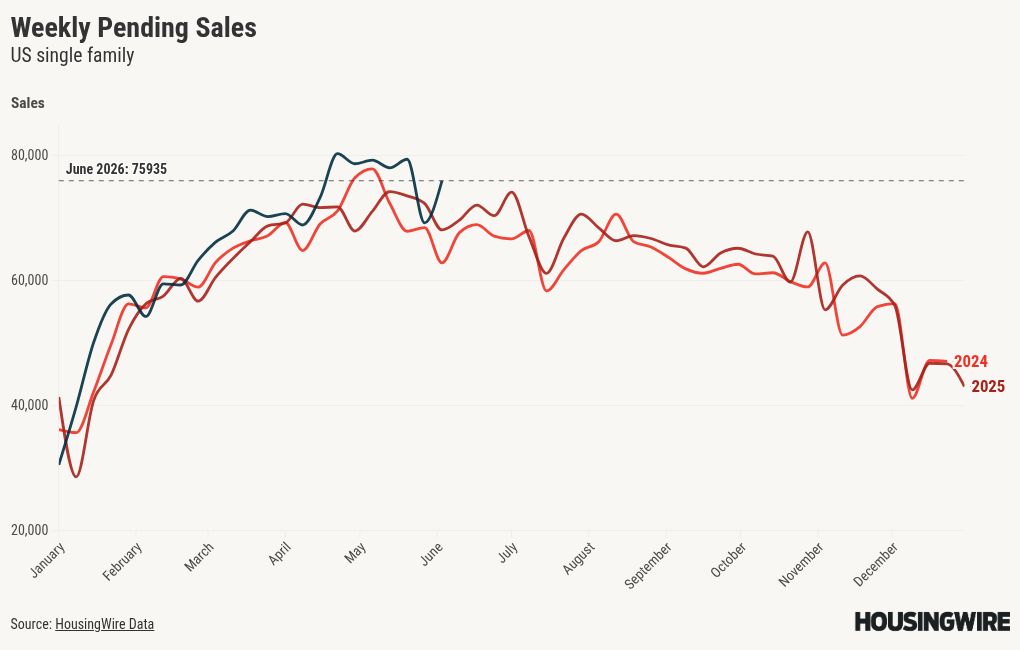
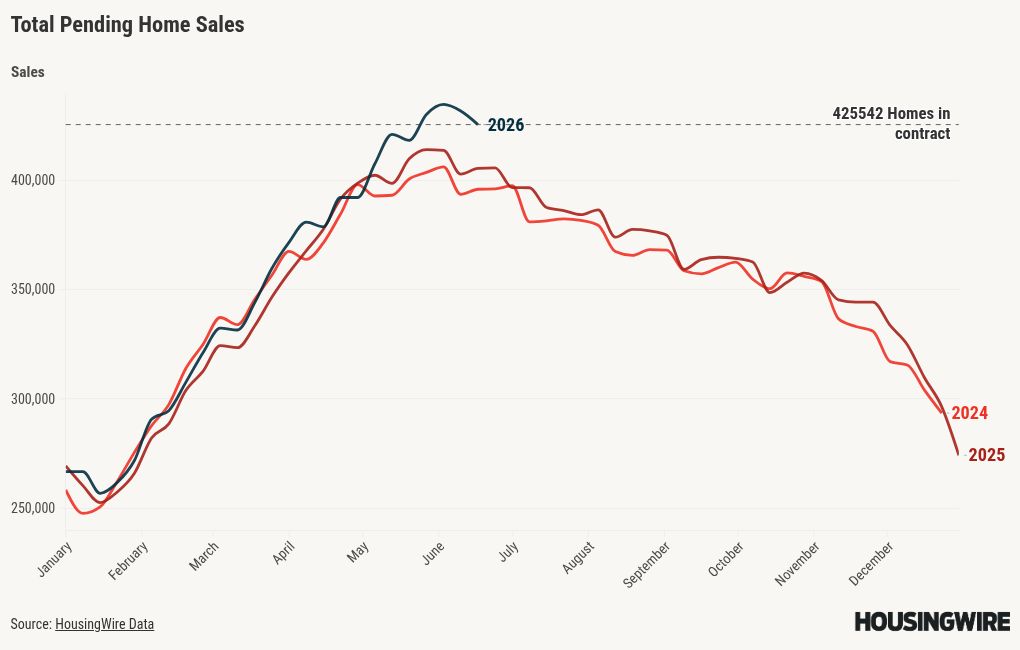
Berkshire Hathaway acquisition a sound bet

Like the CoStar-Zonda deal, Alloy Advisor co-founders also feel that Berkshire Hathaway’s acquisition of Taylor Morrison, is logical. 

In Kulkarni’s view, Berkshire is known for “making sound bets based on economics, human nature, and real market dynamics.” 

“I think they fully understand that brokerage is a low-margin, mostly unprofitable business that needs ancillary attach to be profitable at scale,” he said. “They also know homebuilding is incredibly profitable if done right — Taylor Morrison earned $783 million last year in a down market, a 13% return on equity. And whoever builds and controls the inventory has a leg up for decades, not just years, because we’ve got an enormous shortage of homes — somewhere around 3 to 5 million. If they can marry that with brokerage ops, that could be an interesting long term play, and that’s what Berkshire might be better at than anybody.”

Cofano agrees, adding that this acquisition strengthens Berkshire’s position in the new construction space as it already owns manufactured home builder Clayton Homes.

“Strategically, that fills a gap and gives Berkshire a broader position across manufactured housing, site-built housing and the broader housing value chain,” Cofano said. 

Additionally, Cofano believes this acquisition signals that Berkshire sees “long-term value in homebuilding despite the current affordability headwinds, elevated mortgage rates and soft buyer demand.”

Strong signals for housing

“CoStar’s move into Zonda points in a similar direction: the company is making a long-term bet that new construction data, builder workflows and new-home consumer marketplaces will become increasingly valuable,” Cofano added. “While neither transaction proves that the new-home market has bottomed, taken together, they are a strong signal that two sophisticated, long-horizon buyers believe we may be closer to the trough.  If they are right, that is not just bullish for homebuilders. It is constructive for the broader residential real estate ecosystem, including brokerages, portals, mortgage, title, data providers and the many businesses tied to housing transaction volume.”

Looking ahead, John Lovallo, a stock analyst at UBS, told HousingWire he believes these acquisitions are a harbinger of what is to come across two related industries that have seen quite a bit of consolidation in recent years. 

“The top-16 builders in the U.S. have gone from 25% market share in 2013 to 50% market share today, so this consolidation of the industry has been happening for years. I think where you are going to find that this is becoming more and more challenging is for smaller builders, whether public or private, because they just can’t access capital, land, labor or materials like the bigger builders,” Lovallo said. “So, I think the bigger builders are going to continue to get bigger and I think you are going to see some non-traditional companies coming into this space and helping this consolidation process. So I think you are going to see a much more consolidated industry as we look forward.” 

So this may just be the start of traditionally real estate-focused firms attempting to make a play in the homebuilding space. 

This post was originally published on here