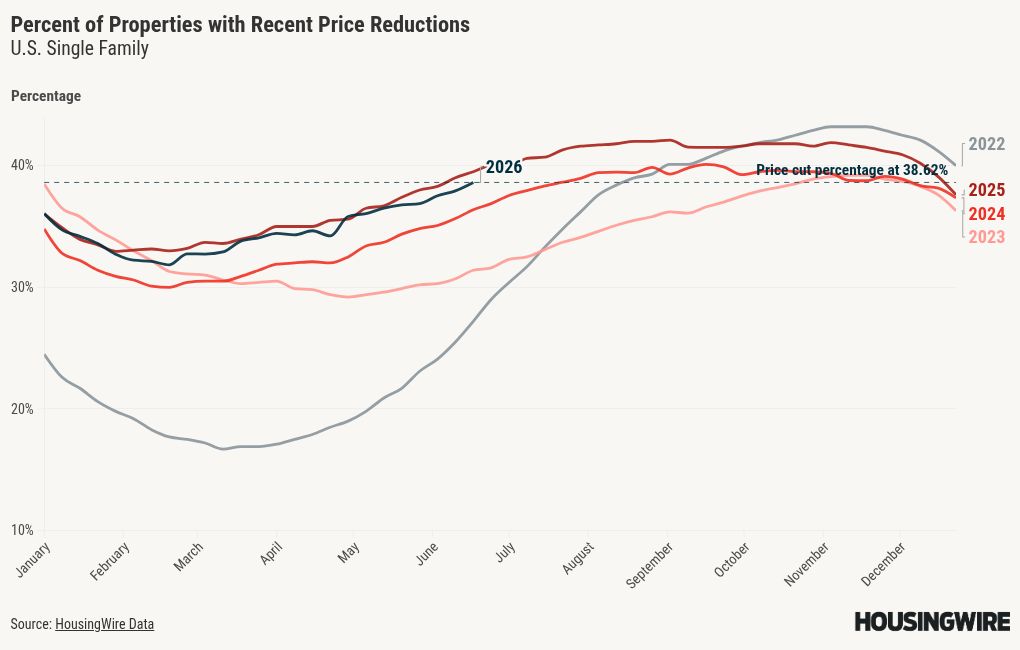
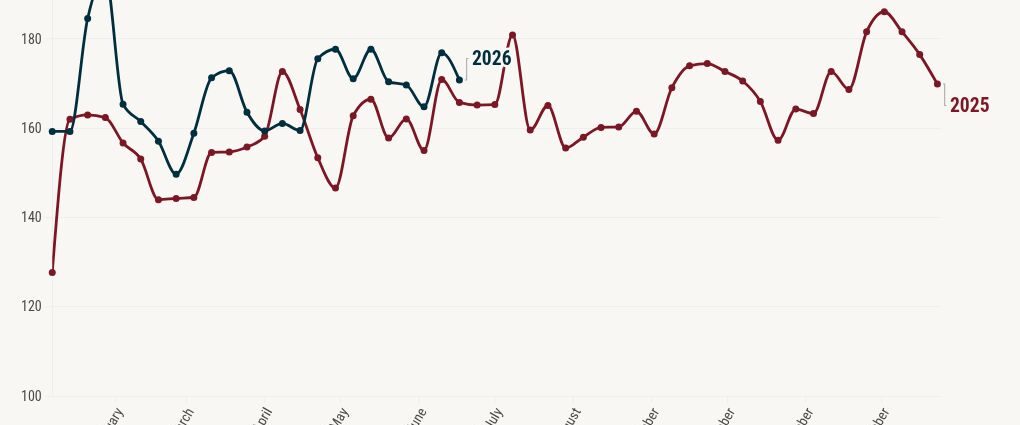
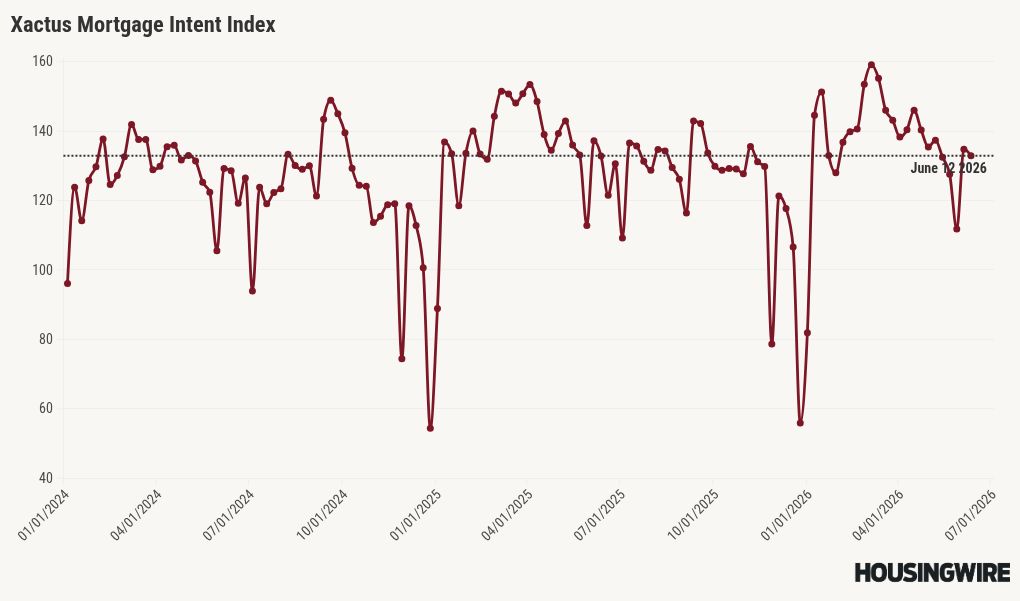
Mortgage rates are moving higher as 2026 nears its midway point. And sentiment has shifted when it comes to rate expectations as more housing market observers are predicting at least one rate hike this year — a stark contrast to the start of 2026 when multiple cuts were on the table and sub-6% rates seemed possible.

At HousingWire‘s Mortgage Rates Center on Tuesday, rates for 30-year conventional loans averaged 6.79%, up 6 basis points in the past week. Rates for 30-year jumbo loans also rose 6 bps to 6.81%, while rates for 30-year loans backed by the Federal Housing Administration (FHA) jumped 7 bps to 6.38%.

In the short term, rates have responded to the Federal Reserve‘s decision to hold benchmark rates steady for a fourth straight meeting, with stronger indications from Fed officials that a rate hike is more likely than a cut by the end of 2026.

A startling prediction was released Monday when Bank of America economists forecast three rate increases by the end of this year, which would bring the federal funds rate to a range of 4.25% of 4.5%, erasing all of the cuts made in 2025. But HousingWire Lead Analyst Logan Mohtashami called those actions “a bit too aggressive” and said they are unlikely to come to fruition.

“Core inflation had been picking up before the (Iran) conflict, so any rate cuts are off the table, even after the conflict ended. The conflict ending removed the worst-case scenario. However, for now, I have one rate hike planned for 2026,” Mohtashami wrote.

Interest rate traders hold similar views, according to the CME Group‘s Fed Watch tool. As of Tuesday, about 36% of those surveyed were predicting a 25-bps increase at the Fed’s next meeting in July — up from 18% a month earlier. Roughly half of respondents have penciled in a hike by September, while roughly one-quarter think there will be a 50-bps increase by October.

Impact on purchase, refi demand

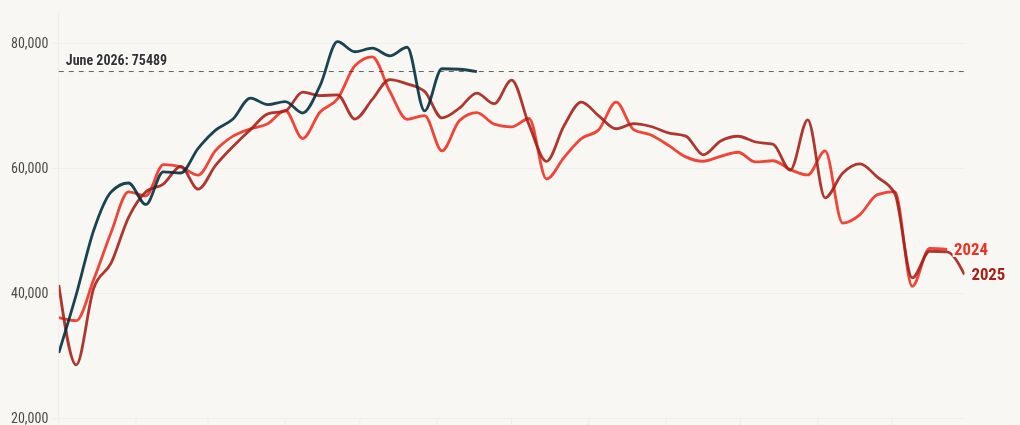
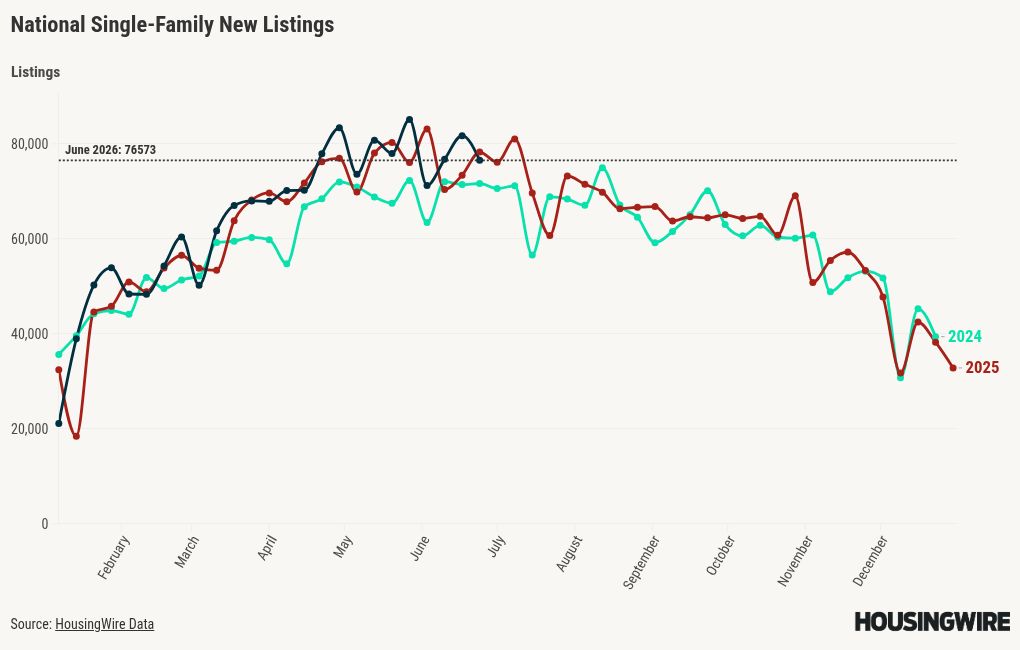
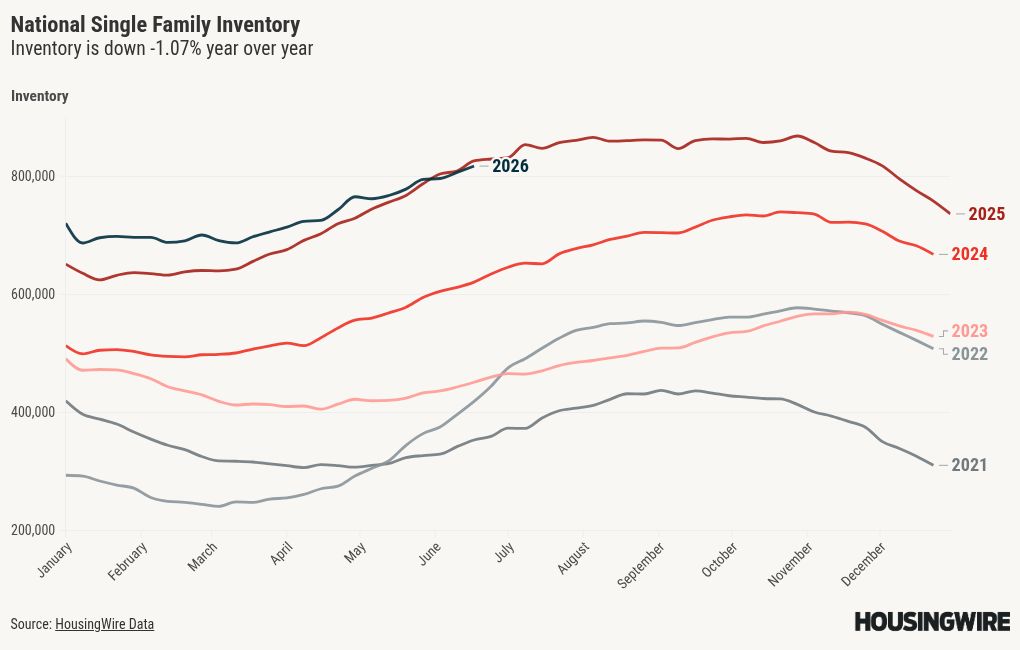
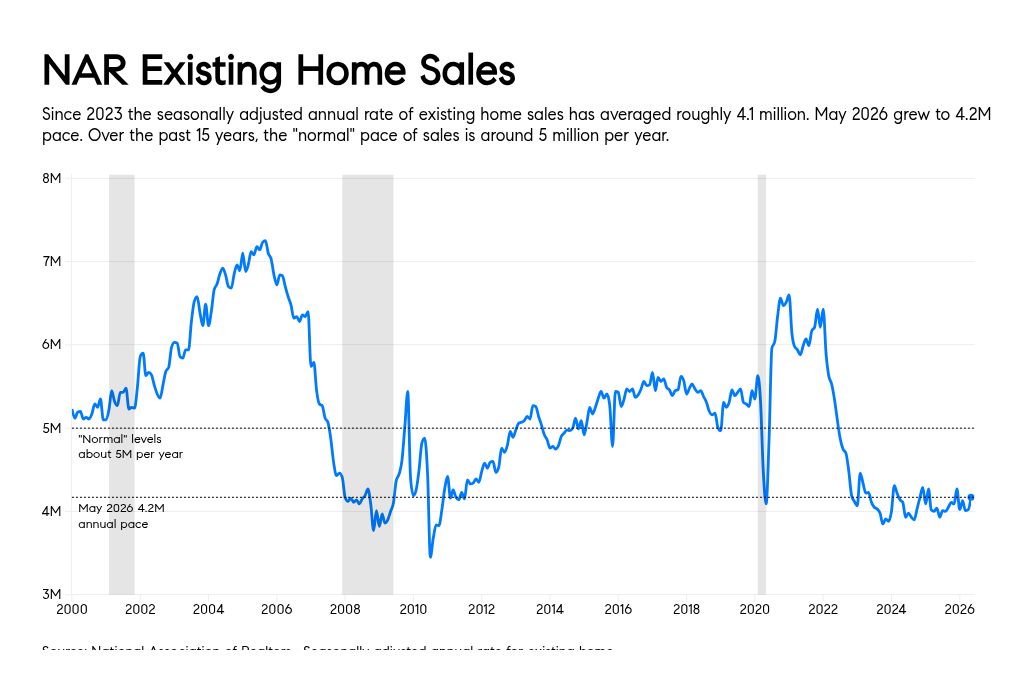
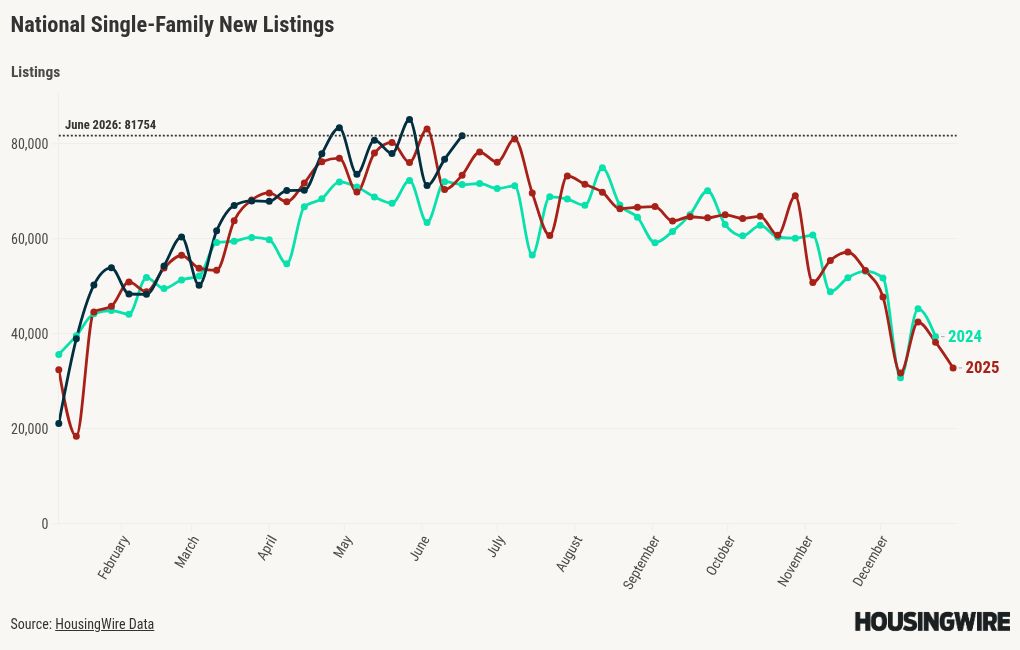
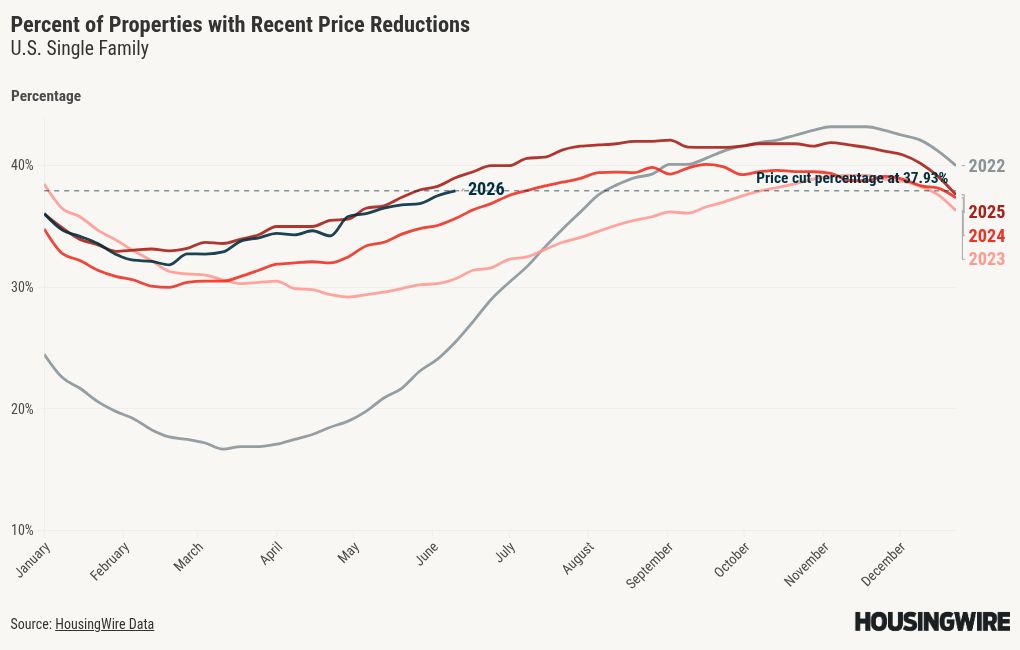
Rising rates are likely to factor into summer home sales and have been suppressing activity over the past month. HousingWire Data shows that weekly pending sales remain higher than a year ago, but existing home sales — which lag the pending sales data by 30 to 60 days — are likely to slow in July, according to Mohtashami.

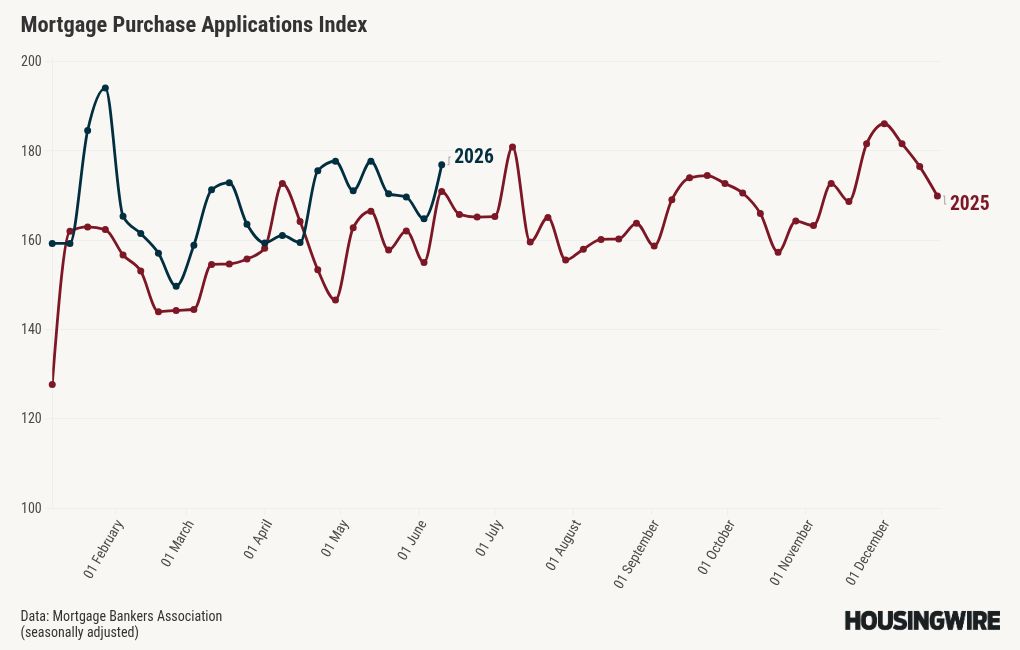
“Mortgage applications declined for the fourth time in five weeks, underscoring borrowers’ continued sensitivity to higher mortgage rates compared to earlier this year. Purchase activity remained above year-ago levels, but constrained housing supply in many markets, elevated home prices and ongoing economic uncertainty continue to weigh on would-be homebuyers,” Bob Broeksmit, president and CEO of the Mortgage Bankers Association (MBA), said in a statement.

Purchase application demand remains 3% higher than a year ago, the MBA reported. And consumer mentalities appear to be resilient despite affordability concerns. Bank of America survey data compiled in April and May shows that 53% of Americans would rather buy a home than rent or live with family — the first time in three years that a majority have expressed this view.

“The duration of the interest rate environment that we’re in today is now becoming a new normal, so versus the shock of movement from post-pandemic to the levels [near] 7%, now we’re consistently in this area, so this is a new normal from a market perspective,” Matt Vernon, head of consumer lending at Bank of America, told HousingWire.

“I think that is causing that clear inflection point in sentiment, where most Americans — or more Americans now — are thinking of homeownership as the preferred long-term choice.”

Refinance activity strong

Kyle Bass, production business manager at Refi.com, said that even with rates above 6.5%, more stability in recent weeks also seems to be supporting stronger refinance activity.

“For homeowners sitting on the sidelines, the question isn’t whether to refinance, it is whether you will be ready when the window opens,” Bass said. “This is why it’s more important than ever to prepare now. Those considering a refinance should complete the full pre-qualification process today, not because they’re ready to close, but because it reveals what needs to improve before they are, such as paying down credit card debt. Doing this now means you will be weeks ahead when rates reach your desired level.”

FHA loans, which represent about 17% of the mortgage market, also received a potential boost Tuesday when the U.S. Department of Housing and Urban Development announced a host of changes to the FHA’s single-family loan programs.

The U.S. Department of Housing and Urban Development (HUD) is rolling out 14 changes to the Federal Housing Administration (FHA)’s single-family mortgage insurance program, including less stringent appraisal rules, expanded flexibility for the 203(k) rehab loan program and simplified closing forms. 

The updates impact FHA policies across the origination, servicing, quality control and appraisal realms. HUD said the goal is to remove outdated requirements, reduce administrative work and make FHA financing more efficient for both homebuyers and lenders. 
This post was originally published on here

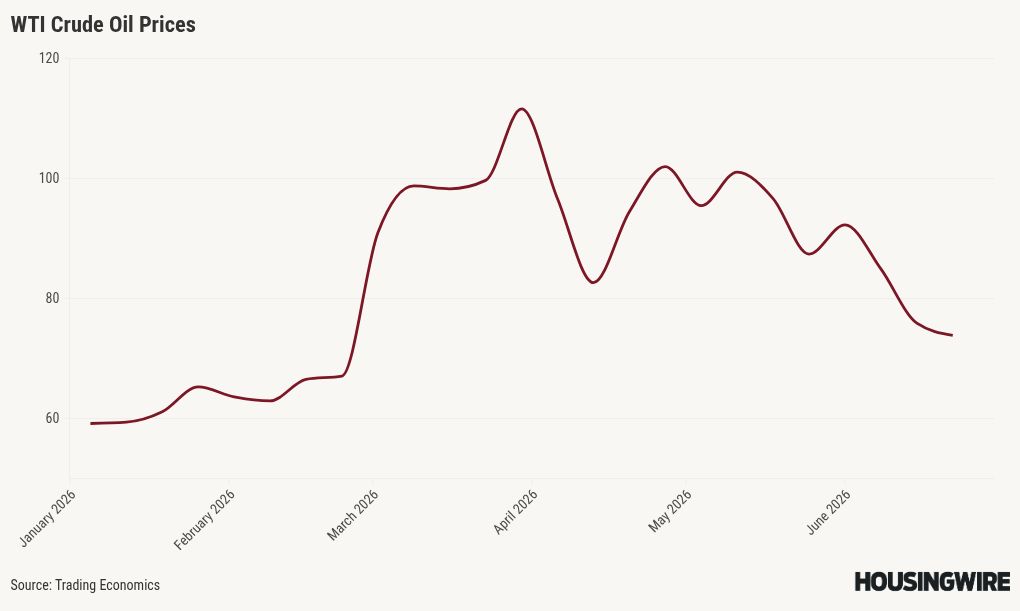
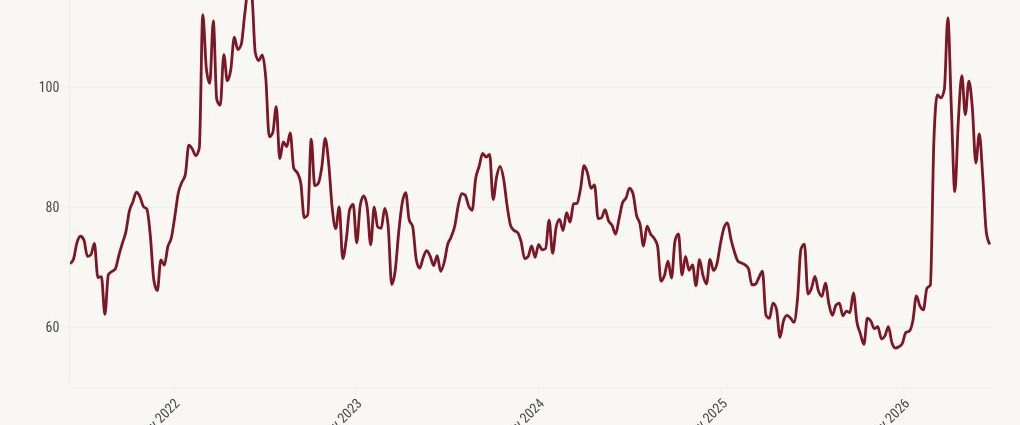
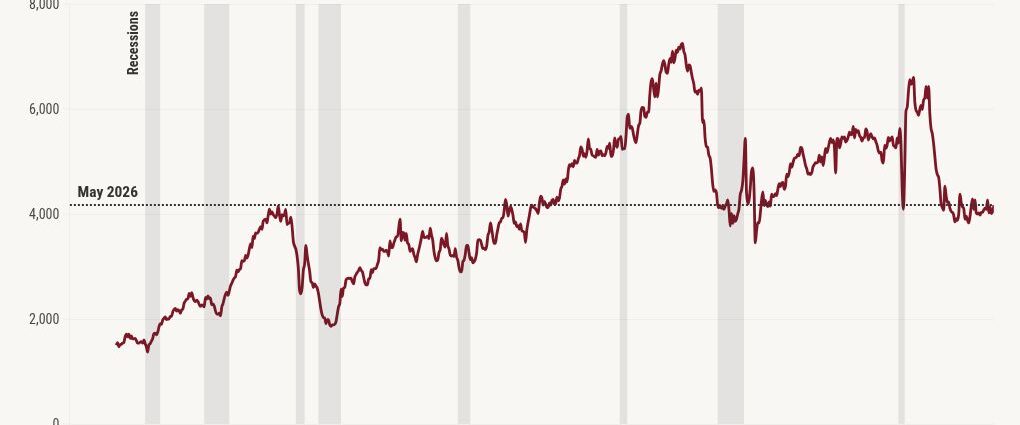
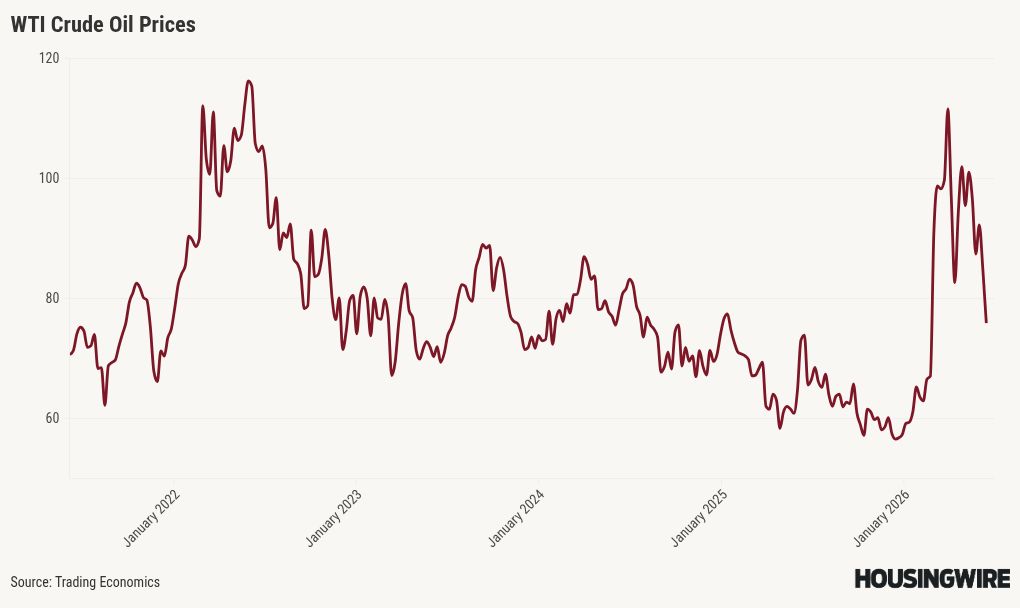
Many people in the housing industry are wondering why mortgage rates haven’t fallen even as oil prices have dropped from $111 per barrel to less than $73 today. The 10-year Treasury yield is at 4.48% and mortgage rates are near their yearly highs.

This is a fair question, and we have already discussed where mortgage rates should go now that the conflict in Iran is truly ending. Today, we’ll give you a brief take on how I view the 10-year yield and mortgage rates — and why, for now, everything looks all right to me.

Fed policy accounts for the bulk of yields, rates

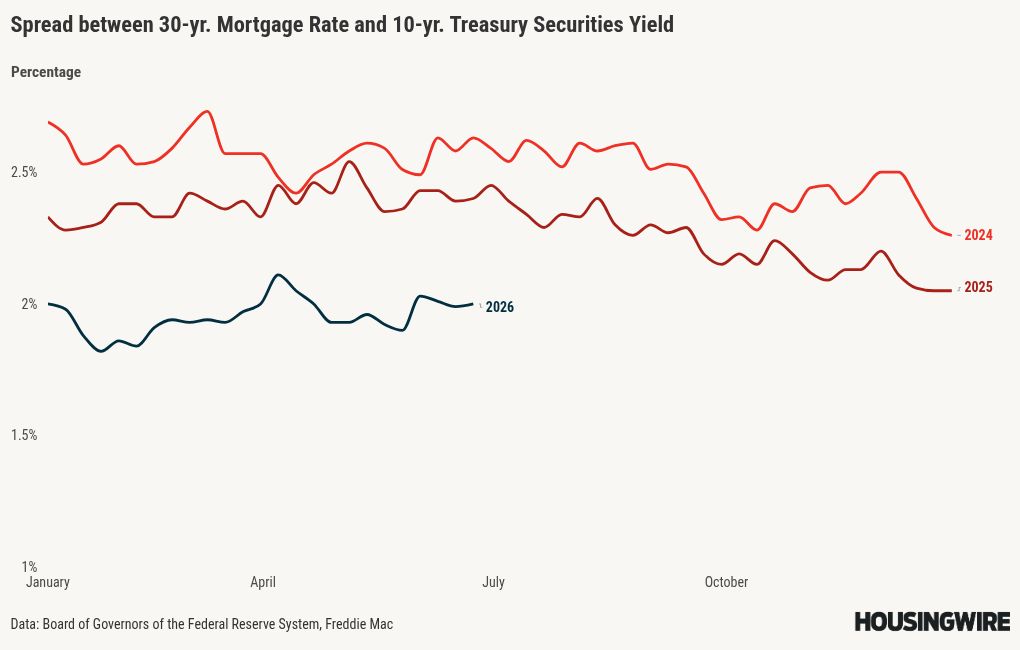
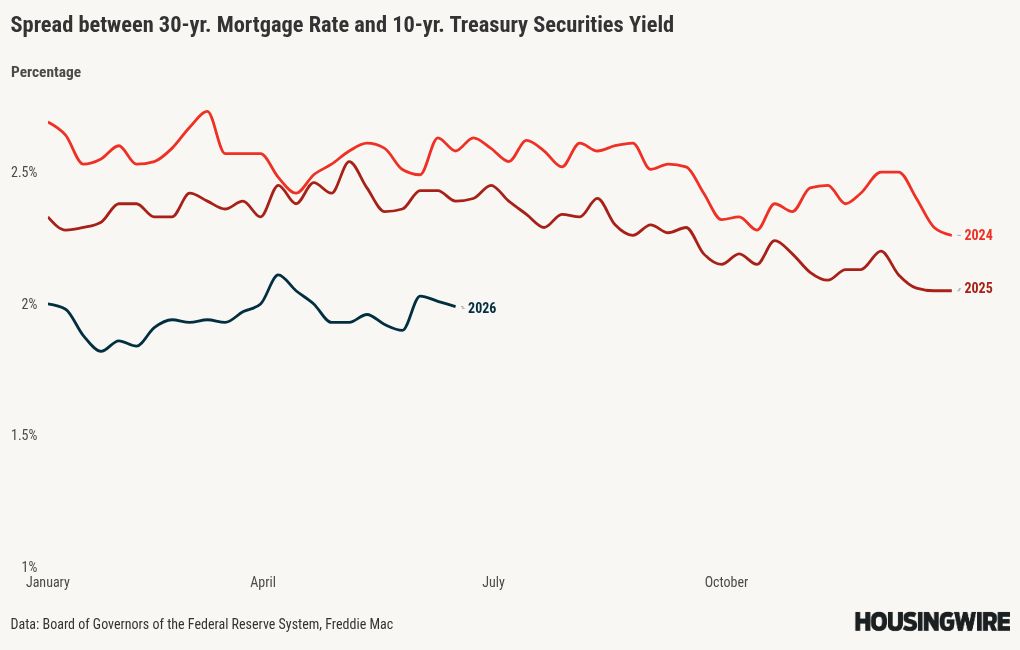
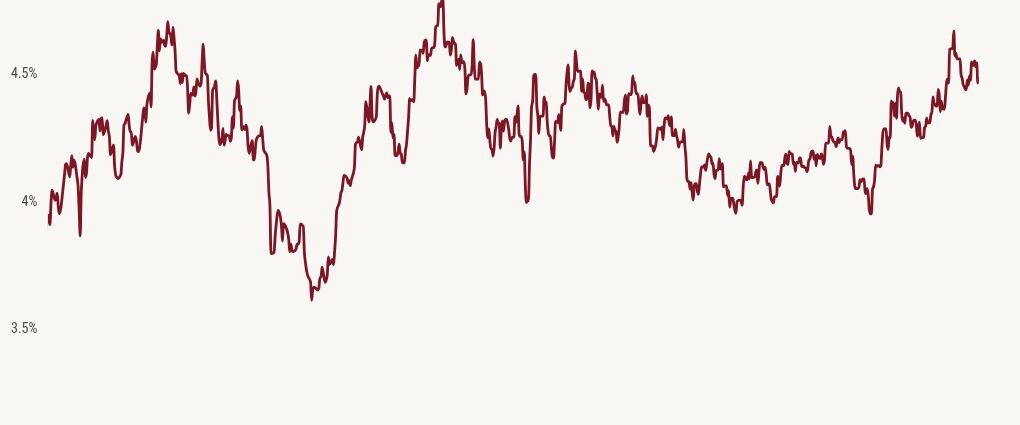
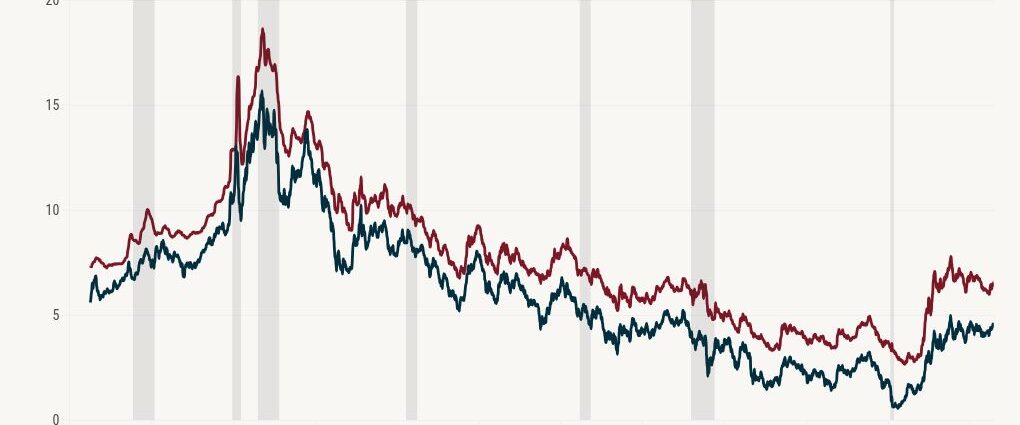
When I speak at events, I always show the chart below and say that this represents the slow dance between the 10-year yield and the 30-year mortgage rate. What drives the 10-year yield in turn drives mortgage rates. And Federal Reserve policy is what drives 65% to 75% of the headline figure.

For years now, my theme for rates has been labor over inflation. In fact, from 2023 through present day, every time the 10-year yield is below 4%, it’s because the market believes the economy is slowing down and the labor market is at risk.

If the Fed cuts benchmark interest rates down to 3%, getting below 3.8% on the 10-year yield is difficult. We’ve been below 3.8% twice recently — once in 2023 and again in 2024. On both occasions, traders believed the labor market was breaking and yields shot back up when it became clear it wasn’t.

chart visualization

This is why I don’t forecast anything below 3.8% on the 10-year yield. To me, this is a recession premise or because the Fed has gotten more dovish than the market is basing neutral policy on.

chart visualization

We went into 2026 with questions about the labor market and assumptions that the Fed would price in two or three cuts. But now we have one rate hike priced in for 2026. This is why I’ve said that, once the U.S.-Iran conflict is over and the Fed becomes less hawkish, we should think of 4.46% to 4.48% as the base point for the 10-year yield until more data or clarity on the Fed arrives.

As I’m writing this, the 10-year yield is at 4.48%. So, to make this point short, the Fed has gone hawkish in a year where rate cuts were initially priced in.

No comment yet from the Fed on the conflict ending

The Fed had a lot to say about the conflict lasting longer and the risk to inflation from higher oil prices. In fact, it made the Fed in general much more hawkish. But now? Nothing much has been said about oil prices since they went back to $73 per barrel.

chart visualization

Now the Fed hawks can say that ending the conflict will make them less hawkish. Maybe over the next few days or weeks, this could help the 10-year yield as Fed policy becomes less restrictive in the marketplace. But until then, don’t expect a change.

In fact, Wall Street firms are now debating how many rate hikes we will see in 2026. Bank of America says there will be three.

Labor data is firm and core inflation is running hot

Going into the year, the Fed was going to ignore tariff-related inflation, which made the inflation data hotter than normal, as officials believed that a one-time price shock would filter out in the second half of 2026.

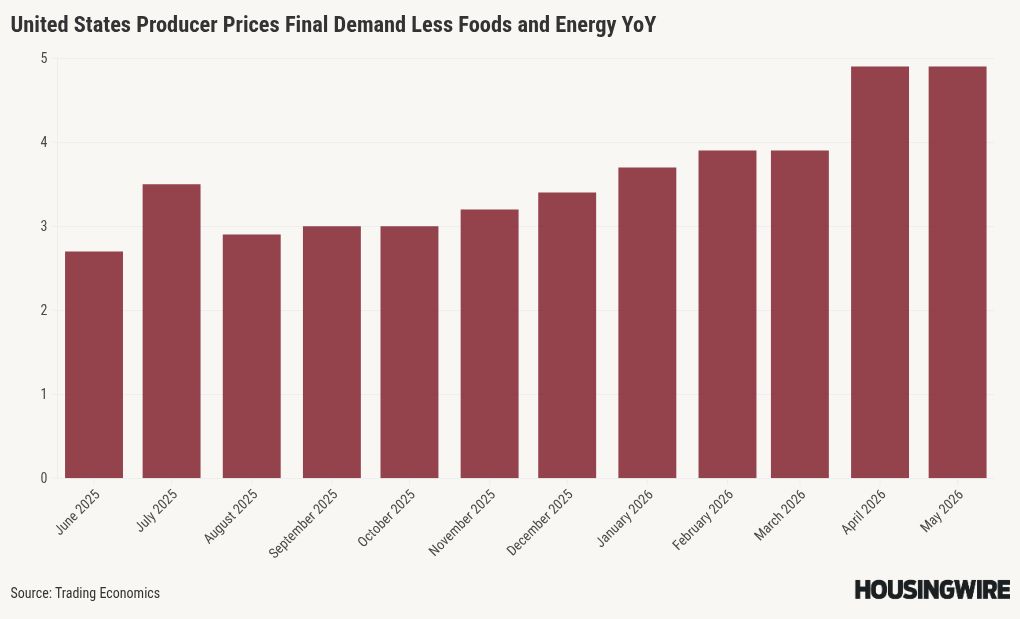
They might still hold this belief, but the Iran conflict gave them a reason to adopt a more hawkish stance. In general terms, the heat from the inflation data was simply too much to ignore, so all rate cuts for 2026 are off the table for now.

chart visualization

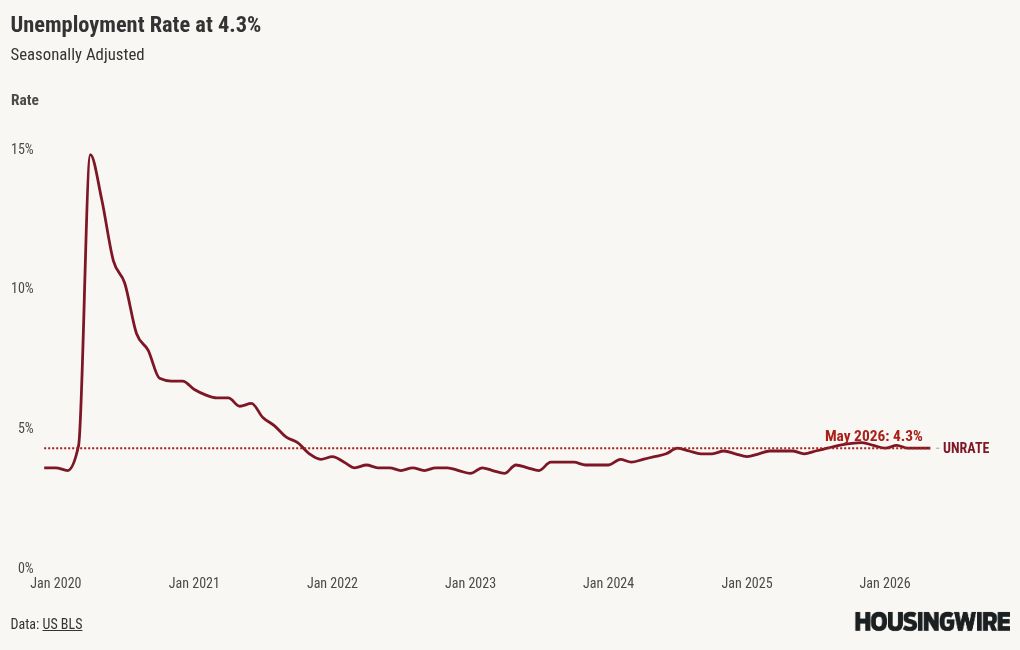
On top of that, recent labor market stabilization has made it easier for the Fed — even with oil prices rising — to not talk about rate cuts, as they see the labor market growing enough to keep the unemployment rate low. With oil prices moving much lower, the hawks can change their mind, but until they guide the market on that, bond traders will keep the 10-year yield closer to yearly highs than lows. If the unemployment rate were at 5%, we would have a different story, but that isn’t the case.

chart visualization

Conclusion

I know some people were anticipating that the 10-year yield and mortgage rates would drop right away with oil prices at $73 a barrel, but a lot has changed in 2026 beyond geopolitics. It is a huge win that this conflict is over and oil prices are down, but the Fed needs to get that message out if they want to quiet a lot of the more aggressive rate-hike talk that some market participants are forecasting.

With the conflict ending, maybe Fed officials can get back to discussing core inflation and when they think it will start to cool off. I can understand the frustration of housing market professionals on this topic — but for now, mortgage rates and the 10-year yield look right to me.

This post was originally published on here

The East Village is sometimes hard to recognize today; busy restaurants and nightlife demand more attention than colorful neighbors, landmarked buildings, and tree-shaded community gardens. But the trees and gardens are still here, and this townhouse at 746 East 6th Street, asking $5.5 million, is a fine example of an Alphabet City property on a classic neighborhood block, with plenty of ways to enjoy the Village vibe.

Available for the first time in over 20 years, this well-maintained, owner-occupied two-family townhouse will be delivered vacant and move-in-ready. Measuring 22 feet wide by 42 feet deep on a 97-foot lot, the townhouse is currently set up with two large three-bedroom duplex homes.

You get the flexibility of rental income, family space, or the chance to create one large home. Both units are separately metered with independent systems for heat, hot water, and central air conditioning.

Enter the lower unit of the duplex via the stoop, onto the parlor level. Within, a laid-back and lofty living area with ceilings over 10 feet is served by an open kitchen. This unit has central air conditioning throughout and a washer/dryer.

The colorful kitchen, anchored by a hefty dining island, features countertops of green marble, Scandinavian-inspired cabinetry, a Miele dishwasher and fridge, a Wolf range, and a double wall oven. At the back, a deck leads to a planted garden below, shaded by a mature maple tree.

Downstairs are three windowed bedrooms. The primary suite has access to the garden. Two additional bedrooms share a second full bath.

The upper unit is accessed through a separate entrance. Up a flight of stairs, a large, open living space consisting of a lounge, kitchen, and dining area occupies the lower floor, along with a full bath and laundry facilities. At the rear, glass doors open onto a wide, elegant terrace.

On the second level of the upper duplex are three bedrooms and two baths. A sprawling primary bedroom suite gets a working gas fireplace. Two rear-facing bedrooms share a second bath. This unit also has a second outdoor space in the form of a finished roof deck.

The well-maintained home sits on a leafy, surprisingly quiet East Village block. Tompkins Square Park is nearby, as is the East Village waterfront and East River Park. The property is located within an R8B zoning district and Opportunity Zone, offering 5,504 square feet of unused development rights for a potential future expansion.

[Listing details: 746 East 6th Street at CityRealty]

[At The Corcoran Group by Glenn E. Schiller and Laura Kastner]

RELATED:

The post This $5.5M two-family townhouse is classic East Village living at its best first appeared on 6sqft.

This post was originally published here

Investor activity in the U.S. housing market remained resilient in 2025 even as overall home sales fell to one of their lowest levels in decades, according to a report released Tuesday by Realtor.com.

Investors purchased roughly 534,000 homes last year, a 0.7% increase from 2024, while their share of all home purchases rose to 11.3%, up from 11% the prior year, according to the report.

By comparison, home purchases by non-investors declined 2.1% year over year.

At the same time, investors sold fewer properties for the first time in two years. Investor sales fell 1.5% to 442,000 homes, the lowest level since 2020, suggesting that investors are no longer shedding properties accumulated during the pandemic-era housing boom.

“The investor market has found a new equilibrium,” Hannah Jones, senior economist at Realtor.com, said in a statement. “With small investors now comprising nearly two-thirds of all investor purchases and large institutional players continuing to pull back, the dynamics shaping competition in entry-level housing are shifting.”

The report found that investor activity has remained stronger than the broader housing market since the COVID-19 pandemic. While overall home sales are down more than 25% from their 2021-2022 peak, investor purchases have declined by a smaller figure of 22.6%. Compared with pre-pandemic levels, overall home sales have fallen 14.3%, while investor acquisitions have increased 14.6%.

Investor sales also moderated in 2025. Although investors accounted for 9.3% of all home sellers, matching their share from 2024, the total number of investor sales declined. As a result, net investor accumulation widened to about 92,000 homes, up from roughly 80,000 in 2024.

The composition of investor activity continued to shift away from large institutional buyers. Mega investors, defined as those making 350 or more purchases annually, accounted for just 7.5% of investor purchases in 2025, their lowest share since 2011. Their purchase volumes have fallen nearly 70% from the peak reached during the pandemic-era housing boom.

Meanwhile, small investors — categorized as entities making fewer than 10 purchases per year — increased their share of investor purchases to about 63%, the highest level in more than 15 years. Realtor.com said small investors remained net buyers, purchasing approximately 53,000 more properties than they sold last year.

Jones said small investors are concentrated in lower-priced segments of the market, where they often compete directly with first-time homebuyers.

Nationally, small investors purchased homes at a median price of $330,000, compared with the overall market median of $440,000, according to the report.

Investor activity remained concentrated in several Midwest and Sun Belt markets. Among the nation’s 50 largest metropolitan areas, Memphis, Tennessee, posted the highest investor buyer share at 23.7%, followed by Kansas City at 21.2%; St. Louis at 21.1%; Birmingham, Alabama, at 21%; and Oklahoma City at 17.9%.

Las Vegas and Birmingham recorded some of the largest increases in investor buying activity from a year earlier, while San Antonio and Dallas-Fort Worth remained among the most active investor markets.

By contrast, several high-cost West Coast and Northeast markets saw relatively limited investor participation. Portland, Oregon; Sacramento; and Hartford, Connecticut, each posted investor buyer shares well below the national average.

Atlanta represented one of the most significant reversals, according to the report. Once among the nation’s most investor-heavy markets, investor purchases accounted for just 10% of home sales in 2025, below pre-pandemic levels. Investors were net sellers in the metro area by nearly 1,800 homes, the largest negative net position among major markets.

Realtor.com said investor activity appears to have stabilized at an elevated level, with investor purchase shares remaining above 11% for three consecutive years.

The report suggests that while large institutional investors have retreated, the growing role of smaller investors may help sustain current levels of investor participation in the housing market.

This article was generated using HousingWire Automation and reviewed by a HousingWire editor before publication. 

This post was originally published on here

As part of the ongoing lawsuit between Mauricio Umansky’s ThePLS.com and the National Association of Realtors (NAR), the trade association has attempted to subpoena documents from the American Real Estate Association (ARA), the NAR alternative founded by Umansky and Compass agent Jason Haber. 

The subpoena seek any documents, contracts, invoices and all communications between ARA, thePLS.com and theNLS.com, the Spanish counterpart of PLS from ARA and Haber. Additionally, NAR also asked to see communications about the Clear Cooperation Policy (CCP) and the NAR Accountability Project, a group founded by Haber in the wake of the sexual misconduct allegations that surfaced against former NAR President Kenny Parcell in late August 2023. 

According to the filing, the subpoena was issued in May with documents requested by no later than June 18. 

In an post on Instagram on Monday, Haber said that neither he nor ARA will meet NAR’s request for documents dating back to January 1, 2017, as they “include highly sensitive conversations with victims who came forward about harassment inside NAR.”

“The NAR Accountability Project shut down before ARA even existed. I’ll leave it to you to ask what its files have to do with a case about private listings,” he said. “ARA is objecting in the strongest possible terms. We will not allow a legal filing about a listing network to compromise the privacy of people who had the courage to come forward.”

On going legal battle

The subpoena is one of the latest developments in a years-long legal battle between ThePLS.com and NAR over CCP. ThePLS.com originally filed it antitrust lawsuit against NAR, California Regional MLS (CRMLS), Bright MLS and Midwest Real Estate Data (MRED) — are now named as co-conspirators. The MLSs were dismissed from the initial suit with prejudice in January 2024.

NAR was also dismissed from the initial suit at that time, but without prejudice, meaning that the PLS was allowed to refile the suit, which it did in July of 2025. 

In the renewed lawsuit, the plaintiffs claim that NAR is “a combination or conspiracy among its members, who are licensed real estate professionals who compete with one another.”

The PLS alleges that the adoption and enforcement of CCP by NAR and Realtor-affiliated MLSs is “the product of agreements and concerted action among the MLS Conspirators and between and among each NAR-affiliated MLS and their members.”

By requiring all listings to be submitted to the MLS, the PLS claims that CCP “eliminates the ability of listing networks that compete with the NAR-affiliated MLSs to feature listings that are not on the NAR-affiliated MLSs.”

The plaintiff argues this “degrades the quality of competing listing networks, reduces the incentives of licensed real estate professionals to use those competing listing networks, and makes those competing listing networks less effective competitors to the NAR-affiliated MLSs.” 

Additionally, the suit claims that CCP “has had actual and substantial anticompetitive effects by eliminating the ability and incentive of licensed real estate professionals to market pocket listings through PLS,” as well as other listing networks, thereby harming competition among listing network services.

In September 2025, NAR responded to thePLS.com’s renewed claims, arguing that the plaintiffs have not experiences any “antitrust injury.” 

This post was originally published on here

Finance of America (FOA) announced on Tuesday that it has appointed three senior executives to lead its brand, communications and product functions as the reverse mortgage lender looks to expand its retirement-focused home equity offerings.

Colm Murphy has joined as chief brand officer, Jordan Baucum as senior vice president of communications and Mike Urban as chief product officer.

The appointments are part of the company’s effort to more closely align its brand, communications and product teams as it seeks to drive growth and expand awareness of home equity-based retirement financing solutions.

“These hires strengthen the core of how we build and deliver for customers as we enter our next phase of growth,” Finance of America President Kristen Sieffert said in a statement. “By aligning brand, communications, and product more closely, we’re better positioned to simplify a complex category and create solutions that reflect how people approach retirement today.”

Murphy joins the company from Publicis Groupe, where he served as global chief strategy officer for Citi, following previous leadership roles at Bloomberg Media. Baucum previously held communications and financial services positions at Customers Bank, First Republic Bank and Chevron.

Both executives will report to Angela Tribelli. FOA’s chief marketing officer, and will oversee efforts to strengthen the company’s brand presence and consumer education initiatives focused on retirement planning and financial wellness.

“Our goal isn’t simply to build a stronger brand,” Tribelli said. “It’s to help Americans better understand the role home equity can play in retirement and ensure they have access to clear, transparent information when making important financial decisions.”

Urban joins Finance of America after serving in leadership roles at Best Egg and Barclaycard US. Reporting to Brian Conneen, FOA’s chief information officer, Urban will oversee product strategy and execution, with a focus on expanding the company’s retirement solutions platform and accelerating product development.

Conneen said Urban’s experience in product management, operations and design will help the company scale its product organization and deliver new home equity solutions for retirees.

This article was generated using HousingWire Automation and reviewed by a HousingWire editor before publication.

This post was originally published on here

The U.S. Department of Housing and Urban Development (HUD) is rolling out 14 changes to the Federal Housing Administration (FHA)’s single-family mortgage insurance program, including less stringent appraisal rules, expanded flexibility for the 203(k) rehab loan program and simplified closing forms. 

The updates touch FHA policies from origination through servicing and quality control. HUD said the goal is to remove outdated requirements, reduce administrative work, and make FHA financing more efficient for both homebuyers and lenders. 
“Every unnecessary regulation comes with a cost, and too often homebuyers pay the price,” HUD Secretary Scott Turner said in a statement. “If a policy does not protect taxpayers, improve affordability, or expand opportunity for Americans, we should rethink it.” 

Regarding appraisal quality control, FHA is reducing requirements tied to appraisal field reviews, which HUD said cost about $425 per review. The change will save the industry an estimated $3.3 million per year. 

Under the Limited 203(k) Rehabilitation Mortgage Insurance Program, FHA will allow an increased number of contractor draw requests, making it easier to complete smaller home rehabilitation projects, which are often critical for addressing aging housing markets and lower-priced housing segments.

FHA is also permanently exempting early payment defaults caused by natural disasters from required quality control review samples. And it’s eliminating the duplicative requirement for lenders to use the Important Notice to Homebuyers Form 92900-B, which is expected to simplify the FHA closing process. 

In loss mitigation, FHA is clarifying requirements governing trial payment plans. HUD said the changes are designed to protect the Mutual Mortgage Insurance Fund, establish safeguards to prevent abuse and ensure proactive borrowers are not penalized when they work with servicers to avoid default.

Turner, who took over the department’s top job under the Trump administration, has emphasized regulatory rollbacks and cost reductions as core priorities. 

FHA’s single-family unit has also seen turnover in senior roles. Earlier this month, Frank Cassidy stepped down from his role as FHA Commissioner and HUD assistant secretary for housing after a brief temporary leave. Ginnie Mae President Joseph Gormley is leading the office in an acting capacity. 

HUD said FHA has taken more than 150 actions to streamline its single-family program since the beginning of the Trump administration, signaling an ongoing regulatory recalibration rather than a one-off adjustment. 

This article was written by Flávia Furlan Nunes and generated with the assistance of HousingWire Automation, then reviewed by a HousingWire editor before publication. 

This post was originally published on here

The Brooklyn Public Library is releasing a limited-edition Jay-Z library card in honor of the 30th anniversary of the Brooklyn-born rapper’s debut album. Starting Thursday, the JAŸ-Z 30 Limited Edition Library Card will be available at BPL branches systemwide on a first-come, first-served basis, while supplies last. Created in collaboration with Roc Nation, the card celebrates the 30th anniversary of “Reasonable Doubt” and comes ahead of the rapper’s three highly anticipated performances at Yankee Stadium next month.

“Over the past three decades, JAŸ-Z’s music has helped shape conversations about New York City, entrepreneurship, creative expression, and contemporary culture,” the BPL said in a press release. “

As audiences gather this summer for his concerts at Yankee Stadium, BPL marks the occasion by recognizing JAŸ-Z’s enduring impact on hip-hop and popular culture.”

The rapper, aka Shawn Corey Carter, recently added the umlaut back over the “Y” in his name, as People reported in March.

Visitors to Bed-Stuy’s Marcy Library will also be able to check out books from JAŸ-Z’s Booklist on a dedicated display shelf featuring titles donated by Roc Nation. The collection includes books that have influenced the rapper throughout his life and career, offering readers insight into the works that helped shape his thinking and creative development.

Photo © 6sqft

The collaboration continues a partnership between Jay-Z and the library. In July 2023, the library released “The Book of HOV” library card collection alongside an exhibition of the same name presented by the BPL and Roc Nation at the Central branch.

The series featured 13 limited-edition cards showcasing artwork from Jay-Z’s studio albums, from 1996’s “Reasonable Doubt” to 2017’s “4:44.”

Featuring art, images, ephemera, and memorabilia from the rapper’s archives, the exhibition paid tribute to his life and career while highlighting the ways he helped redefine hip-hop, music, and culture on a global scale, as 6sqft previously reported.

The exhibition drew more than 600,000 visitors during its nearly five-month run, making it one of the most attended public exhibitions in the system’s history. Its final day saw nearly 11,000 visitors, the highest single-day attendance recorded at the Central Library, contributing to a 74 percent increase in attendance at the branch during the exhibition’s run.

It also introduced thousands of new users to BPL’s services. More than 36,000 “The Book of HOV” library card accounts were created, leading to a 66 percent increase in new accounts systemwide and a more than 300 percent increase at the Central Library. Of the original card designs, “The Black Album” was the most requested, followed by “The Blueprint.”

To celebrate the milestone, Jay-Z is performing three historic shows at Yankee Stadium July 10–12. Originally scheduled for just two performances, a third date on July 12—titled “Jay-Z Extra Innings”—was added following high demand.

RELATED:

The post Brooklyn Public Library releases limited-edition Jay-Z library cards first appeared on 6sqft.

This post was originally published here

After years leading teams, building brands and driving growth in another industry, I joined my current company to lead as Vice President of Marketing and Communications. What I did not expect was how quickly the leadership questions would feel familiar.

The market dynamics were different. The terminology was different. The pace was different. But the questions were familiar. How do you attract great people? How do you retain them? How do you scale while protecting what made the organization successful in the first place? How do you build a culture that can support growth, change and market evolution?

Today, strong tech stacks, AI tools, marketing platforms, CRMs and operational systems are essential. Every growth-minded brokerage is investing in them. They are no longer optional. They are the price of admission.

The real differentiator is what happens after the technology is in place. In my experience, the answer often comes back to leadership, culture and connection.

Technology creates capability. Culture determines execution.

Before entering real estate, I assumed recruiting conversations would revolve primarily around technology, marketing support, commission structures and business resources. While those topics matter, I have found they are rarely where meaningful conversations end.

Eventually, most conversations come back to trust. People want to know who they are aligning themselves with. They want to understand the vision. They want to know whether leadership is accessible. They want confidence that the culture they are being promised is the culture they will actually experience.

That realization reinforced something I have seen throughout my career: people may be attracted by opportunity, but they stay because of leadership.

Although I do not have a wealth of experience inside multiple brokerages, I do have the privilege of speaking with agents every day about why they joined Glasshouse and what keeps them here.

What is interesting is that the conversations rarely center on a single tool, platform or piece of technology. Instead, the same themes continue to surface: support, accessibility, collaboration, connection and leadership.

Agents talk about feeling seen.

They talk about having access to leadership. They talk about being part of a culture where people genuinely want one another to succeed. They talk about being surrounded by professionals who are willing to share ideas, answer questions and help each other grow.

For me, those conversations are a reminder that while technology may help attract attention, culture is often what earns loyalty.

There is another piece of culture that has stood out to me since joining real estate: connection. Agents want to grow their business, but they also want to feel connected. Real estate can be isolating, and many agents know what it feels like to operate on an island.

They want to be part of a community where they can learn from one another, share ideas, celebrate wins and navigate challenges together. As a hybrid brokerage, that is not something we can take for granted.

Connection does not happen automatically when people are not working side by side every day. It requires intentional effort, leaders who create opportunities for collaboration and a culture that encourages people to share knowledge instead of hoarding it.

One of the things I have appreciated most about my brokerage is the belief that success does not have to be a zero-sum game. A saying our broker, Mo Zahedi, often repeats has become something of a company cornerstone: “A rising tide lifts all ships.”

It is more than a saying. It is a mindset.

It captures the belief that when one agent succeeds, everyone benefits. Knowledge spreads. Confidence grows. Momentum builds. People are encouraged to support one another, celebrate wins and share what they have learned.

Technology allows us to work from anywhere, but culture gives people a reason to stay connected.

In a hybrid environment, that connection does not happen by accident. It has to be built, reinforced and protected. That is leadership work.

One experience that reinforced this perspective was Asa Cox Homes, Glasshouse’s newly acquired Cleveland team of 80 agents, being selected for the Google and HouseCanary home search pilot.

The pilot explored new ways brokerage listings could surface through Google’s search ecosystem, supported by HouseCanary’s real estate data platform. Cleveland was one of only eight national pilot locations, making the opportunity meaningful not just for Glasshouse, but for an independent brokerage team entering a larger growth story.

While the pilot was rooted in technology and visibility, it ultimately reinforced something much bigger: the role leadership plays in creating momentum.

When a newly acquired team is able to step into an opportunity like that, it says something about more than market presence. It says something about alignment, communication and the ability to create momentum during transition.

It also says something about support. Asa Cox Homes was able to hit the ground running because they joined a brokerage that was nimble enough to move quickly, supportive enough to create confidence and innovative enough to recognize the opportunity in front of them.

Marketing can amplify a strong culture, but it cannot create one.

The strongest brands I have worked with were never built solely through campaigns, messaging or visibility. They were built through consistent leadership decisions that employees, customers and partners experienced every day.

Culture is not what a company says about itself. Culture is how people experience the company. Our continued growth is rooted in something simple: culture and leadership.

Technology and systems are essential to growth. But their impact depends on the people and culture behind them. Technology is most powerful when it is paired with trust, communication, accountability and leadership that people believe in.

Here is what I have learned, and what continues to be reinforced regardless of industry: technology is essential, but it is not enough on its own.

The brokerages that grow in a meaningful, sustainable way will be the ones that understand what technology can support, but leadership must create.

Leadership creates trust. Culture creates connection. And together, they create the kind of environment where people do not just join, but stay, grow, collaborate and succeed.

That is the real competitive advantage.

Not the tools alone.

The people, the leadership and the culture that bring them to life.

Korrin Ziswiler is Vice President of Marketing and Communications with Glasshouse Realty in Dayton, Ohio.

This column does not necessarily reflect the opinion of HousingWire’s editorial department and its owners.

To contact the editor responsible for this piece: tracey@hwmedia.com

This post was originally published on here

Zillow has rolled out a personalized hub that guides homebuyers from first search through closing, the company announced Tuesday. The firm first launched a similar real estate ecosystem geared toward industry professionals, known as Zillow Pro, in mid-October 2025.

The new capabilities are aimed squarely at buyers and sellers struggling with a lengthy, confusing transaction process, as mortgage rates stay above 6.5% and nearly half of shoppers are first-time buyers, according to Zillow research. The company says its upgrades are designed to centralize tasks and documents, connect consumers with loan officers and real estate agents, and surface more actionable data at each step of the deal.

The personalized hub is built around four milestones: setting a budget, finding a home, making an offer and closing the deal. It pulls together a buyer’s goals, finances, to‑dos, documents and the agent and lender they are working with in a single interface, updating automatically as the transaction moves forward, according to the release. 

Home shoppers start by answering one question — “Are you buying, selling, both, or just browsing?” — and receive a tailored plan. The hub immediately displays three core elements:

BuyAbility℠, local market insights and a view of the buyer’s existing agent and loan officer, or a path to connect with a local agent through Zillow’s Agent Finder if they do not yet have representation.

When a buyer obtains a pre-approval, the hub reflects that milestone; when they go under contract, closing-related tasks appear. Zillow says this is intended to replace the patchwork of spreadsheets, email threads and ad hoc document collection that often compresses into a few days before closing.

Verified pre-approvals tie financing directly to search

Zillow’s Summer Launch also adds a shop with Zillow Home Loans Verified Pre-approval function, which connects a buyer’s vetted borrowing power directly to the listings they browse.

With Verified Pre-approval, monthly costs — including taxes, insurance, HOA fees and closing costs — are factored into the analysis, so buyers see whether a listing is realistically within their budget.

Shared collection centralizes partner collaboration

The final Summer Launch feature, shared collection, is aimed at the growing share of buyers purchasing with a partner.

Shared collection replaces that with a single, shared workspace inside Zillow where buying partners can save, organize and compare homes together in real time. Any update — such as saving or removing a listing — is immediately visible to all participants across iOS, Android and the web.

Zillow’s latest rollout continues a multi-year push to control more of the consumer journey from search to close. The personalized hub, embedded financing via Verified Pre-approval and pre-market exposure through Zillow Preview all move key steps of the transaction inside Zillow’s app.

Ongoing tech buildout at Zillow

This launch follows a series of technology pushes by Zillow aimed at streamlining the homebuying process and capturing more consumer engagement across the full transaction.

In summer 2025, Zillow rolled out SkyTour, an interactive 3D exterior home tour built on Gaussian splatting technology from the gaming industry, and Offer Insights, which gives buyers real-time feedback on how competitive a given offer price might be.

In fall 2025, the company launched in-app messaging for co-shoppers, AI-powered virtual staging on Showcase listings, and an integrated closing dashboard connecting search activity with back-office closing workflows.

Earlier in 2026, Zillow introduced Zillow AI mode, a conversational AI built into the app that lets buyers and renters ask questions in plain language, explore neighborhoods, compare affordability and book tours and Zillow Preview, its pre-marketing product for sellers and listing agents. 

This article was written by Brooklee Han and generated with the assistance of HousingWire Automation, then reviewed by a HousingWire editor before publication.

This post was originally published on here

Like other legislatures around the United States, the New York State Legislature spent the first half of this year considering policy on controversial topics that affect commercial real estate development. When both chambers adjourned their 2026 legislative session in early June, two bills they had passed demonstrated the antithetical approaches to development policy that many other states are currently deciding between.

On the one hand, there was the Responsible Data Center Development Act (A.11560/S.106420), a one-year moratorium on data center development that, if signed into law, will become the harshest statewide restriction on data center development in the nation. On the other hand, A.10009-C/S.9009-C, the state’s budget bill for fiscal year 2026-2027, included a significant reform of the State Environmental Quality Review Act (SEQRA) that both NAIOP chapters in New York – NAIOP Upstate New York and NAIOP New York City Metro – supported during their Day at the Capitol in Albany earlier this year. These diverging approaches to development policy within the same state illustrate the crossroads at which many states find themselves while trying to fulfill promises of affordability.

Though data centers have existed for decades, opposition to data center development rapidly became a prominent political issue nationwide starting in 2025 amid the AI boom. Over the past year, dozens of municipalities have placed temporary bans, or moratoriums, on data center development. Though these moratoriums largely started in smaller towns, they have spread to major cities like Denver, Minneapolis and Charlotte by the spring of 2026. No state has yet enacted a data center moratorium, though there has been one close call. Maine passed a one-year moratorium bill through both chambers of its state legislature in April 2026; however, an unexpected veto from Governor Janet Mills killed that effort until at least 2027. Now, New York has become the second state to pass a data center moratorium through its legislature and potentially will become the first to enact it.

New York’s Responsible Data Center Development Act contains multiple provisions affecting development of data centers, which the bill defines as any facility with a peak electrical power demand of at least 1 megawatt that is used for computing or related services. The strictest regulation, of course, is the one-year development moratorium, which will freeze permitting for “large” data center projects with peak loads of at least 20 megawatts. Additionally, these “large” data centers will face a new public utility classification for their electricity and water usage, provide benefits programs for the local community where the data center is located, and host a public hearing on development at least three months before receiving a permit. All data centers with peak loads of 5 megawatts or higher will face strict renewable energy and prevailing wage labor mandates, while data centers of any size will have to comply with energy efficiency requirements. Finally, the bill directs the Department of Environmental Conservation to complete an 18-month study on the environmental impact of data centers to inform future regulations. New York Governor Kathy Hochul has until Dec. 31 to decide whether to sign or veto this bill, meaning it could take quite some time to know if New York will become the first state with a data center moratorium.

In contrast to the anti-development posture of the data center moratorium bill, the state’s budget, signed by Hochul in late May, contained major reforms to New York’s State Environmental Quality Review Act (SEQRA). Modeled off the federal National Environmental Policy Act, SEQRA is an environmental review law that requires the completion of a lengthy environmental impact assessment prior to any discretionary government decision regarding development, such as a zoning change or special permit.

Including New York, 15 states and Washington, D.C., have a NEPA-like environmental review law, often making development much harder. The recent political debate over “affordability” has generated momentum to reform these laws; in June 2025, California majorly reformed the California Environmental Quality Act (CEQA), the strictest environmental review law in the nation, as part of an effort to address a housing shortage.

In 2026, Hochul began promoting her “Let Them Build” agenda, which included a request that the New York legislature include reforms to SEQRA in its annual budget. When NAIOP Upstate New York and NAIOP New York City Metro sent representatives to Albany earlier this year, they urged state legislators to support Hochul’s proposal. In a huge win for NAIOP and the broader development community, these reforms successfully passed as part of the budget. Now, residential developments of up to 500 units in New York City and 300 units in the rest of the state are exempt from SEQRA reviews if they are built on previously disturbed sites. This exemption also applies to certain water infrastructure projects. Additionally, stricter timelines have been placed on SEQRA review timelines, creating a more consistent environment for developers.

While these two bills only directly affect New York, many other states are currently discussing these same or similar issues right now. And as these bills demonstrate, the relevant policy solutions have the potential to either help or harm the commercial real estate development industry. If NAIOP members ensure to engage with their state and local governments, they can help ensure that more pursue the path of working with, not against, developers.

This post was originally published here

Compass has settled the Murch Telephone Consumer Protection Act (TCPA) lawsuit filed against it last June. On Monday, plaintiff Jessica Murch filed a notice of settlement with the court. 

No details of the settlement were disclosed in the one-page filing.

The TCPA suit was originally filed in mid-June of last year by plaintiff Jessica Murch against Compass, Compass Washington and two Compass agents Rachel Olson and Ansel Sanger in U.S. District Court in Portland, Oregon.

According to the complaint, Murch’s phone number was listed on the Do Not Call Registry for more than 31 days prior to the first of several calls at issue. Additionally, the filing notes that the plaintiff has never been a customer of Compass, nor has she ever consented to receive calls or text messages from the company. Despite this, in mid-August 2024, Murch claims she received four calls from Olson asking if she was interested in selling her house. 

In the complaint Murch claims that, despite telling Olson and Compass to only communicate with her via email, she continued to receive these unwanted calls through at least early June of 2025. The lawsuit was seeking class action status.

Compass had filed a motion to dismiss the lawsuit in May. The firm said it did not wish to comment on the settlement.

This post was originally published on here

Rocket Pro announced Tuesday that it is fully integrated with ARIVE, enabling direct loan submission and live status updates by syncing with its own platform in about 60 seconds.

The development marks the second phase of a partnership that began in April 2025, which initially gave brokers access to Rocket’s products and pricing through ARIVE. Now, brokers can price, submit and track loans without navigating away from the ARIVE interface. 

According to Katie Fisher (Sweeney), executive vice president of strategy and broker advocacy at Rocket Pro, only three lenders currently have this depth of integration with the platform.

“The benefit here is that you don’t have to log into a secondary system, re-upload information or convert information, and then submit,” Fisher told HousingWire. “Similarly, instead of having to log into a second system to get updates on loan status every morning, or understand how things are changing intraday, that information pushes basically right away back into the ARIVE system.”

For brokers, the Phase 2 update eliminates data re-entry and delivers more than 18 real-time loan status events — from initial contact through funding — directly into their daily workflow.

It’s all about broker choice

Rocket Pro is positioning itself around broker choice, with no platform lock-in. The move aligns with its broader strategy of accommodating varying broker workflows without requiring exclusivity to a single portal. 

While Rocket launched a loan origination system, Jupiter, in February (developed by sister company Lendesk), the company continues to invest in third-party integrations.

ARIVE, which combines a loan origination system, consumer point-of-sale interface, pricing engine and wholesale marketplace, has captured an estimated 50% market share among brokers, according to Fisher. Unlike retail loan officers who typically operate within a single, employer-provided system, brokers often juggle multiple lender portals.

“It’s just system preference,” Fisher said, comparing the choice between ARIVE and Jupiter to the preference between iPhone and Android. “They behave in different ways. They’re different price points. They’re set up in different workflows. We’re not in the business of forcing people to behave in one way or another.”

Rocket pays to participate in the ARIVE marketplace, though it does not charge brokers to work with the company or use external systems, Fisher said. Brokers pay a monthly subscription fee for access charged by ARIVE. Rocket declined to disclose the user crossover between ARIVE and its broker network.

A third phase of the ARIVE integration is currently in development. Fisher said will introduce features not yet offered by other lenders on the platform.

This post was originally published on here

Two Harbors Investment Corp.‘s latest adjournment of its special meeting underscores just how tight the shareholder math appears to be on its proposed sale to a CrossCountry Mortgage (CCM) affiliate — and how much pressure is coming from rival bidder United Wholesale Mortgage (UWM).

Two Harbors said Tuesday it has pushed its special meeting of stockholders to July 2 to allow more time to solicit proxies in favor of the CCM transaction. The meeting, originally scheduled for May 19 and delayed for a third time this week, will be held virtually.

The Two Harbors board continues to unanimously recommend shareholders vote for the CCM deal, which offers $12 per share in cash plus a pro-rated stub dividend.

According to the board, it represents “a 21% premium to TWO’s unaffected share price (December 16, 2025, the last trading day prior to the announcement of a transaction with UWMC) and a 119% premium to TWO’s fully diluted tangible book value as of March 31, 2026.”

The company has secured 47 of 53 required regulatory approvals and still expects to close in August 2026 if investors approve the transaction and remaining conditions are met.

Prior disclosures reviewed by HousingWire suggest the board may not yet have the votes it needs.

Emails between Two Harbors CEO Bill Greenberg and UWM CEO Mat Ishbia, which were included in filings with the Securities and Exchange Commission (SEC), show that as of June 15, about 73% of Two Harbors shareholders had voted and 54% were opposed to the CCM merger. 

The same email exchange revealed intensifying friction over deal structure. UWM has been pitching an alternative transaction that includes both cash and stock. Its most recent offer was $12.50 per share in cash — or at the shareholder’s discretion, 2.3328 shares of UWMC stock.

Two Harbors has pushed for all-cash consideration, arguing that the stock component would deliver far less value to investors who take the default consideration.

Based on UWMC’s June 12 closing price of $2.38, the default stock option would have implied about $5.55 per Two Harbors share, less than half of the cash headline price, the company said.

For now, Two Harbors is focused on turning around the proxy count. Stockholders who previously voted in favor of the CCM transaction do not need to take further action, the company said. Proxies already submitted will be voted upon at the reconvened meeting unless revoked. Investors who have not voted or who want to change their vote are being urged to do so. 

This post was originally published on here

National Association of Realtors (NAR) directors voted to keep national dues at $156 per member for 2027, approved a full slate of 2027 leadership and sent a proposed new ethics standard back to committee following a split vote at the trade association’s legislative meetings last week.

Ethics proposal sent back for more work

A proposed new Standard of Practice under Article 1 of NAR’s Code of Ethics drew significant debate before directors voted 497–356 to refer it back to the Professional Standards Committee for further review.

The proposed Standard of Practice 1-17 would have required members to disclose when they lack the knowledge, information or skills about a property type or geographic area needed to adequately protect and promote a client’s interests, according to NAR’s account of the meeting. The proposal was first introduced at NAR’s NXT conference in Houston last November. 

Supporters of the proposal said the language would reinforce a Realtor’s duty to put clients’ interests first by encouraging transparency when agents work outside of their expertise. Opponents questioned how “lack of knowledge” would be defined or enforced and whether the rule could deter newer agents from taking on unfamiliar segments of a market as they gain experience.

NAR’s Executive Committee had recommended that the board defeat the measure outright. The board’s move to refer the proposal back to committee leaves existing Article 1 obligations, which includes the primary duty of members to protect and promote the client’s interests while remaining honest with all parties in the transaction, unchanged, according to NAR.

Directors did approve a separate Professional Standards change requiring any request for compensation from a seller of an unlisted property to be made no later than when an offer is presented, rather than at first contact, as was previously required. 

This debate underscores how NAR’s ethics rules may evolve in response to pressure for higher professionalism and clearer consumer protections in the wake of the commission lawsuits and increased scrutiny on industry practices like referral fees. 

Dues held steady, 1.2 million members used for planning

On finance items, directors signed off on several recommendations from the Finance Committee, including using 1.2 million members as the basis for 2027 budget planning — down from 1.4 million projected for 2026 in 2025 — maintaining national dues at $156 per member for 2027 and continuing the Consumer Advertising Campaign assessment structure from 2026.

NAR’s membership dues have held steady at $156 since 2023

Keeping dues flat comes as NAR continues to navigate membership declines tied to a slower transaction market, brokerage consolidation and fallout from commission litigation and policy changes.

Advocacy and strategic plan updates

NAR’s 2026 President Kevin Brown highlighted recent movement on federal housing policy, including the Senate’s advancement of the 21st Century ROAD to Housing Act, which NAR described as one of the most significant bipartisan housing packages Congress has considered in years.

The organization credited members, Federal Political Coordinators and advocacy staff for building support around housing affordability and supply measures within the bill.

CEO Nykia Wright also briefed directors on NAR’s strategic plan and organizational initiatives, with additional progress updates expected in July. Directors are scheduled to reconvene at NAR NXT in New Orleans in November.

2027 leadership team

At November’s meeting NAR will install its 2027 leadership team, some of which were chosen during the board meeting, including a treasurer in a contested race, and they approved the rest of the 2027 leadership team by consent agenda.

Patti Fitzgerald of Florida defeated Matt Ritchie of Louisiana by a vote of 506–424 and will serve as NAR treasurer for 2027 and 2028.

The rest of the 2027  leadership team will be made up of Christine Hansen (Florida) as president, Colin Mullane (Oregon) as president-elect, Pete Kopf (Ohio) as first vice president, Chris Beadling (Pennsylvania) as vice president of advocacy and Mary Dykstra (Virginia) as vice president of association affairs. 

This article was written by Brooklee Han and generated with the assistance of HousingWire Automation, then reviewed by a HousingWire editor before publication.

This post was originally published on here

Pennymac will close its office in Franklin, Tennessee, and lay off staff within its consumer direct lending operations, citing challenging macroeconomic conditions, the company confirmed on Monday.

“Given the current market environment and following a careful review of our staffing needs, Pennymac has made the difficult decision to close its Franklin, Tennessee site and reduce the associated positions within our consumer direct lending operations,” a company spokesperson told HousingWire.

The spokesperson did not disclose the specific number of employees affected or their roles. But the impacted staff will receive severance and “a number” of employees will have the opportunity to transition to other roles within the company. The layoffs were first reported by The Mortgage Scoop.

The move comes as newly appointed Federal Reserve Chair Kevin Warsh and other central bank officials forecast increases to the benchmark interest rate in 2026 in an effort to push inflation down to their 2% target. A higher-for-longer rate environment is expected to pose continued challenges for lenders across the industry.

Pennymac was the third-largest U.S. mortgage lender in the first quarter of 2026. The company posted origination volume of $36.7 billion from January through March, representing a 29% year-over-year increase, according to data from Inside Mortgage Finance.

The Westlake Village, California-based lender and servicer reported a first-quarter net income of $82.3 million. Stronger mortgage production revenues helped offset weaker servicing results stemming from mortgage servicing rights (MSR) valuation changes and hedging losses.

In February, Pennymac announced its acquisition of Cenlar Capital Corp., the country’s second-largest mortgage subservicer, marking the first major acquisition in the company’s history. The all-cash transaction included an upfront purchase price of $172.5 million, with up to $85 million in contingent consideration payable over three years.

This post was originally published on here

Rhode Island housing advocates – conceding for the present moment – have already begun recalibrating for next year. Their latest bid for housing reform stalled during a legislative session that ended early so lawmakers could prepare for the November elections.

Those upcoming elections could alter political dynamics for next year’s session, swinging in favor of reform advocates. The biggest shift could come in the governor’s office, where incumbent Gov. Dan McKee trails challenger Helena Foulkes in early polling.

Foulkes’ platform includes plans to improve housing affordability by building more homes, a familiar theme in gubernatorial races across the country. The Rhode Island face-off between McKee and Foulkes is so contentious that the state Democratic Party didn’t endorse either candidate.

Voters choosing a different governor might also coincide with changes in Providence’s local government that could usher in rent stabilization, a measure that failed in May.

House leadership change stalls housing reform

This year, a change in Rhode Island’s House speaker stalled marquee bills after several consecutive sessions of housing reform led by former Speaker Joe Shekarchi. Shekarchi shepherded five housing reform packages and had been advancing a sixth this year.

His successor, Rep. Christopher Blazejewski, took over as speaker but did not pick up the housing mantle. Only minor bills making technical changes to existing law passed.

The stall affected key bills backed by state Rep. June Speakman, a leading proponent for housing support. One measure was the Faith-Based Affordable Housing Development Act, drawn from the “Yes in God’s Backyard” movement. It would have allowed religious institutions to build affordable and mixed-use housing on land they own. The bill would have limited local approval barriers and streamlined permitting. It would have put Rhode Island among states with similar laws.

The Faith-Based Affordable Housing Development Act is among the measures that cleared the state Senate but stalled in the House. Speakman’s proposals to legalize single-room occupancy and incentivize commercial-to-residential conversions also failed to advance out of the House committee process. Those bills are central to a supply-focused strategy that aims to add lower-cost units and reuse obsolete buildings instead of relying on new greenfield development.

Advocates are already looking beyond the current session. With the 2026 elections on the horizon, housing groups expect a reshaped legislature and plan to reintroduce key measures in 2027, potentially with newly elected lawmakers who have campaigned on affordability.

“We are disappointed where they ended up this session,” Kris Brown, executive director of housing advocacy group Neighbors Welcome! Rhode Island, told HousingWire TBD.

Brown said Speakman holds a safe House seat and will remain a housing champion. Advocates hope she becomes chair of the Municipal Government and Housing Committee next session.

Mayor and council races could change capital city dynamics

Rhode Island’s housing debate is expanding beyond zoning and supply. Rent stabilization is now the defining issue in Providence’s September Democratic mayoral primary.

The city council passed an ordinance capping annual rent increases at 4%, only to see Mayor Brett Smiley veto it. The council later came up one vote short of overriding that veto, with several members absent.

That outcome set up a stark contrast for voters. Smiley has aligned with the supply-side argument. He warns that rent caps would deter new construction and push developers out of Providence.

His challenger, state Rep. David Morales, has pledged to enact rent stabilization within his first 100 days. Morales argues that Providence is the nation’s hottest rental market. He says that reality demands immediate tenant protections.

A Morales victory would likely make Providence the only city in Rhode Island with rent stabilization, adding pressure from City Hall on state lawmakers at the State House half a mile away. Even if Morales loses, Smiley may face a city council with more advocates for rent stabilization. Most council challengers support rent stabilization and could form a veto-proof majority.

This post was originally published on here

SERHANT. has expanded into Houston, Dallas, Austin and San Antonio with 13 founding agents and six independent brokerages that collectively closed nearly $1.5 billion in sales volume over the past 12 months, the company announced Tuesday.

The move gives SERHANT. an immediate foothold in four of Texas’s largest housing markets. The Texas launch follows the firm’s entrance into Boston and California earlier this year and brings its footprint to 17 states since it began expanding beyond New York in 2023.

Texas operations and leadership

SERHANT. Texas will be led by managing director and broker of record Susana Sarvis, who is based in Houston. A 17-year industry veteran and Houston native, Sarvis previously served as vice president of brokerage operations at Real Brokerage and has held leadership roles at Compass and John Daugherty, Realtors, one of Houston’s legacy luxury firms.

“After spending more than 17 years helping agents grow their businesses and navigate an evolving industry, I couldn’t be more excited to join SERHANT. and lead our Texas expansion,” Sarvis said in a statement. “Texas is home to some of the most dynamic luxury markets in the country, and I look forward to helping our agents elevate their businesses while delivering exceptional experiences for buyers and sellers across the state.”

Independent brokerages align with SERHANT.

Rather than acquisitions, six established Texas independents are rebranding under SERHANT., bringing their existing agents and leadership into the firm’s platform. These firms include Houston-based Truss Real Estate and CitiQuest Properties, Evoke Realty, which serves Austin, San Antonia and the Coastal Bend region, Dallas-Fort Worth-based MRA Realtors and Austin-based KF Real Estate and Steele Portfolio Real Estate.

In Houston, Truss Real Estate founder Chris Phan is joining as a founding member, bringing a 15-person team. Phan has closed nearly $260 million in career sales, including $46.7 million in the last 12 months and was named to the 2024 RealTrends Verified list as the No. 31 agent in Houston by volume and No. 6 by sides. 

Patrick Burbridge, the leader of CitiQuest Properties, will be joining SERHANT. in Houston along with 10 agents. Burbridge has spent 22 years in real estate, closing nearly $150 million in the past 12 months and more than $2 billion in career volume. The firm primarily focused on developments and new construction. 

David Garcia Jr. and Alanna D’Antonio Garcia are joining SERHANT. as founding members through the affiliation of their firm Evoke Realty. At SERHANT. they will operate as evoke group. The San Antonio-based brokerage has more than $380 million in career sales and was named one of MySA’s Best Real Estate Companies less than two years after launching in 2022, the company said in the announcement. 

In Dallas, the husband-and-wife team of Robert Alvarez Jr. and Lisa Martin are bringing MRA Realtors to SERHANT. The pair, named to the 2025 and 2026 Real Producers North Dallas Top 1000, have more than 40 years of combined experience and more than $65 million in residential and commercial sales over the past eight years, according to the release.

In Austin, SERHANT is gaining Kasey Fagan, the broker-owner of KF Real Estate and Ellen Steele, the leader of Steele Portfolio Real Estate. Her team will rebrand as The Ausperity Group at SERHANT. 

Other teams and agents joining the firm include Eric and Erika Nelson’s Nelson Co., Nicole Lopez’s Marlowe Group and Michael Bass and the Bass Client Collective in Houston; Arios and Nicole Crenshaw’s Crenshaw Residential Group and Dustin Weiss, who is a founding member of Compass’s The Weiss Group, in Austin, Matt Keeton, Michael Petersen and Petersen Real Estate Group and Aaron Shockey and his seven-person team the Aaron Shockey Group in Dallas-Fort Worth.

This article was generated using HousingWire Automation and reviewed by a HousingWire editor before publication.

This post was originally published on here

A majority of Americans now believe that buying a home is a better option than renting or moving in with family, signaling a shift in consumer sentiment despite ongoing affordability challenges, according to Bank of America‘s latest Homebuyer Insights Report.

The survey included with the report, conducted in partnership with Bank of America Institute and released on Tuesday, found that 53% of respondents favor buying a home over renting or living with family, marking the first time since 2023 that a majority has expressed that view.

The report also found growing confidence in the value of homeownership. About 90% of respondents said a home is a valuable investment, up from 79% a year earlier, while 94% said homeownership provides stability, compared with 83% in 2025. Additionally, 32% said they are more confident in their ability to purchase a home this year, up from 27% last year.

‘Increasingly optimistic’ consumers

“We are seeing meaningful changes in attitudes toward homeownership,” Matt Vernon, head of consumer lending at Bank of America, said in a statement. “Despite real and persistent challenges in the market, buyers and owners are increasingly optimistic, and many are starting to move forward rather than waiting on the sidelines.”

In an interview with HousingWire, Vernon reiterated that the market has reached a point where consumers are accepting current rates as the “new normal.”

“The duration of the interest rate environment that we’re in today is now becoming a new normal, so versus the shock of movement from post-pandemic to the levels [near] 7%, now we’re consistently in this area, so this is a new normal from a market perspective,” Vernon said.

“I think that is causing that clear inflection point in sentiment, where most Americans — or more Americans now — are thinking of homeownership as the preferred long-term choice.”

Affordability remains the biggest hurdle for prospective buyers. The survey found that 58% cited high home prices as a barrier to homeownership, up from 46% in 2025, while 47% pointed to elevated mortgage rates, compared with 40% a year ago.

Even so, more consumers appear willing to enter the market. Seventy-one percent of prospective buyers said they are waiting for home prices and interest rates to decline before purchasing, down from 75% in 2025. The shift was most pronounced among younger buyers, with the share falling to 68% among Gen Z respondents (down from 74% a year earlier) and to 70% among millennials (down from 77%)

Among current homeowners, 52% said they expect to purchase another home, either as a primary residence or an additional property. And more homeowners are accelerating their plans, with 22% expecting to buy within the next year, up from 15% in 2025.

Lock-in effect easing?

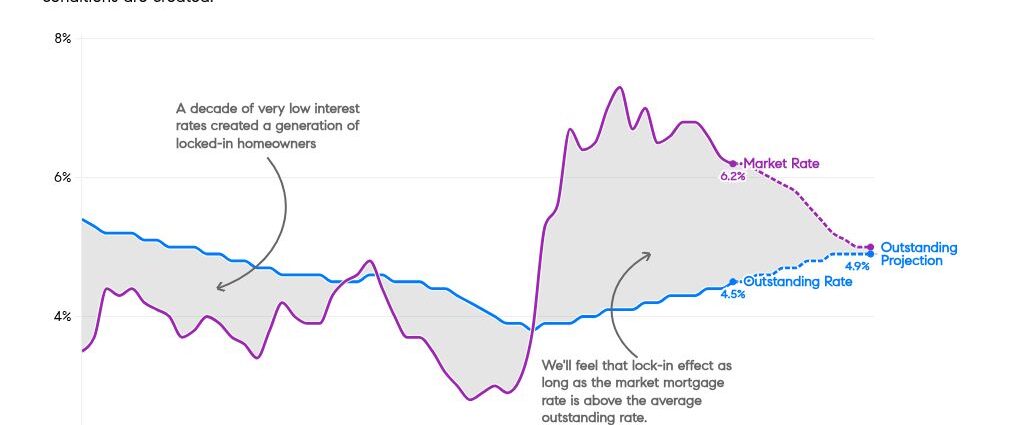
The survey suggests that the”lock-in effect” created by low-rate mortgages may be easing. More prospective buyers said they would be willing to move and accept a higher mortgage rate if it meant purchasing a home in a more affordable area, securing their dream home or moving to a better location.

“Clearly, affordability is still the constraint in the market, but we’re also seeing homeowners make trade-offs to challenge that issue, whether that’s looking at managing costs, smaller living places, fewer amenities or looking at markets that may be cheaper than they initially were looking into,” Vernon said.

Technology is also playing a larger role in the homebuying process, with 20% of prospective buyers and homeowners reporting that they used artificial intelligence tools or chatbots during the past year to research housing-related topics. Usage was higher among younger consumers, reaching 32% among Gen Z respondents and 28% among millennials.

Among those who used AI, the most common applications included affordability, mortgage payment and closing cost estimates, learning about the homebuying process, and researching neighborhoods, market trends and property values.

Despite growing interest in AI, consumers still prefer human guidance for major decisions. Respondents said they would rather rely on professionals for tasks such as touring homes and obtaining legal or contractual advice.

Gen Z ‘social pressures’

The survey also highlighted the challenges facing younger buyers. Nearly one-third of Gen Z respondents said they are considering purchasing a home with friends or family members, while 28% reported taking on additional jobs to improve affordability. Another 31% said they plan to use homebuyer assistance programs to help fund a purchase.

Vernon said that while Gen Zers have an advantage of being digitally savvy, they are facing “social pressures” to buy a home.

“Those newer, social media native younger generations are seeing their friends, they are seeing their neighbors, they are seeing folks that they connect with either achieve the dream of homeownership or talk about aspiring to get there, and they’re feeling a general pressure if they are in the same age — and, ultimately, situation in life ‚ where their friends, their neighbors, etc., are buying and they are not,” he said.

The findings are based on an online survey conducted by Sparks Research between April 13 and May 10, 2026. The survey included 2,000 adults, evenly split between homeowners and renters, who either currently own a home, previously owned one or plan to become homeowners in the future.

This post was originally published on here

“Gallia est omnis divisa in partes tres.”

All Gaul is divided into three parts. Julius Caesar used those words more than 2,000 years ago to begin an account of military conquest.

America’s housing affordability challenge might be described similarly.

Like Gaul of yore, it divides into three parts: talk, action, and outcomes. Identifying the three parts; that’s a cinch. Navigating the brutal, withering, mystifying distance between them is where housing affordability in the U.S. becomes a case of history repeating and getting almost nowhere.

That journey has frustrated and flummoxed policymakers, builders, investors, manufacturers, technologists and reform-minded housing advocates for generations.

Even when progress seems real, the same obstacles persist decades later and continue to bedevil the industry: insufficient housing supply, rising costs, labor constraints, permitting delays and a persistent inability to deliver attainable housing at scale.

That reality gives particular significance to two little-noticed funding opportunities recently launched by the U.S. Department of Housing and Urban Development.

As applications for a $10 million robotics- and AI-enabled housing manufacturing demonstration and a $3 million automated permitting systems initiative remain open until July 13, HUD is quietly testing whether technology-driven productivity gains can be part of a broader housing affordability solution.

The timing of the HUD innovation foray is like stars aligning in the firmament of political will to “go big” on what’s plainly a societal scourge felt at a household level: our housing attainability crisis.

Congress – with a vote expected today in the House of Representatives – is poised to finalize and send the 21st Century ROAD to Housing Act to President Trump’s desk, continuing a multiyear policy conversation focused on reducing regulatory barriers to housing production.

At the same time, HUD is pursuing a complementary strategy: investing in technologies designed to improve how housing is manufactured and how housing projects move through local approval systems.

Viewed together, the efforts suggest recognition that America’s housing shortage is by no means a problem of regulatory friction alone. It is equally a the-way-we’ve-always-done-it productivity problem. It is also equally an inefficient Residual Land Value capital investment problem.

These frictions are binding and have proven unrelenting.

Today’s “go big” talk and commitment to action echo a housing experiment launched nearly six decades ago by a HUD secretary who approached housing with an industrialist’s mindset.

George Romney’s unfinished experiment

In 1969, former American Motors chief executive and HUD Secretary George Romney launched Operation Breakthrough, one of the most ambitious federal housing innovation initiatives.

Romney believed America would not solve its housing challenges solely through additional subsidies, policy changes, or conventional building practices. He envisioned a broader transformation that would apply industrial management principles across every aspect of housing production.

As a housing historian and author of Construction Physics, Brian Potter notes that Operation Breakthrough sought not only to develop new construction technologies but also to address the entire housing delivery system, including production, financing, regulation, land use and distribution.

The ambition was a moonshot. The talk was epic. The action was both bold and sweeping.

Yet despite producing thousands of housing units and fostering significant experimentation, Operation Breakthrough ultimately failed to create the industrialized housing ecosystem its architects envisioned. Within a few years, many of the systems developed through the program had disappeared from the market.

Today, prefabricated housing accounts for a smaller share of U.S. homebuilding than it did before the initiative began.

The reasons – and the vicious circles of failure since then – remain relevant.

Operation Breakthrough revealed that technology alone cannot transform housing production. Fragmented demand, inconsistent regulations, localized approval systems, financing barriers, and market structures often proved stronger than the innovations themselves.

The lesson was never that innovation failed. It was that innovation without system-level alignment rarely achieves a plain-and-simple business non-negotiable: net-margin-positive scale.

That observation lies at the center of current conversations about housing industrialization.

The system, not the technology

Few observers have spent more time studying that question than Ryan Smith, co-founder of ModX and one of the principal researchers on HUD’s recent work to accelerate offsite construction.

Smith argues that the industry’s challenge – and the boneyard of flashy, VC-backed, save-humanity offsite, robotic, 3D-printing enterprises that have thrown talent, time, money and political capital into efforts to meet it over the past decade or more – is often misunderstood.

The conversation often centers on robotics, automation, modular construction, or factory-built housing, as if technology itself were the breakthrough. In reality, he says, countries that have successfully industrialized housing have built supporting systems that enable technology to scale.

“We know that the United States had a world-class industrialized housing sector,” Smith said. “Today Japan and Northern Europe really lead this area. The question is: What are the barriers in the United States to getting back to where we were, or to do what essentially Japan and Northern Europe have been able to accomplish?”

According to Smith’s research, the answer extends well beyond factory technology.

Recommendations from HUD-sponsored studies include demand aggregation, performance-based regulations, housing system certification, government incentives, and stronger alignment among federal, state and local housing policies.

These recommendations acknowledge that housing remains one of America’s most fragmented industries, or as Brian Potter calls it, “a loosely connected community of practice,” with thousands of local jurisdictions operating under different codes, approval processes, and procurement practices.

Smith points to international examples where governments did more than support innovation. They created predictable market conditions that encouraged manufacturers and investors to commit capital over long time horizons.

Other countries, he notes, developed offsite construction industries through coordinated incentives, harmonized standards, and demand signals that brought uncertainty and risk for manufacturers within reasonable tolerance levels.

The result was not simply better technology but a more coherent ecosystem for deploying it.

That perspective helps explain why HUD’s new funding opportunities may be more consequential than their dollar amounts suggest.

The programs are not solely about robotics or permitting software. They represent an attempt to generate evidence about how new technologies perform within real-world housing systems.

Why entrepreneurs see an inflection point

For housing technology entrepreneurs, the significance of the HUD initiatives lies partly in what they signal to the broader market.

Vikas Enti, founder and chief executive of Reframe Systems, which is preparing an application for the robotics demonstration program, sees the funding opportunity as validation of a larger shift underway in housing production.

“The cost curves are not going to get bent by continuing to build homes the existing way,” Enti said. “We have hit an inflection point in the industry where we need fundamentally new approaches to continue advancing labor efficiency.”

Reframe’s business model centers on decoupling construction from traditional jobsite processes and moving more production into advanced manufacturing environments. That approach reflects a growing belief among housing innovators that meaningful productivity gains will require housing to become less dependent on fragmented, labor-intensive field operations.

Enti believes the HUD program sends an important signal not only to builders and manufacturers but also to investors.

Federal support has historically played a catalytic role in sectors ranging from aerospace to electric vehicles, helping attract additional private capital once technologies demonstrate viability.

Enti hopes the demonstration program can serve a similar function for housing innovation.

“I hope this encourages more federal funding for housing and catalyzes interest from philanthropic funds and local state financing,” he said.

That possibility resonates with another observation from a source familiar with HUD’s thinking. Speaking on condition of anonymity because he was not authorized to discuss the matter publicly, the source said most applications are expected to arrive near the July deadline, but emphasized that the larger objective is to create momentum.

The source noted that many of the institutional mechanisms originally envisioned during the Operation Breakthrough era remain available today. The challenge is not necessarily inventing entirely new frameworks but creating conditions that allow innovation, standards, and local adoption to advance together.

Beyond regulation, beyond pilots

None of this diminishes the importance of regulatory reform.

The National Association of Home Builderslatest estimate finds that regulation accounts for $131,734, or 26.4%, of the average new single-family home’s price. Reducing unnecessary regulatory burdens remains an essential component of improving housing affordability.

Yet the industry’s focus on regulation sometimes obscures another reality.

Every day of delay in the permitting process adds cost. Every inefficiency in the construction cycle adds cost. Every labor shortage, coordination failure, inspection bottleneck, supply chain disruption, and productivity loss adds cost.

Those costs rarely appear clearly on a regulatory ledger, but they accumulate throughout the housing delivery process.

That is where HUD’s two demonstration programs intersect with the broader conversation about housing affordability.

One program seeks to determine whether advanced manufacturing technologies can improve production efficiency. The other seeks to determine whether technology can improve approval efficiency. Both focus on throughput, cycle time, and productivity.

The question now is whether they become one of an on-again-off-again series of demonstrations or, in fact, establish a real trailhead.

Pilot projects alone cannot transform an industry. Operation Breakthrough ultimately showed that. They move beyond talk to action. But sustainable change – and the dynamic, repeatable, resilient outcomes we so sorely need – require that builders, manufacturers, capital providers, regulators, policymakers, and local governments remain committed long after the demonstration phase ends.

Talk can identify the problem. Action can fund a pilot.

Outcomes require durable systems, aligned incentives and long-term commitment. We’ll know them when we see them.

This post was originally published on here

Lender and GSE responses to the “lender choice” credit score selection policy announced last year are likely to have significant impacts on the allocation of mortgage credit among credit investors.  As analyzed in several studies, including my own, absent a response by the GSEs, there is the potential for adverse selection to raise credit risk for the two housing agencies as lenders rationally select the highest credit score (either FICO® or VantageScore® 4.0) to send to Fannie Mae or Freddie Mac

The GSEs’ likely response would be to raise loan-level price adjustments (LLPAs) in an effort to mitigate potential adverse selection.  We’ve seen this movie before when the GSEs raised LLPAs on investor properties and second homes, with private investors absorbing a large share of these loans.  A new best execution pricing analysis suggests a similar fate awaits the GSEs should they raise LLPAs to levels consistent with actuarial pricing of credit risk.

The mechanics of best execution analysis

In maximizing value, a lender will conduct a best execution analysis of all revenue and cost components associated with originating and servicing a mortgage for different dispositions of the loan.  In addition to GSE execution, a loan could be sold into a Ginnie Mae securitization, a private label securitization (PLS), or, if the lender is a depository, a portfolio disposition.  Finding the all-in highest price among alternatives winds up being the best execution.  In the case of GSE-eligible loans, a key driver is the LLPA assigned to the loan by the GSE.  Therein lies the link between lender choice and credit allocation. 

A recent study by Milliman estimated that LLPAs across credit scores would need to increase from current levels in order to compensate the GSEs for the potential incremental credit risk from adverse selection.  While the increase in estimated LLPAs is not as large as the increases in LLPAs made by the GSEs for investor properties or second-home loans, where GSE purchases of those loans fell by 20%, it could nonetheless be material.  A key question is, if we were to assume the GSEs raised LLPAs consistent with the Milliman analysis, what impact would it have on credit allocation and risk?

Scenario analysis: Projecting credit shifts

To analyze this, I used a sample of 200,000 recent GSE loans in an industry-standard best execution pricing analysis under multiple scenarios.  One scenario examined best execution pricing for a depository where the possible dispositions included a GSE, Ginnie and private-label securities (PLS) securitization as well as portfolio retention. An independent mortgage banker (IMB) best execution was also performed without the portfolio retention option.  The analysis was conducted across credit score buckets used in LLPA grids currently under a Classic FICO (current state) and lender choice (future state) scenario. 

A summary of the depository results is shown in Table 1 below.  

Table 1: Classic FICO® vs lender choice best ex depository disposition

Between the Classic FICO and lender choice scenarios, the GSEs would see a marked shift away from them toward FHA and, to a lesser extent, portfolio lenders in the 660 to 740 credit score range.  PLS would wind up being the optimal takeout for credit scores above 760.  This is generally consistent with industry expectations that lower credit quality loans are a more likely disposition for FHA and that private capital is a more likely outlet for the highest credit quality loans.  Similar results hold for IMBs as shown in Table 2.

Table 2: IMB best execution – Classic FICO® vs lender choice

Table displaying IMB best execution – Classic FICO® vs lender choice.

Market outcomes and the future of credit allocation

Another interesting result is that while the GSEs would experience a decline in volume in this analysis, their estimated loss rates would remain relatively the same, while FHA loss rates could increase by nearly 14% under the lender choice scenario from the baseline Classic FICO scenario.  Given that FHA delinquency rates have been on an upward march recently, such an outcome would not bode well either for the Mutual Mortgage Insurance Fund or for mortgage servicers of these loans that would bear higher expenses.

So, what are the likely results and implications from lender choice on credit allocation?

  • First, absent other influences, higher LLPAs to address lender choice risk would likely lead to a material reduction in the volume of loans sold to the GSEs.  The analysis did not account for other non-pricing factors, such as policy and other operational differences between dispositions, which would tend to lessen the outflow implied by this pricing analysis. However, the analysis suggests that some decline in GSE volume is a reasonable expectation.  It is also consistent with what occurred when the GSEs raised LLPAs on second homes and investor properties.
  • Consistent with industry expectations, the analysis shows that the Ginnie Mae (FHA) disposition is a better execution for lower credit scores, and PLS is a better execution for the highest credit scores. Higher LLPAs would worsen the GSE execution, further widening the pricing gap between dispositions.  
  • Depositories would see some pickup in portfolio executions from higher LLPAs, and this would be more pronounced at lower target return levels.  Additional increases in portfolio execution would occur if LTV-based risk weights for mortgages are adopted by bank regulatory agencies for determining capital requirements.
  • As a result of the impact of higher LLPAs that would lower GSE best ex pricing, some reallocation of credit risk is likely, with FHA taking a greater allocation of that risk than other credit investors.

A primary takeaway from this analysis is that lender choice is likely to impose major effects on the allocation of loans and credit among credit investors, with a great deal of uncertainty in the process.  While this analysis provides a structured way of understanding potential relative shifts in loan allocation and risk via an industry-standard best ex pricing framework, much more work is needed to assess the impacts of one of the biggest policy changes to mortgage underwriting in years.

Clifford Rossi is the Principal at Chesapeake Risk Advisors, LLC. Over a 25-year industry career spanning the S&L and 2008 financial crises, Dr. Rossi worked for both Fannie Mae, Freddie Mac as well as some of the largest banks in various C-level risk management positions.
This column does not necessarily reflect the opinion of HousingWire’s editorial department and its owners. To contact the editor responsible for this piece: zeb@hwmedia.com. 

This post was originally published on here

Gov. Kathy Hochul announced Monday the formation of a state committee to explore the possibility of a bid by Lake Placid and New York City to co-host a future Winter Olympics. The Lake Placid-New York City Olympic and Paralympic Winter Games Exploratory Committee would evaluate the feasibility of a 2042 Winter Games concept–similar to this year’s Olympics in Milan and Cortina–that made use of Lake Placid’s Olympic legacy and New York City’s global platform, according to the governor.

“The time is now to return the Olympic flame back to New York. Milano Cortina showcased the immense possibility that comes with a dual city Olympic Games,” Hochul said. “It’s clear we have a once-in-a-generation opportunity to build on Lake Placid’s Olympic legacy, New York City’s global platform, and the strengths that make our State unique.”

France will host the event in 2030, Salt Lake City in 2034, and Switzerland is in discussion with the International Olympic Committee for 2038. The Winter Olympics have not been hosted by New York since 1980. That year saw the U.S. men’s hockey team defeat the Soviet Union in the well-remembered “Miracle on Ice.”

According to the New York Times, the dual-hosting idea was inspired by the recent Winter Olympics hosted jointly by Milan and Cortina in Italy. The two cities’ distance from one another (about the same as that of New York City and Lake Placid) did nothing to diminish the success of the event.

In a statement to the Times, Hochul said: “What other part of the world can offer this opportunity to provide what New York City has but also the most beautiful place in the world, with the Adirondack (mountains)?”

Assembly Member Robert Carroll, who has lobbied for a shared Winter Olympics in NYC and Lake Placid for years, will be a member of the Exploratory Committee Leadership Group.

In an op-ed in the Daily News in December, Carroll and former Assembly Member Billy Jones explained that the Olympics could “accelerate long-overdue investment” in the state’s rail corridors and would be an overall “great opportunity.”

“I’m honored to serve on the leadership team evaluating this once-in-a-generation opportunity for New York State,” Carroll said.

“This exploratory effort is an important first step in understanding what a future Winter Olympic bid could mean for our economy, infrastructure, tourism industry, and New York’s place on the world stage. I’ve long believed New York City and Lake Placid can tell a uniquely New York story, one of urban and rural communities coming together behind a shared vision.”

NYC sought to host the 2012 Summer Olympics, but ultimately lost the bid to London. The proposed Olympic stadium would have been built on the West Side of Manhattan.

As 6sqft previously reported, NYC’s proposed 2012 Olympic Village would have transformed the Queens waterfront and Manhattan’s West Side. According to the Bloomberg administration, the event would have created 125,000 jobs and added $11 billion to the city’s economy.

The yearlong exploratory process will include focused workstreams, stakeholder engagement, and public input.

The committee will then submit its findings and recommendations to state leadership for review. The Exploratory Committee effort will be led by a Leadership Group chaired by Ashley Walden, President and CEO of the Olympic Regional Development Authority, along with leaders from state and local government, economic development, and public service.

RELATED:

The post New York to consider dual bid by NYC and Lake Placid to host the Winter Olympics first appeared on 6sqft.

This post was originally published here

Steven “Little Steven” Van Zandt, musician and longtime guitarist in Bruce Springsteen’s E Street Band (also known for his role as Silvio Dante in “The Sopranos”), is selling his penthouse condo in a converted Romanesque Revival church at 135 West 4th Street. Van Zandt and his wife, Maureen, who is also an actor, bought the property for $6 million in 2008. Asking $15 million, the duplex penthouse is, as the listing calls it, “unapologetically bold,” with its unique architectural framework and interiors befitting a consigliere.

The home’s upper level is a lofty maximalist paradise beneath 20-foot wood-clad ceilings. Full-height stained glass windows frame the space with even more color, punctuated by statement pendant lighting.

Through a long, windowed gallery, a bold loft kitchen opens to a large dining room.

The most dramatic feature in this space is just outside a room-spanning glass accordion wall: A 500-square-foot private terrace with open sky views is outfitted with a full outdoor kitchen, perfect for dinner parties, private sunsets, and daytime gardening.

On the lower level, two large bedroom suites flank a sprawling media lounge. The middle space could easily be refitted as a third bedroom. Each space is accented by the building’s bold architecture, enhanced by the owners’ colorful, creative vision.

The condominium building, known as Novare, was built in 1860 as the Washington Square Methodist Church, also known as the Peace Church. It was converted to eight residences in 2006.

[Listing details: 135 West 4th Street PHE at CityRealty]

[At Leven Real Estate by Philip Hordijk]

RELATED:

The post Steven Van Zandt’s Village penthouse in a converted church asks $15M first appeared on 6sqft.

This post was originally published here

As we gear up for the second half of 2026, what are the key things we should be watching for? With the first six months being a dramatic version of the show 24, we can hope for a calmer second half of 2026 now that the conflict with Iran is hopefully ending. 

Housing has outperformed some people’s expectations this year, as rising mortgage rates haven’t had the negative impact they did in previous years, mostly due to better mortgage spreads and slightly better affordability as wages outpace home prices. Let’s focus on what to look for in the second half of 2026.

Weekly pending sales

Our pending home sales data provides a week-to-week perspective, though results can be affected by holidays and short-term fluctuations. Our weekly pending sales data typically takes 30-60 days to be reflected in the sales data. 

For the second half of the year, I will be looking to see if we can get positive year-over-year growth in pending sales regardless of where mortgage rates go. In the past, rates above 6.64% — which typically took us over 7% — have led to sales slowing down. Housing has held up well, mostly because we haven’t broken above 7% rates this year.

My forecast for 2026 was 237,000 more existing home sales than 2025 if rates can just stay under 6.25%. This is what I will be tracking the rest of this year given that mortgage rates started to fall toward the end of 2025, and we had a nine-month high in existing home sales in December. So, the year-over-year comps for the existing home sales report will be harder to grow starting in July. 

Here are the pending sales for last week over the last two years:

  • 2026: 75,489
  • 2025: 70,352

Mortgage purchase application data

Purchase application data is a forward-looking indicator: growth here leads home sales by roughly 30-90 days. Last week we saw a decline of 3% week to week, but the data was still positive year over year by 5%. We should still have positive growth this year as mortgage rates aren’t above 7%. But, with rates near yearly highs, I want to see if we can hit my growth forecast, even with elevated rates from where we were earlier in the year. In 2025, we saw better monthly existing home sales reports in the fall and winter due to lower rates.

Here are the stats on purchase apps so far in 2026:

  • 10 positive week-to-week prints
  • 11 negative week-to-week prints
  • 2 flat week-to-week prints
  • 10 weeks of double-digit year-over-year growth
  • 21 weeks of positive year-over-year growth
  • 2 negative year-over-year prints

Housing inventory

In 2025, housing inventory growth was really good, with inventory growing 33% year over year at one point. Then we hit mid-June 2025 and I noted that the housing market was about to shift, which it did. Not only has inventory growth been slower in 2026 year over year, three out of the last four weeks were negative year over year, and this week inventory only grew 0.247%.

For the rest of 2026, it won’t be hard for the year-over-year comps to show growth, so my focus will be on how the inventory data looks with rates at these levels. Right now it looks like a flattish trend — between down 2%, flat or up 2%. So, the key will be what inventory does now when rates are below 6.75%. 

  • Weekly inventory change: (June 12-June 19): Inventory rose from 816,924 to 830,939
  • Same week last year: (June 13-June 20): Inventory rose from 825,718 to 828,890

chart visualization

New listings

Seasonality in the new listings data is here; we are starting the traditional decline and it’s been another year of not getting back to normal. Traditionally, we would see 80,000-100,000 new listings during the seasonal peak weeks, but we’ve only cracked above 80,000 four times this year and never in back-to-back weeks, as I was hoping. 

Some context for those who believe that the new listings data resembles the housing bubble years: new listings during that time ranged from 250,000 to 400,000 per week for several years. Several years!

For the rest of the year, keep an eye out for any kind of deviation from the data year over year. As we get closer to the end of the year, new listings data starts to fade even more, but we always want to keep an eye on how it behaves in the summer. By fall and once we are in winter, not so much.

Here is last week’s new listings data for the past two years:

  • 2026: 76,573
  • 2025: 76,179

chart visualization

Price-cut percentage

Typically, about one-third of homes undergo price reductions before they sell, reflecting the dynamic nature of the housing market. For the most part, price-cut percentages this year have been lower than last year.

In my 2026 home-price forecast, I had a negative 0.62% call for the year nationally. Mortgage rates fell more than I anticipated early in the year. Home-price growth really isn’t going anywhere this year, but the percentage of price cuts has been lower year over year for most of 2026. If rates fall, demand picks up and and inventory once again goes negative year over year, my forecast will have a hard time being correct.

Right now, demand is too good to grow the price-cut percentage versus last year. If mortgage rates get above 7%, that might be a different story. For the second half of 2026, I am going to focus on what happens if mortgage rates just stay above 6.50%. All the data in 2026 was based on lower rates than last year. If mortgage rates stay above 6.50%, we will eventually be working with data showing higher rates this year than last, as rates were falling toward the end of the year. I want to see if that changes the data any. Housing has performed well in 2026 because, for the most part, we have remained below 6.64% for the entire year. I don’t believe the data should change much, but I will keep an eye on it.

The price-cut percentage for last week:

  • 2026: 38.62%
  • 2025: 40%

chart visualization

10-year yield and mortgage rates

In the 2026 HousingWire forecast, I anticipated the following ranges:

  • Mortgage rates between 5.75% and 6.75%
  • The 10-year yield fluctuating between 3.80% and 4.60%

Last week was crazy: we had the deal with Iran and it was Fed week. I talked about this on two episodes of the HousingWire Daily podcast — one about new Fed Chair Kevin Warsh in general, and the second about whether Trump and Warsh, working together, can get lower mortgage rates in this environment. 

The conflict is ending but inflation is still too hot and labor has improved, so I wrote about where I believe the 10–year yield should be trading based on the economic data, which is between 4.46%-4.48%. We closed Friday at 4.46%, and now that the Fed meeting is done and hopefully the Iran conflict is over with, we can focus again on economic data to see where the 10-year yield and mortgage rates can go.

chart visualization

Mortgage spreads

Mortgage spreads have been a positive story for the past few years. I don’t expect too much drama around mortgage spreads in the second half of 2026, unless the Fed really wants to go super hawkish with the conflict ending. The chart below is the No. 1 reason housing data has held up in 2026. 

chart visualization

Historically, mortgage spreads have ranged from 1.60% to 1.80%. Last week, spreads closed at 2.0%, up from 1.99% the week before.

Let’s compare last week’s mortgage rates to where they would have been over the last three years, given the 10-year yield’s current level:

  • If we had the worst mortgage spread levels of 2023, mortgage rates would be 7.69% today, not 6.58%.
  • If we had the worst levels of 2024, mortgage rates would be 7.31% today 
  • If we had the worst levels of 2025, mortgage rates would be 7.11% today.

The week ahead: Iran, inflation and Fed speeches

We have had some crazy weekend headlines about Iran, so we will see how the market trades Sunday night. This week, we will have some Fed speeches and it will be interesting to see how Fed governors talk now, with oil prices down so much from the peak. We also have PCE inflation data that the markets will work from, too.

This will be the first clean week to work off that 4.46% level on the 10-year yield, so the the second half hunt for lower mortgage rates begins. 

This post was originally published on here

For Gary Mercer Sr., achieving high placement on the RealTrends Verified annual rankings is less about chasing a specific number and more about a lifetime commitment to consistency.

The results, however, speak for themselves. As an individual agent, Mercer reported $167.35 million in transaction volume across 241 sides for 2025.

That performance placed him at No. 19 nationally among individual agents for sides and secured the No. 1 ranking in Pennsylvania for both sides and volume .

His team — LPT Realty-affiliated Gary Mercer Team — reported $264 million in volume across 431 sides. That was good enough for a No. 3 volume and No. 5 sides rank among mega teams in Pennsylvania, with respective national ranks of No. 55 and No. 72.

When asked about the figures, Mercer characterized them as a steady continuation of the team’s long-standing performance standard.

“I would say it was, for us, an average year post-COVID,” Mercer told HousingWire. “I mean, we have done over 500 transactions in the past. I think consistency in the approach and time on task, doing the things that work and sticking with that has been key. What we find is if we’re sticking to the basics, training and teaching and having the agents follow that, it doesn’t matter whether it’s an up market or a down market.

“That’s going to help you survive and do well no matter the market.”

The Gary Mercer Team — founded in 1990 — operates in a West Chester market characterized by low inventory, which Mercer notes has “artificially kept prices high.”

“We work with the whole gamut [of home price points],” Mercer said. “We do have a luxury team. We have a new construction team. We pretty much cover all elements and even do a little subdivision and flips and some new construction ourselves. So we’re staying active.”

Benefits of the team model

Mercer began his real estate career in 1987 and has long been an advocate for the team structure in real estate.

After nearly 30 years with an independent company — which later became Berkshire Hathaway HomeServices Fox and Roach — and a decade with Keller Williams, he moved the team to LPT Realty in May 2025.

He cited LPT’s support for team growth and its alignment with his values as key factors in the decision.

“I was an advocate and have been a supporter of teams and a believer that teams, early on, [are] the wave of the future in real estate,” Mercer said. “The LPT system really supports teams, team growth and your individual definition of success, which align with our values and principles.

“That’s why we changed companies and why we’re a hub for them in the Pennsylvania and greater Philadelphia marketplace.”

For agents looking to break into the industry or seeking a more sustainable career path, Mercer strongly advocates for the team environment as a pathway to stability and growth.

“I think for an individual agent, it’s really important for them to be aligned with successful people, and in my opinion, they get the best opportunity through a team situation,” he said. “That’s because a team will be able to generate leads to help them while they’re developing and cultivating their database for a long-term referral business.”

He elaborated on the practical advantages of the team model, noting that it can ease burdens that often overwhelm solo practitioners.

“A team model typically provides tools and systems that take the non-productive work off of an agent, so that they can focus on what they do best,” said Mercer. “That should be meeting with clients, working with buyers and getting listings, so that they can create a consistent business.

“The whole system just helps them create a more linear path to success — but individual agents can do it too. It’s just a lot harder.”

Embracing technology with pragmatism

Regarding technology, the team uses a full stack of systems including Follow Up Boss and Slack for team communication.

Mercer said he and his team are employing artificial intelligence and learning its applications as they go. However, he emphasized a disciplined approach to innovation.

“I would say that we’re adaptive to things that are current to the market that are working, but we don’t chase shiny objects,” Mercer said.

As the real estate industry continues to evolve with new technologies and market dynamics, Mercer’s formula remains rooted in fundamentals; stick to proven systems, invest in training and allow team members to focus personal connections that generate the greatest value.

This post was originally published on here

Fathom Holdings Inc. told its agents that its pending sale to Bed Bath & Beyond Inc. is intended to create an “Everything Home Ecosystem” that keeps real estate agents at the center of an expanded homeownership services platform, according to an internal email filed Monday with the Securities and Exchange Commission.

Filed June 22 under SEC Rule 425, the email was sent to Fathom’s agents after the company announced it had signed a definitive agreement to be acquired by Bed Bath & Beyond. The message emphasized that the deal remains subject to closing conditions, including shareholder approval and may not close on the expected timeline or at all.

The company addressed agent concerns about being notified only at the time of the public announcement. As a publicly traded firm, Fathom said it was required to keep details of the proposed transaction confidential until it was announced through “appropriate regulatory channels,” adding that early disclosure could have violated securities laws and jeopardized the deal.

The communication positions the transaction as part of a longer-term strategy to move beyond a single-transaction model and extend the company’s relationship with consumers over the full life cycle of homeownership. Fathom framed the Bed Bath & Beyond combination as a way to build an “end-to-end homeownership experience” that keeps agents in the middle of the relationship rather than limiting their role to intermittent purchase and sale events.

According to the email, the planned “Everything Home Ecosystem” would rest on three pillars:

  • Omni-channel retail: Home furnishings, décor, storage, organization, kitchen, bath and outdoor living products.
  • Protection and finance: Mortgage solutions, home equity lines of credit, home warranties, financial products and brokerage services.
  • Home services and renovation: Maintenance, repair, installation, flooring, cabinets, closets, storage solutions and other home improvement services.

The company said these integrated offerings are intended to keep homeowners engaged with the ecosystem long after closing while giving agents more structured ways to remain relevant to past clients. For housing professionals, the strategy underscores a broader industry shift toward cross-selling financial services, home services and retail products around a home transaction.

Fathom’s plan, if the transaction is completed, would tie its brokerage and finance operations to Bed Bath & Beyond’s consumer brand and home-related retail footprint.

This article was generated using HousingWire Automation and reviewed by a HousingWire editor before publication.

This post was originally published on here

First, let me address the main question: Does Bank of America’s new forecast of three rate hikes before the end of the year make sense? The short answer is: No. Three Fed rate hikes in 2026 doesn’t make sense, nor has the marketplace priced in three rate hikes in such a short amount of time. 

So, what gives? Why did Bank of America say this? Let’s break this down.

Fortune reported: “In a note on Monday, BofA changed its forecast and predicted the Fed will raise rates by a quarter point three times this year, lifting the benchmark rate to 4.25%-4.5% from the current 3.5%-3.75% range.”  

I will look at the case for each side of this idea and the market will decide the rest, as the 10-year yield is currently trading at 4.51% even with oil prices below $74. Remember, my view since May 25: if the Iran conflict is truly over, the 10-year yield should be trading around 4.46%-4.48%, and then the market will work off the economic data.

My view on the 10-year yield and Fed rate hikes

The Fed hiking rates three times in 2026 seems a bit too aggressive to me, given that the conflict in Iran is over. However, taking away all the rate cuts that the market had priced in to start the year seems right, given that the labor data has improved over the last few months. Core inflation had been picking up before the conflict, so any rate cuts are off the table, even after the conflict ended. The conflict ending removed the worst-case scenario. However, for now, I have one rate hike planned for 2026.

The case for 3 rate hikes in 2026

To me, Bank of America believes the Fed should reverse all the rate cuts it made last year — which would mean the Fed hikes the Fed funds rate three times by 0.25% in 2026.

The labor data has improved for the Fed, as they have consistently said the lower job growth is primarily driven by a lower labor-force growth. As long as job growth is above 33,000 a month and the breadth of job growth is picking up, the Fed’s view is that it should reverse all the rate cuts last year. So, with inflation above target and labor data better, this is Bank of America’s new take. 

This is a very plausible argument, since the Fed said it would wait for tariff-related inflation to wind down and make sure the labor market doesn’t worsen. With inflation stronger and labor data improving, three rate hikes in 2026 isn’t as crazy as it sounds. The one knock against this, even from the more Fed-hawkish members, is that they stressed that higher oil prices and a longer-lasting conflict would make them more hawkish. This has obviously changed recently.

The case for 0-1 rate hike in 2006

While inflation is stronger than anticipated, the Fed’s recent aggressive stance was based on the conflict lasting longer than expected. Since they’re making the rules here, I would go with their take over Bank of America.

Also, the market and the Fed both agree that rate cuts are off the table; however, no market indicators are signaling three rate hikes in such a short time. The labor data, while improving, is not accelerating at a rate where wage growth falling the past few years is heading higher. Because the Iran conflict has ended and oil prices are down, it’s more believable that we get no rate hikes to one rate hike in 2026.

chart visualization

Conclusion

Notice that there is no mention of rate cuts above from me, the marketplace, the Fed or Bank of America. While some Fed officials have discussed rate cuts down the line, they would need to be more vocal, as the conflict clouded the rate-cut decision in 2026. This has obviously changed recently, but it’s safe to say rate cuts are just off the table at this point. 

Yes, this is where we are at — even with the new Fed chair, Kevin Warsh — because first, the labor market has improved; second, inflation was stronger than what people anticipated before the conflict started, and third, now if the conflict has truly ended and we can keep oil prices between $67-$82 dollars, then the worst-case scenario with inflation is gone.

Over the next few weeks, let’s see what Fed governors say about the conflict ending and oil prices being much lower. This was a big reason for them to turn hawkish. If they sound more dovish due to the conflict ending, I would weigh their takes over any Wall Street firm.

This post was originally published on here

In 2020, amid a worldwide pandemic, I launched a new business called DOORA, which was a combination interior design firm and furniture gallery that morphed into a vertically integrated real estate company. The concept centered on turning houses into homes and owning the various stages of that process.

This is similar to the angle Better Homes and Gardens has been working for decades — bringing in its consumer-facing media brand and combining it with real estate.

I was reminded of my time at DOORA when I heard the news about Bed Bath & Beyond’s acquisition of Fathom Holdings last week. Does this signal a new acquisition model for the real estate industry and, if so, who’ll benefit?

I’m a believer in this model, not just because it makes shopping for cool closing gifts easier but because of the big-picture implications for both agents and consumers.

Opening the door on a curious M&A deal

The acquisition probably took many by surprise, and on the surface, the retail-meets-brokerage model reads as unusual. But the deeper industry impact is less about novelty and more about direction. 

Ever since the advent of HGTV-style home shows and reality-TV real estate, the home has been becoming a branded consumer ecosystem. 

Just as I believed when I started DOORA, housing, design and retail don’t have to sit in separate lanes. They’re just sold that way. To me, the integration of a real estate business and a home goods retailer makes intuitive sense.

Consumer engagement solves the follow-up problem

The strongest aspect of the deal, to my mind, is the shift from transactional real estate to continuous consumer engagement. Instead of communicating only during a purchase or sale, agents have the opportunity — and the excuse — to reach out on a regular basis.

Once the homeowner becomes part of a brand ecosystem like the one Bed Bath & Beyond and Fathom are building, the opportunity extends far beyond the closing table to furnishings, design services, upgrades, (re)financing and repeat lifecycle engagement. Instead of a one-time commission, the home becomes the foundation of an ongoing relationship.

For a company like Bed Bath & Beyond, the logic extends beyond diversification, offering access to a targeted audience focused on filling and maintaining a home across decades. Real estate brokerages and mortgage platforms sit on one of the most valuable, high-intent datasets in consumer commerce. The portals already know this and now retailers are catching up.

People browsing homes are signaling major life transitions like moves, upgrades, relocations and wealth shifts. Owning that moment creates leverage that traditional retail has never fully captured. Now it can be captured at unprecedented scale.

What happens when brokerage becomes a brand extension of retail?

Now, extend that logic far enough, and the brokerage looks less like a standalone service business and more like a distribution channel for lifestyle commerce.

That raises the interesting question: Will real estate companies become retailers, or will retailers become real estate platforms?

Brands like Restoration Hardware, Anthropologie and Urban Outfitters have already blurred into home ecosystems without owning the real estate transaction. They influence taste, furnishings and identity the moment someone moves.

The missing piece has always been proximity to the transaction itself. That gap hints at a future where the emotional and financial sides of homeownership are no longer separated by industry lines but brought together through brand alignment.

Could we see an upscale brand like Restoration Hardware buy Douglas Elliman or The Agency buy Nordstrom’s? Could we see Living Spaces or Ashley Furniture buy EXIT Realty?

Restoration Hardware in particular has restaurants and stores. They have access to staging furniture from their outlet, and could sell the properties furnished. They even know how long I’ve owned the furniture in my current house (12 years, in some cases), which tells them that it’s either time for me to move or buy new furniture.

The RH catalogue is sent to my home every quarter. Why not display properties for sale around the world, staged with RH fixtures and furnishings?

And you have to admit, the RH logo would look killer on a For Sale sign.

There’s a reason this idea keeps resurfacing in different forms: it works, at least in theory, because the consumer experience already behaves this way. Someone buys a home, then enters a multi-year spending cycle tied to that decision. Furniture, renovation, design, services, financing — all of it clusters around the original transaction.

Vertical integration is simply an attempt to stop seeing those as separate industries, adding cohesiveness to proximity.

I’d love to sit down with Bed Bath & Beyond’s Marcus Lemonis to get more of his perspective. Until that happens (Marcus, give me a call!), we’ll have to speculate on his strategy and wait to see how the integration gets implemented.

Whether this specific acquisition becomes a blueprint or an outlier, it’s clear that real estate is no longer just a service industry. It is becoming a consumer brand environment, where trust, data and lifestyle matter just as much as listings and commissions.

Troy Palmquist is executive-level growth expert specializing in residential real estate.

This column does not necessarily reflect the opinion of HousingWire’s editorial department and its owners.

To contact the editor responsible for this piece: tracey@hwmedia.com

This post was originally published on here

Executives at United Wholesale Mortgage (UWM) and Two Harbors Investment Corp. (TWO) raised the heat in an email exchange during their latest round of deal negotiations.

TWO mentioned that UWM could be trying to frustrate competitor CrossCountry Mortgage (CCM) in its efforts to acquire Two Harbors, while UWM alleged that TWO executives are prioritizing their own compensation in detriment of shareholders. The email exchange — included in filings with the Securities and Exchange Commission (SEC) — were between Bill Greenberg, president and CEO of Two Harbors, and Mat Ishbia, chairman and CEO of UWM.

A shareholder meeting to vote on the proposed CCM deal is scheduled for June 23, after being postponed once from May 28 and a second time from June 11. The email exchange shows that 73% of shareholders have submitted a vote, with 54% of them opposing the CCM merger — but since the information was disclosed June 15, it may have changed.

“Assuming these numbers are accurate, the disclosure suggests that Two might lack the shareholder votes needed to approve the CCM proposal,” analysts at Keefe, Bruyette & Woods (KBW) wrote on Monday.

Two Harbors, a New York-based real estate investment trust, continues to recommend that shareholders vote in favor of its existing agreement with CCM for $12 per share in cash, plus a stub dividend.

“TWO stockholders face a consequential choice at TWO’s Special Meeting: the certainty of $12.00 per share in cash under the CCM transaction or the potential significant decline in the value of TWO common stock if the transaction is not approved – with no actionable alternative on the table,” the company told shareholders in a letter on Monday. 

TWO stocks were trading at $12.28 on Monday afternoon, down 0.32%. 

In response, UWM released a statement a few hours later: “It is ironic that the Two Board bemoans the decline of its stock price, when they have a path to maximizing value for all TWO stockholders: true engagement with UWMC,” the statement read. 

UWM’s most recent offer was $12.50 per share in cash, or if a stockholder chooses, 2.3328 shares of UWMC stock.

‘Play for the media’

According to the SEC filings, on June 8, Greenberg invited Ishbia to New York to discuss an all-cash acquisition following a waiver of CCM’s non-solicitation provisions. Ishbia said he could not fly to New York and instead invited Greenberg to Pontiac, Michigan, or propose an online meeting later in the week.

Greenberg reminded him of the June 12 waiver deadline, but Ishbia made himself available only one day before it.

According to Two Harbors, during a June 11 call, Ishbia said he was not sure any proposal would be forthcoming and that he needed additional information about TWO’s financials. Greenberg said nothing material had changed and provided updates on spread performance, MSR values and prepayment speeds during the quarter.

Following the meeting, Ishbia wrote that UWM needed to understand “why” and how TWO wanted the offer adjusted, raising concerns that executive postures were tied to their roles.

“The fact that your shareholders can elect stock doesn’t make it worse,” Ishbia wrote. “I know you personally get paid out differently if stock is a component of the deal, but once again, that isn’t a good reason to not approve that deal.”

Ishbia offered to modify the exchange rate, default to cash rather than stock, or provide a “higher of” structure for “sleepy” shareholders, noting that UWM’s stock was lower. He blamed interest rates and the war in Iran. He also said concerns about whether UWM could fund an all-cash deal were “ridiculous and obviously just play for the media.”

Rejecting accusations

Greenberg responded by email, saying that he and Steve Kasnet — an independent director and chairman of the Two Harbors board — rejected accusations of “self-dealing” and suggestions they were focused on their own pay.

“Our Board’s ask for all-cash consideration is based on its fiduciary duties to all TWO stockholders — including those who would receive default consideration worth less than 50% of the headline price,” Greenberg wrote.

Based on the June 12 closing price of UWMC Class A common stock of $2.38 per share, the default stock consideration implied a value of approximately $5.55 per share — less than half of the $12.50 cash election, Two Harbors said.

In response, Ishbia said that if Two shareholders wanted $12 in cash for their stock, they could call their broker and sell it, noting the shares had been trading well above $12 for six weeks. He said executives reached out because 73% of shareholders had voted, but 54% were against the deal, and the meeting was adjourned. “Are you a Chairman or a Dictator?” Ishbia wrote of Kasnet.

Ishbia also said he was “summoned to go to NYC” and added: “In all due respect, who the heck do you think you are?” He also said TWO’s lawyers threatened UWM with violations of nondisclosure agreements by having consulting firm Okapi Partners contact shareholders.

Greenberg ended communications by saying that if UWM had a different proposal with no stock component, it should present it and the board would consider it.

“If you are prepared to submit a proposal that addresses the Board’s stated concerns, we encourage you to do so. If you have a different proposal to present, present it — the Board will consider it. If the goal is to frustrate a competitor’s transaction, that is unfortunate but we understand that as well.”

This post was originally published on here

Villager Realty, an independent Chicago-area brokerage founded in 1991, has joined REMAX Premier on Chicago’s North Shore, moving its roster of agents into the REMAX network.

The transition, led by broker-owner Dan Crouch, marks a return to the REMAX brand after the brokerage previously operated as a REMAX office before becoming independent.

Crouch said the decision was driven by a desire to provide agents with additional technology, training and brand resources that were difficult to offer as an independent brokerage.

“When we were independent, there were limits to what I could provide,” said Crouch. “I felt responsible for my agents and their success, and I knew we needed the right tools, education and brand support to move forward.”

According to the company, all of Villager Realty’s active agents joined REMAX as part of the transition.

“The fact that he didn’t lose an agent speaks volumes,” said Bobbie Fisher, a REMAX Premier recruiter who assisted with the move. “They’re independent agents, but they’re incredibly loyal, and that kind of trust is rare.”

REMAX Premier reported nearly $414 million in 2025 volume across 1,105 transaction sides to RealTrends Verified.

Looking ahead, Crouch said he plans to focus on expanding his own business, developing a team structure and supporting agents as they transition into the REMAX network.

This article was generated using HousingWire Automation and reviewed by a HousingWire editor before publication.

This post was originally published on here

Earlier this month Mauricio Umansky’s firm The Agency made a splash in New York when it announced the affiliation of a 1,200 agent strong former Christie’s International Real Estate affiliate and the creation of The Agency One Rock

While the firm’s strong agent count and 26 offices spread across New York City, Westchester County, the Hudson Valley and New Jersey, look like a massive get on paper, agents at the former Christie’s International Real Estate affiliate say things are far more complicated. 

In early January 2026, Stephen Braconi, an agent who was brokered by the former affiliate until late 2025, filed a lawsuit against the firm, its New Jersey operation and Darlene Bandazian, its broker of record, alleging that the firm left commissions that were owed unpaid and accusing the firm of unfair charges. The suit was filed in a Bergen County-based New Jersey Superior County Court. 

In the complaint, Braconi claimed that the company has failed to pay him over $145,000 in commissions related to deals that closed in late 2025. Additionally, he claims that this comes after a provision in his independent contractor agreement with the firm stipulates that the firm will pay its agents within 10 days of receiving funds from a closed deal.

Unfair and fake fees charged?

In an amended complaint filed in April, Braconi claimed the firm had charged him over $75,000 in unfair and fake fees including technology and desk fees. The amended complaint also removed most of the claims of unpaid commissions, but it did include allegations of wrongfully reduced commission splits and withholding over $17,000 in commissions on a closed deal. Additionally, the amended complaint also claimed that the brokerage failed to pay Braconi in a timely fashion and did not provide him with “a complete and comprehensive written explanation” of its alleged delays in payment. 

The brokerage filed a counterclaim against Braconi in March, alleging that he owed the brokerage nearly $40,000 in unpaid fees and that it had actually overpaid Braconi for several months at the end of last year after he reached an annual gross commission income of $1.35 million, which the firm said triggers a reduction in commission splits. The counterclaim also alleges that Braconi violated non-solicitation terms in his contract after he left the brokerage in late 2025. 

The court has rejected Braconi’s request for a temporary restraining order against the firm, which was seeking to freeze the firm’s funds. Oral arguments for the defendants’ motion to dismiss the lawsuit are scheduled to take place this coming Thursday. 

The Agency One Rock did not respond to HousingWire’s request regarding Braconi’s allegations. 

Payment issues have been pervasive, says one industry site

In addition to this lawsuit, The Real Deal published a report last week stating that agents at the firm claim that payment issues at the brokerage have been pervasive for years, with some agents saying they have waited months to be paid for deals. They claim that this violates regulations from New Jersey’s Department of Banking and Insurance that generally require brokers to pay agents within 10 business days of receiving a commission.

Earlier this month, Christie’s International Real Estate terminated its franchise agreement with this New York and Northern New Jersey affiliate. At the time, a spokesperson for the brand told HousingWire in an emailed statement that the “decision was not made lightly.” 

“However, it was ultimately in the best interests of the Christie’s International Real Estate brand and our global affiliate network,” the statement read. “Christie’s International Real Estate remains fully committed to the New York and Northern New Jersey markets, and we look forward to continuing to build and strengthen the brand in these markets.”

In a statement sent on Monday, a spokesperson told HousingWire the decision to terminate the licensing agreement was made in order to “protect the integrity of the Christie’s International Real Estate brand.”

“We recognize that many real estate professionals in New York and New Jersey have built successful businesses under our banner and remain deeply committed to it,” the spokesperson added. “We have tremendous respect for these agents, and we are focused on ensuring they will have a strong platform to continue growing their business with Christie’s International Real Estate in these markets.”

This post was originally published on here

For more than a decade, housing industry policymakers, researchers and other stakeholders have worked to address a persistent housing shortage in the U.S. Still, new demographic and market trends suggest the housing landscape may look markedly different in the years ahead, according to a new Mortgage Bankers Association (MBA) white paper released Monday.

The paper, “Implications of a Persistent Slowing in Housing Demand,” examines how shifts in population dynamics, construction trends and affordability pressures are reshaping the balance between housing supply and demand.

“Over the past several years, growth in housing demand has slowed as new housing supply has entered the market in many regions,” said Mike Fratantoni, MBA‘s senior vice president and chief economist who co-authored the paper.

“While affordability challenges remain significant, MBA’s research highlights the importance of looking beyond today’s market conditions to understand the long-term forces shaping housing demand. These findings can help industry participants and policymakers better prepare for future changes in housing and mortgage market dynamics.”

Along with Fratantoni, the report is authored by Joel Kan, MBA’s vice president and deputy chief economist; Judie Ricks, MBA’s associate vice president of commercial real estate research; and Edward Seiler, MBA’s associate vice president of housing economics and executive director of the Research Institute for Housing America.

The paper found that after the financial crisis of the late 2000s, strong millennial household formation drove housing demand that outpaced new construction. This contributed to rising home prices and rents, pushing up estimates of a national housing shortfall that range from 1.5 million to 7.3 million units.

During the COVID-19 pandemic, historically low mortgage rates further accelerated demand, pushing home prices and rents higher even as builders ramped up construction, particularly in multifamily housing and in markets in the South and West.

By 2025, the report stated, conditions began to rebalance as demand cooled and newly built housing came to market. Vacancy rates increased, rent growth slowed and for-sale inventory expanded, especially in Sun Belt markets.

The paper also notes that housing affordability, while still strained in many areas, has recently improved as income growth has outpaced gains in home prices and rents.

Looking ahead, MBA researchers warn that demographic trends — including an aging population, lower fertility rates, smaller younger adult cohorts and reduced immigration — are likely to slow household formation over the next decade.

At the same time, housing supply is expected to rise gradually as aging baby boomers transfer homes to younger generations.

If construction remains elevated while household formation slows, the report cautions that supply growth could outpace demand in some markets, putting downward pressure on home prices.

The findings also carry implications for the mortgage industry, including potential effects on origination volumes, borrower equity accumulation and overall credit performance.

This article was generated using HousingWire Automation and reviewed by a HousingWire editor before publication. 

This post was originally published on here

At last month’s Reverse Mastermind Summit in Knoxville, Tennessee, I had the opportunity to speak about one of the most important challenges facing our profession: the public perception of reverse mortgages and the industry that serves older homeowners.

My message was intentionally optimistic. Yes, we have a perception problem, but perception is not permanent. It changes when professionals consistently demonstrate competence, transparency and integrity.

Changing the narrative

The first step is surprisingly simple: tell better stories. Every reverse mortgage represents a homeowner who gained financial flexibility, remained independent, eliminated a burdensome mortgage payment or moved closer to family. Yet the industry rarely celebrates these successes. Instead, misinformation fills the void. We should be proud of the lives we improve and share those stories responsibly.

The industry must also be willing to hold itself accountable. Misleading advertisements that promise “free money” or imply that borrowers never repay the loan may generate short-term leads, but they damage long-term credibility. Public trust is built when professionals explain both the benefits and the responsibilities of a Home Equity Conversion Mortgage (HECM) with equal measures of honesty.

Education is equally important. Too many originators rely on proposal packages and disclosures to explain the product, even though those documents were designed for compliance rather than understanding. Reverse mortgages should be explained through conversations, illustrations and thoughtful planning, not by handing borrowers a stack of paperwork.

Improved perception also requires investing in the future. The industry needs younger loan originators, better training programs and experienced professionals willing to mentor the next generation. Reverse mortgages are no longer products of last resort — they are sophisticated retirement planning tools that deserve knowledgeable advocates.

Maybe most importantly, we must have honest conversations. Sometimes the right advice is a reverse mortgage. Sometimes it is downsizing, restructuring finances or exploring another solution entirely. Clients remember professionals who solve problems, not those who simply sell products.

Educate before you persuade

The industry should also confidently challenge misinformation while speaking truthfully about competing products. A reverse mortgage should never be positioned as the only answer, but it should be presented as one of the safest and most flexible ways for many older homeowners to access their housing wealth.

Compared with products that require monthly payments, can freeze credit lines or expose retirees to unnecessary risk, the HECM often provides protections that are unmatched in retirement finance.

Finally, public perception improves when professionals genuinely believe in the product themselves. If you have never studied how a reverse mortgage could fit into your own retirement plan, it is difficult to speak with authentic conviction. Confidence comes from understanding, and understanding creates trust.

The reverse mortgage industry does not need a better marketing slogan. It needs thousands of professionals who educate before they persuade, tell real success stories, reject deceptive practices and put the long-term interests of homeowners first.

If each of us commits to doing just one of those things better this year, we will improve public perception and improve the lives of the families we serve.

This post was originally published on here

In the first half of this two-part topic, I described the piecemeal nature of private hazard insurance policies, state-sponsored “last resort” programs, the National Flood Insurance Program, and federal aid through emergency declarations. This system is reactive, slow and difficult to navigate for families and businesses seeking help to recover from catastrophic events.

Beyond systemic gaps, households and businesses face swiftly rising insurance costs, and some cannot secure coverage at any price.

National surveys of homebuilders and resale agents confirm that concerns about the availability and cost of hazard insurance deter at least some buyers from purchasing homes.

Envisioning a new path: a national insurance umbrella

The escalating frequency, severity and geographic spread of disaster-driven losses in the U.S. require a bolder, more holistic approach. I’m not an insurance expert, yet my research uncovered a handful of multinational pooled-risk programs that have provided hazard coverage for 10-plus years. These successful programs share characteristics that should be incorporated into a new U.S. program:

Central Leadership:

I propose creating a government-sponsored entity (GSE) with a mandate to maintain access to hazard insurance at a reasonable cost. A steady supply of competitively priced hazard insurance will keep policy costs more affordable for families and businesses. This approach parallels the roles of Fannie Mae and Freddie Mac, which operate under mandates to ensure liquidity in mortgage capital, enabling lenders to provide mortgages. They indirectly influence the 30-year mortgage rate by supporting a competitive supply.

National Risk Pool:

A larger, geographically diverse risk pool statistically improves long-term predictability (known as the law of large numbers) and reduces the financial costs of risk for individual households and businesses.

Single, inclusive policies:

The national risk pool should cover the full range of disasters, eliminating the need for separate flood policies. According to Flood Smart, 99% of U.S. counties have experienced flooding since 1996, yet only 4% of homeowners carry flood insurance. A single policy will eliminate coverage gaps and disputes over which policy must pay for damage.

Proactive planning and recovery:

Analyzing the types, frequency, and severity of disasters by region or state supports planning for initial relief, recovery, reconstruction, and mitigation plans.

Metric-driven payouts:

Successful international programs release relief and recovery funds based on observable, measurable events, such as centimeters of rainfall, wind speeds, earthquake magnitudes, and named tropical storms. These predetermined and documented payout events translate to fast release of funds, without delays for insurance inspections or appraisals.

Mitigation incentives:

International pooled risk organizations have provided funding for housing improvements, livestock and seeds to supplement traditional crops, as well as for drainage in flood-prone areas. In the U.S., the Federal Emergency Management Agency (FEMA) offers grants for mitigation planning and activities that reduce the likelihood of flood damage. In March 2026, FEMA announced $1 billion in funding for mitigation focused on major infrastructure projects that support resilience and the adoption of hazard-resistant building codes.

Three international pooled risk programs demonstrate the benefits.

I researched three multinational consortia that help manage risk for 17 to 43 member countries. Participating governments purchase natural disaster coverage at a substantially lower price than they would without risk pooling. They set the event thresholds that trigger payments and the maximum payout, both of which affect policy costs.

Applying this approach to a single country should be easier, with risk pooling across all U.S. states and territories and the integration of flood risks into a cohesive hazard insurance program.

The three pooled risk programs described below rely on predetermined criteria to classify disasters. Global Information Systems (GIS), satellite monitoring, and remote sensors enable insurers to gather precise data on risks and disasters when structuring their programs. The monitoring also confirms events that trigger payouts, in contrast to the more subjective emergency-declaration process in the U.S.

  • The Caribbean Catastrophe Risk Insurance Facility’s members include 19 Caribbean and 4 Central American governments, along with 11 utility companies. The facility was launched in 2007, with leadership from the World Bank and support from grants and contributions from larger countries. CCRIF provides parametric insurance to its members against cyclones, earthquakes, and excess rainfall. Read about CCRIF
  • The African Risk Capacity (ARC) formed in 2012 includes the governments of 43 member countries, along with international organizations and the private sector. Drought leading to famine is a major concern, so funds are released when rainfall totals fall below predetermined thresholds. Funds can also be released to recover from weather-related and other disasters, fight epidemics, and improve local risk management by encouraging advance preparation. Read about ARC
  • The Pacific Catastrophic Risk Insurance Company (PCRIC) pools premiums from 17 Pacific Island countries to respond to climate, weather, and seismic events. Launched in 2016 under the World Bank’s leadership, with initial contributions from Germany, Japan, the United Kingdom, Canada, and the United States. Some participating countries are more vulnerable to drought, while others face tropical storm risks. Payments triggered by measurable parameters support timely responses and encourage sustainable development and recovery work. Watch a PCRIC video

What it it will take for change to happen

Implementing material changes to the fragmented U.S. hazard insurance and disaster recovery system will require strong leadership.

We can expect resistance from insurance companies that don’t want to answer to a new GSE. However, they will benefit from more predictable premium income and loss payouts across a national risk pool, supported by timely and accurate metrics from real-time satellite and sensor monitoring.

Some individuals and companies will argue that they don’t want to pay for weather, climate, or seismic risks elsewhere in the country.

However, no part of our country is immune to increasingly costly disasters, and the largest possible risk pool improves predictability and lowers recovery costs for everyone.

If you pay federal taxes and buy hazard insurance, you are already subsidizing the recovery of other households and businesses in the U.S.

This post was originally published on here

A federal appeals court on Friday blocked the Trump administration from immediately moving forward with plans to cut roughly two-thirds of the workforce at the Consumer Financial Protection Bureau (CFPB), marking the latest setback for the government in a legal battle over the agency’s future.

The U.S. Court of Appeals for the District of Columbia Circuit denied a request by the Department of Justice (DOJ) to allow layoffs to proceed while litigation continues over CFPB acting director Russell Vought’s efforts to dramatically reduce the agency’s staffing levels.

Instead, the court sent the case back to U.S. District Judge Amy Berman Jackson to determine whether a preliminary injunction issued last year should be modified in light of the CFPB’s revised reduction-in-force plan and other developments. The appeals court also rejected the administration’s request to require Jackson to rule within 45 days.

The ruling leaves in place an injunction that has temporarily blocked large-scale CFPB layoffs while courts consider whether the agency can be significantly downsized without violating its statutory obligations.

The dispute stems from the Trump administration’s efforts to reshape the CFPB, which was created by Congress after the 2008 financial crisis to oversee consumer financial products and services.

Vought, who was named acting CFPB director in February 2025, has argued the bureau can meet its legal responsibilities with a smaller workforce, while employee groups and consumer advocates say the cuts would effectively dismantle the agency.

Shortly after taking the position, Vought moved to suspend most CFPB operations, closed its headquarters and said he would halt agency funding. In April 2025, the administration moved to dismiss roughly 90% of the workforce, prompting a court challenge that temporarily blocked the layoffs.

In August 2025, a federal appeals court panel allowed the reductions to proceed, resulting in about 1,500 dismissals.

The appeals court did not rule on the legality of the CFPB’s revised workforce reduction plan. Instead, it directed Jackson to consider the new proposal before the full appeals court continues its review of the case.

The D.C. Circuit retained jurisdiction over the appeal and instructed the parties to report back after the district court issues its decision.

U.S. Sen. Elizabeth Warren (D-Mass.), a ranking member of the Senate Banking, Housing and Urban Affairs Committee, issued a statement on Saturday in reaction to the decision.

“Last night, the D.C. Circuit rejected the Trump Administration’s latest request to shut down the Consumer Financial Protection Bureau, refusing to lift the injunction that has prevented Russ Vought from carrying out his plan to eliminate the agency,” Warren’s statement said. “Courts will also have a full chance to review Vought’s most recent unlawful plan to sideline the CFPB by firing most of its remaining staff.”

“We’ll keep fighting for the agency that has returned more than $21 billion directly to Americans who were cheated or scammed by big banks and giant corporations,” Warren added.

This post was originally published on here

In 2026, over 80% of Side Real Estate’s partner companies qualified for the RealTrend Verified Rankings, up from 72% a year ago and roughly 51% in 2024. According to Side co-founder and CEO Guy Gal, this growth is no mere coincidence. 

“Side inherently has the benefit of getting to work with really great agents because that is our model — we help very productive agents and teams become their own company,” Gal said.

In 2024, Gal said he and the team at Side were surprised that only about half of their teams and agents made the RealTrend Verified Rankings, and they quickly made it a goal to one day have 100% of their partners make the rankings. 

“This progress has come from making sure that our agents focus all of their energy and effort on what matters most, which is how they market, how they come to the market, how they build out their team and how they work with clients and show up in their communities,” Gal said.

He believes Side agents and partners can focus more on these things because Side provides them with all of the back-end transaction management support, enabling them to spend more time and energy working with and serving their clients. 

“They can be more productive because they are not constrained by their capacity to meet all the opportunities that have already presented themselves.” Gal said. 

Stand outs from the rankings include the San Francisco-based enterprise team City Real Estate, which closed 469 transaction sides and over $1 billion in sales volume, earning it the No. 4 rank in the nation for sale volume on the RealTrends Verified agent rankings, as well as House Real Estate, a Sacramento-based mega team that closed over $380 million in sales volume spanning 417 transaction sides, earning it the No. 2 rank in California by transaction sides. 

Training their way to the top

Kylie James, Side’s senior director of partner success, added that the firm also works to foster the growth of its agents and partners through education and training

“We do over 10 live trainings each week that focus on different areas of a real estate company’s business,” James said. “It might be leveraging some of the tools Side provides or best practices around nurturing your sphere and how to create more business from that. These are really great times for Side to be a thought leader and show those best practices that folks should be implementing in their businesses.”

James added that Side’s managing brokers in each market regularly put on town hall events to ensure that partners and agents stay on top of forms, compliance and understand current local market conditions. 

On top of this, the firm also provides partner companies with a business strategist, who works to help them understand the resources or mentorship they have available to them as they work toward different goals. 

Success breeds success

As Side works toward its goal of having all partners qualify for the RealTrends Verified Rankings, Gal said the company is focusing on creating partnerships with well-established top-producing teams and independent brokerages interested in affiliating with Side. 

“Partnering with these top firms, teams and agents, creates this positive selection bias where the community starts to support itself through connections and relationships. Now most of our partnerships originate from referrals from our community,” Gal said. “Our partners and their brands are showing up in markets in really distinct and visible ways because they are different and not more of the same. This inspires other people around them to want to follow in their footsteps.” 

Gal said it is “pretty cool” to have grown the company to where it is today, largely through organic growth mechanisms

Local over corporate 

Today, however, while much of the rest of the real estate industry is focused on consolidation, Gal said he is confident the boutique, local, community-oriented nature of Side will help continue to fuel its organic growth. 

“For nearly a decade, we’ve been investing against the status quo of the industry, which is much more concerned with consolidating everything under a  small number of brands where everyone sort of looks, speaks, talks, pitches, approaches their marketing and their appointments similarly, which in effect commoditizes the agents,” Gal said. “Instead, we have always thought that if you’re going to commoditize anything in real estate, it should be the brokerage.” 

For Gal, the agents are what makes a company or a brand distinct because they are the ones that understand the texture and contours of the community better than anybody.

“Our agents are specialists and experts in their markets versus generalists, who may be well served by a one-size-fits-all approach,” Gal said. “But we want to see a future of real estate that is a lot more independent, a lot less consolidated, a lot more specialized and a lot more local and community-oriented than it is corporate and consolidated.” 

In the meantime, Gal acknowledged that the industry is in the midst of a massive wave of consolidation, but looking at past consolidations, he said this is often followed by a proliferation of boutique real estate firms, looking to differentiate themselves from the corporate behemoths.

“To the degree that the industry continues to try to bundle itself up into these weird Frankenstein corporations, we want to unbundle it into distinct, unique local companies that receive the support they need to scale, so they can focus on what they do better than anyone else and actually show up in the market as opposed to disappear into it,” Gal said.

This post was originally published on here

A new temporary public art installation on McGuinness Boulevard in Greenpoint seeks to draw attention to the safety improvements being implemented as part of the corridor’s redesign. Department of Transportation (DOT) Commissioner Mike Flynn last week announced the completion of artist Kevin Cincotta’s mural at Father Studzinski Square, which transforms 1,600 square feet of asphalt and 80 linear feet of concrete bike barriers into a public artwork. The boulevard is currently undergoing a major redesign that includes parking-protected bike lanes along the notoriously dangerous corridor between Meeker Avenue and the Pulaski Bridge.

Titled “Becoming,” the mural’s design was shaped through engagement with community members, who provided input to ensure the installation reflects Greenpoint’s past while looking toward its future. It depicts flora and fauna that once thrived when the area was marshland, while also paying tribute to the Polish community that helped shape its identity.

Rendered in Cincotta’s signature style, it also features animals from Polish folklore. Frogs symbolize transformation and hidden beauty, while birds represent freedom and audacity. The creatures are surrounded by floral motifs drawn from traditional Polish papercutting folk art.

A large painted lily pad interacts with planters and other physical elements to integrate the installation into the streetscape. It is located on the painted curb extension and along the bike barrier from Driggs to Graham Avenues.

The mural highlights major street safety upgrades planned for the boulevard as part of its redesign. Street safety advocates have pushed for additional measures along the corridor for years, a campaign that intensified after the 2021 death of a teacher in a hit-and-run.

“McGuinness Boulevard’s transformation is about much more than redesigning a street, it’s about creating a corridor that reflects the people who live, work, and travel here every day,” Flynn said.

“This whimsical artwork brings together community identity and creativity in public space, helping turn a long-divided roadway into a welcoming neighborhood place that residents can recognize as their own,” he added.

In 2023, under former Mayor Eric Adams, the DOT announced a “road diet” plan that would remove a traffic lane and add protected bike lanes in both directions. However, following opposition from local residents and elected officials, Adams scaled back the original design in August 2024.

The reasons behind the sudden reversal remained unclear until August 2025, when Manhattan District Attorney Alvin Bragg accused Ingrid Lewis-Martin, former chief adviser to Adams, of bribery, as 6sqft previously reported.

According to the allegations, Lewis-Martin accepted $2,500 in cash, free catering at Gracie Mansion valued at $10,000, and a brief appearance on the television show “Godfather of Harlem” in exchange for allegedly using her influence to alter the McGuinness Boulevard redesign on behalf of the Argentos. The case is ongoing.

While on the campaign trail in August, Mamdani held a rally on the boulevard where he pledged to complete the original “road diet” plan. In January, he officially announced that the DOT would move forward with the plan, and in May, construction began.

“Since day one of our administration, we have been laser-focused on making our streets safer for every New Yorker, and that work began on McGuinness Boulevard,” Mayor Zohran Mamdani said. “With construction on the redesign already underway, this public art installation celebrates the people and history that make this community so special.”

Construction is slated for completion by early fall.

RELATED:

The post New McGuinness Boulevard mural highlights safety upgrades first appeared on 6sqft.

This post was originally published here

The headlines that landed this month read like a siren. Sharpest price drop in nine years. For a broker-owner scanning the morning news between agent calls and recruiting appointments, that kind of language can set the tone for the whole day, and not in a good way. But the data underneath those headlines tells a far more useful story, and the leaders who read it correctly will be the ones who position their businesses to win the rest of the year.

According to the Realtor.com May 2026 Monthly Housing Trends Report, the national median list price fell 2.4% year over year to $429,500, the steepest annual decline since the company began tracking the figure in 2017. Median price per square foot dropped 2.5%, a record annual decline, and fell in 35 of the 50 largest metros. On its face, that looks like a market losing altitude.

Look closer, and you see something else entirely. This is not a plane falling out of the sky. It is a plane being brought in for a smooth landing.

The tell is in what did not happen

The most important number in the report is not the price drop. It is the price cut that never came. The share of listings with a price reduction fell to 17.5%, down from 19.1% a year earlier. In a genuinely distressed market, the pattern runs the other way: sellers list high, reality sets in and a wave of reductions follows. As Realtor.com senior economist Jake Krimmel put it, in a crashing market sellers list optimistically and get forced to cut.

What happened in May was the opposite. Sellers priced to sell rather than pricing to test the market. They did their homework before the listing went live, not after it sat for 40 days. That is the behavior of a disciplined market, not a collapsing one.

And buyers rewarded that discipline. Pending home sales rose 4.3% year over year, the sixth straight month of gains, while new listings hit 474,976, the highest May level since 2022, fueling the most active spring market in four years. Chief economist Danielle Hale summed it up well, noting that six months of sellers adjusting their expectations have been met by buyers stepping back in.

So, the real picture is a market exhaling after years of holding its breath. Prices are softening, supply is loosening, and demand is quietly returning. For executives, that combination is not a threat. It is a window.

What it means for your business

A normalizing market rewards competence in a way that a frenzy never does. When homes sold themselves in a weekend, pricing skill was optional and order-takers thrived. That era is over. The agents and teams who win now will be the ones who can sit at a kitchen table, walk a seller through the data and guide them to a number that actually moves the home. That is a coachable, buildable skill, and it is where smart leaders should be investing right now. Here are the moves that matter.

First, have your agents rebuild their listing conversations around pricing discipline. The data has handed you the most persuasive talking point of the year: sellers who price right from the start are selling and those who chase the market down are not. Equip every professional in your organization to tell that story with current numbers, not gut feel. What we teach our coaching clients is simple. The comparative market analysis is no longer a formality your agents can breeze past on the way to the listing agreement. It is the listing agreement.

Second, retrain the price-reduction conversation before you need it. The brokerages that struggle this year will be the ones still having awkward, defensive price-cut talks in week six. Get ahead of it. Coach your team to set pricing expectations during the listing appointment, with a clear, pre-agreed plan for what happens if the market does not respond. A seller who understands the plan on day one does not panic on day thirty.

Third, build capacity for volume, not just margin. Demand is returning and inventory is rising at the same time. That is the recipe for transaction growth, and transaction growth is a staffingand systems question as much as a sales one. Are your lead routing, your transaction coordination, and your onboarding ready to handle more deals at a moment when many competitors are still bracing for a downturn the data does not support?

Fourth, treat this as a recruiting and retention moment. A market that rewards skill is also a market that reshuffles talent. The professionals who coasted on easy conditions will start to feel the squeeze, and the ones who want to get better will start looking for a brokerage that can actually help them do it. That is your opening. The leader who offers real training, real coaching and a clear plan for winning in this market becomes a magnet for the agents worth having, and a place the best ones have no reason to leave. Invest in your people now, while your competitors are still bracing for a downturn the data does not support.

Fifth, manage the narrative inside your own walls. Your agents are reading the same unsettling headlines your clients are. Left unaddressed, sharpest drop in nine years becomes a confidence problem that shows up in every listing appointment. The most valuable thing a leader can do this month is translate the data for the team. This is normalization, not freefall, and a normalizing market is exactly where skilled professionals separate themselves from the pack.

The opportunity in the recalibration

There is a reason markets like this tend to reshuffle the leaderboard. When conditions are easy, the gap between the great and the average disappears. When conditions demand skill, that gap reopens, and the professionals who invested in their craft step into the space the order-takers leave behind.

The May report is, at its core, a story about expectations meeting reality and a market finding its footing. Sellers are getting realistic. Buyers are responding. The organizations that thrive will be the ones whose leaders saw past the headline, read the data, and built their people to meet the moment.

Prices came down. For the broker-owner who is paying attention, opportunity went up.

Darryl Davis, CSP, is a nationally recognized real estate speaker, bestselling author, and coach with more than 40 years in the industry. He helps real estate professionals and the leaders who build them create careers, and lives, worth smiling about. Learn more at darrylspeaks.com.

This column does not necessarily reflect the opinion of HousingWire’s editorial department and its owners.

To contact the editor responsible for this piece: tracey@hwmedia.com

This post was originally published on here

American homeowners took an estimated $47 billion in cash out of their houses during the first three months of 2026, according to the June ICE Mortgage Monitor report from Intercontinental Exchange, a financial markets technology and data company. The figure, reported this week, was the most for a first quarter since 2021.

Home equity is simply the gap between what a house is worth and what the owner still owes on the mortgage. Years of rising home prices in the early 2020s left millions of owners sitting on large amounts of it — and the new data shows they are increasingly willing to borrow against it. Across the country, homeowners are now sitting on roughly $35 trillion in total home equity, according to the Federal Reserve, a vast cushion that helps explain why lenders are competing harder for this business.

The $47 billion was down slightly from $49 billion in the final quarter of 2025 but up from $46 billion in the first quarter of 2025. About 54% of the borrowing came through home equity lines of credit, known as HELOCs, and home equity loans, with the rest from cash-out mortgage refinancing, where a homeowner replaces their existing mortgage with a bigger one and pockets the difference.

The reason so many owners chose HELOCs and second loans comes down to what the industry calls the “lock-in effect.” Millions of people locked in mortgage rates below 4% between 2020 and 2022. Refinancing the whole loan today would mean giving up that cheap rate for one near 7%. So instead of touching the first mortgage, they take out a second loan on top of it. ICE estimates 3.9 million homeowners who took out primary mortgages between 2020 and 2022 now also carry a second lien.

The detail underneath the headline shows two different groups. Cash-out refinancing jumped 18% from a year earlier, to about 234,000 borrowers, who withdrew a combined $22 billion — an average of roughly $93,000 each. Meanwhile, 248,000 homeowners used a second lien such as a HELOC, withdrawing $25 billion. Nearly half of the cash-out refinancers had loans from 2023 or later, when rates were already high, so they had less to lose by refinancing.

Part of what is pulling people in is cheaper short-term borrowing. The average second-lien HELOC rate fell to 6.6% in March, its most attractive level since late 2022, letting a borrower access $50,000 for a monthly payment of about $275. Longer fixed-rate home equity loans are pricier: Bankrate put the average five-year home equity loan at 8.12% and the 15-year version at 8.2% as of early June.

But there is a catch that could change the math fast. Most HELOCs are tied to the prime rate, which moves with the Federal Reserve. Andy Walden, head of research at ICE, noted that latest market bets put roughly a 70% probability that the Fed’s next rate move will be an increase. If that happens, HELOC payments would rise with it, since these loans carry variable rates that reset when the Fed acts. Under Fed Chair Kevin Warsh, policymakers have leaned toward higher rates to fight energy-driven inflation, making a cut less likely in the near term.

Homeowners typically tap equity for home improvements, paying off higher-interest credit-card debt, covering emergencies, funding tuition costs, or handling other major expenses. Used carefully, it can be cheaper than other forms of borrowing. The risk is that the house itself is the collateral. Miss enough payments on a HELOC or home equity loan and the lender can move to foreclose — a far higher stake than falling behind on a credit-card bill.

The bigger picture is a housing market that has slowed but not reversed. Price growth has cooled, which means there is less new equity to tap than a year ago, and that is one reason withdrawals dipped from the prior quarter. Even so, Americans are clearly treating their homes as a source of cash again. With borrowing costs stuck high and the Fed signaling no rush to cut rates, many homeowners appear willing to use the wealth they have already built rather than wait for cheaper financing.

For lenders, the trend is creating a new battleground. Traditional banks, credit unions, and online lenders are all competing for borrowers who are reluctant to refinance their primary mortgages but still want access to cash. For homeowners, however, the decision is becoming more complicated. The appeal of tapping equity is obvious, but so is the risk of taking on variable-rate debt in an environment where interest rates could move even higher.

The practical takeaway is straightforward: home equity remains one of the largest sources of available household wealth in America, and millions of homeowners are putting it to work. But with the Federal Reserve still focused on inflation and markets expecting rates to remain elevated, anyone considering a HELOC or home equity loan should pay close attention to how much that monthly payment could rise if borrowing costs move higher.

JBizNews Desk | Housing Markets

© JBizNews.com All Rights Reserved. Reproduction or distribution without written permission is prohibited.

Georgia residential land developers succeeded this year at convincing lawmakers that the permitting timeline needed to be faster and more predictable to dent the state’s growing housing imbalances.

Fresh off that win, they are now plotting their next legislative move. The Georgia Residential Land Development Council is targeting final plat approval — aiming to shorten timelines, lower expenses and reduce wait-time financial risks to bend housing cost curves toward more affordable levels.

In contrast with Florida and Texas, Georgia had done little to address housing supply and affordability. Permitting reform was the first significant legislation to pass.

“The elephant in the room we are not tackling is zoning and land use,” Jay Knight, a GRLDC co-founder, told HousingWire TBD. “It’s a conversation that needs to be had, but it’s going to be a really long battle … and it becomes a philosophical argument. So far, we’ve been able to confine our arguments to math and logic.”

Defining the math

Knight uses his own company, Templar Development, as an example. After putting in roads, curbs and other infrastructure, the company’s monthly interest expense runs at a rate of $70,000, after submitting its plat in April.

Delays in the approval process add to that monthly baseline cost, and push the end price higher. The National Association of Home Builders has documented how rising regulatory costs increase home prices, making housing less affordable.

In a study released this month, the association found regulatory costs have risen 40% in five years. Regulations at all government levels added an average of $131,734 to a new single-family home’s cost. That represented 26.4% of the $499,500 average sales price of a home in January.

“This study illustrates how excessive regulation is deepening the nation’s housing affordability crisis and making it harder for builders to deliver the affordable, attainable housing that our nation sorely needs,” said Bill Owens, NAHB chairman and Ohio home builder, in a statement.

The GRLDC’s Knight cited studies showing that for every $1,000 increase in cost, 4,100 Georgians are priced out of buying a home.

Building “shot clocks”

The rising cost of permitting drew more attention during the COVID-19 pandemic as home prices and construction costs skyrocketed. Only a handful of states have addressed the permitting side of the equation: Texas, Florida, California, North Carolina and Washington. With the exception of North Carolina, the others also passed zoning reforms that preempt local government authority, allowing density increases and residential uses “by right” in commercial zones.

Most permit shot clocks address the front end of the process. That is where Knight and his organization started. Knight said the permitting process in Georgia dropped from about a year to 10 weeks.

“That’s very consequential,” he said.

His group is now working the back end with final plat review. One challenge: planning officials restart the existing 30-day statutory review clock, and that can repeat nearly without end.

Knight said the proposal calls for 45 days to complete a review. A resubmittal review would drop to 20 days. A third submittal would drop further to 14 days.

All subsequent reviews must work from the initial comments – no new comments allowed, Knight said. Those first comments must also be limited to local codes.

“We were getting turned down for font sizes, page numbering and all kinds of stuff,” Knight said.

The GRLDC points to a model in Texas for putting hard deadlines on final plat review and approval.

Texas stepped up

The Lone Star State set one of the country’s strictest deadlines for residential plat approvals — and built automatic approval into the law as the penalty for missing it.

Its legislature acted in 2019 and gave municipalities 30 calendar days to approve, conditionally approve, or deny a residential plat. Miss the deadline, and the plat is automatically deemed approved under state law.

The legislature sharpened the law in 2023. Cities can no longer pad application requirements with studies or documents not explicitly authorized by state statute. The 30-day clock starts only when a complete application is filed — but cities cannot require applicants to waive that deadline under any circumstances.

Once a city issues a denial or conditional approval, the developer responds in writing. The city then has just 15 days to act on the resubmittal. Fail to meet that window, and the plat is deemed approved again.

If a city still refuses to issue approval after missing either deadline, developers have a legal remedy. They can obtain a certificate of no action, which carries the same legal force as a formal approval. Courts have upheld actions to compel uncooperative officials to produce that certificate.

Texas lawmakers took the permit-to-plat shot-clock rules even further in 2025.

Developers can now hire licensed third-party professionals to review plats when a city stalls. That option gives applicants a parallel track entirely outside the municipal review process.

The cost of waiting

Research suggests hard deadlines deliver results beyond the permit office. A 2026 study by Princeton economist Evan Soltas and MIT economist Jonathan Gruber found developers pay a 50% premium for land with pre-approved permits in Los Angeles, one of the most expensive housing markets in the country.

Researchers found that L.A.’s permitting timelines are roughly twice as long as those in Fort Worth.

The researchers estimated that reducing approval timelines to Texas-level speeds could cut development costs equivalent to 21% of construction costs. Texas is far from immune to affordability pressures. Home prices there have climbed sharply since the pandemic.

But its streamlined approval process has kept it among the more accessible large-state markets in the country, and its shot-clock framework is now the model that Georgia developers want to replicate.

This post was originally published on here

The City Council will hold a hearing next month on Ryder’s Law, a bill that would phase out horse-drawn carriage rides, after a teenager was thrown from a carriage in Central Park and died this week. Speaker Julie Menin on Wednesday announced a July hearing on the legislation, which would phase out the city’s horse-drawn carriage industry. A Council subcommittee nixed a previous version of the law in November despite support from former Mayor Eric Adams. In addition to the death of the 18-year-old tourist on Wednesday, there have been seven additional horse-related incidents over the last 13 months, including last week when a carriage horse had a medical emergency and died, according to the New York Times.

“Today’s tragic death of a teenager following an incident involving a horse carriage in Central Park is horrific and heartbreaking. Our thoughts are with the victim’s loved ones and everyone affected by this devastating loss,” Menin said in a statement.

“It is now time to act. The Council recently introduced Ryder’s Law to address longstanding concerns surrounding the horse carriage industry, and we will hold a hearing on the bill in July. We look forward to hearing from all stakeholders and reviewing measures to address horse welfare and public safety concerns as we work toward a thoughtful solution to this urgent issue.”

Introduced in 2022 and sponsored by Council Member Christopher Marte, Ryder’s Law is named after a horse that collapsed in Hell’s Kitchen and was later euthanized. Following the incident, a poll by the Animal Legal Defense Fund found that 71 percent of New Yorkers supported banning horse-drawn carriage rides, as 6sqft previously reported.

Despite support from Adams, the bill was defeated in November after the City Council’s Committee on Health voted 4-1 against it, with two abstentions. The measure would have phased out the city’s horse-drawn carriage industry by 2026 and helped drivers transition into other jobs.

Now, two recent incidents involving horse-drawn carriages in Central Park have reignited a push for the measure. On June 9, a 16-year-old carriage horse collapsed and died on West 72nd Street near Central Park West while pulling a carriage ride, as reported by CBS News.

On Wednesday, a carriage horse bolted after its driver stepped away from the vehicle to take a photo for an Indian family visiting NYC. The family’s 18-year-old son fell from the carriage and struck his head. He later died at New York-Presbyterian Weill Cornell Medical Center on the Upper East Side.

In a statement, the Central Park Conservancy renewed its call for the passage of Ryder’s Law, pointing to previous incidents involving carriage horses in the park, noting eight horse-related incidents in Central Park over the past 13 months. In August, the group took a public stance on the issue for the first time, backing the measure.

“This is the tragedy we feared when we first called last year for horse carriages to be banned from Central Park due to the risks they pose to public safety,” the Conservancy said in a statement. “A young man came to enjoy our park and lost his life. That is not an acceptable cost of an antiquated industry operating in the middle of one of the most heavily used public spaces in America.”

“We renew our call for NYC to pass Ryder’s Law, which would ban horse carriages and provide transitional job placement services for drivers. Every day horse carriages are in the park is a day the safety of New Yorkers and visitors is in jeopardy.”

Under Ryder’s Law, the city would be prohibited from issuing new licenses for horse-drawn carriages and would eventually ban their use. The measure would also require the city to create a workforce development program to help industry workers transition to other jobs. Some proposals also include electric alternatives to horse-drawn carriages.

There are currently more than 100 carriage horses in Manhattan. The rides have been a fixture of Central Park since the late 1800s, when horses were still the primary mode of transportation across the five boroughs. The Transportation Workers Union Local 100, which represents roughly 170 carriage drivers in Central Park, has pushed back against Ryder’s Law, saying it threatens workers’ livelihoods.

In a statement, Alexander Kemp, administrative vice president of TWA Local 100, said he was “stunned” by the incident and that it underscored the need for additional safety protections rather than the elimination of the city’s carriage horse industry.

“We’re absolutely gutted and stunned by this tragedy,” Kemp said. “We’ve never had a fatal accident like this before. We have shuttered the stables and ceased operations today while we have extensive internal discussions of safety protocols and how they can be improved.”

Kemp also told amNY that Council Member Marte has not outlined a “realistic plan” to support carriage drivers and owners if the industry is phased out. He said Marte has not provided detail on economic support or a transition plan for more than 150 drivers and owners who he said would be “financially ruined,” nor on long-term care for nearly 200 horses.

Meanwhile, Mayor Zohran Mamdani has continued former Mayor Eric Adams’ support for ending horse-drawn carriages in Central Park, but has stopped short of explicitly backing Ryder’s Law. Speaking at a Wednesday press conference, he said he “look[ed] forward to working with union leaders” to advance efforts to end carriage horse operations in the park.

RELATED:

The post NYC Council to hold hearing on Ryder’s Law after fatal Central Park horse-drawn carriage accident first appeared on 6sqft.

This post was originally published here

Do placemaking investments truly translate into sustained momentum in home sales over the long life cycle of a large-scale development? It’s an enduring question for homebuilders and master-planned community developers.

At Riverland in Port St. Lucie, Florida, GL Homes makes a case that they do.

The 4,000-acre active-adult master-planned community has sold more than 4,200 homes since launching in 2018 and is ultimately expected to reach roughly 11,000 homes at full buildout. As GL Homes recently unveiled Valencia Vista, the newest neighborhood within Riverland, company leaders point to a deliberate strategy centered on physical and social connectivity — creating places where residents can meet, interact and build community.

“The Paseo is much more than just a pathway, and the connections are much deeper than just getting from point A to point B,” Ryan Courson, GL Homes’ Division President of St. Lucie County, told HousingWire TBD. “The Paseo was designed with open green spaces, lush landscaping, and shaded seating areas to create an environment where neighbors can connect with one another. The Paseo is the heart of Riverland and represents what Riverland is all about, which is a fully connected lifestyle.”

That philosophy is embodied in two signature amenities that have become central to Riverland’s identity: the Paseo Greenway and one of the largest private pickleball complexes in Florida.

Together, they serve as what community developers often seek but rarely achieve at scale – people connectors for people who value such connectivity going in or grow to value it in time.

The business case for connection

Riverland’s Paseo Greenway stretches more than two miles through the community, linking neighborhoods, amenities and gathering spaces through landscaped pathways and trails.

Riverland
Riverland’s Paso Greenway offers residents more than two miles of landscaped pathways and gathering spaces. (Photo courtesy of GL Homes)

Developed early in the community’s evolution through a public-private partnership with the City of Port St. Lucie, the Paseo was designed not only as a recreational feature but as connective infrastructure. Working with city officials, GL Homes incorporated tunnels beneath major roadways, allowing residents to travel the pathway by foot, bicycle or golf cart without crossing busy streets.

The partnership also included the development of a 12-acre public park, with GL Homes contributing land and coordinating public access points. Riverland maintains the pathway system while the city owns and operates the adjacent park.

For GL Homes, the value of the Paseo extends beyond mobility.

The company views the greenway as the physical framework that helps foster resident interaction, community engagement and a stronger sense of place across a development that will eventually encompass thousands of households.

Pickleball as a community-building engine

If the Paseo serves as Riverland’s connective tissue, pickleball has become one of its most powerful social magnets.

Riverland currently features 53 resident-only pickleball courts and plans to expand to 85 courts in the near future, creating what GL Homes believes will be among the largest private pickleball complexes in Florida and potentially the nation.

“It’s no secret that pickleball is wildly popular, especially in active adult communities,” Courson said. “It is by far the highest participation activity at Riverland. We experience over a thousand court reservations per week.”

The scale of participation reflects a broader shift in active-adult community design.

Rather than emphasizing passive amenities traditionally associated with age-restricted communities, today’s buyers increasingly prioritize wellness, activity and opportunities for social engagement.

“One of the biggest lessons or trends we’ve learned at Riverland is the 55+ demographic is more active than ever before, with a major focus on health and wellness,” Courson said. “Also, the Riverland buyer is looking for vibrant spaces to socialize with friends and neighbors.”

That lesson has shaped Riverland’s amenity strategy from the outset. In addition to pickleball, residents have access to tennis and bocce facilities, a 51,000-square-foot fitness center, indoor and outdoor pools, personal training services, restaurants, arts programming and neighborhood social clubs featuring poolside dining, sports lounges and event spaces.

Positioning Valencia Vista for growth

The emphasis on connectivity and community building has struck a chord with buyers in a new-home market landscape otherwise rife with uncertainty and buyer hesitation.

Riverland has recorded more than 120 home sales during the past two months, and GL Homes’ June grand opening of Valencia Vista attracted nearly 1,000 visitors.

The newest neighborhood enters the market with the advantage of being part of an established master-planned community rather than relying on future promises. Prospective buyers can already experience the amenities, social infrastructure and lifestyle offerings that have helped Riverland generate more than 4,200 home sales to date.

About half of Riverland’s buyers relocate from outside Florida, drawn by Port St. Lucie’s growth, relative affordability compared with many South Florida markets, and the community’s lifestyle-focused positioning. Homes currently range from the mid-$300,000s to the upper $800,000s.

While broader housing market conditions remain challenging, Courson believes the active-adult segment continues to demonstrate resilience.

“Not only is the active adult segment more resilient, but they are also less likely to put their lives on hold for short-term, external events impacting the market,” Courson said. “They still want to move forward with retirement plans and live in a place like Riverland.”

For GL Homes, that resilience is being supported by a development strategy that treats connectivity not simply as an amenity, but as a bedrock business driver.

With thousands of homes still to be sold over the coming years, Riverland’s next phase may offer a useful blueprint for how large-scale master-planned communities can translate placemaking investments into long-term absorption success.

This post was originally published on here

Allegiant Reverse Services is celebrating its 10th anniversary in the reverse mortgage industry. Founded during a period of market uncertainty, the company has expanded its title and settlement operations to serve clients in 48 states, completed 130,000-plus reverse mortgage transactions and built a tenured, high-retention workforce.

As the reverse mortgage industry continues to evolve through changing regulations and needs, as well as new technologies, the company says the importance of trust and experienced professionals remains unchanged.

HousingWire‘s Reverse Mortgage Daily recently spoke with Rob Awalt, founder and president of Allegiant Reverse Services about the company’s first decade of business, the biggest changes he’s witnessed in the reverse mortgage market and what he’s looking ahead to in the next decade.

Editor’s note: This interview has been edited for length and clarity

Sarah Wolak: Given that Allegiant has been around 10 years, that means it was founded during a period of significant disruption in the reverse mortgage industry. What were the beginning stages of building the company and what is it like today?

Rob Awalt: Like any new venture, there’s a lot of energy and excitement about doing something new, and there’s also a lot of waking up at 2 o’clock in the morning.

There was a lot of disruption in the market. The confidence we had moving forward came from having earned our keep over many years at a previous company, building relationships in the industry and a track record of closing a lot of transactions with people who trusted us.

That gave us confidence that we could do it again. The difficult part was that even though the market was in tough shape, we were closing about one-third of all the business nationwide at that time — maybe 30% of the national market. Getting up to speed and building capacity became one of our biggest challenges because people wanted to continue doing business with us at the new company right away, and that created its own concerns and problems.

Wolak: Why was that?

Awalt: We weren’t fully set up yet. When you do a startup, you’re done with what you were doing on a Friday, and on Monday you’re starting a new company — it takes time to establish systems, hire people and secure licenses.

People were asking when they could start opening orders and we were still in the initial phases, beta testing and getting everything in place. We didn’t leave our jobs, spend six months building a company and then launch. We had an idea, three or four of us started it, and then we began adding people. So those relationships and customers started calling early and often, asking when they could start doing business. That gave us confidence we were going to be OK. We just had to build our capacity and we were able to do that.

Like any startup, people were doing things they wouldn’t be doing six months later. They were setting up printers, copiers and fax lines. It was a true small company startup and it grew from there.

Wolak: You touched on relationships. In a write-up you did with the National Reverse Mortgage Lenders Association (NRMLA), you mentioned that about 25 people have been with the company for more than 10 years. You also talk about a “decade of trust.” Can you talk about that philosophy, and how you build and maintain trust in an industry that has sometimes struggled with misconceptions and misinformation?

Awalt: It’s been our focus — and again, a lot of those folks spent 10 years with us at a previous company. The core group has really been together longer than the company itself and the 10-year anniversary.

From day one, when we ventured into the reverse space, most people came from the forward title business. We started getting some bandwidth in 2004 through 2007, when very few people were paying attention to reverse. We earned credibility with some of the larger companies because we were dedicated to the space long before most others.

We made a commitment to the industry, and we’re a mission-based company. People bought into the factor that we’re working with a protected class and this product is misaligned. … We are laser-focused on the borrower first. If we take care of the borrower, the client naturally gets taken care of as well. That’s been our goal from day one. We still regularly discuss how important our role is in this space.

When I look back on the last 10 years and think about what I’m grateful for, it comes down to the care factor and dedication of our people. Reverse mortgages are complex transactions. It’s an all-asset transaction, meaning every asset in our building is touching it: our legal department, our underwriting department … everybody has to touch that file because they’re complex and difficult. And as we expanded nationwide, our team learned the complexities of not just every state, but each county, township and borough. Watching them build that expertise has been impressive.

We spend a lot of time evaluating where we can improve, especially from a technology standpoint, because technology is accelerating everything. But there are areas in our industry, especially in the reverse space, where more technology is needed. It needs to speed up in certain areas, but picking the right areas to speed up and become more efficient is more important than just speeding things up.

The most important touch points are in escrow — working with the client, working with the customer, trying to get the loan closed and being available to that borrower who sometimes struggles a little bit. Those are the natural things.

Hearing our folks on the phone, you can tell they’re talking to a senior because they’ve got this quiet demeanor about them. They’re having a conversation with these people. They’re not just talking at them and trying to explain something.

So you say, “How do you get those people? How do we build our culture?” Let’s face facts: We do it, we work at it, and we try to cultivate that team-first and mission-first mentality. But those conversations they have with people are a big part of our glue.

Wolak: You were an athlete before getting into financial services. What inspired you to get into reverse mortgages and stay in the business for so long?

Awalt: I got recruited into a startup company on the forward side, so that’s how it happened. I owned a 1031 exchange company that I was able to sell to a bank, and that led me into the title business and relationships with different business leaders in the greater Sacramento area.

I had a partner in the exchange business who was in the title business, and he introduced me to people and encouraged me to get involved. Back then, I already had contacts and was running in those circles through the 1031 business. When we sold the 1031 company, it was time to transition, and that’s how I ended up on the title side of things.

We had a small operation that did reverse business, and we were able to cultivate that. We got lucky because the biggest company at the time, Financial Freedom, took a liking to us. We dedicated not only an office but eventually a larger team to the business, and that grew from an office to a bigger office to a standalone division.

At that point, I had to make a decision. Was I going to go with this growth nationwide, or was I going to continue doing what I was doing, which was forward commercial business locally in the Greater Sacramento market? I chose to go national and explore that avenue. The nice thing was that we were able to grow with our customers. As they expanded into new states, we expanded with them on the same timeline.

We didn’t have to be national on day one. They would tell us they were getting licenses in certain states, and we’d have advance notice, so we’d go get licensed in those states as well. We were fortunate to have, for lack of a better term, an amazing company taking us along for the ride because we were good at what we did and dedicated to the space. It wasn’t some big, planned-out strategy. It was organic, and we capitalized on it and ran with it. That’s what brings us to where we are today.

Wolak: You talked about being taken under the wing of Financial Freedom. How did you know 10 years ago that it was time to leave the nest and start your own endeavor?

Awalt: Financial Freedom had exited long before that. … But by that point, we had evolved enough that we were doing business with what were considered the big three at the time — Bank of America, Wells Fargo and MetLife. We evolved alongside the industry.

Around 2015, we saw an opportunity to become independent. We were part of a larger title company, but entrepreneurs are entrepreneurs. We looked at the opportunity to go out on our own, double down on the space and the relationships we had built, and that really launched us.

You take that leap of faith and then you go to work. We hit the ground running and started putting everything together. Four years later, COVID hits and throws another curveball at you. We were able to adapt and adjust to that. We weren’t for sale and we didn’t have our hand up in the air, but we got the attention of some people who wanted us to be part of their portfolio.

Stewart Title has been good to us. They allow us to operate and do what we do while supporting us in areas where it helps. Third-party risk is a real thing. We were a smaller company at the time with a couple of owners, and larger lenders sometimes look at that and say, “We’re willing to work with you, but we’re not going to commit a large amount of business and create that exposure.”

When you have a company like Stewart Title behind you, third-party risk largely comes off the table and their comfort level increases. That’s just smart business. It’s been a good fit for us in those ways.

Wolak: Looking ahead to Allegiant’s next 10 years, what are your priorities for the company? What does success look like?

Awalt: The reverse space is evolving as we speak, with all the proprietary products that Longbridge Financial, Mutual of Omaha, Finance of America, SmartFi and others have introduced. They weren’t relying solely on the HECM or government-backed product. They evolved because they had to, and it’s good to have more products available for retirement planning and broader financial planning.

We’re doing the same thing. We’re continuing to evolve and support the things that help with lending to seniors. I don’t want to limit that to reverse mortgages or even just lending to seniors. You could call it senior-centric, retirement-centric, stability-centric or financial planning-centric. We’re always focused on those areas and asking where we can add value.

As a title company, you’re not out there dictating terms. You’re not the tip of the spear. We’ve always focused on where we fit in and how we can help our lenders and the broader industry. It’s not just about getting transactions. It’s about being part of the framework that’s helping move the industry forward and making these products more accessible so the space can continue to grow.

This post was originally published on here

A coalition of nine state attorneys general announced on Thursday, June 18, 2026, that corporate landlord LivCor, LLC has agreed to pay $7 million to settle claims that it used pricing software to coordinate apartment rents with competitors and keep them artificially high. The deal, announced by California Attorney General Rob Bonta as part of a bipartisan coalition of nine attorneys general, resolves allegations tied to the revenue-management software built by RealPage, LLC, and is subject to court approval.

LivCor is the Chicago-based apartment investment and management arm of private-equity giant Blackstone, and one of the largest residential landlords in the country. The settlement makes it the latest of several major property managers to break away from a sprawling case over algorithmic rent-setting.

At the center of the dispute is how RealPage’s software worked. According to the states, landlords understood that their nonpublic data would be used to recommend prices not just for their own units, but also for competitors who use the program, and agreed to provide that information because they understood they would benefit from their rivals’ data. The landlords are accused of sharing nonpublic information about rents, occupancy, pricing strategies, and discounts. In effect, the states say, rivals who should have been competing for renters were quietly setting prices off one another’s confidential numbers.

The result, regulators allege, was rents that stayed higher than a normal market would have produced. The conduct interfered with the normal competitive process and enabled landlords to keep prices higher, even in conditions when landlords naturally would lower prices. When vacancies rise, landlords would ordinarily cut prices to fill empty units; the states say the software steered competing landlords to hold or raise rents instead, leaving renters with little choice but to pay more.

Under the proposed settlement, LivCor agrees to several binding changes. It must cease using any revenue-management software that uses competitors’ nonpublic pricing data to generate rent recommendations — it has already stopped using RealPage software — refrain from sharing competitively sensitive pricing information with rivals, establish an antitrust compliance and training program, and accept a court-appointed monitor if it uses a third-party pricing algorithm that is not certified pursuant to the terms of the consent decree. The company also agreed to cooperate in the ongoing prosecution of RealPage and other defendant landlords.

The $7 million will be split among the participating states to cover costs and fund future enforcement. Colorado, for example, will receive $841,500 to be used for reimbursement of costs and fees, future consumer-protection or antitrust enforcement, consumer education, or public-welfare purposes. In California, LivCor managed approximately 57 multifamily rental properties that used the RealPage software; in Oregon, the figure was about 1,649 units.

The agreement is the third the coalition has reached in this litigation. The attorneys general previously settled with Cortland in April 2025 and reached a separate $7 million settlement with Greystar in November 2025. LivCor had also settled a parallel federal case with the U.S. Department of Justice in December 2025, meaning it has now resolved claims on two fronts.

The broader case is large. The Justice Department and a coalition of state enforcers first sued RealPage in August 2024, alleging the company aggregates landlord data to generate pricing recommendations that let property owners coordinate rents, and in January 2025 expanded the case to include six landlords that collectively operate more than 1.3 million residential units across 43 states and the District of Columbia. The scrutiny has already reshaped the market: RealPage’s software has been banned in more than 10 major cities and statewide in New York and California, two of the largest rental markets in the country.

For now, the fight is far from finished. The underlying litigation brought by the states and the Justice Department remains active against RealPage and the remaining property-management defendants — Camden, Pinnacle, and Willow Bridge. State officials said peeling off settlements one company at a time helps dismantle the data-sharing network while building pressure for the larger case.

The stakes are most concrete for renters. Housing has been one of the most stubborn drivers of inflation, and the case turns on a plain question with real consequences for household budgets: whether software quietly helped competing landlords push monthly rents above what an open market would have charged. As North Carolina Attorney General Jeff Jackson put it, the aim is to level the playing field so that consumers pay affordable rents.

JBizNews Desk | Washington

© JBizNews.com All Rights Reserved. Reproduction or distribution without written permission is prohibited.

The city wants to add 63 blocks of offset bus lanes along Sixth Avenue in Manhattan. Mayor Zohran Mamdani and the city’s Department of Transportation (DOT) on Friday unveiled a proposal for a dedicated bus lane that runs from Watts Street in Soho to 58th Street in Midtown, along with a wider bike lane from 36th Street to 59th Street. As first reported by amNY, the city presented the plan to Manhattan Community Board 4 this week and will release a final proposal incorporating feedback before installation.

According to the city, the plan would deliver safety and speed upgrades to the corridor. Sixth Avenue serves more than 51,000 daily bus riders on four local and 27 express routes.

Despite that high usage, buses move as slowly as 3.5 miles per hour—the average walking speed. Express buses can slow to as little as 4.2 miles per hour during evening peak hours.

The avenue is also designated a Vision Zero priority corridor, meaning it ranks among the highest in pedestrian deaths and serious injuries in Manhattan. Bus and bike lane upgrades would improve safety by improving traffic flow along the corridor.

New painted curb extensions, pedestrian islands, and other “turn-calming treatments” would shorten crossing distances and slow turning vehicles. Similar redesigns on Third Avenue were shown to increase bus speeds by up to 14 percent, while injuries decreased by 28 percent.

A new offset bus lane would be added from Watts Street to 34th Street, where no bus lane currently exists. Existing lanes from 34th to 58th Streets would be upgraded with offset lanes, with double bus lanes installed in some segments.

The project would also widen existing protected bike lanes north of 35th to 59th Streets.

Offset bus lanes take buses out of conflict with drivers who often park in curbside bus lanes, the DOT told amNY. Blocks with partial-length bus stops would maintain current curb regulations.

“The Mamdani administration has made clear that bus riders deserve a fast, dignified commute, but right now it can be as fast to walk along Sixth Avenue as it is to ride a local bus,” DOT Commissioner Mike Flynn said. “This proposal would bring faster and safer commutes for bus and bike riders commuting in Manhattan from all five boroughs.”

The proposal would build on several changes to Sixth Avenue in recent years. In 2016, a protected bike lane was installed between 8th and 33rd Streets, followed by another between 35th Street and Central Park in 2020.

A protected bike lane was added on Church Street and Sixth Avenue between Barclay and Lispenard Streets in 2022, and in 2024, it was widened between Lispenard and 13th Streets.

In March 2025, the DOT proposed upgrading the protected bike lane along Sixth Avenue from 14th to 35th Streets, including removing one lane of traffic to make room for a 10-foot-wide cycling lane. Accelerated by the World Cup’s arrival in the region, the project advanced this past May.

The project joins several other street infrastructure upgrades initiated under the Mamdani administration. Earlier this month, the DOT proposed a two-way protected bike lane along Adams Street and Boerum Place, extending existing protections that currently end at Adams and Johnson Streets and creating a continuous connection to the Brooklyn Bridge.

In April, the DOT began the long-delayed redesign of Madison Avenue with dedicated bus lanes from 23rd to 42nd Streets, a project poised to improve the commutes of about 92,000 daily riders who currently contend with bus speeds as low as 4.5 miles per hour.

“Every day, 51,000 New Yorkers rely on buses along this corridor to get to work, school, and home to their families. And every day, too many of them are stuck in traffic that slows them down and takes their valuable time,” Mamdani said.

“By installing new and upgraded offset bus lanes and expanding bike infrastructure on Sixth Avenue, we’re helping New Yorkers move faster, move safer and experience the reliable public transit they deserve,” he added.

RELATED:

The post 63-block dedicated bus lane proposed for 6th Avenue first appeared on 6sqft.

This post was originally published here

The FIFA World Cup 2026 has officially arrived, with 48 teams competing in 16 cities across the United States, Mexico, and Canada. With eight matches held at MetLife (aka NYNJ Stadium), including the Final on July 19, New York has announced free World Cup watch parties and events for New Yorkers and visitors in every borough and beyond. Thousands of fans will be filling thousands of bars to watch and cheer, but cultural institutions and local retail and dining destinations are getting in on the fun with everything from free player-inspired haircuts and team swag to local food and kids’ events. Some watch parties will screen the Final; others will feature a high-profile match or multiple key contests. Below are some highlights.

NYC Neighborhood Passport at the American Museum of Natural HistoryAlvaro Keding & Daniel Kim/© AMNH

Official watch parties are being hosted by the city’s Economic Development Corporation, the Parks Department, the Department of Transportation, and the city’s five borough presidents with grants from NYC Tourism + Conventions. Many events will feature live music, local food, contests, games, soccer clinics for kids, and giveaways.

In the international spirit of the game, New York City has launched a “neighborhood passport” for the World Cup, encouraging residents and visitors to explore immigrant communities across the five boroughs.

Manhattan

American Museum of Natural History

World Cup Watch Parties at the American Museum of Natural History; Alvaro Keding/© AMNH

Head to the Upper West Side to watch select matches on the big screens in LeFrak Theater, Cullman Hall of the Universe, or the Global Sports Pavilion in Futter Gallery through July 19. Watch parties are free with museum admission (and New York state residents may pay what they wish). During evening matches, the museum will be open for extended hours, including exhibitions and shows. Check the site for a schedule and more details.

Intrepid Museum World Cup watch parties at Pier 86

Through July 19, the aircraft carrier Intrepid museum will host free public viewing parties for more than 50 World Cup matches on Pier 86 for a unique setting to watch your favorite team on multiple large screens set up throughout the Pier. Food, beverages, and merchandise will be available for purchase as well.

FIFA World Cup Final on the Great Lawn in Central Park

Photo credit: Ed Reed/Mayoral Photography Office via Flickr.

One of the largest FIFA World Cup 2026 Final watch parties in the world will take place in Central Park. Gov. Kathy Hochul and Mayor Zohran Mamdani recently announced that a watch party for 50,000 people will be held on the famous Great Lawn on July 19. The event, which will include giant LED screens, food vendors, and live performances, will be free to attend, but tickets are required.

Telemundo Fan Village at Rockefeller Center

Rendering of NY/NJ World Cup 26 & Telemundo Fan Village at Rockefeller Center. Courtesy of Rockefeller Center

The FIFA World Cup 26™ NYNJ Host Committee, Telemundo, and Rockefeller Center will be hosting a Fan Village at Rockefeller Center, bringing the excitement of the world’s game to midtown Manhattan, with live match screenings and more, surrounded by dramatic skyline views and exclusive World Cup photo opportunities. The Fan Village is free and open to the public from July 6 to July 19.

Backyard at Hudson Yards

Photo credit: Ricky Gee for Hudson Yards

Free outdoor programming returns to Hudson Yards this summer, with concerts, family fun, and live performances in the Public Square and Gardens. Backyard at Hudson Yards will also screen all World Cup matches on a 30-foot outdoor screening, from June 11 through July 19. The watch parties, presented by American Airlines, also include a “fly your flag” game on Vessel, which could result in offers from the Shops and Restaurants. Plus, there’s an official FIFA merchandise store inside the mall to make it easy to rep your country.

Essex Market World Cup celebration

Market Line, Essex Crossing, Food Halls, Lower East Side
Photo credit: QuallsBenson

Essex Market is hosting free community viewings for World Cup 2026 match days through July 19 on the Lower East Side. Special programming will include international food specials that highlight World Cup teams, kids’ workshops, and a final match watch fest and block party on Broome Street in front of the market with free food and family-friendly fun.

Match Day Live at Brookfield Place

Rendering courtesy of Brookfield Place

Happening daily from Sunday, June 28 to Sunday, July 19, Match Day Live will turn the Winter Garden at Brookfield Place into a free fan destination. There will be live game streaming, of course, plus an indoor soccer pitch for youth clinics, open play, fitness sessions, a pop-up beer garden, an arcade gaming zone, and more.

Final match watch party at El Museo del Barrio

Harlem’s El Museo del Barrio will host a free World Cup Final Watch Party on Sunday, July 19. The final match will be screened live in a festive, family-friendly atmosphere.

New York Ramblers x Moxy World Cup rooftop watch party–USA vs Australia

Pride + World Cup excitement = a rooftop event in the East Village. The Ramblers queer soccer club presents an afternoon of soccer, rooftop vibes, community, and a chance to cheer on the USMNT together. Entry is free, as are light bites; drinks are not.

Brooklyn

adidas Home of Soccer in New York, Brooklyn Bridge Park

Rendering of adidas Home of Soccer in New York in Brooklyn Bridge Park. Courtesy of adidas

Sponsored by adidas, Brooklyn’s 25,000-square-foot official fan zone is on the waterfront in Brooklyn Bridge Park, with daily programming for over 3,500 fans through July 19. Revelers can enjoy a beer garden, a soccer pitch hosting three-on-three games, and performances from dance-pop artist PinkPantheress and rapper Larry June, among others. The events are free, but you’ll need an RSVP ticket to avoid overcrowding.

The World By Zum Schneider at Franklin Point

Rendering courtesy of Zum Schneider

A huge pop-up soccer destination, The World by Zum Schneider, has officially opened on the Greenpoint waterfront. Through July 19 at 12 Franklin Street, the north Brooklyn offering comes courtesy of beloved German beer hall Zum Schneider and Astral Weeks, developer of a new multi-level waterfront event venue, Franklin Point.

Meant to recreate the vibe of a European match day, the entire space overlooking the East River has been turned into a soccer village through July 19. The Arena, a stadium-inspired indoor fan zone, is anchored by a 10-by-16-foot screen, enhanced by surround sound and communal beer hall tables. Multiple additional screens are spread throughout the indoor/outdoor venue, as are foosball tables, interactive games, and a planned mini soccer pitch, all with city skyline views. The venue will be open daily through July 19.

Celebrating the World Cup at Prospect Park

LeFrak Center in Prospect Park. Photo credit: Michael Moran

Watch key World Cup matches (including USA vs. Australia on Friday, June 19) at Duck Island Cafe at LeFrak Center at Lakeside while you enjoy food and beverages with friends. As part of the city’s NYC Neighborhood Passport Program, visitors can also get their passport stamped here.

Brooklyn Mundial World Cup watch party at Coney Island: USA vs Australia

The Brooklyn Cyclones at Maimonides Park; Photo credit: Marc A. Hermann / MTA via Flickr

Coney Island will host a World Cup watch party hosted in partnership with the Brooklyn Cyclones, with a live screening of USA vs. Australia at Maimonides Park. There will also be a youth soccer clinic. The game takes place on Friday, June 19, doors at 1:30 p.m., match begins at 3 p.m.

Powerhouse Arts x FIFA World Cup 2026 watch parties

Rendering of Powerhouse Workshop via Herzog & de Meuron

The Loft at Brooklyn’s Powerhouse Arts will host free watch parties in June. The sunlit, air-conditioned space will be served by a concession stand featuring soft drinks, themed cocktails, and a curated selection of international snacks, plus a soccer-themed activity station for all ages. Catch the following games at Powerhouse Arts:

Wednesday, June 17: Ghana v Panama (7 p.m.)
Thursday, June 25: Ecuador v Germany (4 p.m.)

Industry City House of GOAL

Image courtesy of House of GOAL

House of GOAL brings the world’s game to Industry City in Sunset Park, Brooklyn, for a massive free cultural soccer festival, where music, style, and flavor meet the beautiful game. A list of events that includes watch parties, music performances, pickup games, exhibits and food tasting continues through July 19.

Queens

Official Queens Group Stage HQ at Louis Armstrong Stadium

Louis Armstrong Stadium during the U.S. Open; photo by curlyrnd via Wikimedia cc

The official Queens Group Stage HQ brings a stadium-level viewing experience to the USTA Billie Jean King National Tennis Center in Flushing, Queens. The stadium will be open daily through June 27 for real-time broadcasts of FIFA World Cup 2026 matches. Top-drawer entertainment will include 40+ performances and appearances from artists and icons, including Ella Mai, Wyclef Jean, Busta Rhymes, Blessd, Ronaldinho, and more.

MoMA PS1 World Cup final watch party

Installation view of Stage, which was on view at MoMA PS1 from September 17, 2020, to Fall 2021. Image courtesy of MoMA PS1. Photo by Kris Graves

MoMA PS1 in Long Island City will host a free World Cup final watch party in the outdoor courtyard on July 19. The event, presented in collaboration with Long Island City Partnership, invites fans to sample some of the best food and beverages in LIC by local food vendors. Kickoff is at 3 p.m.

Queens Botanical Garden World Cup final watch party

Photo via Wikimedia cc

The Queens Botanical Garden will host a free World Cup final watch party on July 19 with space for 1,000 guests to enjoy local food, drinks, and an afternoon in the Garden. Guests attending the watch party will also receive free access to the gardens.

Bronx

South Bronx United x World Cup Bronx Block Party

Photo credit: Lucia Vazquez, courtesy of New York City Tourism + Conventions

This community event invites soccer fans, families, and residents to celebrate the 2026 FIFA Men’s World Cup and watch the U.S. Men’s National Team take on Australia on June 19th at Macombs Dam Park. Beyond the match, the festival will feature the NY/NJ World Cup Committee Mobile Van, a Soccer Fan Zone, food vendors, family activities, and mini tournaments, plus soccer clinics for young players.

Staten Island

World Cup Final viewing at Midland Beach, Staten Island

Franklin D. Roosevelt Boardwalk and Beach. Photo: Joe Cingrana courtesy of New York City Tourism + Conventions

Staten Island residents and visitors can kick back and enjoy a beachfront viewing of the World Cup finals on July 19, along with activities for all ages, including children’s rides, food vendors, and live entertainment.

All boroughs

Soccer Streets World Cup watch parties

Credit: Kara McCurdy / Mayoral Photography Office on Flickr

Also known as World Cup Field Days, Soccer Streets is a city-sponsored program that transforms streets outside 50 schools city-wide into traffic-free “soccer streets” where kids can enjoy soccer pitches, art stations, and block parties. Soccer Streets Watch Parties, hosted by NYC DOT and partners, will offer a livestream of four World Cup matches, cultural programming, and more throughout the city’s plazas. Seating is provided, but you may bring your own. You can find a list of matches and locations here.

Watch parties at local libraries in Manhattan, Brooklyn, Bronx, Queens, and Staten Island

Image courtesy of NYPL

The city’s library systems are going all out for the World Cup, with local branches in every borough opening their doors for fans to watch their favorite teams through July 19. Check NYPL, BPL, or QPL sites for a schedule and specific branch info.

LinkNYC Kiosks

As a partnership between New York City and Telemundo, 200 LinkNYC kiosks will stream five marquee World Cup matches. The city released a map of all locations showing the Spanish-language broadcasts of the following matches:

  • United States vs. Australia, June 19 at 3 p.m.
  • Norway vs. France, June 26, 3 p.m.
  • Round of 32 match, July 3, 2 p.m.
  • Quarterfinal match, July 10, 3 p.m.
  • World Cup Final, July 19, 3 p.m.

New Jersey

New Jersey official fan hub at Sports Illustrated Stadium

The NYNJ World Cup 26 Jersey Fan Hub at Sports Illustrated Stadium will serve as the NYNJ Host Committee’s official New Jersey fan experience. This huge fan hub offers equally massive screens and festival-style programming. On select dates through July 15, the Fan Hub will broadcast matches live from the stadium floor. Fan Hub event days are free, but require registration through SI Tickets.

American Dream Fan Fest

American Dream Mall at the Meadowlands Complex in New Jersey; photo by MiracleMiles via Wikimedia cc

Watch the games at the world’s second-largest shopping mall in the Meadowlands Sports Complex in East Rutherford, NJ. Watch parties will bring fans together for a 39-day festival atmosphere with mega screens, DJs, live entertainment, games, giveaways, food, drinks and all-day programming built around the tournament schedule.

RELATED:

The post 26 free World Cup watch parties in NYC first appeared on 6sqft.

This post was originally published here

New York City will stream five key FIFA World Cup matches on LinkNYC kiosks across the city. Mayor Zohran Mamdani on Friday announced that 200 kiosks will show five marquee matches, including the World Cup Final on July 19, as part of a partnership with Telemundo. The Spanish-language broadcasts will be shown for free on World Cup-branded kiosks; the city released this map highlighting the locations of each kiosk streaming the matches.

“The FIFA World Cup is more than a sporting event—it’s a cultural moment that brings people together across communities, generations, and backgrounds,” Claudia Chagui, executive vice president of marketing at NBCUniversal Telemundo Enterprises, said. 

“As the exclusive Spanish-language home of the tournament, we’re excited to partner with the City of New York and LinkNYC to bring the World Cup directly into neighborhoods across the city and create new ways for fans to connect with the matches and each other.”

The selected games include:

  • United States vs. Australia, June 19 at 3 p.m.
  • Norway vs. France, June 26, 3 p.m.
  • Round of 32 match, July 3, 2 p.m.
  • Quarterfinal match, July 10, 3 p.m.
  • World Cup Final, July 19, 3 p.m.

Twenty of the kiosks will feature World Cup branding, joining ferries, sanitation vehicles, subway cars, and other public assets that are celebrating NYC’s role as a host city for the tournament.

The partnership builds on other free public viewing options for the World Cup and related festivities. In April, Mamdani and Gov. Kathy Hochul announced five official fan experiences across all five boroughs during the six-week tournament.

Last week, Mamdani and Hochul announced a watch party for 50,000 people on Central Park’s Great Lawn for the July 19 final. The event will feature giant LED screens, food vendors, and live performances. Attendance is free, but advance registration is required.

To help New Yorkers find affordable ways to experience the World Cup, 6sqft has put together a list of 25 free watch parties across the five boroughs.

“New York is a city of sidewalks as much as it is stadiums, and this summer the World Cup belongs to both,” Mamdani said. “You shouldn’t need a ticket to MetLife to feel connected to the world’s game.”

“Whether you’re heading home from work, meeting friends or just walking to the bodega, you’ll have a chance to stop, watch and share in a moment that brings incredible soccer moments directly to you,” he added.

The initiative builds on similar efforts during the Knicks’ NBA Finals run. Ahead of Game 5 last week, Mamdani announced that 130 LinkNYC kiosks would stream the clinching game across the five boroughs, marking the first time live sports were broadcast on the kiosks. The mayor also used LinkNYC to provide real-time information on cooling centers during a heat wave and a PSA to homeless New Yorkers to connect with city services during extreme cold this winter.

LinkNYC, which launched 10 years ago, is the world’s largest free public WiFi network. There are nearly 2,000 kiosks installed across NYC.

RELATED:

The post City to stream World Cup matches on 200 LinkNYC kiosks first appeared on 6sqft.

This post was originally published here

Exactly 50 years ago this time of year, a 51-year-old man handwrote a four-page letter on a legal pad to his then 21-year-old son, one of seven children – six of them sons and one angel of a daughter – who was spending a semester studying in Dublin, Ireland.

Screenshot 2026-06-19 at 12.46.27 PM

The letter’s narrative arc, now mostly a lost art, began by directly addressing the gift of the moment to both the writer and the receiver.

“… to be able to have such an experience at your age must be a terrific joy – also you are by nature extra appreciative of new sights and sounds, so I think of how lucky you are over and over again.”

From such an introduction, the letter goes on to relate details of the writer’s professional, personal, and familial dilemma of the moment, a crisis, in fact, concerning the end of an illustrious medical career in New York City that would come to a sudden, humbling end amid the whirlwind of financial collapse then overtaking the city.

“I will definitely discontinue my total commitment to ….on July 1, and therefore must decide what to do shortly…”

What follows then is a brilliantly laconic briefing on each of the siblings, including the dog and cats. The 51-year-old man wrapped the letter in this bow:

“We miss you and should we decide on Belfast, Maine, we hope you will consider it … the University of Main catalogue will be sent for… Enclosed find check. Love, Dad”

Exactly 50 years later, what strikes me most about that letter isn’t the financial uncertainty. It isn’t the career crossroads. It isn’t even the understated generosity of the enclosed check.

It’s the voice. The literal workaday voice, woven plainly and inextricably together with the moral one.

Reading it now, I realize my father was writing from a place of responsibility that had little to do with rules, expectations, recognition, or reward. He was simply doing what he believed a father should do. He was reaching across an ocean to reassure a son, update him on the family, share a burden honestly, and remind him that he was loved.

Nobody required him to do that.

He didn’t have to write four pages by hand on a legal pad. He didn’t have to explain what he was facing professionally. He didn’t have to offer encouragement before discussing his own uncertainty.

But in another sense, he did. Something inside him compelled it.

Earlier this week, I found myself thinking about that distinction while reading yet another account of Japanese soccer fans remaining in stadiums after World Cup matches to collect trash and clean the stands before leaving.

The story has become familiar enough that it no longer surprises people. Yet it remains remarkable. Nobody asks them to do it. Nobody checks whether they do it. Nobody hands out prizes or recognition for it. They don’t have to. But somehow, they do. Or perhaps more accurately, they feel they must.

The action comes from an internal understanding that a place should be left better than it was found. That responsibility belongs to everyone. That certain things are simply the right thing to do.

Over the years, I’ve come to believe that this same quality runs through much of the homebuilding business community I’ve been privileged to know. Not all of it, certainly. No industry has a monopoly on virtue.

But I’ve encountered this trait often enough among builders, developers, trade partners, suppliers, lenders, and business leaders that it feels less like coincidence and more like a defining characteristic.

These are people who often show up before dawn and stay long after the workday is done. People who answer the phone because a customer is worried. People who quietly mentor younger colleagues. People who take responsibility for mistakes even when they could plausibly point elsewhere. People who continue showing up during the difficult seasons when markets turn, margins compress, interest rates rise, or projects go sideways.

Most of those actions never make headlines. They’re rarely celebrated, and rarely should be. In many cases, nobody even notices, and that’s the way it should be.

Yet they happen. Not because somebody wrote them into a job description. Not because a consultant advised them to do it. Not because a performance metric required it.

They happen because an internal voice says: This is your responsibility. These people count on you. This is what you do.

For many of us, that voice was first introduced by a father, a mother, a grandparent, a coach, a teacher, or a mentor. Sometimes it arrived through formal lessons. More often, it arrived through example.

A handwritten letter. A promise kept. A sacrifice made quietly. A willingness to do difficult things without seeking credit.

The homebuilding industry is, at its best, a business built on that inheritance. Homes themselves are physical expressions of responsibility. They represent shelter, security, stability, and possibility for families whose lives will unfold within those walls for years and decades to come.

That responsibility cannot be sustained by regulations alone, incentives alone, or even profit alone. It depends on people who feel accountable when nobody is watching.

People who don’t merely ask, “Do I have to?” People who ask, “How could I not?”

So this Father’s Day, I’m grateful for the fathers whose names appear on company letterhead and organizational charts. I’m equally grateful for those whose names never will. The ones who taught through example that responsibility is not primarily an external obligation.

It’s an internal calling. The shoulders we stand on are often those of people who simply kept doing what they believed was right, necessary, and honorable, whether anyone noticed or not.

Fifty years after receiving that letter, I’m still learning from one of them.

Happy Father’s Day.

This post was originally published on here

For the better part of a decade, the Texas growth playbook was remarkably simple.

If you wanted scale, liquidity and appreciation, you went to the Texas Triangle: Austin, Dallas–Fort Worth, Houston, and San Antonio and tried to be early to the next ring of rooftops.

Those four metros captured the lion’s share of population and job growth, with national capital following.

That script is changing.

Texas is still outgrowing most of the country, though the pace has cooled. The Dallas Fed notes that the state’s economy is “moderating toward a more historically normal pace” after the extraordinary post-pandemic run-up, with job growth easing even as conditions remain broadly expansionary. Private forecasts expect Texas to remain among the best-performing state economies in 2024 and 2025, but no longer in “everything works” mode.

For builders and investors, that slowdown is less a warning sign than a filter. As capital becomes more selective, markets that can still deliver absorption, pricing power, and entitlement velocity rise to the top of the list. Increasingly, those markets are not the usual suspects inside Loop 1604 or along the Dallas North Tollway. They are places like Weatherford and College Station, secondary markets with real economic anchors and enough pricing headroom to make deals pencil.

Growth normalizes, but demand doesn’t disappear

Step back, and the macro picture still looks attractive. Texas continues to add jobs faster than the U.S. as a whole, though the gap has narrowed as the post-COVID hiring surge fades. Consumer spending and business investment remain solid, even as higher interest rates cool the most rate-sensitive sectors.

In housing, statewide single-family permits are projected to grow modestly in 2025, about 2.5% above 2024 levels, following a period of adjustment to higher financing costs. The Texas Real Estate Research Center expects this to be the second consecutive year of rising starts, signaling that demographic demand and in-migration remain strong enough to support new construction despite tighter affordability.

The nuance is where that demand wants to live. After years of double-digit price growth in premium submarkets, many buyers are no longer willing—or able—to stretch for the same house in the same ZIP code. They are open to trading an extra fifteen minutes in the car for meaningful monthly savings and a different lifestyle. That buyer psychology is the wind at the back of Texas’ secondary markets.

Weatherford: the attainable edge of DFW

Nowhere is this shift more evident than in Weatherford, a city of roughly 30,000 on the western edge of the DFW metroplex. Long known for its courthouse square and cutting horse culture, Weatherford has quietly become one of the country’s fastest-growing affordable suburbs.

In 2025, a national analysis of the fastest-growing affordable suburbs ranked Weatherford 14th in the U.S., one of only four DFW suburbs with fewer than 50,000 people to make the list. The ranking highlighted the city’s ability to combine genuine population growth with home values that remain within striking distance of median incomes.

Current housing data paints a picture of a market transitioning from overlooked to in-demand:

  • The average home price in Weatherford is about $350,000, up modestly year over year but still well below many inner-ring DFW suburbs.
  • The market is moderately competitive, with homes receiving multiple offers and selling in about two to three months.
  • Local analyses show that active new development reshaping the housing stock, with builders responding to population growth by delivering planned communities and modern product.

Buyer behavior is highly instructive for underwriters of new lots. A recent industry piece on Weatherford described the local demand band as concentrated between roughly $350,000 and $850,000, with a strong emphasis on attainable family housing. That range captures move-up households leaving older stock in Fort Worth, as well as first-time buyers priced out of more central submarkets.

On the supply side, Weatherford still offers what core DFW has largely lost.

  • Scalable land positions near major infrastructure but outside the most constrained entitlement environments.
  • A municipal mindset receptive to growth, particularly in master-planned communities that help the city manage infrastructure and school needs.
  • Room for a mix of national, regional, and local builders, rather than a handful of publics dominating the landscape.

For national builders, Weatherford checks several critical boxes: proximity to a major employment engine, visible in-migration, and a buyer profile that supports production-scale communities at price points with meaningful depth. For investors, it offers an opportunity to buy income and appreciation at a discount relative to neighboring submarkets, while benefiting from the halo of DFW’s long-term growth.

College Station: A university market that behaves like a stable metro

If Weatherford is the edge-of-metro story, College Station is the university-anchored growth story. Together with Bryan, it forms a mid-sized metro that has outgrown its college-town label, largely thanks to Texas A&M University’s expansion and a growing ecosystem of research, healthcare, and professional services.

Demand for housing in College Station has been rising steadily. A 2025 market analysis reports that the city has seen a significant increase in demand over the past year, driven by population growth, economic stability, and the continued expansion of Texas A&M. The data support that:

  • The average single-family home price is approximately $400,000, reflecting about an 8% increase over the prior year.
  • Entry-level homes cluster around $275,000, while luxury properties routinely exceed $750,000, giving builders ample room to segment their product line from student rentals to executive housing.
  • Inventory remains tight. Average days on market are near 32, down from 45 a year earlier, and well-priced homes often draw multiple offers.
  • Even as some local brokers note a recent tilt toward buyers, with a modest increase in months of inventory, values have largely leveled rather than rolled over.

Compared with Austin or parts of suburban Houston, College Station remains relatively affordable, yet it offers many of the same amenities that attract higher-income residents: strong schools, modern master-planned communities, and access to major metro areas via highway.

For investors, the market offers two distinct yet complementary theses:

  1. For-sale housing is attracting faculty, professionals, and immigrants seeking a permanent foothold in a stable, growing community.
  2. Rental product, both traditional and student-adjacent, serving the constant churn of students, staff, and visitors at a major university.

The result is a market in which builders can underwrite both end-user and investor demand, and in which developers can justify amenity-rich projects that serve a broad, resilient tenant base.

Underwriting secondary Texas markets in a slower cycle

For builders and investors trained to chase cranes in Austin or Dallas, reallocating capital to places like Weatherford and College Station requires a shift in mindset. The metrics that matter in a normalized growth environment are slightly different from those that dominate during a boom.

Several principles stand out:

  • Follow employers, not just rooftops. In secondary markets, a handful of major employers or institutions can drive a disproportionate share of demand. In Weatherford, that might be regional healthcare and logistics; in College Station, it is Texas A&M and its orbit of vendors and research partners. Underwriting these anchors is as important as underwriting the dirt.
  • Prioritize attainable price bands with real depth. The sweet spot in both markets lies where local incomes and out-of-metro buyers overlap: roughly the mid-300s to the high-400s for primary residences, with optionality to go higher for move-up and luxury. That is where absorption is strongest and where builders can still manage incentives and buydowns without destroying margins.
  • Lean into entitlement and velocity advantages. Secondary markets often allow developers to assemble larger, more contiguous tracts with less friction and move through approvals faster than in core metros. That time-to-market advantage matters in an environment where interest carry is expensive and exit timing is less forgiving.
  • Design for permanent demand, not just the next trade. In a slower macro environment, products tied to deep structural demand—education, healthcare, logistics, and energy—will outperform purely speculative plays. The more a community aligns with those drivers, the more durable its takedown schedule becomes.

The opportunity set: from nice-to-have to core strategy

For years, secondary markets in Texas were treated as optional add-ons – a nice seasoning in a portfolio dominated by the big four metros. In a normalized growth environment with higher financing costs, that hierarchy is being rewritten.

Weatherford, College Station, and similar markets offer something that is increasingly hard to find near the urban core:

  • Buy-in points that benefit both builders and buyers.
  • Enough entitlements and land flexibility to design real communities instead of just subdivisions.
  • Economic anchors are strong enough to support multi-cycle investment.
  • The macro may no longer deliver automatic double-digit appreciation in the state’s marquee ZIP codes, but the micro in the right secondary markets can still generate outsized risk-adjusted returns.
  • For capital willing to follow jobs, universities, and infrastructure rather than just headlines, Texas’ next yield curve is taking shape west of Fort Worth and along Highway 6. This time, the smart money is getting there on purpose. 

P.S. – A quick homebuilder cheat sheet: Weatherford vs. College Station

This post was originally published on here

Bed Bath & Beyond is making an unexpected push into residential real estate, agreeing to acquire technology-focused real estate services company Fathom Holdings in an all-stock transaction valued at $53.38 million.

The deal brings brokerage, mortgage, title, insurance and homeowner financial services under the retailer’s expanding umbrella as it pursues an “Everything Home” strategy.

The transaction marks Bed Bath & Beyond’s latest move beyond retail as it seeks to build a platform that serves consumers throughout the entire homeownership journey.

Recent acquisitions — including F9 Brands, The Container Store, Installed Right and SFV Services — have strengthened the retailer’s offerings in home improvement and services.

What it means for real estate professionals

For agents and brokers, the acquisition reflects a broader shift toward integrated consumer platforms rather than standalone brokerage models.

Some industry observers argue consumers are unlikely to trust a retailer best known for home goods with one of the largest financial decisions of their lives. Others believe the acquisition mirrors broader efforts across the industry to combine brokerage, mortgage, title and ancillary services into a single customer experience.

If Bed Bath & Beyond invests heavily in Fathom’s technology and agent network, the brokerage could become the primary customer acquisition channel instead of relying on retail shoppers to generate real estate business.

For agents, that could eventually mean greater access to cross-selling opportunities, referral business and integrated homeowner services.

Brokers may also face additional pressure to compete with companies offering consumers a one-stop shop that extends well beyond the transaction itself.

Other recent similar moves

Amazon partnered with Realogy, later known as Anywhere Real Estate, to launch the TurnKey program in 2019 — connecting homebuyers with agents from brands such as Coldwell Banker, Century 21 and Better Homes and Gardens Real Estate.

Buyers received Amazon products and home services credits after closing before the initiative was cancelled in 2020.

Rocket is perhaps the strongest current example of the ecosystem strategy. The company has spent years assembling mortgage, brokerage, title and servicing businesses — including acquisitions of Redfin and Mr. Cooper — to create an end-to-end homeownership platform.

Home Depot once operated a real estate business before exiting after the 2006 housing downturn, while Sears previously owned both Coldwell Banker and Dean Witter Reynolds.

Whether Bed Bath & Beyond succeeds where others struggled remains uncertain. Still, companies are increasingly viewing buying and selling a home as just one piece of a broader, lifelong relationship with the consumer.

This article was written by Jonathan Delozier and generated with the assistance of HousingWire Automation. It was reviewed by a HousingWire editor before publication.

This post was originally published on here

At the start of June, Intercontinental Exchange (ICE) announced it had joined Anthropic’s cybersecurity initiative, Project Glasswing. ICE will deploy Anthropic’s Claude Mythos Preview across its operations, including the New York Stock Exchange, to identify and remediate vulnerabilities before they can be exploited.

By participating in Project Glasswing, ICE joins a select group of organizations using advanced AI tools to secure critical financial and technology systems. ICE said it’s overseeing the AI tool’s deployment, security architecture and governance internally as it works to strengthen protections for critical financial infrastructure.

In an interview with HousingWire just a few weeks into the inititative, Bob Hart, president of ICE Mortgage Technology, and Steve Pugh, ICE’s chief information security officer, shared how the initiative supports the company’s efforts to enhance cybersecurity resilience efforts.

Editor’s note: This conversation has been lightly edited for length and clarity

Sarah Wolak: Can you give an overview of Project Glasswing and what the pilot entails?

Steve Pugh: Mythos came out right after the RSA conference. It was [Anthropic’s] next generation of model. They had a core group of folks within that program to really help them figure out what to do with this thing. There was a lot of excitement, but they knew it was pretty powerful. So they created this program called Project Glasswing.

A number of companies have been in it. The U.S. government got involved and started talking about how these models should be rolled out, given they’re incredibly powerful. We got invited as part of one of the waves and have been using it for the last few weeks.

From everything we’ve seen, it is living up to all expectations. It’s certainly a step change in the models we’ve been using historically. It’s not a doomsday scenario; it’s just part of the journey we’re on with AI. At ICE, we’re trying to figure out how we leverage this to make our products and our customer data as safe as possible.

Wolak: What kinds of AI-enabled threats are you preparing for?

Pugh: The nuance there is that the AI models aren’t necessarily creating new exploits. They’re basically taking advantage of things that were already there, stuff humans may have found or overlooked. It’s not a new AI-type attack pattern.

The one difference is the speed at which AI moves. That’s what’s been interesting about Mythos is how broad it will scan and how quickly it can determine whether something is a defect versus a vulnerability that could lead to exploitation or lead to full control over your system.

That speed that it does that is quite remarkable. For us, we’ve been on this journey for a while. We started leaning in last year around AI-powered attack patterns, and we’ve always measured ourselves on that time scale. While that time continues to compress, I believe somebody came up with the “zero-day clock”— the time it takes to go from a vulnerability to a zero-day. That’s in a matter of minutes now.

Wolak: Cybersecurity has long been a board-level issue for mortgage companies. What are ICE customers telling you about cybersecurity concerns in the era of AI?

Bob Hart: Cyber has always been one of the top priorities of the executives we talk to. That being said, I personally have not seen the emergence of concerns yet around AI. At this point, it feels like people are viewing AI more as an altruistic means of efficiency gains.

I do think there is going to be more curiosity and concern around the capabilities AI will bring to cybersecurity. So I suspect this will bring a heightened level of awareness and interrogation. You’re also seeing an emergence of a lot of new tech vendors, and what is the level of scrutiny they need to go through to make sure the end customer is protected?

We’re just at the cusp of starting to see that. On security, I’m not seeing as much of it yet. I’m seeing more around governance of how you use AI, not as much yet on security. I’ve had a couple of customers, based on the press release we did around Mythos, reach out and say thank you for being a part of this, but I don’t think we’ve seen a tipping point on the security side.

Pugh: I do think what Mythos did was push the conversation around security — and specifically AI security — into the boardrooms and into the executive staff meetings. We’ve always heavily invested in security. We’re highly regulated. Leadership has always felt that security was important to invest in, and it’s become a strategic enabler and a market differentiator.

But what we also do is pull in lessons learned from other business units — things like the New York Stock Exchange and our energy business. These are unique attack surfaces. We’re able to centralize that, create a common defense and push that out.

Hart: I think it also would be good to understand why ICE got included in Project Glasswing.

Pugh: I think it’s a sort of nod from Anthropic and others, certainly at high levels of government, that we are a critical company on the national and international stage. Getting Mythos in our hands early helps give us a head start in finding and fixing some of these vulnerabilities that other models may discover in time. We’ve got about nine months before open-weight models are freely available to everyone. So we’re trying to get ahead of that. As a systemically important financial market utility and owner of the New York Stock Exchange, it was important for us to get into the program early and start testing and providing feedback.

Wolak: Does participation in the partnership create new standards or best practices that you think could eventually benefit the broader mortgage ecosystem? Or is there work to address these capabilities to be applicable to the mortgage market?

Pugh: I think it’s going to go both ways. There have been a lot of lessons learned around how to handle vulnerabilities we discover and the quickest way to remediate them. It’s not just ICE software — we’re also looking at open-source software that everyone uses. Pretty much every participant in Glasswing is looking at open source, and that vibrant community will benefit from vulnerabilities being discovered and fixed.

Over time, this will trickle down, and everybody will be at a new standard. The one thing Mythos has showed us is that we can’t just sit back and use the same security paradigms we have historically. It’s a brave new world and we need to be positioned to essentially deal with the onslaught of vulnerabilities.

Wolak: How does ICE validate AI findings and avoid false positives?

Pugh: A lot of people’s immediate reaction is just to fix everything thay Mythos finds. That’s not the most judicious way to do it. Maybe sometime we’ll get there, but there has to be prioritized remediation. How you would treat a remote code execution vulnerability is different from a simple inefficiency.

One of the nice things about Mythos is that it can create a proof-of-concept exploit for the vulnerability, so you know it’s real. … It’s running an adversarial run against the findings to try to eliminate the false positives, and so what you’re left with at the end of all of this is a really tight, consolidated viewpoint of the vulnerabilities and what’s real versus what’s potentially a false positive.

Hart: I’ll piggyback a little bit off your previous question around security questions coming out of the boardroom. While I’m not seeing as many yet, although we are starting to see more, particularly on the depository side, I do think regulators are going to start digging into this more … so I think safety and soundness around customer data is going to become more of a focus.

I think back to Steve’s point that, even from the top down, from our CEO down, in terms of protecting both our customers and the consumer data that we have, I think this will become a much larger conversation in mortgage going forward, particularly now that Mythos is getting more press.

Wolak: Internally, what metrics will ICE use to determine whether its participation in the program has been successful? How will that influence feedback given to Project Glasswing?

Pugh: Metrics are something we think about a lot, and I think the efficacy of the model and finding the real stuff is probably the truest measure. And then the question becomes, “What made that better than hiring a team of pen testers? What made that better than using an application like a static and application security scanning tool?”

And the way that we’re thinking about that right now is one, as you mentioned, the false positives. Is the output of the model giving us what we would want to know about? The other thing is the speed: Is it finding stuff faster than our other tools are finding it? And then the third is, are we able to actually turn that into a fix fast enough for the benefit of our customers?

We have pretty good confidence in what it costs to find a critical vulnerability in our software and things like that. It’s still pretty early days, but I’m really interested in those numbers. So we’re looking at it from a number of different angles, and certainly feeding that back to the other participants within Glasswing as well as Anthropic themselves.

Wolak: Broadly speaking, what does ICE’s participation in Project Glasswing mean for the broader mortgage industry?

Hart: If you think about the customer base that we have — and you think about the consumers that are leveraging our technology from origination all the way through servicing — we think what it means for the industry is we’re taking cybersecurity incredibly seriously. Steve and his team worked with the Anthropic team to get us into Project Glasswing. Our security posture is critical.

I do believe our customers expect us to be at the forefront of this, because they don’t want their name to be on a headline. And they also don’t want to have to deal with the fallout — both from a reputation perspective but also a financial perspective of a vulnerability or an exploit that’s discovered.

Pugh: I think the results will be a new high-water mark for security standards across the mortgage industry. I think that customers will come to expect a high level of security, and I don’t think you could be in the mortgage business without coming with a very mature security backing.

Mythos certainly has the first mover advantage with Project Glasswing, but OpenAI has Daybreak. We’re also part of that program, and so as we look to deploy additional capabilities, ICE is going to continue to lean forward with these various models to ensure that our customers and our customers’ data are secure as they can be.

This post was originally published on here

ATTOM data shows that home flipping activity declined in early 2026 even as investor profits edged higher, signaling a modest rebound in returns after a prolonged downturn.

A total of 64,348 single-family homes and condominiums were flipped in the first quarter of 2026, representing 8% of all home sales from January through March, according to ATTOM’s Q1 2026 U.S. Home Flipping Report, released Thursday.

That share rose from 7.2% in the prior quarter but was down from 8.2% during the same period last year. The number of flips also fell from 69,711 in Q4 2025 and 70,579 in Q1 2025.

Profitability improved slightly, with typical gross returns rising to 25.4%, up from 24.7% in the fourth quarter, which marked the first quarterly gain in nearly two years. Even so, margins remained below year-ago levels, when flipped homes generated a typical return of 29.6%.

Gross profits increased to $66,000, up from $64,300 in the prior quarter, but they also trailed the $74,172 figure recorded in the first quarter of 2025.

“The first increase in flipping returns in nearly two years is a welcome sign for investors,” ATTOM CEO Rob Barber said in a statement. “The market remains far more competitive than it was during the peak profit years, but this quarter’s gains suggest that conditions may be stabilizing.”

Flipping activity rose on a quarterly basis in 77% of the 174 metro areas analyzed, although it declined year over year in 56.3% of markets. The highest flipping rates were in Columbus, Georgia; Atlanta; Canton, Ohio; York, Pennsylvania; and Spartanburg, South Carolina.

Among large metros, Dallas; Kansas City; and Memphis, Tennessee, posted some of the highest flipping rates, while Seattle; Tulsa, Oklahoma; and Honolulu had some of the lowest.

Cash purchases accounted for 61.1% of flipped homes, down slightly from the prior quarter but higher than a year earlier. Flips took a median of 165 days to complete, up modestly from both prior periods. Buyers who utilized Federal Housing Administration (FHA) financing made up 10.2% of flipped-home purchases, down from a year earlier.

Margins varied widely by price tier, with homes purchased between $100,000 and $200,000 producing the strongest typical returns at 32%, while properties bought for less than $50,000 posted a 14% loss.

Industry participants cautioned that rising gross margins do not necessarily translate into stronger net returns. Sean Faries, CEO of Land Gorilla, said the headline figures mask meaningful cost pressures.

“I’d be cautious reading this as flippers suddenly making more money,” he said in a statement. “What the data really shows is a more selective market, where the deals that don’t pencil are getting screened out and the operators still active are buying better. That’s discipline, not a rebound.

“The headline here is a gross margin, not a profit. It’s the spread between what an investor paid and what they sold for, before rehab, financing, carrying costs, and the cost to sell,” he added.

Megan Castleton, chief credit officer at Constructive Capital, said the current environment is forcing a more disciplined approach.

“The lesson for brokers is simple: stop selling ‘flip activity’ and start selling ‘flip viability.’ In this market, the difference between a fundable opportunity and a bad trade can be just a few points of margin,” Castleton said.

Agents are in a strong position to add value because today’s flip market is less about buying cheap and more about buying right. … The market is rewarding discipline again.”

This article was written by Sarah Wolak and generated with the assistance of HousingWire Automation, then reviewed by a HousingWire editor before publication.

This post was originally published on here

For decades, the American dream of aging gracefully at home has collided with a harsh reality — housing stock simply wasn’t built for it.

Cameron Carter, founder and CEO of Rosarium Health, is out to change that. His health tech startup is reimagining the home as a core site of health care delivery, connecting health plans, clinicians and contractors to deliver safety modifications that prevent falls and reduce hospital readmissions.

A former value-based care executive at DaVita and Bright Health, Carter brings a decade of operational experience to a simple but profound problem: Most homes aren’t accessible and most families don’t realize it until it’s too late.

Carter recently sat down with HousingWire to explain why aging in place is shifting from a lifestyle preference to a financial necessity — and what housing professionals need to know as they work with the senior homeowner demographic.

Editor’s note: This interview has been edited for length and clarity.

Jonathan Delozier: As aging in place shifts from a lifestyle preference to a financial necessity, what’s driving the trend the most — housing costs, long-term care costs, all of the above or something else?

Cameron Carter: I think there’s two parts. One, there’s a financial component around institutional care and the cost of receiving that care. Skilled nursing facilities are increasingly more costly and prohibitive. Long-term care is extremely expensive and you also need to think about long-term care capacity. You see some states where they have a two- or three-year wait list to get into assisted living, so you’re trying to find ways to age in place before you’ll even be able to get into preferred institutional care.

The other thing that I see is something I think does not get written about, but it’s really on the social contract of this country. For the first time in U.S. history, you have a number of African Americans, South Asians and Latin American families who do not subscribe to aging in a facility as part of their culture. These families are preparing for multigenerational housing.

I grew up in Compton, California, where homes next to my high school are a million dollars. These are families of people who are teachers, where even if they were to sell their home, they couldn’t afford to buy another home in the same community.

Delozier: When you look at today’s housing stock, is there a ballpark percentage of homes that you think are realistically fit for aging in place without modification?

Carter: I’d be shocked if it was above 5%. Ninety percent of housing was built in this country before the Americans With Disabilities Act (ADA) was even a law, and the ADA only applies to public spaces — not private residences.

When we think about where the 5% number comes in, it’s because in apartment complexes in most cities are only required to have 5% of their housing units to be accessible. That’s why you see, even in hotels, not that many accessible units.

It would behoove us to have a much more accessible housing stock. It would behoove us to have a much more accessible retail stock as well — not only because anyone can use it, but because this growing older adult population is the wealthiest population in the country. They are needing these types of accommodations to be able to travel, to have leisure and to be able to experience life.

The only real industry that’s built for that is the cruise industry, which has an accessibility mandate — at least 20% of their rooms have to be accessible on any given ship. That’s not what you see in housing today. That’s not what you see in condo buildings today. You see almost the opposite, which is, “How can I have the least amount of accessibility?”

Delozier: What do you think keeps the status quo that way?

Carter: I think there’s a misunderstanding of who the buyer is. There’s still an assumption that we build homes and when someone turns 65, they sell it to a family in their early 30s who is going to renovate it for aesthetic needs. Then they’re going to live the next 30 years and it’s just going to rinse and repeat.

Think about the term “aging in place.” There’s the health care version of it … where people need to recover in their home. There’s also the aging-in-place narrative you see with Zillow and Redfin, which is older adults not turning over their housing stock. Now you have a new demographic that looks at their home not as a starter home where they’ve got to raise their 3- and 5-year-old kids, but a home where they now have to think about memory care. They have to think about multigenerational housing. I went back to where I grew up in California last year, and there are more homebuyers in the market over the age of 70 than under 35.

There are 15 states right now where there’s more people in the state over 65 than under 18. So, this demographic will continue to shift. If I’m a developer and I’m still building the way that I think this country is operating, that misunderstanding is causing me to miss this massive market.

Delozier: How do you think real estate agents, mortgage lenders and other housing professionals should be factoring accessibility and adaptability into their marketing efforts and other communications?

Carter: Great question. I’ve seen particular groups show up with what’s called a senior real estate specialist. It’s a new type of certification where you’re seeing agents who are specializing in what used to be downsizing homes. Now, it’s really just finding accessible housing. It’s helping individuals navigate not only buying a home in a 55-plus community, but finding one where there’s a health care provider nearby. That is a whole new real estate specialist that didn’t exist even 20 years ago.

Another group I see a lot is senior moving managers — folks who help people actually relocate from different parts of the country with people logistics. When I think about the marketing piece, I think there’s something to be said about the terms “accessibility” and “home modifications” still not rolling off the tongue. There’s a world where marketing could really show up to help people understand what it means to be fully independent as much as possible. We’re just not there, because with media and marketing, we’ve really had a negative connotation on aging and with accessibility.

For folks who are looking at this area, there’s massive opportunity. Smart home technology came out of accessibility work and senior support work. Autonomous vehicles came out of work with elder care. These agents in the housing space have a role to play when you think about someone who’s 70 buying a home, and who expects to be there for the lifespan of the mortgage. They used to not be a demographic 30 years ago.

Delozier: Where do you see the biggest gap between what families assume aging in place requires versus what actually needs to happen in the home?

Carter: I would say that the gap is the integration with your health outcomes. In America, we build about 35 different styles of housing, from craftsman bungalows to row homes to McMansions, but it’s hard to say.

If I’m someone dealing with dementia, what’s the best housing stock for myself? If I’m someone who’s had total knee hip replacement, where is the best place that I can live? The thing is, most people in America are not going to have another home to buy or vacation in. They’re already in the home that they’re going to age in. So starting with a clinical plan is a big gap that I think a lot of people miss — because now you’re having the conversation of person, environment and what is the fit between them.

When you do a housing inspection, or when you buy a home or a rental property, you’re just looking for damages. You’re not looking for physical barriers that impact my frailty as an individual at age 70. That question doesn’t really show up.

Delozier: Fast forward 10 years — what does an optimal aging-in-place housing system look like, and what policy changes would you like to see?

Carter: If we go 10 years out, the Joint Center of Housing Studies at Harvard University expects one in three households to be headed by an individual 65 years and older. Not just living there — headed by someone 65 or older. You’re looking at 50 to 80 million homes at that point.

What I would hope is that we have a much more integrated system between health care and housing — so we can better identify the right housing for the right individual, given affordability challenges and being more sensitive to the fact that people want to live in more community. They don’t necessarily want to live in a single-family home in the suburbs.

I think what will be helpful is updated zoning laws, so we’re able to actually convert commercial real estate into residential housing sooner and quicker with subsidies. You see this a lot in places like St. Louis and Detroit, where you have a lot of housing stock that could be available but the zoning laws disallow it. You have areas that, unless you have deep gentrification and private investment, they’re never going to be supported. But you have people who want to live there.

On a federal level, there’s leveraging illiquid capital for aging-in-place needs. Things like early withdrawals from 401(k)s for specific medically necessary home modifications matter a lot. For somebody who is not able to take a withdrawal from their 401(k) before Medicare Advantage — a lot can happen in that period of time. Allow individuals who have gone through the right steps, been disciplined and been frugal to be able to have earlier access to funds.

This post was originally published on here

America’s housing shortage has become one of the biggest economic challenges facing families, renters, employers, and local governments. Now, after years of debate and resistance, states across the country are beginning to rewrite the rules governing where and how homes can be built.

The latest and most significant move comes from California, where a major new housing law takes effect on July 1, allowing developers to construct residential buildings of up to nine stories near major transit stations, overriding many local zoning restrictions that have limited development for decades.

The change reflects a growing national realization that the housing crisis cannot be solved without increasing supply.

According to estimates from Smart Growth America, the United States faces a shortage of roughly 4.7 million homes. The gap between housing supply and demand has helped drive home prices and rents to record levels, placing homeownership increasingly out of reach for many Americans.

Economists broadly agree that the country needs to build more housing. The challenge is that increasing supply often creates political resistance from existing homeowners concerned about neighborhood character, traffic, school crowding, and potential impacts on property values.

One of the most widely adopted solutions has been the expansion of Accessory Dwelling Units (ADUs) — often called granny flats, in-law suites, backyard cottages, or garage apartments.

California has spent years reducing barriers that previously prevented homeowners from building ADUs. The state eliminated many parking requirements, reduced permitting obstacles, and removed owner-occupancy rules that discouraged construction.

The results have been significant. According to Harvard University’s Joint Center for Housing Studies, ADUs now account for nearly 20% of all new housing units produced in California. To encourage even more construction, California’s housing agency offers grants of up to $40,000 to help homeowners cover development costs.

The idea is spreading rapidly beyond California.

Researchers at the Mercatus Center report that at least 18 states have now passed legislation making it easier for homeowners to build ADUs.

This year, Idaho emerged as an unlikely housing reform leader. The state approved a package of six housing bills covering backyard apartments, manufactured housing, lot splits, streamlined permitting, and other measures designed to increase supply.

Beyond ADUs, lawmakers are beginning to tackle zoning rules themselves.

For decades, zoning restrictions have limited housing density in many communities, particularly near transportation hubs where demand is strongest. California’s new Senate Bill 79, authored by State Senator Scott Wiener and signed by Governor Gavin Newsom, represents one of the most aggressive efforts yet to increase density near public transit.

The law allows significantly taller residential buildings within approximately a half-mile of major transit stations in the state’s largest urban regions, reducing the ability of local governments to block development.

Supporters argue that concentrating housing near transit reduces commuting times, lowers transportation costs, and creates more affordable housing opportunities.

Other states are pursuing a different approach by modernizing building codes.

A growing number of jurisdictions are reconsidering requirements that residential buildings taller than three stories contain two stairwells. Housing advocates argue that allowing certain smaller apartment buildings to use a single staircase can reduce construction costs and make projects financially viable on smaller parcels of land.

States including Texas and Idaho have begun exploring or implementing such reforms.

Still, housing experts caution that changing laws is only the first step.

California alone has enacted roughly 180 housing-related reforms over the past decade, yet the state continues to build far fewer homes than officials say are needed. State planners estimate California needs approximately 2.5 million additional homes by 2030 to adequately meet demand.

Implementation remains a challenge. In some cases, local governments have responded to state mandates by imposing additional requirements that make projects difficult or expensive to build.

That reality highlights a broader truth about housing policy: while there is widespread agreement that America needs more homes, consensus often disappears when specific neighborhoods face new development.

For families, however, the stakes are increasingly tangible.

A backyard apartment can provide rental income, housing for aging parents, or a place for adult children struggling with affordability. A new apartment building near a transit station can mean lower housing costs and shorter commutes.

No single law will solve the housing crisis overnight. But after years of treating housing shortages as a local issue, states are increasingly stepping in with broader reforms designed to increase supply and improve affordability.

Whether through granny flats, taller apartment buildings, streamlined permitting, or updated building codes, lawmakers across the country are sending the same message: America cannot solve its housing affordability problem without building more homes.

JBizNews Desk
© JBizNews.com All Rights Reserved. Reproduction or distribution without written permission is prohibited.

Retirement plan participation among eligible U.S. workers reached a record 86% last year, according to Vanguard‘s 2026 How America Saves report, which analyzed retirement savings behavior across nearly 5 million defined contribution plan participants.

The annual report found that automatic enrollment, higher default contribution rates and broader use of professionally managed investments have reshaped retirement savings over the past 25 years, contributing to higher participation rates and increased account balances.

Participation among eligible employees has increased from 65% to 86% since the report was first published a quarter century ago, reflecting the expanded use of automatic enrollment.

Nearly two-thirds of retirement plans now automatically enroll new participants at contribution rates of at least 4%, while about one-third use default rates of 6%, the report explained.

“More than 25 years of data and insights make it clear — strong default contribution options and automatic features have made saving for retirement more accessible and effective for more Americans than ever before,” said Lauren Valente, managing director of Workplace Solutions at Vanguard.

Savings rates and account balances climb

The report found that participants are also saving at higher rates. Forty-five percent of workers increased their contribution rates in 2025, helping push the average combined employee and employer savings rate to a record 12.1%.

Average account balances increased 13% from a year earlier, supported by continued contributions and market performance.

Investment behavior also remained relatively steady despite periods of market volatility. According to the report, only 5% of participants made changes to their investment allocations during the year.

The use of professionally managed investment portfolios has also increased over time. Nearly 70% of participants now rely on professionally managed allocations, contributing to broader portfolio diversification, according to the report. Employer matching contributions reached a record average of 4.7%.

Home equity gains attention in retirement planning

The findings come as retirement professionals are increasingly viewing home equity as a key source of retirement income.

Reverse mortgage lenders are positioning home equity as a planning tool for retirees who seek greater financial flexibility, rather than as a product of last resort.

But industry data reflects a mixed picture. Mutual of Omaha Mortgage remained the nation’s largest reverse mortgage lender in May with a 21.5% market share, although its loan volume declined 14.9% from April and was 9.4% below year-ago levels.

Finance of America ranked second and was one of the few major lenders to post a monthly increase in production, despite lower year-to-date volume. The top 100 retail lenders endorsed 1,967 Home Equity Conversion Mortgages (HECMs) in May, down 4.7% from April and 10.8% lower year over year.

Shannon Robinson, senior vice president of New American Funding‘s reverse division, recently told HousingWire‘s Reverse Mortgage Daily (RMD) that demographic trends continue to support long-term demand.

“The state of reverse mortgages in the industry is really being driven by two powerful realities right now,” Robinson said. “One is that more than 11,000 Americans are turning 65 every day, and homeowners over the age of 60 to 62 years old hold over $15 trillion in housing wealth.

“When you just sit there and think about that statement, it’s extremely powerful. So, as active adults are looking for ways to navigate inflation and create financial flexibility, home equity is becoming an increasingly important part of the retirement conversation, and NAF is very much focused on that.”

Some lenders are also targeting affluent homeowners, marketing reverse mortgages as wealth management tools that can improve cash flow, reduce taxes and preserve investment portfolios.

Proprietary reverse mortgages have become a larger share of business for many originators, partially because they allow borrowers with higher-value homes to access more equity while avoiding the Federal Housing Administration‘s upfront mortgage insurance premiums on HECM offerings.

Still, higher interest rates and softer home prices continue to weigh on the market.

“Overall, 2026 has been a challenging year,” Gabe Bodner, a reverse mortgage planner and president at OneTrust Home Loans, told RMD. “Part of the reason is that with interest rates being higher, it has reduced principal limit factors, and we’re finding many borrowers are short cash to close, unfortunately.

“The other interesting thing is we’ve seen home values softening across most markets, but homeowners have an inflated opinion of the value of their home. And that has resulted in quite a few instances where values are coming in short or low, which is again causing borrowers to be short cash to close.”

Financial pressures remain a challenge

Despite improvements in retirement savings, the report noted that many workers continue to face financial pressures that affect their ability to balance short-term expenses with long-term retirement planning.

Vanguard said increased hardship withdrawals indicate ongoing challenges with financial resilience.

“While the progress and participant outcomes are significant, they also highlight where we need to go next,” Valente said. “Continuing to strengthen the system means helping Americans manage short-term financial pressures while staying on track for long-term retirement security and expanding solutions that support them at every stage of their journey.”

How America Saves is Vanguard’s annual analysis of participant behavior and retirement plan design trends across defined contribution plans.

This article was written by Jonathan Delozier and generated with the assistance of HousingWire Automation. It was reviewed by a HousingWire editor before publication.

This post was originally published on here

Federal Reserve Chair Kevin Warsh’s new framework for the U.S. central bank carries significant implications for the mortgage industry and broader housing market — a sector that he admits is already facing a restrictive monetary stance.

While his hawkish tone points to higher-for-longer mortgage rates in the near term, it also signals the potential for lower long-term rates driven by a firm commitment to the Fed’s 2% inflation target. In the interim, however, a stark reduction in forward guidance will likely translate into increased market volatility, according to industry experts.

Wednesday’s policy announcement and press conference offered a clear glimpse of the new era of communication under Warsh. The Federal Open Market Committee (FOMC)’s statement was roughly half its usual length, stripping out forward guidance and the voting roster. Meanwhile, the Summary of Economic Projections (SEP) omitted Warsh’s personal forecast — the first time a sitting Fed chair has declined to share their dot plot.

Warsh said colleagues submitted dots “with pencils” and “big erasers,” signaling low conviction and humility about forecasts. The more that markets are paying attention to what’s happening in the real economy, the more effectively they can price what they believe is most likely to occur, Warsh said. For him, when markets merely reflect Fed guidance, the Fed loses an important source of information.

“It’s a completely radical approach, and markets didn’t like it in the first moment,” said Nash Paradise, director of sales at UMortgage. “Without the crutch of the Fed’s forward guidance, we’re going to have to be more into the data — since the conflict with Iran, the data hasn’t really mattered. That puts us in position for more instability.”

Selma Hepp, chief economist at Cotality, said the forward guidance was fairly broad but provided guardrails around what the Fed was thinking. But she said this strategy could “backfire” and cause more volatility, including for mortgage rates.

“Not knowing what the Fed is thinking generally tends to bring more uncertainty, and that means you may have an uncertainty premium priced in. So it may end up leading to slightly higher mortgage rates.”

Hawkish tone across the board

Overall, economists found the Fed’s tone surprisingly hawkish. Nine policymakers anticipated rate hikes this year, eight projected no change, and only one projected a cut. Inflation projections were also revised higher than anticipated, pushing the Personal Consumption Expenditures (PCE) inflation estimate to 3.6% (up from 2.7% in March).

The market repercussions were immediate. The 2-year Treasury yield jumped roughly 13 basis points and the 10-year yield rose by 5 bps, although the 30-year yield actually dipped by 1 bps.

Despite the hawkish tone, mortgage spreads did not show a meaningful uptick. Jeana Curro, managing director and head of agency MBS research at Bank of America, described yesterday’s FOMC meeting as a “non-event to date.” But Curro added that if rate hikes formally enter the narrative, it could act as a slight negative for mortgages.

Hepp agreed: “Hawkish tone generally means more focus on bringing inflation down — and with inflation being elevated right now and throughout the remainder of this year, that would mean no rate cuts. In the long term, what does that mean? Potentially could have some benefits.”

Paradise, however, pushes back against the popular assumption that a tightening monetary cycle automatically guarantees higher mortgage rates.

“An increase in the Fed funds rate isn’t necessarily a bad thing for mortgage rates. It signals a flip that will help move some of the economic data more favorably, lowering inflation, and the markets could actually react well to that,” Paradise said.

“Mortgage rates have a lot of room to level off. Looking at where they’ve been trading, at where the 10-year yield is, a rate hike is definitely not the end of the world for mortgage rates.”

Currently, the spread between the 10-year yield and the 30-year mortgage rate sits at roughly 220 basis points, leaving plenty of room for tightening, Paradise noted.

Balance-sheet moves

Beyond interest rates, the Fed’s handling of its $1.9 trillion mortgage-backed securities (MBS) portfolio remains a massive variable for housing. Doubts remain over the central bank’s next moves, with the market divided on whether the Fed will actively sell off MBS or simply let the portfolio run off.

According to Curro, Bank of America does not expect the Fed to begin actively selling MBS, believing the market is “still a little bit too fragile” for such a move. The most likely path is continued runoff of the portfolio, with proceeds reinvested into Treasuries, echoing the strategy previously outlined by former Chair Jerome Powell.

“Early on, Warsh was well-characterized as an interest rate dove and a balance-sheet hawk, but we’ve been hesitant to assume that means anything more for mortgages than simply allowing MBS holdings to continue running off while reinvesting into Treasuries,” Curro said.

In a report published Thursday, Wells Fargo analysts said that the real question is how much confidence the market will have in model valuations if the policy regime shifts, forward guidance becomes less reliable and the Fed’s balance-sheet reaction function turns unpredictable.

“To be clear, we still think outright Fed MBS sales that leak volatility back into the market remain a low-probability outcome, but that probability has increased at the margin under the new Chair,” the analysts wrote.

New task forces

Adding another layer of structural change, Warsh also announced a sweeping overhaul of the central bank’s internal operations. This includes the creation of five new task forces to target communications, the balance sheet, data, productivity and jobs, and inflation frameworks.

“Taking a fresh look at all of these areas should ultimately make the Fed operate more efficiently and effectively over time,” said Marty Green, principal at Polunsky Beitel Green. “It will also allow the Fed to perhaps better adjust policy in an economy that may evolve more quickly as artificial intelligence has a greater impact.”  

According to Green, the task forces bring the opportunity to utilize data that may be more available in real time and to eliminate some data points that may be anachronistic but have continued to be used for historical comparison.

And while the Fed has explicitly restated its goal of reining in inflation, the task forces can now closely evaluate exactly how inflation is measured and how its various components respond to monetary policy, he added. 

This post was originally published on here

For weeks, a central question surrounding Dream Finders Homes‘ pursuit of Beazer Homes has been unambiguous:

Will Dream Finders’ offer for the company and its public relations campaign be enough to convince Beazer shareholders that a sale should occur?

A just-completed debt refinancing by Beazer Homes likely raises the cost of any acquisition of Beazer.

An ever-relevant issue is that the target companies involved in M&A transactions – whether friendly or hostile – are not static entities but continue to operate their businesses. During the process, protracted as it may be, things happen.

In a hostile transaction, a target company aims to create value for shareholders, demonstrating its case that the best path is to remain independent. In contrast, in a friendly merger and acquisition transaction, the target company continues to run the business, consistent with the expectations discussed with the buyer.

On June 15, Beazer priced $400 million of 8.0% senior unsecured notes due 2032, replacing approximately $357.3 million of its existing 5.875% senior notes due in October 2027.

The transaction appears, on its face, to be a routine corporate-finance decision. Beazer pushed a significant debt maturity five years further into the future, reducing near-term refinancing risk and strengthening its liquidity profile.

At the same time, the refinancing introduced a financial hurdle for any would-be acquirer, as most notes of this type contain “change of control” provisions that require a buyer to repay the notes upon the sale of the target company. During the first two years after issuance of notes of this type, they typically carry a make-whole provision in the event they are repaid or “called”.

According to calculations provided by a source familiar with the transaction, if the newly issued notes were repaid immediately following a change of control, the debt would carry an estimated make-whole obligation of $53.4 million.

In that scenario, a buyer would need to repay roughly $453.4 million on the $400 million note issue. That incremental cost did not exist prior to the refinancing.

In the context of the overall acquisition, this $53.4 million isn’t massive, but it isn’t peanuts, either. That is, it would likely equate to approximately 2.5-3.0% of the overall purchase. Put another way, it is the equivalent of about $2 per Beazer share.  

Again, these change-of-control provisions are standard. The wrinkle is the timing of the issuance, in the midst of this hostile takeover attempt.  Before the transaction, Beazer’s outstanding 2027 notes had already passed their call protection period and could be prepaid without penalty.

“This $53.4 million is the incremental cost that would have to be paid by a buyer in the event of an acquisition,” the source said.

Yet industry observers caution against interpreting the refinancing primarily as a takeover defense. Instead, they view it as something far more common: a company managing its balance sheet and extending debt maturities as it normally would.

Not a poison pill

Longtime homebuilding analyst Dan Oppenheim said the refinancing should be viewed first through a corporate-finance lens rather than the narrower prism of Dream Finders’ pursuit.

“This should be viewed first as Beazer being proactive in addressing a 2027 maturity, rather than as a defensive move,” Oppenheim said. “The refinancing gives the company more time and flexibility in a potentially more challenging financing environment, but that flexibility comes at a higher cost. With the higher debt expense and a slower-turning inventory environment, it also adds to the operating and financial challenges management will need to navigate as it continues to make the case for remaining independent.”

In his view, Beazer’s decision reflects the need to proactively manage its balance sheet in an environment marked by concerns about a more challenging financing market over the course of 2026 and early 2027.

Having refinanced the notes, Beazer now has additional time and flexibility to navigate whatever housing market conditions arise over the next several years.

The trade-off, of course, is cost, and the higher rate on the notes and lower inventory turnover, at a time when generating sales absorption is a challenge, may further weigh on Beazer’s results, potentially adding pressure on Beazer management and its board to look more closely at strategic options.

From a shareholder perspective, the refinancing removes a near-term capital-markets question regarding Beazer’s determination to remain independent.

From a buyer’s perspective, it creates a new expense.

Both can be true simultaneously.

This post was originally published on here

For decades, manufactured housing has excelled at producing lower-cost homes.

What it has struggled to do is go vertical.

Fact is, America’s most severe housing shortages are no longer in places where inexpensive land is abundant. They’re in high-cost metropolitan markets where making housing pencil often requires more homes on less land. That makes manufactured housing’s challenge – up to now – to develop and build multi-level homes everybody’s challenge.

A proposed rule from the U.S. Department of Housing and Urban Development (HUD) could help change that equation.

The proposal would expand the definition of a manufactured home and allow upper-level sections of multi-story manufactured housing to be transported and assembled without a permanent chassis — a technical change that industry leaders say could unlock new forms of higher-density housing, reduce construction costs and make manufactured housing more viable in expensive, land-constrained markets.

For developers working in places such as California’s Bay Area, where land costs and labor shortages can make conventional construction difficult to justify, the proposal represents more than a regulatory update.

It could effectively remove one of the industry’s most persistent design and engineering obstacles.

“This rule change…opens up more design flexibility. It opens up more innovation potential. It reduces some of the vertical construction cost, and that may mean that some of these sites that maybe aren’t even economical for site-built construction, because labor is so expensive and scarce, can make sense to build with a two-story manufactured home with no chassis under the upper level,” said Sean Roberts, CEO of manufactured housing developer Villa and a member of HUD’s Manufactured Housing Consensus Committee.

“That opens up opportunities to develop more housing in these locations where it’s really, really needed, and that’s a good thing.”

A rule aimed at the next generation of manufactured housing

Last week’s proposal is designed to encourage more multi-story manufactured housing construction.

Specifically, HUD would permit upper-level sections of manufactured homes to be transported and assembled without a permanent chassis. The proposal complements language in the 21st Century ROAD to Housing Act that would remove the permanent chassis requirement for the first floor of manufactured homes.

Roberts told HousingWire TBD that while two-story manufactured homes are certainly possible under current regulations, they have become less common because of the design complications and costs associated with permanent chassis requirements.

For developers operating in high-cost states such as California and Colorado, where Villa is active, the implications could be significant.

“The only way to get a project in many of those places to make sense economically is to be more land-efficient, which means to build more per square foot of land, and the way you do that is by going vertical,” Roberts said.

Why the chassis matters

The challenge with requiring upper-level sections to include a permanent chassis is not simply the additional cost.

Roberts estimates the requirement can add between $5,000 and $10,000 to a typical home. More importantly, he said, it forces designers and engineers to work around structural steel framing when locating stairs and routing mechanical, electrical and plumbing systems.

Builders often must cut stair openings into the chassis and weld components together in ways that are considerably more complicated than conventional framing methods.

Removing the upper-level chassis would allow second stories to be designed more like traditional upper floors, with more precise ceiling heights, improved stair placement and more efficient overall layouts.

Lesli Gooch, CEO of the Manufactured Housing Institute, said in a statement that the organization strongly supports the proposal.

“From a construction standpoint, eliminating the fixed steel frame from the upper floors removes major design barriers. Enhanced design flexibility, reduced unnecessary costs and material waste, and expanded options for today’s homeowners can all become a reality with this change,” Gooch said.

The proposal also builds on a 2024 HUD update to manufactured housing construction and safety standards that permits up to four dwelling units within a single manufactured housing structure.

“What this all means is you can have much more efficient and innovative two-story single-family homes, duplexes, triplexes, and it opens up a totally new type of way of thinking about manufactured homes, which is really, really exciting, because of the cost efficiencies of building this way,” Roberts said.

From rural housing solution to urban housing tool?

More than half of all manufactured homes today are located in rural areas, where land is relatively abundant and housing costs are lower.

Industry leaders believe that could change if federal rules make multi-story designs easier and less expensive to build.

Villa is currently working on a project in Santa Rosa, California, where several two-story manufactured homes may be incorporated into the community. Roberts said the proposed rule would make projects like that easier to execute and more economically feasible.

Others in the industry see similar potential.

During Cavco Industries‘ Q4 2025 earnings call in May, President and CEO William Boor argued that broader removal of chassis requirements could dramatically expand manufactured housing’s relevance in urban and suburban markets.

“A lot of the innovation that could take place…if you think about those kinds of opportunities, you start to see the opportunity for product innovation for urban and suburban markets, and that opens up a whole new market opportunity for this industry,” Boor said.

Roberts believes another regulatory barrier may eventually warrant review as well. Current HUD Code requirements mandate that at least one exterior exit door be accessible from each bedroom without traveling more than 35 feet.

While that standard works well for single-story homes, Roberts said it becomes significantly more restrictive in multi-story designs where stairways consume much of the allowable travel distance.

If HUD wants to fully unlock multi-story manufactured housing, he argues, that requirement could become the next area for reform.

The local approval challenge

Even if HUD finalizes the proposal, its ultimate impact will depend heavily on what happens at the state and local level.

Manufactured housing has gained increasing acceptance among policymakers seeking solutions to housing shortages and affordability challenges.

Since 2021, lawmakers in 10 states have enacted laws requiring local governments to allow manufactured and modular housing by right in single-family zones as part of broader housing legislation. Florida, Idaho and Virginia joined that list this year.

States have also begun modernizing financing rules. New York, for example, last year enacted legislation allowing eligible manufactured homes that are permanently affixed to land and connected to utilities to be classified as real property rather than personal property, potentially giving buyers access to conventional, GSE-backed mortgages.

Gene Kim, executive vice president of commercial real estate at Ascent Developer Solutions, said modern manufactured housing communities increasingly resemble traditional residential neighborhoods.

Removing chassis requirements altogether would only accelerate that trend.

“It’s cheaper, and you now have better designs and better quality communities. So, the distinction between site-built and manufactured housing communities is going to get even thinner,” Kim said.

Local governments still retain authority over design and architectural standards. But those standards for manufactured housing cannot exceed those imposed on site-built homes.

That reality could become increasingly important if HUD eventually removes chassis requirements altogether.

“If ‘chassis’ is removed outright from HUD’s definition, it will force states to revise their own laws, as most state laws rely on the HUD definition,” the draft notes.

Randy Grumbine, executive director of the Virginia Manufactured and Modular Housing Association, said the change would ripple through numerous sections of state code.

“It’s pretty involved to make the change and clean up,” Grumbine said. “It’s in sections you don’t realize until you start looking.”

Whether those legal and regulatory changes ultimately bring manufactured housing into more traditional suburban neighborhoods remains uncertain.

Grumbine cautioned that adoption will take time.

“But within the next five years, sales could rise as we see more adoption,” he said. “We need more developers coming to Virginia and doing subdivisions to show what’s possible when done right,” with such features as curbs, landscaping and gutters.

This post was originally published on here

When Tamir Poleg bought a property in France, the process gave him a glimpse of what he hopes the U.S. and Canadian real estate markets can avoid — listing fragmentation.

To find the home, Poleg said he had to search across multiple websites, many of which had outdated, inaccurate or incomplete information. The experience was frustrating enough that it shaped how he thinks about one of the biggest debates now playing out in U.S. real estate: listing fragmentation.

“I bought a property in France, and in order to find the property, I had to go through so many different websites with so much false information, or inaccurate or just outdated information,” Poleg, CEO of The Real Brokerage, said on the RealTrending podcast. “It was just not a great experience.”

That experience is now informing Poleg’s view of the industry at a moment when Real is preparing to acquire REMAX, private listings are dominating industry conversations, brokerages are rethinking scale and artificial intelligence is beginning to reshape how agents work.

REMAX deal is not simply about size

According to Poleg, its about combining Real’s technology and growth with one of the most recognized brands in real estate.

Remax has this iconic brand, they’re known everywhere, they have the scale, and Real has the growth, and Real has the technology,” Poleg said.

The deal surprised many in the industry, in part because Real is widely viewed as a tech-forward, cloud-based brokerage, while REMAX is a legacy franchise brand with a long-established office and broker-owner model. But Poleg said Real had been looking at REMAX for years and saw the two companies as highly complementary.

“When we started to try and analyze why REMAX was kind of slowing down in North America, we realized that it’s because of a tech gap, it’s because of a value proposition that needed a little bit of a boost, it’s because their franchisees/brokers are struggling a little bit with margins, and this is exactly what we thought we could help with,” he said.

Poleg said Real’s technology platform was designed to help brokerages operate more efficiently. Bringing that to REMAX, he said, could strengthen the value proposition for franchisees and agents while preserving the REMAX brand.

“If you’re an agent that seeks more freedom, flexibility, you’re a little bit more tech savvy, you want to work from anywhere, you can join under the real model,” Poleg said. “If you’re an agent that is looking for more of a brand name office location or office present, you want your broker close to you. You can join other REMAX, but now we can offer both models under the same umbrella.”

Cultures are similar, says Poleg

Despite the obvious differences between the two companies, Poleg pushed back on the idea that the cultures are too far apart. He said both companies are focused on agent productivity and helping agents succeed.

“Both companies are focused on productivity, agent productivity. Both companies are kind in nature. We’re trying to disconnect ourselves from the politics in the industry, we’re trying to focus on our businesses, so there are a lot of similarities,” he said.

Private listings? Start with agents

That “stay out of politics” approach also helps explain why Real has remained relatively quiet during the private listings debate. As major brokerages, portals and MLSs argue over inventory access and listing control, Poleg said Real started with its agents.

“The first thing we did when this whole private listing, private exclusive, free marketing started to be a discussion, we just reached out to our agent population and asked them, Is this meaningful to you? Do you want us to do something about it,” he said.

The response, he said, was clear.

“About 95% of our agents on the Real side said our clients are not even asking us about this, like this is not even a discussion,” Poleg said. “Out of the remaining 5%, some 50% of them, so 2.5%, said that their clients are somewhat interested in having a discussion about private listing.”

For now, Poleg said, that told Real not to rush into the debate. But he is watching the issue closely, especially as listing access becomes more fragmented.

“I think we’re getting to the point of no return on this, and I think that very soon, and when I mean very soon, it could be in a matter of a few months, we’ll be at a point where fragmentation is beyond our control, and we cannot get the genie back in the bottle,” Poleg said.

Concerns about the consumer

His concern is that consumers could lose easy access to accurate, comprehensive listing data — a hallmark of the U.S. real estate system compared with other countries.

“I hope that we do not end up this way in the U.S. and Canada,” he said. “But I think that in terms of fragmentation and everything that’s happening with the MLSs and the kind of the large forces that are pushing in different directions, I think that it’s becoming inevitable to find ourselves in a situation which could be less in favor of consumers’ ability to find data, accurate data in an easy way.”

AI could reshape the industry

AI is another force that could reshape the industry, but Poleg said the technology should be used to improve the transaction, not remove the agent from it.

“At the end of the day, AI should help create better experiences, both for agents and for consumers,” he said.

For Real, that means using AI to eliminate friction, create transparency and reduce the time it takes to move from search to closing. Poleg said he believes Real is “far ahead of everybody else when it comes to AI capabilities,” but he also warned that many companies underestimate what it takes to build AI tools that are actually useful.

“Everybody can use AI. Everybody uses ChatGPT, Claude, Gemini on a very superficial level,” he said. “I think that when it gets interesting is when you’re thinking about agentic use of AI and building agents that are focused on one specific task.”

At Real, Poleg said the company is building multiple AI agents, each designed for a specific function, such as drafting contracts or creating social media content. The long-term goal is to give agents one entry point that can coordinate many AI tools behind the scenes.

“The future is us as real estate professionals employing AI agents as if they were our employees, and they become specialized in one specific task, which eventually they will perform better than we perform,” he said.

AI is not a threat to agents

But Poleg does not see that as a threat to agents. Instead, he sees AI as a productivity layer that allows agents to serve more clients while spending more time on the parts of the transaction that require human trust.

“People will still need humans to hold their hands and guide them through that somewhat complicated, highly emotional transaction that they’re going through,” he said. “As humans, we want to be guided by humans, because this is who we trust.”

The goal, he said, is not to replace agents. It is to make them more capable.

“I think that agents are here to stay, but we can turn agents into super agents with the right technology and the right help, and that’s what we’re going to try and do,” Poleg said.

Future look

Looking ahead, Poleg does not expect the industry to change overnight. After more than 20 years in real estate and more than 12 years building Real, he said he has learned that change often takes longer than people expect.

“In three years, things will look almost the same,” he said.

But over a longer time horizon, he believes the transaction itself has to change. Consumers do not want process, paperwork or uncertainty, he said. They want a home.

“At the end of the day, what buyers want is a home, and we, as an industry, we don’t provide them homes,” Poleg said. “We deliver a set of tasks and paperwork that they don’t understand, and the lengthy process that they’re concerned about, and that has to change.”

For Real, the next step is closing the REMAX transaction and beginning the work of bringing the companies together while keeping the two brands distinct. Poleg said Real will remain focused on improving the agent experience, the consumer experience and watching closely as the industry navigates consolidation, AI, MLS policy and listing data control.

“This is what we’re going to be focused on for the foreseeable future,” he said.

This article was generated using HousingWire Automation and reviewed by a HousingWire editor before publication. 

This post was originally published on here

Real estate has always had a complicated relationship with lead follow-up. Everyone knows speed matters. Everyone knows consistency matters. And almost every team believes there is missed opportunity sitting somewhere inside its database, even if they’re using real estate AI follow up.

The common response has been to increase activity: take a large group of buyers and sellers, load them into an ISA process or dialer and start making calls. With AI-powered callers now entering the market, that temptation is only growing. If technology can call faster, cheaper and more consistently, why not use it to reach as many contacts as possible?

More outreach doesn’t mean more opportunity

The problem is that more outreach does not automatically create more opportunity. After analyzing more than one million real estate follow-up calls over the last three months, one of the clearest lessons is that intent beats volume.

The best-performing follow-up did not come from calling the largest list. It came from calling the right person after they had shown a real signal of interest. That signal could be a property click, a home valuation request, a landing page visit, an ad response, an email click, a saved search or engagement with a piece of market content.

This distinction matters. A buyer who clicked on a listing yesterday is not in the same position as someone who has been sitting quietly in a CRM for three years. A homeowner who just filled out a valuation form is not the same as someone who once attended an open house in 2019. From a database perspective, both may be “leads.” From a follow-up perspective, they are completely different conversations.

That difference should shape everything: when the call happens, what the opening line sounds like, what information the assistant or ISA has available, and whether the outreach feels helpful or random.

Calling more people is not a strategy

One of the biggest mistakes real estate teams make is confusing activity with opportunity. Call volume is easy to measure, and with automation, it is easier than ever to increase. But a high number of dials does not mean a team is creating meaningful conversations.

In fact, indiscriminate calling can work against the agent. If the consumer has not taken any recent action, the call can feel disconnected. The person receiving it may not remember the agent, the listing, the form or the original reason they entered the database. Even if the call is technically compliant and professionally delivered, it may still feel like noise.

That is why broad database calling should be approached carefully. The better approach is to build follow-up around signals of intent. Did the consumer click on a property? Did they open and click an email? Did they respond to an ad? Did they request a valuation? Did they revisit a landing page? These actions provide context and make the outreach feel more relevant.2 

AI-powered follow-up makes this discipline even more important. When technology can create activity at scale, the strategy behind that activity matters more, not less. If the targeting is wrong, AI simply helps a team do the wrong thing faster.

Context matters more than the perfect script

Real estate teams often spend a lot of time refining scripts. Scripts are useful, especially when teams are training new ISAs or trying to create consistency across many conversations. But in the call data, the strongest results were less about having the perfect script and more about having the right context.

A follow-up call is much more effective when the person or system making the call understands why the lead is being contacted in the first place. Did they look at a specific property? Were they searching in a certain price range? Did they click on a market update? Are they a buyer, seller, investor or past client? Did the lead come from an ad, a landing page, an email campaign, a portal or the agent’s own database?

Without that context, even a polished opening can sound generic. With context, the conversation becomes more natural. “I saw you were looking at homes in Scottsdale” is a very different opening than “I’m just following up on your real estate inquiry.” One feels specific. The other feels like a call center.

This is an important shift for the industry. The future of follow-up is not just better scripts. It is better data before the call starts. The more context an assistant has, the more likely the call is to feel relevant to the consumer.

One call is rarely enough

Another clear pattern from the call data is that many leads do not answer on the first attempt. In many cases, engagement required more than one touch. A common pattern was a combination of calls and a text message from the same number before the lead picked up or responded.

This matters because many agents still give up too early. A lead is called once, maybe receives a voicemail or a text, and then gets labeled as bad or unresponsive. But the issue may not be lead quality. It may simply be that the follow-up sequence was too thin.

Consumers are busy. They may be working, driving, with family or unwilling to answer an unfamiliar number the first time it appears. A second call, especially when paired with a relevant text from the same number, can make the outreach feel more recognizable and less random.

The key is that persistence has to be tied to context. Calling repeatedly without a relevant reason can feel like pressure. Calling with a clear connection to a recent action can feel like service. That difference matters.

Local presence still affects answer rates

Phone number strategy also plays a larger role than many teams realize. When a lead in Arizona receives a call from a New York number, the trust gap starts before the conversation begins. The consumer is already making a decision: does this feel familiar, local and worth answering, or does it feel like another unwanted call?

Local presence is not about misleading the consumer. It is about understanding that trust starts before the first word is spoken. Area code relevance, number reputation, call history and connection rate all affect performance.

As AI callers and automated follow-up systems become more common, number management will become a more serious operational discipline. Teams will need to monitor which numbers are performing, retire numbers that are no longer effective, and assign local numbers when possible. This is not a minor technical detail. It can directly influence whether a consumer ever answers the phone.

A voice that sounds too perfect can hurt performance

One of the more interesting findings was around voice quality. The instinct with AI-powered follow-up is often to make the voice sound as polished and neutral as possible. But overly perfect voices can create suspicion. Consumers are used to real assistants sounding human. They pause. They vary their tone. They may have an accent. They do not sound like a perfectly produced commercial voiceover.

In some call groups, making the voice sound more natural improved appointment booking. In one test, adding subtle human characteristics to the voice increased appointment booking by roughly 20%, moving a base booking rate of about 4% closer to 5%.

That may sound small, but at scale it is meaningful. On every 100 qualified calls, that difference can represent one additional booked appointment. Across thousands of calls, the impact compounds.

The broader lesson is not that one voice type or accent is universally better than another. The lesson is that consumers respond to experiences that feel natural. AI follow-up should not try to trick people, but it also should not sound robotic, overly polished or disconnected from how real assistants speak.

In real estate, trust is still the product.

Appointment rate is the metric that matters

Many teams still measure follow-up by activity: number of dials, number of texts, number of leads loaded, speed to first call. These are useful operating metrics, but they are not the outcome.

The better metric is appointment booking rate. Did the lead engage? Did the conversation move forward? Did the consumer agree to a showing, consultation, valuation appointment or next step? Did the agent receive a real opportunity?

A high call count with a low appointment rate is not success. It is just activity. As AI-powered follow-up becomes more common, this distinction becomes critical. AI can increase call volume very quickly, but the goal should not be more calls. The goal should be more meaningful conversations.4 

The question for real estate teams should shift from “How many leads did we call?” to “How many real opportunities did we create?”

AI follow-up should protect the agent’s time

The biggest lesson from analyzing 1 million calls is not that AI can call faster than a human. That part is obvious. The more important lesson is that most agents do not have a lead problem as much as they have a nurturing problem.

Agents and teams spend money on ads, portals, landing pages, websites, social media and email campaigns. Leads are generated, but too many are contacted too late, called once and forgotten, or approached with no context. The opportunity is not only in generating more leads. It is in handling the leads that already exist with more consistency and intelligence.

AI can help with that, but only if it is used correctly. Bad automation creates more noise. Good automation improves timing, adds context and creates better handoffs to the agent.

The agent still matters. The relationship still matters. The appointment still needs a professional who can advise, negotiate and build trust. But before any of that can happen, the lead has to engage.

That is where the industry is changing. The teams that win will not be the ones that simply automate the most. They will be the ones that understand intent, follow up with context and use AI to create more meaningful conversations, not just more calls.

In real estate, the first conversation still matters. Increasingly, the quality of that conversation depends on what happened before the phone ever rang.

Sam Mehrbod is a former top 1% Realtor in Vancouver with deep knowledge of property technology. 

This column does not necessarily reflect the opinion of HousingWire’s editorial department and its owners.

To contact the editor responsible for this piece: tracey@hwmedia.com

This post was originally published on here

This 2,725-square-foot, three-bedroom property at 45 Spectacle Lane in Wilton, Connecticut, is full of surprises. Asking $1,625,000, the 3.32-acre property features a main house with guest quarters, surrounded by enchanting gardens and an undulant, rock-bordered pool you’d expect to find on the grounds of a villa in southern France. Hailed as a quiet architectural masterpiece, the 1925 home has been lovingly restored to reflect a timeless modern sensibility rarely found in such a private country setting.

Both residences and the greenery that surrounds them form a clean canvas for daily living and entertaining.

The home was featured in New York Magazine, celebrated for its art-filled interior. In keeping with its uniquely creative history, the main house offers a lovely, light-filled art studio with high, beamed ceilings.

The main house starts with light-filled living spaces. The kitchen (the only room the current owners left as-is during their renovation) is a colorful celebration that combines modern aesthetics with functional space.

Two bright bedrooms follow the home’s design directive of open, airy space and plenty of views of the surrounding greenery.

A standout feature is a studio/home office framed by vaulted ceilings and a picture window that showcases the tree line.

A separate, private one-bedroom guest cottage is equally charming. A compact kitchenette, cozy bedroom, and penny-tiled bath make use of every square inch of this beautifully-designed guest space.

The surrounding grounds are no less breathtaking in their early-20th-century charm. A free-form pool is set into natural stone, with a stone bridge spanning the middle.

The surrounding land includes stone steps, shaded outcroppings, and rolling lawns. A wide front porch provides a sheltered option. Despite its complete privacy, the home offers easy access to Wilton and Ridgefield’s town centers and major commuter routes.

[At Brown Harris Stevens by Ellen Garcia]

RELATED: 

The post For $1.6M, this Connecticut estate has an art studio, guest house, pool, and a vintage modern vibe first appeared on 6sqft.

This post was originally published here

A federal lawsuit. A study with a $1.4 billion headline. A survey with an 85% stat. A LinkedIn brawl. The Zillow versus Compass story arrived not as a court case but as a campaign. And every campaign needs an audience.

That audience is you.

On May 12, Zillow filed a Sherman Act case in U.S. District Court for Northern Illinois against Compass and MRED, the Chicago-area MLS. The complaint alleges that the two coordinated to use MRED’s rule-making power to pressure Zillow into displaying Compass private listings nationwide, or lose its Chicago listing feed.

The filing itself runs more than 100 pages. Most agents will never read it. The press cycle; however, is impossible to avoid.

Within 48 hours of filing, Zillow released a methodology piece tying private listings to $1.4 billion in alleged seller losses over three years, plus another $1.5 billion attributed to deals where one brokerage represented both sides. The next day, came a consumer survey: 61% of potential sellers said broad online exposure beats a private network, and 85% said they want an agent who can pre-market their home to the broadest online audience.

Then, Compass CEO Robert Reffkin answered. Not in court. On LinkedIn. He told followers, “Zillow isn’t protecting transparency, Zillow is protecting Zillow, and willing to hurt agents and sellers to protect their monopoly.” He paired the post with what he called an internal Zillow strategy document and argued it showed Zillow’s plan to sue brokerages that allow sellers to market outside the portal.

This is what a coordinated communications strategy looks like. Both companies are running one.

The analysis

Step back from the dollar amounts for a minute. Look at the sequence.

A filing followed by a study followed by a survey followed by an executive post is not a legal strategy. It is a media strategy. Each piece is engineered for a different audience. The lawsuit is for the federal judge. The study is for the trade press. The survey is for the consumer press. The LinkedIn post is for the agent down the street.

When you receive content built for a specific audience, the question to ask is not “Is this true?” The question is, “What does the sender want me to do after I read it?”

Zillow wants you to repeat the seller-loss figure on your next listing appointment. Compass wants you to repeat the “seller choice” line. Both companies need agents to be carriers of their message into homes the companies will never set foot in. That is how a corporate fight becomes a Tuesday afternoon listing conversation in Wichita or White Plains.

PowerfactWhen two companies time their press releases like a relay race, they are not informing the industry. They are training it. Notice the choreography, and choose your own words.

The honest read on the underlying facts is uncomplicated

Zillow’s $1.4 billion number rests on the Zestimate, a tool that has been criticized for years as directionally useful but not surgically precise. The figure is overstated as an exact dollar amount. The underlying logic, that broader exposure tends to produce stronger price discovery, has been true since the first public auction. Compass’s argument that sellers should have the right to choose how their homes are marketed is also true in principle. The question Compass does not answer is whether every Compass seller who chose a private path was first shown the cost of that choice in their own numbers.

Both sides have a piece of the truth. Neither side has the seller’s interest as its primary loyalty. That loyalty belongs to the agent in the room.

Powerfact: Your fiduciary duty does not live in a press release. It lives in the listing agreement, the file and the conversation you had with the seller before either was signed.

Roughly 55% of Compass listings flow through Private Exclusive or Coming Soon pathways according to their own shareholder’s report last year. That means more than half of all their sellers are choosing a private listing knowing they are risking losing money on their house. Really? Do you believe that? The internal data inside one of the loudest brokerages tells a quieter story than its press releases.

What Agents Should Do

Read the actual lawsuit. The complaint is publicly filed. Spend an hour with the document itself, not the coverage of the document. You will be a more useful resource to your clients after 60 minutes with the filing than after three months of headlines.

When a seller mentions either company by name, do not take a side. Ask one question: “What outcome are you trying to produce with this sale?” Net dollars? Speed? Privacy? Certainty? Build the marketing plan around the answer, not around the brand names.

Stop volunteering data points from either side’s marketing materials. If you cite the $1.4 billion figure unprompted, you are carrying Zillow’s water. If you cite “seller choice” as a default, you are carrying Compass’s water. Use your own comps, your own math, your own language.

Run a quiet inventory of your own brokerage’s position. Find out where your broker officially stands on private listings, delayed marketing, and dual agency. If you cannot explain it in plain English to a seller, you cannot defend it in a transaction.

The fight between Zillow and Compass may last years

It will produce more lawsuits, more studies, more surveys, more weekend LinkedIn moments. It will also produce a steady supply of pre-packaged talking points designed for your mouth.

The proper agent response is to be useful to the seller in front of you and skeptical of every piece of content built to be carried into that conversation. Read the filings. Run the numbers. Document the decisions. Speak in your own voice.

That is the work. It always has been.

Darryl Davis, CSP, is a speaker, coach, and bestselling author who has trained real estate professionals, and the leaders who build them, for more than 40 years. Read his whitepaper on private listings here. He is the founder of the POWER AGENT® Coaching Program and Darryl Davis Seminars. Learn more at darrylspeaks.com.

This column does not necessarily reflect the opinion of HousingWire’s editorial department and its owners.

To contact the editor responsible for this piece: tracey@hwmedia.com

This post was originally published on here

Work on a major affordable and supportive housing project with roughly 1,000 new homes officially broke ground in East Flatbush this week. Gov. Kathy Hochul on Wednesday announced the start of work on the first phase of Sparrow Square, a redevelopment of the Kingsboro Psychiatric Center Campus, as part of the Vital Brooklyn initiative to build 4,000 affordable homes in Central Brooklyn. Designed by Adjaye Associates with Hill West Architects as architect of record, the first phase includes two 10-story buildings with 261 affordable apartments, including 117 supportive homes for formerly homeless New Yorkers.

Credit: Phillip Van Nostrand

Located at 681 Clarkson Avenue, Sparrow Square is being developed by Douglaston Development, Almat Urban, Breaking Ground, Brooklyn Community Services, the Center for Urban Community Services, Jobe Development, and the Velez Organization. Upon completion, the redevelopment will include roughly 1,000 affordable and supportive homes.

The project is part of the $1.4 billion Vital Brooklyn Initiative, launched by former Gov. Andrew Cuomo in 2017 to address long-standing disparities in Brooklyn and create a model for community development and wellness in some of the borough’s most underserved neighborhoods. A request for proposals for the site was issued in the summer of 2020 and selected in July 2021.

Residents will have access to shared amenities, including a fitness center, bike storage, landscaped terraces, and on-site supportive services. The site will also include a roughly 10,000-square-foot facility for Brooklyn Ballet, expanding access to arts and cultural programming.

The project will also create Sparrow Way, a new private drive running parallel to East 43rd Street that will integrate the site into the surrounding street grid.

Both buildings will be constructed to meet Passive House sustainability standards and use all-electric systems, solar panels, and green roofs. The project will also include street infrastructure such as electric vehicle chargers and sustainable stormwater management systems.

The project site. Credit: Mike Groll/Office of Gov. Kathy Hochul on Flickr

Breaking Ground secured $242 million in financing for Phase 1 in December through a combination of tax-exempt bonds, subsidies, tax credits, and funding from New York State Homes and Community Renewal, the state Homeless Housing and Assistance Corporation, and the state Office of Mental Health.

The Urban Investment Group at Goldman Sachs Alternatives is providing nearly $240 million in additional financing for Phase 1. Construction is slated for completion in the first quarter of 2029.

“Today’s groundbreaking represents far more than a milestone of a development—it marks another step towards the beginning of a new community,” Jeff Levine, founder and chairman of the Douglaston Companies, said.

“Sparrow Square will transform this site into a place where families, seniors, and individuals have access to high-quality affordable housing, supportive services, homeownership opportunities, and welcoming public spaces,” he added.

Hochul also announced the completion of Utica Crescent on Thursday, a 322-unit affordable and supportive housing project built on a former parking lot adjacent to Kingsbrook Jewish Medical Center. The project was first announced in July 2020.

Another component of the Vital Brooklyn Initiative, the project includes 322 units for households earning up to 80 percent of the area median income; 89 units include on-site supportive services for eligible elderly residents. The building also includes a health care center operated by One Brooklyn Health System, retail space, a grocery store, a community facility, and recreational space.

With Sparrow Square, Utica Crescent, and other developments, including The Rise in Brownsville, Alafia Phase 1 in East New York, and Herkimer Gardens in Bedford-Stuyvesant, more than 2,500 homes have been completed or are under construction as part of the initiative.

“These two transformative developments in East Flatbush bring the promise of the Vital Brooklyn Initiative to life – creating affordable apartments and expanding access to health and community services in an area of the city that has been underserved for decades,” Hochul said.

“These investments put the health and well-being of the developments’ residents and the surrounding neighborhood at the forefront and bring us closer to creating a more equitable Brooklyn where everyone has a fair shot at a brighter future.”

RELATED:

The post 1,000-unit affordable and supportive housing project breaks ground in East Flatbush first appeared on 6sqft.

This post was originally published here

Work on a major affordable and supportive housing project with roughly 1,000 new homes officially broke ground in East Flatbush this week. Gov. Kathy Hochul on Wednesday announced the start of work on the first phase of Sparrow Square, a redevelopment of the Kingsboro Psychiatric Center Campus, as part of the Vital Brooklyn initiative to build 4,000 affordable homes in Central Brooklyn. Designed by Adjaye Associates with Hill West Architects as architect of record, the first phase includes two 10-story buildings with 261 affordable apartments, including 117 supportive homes for formerly homeless New Yorkers.

Credit: Phillip Van Nostrand

Located at 681 Clarkson Avenue, Sparrow Square is being developed by Douglaston Development, Almat Urban, Breaking Ground, Brooklyn Community Services, the Center for Urban Community Services, Jobe Development, and the Velez Organization. Upon completion, the redevelopment will include roughly 1,000 affordable and supportive homes.

The project is part of the $1.4 billion Vital Brooklyn Initiative, launched by former Gov. Andrew Cuomo in 2017 to address long-standing disparities in Brooklyn and create a model for community development and wellness in some of the borough’s most underserved neighborhoods. A request for proposals for the site was issued in the summer of 2020 and selected in July 2021.

Residents will have access to shared amenities, including a fitness center, bike storage, landscaped terraces, and on-site supportive services. The site will also include a roughly 10,000-square-foot facility for Brooklyn Ballet, expanding access to arts and cultural programming.

The project will also create Sparrow Way, a new private drive running parallel to East 43rd Street that will integrate the site into the surrounding street grid.

Both buildings will be constructed to meet Passive House sustainability standards and use all-electric systems, solar panels, and green roofs. The project will also include street infrastructure such as electric vehicle chargers and sustainable stormwater management systems.

The project site. Credit: Mike Groll/Office of Gov. Kathy Hochul on Flickr

Breaking Ground secured $242 million in financing for Phase 1 in December through a combination of tax-exempt bonds, subsidies, tax credits, and funding from New York State Homes and Community Renewal, the state Homeless Housing and Assistance Corporation, and the state Office of Mental Health.

The Urban Investment Group at Goldman Sachs Alternatives is providing nearly $240 million in additional financing for Phase 1. Construction is slated for completion in the first quarter of 2029.

“Today’s groundbreaking represents far more than a milestone of a development—it marks another step towards the beginning of a new community,” Jeff Levine, founder and chairman of the Douglaston Companies, said.

“Sparrow Square will transform this site into a place where families, seniors, and individuals have access to high-quality affordable housing, supportive services, homeownership opportunities, and welcoming public spaces,” he added.

Hochul also announced the completion of Utica Crescent on Thursday, a 322-unit affordable and supportive housing project built on a former parking lot adjacent to Kingsbrook Jewish Medical Center. The project was first announced in July 2020.

Another component of the Vital Brooklyn Initiative, the project includes 322 units for households earning up to 80 percent of the area median income; 89 units include on-site supportive services for eligible elderly residents. The building also includes a health care center operated by One Brooklyn Health System, retail space, a grocery store, a community facility, and recreational space.

With Sparrow Square, Utica Crescent, and other developments, including The Rise in Brownsville, Alafia Phase 1 in East New York, and Herkimer Gardens in Bedford-Stuyvesant, more than 2,500 homes have been completed or are under construction as part of the initiative.

“These two transformative developments in East Flatbush bring the promise of the Vital Brooklyn Initiative to life – creating affordable apartments and expanding access to health and community services in an area of the city that has been underserved for decades,” Hochul said.

“These investments put the health and well-being of the developments’ residents and the surrounding neighborhood at the forefront and bring us closer to creating a more equitable Brooklyn where everyone has a fair shot at a brighter future.”

RELATED:

The post 1,000-unit affordable and supportive housing project breaks ground in East Flatbush first appeared on 6sqft.

This post was originally published here

Mortgage applications for new home purchases rose 3.8% year over year in May but fell 3% from April, according to the Mortgage Bankers Association (MBA)’s Builder Application Survey, released Thursday. The figures are not seasonally adjusted.

New home purchase activity softened during the month, with the MBA estimating new home sales at a seasonally adjusted annual rate of 642,000 units in May, down 2% from April’s pace of 655,000.

“New home purchase activity slowed in May, with MBA’s estimate of new home sales declining to 642,000 units,” Joel Kan, MBA’s vice president and deputy chief economist, said in a statement. “Even as home builders continue to offer concessions to increase sales, homebuyers have been hesitant because of higher prices, increased economic uncertainty, and mortgage rates averaging over 6.5% in May.”

On an unadjusted basis, MBA estimated 58,000 new home sales in May, down 3.3% from 60,000 in April.

The survey uses mortgage application data from homebuilder subsidiaries, along with market assumptions, to produce early estimates of new home sales ahead of the U.S. Census Bureau’s official report.

By loan type, conventional loans accounted for 49.6% of applications. Federal Housing Administration (FHA) loans were 35.6% of applications, U.S. Department of Veterans Affairs (VA) loans were 13.7% and U.S. Department of Agriculture (USDA) loans were 1.1%.

The average loan size declined from $378,384 in April to $372,825 in May.

“The average loan size to purchase a new home was at the lowest level in 10 months at $372,825, consistent with government loans accounting for more than half of applications for the fifth consecutive month,” Kan said.

This article was generated using HousingWire Automation and reviewed by a HousingWire editor before publication.

This post was originally published on here

Summit Sotheby’s International Realty has cemented its position as a leading Utah brokerage, placing more real estate professionals on the 2026 RealTrends Verified rankings than any other firm in the state.

The firm represented 39 of Utah’s top 100 agents by sales volume and 40% of the state’s top 25 agents.

That includes the No. 1 ranked individual agent in Utah by sales volume, Michael LaPay, who reported just over $193 million in volume. Summit Sotheby’s also counts the No. 7, No. 8 and No. 11 ranked agents among its ranks — along with three more in the top 20.

The company recorded more than $4.5 billion in 2025 sales volume.

Chief Marketing Officer Tiffany Fox attributed the firm’s performance to a consistent focus on service quality rather than scale.

“Truthfully, we’ve never set out to be the biggest, but we’ve set out to be the best,” she told HousingWire. “What that looks like for us is kind of putting blinders up and ignoring what any other real estate firm or brokerage or trend is happening, and focusing on what our mission statement has been, which is to provide our advisors with world-class exceptional real estate support that is highly innovative.”

Founded in 2008 by Thomas Wright — who serves as CEO and principal broker — the firm has grown to just shy of 300 advisors serving the entire state of Utah.

Its footprint spans urban markets in the greater Salt Lake City area, destination ski communities like Park City and Deer Valley as well as desert markets including Moab and St. George.

Recent innovations

Fox said the brokerage recently deployed a suite of new technology communication platforms designed to give advisors real-time access to marketing efforts.

“We developed an entire platform because we interviewed so many technology platforms with the innovations that we’ve really wanted to go after, and what we determined is that none of those platforms, with all due respect to them, were good enough for our advisors in the way that we coach them to do business,” she said. “We built in-house — from the ground up — an entire platform to replace old platforms for them to a be able to communicate more effectively.

“Think of it like as a pizza tracker with Domino’s. You know where your pizza is or you know where your Uber driver is. Same story with all of the marketing efforts on any of their listings.”

Summit Sotheby’s maintains a 40-person in-house creative agency and has deployed additional videography and photography services to help agents position their properties.

The firm also employs what it calls a “property launch” strategy designed to create an authoritative first impression.

“We know that you only have one opportunity to make a first impression online,” Fox said. “Anyone can place an ad and have thousands and thousands of views on a property, but are those views qualified? Most of the time, no. That’s a lot of why our agents perform at the level in which they do, is because we don’t treat our business like the industry norms in any capacity.

“We generate more eyes, more interest, more understanding and knowledge of our properties than our competitors. Then, the proof is sort of in the pudding of the results.”

Communication as a foundation

Fox emphasized that the firm’s approach to client communication transcends price points and market segments.

The brokerage provides a communication report to every client that breaks down every portion of the transaction — including marketing efforts in chronological order, showing feedback, open house data, online traffic and zip code analytics.

“We deliver that every single week, and we have found, regardless of area or price point, that it truly differentiates us,” said Fox. “It also eliminates so many of the questions, the anxiety, the fears, and calms the entire situation down.”

For high-end luxury clients, the conversation shifts to lifestyle aspirations.

“When we really do [insert] ourselves into that super high luxury market, no one truly needs a $40 million property,” Fox said. “These are lifestyle decisions that people are making. Our conversations with them can be described as, ‘Wave your magic wand. What does your perfect day look like?’ Because, especially when we look in a ski marketplace, there’s a wide variety.

“There’s questions like, are your children skiers or snowboarders? We have skiers only mountains and there are skier and snowboarder mountains. How private do you want to be? What about land? Are you okay being 20 or 30 minutes up the mountain and away from gas stations and grocery stores?”

Utah’s market momentum

The firm’s success comes as Utah continues to attract buyers from coastal markets and beyond.

Fox pointed to major developments including the impending return of the Olympic Games to the greater Salt Lake City area and significant ski resort expansion work.

“We are so fortunate to call Utah home because of that differing lifestyle component, but also the investment that the state makes into growth and new business,” she said. “Because of all of these things, our demand continues to increase and to remain steady.”

Salt Lake City International Airport, which recently underwent a multi-billion-dollar renovation, has increased direct flights to major markets and European destinations.

Fox also noted the growth of “Silicon Slopes,” where companies like Adobe have established major hubs — bringing workforce relocations from coastal areas.

“Those nuances are what continue to make Utah one of best places to live, where people are moving to,” she said. “We’re seeing immense traction, properties going under contract, property selling, cash buyers and traditional financing buyers as well. Our market continues to thrive, despite what you may hear in the headlines.

“We handle the entire buyer and seller spectrum. It’s a luxury experience and a luxury brand of delivery, regardless of area or price point.”

This post was originally published on here

A broad coalition of banking and housing finance trade groups is urging federal regulators to scale back parts of the proposed Basel III capital rules, arguing that overlapping requirements and elevated risk weights could unnecessarily restrict lending and economic growth.

The Mortgage Bankers Association (MBA), the Community Home Lenders of America (CHLA) and several other groups submitted comment letters this week to the Office of the Comptroller of the Currency, the Federal Reserve and the Federal Deposit Insurance Corp.

The groups said that while the Basel reproposal is a “step in the right direction” compared to the 2023 version, it still includes areas of “overcapitalization” that they say are not well aligned with underlying risk. They said the framework would benefit from additional tailoring to the structure of the U.S. financial system, particularly in mortgage lending, servicing and warehouse financing.

In a joint statement, a coalition that includes the Consumer Bankers Association, the American Bankers Association, the Bank Policy Institute, the Financial Services Forum and the U.S. Chamber of Commerce said the proposal “represents a significant improvement over the previous version,” noting progress in simplifying the framework and better aligning capital requirements with risk.

“However, some overlapping requirements remain, leading to excessive capital charges for certain risks. Our recommended changes would further improve risk sensitivity and reduce unnecessary complexity, advancing the proposal’s stated goals. The changes will ultimately benefit bank customers and the economy while promoting a sound banking system,” the statement read.

In their 41-page letter, the groups urged regulators to reduce overlap between the stress capital buffer and the proposed rule, particularly for operational risk. They recommended applying a uniform 12% business indicator coefficient, along with revisions to market risk and credit valuation adjustment frameworks, to eliminate what they described as “double counting” between stress testing and capital requirements.

They also called for retaining current definitions of “commitment” and “unconditionally cancelable,” warning that proposed changes would introduce ambiguity, increase uncertainty in the capital framework and potentially raise lending costs.

To support mortgage market activity, the groups recommended cutting the risk weight for appropriately hedged mortgage servicing assets to 100% from 250%. They also recommended an implementation date no earlier than Jan. 1, 2028, to allow adequate time for compliance and to better align timing with the forthcoming stress test rule.

MBA, CHLA pen separate letters

MBA, in its own 32-page letter dated June 18, said banks play a central role in mortgage lending, mortgage servicing, warehouse financing for independent mortgage banks (IMBs) and commercial real estate lending. The trade group argued that capital rules should preserve banks’ ability to provide liquidity across those markets.

MBA recommended reducing the proposed 250% risk weight on mortgage servicing assets (MSAs) to no more than 100%, and it called for adjustments to warehouse lending rules to better align capital treatment with the risk of underlying mortgage collateral.

It also urged regulators better to recognize private mortgage insurance in residential mortgage capital calculations and to reduce capital burdens on certain securitization exposures, including those through the government-sponsored enterprises.

The MBA said its recommendations reflect nearly three years of engagement with regulators and policymakers, including prior comment letters and congressional testimony.

“MBA is concerned that, without further targeted refinements, the final rules could continue to discourage depository institution participation in residential and commercial mortgage origination and servicing and further reduce housing affordability for first-time homebuyers and underserved communities,” the letter stated.

Separately, CHLA also supported portions of the proposal, including lower capital treatment for mortgages and mortgage servicing rights, while pressing regulators to reduce capital requirements on warehouse lending.

CHLA, which sent its own comment letter on June 17, called for cutting warehouse loan risk weights to 50% from 100%. It argued that the short-term, collateralized nature of the exposures makes current treatment overly conservative.

CHLA, which represents IMBs, noted that nonbank lenders now originate about 84% of U.S. mortgages, up from roughly 30% in 2013. It also pointed to a sharp decline in bank participation in government-backed lending, including Federal Housing Administration (FHA) and Ginnie Mae programs, over the past decade.

The group also reiterated its long-standing call for federal regulators to develop a standby liquidity facility for nonbank Ginnie Mae issuers, arguing that independent mortgage banks lack access to the same emergency funding tools available to banks during periods of market stress.

This post was originally published on here

Two landlords in Brooklyn are the first to be sued by the state as part of a new program enforcing “de facto” rent stabilization. New York Attorney General Letitia James this week announced a lawsuit against John Anderson and Claudette Henry for failing to register units in buildings in Crown Heights and Brownsville and charging market-rate rents for apartments that should be stabilized. The suit also alleges the landlords attempted to illegally evict tenants and violated harassment laws. The effort comes after the Office of the Attorney General in 2025 launched a compliance program to enforce a law that allows buildings built before 1974 with six or more dwelling units to become rent-regulated.

134 Sackman Street. Streetview © 2026 Google

Apartment buildings in New York City are exempt from rent stabilization laws if they are built after 1974 or contain less than six units. So-called de facto rent stabilization was created as a judicial doctrine to allow buildings with five or fewer units built prior to 1974 to become rent stabilized if the building was altered to have six or more units, according to James.

“Rent stabilization and tenant protection laws help keep working New Yorkers throughout our city in homes they can afford,” James said.

“My office will not shy away from taking immediate action against any landlord who fails to follow the law and attempts to overcharge or illegally evict tenants. Our housing laws are clear, and any landlord who violates them will be held accountable.”

James said her office sent letters to more than 50 landlords who owned buildings that were found to be de facto rent-stabilized but had not been registered with the New York State Homes and Community Renewal (HCR). The landlords were asked to prove buildings were exempt from being regulated.

Owners unable to prove exemption were then asked to register the legal regulated rent for all units with HCR, issue rent stabilized leases to tenants, notify tenants explaining the new leases, and provide the Office of the Attorney General with sworn certification that the actions were taken.

Through its new compliance program, the attorney general’s office said it has prevented 26 evictions and secured the return of 91 units to rent stabilization.

According to the lawsuit, Anderson and Henry never returned their buildings to rent stabilization, failed to register the units with HCR, and attempted to evict tenants.

Anderson owns 1075 Dean Street, which was found to be de facto rent-stabilized in 2016. James alleges that Anderson failed to provide rent-stabilized leases and sent a friend to impersonate him in court. A tenant in the building reported that Anderson shut off her gas, water, and electricity after asking for a rent-stabilized lease.

Henry, who owns 134 Sackman Street, never registered the building with HCR and has tried to evict tenants.

According to the Brooklyn Paper, both buildings showed fewer than six units on record, but have received complaints about illegal conversions and additions.

Through the lawsuit, James seeks to have the landlords register both buildings as rent-stabilized with HCR and offer stabilized leases to tenants. The suits also seek restitution for every current rent-stabilized tenant equal to the amount of rent they were overcharged, with nine percent interest.

The office also wants additional civil penalties from Anderson and Henry between $2,000 and $10,000 for each lawful occupant who faced harassment, as well as $500 per unit for each month it was not registered with HCR.

RELATED:

The post NY attorney general sues Brooklyn landlords for overcharging rent-stabilized tenants first appeared on 6sqft.

This post was originally published here

California officials have reached a sweeping settlement with Florida-based MV Realty — requiring the real estate company to void homeowner agreements, remove liens from properties and pay out millions of dollars.

The agreement resolves a lawsuit filed in December 2023 by California Attorney General Rob Bonta, along with the district attorneys of Napa and Santa Barbara counties.

Litigation alleged that MV Realty misled homeowners into signing long-term contracts in exchange for small upfront cash payments while placing liens on their homes that restricted future sales, refinancing and other transactions.

Under the settlement, MV Realty must cancel all homeowner contracts in California, individually terminate every lien it recorded against affected properties and reimburse homeowners who paid early termination fees.

The company must pay more than $1.3 million in consumer restitution and nearly $1.2 million in civil penalties — bringing the total judgment to about $2.5 million.

In addition, MV Realty, its CEO and chief operating officer are barred from engaging in California businesses requiring a real estate license for five years.

“We will not tolerate predatory conduct that targets vulnerable Californians and puts their homes at risk,” Bonta said. “This settlement delivers the relief we sought in our lawsuit, including full restitution for consumers and the complete undoing of the unlawful practices at issue. At a time when Californians are facing an affordability crisis, exploitation like this only adds pressure on households struggling to make ends meet — and it is unacceptable.”

Case background

MV Realty began operating in California in early 2022. State officials secured a preliminary injunction against the company in September 2024 that required it to terminate its liens — a decision upheld on appeal in December 2025.

A trial had been scheduled to begin June 10 in Los Angeles County Superior Court before the parties reached the settlement.

Homeowner Benefit Agreements from MV Realty offered homeowners between $300 and $5,000 in exchange for granting the exclusive right to list their homes if they were sold at any point during the next 40 years.

If homeowners chose another agent or attempted to end the agreement early, they faced a fee equal to 6% of the home’s appraised value. Officials have said liens tied to those agreements could interfere with property transfers, refinancing or home equity loans.

“MV Realty placed profits ahead of people by taking advantage of struggling homeowners and locking them into decades-long agreements by employing deceptive and unlawful business practices,” Napa County District Attorney Allison Haley said. “It was a privilege to work with our colleagues at the Attorney General’s Office and the Santa Barbara District Attorney’s Office in obtaining a settlement that holds MV Realty accountable, provides meaningful relief to impacted homeowners, and reinforces that California will take action against predatory practices that exploit the financially vulnerable.”

Other efforts to halt listing agreements

California lawmakers previously responded to similar business practices by approving legislation that took effect Jan. 1, 2024 — limiting residential exclusive listing agreements to two years and prohibiting such agreements from being recorded with county recorders.

MV Realty launched its Homeowner Benefit Agreement program in 2020 and, at its peak in 2023, said it had enrolled more than 35,000 homeowners across 33 states while paying nearly $40 million to participants.

After facing lawsuits from multiple state attorneys general beginning in late 2022, the company suspended the program in February 2023 and later filed for Chapter 11 bankruptcy protection in September 2023.

This article was written by Jonathan Delozier and generated with the assistance of HousingWire Automation. It was reviewed by a HousingWire editor before publication.

This post was originally published on here

A subway entrance at 34th Street and 8th Avenue that was transformed during the New York Knicks’ playoff run will stay painted orange and blue through at least next season. Gov. Kathy Hochul and the MTA this week announced the spirited entrance will be preserved through the 2026-2027 season in celebration of the team’s first NBA championship in five decades. Transformed by the MTA earlier this month, the Knicks-themed station, which included turning the lamp globes into basketballs, became a viral sensation and a destination for fans and those attending games at Madison Square Garden.

As The Athletic reported, the MTA’s chief customer officer Shanifah Rieara and deputy officer Eugene Riberio brainstormed with their staff to find ways to honor the Knicks during the playoffs. Finding the right shade of orange for the subway entrance, which is normally painted green, required going to a 24-hour hardware store for the right paint.

“To see it is a destination. When people are coming, taking pictures at the station, taking pictures of themselves, it is just an amazing, amazing thing to witness,” Rieara told The Athletic. “Seeing New Yorkers — hopefully Knick fans — being part of this experience. So, we’re happy to sort of give that gift to our city and, of course, our customers.”

Hochul, joined by filmmaker and Knicks fan Spike Lee, said the painted station became an “unofficial New York City landmark” during the playoffs, greeting fans heading to watch parties and Madison Square Garden.

The governor said she hopes the decorations will “keep the celebrations” going and looks forward to the team defending its championship next season.

The announcement came a day before Thursday’s ticker-tape parade, the first ever held for the Knicks in city history. The parade, set for Lower Manhattan’s Canyon of Heroes, could draw more than 1 million spectators, which would make it the largest-attended parade in city history.

“After 53 long years, the Knicks are finally NBA Champions again, and NYC has come together like never before to celebrate this historic achievement for our city,” Hochul said. “As we prepare to immortalize this Knicks team in the Canyon of Heroes, it is fitting that we preserve this iconic subway entrance into next season to keep the celebrations going.”

“The subway and the Knicks are two of New York’s most cherished institutions and now, fans headed to the Garden to see the reigning champions will receive an orange and blue welcome to every game,” she added.

To help fans get to the event, the MTA ran a specially designated “K train” at 7 a.m. Thursday from 168th Street to the World Trade Center.

The train featured a vintage R-32 subway car, which ran during the Knicks’ last championship runs in 1970 and 1973.

“This is about preserving more than just paint,” Janno Lieber, MTA Chair and CEO, said. “The Knicks’ historic championship run triggered an explosion of New York spirit and our iconic orange and blue subway entrance was at the center of the action. Can’t let go of that Mojo!”

RELATED:

The post Knicks-themed Penn Station subway entrance will stay orange and blue through next season first appeared on 6sqft.

This post was originally published here

Rep. Nikema Williams (D-Ga.) reintroduced legislation on Thursday aimed at expanding access to mortgage credit by requiring lenders, at an applicant’s request, to consider additional financial information not typically reflected in traditional credit scores.

The legislation — titled the Expanding Access to Credit through Consumer-Permissioned Data Act and shared exclusively with HousingWire ahead of its reintroduction — would amend the Equal Credit Opportunity Act (ECOA) by requiring mortgage lenders to consider alternative financial data when evaluating borrowers.

Under the bill, lenders would be required to consider consumer-authorized alternative financial data, including rental payment history, bank-statement information and other payment records not typically included in traditional credit reports, if a mortgage applicant requests it and authorizes its use.

The legislation would also require automated underwriting systems to incorporate consumer-permissioned data into mortgage credit decisions.

Williams, who represents Georgia’s 5th Congressional District and is a member of the House Financial Services Committee, said the legislation is intended to help consumers who are “credit invisible” despite demonstrating a history of paying their bills on time.

“I’ve been unbanked. I know what it’s like to work hard, pay your bills and do everything right, only to have the financial system tell you that you don’t qualify,” Williams said in a statement.

Williams said she is now a homeowner and wants others to have the same opportunity. She also framed the measure as a step toward narrowing wealth disparities.

“Homeownership is one of the most powerful tools we have to build generational wealth and close the racial wealth gap,” she said. “My legislation will expand access to homeownership by recognizing financial responsibility wherever it’s found, helping more families secure the promise of America and build lasting wealth for future generations.”

According to findings included in the bill, approximately 32 million Americans either lack a credit history with the nation’s major credit reporting agencies or do not have enough credit history to generate a score. The legislation cites prior research from the Consumer Financial Protection Bureau (CFPB) showing that these consumers are disproportionately low-income, younger and people of color.

Supporters argue that incorporating alternative data into mortgage underwriting could help expand access to credit for borrowers with limited traditional credit histories while providing lenders with a more complete picture of an applicant’s financial behavior.

The bill would require lenders to notify mortgage applicants of their right to submit additional credit information and explain the potential benefits of doing so. Those notices would be required in the eight most commonly spoken languages among individuals with limited English proficiency.

The measure also directs the CFPB to develop implementing regulations and requires federal agencies and developers of mortgage underwriting systems to ensure compliance with the new requirements.

The legislation is co-sponsored by Reps. Sylvia Garcia (D-Texas), Bonnie Watson Coleman (D-N.J.), Gwen Moore (D-Wis.) and Alma Adams (D-N.C.). The Consumer Federation of America and the National Consumer Law Center are also endorsing the bill

If enacted, the CFPB would have 18 months to issue final rules implementing the legislation before the requirements take effect.

This post was originally published on here

The price of getting a foot on the property ladder has never been higher.

A record 242 cities across the United States now have starter homes worth $1 million or more, according to an analysis from Zillow released Monday, a sign of how far the cost of entry-level housing has climbed.

A starter home, as Zillow defines it, is one in the lowest third of home values in a given area, the kind of modest, lower-priced house a first-time buyer typically targets.

Nationwide, the typical starter home is worth $198,649, up 1.7% from a year earlier, which means seven-figure starter homes are still the exception.

But the number of places where they are the norm keeps growing.

The count rose from 226 cities a year ago and has nearly tripled since before the pandemic, when just 80 cities had million-dollar starter homes in February 2020.

Those homes are now spread across 26 states, up from only nine before 2020.

For years, million-dollar entry-level houses were almost entirely a coastal phenomenon.

Today they have reached interior states including Colorado, Texas, Wyoming and Illinois.

California remains the epicenter, with 105 cities where the typical starter home costs at least $1 million.

New York has climbed to 41 cities, up from just 12 before the pandemic, and New Jersey now has 26 cities, up from a single city.

New York and New Jersey are the fastest-growing on the list, adding 15 cities between them in the past year alone.

The cause traces back to the pandemic housing boom.

A housing shortage that had been building for a decade collided with a surge of demand at a time when mortgage rates were at historic lows, sending prices soaring at a record pace.

Kara Ng, a senior economist at Zillow, said the pandemic effectively reset the cost of buying a home, pushing million-dollar starter homes out from a handful of coastal markets to more than two dozen states.

Those effects, she noted, have proven durable even as the market has cooled.

Here is why it matters for ordinary families.

The starter home has long been the traditional first rung of homeownership, the place where young couples and first-time buyers begin building equity.

When that first rung costs a million dollars, it moves out of reach for all but the wealthiest newcomers, and it pushes more would-be buyers into renting for longer or leaving expensive regions entirely.

It is the human face of the same housing shortage that has kept new construction from keeping up with demand.

There is, however, a more hopeful side to the report.

Conditions are slowly turning friendlier for buyers who are financially prepared.

The typical buyer now breaks even compared with renting after about six years, down from more than eight years in late 2023.

Inventory is rising, price growth has slowed, and in many markets sellers now outnumber buyers, giving those still in the hunt more leverage than they have had in years.

The broader market has been stuck in a slump since 2022, with sales of existing homes hovering near a three-decade low.

Still, the headline number captures the strain on a generation of aspiring owners.

A million-dollar starter home would have sounded absurd in most of the country a decade ago.

Today it describes the entry point in 242 cities and counting, a reminder that even as the market softens, the bar set during the boom has barely come down.

Housing Market — JBizNews Desk

JBizNews Desk / © JBizNews.com All Rights Reserved. Reproduction or distribution without written permission is prohibited.

The real estate industry just got a headline that reads like a misprint. Bed Bath & Beyond is buying a brokerage. The same Bed Bath & Beyond that filed for bankruptcy and closed every store it owned a few years ago. The brand name will grab the attention. The strategy behind it is what industry leaders should study.

On June 17, Fathom Holdings signed a definitive agreement to be acquired by Bed Bath & Beyond, Inc. in an all-stock transaction. The deal values Fathom at roughly $53.38 million, with Fathom shareholders receiving 0.2236 shares of Bed Bath & Beyond stock for every share they own. The companies expect to close in the second half of 2026, subject to regulatory approval and a vote of Fathom shareholders.

Not yesterday’s Bed Bath & Beyond

The company writing the check is not the retailer most people remember. The original Bed Bath & Beyond collapsed in 2023. Overstock.com bought the brand and the intellectual property out of bankruptcy, renamed itself Beyond, Inc., then in 2025 took the Bed Bath & Beyond name back because it was the most valuable piece of intellectual property the company owned.

Today, led by the television entrepreneur Marcus Lemonis, it owns Bed Bath & Beyond, Overstock, buybuy Baby, Kirkland’s Home, The Container Store and a portfolio of other assets. It is a holding company built around a famous name.

Lemonis has been direct about the vision. He is building what he calls Everything Home, an ecosystem organized around three pillars: homeownership and transactions, omnichannel commerce, and home services. Fathom fills the first pillar, bringing brokerage, mortgage, title, insurance and a technology platform. The pitch is a single company that can sell a consumer the house, finance it, insure it and then furnish it. On paper, it is a coherent idea, and Lemonis has assembled real scale to chase it.

Give both companies their due. Fathom is a respected, fast-growing platform. In 2025, it generated about $420 million in revenue, up 25% year over year, with transactions up nearly 15%, built on a technology-first model and a growing set of higher-margin mortgage and title services. Bed Bath & Beyond, for its part, has been mounting a real turnaround. In its most recent quarter it returned to revenue growth for the first time in 19 quarters, sharply narrowed its losses, and ended the period with about $163 million in cash.

The structure deserves a clear eye

This is an all-stock deal, so the value moves with the share price, and neither company has reached profitability yet. That is not unusual in this part of the industry, where plenty of well-regarded names have run at a loss while building scale, but it does mean the payoff here depends on execution.

When the news broke, Fathom shares jumped about 82%, a sign investors saw real upside in the pairing. The honest way to read it is two growth-stage companies, each bringing real assets, betting that together they can reach a scale neither could reach alone.

Here’s why this matters beyond one transaction. The deal is part of a sustained push to own the entire homeownership journey. Portals, national brokerages, lenders and now a retail conglomerate are all chasing the same outcome: a single front door that captures search, financing, title, insurance, the sale itself and everything the consumer buys after the keys change hands. Whoever owns that front door owns the customer relationship and the data that comes with it.

That ambition raises questions our industry should be discussing now

When one company controls every step of the transaction, where does independent advice live? What does real consumer choice look like inside a closed ecosystem? And what happens to open competition, and to the MLS, when the goal is to keep the consumer inside one funnel from the first search to the closing table? These are not reasons to panic. They are reasons to pay attention and to lead the conversation rather than react to it.

There is a larger point that often gets lost in deal coverage. You can bundle services. You can connect a brokerage to a lender to a title company to an insurance product to a furniture catalog. What you cannot bundle is trust and judgment.

The purchase of a home remains the largest financial and emotional decision most people ever make and consumers still want a knowledgeable professional who represents their interests, reads the local market and negotiates on their behalf.

No platform has replaced that, and the evidence keeps pointing the other way. The more the transaction gets automated and packaged, the more valuable independent, expert human guidance becomes.

Here’s the honest read for industry leaders

The name on this deal is a curiosity. The strategy behind it is the story. The race to own the full homeownership journey is accelerating, and it is not going to slow down. Our job is not to fear it. Our job is to compete on the one thing these platforms cannot manufacture, the trusted relationship between a skilled professional and the family they serve. That is where the lasting value sits, and it is not for sale.

Darryl Davis, CSP, is a speaker, coach, and bestselling author who has trained real estate professionals, and the leaders who build them, for more than 40 years. He is the founder of the POWER AGENT® Coaching Program and Darryl Davis Seminars. Learn more at darrylspeaks.com.

This column does not necessarily reflect the opinion of HousingWire’s editorial department and its owners.

To contact the editor responsible for this piece: tracey@hwmedia.com

This post was originally published on here

Ralo, an AI-native mortgage broker founded by two former Google employees, has raised a $2.9 million seed round to expand its automated home loan platform, which the company says delivers interest rates below the national average and closes loans in roughly half the industry’s typical timeline.

Co-founders Arjun Lalwani and Helly Shah, who met while working at Google, position Ralo as the “first AI-native mortgage broker,” meaning the mortgage process, from initial rate shopping to post-closing, is handled primarily by an AI loan officer rather than a human one. 

Ralo, which is a portmanteau of the words “rates” and “low,” uses artificial intelligence to help consumers compare mortgage options, obtain preapprovals and navigate the loan process. 

“We started Ralo because we were homebuyers ourselves. Arjun bought a condo in San Francisco, I bought a condo in New York, and we went through the mortgage process. And as two Googlers … it was absolutely jarring how archaic the mortgage process is for consumers,” Shah said in an interview with HousingWire ahead of the launch.

Shah and Lalwani became licensed loan officers and built Ralo over the span of one year. As a licensed broker, the company is onboarded to lender platforms and uses its engine to surface the lowest rate available for a borrower’s scenario on a given day. Ralo’s technology aggregates and synthesizes price sheets from multiple wholesale lenders

“Helly and I took the hard path of getting licensed as loan officers ourselves … because if you’re building tech for this industry and for customers, we need to understand both sides,” Lalwani sai.

The founders, who are the sole employees of the company, did not disclose which lenders they are currently working with. 

New York-headquartered Ralo said it closed its first loans in March and is currently licensed in California, Colorado and Texas. The company did not disclose how many loans it has done, but it currently reports that customers are seeing an average savings of 0.6 percentage points relative to the national benchmark, with some cases reaching 1 full percentage point. 

“We use AI to shop for deals, eliminate a lot of the intermediaries, and reduce processing costs for end consumers, and that usually means that customers get rates that are more than half a point below the national average,” Lalwani said.

He added that Ralo is “hovering” at an average of 15 to 17 days to closing.

Shah said that the entire process is automated using AI and that customers can go to Ralo, answer a few questions without having to provide their email or phone number, and see what the best deal is available for them on that day. “That is automated with AI,” she said. 

Shah said that if a customer chooses to proceed, Ralo’s AI loan officer guides them through the entire process, but she and Lalwani are on standby if human help is wanted. 

The funding round included backing from investors like Y Combinator, Manresa Ventures and Pack Ventures, along with angel investors Charles Ferguson, the director of the documentary “Inside Job,” and Ryan Frazier, co-founder and CEO of Arrived.

The founders were part of startup accelerator Y Combinator’s spring 2025 cohort. Shah and Lalwani confirmed that the seed funding will be used in three main areas: product and engineering enhancements; sales and marketing to build brand awareness; and licensing expansion beyond the handful of states where Ralo is currently approved to operate.

This post was originally published on here

There is no denying that consumer usage of AI during a home sale or purchase transaction is on the rise. 

According to a study published earlier this month by Veterans United Home Loans, 53% of prospective homebuyers say they’d be comfortable buying a home without any direct human involvement. The study also found that 89% of prospective buyers would share personal financial information with an AI-powered lender tool for tailored mortgage advice. However, only just a quarter of survey respondents said they would be “very comfortable” closing a home purchase without any human involvement. 

Additionally, a Realtor.com study published in October 2025, found that 82% of consumers are using AI for real estate insights. Additionally, while 65.6% of survey respondents found getting information from real estate agents as a “positive use of time” this was closely followed by 61.9% of consumers reporting that getting information from AI was a positive use of time. 

So while consumer AI-usage is going up, it is clear that a large portion of homebuyers and sellers still want a human advisor involved in the transaction. However, brokers say this is changing the role of the human real estate agent.

“The conversation we’ve been having with our agents is how do we transition from information providers to real estate advisors because with AI and technology consumers can get all of the information, but the information is only as good as the questions you are asking,” Amy McCann, the head of agent success at The Keyes Company, said. “So, how do we take that information that the consumer was able to generate and then use judgment and local knowledge and really our experience to advise them on what makes sense.”

How consumers are using AI

Brokers said they are seeing clients use AI to do everything from find information about neighborhoods to advising them on lists or offer prices on properties. Due to this, Linda O’Koniewski, the broker-owner of Leading Edge Real Estate, said she has recently rewritten a series of letters the brokerage sends to clients over the course of their home buying or selling journey.

“We know the consumers are using AI, and we are telling them that AI is for research, not decisions or judgement as real estate is so nuanced,” she said. “The biggest thing is that they shouldn’t be outsourcing their thinking as they make the largest financial decision of their lives.”

While some agents may be frustrated or feel threatened that their clients are using AI, O’Koniewski said it is important for agents not to scold consumers for using AI. 

In addition to general research, pricing and even contract review, O’Koniewski said she and her agents have also seen consumers create repair lists for a seller based on home inspection reports. 

“Our listing agents and sellers have gotten repair lists back that are just ridiculous with things like gutter extensions and GFCI outlets and that just aggravates the sellers,” O’Koniewski said. “AI is a very poor gauge of the labor costs in most markets and it doesn’t understand local business customs and practices.” 

McCann said she and her agents in Florida have also seen these AI-generated repair lists. 

“What we’ve focused on with our agents is how to take this information and use judgement and understanding of the local marketplace to put the plan into action,” McCann said. “One of the things I tell our agents is that it’s an evolution of what we’ve been seeing. It went from information being passed from friends and family, to then the internet, to now having AI. They are checking with LLMs at every stage, and they are coming to the table armed with all this information and then asking the agents to put it into use and create the strategy for them to move forward.”

Could consumer reliance on AI impact commissions?

This increased consumer reliance and confidence in AI comes as industry experts predict that AI could drive down real estate agent commissions. “The Home Sale Transaction, Reconsidered,” published last week by Amit Kulkarni and Russ Cofano of Alloy Advisors, broke down the tasks bundled into a listing commission that have been commoditized by software and AI, finding that the remaining “human core” of the job does not scale with home price. 

Before AI, the report found that tasks like MLS entry, listing descriptions and transaction coordination had a combined market value of roughly $1,500 to $3,500 per listing, but with modern tools, the report found that their marginal cost of these services has fallen close to zero for a competent AI user, aside from $10 to $30 per deal for workflow software. As for the “human-value tasks” like skilled negotiation, emotional coaching, hyperlocal knowledge and licensed fiduciary accountability, the report estimated that costs to be roughly $2,000 to $6,500 per transaction, regardless of home price. If this cost does not scale with home prices, this, in theory, could drive down commissions for some agents. 

To O’Koniewski, this presents a great opportunity for the top agents and those willing to go the extra mile for clients to really shine. 

“The smart agents, the good agents, will always do extremely well because they don’t operate on an algorithm,” she said. “They work on high emotional intelligence, they bring amazing insight to the transaction and they protect people from themselves. People want to work with people who care.” 

McCann agrees, saying this change in consumer behavior has caused agents to “step up their game.” 

“There is so much information out there, so it is a matter of the agents coming to the table more informed and being able to translate that into what that actually means for pricing and strategy,” she said. 

Where to start

As for agents concerned about working with these AI-equipped consumers, O’Koniewski said the first thing she tells every agent to do is search the questions that buyers and sellers are most frequently asking AI so they can be aware.

“Then, make sure you are going into a listing appointment or a buyer meeting knowing the information that the LLMs can’t gain access to,” she said. “I am also encouraging my agents to go into and LLM in incognito mode in their browser and ask the AI what a fair price is on a property so they can go into a listing appointment and show the client that they asked AI too and then they can see the discrepancies in answers and have a conversation about how the AI lacks local context.” 

Here’s a strong ending that brings it back to the agent’s value without sounding defensive:

For brokers, the shift is less about competing with AI and more about helping agents understand where it stops.

Consumers may arrive with more information than ever, but that doesn’t mean they have the context, judgment or strategy to use it well. AI can summarize an inspection report, suggest a list price or explain contract language, but it can’t read the room during a negotiation, understand the seller’s motivation or know which repair requests are customary in a specific market.

That is where brokers say agents have to make the turn from being the source of information to being the interpreter of it.

AI may be changing the questions consumers bring to the table. But for agents who can provide judgment, local expertise and a steady hand through an emotional transaction, the answer may still be very human.

This post was originally published on here

Are you ready to begin a fulfilling real estate career in the Sunshine State? To get started, you have to complete 63 hours of prelicensing coursework through a state-approved real estate school before you’re allowed to take the licensing exam. Most schools offer this online now, which makes it easier to work through the material without putting your life on hold.

Not all online Florida real estate schools are the same. Some are better if you want structure and support while others work well if you just want to get through the coursework at your own pace. We’ve broken down the best online Florida real estate schools for 2026, comparing course formats, pricing, study tools and exam prep so you can choose the option that actually fits how you learn and fits your budget.

8 best real estate courses in Florida: Our top picks

Logo-300x100_The-CE-Shop

Best for overall experience and learning tools

The CE Shop

From $139

Jump to details ↓

Use HW30 to Save 30%

Aceable Agent logo

Best for mobile learning and audio lessons

Aceable Agent

From $179

Jump to details ↓

Click to Save 20%

Logo-Colibri-wide

Best for progress tracking and accountability

Colibri Real Estate

From $169

Jump to details ↓

Use HousingWire40 to Save 40%

Casa Academy logo.

Best for audio and AI-enhanced learning

Casa Academy

From $49

Jump to details ↓

Use HW20 to Save 20%

Logo-Kaplan-png

Best for exam prep and instructor support

Kaplan Real Estate

From $269

Jump to details ↓

VISIT

Logo-Gold-Coast-Schools

Best for personalized learning experience

Gold Coast Schools

From $329

Jump to details ↓

VISIT

New York Real Estate Institute (NYREI) logo

Best for budget-friendly, straightforward learning

RealEstateU

From $99

Jump to details ↓

VISIT

Logo-VanEd

Best for affordable learning on the go

VanEd

From $139

Jump to details ↓

VISIT

8 best real estate courses in Florida: Our top picks

Best for overall experience and learning tools

The CE Shop

From $139

Use HW30 to Save 30%

Jump to details ↓

Best for mobile learning and audio lessons

Aceable Agent

From $179

Click to Save 20%

Jump to details ↓

Best for progress tracking and accountability

Colibri Real Estate

From $169

Use HousingWire40 to Save 40%

Jump to details ↓

Best for audio and AI-enhanced learning

Casa Academy

From $49

Use HW20 to Save 20%

Jump to details ↓

Best for exam prep and instructor support

Kaplan

From $269

VISIT

Jump to details ↓

Best for personalized learning experience

Gold Coast Schools

From $329

VISIT

Jump to details ↓

Best for budget-friendly, straightforward learning

RealEstateU

From $99

VISIT

Jump to details ↓

Best for affordable learning on the go

VanEd

From $139

VISIT

Jump to details ↓

The CE Shop: Best for overall experience and learning tools

Logo-300x100_The-CE-Shop

Starting from: $139

The CE Shop earns our top spot for one simple reason – it combines strong course content with tools that actually help students pass the exam. Features like a five-day free trial, a pass guarantee and its Exam Prep Edge study tools are all included with higher-tier packages, making it easier to prepare without having to guess what you’ll need to pass the exam.

Their platform is easy to use and includes short, self-paced lessons that allow you to fit lessons into your busy schedule without losing your place. Exam Prep Edge includes quizzes, flashcards, matching exercises and practice tests that reinforce key concepts as you go. For students thinking beyond licensing, the Premium Package also includes first-time renewal coursework and access to the Kickstarter Professional Development Program, which covers business planning, lead generation and negotiation basics.

Pros & Cons

  • 5-day free trial
  • Progress tracking
  • Exam Prep Edge study tool available in higher tiered packages
  • Limited access to instructors
  • No pass guarantee available in Florida
  • Content is text heavy

Features

  • Course formats: Fully self-paced online courses.
  • Course access: Six months from the date of purchase.
  • Refund policy: Available within 30 days of purchase so long as your course is less than 50% complete.
  • Guarantees: Not available in Florida
  • Exam prep: Exam Prep Edge is included in higher tiered packages and provides unlimited practice questions and exams, quizzes and flashcards to help you focus on areas you need improvement and reinforces what you’ve already learned.
  • Student support: Instructors are available to answer any questions, Monday through Friday, via email. General support is also available daily via phone, email or chat Monday through Saturday.
  • Final exam: Course exams must be proctored and are provided by The CE Shop in most states.

Pricing

The CE Shop offers four prelicensing course packages, plus Florida real estate continuing education and broker licensing courses in Florida. All three top-tier prelicensing packages include Exam Prep Edge to help you retain information and ace the exam.

  • Courses Only ($139): 63-hours of Florida prelicensing education including e-books, career and downloadable resources, flashcards, glossary of terms and a study schedule.
  • Standard Package ($239): Includes all the features in the courses only package plus Exam Prep Edge.
  • Value Package ($315): Includes the Standard Package plus the Kickstarter Professional Development Program.
  • Premium Package ($459): Includes the Value Package plus 45-hours of required post-licensing education and a Career Companion e-textbook.

Enroll in The CE Shop

Use Promo Code HW30 to Save 30%

The CE Shop Review

This post was originally published on here

Real estate fraud prevention firm CertifID has acquired CloseSimple, a closing experience platform used by hundreds of title companies, the companies announced Thursday.

Financial terms of the transaction were not disclosed.

The acquisition combines CertifID’s fraud prevention infrastructure with CloseSimple’s communication and automation capabilities — creating a unified platform that aims to address what CertifID CEO and co-founder Tyler Adams described as customer demand for both security and efficiency.

“What [CertifID and CloseSimple] found was that our customers were trying to pull us closer and closer by saying, ‘Well, security would be great, but it needs to have communication and automation, and for communication and automation to be great, it needs to have more security,’” he told HousingWire. “So, we started to build overlapping features and functionality to the point where our customers were like, ‘Guys, why don’t you just get together? Why aren’t you guys doing this now?’

“I couldn’t think of a more natural evolution of how the two businesses have evolved, and also, how now we’re coming together.”

The acquisition comes as title companies face what Adams described as a “dual threat” — losing younger homebuyers to competitors with more streamlined digital experiences while operating on infrastructure that makes them targets for fraud.

Millennials are now the largest cohort of active homebuyers and Gen Z is projected to account for 30% of all homebuyers by 2030, according to CertifID.

CertifID said it has now blocked more than $283 million in fraud attempts and recovered $132 million on behalf of clients since its founding.

A modern closing experience

Adams said the combined company envisions a closing experience that operates with minimal manual intervention.

“We really see it as this automated experience that just happens — like you’ve got buyers, sellers, real estate agents and title companies that are all being seamlessly guided from start to finish,” Adams said. “That would be without having to do a follow-up or remind somebody to complete something.”

He described a future where every action is automated and completed securely, with all parties receiving continuous updates through an agentic system.

“What that feels like as a consumer is this very safe, secure, simple process where purchasing a home — which is one of the most important purchases of your life and the most valuable — has this incredible experience and feeling around it,” Adams said. “That’s not what it is today, which is stress and nerves and this horrific feeling of, ‘What’s going to go wrong?’”

Integration and metrics

Adams emphasized that the CloseSimple team would remain intact following the acquisition.

“I can tell you right now, the CloseSimple team is here to stay,” he said. “This acquisition, in large part, came because we wanted to work with every member of their team. We wanted them to be involved every step of the way. Their platform is remaining — and they’re going to continue to utilize their experience.”

Adams also said the company aims to help title companies win more business by making their services more attractive to real estate agents and brokerages.

“We believe that real estate agents and brokerages are going to choose companies that are utilizing our software, because it’s going to make the experience that much better for the clients that they serve,” he said.

Security and convenience — no longer a choice

Adams said technology has evolved to the point where security no longer requires significant friction.

“When we first entered the market eight years ago, we really had to focus on security and security equaled friction,” he said. “I think as we’ve developed our security to be even stronger, we’ve been able to do it in a manner where the friction has been reduced, where it can kind of happen seamlessly behind the workflow that they’re already operating in.”

The combined company will deepen integrations with title production systems and accelerate the use of artificial intelligence across the closing workflow, according to the announcement.

“I think that the resounding thing that keeps coming back is around the quality of our two teams and the trust that people have in these two businesses to be able to deliver something great,” Adams said. “As title gets bigger and noisier and everything else is happening, we want to be the safe place that they come to — to know that they’ve got a partner to help build a great business in real estate.”

This post was originally published on here

Compass is expanding its presence in northern Arizona with the addition of veteran real estate professional Shane Randall, who joins the brokerage after previously working with Russ Lyon Sotheby’s International Realty.

Randall will help lead Compass’ expansion in the Flagstaff, Arizona, market alongside Arizona Sales and Growth Manager Patrick Clark.

“Flagstaff has its own identity and energy,” Randall said. “You’ve got luxury buyers, retirement-home demand, university influence and very limited inventory all operating inside one market. There’s a lot happening here right now, and we see significant opportunity in northern Arizona.”

Randall moved to Arizona from Chicago in 2002 and previously worked in business, advertising and internet marketing before entering real estate.

He has built his business in Scottsdale’s golf and resort communities as well as Flagstaff’s luxury mountain-home neighborhoods, including Forest Highlands and Flagstaff Ranch.

Marie-France Dagenais also joined the northern Arizona team, while Kristina Henson, former Russ Lyon Sotheby’s International Realty agent and current president of the Northern Arizona Association of Realtors, joined Compass last week.

Existing Compass agents Keegan Olson and Chad Dragos will continue serving clients throughout the region.

The brokerage’s expansion comes as Flagstaff continues to attract buyers seeking luxury, second and retirement homes. The market also faces ongoing housing demand tied to the area’s university population and a limited housing supply. Buyers frequently come from the Phoenix metropolitan area, southern California and other western states, Compass added.

Dagenais brings more than 17 years of luxury real estate experience to Compass and is licensed in both Arizona and Florida. She also has experience in residential design, relocation services and home staging.

Compass said it plans to continue expanding its presence in northern Arizona and is exploring a permanent office in the region.

This article was generated using HousingWire Automation and reviewed by a HousingWire editor before publication.

This post was originally published on here

For decades, American consumers have wondered what the “Beyond” in Bed Bath & Beyond actually refers to. Well, as of Wednesday morning, one thing is clear: It refers to real estate brokerage, mortgage, title, insurance and homeowner financial services, after the firm announced it signed a definitive agreement to acquire Fathom Holdings in an all-stock deal valuing the national, technology-focused real estate services platform at $53.38 million. 

As part of the announcement, Fathom said board member Adam Rothstein has been appointed interim CEO and Daniel Weinmann, previously vice president of finance, has been named chief financial officer, both effective immediately.

On Tuesday, Fathom’s board terminated CEO Marco Fregenal, who also resigned from his role as a director of the company. 

According to the announcement, the acquisition is part of Bed Bath & Beyond’s “Everything Home” strategy. The company introduced this strategy in a letter sent to shareholders from CEO Marcus Lemonis in early January 2026, in conjunction with his move to CEO from executive chairman. 

“Homes are not static. While the home itself is an anchor asset, fixed to a location and held over long periods, the individual or family attached to that home is constantly evolving,” Lemonis wrote in the letter. “Life stages evolve us, needs and tastes change, risk and priorities alter over time. Real value is created not just by the home itself but by everything that touches it throughout its lifecycle, from furnishing and maintaining to insuring, financing, improving and ultimately moving. Our strategy is built around serving the home as a living platform or operating system and the customer as the evolving holder of that asset. We create loyalty with customers by connecting every part of their home life through technology, making life simpler, more affordable and securely connected over time with blockchain.” 

Bed Bath & Beyond’s three pilars

Bed Bath & Beyond breaks down this strategy into three pillars: omnichannel retail, homeownership and transactions and home services. These pillars include things like the company’s retail brands like Kirkland’s, Bed Bath & Beyond and The Container Store, services related to a home sale transaction and installation, renovation, maintenance, project management and related services. 

Since announcing this strategy in January, the firm has undergone a series of acquisitions, expanding its portfolio of brands as it looks to build out its “Everything Home” strategy. 

In the past six months, Bed Bath & Beyond has acquired Lumber Liquidators and Cabinets To Go parent company F9 Brands, as well as The Container Store, Installed Right and SFV Services, strengthening its retail and home services pillars. The company said its proposed acquisition of Fathom Holdings adds to its homeownership and transactions pillar “by adding Fathom’s capabilities across brokerage, mortgage, title, insurance and homeowner financial services.” 

“Combined with Bed Bath & Beyond’s Omnichannel Commerce platform and growing home services business, these capabilities are expected to create a unified platform centered around homeowners, their homes and the neighborhoods where they live,” the company said in its announcement. 

What this means for the real estate industry

For the real estate industry Amit Kulkarni, a co-founder of Alloy Advisors, says the proposed acquisition is a “nothing burger.”

“I just don’t think it is going to have a material impact on how brokers respond because I don’t actually see a whole lot of sense in this transaction,” Kulkarni said. 

However, Kulkarni’s Alloy Advisors co-founder Russ Cofano has a different take. 

“I think what they are trying to do is build a consumer ecosystem around the home,” Cofano said. “It is another example of what Rocket-Redfin-Mr. Cooper is trying, but with a different entry point — one is mortgage and the other is retail, but they send the same message, that there are people out there betting that the home sale transaction is going to become part of a larger consumer ecosystem.”

Like Cofano, Craig McClelland, a partner at McClelland & Hahn, agrees that some companies, like Rocket, are working to create an ecosystem. However, he believes this falls into another category of the end-to-end transaction model.

“You have this home sale transaction and then they are looking at other things they can parallel on top and see the customer,” he said. 

But like Cofano, McClelland also sees some potential for this deal to make some waves in the brokerage industry.

“It is clear that they want to create this flywheel effect of all of the different components of the homeownership journey,” he said. “I don’t think a brand can do everything and just because customers come to you to buy loofahs and epsom salts doesn’t mean they are going to buy a house from you.” 

Kulkarni agrees, noting what he most frequently associates with Bed Bath & Beyond is 20% off coupons he can use to buy bedsheets. 

“I am not going to go to Bed Bath & Beyond thinking that I am going to use these people that are selling me discounted sheets for the most important financial transaction of my life,” Kulkarni said. 

But RVs aren’t real estate 

Despite his doubts, Kulkarni noted that Bed Bath & Beyond CEO Lemonis has previously been successful creating an end-to-end consumer transaction ecosystem in the RV space. 

“I think he is trying to make the same bet here, but I think there are two big challenges that he has. Number one is that in the RV space, the entry point is the actual RV purchase, so the consumer is getting into the ecosystem at the most expensive stressful part of the transaction. Once you do that, there’s a little bit of trust built up, and you’re going to buy other services from his companies,” Kulkarni said. “But this is flipping that, as the entry point is Bed Bath & Beyond. You are betting that someone who is going to spend hundreds of thousands of dollars on a home is going to do so through an entry point of buying 20% off bed sheets.”

Due to this, Kulkarni feels Rocket Companies’ take on the end-to-end ecosystem is much more promising as it captures the consumer through financing and not retail. 

Cofano, on the other hand, believes with enough investment of time and capital, Fathom Realty could be the firm’s consumer entry point.

“I am wondering if they are going to put money into building the Fathom platform out and use Fathom to drive retail sales, flipping that script and not relying on somebody looking at bedsheets to pick a real estate agent,” Cofano said.

Recycling the playbook

While Bed Bath & Beyond’s entrance into the real estate brokerage industry may come as a surprise, this is far from the first time a more retail focused player has tried its hand in brokerage. Most notably, in the mid-2000s Home Depot began offering real estate services looking to connect their existing remodeling, moving, installation and home-improvement services customers with real estate services. After difficulty scaling the brokerage operation and complications due to the Great Recession, Home Depot eventually decided to shut down the program. 

Additionally, storied retailer Sears once owned Coldwell Banker and Dean Witter Reynolds. 

McClelland said he is unsure if Bed Bath & Beyond’s attempt at this will be any different from those that came before it, like Home Depot. 

“There is certainly a comparison to Better Homes and Gardens Real Estate — it is a lifestyle brand with a customer base and they clearly think there is something there, but we’ll see if they can turn it into anything meaningful,” McClelland said. “Fathom has a fairly high level of agent churn, so we’ll see if the Bed Bath & Beyond name will resonate with them.” 

Cofano agrees that it is unclear how this will turn out for Bed Bath & Beyond, but he does believe it is part of a broader trend we are seeing in the industry.

“This is part of a broader picture that says that the real estate transaction is going to become part of a larger ecosystem. I’m willing to watch this thing play out and see if it has legs,” Cofano said. “Also, the fact that someone has tried this before and it didn’t work, doesn’t mean that it won’t work today because we are in such a different era. Consumers today behave differently because of AI. We are in such a place of massive change, and I think that opens the door for people to try things that may not have worked in the past, but may work now because consumer behavior has changed.” 

While some in the industry have mixed feelings about outside firms entering the space, McClelland thinks it provides the industry with some wonderful opportunities. 

“I think it is great because it helps those of us who have been in the industry for too long, who just accept that this is how things are done, to think about things in a different way,” he said. “We need that creativity because maybe things could be better or maybe there is another way of doing things that would be smarter. I love all of the ideas coming into the industry right now.”

This post was originally published on here

Homebuilder mergers and acquisitions (M&A) have changed dramatically since the Great Financial Crisis. What began as a survival-driven market dominated by public builders has evolved into a more competitive landscape shaped by private capital, foreign investment and the pursuit of scale. As builders seek greater operational efficiency and market expansion, consolidation activity is increasingly driven by long-term investors, secondary-market opportunities and evolving deal structures.

Founded in 2017, JTW Advisors is an investment bank specializing in M&A advisory for homebuilders and building products and services companies. Drawing from decades of operational and investment banking experience, the firm advises buyers and sellers nationwide on strategic growth and homebuilder consolidation.

In this conversation, Christopher Jasinski, CEO of JTW Advisors, Charles Schetter, Senior Managing Director and Ken McWilliams, Senior Vice President of Research, discuss how the homebuilder M&A market has evolved since 2010, why secondary and tertiary markets are attracting increased attention and how scale continues to reshape consolidation across the industry. 

HousingWire: How has the homebuilder M&A industry evolved since the Great Financial Crisis?

Ken McWilliams: Since 2010, we’ve tracked nearly 200 homebuilder transactions and seen the market evolve significantly. In the years immediately following the financial crisis, builders were still focused on survival, and transaction activity remained limited.

That began to shift in 2014 as the market regained strength. We saw a meaningful increase in transactions, particularly in larger primary markets, and public builders were the dominant acquirers because they had the strongest balance sheets and the most stability at the time.

Over the next several years, transaction activity continued to accelerate, but the biggest evolution has occurred during the last six years. The buyer pool expanded significantly beyond public builders. Today, the market includes large U.S. private builders, Canadian investors and especially Japanese buyers, who have become major players in the space.

In fact, roughly 30% of the transactions during the last several years involved foreign buyers. Year to date, most of the major acquisitions have involved Japanese firms. As public builder activity slowed, foreign investors and scaled private builders with strong balance sheets became more aggressive acquirers.

HW: How has the expanded universe of buyers impacted the industry?

Christopher Jasinski: The biggest impact is not simply the increase in buyers, but the diversity of buyers. Since 2010, 72 unique buyers have been involved in homebuilder transactions. Buyers now vary widely by strategy, targeting different geographies, product types and growth structures. 

Historically, selling to a public builder was often the only real option. In those deals, the acquirer typically bought the company outright and absorbed the operations. Today, sellers have far more flexibility.

Some buyers still want a full acquisition in which ownership is entirely transferred. Others prefer recapitalizations or partial acquisitions where founders retain equity, continue operating the business and gain access to additional capital to fuel growth. Founders can now access liquidity while remaining involved in the business and participating in future growth.

That diversity has made selling or recapitalizing a business a much more realistic option for private builders. It has increased overall transaction activity because builders now have multiple paths depending on their goals.

HW: What trends are emerging in homebuilder M&A?

Charles Schetter: One of the biggest trends is the industry’s move toward asset-light operating models. Builders are increasingly focused on improving asset turns and return on equity by reducing the amount of land they hold directly on their balance sheets.

That has elevated the role of land bankers in transactions. In many acquisitions today, a land banker participates alongside the buyer at closing, purchasing the lot pipeline and feeding lots back to the builder over time through takedown schedules.

For sellers, that adds complexity because they are effectively working with two sophisticated counterparties simultaneously: the buyer and the land banker. But it also allows builders to remain asset-light while continuing to scale.

Another major trend is the migration toward secondary and tertiary markets. These markets are often less competitive than major metros, which can create stronger margins. There is a concept we refer to as a “mid-sized defensible market”: Markets that are large enough to support growth but not large enough to attract every national builder.

Approximately half of the remaining private builders operate in these secondary markets, which is one reason acquisition activity has increasingly shifted there.

CJ: The margin opportunity is important. In many secondary markets, there are fewer institutionally backed competitors, which often leads to greater profitability. Well-capitalized builders can more effectively leverage scale advantages in those environments.

CS: The third major trend is the growing influence of Japanese homebuilder acquisitions. Firms like Sumitomo, Sekisui and Daiwa House have established a meaningful presence in the U.S. homebuilding market and collectively control a significant share of the industry by dollar volume.

Based on conversations we are having, we expect foreign investment to continue increasing steadily over time. The U.S. housing market remains highly attractive relative to opportunities in many foreign markets, and because homebuilding is fundamentally local, investors need a direct presence here to participate.

HW: What other trends are shaping the homebuilder M&A market today?

CS: Public builders, which historically led consolidation activity, are sitting out much of the current cycle. Many public companies believe that buying back their own stock yields a higher return than acquisitions because some are trading below book value.

At the same time, the market remains choppy. Interest rates, consumer sentiment and uneven demand have pushed public builders to focus heavily on quarterly performance. That has opened the door for large private builders and foreign investors who operate with much longer time horizons. Japanese firms, for example, often think in decades rather than quarters.

Another important development is that some public builders are now becoming acquisition targets themselves. Smaller public companies that struggle with profitability or scale may ultimately benefit from joining a larger organization.

KM: Homebuilding remains an extremely fragmented industry. Some efficiencies come with scale, and builders increasingly recognize that larger organizations can operate more profitably. That push toward scale is driving homebuilder consolidation at every level, including among public builders.

HW: Can you tell us what the future of homebuilder M&A looks like?

CJ: We believe activity will remain robust because the industry continues consolidating. Public builders now control more than half of the U.S. new home market, and when you include major foreign players, that percentage exceeds 60%.

On the supply side, there are still hundreds of private builders across the country that could become acquisition candidates. Because there are now so many different types of buyers and transaction structures, quality builders can usually find a partner that aligns with their goals.

On the demand side, scale remains the primary driver behind homebuilder consolidation because larger builders can spread overhead, improve margins and operate more efficiently within individual markets. Many builders pursuing acquisitions are focused less on entering new geographies and more on deepening scale in markets where they already operate.

CS: We often describe the middle market as “The Pit.” Builders generating roughly $25 million to $75 million in revenue can struggle because they are carrying the infrastructure required to operate, but lack enough volume to achieve strong margins. As builders move beyond that range and scale up to higher revenue levels, profitability improves significantly.

CJ: Scale matters at both the company and market levels. That is why builders continue pursuing acquisitions. Expanding within existing markets creates efficiencies and improves margins across the combined business. Ultimately, the desire to grow and operate more efficiently will continue to drive M&A activity regardless of where we are in the housing cycle.

Click Here

This post was originally published on here

Your next prospect has already made up their mind about you. And you’ve never spoken.

Somewhere right now, someone who needs exactly what you do is typing your name into a search bar. They’re reading your LinkedIn profile. They’re scanning what you’ve posted, what others have said, what shows up and what doesn’t. They’re forming an opinion. And by the time you actually speak to them, that opinion is mostly complete. 

The online experience is where the decision actually gets made now. Not on the call. Not in the pitch. In the quiet research you never see, before you even know the prospect exists. Gartner and Forrester have tracked it for a decade: a prospect is about 70% of the way to a decision before they ever reach out. Seventy percent before the first call, before they fill out a form, before they reply to an email, before they even hear your voice.

It climbs every year. The figure was 57% in 2015. Seventy percent by 2019. It’s pushing 80% now. The conversation you think of as the start of the relationship is really the last step of a decision that’s nearly finished.

By the time they call, they’re not shopping around. They’ve already decided you’re a finalist. The call confirms what the research already told them, that you’re credible and you’re the smart choice. The call is the formality.

You’re not winning deals in the pitch. You’re winning them in the research, or losing them there, in an online experience you’ve either intentionally curated or unintentionally ignored. 

Trust has moved from institutions to individuals

For years, the industry ran on a simple promise. Do good work, and the referrals follow. The work still matters, but the referral doesn’t wait anymore. People research first. They shortlist before they reach out. And the ones who get the inquiries were already visible, already authoritative, already clear about who they are.

The person doing the research doesn’t believe much of anything anymore. Trust in institutions has cratered. Seventy percent of people now believe business leaders, government officials and journalists deliberately mislead them. That’s the perspective a prospect brings to your name before you’ve said a word. And it sits heaviest in financial services, a sector that has always had to earn belief the hard way.

But trust didn’t disappear. It moved. As faith in institutions fell, people started trusting individuals instead, and not just anyone. They trust experts and peers, the people who clearly know the thing and have lived it. Edelman’s data shows technical and subject-matter experts ranking as the most credible voices, while corporate executives and institutional spokespeople rank near the bottom. The expert is trusted now. The logo isn’t. You carry the logo. It doesn’t carry you.

The AI skepticism crisis

That rewrites how you get chosen. The borrower isn’t evaluating your lender. The referral partner isn’t evaluating your brokerage. They’re evaluating you. The institution behind you can’t earn that trust on your behalf. That job is yours now, and it gets done in public, online, before the first call.

AI poured fuel on all of it. The skepticism, the doubt, the sense that nothing online is quite what it claims, AI took that and multiplied it. The research phase your prospect is standing in is flooded. Same automated outreach. Same AI-written posts. Same polished profiles that all sound like they came off an assembly line, because most of them did. And buyers know it. Sixty-nine percent of consumers say they’re more skeptical of online content than they were a year ago, specifically because of AI. Less than four in ten believe they can even tell what’s real.

Imagine the actual moment. Someone is researching three professionals who do what you do. The credentials look alike. The websites are similar. The LinkedIn profiles are incomplete or inactive. The content could have been written by the same bot, and it probably was. They can’t verify any of it, and they don’t trust their own ability to try.

So the brain does what it always does under uncertainty. When it can’t trust the message, it judges the messenger.

Your lived experience is your best asset

When buyers can’t trust what they’re reading, they look for who they can trust instead. A real person with a real point of view becomes the smart choice, the signal that cuts through everything that looks machine-made. Researchers have measured the penalty on content people suspect came from AI, and it runs the other way too: a clearly human point of view carries a premium, one that grows as AI gets more capable.

The part AI can never touch is what you’ve actually lived. The deal that collapsed and taught you what to watch for. The borrower you talked off the ledge at 9 pm. The pattern you catch in seconds because you’ve seen it a thousand times. AI assembles information. It was never in the room. Your lived experience is the one input it can’t generate, and it’s the foundation of a brand worth trusting.

So go do what your next prospect is about to do. Search your own name. Read what comes back the way a stranger would, someone deciding whether to trust you with the biggest financial decision of their life. The gap between what you know and what they can see is the only thing standing between you and the deal.

By the time they call, the decision’s been made. The only question is whether it was made in your favor, and whether you gave them any reason it would be.

Stephanie Armstrong is the Founder and CEO of Moxie Creative Studios
This column does not necessarily reflect the opinion of HousingWire’s editorial department and its owners. To contact the editor responsible for this piece: zeb@hwmedia.com.

This post was originally published on here

The Federal Housing Finance Agency (FHFA) and Director Bill Pulte are asking Congress for the power to bring civil lawsuits against individuals suspected of mortgage fraud.

In its newest Annual Report to Congress, released Monday, the FHFA recommended new authority to directly sue for mortgage market fraud. This would allow the agency to file the same types of lawsuits in state or federal courts that Fannie Mae, Freddie Mac or the Federal Home Loan Banks (FHLBanks) can.

Alternatively, the FHFA suggested Congress could create a new federal law against mortgage fraud that the agency could enforce in federal court. This would explicitly mirror the Securities and Exchange Commission (SEC)’s direct power to sue for insider trading.

The FHFA did not reply to HousingWire’s request for comment.

Pulte, who was appointed earlier this month as acting director of national intelligence (DNI), has aggressively targeted mortgage fraud as part of leading a major overhaul of the government-sponsored enterprises (GSEs). He has filed multiple criminal referrals to the Department of Justice (DOJ), alleging mortgage fraud against Federal Reserve Governor Lisa Cook, New York Attorney General Letitia James, and Sen. Adam Schiff (D-Calif.).

Last year, the FHFA also announced a partnership with Palantir Technologies to launch an artificial intelligence-powered crime detection unit at Fannie Mae. Around the same time, the agency established an official mortgage fraud tip line for whistleblowers and the public.

The agency said that all federal regulators overseeing mortgages should be empowered to take action against fraud but noted that its current authorities are “indirect or limited.”

Right now, the FHFA is legally required to get reports when fraud is suspected, but it must pass these cases on to other agencies for potential action. It can also block the organizations it regulates from doing business with anyone convicted or sanctioned in the past three years. But only in very specific circumstances can it bring an enforcement action against a partner who fails to ensure the eligibility of loans.

The FHFA is also asking Congress for the legal authority to set safety standards for outside services provided to the organizations it regulates. The agency wants the ability to directly examine the records, operations and facilities of key third-party service providers.

“FHFA’s regulated entities rely on third-party service providers for a wide range of services, some of which are critical to their operations,” the FHFA stated in its Annual Report. “FHFA has limited authority to assess the impact of third-party relationships on the safe and sound operations of its regulated entities.”

According to the agency, the Government Accountability Office (GAO), the Financial Stability Oversight Council (FSOC), and the FHFA’s own Inspector General have all identified this lack of oversight as a top risk and recommended that Congress close the gap.

This post was originally published on here

Today, Kevin Warsh finished presiding over his first meeting as Federal Reserve chair, and boy, it was interesting to say the least. Now, keep in mind that I’m the only person on Earth who had #AnyOneButWarsh, so my feelings are well known, but as always, I’m going to call it down the line on what his comments means for the economy.

For now, I’m going to give you quick three-step takeaway. Tomorrow’s HousingWire Daily podcast will dive into today’s topic in more detail and will be just me speaking, as Editor in Chief Sarah Wheeler couldn’t join me today to talk about Warsh.

‘Uneven’ policy impacts housing

For our audience, mortgage rates matter.  The issue with mortgage rates is that inflation has taken off stronger than the Fed would like, and then the Iran conflict piled on top of that.

Without the labor data getting softer, it’s hard for mortgage rates to go much lower than where we are today. But Warsh did say that monetary policy is “uneven,” meaning that it’s tight for housing but not for other parts of the economy.

That’s a fair statement to make on his part and something former Chair Jerome Powell would never say. So, on that point, it’s a positive for the housing market that Warsh is thinking about this. This also means that if the economy softens, lowering rates to boost housing is something the new Fed leader is already considering.

Rest in peace, forward guidance

Another positive thing that I saw today is the end of forward guidance. I wasn’t a fan of the dot plot or the Fed’s projections, because they became very sloppy at times in capturing market reactions. So, death to the dot plots — which basically tells you what Fed members think about future federal funds rate policy — is fine with me. 

With that said, the knock on Warsh has always been that he isn’t an economic thinker. Nobody really knows what he believes, except that he’s been bashing the Fed for eight years and now he’s the chairman.

Once again, #AnyoneButWarsh, so he needs to do a better job of providing guidance for forward-looking market thinkers — or the markets will do it on their own. If this means he needs to leak stuff out to the Fed, so be it.

The task force is coming

Since we won’t have forward guidance, we will be getting a task force to review everything about the Fed. To me, this means that Warsh really wants to lose the dual mandate; he wants it to only be about price stability, so look for the task force to eventually recommend losing the dual mandate that also includes maximum employment.

But that move will need congressional approval, and I highly doubt he can muster the political support right now to make it happen. Warsh wants new ways to track labor and inflation data, which is fine. For the task force, a big question remains until we read about its findings.

Conclusion

I’ll admit my bias against Warsh. And it’s possible that when President Trump leaves office — especially if a Democrat returns to the White House — we will get Kevin Warsh 1.0 back.

That said, today’s press event was fine. Warsh can’t be seen as Trump’s boy who does anything to derail dovish policy efforts. The real issue here is that inflation has taken off and the labor market has stabilized.

The 10-year Treasury yield is at 4.50%, and with rate hikes now being priced in, that’s perfectly normal. Can things change six weeks from now when the Fed meets again? Yes, especially with the Iran conflict ending, but we must take it one day at a time.

This post was originally published on here

PNC Bank closed a $251.4 million Low-Income Housing Tax Credit (LIHTC) fund that will help finance the development and preservation of affordable rental housing across the country, the bank said in an announcement on Wednesday.

The transaction, PNC Multifamily Capital’s LIHTC Fund 104, includes capital from nine financial services and insurance companies, along with PNC. The fund reflects the bank’s strategy of using syndicated tax credit investments to expand affordable housing supply at a time of growing demand and limited inventory.

Fund 104 is expected to support 16 multifamily properties and more than 1,700 affordable rental homes for families, seniors and underserved households. The portfolio combines new construction and rehabilitation projects in Arizona, California, Kentucky, Minnesota, New Mexico, Nevada, North Carolina, Tennessee, Texas, Virginia and Washington, D.C.

Twelve properties will target families and four will serve seniors, according to the announcement. Seven properties will offer rental assistance, which can be a key tool for maintaining long-term affordability and stabilizing operating cash flow for owners in higher-cost or volatile markets.

“For nearly 30 years, PNC Multifamily Capital has brought together investors focused on delivering meaningful impact through the creation and preservation of quality, affordable homes,” said Megan Ryan, senior vice president and manager of tax credit equity syndication for PNC Multifamily Capital. “We are grateful for their continued support, which will help strengthen 16 developments across the country and provide lasting stability for residents.”

The fund’s projects are aimed at serving families, seniors and people who have experienced homelessness. Residency at the Mayer in Los Angeles will provide permanent supportive housing for seniors who are chronically homeless or living with disabilities. On-site services will include case management, benefits counseling, health care, substance use services, legal assistance, transportation and employment support.

Three properties in Kerrville, Texas — Heritage Oaks, The Meadows and Paseo de Paz — will deliver 224 rehabilitated apartments for families across multiple sites. Planned resident services include life skills training, help navigating social services, preventative health resources, transportation assistance and educational and community programming.

Malabu Manor in Lexington, Kentucky, will cater to seniors, with services focused on housing stability, connections to community resources and ongoing resident engagement. The property will also feature housing assistance aimed at keeping rents affordable relative to household income, an increasingly important feature for fixed-income renters facing higher costs.

PNC Multifamily Capital is a major provider of affordable multifamily equity as well as affordable and conventional debt. Through tax credit equity, agency lending programs and bank balance sheet lending, the platform finances multifamily properties, historic rehabilitations and community facilities.

As of Dec. 31, 2025, PNC Multifamily Capital oversaw approximately $16.2 billion in tax credit equity supporting 1,280 affordable rental properties, 138 New Markets Tax Credits investments and 78 historic properties nationwide. The company also manages a $35.2 billion agency loan portfolio, giving it significant scale across the housing-finance capital stack.

This post was originally published on here

Better Homes and Gardens Real Estate announced the merger of three affiliated brokerages in New York, New Jersey and Pennsylvania, creating a combined company with more than 1,100 affiliated real estate professionals operating from 22 offices.

The merged brokerage will operate as Better Homes and Gardens Real Estate Realty Connect, with a footprint extending from Harrisburg, Pennsylvania, to Westhampton, New York.

The merger combines Better Homes and Gardens Real Estate Maturo, Better Homes and Gardens Real Estate Dream Properties and Realty Connect USA.

Better Homes and Gardens Real Estate Maturo reported just under $475 million in 2025 volume to RealTrends Verified, while Realty Connect USA recorded $1.06 billion.

Multiple agents from Better Homes and Gardens Real Estate Dream Properties reported annual volume approaching or exceeding $10 million.

Realty Connect USA, founded in 2009 by Michael Ardolino, John Fitzgerald, Bart Cafarella and Fern Karhu, has grown to 16 offices and approximately 700 affiliated agents serving Long Island from Flushing to Westhampton.

The four founders will remain in executive leadership positions.

Better Homes and Gardens Real Estate Maturo, led by co-owners Albert Faiola and Frank Stimiloski, expanded from a single office to eight locations with more than 400 affiliated agents over the past decade.

Under the merger, Faiola and Stimiloski will lead the combined brokerage, while Steve Deans, chief operating officer of Better Homes and Gardens Real Estate Maturo, will oversee New Jersey operations.

Better Homes and Gardens Real Estate Dream Properties, founded in 2016 by Aret Kayserilioglu and Fred Bollinger and based in Massapequa, New York, also joins the combined brokerage.

The company will become part of the Long Island operations, with Kayserilioglu and Bollinger remaining in leadership roles.

This article was generated using HousingWire Automation and reviewed by a HousingWire editor before publication.

This post was originally published on here

Wait! What?!?

Just curious. Is it me, or is anyone else getting at least a chuckle out of one of those moments when the housing universe seems to have hired a comedy writer?

For years, if you said “Clayton” in any kind of housing audience, people instantly thought of Berkshire Hathaway‘s Maryville, Tennessee-based manufactured housing giant — the company that sits at the center of perhaps the most vertically integrated housing ecosystem in America, and one that has engaged both federal agencies and Capitol Hill vigorously and successfully for years.

And if you said “Pulte,” nobody would conjure an image of the Washington intelligence agencies.

They thought of Bill Pulte’s grandfather’s brand-recognized company, one of the largest homebuilders in the nation. They thought of Pulte Homes‘ communities, model homes, golf course and active-adult developments, and quarterly earnings calls.

Now, suddenly, the headlines feed our devices like a fever dream:

“Clayton replaces Pulte.”

“Pulte to remain acting DNI while Clayton nomination delayed.”

An average political reporter regards these statements as workday standard-issue federal agency and Capitol Hill personnel stories.

Among housing professionals, these same headlines sure read like:

“Wait … Clayton Homes is taking over PulteGroup?”

“Did Berkshire just acquire PHM?”

“What happened while I was in a land committee meeting?”

The confusion gets even richer because the actual housing significance of both names is enormous.

“Clayton” represents the industry’s most consequential experiment in scale, vertical integration, factory-built housing, financing, insurance and distribution.

“Pulte” represents one of the most successful public homebuilding operating platforms of the past generation. Neither headline has anything to do with either company.

And yet every housing executive who scrolls their news feeds during their pro forma meetings has probably done the same double-take at least once over the past two weeks.

It’s almost as if the housing gods — you know, the ones that say, “Man plans; God laughs!” — looked down at 2026 and decided: “You know what would be funny? Let’s make ‘Clayton’ and ‘Pulte’ the two most confusing surnames in Washington at exactly the same moment.”

The irony becomes even more delicious when viewed through the lens of the broader housing conversation.

At the very moment HousingWire TBD, Wall Street analysts and builders themselves are debating affordability, scale, vertical integration, operational excellence, land-light strategies, manufactured housing, deregulation, attainable housing, and Berkshire Hathaway’s growing influence in residential construction, the names “Clayton” and “Pulte” have jumped the fence of housing entirely, wandering into the middle of a national security and congressional procedural drama.

You couldn’t script it that way if you tried. How many times has the name had to be clarified? Or, maybe more troubling, how many times is the name NOT clarified and consequently misunderstood?

“No, I meant that Clayton, not that Clayton.”

“Which Pulte did you mean during our policy advocacy meeting this morning?”

“I thought you were talking about Pulte and Clayton?”

I was.”

For one brief moment in 2026, a homebuilding executive could legitimately open their phone and see a headline that says: “Pulte remains in place while Clayton waits for confirmation” … and have no honest idea whether the story is about housing, intelligence, Washington politics, Berkshire Hathaway, manufactured housing, public homebuilders or all of the above.

Which, even the soberest of us has to admit, is a pretty fitting metaphor for 2026 itself.

This post was originally published on here

The Real Brokerage has appointed entrepreneur and JPAR Real Estate founder JP Piccinini as a growth leader, where he will work with Chief Growth Officer Jason Cassity to support agents, teams and brokerage leaders across the company’s network.

Piccinini has held roles as a real estate agent, brokerage owner, franchisee and franchisor during his career.

Under his leadership, JPAR Real Estate expanded to about 4,000 agents across 22 states, generated more than $5 billion in annual sales volume and ranked among the nation’s 50 largest brokerages in the 2022 RealTrends Verified rankings. In May 2021, Cairn Real Estate Holdings, LLC and private equity firm Aperion Management acquired JP & Associates Realtors (JPAR) and JPAR Franchising.

“I’ve spent my entire real estate career helping agents grow,” Piccinini said. “I’ve always believed success is about more than production. It’s about building a business that creates freedom, stability and long-term wealth. Real shares that philosophy. It gives agents the tools, collaboration and opportunities to grow their income in multiple ways, and I’m excited to help them unlock that potential.”

Based in Texas, Piccinini will host monthly in-person roundtables and other events across the state focused on business growth strategies, leadership development and brokerage operations.

“At Real, we’re committed to giving our agent community the resources, technology and opportunities they need to grow thriving businesses and build long-term wealth,” Cassity said. “JP has spent his career building and scaling companies that empower real estate entrepreneurs. He understands what it takes to grow from agent to operator to organization builder, and his experience will be an incredible asset to our community.”

Piccinini entered the residential real estate business in 2005 in Columbia, South Carolina, and founded JPAR Real Estate in Texas in 2011 with a focus on education, collaboration, networking and technology for agents and brokers.

This article was generated using HousingWire Automation and reviewed by a HousingWire editor before publication.

This post was originally published on here

What does downsizing look like for a Russian billionaire? According to the New York Post, it includes finding a buyer for this pair of penthouses under the iconic eaves of the Plaza Hotel at 1 Central Park South. A falling-out with Vladimir Putin (generally bad for business) and the loss of his stake in a Moscow Airport have resulted in a property sell-off for real estate mogul Valery Kogan, reportedly including this $45 million pairing of impossibly huge condos overlooking Central Park.

Penthouse 2009 is a 6,000-square-foot triplex with private outdoor space, unobstructed park views, and an interior elevator connecting all floors.

A living room that the listing describes as “baronial” is enhanced by a marble bar.

A formal dining room has its own wine wall. The eat-in kitchen is ready to serve. A media room and a park-facing office surround a staircase leading to the upper floor.

The entire upper level is comprised of the primary suite; 33 feet of terrace wrap this midtown sanctuary. Within a sitting room, dual marble-clad baths, two dressing rooms, a private bar with a wine chiller, and a dedicated laundry surround the bedroom. Three additional bedrooms can be found on a private lower floor.

Penthouse 2003 spans 4,000 square feet on two levels. A double-foyer entry leads to a living room that harkens back to the city’s Gilded Age, wrapped by dazzling park views.

On this level, you’ll find a butler’s kitchen and powder room, anchored by an intricate staircase leading upstairs.

On the upper floor are three bedrooms and three full baths. A terrace loggia adds drama to a park-facing terrace adjacent to the building’s iconic mansard roofline with its green copper cresting.

The primary suite has a wood-burning fireplace with a white marble surround, a sitting room, and a luxurious bath, all overlooking the park.

These two trophy residences are connected by 82 feet of continuous park-facing terrace. Combine them into a 10,000-square-foot penthouse estate, or use one for visiting dignitaries and other guests.

The Plaza is a National Historic Landmark that has welcomed world leaders, celebrities, and New York City legends for over a century, with its history given life by the exploits of the irrepressible Eloise.

Perks for residents include a private entrance on 59th Street and full access to the hotel’s services, which include a 24-hour doorman and concierge, white-glove staff, and exclusive privileges at the Palm Court, Champagne Bar, Guerlain Spa, and fitness center.

[Listing details: 1 Central Park South, PH2003/09 at CityRealty]

[At The Corcoran Group by Kane Manera and Douglas J. Albert]

RELATED:

The post $45M for a two-for-one penthouse palace at the top of the Plaza first appeared on 6sqft.

This post was originally published here

The Federal Reserve on Wednesday left its benchmark interest rate unchanged at a target range of 3.5% to 3.75%, marking its fourth consecutive pause as it enters the Kevin Warsh era.

Monetary policy watchers, however, have changed their forecasts on the Fed’s next moves as they react to an economic landscape that has shifted dramatically since the start of the year amid rising inflation and a developing U.S.-Iran peace agreement.

The Federal Open Market Committee (FOMC) maintained its policy rate in a unanimous 12-0 vote.

“Economic activity is expanding at a solid pace despite elevated uncertainty that owes, in part, to the conflict in the Middle East,” the FOMC said in a statement. “Productivity growth and capital investment are strong. Job gains have kept pace with the workforce, and the unemployment rate has changed little. Inflation remains elevated relative to the Committee’s 2% goal, in part reflecting supply shocks that have driven price increases in certain sectors, including energy. The Committee will deliver price stability.”

On the macroeconomic front, inflation was running at an annual rate of 4.2% in May — more than double the Fed’s 2% target — driven in part by higher energy prices. Meanwhile, the labor market continues to show resilience, with the U.S. economy adding 172,000 nonfarm payroll jobs in May. 

“At the beginning of the year, markets expected the Fed to begin cutting rates by midyear as inflation cooled and labor market conditions softened,” First American deputy chief economist Odeta Kushi said in a statement. “Markets have largely abandoned the idea that easing is the default path. The conversation has shifted from ‘When will they cut?’ to ‘Will they cut at all?’”

Policymakers must now determine whether recent price pressures are temporary or likely to become more deeply embedded in the economy. As long as labor market conditions remain stable and inflation stays above target, policymakers have little urgency to lower rates, Kushi said.

Charles Goodwin, vice president and head of bridge and DSCR lending at Kiavi, pointed to the labor market’s continued strength as a key factor behind the Fed’s decision.

“The latest jobs report indicated stronger-than-expected economic performance, reducing the likelihood of a near-term Fed rate cut and reinforcing a higher-for-longer interest-rate environment,” Goodwin said.  

Precautionary rate hikes?

While investors in April largely expected the Fed to maintain current rates through the end of the year, about 7% now anticipate a rate hike in July and 30% expect one in September, according to the CME Group’s FedWatch tool.

Some investors are even beginning to price in the possibility of several rate hikes this year. In its midyear market outlook, asset manager PGIM warned that inflation risks remain elevated while the labor market appears to be somewhere between stabilization and reacceleration. 

As a result, the firm expects the Fed to raise rates three times this year to “shore up institutional credibility and anchor inflation expectations.”

“Our sense is that there will be political cover if the rate hikes are framed as a ‘precautionary’ response to supply-side inflation and recent volatility in long-term Treasurys,” PGIM wrote in its report. “We expect the Fed to reverse these hikes relatively quickly with three rate cuts in 2027 and one additional cut in 2028, resulting in a terminal rate of 3.375% — slightly below the current rate and likely close to the neutral rate.”

For the mortgage industry, however, a potential peace agreement with Iran plays a large role. 

“If a long-term deal is implemented and honored, inflation expectations could fall, pulling bond yields and mortgage rates lower as well,” said Dave Meyer, chief investment officer at real estate investing platform BiggerPockets

According to Kushi, mortgage rates are influenced far more by inflation expectations and Treasury yields than by the Fed’s policy rate itself.

“While the recent decline in Treasury yields is encouraging, a meaningful and sustained reduction in borrowing costs will likely require more than easing geopolitical tensions,” Kushi said. “Persistent federal deficits, elevated debt issuance and lingering inflation concerns continue to put upward pressure on long-term interest rates, reinforcing a higher-for-longer borrowing-cost environment.”

Joe Panebianco, CEO at AnnieMac Mortgage, added that now that oil has fallen sharply following the preliminary agreement with Iran, lower energy prices remove a major near-term inflation risk. But it is too early for the Fed to declare victory while energy flows remain disrupted.

“Counterintuitively, the clearest path to lower mortgage rates may be a Fed that stays firm. If its guidance reduces the inflation premium embedded in long-term Treasuries, the 10-year yield and mortgage rates can move lower even without a rate cut,” he said.

Editor’s note: This is a developing story and will be updated.

This post was originally published on here

Many brokerages were built for a different market — one where recruiting more agents, adding more leads or offering a bigger split could mask deeper operational issues.

But today’s market is exposing those cracks.

When a brokerage doesn’t have the right systems, support and accountability in place, everyone feels it. Brokers see lower revenue and higher churn. Agents feel unsupported or unclear on how to grow. And what should be a scalable business becomes a source of constant frustration.

I’ve seen this firsthand while building two successful brokerages with more than 1,200 active agents each. My previous brokerage ranked among the top 100 U.S. brokerages by sales volume. I launched my current brokerage this year, and based on early performance trends, we are projecting similar transaction volume by year-end.

Our internal data also shows that our agents close more transactions, generate more revenue and earn more repeat business than the industry average.

That experience has shaped how I think about brokerage growth. The strongest companies are not simply recruiting more agents or chasing more leads. They are building the systems, support and accountability that help agents produce consistently — and help the brokerage grow sustainably.

With that in mind, here are three areas brokers should rethink if they want to build a stronger, more scalable business.

Training and support

Some brokers see agent training and support as just another cost. On one hand, I understand their thinking — agents tend to hop from brokerage to brokerage throughout their career, so it may seem to be a waste of capital. On top of that, it often takes a while before the impact of training and support starts to show up in the bottom line.

I see this from a very different perspective though.

My agents are the foundation of my business, and because of that, I see their training and support as an investment in them and in my own brokerage.

Throughout my own career, I’ve consistently offered comprehensive training and support for my agents, because in my experience, I’ve found that it helps them start closing deals sooner and more consistently. It can also help them to close the tougher deals that other agents shy away from and to earn more repeat business.

As a result, our internal data shows that they tend to stay with me longer than the industry average because they feel supported and valued in their career here.

That typically means more revenue for my agents, and it also means more revenue, fewer HR headaches and lower recruiting and marketing costs for my brokerage.

Commission model

There isn’t a single source of data on commission models, but most industry data indicates that a majority of brokerages follow the traditional broker/agent commission split.

My brokerage runs on a different model. Agents pay a flat monthly fee and keep 100% of their commissions. For us, that structure works because it creates a clear, predictable business model for both the brokerage and the agent.

From the agent’s perspective, their costs are capped. No matter how many transactions they close, they know what they will pay each month while still having access to the brokerage’s full infrastructure, including training and support, document management and administrative services.

From the brokerage side, it also creates clarity. Rather than building the business around taking a percentage of each agent’s production, we focus on providing the systems, support and accountability that help agents become more productive. The model only works if agents see enough value in the platform to stay, grow and produce.

That is why it fits the way I run my company. I want agents to think like business owners. When they have a fixed cost to cover each month and know they will keep the commission they earn after that, the incentives become very clear. The more productive they are, the more upside they keep.

It also changes the relationship between the brokerage and the agent. Instead of the brokerage benefiting more every time an agent closes another deal, the brokerage has to earn its value by helping agents build consistent, sustainable production.

In my experience, that alignment matters. It rewards agents for growth, gives them more control over their income and pushes us as a brokerage to keep improving the infrastructure around them.

Work environment

Income is just part of what attracts top performers.

Most people want to enjoy their time at work, and for many, this is more important than their income. There are a lot of factors that go into creating an empowering work environment.

Training and support plays a big part because it helps your team become more effective and make more money. Respect and acknowledgment does too, because people want to feel like their efforts are recognized. And opportunity is critical because it gives your agents a path to bigger achievements.

There are also things you need to identify and ruthlessly remove from your brokerage.

Negativity is a big one because that spreads like wildfire. This means squashing gossip, complaining, and infighting. A common mistake brokers make is keeping agents around who cause internal conflict just because they close a lot of transactions.

You have to be highly intentional about building and nurturing a culture that aligns with your vision.

Derek Carlson is the president and managing broker of Realty ONE Group MVP, a Florida based real estate brokerage firm with over 1,100 real estate agents.

This column does not necessarily reflect the opinion of HousingWire’s editorial department and its owners.

To contact the editor responsible for this piece: tracey@hwmedia.com

This post was originally published on here

New York City has launched a program aimed at preserving existing supportive housing units for the most vulnerable New Yorkers. The Supportive Preservation Program (SPP), launched on Wednesday by the city’s Department of Housing Preservation and Development (HPD), will provide tax exemptions, below-market loans, and other financial assistance to ensure the long-term stability of supportive housing projects. The program is a key part of Mayor Zohran Mamdani’s “Block by Block” housing plan, which seeks to preserve the city’s roughly 39,000 supportive homes.

Mamdani announced the Block by Block program in May. Credit: Michael Appleton/Mayoral Photography Office on Flickr

The program determines the needs of each project and creates a long-term preservation strategy to address physical and financial needs. It includes three different ways to assist preservation projects.

HPD will offer full or partial tax exemptions for multifamily housing where physical needs can be addressed without an HPD loan and where non-HPD public funding can be used alongside the exemption.

The agency will also provide low-interest loans and tax exemptions for buildings that cannot leverage private debt for rehabilitation, helping ensure building safety, preserve affordable housing for low- and moderate-income households, and reduce operating costs.

For buildings that can leverage private debt, HPD will extend low-interest loans paired with tax exemptions.

HPD’s Office of Housing Access and Stability will also issue a new request for proposals to expand eligibility for NYC 15/15 Rental Assistance to projects with city-administered supportive service contracts.

Properties eligible for SPP include existing supportive housing projects in NYC with social services contracts administered by a city or state agency that will be maintained after the transaction closes. Sponsors may also propose combining existing non-supportive housing properties with supportive homes in a single transaction.

“NYC has been at the forefront of the supportive housing movement since its inception more than forty years ago. We are proud to once again lead the way with the SPP, a new initiative which will help stabilize and preserve our supportive housing stock,” HPD Commissioner Dina Levy said.

“Supportive housing is a vital resource for New Yorkers facing homelessness and other complex challenge,” she added. “For those struggling with immense challenges, the SPP will offer an opportunity to live more stable and dignified lives in homes that are safe and affordable.”

The program was shaped by feedback from supportive housing sponsors, trade organizations, and lenders. HPD developed a term sheet based on stakeholder input and historical data to make SPP more responsive to the needs of supportive housing projects.

HPD announced the program’s launch alongside representatives from Nazareth Housing, a nonprofit serving vulnerable families, and the Supportive Housing Network of New York, a membership organization representing more than 200 nonprofits that develop and operate supportive housing.

“This innovative initiative recognizes that preserving supportive housing is just as important as creating new housing,” Rachel Levine, executive director of Nazareth Housing, said. “NYC cannot solve its housing crisis without protecting the homes that already provide stability, affordability, and critical supportive services to vulnerable New Yorkers.

Preservation is a central component of Mamdani’s “Block by Block” housing plan, unveiled in May. The initiative aims to build 200,000 new affordable homes over the next decade, the most ambitious target set by a NYC mayor. It also calls for $22 billion in capital investments over five years to fund new affordable housing and preserve an additional 200,000 existing homes.

RELATED:

The post NYC launches program to preserve 39K supportive housing units first appeared on 6sqft.

This post was originally published here

At the start of 2026, the housing market appeared to be entering another year defined by familiar questions.

Would mortgage rates move lower? Would inventory continue growing? Would affordability challenges continue to suppress demand?

Six months later, some answers are becoming clearer. Others remain open questions.

The first half of 2026 didn’t produce a housing boom or a housing bust. Instead, it revealed a market that continues to adapt to higher rates, normalize after the pandemic era and diverge across regions in ways that national headlines often miss.

Some assumptions held up. Others didn’t.

Here are five lessons the data revealed during the first half of the year.

1. The housing market normalized, it didn’t break

Perhaps the biggest takeaway from H1 is that the housing market increasingly resembles a normal market rather than either extreme that defined recent years.

Average inventory during the first half of 2026 reached 731,069 homes. That’s well above the historic lows of 2021 and 2022, but still below pre-pandemic norms. Months of inventory averaged 2.44, compared to just 0.99 in 2022 and 2.13 in 2019.

Homes are taking longer to sell. Sellers are making more concessions. Buyers have more choices than they did during the pandemic boom.

At the same time, demand has remained remarkably resilient.

Weekly absorbed inventory averaged 77,877 homes during the first half of the year, nearly identical to 2025 despite mortgage rates remaining elevated and affordability challenges persisting.

The result is a market that looks increasingly balanced compared to the extremes of the past several years.

The anomaly was 2021 and 2022, not 2026.

Why it matters: For much of the past three years, housing conversations have focused on whether the market would break under the weight of higher rates. H1 suggests a different outcome: normalization.

2. Market strength became increasingly local

One of the clearest themes of H1 was how difficult it became to describe the housing market with a single national narrative.

Markets such as Hartford, Rochester, Cleveland and Columbus spent much of the first half of the year posting stronger absorption rates, tighter inventory conditions and shorter days on market than many of the markets that dominated housing conversations during the pandemic.

In Hartford, homes spent a median of just 21 days on market. In Rochester, the median was 14 days. Both markets maintained less than one month of inventory available.

Meanwhile, homes spent a median of 56 days on market in Dallas and Austin and 63 days in both Phoenix and Tampa.

That doesn’t mean Dallas, Phoenix or Tampa are weak markets. They continue to generate substantial transaction volume and remain important drivers of national housing activity.

What changed is that local fundamentals increasingly mattered more than broad regional narratives.

Why it matters: National trends can explain direction. Local market conditions increasingly determine outcomes.

3. The pandemic winners became normal markets

Several markets that defined the pandemic housing boom spent the first half of 2026 continuing their transition back toward more traditional market conditions.

Homes are taking longer to sell in many Sun Belt markets. Price cuts remain elevated compared to many Midwest and Northeast markets. Inventory has recovered significantly from pandemic-era lows.

Importantly, this doesn’t mean these markets are failing.

Dallas, Phoenix, Tampa, Atlanta and Denver continue to generate substantial housing activity. What changed is that they are no longer operating under the extraordinary conditions that defined 2021 and 2022.

Many of the markets that captured headlines during the pandemic are now behaving more like traditional housing markets again.

The pandemic boom normalized, it didn’t reverse.

Why it matters: Normalization and weakness are not the same thing. Many of today’s “slower” markets are simply returning to more sustainable conditions.

4. The markets that never needed a correction are standing out

Another theme that emerged during H1 was the difference between markets that experienced dramatic pandemic-era swings and those that didn’t.

Since June 2022, Rochester’s median list price has increased 51.2%. Cleveland is up 40.7%. Hartford has gained 31.3%.

By comparison, Austin’s median list price remains 25.4% below its 2022 level. Phoenix is down 11.0%, while Dallas, Denver and Tampa have all posted modest declines.

Many Midwest and Northeast markets never experienced the same combination of rapid price appreciation, investor activity and migration-driven demand that defined several Sun Belt markets.

As a result, they required less adjustment when mortgage rates rose and affordability pressures increased.

Their strength today often reflects stability rather than recovery.

Perhaps the clearest illustration of the first half of 2026 is this: Rochester is up 51% from June 2022, while Austin is down 25%.

That doesn’t mean Rochester is “better” than Austin. It highlights how differently markets experienced — and emerged from — the pandemic housing cycle.

Why it matters: Some of the strongest-performing markets in 2026 are benefiting from what didn’t happen during the pandemic as much as what did.

5. Inventory remains one of the market’s biggest unanswered questions

If there was one topic that repeatedly surfaced throughout the first half of the year, it was inventory.

Inventory growth slowed considerably from 2025 levels and recently turned negative year over year nationally. At the same time, new listings remain below historical norms.

The latest HousingWire Data shows 81,754 new listings during the week ending June 12. That’s an improvement from recent years but still below the roughly 94,000 listings typically seen during a pre-pandemic June.

Meanwhile, more than 420,000 homes are currently under contract nationwide.

The data suggests demand remains present. What remains less clear is how much activity the market could support if listing activity returned to historical levels.

The first half of 2026 answered some questions about inventory, but it also raised new ones.

Is inventory tightening because demand improved? Because new listings remain constrained? Because homeowner mobility remains unusually low? The answer is likely some combination of all three.

Why it matters: Inventory remains one of the most important variables shaping housing activity, but it may also be one of the least understood.

What to watch in the second half of 2026

If the first half of the year revealed anything, it’s that the housing market is becoming increasingly regional, increasingly local and increasingly nuanced.

Three questions stand out heading into H2:

  • Will the Midwest and Northeast continue to outperform many higher-profile markets on absorption, days on market and pricing power?
  • Will inventory continue tightening in parts of the South and West as those markets work through their post-pandemic adjustments?
  • Will new listings recover closer to historical norms, or will homeowner mobility remain constrained?

The first half of 2026 didn’t settle the housing debate. If anything, it challenged several assumptions about where demand is strongest, what inventory growth means and which markets are setting the pace.

That may be the most important lesson of all.

The housing market is no longer defined by a single national story. It is increasingly shaped by local fundamentals, regional differences and the long tail of decisions made during the pandemic housing boom.

Understanding those differences may be the key to understanding what comes next.

To follow these trends in real time, explore HousingWire Intelligence, which provides inventory, pricing, demand and market activity data at the national, metro and ZIP-code level. For weekly analysis of mortgage rates, housing demand and the macroeconomic forces influencing housing activity, read HousingWire’s Housing Market Tracker.

HousingWire used HousingWire Data to source this analysis. This article is based on single-family residence data through June 12, 2026. Enterprise organizations interested in licensing housing market data at scale can learn more about HousingWire Data.

This post was originally published on here

Mortgage banking veteran Dave Hurt has joined Home Value Lock as an adviser, bringing more than five decades of experience in capital markets, mortgage banking, servicing and risk management to the position.

Hurt moves to the advisory role at Home Value Lock after serving in senior leadership positions at Intercontinental Exchange (ICE), Black Knight and Cotality (formerly CoreLogic). He’s also held executive roles at General Electric Mortgage Co., Redwood Trust, North American Mortgage Co. and Perpetual Bank and Mortgage Co.

“Dave’s experience is unmatched,” Oliver Tickner, founder and CEO of Home Value Lock, said in a statement. “He has spent decades helping shape the mortgage industry from nearly every angle, and he immediately recognized the opportunity Home Value Lock presents for consumers, lenders and builders alike.”

Home Value Lock offers an insurance product designed to help homeowners protect a portion of their home’s value against future market declines. The company is positioning the product as a tool for consumers, mortgage lenders and homebuilders during periods of housing market volatility.

“For many buyers, today’s decision isn’t simply about mortgage rates. It’s about protecting what is often their largest financial asset,” Hurt said in a statement. “Home Value Lock brings an entirely new layer of confidence to homeownership by helping protect against market downturns while preserving the long-term opportunity of homeownership.”

In his advisory role, Hurt will work with the Home Value Lock leadership team on growth strategy, lender and builder partnerships, market expansion and positioning the firm within the housing ecosystem, according to the company.

Hurt said consumer confidence remains a key challenge in an environment of elevated mortgage rates and economic uncertainty, noting that downside protection and risk transfer are becoming more central to discussions among lenders, investors and regulators.

He also pointed to potential adoption in the homebuilding sector, where incentives have increased as builders aim to move inventory without lowering list prices.

“Builders today are spending tens of thousands of dollars per home on incentives designed to move inventory while protecting headline pricing,” Hurt said. “Home Value Lock represents a potentially more efficient alternative because it addresses something buyers genuinely care about — protecting the value of what is often their largest investment.”

This article was generated using HousingWire Automation and reviewed by a HousingWire editor before publication. 

This post was originally published on here

A 6-foot-2 guard who was nearly passed over in the draft just outdueled the most physically dominant player in basketball. Every agent competing against a bigger, better-funded rival should pay attention.

This past Saturday night, the New York Knicks won their first NBA championship since 1973. The headline everyone will run is the 53-year drought finally ending. The story I want agents to see is the matchup at the center of it, because it is the cleanest David and Goliath you will ever find, and a version of it is playing out in your market right now.

You do not need to follow basketball to feel the weight of this one. It is a story about size, about being counted out and about winning anyway, and it belongs to anyone who has ever looked at a bigger competitor and wondered how on earth to compete.

David didn’t win by becoming Goliath

Start with this story’s Goliath. Victor Wembanyama, the San Antonio Spurs’ center, is the most physically dominant player in basketball. He stands 7 feet 4 inches tall with an eight-foot wingspan. He is the reigning Defensive Player of the Year, the youngest ever to win the award and the first to win it unanimously. He is, quite literally, what you would build if you could design a basketball player from scratch, the prospect every franchise on earth covets.

Now meet its David. Jalen Brunson, the Knicks’ point guard, stands 6 feet 2 inches. By NBA standards he is small, so small that for years the book on him was a single word: undersized. He won two national championships at Villanova and was still told he could never be the centerpiece of an NBA team. He was not a lottery pick or a sure thing. He was taken 33rd overall, in the second round, after 32 other names were called. He spent the early years of his career as an afterthought who simply kept betting on himself.

On Saturday, with a championship on the line, the 6-foot-2 player nobody drafted in the first round scored 45 points, was named Finals MVP, and walked off with the title. The 7-foot-4 phenom went home without it. Fourteen inches separated those two men and it did not decide a thing.

Here is the part that makes this a lesson and not just a feel-good story: David did not win by becoming Goliath. Brunson did not magically grow. He won with everything that has nothing to do with height. Footwork. Preparation. Relentlessness. Nerve in the final minutes, which is exactly why his nickname is Captain Clutch. And one detail should make every agent sit up: Brunson got to the free-throw line 15 times and made 13. Those are the unglamorous, uncontested, high-percentage points you earn by driving straight into the giant, over and over, instead of running away from him. The boring, repeatable play is what beat the freak of nature.

You already know who Goliath is

If you work in this industry, you already know who Goliath is. Goliath is the mega-team with the seven-figure marketing budget. It is the national portal that seems to own every lead. It is the deep-pocketed competitor who can outspend you on every billboard, every postcard, and every closing gift. It is the brokerage down the street with 100 agents and a name everyone recognizes. And if you are an independent agent, or a small team, or someone still building, you may feel exactly like that old scouting report said about Brunson: too small to compete with all of that.

You are not. But here is the trap, and I watch agents fall into it constantly. When they look at Goliath, they try to beat him at his own game. They try to outspend a budget they cannot match. They try to be on every platform the giant is on, all at once. They copy the big team’s playbook and then wonder why it does not work for a team of one. They burn themselves out chasing a size they were never going to have. That is the losing strategy. You will not out-budget, out-staff, or out-shine the giant, and the good news is that you do not have to.

Four ways to out-work the giant

You beat Goliath the way Brunson did. You win with the things you actually control:

Out-prepare him. Walk into the listing appointment having studied the property, the neighborhood, the comparable sales and the seller’s real motivation, while the big team sends someone who skimmed the file in the car. Preparation is free, and the giant rarely bothers.

Out-follow-up him. The portal buys the lead, but it does not call that lead seven times. It does not send the handwritten note. It does not remember the names of the client’s kids. You do. Relationships are the one thing a giant’s budget cannot buy at scale, and they are entirely within your reach.

Do the high-percentage work, over and over. Brunson’s 15 trips to the free-throw line are your daily prospecting, your database calls, your open houses, your past-client check-ins. None of it is glamorous. All of it scores. The agent who does the boring, repeatable work every single day beats the flashy competitor who does it in bursts.

Drive straight at him. Brunson did not avoid the seven-foot-four shot-blocker. He attacked him, drew the foul, and went to the line. In your business, that means competing for the listing the big team assumes is already theirs, showing up in the neighborhood they think they own, and walking in with confidence instead of conceding before you start.

Notice that none of those four require money, size or a famous name. They require effort and consistency, the two things a giant most often takes for granted, and the two things entirely within your control.

Height you cannot change. Effort you can. Preparation you can. Follow-up you can. Nerve you can.

The most physically gifted player in the world just lost a championship to a man more than a foot shorter, because the smaller man mastered the things that were his to master. There is a Goliath in your market right now. You do not need to become him to beat him.

“You can’t out-tall Goliath. You can out-work him.”

Darryl Davis, CSP, is a speaker, coach, and bestselling author who has trained real estate professionals, and the leaders who build them, for more than 40 years. He is the founder of the POWER AGENT® Coaching Program and Darryl Davis Seminars. Learn more at darrylspeaks.com.

This column does not necessarily reflect the opinion of HousingWire’s editorial department and its owners.

To contact the editor responsible for this piece: tracey@hwmedia.com

This post was originally published on here

Today, pending home sales came in beating estimates, showing almost 5% year-over-year growth. With mortgage rates rising over the past few months, some people were shocked that the data remained positive. But for those who have read the weekend Housing Market Tracker and follow our podcast — especially since last year when I discussed the housing market shifting in mid-June — nothing was surprising today. Now that we have proved we can track housing data months ahead of traditional reports, the question is: will this growth continue?

From NAR: Pending Home Sales: “Pending home sales in May increased by 3.8% month-over-month and 4.8% year-over-year, according to the National Association of REALTORS® Pending Home Sales report. The report provides the real estate ecosystem—including agents, homebuyers and sellers—with data on the level of home sales under contract...Month-over-month and year-over-year pending home sales rose in the Northeast, Midwest, South and West.”

chart visualization

I believe the reason for shock for some was that mortgage rates went from 5.99% to 6.75% recently and naturally, with all the data in the past few years, people just assumed home sales would be falling, not rising.

Two key reasons why home sales grew

1. Mortgage rates, unlike 2023, 2024, and 2025, haven’t risen above 7% this year. This is due to better mortgage spreads — and why my peak forecast for rates in 2026 was only 6.75%. This year has had the lowest mortgage rate curve to start the first half of the year since 2022. What I have said for years is that if mortgage rates get below 6.64% and head down toward 6%, housing demand data improves. For most of this year we have been below 6.64% due to mortgage spreads.

chart visualization

The data below was compiled at the end of day last Friday and included in the latest Housing Market Tracker.

Let’s compare last week’s mortgage rates to where they would have been over the last three years, given the 10-year yield’s current level:

  • If we had the worst mortgage spread levels of 2023, mortgage rates would be 7.70% today, not 6.58%.
  • If we had the worst levels of 2024, mortgage rates would be 7.32% today 
  • If we had the worst levels of 2025, mortgage rates would be 7.13% today.

2. While inventory has been negative year over year the past three weeks, inventory is at much healthier levels than in the years 2020-2023, which were savagely unhealthy. This has cooled price growth so much that wages are outpacing home prices. This is a huge key for the housing market for years to come.

chart visualization

Conclusion

When you’re working from an extreme low level of sales, it doesn’t take much to move the needle, with the two key variables above explaining why housing has held up better than expected. 

We created the weekend tracker at the end of 2022 to give people live, fresh data so they can look ahead months in advance of traditional monthly housing reporting. All we need is mortgage rates below 6.64% to see positive demand and that explains today’s pending home sales beat.

This post was originally published on here

United Wholesale Mortgage (UWM) announced on Wednesday the expansion of its product lineup with the addition of Doctor Loans, a mortgage program designed for medical professionals who may face barriers to homeownership despite having strong income potential.

Although medical professionals typically have strong long-term earning potential and stable career paths, many carry substantial student loan debt and begin their careers with relatively modest incomes and limited savings for a down payment, which can make it more difficult to qualify for a mortgage.

The loans are available to medical doctors, dentists and other eligible health care professionals. Through UWM’s network of mortgage brokers, eligible borrowers can access financing options that include low or no down payment programs, no mortgage insurance requirements and more accommodative treatment of student loan debt during the underwriting process.

UWM joins a growing niche of offerings geared towards medical professionals. Earlier this year, Newrez launched its Medical Professional Home Loan, which offers up to 100% financing, no traditional private mortgage insurance (PMI), and flexible treatment of student loan debt for physicians, dentists, residents, fellows and other eligible health care professionals.

The program — which is available through Newrez’s direct-to-consumer, retail, joint venture and wholesale channels — also allows some borrowers to qualify using projected future income rather than historical earnings.

Other lenders, including Bank of America and CrossCountry Mortgage, also offer doctor loans, with CrossCountry’s program waiving PMI and requiring no down payment on loan amounts below $1 million.

This post was originally published on here

Nearly 3 million New Yorkers will receive more than $2 billion in property tax relief this summer and fall through the state’s School Tax Relief (STAR) program, according to an announcement Tuesday from Gov. Kathy Hochul’s office.

The program will deliver an estimated $2.1 billion in relief to 2.78 million recipients across New York, according to the announcement. STAR provides ongoing property tax relief to eligible homeowners and seniors, and is designed as an affordability tool in a state with some of the highest property tax burdens in the country.

Most homeowners eligible for a STAR credit will receive between $350 and $600, while most seniors eligible for an Enhanced STAR credit will receive between $700 and $1,500. Some recipients will receive the benefit as an exemption on their school tax bill, while others will receive it through a refundable state income tax credit paid by check or direct deposit.

Checks have started going out and will continue throughout the summer and fall, Hochul’s office explained. Homeowners in areas with June and July school tax due dates — including New York City, Buffalo, Rochester and Syracuse — are expected to receive their benefits soon, with the rest of the state following as local due dates approach.

State officials said homeowners who are eligible and registered for the STAR credit should receive their payment before their school tax deadline.

For housing professionals, the timing and scale of the payouts matter. Property taxes are a key driver of monthly housing costs in New York, influencing both purchase affordability and long-term cost-of-ownership calculations for buyers and lenders. A predictable, recurring state benefit like STAR can help some owners stay current on taxes and reduce pressure to sell or defer needed repairs.

The annual STAR benefit is a recurring factor in total cost of ownership and escrow management. The size and timing of credits can affect borrowers’ effective tax burden, delinquency risk, refinance eligibility or factors for moving — especially in higher-tax regions like Long Island, Westchester and downstate suburbs.

As New York continues to wrestle with affordability and out-migration pressures, statewide programs that offset property tax bills are likely to remain central to policy debates and to underwriting conversations with borrowers who are evaluating whether to buy, sell or stay put.

Regional breakdown

The governor’s office released the following estimates for 2026 STAR relief by region:

  • Long Island: $659.2 million to 572,000 recipients
  • Mid-Hudson: $461.1 million to 397,000 recipients
  • New York City: $149.7 million to 474,000 recipients
  • Capital District: $136.4 million to 238,000 recipients
  • Finger Lakes: $193.7 million to 274,000 recipients
  • Central New York: $123.7 million to 173,000 recipients
  • Western New York: $168.5 million to 314,000 recipients
  • Southern Tier: $103.4 million to 153,000 recipients
  • Mohawk Valley: $62.5 million to 99,000 recipients
  • North Country: $44.5 million to 86,000 recipients

Long Island and the Mid-Hudson region — high-cost housing markets of importance to mortgage lenders and real estate agents — account for more than half of the total STAR dollars.

Eligibility, enrollment, direct deposit

STAR benefits are available to eligible owner-occupants on their primary residence, subject to income limits that vary by program type and year. The governor’s office said most homeowners with incomes below $500,000 qualify for the basic STAR credit ranges listed, while most seniors with incomes below $110,750 qualify for the enhanced ranges.

The New York State Department of Taxation and Finance is urging new and current homeowners who are not yet receiving a STAR benefit to register through the agency’s website. Acting Commissioner Amanda Hiller said in the announcement that the department wants every eligible homeowner to participate.

To speed payments and reduce check handling, the state is promoting a STAR Credit Direct Deposit option through the Homeowner Benefit Portal in the department’s Online Services system. Homeowners are advised to enroll at least 15 business days before their local school tax due date to ensure timely direct deposit this year.

Beginning in July, the tax department will host regional STAR seminars, starting with Erie County on July 7 and continuing through the summer. The sessions are aimed at helping homeowners understand eligibility, sign up for STAR and maximize available benefits.

In addition to the governor, several legislative leaders and state senators framed the distribution of STAR checks as a response to affordability pressures from rising housing, energy and everyday living costs, particularly for seniors on fixed incomes and working-class homeowners.

“At a time when actions in Washington are increasing costs and reducing support for working families, seniors, and homeowners, New York is continuing to put affordability first,” Andrea Stewart-Cousins, the state Senate’s majority leader, said in a statement. “The Senate Majority was proud to work with Governor Hochul to include continued funding for the STAR program in this year’s State Budget, delivering meaningful property tax relief to homeowners across our state.”

This post was originally published on here

Pending home sales increased in May, posting gains from both the previous month and a year earlier as contract activity strengthened across all four major U.S. regions, according to data released Wednesday by the National Association of Realtors (NAR).

The Pending Home Sales Index — tracking signed contracts on existing homes — rose 3.8% from April and was up 4.8% compared with May 2025.

The Northeast and Midwest recorded the strongest monthly gains, while the South and West also posted increases. Year-over-year, pending sales rose in every region.

NAR Chief Economist Lawrence Yun said the increase reflects sustained buyer demand despite elevated borrowing costs.

“A late spring buyer rush — even with mortgage rates not budging — is an indication of pent-up housing demand and consumers’ acceptance of above-6% mortgage rates as the new normal,” said Yun. “The inventory-constrained Northeast region, which has seen faster home price growth but slower home sales for several months, is now showing more buyer contract signings. More supply is needed to help moderate home price growth.”

He added that mortgage rates could ease modestly in the coming months but expects broader economic factors to limit significant declines.

“Going forward, falling oil prices will help lower mortgage rates,” Yun said. “But declines will be modest given sizable borrowing by the federal government and strong AI investment spending by tech companies.”

First American Deputy Chief Economist Odeta Kushi agreed that the uptick in pending home amid interest rate increases in particularly impressive.

“Mortgage rates increased between March and May, reversing some of the affordability gains that emerged earlier in the year,” she said. “Under normal circumstances, higher financing costs would be expected to dampen buyer demand. Instead, many households appear willing to move forward with purchases as inventory improves and the reality of higher-for-longer mortgage rates becomes more widely accepted.”

Regional performance

Compared with April, pending home sales increased:

  • Northeast: 8.7%
  • Midwest: 8.1%
  • South: 1.0%
  • West: 0.7%

Compared with May 2025, pending sales increased:

  • Northeast: 6.1%
  • Midwest: 9.3%
  • South: 3.3%
  • West: 1.2%

Despite new gains, Kushi cited that activity remains low relative to historical norms — while elevated mortgage rates and the lock-in effect continue to constrain market activity.

“Nevertheless, improving inventory, modestly better affordability and persistent pent-up demand are providing enough support to keep buyer demand moving in a positive direction, even in the face of higher borrowing costs,” she said.

Metro areas with the largest annual gains

Among the nation’s 50 largest metropolitan areas, Realtor.com Economics reported the biggest year-over-year increases in pending home sales were:

  1. Kansas City, Missouri-Kansas (+20.1%)
  2. San Antonio-New Braunfels, Texas (+15.7%)
  3. Minneapolis-St. Paul-Bloomington, Minnesota-Wisconsin (+13.9%)
  4. Miami-Fort Lauderdale-West Palm Beach, Florida (+11.4%)
  5. Louisville/Jefferson County, Kentucky-Indiana (+11.2%)
  6. Cincinnati, Ohio-Kentucky-Indiana (+10.1%)
  7. Nashville-Davidson-Murfreesboro-Franklin, Tennessee (+9.4%)
  8. Milwaukee-Waukesha, Wisconsin (+8.7%)
  9. Virginia Beach-Chesapeake-Norfolk, Virginia-North Carolina (+8.2%)
  10. Richmond, Virginia (+8.2%)

This article was written by Jonathan Delozier and generated with the assistance of HousingWire Automation. It was reviewed by a HousingWire editor before publication.

This post was originally published on here

Leaders in the House of Representatives and the Senate announced Tuesday that they have reached an agreement on the final version of the first comprehensive housing bill in a generation.

The 21st Century ROAD to Housing Act, which has garnered support from virtually all major housing trade groups, is set for consideration in the Senate this week. If passed, the legislation is expected to receive presidential approval next week.

The bill includes a number of provisions aimed at increasing housing supply and reducing costs. The final text is the culmination of years of bipartisan and bicameral negotiations, incorporating priorities from the Senate, House and White House into a single package.

“Senate action on this bill is a tribute to both parties’ ongoing commitment to bipartisanship in adopting housing policies,” said Scott Olson, executive director of the Community Home Lenders of America. “CHLA hopes this is a springboard to Congress adopting bold tax policies and a national focus on entry-level housing, as part of a Moonshot Commitment CHLA called for last month to address Gen Z homeownership challenges.”

“The BAC is thrilled to see the updated bill text for the ROAD to Housing Act,” said Brendan McKay, co-founder and chief advocacy officer for the Broker Action Coalition. “We are encouraged not only by the legislation itself but also the willingness of policymakers from both parties to work together on an issue that impacts every American family. We’ve said it for years, and this bill proves it: Housing is bipartisan.”

While the legislation leans more heavily toward affordable rental housing than homeownership, it introduces sections relevant for the mortgage industry.

The Department of Housing and Urban Development (HUD) is authorized to review the performance of housing counseling agencies and establishes a pilot program designed to expand access to small-dollar mortgages with original principal balances of $100,000 or less. Meanwhile, the measure requires the Federal Housing Administration (FHA) to increase multifamily loan limits, a move intended to better align with current market costs and boost affordable housing development.

A provision requires the Consumer Financial Protection Bureau (CFPB) to issue a report to Congress studying the effect of various aspects of loan originator compensation (LO comp) on the availability of small-dollar mortgages. Another section aims to bolster appraiser workforce capacity by allowing both licensed and credentialed appraisers to conduct appraisals for FHA-insured mortgage transactions.

Additionally, the final version limits institutional investors‘ acquisitions of single-family properties — a mandate pushed by the White House. But the bill does not require institutional owners to sell built-to-rent properties within seven years, as initially proposed.

Shannon McGahn, executive vice president and chief advocacy officer of the National Association of Realtors (NAR), noted that the cost of building a new home has increased dramatically, with regulatory costs alone adding more than $131,000 to the price tag of the typical home.

“This legislation helps reduce barriers to building, modernize housing programs, and creates more opportunities for homeownership,” McGahn said in a statement.

The legislation also authorizes a Community Development Block Grant–Disaster Recovery (CDBG-DR) program for three years and establishes the Office of Disaster Management and Resiliency within HUD to administer the program. The House had originally pushed for a seven-year authorization.

The Mortgage Bankers Association (MBA) is urging the Senate to pass the bill, noting that recent House revisions addressed key concerns raised by the MBA and other stakeholders. Specifically, the MBA had warned that earlier restrictions on institutional investment in single-family housing would limit financing for built-to-rent communities, and that FHA multifamily provisions would constrain capital for new rental development.

This post was originally published on here

Lamacchia Realty is now licensed to provide residential real estate brokerage services in Vermont, marking its seventh licensed state and completing the firm’s coverage of all six New England states, the company announced on Tuesday.

The move into Vermont stems from Lamacchia Realty’s recent acquisition of Steepleview Realty in North Adams, Massachusetts, which already held a Vermont license. Six Lamacchia agents are currently licensed in Vermont, with more expected to follow, according to the announcement.

“Adding Vermont is an exciting milestone for our company and our clients. As more buyers and sellers relocate throughout New England and to Florida, our expanded footprint allows us to provide seamless service across the markets our clients care about most,” founder and owner Anthony Lamacchia said in a statement.

Angela Rastellini is serving as the managing broker of record for Vermont, as well as for Massachusetts, New Hampshire and Rhode Island. With the new license, Lamacchia aims to support more relocation, second-home, investment and traditional residential transactions across the Northeast and Florida.

Lamacchia Realty positions itself as a full-service, value-focused brokerage, with a stated mission to “guide Realtors, employees and clients to their success.” The company said its growth strategy relies on a mix of lead generation products, training, systems, technology and marketing support that it provides to its agents. Those offerings are designed to help agents capture more business in a competitive, low-inventory environment where market-share gains often come via recruiting and M&A-driven expansion rather than organic volume growth alone.

In 2025, Lamacchia Realty closed 5,944 transaction sides totaling $3.27 billion in sales volume, earning the firm the No. 70 and No. 81 ranks by sides and volume in the 2026 RealTrends Verified rankings.

This article was written by Brooklee Han and generated with the assistance of HousingWire Automation, then reviewed by a HousingWire editor before publication.

This post was originally published on here

Mortgage applications decreased 3.8% from one week earlier, according to data from the Mortgage Bankers Association’s (MBA) weekly mortgage applications survey for the week ending June 12, 2026.

On an unadjusted basis, the index decreased 5% compared with the previous week.

The refinance index decreased 5% from the previous week and was 17% higher than the same week one year ago. The seasonally adjusted purchase index decreased 3% from one week earlier, and the unadjusted purchase index decreased 5% compared with the previous week and was 3% higher than the same week one year ago.

“Last week’s CPI data showed that inflation continued to move higher, putting upward pressure on rates early in the week, but growing optimism regarding the opening of the Strait of Hormuz brought rates down again by the end of the week,” said Mike Fratantoni, MBA’s SVP and Chief Economist. “The net impact reduced mortgage application activity, with both purchase and refinance application volume down for the week by 3% and 5%, respectively. Purchase applications continue to run modestly ahead of last year, with last week’s volume up 3% on an annual basis, with stronger growth in conventional purchase volume while government purchase volume remained subdued.”

The refinance share of mortgage activity increased to 40.3% of total applications from 40.2% the previous week. The adjustable-rate mortgage (ARM) share of activity decreased to 8.5% of total applications.

The Federal Housing Administration (FHA) share of total applications increased to 17.5% from 17.4% the week prior, while the U.S. Department of Veterans Affairs (VA) share of total applications decreased to 12.9% from 13.4% the week prior. The U.S. Department of Agriculture (USDA) share of total applications remained unchanged from the week prior at 0.4%.

The average contract interest rate for 30-year fixed-rate mortgages with conforming loan balances remained unchanged from 6.60% and rates for jumbo loan balances decreased to 6.62% from 6.66%.

The average contract interest rate for 30-year fixed-rate mortgages backed by the FHA decreased to 6.25% from 6.27%, while rates for 15-year fixed-rate mortgages increased to 6.02% from 5.99%. The average contract interest rate for 5/1 ARMs decreased to 5.86% from 5.96%.

Xactus Mortgage Intent Index

Xactus‘s Mortgage Intent Index — which analyzes aggregated, anonymized credit-pull activity across the Xactus Intelligent Verification Platform — increased to a reading of 132.9, an increase from the previous week’s reading of 134.8.

chart visualization

“The Xactus Mortgage Intent Index (XMII) returned to positive year-over-year growth after six consecutive weeks of annual declines, providing an encouraging signal for mortgage demand following an underwhelming spring homebuying season,” said Thomas Lloyd, Xactus’ chief strategy officer. “While mortgage rates remained relatively unchanged from the prior week, the index declined approximately 1.4% week over week, underscoring the continued sensitivity of borrower activity to the rate environment.”

Lloyd noted that the index turned positive on a month-over-month basis, ending a 12-week streak in which four-week activity levels trailed the comparable prior period.

“While still too early to indicate sustained recovery, the improvement in both year-over-year and month-over-month trends suggests that pent-up demand may be beginning to re-enter the market. Should mortgage rates ease in the coming weeks, the latest XMII reading should serve as an early indication of strengthening mortgage activity,” he said.

This post was originally published on here

Every time consumers complained about real estate, the industry seemed to hear the same thing: opportunity.

Confused buyers struggling to understand the process? Build a new platform to explain it. Agents losing leads? Launch another subscription layer. Communication breaking down between parties? Add a coordination tool. Transaction stress hitting record highs? Bring in another vendor to manage it.

The pattern is consistent enough that it deserves a name. Call it the monetization reflex, the instinct to treat every friction point as a product gap rather than a structural failure. Over the past two decades, this reflex has shaped how our industry was built, and it’s a big part of why transactions feel heavier today than they did when there was a fraction of the technology.

I want to be clear about what I’m actually arguing here, because it’s easy to misread. This isn’t a complaint about software proliferation or vendor overload. Those are real problems, but they’re symptoms. The root issue is about incentive structures, specifically, who benefits when real estate transactions become more complex, and who doesn’t.

The industry monetized friction, deliberately or not

Think through how each pressure point in the transaction cycle became a business.

Lead generation fragmented into an ecosystem of competing platforms, each taking a slice. Transaction coordination became its own professional category, billed separately. Compliance requirements spawned dedicated software verticals. Showing management tools. Digital signature layers. CRM platforms that don’t talk to each other. Referral marketplaces. Title portals. Each one arrived with a legitimate pitch (efficiency, transparency, speed) and each one added a participant to a transaction that the consumer had to absorb in time, cost or cognitive load.

The thing is, none of these businesses were built to simplify the transaction. They were built around it. There’s a meaningful difference.

A system designed to simplify would reduce the number of hands a transaction passes through. What we built instead was a system where more participants meant more touchpoints, and more touchpoints meant more monetizable moments. Complexity wasn’t a bug. For a lot of business models in this industry, it was a feature.

Complexity started masquerading as professionalism

Here’s where it gets uncomfortable.

At some point, consumers began to internalize the layers as a signal of legitimacy. More steps, more specialists, more approvals, it must be serious. This is how a $500,000 transaction ends up requiring sign-offs from six different parties, each of whom the buyer or seller encounters once and never interacts with again.

I’ve sat across from clients who assumed the complexity meant they were being protected. In some cases they were. In a lot of cases, they were paying for handoffs.

That distinction matters because the industry has long used the language of professionalism, fiduciary duty, specialized expertise, compliance requirements, to justify processes that, examined closely, exist primarily because removing them would threaten someone’s business model. Not because consumers need them.

The honest version of this conversation requires acknowledging that much of what passes for industry infrastructure is really accumulated operational bloat, defended by the people it pays.

Consumers never asked to become their own transaction managers

I want to draw a line here, because this argument gets conflated with an anti-agent position and that’s not what I’m making.

Consumers still want guidance. They want someone who knows the market, who can read a negotiation, who they trust to flag the things they’d miss. That hasn’t changed. What has changed is the gap between what consumers need from experts and what they’re actually asked to absorb.

There’s a version of the transaction where expert guidance is genuinely present at the moments it matters. And then there’s what most buyers and sellers actually experience: duplicated effort across parties who don’t share information, unpredictable costs that materialize late in the process, delays created not by complexity of the deal but by the process’s own machinery and a general sense that nobody is actually responsible for the whole thing.

Consumers aren’t asking for less expertise. They’re asking for fewer handoffs. Those are very different requests, and the industry has spent years responding to the first one while ignoring the second.

The next winners will build around removal, not addition

The businesses that win the next decade of real estate will not be the ones that add the most features. They’ll be the ones that take the most away.

Specifically: fewer coordination points between parties, workflows that collapse rather than expand, cost structures that are transparent from day one rather than revealed at closing, and someone who accepts centralized responsibility for the transaction rather than distributing it across seven vendors with limited liability.

None of this is technologically complicated. Most of it has been technically possible for years. What made it commercially complicated was that simplifying the transaction meant dismantling business models built on its complexity. That’s a harder problem than building software.

The NAR settlement cracked this open. It made the structural incentives visible in a way that even non-practitioners could see. But the commission structure was always just one expression of a much broader pattern, one where the industry organized itself around friction rather than resolution.

Eventually someone was going to build the other way. The question was always whether the industry would get there first, or whether consumers would stop waiting.

Blake O’Shaughnessy is a real estate broker turned co-founder of Ownli.

This column does not necessarily reflect the opinion of HousingWire’s editorial department and its owners.

To contact the editor responsible for this piece: tracey@hwmedia.com

This post was originally published on here

The typical asking rent in America slipped again last month, extending one of the longest stretches of falling rents on record, according to the Realtor.com May Rental Report released Tuesday.

The national median asking rent fell to $1,686 in May, down 1.5% from a year earlier. That marked the 34th consecutive month that rents on studio-to-two-bedroom homes came in below year-earlier levels — a streak that now stretches nearly three years and has quietly given renters their strongest negotiating position in a decade.

The reason is simple: supply and demand. A historic apartment construction boom flooded the market with new units, forcing landlords to compete harder for tenants. According to Apartment List, more than 600,000 multifamily units were delivered in 2024, the highest annual total since 1986. While construction has slowed since then, many of those buildings are still leasing up, keeping vacancies elevated and rent growth muted.

For renters who endured the sharp post-pandemic surge in housing costs, the shift has provided meaningful relief. Even so, rents remain well above pre-pandemic levels, meaning today’s renter-friendly environment is still significantly more expensive than the market of early 2020. The recent declines have softened the spike rather than erased it.

The biggest discounts remain concentrated in fast-growing Sun Belt markets that built aggressively. Austin and Phoenix continue to post some of the nation’s steepest rent declines as new supply outpaces demand. In those cities, renters often have greater success negotiating lower monthly payments, reduced fees, or move-in incentives.

The report also highlights differences beneath the national trend. Some markets are retaining existing residents while others are being shaped by migration patterns. Las Vegas, for example, has seen renters stay put as improving affordability provides value close to home.

Other markets are moving in the opposite direction. Previous Realtor.com reports identified cities including Virginia Beach, Baltimore, and Richmond as locations where vacancies are tightening and rents are beginning to climb again. In those areas, affordability pressures are returning despite the broader national decline.

Economists describe the current environment as two rental markets operating simultaneously. Jiayi Xu, an economist at Realtor.com, has noted that renters in high-construction markets are benefiting from significant relief, while tenants in supply-constrained regions are seeing costs move higher again. Chief Economist Danielle Hale has characterized the broader trend as evidence that increased housing supply is finally translating into savings for consumers.

Looking ahead, much depends on the construction pipeline. Fewer projects are breaking ground today than during the peak building surge, meaning the supply wave that has restrained rents will gradually diminish. Most housing analysts expect rents to remain relatively stable through 2026, but many caution that today’s favorable conditions may not persist indefinitely in every market.

For now, renters hold unusual leverage across much of the country. Elevated vacancies and longer leasing times are giving tenants more room to negotiate than they have enjoyed in years. In cities where rents are already rising again, however, the window for bargains may be closing faster than the national numbers suggest.

JBizNews Desk
Housing & Real Estate Desk

© JBizNews.com All Rights Reserved. Reproduction or distribution without written permission is prohibited.

Builders broke ground on far fewer homes in May, sending new construction to its lowest level in six years, according to a report released Tuesday by the Census Bureau and the Department of Housing and Urban Development.

Total housing starts fell 15.4% from April to a seasonally adjusted annual rate of 1.18 million units, the slowest pace since May 2020 and well below the 1.43 million that economists had expected. Starts were also 8.7% lower than a year earlier. April’s figure was revised down to 1.39 million, making the monthly drop even steeper.

The headline number hides an important split. Construction of single-family houses, the kind most American families buy, held up relatively well, slipping just 1.9% to an annual rate of 882,000.

The real collapse was in apartments. Starts of buildings with five or more units fell to 284,000, down from 529,000 in April, nearly cutting the pace of new apartment construction in half in a single month. That part of the market is famously volatile, swinging sharply from month to month, but the size of the drop still stunned forecasters.

The cause is no mystery. Mortgage rates remain high, with the average rate on a 30-year loan sitting near a one-year high, and that keeps would-be buyers on the sidelines and makes builders cautious about starting projects they may struggle to sell.

Construction costs are still elevated, partly because the war with Iran pushed up the price of materials and energy earlier this year. And builder confidence has been sliding; a closely watched measure of homebuilder sentiment fell again this month.

The slump marks a sharp reversal. As recently as March, construction was running at its fastest pace since late 2024, with starts topping 1.5 million. Then activity fell in April and dropped off a cliff in May, a sign that the brief momentum builders had built up has faded under the weight of high borrowing costs.

There is little sign of a quick rebound in the pipeline.

Building permits, which signal future construction, were essentially flat at an annual rate of 1.41 million, down slightly from April and from a year ago. When builders are not pulling permits, they are not planning to ramp up soon.

Completions also fell, dropping 8.1% from April, which means fewer finished homes are reaching the market just as buyers need them most.

Here is why this matters far beyond the construction industry.

The United States has been short of housing for years, and that shortage is the main reason home prices and rents have climbed so far out of reach for so many families.

Every month builders pull back, the gap between the number of homes the country needs and the number it has gets a little wider.

Fewer new apartments today means tighter supply and higher rents tomorrow.

Fewer new houses means continued bidding wars over the limited supply already on the market.

The pullback also ripples through the broader economy.

Homebuilding supports millions of jobs, from carpenters and electricians to the workers who make lumber, drywall and appliances. When construction slows, those jobs and the spending that comes with them slow too.

All of this lands at a delicate moment for interest rates.

The Federal Reserve is meeting this week under its new chair, Kevin Warsh, and is widely expected to hold rates steady, with some officials even leaning toward a hike to fight stubborn inflation.

For the housing market, that is not encouraging news. Mortgage rates tend to follow the Fed’s signals, and as long as borrowing stays expensive, both builders and buyers are likely to stay cautious.

For now, the May report paints a clear picture: the engine that produces the country’s homes is sputtering at exactly the time the nation can least afford it.

Whether construction picks back up depends almost entirely on what happens to mortgage rates in the months ahead, and right now, those rates are not cooperating.

Washington — JBizNews Desk

JBizNews Desk / © JBizNews.com All Rights Reserved. Reproduction or distribution without written permission is prohibited.

House Representative Ben Cline (R-Va)., is urging the Federal Trade Commission (FTC) to investigate whether online real estate marketplaces are using deceptive agent referral tools and mortgage steering practices that increase homebuying costs, according to a letter sent on June 12 to FTC Chair Andrew Ferguson.

In the letter obtained by HousingWire, Representative Cline commended the FTC for filing its lawsuit in September 2025 against Zillow and Redfin over an alleged illegal agreement in the multifamily rental advertising market and said similar conduct may be occurring in owner-occupied housing. He framed the issue in terms of affordability pressures facing working families.

Citing National Association of Realtors (NAR) data, Representative Cline noted that the national median home price recently hit about $429,400, the share of first-time buyers fell to a record low of 21% and the typical age of a first-time buyer climbed to 40. High rent was identified as a major obstacle to saving for a down payment.

In the letter, Representative Cline asked the FTC to examine two practices he said fall squarely under the agency’s purview:

  • Misleading “contact agent” interfaces: According to the letter, some online marketplaces use contact tools that divert buyers away from “knowledgeable (and compensated) listing agents” to platform-affiliated buyer agents. Those agents have pre-agreed, without buyers’ knowledge, to share a significant portion of their incremental commission with the platform, which Representative Cline argued helps maintain “high dual commissions” and raises transaction costs.
  • Mortgage steering to affiliated lenders: Representative Cline said some programs allegedly require affiliated agents to route buyers to platform-affiliated mortgage lenders, “often at higher rates and on worse terms,” again without transparent disclosure. He warned that this can leave buyers with higher-cost mortgages and “thousands of dollars in platform-related agent fees.”

Practices especially harmful to first-time buyers, says Cline

Representative Cline also warned that these practices can be especially harmful to first-time buyers, who have less equity and industry knowledge. While online platforms are often marketed as ways to avoid fees, Cline said “the opposite may all too often be the outcome.”

He asked the FTC to “examine these practices more closely” to protect consumers and “help make the dream of homeownership a reality for the next generation of Americans.”

By sending this letter, Representative Cline joins fellow Virginia-based federal lawmakers Representatives Jennifer McClellan and Donald Beyer, both Democrats, in raising concerns with the FTC regarding the referral practices of online real estate platforms. 

In a letter sent to FTC Chair Ferguson in late May, the two democratic representatives claimed that “certain deceptive or insufficiently transparent internet advertising and solicitation practices may be steering consumers.” 

The representatives claimed that, in some instances, these referral practices could impact a buyer’s choice of agent or lender, without any type of referral or financial relationship being disclosed to the consumers. The letter highlighted “contact agent” buttons employed by some online real estate portals that connect consumers to an agent paying the portal for leads and not the listing agent of the property the consumer is interested in.

Zillow and Redfin did not immediately return HousingWire’s request for comment.

This article was written by Brooklee Han and generated with the assistance of HousingWire Automation, then reviewed by a HousingWire editor before publication.

This post was originally published on here

Fathom Holdings Inc., a national, technology-focused real estate services platform, has signed a definitive agreement to be acquired by Bed Bath & Beyond Inc. in an all-stock transaction valuing Fathom at about $53.38 million, the companies announced on Wednesday.

The deal gives Fathom shareholders 0.2236 shares of Bed Bath & Beyond common stock for each Fathom share, subject to certain closing adjustments. The companies said the transaction is expected to close in the second half of 2026, pending regulatory approvals and a vote of Fathom shareholders.

Bed Bath & Beyond, which is positioning itself around an “Everything Home” strategy, said the acquisition will expand its Homeownership & Transactions pillar by adding Fathom’s capabilities in brokerage, mortgage, title, insurance and homeowner financial services. Fathom operates through brands including Fathom Realty, Encompass Lending, intelliAgent, Real Results and Verus Title.

Fathom’s cloud-based intelliAgent platform and bundled services are expected to be combined with Bed Bath & Beyond’s omnichannel retail business and a growing home services line to build what the companies describe as an end-to-end homeownership platform, spanning home search, financing, closing and furnishing.

For real estate and mortgage professionals, the deal underscores how nontraditional players are pushing deeper into the transaction stack, seeking to own the customer relationship from first search to move-in and beyond. If completed, the combination would give Fathom agents and loan officers access to Bed Bath & Beyond’s large customer base and marketing reach, while potentially introducing new referral, cross-sell and lead-generation channels tied to household purchases and services.

Fathom said the merger is expected to deliver enhanced scale, greater capital resources for its technology and agent network and “significant cross-selling synergies” across home products and services. The companies also pointed to potential operational efficiencies from shared infrastructure and increased adoption of intelliAgent.

As part of the announcement, Fathom said board member Adam Rothstein has been appointed interim CEO and Daniel Weinmann, previously vice president of finance, has been named chief financial officer, both effective immediately. Leadership stability and agent retention will be key execution risks as the company navigates integration planning and regulatory review.

This post was originally published on here

If all goes well, a string of low-slung retail buildings along the Los Angeles River could become one of the largest apartment developments to rise from California’s housing reforms.

Los Angeles City Planning Commissioners last week unanimously approved Riverwalk at Studio City, an 814-unit residential building on six acres of underused commercial property in L.A.’s Studio City. The vote marked a significant milestone for a project that would not have had a realistic path to approval not long ago, as its height and density far exceeded local limits.

California has become the nation’s most aggressive laboratory for housing reform, dismantling decades of local zoning control through a succession of state laws designed to force cities to build more homes. Facing a shortage economists estimate at more than 2.5 million units, Sacramento has systematically stripped away the defense mechanisms — height caps, environmental review mandates, parking minimums, discretionary approval processes — that municipalities long used to limit growth.

“The Housing Accountability Act is a game changer for us,” Sheri Bonstelle, a Greenberg Glusker attorney representing the developers, told HousingWire TBD. It combined with new environmental review exemptions “made this project much more feasible.”

California’s accountability law has barred cities from denying housing projects without cause since 1982. Designed as an early anti-not-in-my-backyard measure, it precludes rejections unless a project poses a specific threat to public health and safety.

But lawmakers have gone through three separate rounds of adding muscle to close loopholes and end-arounds in the law since 2017 as part of broader housing reform.

Last year’s changes to the accountability law came alongside reforms to the 1970 California Environmental Quality Act. Together, those updates shield certain residential projects from lengthy environmental reviews.

What has emerged now stands as a new legal architecture that other states are watching closely. It effectively subordinates neighborhood preferences to a statewide imperative to build more housing at greater density.

Project in the making

Genton Property Group, RC Development, and the Torino Companies plan to demolish the existing retail buildings and replace them with a series of two-to seven-story structures reaching as high as 84 feet. The project will include 76,000 square feet of commercial space and a landscaped pedestrian corridor connecting Ventura Boulevard to the river. MVE + Partners designed the project.

The team had been eyeing the site for a couple of years and considered filing earlier. But Bonstelle said they held off, waiting for legislation moving through the state legislature to pass. With the law signed, developers filed the application last October.

“We got to a hearing in seven months, which is unheard of in the City of L.A.,” Bonstelle said.

Without the new state laws, none of it would be permissible under local rules. A 1991 corridor plan limits buildings on the site to 30 feet tall. It also caps how much of a lot can be developed.

Riverwalk’s proposed building heights of 84 feet are nearly three times the local limit. Developers cleared that barrier by promising to set aside 46 affordable units for very low-income renters under a 99-year covenant. That commitment legally obligates the city to approve the larger project.

In exchange, state law compels the city to approve height waivers, density increases, setback reductions and the near-elimination of a transitional height buffer that would otherwise protect the single-family neighborhood directly behind the site.

Two formal appeals came before the commission at its June 11 hearing. Opponents argued the project’s scale was incompatible with the surrounding neighborhood, inconsistent with the Specific Plan and damaging to the river environment. Commissioners denied both appeals.

What’s next

The project is not out of the woods. The commission’s decision is appealable to the Los Angeles City Council, and opponents have indicated they intend to take that step.

A Council appeal puts elected officials in an uncomfortable position: block a project backed by state law and invite legal exposure or approve one that a vocal constituency has fought at every stage.

That friction is built into California’s housing reform architecture by design. Laws passed in Sacramento over the past decade were written to make local resistance costly, while making building more housing easier.

They shift discretion away from neighborhood councils and planning commissions toward a statewide calculus that treats density near transit and infill sites as a public good.

The L.A. City Council members may have the final say on the Studio City project. Council members opposed state reforms and have now shown resistance to them following their enactment.

This post was originally published on here

The housing industry has spent the last several years trying to understand what artificial intelligence means for builders. Most of the conversation has focused on generative AI and large language models, but a new category of AI is emerging for homebuilding operations: spatial AI.

Unlike traditional AI systems built to process language or text, spatial AI is designed to understand physical space and the relationships between objects inside it. For builders managing floor plans, elevations, estimating data, construction documents and buyer-facing visualizations, that distinction matters.

Higharc, a homebuilding AI  platform for design through construction, is applying spatial AI directly to residential construction workflows. The company’s technology transforms architectural plans into structured, connected data models that can generate construction documents, estimating information and sales assets in minutes rather than months.

As builders face affordability pressures, changing buyer preferences and growing operational complexity, the ability to move faster while maintaining accuracy is becoming increasingly important.

Why Higharc spatial AI is different from traditional AI

Large language models excel at processing and generating text, but buildings are not fundamentally language-based systems. Homes are spatial environments composed of rooms, walls, windows, materials and objects that relate to one another in three-dimensional space.

That creates challenges for conventional AI tools. Where generative or agentic AI fails, spatial AI focuses on understanding how physical spaces are organized and how the components within them interact. Instead of simply reading a floor plan as an image, the system identifies kitchens, living rooms, bedrooms, windows, fixtures and structural relationships while understanding how those elements function together.

This becomes especially important in construction applications, where errors can lead to costly downstream consequences. Traditional generative AI systems are known to hallucinate or invent information. In homebuilding, inaccurate assumptions can lead to flawed estimates, incorrect documentation or construction mistakes.

Higharc’s approach to homebuilding AI combines machine learning, computer vision and structured spatial data to reduce those risks and improve reliability across builder workflows.

Turning floor plans into connected intelligence

One of the biggest operational challenges builders face today is fragmentation. Critical information often lives across multiple disconnected systems, including CAD drawings, spreadsheets, renderings, purchasing documents and institutional knowledge held by individual employees.

Builders frequently maintain separate versions of the same home for different stakeholders. Buyers see renderings and marketing assets. Construction teams rely on field documents. Purchasing departments work from spreadsheets and takeoffs.

Higharc’s platform aims to unify those disconnected representations into a single centralized database. From one connected model, the system can generate the outputs needed across the organization, including construction documentation, estimating data and buyer-facing visualizations.

The underlying technology relies heavily on computer vision models trained to understand residential design and construction. Similar to how self-driving cars identify roads, obstacles and pedestrians, Higharc spatial AI recognizes sinks, appliances, walls and room layouts within architectural drawings. The platform then translates those elements into structured three-dimensional building information models.

That process requires extensive training data and specialized machine learning models designed specifically for architectural plans. Higharc’s research team has spent years developing an AI system capable of recognizing spatial relationships and interpreting highly abstract construction drawings, which are often difficult even for non-technical people to understand.

The result is a workflow that can dramatically shorten the timeline between concept development and construction readiness.

Your browser does not support the video tag.

Compressing design timelines from months to weeks

One example of Higharc spatial AI’s practical impact comes from Signature Homes, a builder operating in Alabama and Nashville. Facing changing homebuyer demand and evolving affordability pressures, the builder needed to adapt existing plans to create smaller, more market-aligned homes. Using Higharc’s platform, the team imported a floor plan into the system, automatically converted it into a structured model and rapidly modified the design using AI-assisted workflows.

According to Higharc, the builder was able to move from concept refinement to permit-ready construction documents in approximately two weeks, despite the timeline including the holiday season. Traditionally, that process can take six months or longer.

The builder also used Higharc’s AI capabilities to evaluate design options, receive layout suggestions and iterate on materials and window placements during the design process. Within six weeks of documentation approval, framing had already begun on the project. Multiple homes based on the design were reportedly sold within months.

For builders operating in highly dynamic markets, speed increasingly represents a competitive advantage. Buyer preferences, lot constraints and affordability considerations can shift quickly, making long design cycles harder to sustain.

Spatial AI allows builders to adapt product offerings faster while maintaining operational continuity across estimating, purchasing and construction.

Improve estimating and reduce operational risk

Estimating remains one of the most complex and risk-sensitive functions in homebuilding. Errors in takeoffs, material calculations or purchasing workflows can significantly impact margins and construction timelines.

Many builders still rely on manual processes involving rulers, spreadsheets and static plan reviews. Higharc’s spatial database approach introduces automation and traceability into the process by connecting estimating data directly to the building model.

The platform enables users to interact bidirectionally between purchasing data and the model. Estimators can click individual line items in a spreadsheet and immediately visualize where those materials exist within the home design. That visibility helps teams validate quantities, improve trust in the data and reduce inconsistencies between design intent and purchasing execution.

Accuracy remains central to the system’s development. Higharc spatial AI models are continuously trained using curated architectural datasets, multiple validation layers and human oversight. Rather than relying on a single AI model, the company uses layered systems that compare outputs and improve confidence levels over time. Human experts remain involved throughout the validation process to monitor performance and intervene when necessary.

This human-in-the-loop approach reflects a broader industry reality: Builders need AI systems that can support production-level reliability, not just generate interesting concepts.

Why builders are paying attention now

Many builders have already experimented with consumer AI tools like ChatGPT to analyze plans or generate estimates. While these systems can produce convincing outputs, they often lack the spatial reasoning and validation required for real-world construction workflows.

Higharc argues that spatial AI provides a more practical entry point for builders because it is designed specifically around housing data and building relationships. Instead of treating homes as generic text problems, the platform understands how rooms, materials and construction systems interact spatially.

As AI capabilities continue advancing, builders that establish structured spatial data foundations today may be better positioned to capitalize on future automation opportunities across design, estimating, purchasing and sales.

The implications extend beyond operational efficiency. Faster design iteration and improved production flexibility could ultimately allow builders to offer buyers greater personalization, adapt more quickly to affordability challenges and deliver more responsive housing products.

Looking ahead to spatial AI for homebuilders

The homebuilding industry is entering a period in which AI adoption is moving from experimentation to operational use. But unlike generic generative AI tools, spatial AI addresses the specific complexities of designing and constructing homes.

Higharc’s approach demonstrates how builders can transform floor plans from static documents into intelligent, connected data systems that support the entire building lifecycle. By combining computer vision, machine learning and structured spatial databases, the company is helping builders shorten timelines, improve estimating accuracy and respond faster to changing market conditions.

As housing markets continue evolving, builders that can move quickly without sacrificing precision may gain a meaningful advantage. Spatial AI for homebuilders is emerging as one of the technologies that could help make that possible.

Click Here

This post was originally published on here

Master-planned communities are gaining renewed relevance as buyers seek a sense of predictability in an uncertain housing market.

Even as the broader housing market continues to wrestle with affordability pressure, interest rate sensitivity and uneven buyer demand, many master-planned communities have held up better than expected. Some master-planned communities have remained on national top-selling rankings for more than a decade, sustaining demand through the Great Recession and post-pandemic volatility. That kind of longevity suggests something important: The communities that endure are rarely the ones optimized for a single market moment. 

That resilience makes sense. Master-planned communities can offer what today’s market often lacks: product variety, infrastructure certainty, established amenities and a clearer sense of lifestyle value. For buyers, that can reduce perceived risk. For builders, it can create a more predictable environment in an otherwise fragmented market.

Strong performance in one market cycle should not be mistaken for long-term durability. The more important question is not which communities are selling well today. It is which communities are structured to remain relevant 10, 20 or 30 years from now.

At Centerra, a 3,000-acre mixed-use master-planned community in Loveland, Colorado, that question has shaped development decisions for more than 25 years. Over that time, the community has evolved through multiple economic cycles, changing buyer expectations and shifting municipal priorities, reinforcing how difficult, but critical, it is to build a place designed for long-term relevance rather than short-term momentum.

The danger of rigid entitlements

Large-scale communities are often launched around a compelling promise: a signature amenity, a retail district, a school, a trail network, a lifestyle concept or a particular housing product. Those elements matter. They help create identity and early momentum.

But a plan that feels perfectly calibrated at launch can become constrained if it is too rigid to respond to the next cycle. Buyer preferences evolve. Interest rates shift. Municipal priorities change. Employers move. Capital markets favor different asset classes at different times. 

That is why flexibility may be the most valuable entitlement in long-term community development.

The strongest master plans are not fixed scripts. They are frameworks. They provide enough structure to create certainty for municipalities, builders, residents and investors, while preserving enough adaptability to respond when market conditions change.

Centerra benefited from this kind of flexibility early on. Unlike many traditional suburban developments that begin almost exclusively with residential product, Centerra’s early phases leaned heavily into commercial development because of its strategic location along Interstate 25 and U.S. 34. That sequencing helped establish jobs, tax base and regional visibility before the residential footprint expanded. The approach remains somewhat unconventional, but it reinforced for our team at Realberry the value of allowing a master plan to evolve alongside market realities rather than forcing a rigid development sequence.

This is especially important as master-planned communities increasingly move beyond traditional suburban development models into a wider mix of housing, employment, retail, recreation, open space and civic life. That complexity requires a planning approach that can evolve without losing coherence. It also requires the foresight of a municipality that recognizes the benefit of a flexible zoning code. 

Sustainability is a SMART operating strategy

For years, sustainability in residential development was often discussed as a branding or values exercise. Increasingly, it is an operational strategy.

Water use, landscape maintenance, stormwater systems, native plantings and long-term public realm upkeep all affect the financial performance and durability of a community. These decisions may not always be the most visible to a buyer on day one, but they shape how a place ages and in its resilience in the face of both climate and economic pressures.

A turf-heavy landscape may photograph well early, but it can become expensive and resource-intensive over time. Native and climate-adapted landscapes may require more education and patience upfront, but they can reduce water demand, lower maintenance pressure and create a stronger connection to regional identity. These landscapes, properly tended, are also better able to withstand extreme weather conditions — from heavy rain to drought. Recent research on prairie-based stormwater systems found native prairie strips reduced runoff volume by as much as 84% and peak stormwater discharge by nearly 64% compared with conventional landscapes, reinforcing the long-term resilience benefits of deeper-rooted native systems

At Centerra, long-term investments in native and xeric landscape systems were initially driven less by branding and more by this kind of operational thinking. Over time, those decisions helped reduce irrigation demand, lower maintenance intensity and create a landscape identity more reflective of northern Colorado’s ecology. The lesson was that sustainability decisions often generate value gradually, through performance and resilience rather than immediate visual impact.

For long-term holders and developers, those distinctions matter. The economics of a community are not only determined by lot sales or absorption pace. They are also shaped by what it costs to operate, maintain and steward the place over decades.

That means sustainability should be considered less as an add-on and more as infrastructure. Done well, it supports environmental resilience and financial resilience.

The public realm has real economic value

Some of the most important investments in a master-planned community are also the hardest to underwrite in a conventional pro forma.

Public art, parks, trails, gathering spaces, cultural programming and ecological partnerships do not always produce a simple, immediate return. Yet over time, these investments can become central to a community’s identity and competitive position.

Investments like Chapungu Sculpture Park at Centerra and the longstanding partnership with the High Plains Environmental Center ultimately created value beyond amenity alone. They helped reinforce a distinct sense of place, supported ecological stewardship and strengthened relationships with residents and municipal stakeholders alike.

Unlike many community amenities added later as programming features, HPEC was intentionally envisioned and funded early by the development team and public partners as part of the long-term stewardship strategy for Centerra’s lakes, open space and native landscape systems. Just as importantly, these investments created continuity across decades of development, helping newer phases feel connected to the broader vision of the community.

This is where many long-term developments underestimate the work required; communication across key audiences cannot stop after approvals are secured or the first homes are sold. Developers have to keep explaining what is being built, why certain decisions were made and how the project continues to serve the broader community.

In that sense, storytelling is not just marketing. It is part of governance. It helps maintain alignment through political transitions, development phases and market cycles.

The next generation will need to do more

The next wave of master-planned communities is entering a more complicated environment than many of its predecessors. Buyers want affordability, but also quality of life. Municipalities want housing, but also infrastructure, positive fiscal impact and public benefit. Builders want velocity, but also margin and predictability. Residents want modern amenities, but also authenticity and connection.

Meeting all of those expectations requires communities that can accommodate different housing types as demand shifts. It requires public-private partnerships built on transparency and shared value. It requires landscape and infrastructure systems designed for long-term performance. It requires a public realm that can mature into a true community asset rather than a collection of amenities.

New projects like Avenue South, Centerra’s forthcoming mixed-use district in Loveland, reflect how many developers are now trying to apply these lessons more intentionally from the outset. The goal is no longer simply to deliver housing or retail, but to create districts capable of evolving alongside changing economic conditions, mobility patterns and lifestyle expectations.

The master-planned communities that endure will not be the ones optimized for a single buyer profile or a single point in the cycle. They will be the ones designed to absorb change. That may be the real measure of success for this sector going forward; not whether a community can outperform the market for a year, but whether it can remain useful, relevant and economically resilient across generations.

Kyle Harris is the Senior Vice President of Master Planned Communities at Realberry 
This column does not necessarily reflect the opinion of HousingWire’s editorial department and its owners. To contact the editor responsible for this piece: zeb@hwmedia.com.

This post was originally published on here

Taylor Morrison, the sixth-largest builder in the HousingWire Homebuilder Rankings, has appointed Mike Carlo as president of its Sarasota division. 

Carlo brings more than 25 years of homebuilding experience to the role.

“Mike is a proven leader with an impressive track record of operational excellence and strategic growth across several homebuilders,” said Area President Steve Kempton. “We are thrilled to welcome him to oversee our Sarasota division and are confident that his experience in driving growth, leading high-performing teams and executing thoughtful land and sales strategies will further strengthen our position in the region.”

Before joining Taylor Morrison, Carlo spent nearly nine years at Richmond American Homes, serving as division president of Jacksonville and most recently, senior division president of Orlando and Jacksonville. He previously was president of real estate investment and development firm CenterPoint Properties LLC in St. Johns, Florida, and held roles as vice president of sales and vice president of land acquisition for Lennar‘s Northeast Florida operations. Carlo earned a Bachelor of Science in finance from the University of Illinois and a law degree from American University.

“I look forward to building upon the strong foundation the Sarasota team has established and continuing to deliver exceptional homes and customer experiences,” Carlo said. “Taylor Morrison’s commitment to quality, innovation and culture deeply resonates with me and I’m enthusiastic to work alongside this talented group as we grow our presence and help more individuals achieve homeownership across the market.”

Taylor Morrison’s Sarasota division currently has seven open communities and plans to add two new Esplanade resort lifestyle communities over the next year: Esplanade at Wellen Park, which recently opened for sales, and Esplanade at Cammaray in Lakewood Ranch, anticipated in early 2027.

Located in Venice, Esplanade at Wellen Park is planned for approximately 877 single-family homes and a range of amenities, including a resort-style pool and spa; Bahama Bar & Grill; The Resort Club, a state-of-the-art amenity center with group fitness rooms, fitness equipment and spa therapy suite; dog park; massage treatment room; and tennis, pickleball and bocce ball courts. The community will be part of the 11,000-acre Wellen Park master plan, which features multiple districts, established neighborhoods and a walkable downtown.

Esplanade at Cammaray will be Taylor Morrison’s third Esplanade community in Lakewood Ranch and is planned for about 1,200 single-family homes and condos. The gated community is expected to include amenities such as a resort-style pool and spa with towel service and poolside cabanas; Culinary Center with multiple dining venues; Wellness Center; trail network; fitness center; tennis, pickleball and bocce ball courts; signature spa services; Bahama Bar; and event lawn.

This post was originally published on here

Copperlane, an AI-native mortgage origination platform, has raised $4.1 million in seed funding to scale an autonomous AI mortgage loan officer that aims to compress hours of document reviews into minutes, the company announced.

The round was led by TQ Ventures, with participation from Y Combinator, US News Digital Ventures, Mercor, Valon Mortgage and others.

The company says it has created the first AI mortgage loan officer called Penny that has the ability to autonomously analyze thousands of pages of borrower documents and surface recommendations for human staff by using a generalized AI model to interpret income patterns, assets and credit file nuances.

At the application stage, Penny can scan bank statements for large deposits that fall outside expected income, identify other conditions an underwriter is likely to question and proactively contact the borrower for clarification. The system can also draft letters of explanation before a file reaches underwriting.

The goal is to reduce document review and preapproval analysis from more than four hours per file to a matter of minutes, the company said.

Copperlane was founded by 21-year-olds Athan Zhang, a Princeton University computer science graduate, and Brianna Lin, who studied computer science and real estate at the University of Pennsylvania.

“Mortgage lenders want to build relationships and expand their portfolios, not spend hours each week reviewing or even drowning in dense paperwork,” said Zhang, Copperlane’s co-founder and CEO.

“Better technology for mortgage lenders directly translates into a better experience for borrowers. Our mission is to further democratize mortgages for all Americans so they can take part in the American Dream,” said Lin, co-founder and chief operating officer.

Copperlane did not disclose current customer counts or loan volume running through the platform. For lenders evaluating AI-native tools, proof points around defect rates, repurchase exposure and turn-time improvements relative to traditional workflows will be key benchmarks as the company deploys its new capital.

This article was generated using HousingWire Automation and reviewed by a HousingWire editor before publication. 

This post was originally published on here

The real story in today’s Monthly New Residential Construction release from the Census Bureau isn’t a collapse in construction. It’s a production strategy that took shape months ago.

Headlines – and their sibling, “headline risk” –don’t enjoy a particularly good reputation among most homebuilding business executives who have chosen to talk with and listen to me over the past 23 years.

Years, I might add, writing countless headlines myself, some fair number of which those executives would rightly argue created headline risk out of thin air.

What frustrates these business operators about headline risk is not merely that it can be inaccurate or misleading.

It is often the case that it can become self-fulfilling.

A prospective homebuyer sees a headline about plunging housing starts or collapsing demand and assumes it signals something fundamentally wrong with the housing market. Rather than moving forward with a purchase, the buyer waits. When enough buyers wait, hesitation becomes another headwind for an industry already grappling with affordability challenges and elevated financing costs.

That’s what came to mind Tuesday morning when the U.S. Census Bureau released its May residential construction data.

The headlines came quickly. Housing starts posted an “epic miss.” Construction activity fell to its weakest level since the early months of the pandemic. Residential development was slowing sharply.

On the surface, the numbers appeared to support that narrative. Total housing starts fell to a seasonally adjusted annual rate of 1.177 million units, down 15.4% from April. Multifamily starts plunged more than 40% from the previous month. Even single-family starts fell short of expectations.

Yet if you spend time talking with homebuilding operators, strategists, division presidents, land executives and construction leaders, it becomes hard to view this report as a surprise. Many might argue the opposite. The decisions reflected in May’s starts data were made months ago.

The headlines see May. Builders see 2027

Homebuilders did not wake up in May and suddenly discover that affordability challenges remained stubborn, mortgage rates remained elevated and consumers remained cautious.

They had been seeing those conditions in traffic reports, website conversion metrics, sales center activity, cancellation patterns, incentive spending and community-level absorption trends throughout the spring selling season.

By the time the Census Bureau counts a housing start, management teams have already analyzed the demand environment, adjusted production plans, revised land-spending assumptions, updated capital-allocation priorities and communicated new operating targets to their divisions.

That is why housing starts data often tells investors and economists what builders already knew. The more important question is what builders are trying to accomplish now.

The answer increasingly appears to be this: they are attempting to create a more sustainable balance between production, pricing, and profitability after a prolonged period in which incentives became the industry’s primary tool for maintaining sales pace.

More simply, even existentially, they’re matching a buyer to a home, one by one by one by one.

For much of the past two years, builders have demonstrated remarkable flexibility in protecting demand. Mortgage-rate buydowns, closing-cost assistance, design-center credits, and targeted price adjustments helped many operators continue generating sales even as affordability deteriorated for many households.

That strategy succeeded in preserving volume.

It did not preserve margins.

As public builder earnings calls throughout the first half of 2026 repeatedly demonstrate, management teams have become increasingly focused on restoring profitability without sacrificing market position. One of the most effective ways to do that is to moderate the flow of new inventory entering the system.

Seen through that lens, May’s starts data begins to look less like a warning sign and more like evidence that builders are executing a plan to secure stability first, then relative predictability, and along with that increased net profitability.

Restraint is not the same as weakness

The May permit data reinforces that interpretation.

While total starts fell sharply, permit activity remained comparatively stable. Single-family permits edged higher in May, suggesting builders have not abandoned future production plans so much as they are pacing them more carefully.

Why does that distinction matter? Permits reflect future intent, while starts largely reflect decisions already set in motion. The same dynamic appears in the inventory pipeline itself.

Both the Census data and analyst commentary from firms such as Wolfe Research point to an industry that continues to work through elevated levels of homes under construction while steadily bringing those inventories closer to historical norms. Wolfe noted that builders have made meaningful progress in reducing inventory and described continued production restraint as understandable in the current environment.

That process carries implications well beyond inventory management.

The margin recovery few are talking about

As builders slow the pace of new production, they gain leverage elsewhere.

Land acquisition teams can become more selective. Development spending can be sequenced more deliberately. Trade partners and suppliers encounter a market in which builders no longer feel compelled to pursue every available lot or construction start.

Operating organizations gain opportunities to revisit cost structures, improve cycle times by days or even weeks and eliminate inefficiencies that are difficult to see during periods of rapid growth.

At the same time, many builders are using this period of slower demand to deepen investments in customer acquisition, digital marketing, sales process discipline and data analytics.

When demand is rocking, almost every product can find a buyer; sometimes more than one.

When demand slows, operators identify which floor plans and elevations create value, which locations resonate with consumers, and which parts of the customer journey need improvement, while winnowing the product selection to determine which buyers gain traction.

That knowledge may ultimately prove more valuable than an additional quarter of production growth.

What makes the current period unusual is that many of these operational improvements are occurring alongside a gradual reduction in future supply.

The scarcity equation begins to matter again

As fewer homes enter the pipeline and existing inventory continues to be absorbed, local markets begin to move toward balance. The relationship among supply, incentives, pricing, and margins starts to normalize.

Not everywhere, and not immediately. But gradually. That is why the signal in the May housing starts report may not be that builders are producing fewer homes.

It may be that they are producing a more precisely calculated number of homes the market can currently – or in a reasonably near-term future – absorb at a profit. That distinction seldom makes for a neat, sexy headline. It is, however, the distinction that homebuilding leaders spend their days thinking about and their nights losing sleep over.

This post was originally published on here

Today, as I write this article, oil prices are at $75.80, which is a big deal because tomorrow the Federal Reserve will announce its monetary policy under new Fed Chair Kevin Warsh. For many months, Federal Reserve hawks have said that the Iran conflict was a major reason they’ve been more hawkis as energy inflation can make the current inflation data much worse going forward. Warsh has said that the housing market needs help and today’s housing starts data did have an epic miss. So what is the most important thing to watch tomorrow when it comes to housing? 

For the housing market, the most important thing is for Warsh to convince the hawks to be patient. The housing market has held up well this year, thanks to mortgage spreads, which have improved over the past few years and are now almost back to normal. They have kept mortgage rates from going above 7%, a level in the past few years that drove demand lower.

chart visualization

Warsh vs the hawks

Obviously, Warsh was brought in by President Trump to cut rates because Jerome Powell wasn’t doing it fast enough. The Federal Reserve, before the year started, was on course for at least two, maybe three more rate cuts in this rate-cut cycle, and then the conflict with Iran started.

Inflation data worsened before the conflict, and then it lasted over 100 days, pushing oil prices above $100 at one point. This is not the environment for rate cuts, and even Kevin Warsh knows this.

Of course, things are much different with oil prices where they are today below $80. We had oil trading between $67-$82 before, without the Fed ever saying they needed to be more hawkish because of oil prices. This is the most important variable for rate hikes or a pause for the rest of 2026.

The hawks lost their oil trade, and if they’re honest about their take, they need to change their tune about oil. Some despise President Trump and Kevin Warsh; however, they shouldn’t make policy around their personal feelings.

chart visualization

For tomorrow and for the rest of the year, the only job Warsh can do now until inflation cools down, is to get the Fed hawks to shut up about rate hikes. We had two to three rate cuts working their way through in 2026 due to a soft labor market in 2025, but that has changed amid rising inflation.

So, Kevin needs to not get into a rate-cut fight now, but just prevent the hawks from talking about another rate hike cycle. For this to work, the growth rate of inflation needs to come back down; it’s simply too hot now for hawks to stay quiet. The best he can do is buy some time and wait for the inflation data to improve.

chart visualization

Warsh is going to try to make the Federal Reserve quieter, probably killing the Fed dot plot and maybe making a rule that Fed governors can’t talk about their personal monetary policy choices at events, which I think will be very hard in this day and age of social media. But since 65%-75% of where mortgage rates and the 10-year yield can go is still Fed policy, Warsh needs to try to convince the Fed governors to wait before talking about another rate-hike cycle.

chart visualization

As you can see with the charts above and below, Fed policy really matters for what I call the slow dance between the 10-year yield and the 30-year mortgage. Cue the Jodeci music.

Conclusion

2026 has had a lot of crazy events and it’s not even the halfway point, but the housing market has held up well under the circumstances. As our Housing Market Tracker articles have shown, the last three weeks have seen positive year-over-year growth with three weeks of negative year-over-year inventory growth. 

Housing starts to fade when mortgage rates get above 7% and mortgage spreads widen, creating more rate volatility. Today we are closer to 6.50% than 7% and Warsh’s first job is to try to convince people who are already suspicious of him to show patience, for now. That’s the only fight he should focus on tomorrow.

This post was originally published on here

Social Security’s long-term financial outlook deteriorated significantly in the latest annual report from the program’s trustees, with officials projecting a larger funding shortfall and an earlier depletion date for the retirement trust fund.

The 2026 Trustees Report estimates Social Security‘s 75-year funding gap at 4.42% of taxable payroll, up from 3.82% a year earlier.

That increase, laid out Tuesday in a brief published by the Center for Retirement Research at Boston College, stems largely from lower projected birth rates, reduced immigration and federal tax changes that are expected to decrease revenue flowing into the system.

The report projects that the Old-Age and Survivors Insurance trust fund will be exhausted in 2032, one year sooner than previously forecast. At that point, incoming payroll tax revenue would cover only about 78% of scheduled retirement benefits.

Despite the worsening outlook, researchers at the Center for Retirement Research at Boston College said the program’s challenges remain manageable and that “all that is needed is the political will.”

Lower fertility, immigration policy drive revenue declines

A major change in this year’s report is a substantial reduction in the trustees’ long-term fertility assumption.

The projected lifetime birth rate was lowered from 1.90 children per woman to 1.75, reflecting years of declining U.S. fertility and the absence of a post-pandemic rebound.

Fewer births today translate into fewer workers contributing payroll taxes in the future, reducing revenue available to support retirees.

The report also assumes lower levels of temporary and unauthorized immigration. Trustees reduced projected annual entries in those categories and incorporated expectations of stricter immigration policies, leading to a smaller future workforce and lower payroll tax collections.

Together, changes related to fertility and immigration account for a significant share of the increase in Social Security’s projected deficit.

Tax law adds pressure

The report also factors in the One Big Beautiful Bill Act, which permanently extends tax provisions first enacted in 2017 and expands deductions for many taxpayers.

Because fewer retirees are expected to pay income taxes on their Social Security benefits, trust fund revenue is projected to decline. Trustees estimate the legislation reduced the program’s actuarial balance by 0.16% of taxable payroll.

While trustees adopted assumptions that reduce projected revenues, they also introduced changes that improve Social Security’s financial outlook on paper.

The report assumes somewhat faster productivity growth during the next decade, which would boost wages and payroll tax revenue. It also projects higher mortality rates, meaning beneficiaries would receive payments for fewer years.

Researchers at Boston College questioned both assumptions, arguing they may be overly optimistic.

They noted that Congressional Budget Office projections are less aggressive on productivity growth and that Social Security’s life-expectancy projections are lower than those used by other federal agencies.

According to the researchers, these assumptions partially offset the financial impact of lower fertility and immigration, making the system’s challenges appear smaller than they otherwise would.

Pressure mounts for congressional action

The report reinforces a conclusion that has remained largely unchanged for decades: Lawmakers must act to preserve full benefits.

Trustees estimate that permanently closing the funding gap would require an immediate payroll tax increase of 4.42 percentage points, equivalent to 2.21 percentage points for employers and workers alike.

Alternatively, benefits could be reduced by roughly 22% immediately, with larger reductions required over time.

The Center for Retirement Research said delaying action will limit available options and increase the eventual cost of reforms.

“Despite the larger deficit, the 2026 Trustees Report confirms what has been evident for almost three decades — namely, Social Security is facing a long-term financing shortfall and needs to be fixed,” researchers said. “Even with a deficit that equals about 1.5 percent of GDP, the changes required to fix the system are well within the bounds of fluctuations in spending on other programs in the past.”

This article was generated using HousingWire Automation and reviewed by a HousingWire editor before publication.

This post was originally published on here

CoStar’s attempt to enter the ongoing legal battle among Zillow, Midwest Real Estate Data (MRED) and Compass International Holdings has been denied. 

In a ruling on Tuesday, Illinois-based federal judge John Tharp denied CoStar’s motion to file an amicus curiae brief. No reason for the judge’s denial was given. 

“We sought to call attention to Zillow’s obvious hypocrisy: Zillow is asking the Court to guarantee its access to MLS listing data while simultaneously creating its own pre-market listing channel and seeking to restrict others,” Gene Boxer, CoStar’s general counsel, said in a statement. “That contradiction matters to the entire residential real estate industry. Zillow cannot claim to be defending openness and transparency while building a system that advantages Zillow, withholds inventory from competing platforms and undermines the very principles it invokes in court.”

Boxer said regardless of if the court considered the brief, CoStar believes it is “important for brokers, agents, MLSs, consumers and regulators to understand what Zillow is really asking for: open access for itself, but different rules for everyone else.”

“Zillow has already had plenty of time to refute the facts in our brief, but it hasn’t, because it can’t,” Boxer added. “We expect that the other parties to the case will continue to highlight our arguments as additional reasons why Zillow should lose. We are pleased to stand with the industry to expose Zillow’s wrongdoing.”

The legal history

Last Wednesday, CoStar, the parent company of residential real estate listing portal Homes.com, filed an amicus brief in opposition to Zillow’s motion for a preliminary injunction seeking to prevent MRED from suspending its listing feed. A hearing on this motion is scheduled for early July

In the filing, CoStar claimed that Zillow’s motion is part of its “scheme to expand its ecosystem and replace the non-profit MLS system.” 

“It seeks to fragment the market in its favor, locking out rivals like Homes.com, while barring others’ pre-market listings and maintaining broad access to MLS feeds, until it no longer needs them,” the brief stated.

The firm also claimed that its Homes.com portal had been “directly harmed” by Zillow’s exclusive pre-market listing practices, which it launched in mid-March with Zillow Preview, a new offering providing agents and their sellers with the option to publicly pre-market their listings before the properties transition to an active listing status.

In the brief, CoStar called the product “hypocritical,” claiming that Zillow Preview is the same thing as the defendants’ private listing networks, stating in the filing that the losing portal “trumpeted the very thing it had said was anathema when offered by a rival.”

Zillow’s preliminary injunction motion is part of its antitrust battle with MRED and Compass. The lawsuit, filed in mid-May claims that the Chicagoland MLS and the nation’s largest brokerage company conspired to withhold listing data and pressure Zillow to carry private “hidden” listings nationwide.

After suspending Zillow’s listing data feed in May, MRED is under a temporary restraining order requiring it to continue supplying Zillow with a listing feed, while Zillow is prevented from banning any MRED listings from its site. 

Zillow did not immediately return HousingWire’s request for comment on the ruling.

This post was originally published on here

NorthstarMLS and REcore Solutions, along with the WAV Group’s Fluente AI team have unveiled Project NexusRE, a patent-pending infrastructure layer intended to give multiple listing services (MLS) and brokers more visibility and control over how listing data is accessed, used and monetized by artificial intelligence systems, according to an announcement on Friday. 

Project NexusRE is positioned as a governance foundation that sits between MLS databases and the growing number of websites, applications and AI systems consuming listing data. Rather than replacing local MLSs, the companies said the platform is designed to apply permissions, policies and compliance rules consistently across channels and interfaces.

System will be owned and governed by the industry

In the announcement, the firms said Project NexusRE is structured to be owned and governed by the industry. NorthstarMLS, which serves as patent assignee, originated the concept. The application is being built with WAV Group’s Fluente AI team, led by technologist David Gumpper, with additional support from WAV Group executives Jennie MacIntosh and Victor Lund. REcore,the industry-owned services organization that only accepts investment from brokerages and MLSs and whose largest partner is California Regional MLS (CRMLS), is commercializing the platform and will operate it as an industry-facing service.

“We started this about a year and a half ago and it began with conversations about strategic objectives and where the industry was headed, which surfaced a lot of the things everyone is talking about now like control of listings, marketing and the need to redefine things like MLS participant and subscriber,” Tim Dain, the president and CEO of NorthstarMLS, said. “We realized that all of these arguments were a symptom of a larger disease, which is that the MLS infrastructure was built years ago and not during the era of AI. So, we realized we needed to reposition the infrastructure to give us some answers as to how we move forward in this new era.”

Both Dain and Art Carter, the CEO of CRMLS will be speaking at HousingWire’s AI Summit in Dallas this August. 

As AI tools increasingly process MLS data across the web, brokers often lack clear insight into where their listings are used, which systems are accessing them and under what terms. According to the announcement, Project NexusRE is intended to address that gap by providing a common framework for managing permission, monitoring usage and maintaining accountability as data flows to large language models and other AI tools.

The initiative is a response to growing concern that general-purpose AI platforms could capture the “intelligence layer” of real estate — how data is interpreted, summarized and used — even though brokers and MLSs spent decades building and curating the underlying listing data. By keeping the governance and learning layer under broker and MLS control, Project NexusRE aims to preserve data sovereignty and prevent AI value from migrating entirely to outside platforms.

“The platform addresses that argument that brokers and MLSs should have a say in what entitlements different vendors or tools have with the data,” Dain said. “It gives control over to the people that own the data and not sure who gets the data, but under what terms they can have it and use it.”

When brokers login to the platform, Dain said they can see where an MLS authorized their listing data to go and under what terms, enabling them to have an open dialogue with their MLS about how their data is being used and by whom. 

Governance for AI-era listing data

The announcement notes that much of today’s MLS data infrastructure was built before AI-driven systems were common in real estate. Listing rules are often spread across participant agreements, vendor contracts, APIs and policy documents, making consistent enforcement difficult when data is ingested by AI systems at scale, as it now is. 

“There is a hierarchy of policy that exists from federal fair housing laws, to state statutes, MLS rules and even broker rules, so as vendors or even agents begin doing more and more with AI, brokers can put in rules that their branding can only be used in certain ways and the platform ensures that the policies are applied everytime at both the data in and data out levels,” Dain said.

Economic alignment and broker visibility

The companies said the initiative is expected to support contribution-based credits for brokers who supply listing data into the system. As AI systems extract and use data, usage metering could inform how credits are earned and how value flows between contributors and consumers. Consumers of the data — including AI workflows and proptech applications — would participate based on usage.

“Anybody that contributes value should be rewarded for that, while anyone that extracts value should be charged for that,” Dain said. “Currently a brokerage with one agent that belongs to an MLS and gets a data feed pays the same per-agent fee as a brokerage with 2,000 agents. But the one with one agent is usually the one that is hitting the data at scale by putting AI and other tools against it — they are a high demand customer in terms of data. But the brokerage with a lot of agents is usually a high supply customer, so you have two different relationships with the data and one cost structure.” 

In its report, WAV Group stresses this is not about “selling listings,” but about recognizing that AI reshapes where value is created. Instead of a simple yes/no access model, MLSs may need usage reporting, accountability and economic structures that track how machine-scale consumption evolves over time.

Deployment timeline and participation

Project NexusRE is currently in active development, with initial testing expected to begin in summer 2026, according to the release. NorthstarMLS and REcore are inviting MLSs, associations and industry partners to engage early to evaluate use cases, governance models and deployment options.

The companies emphasize that Project NexusRE is designed to strengthen, not centralize, the existing cooperative MLS structure. The platform is intended to be open to MLSs and brokers of any size and to apply “updatable” permissions and policies regardless of how listing data is accessed.

“There are a lot of companies that could have built something like this, but the industry shouldn’t want them to because their motive is different and the brokers and MLSs are really the only ones that should have a say in this because it is their data,” Dain said. 

This post was originally published on here

The real estate industry is still reeling from four years of desperately slow home sales. The transaction is the unit upon which everyone gets paid. Whether sale commission, mortgage origination, insurance, movers, appliances or furniture — everything happens when the house is bought. Four years after the pandemic boom, the housing industry is still 30% smaller than it was. 

Forget returning to the boom times, everyone wants to know simply when do we finally get back to normal?

And what is “normal” anyway? Thanks to many years of NAR publishing its Existing Home Sales data series, we have a standard framework for talking about normal levels of home sales. 

The NAR seasonally adjusted annual rate (SAAR) of sales has averaged around 5 million for the last 15 years. The pace hit a peak of 6.2 million in July 2021 during the cheap money and work-from-home pandemic frenzy. Record low interest rates created payment affordability never before seen for homebuyers. Americans responded by buying everything in sight. 

But then the market changed. Rates surged in response to inflation. Home prices didn’t crash but the pace of sales cratered down to roughly 4 million, down 35% from the peak. The sales rate has stayed at this level for over three years now with barely a budge higher. In the NAR numbers, May 2026 existing home sales came in at 4.2 million, up slightly from April and roughly 3% faster than a year ago.

chart visualization

Mortgage rate lock-in effect

One reason that home sales have stayed so low is what’s known as the mortgage rate lock-in effect. Mortgage rate lock-in is felt when the available interest rate on a new mortgage is substantially higher than the rate you’re currently paying on your existing mortgage. In these times, if you move — even for the same priced house — your payment increases. As a result, many of us choose not to move. We feel locked-in to our low payments. 

The decade of the 2010s held mortgage rates very low. As a result, a generation of homebuyers (and refinancers) availed themselves of very low mortgage payments. The 2010s were a tremendous time to buy real estate. Unfortunately, now those homeowners are locked-in. 

Compass economist Jonah Coste was a lead author on the 2024 research that illustrates just how potent the lock-in effect is. Coste now calculates that in 2026 these conditions are preventing 870,000 homes sales that would otherwise take place if these rate conditions weren’t so extreme. That’s the difference between a stifled housing market and a normal one.

When do sales finally return to normal?

It’s easy to conclude that if interest rates drop substantially, that would solve a lot of problems in the housing market. And, yes, if mortgage rates were to drop to 4% again, we’ll all buy more homes. 

In light of current macroeconomic conditions, I think it’s more prudent to ask, what if rates don’t fall soon? When will home sales finally return to normal?

Coste’s research tells us how quickly the lock-in effect “decays.” Over time, some people sell the cheaply financed homes, new buyers have expensive mortgages and they’re not locked-in at all. The average rate on all the outstanding mortgages climbs every day. From a low of 3.8% average on all outstanding mortgages in Q2 2022, the outstanding rate has steadily climbed to 4.5% now. The lock-in effect cures itself slowly over time as rates stay higher. 

How many sales get unlocked each year? Coste’s research shows that about 5.8% of those locked-in homes get unlocked through normal demographic and economic activity. The 870,000 sales which are prevented in 2026 becomes 820,000 sales prevented in 2027.

I’ve translated Coste’s lock-in-decay equations into a chart that helps us see when normalcy finally returns to the US housing market. In this view, we see how even if mortgage rates don’t go below the current 6.5%, we have some growth in the industry. 

If we get lucky and mortgage rates fall into the 5s, that stimulates a lot more sales. Fewer people are locked-in. This chart shows how many potential home sales would be possible, assuming nothing else changes in the economy.

visualization

But of course other variables do change in the economy. Interest rates move up and down. Employment and incomes can grow. If mortgage rates dip to 5.5%, sales accelerate much faster. While it seems unlikely, a decline of 2.5% from current levels would effectively eliminate lock-in entirely (and create a new generation of locked-in homeowners.)

Back to the question of when home sales finally return to normal. The reality is likely some combination of the natural decay of the lock-in effect and economic conditions which lower mortgage rates gradually or at certain moments. That’s why this chart is handy. We can expect natural growth in home sales each year in the near future — even if mortgage rates don’t decline at all. However, in those moments when rates do ease lower, that lock-in effect also eases and we start to grow back into a market that looks more “normal” in the next few years. 

This post was originally published on here

AUSTIN, Texas — For years, Texas and Florida were among the hottest housing markets in the country, where homes sold in days and buyers fought bidding wars. That era is over. According to brokerage firm Redfin, the balance of power has shifted decisively toward buyers, with sellers increasingly cutting prices and offering incentives to attract interest.

In its latest report, Redfin found there were approximately 46.9% more home sellers than buyers nationwide in May, with some of the largest imbalances appearing in Texas and Florida. “A modest improvement in housing affordability could bring some homebuyers off the sidelines in 2026,” said Asad Khan, senior economist at Redfin. “But the housing market is likely to remain in buyer’s market territory for the foreseeable future, with sellers cutting prices or offering concessions to lure buyers.”

The strongest buyer’s markets are concentrated across the Sun Belt. Redfin identified Nashville, Miami, Austin, Houston and San Antonio among the markets where buyers currently hold the greatest leverage. Earlier this year, sellers in those same markets led the nation in price reductions. In San Antonio, nearly 58% of sellers lowered their asking prices, followed by Austin, Dallas, Tampa, and Fort Lauderdale.

The primary driver is supply. Both Texas and Florida experienced aggressive homebuilding during the pandemic-era migration boom as developers rushed to accommodate population growth. Today, many of those homes remain unsold as buyers pull back amid elevated mortgage rates and affordability concerns.

When inventory rises faster than demand, buyers gain leverage. They have more homes to choose from, more negotiating power, and more time to make decisions.

The numbers reflect that shift. In Texas, homes are now taking approximately 68 days to sell, while the median home price of $343,779 rose just 0.9% year-over-year. In Florida, average selling times have stretched to roughly 69 days, while housing inventory has climbed to record levels.

Florida faces additional challenges beyond housing supply. The state continues to grapple with rising insurance premiums, escalating condominium association costs, hurricane-related risks and other climate concerns. Those factors have prompted some longtime homeowners to sell, increasing inventory even further.

The cooling market in Texas and Florida contrasts sharply with conditions elsewhere. Nationally, home prices remain near record highs. The National Association of Realtors reported that the median existing-home price reached $429,300 in May, a new record. Several Midwestern and Northeastern markets continue to favor sellers due to limited inventory.

According to Redfin, only seven of the nation’s 50 largest metropolitan areas remain seller’s markets, while 36 markets now favor buyers.

For the housing industry, the shift represents a meaningful change. Builders who expanded aggressively during the boom are now offering incentives, discounts and mortgage-rate buydowns to move inventory. Real estate agents increasingly advise sellers to price homes realistically rather than aiming for pandemic-era peak valuations.

The impact extends beyond housing. Mortgage lenders, moving companies, contractors and local economies all feel the effects when housing activity slows.

For prospective buyers, however, the changing market creates opportunities that have been scarce for years. Buyers who can manage today’s mortgage rates — still hovering near 6.5% — may now negotiate on price, request repairs, and secure concessions that would have been nearly impossible during the height of the housing frenzy.

For sellers, the environment requires adjustment. The days of listing a home and receiving multiple offers within hours have largely disappeared in many parts of Texas and Florida.

None of this suggests a housing crash. Prices are softening rather than collapsing, and demand remains present. Instead, the market appears to be moving toward a more balanced environment where buyers have greater choice and negotiating power.

After years as symbols of America’s housing boom, Texas and Florida are increasingly becoming examples of what happens when supply finally catches up with demand.

JBizNews Desk
© JBizNews.com All Rights Reserved. Reproduction or distribution without written permission is prohibited.

Today’s housing starts were an epic miss relative to estimates, which most likely means they will be revised slightly higher later. Housing permit data was just ok, but the report shows that in 2026, the law of supply and demand is still more relevant than better zoning laws when it comes to housing construction.

Some people believe that if zoning laws improve, angels will fall from the sky and we are going to build a lot more homes — even while new home sales go nowhere and the oversupply of completed units stands at 122,000 today. That number is important: Traditionally, going back decades, builders don’t want to build more homes when this data line exceeds 120,000.

To illustrate this point, here is the January of every year going back decades.

chart visualization

We simply have too much supply of housing units to grow housing construction, as new home sales have just been stuck in a range for many years.

chart visualization

Lets take a look at the report to see what just happened.

From Census: Housing Starts: Privately-owned housing starts in May were at a seasonally adjusted annual rate of 1,177,000. This is 15.4 percent (±9.8 percent) below the revised April estimate of 1,392,000 and is 8.7 percent (±8.2 percent) below the May 2025 rate of 1,289,000. Single-family housing starts in May were at a rate of 882,000; this is 1.9 percent (±10.8 percent)* below the revised April figure of 899,000. The May rate for units in buildings with five units or more was 284,000.

As you can see below, we just don’t have new home sales growth, and there’s too much supply for all these data lines to reverse and head higher. While the builders have done an admirable job of keeping demand from falling even more, it has come at the cost of profit margins, which means their confidence to really push permits higher just isn’t there.

chart visualization

As you can clearly see in the homebuilders’ confidence index, everything is fading, not growing; this isn’t the environment where zoning laws can overcome supply and demand economics.

The multifamily construction boom that we enjoyed during COVID has come and faded out, and that’s not a shock, as rental vacancy data has grown from the COVID lows to 7.3%.

chart visualization

This level of rental vacancy keeps rents from growing much, and in some parts of the country, we have rental deflation. That’s not good news if you’re trying to pencil out if it would be profitable to build.

In the past, the government gave builders financial incentives to increase multifamily construction, and they worked well; once those incentives ended, construction faded. The loan programs of the late 1960s and tax benefits of the early 1980s helped 5-unit construction a lot. We might need to think like that again, if we are serious about growing construction.

Back in June of 2021, I warned that once rates rise, you can kiss this construction boom goodbye and now, in 2026, we can see how housing construction has faded ever since.

Conclusion

I do believe this housing starts report will get revised slightly higher, as often happens with Census reports when you have a big beat or miss with new home sales or housing starts. However, the story stays the same: the builders aren’t the March of Dimes. We have too much supply of single-family completed units of sale and 5-unit construction to see growth in housing construction data, and better zoning laws won’t help this.

This post was originally published on here

Last week, the U.S. District Court for the District of Massachusetts struck down the Trump administration’s $100,000 fee for new H-1B visa applications, which many American employers utilize to recruit highly skilled foreign workers. 

Will the ruling, which grazes a highly sensitive policy debate over immigration pulsing through our nation’s politics, inject a needed adrenaline burst in a once-typically-reliable segment of home buyer demand, H1-B visa holders?

A broader policy crackdown on H-1 B visa holders has taken a chunk out of housing demand in local markets – particularly those with higher concentrations of tech- and professional-level households.

While the national impacts are unremarkable, demand in such communities – where average household incomes tend to be higher – has been dramatic. 

H-1B visa buyers leaving the housing market has had a substantial impact on certain suburban towns north of Dallas, Ted Wilson, Principal at Residential Strategies, a market research and consulting firm that consults with homebuilders in Texas, told HousingWire TBD.

According to Wilson, 70% to 75% of new home sales in Celina – about 40 miles north of Dallas – between 2021 and 2025 were to international buyers, many of whom were H-1B visa holders who had laid down roots in the DFW area.

By the end of last year, this buyer segment accounted for only about 15% to 20% of buyers in Celina, he said.

Celina’s population grew a whopping 276.8% between 2020 and 2025, from just over 16,000 residents to more than 64,000. Skilled and knowledge-worker immigrants, attracted to nearby jobs in tech and other sectors, drove the bulk of that growth. With many of those buyers now exiting the housing market, local builders have been caught flat-footed. 

“What we have really witnessed over the last couple of years is a complete retreat of the H-1B visa buyers’ impact on the DFW market, and it has created challenges within the DFW homebuilding market,” Wilson said. “Not only have sales withered from it, but in markets such as Celina, there was an expectation that we were going to continue to see the presence of these buyers in the market. Builders planned for it, and we now have a lot of neighborhoods… with a huge excess supply of lots in the Celina market. That’s creating a negative financial impact on a lot of people in that market.” 

A broader crackdown on H-1B visa holders

The downturn in Celina’s housing market cascaded after the $100,000 fee for new H-1 B visa holders took effect last September. Other policy shifts, such as a 60-day window for these workers to find a new job before leaving the country, along with a broader reduction in immigration levels, further reduced the presence and impact of these buyers in the local market.

H-1B visa holders account for a very small fraction, less than 0.5%, of the overall U.S. workforce. As a result, fluctuations in H1-B visa policy don’t exert an outsized impact on the national housing market.

There have, however, been noticeable impacts in certain areas. Furthermore, these buyers, with a median salary of $140,000, according to an analysis by Deel, tend to be more discretionary buyers who purchase homes priced above the local average.

According to data from Manifest Law, these high-income immigrant households were most heavily concentrated in states such as California, Virginia, New Jersey, New York and Texas.

Meanwhile, metro and market areas such as Silicon Valley, San Francisco, Washington, D.C., Boston, New York City, Austin and Dallas-Fort Worth had the highest concentration. 

The administration’s policy shifts somehow made Celina an epicenter of homebuyer-demand destruction. Homebuilders who had anticipated – and invested and budgeted on – continued growth in the city are now grappling with a market where demand has largely evaporated.

Given the rapid decline in demand, Celina is now a ‘poster-child’ of standing new-home inventory, with little prospect of moving it profitably. 

While a balanced market would typically have about a two-year lot supply, the Celina market ended the first quarter of 2026 with an annualized start pace of nearly 1,700 homes and more than 7,000 finished lots, representing roughly 50 months, or more than four years, of supply, Wilson said. An additional 7,600 lots were under development, adding another 54 months of future supply that is expected to come online over the next year. However, demand has dried up.

“It’s a wipe out, and I think the expectation we had, and that others had, was that Celina was going to follow the same pattern that we’ve seen in Plano, Frisco and Prosper, and grow to be about 4,000 starts per year, but that’s just not happening, because we’re missing that buyer in this market,” Wilson explained.

The muted impacts of the federal ruling

U.S. District Judge Leo Sorokin struck down the Trump administration’s $100,000 fee for certain H-1B visas on June 12, finding that the fee functions as a tax that must be approved by Congress.

Within days, the Trump administration appealed the decision, so the ruling is now in limbo. 

The consensus is that the federal ruling, even if it stands, likely would not, in isolation, be sufficient to unlock demand from this buyer segment, whether in Celina, Texas, or other impacted markets across the country.

High-income immigrant buyers still face significant uncertainty, and until there is a more fundamental policy adjustment and a shift in the vibe, many might stay on the sidelines. 

“With the uncertainty revolving around immigration reform, I think that even if this is removed after appeal, there will still be hesitancy about what’s next. I am not sure there will be stability in that area until policy is changed,” said a homebuilding executive from Northern Virginia, who was granted anonymity to speak candidly. 

Dr. Selma Hepp, Chief Economist and SVP at Cotality, who originally hails from Croatia, agreed with that sentiment. 

“Being an international person myself, I don’t think that one specific ruling will change things immediately. I think it’s more about this overall narrative around not welcoming international employees and foreign visa seekers. It’s just a general feeling of, ‘maybe I should sit this out,’” Hepp said in an interview, noting the lingering policy uncertainty. “It makes it very difficult to make some long-term decisions, such as purchasing a home.”

However, Compass Chief Evangelist and New York-based broker Leonard Steinberg said brokerages under the company’s umbrella have felt the impact of the $100,000 H-1 B fee. The recent ruling, if it stands, could have some implications for the luxury market, Steinberg argued. 

“We have seen the adverse effects of this fee; to be certain,” he said. “Eliminating this fee could be extremely helpful in attracting underserved talent in the US. This is usually a prime audience for real estate. The impact is likely to be felt most on the high end, as very highly skilled workers in short supply locally often have well-paid jobs.”

“[Effects of doing away with the $100,000 fee] will vary greatly from region to region based on supply and inventory levels,” Steinberg added. “This audience will find ready-to-move-in, renovated homes most attractive.” 

How AI and tech layoffs play into the mix

Policy is only part of the story. Recent layoffs and a pullback in hiring across the tech industry, historically the largest source of H-1B employment, have also weighed on demand among these buyers. The slowdown in hiring has affected not only immigrant workers but also the overall labor pool.

Markets that attract many highly educated immigrants, such as Seattle, Silicon Valley, Northern Virginia, and portions of Dallas-Fort Worth, have borne the brunt of tech layoffs. 

“A lot of these markets have suffered from slowing demand otherwise, so we cannot necessarily always tease out slowing of demand due to these international buyers versus overall slowing of demand,” Hepp noted. “You may want to attribute something to one driver, but there are actually a lot of things going on at the same time, so just a caveat there,” Hepp said. 

Ram Konara – a Texas-based Realtor with StarPro Realty who works with many immigrant buyers – noted that most foreign nationals who eventually become homebuyers have already spent years in the U.S. building credit histories and stable employment records before seeking a mortgage.

Even if the $100,000 fee is ultimately eliminated, Konara said he doesn’t expect a meaningful surge in housing demand from newly arriving H-1B workers. Rather, broader labor-market conditions are weighing more heavily on the decisions of many highly skilled foreign professionals.

“The main thing is, especially on the software side, AI is taking a lot of jobs,” he said. “Even if they have a stable job, they are worried about their jobs here.”

Konara also noted that many H-1B professionals earn salaries high enough that the proposed fee alone would not necessarily deter relocation decisions.

Rather than the visa application fees themselves, Konara argued that policies that disrupt workers’ ability to remain in the country during the process might create even greater uncertainty for prospective homebuyers.

“The green card processing will affect a lot [of buyers],” Konara said. “That’s because the Trump administration has said people have to leave the country when they are processing their green cards. If that is implemented, I think that will affect a lot of people. They would have to leave their job and go back to their country and wait for the [processing] dates to be current.”

This post was originally published on here

A succession challenge homebuilding can no longer ignore

A second U.S. President in a row to serve past the age of 80 is in the Oval Office. Whether spoken or not, succession, or rather a sound strategic, operational and organizational cultural plan for it, is on the minds of many.

 It’s the same in homebuilding land. No fewer than a half dozen of America’s highest-profile homebuilding enterprises – including D.R. Horton, NVR, Toll Brothers, Sekisui House (U.S.A), KB Home, Meritage Homes, and more recently, Lennar – have either triggered CEO-level succession plans or put them into greater focus over the past five or six years.

Moreover, among the strategic challenges facing most private homebuilding companies today, succession rarely appears on quarterly business calls, land acquisition maps, sales dashboards, or construction schedules. Yet it ranks right up there with customer focus, capital resiliency, land position, and operational excellence as one of homebuilding’s truly burning – if not existential – strategic issues.

In fact, homebuilding leaders often take pride in having navigated housing downturns, labor shortages, supply chain disruptions, affordability crises, inflation, interest rate shocks, and shifting consumer expectations.

Yet many privately held builders face another challenge that receives far less attention: determining who will lead the enterprise when the founder, owner or longtime chief executive eventually steps aside.

The issue is neither theoretical nor distant.

As noted in a September-October 2025 Harvard Business Review article:

“More than half of all privately held businesses with employees in the United States have owners over age 55,” representing “2.9 million businesses, 32.1 million employees, $1.3 trillion in payroll, and $6.5 trillion in revenue.”

Homebuilding is hardly exempt. The succession question is central to merger and acquisition valuation analyses prevalent in a rapidly consolidating homebuilding firmament. In a land acquisition, development and construction capital context where terms, finance costs and covenants can make or break lot pipeline resilience in a net-margin-challenged backdrop, succession emerges as an equally compelling determinant for capital providers.

Across the industry, a generation of founders, entrepreneurs, second-generation operators, and long-tenured leaders is approaching the point where the question can no longer be deferred:

What happens next?

Partners in Building – the $410 million, Houston-based custom homebuilding company ranked No. 34 on our HousingWire Homebuilder Rankings and operating in Houston, Dallas-Fort Worth, and Nashville – offers a revealing case study of what a deliberate and replicable answer can look like.

It starts with commitment and investment in succession as an operational and strategic priority.

The company recently announced that President and CEO Jim Lemming will transition to the role of chairman, while his son, Chris Lemming, will assume the presidency.

On its face, it appears to be a straightforward family-business transition. The reality – and the candid insider insight into that reality we gain through our exclusive conversations with both Jim and Chris Lemming – shows this milestone to be anything but.

Our conversations reveal a succession effort years in the making – one involving executive coaching, leadership development, role transitions, operational cross-training, and a highly intentional effort to ensure the company was preparing for leadership continuity rather than reacting to leadership change or, heaven forbid, a reflexive generational family handoff.

Building a plan before it is needed

One of the most striking aspects of Jim Lemming’s account is how deliberately the process was designed.

“We began about 18 months ago,” Jim said, describing a formalized succession-planning effort that involved the family’s leadership team and its executive-coaching partner, Higher Echelon. The process included not only determining future roles but also mapping a specific sequence of transitions, communication plans and operational responsibilities.

“It was a very intentional process,” Jim said.

The objective of the commitment and investment in the process was not simply to identify a successor. Rather, it was to ready the organization so that it would be fit for a future full of known and unknown challenges and opportunities.

Jim recalls wanting to avoid the uncertainty that often follows abrupt leadership changes. The company announced Chris’s future role well in advance, named Chris’s successor in Dallas, arranged months of shadowing and overlap, and provided employees with visibility into the timeline long before the transition became official.

That level of planning stands in notable contrast to the pattern described in recent Harvard Business Review research.

Authors Jeff Rosenthal and Molly Rosen argue that many organizations spend significant time discussing succession while investing far less effort in preparing successors. One executive interviewed for their research put it bluntly:

“It doesn’t mean jack s**t if I have a grid full of leaders who are rated. What are we doing about it?”

Partners in Building’s approach appears to have focused heavily on the latter.

A successor who grew up around the business

Chris Lemming’s path to the presidency was neither genetically pre-determined, immediate nor automatic.

His earliest memories of homebuilding stretch back to childhood weekends spent accompanying his father to model homes and community openings.

pib_061526
Image courtesy of Partners In Building

“I do remember going to model homes with him on weekends with my brothers,” Chris said. “We’d go to a model home grand opening, and watch my dad give a few words.”

Yet he did not initially pursue homebuilding as a profession.

After college, Chris attended law school and practiced in finance-related legal work involving infrastructure projects. The experience, he says, proved unexpectedly valuable.

“The critical thinking skill set that you learn in law school and practicing law, to me, it’s applicable to any industry,” he said. “What’s the problem? What do we know about it? Let’s analyze it. Let’s make a conclusion. Let’s execute.”

Eventually, however, he found himself drawn toward the operating side of business.

“I always found myself wishing I was on the client side,” he said. “The one building the thing, or selling the product.”

That shift ultimately brought him to Partners in Building, where he spent the past decade advancing through operational leadership roles before leading the company’s expansion into Dallas-Fort Worth.

What gets passed down

Succession stories often focus on titles. More revealing are the leadership habits and cultural principles that get transferred from one generation to the next. Asked what he learned most from his father, Chris immediately pointed to curiosity.

“He is a voracious learner,” Chris said. “He’s constantly learning stuff, reading things, he’s really curious.”

That curiosity, Chris believes, extends well beyond homebuilding itself.

“He uses his interest in a lot of other varied subjects” and applies those perspectives to product strategy, marketing, pricing, and customer experience.

But the lesson Chris returned to repeatedly involved people.

“He cares a lot about people,” Chris said. “He is a really, really good people developer.”

That observation closely aligns with Jim’s own description of the culture he hopes will survive beyond his tenure.

“We’re a very people-centric company,” Jim said. “The team is very well valued. The team is well trained.”

Over the years, that commitment has evolved into a structured investment in leadership development through executive coaching and internal training programs. Rather than treating leadership development as an HR function, Partners in Building appears to view it as a competitive strategy.

Chris noted that the company invests heavily in developing managers, construction personnel, and future leaders, describing an organizational commitment to “creating a culture of leadership and resiliency.”

Beyond family: Building a leadership bench

Perhaps the least surprising aspect of the Partners in Building story is that the succession plan extends well beyond family members.

Jim repeatedly emphasized the importance of developing entrepreneurial leaders throughout the company.

Reflecting on his years in public homebuilding, he contrasted what he sees as increasingly managerial structures with the entrepreneurial environments that shaped earlier generations of operators. He described a desire to develop leaders capable of thinking and acting like business builders rather than simply administrators.

Chris echoes that philosophy. He described a culture built around teaching people the business, giving them meaningful responsibility, and then trusting them to perform.

“We hire great people, we put them in our culture, teach them as much as we can, and then you’ve got to let them do their thing,” he said.

That idea may prove especially relevant as homebuilding faces a broader generational transition amid a flurry of challenges, ranging from structural household formation and composition changes to AI-powered business economics shifts to seismic new patterns in where developers can build and why.

Succession planning is not merely about replacing a founder. It is about building enough leadership depth that an organization can continue evolving after its founder steps aside.

The next era

Neither Jim nor Chris frames the transition as preserving the company in amber.

Both talk about continuity and evolution.

Jim sees opportunity in technology’s ability to improve estimating, purchasing, design, and construction operations while creating greater value for customers.

Chris similarly points toward enterprise software modernization, data capabilities, and AI-assisted financial analytics while emphasizing that technology should enhance—not replace—the company’s commitment to human relationships and customer experience.

That balance may ultimately define whether succession efforts succeed.

The challenge is not simply preserving culture. It is enabling a new generation to inherit it, reinterpret it, and adapt it to a different operating environment.

Two takeaways for many organizations on the cusp

The deeper takeaway from Partners in Building’s transition is not that a father handed leadership to a son.

It is that succession became a strategic initiative long before it became an event.

The company invested in coaching. It built leadership-development programs. It created overlap periods. It communicated transparently. It developed successors to successors. It spent years preparing people before changing titles.

Those choices required time, money, patience, and organizational discipline.

They also stand as a reminder that succession planning is not fundamentally about retirement.

It is about stewardship.

As the Harvard Business Review observes in The Founder’s Final Act, the strongest outcomes emerge from “a structured, intentional approach.”

At a moment when thousands of privately held businesses are confronting the realities of generational transition, that may be the most important lesson this story offers.

How it should work

Succession planning has been called “the last act of a great CEO.” For founders, owners, and entrepreneurial builders, it may be even more significant: the ultimate test of stewardship. The irony is that when succession is executed exceptionally well, it often seems almost ordinary.

Years ago, after handing the chief executive role at Toll Brothers to Doug Yearley, co-founder Bob Toll greeted questions about the transition with a shrug and a Yiddish phrase: “Vus meer plan?” — what is all the fuss about?

Perhaps that is the highest compliment any succession plan can earn [ … and Doug Yearley more and vindicated Bob’s choice and nonchalance in discussing it.]

Not that it generated attention. Not that it created drama. Not that it became a case study.

But those years of intentional preparation, leadership development, trust-building, coaching, communication, and disciplined execution allowed a company to move confidently from one generation of leadership to the next, with employees focused on serving customers, managers focused on building teams, and the business focused on its future.

If that is the outcome Jim and Chris Lemming have helped create at Partners in Building, then the real story is not that a succession occurred.

It is that such a succession was prepared for. And that may be precisely why, in the years ahead, observers may look back on it and ask the same question Bob Toll did:

What was all the fuss about?

This post was originally published on here

RLTYco has launched a national consulting division, RLTYconsulting, to help large brokerages and teams scale their brands while offloading back-office financial operations, the company announced on Tuesday.

The New York-based firm, which bills itself as a one-stop financial infrastructure provider for 1099 real estate professionals, said the new unit will be led by growth strategist Danielle Garofalo and Douglas Elliman broker and regional manager Scott Elwell.

RLTYconsulting will work at the brokerage level and with large real estate teams, focusing on strategic growth, brand positioning and operational efficiency. The offering is paired with RLTYco’s existing services — including tax planning, payroll and other financial logistics — as part of a membership model intended to reduce the friction of running high-volume real estate businesses, according to the announcement.

Garofalo, who previously held senior roles at Disney and IBM before moving into residential real estate, brings experience as former chief strategy officer at Stribling & Associates and chief business development officer at CORE. Her consulting work has included assignments for brands such as Compass, REMAX, Lennar and The Agency, the company said.

Elwell, co-principal of RLTYconsulting and a broker with Douglas Elliman in Greenwich, Connecticut, has served as a regional manager, broker of record and agent across New England. He said the goal is to bridge the gap between brokerage business models, day-to-day agent realities and long-term growth plans.

“Having served as a regional manager, broker of record, and boots-on-the-ground agent throughout New England, my mission has always been to advocate for brokers and help them scale,” Elwell said in a statement. “By marrying our operational expertise with RLTYco’s infrastructure, we are bridging the gap between the brokerage business model, a broker’s day-to-day realities and the long-term growth goals of both.”

Garofalo said the partnership is aimed at allowing brokerage leaders to focus on brand and measurable growth while RLTYco simplifies back-office administrative work.

This article was generated using HousingWire Automation and reviewed by a HousingWire editor before publication.

This post was originally published on here

Roomvu has introduced a new landing page creation tool designed to help real estate and mortgage professionals convert online marketing traffic into client inquiries and appointments.

The new product, called Engage Pages, is integrated into the company’s Roomvu Engage platform and allows users to create customized landing pages for specific marketing objectives.

Users can generate pages by selecting a marketing goal and design style, after which artificial intelligence (AI) generates page layouts, written content and lead-capture forms.

“Most agents think building a great web page means hiring a developer or spending thousands on a premium web service. Engage Pages changes that entirely,” said Sam Mehrbod, CEO of Roomvu. You describe what you want, the AI builds it, and in a few clicks you have an elite, custom grade page – without the price tag or the wait. We put a web designer inside the platform.”

Templates designed for several common business objectives, such as buyer lead generation, luxury property marketing and market expertise positioning, are also included.

The landing page builder is connected to Roomvu’s broader marketing platform. The company said its follow-up system combines AI and human assistance to respond to inquiries and schedule appointments.

“I’ve worked with web developers, paid for high-end custom web design services, and waited weeks for revisions,” said Tricia Lehane, a Realtor with REMAX Excalibur in Arizona. “With Engage Pages it felt like having a web designer in the chat. I described what I needed, made a few clicks, and had a page I would have spent thousands on is now done in minutes.”

This article was generated using HousingWire Automation and reviewed by a HousingWire editor before publication.

This post was originally published on here

On a high floor of the Ralph Thomas Walker-designed Art Deco Walker Tower at 212 West 18th Street, this 2,428-square-foot two-bedroom condo residence has the elegance of pre-war architecture as well as peerless modern luxury. Dramatic Manhattan skyline views are framed by floor-to-ceiling windows or beheld from a 440-square-foot private terrace. Asking $11,995,000, the home’s gracious proportions easily allow for the creation of a third bedroom.

Thoughtfully crafted design details are supported by state-of-the-art infrastructure that includes radiant heated floors, hand-laid French herringbone oak flooring, Crestron home automation, Nanz hardware, ultra-quiet central air conditioning, and a dedicated ventilation system.

Highlights of the custom Smallbone kitchen include limestone countertops, Dornbracht fixtures, a wine cooler, a Viking induction cooktop, double wall ovens with a warming drawer, a Miele speed oven, and a built-in Miele coffee system. There’s plenty of room for gathering, with more options in the living and dining areas just beyond. In summer, bring the dining experience outdoors onto the south-facing terrace.

The home is currently configured with two large bedrooms. A corner primary suite enjoys both southern and eastern exposures. The marble-clad primary bath has a freestanding cast-iron soaking tub, a steam shower and heated towel racks.

A second large chamber gets access to the balcony; both have generous closet space. The apartment was originally configured as a three-bedroom home; the option exists to reconfigure it according to your needs.

Residents of Walker Tower enjoy exceptional amenities, including a 24-hour doorman and concierge, a library lounge with a pantry and bar, refrigerated storage, a children’s playroom, bike storage, and a state-of-the-art fitness center with a yoga studio and sauna. Residents also get use of a gorgeous landscaped rooftop terrace with dining, lounge, and entertaining areas all surrounded by dazzling Manhattan skyline and Hudson River views.

[Listing details: 212 West 18th Street, Unit 15A at CityRealty]

[At Compass by Vickey Barron, Pacey Barron and Larissa Petrovic]

RELATED: 

The post This $12M home in a Chelsea Deco icon has a terrace and room for an extra bedroom first appeared on 6sqft.

This post was originally published here

For months, the military conflict between the U.S. and Iran has weighed on mortgage rates as oil supply shocks and rising inflation have kept investors on edge. But with the two countries set to sign an end to hostilities on Friday in Switzerland, housing professionals and their clients can expect the costs of a home loan to stabilize.

Rates dropped slightly in the two days since President Donald Trump’s confirmation of a deal. On Tuesday, HousingWire’s Mortgage Rates Center showed that 30-year conforming rates averaged 6.73%, down 5 basis points from one week ago. Rates for 30-year jumbo loans were down 2 bps to 6.75%, while 30-year loans backed by the Federal Housing Administration (FHA) also shed 2 bps to average 6.31%.  

Fed will ‘absolutely’ hold rates

While the macroeconomic picture should improve as the Strait of Hormuz reopens and oil prices come down, inflation is now at a 4.2% annual clip, which likely ended any slim hopes of the Federal Reserve lowering benchmark rates this week.

The Fed will conclude its two-day meeting on Wednesday — its first under the leadership of Kevin Warsh — but the federal funds rate is all but certain to remain at a range of 3.5% to 3.75%. Moving forward, a rate hike could be more likely than cut. According to the CME Group’s FedWatch tool, 9% of interest rate traders expect a 25-bps increase in July and 26% anticipate one by September.

“The Fed is absolutely going to hold rates [this week],” said Melissa Cohn, regional vice president of William Raveis Mortgage. “Even though Warsh is more dovish, he’s one of 12 voting members of the Fed’s Board of Governors, and he’s going to have a hard time getting a majority of them to agree to cut rates in this current inflationary environment.”

“Mortgage rates are likely to remain stable or uptick slightly at the next June Fed meeting, as the market points toward short-term rates holding steady,” said Charles Goodwin, vice president and head of bridge and DSCR lending at Kiavi.

“The latest first Friday jobs report indicated better-than-expected economic performance that suggests a reduced likelihood of a near-term Fed rate cut and sustained higher interest rates, adding 172,000 jobs in May while the unemployment rate held steady at 4.3% — effectively sealing the fate of no Fed rate cut in June.”

Odeta Kushi, deputy chief economist at First American, noted that expectations today have shifted significantly since the start of the year, when markets believed the Fed would begin cutting rates by this point. But with headline inflation running at its highest level since 2023, “markets have largely abandoned the idea that easing is the default path,” she said.

“The conversation has shifted from ‘when will they cut?’ to ‘will they cut at all?’” Kushi added.

Housing market activity stays resilient

This week’s Housing Market Tracker shows that homeownership demand continues to grow even as fewer properties are being listed for sale. HousingWire Lead Analyst Logan Mohtashami wrote Saturday that weekly pending sales increased to 75,856, up from 72,039 during the same week in 2025.

Mortgage Bankers Association (MBA) data for the week ending June 5 also showed that consumers are hungry to purchase a home as total applications were up 10.8% from the prior week. The higher demand coincides with an increase in mortgage credit availability, with jumbo loan programs driving a slight uptick in the MBA’s index from April to May.

“Mortgage applications increased for the first time in four weeks, jumping 10% overall with sizeable upticks in both purchase and refinance activity. The rise in purchase applications points to continued homebuyer demand despite affordability challenges and broader economic uncertainty,” said Bob Broeksmit, the MBA’s president and CEO.

Kyle Bass, production business manager at Refi.com — a subsidiary of Mortgage Resource Center and Veterans United Home Loans — said that recent stability in rates has benefited refinance origination opportunities as prospective borrowers “may be settling into the current rate environment rather than waiting for a meaningful decline.”

Kushi also expressed optimism for the purchase market as existing home sales recorded their largest monthly gain of the year in May.

“The most important thing to understand about today’s housing market is that demand has been delayed, not destroyed,” she said. “We estimate there are roughly 4 million missing home sales relative to historical norms, highlighting the amount of pent-up demand still waiting on the sidelines.

“For homebuyers, the question is no longer simply whether rates move lower. It’s whether households gain enough confidence in the path of inflation, borrowing costs and the broader economy to move forward with major financial decisions.”

This post was originally published on here

Wealth growth, changing buyer demographics and an increased focus on health and wellness are reshaping the luxury housing market, according to Sotheby’s International Realty.

The company’s 2026 Mid-Year Luxury Outlook report found that wellness-focused features and long-term livability are becoming more prominent considerations among affluent buyers, particularly in the highest-priced segments of the market.

The report draws on feedback from Sotheby’s International Realty agents involved in transactions valued at $10 million or more, along with data from organizations like the Federal Reserve, UBS, the National Association of Realtors and the Global Wellness Institute.

Among the report’s findings, roughly 38% of surveyed real estate professionals working in the $10 million-and-above market said aging in place has become a growing factor in home purchase decisions.

The report also cited projections that the global longevity market could grow from $5.3 trillion in 2023 to $8 trillion by 2030, while wellness-related real estate is expected to exceed $1.1 trillion by 2029.

“As we celebrate 50 years of Sotheby’s International Realty, this report mirrors the strength of a brand built on insight, trust, and global perspective,” said Bradley Nelson, chief marketing officer of Sotheby’s International Realty.

“This edition of Luxury Outlook reveals a housing market that consumers are actively experiencing. What stands out this year is the emergence of longevity as a defining force in luxury real estate. Homebuyers aren’t just investing in a home; they’re investing in how they want to live and age.

“At the same time, wealth at the top end continues to expand, and homebuyers are younger and more open to seeking properties in new locations. The result is a luxury property market that moves faster, feels more competitive, and requires more informed decision-making. This report helps bring clarity for both affiliated agents and the clients they serve.”

Luxury stays ahead of broader market

The report also points to continued strength in the luxury housing sector despite slower activity in the broader housing market. Researchers attributed demand in part to gains in financial markets and wealth creation among high net worth households.

According to Federal Reserve data cited in the report, the net worth of the top 1% of Americans reached $54 trillion by the third quarter of 2025. Additionally, nearly 40% of the world’s millionaires live in the U.S., and researchers project the creation of 5 million additional millionaires globally by 2029.

More than half of surveyed professionals specializing in properties priced above $10 million reported an increase in luxury buyers during the past year, while average prices rose about 5%, according to the report.

Millennials continue to account for a growing share of luxury buyers. Sixty-six percent of respondents reported an increase in millennial clients, a share that rose to 73% among professionals working in the $5 million-and-above market.

Lifestyle valued above taxes, stability

Lifestyle considerations ranked as the most frequently cited factor that influences purchase decisions, with 62% of respondents identifying it as increasingly important.

Taxes, economic stability and political stability followed.

The report also highlighted continued activity in major international markets, including New York City, San Francisco, Hong Kong and Milan, where demand for high-end properties remains steady.

Tax policy may also influence future buying activity. The report noted that the increase in the federal deduction cap for state and local taxes from $10,000 to $40,000 could encourage purchases of luxury homes in states with higher property taxes.

“The global luxury real estate market continues to endure, even as the forces shaping it evolve,” said Philip White, president and CEO of Sotheby’s International Realty. “This resilience is most evident in leading global cities, which continue to attract strong interest from the world’s most sophisticated homebuyers. Longevity is increasingly driving that interest too. It’s no longer just where folks want to live, but how they want to live as they age.

“What we are seeing in the industry is not a short-term change, but a sustained shift in how global wealth is stored, transferred, and expressed through property. It underscores a simple reality: while motivations are changing, prime real estate can be one of the most trusted ways people preserve and express wealth.”

This article was generated using HousingWire Automation and reviewed by a HousingWire editor before publication.

This post was originally published on here

The Mermaid Parade returns to the Coney Island boardwalk this Saturday for its 44th year, bringing its annual sea-themed celebration back to Brooklyn’s shoreline. Hosted by Coney Island USA, the event is the nation’s biggest art parade, drawing around 5,000 participants in handmade sea-themed costumes and floats. This year’s parade takes place on Saturday, June 20, at 1 p.m., rain or shine.

Founded by Coney Island USA in 1983, the Mermaid Parade is often described as the unofficial start to summer in New York City. It pays homage to the neighborhood’s early 20th-century Mardi Gras parades and draws on themes from ancient mythology and seaside rituals, highlighting the city’s creativity and community pride, as 6sqft previously reported.

Known to draw hundreds of thousands of spectators, the parade features colorful costumes and floats, along with marching bands, drill teams, dancers, antique cars and more.

The parade begins at 1 p.m. at West 21st Street and Surf Avenue, proceeds east to West 10th Street, then turns south to the boardwalk before continuing west to Steeplechase Plaza.

Map courtesy of Coney Island USA

This year, New York-based musician Jesse Malin and two-time Grammy Award winner Rickie Lee Jones will serve as King Neptune and Queen Mermaid. As part of the tradition, the pair will be wheeled through the parade in an antique wicker boardwalk chair dating to 1923.

Previous King Neptunes and Queen Mermaids have included Lou Reed, David Byrne, Queen Latifah, Annabella Sciorra, Harvey and Daphne Keitel, and other famous figures.

“Our King and Queen this year are two exceptionally talented musicians,” Adam Rinn, Coney Island USA’s Artistic Director, said. “Our King, Jesse Malin is not only an amazing songwriter and musician who’s toured the world, he’s the king of New York nightlife and a true inspiration! And Rickie Lee Jones, what can I say, iconic, legendary, and influential are just a few words to describe our Queen.”

Immediately after the parade at 4 p.m., Rinn will lead the King and Queen in a procession to the beach at 19th Street, where they will officially open the beach for the summer swimming season.

Parade registration takes place from 10 a.m. to 1 p.m. in the parking lot between West 21st and West 22nd Streets along Surf Avenue. Learn more about the Mermaid Parade here.

RELATED:

The post Coney Island’s Mermaid Parade returns on Saturday first appeared on 6sqft.

This post was originally published here

U.S. Reps. Mike Flood, R-Neb., and Maggie Goodlander, D-N.H., have introduced legislation aimed at easing federal procurement requirements that housing advocates say are delaying affordable housing developments and increasing construction costs nationwide.

The measure, titled the Build Housing Affordably Act, would temporarily suspend the application of Build America, Buy America (BABA) requirements for certain affordable housing projects while federal officials study the policy’s impact on housing development.

Flood, who chairs the House Housing and Insurance Subcommittee, said the legislation is intended to address barriers that have contributed to rising housing costs.

“Across the country, and especially in Nebraska, the shortage of affordable housing options is making life more expensive for families,” he said. “Our bipartisan Build Housing Affordably Act cuts the government red tape and bureaucracy standing in the way of building homes American families can afford. Congress is making real progress on addressing the rising cost of homeownership, and this bill keeps us moving toward a future where an affordable home is once again within reach for every family.”

Goodlander said housing affordability remains a major challenge in New Hampshire and argued that federal requirements are slowing the construction of needed homes.

“New Hampshire is in a full-blown housing crisis, and hardworking people are paying the price every month in higher rents and home prices they cannot afford,” she said. “Right now, a single federal rule is senselessly jacking up costs and adding massive delays to the urgent mission before us: building the tens of thousands of homes the people of New Hampshire urgently need. Our bipartisan Build Housing Affordably Act cuts needless red tape that is standing in our way and paves the way for affordable homes, built much sooner, at a lower cost to the Granite Staters who need them.”

Aim is to reduce costs and speed up affordable home development

The proposal follows concerns raised by affordable housing developers over the implementation of BABA provisions enacted under the Infrastructure Investment and Jobs Act of 2021.

The requirements mandate that iron, steel, manufactured products and construction materials used in federally assisted infrastructure projects be produced in the United States.

Affordable housing stakeholders have argued that applying those standards to housing construction, rehabilitation and repair projects funded through federal programs such as the HOME Investment Partnerships Program has increased costs and slowed development timelines.

Under the legislation, the Department of Housing and Urban Development (HUD) would be required to conduct a study examining the effects of BABA requirements on affordable housing development and the federal waiver process.

HUD would then submit a report detailing its findings to Congress.

The bill would also pause BABA implementation for covered affordable housing projects until 60 days after the report is delivered. In addition, it would establish a 90-day deadline for HUD to review waiver requests.

Any waiver not acted upon within that timeframe would be automatically approved.

Flood has previously highlighted concerns about the impact of BABA requirements during congressional hearings focused on housing supply and regulatory barriers, including hearings held in late 2025 and early 2026.

The legislation has received backing from a broad coalition of housing, real estate and community development organizations, including the National Association of Realtors, National Association of Home Builders, Mortgage Bankers Association, National Multifamily Housing Council and Enterprise Community Partners, among others.

This article was generated using HousingWire Automation and reviewed by a HousingWire editor before publication.

This post was originally published on here

Single women are becoming a larger force in the housing market, particularly in more affordable metropolitan areas across the South, Midwest and Northeast, according to a report released Tuesday by Mortgage Research Network.

The analysis of 2025 Home Mortgage Disclosure Act (HMDA) data ranked the nation’s 50 largest metropolitan areas by the share of home-purchase mortgages made to women under age 45 buying on their own.

New Orleans topped the list, with single women accounting for 17.4% of purchase loans, well above the national average of 11.4%.

Hartford, Connecticut, ranked second at 16.2%, followed by Buffalo, New York, at 15.5%; Baltimore at 15.2%; Birmingham, Alabama, at 14.6%; Memphis, Tennessee, at 14.5%; Cleveland at 14.4%; Atlanta at 14.3%; and Pittsburgh and Philadelphia, both at 14.2%.

Nationwide, nearly 360,000 single women purchased homes with mortgages in 2025, according to the report.

“Affordability appears to be one of the strongest drivers of where women are buying homes on their own,” said Tim Lucas, lead analyst and author of the report. “In many markets, women are increasingly choosing not to delay homeownership while waiting for a partner.”

Report finds wide gap in home prices between the highest- and lowest-ranked markets

The average home value across the top 10 metros was about $309,000, compared with more than $818,000 in the bottom 10.

Single women purchased homes at nearly twice the rate in the five highest-ranked metros as in the five lowest-ranked metros, the report found.

Several high-cost West Coast markets ranked near the bottom of the list. San Jose, California, ranked last, with single women accounting for 6.5% of home-purchase loans. San Diego, San Francisco, Seattle, Riverside, Calif., and Los Angeles also ranked among the lowest-performing markets.

Income remains a barrier

The report found that income remained a barrier even in more affordable markets. Across the highest-ranked metros, single female homebuyers earned substantially more than the typical single woman living in those areas.

In New Orleans, for example, the median income of a single female homebuyer was $74,000, compared with about $36,000 for single women overall.

Eight of the top 10 metros were located in the South or Midwest, regions that generally offer lower home prices and more inventory at entry-level price points.

Atlanta was the largest metropolitan area in the top 10, with single women accounting for 14.3% of homebuyers. Nearly 10,000 single women purchased homes in the Atlanta area in 2025, according to the report.

Pennsylvania was the only state with two metros in the top 10: Pittsburgh and Philadelphia. Average home prices for single female buyers were $228,113 in Pittsburgh and $386,647 in Philadelphia. Median buyer incomes were $70,000 and $88,000, respectively.

Meanwhile, some markets that experienced significant home-price growth over the past decade ranked lower. Phoenix ranked 44th, while Dallas ranked 39th, suggesting affordability challenges may be limiting access for some single-income buyers.

This article was generated using HousingWire Automation and reviewed by a HousingWire editor before publication.

This post was originally published on here

The National Association of Mortgage Brokers (NAMB) is asking the Federal Housing Finance Agency (FHFA) to delay new Fannie Mae and Freddie Mac condominium project and property insurance standards, set to begin taking effect in August, by at least 12 months.

In a June 15 letter to FHFA Director Bill Pulte, the trade group warned that the current rollout schedule could push many projects into non-warrantable status and restrict access to conventional financing.

The rules, aimed at strengthening condo safety and financial health after high-profile structural failures, would retire Fannie Mae’s Limited Review process on Aug. 3 and raise required reserve funding levels for condominium associations from 10% to 15% on Jan. 4, 2027.

“We are not asking that these goals be abandoned,” Kimber White, president of NAMB, wrote in the letter. “We are asking that the industry be given a realistic, workable transition period so the new requirements can be absorbed without disrupting the very borrowers and communities the policy is meant to protect.”

Without that time, NAMB warned, the immediate effect of the policy “will be to reduce access to credit and depress values across the condominium market,” a result it said runs counter to the administration’s focus on affordability and supply.

Specific changes may shrink buyer pool

NAMB said eliminating Limited Review as of Aug. 3 will move “a meaningful number” of established projects into non-warrantable status, shrinking the buyer pool, raising borrowing costs and reducing lender participation.

The group also noted that many associations are not currently meeting the 10% reserve funding minimum. Jumping to 15% by early 2027 would likely force sizable dues increases or special assessments, straining owners on fixed and moderate incomes. NAMB wants the higher reserve requirement aligned with associations’ annual budget cycles.

On the move to universal Full Review, NAMB said routing every transaction through that process will significantly increase documentation — including budgets, reserve studies, delinquency data, meeting minutes and insurance — that boards, managers and lenders must produce and review, leading to longer closing timelines and higher fallout.

Another concern is the rolling, multi-date schedule. A condo that qualifies in one season could fail in the next based on reserves or documentation, creating uncertainty for buyers already under contract and for real estate professionals trying to advise clients, the group said.

NAMB asked FHFA to preserve a simplified review option for established, fundamentally sound projects; to phase in expanded documentation and Full Review requirements through clear, consolidated guidance and a single, well-publicized compliance date instead of multiple rolling deadlines; and to establish a formal process to monitor market impacts before additional tightening takes effect.

This post was originally published on here

A planned protected bike lane linking Downtown Brooklyn to the Brooklyn Bridge aims to close a gap in the borough’s cycling network while curbing a hotspot for illegal parking. Detailed by the city’s Department of Transportation (DOT) earlier this month in a presentation to Brooklyn Community Board 2, the project would install a two-way protected bike lane along Adams Street and Boerum Place, extending existing protections that currently end at Adams and Johnson Streets and creating a continuous connection to the Brooklyn Bridge. The redesign would also deter illegal parking in the existing painted bike lane, where cyclists are regularly forced into traffic to get around vehicles.

Proposal for Adams Street between Fulton and Johnson Streets.

The project will be built in two phases: a protected bike lane north of Atlantic Avenue this fall following roadway resurfacing, while a smaller southern segment is planned for 2027 after two nearby residential construction projects are completed, Hayes Lord, a senior transportation manager in DOT’s Cycling & Micromobility Unit, told Brooklyn CB2.

On Adams Street between Fulton and Johnson Streets, the DOT will extend the existing Brooklyn Bridge path south to Atlantic Avenue along the east side of the landscaped median. It will also add a 10-foot-wide, two-way protected bike lane along the median, maintaining two travel lanes, with no loss of legal parking while restricting illegal parking.

Proposal for Boerum Place between Fulton and Schermerhorn Streets.

The two-way protected bike lane would continue along Boerum Place from Fulton to Schermerhorn Streets. One northbound travel lane would be removed, but the number of legal parking spots would remain unchanged.

Proposal for Boerum Place between Schermerhorn Street and Atlantic Avenue.

At Schermerhorn Street, the two-way protected bike lane would transition to the western curb, improving cyclist alignment for the connection south to the planned Dean and Bergen Streets bike boulevards and promoting safer interactions between cyclists and turning vehicles at Atlantic Street.

Two parking spaces will be lost for daylighting and improved sightlines, and the consolidation of the southbound travel lane is required to accommodate the new roadway design.

Proposal for Boerum Place between Atlantic Avenue and Bergen Street.

The two-way protected bike lane would continue along the west curb on Boerum Place between Atlantic Avenue and Bergen Street, requiring the removal of 24 parking spaces. The agency said 12 of those spaces have already been removed for construction. The segment is scheduled to be installed in 2027.

Overall, the project would improve cycling access to the Brooklyn and Manhattan bridges by connecting directly to Dean and Bergen Streets and providing a second route to Jay Street. Consolidating cyclists into a two-way protected lane would improve safety for all roadway users, while jersey barriers would prevent double parking.

Council Member Lincoln Restler told Streetsblog he has been urging the DOT to advance a project like this for the past four years. Cycling over the Brooklyn Bridge has nearly tripled since a protected bike lane was installed on the crossing in 2021, according to Gothamist.

The segment of Adams Street set for redesign sits in front of the Kings County Courthouse, where dozens of vehicles are often illegally parked in the bike lane as drivers come and go from the building.

Restler’s office conducted a 2025 study that found an average of 500 illegally parked cars daily in Downtown Brooklyn, with the stretch of Adams Street ranking highest.

RELATED:

The post Protected bike lane coming to Adams Street near Brooklyn Bridge to curb illegal parking first appeared on 6sqft.

This post was originally published here

I never intended to work in commercial real estate. In college, I studied English literature (and I do still love reading poetry). I was fortunate enough to have a commercial real estate company take a chance on hiring me, and then arrogant enough to think that I would probably just do this a couple of years until I found a “real” job!

My boss encouraged me to join NAIOP just a few years into my career, and this helped me build a professional network in Colorado and, later, across the U.S.

How did you get involved in commercial real estate? Why do you find it engaging?

I love sharing with clients and users how the space they occupy can have a positive (or negative) impact on their lives and business. When we share with an investor how we take a “whole health” approach to our senior living communities, such that the building itself can improve quality of life and care; or I explain to an industrial tenant how modern column spacing can increase their warehouse efficiency by double digit percentages over dated Class C product; or work with an office client to show options that can increase employment recruitment and retention, helping their bottom line tremendously – my passion for our business reignites.

If we are trapped indoors nine hours out of 10, then those buildings need to work for us, not just be walls and a roof where we exist. That philosophy has kept me going for over 20 years; it turns out, I found the real job from the beginning!

What do you see as the biggest benefit of NAIOP?

Being a member of NAIOP is all about resources and connections. Our incredible national resources are further bolstered by an indispensable network of professionals with which you can have instant access to learn about best practices, new technologies and how to partner with cities to create better development policy. Those resources are truly invaluable.

How has NAIOP helped your career? Your business?

NAIOP has been an invaluable asset to my career and by business over the years. Having in-depth knowledge and proactive engagement in local public policy issues kept us at the forefront of changes in development practices and tax implications; our relationships forged through NAIOP have allowed our Denver-based organization, Confluent development, to grow toward development in nearly half the states in the country and in all four time zones.

Commercial real estate is an industry that is impacted by both national and local practices. While we are always a “boots on the ground” business, markets and municipalities are increasingly influenced by strategies in other regions. As a Colorado-based developer, we have gained tremendous benefit not only through the local relationships we have developed, but also through relationships at the federal level and local markets such as southern California, where public policy decisions have served as inspiration in our own local market. This combination of engagement has yielded tremendous opportunity for our organization.

How are Developing Leaders shaping both our association and our industry?

As one of the youngest NAIOP members to serve as chair, I have had the benefit of experiencing firsthand the engagement and enthusiasm of our Developing Leaders. In an industry that has historically been resistant to change, our DLs are ushering in a new way of thinking, leading all of us to embrace a combination of tested best practices with new innovations in the industry. I truly believe that commercial real estate, like many industries, will be required to embrace many new changes in operations and technologies to improve our efficiency and data resources, and our Developing Leaders will certainly lead the way in this regard.

Meet Celeste Tanner in this short video:

This post was originally published here

AceableAgent has partnered with real estate coach Tom Ferry to launch Fast Track, a new training course aimed at helping newly licensed and early-stage real estate agents move from prelicensing education into building sustainable businesses.

The Austin-based digital education provider announced the launch Tuesday, saying the program is designed to close the gap between state-required licensing coursework and the skills agents need to generate leads, work with buyers and sellers and manage a pipeline in today’s market.

AceableAgent is known for its state-approved, online pre-licensing courses serving hundreds of thousands of agents across the U.S., according to the company announcement. Tom Ferry, founder and CEO of Tom Ferry Coaching, leads one of the largest real estate coaching, training and technology organizations globally.

“Partnering with Tom Ferry allows us to bring world-class coaching directly into the AceableAgent experience,” Blake Garrett, founder and CEO of Aceable, said in a statement. “At a time when more people are exploring real estate as a career, Fast Track helps bridge the gap between getting licensed and building a real business as a practicing agent.”

Fast Track delivers more than four hours of instruction through 25 coach-led videos organized into 11 chapters, according to the announcement. The curriculum covers fundamentals such as mindset, goal-setting, lead generation, listings, buyer consultations and objection handling.

The firm said the course also includes execution tools such as a business plan builder, performance tracker and downloadable scripts, checklists and action guides meant for immediate real-world use.

“Fast Track was built for new and early-stage agents who are just getting started and need real direction,” Ferry said in the announcement. “This training provides a clear path on the most important areas of focus for new agents, so you can start building your business right away instead of trying to figure it out alone.”

This article was generated using HousingWire Automation and reviewed by a HousingWire editor before publication.

This post was originally published on here

Sagent announced Tuesday that Kenneth Posner has joined the company as chief financial officer, where he will oversee financial operations and strategy.

Posner brings more than three decades of experience in mortgage banking and financial services. Most recently, he led strategy and investor relations at Mr. Cooper Group, helping guide the company’s growth into the nation’s largest mortgage servicer before its acquisition by Rocket Companies.

Before joining Mr. Cooper, Posner co-founded Capital Bank Financial Corp., which acquired and recapitalized banks in the wake of the 2008 financial crisis. He also spent years as a senior research analyst at Morgan Stanley, covering mortgage, financial services and fintech companies.

Posner succeeds former CFO Jaime Gow, another former Mr. Cooper executive. According to Gow’s LinkedIn account, he has joined the Texas Stock Exchange as its first CFO, a move the exchange announced May 18.

Sagent chairman and CEO Chris Marshall said Posner’s combination of market expertise and operational experience will support the company’s next phase of growth.

“Ken’s ability to connect market insight with execution is exceptional, as is his discipline in driving long-term value,” Marshall said in a statement. “His experience across banking, capital markets, and servicing will help Sagent continue to grow with focus and strength.”

The appointment comes as Warburg Pincus-backed Sagent continues scaling Dara, its mortgage servicing platform designed to modernize servicing operations through cloud-based and artificial intelligence technologies.

Sagent President Sridhar Sharma said Posner’s financial and strategic experience will be important as the company expands the platform’s reach across the mortgage industry.

“Ken’s financial and strategic insights will be critically important as we scale Dara, our game-changing mortgage servicing system, into the industry’s leading platform,” Sharma said.

Posner said he was attracted to Sagent’s focus on innovation in mortgage technology.

“I’m thrilled to be joining a team with deep expertise in mortgage technology and a company [that] is bringing radical new capabilities to the industry,” he said.

This article was written by Sarah Wolak and generated with the assistance of HousingWire Automation, then reviewed by a HousingWire editor before publication.

This post was originally published on here

Back in February, I wrote about the emerging trend of states embracing their regulatory powers over private listing strategies in the residential space.

Legislative activity continues as Connecticut passed a measure requiring public marketing just a few weeks ago and a similar New York state bill is near the finish line. This comes on the heels of laws passed in Wisconsin and Washington state earlier this year. Hawaii and Illinois still have measures waiting in the wings.

As with anything legal, the devil is in the details. Three distinct approaches are emerging, and the differences matter more than headlines suggest.

The West Coast model: the mandate

Washington state took the most direct approach: residential listings must be publicly marketed unless there is a specific reason not to, grounded in seller safety or privacy. Hawaii’s proposed legislation follows the same path.

This is the cleanest regulatory posture. It does not ask consumers to understand a disclosure and sign it. It simply requires public exposure as the default.

The Northeast model: the legislature writes the warning

Connecticut and New York take the “opt-out” path. Sellers may choose to forgo public marketing, but only after receiving and acknowledging a disclosure of the potential drawbacks. In these states, the legislature spells out the warning in the law itself.

How far they go is where things get into the weeds. Here’s a brief excerpt of Connecticut’s language:

The Seller understands that foregoing public marketing may reduce competition for the property, may result in fewer offers to purchase the Seller’s property and may adversely impact the final sale price and terms of the sale of the Seller’s property.

New York’s corresponding language trends just a bit more forward (as one might expect from New York), and puts the form in the first person, for good measure:

FEWER OFFERS AND POSSIBLE IMPACT ON PRICE AND TIMING.

I understand that reducing the exposure of my property may reduce the number of offers I receive from buyers and tenants, and could negatively impact my ability to sell or lease the property sooner, with better terms and at a higher price.

The Midwest model: let the agency draft the form

Wisconsin and Illinois also follow the “opt-out” model, but don’t dictate the specific language in the law. Instead, they delegate creation of the form to real estate associations and/or oversight agencies, with broad directions to explain the benefits of public marketing and the drawbacks of limiting exposure.

It’s a small but meaningful distinction. Legislative sessions are brief, and laws are not so easy to change. By contrast, an agency-drafted form can be more easily revised, and may be more susceptible to latent advocacy from all quarters.

What’s next?

We likely won’t see more states step into the fray in the immediate future, since most state legislatures have limited sessions. New York’s bill has passed both chambers but still requires final ratification by the Assembly. The legislative sessions in Hawaii and Illinois are complete for the year and do not resume until next January, when the issue will have to be picked up again.

Restrictions become effective in Washington on June 11; in Connecticut on October 1, and in Wisconsin on January 1, 2027.

Will opt-out forms dissuade private listings?

The opt-out regime is attractive because it allows the most flexibility for agents and sellers, relying on the principle of informed consent. It derives its force by requiring the listing agent to tell the client the drawbacks of private listings, not just the marketing pitch. While that may not be a pleasant conversation to have with a client, “warning fatigue” is a real phenomenon.

When sellers decide to list a home and hire an agent, there’s a flurry of paperwork: an agency agreement, various consumer notices, and likely an affiliated business disclosure. One more “the government requires that I tell you this” form might just get buried in the stack of sign-offs that quickly lose meaning.

In the end, opt-out forms may prove to be more of a liability protection for brokerages than an impediment to executing a private listing strategy.

Anthony V. Mannino, Esq. is the CEO of Dual Mind Strategies.

This column does not necessarily reflect the opinion of HousingWire’s editorial department and its owners.

To contact the editor responsible for this piece: tracey@hwmedia.com

This post was originally published on here

For more than half a century, growth in Dallas-Fort Worth has largely moved in one direction: north. Each generation of expansion pushed the metropolitan frontier. Oak Cliff gave way to White Rock, which gave way to Highland Park and University Park, which in turn gave way to Preston Hollow.

Along the Dallas North Tollway, the region accelerated into Far North Dallas. FN Dallas gave way to Plano, which gave way to Frisco, which gave way to Prosper. Prosper is now giving way to Celina. Along the way, billions of dollars in land value were created, corporate campuses emerged, and entire cities transformed from rural outposts into economic powerhouses.

Yet investors and many homebuilders often make a critical mistake. They assume the future will look exactly like the past.

The next great growth story in North Texas may not be found north of Frisco. It may be unfolding south of Fort Worth, along the newest toll road connecting Fort Worth to Cleburne, following a similar pattern.

A comparison of the Dallas North Tollway (DNT) and the Chisholm Trail Parkway (CTP) offers one of the clearest frameworks for understanding where growth is likely to occur over the next two decades. The DNT is a mature infrastructure corridor that has already completed much of its value-creation cycle. The CTP is still in the early stages of a remarkably similar process.

The lesson is simple: infrastructure creates accessibility, which creates rooftops, which drive retail demand, attract employers and ultimately generate the commercial tax base that transforms communities.

The Dallas North Tollway provides the blueprint

Over several decades, the corridor became one of the most successful examples of infrastructure-led development in the United States. Frisco’s rise from roughly 6,000 residents in 1990 to nearly 250,000 today was not accidental.

The tollway created mobility, which attracted residential development. Residential density drew retailers, whose success, in turn, attracted employers. Eventually, destination assets such as Stonebriar Centre, Legacy Business Park, and The Star accelerated the corridor’s commercial maturity and transformed it into one of the most valuable suburban economic engines in America.

The results are staggering. Billions of dollars in taxable value were generated, and hundreds of thousands of jobs were supported. Entire municipalities transformed from bedroom communities into self-sustaining economic centers.

The Chisholm Trail Parkway: following the script?

Since opening in 2014, the CTP has dramatically improved connectivity across southwest Fort Worth, Burleson, Crowley, Cleburne, Keene, Grandview and Johnson County. As expected, residential development arrived first. Communities such as Chisholm Trail Ranch saw strong demand almost immediately. New rooftops spurred demand for grocery stores, restaurants, schools, healthcare facilities and neighborhood retail.

That sequence matters because development rarely occurs randomly. It tends to unfold in predictable waves. The first wave is residential. The second is retail. The third is employment and institutional investment. The fourth is commercial tax-base expansion and the maturation of mixed-use.

The DNT followed that pattern repeatedly. The evidence suggests the CTP is transitioning from Wave Two to Wave Three.

Several developments support that thesis. Amazon‘s major logistics investment near the Tarrant–Johnson County line serves as a meaningful employment anchor. Tarleton State University and UT Arlington‘s expansion in Fort Worth provides a long-term institutional catalyst capable of generating sustained daytime population growth. Large-scale mixed-use projects, entertainment districts, utility expansions and transportation investments are beginning to create the ecosystem needed to enable broader economic diversification.

The Shops at Clearfork offers what the Chisholm Trail Parkway corridor lacked for decades: a true luxury retail destination. Anchored by Louis Vuitton, Tiffany & Co., Burberry, Eiseman Jewels, and Rolex, The Shops at Clearfork showcases the purchasing power of southwest Fort Worth and the affluent communities connected by the Chisholm Trail Parkway, including Aledo, Walsh, Weatherford, Edwards Ranch and expanding portions of Johnson County. 

More than just a shopping center, Clearfork demonstrates that infrastructure can unlock not only residential growth but also high-end commercial investment, making it one of the earliest signs that the Chisholm Trail corridor is evolving into a mature economic engine capable of supporting luxury retail, destination dining, and significant growth in the commercial tax base.

Roads, eds and meds equal beds

The importance of institutional anchors cannot be overstated. Throughout American real estate history, major universities, corporate campuses, sports facilities, and healthcare systems have repeatedly served as force multipliers for surrounding land values. The Dallas Cowboys transformed parts of Frisco. Long-range expansion plans along the CTP could have a similar effect on southwest Fort Worth over the next decade.

But perhaps the strongest argument for southern growth is geography itself. North DFW faces an increasingly obvious challenge: it is running out of runway. The region can continue expanding toward Sherman, Denison and the Red River.

However, the amount of land between the current development frontier and the Oklahoma border is limited. Each passing year brings higher land prices, smaller lot sizes, increased congestion and greater affordability pressures.

The South faces no comparable limitation.

The combination of Chisholm Trail Parkway, Interstate 35W, Interstate 35E, US-67, and Loop 9 provides access to significant development opportunities across Johnson, Ellis, Hill and Navarro counties. These markets offer abundant land inventory, improving infrastructure, growing school districts, expanding utility systems, and significantly lower entry costs than in many northern submarkets.

Perhaps most importantly, capital is already shifting.

Major public and private investments are being committed across the southern corridor. Transportation improvements, utility upgrades, mixed-use districts, entertainment venues, industrial developments, educational facilities and master-planned communities collectively represent billions of dollars in deployed or committed capital.

Investors should pay close attention to this fact. Capital tends to move before headlines fully recognize the opportunity.

The greatest fortunes in real estate are often built before a market reaches mainstream acceptance. Frisco was not obvious in the 1990s. Prosper was not obvious twenty years ago. Celina was not obvious a decade ago. In each case, infrastructure served as an early signal, long before the broader market recognized its significance.

Southern DFW: many of those same signals

Mansfield continues to attract institutional investment and high-quality development. Midlothian is benefiting from infrastructure and school expansions. Burleson is emerging as a logistics and residential hub. Waxahachie continues to experience significant population growth. Cleburne is attracting new mixed-use investment and entertainment-oriented development.

None of these markets needs to become the next Frisco. Collectively, however, they form a development corridor with tremendous growth potential.

The most compelling aspect of the southern growth thesis is not that it replaces the north. The north will continue to perform well. Prosper, Celina, and other northern markets should remain attractive for years. The real opportunity is to identify where the next marginal dollar of infrastructure investment is likely to yield the highest return.

History suggests that value creation occurs when infrastructure is in place before demand becomes apparent. By the time a corridor reaches full maturity, much of the easy appreciation has already taken place.

The Dallas North Tollway demonstrated what happens when infrastructure, population growth, and institutional investment align over several decades. The Chisholm Trail Parkway may now be entering a phase in which those forces begin to compound on a larger scale.

For developers, homebuilders, investors, municipalities and landowners, the implications are significant. The future of North Texas growth will not be defined solely by how far north the metroplex can expand. It will also be determined by how effectively the southern corridor translates infrastructure investment into long-term economic activity.

If the Dallas North Tollway was the defining growth story of the past generation, the Chisholm Trail Parkway may be the defining growth story of the next.

This post was originally published on here

Home equity investment (HEI) company Hometap has introduced a new pricing structure that it says will lower the cost of accessing home equity and make its products more competitive with traditional borrowing options such as home equity lines of credit and home equity loans.

The Boston-based financial technology company announced Tuesday that it is implementing a two-tier pricing model for its HEI products, which allow homeowners to receive cash in exchange for a share of their home’s future value rather than taking on monthly loan payments.

Under the new structure, homeowners who settle their investment within the first five years will be subject to a 1.65x multiplier on Hometap’s initial investment as a percentage of the home’s value.

Homeowners who settle after five years will be subject to a 1.80x multiplier.

The company said the changes are intended to simplify costs and provide homeowners with greater flexibility when tapping into home equity.

“As rising insurance premiums, property taxes and other homeownership costs continue to place added pressure on monthly household budgets, homeowners need financial solutions that work for them, not against them,” Hometap CEO Jeffrey Glass said in a statement.

Hometap also adjusted its cap on investment costs, setting it at 18.5% compounded monthly. The company said the cap serves as a consumer protection measure by establishing the maximum potential cost of an investment upfront.

Homeowners can continue to settle their investments at any time before the end of the term without prepayment penalties, according to the company.

Hometap President Sarah Dekin said the updated pricing narrows the cost difference between home equity investments and more traditional home equity products.

“With our new pricing, we’ve significantly closed the gap between HEIs and traditional home equity products like HELOCs and home equity loans,” Dekin said. “When you factor in the flexibility of no monthly payments, this becomes a genuinely compelling option for a much broader range of homeowners.”

The pricing changes come as homeowners continue to hold substantial amounts of home equity while facing higher housing-related expenses and elevated interest rates. HEI providers have increasingly positioned their products as alternatives to traditional borrowing, particularly for homeowners who may not qualify for or want additional debt.

But while HEIs and shared-equity products have gained popularity, the sector has faced increased scrutiny over whether consumers fully understand how the products work and the costs involved. Some providers have been accused of using misleading marketing and disclosure practices.

Earlier this year, home equity investment company Unison was named in a class-action lawsuit alleging that its agreements leave homeowners with less equity than expected and that the products were marketed deceptively. Unison has denied wrongdoing.

This post was originally published on here

As America’s population ages, a growing number of homeowners are entering retirement with substantial housing wealth and new questions about how to use it. For mortgage professionals, that shift is creating opportunities to have broader conversations about housing wealth, cash flow and long-term financial planning.

For years, reverse mortgages were often misunderstood as products reserved for borrowers facing financial hardship. Today’s reverse borrower looks very different. Many are financially stable, equity-rich homeowners who are seeking greater flexibility in retirement, whether that means preserving investment portfolios, eliminating monthly mortgage payments or accessing liquidity for future needs.

One of the most persistent misconceptions is that homeowners give up ownership of their property when obtaining a reverse mortgage. In reality, borrowers retain title to their home, much like they would with a traditional mortgage. Another common misconception is that reverse lending serves only a niche audience. With the 62-plus demographic continuing to grow, many mortgage originators are finding that reverse mortgage lending serves a significant, underserved market segment.

The evolution of reverse mortgage products is also expanding potential use cases. Reverse second liens, for example, allow eligible homeowners to access a portion of their equity without replacing an existing low-rate first mortgage. This option has become increasingly relevant as many homeowners remain reluctant to refinance loans taken out during historically low-rate periods.

For originators, reverse lending offers an opportunity to diversify beyond traditional purchase and refinance transactions. Existing client CRM databases may already contain borrowers who are eligible for reverse products and seeking guidance on retirement planning, creating new opportunities for long-term relationships and referral-driven business growth.

Click Here

This post was originally published on here

I launched a condo conversion community recently. Units priced between $90,000 and $140,000. Sold six in the first week.

Five of the six were seller-financed.

Not because the buyers preferred it. Because conventional lenders couldn’t touch them. FHA couldn’t touch them. These were people with real income, real savings and no path to a mortgage.

That ratio stopped me. One out of six qualified through traditional channels. The other five had the money but not the paper trail. And without us standing on the other side of that transaction, every one of them would still be renting.

The housing affordability conversation focuses on price. Price matters. But financing is the barrier nobody talks about, and it’s locking out the exact buyers who need homeownership most.

The buyers the system can’t see

A lot of first-time buyers don’t have traditional credit profiles. No W-2s. No tax returns. Not because they don’t earn. Because they run cash businesses, work in trades, operate in the real economy where income doesn’t show up on paper the way a bank wants it to.

These aren’t fringe cases. In the communities we operate in, they’re the majority. Five out of six. That’s not an anomaly. That’s the market telling you something about who gets left out and why.

Conventional lending was designed for salaried employees with employer-verified income and a credit file that goes back years. FHA expanded the pool, but it still requires documentation that most of these buyers can’t produce. The system works for the people it was built for. It doesn’t work for the rest.

What seller financing actually looks like

We partnered with a national mortgage company for conventional and FHA loans. That covers the buyers who fit the standard mold. But for the ones who don’t, we built a seller financing product from scratch.

No traditional credit requirements. The buyer puts money down, signs a note and starts building equity from day one. The terms are structured so they’re not just occupants. They’re owners. They accumulate equity on a schedule, and the payments are calibrated to what they can actually afford based on real income, not reported income.

This is how you put people on the ladder. You structure the note so the buyer wins if they stay, builds credit while they’re in it and ends up in a position to refinance into a conventional mortgage down the road if they want to. Seller financing is just a much-needed bridge.

The key is underwriting to reality instead of underwriting to paperwork. You look at the person, the income, the payment history on rent and the down payment they’ve saved. The information is there. The traditional system just doesn’t know how to read it.

The bigger picture

Homeownership is how most Americans build wealth. Not stocks. Not crypto. The house they live in.

When you price an entire generation out of that, you’re not just creating a housing problem. You’re creating a wealth gap that compounds for decades. And the financing system is doing half the pricing-out. A buyer who can afford a $90,000 home but can’t produce a W-2 is functionally locked out of the wealth-building mechanism that built the middle class.

We’re converting existing apartments into condos in secondary markets. The units are priced at one to two times annual household income. We haven’t seen that kind of access point since the 1950s. The product exists. The demand exists. What’s been missing is financing that reflects how these buyers actually earn.

Every secondary market with aging apartment stock and a priced-out buyer pool is sitting on the same opportunity. The conversion model is replicable. The seller financing model is replicable. Anyone reading this can build the same thing in their market.

Who will fill the gap?

The industry talks about expanding access. About meeting buyers where they are. About closing the homeownership gap. And yet the majority of potential entry-level buyers are not even considered.

The buyers in our community couldn’t get a conventional mortgage. They had the income. They had the savings. They had the down payment. The system said no.

We said yes, and structured a product that lets them build equity from day one without requiring documentation they’ll never have.

There’s a gap in entry-level financing. It will be filled. The only question is, who will be the ones to fill it?

Alan Stalcup is a Texas-based real estate executive best known as the CEO and founder of GVA Real Estate Group
This column does not necessarily reflect the opinion of HousingWire’s editorial department and its owners. To contact the editor responsible for this piece: zeb@hwmedia.com.

This post was originally published on here

For many real estate brokers, the daily barrage of agent questions — “Where’s the W-9?,” or, “What’s our commission split again?” — adds up to dozens of hours each month, often interrupting nights and weekends.

BrokerBot, the artificial intelligence (AI) teammate platform built by Ribera AI, Inc. and a HousingWire 2026 Tech100 Real Estate winner, is changing that math.

The company recently announced the close of its seed funding round, led by Grand Ventures, with participation from Second Century Ventures, the strategic investment arm of the National Association of Realtors (NAR).

Since launching in early 2025, BrokerBot has been deployed across 240-plus brokerages and more than 30,000 agent users — helping automate administrative workflows, enforce compliance and answer agent questions instantly using each brokerage’s own documents and policies.

Co-founder and CEO Jerimiah Taylor sat down with HousingWire to explain how brokers are benefiting and what comes next.

Editor’s note: This interview has been edited for length and clarity.

Jonathan Delozier: What types of agent inquiries are being resolved most frequently, and where are brokers seeing the biggest operational impact?

Jerimiah Taylor: The number one use case is, if you’ve been a real estate broker for any period of time, you’ve received a call from your agent that goes something like, “Hey, Jon, it’s Jerimiah. Sorry to bother you on a Saturday, but I just got a quick question, you got a minute?” And then that’s followed by, “I need a copy of the W-9 to turn into escrow, where do I find that again?” Or it’s just some relatively trivial thing that the agent needs support with. They don’t know exactly where to find it. We’ve solved that problem by embedding the entire corpus of knowledge for the brokerage and making it accessible across every channel using our artificial intelligent assistant on behalf of a brokerage.

Jonathan Delozier: How does BrokerBot ensure that answers are based on a brokerage’s own policies, compliance concerns and workflowsand what role has that played in achieving the 70% reduction in minor contract corrections?

Jerimiah Taylor: We actually translate all of the compliance documents at the national, state, local, brokerage and even the team or individual level into machine-readable instructions that we create a compliance fence around as skills inside of the machine. One of the biggest things that has been a challenge for us has also been a differentiator — to make it so the BrokerBot knows what it knows, and it knows what it doesn’t know and it knows the difference between the two.

When we launch with a brokerage, we do a pretty good job extracting and getting it right out of the gate. Over that first two months that we’re live, what will happen is the agents will come to BrokerBot looking for help with things that we won’t have the answers to. Unlike ChatGPT and others that just make it up or guess, we either do a live web search, and if there is a resource that the directors pointed us to on the net, we’ll pick that up. If we don’t have it, we just simply tell the agent, “Hey, we don’t have that. We let somebody on your leadership team know,” and we fire off an email and a text and then somebody on the brokerage leadership team answers the question. Obviously we save that, so that the next time that question comes up, that’s a training moment.

Jonathan Delozier: What patterns have you seen among the top-performing clients, and what separates them from firms where you’re not seeing the same kind of adoption?

Jerimiah Taylor:  It’s interesting, especially in these franchise companies — because they get the same franchise playbook, but they do very different things with it. You get a Keller Williams that has 2,000 agents [adopting the platform] and one that is struggling to have 25, and a lot of that is about the leadership’s ability to communicate and implement. What we found is that a tremendous percentage of these brokerages don’t have written [standard operating procedures]. Originally, we built a tool that we handed to the broker and said, “Okay, now you just upload all your stuff, I’m going to learn from it.” What we found is about a third of the brokers would just get stuck because they didn’t have anything to upload. It all lived in their heads and it was poorly documented. So we’ve recently built our own interview-based onboarding to where we use a combination of AI agents and in-person Zoom interviews that are recorded to build out their operating playbook.

The key metrics we look at are, 90 days post-launch, can we get 51% of the agents to claim their account? That’s based on the reality that we know that about half the agents of a brokerage actively make a living selling real estate. At that 90-day mark, can we get roughly 35% of the activated users to become weekly users of the tool? And of that 35%, we look for roughly 40% of them to be daily users.

Jonathan Delozier: The next phase is moving from answering questions to completing work with agentic AI. Can you share examples of the kinds of tasks BrokerBot will soon be able to do with transaction management, e-signatures the MLS and so on?

Jerimiah Taylor: We already do a lot of that today. We already have the capabilities where they upload their contract, they click the button, it reads all the dates, it sets reminders, it texts them the day before and emails them that their critical dates are due, puts everything in their Follow Up Boss and creates the deal in their pipeline. It uploads the contract to SkySlope for them — that is 100% live.

We can do the administrative work on behalf of the licensee, but we need to firmly understand where regulation stops and starts, because it also changes by jurisdiction. What we can do is take the agent instructions, do internet research and then parse all the contract fields down for them. What we’re doing with SkySlope is they’re giving us the ability to render their SkySlope signing experience right inside BrokerBot. The agent can call or send a quick text, we can generate the contract based on their brokerage’s templates, show it to them, they do a quick review, clean up anything they need to and then hit send. The tool goes out and they’re able to do that.

I’ve been at [NAR’s 2026 Realtors Legislative Meetings] all day today, and people ask me, “What does it do?” And I say, “Can I take a picture of your badge?” I take a picture of their badge, I say, “Hey BrokerBot, go find their name and email.” Then I write a little dossier on them, put them in Follow Up Boss, add a note for next week and send them an email thanking them, saying it was nice to meet them.

Then you just see their eyes go wide open, because they’re like, “Wait, how’s it finding my cell phone number and finding my email?” Well, you’re a Realtor — it’s on the internet. But just the fact that it’s able to do that off of a quick picture and a text message, it’s really impressive.

This post was originally published on here

Two of six prototype sidewalk sheds that forgo the traditional unsightly design have been installed outside the Department of Buildings headquarters in Lower Manhattan. Designed by Arup, the sheds provide additional space to improve circulation and increase light for visibility, while enhancing the streetscape with a more aesthetically pleasing appearance. The structures, on view in front of 280 Broadway for 30 days, are a first look at new shed designs, required by a law passed by the City Council last year.

“NYC is one step closer to brighter, more open sidewalks,” Seth Wolfe, a principal at Arup, said.

“The first public installation of our designs at the DOB is a tangible look at how these highly flexible sheds will improve the pedestrian experience and support safer, more accessible movement throughout the city.”

Unveiled in November, the six reimagined shed designs were created by Arup and Practice for Architecture and Urbanism (PAU) to replace the current 1980s-era design, which features a flat deck, plywood parapet, steel columns, cross-bracing, railings, and electrical lighting. While cost-effective and code-compliant, many New Yorkers view the structures as unsightly.

Arup was hired in 2024 to revamp the sheds, and alongside architect KNE studio, technical architect Reddymade, and contractor CORE Scaffolding, developed three modular designs. Their installation marks the first time New Yorkers will be able to see them in person.

The two sheds now on view are the “Flex Shed” and the “Rigid Shed,” both designed by Arup. Their modular designs improve circulation, increase light, and allow for adaptability to varying site conditions. Both prioritize the pedestrian experience, with small sidewalk footprints and minimal physical and visual obstruction.

The Flex Shed

The Flex Shed is a “light-duty” model designed for buildings undergoing maintenance or emergency repairs. It features adjustable roof heights and column placement, allowing it to be modified around unique building elements and street obstructions such as signs and bus shelters. It also includes a transparent deck to allow natural light through.

The Rigid Shed

The Rigid Shed is a “heavy-duty” model intended for major projects such as renovations or new construction. Designed for structural strength, it features no cross-bracing and wider spacing between vertical supports, creating a more open streetscape.

PAU’s sheds, which will be unveiled at a later date, were developed with a team including LERA Consulting Structural Engineers, Tang Studio Architect, Fisher Marantz Stone, RWDI, Dharam Consulting, and Logan.

They include the “Speed Shed,” a light-duty model designed for rapid deployment and mobility; the “Baseline Shed,” a versatile design for both light- and heavy-duty setups; and the “Wide Baseline Shed,” intended for long-term projects on broader sidewalks along major corridors, with widely spaced columns.

“New Yorkers are tired of sidewalk sheds that darken our streets and take up precious public space,” Mayor Zohran Mamdani said. “While many of these sheds remain necessary to protect pedestrians during building maintenance, that doesn’t mean we should accept the status quo.”

“We’re working to reduce the number of sheds across the city and to make the ones that remain safer and brighter,” he added. “These sheds will bring more light, more air, and more room to move—helping us reclaim our sidewalks for the people who use them every day.”

Under Mamdani, the six new designs are being codified through the DOB’s rulemaking process, which will allow their use at construction sites and buildings with hazardous facades across the five boroughs. Their design specifications will be included in the rules, making them open source and publicly accessible. They are expected to be finalized later this year.

RELATED:

The post NYC unveils the first look at the future of sidewalk sheds first appeared on 6sqft.

This post was originally published here

The title insurance industry generated $4.5 billion in premiums during the first quarter of 2026, an increase from $3.9 billion during the same period a year earlier, according to a new market share analysis released by the American Land Title Association (ALTA).

The industry also reported a decline in claims paid during the quarter.

Title insurers paid nearly $151 million in claims during the first three months of 2026, compared with approximately $161 million during the first quarter of 2025.

“Every real estate transaction represents a significant financial investment, and title professionals are working behind the scenes to ensure those transactions can close safely and securely,” said ALTA CEO Chris Morton. “The industry’s first-quarter results reflect the continued demand for the critical work title companies perform to identify hidden risks, prevent losses and protect property rights. Even as fraud threats and transaction complexity continue to increase, title professionals remain focused on delivering the certainty and peace of mind consumers, investors and lenders deserve.”

First American Title Insurance Co. held the largest share of the title insurance market during the quarter with 24.2% of premiums written. Fidelity National Title Insurance Co. ranked second with 13.9%, followed by Old Republic National Title Insurance Co. at 13.7%, Chicago Title Insurance Co. at 12.6% and Stewart Title Guaranty Co. at 11.3%.

Westcor Land Title Insurance Co. accounted for 4.7% of the market, followed by Title Resources Guaranty Co. with 3.3%, Commonwealth Land Title Insurance Co. with 3.2%, WFG National Title Insurance Co. with 2.8% and First American Title Guaranty Co. with 1.4%.

Texas generated the highest volume of title insurance premiums during the quarter at $627.5 million, an 8% increase from a year earlier.

Florida followed with $493.4 million, up 10.1%, while California reported $370.9 million in premiums, a 15.3% increase.

New York generated $322.8 million in title insurance premiums during the quarter, up 18.7% from the same period last year.

Pennsylvania rounded out the top five states with $203.5 million in premiums, posting the largest year-over-year increase among the top states at 46.4%.

This article was generated using HousingWire Automation and reviewed by a HousingWire editor before publication.

This post was originally published on here

Zillow is facing yet another lawsuit related to its multifamily rental syndication deal with Redfin, first announced in February 2025. The listing portal giant is already facing a legal challenge from the Federal Trade Commission (FTC) and attorneys general in five states, who are claiming that the two firms conspired to eliminate competition in the rental listing space and that their syndication agreement — under which Zillow paid Redfin $100 million — violates antitrust laws. 

In a new lawsuit filed law Tuesday against Zillow, as well as the firm’s CEO Jeremy Wacksman and CFO Jeremy Hofmann, investor Matt Breidert alleges that Zillow misled investors about its February 2025 agreement with Redfin involving multifamily rental listings. According to the complaint, Zillow described the deal as a “partnership,” but Breidert later learned, through the FTC’s lawsuit, that regulators viewed it as something much closer to an acquisition or market-exit agreement that allegedly eliminated a competitor.

The lawsuit claims that Zillow failed to adequately disclose the antitrust risks associated with the agreement and that investors suffered losses when those risks became public.

“Zillow’s agreement with Redfin was not a ‘partnership,’ but rather an acquisition of Redfin’s business; as a result of the Redfin Agreement, Zillow faced a materially heightened risk of regulatory scrutiny and liability under federal antitrust laws,” the complaint states. 

In an emailed statement, a Zillow spokesperson wrote that the firm’s  “rental listings partnership with Redfin is pro-competitive and pro-consumer, and we remain confident in that position.” 

“We stand by our business model and will vigorously defend against these allegations,” the spokesperson added.

According to the complaint, Zillow’s Class C share price fell 4.33% on September 30, 2025, when the FTC filed its lawsuit, and another 4.63% the following day. Additionally, Class A shares allegedly fell by 4.5% on September 30, and 4.37% the next day. 

The complaint also claims that share prices fell again in February 2026 after Zillow Group’s fourth quarter 2025 earnings call when Hofmann disclosed “ongoing elevated legal expenses” and warned of a roughly 200-basis-point EBITDA-margin headwind, with Class C shares allegedly falling 17.12% and Class A shares allegedly falling 16.5%.

Breidert is seeking class action status for all persons or entities who purchased or otherwise acquired Class A or Class C Zillow common stock between February 11, 2025 and May 7, 2026, and has demanded damages and a jury trial.

This post was originally published on here

Home Equity Conversion Mortgages (HECMs) have long been the gold standard product set for reverse mortgage originators, but they became a minority share of the market earlier this year as proprietary loan volume exceeded HECM volume in the first quarter of 2026.

While private-label reverse mortgages offer advantages like lower upfront costs and larger loan amounts, the shrinking market share for HECMs can also be chalked up to the fact that one of its flagship offerings, the HECM for Purchase program, remains underutilized. HECM for Purchase allows a senior homeowner to tap into their existing equity, sell their current property and buy a new one without taking on monthly payments.

Data from the U.S. Department of Housing and Urban Development (HUD) for fiscal year 2025 shows that purchase transactions accounted for roughly 5% of all HECM endorsements. That share has never crossed into double digits since the purchase program was created in 2009.

At last week’s Western Regional Meeting of the National Reverse Mortgage Lenders Association (NRMLA), a panel discussion focused on ways to jumpstart HECM for Purchase through educational efforts with consumers, real estate agents and forward lending professionals. The five people on the panel shared their experiences with successfully selling and integrating HECM for Purchase into their businesses.

Given that older Americans are the majority of today’s buyers and sellers, why do you think that HECM for Purchase remains such an underutilized tool for the industry?

Christine Jensen, senior vice president of reverse mortgage lending, Fairway Home Mortgage: It’s largely misunderstood. Too many seniors are stuck in a home that no longer meets their needs, but they don’t take action to move into a home that would be more suitable for them, because they don’t realize that there’s an option out there that doesn’t require a mandatory mortgage payment.

When you’re in retirement, the mindset that these people have is thinking that the only option available to them, if they were going to make a move, is that they would have to harvest enough proceeds from the sale of their current home to pay cash for the replacement home. If only they knew they could get into a more suitable replacement home and not have a mandatory mortgage payment, I think we would have higher adoption.

Priscilla Rael-Albin, broker associate, REMAX: I’m the sandwich generation: I’m worried about my kids and I’m worried about my parents. You sort of need to start there as HECMs need to be looked at as a tool for planning for the future.

We have a lot of seniors who are in large homes and need to go to a smaller home. They can’t do the normal loan qualifications because they’re on a fixed income, so they don’t fit into that bubble of purchasing a property with normal financing. A reverse mortgage for purchase is ideal. They can also take some of that cash and invest it to grow their financial wealth. So it’s just big-picture thinking and looking at as a planning tool versus a situation where they think they’re going to lose their house.

There are misconceptions among consumers, but what are the misconceptions among industry professionals about these products, given that you’re trying to educate forward-centric loan officers and real estate agents who may not have much exposure to them?

Patrick Ortiz, regional vice president for the Reverse One division, CrossCountry Mortgage: When I talk to forward loan officers, I break down the basics and demystify what it is. It’s not some exotic program. It’s an FHA-backed loan or a regulated proprietary loan.

I don’t really like to use the term PLF (principal limit factor), because they don’t know what that is. I talk about LTV (loan-to-value) and DTI (debt-to-income) ratios. The more we educate our forward loan officers on what we can do, the less complicated they think it is. Every LO should be able to have a five- to seven-minute conversation with a borrower about the basics of reverse. The way we’re going to springboard the whole program is to leverage our forward lending colleagues.

Sarah Rowan, vice president of mortgage lending, Rate: I think a lot of originators are afraid to say “reverse,” thinking it’s a dirty little word. Their agents might think, “Oh, we’re going to try to keep them in their home.” But when we say “reverse,” it’s about reversing their current mortgage. They don’t realize it expands the purchasing power of the borrower.

They might have a cash buyer, where they sell one home and have cash to buy another. But is that doing right by the senior? They don’t realize that I’m able to get the client into a much better home by rightsizing, rather than just taking the cash and being really strapped on what they’re able to do.

That piece of education is missing. That’s where a lot of lenders get in their own head about pitching products. You’re not losing the deal by talking to them about reverse. You’re opening up additional options that they didn’t know they have.

Can you share an example where HECM for Purchase changed the equation and allowed a client to buy something new? What was the human impact of the deal on the client’s retirement?

Dan Mudd, producing regional manager for reverse, Rate: My favorite HECM for Purchase story involves a client I worked with about 10 years ago. Their mom and dad were getting older, so the kids reached out to me again at the end of last year and asked, “What are the options to help them do a lateral move?”

We were able to work with a local [real estate agent] and sell their two-story, split-level property. We took their equity and put them into a one-story condominium, allowing them to age in place with no money out of their pocket. They were within five minutes of their grandkids, instead of being an hour away. That, to me, was the best situation, because the kids already believed in the product and understood it, and they knew it was the best option for their parents.

Rael-Albin: I had a widow who’d lost her husband. They were both on Social Security, and unfortunately, when you lose a loved one on Social Security, you get the higher of the two payments, but your expenses don’t cut in half. She owned her home free and clear, but her expenses outpaced her Social Security, so she was really struggling.

We sold her home and got her into a single-story, one-bedroom condo. She was able to put, I think, $60,000 or $80,000 into a savings account for a rainy day. She was able to put food in her pantry, she didn’t have a mortgage payment, and all she had to worry about was taxes and HOA fees, which were $700 a month.

You really need to look at it by advising them on how they can have a better life and not be stressed out. They shouldn’t be stressed at 80 years old on whether or not they can eat that month.

Let’s talk about how to structure a successful and durable referral partnership between real estate agents and loan officers. What communication protocols would you use to ensure a smooth process for these types of transactions?

Ortiz: What I tell people is, this isn’t for every one of your buyers. It’s not for every client that’s going to walk through the door at an open house. But it is for some of them. And if you don’t know the program, you’re not offering it and you’re not even having a conversation about it, I promise you, clients are going to have a conversation about it with somebody else.

You need to play to this enormous, over-62 demographic that has all the housing wealth and is actually buying homes right now. If you’re not collaborating and capitalizing, you’re missing the boat. You’re playing with five sticks in your golf bag, but you could play with all of them. I promise you, the game is more fun.

Jensen: I want to talk about new construction and homebuilders for a moment, and the partnerships that we really need to have with that segment of the industry. Too often, seniors are avoiding new-home subdivision sales offices because they don’t think there’s any way they can afford these beautiful, lower-maintenance, easier-living homes.

I had the privilege of working with some clients not too long ago who were selling their quad-level home in Arvada, Colorado, and moving to a 55-plus community in Broomfield. Based on what they were going to net from the sale of the house in Arvada, they were really going to have to limit what they could purchase in the new-home community.

Fortunately, they heard about HECM for Purchase. We got together and I showed them how friends don’t let friends pay cash for their house. We showed them they could actually afford some of those beautiful features that they longed to have. One of the options that the builder offered was this indoor-outdoor fireplace that would serve both the living room and back deck, and that was one of those features that they dreamed of having.

This post was originally published on here

The U.S. needs a new strategy to address the significant recovery costs following large-scale disasters 

Disasters such as fires, floods and tornadoes are striking a widening geographic area across our country, and their frequency appears to be rising. The cobbled-together framework of consumers’ hazard insurance policies, state insurance programs, the national flood insurance program, and federal emergency funds falls short of meeting the needs of proactive disaster and recovery planning.   

In the first half of my article, I’ll explain the shortfalls of the current framework and its impact on housing. In the 2nd half, I will propose alternatives supported by my research and 45+ years in housing-related research and thought leadership.

The warning signs are no longer subtle. The hazard insurance and disaster recovery framework is cracking and may curtail home sales.

Across wide swaths of the United States, homeowners and renters are finding that hazard insurance – the often-overlooked prerequisite for every mortgage, lease and property transaction – is harder to obtain, harder to afford or simply unavailable at any price. 

What once seemed a regional issue confined to coastal hurricanes or Western wildfires has become a national stress fracture, affecting housing markets, household and insurance organization balance sheets and state budgets.

If this trajectory continues unchecked, hazard insurance will not only strain household finances. It will increasingly act as a hard constraint on housing supply, homeownership, and economic mobility—especially in regions already grappling with affordability pressures.

Zeroing in

Disaster losses are increasing in frequency, severity, and geographic reach, while the U.S. insurance system, designed to absorb those shocks, remains fragmented, reactive and financially unstable. Homeowners face spiraling premiums or outright non-renewals. Renters absorb rising insurance costs through higher rents. 

Builders and developers face growing uncertainty about insurability, project feasibility, and buyer qualification. Potential resale and new home buyers may scrap purchases when the added insurance cost pushes beyond monthly budgets. The result is a feedback loop that threatens to stall housing markets long before a single foundation is poured or a resale home is listed.

Disaster recovery is no longer a future problem.

Recent data makes the scale of the challenge clear:

  • In 2025 alone, the U.S. experienced 23 billion-dollar weather and climate disasters, including wildfires, floods, tornadoes, and severe storms according to The Weather Channel.  Billion-Dollar Weather And Climate Disasters Of 2025 | Weather.com
  • California’s January 2025 Palisades and Eaton fires damaged or destroyed more than 16,000 structures, with estimated losses exceeding $60 billion.
  • Flooding events in Texas Hill Country, Western North Carolina, and Alaska in 2025 underscore that “non-traditional” risk geographies are now firmly in play.
  • Tornado activity (1,558 events in 2025) affected 42 states, well above long-term historical averages per the National Center for Environmental Information
  • Damage from hail, particularly to aging roofs, drives significant insurance claims according to Cotality. In a March 2026 report, Cotality suggested Texas has 7.9 million homes at risk due to the prevalence of severe convection storms and the state’s housing concentrations.  

Most hazard insurance policies don’t cover flooding, yet nearly 96% of U.S. homeowners lack flood insurance according to the Federal Emergency Management Agency (FEMA), and many are underinsured relative to replacement costs – leaving families, lenders, and governments exposed to disaster. 

A system stretched past its design limits

Today’s disaster-recovery framework relies on a patchwork of:

  • Private hazard insurers, who will stop operating in some states when facing large losses
  • The National Flood Insurance Program (NFIP), which has borrowed from the U.S. Treasury since 2004 since policy premiums received no longer cover payouts.  The NFIP owes $25.5 billion to the U.S. Treasury as of March 2026.
  • State-level FAIR plans, typically the insurer of “last resort” when residents cannot obtain private insurance. California’s FAIR program is teetering financially while Florida’s program is strained but operational.
  • Federal disaster relief, primarily through the Federal Emergency Management Agency (FEMA), which requires funding approved by Congress. FEMA payouts averaged $38 million annually from 2020-2025, jumping notably from prior years.

Each plays a role – but none were built for the scale, frequency, and national scope of today’s risk environment. Disputes over windblown water intrusion versus overland-flooding coverage delay payouts after tropical storms. Many State FAIR plans – state-managed property insurance plans that provide coverage for property owners who can’t obtain a policy from private insurers due to high-risk factors – are experiencing increased exposure. Federal relief fills gaps after the fact, often slowly and at great expense, without guidelines to mitigate risks.

The result is a system that relies on less predictive historical data, responds to disasters after the fact rather than proactively managing risk, and increasingly shifts costs downstream to households and taxpayers.

The fork in the road

The direction is clear:

  • Option one: continue absorbing higher premiums, shrinking coverage, mounting public liabilities, and growing market distortions—until insurability becomes a barrier for large portions of the U.S. housing market.
  • Option two: acknowledge that managing hazard risks has become a national housing and economic issue—and design a system that treats it as such.

Part 2 of this analysis will explore what that second path could look like.

This post was originally published on here

Alternative investment firm Saluda Grade doesn’t see the interest rate environment or the current signals of consumer financial stress taking the shine off home equity assets anytime soon.

“What we’re focused on is 75% of homeowners today with a mortgage have a rate that is still out of the money — and that’s material,” Blake Eger, Saluda Grade’s head of private credit and senior portfolio manager, said in an interview with HousingWire. “In the near term, I don’t see any material changes in rates that would impact borrower behavior in some of these asset classes.”

Eger added that the average rate held by today’s homeowner is about 4.5%, but the current rate is near 6.5%. With no incentive to refinance their homes, most of these customers are tapping into their home equity — an asset class that attracts investors like Saluda Grade.

“There’s a tremendous amount of equity accumulated in the system today, in particular on the residential side. It’s almost $35 trillion of home equity in single-family residential housing in the U.S.. That’s a giant asset class. We want to finance that equity, the homeowner who has that equity,” Eger said.

On top of that, there’s a supply shortage of about 3.5 million homes, household formations continue to increase and housing stock across the country is aging rapidly, she added.

Eger said that signals of consumer stress are not apparent in the company’s portfolio. Saluda has a total portfolio of about $4 billion, the majority being residential assets. But it also has fixed-income and growth equity businesses. With the latter, it takes non-controlling, minority stakes in originators of alternative housing assets and fintech platforms.

“We’ve been comfortable with the level of delinquencies that we’re seeing — these assets are performing well,” Eger said. “That said, we’re certainly aware of the headlines, and we’ve seen broader delinquencies certainly pick up in consumer loans. It’s something we keep a close eye on.”

Saluda forecasts a market of $150 billion in second-lien production in 2026. Eger said there’s no shortage of assets out there; it’s a question of finding the right home for them.

Regarding parallels between some of these assets and those created prior to the financial crisis of the late 2000s, Eger said Saluda’s weighted average FICO score is 750 across second liens and residential transition loans (RTLs), meaning that these are prime borrowers.

Home equity agreements are a different product, and they are designed for someone who cannot access a traditional mortgage, so by nature they’re likely to have a lower FICO score,” Eger said. “Ideally, this is used as a credit curing product, and this is a way for a homeowner to use their most valuable asset to pay down expensive debt that’s weighing on their own personal balance sheet.”

Eger said mortgage credit availability is historically tight — nearing 2009 levels — leaving most borrowers without agency options. Private credit is filling this necessary void rather than driving up rates. Subprime lending is significantly smaller and much better underwritten today compared to the pre-crisis era, she added. 

Private credit

Eger knows about subprime. She began her career at Bear Stearns structuring subprime mortgage-backed securities (MBS) prior to the crisis, then moved to JP Morgan, Bank of America/Merrill Lynch (trading non-agency RMBS), Structured Portfolio Management, Redwood Trust and Paloma Partners before joining Saluda Grade about four and a half years ago.

Saluda Grade, founded in 2019, is broadening its asset-backed credit strategy beyond its traditional residential focus to expand into both commercial and non-housing sectors.

Following its acquisition of Hillcrest Finance in mid-2025, the firm is targeting commercial mortgages, specifically commercial bridge loans. With the recent hire of co-chief investment officer Patrick Lo, formerly of Waterfall Asset Management, Saluda is exploring other opportunities such as home improvement, manufactured housing and solar loans.

Saluda prioritizes asset-backed finance (ABF) — in which loans are secured by specific collateral rather than just a borrower’s creditworthiness — over corporate direct lending because it offers better diversification through thousands of smaller, asset-backed loans with contractual cash flows, Eger said.

This “Private Credit 2.0” space has grown significantly as regulatory changes like Dodd-Frank forced banks to retreat, allowing private credit funds to step in and provide broader investor access. Looking ahead, Saluda expects upcoming Basel III regulations to have minimal impact on its specific alternative asset strategies.

“The key theme that we’re continuing to hear from allocators over and over again is we have maybe been too focused on one form of private credit,” Eger said. “With today’s new definition of private credit that now includes ABF, we’re looking to diversify our exposure, and prudently it makes sense.”

Regarding recent stress in the broader private credit market, Eger said the company is making sure it has ”strong third-party vendors” that look at credit compliance and valuation on certain products.

“There’s always risks, and if nothing else, putting more eyes on this and having it come to the forefront makes everybody in the space a more prudent investor,” she said.

This post was originally published on here

Jessica Edgerton is taking the reins of the Council of MLSs (CMLS) at a time when the industry is grappling with countless questions regarding its purpose, identity and future utility. And while this may cause some to high tail it in the opposite direction, Edgerton said this is exactly why she decided to take on this role.

“My personal rationale for doing this at such a fraught time for the MLSs is exactly that — because it is such a challenging time for the MLSs,” Edgerton said. “I have been working in the real estate space since the start of my legal career in 2004. It has become so clear to me that the United States, Canada and countries that operate with an MLS system provide their consumers with a huge advantage when it comes to transparency and efficiency. Right now, I am worried about our industry floating away from the MLS as an anchor — and I want to stop that.” 

In her most recent role as chief legal officer for global real estate company Leading Real Estate Companies of the World, Edgerton said she has gained a greater appreciation for the MLS system that exists in the U.S. and she is looking forward to working with MLSs to ensure that the industry fully understands benefits of the system it has before it is too late.

“I deeply love our industry and I feel that the MLSs need a very strong voice right now to protect what we have and to educate our consumers about exactly what we do,” Edgerton said. “Overall I really do believe that the industry wants the same thing, whether we are talking about portals, brokerages or MLSs and that is for our consumers to have the best and highest chance for homeownership that they can in a very difficult market right now.” 

A fraught environment

Although the industry may share a common goal, Edgerton acknowledged that not all parties can agree as to what the best course of action is to achieve that goal, which has resulted in a variety of different business models, tensions and even litigation within the industry. Through all of this, Edgerton said she believes the MLSs need to be recognized as a “deeply essential” and “to a certain extent a neutral party that can, regardless of what happens, serve as the foundational infrastructure of our industry.”

Still she believes the competition that is currently evolving in the MLS space right now is very important.

“Coming from the antitrust world that we were in for the last seven years, competition is essential,” Edgerton said. “All of these battles that are happening right now, all of the innovation, ultimately needs to be of benefit for our consumers.” 

Due to this, Edgerton feels that the questions surrounding the future of MLS utility are misguided.

“If these battles play out and the MLS ends up being a victim of those battles, nothing will work as well in whatever new industry environment that is created,” Edgerton said. “The MLS can serve as the foundation — the enduring structure upon which innovation is built.  If we can succeed in protecting what the MLS stands for, which is neutral, complete, real-time, true data, through all of these battles, then all of these competing factions will end up having a better infrastructure to work with when the dust clears.” 

Helping shape the future

Edgerton acknowledged that this will be a challenging task, especially as MLSs, brokers and other industry participants are experimenting with different strategies as they work to stay relevant and competitive in today’s quickly evolving, AI-driven world. 

“As the MLSs innovate and experiment, there will almost certainly be contentious moments. That’s the nature of a healthy, competitive ecosystem.” Edgerton said. “We can’t shy away from disagreement. Disagreement is how great ideas are often born. For CMLS, our role is going to build on what we have always done — educating and training our members and the industry at large regarding how best to ensure data integrity, serving members and consumers with clean, timely and relevant data.”

However, Edgerton added that she hopes to see the role of CMLS in the MLS ecosystem expand, as the trade group looks to have a bigger voice in some of the current legislative discussions surrounding the marketing of listings. 

“I want CMLS to serve as a louder, stronger advocate as legislatures and attorneys general grapple with these issues around the MLS,” Edgerton said. “I want to be in all of those rooms where there are larger industry discussions because there needs to be a stronger voice for the MLS.” 

Broker relationships

It is no secret that the relationship between brokers and the MLS can be contentious at times. Edgerton is excited to use her experience working in the real estate brokerage space to help her be a better bridge between brokers and MLSs. 

“The conversations that we need to be having right now cannot be siloed. Brokers, agents and their consumers downstream are all dependent on what the MLS is doing and the choices that MLSs are making. I think it is absolutely vital to ensure that brokerages are engaging with the MLSs and vice versa.  MLSs need to have a crystalline understanding of what their brokers need,” Edgerton said. “MLSs won’t survive if they are not listening to their brokers, agents and consumers.  This industry is an ecosystem, and we are all dependent on each other.”

With different brokers and consumers in different markets having different needs, Edgerton said CMLS is not interested in “flattening the landscape,” but instead is focused on continuing to encourage and provide the tools and resources the association’s members need to have these conversations and begin to implement some of the desired changes. 

“Each of our MLSs is going to be making their own decisions, their own innovations, their own mistakes,” she said. “CMLS’s job is, to the extent that we can, to provide resources for ongoing innovation, creativity and development.” 

A path of innovation

Looking ahead at the uncertainty that has gripped much of the housing industry as it works to innovate, Edgerton believes that, at least in the MLS space, the industry needs to focus on the unique value of the MLS — that it’s the one true repository of listings that exists without bias or the competitive elements of portals or brokerages. 

“There is no entity that is better situated to be a complete, neutral, timely resource for real estate listing data,” Edgerton said. “All of the innovation that is happening right now depends completely on full, timely real estate data.  Portals are competing with one another. Brokerages are competing with one another. The MLS, as an entity, is situated to be a partner and a resource that can serve and bolster that competition from a neutral standpoint. It can be the resource that every innovation, every other competitor in this industry can rely on.”  

That being said, Edgerton said the MLSs must innovate and continue to look to the future. 

“The MLS has spent so much of its lifespan as an institution, perhaps being a bit too comfortable in the guarantee of its eternal relevance,” she said. “Five years from now I would love to look back at this as the moment when we started to see the MLSs innovate as fast as everyone else. We need to be listening to our brokerages, to the industry and get cracking on everything we need to do to thrive.”

This post was originally published on here

MIAMI — Lennar Corp., one of the nation’s largest homebuilders, has lowered its outlook for home deliveries in 2026, citing persistent affordability challenges and elevated mortgage rates that continue to weigh on housing demand.

In its fiscal second-quarter earnings report released June 11, Lennar said it now expects to deliver approximately 82,000 to 83,000 homes this year, below its previous forecast.

Executive Chairman and Chief Executive Officer Stuart Miller said the company continues to face “the same stubborn headwinds that have challenged the housing market,” particularly high borrowing costs and affordability concerns that are keeping many potential buyers on the sidelines.

The company delivered 20,519 homes during the quarter, near the midpoint of its guidance range, while new orders fell 4% year-over-year to 21,749 homes.

Revenue declined to $7.94 billion from $8.38 billion a year earlier, while net income fell to $305 million, or $1.24 per share, compared with $477 million, or $1.81 per share, during the same period last year.

Even excluding certain investment-related losses, adjusted earnings came in at $1.31 per share, below the $1.90 per share reported a year ago.

The largest pressure point was profitability.

Lennar’s homebuilding gross margin declined to 15.6%, down from 17.8% a year earlier. The company attributed the decline primarily to lower revenue per square foot and higher land costs, partially offset by lower construction expenses.

Operating costs also increased as a percentage of revenue.

In practical terms, Lennar is receiving less revenue per home while paying more for the land beneath those homes, creating additional pressure on earnings.

Management pointed to broader economic conditions as the primary challenge.

Mortgage rates remain elevated, making monthly payments difficult for many buyers. Lennar also cited inflation concerns, higher energy costs, and geopolitical uncertainty as factors affecting consumer confidence.

The company said it expects the Federal Reserve to maintain relatively high interest rates for the foreseeable future and is planning its business accordingly rather than assuming a rapid decline in borrowing costs.

As a result, Lennar described its reduced annual forecast as a prudent adjustment to current market conditions.

For the current quarter, the company expects to deliver between 20,500 and 21,500 homes at an average sales price of approximately $375,000 to $380,000. Management also expects gross margins to improve modestly to around 16%.

The company continues to rely on incentives such as mortgage-rate buydowns and pricing adjustments to attract buyers, although incentive levels eased slightly during the quarter and represented roughly 13% of home deliveries.

Lennar is also shifting toward smaller, more affordable homes that can be built faster and sold at lower price points. The company’s broader strategy includes becoming more “asset-light,” reducing the amount of capital tied up in land while increasing efficiency through technology and streamlined construction processes.

Financially, Lennar remains in a strong position.

The company repurchased approximately 5 million shares during the quarter for $447 million and ended the period with approximately $1.8 billion in cash within its homebuilding operations.

Lennar also paid off a $400 million debt maturity that came due on June 1 and reported no significant debt maturities until 2027.

Management did note concerns about legislative proposals in some states that would restrict institutional investors from purchasing single-family homes, arguing that such measures could reduce housing supply over time.

Wall Street reacted negatively to the earnings report.

Lennar shares fell roughly 4% following the announcement, while analysts at BofA Securities maintained a “sell” rating and reduced their price target to $84 from $88.

Because Lennar is among the first major homebuilders to report earnings each quarter, investors often view its results as a barometer for the broader housing industry.

This quarter’s report suggests that affordability remains the central challenge facing the market.

Builders continue to offer incentives to move inventory, but elevated mortgage rates and high home prices continue to limit demand.

Until borrowing costs decline meaningfully or household incomes rise enough to offset higher housing costs, many prospective buyers are likely to remain sidelined.

Lennar’s lowered outlook is the latest sign that America’s housing affordability crunch remains far from resolved.

Real Estate — JBizNews Desk

© JBizNews.com. All Rights Reserved. Reproduction or distribution without written permission is prohibited.

The National Association of Home Builders (NAHB)/Wells Fargo Housing Market Index released on Monday found that homebuilder confidence remained low, falling two points to 35 in June. This marked the 14th straight month that confidence was below 40, the longest streak NAHB has recorded since 2011 to 2012, in the wake of the Great Financial Crisis.

Coming midway through a year of dashed expectations, rekindled hopes and an unrelenting trench-warfare-like grind against a vague, know-it-when-you-feel-it force of hesitancy among consumer households weighing whether now’s the moment or not to try to buy a home, the June builder sentiment print comes as little surprise.

The path to this point had, by and large, seen homebuilders entering 2026 with guarded optimism.

This presentiment wasn’t based on the belief that 2026 would be record-setting. Instead, the hope was that 2025 may have represented the floor of a down cycle and that the industry was poised for a gradual, modest recovery. 

However, this cautiously positive outlook rested on the expectation that no new external headwinds would emerge to disrupt the market. The Iran war, which injected uncertainty into the economy and continues to keep mortgage rates elevated and could do so for the rest of the year, definitely did not play into most outlooks at the start of the year.

Spring selling season, by almost any measure, fell short of expectations. In March, new home sales increased 3.3% year over year, but the median sales price fell 6.2%, indicating that builders ramped up incentives to keep sales activity positive. In their own terms, homebuilders were “buying” sales. In April, new home sales were down 11.3% year over year. May’s new home sales data, which comes out next week, may paint a similar picture.

“The latest HMI survey also revealed that 35% of builders cut prices in June, up from 32% in May. The average price reduction was 6% in June, the same rate as the previous month,” wrote Robert Dietz, Chief Economist at the National Association of Home Builders. “The use of sales incentives was 62% in June, up slightly from 61% in May, and marking the 15th consecutive month this share has reached 60% or higher.”

Of particular concern were confidence declines in two of the more typically prolific new-home construction regions, Dietz wrote, noting, “the South fell two points to 33 and the West dropped one point to 27.”

One homebuilding executive who spoke with HousingWire TBD summed up the spring selling season in three words: “Buyers under distress.”

Another executive said that some of their communities could see a $30,000 price drop and still not generate sales. 

Yet another noted that the spring selling season has been inconsistent, with a strong month followed by a much slower month. This uncertainty makes forward planning difficult. 

Other homebuilding leaders contend that there is pent-up demand in the market, but elevated mortgage rates and economic uncertainty are keeping many of those buyers on the sidelines.

Meanwhile, many homebuilders, particularly those that serve entry-level buyers who are sensitive to mortgage rates, still-high asking prices and economic volatility, may need to choose between incentivizing new sales and tapping the brakes – possibly even taking the summer off – until conditions improve. 

Economic anxiety bites

California-based Rurka Homes, ranked 84th in the HousingWire Homebuilder Rankings, operates in a market that many would consider ground zero for the nation’s housing affordability crisis. The San Francisco metro area, with a median home price of more than $1.3 million, is one of the most expensive metro areas in the country, only overshadowed by the adjacent San Jose market, where the median home price is about $2 million. 

Rurka Homes, based in neighboring San Joaquin County, builds homes on the edge of the Bay Area bordering California’s Central Valley, predominantly in a suburban community called Mountain House. The builder’s homes, mostly 4- or 5-bedroom houses that range in size from 2,100 to nearly 4,000 square feet, typically sell for between the $800s and just over $1.3 million. 

Mountain House, located over 50 miles east of San Francisco, is a prototypical upper-middle-class commuter town. Rurka Homes President Nick Arenson told HousingWire TBD that the firm’s typical buyer is a family-focused commuter who’s trading in a townhome or smaller house for a larger detached home with a longer commute to major job centers. 

The spring selling season, Arenson acknowledged, has been tough. 

“A lot of buyers were hoping to buy based on the idea of future lower mortgage rates,” Arenson said. “Then, going into this year, people had some hopes that we could see them finally lowering interest rates and that we’d have more certainty, and of course, we’ve had less certainty and increasing rates. I think that’s the primary story,” Arenson said. 

In the Bay Area, a nationwide wave of high-profile tech layoffs and growing concerns about AI-driven job displacement are also weighing on homebuyer confidence. Rurka argued that the job market in San Francisco and Silicon Valley hasn’t been hit as hard by layoffs as other tech-heavy markets like Seattle or Austin. Still, the headlines are giving some buyers jitters. 

“There’s the talk of it, which makes people nervous, and the nervousness doesn’t help, right? Add in gas prices, the interest rates and everything else, and there is uncertainty,” Rurka said. 

Commuters feel the pinch

Beyond higher rates and lingering economic uncertainty, the high cost of gas, with prices reaching nearly $6 a gallon locally in Northern California, reared up as an unforeseen concern for commuters. 

Data from John Burns Research & Consulting (JBREC) found that, unsurprisingly, high gas prices hampered demand most prominently in peripheral commuter towns, where affordability-driven buyers trade lower prices for longer commute times. 

According to JBREC, the typical new-construction homeowner commutes about 12% more than the average homeowner who commutes by car, because new construction is disproportionately located in outlying areas. 

With the price of gas still averaging about $4 a gallon nationally, the communities hit the hardest are located in peripheral areas, such as the Stockton, CA, market, where Rurka Homes operates. The Stockton market has the largest percentage difference in commute time between new-construction homeowners and all other homeowners. New construction homeowners commute in the Stockton market 41% more, largely due to incoming residents who are priced out of Bay Area suburbs. 

Although the price of gas may not be a make-or-break issue for most homebuyers, it certainly adds to the level of economic anxiety and financial burden many consumers are feeling at the moment.

Pockets of strength and weakness

Not all housing markets perform at the same level, even when they are located within the same state. Chris Winter, President of Homebuilding at Utah-based Cole West, ranked 49th on HousingWire’s Homebuilder Rankings, spoke to this point. 

Cole West’s homebuilding operations are predominantly concentrated in Southern Utah, but the company has recently focused on bolstering deliveries in the northern suburbs of Salt Lake City as well. The spring selling season, Winter said, has been mixed. 

“I would say that it’s been a tale of two stories for Northern Utah and Southern Utah. Northern Utah started out pretty slow. January, February and March were kind of slow, but now that we are in the middle of June, we’re actually on our targets. Virtually every community has hit their numbers, and a couple have exceeded. There’s been, obviously, a couple that have been short, but we’re actually on pace for all of our sales targets for the year,” Winter said. “I wouldn’t say that we’re running along swimmingly, and that we’re all wearing party hats. In a couple of places, we’ve had to increase incentives to be able to hit those numbers.”

The Southern Utah division, concentrated in the southwestern portion of the state, has taken an opposite track. January and February started strong, Winter said, but the spring selling season has been slow. 

“Since then, it’s been really, really slow, to the point where we’re off like 35% year-to-date from our sales goals,” he said. 

Many of the southern division’s sales, Winter noted, come from vacation homes, which haven’t performed well over the last few months, especially in lower price points. 

Some affordability bright spots remain

Topeka, Kansas, with an average home price of just over $195,000, is one of the more affordable markets in the country. Located about an hour west of Kansas City, the town offers proximity to a metro area with a population of more than 2 million people, but at a discount. In Topeka, raw land is cheap, and there are ample lots available for development.

Topeka-based Gen III Construction & Development offers newly built 3-bedroom homes in Topeka for about $275,000. Walker Bassett, the company’s founder and CEO, said there is strong demand for homes at this price, but homes that creep too far into the $300s may sit on the market for a long time. 

As construction costs continue to rise, builders like Gen III Construction & Development must confront the challenge of delivering homes at price points buyers can afford while maintaining healthy margins to support their business.

“These cheaper houses don’t have much margin, so they’re harder to build, but we find that there’s a lot more demand,” Bassett said. 

Even though margins on many of these homes may be tight, the company is finding that sales on the more affordable products are doing quite well. That is, as long as the right home is delivered at the right price. 

“There are obviously some economic disruptions that we’re seeing on the global and national scale. I’d say that we haven’t really felt that any more than a hiccup. As things started getting louder, it seemed like there was a little bit of a pause, but April was the strongest month that our broker had in the last six years,” Gen III Construction & Development COO Dalton Cowan said.

This post was originally published on here

A new interactive public sculpture designed by Fashion Institute of Technology students opened at University Plaza in Union Square last week. Created in collaboration with the Union Square Partnership (USP), “Bead Maze” reimagines a doctor’s waiting-room toy as a large-scale artwork featuring interactive plywood beads connected by bent steel pipes and a color palette inspired by the vibrancy of the Union Square Greenmarket. The project, located between 13th and 14th Streets, was brought to life by design collective Scale Rule, which works pro bono to help realize student concepts through design, fabrication, and installation.

The massive artwork measures 26.5 feet by 13 feet, with heights ranging from 3 feet to 12 feet. It features curved steel pipes with movable plywood beads, with a signature acrylic bead resting atop the highest pipe serving as an “identifiable visual beacon.”

Arranged at varying heights across University Plaza, the installation invites visitors to move through its twisting form and slide beads along its winding pipes, an homage to the curving tunnels of the subway below. It is intended to evoke nostalgia across generations, offering a playful and memorable experience for visitors.

Scale Rule also worked with architectural studio Grimshaw and engineers Schlaich Bergermann Partner (sbp) to create the project. Bob Fisch, a member of the FIT Foundation Board, funded the installation and donated $1,500 to each of the seven students. Brooklyn-based A05 Studio fabricated the installation.

The design collective collaborates with architects and engineers and works pro bono to bring student concepts to life. It recently worked with Grimshaw and Schlaich Bergermann Partner on similar public art installations at the Queens Botanical Garden and Hofstra University.

“The public spaces in our cities are experienced by everyone, but too often shaped by too few,” Dan Bergsagel, co–founder of Scale Rule, said. “At Scale Rule, our mission is to bring more people into the process of designing the built environment we all inhabit.”

“Bead Maze has been an exciting opportunity to advance that aim with a new student cohort and at a different scale, embedded in one of the city’s most vibrant cultural crossroads,” he added.

The project builds on Union Square’s evolving public arts program, which includes the 7,500-square-foot 14th Street Busway mural, now in its sixth year. This year’s installation features artist Shantell Martin’s “Get Outside,” a mural encouraging viewers to reconnect with the outdoors and their communities while celebrating Union Square’s role as a hub for gatherings.

“Bead Maze is exactly the kind of artwork we want to champion in Union Square—visually compelling, deeply collaborative, and rooted in the life of the neighborhood,” Julie Stein, executive director of USP, said.

“We’re proud to work alongside the project team to continue to grow Union Square as a place where art thrives,” she added. “This project proves how shared spaces create unique opportunities for artists to build visibility while enriching our neighborhoods and inviting the public to experience civic space in new ways.”

FIT participated in the initiative to bring student creativity “into dialogue” with the city’s communities. The college plans to expand its public art programming on campus. Its collaboration with the USP reflects the district’s growing role as a hub for public art and a launchpad for emerging artists.

“Bead Maze” will be on view through November 2026.

RELATED:

The post A public artwork you can play with comes to Union Square first appeared on 6sqft.

This post was originally published here

Los Angeles-based Ascent Developer Solutions, a lender that provides financing solutions to single-family and multifamily developers and investors, announced on Monday that it will expand into New England. 

According to the announcement, the company opened a Boston-area office and hired senior executives to lead its expansion across New England, a move the company says advances its strategy to operate as a national lender to real estate investors and developers.

The new office will act as a regional hub for originating and executing loans throughout the Northeast, including Massachusetts, Connecticut, New Hampshire and Rhode Island. Ascent said local staffing and market expertise are intended to speed decision-making and support developers through closer, on-the-ground relationships.

“The establishment of our Northeastern hub is a direct response to the demand we’re seeing from developers in the region,” said Robert Wasmund, founder and CEO of Ascent Developer Solutions. “By establishing a stronger local presence and continuing to invest in relationships on the ground, we’re able to better support both existing and new clients in markets with strong long-term fundamentals.”

To lead the expansion, Ascent named Mario Massimino senior vice president of sales. Massimino, a former partner at MB Financial Group, brings development and finance experience and longstanding relationships across the region, the company said. He will oversee originations across the Northeast and focus on building and strengthening relationships with developers and sponsors.

“New England is an incredibly relationship-driven region, and having a local presence is critical to building trust and executing deals effectively,” Massimino said. “What differentiates Ascent is a profound understanding of the development process from start to finish, and that perspective as developers allows us to provide the kind of reliable partnership borrowers need in today’s market.”

Ascent also hired three additional executives to meet regional demand as it scales its East Coast operations. Anthony Capelli, Matthew Pedone and Chris Sava joined the firm as vice president/loan officers, all with existing ties to New England’s development and investment community.

Market participants say tighter bank credit and elevated rates have pushed more developers toward private lenders that can move quickly and structure more customized capital stacks. Ascent’s focus on a regional hub model and relationship lending reflects this shift, giving developers another source of nonbank capital for acquisitions, redevelopment and ground-up projects.

“As a vertically integrated real estate investor and developer, having a capital partner like Ascent Developer Solutions provides the certainty of execution and scalability necessary to grow our business and capitalize on opportunities in today’s market and throughout any economic cycle,” said Michael Massimino, CEO of MB Financial Group. “What sets Ascent apart is not only its access to capital, but also its deep understanding of the development and construction process and its unwavering commitment to its borrowers.”

Ascent’s New England move comes amid a broader growth phase. Since launching with backing from Elliott Investment Management L.P. in July 2024, the firm has originated $3 billion in loans, the company said, highlighting continued demand for flexible, developer-centric financing.

In parallel with its geographic buildout, Ascent has grown to more than 130 industry professionals nationwide, adding staff across originations, credit and construction management. Its Los Angeles headquarters has also expanded to support higher deal volume and serve as the operational center of its platform.

“With a bi-coastal presence now in place, we’re positioned to scale more effectively while staying true to the relationship-driven approach that defines our business,” Wasmund said. “We’re continuing to invest in the markets, people and capabilities that allow us to deliver consistent return for our clients.”

Ascent Developer Solutions provides bridge, renovation and construction loans to single-family and multifamily investors and developers. The company also offers revolving and other lending programs for homebuilders, large multifamily sponsors and manufactured housing communities, with loan amounts up to $100 million.

This post was originally published on here

As lenders weigh how to adopt artificial intelligence under evolving fair lending and compliance expectations, Copperlane is pitching a full-fledged AI “employee” rather than another point solution.

The startup, founded by 21-year-olds Athan Zhang and Brianna Lin, recently raised a $4.1 million seed round to build Penny, which the company describes as an autonomous AI loan officer that handles borrower intake, answers questions, and feeds underwriters and loan officers a steady stream of context.

In a conversation with HousingWire just days after Copperlane announced the seed funding, Zhang and Lin offered a glimpse into their startup and why Penny differs from today’s AI point solutions.

Editor’s note: This conversation has been edited for length and clarity.

Sarah Wolak: Let’s start by talking about Penny, which was described in your press release as an autonomous AI loan officer. Can you talk about the tasks it’s able to do independently and, conversely, where humans still need to be in the loop?

Athan Zhang: We call it autonomous because Penny has the functions to be autonomous, but it can be a copilot or an autopilot. It really depends on what our customers want. The way we typically pitch it is, think of Penny as an employee, just as you think of a loan officer assistant. You can have your loan officer assistant do more, or you can have them report more to the loan officer.

In terms of active capabilities, Penny can answer borrower questions. She has her own phone number, and borrowers can communicate with her via iMessage, SMS, or even call her if they want. She can provide suggestions and recommendations for program eligibility to help loan officers understand what a borrower might qualify for.

More importantly, she gives loan officers context around the borrower. Penny is one of the things that interacts with the borrower throughout the intake stage, so we can surface the most important pieces of information to the loan officers. That gives them more bandwidth to understand more customers at the same time, while Penny works to do things such as figuring out why parts of an application don’t line up, verifying documents, verifying numbers and putting together a briefing for loan officers.

Brianna Lin: One thing I’d note is that Penny, as this AI employee, follows the borrower throughout the entire journey of their application. Penny engages as soon as the borrower starts an application and she’s involved until the file reaches closing. Penny is engaged with the borrower throughout the experience and she fully understands the context, the history and the borrower’s background, just as a real loan officer would get to understand a person.

Wolak: How did you develop this idea? Was it a class project that evolved or something you both had a personal interest in?

Zhang: It was not a class project. For background, both Brianna and I are from the Washington, D.C.-Maryland-Virginia area, and both of our parents have worked extensively in the mortgage space. So growing up, we were always exposed to these problems.

When we went to college, this wasn’t necessarily what we set out to do. I was a computer science major; Brianna studied computer science and real estate. We had other ambitions, and we were always very entrepreneurial. We ended up joining this program called Y Combinator, which is essentially a startup accelerator that has produced companies such as Airbnb and DoorDash.

It’s a three‑month program that gives people like us a chance to try building what we want to build. We met each other through Y Combinator and actually realized we had both a shared background, but more importantly, a bigger understanding of how AI could be applied to mortgages.

Compared to many people in the mortgage industry, we understood more about the frontiers of AI, which is important for governance and alignment. On the flip side, compared to a lot of our peers, we just knew more about mortgages than the average person because of our proximity and what we grew up with.

Wolak: Can you explain how you saw inefficiencies in the mortgage space without having direct industry experience yourselves?

Zhang: The actual story starts with a conversation with my mom. I generally know what she does — she works in the secondary markets in risk management. She told me a lot about the quality of data that gets to risk by the time it reaches the secondary market.

By that point, many of these loans have been converted into numbers, and there’s a lot of variance in those numbers. Part of that is a data problem. I thought it was interesting how these loans get converted at the top level into just numbers.

I followed that problem downstream and ended up at origination, which is the process where these applications become those numbers. I talked to a lot of people. One of our first customers, before they were a customer, let us spend a week in their office.

That put me on the ground floor with loan officers. I had perspectives from people in the secondary market and from the first people talking to borrowers — the loan officers. We realized that’s where many of the problems and inefficiencies appeared, in how these applications were made.

Lin: We first found the idea through our families’ experience in the industry. Overall, our approach to learning about mortgages has been to be very aggressive and very boots‑on‑the‑ground. As Athan mentioned, we would go on-site with customers and sit directly with their loan officers, watching them work to learn the workflow and see the inefficiencies firsthand.

We did a lot of in‑person meetings with potential customers, went to conferences, and visited local banks and credit unions in San Francisco. We were very aggressive about learning upfront, and that gave us the confidence to work on the problem.

Wolak: The mortgage industry traditionally lags on technology, but there are companies with internal AI or AI assistants. For instance, United Wholesale Mortgage has Mia, which can answer calls and contact borrowers for follow‑ups if the system flags them as eligible for a refinance or something else. What makes Penny different from the AI that’s already in the market?

Zhang: This is the classic build‑or‑buy question. In any industry, whether you should build or buy depends on the technical hurdles of what you’re trying to build.

AI has lagged in the mortgage industry partly because there isn’t much regulation around it yet. We’re only starting to see early pieces, such as the Freddie Mac 1302 that came out in March. It’s not even a concrete piece of legislation on AI.

There’s a lot of cold feet around AI because we don’t really know what safety and governance will look like. That’s part of why Brianna and I got into this. We come from AI research backgrounds and environments where you’re exposed to alignment work. Alignment as a process really started gaining traction only recently, so we know it’s still early, which some industry leaders might not fully appreciate.

When we build Penny, we’re positioning ourselves with the expectation that regulation will eventually come down. We have the foresight to anticipate what it might look like and to build Penny in a safe way. That’s important, and it’s something many smaller or even midsized shops don’t have the expertise to do. That’s our right to win, and we intend to exercise it.

Lin: A lot of our competitive edge comes from the fact that, if you look at most tech players in this space, they’re mortgage people who spent years in the industry and then pivoted into building tech. Athan and I come from AI and tech backgrounds. We’ve studied computer science and AI intensively, and now we’re building for mortgage and learning the space very quickly.

We have a better understanding of the models and how to deliver them in a safe and compliant manner to the industry. I’d also note that while many competitors claim they have internal AI loan officers or AI employees, from what I’ve seen, these are still point solutions that address very specific pains, such as document parsing or Q&A. The systems are not fully agentic. They’re not truly functioning as a real person would, and they don’t think in the same way that anyone on a team would.

Wolak: To achieve what you’re describing — thinking and acting like a real person — how long did it take to implement everything? And with compliance, some people might argue that mortgage veterans building AI know how to best address fair lending concerns. How are you building those considerations into Penny?

Zhang: It’s not a set duration. This is always an ongoing process. In terms of legislation, it’s not as if we’re unaware of fair lending, ECOA, TRID and all these rules. If we didn’t know about them, we wouldn’t be running a very good company. Our core competency is AI, but we’re working in a vertical with its own domain requirements.

That’s why we’ve been very aggressive about filling what is most likely our weak spot. We’re very aggressive about being on the ground and learning the problem. We know our competitors have more experience in mortgage. In my view, it’s easier to learn the domain by being there and understanding that this is what you need to learn, compared with someone who has to spend more time learning AI and the technical side.

Wolak: With the seed money you’ve secured, what are the next steps and milestones? What should investors and industry observers expect over the next 12 to 18 months as you deploy that capital?

Zhang: One of our biggest bottlenecks has been engineering. We have to think about integrations with different software platforms, while also running a lot of research and building systems to make sure Penny is safe and aligned.

It’s been very intensive. We feel the pressure because we have a decent number of customers and that number is growing. We’re using capital to reinforce our ability to deliver more feature requests and improve the product for existing customers, while also supporting what we expect as we add more customers.

The other part of the capital is reinforcing the growth motion. A lot of what we do now is simply being present at conferences, but right now that’s just Brianna and me. We want to invest more in those relationships with organizers and lenders and be more present in the space.

Lin: Growth is the major theme. That includes hiring more people and doing what we’re already doing, but more aggressively — being more involved at conferences and seeing more customers in person. Even as we grow the team, Athan and I will continue to be boots on the ground for at least the next year or two.

This post was originally published on here

After a half-century drought, the New York Knicks have finally brought an NBA championship back to the five boroughs. To celebrate, as is tradition in New York City, a ticker-tape parade will be held for the team on Thursday, the first time in franchise history. The parade will take place at 10 a.m. on June 18 along the Canyon of Heroes in Lower Manhattan and end outside City Hall, where Mayor Zohran Mamdani will present the team with keys to the city.

Photo credit: Michael Appleton/Mayoral Photography Office on Flickr

The Knicks’ unforgettable NBA Finals performance, including trailing by 29 points in Game 4 with OG Anunoby’s tip-in to secure the win and Jalen Brunson’s MVP-clinching 45-point Game 5, will go down as one of the greatest playoff runs in history.

“For more than 50 years, New Yorkers have waited for this moment. Through near misses, heartbreak and a hope that every year could be our year, this city never stopped believing in the Knicks. And this team fulfilled that hope with grit, resilience and heart—just like the five boroughs itself,” Mamdani said.

“New Yorkers have cheered for our team from packed living rooms in the Bronx to watch parties in Brooklyn, from bars in Queens to Staten Island to Manhattan, and Madison Square Garden itself,” he added. “Now it’s time for our city to celebrate together.”

The mayor will join the Knicks team, as well as James Dolan, the owner of the Knicks and Madison Square Garden, at the parade, the New York Times reported.

The parade follows the traditional route through the Canyon of Heroes, which runs between Bowling Green and City Hall and is lined with commemorative plaques marking each ticker-tape parade hosted over the last 140 years.

More details on the parade and the ceremony at City Hall will be released soon, according to the mayor.

Credit: Michael Appleton/Mayoral Photography Office on Flickr

As part of the celebrations, City Hall, the David N. Dinkins Municipal Building, and Brooklyn Borough Hall will be lit in blue and orange on Thursday night. Other buildings may also be illuminated.

The parade is expected to draw large crowds, with hundreds of police officers on duty, according to a memo from NYPD Commissioner Jessica S. Tisch to roughly 34,000 officers, which said it will likely “place significant demands on the NYPD,” according to the Times.

While this city has enjoyed a heightened level of unity during the Knicks’ postseason run, rising energy as the team moved closer to the Finals led to disorder at watch parties outside MSG, prompting the NYPD to pull permits for some events outside the arena before later restoring them.

After Saturday’s victory, the NYPD reported 63 arrests, 10 officer injuries, and a shooting. One cop was punched in the face, while another was struck by a glass bottle, according to Gothamist. In one of the most widely shared videos from the celebrations following the victory, revelers set a shuttle bus intended to transport soccer fans to MetLife Stadium for the World Cup on fire in Times Square. A total of five buses were set on fire or damaged by vandalism that night, according to The Athletic.

Ticker-tape parades are a long-standing tradition in NYC, reserved for commemorating some of the city’s most significant achievements. Since the first parade in 1886, held for the dedication of the Statue of Liberty, the city has hosted more than 200 ticker-tape parades, named for the shredded paper from ticker-tape machines that rains down like confetti.

In 2021, COVID-19 first responders were honored with a parade, along with New York City FC’s championship. Most recently, the city hosted a parade for the New York Liberty after the team won its first-ever WNBA championship, as 6sqft previously reported.

RELATED:

The post Knicks to celebrate first NBA title in 53 years with ticker-tape parade first appeared on 6sqft.

This post was originally published here

Applications are currently being accepted for 40 mixed-income units at a new high-rise rental in Murray Hill. The Dian, located at 162 East 36th Street, is a 22-story luxury building with 160 apartments. Designed by Ismael Leyva Architects, the tower’s design pays tribute to the city’s Art Deco legacy with a facade of layered brick, limestone, and granite. Qualifying New Yorkers earning 40, 60, and 130 percent of the area median income can apply for the apartments, priced from $969/month for a studio to $4,484/month for a two-bedroom.

Credit: NYC Department of Housing Preservation and Development

On the corner of 36th Street and 3rd Avenue, the ground-up building offers 87 studios, 46 one-bedrooms, and 27 two-bedrooms. Apartments feature oak flooring, custom millwork, and premium finishes throughout.

Designed to offer the feeling of a private club, amenity spaces include a rooftop lounge with stunning skyline views, a fitness center with a sauna, a residents’ club, a pet spa, co-working spaces, and storage space.

Leasing launched for the building’s market-rate rentals earlier this year, with apartments starting at $4,860/month for studios and going up to nearly $16,000 for a two-bedroom, two-bath.

Found in a prime Murray Hill location, The Dian is a few blocks from both Grand Central Terminal, with access to several subway lines and regional rail, and the United Nations headquarters.

Qualifying New Yorkers can apply for the apartments until July 7, 2026. Complete details on how to apply are available here. Preference for 20 percent of the units will be given to residents of Manhattan Community District 6.

Questions regarding this offer must be referred to NYC’s Housing Connect department by dialing 311.

RELATED:

The post Murray Hill high-rise rental opens lottery for 40 affordable apartments, from $969/month first appeared on 6sqft.

This post was originally published here

In 35 years in real estate, I’ve never seen our industry tear itself apart like it’s doing today.

We’re wasting energy and capital, not on innovation, risk-taking or customer delight, but relitigating old tropes. Sadly, few leaders exhibit the qualities that have defined success throughout my career: thoughtfulness, transparency, curiosity, collaboration and a genuine willingness to listen.

Instead, a steady stream of main-stage theatrics and lawsuit leadership make constructive dialogue nearly impossible. For a sector that excels in solving consumer problems, we deserve better internal dialogue. I believe our leaders must set aside the temptation to be disagreeable and learn to become more disagree-able.

I’m not against differences of opinion

I have spent my career helping the industry navigate uncomfortable innovation and change. Our markets thrive on competing ideas and different business models. Challenging assumptions is how we increase value to consumers and agents.

But what’s happening today isn’t just a difference of opinions. We’re arguing over ghosts from the past. Agents who romanticize the time before portals will eventually learn consumers are not so nostalgic. Brokers hoping to revive 1970s listing protectionism will end up ignored by agents building businesses on cooperation and technology-driven transparency. If we keep trying to dial back the clock, the industry will find itself seated uncomfortably across from regulators again.

Is the lion still coming over the hill?

Real estate is a vibrant, diverse mosaic of options. We have never needed a “one-size-for-all” national strategy because all answers already exist in thousands of local markets. Agents and consumers can move to the model that fits best without demanding a single model imposed on everyone. While Europe and Asia clamor for US-styled data transparency, some in America suggest we return to the pre-MLS days of pocket listing practices.

Perhaps it’s due to the prolonged market downturn, but we certainly love boogeymen in this business — the lions have been coming over the hill for decades! Now we’re being sold a dilemma of false narratives. Consumers couldn’t care less about these things; it’s all inside-baseball to them. While we waste energy trying to corner markets and defeat competitors, someone else is building the next better mousetrap to outsmart us all.

Our industry’s approach is all wrong

Even if these issues turn out to be as important as we’re told, our industry’s current approach is wrong. Lawsuits, social media battles and data-feed battles accomplish nothing except damaging relationships. Long-standing industry cooperation is being divided into factions. Some in the media have stopped covering the issues and promote dueling personalities for clicks. The issues are treated like a food-fight for entertainment, increasing suspicions of ulterior motives and fears. Everyone is defensive, when they should be sitting down to talk.

Our leaders can do better.

The real test for solving problems should always be making buying and selling easier, building consumer trust and keeping the industry profitable at the center of the transaction. If we lose sight of these goals, people with power start making mistakes.

Turning off listing feeds isn’t leadership; it’s self-defeating, encompassing agents who must explain to sellers why “taking back our data!” is a valid reason for their homes to fall off the internet. That’s a customer-experience non-starter that also undermines agent retention and attraction. Nobody wants to work for companies or join MLS systems where someone “in charge” can simply turn-off their business plans and consumer-promises on a whim.

We don’t need to reset the clock

Equally misguided are attempts to reset the clock on the last 30 years of growth. Hoping to return MLS to its original model looks bad: after years benefitting from collective investments, we’re now pulling up the ladder behind us. Similarly, hiding property data is absurd. Transparency is the economy’s currency.

Well-known frustrations of home-buying in European markets and shenanigans in non-MLS U.S. markets mean consumers hardly want the Old World of real estate. Suggesting that Gen Z buyers will gladly visit an office to browse secret inventory in a three-ring binder is pure fantasy.

These ideas have run their course and the consumer, if not some in the industry, has moved on. It’s impossible to claim our future requires us to go back in time.

Not all leaders suffer from these delusions

They’ve rightly focused on serving their local companies, clients and agents. They’re working hard to innovate, co-broke collaboratively with local colleagues, and keep the market afloat. Unfortunately, they find themselves caught in the crossfire, forced into conflict with colleagues with whom they would rather collaborate, recruit or even merge.

Furthermore, it’s not just agents and consumers who are dismayed: Agitated regulators are already buzzing. Legislators in multiple states have recently “solved the problem” by banning private listings, because we’re unable to self-regulate on our own.

Ironically, many leaders’ behavior is the exact opposite of what great agents do every day. At the heart of every sale is problem-solving: agents from different companies help consumers with different opinions create mutually beneficial agreements. This is literally what we do for a living, depending upon transparent data and thoughtful skills to craft deals between strangers.

Now it’s time for our leaders to do the same. Here’s how.

First, leaders must separate the people from the problem. Resolving differences won’t happen by dividing the industry into factions of “winners” and “losers.” Scarcity mindset didn’t help the industry sell $6 million homes during the pandemic, and there’s no place for it in the future. Leaders must be hard on problems, but soft on people. They should focus on interests, rather than personal positions. We don’t need “rebels” or “defenders” but leaders who treat parties as stakeholders, without misattributing nefarious motives to their interests. Only then can we build the trust required for constructive dialogue.

Second, leaders must set aside their reliance on lawsuits, social media and press releases. Resolving differences happens when leaders step off the stage and do the hard work of developing options, not demands. Rarely does forcing choices “you cannot refuse” work. Lawsuit thinking must end. Smirking selfies on social media won’t produce lasting results, either. This isn’t a game, but the real world of agents businesses and consumer’s housing dreams.

Leaders must ask different questions: “What ideas hasn’t anyone considered yet? How many possibilities can we discover?” Curiosity uncovers options and reduces fear. Smart leaders replace pre-conceived narratives (“MLS just wants control! Some brokers are trying to corner the market! Portals are evil!”) with questions (“Could we try this instead?”). We must prioritize solutions, not victories over competitors. For any resolution to work, the parties will have to overcome their cautions and take calculated risks. That’s more likely in an environment of “what if” rather than “my way or the highway.”

Finally, leaders must manage the emotional environment. Effective leaders control their emotions as well as prevent supporters from emotional self-sabotage. When stakes are high, strong feelings can help us seek change. But they can also interfere with progress. Agents, brokers and consumers take their cues from our leaders’ public presence. Calm, reasoned conduct creates the confidence for compromise. Wise leaders can prevent our industry from being sabotaged by unrestrained feelings, just as agents often keep clients’ emotions from rejecting a reasonable offer.

Find your superpower and move beyond the division

These leadership principles offer leaders the superpowers needed to resolve these issues and return our focus to growing the market. By prioritizing relationships, setting aside positional power, and developing options, leaders can seek solutions that lift all boats. Progress doesn’t require anybody’s defeat. This is what we call the sapiential power of leaders, using wisdom to drive mutual success. It’s relational thinking, not transactional, that believes in abundance for everyone.

Our industry has survived many challenges over the years, each time emerging stronger. When I started in 1991, a typical year produced 3 million transactions; more recently, 5 million has become the norm. That growth didn’t happen at the expense of anyone; it came from the collaboration of everyone. Our finest moments have been the times we set aside differences and collaborated to find answers. Nothing we’re facing today is insurmountable. Let us encourage our leaders to reconnect with our greatest asset – our relationships – and become the leaders we need at times like this:

Not simply disagreeable, but disagree-able.

Matthew Ferrara is one of the real estate industry’s most respected thinkers and leaders.

This column does not necessarily reflect the opinion of HousingWire’s editorial department and its owners.

To contact the editor responsible for this piece: tracey@hwmedia.com

This post was originally published on here

The headline numbers on AI adoption in residential real estate look unambiguous. The story underneath those numbers is not. If you lead a brokerage, team or run your own book of business, the second story is the one that should be on your desk this week.

Because brokerages are reporting near-universal AI adoption. Agents are reporting significant productivity gains. And those two facts are not always connected to each other in the way the slide decks suggest.

The headline numbers

On the brokerage side, the AI rollout is real. Ninety-seven percent of brokerage leaders now report that their agents use AI, up from 80% in 2024. Non-adoption at the brokerage level has fallen to about 4%, and only 2% of brokerage leaders said they do not plan to adopt AI in 2026. The market has moved from curiosity to capability, with AI now embedded in the average agent’s daily workflow.

On the use-case side, the marketing function is leading. Roughly 82% of agents now use AI to write listing descriptions, up from 58% in 2024. Seventy-four percent use AI for blogs, social posts, and email campaigns, and 49% use it for social media planning.

That is a real shift and the brokerages have earned the headline. The question, for the people who actually do the work, is what those numbers actually pay for at the closing table.

What the hype leaves out

Industry coverage in the last 90 days has been more honest than usual about the gap. Reporting has tracked brokerages and teams rolling out AI assistants for leads, CRM and coaching. It has also tracked how data ownership and AI tools are reshaping the underlying brokerage tech stack, which means the tool is now part of the deal, not a side feature.

New entrants like Lofty are pushing further, marketing what they call an agentic AI operating system designed to take multi-step actions on an agent’s behalf. The promise is that the AI does not just write the email. It runs the workflow.

Yet, a separate stream of reporting has been blunt about the limits. A piece on what separates successful AI adopters from dabblers in real estate found that the gains concentrate in a small group of power users, with most agents reporting little to no meaningful impact on their numbers. That is not a marketing problem. That is a workflow problem.

Powerfact: Adoption is not the same as productivity. A brokerage can hit 97% adoption and still have 70% of its agents producing the same volume they produced two years ago. The tool is in the building. The result is in the user.

Where the actual productivity lives

If you have spent any time inside an agent’s actual day this season, you already know the gap. The agent writes the listing description in a free public model, not the brokerage suite. The agent dictates the listing-presentation prep notes into a free voice tool. The agent uses a public chatbot to clean up a buyer email before sending it through the company CRM.

That is not a failure of brokerage AI. That is a maturity gap. Brokerage tools are built for compliance, security and integration. Free public models are built for speed. Right now, speed is winning in the moment of work. The brokerage tools will catch up where they catch up, and they will not catch up where they do not. Either outcome is fine. The pretending is the problem.

What agents and brokers should do

For agents, run a two-column audit this week. Column one, the AI tasks your brokerage suite handled well in the last 30 days, with specific examples. Column two, the AI tasks you finished faster outside the suite. Whichever column is longer is the one you build your workflow around. Be honest. The seller does not care which tool you used. The seller cares about the outcome on the kitchen table.

For brokers and team leaders, stop measuring AI by license count. Measure it by output. If 80% of your agents are logged into the brokerage AI but only 12% are using it for the work that moves their numbers, the rollout is a vanity metric. Build a six-week productivity loop. Pick three high-value workflows. Listing-presentation prep. Buyer follow-up. Market-update emails. Measure time saved and deals advanced. Then publish the results internally, the good and the ugly.

For everyone, learn one prompt structure cold rather than 50 hacks. The data inside the brokerage AI report and the data inside the public-model report keep pointing at the same conclusion. The gain is not in the platform. The gain is in the operator. That is true if you pay for the tool and true if you do not.

Powerfact: Technology enhances judgment. It does not replace accountability. The agent who answered the phone, did the work, and told the truth is still the differentiator. That is the part the AI cannot do.

The future impact

There is real money being spent on AI in this industry, and there is real signal in the adoption numbers. The brokerage AI category is going to keep maturing through the rest of 2026, and some of the agentic platforms now in market will end up being the standard infrastructure of the working agent’s day. That is a healthy direction.

What is not healthy is the gap between the marketing of the tool and the use of the tool. Closing that gap is the next 18 months of work. Until then, the working agent’s job is the same job it has always been. Serve the client. Tell the truth. Use the best tool that helps you do both. The logo on the tool is not the point.

Watch the AI category, by all means. Then close the tab and go to work.

Darryl Davis, CSP, has spoken to, trained, and coached more than 600,000 real estate professionals around the globe. He is a bestselling author for McGraw-Hill Publishing, and his book, How to Become a Power Agent in Real Estate, tops Amazon’s charts for most sold book to real estate agents.

This column does not necessarily reflect the opinion of HousingWire’s editorial department and its owners.

To contact the editor responsible for this piece: tracey@hwmedia.com

This post was originally published on here

The open marketplace is the most valuable asset our industry owns, and at the moment, no single organization is responsible for protecting it.

That should sit uncomfortably with every broker-owner and association leader. We have a National Association of Realtors that reports more than 1.5 million members. We have RESO setting the data standards. We have 489 separate MLS systems doing the daily work of keeping listings accurate, current and visible to every buyer. What we do not have is one body whose only assignment is the health of the marketplace itself.

For decades that gap did not matter, because no one was strong enough to exploit it. That era is over. National portals and brokerages now negotiate, litigate and advertise from positions of real national scale, while the MLSs that actually run the marketplace meet them one market at a time. A national portal can sit across the table from the country’s 489 MLS systems and work them individually. No single MLS, and certainly no small one, holds enough leverage by itself to keep a national standard from buckling under that kind of pressure.

The answer is not another layer of bureaucracy. It is an alliance — a voluntary body of MLSs organized around five specific jobs.

  1. Set the national rulebook floor. The alliance adopts minimum marketplace standards that every member agrees to follow. Every listing registered and visible to all MLS participants. A uniform written seller disclosure before any private or delayed marketing phase. Consistent definitions for Coming Soon and office exclusive status. Uniform timelines.

    No member may drop below the floor and every member may add stricter rules above it. This is the architecture of building codes: a national minimum, with room for local additions. A county can always require more than the code requires. It can never quietly require less.

  2. Negotiate data licensing as one body. Today a national portal can negotiate hundreds of separate data agreements and let MLSs compete against one another on terms. Under an alliance, members adopt a common licensing framework with standard terms, standard pricing principles and standard enforcement.

    A portal that wants alliance listings negotiates that framework once, with a body that speaks for the more than 1.5 million members NAR reports plus the many subscribers who carry no NAR affiliation, rather than picking off MLSs one by one. The alliance owns no one’s data. Each MLS still licenses its own. The alliance simply hands every member the same set of terms to stand behind.

  3. Defend members with a shared legal fund. Members contribute to a pooled legal defense and policy fund, so that when a national player sues, pressures or threatens one MLS, it meets the resources of all of them. The fund changes behavior before a single complaint is filed. The recent disputes over private-listing and listing-access policies, now the subject of ongoing federal litigation, show how expensive it is for one MLS to stand alone against a national balance sheet. Shared defense takes that imbalance off the table.
  4. Build shared standards and shared technology. Working from RESO’s existing data standards, the alliance can fund the tools every member needs and few can build alone: cross-market listing search, fraud detection, compliance systems and clean consumer-facing data feeds. The smallest MLS in the country gains capabilities that today belong only to the giants. Pooled infrastructure is how a hundred modest players can buy what one large player builds for itself.
  5. Tell the consumer story with one national voice. Right now, the private-listing pitch reaches consumers through companies with national advertising budgets, while the case for the open market is made piecemeal, market by market, if it is made at all. The alliance funds a sustained national campaign built on one plain message: the open market is how your home reaches every buyer, and every buyer reaches every home. Sellers deserve to hear both sides before they sign.

It is worth being precise about what this alliance is not, because the objections write themselves otherwise.

It is not a national MLS. There is no central database and no merger of systems, and listing data stays with the local MLS that collected it. It is not a replacement for NAR. NAR is the association of brokers and agents; the alliance is an organization of MLSs, including the many that operate outside NAR affiliation. The two can and should work together, but the marketplace needs a body whose sole charge is the marketplace. It is not anti-brokerage or anti-portal, either. Brokerages and portals are essential to this business, and a marketplace that stays open, complete and fair serves every honest participant, including them. And it is not mandatory. Membership is voluntary and open to any MLS that adopts the floor.

That voluntary structure is the piece skeptics tend to underestimate. Visa did not conscript its member banks. The Associated Press did not draft its member newspapers. Both became indispensable because standing together plainly beat standing alone, until joining was the obvious choice rather than the forced one. An MLS alliance can grow exactly that way, on the strength of its benefits: the legal fund, the licensing framework, the shared technology, and the single national voice.

The real estate professionals we coach do not need their leaders to win every argument with a portal or a brokerage. They need leaders who make sure the field those arguments are played on stays level. The marketplace has never protected itself, and it will not start now. The only open question is whether the people who depend on it will organize to protect it first.

Darryl Davis, CSP, is a speaker, coach, and bestselling author who has trained real estate professionals, and the leaders who build them, for more than 40 years. He is the founder of the POWER AGENT® Coaching Program and Darryl Davis Seminars. Learn more at darrylspeaks.com.

This column does not necessarily reflect the opinion of HousingWire’s editorial department and its owners.

To contact the editor responsible for this piece: tracey@hwmedia.com

This post was originally published on here

Two Harbors Investment Corp. said in a letter on Monday that UWM Holdings Corp. failed to submit a revised offer to buy the company or request to extend a waiver period to negotiate, leading the seller to urge shareholders to approve its sale to CrossCountry Mortgage (CCM).

The waiver period, obtained after investor feedback and a recommendation from proxy advisory firm Institutional Shareholder Services, expired on Friday. CCM is offering $12 per share in cash, plus a stub dividend, a proposal to be submitted for vote on June 23. UWM had offered $12.50 per share in cash, or if a stockholder chooses, 2.3328 shares of UWMC stock.

With that waiver in place, Two Harbors said its CEO, William Greenberg, invited UWM’s CEO, Mat Ishbia, on June 8 to meet “at any time.” The company also offered to provide additional due diligence and consider any proposal. Ishbia scheduled a video call for Thursday.

During the call, UWM raised concepts including “making cash the default consideration, modifying the election to default a subset of stockholders into cash, or potentially changing the exchange ratio,” Two Harbors said.

But when asked to put a specific proposal in writing, Ishbia said he was unsure whether any proposal would be forthcoming and that UWM would “have to look at this closer,” according to the seller.

Two Harbors said it encouraged UWM to outline additional diligence needs, but UWM did not provide specific requests. The company added that Greenberg responded to subsequent emails from Ishbia and offered additional meetings, which UWM declined to schedule. Advisors to Two Harbors also contacted UWM’s advisors to encourage a revised bid, the letter said.

Two Harbors’ board has reiterated concerns that UWM’s most recent proposal would have defaulted non-electing stockholders into UWM shares rather than cash.

Default stock consideration worth less than half of the cash offer

Based on UWM’s June 12 closing price of $2.38 a share — which Two Harbors noted in the letter was an all-time low and more than 50% below its December 2025 level of $5.12 — the default stock component would have had an implied value of about $5.55 per Two Harbors share. That compares to a stated $12.50 per-share cash election option, making the default stock consideration worth less than half of the cash offer.

Two Harbors said that if just 7% of its investors failed to make an election, a level it called realistic given its shareholder base and typical participation rates, the aggregate value of UWM’s mixed cash-stock proposal would fall below CrossCountry’s bid. The gap would widen further if CrossCountry’s stub dividend is included, according to the company.

“We have been clear with UWMC — publicly, privately and through our advisors — about the board’s concerns with UWMC’s proposal structure,” the board stated in the letter. “Our strong preference for fully financed, all-cash consideration for all stockholders reflects our fiduciary duties to all TWO stockholders and our obligation to evaluate any proposed transaction in its entirety, not just its headline terms.”

The board also pointed to comments made by UWM’s leadership during the negotiation period.

“As UWMC’s own CEO acknowledged during the June 11 call, ‘no one smart is going to pick UWM stock at the price it’s at right now,’” the board said. “We are not aware of any precedent for a transaction where the default stock consideration at signing is worth less than half of the stated cash election price.”

This post was originally published on here

New American Funding (NAF) is ramping up its push into reverse mortgages. It has grown its dedicated reverse division from three loan officers to 85 in the past three years as more senior homeowners look to tap into record levels of housing wealth.

Shannon Robinson, senior vice president of NAF’s reverse division, is building a national sales footprint to capture demand from aging borrowers who seek flexibility in retirement. The ultimate goal, she told HousingWire‘s Reverse Mortgage Daily, is to make home equity a mainstream part of retirement planning, positioning reverse mortgages as a tool for financial independence rather than a last-resort debt solution.

Editor’s note: This interview has been edited for length and clarity.

Sarah Wolak: When you think about reverse-focused companies, NAF hasn’t been part of that conversation until more recently. Can you talk about how you’d characterize the state of the reverse mortgage business today and any trends you’re seeing, whether at NAF or across the industry as a whole?

Shannon Robinson: The state of reverse mortgages in the industry is really being driven by two powerful realities right now. One is that more than 11,000 Americans are turning 65 every day, and homeowners over the age of 60 to 62 years old hold over $15 trillion in housing wealth.

When you just sit there and think about that statement, it’s extremely powerful. So, as active adults are looking for ways to navigate inflation and create financial flexibility, home equity is becoming an increasingly important part of the retirement conversation, and NAF is very much focused on that.

You mentioned that you’re not hearing a lot about NAF until maybe over the past year or so. That’s because NAF took a really strong step into looking into the business and said, as a top 10 independent mortgage banker, we have a suite of products that we offer to our larger organization, and we really need to step into and explore additional options in the way of reverse mortgages.

So, about three years ago, NAF set out to grow this footprint and bring more solutions to our homeowners, especially in this space. Our database is getting older, and there are opportunities that we can offer this group, and so we set out to build a national sales division.

We had a very small division already at NAF. It was Patty Arvielo, our CEO, who said, “We really have got to step into this and take advantage of where we’re seeing this pent-up home equity and where we’re seeing people wanting to age in place.” So, why not set forth and build this out?

Wolak: Were you previously at NAF before the reverse division was created or were you brought on to lead? What was your journey into the space like?

Robinson: I was not at New American Funding up until about three and a half years ago. I joined in January 2023, but I have over 20 years of experience being pretty much exclusively in the reverse mortgage space.

I started in traditional forward lending and was a loan officer assistant, and then there was an opportunity to go and start something new in the reverse space, and so I started at Liberty Home Equity Solutions about 20 years ago, and was there for a good stint. Then I went on to American Advisors Group and was there for probably nine years.

So I wasn’t part of the original build of everything at NAF, but I did start the entire growth of the reverse division nationwide. We took it from three loan officers to 85 loan officers, which is where we stand today.

Wolak: Many of the professionals we talk to in the reverse space have been doing it for a while and have come from the forward lending side. What do you think has kept you in the reverse space?

Robinson: The people. It’s all about the people and the opportunity, and I have been in this industry, like you said, for a long time. There are a lot of us that are veterans in this space, and I think that’s what I love, is that you see people still staying in this decades later that have the same passion for educating and bringing opportunities to referral partners, financial advisers, Realtors, etc.

My opportunity is bringing this to the broader audience of our traditional loan officers. We have over 1,500 retail loan officers here at New American Funding, and another 450 in consumer direct. So what really drew me in — not only to New American Funding and its mission — was the opportunity where we could really educate and lean into our forward lending loan officers, educate them in this and just show how you can really set people up for a successful retirement.

A lot of people look at this and think it’s just a “get-me-out-of-debt” solution, but it really is becoming a part of retirement planning. Being in this space is all about the people I’ve been around, but it’s also an opportunity where I can continue to spread a little bit of education, talk about the opportunity and get rid of some of those myths around this product.

Being in front of these wonderful loan officers here at NAF, that’s what’s kept me going. I could go back into forward lending and do all of that, but I have a mission and a purpose, so I want to continue to talk about this product for years to come.

Wolak: You mentioned the misconceptions around reverse mortgages and the areas where the space could benefit from some education. What do you think the biggest challenges are that older homeowners face? Does NAF have specific offerings for these borrowers?

Robinson: Older homeowners continue to feel the pressure from rising living costs. Health care expenses continue to be on the rise, and then the big concern is people outliving their savings. We’re living longer, medicine is incredible, people are getting healthier, and unfortunately, they are outliving their savings. There are concerns around that.

A reverse mortgage can bridge that gap by allowing homeowners to access a portion of their home equity without making a required monthly mortgage payment. The funds can be used for supplementing their retirement income, covering the unexpected expenses, health care costs, a new roof that needs to be put on the home. A reverse mortgage can just provide that simple peace of mind.

At NAF Reverse, we focus on providing solutions that fit each client’s goals. In addition to the HECM product, we also offer proprietary solutions for homeowners with higher home values and options that help everyone from purchasing a new home to preserving their retirement assets.

We just really stay focused here at NAF on helping homeowners and their families to fully understand their options and determine whether home equity can play a meaningful part in providing a comfortable retirement.

Wolak: You mentioned proprietary loans, which are the “hot products” for many companies. Are they having a big impact at NAF?

Robinson: It’s had a pretty big impact at NAF and I think it’s exciting to see new products enter this space. I will always be a No. 1 fan of the traditional HECM, I mean, there’s nothing like that. But opening up reverse mortgage options expands options for homeowners who don’t fit the traditional guidelines of a HECM.

One thing I’m excited about is that we do offer so many of the proprietary products that don’t fit the traditional guidelines. There are so many that we see in the jumbo markets — you see a lot of larger home equity opportunities that they can tap into, where maybe a HECM couldn’t but these proprietary products can.

The folks that we work with on these products are constantly asking questions: What are we seeing? What are your homeowners telling you? They’re exploring how we can keep having holistic conversations, talking with borrowers about their financial future and offering these types of solutions. So it’s become a big part of our business over the last couple of years.

Wolak: Considering your history of experience in the reverse space and the developments that are happening today, what are you paying attention to when thinking about how the environment is going to look like in the next few years?

Robinson: I believe we will continue to see reverse mortgages become a more mainstream part of retirement planning. I think that as more Americans reach retirement age, financial advisers will look for ways to help preserve clients’ assets.

Home equity will play a much larger role in these conversations, as I said. Financial advisers are there to protect assets under management but are also looking for other solutions. How else can we tap into more income streams? Why not look at the opportunity of using housing wealth?

Obviously, we’re watching product innovation around proprietary. What other products are going to come to the table and open up opportunities for our active adult homeowners? But look at the advancements in technology. My goodness, we’re seeing 10 new things every single day. Look at AI, which plays a prominent role.

Also, we need stronger partnerships with financial professionals and ongoing efforts to educate consumers. We still have to educate and bring this conversation to the table. The more that people can understand their options, the better position they’re going to be in to make an informed decision about their retirement.

This post was originally published on here

Every month, tens of millions of American renters face a structural problem disguised as a personal one: rent is due on the first. But most workers are not paid on the first – and many don’t know how much they’ll be paid until the check arrives. In surveys of renters using payment flexibility tools, 31% report that they sometimes, rarely or never have enough income available when rent is due – not because they lack earnings, but because the timing does not align.1

Call it the timing tax.

Nearly 50% of U.S. renters are now cost-burdened, according to Harvard’s Joint Center for Housing Studies.2 One in four spends more than half their income on housing. These numbers reflect a genuine affordability crisis – but they obscure a second problem: Even renters who can afford their rent often cannot synchronize that payment with when their income arrives.

Implementing flexible rent payment infrastructure offers an immediate, subsidy-free solution to housing instability by aligning rent deadlines with residents’ actual income schedules.

A system built for a paycheck that no longer exists

According to the Bureau of Labor Statistics, only about 10% of private U.S. establishments pay workers monthly.3 The remaining 90% pay weekly, biweekly or semimonthly – none of which align with rent due on the first. The timing mismatch is a feature of the income infrastructure itself.

The problem runs deeper for many workers. The Federal Reserve’s Survey of Household Economics and Decisionmaking (SHED) found that one in three wage workers reports income that varies month to month.4 For hourly, tipped and gig workers, the challenge is committing to a fixed lump-sum obligation when the monthly total is itself uncertain.

The conventional solution to this problem is savings. But when rent consumes half of your monthly income, what remains must cover food, transportation, utilities and childcare until the next paycheck. There is no margin to build a reserve.

Surveys of renters in financially precarious situations find that more than half have three weeks or less of financial runway, and nearly three-quarters experienced an unexpected budget strain in the prior month alone.5 The Federal Reserve’s 2024 SHED found that 37 % of American adults could not cover a $400 emergency expense using cash.6 The savings argument assumes slack that the rent burden has already consumed.

The cost of the status quo

Before renters reach for a financial product, the gap extracts costs in quieter ways: utility bills delayed, medications unfilled, groceries skipped, money borrowed from family. These are the predictable responses of households with no liquid buffer and a fixed obligation that cannot be deferred.

When the financial system gets involved, costs escalate quickly. The CFPB found 14% of renters paid a late fee in the 12 months ending November 2024, averaging $85, with nearly 60% paying two or more.7 Overdrafts compound the damage: Americans paid $12.1 billion in overdraft and NSF fees in 2024, with the most financially vulnerable households averaging $380 annually.8

Payday loans cost the typical borrower $520 to borrow $375.9 Rent payment processing platforms charge credit card transaction fees of 2.5 to 3% – up to $720 annually on a $2,000 payment – before interest accrues at an average APR exceeding 21%.10 11

The timing tax is already being paid. The only question is what kind of infrastructure collects it – and at what cost to the people who can least afford it.

The fix doesn’t require legislation

Purpose-built payment flexibility infrastructure solves this differently: The landlord receives full payment on the due date, and the credit risk, repayment mechanics and compliance obligations are handled by a third party equipped to manage them.

The evidence that such infrastructure works is not theoretical. Newly published research has found that structured, non-penalty payment tools reduced 90-day-plus delinquencies and lowered reliance on high-cost credit – with no adverse effects on any of 43 measured financial health outcomes.12 Renters repay when the product is designed around their actual income schedule.

This does not require legislation or subsidy. It requires property owners, operators, public housing authorities and housing agencies to recognize that the lease calendar is an infrastructure problem they have both the means and the incentive to solve.

Resident financial instability is a balance sheet risk. Evictions, vacancy and turnover cost far more than the late fees collected from a stressed resident. Tools that align rent payments with actual income schedules reduce delinquency, improve retention and stabilize net operating income – at no cost to the property. Financially stable residents produce financially stable properties.

The push to solve the root causes of America’s housing crisis – more supply, expanded affordability, zoning reform – is necessary and right. But policy operates on timelines measured in years, and millions of renters are navigating the crisis today, on the first of every month, with the income schedules and margins they actually have. The timing tax has a structural fix available now – one that requires no subsidy, no legislation and no trade-offs with the broader affordability agenda. The renters who need it cannot wait for everything else to be solved first.

Sources

  1. Flex Financial Health Survey, Q1 2026. “Most Renters Are One Disruption Away from a Financial Crisis.” Flex (Flexible Finance, Inc.), March 2026. Available at: https://assets.getflex.com/marketing/files/032426_Financial_Health_Survey.pdf
  2. Harvard Joint Center for Housing Studies. “America’s Rental Housing 2024.” Available at: https://www.jchs.harvard.edu/americas-rental-housing-2024
  3. Bureau of Labor Statistics, Current Employment Statistics. “Length of Pay Period.” February 2023. Available at: https://www.bls.gov/ces/publications/length-pay-period.htm
  4. Federal Reserve Board. “Economic Well-Being of U.S. Households in 2024.” May 2025. Adults who received only wages or other labor income were more likely to report their income varied month to month, at 33 percent. Available at: https://www.federalreserve.gov/publications/2025-economic-well-being-of-us-households-in-2024.htm
  5. Flex Financial Health Survey, Q1 2026. Op. cit. 54 percent of respondents had three weeks or less of financial runway if income stopped; 73 percent experienced an unexpected budget strain in the prior month. Available at: https://assets.getflex.com/marketing/files/032426_Financial_Health_Survey.pdf
  6. Federal Reserve Board. “Economic Well-Being of U.S. Households in 2024.” May 2025. 37 percent of adults could not cover a $400 emergency expense using cash or its equivalent. Available at: https://www.federalreserve.gov/publications/2025-economic-well-being-of-us-households-in-2024.htm
  7. Consumer Financial Protection Bureau. “Behind on Rent: Examining Rental Housing Delinquencies in New Payment Data.” January 2025. Available at: https://www.consumerfinance.gov/data-research/research-reports/behind-on-rent-examining-rental-housing-delinquencies-in-new-payment-data/
  8. Financial Health Network. “Overdraft and NSF Fees: A Bigger Burden Than Previously Estimated.” November 2025. Available at: https://finhealthnetwork.org/research/overdraft-nsf-fees-bigger-burden-than-previously-estimated/. CFPB research finds frequent overdrafters paid an average of $380 in overdraft fees annually. Available at: https://www.consumerfinance.gov/about-us/blog/overdraft-fees-can-price-people-out-of-banking/
  9. Consumer Financial Protection Bureau. “Payday Loans and Deposit Advance Products.” Available at: https://www.consumerfinance.gov/data-research/research-reports/payday-loans-and-deposit-advance-products/
  10. Industry sources: Yardi Systems approximately 3.0%; AppFolio approximately 3.0% + $0.30; Rentec Direct 2.95%. See: https://www.homebasecre.com/posts/understanding-appfolio-transaction-fee
  11. Federal Reserve G.19 Consumer Credit Report, Q1 2026. Available at: https://www.federalreserve.gov/releases/g19/current/
  12. Jordan, M. “Financial Health and Liquidity Smoothing: Evidence from a Regression Discontinuity Design.” Flex (Flexible Finance, Inc.), March 2026. Available at: https://assets.getflex.com/marketing/files/032426_Financial_Health_Study_final.pdf

Ryan Metcalf is the Vice President of Public Affairs at Flex 
This column does not necessarily reflect the opinion of HousingWire’s editorial department and its owners. To contact the editor responsible for this piece: zeb@hwmedia.com.

This post was originally published on here

Most people working in the mortgage industry today couldn’t pass a basic exam on the industry they work in. I was guilty of that myself, for my first several years originating loans.

For me, it wasn’t because I didn’t have the aptitude or didn’t care. I cared, but about the things I knew would benefit my sales the most in that given month: rate sheets, guidelines, borrower DTIs, which files were CTC.

The mortgage business is a century-old, multi-trillion-dollar industry that touches the largest financial transaction most Americans will ever make. We train our people the way blacksmiths trained apprentices: sit next to someone who’s been here a while, watch what they do and hope you absorb the right lessons before they retire.

Introduction to the tribal knowledge era

My first real job in mortgage was at a mortgage brokerage in Brooklyn, New York, in 1997. I was barely twenty years old. By that time, my mother had been a loan officer in a mortgage brokerage for a decade, and I’d spent a lot of after-school hours in her office helping her package FHA loans to be sent for underwriting. Yes, we mailed loan files back then to nameless, faceless HUD underwriters. Turn time? About 4-6 weeks. So when I walked into that brokerage for the first time, I had some knowledge of how a mortgage worked.

After spending all those afternoons with my mother, I wasn’t surprised to learn that my training program was going to consist of me shadowing the brokerage’s sales manager, Norm Katz. He was an industry veteran with a solid book of business, a love of the game and an enormous amount of patience for a kid who didn’t know much.

Norm helped me get my first loan, and that was no easy feat. While I had some innate sales talent, I was totally green, and why should anyone trust a kid who still lived at home to captain their home-financing experience? But I somehow did it. When it was time to get that loan approved, I learned I’d graduated the first level of my training, and I was now going to deal with Drew Cardinal, the brokerage’s no-nonsense ops manager.

My first lesson was that he wouldn’t look at any file that wasn’t in the correct stacking order and wasn’t clipped on the correct part of the page. Good grief. After he made my life miserable for a bit, we got the loan approved and then closed. I had finally graduated. I was expected to do it myself and do it right after that. My experience is similar to that of many.

Why the 1997 playbook fails in 2026

The tribal-knowledge model didn’t develop by accident. It developed because, for a long stretch, it was just how we did things. Careers were thirty-year arcs at one shop. Volumes were relatively stable. Product complexity was manageable: conventional, FHA, VA, jumbo, done. The Fannie conforming limit was around $250K when I first started originating loans. Simpler times. You could shadow a senior LO for a few weeks, learn her patter on sales calls, take some applications and become a competent loan officer by the time you’d been on the job for a year.

That might have been fine for 1997. The product set is broader and more layered than anything Norm was teaching me nearly thirty years ago. We have non-QM and bank statement loans, over 2,500 DPA programs across the country, an ARM resurgence, AI-assisted AUS pathways and MSR considerations that impact how companies make decisions. The regulatory perimeter seems to shift every quarter, or at least the discussions around it do. The borrower across the table, or, more accurately, across the screen, has done more research on their own loan than most LOs do in a typical month.

Tribal knowledge is, by definition, inconsistent, and its quality is largely dependent on the deliverer; we can no longer rely on that model to keep us moving forward. This is true on both the sales and operations sides.

The data behind a widening credibility gap

Per the data platform Model Match, roughly 230,000 originators have closed at least one loan in the last fourteen months. That sounds like a lot of originators until you remember the industry was supporting nearly double that headcount at the volume peak just a few years ago, and that the contraction has fallen hardest on the people who carried the most experience.

Producing LO counts cratered through 2023 and bottomed somewhere around 94,000 by early 2024, per industry reporting drawn from NMLS data. The Bureau of Labor Statistics counts roughly 301,000 loan officers across all categories of lending. The MBA’s 2026 forecast calls for $2.2 trillion in origination volume. We will be originating that with a bench that is older, smaller and less credentialed than it ever has been.

About credentials: the Mortgage Bankers Association recognized 40 new Certified Mortgage Bankers at its 2025 Annual Convention. Forty. In an industry of over 200,000 originators. 

The skew on the people side is just as steep. Industry data pegs the average loan officer at 45 years old, with roughly two-thirds over 40 and only about one in ten under 30. The median first-time homebuyer is now 39. The customer is younger (though that number is trending higher every year), more digitally literate and asking sharper questions than the median originator is equipped to answer. That is not a sustainable shape.

Mortgage is, again, the largest financial decision most American households will ever make. The borrower we serve in 2026 has Googled rate sheets, watched TikTok explainers on PMI, and asked ChatGPT to compare a 2-1 buydown on a 30-year fixed to a 5/1 ARM. The credibility gap is widening.

If a loan officer can’t explain how GNMA pooling affects pricing, what an AUS recommendation is actually evaluating or why DTI thresholds drift between investors, we risk losing the moat that’s protecting originators from extinction in a world of agentic AI. 

So how do we move from a culture of tribal knowledge to one of education, advocacy and expertise?

Elevating the bar from CE to true expertise

It starts with the assumption that learning your industry is part of the job, not a thing your company’s executive leadership team is supposed to keep an eye on while you crank out volume.

The professionals in adjacent industries, financial advisors, CPAs and attorneys, operate on the assumption that continuing education is a permanent feature of the work, not just something done to satisfy NMLS or state requirements. Mortgage has convinced itself that licensing CE counts as professional development. It’s the minimum, and to be frank, in most cases somewhat useless in terms of building real expertise.

What ownership actually looks like is short and not particularly mysterious. Pursue a designation. The CMB if you qualify, the CRU if you sit on the underwriting side (only 500 or so have gone through the program since its inception in 2003) and a credential from your state MBA. Read the primary sources, or have Chat summarize for you. FHFA scorecards, the MBA’s weekly chart book, the GSE seller guides, CFPB rulemaking notices, Fed minutes. Read HousingWire, National Mortgage News, National Mortgage Professional and Mortgage News Daily. Subscribe to Chrisman Commentary.

Twenty minutes a day puts you ahead of nine out of ten people you compete with. Attend at least one substantive conference a year. Learn one adjacent function annually. If you originate, learn how an underwriter thinks. If you process, learn what happens to the loan after it ships to the warehouse line. Ask the seniors in your shop what they know that you don’t, while they are still here to ask.

This is the bar for a mortgage professional in 2026. The shape of the next decade in this business will be determined by the people who decide they are responsible for understanding it.

The individual side of this only goes so far. Shops, trade organizations, and the industry as a whole carry the rest of the weight, and most are not carrying enough of it.

The corporate mandate: Invest in true expertise

What real investment looks like, in plain terms: build a real onboarding curriculum, with content, assessments and someone whose job it is to make sure new hires actually know what they need to know before they get in front of a borrower. Pay for designations. Companies in adjacent industries fund MBAs and CFAs without blinking; mortgage rarely funds the CMB for its own people. Build cross-functional rotations into career paths, so the originators understand capital markets, servicing, secondary, MSR economics and what happens to a loan from the day it funds to the day it pays off, and so the operations team understands what an originator actually does for a borrower.

There is also the matter of advocacy, which most of us have outsourced to other people and most of us never think about. The decisions that govern how each of us makes a living are made in Washington, in state capitals and through regulatory rulemaking.

The MBA’s Mortgage Action Alliance runs a national advocacy program that costs nothing to join and asks little of your time, and most of the industry has never heard of it. State MBAs run their own programs that move state-level legislation and rule changes that directly affect how loans get made and serviced. MORPAC is funded by the same handful of contributors every cycle while the rest of the industry sits out.

Knowing what is in the policy pipeline that could reshape your business model in twelve months is part of being a serious professional. Helping shape that pipeline is the other part.

Building the next bench of industry leaders

The last piece is the one we talk about least and need most. This industry is going to need a generation of leaders that does not yet exist, because the bench we have today is going to retire on a faster timeline than most companies are planning around. We can build that bench on purpose, or we can wait and hope; waiting and hoping is not a viable strategy. Try that the next time your dishwasher breaks.

The leaders we need will come from people who decided, early in their careers, that they would learn the whole business, show up for the work that does not pay commissions, mentor the people coming up behind them, write and speak about the issues that matter, serve on committees and put themselves in the rooms where decisions get made. Whether you intend to be one of those leaders is worth deciding on purpose. The industry will need you either way.

Tribal knowledge built this industry. We owe a real debt to the people who carried it and to the people who taught us. They sat next to us, answered our dumb questions and trusted us with deals we probably weren’t ready for. That model carried us a long way. The next generation deserves more than the same hand-me-down apprenticeship plus a longer list of products to memorize.

The test for everyone reading this is simple. What did you learn about your industry in the past year that you didn’t know the year before? If you can’t answer, that is the work. If your company can’t answer on behalf of its team, that is the work.

We are the industry. We are responsible for understanding it. And we are responsible for what it becomes.

Coby Hakalir is a mortgage industry consultant, podcaster, writer and content creator.
This column does not necessarily reflect the opinion of HousingWire’s editorial department and its owners. To contact the editor responsible for this piece: zeb@hwmedia.com.

This post was originally published on here

Top producers rarely leave for the reason they put in the resignation email. “Better splits” is the polite exit line. The real reasons are quieter, gradual and, frustratingly, often completely avoidable.

Here’s what’s actually driving your best agents out the door and the real estate agent retention conversations that you need to be having proactively in order to keep them.

Reason 1: They’ve outgrown the room

The top 10% of your agents aren’t comparing themselves to the rest of your organization anymore. They’re comparing themselves to the top producers across town, on Instagram or even in your state. If your office culture still mostly revolves around floor time and rookie training, your best agents will eventually feel like they’ve aged out of their own brokerage.

The conversation you should be having with your top agents is: “What does the next version of your business look like, and what do you need from me to build it?” Then actually listen for the answer. This creates a shared vision that ensures everyone is on the same page.

Reason 2: They feel invisible

This may seem completely counterintuitive, but it’s surprisingly true. The agents closing 40+ deals a year often get the least attention from leadership because they’re “fine.” Meanwhile, you’re spending hours coaching the agent who might quit real estate by Q3. Top producers notice. They start to feel like a revenue source rather than a person.

The conversations you need to be having to build agent retention involve: a real one-on-one every month, not a transaction review, not a pipeline check. Make sure to also check in about their life, their challenges and their goals for the next three years so you completely understand what’s driving them.

Reason 3: The competition is recruiting them with specifics

When a competing broker-owner takes your top agent to coffee, they don’t pitch “great culture.” They show up with a custom comp proposal, a marketing budget number, a transaction coordinator they’ll assign on day one and a story about three other top producers who just joined. If your agent retention strategy is vaguer than their recruiting pitch, you’ll lose. 

The conversation starter for top producer retention: “If I were trying to recruit you away from here, what would I need to offer?” Ask it before someone else does.

If you need a unique value pitch that no other broker owner can offer, look into companies like JMG (Jason Mitchell Group). They specifically partner with broker owners to ensure their agents are able to consistently close two to four extra deals a month through the support of their 80+ national B2B Referral partners. These partnerships ensure your agents are getting quality opportunities each and every month that can help them earn an extra $160K+ a year in GCI.

Reason 4: They don’t see where this is going

High performers think in terms of long-term trajectory. If they can’t articulate how year three at your brokerage enhances their business over year one, they’ll find another brokerage that offers ownership, equity, a team-build path or a leadership role.

The conversation to have: map out a growth path on paper, not with vague promises, but with actual milestones.

Reason 5: The little things stopped working

Slow commission checks. A broken printer no one fixed. A compliance email that reads like an accusation. Top producers tolerate friction until they don’t, and then it all comes out at once.

The conversation isn’t really a conversation; it’s an audit. Walk your office the way a new agent would. Fix what you find.

Get the conversation started now

The pattern across all of these agent retention conversations: Your best agents leave when they stop feeling seen, stretched thin or supported. None of that requires a bigger split. It requires showing up before the resignation, not after.

Block 30 minutes this week. Pick your top three producers. Send the text that starts with “I’d love to grab coffee, no agenda, just want to hear how things are really going.”

That’s the whole retention strategy.

Click Here

This post was originally published on here

What a crazy weekend: we had the NBA finals, a possible legit deal with Iran and we are all getting ready for Fed week with Kevin Warsh as the new Fed Chair. But the main question is: will mortgage rates get better now? On Sunday, President Trump announced that a deal had been agreed to and that it should be  signed on Friday — and then the oil will flow.

But how will the conflict ending help mortgage rates? Inflation is hot, the labor market has improved and the Fed is now run by hawks with very few doves left. Let’s dive in.

Oil and mortgage rates

First, getting closure on this conflict is very important. My peak 10-year yield forecast for 2026 was 4.60%, with a peak mortgage rate forecast of 6.75%, based on an improving labor market while inflation remained firm. 

Market-wise, the worst levels of the conflict pushed the 10-year yield to 4.68% and mortgage rates got to 6.75%. Currently rates are 6.58%. Now, if this conflict is really over and we don’t have disaster-related mistakes getting oil out, the worst rates for the year are over due to oil prices. On May 25, I outlined the metrics for what the 10-year yield should do if the market was pricing based on the conflict being over: rates should hit the 4.46%-4.48% mark, which happened on Friday. 

As I write this on Sunday night, the 10-year yield is at 4.43%. The next two levels I laid out of 4.35% and 4.24% are as low as I can go for now, short-term, because the labor market has improved since the start of the year and inflation is still running hot. I need to wait and see what happens with the Fed this week. So the downside is limited, unless we get some bad economic data and the Fed doesn’t go full hawk mode on us.

This Fed week is critical

If we hadn’t reached a deal to end this conflict, the Fed would be very hawkish at this week’s meeting and there isn’t anything Warsh could do about it. The only thing Warsh can do at this meeting is try to convince the hawks to be patient and not talk about raising rates soon, since oil prices are at levels we saw in 2024 and 2025.

However, inflation is well above target and the labor data has gotten better, so don’t expect the Fed to talk about rate cuts; just look for the hawks to try to lose the easing bias, and then basically say that if inflation doesn’t improve, they will look to hike rates.

chart visualization

How the bond market reacts to news about the conflict, economic data and the Fed meeting will be a good test of where bond traders stand. Just remember that every time the 10-year yield moved below 4% in 2023, 2024, 2025 and 2026 it was driven by labor market and economic growth concerns. However, since mortgage spreads are much better now than then, it’s hard to get rates over 7%.

chart visualization

On a positive note, we already have many rate cuts in the system. This has allowed rates to stay with a 6% handle for all of 2026 due to the better mortgage spreads above. However, the downside is that we have a lot of Fed hawks now who want to raise rates, so let the Fed battle begin this week.

Conclusion

It’s a huge win that we are talking about oil prices at $81 tonight rather than heading above $100 if the conflict wasn’t ending. However, I believe 65%-75% of the range for the 10-year yield and mortgage rates is determined by Fed policy. This year we have gone from two to three rate cuts being discussed to now talking about another rate-hike cycle.

So, it’s a plus that this conflict should be ending soon, but we need oil flowing again and then we can work back to the economic data, which means labor data and inflation data are key. Both labor data and inflation are moving in ways that make it hard for the Fed to cut rates.

Right now, the best-case scenario for mortgage rates following a favorable Fed meeting is a range of 6.25%-6.375%; the normal base case is 6.50%-6.75%. If Warsh can’t calm the hawks down and the labor and economic data stay firm with inflation still rising, the worst-case situation is 0.375%-0.435% higher than the 6.75% peak forecast. That would mean the economy is very firm, with inflation running super hot, and the hawks would be running the Fed, not Warsh.

This post was originally published on here

Ivan & Mike Team, a Compass-affiliated ultra-luxury real estate group serving South Florida’s high-end housing market, finished No. 19 among medium-sized teams by sales volume in RealTrends Verified’s 2026 rankings — recording $298.32 million in transaction volume during 2025.

Led by co-founders Ivan Chorney and Michael Martirena, the team has spent the past decade building a business focused on affluent buyers from Miami to Palm Beach.

While 2025 volume actually declined from the previous year, Chorney told HousingWire the market remained active despite a more challenging transaction environment.

“I think we had about [$50 million] more the year before,” he said. “I would say all in all, it was a transitional year. It was just a little more difficult to get deals done. You had all this tariff stuff going on and there were just many headwinds on various fronts. But that’s led into this year, which will end up being our best year ever.

“Obviously, you don’t have those numbers to report on yet, but I can tell you, come back next year at this time, and we’ll be significantly higher than we’ve ever been.”

Ivan & Mike Team was founded 10 years ago after Chorney and Martirena began working together in Miami Beach.

“We were at Sotheby’s, and I had been at Sotheby’s about six years,” said Chorney. “Mike had just been there around two years. A recruiter from Compass had been very persistent, as I’m sure you can imagine, and just kept following up with us. Then, COVID happened, and we had all this time to evaluate our business and see what would actually move the dial.

“We decided we would actually do that face-to-face meeting with the recruiter — and we saw Compass as looking to help us grow our business the most.”

That Compass affiliation became official roughly five years ago. Today, the team focuses on affluent buyers across all of south Florida’s luxury corridor.

Domestic wealth migration

South Florida’s housing market often generates conflicting headlines, but Chorney said conditions vary significantly by geography and price point.

“I think that’s the thing about Florida, it is always conflicting,” he said. “One thing can be happening in one part of the state and another thing can be happening in another part of the state. The majority of the wealth migration is to very South Florida — mostly southeast Florida — although, you’re getting some in Naples and then maybe a tad bit in Sarasota and Tampa. I think the majority is really the greater Miami metropolitan area.”

Chorney pointed to the continued influx of businesses and high-profile investors into the region.

“We’ve got all kinds of businesses moving their headquarters here,” Chorney said. “We’ve got people like Ken Griffin doubling down on Miami. That’s not only in his residential purchases, but in his commercial purchases and his development plans for offices, apartment buildings, condominiums and so on.”

That momentum has fueled activity among the highest end buyers.

“What it almost feels like is there’s a bit of [fear of missing out] amongst the upper elite,” Chorney said. “This has been the most active year we’ve ever had in the $10 million-plus segment of the market.”

He recalled a recent Palm Beach transaction in which a buyer moved aggressively to secure a property.

“The guy went to contract on an $18 million place in Palm Beach, and he hadn’t even been down to see it,” Chorney said. “He’s just like, ‘I have to get something, I have to get it now, and I need to reestablish my tax base in Florida.’”

Marketing for the ultra-luxury buyer

Asked what has helped the team maintain its position among the nation’s top-producing groups, Chorney said there is no universal blueprint.

“There’s no one recipe that fits everybody,” he said. “I think there’s many different lanes to get to the top. A key variable for us has been with our advertising. We do a lot of online leads, so we really focus on being at the top of SEO searches and AI. We’re working on all those different algorithms to make sure that when people do AI searches — ChatGPT or Claude or whatever, or just Google — that that we’re coming up in those searches.”

The firm’s strategy also includes extensive physical advertising throughout South Florida.

“You can’t go through [Miami neighborhood Brickell] without seeing our face,” Chorney said.” We had a huge billboard up on I-395 going over to Miami Beach. We call it reinforcement marketing, just to make sure we’re always top of mind. Then for Mike and I — as being really the two top performers on the team — it’s really all about delegation and continuing to challenge ourselves to reach higher price points.

“We said going into the season, we weren’t going to work on any potential buyer prospects under $5 million. For next season, it’s going to be $10 million.”

That focus on higher price points, combined with strong demand from affluent buyers relocating to south Florida, has helped propel the team to a top-20 national ranking.

And if Chorney’s outlook proves accurate, the firm’s record-setting year may still be ahead.

This post was originally published on here

On Friday, the U.S. Department of Housing and Urban Development (HUD) published a document with a proposed rule aimed at spurring more multi-story manufactured housing supply. 

The rule would expand the definition of a manufactured home and support multi-story manufactured housing construction. It would further permit upper-level sections to be transported and assembled without a permanent chassis. 

By supporting multi-story construction, the proposed definition would provide manufacturers with more design flexibility, which could expand housing options and lower production expenses, HUD argues. 

This proposed rule, if enacted, would complement a provision in the U.S. House of Representatives’ revised 21st Century ROAD to Housing Act that would eliminate the permanent chassis requirement for manufactured housing. 

A steel chassis can cost anywhere from $5,000 to $10,000. Eliminating that expense could significantly reduce the cost burden for manufactured housing.

Congress originally instituted the permanent steel chassis mandate as part of the National Manufactured Housing Construction and Safety Standards Act of 1974. The requirement was originally intended to provide structural support and safety during transportation, but housing advocates argue that the permanent requirement is a costly addition that is typically unnecessary after a home is delivered. 

Reporting from Pew found that only 5% to 7% of manufactured homes are moved once they are delivered, indicating that the permanent chassis requirement isn’t necessary for the overwhelming majority of units. 

“For the purposes of a manufactured home, the term “chassis” means the entire transportation system comprising the drawbar and coupling mechanism, frame, running gear assembly, and lights. A chassis is defined in the regulations…as the entire transportation system comprising the following subsystems: drawbar and coupling mechanism, frame, running gear assembly, and lights,” the HUD document noted. 

A piece of the affordable housing puzzle

About 7.2 million U.S. households live in manufactured housing units, representing 5.4% of the nation’s occupied housing stock. However, new manufactured home production is down substantially from peak levels seen in the 1970s, and many Americans have negative — and often outdated — perceptions about manufactured communities. 

Still, at a time when housing is out of reach for so many Americans, manufactured housing is increasingly viewed as one of many solutions to the nation’s affordability gap. 

According to the Manufactured Housing Institute, new manufactured homes sell for less than a third of the price of site-built homes. 

HUD Secretary Scott Turner agrees that manufactured housing can play a key role in the nation’s housing supply. 

“America needs more housing, and manufactured housing is part of the solution,” Turner said in an announcement. “We are removing unnecessary barriers, encouraging innovation and helping American manufacturers deliver more affordable housing options for American families.

This post was originally published on here

Get ready to make some content. A new TikTok-friendly exhibit has opened at Edge NYC’s sky deck at 30 Hudson Yards. The largest transformation of the observation deck since opening in 2020, the colorful, immersive indoor exhibit includes seven installations of moving color, sound, and light that lead to the city’s highest outdoor deck. Created in collaboration with design studios Moment Factory, SOFTlab, and Journey, the multi-million-dollar exhibit “brings the magic of the skyline indoors,” including New York City’s largest kaleidoscope, a “room with four interactive zones filled with endless reflections and vibrant colors, where every angle reveals a completely new view.”

Located 100 stories above the city, Edge NYC offers views from over 1,100 feet up, making it the highest outdoor sky deck in the Western Hemisphere. The deck is 7,500 square feet, complete with a glass floor.

The indoor experience begins on the fourth floor and takes guests through several immersive experiences before leading guests to the iconic outdoor observation deck.

Opening weekend is being ushered in with events and activities, including face painting, meditation, live performances, and a sunset DJ set. Tickets start at $49.

“The next era of Edge will take guests beyond the view,” Andrew Lustgarten, executive chairman of Hudson Yards Experiences, said.

“We’ve created a multi-layered, immersive indoor-outdoor entertainment destination where exceptional hospitality, food and beverage offerings, and experience make every visit feel like a once-in-a-lifetime New York City moment.”

A release detailed the seven installations:

PRISM: “Begin the journey at Edge NYC on Level 4 by passing through an ever-evolving prism that transforms iconic New York City imagery into shifting colors, patterns, and perspectives.”

PULSE: “Enter an interactive light installation where 450 glowing, color-changing orbs respond to guest movement.”

SKYRISE: “Ride a cinematic elevator that uses visuals and sound to simulate rising 100 floors above Manhattan in under 60 seconds.”

REFLECTIONS: “Walk through a two-level space of 200 spinning mirrored panels that track your movement and trigger responsive light shows.”

KALEIDOSCOPE: “Move through four kaleidoscope zones in one immersive room, including NYC’s largest kaleidoscope, where light, color, and original music shift around you continuously. Interactive photo spots and evolving patterns uniquely designed for morning, afternoon, sunset, and night ensure no two visits look the same.”

CRYSTAL CAVE: “Step beneath a 25-foot canopy of oversized crystals — transparent, reflective, and alive with color — that interact with light in unexpected ways from morning to night. Daytime visits may reveal rainbows scattering across the floor, while after dark, an immersive light show transforms the cave into one of the attraction’s most striking moments.”

INFINITE CITY: “Explore 18 large-scale illuminated columns inspired by New York City skyscrapers, where mirrored and translucent surfaces reflect the surrounding skyline and respond to your movement with waves of color and sound through daytime or nighttime visits.”

The new permanent exhibit isn’t the only new addition to the experience. Tao Group Hospitality has been brought in for the reopening of Peak with Priceless, a restaurant on the 101st floor.

RELATED:

The post Edge NYC opens new kaleidoscopic experience that leads to 100th-floor sky deck first appeared on 6sqft.

This post was originally published here

One year ago, I talked about how we were about to see a positive shift in the housing market, and with our weekly Housing Market Tracker articles and podcast, I’ve made sure to explain what has really been going on in the housing market since then and what hasn’t.

As we sit here on a glorious weekend — with a U.S. soccer team victory and the prospect of finally having a real deal ending the conflict with Iran — it’s time to review why housing demand is up year over year, and inventory is down year over year, even with higher rates, the conflict in Iran, recession fears and all the other crazy headlines we have seen in 2026. 

Weekly pending sales

Our pending home sales data provides a week-to-week perspective, though results can be affected by holidays and short-term fluctuations.  Our weekly pending sales data typically takes 30-60 days to be reflected in the sales data. 

Why has this index held up in 2026? Housing demand tends to improve when mortgage rates break under 6.64% and head toward 6%. Last year at this time, the 10-year yield was below 4.50%, and mortgage spreads were improving, so we were heading toward the 6.64% level and below.

For the most part this year, we have been under 6.64%, and we haven’t broken above 7% once. Affordability has slightly improved as wages have grown faster than home prices the last two years, so demand has a bit more footing to grow. If rates had just stayed under 6.25% I was looking for 237,000 more existing home sales this year, which would have easily happened if not for the conflict.
Weekly pending sales last week over the last two years:

  • 2026: 75,856
  • 2025: 72,039

Mortgage purchase application data

Purchase application data is a forward-looking indicator: growth here leads home sales by roughly 30-90 days.  Last week was a shock to many, as we saw 7% week-to-week growth and 17% year-over-year growth. The reason for the shock is that mortgage rates are near yearly highs. I wrote this article to explain what is going on.

Why has this index performed better this year, considering we don’t have the extremely low bar that we did in 2025? Keep it simple: 2026 had the lowest mortgage rate curve at the start of the year since 2022, and affordability has gotten a tad better over the past two years. People don’t stop living; they get married, start a household, have kids and work their way up from low levels. This index has performed better than most people thought it would.

chart visualization

Here’s 2026 so far:

  • 10 positive week-to-week prints
  • 10 negative week-to-week prints
  • 2 flat week-to-week prints
  • 10 weeks of double-digit year-over-year growth
  • 20 weeks of positive year-over-year growth
  • 2 negative year-over-year prints

Personally, I would like to see more positive week-to-week data. When we get at least 12-14 weeks of positive weekly data, it amounts to a couple of hundred thousand more home sales. But with volume growth picking up a tad this year and considering rates went up, it’s not bad. 

Housing inventory

Housing inventory is probably a bigger shock than the positive year-over-year demand. With so many headlines about the biggest seller market in history, etc., it was not in anyone’s playbook that inventory would be negative in June of 2026. What happened here?

Last year, inventory growth was very high; at one point, we had 33% year-over-year growth.  As mortgage rates started to fall, that type of growth simply can’t be sustained with stronger demand, given that the first half of 2025 saw higher rates. Again, it’s my belief that housing data improved with mortgage rates under 6.64%, and since mortgage spreads were improving, rates were heading lower with the labor data we had last year.

It’s mid-June —one year since the housing market started to turn. Keep it simple: It’s all about the supply-and-demand equilibrium. When rates fell, demand picked up and since rates never exceeded 7%, inventory growth turned negative. Even in a state like Florida, inventory has been noticeably down year over year because it had been working from an elevated level.

  • Weekly inventory change: (June 5-June 12): Inventory rose from 806,198 to 816,924
  • Same week last year: (May 30-June 6): Inventory rose from 808,524 to 825,718

chart visualization

New listings

New listings data has always been key for the tracker and I want to keep this as simple as possible. The normal range for new listings data is typically between 80,000 and 100,000. Last year, new listings data reached my 80,000 forecast, but it didn’t show enough growth to get back to normal. Last week we had year-over-year growth, but not enough to reach the normal range and seasonality will be kicking in soon. 

With new listings data still slightly below normal, there isn’t a lot of new supply coming on to the market, so we work with the supply and demand equilibrium from above. Never forget that most home sellers are also buyers and supply is a function of demand with housing economics. 

Some context for those who believe that the new listings data resembles the housing bubble years: new listings during that time ranged from 250,000 to 400,000 per week for several years.

Here is last week’s new listings data for the past two years:

  • 2026: 81,754
  • 2025: 78,284

chart visualization

Price-cut percentage

Typically, about one-third of homes undergo price reductions before they sell, reflecting the dynamic nature of the housing market. For the most part, price-cut percentages this year have been lower than last year’s.

In my 2026 home-price forecast, I had a negative 0.62% call for the year nationally. Mortgage rates fell more than I anticipated early in the year. Home-price growth really isn’t going anywhere this year, but the percentage of price cuts is now down 2% year over year. So, it will be harder for my forecast to be correct if rates go lower, demand picks up and inventory heads even lower year over year. 

The price-cut percentage for last week:

  • 2026: 37.93%
  • 2025: 40%

chart visualization

10-year yield and mortgage rates

In the 2026 HousingWire forecast, I anticipated the following ranges:

  • Mortgage rates between 5.75% and 6.75%
  • The 10-year yield fluctuating between 3.80% and 4.60%

Every year, I set a range for where I believe the 10-year yield can go, then take the anticipated spread difference and go with a rate range. So far, mortgage rates have stayed within my forecast range all year and the 10-year yield only briefly broke above 4.60% at the height of the conflict with Iran. Both rates and the 10-year yield are off their highs. Again, the key to 2026 is that because of mortgage spreads, mortgage rates have rarely spent time above 6.64% and have never gotten above 7%.

chart visualization

Mortgage spreads

Mortgage spreads have been a positive story for the past few years. Because of the Silicon Valley Bank crisis and fear of recession, not a lot of people thought mortgage spreads would improve after 2023 — but I did.

In 2026, I have been looking for spreads to get back to normal at 1.80%, but I thought that would happen toward the end of the year, not early. However, in January President Trump directed Fannie Mae and Freddie Mac to buy $200 billion in mortgage backed securities and spreads returned to 1.81% early in the year. They have been very tame since then — as they should be, even with all the crazy events.

chart visualization

Historically, mortgage spreads have ranged from 1.60% to 1.80%. Last week, spreads closed at 1.99%, down from 2.01% the week before.

Let’s compare last week’s mortgage rates to where they would have been over the last three years, given the 10-year yield’s current level:

  • If we had the worst mortgage spread levels of 2023, mortgage rates would be 7.70% today, not 6.58%.
  • If we had the worst levels of 2024, mortgage rates would be 7.32% today 
  • If we had the worst levels of 2025, mortgage rates would be 7.13% today.

The week ahead: Iran, Fed meeting and a ton of economic data

It’s going to be a monster week: we will have the market reaction to the hopefully signed Iran conflict deal, the Fed meeting with new Fed Chair Kevin Warsh and a ton of economic data: housing starts, retail sales,and pending home sales.

This week, the focus should be on how the bond market reacts to all the events above because we know that the housing market can shift positively with rates just heading toward 6%. 

This post was originally published on here

On Thursday morning, real estate professionals in Washington state woke up having to comply with a new law requiring them to publicly market their residential real estate listings to all consumers, unless the seller can show doing so would negatively impact their health or safety.

The statute, formerly known as Senate Bill 6091, was signed into law in mid-March by Washington Governor Bob Furgeson. The law amends a section to the state’s real estate brokerage law that requires for-sale properties to be marketed broadly to the general public. 

“A broker may not market the sale or lease of residential real estate to a limited or exclusive group of prospective buyers or brokers, or any combination thereof, unless the real estate is concurrently marketed to the general public and all other brokers, except as reasonably necessary to protect the health or safety of the owner or occupant,” the new law states. 

While there is generally a flurry of activity any time a new law or regulation goes into effect, Adam Cothes, the leader of the Seattle-based Adam Home Team, brokered by eXp Realty, is not really expecting the law to change much for him or his business. 

“My brokerage has done a lot of meetings and trainings on this, but from my perspective this really feels more like background noise because it isn’t really a change from anything that we are already doing,” Cothes said. 

Just a ‘speed bump’

According to Cothes, this is due to his business being within the jurisdiction of Northwest MLS (NWMLS), which, as a non-Realtor affiliated MLS, does not have to adhere to the National Association of Realtors’ (NAR)  Clear Cooperation Policy. This means that NWMLS’s listing policy requires mandatory listing submission with no carve-out for office exclusive properties. 

While all listings must be submitted to NWMLS, Cothes said the MLS’s rules allow sellers to remove the address and withhold their name from any public advertising of the property, if they choose. 

“Becuase of NWMLS, this is how we have been operating for years, so it feels like more of a speed bump,” Cothes said. 

Although Cothes may see the law as a “speed bump” NWMLS CEO Justin Haag told HousingWire that in preparation for the law’s implementation, the MLS has focused on forms updates and member education. But like Cothes, he said the new law is not a change for NWMLS.

“Members already comply with the law through longstanding NWMLS rules that promote an open, fair, transparent and comprehensive marketplace,” Haag said. “Northwest MLS has long championed market transparency, with members sharing all listings with all brokers and all consumers. SB 6091, which promotes competition and fairness in access to housing, codifies that standard, ensuring that when a home is marketed for sale, it is available to all buyers and all brokers.”

While her business does not fall within NWMLS’s service area, Kim Hagel-Barkley, who runs The Barkley Group out of eXp Realty in Spokane, also does not believe this law will require much change on her part. 

“I don’t see this law impacting my business at all. None of my business has been from private listings,” Hagel-Barkley wrote in an email. “I’m sure once in a while, a home would sell because it was mentioned that it would be coming on the market to a team member or someone else but that was definitely not the norm at all. I really don’t see this law having an impact on the consumers I serve at all.” 

Pointing at Compass

Many real estate professionals in the state feel this law is targeted at Compass International Holdings and its three-phased marketing plan, in which a listing starts off as a Compass private exclusives before entering a coming soon status and eventually, in the case of over 90% of listings enrolled in this marketing plan, heading to the open market via the MLS. 

However, as the law only requires public marketing and does not state a listing must be immediately shared in the MLS, Compass told HousingWire that its three-phased marketing plan complies with the law. 

“Compass Private Exclusives and Compass Coming Soons are fully compliant with the new law,” a Compass spokesperson told HousingWire. “The new Washington law preserves homeowner choice. It affirms that homeowners in Washington can market their homes before listing them on the MLS or public portals.” 

When a listing is a private exclusive, Compass said consumers and agents at other brokerages can access these listings by reaching out to a Compass agent or visiting a Compass office to look at a listing book. Additionally, all of Compass’s coming soon listings are available on Redfin.

Compass is currently in a legal battle with NWMLS regarding its listing policy. In a lawsuit filed in April 2025, the brokerage company claimed that NWMLS “is a monopolist and a combination of competing real estate brokers and that its policies are the “most restrictive homeowner marketing rules in the country.”

Windermere’s “transparency addendum”

Despite the law and Compass’s assertions that all consumers and agents can access the firm’s private exclusive listings, at least one brokerage is looking to ensure its buyers know that they might not be able to see all possible listings due to potential private listings. 

On Thursday, Windermere Real Estate, a Seattle-based independent brokerage released an optional purchase addendum it created, which it said is aimed at increasing transparency for homebuyers amid the growth of private listing networks and off-market marketing strategies. The firm said the new “transparency addendum” is designed for use with standard residential purchase and sale agreements and is freely available to any licensed real estate agent or brokerage in the U.S.

Windermere said it developed the form in response to practices that can limit public visibility into a home’s listing and pricing history. According to the announcement, the form is meant to support buyer agents’ fiduciary duties by alerting buyers that publicly available information about days on market and price changes could be incomplete or inaccurate and by providing a structure for buyers to ask whether any relevant marketing or pricing history is being withheld. 

Ob Jacobi on concerns about transparency

“Select real estate brokerages are increasingly promoting private listing networks and off-market marketing strategies,” OB Jacobi, the president of Windermere Real Estate, told HousingWire. “While these approaches are not new, their growing prevalence raises concerns because they can obscure important market history from buyers, including days on market, prior pricing activity and prior marketing exposure. Windermere believes this trend risks leaving buyers unaware that critical information is being withheld from them, so we developed this transparency addendum to provide an added layer of protection.”

Jacobi added that the company felt that in Washington, the form would fill any gap still left unprotected by the new law.

“Consumers have been clear: they expect transparency. Buyers want confidence they’re seeing the full range of homes available, and sellers want assurance their property is reaching the widest possible audience,” Jacobi said. “When transparency erodes, so does trust in the system. Washington’s new law provides that extra layer of protection that consumers expect and deserve so that they can make educated buying and selling decisions about one of the largest financial investments of their lives.”

It remains to be seen if the law will have a material impact on agents and consumers in Washington or if it will be just a “speed bump.” But either way, Cothes said he is glad that the practice of publicly marketing a property for all consumers to see has been codified. 

“I am very much in favor of the law and support it. We all think it is very consumer friendly. Buyers generally have a better chance when inventory is broadly available instead of being limited to a small network,” Cothes said.

This post was originally published on here

While the world gets swept up in the euphoria of SpaceX’s IPO, some of the rest of us remain anchored to a more down-to-earth – but no less fascinating – domain, where gravity’s still a thing.

In this realm, grounded as it is with a you-pick-it array of supply and demand challenges, Lennar just delivered the kind of quarter that should have eased investor concerns.

The nation’s second-largest homebuilder exceeded earnings expectations, landed within its projected ranges for orders, closings, and gross margin, continued to work down speculative inventory and reaffirmed that its asset-light operating model can generate volume even in one of the most difficult demand environments since the housing downturn.

Yet the questions surrounding the company have not gone away.

If anything, they have evolved.

For much of the past four months, investors focused on whether Lennar’s increasingly complex network of land-bank relationships – including its connection to Millrose – created hidden financial obligations or disclosure risks that the market did not fully understand.

The company’s expanded SEC disclosures, its investor presentation and management’s extensive commentary on its 2Q earnings call appear to answer at least part of that concern. More information has been provided. The operating business continues to perform largely as management projected.

But a more consequential question is emerging.

What if the actual, down-to-earth debate is about the true economic cost of being land-light in a housing market that may stubbornly take its time to recover?

That question extends well beyond Lennar. Over the past decade, nearly every major public homebuilder has embraced a similar strategic playbook: own less land, deploy less capital, improve returns on equity, and transfer more development risk to institutional land partners.

Lennar, drawing high volumes of attention to itself, has taken that strategy further than anyone else … from where it started, anyway. This makes its current experience more of a real-time stress test of homebuilding’s most influential post-GFC business model.

A quarter that supports management’s case

Objectively, Lennar’s second-quarter results offer meaningful support for management’s argument that the company’s strategic transformation is behaving as intended, and that the team is rising to its challenges.

Adjusted earnings per share exceeded consensus expectations. Gross margin landed within guidance. Orders and deliveries came in within projected ranges. The company continued to reduce speculative inventory exposure. It maintained one of the strongest balance sheets in the industry while continuing aggressive share repurchases.

Most notably, Lennar appears to be gaining traction in one of management’s highest priorities: reducing inventory risk while maintaining a good facsimile of its production system’s even flow.

“What’s interesting is that the operating results (solid orders with improving margins) should bode well for Lennar and the industry,” long-time investment research advisor Dan Oppenheim told HousingWire TBD. “The modest reduction in the expectation of closings for the year is also a slight positive as it means they won’t flood the market with supply.”

The company delivered 20,519 homes during the quarter, generated 21,749 net orders, and continued to bring speculative inventory down as it calibrated production to softer market conditions.

“Lennar’s 21,749 Q2 orders declined just 3.8% from its 22,601 orders in the second quarter of 2025 and were within its March 13th projection that Q2 orders would be within the range of 21,000-22,000,” said Oppenheim. “Generating orders within this range is particularly notable given that Lennar offered that range just two weeks into the war, when market conditions were rather uncertain. To Lennar’s credit, it achieved this level of orders while still generating a 15.6% gross margin, which was within its 15.5-16.0% projection and it expects improvement with margins of approximately 16% in its fiscal third quarter.”

That’s worth note, Oppenheim added, because Inventory risk – not land-bank accounting – had increasingly become one of the most immediate operational concerns surrounding the company. For management, the quarter provides evidence that the model remains operationally effective.

The investor deck accompanying earnings leaves little ambiguity about how Lennar views itself.

The company explicitly states that it has completed a “full asset-light transformation,” reducing owned homesites from approximately 174,000 in 2018 to about 11,000 today while increasing controlled homesites to roughly 486,000. Controlled lots now represent approximately 98% of its homesite position.

This is not being presented as a tactical response to a difficult cycle. It is being presented as a permanent retooling of the business. Stuart Miller, executive chair and CEO and his management team are unambiguous about the structural pivot.

Land ownership is no longer the primary source of competitive advantage. Instead, Lennar believes that advantage comes from manufacturing efficiency, inventory turns, production consistency, purchasing leverage, and capital allocation discipline. In that framework, land becomes an input to be controlled rather than an asset to be owned.

What the analyst questions revealed

One of the most revealing aspects of the earnings call was not management’s prepared remarks.

It was the analysts’ questions.

Wall Street repeatedly returned to the same themes:

  • option maintenance fees
  • land-bank cost of capital
  • ACORE balances and their future disposition
  • margin implications
  • inventory turns
  • future economics of the asset-light structure

Notably absent was the aggressively challenging tone that characterized some investor commentary earlier this year. Instead, analysts appeared focused on understanding the mechanics and future earnings implications of the model rather than challenging its legitimacy.

The market appears to be moving away from asking whether Lennar has adequately disclosed risk and toward a more traditional investment question:

What are the long-term economics of the model?

When UBS analyst John Lovallo questioned the timing mismatch between land-bank-related expenditures and future margin recognition, Miller characterized the issue as part of the transition from a land-intensive business model to what he repeatedly described as a manufacturing platform.

“What you’re seeing is, as we have our asset-light strategy … there will be that imbalance, and that is a natural ebb and flow of capital,” Miller said. “It will ultimately equalize.”

Screenshot 2026-06-12 at 4.10.17 PM
Image source: company reports

Whether investors fully accept that explanation remains to be seen. But the tenor of the discussion suggests that the debate itself has evolved, matured, and maybe, normalized.

The strongest unresolved question: margins

The central question facing Lennar today is no longer disclosure. It is profitability. A 15.6% gross margin met expectations and guidance, but it remains materially below the levels investors became accustomed to during the pandemic-era housing boom.

At the same time, incentives remain elevated, affordability remains strained and mortgage rates remain stubbornly high. Some analysts increasingly view the land-light model as creating a new category of economic pressure.

The concern is not that land-bank obligations are hidden, but rather, that the costs associated with controlling land through option fees, deposits, maintenance payments, and institutional capital partnerships may ultimately show up in future margins in ways that reduce profitability throughout the cycle.

That concern doesn’t apply uniquely to Lennar. It is becoming one of the most important strategic questions facing public homebuilders generally.

Has the industry reduced balance-sheet risk only to introduce a different set of pressures on the income statement? The earnings call did not fully answer that question, and instead, left it as a sharpened matter to address again.

Lennar’s strongest rebuttal

Lennar management’s response is increasingly sophisticated. The company is no longer merely defending land banking. It is defending an entire revamp of the construct of what a homebuilder should be.

“Our strategy has not changed,” Miller told analysts. “We remain focused on two strategic priorities: first, driving consistent even-flow production and volume, and second, continuously refining our asset-light, land-light balance sheet model.”

The investor presentation reinforces this argument.

Lennar estimates that its land-bank relationships currently support approximately $18.5 billion of homesite capital that would otherwise sit on the company’s balance sheet.

Management also presented a stress-test analysis suggesting that even a severe walk-away scenario would cause far less damage to shareholder equity than the land impairments incurred during the housing crash. Whether investors accept the assumptions behind those calculations is secondary.

The larger point is that Lennar is attempting to reframe the discussion. The company is arguing that its strategy should not be judged primarily by near-term margin comparisons.

It should be judged by capital efficiency, inventory turns, resilience and long-term returns through the cycle.

The policy wildcard

One area where management continues to diverge from Wall Street’s focus involves federal housing policy. Notably, analysts spent little time pressing management on potential government initiatives. The topic surfaced largely through Miller’s own comments.

For several quarters, Miller has suggested that significant federal attention is being directed toward housing affordability and supply. This quarter was no exception.

“The level of attention being paid at the highest levels of government to housing affordability is genuinely unprecedented in my experience,” Miller said.

He also reiterated his belief that meaningful policy action could arrive sooner than many market participants expect. The challenge for investors and operators is that these observations remain directional rather than actionable.

Management’s conviction is clear. Specific policy measures are not. Until tangible legislative, regulatory, financing, permitting, or tax initiatives emerge, the policy thesis remains a potential tailwind rather than an operating assumption.

Lennar as a bellweather

Most major public builders have spent the better part of the past 15 years moving toward lower land ownership, greater use of options, more institutional capital and more asset-light structures.

Lennar ‘went big’ and moved further and faster. As long as demand was strengthening and land values were appreciating, the advantages appeared obvious.

The current environment is testing the tradeoffs. Lennar argues that scale, throughput, and production consistency confer lasting advantages by lowering construction costs, shortening cycle times, strengthening trade relationships, and improving inventory turns.

That may prove true.

But investors are increasingly asking whether those operational advantages fully offset the economic costs of maintaining the model during a prolonged affordability-constrained housing cycle.

That question applies to every builder relying on controlled land rather than owned land. It applies to land bankers, developers, lenders, and institutional capital providers. And it applies to private builders deciding how aggressively to pursue their own asset-light transitions.

The evidence increasingly suggests that Lennar has proven it can become land-light. The next test is whether the industry’s most influential strategic transformation can prove its economic viability when housing demand remains under pressure.

This post was originally published on here

A small condominium project in Denver’s West Colfax neighborhood may be the best evidence yet that Colorado’s housing reforms are producing real results.

The Colorado Housing and Finance Authority this month closed a $5.7 million low-interest construction loan for Wolff Street Flats, a 23-unit affordable for-sale development by Osina Development and Modus Real Estate. It is the first project to close under CHFA’s Drive It Home Construction Loan program, which draws from a $50 million bond investment authorized by bipartisan legislation enacted last year.

Scott Speil, principal of Osina, told HousingWire TBD that construction will begin next week. Completion is scheduled for August 2027.

Homes at Wolff Street Flats will sell to households earning 80% of Area Median Income or less — roughly $89,000 annually for a two-person household — at an estimated average price of $285,000.

Since 2024, Colorado Gov. Jared Polis has signed laws requiring greater density near transit corridors, removing parking minimums for some multifamily housing and limiting condo construction liability. In March, he signed the HOME Act, letting schools, transit agencies and nonprofits build housing on their land regardless of local zoning.

Denver upzoned long before state action

Denver rewrote its zoning code in 2010, allowing more diverse housing types in residential neighborhoods.

“They did well with the rezoning,” Speil said. “That really stimulated quite a bit of development and growth.”

Speil founded his company in 2016 to develop condos and townhomes on urban infill lots. His projects average 10 to 12 units each, selling for $550,000 to $750,000.

Denver home prices skyrocketed during the pandemic as residents fled high-cost states such as California. The market is now cooling, with the median home price around $600,000 after years of rapid gains. For-sale inventory has climbed to roughly six months of supply, and mortgage rates above 6% have slowed demand.

“There isn’t a shortage of housing but still a shortage of affordable housing,” Speil said.

Wolff Street Flats is Osina’s first affordable project, one Speil said would not have been feasible without state and city financing. The construction loan carries a 3.5% interest rate, well below the going rate. Osina also received a state grant and a City of Denver performance loan.

“It’s very expensive to build anything right now because of interest rates and construction costs,” Speil said.

Expanding affordability

City officials are pushing to expand affordability further. Roughly 40% of Denver’s land remains zoned exclusively for single-family homes. Denver’s Unlocking Housing Choices initiative proposes to legalize duplexes, triplexes and small apartment buildings in those neighborhoods.

A spring 2026 public engagement process drew 843 survey responses. Many residents said financing barriers and market forces remain stubborn obstacles even where zoning allows more density.

Lawmakers who backed the state financing program say projects like Wolff Street Flats prove the approach is working and a model for the state.

“Projects like Wolff Street Flats show how this policy translates into real homes in our communities,” said Rep. Manny Rutinel, a co-sponsor of last year’s legislation. “It’s a practical step toward making homeownership more accessible across Colorado.”

CHFA spokesman Matt Lynn told HousingWire TBD that the $50 million bond investment generated strong demand and is now fully committed. It will produce an estimated 182 affordable for-sale units statewide. The agency will report regularly to the Colorado General Assembly on the program’s results as lawmakers weigh further steps to address the state’s housing shortage.

“CHFA is considering ways the Drive it Home program may be expanded by seeking additional investment in the future from mission-driven funders, so that more units may result from the program,” Lynn said.

This post was originally published on here

A report released by the LGBTQ+ Real Estate Alliance says LGBTQ+ members of Gen Z may face greater obstacles than heterosexual peers in building wealth, advancing in their careers and achieving homeownership.

The organization, which represents about 3,000 members, released its sixth annual LGBTQ+ Real Estate Report this week as it convened its annual housing policy symposium in Washington, D.C.

The report surveyed nearly 400 respondents using paired hypothetical profiles of two identical Gen Z individuals, with the only difference being sexual orientation.

“There has been so much discussion about the wealth gap that exists in our nation and the potential lack of access to homeownership. As the number of young adults self-identifying as part of the LGBTQ+ community has risen to nearly 25% of the entire Gen Z population, we wanted to explore how this group may fare in the future,” said Tommie Wherle, president of the LGBTQ+ Real Estate Alliance. “Our report makes it clear that LGBTQ+ Gen Z adults will likely fall behind in the workforce, acquiring wealth, gaining financial stability and entering homeownership.”

Falling behind heterosexual peers

Findings suggest respondents expect heterosexual Gen Z individuals to advance more quickly in several areas of career and financial development.

According to the report, a majority of respondents believe heterosexual individuals are more likely to receive promotions, reach senior leadership roles and accumulate wealth.

The report also found differences in expectations around financial support from family and the timing of homeownership.

Key findings include that 78.9% of respondents believe heterosexual individuals are more likely than a similar LGBTQ+ person to receive family financial support, such as inheritance or down payment assistance.

Finding ‘the American Dream’

On milestones associated with the “American Dream,” respondents ranked homeownership first for heterosexual individuals, followed by financial independence and marriage.

For LGBTQ+ individuals, respondents ranked living in a safe community first, followed by financial independence and personal freedom.

The report also found differing expectations for the timing of first-time home purchases. A majority of respondents said heterosexual individuals are most likely to buy a first home between ages 30 and 34.

For LGBTQ+ individuals, respondents most often selected ages 30 to 34 or 35 to 39.

“The findings should concern everyone involved in housing, real estate sales and public policy,” Wherle said. “There are approximately 70 million people in Gen Z, with approximately 16 million who self-identify as LGBTQ+. We cannot afford to leave such a sizable number of people behind.

“Today’s policies attacking our community by the current administration and in statehouses around the nation will have severe consequences down the road if there is not a course correction.”

This article was generated using HousingWire Automation and reviewed by a HousingWire editor before publication.

This post was originally published on here

Federal Reserve Chair Kevin Warsh will lead his first policy meeting next week as investors increasingly question whether interest rates could rise again if inflation remains stubbornly high.

The Fed is widely expected to leave rates unchanged, but markets will be closely watching Warsh’s first press conference as chair for signals about the central bank’s next move and any changes to how he communicates policy.

Warsh, who was confirmed last month as chairman of the Federal Reserve, succeeds outgoing chairman Jerome Powell, who faced repeated pressure from President Donald Trump to cut interest rates.

“I think, more important than the fact that everyone expects the Fed to do nothing, will be how Warsh presents himself at the press conference,” Melissa Cohn, regional vice president president at William Raveis Mortgage, said in an interview with HousingWire.

“Is he going to take a more hawkish stance because of the higher rate of inflation? Is he going to continue with Powell‘s press conference after every meeting? Because that’s something that didn’t always happen.”

The Fed has already confirmed on its calendar that Warsh will hold a press conference on June 17. But he did not say in his Senate testimony whether he would commit to holding them after every meeting as Powell did, or go back to holding meetings four times a year, which was the pre-Powell practice.

“I think that we have to remember a couple of things: Warsh is just one of 12 voting members, and there certainly are not six other members that would vote with him for a rate cut, nor would it be prudent to do so in today’s current economic condition,” Cohn said. “Warsh is supposedly more dovish than Powell, but I think realistically there is no way he could advocate for a rate cut.”

The latest Consumer Price Index report from the U.S. Bureau of Labor Statistics (BLS), which showed inflation at 4.2% annually — well above the Fed’s 2% target — was driven in part by higher energy prices following the conflict involving Iran.

The report has raised concerns that inflation could remain above the Fed’s target for longer than expected.

“Once the war does get resolved and oil prices do start to go back down to where they were pre-war, that’ll put Warsh in a different boat,” Cohn said. “Warsh did make a comment on his thoughts that AI will be disinflationary and give the Fed room to cut — and that may prove out at some point in the future, but it’s certainly not the case today.”

Josh Rubin, a real estate agent at Douglas Elliman, agrees that the Fed will likely leave rates unchanged even though the European Central Bank (ECB) recently raised rates by a quarter point from 2% to 2.25%, citing inflation concerns tied to energy.

“While the Federal Reserve often moves in tandem with the ECB, this will be one of the first meetings led by newly appointed Chairman Kevin Warsh. While some colleagues may feel a quarter-point move is warranted, patience will be the theme at the upcoming meeting,” Rubin said.

“This is Kevin Warsh’s first meeting as Chair, so markets will read the tone as much as the decision,” said Isaac Boltansky, Pennymac‘s head of public policy. “A successful debut for Chair Warsh, and by extension for markets, would be a meeting where the FOMC speaks with one voice: no public split and no confusion about where policy is headed.

“We are also watching whether he discusses the Fed’s balance sheet or how the FOMC communicates policy going forward. Those are longer-term issues, but they matter to markets.”

This post was originally published on here

When Teddy Piper returned home after college in 2012, he wasn’t certain what direction his career would take.

Fourteen years later, he is broker-owner of one of Maine’s top-producing real estate firms — helping guide the David Banks Team at REMAX by the Bay through a record-setting year.

The Portland-based operation ranked No. 40 for transaction sides among medium-sized teams nationwide on the 2026 RealTrends Verified rankings, closing 240 last year. It also placed No. 26 nationally by sales volume, generating $282.15 million in closed business.

For Piper, the achievement reflects a journey that began with a summer internship and led to earning his real estate license in 2014.

“[In 2012] we were just coming out a recession, and I didn’t have a clear path of what I wanted to do with my career, so I got an internship for the summer at REMAX by the Bay,” he told HousingWire. “From there, I never left. I’ve had various different roles, obviously I’ve been an intern. I’ve been in operations and then I joined the team. I worked as David Banks’ assistant, that was my first licensed job with the team, and did that for two years.”

A native of Falmouth, just north of Portland, Piper believes his local roots helped make real estate a natural fit.

“I just knew after getting started with the company that this was a place I could see myself,” he said. “This was an industry I could see myself in. I knew a lot of people and I knew the properties, so it was kind of a natural fit.”

Team evolution

The David Banks Team itself has evolved significantly over the past three decades.

David Banks launched REMAX by the Bay in 1994 and grew it into a prominent regional brokerage that attracted leading agents throughout Maine and New Hampshire.

At its peak, the organization operated three offices and housed nearly 80 agents.

In 2016, Banks streamlined the business by selling the brokerage operations and focusing exclusively on a smaller team model — creating the structure that exists today. Piper became a co-owner in April 2024 alongside Michael Banks, David Banks’ son.

David Banks remains involved as lead broker while gradually stepping back from daily operations and concentrating on consulting and specialty properties.

Today, REMAX by the Bay operates exclusively as the David Banks Team rather than a traditional brokerage.

“We’re kind of a unique organization,” said Piper. “Everyone in our agency is on our team. A former team member and colleague of David’s took a group and opened up REMAX Shoreline nearby, which is kind of our sister office.”

Record performance in 2025

The team’s 2025 performance represented its strongest year yet. According to Piper, the previous high-water mark came in 2022, when the team generated approximately $250 million in sales volume.

The team benefited from strong activity across all business lines — including several high-end transactions that reflected growing national interest in Maine’s luxury market.

“Volume tends to be the number that is most important to us,” Piper said. “Last year was about 15% higher than our previous record. We definitely had a little bit of a slowdown in ‘23 and ’24. Prices didn’t pull back as much, and everything was just a little bit harder to do.”

While luxury sales contributed to the results, Piper emphasized that the team serves the full market spectrum, from new condominium developments to multimillion-dollar waterfront estates.

“Communicate, communicate, communicate and stay in touch as much as you can,” he said regarding agent outreach that works with any client demographic. “Figure out what makes them tick — whether it’s email, a phone call, whether they want to text, whether they want a social media direct message, anything. Every buyer is different in how they like to communicate, so personalize it to them. Some say they want to hear from you every week. Some say, ‘I want to hear from you every time a property comes up.’ Then, some say, ‘I will call you when I want to see a property.’

“I think just getting a good feel for how your client likes to communicate and interact is important. Also, set the expectation of how you want to communicate, and what your service is going to be, and just make sure up front that everyone’s very clear about what the process is going to be.”

Culture as a growth strategy

The team currently includes nine agents, three administrators and an in-house staging professional.

Piper views the staging operation as a competitive advantage, but he believes culture has been the primary driver of growth.

“We’re fully collaborative,” he said. “Everyone gets everyone gets paid — regardless of who sells the property. So, we work together to get these deals done. A lot of teams, they set up distinct hierarchies and distinct roles for each agent, and we certainly have roles and structure for our agents. What we don’t have is, ‘You get this lead and you get this lead.’ We all work together to make sure the deal closes.”

For a leader who started as an intern without a clear career path, the team’s national recognition marks both personal and organizational growth.

As broker-owner, Piper now helps steer the same company where he first got his start — continuing a succession story that has positioned the David Banks Team among the nation’s highest-performing real estate organizations.

This post was originally published on here

Guild Mortgage is advocating for Fannie Mae and Freddie Mac to adopt residual income analysis at scale through ongoing conversations and data sharing.

The California-based lender has used this model since 2022 in its “Complete Rate Program” that’s available for government loans. Because Guild retains servicing and issues the loans in Ginnie Mae pools, the company is able to set its own risk-based pricing grids.

But Guild believes the program has the potential to gain scale under the umbrella of the government-sponsored enterprises (GSEs), allowing the industry to stop over-reliance on credit scores, according to David Battany, the company’s executive vice president of capital markets.

While Fannie and Freddie have taken steps to incorporate rent and utility payment data and cash flow information into their underwriting systems, Battany characterized the moves as “baby steps.” The GSEs also recently removed the minimum 620 FICO score requirement, which he views as a significant step.

Guild could deliver residual income loans to the GSEs, but doing so would mean receiving “the bottom of their risk-based pricing grid, the worst possible,” Battany noted. The GSEs did not immediately reply to HousingWire‘s requests for comment.

The limits of credit scores

Battany pointed to a Federal Reserve Bank of Kansas City study that found younger, lower-income and minority homebuyers disproportionately have lower credit scores. This is often due to a lack of access to financial mentorship rather than poor financial behavior, he added.

“Credit scores are very powerful, predictive and an important tool for credit risk, but we can’t over-rely on them,” Battany said. “One of the big gaps we have as an industry is if a person walks in the door to apply for a loan and they have three accounts for three years and a very low score, we think they are the same as a person who had a lot of late payments. Rather than saying they’re a high risk, they should be an unknown risk.”

For nearly one-third of the population without available data, the traditional combination of a credit score and a loan-to-value (LTV) ratio falls short, he said.

Guild’s approach

To address this gap, Guild developed a residual income analysis that examines a borrower’s actual take-home pay against their real nondiscretionary expenses over a 12-month period, utilizing electronic bank data from vendors like FormFree.

The lender looks for a residual income ratio of at least 110%, meaning the borrower’s take-home pay exceeds all nondiscretionary expenses — including housing, utilities and transportation — by at least 10%.

The industry’s standard debt-to-income (DTI) ratio compares gross income to debt. Limits can reach 45% in manual underwriting or up to 50% in automated systems, and they represent a single point-in-time snapshot, Battany said. Guild’s 12-month approach captures seasonality, bonuses and variable expenses.

When analyzing risk, Guild studied roughly 3,000 loans originated between 2015 and 2021. The lender found a strong correlation between the residual income ratio and loan performance, with default rates very similar to the broader industry average.

Borrowers who utilize Guild’s program represent the exact same population that would pursue manual underwriting at any other lender, Battany explained.

The primary hurdle is that while Guild can pull digital bank data instantly, current rules still require hundreds of pages of paper PDFs to be collected for eligibility. The burdensome process deters both borrowers and loan officers. And many eligible homebuyers never apply because they are told by friends, family, real estate agents or loan officers that their credit isn’t good enough.

Consequently, Guild’s program accounts for a “super small amount” of its overall business — less than 1%, or just a few dozen loans annually, Battany said. This friction is the core tension the lender is attempting to resolve by pushing the GSEs.

.

This post was originally published on here

Google made waves on Thursday, announcing the nationwide expansion of its real estate listing ads. A pilot program version of these listing ads launched in select markets in December 2025 and, at the time, the move caused quite a stir with some fearing the impact this may have on real estate portals and others questioning if HouseCanary, which is supplying the listing data to Google via MLS partnerships, was breaching its IDX data licensing permit and breaking National Association of Realtors (NAR) and MLS policies.

Despite HouseCanary’s partnerships with California Regional MLS (CRMLS), San Diego MLS (SDMLS) and My State MLS, industry expert and managing attorney at Sterbcow Law Group, Marx Sterbcow still sees an issue with how Google is using the IDX listing feeds supplied to it by HouseCanary.

Sterbcow believes Google’s move will have a massive impact on IDX feeds from MLSs because it has moved the sites they power like portals or even a brokerage’s website further downstream in the consumer search process.

“This is not going to go over well with the brokers or the MLSs because the IDX was designed as a reciprocal display license between cooperating brokerages. It was never an advertising license. So, the minute you display the listing becomes a paid media inventory on a global ad network like Google, you have completely changed the deal that the brokers originally agreed to. This is a seismic shift in the entire industry.” 

Competing for intent

In Sterbcow’s view, instead of providing consumers with links to places to find listings, Google has completely shifted things by becoming the one to actually surface those listings and even monetizing leads before a consumer even reaches a listing portal. 

“They aren’t even going to be competing with the portals. Instead, they are competing for this moment of consumer intent,” he said. “I feel it is a much bigger deal in the broader scope of what is going on than what people realize. We have a situation where Google isn’t just entering the portal wars, they have moved the entire field.” 

Like Sterbcow, Amit Kulkarni, a co-founder of Alloy Advisors, also feels like Google’s expansion of this program is bigger than the world of real estate.

In the past, consumers went to Google to receive a list of links to information or products relevant to their search, but that has changed with the widespread use and adoption of AI.

“I think what they are trying to do is figure out what they can do to still have search results come up on Google, as AI is starting to erode and take traction away from the legacy ‘blue link’ search business,” Kulkarni said.

What about the portals?

Although Kulkarni does not believe Google’s expansion of this pilot program nationwide is a sign that the firm wants to get heavily involved in the real estate industry, Kulkarni does believe this will have an impact on the portals, many of whom have spent a lot of time on search engine optimization.

“The portals are going to have to start thinking about how to optimize their AI search so they can get discovered,” Kulkarni said. “They are generally going to have a hard time existing in their current business model form if they can’t rely on the funnel that Google provides them with.”

Industry analysts, however, are not quite as certain about how Google’s move will impact listing portals. 

“While incumbent portals retain several defensive advantages — including strong direct traffic from brand awareness, domain expertise, and vertical integration of downstream services — Google’s more formal entry into home listings is clearly an incremental negative,” Ryan Tomasello, Bose George and Jade Rahmani, analysts at Keefe, Bruyette and Woods, wrote in a note published on Thursday. “Given its top-of-funnel search dominance, Google is positioned to capture traffic earlier in the homeshopper journey, potentially eroding portal traffic share and economics over time.”

The analysts say Zillow is the most exposed to potential downside by this move as Google’s monetization of the product appears focused on buyer agent lead generation, like the Zillow Flex or Zillow Preferred lead generation programs. In contrast, they feel that CoStar’s Homes.com portal, which is more oriented toward listing agents, may feel less of an impact. 

While they do see ways in which the expansion of these listing advertisements could pose challenges for the portals, the analysts note that with just three MLSs powering HouseCanary’s listing feed, Google will not have access to full coverage of national for-sale listings. 

“This isn’t an immediate threat given [the] lack of coverage and mobile-only visibility, but Google is targeting the same buyside agent budget. We’ve seen it play the long game before and having access to listings as AI begins to reshape top-of-funnel activity is a worry,” Jake Fuller, an analyst at BTIG, wrote in a note on Thursday. 

He also noted that for Zillow, since it gets roughly 80% of its traffic organically, Google’s mobile-only listing product with a limited geographic distribution “isn’t likely to undermine traffic.” 

An opportunity for brokerages

Although Google’s expansion of its listing ads may pose a problem for portals, Kulkarni and Sterbcow see it as a potential opportunity for brokerages. 

According to Kulkarni this is a good opportunity for brokers to take back control of their business and their listing data

“Brokers are always complaining about portals, but a lot of them feel they can’t do business without portals, but this is where things like Cotality’s Broker Listing Exchange (BLX) come into play. Google needs the listing data and brokers are the originators of that data,” Kulkarni said. “With BLX, brokers can now bypass portals and sites that monetize their data and work directly with Google, and now they have better control of what happens with their listings and the data that their agents are working hard to win from sellers. This is now a moment in time where brokers can actually take back control of their data feeds and start to dictate who uses their data and for what purposes.” 

While things may get messier for homebuyers if brokerages pull their listings from IDX feeds or if MLSs shut IDX feed off to prevent vendors from using the feeds in ways they weren’t intended, Sterbcow doesn’t believe it to be the catastrophe some may claim this scenario would be thanks to AI. 

“I think the AI companies themselves are going to open up and buy the data directly from the brokerages and that will actually help to even the playing field for brokerages both large and small across the United States. Consumers will be able to surface all the available inventory through AI searches,” Sterbcow said. “That is really where we are headed — AI will be the new search model.”

This post was originally published on here

With America’s population set to age quickly in the coming decades, and with the pace of technological innovation also evolving by the day, it’s only natural that the two worlds collide in the form of aging-in-place technology.

The subject took the spotlight earlier this week at the National Reverse Mortgage Lenders Association (NRMLA)’s Western Regional Meeting in Irvine, California. Three aging technology experts spoke about the emerging demand for senior-centric tech solutions, the companies that are stepping up to fill the void and how reverse mortgage professionals can help their clients fund these types of home improvements.

High levels of home equity could be a detriment

The panel was moderated by Tara Ballman, executive director of the National Aging in Place Council, and featured insights from Danniel Fuchs, CEO of AgeTech Connect’s Los Angeles office, and Chris Spearman, chief strategy officer for ScaleHealth.

All three speakers are based in Southern California and spoke to what’s happening in some of the nation’s most expensive housing markets. As of June 6, HousingWire Data shows that median single-family home prices topped seven figures in the Los Angeles ($1.49 million), San Diego ($1.26 million) and Oxnard ($1.28 million) metro areas.

“There are people specifically here in Orange County where they bought the house, the prices have gone up around them, they can’t afford to move, they can’t afford to stay, and they also now can’t qualify for Medicaid,” Ballman said, referring to pending federal legislation that will cap the amount of home equity a person can hold to qualify for long-term care and support.

For senior homeowners who need to stay Medicaid eligible, drawing down their tappable equity through a reverse mortgage is a viable strategy that can fund home modifications and aging technology. But even as this presents both a sizable opportunity and a competitive necessity for reverse mortgage lenders, Fuchs urged the audience to ground their conversations with prospective clients in a holistic manner.

“Whenever you go to meet with a senior and their family, you definitely should be approaching this conversation from a different angle, and not just the financial tools,” Fuchs said. “You’re not there to talk about the reverse mortgage. I understand that’s your business, but when you start to talk like that, you put negativity upfront, instead of actually having that conversation of, ‘How do you see yourself aging?’”

Health worker shortage driving tech demand

The U.S. is already facing a shortage of health care workers that is expected to become more severe in the coming years. A recent NPR report pegged the anticipated shortage at roughly 258,000 doctors and nurses by 2038.

The panel noted that while technology will not eliminate these shortfalls, it can fill critical gaps — particularly for in-home care, where demand is expected to soar because there’s not enough space in nursing homes and assisted-living facilities.

“Technology is not a panacea; it’s not a perfect solution, but it will play a part in the shortages that we face for health care providers. Many of those shortages are being addressed at home because we don’t have enough places to put people,” Spearman said.

“We’re far beyond grab rails, wider doorways and safety infrastructure. … New technologies can really take the home from being a place of entrapment or burden to a place that can help you live longer, healthier, more satisfying lives.”

Six categories of age tech

The panelists outlined six broad categories of aging technology, along with several companies that serve seniors with targeted offerings. Reverse mortgage professionals with basic knowledge of the space and the ability to connect clients to resources may give themselves a leg up in originating a loan.

“It is not a mature market, so going out and finding the exact right thing for you, it actually can be beneficial, because in an emerging market, you can find players who want to rightsize for your use case,” Spearman said.

Passive home monitoring: While smart watches and other wearable technology are en vogue and relatively inexpensive, their usefulness is limited. Companies like Neteera, Vayyar and SafelyYou provide the ability to track a senior’s daily movements and sleep patterns while communicating with caregivers in real time. Systems can detect subtle declines and predict days in advance when a person needs to be hospitalized.

Companionship and communication: Loneliness is an epidemic among seniors, with former U.S. Surgeon General Vivek Murthy putting the physical effects of isolation on par with smoking 15 cigarettes a day. Companies like OnScreen and ElliQ seek to combat these issues with social connection platforms, AI companions and robotic pets. Loop Village is a virtual communication that offers personal check-ins and dozens of weekly activities.

Medication management: Companies like Keep Health, PatchRx and Hero Health aim to assist seniors with complex medication regiments. They can sort and schedule medications, track when they’ve been taken and alert family members when they’ve been skipped. This comes at a time when an estimated 125,000 Americans die each year due to non-adherence with prescribed medications.

Falls and physical function: Federal data shows that some 41,000 older Americans die each year due to falling. ZIBRIO, Age Bold and Nymbl Science are some of the tech providers aiming to reduce these numbers by tracking fall risk and creating personalized exercised programs that build strength to reduce risk.

Transportation and access: Even the best care plans cannot work if a senior is unable to get to their provider’s office. SilverRide and Kinetik offer nonemergency transportation for a variety of appointments and errands. GoGoGrandparent is a call-based concierge service for people who don’t have the manual dexterity to use a mobile app. Think of them as Uber for seniors.

Nutrition and social determinants of health (SDOH): For seniors who don’t have the ability to cook for themselves, Tangelo, ModifyHealth and CookUnity offer chef-based meal services and tailored nutrition plans for people with diabetes, heart and kidney conditions and more.

This post was originally published on here

In one of Manhattan’s most beloved and sought-after neighborhoods, Greenwich Village, 44 West 8th Street is a new luxury condominium development with only five residences. With completion planned for 2027, and sales to launch later this year, the residential newcomer aims to offer a level of privacy, scale, and architectural acumen befitting a new neighborhood trophy address, offering residents an opportunity to live on one of the best streets in the Village. Homes, starting at nearly $10 million, boast a 50-foot-wide footprint that’s wider than most of the neighborhood’s townhouses.

44 West 8th Street is being developed by real estate development and investment firm T30. The Hudson Advisory Team at Compass, led by Stephen Ferrara, Clayton Orrigo, and Ian Lefkowitz, is the exclusive sales and marketing agent. Pricing for full-floor homes will begin at $9.75 million. Sales will launch later this year.

“Opportunities like this don’t come around often in Greenwich Village,” Lefkowitz said.

“With just a handful of residences that feel like private homes, 44 West 8th Street offers buyers something truly rare: a beautifully designed, new boutique condominium in one of Manhattan’s most established and sought-after neighborhoods. We’re excited to introduce the project and start the conversation with prospective buyers.”

The Village has come to symbolize the rarified top of Manhattan’s luxury market. A $45 million penthouse sale at 16 Fifth Avenue and 80 Clarkson’s record-breaking sales, including a $129 million penthouse that went into contract earlier this year, are just a few examples.

The new building will be the first condominium from celebrated designer Idan Naor of Inworkshop, whose contextual, design-driven approach will inform the entire ground-up development.

Located within the Greenwich Village Historic District, the project, which replaces a two-story commercial building, was approved in 2024 by the city’s Landmarks Preservation Commission. The building’s architecture includes handmade Danish Petersen brick and custom terra-cotta detailing, with gracious proportions that allow for light-filled homes.

The project’s five homes comprise a “curated collection” that includes three full-floor four-bedroom homes, a high-floor two-bedroom residence, and a duplex penthouse. Throughout, interiors feature a subtle mix of luxury materials that incorporate the building’s exterior details.

The new development sits at the northwest corner of Washington Square Park in the midst of the neighborhood’s historic architecture, international shopping, cafés, and celebrated dining and cultural destinations.

RELATED:

The post New Village condo with only five $10M homes aims to be the neighborhood’s next trophy address first appeared on 6sqft.

This post was originally published here

Every mortgage AI demo this year ends the same way: the loan closes itself. The most valuable AI deployments in mortgage end differently, with the underwriter finishing in a fraction of the time what once took most of the day and still signing their name to the result.

That gap, between what the industry is being sold and what is working in production, is the most important thing for mortgage leaders to understand right now. The useful question isn’t whether AI belongs in this industry. It does. It’s where AI belongs first, and what it must earn before it gets to do more.

Value shows up well before autonomy does

The most common misconception about mortgage AI is that the payoff only arrives when the system runs the full workflow on its own. The production data tells a different story. The meaningful early gains come from AI in assistive roles, where the model prepares and recommends and the human still owns the decision.

Underwriting is the clearest example. On conventional conforming production at a top 25 lender in the western USA, AI assistance has compressed underwriting from seven hours per loan to roughly 90 minutes, a reduction of more than 80%. The AI does the bulk of the work, pulling the right documents into view, calculating income, surfacing the conditions most likely to apply, flagging inconsistencies and producing a clear set of findings. The underwriter reviews those findings and recommendations and makes the credit decision. The part of the job that requires judgment stays human. The keystrokes around it don’t.

Condition document validation tells the same story from a different angle. AI is taking more than five days of cycle time out of the loan by cutting the back and forth between operations teams and borrowers, checking documents against requirements as they arrive, surfacing gaps in plain English and shortening the loop where a missing pay stub used to trigger another round trip.

These are not small gains. With production costs at $11,109 per loan in Q3 2025, according to the Mortgage Bankers Association (MBA), well above the historical average of $7,799 since 2008, every basis point of operational lift compounds directly into lender economics. More importantly, each of these use cases lays the groundwork for broader transformation, because they are practical, measurable and easier to govern.

Trust in mortgage is operational, not sentimental

When mortgage leaders talk about trust, it is tempting to hear it as soft language. It is not. Trust here is regulatory and operational. Models that touch credit decisions fall under the model risk management framework laid out in SR 11-7. Anything that influences adverse action sits in fair lending territory. Compliance and risk teams need to be able to explain to an examiner what the model did, why it did it and what controls the decision.

That requirement also shapes the technology itself. Early on, we made the obvious mistake of throwing a single large language model into the problem. It looked clean in pilot but broke at production volume due to cost and latency. What holds up is an architecture that combines multiple model types, each bound to what it does well and grounded in the lender’s own guidelines.

That is not a technical footnote. It is part of how you build something a compliance team can defend, and it is why staged deployment matters: assistive first, then supervised, then bounded autonomy in lower-risk areas where performance has been proven. That sequence is how you meet regulatory expectations while still moving. 

The right design is shared execution

The frame I keep coming back to with lenders is shared execution. AI prepares and recommends. People review and approve. In some workflows, that will be the permanent design. In others, autonomy can expand once performance is well understood and the controls are in place. The goal is not to take people out of the loan. It is to put them where their judgment matters, in exceptions, edge cases, borrower conversations and escalations, and let AI absorb the surrounding repetitive work.

The pattern is showing up at every level of industry. When Fannie Mae and Palantir launched the Crime Detection Unit in May 2025 to use AI against mortgage fraud, the design was not for autonomous fraud prosecution. It was AI surfacing suspicious patterns across the GSE’s $4.3 trillion portfolio in seconds; patterns that previously took human investigators months to find, and then human investigators building the case. AI prepares and surfaces. People review and decide. If that is the design pattern for the GSE, it is the design pattern for the lender, too.

That model is easier to adopt because teams see AI as leverage rather than a threat. It is also easier to defend, because there is a human accountable at every decision boundary. The mortgage AI you want is one that knows when not to be autonomous.

What mortgage leaders should do now

Pick a high-friction workflow where readiness is the bottleneck: underwriting, condition clearing, initial disclosure review and post-close trailing docs. Run AI in live operating conditions, not just sandboxes. Measure against KPIs your CFO already tracks – cycle time, files per FTE per day, condition clear rate, escalation rate, repurchase exposure, etc. Expand autonomy where both performance and trust are increasing. Hold the line where they are not.

By 2027, two kinds of mortgage lenders will exist. The ones that scaled AI the loud way and are managing the cleanup. And the ones that scaled it the quiet way and are pricing loans the rest cannot match. The difference between them will not be ambition. It will be sequence.

Other industries are learning the hard way that AI productivity and AI governance cannot be separated. Mortgage’s regulatory floor forced that lesson on day one. That sounds like a constraint. For the lenders that get it right, it is the moat.

Mortgage AI should earn trust before it earns autonomy, not because autonomy is the wrong destination, but because in this industry, trust is what makes the destination reachable at all.

Sandeep Shivam
This column does not necessarily reflect the opinion of HousingWire’s editorial department and its owners. To contact the editor responsible for this piece: zeb@hwmedia.com.

This post was originally published on here

Google’s announcement Thursday that it will display home listings inside mobile search results in all 50 states reads like an ad product update. It is not. It is the arrival of a new national channel for listing data, and it forces a question this industry has dodged for a year: when a trillion-dollar platform wants MLS data, who sits on the other side of the table?

What Google built

The expanded Local Services Ads show price, photos and home details inside mobile search. A buyer can call, message or book an appointment with a local agent without leaving the results page. The listing data flows through HouseCanary’s ComeHome platform under agreements with participating MLSs. Three MLSs participate today: CRMLS, San Diego MLS and My State MLS. Coverage expands market by market through the summer, with full national reach as the stated goal.

The strategic fact is simple. Google sits in front of every consumer destination in real estate. Zillow, Redfin, Realtor.com and every brokerage website depend on traffic that begins with a Google search. Until now, Google passed that demand downstream. Now it plans to satisfy a piece of it inside the results page itself.

The timing could not be worse for Zillow

Zillow’s power in every negotiation, with MLSs, with brokerages, and now in federal court, rests on a single asset: it is where buyers look. That asset is the reason cutting off Zillow’s feed became a federal case, and it is the reason a judge ordered MRED to restore that feed. The entire dispute assumes Zillow is the indispensable window to the buying public.

Google’s expansion chips away at that assumption. Every home search satisfied inside a Google results page is a search that never reaches a portal. Zillow’s moat was never its data, which comes from the industry. Its moat was attention. Google is the one company on earth with more of it.

And once again, the brokerage best positioned to benefit is Compass. Compass’s argument throughout its standoff with Zillow has been that no single portal is essential to a seller’s outcome. Every new place a buyer can find a home weakens the claim that withholding listings from Zillow harms sellers. I have made this observation before, and Thursday’s news strengthens it. In every scenario of the portal wars, Compass finds an upside, and the risk lands on the traditional MLS system.

Except this time, there is a twist worth dwelling on.

This time the MLS is the supply

HouseCanary’s own announcement frames the program as an answer to a fragmenting marketplace, one that lets buyers discover listings from the most complete and validated source available: the MLS. Read that again. After a year in which the largest brokerages built private networks and the portals built pre-market feeds, the largest search company on earth evaluated the entire landscape and concluded that the best source of listing data in America is still the MLS.

That conclusion did not come from NAR. It did not come from an MLS trade group defending its turf. It came from a buyer of data with every option on the table. Private brokerage inventories are partial by design. Portal pre-market feeds are partial by contract. The MLS is the only complete picture of the market, in the places where it still gets the listings.

This gives MLSs something they have not had in 20 years: leverage. The question is whether they will use it.

Three reasons MLS leaders should read the fine print

First, the deal-by-deal pattern. Three MLSs signed individually, through one middleman, on terms that have not been made public. HouseCanary has promoted the program as free for MLSs. Free for how long? With what rights over the data? With what say in how leads get routed? Nobody outside those agreements knows. When 500-plus MLSs each negotiate alone against one national counterpart, the terms get written by whoever signs first and accepted by everyone who signs after.

Second, the middleman is a brokerage. HouseCanary holds brokerage status, and the original pilot was pulled back after objections over how the company had used that status to access listing data. The relaunch came with MLS and brokerage buy-in, which is real progress. But the basic fact remains: the pipeline between America’s MLSs and Google runs through one private company. And there is already a side door. eXp sends its Coming Soon inventory directly to ComeHome, brokerage to platform, no MLS required. If that route widens, Google stops being a reason to list on the MLS first and becomes one more pre-market stage.

Third, the lead economics. This is a paid product. Agents enroll in Local Services Ads and pay for the calls, messages and appointments generated by listings their own cooperation created. The industry has run this experiment before. It contributed its data to the portals at no charge, then spent two decades buying back its own demand, one lead at a time. Running the same play against a counterpart the size of Google, with no negotiated guardrails on data use and lead routing, would be a generational mistake.

The answer is one table

None of these risks argues for sitting out. Google’s buyers are real, the exposure is real and an MLS that stays out simply makes its brokers’ listings harder to find. The risks argue for something else entirely: MLSs should answer Google the way Google approached them — as one national counterpart.

The Council of Multiple Listing Services (CMLS) is the natural convener. What this moment calls for is a standing group, owned and controlled by the MLSs themselves, with the authority to negotiate data licensing terms with national platforms. Usage limits. Attribution rules. Lead routing standards. Audit rights. And a permanent seat at the table for whoever calls next, because Google will not be the last. Every AI company building a home search answer will come for this data too.

This is not a new portal. It is not a new company with something to sell. It is a negotiating table, and the absence of one is the single biggest strategic gap in organized real estate today.

CMLS Open House 2026 convenes at the end of September. By then, Google’s rollout will be months along, and the early agreements will be hardening into the default. The agenda writes itself.

The bottom line

For a year, the debate has been whether the MLS still matters. On Thursday, Google answered it with the most credible endorsement possible: it built its national home search on MLS data. The system everyone keeps writing off turned out to be the one asset a trillion-dollar company could not replicate.

Google did not just launch an ad format. It put a national price on the value of MLS data. The only question left is whether the people who own that value will show up to collect together, or hand it over one signature at a time.

Darryl Davis, CSP, has spoken to, trained, and coached more than 600,000 real estate professionals around the globe. He is a bestselling author for McGraw-Hill Publishing, and his book, How to Become a Power Agent in Real Estate, tops Amazon’s charts for most sold book to real estate agents.

This column does not necessarily reflect the opinion of HousingWire’s editorial department and its owners.

To contact the editor responsible for this piece: tracey@hwmedia.com

This post was originally published on here

Low- and moderate-income Americans are being priced out of both renting and owning as housing costs outpace wages, insurance premiums soar and aging housing stock strains supply.

That’s according to Michael T. Pugh, CEO of the Local Initiatives Support Corp. (LISC), who spoke with HousingWire about the nonprofit’s new State of Affordable Housing report and why closing a 7 million-unit gap will require tighter public-private collaboration, including with investors.

Editor’s note: This conversation has been edited for length and clarity.

Sarah Wolak: Out of all the pressures facing affordable housing today, what do you think is the most immediate threat to preserving stock?

Michael Pugh: One is simply the rising cost associated with housing. What we know today is that some of the data is telling us that the average age of individuals who can afford to buy their first home is now over 40 years old. That’s a significant indicator and a reflection of a paradigm shift that has happened in our nation related to affordability.

We have the rising cost of creating new housing inventory and the rising costs associated with preservation. That’s largely tied to things like insurance costs, utility and energy costs, and the overall ability to build, create or preserve housing when supplies are simply costing so much.

I would put it simply: American residents today are struggling to pursue the dream of homeownership, and that is largely tied to the fact that the cost of ownership is becoming so burdensome.

We also know that a significant portion of American residents are cost-burdened, with more than 40% of their income going toward housing. Once you’ve paid your rent or mortgage, how do you then address other expensive necessities like child care, health care and transportation? Those are all issues that are impacting families today.

Wolak: When you think about the wealth gap, the growing age gap among homebuyers and declining purchasing power among younger Americans, what concerns you most?

Pugh: What troubles me most is that the issue isn’t getting better, and there haven’t really been meaningful solutions put on the table to address it. We’ve seen data suggesting there’s a housing shortage of as many as 7 million units across the nation. We also have an aging housing infrastructure, with more than 40% of our current inventory being 40 years old or older.

Our report found that 69% of Americans are very concerned about housing costs. When you consider that the income needed to afford a median-priced home has nearly doubled from about $68,000 in 2020 to roughly $130,000 in 2025, that’s a significant challenge.

What has worked in the past is that we have been able to, as a nation, bring public and private dollars together to create incentives, tax credits or other meaningful ways that allow American residents to get into homes and pursue their dream of homeownership.

I think we’ve seen in the past that the path to closing some of the wealth gap and achieving a meaningful outcome for families is through the equity in their overall homeownership. And what we’re experiencing now is leveled or fewer dollars that are made available at the public contribution side … coupled with the problem being exacerbated because the cost of living is just outpacing the overall income and affordability.

Wolak: You bring up the shortage of more than 7 million affordable housing units. Do you think meaningful progress is being made, or is the shortage continuing to grow?

Pugh: I think the shortage is continuing to grow. There have been meaningful efforts; it’s worth noting that we’ve seen federal support through the New Markets Tax Credit and the Low-Income Housing Tax Credit (LIHTC). These are important federal subsidies that allow for the creation and preservation of communities across our country in terms of helping to address quality affordable housing.

But we have an issue that’s bigger than the federal subsidies that have been provided. There is a need to galvanize support from the investor community and encourage investors to help preserve affordable housing stock. Some data suggests that by 2030, as much as 50% of the housing inventory could be owned by investors.

When you think about markets or areas like the Midwest, there are neighborhoods and communities that are largely owned by investors, and once an investor then develops somewhat of a significant scale, they have the opportunity [to] flip into market grade within certain communities. They can seismically change the affordability at local levels within communities, and so I think there’s continued opportunity to work between the public and private sectors with the investor community on that.

One piece of legislation LISC strongly supported is the Neighborhood Homes Investment Act (NHIA). It was designed to help bridge the gap between investors and affordable housing as another solution to address this issue.

We’re also calling on the private sector to think about the concentric circle related to or tied to workforce development and workforce housing. As we continue to try and tackle this issue, I think companies will want to look at proximity of their locations — whether it’s factories or headquarters — and think about the housing inventory and stock in those areas.

They should consider investing in the skill set of those communities to build workforces internally that ultimately will be able to create, be able to preserve and participate in homeownership, so that they are working and living in the neighborhoods and driving economic development within those communities.

Wolak: With housing being a bipartisan issue, what policy changes do you think would have the biggest impact on affordability over the next several years?

Pugh: One positive development is that we’ve seen greater permanence for the New Markets Tax Credit and additional support for the Low-Income Housing Tax Credit. That sends a signal that policymakers understand this is a real issue.

But as we continue thinking about affordability, we also have to focus on energy costs and insurance costs. We need to ask whether we can bring industry leaders together to address these issues. Energy costs, environmental sustainability and insurance expenses are all connected. Some areas are deemed higher risk because of severe weather, which drives insurance costs higher. It’s about weatherization, resilience and protection.

The solution isn’t simply giving everyone a free home. We know that’s not realistic. The question is, how do we close the affordability gap and bring industry leaders together as part of the solution? That’s an area where federal leadership could play a meaningful role.

Wolak: You’ve worked in community development for many years. Is today’s environment the most challenging you’ve seen, or is it simply a different set of obstacles?

Pugh: Within the Community Development Financial Institutions (CDFI) sector, there have been many different challenges over the years. During the pandemic, CDFIs like LISC were truly financial first responders. We focused on helping small businesses that were on the brink of failure because we understand that small businesses account for more than 40% of the nation’s GDP.

We’ve also worked on issues tied to health and social determinants, making sure communities weren’t left behind simply because of their ZIP code — whether they were rural, suburban or urban. What we’ve understood within the CDFI sector is that our goal is to address broader systemic issues that improve the nation’s economy. It’s not focused on any one group of people or any one neighborhood.

We’re trained to understand the broader issues and create scalable solutions that address them. In LISC’s case, because of our size and scale, we work across the entire country, with a particular focus on rural communities, where we often see shortages of healthy food options, health care access and quality affordable housing.

This post was originally published on here

New York City has officially launched its “neighborhood passport” for the World Cup, encouraging residents and visitors to explore immigrant communities across the five boroughs. Released last week, the NYC Neighborhood Passport invites participants to check out diverse neighborhoods, cultural institutions, small businesses, and soccer-related events, while collecting stamps designed by local artists, with each stamp reflecting the artist’s cultural identity and roots. The free passports are now available at all public library branches.

Announced in May, the initiative is meant to incentivize New Yorkers and visitors alike to make the most of the city during the World Cup, which takes place at New Jersey’s MetLife Stadium from Saturday through the final on July 19, as 6sqft previously reported.

Developed by Team Wonder in partnership with NYC, it is part of a broader legislative package introduced in April to support local businesses during the six-week tournament. One bill included the creation of a “cultural passport program” to encourage exploration of local businesses and institutions.

The NYC Neighborhood Passport booklets are available at every library across the city and at select events. Participants can collect 12 unique stamps from different organizations and institutions, and during certain events and parties. The stamps will be randomly distributed to encourage visitors to explore more in order to collect them all.

Featured events in the passport include dance performances, film screenings, art exhibits, book talks, block parties, watch events, and much more.

Locations were selected to highlight immigrant communities, such as Little Senegal in Harlem, Little Colombia and Little India in Queens, and Little Guyana in the Bronx, among others.

Participating institutions include the American Museum of Natural History, El Museo del Barrio, the New York Hall of Science, the Museum of the City of New York, the Queens Museum, and more. A full list of participating locations can be found here.

“NYC was built by immigrants and the NYC Neighborhood Passport is a celebration of the communities that continue to shape the heart and soul of our city,” Faiza Ali, commissioner of the Mayor’s Office of Immigrant Affairs, said.

“As the World Cup brings people from around the globe to New York, this initiative encourages everyone to explore our immigrant neighborhoods, support local businesses, and experience the languages, cultures and traditions that make New York City unlike anywhere else in the world,” she added.

Team Wonder and the Mamdani administration have also launched “Already Home,” a nationwide storytelling project exploring what the World Cup means to communities across the United States. Participants can submit video or audio recordings, which will join a national collection spanning cities including Chicago, Philadelphia, Boston, Seattle, and Albuquerque.

NYC Tourism + Conventions has also released a calendar to help users view World Cup happenings across the five boroughs. Businesses and organizations can submit events and promotions for consideration free of charge.

The city has also announced a $26 dining special at participating restaurants and bars throughout the tournament. Nearly 600 businesses have signed up for the “Five Boroughs Winners Special,” which will feature fixed $26 food and drink offerings.

“The World Cup’s most meaningful moments won’t only happen inside a stadium,” Betsy MacLean, partner at Team Wonder, said. “They’ll happen in neighborhoods, community centers, libraries, parks, and cultural institutions where people come together to share stories, traditions, and experiences.”

“The NYC Neighborhood Passport is an invitation to discover those places and celebrate the communities that make New York extraordinary,” she added.

RELATED:

The post NYC launches ‘neighborhood passport’ for World Cup, highlighting immigrant communities first appeared on 6sqft.

This post was originally published here

As new home sales decline across the country, solving the trade labor shortage has become a lower priority for most production homebuilders.

Most builders recognize that the strength of their production apparatus atrophies the longer it lies dormant, but how many are taking the necessary intermediate steps before they determine how to restore its production capacity?

Many optimistic innovators are developing robotics, advocating for immigration reform, designing methods for offsite construction or building the infrastructure to train the next generation of tradespeople.

These efforts are necessary and noble, but proponents of the Theory of Constraints might note that they represent the fourth step in Eli Goldratt’s Five Focusing Steps: identify, exploit, subordinate, elevate and repeat.

How might Goldratt view the situation if he were alive today?

Reality check at the jobsite level

Even our application of the first step of 5SF would be considered inadequate.

Sure, we’ve identified that labor is constrained, but we haven’t developed a reliable method to quantify our labor market’s capacity. We don’t know what it’s capable of producing at any point in time. This has significant implications for later steps.

Every hour a skilled laborer spends on work other than constrained work permanently reduces the system’s capacity. In 5SF terms, “exploit” means removing all waste from a constraint.

Fragmentation creates process waste through context switching and windshield time. A framer who builds the same familiar plans in a single community tends to perform better than one who constantly shifts between builders. An excavator completing a one-hour task can get more done with a geographically optimized route.

Process and information failures cause dry runs, rework and late changes. Inconsistent cadencing decisions can make it impossible for trades to maintain consistent crews that achieve better first-pass yield.

The purest form of exploitation would be a production machine designed around what trades can actually produce. Builders would need systems that support a shift from trades chasing dates to builders planning around dedicated trade capacity. Trades know how many sheets of drywall their crews can hang in a day.

The paradigm that aligns with optimal production capacity is one in which builders ensure there’s enough house to supply the crews, not enough crews to cover houses.

Understanding a starts pipeline

Subordinating to the constraint, 5SF’s third step, is legitimately difficult to execute. Subordination means releasing only as many starts as the production system can handle. This decision can be made only when division leaders accept the unpleasant reality that cramming more starts into a constrained system will not increase closings.

The system can support only what it can handle, and starting anything beyond that capacity only increases your cycle time, your WIP, and your likelihood of being stuck with excess inventory when the market inevitably winds down again.

It’s impossible to make reasonable starts decisions without first identifying the precise capacity of your production apparatus.

Notwithstanding the incredible pressure divisions face to meet their closing commitments, subordination faces a more practical problem: it shares its labor resources with every other builder in its market.

Even if they’ve already done considerable exploitation work to make their jobs the most attractive place for trade partners to send consistent crews, they’re still subject to being knocked around by builders who are less inclined to subordinate their own starts pace.

Business risk versus competitive risk

At some point, the trades risk losing the business of the builder who practiced less self-restraint in their starts pace and fell way behind on their schedules. That builder may pull crews away from consistent work to get the errant builder caught up.

The continuing trend of builder consolidation amplifies this issue. The largest builders have always unwittingly benefited from smaller builders, who serve as the stalking horse for their own cadence inefficiencies.

With fewer builders in the game, there will be no one left to absorb the impact of inconsistent starts pace. The remaining builders will feel the impact of their decisions in the form of elevated cycle times, as the trade base is forced to build a larger buffer to handle the variance in incoming work.

The shared-resource problem plagues subordination efforts, creating a moral hazard for which no solution has yet emerged. The eventual solution is likely to follow one of two paths: mandated coordination or self-selection.

Mandated coordination might resemble OPEC or the FAA’s airport slot-allocation system. Perhaps HUD or another government entity mandates the creation of a starts-pace cartel to ensure a consistent housing supply. This approach would undoubtedly ruffle feathers.

Self-selection’s upside

The self-selection approach would be fueled by improved data on production capacity from next-generation production systems.

Just as demand-based pricing for lift tickets encourages skiers to self-distribute across dates and helps control capacity on the mountain, scheduling tools built around crew resource allocation data could show builders the cycle-time cost of starting houses in one week versus the next.

Reckoning with data reality vs. intuition

5SF’s fifth step is to repeat the process and prevent inertia from becoming the new constraint.
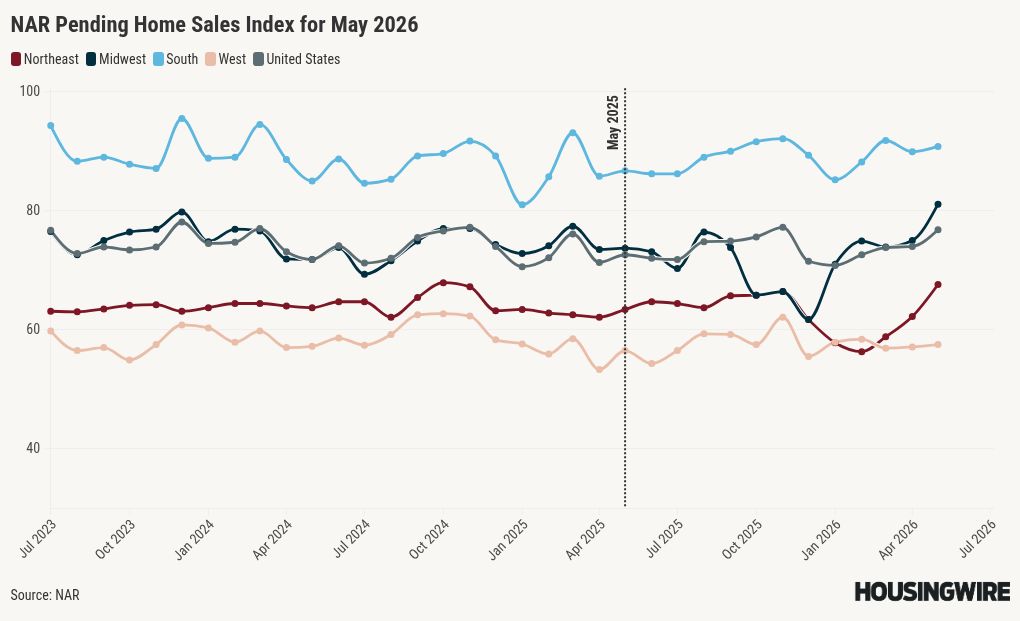
Currently, the sales pace is the constraint. Our production machine has been kept on life support by BTR and brief bursts of spec-home optimism, but without tools to test its capacity, we’ll have no idea what it can produce when sales return. We’ll likely still believe we’re constrained by sales when we reach the maximum capacity our neglected machine can handle.

Our industry’s approaches to addressing the labor constraint are genuinely unique, creative, and inspiring. But we should bring that spirit of innovation to the intermediate steps we can tackle now.

This post was originally published on here

Founded by Jack Perry and his two sons, Michael and John Perry, the Utah-based Perry Group, brokered by The Real Brokerage, has grown significantly from the team’s humble beginning. In 2025, the team was made up of 250 licensed real estate professionals with five offices serving clients across much of Utah. In total, the team closed 1,547 transaction sides, totaling $892.80 million in sales volume, earning the enterprise-sized team the No. 8 and No. 5 ranks in the country by sides and volume, respectively, in the 2026 RealTrends Verified The Thousand rankings. 

“They grew the team pretty organically by inviting friends and family to get involved with real estate with them,” Emily Martin, the COO of The Perry Group, said. 

According to Martin, organic growth is still one of the team’s primary sources of expansion, as agents continue to invite their friends and other professionals in the industry to join The Perry Group.

Keys to organic growth success

Martin said one of the reasons the team works so well for so many agents is that they have clear systems agents can easily plug into.

“They can run their business without having to think about the operational side,” Martin said. “We help agents do what they do best, which is connect with people.”

The team provides agents with everything from an in-house marketing team to technology to lead generation services through Zillow’s lead referral programs. 

“Overall, there is a lot of value that our team provides for agents, and we have always focused on making sure we are providing things that are relevant for agents and on the cutting edge of technology and strategy,” she said. 

Culture is key

Beyond the team’s systems and technology, Martin said the team’s collaborative culture also helps their agents thrive. 

“Within The Perry Group, our agents are very willing to share ideas and strategies, what is working and what isn’t and we all work to help agents refine their businesses,” Martin said. “Really, I think the biggest thing for us is just making sure that our agents are happy, productive and see value in the team because if they are, we are going to continue to grow because they are going to invite more people to join.” 

Working to maintain this culture across such a wide agent base, Martin said, is not a simple task, noting that each office within the team has its own unique internal culture. 

“Our three business owners, Michael, Jack and John, are all very involved in the business and interact with our agents regularly, so they are getting that real-time feedback and they know what our agents need and want to see in ways the team could be providing them more value,” Martin said. 

Boo Maddox, the team’s president, added that as the team has grown over the past few years, adding more and more offices, they are actively working to figure out how much autonomy each office should have and how much they want things done “The Perry Group way.” 

“Even though we are a team, we are looking at how we integrate each other into other offices,” Maddox said. “Hopefully if you talk to us in a year this is something we have made some progress on because the team is so different than it was a few years ago.” 

Vision for the future

Looking ahead, Martin said the team is aiming for 2,000 transaction sides in 2026 and they are on track to hit that goal.  

“We have been growing consistently over the past three years. I was on a call a few months back with one of our well-respected coaches, and we were wondering if this was a fluke. He said that this is not happening by accident. We have the systems in place for the growth, and I think Jack Perry has really been a great driver of that growth, pushing his sons and pushing us to find ways to make things work, trust the opportunities and create something that makes people want to raise their hand and join,” Martin said.

This post was originally published on here

A block in Greenwich Village has been co-named in honor of legendary guitarist Jimi Hendrix, paying tribute to the street where he built the historic Electric Lady Studios. After a major snowstorm forced the ceremony in February to be rescheduled, part of West 8th Street was officially co-named “Jimi Hendrix Way” on Wednesday, marking the culmination of a decades-long effort by family members and supporters. The honor recognizes Hendrix’s connection to Electric Lady Studios, which he commissioned in 1968 and opened in 1970, just months before his death at age 27, and which remains one of the most influential recording studios in the world.

Credit: Gerardo Romo / NYC Council Media Unit on Flickr

The co-naming was spearheaded by Council Member Harvey Epstein, Experience Hendrix, L.L.C.—the Hendrix family-owned company led by Jimi Hendrix’s sister, Janie Hendrix—and guitarist and writer Jeff Slate. Other attendees included Eddie Kramer, Hendrix’s engineer and producer; Living Colour guitarist Vernon Reid; and songwriter Valerie Simpson.

Hendrix commissioned Electric Lady Studios so he and his collaborators would not have to pay hourly rates for recording time and could work without time restrictions. However, as is natural in the life of a touring musician, Hendrix spent a lot of time away, requiring the studio to be rented out “so the mortgage could be paid,” Janie Hendrix told the New York Times.

After Hendrix’s untimely death, his estate sold the studio in 1977, according to the Wall Street Journal. It went on to host many of the era’s biggest artists, including Stevie Wonder, who recorded much of his “classic period” albums there, as well as Led Zeppelin and Carly Simon.

In the early 2000s, the studio faced financial difficulties and nearly closed before changing ownership in 2005 and undergoing a major modernization. It has since re-emerged as one of the world’s most sought-after recording studios, used by artists including Taylor Swift and Olivia Rodrigo.

Credit: Gerardo Romo / NYC Council Media Unit on Flickr

According to Janie Hendrix, the effort to co-name the street has been years in the making. She told the Times that her family began working towards recognizing the artist “soon after Jimi passed away.”

She also said that Electric Lady Studios once displayed a petition urging supporters to “Name this street after Jimi,” but it seemed to “go nowhere.” Advocates also tried to get Jimi’s face on a stamp, which was ultimately issued in 2014.

Temporary co-naming signage was installed in 2024, but “political changes” delayed the process of making the designation permanent, according to Noise 11.

“We are proud to honor the legacy of Jimi Hendrix today,” Epstein said. “Our district has long been a hub of culture, the arts, and activism, and Jimi Hendrix embodied all of those ideals. He was not only a groundbreaking musician but also a powerful voice for peace, racial equity, and social justice.”

Epstein added: “He revolutionized music in this neighborhood, and it is only fitting that these streets now carry his name.”

The event also marked the public launch of TeachRock, a new national education partnership founded by Stevie Van Zandt, known as a member of Bruce Springsteen’s E Street Band and his role as Silvio Dante on “The Sopranos.”

Van Zandt recorded the anti-apartheid benefit single “Sun City” at Electric Lady Studios in the 1980s, featuring artists including Springsteen, Bono, Bob Dylan, Bonnie Raitt, Lou Reed, Keith Richards, and Run-DMC, according to the Times.

TeachRock is expanding its library of more than 500 free, standards-aligned lessons that use music and pop culture to teach history, social studies, language arts, and other subjects. The partnership also includes a new multimedia Hendrix curriculum for middle and high school students.

“Jimi Hendrix didn’t just play guitar, he reimagined what art could be,” Van Zandt said. “With TeachRock, we want students to experience that same sense of possibility and discovery that so many of us felt the first time we heard Jimi. His story, lyrics, and sound remind young people that creativity has no limits.”

RELATED:

The post Greenwich Village block co-named for Jimi Hendrix first appeared on 6sqft.

This post was originally published here

On our weekly Monday coaching call, an agent brought up a deal she had just lost. The buyer picked their own inspector. The inspector wrote a report so thick and dramatic that the buyer never even tried to negotiate the repairs. They walked. The contract was gone before lunch.

She asked me, “How do we prepare buyers so this stops happening?”

The fix is not in the inspector. The fix is in the conversation you have before the inspector ever shows up.

Plant the picture before the page lands

Here is the truth almost no agent says out loud. Home inspectors get paid $500 to $600 to walk a house with a flashlight and a clipboard. If they hand the buyer a one-page report that says, “Everything looks fine,” the buyer feels robbed. They feel like they paid $600 for nothing. So, many inspectors have learned, that thicker the report, the better. The fee gets justified by the page count. The result is a document that reads like the house is one strong breeze away from collapse, when in reality the house is fine.

That is the trap your buyers might walk into. They open a 50-page binder, and they panic. They were not warned. They were not prepared. They were not handed the picture in advance.

My suggestion? Here is the conversation you must have with every buyer, before every inspection, on every house. Do this even when you know the house is in great shape. This will save you more transactions from falling through than any other single dialog I teach.

The pre-inspection script

Sit down with them. Use their names. Then deliver this, calmly:

“Mr. and Mrs. Hunna Hunna, before your inspector walks through the door tomorrow, let me give you a little coaching. As far as I know, there is nothing wrong with this house. The sellers have not disclosed anything that concerns me. But, your inspector is probably going to find something. They are going to find a lot of somethings. Here’s why:

When you pay an inspector $600, and they hand you a single page that says the house is fine, you feel ripped off. You think you wasted the money. So, many inspectors have learned to justify their fee by handing you a book of issues. They are going to write down the paint smudge on the baseboard upstairs. They are going to write down the closet door that sticks. They are going to write down the back window that needs a little extra force to close. They are going to take photographs of all of it.

I want you to expect War and Peace. I want you to expect a doorstop. I want you to picture one of those auto repair manuals at the parts store, like those giant binders mechanics used to use. That is what I want you to imagine.

Now when you get the final report, we will sit down together, pull out the items that actually matter, and bring those calmly to the seller, if there are any items that need addressing.”

That is the whole conversation. Three minutes. And it changes everything.

Deliver this with humor. Not jokes, but with a smile in your voice. The lighter you are about it, the more permission you give them to feel calm. The agent who asked the question on the call said it best when we finished talking through it. Doing it with humor really makes a difference, because it gets everybody on the same page. That is the goal. Everyone calm and on the same page. Now we can do the work.

The quick implementation checklist

If you skim nothing else in this piece, run this play on every deal:

  1. Schedule the conversation before the inspector arrives. Not after. Before. The picture has to land first.
  2. Plant a bigger image than reality. Say “War and Peace” out loud. Say “auto repair manual.” Make the report they imagine larger than the report they will actually get so when they actually get it, their first reaction should be, “Oh, this is not that bad.”
  3. Predict the trivial findings out loud. Paint smudges, sticky doors, stiff windows. When those exact items show up in the report, the buyer trusts you more, not less.
  4. Promise a debrief. Tell them you will sit down together, separate the cosmetic from the structural, and bring the real items to the seller calmly.

Powerfact: The fee justifies the thickness. Your conversation justifies the calm.

After the binder lands

When the report actually arrives, do the work you promised. Sit with your buyer at a kitchen table or a coffee shop or a screen share. Open the report together. Sort the cosmetic from the structural. The trivial items stay on your side and never go to the seller. The structural issues, the safety items, the costly repairs go to the seller with a clear ask and a clear reason. Calm voice. Specific request. No drama.

Some of what the report flags will be real. There will be a few legitimate items that deserve attention. When that happens, do not minimize them. Do not gloss over them. Bring them to the seller with a clear ask and a clear reason. The framing protects the relationship. It does not erase the work. The framing makes the work possible.

The reason this matters goes deeper than one inspection report. The work we do is largely emotional. We are guiding human beings through what is often the largest financial decision of their lives, on a compressed timeline, with strangers, with money on the line. Fear is the deal killer. Not the inspector. Not the repairs. The fear.

Our job as professionals is to take fear off the table before it ever arrives. Plant the picture. Pre-frame the moment. Walk in with calm. Be the steady voice they hear when the binder lands.

Set the frame before the report opens, and the report has a much harder time killing the deal.

Serve, don’t sell. Coach, don’t close.

Darryl Davis, CSP, has spoken to, trained, and coached more than 600,000 real estate professionals around the globe. He is a bestselling author for McGraw-Hill Publishing, and his book, How to Become a Power Agent in Real Estate, tops Amazon’s charts for most sold book to real estate agents.

This column does not necessarily reflect the opinion of HousingWire’s editorial department and its owners.

To contact the editor responsible for this piece: tracey@hwmedia.com

This post was originally published on here

OneTrust Home Loans is suing competitors E Mortgage Capital (EMC) and United Wholesale Mortgage (UWM), along with 31 former employees of a former Arizona division, alleging a coordinated scheme to poach staff, steal trade secrets and divert more than $31 million in loan volume.

The complaint by OneTrust — a d/b/a for CalCon Mutual Mortgage — accuses the defendants of secretly funneling borrower information and loan opportunities to EMC and UWM while still employed by OneTrust.

The lawsuit, filed June 4 in a U.S. district court in Arizona, alleges that the defendants “improperly obtained and exploited the benefit of CalCon’s employees, borrower information, loan opportunities, confidential information, trade secrets, goodwill and business infrastructure for Defendants’ own financial gain.”

As of March 12, 2024, the departing group had successfully solicited at least 79 loans away from OneTrust, representing an aggregate loan volume of just over $31 million, the lawsuit shows. 

In a statement on Thursday to HousingWire, a spokesperson for EMC said the company has a “clear and firm policy,” in which new employees cannot bring leads, borrower information or any loan opportunities that belong to a former employer. EMC said the number of defendants in the lawsuit “is telling in itself,” it is confident in its position and will address the claims through the legal process.

“That policy is non-negotiable and is something we enforce without exception,” the EMC spokesperson said. “The individuals named joined E Mortgage Capital after concluding their employment elsewhere. Any conduct alleged to have occurred prior to or during their departure from their former employer is not something E Mortgage Capital directed, participated in, or had knowledge of.”

A spokesperson for UWM said the claims “are without merit” and the lender will “vigorously defend against them to the fullest extent permitted by law.”

The claims

The alleged misconduct came to light following a separate legal dispute. In mid-2025, former employees demanded arbitration against the lender under the Fair Labor Standards Act. In November 2025, OneTrust filed counterclaims. 

The discovery process yielded about five terabytes of electronically stored information — including internal emails and Microsoft Teams chats — which the lender claims exposed the secret loan diversion scheme in 2026.

A central element of the alleged scheme involved the unauthorized use of the third-party point-of-sale platform Floify. According to the lawsuit, the Arizona team was instructed to use OneTrust’s authorized systems, including Blend. Instead, the employees allegedly used Floify and personal email domains to covertly process borrower leads outside of OneTrust’s visibility, redirecting them to UWM and EMC.

The Arizona division was led by former senior vice president Tim Potempa, who joined OneTrust in February 2022. Potempa — a top-ranked U.S. loan office that originated about $231 million last year, per HousingWire Mortgage Rankings — departed the Dallas-based multichannel lender for EMC in early 2024, bringing a 40-person team and more than $300 million in annual production.

Potempa left EMC after over a year to join CrossCountry Mortgage in August 2025. He did not immediately reply to a request for comments.

OneTrust alleges that Potempa and other division leaders began engaging in “coordinated efforts” in late 2023 to transition the pipeline and personnel away from the company, despite employment contracts strictly prohibiting the solicitation of OneTrust employees for 18 months following their departure. Arizona division leaders also allegedly downloaded company trade secrets — including pricing models, vendor fees and internal cost allocations — to use at EMC.

The lawsuit also points the finger directly at UWM. OneTrust alleges the wholesale giant received and funded the loans despite knowing it did not have a brokerage relationship with OneTrust. 

The complaint claims UWM was “willfully blind” to the fact that the loan opportunities originated from OneTrust personnel and systems, and were being actively redirected for the benefit of EMC and UWM.

OneTrust is seeking damages on multiple counts, including misappropriation of trade secrets, violation of the Computer Fraud and Abuse Act (CFAA), breach of fiduciary duty, tortious interference with contractual relations and business expectancies, civil conspiracy and unjust enrichment.

This post was originally published on here

America has made a promise to its veterans. Their service will be honored not just in words, but in how they live long after they return home. Yet much of the national conversation around veteran housing remains focused on homelessness and affordability, while less attention is paid to whether aging veterans can safely remain in the homes they already have. 

Across the country, many veterans are living in homes that no longer meet their physical needs. Without the ability or financial resources to make essential repairs or accessibility modifications, veterans may be forced out of otherwise stable housing. 

If policymakers want to address housing instability more comprehensively, they must expand the definition of “housing policy” to include preservation, accessibility and aging in place. 

The reality of changing needs

According to a 2023 AARP survey, most veterans say it is important to remain in their homes if they need long-term care. Yet more than a quarter say they would need financial assistance to make that possible. Among veterans age 45 and older, nearly half report needing bathroom modifications. These are not cosmetic improvements. They are modifications that can affect whether someone is able to live safely and independently at home. 

For veterans living with mobility challenges or service-connected disabilities, unmet repair and accessibility needs can make everyday living much more difficult. Homes that lack accessibility features or are deteriorating may no longer meet residents’ physical needs as they age, placing additional pressure on families, caregivers, healthcare providers and local support systems. 

Redefining housing stability policy

Remaining safely at home over time should be treated as a core component of housing stability policy. When nearly half of veterans over age 45 report needing modifications to something as essential as a bathroom, it points to a disconnect between housing policy and the realities many veterans face. 

Much of the current policy conversation remains focused on housing supply and affordability, but long-term housing stability depends on whether people can continue living safely in their homes as their needs change over time. 

Federal, state and local policymakers who place greater emphasis on housing preservation strategies will help veterans remain safely housed – strategies like expanding support for Veterans Administration housing adaptation grants, supporting home repair and accessibility programs and encouraging states and municipalities to incorporate aging-in-place considerations into broader housing policy and planning efforts. 

Policymakers could also explore stronger coordination between housing and healthcare systems. Medicare and Medicaid programs, for example, may be able to play a larger role in supporting preventive home modifications tied to health and safety needs by identifying housing-related risks earlier and connecting veterans with available assistance before challenges become severe. 

Straightforward solutions for long-term stability

In many cases, the solutions are relatively straightforward: install grab bars and accessibility ramps, widen doorways, improve lighting or repair essential home systems such as heating, plumbing and roofing. These types of modifications can help make homes safer and more functional for aging residents and people living with disabilities.

Identifying strategic, aging-in-place solutions does not diminish the importance of addressing homelessness or affordability. But focusing only on those issues overlooks a significant portion of veterans. They may not be severely cost-burdened, but they are often one preventable barrier away from losing the stability they have worked so hard to maintain. 

At its core, this issue is about whether housing policy fully accounts for the long-term needs of veterans as they age. It is about whether we honor service in a way that is tangible and sustained, and whether we ensure veterans are not only housed, but able to live safely, independently and with dignity in the homes they already have. 

Maureen Carlson is President and CEO of Rebuilding Together
This column does not necessarily reflect the opinion of HousingWire’s editorial department and its owners. To contact the editor responsible for this piece: zeb@hwmedia.com.

This post was originally published on here

For decades, the homebuying journey followed a relatively predictable path. Buyers would visit communities, meet with sales representatives to gather information and gradually move toward a purchase decision. Today, that process looks dramatically different.

Modern homebuyers move fluidly between websites, online reviews, virtual conversations, social media content, mortgage research and in-person model visits. They may spend weeks or even months researching builders, floor plans and school districts. While buyers have more information than ever before, they also face a growing challenge: information overload.

As builders work to improve their homebuilder sales strategy in a competitive housing market, many are discovering that success is no longer determined solely by generating more leads. Instead, the opportunity lies in creating a more connected and consistent omnichannel homebuyer experience that guides customers through an increasingly complex decision-making process.

The homebuyer journey is no longer linear

Historically, builders operated around a relatively structured sales funnel. Buyers entered the process, progressed through a series of steps and eventually reached a purchase decision. Today’s buyers rarely follow that path.

They often move between multiple builders, conduct extensive online research and consume enormous amounts of information before engaging directly with a sales team. In many cases, buyers arrive at a model home having already narrowed their options and formed preliminary opinions about the builders they are considering. This shift has fundamentally changed how builders must think about customer engagement.

The challenge is no longer simply providing information. Buyers already have access to floor plans, pricing details, community information and reviews. The challenge is helping buyers make sense of that information and confidently move toward a decision.

Builders that recognize this shift are increasingly focusing on creating seamless experiences across every customer touchpoint rather than treating each interaction as a separate event.

Why homebuilder sales continuity matters more than ever

One of the biggest obstacles facing builders today is the lack of continuity across sales and marketing channels. Many organizations still operate with separate teams, with work spread out in silos between:

  • Marketing
  • Online sales
  • Mortgage conversations
  • Model home interactions
  • Design center appointments
  • Customer care functions

While these teams may perform their individual roles effectively, the buyer often experiences them as disconnected departments rather than a unified brand. From the buyer’s perspective, this can feel frustrating.

Customers frequently find themselves repeating the same information multiple times as they move through the process. Questions already answered online must be answered again during virtual consultations and repeated once more during in-person visits. The result is a lack of what many sales leaders describe as contextual intelligence: the ability for every team member interacting with a buyer to understand that buyer’s goals, concerns and previous interactions.

When information flows seamlessly between teams, buyers feel understood. When it does not, confidence begins to erode. In an environment where trust plays a significant role in purchasing decisions, reducing these points of friction can directly impact homebuilder conversion rates. When buyers feel understood and supported throughout the process, they are more likely to move confidently toward a purchase decision.

Transforming the website into a digital salesperson

The role of the builder website is also evolving. For years, builder websites operated on an outdated model, primarily serving as digital brochures. Their purpose was to display communities, floor plans and contact information.

Modern builders are increasingly treating their websites as 24-hour sales professionals capable of educating, engaging and supporting buyers throughout the research process. This requires a different mindset.

Buyers expect websites to educate, guide and answer questions. Rather than simply presenting information, websites should help buyers understand the builder’s processes, warranty programs, construction standards and overall customer experience.

Every digital interaction should reinforce the builder’s value proposition and help establish trust before a direct conversation ever occurs. As virtual engagement tools continue to mature, websites are becoming a critical foundation of the broader omnichannel homebuyer experience.

Moving from qualification to consultation

The growing sophistication of today’s buyers is also changing the role of sales professionals. Traditionally, many builder sales processes focused heavily on qualification. The goal was to determine whether a prospect was ready and capable of purchasing a home. While qualification remains important, leading builders are shifting toward a more consultative approach.

Today’s buyers need guidance before they need qualification. Most buyers are not experts in homebuilding, financing or community selection. Even after conducting extensive research, many still need guidance in navigating the process and evaluating their options. Trust is built through consultation, not interrogation.

Builders who position their teams as advisors rather than gatekeepers often create stronger customer relationships and better long-term sales outcomes.

The new role of the on-site sales professional

By the time many buyers arrive at a model home, many times much of the traditional sales process has already occurred. They have reviewed floor plans, explored communities and compared multiple builders online. In many cases, they have already identified a shortlist of preferred options. This means sales professionals must adapt.

The days of simply presenting information are fading. Buyers often need help interpreting information rather than acquiring it. Successful sales teams are becoming skilled at discovery and interpretation. Instead of leading with presentations, they focus on understanding the buyer’s goals, concerns and decision-making process.

Rather than seeking additional data, customers are looking for a sense of certainty. The most effective sales conversations help buyers connect the information they have already gathered with the personal decisions they need to make for their families. In this environment, sales professionals become guides who help buyers navigate complexity rather than simply providing additional details.

Building an omnichannel homebuyer experience without overhauling everything

One of the biggest misconceptions surrounding omnichannel engagement is that it requires a major technology overhaul. In reality, successful implementation often starts with process alignment rather than new tools.

Builders can begin by asking three simple questions:

  1. What information is collected at each stage of the buyer journey?
  2. How effectively is that information shared across teams?
  3. Where are buyers being forced to repeat themselves?

These questions often reveal gaps that create friction throughout the customer experience. The goal is not necessarily to add more technology. The goal is to create greater continuity between existing touchpoints. Every interaction should build upon the previous one.

Whether a buyer moves from a website to an online sales representative, from a virtual meeting to a model home visit or from a mortgage conversation to a design center appointment, the experience should feel connected and consistent. When continuity increases, buyer confidence tends to increase as well.

Conclusion: The future belongs to connected brands

As builders look ahead, the most successful organizations may not be those generating the largest volume of leads. Instead, they may be the ones creating the most connected customer experiences. Buyers do not experience marketing, online sales, mortgage services and model homes as separate departments. They experience a single brand.

Every interaction shapes their perception of the brand and influences whether they feel confident moving forward. The builders that thrive in the next phase of home sales will be those that prioritize homebuilder sales continuity, create a connected omnichannel homebuyer experience and align every touchpoint around a consistent homebuilder sales strategy.

In a market defined by abundant information and evolving consumer expectations, continuity is becoming more than an operational goal. It is becoming a competitive advantage.

Click Here

This post was originally published on here

Stylecraft Builders, a second-generation-led Texas homebuilder more than four decades in the making, is not letting homebuilding’s underwhelming 2026 Spring Selling Season go to waste. 

Nor, in spite of hesitant homebuyer demand plaguing many of Texas’ submarkets, has Stylecraft’s momentum slowed.

The homebuilder, which predominantly targets entry-level and move-up buyers outside of the major metro areas in the Lone Star State, ranked as the 19th fastest-growing homebuilder in HousingWire’s inaugural Homebuilder Rankings, growing sales volume 17.0% from 2024 to 2025. 

According to the rankings, the builder sold 973 homes for a combined $310 million in 2025, ranking it as the 38th-largest homebuilder by sales volume. This growth has carried into 2026, with the company expected to sell 1,100 to 1,200 homes this year, Stylecraft Builders CEO Doug French told HousingWire’s TBD

That growth reflects a model built over decades. The company, operating through a down cycle, has found recent success by balancing margin discipline with growth, carefully expanding into select markets, finding the right product niche and driving operational improvements such as substantially improved cycle times. 

Maturing into a homebuilder with 1,000 annual sales was a gradual journey that started with just one sale. 

Family history and growth

Stylecraft Builders was founded by Doug’s father, Randy French, in the early 1980s, initially focusing on custom homes. Growth in the early years was glacial – one home in the first year, two in the second, four in the third, and so forth. 

Despite launching during a challenging period marked by Texas’s oil downturn, the savings-and-loan crisis, and mortgage rates in the low-to-mid teens, the business steadily expanded over time.

“That wasn’t a great time to become a homebuilder. So the way that he says it is, it really forced you to be very, very disciplined, and you couldn’t have much fat, because if you did, you just weren’t going to make it,” French said. 

Starting in the Bryan-College Station market northeast of Austin, Randy noticed local builders often lacked sophistication in design and marketing, creating an opportunity to differentiate through better home designs and stronger sales and branding.

By the late 1980s and early 1990s, Stylecraft Builders identified an underserved market for entry-level production housing. While production builders were common in larger Texas metros, they were largely absent in Bryan-College Station at the time. 

Capitalizing on that gap, the company expanded into affordable, production-style homebuilding, which fueled more progressive growth. For a time, Stylecraft Builders operated in both custom and production homebuilding, but eventually they realized that the production side generated most of the profits with far fewer headaches, prompting a shift away from the custom end of the market. 

Doug joined the company in 2009, initially as Vice President before assuming the role of CEO in 2015. When he first started working with Stylecraft Builders, the company was delivering about 150 to 200 homes annually. Since then, there’s been steady growth and geographic expansion, with the company nearing 1,000 homes sold last year. 

Since 2020, Stylecraft Builders has expanded into the build-to-rent market, though BTR still accounts for less than 10% of its total home deliveries. While French loves the BTR business, he says that many other builders over the past several years have begun building rental homes, increasing competition. 

“Everybody’s kind of caught on to it. I wish it still were that hidden gem that it had been for so long, that no one else was really talking about,” he said. 

A dual-track approach 

As Stylecraft has expanded geographically, one of the biggest lessons that French learned has been balancing margins with volume. The company has historically been margin-focused and remains so, but French reports that some pockets of Texas are much weaker or stronger than others.

Therefore, each submarket and each community make up a patchwork that requires a tailored approach that maintains a solid sales pace, even if gross margins compress. 

In certain overbuilt markets where demand has been weaker of late, this strategy means giving up some margin until sunnier skies return. In others, where conditions are stronger, this may mean holding the line on margins. 

“There are pockets of strength and pockets of weakness. If you’re in those pockets of strength, you’re fine. And fortunately for us, we have more pockets of strength than pockets of weakness right now. In the places that are strong, we’re continuing to be margin-focused. In the places that are a little weaker, we’re not margin-focused right now, and we just know those markets are going to come back. We’re a believer in Texas overall,” French said. 

French emphasized the importance of generating sales in any market environment. He views that as a critical asset, arguing that builders who fail to adjust pricing and incentives during downturns risk leaving unsold inventory on the market for too long. 

Maintaining this flexibility has been key to Stylecraft Builders’ growth over the last several quarters. 

“We’re now at a size and scope and scale to where, if we want to go play at this level, we’ve also got to learn some new skills. And that skill is, how do you move houses, regardless of how good the market is or how bad the market is,” French explained.  

Geographic diversity and selective expansion

Geographic diversification has also helped fuel the company’s expansion. Many Texas markets remain strong, while others remain overbuilt in the wake of the post-COVID-era building boom. Stylecraft Builders has deliberately avoided these most overbuilt areas. 

French pointed to Stylecraft’s decision to exit the Houston metro two to three years ago as a key example of the company’s disciplined approach, noting that many of the deals in peripheral suburbs outside of the Houston area that his team previously evaluated and passed on are now struggling. While the peripheral suburbs still show strong growth, so many public builders have entered the market that it is hard to compete. 

For now, the company’s growth strategy centers on expanding into underserved markets with strong long-term fundamentals, rather than into markets with excessive competition, particularly from large numbers of public builders. 

“There are so many markets that are underserved. Why go to one that’s overrun?” French said. “We’re not scared of publics. We build with Lennar and Dr. Horton all the time, but what I don’t like doing is being one of 20. We’ve always kind of had almost a little bit of a counterintuitive approach.”

Finding the right product niche

Stylecraft builds a mix of attached and detached homes, mainly between the low $200s and the high $400s. The company has long focused on design differentiation, with distinct color palettes, more distinctive exterior and interior design elements, and an overall style that feels less standardized than what you typically see in production homebuilding.

As entry-level buyers continue to feel the affordability squeeze, French shared that Stylecraft’s entry-level townhome product is performing quite well and that first-time buyers, at the right price, are willing to make some trade-offs for affordability.

Two-bedroom townhomes in select Stylecraft Communities start at about $200,000. This is a popular product, but the company’s ability to deliver an entry-level townhome at this price primarily hinges on disciplined cost design. 

To lower the price, they concentrate on building quality into high-impact areas like kitchens and finishes, while shrinking overall space and removing some less essential features. 

Buyers at the entry-level price point are generally willing to make trade-offs in size and extra features as long as the home is affordable and still feels well finished in the key living areas. Common trade-offs include smaller square footage, fewer bathrooms, no garages and smaller lot sizes, as well as a simplified layout with more compact rooms. 

However, buyers are much less willing to compromise on higher-impact areas of the home, like kitchens. The core finishes still need to feel modern and high-quality, even if the spaces are more compact. 

The goal of this balanced approach is to deliver a home with strong perceived value from both an affordability and a features standpoint. This strategy has worked well for Stylecraft, French said, and plays into some of the growth the company has experienced despite operating in a down cycle. 

The key is finding the right combination of cost-cutting measures that deliver an affordably priced home that buyers still want.

“You’ve got to get your price point down far enough. If we have a townhome selling right across the street from a single-family home, we have to be $40,000 or $50,000 below that. We know that in order to move that product, you’ve got to be able to accomplish that, and if you can’t accomplish that, it’s just not going to work,” French explained. 

Slashing cycle times

French said that one major operational improvement has been a reduction in cycle times. Since the beginning of 2026, Stylecraft Builders has reduced average cycle times by about 32 days year to date, a strong improvement that has enabled further growth. 

This improvement, however, isn’t the result of a single silver bullet or some fancy new technology. Instead, it’s the culmination of a broader, more disciplined approach. 

A major shift for Stylecraft came with the hire of a new vice president of construction, who raised the bar on execution. The new VP, Jordan York, brought a higher level of discipline, detail and accountability, while also providing the support needed to actually meet those expectations. 

This key hire, French explained, mattered immensely and improved the baseline of performance across the organization.

“When you have somebody who really believes you can get something done and is going to hold you accountable to that, and is also going to give you the support needed, you start believing in yourself. And once you start believing it yourself, you really start running,” French said. 

Many of the changes involved improved collaboration with the trades. Stylecraft began to take a closer look at scheduling, ensuring that trades aren’t overbooked, that they consistently stay on schedule, and that steps are taken to intervene when work starts to slip. 

When a trade is stretched too thin, French explained, Stylecraft works to address it. But he also noted the importance of moving on and having tough conversations with crews that aren’t performing to an adequate level. As part of this, the company became more intentional about working closely with back-office teams and analyzing where trades were helping or hurting cycle times, which informed which partners were best. 

“What I do want to say is, it’s not as simple as, if we have better trades, then we will build on time. That’s not a sentence I ever want anybody saying in our company. It always starts with us, and even if it is the trade, well, we’re the ones that hire them. At the end of the day, it all comes back to us, and we have to ultimately take that responsibility,” French said. 

This post was originally published on here

Mortgage rates jumped this week, mortgage buyer Freddie Mac said Thursday.

Freddie Mac’s latest Primary Mortgage Market Survey, released Thursday, showed the average rate on the benchmark 30-year fixed mortgage climbed to 6.52% from last week’s reading of 6.48%.

The average rate on a 30-year loan was 6.84% a year ago.

MORTGAGE RATES JUMP AS INFLATION FEARS, IRAN WAR WEIGH

“The 30-year fixed-rate mortgage averaged 6.52% this week,” Sam Khater, chief economist at Freddie Mac, said in a statement. 

“Stronger employment momentum has helped existing home sales reach a five-month high. Importantly, we’re seeing homebuyers look past the short-term rate fluctuations and actively enter the market, signaling renewed confidence in homeownership opportunities.”

FORECLOSURES HIT HIGHEST LEVEL IN 6 YEARS AS INSURANCE, PROPERTY TAX COSTS SQUEEZE HOMEOWNERS

The average rate on a 15-year fixed mortgage rose to 5.84% from last week’s reading of 5.79%.

The U.S. added 172,000 jobs in May, beating forecasts, while unemployment held steady at 4.3%. The strong report may lower hopes for near-term interest rate cuts, according to Realtor.com economist Jiyai Xu.

TRUMP ADMINISTRATION MAKES FANNIE, FREDDIE CHANGE IT SAYS WILL BENEFIT ‘TENS OF MILLIONS’ OF AMERICANS

The Labor Department also reported that the Consumer Price Index rose 4.2% year over year in May, the highest since April 2023. 

Core inflation, excluding food and energy, rose 2.9%, according to Realtor.com.

GET FOX BUSINESS ON THE GO BY CLICKING HERE

“What began as a question of when the Fed would cut rates has quietly shifted,” Xu said in a statement. “Ongoing global tensions and rising energy prices have prompted some to wonder whether a rate increase may be back on the table.”

This post was originally published here

Buffini & Company has added three senior executives — Steve Pacinelli as chief revenue officer, JB Bolton as chief operating officer and Ethan Beute as chief ambassador — as the coaching firm looks to scale its relationship-driven business model in an AI-focused market, the company announced earlier this month.

The appointments follow the April promotion of former BombBomb co-founder Darin Dawson to CEO and mark the latest step in a broader leadership overhaul at the North America-based real estate coaching and training company.

Buffini & Company, founded by Brian Buffini and known for its “Work by Referral” system, said the expanded executive team will focus on making it easier for real estate agents and brokerage leaders to run referral-based businesses while integrating modern technology, including AI tools.

Who is joining Buffini & Company

In his role as chief revenue officer, Pacinelli will oversee how customers discover, test and expand their use of Buffini programs, from podcasts and training to paid coaching. The company said he will be responsible for aligning client-facing sales and marketing around measurable outcomes for agents and brokers.

Pacinelli previously held leadership roles at BombBomb, Follow Up Boss and Zillow.

As chief operating officer, Bolton will be charged with integrating people, processes, technology and coaching delivery to improve performance and client results.

According to the announcement, Bolton brings more than 20 years of SaaS experience, including roles as senior vice president of operations, chief customer officer and chief revenue officer at BombBomb. Most recently, he ran Bolton Co., an executive coaching and advisory firm focused on leadership and customer experience.

In his role of chief ambassador, Beute will focus on amplifying client and community insights from Buffini’s global network of agents, coaches and brokerage partners. The company said his role includes content, events and other outreach designed to keep member feedback central to product and program decisions.

Beute is a Wall Street Journal bestselling co-author and former executive at Zillow Group and BombBomb. He has hosted nearly 500 podcast episodes and has spent more than a decade working with real estate professionals on using video and other tools to build “authentic connection,” according to the announcement

Leadership mandates

Buffini & Company said the three executives share a single mandate: make it “radically easier” for agents and brokerage leaders to operate relationship-based businesses at scale.

In April, Buffini & Company named Dawson as CEO and transitioned Brian Buffini to chairman. The new executive hires build on that shift in leadership as the company looks to extend the relevance of its referral system for the next phase of the housing cycle.

The company says Pacinelli will be responsible for ensuring growth initiatives do not erode agent trust, Bolton will focus on operational reliability of systems and experiences, and Beute will work to keep member outcomes and stories central to strategy.

This article was generated using HousingWire Automation and reviewed by a HousingWire editor before publication.

This post was originally published on here

New York state’s most sweeping reform of a 50-year-old environmental review law is on the books. Gov. Kathy Hochul secured the changes as part of the state budget, cutting red tape on housing construction.

Developers, municipalities and environmental advocates are watching to see how the law works in practice in the real world.

Rules still need to be written.

Overhauling the State Environmental Quality Review Act was a centerpiece of Hochul’s “Let Them Build” agenda to improve housing affordability by streamlining the permitting process. It came after extended budget negotiations delayed its passage.

The law exempts qualifying housing projects from environmental review for the first time since 1975. The Department of Environmental Conservation must update regulations and guidance to align with the statute. Lead agencies statewide must also retool internal review processes to meet new mandatory timelines.

New York’s move echoes a push already underway in California. Gov. Gavin Newsom signed a landmark law last July shielding apartment and residential projects from lengthy environmental review. Developers wasted no time securing exemptions, with some doing so within days of the law taking effect.

But California’s experience to date also stands as a warning. Removing environmental review as a delay tactic shifts the fight to city councils and courtrooms.

It has not, thus far, eliminated it.

Where the final law expanded on Hochul’s proposal

Hochul’s January executive budget proposed a 100-unit cap for housing projects outside New York City to qualify for automatic exemption. The enacted version raises that cap to 300 units in urbanized areas, covering most mid-size cities and suburbs statewide. Rural and non-urbanized areas keep the original 100-unit cap.

Housing advocates and suburban municipalities called that expansion a significant win. They had argued Hochul’s original threshold was too restrictive to accelerate production meaningfully.

“Modernizing SEQRA is an important step toward addressing New York’s housing affordability and supply challenges by reducing unnecessary delays and duplicative review requirements that increase costs and slow the development of critically needed housing across New York,” New York State Association of Realtors President Ron Garafalo said.

Where the legislature tightened the reins

The final law extends a previously-disturbed-land requirement to all housing projects statewide, including those in New York City. Hochul’s original proposal applied that condition only to projects outside the five boroughs. Environmental groups and state legislators argued the original approach left too much room for development on sensitive sites.

A childcare facilities exemption in Hochul’s executive budget was stripped from the final version. Hochul pitched the provision to speed construction of community infrastructure alongside housing. Lawmakers who wanted to limit the law’s scope secured its removal.

The final law establishes a 20-unit cap for areas with no local zoning, a guardrail absent from the original proposal. Critics had flagged that absence as a potential loophole in communities with limited land-use oversight.

What comes next

In New York City, the reforms intersect with an existing local layer: the City Environmental Quality Review process, known as CEQR. The state changes are statutory and preempt local law, but how the city’s lead agencies interpret the new exemptions alongside CEQR needs resolution.

The DEC has not announced a formal rulemaking timeline. Project sponsors and municipalities will navigate the new statute without a regulatory roadmap until it does.

“Moving forward, the New York State Department of Environmental Conservation may choose to promulgate implementing regulations or issue guidance to clarify certain provisions,” attorneys with Greenberg Traurig wrote in an analysis. “Until the agency issues such regulatory guidance, stakeholders and applicants should consider exercising caution when applying SEQRA’s new provisions to specific projects.”

This post was originally published on here

Rechat has expanded its platform to allow brokerages, teams, technology providers and vendors to build and deploy custom branded applications directly on top of its real estate operating system.

Custom app features are available immediately.

The initiative builds on work that began more than a year ago with companies including Douglas Elliman and SERHANT., which developed custom applications using Rechat’s infrastructure, leaders said.

More recently, Nest Realty has also utilized Rechat’s APIs and app platform to create custom solutions.

Developers can build custom interfaces that run directly within the platform’s environment. Applications remain hosted on the developer’s own servers while accessing Rechat’s data, workflows and interface components, including contact information, email tools, forms and other operational functions.

The company said this approach allows applications to appear and function as a native part of the Rechat platform while reducing development time and complexity.

“From day one, Rechat was architected as an operating system: one data model connecting CRM, marketing, design and transactions, with Lucy, our AI assistant, running across all of it, we didn’t bolt this on,” said Emil Sedgh, chief technology officer of Rechat. “That foundation is what lets a brokerage or a partnership create a production-grade app in weeks or months, not years. They build their idea; they don’t rebuild the infrastructure underneath it.”

This article was generated using HousingWire Automation and reviewed by a HousingWire editor before publication.

This post was originally published on here

On Tuesday, lawmakers in the U.S. House of Representatives introduced the Build American Efficiency Act, a bill designed to make it easier for homebuilders, manufacturers and HUD funding recipients to comply with Build America, Buy America (BABA) rules on federally backed housing projects.

BABA, enacted as part of the 2021 Infrastructure Investment and Jobs Act, requires that iron, steel, construction materials and manufactured products used in federally funded infrastructure and construction projects be produced in the United States. 

For developers and builders, those domestic sourcing mandates mainly affect HUD-supported and other federally assisted construction and rehabilitation projects. 

Rep. Lou Correa (D-CA) introduced the legislation on Tuesday with Real Estate Caucus co-chairs Reps. Mark Alford (R-Mo.) and Tracey Mann (R-KS)., along with Reps. Brad Finstad (R-MN) and Johnny Olszewski (D-MD), according to an announcement.

Homebuilders and developers have warned that BABA implementation can slow projects, add documentation costs and create uncertainty about product eligibility, particularly as HUD and other agencies finalize guidance. For developers relying on HUD programs or other federal funds, the ability to quickly prove materials compliance can be the difference between a viable capital stack and a stalled deal.

The Build American Efficiency Act would not change BABA’s underlying domestic content requirements. Instead, it focuses on how homebuilders and their suppliers can document compliance by doing the following:

  • Clarifying HUD authority: The legislation would confirm that the Secretary of Housing and Urban Development can recognize “auditable and verifiable” systems that document products meeting BABA domestic content rules.
  • Recognizing process standards: The bill would allow HUD to treat documentation generated under the Make It American Process Standard, or similar standards with auditable certification processes, as sufficient evidence of domestic content compliance.
  • Simplifying product selection: The text aims to help manufacturers, builders and funding recipients more easily identify which products satisfy BABA requirements, potentially reducing the need for one-off determinations.
  • Cutting paperwork and waivers: The policy reform seeks to reduce time spent on waiver requests, duplicative documentation and uncertainty over which products have been approved, which can delay starts and draws.
  • Maintaining flexibility: The legislation states that HUD cannot mandate the use of any single database and does not bar recipients from using other lawful methods to certify compliance.

“I am pleased to join my colleagues in introducing this bipartisan bill to speed up the building of new homes,” Correa said in an announcement, arguing that the bill would “cut red tape” while keeping requirements to use American-made construction materials.

Mann said the proposal is meant to help builders and manufacturers “navigate complicated federal compliance requirements without sacrificing our commitment to American-made products,” by allowing HUD to recognize systems that identify BABA-compliant materials and “reduce unnecessary delays” in getting homes built.

Alford said the bill clarifies that HUD can recognize auditable, verifiable databases such as the Make It American Process Standard to document compliant products, while emphasizing that it “does not mandate any database” but instead “gives builders better tools so we can build more American homes faster with American products.”

Why this matters for builders and developers

For production and infill builders that rely on HUD-assisted projects, tax-exempt bonds, HOME, CDBG or other federally sourced funds, BABA compliance has become a growing operational risk. The need to trace domestic content for thousands of SKUs, coordinate with manufacturers and respond to agency audits can slow procurement and add soft costs, particularly on multifamily and mixed-use projects.

If enacted as described, the Build American Efficiency Act could give HUD clearer authority to endorse third-party, auditable databases or process standards for documenting compliant materials. That could allow builders and their purchasing teams to rely more on pre-vetted product lists and standardized certifications instead of case-by-case paperwork.

For manufacturers that serve residential construction, inclusion in recognized BABA-compliant systems could become a competitive differentiator for winning business on HUD-backed and other federally assisted housing deals. At the same time, the bill’s flexibility language signals that builders could continue to use separate documentation paths if a particular product or supplier is not yet captured in a database.

The bill now heads to the House committee process, where homebuilding and manufacturing trade groups are likely to weigh in on how HUD should structure any recognized systems and how burdens are allocated among builders, suppliers and owners.

This post was originally published on here

President Donald Trump confirmed Thursday that Bill Pulte’s tenure as acting Director of National Intelligence (DNI) will be temporary. He announced on social media the nomination of Jay Clayton, U.S. Attorney for the Southern District of New York, to the permanent position.

“Few people anywhere in the Legal Community are respected at the level of Jay,” Trump wrote in a post on Truth Social. “I encourage the United States Senate to confirm Jay as soon as possible.”

Clayton is the former chairman of the Securities and Exchange Commission (SEC) and the former head of law firm Sullivan & Cromwell.

Pulte was appointed on June 2 to serve as acting DNI, stepping in after Tulsi Gabbard withdrew from the role. Pulte also serves as director of the Federal Housing Finance Agency (FHFA) and chairman of government-sponsored enterprises Fannie Mae and Freddie Mac.

But his appointment drew immediate criticism from Congress, and the DNI role traditionally requires Senate confirmation. Lawmakers quickly signaled that Pulte would face an uphill battle to secure approval for the permanent role.

On June 4, Senate Republicans and Democrats clashed over establishing guardrails for acting appointments. Sens. Bill Cassidy (R-La.), Susan Collins (R-Maine) and Lisa Murkowski (R-Alaska) joined Democrats in supporting an amendment to a budget reconciliation package that would bar Senate-confirmed agency heads from simultaneously performing the DNI role in an acting capacity. The amendment ultimately failed.

Following the pushback, Trump acknowledged the temporary nature of Pulte’s intelligence role, stating that he was “not going to be permanent” because “I don’t think he’d want to be permanent.”

Another sign of congressional resistance emerged when the House of Representatives rejected a proposal to extend Section 702 of the Foreign Intelligence Surveillance Act (FISA) on Thursday. Democrats refused to back the measure explicitly due to Pulte’s nomination.

Critics have pointed out that Pulte lacks a traditional intelligence or military background for a role that oversees the broader U.S. intelligence community. The DNI is responsible for coordinating roughly 20 agencies and advising senior government officials on critical national security threats, including terrorism, espionage, cyberattacks and foreign influence operations.

This post was originally published on here

Long before she became a real estate agent helping lead one of the nation’s top-performing small teams, Molly Horak was spending her days in an infant carrier beneath her mother’s desk.

The story has become part of The Horak Group’s family lore — and part of the reason the team’s connection to REMAX stretches back nearly four decades.

“I was in that pumpkin seat under the desk at another brokerage when [my mother] was doing board duty, desk duty,” Molly told HousingWire. “The owner came in and asked why a baby was here, said it wasn’t professional. She was in her early 20s, so what are you going to do? So, she went across the street to REMAX, and I ended up growing up in that office.

“They passed me and my sister around, and it was a very family atmosphere. My kids now have all worn little knit REMAX baby hoodies from the 1980s my mom had for us when we were little.”

Today, that family-centered approach remains a defining characteristic of The Horak Group, which operates under REMAX Boone Realty in Columbia, Missouri.

The three-agent team — Molly Horak, her mother Susan Horak and Jan Wertzberger — earned a No. 16 national ranking among small teams for transaction sides on RealTrends Verified’s 2026 rankings — closing 247 in 2025.

For Molly, the explanation for the team’s sustained success is straightforward.

“We do have longevity,” she said. “I think my mother started in 1984, 1985, somewhere around there,” she said. “We’ve all just been doing this for a very long time, and have routines set and know what we need to do. It takes a lot of late nights and weekends, but we just keep going and it’s what we’ve always done.”

Susan Horak founded the business and remains its leader, with Molly helping on day-to-day operations and Wertzberger having been with the group for 30 years.

Technology and people

Although the team consists of only three agents, it has continued to evolve with changing technology.

Molly remembers a time when marketing a listing required far more time than it does today.

“I remember starting off in the company in the graphics and marketing office,” she said. “It was so funny, because back then it took like six of us to do 10% of what we do now with two people. You had to build the website from nothing, and it felt like every single time you had a new listing it was this long process of getting everything put on there.

“The websites would crash if you had more than nine photos, because the internet just wasn’t what it is now, and the technology has just gotten so much better — so much faster.”

Despite advances in technology, the team’s investment philosophy has remained consistent.

“I don’t feel like we spend a ridiculous amount buying every new shiny thing,” Molly said. “But we do invest in people. We have a dedicated, full-time graphics and marketing [person]. It’s not always been the same person — but for probably 25 years, 30 years, we’ve just always had one because you need someone to run the website.”

That includes maintaining dedicated marketing support.

“We’ve always had a pretty decent listing volume [so] it’s never made sense to have someone where we had to wait on their schedule when we needed new photos, especially during the recession years,” Molly said. “When things were sitting on the market for a very long time, you have to send people out to retake photos when the season changes and there’s snow on the ground.”

Working with family

As The Horak Group hits 40 years in business, Molly believes the key to making a family business work is surprisingly simple.

“You’ve got to like each other,” she said. “I genuinely love working together. Frequently, we’ll be at the office till 8:30 at night or longer, just to get more done after the staff has left. Everybody goes home and then, all of a sudden, you get peak productivity. We work really well together then, or at any time.”

Still, she acknowledged that family partnerships aren’t for everyone.

“Not every parent-child relationship is right for that,” Molly said. “And you can’t try to force it when it’s not. We’ve just always had this family environment, and we really appreciated that about REMAX. My kids came to the office their first couple of years. When [my mother] got into real estate, back then, I think there was a higher concentration of men in real estate.

“It just wasn’t as normal to have a business be welcoming [to a woman who needed to bring kids to the office]. Now things are different, but REMAX was just so welcoming when it wasn’t what everyone did.”

For the Horaks, a family-friendly office that welcomed a baby in a pumpkin seat helped launch a real estate legacy that now ranks among the nation’s best.

This post was originally published on here

eXp World Holdings, Inc. has completed its corporate transformation to AGNT, Inc., including a formal name change and a move of its legal domicile from Delaware to Texas, the company announced Thursday.

The holding company for eXp Realty, NextHome, FrameVR.io and SUCCESS Enterprises now trades on Nasdaq under the AGNT ticker and will operate under the AGNT, Inc. name going forward. The shift follows the May 2026 adoption of the AGNT ticker and the addition of NextHome to the platform, which the company describes as a multi-model, agent-focused ecosystem spanning cloud brokerage, franchise and ancillary services.

Glenn Sanford, founder, chairman and CEO of AGNT, said the new corporate identity is intended to formalize the company’s longstanding strategy of building economic and technology models around independent real estate agents. At the brokerage level, eXp Realty CEO Leo Pareja pointed to the firm’s scale — it bills itself as the world’s largest independent brokerage — and said the AGNT structure is designed to give that agent-first mission “a permanent home” at the holding company level.

Redomestication to Texas

As part of the transformation, AGNT has completed its redomestication from Delaware to Texas. The move was recommended by a special committee of independent directors after a review process that lasted more than a year and was supported by outside counsel, according to the announcement. Shareholders approved the change at the company’s May 8, 2026, annual meeting.

The company said Texas law better matches its agent-driven business model because it expressly allows directors and officers to consider the interests of constituencies such as agents when exercising fiduciary duties. That framing is notable for broker-owners and shareholders watching how public real estate platforms navigate pressure to balance agent economics, profitability and litigation or regulatory risk.

This move comes despite New York State Comptroller Thomas DiNapoli, who is a trustee of the New York State Common Retirement Fund, an AGNT shareholder, calling on investors to block the firm’s attempt to move its place of incorporation to Texas. 

Critics of the firm claimed that it was trying to reincorporate to dodge allegations that the company and its executives enabled the drugging and rapes of women attending recruiting events. 

AGNT has repeatedly told HousingWire that it “has zero tolerance for abuse, harassment or misconduct of any kind — including by the independent real estate agents who use our services,” and that it believes the claims against Sanford and the firm “are without merit.”

In mid-April, an AGNT spokesperson told HousingWire that the decision to reincorporate in Texas reflected “the Board’s considered judgment about the long-term operational and governance interests of the company and its shareholders. “

“Any characterization of the timing as ‘suspect’ misrepresents a lengthy, good-faith process and a misunderstanding of the reincorporation impacts on existing litigation,” the spokesperson said. 

AGNT said it will continue to use its website, www.agntinc.com, Securities and Exchange Commission filings, press releases, calls, webcasts and social channels as primary outlets for investor information.

This article was written by Brooklee Han and generated with the assistance of HousingWire Automation, then reviewed by a HousingWire editor before publication.

This post was originally published on here

The Mortgage Bankers Association (MBA) is urging the mortgage industry to develop a unified framework for managing artificial intelligence as lenders increasingly deploy AI tools across origination, servicing and customer engagement.

In a white paper released Wednesday, the association said AI technologies are rapidly becoming embedded throughout the mortgage process, from customer service chatbots and fraud detection systems to underwriting and servicing operations.

The paper argues that while AI offers significant efficiency gains, the industry faces growing uncertainty about regulatory expectations and legal compliance.

The paper, prepared for the MBA by law firm Orrick, Herrington & Sutcliffe, examines how existing federal laws apply to AI-powered mortgage lending and outlines best practices for lenders that adopt the technology. It also provides an up-to-date overview of MBA members’ engagement and implementation around AI use and regulation, while also posing and analyzing key legal questions about the use of AI.

“AI’s assistance with — and, in some cases, performance of — a broader range of mortgage-related tasks raises novel questions about expectations for human involvement with AI models, as well as risk management more broadly,” the report explained.

SAFE Act ambiguity

MBA noted that mortgage companies are increasingly exploring generative AI, predictive AI and agentic AI systems, with many lenders already using AI-powered chatbots to answer simple questions or support servicing functions. But the paper also said that more advanced systems may soon be capable of handling nearly every stage of the mortgage process.

The association noted that while existing laws like the Secure and Fair Enforcement for Mortgage Licensing Act of 2008 (“SAFE Act”) exist to establish a nationwide licensing system and ensure loan originators are subject to regulatory oversight, the act does not answer whether mortgage companies can offer completely human-free loan originations.

“While it does require human MLOs to be licensed or registered (depending on the nature of their employment), the SAFE Act does not require AI tools to have their own MLO license or registration to engage in loan origination activities,” the report reads.

MBA argued that current federal disclosure requirements effectively require lenders to assign a human mortgage originator to every transaction. Under the Truth in Lending Act and Regulation Z, lenders must disclose the name and Nationwide Multistate Licensing System (NMLS) identification number of an individual loan officer associated with the loan.

The report recommends that lenders maintain a “human in the loop” approach, ensuring a licensed mortgage originator remains available to borrowers and participates in some level of oversight, even when AI performs substantial portions of the origination process.

MBA also warned that lenders could face risks under federal and state consumer protection laws if borrowers are led to believe a human loan officer is overseeing their application when the process is handled entirely by AI.

GSE guidance already in place

The white paper comes as regulators and investors have begun to address AI governance. Earlier this year, Freddie Mac updated its seller-servicer guide to include AI and machine learning governance requirements, while Fannie Mae issued guidance calling on lenders to establish policies and procedures that govern AI systems.

MBA said federal policymakers have provided limited guidance on how existing lending and consumer protection laws apply to AI-enabled mortgage processes. To address that uncertainty, the association is advocating for a principles-based AI risk management framework tailored to the mortgage industry. This would include standards for governance, model validation, fair lending tests, explainability, data privacy and vendor oversight.

MBA also encouraged lenders to implement robust testing programs to monitor AI systems for disparate treatment or disparate impact on protected groups and to maintain documentation showing compliance with fair lending requirements. The report identified several risks associated with AI adoption, including potential fair lending violations, bias in automated decision-making, improper steering of borrowers to certain loan products and consumer privacy concerns.

The association said lenders should prepare for evolving regulatory expectations while also engaging with lawmakers and regulators as states consider legislation governing AI use in financial services.

“The rapid adoption of AI across the mortgage industry presents both significant opportunities and complex legal and regulatory challenges,” the report concluded. “The absence of comprehensive federal and state guidance on AI in mortgage lending creates an imperative for the industry to develop and adopt a unified, principles-based risk management framework.”

This article was written by Sarah Wolak and generated with the assistance of HousingWire Automation, then reviewed by a HousingWire editor before publication.

This post was originally published on here

At an event in France, an eXp Realty agent who had relocated from Southern California pulled eXp Realty CEO Leo Pareja aside with a warning from the other side of the Atlantic.

“She goes, Leo, let me just tell you how horrible it is to sell real estate here,” Pareja said. “I have to go to eight different weeks, I have to go to the portals like SeLoger and all the other ones, and then I have to go to REMAX and KW and eXp, and that may get me 60% of the inventory, and then I have to call the local offices around the area the client is curious about. They may or may not call me back.”

Her conclusion was blunt: “It feels like 100 years compared to what we have in the U.S.”

For Pareja and NextHome CEO James Dwiggins, that is not just a cautionary tale. It is the future they are trying to avoid as consolidation accelerates, private listings expand and the industry’s long-standing system of shared listing data comes under pressure.

The two executives recently discussed eXp Realty’s acquisition of NextHome on the RealTrending podcast, but the conversation quickly moved beyond deal mechanics. To them, the tie-up is part of a larger fight over consumer access, listing distribution, artificial intelligence and the future structure of brokerage.

Pareja said consolidation in real estate is following a familiar historical pattern.

“If you look at American history, when industries start to consolidate, they tend to not stop, and so consolidation begets consolidation,” he said. “Industries that for decades were fragmented all of a sudden become consolidated.”

He compared the current moment to the airline industry and even the railroad consolidation of the late 1800s. For real estate, he said, the pressure is coming from a combination of national platforms, technology, industry downturns and capital.

For eXp, Pareja said, NextHome offered something different from a pure scale play.

“We were looking for a platform that was synergistic and complimentary, that didn’t cannibalize our business,” he said. “We recruited a total of 28 agents in 2025 away from them, right? So there was almost zero overlap.”

Dwiggins said NextHome’s leadership had reached similar conclusions about where the industry was headed.

“We built this business from the ground up, no investors, from a garage, mortgaged our houses and took all of our savings accounts to create the company,” he said. “We (James and co-CEO Keith Robinson) built this beautiful boutique franchise business.”

But, he added, the market was changing fast.

The private listings war

“We needed protection from a private listings war, which I unfortunately think is here and about to get accelerated,” Dwiggins said.

Private listings were a central concern for both executives. Dwiggins said they have a limited place in the market, but he believes they are being pushed far beyond that.

“I think private listings are a really bad thing for the industry,” he said. “It’s always been, in my opinion, something that should be used in a very small use case.”

He framed the issue around the seller’s interests. “Isn’t our job supposed to be about putting the seller’s interests forward?” Dwiggins said. “Did we forget who we actually work for in this process?”

Pareja said the North American MLS system remains one of the industry’s greatest advantages, especially compared with markets where portals dominate access to inventory.

“What makes North American real estate wonderful is we have MLS, and we also syndicate data to actual competitors that fiercely compete for those positions,” Pareja said. “Creating more distribution of our seller’s listings is better, and like, fight me on that one.”

That belief also underpins eXp’s deal with Google, HouseCanary and ComeHome. Pareja said the arrangement gives the brokerage more control over how its listings are distributed. “The fact that we are the ones sending the data via my state and the relationship with HouseCanary, that actually puts me in control to take it away if they go back on their word or we don’t like the position they take,” he said.

He also said scale matters in a fragmented environment. “NextHome could not have done the Google deal that we did, purely just because they didn’t have enough scale to do it,” Pareja said. “But now that we’re together, we went from 72,000 active listings to 80,000 active listings.”

Is AI a black swan event for the listing ecosystem?

Both executives argued that broader distribution is not only good for sellers, but necessary as search changes. Dwiggins said the home search experience remains outdated. “When you go to portals today, the search experience is basically the same as it’s been for, I don’t know, like 15 or 20 years — bedrooms, bathrooms, and square footage,” he said.

He said buyers want a more intuitive search experience, one that reflects how people actually think about where they want to live. “I want a pool, and I want to have it [on a] north-facing slope, and I want to have this, and I want to have that, and I want it to be this far from my favorite restaurants in downtown,” he said.

Pareja sees AI as a possible “black swan event” for the listing ecosystem. “There is a black swan event, which is that LLMs really get to understand every nook and cranny of any listing available,” he said.

If AI-powered search becomes the default consumer experience, Pareja said, brokerages need to think carefully about positioning. “What puts us in pole position if that statement is true?” he said. “Wouldn’t it be good to give the world’s biggest LLM all of our properties that are actively available for sale in real time?”

Leadership structure is moving too slowly

Still, both leaders said the industry’s leadership structure is moving too slowly. Pareja called it “an abdication of leadership.” Dwiggins was equally direct.

“There are too many unqualified people, and I say that as respectfully as possible, on boards making decisions that they’re not qualified to make,” he said. “That is the problem with organized real estate, from associations to MLSs all the way down.”

For broker-owners and agents, however, both executives said the answer is not to obsess over every technology headline. It is to return to relationships and value.

“In a hyper AI tech focus world, I think the human is going to be at a premium,” Pareja said. “I would obsess with relationships and value, and everything else is noise.”

Dwiggins agreed. “A human connection, I think, is going to be the most important thing to remember in an AI-based world,” he said. “This is an infrequent transaction that people do once every eight to 13 years. It’s not an Amazon package, it’s something that’s scary, it’s expensive.”

For Dwiggins, the industry’s future still rests on a simple question.

“If you wouldn’t do it with the sale of your own home, then don’t do it with other people,” he said.

Listen to the full RealTrending podcast.

This article was generated using HousingWire Automation and reviewed by a HousingWire editor before publication.

This post was originally published on here

U.S. foreclosure activity continued its gradual annual rise in May 2026 even as filings declined from April, according to ATTOM’s latest Foreclosure Market Report.

The report, released Thursday, found 40,355 properties with foreclosure filings — including default notices, scheduled auctions or bank repossessions. That was down 5% from April but up 14% from May 2025.

Foreclosure starts increased 13% year over year to 27,304, while completed foreclosures — or real estate-owned (REO) properties — rose 6% to 4,092. ATTOM CEO Rob Barber said in the company announcement that elevated mortgage rates, higher homeownership costs and ongoing affordability pressures are contributing to the increase even as foreclosure activity “remains well below historical norms.”

Where foreclosure risk is highest

Nationwide, one in every 3,562 housing units had a foreclosure filing in May. The states with the highest foreclosure rates were:

  • Florida: one in every 2,110 housing units
  • South Carolina: one in every 2,287 units
  • Maryland: one in every 2,369
  • Nevada: one in every 2,386
  • Indiana: one in every 2,516

Among metro areas with at least 2 million residents, Cleveland posted the highest rate, with one filing for every 1,524 housing units. It was followed by Baltimore (one in 1,804); Tampa (one in 1,878); Riverside, California (one in 1,980); and Orlando (one in 2,034).

For mortgage servicers, real estate investors and other market stakeholders, these state and metro-level rates highlight where distressed housing pipelines are thickening and where loss-mitigation or REO disposition resources may need to be rebalanced.

Texas, Florida and California lead in foreclosure starts

Lenders started foreclosures on 27,304 properties in May, down 4% from April but up 13% from a year earlier. The states with the highest number of foreclosure starts were:

  • Texas: 3,590 starts
  • Florida: 3,315 starts
  • California: 2,530 starts
  • Georgia: 1,161 starts
  • Illinois: 1,150 starts

Some midsized metros are moving in the opposite direction. Among markets with at least 200,000 people and at least 20 foreclosure starts, the largest year-over-year drops in May occurred in:

  • Santa Rosa, California (down from 93 starts in May 2025 to 21 in May 2026)
  • Honolulu (68 to 30)
  • Seattle (196 to 99)
  • Visalia, California (39 to 22)
  • Greeley, Colorado (78 to 45)

For lenders and servicers, higher starts in large states like Texas, Florida and California point to growing early-stage distressed pipelines. Conversely, sharp declines in select West Coast markets suggest local labor or affordability dynamics are improving relative to last year.

Completed foreclosures stay above 2025 levels

Lenders repossessed 4,092 properties through completed foreclosures in May, a 20% decline from April but a 6% increase from May 2025. The states with the most REO properties were:

  • Texas: 519 REOs
  • California: 427 REOs
  • Florida: 340 REOs
  • Illinois: 223 REOs
  • Michigan: 222 REOs

Among metros with more than 200,000 residents, the highest REO counts were in:

  • Chicago (204 REOs)
  • Detroit (124)
  • Houston (122)
  • Dallas (88)
  • New York City (84)

Elevated REO totals in large Midwest and Sun Belt markets point to steady inflows of distressed inventory for investors, fix-and-flip operators and single-family rental buyers, although volumes remain far below pre-2008 levels.

This article was generated using HousingWire Automation and reviewed by a HousingWire editor before publication. 

This post was originally published on here