Finding an apartment is getting a little more expensive again this summer, but renters are still in a better position than they were a year ago thanks to a record wave of new construction that continues to keep prices in check.

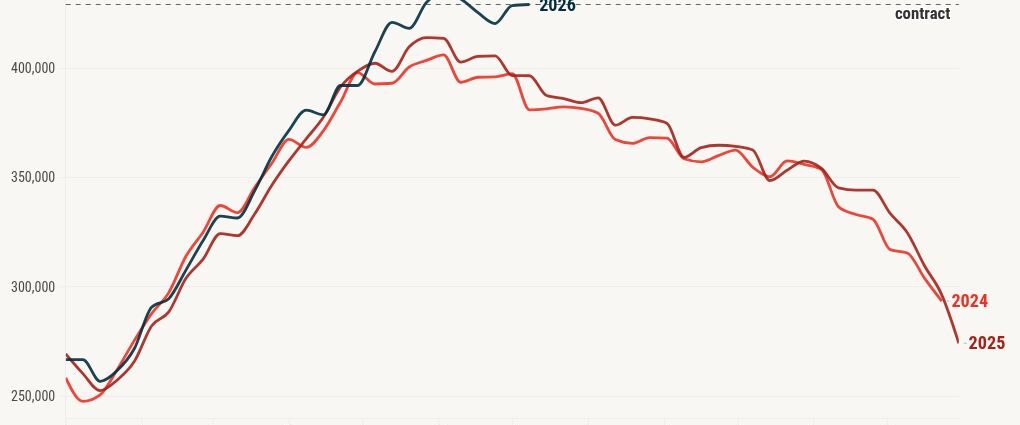
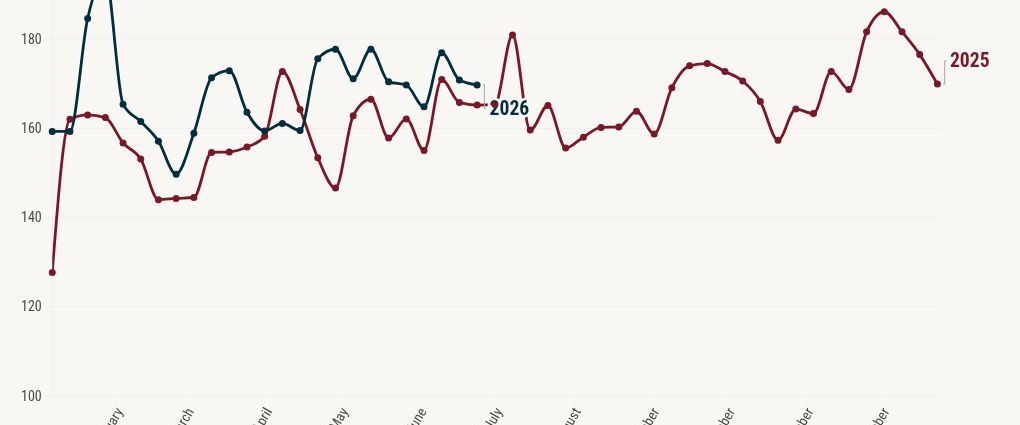
According to Apartment List’s July National Rent Report, released this week, the national median rent rose 0.4% in June to $1,385 per month, marking the fifth consecutive monthly increase. The report says the gain is typical for the busy summer moving season, when demand rises and landlords generally have greater pricing power.

Even so, the broader trend remains favorable for renters.

National median rent is still 1.2% lower than it was in June 2025, a decline of roughly $17 per month, and remains 4% below its mid-2022 peak, or about $57 less. Despite that easing, rents are still approximately 21% higher than they were at the start of 2021, reflecting the lasting impact of the pandemic housing boom.

The biggest reason prices have remained relatively soft is supply.

The apartment construction boom peaked in 2024, when developers delivered more than 600,000 new apartments in large multifamily buildings—the highest annual total since 1986. That unprecedented surge gave renters more choices and forced landlords to compete more aggressively for tenants.

Now the market is beginning to tighten.

Apartment List said the national multifamily vacancy rate stands at 7.2%. Vacancy reached a record high in February but has started to decline for the first time in more than four years, suggesting the large inventory of newly completed apartments is gradually being absorbed.

Apartments are also leasing a bit faster. Properties are now spending about 30 days on the market, one day less than in May.

The report also found that annual rent growth has improved for two straight months after reaching its weakest level on record in April, based on Apartment List’s data dating back to 2017. While rents remain lower than a year ago, those year-over-year declines are becoming smaller.

Housing conditions continue to vary widely across the country.

Among major metropolitan areas, San Antonio now has the softest rental market, with median rents down 5% from a year ago as Texas continues adding new apartment supply. Austin follows closely with rents down 4.3%.

At the opposite end of the spectrum, San Francisco recorded the strongest annual increase, with median rents rising 7.4% over the past year.

The regional differences reflect where builders have been most active.

Most of the annual rent declines are concentrated across the South and Mountain West, while much of the Northeast, Midwest, and parts of the West Coast continue seeing rent increases.

Among the nation’s 56 metropolitan areas with more than one million residents, 30 posted lower rents than a year ago, but 51 experienced month-over-month increases during June, highlighting the normal seasonal strength in the rental market.

The report also carries broader economic implications.

Housing remains one of the largest monthly expenses for American households and is a major component of inflation. Slower rent growth helps reduce pressure on consumers while also easing one of the Federal Reserve’s most closely watched inflation measures as policymakers continue evaluating future interest-rate decisions.

The trend is equally important for apartment owners and developers.

After accelerating construction through 2023 and 2024, many builders have sharply reduced new projects. If that slowdown continues while today’s excess supply is absorbed, landlords could regain greater pricing power beginning in 2027.

For now, however, vacancy rates remain elevated and the record pipeline of recently completed apartments continues to give renters more leverage than they have enjoyed in several years.

The bottom line is that rents are following their normal summer pattern by moving higher, but the largest apartment-building boom in decades has prevented another major surge in housing costs. How long that continues will depend on how quickly today’s supply is absorbed—and how much developers slow future construction.

JBizNews Desk | Washington

© JBizNews.com All Rights Reserved. Reproduction or distribution without written permission is prohibited.

Earlier this week, the City of Cleveland and Cleveland’s Site Readiness for Good Jobs Fund announced that UK-based MMY was selected as the City’s preferred modular housing manufacturer, following the award of $2.56 million to support the construction of a new modular housing factory.

The news mirrors a larger trend taking shape nationwide. As local and state governments embrace modular housing as one of many solutions to their housing shortfalls, many are willing to put their money where their mouth is and provide financial support for modular manufacturing facilities in an effort to stimulate more housing production.

The funding for the Cleveland project, which comes in the form of Ohio Historic Preservation Tax Credits, will aid in the redevelopment of the Wellman-Seaver-Morgan Engineering Company building, a historic property located in an underserved area of the city. 

The Cleveland redevelopment

The 185,000-square-foot building, constructed in 1901, has fallen into deep disrepair after being mostly abandoned over the last few decades. Originally used to build ore unloaders, the building will soon serve as a key piece of Cleveland’s housing and economic development strategy. 

MMY is still lining up some of the remaining financing for the estimated $26 million redevelopment project. The builder’s CEO, Robin Bartram-Brown, told HousingWire TBD that financial support from the city and state is crucial to getting a project like this up and running, as the building needs a lot of investment. 

“This is a significant historical building in Cleveland, and the intent of the Site Readiness Fund and of the mayor was always to keep it, but that means that you need a lot of help to be able to do that,” Bartram-Brown said. “It’s a very complex capital stack to bring this building back to life.”

The factory, part of a 350-acre redevelopment initiative called The Midline, is expected to create more than 150 jobs. Beyond that, the facility, at full buildout, would have the capacity to deliver three homes a day, predominantly single-family homes in and around Cleveland. 

The MMY factory, Bartram-Brown said, will feature three production lines aimed at vertically integrating the homebuilding process: a modular housing assembly line, a sub-assembly line that manufactures housing components and a precast foundation line that produces foundation systems.

A broader national trend

This isn’t MMY’s first project in the United States. In 2024, the City of Louisville awarded the company a $500,000 grant and a subsequent $1.2 million in additional funding to develop a modular housing factory in the city. The roughly 100,000-square-foot facility could ultimately build up to 500 housing units per year, according to an announcement from the City of Louisville. 

Elsewhere in the country, many other local and state governments have provided grants, loans, tax incentives and other forms of financial support to help launch modular housing factories.

For example, in March of this year, Philadelphia Mayor Cherelle Parker unveiled a proposed 2027 city budget that would designate $10 million to lure a modular factory into the City of Philadelphia. The proposed funding, part of the mayor’s plan to build 30,000 housing units by 2028, signals that city officials see modular housing as a critical component of their effort to deliver 30,000 new housing units by 2028.

There are other examples from Colorado, where harsh winters, especially in high-altitude mountain communities, can disrupt traditional construction. To mitigate those challenges, state officials have prioritized modular housing as a way to maintain year-round building activity.

In recent years, Colorado has provided millions of dollars to finance the construction of modular housing factories across the state. In 2024 alone, the state awarded grants totalling $9.6 million and low-cost loans totalling $38 million to spur the construction of modular housing facilities statewide. 

One such facility is a new 140,000-square-foot factory in Aurora, CO. Vederra Modular received $6 million in loans and lines of credit from the state to build the facility, which is expected to produce between 500,000 and 650,000 square feet of housing per year. 

Elsewhere in Colorado, the City of Boulder built and now owns a 31,375-square-foot modular housing factory. Flatirons Habitat for Humanity operates the facility in partnership with the local school district. The factory, which builds 1,150-square-foot, three-bedroom net-zero duplex homes, is expected to boost Habitat’s housing production from just three to four homes per year to as many as 50 homes annually. 

Yet another example comes from New England. In 2024, the U.S. Department of Housing and Urban Development (HUD) awarded the Metropolitan Area Planning Council, a regional planning agency in Greater Boston, $3 million to help plan for a new modular construction facility in the region. 

Taken together, these types of public investments suggest that policymakers in various states and cities throughout the country view modular housing as a worthwhile investment. As the national chronic housing shortage persists, many local governments are betting that expanding modular manufacturing capacity can help boost long-term housing production.

This post was originally published on here

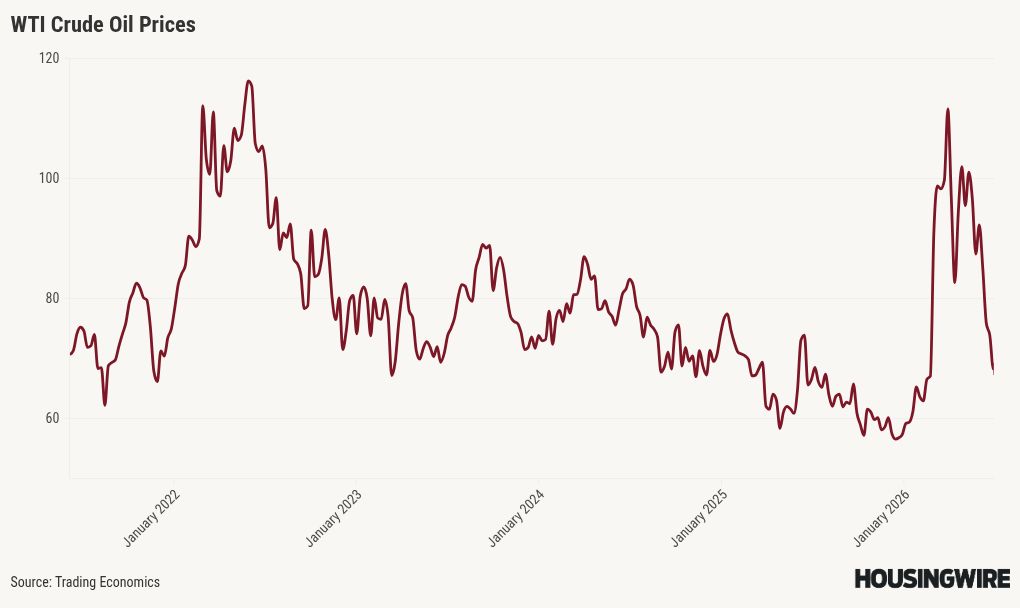
Existing home sales were still positive year over year last week, with our weekly pending home sales data holding steady even with elevated mortgage rates. While people are frustrated that lower oil prices haven’t brought rates down, they should be deeply grateful that improved mortgage spreads have helped housing growth in 2026. If this had been 2023, 2024 or even 2025, mortgage rates would have been over 7% for most of the year and housing demand tends to soften when that happens. 

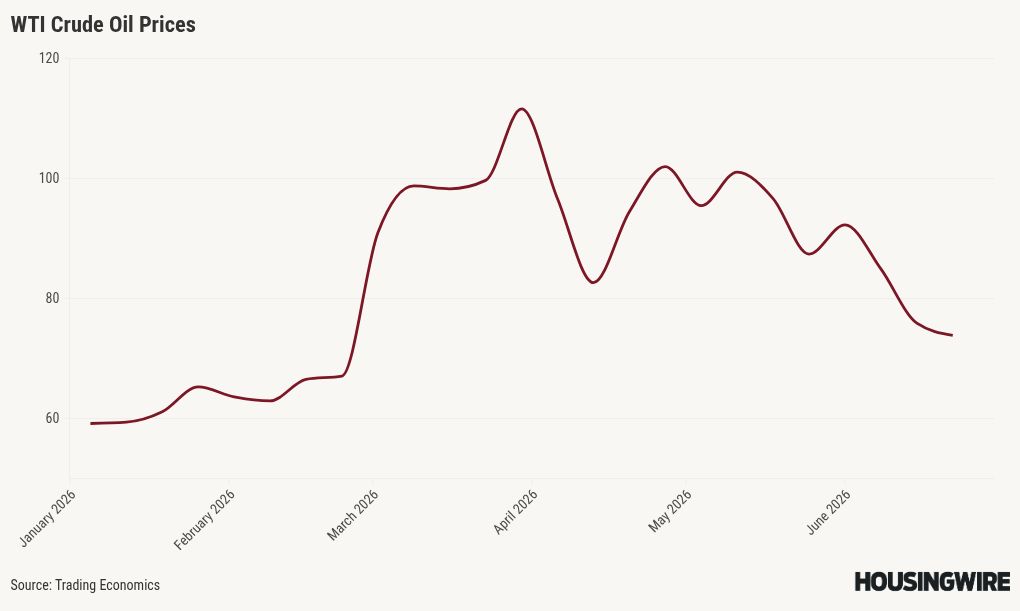
In fact, that has been the reason why we can’t get traction on home sales, as the rate volatility from 2023-2025 kept home sales from growing, but not in 2026! In the past, existing home sales would get some traction with rates near 6%, only to lose it when rates popped over 7%. This year, we haven’t had to experience that, even with a hawkish Federal Reserve, oil prices over $100 and inflation above target. So, wow, yes, hug a mortgage spread folks.

Mortgage spreads

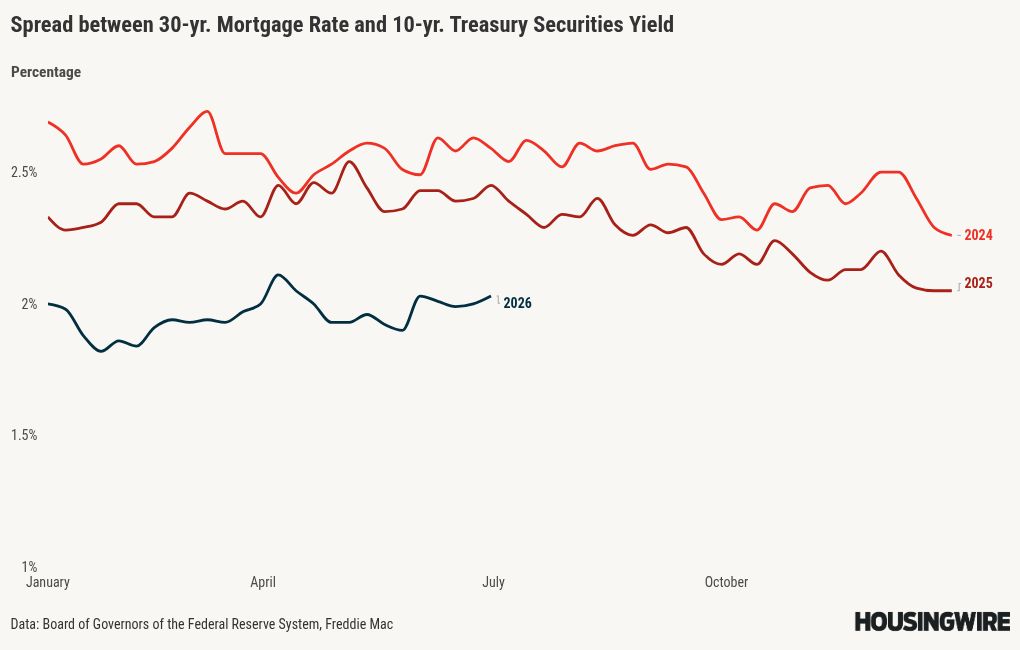
Since late 2022, housing demand has tended to perform better when mortgage rates fall below 6.64% and head toward 6%. We don’t need 3%, 4%,or even 5% rates to grow sales — rates near 6% work, mostly because we are working from record-low levels. However, mortgage spreads widened in 2023 to over 3%, which is very rare post-1986.  

Over time, as a rate-cut cycle starts, spreads historically improve, which is why, in 2026, my peak mortgage rate forecast was 6.75%, solely due to spreads getting closer to normal. For the most part, mortgage rates have been below 6.64%.

Historically, mortgage spreads have ranged from 1.60% to 1.80%. Last week, spreads were at 2.01%, down from 2.03% the week before.

Let’s compare last week’s mortgage rates to where they would have been over the last three years, given the 10-year yield’s current level:

  • If we had the worst mortgage spread levels of 2023, mortgage rates would be 7.70% today, not 6.60%.
  • If we had the worst levels of 2024, mortgage rates would be 7.32% today 
  • If we had the worst levels of 2025, mortgage rates would be 7.13% today.

10-year yield and mortgage rates

In the 2026 HousingWire forecast, I anticipated the following ranges:

  • Mortgage rates between 5.75% and 6.75%
  • The 10-year yield fluctuating between 3.80% and 4.60%

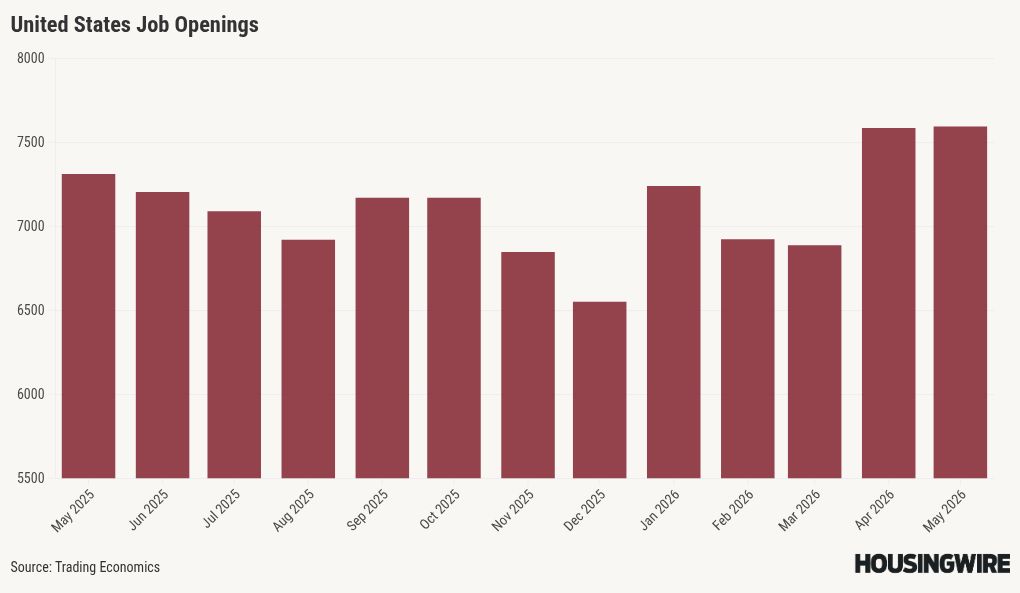
Last week was jobs week and we saw a mixed bag in the data: job openings beat estimates, ADP was a slight miss but still at elevated levels, jobless claims were low, but Jobs Friday came in at a miss of estimates and negative revisions. And yet, the 10-year yield, even with oil prices at $68, closed the week at 4.49%.

Last week I wrote about why this is happening, and Sarah and I did an important episode of the HousingWire Daily podcast on this subject, which I believe is a must-listen. My take: policy getting more restrictive has been a reason the yields like hanging out around the 4.46%-4.48% level.

The Fed meeting is a few weeks away; we need to hear some hawks turn to doves to get bond traders off the rate hike cycle mindset. Last week we had two Fed Presidents talk and Cleveland Fed President Beth Hammack made it seem that lower oil prices were bad for inflation, a reason why yields stayed firm.

chart visualization

Weekly pending sales

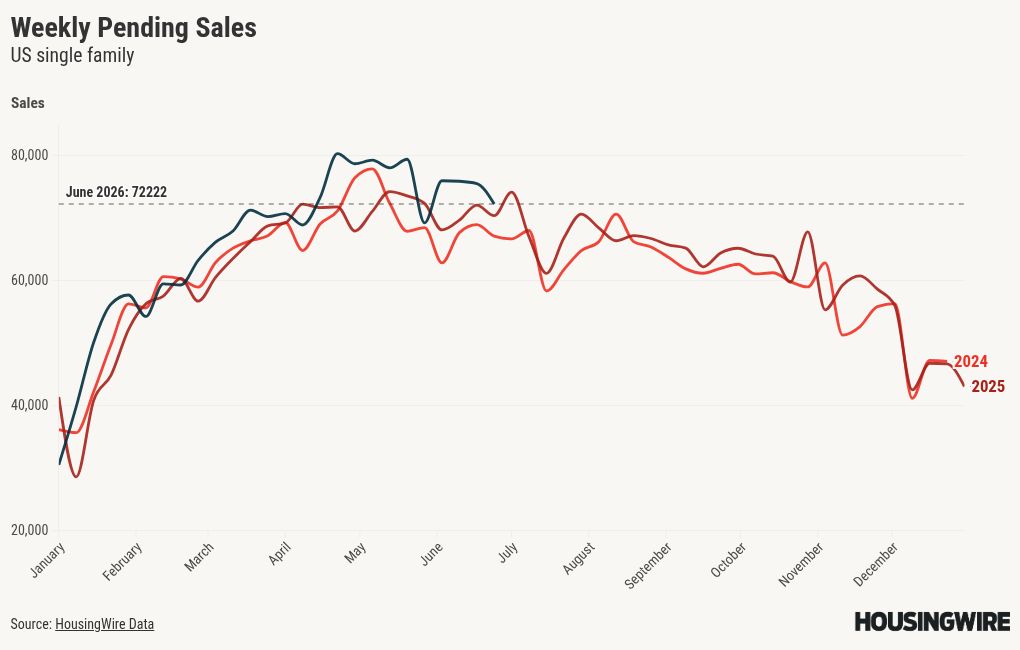
Our pending home sales data provides a week-to-week perspective, though results can be affected by holidays and short-term fluctuations. Our weekly pending sales data typically takes 30-60 days to be reflected in the sales data. 

In the next two weeks, our weekly Housing Market Tracker will be hit due to the holiday data, but as you can see below, even with rates near yearly highs, we are still showing growth year over year. 

Here are the pending sales for last week over the last two years:

  • 2026: 71,173
  • 2025: 66,967

chart visualization

Total pending home sales

I normally don’t include our weekly total pending home sales data in the tracker, but for this July 4th weekend and since we are tracking how beneficial mortgage spreads have been to home sales this year, I wanted to show more of a moving average of sales to show how important mortgage spreads have been in 2026. 

Here are the total pending sales for last week over the last two years:

  • 2026: 422,130
  • 2025: 396,652

chart visualization

Mortgage purchase application data

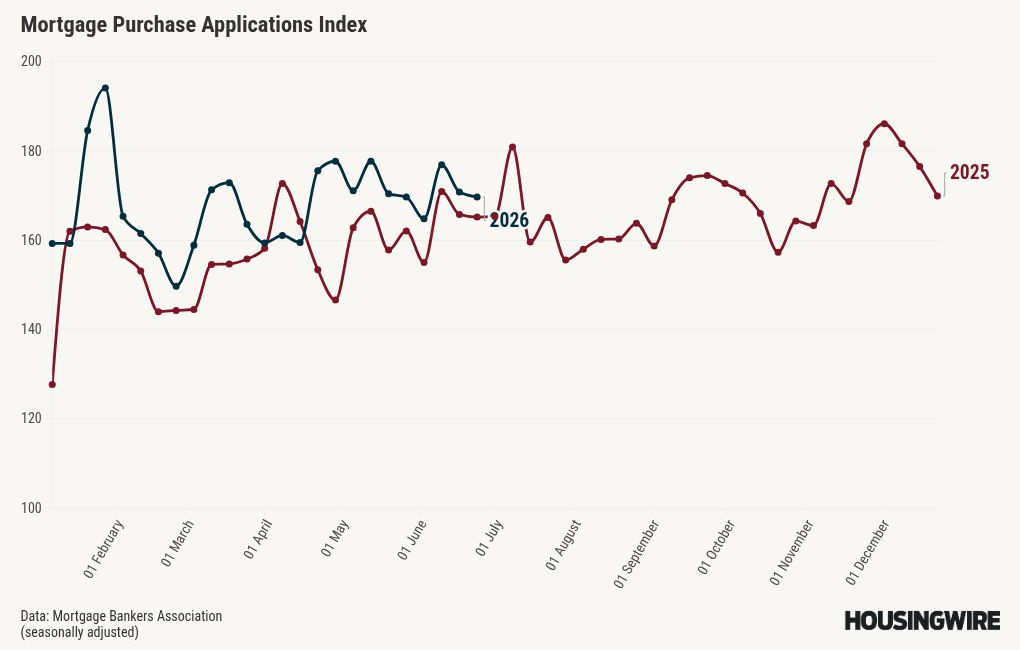
Purchase application data all year long has shown why mortgage spreads have been so important to housing in 2026. Every week this year — outside of two weeks which had harder year-over-year comps — has been positive year over year. Even with all the drama in 2026, mortgage spreads have kept rates below 6.75% and thus purchase apps have been positive.

chart visualization

Here are the stats on purchase apps so far in 2026

  • 11 positive week-to-week prints
  • 12 negative week-to-week prints
  • 2 flat week-to-week prints
  • 10 weeks of double-digit year-over-year growth
  • 23 weeks of positive year-over-year growth
  • 2 negative year-over-year prints

Housing inventory

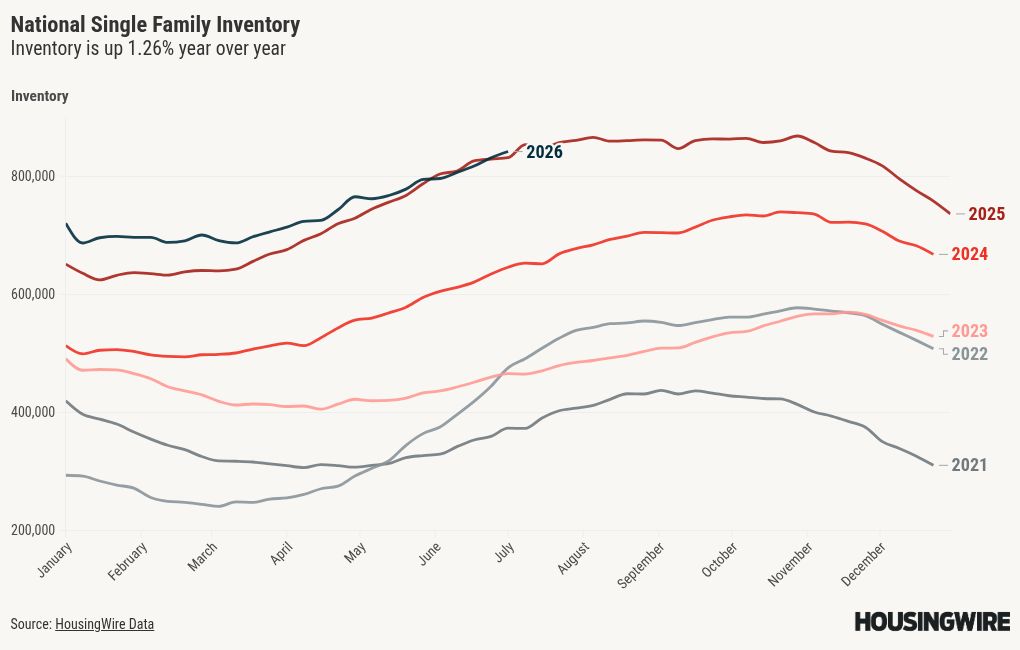
A lot of people are surprised that inventory growth has slowed down and we have had some negative year-over-year data in recent weeks. But this isn’t shocking to our readers and those that listen to our podcast.

However, now the low bar comps are done with and we need to follow the data more closely to see where the next direction is. The most important aspect of inventory is that we are at healthier levels in 2026 than what we saw in 2020-2023, which is why we are chipping away at making housing more affordable. 

  • Weekly inventory change:(June 26-July 3): Inventory rose from to 841,547 to 852,241   
  • Same week last year: (June 27-July 4): Inventory rose from 831,050 to 853,160

chart visualization

New listings

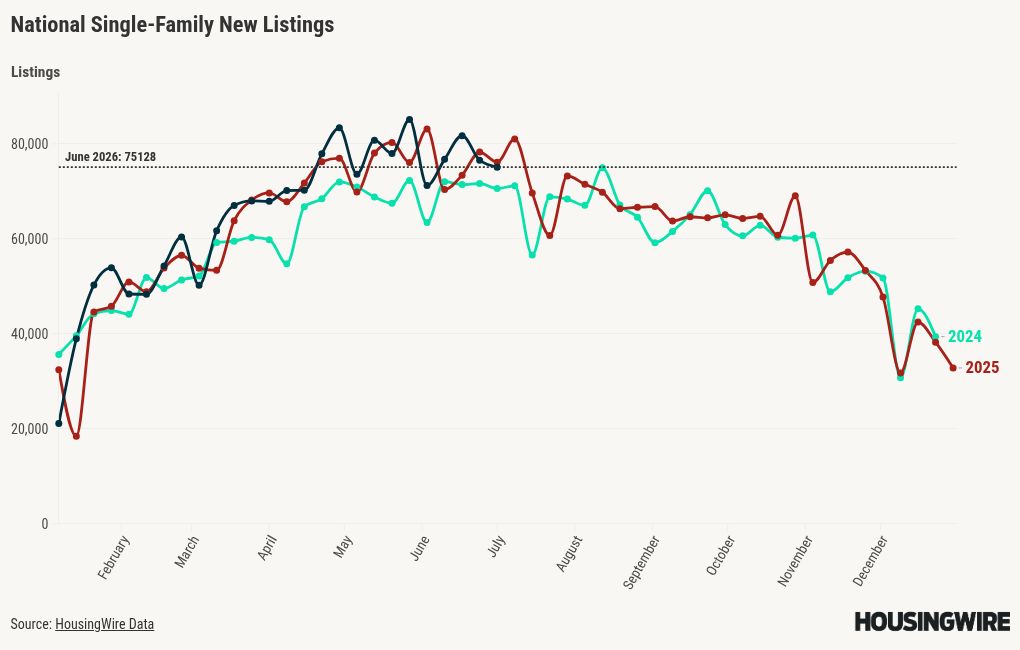
Seasonality in the new listings data is here; we are now starting the traditional decline. Traditionally, we would see 80,000-100,000 new listings during the seasonal peak weeks, but we’ve only cracked above 80,000 four times this year and never in back-to-back weeks. Still, both 2025 and 2026 new listing data is better than what we saw in 2023 and 2024. This year we just had a tad bit more demand than last year to start the year off.

In any case, the seasonal decline is with us now, but 2026 has not been a bad year for new listings: better mortgage spreads made more sellers ready to sell and buy. 

Some context for those who believe that the new listings data resembles the housing bubble years: new listings during that time ranged from 250,000 to 400,000 per week for several years. Several years!

Here is last week’s new listings data for the past two years:

  • 2026: 75,360
  • 2025:  69,701

chart visualization

Price-cut percentage

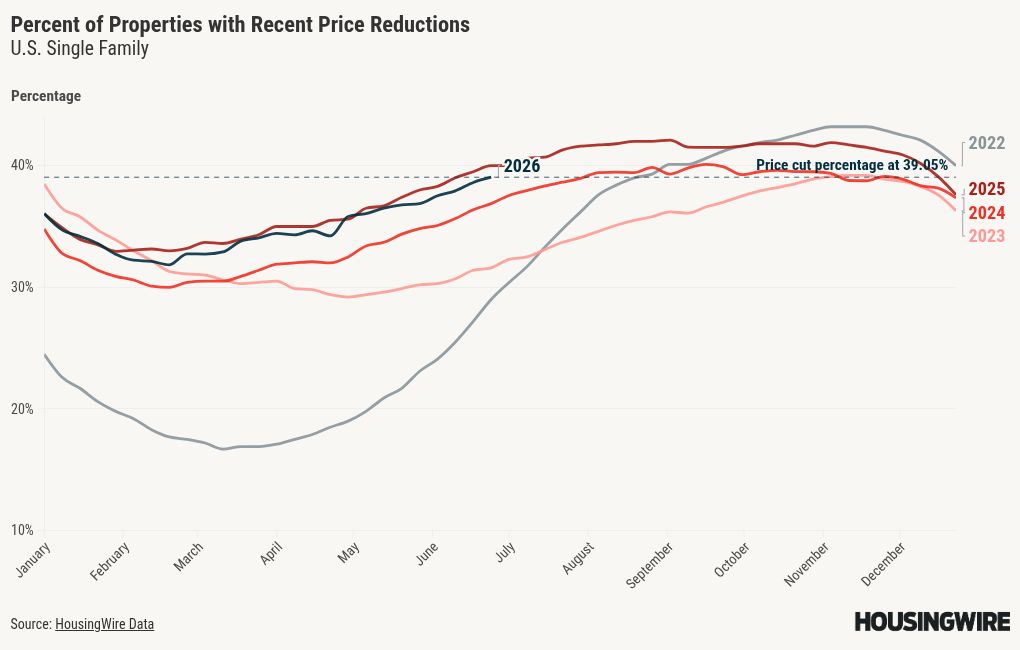
Typically, about one-third of homes undergo price reductions before they sell, reflecting the dynamic nature of the housing market. For the most part, price-cut percentages this year have been lower than last year.

In my 2026 home-price forecast, I had a negative 0.62% call for the year nationally. Home-price growth really isn’t going anywhere this year, but the percentage of price cuts has been lower year over year for most of 2026.  My forecast of negative -0.62% might be hard to achieve: even though home-price growth isn’t positive by much this year, it is still positive.

The price-cut percentage for last week:

  • 2026: 39.54%
  • 2025: 41%

chart visualization

The week ahead: Existing home sales, bond auctions and Fed speeches

Existing home sales will be reported this week and we will have easy year-over-year comps for growth. After this month is when home sales started to pick up last year so the comps will be more difficult to show growth for the rest of the year, especially in December.

We will also have some bond auctions this week and Dallas Fed President Lorie Logan will be speaking. Logan is one of the Fed hawks and the markets will be waiting to hear what she says now, because oil prices have fallen. It will be an interesting week with bond trading and mortgage rates.

This post was originally published on here

The second and final day of the hearing regarding Zillow’s preliminary injunction motion in its ongoing antitrust lawsuit against Midwest Real Estate Data (MRED) and Compass International Holdings featured testimony from two key witnesses for the defense, Compass CEO Robert Reffkin and MRED CEO Rebecca Jensen. 

During their times on the witness stand on Thursday, Reffkin and Jensen both testified that executives at Zillow threatened them regarding their respective firms’ resistance to Zillow’s listing access standards policy, which bans listings from Zillow that are not available for display on IDX or VOW feed powered websites within one business day of the property being publicly marketed. 

The lawsuit focused on whether MRED can suspend its IDX and VOW listing data feeds to Zillow if the listing portal filters or suppresses certain listings and whether Compass unlawfully pushed MRED to do so. 

Let’s play telephone

In her testimony, Jensen detailed calls with Zillow executives, including Zillow’s chief industry development officer Errol Samuelson and the firm’s vice president of enterprise sales and industry at Showingtime+ Michael Lane. According to Jensen, both calls occurred in October 2025.

In the call with Lane, he told Jensen that he regretted using MRED’s private listing network, which has existed since 2016, to sell his Chicagoland area home. Lane allegedly argued that the network raised fair housing concerns. Jensen said she defended the network by citing research and examples of sellers facing sensitive personal circumstances, arguing it exists to give sellers flexibility during difficult times, while acknowledging they ultimately disagreed over whether the network should continue.

In a separate call with Samuelson, Jensen said the Zillow executive asked if she would consider having MRED’s private listings delayed on Zillow, which she declined citing the 2008 settlement between the Department of Justice (DOJ) and the National Association of Realtors (NAR), that prevented MLSs from selectively hiding listings from consumer-facing web portals. The terms of this settlement expired in November 2018. 

According to Jensen, when she refused to comply with Zillow’s request, Samuelson told her that she was leaving “no choice for Zillow than to litigate.” Jensen told the court that Samuelson told her she should expect her “phone to be dumped and all of [her] text messages to get out and have millions of dollars spent on litigation, and that [she was] going to have a public spectacle.” 

Learning from the past

On the stand, Jensen explained her strong desire to not acquiesce to Zillow’s request came from her experience in the real estate industry dealing with the DOJ lawsuit that resulted in the 2008 settlement, and if faced with potentially contending with a lawsuit from the DOJ or Zillow, she would rather deal with Zillow. Jensen also testified that the “objective criteria” defined in MRED’s IDX display rule, which is the policy at the center of this lawsuit, are a result of the 2008 settlement.

Over the course of the hearing, MRED’s witnesses argued that the MLS simply clarified these objective criteria in its October update and did not change them at the behest of Compass, as Zillow has claimed. Additionally, Jensen told the court that MRED has always been focused on growing its footprint and expanding nationally since she started at the MLS in 2015, claiming that this was not a new desire brought about by an alleged conspiracy with Compass. 

In an emailed statement, an MRED spokesperson told HousingWire that the lawsuit is “just a breach of contract case, not an antitrust conspiracy.” 

“MRED is enforcing a neutral rule designed to maintain data integrity between brokerages and preserve the viability of MLSs as valuable services in the real estate industry,” the spokesperson added. “Zillow’s purported harm is entirely self-inflicted and can be remedied immediately by simply complying with the same clear and longstanding license agreement terms that Zillow has complied with for years.”

Robert Reffkin takes the stand

During Reffkin’s time on the witness stand he faced screenshots of his own texts and emails presented to him by Zillow’s counsel during his cross examination. Earlier in his testimony, Reffkin had said that he rarely communicated with Jensen and could not recall sharing litigation documents with her. However, the evidence Zillow presented to the court showed a text exchange from November 2025 in which Reffkin sent a Zillow document from an earlier court filing marked “highly confidential” and “outside counsel’s eyes only,” followed by an exchange in which Jensen asked whether she could forward the documents to the Illinois attorney general and reporters. 

Through this communication, as well as other examples of conversations between Compass and executives at other MLSs, including Bright MLS,  Zillow attempted to show the court how MRED and Compass allegedly conspired to harm the listing portal. 

“A conspiracy between Compass and MRED to undermine Zillow’s pro-consumer listing standards came into clear view over two days of testimony in federal court in Chicago. Key witness testimony from Compass and MRED executives was repeatedly contradicted by texts, emails, internal documents and previous statements introduced in court,” a Zillow spokesperson told HousingWire in an emailed statement.

“The conduct at the center of this case is not limited to Chicago, but a test of whether this playbook can become a national template for hiding homes that can be replicated in market after market. If so, that could spell the end of the open, transparent housing system that benefits buyers, sellers and agents nationwide. We are pleased the truth is out.” 

Compass did not immediately return HousingWire’s request for comment on the conclusion of the hearing. 

What comes next

Post-hearing briefs from both sides are due July 9, with responses due July 13. In order to be granted a preliminary injunction, Zillow needs to have proven to the court that it would be irreparably harmed without it and that it is likely to prevail if that lawsuit goes to trial.

If the motion is denied, that would mean that Zillow was unable to meet this burden, indicating that there is a chance the defendants prevail in a trial, if Zillow does not provide stronger arguments and evidence. 

A ruling on the motion could take weeks if not months. 

This post was originally published on here

A two-day hearing regarding Zillow’s preliminary injunction motion in its ongoing antitrust battle with Midwest Real Estate Data (MRED) and Compass International Holdings kicked off Wednesday morning in federal court in Chicago. 

The hearing is focused on a motion Zillow filed in mid-May seeking to prevent the Chicagoland MLS from terminating its listing feed sent to Zillow. Just days after this motion was filed, MRED cut off Zillow’s access to its listing feed after the portal allegedly refused to cure what the MLS calls a “material breach” of its license agreements. The feed was restored a few days later after Judge John Tharp, Jr. granted Zillow a temporary restraining order (TRO).

In early June, Judge Tharp extended the TRO, which also prevents Zillow from banning any MRED listings from its site, until the court either rules on Zillow’s preliminary injunction motion or grants MRED’s motion to compel arbitration, which is also currently pending.

The hearing is proceeding as scheduled despite an attempt by MRED earlier this week to have the court deny Zillow’s motion prior to the start of the hearing, seeking a stay on all arbitratable matters and claiming that the injunction is unnecessary given the TRO currently in place. 

Wednesday morning’s proceedings included opening statements by all three parties and the beginning of Errol Samuelson’s, Zillow’s chief industry development officer, testimony.

Other executives expected to testify at the hearing include MRED’s managing director and chief technology officer Chris Haran, Compass regional vice president Fran Broude, Zillow’s chief financial officer Jeremy Hoffman, the broker-owner of McColly Real Estate Ron McColly, Compass CEO Robert Reffkin and MRED CEO Rebecca Jensen. In addition, there will be two expert witnesses, Lawrence Wu, the president of NERA Economic Consulting, and attorney Debra Aron, who is the vice president of Charles River Associates’ Competition Practice. 

The Zillow-Compass-MRED saga

The hearing is just one part of an antitrust lawsuit Zillow filed in mid-May, claiming that MRED and Compass conspired to withhold listing data and pressure Zillow to carry private “hidden” listings nationwide.

Zillow is arguing that MRED’s October 2025 clarification of its IDX and VOW rules to state that IDX participants may filter listings only using objective criteria, such as geography, price, property type and listing type were part of a concerted effort by the MLS and Compass to harm Zillow for its listing access standards policy, which bans listings that are publicly marketed for more than one business day prior to being available to display on IDX or VOW-powered websites. 

Courtroom action

According to sources in the courtroom Wednesday morning, in opening statements, Zillow’s counsel discussed an alleged coordinated effort by Compass and MRE to hide homes from consumers and that Compass pressured MRED to prevent Zillow from enforcing its listing access standards policy. The listing portal giant also argued that hiding listings from Zillow, the nation’s largest home search portal, harms buyers and sellers and could have an impact on housing affordability and availability. 

Sources told HousingWire that counsel for Compass and MRED claimed that Zillow’s listing access standards policy is solely focused on maintaining Zillow’s user traffic and not about market transparency and that the MLS is neutral industry infrastructure.

Counsel for MRED noted that Zillow would be able to maintain its access to MRED’s IDX listing feed if it did not enforce its listing access standards policy. The MLS’s attorney also contended that Zillow is challenging the rule because it conflicts with Zillow’s business model, and said MRED’s role is to distribute listings fairly rather than favor any one company.

As for Errol Samuelson’s testimony, a Zillow spokesperson told HousingWire that much of the testimony focused on the impact of private listing networks on buyers, sellers, agents, most brokers and the market at large. According to the spokesperson, Samuelson argued that Compass’s private listings are “false private” because they’re available for anyone to see as long as they work with a Compass agent, making it not about privacy for the seller at all.

During his time on the stand, the spokesperson said Samuelson drew a key distinction between truly private listings — which Zillow does not object to — and Compass’s “black box” Phase 1 of its three-phased marketing strategy, which publicly advertises the existence of off-market homes to allegedly lure buyers into Compass offices. 

“I cannot see those listings without in some way working with a Compass agent,” the spokesperson quotes Samuelson as saying, arguing that using private listings as a marketing hook to capture buyers is what makes Compass’s model harmful to competition and sellers alike. 

Additionally, the spokesperson said Samuelson noted that Zillow has been able to enforce its listing access standards policy everywhere else without any other MLSs cutting off its IDX feed, which Samuelson argued was evidence of MRED taking these actions on behalf of Compass. 

While no other MLS has actually shut off Zillow’s listing feed, Nashville-based MLS Realtracs had threatened to suspend Zillow’s feed if the listing portal failed to comply with the MLS’s updated IDX display rules. As of June 8, 2026, Realtracs had decided to continue distributing listings to Zillow while the two parties engaged in continued contract negotiations. 

Like MRED, Realtracs announced plans to expand nationwide after securing national listing feed agreements with Compass, as well as with United Real Estate.

Expected arguments

Prior to the start of the hearing, a Compass spokesperson told HousingWire that his firm is planning on arguing that Zillow, unlike licensed brokerages, does not compete for listings or owe fiduciary duties to consumers, yet is using its dominant home search platform to dictate how brokers market properties and restrict seller choice.

The company contends that Zillow’s Listing Access Standards harm consumers by penalizing sellers who choose lawful phased marketing strategies, hiding active MLS listings from buyers without clear disclosure, and undermining MRED’s long-standing Private Listing Network. Compass also plans to argue that Zillow profits from broker-created listing data while applying its policy inconsistently and using its market power to entrench its dominance rather than promote transparency.

“Zillow says that consumers deserve to see the full market. But it is both banning active, publicly available MLS listings from its platform and deceiving consumers by labeling those listings as not for sale,” the spokesperson said. “If Zillow were genuinely committed to transparency, every MLS listing would appear on Zillow without the deceptive features it adds.” 

In a post on its Front Porch blog prior to the start of the hearing, Zillow said that in court it would “present evidence regarding MRED and Compass conspiring to cut off Zillow’s listing feed in violation of federal antitrust law, among other allegations of wrongdoing.”

“And we will present evidence that MRED and Compass did it not to protect consumers or set neutral MLS policy, but to advance Compass’ private listing business at the expense of consumers and other MRED member brokers,” the post states.

MRED did not immediately respond to HousingWire’s request for comments regarding the start of the hearing.

Next steps

Although the court’s ruling from this hearing only pertains to Zillow’s preliminary injunction motion, a ruling could provide some insight as to which way Judge Tharp is leaning in the overall case, as part of the criteria to be awarded a preliminary injunction, Zillow must show that it is likely to prevail at trial. If the motion is denied, that would mean that Zillow was unable to meet this burden, indicating that there is a chance the defendants prevail in a trial, if Zillow does not provide stronger arguments and evidence. 

All parties must file any post-hearing briefs by July 9 and any replies to the post-hearing briefs are due by July 13. After this Judge Tharp will rule on the motion. However the ruling may take at least a few weeks if not months. 

This post was originally published on here

While the 21st Century ROAD to Housing Act remains in Oval Office big yawn limbo, its game-changing relevance to multifamily developers, apartment builders, rental housing investors and capital providers is clear.

The bill has passed both chambers of Congress by historic bipartisan margins. What it has not yet done is become law.

That leaves four live possibilities. President Trump could sign it. He could veto it, forcing Congress to decide whether to override. He could do nothing for 10 days, excluding Sundays, while Congress remains in session, in which case the bill becomes law without his signature. Or, if Congress adjourns in a way that prevents the bill from being returned during that 10-day window, the bill could die by pocket veto.

Pocket veto, lightning round: The Constitution gives the President 10 days, excluding Sundays, to sign or return a bill. If he does neither while Congress is available to receive a veto, the bill becomes law. If Congress adjourns and prevents return of the bill, the President can effectively kill it by taking no action. That is the pocket veto. It cannot be overridden because there is no formal veto message for Congress to act on.

In practice, Congress often avoids this outcome by staying technically available through pro forma sessions or designating agents to receive veto messages.

Is ROAD, then, likely to perish in the pocket?

Probably not, unless congressional leaders allow the calendar and adjournment mechanics to produce that outcome. Given the overwhelming House and Senate vote counts, the stronger working assumption for business leaders remains that the bill either becomes law or, if vetoed, triggers a politically charged override fight.

That is enough reason to keep reading the ROAD Act as a business inflection document. Forget the political theater aspect for the moment. For multifamily, the central question is whether the bill’s red-tape provisions reach the cost centers that actually determine whether a rental development pencils.

The 40.6% bright line challenge

Single-family builders have their own regulatory-cost burden. Multifamily developers carry an even more complicated one.

A 2022 NAHB/NMHC analysis found that regulation imposed by all levels of government accounted for an average of 40.6% of multifamily development costs. That burden included zoning approval, site-work fees and studies, development requirements beyond ordinary practice, land dedication, building authorization fees, affordability mandates, building-code changes, labor rules and delay.

Here’s how that looks in a stack.

The largest single component was changes to building codes over the prior 10 years, at 11.1% of total development cost. Costs when site work begins – including fees, required studies, and related items – increased by 8.5%. Development requirements beyond ordinary practice added 5.4%. Fees charged when construction is authorized added 4.4%. Zoning approval added 3.2%. Affordability mandates added 2.7%.

Those numbers clarify where the ROAD Act merges into opportunity lanes to bend cost barriers and where it forks off in directions that cannot affect those barriers.

Multifamily affordability is not simply a rent-versus-income problem. It is a feasibility problem. Each additional development cost requires higher rents, more subsidy, more density, lower land costs, cheaper capital or a developer willing to accept a thinner return. When too many of those inputs move in the wrong direction, the project is not value-engineered. It is canceled.

Julie Smith, chief administrative officer of The Bozzuto Group, captured that operating reality in testimony before the House Financial Services Committee late last year. She said barriers to development, high construction and operating costs, and regulatory burdens make it difficult, if not impossible, for developers to help address the housing shortage. She also highlighted the need for 4.3 million new apartment homes by 2035.

That is the backdrop against which ROAD should be measured, not by how many times it says the word affordability. By whether it changes feasibility.

Where ROAD could matter most

The bill’s multifamily impact appears strongest in four areas.

FHA multifamily finance

ROAD raises outdated FHA-insured multifamily loan limits and indexes them to a multifamily construction cost measure going forward. That is not a slogan. That is underwriting machinery.

For developers working in cost-heavy markets, loan caps that do not reflect current construction economics can subtly or not so subtly block projects that otherwise meet demand. Updating those limits will not fix zoning, labor, insurance, or property taxes. But it can improve some apartment projects’ ability to access federal credit support at a moment when capital costs remain a choke point.

Environmental review

ROAD establishes categorical exemptions for certain HOME-assisted activities, including infill housing projects, affordable-housing acquisition and rehabilitation, and new construction projects with 15 or fewer units. It also directs HUD to reduce duplicative reviews when a project’s scope, scale and location remain substantially unchanged.

This is meaningful. Multifamily development is a calendar-sensitive business. Delay is not just delay. It is interest carry, construction-cost exposure, expiring financing terms, entitlement risk, and investor patience.

CDBG and HOME flexibility

ROAD would allow Community Development Block Grant funds to be used for new construction of affordable housing, subject to limits, and would require grantees to maintain public databases of undeveloped public land. It also creates grants for planning and implementation associated with affordable housing, including zoning-code updates, housing plans, inspection capacity, and efforts to reduce barriers to housing supply elasticity.

That is not the same as forcing local governments to approve apartment projects. But it does turn some federal housing and community-development money toward supply-oriented activity rather than only downstream mitigation of scarcity.

Land-use transparency and pressure

ROAD requires certain jurisdictions to report whether they have adopted or plan to adopt land-use policies such as expanding by-right multifamily zoning, allowing apartments in retail or office zones, creating transit-oriented development zones, shortening permitting timelines, reducing parking requirements, allowing office-to-apartment conversions, increasing floor-area ratios, relaxing height limits and using property-tax abatements to enable higher-density and mixed-income communities.

For apartment developers, that roster of requirements reads like a catalog of levers for project feasibility. The big catch is that submitting those reports is not binding. The information cannot be used as the basis for enforcement action.

That makes this section more flashlight than hammer.

The code-cost collision

One of the more important data points for rental developers comes not from the bill itself, but from HUD’s recent look at multifamily code revisions.

HUD’s PD&R-backed research with Purdue University reviewed International Building Code revisions from 2009 to 2021 and found that specific code changes affecting a prototype three-story apartment building increased construction costs by 9.9%. Those higher costs translated into break-even rent increases ranging from $134 in Charlotte to $222 in Los Angeles for a two-bedroom unit.

Findings such as this one should reframe the policy discussion. Housing affordability debates tend to focus on zoning because zoning determines whether apartments can be built at all. But building-code changes determine how expensive they are once allowed.

That creates a difficult policy balance. Many code changes improve life safety, resilience, energy performance, durability, or long-term risk mitigation. The issue is not whether safety matters. It does.

The issue is whether policymakers are consistently measuring the affordability trade-off when they layer code changes onto a market already constrained by land cost, capital cost, labor scarcity, insurance, taxes, and local opposition.

ROAD gestures toward that issue by calling for cost-effective and appropriate building codes in its zoning-framework guidance. But guidance is not preemption, and one could argue that such guidance without teeth only intensifies frustration. Multifamily code adoption and enforcement remain fragmented across state and local systems.

So, for rental developers, this is one of the bill’s most important limitations. ROAD recognizes the code-cost problem. It does little or nothing to solve it.

Operations count as well

Multifamily housing is unlike for-sale housing in one crucial respect.

The regulatory burden does not stop when construction is finished.

The MetroSight study, “Behind the High Cost of Rent,” examines how rental housing laws affect multifamily revenue and expenses. Its conclusion is straightforward: source-of-income laws, eviction regulations and resident-screening restrictions can raise operating costs, reduce revenue, and ultimately discourage new construction or reinvestment.

Conversely, state preemption laws can reduce regulatory complexity and support operating stability.

This is not an argument that renter protections have no value. It is an argument that renter protections carry economic effects that must be weighed against the need for more supply.

Attention to this set of cost intolerances matters. Most of the ROAD bill is aimed at production, finance, planning, land use and federal process. It is less focused on post-completion operating regulation, even though operating stability is part of the capital stack. Investors underwrite not only what it costs to build, but what it will cost to operate, lease, insure, collect, maintain, and comply.

If local or state policies make apartment operations less predictable, development capital will price that risk or go elsewhere.

Roadmap, not ground-up multifamily engine

The ROAD Act could be meaningful for multifamily development. It could improve FHA financing alignment, reduce some environmental-review friction, make CDBG and HOME tools more supply-oriented, encourage public-land transparency, and create federal pressure for local land-use reform

Those are real provisions. But the bill is not a machine that’s going to start bending the cost barriers for would-be renters.

It does not directly remove rent-control regimes. It does not override local zoning. It does not force cities to reduce parking mandates or impact fees. It does not preempt local design review. It does not standardize building-code adoption. It does not eliminate NIMBY delay. It does not lower insurance premiums, property taxes, or construction labor costs.

ROAD may improve the odds that certain projects pencil. It may give pro-housing state and local officials a better federal toolkit. It may help developers point to a national bipartisan consensus that more rental housing is essential. It may turn some public funding and planning energy toward supply rather than scarcity management.

But apartment production still depends on city councils, planning boards, neighborhood politics, state preemption choices, building departments, lenders, insurers, and capital markets.

The bill points in the right direction. But will enough jurisdictions follow it?

For multifamily, the ROAD Act’s promise is not that Washington can solve the rental affordability crisis by itself. Washington can stop adding friction where it controls the process and start rewarding the places willing to remove friction where they do. That is not the end of the road. For apartment investors, developers, builders, property owners and managers, it may be the first high-occupancy lane.

This post was originally published on here

Former Zillow employee Samuel James Herrera has notified a Denver-based U.S. District Court that he and his former employer are working toward a settlement in his job discrimination lawsuit. 

On Wednesday, Herrera, who calls himself “a day-one Zillow employee,” notified Judge Regina Rodriguez, who is overseeing the lawsuit in a Denver-based federal court, that the parties were working toward a settlement agreement.

According to the notice of settlement, the agreement resolves all of the claims in the case. The filing said the terms of the settlement are still being finalized. 

Parties typically file notices of settlement in a lawsuit when all or some of the plaintiff’s claims have been settled.

In his complaint, filed in September, Herrera claimed he was wrongfully terminated by Zillow in February 2024. 

During his time with the firm, Herrera claims he earned seven promotions, ultimately landing in the role of general manager of rentals, Eastern region in 2022.

At Zillow, Herrera said he was known for his “stellar performance,” which he claims continued in his final general manager role. In this role, Herrera claims he regularly exceeded his sales goals, but despite this, he says he was passed over for further promotions and held to different standards than his white colleagues. Herrera claimed that after complaining of discrimination, Zillow forced him out of the company. 

At the time of the lawsuit’s filing, Zillow told HousingWire that the claims “alleged in the complaint are inconsistent with Zillow’s culture and values, and we believe they are without merit. One of our highest priorities at Zillow is and always has been creating an environment where people do great work and treat each other with dignity and respect.” 

Additionally, the listing portal giant noted that while Zillow was founded in 2004, Herrera did not join the firm until 2010, making him a long tenured employee, but not a “day-one” employee.

Zillow did not immediately respond to HousingWire’s request for comment on the settlement. 

Editor’s note: An earlier version of this article said a settlement had been reached. The article has since been clarified to say that they parties are working toward an agreement.

This post was originally published on here

Consistent growth and disciplined hiring have helped The Craig Tann Group become one of the nation’s highest-performing real estate teams.

Based in Las Vegas, the team closed just under $486 million in sales volume across 877 transaction sides last year — earning the No. 10 national ranking for sales volume and No. 3 ranking for transaction sides among mega teams on RealTrends Verified’s rankings.

The operation also finished No. 1 in Nevada for both volume and sides.

Recognition comes as founder Craig Tann continues expanding his broader real estate business. Tann launched The Craig Tann Group in 2012 before opening independent brokerage Huntington & Ellis in 2016.

Huntington & Ellis reported $1.44 billion in sales volume across 2,496 transaction sides in 2025 and has grown to 175 agents.

Despite a challenging housing market marked by elevated mortgage rates and slower sales activity in recent years, Tann detailed consistent growth in an interview with HousingWire.

“We’ve grown every year since essentially since our inception, so 10 years,” he said. “Every year we’ve seen pretty significant growth on average between like 15% to 20%. I would say it’s our hiring process and hiring standards. We do have requirements that agents have to meet every year.

“That’s also helped us attract really high-quality agents that want to be in an environment where other agents are succeeding at a high level.”

The Craig Tann Group includes 40 agents operating within Huntington & Ellis. Consistent growth has helped pave way for the opening of a second office in Henderson, Nevada.

“We’ve talked about it for the past three years, but we’ve really worked on executing the plan over the last six to eight months,” Tann said. “We technically have a second office already, but it’s right next to our main office, so it’s really just one office. We just ran out of space.”

Building a business from the ground up

Tann entered real estate more than two decades ago after receiving an opportunity from a family friend who owned a brokerage in New York.

After working there until age 21, Tann vacationed in Las Vegas and made a life-changing decision.

“I decided I was just going to pick up and move [to Las Vegas],” he said. “So, I moved out from New York by myself at 21 and then started with a big franchise brokerage and just kind of worked my way up — slowly learned the business. Then I learned how to build a team and after building the team, I wanted to take the next step and be a little bit more creative.

“I really enjoyed the marketing side of the business, and the next step for me was starting the brokerage.”

Today, Huntington & Ellis operates as an independent brokerage, something Tann believes provides a competitive advantage in a rapidly changing industry.

“In a fast-paced changing market, you know, the independents can operate more like a speedboat versus a cruise ship, so it allows us to pivot quickly,” he said. “We can take advantage of new opportunities quickly. I think that’s one of the things that agents are attracted to. We get to create the environment. It’s not set by a big corporate company. We get to create exactly how we operate.”

The brokerage also works to differentiate itself through in-house support services, including a full marketing department and staff videographers — allowing agents to focus primarily on serving clients, Tann added.

Advice for growing teams

As more agents seek to build larger teams, Tann encourages leaders to prioritize opportunity and culture over rapid expansion.

“Build a strong reputation in town, start small and only hire as needed,” he said. “I think some of the mistakes that teams make is they hire to get bigger, and they think that means more profit, and it’s actually the opposite.”

Instead, his organization adds agents only when business demand supports it while maintaining strict expectations.

“We are very picky on the agents that we feel are going to be a good culture fit, and we only hire full-time, all-in agents,” Tann said. “So, they can’t have secondary jobs and they have to be fully committed to the business.”

Las Vegas continues attracting newcomers

Looking ahead, Tann remains optimistic about the Las Vegas housing market despite affordability challenges affecting much of the country.

He points to continued investment throughout the city, including the growth of professional sports, expanding infrastructure and Nevada’s business-friendly environment.

He also said the state’s lack of an income tax continues attracting buyers from neighboring states.

“We’re definitely seeing population grow,” Tann said. “Because we’re so much more affordable than the California or Washington market, plus we’re so much more business and income friendly, it’s just helping us attract some really great growth and population.”

While higher interest rates and home prices remain headwinds, Tann believes Las Vegas continues to offer opportunities for buyers, sellers and real estate professionals alike — positioning both The Craig Tann Group and Huntington & Ellis for continued growth.

This post was originally published on here

Jenni Bonura has joined Georgia-based First Multiple Listing Service (FMLS) as chief growth officer after more than 20 years in senior leadership roles at Harry Norman, REALTORS, including serving as president and CEO of brokerage, according to an announcement on Wednesday.

At Harry Norman, Bonura held multiple leadership positions before rising to president and CEO.

Her move to FMLS carries a historical connection. Harry Norman was one of eight brokers who founded FMLS in 1957, tying Bonura’s appointment back to the MLS’s origins while it works to expand its footprint and services across Georgia and the broader Southeast.

Jeremy Crawford, president and CEO of FMLS, said Bonura’s leadership background and industry relationships align with the organization’s growth plans as MLSs face rising pressure to demonstrate value amid commission litigation, changing brokerage models and increased scrutiny of data access and costs.

“Jenni’s leadership experience, industry insight, and dedication to serving real estate professionals align perfectly with the future of FMLS,” Crawford said in a statement. “As our organization continues to grow, her expertise will help guide new opportunities, strengthen relationships, and ensure we continue providing meaningful value to the brokers and agents we serve.”

At FMLS, Bonura is expected to focus on member growth, brokerage and team relationships, and the expansion of products, services and data solutions available to subscribers. 

The organization said Bonura brings a “member-focused perspective” and long-standing relationships across the real estate community, which FMLS expects will support its efforts to deliver “exceptional products, services, data solutions and support” to its subscribers in Georgia and beyond.

Crawford said the hire reflects FMLS’s continued investment in talent and its mission to help real estate professionals succeed.

This article was generated using HousingWire Automation and reviewed by a HousingWire editor before publication.

This post was originally published on here

Shareholders of Two Harbors Investment Corp. have approved the company’s sale to an affiliate of CrossCountry Mortgage (CCM), ending a months-long contest with rival United Wholesale Mortgage (UWM) for control of the mortgage real estate investment trust (REIT).

The virtual shareholder meeting, held Thursday morning, had been originally scheduled for May 19 and was delayed four times as Two Harbors and its suitors worked to secure support.  

Two Harbors is an MSR-focused REIT and a top servicer of conventional loans through its RoundPoint Mortgage Servicing platform. It had a $158.89 billion owned servicing portfolio as of the first quarter, per Inside Mortgage Finance. The CCM servicing book was at $202 billion, while UWM‘s was at $229.5 billion. 

“We’re excited about our strategic partnership with Two Harbors, which will bring together TWO’s best-in-class capital markets team, RoundPoint’s servicing and operational expertise, and the unmatched retail origination business we’ve built at CCM, further reinforcing our position as a one-of-one player in the mortgage industry,” a CCM spokesperson told HousingWire.

The CCM transaction offers Two Harbors investors $12 per share in cash plus a pro-rated stub dividend. Holders of Series A, Series B and Series C preferred stock will have their shares redeemed at $25 per share, plus any accumulated and unpaid dividends, in accordance with the terms of the preferred stock.

Two Harbors’ board unanimously recommended shareholders vote in favor of the CCM deal, citing the certainty of an all-cash offer and regulatory progress, including having cleared 48 of 53 required approvals. The deal remains subject to other conditions, including the receipt of the remaining state regulatory and agency approvals. It is expected to close in August 2026.

UWM put forward a competing package that included $12.50 per share in cash — or at the shareholder’s option, 2.3328 shares of UWMC stock. Two Harbors pressed UWM to provide an all-cash alternative and argued that the stock component would deliver significantly less value for investors who took the default consideration.

Based on UWMC’s Thursday opening share price of $2.26, the default stock option would have implied about $5.27 per Two Harbors share, less than half of the advertised $12.50 per-share headline price.

“This chapter of the months-long saga with Two Harbors is now closed,” a UWM spokesperson said in a statement. “Throughout this process, our offers were superior, but their board’s conduct was both inappropriate and consistent with their track record.”

The outcome caps a dispute that began in December 2025, when Two Harbors agreed to sell to UWM in an all-stock deal that would have been UWM’s first acquisition. UWM, founded in 1986 by Jeff Ishbia and led by CEO Mat Ishbia since 2013, has historically leaned on organic growth rather than mergers and acquisitions. At that point, UWM was paying about $11.94 per share.

But UWM’s share price declined, Two Harbors walked away from the UWM agreement. CCM emerged with a higher all-cash offer of $10.80 per share.

Between April and May, UWM raised its cash-and-stock proposals, but the Two Harbors board repeatedly reaffirmed its support for the CCM bid, pointing to greater regulatory certainty and the fully cash structure that ended at $12 per share. 

This post was originally published on here

Compass International Holdings, is rolling out its AI-powered Home Platform across its company-owned brokerage brands, marking what the company calls the largest technology deployment in residential real estate history, according to an announcement on Thursday. 

The firm said the deployment comes less than six months after it closed its merger with Anywhere Real Estate and will extend its proprietary platform to thousands of agents across its global brands.

Beginning this summer, real estate professionals affiliated with @properties, Coldwell Banker Realty, Corcoran and Sotheby’s International Realty will gain access to the technology. The platform will be branded as Home Platform, with Compass planning to extend access to its franchise network in 2027, according to the company announcement.

Unifying all the brands

Compass said unifying its brokerage brands on a single, proprietary platform is intended to support every stage of the real estate lifecycle, from winning and servicing clients to managing transactions and nurturing repeat and referral business. The company also framed the move as a way to concentrate and scale its proprietary data.

“For more than a decade, Compass has invested in building technology to help agents grow their business and create great experiences for their clients,” Ori Allon, co-founder of Compass, said in the announcement. “The true power of AI lies in the unique data and workflows that fuel it. By combining industry-leading artificial intelligence with our vast, proprietary data, Home Platform creates an advantage that cannot be replicated.”

Rory Golod, president of growth, called the rollout “the single most important innovation in our business.”

Compass said Home Platform was developed with input from thousands of real estate professionals and is continuously trained on data from exclusive inventory and agent-client interactions. The integrated suite includes things like comparative market analysis tools, the client dashboard and other well-known Compass agent tools like its marketing center, Collections and Insights. 

By deploying the platform across its expanded brokerage footprint, Compass said it is increasing the volume of unique listing inventory, client interactions and usage patterns feeding its AI models. The company argues that in a world where base AI models are broadly available, access to differentiated, proprietary data creates a structural advantage for agents who can turn those insights into pricing strategy, listing positioning and client counsel.

This article was generated using HousingWire Automation and reviewed by a HousingWire editor before publication.

This post was originally published on here

As of July 1, more than 7 million federal student loan borrowers have 90 days to transition to a new repayment option as the Biden administration’s SAVE income-driven repayment plan is officially phased out.

The program, launched in 2023 to lower monthly payments and accelerate loan forgiveness for many borrowers, is ending following a broader restructuring of the federal student loan system.

The changes stem from the Trump administration’s One Big Beautiful Bill Act, enacted in 2025, and a federal court ruling in March 2026 that found the SAVE plan unconstitutional.

For the housing market, the student debt repayment overhaul could reshape mortgage affordability for millions of borrowers with student debt as they attempt to qualify for mortgages. Higher required student loan payments may reduce home purchasing power or delay homeownership for some borrowers by factoring into debt-to-income ratios.

The choice of repayment plan could also influence borrowers’ ability to qualify for a mortgage. The Pay As You Earn (PAYE) plan, which remains available until July 1, 2028, continues to cap monthly payments. Meanwhile, the Repayment Assistance Plan (RAP) bases payments on income and household size but has no maximum payment amount for higher-income borrowers.

Existing borrowers, however, will need to resume payments on a new plan in three months, on top of regular mortgage payments and other costs associated with housing.

Borrowers ‘should have planned accordingly’

Donna Schmidt, president and CEO of DLS Servicing, says that borrowers should have been prepared.

“Just like any other debt, a borrower must establish a budget to pay back borrowed funds,” Schmidt said. “While inflationary pressure had been escalating when the SAVE program was established (8% in 2022 and 4.13% in 2023), inflation rates have stabilized, dropping to 2.9% in 2024 and 2.7% in 2025. It is time to get back to regular order.”

Schmidt says that former students had “plenty of notice and should have planned accordingly.”

“From a mortgage servicer’s perspective, this may put additional pressure on borrower budgets, but this should be outside the mortgage obligation,” she added.

But existing data paints a different picture. According to data from the Federal Reserve Bank of New York, delinquency rates across mortgages, credit cards, auto loans and student debt reached 4.8% of outstanding household debt in fourth-quarter 2025, their highest levels in nearly a decade.

According to the New York Fed’s Q1 2026 data, student loan borrowers continued to face repayment challenges early this year, although fewer fell into serious delinquency than a year earlier. The share of borrowers transitioning into serious delinquency declined to 10.9%, down from 16.2% in the prior quarter, suggesting the pace of new payment problems has begun to slow.

Despite that improvement, the share of student loan balances at least 90 days past due rose to 10.3%, up from 9.6% in the previous quarter. About 2.6 million borrowers who were more than 120 days delinquent had their loans transferred to the U.S. Department of Education‘s Default Resolution Group.

“That’s existing data right before this happened,” Phil Crescenzo Jr. of NFM Lending said in reference to the New York Fed’s data. “So now you have seven and a half million more people that the budgets get strained a little bit or a lot. They’re different than what they were a month ago — and they will be going forward.”

Crescenzo noted that since many student loan repayment plans have placed loans in forbearance, especially following COVID-19, the payments have effectively fallen out of borrowers’ mental and practical budgets.

“You can’t ignore these things,” he said. “They give borrowers 90 days to decide on a new program or plan. That’s plenty of time to respond, but it’s not a lot of time if you’re blowing off notices and not really keying in on the dates.”

Crescenzo said borrowers with multiple small student loans are especially vulnerable. Each loan can report a 90-day delinquency, leading to several serious late marks hitting a credit report at once.

“Now you’re going to have four 90-day lates,” he said. “Good luck trying to overcome that on a mortgage approval. A drop of 40 to 100 points [in a credit score] is easy when that happens.”

Need for proactive analysis, education

The consequences are not evenly felt across loan products. Crescenzo said Federal Housing Administration (FHA) borrowers face a “hard stop” if they incur serious student loan delinquencies, often triggering a two-year waiting period before they can qualify again. Department of Veterans Affairs (VA) loan guidelines have shown somewhat more tolerance in select cases, he added.

Jane Mason, CEO and founder of Clarifire, said that the mortgage industry needs to be more “proactive” in looking at a borrower’s whole credit history and portfolio, especially today.

“I’m encouraging our industry to make sure that they’re more proactive,” Mason said. “Look at the escrow analysis contact and use that as an opportunity… so that the borrower is getting more help earlier on, before delinquency really sets in.”

Like Crescenzo, Mason is concerned about how the end of SAVE will impact credit reports.

“We need to look at what the credit companies are reporting and encourage mortgage servicers to pull credit reports more often to proactively help a borrower who has student loan debt that also has a mortgage,” she said.

Mason, who is based in Florida, is especially concerned given the preexisting high costs and high risks associated with homes in the Sunshine State.

“The property insurance is out of control in the state of Florida, and the property taxes are increasing because our values skyrocketed during COVID-19. … We’ve had two hurricanes and so many people have not received FEMA aid, so now we’re seeing delinquencies, especially in the area of FHA, and I think there’s going to be more of that.”

This post was originally published on here

When Americans think about infrastructure, they think about roads, bridges and broadband. But they should also think about housing. A home is the foundation from which families build their lives: where children grow up, neighbors become communities and one generation creates new opportunities for the next. As the United States celebrates its 250th anniversary, homeownership continues to drive financial security, strengthen community ties and create the ability to build and pass down something lasting.

Building communities through the power of home equity 

In the United States’ 250th year, it is clearer than ever how integral homeownership is to American civic stability. In recent years, housing has dominated the national conversation, prompting policymakers across the political spectrum to prioritize pro-housing policies to bring homeownership within reach for more Americans.

A home is more than just a place to live; it provides a foundation for financial stability and the opportunity to build wealth beyond one lifetime, across multiple generations. Owning a home remains the most effective way for families to build lasting generational wealth, with the typical homeowner holding a net worth over 40 times that of a renter

Every mortgage payment made is equity built, allowing homeowners to passively accumulate wealth over time while the value of their home is likely increasing. That equity can support a family’s move into a larger home, withstand an unexpected expense, support a child’s future or leave something meaningful to the next generation. 

But ask homeowners what their home means to them, and few will start with equity. They talk about stability: the security of putting down roots, the confidence of building toward something lasting and for some, the opportunity to give their children a stronger start than they had.

Homeownership also strengthens the communities in which that wealth is built, as a critical piece of civic stability for many communities across the country. When individuals own property, they transition from temporary residents to long-term stakeholders committed to improving the neighborhood around them. Homeowners are more likely to vote in local elections and are 1.3 times more likely than renters to become involved in a neighborhood group and join a civic association.

Yet, for many Americans, the goal of homeownership is being delayed. 

Expanding access through legislative and regulatory reform 

Encouragingly, policymakers in Washington are working to advance policies to expand the aspiration of homeownership to more Americans. This includes the bipartisan 21st Century ROAD to Housing Act, which was passed by both chambers of Congress with overwhelming majorities. 

The legislation includes several meaningful changes that enable cheaper, faster construction of new homes, including: streamlining environmental reviews, encouraging pre-approved housing designs, updating regulations on manufactured homes and lowering construction costs by up to $10,000 per unit. Additionally, the legislation includes a pilot to expand access to Federal Housing Administration (FHA) backed loans under $100,000. 

In addition, policymakers are reconsidering financial rules that shape how capital flows into and through the mortgage market. Most notably, the Trump Administration’s banking regulator’s proposal for Revised Basel III Endgame seeks to safely and sensibly recalibrate the rules to encourage more bank participation in the mortgage market, which should drive down prices for consumers. 

The mortgage industry has also committed itself to innovation and emerging technologies, including AI, to make the mortgage origination process easier, faster and more cost-effective for all stakeholders. Technology is not a substitute for meaningful policy changes, but through continued advancements, it can help consumers navigate an often complicated process by reducing friction, providing real-time updates, and streamlining workflows. 

Modernizing the mortgage ecosystem

One of the challenges in housing finance is that many processes remain highly manual, document-heavy and operationally fragmented. That creates delays, increases costs and limits scalability across origination and servicing. Today, mortgage leaders and loan officers are beginning to use these tools to streamline often tedious processes and better serve more customers, with their capabilities and impact expected to grow considerably over the next year.

That breadth reflects a deeper truth about the industry. It is tempting, quarter to quarter, to tell a “tale of two cities”: origination up here, servicing down there, as if they were unrelated businesses. They are not. 

At its best, the mortgage industry is one integrated ecosystem. Production puts families in homes; servicing keeps them there through every rate environment and economic season. That balance is a strength, not a contradiction, and it is far more relevant to America’s housing future than any single selling season’s headlines.

Committing to the next generation of American homeowners 

Americans have good reason to be optimistic: housing supply has been steadily expanding. In 2024, builders completed approximately 1.6 million new homes, outpacing the 1.3 million homes built in 2019. That structural progress matters more than any near-term volatility in seasonal activity. Much of that progress is linked to deregulation and permitting reform at every level of government, which has made it faster and cheaper to build new homes. Sustaining that momentum will be essential to meeting demand and creating a healthier housing market over the long term. 

Building the housing supply America needs will not happen overnight. It will require policymakers and industry leaders to look beyond the fluctuations of any one quarter and remain focused on the families still waiting for the opportunity to own a home.

Temporary market headwinds and seasonal noise will always capture headlines, but they cannot suppress the deep-seated American desire to own a home. As the nation approaches America 250, policymakers and industry leaders have an opportunity to look beyond near-term uncertainty and dedicate themselves to one of our country’s defining principles: homeownership. It is time to commit ourselves to a more affordable, accessible and resilient housing market for the next generation of Americans.

David Spector is Chairman and CEO of Pennymac.
This column does not necessarily reflect the opinion of HousingWire’s editorial department and its owners. To contact the editor responsible for this piece: zeb@hwmedia.com.

This post was originally published on here

The Mortgage Industry Standards Maintenance Organization (MISMO) has updated its Mortgage Insurance Implementation Guide to incorporate data requirements for VantageScore 4.0 and FICO 10T, the Mortgage Bankers Association (MBA) subsidiary announced Thursday.

The guide provides a standardized data framework for electronic information exchange between lenders and mortgage insurers across key processes, including mortgage insurance (MI) rate quotes, commitments, contract underwriting, document delivery and querying for MI order responses, according to the announcement.

The latest changes add support for the newer credit models that Fannie Mae and Freddie Mac are expected to adopt as part of the Federal Housing Finance Agency’s credit scoring modernization initiative. That shift will require lenders, mortgage insurers and technology providers to adjust how they capture and transmit credit data for loan qualification and pricing.

MISMO said the enhancements are designed to streamline how MI-related information is exchanged across systems, improve consistency in data delivery and help organizations modernize their MI workflows. For lenders, standardized data can reduce custom integrations with individual MI providers and lower the risk of errors or rework when ordering or updating coverage.

“Standardizing how lenders and mortgage insurers exchange information is critical to improving efficiency across the mortgage ecosystem,” Brian Vieaux, president of MISMO said in a statement. “The updated Mortgage Insurance Implementation Guide is essential to enabling the use of modern credit scoring models such as VantageScore 4.0 and FICO 10T. It also helps lenders benefit from improved system integration and more efficient loan qualification, while giving mortgage insurers access to more complete and consistent data.”

The Mortgage Insurance Implementation Guide was developed by MISMO’s Mortgage Insurance Community of Practice in response to industry demand for more consistent MI data exchange practices. The work group is led by Leslie Bensen of MGIC as chair, with Nayanika Sanyal of Arch Mortgage Insurance Co. and Candy Hepfner of MGIC as co-vice chairs.

The guide has reached MISMO’s “Candidate Recommendation” status, meaning it has broad industry consensus and is considered ready for implementation. At this status level, organizations are encouraged to begin planning and execution, with the expectation that only minor clarifications, if any, would be made going forward.

MISMO urged lenders and technology providers to coordinate with their MI partners when implementing the updates. For housing professionals, this coordination will be critical as the industry moves toward production use of VantageScore 4.0 and FICO 10T, which are expected to change how credit risk is measured, especially for thin-file and historically underserved borrowers.

This article was generated using HousingWire Automation and reviewed by a HousingWire editor before publication.

This post was originally published on here

New York City’s first heat wave of the season is officially here, with triple-digit temperatures and high humidity. Not only can summer in the city be uncomfortable, but it can also become dangerous. To stay cool at home and out and about, we’ve rounded up the best products to help you beat the heat and stay hydrated.

All of these products have been hand-selected by Team 6sqft. We may receive a commission for purchases made through these affiliate links. All prices reflect those at the time of publishing.

Cooling gear

Honeywell QuietSet Whole Room Tower Fan, Oscillating Tower Fan with Remote, Black, HYF290B

While fans don’t lower the temperature in a room, they do make you feel cooler. This 40-inch-tall, whole-room tower fan has eight speeds and oscillates. It’s also quiet and has a timer, dimming options, a handle, and a remote control with storage.
Honeywell QuietSet Whole Room Oscillating Tower Fan with Remote, $64 at Amazon

ZAFRO Smart Inverter Portable Air Conditioners, 16000 BTU (12000 BTU SACC) Dual Hose Portable AC Unit with Energy Saving/Ultra Quiet(38dB Upgraded)/Drainage-free Cool/APP/Remote for Multi-Scenario Use

When you need more than a fan, this portable air conditioner has six modes: cool mode, dry mode to reduce humidity, fan mode, extra mode for fast cooling, sleep mode, and ECO mode. The air conditioner has a digital display on the top, and can also be controlled via app on your smartphone – and it works with Google Home as well. The hose can be installed in both horizontal and vertical sliding windows, and the air conditioner can run for 72 hours without needing to be drained.
ZAFRO Smart Inverter Portable Air Conditioner, 16,000 BTU, $620/ Sale $558 at Amazon

Shark ChillPill – The Only 3-in-1 Personal Cooling System with Fan, InstaChill Cooling Plate & Dry-Touch Mist – Portable, Handheld, Drops Skin Temp Up to 16°F, 10 Speeds, Haze, FA022LV

Carry your personal cooling system wherever you go with this handheld fan, which has 10 fan speeds and a rechargeable battery that lasts up to 11 hours. However, the device also has an icy-cold cooling plate that you can apply to lower your skin’s temperature up to 16 degrees. And the dry-touch evaporative mist can be used to drop temperatures, whether you’re indoors or outside. You can wear the fan, place it on a desk or table, hang it, or hold it. Color choices are haze, dragon fruit, carbon, glacier, and iced latte.
Shark ChillPill 3-in-1 Fan, Cooling Plate and Dry-Touch Mist, $150/Sale $130 at Amazon

You already know that a shower can cool you off. However, this soap bar can further cool and energize your skin. The bar contains eucalyptus, spearmint, and coconut oil, and each time you lather up, you’ll feel refreshed and hydrated. It’s also free of parabens, phthalates, silicones, sulfates, dyes, and fragrances.
Arctic Wave Cooling Body Bar, $10 at Pure & Gentle Soap

Sleep cool

Harbor House Cooling Stretch Jersey Bed Sheets – Queen Size, Blue – Cool-Touch Nylon Blend, Moisture-Wicking & Breathable for Hot Sleepers, Deep Pocket, Soft & Stretchy 4-Piece Sheet Set

These cooling stretch jersey sheets are temperature-regulating and silky-soft. They’re made from a breathable nylon blend that is cool to the touch and moisture-wicking. And since the sheets have 10% spandex for stretching, they stay in place. Colors include blue, ivory, white, and grey.
Harbor House Cooling Stretch Jersey Bed Sheets, $192 at Amazon

Harbor House Cooling Reversible Tencel Comforter Blanket – Full/Queen Size, Cool-Touch Nylon Blend, Moisture-Wicking & Breathable for Hot Sleepers, Gray/Charcoal, 90x94 Inches

If you’re like me, you reach for the covers even in the summer. This cooling comforter has a cool-to-the-touch nylon blend. The fabric is lightweight and breathable, and is designed to wick away moisture and regulate your body’s temperature to keep you cool at night. The color choices are white, gray/charcoal, ivory, and linen/deep linen.
Harbor House Cooling Reversible Tencel Comforter, $128 at Amazon

Miracle Made RemyCloud Adjustable Cooling Pillow– Dual-Sided, Instant-Cool Fabric & Breathable Cotton Covers – Moisture-Absorbent, Machine Washable Loft with 2 Removable Inserts Each (2, Standard)

Both sides of these pillows are cooling. One side is an instant-cool nylon that feels up to 4 degrees cooler. The other side is made of breathable 100% cotton for a soft, gentle coolness. The dual-sided cooling pillows are antimicrobial and machine washable. They’re also adjustable, so you can unzip the pillows and remove the inserts to adjust the loft.
Miracle Made RemyCloud Adjustable Cooling Pillow Pair, $178 at Amazon

Helix ComfortAdjust Cooling Standard Pillow for Side, Back & Stomach Sleepers – Shredded Foam, Customizable Loft & Firmness, Cool-to-Touch Cover for Hot Sleepers & Neck Pain Relief

Another option is a pair of these cool-to-the-touch pillows, which can also be adjusted for the desired level of firmness. Unzip the pillow and then add or remove some of the shredded memory foam and down alternative fibers to make it as thick or flat as you prefer. The pillows have a GlacioTex cover that dissipates heat and regulates your body’s temperature to keep you cooler as you sleep.
Helix ComfortAdjust Cooling Pillow, $127 at Amazon

Jabees Peace Duo Pillow Speaker for Sleeping – Dual Under Pillow Speakers for Side Sleepers, Bluetooth + SD Card, Sleep Timer, No Earbuds, Preloaded Sleep Sounds

This under-pillow speaker will calm you down to help you sleep (because tossing and turning only makes you hotter). Using bone conduction technology, the speaker goes under your pillow and provides music that only you can hear. It provides true stereo sound, has sleep timers, and a 10-hour playtime. The speaker is pre-loaded with sea waves, rain, and wind sounds, and you can also stream sounds and music from your phone.
Jabees Peace Duo Pillow Speaker, $60 at Amazon

Eat, drink, and stay hydrated

Ka’Chava Whole Body Meal Shake Chocolate 2 lb – Vegan Protein Powder with 85+ Superfoods & Greens – Plant-Based Meal Replacement with Probiotics & Digestive Enzymes – Gluten & Dairy Free (15 Servings)

When it’s too hot to cook, this meal shake contains over 85 superfoods and greens, along with 25 grams of plant-based protein, 6 grams of fiber, and 26 vitamins and minerals. The 2-pound bag provides 15 servings, and the drinks are flavorful but not too sweet and not gritty. Flavors include chocolate, chocolate mint, chai, coffee, matcha, strawberry, vanilla, and a variety pack.
Ka’Chava Whole Body Meal Shake, $80 at Amazon

Yonanas Portable Shaved Ice Maker Cordless and Rechargeable with Hands-Free Operation for Fluffy Snow Cones, Slushies and Frozen Drinks, USB-C Charging, 2 Ice Molds Included, in Silver

Here’s a fun way to cool off. This shaved ice maker can be used to create clean, healthy treats from fresh fruit juice, plant-based milk, or your favorite coffee or espresso. The shaved ice maker is easy to use. One touch provides a fluffy, snow-like texture. And the portable machine is also cordless. The set includes two reusable ice molds, an ice bowl, a USB-C charging cable, a cleaning brush, and a storage cover.
Yonanas Portable Shaved Ice Maker, $50 at Amazon

Crush ice to make your favorite drinks, and also blend milk shakes, smoothies, and more with this 3-in-1 appliance that’s a blender, food processor, and personal blender. It has a 1200-watt motor, touch-activated display, and five preset functions. The 8-cup processor has a generous 3” feed tube, and the 50oz Tritan blending jar provides mess-free pouring. The 20-oz Tritan personal blending cup has a lid and straw for on-the-go. Color choices are hydrangea, black sesame, porcini, sage green, and white icing.
Beautiful 3-in-1 Kitchen System, Blender, Food Processor, and Personal Blender, $139 at Walmart

Dermatone Lip Balm Fruit Variety Pack | Moisturizing Lip Care | Soothes & Heals Dry, Chapped Lips | SPF 30 | Aloe, Tea Tree Oil | 3-Pack (Coconut, Mango, Green Tea)

When it’s hot, don’t forget to keep your lips moisturized. This lip balm variety pack provides UV A/UVB sunscreen protection to hydrate, replenish, and soothe your lips. The variety packs include pomegranate, mango and coconut, or green tea, coconut, and the original flavor.
Dermatone Lip Balm Fruit Variety Pack, $11 at Amazon

Solbari Compact Sun Protective Umbrella UPF 50+ UV Protection, Ultra-Light & Travel-Friendly, Reflective Sun Protection for Beach, Picnics, & Outdoor Festivals - Clouds - 42 inch

Umbrellas aren’t just for rain. This one provides sun protection. It has a reflective UPF 50+ silver canopy that reduces heat while protecting from UVA and UVB rays, and also keeps you cooler. The fiberglass frame is durable enough to withstand wind and rain, and the ergonomic handle has a simple auto-open button.
Solbari Compact Sun Protective Umbrella, $69 at Amazon

Ocean Bottle PEAK GO 24 oz Water Bottle | Slim Stainless Steel Design with Straw | Leak Proof, Dishwasher Safe and BPA Free | Eco Friendly Bottle (Crimson Sunset)

Keep water and drinks cold for 15 hours (and keep coffee and hot drinks hot for 6 hours) in this 24oz water bottle that’s 100% leak proof and dishwasher safe. It’s made from 90% recycled stainless steel. The bottle has dual openings – you can sip from the spout, or unscrew the base to add ice and clean the interior.
Ocean Bottle PEAK GO 24oz Stainless Steel Water Bottle, $48 at Amazon

LifeStraw Go Series — Water Filter Bottle 2-Pack for Travel and Everyday Use Removes Bacteria, Parasites and Microplastics, Improves Taste, 22 oz 2-Pack, Icelandic Blue and Aegean Sea

Who knows where you may be when you need to refill your water bottle, so one with a water filter can be a lifesaver. And with this two-pack of 22-oz glass water bottles, you’ll never be caught off guard. Each bottle has a filter that removes 99.99 percent of bacteria, parasites, microplastics, sand, and dirt. There’s also an activated carbon capsule to remove chlorine, odors, and organic chemical matter.
LifeStraw Go Series Water Filter Bottle – 2 Pack, $76 at Amazon

You might think the weather’s too warm for an electric kettle. But not if you’re using the hot brew method to make iced tea, where you steep the tea bags or loose tea in boiling water, then add cold water to cool, stir in sugar, and your favorite fruit juice, and serve over ice. Anyway, the 1500-watt kettle boils 7 cups of water in less than 7 minutes, and has a 30-minute keep-warm setting. The touch-activated display has four presets and an automatic shut-off feature. Some of the many color choices include cornflower blue, lavender, hydrangea, rose, and sage green.
Beautiful 1.7L One-Touch Electric Kettle, $37 at Walmart

Ice cream is one of the most fun ways to keep cool – and you can even send personalized pints of ice cream to friends and family members. The Birthday Ice Cream Gift Pack includes four pints of ice cream with the following flavors and corresponding titles: chocolate cake (Happy Birth-YAH!), sea salt caramel brownie (Celebration by the Spoonful), mint cookie crunch (Make a Wish), and cookies & cream (Another Year Sweeter).
eCreamery Personalized Gourmet Handcrafted Ice Cream – 4 Pints, $90 at Amazon

What to wear

Cozy Earth Women’s Short Sleeve Pajama Set - Relaxed Fit with Adjustable Waistband & Side Pockets - Women’s Sleepwear - Green Medium

This bamboo stretch-knit short-sleeve pajama set is made of 95% bamboo viscose and 5% spandex, and it’s breathable, moisture-wicking, and temperature-regulating to keep you cool while you sleep. The set is available in several colors and has contrast piping. The top has a button closure, and the shorts have pockets and an elastic waistband.
Cozy Earth Women’s Short Sleeve Pajama Set, $128 at Amazon

Men's Sweatproof Undershirt - Cotton Crew Neck T-Shirt with Underarm Sweat Pads - Original Fit - Aluminum-Free Alternative - White 2-Pack - Medium

Stay cool and collected in these undershirts that have sweat pads in the underarms. The patented, layered, hydro-shield uses reverse osmosis to pull sweat away from your skin. Moisture and body heat escape as a vapor instead, eliminating sweat stains and keeping you cool and dry. Color choices are white, black, heather grey, and navy.
Thompson Tee Men’s Sweatproof Undershirt with Sweat Pads, Pack of 2, $63 at Amazon

Bombshell Sportswear Perform Thigh High Leggings for Women with Pockets, Workout Running Yoga Pants (as1, Alpha, x_s, Regular, Regular, Midnight)

These high-waisted leggings combine polyester and spandex at the top, along with a mesh fabric on the lower legs for a cooling effect. The leggings also have pockets on both sides for phones, keys, and more. Color choices are midnight and twilight blue.
Bombshell Sportswear Perform Thigh High Leggings for Women with Pockets, $92 at Amazon

OLUKAI Ohana Women's Sandals, Water Resistant Flip Flops with Arch Support, Lightweight Comfort for Beach & Travel, Enhanced Traction for Wet Surfaces, Hot Pink/Black, 7

Keep your feet cool and dry with these lightweight and quick-drying sandals. They have a contoured footbed that feels like you’re walking barefoot in the sand. Arch support provides relief from foot fatigue. The sandals are versatile enough to wear with dresses, jeans, shorts, or beachwear. There are over a dozen color choices, including ocean fog/black, paradise pink/lava rock, almond/dark java, and more. The company also makes men’s sandals.
OLUKAI Ohana Women’s Sandals, $80 at Amazon

Wallaroo Hat Company – Women’s Bali Fedora – UPF 30+ Sun Protection, Wide Brim, Packable and Adjustable Sizing for Medium Crown Sizes – Fashionable Sun Hat for Everyday Sun Protection (Natural)

This hat adds a stylish touch while also reducing your exposure to damaging UV rays and providing some shade. It’s made from 100% natural fibers and has an oversized 4” brim. The hat provides UPF 30+ sun protection and blocks 95% of UV rays. The breathable hat has a medium crown size and an inner drawstring to adjust the fit. It can be folded (soft taco fold) for packing.
Wallaroo Hat Company Women’s Bali Fedora Hat, $61 at Amazon

Rab Men's Airox Backpack - Lightweight Breathable Backpack for Hiking, Trekking, & Backpacking - Mulberry - 18-Liter (Back Length - Medium)

No one wants to lug a hot and heavy backpack around during the summer. However, this backpack has a ventilated back system that keeps air flowing freely, so your back is never hot and sweaty. The body-contouring suspended mesh distributes weight, allowing the backpack to remain comfortable. Color choices are mulberry, black, and tempest blue.
Rab Men’s Airox Backpack 18-Liter, $165/Sale $124 at Amazon

RELATED:

The post The best cooling products to survive a hot NYC summer first appeared on 6sqft.

This post was originally published here

With the first half of 2026 in the rearview mirror, the reverse mortgage industry continues to work through a variety of pain points that are keeping origination and securitization levels historically low.

HousingWire‘s Reverse Mortgage Daily (RMD) analyzed page views to uncover the most popular stories during the first six months of the year. While mortgage rates, mortgage insurance premiums and reverse mortgage sales tactics are noteworthy subjects, here are the stories that captured the most attention.

1. States debate senior property tax relief

Rising property taxes across much of the country are catching the attention of homeowners — and that’s especially true for seniors living on fixed incomes. At least three states attempted legislative efforts that would lower costs and better equip older residents for aging in place.

In Tennessee, Rutherford County Assessor Rob Mitchell pushed the Tennessee Golden Homeowners Tax Relief Program, a proposal that would allow full reimbursement of property taxes for homeowners 65 and older who have lived in the Volunteer State for at least 20 years. The cost of the program would equal approximately 3% of the state’s annual state budget and could be funded by a recurring surplus estimated at $1.5 billion to $2.5 billion per year. But the proposal hasn’t gone anywhere, and the assessor’s office has been embroiled in controversy after state officials determined that many recent assessments were “riddled with errors.”

Kentucky lawmakers advanced Senate Bill 51, a proposed constitutional amendment to freeze property tax assessments for homeowners 65 and older. Supporters cited relief for fixed-income seniors, while the Kentucky Center for Economic Policy warned about funding strains for schools and local governments that rely on the revenue. The state Senate passed the bill unanimously, but it did not receive enough votes in the House to be placed on voter ballots this year.

Meanwhile, in New Jersey, Gov. Mikie Sherrill proposed scaled-back property tax relief in her first-year budget. The plan would have cut the income cap for eligibility to $250,000 and reduced the maximum relief to $4,000 per years. But that plan never came to pass: This week, Sherrill signed the state’s fiscal year 2027 budget, which includes more than $4.1 billion in property tax relief through three programs. One of them was revised to provide higher annual benefits of up to $6,500, depending on household income.

2. Senior home sellers take a hit on profits

Older homeowners, especially those over 70, make significantly lower returns when selling their homes, according to a research brief published by the Center for Retirement Research at Boston College. The brief found that poor upkeep, the rise of private listings and the prevalence of sales to real estate investors are driving that gap.

The gap grows with age and translates into tens of thousands of dollars in lost value on a typical sale. An 80-year-old seller earns about 0.5% less per year than a 45-year-old. Over an average 11-year holding period, that adds up to sales proceeds that are roughly 5% lower. On a $400,000 home, the difference is about $20,000.

That information comes at a time when baby boomers represent the nation’s largest group of home buyers and sellers. And it could provide food for thought as originators and real estate agents work to breathe life into reverse mortgage for purchase programs, which have been underutilized for many years.

3. Aging in place is reshaping housing demand

Aging in place is often driven out of financial necessity, Rosarium Health CEO Cameron Carter said in a recent interview with RMD. Affordable housing alternatives are often in short supply for this population, and the cost of assisting-living facilities and other types of long-term care are making those options more prohibitive.

A former value-based care executive at DaVita and Bright Health, Carter said there’s a simple but profound problem occurring: Most homes aren’t built to handle the specific needs of seniors and require signification modifications to get there. “Ninety percent of housing was built in this country before the Americans With Disabilities Act (ADA) was even a law, and the ADA only applies to public spaces — not private residences,” he said.

Aging-in-place experts are attempting to educate the reverse mortgage industry about smart-home technology and other tools that could address these issues. Home Equity Conversion Mortgages (HECMs), proprietary reverse mortgages and flexible home equity lines of credit designed for seniors could finance these necessary home improvements.

4. Older women stand out as prime reverse mortgage candidates

An AARP survey found that women 50 and older are insecure about retirement, the high costs of health care, emergency savings efforts and caregiving duties. And while many of them rely on Social Security benefits, reverse mortgage use remains concentrated among single women.

Federal Housing Administration data shows the HECM program predominantly served single female borrowers in fiscal year 2025, making up 41.1% of all endorsements. That statistic could serve as opportunity for reverse mortgage companies in their marketing and sales efforts.

“In the last six months, I’ve gotten four cold calls from clients, and each one of them said, ‘I just want to work with a woman,’” Christina Harmes, a reverse mortgage broker with Barrett Financial, told RMD. “I’ve had situations where it was a husband and wife. The wife didn’t feel cared for and spoken to properly by the originator who was male, so she went and looked up somebody else.”

5. Elon Musk says retirement savings could become ‘irrelevant’

Near the start of the year, Elon Musk raised some eyebrows when he suggested future technological abundance, driven by artificial intelligence, could make retirement savings a relic of the past. Musk, who became the world’s first trillionaire after the public launch of SpaceX, made the comments on a podcast.

“One side recommendation I have is: Don’t worry about squirreling money away for retirement in 10 or 20 years,” Musk said. “It won’t matter. If any of the things that we said are true, saving for retirement will be irrelevant.”

“The good future is anyone can have whatever stuff they want,” he added. “That would mean better medical care than anyone has today, available for everyone within five years. No scarcity of goods and services. You can learn anything you want about anything for free.”

His statement, unsurprisingly, received immediate and sharp pushback from financial planners and other retirement experts. Survey data released in April by the Employee Benefit Research Institute showed that 64% of Americans express confidence about having enough money for a comfortable retirement. But that means roughly one-third don’t have confidence. And sentiment declined over the past year among workers and retirees alike.

Financial adviser Ryan Ponsford of Equity Wealth Strategies recently told RMD that clients should have “different spigots you can pull” in retirement, ranging from Social Security and pensions to stock-and-bond portfolios and Roth IRAs.

“The reverse mortgage line of credit is typically not an option until you’re 62, so you don’t have to spend a bunch of time on it if the client is 50. But I might start positioning them to account for their home in their retirement plan,” Ponsford said.

This post was originally published on here

The opening day of a high-stakes preliminary injunction hearing in Zillow’s antitrust lawsuit against Midwest Real Estate Data (MRED) and Compass International Holdings laid out two sharply different stories about who is trying to shape how listings are marketed — and for whose benefit.

In opening statements and testimony from its witnesses, Zillow argued that multiple listing service MRED and brokerage giant Compass conspired to weaponize MRED’s rules to block Zillow’s listing access standards and a new premarket product, Zillow Preview, in order to protect private listing networks.

MRED and Compass countered that Zillow is the one trying to weaponize MLS data, in violation of rules born out of a 2008 Department of Justice (DOJ) settlement with the National Association of Realtors (NAR).

The case centers on whether MRED can suspend its IDX and VOW listing data feeds to Zillow if the listing portal filters or suppresses certain listings and whether Compass unlawfully pushed MRED to do so. 

Zillow: Group boycott to protect private listing networks

In her opening, Zillow attorney Bonnie Lau framed the dispute as a classic antitrust case over access to an essential input. According to Lau’s arguments, Zillow says its business model depends on comprehensive, timely listings, especially brand-new listings that generate the most consumer engagement and lead volume. Errol Samuelson, Zillow’s chief industry development officer, testified that new listings are “the lifeblood” of Zillow’s platform.

According to exhibits shown during Samuelson’s testimony, on “day zero” when a listing first hits the market, it averages nearly 180 page views on Zillow. By day five, that falls to around 60 views per day and continues to decline. Serious buyers focus on the freshest inventory, and that is where Zillow generates the most agent connections and referral revenue.

Additionally, Samuelson testified that PLNs restrict seller exposure and reduce competition, deny buyers access to the full set of available homes, pull agents and consumers toward the largest brokerages that control off-market inventory, raising barriers for smaller firms and increase the number of agents or firms double-ending deals.

“We think they’re harmful for consumers. We think they’re harmful for sellers. They’re bad for buyers. We think they reduce competition in the real estate industry,” Samuelson said of PLNs.

Zillow’s listing access standards and Preview product

Samuelson also answered questions regarding Zillow’s listing access standards policy, which the firm debuted in April 2025, before rolling out the application of the policy nationwide in late June 2025.  The standards, applied on a listing-by-listing basis, are designed to discourage “selective or gated marketing” while preserving true seller privacy choices, Samuelson testified.

In his testimony, Samuelson said “truly private” listings — such as office exclusives, which he acknowledged are the “least transparent kind of listing,” for sellers with privacy concerns — remain permissible, but only if the seller signs a waiver acknowledging reduced exposure and the listing is not broadly promoted online behind a simple registration gate.

Samuelson stressed that the standards are tied to how a listing is marketed, not who the listing broker is. He also testified that if a seller fires the original agent and lists with a new agent, Zillow will display that property, even if it was previously in a PLN, because it does not want to “penalize the new agent” or the seller a second time.

Beyond the standards, Zillow launched Zillow Preview in March 2026 as a premarket tool that it says competes directly with PLNs but with full transparency. Samuelson described Preview as a “trailer for a movie”: Consumers cannot tour the home yet but can see that it is “coming soon” and register interest.

MRED and Compass: Zillow is trying to weaponize MLS data

In opening statements and testimony from their witnesses, who included Chris Haran, MRED’s chief technology officer and managing director, and Fran Broude, a Compass regional vice president, the defendants rejected Zillow’s framing and said the real issue is Zillow’s attempt to use MLS data to force a particular business model on competitors.

MRED’s counsel, Stephen Libowsky, argued that MRED’s “objective criteria” rule is a neutral, long-standing requirement designed to preserve data integrity and ensure that no MLS participant can use listing display as a “sword or shield” against competitors. That rule, he said, is grounded in the 2008 DOJ–NAR settlement, which required MLSs to give equal access to listings to prevent incumbents from blocking online entrants.

Under those principles, MLS participants can filter or sort listings on objective property characteristics — such as price, property type, location or features — but not based on the identity or marketing strategy of the listing broker or agent, Libowsky said. He told the court that MRED has enforced that non-discrimination framework for nearly two decades and across thousands of brokerages of all sizes.

Conversely, Libowsky characterized Zillow’s listing access standards as an attempt to “weaponize MLS data” to coerce sellers and agents away from competing marketing strategies, including Compass’s multi-phase marketing program. He said Zillow’s own documents admit that the standards are “designed to get sellers to switch brokers.”

Zillow, he argued, is free to pursue its preferred transparent, all-on-MLS-first model but cannot use MLS feeds — which are governed by neutral participation rules — to punish brokers that do not adopt that model. In his telling, MRED repeatedly warned Zillow, beginning when the standards were announced in 2025, that banning listings based on how they were previously marketed would violate MRED’s rules and the parties’ license agreement.

Instead of changing course, Libowsky said, Zillow “played hardball” and now seeks to label ordinary contract enforcement as an antitrust conspiracy.

Compass counsel Nate Eimer focused on three main themes

Those themes were: Absence of a conspiracy, the lack of antitrust injury and Zillow’s inability to show irreparable harm.

On conspiracy, Eimer argued that Compass acted unilaterally and lawfully when it complained to MRED and other MLSs about Zillow’s listing bans. Discovery, Eimer said, shows that Zillow’s enforcement was overwhelmingly directed at Compass. Of roughly 1,500 listings banned under the standards in the relevant period, he said, all but eight were Compass listings. 

Regarding antitrust injury, Eimer told the court that the antitrust laws protect competition and output — not a particular firm’s business strategy. Zillow’s alleged injury is its inability to reduce output by banning listings it disfavors. Unless a restraint reduces the number of homes available to consumers, he said, there is no antitrust problem. 

Finally, on irreparable harm, Compass emphasized that any harm to Zillow is “entirely self-inflicted” and compensable with monetary damages. Zillow has never enforced its standards in the MRED region, Eimer claimed, even though MRED has had a PLN since 2016. During that period, Zillow became the dominant portal without enforcing the standards in Chicagoland. If Zillow loses MRED’s feed now, he said, it can restore access “the moment it leaves the courtroom” by agreeing to display the affected listings.

In contrast, Zillow’s chief financial officer Jeremy Hoffman testified that the harm from losing MRED’s feed cannot be reduced to a number. 

“If we lose access to listings, highly likely we lose access to consumers, we lose advertisers,” he said. “Our brand promise is broken.”

MRED’s rule change, Compass outreach and the Realtor.com deal

Samuelson’s testimony also detailed what Zillow says is a factual chain showing coordination between Compass and MRED.

In October 2025, Compass CEO Robert Reffkin emailed at least eight MLSs urging them to terminate Zillow’s feeds if Zillow enforced its listing access standards in their markets. Samuelson said he personally spoke with one of those MLSs; that MLS told him it would not cut Zillow off, concluded Zillow’s standards were objective and “appreciated” Zillow’s stance on transparency.

Less than two weeks after Reffkin’s outreach, MRED notified Zillow it was revising its IDX/VOW display rules. In an email, MRED said it wanted to “supply this issue for you to ensure your Zillow listing transparency policy, if implemented in our markets, is compliant.” The changes, which took effect October 29, 2025, added language barring websites from refusing to display listings based on the identity of the listing agent or brokerage.

MRED’s position, Samuelson said, was that Zillow’s standards now violated those revised rules. Zillow disagreed, arguing that the standards are applied objectively to listings’ marketing practices, not to particular firms, and offered to modify the language further to clarify that no broker-specific factors would be used. According to Samuelson, MRED rejected those proposed compromises. Due to a lack of alternative MLS options in the Chicagoland market, Samuelson said Zillow chose not to enforce its standards in the MRED footprint to avoid losing its local IDX/VOW feeds. 

In contrast, MRED and Compass said that the October 2025 notices regarding MRED’s rules was just a clarification of its longstanding policy, which MRED claimed Zillow had requested. 

In his testimony, Haran said: “We believed that the original rule already said that. We were asked for a clarification, and we added that clarification.”

What’s at stake

The legal question facing Judge Tharp is whether MRED’s enforcement of its clarified objective criteria rule — in response to Compass complaints and against a dominant portal — is a legitimate application of a neutral policy, or an unlawful group boycott designed to suppress a rival’s product and preserve private listing networks.

In an emailed statement, an MRED spokesperson told HousingWire that the “lawsuit is just a breach of contract case, not an antitrust conspiracy.”

“MRED is enforcing a neutral rule designed to maintain data integrity between brokerages and preserve the viability of MLSs as valuable services in the real estate industry,” the spokesperson added. “Zillow’s purported harm is entirely self-inflicted and can be remedied immediately by simply complying with the same clear and longstanding license agreement terms that Zillow has complied with for years.”

As the hearing continues on Thursday, the court is expected to hear testimony from MRED CEO Rebecca Jensen and Compass CEO Robert Reffkin, as well as two expert witnesses, Lawrence Wu, the president of NERA Economic Consulting, and attorney Debra Aron, who is the vice president of Charles River Associates’ Competition Practice. The witnesses are expected to testify on the competitive impact of PLNs, the scope of MRED’s market power and the feasibility of alternatives like direct feeds.

This article was written by Brooklee Han and generated with the assistance of HousingWire Automation, then reviewed by a HousingWire editor before publication.

This post was originally published on here

TitleEase is gaining momentum as demand grows for its franchise-based title insurance model — backed by a recent capital raise, strategic acquisitions and an expanding pipeline of real estate and mortgage partners.

The company completed a capital raise that closed at the end of May, with funding slated to bolster continued expansion, and is seeing increased market interest, with licensing now secured in 46 states.

Company leaders told HousingWire they’re now meeting with approximately 200 prospective brokers each month.

“Some of our larger customers, about three and a half years ago, came to us and said, ‘Hey, we see the HUD statements. We know title. We know you guys are making a killing, so can we participate?’ And we said, ‘No problem. We’d love for you to do that. Let us legally figure out what’s the best way to do it.’ After a lot of money invested in legal, the vehicle that was the best way to do it was a franchise system.”

In California and Texas, franchisees also establish escrow companies alongside their title operations.

The ramped up growth strategy was already underway with the acquisition of California-based Landwood Title at the end of 2025.

That purchase gave TitleEase licensing coverage across all 58 California counties — helping the company serve one of the nation’s most difficult states for title licensing while supporting brokers and lenders seeking to establish title and escrow operations.

A different approach to title ownership

Founded in 2021, TitleEase is part of the Rhode Island-based Lincoln Family of Companies.

Led by CEO Joseph D’Urso, it offers a franchise model designed to help real estate brokerages, mortgage lenders and entrepreneurs establish fully compliant title insurance and settlement businesses.

Unlike traditional joint ventures, TitleEase structures its model so franchise owners establish and own their own title company — while relying on the parent organization for operational infrastructure, compliance, licensing assistance, software, vendor relationships and ongoing support.

Oakley said the concept grew out of requests from existing customers seeking to participate more directly in title revenue.

He described the offering as “a title company in a box.” “Here’s your box. It has a title company in it and it has your LLC,” Oakley said. “It has all your compliance and all your licensing. “We’ll even help you find and recruit the licensed title person in your state. If you don’t know what to ask them, we do.”

The company also assists franchisees with regulatory compliance, underwriter relationships, staffing guidance, operational manuals and ongoing coaching designed to reduce barriers to entering the title industry.

Revenue is shared equally between TitleEase and franchise owners — with each side responsible for separate operating costs while working together to grow transaction volume.

“We are true partners with them, and we’re here to help you grow,” Oakley said. “If you say you can do 30 policies a month today, great. We’re going to do everything in our power to make sure we get you to 100 policies a month in six months, because we make more money when you make more money.”

Growth strategy, long-term value

Investor Richard Bitner said the company’s most significant expansion efforts have occurred over the past year following new funding and additional hiring.

“Joe D’Urso, the founder and braintrust behind this, spent a lot of time with CFPB talking to them about this structure before we ever launched,” he said. “I think part of the problem with joint ventures is they tend to be opaque. If there’s anything that CFPB kind of hates, it’s when you can’t really tell who’s making what, where, how, why or who’s responsible.

“We’ve taken the exact absolute opposite approach. So, on the [HUD statement], you’ll actually see two title fees, where the fees get split between the parent company that does the work and the title franchise directly. It’s the absolute opposite of what’s been happening with the [joint ventures].”

Beyond creating an additional revenue source, executives believe the model gives brokerages and lenders greater operational visibility while creating a business asset that owners can eventually sell independently.

“When we’re talking about a reduced margin environment, which we’re in, with interest rates being up, I think the ability for anybody who’s doing 10 or more transactions a month — that’s kind of the general number we’re looking at, if you can contribute 10 or more — might consider this as an opportunity.”

He added that ownership extends beyond monthly income.

Leaders also believe ownership can strengthen recruiting by offering agents and loan officers an opportunity to participate in a business that generates additional revenue beyond traditional commissions.

Looking ahead

Executives say the combination of recent investment, expanded licensing capabilities and growing industry awareness positions TitleEase for continued national expansion.

Oakley said the company’s growth reflects increasing interest from brokerages and lenders looking to bring title operations in-house while avoiding the complexity of building those businesses independently.

“We’re now [onboarding] between five and 10 [new franchises] a month,” he said. “We have people actually reaching out and saying, ‘Hey, I heard about you guys, and I heard you’ve got a phenomenal program where you know I can make some ancillary revenue off of transactions that I already control.’”

As TitleEase continues signing new franchisees and pursuing acquisitions, leaders believe the franchise model offers an alternative to traditional title joint ventures by combining ownership, operational support and regulatory compliance within a single platform.

This post was originally published on here

Oil prices are at $67, the jobs data missed estimates with negative revisions, and mortgage rates are still near yearly highs. So, should the Federal Reserve still be super hawkish after this jobs report?   

Over the past two months, I’ve been focused on why the 10-year yield and mortgage rates might not drop as much as people think, given that the Fed has flipped from two to three rate cuts to two to three rate hikes. However, after this week — with oil prices as low as they are and this jobs report — I believe the Fed hawks will lose their momentum and we should not have any rate hikes in 2026 if the data stays the same.

From BLS: Both total nonfarm payroll employment (+57,000) and the unemployment rate (4.2 percent) changed little in June, the U.S. Bureau of Labor Statistics reported today. Employment continued to trend up in professional and business services, social assistance, and health care. Leisure and hospitality lost jobs.

As we can see in the chart below, the labor data took a big hit in the leisure category, and the prime-age labor force participation rate had the largest one-month drop ever. With the World Cup creating a lot of hiring and firings, the labor data should be very noisy, so we can strip out a lot of that volatility when we look at the rest of the year.

Because we had a big drop in the labor force rate in this report, the unemployment rate fell to 4.2%. Without the labor force rate falling, the unemployment rate, of course, would be much higher. We should see a rebound in the prime age labor force participation rate next month, but in general terms, without much immigration, the labor force has been cooling off.

chart visualization

One of the most critical data lines for a recession, residential construction labor, doesn’t look great right now. When Fed Chair Kevin Warsh said twice in his June Fed press event that policy is too restrictive for housing, this chart and housing starts validates that point. Even Cleveland Fed President Beth Hammack, a hawk, agrees with that.

chart visualization

On top of the jobs report missing estimates, oil prices got close to my $67 target level. If they go below $67, I will be shocked myself, but we are on the verge of my call being wrong. If oil prices head even lower than $67, it will be hard for the Fed hawks who made rising oil prices a reason for rate hikes to stay hawkish. 

chart visualization

Will the Fed continue to be super hawkish after this jobs report? I don’t believe they can be. Some members, like Hammack, would be hawkish even if the last five jobs reports were negative, as long as the unemployment rate was low and jobless claims were in check. Minneapolis Fed President Neil Kashkari, who talked about one rate hike this week, often changes his views, but many of the Fed members who went very hawkish at the June Fed meeting haven’t made their views public since conditions have changed.

I believe the Fed’s break-even is 33,000, meaning they need to see more than 33,000 jobs created per month to keep the unemployment rate low. The last six months on average is 92,000 per month; that is good enough for them on the labor side unless they want to come and say it isn’t. Until that happens, don’t look for the bond market to do it for them just yet.

Conclusion

I know we have some frustrated people in mortgage and real estate — oil prices have collapsed and jobs data missed the estimate, but the 10-year yield is at 4.47% and mortgage rates are near yearly highs. I’ve tried to give a heads-up on why yields might not go down as much if oil crashes, which is what has occurred.

On a positive note, I do believe that with the full data we have, many doves who turned hawkish at the last Fed meeting will tone down their stance now, which could be good for yields and mortgage rates.  After this week, the market has now priced in only one rate hike, and that is now in December, so maybe we avoid a rate hike altogether this year.

This post was originally published on here

The Macy’s 4th of July Fireworks show is set for its largest display in its 50-year history in celebration of America’s 250th birthday. Commemorating the occasion, Macy’s will launch more than 85,000 shells from three locations: the Brooklyn Bridge, the East River near the South Street Seaport, and the Hudson River in collaboration with Jersey City. While there are many ticketed watch parties planned across the five boroughs, the show’s record-breaking scale also means more free viewing locations than in previous years.

Credit: NYC Mayor’s Office

Those who did not receive front-row tickets to the spectacle through the city lottery can view the fireworks from non-ticketed public viewing areas along the FDR Drive in Manhattan. Lottery winners can find out more about their designated viewing areas here.

These are the entry points to the FDR Drive viewing spots:

  • Montgomery Street at Madison Street
  • Robert F. Wagner Sr. Place and Brooklyn Bridge off/on ramps
  • Broad Street at Water Street

Recommended ADA viewing will be available at the NYC Vietnam Veterans Memorial Plaza, accessible from the east side of Water Street at Coenties Slip, and at Pier 35, accessible via Cherry Street at Rutgers Slip.

Viewing at designated sections in Brooklyn Bridge Park and the South Street Seaport will be accessible only through free tickets issued by the city.

Credit: Jersey City Office of Cultural Affairs

Jersey City is hosting an all-day festival for the 4th of July, with 60 vendors, DJs, two beer gardens, and a Kids’ Zone with activations and bounce castles. The event, which kicks off at 12 p.m., concludes with prime viewing of the fireworks along the Hudson River at Exchange Place, the Hudson River Waterfront Walkway, and at the Colgate Clock near Essex Street.

According to Macy’s, these are the following Jersey City waterfront access points:

  • 2nd Street & Hudson Street
  • Hudson Street & Harborside Place
  • Christopher Columbus Drive & Hudson Street
  • York Street & Hudson Street
  • Grand Street & Hudson Street
  • ADA accessible viewing is available at 70 Hudson Street at the Hudson River Walkway
  • Washington Street & Dudley Street (Paulus Hook section) 
  • Essex Street & Hudson Street
  • Colgate Clock

The fireworks show is set to begin at 9:25 p.m. on Saturday, July 4. This year’s display will feature more than 85,000 shells in 30 colors, along with a laser show and a star-studded broadcast.

Visitors can look forward to 20,000 different firework effects, including morning glories, red wolves, color-changing ghost shells, and atomic rings. Pyrotechnic effects will be staged at 240 positions between the main towers of the Brooklyn Bridge, reaching heights of up to 1,000 feet, according to Macy’s.

The broadcast will be hosted by Terry Crews, with performances by Alexia Jayy, Noah Kahan, Post Malone, Bebe Rexha, Salt-N-Pepa, Shaboozey, and Blake Shelton. It will air on NBC and Peacock starting at 8 p.m.

For those looking to celebrate the 4th of July with a little money to spend, 6sqft has put together a list of the best ticketed fireworks watch parties.

RELATED:

The post Where to watch the Macy’s July 4th fireworks for free first appeared on 6sqft.

This post was originally published here

When Zillow launched Zillow Preview alongside a coalition of leading brokerages earlier this year, there was a moment of relief across the housing industry. Many hoped the company’s sustained campaign against private listings had finally run its course. Two months later, that hope looks premature.

Zillow’s assault on private listing strategies is disruptive and costly — for agents, brokerages large and small, and especially Compass. The so-called “Zillow ban” was dressed in the language of consumer protection: it cast Compass as the enemy of buyers and a threat to the MLS. Neither charge holds up.

What matters is this: Zillow’s claim to be defending the MLS was really a strategy to protect its dominant market position, monetize MLS data at scale and capture the marketing value that local agents create when they prepare homes for sale.

How it all came down

The ban emerged in direct response to NAR’s March 2025 decision to introduce new flexibility through its “Multiple Listing Options for Sellers” policy. Critically, NAR did not abandon the Clear Cooperation Policy — it retained it in full — but added an exemption allowing sellers to delay syndication to portals like Zillow for a set period.

NAR’s move reflected hard-won wisdom: Its own rigid listing rules had already cost it a $418 million antitrust settlement over commission practices. Where NAR found room for compromise, Zillow dug in — imposing standards on its platform stricter than what even NAR required.

Compass’s three-phased marketing approach gained legitimacy precisely because NAR acknowledged the commercial logic behind delayed syndication. Beginning a listing as a private exclusive allows sellers and agents to gather market intelligence and stress-test pricing before going fully public. The vast majority of these listings ultimately reach the MLS. The temporary withholding of data is a tool of seller strategy, not market manipulation.

The economics are straightforward

Zillow monetizes listing data as fuel for its Zestimate tool, as inventory for banner advertising, and as raw material for its Premier Agent program — a lead-generation product that routes buyer inquiries around the seller’s own chosen agent. Every listing withheld from Zillow, even temporarily, is lost revenue. The Listing Access Standards were never really about the consumer. They were about keeping the pipeline full.

MRED, the dominant MLS serving the Chicago metro area, updated its rules to ensure sellers retained the full range of marketing options available under NAR policy. It informed Zillow that local rules govern local markets and that agents shouldn’t be penalized for following their clients’ instructions.

When Zillow refused to comply, MRED moved to cut its listing data feed — a serious escalation, but one grounded in the authority that MLSs have always held over data licensing.

Is the real target the seller?

Zillow’s new lawsuit may name Compass and MRED as the defendants, but its real target is the seller. The company is asking a federal court to let it override seller choices — about who represents them and how their property is marketed. What Zillow frames as an illegal conspiracy is, in practice, a brokerage and a local MLS following their clients’ lawful instructions.

The irony is hard to miss. Zillow is wielding the Sherman Antitrust Act against the very market participants whose cooperation makes its platform possible — and doing so while simultaneously facing its own FTC antitrust lawsuit over a deal with Redfin to eliminate competition in multifamily rental listings.

For housing professionals, the question at the center of this fight isn’t complicated: Does a dominant listing portal have the right to dictate how individual home sellers market their properties in order to protect its own data access and revenue model?

Zillow is betting the courts will say yes. The industry should be hoping otherwise.

Kevin C. Gillen, PhD, is Principal Research Fellow with Wilbur C. Henderson Real Estate Institute and Adjunct Professor of Finance at Drexel University. This is Kevin Gillen’s opinion and not necessarily those of Drexel University or the Henderson Real Estate Institute. 

This column does not necessarily reflect the opinion of HousingWire’s editorial department and its owners.

To contact the editor responsible for this piece: tracey@hwmedia.com

This post was originally published on here

Construction began this week on what will become one of Brooklyn’s tallest buildings. Located at 205 Montague Street in Brooklyn Heights, One Montague Place will rise roughly 50 stories and include 46 condominiums, 90 rentals, 40,000 square feet of retail, and an ultra-luxe amenity package, including a jazz club. Developed by Landau Properties in partnership with Third Millennium Group and Midtown Equities, and designed by Hill West Architects, One Montague Place will reach 672 feet, making it one of the tallest towers in the borough.

“From the outset, our ambition was to bring together an extraordinary constellation of partners to create something truly singular—where architecture, design, hospitality, wellness, and culture come together in a way Brooklyn has never seen before,” Jonathan Landau, founder and CEO of Landau Properties, said.

“Brooklyn Heights has always drawn people who understand that where you live is an expression of who you are,” he added. “One Montague Place is our answer to them: a home worthy of the neighborhood, and a new vantage point on Brooklyn Heights.”

At the nexus of Downtown Brooklyn and Brooklyn Heights, the $550 million development sits on a 19,000-square-foot parcel across from Brooklyn Borough Hall, Columbus Park, and Cadman Plaza Park. The site was once home to the Brooklyn Dodgers’ headquarters, where Jackie Robinson signed with the team. In 1962, the structure was replaced by an office building, which has now been demolished to make way for the tower, according to CityRealty.

If completed today, the 672-foot-tall building would rank as the third-tallest in Brooklyn, surpassed only by Brooklyn Tower and Brooklyn Point, CityRealty reported. But under-construction One Third Avenue, the 730-foot-tall Passive House, and 395 Flatbush Avenue Extension, a 72-story mixed-use building with 1,200 apartments, will be taller.

The luxury condos will start at sprawling 3,000 square feet and feature at least three bedrooms, private outdoor space, custom-designed kitchens, and access to a range of lifestyle amenities.

Planned unit layouts include half-floor, full-floor, and triplex apartments. The spacious units will feature custom kitchens with Gaggenau appliances, wet and dry bars, and generous private outdoor space with panoramic views of New York Harbor, the Manhattan skyline, and the East River bridges.

The architects took inspiration from the indoor-outdoor living of the neighborhood’s brownstones when designing the apartments.

“We envisioned One Montague Place as a contemporary extension of the Brooklyn Heights neighborhood by creating a tower with a timeless and unmistakable form,” Stephen Hill, founding partner of Hill West Architects, said.

“Translating the ease of indoor/outdoor living commonly found in brownstones to residences in the sky encompassed by expansive loggias was a main design driver for the entire team. We wanted to create a tower comprised of moments of connection whether it be to your own living space, the neighborhood, the harbor or the ever-evolving skyline.”

Complementing the luxury homes is an equally extensive suite of amenities. Residents will have access to a 63-foot indoor swimming pool, four padel courts, several children’s playrooms, a BondST restaurant, and, most notably, a jazz club.

The addition of a music venue is notable given that Greg Williamson, one of Douglas Elliman’s brokers managing sales at the building, is an established figure in the live music industry.

According to the New York Post, Williamson has served for the past decade as executive producer of the annual Love Rocks concert at the Beacon Theatre, a star-studded event that has featured performers including Paul Simon, James Taylor, Alicia Keys, and John Mayer.

Williamson, a Brooklyn Heights native, told the Post the project is “personal” to him, adding that it will be “one of the nicest buildings ever erected in the borough.”

“It’s going to be the nicest project to ever come to Brooklyn,” Williamson told the Post. “And probably one of the nicest projects to ever come to New York City. Unbelievably spacious layouts, panoramic views and world-class amenities.”

One Montague Place will be surrounded by scenic tree-lined blocks, with easy access to dining, retail, cultural institutions, green space, and public transit.

Sales at One Montague Place are expected to launch in 2027, with completion slated for 2029. Prices are projected to start at roughly $5.9 million, according to the Post.

RELATED:

The post 50-story Brooklyn Heights mixed-use tower with 136 apartments and a jazz club breaks ground first appeared on 6sqft.

This post was originally published here

LP Building Solutions’ role in the evolution of engineered wood products and American homebuilding is the focus of a new USA Today documentary segment, part of the publisher’s “America 250” series on U.S. industry and innovation.

The segment, which premieres July 2 on USAToday.com, traces how LP’s development and commercialization of oriented strand board (OSB) and other engineered wood products have influenced residential construction over the past five decades, according to a company announcement.

From plywood to OSB as a structural standard

Founded in 1972, Nashville-based LP helped move the market from plywood to OSB structural panels, opening North America’s first OSB mill in 1979. At the time, plywood still dominated U.S. homebuilding.

OSB, made from smaller, fast-growing trees, offered a more uniform and resource-efficient alternative aimed at improving consistency in panel performance. Over time, OSB moved from a niche product to a standard in residential construction and now accounts for the majority of the structural panel market, the company said.

LP later extended its engineered wood platform into exterior products with the launch of LP SmartSide Trim & Siding in 1997, giving builders and remodelers a wood-based option that competes with fiber cement, vinyl and traditional wood siding systems.

Why this matters for builders

For production builders and regional operators, the America 250 feature underscores how material choices have shifted in response to labor, cost and performance pressures. Engineered wood systems such as OSB have become central to framing, sheathing and exterior assemblies as builders look for predictable performance, manufacturing scale and compatibility with evolving energy and fire codes.

The spotlight on LP also comes as builders continue to face supply and demand imbalances. Realtor.com estimated a nationwide housing shortfall of more than 4 million homes in 2025, while the National Association of Home Builders reported that the median age of owner-occupied homes reached 42 years in 2024. That combination points to sustained demand for both new-home starts and major renovation work, keeping pressure on building products manufacturers to support higher volumes and more specialized applications.

“Our focus has been on improving how homes are built and how they perform,” LP Chief Executive Officer Jason Ringblom said in the announcement. “We see sustained demand for solutions that advance innovation, sustainability and performance across the industry, and we will continue to meet that demand.”

Product innovation and code-driven demand

LP’s recent product development has centered on both exterior cladding and code-aligned structural solutions. In 2025, the company was granted 21 patents and added products such as the LP SmartSide ExpertFinish Naturals Collection Siding, aimed at giving builders more prefinished options while reducing jobsite labor.

The company also advanced LP BurnGuard Fire-Retardant-Treated OSB, described as the first commercialized FRT OSB certified to meet International Building Code and International Residential Code definitions for fire-retardant-treated wood structural panels. As more jurisdictions tighten fire and wildland-urban interface (WUI) requirements, builders are increasingly weighing FRT options for roof decks, exterior walls and multifamily assemblies.

For homebuilders, the growth of FRT OSB and integrated structural systems reflects a broad trend toward solutions that combine structural performance, moisture management, energy efficiency and code compliance in fewer steps. That can help mitigate skilled labor constraints and reduce cycle times on larger communities.

Emphasis on carbon and resource efficiency

Beyond product performance, LP used the America 250 spotlight to reinforce its positioning around carbon and forest management — an area that is drawing more attention from institutional land developers, public builders and ESG-focused capital.

In its 2025 sustainability report, LP said carbon-negative products accounted for 91% of its North American net sales in 2024. The company also reported a 50% reduction in Scope 1 and Scope 2 greenhouse gas emissions intensity by net sales since 2019.

LP said its manufacturing model emphasizes resource efficiency and long-term forest stewardship, framing these practices as longstanding operational priorities rather than new initiatives. The company operates more than 20 manufacturing facilities across North and South America and reported $2.7 billion in revenue in 2025 with about 4,300 employees.

Positioning ahead of the semiquincentennial

USA Today’s America 250 series is designed to highlight how U.S. businesses have contributed to economic and technological progress since the signing of the Declaration of Independence, ahead of the nation’s 250th anniversary in 2026. LP’s inclusion places residential construction materials alongside better-known sectors like automotive, technology and manufacturing in the run-up to the semiquincentennial.

For builders, developers and construction executives, the feature is another signal that building materials innovation and housing supply constraints are part of a broader national conversation about economic growth, infrastructure and sustainability. It also reinforces that code shifts, carbon reporting expectations and productivity pressures will likely continue to shape product specifications on job sites.

The LP segment is available on USAToday.com as part of the America 250 documentary series. More information on LP’s products and sustainability reporting is available at LPCorp.com.

This post was originally published on here

Mike Kortas is stepping into the mortgage servicing space with the launch of evoLend — a servicer approved for Fannie Mae, Freddie Mac and Ginnie Mae loans that’s initially designed to give NEXA Lending loan officers a competitive advantage in borrower relationships. 

In an interview with HousingWire, Kortas — the founder and CEO of NEXA — said the traditional mortgage servicing model often disconnects LOs from borrowers after a loan is funded, limiting their visibility into future refinance and payoff opportunities.

“Every time a loan is sold to somebody, the loan officer is getting sold out by their company, because the servicing is now being done by somebody else,” Kortas said. “Now our loan officers will be able to be involved in the servicing.”  

evoLend plans to offer mortgage servicing tools and borrower data to help LOs stay connected with clients during the life of a loan. Kortas also said future integrations could give NEXA LOs access to servicing information and payoff data, subject to regulatory and compliance requirements.

Leadership

Tammy Richards has been appointed CEO at evoLend, where she will oversee technology, operational infrastructure and the servicing platform. When asked whether Richards will retain her position as NEXA’s chief strategy officer, Kortas said that the decision is “still in transition” but that Richards will “focus on this new venture.”

“evoLend is about giving loan officers access to the information and infrastructure they have historically been separated from after closing,” Richards said in a statement. “This company is being built intentionally, with compliance, technology, and long-term loan officer value at the center.”

Todd Bitter, national director of sales at NEXA, explained that in the company’s nondelegated correspondent business format, it funds the loans while lenders handle the underwriting. Typically, lenders then buy the loans off NEXA’s warehouse line and retain the servicing.

“That’s how it’s always worked in this industry,” Bitter said. “But we basically said, ‘Here’s a servicing company, and we want our loans to be able to be serviced by this company. If you want to do business with us, we would appreciate that.’ Some of them are going to be a subservicing agreement, and some of them are going to be servicing fully.”

Competition 

Kortas is launching evoLend amid a competitive landscape for servicing, which has led to several recent transactions: Rocket Companies and Mr. Cooper Group; Bayview Asset Management and Guild Mortgage; and the attempts by United Wholesale Mortgage and CrossCountry Mortgage to acquire Two Harbors Investment Corp.

“Not every lender is going to allow us to service the loans, but some are, because they’re thinking this is their way to get more volume from NEXA,” Bitter added.

Kortas plans to make evoLend available to other brokers, LOs and companies in the future. He said evoLend is pursuing multiple business models depending on the lender or investor involved in a loan.

In cases where evoLend owns the mortgage servicing rights (MSRs), the company would also service the loan, giving it direct access to borrower information throughout the life of the mortgage.

If another lender retains the servicing rights, Kortas said evoLend could instead act as the subservicer, handling the day-to-day servicing while the lender continues to own the asset.

In situations where evoLend neither owns nor services the loan, the company plans to rely on technology integrations to receive servicing data through application programming interfaces (APIs). Kortas said that would allow LOs to monitor payoff activity and remain engaged with borrowers even when another company services the loan.

Partnerships 

While Kortas says that no companies have officially signed on, he anticipates that Pennymac will be the first company to work with evoLend. Other companies are in the works too, but “nothing has been finalized,” he added. 

“I have enough cash reserves to service many billions of dollars,” he said. “Our goal is likely $2 billion year one and then grow it from there. But we certainly will not be thinking small long term.”

The addition of a new company under Kortas’s belt does not mean a change for NEXA’s business model, he said.

evoLend is not Kortas’s only business pursuit this year. He also acquired the for-sale-by-owner platform FSBO.com through an ownership group co-led by strategic partner Brad Rice, the CEO of real estate marketplace Homepie and of Amerifund Home Loans.

Kortas said at the time of that announcement that while NEXA does not own FSBO.com, the platform will benefit NEXA due to lead discounts and lead aggregation. Similarly, Kortas confirmed to HousingWire on Thursday that he alone owns evoLend and that it will operate independently, not under NEXA’s ownership.

This post was originally published on here

For over a century the Georgia-based brokerage Blanchard & Calhoun Real Estate Co. has continued to serve consumers in the Augusta area all while navigating recessions, record high interest rates, the rise of the internet, the COVID-19 pandemic housing market, the commission lawsuits and the current wave of massive consolidation hitting the housing industry.

Tom Blanchard, the firm’s president, attributes the continued success of his family’s firm to its focus on community and relationships. 

“I think what has helped us survive over the years, especially in previous waves of consolidation, is just sticking to who we are, knowing our business and doing our best to be a source of information that people want to engage with,” Blanchard said. “We just focus on sticking to the core of the business and surrounding ourselves with the best people we can. There are thousands of challenges out there and in real estate right now it feels a bit like we are under attack with all of the lawsuits and scrutiny. But, I think it’s a people business and having good people is what helps local, regional independents like us survive.” 

Blanchard believes the current rise of the “mega-brokerage” provides his firm with an opportunity to home in on what differentiates it from some of the national brands, but he knows this task won’t be easy.

“As everyone keeps consolidating, I don’t think our job is going to get any easier. It might continue to get harder for us independents, but if you build a company with a good reputation, that is always valuable, so we’re going to focus on keeping things that way for Blanchard & Calhoun,” he said. 

Competing with the big dogs

In the quest to stay competitive, Blanchard said he is focusing on making sure that the company is bringing in the right people and systems to support existing agents and continue to grow the brokerage. 

“If we’ve got good folks, who can effectively help consumers buy or sell a home, and the systems behind them help them become more efficient, collaborative and productive, then the sky is the limit,” Blanchard said. “As long as our agents continue to put themselves in positions to grow their business, making sure they are involved with community projects, then things will be positive. There is no question that the big firms are getting bigger, but we have always had to compete against bigger players.” 

The network effect

In addition to ensuring he has the right people at the brokerage to best serve clients, during challenging times, Blanchard said it is important to lean on other relationships in the industry. Due to this, he said he is glad to be part of the Leading Real Estate Companies of the World network, as it provides him with a network of other top-independent brokerages to discuss and identify best practices and strategies with. 

“They are a great resource for a company like ours,” Blanchard said of the LeadingRE network. “They add value to our ability to refer folks moving out of our area to other trusted professionals, but they also do a really good job of keeping us on the forefront of best practices and tools. There are some really successful companies and leaders in the network and it is really neat to just be around them and listen.” 

Navigating the noise

With so much noise in the real estate industry right now, Blanchard said he feels it is most important to remain centered on the consumer and their needs and concerns. 

“We are focused on staying on top of questions our consumers may ask us — lately that has been a lot of questions around commissions and compensation — and making sure that our agents are very professional and [provide] great resources for buyers,” he said. 

Currently, Blanchard said he and his team are working to help consumers navigate a relatively flat housing market and ongoing affordability challenges. Looking at the second half of the year, he said the company, which also functions as a developer, is excited about several new construction listings coming online soon.

“We’ve been looking at ways to help with housing affordability and some of that comes down to [bringing] more housing product to the market, so new lots and houses to the market, in a place where this is challenging, is really exciting and our agents are looking forward to bringing these to buyers in our market,” Blanchard said.

This post was originally published on here

The U.S. economy added just 57,000 jobs in June, according to data released Thursday by the U.S. Bureau of Labor Statistics. Combined with a downward revision by a combined 72,000 jobs for the April and May jobs data, the numbers paint an underwhelming picture of the labor market, which was expected to add over 110,000 jobs in June. 

Despite this, the three-month average payroll gain is 111,000, which is stronger than any three-month average recorded in 2025. 

“The labor market still looks steadier than it did last year, but the momentum is less convincing than it looked a month ago,” Sam Williamson, a senior economist at First American, said in a statement.

The unemployment rate fell slightly in June to 4.2%, down from 4.3% a month prior, with a total of 7.1 million people unemployed. Economists attributed the decline to a shrinking labor force. 

“The number of unemployed people fell by 213,000, but the labor force contracted by 720,000, led by a pullback among prime-age workers. In other words, the lower unemployment rate reflected fewer people working or actively looking for work, rather than stronger underlying labor demand,” Williamson said. 

chart visualization

Employment trended upwards in professional and business services (+36,000 jobs), social assistance (+25,100 jobs) and health care (+21,500 jobs), while the leisure and hospitality sector lost 61,000 jobs. Economists said the decline in leisure and hospitality employment was a surprise given that the U.S. is currently hosting the World Cup. 

The construction sector added 11,000 jobs in June, however residential building construction lost 2,900 jobs and residential specialty trade contractors lost 5,700 jobs. The non-residential specialty trade contractor segment, however, gained 14,100 jobs in June. The real estate and rental and leasing segment lost 1,200 jobs with the majority of these losses coming specifically from real estate, which lost 1,300 jobs in June. 

“The sector details showed pockets of strength, but not enough breadth to confirm a broader hiring breakout. On the goods side, construction was the relative bright spot, adding 11,000 jobs, driven by non-residential categories, especially specialty trade contractors,” Williamson said.

chart visualization

For the housing industry, Williamson said the June jobs numbers keep things steady, but don’t provide any sort of boost. 

“Positive job growth still supports incomes and buyer confidence, but weaker participation and uneven sector gains do not point to the kind of labor-market momentum that would quickly unlock demand,” he said. “Life-driven moves, modest affordability improvement and rebalancing inventory should continue to support activity, but mortgage rates remain the primary constraint. That points to a gradual rebalancing, rather than a rapid rebound.”

As for what the Federal Reserve may decide to do at its meeting later this month, economists believe the report may cause the Fed to rethink a potential rate hike. 

“Overall, this report shows a job market that is a bit shakier than the May data had indicated, but inflation still remains too high,” Mike Fratantoni, the senior vice president and chief economist of the Mortgage Bankers Association (MBA), said in a statement. “MBA expects the Federal Reserve will keep the federal funds rate unchanged through the remainder of this year, but anticipates that their next move will be a hike in early 2027.”

For those still hoping for a rate cut, Williamson added that the “lower unemployment rate, low jobless claims and steady wage growth do not make a strong case for near-term cuts.”

This post was originally published on here

Every few years, an elite institution announces that the American Dream is over.

This time, the argument comes dressed as housing analysis. Middle-class homeownership, we are told, was not a durable feature of American life but a historical accident. A temporary postwar phenomenon, made possible by cheap land, federal mortgage support, rising wages and a building boom that cannot be repeated.

It sounds sophisticated, but it is also dangerously incomplete.

The American Dream is not dead.

It has been priced out of some markets, regulated out of others, and politically strangled in many of the places that now claim to mourn its disappearance. But in the parts of America still willing to build, adapt, finance, entitle and grow, the dream remains very much alive.

The mistake is simple: Harvard is confusing a broken geography with a broken country. No serious person should minimize today’s affordability crisis. Mortgage rates, insurance, property taxes, construction costs, land prices, and wage pressures have made ownership harder for young families. The monthly payment is real. The math is unforgiving.

But “harder” is not the same as “over.”

Nationally, roughly two-thirds of U.S. households still own their homes. Despite volatility, that rate remains broadly within the band the country has occupied since the late 1960s. Among households aged 35 to 44, ownership remains above 60%. That is below prior peaks, but it is still a majority – even after one of the sharpest affordability shocks in a generation.

The more honest conclusion is this: middle-class homeownership remains possible where supply, infrastructure, and product innovation meet demand. It is becoming impossible in places that worship scarcity, overregulate land, delay infrastructure, and then act surprised when scarcity drives up costs.

That is not a historical accident. It is a policy choice.

For decades, many of America’s most expensive markets struck a bargain. Protect existing homeowners. Restrict new housing. Slow permitting. Fight density. Limit starter-home product. Preserve neighborhood politics at almost any cost. The result was predictable. Prices rose. Young families were locked out. Builders moved elsewhere. Employers followed talent. Talent followed affordability.

Then the same institutions looked at the wreckage and declared the American Dream dead.

No. The Dream did not die. It moved.

It moved to Texas, the Carolinas, Tennessee, Florida, Arizona, Georgia and the outer rings of major growth markets, where families are still trading rent checks for mortgages. They are still buying new homes and choosing schools, trails, garages, yards, safety, and community over permanent renter status in cities that forgot how to say yes.

That is the blind spot in the national housing conversation. Too many analysts treat Boston, New York, Los Angeles, San Francisco and Washington as if they were America. They are not. They are important markets, but they are also warnings. They show what happens when economic opportunity and housing production become disconnected.

America has always been a country of movement.

Families moved west. Workers moved to factories. Immigrants moved toward opportunity. Veterans came home and bought homes in new suburbs. The middle class did not achieve ownership because one perfect city made room for everyone. It achieved ownership because the country kept building new places for the next generation to start.

That is still happening. The product has changed. The lot may be smaller. The first home may be a townhome, cottage-lot home, duplex, patio home, or a smaller detached house farther from the old urban core. In some communities, the first step may even be a build-for-rent home that later becomes an ownership home.

That may not look like a 1970s subdivision with a quarter-acre lot and a two-car garage, but the ladder still exists where communities allow it to be built.

The real issue is not whether Americans still want ownership. They do. The real issue is whether local governments, lenders, builders, landowners, and infrastructure providers can build a modern ownership ladder that fits today’s incomes, household formation, and monthly payment realities.

That means more starter product. It means smaller lots where appropriate. It means townhomes, patio homes, duplexes, and right-sized detached homes. It means faster approvals, clearer rules, and infrastructure delivered on a timeline that aligns with demand. It means communities with trails, schools, parks, services, and dignity – not just density for density’s sake. It also means accepting a basic truth: you cannot regulate every attainable option out of existence and then blame capitalism for the price.

The phrase “historical accident” lets too many people off the hook. It frames homeownership as a lucky glitch in American history rather than the result of deliberate systems: land availability, infrastructure investment, mortgage access, job growth, private capital, and large-scale housing production.

Those were not miracles. They were choices. And choices can be made again.

Not everywhere. Not overnight. Not with slogans. But in practical, pro-growth markets, the formula remains clear: entitlement discipline, responsible land development, builder competition, flexible product design, financing capacity, and local governments that understand a simple point, namely that saying yes to homes is not a betrayal of community. It is how communities survive.

The American Dream was never a guarantee that every household could buy any house in any ZIP code at any time. That was never the deal. The deal was better than that.

The deal was mobility. Agency. A first rung. A chance to trade effort for ownership. A chance to move to a place where the math works. A chance to build equity, raise a family, change schools, change cities, and change your life.

That Dream is still alive.

But it is no longer evenly distributed. It increasingly belongs to the places willing to earn it. So the question is not whether middle-class homeownership was a historical accident. The question is whether today’s leaders have the courage to recreate the conditions that made it possible: buildable land, infrastructure, capital, reasonable regulation and housing products designed for real households rather than for political theater.

Harvard sees the Dream vanishing because it is looking backward at the markets that stopped building.

Look forward. Look south. Look west. Look at the communities still growing, still permitting, still welcoming families, still solving for the monthly payment, still creating the next front door.

The American Dream did not die. It simply left the places that stopped making room for it.

This post was originally published on here

A coalition of consumer, housing and civil rights organizations is asking federal regulators to investigate Compass International Holdings’s new agreements with multiple listing services (MLS), arguing the deals expand off-MLS “pocket listing” networks that harm competition and fair housing, according to a July 1 letter to the Federal Trade Commission (FTC) and Department of Justice (DOJ).

A group of advocacy organizations led by the Consumer Federation of America sent a letter Tuesday to FTC Chair Andrew Ferguson and Acting U.S. Attorney General Todd Blanche, urging the agencies to open an investigation into a set of recently announced data and access agreements between Compass and several MLSs.

The groups argue the arrangements appear designed to bolster private or “off-market” listing networks that keep homes out of traditional public MLS distribution during key marketing periods. They say that structure reduces transparency for buyers and sellers, weakens price competition and can create steering incentives that favor large brokerages and their agents.

In April 2026, Compass reached a deal with Midwest Real Estate Data (MRED) to expand MRED’s Private Listing Network nationwide, according to the letter, citing public reporting. Subsequent arrangements have reportedly been struck with Bright MLS, Realtracs and MLS/CLAW.

Private listing systems allow homes to be marketed to a limited pool of agents and buyers rather than broadly across MLSs and public portals. The letter notes that such listings often circulate within a brokerage first, giving the listing firm a better chance to represent both buyer and seller on the same transaction. The advocacy groups contend that while this can increase revenue and market share for large firms, sellers may realize lower sale prices and many buyers may never see available homes, a concern in a low-inventory market.

Civil rights concerns raised

The signatories also raise civil rights concerns, pointing to Zillow research on MRED’s existing Private Listing Network in the Chicago metro that found homes in majority-white neighborhoods were disproportionately marketed through private channels compared with homes in majority non-white areas. They warn that limiting who can see listings may lead to selective exclusion of protected classes and “digital redlining” if not addressed. Zillow, who put together the study, is currently suing MRED and Compass over an alleged antitrust conspiracy to withdraw MRED’s listing feed from Zillow. 

The organizations frame the Compass-MLS deals against what they describe as the brokerage’s growing market power. Compass completed its acquisition of Anywhere Real Estate Inc. in January 2026, combining two large national brokerages in a merger that had already attracted scrutiny from some lawmakers. The letter notes that Sens. Elizabeth Warren and Ron Wyden previously raised antitrust concerns about the deal, and a subsequent letter from Warren, Senate Majority Leader Chuck Schumer and others questioned its approval process.

The letter concludes by urging federal enforcers to ensure that dominant firms do not use consolidation and exclusive listing practices to “monopolize access to the American Dream” at a time of severe housing unaffordability. It is signed by the Consumer Federation of America, American Economic Liberties Project, Americans for Financial Reform Education Fund, Consumer Action, Demand Progress Education Fund, National Consumer Law Center (on behalf of its low-income clients), Rise Economy and Woodstock Institute.

Compass did not immediately return HousingWire’s request for comment on the letter.

This article was written by Brooklee Han and generated with the assistance of HousingWire Automation, then reviewed by a HousingWire editor before publication.

This post was originally published on here

With warm weather and no state income tax, Florida makes for a prime destination to purchase property. Yet, Florida’s burgeoning real estate market faces a growing problem of deed and property fraud, magnified by the development of AI and the state’s large population of vulnerable individuals, such as senior citizens. This has led some to name South Florida the “title fraud capital of the world.” 

According to 2025 statistics, the FBI Internet Crime Complaint Center received over 12,000 real estate-related complaints, representing losses exceeding $275 million. These numbers reflect a profound problem in the United States and Florida that will only become more complicated as AI tools further develop, making deed fraud easier.

Methods to watch out for

Savvy fraudsters use publicly available information and AI tools to perpetrate their schemes, often targeting the most vulnerable property owners. Nonresident property owners, property owners over the age of 65 and owners in financial distress are the primary targets of deed and title fraud schemes, including schemes that utilize AI. 

AI deed fraud can affect any property owner, but fraudsters often focus on properties that are easier to exploit. Common targets include vacant homes, properties in blighted areas, homes that are not actively maintained, properties with delinquent taxes, properties free of liens and properties owned by individuals who do not live nearby.

If you or someone you know is part of a vulnerable population, it is especially important to stay up to date on common AI fraud methods. The most shocking of these methods is “Deepfake” impersonation and voice cloning. These tools have been used to replicate a person’s likeness to trick property owners into revealing sensitive personal information or signing fraudulent deeds or documents

AI tools are also used by fraudsters to forge signatures, deeds, closing documents and identification cards that would typically pass inspection by the naked eye. Other fraudsters will launch automated “phishing” and malware attacks through AI-generated, personalized emails and phone calls, which can give them access to passwords and financial information, making fraudulent deed transfers much easier. If a real estate transaction or communication feels suspicious, be sure to do your due diligence before proceeding.

Void vs. voidable deeds and legal action

Florida property owners face different levels of legal strife depending on the sophistication of the AI deed fraud method used by a fraudster. Deeds that are procured by fraud or forgery fall into one of two categories: “void” or “voidable.” 

Category 1: Void deeds

A deed that is void (or void ab initio) is one where the deed is void at its inception. When a fraudster uses AI tools to forge a deed or signature on a deed, that deed is void from the start. Void deeds do not create legal title in the fraudster or anyone to whom the fraudster conveys title

For an original property owner to recover the same title and rights to the property that existed before the fraud, the property owner must take legal action to “quiet title” in the property. While seemingly simple, this legal action may prove costly to the property owner who hopes to recover title to his or her property. 

Category 2: Voidable deeds

Alternatively, when a fraudster utilizes an AI Deepfake or phishing scheme to trick a property owner into conveying a facially valid deed, that deed is considered “voidable.” A voidable deed requires quick action because it may technically convey legal title to the property and provide protection to unsuspecting later purchasers of the property

The distinction makes legal recovery immensely more complicated and could prevent the original property owner from reacquiring title to the property. In some cases, fraudsters use an AI scheme to induce the transfer of title and subsequently sell the property to a bona fide purchaser, leaving the original property owner and an unsuspecting buyer at odds over the same property. The bona fide purchaser may have legal protections with respect to the property despite also being a victim of fraud themselves. 

This demonstrates the importance of proactivity in defending against AI deed fraud and protecting proper legal title in Florida. It is not uncommon to see litigation in which an unsuspecting purchaser obtains title to a property he or she purchased from someone who acquired it through fraud. In many of those instances, a court must determine who is the “least innocent party.”

Proactive protective actions to take

Florida property owners should be proactive and vigilant in protecting their property. Anyone purchasing a property in Florida should opt to buy owner’s title insurance, which typically requires a one-time payment at closing and can cover legal fees and financial losses arising from fraudulent title activity. Moreover, every Florida property owner should opt into their county’s free property alert service, which alerts property owners to attempted changes to their title 

In South Florida, Broward County is at the forefront of the ever-evolving fight against deed fraud. Specifically, in Broward County, Mila Schwartzreich, General Counsel and Director of Administration for the Office of the Broward County Property Appraiser Marty Kiar, has noted that: 

“Timing is key. The first step South Florida property owners should take is signing up for the Broward County Property Appraiser’s Owner Alert system. After that, vulnerable property owners and their family members should stay vigilant for alerts. If an alert is received reflecting an ownership change they did not make, notify our office immediately for our Crimes Against Property Team to investigate.” 

Limiting deed and property fraud takes a focused effort from property owners, their families, local government agencies, and real estate professionals. Florida property owners should start making this effort as soon as possible. 

Evan Rosenberg is a Florida-based attorney who concentrates his practice on complex real estate and commercial litigation matters in state and federal courts. Ethan Marquis, a summer associate with the firm, assisted with the preparation of this article.
This column does not necessarily reflect the opinion of HousingWire’s editorial department and its owners. To contact the editor responsible for this piece: zeb@hwmedia.com. 

This post was originally published on here

The mortgage market is producing inconsistent credit decisions on borrower profiles that it will encounter with increasing frequency. Borrowers aged 60 to 69 are currently 1.5% more likely to be rejected for a mortgage than younger applicants. Those over 70 face a 2.7% higher denial rate. These numbers don’t reflect elevated credit risk. They reflect a measurement framework designed for a different borrower population and haven’t been updated to account for how wealth is held in retirement.

The numbers behind that population aren’t small. U.S. retirement assets reached $49.1 trillion at the end of 2025. A record 4.2 million Americans turned 65 that same year. The tools being used to evaluate this segment of the purchase and refinance market are producing results that don’t hold up under scrutiny. 

When sound financial planning looks like a liability

Conventional underwriting was built on a correlation that held for most of the 20th century: income flow and financial strength moved together. Document the salary, run the DTI, and the framework will tell you something meaningful about repayment capacity. For retirees, that correlation breaks down.

Strategic drawdown is the entire point of retirement portfolio management. Retirees take only what they need in a given period to manage tax exposure, preserve capital and maintain flexibility. The result is that their documented income often bears little relationship to their full financial position. A borrower with $1.2 million in liquid assets drawing $2,500 a month looks considerably worse on paper than a salaried employee earning $80,000 a year, despite carrying a fraction of the repayment risk.

Rate and price dynamics have deepened that distortion. DTI ratio was the primary reason cited for mortgage denials in 35% of cases in 2024, up from 29% in 2018. For most borrowers, that reflects actual debt load. For retirees drawing down strategically, it reflects documented income that understates their financial position, a different problem producing the same outcome.

The rate environment has made this worse. Social Security income that cleared DTI on a $400,000 loan in 2020 supports considerably less borrowing at 6% or 7%. Median home equity for Americans 65 and older has risen roughly 47% since 2019, which means the loans retirees need have grown while the income the framework recognizes has contracted. The measurement hasn’t drifted slightly off. For a significant share of this population, it’s producing the opposite of an accurate credit read.

One assumption, two markets

Asset depletion lending addresses this directly, and its basic mechanics are worth understanding clearly because the details are where the market diverges. 

Rather than requiring traditional income documentation, lenders calculate a synthetic monthly income figure from verified liquid assets. Eligible assets, including brokerage accounts, retirement accounts and liquid savings, form the qualifying base. Illiquid holdings are excluded. Retirement accounts are haircut by roughly 30% to account for taxes and withdrawal costs, and the adjusted total is amortized across a set time horizon to produce a synthetic monthly income figure. That figure then runs through standard DTI analysis the same way employment income would.

The methodology is well established. Both Fannie Mae and Freddie Mac have provisions for asset-based qualification, which means it carries agency-level acknowledgment. What creates the market divergence is a single variable: the time horizon used to amortize the asset base.

GSE guidelines divide assets over 360 months. On a $1.2 million asset base, after the standard retirement account discount, that produces roughly $2,300 per month in qualifying income. At current prices and rates, that number closes very few loans. 

Non-QM lenders typically use a 60-month horizon. The same asset base generates approximately six times that monthly figure. The underwriting rationale is identical in both cases. So is the borrower. Yet one assumption leads to denial, while the other leads to approval.

This is the mechanism behind a pattern that, from the outside, looks like inconsistent standards. Two lenders evaluating the same retiree applicant can reach opposite conclusions without either making a technical error. Both are operating under frameworks that define the qualifying borrower population differently.  Non-QM rates do run slightly higher than conventional, but for a borrower who qualifies comfortably under one formula and doesn’t qualify at all under the other, the rate differential is rarely what determines the outcome. 

What closing the gap requires

Originator awareness is part of the picture, but the structural work sits elsewhere. Lenders without non-QM asset depletion in their product set are leaving this population unserved, regardless of how well their loan officers understand the mechanics. That’s a product and investor infrastructure issue, and training alone won’t close it.

The secondary market component is worth naming directly: asset depletion loans need consistent investor appetite to scale, and non-QM execution still carries pricing and disposition variability that conventional channels don’t. That’s a reasonable operational consideration, not a reason to avoid the product, but it shapes how lenders need to think about building capacity here.

The agency side of the equation is also in motion. The 360-month horizon is a policy choice, and as the retiree borrower population grows, the case for revisiting it strengthens. The defined contribution shift accelerates that pressure considerably. As defined-benefit pensions continue their decline and 401(k)-based retirement becomes the dominant model, the accumulator profile becomes the default borrower, and qualification frameworks will need to reflect this.

The denial rates for older borrowers do not reflect actual differences in credit performance. They’re tracking a documentation standard built for earned income and applied without adjustment to accumulated wealth. The tools to evaluate these borrowers accurately already exist, and the market pressure to use them consistently is building. The borrower population driving that pressure is moving in only one direction.

By Eric Bernstein, President and Co-founder of LendFriend Mortgage
This column does not necessarily reflect the opinion of HousingWire’s editorial department and its owners. To contact the editor responsible for this piece: zeb@hwmedia.com. 

This post was originally published on here

Clayton Home Building Group confirmed that its Southeast U.S. powerhouse operator, Mungo Homes has acquired Columbia, S.C.-based McGuinn Homes, a four-decade-old regional builder whose rise in HousingWire’s Homebuilder Rankings reflected a carefully executed growth strategy centered on attainable homeownership, disciplined operations and customer focus.

In announcing the acquisition, Clayton described the combination as built on a “platform of shared values,” emphasizing attainable homeownership, team-member experience, and community stewardship rather than financial engineering alone.

Geoff Shiley, CEO of Mungo Homes, in a provided statement, called the combination “a natural fit,” noting that McGuinn had built “a strong reputation, a values-driven culture, and a genuine commitment to the customers and communities they serve.” He added that those priorities “are the very priorities that have guided Mungo for decades.”

On its face, the acquisition appears to be another successful regional builder joining a much larger enterprise.

Looked at through the lens of the industry’s accelerating consolidation, however, the transaction says something considerably larger.

Over the past two weeks, HousingWire TBD has explored Berkshire Hathaway’s planned acquisition of Taylor Morrison through the themes of governance, scale, vertical integration and patient capital.

The acquisition of McGuinn Homes, while much smaller in financial terms, offers perhaps our clearest window yet into what those forces look like from the seller’s perspective.

“The same company that would buy a small builder in Columbia, South Carolina, bought Taylor Morrison in the same time frame,” McGuinn Homes founder Wade McGuinn said Wednesday in an exclusive interview. “If you don’t think it’s a tsunami … if you’re below No. 50, you really need to think about your family’s future and your company’s future.”

That observation may prove to be the most telling and impactful takeaway from the transaction. This is not just the story of Berkshire Hathaway buying another builder. Rather, it’s the story of one respected founder discerning that the competitive landscape itself has changed.

The view from below the Top 50

McGuinn does not describe the sale as a necessity-driven exit. The opposite. Over the past seven years, McGuinn Homes transformed itself from an approximately $80 million builder into a roughly $200 million enterprise, growing annual production from about 200 homes to nearly 1,000 while sharpening its focus on attainable, market-rate housing across South Carolina.

Yet even as the company accelerated its own growth, McGuinn became convinced that the industry’s economics were changing in ways that would eventually challenge even successful independent builders.

“M&A, which is creating scale, gets to a point where they can just price everybody left out of the market,” he said. “Not everybody’s going to be acquired, but everybody is going to go away. … I’m not talking about next year, but if you’re doing a strategic 10-year plan and you’re a builder, you need to figure out what that’s saying to you.”

Whether you’d agree with that conclusion or not, it harmonizes with a question simmering across residential development and homebuilding.

As larger builders, global housing companies, and institutional investors continue to assemble broader operating platforms, regional builders increasingly compete not only for homebuyers but also for land, labor, trade partners, distribution relationships, and capital. Scale is becoming less about bragging rights and more about operating leverage and navigating a changing ecosystem of partners, trades, manufacturers, land sellers, and financial stakeholders.

If Berkshire Hathaway’s pursuit of Taylor Morrison illustrates scale at the industry’s largest end, the McGuinn acquisition demonstrates that the same strategic logic is working its way through the regional builder landscape as well.

Seven years preparing for one decision

Contrary to what Thursday’s announcement might suggest, McGuinn did not wake up one morning and decide to sell.

The process began seven years ago after hearing Whelan Advisory, LLC. founder and CEO Margaret Whelan deliver a keynote presentation about technology – not as software, but as the force that ultimately enables scale.

“She wasn’t talking about technology,” McGuinn recalled. “She was talking about the technology of scale. How technology affects scale, and how scale is going to change the industry.”

That presentation led not to an immediate sale, but to a recapitalization that fueled McGuinn Homes’ next phase of growth. By the time the company returned to market this year, it had become one of the Southeast’s stronger privately held builders.

According to McGuinn, the company executed multiple confidentiality agreements, received several formal offers and narrowed the field through a competitive process. Remarkably, price ranked fifth among the family’s decision criteria.

“We had five criteria for sale, and the fifth one was price,” McGuinn said. “We wanted culture. We wanted to protect our people… We wanted to get a fair price for the company, but culture was very, very important. Our people are very important.”

That philosophy closely mirrors the acquisition framework Clayton executives have publicly articulated over the past decade.

“Our shared values of attainable homeownership, world-class team member experience and giving back to the people and communities we serve made this partnership an exceptional fit,” Clayton Home Building Group CEO Keith Holdbrooks said in announcing the transaction. “Together, we’ll expand access to affordable homes while serving as a united force for good in the communities where we build.”

For McGuinn, that alignment became tangible during an in-person meeting with Clayton executive Michael Rutherford.

“He said, ‘We’re the right people, we’re the right culture, we’re the right fit, we respect you guys, and we want to do this deal,’” McGuinn recalled. “They did every single thing they said they would do.”

Building platforms, not absorbing companies

During the process, Clayton introduced Mungo Homes into the transaction. Rather than maintaining McGuinn Homes as a stand-alone operating company indefinitely, the business ultimately will become part of the Mungo Homes platform one of Clayton’s largest site-built homebuilding operations across the Southeast.

“This is an exciting and strategic combination, and one we see as a natural fit,” Shiley said. “Over the past 40 years, McGuinn has built something special with a strong reputation, a values-driven culture and a genuine commitment to the customers and communities they serve.”

Historically, large public homebuilder acquisitions often resulted in the acquired company’s identity gradually disappearing inside the parent organization.

Clayton’s site-built strategy has generally followed a different path: preserving leadership continuity, maintaining local operating capability and integrating companies into broader regional platforms while seeking to retain the entrepreneurial culture that made them successful in the first place.

McGuinn says that mattered.

“The legacy wasn’t in my name,” he said. “The legacy… is what this company created for generations for my family, and what we did in the community.”

His son Kelly McGuinn, a veteran homebuilding executive, will remain with Mungo in a senior operating role.

A seller’s market unlike any before

Margaret Whelan believes the McGuinn transaction reflects a much broader shift in homebuilding M&A.

“The M&A markets are alive and well,” Whelan said. “There’s more buyers and sellers. The buyers have more money, more appetite than we’ve ever seen before. They’re coming from more places in the world than we’ve ever seen before… M&A is not going to slow down anytime soon.”

Even more striking, she says, today’s private builders often command valuation multiples above comparable public companies.

“It’s a seller’s market,” she said. “Most of these private builder deals are closing at multiples higher than publics are trading… which is unusual… but it is a function of supply and demand.”

McGuinn’s company, she noted, attracted six serious offers through a structured process before Clayton ultimately emerged as both the highest bidder and the strongest strategic fit.

Perhaps her most telling observation, however, echoes one of the central conclusions emerging from the Berkshire-Taylor Morrison series.

“Scale matters,” Whelan said. “It doesn’t actually matter if you’re public or private.”

She argues that the economics of remaining public have become less compelling than many builders once assumed.

“Going public hasn’t been much fun,” she said, noting that depressed valuations have made public equity a less attractive source of growth capital than many expected.

One regional builder at a time

Builder Advisor Group founder Tony Avila, whose firm has advised on four homebuilder sales to Clayton over the past decade, sees the McGuinn acquisition as another step in a strategy that has been unfolding for years.

“We have been honored to work across the table from Clayton on selling four companies over the past 10 years that have grown substantially with Clayton ownership,” Avila said. “Obtaining scale has been a hallmark of Clayton’s growth strategy both in its manufactured housing business and its production homebuilding investments.”

His observation adds another layer to Berkshire Hathaway’s broader housing strategy. If the pending acquisition of Taylor Morrison represents Berkshire adding one of the country’s premier public homebuilders to its portfolio, the acquisition of McGuinn Homes illustrates the company’s continued deepening of its regional operating platforms.

It’s amassing scale from both directions.

The macro

In conversation, Wade McGuinn offered what may be the most revealing insight.

“The story about Wade McGuinn not very interesting,” he said. “The story combined with the Taylor Morrison idea… that these people racing to the top are creating a scale that the trade partners, the vendors, the suppliers just can’t keep up with… that’s the industry story.”

As Berkshire Hathaway simultaneously expands through Taylor Morrison at the top of the industry and through companies like Mungo Homes across regional markets, the question confronting builders is becoming less about whether consolidation is occurring and more about how it is unfolding.

It is about how they intend to compete in a residential construction landscape increasingly shaped by scale, patient capital and interconnected operating platforms and shared values.

This post was originally published on here

Finance of America (FOA) has closed an all-cash acquisition of reverse mortgage servicing rights from Onity Mortgage Corp., adding roughly 20,000 Home Equity Conversion Mortgages (HECMs) with a combined $5.2 billion in unpaid principal balance (UPB) to its portfolio, the companies announced Wednesday.

The deal, disclosed by FOA in an 8-K filing with the Securities and Exchange Commission (SEC), transfers Ginnie Mae servicing rights from Onity. Finance of America said in a press release that the acquisition materially expands its servicing footprint and its customer base of homeowners ages 55 and older who use home equity as part of their retirement strategy.

The companies gained approval for the deal from Ginnie Mae in early June. The initial proposal included roughly 40,000 loans with $9.6 billion in UPB, but Ginnie Mae did not grant approval to those terms.

FOA will also acquire Onity’s pipeline of reverse mortgage loans, and Onity will exit the reverse mortgage originations business. Onity expects total proceeds of $70 million to $80 million from the transaction, based on the book value of the assets as of April 30. It expects to use the funds to support growth, reduce debt and for other corporate purposes.

Subservicing agreement solidified

As part of the transaction, Finance of America has retained Onity Mortgage as a subservicer under a three-year agreement. That structure is designed to maintain continuity for borrowers while FOA integrates the portfolio and diversifies its servicing operations with an external partner.

“Completing this transaction represents an important milestone in our growth strategy,” Graham Fleming, CEO of Finance of America, said in a statement. “We are pleased to welcome these customers to our platform while establishing a meaningful servicing relationship with Onity. This acquisition strengthens our market leadership and enhances our ability to deliver innovative reverse mortgage solutions to more American homeowners.”

“We are pleased to complete this transaction with (FOA), which repositions our role in the reverse mortgage market,” said Glen A. Messina, chair, president and CEO of Onity Group. “This strategic transaction establishes a significant subservicing relationship with (FOA), simplifies our business, and enables increased focus on more substantial growth and earnings opportunities. We look forward to our continued partnership with (FOA) and to future opportunities.”

The acquisition comes as more lenders look to scale in reverse mortgages and home equity-based products amid an aging homeowner demographic, high home equity levels, and a purchase and refinance market still constrained by elevated interest rates.

FOA strengthens grasp as Onity pivots

The deal is likely to further strengthen FOA’s position as a leader in reverse mortgage and senior-based lending solutions.

Data published Wednesday by HECMWorld.com and Reverse Market Insight showed the company widened its lead in HECM retail originations leaderboard in the first half of 2026. FOA endorsed nearly 2,500 HECM loans from January through June and currently holds a 23.3% market share.

Last week, the company announced three new hires who will target brand and product alignment. The appointments come roughly six months after FOA hired Angela Tribelli, a former executive at Bloomberg Media, as its chief marketing officer.

For Onity, the sale builds on a recently completed, multistage rebranding effort. The company officially discontinued the PHH Mortgage Corp. and Liberty Reverse Mortgage brands in late March. Last year, Liberty was the fifth-largest HECM originator in the country with 1,166 endorsements, up slightly from 1,125 in 2024.

This article was written by Neil Pierson and generated with the assistance of HousingWire Automation, then reviewed by a HousingWire editor before publication.

This post was originally published on here

California has long been synonymous with high taxes, but new fights over who will pay them are exposing a sharper fault line.

The state increasingly reaches for “tax the rich” tools to fund housing and social programs, while anti-tax forces try to constrain those same tools.

California’s tax fight is unfolding under a national spotlight. Lawmakers and advocates are testing how far “tax the rich” politics can go in expensive states. California needs money for affordable housing and social services, yet risks pushing property and wealth taxes so hard that they slow construction or spook investors.

Other high-cost states, such as New York, are experimenting with higher taxes on luxury homes and high-dollar transactions. New York Gov. Kathy Hochul recently signed into law a tax on luxury New York City homes owned by nonresidents.

What California decides on transfer taxes, “mansion” levies and billionaire wealth measures this year could shape how other states pursue politically viable ways to make homes more affordable.

Transfer tax deal in Sacramento

In late June, that tension surfaced in Sacramento in a deal over transfer taxes. California YIMBY and other housing groups backed Assembly Bill 736.

AB 736 would have set a statewide ceiling on local transfer taxes. It would have limited city and county transfer taxes to 1.5% of a property’s sale price. Supporters said the bill would prevent future local taxes from climbing to levels that could discourage transactions and weaken housing production.

The bill advanced alongside a ballot initiative from the Howard Jarvis Taxpayers Association. That measure would have sharply limited transfer taxes and tightened rules for local special taxes. It threatened to dramatically reduce local governments’ ability to raise money from property sales.

Instead of going to the November ballot, the association withdrew the initiative after lawmakers crafted a compromise state constitutional amendment for the November ballot. Voters will decide whether to raise the threshold for future local special taxes to two-thirds, as laid out in Proposition 13, passed in 1978, instead of a simple majority.

The California Association of Realtors opposed the taxpayers association’s initiative and AB 736. The group said the bill would have incentivized cities to increase transfer taxes up to the new cap. It supported the compromise, however.

“While the amendment would apply going forward rather than to taxes already in place, it would protect taxpayers by returning the two-thirds threshold to all ballot measures for all local special tax measures,” it wrote in an update to members.

California YIMBY called the defeat of AB 736 a failure but pointed to one upside. The group noted that cities now face a much higher bar to pass new transfer taxes and existing taxes cannot be undone.

The pro-housing group has vowed to continue the push for transfer tax reform. An initial salvo came in a Washington Post opinion written by Michael Manville, a professor of urban planning at the UCLA Luskin School of Public Affairs.

Manville focuses on how Measure ULA – known as the “mansion tax” – was intended to do good but has had a negative impact.

Voters approved ULA in 2022, adding a 4% tax on sales over $5 million. It also imposed a 5.5% tax on sales above $10 million. Supporters promised hundreds of millions annually for homelessness programs and subsidized housing.

“When the tax took effect, higher-end sales plunged and stayed down,” he wrote, based on his own research and a Rand study.

Billionaire wealth tax debate

The statewide fight over taxing billionaires raises similar questions. On November’s ballot, voters will consider a one-time 5% tax on billionaire net worth. The measure applies to residents whose assets exceed $1 billion.

Supporters call it a way to fund health care, education and food assistance. They emphasize that very few taxpayers would pay the levy.

Opponents see another narrow, high-rate tax aimed at a small group. They warn it could encourage avoidance strategies or prompt some billionaires to leave. That, they argue, could destabilize revenue and investment.

Business leaders and taxpayer organizations back countermeasures to limit such taxes. Some proposals would neutralize the billionaire tax if it passes. Others would ban new taxes on personal property and retroactive taxes on accumulated wealth.

These efforts seek to set constitutional limits on how California taxes wealth and savings. Rather than fighting each proposal individually, opponents want durable guardrails.

Housing advocates are trying to balance production concerns with the need for new funding. They support curbing extreme transfer taxes that hit development hardest. Yet they also rely on targeted taxes to finance affordability programs.

Taken together, the transfer-tax negotiations, Los Angeles’s experience with ULA, and the billionaire-tax campaigns show that housing and tax policy are converging. As California searches for ways to finance housing and social services, the design of taxes on property and wealth becomes crucial. Who is taxed, at what rate and with what behavioral effects now sits at the center of the debate.

This post was originally published on here

Shilo, an AI conversation analysis platform for real estate and mortgage teams, has launched 1:1 Coaching, an autonomous AI sales coach that conducts voice-to-voice one-on-one sessions with agents without a manager present, the company announced Tuesday.

The Phoenix-based company says the product builds the coaching agenda from each agent’s own call data, runs the session, summarizes action items and carries that context forward to future meetings. Leaders receive a consolidated report across the team, along with a dashboard showing which agents have completed their sessions. The company said sessions are personalized to each agent based on DISC personality insights.

Shilo positions 1:1 Coaching as a way to extend individualized coaching beyond what a solo human manager can achieve without adding headcount in a market where a human sales manager can cost $80,000 to $120,000 a year.

Industry data underscores the stakes. Citing the National Association of Realtors (NAR), Shilo notes that 87% of real estate agents leave the profession within five years and that teams may waste 40% to 60% of their lead investment on inconsistent call execution. 

Before launch, Shilo said it tested the feature with 200 agents in a beta program. Coaching sessions averaged 13 minutes, which the company cited as a signal that agents engaged in a full conversation rather than quickly clicking through. On internal satisfaction metrics — including enjoyment, likelihood to use again, perceived business impact and perceived personalization — no dimension scored below 7 out of 10, according to the announcement.

“For 20 years, coaching a real estate team meant a manager listening to a handful of calls and giving everyone the same pep talk. It didn’t scale, and it was never personal,” Justin Benson, CEO and co-founder of Shilo, said in the announcement. “1:1 Coaching gives every agent a real coaching session built on how they actually sell – and gives the leader their nights and weekends back. We didn’t build a bot that spits out tips. We built a coach that shows up, remembers you, and holds you to it.”

1:1 Coaching is available now to existing Shilo customers as part of their current plans, the company said. Teams already using Shilo can activate the feature for their agents, while new customers can request a demo.

This article was written by Brooklee Han and generated with the assistance of HousingWire Automation, then reviewed by a HousingWire editor before publication.

This post was originally published on here

NAIOP has rebranded as the Commercial Real Estate Development Association (CREDA), a name change the group says better reflects its role as an advocacy and education hub for commercial real estate developers, owners and investors, according to a Wednesday announcement.

The Herndon, Virginia-based trade group, founded in 1967, represents more than 21,000 members through 55 chapters across North America. The organization said the new name clarifies its work to policymakers, business leaders and the public as it continues to focus on commercial real estate development.

The Commercial Real Estate Development Association’s members span a wide range of property types, including multifamily housing, retail, logistics and fulfillment facilities, office, mixed-use projects and data centers, according to the announcement. The rebrand is intended to signal that breadth as capital and development continue to shift between sectors in response to interest-rate policy, e-commerce trends and changing workplace demand.

The association said its mission remains centered on advocacy, research, education and networking. It plans to continue its role as a lobbying voice on land use, tax, environmental and infrastructure policy at the local, state or provincial, and federal levels, while providing professional development and market insight to members.

“For nearly six decades, our association has been the trusted advocate and convening force for commercial real estate,” 2026 association chair Celeste Tanner, who is president and chief development officer of Denver-based Confluent Development, said in an announcement. “While our name is changing, our mission remains the same: advancing commercial real estate development through advocacy, research, education and connections that help our members succeed and strengthen the commercial real estate industry.”

President and CEO Marc Selvitelli said the new name is intended to align more closely with the work members do in communities across North America.

“Our members are creating the housing, workplaces, logistics networks and digital infrastructure that people and businesses depend on every day,” Selvitelli said in the release. “This new name more accurately reflects who our members are, what they do, and the value they bring to communities across North America.”

The rebrand follows a multiyear, research-driven process that included member engagement, stakeholder interviews, focus groups, surveys and strategic planning, the association said.

This post was originally published on here

Adjustable-rate mortgages (ARMs) remain a minority of total agency originations, but they have reemerged in 2026. This time, independent mortgage banks (IMBs) and more leveraged borrowers are driving a rise in market share, according to Polygon Research.

The analysis, updated Monday by Polygon founder and CEO Val Buresch, found that ARMs rose to 3.34% of agency loans through the first six months of 2026, up from 0.31% during the same period in 2021. A total of 39,166 ARM loans were originated from January to May 2026, compared to 35,591 in all of 2021.

The report relied on Fannie Mae, Freddie Mac and Ginnie Mae mortgage-backed securities (MBS) loan data through May.

“Agency adjustable-rate mortgages are returning to relevance in a mortgage market defined by elevated rates, high home prices, and persistent affordability pressure,” Buresch wrote.

Market changes drastically

In 2021, five banks — Wells Fargo (6,013 loans), JPMorgan Chase (2,374 loans), Truist Bank (1,154 loans), Citizens Bank (762) and U.S. Bank (645) — ranked among the 10 largest agency ARM sellers/issuers.

But year to date in 2026, all of the top 10 sellers/issuers are nonbanks, with the top five positions held by PennyMac Loan Services (4,675 loans), United Wholesale Mortgage (3,786 loans), Freedom Mortgage Corp. (3,283 loans), Rocket Mortgage (2,887 loans), and Lakeview Loan Servicing (2,605 loans).

The Polygon Research analysis ties the shift, among other things, to the ability of IMBs to operate across retail, wholesal and correspondent channels, allowing them to move quickly on new products and scale when demand shifts.

Borrower profiles

From a borrower perspective, ARMs offer lower initial rates that can improve qualification, reduce early payment burden or allow for preservation of monthly cash flow, according to Buresch.

But the 2026 agency ARM borrower appears more stretched than in 2021 across several credit metrics. The average FICO score dropped 29 points to 737, the average loan-to-value rose from 64% to 79%, and the average debt-to-income (DTI) ratio increased 8.2 percentage points to 40.4%.

The near-zero equity segment has grown sharply. In 2021, just 0.4% of agency ARMs had LTVs between 97% and 100%. Year to date, that share is 15.7%, about 39 times higher. Combined with higher DTIs, this points to thinner borrower cushions if incomes fall, home prices soften or payments step up after the first reset.

“One structural feature of ARM pricing compounds that tension: the rate that gets quoted — by lenders, by the media, and in most borrower comparisons — is always the initial rate, regardless of how short the fixed period actually is,” Buresch wrote.

“A 1/1 ARM and a 7/1 ARM may be quoted at similar rates, but their risk profiles for a borrower planning to stay ten years are entirely different. When affordability pressure is the primary driver of product selection, as the 2026 borrower data suggests it is, that gap between the quoted rate and the true cost of the loan over time deserves particular attention.”

This article was written by Flávia Furlan Nunes and generated with the assistance of HousingWire Automation, then reviewed by a HousingWire editor before publication. 

This post was originally published on here

Harvest Capital, through its exclusive partnership with TPG Credit, closed a $600 million recapitalization and expansion facility for Metro Development Group, the companies announced Wednesday.

The transaction, completed at the end of the first quarter of 2026, recapitalizes a portfolio of 10 master-planned communities in Florida and creates a dedicated capital platform to support Metro’s expansion across the Southeast.

Metro Development Group is one of the largest master-planned community developers in the country, with a concentration in fast-growing Florida markets. Access to large-scale, flexible capital has become critical for land developers as higher interest rates, tighter bank standards and persistent lot shortages pressure the residential pipeline.

The $600 million deal builds on the momentum of the Harvest Capital–TPG Credit platform, which has now surpassed $2.1 billion in acquisition and development commitments since its launch in late 2021. Since its inception, the partnership has financed and managed more than 120 projects representing over 45,000 residential lots for developers and homebuilders nationwide, according to the announcement.

“Our ability to execute a $600 million recapitalization for a top national developer reflects the strength of our exclusive relationship with TPG and the trust we’ve earned from premier market participants,” Danny Sparks, CEO of Harvest Capital, said in the release. “We’re proud to provide the capital that enables high-quality residential communities to come to market.”

Metro’s growth plan centers on large-scale master-planned communities in high-demand markets where single-family inventory remains constrained. By structuring a facility that both recapitalizes existing projects and funds expansion, the transaction is designed to allow Metro to accelerate development while managing balance sheet and execution risk.

“Working with Harvest Capital and TPG has given us the kind of capital solution we’ve been looking for – flexible, scaled, and tailored to how our business actually operates,” John Ryan, CEO of Metro Development Group, said. “This facility lets us focus on what we do best, which is creating high-quality master-planned communities, while giving us the confidence to lean into our growth across the Southeast.”

Nonbank capital providers and credit funds have taken a larger role in land and lot financing over the past several years as commercial banks pulled back from acquisition and development lending. For homebuilders and master-planned community sponsors, that shift has made specialty lenders and institutional credit platforms a key source of scale capital.

“We value our partnership with Harvest Capital and their deep expertise in residential land development financing,” said TJ Durkin, managing partner and head of asset-based finance at TPG. “This transaction exemplifies TPG’s commitment to deploying flexible capital solutions that support the residential sector’s critical role in addressing housing supply needs across growing U.S. markets.”

The Harvest Capital–TPG Credit platform focuses on nonrecourse financing solutions for residential land and lot development. The partners said they are targeting strategic relationships with developers in high-growth regions, with an emphasis on attainable housing.

For land developers and homebuilders, the transaction underscores ongoing investor appetite for scaled land and development exposure tied to population-growth markets, even as for-sale housing faces affordability and rate headwinds. Access to large programmatic facilities can help sponsors secure and develop lot pipelines that support future community and vertical construction starts.

This post was originally published on here

Finance of America (FOA) remained the top Home Equity Conversion Mortgage (HECM) lender in June 2026 as overall direct retail endorsements increased modestly from May but continued to trail last year’s pace, according to a HECMWorld.com report released Wednesday using data from Reverse Market Insight (RMI).

The top 100 HECM retail lenders logged 2,064 loans in June, up 6% from the prior month but down 9.8% year to date.

FOA closed 481 HECMs in June and has 2,498 through the first half of the year, representing a 23.3% market share. Company volume rose 18.2% from May even as year-to-date production remained 10.8% below the same period last year.

Longbridge Financial ranked second with 407 endorsements in June and 2,101 year to date, good for a 19.7% market share. Its monthly volume increased 14% from May and is essentially flat year to date, down 0.3% from 2025 levels.

Mutual of Omaha Mortgage held the No. 3 spot with 398 June endorsements and 2,567 year to date, equal to 19.3% of the retail market. Its June volume declined 5.9% from May and is down 12.6% year to date.

Fairway Home Mortgage was No. 4 with 112 loans in June and 391 year to date, equating to a share of 5.4%. Fairway’s monthly volume more than tripled from May, up 202.7%, but remains 28.3% lower than the same period last year.

South River Mortgage rounded out the top five with 74 endorsements in June, upping its first-half total to 450, equal to a 3.6% market share. Its production was flat month over month and up 9.5% from last year to date.

The remainder of the top 10 for June included Traditional Mortgage Acceptance Corp. (TMAC), dba GoodLife Home Loans, at 61 endorsements; Guild Mortgage at 49; Plaza Home Mortgage at 37; New American Funding (NAF) at 34; and HighTechLending (HTL) at 32.

NAF and HTL posted some of the strongest monthly gains among all lenders, growing their endorsements by 36% and 39%, respectively, even as volumes for both companies remain down year to date.

Overall, the top 10 lenders accounted for the vast majority of HECM retail volume in June, highlighting continued consolidation in the reverse mortgage market. Smaller lenders and depositories, such as regional banks and credit unions, appear mostly in the lower half of the rankings, with many logging only one or two endorsements for the month.

The report underscores that while HECM demand is stabilizing, higher mortgage rates, tighter Federal Housing Administration (FHA) underwriting scrutiny and ongoing reputational concerns continue to limit growth compared with earlier cycles.

Lenders with established reverse platforms and distribution networks — particularly Finance of America, Longbridge and Mutual of Omaha — are capturing most of the available volume, which may influence how forward-focused lenders evaluate whether to invest in or expand HECM operations.

The HECMWorld report and RMI data covers only direct FHA endorsements and excludes brokered and TPO originations, which RMI tracks in a separate report.

HMBS issuance falls to $456M in June, near historic lows

HECM Mortgage-Backed Securities (HMBS) issuance fell to $456 million in June, down from $500 million in May and well below year-ago levels, according to a New View Advisors analysis of Ginnie Mae data.

The June total was $44 million lower than May and $54 million lower than June 2025’s figure of $510 million. Only 57 pools were issued in June, six fewer than in May. New View said June 2026 ranks as roughly as the 10th lowest month for HMBS issuance since the program began in 2009 and is the second weakest June during that period.

Finance of America was the top issuer in June with $179 million in HMBS, up from $171 million in May. Longbridge followed with $132 million, down $1 million from the prior month. Mutual of Omaha issued $92 million, a $5 million decline from May.

Onity Mortgage Corp.’s issuance dropped sharply to $10 million in June, $38 million less than in May. New View said the decline likely reflects Onity’s sale of HMBS mortgage servicing rights to FOA.

Ginnie Mae/RMF, or “Issuer 42,” again issued no HMBS pools, a trend that began not long after Ginnie assumed control of the RMF portfolio following the lender’s bankruptcy in late 2022.

Original, or first-participation, HMBS production totaled $290 million in June. That was $50 million lower than both May and April — and $60 million below June 2025’s figure of $350 million.

For the first half of 2026, FOA was the top first-participation issuer with $581 million. Longbridge followed with $516 million, Mutual of Omaha with $369 million and Onity with $150 million. Onity did not issue any first-participation pools in June.

Of the 57 pools issued in June, 14 were first-participation pools, 40 were tail pools and three included a mix of first participations and tails. Original pools are backed by first participations in previously uncertificated HECM loans, while tail pools are made up of subsequent participations. Tails do not represent new loans but do reflect additional funds advanced on existing reverse mortgages.

Tail issuance in June totaled $162 million, down from $169 million in May.

New View noted that 12 pools in June had an aggregate size of less than $1 million as issuers utilized Ginnie Mae’s rule allowing pools as small as $250,000. Those small pools represented $6.5 million in unpaid principal balance that might not have been securitized without the flexibility.

Ginnie Mae’s 2023 All Participants Memorandum APM 23-11, which allows multiple participations from the same HECM loan to be pooled more than once in a month, also continued to shape issuance. In June, $62.2 million of participations involved more than one participation from the same loan, including $6.2 million of first participations.

For reverse mortgage lenders and issuers, the June figures underscore that HMBS liquidity remains fragile even with program flexibilities. Persistent low first-participation volume signals muted new HECM production, while concentration among a few large issuers and the absence of Ginnie Mae/RMF issuance keep market risk elevated.

This article was written by Neil Pierson and generated with the assistance of HousingWire Automation, then reviewed by a HousingWire editor before publication.

This post was originally published on here

A lawsuit about private listings and NAR’s clear cooperation policy just turned into a fight about harassment victims’ privacy. That turn did not come from the plaintiffs. It came from the National Association of Realtors, and it should give every member pause.

Here is what happened, in order. NAR is defending itself against an antitrust suit brought by Mauricio Umansky’s private listing network, thePLS.com. The network first sued in 2020 over the Clear Cooperation Policy, the rule requiring a listing be submitted to the MLS within one business day of public marketing. NAR was dismissed without prejudice, and thePLS.com refiled in July 2025. The plaintiffs claim CCP “eliminates the ability of listing networks that compete with the NAR-affiliated MLSs to feature listings that are not on the NAR-affiliated MLSs.” NAR counters that the plaintiffs have suffered no “antitrust injury”.

So far, an ordinary commercial dispute over a rule the industry has argued about for years.

Then, on May 19, NAR issued a subpoena to the American Real Estate Association and its co-founder, Compass agent Jason Haber, with a June 18 deadline. Part of it was routine. Communications among ARA, thePLS.com and its Spanish-language sibling, theNLS.com. Part of it was not. The subpoena also demanded every communication tied to the NAR Accountability Project, reaching back to January 1, 2017.

That project has nothing to do with listings. Haber started it in 2023, after sexual misconduct allegations against then-NAR President Kenny Parcell, who resigned in August of that year. It became a channel for people inside NAR who said they had been harassed.

Haber refused. “The NAR Accountability Project shut down before ARA even existed,” he wrote on Instagram. “I’ll leave it to you to ask what its files have to do with a case about private listings.” The records, he said, “include highly sensitive conversations with victims who came forward about harassment inside NAR,” and ARA “is objecting in the strongest possible terms”.

Powerfact: A subpoena is a window into strategy. You can learn what a party fears by reading what it demands.

Let me be fair to NAR first, because fairness is the point.

The Association built the cooperative MLS framework that CCP protects, and that framework is why a buyer in almost any American market can tour nearly every listed home through nearly any agent. That kind of open access does not exist in most of the world. NAR earned credit for it, and the trade press too often forgets to give it.

Credit, though, does not excuse the ask. Discovery is supposed to be tethered to the claims in the case. The claims here are about a listing rule and competition. Years of harassment-victim communications are not evidence about whether CCP restrains trade. Demanding them anyway, from the co-founder of a rival association, looks less like fact-finding and more like a message. Even if a judge trims the request later, members already saw what the first draft wanted.

Powerfact: NAR can win the legal argument and still lose the trust argument. The second one is the one that pays its dues.

The timing makes it worse. NAR is asking members to believe it can be a fair steward at the exact moment stewardship is under the most scrutiny in a generation. CCP’s future, the Compass and Zillow listing war, the neutrality of the MLS itself, all of it runs through the same question. Does this institution use its power with restraint? A subpoena that reaches for harassment files in a listings case is not the answer members were hoping to read.

So, what do you do with this as a working agent?

First, separate the noise from your obligations. The headlines do not change the rulebook. CCP still applies. Market a listing publicly, and you owe it to the MLS within one business day. A courtroom drama is not a loophole.

Second, read past the spin. Both the subpoena and Haber’s statement are public. Whichever side reaches your inbox first will have a tidy narrative. Build your own from the documents instead.

Third, put it to work in the listing conversation. Sellers are hearing fragments about private networks, lawsuits, and Zillow bans. You can be the calm, sourced voice who explains what is actually settled and what is still being fought over. In a confused market, clarity is a competitive advantage.

The lawsuit will resolve the way these usually do, quietly, in a filing most agents never read. The reputation question will not. Members remember how leadership behaves when no one is forcing its hand. NAR still has time to narrow this request and act like the steward it asks members to trust. Whether it does will say more about the association’s future than any verdict.

Darryl Davis, CSP, is the creator of the POWER Program® and a real estate coach, keynote speaker and bestselling author with more than 40 years in the industry. He helps agents and brokers build careers, and lives, worth smiling about. His guiding principle: Serve, don’t sell. Coach, don’t close. Learn more at DarrylSpeaks.com.

This column does not necessarily reflect the opinion of HousingWire’s editorial department and its owners.

To contact the editor responsible for this piece: tracey@hwmedia.com

This post was originally published on here

A growing share of Americans now expect financial advisers to handle estate planning, and many would consider switching firms if they do not, according to Trust & Will‘s 2026 Financial Advisor Report.

The survey of 1,500 U.S. adults found that 61% believe estate planning should be part of an adviser’s services, while 68% of clients with advisers say they would consider moving to one that offers it. Among advised Gen Z and millennial clients, roughly 80% say they would consider switching.

The findings, which are based on an online survey conducted from June 4-10 by Talker Research for Trust & Will, underscore a shift in expectations for financial professionals. Younger investors increasingly seek bundled services that include both wealth management and estate planning support.

Growing urgency and importance

The survey is the third installment in Trust & Will’s annual Financial Advisor Report series and compares results to 2025 and 2024 data. “Estate planning has moved from a peripheral offering to a core expectation,” the report states.

Overall, 31.2% of Americans report having a financial adviser, up from 26.9% in 2025. Growth is concentrated among younger adults, reversing a traditional age pattern.

Adviser use among Gen Z rose to 41.7%, up from 28.2% a year earlier. Millennial usage increased from 28.5% to 38.5%. By contrast, baby boomer participation fell to 24.3% from 31.1%.

The report notes that younger clients are now more likely to use advisers and more likely to expect estate planning services as part of that relationship.

Among clients with advisers, 39.7% say they are “very likely” to consider switching to an advisor offering estate planning, and 28% are “somewhat likely.” That puts total switching intent at 67.7%, or more than two-thirds of advised respondents.

The risk is most pronounced among younger clients as 80% of both Gen Z and millennial clients with advisers say they would consider switching, compared with 25.9% of boomers.

More than half of Americans (54%) say their financial anxiety has increased over the past year, and roughly half (49.7%) say economic conditions have made them more motivated to complete estate planning.

Rising costs of living (49.9%) and inflation (38.7%) are the most commonly cited concerns, followed by health care costs, retirement insecurity and job instability.

Nearly half of respondents (47.8%) also say they feel unprepared for the “Great Wealth Transfer,” with an estimated $84 trillion to $124 trillion expected to move between generations over the coming decades.

The survey finds Americans increasingly view financial advisers, not just attorneys, as key estate planning providers. About 27% say they would prefer to create or update an estate plan with a financial adviser, compared with 24% who prefer an attorney and 19% who want both involved.

A majority also expect advisers to play an active oversight role. Roughly 68% say advisers should be responsible for flagging outdated or incomplete estate plans, including 44.7% who say it should be done proactively.

Despite rising expectations, 42% of Americans report having no estate planning documents, and 10.4% are unsure whether they have any. A will remains the most common document (27%), followed by trusts (20.6%) and powers of attorney documents.

The survey also finds persistent gaps by gender and generation. Men are more likely than women to have advisers and estate planning documents, while Gen X reports the highest rate of having no documents at all.

Technology in estate planning

The report also highlights growing openness to technology. About 40.7% of Americans say they would be comfortable using an artificial intelligence tool to help create or update estate planning documents, although most prefer some level of human oversight.

Younger respondents are far more receptive: 57.1% of Gen Z and 52.3% of millennials express comfort with AI-assisted planning, compared with 16.8% of baby boomers.

If a financial adviser proactively offered estate planning help, 63.9% of Americans say they would likely accept.

Advisors are also having an impact when they raise the topic. More than half (56%) of advised clients say these conversations increased their sense of urgency around creating or updating a plan.

This article was generated using HousingWire Automation and reviewed by a HousingWire editor before publication.

This post was originally published on here

The U.S. Supreme Court’s decision preserving birthright citizenship is unlikely to produce an immediate surge in home sales, but it could bolster something the housing market has lacked — confidence.

For many affected households weighing whether to buy a first home, the ruling removes at least one layer of uncertainty surrounding their long-term future in the U.S.

That reassurance may not outweigh stubborn affordability challenges, but it could encourage some families to move forward with major financial decisions they had delayed, Cotality Chief Economist Selma Hepp told HousingWire.

“The impact is meaningful for confidence for immigrant communities, because it’s not just about citizenship rights, it’s about the financial future and the ability to hold a job in the U.S.,” she said. “[It affects time] spent in deciding where a kid goes to school and all those sort of decisions that feed into households.

“I think maybe the biggest thing is improvement in consumer confidence, rather than some meaningful impact on the economy immediately.”

Research from the American Immigration Council found immigrant households are a major driver of housing demand and neighborhood stability — making confidence and long-term certainty critical to homeownership decisions.

First-time buyers, multi-generation households

While existing homeowners often have more flexibility, Hepp said uncertainty weighs especially heavily on prospective first-time buyers deciding whether to make the largest purchase of their lives.

“It’s still a lot about affordability,” she said. “Maybe you’re talking about Hispanic buyers. Depending on what the income status is, there tends to be multiple co-signers. So, when there’s certainty for each individual within that household, that weighs on their decision, as well. It’s particularly complicated.”

According to the International Journal of Housing Markets and Analysis, Hispanic households are most likely to co-reside with multiple generations — followed by Asian and African American households.

Hispanic households added a net gain of 441,000 owner-households in 2025 — the largest single-year increase since the U.S. Census Bureau began collecting the data in 1975.

Without Hispanic buyers, the total number of U.S. homeowners would have declined by 125,000 households last year, data from the National Association for Hispanic Real Estate Professionals shows.

Gateway, tech markets may feel greatest effects

Hepp said large gateway cities with sizable immigrant populations could experience the most noticeable effects of the Supreme Court ruling — along with technology-driven metropolitan areas that attract international workers.

“That’s New York, Miami, L.A.,” she said. “You have groups that buy in high-tech markets that are tied to AI and biotech. These are high-income communities like the Bay Area and Seattle or even San Diego and Austin.”

Hepp also noted slowing demand experienced by builders in parts of Texas, but said separating immigration-related uncertainty from broader housing headwinds remains difficult.

“It’s hard to exactly parse out, but I think it’s a significant contributor in markets in which there tends to be higher [immigrant] populations,” she said.

Advice for agents, long-term stability

Hepp cited that the Supreme Court ruling does not alter existing fair housing obligations for real estate professionals.

She advised agents to focus on ensuring clients have access to reliable information while avoiding steering or disparate treatment.

“I think you know the fair housing rules haven’t changed,” she said. “Nothing changes with you being on top of the information that relates specifically to them. Ensure that they have access to the right information through their networks — somebody who they trust.”

Psychological stability reaches beyond housing

Although housing affordability continues to dominate market conditions, Hepp believes broader societal impact of preserving birthright citizenship extends well beyond home sales.

She explained how stability in legal status influences labor markets, household formation, demographic trends and future economic growth — all of which ultimately shape housing demand.

“The repercussions down the road are huge,” Hepp said. “The psychological or emotional immediate impact is really important right now. [The Supreme Court ruling provides] some level of confidence that decisions you made over 30 or 40 years are not going to be changed in a second.”

While mortgage rates, affordability and inventory will continue to determine much of the housing market’s direction, buyer confidence and stability remains an essential ingredient for homeownership.

For many prospective buyers, the Supreme Court’s ruling may not make homes more affordable, but it may provide the certainty needed to begin planning for one.

This post was originally published on here

In commemoration of the team’s first NBA championship in over 50 years, New York City has temporarily co-named streets in Manhattan for every player on the 2026 New York Knicks. Mayor Zohran Mamdani and the city’s Department of Transportation (DOT) on Monday unveiled 18 new blue-and-orange signs installed at locations across Sixth and Seventh Avenues. The signs feature a player’s name and jersey number, which corresponds to the street where it’s installed, creating a “championship route through the heart of Manhattan,” according to the city.

“This championship belongs to every fan who packed our parks and plazas and every neighbor who high-fived a stranger after another impossible comeback,” Mamdani said.

“These street signs are a tribute to the players who delivered the championship generations of fans waited their whole lives to see and the city that stood behind them every step of the way. Long after the confetti is gone, New Yorkers will be able to walk these streets and remember the team that brought our city so much joy. Knicks in five.”

Last year, the city co-named several streets ahead of the team’s 2025 playoff run, which some fans felt jinxed the Knicks, who soon after lost to the Pacers in the Conference Finals. This time, the city waited until after the team’s first-ever ticker-tape parade ended.

“This New York Knicks team brought so much life to our streets during their magical playoff run, so it’s only right we return the favor,” DOT Commissioner Mike Flynn said.

“With each postseason win, more and more New Yorkers came together in the streets, on sidewalks and in plazas to watch the Knicks play and celebrate their improbable comebacks. New Yorkers will never forget this historic championship run or the players that brought them together for the most joyful 10 weeks we’ve ever experienced.”

Each street sign will remain up for four weeks. Find the Knicks-co-named streets at the locations below:

  • Jordan Clarkson #00: Sixth Avenue and West Houston Street 
  • Dillon Jones #1: Sixth Avenue and Bleeker Street 
  • Miles “Deuce” McBride #2: Sixth Avenue and Minetta Lane 
  • Josh Hart #3: Sixth Avenue and West 3rd Street 
  • Pacôme Dadiet #4: Sixth Avenue and West 4th Street
  • Jose Alvarado #5: Sixth Avenue and Washington Place 
  • OG Anunoby #8: Sixth Avenue and West 8th  Street 
  • Kevin McCullar Jr.# 9: Sixth Avenue and West 9th Street 
  • Jalen Brunson #11: Seventh Avenue South and West 11th Street 
  • Tyler Kolek #13: Seventh Avenue and West 13th Street 
  • Jeremy Sochan #20: Seventh Avenue and West 20 th Street 
  • Mitchell Robinson #23: Seventh Avenue and West 23rd  Street 
  • Mikal Bridges #25: Seventh Avenue and West 25th  Street 
  • Karl-Anthony Towns #32: Seventh Avenue and West 32nd Street 
  • Landry Shamet #44: Sixth Avenue and West 44th Street
  • Trey Jemison III #50: Seventh Avenue and West 50th  Street
  • Mohamed Diawara #51: Seventh Avenue and West 51st  Street
  • Ariel Hukporti #55: Seventh Avenue and West 55th  Street 

RELATED:

The post NYC co-names streets after New York Knicks players first appeared on 6sqft.

This post was originally published here

A landmarked 1893 Harlem townhouse on Strivers’ Row that was once home to Bob Dylan has sold for $2.8 million after nearly a year on the market. The McKim Mead & White-designed residence at 265 West 139th Street was occupied by the legendary folk singer from 1996 to 2000, when he sold it for $560,000. The home hit the market for $3.7 million in 2017, as 6sqft previously reported, and then for $3 million last July. The five-bedroom home blends 132 years of cultural and architectural history on the iconic tree-lined block with modern upgrades suitable for the 21st-century homeowner.

Entry to the four-story townhouse begins with a landscaped street-level forecourt. A wood-paneled vestibule with intricate tilework leads into a 19-foot salon with period moldings, restored hardwood floors, and two staircases.

The salon flows into a large eat-in kitchen with a powder room, with the home’s terrace and private parking, located along Strivers’ Row’s coveted residents-only alley, nearby. The kitchen is well-appointed with premium appliances by Gaggenau, Sub-Zero, and Panasonic, and a nearby dining area with restored hardwood and glass cabinetry offers space for casual meals.

Directly off the kitchen is the rear terrace, which has been outfitted with new decking, integrated lighting, and ample space for outdoor entertaining. A garage—another rarity for Manhattan residences—provides an additional private parking space.

The parlor floor stretches more than 50 linear feet of connected living and dining space, boasting 10-foot ceilings and original details like pocket doors, decorative fireplaces, and a built-in gallery bench. A butler’s pantry with a wet bar links to the dining room, gallery, and kitchen via a back stair.

A Palladian window trio on one side of the dining room brings in northern light, while the south-facing living room windows frame views of the distinctive yellow brick and white limestone Colonial Revival homes designed by Clarence Luce and Bruce Price across the street.

The third floor hosts two oversized “co-primary” bedrooms, which share a renovated bath with custom marble, Waterworks fixtures, radiant heated floors, and a walk-in shower illuminated by a rooftop skylight.

Three more bedrooms are located on the top floor: a full-width room with southern-facing views over 139th Street, and two overlooking the terrace and carport. The top-floor bathroom features a soaking tub and glass-enclosed shower, also adorned with custom marble and Waterworks fixtures.

Below ground, a full-height sealed cellar offers laundry facilities, a workbench, and ample open storage. The home’s mechanical systems are also located on this level.

[Listing details: 265 West 139th Street at CityRealty]

RELATED:

The post Bob Dylan’s historic Harlem townhouse sells for $2.8M first appeared on 6sqft.

This post was originally published here

HousingWire is proud to recognize the 2026 Women of Influence honorees, celebrating 100 leaders whose expertise, vision and leadership continue to shape the housing industry. Now in its 17th year, the Women of Influence award honors professionals across mortgage, real estate, fintech and housing whose contributions are driving meaningful progress for their organizations, their customers and the broader industry.

This year’s class includes CEOs, founders, presidents, chief officers and senior executives leading some of housing’s most influential organizations. Their work spans lending, servicing, brokerage, technology, homebuilding and trade associations, reflecting the breadth of leadership guiding the industry through a changing market. Whether driving innovation, leading operations, shaping strategy or advancing the customer experience, these women are helping define the future of housing.

Take a look at the full list of honorees below.

Name Job Title Company Name
Alexandra (Alix) Lumpkin Chief Legal Officer The Real Brokerage
Alyssa Antoci Executive Vice President Asset Based Lending
Amy Daniel Senior Vice President, Title and Close, Default ServiceLink
Andria Lightfoot Vice President, Client Success FirstClose
Anjela Salyer Division President Mattamy Homes Tucson
AnneMarie DeCatsye Chief Executive Officer Canopy Realtor Association / Canopy MLS
Annette Cotton Division Chief Data Officer DataTrace by First American
Bernice Lim Head of Product and Design Newrez
Carolyn Gorman Senior Vice President, Mortgage Director Huntington Bank
Carrie Guarrero Executive Vice President Communications Advisor Fairway Home Mortgage
Caryn Grafton Executive Vice President, National Retail Sales Manager Atlantic Coast Mortgage
Charis Moreno Executive Vice President, Growth NextHome, Inc.
Christine Hansen 2026 NAR President-Elect National Association of REALTORS®
Christy Bunce President New American Funding
Cindy Smaney Senior Vice President, Servicing Operations Freedom Mortgage
Corey McCloskey President John R. Wood Christie’s International Real Estate
Courtnie Cho Executive Vice President, Human Resources and Customer Engagement Bright MLS
Crystal Raines President and Acting Chief Operating Officer NewDay USA
Dana Georgiou Chief Revenue Officer Dunmor
DeAnn Golden President and Chief Executive Officer Berkshire Hathaway HomeServices Georgia Properties
Deborah Winslow Senior Vice President, Commercial Servicing and Reverse Servicing Onity Group
Debra Beagle Chief Executive Officer, Managing Broker, Co-Owner The Ashton Real Estate Group of RE/MAX Advantage
Denise Vieira General Counsel Qualia
Diane Macko Vice President, Operations Gershman Mortgage
Elan Chambers Senior Vice President, Government Relations & Business Development Auction.com
Elly Cummings Divisional Executive Vice President New American Funding
Erica Acie Head of Originations Truist
Erin Dee Chief Operating Officer InterLinc Mortgage
Erinn Nobel Co-Founder and President ENRG Realty
Gina Fitzmaurice President, Growth and Development Flat Branch Home Loans
Heather Lovier Chief Operating Officer Rocket
Helena Farrar Senior Director, Lending Partner Relationship Management Figure
Holly Mabery Chief Brokerage Officer eXp Realty
Jackie Young Senior Vice President, Sales and Acquisitions Freedom Mortgage
Jackie Thiel President Premier Sotheby’s International Realty
Janice Delcid Chief Financial Officer and Co-Founder Epique Realty
Jeanette Lee Head of Fulfillment Better Mortgage & NEO Home Loans
Jenna Rozenblat Chief Operating Officer The Real Brokerage
Jennie Verry Vice President, Product Management Reggora
Jessica Fister Executive Vice President, Mortgage Operations Luminate Bank
Kara Karns-Domic Regional Vice President, Greater Los Angeles Coldwell Banker Realty
Kari Rebehn Vice President, Transitions Moder
Kate Shaver Senior Vice President, Consumer Direct Sales Lakeview Loan Servicing LLC
Kelley Frink Chief Operations Officer Veterans United Home Loans
Kim Nelson Chief Executive Officer BankSouth Mortgage
Kristen Sieffert President Finance of America
Kristie Vainikos Stegen Chief Brand and Communications Officer Cotality
Kristin Allen Assistant Vice President, Real Estate Agent Relations United Wholesale Mortgage
Lacey Conway Senior Vice President HomeServices of America
Laura Meditz Head of Product, Home Lending Wells Fargo
Laura Ritter Chief Financial Officer LPT Aperture Holdings
Lauren Bowen-North Senior Vice President, Lead Generation and Conversion LPT Realty
Laurie Krause Head of Sales Engineering Tidalwave
Lesley Deutch Managing Principal John Burns Research and Consulting
Lesli Gooch Chief Executive Officer Manufactured Housing Institute
Linda Thomas Senior Vice President, Retail Sales AnnieMac Home Mortgage
Lisa Stratton Division President, Valuations Consolidated Analytics
Lori Muller President, Fathom Realty Fathom Holdings, Inc.
Lynn Calahan Chief Data Officer Alpha7X
Lyra Waggoner Chief Operations Officer Movement Mortgage
Margette Hepfner President, Housing Bilt
Margy Grant Chief Executive Officer Florida Realtors®
Marina Walsh Vice President, Industry Analysis Mortgage Bankers Association
Marissa Ghesquiere Interim President of Brokerage Sotheby’s International Realty
Meghan Handy Chief Customer Officer Embrace Home Loans
Melissa Langdale Chief Executive Officer Praxis Lending Solutions
Melissa Macerato Chief Revenue and Marketing Officer Longbridge Financial
Michele Harrington Chief Executive Officer FirstTeam®
Natalie Cox Senior Vice President, Brokerage Operations and Agent Experience LPT Realty
Neena Vlamis Chief Executive Officer and Founder A and N Mortgage Services, Inc.
Nina Zokhrabyan Chief Operating Officer Christie’s International Real Estate Southern California
Nykia Wright Chief Executive Officer National Association of REALTORS®
Pam Forrester Senior Vice President, Division Operations First American
Rebecca Zimmerman Team Leader, Co-Owner and Vice President of Florida Operations RE/MAX Advantage Team Zimmerman
Rhiannon Bolen Vice President, New Business Development Optimal Blue
Rhonda Smith Operating Principal Keller Williams Indy Metro Partners
Ronda Conger Vice President CBH Homes
Rosalie Berg President and Chief Executive Officer Strategic Vantage
Sarah Federico Chief Innovation Officer Northpointe Bank
Sarah Gonzalez Chief Innovation Officer Logan Finance
Stacie Herron Chief Operations Officer and Chief Legal Officer Keller Williams
Stephanie Garrett-Stearns Senior Vice President, Communications and Fund Development The Community Builders, Inc.
Stephenie Flood Chief Operating Officer Gold Nation and RE/MAX Gold
Susan Walker Chief Operating Officer CMG Financial
Tammy Fahmi Senior Vice President, Global Servicing and Strategy Sotheby’s International Realty
Tanya Diaz President of Operations Realty of America
Tara Brown Chief Executive Officer Peerage Realty Partners
Tara Gettles Senior Vice President, Franchise Operations The Agency
Tawn Kelley President Taylor Morrison Home Funding
Taylor Potter Chief Operating Officer Ardley Technologies, Inc.
Teresa Reber Chief Originations Officer The Loan Store, Inc.
Tiffany Czajkowski Chief Compliance Officer Supreme Lending
Tracie Hunter Senior Managing Director, Digital Product and Delivery PennyMac
Twyla Hankins Chief Operating Officer American Financial Network, Inc.
Vadivarasi Muthiah Vice President, Engineering Sagent
Valerie Ausband Senior Vice President, National Field Sales and Strategic Accounts Arch MI
Wendi Harrelson Divisional Leader Keller Williams
Wendy Morrell Head of Relationship Retail Home Lending and Home Equity Strategist U.S. Bank
Wendy Forsythe Chief Operating Officer eXp Realty
Zettra Goodman Waters Executive Vice President, Corporate Operations Freedom Mortgage

This post was originally published on here

Located near New York City landmarks like Gramercy Park and Union Square, this 20-foot-wide home at 305 East 18th Street sits on a picturesque and historic townhouse block. The 3,200-square-foot, four-story home, asking $5,250,000, is currently configured as a live-work setup, with offices on the garden floor. If you don’t need the workspace (or the rental income), convert the property to a single-family home with ease.

Ascend a classic brownstone stoop to the home’s parlor floor, where you’ll find grand high ceilings and dramatic period details like original crown moldings, marble mantels, and an original wood balustrade and banister connecting to the upper floors.

The parlor floor living area includes a living room and a colorful tiled kitchen anchored by a hefty prep island. At the back is a tiled sunroom that opens onto a narrow patio through tall glass doors. Below, a lower patio provides outdoor space for summer entertaining.

The home’s third floor holds a luxurious primary suite. A renovated en-suite bath joins a dressing room large enough to be a second bedroom, and a private office.

On the top floor are three more bedrooms and a full bath. Bathrooms have been renovated in a simple, vintage style

Back down at the garden level, private office space includes three separate rooms, a half bath, and laundry facilities. From here, you can also access the rear patio.

[Listing details: 305 East 18th Street at CityRealty]

[At Leslie Garfield by Matthew Lesser and Tori Landon]

RELATED:

The post For $5.25M, this Gramercy townhouse has a live-work option for a very short commute first appeared on 6sqft.

This post was originally published here

Boston-based home equity investment (HEI) provider Hometap is facing multiple lawsuits from customers claiming that the company has violated the Truth in Lending Act (TILA) and is promoting a “predatory and abusive mortgage loan product.”

The latest class-action suit, filed June 23 by plaintiff Marlene Crawford, a Hometap customer and resident of California, accuses the company of violating TILA and engaging in unlawful, deceptive and unfair business practices.

The lawsuits allege Hometap improperly structured its home equity investment contracts as “Option Purchase Agreements” to avoid federal and state mortgage lending laws. The plaintiffs say the agreements are mortgages subject to TILA and accuse the company of marketing them as “not a loan” to circumvent required consumer protections.

Hometap did not immediately respond to HousingWire‘s requests for comment regarding the litigation. But in one of the class actions — filed in April by Seattle plaintiffs Richard and Romy Hoffman — Hometap contends the dispute over whether the contracts are subject to TILA should be decided by an arbitrator.

“TILA does not bar enforcement of the arbitration agreement because the Agreement does not fit within TILA’s scope,” the motion to compel arbitration and stay action reads. The Hoffmans, however, counter that TILA prohibits mandatory arbitration clauses in residential mortgage agreements.

The litigation adds to ongoing scrutiny from the Massachusetts attorney general, who has separately alleged that Hometap’s products are illegal, high-interest mortgages.

National Mortgage News first reported on the four separate pieces of litigation that Hometap is facing in 2026 alone.

Other class actions

Another of the four suits, filed in February by New Jersey homeowners Ryan Billey and Keicha Greenidge, alleges Hometap advanced about $98,000 in exchange for a 10-year agreement tied to 13% of their home’s appraised value without evaluating their income or ability to repay.

Billey and Greenidge allege that they were unaware that settling the agreement within its 10-year term could require them to repay Hometap up to twice the amount they received. Under the contract, repayment is triggered by events including the sale of the home, a default on property taxes or insurance, the homeowner’s death or the expiration of the agreement.

The plaintiffs claim they would owe roughly $177,000 to $199,000 based on their home’s current estimated value of about $800,000, which they allege exceeds New Jersey’s legal interest rate limits.

“Plaintiffs will be forced to pay Hometap roughly a third of the value of their home subject to an ‘annualized rate of return’ cap of between 17.936% and 21.523% annual compound interest,” the suit states.

As requested in their class action, Billey and Greenidge “respectfully ask the Court to issue an injunction ordering defendants to cease using their Option Purchase Agreements.”

In a separate complaint filed in May in Pennsylvania by plaintiffs Roberta and John Ruane, the borrowers say Hometap “acted in bad faith and with intent to defraud,” and that the company “never revealed to Plaintiffs and Class members that an HEI was actually a predatory high-interest loan that was carefully crafted with illusory contract language to avoid regulation.”

The Ruanes also allege that upon entering the HEI contract, they would have owed Hometap 15.845% of their home’s value, or $64,964.50, to exit the agreement. That’s in addition to closing costs, an amount totaling about 67% more than their original investment.

Based on the home’s current estimated value of $571,600, the plaintiffs would owe $90,570.02 to pay off and exit the contract today, plus closing costs. That figure is about 132% higher than the initial investment amount.

At the projected 10-year appreciation rate, the home could be worth $797,000. If Hometap exercised its option at that point, the plaintiffs would owe $126,284.65, excluding closing costs, or roughly 224% more than the original investment.

HEIs under scrutiny

Like Hometap, other home equity investment providers like Unison Agreement Corp. have come under fire over allegedly deceptive practices.

In June, two additional plaintiffs joined a federal class-action lawsuit in Colorado against Unison and affiliates. The original suit, filed in April of this year, alleges Unison misled borrowers by marketing its agreements as debt-free financing.

A separate class-action suit filed earlier this year in California alleges the company uses equity-sharing contracts that function as unlicensed, high-interest mortgages disguised as investment partnerships.

In a related case, the Ninth Circuit Court of Appeals ruled last year in Olson v. Unison that the company’s product operated as a reverse mortgage under Washington state law and involved deceptive marketing practices, although the matter was later settled.

This post was originally published on here

Work has begun on the redesign of the East Village’s popular Avenue B Open Street, bringing expanded pedestrian space, new cycling connections, and safety upgrades. The city’s Department of Transportation (DOT) on Monday announced the start of construction on the project, which will upgrade the corridor from East 4th Street to East 12th Street. The redesign includes intersection improvements, new loading zones, and one-way traffic reversals aimed at reducing vehicle volumes along Avenue B and improving safety for pedestrians and cyclists.

Rendering showing the design for Avenue B with expanded pedestrian space and safety upgrades. Credit: NYC DOT

The new design converts vehicle traffic to northbound only between East 7th Street and East 10th Street, limiting traffic to necessary local access. Emergency vehicles and city services, such as sanitation trucks, will still be able to access the avenue under the new design.

Every intersection in the project area will receive new pedestrian curb extensions protected by planters, bike corrals, granite blocks, and other elements. The sidewalk expansions are expected to provide a triple benefit: creating more public space for pedestrians, shortening crossing distances, and improving visibility between pedestrians and other road users.

DOT will also install neighborhood loading zones at the start and end of each block to reduce large truck traffic along the corridor. Vans will be permitted to use the corridor for deliveries, loading, and unloading. Pedestrians are encouraged to continue using the Avenue B Open Street during its daily hours of 8 a.m. to 8 p.m.

The project builds upon the successful Open Street, which for years has provided much-needed recreation space and safer connections for pedestrians and cyclists to Tompkins Square Park and nearby schools.

“For years, East Village neighbors have championed, activated, and advocated for a calmer, more people-first Avenue B, and we’re thrilled to see NYC DOT making that vision a reality,” Jackson Chabot, director of advocacy and organization at Open Plans, said.

“Avenue B’s Open Street has been a shining example of what’s possible when we prioritize people over cut-through traffic, and this investment builds on that success,” he added.

DOT expects the project to be completed within the next several weeks, weather permitting.

RELATED:

The post NYC begins work on Avenue B Open Street redesign, adding pedestrian space, bike connections first appeared on 6sqft.

This post was originally published here

Fannie Mae and Freddie Mac on Wednesday released historical credit score data for FICO Score 10T and additional data for VantageScore 4.0, giving lenders a window into how the new models perform compared to the legacy Classic FICO model.

The Federal Housing Finance Agency (FHFA) and Fair Isaac Corp. (FICO) agreed to terms for the release of the historical FICO Score 10T data in December. The release of VantageScore 4.0 data was previously announced in July 2024, covering individual mortgage scores from 2013 to 2023.

FHFA Director Bill Pulte announced the adoption of the new credit scoring models in April, noting at the time that the data would be available this summer. Access to historical credit data is a critical step for the mortgage industry’s transition. It allows lenders, investors and risk modelers to validate score performance and ensure regulatory compliance.

The currently available data represents loans acquired by the government-sponsored enterprises (GSEs) from approximately April 2013 to September 2025, closely aligning with applications and originations from January 2013 to June 2025.

“Trended data is a key component of the new scoring models and, following discussions with the credit bureaus, it was confirmed that they do not have consistent trended data to support the calculation of FICO 10T and VantageScore 4.0 prior to 2013,” the GSEs said in an FAQ published on their websites.

The anonymous data relies on an “Average then Average” loan-level score calculation methodology — meaning the available credit scores from each credit bureau are averaged for each borrower.

For loans with multiple borrowers, a simple average of all borrowers’ credit scores is calculated. If a loan lacked a FICO Score 10T or VantageScore 4.0 credit score from any bureau, it was excluded from the historical file.

But the current tri-merge “Middle/Lower then Lowest” methodology is also available. Under that system, the middle of three (or lower of two) credit bureau scores is selected for each borrower, and the lowest score among all borrowers on the loan is ultimately chosen.

“The Classic FICO calculation methodology will not be changing, and the data is already available through the existing disclosure datasets,” the GSEs said.

VantageScore 4.0 is currently available to a limited number of lenders, while FICO Score 10T will be made available at a later date, according to the enterprises.

This article was written by Flávia Furlan Nunes and generated with the assistance of HousingWire Automation, then reviewed by a HousingWire editor before publication. 

This post was originally published on here

The Houston-based Antinozzi Group has returned to Compass after a stint at REMAX, according to an announcement on Wednesday.

In 2025, the team closed 35 transaction sides totaling $30.80 million in sales volume, earning the team the No. 190 rank among small teams in Texas for sales volume in the 2026 RealTrends Verified rankings. 

The three-person team, led by Houston-area real estate agent Joe Antinozzi with team member Kristin Weaver specializes in residential sales across Greater Houston, including The Woodlands, Spring and Montgomery.

“We are thrilled to welcome The Antinozzi Group back to Compass,” Seita Jongebloed, the managing director of Compass Greater Houston, said in a statement. “By pairing their local expertise with our end-to-end technology platform, they are primed to elevate the buying and selling experience for their clients across Greater Houston.”

Antinozzi, originally from the Maryland/Virginia area, relocated to Houston with ExxonMobil before shifting into real estate. He spent his first seven years in the business with REMAX.

During a prior stint at Compass, Antinozzi said he was drawn to the company’s technology, marketing and data tools — factors that ultimately prompted the team’s move back.

“We’ve built our business by constantly looking for ways to provide more value to our clients,” Antinozzi said in the release. “Returning to Compass was a strategic decision because no other brokerage offers the combination of technology, marketing, data and collaboration that Compass does.”

This article was written by Brooklee Han and generated with the assistance of HousingWire Automation, then reviewed by a HousingWire editor before publication.

This post was originally published on here

Today, I am proud to announce a pivotal moment in our association’s history: We are now the Commercial Real Estate Development Association (CREDA). This change goes far beyond a name change; it signifies a clear statement about what our association stands for, who we serve and where we are headed.

More than 50 years ago, a group of professionals focused on the development of office and industrial parks first came together. These individuals saw a need for an organization that could connect people working in this industry as well as advance the interests of commercial real estate on the state, local and federal levels.

Over time, our association has grown to include 22,000 commercial real estate professionals in 55 chapters across the U.S. and Canada. We have produced countless research reports through our Research Foundation; grown our flagship Forums program to more than 1,100 members; launched new courses and resources to advance our members’ careers; and brought together the members of our extensive network to build relationships and partnerships. And, of course, true to our origins, we have achieved numerous legislative successes at all levels of government.a

Commercial real estate has changed over the history of our association and it is time for our name to reflect that. The industry encompasses multifamily, retail, aerospace, industrial outdoor storage, senior living, data centers, medical office, life sciences, student housing and more. It connects developers, owners, investors, building managers, engineers, architects, brokers and others. Commercial real estate has adopted new technologies and adapted to changing ways of working and living.

The Commercial Real Estate Development Association is direct, precise and clear. It affirms that our association is the place for commercial real estate professionals to develop their skills, build their careers, shape the industry and make a difference in their communities. It conveys to policymakers and partners that our association represents our members and the industry. It creates a bridge between the public’s perception of commercial real estate and the work that our members do in the communities in which they also live, work, shop, innovate and connect.

From creating jobs to delivering tax revenue, commercial real estate plays a significant role in the economic growth of cities and towns across North America. But above all, our industry is one focused on people. The relationships that go into a development team require strong partnerships and commitment. As bright, bold and high achieving as our members are, they cannot accomplish a development project without a team. This mirrors the foundation of our association; our focus is, as it always has been, on people.

As we go forward under this new name, our unwavering commitment to our members has not changed. Members will continue to benefit from exceptional education, effective advocacy, extensive networking and cutting-edge research. Our association will continue to provide our members with innovative resources to stay at the forefront of change. Now, they can move forward with confidence that this new name will bring clarity as we tell the story of commercial real estate development and the critical role it plays in communities across North America.

I would like to thank the members of our executive committee and board of directors, the members of our rebrand task force, our CREDA Global and chapter staff, our graphic design and media partners working on this rebrand, and above all, our members. You are the reason that our association exists, and it’s with you that our association thrives.

Together, we will build on the established strength of our former name and look to the future with our new one. Together, we will advance our members and the commercial real estate industry. Together, we will build what is next for commercial real estate.

This post was originally published here

As New York City enters a dangerous heat wave, officials are rolling out a series of measures to help New Yorkers stay cool. Temperatures over 100 degrees are expected to hit the five boroughs starting Thursday, prompting Mayor Zohran Mamdani to activate the city’s emergency heat plan. The mayor announced additional measures, including opening more cooling centers, extending pool hours, intensifying outreach, and encouraging New Yorkers to check on their neighbors.

The measures implemented on Monday include deploying 21 Cooling Outreach On-Location (COOL) vans. Operated by NYC Health + Hospitals and staffed by medical providers, the vans offer resources such as electrolytes, sunscreen, meals, and transportation to cooling centers or healthcare facilities. Staff will also perform in-home wellness checks on older adults.

Additional cooling centers have also opened, with real-time cooling center wayfinding available through more than 2,200 LinkNYC kiosks.

Pop-up cooling stations for outdoor workers and large-scale outreach to more than 75,000 businesses are intended to help keep workers safe during the heat. The stations will offer water, misting fans, and cooling towels to street vendors, delivery workers, and day laborers.

The city’s public pools opened on June 27. Credit: Ed Reed/Mayoral Photography Office on Flickr

Hours will be extended at Olympic- and intermediate-sized outdoor swimming pools until 8:30 p.m., a half hour longer than during previous heat waves and one and a half hours longer than normal operating hours. The city’s roughly 50 outdoor pools are free and open daily at 11 a.m.

Local firehouses will distribute free spray caps to adults 18 and older to turn fire hydrants into sprinklers.

Eight additional city buildings will operate as cooling centers from noon to midnight from July 3 through July 5. The locations are the David N. Dinkins Municipal Building, 22 Reade Street, 100 Gold Senior Center, Brooklyn Borough Hall, NYCEM Headquarters, the Bergen Building, Queens Borough Hall, and Staten Island Borough Hall.

Ten additional public library branches will also serve as cooling centers during the holiday weekend: Brooklyn Public Library’s Central, Brighton Beach, Saratoga, and Sunset Park branches; the New York Public Library’s Grand Concourse, Countee Cullen, and Port Richmond branches; and the Queens Public Library’s Central, Jackson Heights, and Far Rockaway branches.

Find a cooling center near you here. Use NYC Parks’ map here to find sprinklers, outdoor pools, drinking fountains, and tree cover for the city’s shadiest spots.

Officials are also asking businesses to set thermostats to 78 degrees and encouraging all New Yorkers to conserve energy during periods of peak demand.

The city is adding 150 volunteers to its outreach workforce, bringing the total to more than 600 people. Street canvassing and outreach will intensify under a Code Red from 12 p.m. to 8 p.m. on all heat advisory days to connect unhoused New Yorkers with shelter, cooling centers, and essential resources.

Residents are encouraged to check on their neighbors, especially older adults, people with disabilities, and those with chronic illnesses. New Yorkers should call 911 immediately if they or someone they know exhibits signs of heat illness, such as hot, dry skin, trouble breathing, rapid heartbeat, confusion, disorientation, dizziness, nausea, or vomiting.

Anyone who sees an unhoused individual who may need assistance is also encouraged to call 311.

“I am asking every New Yorker to make a heat plan before the worst of this weather arrives,” Mamdani said. “The best protection against extreme heat is air conditioning. If you don’t have it at home, know now where you’ll go to stay cool.”

“Check in on your neighbors, especially seniors, and if you see someone outside who appears to be in distress, call 311 so we can get help to them,” he added. “This administration is using every tool we have to keep New Yorkers safe, but the strongest city is one where neighbors look out for one another.”

New Yorkers can stay up to date on the latest heat advisories by signing up for Notify NYC, the city’s free emergency communications program, texting NOTIFYNYC to 692-692, or visiting the city’s website for additional health and safety guidance.

RELATED:

The post NYC expands heat wave protections for 4th of July weekend first appeared on 6sqft.

This post was originally published here

Brooklyn’s most notorious unfinished megaproject may finally be getting a last chapter. On Monday, June 29, Empire State Development, the state’s economic-development agency, along with developers Cirrus Workforce Housing and LCOR, unveiled a $5 billion plan to complete the long-stalled Atlantic Yards project, now known as Pacific Park, more than two decades after it was first announced. Governor Kathy Hochul called it one of New York’s most significant unfinished affordable-housing developments and said the state is finally moving it toward completion.

The plan calls for six new high-rise towers holding about 5,600 apartments and condos, including roughly 1,242 units, or about 21%, set aside as affordable for low- and moderate-income households. It would add about five and a half acres of public open space and feature a nearly 800-foot skyscraper connected to a 570-foot tower at the corner of Flatbush Avenue and Pacific Street, in the Prospect Heights neighborhood next to the Barclays Center.

To understand why this matters, it helps to know why the project stalled for so long. Atlantic Yards was first announced in 2003 by developer Forest City Ratner, with star architect Frank Gehry and Brooklyn’s own Jay-Z attached, and the Barclays Center opened in 2012. But the housing kept getting delayed. The project later passed to Greenland USA, which defaulted on roughly $350 million in loans. Cirrus and LCOR acquired the development rights at a foreclosure auction last October, becoming the third development team to take on the project.

The hardest and most expensive part is literally building on air. Six of the planned towers must sit on platforms constructed above the MTA’s Vanderbilt Rail Yard, where Long Island Rail Road trains continue to operate. Building those decks is a complex engineering challenge that adds an estimated $700 million to the cost and has been one of the biggest reasons the project has dragged on for more than two decades. New York State has now pledged about $700 million toward the platforms, including $175 million already approved in the latest state budget.

Here is where the business story becomes especially important for Brooklyn’s economy. Much of the construction will be financed by union pension funds, which will provide financing to the developers rather than relying primarily on traditional bank loans. Cirrus has committed to using union labor, creating the potential for years of well-paying construction jobs throughout the borough. Cirrus Chief Executive Joseph McDonnell said construction could begin by 2028, with the first affordable apartments welcoming residents as early as 2031 and full completion expected by the late 2030s.

For Brooklyn renters, the affordable housing is the centerpiece of the proposal. Housing costs throughout the borough have surged, with Prospect Heights home prices topping $1 million years ago. Adding more than 1,200 income-restricted apartments could provide meaningful relief. Critics, however, argue that too many of those units are aimed at moderate-income households instead of the lowest-income families originally promised when the state used eminent domain to assemble the site. Assemblymember Jo Anne Simon and local housing advocates say the revised plan still falls short of earlier affordability commitments.

The economic benefits extend well beyond housing. The development also includes retail and office space, along with community facilities such as an intergenerational center in the first residential building. Thousands of new residents would bring additional customers to local restaurants, retailers, and neighborhood businesses along Atlantic and Flatbush avenues, helping support an area that has lived alongside construction for years. New public open space is also intended to better connect the development with the surrounding community.

The project still has significant hurdles before construction begins. It must complete an environmental review expected to take about two years before receiving final approval from the Empire State Development board, a vote that may not occur until 2028. A memorandum of understanding between the developers and the state is due by July 31, 2026. If an agreement is not reached, the state could pursue penalties tied to previously unbuilt affordable housing commitments.

Still, the announcement represents the most meaningful progress in years on a project that became synonymous with delays. If completed, Pacific Park would deliver thousands of new homes, years of union construction jobs, expanded retail and office space, and new public parks. After more than two decades of missed deadlines, Brooklyn will now be watching to see whether Cirrus and LCOR can finally deliver what previous developers could not.

JBizNews Desk
© JBizNews.com All Rights Reserved. Reproduction or distribution without written permission is prohibited.

Mortgage applications increased 0.04% from one week earlier, according to data from the Mortgage Bankers Association’s (MBA) weekly mortgage applications survey for the week ending June 26, 2026.

Last week’s results included an adjustment for the Juneteenth holiday. On an unadjusted basis, the index increased 11% compared with the previous week.

The refinance index decreased 1% from the previous week and was 9% higher than the same week one year ago. The refinance share of mortgage activity decreased to 41.4% of total applications from 41.5% the previous week.

The seasonally adjusted purchase index increased 1% from one week earlier, while the unadjusted Purchase Index increased 11% compared with the previous week and was 3% higher than the same week one year ago.

“Mortgage rates eased slightly last week as oil prices declined. As a result, mortgage applications increased modestly, with an uptick in purchase activity offsetting a smaller decline in refinances,” said Joel Kan, MBA’s vice president and deputy chief economist. “Purchase applications remain ahead of 2025’s pace and have exhibited year-over-year growth for almost three months, as prospective homebuyers are finding opportunities in markets with ample inventory and easing home-price growth. ARM loans accounted for less than 8% of applications, the lowest share since January, as the yield curve continues to flatten with relatively higher short-term rates.”

The adjustable-rate mortgage (ARM) share of activity decreased to 7.6% of total applications. By product, the Federal Housing Administration (FHA) share of total applications decreased to 16.9% from 17.9% the week prior. The U.S. Department of Veterans Affairs (VA) share of total applications increased to 12.9% from 12.3% the week prior. The U.S. Department of Agriculture (USDA) share of total applications decreased to 0.4% from 0.5% the week prior.

The average contract interest rate for 30-year fixed-rate mortgages with conforming loan balances ($832,750 or less) decreased to 6.57% from 6.59% while rates for 30-year fixed-rate mortgages with jumbo loan balances (greater than $832,750) remained unchanged at 6.52%.

The average contract interest rate for 30-year fixed-rate mortgages backed by the FHA increased to 6.27% from 6.25%, and the average rate for 15-year fixed-rate mortgages decreased to 6% from 6.02%. The average contract interest rate for 5/1 ARMs increased to 5.79% from 5.68 %.

Xactus Mortgage Intent Index

Xactus’s Mortgage Intent Index — which analyzes aggregated, anonymized credit-pull activity across the Xactus Intelligent Verification Platform — increased 3.53% week over week to a reading of 123.3

“The Xactus Mortgage Intent Index rebounded approximately 3.5% from the prior week, recovering from muted volumes associated with the Juneteenth holiday. The latest reading was also approximately 10.4% higher than the Memorial Day week recorded a month earlier, reflecting a normalization in borrower activity following two consecutive holiday-impacted periods,” said Thomas Lloyd, Xactus’ chief strategy officer.

chart visualization

Lloyd continued, “On a year-over-year basis, the index was approximately 5.6% lower than the same week in 2025. However, because the Xactus Mortgage Intent Index is not seasonally adjusted, differences in holiday timing and borrower activity can temporarily influence weekly volumes.”

This post was originally published on here

Congress is finally treating housing affordability as a production problem rather than simply another demand problem. Much of the attention surrounding the 21st Century ROAD to Housing Act has focused on its restriction against additional single-family home purchases by large institutional investors.

That provision makes for a compelling political headline: Homes should be owned by families, not corporations.

But it is not the most important part of the bill.

The legislation’s bigger breakthrough is that Congress is finally acknowledging the root of America’s housing affordability problem: We do not have enough homes where people need them, in the types and price ranges they can afford.

Congress passed the package with overwhelming bipartisan support. At the time of writing, however, it has not been signed into law after President Trump canceled a scheduled June 24 signing. Whatever happens next politically, the policy direction deserves the housing industry’s attention.

For too long, Washington has approached affordability primarily as a demand-side problem.

Give buyers a larger tax credit. Create another down payment assistance program. Expand subsidized financing. Find a way to help consumers borrow more money.

Those policies may help selected buyers, but they do not create additional housing.

When more purchasing power is introduced into a market with chronically limited inventory, buyers are simply given more money with which to compete against one another. That can increase demand without addressing the underlying shortage.

The ROAD to Housing Act begins with a better premise: Affordability cannot be meaningfully improved without increasing supply.

The unglamorous reforms may matter most

The bill includes dozens of housing and banking provisions, but several of its least sensational ideas may ultimately produce the greatest results.

It directs HUD to develop best-practice frameworks for zoning and land-use policies. It supports faster environmental reviews for smaller and infill projects. It encourages communities to create preapproved housing designs. It establishes a pathway for converting vacant and abandoned buildings into attainable housing.

None of these ideas will generate the attention attracted by restrictions on institutional acquisitions. Yet these are precisely the changes that could reduce the time, uncertainty and expense involved in creating homes.

Consider preapproved housing plans.

A local government could approve a catalog of designs for accessory dwelling units, duplexes, townhomes, cottage courts and other smaller-scale housing. A builder using one of those plans would not need to begin every architectural and regulatory review from scratch.

That can be particularly valuable to smaller local builders.

Large developers can absorb years of entitlement work, legal expenses and redesigns. Smaller builders often cannot. Reducing those preliminary costs could allow more local companies to build on individual lots and pursue infill projects that are too small for national builders.

It is not a dramatic reform. It is a practical one.

The same is true of requiring certain communities receiving federal funding to maintain searchable databases of undeveloped publicly owned land. Housing cannot be built on land that builders do not know is available.

Factory-built housing needs a fairer opportunity

The legislation also attempts to expand the role of manufactured and modular housing.

It updates the federal definition of manufactured housing, directs FHA to examine barriers to modular-construction financing and modernizes financing standards for factory-built homes.

The housing industry should pay close attention to this section.

Factory-built housing is still burdened by outdated consumer perceptions and inconsistent local treatment. Yet modern manufacturing could help the industry reduce weather delays, control material waste and address parts of the skilled-labor shortage.

This does not mean factory-built housing will replace traditional construction. It means the industry may gain another tool for producing attainable homes in markets where conventional building costs have made entry-level construction nearly impossible.

Expanding housing supply will require more than one type of builder and more than one method of construction.

Small mortgages are an overlooked affordability issue

The bill also recognizes a problem that real estate agents and lenders in lower-priced markets have understood for years: A home can be affordable to the buyer but uneconomical for the lender to finance.

A $75,000 or $100,000 mortgage may require nearly as much processing, compliance and staff time as a significantly larger loan. The lender, however, earns less revenue from the transaction.

The result is a market failure. Lower-priced properties exist, qualified buyers want them, but suitable financing is difficult to obtain.

The legislation authorizes an FHA pilot for mortgages of $100,000 or less and directs regulators to examine compensation, points and fee rules that may discourage smaller loans.

This will not transform lending overnight. Regulators must develop the details, and lenders must decide whether the resulting economics make sense.

Still, acknowledging the problem is meaningful. Affordability is not only about the price of a home. It is also about whether financing is actually available for homes at the lower end of the market.

Do not overstate the institutional-investor provision

Restricting large institutional investors may modestly reduce competition for certain single-family homes in markets where those buyers have been especially active.

It may also be politically popular. But it should not be mistaken for a complete housing-supply strategy.

Preventing one buyer from purchasing an existing home does not create another home. Nor does it automatically make that property affordable to a first-time buyer facing high interest rates, insurance costs, property taxes and repair expenses.

The investor provision may change who is able to bid on some existing inventory. The supply provisions could change how much inventory exists.

That distinction matters.

Passage would only be the beginning

If the bill becomes law, no one should expect a sudden national decline in home prices.

Many of its provisions depend on federal rulemaking, agency execution, local participation and future funding decisions. Local governments will still control most zoning and development approvals. Construction will still face labor, material, infrastructure and insurance costs.

The results, where they occur, will be gradual and uneven.

Some communities will embrace preapproved designs, infill development and factory-built housing. Others will accept federal assistance while resisting the local changes needed to produce meaningful inventory.

That makes implementation the next major test.

Federal agencies should measure success by homes produced, approval times reduced and financing obstacles removed—not by reports written, programs announced or grants distributed.

State and local leaders should be expected to show that regulatory changes result in actual permits and construction.

The real estate and mortgage industries should participate constructively while resisting the temptation to protect outdated processes simply because they are familiar.

The ROAD to Housing Act is not a complete answer to America’s housing crisis.

It is, however, an important change in diagnosis.

Housing affordability is ultimately a supply problem. Until America can build more homes, more quickly, in more forms and at more attainable price points, every other affordability policy will remain incomplete.

Congress appears to have finally understood that.

Now the industry must make sure implementation does not lose sight of it.


Tim and Julie Harris are co-founders of Tim & Julie Harris Real Estate Coaching, bestselling authors and hosts of Real Estate Coaching Radio. For daily news, analysis and strategies for real estate professionals, visit Harris Real Estate Daily.

This column does not necessarily reflect the opinion of HousingWire’s editorial department and its owners.

To contact the editor responsible for this piece: tracey@hwmedia.com

This post was originally published on here

Loan analysis and technology firm Reverse Market Insight (RMI) on Wednesday announced an expansion of its Reverse Qualifier tool, giving reverse mortgage originators the opportunity to price and model the benefits of proprietary products from SmartFi Home Loans alongside existing capabilities for Home Equity Conversion Mortgages (HECMs).

RMI initially launched Reverse Qualifier in October 2025, offering demonstrations to attendees at the National Reverse Mortgage Lenders Association (NRMLA) Annual Meeting. At that time, the tool only covered traditional HECM loans, HECM-to-HECM refinances and HECM for Purchase transactions.

Roughly nine months later, the product has become more inclusive. RMI President John Lunde and director of client relations Jon McCue spoke with HousingWire‘s Reverse Mortgage Daily (RMD) about the benefits of the platform, noting that plans to include more private-label offerings from other leading reverse mortgage lenders are in the works.

RMI spent more than a year building the Reverse Qualifier tool, which uses some of the same technology that powers its HECM Loan Comparison and Underwriting Tool (HLCUT). While Reverse Qualifier largely targets loan officers in the forward mortgage space who are less familiar with reverse mortgages, it has also proven valuable to experienced reverse LOs as they model loan options for clients and seek clarity on compensation.

C2 Financial Corp., a top-five broker in the HECM space, has been using RMI’s tool across a swath of its roughly 1,000 originators.

According to Shain Urwin, C2’s national reverse mortgage director, it functions similarly to Optimal Blue‘s Loansifter as brokers can compare compensation levels and identify the best deal for borrowers across multiple lenders — including Finance of America, Mutual of Omaha Mortgage and Traditional Mortgage Acceptance Corp.

“No. 1 is the simplicity and flow — it makes it so easy, it’s very simple, it flows well. Two is, I like how you can illustrate and drop off different things — like the fees and the insurance — through different parts of this little pie chart they built that allows you to tell the story and add the layers of the story as you need to,” Urwin said.

“Really, the biggest takeaway for us was the fact that you could see your revenue. You can see as an LO, do I have a deal, am I going to be compensated on this deal and what is that compensation?”

Earlier this year, REVERSE plus launched a similar integration for its ANALYZER PRO platform, allowing originators to model HECM options and Smartfi proprietary products in a single system.

Intuitive interface

Reverse Qualifier is able to compare loan options side by side for easier explanations to clients, and LOs can filter options to show only the products that best match an individual borrower’s scenario.

The dashboard-style tool includes the ability to drag and drop products to compare features. Users can see which loan option has the highest maximum proceeds over a specific term and can automatically flag key benefits such as the lowest closing cost.

By entering some basic borrower information — including the property address, estimated home value and any required debt payoffs — the technology can determine whether a homeowner qualifies for a given product. It shows the value of a reverse mortgage by modeling how a line of credit can grow over time based on home price projections and potential voluntary borrower payments.

Along with loan officers, the tool is designed for use by closed loan sellers and issuers of HECM Mortgage-Backed Securities (HMBS).

“We’re trying to keep it super simple and boil it back to the real-world implications of what this loan does for you versus this (other) loan,” Lunde said. “How much equity do I have at the end of 10 years and how much cash can I get access to? And it’s dramatically different in some of these situations between the different loan products.”

Proprietary channel growth

Reverse Qualifier is one of the tools that aims to complement reverse-specific loan origination systems like QuantumReverse. It arrives at a time when private-label reverse mortgages are in growth mode and account for a larger market share by dollar volume than federally insured HECMs.

Smartfi has leaned into proprietary offerings through its Choice loan. While endorsement data for individual companies in the proprietary channel is not publicly available, Smartfi was the nation’s 15th-largest lender by HECM count through the first five months of the year with 120 endorsements, according to RMI.

“We are thrilled to expand the reach of Choice, our industry-leading proprietary reverse mortgage loan program, through the launch of Reverse Qualifier. Smartfi believes reverse mortgages should be a part of all retirement planning conversations, and new technology solutions such as this make that possible,” Kim Smith, Smartfi’s senior vice president of wholesale lending, told RMD in a statement.

Urwin said the tool has made a difference for C2’s forward loan officers who rarely do reverse mortgages. The company created a “Does My Client Qualify?” button on its internal site, which routes LOs into Reverse Qualifier. Additionally, Urwin said he uses it to present to every client as he seeks to break down closing costs, Federal Housing Administration mortgage insurance and line-of-credit details in digestible fashion.

The platform also has a “short to close” feature that lets all parties know when a borrower doesn’t qualify for a given scenario, highlighting the exact shortfall in red letters. LOs have the ability to adjust their margin downward to find a workable scenario.

“In the broker world, we have to disclose what we make on a loan,” Urwin said, adding that he estimates the company’s typical margin at roughly 1.8% versus an industry average of 2.25% to 2.5%. “The lenders don’t, so being a principal agent or closed loan seller, you could be making 10 grand more than I’m making on the loan — which many of them are, because they charge higher margins.”

McCue said he feels vindicated having top originators in the reverse space adopt the tool and find value in it.

“Prior to Shain signing on with us for this, he had a 45-minute pricing video people had to watch on how to price a loan,” McCue said. “It took us about two years to really get to this — the actual loan revenue piece.”

This post was originally published on here

For years, the amenity playbook in multifamily was simple: build it, bundle it, absorb the cost and call it a competitive differentiator. Rooftop decks, co-working lounges and resort-style pools have all been baked into the rent, and all have been treated as overhead. The logic made sense when lease-ups were the priority and operators could pass the cost on to base rents without residents noticing. 

That era is ending. 

A convergence of forces in the form of municipal fee restriction laws, growing resident backlash against nickel-and-dime charges and tightening net operating income (NOI) margins in a high-rate environment is pushing operators to fundamentally rethink the amenity model. 

The question is no longer “what amenities do residents want?” It’s “which amenities can generate revenue on their own terms?” 

The fee law reckoning 

Over the past two years, a wave of state and local legislation has targeted junk fees in housing. From California’s fee transparency requirements to proposed federal rules on mandatory disclosures, the regulatory environment is making it harder to layer ancillary charges onto leases without scrutiny. Operators who built their revenue models around application fees, administrative fees and convenience charges are finding that well running dry. 

The instinct to replace that revenue with new line-item fees like pet rent tiers, package locker fees and parking premiums is running into a second problem: Residents are paying attention now in a way they weren’t before. Renter advocacy has grown alongside rent growth, and the tolerance for fees that feel punitive rather than value-added has dropped considerably. 

The operators catching on earliest aren’t fighting the trend. They’re pivoting around it. 

Pay-to-play as a business model, not a perk 

The model gaining traction looks less like an apartment community and more like a hotel. Not only in aesthetics, but in economics.

Hotels have long understood that amenities exist on a spectrum: some are table stakes included in the room rate (Wi-Fi, the gym), and some are revenue-generating experiences that guests opt into (the spa, the rooftop bar, the mini-bar). The key distinction is that the latter are priced, positioned and operated as actual businesses within the property. 

Forward-thinking multifamily operators are applying the same logic. Instead of a pool that costs $80,000 a year to maintain and gets bundled into rent, consider a pool with private cabana rentals, guest passes and weekend programming that generates bookable revenue. 

Instead of a fitness center that sits half-empty, a studio with paid fitness classes, personal training slots and on-demand wellness content. Instead of a co-working lounge that nobody manages, curated private office hours and dedicated desk memberships. All are available to residents and, in some cases, the surrounding community. 

The shift isn’t about charging residents more for what they already have. It’s about creating genuine value at a price point people will choose to pay. 

The NOI case 

The math is compelling. A well-run amenity profit center doesn’t just offset its own operating costs; it adds meaningful NOI without requiring new units or rent increases. In a market where organic rent growth has moderated, and expense inflation remains stubborn, that’s not a nice-to-have, it’s a strategic priority. 

Food is perhaps the clearest example of the model working as intended. A building that partners with a quality meal service, one that residents actively choose over delivery apps, isn’t just generating ancillary revenue. It’s instead solving a real daily problem and building retention through daily habits. That’s the difference between an amenity that gets used once and photographed for marketing, and one that touches residents three times a week. 

More importantly, this model aligns incentives in a way that fee-stacking never did. When an amenity has to earn its keep through voluntary adoption, operators are forced to make it genuinely good. That quality feedback loop produces resident experiences worth talking about, and in a market where review culture drives lease decisions, that matters. 

What it requires 

Executing this well isn’t just a programming decision. It requires operators to think differently about staffing, technology and the physical design of amenity spaces. Booking infrastructure, capacity management and dynamic pricing (capabilities borrowed wholesale from hospitality) become operational necessities. 

It also requires a change in how deals are underwritten. Treating amenity revenue as a real line item in pro formas, rather than a rounding error or an afterthought, is a discipline that acquisition teams and asset managers will need to build. 

The communities doing this well aren’t the largest portfolios, not yet. They tend to be mid-size regional operators with the flexibility to experiment and the proximity to their residents to understand what experiences people will actually pay for. But the institutional players are watching, and the pilots underway today will inform the standard operating model for the next development cycle. 

The bottom line 

The amenity arms race rewarded whoever could build the most impressive list. The emerging model rewards whoever can build the best experience and charge for it honestly. 

For multifamily operators navigating fee law headwinds and margin compression simultaneously, that’s not just a trend worth tracking, but a business model worth building. 

Evyn Blackwell is a strategic GTM and revenue leader who currently leads strategic partnerships at CookUnity.
This column does not necessarily reflect the opinion of HousingWire’s editorial department and its owners. To contact the editor responsible for this piece: zeb@hwmedia.com.  

This post was originally published on here

A major shift has happened inside American housing finance, and it should have the full attention of lenders, regulators and policymakers. For the first time on record, Americans 70 and older hold a larger share of the nation’s real estate wealth than Americans aged 40 to 54. That crossover happened in 2025. Older homeowners now control roughly 26% of America’s $48 trillion in real estate wealth. Homeowners 62 and older hold $14.66 trillion in home equity, an all-time high.

These are not abstract numbers. They represent roofs, lots, neighborhoods, tax bills, repairs, insurance payments and decades of financial discipline. Yet when many of these same homeowners try to access a responsible portion of that wealth, the mortgage system often treats them as difficult borrowers. Not because they lack equity. Not because they lack credit. Because their income no longer looks like a paycheck.

That is the contradiction at the center of retirement housing finance. 

Measuring wealth in an income-obsessed system 

America has built a system that recognizes monthly income more easily than accumulated wealth. For decades, underwriting has been organized around employment, debt-to-income ratios (DTI) and the assumption that monthly earnings are the clearest measure of repayment ability. That framework works reasonably well for a salaried worker. 

It works less cleanly for a retired homeowner whose strength may lie in home equity, retirement accounts, Social Security, pension income, investment assets, reserves and a long record of payment performance.

In other words, the borrower may be strong. The system just may not be built to see that strength clearly.

A fragmented product menu 

The product menu reflects the blind spot. In a low-rate world, the answer was often a cash-out refinance. Today, that answer can look more like a penalty. A homeowner with a 3% first mortgage should not have to refinance the entire loan into a 6%-plus rate to access a limited amount of liquidity.

HELOCs and home equity loans help some borrowers, but they still run through income and DTI frameworks that may misread retirement cash flow. Reverse mortgages are appropriate for some homeowners, and the HECM program remains important. But reverse mortgages are not the whole answer. Many seniors do not understand them, do not trust them or do not fit the product cleanly.

The rate environment has turned senior equity access from a niche product conversation into a mainstream housing-finance problem. The market already sees the gap. Private capital has begun building second-lien reverse products that allow older homeowners to access equity without disturbing a low first-mortgage rate. Asset-depletion underwriting already exists in agency guidelines, converting verified assets into qualifying income.

So the issue is not that no tools exist. The issue is that the tools are fragmented, inconsistent and unevenly understood. They vary by lender, investor, product type and overlay. There is no common standard. There is no shared rulebook. There is no uniform method for translating senior housing wealth into responsible, underwritable liquidity.

The verification bottleneck 

Underneath that missing standard is the deeper issue: verification. A retired borrower’s strength is real, but it is scattered across multiple places: assets, liabilities, income sources, property value, equity position, tax status, insurance, title, occupancy and reserves. No two lenders always verify that picture the same way. The facts may be there, but they are rarely assembled into one clear, trusted view.

That is the bottleneck. Not merely credit. Not merely collateral. Verification.

The answer should not be another one-off product. The answer should be a standard. A Senior Equity Access Standard should be considered: a partially insured, agency-backed second-lien framework for qualified older homeowners, built around a uniform verification protocol—one rulebook. Clear eligibility. Verified ownership, available equity, credit history, title status, property condition, occupancy, tax compliance, insurance compliance and the borrower’s ability to maintain the home.

Partial insurance would give lenders a reason to participate at scale. Standardized verification would give regulators and investors a clearer view of risk. Strong borrower protections would reduce the risk of senior homeowners being pushed into products they do not understand.

Smart underwriting, not weak underwriting 

The federal government already underwrites housing risk through FHA, VA, Fannie Mae, Freddie Mac and Ginnie Mae. The question is not whether public policy belongs in mortgage finance. It already does. The question is whether that policy has kept pace with an aging country. Right now, it has not.

This is not a call for weaker underwriting. It is a call for smarter underwriting. Weak underwriting ignores risk. Smart underwriting verifies it. The guardrails should be built in from the start: independent counseling, suitability standards, ability-to-maintain analysis, proceeds limit, fee transparency, servicing protections, fraud controls and safeguards against undue influence.

A real standard would protect both borrowers and lenders. It would create a safer channel for senior liquidity, rather than leaving older homeowners to navigate a patchwork of credit cards, high-cost loans, deferred maintenance, family pressure or poorly explained financial products.

Not every senior should borrow. Some should downsize. Some should use other assets first. Some should avoid additional debt altogether. A serious standard must acknowledge that. But a serious standard would also recognize that many older homeowners are not weak borrowers. They are under-recognized borrowers. Their financial strength exists in a form the current system does not consistently measure well.

Looking beyond the front door of housing 

The economic logic is straightforward. Equity sitting idle on a balance sheet does not repair a roof, cover a medical bill, replace an HVAC system, pay property taxes, or help someone age in place. When responsibly accessed, that same equity can support households, preserve properties, strengthen local economies and put already-earned capital back to work.

The mortgage industry spends enormous energy on the front door of homeownership: first-time buyers, affordability, access and inventory. That conversation matters. But housing policy cannot stop at the front door. It must also account for what happens after Americans spend a lifetime building equity.

Baby Boomers helped build the modern housing market. Now they hold a record share of its wealth. The equity is real. The borrowers earned it. The credit is often there. The collateral is there. What is missing is a system that can verify the full picture and a standard built to act on it.

That is a solvable problem. We should solve it.

Gerald M. Green is the Founder of Veri-Search.
This column does not necessarily reflect the opinion of HousingWire’s editorial department and its owners. To contact the editor responsible for this piece: zeb@hwmedia.com. 

This post was originally published on here

This time last year, California Gov. Gavin Newsom signed a state budget that included sweeping housing reforms that allowed urban residential developers to avoid rigorous environmental reviews.

This year’s budget, which Newsom signed on Monday, does not carry the same historic housing reforms as last year. Instead, it is historic for balancing the budget.

“For the next two years, California will have a zero-dollar deficit,” Newsom said in a video statement.

While balancing the budget, the plan still allocates nearly $1.7 billion toward housing and homelessness programs. The budget signing also comes as hundreds of additional housing reform bills work their way through the legislature, with the Sept. 12 end of the session looming.

Lawmakers are targeting construction costs, permitting delays and wildfire insurance. Two bills aim to revive condo construction by reforming defect liability and raising deposit caps.

Budget details on housing dollars

The budget’s most significant housing intervention nearly doubles the homelessness funding the governor sought. Lawmakers approved $900 million in Homeless Housing, Assistance and Prevention grants.

It also allocates $500 million for state Low-Income Housing Tax Credits for calendar year 2027, $200 million for the Multifamily Housing Program and $100 million in housing stability funding aimed at keeping renters housed.

The budget also sets the stage for a November ballot measure dubbed the Veterans and Affordable Housing Bond Act of 2026. Voters will decide whether to authorize $11.25 billion for affordable housing construction, rental assistance and homeownership programs.

California’s 2026 housing push targets costs, permits and insurance

Last year, the most significant change came from historic reforms to the 1970 California Environmental Quality Act. The overhaul shields apartment and residential projects from lengthy environmental reviews, aiming to boost housing supply and improve affordability.

Developers moved quickly to take advantage of the change, though implementation has not been entirely smooth. Local governments have continued to find ways to delay projects.

California’s legislature is juggling hundreds of housing bills this session, with lawmakers shifting focus from land-use reform to reducing construction costs, cutting permitting delays and shoring up the state’s home insurance market.

One marquee item is already done. Newsom signed Senate Bill 417 in June, placing an $11.25 billion affordable housing bond on the November ballot. The measure includes $10 billion for rental and homeownership programs and $1.25 billion for veterans’ home loans.

On the permitting front, Assembly Bill 1294 would create a standardized statewide housing entitlement application and limit cities’ ability to stall projects by disputing the completeness of applications. Senate Bill 1014 would require cities to disclose infrastructure requirements within 30 days of a housing application and bar them from adding new conditions later.

Several bills target development costs. Assembly Bill 2252 would allow four-story-and-taller buildings to use a single staircase, reducing construction expenses. Senate Bill 1036 would require impact fee credits for projects redeveloping previously developed sites.

On accessory dwelling units, Assembly Bill 956 would allow homeowners to build two detached ADUs per lot and prohibit homeowners associations from blocking compliant units.

Post-wildfire insurance legislation is also moving. Senate Bill 1076 would bar insurers from dropping homeowners who meet fire-safety standards. Assembly Bill 1680 would expand coverage options under the FAIR Plan, the state’s insurer of last resort.

Condo reform bills advance in the legislature

In addition to these measures, two bills targeting California’s near-dormant condominium market cleared the lower chamber and now face Senate scrutiny ahead of the Legislature’s Sept. 12 adjournment deadline.

Assembly Bill 1903, which passed the Assembly 68-0 in May, would give builders the right to repair construction defects before homeowners can sue. Supporters say the change would revive condo construction, which has fallen by roughly 90% over two decades.

A Senate committee postponed its hearing on the bill, a warning sign that Consumer Attorneys of California’s opposition is making headway.

Assembly Bill 1406, which passed the Assembly 41-14 in January, was assigned to a Senate committee. The bill would raise the cap on liquidated damages in new condo sales from 3% to 6% of the purchase price, making it easier for developers to secure construction financing. On Monday, the bill’s author canceled the first Senate hearing on the legislation set for June 30, reflecting opposition influence.

The California Association of Realtors opposes the measure, saying in a notice to members that it “dismantles strong, long-standing consumer protections for buyers, putting their savings, life-changing sums of money, at risk to finance the condominium projects.”

This post was originally published on here

In my last HousingWire column, I focused on reviewing AI-generated listing remarks before they reach the MLS. That was about what AI says about a property. This follow-up is about the line between effective marketing and misrepresentation.

A listing video may show a drone-style approach, a smooth walkthrough, or a perfectly furnished interior. But what if the drone never flew, the camera never moved, or the furnishings were digitally added?

That is the disclosure problem agents need to solve — now.

AI-assisted visual marketing helps buyers understand a property’s potential. Virtual staging, photo-to-video reels, and AI-generated tours make listings more appealing. But when technology changes a buyer’s perception of condition, features, surroundings or the way the media was captured, disclosure becomes more than simple compliance. It becomes a matter of trust.

The law is beginning to catch up

California’s Assembly Bill 723, effective January 1, 2026, requires real estate brokers, salespersons or those acting on their behalf to disclose when digitally altered images are used and to provide access to original, unaltered versions. The law applies when software or AI adds, removes, or changes visible elements such as furniture, appliances, flooring, landscaping, façades, floor plans, window views or neighboring properties.

At the same time, California draws an important line. Basic edits — lighting, cropping, sharpening, and color correction — are permitted as long as they do not change how the property actually looks.

Wisconsin goes further. The 2025 Act 69, effective in 2027, requires disclosure when advertising is altered using technology, including AI, in a way that creates a false or misleading impression. The scope matters. Marketing no longer ends with photos — it now includes reels, animations and generated video.

New York is moving in the same direction. Regulators have already warned that AI-generated listing imagery can produce misleading or exaggerated representations. A pending bill, S9584, would go further by defining “digital representations” to include images, video and immersive media — and requiring disclosure when those include material alterations or generated elements.

The details vary by state. The professional standard should not: do not let AI create a false impression.

The question is not whether AI was used

Agents use technology every day to increase clarity, exposure, and presentation. The better question is this: Did the technology change what a reasonable buyer would believe about the property or how the media was captured?

A virtually staged room can help buyers visualize space — when it is clearly labeled.

A repaired roof that has not been repaired, a greener lawn that does not exist, a removed utility pole, or an improved view creates a different issue.

So does an AI-generated video that appears to show a drone approach or a walkthrough when the source material was only still photography. The images may be real. The experience is not.

If a buyer believes they are watching actual footage, that is a disclosure issue.

Before publishing AI-assisted listing media, agents should apply a five-part test.

First, did technology add to, remove or materially change anything about the property? Review the final asset as a buyer would. If visible features, condition, layout, or surroundings have been altered, treat it differently from ordinary photo enhancement.

Second, does the video present movement or perspective that was never actually captured? If it shows aerial-style motion, camera transitions, or a walkthrough created from still images, disclose that directly: “AI-generated video created from property photographs. No drone or walkthrough footage was captured.”

Third, could the change affect how a buyer understands the property? Some edits are cosmetic. Others can affect perceived value. Condition, landscaping, views, room size, nearby properties, signs of damage, or features that do not actually exist should be treated carefully. If the visual change could influence whether a buyer schedules a showing, writes an offer, or negotiates price, it should be disclosed.

Fourth, will the buyer actually see the disclosure? Disclosure should travel with the media. A virtually staged image should be labeled near the image. An AI-generated listing video should include clear language in the video, caption, or description. The point is simple: buyers should not have to hunt for the explanation.

Fifth, can the agent show what was real and what was changed? Agents should keep the original photos, edited versions, generated videos, and disclosure language used with each asset. Even when a specific law does not require that documentation, it is a smart professional habit. If a question comes up later, the agent and brokerage should be able to explain what was original, what was altered, and how it was disclosed.

The disclosure does not need to sound like it came from a legal department. In most cases, plain language is better.

An agent could say:

“Virtually staged. Furniture shown is not included.”

“Image has been digitally altered. Original photo available on request or at the provided link.”

“Video was created from listing photos using AI.”

“Drone-style movement is simulated. No drone footage was captured.”

The wording can vary by platform, brokerage policy, and state law. The important part is that a buyer can quickly understand what was real, what was staged, and what was generated.

That kind of clarity does not hurt the marketing. It makes the marketing more trustworthy.

AI allows agents to produce more polished marketing faster than ever. But the goal is not to create the most impressive version of a property. It is to represent the property accurately.

In the last column, the focus was on reviewing AI-generated language before it reaches the public. The same principle applies here.

The advantage is not using AI. It is using it with judgment.

Show the home. Show its power. But if AI invents part of the experience, make sure the buyer knows where reality ends and technology begins.

Paul Parker has spent over 25 years in sales and sales management. He is the founder of AIandRealtors.com and author of Crypto Confidence.

This column does not necessarily reflect the opinion of HousingWire’s editorial department and its owners.

To contact the editor responsible for this piece: tracey@hwmedia.com

This post was originally published on here

President Donald Trump on Monday characterized the 21st Century ROAD to Housing Act as “a yawn,” following an abrupt cancellation of a signing ceremony for the legislation last week.

The comments came as Trump reinforced prioritization of the Safeguard American Voter Eligibility (SAVE) Act as his top domestic priority.

“It’s so unimportant compared to the SAVE America Act,” Trump told reporters in the Oval Office regarding the 21st Century ROAD to Housing Act. “When I look at the bill, it’s a bill. When I look at the SAVE America Act, it’s about saving America.”

He added, “It’s a yawn. To me, compared to the SAVE America Act, just about everything is a big yawn.”

The president also expressed doubt about the SAVE America Act’s prospects in the Senate.

“[It’s] probably not going to happen because we have four Republican senators, maybe five, that just won’t vote for it. It’s crazy,” Trump told reporters.

Legislation hold-up

Last Wednesday, Trump halted plans for a signing ceremony tied to the 21st Century ROAD to Housing Act — after announcing on Truth Social that he would not sign it into law until Congress passed the SAVE America Act

“Today’s Housing News Conference and Signing is hereby cancelled until such time as we pass the desperately needed SAVE AMERICA ACT, which I consider to be a National Emergency,” he wrote.

The housing measure — aiming to expand housing supply and reduce homeownership costs — had passed the House 358-32 after clearing the Senate.

Passed by the House in February, the the SAVE America Act would impose nationwide voter identification requirements and proof-of-citizenship standards.

It has drawn near unified Republican support but faces Democratic opposition that makes it unlikely to clear the Senate’s 60-vote filibuster threshold.

What comes next

Under congressional procedure, if the president neither signs nor vetoes a bill within 10 days, excluding Sundays, while Congress remains in session, it automatically becomes law.

The 21st Century ROAD to Housing Act had been seen as a rare compromise product between Republicans and Democrats.

Lawmakers involved in housing negotiations have emphasized a months-long effort to craft a package acceptable to both chambers — part of a broader push to address supply constraints and affordability pressures in the national housing market.

This article was written by Jonathan Delozier and generated with the assistance of HousingWire Automation. It was reviewed by a HousingWire editor before publication.

This post was originally published on here

As homebuilders grapple with questions of scale, access to capital and long-term competitiveness, many of their largest suppliers appear to be navigating similar strategic pressures.

Carlisle Companies‘ unsolicited pursuit of Owens Corning, reported Monday by the Wall Street Journal, suggests that the forces reshaping homebuilding boardrooms are also beginning to reshape the building-products companies that supply them.

Whether the transaction ultimately succeeds may prove less important than the question it raises: Has scale itself become one of the industry’s most valuable strategic assets?

While the exact value of the latest bid isn’t disclosed, it would reportedly be a “well-over $10 billion deal”. However, Owens Corning has yet to engage in meaningful discussions with Carlisle, suggesting that any potential deal remains highly preliminary and far from a slam dunk.

While the bid’s fate is uncertain, it has the potential to transform Carlisle into a far larger and more diversified building products manufacturer.

That logic increasingly resembles the thinking emerging elsewhere across residential construction.

Homebuilders, distributors and manufacturers alike are confronting a business environment where growth through operating execution alone is becoming more difficult. Technology investment, supply-chain resilience, customer concentration, labor shortages, insurance costs and capital requirements increasingly reward organizations capable of operating broader platforms rather than simply larger businesses.

In that sense, Carlisle’s interest in Owens Corning appears to reflect more than a desire to add revenue. It reflects an effort to assemble a more comprehensive building-envelope platform capable of serving customers across a wider range of residential and commercial applications.

If the acquisition gains steam, Carlisle could expand upon its current offerings, which include commercial roofing and waterproofing, and grow its presence in residential construction. 

Owens Corning’s points of strength

Owens Corning primarily operates in residential construction, but it also has a significant commercial presence, bringing something increasingly valuable to any strategic acquirer: optionality.

Rather than depending on a single end market, its revenue spans new residential construction, residential repair and remodeling, commercial construction and non-discretionary repair activity. That diversification helps reduce cyclicality while providing exposure to multiple spending streams across the built environment.

According to an Owens Corning Q2 2026 investor presentation from May, 26% of the company’s revenue comes from non-residential projects. Meanwhile, 23% of revenue comes from new residential construction, 17% from the roughly $500 billion residential R&R sector and 34% from non-discretionary repair.

In today’s uncertain construction economy, that balance may be every bit as valuable as market share. Owens Corning focuses on three categories. 

Insulation

The company is a leader in insulation for both residential and commercial products, with slightly more revenue coming from residential. According to company materials, Owens Corning’s insulation revenue has been relatively flat at about $3.7 billion annually since 2022. About 80% of that revenue comes from North American sales, while 20% derives from Europe. 

Grand View Research reports that the North American insulation market is about $16.7 billion as of 2025, indicating that Owens Corning commands nearly 18% of the market. 

Building code changes have increased demand for higher-performance insulation in North American homes, creating a favorable market opportunity. Owens Corning estimates that the average home now contains roughly 30% more insulation by weight than it did 10 to 15 years ago, indicating a growing market opportunity. 

Roofing

Owens Corning’s roofing business, which peaked at $4.6 billion in revenue in 2024, generated $4.4 billion last year, nearly 90% of which came from business within the United States. Based on estimates that value the U.S. roofing market at about $33.5 billion in 2026, Owens Corning accounts for roughly 11% to 12% of the overall market.

About two-thirds of the firm’s roofing revenue comes from shingles, while the rest comes from components sales. 

Evercore ISI’s Stephen Kim, in a research note, wrote that the takeover bid, even if it doesn’t come to fruition, reveals the “undervalued nature of the company’s roofing business.”

“Over the past year, the segment’s resilience in the face of declining industry volume set the stage for investors to rethink what is an appropriate multiple for this business. And while near-term challenges in the industry might prove to be a distraction over the next few months, we now believe the increased focus on roofing long-term earnings potential provides the missing catalyst for the shares,” Kim wrote. 

Doors

Owens Corning entered the door business after it acquired Masonite International for $3.9 billion in 2024. In 2025, doors generated just over $2 billion in revenue, about 75% of which came from the United States, representing a small slice of the roughly $30 billion U.S. doors-and-windows market. 

Why Owens Corning?

While Carlisle Companies has a well-established track record of acquiring smaller rivals, an acquisition of Owens Corning would be by far its largest deal to date. Carlisle generated about $5.0 billion in revenue in 2025, roughly half of Owens Corning’s top line. However, Carlisle’s $15.7 billion market capitalization exceeds Owens Corning’s roughly $11 billion valuation.

If the potential moves forward, it would significantly increase Carlisle’s scale. It would also broaden its product portfolio and greatly expand its exposure to the residential market. About 82% of Carlisle’s revenue came from commercial projects, with only 18% from residential. 

Carlisle has significantly more strength in areas like waterproofing systems, building envelope technologies, commercial reroofing and replacement and single-ply commercial roofing membranes, which are designed to protect flat roofs. 

Owens Corning, meanwhile, finds its strength in residential asphalt shingles, composite materials, doors and fiberglass insulation. 

If the two businesses merge, Carlisle could expand into these product niches and gain significant exposure in the residential market, both new construction and repair. The combined business would create a leading roofing and insulation supplier, with additional offerings like composites, weatherproofing and doors. 

Increasing M&A in building materials

Carlisle’s bid to acquire Owens Corning, even if it proves unsuccessful, signals that the highly fragmented building products distribution industry could undergo increasing consolidation in the years ahead. 

The industry has already experienced significant M&A activity in recent years, led by the likes of QXO. The Brad Jacobs-backed company announced in April that it will acquire TopBuild for $17 billion, a deal that the two companies’ stockholders approved on Monday. QXO also bought Kodiak Building Partners for $2.25 billion earlier this year. 

The Webb Analytics 2025 Deals Report found that 2025 generated the highest level of building materials M&A activity in a decade based on facilities acquired. Even though deal volume declined 30% and there were fewer acquirers, larger transactions played an outsized role. 

Just four of the 120 reported deals last year represented 85% of all supply facilities acquired. This suggests that the industry’s largest players, like QXO, The Home Depot, Lowe’s and Builders FirstSource, are becoming increasingly influential in driving consolidation and capturing market share.

Another boardroom question

Carlisle’s unsolicited approach also arrives at a moment when public-company boards across housing-related industries are increasingly confronting similar strategic questions.

For homebuilders, recent transactions involving Taylor Morrison, Tri Pointe Homes, Landsea Homes and others have underscored how boards are weighing independence against the benefits of larger capital platforms.

Building-products manufacturers appear to be entering a comparable phase.

The question is no longer simply whether companies can continue growing independently.

It is whether shareholders may ultimately be better served through combinations capable of accelerating growth, broadening product portfolios and improving long-term competitive positioning.

Whether Owens Corning’s board reaches that conclusion remains to be seen.

But Carlisle’s proposal suggests those conversations are no longer confined to homebuilders.

This post was originally published on here

Bestowed with the good fortune of being near the 585 acres of Prospect Park, Crown Heights runs from Flatbush Avenue to the west, Atlantic Avenue to the north, Ralph Avenue to the east, and Empire Boulevard to the south; parts of this sprawling Brooklyn neighborhood border the Brooklyn Museum, the 52-acre Botanic Garden, and the Brooklyn Children’s Museum. As one of New York City’s most architecturally significant historic neighborhoods, Crown Heights offers magnificent mansions, row houses, churches, and apartment buildings old and new, with more on the way. Just one part of the city’s eclectic Caribbean community, Crown Heights is also one of the city’s most culturally significant neighborhoods. Recent years have seen the arrival of dozens of dining, shopping, and cultural destinations on the diverse and vibrant neighborhood’s main streets, and with it, new rental developments. Below, explore a few of the neighborhood’s best new rental buildings.

Some of the properties featured here are part of paid partnerships, which help support our editorial work. All buildings are selected and independently reviewed by the 6sqft team.

The Arcadian
975 Nostrand Avenue

Designed by ODA Architecture, The Arcadian at 975 Nostrand Avenue puts residents at the border of southern Crown Heights and Prospect Lefferts Gardens. Prospect Park and the Brooklyn Botanic Garden are just a few blocks west.

The LEED-certified building contains 328 apartments from studios to two-bedrooms, with central heating and cooling, in-unit laundry, and oversized windows that filter light through built-in solar shades. Notable design details include hardwood floors, kitchens with stone countertops and stainless steel appliances, and tiled baths.

Amenities at the pet-friendly building include an attended lobby, a fitness center, a game room, a karaoke room, a maker’s space/art studio, a library, a lounge, a children’s playroom, a dog run, a central courtyard, and a rooftop terrace with grills. Residents also get a 111-space below-grade parking garage in addition to private storage and bike storage. The Sterling Street 2/5 subway stop is one block away.

Current availabilities at The Arcadian start at $2,708/month for a studio and go up to $7,091/month for a three-bedroom unit. See all available apartments here.

The Gregory
991 St. John’s Place

Rendering courtesy of PKSB Architects

The Gregory at 991 St. John’s Place sits within the St. Gregory the Great Roman Catholic Church complex, designed by Frank J. Helmle and Harvey Wiley Corbett in the 1920s. GEMA Capital Partners and PKSB Architects oversaw the conversion of the historic schoolhouse into a multi-family rental building offering studios and one-, two-, and three-bedroom units. The seven-story building offers 40 unique homes with oversized historic replica windows and soaring ceiling heights ranging from 9 to 13 feet.

Image courtesy of Envision Studio Inc.

The architects preserved the building’s original facade and architectural detailing during the restoration of the building’s structure. Residences feature dishwashers, energy-efficient appliances, and air conditioning; some units include patios or balconies.

Amenities at the pet-friendly building include a shared laundry room, a gym, multiple garden spaces, and a rooftop terrace. Residents also get assigned package lockers and bike storage lockers. Nearby subway options include the 2, 3, and 5 trains.

Currently available units at The Gregory range from $3,195/month for a studio to $4,100/month for a one-bedroom.

Mason Gray
959 Sterling Place

Rendering courtesy of Morris Adjmi Architects

Designed by Morris Adjmi Architects, Mason Gray is a seven-story brick rental building at 959 Sterling Place offering 158 apartments. Landmarked as part of the Crown Heights Historic District, the property is unique in that it is also home to a 19th-century Romanesque Revival complex currently occupied by the Hebron Seventh Day Adventist Church and School.

Morris Adjmi designed Mason Gray to stand out while being integrated into its historic surroundings. Two seven-story volumes containing the apartments are connected by a shared lobby that frames the church. The building’s brick facade features intricate patterns that create dimension.

Rendering courtesy of Morris Adjmi Architects

Within are studios and one-, two-, and three-bedroom apartments, all of which feature open and airy layouts, high-end appliances, and multiple exposures. Many offer private outdoor spaces. Design details include custom kitchen cabinetry, Blomberg appliances, mosaic-tiled baths, central heating and air conditioning, and in-unit laundry.

Amenities include a doorman and live-in super, a fitness center, coworking spaces, a cinema room, a landscaped courtyard, and on-site parking, all near Brower Park and the 3 train.

Availabilities at the building range from a $2,871/month studio to a $4,659/month two-bedroom. See all available apartments here.

Loden
54 Crown Street

Inspired by the neighboring Brooklyn Botanic Garden and Prospect Park, the 17-story Loden is a luxury rental building with an emphasis on its connection with the surrounding nature. Oversized windows invite natural light; a verdant garden lounge, courtyard, and roof terrace facilitate outdoor living.

Designed by Hill West Architects with interiors by Whitehall and Markzeff Design, Loden offers studios and one- and two-bedroom apartments. Units feature tranquil color palettes, stainless steel appliances, hardwood floors, European-style kitchen cabinetry, and in-unit laundry.

Amenities include a fitness center and yoga room, a private dining room, a pet spa, bike storage, a smart package room, a co-working space, a playroom, and a 24/7 concierge. A rooftop deck offers treetop views framed by the Manhattan skyline.

Loden is just half a block from the Brooklyn Botanic Garden and a short walk to Prospect Park, near the Brooklyn Museum, the main branch of the Brooklyn Public Library, Medgar Evers College, and several subway lines, as well as the restaurants and bars on Franklin Avenue.

Current availabilities range from $3,425/month for a studio to $6,135 for a two-bedroom. See all availabilities at Loden here.

The Arch
1101 President Street

Rendering courtesy of Pax Brooklyn

As part of the redeveloped Bedford Union Armory complex in Crown Heights at 1101 President Street, The Arch rises 16 stories, with 355 rental units within. The former military complex was designed in 1903 for use by the U.S. Army’s Cavalry Troop C. Redeveloped by BFC Partners and designed by Marvel, The Arch is now part of the Major R. Owens Health and Wellness Center, a new 60,000-square-foot community center within the restored former armory building. The center includes an indoor swimming pool, three basketball courts, a soccer field, dance studios, and facilities for local nonprofits.

Photo credit: QuallsBenson

The residential section of the project includes 415 units in two buildings on President Street, both designed by Marvel. Apartments feature modern hardware accents, stainless steel appliances, in-unit washers and dryers, and private balconies in select apartments.

Amenities include a rooftop deck, a business center with private conference rooms, state-of-the-art indoor and outdoor fitness centers, a lounge, an outdoor kitchen with grilling stations, storage, and on-site parking for an extra cost.

Current availabilities range from $2,995/month for a one-bedroom to $6,500/month for a 970-square-foot three-bedroom with a private wrap-around terrace. See all availabilities at The Arch here.

The Dean
1040 Dean Street

Image courtesy of CityRealty

ODA Architects designed this eight-story, 133,582-square-foot rental project using the firm’s signature glass-clad aesthetic on the vibrant corner of Dean Street and Franklin Avenue. The Dean offers condominium-style rentals with amenities to match, plus easy access to transportation and neighborhood nightlife, recreation, and shopping spots.

The building’s design includes a unique angular courtyard, asymmetrical balcony spacing, and a stepped wooden lobby staircase. In the industrial-chic lobby, you’ll find a spacious lounge with exposed woodwork. A second-floor lounge area features a planted terrace with picnic areas and a year-round greenhouse.

Image courtesy of CityRealty

The building’s 120 apartments range from studios to penthouses; floor-to-ceiling windows offer impressive city views. Additional highlights include recessed lighting, walk-in closets, and wine racks. Bathrooms have stone-clad tubs and rainfall shower heads.

Amenities include a doorman, garage parking, a fully-furnished roof deck with a commercial kitchen and space for private events, a theater room, a business lounge, laundry facilities on each floor, and a refrigerated package room. A state-of-the-art gym includes a yoga room. For public transportation, there’s easy access to the A/C/S trains for an easy commute into Manhattan and the rest of Brooklyn.

Current availabilities include a two-bedroom unit for $4,236/month.

Pacific House
1010 Pacific Street

Rendering courtesy of StudioSC

Located between Grand and Classon Avenues, the nine-story Pacific House at 1010 Pacific Street offers 175 apartments ranging from studios to two-bedrooms. Developed by the NY Building Associates Inc., and designed by J. Frankl Associates and StudiosC, the building’s warm brick facade integrates well with the neighborhood’s row houses.

Apartments offer open-concept layouts, oak floors, energy-efficient appliances, and air conditioning. Modern kitchens and baths feature matte black fixtures and fittings. Kitchens have
polished Silestone countertops with honed mosaic stone backsplashes and dining islands. Some units have private outdoor terraces.

Amenities include a double-height lobby, a fitness center, a co-working space with a cafe, a library bridge with reading nooks, a kids’ playroom, a media room with a bar, and a pet spa. The expansive rooftop has landscaped walking paths, lounge seating, a play area, grills, and an outdoor firepit. The building also has a private garage with assigned spaces and electric vehicle charging stations. Nearby public transit options are many, including S, A, C, 2, 3, 4, and 5 subway lines.

Current availabilities range from $3,410/month for a one-bedroom to $4,950/month for a two-bedroom. 

409 Eastern Parkway

409 Eastern Parkway. Photo by Tdorante10 on Wikimedia

Brooklyn’s Eastern Parkway, designed by Frederick Law Olmsted and Calvert Vaux, is considered to be the world’s first parkway. The historic boulevard was constructed in the 1860s to connect Prospect Park with surrounding neighborhoods and beyond. 409 Eastern Parkway sits just one block from bustling Franklin Avenue and two blocks from the Brooklyn Museum, Botanic Garden, and Prospect Park.

Photo via 409 Eastern Parkway

The building’s 186 studio, one- and two-bedroom homes feature an open-floor layout with wide-plank oak flooring and in-unit washer/dryers. Kitchens have Caesarstone countertops and stainless steel appliances; marble bathrooms have Kohler fixtures and soaking tubs.

The building offers a part-time doorman and virtual concierge, and a package room. Three floors of amenities include a fitness center, pet spa, game room with a wet bar, children’s playroom, co-working spaces, a landscaped roof with bocce ball courts, a central landscaped courtyard, a residents’ lounge with a screening area, kitchenette and central fireplace, and a library.

Current availabilities include a one-bedroom for $3,800/month and a 1,000-square-foot two-bedroom with a terrace and city views for $6,695/month. See all availabilities at 409 Eastern Parkway here.

RELATED:

The post 8 best new apartment buildings in Crown Heights first appeared on 6sqft.

This post was originally published here

With less than 48 hours to go before the start of a two-day hearing regarding Zillow’s preliminary injunction motion in its antitrust lawsuit against Midwest Real Estate Data (MRED) and Compass International Holdings, the Chicagoland MLS is seeking to compel arbitration with the listing portal giant. 

In documents filed on Monday, MRED told the court that Zillow had agreed to arbitrate any disputes that came out of its IDX and VOW agreements in its contract with the MLS. 

Zillow has argued that these arbitration agreements are unenforceable because of ambiguity in the agreement’s language.

In contrast, MRED wrote in its filing that the “nature of intended third-party beneficiary status, as well as treatises and case law all confirm” that the MLS is entitled to enforce these arbitration clauses. 

Additionally, MRED has argued that its “Participation Agreement,” which governs access to the MLS’s database, is separate from its IDX access agreements, which are central to the lawsuit and have their own mandatory arbitration clauses that Zillow must abide by. 

Due to this, MRED has asked Judge John Tharp, who is overseeing the case, to stay all non-arbitrable claims and to deny Zillow’s preliminary injunction request. In the filing, MRED argued that the preliminary injunction would be redundant, as the court has already prevented MRED from suspending its listing feed to Zillow, as the preliminary injunction seeks to do, through a temporary restraining order. 

In an emailed statement, a Zillow spokesperson told HousingWire that this was an attempt by MRED to “move this case behind closed doors, away from the public scrutiny that anticompetitive conduct deserves.” 

“The public has a right to know what MRED and Compass did to Chicagoland buyers and sellers, and a right to see it resolved in open court,” the spokesperson added. 

As of Tuesday afternoon, the court had not ruled on MRED’s motion. A two-day hearing regarding Zillow’s preliminary injunction motion, which was filed in mid-May, is set to begin on Wednesday. 

The hearing is just one part of an antitrust lawsuit Zillow filed in mid-May, claiming that MRED and Compass conspired to withhold listing data and pressure Zillow to carry private “hidden” listings nationwide.

This post was originally published on here

As we approach Jobs Thursday, certain Federal Reserve members have still not changed their tune about rate hikes, even with oil prices back down to $70 today. Why haven’t mortgage rates dropped along with oil prices? Because Fed policy has shifted, and some Fed member want more rate hikes.

Today, I will use Cleveland Fed President Beth Hammack as an example, looking at her remarks on CNBC

Here are some of Hammack’s comments in the CNBC interview:

  • “If consumer data holds up, Fed policy may not be restrictive enough.”
  • “Inflation is still too high, Fed may need to consider rate hikes.”
  • “Job market is right around full employment, growth looks good.”

Hammack doesn’t place much weight on falling oil prices; in fact, she says they might lead to better spending and more inflation.

And in her view, the AI story is inflationary, not disinflationary, due to the growth in data centers. She used the example of higher electricity costs, which has been a common negative theme due to the massive energy used by these data centers. Also, the AI boom is causing chip shortages and raising prices, as seen when Apple recently increased prices on their products.

Data centers are becoming a core factor in the Fed’s more hawkish stance, and probably a big reason AI popularity has been declining lately.

Hammack believes in her full-employment model, which means the current labor data is fine in her view. In fact, she was the least concerned Fed member last year when job growth hit 21st-century lows, so it’s not shocking to hear her say we are at full employment. 

Today’s job openings report gave her more ammo for rate hikes, because the job openings data is no longer declining, as it did toward the end of 2025. In fact, it’s been rising in the BLS jobs report as well. A lot of people hate the job openings data, but the Fed loves it, and they make the rules, folks.

chart visualization

The Federal Reserve is big on jobless claims data, and it’s still near historical lows, so Hammack has a lot of ammunition for rate hikes, given her belief that the labor market is strong. Since late 2022, I have warned people not to talk about a recession until this data line breaks above 323,000. We are still under 250,000 here, with no noticeable uptrend for years now, so it’s not shocking we haven’t had a recession yet.

Hammack is just one person, like Kevin Warsh, but to me, she is the ringleader of the rate-hike movement at the Fed. Neil Kashkari of the Minneapolis Fed has said he wants just one rate hike in 2026, but I believe Hammack wants all the rate cuts from last year reversed, since she wasn’t really into them. All this makes for an interesting Jobs Thursday and the next Fed meeting in July.

This post was originally published on here

New York City will create a new program for housing vouchers that will expand rental assistance under a handshake budget agreement announced on Tuesday. The mayor and the City Council announced a $125.8 billion budget deal, which invests $300 million over two years in a new voucher program that could reach about 30,000 more New Yorkers. The agreement also requires Mayor Zohran Mamdani to drop his appeal of a court ruling ordering the expansion of the voucher program known as CityFHEPS, ending a legal battle that began under former Mayor Eric Adams over ballooning costs.

Under the agreement, the Council will vote on a preconsidered introduction, sponsored by Council Member Pierina Sanchez, to create a new rental assistance program aimed at reaching more New Yorkers facing eviction and those in shelter who are not currently eligible for the existing CityFHEPS program.

Administered by the city’s Department of Housing Preservation and Development, the new voucher program will establish a “sustainable framework” for annual evaluation moving forward, with “guardrails” on the program that impose cost controls.

The Council has committed $175 million in fiscal year 2027 and $125 million in fiscal year 2028.

Once passed, the Mamdani administration will drop its appeal of the lawsuit, marking the culmination of a lengthy legal battle that has threatened housing support for thousands of families that would have been eligible for vouchers.

“Every New Yorker deserves a safe, affordable home, and this agreement will help more families avoid eviction and homelessness,” Council Speaker Julie Menin said. “Housing vouchers are a smart investment that save taxpayers money by preventing homelessness before it happens.”

“Keeping families in their homes means children can remain in their schools, parents can stay connected to work, and communities remain stable.”

The new program would increase the income eligibility threshold for New Yorkers living at or below 50 percent of the area median income. It would also extend eligibility to individuals living in non–Department of Homeless Services shelters, including runaway and homeless youth, justice-involved individuals, and New Yorkers displaced by fires or other vacate orders.

CityFHEPS currently serves roughly 65,000 households, or 140,000 people, making it one of the largest rental assistance programs in the nation. The program allows low-income New Yorkers to pay 30 percent of their income toward rent, with the city covering the remainder.

The program was established by former Mayor Bill de Blasio in 2018 as a consolidation of several voucher programs to provide rental assistance to people living in shelters or at risk of homelessness.

In 2023, the Council passed a legislation package that expanded eligibility for the program by raising the income eligibility threshold, eliminating the shelter-stay requirement, and removing select work and source-of-income requirements.

The changes were meant to make the program more proactive by keeping families at risk of eviction in their homes, rather than requiring them to enter shelters before becoming eligible for assistance.

Adams vetoed the legislation, prompting the Council to override the veto. The administration then filed a lawsuit over policy concerns and the program’s estimated $17 billion price tag. According to the Council, housing vouchers cost as little as $54 per day per family, compared with as much as $270 per day for shelter costs.

Last July, after securing the Democratic nomination, Mamdani called Adams’ opposition to CityFHEPS a “ridiculous waste of time during a housing crisis” in a post on X. His (now defunct) campaign website also pledged: “Zohran will drop lawsuits against CityFHEPS and ensure expansion proceeds as scheduled and per city law,” as 6sqft previously reported.

However, in February, while facing a projected $7 billion budget deficit, Mamdani suggested he no longer intended to support the program’s expansion. After failing to reach a deal with housing advocates over the program, Mamdani appealed the court ruling in March, setting the stage for another drawn-out legal battle.

The new program includes cost-saving measures aimed at addressing prior fiscal concerns. Under the agreement, the mayor and Council will be required to negotiate the program’s scale annually.

Robert Desir, a staff attorney at the Legal Aid Society, called the deal a major victory for New Yorkers in shelters and those facing eviction and homelessness.

“This agreement secures a $175 million appropriation, modernizes the city’s rental assistance framework, and brings this needless litigation to a close,” Desir said in a statement. “More New Yorkers will now be able to access the support they need before losing their homes, reaffirming what we’ve long known: investing in real assistance is both the humane choice and the fiscally responsible one.”

RELATED:

The post New NYC housing voucher program to be created as part of city budget deal first appeared on 6sqft.

This post was originally published here

Congress has approved what lawmakers describe as the largest federal housing affordability package in roughly three decades, passing a bipartisan bill aimed at increasing home construction, expanding access to homeownership, and limiting Wall Street’s role in the single-family housing market.

The 21st Century ROAD to Housing Act, led by Sen. Tim Scott of South Carolina and Sen. Elizabeth Warren of Massachusetts, passed the Senate by an 85-5 vote before clearing the House. A White House signing ceremony planned for President Donald Trump was later canceled.

The legislation targets a housing market that has become increasingly difficult for many Americans. National home prices have climbed roughly 54% since 2020, mortgage payments have nearly doubled, and economists estimate the United States remains short by more than 4 million homes. Mortgage rates remain near 6.5%, continuing to strain affordability.

Rather than relying on one major program, the legislation combines more than 50 separate housing provisions designed to increase supply.

Among the most significant changes, the bill removes the longstanding federal requirement that manufactured homes be built on permanent steel chassis. Housing experts say the change could reduce construction costs by $5,000 to $10,000 per home while allowing more flexible designs, including basements and second stories.

The measure also streamlines portions of the permitting process by allowing certain projects built between previously approved developments to bypass additional environmental reviews. It establishes grants encouraging communities to create standardized “pattern books” of preapproved housing designs that can shorten construction timelines.

Federal funding will also increasingly reward local governments that approve and build more housing.

The legislation includes several provisions aimed directly at buyers.

It creates programs designed to expand access to small-dollar mortgages, making financing easier for buyers purchasing lower-priced homes, while also increasing housing opportunities for military veterans.

Banks will also receive greater flexibility to invest in affordable housing through expanded Public Welfare Investment limits.

Perhaps the most closely watched provision targets institutional investors.

The legislation would prohibit large investment firms, including private equity companies, from owning more than 350 single-family homes. Supporters argue large investors have intensified competition by purchasing homes with cash and converting them into rental properties, making it harder for families to buy homes.

Economists generally believe the legislation could improve affordability over time but caution that meaningful price reductions will likely take years.

The bill does not provide major new federal funding for home construction, while zoning decisions and permitting remain largely under local government control. Mortgage rates, another key factor affecting affordability, also remain outside Congress’ authority and will continue to depend largely on inflation and Federal Reserve policy.

Housing economists describe the package as an important step toward increasing supply while warning that expectations should remain realistic.

Former Housing and Urban Development Secretary Shaun Donovan said Congress has addressed several federal obstacles, but emphasized that mayors, governors, and local governments will ultimately determine how many new homes are built.

For Republicans, the legislation represents a major effort to address housing affordability ahead of the 2026 midterm elections, making the cancellation of Trump’s planned signing ceremony an unexpected political footnote. The White House nevertheless described the bill as advancing the president’s housing agenda.

The legislation also reshapes several industries.

Homebuilders, particularly manufacturers of modular and manufactured housing, gain new opportunities for expansion. Mortgage lenders receive incentives to serve buyers seeking smaller loans, while institutional investors face new restrictions on building large single-family rental portfolios.

For American families, however, the benefits will depend on how quickly local communities approve and build additional housing.

The legislation creates new opportunities to increase supply, but the ultimate test will occur not in Washington, but in cities and towns across the country where those homes are—or are not—ultimately constructed.

JBizNews Desk
© JBizNews.com All Rights Reserved. Reproduction or distribution without written permission is prohibited.
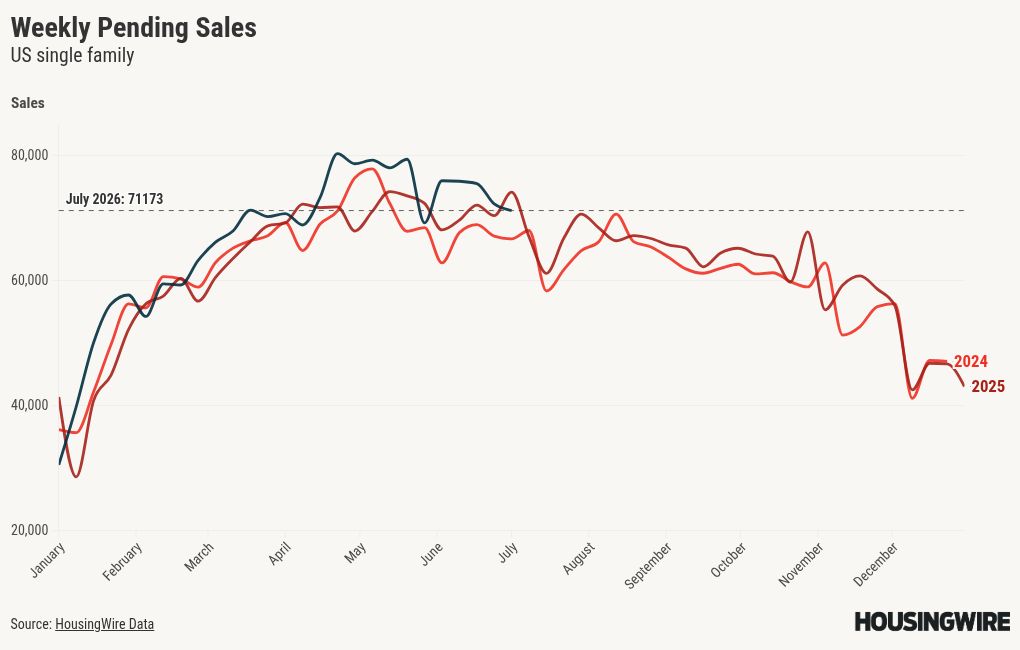
The New York City Rent Guidelines Board voted Thursday night to freeze rents on roughly 1 million rent-stabilized apartments for the next two years, handing Mayor Zohran Mamdani one of the signature victories of his young administration.

The 7-1 vote marks the first two-year rent freeze in the board’s history and fulfills one of Mamdani’s central campaign promises. The mayor appointed six of the board’s nine members.

The decision applies to rent-stabilized apartments in buildings with six or more units built before 1974, along with apartments receiving certain tax incentives or subsidies. The freeze covers leases beginning between October 1, 2026, and September 30, 2027.

Roughly 2 million New Yorkers live in rent-stabilized housing, representing about 40% of the city’s housing stock. For tenants who have faced years of rising rents, the decision offers immediate financial relief.

“Freeze the rent” became one of the defining messages of Mamdani’s mayoral campaign, and he called the board’s decision “a historic victory for New York City tenants,” saying it reflected both financial data and extensive public testimony.

Landlords see the situation very differently.

The Real Estate Board of New York warned the decision would worsen the city’s housing crisis, while the New York Apartment Association argued the freeze comes as building owners continue absorbing higher insurance premiums, labor costs, utility bills, and maintenance expenses. According to the board’s own research, operating costs for landlords increased 5.3% over the past year.

The larger concern is the long-term condition of the city’s housing stock.

With rents frozen while expenses continue climbing, owners of older rent-regulated buildings have fewer financial resources available for repairs and renovations. State records show the number of rent-stabilized apartments registered as vacant increased from roughly 49,000 in April 2024 to more than 57,000 one year later, reflecting situations where renovation costs exceed the rental income landlords are legally allowed to collect.

When restoring an apartment no longer makes financial sense, many owners simply leave units vacant, reducing the overall supply of affordable housing.

This freeze carries greater consequences than previous ones because of changes made to New York’s rent laws in 2019, which eliminated many opportunities for landlords to increase rents after apartments became vacant. Earlier rent freezes under former Mayor Bill de Blasio applied only to one-year leases. Thursday’s action represents the first freeze ever covering two-year leases.

Housing analysts also warn about broader market effects. Rent freezes function as price controls that benefit existing tenants but may discourage investment in rental housing while pushing more prospective renters into the city’s unregulated market, where competition can drive prices even higher.

The vote itself was dramatic.

Hours before the meeting, landlord representative Christina Smyth resigned from the board, arguing it had stopped functioning as an independent fact-finding body and had predetermined its outcome. The New York Apartment Association has already indicated it is exploring legal action against the decision.

For tenants, the vote provides certainty during a period of rising housing costs that remain the largest monthly expense for most households.

For property owners, however, the central economic question remains unresolved: whether aging apartment buildings can continue receiving the investment necessary to remain safe, occupied, and financially sustainable while rental income remains frozen.

Mayor Mamdani has pledged to help reduce operating costs for landlords through lower insurance expenses and expanded housing construction.

Whether those efforts will be enough to preserve New York’s aging rent-stabilized housing stock—or whether the freeze accelerates building deterioration—will shape the city’s housing market for years to come.

JBizNews Desk
© JBizNews.com All Rights Reserved. Reproduction or distribution without written permission is prohibited.
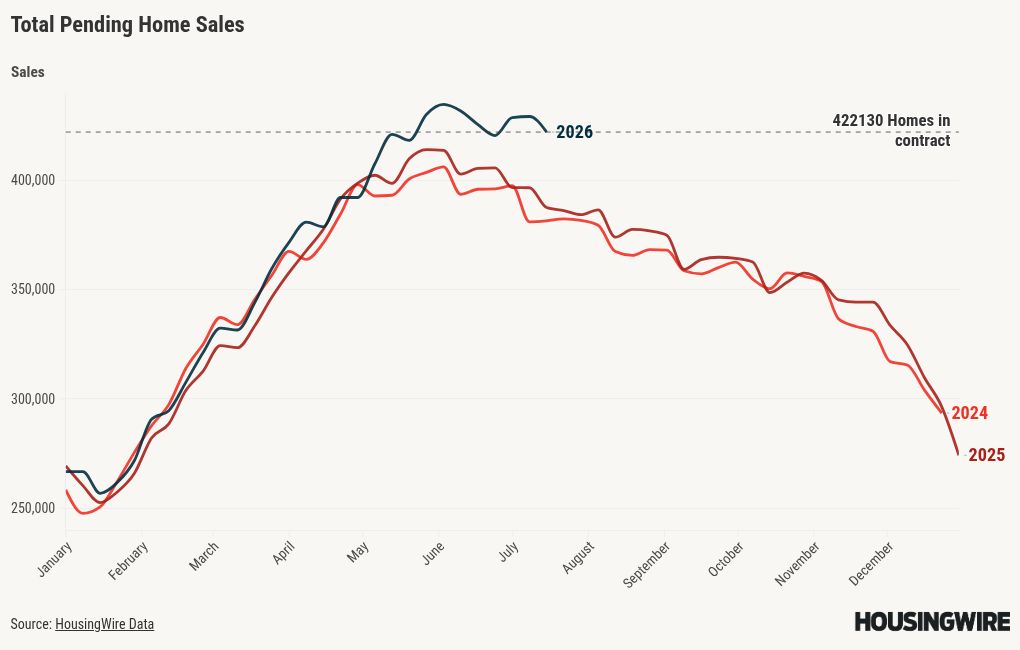
Nonqualified mortgage (non-QM) originations are on track to set another post-crisis record in 2026, as debt-service-coverage ratio (DSCR) and investor loans fuel growth in a still high-rate environment, according to a new Bank of America Securities report.

In terms of non-QM securitizations, insurance demand for bonds remains strong and investors are looking for high-quality, jumbo-like loans flowing through the channel — referred to in the report as “fumbos.”

Non-QM production is expected to reach $175 billion in 2026, compared to $108 billion in 2025. DSCR and investor products now account for about half of all non-QM collateral.

Meanwhile, non-QM securitization issuance will rise from $80 billion in 2025 to roughly $100 billion in 2026. About 70% of non-QM loans are securitized, with the remaining loans primarily purchased by insurance companies.

“Year to date, securitization volumes are running at $57 billion, and we think higher mortgage rates should result in a modest slowdown in the second half of 2026,” BofA analysts wrote on Monday.

High-quality asset pools

Part of the increase in non-QM securitization volumes stems from high-quality, jumbo-like loans flowing through the channel. These large-balance loans are sometimes referred to in the market as “fumbo” loans, they said.

For 2026 originations, loans with balances above $1 million account for about 28% of new non-QM production, and loans above $1.5 million make up 15%, the report said. That is up from 20% and 10%, respectively, in 2018.

This shift means that more prime-quality, high-balance mortgages are being financed via non-agency shelves rather than held on bank balance sheets or placed in traditional jumbo programs, changing both the credit and prepayment profiles of non-QM pools.

In general, non-QM resecuritizations have increased following a pickup in deal calls since 2025. Year to date in 2026, about $4 billion of non-QM paper has been resecuritized, versus $5.5 billion of so-called collateral, the strategy team said.

Weakening performance?

Prepayment behavior in non-QM has shifted over time. S-curves have become steeper, a trend Bank of America attributes to the changing mix of high-FICO, high-balance and full-documentation loans in non-QM shelves, as well as differing concentrations of these loans across issuers. An increase in larger loans in recent deals has amplified that effect.

Delinquencies have continued to creep up in the 2022-2024 vintages across documentation types, the report said. The strategists point to cash-out refinances, weaker performance on bank statement underwriting, and multiple loans extended to single borrowers as primary drivers. By contrast, the 2025 vintage has performed better as lenders tightened credit boxes.

“Overall, cumulative losses in non-QM remain low at 3.6 basis points across vintages for the roughly $281 billion of cumulative originations and securitized since 2018,” the report explains. “A total of about 1,000 out of 580,000 loans have incurred cumulative loss greater than $10,000.”

This article was written by Flávia Furlan Nunes and generated with the assistance of HousingWire Automation, then reviewed by a HousingWire editor before publication.

This post was originally published on here

California Regional MLS (CRMLS) is creating more options for home sellers looking to market and sell their properties. Earlier this month, CRMLS debuted a Limited Exposure Coming Soon listing option for home sellers and real estate professionals in California. 

In a post on the MLS’s Knowledgebase blog, it said the new option “can exclude listings from designated third-party sites at the client’s request without limiting the ability to share the listing on broker-controlled websites and/or social media platforms.” According to CRMLS, the default for coming soon listings is “Internet: Yes,” which means that these listings will be distributed for display on third-party sites via IDX feeds. 

CRMLS subscribers whose sellers choose the limited exposure coming soon option, are now able to set internet display on the coming soon listing to “No,” preventing the listing from being included in IDX feeds. Once a listing swaps from coming soon to active status, CRMLS said subscribers must manually swap the “Internet: No” to “Internet: Yes,” if the seller wants the listing displayed on the internet. However, the MLS said that if the seller instructs there to be no internet distribution of the listing, their agent must remove the listing from all social media platforms and any broker controlled websites. 

CRMLS first debuted its coming soon status for listings in May 2020. Listings are allowed to stay in a coming soon status for up to 21 days. The MLS did not start automatically syndicating coming soon listings via IDX feed until the end of March this year. 

“Our new form for limiting exposure of coming soon listings is a natural progression of giving sellers and their brokers greater choice in listing distribution,” Art Carter, the CEO of CRMLS, wrote in an emailed statement. “CRMLS’s coming soon policies have always been flexible over the years to address broker requests, AOR policies, and practices from neighboring MLSs to keep a fair and representative marketplace. This is just another step towards giving brokers flexibility while maintaining a transparent marketplace.”

The California-based MLS is not the only MLS that has explored the creation of more listing options for sellers. North Carolina-based Canopy MLS, as well as other MLSs across the country, have created a variety of listing options for consumers including Coming Soon/No-Show, limited-exposure and office-exclusive listings. 

This post was originally published on here

Reps. Sam Liccardo (D-Calif.) and William Timmons (R-S.C.) introduced bipartisan legislation on Tuesday to help local governments invest in disaster prevention rather than focusing solely on post-disaster recovery.

The “Ounce of Prevention Act” would expand eligible uses of Community Development Block Grant (CDBG) funding to include pre-disaster mitigation projects, a shift supporters say would allow cities, counties and states to harden infrastructure and reduce risk before storms, wildfires or floods occur.

The bill also seeks to streamline federal rules that can slow approval of proactive resilience projects.

“An ounce of prevention is worth a pound of cure,” Liccardo said, adding that every $1 spent on mitigation can save roughly $13 in post-disaster costs. He said communities “should not have to wait for the storm, fire or flood to hit” before accessing federal support for resilience projects.

Timmons said the legislation gives local governments “commonsense flexibility” to use existing federal dollars more effectively, arguing that proactive investment is “better for taxpayers, better for communities and better for the people who call those communities home.”

Under current law, CDBG funds are generally reserved for community development and post-disaster recovery efforts, with Congress typically approving supplemental allocations after major disasters. Since 2020, lawmakers have appropriated about $22 billion in disaster recovery funding through the program.

The bill’s co-sponsors include Reps. Maria Salazar (R-Fla.) and Jill Tokuda (D-Hawaii).

The proposal has drawn support from a broad coalition of housing, insurance and local government groups, including the American Property Casualty Insurance Association (APCIA), which said expanded mitigation funding could reduce long-term disaster losses and strengthen community resilience.

“Property casualty insurers are working to reduce losses and protect families and communities from the growing impact of hurricanes, wildfires, and other severe weather. APCIA supports this legislation because expanding federal investment in mitigation will help lower the economic toll of natural catastrophes and save lives,” said Sam Whitfield, APCIA senior vice president of federal government relations and political engagement.

The Council of State Community Development Agencies said the bill would give states and cities “needed flexibility” to address disaster risks before they occur, while the Local Initiatives Support Corp. said it would help direct resilience investments toward the most vulnerable communities.

County officials echoed that support. The National Association of Counties said the measure would help local leaders invest in preparedness rather than wait to rebuild after disasters strike.

Other industry trade groups, including the National Association of Mutual Insurance Companies and the National Low Income Housing Coalition, said the bill could reduce losses, protect homeowners and improve resilience in low-income communities.

The U.S. Conference of Mayors said the legislation reflects the reality facing local leaders, who “don’t have the luxury of waiting until after a disaster” and must instead prioritize prevention and preparedness.

This article was generated using HousingWire Automation and reviewed by a HousingWire editor before publication.

This post was originally published on here

Brooklyn’s long-stalled Pacific Park megadevelopment inched closer to the finish line this week as developers unveiled a $5 billion plan to complete the project. Empire State Development, Cirrus Workforce Housing, and LCOR released a plan on Monday for the second phase of the project, formerly called Atlantic Yards, calling for seven new towers with 5,600 housing units, including roughly 1,242 affordable homes for low- and moderate-income households. The plan marks the start of the final chapter of the delayed megaproject, which saw its future thrown into doubt after a foreclosure and a change in developers last October.

Illustration of the proposed project. Credit: ESD

First proposed in 2003 as Atlantic Yards and initially led by developer Forest City Ratner, the 22-acre project originally called for a new arena for the former New Jersey Nets and 15 residential and office buildings, anchored by a glass supertall tower designed by Frank Gehry, as 6sqft previously reported.

The development included a platform planned above the MTA’s Atlantic Yards rail yard at the intersection of Pacific Street and Atlantic, Carlton, and Vanderbilt avenues. The state deemed the rail yard a “blight,” a major factor in its decision to acquire the sites through eminent domain and lease them to developers.

Lawsuits from residents and property owners displaced under the eminent domain agreement delayed construction for years. A planned modular tower that ran into obstacles further stalled the project, along with major crises such as the 2008 financial crash and the COVID-19 pandemic.

The expiration of the 421-a property tax abatement in 2022 also created another setback, with Greenland USA, an early stakeholder that took over more than 95 percent ownership of the project in 2018, saying that without it, it could not construct the affordable units.

A 2014 agreement with the city required Greenland to build 876 additional affordable units by 2025. The deal imposed a $2,000-per-month penalty for each unbuilt unit, which could total up to $21 million annually if deadlines were missed.

By December 2023, developers had completed nine of the 15 planned buildings and scrapped plans for the Gehry-designed tower. The Barclays Center, owned by Mikhail Prokhorov and home to the Brooklyn Nets, had already opened.

That month, Greenland USA defaulted on nearly $350 million in loans tied to the second phase, sending the project to a foreclosure auction and passing on the penalties and affordable housing requirements to the new developer.

Last October, Cirrus Real Estate and LCOR acquired the development rights to Pacific Park, contributing $12 million to an affordable housing fund to offset penalties that were not enforced against Greenland USA for failing to build the 876 affordable units.

Greenland is staying on as a partner, though in a much smaller capacity. The firm plans to monetize the B1 parcel, where a tower was previously planned, and Site 5 across Flatbush Avenue, as 6sqft previously reported. This would allow for a two-tower project at Site 5, which ESD has already approved, though it still requires public approval and a vote by the ESD board, according to the Atlantic Yards Report.

The new development team returned to ESD on Monday with a revised approach to finish Pacific Park, nine months later.

The proposal would be carried out by a design team that includes Kohn Pedersen Fox as master plan architect, Michael Van Valkenburgh Associates as master plan landscape architect, Of Place, leading placemaking and the public realm, and WSP spearheading structural work and serving as MEP engineer.

To build platforms over the railyards—one of the project’s most complex and costly components—the developers intend to use some of the foundations laid years ago. The state has also included $175 million in subsidies for the project in its budget, according to the New York Times.

A breakdown of the units in the new buildings in phase II. Credit: ESD

The plan calls for seven new buildings on six sites (including a two-tower building on site 5), with 4,600 rentals and 1,000 condos. Compared with the previous plan, the development will add 2,382 additional units to the original plan, for 8,812 total apartments.

The tallest tower would be 799 feet on site 5, currently home to a P.C. Richard store and former Modell’s. The remaining buildings range in height between 452 feet and 684 feet.

According to Monday’s presentation, there is strong demand for low- and moderate-income and family-sized rental units.

Phase two of the plan includes 1,242 income-restricted units for low- and moderate-income households, with over 30 percent designated as family-sized. That marks about 30 percent affordable apartments, compared to the 35 percent approved 20 years ago.

One of the first buildings to rise, just south of Flatbush Avenue between Atlantic Avenue and Pacific Street, would deliver 1,430 units.

Based on early estimates and this year’s affordability guidelines, the Times projects that about 50 units in the building would be affordable to families of four earning up to $67,840, and more than 150 apartments would be affordable to households of four earning up to $101,760.

The new proposal also addresses a strong desire for expanded open space. Compared with the currently approved plan, which features smaller, disconnected green spaces throughout the development, the revised plan envisions 8.5 acres of continuous open space designed for active recreation, seating, and gathering.

Illustration of B6 Park. Credit: ESD

The open space includes B8 Park, with a mix of active and passive programming, exceeding previously approved open space requirements.

Streetscape improvements would create safer intersections, enhance lighting, and widen sidewalks and crosswalks, with a strong emphasis on adding greenery and shade. Improved intersections and lighting would also provide better connectivity to the surrounding area.

Wind mitigation is also a key component of the public realm improvements. In the new plan, the base heights of buildings have been lowered, while base articulation has been increased, helping to mitigate stronger wind conditions created by sheer, straight building forms.

Illustration of B8 Park. Credit: ESD

The proposed master plan also prioritizes community space. Several community facilities are planned, including an intergenerational community center in B6, the first residential building to be delivered, a flexible hub in B10, and a potential revised “urban room” concept in B5.

While the revised plan is a step toward realizing the long-delayed megadevelopment, it has not been without criticism from some locals.

In March, a group of elected officials sent a letter to Gov. Kathy Hochul expressing concerns about the affordability of the apartments. BrooklynSpeaks, a coalition of civic groups, has also called for greater transparency and public input in the project, according to the Times.

During Monday’s meeting, Assemblywoman Jo Anne Simon, one of the letter’s signers, said the project’s affordability metrics and focus on moderate-income housing have failed to address the area’s need for low-income homes.

“We do know that the crying need for housing in this city is mostly at the lower end. It’s not as remunerative to build that, that’s why we keep being dug into this hole,” Simon said. “I think we need to have more conversations that are more interactive with the community. The people who went to those meetings were the people who live in the area, it’s already been gentrified.”

“We’ve already lost 25 percent of the African American population from those community boards,” she added. “It’s a snapshot. It’s not really an indicator of community and the people who are here and the need for housing.”

The project is estimated to cost $5 billion. New York will provide $700 million in public funding to build platforms over the railyard needed to build, as Gothamist and the Times reported.

Before work can begin, the plan must undergo an environmental review that state officials say could begin in September. Work could begin as early as 2028.

RELATED:

The post $5B plan unveiled to finish Brooklyn’s Pacific Park megadevelopment first appeared on 6sqft.

This post was originally published here

Portside Real Estate Group has added Heather Szela to its central Maine office, where she will work with homebuyers and sellers throughout the region.

Szela, a Maine native, began her real estate career in the Boston area, with experience including residential sales and leasing.

She returned to Maine in 2017 and has continued working in residential real estate.

“I joined Portside because I wanted to be part of a company with a strong commitment to its communities and a culture that values giving back,” said Szela. “The collaborative environment and dedication to supporting local communities really align with my values, and I’m excited to be part of a team that shares that vision.”

A LeadingRE affiliate, Portside Real Estate Group reported $1.33 billion in 2025 volume across 2,090 transaction sides to RealTrends Verified.

“Heather’s dedication to serving her clients is matched by her commitment to serving her community,” said Dan McCarron, regional manager at Portside Real Estate Group. “She leads with integrity, builds meaningful relationships, and genuinely cares about helping people succeed. Those qualities embody what Portside is all about, and we’re thrilled to welcome her to our central Maine team.”

Szela said she values the opportunity to guide clients through major life decisions.

“I love that real estate gives me the opportunity to help people through an important milestone in their lives,” she said. “Every day is different, and I enjoy the problem-solving, creativity, and personal connections that come with the job.”

This article was generated using HousingWire Automation and reviewed by a HousingWire editor before publication.

This post was originally published on here

Figure announced Tuesday that it has closed a $300 million fully prefunded securitization for loans that will trade on its blockchain-based marketplace, Figure Connect.

The company said the transaction departs from the traditional securitization process by securing funding from institutional investors before loans are originated rather than after they close.

According to Figure CEO Michael Tannenbaum, the approach provides originator partners with committed liquidity in advance, helping lock in pricing and execution while reducing uncertainty in their production pipelines.

“It’s all about the perspective of the originator,” Tannenbaum said in an interview with HousingWire. “Knowing that the loans are spoken for before you even fund them just gives you added certainty because, as you know, markets can change on a dime.”

Figure said the upfront fixed-rate capital establishes what it hopes will become a repeatable funding model for loans traded through Figure Connect.

The company compared its long-term vision to the liquidity provided by Fannie Mae and the agency mortgage-backed securities to-be-announced (TBA) market, which allows lenders to secure financing before loans are delivered.

“Having investors prefund and preaccept those loans before the loans are even funded, it’s just a function of the marketplace that adds value to the originator, and I think it also reflects the scale, consistency, and quality that Figure is operating in because we’re so mature in it from a capital market standpoint that people are so comfortable with what we’re doing that they’re willing to buy these loans before they even are originated,” Tannenbaum said.

Not a one-time thing

Tannenbaum called Figure “a version of Fannie Mae, but on modern blockchain rails,” and one that can support multiple asset classes rather than a narrow slice of mortgage products.

“I think that speaks to an opportunity for Figure to expand into a broader capital market offering and services for our customers as they’re looking to build their business on the back of not only the Fannie Mae ecosystem but also now the Figure ecosystem. People could, over time, start to use this to hedge as well,” he said.

From the investor side, Tannenbaum said the willingness to prefund stems from comfort with Figure’s “shelf,” meaning its brand, technology and track record in the capital markets.

“Investors want return on time; they want return on effort,” he said, noting that Figure is executing securitizations “almost every month” and is growing volumes by more than 100% at scale. “Investors want to buy repeatable and consistent assets, and Figure’s bringing those.”

The $300 million transaction is Figure’s first prefunded securitization, and Tannenbaum stressed it is not a one-off.

“This is a part of our strategy,” he said. “We are constantly investing to make sure that our originating partners have guaranteed liquidity and have consistent access to the capital markets. … This is big. No one’s ever done anything like this.”

Rather than a single forward buyer, Tannenbaum said that the capital comes from the “institutional bond market,” with a broad investor base purchasing AAA-rated bonds.

“The whole value of a securitization is that you’re transforming loans that are relatively chunky and sort of sitting around into a security that’s liquid, has a CUSIP and can be bought by anybody who buys bonds of that nature,” he said. “It’s a much more liquid approach.”

For lenders, the structure is less about richer economics and more about liquidity and certainty, including a fixed execution price. But borrowers could ultimately see downstream benefits as well, he added, as stronger liquidity and capital markets efficiency translate into lower system costs and, over time, better rates.

Tannenbaum also highlighted Figure’s scale, noting that Figure Connect originated $1.4 billion in May, with the $300 million prefunded deal representing a meaningful slice of that volume. The company recently announced its intent to acquire Kiavi in a $717 million deal, with plans to integrate its RTL platform and DSCR rental loans into Figure Connect and Democratized Prime.

This post was originally published on here

Nearly a year after Rocket Companies closed its acquisition of Redfin in an all-stock transaction valued at $1.75 billion in equity, Joe Rath, the former Redfin senior director of operations and current head of industry relations at Rocket, says that things “could not have gone better” with the integration of the two firms. 

“We have our swagger back. It feels so good to be building things again,” Rath said. “At Redfin, it wasn’t for lack of want, it was more for lack of resources, but we stopped innovating at some point, and I think that is the biggest difference between a year ago and now, is that we are part of this larger homeownership platform and building and innovating again.” 

Back to building

One of the things Rath is most excited about is how Redfin, with the support of Rocket, has been able to play with the idea of what it means for a home to come to market. 

“We have been able to think about the existing structure of how homes come to market today, where being on the market has almost become synonymous with being on the MLS, and we just view things differently. There are these would-be sellers on the sidelines,” he said. “We surveyed them and found that three-quarters of prospective sellers would move today if friction disappeared, and 58% say moving feels riskier than staying put. So, there’s this market that exists on the sidelines, and we’re fascinated by that group and how we can help them come onto a platform to actually test that market out.” 

This, he said, is what led to Rocket’s partnership with Compass International Holdings to display the firm’s coming soon listings on Redfin, as well as the launch of Redfin Early Access. 

The flywheel in full effect

While Rath has enjoyed innovating around these products and partnerships, he said he has also enjoyed exploring the flywheel effect Redfin is now part of as a portion of a company that includes everything from home search to mortgage origination and mortgage servicing

“The housing transaction was split across a dozen separate industries, so what buyers and sellers think of and call ‘moving’, we call it a lot of different things and costs begin to multiply through all of these handoffs and the consumers were basically stuck,” Rath said. 

This is why Rath believes more and more firms are creating “vertical stacks,” because they are enabling companies to solve these challenges in ways the “horizontal” companies never could.

“We had all of these horizontal layers and companies. That was failing consumers, and I think that is why the consumers and the dollars are flocking to this idea of an ecosystem. We have this infrastructure with portals, MLSs and associations that were all building toll roads and not highways, and I think over time that friction has been slower to be removed than in other industries, but if we work together we can help solve this.” 

Over the next decade, Rath said he feels the companies that will be rewarded will be those that remove steps and costs for consumers. 

More opportunities for agents

In addition to creating a smoother and more cost-effective transaction for consumers, Rath also said this vertical business model also offers benefits for real estate professionals. 

“If it’s a consumer we transacted with in the past and we service their loan, we have a data advantage that allows us to see their behavior maybe 12 to 15 years later when that homeowner goes onto Redfin and begins looking for a home,” he said. “Our agents can see that behavior in real time and then reach out and see if they can help them.”

As an industry and as a company, Rath believes real estate professionals could do a much better job of becoming part of a homeowner’s or family’s conversation around moving much earlier on in the process, opening up the conversation about what a possible move would look like. 

Looking ahead, Rath said he wants to continue building and innovating at Redfin and for the company to continue telling its story to the public in ways they were previously unable to.

“This was the first year we saw a Super Bowl commercial featuring Redfin, and we sponsored the Cleveland Cavaliers playoff run in the Eastern Conference Finals. To see Redfin plastered all over Rocket Arena was a surreal experience for me,” Rath said. “Like I said, we have our swagger back, and I want to see more of that over the next year.”

This post was originally published on here

Dovenmuehle Mortgage Inc. has appointed Ann Morey as its head of product, the mortgage subservicer announced Tuesday.

Morey will oversee the company’s product management strategy, including setting product vision, developing product road maps, improving cross-functional collaboration and leading product teams.

She joins Dovenmuehle with more than 15 years of experience leading digital product and technology teams across the financial services, logistics and government sectors.

Most recently, Morey served as vice president of product delivery at Tria, formerly known as Softrams, where she managed a team of more than 200 employees and oversaw three enterprise software contracts with annual revenue totaling about $70 million. She previously held product leadership roles with the U.S. Air Force‘s Kessel Run software development unit, XPO Logistics and First Data.

“Ann brings exactly the kind of product leadership we need as we continue to evolve our platform and capabilities,” senior vice president Matt Budy said in a statement. “Her track record of cultivating high-performing teams, driving measurable outcomes and translating complex client needs into effective technology solutions makes her exceptionally well-suited to lead this function at Dovenmuehle.”

According to the company, Morey has implemented product development and prioritization frameworks throughout her career and has focused on talent development, including launching mentorship programs and reducing employee turnover at a previous employer.

“I’ve spent my career at the intersection of complex operations and digital products, and Dovenmuehle sits squarely in that space,” Morey said in a statement. “The company has built an impressive legacy, and I’m looking forward to building on that foundation with modern product practices alongside a team focused on continuous improvement and client value.”

According to data from Inside Mortgage Finance, Dovenmuehle represents 7.3% of the residential subservicer market. The company ranked fifth among the top 25 subservicers on IMF’s list with a value of $310 billion in first-quarter 2026, but its portfolio declined 1.3% from the previous quarter and 6.3% from a year earlier.

This article was written by Sarah Wolak and generated with the assistance of HousingWire Automation, then reviewed by a HousingWire editor before publication.

This post was originally published on here

In housing, there are a few words that get tossed around so often they start to lose all meaning.

“Affordability” is one of them. “Sustainability” is another. Near the top of the list is “density.”

Say the word at a city council meeting, and half the room hears “traffic,” “apartments,” “school overcrowding,” and “there goes the neighborhood.” Say it at a development meeting, and someone inevitably points to a zoning chart as if a spreadsheet could tell you whether a neighborhood will actually be worth living in.

That is where much of the affordability conversation goes off the rails.

A spreadsheet is not a neighborhood. A zoning chart is not a community. And a higher unit count does not automatically make a place better, more affordable or more livable.

The better question is not simply how many homes can fit on a piece of land. Rather, it is about how people should live on that land. That is where design matters. If a city’s zoning allows 3.5 units per acre and a developer proposes a plan at two units per acre, the immediate reaction should not be that the site is underbuilt. That is zoning-table thinking.

It is also how good plans get killed before anyone understands them. What local stakeholders should ask is, “Does the trade deliver?”  If the lower-density plan creates more parks, more trails, more preserved trees, better drainage, better gathering places and a neighborhood people will still value in 20 years, that may be the smarter, more affordable outcome.

That sounds counterintuitive only if affordability is treated as a simple math problem based entirely on units per acre. It is not.

Affordability is land cost. Affordability is an infrastructure cost. Affordability is entitlement risk. Affordability is time. Affordability is product size. Affordability is lot configuration. Affordability is how much street, pipe, curb, drainage and concrete it takes to deliver each home. Affordability is whether the political process takes six months or three years. Affordability is whether the neighborhood accepts a plan or fights it until the project dies.

Importantly, affordability is whether families actually want to live there when it is built.

In Texas, affordability is not just the price of the steak. It is the whole tab – to mix the metaphors, it is the land, the kitchen, the waiter, the lease, the electric bill, the parking lot, the property tax, and the guy at the next table explaining why he could have done it better.

The real mistake localities make

Cities often say they do not like density. That is not quite right. What many cities actually dislike is the appearance of density at the lot level. Smaller lots look dense. Tight setbacks look dense. More homes visible from the street look dense. So the instinctive answer becomes: less. Less intensity. Less small-lot product. Less change.

But when a city focuses on lot size rather than acreage density, it can end up rejecting the better plan for the wrong reason. That is the blind spot.

Too often, the review begins and ends with a single line on the zoning table: minimum lot size. If the lot is smaller than the number on the page, the reflexive answer is no. It does not matter what the gross density is. It does not matter how much open space is preserved. It does not matter whether the plan uses less infrastructure per home or creates a stronger public realm.

The conversation stops because the lot is “too small.” That makes no sense if the real goal is affordability, livability, and long-term fiscal health. A 7,500-square-foot lot backing up to a fence can be approved with little debate, even if it requires more street, more pipe, and more long-term maintenance per home.

A 3,000- to 4,000-square-foot lot fronting a park or green can be rejected on sight, even if it supports a lower price point, less infrastructure per unit and a better neighborhood experience.

On paper, the bigger lot looks safer.

On the ground, a smaller lot within a better plan can be more attainable for the buyer, more efficient for the builder, and more valuable to the city over time. In other words, many cities do not really hate density. They hate the optics of a smaller yard.

They are looking at the wrong side of the fraction. If a city first looked at acreage density, infrastructure per home, usable open space and long-term value per acre, many “too dense” objections would fall apart faster than a cheap lawn chair in an August Texas sun.

What better math looks like

This is not just a homebuilding issue. It is a land-use issue. Groups such as Strong Towns and Urban3 have spent years making a similar point in a different context: cities should focus on value per acre, not just total value. Compact, traditional development patterns often generate far more taxable value per acre than large-format, spread-out patterns dominated by surface parking and excessive land consumption.

The lesson is straightforward: larger footprints and greater land consumption do not automatically translate into more fiscal value for a city. The same principle applies within a subdivision.

A small lot fronting a park can feel larger than a larger lot backing up to an eight-foot fence. A cottage home on a green can feel more valuable than a larger home buried in a repetitive street grid. A compact home next to trails, water, trees, and shared open space can offer a better life than a larger home with no neighborhood nearby.

That is not theory. That is design, and it is also math.

A conventional subdivision layout often features long local streets, deep driveways, larger lots, oversized cul-de-sacs, and leftover open space across the site. That means more curb, more inlets, more pavement, more water line, more storm pipe, more grading and more long-term maintenance.

A more thoughtful plan featuring smaller lots, shorter streets, connected open space and improved block structure can reduce that burden while delivering a stronger public realm.

Less linear street per home. Less pipe per home. Less wasted land. More usable open space. More walkability. More identity. That is a much better affordability equation than simply arguing over whether a lot is 30 feet or 75 feet wide.

Density is not the same as livability

This is where the housing conversation often goes wrong. People talk about density as though it were the same as design quality. 

It is not. A badly designed plan at 3.5 units per acre is still badly designed. A thoughtful plan at 2 units per acre can create a far better neighborhood if it uses the land strategically. Smaller lots around parks. Trail systems that connect the entire community. Preserved natural features instead of unnecessary clearing. Open space used for drainage, recreation, beauty and identity all at once.

Not every family needs a giant backyard. Every family benefits from a nearby park. Not every child needs a private soccer field behind the house. Every child benefits from a trail, a lawn, a playground, a shaded walk, a fishing pond and a place to ride a bike. Not every home needs to sit on the largest possible piece of dirt. Every home benefits from being part of a place that was actually designed.

That is the part too many review processes overlook. They see a smaller lot and assume it means lower quality. They see open space and assume it is a luxury. They see a lower gross density number and assume the plan is less efficient. In reality, the opposite may be true.

Texas understands land better than most places.

We know the difference between land that is useful and land that is just sitting there wearing a big hat. Open space should not be decoration. It should work. It should drain. It should connect. It should create value. It should improve the homes around it. That is how green space becomes infrastructure for affordability.

What cities should measure instead

If cities are serious about housing affordability, they need to upgrade their metrics. Minimum lot size is a blunt tool. It may be easy to administer, but it does not tell a city whether a plan is affordable, fiscally productive, or livable over the long term. A better approval framework would start with a different set of questions.

What is the plan’s gross density, not just the minimum lot size? How much infrastructure per home is being built, including streets, curbs, drainage, and piping? What percentage of homes are within a short walk of a real park, trail, or usable open space? How much of the open space is central, visible, and functional rather than hidden in leftover corners? What long-term maintenance burden will the city inherit per acre? What value per acre will the neighborhood create over time?

Those are the questions that link design to affordability. They also connect today’s approval decision to tomorrow’s municipal balance sheet. Greater distance and more pavement usually mean higher costs. More pipe, more curb, more detention, more road, and more dead-end streets are not free. 

Someone pays for them. At first, the builder pays. Then the buyer pays. Eventually, the city pays. That is why land planning matters so much. Cities do not just inherit rooftops. They inherit streets, drainage systems, traffic patterns, maintenance obligations and complaints. They inherit the neighborhood forever.

Improve the conversation for builders and cities

Builders already understand that every unnecessary foot of street, every oversized lot, every inefficient layout, every entitlement delay, and every political fight gets baked into the final home price. The buyer pays for it all. Cities should understand that the same costs are also baked into long-term public obligations.

That is why a blanket “no small lots” rule is not a safeguard against bad development. It often blocks some of the most thoughtful and attainable neighborhood plans. It treats lot size as a proxy for quality, even though quality is really a function of design, land planning, infrastructure efficiency, and what the city will own and maintain over time. The opportunity is not to choose between affordability and livability. The opportunity is to combine the two.

Smaller lots. Better parks. More trails. Less wasted land. More thoughtful infrastructure. More beauty. More attainability. That is where housing needs to go. The future of affordability is not just more rooftops. It is a better neighborhood. And better neighborhoods require more than zoning math. They require design.

This post was originally published on here

With mortgage rates on an upward trend in recent months, housing professionals got a welcome respite this week as the costs of a home loan declined.

On Tuesday, HousingWire‘s Mortgage Rates Center showed that 30-year conventional loan rates averaged 6.73% — down 6 basis points from one week ago. Rates for 30-year jumbo loans dropped to 6.66% — down 15 bps — while rates for 30-year loans through the Federal Housing Administration (FHA) were down 9 bps to 6.29%.

At the midpoint of the year, housing demand remains resilient despite ongoing affordability constraints, including mortgage rates near 6.7%.

HousingWire Lead Analyst Logan Mohtashami wrote this week that purchase loan applications — which tend to lead closed home sales by 30 to 90 days — are up from last year’s levels. But the weekly application numbers have bounced around through the first half of 2026, with 12 negative prints, 10 positive prints and two neutral prints.

“This year’s growth is a bit more legit than last year’s, which was working from an extremely low base, so the percentage growth needs context,” Mohtashami wrote in this week’s Housing Market Tracker. “The Iran conflict didn’t damage this data line too much on the negative side; a better premise is that the growth rate was probably slowed just a tad.”

Higher rates, muted refis

Bob Broeksmit, president and CEO of the Mortgage Bankers Association (MBA) said mortgage market participants are still digesting the policy decisions and comments of the Federal Reserve under new Chair Kevin Warsh. Last week’s mortgage application data from the MBA saw 1% growth from the prior week, adjusted for the Juneteenth holiday, led by a 3% rise in refinance applicants. Refi and purchase loan demand is 17% and 3% higher, respectively, than year-ago levels.

“While mortgage application activity was mixed, overall demand continues to outpace last year’s levels, reflecting the underlying strength of the housing market. As economic conditions continue to evolve, greater certainty around the interest rate outlook should help foster increased borrower confidence and support sustained housing market activity,” Broeksmit said in a statement.

The Fed held benchmark rates steady two weeks ago — the central bank’s fourth straight rate pause — but indications point to monetary policymakers being more likely to raise rates in 2026 than lower them.

Quarterly projections released by the Federal Open Market Committee (FOMC) at their prior meeting showed that nine of 12 voting members anticipate a rate hike by the end of the year. The federal funds rate, currently pegged at 3.5% to 3.75%, is expected to rise to 3.8% in six months, up from an estimate of 3.4% in March.

The refi wave that briefly materialized earlier this year when rates dropped below 6% has already crested, according to an analysis released last week by Cotality. The report explained that as of April, 3.7% of outstanding mortgages have rates above 7%, while another 10.5% of loans have rates above 6.5%. This is limiting the incentives for most potential refi candidates.

“But the opportunity is concentrated in recent vintages, with post-2022 borrowers carrying much higher rates and poised to refinance first if rates move even modestly lower,” Cotality said.

‘Masking a widening divide’

Home-price appreciation has generally been a tailwind for the housing market in 2026. Annual growth across much of the country has floated near 1%, well below the double-digit growth of the COVID-19 pandemic that was viewed as unsustainable. On Tuesday, the S&P Cotality Case-Shiller Index for April posted yearly growth of 0.8%, up slightly from the 0.7% figure in March as inflation accelerated to 3.8% in April.

But HousingWire Data, which reflects more current market conditions, reveals softer home-price appreciation for the week ending June. 26. The median list price of $450,000 was down 3.2% year over year and flat over the prior month. Some major metros were bucking the trend, led by Chicago at 7.3% annual growth, Atlanta (+3.2%) and Miami (+3.1%).

“National house prices are making history in slow motion,” Mark Fleming, chief economist at First American, said in commentary released this week. “While annual house price growth remains below 1 percent, the price level reached a new historical peak this month. Unlike the pandemic-era housing boom, when double-digit appreciation quickly pushed prices higher, today’s record reflects the cumulative effect of small monthly gains rather than rapid price acceleration.

“Although inventory continues to increase compared with a year ago, the pace of inventory growth nationally has moderated, and supply remains below pre-pandemic norms, limiting both upward and downward pressure on prices.”

Cotality’s analysis also found muted home-price growth of 0.3% for the year ending in March. But it concluded that the “national housing market is masking a widening divide” as there is sharp movement at the local level.

Home prices in San Francisco were up 8.1% from January to April, Cotality said, followed by Newark, New Jersey (+6.4%); Boston (+5.9%) and Rochester, New York (+4.3%). At the other end of the spectrum, prices declined in other markets during the four-month period, led by Cape Coral, Florida (-4.7%); New York City (-2.3%); Buffalo, New York (-2.1%); and Washington, D.C. (-1.3%).

“Home price appreciation is pushing more homeowners above long-standing capital gains tax exclusion thresholds, increasing the share of sellers who owe taxes when they move,” Cotality said. “Those thresholds, $250,000 for single filers and $500,000 for married couples, have remained unchanged since the late 1990s, despite significant gains in home values.

“Cotality analysis shows roughly one in 12 sellers now exceed these limits, with the burden most pronounced in high-cost markets like California. As a result, more owners are staying put, limiting resale supply even as prices remain elevated.”

This post was originally published on here

On July 4, America celebrates its 250th anniversary, a momentous occasion marked by patriotic celebrations across the country. New York City festivities will be especially memorable this year. The Macy’s 4th of July fireworks show is set to be its biggest ever, with fireworks launching from three separate locations for the first time. The largest parade of tall ships ever assembled takes to the New York Harbor, with more than 40 tall ships from around the world and 30 naval vessels. Ahead, find some of the best 4th of July celebrations for America’s semiquincentennial, from ship tours and exhibits exploring NYC’s Revolutionary past and immigrant history to firework watch parties on rooftops and observation decks.

Major events

Sail4th 250
New York Harbor, July 3 through July 8

Credit: OpSail 2000

This July, the largest fleet of tall ships ever to sail into New York Harbor will arrive as part of celebrations marking America’s 250th anniversary. The once-in-a-generation “Sail4th 250” event will bring six days of festivities to the five boroughs from July 3 through July 8, capped by the arrival of 40 tall ships and 32 warships from around the world on July 4.

Among the featured vessels is Cunard’s Queen Mary 2, the world’s only ocean liner, which will dock in the harbor and serve as a viewing point for the fleet’s parade. The British Navy will also send two aircraft carriers, while U.S. Navy and Coast Guard ships will anchor along the Hudson River between the Verrazzano-Narrows Bridge and the George Washington Bridge.

The celebration is anticipated to draw between eight and ten million spectators, who will line the 15-mile shorelines of New York and New Jersey to witness the historical arrival. The event is projected to generate about $2.85 billion in economic impact.

After docking, 30 international vessels will be open to the public for free throughout the week-long stay. Tour locations include Brooklyn Bridge Park, Sail City, South Street Seaport, and Stapleton Park on Staten Island. Book a tour here. For tall ships at Pier 86, book a tour through the Intrepid Museum.

The International Naval Review 250 will coincide with the arrival, marking the seventh such review hosted by the United States and the fourth in NYC. Naval forces, maritime services, and coast guards from more than 130 nations have been invited to participate.

Times Square Ball Drop
Times Square, July 3

Photo courtesy of America250

The Times Square Ball Drop, a classic NYC tradition, will light up Midtown this July 4th for the first time ever, dropping not once but eight times to ring in Independence Day across all American time zones. Marking the first time the ball has dropped multiple times in a single year, the patriotic celebration begins at 10 a.m. with the first drop honoring Guam and the Commonwealth of the Northern Mariana Islands, followed by a series of special moments and live performances across Puerto Rico and the continental United States, building up to the New York City countdown at 11:59 p.m.

Rooftop parties & observation decks

Credit: spurekar on Flickr

As patriotic festivities ramp up across the five boroughs around Independence Day, so too will its most cherished tradition: the Macy’s 4th of July Fireworks show. This year marks a double milestone—it is the nation’s 250th birthday and the 50th anniversary of the fireworks spectacle itself. To celebrate the occasion, the show will launch from three separate locations, marking the largest display in its history. A dazzling array of fireworks will launch simultaneously from the Brooklyn Bridge, the lower East River near the South Street Seaport, and the lower Hudson River in a collaboration with Jersey City. Expect more than 85,000 shells in 30 colors, a laser show, and a star-studded broadcast.

With multiple launch sites this year, there will be even more opportunities to view the fireworks. Here is a list of some of the best places to enjoy the show:

Empire State Building
20 West 34th Street, Midtown

The world’s most famous skyscraper is hosting an unforgettable fireworks viewing party, promising an unparalleled vantage point to observe the night sky blazing with vibrant colors and explosions. Guests can enjoy classic summer barbecue fare like hot dogs, brisket sliders, fried chicken, and more, as well as unlimited beer, wine, and non-alcoholic beverages. While tickets to the tower’s 102nd-floor observation deck are sold out, there are still limited tickets available for its 86th-floor observation deck. Tickets start at $580 and can be purchased here.

Summit One Vanderbilt
45 East 42nd Street, Midtown

4th of July 2025 at Summit. Photo courtesy of Summit One Vanderbilt.

Witness the largest Macy’s 4th of July fireworks spectacle in city history from one of NYC’s most breathtaking vantage points. At 1,100 feet above the city, Summit One Vanderbilt offers guests access to all three floors of the observation deck, two drinks, one food item of their choice, complimentary cotton candy, live music, games, 3D fireworks glasses, and more. Tickets are $160 for guests under 21 and $250 for those 21 and older. You can purchase tickets here.

Top of the Rock
45 Rockefeller Plaza, Midtown

Experience the city’s largest fireworks show in its history at Top of the Rock. Seventy stories above Manhattan, guests can indulge in festive food and drinks while dancing to a live DJ. The family-friendly event also features a range of children’s activities, including face painting, coloring books, glow sticks, and more. Tickets start at $95 for children and $250 for adults.

Golden Child
444 Park Avenue South, Nomad

Enjoy the 4th high above the city atop Hotel Park Ave NYC at its new rooftop, Golden Child. Designed as a social club without the membership fees, the Ivy League-inspired destination is offering a two-hour premium open bar from 6 to 8 p.m. and food specials throughout the evening, along with views of the Manhattan skyline and fireworks. Reservations are available here.

ART Midtown
351 West 38th Street, Midtown

Credit: ART Midtown

Celebrate in true patriotic style at ART Midtown’s rooftop Independence Day extravaganza. Taking place from 4 to 11 p.m. on the 26th floor of Arlo Midtown, the rooftop vantage point provides stunning views of Hudson Yards, One World Trade Center, and the Manhattan skyline. Admission includes a barbecue buffet and a premium open bar from 7 to 9 p.m. General admission tickets are priced at $125.

Formino
Brooklyn Bridge Park, Pier 6, Bridge Park Drive

Take a front-row seat to Macy’s 4th of July fireworks show at Brooklyn Bridge Park’s Formino, situated atop Pier 6. Guests will enjoy spectacular views of New York Harbor, the Brooklyn Bridge, the Manhattan skyline, and the fireworks display. Tickets cost $250 and include rooftop access, a chef-curated 4th of July menu, and an open bar.

One40 Rooftop
140 Washington Street, Financial District

Raise a glass to the 4th high above the Financial District at One40 Rooftop. From 8 to 11 p.m., guests can enjoy premium cocktails and elevated bites while taking in sweeping views of the Manhattan and Jersey City skylines. General admission tickets cost $225 per person, plus tax. For those looking to celebrate in style, VIP Lounge tickets are available for $2,000, plus tax, and include a reserved lounge for up to five guests, premium fireworks viewing, a dedicated cocktail server, a bottle of champagne, hors d’oeuvres, and an open bar. Tickets can be purchased here.

The View at Lokal
2 2nd Street, Jersey City

Credit: Lokal Jersey City

Celebrate Independence Day on the Jersey City waterfront at The View at Lokal, which offers unobstructed views of the Manhattan skyline across New York Harbor. Guests can enjoy the most bombastic Macy’s 4th of July fireworks show in history from an unparalleled waterfront vantage point from 7 to 11 p.m. General admission tickets start at $195 per person, with early bird pricing available for $150 per person before 7 p.m.

Edge at Hudson Yards
30 Hudson Yards, Hudson Yards
July 4th from 7:30 p.m. to 3:00 a.m.

Photo by Roy Rochlin/Getty Images for Edge at Hudson Yards

Edge, the highest outdoor sky deck in the Western Hemisphere, is hosting a 4th of July celebration with views of the Macy’s fireworks and a late-night show continuing the festivities into the early morning. At 1,100 feet above Manhattan, guests will take in panoramic skyline and fireworks views, along with a live DJ, food and drinks, and more. Afterward, visitors can continue the celebration at a late-night event on the Marquee Skydeck, running from 11 p.m. to 3 a.m. The event is for guests 21 and over. Tickets start at $230 for the 7 p.m. entry and $85 for the late-night Marquee Skydeck show.

Manhatta
28 Liberty Street, Financial District

Photo by Roman Halpern

Another sky-high Independence Day celebration returns to the Financial District restaurant, Manhatta. This year’s event features an all-night open bar, live music, lawn and arcade games, and an expansive barbecue spread inspired by American classics, including pulled pork and hot dogs. Tickets cost $250 per person and can be reserved here.

Other events

Circle Line’s 4th of July Cruises
July 3 through July 8

Credit: Circle Line

Circle Line is offering a lineup of ways to experience the city’s Independence Day celebrations from the water, including a front-row seat cruising among tall ships as part of Sail4th 250, as well as sightseeing cruises around Manhattan’s waterways. On July 3, you can cruise among the tall ships as they arrive ahead of the parade. On July 4, another cruise option anchors near the Statue of Liberty, placing you right in the middle of the action during the actual parade. Cruises will continue after the parade, offering sightseeing tours through July 8. Learn more about cruise options and ticket prices here.

New York Yankees Game
Yankee Stadium, 1 East 161st Street, The Bronx

July 4 at 1:35 p.m.

What better way to spend the 4th than watching America’s pastime? The New York Yankees are facing off against the Minnesota Twins in the Bronx this Independence Day, with the first 18,000 guests receiving a special-edition 4th of July Yankees cap. Tickets are available for purchase here. There will also be a fireworks show following the team’s evening game on Friday, July 3.

The South Street Seaport Museum
Pier 16, South Street Seaport

Credit: South Street Seaport Museum

A memorable 4th of July fireworks viewing experience awaits at the South Street Seaport Museum, whose East River vantage point offers an up-close view of the spectacle. The museum is offering a variety of ticketed experiences, beginning with an elevated celebration aboard the Pioneer for $999 per person. The vessel will participate in the Sail4th 250 ship parade and offer direct views of the fireworks overhead.

A larger viewing event at Pier 16 offers three zones. Admission for the Red Zone is $700, the White Zone is $225, and the Blue Zone is $125. The Red Zone is the most exclusive viewing area, providing optimal views of fireworks launched from the Brooklyn Bridge and barges on the East River. The White Zone offers strong views of barge-launched fireworks but more limited sightlines of the bridge, while the Blue Zone offers views of fireworks from the barges only. Learn more about ticket options here.

Movies With A View at Brooklyn Bridge Park
Brooklyn Bridge Park, Pier 1 Harbor Lawn

Thursday evening in July and August

Credit: John Eng

Brooklyn Bridge Park has unveiled the lineup for its annual outdoor film series, Movies With A View, which will kick off July 4th weekend with a July 2 screening of Lin-Manuel Miranda’s “Hamilton” to kick off July 4th weekend. The popular summer series draws crowds to Pier 1 for films under the night sky, with sunset views of New York Harbor and Lower Manhattan as a scenic backdrop. Each evening, the lawn opens at 6 p.m., and films begin at sunset. Learn more about the July 2nd screening here.

Exploring American history in NYC

Independence Day at the New York Public Library
Stephen A. Schwarzman Building, 476 5th Avenue, Midtown

Credit: Jonathan Blanc/The New York Public Library

The New York Public Library is celebrating the nation’s semiquincentennial systemwide, with a display of its rare copy of the Declaration of Independence, an exhibition highlighting New York’s role in the American Revolution, and additional educational programming. From July 1 to July 3 at the Stephen A. Schwarzman Building, visitors can view one of the few surviving “fair copies” of the historic document handwritten by Thomas Jefferson. Tickets for the public viewings are sold out, though a limited number of walk-ins will be accepted.

While at the Stephen A. Schwarzman Building, visitors can also see the NYPL’s free exhibition “Declaring America: 1776 & Beyond,” which explores the complex and powerful stories of the American Revolution from 1776 to the present day. Focusing on NYC’s unique role as both a literal and symbolic battleground in the opening stages of the conflict, the exhibition traces the enduring role of protest throughout American history, showcasing historic documents and artifacts from the library’s collections. It is on view through January 10, 2027.

The New York Historical
170 Central Park West, Upper West Side

Credit: © Bridgit Beyer

New York’s oldest museum has a lot in store this 4th of July, just weeks after the opening of its new $175 million Tang Wing for American Democracy. Designed by Robert A.M. Stern Architects, the wing marks the first expansion of the landmarked campus in nearly a century. The museum, founded in 1804 when the United States was still an emerging nation, said the new space will expand room for exhibitions, programming, and democracy-focused education.

The new gallery spaces are hosting a variety of special exhibitions for the nation’s semiquincentennial. “House Made of Dawn,” on view through August 16, showcases artistic expression and modernist practices by artists of Indigenous Heritage.

“Old Masters, New Amsterdam,” on view through August 30, uses paintings by Rembrandt and his peers to imagine life in the Dutch settlement before it became the city we know today. On view through October 25, “Revolutionary Women” explores how the American Revolution impacted New York’s women and highlights the ways they played an active role in the event.

“Democracy Matters,” on view through November 1, examines art and historical objects from the Historical’s collection to explore how the concept of democracy has evolved through key moments in the nation’s history.

Fraunces Tavern Museum
54 Pearl Street, Financial District

Credit: Carl Mikoy on Flickr

Two hundred and fifty years after serving as a meeting place for the Sons of Liberty, the setting for George Washington’s farewell address to his officers, and even being struck by a cannonball during battle, the Financial District’s Fraunces Tavern is hosting a special exhibition examining the American Revolution from 1775 to 1783, with a focus on what happened in New York and the surrounding areas.

Path to Liberty: The Emergence of a Nation,” which opened in April, is a chronological, multi-year exhibition exploring historic events that took place at the tavern and throughout New York during the American Revolution. It features personal letters, artifacts, and artwork from the museum’s permanent collection to tell the stories of influential figures and major battles of the conflict.

The South Street Seaport Museum
213 Water Street, South Street Seaport

Credit: Richard Bowditch

“The Promise of Liberty: Words That Shaped a Nation” exhibition at the Seaport Museum traces the evolution of the nation’s founding ideas through rare documents and pivotal moments in history. Spanning a full floor in the historic 1868 A.A. Thomson & Co. building, the gallery features rarely seen documents and ephemera, such as handwritten pages from an undelivered inaugural address by George Washington and an advance copy of Martin Luther King Jr.’s “March on Washington” speech. Visitors can explore key milestones that pushed the nation closer to equality, including the fight for religious freedom, the abolition of slavery, and women’s suffrage. The exhibition is open Wednesdays through Sundays from 11 a.m. to 5 p.m. Tickets are available for purchase here.

Museum of the City of New York
1220 Fifth Avenue, East Harlem

The entire third floor of East Harlem’s Museum of the City of New York is currently hosting a special exhibition offering an immersive exploration of the city’s pivotal role during the Revolutionary War. Presented in collaboration with the Gotham Center for New York City History at the CUNY Graduate Center, the 7,000-square-foot exhibition explores New York from the era of imperial crisis in 1763 to its emergence as the nation’s first capital in 1790 and beyond. “The Occupied City: New York and the American Revolution” shows how the city’s diverse population—revolutionaries and loyalists, enslaved and free Black New Yorkers, and Indigenous peoples—shaped the events that gave rise to the nation. Tickets are available online.

“We The City”
Locations across the city

Starting July 1, the city will launch a public art installation projecting historic images and stories of immigrant New Yorkers onto sites across the five boroughs. Presented in partnership with the City Council, the New York Historical, and the New York Immigrant Coalition, “We The City” seeks to honor the lives and contributions of immigrants who, for generations, have defined NYC’s cultural, economic, and civic landscape. The digital projections will appear on institutions such as the Museum of Modern Art, the Staten Island Museum, and the Bronx Children’s Museum, as well as on infrastructure including LinkNYC kiosks and locations across all three public library systems.

RELATED:

The post How to celebrate America’s 250th birthday in NYC first appeared on 6sqft.

This post was originally published here

A proposed four-building development in Downtown Brooklyn with roughly 1,500 apartments is set to enter public review next month. The Department of City Planning (DCP) on Friday issued a 30-day certification notice for 240 Nassau Street, a mixed-use development near the Brooklyn Navy Yard with 1,500 homes, a new K–8 public school, a community center, a cultural center, retail space, and public open space. The development team, consisting of NYC Educational Construction Fund (ECF), Alloy Development, and GFB Development, is looking to rezone the site to allow for the 1.4 million-square-foot mixed-use development. The uniform land use review procedure (ULURP) will begin in July, with construction anticipated to start in 2027.

Aerial southeast view of 240 Nassau Street

Alloy previously worked with ECF on its five-building Alloy Block project in Downtown Brooklyn, which delivered two new Passive House public schools and more than 1,000 homes, including the city’s first all-electric skyscraper and the world’s tallest Passive House building.

The site currently hosts the Madison Square Boys & Girls Club’s Navy Yard Clubhouse, which Alloy purchased in 2023 after it abruptly closed following the organization’s bankruptcy.

Aerial rendering of 240 Nassau Street

Since acquiring the site, Alloy has led a three-year community engagement process, gathering feedback from more than 1,000 local stakeholders. This included more than 150 meetings with community organizations, nearby NYCHA tenant associations, elected officials, and other neighbors to help shape the project.

The firm later partnered with the club to temporarily restore after-school programming at the community hub, while donating $2 million to support the effort. Alloy has also provided free space to six local community groups offering programming for local youth at 240 Nassau Avenue, according to Yimby.

“As 240 Nassau advances toward public review next month, we’re proud to move this community-driven project forward that reflects more than three years of collaboration with well over 1,000 neighbors, elected officials and local stakeholders,” Alloy CEO Jared Della Valle said.

“The plan for this site includes high quality affordable and senior housing, a new public school, state-of-the-art community facility and cultural centers, and almost an acre of new outdoor space–all shaped by the neighborhood’s needs and priorities.”

The club will receive a new 22,500-square-foot, state-of-the-art community center replacing the existing facility. The space will be operated by a to-be-determined provider selected based on local resident feedback, and will include a large recreation area, a covered outdoor space, classrooms, a dance studio, a kitchen, and a music room.

Roughly 1,500 homes will be distributed across three buildings, including 300 affordable units. Of the total affordable units, 100 will be set aside for seniors in a standalone building designed by Bernheimer Architects, which will include a community room and amenities space.

The project also includes a 15,000-square-foot cultural center, currently envisioned as a permanent headquarters for an expansion of the Cultural Museum of African Art’s Eric Edwards collection, a cherished local collection that currently operates in Bed-Stuy. The new space is expected to include gallery, educational, and research spaces.

A new 120,000-square-foot K–8 public school designed by Architecture Research Office will also be built. Beginning in the 2027–28 school year, PS 287 will temporarily relocate to PS 67 around the corner, while Community Roots Middle School and Community Roots Lower School will permanently move to PS 369, the nearby Susan McKinney Secondary School. The school will remain in the same zone upon its return.

Michael Van Valkenburgh Associates will design 28,000 square feet of retail space and 36,000 square feet of outdoor space, including 21,000 square feet of publicly accessible areas with play spaces, an outdoor stage, gathering areas, and café seating.

The proposed plan will reconnect 240 Nassau to the neighborhood by reintroducing a historic street grid, activating the existing streetscape, and streamlining access to nearby parks.

“Seeing 240 Nassau move closer to becoming a reality is inspiring in so many ways,” Tameek Floyd, co-founder of GFB Development, said. “This project is setting a new precedent for what urban revitalization should look like: community centered, purpose driven, and creating generational impact.”

“240 Nassau provides much needed resources to our neighborhood, from affordable housing and a new school to community and cultural space. It reflects our shared commitment to closing the socioeconomic gap, creating safe spaces, and providing opportunities for the next generation to grow and thrive.”

RELATED:

The post 1,500-unit Downtown Brooklyn complex to enter public review next month first appeared on 6sqft.

This post was originally published here

The pace of annual home price appreciation picked up slightly in April, according to the S&P Cotality Case-Shiller Index for April that was released on Tuesday. 

In April, the national home price index rose 0.8% year-over-year to a reading of 332.68. This is up from a 0.7% annual increase in March. On a monthly basis, the national index was up 0.77%, up from a 0.74% monthly increase in March

“April’s figures confirm that U.S. home prices remain essentially flat, with the S&P Cotality Case-Shiller National Home Price Index up a scant 0.8% year over year, just above March’s 0.7% pace,” Nicholas Godec, theHead of Fixed income tradables and commodities at S&P Dow Jones Indices, said in a statement. 

Godec also noted that with inflation accelerating to an annual pace of 3.8% in April, roughly three percentage points higher than the annual home price increase, U.S. home values have now declined in real terms for an 11th straight month. 

HousingWire Data shows softer home price appreciation

HousingWire Data, which is more up-to-date, reveals softer home price appreciation for the week ending on June 26, 2026. For this week, the median list price was $450,000, down 3.2% compared to a year ago and flat compared to a month prior. 

Among some of the nation’s largest metros, as of the end of June 2026, HousingWire Data shows that Chicago (+7.3%), Atlanta (+3.2%) and Miami (+3.1%) have some of the largest annual median list price growth. 

Case Shiller 10-city composite index

The 10-city composite index recorded a 1.8% annual increase in April to a reading of 367.60, up from a 1.5% annual increase in March. The 20-city index (324.43) also recorded a slight acceleration of home price growth, posting a 1.1% year-over-year increase in April, up from 0.9% a month prior. 

Month-over-month the 10-city composite was 1.06%, down from a 1.18% monthly increase in March, while the 20-city composite was up 1.03% in April, down from 1.05% a month prior.

Among the top-20 markets analyzed, there was a nearly nine percentage point gap in annual price changes between the strongest market (Chicago +6.5% annual change) and the weakest (Seattle -2.3%). 

New York (+3.8%) and Cleveland (+3.2%) rounded out the top-three markets for annual home price growth in April, while Denver (-1.85%) and Tampa (-1.77%) rounded out the bottom three. 

table visualization

“Geographic dispersion remains pronounced,” Godec said. “Midwest and Northeast markets are still leading moderate growth, while many Sun Belt and Western metros see ongoing declines.” 

According to Godec, housing affordability continues to remain a key headwind impacting consumers and holding back home price growth. 

“After dipping below 6% earlier this year, 30-year mortgage rates climbed back to 6.3% in April, keeping financing costs elevated,” he said. “In this higher-rate environment, home price growth remains constrained, with housing largely treading water in nominal terms and falling in real terms.”

This post was originally published on here

Hometap is expanding its home equity investment product (HEI) into five additional states, extending its reach to markets that represent more than half of U.S. homeowners.

The Boston-based financial technology company announced Tuesday that its HEI product is now available in Georgia, Montana, Tennessee, Idaho and Delaware.

CEO Jeffrey Glass told HousingWire that the company chose the states after seeing strong consumer demand there. Nearly 10,000 homeowners in the five states contacted Hometap over the past two years seeking alternatives to traditional home equity financing, he said.

“Homeowners are facing rising insurance premiums, higher property taxes and increasing maintenance costs, and traditional loan options don’t work for many of them,” Glass said. He said the company also weighs regulatory considerations and market size before entering a new state.

The expansion comes as homeowners continue to look for alternatives to home equity loans and cash-out refinancing, particularly in a higher interest rate environment.

Hometap‘s HEI product provides homeowners with cash in exchange for a share of their home’s future value. Unlike traditional home equity loans, the product requires no monthly payments. Homeowners repay the investment when they sell or refinance the home, or at the end of a 10-year term, with no prepayment penalty for settling earlier.

Consumers call for alternatives

“The details differ by state, but the underlying story is the same: home values have climbed significantly, and the costs of staying in those homes have climbed right alongside them, while wages haven’t kept pace,” Glass said, citing recent data from ATTOM and Cotality showing property taxes in Georgia have climbed more than 50% since 2019, while nearly half of homes in Tennessee and more than half of mortgaged homes in Idaho are considered equity-rich.

In Montana, home values have risen substantially faster than wages, while Delaware has one of the nation’s fastest-growing mortgage debt burdens.

“The opportunity we see is giving homeowners a flexible way to access their equity,” Glass said.

The company cited a recent survey showing growing consumer interest in alternatives to conventional borrowing. According to the survey, 75% of homeowners said they want options beyond traditional mortgages and home equity loans, while nearly 80% described the process of accessing home equity as outdated or difficult.

The survey also found that 87% of respondents would prefer to access their home equity without taking on monthly payment obligations.

Hometap also pointed to data from the Urban Institute showing that 35% of mortgage applications seeking to extract home equity were denied in 2024.

Response to regulatory concerns

Home equity investment products have drawn scrutiny from some consumer advocates, who argue homeowners may not fully understand the amount of future home appreciation they are giving up. Glass said Hometap has sought to address these concerns by simplifying its pricing model, providing online calculators, requiring investment managers to explain multiple repayment scenarios and encouraging customers to consult financial advisers before closing.

Homeowners also receive disclosure documents before closing and a three-day rescission period, he said.

“Our commitment doesn’t end at closing: homeowners have ongoing access to their dashboard to monitor their investment status and model settlement scenarios, along with monthly newsletters and quarterly account statements,” Glass added.

Glass said Hometap plans to continue expanding “responsibly” into additional states, with future launches depending on homeowner demand, regulatory conditions and market opportunities.

“We’re continuously evaluating new markets, and the same framework applies: we’re looking at homeowner demand, regulatory alignment, and opportunity scalability. Each state often has its own nuances. Sometimes it’s a regulatory question about how HEIs are treated under existing law; sometimes it’s a matter of working through requirements needed in a new market,” he said. “What I can say is that we’re committed to reaching more homeowners across the U.S. We tripled our state count between 2019 and today, but we’re not done.”

The expansion follows Hometap’s announcement earlier this month of a new pricing structure intended to simplify and broaden access to its home equity investment products.

This post was originally published on here

Supreme Lending announced Monday the launch of Supreme CASA, a companywide initiative aimed at expanding homeownership opportunities for Hispanic and Latino communities through bilingual mortgage professionals, culturally tailored education and community outreach.

The initiative builds on the company’s HomeSí division, which launched in 2025 to serve Latino borrowers. It centers on bilingual customer support, educational resources and community partnerships intended to make the homebuying process more accessible for Spanish-speaking borrowers.

The company said it also will expand support systems for bilingual mortgage professionals.

Since the launch of the HomeSí division, the company said it has expanded to more than 15 Spanish-speaking branches and now employs more than 150 bilingual loan officers. Supreme CASA extends these efforts across the company under a unified brand.

“At Supreme, our mission is simple: enrich lives. Supreme CASA is an extension of that mission and a reflection of our commitment to meeting families where they are,” Supreme Lending President Scott Everett said in a statement. “By investing in bilingual professionals, culturally relevant resources, and stronger community connections, we’re creating more opportunities to educate, support, and guide families on their path to homeownership.”

Sarah Middleton, the company’s chief growth and marketing officer, said the launch comes as Hispanic homeownership continues to grow.

“Homeownership is about far more than a transaction,” Middleton said. “It’s about creating stability, building generational wealth, and establishing a place where families can grow and thrive.”

Middleton cited industry data showing Hispanic households reached a record 10.2 million homeowners in 2025, marking the largest annual increase on record. She added that the company expects another 500,000 Hispanic households to become homeowners by the end of 2027 and plans to position Supreme CASA as a resource for these buyers.

As the initiative expands, Supreme Lending said it plans to add bilingual content, educational materials and community partnerships while continuing to grow resources for both borrowers and mortgage professionals.

The launch follows other industrywide initiatives to expand Hispanic homeownership.

In September 2025, Chicago-based mortgage lender Rate launched the Rate App in Spanish. That same month, ERA Real Estate expanded its Coached Up Program with Spanish-language sessions.

This article was written by Sarah Wolak and generated with the assistance of HousingWire Automation, then reviewed by a HousingWire editor before publication.

This post was originally published on here

LodeStar Software Solutions, a provider of mortgage closing cost and fee data, said that purchase loan closing costs at the national level fell 2.9% year over year in 2025, driven largely by declining home prices that reduced transfer tax burdens in many markets.

The findings, which come from the company’s Year-Over-Year Mortgage Closing Cost Report, published Tuesday, compare 2024 and 2025 data across all 50 states and the District of Columbia using quotes generated through its closing cost calculator platform.

Overall, 27 states and D.C. saw declines in closing costs, while 23 recorded increases.

The most significant change occurred in Washington, D.C., where closing costs dropped 21.1%. LodeStar said the decline was tied to lower average home prices, which reduced transfer tax costs in a jurisdiction known for some of the highest such fees in the country.

Despite the drop, D.C. still ranks as the most expensive market nationally in dollar terms for closing costs.

Delaware saw the largest increase, with closing costs rising 4.5% as home prices edged higher. The state also remained the most expensive in the country relative to sale price at 3.06%.

Other findings from the report showed refinance activity rising 7.8% year over year, with refinance closing costs averaging less than half those associated with purchase loans.

LodeStar also found that refinance costs were notably higher in New York and Florida, where taxes are structured around loan or note amounts rather than property transfers, affecting both purchase and refinance transactions.

In addition, the company said it’s seeing a growing trend of recording fees being redirected to fund non-real estate programs such as affordable housing and homelessness services, often with limited borrower awareness.

“The connection between closing costs and housing affordability is often overshadowed by other components of the equation, like interest rates and down payments,” said Ron Carvalho, director of data operations at LodeStar.

“However, our data shows that decisions made at the state level on recording taxes and document fees have a direct impact on borrowers’ total financial ability to purchase or refinance their home. Knowing what’s happening with these costs helps lenders provide accurate guidance to their borrowers in their homeownership journey.”

LodeStar said its dataset is drawn from its closing cost calculator platform used by mortgage lenders nationwide. Each record represents a distinct quote rather than a funded loan, and duplicate quotes for the same loan scenario are excluded.

Closing costs are reported both with and without recording fees and transfer taxes due to significant jurisdictional variation that can distort cross-state comparisons. The report uses state-level averages, and results may vary depending on loan amount, property value, transaction type and title provider selection. Average figures represent the mean of state-level averages.

This article was generated using HousingWire Automation and reviewed by a HousingWire editor before publication.

This post was originally published on here

LodeStar Software Solutions, a provider of mortgage closing cost and fee data, said that purchase loan closing costs at the national level fell 2.9% year over year in 2025, driven largely by declining home prices that reduced transfer tax burdens in many markets.

The findings, which come from the company’s Year-Over-Year Mortgage Closing Cost Report, published Tuesday, compare 2024 and 2025 data across all 50 states and the District of Columbia using quotes generated through its closing cost calculator platform.

Overall, 27 states and D.C. saw declines in closing costs, while 23 recorded increases.

The most significant change occurred in Washington, D.C., where closing costs dropped 21.1%. LodeStar said the decline was tied to lower average home prices, which reduced transfer tax costs in a jurisdiction known for some of the highest such fees in the country.

Despite the drop, D.C. still ranks as the most expensive market nationally in dollar terms for closing costs.

Delaware saw the largest increase, with closing costs rising 4.5% as home prices edged higher. The state also remained the most expensive in the country relative to sale price at 3.06%.

Other findings from the report showed refinance activity rising 7.8% year over year, with refinance closing costs averaging less than half those associated with purchase loans.

LodeStar also found that refinance costs were notably higher in New York and Florida, where taxes are structured around loan or note amounts rather than property transfers, affecting both purchase and refinance transactions.

In addition, the company said it’s seeing a growing trend of recording fees being redirected to fund non-real estate programs such as affordable housing and homelessness services, often with limited borrower awareness.

“The connection between closing costs and housing affordability is often overshadowed by other components of the equation, like interest rates and down payments,” said Ron Carvalho, director of data operations at LodeStar.

“However, our data shows that decisions made at the state level on recording taxes and document fees have a direct impact on borrowers’ total financial ability to purchase or refinance their home. Knowing what’s happening with these costs helps lenders provide accurate guidance to their borrowers in their homeownership journey.”

LodeStar said its dataset is drawn from its closing cost calculator platform used by mortgage lenders nationwide. Each record represents a distinct quote rather than a funded loan, and duplicate quotes for the same loan scenario are excluded.

Closing costs are reported both with and without recording fees and transfer taxes due to significant jurisdictional variation that can distort cross-state comparisons. The report uses state-level averages, and results may vary depending on loan amount, property value, transaction type and title provider selection. Average figures represent the mean of state-level averages.

This article was generated using HousingWire Automation and reviewed by a HousingWire editor before publication.

This post was originally published on here

For decades, leverage has been one of the greatest wealth-building tools available to real estate investors. The ability to control a large asset with a relatively small amount of cash has helped countless investors build portfolios, generate passive income and create long-term wealth.

But somewhere along the way, many investors began treating leverage itself as the investment strategy. In today’s market, that approach can be dangerous.

With property values near historic highs, interest rates significantly above the levels investors enjoyed during the 2010s and operating expenses continuing to climb, investors who maximize real estate leverage often discover that their “cash-flowing asset” produces little cash flow at all.

The difference between a successful rental property and a struggling one is often not the property itself—it is how much debt is attached to it.

Why buying right matters more than ever

Older generations of investors often referenced the “1% Rule.” The concept was simple: A rental property should generate monthly rent equal to at least 1% of the total acquisition cost, including renovations.

A property purchased and renovated for $200,000 should ideally generate $2,000 per month in rent. The rule was never perfect, but it served as a useful screening tool because it provided a margin of safety.

Today’s investors face a much different environment.

Rapid appreciation over the last several years has pushed property values higher than rents in many markets. As a result, finding properties that meet the 1% benchmark has become increasingly difficult. Many investors respond by accepting lower returns while simultaneously increasing real estate leverage to make deals work.

That combination can be particularly dangerous.

When investors pay premium prices and then finance 75%, 80% or even more of the property’s value, they leave little room for error if rents soften, vacancies increase or unexpected repairs occur.

The expenses many investors underestimate

One of the most common mistakes made by new investors is focusing solely on the mortgage payment while ignoring the true cost of ownership. 

Rental properties generate far more expenses than principal and interest payments. Owners must account for:

  • Property taxes
  • Insurance
  • Maintenance and repairs
  • Capital expenditures
  • Vacancy losses
  • Leasing costs
  • Property management
  • Legal and accounting expenses
  • Utilities and common-area costs (multifamily)

In practice, operating expenses consume a significant portion of rental revenue. Industry benchmarks often place multifamily operating expense ratios between approximately 35% and 50% of gross income, with many larger or older properties trending toward the higher end of that range.

Single-family rentals vary considerably by market and property type, but many investors underestimate how much income is lost to taxes, insurance, maintenance, vacancy and reserves over time. Industry analyses commonly place operating expenses in the 35% to 50% range before debt service.

The problem is not merely expenses. The problem occurs when investors layer excessive debt on top of those expenses.

A property may appear profitable before financing costs, yet become a break-even or negative-cash-flow investment once a highly leveraged mortgage is added.

The BRRRR strategy’s most overlooked risk

Few investing strategies have gained more popularity than BRRRR: Buy, Rehab, Rent, Refinance, Repeat. At its best, a BRRRR strategy can be an effective method for recycling capital and expanding a rental portfolio. At its worst, it can encourage investors to extract every dollar of available equity from a property.

Many BRRRR investors focus heavily on one question: “How much cash can I pull out during the refinance?”

A better question may be: “How much debt should I leave on the property?”

The refinance stage is where many investors unintentionally create future problems.

By refinancing to the maximum loan-to-value ratio, investors increase monthly debt service while reducing future cash flow. What initially feels like a successful refinance can become a long-term burden if rents fail to rise as projected or expenses exceed expectations.

The irony is that many investors celebrate getting all of their cash back out of a deal while ignoring the cumulative cost of doing so.

The transaction costs nobody talks about

Every stage of a heavily leveraged real estate investment carries costs.

An investor may incur:

Individually, these costs may seem manageable. Collectively, they can consume tens of thousands of dollars.

Many investors become so focused on recovering their original cash investment that they overlook the fact that every refinance effectively restarts portions of the financing process and adds new transaction expenses. Over time, these costs reduce overall returns and increase the amount of leverage attached to the asset.

Cash flow is more important than maximum leverage

The ultimate purpose of a rental property is not simply to own real estate. It is to produce sustainable returns.

A property that generates strong, consistent cash flow with moderate leverage is often a superior investment to a highly leveraged property with little or no monthly profit.

Investors should stress-test every acquisition by asking:

  • What happens if rents decline?
  • What happens if vacancy doubles?
  • What happens if insurance increases?
  • What happens if a major repair occurs during the first year?
  • What happens if interest rates remain elevated longer than expected?

If the investment only works under perfect conditions, it may not work at all.

A margin of safety never goes out of style

Real estate investing has always rewarded patience and discipline.

The investors who survive multiple housing market cycles are rarely the ones who maximize real estate leverage. They are typically the ones who maintain adequate reserves, buy at reasonable prices, and leave enough equity in their properties to withstand unexpected challenges.

In today’s environment of elevated values, higher borrowing costs and increasing operating expenses, conservative underwriting is no longer optional.

The goal should not be to borrow the most money possible. The goal should be to build a portfolio that remains profitable even when things do not go according to plan.

Because in real estate investing, leverage can accelerate wealth creation—but it can accelerate mistakes just as quickly.

Jesse Brewer is a local county commissioner in Boone County, Kentucky, and has been serving his constituents for 8 years. 
This column does not necessarily reflect the opinion of HousingWire’s editorial department and its owners. To contact the editor responsible for this piece: zeb@hwmedia.com. 

This post was originally published on here

For decades, leverage has been one of the greatest wealth-building tools available to real estate investors. The ability to control a large asset with a relatively small amount of cash has helped countless investors build portfolios, generate passive income and create long-term wealth.

But somewhere along the way, many investors began treating leverage itself as the investment strategy. In today’s market, that approach can be dangerous.

With property values near historic highs, interest rates significantly above the levels investors enjoyed during the 2010s and operating expenses continuing to climb, investors who maximize real estate leverage often discover that their “cash-flowing asset” produces little cash flow at all.

The difference between a successful rental property and a struggling one is often not the property itself—it is how much debt is attached to it.

Why buying right matters more than ever

Older generations of investors often referenced the “1% Rule.” The concept was simple: A rental property should generate monthly rent equal to at least 1% of the total acquisition cost, including renovations.

A property purchased and renovated for $200,000 should ideally generate $2,000 per month in rent. The rule was never perfect, but it served as a useful screening tool because it provided a margin of safety.

Today’s investors face a much different environment.

Rapid appreciation over the last several years has pushed property values higher than rents in many markets. As a result, finding properties that meet the 1% benchmark has become increasingly difficult. Many investors respond by accepting lower returns while simultaneously increasing real estate leverage to make deals work.

That combination can be particularly dangerous.

When investors pay premium prices and then finance 75%, 80% or even more of the property’s value, they leave little room for error if rents soften, vacancies increase or unexpected repairs occur.

The expenses many investors underestimate

One of the most common mistakes made by new investors is focusing solely on the mortgage payment while ignoring the true cost of ownership. 

Rental properties generate far more expenses than principal and interest payments. Owners must account for:

  • Property taxes
  • Insurance
  • Maintenance and repairs
  • Capital expenditures
  • Vacancy losses
  • Leasing costs
  • Property management
  • Legal and accounting expenses
  • Utilities and common-area costs (multifamily)

In practice, operating expenses consume a significant portion of rental revenue. Industry benchmarks often place multifamily operating expense ratios between approximately 35% and 50% of gross income, with many larger or older properties trending toward the higher end of that range.

Single-family rentals vary considerably by market and property type, but many investors underestimate how much income is lost to taxes, insurance, maintenance, vacancy and reserves over time. Industry analyses commonly place operating expenses in the 35% to 50% range before debt service.

The problem is not merely expenses. The problem occurs when investors layer excessive debt on top of those expenses.

A property may appear profitable before financing costs, yet become a break-even or negative-cash-flow investment once a highly leveraged mortgage is added.

The BRRRR strategy’s most overlooked risk

Few investing strategies have gained more popularity than BRRRR: Buy, Rehab, Rent, Refinance, Repeat. At its best, a BRRRR strategy can be an effective method for recycling capital and expanding a rental portfolio. At its worst, it can encourage investors to extract every dollar of available equity from a property.

Many BRRRR investors focus heavily on one question: “How much cash can I pull out during the refinance?”

A better question may be: “How much debt should I leave on the property?”

The refinance stage is where many investors unintentionally create future problems.

By refinancing to the maximum loan-to-value ratio, investors increase monthly debt service while reducing future cash flow. What initially feels like a successful refinance can become a long-term burden if rents fail to rise as projected or expenses exceed expectations.

The irony is that many investors celebrate getting all of their cash back out of a deal while ignoring the cumulative cost of doing so.

The transaction costs nobody talks about

Every stage of a heavily leveraged real estate investment carries costs.

An investor may incur:

Individually, these costs may seem manageable. Collectively, they can consume tens of thousands of dollars.

Many investors become so focused on recovering their original cash investment that they overlook the fact that every refinance effectively restarts portions of the financing process and adds new transaction expenses. Over time, these costs reduce overall returns and increase the amount of leverage attached to the asset.

Cash flow is more important than maximum leverage

The ultimate purpose of a rental property is not simply to own real estate. It is to produce sustainable returns.

A property that generates strong, consistent cash flow with moderate leverage is often a superior investment to a highly leveraged property with little or no monthly profit.

Investors should stress-test every acquisition by asking:

  • What happens if rents decline?
  • What happens if vacancy doubles?
  • What happens if insurance increases?
  • What happens if a major repair occurs during the first year?
  • What happens if interest rates remain elevated longer than expected?

If the investment only works under perfect conditions, it may not work at all.

A margin of safety never goes out of style

Real estate investing has always rewarded patience and discipline.

The investors who survive multiple housing market cycles are rarely the ones who maximize real estate leverage. They are typically the ones who maintain adequate reserves, buy at reasonable prices, and leave enough equity in their properties to withstand unexpected challenges.

In today’s environment of elevated values, higher borrowing costs and increasing operating expenses, conservative underwriting is no longer optional.

The goal should not be to borrow the most money possible. The goal should be to build a portfolio that remains profitable even when things do not go according to plan.

Because in real estate investing, leverage can accelerate wealth creation—but it can accelerate mistakes just as quickly.

Jesse Brewer is a local county commissioner in Boone County, Kentucky, and has been serving his constituents for 8 years. 
This column does not necessarily reflect the opinion of HousingWire’s editorial department and its owners. To contact the editor responsible for this piece: zeb@hwmedia.com. 

This post was originally published on here

I watched mortgage leaders embrace AI at The Gathering in Austin. And for good reason: The tools are getting good, the productivity math is starting to math and the competitive pressure is doing what classic IMB horse races do. I left more bullish about AI in the industry than when I arrived.

I also left with a concern that I didn’t hear enough airing. The AI conversation in mortgage is currently first-order focused: efficiency, automation, cost reduction. The harder question of how to instill confidence across the many constituencies that must trust these systems has yet to hit the headlines.

Regulatory confidence is one of those constituencies. Capital markets is another that operates on a shorter clock. Investors price execution confidence directly, without waiting for an examination to show up in spreads and bids. The industry has had binges before – let’s figure out how to prevent the hangover. 

The pattern, and the pause

Credit scoring and fair lending. Quantitative models and the financial crisis. Fintech partnerships and third-party risk. The plot is consistent: new capabilities outpace governance, leading to loss events, followed by regulation written around the worst observed behaviors. Those who built governance before the barn doors closed wrote their own narratives. Those who did not had it written for them.

The AI cycle is a breathtakingly up-tempo game whose pace is only quickening. Up-tempo play creates coverage gaps. In our industry, compliance is coverage. And we are only starting to see the broken coverage.

Four things I observed at The Gathering gave me reason for concern, ordered by how directly they touch the regulated core of the business.

  1. Vendors casually dismiss how AI implementations brush up against RESPA, ECOA and Fair Lending. These are not background constraints; they define the structure inside which any decision affecting a borrower’s price, product fit or approval must be defensible at that moment. The lenders buying these tools own the regulatory exposure regardless of how the vendor characterizes the product.
  2. A proliferation of point AI solutions with no coherent lender strategy. Every vendor on the demo floor had its own AI implementation in its own corner of the workflow. The architectural question of which layers of the stack are appropriate homes for probabilistic AI, and which require deterministic commitments that probabilistic systems are incompatible with, is not being asked. Every lender is making locally rational vendor decisions that, in aggregate, produce a model risk and fair lending surface area no one has mapped.
  3. The emergence of Model Context Protocol (MCP) layers across platforms, opening broader AI tool access in ways most have yet to register – agentic promiscuity? AI capability is no longer arriving as a discrete product. It is arriving as an interface inside something else. A governance program built for a world of discrete vendor AI tools is already obsolete for the world in which it is being deployed.
  4. Pervasive personification masks real gaps in accountability. “AI will review the file. AI will flag the exception.” Models do not bear regulatory obligations. Institutions do. Every “AI will” sentence describes an action that, when an examiner or litigant arrives, will need to be traceable to a person, a control or an artifact.

A different first principle

The operating principle today – unstated but real – is deploy fast, govern later. The hangover is what gets built when that approach collides with post-mortem examination or enforcement. The principle I am proposing is scalable, compliant AI adoption. Not slower deployment, but a different underlying foundation, with a more precise unit of analysis.

Scalably compliant means governance infrastructure that is proportionate to systemic consequence, built at the layer where decisions are actually made and designed to adapt as both AI deployment and regulatory expectations evolve, rather than governance retrofitted after the fact to the worst observed behavior.

The examination frameworks governing mortgage lending were designed around visible, document-level artifacts: the loan file, the disclosure, the appraisal. Those are the right units for a world of human decision points and paper audit trails. They are the wrong units for a world where consequential decisions are being made one layer beneath them; in model weights, confidence thresholds and agentic handoffs that no examination manual currently names. Governance drawn at the wrong boundary produces the compounding error of over-restricting what doesn’t need it while under-governing what does.

In practice, scalably compliant means three things. First, know what you have, including what arrived as a feature in a platform upgrade or was activated when a vendor updated a product you’ve used for years. This inventory has to be a live register, not an episodic exercise. Knowing what’s in your shop creates a firebreak that doesn’t just protect upward, it licenses execution velocity downward. The institutions treating this as a compliance exercise are solving half the problem. The institutions treating it as infrastructure are building a competitive asset.

Second, govern the vendor relationship, not just the vendor contract. The regulatory obligation – fair lending testing, adverse action documentation, ongoing monitoring – sits with the institution regardless of who built the model. Most contracts today don’t provide model documentation, right-to-audit or cooperation when regulators come. Fixable now. Meaningfully harder once switching costs are high.

Third, build to principles, not to rules. The specific rules will change. Governance built around transparency, auditability, accountability and resilience survives those changes. Governance built around specific rules becomes obsolete the day the rule is revised.

The regulatory channel is the threat most governance programs are designed to see. It moves slowly –  exams, findings, remediation cycles. The capital markets channel moves faster and doesn’t announce itself. When investors and counterparties begin to question the integrity of AI-enabled origination processes, the signal arrives as spread widening and tightening bid interest, not as a formal inquiry.

Scalably compliant governance is not just a posture toward regulators. It is the operational evidence that capital markets counterparties need to sustain execution confidence in an environment where they are increasingly sophisticated about how loans are made.

The question to take back

Every leader will leave the AI Summit later this summer with a list of AI tools to deploy or refine. That list needs to be paired with answers to a harder question: if a regulator, or a counterparty conducting diligence, asked you tomorrow to produce your AI governance file, how long would it take, and who would you call?

Worth saying plainly: Scalably compliant is not a synonym for cautious. Overcorrection and undercorrection can produce the same strategic outcome. Indiscriminate restrictions without credible substitutes are their own form of paralysis. And unlike an enforcement action, paralysis generates no incident report and no visible cost. The deployment simply doesn’t happen at the pace it needed to, and the competitive window closes quietly. The goal is precision: concentrate governance where systemic consequences are highest, accept managed exposure where they aren’t and sequence investment so that governing the decision-logic layer enables rather than constrains everything beneath it.

If the answer is uncomfortable, it is not too late. The binge is the deployment. The hangover accumulates under adversarial conditions because the deployment ran ahead of governance. One is happening already. The other is still optional.

 Marvin Chang is Executive in Residence and Associate Director of the Master of Engineering in FinTech program at Duke University’s Pratt School of Engineering, and Principal of Mercer Knoll Strategies.

This column does not necessarily reflect the opinion of HousingWire’s editorial department and its owners. To contact the editor responsible for this piece: zeb@hwmedia.com.

This post was originally published on here

At the start of 2026, many homebuilding industry leaders anticipated that falling mortgage rates would revitalize consumer interest. Instead, rates have remained stubbornly elevated, with the 30-year fixed rate expected to stay in the 6%-6.5% range over the next three years. Home price appreciation has moderated, and consumer confidence has softened, creating a spring selling season that has fallen short of expectations.

With fewer opportunities to grow through volume alone, many builders are shifting their attention to the focus they can control. Rather than waiting for market conditions to improve, they’re focusing on increasing operational efficiency in homebuilding, reducing unnecessary costs and improving homebuilder margins throughout the process. 

Reclaiming profit through smarter design

For many builders, margin erosion begins long before construction starts. Over time, floor plan libraries often become fragmented as similar plans are modified, renamed and duplicated across divisions. That complexity creates downstream challenges for estimating, purchasing and construction, increasing the likelihood of material waste, pricing inconsistencies and costly rework. 

Spatial AI is helping builders simplify that process by standardizing product offerings and generating more accurate material takeoffs earlier in the design process. Instead of continually expanding plan libraries, builders can focus on repeatable products that improve estimating accuracy, purchasing efficiency and field execution.

As a result, many builders are prioritizing technology that improves execution and reduces rework rather than simply driving additional sales volume.

Reducing carrying costs before construction begins

Financing costs are rising, and construction material costs increased 9.6% over the past year. Every additional day spent in permitting increases carrying costs and delays revenue. In today’s higher-rate environment, builders have far less room to absorb schedule overruns, making every week saved in preconstruction more financially meaningful.

Automating plan generation and creating permit-ready documentation tailored to local jurisdictions can help reduce friction throughout the review process. Shortening the time between contract and construction lowers carrying costs, improves capital efficiency and helps builders recognize revenue sooner without increasing home prices.

Connected workflows create operational leverage

Efficiency gains don’t stop with design and permitting. Sales, drafting, purchasing and construction often work from different versions of project information, creating manual updates, communication gaps and costly downstream errors.

“For decades, homebuilding has relied on teams passing drawings, spreadsheets, and PDFs from one department to the next,” said Conor Sedam, former homebuilder and Director of Strategic Partnerships. “The next generation of builders is replacing those handoffs with intelligent building data. When a home is generated as 3D spatial data, design, estimating, sales, and construction all work from the same living model, eliminating rework, reducing costly mistakes, and protecting margin through the product lifecycle.”

When buyer selections automatically update drafting plans, purchasing orders and construction schedules, every department works from the same source of truth. Eliminating manual handoffs reduces errors and allows builders to accomplish more without adding headcount.

Looking ahead: Improving homebuilder margins

As financing pressures continue into 2026 and construction material costs remain elevated, protecting homebuilder margins will depend less on market recovery and more on operational execution. 

“Builders can’t control mortgage rates or consumer confidence, but they can control how efficiently they deliver a home,” said Sedam. “The companies protecting margins today aren’t waiting for demand to return; they’re using this period to optimize their product portfolio, standardize operations, and remove unnecessary complexity. When the market rebounds, they’ll be positioned to grow without adding overhead.”

Within an ever-changing market, operational efficiency in homebuilding is rising as the ultimate competitive edge. Builders that streamline design, accelerate permitting and connect workflows will be better positioned to preserve profitability today and scale efficiently when demand returns.

Click Here

This post was originally published on here

Gov. Ron DeSantis signed the fourth iteration of the Live Local Act on Friday, cementing the state’s commitment to building affordable housing.

House Bill 1389 takes effect July 1. It extends state preemption of local zoning rules and closes a loophole that local governments used to discriminate against affordable housing projects with relative impunity.

Since the original Live Local Act was passed in 2023, Florida has become a national model for using zoning preemption to expand housing supply. Each successive rewrite has tightened state control and narrowed local resistance. The latest passed in March despite a fight over accessory dwelling units.

Funding programs for Live Local survived $810 billion in line-item vetoes DeSantis made.

Fair Housing Act overhaul

One provision amends the Florida Fair Housing Act. It closes a gap courts had used to block discrimination suits against local governments.

The change stems from a ruling against Coral Rock Development. Pompano Beach rejected the developer’s affordable townhome project based on its financing. The city then approved a similar project on the same site, but required a different developer sign a covenant banning affordable housing on the property. Coral Rock sued the city for discrimination in 2021.

In 2024, a state court found the Florida Fair Housing Act did not explicitly waive sovereign immunity, leaving the developer without a direct path to sue. The ruling also meant cities statewide could use the same tactic to deny affordable housing projects.

HB 1389 eliminates that barrier. Local governments can no longer treat projects differently because they carry affordable housing funding or an affordability designation. The bill also explicitly waives sovereign immunity, giving developers a direct legal route to court when a jurisdiction discriminates against an income-restricted project.

“This wasn’t just about one project,” Michael Wohl, principal of Coral Rock, said in a statement. “It sent a message across Florida that affordable housing could be blocked without consequence … That ends today.”

Cities and counties now risk civil-rights liability – not just a lost zoning challenge – if they impose extra hearings, unusual conditions, or outright denials on Live Local or other affordable projects based on financing or affordability status rather than objective land-use criteria.

“This legislation helps ensure that housing projects are evaluated fairly and based on their merits, while ensuring developers the certainty needed to invest in Florida,” state Sen. Alexis Calatayud, the bill’s sponsor, said in a statement.

YIGBY goes mandatory

HB 1389 transforms the state’s “Yes in God’s Backyard” program from a local option into a mandate. Under a law passed last year, counties and cities could choose to allow affordable housing on faith-owned land not zoned for residential use. Under HB 1389, they no longer have that choice.

Local governments must now approve qualifying affordable housing projects on land owned by religious institutions, regardless of underlying zoning. That places church properties inside the same by-right framework covering commercial, industrial, and mixed-use land under the Live Local Act.

To qualify, a property must be owned by a religious institution and span more than three acres. It must also have hosted active public worship for at least 10 years before application. Projects must set aside at least 40% of units as affordable rentals. That threshold unlocks full Live Local entitlements: increased density, height allowances, reduced parking, and administrative approval bypassing quasi-judicial review boards.

Surplus government land

HB 1389 also expands Live Local eligibility to properties owned by counties, municipalities, and school districts – land previously excluded from the law’s by-right zoning mandate.

To qualify, the local government or school district must co-apply with the private developer. The provision targets underutilized public parcels for affordable and workforce housing without a rezoning. Those include vacant lots, surplus office buildings, and aging school sites.

Local governments retain a role as a required party to the application but cannot use that position to block a project that otherwise meets Live Local’s eligibility criteria.

By the numbers

Since the law’s inception, 223 projects totaling nearly 67,000 units have been proposed statewide, according to the Florida Housing Coalition’s tracking dashboard. Of those, 24 are under construction, totaling 9,400 units.

This post was originally published on here

A national survey commissioned by LogicMark Inc. paints a stark picture of the nation’s caregiving crisis, finding that 90% of family caregivers report symptoms of burnout. And younger adults, particularly Gen Z, are carrying an outsized share of the burden.

The survey, conducted in April 2026 by Talker Research among 1,000 U.S. adults nationwide, comes as roughly 63 million Americans — or nearly one in four adults — are serving as family caregivers.

Researchers found that 20% of caregivers describe their burnout as severe. The findings challenge long-held assumptions about who is most affected by caregiving. Gen Z caregivers reported greater professional and personal strain than older generations.

Nearly two-thirds of respondents said that caregiving hurts their job performance, compared with 44% of millennials and 45% of Gen X respondents. Half of Gen Z respondents said caregiving has damaged personal relationships, exceeding the rates reported by millennials (41%) and Gen X (38%).

“Most people picture caregiving as a middle-aged concern and, alarmingly, they are avoiding conversations around this phenomenon,” said Chia-Lin Simmons, CEO of LogicMark. “The data says something totally different. Gen Z adults are quietly carrying one of the heaviest loads, and doing it without paid leave, any financial cushion or the support systems older generations had time to build. This is a generational emergency hiding in plain sight.”

Financial strain, cost of care

The survey also highlights the economic consequences of caregiving.

Nearly three in four respondents said caregiving has had or will have a significant impact on their financial stability, while 67% reported a direct effect on their careers.

Women and younger caregivers were among the groups most likely to report financial and professional setbacks — and lower-income families were disproportionately represented among caregivers facing the greatest strain.

These pressures are occurring alongside rising long-term care costs and limited institutional capacity.

Industry experts have warned that shortages in skilled nursing and assisted living are pushing more families toward in-home care as a necessity rather than a preference, even as home environments often require costly modifications.

Men were more likely to describe caregiving as rewarding while women were more likely to describe it as overwhelming and worrying. Women also reported greater concern about their own future care needs, with 43% saying they frequently think about the impact on their families, compared with 29% of men.

When asked about their greatest fear, caregivers most often cited a loved one refusing help, selected by 29% of respondents.

Aging in place is a structural reality

That shift is fueling growth in aging-in-place technology — a trend increasingly tied to housing economics and health care delivery.

Experts say American homes are not typically designed for long-term accessibility, with some estimating that fewer than 5% of U.S. homes are fully suitable for aging in place without modifications.

Cameron Carter, founder and CEO of Rosarium Health, recently told HousingWire that most families do not recognize the issue until a health crisis forces it.

“There’s a misunderstanding of who the buyer is,” he said. “There’s still an assumption that we build homes and when someone turns 65, they sell it to a family in their early 30s who is going to renovate it for aesthetic needs. Then they’re going to live the next 30 years and it’s just going to rinse and repeat.”

Carter argued that aging in place is becoming less about lifestyle choice and more about financial necessity as institutional care costs rise and waitlists for assisted living grow.

“You’re trying to find ways to age in place before you’ll even be able to get into preferred institutional care,” he said, citing growing delays in access to long-term care facilities.

Technology and the home as care infrastructure

More than three-quarters (77%) of caregivers in the LogicMark survey said they would embrace or try AI-powered health monitoring systems for a loved one.

That openness aligns with a broader shift in how experts view the home itself.

At a recent meeting of the National Reverse Mortgage Lenders Association, experts described a growing ecosystem of aging technology — from passive monitoring systems to transportation services and medication management tools — designed to keep older adults safely at home.

“Technology is not a panacea; it’s not a perfect solution, but it will play a part in the shortages that we face for health care providers,” said Chris Spearman, chief strategy officer for ScaleHealth. “Many of those shortages are being addressed at home because we don’t have enough places to put people.

“We’re far beyond grab rails, wider doorways and safety infrastructure. … New technologies can really take the home from being a place of entrapment or burden to a place that can help you live longer, healthier, more satisfying lives.”

This article was written by Jonathan Delozier and generated with the assistance of HousingWire Automation. It was reviewed by a HousingWire editor before publication.

This post was originally published on here

While Washington waits to see whether the 21st Century ROAD to Housing Act becomes law by presidential signature, by inaction, by override, or not at all, homebuilders and developers already know the issue at stake does not wait.

Here’s how regulatory cost adds up as a chokehold – not a theoretical – in the new-home business.

  • It is a line item.
  • It is a delay.
  • It is a higher finished-lot price.
  • It is a code change.
  • It is an impact fee.

It is a traffic study, an environmental study, a utility hook-up charge, a land dedication, a design mandate, an inspection sequence, an interest carry, and often a month or year of time that the buyer ultimately pays for.

That is why the ROAD Act’s promise or limitation should be judged by a more practical question than whether Congress has finally recognized housing affordability as a national priority.

The question is this: How much of the actual regulatory cost burden on a new home is affected by the tools this legislation uses?

The answer is mixed.

The ROAD Act may matter. In some areas, it may matter a lot. But it is not a single master switch for lowering the cost of housing production because the regulatory cost stack itself is layered – with “carrots and sticks” – across federal, state, and local authorities.

Much of it lies exactly where federal housing legislation has the hardest time reaching: local land-use politics, permitting systems, design preferences, impact-fee regimes, and resistance to growth.

The National Association of Home Builderslatest study, with comments here by Eric Lynch, economist in the survey research group, estimates that regulations imposed by government at all levels now account for $131,734, or 26.4%, of the final price of an average new single-family home built for sale.

Of that total, $46,795 comes during lot development. The remaining $84,939 comes during construction after the builder has purchased the finished lot.

That cost burden has climbed fast. NAHB’s estimate is up more than 40% from its 2021 figure of $93,870 and more than double its 2011 estimate of $65,224.

The important point is not that every regulation is bad. NAHB itself is careful to say that is not the argument.

The more useful point is that, in an affordability crisis, a $131,734 regulatory load on a $499,500 average new home is economically material. Regulatory burden weighs on builders’ and developers’ balance sheets and on would-be homebuyers’ first costs for ownership, a lose-lose alignment.

Where the money goes

The largest single item in NAHB’s 2026 breakout is not zoning approval, impact fees, or delay.

It is building-code change. NAHB estimates that changes to building codes over the past 10 years account for $40,288 per average new home. That makes code change the largest regulatory cost category in the study, and more than twice as costly as any other listed item.

This is a glaring reminder that safety and attainability are binding requirements – one can’t sustain itself without the other – and a firm guide for how builders should read the ROAD Act.

A bill that encourages zoning reform may help address land availability constraints. A bill that streamlines environmental review may help selected projects move faster. A bill that modernizes manufactured housing rules may unlock meaningful production advantages in that sector.

But the largest NAHB cost category is tied to building code evolution, adoption, enforcement and compliance. Those code systems are often locally administered, sometimes state-directed, and influenced by federal agencies and national model-code processes.

In other words, no single Congress can snap its fingers and make that $40,288 go away.

The second major cost category is fees paid by the builder after purchasing the lot, estimated at $20,154 per home. Architectural design standards beyond ordinary practice add $16,117. Land dedicated to government or left unbuilt adds $13,593. Hard costs of compliance during development add $10,755. Standards such as setbacks and other requirements beyond ordinary practice add $10,583. Zoning approval costs add $7,007.

These are the dollars behind the homebuilding industry’s argument that affordability is not simply a mortgage-rate story, a labor story or a materials story.

It is also a rules story. And in many communities, those rules function as a cost escalator long before a buyer ever walks a model-home center.

ROAD helps most where Washington controls the ROAD

This is where the ROAD Act deserves a fair reading. The legislation’s most practical potential is strongest where the federal government controls the process directly.

Environmental review is one of those areas. If the bill reduces duplicative review requirements, creates categorical exclusions for qualifying projects, or speeds federal approvals for small, infill, or federally assisted housing, it can translate into real-time savings.

Time matters because delay has a cost even when regulation imposes no direct fee.

NAHB estimates that regulatory delays during lot development average roughly seven months when they occur. During construction, regulatory delays average a little more than six weeks when they occur.

Those delay costs may look small in the NAHB dollar table compared with code changes or builder fees, but they understate the broader business impact. Delays slow capital velocity. They extend interest carry. They disrupt the starts cadence. They can cause labor, trade, and materials inefficiencies. They can force builders to reprice homes in a changed mortgage-rate environment.

In that sense, even modest streamlining can matter if it enhances predictability and reduces entitlement risk.

The ROAD Act also appears more consequential in manufactured housing, where federal standards and HUD authority play a more direct role. Provisions that remove the outdated permanent-chassis requirement, clarify HUD’s primary regulatory authority, and improve access to financing could change production economics for a category of housing that already has cost advantages.

That is not merely a federal nudge. It is a rule change. The same is true of certain FHA multifamily financing and community-bank provisions. Raising loan limits, indexing them to inflation, and improving access to housing credit may not change zoning maps, but they can alter what pencils.

Where ROAD runs into city hall

The scope of the legislation narrows as it approaches land-use authority. Congress can encourage zoning reform. It can publish best practices. It can reward jurisdictions that expand supply. It can tie certain future federal funding formulas to housing production. It can spotlight communities that do the right thing and, indirectly, shame those that do not.

Those actions are not the same as forcing a city council to approve smaller lots, duplexes, townhomes, ADUs, missing-middle formats, or higher-density apartment communities.

As the charts illustrate, a meaningful share of NAHB’s regulatory cost stack is attributable to local development rules.

Zoning approval costs. Required studies. Land dedications. Setbacks. Design standards. Utility hook-up charges. Impact fees. Architectural mandates. Delay.

The ROAD Act can push at those issues. It cannot fully guide them.

That is why the bill’s most immediate value may be political and informational rather than operational. It gives pro-housing state and local officials more cover. It gives builders and developers a federal reference point. It creates a common vocabulary for housing supply. It may redirect some grant money toward communities that choose to grow.

The affordability math

The affordability stakes are straightforward. When regulation accounts for more than one-quarter of the final price of a new single-family home, regulatory cost becomes a household-formation issue.

Every additional $10,000 in cost translates into a higher mortgage amount, a higher monthly payment, a higher required income threshold, and a smaller buyer pool. The burden falls hardest on the entry-level market, where demand is deepest and additional supply is most needed.

Lynch’s NAHB blog post frames regulatory costs as one of several supply constraints working against affordability, alongside tariffs on building materials, skilled labor shortages, the lack of available lots, and tighter lending conditions.

Regulation is not the only cost driver. But it is too large to ignore.

Evercore ISI’s Stephen Kim made the same point in investor language, noting that housing affordability is on everyone’s mind and that more than 25% of a home’s price is attributable to regulation. His team’s breakout shows that construction-phase regulatory costs have risen much faster than development-phase costs over the past five years, with total construction-phase regulatory costs up more than 60% between 2021 and 2026.

The public-policy debate often focuses on zoning and land use. Builders feel that pain acutely. But the data suggest that the construction-stage cost burden — code changes, builder-paid fees, design standards, labor compliance, inspections, and delays — has become the faster-moving problem.

If policymakers want to reduce the cost of new housing, they cannot stop at entitlement reform. They also have to examine what gets layered onto the home after the lot is already finished.

This post was originally published on here

 The phone rang on Sept. 8, 2022, and Britany Boatwright put the doctor on speakerphone, expecting routine news from a second biopsy.

Instead, she heard words that would redefine everything; breast cancer.

Sitting in her office with her director of operations planning a team meeting, Boatwright’s first thought wasn’t about her brokerage or her growing real estate business. It was about her 6-month-old son, Malcolm.

“He needs me, he seeks my soul. I can’t imagine living without my mom as a kid, you know,” Boatwright recalled in a conversation with HousingWire.

Just months earlier, she had launched a boutique brokerage with the grand opening weeks away. Her team was growing. Her vision was expanding.

Today, Boatwright leads MaX House, brokered by eXp Realty, which reported $103.32 million in 2025 volume across 264 transaction sides to RealTrends Verified.

Those numbers were good enough for No. 4 in sales volume and No. 5 in transactions sides, ranking among mega teams in Tennessee. MaX House affiliated with eXp in June of last year.

After studying psychology and education at the University of Tennessee (UT), Boatwright sensed that she was destined for an alternate career path.

“I just knew I was great at talking to people and caring, and I went to school initially to be a teacher and also I studied psychology,” she said. “I’ve always loved to understand the inner workings of people, like, ‘Why do you think you behave the way you do?’ Very fascinating stuff. But then, when I graduated from UT, I quickly realized I did not want to be in the classroom setting.”

She also worked with AmeriCorps in inner-city schools before an internship at State Farm proved to be an initial step toward real estate.

Boatwright became a top producer across auto, casualty, life and health insurance lines — buying her first home in early 2017.

However, that transaction left her with a sense that something was lacking.

“I didn’t feel like my agent did that much and was sure I could provide a much better experience to clients,” Boatwright  said. “So, I just started to get my real estate license, and I got that June 19, 2017. My mom thought I was absolutely insane to quit a full-time job and have a mortgage and to say, ‘Hey, I’m going to be unemployed, we’ll see how this goes.’”

The Boattright Group launched in June 2021 and by 2022, she had opened her own team.

Then came the diagnosis that forced her to confront whether she could — or should — continue growing her real estate presence.

The staging appointment

Boatwright’s mother had breast cancer and her aunt died from stage four breast cancer in the 1990s.

Her family history prompted doctors to take her concerns seriously when her husband urged her to call the breast clinic after their son kicked her in the chest.

The staging report delivered worse news than expected. The tumor measured 8 centimeters and had spread to a lymph node.

“Do me a favor and don’t look up numbers based on that again,” Boatwright recalled the doctor saying. “My husband leans towards science, and he’s going to go look and see the data is, so he Googles and then he freaks out.”

At that point, Boatwright was ready to abandon her business plans.

“I didn’t want to open up a firm. I was about to have to fight for my life,” she said. “I was thinking, ‘I can’t do this all. I can’t raise a son who just turned six months, fight for my life and have a brokerage. I just can’t do it.”

A coach’s call changed everything

Boatwright’s coach called unexpectedly that day — connecting her with a Florida team leader who had survived cancer.

“You don’t have to sacrifice one for the other, and at the end of this, you have a really great story, and you’ll write a book one day,” Boatwright said the coach told her.

The advice was practical; identify top producers, formalize training systems and limit direct interactions with personnel.

“[The Florida team leader] and I talked that Saturday,” Boatwright said. “I still live by her advice to this day.  It started with identifying people to replace my production because I was still a producing team leader, like most team leaders start out as.

“I was like, ‘I have all new agents, I wasn’t attracting producers at that point.’”

Boatwright followed through with the plan and her grand opening Sept. 19, 2022 — the same day she underwent full-body scans to determine if the cancer had spread.

Only four people in the crowd knew she what she was dealing with.

“I think that people thought that I was crying because I was first generation for everything, going to college, buying a home, having a business,” Boatwright said. “There’s been a lot of stuff in my background that I’ve had to overcome.”

Chemo and clarity

Boatwright began chemotherapy shortly after he 2022 diagnosis.

Her first four rounds are nicknamed “the Red Devil” in the medical community — with particularly harsh side effects. The oncologist told her upfront the treatment only worked about 30% of the time for her hormone-positive cancer.

“I told them to throw the kitchen sink at it, because I have a whole lot of life ahead of me and I had a baby at home,” Boatwright said.

She had chemotherapy at least every other Thursday while maintaining a regular office schedule and keeping her diagnosis hidden from most colleagues.

That was until Dec. 29, 2022, when she rang the bell signaling the end of treatment.

“A lot of the real estate community did not know until I shared with them that December,” said Boatwright. “They said, ‘You showed up online. You showed up to trainings. You were at the Halloween party.

“You were signing listings, your team was growing and you guys were breaking records. What do you mean you were just going through cancer treatment?’”

The good news

In January 2023, follow-up scans delivered an unexpected result.

“We cannot see any trace of cancer in your body,” Boatwright said doctors told her. “That said the chemo did its job.”

On Feb. 9, 2023, Boatwright underwent a bilateral mastectomy. Surgeons couldn’t find the cancer trail when they put dye in before surgery. Pathology reports confirmed it — no signs of cancer remained.

“I must have over 10,000 photos and videos of my son, because with his first year of life, I didn’t remember a lot of it,” she said. “People will now ask me, ‘How did you manage all that?’ I’m like, ‘I had the most joyful thing to come home to; a smiling, freaking happy, fat baby.’ He kept me grounded and pushing forward.”

Boatwright later learned she is BRCA2 positive, increasing her risk for ovarian, liver, pancreatic and skin cancers — later having surgery to remove her ovaries and fallopian tubes.

“Going into menopause as a 33-year-old woman, I’m like, ‘I don’t know how I did all this stuff,’” she said.

Advice for others

Boatwright is now more than six months off her two-year medication and continues taking a 10-year pill.

She’s also writing a book called “The Five-Year Fire” — a reference to the five-year survival mark many cancer survivors chase.

Today, Boatwright runs a $100 million team, watches her son grow and is thriving with agents who share her vision.

While taking pride in her ability to fight through a life-threatening ordeal, she’s thankful for support that stretched across her real estate and personal life.

“The day I got diagnosed, I went to this networking group for women at a local church I’ve never been to,” she said. “My neighbor invited me. They’re like, ‘How can we pray for y’all today?’ I just met them that one time and they delivered dinner to my house every Thursday when I was going through chemo.

“They had something at my door. They sent me flowers. They checked in on me and sent care packages, hydration packages, everything. Get a community that understands you’re going through and will hold you close.”

This post was originally published on here

Bed Bath & Beyond Inc. provided new details on Monday regarding the homeownership platform it plans to build, a few weeks after entering the real estate space with its $53.4 million acquisition of Fathom Holdings Inc.

The management team — led by chairman and CEO Marcus Lemonis — outlined in a paper that over the next year, the company plans to test at least three pilots built around municipal partnerships, consumer-facing valuation tools and home services delivery. The moves align the company with the 21st Century ROAD to Housing Act, a bill that sits on President Donald Trump’s desk after passing in Congress last week.

The road map explicitly ties the company’s future to what it describes as “21st-century housing” and places its ambitions alongside data-driven competitors such as Zillow.

“For decades, the housing economy has been treated like a series of disconnected events,” Lemonis wrote. “We believe that we should not read this as a narrow housing bill but rather as a market signal that the future of homeownership will be more data-driven, more transparent, more locally informed, more connected to services, more connected to finance, and more dependent on trusted operating partners. That is exactly where we see our future business model.”

Strategic initiatives

Bed Bath & Beyond plans a “Neighborhood Intelligence” pilot with municipalities and developers, using neighborhood scorecards, public land and infill mapping, and housing demand analytics.

It will also launch a “Home Value Guide” consumer pilot tied to renovation return on investment and home services, as well as “Beyond Home Services,” a pilot expected to focus on repair or renovation work targeted at aging housing stock, affordable homeownership and disaster recovery.

By the end of year one, management expects to have either formal partnerships or active talks with community banks, credit unions, modular and manufactured housing operators, municipalities, housing authorities and service provider networks.

Over three years, the company’s stated destination is to become what it calls “America’s homeownership platform,” rather than a traditional retailer, a standalone services company or a pure data provider.

“Neighborhood Intelligence would tell us where demand exists, what a home is worth, what a neighborhood needs, where supply can be created, and what services will matter,” the paper explains.

“Beyond Omni would supply the products and commerce. Beyond Home Services would execute repairs, renovation, installation, organizing, moving, and maintenance. Beyond Home would become the long-term relationship with the homeowner. The Home Value Guide would become the daily reason for the homeowner to trust us. That is the company we should be building.”

Bed Bath & Beyond has strongly advanced into the homeownership space. The Fathom acquisition is part of an “Everything Home” strategy introduced in a letter sent to shareholders from Lemonis in early January 2026.

In the past six months, Bed Bath & Beyond has acquired Lumber Liquidators and Cabinets To Go parent company F9 Brands, as well as The Container Store, Installed Right and SFV Services.

The company said its proposed acquisition of Fathom Holdings adds to its homeownership and transactions pillar “by adding Fathom’s capabilities across brokerage, mortgage, title, insurance and homeowner financial services.” 

In February, its parent firm reached an agreement to acquire Tokens.com as part of its plan to launch an investment and personal finance platform, which will also offer home loans through a partnership with Figure Technologies.

This article was written by Flávia Furlan Nunes and generated with the assistance of HousingWire Automation, then reviewed by a HousingWire editor before publication

This post was originally published on here

The Consumer Financial Protection Bureau (CFPB), amid months of uncertainty under the Trump administration, is moving to pursue changes to mortgage regulations, most recently by advancing a request for information (RFI) intended to expand access to mortgages.

The RFI was sent to the White House Office of Management and Budget (OMB) on June 22 and follows President Donald Trump’s March 13 executive orders aimed at opening the credit box — particularly for community banks with less than $30 billion in assets and smaller banks with less than $100 billion)

But with the CFPB operating with reduced staffing, mortgage industry experts said the bureau will need to prioritize.

“They would like to do a bigger rewrite of several things, but I don’t know that ultimately they’ll have time — or the capacity,” attorney Colgate Selden, a founding member of the CFPB and a shareholder at Baker Donelson, said in an interview with HousingWire.

Selden said the most realistic near-term changes are incremental — including tweaks to the loan officer compensation (LO Comp) rule adjustments to ability-to-repay (ATR) and timing changes to TRID (the TILA-RESPA Integrated Disclosure rule). These updates would not require major technology overhauls.

A full TRID rewrite is unlikely in the near term, Selden said, because industry participants would likely push back given the cost of retooling compliance systems at a time of low volumes and tight margins.

The LO Comp rule is gaining traction, he added. Some sources see the topic not moving forward, but the Mortgage Bankers Association (MBA) has pushed for allowing lenders to reduce LO compensation when borrowers present competing loan estimates from unaffiliated companies. Selden said the bureau could consider allowing different compensation structures for state housing finance agency bond loans — an industry request that has circulated for years.

The CFPB did not immediately reply to HousingWire’s request for comments.

What’s harder to lift?

Kris Kully, a partner in Mayer Brown’s consumer financial services group, said the CFPB may use the RFI process to explore how the ATR rule could be tailored to small creditors such as community banks. This would potentially offer more flexibility when loans are held on balance sheets.

“They’ll also likely to address ways that they can open up the regulation to easier refinancing transactions,” Kully said. “Some refis, just by definition, put the borrower in a better position, but it’s pretty narrow in the regulation. So I would be very surprised if they don’t ask for information about how they can broaden that concept, making it easier for borrowers who want to refi.”

Kully said that with a smaller workforce, the bureau appears to be prioritizing items it can do “quickly and efficiently,” though some areas will be more difficult than others.

One example is the Home Mortgage Disclosure Act (HMDA). Trump’s executive order references easing HMDA reporting obligations, but prior attempts to scale back data collection drew litigation. which argued that the CFPB did not adequately support the changes with data gathering and cost-benefit analysis. With limited staff, building that record could be a heavier lift.

Industry experts also said ongoing litigation tied to CFPB layoffs could complicate deregulatory efforts.

In the latest development, the U.S. Court of Appeals for the District of Columbia Circuit denied a request by the Department of Justice (DOJ) to allow layoffs at the bureau to proceed while litigation continues. Instead, the court sent the case back to District Court Judge Amy Berman Jackson to determine whether a preliminary injunction issued last year should be modified in light of the CFPB’s revised reduction-in-force plan and other developments.

Leadership and direction

Industry sources view Elie Greenbaum, an adviser to CFPB acting director Russell Vought, as a key point of contact on mortgage regulation. Greenbaum previously held senior roles on congressional committees and served at the Department of Housing and Urban Development (HUD), where he advised the secretary. At housing events, attendees said he has signaled openness to industry input.

Vought currently serves as both OMB director and acting CFPB director, meaning the RFI effectively goes from Vought to Vought.

Meanwhile, Brian Johnson — who is expected to be confirmed by the Senate before Vought’s term ends in August — is expected to pursue Vought’s agenda across regulation, supervision and enforcement, experts said. Johnson previously served as deputy director of the CFPB during Trump’s first term.

“The CFPB is concentrating on supervision activities that are more in the realm of corrective action and less in the realm of significant civil money penalties,” Kully said.

Selden said Johnson would represent a “return to a rule-of-law operating posture,” similar to the Mick Mulvaney and Kathy Kraninger eras, with enforcement focused on measurable consumer harm rather than technical or theoretical violations.

“There are people who wanted to shut the CFPB down,” Selden said. “But sometimes there’s a way of negotiating around Washington — there were also voices in the administration talking about having the right people at the agencies.”

This post was originally published on here

While the typical midwestern city doesn’t offer the glamor and sunshine of South Florida, the growth profile of the Carolinas, the tech pedigree of Austin or the music scene of Nashville, the Midwest can provide build-to-rent (BTR) developers strong rental growth and lower costs. 

Sun Belt markets have long dominated the BTR conversation, but a growing body of research suggests the Midwest may present the sector’s most compelling growth story in the years ahead. 

After navigating legislative uncertainty for much of 2026, the BTR industry may be set for renewed growth, thanks in part to the version of the 21st Century ROAD to Housing Act passed by Congress last week. While the bill still needs President Trump’s signature, it would strip out onerous provisions and bans that industry participants say have largely stalled BTR construction since the beginning of the year. 

With greater policy certainty potentially on the horizon, stakeholders may want to consider taking a close look at the Midwest, according to a new report from BTR developer Cavan Companies

The report argues that while the Sun Belt overpowered the most recent BTR growth era, the Midwest is ripe to offer investors and developers arguably the most reliable returns in the coming years. Specifically, the research claims that the strongest opportunity in the Midwest lies in low-density, professionally managed BTR communities. 

However, BTR is only part of the story. Multifamily investors and developers can also find attractive opportunities in the Midwest, supported by consistent returns, healthy rent growth and relative affordability. 

The Midwest advantage

While the Sun Belt continues to benefit from strong population and job growth, a wave of new build-to-rent supply has weighed on rents. The Midwest, by contrast, remains more balanced and is generating much stronger rental growth.

A Yardi Matrix May 2026 report, which found that national BTR rents fell a slight 0.1% year over year, underscored this trendline. Sun Belt and Mountain West markets like Austin, Phoenix, Denver, Greenville, DFW and San Antonio posted the biggest rental declines. However, markets with the highest rental growth were overwhelmingly located in the Midwest, with Chicago, South Dakota, Columbus, Kansas City, Minneapolis, Cleveland and Indianapolis leading the way. 

Cavan Companies’ report argues that the Midwest’s rent-growth advantage over the Sun Belt should persist for some time because Midwest construction pipelines remain relatively minimal, while high-growth Sun Belt markets continue working through excess supply.

To exemplify this, the report noted that the Midwest accounted for only about 13% of national BTR units under construction as of early 2026. Meanwhile, the Phoenix market alone had a pipeline roughly equivalent to the entire Midwest region combined. 

Beyond rental growth and supply constraints, the report highlighted several advantages that the Midwest offers BTR developers and investors:

  • Lower land costs, which reduce overall project costs and lower breakeven rents.
  • More measured supply pipelines, meaning fewer risks of oversupply and rent concessions.
  • Diversified local economies, supported by industries such as healthcare, logistics, manufacturing and finance.
  • Lower operating cost volatility, especially for taxes, insurance and labor.

Why low-density may reign supreme

The research also concluded that, in the Midwest, low-density communities with detached homes and cottage-style product types may offer the best returns. These communities typically have 8-10 units per acre with sub-1,400-square-foot homes that offer private yards, garages and shared amenities. 

Cavan Companies argued that this type of community is best positioned to serve the growing “renter-by-choice” demographic. Detached homes and cottages of this size generally appeal to renters who want a bit more space than an apartment but are not in the market for a for-sale home. 

This type of community also provides strong operational performance for a few main reasons:

  • Turnover is low, at roughly 14–18% annually versus 20–30% for conventional multifamily communities. 
  • Rent premiums of 10–20% are possible because residents value private yards, larger floor plans, and community amenities.
  • Operating efficiencies improve through standardized floor plans, centralized maintenance and bulk purchasing.

As the report noted, these cottage-style, low-density communities are already quite common. The challenge is not in simply constructing these communities but in executing them at scale.

“The product is not complicated. What is complicated is executing it at scale with the site discipline, cost control, and leasing consistency that converts the format’s structural advantages into realized returns,” the report read. 

The report argued that differences in BTR performance increasingly come down to three main factors:

  • Site selection: choosing markets with employment diversity, population growth, schools, and limited new supply.
  • Cost control: accurate budgeting and construction management.
  • Lease-up strategy: effective marketing, renewal management, and disciplined use of concessions.

The multifamily opportunity

The Midwest’s appeal extends beyond build-to-rent. According to Yardi Matrix, six of the ten U.S. markets with the strongest multifamily rent growth between May 2025 and May 2026 were located in the region. 

Similar supply dynamics are at play in the multifamily market. 

“We haven’t gotten out over our skis as far as deliveries of new units. Sure, we’re a little bit oversupplied, but if you juxtapose that to, say, Austin or Nashville, we’re way less oversupplied and more balanced,” Ivan Barratt, founder and CEO at BAM Capital Founder and CEO told HousingWire TBD

And Midwest markets, unlike the Sun Belt, offer more moderate yet consistent growth patterns. 

“The Midwest doesn’t boom, but it doesn’t bust either,” Barratt said. 

Yet another advantage that the Midwest offers is its relative affordability. 

“We’ve now got more mobility with the labor force. What we predict is that we’ll see more in-migration into the middle of the country,” Barratt said. “That affordability might not last forever as demand increases, but for the foreseeable future, you’ve got quite a bit of stronghold in the Midwest.”

This post was originally published on here

Tavant has introduced a new enterprise platform that uses agentic AI to accelerate software development, data modernization and automation. The California-based technology firm positions the Tavant Platform as an alternative to proprietary AI stacks and high recurring platform fees, the company announced June 23.

The Tavant Platform brings together three core layers: a suite of agentic engineering tools built on top of coding agents from major artificial intelligence labs; an optional cloud-native runtime foundation; and a set of domain-specific automation components, models, agents and specifications, according to a company press release.

The platform incorporates Tavant’s existing AIgnite agentic engineering tools and can be deployed either on Tavant’s own runtime or on a customer’s preferred technology stack. Tavant said this approach is designed to keep enterprise architectures portable and reduce vendor lock-in, an ongoing concern as more organizations embed generative AI into core business processes.

Rethinking pushed by LLM disruption

Tavant is initially targeting use cases in mortgage lending and the equipment aftermarket with enterprise automation products that now run on the Tavant Platform. For housing and mortgage firms, the company said the platform is aimed at modernizing legacy loan origination and servicing systems; automating workflows such as underwriting, risk and fraud checks; and building custom applications when licensed point solutions are too costly or inflexible.

“The Large Language Model disruption is forcing enterprise leaders to rethink everything from workforce productivity to legacy system modernization, the level of enterprise automation, the platforms they rely on, and the governance and security needed to use AI safely,” CEO Sarvesh Mahesh said in the release.

Mahesh said general-purpose coding agents need domain-specific specifications, skills and architectural patterns to deliver productivity gains inside large organizations, which the platform is intended to provide.

Tavant framed the launch within a broader shift from AI pilots to production deployments. Chief technology officer Manish Arya said the main challenge for enterprises is “execution at scale with the right architecture, governance, and operational rigor.”

AI-enabled mortgage workflows

Tavant recently achieved the Amazon Web Services‘ (AWS) Generative AI Services Competency, which the company said supports its ability to help clients move from early-stage concepts to production AI systems.

Agentic engineering refers to using AI “coding agents” that consume detailed specifications to generate software, data pipelines, models and workflows with less manual coding. Tavant said its platform applies this approach to three main areas: modernizing legacy applications and data platforms; automating business processes with AI; and building custom applications where off-the-shelf products are not economical.

For financial services firms, including mortgage lenders, the company said the platform is intended to support AI-enabled workflows in risk, fraud detection, underwriting, customer service and back-office operations. The platform is built using cloud-native and open-source components, and it offers customers the option to obtain runtime and tool source code if they later choose to operate independently of Tavant’s managed stack.

Tavant calls the platform a “true alternative” to existing enterprise AI automation platforms by combining a pre-integrated agentic engineering toolchain with optional runtime and services support.

For lenders and servicers weighing AI investments, the company is emphasizing lower development and maintenance costs, reduced dependency on proprietary platforms and faster deployment of automation around legacy mortgage technology.

This article was generated using HousingWire Automation and reviewed by a HousingWire editor before publication.

This post was originally published on here

This circa-1750 stone residence at 204 Ashokan Road, known as the Delamater-Davis House, owned by former Cosmopolitan Editor-in-Chief Jessica Giles, has just arrived on the market, asking $1,545,000. Giles and her husband, Matt Giles, listed the home–one of the Hudson Valley’s oldest–after a three-year-long renovation. The couple worked to honor the Kingston region’s rich heritage with the help of preservation architect Peter Gearhart, maintaining the home’s original character while thoroughly restoring it with the same level of craftsmanship.

The stone house dates back to the area’s French Huguenot settlers; it is thought to have been a tavern along the road between Kingston and the Catskill Mountains. As one of Marbletown’s oldest standing homes, it’s a fine example of authentic 18th-century stone architecture.

The recent renovation means that the 2,106-square-foot home, set on 4.37 acres, is as livable as it is historic. Behind a charming stone facade, the main floor opens beneath rough-hewn wooden beams. An intimate living room is anchored by a wood-burning fireplace.

The country kitchen has another stone-clad fireplace with a slate hearth and a restored beehive oven. Custom cabinetry is enhanced by designer lighting.

A long dining/prep island works for small dinner parties or casual evenings, and there’s a separate breakfast nook and dining room. A split door brings in sunlight and opens onto the great outdoors.

Upstairs are four sunny bedrooms with wood beams above. A primary suite has a wood-burning fireplace and is configured in the original style, with a step-in shower added for modern comfort and luxury.

An office nook is tucked under the eaves beneath a set of dormer windows. A second full bath is done in black and white tile and painted in moody hues with brightly colored accents.

Surrounding the home is an idyll of rolling lawns and accents of original stone. The Stony Kill waterfall runs through the property, making it even more unique.

The sound of the falls can be heard throughout the house, making nature a backdrop in every season. Although it may seem worlds away, the property is only 15 minutes from Kingston and two hours from New York City.

[Listing details: 204 Ashokan Road by Anthony D’Argenzio of This Old Hudson Team at Houlihan Lawrence]

RELATED:

The post Hudson Valley 1750s stone house with a waterfall on the grounds asks $1.5M first appeared on 6sqft.

This post was originally published here

Taylor Morrison’s proxy outlining the history and process behind its recently announced acquisition by Berkshire Hathaway makes for interesting reading, especially because the process differed from what many had assumed.

It was far more of a deliberate sale than a case of Berkshire Hathaway swooping in to buy the company. The transaction, and the path by which it came about, reveal 1) a more-limited-than-expected acquisition appetite among large homebuilders and other likely buyers, and 2) a sale that may not have been strictly necessary, but enabled Taylor Morrison to control its own destiny and potentially avoid a hostile transaction.

Berkshire Hathaway didn’t charge in on horseback to save Taylor Morrison from a hostile buyer, but the arrangement may have enabled Taylor Morrison to avoid needing such a white knight and to control its own destiny.

The story unfolded in three acts: 1) an initial offer to purchase Taylor Morrison by another builder, 2) Taylor Morrison’s advisors reaching out to six other likely acquirers – both other homebuilders and private equity firms – with all of these potential buyers passing on the opportunity, and 3) Taylor Morrison meeting with Berkshire Hathaway to seek a transaction.

Act 1

In September 2025, another homebuilder approached Taylor Morrison at the Zelman Housing Summit to discuss a potential purchase of Taylor Morrison. At the time, Taylor Morrison found itself in an enviable but awkward position. Despite an affordability-challenged sales environment, the company was on track to deliver just under 13,000 homes in 2025 and generate a 23.0% gross margin, excluding charges, while maintaining a strong balance sheet with net debt to capital below 20%.

And while it wasn’t trading at an excessive valuation, it traded at 1.19x book value and 1.33x tangible book value, which were respectable levels. However, it was also clear that its goal of reaching 20,000 annual deliveries by 2028 would be challenging, as additional sales would require ever-greater incentives, resulting in a negative impact on margins.

From an operations perspective, as a standalone company, Taylor Morrison had a choice. It could either revise that 20,000-home goal or steel itself for what would have been the “margin limbo” if it attempted to generate enough sales to reach that 20,000-delivery goal in 2028.

When making that determination, Taylor Morrison’s executive team and board could see that the equity markets were not especially receptive to homebuilders that prioritized volume at the expense of margins. However, it also needed to contend with the worry that either lowering its expected 2028 closings or extending the timeline to reach 20,000 deliveries would leave it at a suboptimal scale and make it a potential acquisition target.

Regarding interest from its initial suitor, Taylor Morrison decided that a transaction did not make sense because of the “insufficient valuation and considerable leverage of the potential pro forma company.”.

From the outside, it would have been understandable if Taylor Morrison had quickly rejected the initial offer as an opportunistic lowball. The proposed $71.00 offer presented in November was just below Taylor Morrison’s closing price of $71.13 on September 11th, the day of the initial meeting.

Act 2

Despite rebuffing its initial suitor and potentially fearing that the suitor was motivated and might pursue a public, hostile transaction, Taylor Morrison chose to reach out to other potential buyers as part of its strategic review. While Dream Finders’ pursuit of Beazer appears to be the most recent example of a hostile M&A attempt in the homebuilding industry, Taylor Morrison’s actions suggest it may have feared becoming the first such target.

Taylor Morrison’s strategic review, which began shortly after the initial suitor’s formal offer, appears to have intensified following the February 13th announcement of Sumitomo Forestry’s purchase agreement with Tri Pointe Homes.

Taylor Morrison held a special board meeting on February 24th, which appeared to prompt efforts to gauge interest among other potential buyers. The Tri Pointe / Sumitomo announcement was relevant to Taylor Morrison because it raised the bar for the smallest of the highly profitable independent homebuilders – Tri Pointe delivered nearly 5,000 homes in 2025 and achieved a 21.9% gross margin excluding inventory charges.

Taylor Morrison was then left to occupy the spot as solidly profitable (a 23.0% gross margin excluding inventory charges and minor warranty charges in 2025), but it was just a bit too small, even as it delivered nearly 13,000 homes in 2025.

Taylor Morrison, despite its desert base in Scottsdale, likely recognized that it was the next vulnerable village on the coastline. Possibly concerned about its initial unsolicited suitor, it decided to reengage and enter discussions with six other potential buyers between February and April.

Because Taylor Morrison and Moelis & Company (Taylor Morrison’s advisor) were well acquainted with the landscape of potential buyers, our sense is that the six potential buyers Taylor Morrison then spoke with included the leading publicly traded homebuilders in the US, the acquisitive Japanese homebuilders, and a large private equity firm. Taylor Morrison’s executives and board were likely surprised by the caution shown by those potential buyers, as all six chose to pass despite their past interest and activity in the homebuilding sector. The reasons varied and included macro concerns – understandable given the uncertain environment following the start of the war in Iran – execution risk, and the size of the transaction.

Act 3

As detailed in the proxy, Taylor Morrison did not hold its initial meeting with Berkshire Hathaway until May 6th, after the other six potential buyers had passed, which would have provided a clear indication of the industry’s acquisition appetite. Was this a paradoxical hope of securing a far-higher offer from value-conscious Berkshire Hathaway?

Unlikely.

Or was it more about securing an offer that would allow Taylor Morrison to choose its own path and avoid the risk of a hostile transaction, whether from the homebuilder that made the initial offer or from one of the other potential buyers once they’re more confident in the outlook?

Probably so.

In the end, the $72.50 per share offer from Berkshire Hathaway was just $1.50 per share higher than the initial suitor’s offer, but it was lower on a multiple of book value (1.13x) and tangible book value (1.27x) because book value had increased due to earnings in the intervening quarters.

All’s well that ends well

Among the six potential buyers Taylor Morrison approached to gauge interest, some may have appreciated further scaling up, but  it wasn’t something they needed. For Berkshire Hathaway, partnering with Taylor Morrison broadened its housing portfolio. For Taylor Morrison, aligning with Berkshire Hathaway enables the company to pursue growth under Berkshire’s umbrella.

Given the evolving M&A environment, it wouldn’t be surprising to see other homebuilders seek safe harbor with larger partners.

This post was originally published on here

QXO Inc. and TopBuild Corp. investor shareholders have overwhelmingly approved QXO’s acquisition of TopBuild, clearing a key hurdle for one of the largest recent combinations in the North American building products and insulation markets, the companies said in an announcement on Monday. 

At QXO’s special meeting, about 99% of the votes cast supported issuing QXO common stock to fund the transaction. At TopBuild, approximately 78% of votes cast favored adopting the merger agreement, representing roughly 65% of all outstanding shares, the announcement stated. 

The $17 billion acquisition, initially announced in April, is now expected to close on or around July 1, 2026, subject to customary closing conditions. TopBuild, once the deal closes, will represent QXO’s third acquisition since its founding in 2023. 

The deal will combine QXO, the largest publicly traded distributor of roofing, waterproofing and related products and the second-largest publicly traded distributor of lumber and building materials in North America, with TopBuild, the continent’s largest distributor and installer of insulation and related building products.

QXO is targeting $50 billion in annual revenue within the next several years through a mix of acquisitions and organic growth, in a bid to consolidate the fragmented $800 billion building products distribution industry. The acquisition of TopBuild, which operates more than 450 locations across the U.S. and Canada and serves residential, commercial and industrial end markets, would be a significant milestone in that strategy.

For homebuilders, further consolidation among distributors and installers could influence everything from the cost of envelope materials in single-family and multifamily construction to the availability of specialized systems used in large commercial and industrial projects like warehouses and logistics facilities.

This post was originally published on here

A growing number of American renters say owning a home is no longer part of their vision of the American Dream, with many increasingly viewing renting as a lifestyle choice rather than a temporary step toward homeownership. The shift is highlighted in Zumper’s annual renter survey, which polled more than 6,000 renters nationwide. In 2021, about 27% of renters said homeownership was not part of their American Dream. In the latest survey, that figure has climbed to 34%, while approximately 60% said today’s version of the American Dream is about having the flexibility to live without owning a home.

Much of that shift reflects economic reality. Nearly three in five renters are considered cost-burdened, meaning they spend more than 30% of their income on housing. According to the survey, the average renter now spends roughly 40% of monthly income on rent alone.

With such a large share of income going toward housing, saving for a home has become increasingly difficult. Nearly three-quarters of renters reported saving 15% or less of their income each month. About one-quarter carry student loan debt, while nearly half have outstanding credit card balances. Those financial obligations often make building a down payment nearly impossible.

Economic uncertainty is also reshaping attitudes. Nearly 80% of renters said they feel uncertain or pessimistic about the economy, while roughly two-thirds believe the United States is already in a recession. About 20% reported moving specifically to lower their overall cost of living.

Against that backdrop, approximately three out of four renters said they do not believe 2025 is a good time to purchase a home. When buying appears financially out of reach, the flexibility offered by renting becomes less of a compromise and more of a deliberate financial decision.

That changing mindset is reflected in other housing research as well. Multiple industry studies have found that many financially secure renters—including individuals who would qualify for a mortgage—still prefer renting because it avoids maintenance costs, property taxes, homeowners insurance and expensive repairs. Others value the flexibility to relocate more easily or prefer investing their money elsewhere rather than tying a large portion of their savings into a home.

Many renters also say apartment communities offer amenities and social opportunities that improve their quality of life while allowing them greater freedom to travel, pursue career opportunities or reduce debt.

One of the survey’s more surprising findings involves older Americans. The likelihood of viewing homeownership as essential actually declines with age, and Baby Boomers were the generation least likely to describe owning a home as part of their American Dream. Adults 65 and older have become one of the fastest-growing renter demographics in several metropolitan areas, challenging the long-standing assumption that renting is simply a temporary stage before purchasing a home.

The trend carries significant implications for the housing industry. If more Americans intentionally choose to rent for decades—or even for life—developers may increasingly focus on building higher-quality rental communities designed for long-term residents rather than short-term tenants. The shift also influences ongoing policy debates in Washington surrounding build-to-rent neighborhoods, where single-family homes are constructed specifically as rental properties rather than homes for sale.

Supporters argue those developments provide additional housing options for families unable or unwilling to purchase a home, while critics contend they reduce opportunities for first-time buyers seeking homeownership.

None of the survey findings suggest that the dream of owning a home has disappeared. Other national surveys continue to show that most Americans still consider homeownership an important life goal. Many renters say they would purchase a home if affordability improved.

However, rapidly rising home prices and elevated mortgage costs continue placing ownership beyond the reach of many households. In numerous housing markets, a traditional 20% down payment now approaches an entire year’s median household income.

The Zumper survey illustrates a broader shift in how many Americans define financial success. For a growing number of renters, stability, flexibility and financial freedom are becoming just as important as owning a home, reshaping what the American Dream looks like for a new generation.

JBizNews Desk
© JBizNews.com All Rights Reserved. Reproduction or distribution without written permission is prohibited.
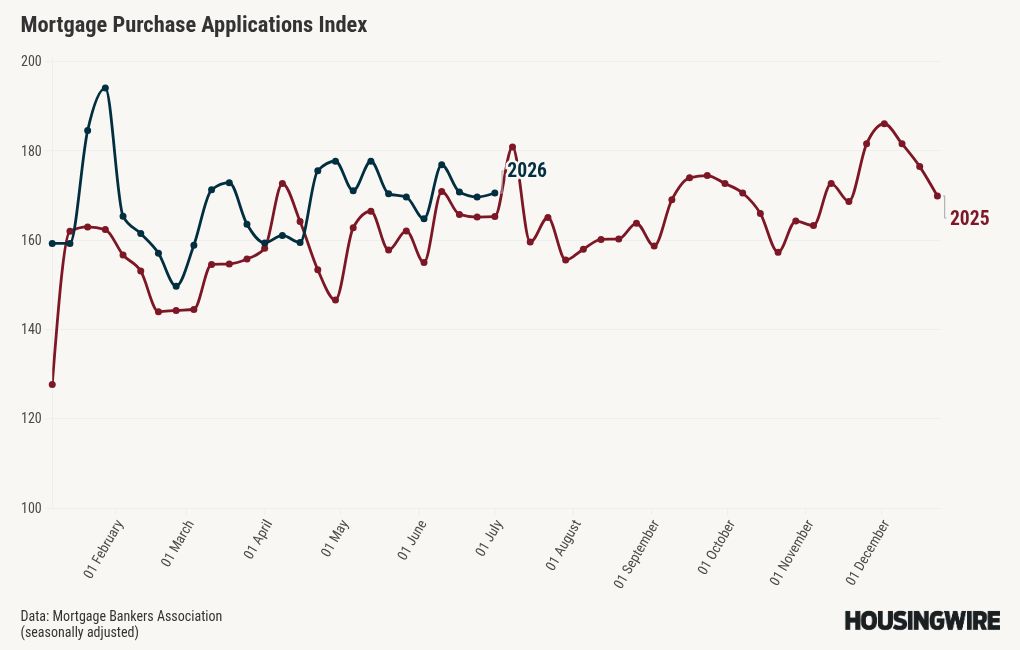
The Center for Affordable Housing Lending, the 501(c)(3) research and policy partner of the National Association of Affordable Housing Lenders (NAAHL), announced Monday that former U.S. Department of Housing and Urban Development (HUD) official Julia Gordon has been named as its inaugural senior fellow.

Gordon, who most recently served as HUD assistant secretary for housing and commissioner of the Federal Housing Administration (FHA), is the first appointment under the nonprofit’s new Housing Supply Research & Fellowship Program that aims to address challenges in affordable housing finance.

Gordon formerly served as president of the National Community Stabilization Trust. She also previously held senior roles at the Federal Housing Finance Agency (FHFA), the Center for American Progress and the Center for Responsible Lending.

In her new role, Gordon will focus on barriers to affordable homeownership, including increasing the supply of starter homes and addressing rising property insurance costs. The center said her research will be geared toward developing policy recommendations for lenders, developers and government officials.

“Families can’t buy homes that don’t exist, and the homes that do exist are increasingly unaffordable and uninsurable,” Gordon said in a statement. “I look forward to digging into both these challenges with the Center and developing real solutions that policymakers and lenders can realistically use.”

The fellowship is the first initiative under the center’s Housing Supply Research & Fellowship Program, which was launched with a $1 million grant from the Citi Foundation.

The fellowship is part of the Citi Foundation’s Blueprint for Housing Opportunity initiative — a five-year commitment that includes $60 billion in financing to support the creation and preservation of at least 250,000 housing units nationwide, as well as $50 million in grants to nonprofit organizations working on housing affordability.

The program is designed to bring together housing practitioners and policymakers to develop research that can be translated into policy proposals. Fellows will work with the NAAHL’s network of banks, Community Development Financial Institutions (CDFIs) and housing lenders to test ideas before publication, with the association’s policy team helping advance recommendations with lawmakers.

The first phase of the program also includes a report examining the impact of the Community Reinvestment Act on affordable housing and community development, along with a series of policy briefs covering topics such as the role of CDFIs and the nation’s shortage of starter homes.

Sarah Brundage, president and CEO of NAAHL and the Center for Affordable Housing Lending, said Gordon’s experience in federal housing policy and community development makes her well suited to lead the initiative.

“Julia Gordon has spent her career fighting to make homeownership a real possibility for more people who have too often been left out. Her experience – from the federal level to the community level — makes her exactly the kind of bold, experienced thinker the Center needs to ensure policy and practice go hand-in-hand,” Brundage said.

This article was generated using HousingWire Automation and reviewed by a HousingWire editor before publication.

This post was originally published on here

The agent who stands out in any market is the one who can read the risk inside an offer, not just the price on top of it. That is a skill, and it is one of the most underrated tools you carry as a real estate professional.

Here is the issue. When your seller receives multiple offers, the instinct, theirs and sometimes ours, is to sort by price and call the highest one the winner. But price is a promise, and a promise is only worth the likelihood that it will be kept. The terms of the contract are what tell you that likelihood. If you evaluate an offer on price alone, you leave your seller exposed and you leave a good deal vulnerable.

Think of it the way a lender thinks about a borrower

No underwriter approves a loan based on the amount requested. They assess the risk profile behind it, the credit, the income, the debt, the capacity to actually repay. An offer deserves that same scrutiny, and in that moment you are the underwriter. The price is the loan amount. The terms are the risk profile. And just as in lending, the deals that fall apart are almost never the ones that looked bad on paper. They are the ones nobody underwrote carefully.

The data makes this concrete. According to the National Association of Realtors’ most recent Realtors Confidence Index, roughly 5% of contracts were terminated in the latest three-month period and about 13% experienced delayed settlements. NAR has repeatedly identified the same culprits behind stalled and dead deals: home inspections, buyer financing, and appraisals. Notice what is not on that list. Price. Deals do not usually die because the number was wrong. They die because something in the terms gave way. And when a deal dies, it is your commission that evaporates, your weeks of work, your listing back on the market with a stale clock and a seller who is now harder to reassure.

When you evaluate an offer, here are the risk factors to underwrite, and to translate for your seller.

Financing strength is the foundation, so treat it that way. Pre-approval and pre-qualification are not the same thing, and you should never let them blur together in your seller’s mind. Credit profile, down payment, and the reputation of the lender all matter. An experienced local loan officer with a track record of closing on time is a tangible asset. An unknown name from an online portal is an unanswered question. Pick up the phone and find out who is writing this loan. That call is part of the job.

Contingencies are exit doors, and someone has to count them. Every contingency a buyer keeps, inspection, appraisal, financing, attorney review, the sale of an existing home, is an option to walk away. That is not inherently bad, but your seller is entitled to know precisely how many doors are open. NAR’s most recent data shows buyers waiving contingencies somewhat less than a year ago, with around 18% waiving the inspection contingency, which means a genuinely clean offer carries more weight than it did twelve months ago.

A home-sale contingency deserves special attention, because it imports a second transaction. When a buyer must sell their own property in order to close, your seller is no longer betting on one deal. They are betting on a second buyer, for a second home, that no one in the room has met. Sometimes that is a risk worth taking. The point is that it should be your seller’s decision, made with eyes open, not a surprise three weeks in.

Timing is a term, and it is the one your seller feels in real life. A strong price on a strong contract can still be the wrong offer if the closing date collides with your seller’s plans. Maybe the buyer wants to close in three weeks and your seller needs 90 days to find their next home. Maybe it is the reverse. Synchronizing the closing date with what your seller actually needs is not a clerical detail. It is part of what makes an offer genuinely good.

Inspection posture is the quiet variable that surfaces late. There is a real difference between a buyer who inspects for major defects and a buyer who is prepared to nickel and dime every minor flaw into a credit. You will not always know in advance, but you can read the signals, from the lender, from the cooperating agent, from the tenor of the offer itself, and prepare your seller before the report ever lands.

This skill pays off on both sides of the deal. Whether you are listing or selling, the same discipline makes you better.

As the listing agent, investigate the entire offer, not just the top line. Who is on the buyer’s team? What bank are they using? Which inspection company? Those answers exist, and when you gather them and translate them into plain language, you are giving your seller advice, not just paperwork. That is the difference between an order taker and a trusted advisor, and it is the version of you that earns repeat business and referrals.

As the buyer’s agent, this is where you create an edge. Do not just submit a number and hope. Make the affirmative case: that your buyer is fully underwritten, that the lender has a reputation for closing on schedule, that your buyer is flexible on timing, that they are not going to litigate every small repair. When you proactively validate the strength of your terms to the listing agent and the seller, you make your buyer’s offer easier to say yes to, even when it is not the highest number on the table. That is how you win in a competitive market without asking your buyer to simply overpay.

The throughline is simple. When you learn to see the whole offer, you protect your seller, you close more of the contracts you write, and you build the kind of reputation that compounds, deal after deal. When you fixate on price alone, you celebrate a number and then scramble when the deal that looked best on paper quietly comes undone.

Any agent can identify the highest offer. The professional who can identify the best one is the agent a seller remembers, and refers.

Darryl Davis, CSP, is a real estate coach, speaker, and bestselling author with more than 40 years in the industry. Through his POWER AGENT® Coaching Program, he helps real estate professionals build careers and lives worth smiling about. Learn more at DarrylSpeaks.com.

This column does not necessarily reflect the opinion of HousingWire’s editorial department and its owners.

To contact the editor responsible for this piece: tracey@hwmedia.com

This post was originally published on here

In a report published last week, The Agency examined trends that are currently impacting the luxury real estate market including multigenerational living, the new wave of AI/technology millionaires searching for properties and how climate change and lifestyle choices are impacting buyer demand. The 2026 Red Paper Mid-Year Report was The Agency’s first ever mid-year luxury report. 

“Let’s be honest, markets don’t wait for year-end to make moves, and we can’t either. What’s emerging now demands attention. The largest wealth transfer in modern history is actively reshaping buyer behavior. Climate is driving permanent relocation. A tech-native generation is entering the market with a new list of non-negotiables,” Mauricio Umansky, the founder and CEO of The Agency, wrote in the report’s introduction. 

Multigenerational living

The first trend identified by the report is the rise in popularity of multigenerational compounds. According to the report, over the next roughly two decades nearly $100 trillion in wealth will be transferred to Gen X and millennials from baby boomers and older generations. 

“With Generation X and millennials projected to inherit so much, a new asset class is emerging: the multigenerational compound. Far more than a large house, this is a “family alignment asset”—a strategic vehicle designed to preserve both financial capital and family connection,” the report states. 

The report found that high-net-worth individuals are beginning to see their properties as assets “designed to preserve wealth, accommodate multiple generations and reinforce long-term family cohesion,” explaining the rise in popularity of the multigenerational compound. 

The report cites a study by the National Association of Realtors (NAR) that found in 2024, 17% of homebuyers purchased multigenerational homes, up from 14% the year prior, with Gen X buyers leading this trend at 21%. The NAR study attributed this increase to savings (36%), care for aging parents (25%) and adult children returning home (21%). 

According to The Agency’s report, homebuyers interested in purchasing a multigenerational compound are frequently looking for things like guesthouses or accessory dwelling units in addition to a primary residence, as well as shared amenities like kitchens or recreational spaces and  working land or income-producing elements. 

The report anticipates interest in this trend accelerating over the next few years, due to the scale of the coming wealth transfer, as well as economic pressures like overall housing affordability and changing cultural attitudes toward multigenerational living. 

“For affluent families, the compound is emerging as a quasi-family office tool—a physical anchor for broader wealth planning. But when structured intentionally, a shared property can also serve as a governance mechanism,” the report states. “Without clear agreements, properties often end up sold or neglected as heirs disagree or drift apart. The compound model attempts to pre-empt that outcome by aligning incentives and expectations from the start.”

The “billionaire effect”

The Agency’s report traces how a single trophy transaction can temporarily distort local pricing, then reset the long-term ceiling for ultra-luxury housing in markets that can sustain demand from ultra-high-net-worth buyers. The report examined how the purchase of a $27.75 million, 1.65 acre bay-front property in Islamorada, Fla. sparked “a shift in seller psychology” and tightened already scarce prime inventory as homeowners waited to see whether the record price would stick. 

The report argues that response is typical. After a headline transaction, nearby owners often anchor to the new price per square foot and assume their homes can command similar numbers, regardless of the unique attributes that drove the trophy sale. Listings come to market at aspirational prices and sit. According to the report, sellers who simply use price-per-square-foot to benchmark their home against a nearby ultra-luxury property ultimately fail because they are ignoring what made the record setting property unique.

However, the report notes that for some buyers price does not matter, so they will purchase a property even if it is potentially overpriced, generating a “repricing cycle” in markets that see several of these transactions. 

Once a destination repeatedly validates ultra-luxury price points, the report argues, wealth reshapes the local ecosystem. In the Florida Keys, the report said the higher-end demand is encouraging investment in marinas, private aviation access and white-glove, concierge-style service. These shifts matter to developers and operators planning future product, as standards for “acceptable” luxury continue to rise.

Affordably luxury

The report also found that the demand for so-called “affordable luxury” homes between roughly $1 million and $5 million has surged in both North American and Europe. However, inventory has not kept pace, creating longer marketing times in some regions, price pressure in others and a widening mismatch between what equity-rich buyers can afford and what is actually for sale. 

In the report, The Agency cites Realtor.com data that pegged the national luxury threshold at $1.2 million in April 2026. Across the U.S., homes priced from $1 million to $5 million are drawing substantial interest, particularly in the $1 million to $3 million band, where many move-up buyers have the income or equity to participate but are constrained by limited options.

Compared with 2021, U.S. homes in the $1 million to $2 million range sold at a median $479 per square foot in early 2026, up from $455, according to Realtor.com. Properties in the $2 million to $5 million tier averaged $790 per square foot, up from $730 five years earlier, and are selling 12 days faster than in 2021.

Those gains are being propelled by a larger upper-middle-class cohort and substantial home equity growth. The American Enterprise Institute estimates 31% of Americans now qualify as upper middle class, up from 10% in 1979. Since 2020, U.S. home equity has climbed 142%, and three years of stock market gains have added purchasing power at the top end, according to The Agency’s report.

At the same time, market snapshots from Anchorage, Bend, Dallas, Marblehead and Hilton Head show that price tiers and days on market diverge significantly by region. Ultra-luxury homes are achieving record prices per square foot but are facing a notable slowdown in sales velocity, while the $1 million to $5 million segment remains relatively more liquid in many metros, according to the report. 

For existing luxury owners looking to trade up into the $5 million to $10 million range, this dynamic can create a window: strong buyer depth for their current home class and more negotiating leverage higher up, where listings often linger, The Agency said.

Latin America emerges

Global residency-by-investment programs are steering capital toward value-oriented, developing and secondary markets in Latin America and Europe, as affluent buyers prioritize stability, lifestyle and “plan B” residency options over pure return-on-investment calculations, according to the report. 

The Agency’s analysis finds that geopolitical uncertainty and policy changes are reshaping how wealthy buyers use real estate to secure residency. Instead of simply arbitraging the lowest price of entry into a passport or visa, today’s buyers are gravitating toward jurisdictions offering a mix of value, quality of life, legal stability and long-term optionality.

According to the report, Latin America offers consumers affordability, infrastructure and residency access. Markets that are seeing an influx of U.S. buyers include Nicaragua, Costa Rica, Mexico and Panama, according to the report. 

Next Gen luxury buyers

A new wave of AI and next‑gen tech wealth is entering luxury real estate with very specific expectations: move‑in‑ready homes, compressed search timelines, high-end wellness and tech features, and maximum privacy, according to the report.

Since the commercial breakout of AI tools after ChatGPT’s 2022 launch, a growing cohort of young founders and early executives has begun reallocating liquidity into property. Agents across New York, California, Toronto and Nashville report that these buyers behave differently than prior dot‑com and social media cycles, both in how fast they move and what they will tolerate in a home.

According to the report, this cohort of buyers treats the home search process as an exercise in efficiency, making things like high-quality photography and marketing copy even more important for sellers looking to make a strong first impression. Additionally, the report said that once these buyers are interested in a property they typically want immediate access to the home for a tour, after which they either pass on the property or make an offer. 

At the highest price points, some buyers skip initial tours altogether, sending a personal or executive assistant to pre‑screen properties and narrow the list, the report said. 

In supply‑constrained markets like San Francisco, that behavior can translate into aggressive bidding. Agents at the firm told The Agency that well‑positioned homes are still selling quickly and in some cases “egregiously over list price” when they align with this cohort’s criteria.

According to the report, this new cohort of AI-wealth buyers place high value on things like turnkey homes, wellness spaces like dry and steam saunas, cold plunges, Zen gardens, koi ponds and floor plans that carve out full‑floor sanctuaries, backup generators, newer HVAC systems and privacy and security features. 

However, the report cautioned that the AI wealth cycle is still early and agents are just at the beginning of understanding what these buyers are looking for. 

Lifestyle buyers

The report also found that climate volatility, political fatigue and the rise of remote work are pushing affluent buyers to swap traditional hubs for lifestyle-driven markets such as the Caribbean, central Mexico and Aspen, turning what were once seasonal vacation spots into primary or near-primary residences. 

The Agency’s managing partners across Turks and Caicos, the Cayman Islands, San Miguel de Allende and Aspen report that ultra-high-net-worth clients are extending stays from a few months to most of the year, or relocating altogether. The new calculus blends weather stability, quality of life, tax and policy considerations, and the ability to work from anywhere.

According to agents serving these markets, the draw is less about postcard winters and more about dependable conditions amid unpredictable winters and summers. Other real estate professionals serving these markets say that over the past decade conversations with buyers looking for homes in these areas have evolved from clients looking to just escape the winter to looking to escape “everything” from climate disasters and undesirable weather to political and tax concerns in their home countries.

This article was written by Brooklee Han and generated with the assistance of HousingWire Automation, then reviewed by a HousingWire editor before publication.

This post was originally published on here

DeCaro Auctions is expanding its operations across North America, the Asia-Pacific region and Mexico as the luxury real estate auction firm seeks to increase its presence in international markets.

The company also announced several leadership appointments to oversee its expansion efforts in key regions.

“Expanding our presence into key wealth capitals is the natural next step as we scale our international auction platform,” said Mario Vargas, CEO of DeCaro Auctions. “To execute world class campaigns across borders, you need boots on the ground with impeccable local relationships.”

Among the appointments, Will Wagner will serve as managing director for the United States and Canada, while Joyce Lee, based in Hong Kong, has been named managing director for Asia Pacific and Hong Kong.

Mitch Abundis has expanded his role as private client advisor and Mexico directo and Joshua Hawkins joins the company as a private client advisor for the United States. Tyler Lively has also joined the company as a U.S.-based property experience director.

Hawkins said luxury real estate auctions have become increasingly accepted within the market.

“After years in the auction industry, I’ve seen auctions become an accepted way to buy and sell luxury real estate, creating a transparent and competitive environment for both buyers and sellers,” he said. “As the market continues to evolve, it’s exciting to be part of a team that offers innovative solutions, backed by years of experience and a shared commitment to delivering exceptional results.”

Abundis said Mexico continues to attract international buyers seeking vacation and investment properties.

The expansion follows the company’s recently announced partnership with REALM Global, a private network of luxury real estate advisors operating in multiple countries.

This article was generated using HousingWire Automation and reviewed by a HousingWire editor before publication.

This post was originally published on here

For two decades, the playbook for promoting a real estate brand found online was stable enough to teach: optimize the website, win the keywords, climb Google’s rankings, capture the click. In 2026, the foundation under that playbook is cracking — and the data explaining why is hard to argue with.

According to a SparkToro analysis of Similarweb data, 68% of U.S. Google searches ended without a click in early 2026, up from roughly 60% in 2024. The trend accelerates sharply in AI-mediated contexts: when a Google AI Overview is present, 83% of searches generate no click to any external site; in Google’s dedicated AI Mode, that figure reaches 93%. Google reported at its 2026 I/O conference that AI Mode had surpassed one billion monthly users, with query volume more than doubling quarter over quarter.

The implication for real estate marketers is direct. A rising share of consumers now receive answers — including recommendations for agents, brokerages and service providers — without ever visiting a website. The click that SEO was designed to capture is, increasingly, never made.

A new acronym, a different mechanism

The emerging discipline is most often called Answer Engine Optimization (AEO) or Generative Engine Optimization (GEO). The distinction from traditional SEO is not cosmetic. SEO optimizes a web page to rank and earn a click. AEO optimizes a business’s data footprint so that an AI system will cite and recommend it inside a generated answer.

This is not a call to abandon search engine optimization. Google still processes the large majority of conventional queries — its share of traditional search remained near 90% in 2026. Websites, schema markup and content still matter. But the marginal value of ranking on a results page that produces no clicks is declining, while the value of being the name an AI surfaces is climbing. For most real estate brands, the budget and attention have not yet followed that shift.

Where the AI assistants get their local data

The most consequential — and least understood — element of AEO for local businesses is the source data the major AI platforms rely on when answering location-based queries. Across the leading systems, that source converges on a single asset: the Google Business Profile.

The platform-by-platform picture, based on 2026 analyses from firms including SOCi and Local Falcon, breaks down as follows:

  • Google Gemini is grounded directly in Google Maps and Google Business Profile data. Google’s “Grounding with Google Maps” capability, which connects its models to more than 250 million verified places, reached general availability in 2026. When Gemini answers a local query, it treats the Business Profile as authoritative.
  • Google AI Overviews use Business Profile data as the structural foundation of local recommendations.
  • ChatGPT, which OpenAI powers through Bing’s index and partners such as Foursquare, draws on Bing Places, verified directories and business websites — the same structured-data ecosystem that a well-maintained Google Profile anchors and keeps consistent.

The cross-platform conclusion analysts have reached is consistent: the businesses cited in AI-generated answers are, almost without exception, those with complete and actively managed Google Business Profiles. In practical terms, the Business Profile has become a tier-one data feed to the AI ecosystem — arguably more consequential to discovery than the brand’s own website.

That ordering matters because data accuracy, not creative copy, is the dominant ranking factor in this environment. AI systems cross-reference business information across Google, Bing, Yelp, Foursquare and brand sites; when they encounter inconsistencies — mismatched hours, divergent addresses, outdated phone numbers — confidence in the listing drops and recommendation frequency falls.

Case study: building a brand for the answer layer

To illustrate how an AEO-first approach diverges from a conventional SEO build, consider a niche brand positioned for exactly the buyer most likely to begin in an AI chat: Dorado Beach Insider, focused on luxury real estate and Act 60 relocation in Dorado Beach, Puerto Rico. The target client — often a high-net-worth relocator — increasingly opens an assistant and asks a layered question such as “What is it like to live in Dorado Beach, and who can help me buy there under Act 60?”

The optimization choices reflect how AI systems parse and trust data:

  • Category selection over keyword density. A commercial-intent primary category (real estate agency) maps buyer and seller queries to the brand.
  • Service-area configuration naming multiple municipalities and neighborhoods — Dorado, Vega Alta, the San Juan metro, and communities including Dorado Beach East, West Beach and Plantation Village — increases the number of geographic entities an AI can associate with the brand.
  • A description front-loaded with entity and location, reflecting that AI systems weight opening text most heavily when interpreting a business.
  • Seeded questions and answers built around lifestyle and relocation topics rather than sales prompts, producing the clean question-answer pairs that AI systems readily lift into responses.
  • Cross-platform NAP consistency — name, contact and service area held identical across Google, Bing, Yelp, Apple and social platforms — to preserve the data confidence that drives citation.

Notably, none of these steps requires a large content operation. They require treating the Business Profile and its supporting directory ecosystem as managed infrastructure rather than a one-time marketing task.

What it means for the industry

The strategic takeaways for brokerages, teams and proptech marketers are threefold.

The first is measurement. Traditional KPIs — keyword rankings and website sessions — capture a shrinking portion of the discovery funnel. Marketing leaders will need to track AI visibility directly: whether the major assistants surface their brand and agents in response to realistic buyer queries across target markets.

The second is data governance. As accuracy becomes the primary determinant of AI recommendation, maintaining complete, consistent business data across every platform and every agent becomes an operational discipline, not a campaign.

The third is timing. As in previous shifts in consumer discovery, the cost of moving early is low relative to the cost of catching up once competitors have established their presence in the answer layer.

The click is no longer the prize it once was. In an environment where most searches end without one, the brands that win discovery will be those whose data the machines trust enough to recommend — and, increasingly, that trust begins with the Google Business Profile.

Tim and Julie Harris are co-founders of Tim & Julie Harris Real Estate Coaching and hosts of Real Estate Coaching Radio. A companion deep-dive on the full interview is available at Harris Real Estate Daily.

This column does not necessarily reflect the opinion of HousingWire’s editorial department and its owners.

To contact the editor responsible for this piece: tracey@hwmedia.com

This post was originally published on here

Want to build a real estate career that lasts? Mastering the art (and science) of real estate marketing is a crucial first step. The key to effective real estate marketing is finding that Goldilocks mix of strategies that incorporates your personal brand, resonates with your market niche and is affordable. Not easy.

To help, we updated our list of proven real estate marketing ideas to include innovative new ideas for 2026 and beyond —  including fresh new ways to leverage AI in your marketing. After the ideas, we walk you through how to integrate them into your marketing plan so you can reach your goals faster.

Online real estate marketing ideas  

A well-planned mix of online marketing strategies to reach buyers and sellers remains one of the fastest ways to grow your business in 2026. According to the latest National Association of Realtors (NAR) Consumer Housing Trends Report, 51% of millennials said they were more likely to hire an agent with a social media presence. Additionally, more sellers found their agent online than through a referral in 2024.

The best time to upgrade your online marketing was five years ago. The second best time is now. Here are our best online marketing strategies:

1. Run AI-powered ad campaigns

Online advertising is a game of inches. Even small tweaks to your ads and targeting can lead to big changes in your bottom line. AI tools help you make small changes that get you more bang for your real estate marketing bucks. They analyze browsing behavior and ad performance to help you get the right ad to the right lead at the right time. Magic!

Not sure where to start? For Facebook and Instagram, Meta’s Advantage+ AI tool is already helping some businesses lower their ad costs by 19%. If you’re running home valuation ads on Google, their Performance Max tool can help you drive more leads for a lower price. Still on the fence about using AI in your marketing? Your competitors aren’t. One study showed that real estate companies are already increasing net income by 10% using AI.

This post was originally published on here

Jesse Singh has been appointed chief executive officer of Fortune Brands Innovations Inc. (NYSE: FBIN), the home, security and digital products company said Monday.

Fortune Brands is the parent of several core brands in the homebuilding and repair-remodel channels, including Moen, House of Rohl, Therma-Tru, Larson, Fiberon, Master Lock, Sentry Safe and Yale residential. Singh also joins the company’s board of directors, effective immediately, according to the announcement.

Singh brings more than 30 years of leadership experience across building products, consumer, technology and manufacturing. The company said he most recently served as CEO of a public building products and consumer company from 2016 to 2025, where he focused on operational discipline, margin expansion, innovation and culture change that drove profitable growth and higher EBITDA margins.

For homebuilders and building product manufacturers, the move signals that Fortune Brands’ board is prioritizing operational performance and shareholder returns at a time when new-home demand is holding up better than existing-home resales, but input costs, labor constraints and channel volatility remain key risks. FBIN’s portfolio touches plumbing, doors, decking, security and digital home products, giving the new CEO leverage across core structural and finish categories in single-family and multifamily construction.

Non-executive chair of the board Andrew Kilsby said the appointment followed a comprehensive search and cited Singh’s track record in building products and branded consumer goods. Singh said Fortune Brands’ “iconic brands” and customer relationships create “a compelling opportunity to build on the company’s foundation and deliver durable value for customers, partners and shareholders,” according to the release.

At the same time, interim CEO Dave Barry has been named executive vice president and chief operating officer. Barry, who has been leading the company during the search process, will work closely with Singh on day-to-day operations. Interim CFO Ashley George will remain in place while Fortune Brands continues its external search for a permanent chief financial officer.

The company also reiterated that it has launched a strategic review of its Fiberon composite decking and railing business. Kilsby will directly oversee Fiberon’s operations during that process. Builders and lumberyard channels will be watching that review closely, as any portfolio changes could reshape competitive dynamics in the composite decking segment, which has been pressured by slower discretionary outdoor projects and price competition but still benefits from long-run share gains versus wood.

Why it matters

FBIN is a major spec and brand decision driver for plumbers, exterior contractors and builders through Moen, Therma-Tru, Larson, Fiberon and its security lines. A CEO with a mandate around operational excellence and shareholder value typically looks closely at SKU complexity, channel mix, service levels and pricing power. That can translate into changes in product lineups, service expectations, program terms and innovation cadence for builders, distributors and pro dealers that carry these brands.

To attract Singh, Fortune Brands’ board approved inducement equity awards under NYSE Rule 303A.08, granted outside the company’s 2022 long-term incentive plan. The package includes:

  • A performance-based restricted stock unit award tied to 850,000 shares of common stock, vesting 50% on the third anniversary of the grant date and 50% on the fourth anniversary, subject to stock price performance goals and continued employment.
  • A service-based stock option award on 300,000 shares, vesting in three equal annual installments over the first three years, contingent on continued employment.

All shares received from these awards must be held for the duration of Singh’s employment. After he leaves the company, he must retain at least 50% of the shares for one year. The structure aligns Singh’s compensation directly with long-term share price performance and reinforces the board’s emphasis on sustained value creation over short-term moves.

For homebuilding operators, purchasing executives and product manufacturers, Singh’s arrival and the concurrent Fiberon review suggest FBIN could adjust its portfolio and capital allocation priorities over the next 12 to 24 months. That could include targeted investments in higher-margin, brand-driven segments such as water, doors and smart security, and potentially changes in its approach to lower-return or more cyclical categories.

This post was originally published on here

Let’s face it — a healthy pipeline of leads is the lifeblood of any successful real estate business. Buying real estate leads is one of the fastest, most cost-effective ways to build a new business or breathe life into a long-established one. If you’re looking to expand your client list quickly, buying real estate leads is the fast track you need. Some providers on our list even offer a guaranteed monthly volume of exclusive leads.

We’ll show you how and where to buy real estate leads based on our in-depth evaluation of dozens of providers. As experienced agents, we’ve spent money on high-quality, exclusive leads — and we’ve wasted money on cold leads that didn’t pan out. We want you to learn from our experience so you can avoid unnecessary spending. We considered lead quality and exclusivity, affordability, ROI, practicality and ease of use. Let’s get started!

Our picks: The best places to buy real estate leads in 2026

Logo-AgentFire-2

Best for exclusive leads for solo agents

Market Leader

Jump to details ↓

From $189 / month + $30-$50/lead

VISIT

Logo-AgentFire-2

Best for targeted geo-farming leads

SmartZip

Jump to details ↓

~$500/month

VISIT

Logo-AgentFire-2

Best for FSBO and expired leads

REDX

Jump to details ↓

A la carte w/ lead packages from $50

VISIT

Logo-AgentFire-2

Best for buyer leads

Zillow

Jump to details ↓

$300 – $1,000+ / month + lead costs

VISIT

Logo-AgentFire-2

Best for end-to-end lead generation and nurturing

CINC

Jump to details ↓

From $899 / month for solo agents

VISIT

iHomeFinder logo

Best for full system support + targeted seller leads

iHomeFinder

Jump to details ↓

From $169 / month

VISIT

Logo-sold-com

Best for pre-qualified seller leads

Sold.com

Jump to details ↓

Set up is free; you pay at closing

VISIT

Our picks: The best places to buy real estate leads in 2026

Best for exclusive leads for solo agents

Market Leader

From $189 / month + $30-$50/lead

VISIT

Jump to details ↓

Best for targeted geo-farming leads

SmartZip

~$500/month

VISIT

Jump to details ↓

Best for FSBO and expired leads

REDX

A la carte w/ lead packages from $50

VISIT

Jump to details ↓

Best for buyer leads

Zillow

$300 – $1,000+ / month + lead costs

VISIT

Jump to details ↓

Best for end-to-end lead generation and nurturing

CINC

From $899 / month for solo agents

VISIT

Jump to details ↓

Best for full system support + targeted seller leads

iHomeFinder

From $169 / month

VISIT

Jump to details ↓

Best for pre-qualified seller leads

Sold.com

Set up is free; you pay at closing

VISIT

Jump to details ↓

Market Leader: Best for exclusive leads for solo agents

Logo-AgentFire-2

Market Leader has a reputation for being an industry-leading tool suite for real estate marketing. It dishes everything from email and SMS marketing to effective lead capture forms and an integrated CRM system. Market Leader’s in-house ad experts help generate exclusive real estate leads through social media and pay-per-click (PPC) campaigns.

Market Leader has a reputation for being an industry-leading tool suite for real estate marketing. It dishes everything from email and SMS marketing to effective lead capture forms and an integrated CRM system. Market Leader’s in-house ad experts help generate exclusive real estate leads through social media and pay-per-click (PPC) campaigns.

Market Leader’s all-in-one system offers a comprehensive real estate lead generation solution, including a lead-generating IDX website, CRM and marketing automation. It also offers HouseValues, a seller lead tool that helps agents connect with homeowners researching their property value online before they’re ready to list. With exclusive leads, automated nurturing and CRM insights, Market Leader gives agents more ways to generate new opportunities and build relationships with potential clients.

Pricing

  • Solo agents: $189 per month + approx. $30-$50 per lead each month based on your location. You’ll get the Market Leader software suite, which includes a CRM, marketing automation, email, text, direct mail and the mobile app.
  • Teams: $329 per month + cost of leads for up to 10 users
  • Network Boost: $300 per month for 30 social media leads (requires base plan purchase)

Pros & Cons

  • Lead exclusivity
  • Built-in lead management CRM
  • Email and SMS marketing services
  • Lead capture forms
  • Guaranteed number of leads per month
  • Network Boost lead packages start at $10 per lead
  • Minimum six-month contract
  • No trial period
  • Limited analytics
  • Limited features compared to competitors
  • No built-in dialer
  • Network Boost leads are affordable, but not exclusive
  • Limited customization

What We Love

The best thing about Market Leader is that they guarantee exclusive leads are delivered to you each month. Market Leader takes the reins, generating the leads and delivering them directly to your CRM each month without you lifting a finger. And they do it at a price even a relatively new agent can afford. You can even opt in for Market Leader’s social media ad program, Network Boost, to generate affordable, top-of-the-funnel leads and let the automation keep you top-of-mind until those leads are closer to a transaction. Market Leader’s exclusive lead guarantee, automated lead nurturing tools and affordable social media leads offer excellent value for newer and mid-career agents.

Check out Market Leader

Market Leader Review

This post was originally published on here

More than 50,000 agents and teams earned a spot on the 2026 RealTrends Verified rankings and impressive aggregate numbers tell a compelling story; there’s no single blueprint for success in today’s real estate landscape.

From a Pennsylvania team leader who views his $264 million year as “average” to a Maine brokerage that started with an internship and grew into a national contender, 2026 rankings showcase a remarkable diversity of business models and philosophies.

Yet common threads emerge — consistency, culture and an unwavering focus on the client — that bind these top performers together.

Gary Mercer Sr., whose LPT Realty-affiliated Gary Mercer Team reported $264 million in volume across 431 sides — good enough for a No. 3 volume and No. 5 sides rank among mega teams in Pennsylvania, with respective national ranks of No. 55 and No. 72 — chases fundamentals instead of headlines.

“We have done over 500 transactions in the past,” he told HousingWire. “I think consistency in the approach and time on task, doing the things that work and sticking with that has been key. What we find is if we’re sticking to the basics, training and teaching and having the agents follow that, it doesn’t matter whether it’s an up market or a down market.”

That philosophy echoes across the rankings.

Joe McNally, whose REMAX Together team in Big Rapids, Mich., earned the No. 28 national ranking among small teams for transaction sides after closing 203 transaction sides last year, put it bluntly.

“It’s pretty boring,” he said. “It’s just really about being committed and consistent every single day of the year, and I’ve always been good at that.”

McNally personally closed around 138 transactions last year — down from 172 the year before — with 110 coming from direct word-of-mouth referrals, a testament to a relationship-based business built over 20 years.

The Ivan & Mike Team, a Compass-affiliated ultra-luxury real estate group serving South Florida, finished No. 19 among medium-sized teams by sales volume, recording $298.32 million in 2025 volume.

While that was down roughly $50 million from the previous year, co-founder Ivan Chorney said the market remained active.

“I would say all in all, it was a transitional year,” he said. “ It was just a little more difficult to get deals done. You had all this tariff stuff going on and there were just many headwinds on various fronts. But that’s led into this year, which will end up being our best year ever.”

The team model launchpad

For many top performers, the team structure isn’t just an organizational choice — it’s a competitive advantage.

Mercer, who began his career in 1987 and spent nearly 30 years with an independent company before moving to LPT Realty in May 2025, has long been an advocate.

“I think for an individual agent, it’s really important for them to be aligned with successful people, and in my opinion, they get the best opportunity through a team situation,” he said. “That’s because a team will be able to generate leads to help them while they’re developing and cultivating their database for a long-term referral business.”

The Perry Group — founded by Jack Perry and his two sons and brokered by The Real Brokerage — took that model to an extreme.

In 2025, the team was made up of 250 licensed real estate professionals with five offices serving clients across much of Utah, closing 1,547 transaction sides totaling $892.80 million in sales volume — earning the enterprise-sized team the No. 8 and No. 5 ranks in the country by sides and volume, respectively.

Emily Martin, the team’s chief operating officer, attributes much of the growth to clear systems agents can easily plug into.

“They can run their business without having to think about the operational side,” Martin said. “We help agents do what they do best, which is connect with people.”

TruAdvantage Team in York, Pennsylvania — which closed 283 transaction sides and nearly $78 million in sales volume in 2025, securing the No. 17 national placement among medium-sized teams for sides — has taken a different approach to growth, focusing on building structured paths for struggling agents.

“We hold everyone to a certain standard,” said Director of Operations Sara Cain. “There is a very high standard where if it’s not being met, we’re going to have the conversations and we’re going to get it corrected. Everybody wants everyone else to continue performing. We love to celebrate each other and also compete against each other.”

Culture as a growth engine

James Harris — leader of the Beverly Hills-based Harris & Partners — runs what he calls a “lean and mean” team.

His Carolwood Estates-brokered team closed 83 transaction sides totaling $938.0 million in sales volume in 2025, earning the No. 2 rank in the country for sales volume among large teams.

“I would rather have 10 superb agents than 100 where the vast majority are mediocre,” Harris said. “If I have a smaller team, it helps with camaraderie, but it also allows me to be more hands-on in an individual way with each of those team members and ensuring that I am doing everything I can as a team lead to support each of them.”

That focus on culture extends to the David Banks Team in Portland, Maine, which ranked No. 40 for transaction sides among medium-sized teams, closing 240 last year, and No. 26 nationally by sales volume, generating $282.15 million in closed business.

Teddy Piper, who started as an intern in 2012 and is now broker-owner, emphasized the team’s collaborative spirit.

“Everyone gets everyone gets paid — regardless of who sells the property,” he said. “So, we work together to get these deals done. A lot of teams, they set up distinct hierarchies and distinct roles for each agent, and we certainly have roles and structure for our agents.

“What we don’t have is, ‘You get this lead and you get this lead.’ We all work together to make sure the deal closes.”

The Horak Group, a three-agent team operating under REMAX Boone Realty in Columbia, Missouri, earned a No. 16 national ranking among small teams for transaction sides — closing 247 in 2025.

Molly Horak, whose mother founded the business in the 1980s and who literally grew up in the office, says the key to making a family business work is simple.

“You’ve got to like each other,” she said. “I genuinely love working together. Frequently, we’ll be at the office till 8:30 at night or longer, just to get more done after the staff has left.”

For Noble Black and his New York-based mega team Noble Black & Partners, culture was central to a major decision.

The team of 25 licensed agents closed 220 transaction sides totaling $546.03 million in sales volume, earning the No. 7 rank in the nation among mega teams for sales volume.

After a decade at Douglas Elliman, the team moved to Corcoran in September 2025.

“Culture was part of why we moved to Corcoran from Elliman last year,” Black said. “Culture has always been important at Corcoran — what they value, how they treat people — and I think everyone on the team has recognized and really appreciated the support, culture and how well the company is run, since we moved here.”

Tech tools, human touch

While technology plays an increasingly important role, top performers treat it as a tool, not a solution in itself.

The Horak Group takes a pragmatic approach.

“The websites used to crash if you had more than nine photos, because the internet just wasn’t what it is now, and the technology has just gotten so much better — so much faster,” Horak said. “I don’t feel like we spend a ridiculous amount buying every new shiny thing. But we do invest in people. We have a dedicated, full-time graphics and marketing [person].”

Kelli Salter, who launched Anchor Real Estate in 2020 and earned the No. 16 spot for transaction sides among medium-sized teams — closing 285 transaction sides last year and accounting for nearly $86 million in volume — said relationships trump technology every time.

“The people that win in real estate are the people who talk to the most people who want to buy and sell real estate,” she said. “The tech is great. I have wonderful tech partners that I absolutely love and would consider friends, but your tech, your platform, your broker — all of the tertiary things mean nothing if you don’t actually work your business and go talk to the consumer.”

Specialization, market focus

The Gedalje Group, an eXp Realty-brokered large team in Lake Havasu City, Arizona, closed 468 transaction sides totaling $245 million in sales volume in 2025, earning the No. 10 and No. 48 ranks in the nation for sides and volume, respectively.

Leader Eric Gedalje credits both the drive and productivity of his agents — each averaging roughly 25 units per year — as well as his strong roots in Lake Havasu City.

“A lot of my team members have come from firms or teams that gave them really strong foundations in the business — and we have seen them join us and just really take off,” he said.

The Yeatman Group, a Long & Foster-brokered mega team, closed 747 transaction sides for a total of $371.68 million in sales volume, earning the No. 10 and No. 26 rankings in the country among mega teams.  

Leader Kyle Yeatman came from the homebuilder space and built his team around new construction.

“We feel like we have built a business that can withstand even a bit of a recession,” he said. “We haven’t had any major economic challenges yet, but the couple of blips we’ve seen, we have been able to get through pretty easily.”

As you can see, success comes in many forms, but the through lines are the same: consistent, relationship-focused real estate agents and teams excel in any housing market.

This article was written by Jonathan Delozier and generated with the assistance of HousingWire Automation. It was reviewed by a HousingWire editor before publication.

This post was originally published on here

Address Realty has added Eddie Sturgeon as the firm’s new chief growth officer. 

Sturgeon, who has nearly two decades of experience in the industry, previously held leadership roles at REMAX and Realty ONE Group

The firm said Sturgeon will help lead Address Realty’s national expansion strategy, including the growth of its brokerage footprint and the continued rollout of its AddressUSA.com home search portal. In July 2025, AddressUSA partnered with USA Today publisher Gannett, to integrate AddressUSA’s listings throughout the USA Today Network alongside editorial content on topics like home buying and selling, as well as home improvement

In a post on LinkedIn, Sturgeon, who said he “played a key role in expanding Realty ONE Group from a few locations to over 500 offices in 20 countries,” is “just as excited” about the opportunity at Address Realty. 

“What we offer is unique and cannot be replicated by anyone else,” he wrote. “We drive consumers to the U.S.A. Today National site and the hundreds of local newspapers owned by them, along with over 500 monthly digital and print publications, provide our real estate professionals with scrubbed leads.” 

In a separate post, Sturgeon said his focus was not on making Address Realty the biggest firm, but to be home to some of the most “experienced real estate professionals covering markets throughout the U.S.”

“We’re not just bringing in agents to bring in bodies,” he wrote. 

As of Monday, Address Realty was live and serving consumers in all 50 states and Washington, D.C.

This post was originally published on here

The U.S. Supreme Court ruled Monday that President Donald Trump cannot remove Federal Reserve Governor Lisa Cook while her legal challenge to her dismissal moves forward. The decision allows Cook to remain on the Federal Reserve Board for now.

In a 5-4 decision, the court declined Trump’s request to stay a lower court’s ruling that blocked Cook’s removal pending the outcome of her lawsuit. Chief Justice John Roberts wrote the majority opinion, joined by Justice Brett Kavanaugh and the court’s three liberal justices — Elena Kagan, Sonia Sotomayor and Ketanji Brown Jackson. The court’s four other conservative justices dissented.

Roberts wrote that siding with Trump’s request would be “an interpretive leap out of step with the statute Congress enacted and our Nation’s tradition of central banking protected from political interference.”

The ruling does not determine whether Trump ultimately has the authority to remove Cook or other Federal Reserve governors. Instead, it leaves in place a lower court’s order preventing her dismissal while the case proceeds.

In August 2025, Trump announced that he intended to fire Cook after allegations surfaced that she had committed mortgage fraud and misrepresented occupancy requirements on loans for two properties before joining the Federal Reserve Board.

Not long after, the Department of Justice (DOJ) opened an investigation into allegations raised in two criminal referrals sent by Federal Housing Finance Agency (FHFA) Director Bill Pulte to Attorney General Pam Bondi and DOJ official Ed Martin.

Pulte alleged Cook falsely claimed properties in Michigan and Georgia as primary residences on 2021 mortgage applications to secure lower interest rates and smaller down payments, despite intending to use them as investment properties.

A second referral alleged Cook improperly classified a Massachusetts condominium as a second home before later reporting rental income from the property.

The referrals prompted Trump to attempt to remove Cook “for cause” on Aug. 25. The Supreme Court heard oral arguments on the case in January, and justices questioned whether misconduct unrelated to a Fed board member’s official duties could justify removal.

Neither the Federal Reserve Board, Cook nor the FHFA returned HousingWire‘s requests for comment at the time of publication.

Cook has remained on the Board of Governors since a federal district court blocked her removal, a decision the Supreme Court allowed to stand while the litigation continued.

This post was originally published on here

It’s time to level up your real estate marketing game. But where do you begin? We know you didn’t get into real estate for the love of marketing or tech. Our team of licensed agents and brokerage marketers reviewed dozens of products for this comprehensive guide to the best real estate marketing tools, focusing on their potential to impact your bottom line.

For this update, we’ve narrowed it down to the 22 most effective, easy-to-use and revenue-boosting tools of 2026— including mind-blowing AI-powered marketing tools. Each tool on our list will help you scale faster, save time and attract clients like a magnet.

Best real estate marketing tools for 2026: At-a-glance

Best Website Building Tools

Logo-AgentFire-2

Best overall agent websites

AgentFire

Jump to details ↓

VISIT

Logo-Placester

Best value for money

Placester

Jump to details ↓

VISIT

Screenshot 2026-02-18 104003

Best for customizable websites

Agent Image

Jump to details ↓

VISIT

Logo-Squarespace-wide

Best affordable websites

Squarespace

Jump to details ↓

VISIT

Best AI Marketing Tools

REimagine Home logo

Best for virtual staging with AI prompts

REimagine Home

Jump to details ↓

VISIT

Trolto logo

Best for ready-made listing videos & social content

Trolto

Jump to details ↓

VISIT

Collov AI logo

Best for affordable AI home staging

Collov AI

Jump to details ↓

VISIT

Logo-Openai-ChatGPT

Best for copywriting

ChatGPT

Jump to details ↓

VISIT

Best Lead Nurturing Tools

Logo-iNCOM

Best all-in-one lead nurturing

Follow Up Boss

Jump to details ↓

VISIT

Wise Agent logo; a real estate CRM or customer relationship management software

Best for email nurturing

Wise Agent

Jump to details ↓

VISIT

Screenshot 2026-01-27 124758

Best for automated email and text campaigns

iHomeFinder

Jump to details ↓

VISIT

Best Social Media Marketing Tools

image_056b0a

Best for social media marketing

Coffee & Contracts

Jump to details ↓

VISIT

Hootsuite logo

Best for social media scheduling

Hootsuite

Jump to details ↓

VISIT

Logo-Canva

Best for social media graphics

Canva

Jump to details ↓

VISIT

Best Lead Generation Tools

Logo-Placester

Best overall

Market Leader

Jump to details ↓

VISIT

Logo-Highnote

Best for marketing presentations

Highnote

Jump to details ↓

VISIT

Logo-Smartzip

Best for finding likely sellers

Smartzip

Jump to details ↓

VISIT

Best Video Production Tools

Logo-Animoto

Best overall video marketing tool

Animoto

Jump to details ↓

VISIT

Logo-CapCut

Best for social media video production

CapCut

Jump to details ↓

VISIT

Best Email Marketing Tools

Logo-Constant Contact

Best overall email marketing tool

Constant Contact

Jump to details ↓

VISIT

Dubb logo

Best for free AI video email marketing

Dubb

Jump to details ↓

VISIT

Scout logo

Best for free AI email marketing

Scout

Jump to details ↓

VISIT

Best real estate marketing tools for 2026: At-a-glance

Best Website Building Tools

Best overall agent websites

AgentFire

VISIT

Jump to details ↓

Best value for money

Placester

VISIT

Jump to details ↓

Best for customizable websites

Agent Image

VISIT

Jump to details ↓

Best affordable websites

Squarespace

VISIT

Jump to details ↓

Best AI Marketing Tools

Best for virtual staging with AI prompts

REimagine Home

VISIT

Jump to details ↓

Best for ready-made listing videos & social content

Trolto

VISIT

Jump to details ↓

Best for affordable AI home staging

Collov AI

VISIT

Jump to details ↓

Best for copywriting

ChatGPT

VISIT

Jump to details ↓

Best Lead Nurturing Tools

Best all-in-one lead nurturing

Follow Up Boss

VISIT

Jump to details ↓

Best for email nurturing

Wise Agent

VISIT

Jump to details ↓

Best for automated email and text campaigns

iHomeFinder

VISIT

Jump to details ↓

Best Social Media Marketing Tools

Best for social media marketing

Coffee & Contracts

VISIT

Jump to details ↓

Best for social media scheduling

Hootsuite

VISIT

Jump to details ↓

Best for social media graphics

Canva

VISIT

Jump to details ↓

Best Lead Generation Tools

Best overall

Market Leader

VISIT

Jump to details ↓

Best for marketing presentations

Highnote

VISIT

Jump to details ↓

Best for finding likely sellers

Smartzip

VISIT

Jump to details ↓

Best Video Production Tools

Best overall video marketing tool

Animoto

VISIT

Jump to details ↓

Best for social media video production

CapCut

VISIT

Jump to details ↓

Best Email Marketing Tools

Best overall email marketing tool

Constant Contact

VISIT

Jump to details ↓

Best for free AI video email marketing

Dubb

VISIT

Jump to details ↓

Best for free AI email marketing

Scout

VISIT

Jump to details ↓

Best real estate website building tools

Your website is the most foundational of all the real estate marketing tools. Real estate agents need cleanly designed, highly functional websites to attract and communicate with clients. Ideally, your website should showcase you, your brand and your expertise. It should also feature MLS listings, provide a lead capture form to guide visitors to your mailing list, show off your client testimonials and feature SEO tools to help your content rank better on Google search.

Here are some marketing tools to help you build a powerful real estate website that delivers results.

1. AgentFire: Best overall for agent websites

Logo-AgentFire-2

Starting price: $119/month

With its stunning layouts, focus on hyper-local agent branding and sleek luxury feel, AgentFire’s websites attract buyers and sellers and elevate your online presence. AgentFire receives 5-star ratings across multiple review platforms from agents who rave about their website design and functionality.

Regardless of your plan, AgentFire offers useful features to help scale your business, including strategic calls-to-action, high-converting landing pages and authority-building area guides that give agents an instant edge. If you’re in the market for a stellar website platform, AgentFire is one of the best digital marketing tools for real estate agents you can invest in.

Best features:

  • Sleek design 
  • Hyperlocal area landing pages
  • SEO and content marketing service add-ons
  • Built-in lead generation features

Visit AgentFire

2. Placester: Best value for money

Logo-Placester

Starting price: $59/month

This customizable real estate website builder offers several build-out options depending on your budget and marketing needs. The DIY option begins at $59 per month, but for $50 per month extra, you can opt for a fully done-for-you real estate website that includes a live chat, smart lead capture features and integrations with your existing tech tools.

Best features:

  • Support team that assists with marketing
  • IDX home search integration
  • Built-in CRM with auto-responder, drip email campaigns and email blasts

Visit Placester

3. Agent Image: Best for customizable websites

Screenshot 2026-02-18 104003

Starting price: $399 initial setup, then $99/month

Agent Image is known for its beautifully designed websites that work seamlessly with IDX providers to generate leads for your real estate business. The websites are created on WordPress to showcase your brand and expertise, and can scale with you as your team grows. The price is a bit higher than other options, but that correlates directly to the amazing quality you’ll get from Agent Image. Plus, you’ll own your website

Best features:

  • Choose from DIY options to completely done-for-you website design
  • Lead capture features like property alerts, interactive maps, mortgage calculators, contact forms, home valuation tools and automated emails
  • Pick from multiple themes and designs

Visit Agent Image

4. Squarespace: Best affordable websites

Logo-Squarespace-wide

Starting price: $16/month

Squarespace is an affordable, drag-and-drop website builder that offers a wide variety of templated designs and a free 14-day trial. There’s no IDX integration or other industry-specific tools, but if you’re looking for an affordable website for people to look you up online, Squarespace is a great starting place.

Best features:

  • Appointment booking plugins
  • Pre-built, elegant design templates
  • Built-in SEO tools and social media integrations

Visit Squarespace

This post was originally published on here

It’s hard to overstate how dramatically real estate software has changed over the last few years. We went from clunky, slow, and expensive CRMs to AI-powered video apps — seemingly overnight. While we focused on building our brands and trying to make sense of social media trends, the companies that make the software we use ballooned into a $10 billion+ industry.

With that much cold, hard cash being thrown at making your job easier, the cost-benefit ratio of real estate software has never been better. Today’s software can (almost) automate your entire business — from first click to closing.

To help you build the tech stack of your dreams, we reviewed dozens of tools that help you capture leads, market your business and build better client relationships. Here are our 20 favorites for 2026, including three new groundbreaking AI tools:

At-a-glance: The best real estate software for 2026

Best lead generation & nurturing software

Logo-Placester

Best all-in-one lead generation + marketing platform

Market Leader

Jump to details ↓

VISIT

Best for predictive analytics

Smartzip

Jump to details ↓

VISIT

Altos logo

Best for data-driven lead nurturing

Altos

Jump to details ↓

VISIT

Logo Ylopo

Best for AI-powered lead generation + nurturing

Ylopo

Jump to details ↓

VISIT

Best IDX website + CRM software

Logo-AgentFire-2

Best overall IDX + CRM software

CINC

Jump to details ↓

VISIT

Sierra-Interactive logo; a real estate CRM or customer relationship management software

SEO-driven leads

Real Geeks

Jump to details ↓

VISIT

Logo-iNCOM

Best for small teams

Sierra Interactive

Jump to details ↓

VISIT

Best real estate CRM software

Logo-iNCOM

Best overall CRM

Follow Up Boss

Jump to details ↓

VISIT

lone-wolf-logo

Best for new agents

Lone Wolf Relationships

Jump to details ↓

VISIT

Logo-iNCOM

Best value for money

Top Producer

Jump to details ↓

VISIT

image_056b0a

Best for teams + brokerages

Rechat.

Jump to details ↓

VISIT

Best real estate marketing software

image_056b0a

Best for social media marketing

Coffee & Contracts

Jump to details ↓

VISIT

image_056b0a

Best for video marketing

Pivo Real Estate

Jump to details ↓

VISIT

image_056b0a

Best for virtual staging

Apply Design

Jump to details ↓

VISIT

Best AI real estate software

REimagineHome logo.

Best for AI-prompted virtual design staging

REimagineHome

Jump to details ↓

VISIT

Scout logo

Best for AI-powered lead enhancement + nurturing

Scout

Jump to details ↓

VISIT

Fello new logo

Best for lead scoring

Fello

Jump to details ↓

VISIT

image_056b0a

Best for data-driven market valuations

HouseCanary

Jump to details ↓

VISIT

ListedKit AI logo.

Best for transaction management

ListedKit AI

Jump to details ↓

VISIT

Collov AI logo

Best for affordable AI home staging

Collov AI

Jump to details ↓

VISIT

At-a-glance: The best real estate software for 2026

Best lead generation & nurturing software

Best all-in-one lead generation + marketing platform

Market Leader

VISIT

Jump to details ↓

Best for predictive analytics

Smartzip

VISIT

Jump to details ↓

Best for data-driven lead nurturing

Altos

VISIT

Jump to details ↓

Best for AI-powered lead generation and nurturing

Ylopo

VISIT

Jump to details ↓

Best IDX website + CRM platforms

Best overall IDX + CRM

CINC

VISIT

Jump to details ↓

SEO-driven leads

Real Geeks

VISIT

Jump to details ↓

Best for small teams

Sierra Interactive

VISIT

Jump to details ↓

Best real estate CRM software

Best overall CRM

Follow Up Boss

VISIT

Jump to details ↓

Best for new agents

Lone Wolf Relationships

VISIT

Jump to details ↓

Best value for money

Top Producer

VISIT

Jump to details ↓

Best for teams + brokerages

Rechat.

VISIT

Jump to details ↓

Best real estate marketing software

Best for social media marketing

Coffee & Contracts

VISIT

Jump to details ↓

Best for video marketing

Pivo Real Estate

VISIT

Jump to details ↓

Best for virtual staging

Apply Design

VISIT

Jump to details ↓

Best AI real estate software

Best for AI-prompted virtual design staging

REimagineHome

VISIT

Jump to details ↓

Best for AI-powered lead enhancement + nurturing

Scout

VISIT

Jump to details ↓

Best for lead scoring

Fello

VISIT

Jump to details ↓

Best for data-driven market valuations

HouseCanary

VISIT

Jump to details ↓

Best for transaction management

ListedKit AI

VISIT

Jump to details ↓

Best for AI home staging

Collov AI

VISIT

Jump to details ↓

Best lead generation & nurturing real estate software

As the name suggests, lead generation and nurturing software helps agents and brokers generate and nurture leads. The best ones provide relatively simple IDX lead capture websites and automated tools to nurture those leads via email and text messages. If you already have a CRM and website you love and only want leads you can nurture on autopilot, they can be hugely helpful for your business.

1. Market Leader: Best all-in-one lead generation + marketing platform

Market Leader logo: a real estate CRM solution

Starting at $189 per month

Market Leader offers agents an affordable way to generate and nurture leads that they can upgrade as their business grows. Their entry-level Pro package starts at around $189 per month and includes a CRM, IDX website, and marketing center that includes direct mail marketing.

Lead add-ons include very affordable top-of-funnel social media leads through their Network Boost program — to highly qualified (and much pricier) buyer and seller leads.
They’ve also added HouseValues, which helps agents reach potential sellers earlier and nurture those relationships with personalized, agent-branded Equity Reports and engagement insights directly within Market Leader’s CRM.

Market Leader is a fantastic option for newer agents who don’t have the budget for more advanced lead generation and nurturing tools like Ylopo or CINC.

Features

  • Listing marketing automation includes single-property websites
  • Print marketing includes bulk mail flyers, postcards and scheduled birthday and anniversary cards for past clients
  • Custom-branded content library
  • Automated email and text drip campaigns

Pros & Cons

  • Affordable all-in-one lead generation and nurturing system
  • Top-of-funnel Network Boost leads
  • Direct mail tools
  • Easily upgradeable to add more features
  • CRM is easy to use and has a large user base for troubleshooting and advice
  • Seller lead generation through HouseValues
  • IDX websites are very basic and have limited customization options
  • CRM lacks advanced nurturing features
  • No AI features available in any plan
  • No automated text messaging or auto dialer
  • Price-per-lead can be higher than other providers that charge more for software
  • Some agents complain about lead quality

Pricing

  • Professional for Agents: $189 per month + $30-$50 per lead (one user)
  • Teams: $329 + $30 to $50 per lead (up to ten users)
  • Broker Suite: Call for pricing

Check out Market Leader

Market Leader Review

2. Smartzip: Best for predictive analytics

Starting at ~$500 per month

Smartzip uses predictive analytics to sift through reams of data to identify likely sellers before they hit other lead providers. Using their platform, you can easily target a zip code, neighborhood or custom farm area to find homeowners who are likely to sell in the next 12 months. The Smartzip algorithm uses over one billion data points gathered from behavioral, demographic, event and property information. This ensures their data is the most up-to-date and accurate.

In addition, Smartzip provides robust marketing and nurturing tools, including a CRM with real estate lead data, home valuation landing pages, direct mail campaigns, a comparative market analysis tool and more. If you want to generate and nurture seller leads on autopilot, that’s an unbeatable combination — one we think is the future of real estate software.

Features

  • Exclusive listing leads generated by predictive analytics
  • Local trend reports
  • Customized lead targeting

Pros & Cons

  • Predictive analytics targets likely sellers
  • Comprehensive marketing and nurturing tools
  • Design quality of marketing materials
  • Automated home valuation landing pages
  • Leads are not exclusive and are generally top-of-funnel
  • Not recommended for new agents; relatively pricey

Pricing

Starting at $500 per month, with an average monthly spend of $1,000

Check out Smartzip

Smartzip Review

3. Altos: Best for data-driven lead nurturing

Logo-Catalyze-AI

Starting price: Free

Altos (formerly Altos Research), provides automated market report email campaigns and Facebook ads to generate and nurture seller leads. Unlike competitors who only update once per month, Altos reports are updated each week — perfect for weekly drip campaigns and more clickable Facebook ads. 

Altos’ software also provides analytics to track how your leads interact with your reports. You’ll get notified when a lead opens a report, forwards it or changes the zip code they’re searching in — giving you critical data to leverage on your next follow-up. It’s an ideal solution for newer agents who want to position themselves as the go-to local market expert in their farm area.

Features

  • Automated weekly market report email campaigns 
  • One-click Facebook ads 
  • Attractive and intuitive design 
  • Custom-branding available 
  • Analytics to track campaign performance

Pros & Cons

  • More timely data than other providers 
  • Email campaigns are automated and trackable
  • Analytics provide key insights for lead follow up 
  • Pre-written and optimized Facebook ads to generate leads 
  • Direct integrations with popular CRMs like Follow Up Boss and Real Geeks
  • Starter plan includes one free report
  • RPR provides (monthly) market reports free for NAR members
  • Market report PDFs only available in paid plans
  • Leads generated from market reports might be high-funnel 
  •  Home valuation ads generate lower funnel leads 

Pricing

  • Starter: Free
  • Professional: $79 per month
  • Premium: $149 per month 
  • Small office: $349 per month 

Check out Altos

4. Ylopo: Best for AI-powered lead generation + nurturing

Logo-Catalyze-AI

Starting price: $395 (software only)

Ylopo uses sophisticated artificial intelligence (AI) tools to generate, nurture and convert leads for you on autopilot. The platform’s proprietary technology focuses on “buy-sell” leads to help maximize ROI from your ad spend. Ylopo creates and updates dynamic social media ads (they change based on your lead’s behavior) that can laser-target specific demographic and geographic niches from the neighborhood level down. For example, if your demographic niche is Veterans in Honolulu, Ylopo’s system will only show them ads for properties that meet VA loan standards in Honolulu.

Trained on millions of conversations, Ylopo’s AI assistants work tirelessly to nurture your leads so you can focus on servicing your clients. Have a large database? Ylopo’s remarketing tool serves dynamic ads to cold leads already in your CRM —ensuring fewer leads slip through the cracks. It’s an ideal platform for tech-savvy agents, teams and brokerages who want to leverage AI to close more deals.

Features

  • Dynamic social media ads that change with lead’s behavior
  • Remarketing tool to serve ads to leads in your database
  • IDX lead capture website
  • AI voice and text message nurturing
  • Cash offer seller lead generation ads with Zoodealio

Pros & Cons

  • Targets leads in demographic and geographic niches
  • Direct integrations with Follow Up Boss, Sierra Interactive and Liondesk
  • Remarketing tool warms up cold leads already in your database
  • Limited CRM functionality
  • Pricing for software is higher than some competitors
  • AI voice calls might annoy some leads

Pricing

  • Pricing for software-only packages start at $399 and vary widely based on ad spend and upgrades.

Check out Ylopo

Best IDX Website + CRM Platforms

Today’s IDX website + CRM platforms give you the near-magical ability to market your business, generate leads, build your brand and manage your transactions with one tool. An ideal IDX website + CRM platform should offer advanced CRM features, sleek IDX websites designed for lead capture and branding, and enough available upgrades to grow along with your business.

Here are our picks for the best all-in-one IDX website + CRM platforms for 2025.

5. CINC: Best overall website + CRM platform

CINC logo; a real estate CRM or customer relationship management software

Starting at $899 per month
 (pricing includes buyer leads)

CINC combines sleek IDX websites, bleeding-edge paid lead generation and AI nurturing tools with some of the best training in the industry. More than just an IDX website with a CRM, CINC bills itself as a complete system that gives solo agents and teams all the tools they need to run their businesses—an assessment we agree with. The optional 3-line auto-dialer is a feature we hope more software companies add to their platforms in the future.

If you want to focus on paid leads, CINC is an obvious choice. Their hyperlocal ad targeting allows agents to generate leads from specific neighborhoods, school districts, and even home types. Monthly pricing is steep, but it includes software and leads you can start working with right away.

Features

  • Hyper-local lead targeting focuses on neighborhoods, school districts and more
  • Optional CINC AI lead nurturing tool
  • Optional 3-line auto-dialer

Pros & Cons

  • Lead generation and nurturing platform powered by AI
  • Done-for-you Facebook and Google lead generation
  • Lead generation is powered by data from 50,000 top-producing agents & teams
  • Optional CINC AI lead nurturing tool trained by top-producing agents
  • Lead generation and conversion training
  • Online and in-person mastermind events
  • 6,000-member Facebook Mastermind group
  • Learning curve can be steep for non-tech-savvy agents
  • CINC’s IDX Websites are hyper-focused on lead generation but won’t win any design awards. If aesthetics are important to you, try Luxury Presence or Agent Image.
  • CINC isn’t cheap. Pricing is comparable to platforms like BoomTown which puts CINC out of reach for many solo agents
  • Less branding and marketing focused than other IDX website + CRM platforms

Pricing

Starting at $899 per month for solo agents and $1,500+ for teams, CINC’s pricing is comparable to other high-end platforms like BoomTown. However, pricing is heavily dependent on factors like ad spend, cost per lead in your farm area, and additional features such as their AI lead nurturing tool, so it can vary widely.

  • Free trial: no
  • Contract required: 6-month minimum
  • CINC AI: +$200 per month
  • 3-line auto-dialer: +$100 per month, per site

Check out CINC

6. Real Geeks: Best for solo agents

Logo-Real-Geeks

Starting at $399 per month

Real Geeks is one of the most popular and well-reviewed IDX website + CRM platforms for a good reason. It provides solo agents and small teams with all of the lead generation, nurturing, and marketing tools they need — starting at less than half the price of competitors like CINC or Boomtown.

While Real Geeks’ entry-level Establish plan doesn’t include done-for-you lead generation or advanced AI features, it’s still one of the best values in the industry. Available upgrades include an AI chatbot and done-for-you buyer and seller lead generation.

Features

  • Sleek IDX websites designed for lead capture
  • AI-powered lead nurturing assistant
  • Advanced Email and SMS drip campaigns
  • Reactive responses automatically texts leads based on their behavior
  • Automated property alerts and market reports
  • EstateIQ property valuation tool

Pros & Cons

  • Entry-level plan offers excellent value for money
  • Automated SMS & email auto-responders
  • A la carte upgrades offer advanced AI, done-for-you lead generation & automation features
  • IDX websites are designed for lead capture, not branding
  • Limited website customization options
  • AI-generated area pages created with SEO Fast Track tool might get flagged by search engines as spam

Pricing

  • Establish: $399 per month
  • Grow: $699 per month
  • Expand: $1199 per month
  • Conquer: $1700 per month
  • Contract required: 6 months
  • Free trial: No

Check out Real Geeks

7. Sierra Interactive: Best for small teams

Sierra-Interactive logo; a real estate CRM or customer relationship management software

Starting at $524.95 per month

Sierra Interactive is an all-in-one CRM and IDX website that uses a proprietary IDX integration to help small teams generate and nurture leads. Unlike other IDX websites that often use off-the-shelf IDX plugins, Sierra’s proprietary IDX is designed to rank your website on search engines. That means your website can generate free leads from search engines while you focus on giving your clients the service they deserve.

The platform also comes with an integrated triple-line dialer and offers team management features to never let a lead (or a client) slip through the cracks.

Features

  • Proprietary IDX designed to rank on search engines 
  • Sleek and stylish lead generation and branding websites
  • Integrated triple-line dialer 
  • Automated lead nurturing and marketing tools

Pros & Cons

  • Sophisticated CRM designed for teams 
  • Can choose between buyer and seller-focused websites
  • Done-for-you digital advertising 
  • In-app text message marketing tools
  • Not ideal for solo agents 
  • Leads are not included in the entry-level package
  • No built-in AI features

Pricing

Starting at $524.95 per month. Call for custom team pricing.

Check out Sierra Interactive

Related articles

Best real estate CRM software

Historically used as simple lead databases, today’s real estate CRMs offer agents and teams sophisticated lead generation, marketing, nurturing and business management tools for a relatively low monthly cost. As the old cliche goes, the best CRM is the one you use. Here are our top picks that we think you’ll love using:

8. Follow Up Boss: Best overall real estate CRM software

Follow Up Boss logo; a real estate CRM or customer relationship management software

Starting at $58 per month

Follow Up Boss offers agents a perfect balance between advanced CRM features and affordable pricing. Their platform is far more robust than a “just get it done” CRM like LionDesk, but it is still affordable enough for almost any agent — something competitors like Top Producer, Market Leader and Propertybase can learn from.

You’ll get all the tools you’ll need to nurture leads and stay organized without paying for an IDX website or other features you don’t need. How do they do it? In a word, integrations. Follow Up Boss is designed to work seamlessly with pretty much any other real estate software you have, so you can keep using the tools you love and control them from Follow Up Boss. Think of it as an operting system for your entire real estate business.

Features

  • Action plans to automate follow-up
  • Daily hot sheet
  • Easy-to-use and intuitive user interface
  • Advanced lead routing features for teams

Pros & Cons

  • Streamlined and intuitive dashboard and tools
  • Over 250 integrations with the most popular real estate software
  • Works perfectly alongside lead generation platforms
  • Excellent training and support
  • Large network of users
  • Transparent pricing
  • No AI features available
  • No auto-dialer upgrade
  • No text drip campaigns
  • Integrated calling feature is a $39 per month upgrade
  • Some integrations require Zapier to work

Pricing

Starting at $58 per month, Follow Up Boss sits in that sweet spot between bare-bones CRMs like LionDesk and more sophisticated platforms like Top Producer and Realvolve. It’s an excellent value for agents who want a full-featured CRM but don’t want to shell out $100+ per month.

  • Grow: $58 per month (paid annually)
  • Pro: $416 per month for 10 users (paid annually)
  • Platform: $833 per month for 30 users (paid annually)

Check out Follow Up Boss

9. Lone Wolf Relationships: Best for new agents

lone-wolf-logo

Starting at $33.25 per month

Starting at just $33.25 per month (when paid annually), Lone Wolf Relationships was designed from the ground up in 2024 as an affordable and easy-to-use alternative to bloated and expensive CRMs. New agents, or those with limited budgets, will find a lot to like here. It comes with an AI-powered email writing tool trained for real estate, pre-written email templates and an automation builder that can integrate drip emails and task reminders. With its focus on efficiency, simple automation, and organizational tools, Lone Wolf Relationships is a tool that gets the job done—without breaking the bank.

Features

  • Pre-built email drip campaigns and task reminders
  • Email template library
  • AI-powered email writing assistant
  • Easy-to-use platform

Pros & Cons

  • The most affordable real estate CRM on the market
  • Dashboards designed for usability and efficiency
  • AI-powered email tool is designed for real estate
  • Seamlessly integrates with other tools in the Lone Wolf ecosystem
  • Automated nurturing tools are limited compared to other platforms
  • Limited number of pre-built drip campaigns
  • No text message features
  • No built-in dialer
  • No done-for-you lead generation

Pricing

Starting at just $33.25 per month, Lone Wolf Relationships offers one of the best values in real estate software. While you won’t get done-for-you lead generation, you get exceptional value for money if you’re a brand-new agent without deep pockets.

Here’s a quick breakdown of Lone Wolf Relationship’s monthly pricing:

  • CRM: $33.25 per month (paid annually), $39 per month (paid monthly)

Check out Lone Wolf Relationships

10. Top Producer: Best value for money

Top Producer logo; a real estate CRM or customer relationship management software

Starting at $179 per month

Top Producer has come a long way from the clunky Windows 95-looking software it once was. Today, its CRM platform distinguishes itself with advanced lead generation and marketing features, streamlined and intuitive workflows, and a well-organized and well-designed user interface — all crucial attributes for a platform you’ll use for 4+ hours every day.

Top Producer’s newest features include AI-driven insights that help you get a 360-degree view of the contacts in your database and personalize your interactions. Along with MLS integration, there are helpful follow-up tools and solutions for automated social media lead generation and multi-channel, automated lead nurture.

Features

  • Social Connect automates your social media ad creation and streamlines your lead generation. Starting at $300 per user, per month, Social Connect comes with the company’s commitment to delivering a specific number of leads over the duration of your contract — for example, they commit to delivering a minimum of 180 leads throughout a six-month contract period.
  • Smart Targeting uses AI to identify the most promising potential sellers in your targeted farm area by crunching publicly available data to find homeowners who are most likely to sell their homes in the next 18 months
  • FiveStreet is the company’s proprietary tool that automates your lead follow-up using text and email, ensuring your clients aren’t waiting for a reply
  • Basic Transaction management tools with visual timelines

Pros & Cons

  • Customizable and user-friendly dashboard
  • Market Snapshot tool for up-to-date market intelligence
  • Diverse lead generation tools to suit various needs
  • Transparent pricing
  • Good customer service reputation
  • Limited integration with the provided agent website
  • Agent websites are a little dated-looking

Pricing

  • Pro: $179 a month
  • Pro + Leads: $479 per month
  • Pro + Farming: $599 per month
  • Pro Teams 5: $399 per month
  • Pro Teams 10: $699 per month
  • Pro Teams 25: $1,199 per month

Check out Top Producer

Top Producer Review

11. Rechat.: Best for teams & brokerages

Logo-rechat

Similar price per seat to Salesforce – call for detailed pricing

Rechat just might be the first truly mobile-first CRM and marketing platform for teams and brokerages. Using the app, agents can quickly and easily create social media posts, send emails, fire off a CMA or advertise a listing — right from their phone.

Forget speed to lead. Rechat offers speed to market. Crucial in an age where being first often means the difference between going viral and getting left behind. Rechat offers an almost gamified real estate CRM marketing and transaction management experience that will make Millennial and Zoomer agents feel right at home.

Features

  • Lightning-fast social media marketing 
  • Transaction Center to track deals
  • Digital ad creation tool
  • CMA creation tool

Pros & Cons

  • True mobile-first UX design for speed & ease of use
  • Can be white labeled 
  • Gorgeous social media & marketing materials 
  • Seamless all-in-one marketing, CRM & transaction management
  • Not available for solo agents 
  • Pricing is not transparent

Pricing

Comparable per-seat pricing to Salesforce. Call for custom pricing.

Check out Rechat.

Related articles

Best real estate marketing software

Through the magic of AI and the talent of human designers, today’s real estate marketing software can help make your personal brand shine like never before. Whether you want to fit in with the cool kids on social media or wow a homeowner with virtually staged photos, today’s marketing software can get it done — for a fraction of the cost of hiring professional marketers.

12. Coffee & Contracts: Best for social media marketing

Logo-Coffee-and-Contracts-new

Starting at $74 per month

One of our favorite social media marketing platforms of the last decade, Coffee & Contracts will make followers think you spend thousands of dollars a month on a marketing team. They provide up-to-the-minute, trendy and stylish templates for Instagram Posts, Reels and Stories—including scripts and lead magnets written by top-producing agents.

It’s the perfect way to educate, delight and build relationships with potential clients across your social media channels. What we really love about the Coffee & Contract marketing platform is its dedication to high-quality design and copywriting. Competitors like Agent Crate and Jigglar don’t even come close. While they don’t offer AI features (yet), the human touch in their design and marketing calendars truly stands out.

Features

  • Large and frequently updated library of marketing templates
  • Lead magnets designed for conversion
  • Scripts for Instagram Reels and Stories
  • Facebook Mastermind Group has 5,800 members

Pros & Cons

  • All real estate content written by top-producing agents
  • The best quality graphic design in the industry — hands down
  • Scripts for Reels and Stories are written in natural (human!) language
  • Large network of fellow users on Facebook group
  • Hundreds of templates and new templates are added weekly
  • Other agents will be using the same templates and scripts
  • Cannot schedule posts from the app
  • Content is not unique to your farm area

Pricing

Coffee & Contracts membership starts at $74 per month. You’ll also need a Canva subscription to fully utilize the platform, but since almost every agent we know already has one, it’s hardly a deal breaker.

Check out Coffee and Contracts
One week free trial + Use Code HW for $20 off your first month

13. Pivo Real Estate: Best for video marketing

Logo-Pivo-Real-Estate

One-time fee: $399.99

Pivo Real Estate uses AI to help agents create sleek, professional-looking videos for a fraction of the cost of hiring a videographer. Using just your smartphone, Pivo allows you to create 3D tours that give Matterport a run for its money. It also follows you around the room like a professional cameraman while you pitch homeowners or record walkthroughs for buyers.

Even better, you have no monthly subscription fees to pay after purchasing their camera. Pivo’s bleeding-edge software is in the device itself. That means you’ll get as many professional 3D tours as you want with one less bill to pay every month — a win-win in our book.

Features

  • Free for life after purchasing their device
  • Brokerage pricing available
  • Can create 3D tours, dollhouses, and floorplans
  • Motion-tracking camera

Pros & Cons

  • The most affordable way to create high-quality 3D tours
  • Works with your smartphone — no camera required
  • Motion-tracking feature follows you around the room like a professional cameraperson
  • 3D tours are not quite as smooth or detailed as Matterport
  • No Zillow integration for 3D tours
  • Competing 3D smartphone attachments are comparably priced

Pricing

  • Purchase access to Pivo Pro for a one-time fee of $399.99, which includes the service cost of the product.

Check out Pivo Real Estate

14. Apply Design: Best for virtual staging

Logo Apply Design

Starting at $7 per image

While they haven’t integrated AI (yet), Apply Design’s virtual staging software is an affordable and easy-to-use way to virtually stage your listings. We really love how they let you choose from common and trendy interior design styles to match the home’s style — without having to pay a professional stager hundreds of dollars. They also offer an astonishing 15-minute turnaround time for staged images. AI might be faster, but the quality is hit or miss (so far!), and that’s why Apply Design is still the best bang for your buck.

Features

  • DIY virtual staging
  • One-click virtual staging
  • Realistic 3D furniture models

Pros & Cons

  • 15-minute turnaround time
  • Furniture removal included
  • Variety of interior design styles to choose from
  • Realistic-looking virtual staging
  • Free revisions until you are happy with the results
  • Images from professional virtual stagers are still higher quality
  • Customization options are limited
  • Not designed for luxury listing agents

Pricing

  • Auto Staging: from $10.50 per image
  • DIY Staging: from $7 per image

Check out Apply Design

Best AI real estate software

AI real estate software might replace every app on your phone over the next few years. Even if you’re not on Team Robot Uprising, these tools are already making waves in our industry. These are the three tools we think are the most useful for agents, and yeah, maybe a little scary, too.

15. REimagineHome: Best for AI-prompted virtual design staging

REimagineHome logo.

Starting price: $19/month

REimagineHome is the perfect tool for listing agents who want their properties to get noticed, but not spend a lot of time doing it. The AI prompts make adding furniture super easy, especially for those who don’t have a keen eye for design or who are not tech-savvy. Just upload your images to REimagineHome, and the process will begin. It will ask if you would like to remove or add furniture, and if you want to add, it will prompt you with different styles until you are satisfied with the output. The images come out in seconds and are ready to be posted to your accounts.

Features

  • AI-prompts provide design options
  • Expert services available through partner company, Styldod
  • Images completed in seconds
  • Revisions allowed
  • Compliance check for each photo
  • Batch upload up to 50 images

Pros & Cons

  • Scalable options for growing or large teams
  • No design or technology skills necessary
  • Outdoor renderings and landscaping options
  • Purchase furniture and decor directly from the staged designs
  • Credits may be used quickly
  • For a 100% original design, human designers might be preferred
  • Renderings are not to be used for architectural purposes

Pricing

  • Legacy tools: $19 per month for basic editor with limited rooms & older AI
  • Full design studio: $36 per month for unlimited freedom to redesign any space, any way
  • Power bundle: $59 per month for scaling your design output with more credits
  • Agency bundles: $119 per month for high‑volume design for teams & agencies

Check out REimagineHome

16. Scout: Best for AI-powered lead enhancement + nurturing

Scout logo

Starting price: Free

Scout is a game-changing new AI lead enhancement and nurturing tool that allows busy agents to find warm leads in their database easily. Using their proprietary AI, Scout adds actionable data such as how long they’ve lived in their home, the number of bedrooms and the home’s square footage to every contact on your list. Once the data is added, Scout uses it to automatically write and send personalized emails and follow-ups to engage with your leads — saving you hours of tedious research, data entry and time spent creating personalized email drip campaigns.

Features

  • AI-powered lead enhancement 
  • AI-written personalized emails 
  • AI-powered drip campaigns 
  • AI-powered follow-up emails 

Pros & Cons

  • Lead enhancement data includes leads’ birthdays, their home’s beds, baths, length of ownership and square footage 
  • AI-written emails are highly personalized for every lead 
  • AI-powered drip campaigns are automated and customizable 
  • Integrations with Gmail, Follow Up Boss and Hubspot 
  • Free plan includes email templates, campaigns and follow-ups
  • AI email writing and lead enhancement only available in paid plans
  • Realtively high price point for lead enhancement and nurturing 
  • CRM companies might add similar tools as upgrades
  • Professional plan limited to 350 contacts per month.  
  • Results from any AI can be unpredictable

Pricing

  • Scout offers a free plan that offers access to a limited number of Scout’s tools and features, but pricing climbs quickly from there. Agents and teams with large databases will get the best ROI from Scout. 
  • Free: $0 
  • Professional: $200 per user, per month 
  • Organization: $1925 per user, per month

17. Fello: Best for lead scoring

Fello new logo

Starting at $165 per month

Fello is a CRM add-on that transforms your database into a lead generation machine. Sync your contact list to Fello and watch as it fills in the blanks with contact information, plus the behavioral and property data that you’re missing. Then, Fello uses its AI-powered engine to predict likely sellers in your database with lead scoring — so you know exactly who to contact and when. Instead of wasting time and money blasting out marketing materials to your entire database, Fello allows you to focus on leads who are ready to sell.

Features

  • AI-powered lead scoring 
  • Integrates with current CRM
  • Finds missing contact and property information

Pros & Cons

  • Finds likely sellers in your database
  • Monitors your leads 24/7 
  • Turn cold leads into new opportunities
  • Real-time notifications
  • Automated email and direct mail marketing
  • Larger databases cost more money
  • Some CRMs already have marketing automation
  • Focused on generating leads from current database, not brand new leads

Pricing

  • Starter: $165 per month, paid yearly, for 500 contacts 
  • Growth: $415 per month, paid yearly, for 3,000 contacts 
  • Scale: $665 per month, paid yearly, for 10,000 contacts
  • Enterprise: Custom

Check out Fello

18. HouseCanary: Best for data-driven market valuations

Logo-HouseCanary

Starting at free to $15 per report

HouseCanary combines artificial intelligence (AI) and image recognition to provide actionable insights from extensive real estate data. It’s an ideal solution for those seeking AI-powered valuations and market trend data, making it a go-to valuation tool for real estate professionals.

Features

  • Automated valuations in 19,000 zip codes
  • Demographic and market predictions 
  • Includes property images to assess condition 
  • Can also assess rent values

Pros & Cons

  • Chat-based AI assistant to find data (coming soon)
  • Objective home valuations based on data 
  • Excellent for agent investors
  • Valuations are pricey compared to other automated systems

Pricing

  • Free- $15 per report
  • Custom enterprise pricing available

Check out HouseCanary

19. ListedKit AI: Best for transaction management

Screenshot 2025-08-12 112702 - Edited

Starting at $9.99 per transaction

Think of ListedKit AI as your own personal transaction coordinator. Ava, ListedKit AI’s assistant, organizes all the paperwork and contracts for your transaction. Simply upload documents and put Ava to work analyzing the documents for accuracy, while extracting contact information and creating a timeline for your transaction.

Features

  • Integrates with Outlook or Google calendar and email
  • Collaborate with other team members
  • Task reminders to guarantee deadlines are met
  • Draft personalized emails

Pros & Cons

  • Summarize tasks
  • Pre-built email templates
  • Simple and easy-to-use interface
  • Integrates with Follow Up Boss
  • Limited options for CRM integration
  • No mobile app

Pricing

  • $9.99 per credit (1 credit per transaction)
  • Discount for the purchase of multiple credits

Check out ListedKit AI

20. Collov AI: Best for affordable AI home staging

Collov AI logo

Starting at 22 cents per staged photo

Collov uses the latest AI image technology to virtually stage listings in seconds instead of days. Instead of struggling with finicky staging software or paying for virtual staging, their software lets you stage your listing (or any listing) with one click.

While the image quality is not yet on par with high-end professional virtual stagers, it’s shockingly close and 95% cheaper. A win-win for budget-conscious listing agents or buyer’s agents who want to present options for their clients.

Features

  • High-quality AI virtual staging in 10 seconds 
  • Removes furniture from photos 
  • Free trial

Pros & Cons

  • Can choose room type and furniture styles
  • Affordable pricing 
  • Full copyright on staged images
  • Easy to use – no tech experience needed 
  • Saves time and money
  • Results aren’t perfect up close
  • Might not be suitable for luxury listings

Pricing

  • Standard: $16 per month (15 photos per month) 
  • Advanced: $39 per month (150 photos per month)
  • Professional: $225 per month (1,000 photos per month)
  • Enterprise: Call for pricing

Check out Collov AI

Our methodology: How we chose the best real estate software for 2026

Vetted by HousingWire’s expert real estate agents, brokers, and coaches offer in-the-trenches insights into the latest technology and business strategies for real estate professionals. Since 2006, HousingWire has been the go-to resource that provides the full picture of U.S. housing market, for housing professionals.

To find the best real estate software across several categories, we analyze dozens of products and platforms, view product demos, read countless customer reviews, and consult with agents and brokers we know. We also apply our combined experience as licensed real estate agents, brokers and brokerage marketers (we have about 50 years between us on the editorial team!).

We do all of this with the reader in mind, analyzing each real estate software to give you, beloved reader, a clear, concise breakdown of its features, benefits, pricing, ease of use, return on investment, value for money, client support, and appropriateness for your career stage. We hope our hard work saves you a lot of clicking around the internet to find the right tools for your business!

Real estate advice + top tech, lead gen & marketing tools — delivered to your inbox.

Get expert advice, independent reviews and product recommendations from our editorial team of experienced real estate agents, brokers and coaches.

This post was originally published on here

With over 100,000 brokerages in the US competing for the approx 2 million licensed real estate agents, retention is just as important as recruiting when it comes to the success of a brokerage’s growth. The same is true for real estate team owners. In NAR’s most recent study, agents have been at their current brokerage for an average of 5 years, while the average career of an agent is 10 years.

I personally see agents in my area change brokerages and teams all the time, and usually, it’s in a search for something they feel they’re not getting where they currently are. If you’re a broker/owner or team lead looking to keep your agents longer, check out our top 13 best strategies for real estate agent retention.

1. Training

Real estate agents, especially agents newer to the business, love having a full training calendar available to them. Create a robust training schedule with a combination of both in-person and virtual classes, with at least one class per week. Vary the topics as well, from introductory contracts classes designed for brand new agents to lead generation strategy sessions built for your top producers. This will keep all your agents engaged, regardless of their production level.

Pro Tip

Invite your top agents to teach classes to the newer agents. This will empower them and make them feel valued, while freeing up your time.

2. Top-of-the-line CRM and agent website

Real estate agents love their tech. Having a top-of-the-line client relationship manager (CRM) and agent website available to your agents is important for retention, as it saves the agent the hassle and expense of purchasing their own software and designing their own website. It will also increase your agents’ production by helping them keep track of their leads and keep in touch with their databases systematically.

Laptop and mobile device screen showing Market Leader dashboard for leads.
Lead dashboard (Source: Market Leader)

A CRM that integrates with the agent site and can generate leads (all in one) is usually the way to go. Check out Market Leader, one of the leading CRM platforms used by brokerages and teams. Market Leader offers a comprehensive CRM, complete with a mobile app and customized website. You can also use Market Leader’s lead generation tools to provide leads to your agents, another important part of agent retention.

For agents focused on building their seller pipeline, Market Leader’s HouseValues helps start conversations earlier with homeowners who are researching their property’s value. Agents can provide agent-branded Equity Reports and track homeowner engagement directly in the CRM, giving them more context for timely follow-ups and helping them manage opportunities more effectively.

Visit Market Leader

3. Mentorship

Beyond offering just classes, it’s also important to provide hands-on mentorship programs. The details and structure can vary, but at its core, a solid mentorship program involves an experienced agent volunteering to guide a new agent through their first few transactions. They’ll go on appointments with the new agent, answer questions and potentially even step in to assist with tough negotiations.

Most importantly, a mentor acts as a security blanket for newer agents who worry about not knowing what to do or say when working with a client. They will love having a dedicated person to call.

In exchange for the mentor’s help, both agents agree up front to a commission split that’s a win-win for both. I’ve seen splits ranging from 75/25 (if the client is already secured) to 50/50 (if the mentor is helping the mentee land the business). Mentorship programs are easy to set up once you find a few mentors willing to help out while earning some extra income. Offering a one-on-one mentor is a significant value-added benefit for agents who require additional support.

4. AI technology 

AI is the new thing, and it’s not going anywhere. Many agents are actively learning about AI and seeking out AI platforms that help them streamline their businesses. Stay ahead of the curve by offering AI services to your agents, saving them time and money. The more tools you provide your agents, the more likely they are to stay with your brokerage or team.

AI can assist with automating text and voicemail messages for following up with leads, creating designs for social media and marketing content and even virtually staging agents’ listings. Plus, since many brokerages aren’t yet offering AI services, this is one way to differentiate yourself from your competition.

Dashboard interface of Shilo.
Shilo dashboard (Source: Shilo)

Shilo AI is another fantastic tool to offer to your agents. It’s an AI assistant for real estate agents that analyzes, coaches and automates their sales calls. Agents will love how easy Shilo AI is to use, and you’ll love the results your agents will get.

Visit Shilo

This post was originally published on here

Now that the Iran conflict is behind us and oil prices have fallen significantly, we can hopefully move into the second half of 2026 with less drama for housing. It would be great if the economic backdrop was less like an episode of 24 and more like Saved by the Bell.

How did housing hold up with oil prices above $100 at one point, and some people talking about three Fed rate hikes in 2026? Let’s take a look at the data and wrap up the first half of 2026. Note that, as always, there is some impact on our weekly data from any three-day holiday. Juneteenth was two Fridays ago and some people take that three-day holiday to go on vacation. And of course, the July 4th holiday is right around the corner.

Total pending home sales

Our total pending home sales data is different than our weekly total pending sales data as it’s more of an average duration of sales rather than something weekly. As you can see below, housing demand not only survived the first half of 2026 but has done better than last year, mostly due to the fact that mortgage spreads have improved so much over the years. 2026 mortgage rates had the lowest start to the year since 2022. Also, affordability has gotten slightly better over the past two years and wage growth has outpaced home-price growth. 

Here are the total pending sales for last week over the last two years:

  • 2026: 429,242
  • 2025: 396,741

Mortgage purchase application data

Purchase application data is a forward-looking indicator: growth here leads home sales by roughly 30-90 days. Since late 2022, anytime we have seen at least 12-14 weeks of week-to-week growth, we tend to get a couple of hundred thousand more home sales. This year, the week-to-week data has been mostly flat, but the year-over-year growth data has been positive outside of two weeks, which had hard comps on a year-over-year basis. 

This year’s growth is a bit more legit than last year’s, which was working from an extremely low base, so the percentage growth needs context. The Iran conflict didn’t damage this data line too much on the negative side; a better premise is that the growth rate was probably slowed just a tad.

chart visualization

Here are the stats on purchase apps so far in 2026:

  • 10 positive week-to-week prints
  • 12 negative week-to-week prints
  • 2 flat week-to-week prints
  • 10 weeks of double-digit year-over-year growth
  • 22 weeks of positive year-over-year growth
  • 2 negative year-over-year prints

chart visualization

Weekly pending sales

Our pending home sales data provides a week-to-week perspective, though results can be affected by holidays and short-term fluctuations. Our weekly pending sales data typically takes 30-60 days to be reflected in the sales data. 

While last week did have a slight year-over-year decline — off a harder comp — the biggest variables slowing this data line since mid-June 2025 were the winter holidays and the epic snowmageddon storm in January. Mortgage rates haven’t risen above 7% this year, thanks to spreads, and the housing data has held firm. Of course, the growth rate of sales would have been better if rates stayed under 6.25% for the entire year, but considering everything that has gone on, not bad. 

Here are the pending sales for last week over the last two years:

  • 2026: 72,222
  • 2025: 74,130

chart visualization

10-year yield and mortgage rates

In the 2026 HousingWire forecast, I anticipated the following ranges:

  • Mortgage rates between 5.75% and 6.75%
  • The 10-year yield fluctuating between 3.80% and 4.60%

The biggest question I have heard from our audience is: Now that the oil markets believe the conflict is ending and oil prices are back down to more normal levels, why haven’t mortgage rates gone below 6.50%? Last week, I explained what is happening in this article with charts and in this episode of the HousingWire Daily podcast. 

Monday’s podcast will cover the Fed and what can drive rates lower or higher from here. However, considering what happened with oil prices over $100 and PCE inflation over 4% this year, the 10-year yield at 4.37% is a blessing.

chart visualization

Mortgage spreads

This week’s mortgage spread discussion is going to be very simple: without mortgage spreads getting closer to their normal recent range of 1.60%-1.80% this year, I wouldn’t be writing this article today. If we had the worst spreads of 2023 woth the 10-year yield at its current level, mortgage rates would be closer to 8%. Even with the spreads of 2024-2025, mortgage rates would have been above 7% most of the year. Mortgage spreads were the best defense against the Iran conflict, higher oil and higher inflation data.

chart visualization

Housing inventory

Housing inventory has been the surprising story of housing for 2026, unless you were reading our Housing Market Tracker since mid-June 2025, when the housing market shifted and the year-over-year growth from the first half of 2025 couldn’t be sustained. For the past 12 months I’ve been explaining that inventory growth will slow. We shouldn’t be shocked by some negative year-over-year prints heading into mid-June as the comps were going to be difficult to show growth. Now that we are past mid-June, those low comps are over, and now it’s going to be a good fight between buyers and sellers. 

  • Weekly inventory change: (June 19-June 26): Inventory rose from 830,939 to 841,547  
  • Same week last year: (June 20-June 27): Inventory rose from 828,890 to 831,050

chart visualization

New listings

Seasonality in the new listings data is here; we are starting the traditional decline. Traditionally, we would see 80,000-100,000 new listings during the seasonal peak weeks, but we’ve only cracked above 80,000 four times this year and never in back-to-back weeks. However, the conflict hasn’t changed the new listings data from its normal trend this year, which is another victory for housing. And remember that last weekend was three-day holiday. 

Some context for those who believe that the new listings data resembles the housing bubble years: new listings during that time ranged from 250,000 to 400,000 per week for several years. Several years!

Here is last week’s new listings data for the past two years:

  • 2026: 75,128
  • 2025: 81,059

chart visualization

Price-cut percentage

Typically, about one-third of homes undergo price reductions before they sell, reflecting the dynamic nature of the housing market. For the most part, price-cut percentages this year have been lower than last year.

In my 2026 home-price forecast, I had a negative 0.62% call for the year nationally. Home-price growth really isn’t going anywhere this year, but the percentage of price cuts has been lower year over year for most of 2026. If we see rates fall, demand picking up and inventory going negative year over year, my forecast will have a hard time being correct. However, for 2026 this has been good news for housing as wage growth outpaced home prices once again.

The price-cut percentage for last week:

  • 2026: 39.05%
  • 2025: 40%

chart visualization

The week ahead: Jobs week, Iran and home prices

We’ve had the usual weekend war games with Iran but the markets have gotten more accustomed to these events. We’ll see if it means anything for oil prices and rates on Sunday night. 

However, more importantly, it’s jobs week and the data will show if the Fed gets what it wants in the labor data: strong job growth with breadth. I believe that anything over 33,000 jobs, being diversified, will be fine with the Fed. This will most likely be our last jobs report that will reflect hiring for the World Cup — we will see a hit to the jobs report once that fades out.

This week we will also get the S&P Cotality Case-Shiller home price index, which will show more of the same: there’s not too much happening with home prices this year. Hopefully, we can move on from this conflict and get back to the economic data mattering more than missiles and drones. 

This post was originally published on here

Business relationships between financial advisers and reverse mortgage professionals have always been tricky arrangements. Like anyone else who lacks detailed product knowledge, advisers may have misconceptions about reverse mortgages, resulting in missed opportunities when attempting to build resilient retirement plans for clients.

Ryan Ponsford used to be one of the skeptics. He’s been in financial services for almost 30 years, with stints in the private banking and Registered Investment Advisor (RIA) spaces. Today, as a Southern California-based adviser with Equity Wealth Strategies, he’s built bridges with the reverse mortgage industry as the two worlds work to better prepare seniors for a financially sound retirement.

Ponsford told HousingWire’s Reverse Mortgage Daily that his makeover as a reverse mortgage advocate in financial planning began years ago when he connected with friends at American Advisors Group (AAG) prior to its acquisition by Finance of America. They wanted Ponsford’s help in educating their business partners on retirement lending solutions.

“I asked how they were doing it. They said reverse mortgages, and when they said that, like any good adviser, I basically threw up in my mouth and told them to go away, you take advantage of old people, you’re a scam, get out of my life,” Ponsford said with a smile.

“We argued for a few weeks and eventually they just challenged me to do the math. I did it and I was pretty blown away. I realized, ‘Wow, there’s a lot here that I think people don’t understand.’”

Editor’s note: This interview has been edited for length and clarity.

Neil Pierson: Can you start by talking about what you currently do with Equity Wealth Strategies?

Ryan Ponsford: There’s two sides to it. One is adviser facing that we do through Equity Wealth Strategies. But we haven’t done a ton with that yet, because we started to focus on the other platform called the Equity Wealth Academy.

It is essentially designed to be a community hub and learning center for people that want to be able to do reverse mortgages effectively — or even more broadly, people that want to integrate housing wealth into retirement planning. That targets loan officers — whether they’re traditional, reverse, whatever their background is — who want to engage professionals and understand the mechanics, math and economics of reverse mortgages in the retirement equation.

We’ve got a 17-module program on engaging advisers. We have HECM foundations — all the details and nuances of a reverse mortgage loan — and then a bunch of ancillary stuff to go with it. We do two live calls every week. Christina Harmes runs one; she’s been a reverse coach for years. We do a ton of work inside that, where people have membership levels to access our live programs and the coursework, and we’re constantly creating new toolkits and developing other things for the lending industry to get it capable of actually addressing the marketplace.

My basic math is there’s 70 million people who are age qualified for reverse — baby boomers. If I take out people who don’t own homes, have more than $3 million in assets, or for whatever reason aren’t a fit for reverse mortgages, I end up with about 33 million households that could qualify and benefit from incorporating a reverse mortgage into their retirement plan.

The industry does, like, 25,000 HECMs a year. It’s more than that with proprietary loans, but that tells me something. It’s like 1/16th of 1% of the total addressable market being captured. And if you look at the stat of 10,000 people turning 65 each day, you’re arguably losing market share every single day. So there’s a problem there about how it’s understood and how it’s presented. There’s a lot of work to be done to change the narrative.

Pierson: You did a presentation last year at the NRMLA Annual Meeting. You said then that retirement is a game of cash flow and that most traditional ways of accessing home equity don’t address the risks that retirees face. For advisers who’ve never been exposed to a reverse mortgage, are they conflating them with HELOCs or home equity loans?

Ponsford: They don’t understand any of it. Part of it is the financial industry not making an effort to understand it. They’re just assuming what they’ve been led to believe. But a big part is on the lending industry for sucking at communicating. Both are at fault, so how do you bring them together? What I’m finding is, once advisers start understanding the flexibility you can get by putting this line of credit in place sooner rather than later, it opens their eyes to a ton of different things.

Once they get their head around the choice of a loan that requires a payment, versus one that has a voluntary payment, which do I want? If I have a HELOC that’s static, I have to make payments on it and it locks down after a number of years, or I have one that’s completely fluid and revolving — and by the way, my access to equity increases every single month — which sounds better?

The idea of never making another payment, while it might sound freeing to a lot of people, it sounds really irresponsible to others. But the idea that you have the option to make payments is much different psychological positioning. Probably 80% of the loans we model with advisers, we model the client continuing to make payments. This is abnormal but critical, especially today. A few years ago, when interest rates were much lower, we weren’t doing that. But now at 7%, we’re modeling that all day.

If I’ve got an extra dollar left over at the end of the month, what am I going to do with it? Well, if I pay down my line of credit, I’m effectively getting that 7% rate of return, because I’m not incurring debt on that 7%, and if I need the money next month, I can draw it back out. So it’s a really simple math equation once you make it simple.

Pierson: Let’s compare and contrast different types of clients. If you’re working with somebody who’s 65 and already retired versus somebody who’s in their 40s or 50s and still has some runway before they get there, how are you strategizing at different points in time? How do you incorporate reverse mortgage education at a younger age?

Ponsford: There’s multiple angles to that. When you think about financial planning in general, there are life stages you plan for. Early on, you’re planning for the accumulation phase of life: You’re working, you earn income, you set money aside and eventually you get enough that you can convert it into income.

Once you achieve that, you transition from accumulation into distribution, so now your pile of stuff is distributing assets to you. You have flexibility to choose whether or not you work, whether you need to earn income, but you’re not dependent on anybody else to live that life.

The principles you follow from a planning perspective are different when you’re accumulating. Once you convert assets to income, you have tax management you’re trying to think through and a lot of risk management, because you don’t have time on your side, in most cases, to afford downturns in the market. You have to manage risk differently.

We always try to have different spigots you can pull. You might have money in a retirement account. You’ve saved on taxes today and put it off until later, but every dollar you take out later is going to be taxable income. Most people have Social Security. Maybe you have a pension. You might have a traditional stock-bond portfolio with capital-gains liability from a tax perspective. And maybe you have some tax-free sources — it could be a Roth IRA, life insurance, access to an equity line.

The reverse mortgage line of credit is typically not an option until you’re 62, so you don’t have to spend a bunch of time on it if the client is 50. But I might start positioning them to account for their home in their retirement plan. Our goal might be to pay it off or it might not. But no matter what we design, it’s going to have a different outcome.

Neil Pierson: Let’s go back to Social Security. Most people are aware of the looming deadline in five to seven years where benefits will start to be cut if nothing is done about it. How does Social Security enter your conversations these days? Should people be less reliant on it as a base strategy for retirement?

Ponsford: I don’t see Social Security going away — I think there’s just way too much political pressure for that. Nobody wants to be the one who takes it away. Does it have to be addressed? Absolutely.

The interesting thing on the math of Social Security is, like a lot of things, they take a snapshot today and extrapolate that into the future. The reality is, you’ve got a different pool of people coming in, you’ve got different-sized demographics. I’m sure that’s accounted for, but it’s government math.

The reality for most clients is, it really depends on where they are in the wealth spectrum. For some people, Social Security is a big piece of retirement. For other people, it’s not. With most of the people that I’ve planned for over the years, they say, “Design me a plan where I’ll be OK regardless of what happens to Social Security.”

Pierson: Going back to financial adviser and mortgage professional partnerships, I hear you saying that the planning community doesn’t really understand reverse mortgages, but what about vice versa? Do mortgage professionals need to better understand basic tax strategies and other keys to retirement?

Ponsford: Within the Equity Wealth Academy, we try to teach a lot of core financial principles. A few weeks ago, we did a case study. We gave them a client profile and said, “View this client not as a mortgage person but as an adviser. What are the things you want to know about?” It ended up being a really fascinating session. We didn’t get to reverse mortgage until the very end, because everything else had to be addressed and they had to figure out how to ask questions they would never otherwise ask.

To be successful engaging advisers, you need to understand the issues they face and speak their language. And there’s a big gap there for a lot of people. In general, we have a very undertrained group of people in the lending space. They’ve been taught how to do loans, but very few have been taught retirement principles.

That’s less critical in the traditional lending space, but once you move into reverse, there’s a lot of implications for getting a loan when you’re 65 years old. Everything changes and you don’t have time to make up for your mistakes. These loan officers, I think, need to be way more sophisticated from a retirement planning standpoint than the traditional lending folks.

Neil Pierson: Let’s discuss downsizing since it’s an issue that senior homeowners may face. Baby boomers are the largest group of buyers and sellers today, and in most areas of the country, there’s not enough affordable inventory to go around. How do you start the conversation about downsizing? Does it necessitate more information about reverse for purchase financing?

Ponsford: As an adviser, there’s two scenarios for a downsize. One is financially imposed: I have too much house, I’m strapped, I want to free myself up. In that scenario, the math works out far less frequently than it might seem. In most cases, once you start looking at a new loan, new tax basis, the cost of moving, that math is really tricky. Sometimes, if you incorporate a reverse mortgage into it, it can work.

Where it makes more sense is if somebody has a need to move — like I want to get closer to my grandkids, or my home is not suitable, and I can’t age in place here. Now you’re forced to do the math to make the change, and in that case, the reverse really can work, because now you’ve got the ability to keep some money on the side.

If I’ve got $500,000 and I can find something for $700,000 and not have a mortgage payment, that’s big. It’ll get trickier at today’s interest rates, but for the right person in the right circumstances, it should be part of the conversation. As an adviser, you should know it’s not going to win every time, but I think it’s malpractice not to consider it.

This post was originally published on here

For most of the past two years, the mortgage industry has been organized around a single question: When will rates come down? Sales pipelines, marketing campaigns and recruiting pitches all leaned on the assumption that pent-up demand was waiting to be unlocked the moment mortgage rates reached some magic threshold. There is something understandable about that logic, but 2026 has offered a useful correction.

People are buying and refinancing homes not because rates have suddenly become irresistible, but because their lives have changed. A job relocation doesn’t wait for favorable rate environments. Neither does a growing family that needs more space, a marriage that combines two households or a retirement that finally makes that long-deferred move possible. 

These are the life-driven mortgage transactions driving origination volume right now, and they are fundamentally different from rate-driven decisions in one important respect: The borrowers arriving at them often need more than a competitive quote. They need someone who actually understands their situation.

What life-driven moments demand

A borrower relocating for a new position is navigating multiple financial variables simultaneously. They may be carrying a home they haven’t sold yet. They may be uncertain about long-term stability in a new housing market. They likely have questions about timing, bridge financing and what a stretched budget looks like if the old house takes longer to sell than expected.

A first-time buyer who is expecting a child has a completely different set of concerns. Their immediate focus is on getting into a house, but what they really need is someone who can help them think through the financial implications of that decision alongside the life change that is prompting it.

These conversations require a different kind of loan officer, one who has developed the skills to function as a genuine financial advisor rather than someone who matches borrowers to products and manages the paperwork around it. The industry has talked about this evolution for years, and now, it’s a reality.

The technology side of the equation

As is true in so many other places today, artificial intelligence (AI) is directly relevant here. Its real value is the capacity it creates for loan officers to do the work that life-moment borrowers actually need.

A loan originator who spends most of their week chasing down documents and manually entering data into systems that should communicate with each other does not usually have meaningful capacity for advisory relationships. AI can reduce or eliminate a substantial portion of that administrative burden. What the industry does with the recovered hours is the more interesting question.

Lenders who view AI primarily as a cost-reduction mechanism will likely find that it delivers exactly that, and not much more. Those who treat it as a way to elevate what their loan officers can offer to clients will differentiate themselves in a market where life-driven borrowers are actively looking for someone they can trust with a complicated decision.

What CRM tools actually need to do

Most CRM platforms in mortgage lending were designed for a transaction-oriented world. They are good at reminders, anniversary touchpoints and drip campaigns. They are considerably less useful for managing the kind of ongoing, evolving relationship that a life-moment borrower actually needs.

Supporting loan officers in an advisory model requires systems that help them track where clients are in their financial lives, not just where they are in a loan pipeline. It requires the ability to surface relevant information at the right moments, so an LO can reach out when a client’s circumstances have shifted in ways that genuinely warrant a conversation.

That is a higher bar than most current tools meet. Lenders who are serious about the advisory model will need to evaluate their CRM infrastructure against what it would actually take to support that approach, rather than assuming that scheduling automated emails constitutes relationship management.

The development gap

There is also a talent question here that the industry has perhaps been slow to confront. Functioning as a financial advisor in the way that life-moment borrowers need requires skills that traditional mortgage training programs often don’t develop. Understanding how a mortgage decision interacts with a client’s retirement savings or broader wealth strategy calls for financial planning competency that goes well beyond product knowledge.

Lenders who want their loan officers operating at this level will need to invest in professional development that reflects what the role has actually become. That may mean supporting certifications in financial planning or developing training programs that draw on disciplines beyond traditional mortgage education. It could also mean creating mentorship structures that connect newer LOs with those who have already developed genuine advisory depth.

None of this happens automatically. It requires a deliberate commitment to developing people for the role the market now demands, rather than the role it once did.

The bigger picture

The shift toward life-driven mortgage transactions represents an opportunity that is worth taking seriously. Borrowers navigating major life changes often seek a lender relationship they can depend on for multiple decisions over time, not just a single transaction. The LO who genuinely helps someone think through a complicated move gets a client who is likely to call again when the next life moment arrives.

Building that kind of relationship requires the right technology, the right tools and the right investment in people. The good news is that all of those things are within reach for lenders willing to make the deliberate choices that the moment calls for.

John Cady is the CEO and President of Citywide Home Mortgage, a Rate Company. 
This column does not necessarily reflect the opinion of HousingWire’s editorial department and its owners. To contact the editor responsible for this piece: zeb@hwmedia.com. 

This post was originally published on here

Legislation moving through Congress would increase fees on U.S. Department of Veterans Affairs (VA) loans, creating a new flashpoint for the mortgage industry.

H.R. 6047, which would expand benefits for severely disabled veterans and survivors, would offset its costs by raising fees. The fee for the Interest Rate Reduction Refinance Loan (IRRRL) program would rise from 0.5% to 1.42%, while the VA assumption fee would double from 0.5% to 1%. The bill would also extend current funding fee rates for non-disabled veterans and add modest monthly costs for some borrowers.

For refinances, the average increase is estimated at $8,550 over the life of the loan, according to Brendan McKay, co-founder and chief advocacy officer for the Broker Action Coalition. The BAC has launched a call to action, urging industry professionals to reach out to their legislative representatives. McKay noted that 382 letters were sent to the Senate in the first 24 hours.

“On the surface, the fee doesn’t sound bad, but it disproportionately impacts active-duty military, and the scary part about this is, the people that it really impacts the most are not, in my opinion, paying attention to it,” said Gay Veale, chief experience officer at Vetted VA.

The proposal — introduced by Rep. Tom Barrett (R-Mich.) with support from Rep. Mike Bost (R-Ill.) — passed the House of Representatives in May and is moving quickly in the Senate, sources said. For months, there was a feeling the bill would not move forward until it gained recent traction and the attention of the industry.

Meanwhile, the House is evaluating the Take Care of America’s Veterans Act, a package with 60-plus bipartisan bills to reform health care and other benefits services at the VA.

In a statement to HousingWire, a VA spokesperson said, “VA doesn’t comment on pending legislation.”

Offsetting the cost

In a letter to the House on Tuesday, the Mortgage Bankers Association (MBA) said that revisions to the language of H.R. 6047 — now included as Section 104 within H.R. 9237 — “would create even greater challenges for veteran homeowners and homebuyers by removing the 10-year sunset of funding fee increases.”

“Consequently, MBA recommends that House leaders seek alternative offsets to the legislation, including designated appropriations and/or the use of unobligated or unutilized funds previously authorized by Congress for related programs,” the MBA stated.

The industry is treading carefully to address the issue, as the primary intent of these bills is to help veterans. H.R. 6047, for example, would increase benefits for severely disabled veterans who require round-the-clock care; raise survivors’ VA benefits by 1.5% over two years; and expand VA home loan eligibility for National Guard and Reserve members.

Specifically, it reduces the active-duty requirement for Guard and Reserve members from 90 days to 14 days, coupled with a 1% fee. Lawmakers estimate the changes will impact more than 500,000 people.

“What it shouldn’t be is pitting veterans against veterans — it shouldn’t be that another veteran is asked to give up a benefit or to pay more for something in order to support our most severely disabled. This is a debt that our nation owes, not other veterans,” Veale said.

Veale added that instead of raising VA funding fees, policymakers should expand eligibility to increase participation and fee revenue. She suggests making it easier for National Guard and Reserve members — who currently face complex eligibility rules and a minimum six-year service requirement — to qualify for VA loans, while also allowing veterans to transfer VA loan benefits to dependents, similar to the GI Bill.

Fewer advantages

Major Singleton, a branch manager at Edge Home Finance, explained that for those without a VA disability rating — which applies to active-duty service members — the cost of refinancing a home would go up substantially if the bill passes.

“When you’re doing a VA loan, the service member has to be able to recoup their cost of refinancing within 36 months, so if the closing cost is higher, then that means that potentially less veterans, less service members would meet recoupment,” Singleton said.

According to McKay, due to the fee change, “a refinance that pays for itself in roughly a year and a half today would take nearly five years to recoup, which would mean it’s ineligible.”

The fee can be paid upfront or rolled into the mortgage, which is the preferred option for most borrowers. The VA requires borrowers to make six on-time monthly payments to refinance a loan, while Ginnie Mae requires the borrower to have been in the loan for 210 days from the first payment due date.

Loan officers say the new bill, if approved, would mostly affect loans originated after 2023, when mortgage rates started to increase.

“I would agree that many of them refinanced during the COVID years, but for many of our active-duty service members, they purchased over the last two to three years with rates in the 6s,” Singleton said.

“I’ve been able to get people rates in the 5s; however, with the increased fee, that interest rate would have to maybe drop into the 4s in order for you to recoup the amount. Theoretically, we could get into the 4s, but we’re a long ways away from that.”

Kimber White, the president of the National Association of Mortgage Brokers (NAMB), applauded Congress for prioritizing health care and resource programs for disabled service members while noting the trade-offs.

“However, we are concerned that nearly tripling the IRRRL fee places an unintended financial burden on the very community we aim to protect,” White said. “Increasing these upfront costs directly reduces the immediate financial relief that a lower interest rate provides, extending the time it takes for a veteran family to recover their refinancing expenses.”

This post was originally published on here

A question has hovered over America’s publicly traded homebuilders as the price, pace and margins plot thickened on or about February 28, 2026.

How big is big enough anymore, especially with the cloud of uncertainty that intensified on the day the Iran War began?

Taylor Morrison Home Corp.‘s recently filed proxy statement, detailing the process that culminated in Berkshire Hathaway‘s agreement to acquire the company, provides perhaps the clearest documentary evidence yet that this question is not merely a hypothetical strategic scenario.

What it has become is a board-level fiduciary matter that company managements must address.

After a close review of Taylor Morrison’s nearly 200-page filing, a conclusion emerges that differs in an important way from the initial uptake from Berkshire Hathaway’s agreement to acquire Taylor Morrison for $72.50 per share.

Berkshire Hathaway did not simply identify an attractive homebuilder and persuade its leadership to sell.

Taylor Morrison’s board had already embarked on a disciplined effort to determine whether remaining an independent public company continued to represent the highest-value outcome for shareholders.

Now both Berkshire’s and Taylor Morrison’s evident enthusiasm for the combination is clear, especially given the $1.1 trillion Berkshire opportunity to seize on the combinative potential of its holdings, investments, and strategic ownership of a housing and real estate empire.

Still, the distinction between Taylor Morrison being the pursuer or the pursued matters. That’s the case not because it says much about a single transaction, but because it reflects the increasingly difficult economics facing even exceptionally well-run public homebuilders as residential construction becomes a business that rewards scale, capital flexibility, operational breadth and long-duration investment horizons.

The proxy repeatedly makes clear that the board’s strategic review was not a reaction to operational weakness. Quite the opposite.

“Over the past several years,” the filing states, “the Board periodically evaluates a comprehensive range of strategic alternatives available to the Company to enhance long-term shareholder value,” including business combinations and acquisitions, evaluating each alternative according to whether it would create “scale and material value” relative to Taylor Morrison’s prospects as a standalone public company.

That phrase – “scale and material value” – may prove to be the proxy’s lodestone, because scale has increasingly become more than an operating ambition. It has become a governance issue.

When scale becomes fiduciary

For years, homebuilders have spoken openly about the advantages of getting larger.

  • Greater purchasing leverage.
  • Broader geographic diversification.
  • Deeper land pipelines.
  • More efficient overhead absorption.
  • Stronger access to capital.

Those have long been familiar elements of the industry’s strategic vernacular.

What is different here is that Taylor Morrison’s directors appear to have elevated scale from an operating objective to a fiduciary consideration. The proxy suggests the Board was no longer asking only whether management could continue to execute successfully. It was asking whether remaining independent continued to maximize long-term shareholder value in an industry where scale itself increasingly creates competitive advantage, an important evolution.

Scale, these developments suggest, may no longer be solely the management’s responsibility. It has escalated to one of the Board’s responsibilities to evaluate.

The 20,000-home question

One aspect of the proxy becomes particularly intriguing when viewed alongside Taylor Morrison’s long-stated strategic objective of becoming a 20,000-home annual builder.

For years, Chair, President and CEO Sheryl Palmer and her leadership team described that benchmark as more than a production milestone. Reaching roughly 20,000 annual closings represented the scale at which Taylor Morrison believed it could leverage investments in technology, land, purchasing, customer experience, talent and operating excellence across a broader enterprise.

That context makes the proxy’s chronology especially revealing.

The filing shows a board that remained confident in management’s five-year operating outlook while simultaneously exploring whether a combination with another company could create greater long-term value for shareholders.
The obvious question is whether those two realities were connected.

Did the Board conclude that achieving 20,000 annual closings independently would require more time, more capital, or greater execution risk than shareholders should reasonably be expected to bear?

The proxy never states this explicitly, but it also does not dismiss it. Rather, it repeatedly returns to the question of scale as an essential measure of strategic value.

Viewed through that lens, the Board’s deliberations become less about whether Taylor Morrison could eventually reach its long-stated scale objective and more about whether shareholders would be better served by reaching that objective through Berkshire Hathaway’s balance sheet than by another five or seven years of independent execution.

Duration, in other words, becomes part of the capital equation. Permanent capital does more than provide financial flexibility. It shortens the runway required to pursue acquisitions, deepen land positions, invest in technology, and absorb the inevitable volatility of the housing cycle. Whether management can execute is no longer the critical question. Whether execution alone is enough is the higher-priority challenge.

Testing the market

Perhaps the most revealing aspect of the proxy is that Taylor Morrison was not waiting passively for an unsolicited offer. The filing documents a structured effort by the Board and its advisors to test the market.

The company had already received an unsolicited proposal from another industry participant during the Fall of 2025, prompting a broader review of strategic alternatives. Over the following months, at the Board’s direction, representatives of Moelis contacted multiple strategic and financial buyers.

One strategic party declined, citing market uncertainty while expressing confidence in its own standalone strategy. A private equity firm concluded that the company was simply too large. Other prospective buyers determined that transaction size, execution risk or macroeconomic uncertainty outweighed the potential benefits of pursuing a combination.

The outcome – no new takers – is a revealing reflection of a Gordian Knot of uncertainty clouding the current year and beyond.

If one of America’s highest-performing public homebuilders – with a respected management team, one of the industry’s strongest customer brands, a disciplined acquisition record, and a clearly articulated growth strategy – attracted only a limited field of serious suitors, what does that suggest about today’s market for large public homebuilder acquisitions?

Perhaps the constraint is no longer about finding attractive acquisition candidates. Maybe now, it’s finding organizations with sufficient capital depth, strategic patience and long-term conviction to acquire them. That observation aligns with one of the central themes emerging throughout this Berkshire-Taylor Morrison series: the buyer universe itself appears to be changing.

The industry’s largest public builders remain important strategic acquirers. Japan-based housing companies continue expanding their U.S. footprints. Institutional capital has entered the sector more aggressively. Berkshire Hathaway has now joined that small group.

The number of organizations capable of writing an $8.5 billion enterprise-value check remains remarkably limited.

Certainty has value

The Board’s deliberations also expose another strategic reality that often nets less attention than purchase price. Certainty has value.

The proxy recounts that directors debated whether to contact additional prospective acquirers before entering into a definitive agreement with Berkshire. Ultimately, they concluded that doing so posed more risk than opportunity. Directors considered the risk of information leaks, recognized Berkshire’s longstanding aversion to auctions, and noted that earlier discussions that year had already shown limited interest among other potential buyers.

In today’s capital markets, the ability to close the deal may carry nearly as much value as the price itself. That calculus appears to have factored into the Board’s thinking throughout the process.

Importantly, the proxy also makes clear that management remained confident in Taylor Morrison’s Five-Year Forecast even as discussions with Berkshire continued. The Board was not choosing between success and failure.

It was evaluating two different paths toward creating shareholder value.

What the proxy really says

Read carefully, the proxy opens a window into how one of the homebuilding industry’s most accomplished public-company boards is thinking about the next decade. It may prove to be the first public roadmap showing how sophisticated boards are beginning to think about scale, capital, time and long-term value creation in an increasingly concentrated housing industry.

Taylor Morrison is hardly the only board grappling with questions about shareholder value and corporate independence. Beazer Homes‘ directors are evaluating Dream Finders Homesunsolicited acquisition proposal, a process unfolding under markedly different circumstances yet ultimately rooted in the same fiduciary obligation: determining whether shareholders are better served by remaining independent or by pursuing a combination with another company.

Let’s unpack the differences first.

Taylor Morrison’s board initiated its own review of strategic alternatives from a position of operational strength, actively assessing whether greater scale and access to long-term capital could accelerate value creation beyond what the company could achieve independently.

Beazer’s board, by contrast, is responding to an unsolicited bid while continuing to argue that the company’s long-term standalone strategy offers superior value.

Different circumstances, yes, but common ground on the fundamental question of governance.

That parallel suggests the Berkshire-Taylor Morrison transaction may be more than a singular event. It may reflect a broader evolution in how public homebuilder boards assess independence – not as a permanent objective, but as a strategic option among several for creating long-term shareholder value. That’s going to play differently into how acquisition targets get valued.

This post was originally published on here

You hear them in a conference session, jot them down in your notebook, and then weeks later you find yourself still thinking about them while walking the dog, sitting on an airplane or reading another industry headline (from HousingWire, of course).

That happened to me with something Ron Leonhardt, founder and CEO of CrossCountry Mortgage, said during his session with Clayton Collins at The Gathering. He was talking about servicing and why CrossCountry has decided to keep as much of it as possible. His point was incredibly simple but brilliant, which is probably why it has stuck with me.

“You did all the hard work to get the loan in the first place. Don’t give away your future.”

Huh. Is that ever a good line – and not just a line, but a simple, true point.

And the more I have thought about it, the more I think it captures one of the more important strategic questions lenders are facing right now. In this business, we spend an enormous amount of time, money, energy and brain damage, and I mean that affectionately, trying to win the customer in the first place. We build brands. We buy leads. We nurture real estate agent relationships. We train loan officers. We build CRMs and marketing campaigns and referral strategies and tech stacks. We worry about conversion rates, pull-through, margins, fallout, cycle times, borrower experience and every other piece of the origination journey. We do all the things.

Then, after all of that work, after we finally close the loan and have worked hard to earn the customer’s trust, many lenders effectively hand the ongoing relationship and referrals right off to someone else.

To be clear, there have always been strong business reasons for selling servicing, and I am not suggesting that every lender should, or even can, retain servicing. Capital, liquidity, execution, risk management, operational capacity and market cycles all matter. This is not a “everyone should do one thing” kind of topic, because very few things in mortgage are that simple, no matter how much we wish they were. And note that how this article hits you, and the actions you may decide to take after reading it will depend on if you are a lender who services, a lender who sells servicing, or a standalone servicing company.

But for all concerned, I do think Ron’s point is worth sitting with for a minute.

Because in a market where customers are harder to win, transactions are harder to come by, and the cost of origination remains stubbornly high, servicing is not just an accounting decision or a back-office function. Increasingly, servicing is a customer strategy.

Or at least, it can be.

The next opportunity

We are seeing that play out across the industry. The recent activity around servicing, from Rocket and Mr. Cooper to the ongoing attention around Two Harbors, UWM and CrossCountry, is not just about scale for scale’s sake. It is about the very real belief that the company with the ongoing relationship has a better chance of securing the next opportunity.

And that next opportunity matters, particularly as the market stubbornly refuses to improve as quickly as my optimistic heart wants to see.

The next opportunity could be a refinance. It could be a purchase. It could be a referral. It could be a borrower who has a question about insurance, equity, affordability or their next financial move and, if we are doing this right, turns first to the company that has continued to earn their trust after closing.

That is the strategic promise of servicing. But here is where I think lenders need to be careful: owning the servicing is not the same thing as owning the relationship.

That may sound obvious, but I’m not sure we always behave as if it were obvious.

A servicing portfolio gives you access. It gives you data. It gives you payment history, equity signals, rate opportunities and life-event clues. It gives you a legitimate reason to stay in front of the customer long after the closing package has been signed and the moving boxes have been unpacked.

But none of that automatically creates loyalty, and this is where the customer experience becomes the whole ballgame.

The importance of customer experience

J.D. Power’s 2025 mortgage data tells a pretty darn important story. Mortgage origination satisfaction has improved meaningfully, with customers responding well to better communication, better advisory-style guidance and a more thoughtful blend of human and digital interaction. That is great news, and frankly, lenders should take some pride in it. After a few very hard years, it is encouraging to see evidence that the industry is getting better at helping borrowers through the front end of the mortgage journey.

But the servicing side tells a different story. J.D. Power also found that servicer satisfaction is still significantly lower than origination satisfaction, with communication and customer engagement continuing to be major pain points.

Think about it from the borrower’s point of view. During origination, they may have had a loan officer checking in regularly, a processor helping them understand the next step, emails and texts telling them what was needed, and maybe even a nice congratulations message when the loan closed. Then suddenly they are in servicing, where the relationship can feel less personal, the communication can feel more procedural, and the only time they hear from anyone is when something changes, something is due, or something has gone sideways.

This is not exactly the stuff lifelong relationships are made of.

And yes, servicing is complicated. Escrow accounts are complicated. Transfers are complicated. Investor requirements are complicated. Compliance is complicated. I can already hear the servicing folks saying, “Sue, you have no idea.” And they would be right that I have not lived their day-to-day reality.

But here is the thing: the borrower does not care that it is complicated.

The borrower cares that their payment is right. They care that their questions are answered. They care that they can find their information easily. They care that when their escrow payment changes, someone explains it in a way that does not require a decoder ring and a glass of wine. They care that the company they trusted with one of the biggest financial transactions of their lives still seems to know who they are after the transaction closes.

That is a big difference – and it is one of the reasons I think the conversation about servicing is shifting from “Should we retain MSRs?” to “What kind of relationship do we want with our customers after the loan closes?”

The shift to relationship

The first question is financial and operational, while the second one is strategic.

Now, the good news is that servicers are clearly making progress. ICE’s March Mortgage Monitor showed that servicers retained one in three refinancing borrowers in the fourth quarter, the strongest overall retention rate since early 2014. Retention among rate-and-term refinances reached 40%, a meaningful improvement.

That is not nothing. In fact, it is a big deal. (And I’ll insert a blinding flash of the obvious – this improvement is NOT good news for the lenders who are selling servicing and NOT doing a good job of staying in touch with the borrower.)

Back to the ICE stats, which tell us that better data, better timing, better outreach and better portfolio management are beginning to move the needle. Servicers are getting smarter about identifying opportunity, showing up earlier and more proactively, and using technology more effectively to do so. They are starting to act less like administrators of a loan and more like stewards of a customer relationship.

All of that is encouraging for servicers, and the consumers they serve.

But before we start popping the champagne at the improvement, we also need to remember what “one in three” means … It means two out of three refinancing borrowers still went elsewhere.

So yes, retention is improving, and that absolutely matters. But the fact that a borrower is in your servicing portfolio does not mean they are patiently waiting for you to call when the next opportunity arises. It does not mean they will come back for their next loan. It does not mean they will send you their son, their neighbor, their co-worker or their best friend from pickleball.

The relationship still has to be earned, and that is the part I keep coming back to.

For years, lenders have talked about the importance of staying in touch after closing, but in many organizations, that really meant some combination of birthday emails, home anniversary messages, rate alerts, maybe a newsletter and, if everyone was feeling particularly ambitious, a home value update.

I am not knocking those things. They can all be useful. But they are not, by themselves, a complete relationship strategy.

A real post-closing relationship strategy starts with the handoff. It starts with the borrower feeling like the company that helped them get the loan is still with them, not that they have been passed to a different department, a different system, or a different company that does not know the backstory.

It means the transition into servicing should feel intentional. Borrowers should know who will service their loan, what to expect, how to make payments, where to go with questions and why staying connected to the lender is valuable to them, not just valuable to the lender.

Then it has to continue from there.

If insurance costs are rising, help them understand what is happening. If escrow changes, explain it in human terms. If they have tappable equity, educate them before someone else does. If rates move and a refinance might make sense, reach out with context, not just a generic “now may be a good time” message. If you have data insights on customer life events and they are likely to be preparing for a move, show up with insight, not just another sales pitch.

Where data and technology make a difference

This is where the combination of servicing data, smart technology and actual human judgment can be powerful. AI and automation can help identify the signal. Data can help prioritize the opportunity. But the relationship is still built through relevance, trust and timing.

Or, said another way, just because you can send the message does not mean the message is worth sending.

Borrowers are not looking for more noise. They are looking for someone who makes the complicated parts of homeownership feel a little more manageable. That is a very different bar.

And it may be the bar that separates the companies that simply retain servicing … from the companies that truly build lifetime customers.

This is also why I think lenders need to be careful not to let the servicing discussion become too internally focused. It is easy to talk about MSR values, recapture rates, revenue diversification, hedging, capital treatment and platform scale, and all of that is important. Very important.

But if the only lens is the company’s economics, we miss the borrower’s experience – and if we miss on the borrower’s experience, we miss the whole point.

The borrower is not thinking, “How wonderful that my lender has created a more stable recurring revenue stream.” The borrower is thinking, “Can I trust these people? Are they easy to work with? Do they understand me? Do they help me make good decisions? Do I feel like they are paying attention?”

Those questions are what determine whether servicing becomes a strategic asset or just another operational responsibility.

So, when I think back to Ron’s quote, I do not hear it as only a call to retain servicing. I hear it as a call to stop thinking about the mortgage relationship as ending at closing.

“You did all the hard work to get the loan in the first place. Don’t give away your future.”

That future is not just the next transaction. It is the next conversation, the next problem solved, the next question answered, the next moment when the borrower needs guidance and decides who they trust enough to ask.

Servicing gives lenders a chance to be there for those moments.

But only if they treat servicing as the beginning of the next stage of the relationship, rather than the administrative aftermath of the first.

The companies that win in this next phase will not simply be those with the largest servicing portfolios. They will be the ones who close the experience gap, communicate with relevance, use data with discipline, and understand that customer retention is not something you own simply because the loan is on your books.

It is something you earn because the borrower believes you are still worth coming back to, and that is the real opportunity. It’s not just about keeping the loan; it’s about keeping the customer.

And, as Ron so perfectly put it, not giving away your future.

This post was originally published on here

A decade after addressing a room full of real estate agents as a motivational speaker, Barry Long is being recognized as a 2026 National Association of Realtors (NAR) Fair Housing Champion.

Home accessibility search standards that Long co-developed are being adopted by multiple listing services (MLS) nationwide — transforming how homebuyers living with disabilities find properties.

Long, a T5 paraplegic who uses a manual wheelchair, was living in Alaska and working as a fishing guide when a motorcycle crash in the early 1990s changed his life.

He returned to school, then spent multiple years backpacking around the world.

“I went out and bungee jumped and skydived and scuba dived and raced wheelchairs and just took the whole wheelchair thing on as an adventure versus a disability,” Long told HousingWire.

That perspective launched a career as a motivational speaker with clients including Boeing, Microsoft, Alaska Airlines and T-Mobile. In 2015, he was hired to speak at a local Sotheby’s International Realty office.

It was at that event that Long’s challenge cut to the heart of a broken system.

“I said, ‘Hey, you know what? I’ve been in a wheelchair for 25 years at this point, and there is no way for me to find a home that has accessibility features,’” he said. “I told them, ‘There was no way for me to sell a home that has accessibility features. You’re Sotheby’s, so what are you going to do about it?’”

Executives took him seriously — and invited him to lunch roughly one month later.

“They said, ‘You know, Barry? You’re right, the system is broken across the country in real estate, there’s no way to capture accessibility, and we don’t know why, because the [Americans with Disabilities Act] passed in 1990, and you might be able to figure it out. You could come help us,’” Long said. “That was what started this whole thing. It was literally a challenge at a public speaking gig.”

In 2016, Seattle-based Marketplace Sotheby’s International Realty paid for Long to get his real estate license to help fix the system.

He still maintains his speaking company — Talk & Roll Enterprises Inc. — though it now serves as a side venture in relation to real estate work.

A partnership forms

Working as an agent, Long soon connected with Tom Minty of John L. Scott Real Estate.

Minty had been working on similar accessibility initiatives after struggling to find a home for a client living with muscular dystrophy.

He and Long discovered they lived just eight minutes apart.

“I called him up and said, ‘Hey, Tom, you don’t know who I am, but here’s what I’m about ready to take on,’ and he said he’d been wanting to do this for years,” said Long.

They established Minty’s earlier company — Able Environments — as a formal corporation and partnered with the Northwest Multiple Listing Service (NWMLS), which opened its dataset to them.

Long gained new perspective on why accessibility standards had been lacking nationwide.

“There’s a definition for a bedroom, there’s a definition for a bathroom, whether it’s a half-bath or a whole bathroom, three-quarter bath and so on,” he said. “There’s definitions around square footage and about all of these things, but there’s no definition for the word accessibility, because accessibility is relative.

“My accessibility in a manual wheelchair is completely different than the accessibility of somebody in a power chair, or a walker, or developmentally disabled, or blind or deaf. The list goes on and on. So, there was no way to actually take a home and say, ‘This home is accessible,’ because there’s no yes-no answer to that, so everyone was afraid of it.”

Searchable standards

Long and Minty developed 12 accessibility feature categories — including approach, entrance, living space, kitchen, bedroom, bathroom and home automation.

Agents can check whether a property has an accessible bathroom without determining who might use it.

“You’re not trying to guess whether it’s somebody who’s in a wheelchair who’s going to use it,” said Long. “If there’s a no-lip entry into the shower, that could be used by any number of people. It could be used by a person in a wheelchair, a person in a walker or just a person who doesn’t like stepping over steps.”

NWMLS adopted the standards and Long said he has since communicated with leaders from Realtor.com, Homes.com and Zillow on the matter.

 The Real Estate Standards Organization has also given the criteria its preliminary approval as a national standard, he added.

“I want somebody in Illinois to be able to search for our house in Seattle and go, ‘Hey, does it have a three-bed, two-bath in this school district, and does it have an accessible approach and accessible entrance?’ That’s the goal,” Long said.

Training and misconceptions

Long and Minty created a 10-hour Association of Real Estate License Law Officials-approved master class leading to the Accessibility Real Estate Specialist, or ARES, designation.

That included turning a barn on Long’s property into a recording studio — bringing in experts from the disability, architecture and legal fields and creating video-based course material.

Long says the biggest agent misconceptions that he wants to debunk involve accessible homes being perceived as “hospital-esque.”

“You can walk through [modern accessible homes] and you would go, ‘This is one of the most beautiful houses I’ve ever seen,” he said. “You would have no idea that it’s absolutely 100% accessible for somebody in a power wheelchair.

“We fight this old school stereotype that if a house has a ramp, then it’s going to be devalued, because all those people not looking for a handicapped house aren’t going to look at that house, and we found that’s not the case at all.”

Aging in place, industry impact

Long sees accessibility upgrades as a value-add, especially as more than 10,000 baby boomers turn 65 daily. He and Minty met with appraisers to advocate for recognizing accessibility in property valuations — also noting a local 55-and-over community where every home had two steps to enter.

“Accessibility is a value-add to properties that are now being sold,” Long said. “The hope is that builders start seeing that and add the accessibility just to the inherent design of their architecture.”

Able Environments has also created a nonprofit to help other MLSs adopt the standards without financial barriers. The VA has expressed interest in implementing the system, and Long said he recently met with its deputy director.

Standards Long helped create are now positioned to become a national benchmark — and his recognition as a Fair Housing Champion has given a decade-long effort the ultimate validation.

“One in four people in this country have some kind of a disability, it’s a known stat,” Long said. “This isn’t just a thing for them. Everybody who’s looking for a house can benefit from this information that’s out there.”

This post was originally published on here

Mayor Zohran Mamdani on Friday opened a lottery for 100,000 free tickets to the Macy’s 4th of July Fireworks show next week. In celebration of its 50th July 4th event, and coinciding with America 250, Macy’s will expand the show to the East River, the Hudson River, and the Brooklyn Bridge. The event is free to watch without a ticket, but those who are selected by the lottery will get a front-row seat to the spectacle, which includes more than 85,000 shells and 30 colors. The lottery is open now through Monday, June 29, at 11:59 p.m.

Courtesy of Macy’s.

Macy’s 4th of July Fireworks will be visible from any area with an unobstructed view of the sky above the East River in the Seaport, the Hudson River in Jersey City, and of the Brooklyn Bridge.

Over the Brooklyn Bridge, 12 pyrotechnic animations will be projected, including a 1,600-foot-wide USA flag. There will also be an inverted rainbow from the bridge cable and a cascading eight-layer rainbow from the roadway. According to Macy’s, the show includes 85,000 total shells and 20,000 effects.

The show will be set to a musical score produced and arranged by Jason Howland. The 27-minute musical score “recreates the quintessential sounds of five decades of American summers,” according to Macy’s, with songs from 1976 and beyond. The fireworks will begin at 9:25 p.m.

Noah Kahan, Post Malone, Salt-N-Pepa, Bebe Rexha, Shaboozey, and Blake Shelton will be performing at a televised show at Pier 17 before the fireworks. Viewers can tune into NBC and Peacock starting at 8 p.m.

Lottery winners will be chosen at random; location and residency are not part of the selection process. Each winner can bring three guests and select from four separate viewing zones, three of which are in Brooklyn Bridge Park and one in the South Street Seaport. Winners will be announced between June 30 and July 3.

In Manhattan, non-ticked viewing locations will be along the FDR in Manhattan. More information on access points will be released soon.

In Jersey City, viewing locations are along the Hudson River at Exchange Place, the Hudson River Waterfront Walkway, and at the Colgate Clock near Essex Street.

Jersey City is hosting an all-day festival with vendors and programming on Montgomery Street, Washington Street, Warren Street, Christopher Columbus Drive, and the Hudson River Waterfront Walkway.

Last year, the city under former Mayor Eric Adams also gave out 100,000 free tickets. Previously, the city would set aside just 10,000.

The post NYC to give out 100,000 free tickets to Macy’s 4th of July fireworks show first appeared on 6sqft.

This post was originally published here

Homebuyers in Florida have filed a lawsuit against Compass challenging a transaction fee the brokerage charged them upon the close of their August 2024 home purchase. 

Filed on Tuesday in Palm Beach County, Florida circuit court by plaintiffs Jeff and Melissa Efron, the suit accused Compass of “unfair and deceptive business practices” for allegedly uniformly charging “an undisclosed flat-fee to all Florida purchasing clients.” The plaintiffs allegedly paid Compass $475 when their transaction closed. The Efrons claim that the brokerage told them “that as the agents of the buyers, their efforts would be paid from the commission paid by sellers.”

The plaintiffs go on to claim that the transaction fee they paid violates the Florida Consumer Collections Practices Act and the Florida Deceptive and Unfair Trade Practices Act because it is “unreasonable, illegitimate, excessive … or were for services which were not performed.” 

In addition, the plaintiffs claim that the purchase contract they signed during their transaction was the standard purchase and sale agreement approved by Florida Realtors and the Florida Bar that had then been amended to include “additional terms.” They argue that “the modification of a contract approved by the Florida Bar by a non-lawyer is the illegal practice of law.” 

The complaint goes on to claim that through these acts, Compass is “scamming Floridians and is engaged in the unauthorized practice of law without a license.”

The plaintiffs are seeking damages in excess of $15,000 and they are seeking class action status for the suit, which would include all buyers who paid such a fee to Compass Florida between June 2022 and June of 2026. 

Compass addressed the transaction fees it charges consumers in the firm’s Q1 2026 earnings report, in which Compass acknowledged them as a revenue stream, however the company did not disclose how much these fees were. Compass expanded these fees nationwide earlier this year, prior to this, they only applied in certain markets, including Florida.

“We primarily generate revenue from our owned-brokerage business when we collect a share of the gross sales commissions that these real estate professionals earn from home sales and certain other fees, such as flat transaction commission fees,” the earnings report states. 

Compass did not immediately return HousingWire’s request for comment. 

The fees and closing costs consumers pay real estate professionals through home sale transactions have come under increased scrutiny in recent years through the commission lawsuits, as well as the examination of referral fees by regulators and pressure on title firms to lower the cost of title insurance

This post was originally published on here

New York Attorney General Letitia James has charged a Queens resident with allegedly stealing the Brooklyn home and savings of a 92-year-old woman with dementia, in a case highlighting how deed theft continues to strip home equity and housing security from elderly homeowners in New York City.

On Thursday, James’ office announced the arrest and indictment of Mark Salkey, 58, for allegedly stealing the East Flatbush, Brooklyn, home of 92-year-old homeowner Althea Garrick while she was receiving dementia care in her house, according to a press from the AG’s office.

Between 2022 and 2024, Salkey allegedly used forged documents, including a forged deed, to transfer ownership of Garrick’s longtime home to his company, Salkey Salkey & Associates Inc., the attorney general said. Garrick has owned the property since 1976 and became sole owner in 1998.

Prosecutors allege that once he recorded the deed, Salkey moved multiple unauthorized tenants into the property — including his sister — and charged each between $2,000 and $2,200 per month in rent, collecting about $70,000 while Garrick and her ex-husband were left to live in a small bedroom in the home they had owned for decades.

The home was valued at about $950,000 when it was allegedly stolen in 2023 and is now worth more than $1 million, the AG’s office said.

In addition to the real estate transfer, Salkey is accused of draining Garrick’s savings by liquidating her bank accounts using forged checks, allegedly stealing about $148,000. He also allegedly took about $20,000 from her ex-husband’s pension deposits. Investigators say the funds went toward a range of personal expenses, including credit card bills, college tuition, luxury retail purchases, rental cars, clothing, nail salon visits and airfare.

Salkey was arrested June 23 and charged with 23 crimes — including grand larceny, criminal possession of stolen property, criminal possession of a forged instrument, forgery, offering a false instrument for filing and falsifying business records. If convicted on the top count, he faces a maximum sentence of eight to 25 years in prison.

“If these allegations are true, this is one of the most disturbing examples of deed theft I’ve seen because the victim was allegedly exploited while living with dementia,” Tanya Hobson-Williams, founder of New York-based elder law firm Hobson-Williams PC, said in a statement.

“This wasn’t simply financial fraud. It was the theft of a person’s home, dignity and security.”

Ongoing deed theft concerns, enforcement push

The case underscores how deed theft and related fraud schemes continue to target elderly, Black and immigrant homeowners in New York City’s highest-appreciating neighborhoods. For real estate agents, mortgage lenders and title companies, the indictment is another warning that forged deeds, fraudulent powers of attorney and unauthorized tenants are not edge cases but ongoing operational and compliance risks.

State lawmakers and local officials have identified deed theft as a contributor to displacement and the erosion of generational wealth in communities of color. The concentration of cases in areas like Central Brooklyn — where home values have climbed sharply over the past decade — raises the stakes for verifying seller identity, confirming chain of title, and scrutinizing unusual ownership changes involving seniors or properties in probate or distress.

James has made deed theft enforcement a priority in recent years and has pushed for stronger statutory tools to prosecute fraudulent transfers. The AG’s office noted other recent cases:

  • September 2025: A former Rockland County real estate agent pleaded guilty after forging a homeowner’s signature to take title without her knowledge.
  • August 2025: Two people were indicted for allegedly stealing the home of an elderly widow in Queens while she received end-of-life hospice care.
  • February 2025: Charges were announced against a Queens woman accused of stealing her elderly neighbor’s home and funds.
  • October 2024: James and Bronx County District Attorney Darcel Clark announced the arrests of three alleged real estate scammers accused of stealing more than $250,000 and attempting to take a Bronx resident’s childhood home.

In April, New York City Mayor Zohran Mamdani announced the creation of the city’s Office of Deed Theft Prevention, a new unit housed in the Department of Finance to coordinate citywide efforts to combat fraudulent property transfers.

The mayor also named Peter White — an attorney with Access Justice Brooklyn who has spent years representing homeowners facing foreclosure and alleged deed theft — as the office’s first director. White is expected to reshape the city’s strategy on early detection of deed fraud, homeowner assistance and integration of the state’s enforcement tools.

“The theft of a home is the theft of a family’s future,” Mamdani said in a statement. “Deed theft preys on the New Yorkers who can least afford it. Today, we are bringing the full force of City government to bear to stop it — to protect homeowners, defend generational wealth and make clear that this City will not tolerate the exploitation of our communities.”

Combating fraud in the courts

Hobson-Williams said the case reflects a rise in deed theft schemes that target senior homeowners, particularly those living alone or experiencing cognitive declines. Her firm shared data on how these crimes have become more prevalent.

  • Nearly 3,500 deed theft complaints were filed across New York state between 2014 and 2023.
  • Another 517 complaints were reported in 2025 alone, with Brooklyn and Queens among the hardest-hit boroughs.
  • Nationally, 63% of Realtors reported deed theft activity in their markets — a share that jumped to 92% in the Northeast, according to the National Association of Realtors.
  • About 12% of reported cases involve owner-occupied homes.

Communities of color have been disproportionately affected, Hobson-Williams said, particularly in neighborhoods where families have accumulated significant home equity over generations.

Hobson-Williams said she has represented multiple deed theft victims and recently secured a court victory that restored ownership of a Brooklyn home to a senior with dementia after it had been transferred through a defective power of attorney.

In that case, Kings County Supreme Court Justice Joy Campanelli ruled that the purchaser was not a bona fide purchaser for value and ordered the property returned to its rightful owner.

“The legal system can correct these injustices, but victims often don’t discover the theft until months or years later,” Hobson-Williams said. “By then, properties may have been sold multiple times, making recovery far more difficult.”

She went on to praise James and New York Gov. Kathy Hochul for increased enforcement against deed theft but said additional legislative safeguards are needed for elderly homeowners with dementia and other cognitive impairments.

“We need stronger legal protections before these crimes happen — not just prosecutions afterward,” Hobson-Williams said. “Seniors living with dementia or other cognitive challenges are uniquely vulnerable to deed theft. New York should create enhanced criminal penalties when these crimes target elderly or cognitively impaired homeowners and implement additional safeguards that make fraudulent property transfers much more difficult.”

This article was written by Neil Pierson and generated with the assistance of HousingWire Automation, then reviewed by a HousingWire editor before publication.

This post was originally published on here

Data makes it easier to do our jobs in real estate — but accuracy and trust are more important than ever.

We live and work in an age of nearly instant information and timesaving technology. This has had a profound impact on those of us in the world of real estate. With the tools at our disposal, we can draw on broad swaths of data to make well-reasoned decisions, and we can reach people and followers in faster and more creative ways than ever before.

But this speed, particularly in the realm of social media, can be a double-edged sword. A story can spread like wildfire. And often the juicier or more outrageous the story is, the quicker it moves and the farther it goes. Especially for Realtors, who have an obligation to act with the highest ethical standards for all parties, this reality can pose a difficult challenge. The ability to evaluate and utilize sound data and insights in a responsible way has never been more important, both to the profession and those who rely on real estate professionals.

The ‘viral’ data

I’m specifically talking about a piece of “data” that has made the rounds and caused a persistent stir. It is a table stating that 71% of Realtors supposedly didn’t close any deals in 2025. Not only is it juicy, it looks like it’s got NAR’s stamp of approval.

The problem is that the graphic isn’t from NAR. I was just as surprised to see the number as all of you were. Apparently, it was based on a survey of a limited sample size, which drew from all real estate agents, not just Realtors. This is an important point because the professionals surveyed may not even work with buyers or sellers; instead, they may be focused entirely on efforts such as appraisals or property management.  

In today’s social media environment, it’s not a surprise that the table has made the rounds. A study published in Science analyzed millions of Twitter posts, finding that false stories were about 70% more likely to be retweeted than true ones. The result is that these falsehoods reached more people and in faster fashion. And because the “statistic” fits certain perceived notions or narratives, some continue to reference it, even when they themselves acknowledge that it lacks the Realtor stamp of credibility.

The real statistic is far less eye-popping

Only 6% of Realtors who operated as individuals and 2% who operate on teams had zero transactions in 2026 — a far cry from the number in the viral post.

This is drawn from a more reputable source of insights analyzing REALTORS® and their activities: our annual member profile. Our member profile from 2026 explored topics like transactions, income, use of technology, and more.

Change is the only constant in the real estate market. That’s why, among the many things we are proud of at NAR, it is the faithfulness of the data that we collect and the reports that we produce. There are the reports on core housing market data and trends such as Existing Home Sales that we have produced monthly for decades. There are the analyses that provide valuable context, shedding light on why the market and industry have moved in different ways over the months and years.

These insights are rigorous and well-sourced. And if the real estate industry is going to be able to cogently assess and react to changing market conditions, having rigorous, trustworthy data to rely on has never been more important.

This is especially true for Realtors and our fellow real estate professionals. In fact, NAR’s 2026 Home Buyers and Generational Trends report noted recently that over the past decade or so, there has been an increase in agent use by buyers and sellers—nearly 91% of sellers and 88% of buyers, which is up from 2015. It’s a sign that the value REALTORS® provide remains essential when consumers approach what is, for most of them, the most important financial transaction of their lives.

So, a note of caution to my colleagues as we read and share information about the real estate profession. As with buying and selling a home, if there’s something that seems too convenient or sounds good to be true, it probably is.

Dr. Jessica Lautz is the Deputy Chief Economist and Vice President of Research for the National Association of Realtors.

This column does not necessarily reflect the opinion of HousingWire’s editorial department and its owners.

To contact the editor responsible for this piece: tracey@hwmedia.com

This post was originally published on here

The U.S. Department of Veterans Affairs (VA) has updated several home loan appraisal requirements, removing and revising certain Minimum Property Requirements (MPRs), the agency announced Thursday.

The changes are now in effect and reflected in the revised VA Lenders Handbook. The agency said in a news release that the updates are intended to “reduce delays, cut outdated rules and help Veteran homebuyers move faster in a competitive housing market.”

VA is also adjusting appraisal fees in select regions to remain competitive and maintain a pool of experienced appraisers.

“The cost for the appraisal went up slightly — that’s not a dramatic impact,” said Major Singleton, a branch manager at Edge Home Finance. “On average, we are seeing an increase of about $50. I cover the cost of the appraisal for my veteran and active-duty buyers.”

Appraisal fees average about $700, but they can reach $950 in Hawaii or $1,250 in Alaska, VA loan officers told HousingWire.

Faster timelines

VA said the updates are designed to make their home loans more competitive, accessible and responsive to current market conditions by keeping appraisal timelines “moving in the right direction.”

As of May 31, the average VA appraisal takes about seven business days, according to the agency.

“You can negotiate now with the appraiser for a rush fee, which wasn’t in place before,” Singleton said. “However, that appraiser has the right to charge whatever they want for that.”

VA framed the move as part of a broader modernization initiative that includes enhanced digital tools to track appraisal orders from notification through completion, as well as improvements to analytics and communication throughout the process.

Revised requirements, clarifications

VA said the revisions focus on long-standing requirements that have contributed to appraisal delays or added costs for veteran buyers.

The agency has removed the full radon-gas requirement; revised standards for properties built before 1978 and for properties built in 1978 or later; streamlined guidance on detached improvements and Specially Adapted Housing Regional Loan Center jurisdiction; and updated guidance for non-vented heaters.

VA said its goal is to remove outdated requirements, clarify gray areas for appraisers and lenders, and better align its rules with current housing standards and federal directives.

“One of the biggest pushbacks for VA home loans for a long time has been that agents will say, ‘Oh, they’re harder because the appraisals are harder; they have more difficult appraisal criteria to meet minimum property requirements,’” said Gay Veale, chief experience officer at Vetted VA.

One example, according to Veale, involves homes built before 1978. Previously, VA required any chipped, peeling or flaking paint — interior or exterior — to be repainted before a loan could close, a requirement that some in the industry viewed as cosmetic.

“That’s a small example of them relaxing and being more realistic on those minimum property requirements,” Veale said.

This post was originally published on here

More than 660 affordable homes are coming to the Greenpoint waterfront after a New York City Council committee on Thursday approved the major Monitor Point rezoning. First announced in 2021, the project will bring a new mixed-use complex to an MTA-owned waterfront site, with 50 percent of its 1,324 total units designated as permanently affordable following negotiations between the developer and the City Council. The rezoning also includes public green space as part of Bushwick Inlet Park, along with investments in transit and climate resiliency measures.

Rendering: Gotham Organization

The Gotham Organization is the developer of the project. The firm is partnering with RiseBoro Community Partnership on Monitor Point’s affordable and senior housing, building on their collaboration at Long Island City’s Gotham Point development.

Of the 1,324 units, 662 are slated to be affordable. This includes 329 deeply affordable units for New Yorkers earning between 40 and 60 percent of the area median income (AMI), and 172 moderate-income apartments for those between 80 and 125 percent of the AMI. An additional 161 apartments will be deeply affordable senior housing, with 110 of those units designated for formerly homeless New Yorkers.

According to Council Member Restler, most of the units will be for people making between 30 and 60 percent of the AMI. Meaning, a family of three earning $76,300 a year could rent a two-bedroom for $1,822 a month, while a senior earning $35,600 could rent a one-bedroom for $911.

Rendering: Gotham Organization

Reslter had opposed the project for five years because he wanted more affordable housing added. The project’s original request for proposals called for just 225 affordable units. After many negotiations with Restler and other officials, Gotham on Thursday added 200 additional affordable homes, increasing the total from 40 percent to 50 percent affordable.

“Our city is in the midst of a historic affordability crisis, and this project will help address the urgent shortage of affordable homes in Greenpoint,” Restler said. “Any development on publicly-owned land must be primarily for the public good.”

“Monitor Point will add desperately needed deeply affordable housing to our community, providing some of our most vulnerable neighbors with stable, dignified homes, while improving critical public infrastructure and expanding public green space.”

The affordable apartments will be found across two buildings, a mixed-income tower with 958 total units and a 100 percent affordable building with 366 apartments.

The west building includes two towers at 56 stories and 600 feet tall, and the east building will be roughly 21 stories and 230 feet tall.

Rendering: Gotham Organization

Another key component of the rezoning is 27-acre Bushwick Inlet Park, which Mayor Zohran Mamdani has committed to completing. Gotham will contribute $300,000 annually to maintain and operate the park, with dedicated funds going towards the Brooklyn Parks Alliance.

The project will also include more public green space than originally proposed. The waterfront esplanade will be expanded to 40 feet wide, adding roughly 52,000 square feet of publicly accessible waterfront space linking Greenpoint to Bushwick Inlet Park.

Earlier this month, the city’s Parks Department opened the new “Motiva” parcel, a roughly 1.7-acre waterfront greenspace with restored wetlands, native plantings, and a small beach with a kayak launch. The park is still only about a third complete.

The development also includes a new permanent home for the Monitor Museum on museum-owned land, including the USS Monitor launch site. The institution will continue offering educational programming honoring the ironclad warship that fought in the American Civil War, as 6sqft previously reported.

Resiliency measures include a new waterfront bulkhead to protect against flooding and stormwater retention systems to reduce pressure on local sewers during storms. Both buildings and green space will also be elevated to help mitigate inland flooding.

Other upgrades include a commitment to make the Nassau G train ADA-accessible during the current five-year capital plan, at an estimated cost of $60 million. The plan also includes 2,700 square feet of affordable space for local nonprofits.

The rezoning was approved by the Council’s Subcommittee on Zoning and Franchises and the Committee on Land Use. The project heads to the Council for a final vote.

RELATED:

The post Monitor Point rezoning moves forward with 660+ affordable apartments on Greenpoint waterfont first appeared on 6sqft.

This post was originally published here

U.S. Sens. Elizabeth Warren (D-Mass.) and Bernie Moreno (R-Ohio) are calling on Congress to shore up Social Security by lifting the cap on wages subject to payroll taxes.

The proposal comes as policymakers and financial professionals warn of looming funding shortfalls and widespread confusion among retirees about how the program works.

In an essay published Tuesday by The New York Times, Warren and Moreno urged Congress to eliminate the Social Security payroll tax cap, currently set at $184,500 for 2026.

Under current law, workers and employers each pay 6.2% in payroll taxes only on wages up to that threshold.

Warren and Moreno argue that removing the cap would raise roughly $3 trillion over 10 years and extend the program’s solvency, helping avoid depletion of the Social Security trust fund by late 2032 and a potential benefit cut of more than 20%.

“We don’t agree on everything, but here’s one thing we do agree on: Congress must act now to save Social Security for generations of Americans to come,” Warren and Moreno wrote.

They said the change would address what they describe as an imbalance in the system, where high earners pay a smaller share of total income into Social Security once they exceed the cap. The senators also framed the issue in terms of fairness across income groups.

“This is a no-brainer: The wealthiest Americans, who have benefited the most from America’s opportunities, should contribute the same percentage of their income as a factory worker in Chillicothe, Ohio, or a teacher in Worcester, Mass.,” they added.

Trust fund warning, retirement planning

The essay cited projections from Social Security trustees showing the program’s main trust fund could be depleted in about six years if Congress does not act.

After that point, benefits would be automatically reduced by more than 20%, affecting tens of millions of retirees.

The senators said Social Security remains a foundational “covenant” between workers and the federal government, financed through payroll contributions made over a lifetime of work.

At the same time, retirement experts say confusion about Social Security is creating opportunities for broader financial planning discussions.

During a recent webinar hosted by the National Reverse Mortgage Lenders Association (NRMLA) that featured Thomas Drapala of the National Association of Registered Social Security Analysts, presenters said many Americans lack basic understanding of their future benefits.

“Social Security is a universal topic,” Drapala said. “Almost everyone is going to claim it. Not everyone will get a reverse mortgage, but many of the same clients qualify for both conversations.”

Drapala told roughly 160 registrants from 47 companies across 35 states that 51% of Americans do not know how much of their retirement income will come from Social Security, while 42% do not know their expected monthly benefit and 33% are unsure of their full retirement age.

“When I help my clients with their Social Security, aside from Social Security itself as their main retirement income, a lot of times the other main asset that they have is their home,” he said. “And I think it’s all of our jobs as professionals, whether you’re a reverse mortgage agent or whether you deal with Social Security as I do, we’re there to educate clients so that they can live the secure retirement that they’re looking for.”

Housing, income stability link

Speakers at the webinar also said Social Security planning can intersect with housing decisions, particularly for older homeowners who are weighing reverse mortgages as a way to remain in their homes.

“The general theme is enabling someone, at least from a financial standpoint, to stay in their home indefinitely,” said Chris Downey, senior vice president at Federal Savings Bank and co-chair of NRMLA’s education committee. “You’ve got to do what is best for the client, not for your sales numbers.”

Drapala said Social Security can function as a stable income base for fixed expenses, while other tools — including home equity — can supplement retirement planning.

This article was written by Jonathan Delozier and generated with the assistance of HousingWire Automation. It was reviewed by a HousingWire editor before publication.

This post was originally published on here

The modern battlefield offers a lesson in real estate vertical integration. Look around. Rocket bought Redfin. Compass combined with Anywhere to become the country’s largest brokerage, north of 340,000 agents. Zillow is fighting over listing access. Homes.com is still buying its way to portal relevance. NAR and the MLSs are defending mandatory cooperation rules. And Bed Bath & Beyond bought Fathom, a brokerage most dismissed before finishing the headline.

On the surface these look like separate strategies. But, it’s just one strategy: Control more of the housing value chain before someone else does.

AI is about to change the battlefield

Picture the stack between a consumer and a home: discovery, engagement, the MLS that pools listings, financing, the brokerage, and the agent who does the work. Almost every move is a company grabbing the layer it owns and pushing into the others. Rocket entered at financing. Zillow owns discovery and engagement. Compass is scaling the brokerage and privatizing listings. Bed Bath & Beyond is starting from the customer and working back.

That was rational in the old world. When attention was expensive and the only way to get real answers was to call an agent and become a lead, owning more layers meant capturing the customer and protecting margin.

But AI is about to change the battlefield, and most are not prepared.

The real estate singularity is not the moment AI replaces agents. That is the lazy version. The singularity is the moment buyers and sellers can reach exactly the expertise they want, exactly when they want it, with almost no friction.

That is not transacting alone. Nobody wants a chatbot hallucinating its way through a disclosure, a title defect nor a negotiation. Judgment, local knowledge and accountability still matter. What changes is how many layers a consumer tolerates before reaching the person they need.

The future is not agentless.

AI will compress the agent population, expose weak agents and pull down margins. But information is not judgment. A buyer still needs someone who knows the neighborhood, the HOA problem and which scary-sounding inspection item is harmless and which harmless-sounding one kills the deal. That layer is not going away.

The problem: much of the industry built its economics on standing between consumers and that expertise.

Customer acquisition cost (CAC) is the hidden mechanism in real estate, not a line item. Portal and referral fees that can reach 40% are CAC. So are franchise fees, brand fees, and parts of many broker splits. The professional with the local expertise often rents back access to the consumer who wanted it in the first place.

That is the toll tower.

Not all CAC is a toll. Paying to reach a customer you would never have found is fair. Paying 40% to a layer that takes no risk and does no work is rent. AI dissolves the second kind, not the first, because a consumer’s new front door has no reason to route them through a tollbooth.

Engagement was always the real moat

Zillow did not win because consumers loved listing data. It won because they came back to look, compare and wonder what their home was worth. The Zestimate was never just a valuation. It was an engagement engine. Consumers came for an answer, the platform captured the relationship, and the industry paid to reach them later.

That is why the current AI conversation feels too small. AI search, scheduling, listing copy, CRM assistants. But most of it is heavier armor on the same tank. None of it asks the real question: how long does any of this stay yours?

The deeper pain was never search or scheduling. Buyers can see every home in their market. What they can’t see is what it means. What is this worth? Is it overpriced or just misunderstood? Explanation was always the scarce thing and that is the seam AI can exploit.

Its most important use may be assembling local expertise at a cost once impossible. Today’s defenses then look less permanent than they appear.

Portals are exposed if market understanding becomes portable, as the front door drifts to Google and general-purpose AI. Brokerages are exposed if supervision and compliance get cheaper and automated. MLSs are exposed if enough inventory moves pre-market, until the pre-market is the market. Mortgage and title are exposed if AI makes loan discovery a true shopping exercise.

None of this means vertical integration is wrong. Rocket may be the most interesting case because it connects nearly every layer, subsidizing one because it monetizes another. An incumbent with captive engagement can sacrifice any layer to defend the audience.

Owning layers is not the mistake. Believing they stay defensible because they once were expensive is the mistake. The test: A bundled layer is convenience if it survives being unbundled and price-shopped, a toll road if it survives only on lock-in.

The broker layer shows the strain. Brokers exist for real reasons: supervision, compliance, risk, and legal accountability. Those matter, and one fact does not change: under current law, AI cannot hold a license or carry the liability. Someone must. But that legal shell can be thin. Most of what justifies a heavy split is oversight labor: document review, disclosure checks, monitoring, exactly what AI makes cheaper and more consistent.

Much of the role rests on a mandate, not a market. If the law did not require a broker, some agents would still want one for genuine services. Many would not. The liability does not disappear. But it stops justifying 10 to 40 percent of a commission.

This may explain Compass’s urgency. If the brokerage layer is exposed, scale, inventory, and retention all become armor. But armor is not strategy when the threat has changed.

Consolidation deserves more attention

Bed Bath & Beyond buying Fathom deserves more attention. The roughly $53 million deal is easy to dismiss until you see where it starts: engagement, not the transaction. A home retailer with a large customer base can spot the signals that precede a move, creating listings at low incremental CAC. Homeowners stay put 11 to 12 years; a move triggers furniture, renovation, and years of spending. The transaction is not the end of the relationship. It is the start of the homeownership wallet. Even if it does not reshape the industry, the instinct is worth studying.

The future of real estate is not agentless, brokerless or MLS-less. It is thinner. The layers that survive will create trust, reduce risk, or improve outcomes. The layers that compress will mostly monetize friction.

That is the real singularity. Not the disappearance of the agent, but of everything standing between the consumer and the agent for no good reason. AI does not eliminate the need for expertise. It eliminates the excuse for making expertise hard to reach.

The winner will not be whoever owns every layer under one roof. It will be whoever delivers the right expertise, from the right person, at the right moment, with the least friction and enough trust to act.

The industry is buying bigger tanks. AI is about to change the war.

Dean DiCarlo is the CEO of Homing.

This column does not necessarily reflect the opinion of HousingWire’s editorial department and its owners.To contact the editor responsible for this piece: tracey@hwmedia.com.

This post was originally published on here

With its graceful bay windows overlooking a residential block, the Queen Anne-style brownstone at 82 Chauncey Street has the kind of unique facade that makes the Bed-Stuy neighborhood such a historic gem. The 1889 home, designed by noted architect Amzi Hill, offers lots of flexibility despite having only three floors. Asking $2,295,000, the 2,583-square-foot two-family townhouse has both historic detail and modern upgrades, with the opportunity for rental income or an extra helping of living space.

The home’s current layout offers an owner’s duplex over a private garden-level apartment. Both units have been renovated while preserving architectural elements that include slate fireplace mantels, hardwood flooring, plaster moldings, ceiling medallions, and original wood shutters.

Up a classic stoop, the parlor floor is anchored by a wood-burning fireplace in the rear living space. A light-filled, renovated kitchen offers modern functionality and timeless style in the form of Carrara marble countertops and backsplash, custom wood cabinetry, and capable appliances. The front parlor, currently used as a bedroom, would make a perfect lounge or library.

Upstairs are three bedrooms and a full bathroom. The primary suite is accented by decorative slate mantels and French doors, with an adjacent dressing room. All bedrooms feature details like wood shutters and plaster moldings. The skylit bath is done in a crisp black-and-white-tiled vintage style. A dedicated laundry room serves this floor as well.

Move-in ready for rental income or a conversion that would combine all three floors, the garden-level flat has its own period charm in the form of decorative hearths, wainscoting, and original wood flooring.

A renovated kitchen and bath serve two bedrooms, and the apartment offers access to the landscaped private rear garden. There are washer/dryer hookups for laundry capability on this floor as well.

[Listing details: 82 Chauncey Street at CityRealty]

[At Compass by Tali Berzak]

RELATED: 

The post For $2.3M, this Amzi Hill-designed Bed-Stuy brownstone gives you plenty of options first appeared on 6sqft.

This post was originally published here

The Mortgage Industry Standards Maintenance Organization (MISMO) has published standardized data mappings for two core U.S. Department of Veterans Affairs (VA) loan eligibility forms — a move aimed at reducing manual work and speeding up VA underwriting.

The real estate finance standards organization on Thursday said it released specifications for the VA Request for Certificate of Eligibility (VA Form 26-1880) and the Request for Determination of Loan Guaranty Eligibility – Unmarried Surviving Spouses (VA Form 26-1817). The work was completed in close collaboration with the VA’s Loan Guaranty program.

The mappings translate the paper forms into machine-readable data that can be exchanged consistently across the VA, lenders, loan origination systems (LOS) and document providers. They cover fields such as prior VA loan usage, entitlement purpose and military service details, according to the MISMO announcement.

Today, many VA lenders still rely on document-driven workflows to validate eligibility, which can require rekeying, manual interpretation of service records, and back-and-forth communication with the VA. Standardized data models are intended to support end-to-end digital origination and automated rules engines for VA products.

“These new data mappings represent a significant step forward in the VA’s Loan Guaranty digital transformation,” MISMO President Brian Vieaux said in the announcement. “By working closely with the U.S. Department of Veterans Affairs and our industry partners, MISMO is helping to provide more consistent outcomes for the veterans and surviving spouses these programs are designed to serve.”

The mappings were developed by the MISMO VA Documents to Data Development Workgroup in partnership with the VA. The group is co-chaired by Jose Ferrer and Nick Fisseler of the Department of Veterans Affairs.

The specifications have reached MISMO’s “Candidate Recommendation” status, signaling broad industry review and that the standard is ready for implementation in production systems.

For VA lenders, investors and mortgage technology vendors, the new mappings provide a common data language for two of the most important eligibility documents in the channel. They can support:

  • Faster certificate of eligibility (COE) validation by reducing manual data entry and document reviews
  • More consistent eligibility decisions across lenders, servicers and investors
  • Integration of VA eligibility checks into LOS, product and pricing engines (PPEs), automated underwriting systems (AUS) and compliance workflows

MISMO is encouraging lenders that originate VA loans and their technology partners to download the specifications and coordinate with trading partners on implementation. Early adoption could help VA lenders shrink turn times, lower defect risk and prepare for future VA and Ginnie Mae digital initiatives.

This article was generated using HousingWire Automation and reviewed by a HousingWire editor before publication.

This post was originally published on here

AmeriCraft Homes, a new for-sale builder backed by veteran developer Art Falcone, has launched a multi-state platform to deliver “attainable luxury” communities in Florida and the Carolinas, with a hospitality-style customer experience.

The Boca Raton-based company, announced June 24, positions itself at the overlap of semi-custom and production building. The model leans into curated design packages, service-heavy buyer journeys and resort-inspired community programming rather than full custom construction.

For builders, the launch is another data point in a growing shift: higher-income buyers are less focused on square footage and more focused on design, walkable amenities and frictionless service — and are increasingly willing to pay for those attributes even in production neighborhoods.

Platform details: multi-state, semi-custom, service-heavy

AmeriCraft will initially focus on Florida, North Carolina and South Carolina, according to the company announcement, with “communities in active development” across the Southeast. Sites have not yet been publicly detailed, but the emphasis is on master-planned or master-planned-adjacent locations where the builder can control more of the customer experience.

The product is targeted squarely at the luxury segment, but the company is framing it as “attainable luxury” – design-forward homes that remain within reach of upper-middle-income buyers rather than the ultra-luxury custom market. That balancing act has become more important as higher mortgage rates and construction inflation squeeze even affluent buyers.

Homes are planned with:

  • Light-filled, multi-generational layouts to appeal to move-up, extended family and work-from-home buyers
  • Designer-curated finish packages rather than fully bespoke selections, to keep cycle times and costs in check
  • AI-enabled smart-home systems baked into base specifications, not just as add-ons

On the community side, the concept leans heavily on hospitality cues: walkable neighborhoods, wellness- and social-focused gathering spaces, and lifestyle programming meant to create more “experiential” communities. The stated intent is to build neighborhoods that feel more like resort environments than conventional subdivisions.

Leadership bench: Falcone resumes and big-builder DNA

AmeriCraft is led by founder and principal Art Falcone, who has more than 40 years in residential and master-planned community development in the Southeast. Falcone previously built Transeastern Properties into one of the region’s largest homebuilders before selling that platform.

Falcone said AmeriCraft was created on the premise that residential communities should be “designed and managed with the same care, emotion and intention as the world’s finest resort destinations,” and that the company intends to apply decades of master-planned community experience to for-sale neighborhoods.

President Mark Bines oversees overall strategy, operations and execution of the platform. Bines comes out of Kolter Homes, where he most recently served as division president, bringing big-builder process and controls to the new operation. His remit covers land acquisition, community design, construction operations and customer care.

Vice President of Sales and Marketing Jeremy Needelman, previously with PulteGroup, will lead brand positioning, consumer acquisition and the end-to-end buyer journey. His brief is to align every buyer touchpoint with the hospitality-driven model the company is promoting.

Additional leadership comes from the next generation of the Falcone family – Nicholas, Daniel and Matthew Falcone – who bring hotel and resort experience to the company’s branded hospitality and amenity programming.

Why this matters for builders

The AmeriCraft launch reflects several trends reshaping the high end of the for-sale market:

  • Hospitality as a design brief. AmeriCraft is another example of hospitality concepts crossing into housing: concierge-style service, curated amenities, flexible indoor-outdoor spaces and intentional social programming. Builders competing in move-up and luxury segments are increasingly being measured not just on product and price, but on the “stay” experience of living in their communities.
  • Experience over pure customization. Rather than promising full custom design, AmeriCraft is packaging a semi-custom, designer-led experience inside a more disciplined production framework. That approach aims to protect margin and cycle times while still differentiating from standard production builders.
  • Multi-generational and wellness demand. The emphasis on multi-gen plans, wellness spaces and walkable layouts aligns with post-pandemic demand profiles. Builders competing in the Southeast — particularly in Florida and the Carolinas — are seeing continued inflows of older, affluent buyers and multi-generational households that prioritize flexibility and amenity-rich environments.
  • Tech as a baseline expectation. AI-enabled smart-home systems are described as standard, not an upgrade. For other builders, the question is less whether to offer smart-home technology and more how to integrate it seamlessly into the construction, sales and warranty process without ballooning complexity.

For operators in the same markets, AmeriCraft’s promise of a “hospitality-driven” buyer journey — from initial inquiry through post-closing care — raises the service bar. The company is explicitly marketing transparency and personal attention as differentiators at a time when online reviews and social media can amplify any gap between expectations and experience.

What to watch

Several execution questions will determine whether AmeriCraft’s model scales:

  • Land and lot strategy in a tight market. With Florida and the Carolinas among the most competitive land markets in the country, AmeriCraft’s ability to control premium locations without overpaying will be critical to keeping “attainable luxury” truly attainable.
  • Maintaining hospitality-level service at volume. High-touch service is straightforward at low volumes and early phases of a community, but it becomes more difficult as closings ramp up. Builders watching this launch will want to see how AmeriCraft operationalizes its service promises in scheduling, communication, design studio operations and warranty response times.
  • Cost structure of curated design. Designer-curated finishes can simplify buyer choices and reduce change orders, but they require tight coordination with trades and suppliers to avoid cost creep. The company’s ability to standardize behind the scenes while presenting a “bespoke” front of house will be a key margin lever.

AmeriCraft is entering the market at a time when many builders are recalibrating their own value propositions around lifestyle, amenities and customer journey. The company’s success or struggle with its hospitality playbook will offer useful lessons for peers weighing similar moves in the luxury and move-up segments.

About AmeriCraft Homes

AmeriCraft Homes is a Boca Raton-based homebuilder focused on design-forward, luxury homes in premier locations in the Southeastern United States. Its principals have more than 40 years of experience and prior platforms that scaled into some of the region’s largest homebuilding operations. The company’s current land holdings are in Florida, North Carolina and South Carolina.

This post was originally published on here

The American Real Estate Association (ARA) has added REMAX president and chief growth officer Chris Lim and investor Andrew Dodge to its board of directors, expanding its leadership, according to an announcement on Thursday. 

As part of the move, ARA will provide all REMAX agents in the United States with a complimentary first-year membership, according to the association’s announcement.

The appointments signal a strategic next phase for the relatively new trade group, which was founded by Compass broker Jason Haber and founder of The Agency Mauricio Umansky to represent real estate agents in January 2024

“The stakes right now for the American public and the real estate industry are enormous,” Haber and Umansky said in a joint statement. “By bringing Chris’s deep industry acumen and Andrew’s vital outside business perspective to the table, we are building a diversified board that can strategically guide our industry forward and fiercely support the nearly two million full-time agents working hard every single day.”

Lim brings franchise scale, education focus

The association said Lim brings decades of brand-building and brokerage experience to the ARA board at a time when large networks are re-evaluating agent value propositions and training in response to rising consumer expectations and regulatory pressure.

“Real estate is an industry for true professionals who are relentlessly dedicated to servicing their clients,” Lim said. “The ARA’s commitment to creating the best-informed and best-trained agents in the country is exactly what the market demands right now.”

Lim said he aims to help shape an educational framework that positions ARA members as “indispensable, highly skilled advisors” to consumers.

Dodge adds outside capital markets perspective

Dodge, described by the association as a seasoned businessman and investor, joins as an independent voice intended to broaden the board’s perspective beyond brokerage and franchise operations.=

“When the founding partners invited me to join, I saw an opportunity to bring a true outsider’s perspective to a passion I’ve held my entire life,” Dodge said. “Real estate is the ultimate cornerstone of this country — it is the greatest asset most Americans will ever work for.”

Dodge framed the ARA’s role as an “apolitical” voice amid heightened political rhetoric around housing and affordability, positioning the association as a trusted source of information for consumers navigating homeownership decisions.

Building a coalition of luxury, independent and franchise players

The board expansion comes as ARA has been assembling a coalition that spans luxury independents, regional firms and now a major global franchise brand.

Douglas Elliman, which has more than 6,600 agents, recently aligned with the association, integrating its agents into ARA’s membership. Douglas Elliman president and CEO Michael Liebowitz and general counsel Deva Roberts both serve on the ARA board, as does Briggs Elwell, CEO and co-founder of real estate technology firm RLTYco.

“The rapid convergence of luxury networks and global giants under the ARA umbrella proves the industry was starving for modern, agent-first leadership,” Elwell said. “By giving professionals the tools and advocacy they actually need, we are fundamentally changing the trajectory of American real estate.”

The association also absorbed the New York Residential Agent Continuum (NYRAC) as its foundational local chapter in January 2025. NYRAC represents many of New York City’s top-producing residential agents, giving ARA an operational foothold in one of the country’s most competitive and high-cost markets.

ARA launched its membership program in August 2024, with two tiers — a yearly membership for $20 and a 10-year founding membership for $1,500.

This article was written by Brooklee Han and generated with the assistance of HousingWire Automation, then reviewed by a HousingWire editor before publication.

This post was originally published on here

The Rent Guidelines Board on Thursday voted to approve a rent freeze for one- and two-year leases for New York City’s one million stabilized apartments, the first time the panel has ever backed 0 percent increases on multiple-year leases. The new guidelines, which will apply to leases that begin on or after October 1, 2026, and September 30, 2027, fulfill a key campaign promise from Mayor Zohran Mamdani just six months into his first term.

“This is a historic victory for NYC tenants,” Mamdani said. “After reviewing the data and hearing from New Yorkers across the city, the independent RGB has delivered a freeze on one-year leases, and the first-ever freeze on two- year leases in our city’s history. This is the relief that working people across our city deserve.”

The freeze applies to apartments in buildings with six or more units built before 1974, as well as units in new luxury buildings that receive certain tax breaks or government subsidies.

The rent freeze was not always guaranteed. In December, with two weeks left in office, former Mayor Eric Adams appointed and reappointed four members to the RGB in an effort to block then-Mayor-elect Mamdani’s rent-freeze proposal, giving Adams’ allies a majority on the board.

However, after three RGB members resigned earlier this year, Mamdani appointed six new members to the nine-member board in February, increasing the likelihood of a rent freeze.

The board includes two members representing tenants, two representing owners, and five representing the general public. Each year, it bases rent adjustments on several metrics reflecting current economic conditions for both landlords and tenants, as 6sqft previously reported.

In May, that likelihood increased further when the RGB, in a preliminary vote, backed rent adjustments that included no increases on some leases. It approved adjustments ranging from 0 to 2 percent for one-year leases and 0 to 4 percent for two-year leases.

On Thursday morning, just hours before the vote, Christina Smyth, one of the board’s owner-representing members, resigned, alleging that the RGB had stopped being a “fact-finding body” and instead “started with an answer” and worked backward to justify it. She also noted that most of the board’s members had been appointed by Mamdani.

Smyth said questions she raised about methodology, rising costs, and falling net income “went unanswered.”

Her resignation also raised the possibility of a legal challenge to the board’s decision, arguing that the RGB had gone beyond the limits of the law.

Following the vote, Ann Korchak, board president of the Small Property Owners of New York, issued a scathing statement, calling the approval an “egregious violation” of the RGB’s legal requirement to set rent adjustments based on data.

“This vote was an absolute farce,” Korchak said. “The RGB may have technically met its quorum requirements, but proceeding with one of the most consequential rent votes in recent times with half of its owner representation undermined the balance and fairness of this process. The vote should’ve been postponed until a new owner representative could be appointed.”

“The resignation of the board’s only meaningful advocate for small owners validated our greatest fear, that the majority Mamdani-appointed RGB would cave to the political demands of City Hall,” she added. “This is an egregious violation of the RGB’s legal mandate to set rent adjustments based on the math of its own research, not on political influence.”

Tenant advocates, however, have long decried persistent rent hikes, saying they have worsened an already severe cost-of-living crisis in the five boroughs. They also point to previous rent freezes under former Mayor Bill de Blasio, when the RGB approved several freezes and rents rose a total of just 6 percent over his eight years in office.

Advocacy groups, including the NYS Tenant Bloc, cite data showing that rents and landlord profits increased 12 percent and 30 percent, respectively, under the Adams administration.

In a statement, Sumathy Kumar, executive director of the NYS Tenant Bloc, celebrated the approval and rejected claims that the RGB’s vote exceeded its legal mandate.

“No matter what landlords tell the courts or the legislature, it’s clear the rent freeze has a democratic mandate and is backed by tenant testimony and the RGB’s own data,” Kumar said. “Tenants are facing multiple crises, while landlords have seen their operating incomes and profits rise for years.”

“Today, the RGB has ensured rent stabilization works for its true purpose: to keep New York affordable and keep New Yorkers in New York,” she added. “This is a lesson to every tenant in our city and across the state that when tenants fight together, we can win.”

RELATED:

The post Two-year rent freeze for NYC stabilized apartments approved by Rent Guidelines Board first appeared on 6sqft.

This post was originally published here

Bright MLS is preparing to launch an integration that will push participating brokerages’ listings directly into Google search results at no additional cost, according to a company announcement last week.

This integration is made possible by Google’s partnership with HouseCanary’s ComeHome.com platform, which was expanded nationwide earlier this month. BrightMLS is the fourth MLS HouseCanary has signed an agreement to provide Google with this listing data. The other MLSs include California Regional MLS (CRMLS), San Diego MLS (SDMLS) and My State MLS

The feature will surface listings from participating Bright MLS brokerages in a dedicated “properties for sale” experience on Google, giving consumers a way to discover local inventory directly from a search results page on mobile devices. Listings will link back to the brokerage or agent site, according to the announcement.

Bright said eligible brokerages may opt in at the brokerage level, rather than agent by agent, and that the integration is designed to comply with existing MLS rules around listing display and attribution. The company framed the product as an additional distribution channel alongside traditional IDX and portal syndication rather than a replacement.

According to the announcement, the feature will be available to Bright MLS members beginning next Tuesday. 

Google began testing this advertising program that embeds for-sale home listings directly into mobile search results back in December 2025 before appearing to pull these listings in early January. In mid-May, the listings reappeared in search results in many of the original test markets, including Miami, New York, Cleveland, Chicago, Austin, San Francisco and Los Angeles. Google took the program national in early June, announcing that it was rolling out enhanced Local Services Ads (LSAs) for home listings across all 50 U.S. states. 

This article was written by Brooklee Han and generated with the assistance of HousingWire Automation, then reviewed by a HousingWire editor before publication.

This post was originally published on here

U.S. mortgage performance remained stable in May even as headline delinquencies rose due to a Sunday month-end that pushed some payments into June, according to Intercontinental Exchange (ICE)’s First Look report released Friday.

The national delinquency rate climbed 15 basis points in May to 3.50%, up 4.5% from April, ICE reported. Delinquencies are still below pre-pandemic levels from January 2020, suggesting the increase was more about calendar noise than a sign of broad deterioration.

“While the headline increase in delinquencies may draw attention, the underlying performance picture is stable as delinquencies remain below January 2020 levels,” Andy Walden, head of mortgage and housing market research at ICE, said in a statement.

Walden attributed the rise in early-stage delinquencies and a month-over-month decline in cures largely to the Sunday month-end, which delayed processing of some payments to the next business day.

Late-stage delinquencies, foreclosure inventory

Serious delinquencies — loans 90 or more days past due but not in foreclosure — held flat from April at 577,000 loans, a five-month low on a seasonally adjusted basis. But serious delinquencies are up 111,000 from May 2025, the largest annual increase since 2020, underscoring mounting stress among a segment of borrowers.

Late-stage delinquencies — those that are seriously delinquent or in active foreclosure — increased by 185,000 year over year, also the biggest annual jump since the pandemic-era unemployment spike in 2020. That trend suggests more borrowers are remaining in distress longer, despite headline performance looking comparatively healthy.

Foreclosure activity also moved higher on a year-over-year basis. Active foreclosure inventory rose to 280,000 loans in May, up 4,000 from April. The figure was up 34% year over year for the highest level in six years, ICE reported. The pre-sale foreclosure inventory rate increased to 0.51% and remains below pre-pandemic norms.

Foreclosure starts declined nearly 9% from April to 33,000 but were still about 19% higher than in May 2025. Completed foreclosure sales totaled 7,000, down 11% month over month and roughly flat from a year earlier.

In total, 1.932 million properties were at least 30 days past due but not in foreclosure at the end of May, up 84,000 month over month and 188,000 higher year over year. When including loans in foreclosure, 2.212 million properties were either delinquent or in the foreclosure process, an increase of 88,000 from April and 262,000 from a year earlier.

Refis slow as mortgage rates rise

Prepayment activity continued to cool as mortgage rates ticked higher. The single-month mortality rate, a common measure of prepayments, fell 15% from April to 0.79% in May, a four-month low. Even with the decline, the rate remained about 8 bps above year-ago levels, reflecting slightly more refinance and housing turnover activity than in mid-2025.

The state-level data underscores where stress is most concentrated. Mississippi, Louisiana and Alabama had the highest non-current loan percentages, while Hawaii, California, Montana, Washington and Idaho had the lowest figures.

On a 12‑month basis, New York, Wyoming and Montana saw the biggest increases in non-current shares, while states such as Hawaii and Idaho posted some of the smallest gains.

“Overall mortgage performance remains healthy, yet the level of serious delinquencies and active foreclosures highlights the importance of reaching borrowers early,” Bob Hart, president of mortgage technology at ICE, said in the report. He noted that as loss-mitigation volumes rise, mortgage services will need technology that can scale borrower outreach and workout execution while supporting compliance.

For servicers, the divergence between stable headline performance and rising serious delinquencies and foreclosure inventories signals a growing pipeline of loss-mitigation work — particularly on Federal Housing Administration (FHA) loans, which ICE said continue to underperform the broader market. This means more staff time, compliance risk and operational complexity just as prepayment speeds remain low and cash flows stretch out.

Investors and mortgage servicing rights (MSR) holders should pay close attention to the mix of early‑stage versus late‑stage delinquencies. Calendar-driven bumps in 30‑day delinquencies are usually transitory, but sustained growth in 90‑day-plus delinquencies and active foreclosures can pressure advance requirements, increase credit losses, and change assumptions on bond and MSR valuations.

This article was generated using HousingWire Automation and reviewed by a HousingWire editor before publication.

This post was originally published on here

A POWER AGENT® in our coaching call was about to lose a listing to a discount brokerage. The seller looked her in the eye and said, they do everything you do, for less money. This is one of the most common pressures we face as real estate professionals. It is also one of the easiest to handle, once you stop trying to win the argument on the seller’s terms and start talking real estate value.

Here is the thing nobody is telling you. The seller is right, and the seller is also wrong. Both at the same time.

The seller is right that two brokerages may use the same MLS, same lockbox, same photography vendor, same yard sign, etc. The tools are the tools. They are not secret. The seller is wrong that the tools are the work.

I want you to picture you want to install a driveway on your property. Imagine you got two estimates to install it. One contractor quotes you the going rate. The other quotes you a number that makes you smile because it’s less money. Both contractors say they will measure, set a border and pour the driveway. From your kitchen window, you would never know the difference.

Here is what you would not see. The base.

The base is the layer of gravel and stone underneath the driveway. It is the thing that determines whether your driveway looks great for three years or 30 years. You can do a shallow base or a deep one. You can use cheap fill or proper road quality base. You can compact it once or compact it three times. The end result you see is the same. The driveway you drive on for the next 20 winters is a completely different product.

A contractor who is willing to cut his price is telling you something important. He is telling you that he believes the work he does is worth less than what the other guy charges. He is telling you, before you sign, that he plans to make the math work somewhere you cannot see. That somewhere is the base.

The same is true in real estate. A brokerage that charges less is not absorbing the difference out of charity. The difference comes out of the part of the work that the seller cannot see from the kitchen window. The negotiation training. The pricing analysis. The hours spent qualifying buyers before they walk through the door. The phone calls that protect the deal at three o’clock on a Sunday afternoon.

That is the base.

PowerfactLower price always signals less quality. Higher price does not always signal more.

Here’s a second image to carry into the listing conversation

If you have ever watched one of those chef competitions on television, you know how they work. Two chefs walk in. They get the same fish. The same oil. The same herbs. The same knives, same pans, same stove and the same time on the clock. They have an identical kitchen.

When the timer hits zero, they hand the judges two completely different plates.

The tools were identical. The result was not even close.

That is the answer to the discount brokerage objection. The tools you use are the same tools every other agent in town has. The MLS is the MLS. The lockbox is the lockbox. The yard sign is the yard sign. What is different is how you use them. That is the part the seller is paying for.

“I am not the cheaper cook. I am the chef who knows what to do with the ingredients. If the seller wants a chef, they should hire one. If the seller wants someone who can technically use the tools, the discount brokerage will be fine for that. But the result on the kitchen table at the end will look like the result on the kitchen table at the end.”

This conversation lands so much better than a defensive script. You are not arguing with the seller. You are agreeing with the surface observation and then taking them underneath it. That’s not selling — it’s coaching. 

Selling vs. coaching

When the seller hears the driveway analogy, they don’t feel attacked. They feel like they just learned something. When they hear the chef story, they smile because they have seen those shows. They get it. The image is doing the persuasion. You are just delivering it.

That is what I mean when I say lean on metaphors over scripts. A script asks you to memorize words and hope you can deliver them under pressure. A metaphor asks you to remember a picture. You will remember a driveway and a chef for the rest of your career. You will forget a script before you finish the listing appointment.

Here is your work this week

Before your next listing presentation with a price-sensitive seller, sit at your kitchen table and tell yourself the driveway story out loud. Tell yourself the chef story out loud. Hear yourself say it. The words will come out a little different every time. That is fine. The point is the image. The image carries the message.

When you walk into that listing appointment, you will not feel like you are battling the seller’s objection. You will feel like you are helping them see something they had not seen before. That is the difference between selling and serving.

One more thing worth saying. If the seller hears both stories and still chooses the discount brokerage, let them. Some sellers will choose price. That is their right. You did your job, which was to give them the information they needed to make the choice with their eyes open.

Some of those sellers will call you back in ninety days. Some will not. Either way, your time is better spent walking into your next appointment than fighting the one you already lost.

PowerfactServe don’t sell, coach don’t close.

The discount brokerages are not your competition. The story you tell at the kitchen table is. Tell a better story.

Darryl Davis, CSP, is a speaker, coach, and bestselling author who has trained real estate professionals, and the leaders who build them, for more than 40 years. Read his whitepaper on private listings here. He is the founder of the POWER AGENT® Coaching Program and Darryl Davis Seminars. Learn more at darrylspeaks.com.

This column does not necessarily reflect the opinion of HousingWire’s editorial department and its owners.

To contact the editor responsible for this piece: tracey@hwmedia.com

This post was originally published on here

The 21st Century ROAD to Housing Act, hailed by industry leaders as the most significant housing legislation package in decades, would for the first time aggressively tackle the nation’s affordability crisis by targeting supply constraints rather than just demand.

Michael Merritt, BOK Financial‘s senior vice president of customer care and default mortgage servicing, told HousingWire the bill represents a “good start, but not everything.” He also noted that provisions addressing zoning and institutional investor activity could provide both immediate and long-term benefits for prospective homeowners.

Editor’s note: This conversation has been lightly edited for length and clarity.

Sarah Wolak: Many housing experts argue that the affordability crisis is ultimately a supply problem. Do you think that could be remedied by the ROAD to Housing Act, should it become law?

Michael Merritt: It’s important to really look at the full picture of housing affordability. I think most fixes for it have focused on the demand side, and that’s why we haven’t really seen huge gains. It’s got to be addressed on both the supply and demand side, and this is the great thing about what this this legislation can do.

It’s not perfect, but for the first time in a meaningful way, legislation really is looking at the supply side, and not just one part of the supply side. It’s looking at a variety of ways that you make that better.

This legislation, if it does get signed into law, really can start to help with affordability from that side. The interesting thing is that while there are some demand-side elements to it, it really kind of ignores the part that usually gets the focus. When you roll back right now, that’s probably the single biggest lever that’s impacting housing affordability — it’s that there are just not enough houses, and that’s really what’s driving prices up and putting affordable housing out of reach for huge parts of the population.

Wolak: How much hope is this housing package bringing to prospective homeowners? And realistically, post-passage, when do you think we would start to see its effects in real time?

Merritt: There is hope, especially in some markets that are impacted on different elements that this bill addresses. One of the biggest headline takeaways from this bill is the limit on institutional investors buying homes, which has gotten a lot of attention. But really, that is a pretty localized impact.

There are certain markets where that has driven prices up, but for the most part, that’s not a huge impact on overall housing. I think the pilots are what can really make a difference.

There are longer-term things where it gives a framework on zoning — which, in my opinion, is one of the most under-reviewed and under-talked about impacts on housing affordability. If you look at some of the most unaffordable housing areas in the country, it can be traced back to some very specific zoning frameworks that are used, so having a framework to impact that is a longer-term fix.

Some of the pilots on smaller-balance HUD loans, those are things that can be longer term, so I think the design was to give some immediate relief and then other things that are going to improve over decades. We didn’t get into the mess overnight, so it’s not like we can fix it overnight.

Wolak: You mentioned some provisions that are designed to curb the influence of large institutional investors, and you said that has more of a localized impact. How significant would these changes be on a localized level?

Merritt: In certain metro areas, you usually see the bigger impact from some of the institutional investors. You’re facing limited supply today, and you have people who can come in with cash offers. When they find neighborhoods where the economics make sense to invest, and maybe it’s a strong rental market, they can come in and push out your everyday homebuyer who has to get financing and probably has a hard cap on what they’re approved for.

A large institutional investor could come in and buy every house in a ZIP code with cash. So it puts pressure on homebuyers in some of those markets. They have to go right at the asking price or slightly above it to make sure they get those homes. It puts a lot of pressure on everyone in that area.

Again, that’s not something every market faces, but real estate is local. If you’re in one of those markets, that provision of the bill could give immediate relief and put those limits in place.

You can argue whether it went far enough. What is a large institutional investor? The initial bill had a lower number that would qualify. I think they landed on the right number, but there are still ways larger companies can get around that with different LLCs and things like that.

Wolak: What additional steps beyond this legislation do you think are needed to make homeownership more attainable?

Merritt: One is zoning. I’m not a proponent of federal intervention at the local level for the most part, but zoning is an area where they could have been a little firmer in setting limits and priorities.

Having a framework that can be applied across the country is a great first step, but it’s an area that needs more attention and more focus at the state level, where states adopt some of these same frameworks. That would create more consistent regulatory and efficiency standards and help balance what it costs to build in some states. You could have some relief there.

Housing is the bedrock of the American dream and the American economy. One of the things impacting affordability is the cost of capital. You’re looking at a 30-year loan at fairly low margins, so they could have explored ways to provide relief on the demand side because the cost of capital impacts rates. You could have some form of subsidy to help make that more affordable for Americans.

While there were some pilots targeted at some of the lowest-income borrowers, they didn’t really have a true low-income focus. I think that was another area where they could have added additional pilots.

When you do a pilot, it has to prove that it works, so you’re not signing up for something that’s going to be law for 50 years. You can say, “HUD, we want you to do this additional pilot. We’ve looked at lower-balance loans. Now we want to look at something else for lower-income borrowers.”

The opportunity to see data and results in different communities — and across different borrower groups — could have provided useful information about the next major piece of legislation that should be rolled out. So again, it’s a good start, but there were definitely opportunities where they could have gone further or thought more outside the box.

This post was originally published on here

GDX – Global Data Exchange and the International MLS Forum (IMLSF) have appointed Bill Gaul as their official ambassador for new construction and builder data, the organizations announced.

Gaul has decades of experience in real estate technology, MLS innovation and data-focused products for the new-home sector. He is the CEO of Builders Update, a new construction data platform focused on how inventory is shared and accessed by real estate professionals. Under his leadership, Builders Update has positioned itself as a connector between builders, MLSs, brokers and agents around new construction listings and data.

In addition to his work at Builders Update, Gaul chairs the RESO Data Dictionary New Construction Subcommittee, a technical standards role that targets one of the more fragmented areas in residential real estate data. The subcommittee works on structured new construction data and aims to improve visibility, accuracy and consistency of builder inventory across MLSs and markets.

In the ambassador role, Gaul is expected to help GDX and IMLSF coordinate with builders, MLS organizations, standards bodies, brokerages and technology companies on how new construction information flows through listing systems and into global demand channels.

The groups said the appointment aligns with a broader agenda that includes expanding global market access for real estate professionals, strengthening standards-based interoperability and improving transparency around new-home inventory.

For brokers, MLS executives and technology vendors, the move underscores the growing focus on standardized, shareable builder and new-home data as a distinct asset class within residential real estate. Better-structured new construction data can affect how buyer agents search, how portals display inventory, how builders manage pipeline visibility and how cross-border demand is captured.

The organizations said their ongoing priorities include expanding global access to listings data, improving accessibility of new construction inventory, supporting trusted international collaboration and preserving local governance through a federated data model.

This post was originally published on here

New York City Mayor Zohran Mamdani delivered on a key campaign promise to freeze rents for many residents.

The Rent Guidelines Board gave him what he sought last night. It froze rents on one-year leases and, for the first time, two-year leases in rent-stabilized apartments. Those units make up roughly 41% of the city’s apartment stock.

“This is a historic victory for New York City tenants,” Mamdani said in a statement. “This is the relief that working people across our city deserve.”

Mamdani campaigned on stronger tenant protections, and the board’s decision gives apartment tenants short-term relief. But it could deepen a crisis already straining the city’s housing supply.

A 2019 state law that strengthened rent stabilization statewide unintentionally took units off the market and has drawn lawsuits. Affordability also depends on preserving what already exists.

Realtor.com senior economist Jake Krimmel said landlords are already dealing with higher energy, insurance and property tax costs.

“Frozen revenues against rising costs is a math problem,” Krimmel said. “Should buildings go underwater operationally, the first casualties are maintenance, capital improvements and vacant units that get held off market rather than re-rented at a loss.”

Vacant units pile up

Thousands of rent-stabilized apartments already sit empty across New York City. Under the 2019 rent stabilization law, rent increases are capped at 3% to 4.5% when a tenant renews or a unit turns over. That limit makes it difficult for landlords to recoup renovation costs before re-renting a vacant apartment.

Census data cited in a federal lawsuit filed last November show at least 26,000 rent-stabilized units were vacant and unavailable to renters. Other estimates put the number closer to 100,000.

A group of New York City landlords sued the state in federal court in November over the 2019 law. They are not challenging rent stabilization for existing tenants. Instead, they argue the law unconstitutionally prevents landlords from charging market rent on vacant, renovated units.

Mamdani’s balancing act

When Mamdani was elected, New York City voters also approved charter amendments in November to speed up affordable housing development.

His administration has celebrated wins on accelerated developments that include affordable housing units. But those units won’t enter the market for two to three years because of construction timelines. The housing push also includes accessory dwelling units that have shorter completion timelines.

A favorable ruling in the landlord lawsuit could unlock thousands of vacant units, although they would no longer be rent-stabilized. Apartment industry economists who have argued against rent stabilization say additional supply alone will hold rent prices in check. Legal analysts give the lawsuit better odds than previous U.S. Supreme Court challenges because it is narrowly focused on vacant units.

“New York needs housing for the future,” Krimmel said, adding that it must come through both new construction and the responsible preservation and modernization of buildings already standing. “Right now, the cost side of that equation is rising faster than either tenants or owners can absorb.”

This post was originally published on here

The mortgage industry has never been short on movement. In just the past decade, we’ve seen the rise and fall of companies, shifts in market leadership, the emergence of new technology and the kind of disruption that forces every originator to stop and ask: What am I really building?

We’re operating in one of the most transformative eras our industry has ever faced. Artificial intelligence (AI) isn’t coming; it’s here. Mergers and consolidations are changing the competitive landscape. Direct-to-consumer strategies are redefining how buyers engage. And after the biggest boom in our history, the past four years have tested everyone’s endurance, belief and adaptability.

It’s easy to get lost in the noise. But the modern originator isn’t just surviving this shift; they’re redefining what success looks like. And it starts by finding meaning through four anchors: pursuit, purpose, passion and peace.

Pursuit: Who you’re chasing matters

Every originator I know is chasing something: volume, growth, freedom, recognition. The question is, who and what are you really pursuing?

In a world where algorithms and automation can do more of the heavy lifting, your edge comes from being intentional with your pursuit. Are you chasing transactions, or are you pursuing transformation for your clients, your team and yourself?

The best originators today have shifted their energy toward people, not pipelines. They know their value comes from human connection, listening deeply, solving real problems and showing up with empathy. You can’t outsource that.

Purpose: The “why” behind the work

When I think back to why I entered this business, it wasn’t for the rates or the refis. It started when my wife, Nicole, and I bought our first home. We were newly engaged, transitioning from renting to ownership. That home represented stability, roots and possibility. It became the foundation for building wealth and creating the life we wanted.

Years later, my purpose has evolved from helping families buy homes to helping leaders build legacies. My mission today is guiding the next generation of producing leaders to discover meaning in their work, build teams they love and create impact beyond income.

Purpose isn’t static. It evolves as we grow. But it’s always the compass that keeps you grounded when the market shifts or the metrics don’t look like they used to.

Passion: What ignites your energy

If purpose answers why you do it, passion reveals what lights you up while doing it.

Passion is the renewable energy source that keeps you going when the deals fall through or the market feels relentless. But passion fades when you spend too much time in the wrong lanes.

The modern originator must get clear on their strengths. Some of us are at our best in front of clients, others mentoring teammates, others building systems or content that scales trust. The point is to lean into what makes you feel alive. Delegate or automate the rest.

When you align your work with your passion, your business grows faster and feels lighter.

Peace: Protect what matters most

My friend Trent Shelton often says, “Protect your peace.”

That’s not a soft skill; it’s a survival strategy in this business. The constant ups and downs, rate changes and daily fires can take anyone on an emotional roller coaster.

Peace doesn’t mean avoiding pressure. It means creating rhythms that allow you to perform under it. For me, that includes prioritizing my health and faith, spending time with my family and keeping perspective that this is what we once prayed for: the chance to build something meaningful.

The irony of high performance is that the higher you climb, the more intentional you must be about rest, recovery and renewal. Peace is found when your work aligns with your values, and you design your life, not just your pipeline, with purpose.

The meaningful modern originator

Finding meaning in a busy world isn’t about doing more. It’s about doing the right things with meaning.

AI will continue to reshape how loans are processed. Companies will merge, models will evolve and the industry will keep changing. But the one thing that will always matter and always differentiate is the human behind the mortgage.

People don’t remember your rate sheet. They remember how you made them feel through one of the most important financial decisions of their life.

Meaningful originators don’t just sell mortgages; they build trust, they guide, they care. They’re builders of people, protectors of peace and pursuers of purpose in an industry that desperately needs it.

The world doesn’t need more noise. It needs more meaning.

Brian Covey is the Divisional SVP, CrossCountry Mortgage.
This column does not necessarily reflect the opinion of HousingWire’s editorial department and its owners. To contact the editor responsible for this piece: zeb@hwmedia.com.

This post was originally published on here

Every piece of land worth buying is a race. A broker hears that a landowner might sell fifty acres, and within an hour, twenty buyers know about it. Whoever gets to a confident number first, the price the seller will actually accept, wins it. Everyone else is analyzing yields and preparing bids for land that’s already gone.
So here’s an uncomfortable question for anyone running a land team: How many of those races are you built to win? For most builders, the honest answer is not many. And it’s not because they lack data. It’s because they lack an efficient, rapid, data-backed system that surfaces decision-ready answers fast.

I’ll say something the people selling data won’t: The bottleneck in land acquisition was never information. We’ve been drowning in it for years. The bottleneck is the analysis – turning all of that information into a confident decision, fast.  

The real ceiling is decisions, not data

The math stopped a room cold when I ran it live for a room of homebuilder executives at an Urban Land Institute conference, and it’s just as true today. 

Take a strong divisional land team at a top 50 homebuilder: three people whose only job is analyzing land. A real first pass on one parcel analysis, covering zoning, ownership and environmental issues, takes two hours minimum, often five or more. Call it two parcels fully analyzed per person per day. That’s six a day, thirty a week, 120 to 200 parcels a month. That’s the ceiling, and it’s the industry standard: Smart people and long hours thrown at a problem that just never seems to resolve faster.

Now consider that at Prophetic, the company I founded, we have individual users analyzing more than 5,000 parcels a month. That’s not a better version of the same job. It’s a different job. When you lift the ceiling, people don’t run 300 parcels and call it a day. They treat it as a secret weapon: They canvas an entire market, catalog every parcel worth knowing and engage with off-market landowners. 

One client in the Seattle area moved so aggressively that they’d committed their full acquisition budget nine months in, then went back to their board to fund even more. They had an unfair edge, and they used it to grow in a way they’d thought impossible.

Why buying more data makes it worse

Here’s where the homebuilding industry keeps taking the wrong turn: faced with this bottleneck, most builders go buy more data, and it feels like progress. But data isn’t an answer; it’s raw input that still has to be wielded by an expert before a land buyer can act on it. So more data just means more people in the chain: analysts who slice and dice it and hand it back, adding steps, cost and error. You’ve spent money to make the problem heavier, not faster.

Land acquisition is an arbitrage business

This is a game of information arbitrage. The only question that matters is whether you know more, and faster, than the teams you’re competing against. 

When a competitor can pull up a parcel while still on the phone with the broker and reach a yield estimate in five minutes, while your teammate says, “I’ll get to it later this week,” that’s a loss. You just don’t feel it, because you never hear about the deal you didn’t win.

If you’re not making decisions this way while your competitors are, your reputation as a serious buyer slips. Others were faster to ask the right questions, ballpark the right price, understand nearby market dynamics and get that commission into the listing broker’s pocket first. 

The phone rings less and less over time. You can’t rest on your laurels and let the new AI-native reality pass you by. It’s time to use it as an offensive weapon for growth.

What to do on Monday morning

Don’t start with software. Start with a question: Are your growth goals actually aligned with how your team works? 

Plenty of builders set ambitious targets at the top and hand them to divisions with no realistic way to hit them, because the process caps out at 200 parcels a month, and they lack a competitive edge. If your process can’t carry the growth you’ve promised, change the process, because you’re not going to lower the goals. Then talk to a peer. 

The largest homebuilders in the country already operate this way: They centralize their land data, analyze thousands of parcels a month instead of hundreds and move on the best ones in minutes.

Homebuilding is cyclical, so we’re trained to treat every new cost as a threat, and enterprise software still reads as pure overhead. If that’s your lens, you’re shooting yourself in the foot out of the gate. 

Right now, you should be buying growth. This is the most opportunity-rich moment for buyers I’ve seen in a generation, with a real housing shortage and demand across first-time, move-up and active-adult buyers.

The land to meet that demand is out there. There are roughly 160 million parcels in this country, and the old way allowed a team to review only a few hundred a month. That meant 98% of the market was effectively invisible. 

With only about 2% of US real estate on the market at any given time, the real opportunity was always in the parcels no one else was looking at. That 98% is now unlocked. The only question left is whether you have the keys.

Oliver Alexander is the CEO and Founder of Prophetic, an AI-native land acquisition platform used by homebuilders and developers nationwide. 
This column does not necessarily reflect the opinion of HousingWire’s editorial department and its owners. To contact the editor responsible for this piece: zeb@hwmedia.com. 

This post was originally published on here

Homebuilding’s mid-year public company earnings season is now looking through the prism of the back half of 2026.

Each of the sector’s players had better have put themselves in a good position for some heavy lifting and outperformance, rather than lugging around a forgettable first half.

In that light, it’s welcome news that one of the industry’s recent and not-so-recent underperformers has rediscovered some competitive pep in its step as it pivoted back to what long differentiated it before “spec inventory” became the industry’s dominant playbook. KB Home.

Its Q2 financial results, while conspicuously underperforming a year ago, came in better than Wall Street expected on several important financial, operational and strategic fronts.

Even more significantly, the quarter indicated that KB’s two-year effort to return to a predominantly built-to-order operating model is gaining traction and delivering the financial outcomes that management believed would ultimately justify the painful transition.

During the pandemic housing boom, buyers overwhelmingly wanted homes they could move into immediately. Builders responded by shifting toward Ready-to-Own inventory, accelerating starts, increasing speculative construction, and using mortgage incentives to maintain sales velocity. For KB Home – a company whose identity had long centered on personalization and built-to-order homes – the market temporarily rewarded behaviors that ran counter to its historic strengths.

The company has spent the past 18-plus months steering and striving back toward those strengths. Now, after grinding through quarterly cycles marked by lower deliveries, compressed earnings, and humbling year-over-year comparisons, management believes its strategic and financial performance trough has largely passed.

“One year ago on our second quarter fiscal 2025 earnings conference call, we shared our intention to return to a predominantly BTO business,” Executive Chairman Jeffrey Mezger told analysts. “We acknowledged that doing so would create a temporary trough in deliveries, which we believe is now behind us.”

For homebuilding executives, that’s the strategic story behind the quarter. Mezger’s message – wrapped in a bow of financials that eclipsed Wall Street expectations in several important benchmarks – was that the past is behind KB and, from an operating-model vantage point, the organization is now beelining straight back to the future, to the company’s strategic build-to-order DNA.

The market has changed. KB is changing with it.

That’s not to say that the new-home market backdrop is any more forgiving.

The housing market, which many builders expected to emerge in the spring, never fully materialized. Mortgage rates have remained stubbornly elevated. Affordability challenges continue to weigh disproportionately on first-time and payment-sensitive buyers. The Iran conflict that began earlier this year added another layer of uncertainty, further dampening consumer confidence just as the industry’s most important selling season unfolded.

Those forces have hit companies focused on entry-level housing harder than builders serving more affluent move-up buyers.

KB occupies both worlds and has taken its share of lumps on having to buy sales with big, margin-crushing incentives to work through its standing inventory. Historically, the company has maintained significant exposure to value-conscious households. Yet its recalibrated focus on personalization, design-center upgrades, and higher-priced West Coast communities increasingly positions it to capture stronger discretionary demand while preserving differentiation for more price-sensitive buyers.

Management acknowledged that spring conditions remained challenging.

At the same time, Rob McGibney, KB Home CEO, president and Director, told analysts that June demand tracked “right in line with our expectations,” adding that the company had seen nothing to alter confidence in its second-half outlook. He said the expanding built-to-order backlog provides materially better visibility than KB has enjoyed in recent years.

That visibility confers both confidence and optionality, valuable attributes in a market where forecasting demand remains difficult.

Built-to-order changes the economics before construction begins

KB’s argument for returning to built-to-order extends well beyond customer preference. Management increasingly frames it as a fundamentally different strategic and operational system.

“The fundamental premise of our built-to-order model is putting the customer at the center from day one,” Mezger said. Buyers select the lot, floor plan, structural options and finishes before construction begins, creating what management believes is a lower-risk business model than speculative production.

The financial implications and advantages become self-evident.

“When a buyer commits and we lock in the purchase price, our direct costs are established before a shovel hits the ground,” Mezger explained. “Crucially, we know the margin we will achieve at delivery before we start.”

That predictability changes several operating variables simultaneously, reducing pricing risk by allowing purchasing and procurement teams to negotiate labor and materials from a committed backlog rather than speculative forecasts. It also smooths and supports a steadier production cadence.

Best of all, from a per-unit gross margin standpoint, it generates substantially higher design-center revenue, with personalized options and upgrades yielding gross margins considerably higher than those from base-home construction alone.

By quarter-end, 73% of KB Home’s Q2 net orders were for built-to-order homes, and total backlog had grown 45% since the start of the fiscal year. This mix-shift pivot shifts the outlook conversation away from deliveries, which necessarily lag during the transition, and moves the operational focus toward future earnings power.

Northern California becomes an earnings story again

The second major driver emerging from KB’s quarter sits nearly 3,000 miles from its new Arizona headquarters. Northern California.

Analysts repeatedly pressed management on why Q4 margins are on pace to improve so sharply and whether those gains would disappear after several high-priced communities close out. McGibney’s response suggests more reliable, more “core,” something to bank on.

“Our teams there have done a good job of growing the lot pipeline,” he said. “We’re seeing a good book of business that’s coming through, high ASPs, strong margins. And we don’t see that as a Q4 event, really. We see it more as a structural change that’s going to be with us for a long time now that we’ve got our discipline and our rhythm back in that area of the country.”

Put differently, if Bay Area deliveries produce only one quarter of a favorable geographic mix, investors should discount the benefit. If, rather, KB has rebuilt a sustainable pipeline of higher-priced, higher-margin Northern California communities serving AI-driven employment growth and higher-income households, those communities become an ongoing contributor to earnings quality rather than a temporary accounting lift.

Evercore ISI reached much the same conclusion, describing Northern California as a “lasting tailwind” expected to support gross margins beyond 2026.

Operating discipline is beginning to show through

The other encouraging development is less visible but perhaps equally important. Execution. KB reduced the built-to-order start-to-completion construction cycle time to approximately 100 days, the company’s fastest pace in more than a decade. Management also described meaningful reductions in direct construction costs over the past several years while continuing to simplify offerings, rebid suppliers, renegotiate trade relationships and improve operational efficiency.

Meanwhile, operating leverage is expected to improve sequentially as deliveries recover through the second half. William Hollinger, KB Home Senior VP and Chief Accounting Officer, projected continued SG&A improvement as revenues increase, while guidance anticipates gross-margin expansion driven by leverage, richer BTO mix, and higher-priced West Coast deliveries.

Taken together, these improvements suggest KB’s turnaround is becoming operational rather than merely financial.

Another story unfolding around KB

Viewed in isolation, KB’s Q2 looks like a company making progress executing a difficult strategic reset. Within today’s homebuilding landscape, however, this begs another question. Is execution enough? Or has scale become the industry’s defining competitive advantage?

Homebuilding M&A has entered one of its most active periods in decades.

Different buyers. Different transaction structures. The same strategic conclusion.

As Zelman & Associates recently observed, “When the largest builders, foreign strategics, private equity sponsors, and well-capitalized regional operators are all pursuing acquisitions at the same time, it reflects a shared conviction that scale has become a defining competitive variable in homebuilding.”

Wolfe Research reaches much the same conclusion. “The consolidation theme is alive and well,” Trevor Allinson wrote, pointing to offshore capital, Berkshire Hathaway, and continuing valuation disparities among public builders as reasons industry consolidation likely remains an enduring theme. Since 2016, Wolfe has completed 10 public homebuilder acquisitions, averaging roughly 1.2x book value.

That industry context creates an interesting lens through which to view KB.

KB’s answer is operational scale, not acquisition scale

Unlike many peers, KB is not trying to solve the industry’s scale equation through transformational acquisitions, nor has it embraced aggressive land-light strategies.

Instead, management appears to be betting that operating scale – driven by backlog visibility, production consistency, trade relationships, disciplined land investment, faster cycle times, and personalization – can close much of the performance gap.

Wolfe Research acknowledges that strategy deserves credit. The firm’s post-earnings report notes that KB has already returned to its targeted 70% built-to-order order mix and emphasizes that built-to-order homes generate roughly a 400-basis-point higher gross margin than spec offerings.

But Wolfe remains cautious. The firm continues to rate KB Underperform, arguing that returns remain among the weakest in the peer group and that investors still need evidence that the BTO and Bay Area mix benefits are durable rather than cyclical.

That skepticism sharpens the real question investors – and perhaps competitors – should now ask.

Has KB merely improved its next two quarters? Or has it rebuilt a business model capable of outperforming across the next housing cycle? In an earnings season laser-focused on who will own American homebuilding’s future, KB offers a reminder that one path to competitive relevance can begin with remembering what made a company distinctive in the first place.

This post was originally published on here

Seasoned real estate agents are anchoring the residential market as buyers confront the toughest affordability environment in decades, according to the National Association of Realtors’ (NAR) 2026 Member Profile, published on Thursday.

The annual report, based on 2025 transactions and trends, shows the typical member now has 13 years of experience, up from 12 years in the prior survey. NAR membership stands at 1,438,569, as of late June 2026, according to the release.

Three-quarters of members (75%) say they are “very certain” they will remain active in real estate for at least the next two years, edging up from 74% a year ago, despite an existing-home sales pace just above 4 million units — the lowest level since 1995, according to the report.

“The real estate market has been operating under suppressed conditions for more than three years, and yet the typical Realtor continues to gain experience and stay committed to the profession,” Jessica Lautz, NAR deputy chief economist, said in the association’s announcement. “What we are seeing is a more seasoned industry — professionals who are leaning on referrals, repeat clients and deep market knowledge to navigate one of the most challenging buyer environments in decades.”

Experience and production

The profile underscores a widening gap between newer and veteran agents, with 15% of members having two years or less in the business, while 23% have 26 years or more. Additionally, the typical agent closed nine transaction sides in 2025, with a median individual sales volume of $2.7 million for brokerage specialists, up from $2.5 million in 2024. Newer agents, which the report defines as Realtors with experience of two years or less, had a median of two individual transaction sides and $330,000 in sales volume, while mid-career agents (6–15 years) had a median individual volume of $3.3 million.

On the income side, median gross income from real estate activities reached $59,200 in 2025, a slight increase from $58,100 in 2024. Agent income continues to scale with tenure with Realtors with 16 or more years of experience reporting a median gross income of $88,500, up from $78,900 and members with two years or less in the business earning a median of $8,000, just below $8,100 a year earlier.

Median total business expenses rose to $9,530 from $8,010, with vehicle costs the largest category at $1,580.

Teams and business models

For the first time, NAR separated individual and team production data, reflecting how often agents now work in formal teams. According to the report, 21% of Realtors worked as part of a team in 2025, with a median of four team members. Individually, the typical agent reported nine transaction sides; as a team, the median was 32 sides. In addition, team-based brokerage specialists reported median sales volume of $17.5 million, compared with $2.7 million individually. Residential specialists on teams typically closed $11.9 million in volume, while commercial specialists reported $21 million.

The report also found that even as brokerages consolidate, most Realtors remain affiliated with independent brokerages, with 53% of members reporting they are with independent companies. The median tenure for members with their current firm is six years.

Affordability is the top client constraint

NAR’s survey asked brokerage specialists to identify the most important factors limiting potential clients from completing a purchase. Housing affordability again led by a wide margin at 27%, compared to 12% for lack of inventory and 11% for difficulty finding the right property.

Lautz said in the release that the market “is sharply divided between repeat buyers with housing equity who can move with relative ease and first-time buyers who are struggling to save for a down payment.”

That divide shows up in production patterns as well. Experienced agents, who are more likely to serve repeat and move-up clients, reported much higher shares of repeat and referral business: 

  • Repeat business: Median 28% of business overall, up from 20% a year earlier; 49% for agents with 16+ years in the business versus 0% for agents with two years or less.
  • Referrals from past clients: Median 22% of business overall; 32% for the most experienced agents versus 0% for those with two years or less.

Who Realtors are today

The report continues to show a profession that skews older, female and college-educated:

  • The typical Realtor is a 57-year-old white female who owns her home.
  • Women account for 66% of all Realtors, up from 63% in the previous survey.
  • 86% of members own their primary residence, and 41% own a secondary property.
  • 73% say real estate is their only occupation; 27% have another income source.
  • The median household income for Realtors’ households is $141,100.

Most members had careers outside real estate before entering the field. Fifteen percent came from sales or retail and another 15% from management, business or finance. Only 6% reported real estate as their first career.

Work patterns and technology

Realtors reported working a median of 35 hours per week in 2025, unchanged from the prior year. Work hours vary by role, with sales agents reporting a median of 30 hours per week and brokers and managers who sell reporting a median of 40–45 hours per week.

Technology use remains nearly universal, with 96% using a smartphone daily or nearly every day for business and 93% use email, 55% use social media apps and 52% use GPS on their phones daily or nearly every day, while 73% maintain a business website, most commonly featuring their own listings (82%), consumer education content (70%) and a link to their firm’s site (62%).

Despite the push toward virtual tools earlier in the decade, most business is still not directly traceable to virtual tours or open houses. NAR found 62% of Realtors got none of their 2025 business from in-person open houses, and 81% got none from virtual tours.

Looking ahead

With 75% of members very certain they will remain in real estate over the next two years, NAR’s profile suggests that entrenched practitioners with strong repeat and referral pipelines will continue to control a large share of transactions if sales volumes stay near current levels.

This article was written by Brooklee Han and generated with the assistance of HousingWire Automation, then reviewed by a HousingWire editor before publication.

This post was originally published on here

Seasoned real estate agents are anchoring the residential market as buyers confront the toughest affordability environment in decades, according to the National Association of Realtors’ (NAR) 2026 Member Profile, published on Thursday.

The annual report, based on 2025 transactions and trends, shows the typical member now has 13 years of experience, up from 12 years in the prior survey. NAR membership stands at 1,438,569, as of late June 2026, according to the release.

Three-quarters of members (75%) say they are “very certain” they will remain active in real estate for at least the next two years, edging up from 74% a year ago, despite an existing-home sales pace just above 4 million units — the lowest level since 1995, according to the report.

“The real estate market has been operating under suppressed conditions for more than three years, and yet the typical Realtor continues to gain experience and stay committed to the profession,” Jessica Lautz, NAR deputy chief economist, said in the association’s announcement. “What we are seeing is a more seasoned industry — professionals who are leaning on referrals, repeat clients and deep market knowledge to navigate one of the most challenging buyer environments in decades.”

Experience and production

The profile underscores a widening gap between newer and veteran agents, with 15% of members having two years or less in the business, while 23% have 26 years or more. Additionally, the typical agent closed nine transaction sides in 2025, with a median individual sales volume of $2.7 million for brokerage specialists, up from $2.5 million in 2024. Newer agents, which the report defines as Realtors with experience of two years or less, had a median of two individual transaction sides and $330,000 in sales volume, while mid-career agents (6–15 years) had a median individual volume of $3.3 million.

On the income side, median gross income from real estate activities reached $59,200 in 2025, a slight increase from $58,100 in 2024. Agent income continues to scale with tenure with Realtors with 16 or more years of experience reporting a median gross income of $88,500, up from $78,900 and members with two years or less in the business earning a median of $8,000, just below $8,100 a year earlier.

Median total business expenses rose to $9,530 from $8,010, with vehicle costs the largest category at $1,580.

Teams and business models

For the first time, NAR separated individual and team production data, reflecting how often agents now work in formal teams. According to the report, 21% of Realtors worked as part of a team in 2025, with a median of four team members. Individually, the typical agent reported nine transaction sides; as a team, the median was 32 sides. In addition, team-based brokerage specialists reported median sales volume of $17.5 million, compared with $2.7 million individually. Residential specialists on teams typically closed $11.9 million in volume, while commercial specialists reported $21 million.

The report also found that even as brokerages consolidate, most Realtors remain affiliated with independent brokerages, with 53% of members reporting they are with independent companies. The median tenure for members with their current firm is six years.

Affordability is the top client constraint

NAR’s survey asked brokerage specialists to identify the most important factors limiting potential clients from completing a purchase. Housing affordability again led by a wide margin at 27%, compared to 12% for lack of inventory and 11% for difficulty finding the right property.

Lautz said in the release that the market “is sharply divided between repeat buyers with housing equity who can move with relative ease and first-time buyers who are struggling to save for a down payment.”

That divide shows up in production patterns as well. Experienced agents, who are more likely to serve repeat and move-up clients, reported much higher shares of repeat and referral business: 

  • Repeat business: Median 28% of business overall, up from 20% a year earlier; 49% for agents with 16+ years in the business versus 0% for agents with two years or less.
  • Referrals from past clients: Median 22% of business overall; 32% for the most experienced agents versus 0% for those with two years or less.

Who Realtors are today

The report continues to show a profession that skews older, female and college-educated:

  • The typical Realtor is a 57-year-old white female who owns her home.
  • Women account for 66% of all Realtors, up from 63% in the previous survey.
  • 86% of members own their primary residence, and 41% own a secondary property.
  • 73% say real estate is their only occupation; 27% have another income source.
  • The median household income for Realtors’ households is $141,100.

Most members had careers outside real estate before entering the field. Fifteen percent came from sales or retail and another 15% from management, business or finance. Only 6% reported real estate as their first career.

Work patterns and technology

Realtors reported working a median of 35 hours per week in 2025, unchanged from the prior year. Work hours vary by role, with sales agents reporting a median of 30 hours per week and brokers and managers who sell reporting a median of 40–45 hours per week.

Technology use remains nearly universal, with 96% using a smartphone daily or nearly every day for business and 93% use email, 55% use social media apps and 52% use GPS on their phones daily or nearly every day, while 73% maintain a business website, most commonly featuring their own listings (82%), consumer education content (70%) and a link to their firm’s site (62%).

Despite the push toward virtual tools earlier in the decade, most business is still not directly traceable to virtual tours or open houses. NAR found 62% of Realtors got none of their 2025 business from in-person open houses, and 81% got none from virtual tours.

Looking ahead

With 75% of members very certain they will remain in real estate over the next two years, NAR’s profile suggests that entrenched practitioners with strong repeat and referral pipelines will continue to control a large share of transactions if sales volumes stay near current levels.

This article was written by Brooklee Han and generated with the assistance of HousingWire Automation, then reviewed by a HousingWire editor before publication.

This post was originally published on here

Buying a first home has gotten materially harder for young adults in most major U.S. metros since 2019, as home values have far outpaced income gains and higher mortgage rates push monthly payments out of reach, according to a new Pew Research Center analysis of American Community Survey data.

The study focuses on households headed by adults under 40 and compares inflation-adjusted changes in both home values and incomes from 2019 to 2024 across 160 metropolitan areas. It offers one of the clearest national snapshots yet of how the post‑pandemic housing market is reshaping demand from the rising generation of buyers.

The numbers: prices up 30%, young incomes up 9%

Pew’s analysis finds that, nationally, the inflation-adjusted median home value rose 30% between 2019 and 2024, from $269,600 to $350,000.

Over the same period, inflation-adjusted median household income for under‑40 households increased just 9%, from $92,700 to $100,900.

That divergence pushed the price-to-income ratio for young households from 2.9 to 3.5 in just five years. Pew notes the only other time the ratio for young buyers reached this level was during the mid‑2000s housing bubble, when it peaked at 3.6 in 2006. Before 2000, it hovered around 2.5.

For builders and residential real estate professionals, that ratio is a shorthand for how far local prices can stretch before younger buyers are effectively sidelined from homeownership or pushed deeper into exurban markets and smaller metros.

Affordability shock in the payment, not just the price

The data underscore that the affordability squeeze is being driven by monthly cost as much as sticker price.

Pew modeled monthly ownership costs using a 3.5% down payment and average 30‑year fixed mortgage rates:

  • In 2019, on a $269,600 home with a 3.9% mortgage rate, the estimated monthly cost was $1,689.
  • By 2024, on a $350,000 home with a 6.7% rate, the monthly cost jumped to $2,776.

That’s a roughly 64% increase in the monthly payment in five years, even before layering in property tax and insurance hikes many markets have seen during the same period.

The share of renter households under 40 with enough income to afford those modeled monthly costs dropped from 56% in 2019 to 37% in 2024. In other words, nearly two‑thirds of young renters no longer “pencil out” as feasible buyers at today’s price and rate levels, based on Pew’s assumptions.

For homebuilders, that shrinking pool signals more intense competition for qualified younger buyers and continued reliance on move‑up and higher‑income households unless product and incentives can bring monthly payments back within reach.

Down payment remains the first barrier

Even before tackling the monthly payment, many young adults cannot clear the down payment hurdle. A 2024 Federal Reserve survey cited by Pew found that 70% of renters under 40 say they rent because they cannot afford a down payment. That response outranked inability to afford the monthly mortgage itself.

Rising prices have increased the cash needed to close:

  • On a $269,600 home in 2019, a 3.5% down payment plus roughly 3% in closing costs required about $17,500 in cash.
  • On a $350,000 home in 2024 with the same assumptions, the cash needed rises to about $22,800.

This widening gap has implications for builders marketing to first‑time buyers and for agents who rely on entry‑level turnover. Products that can legally and sustainably reduce cash-to-close — buydowns paired with low‑down‑payment loans, pricing of smaller footprints, or partnerships around down payment assistance — are likely to remain central to capturing this segment.

Young adults still value homeownership, but enthusiasm is tempered

Pew’s survey work shows the cultural pull of homeownership remains strong, even as the math gets tougher.

  • Overall, 87% of adults say it is harder for young adults to buy a home today than it was for their parents’ generation. Among adults under 40, that share rises to 89%.
  • At the same time, 67% of Americans say buying a home is a good investment today; 14% call it a bad investment and 18% say it is neither. Adults under 40 are less likely than older adults to say homeownership is a “very” good investment.

For residential pros, this mix — strong perceived difficulty paired with still‑positive long‑term sentiment — suggests demand has not disappeared but is delayed and highly sensitive to small changes in payment, rate and product design.

Affordability is now a local story — and it’s worsening in most metros

Pew’s metro‑level analysis highlights how unevenly the affordability squeeze is playing out.

  • In 142 of the 160 metro areas analyzed, median home values grew faster than the median income of young adult households from 2019 to 2024.
  • Pew classifies metros based on the under‑40 price‑to‑income ratio:
    • Very affordable: 2.5
    • Somewhat affordable: 2.5 to 3.5
    • Somewhat unaffordable: 3.5 to 5
    • Very unaffordable: ≥ 5
  • In 2019, 59% of metros with data were very or somewhat affordable for under‑40 households. By 2024, that share had dropped to 39%.
  • The share of metros that were somewhat or very unaffordable rose from 41% in 2019 to 61% in 2024.

Four states — California, Hawaii, Nevada and Utah — stood out in 2024, with every metro where data was available classified as “very unaffordable” for young adults based on the price‑to‑income ratio. The 10 least affordable metros nationwide were all in California or Hawaii.

By contrast, the 10 most affordable metros for young adults were spread across New York, Illinois, Missouri, Ohio and Pennsylvania, reinforcing the notion that affordability pressures may redirect household formation and job growth toward lower‑cost regions in the Midwest and Northeast.

Why this matters for builders and brokers

The Pew data points to several strategic implications for homebuilders and residential real estate professionals:

  • Product mix and price points. With the young‑renter buyer pool shrinking from 56% “payment‑qualified” to 37% in five years, entry‑level and compact product that can price under local FHA loan limits — and keep total monthly costs closer to 2019 benchmarks — will likely gain share.
  • Geographic bets. Builders allocating capital may find more sustainable first‑time demand in metros that still fall in Pew’s “very” or “somewhat” affordable buckets, particularly in the Midwest and parts of the Northeast, even as coastal markets continue to support move‑up and luxury product.
  • Financing structure as a sales tool. Because the primary pain point is the payment and cash‑to‑close, not just the nominal price, rate buydowns, closing cost assistance and partnerships around down payment help will remain important in converting under‑40 prospects.
  • Longer renter pipelines. With more young households priced out or delayed, builders and agents may need to cultivate longer‑term lead pipelines, including renters who are 3‑5 years from purchase, rather than expecting immediate conversion.
  • Policy and zoning context. The spread of “very unaffordable” metros provides additional data that state and local policy debates around zoning, density, impact fees and infrastructure will directly shape whether younger buyers can form owner‑households within the same metros where they work.

For now, the Pew findings suggest that young adults still want to own, and still broadly view a home as a good investment. But until incomes, prices and rates realign — or product and policy change the math — the under‑40 cohort will remain a constrained and highly selective segment in many U.S. metro housing markets.

This post was originally published on here

A mortgage filing made public this week shows that 601W Companies, the New York real estate firm that owns the 40-story office tower at One South Wacker Drive in downtown Chicago, defaulted on a $343 million loan on June 9. The default is the latest sign that Chicago’s office market continues to struggle years after the pandemic reshaped how and where people work.

The default occurred when the loan reached its maturity date and the outstanding balance was not repaid. In commercial real estate, failing to pay off a loan when it comes due typically triggers a default, even if the borrower has remained current on interest payments. According to the filing, that is what happened at One South Wacker Drive.

The debt was originally provided by Blackstone Mortgage Trust, the commercial real estate lending arm of private-equity giant Blackstone. The company originated the $343 million loan in late 2018, the same year 601W acquired the building for approximately $310 million. Loan records indicate the financing carried an origination loan-to-value ratio of roughly 78%, meaning the debt represented a significant portion of the property’s value at the time.

Like many large commercial real estate loans, part of the financing was packaged into a commercial mortgage-backed security (CMBS). Roughly $159 million of the debt was bundled with other loans and sold to bond investors. While common in commercial real estate, that structure means financial stress at a single office building can affect a broad range of institutional investors beyond the original lender.

The property itself remains one of Chicago’s better-known office towers. The 1.2 million-square-foot building was designed by renowned architect Helmut Jahn and underwent a major renovation shortly before the COVID-19 pandemic disrupted office markets nationwide. Today, however, the tower is approximately 73% occupied, well below the occupancy levels landlords relied on before remote and hybrid work became widespread.

There are signs of progress. Energy developer Invenergy is reportedly negotiating an expansion that could nearly double its footprint in the building. If completed, the deal would meaningfully increase occupancy and strengthen cash flow. But those improvements were not enough to resolve the refinancing challenge before the loan matured.

Blackstone sought to minimize concerns about the default. A spokesperson for Blackstone Mortgage Trust noted that the loan represents less than 2% of the company’s overall portfolio and said the property has been on the lender’s internal watchlist since 2022. The company added that it still views the building’s operating performance as reasonable despite ongoing challenges. Investors appeared to agree, with shares of Blackstone Mortgage Trust slipping only modestly following the news.

For 601W, the situation reflects broader pressures across its portfolio. The company also owns Chicago’s Aon Center, which faces the maturity of a $678 million debt package. Separately, the firm has been involved in a foreclosure dispute tied to the historic Civic Opera Building. At the same time, 601W has continued pursuing acquisitions, purchasing properties at significant discounts as office valuations remain depressed. Recent transactions include the acquisition of 175 West Jackson Boulevard in Chicago and the Wells Fargo Center North Tower in Los Angeles.

The larger story extends far beyond a single office tower.

Across the United States, office values have fallen sharply since 2020 as companies reduced their real-estate footprints and embraced hybrid work arrangements. At the same time, higher interest rates have dramatically increased borrowing costs, making it far more difficult for property owners to refinance loans that were originated when rates were near historic lows.

That combination — lower occupancy and higher financing costs — has created significant pressure throughout the commercial real-estate sector. Owners face declining property values while lenders confront growing risks tied to maturing debt.

The consequences reach beyond landlords and investors. Office towers represent a major source of property-tax revenue for cities. When building values decline, local governments collect less revenue, increasing pressure on municipal budgets. Lower office occupancy also affects restaurants, retailers, transit systems, and other businesses that depend on daily commuter traffic.

Chicago has already seen a growing number of office properties trade at steep discounts compared with pre-pandemic valuations. Some buildings are being converted into apartments or mixed-use developments as owners search for alternative uses.

The default at One South Wacker Drive does not threaten Blackstone or fundamentally alter Chicago’s economy. But it adds another prominent name to the growing list of office buildings struggling to refinance debt in a market that looks dramatically different from the one that existed when those loans were first issued.

For Chicago’s downtown office market, the message remains clear: recovery is happening, but it remains slow, uneven, and far from complete.

JBizNews Desk | New York
© JBizNews.com All Rights Reserved. Reproduction or distribution without written permission is prohibited.
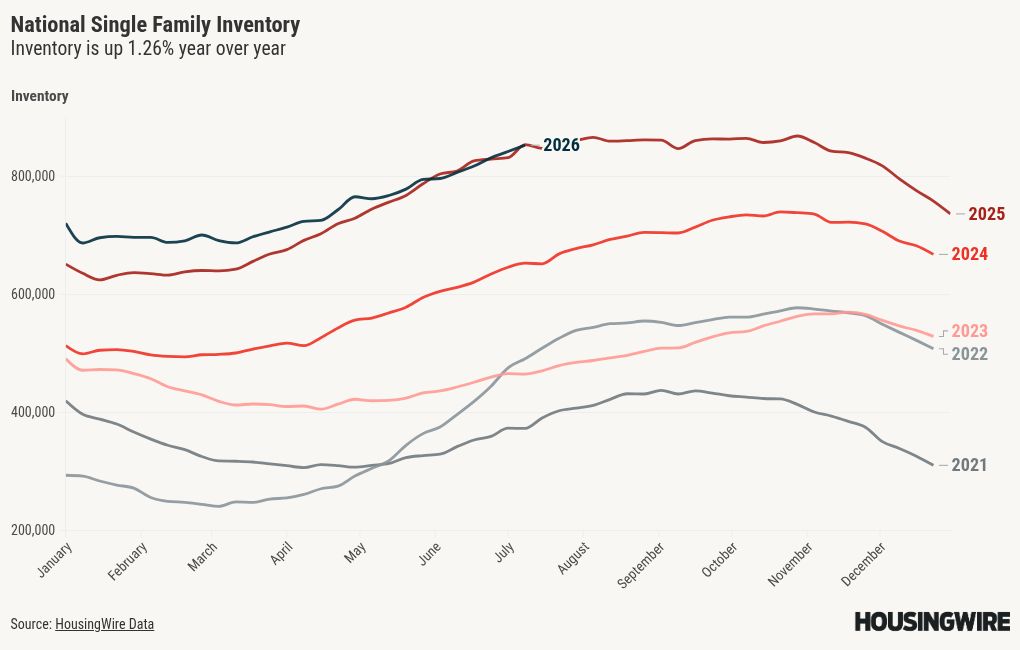
After being removed from the Penn Station reconstruction project by the federal government, the Metropolitan Transportation Authority has rejected an offer from Amtrak to rejoin the effort. Andy Byford, senior adviser at Amtrak, sent a letter to MTA Chair and CEO Janno Lieber on Monday formally inviting the MTA to return as a “fully involved” partner after the agency was taken off the project last year and its original reconstruction plan was scrapped. Lieber declined to sign an agreement to join, questioning whether President Donald Trump and Amtrak would follow through on the development.

The MTA’s rejection marks another chapter in the tumultuous process surrounding the Penn Station reconstruction. Released in 2023, the MTA plan called for replacing Penn Station with a 250,000-square-foot, single-level facility centered around a spacious, light-filled train hall.

However, in April 2025, the Trump administration said it was taking over the project, with Amtrak spearheading the overhaul instead. Department of Transportation Secretary Sean Duffy said the move would save taxpayers $120 million and echoed Trump’s statements that “the days of reckless spending” were over.

Last month, the administration selected a master developer for the project, a joint venture of Halmar International and Skanska. Lieber said the renovation plan had the “appearance of impropriety” because the selection process was “opaque,” according to the New York Times.

The announcement came a day after Duffy said the federal government would spend $8 billion to rebuild the station, as 6sqft previously reported.

Earlier this month, Amtrak released the first renderings of the project. Designed by Practice for Architecture and Urbanism (PAU), the plan references the architectural legacy of the original Penn Station, designed by McKim, Mead & White and demolished in the 1960s, as well as the Farley Building across Eighth Avenue.

Rather than demolishing blocks to relocate Madison Square Garden and build a new station, the design preserves much of the existing structure through “surgical reconstruction paired with radical thinking,” according to PAU.

Inside, the station is centered around a 50-foot train hall with public spaces, including shops, restaurants, bars, and waiting areas. A sculptural stair connects the street to the single-level concourse, which will feature widened corridors, ceiling heights of at least 20 feet, and upgraded public amenities.

Byford said that Amtrak plans to move forward with the project whether or not the MTA agrees to cooperate. Lieber noted that the MTA’s lease agreement with Amtrak gives the agency approval rights for any construction affecting the northern part of the station.

In October, Amtrak sent the MTA a “collaboration agreement” that would have granted the federal government more say over renovation decisions. However, the MTA has not signed on, saying it would compromise the existing lease agreement that gives it significant control over the project, according to the Times.

“The MTA’s Long Island Rail Road and the MTA’s subways carry two-thirds of the daily users of Penn Station,” Lieber wrote, according to Gothamist. “Even more important, the Long Island Rail Road has a prepaid lease running for another 160 years that gives us approval rights for any construction within or affecting the northern half of the station.”

Lieber has also said Amtrak’s plan could lead to higher costs for riders, a contention Byford denied in an interview this week, as reported by the Times. Byford also said Amtrak’s plan would not affect the station’s new Seventh Avenue entrance and 33rd Street concourse, built under Lieber’s leadership and opened in November 2023.

Looking ahead, Lieber said the agency is “ready to collaborate,” but rejected the creation of a new agreement that would eliminate the rights it holds under the lease. “In order to do it, just send us the plans, brief us, and we will give you feedback,” he said, according to Gothamist.

Amtrak says construction on the project will begin by the end of 2027. For now, the agency still needs to secure funding and reach an agreement with all involved parties.

RELATED:

The post MTA and Amtrak at odds over Penn Station redesign first appeared on 6sqft.

This post was originally published here

JPMorgan Chase has named Doug Petno and Troy Rohrbaugh as co-presidents effective immediately — the clearest step yet in the board’s planning for an eventual successor to CEO Jamie Dimon.

Dimon, who has led JPMorgan since 2006, remains as chairman and CEO. Over his tenure, he has reduced the bank’s direct mortgage origination footprint in favor of higher-return businesses while tightening credit in certain channels and focusing on cross-sold, relationship-based lending.

In addition to their new companywide roles, Petno will become sole CEO of the Commercial & Investment Bank (CIB), a position he previously shared with Rohrbaugh. Meanwhile, Rohrbaugh will become CEO of Consumer & Community Banking (CCB), the bank announced Thursday.

Petno, a 35-year veteran of the firm, spent more than two decades in Global Investment Banking and previously led JPMorgan’s Global Natural Resources Group. Rohrbaugh joined the bank in 2005. He served as co-head of Markets & Securities Services and previously headed Macro Markets.

The CIB and CCB represent JPMorgan’s two largest operating units, each of which carry significant implications for the housing finance industry. They handle retail mortgage origination, securitization, trading and capital markets access for large nonbank lenders and real estate investment trusts (REITs).

The promotions are part of the board’s ongoing process to “preserve top qualified internal succession candidates” and ensure leadership continuity at the top of the company.

Dimon has repeatedly indicated he does not intend to remain CEO for “another five years,” increasing investor and regulatory pressure for visible succession planning at the bank.

Mortgage implications

In the mortgage space, the bank continues to play a smaller role in origination than it did a decade ago, even as it remains critical in servicing, warehouse lending, mortgage-backed securities (MBS) markets and mortgage servicing rights (MSR) financing.

JPMorgan’s origination volume hit $13.7 billion in the first quarter of 2026, up 46% year over year. Retail channels drove the majority of that production (63.5%). The bank’s home lending revenues reached $1.23 billion. Chase was the fourth-largest U.S. mortgage lender during that period, according to Inside Mortgage Finance.

In shareholder letters and investor discussions, Dimon has argued that streamlining origination standards, servicing requirements and securitization rules could lower mortgage costs and increase lending without materially increasing risk. He has estimated that reforms could generate hundreds of billions of dollars in additional mortgage lending per year.

Succession planning

As part of the announcement, Marianne Lake — the current CEO of CCB who previously served as the bank’s chief financial officer — will retire from the firm after more than 25 years of service. She will work with Rohrbaugh and other senior executives over the coming weeks to support a smooth handoff, the bank said.

Lake has been one of a small group of executives widely viewed as potential successors to Dimon. As head of the consumer bank, she navigated the business through the COVID-19 pandemic, a rapid rate-hiking cycle, and a period in which JPMorgan pulled back from some lower-margin and noncore mortgage origination channels, ceding share in home loans to nonbanks.

Petno and Rohrbaugh were also awarded $30 million in retention equity, while Mary Erdoes, CEO of Asset & Wealth Management, and chief operating officer Jennifer Piepszak were awarded $20 million.

The awards come in the form of restricted stock units that cliff vest after three years, subject to a performance condition: JPMorgan must deliver an average return on tangible common equity of at least 12% across 2026, 2027 and 2028. Net shares are subject to a two-year post-vesting holding period, as well as the firm’s existing stock ownership and retention rules for operating committee members.

This post was originally published on here

Qualia has expanded its wire fraud prevention platform, Qualia Shield, adding new automated verification capabilities designed to help title and escrow companies identify potential fraud during real estate transactions.

Shield is integrated into the Qualia title and escrow operating system and automatically performs risk assessments whenever wire instructions are added or modified during a transaction, leaders said.

Expanded features include evaluation of all wire types, including commission payments, agent disbursements and other transaction-related wires.

It also verifies bank account ownership using bank ownership records and cross-checks identity information against public records to identify discrepancies involving names, addresses, Social Security numbers and dates of birth.

“We’ve seen the wire fraud threat evolve from opportunistic to industrialized,” said Nate Baker, CEO and co-founder of Qualia. “Criminal networks have built operations specifically to target the real estate closing process. They know the pressure points. They know when teams are rushed. And they’ve become very good at exploiting the gaps that exist between disconnected systems. The only way to close those gaps is to make protection automatic and native to where the work happens.”

Additional updates include artificial intelligence-powered name matching intended to reduce false-positive identity mismatches by recognizing common variations such as initials, suffixes and hyphenated names.

Transactions that receive a low-risk assessment may qualify for up to $2 million in wire fraud insurance coverage backed by Lloyd’s of London, Qualia said. The company added that approximately 99% of transactions processed through its platform fall below that coverage threshold.

This article was generated using HousingWire Automation and reviewed by a HousingWire editor before publication.

This post was originally published on here

CoStar Group stockholders approved all proposals at the company’s annual meeting on Tuesday, including the reelection of eight director nominees and an advisory vote on a redesigned executive compensation plan, the company said in an announcement on Thursday.

The vote gives CoStar leadership a governance green light as it pursues a strategy that pairs revenue growth with a renewed focus on EBITDA margin expansion. Additionally, the vote came after an activist investor campaign called for a complete overhaul of the board and the possible removal of Andy Florance as CEO.

According to preliminary results disclosed by CoStar, investors supported each director candidate with more than 93% of votes cast. The directors returning to the board include Florance, Louise Sams, John Berisford, Angelique Brunner, Rachel Glaser, John Hill, Christine McCarthy and Robert Musslewhite. 

Earlier this year, CoStar’s board, which includes three new directors, unanimously approved a plan to “deliver revenue growth and prioritize EBITDA margin expansion,” CEO Andy Florance said in the announcement. The company then held in-person meetings with more than 500 stockholders to outline its strategy and long-term objectives.

“The overwhelming stockholder support for our directors reflects their confidence in our strategy and the considerable opportunities ahead for CoStar Group,” Florance said in a statement.

Say-on-pay support follows comp overhaul

Stockholders also approved the nonbinding advisory vote on pay for CoStar’s named executive officers, with 71.38% of votes cast in favor, the company reported.

That approval follows a multi-year engagement campaign targeting the company’s largest investors. In 2025, the board chair and compensation committee chair met with the firm’s top 50 stockholders, representing 77% of outstanding shares, to discuss governance and executive compensation.

These discussions resulted in a board approved, redesigned 2026 executive compensation program that CoStar said includes things like more rigorous, quantitative performance goals, greater transparency around metrics and payouts and a simplified structure intended to align pay more tightly with long-term stockholder value.

Activist investor push

In January, CoStar provided investors with an update on financial and corporate governance initiatives for 2026, much of which they said was the result of a “robust review” of the company by the Capital Allocation Committee. While the update painted a fairly rosy picture for the firm as a whole in 2026, with estimated 18% year-over-year revenue growth to between $3.78 and $3.82 billion and a net income of $175 million to $215 million for the year, things did not look quite as strong for CoStar’s Homes.com

Although Homes.com has recorded a 337% increase in subscribers since Q1 2024, according to CoStar, the firm said it does not expect Homes.com to attain positive adjusted EBITDA until 2030. 

In late January and early February, activist investors D.E. Shaw and Third Point pushed back on CoStar’s Homes.com timeline calling on CoStar to divest or shutdown Homes.com. In April, Third Point sold its shares of CoStar ending its activist investor push. 

CoStar has indicated that it is firmly against divesting or shutting down Homes.com. During Q1 2026, CoStar reported a 23% annual jump in revenue to $897 million and a 49% increase in adjusted net income to $94 million. Additionally, the company said Homes.com revenue grew 58% to $26 million in the first quarter, with agent subscribers surging to 35,175. Overall residential revenue for the quarter reached $425 million, up 32% year-over-year.

This article was written by Brooklee Han and generated with the assistance of HousingWire Automation, then reviewed by a HousingWire editor before publication.

This post was originally published on here

While their homebuyer commission lawsuit settlement agreements are still waiting for final approval, both HomeServices of America and Douglas Elliman notched legal wins this week in the homebuyer commission litigation saga. 

In a ruling Tuesday, Florida-based District Court Judge K. Michael Moore denied the Lutz plaintiffs’ preliminary injunction motion seeking to prevent HomeServices of America and Douglas Elliman from proceeding with the homebuyer commission lawsuit settlements they negotiated via Tuccori lawsuit’s opt-in settlement function. 

In their motion, the Lutz plaintiffs called the settlements a “reverse auction,” claiming that the defendants “picked a plaintiff with weaker claims and weaker counsel in an effort to negotiate a more favorable settlement,” and noting that the opt-in settlements came after the court overseeing the Lutz lawsuit denied most of the defendants’ motion to dismiss the Lutz lawsuit.

“These plaintiffs never sued the Defendants, but are now selling Defendants a release of Plaintiffs’ claims here in exchange for fees. Defendants bought this release from plaintiffs who not only did not sue them, but could not without their consent, given Defendants’ professed lack of personal jurisdiction over them in Illinois,” the filing stated.

In the ruling, Judge Moore wrote that the court found that the plaintiffs “would not be irreparably harmed without a preliminary injunction,” especially given that mechanisms for them to challenge the settlement before the Tuccori court exist. 

“Plaintiffs’ argument is based on speculative harm, which is not sufficient on a motion for preliminary injunction.” 

Lutz suit stayed

In addition to this ruling, Judge Moore also granted the defendants’ motion to stay the case until the Tuccori court issues a final decision on whether to approve the defendants’ opt-in settlement agreements, which would settle all nationwide homebuyer commission lawsuit claims. 

In the ruling, the judge noted that in the Tuccori court’s preliminary approval of the settlements, members of the settlement class were “temporarily enjoined from filing, commencing, prosecuting, intervening in, or pursuing as a plaintiff or class member, against any Settling Defendant, Opt-In Settlor, or Released Party, any Released Claims.” 

“To avoid forcing Plaintiffs to choose between complying with this Court’s orders and with the Tuccori Court’s order, this Court finds that a stay of this case in its entirety is appropriate,” Judge Moore wrote in the ruling. 

In addition to these two rulings, Judge Moore also instructed the clerk of the court to “administratively close” the case.

A final approval hearing for the Tuccori settlements is scheduled for late July.

This post was originally published on here

From the outside, the free-standing home at 85 Westminster Road in Flatbush is a confection of colonnades and turrets, with a wide porch at one side. And unlike many Brooklyn townhouses, this one, built in 1908, has interiors that highlight the decorative aesthetic of the era. Asking $3,950,000, this landmarked three-story home, within the Prospect Park South Historic District, and the enchanting grounds that surround it, offer the sensibility of a country estate with the ease of modern townhouse living in the city.

Mechanical upgrades ensure 21st-century functionality and comfort. Upgrades include electrical and plumbing systems, central and split system air conditioning in the bedrooms, comprehensive moisture/flood prevention, a reverse osmosis drinking water system, upgrades in the kitchen and baths, and a fully upgraded basement.

The plush elegance of the home’s interior decor represents a significant creative change from the last time 6sqft featured the home, which was on the market for $2.4 million in 2018.

The addition of silkscreened wall coverings, decadent chandeliers, and a sophisticated color palette complements the home’s well-preserved architecture. There are three distinct living rooms on the ground floor. All have original woodwork and fireplaces.

A spacious, colorful eat-in kitchen is a thoroughly charming gathering spot, done in a modern English country style. Anchored by a Garland stove, design details include William Morris wallpaper and cabinets painted in Farrow and Ball Calke Green.

Beneath a massive, yet delicate, crystal chandelier, the dining room walls wear a De Gournay-style hand-painted chinoiserie mural. Original woodwork is painted to continue the color from the adjacent kitchen.

Through a glass door, a bluestone patio offers a true oasis. For additional outdoor enjoyment, a 700-square-foot porch becomes a private, trellised “outdoor room.”

Seven large bedrooms enjoy the same creative treatment, with sophisticated wall coverings highlighting fireplaces and other original features.

One large third-floor bedroom is used as a studio suite. Renovated baths have vintage fixtures and clean, colorful design additions.

Surrounding the home, a colorful English cottage garden landscape continues the “country estate in the city” effect. The gardens have been professionally designed as a series of small “rooms.”

Here you’ll find over 65 types of roses surrounded by lilacs, wisterias, hydrangeas, elderflower, evergreens, all-season perennials, and flowering bulbs. More than merely beautiful, the property’s trees bear a cornucopia of fruit, including apples, pears, figs, and raspberries. The surrounding gardens are easily maintained with a comprehensive irrigation system.

[Listing details: 85 Westminster Road at CityRealty]

[At The Corcoran Group by Catherine Witherwax]

RELATED:

The post This $4M Flatbush townhouse stays true to its Victorian roots first appeared on 6sqft.

This post was originally published here

Senate Democrats have accused Consumer Financial Protection Bureau (CFPB) acting director Russell Vought of stripping away key consumer protection resources and obscuring past enforcement work in a letter sent on Monday. 

“Your decision deprives Americans of key resources and is yet another giveaway to companies intent on scamming the public of their hard earned dollars,” the lawmakers wrote. 

The lawmakers questioned the CFPB’s reliance on an external web archive to access older material, which may be effective at preserving some data, but makes navigating the website more difficult.  

“The CFPB’s website lists a vague acknowledgement of the removal of pages and directs users to an externally hosted archive to access deleted content. This archive is not a replacement for a federal government website,” they wrote.

The CFPB did not immediately reply to HousingWire‘s request for comment. 

The senators said the CFPB in May deleted thousands of pages published over the past 15 years — including all press releases, testimony and speeches that took place prior to President Donald Trump’s second term. The bureau also allegedly removed consumer advisories, notices of settlements, original research and major reports.

“These deleted pages provided crucial information that helped Americans protect themselves against unfair, deceptive, and abusive practices — and also served as a repository of corporate predatory behavior,” they wrote. “You have erased a source of records of abusive corporate conduct that underpinned the CFPB’s decisions under prior Administrations to levy enforcement actions against those lawbreaking companies.”

Sens. Elizabeth Warren (D-Mass.), Raphael Warnock (D-Ga.), Andy Kim (D-N.J.) and Lisa Blunt Rochester (D-Del.) signed the letter. 

The letter ties the web purge to an enforcement pullback. Since February 2025, the CFPB has dismissed or terminated at least 42 public enforcement actions against Wall Street banks, big tech firms and other corporations, they added. 

The agency has been under the leadership of Vought for the past 16 months. During his tenure, Vought — who also serves as the current head of the White House Office of Management and Budget (OMB) — has moved to scale back the bureau’s enforcement and regulatory activities.

Earlier this month, the White House sent the nomination of Brian Johnson to serve as permanent director to the Senate.

The Senators cited specific deletions. These include “a ‘know your rights’ article around medical debt collection and an overview of predatory practices associated with loans” and “all 35 Supervisory Highlights reports, which summarize the agency’s supervision of financial institutions and include anonymized descriptions of the supervisory actions from each administration dating back to 2012.”

They also criticized the removal of non-English content following a Trump executive order on English as the official language. 

“Ultimately, these deletions appear to be part of your ongoing effort to dismantle the CFPB,” they said. 

They asked Vought to answer a detailed list of questions by July 2, including whether the deletions were intended to “hide the agency’s [past] accomplishments” and whether removing explanations of past enforcement actions was “an attempt to hide the predatory conduct that Acting Director Vought is excusing by dropping almost all ongoing enforcement actions.”

This post was originally published on here

A member of the city’s Rent Guidelines Board (RGB) resigned just hours before the board was set to vote on a possible rent freeze for the roughly two million New Yorkers who live in rent-stabilized apartments. Christina Smyth, a landlord representative on the board who was appointed by former Mayor Eric Adams last year, submitted her resignation Thursday morning ahead of the board’s scheduled 7 p.m. vote, as first reported by Crain’s. Smyth said the RGB has stopped being a “fact-finding body” and instead “starts with an answer” and works backward to justify it, adding that most of the board’s nine members have been appointed by Mayor Zohran Mamdani.

It is unclear whether Smyth will be replaced. The board will still have a quorum to proceed with Thursday night’s vote, as Crain’s reported.

Freezing rents for the city’s rent-stabilized tenants was a central component of Mamdani’s campaign platform. The board includes two members representing tenants, two representing owners, and five representing the general public. Each year, it bases rent adjustments on several metrics that reveal the current economic conditions for both landlords and tenants.

During Adams’ tenure, rents for rent-stabilized units increased a cumulative 12 percent. Under former Mayor Bill de Blasio, the RGB approved several rent freezes, and rents rose a total of just 6 percent over his eight years in office.

Last December, just two weeks left in his term, Adams appointed and reappointed four members to the RGB in an effort to block then-Mayor-elect Mamdani’s push for a rent freeze. The moves gave Adams’ allies a majority on the board.

However, after three RGB members resigned earlier this year, Mamdani in February appointed six new members to the board, significantly increasing the likelihood of a rent freeze.

In May, that likelihood increased further when the RGB, in a preliminary vote, backed rent adjustments that included no increases on some leases. The board approved adjustments ranging from 0 to 2 percent for one-year leases and 0 to 4 percent for two-year leases.

Smyth said the decision to pursue a rent freeze had already been made through Mamdani’s appointments. She also claimed that questions she raised about methodology, as well as rising costs and falling net income, “went unanswered.”

“This rebuilt board was required to deliver a rent freeze,” she wrote, according to a post on X from NY Daily News reporter Josie Stratman. “Everything since has been theater. The hearings, the reports, the public comment, the data. None of it was ever going to change the result.”

“I know this because I watched it happen from the inside,” Smyth added. “I asked the staff to explain their methodology. I asked how the figures in the operating cost reports were reached. I asked why data showing rising costs and falling net income was not reflected in the board’s direction to its members. Those questions went unanswered.”

She continued, asking Gov. Kathy Hochul to help restore the vacancy bonus, a provision eliminated in 2019 state rent laws that allowed landlords to raise rents on stabilized units when they became vacant. Tenant advocates said it incentivized landlords to harass tenants out of units in hopes of increasing rents, according to The Real Deal.

Smyth’s resignation also raised the possibility of a legal challenge to the board’s decision, arguing that the RGB has gone beyond the limits of the law.

“A board that votes to freeze rents while knowingly disregarding its own evidence of rising costs and falling income is not acting within those limits,” Smyth wrote. “I am not going to lay out the legal argument in a public statement. But the limits are real, and a record built this way will not hold up the way its authors expect.”

Smyth is the founder and owner of Smyth Law PC, a real estate law firm representing multifamily residential building owners, operators, and management companies across Manhattan, Queens, Brooklyn, and the Bronx, as 6sqft previously reported.

RELATED:

The post Rent Guidelines Board member resigns hours before vote on possible rent freeze first appeared on 6sqft.

This post was originally published here

Leadership has always mattered in real estate. What’s changed is the expectation. Today’s brokerage leaders are navigating an industry defined by tighter margins, faster technology shifts and heightened competition for both talent and trust. In that environment, leadership development can’t be theoretical or occasional. It has to be practical, continuous and accountable to results.

The question facing our industry isn’t whether leadership matters. It’s whether we’re developing leaders in ways that actually move the business forward.

Beyond the classroom

I’ve experienced leadership development from both sides, as a participant and as a leader responsible for building the next generation. As an alumnus of Ascend: The Executive Leadership Experience, I saw firsthand the difference between learning that inspires and learning that sticks.

For too long, leadership development followed a familiar rhythm: conferences, workshops, ideas that sounded good in the moment but were difficult to apply once leaders returned to the realities of their businesses. Those experiences had value, but they often lived too far from execution.

That model no longer works.

The most effective leadership development today is designed around application. It challenges leaders to take what they’re learning and immediately apply it to real decisions, real teams and real growth priorities. Leadership development stops being something separate from the business and becomes embedded within it.

Leadership is a growth strategy

Across the industry, there’s a clear shift underway. Leadership development is no longer viewed as a perk or a retention tool. It’s recognized for what it truly is: a growth strategy.

The strongest programs focus on capabilities leaders need right now, using data to make better decisions, building resilient and engaged teams, creating cultures that attract and retain talent, and leveraging new technologies, including AI, to operate more efficiently and intelligently.

These aren’t abstract skills. They show up directly in performance.

Leaders who understand their data lead with transparency. Leaders who invest in culture retain people longer. Leaders who embrace innovation stay relevant. In today’s market, leadership capability and business results are increasingly inseparable.

Learning in real time

One of the most important evolutions in leadership development is the move toward applied, real‑time learning.

Instead of hypothetical case studies, leaders are working on the challenges already sitting on their desks — growth, profitability, recruiting, retention, customer experience. They’re building strategies they can test, refine and scale immediately, which can help change the outcome.

When learning is tied directly to the business, leaders don’t leave with notes. They leave with momentum where development turns into action, and action turns into measurable progress.

The value of shared perspective

Another critical element of modern leadership development is perspective.

When leaders from different brands, markets and roles come together, they challenge assumptions and learn from one another in ways that don’t happen inside a single organization. In an industry that’s naturally competitive, these environments create space for collective advancement.

Equally important is what happens after the program ends. Alumni engagement and mentorship extend the impact well beyond the classroom, reinforcing a culture of shared learning and accountability. Leadership development doesn’t stop; it continues to grow.

From insight to impact

The true measure of leadership development isn’t how energized participants feel when it ends. It’s what changes when they return to their businesses. Are decisions sharper? Are teams more aligned and engaged? Is growth more intentional and sustainable?

When leadership development is done right, the answers are clear, and they show up in performance.

Raising the bar

As real estate continues to evolve, so must our expectations of leadership.

The organizations that will win next are the ones that treat leadership as a strategic priority and hold it accountable for results. That means creating development experiences that are grounded in real work, demand application and connect leaders to strong peer networks that continue long after the program ends.

When learning leads to action, and action leads to growth, leadership development becomes more than an investment. It becomes a competitive advantage and one our industry can’t afford to overlook.

Alex Vidal is president of ERA Real Estate.

This column does not necessarily reflect the opinion of HousingWire’s editorial department and its owners.

To contact the editor responsible for this piece: tracey@hwmedia.com

This post was originally published on here

Homebuyer affordability deteriorated in May as higher mortgage rates and larger loan application amounts pushed monthly mortgage payments higher, according to data released Thursday by the Mortgage Bankers Association (MBA).

The MBA’s Purchase Applications Payment Index (PAPI), which measures mortgage payment burdens relative to income, rose 2.2% to a reading of 159.4 in May. — up from 156.0 in April. An increase in the index indicates worsening affordability conditions for prospective borrowers.

The national median mortgage payment applied for by purchase applicants climbed to $2,198 in May, up from $2,152 in April. Despite the monthly increase, the median payment was down 0.6% from a year earlier.

“Affordability conditions weakened in May, as rising mortgage rates, combined with increasing loan application amounts, drove mortgage payments higher,” said Edward Seiler, the MBA’s associate vice president of housing economics and executive director of the Research Institute for Housing America.

“The decrease in affordability was widespread, with conditions declining in 33 states,” Seiler added. “While affordability conditions remain improved compared to a year ago, the monthly increase underscores how sensitive prospective homebuyers remain to changes in interest rates and home prices.”

The index compares mortgage payments with household earnings, using mortgage application data from the MBA’s weekly applications survey and earnings data from the U.S. Bureau of Labor Statistics. Higher index values indicate a larger share of income is needed to cover mortgage payments.

For borrowers applying for lower-payment mortgages, represented by the 25th percentile of applicants, the median payment increased to $1,532 in May, up from $1,493 in April.

Affordability trends varied across loan types. The median payment for applicants seeking Federal Housing Administration (FHA) loans rose to $1,873 in May, up from $1,829 the previous month, although it was below the $1,927 figure recorded a year earlier. Conventional loan applicants saw median payments increase to $2,211, up from $2,166 in April, while remaining slightly below the $2,235 level seen in May 2025.

The MBA said affordability declined across major demographic groups. The index for Black households increased to 165.0 from 161.5 in April, while the index for Hispanic households rose to 147.5 from 144.3. The index for White households increased to 160.7 from 157.3.

Among states, Idaho recorded the highest affordability burden with a PAPI reading of 254.1, followed by Nevada at 231.5, Rhode Island at 213.1, Arizona at 209.1 and Florida at 200.4.

Louisiana posted the lowest index reading at 121.7, followed by the District of Columbia at 123.1, Connecticut at 124.9, Alaska at 128.6 and Maryland at 132.2.

Meanwhile, affordability for newly built homes improved slightly. The MBA’s Builders’ Purchase Application Payment Index showed the median mortgage payment for purchase loans on newly constructed single-family homes fell to $2,173 in May, compared to $2,188 in April.

The monthly decline in builder-related payments contrasted with broader affordability trends in the existing home market, where rising rates and larger loan balances continued to pressure prospective buyers.

This article was generated using HousingWire Automation and reviewed by a HousingWire editor before publication.

This post was originally published on here

In March of this year, Fannie Mae and Freddie Mac unveiled a major change to condominium lending, financial and insurance standards aimed at improving the way condos are bought, sold and managed. These updated rules change the criteria for prospective condo buyers to obtain conventional financing through Fannie and Freddie, which has ripple effects across condo marketability, sale timelines and property values.

The changes are significant, impacting how condominium projects are reviewed and how they are expected to fund reserves, as well as setting new minimum standards for a condo’s insurance coverage and deductibles. Anyone in a position to buy, sell or manage a condominium under these new rules needs to know how these changes will affect them.

New flexibility in condo insurance requirements

Most condo owners know that recent years have presented numerous challenges to the condo insurance marketplace. Finding affordable coverage has been a challenge, especially when balanced against the need to maintain policies that include adequate coverage to meet industry or regulatory standards. Fannie and Freddie’s strict insurance requirements have made this more difficult in the past; however, the updated rules should have a favorable impact on a condo’s ability to obtain adequate coverage and thus qualify for conventional financing. 

The revised insurance requirements grant a lot more flexibility when it comes to insuring an association’s buildings. Prior to the issuance of the new lender letter, it could be extremely challenging for certain associations to meet Fannie and Freddie requirements. In particular, older properties, those located in high-potential catastrophic weather areas, or vertical condos with a history of water damage claims, struggled under the old requirements.

Depending on the specific exposures of an association, there could be cases where the underwriting marketplace simply wasn’t willing to offer necessary products, such as replacement-cost coverage for roofs or a deductible structure that complied with regulations, at all. By allowing Actual Cash Value coverage on roofs and specifying a $50,000 per-unit deductible cap, Fannie and Freddie are granting many associations more flexibility with their insurance companies, which will be able to compete and offer terms that meet the new standards. 

The shifting burden: Unit owners and reserve funding

The new rules’ impact on unit owners is a little more nuanced. While the changes offer a better opportunity to qualify for a Fannie- or Freddie-backed loan in a condo, unit owners will have to pay closer attention to the coverage on their HO-6 (condo homeowners) insurance policy, as it serves as the primary backstop to cover against potential gaps or a master deductible assessment. Technically, the revised requirements can potentially shift some burden of risk from the association to the unit owners. 

New requirements to adequately fund reserves are working in tandem with some of the changes to the insurance requirements. For example, if an association chooses Actual Cash Value instead of Replacement Cost for its roof coverage, there is the potential for a coverage gap that will need to be funded out of reserves, or else by special assessment.

In addition, better reserve funding practices over time avoid the potential for deferred maintenance, thus providing for better-maintained properties and reducing the likelihood of an insurance claim because of aging or decaying building features. This is one of the primary reasons for Fannie and Freddie requiring greater reserve funding standards in the most recent update. 

Adapting to the new reality of condo financial planning

Taken together, the March 2026 updates represent a clear shift toward practicality. Fannie Mae and Freddie Mac appear to be acknowledging the realities of today’s insurance market, particularly in higher-risk regions, and are creating a path for more associations to remain eligible for conventional financing. That said, these changes should not be viewed as a relaxation of standards as much as they are a redistribution of risk. Where associations are given flexibility on coverage structure or deductibles, there is a corresponding expectation that they are making informed decisions about reserves, maintenance and overall financial health.

For boards and property managers, the changes reinforce the importance of taking a more integrated approach to financial planning. Insurance, reserves and long-term capital planning can no longer be treated as separate conversations. Decisions in one area will directly impact the others and, ultimately, influence a community’s eligibility for financing. Associations that are proactive, whether by engaging qualified insurance advisors, updating reserve studies or stress-testing different coverage scenarios, will be better positioned to navigate these changes without introducing unintended gaps.

From a unit owner’s perspective, the takeaway is equally important. As associations adjust their insurance programs to align with the new guidelines, individual owners will need to take a more active role in understanding their own coverage. Reviewing HO-6 policies, confirming adequate loss assessment limits and coordinating with the association’s master policy are all becoming critical steps, not optional ones.

Ultimately, the communities that will benefit most from these updates are those that recognize the bigger picture. Financing eligibility, insurability and property values are more interconnected than ever. The associations that strike the right balance between flexibility and discipline will not only meet Fannie and Freddie’s requirements but will also position themselves as stronger, more resilient communities in an increasingly complex market.

Sean Kent, Senior Vice President, Insurance at FirstService Residential
This column does not necessarily reflect the opinion of HousingWire’s editorial department and its owners. To contact the editor responsible for this piece: zeb@hwmedia.com. 

This post was originally published on here

As Logan Mohtashami outlined in this week’s Housing Market Tracker, the key question for the second half of 2026 is whether housing can continue to hold up with mortgage rates hovering near 6.6%.

The regional data suggests the answer, at least for now, is yes.

Demand remains resilient across the country. Every major region posted positive year-over-year growth in pending sales for the week ending June 20, despite mortgage rates sitting near the upper end of Logan’s forecast range.

Pending sales growth by region:

  • Northeast: +4.1%
  • South: +6.9%
  • West: +8.4%
  • Midwest: +9.0%

That is an important finding heading into the second half of the year. Housing demand is not being supported by one hot market or one favorable region. Buyers are still showing up across the country, even with financing costs remaining elevated.

But demand is only half the story.

The bigger surprise is what is happening with inventory.

The inventory divide

National inventory appears stable on the surface. Active inventory stood at 830,939 homes for the week ending June 20, up just 0.25% from a year ago.

That flat national reading, however, hides a meaningful regional shift.

While the Northeast and Midwest remain the most supply-constrained regions in the country, they are posting the strongest inventory growth. Meanwhile, inventory is shrinking in the South and West after those regions spent much of the past two years working through a supply correction.

Inventory change by region:

  • Northeast: +7.2%
  • Midwest: +5.5%
  • South: -0.8%
  • West: -2.8%

In other words, the regions that have historically struggled with inventory shortages are adding supply, while the regions that led the inventory recovery are beginning to tighten again.

The result is a national market that looks flat, but only because regional trends are moving in opposite directions.

The South is driving the national story

The South remains the most important region to watch because of its outsized influence on the national housing market.

The region accounts for 459,019 active listings, or 55.3% of all inventory nationwide. By comparison, the West represents 21.6% of inventory, the Midwest 14.4% and the Northeast just 8.7%.

That means when inventory changes in the South, the national inventory story changes with it.

After leading inventory growth throughout much of 2025, the South is now seeing inventory decline modestly year over year. At the same time, it continues to carry the highest price-cut rate of any region at 39.4%, slightly above the national average of 38.6%.

The demand picture remains positive, with pending sales up 6.9% from a year ago. But the South also remains the region most exposed to shifts in affordability conditions because it holds the largest share of the nation’s inventory and continues to rely more heavily on seller price adjustments than other parts of the country.

Tight markets are getting slightly looser

The Northeast posted the strongest inventory growth in percentage terms, with active inventory rising 7.2% year over year.

That sounds significant until you consider the starting point.

The entire region has just 72,333 active listings. Even with inventory growth, supply remains extremely limited compared to the rest of the country. Price cuts are running at just 28.7%, the lowest of any region and nearly 10 percentage points below the South.

The Midwest tells a similar story. Inventory is up 5.5% year over year, while pending sales are up 9.0%, the strongest growth of any region.

These markets remain some of the most affordable in the country, helping explain why buyer demand continues to hold up despite higher borrowing costs. Mortgage rates may be creating friction, but they have not become a meaningful barrier to demand.

Do not overlook the West

The West may be the most underappreciated story in the data.

Inventory is down 2.8% year over year. Pending sales are up 8.4%. Price cuts have fallen from 38.1% to 36.3%, the largest improvement of any region.

Taken together, those trends suggest the West is continuing to work through its correction and may be further along in the process than many market observers realize.

Shrinking inventory, improving demand and fewer seller concessions are all signs of a market that is gradually tightening rather than weakening.

What to watch in the second half

Logan’s framework for the second half centers on two key questions: Can demand remain positive with mortgage rates above 6.5%? And what happens as year-over-year comparisons become more difficult beginning in July?

The regional data sharpens both questions.

The encouraging news is that demand remains positive everywhere. No region is currently showing the kind of deterioration that would suggest a broad-based housing slowdown is already underway.

The inventory picture is less straightforward.

The South’s massive share of national inventory means its trajectory will heavily influence the national numbers. If inventory continues to contract there while demand remains positive, national inventory growth could turn negative later this year.

Meanwhile, the West’s improving fundamentals could emerge as one of the more surprising housing stories of 2026 if current trends persist.

The national housing market is not standing still. It is being pulled in different directions by different regions, each responding to affordability, supply and demand pressures in its own way.

Housing demand is holding up everywhere. The question for the second half of 2026 is not whether buyers are still showing up. It is where inventory tightens, where it loosens and which regions ultimately shape the national story.

To follow these trends in real time, explore HousingWire Intelligence, which provides inventory, pricing, demand and market activity data at the national, metro and ZIP-code level. For weekly analysis of mortgage rates, housing demand and the macroeconomic forces influencing housing activity, read HousingWire’s Housing Market Tracker.

HousingWire used HousingWire Data to source this analysis. This article is based on single-family residence data through June 20, 2026. Enterprise organizations interested in licensing housing market data at scale can learn more about HousingWire Data.

This post was originally published on here

For many real estate agents, the challenge isn’t just generating leads — it’s capturing them. Buyers and sellers expect fast responses, especially when they’re ready to act on a hot listing or finally make the decision to sell. But what happens when your business misses that call or inquiry? The short answer: lost commissions that go unnoticed month after month. 

This article explores why real estate agents often lose deals simply due to slow or missed responses, and outlines practical strategies to reduce those losses and boost conversions. 

The hidden revenue leak: missed inquiries 

Most real estate agents track their marketing performance — website traffic, Zillow views, social media reach — but overlook one of the most critical parts of the client journey: how inbound inquiries are handled. 

Here’s what typically happens: 

  • A prospective buyer or seller finds you online, through a referral or on a listing platform 
  • They call, text or fill out a contact form 
  • They don’t hear back quickly enough 
  • They move on to the next agent 
  • The opportunity is gone — and you never knew it happened 

Buyers touring homes on a Saturday afternoon won’t wait until Monday morning for a callback. Sellers who are ready to list will sign with whoever shows up first with confidence and a plan. 

Why this happens 

Common reasons real estate agents miss leads include: 

You’re in a showing or with a client and can’t step away to take a new call. 

Inquiries come in after hours when you’ve mentally checked out for the day.

Lead notifications get buried in a busy inbox or ignored CRM.

No system exists for following up with web or platform inquiries consistently. 

During busy seasons, the volume of leads spikes beyond what one person can manage alone. 

The result? You spend money on marketing — paid ads, professional photography, listing promotions — but lose the value of those leads because no one responded in time. 

The real cost 

Let’s break it down with simple numbers: 

  • 10 missed or slow-response leads per month 
  • 20% conversion rate if properly followed up 
  • $8,000 average commission per closed transaction 

That equals: 2 lost deals per month → $16,000 in lost commission → $192,000 per year 

And that doesn’t include the long-term value of repeat business or referrals those clients could have generated — which in real estate can easily double or triple the lifetime value of a single relationship. 

What real estate agents can do 

1. Track missed and slow responses weekly 

Start by understanding the scale of the problem. Review how many inquiries came in, how quickly they were responded to, and how many went cold. If you don’t measure your response rate, you can’t improve it. 

2. Improve after-hours and in-showing coverage 

Clients don’t stop browsing listings at 5 pm. If you’re missing inquiries after hours or while you’re with other clients, consider automated response tools that acknowledge new leads instantly — letting them know you’ll be in touch shortly. A fast acknowledgment keeps prospects from moving on. 

3. Build a consistent follow-up process 

Having a defined process for handling inbound leads — how quickly you respond, what you say, and how you follow up — makes a measurable difference. Even a simple CRM with reminders can prevent good leads from slipping through the cracks. 

4. Use technology to support your business 

Modern lead-handling tools can help you respond to more inquiries, capture contact details automatically, and even pre-qualify prospects without requiring you to be available around the clock. These tools level the playing field between solo agents and large teams. 

Final thoughts 

Real estate agents who take lead response seriously win more clients. It’s not enough to generate demand — you must capture every opportunity when it arrives. By tracking your response performance, improving coverage during and after business hours, and optimizing how inquiries are handled, you can close more deals and significantly increase your income without necessarily increasing your advertising spend. 

If you’re missing just a few leads each month, the financial impact could be far bigger than you think — and the solution is closer than you realize. 

Seth Schumann is the Owner of Visionary Path AI, helping service businesses like real estate agencies capture more leads and grow revenue using AI-powered solutions.

This column does not necessarily reflect the opinion of HousingWire’s editorial department and its owners.

To contact the editor responsible for this piece: tracey@hwmedia.com

This post was originally published on here

The Federal Reserve’s annual stress test found that the nation’s largest banks remain well-positioned to withstand a severe economic downturn, with all 32 institutions tested maintaining capital levels above regulatory minimums despite projected losses exceeding $708 billion.

The 68-page test results, released Thursday, showed that large banks would continue lending to households and businesses even under a hypothetical recession scenario that included sharp declines in commercial real estate and housing prices, along with a spike in unemployment.

The annual stress exercise is part of the Federal Reserve’s “supervision efforts” and “as required by the Dodd-Frank Act.” The document also said that the stress test assesses how large banks are likely to perform under hypothetical economic conditions.

The annual exercise evaluates whether major U.S. banks have sufficient capital to absorb losses during a severe economic shock. This year’s scenario envisioned a global recession featuring a 39% decline in commercial real estate prices, a 30% drop in home prices and unemployment rising to 10%.

“Today’s results underscore the strength of the banking system,” Federal Reserve Vice Chair for Supervision Michelle Bowman said in a statement. “As we work to increase the transparency and accountability of the stress test, public feedback will help us continue to improve and instill greater confidence in the stress test and its results.”

Under the scenario, banks collectively would incur more than $708 billion in losses, including roughly $200 billion tied to credit cards, $160 billion from commercial and industrial loans and $75 billion from commercial real estate lending.

This year, 32 banks participated in the test, including Ally Financial, Inc., American Express, Barclays US and Wells Fargo, among others.

“The 2026 stress test results show that the 32 large banks subject to the test this year have sufficient capital to absorb nearly $708 billion in losses and continue lending to households and businesses under hypothetical stressful conditions,” the test reads.

Despite the projected losses of $708 billion, the aggregate common equity tier 1 (CET1) capital ratio for the tested banks declined by only 1.6 percentage points and remained above minimum regulatory requirements.

The Fed said three primary factors shaped this year’s results. Higher projected loan losses, driven by larger loan balances and more severe economic assumptions, reduced capital levels. Capital was also pressured by lower projected unrealized gains on securities because the scenario assumed smaller declines in interest rates.

Those factors were more than offset by higher projected interest income, reflecting recent bank earnings performance and the scenario’s smaller assumed interest-rate declines, the central bank said.

The Fed noted that this year’s results will not affect large-bank capital requirements, which were published Thursday separately. Current capital requirements will remain in place until 2027, when the stress test will incorporate updates to the Fed’s loss-estimating models based on public feedback.

This post was originally published on here

The list of defendants in the Taylor Real Estate Settlement Procedures Act (RESPA) just got smaller.

The plaintiffs notified the court of their decision to voluntarily dismiss The Real Brokerage and The Frano Team, which is brokered by Real, from the Taylor suit on Wednesday. The parties were dismissed without prejudice, meaning that the plaintiffs could file another suit with the same claims against these defendants at a later date. 

When asked for a comment, Real told HousingWire that as a blanket policy the firm does not comment on litigation.

This notice comes just one day after Seattle-based Federal Court Judge James Robert approved a motion filed in March by Real and The Frano Team to compel arbitration between the two parties and the plaintiffs. In addition, the judge stayed the suit until the arbitration is completed. It is unclear if the stay will remain in place now that these parties have been dismissed. 

Originally filed in mid-September 2025, the Taylor suit claims that Zillow tricks consumers into using agents affiliated with Zillow through its Flex and Premier Agent programs, resulting in inflated home purchase prices. 

In December 2025, the lawsuit was consolidated with a second suit known as the Armstrong suit, which was first filed in early November, claiming that Zillow pressures agents in its Premier Agent and Flex lead programs to steer buyers to Zillow Home Loans for their purchase mortgage pre-approval. Allegedly, agents who send more clients to Zillow’s mortgage arm for their pre-approvals received extra or higher-quality leads in exchange.

Real and The Frano Team, as well as the Oregon-based brokerage Works Real Estate, were added to the consolidated suit via a first amended complaint filed in early January. In this complaint, the plaintiffs again claimed that Zillow tricks consumers into using agents affiliated with Zillow through its Flex and Premier Agent programs, resulting in inflated home purchase prices. Works Real Estate was voluntarily dismissed from the lawsuit in February. 

In a second amended complaint filed in April, the plaintiffs added eXp Realty as a defendant, accusing it of supporting Zillow’s “fraudulent business enterprise” by allegedly steering clients to Zillow Home Loans for their financing needs.

The court is still considering Zillow’s motion to dismiss the lawsuit. 

Zillow did not immediately return HousingWire’s request for comment. 

This post was originally published on here

Glenn Kelman, the longtime CEO of Redfin and a key figure in tech-enabled real estate brokerage, has joined venture firm Greylock Partners as an executive in residence, the firm announced on Tuesday.

Kelman will work with Greylock portfolio founders on leadership development, go-to-market execution and company-building at scale, according to the announcement. His move to the venture firm comes less than a year after Rocket Companies closed its acquisition of Redfin in a deal valued at nearly $2 billion in July 2025.

Kelman led Redfin for nearly two decades, steering the company from a startup brokerage to where it is today, including through its initial public offering in 2017

Before Redfin, Kelman co-founded enterprise software firm Plumtree Software in 1997 and helped lead it through a 2002 IPO. 

Kelman’s new role formalizes a long-running relationship with Greylock. Partner James Slavet was an early investor and board member at Redfin and, according to the firm, played a “formative role” in Kelman’s development as a leader. Greylock said that history of “trust and partnership” underpins the work Kelman will do with current portfolio founders.

Kelman stepped down from his role as CEO of Redfin in mid-January 2026

In a post on LinkedIn, Kelman said the decision to leave was his and that he hoped to use all of the lessons learned at Redfin to do “something as good as Redfin, in a different field.”

This article was written by Brooklee Han and generated with the assistance of HousingWire Automation, then reviewed by a HousingWire editor before publication.

This post was originally published on here

Here is the puzzle facing the Sunshine State. Some of the most famous names in American business are moving to Florida — yet more Floridians are out of work than at almost any point in years.

According to the latest figures from the U.S. Bureau of Labor Statistics, reported through the spring of 2026, Florida’s unemployment rate has climbed to 4.8%, up more than a full percentage point over the past year. That increase ranks among the fastest of any state, and it leaves Florida with one of the higher jobless rates in the country — a sharp reversal for a state that posted a record-low 2.7% rate as recently as 2022, while the national rate has barely budged over the same stretch.

The strange part is that this is happening while marquee companies plant flags in Florida. Billionaire Ken Griffin moved his hedge fund Citadel to Miami. Wells Fargo & Co. and data-analytics firm Palantir Technologies have announced high-profile relocations. French bank BNP Paribas is expanding in South Florida, and Jeff Bezos’ rocket company Blue Origin is fueling fast growth on the so-called Space Coast near Orlando. So why is the broader job market weakening?

The short answer: the industries that actually employ most Floridians are pulling back, and a handful of splashy corporate moves aren’t enough to offset them.

Where the Jobs Are Disappearing

For years, Florida ran on real estate, construction, retail and tourism. All four are highly sensitive to interest rates and to how freely people are spending — and all four have cooled.

Over the past year, the state lost jobs in financial activities, construction, trade and transportation, manufacturing, and leisure and hospitality. Within tourism alone, restaurants and hotels cut roughly 13,700 positions. Furniture stores, a good gauge of how many people are furnishing new homes, saw employment fall about 3.7%, while real-estate jobs dropped around 3.1%.

Government cuts added to the pain. Florida lost about 12,300 federal jobs over the year.

Nearly the only bright spot was health care and education, where employment grew by roughly 31,500 as the state’s aging population continued driving demand for medical services.

Why the Boom Cooled

Florida’s growth machine has long depended on people moving into the state.

That engine is slowing.

Net domestic migration — the number of Americans moving to Florida minus those leaving — fell to just 22,517 in the year through July 2025, according to U.S. Census Bureau data. That figure represents less than one-tenth of the migration peak reached during the post-pandemic relocation boom.

Fewer newcomers mean fewer home purchases, fewer renovations, and less spending throughout the economy.

Three major forces appear to be driving the slowdown.

The first is affordability. Home prices, rents, insurance costs, and other living expenses have risen dramatically, making Florida less attractive to many of the workers and retirees who once fueled population growth.

The second is labor availability. Increased immigration enforcement has reduced the pool of workers available to industries such as construction, hospitality, and agriculture that traditionally rely on immigrant labor.

The third is tourism.

According to Visit Florida, the state’s tourism agency, visitor numbers declined approximately 1% during the first quarter of 2026 compared with the same period a year earlier.

That may sound modest, but tourism remains one of Florida’s most important economic engines.

“We’re highly dependent on tourism and retail,” said Howard Frank, a public policy professor at Florida International University. When consumers cut back on vacations, dining out, and discretionary spending, Florida often feels the impact quickly.

The Catch With the Corporate Moves

The corporate relocations dominating headlines are real.

But they are relatively small when viewed against a statewide workforce exceeding 11 million people.

A hedge fund relocation may create a few hundred jobs. A technology company expansion may add several thousand more. Those positions often pay well and help local economies, particularly in South Florida.

But they do little for workers in other parts of the state who depend on construction, tourism, retail, transportation, or manufacturing.

That helps explain why areas benefiting from financial-sector growth have generally held up better than many other regions.

Economists say transforming Florida’s economy toward higher-paying white-collar industries will likely take years.

Guy Berger, chief economist at workforce-management software company Homebase, argues that moving from a tourism-heavy economy toward one centered on finance, technology, and professional services is a gradual process that will not immediately benefit every community.

What It Means

For everyday Floridians, the picture is mixed.

The corporate announcements involving Citadel, Palantir, BNP Paribas, and Blue Origin are genuine signs that Florida continues attracting investment and new industries.

At the same time, the broader labor market is flashing warning signs.

The state’s traditional growth model — built on affordability, migration, construction, and tourism — is facing increasing pressure as costs rise and population growth slows.

That split is becoming one of the defining economic stories in Florida.

In the short term, more residents are struggling to find work as several major industries contract.

Over the longer term, the critical question is whether Florida can successfully transition toward a more diversified economy built around higher-paying, less cyclical jobs before the weaknesses in its traditional growth sectors become more pronounced.

The latest employment figures suggest that transformation remains very much a work in progress.

JBizNews Desk | New York
© JBizNews.com All Rights Reserved. Reproduction or distribution without written permission is prohibited.
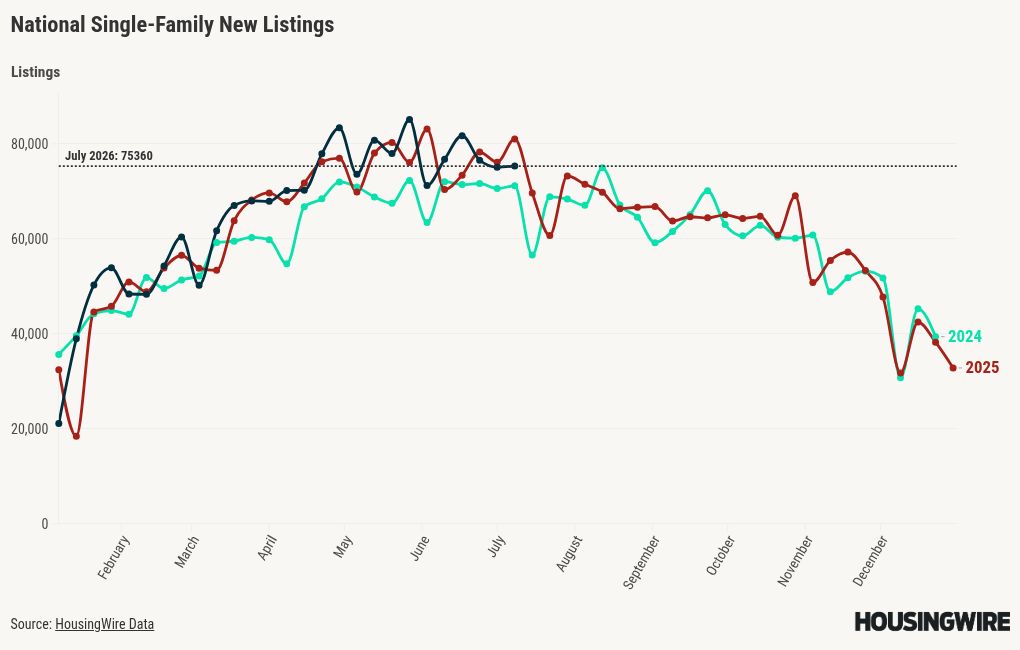
For the first time since 2023, a majority of Americans believe buying a home is a better financial move than renting, signaling a notable shift in consumer sentiment even as high prices and elevated mortgage rates continue to challenge affordability.

According to the latest Bank of America Homebuyer Insights Report, released Tuesday, 53% of Americans now prefer buying a home over renting, up from 48% a year ago and 47% in 2024. The findings suggest that many consumers are becoming more optimistic about homeownership despite persistent obstacles in the housing market.

“We are seeing meaningful changes in attitudes toward homeownership,” said Matt Vernon, Head of Consumer Lending at Bank of America.

The survey, conducted by Sparks Research between April 13 and May 10, included 2,000 adults evenly divided between homeowners and renters.

Homeownership Regains Appeal

The report found growing confidence in the long-term value of owning a home.

About 90% of respondents now view a home as a valuable investment, up from 79% a year ago. Meanwhile, 94% said homeownership provides stability, compared with 83% in last year’s survey.

Nearly one-third of respondents also reported feeling more confident about their ability to purchase a home this year.

The shift comes even as affordability remains a major concern.

Mortgage rates have eased slightly from recent peaks and currently hover near 6.5%, while home-price growth has moderated in many markets. The median U.S. listing price stood at approximately $429,500 in May, according to housing data cited in the report.

At the same time, renters have increasingly sought ways to reduce housing expenses by moving to smaller apartments, sharing living arrangements, relocating to less expensive areas, or giving up premium amenities. As a result, ownership appears more attractive to many consumers despite its higher upfront costs.

Buyers Growing Tired of Waiting

Another important trend is the declining number of consumers waiting for a perfect market.

The share of prospective buyers holding off for lower mortgage rates or home prices fell to 71%, down from 75% a year earlier.

Younger generations are leading that change.

Many buyers now appear willing to accept higher borrowing costs rather than continue delaying major life decisions. Industry analysts also point to a gradual easing of the so-called “lock-in effect,” where homeowners with ultra-low pandemic-era mortgage rates were reluctant to sell and move.

Affordability Remains the Biggest Challenge

Despite the improving sentiment, affordability concerns actually increased.

A majority of respondents—58%, up from 46% last year—identified high home prices as the biggest barrier to ownership. Another 47% cited elevated mortgage rates, compared with 40% a year ago.

The findings suggest Americans are not necessarily viewing housing as affordable. Instead, many increasingly believe that waiting for dramatically lower prices or interest rates may no longer be realistic.

Gen Z Finds Creative Ways to Buy

Younger buyers continue to adapt to challenging conditions.

Among Generation Z respondents:

  • 28% reported taking on additional jobs to save for a home.
  • 32% said they are considering buying with friends or family members.
  • 31% plan to use down-payment assistance programs.

Bank of America noted that social and financial pressures to achieve homeownership remain particularly strong among younger adults, helping fuel the recent shift in sentiment.

AI Enters the Homebuying Process

Technology is also beginning to influence purchasing decisions.

One in five buyers and homeowners reported using artificial intelligence tools or chatbots during the past year to assist with homebuying research. Among Gen Z respondents, usage climbed to roughly one-third.

Consumers primarily used AI to estimate costs, understand the buying process, compare financing options, and research neighborhoods.

However, most respondents still preferred human professionals when making final decisions, touring homes, negotiating contracts, and handling legal matters.

Sentiment Is Improving Faster Than Sales

The report’s authors caution that improved attitudes do not necessarily translate into immediate home purchases.

The survey measures consumer sentiment rather than transaction activity, and the same challenges that have slowed housing sales remain in place: limited inventory, elevated prices, and mortgage rates that remain well above pre-pandemic levels.

Still, the change in outlook is significant.

Among current homeowners, 52% expect to purchase another home in the future, while the share planning to buy within the next year increased to 22%, up from 15% a year ago.

After three years in which renting or waiting often appeared to be the more practical option, many Americans are once again viewing homeownership as the stronger long-term path to financial security, stability, and wealth creation.

JBizNews Desk | New York
© JBizNews.com All Rights Reserved. Reproduction or distribution without written permission is prohibited.
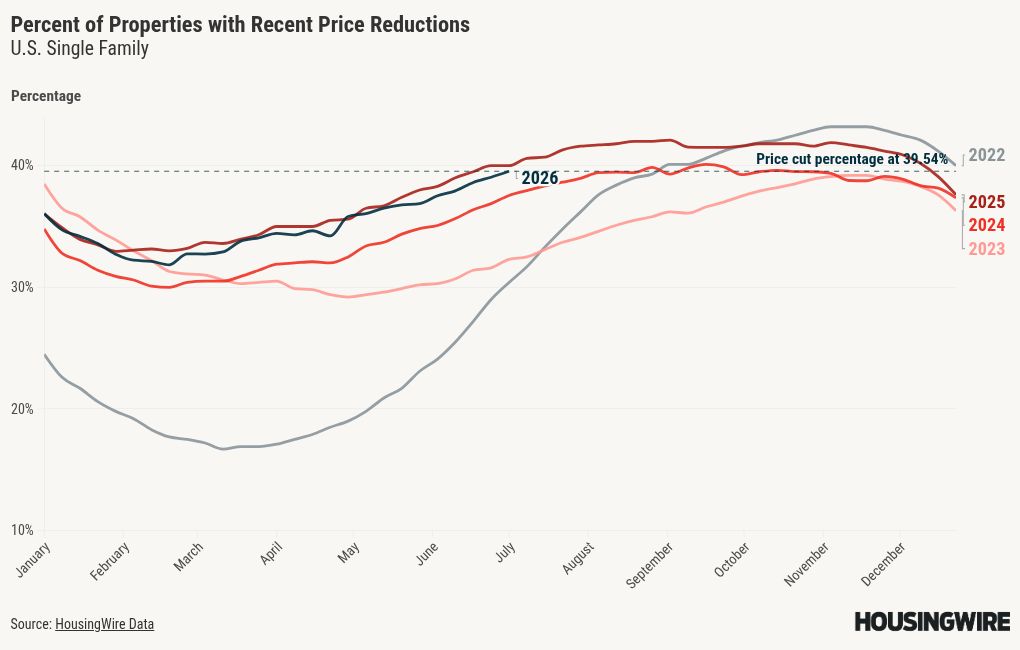
Under Pennsylvania law, real estate brokers licensed by the state are required to maintain a physical main office in the state. However, one broker is looking to challenge this requirement, which he considers outdated and anticompetitive. 

In mid-May, Kevin Gaughen, the broker-owner of Lemoyne, Penn.-based Gaughen Home Realty, filed a lawsuit in the Commonwealth Court of Pennsylvania against the state’s Bureau of Professional and Occupational Affairs and its Real Estate Commission, arguing that the law violates the Pennsylvania Constitution because it “is unreasonable, unduly oppressive and patently beyond the necessities of the case.” 

According to Gaughen’s claims, he spends roughly $35,000 a year on rent, taxes, utilities and insurance to maintain the 1,000-square-foot converted office he’s had since 2017. The office is one of three units in a multi-family property Gaughen purchased in 2010. He converted the unit to an office in 2017 to comply with the state law, while the other two units are currently actively rented to residential tenants according to the complaint. 

Letter of the law

Under the law, a broker must maintain a main office in Pennsylvania unless the broker maintains a main office in another state where they hold an equivalent broker license. The law was enacted in 1989, but the statutory authority for the regulation comes from the state’s Real Estate Licensing and Registration Act, which was enacted in 1980, which is the modern statute governing real estate licensing in the state.

However, the state’s original real estate broker licensing law was enacted in 1929 and was known as the Real Estate Brokers License Act of 1929. In his complaint, Gaughen claims the physical office requirement dates back to the original 1929 law. 

“No one seems to know why we have this requirement on the books, and I felt that it was time for someone to challenge it, so that’s what we are doing,” Gaughen told HousingWire.

According to the law, the Pennsylvania Real Estate Commission may conduct office inspections up to four times a year. In the lawsuit, Gaughen claims inspectors come equipped with a checklist that requires the office to have a landline phone, filing cabinets, a conference table and a sign outside. If the office is in a residential home, the law requires it to have a separate entrance. The Commission can fine brokers if their office is found to be non-compliant. 

In a video posted on Instagram by Institute for Justice, which is one of the law firms representing Gaughen, he claims that he doesn’t use his office for anything. However, he must maintain the office to comply with state law. 

“Every two years they come by and they check to make sure I still have this stuff. In the last nine years, I’ve had more inspectors here than clients,” he said in the video. “I don’t believe that the office requirement is fair. I think it’s anti-competitive, and I think it was put in place by larger brokers to prevent smaller brokers from entering the market.”

Gaughen goes on to explain that he normally meets clients at their properties or the property they are touring, which is also where he typically does most of the contract signing as well. 

“All of this is needless,” he said. “There’s no need for this space. There’s no need for this expense.”

Hurting the little guy

In the complaint, Gaughen and his legal team wrote that the recurring costs he incurs by having to maintain the office make it “difficult for [him] to compete with larger, established real estate firms, with greater annual revenue and the ability to spread out the fixed costs.”

“In other words, the office requirement protects established brokerages from honest competition,” the filing states.

Gaughen told HousingWire that the requirement adversely affects him and his clients.

“This is a small office and I’ve only ever had, at most five employees working for me at once, but that $35,000 really eats into my profit,” he said. “A bigger company, like a REMAX or a Keller Williams, can more easily absorb those costs, but to open a small independent office, that requirement is a big hurdle. They put this law into place on purpose to help the big guys and hurt the small firms.”

The lawsuit also argues that the office requirement takes housing out of the market, since brokers, like Gaughen, often use converted residences. 

“By using this as an office, by the government forcing me to have an office, I am taking a home away from somebody else,” Gaughen said in the video of the former apartment he converted into his office. “This could be an apartment that somebody could live in and, in fact, it was before I turned it into an office.”

Office requirements in other states

Despite the pushback, the state is not alone in requiring brokers to have a physical office in the state. Other states with similar requirements include Virginia, Maryland, New Jersey, Florida, Oklahoma and Alaska

Illinois also has a requirement for an office but it can be physical or virtual. However, like Pennsylvania, most of the states that require a physical office do have an exemption for a broker that is out of state and just holds a license in their state. 

The Pennsylvania Real Estate Commission did not immediately return HousingWire’s request for comment.

This post was originally published on here

Gov. Gretchen Whitmer wants to “build, baby, build,” but a bipartisan housing reform package is limping in the legislature.

Nonetheless, a single-stair bill outside that comprehensive package has stepped up.

The Michigan Senate is now weighing a pair of bills that would allow multifamily buildings up to six stories to be built with a single interior exit stairway. Advocates say the change could lower costs and unlock more infill housing statewide.

The single-stair bills cleared the House with bipartisan support. They weren’t part of the Housing Readiness package legislators filed this year or part of Whitmer’s agenda. But they speak directly to the same crisis.

“It’s still part of the cutting regulations to build more housing,” Lauren Strickland, Abundant Housing Michigan’s executive director, told HousingWire TBD.

Climbing onto the single-stair trend

Michigan’s single-stair legislation mirrors the height threshold most states have adopted as the new benchmark. Colorado, Texas, Montana and New Hampshire have already made the switch. Washington, D.C., council members are one step from final approval on a similar six-story allowance. California is weighing legislation that would direct the state to develop its own single-stairway standards for buildings up to six stories.

Many states passing single-stair reform have also pre-empted local zoning authority to encourage density and accelerate building.

Michigan’s Housing Readiness package could meet the same fate as Illinois Gov. J.B. Pritzker’s sweeping housing reform plan. Lawmakers slow-walked the measure and declined to vote on it before their legislative session ended.

Despite major industry support, Michigan’s legislative package has been bottled up in the House Committee on Government Operations since spring. It would reduce minimum parking requirements, modernize lot-size and setback rules, expand access to accessory dwelling units, and allow multi-unit buildings in more locations.

Housing advocates and industry supporters have modeled omnibus housing reform packages to spur new supply and bring down housing costs on Austin, Texas‘ successful example.

But Michigan’s effort is running up against the same friction among local governments that Pritzker and lawmakers in other states have faced when trying to strip away or supersede local zoning powers.

The Michigan Municipal League introduced a competing legislative proposal dubbed the MI Home Program. It is sitting in the same committee, with no floor vote in sight.

More building needed

Michigan produced roughly 54,000 new housing units in 2005 and only about 15,000 in 2024. That collapse has priced out working- and middle-class families statewide.

Old zoning rules need to be changed so that housing can be developed and built at the new production levels they once were.

“Detroit cannot be rebuilt with the zoning that exists now,” Strickland said.

Planners in Akron, Ohio, for example, are examining zoning rules to reduce lot sizes. The problem extends well beyond Michigan’s borders.

Whitmer has tied her agenda to a goal of 115,000 new and rehabilitated units. The state has logged 92,583 toward that target, according to recent Michigan State Housing Development Authority data.

The one piece of Whitmer’s agenda with a clear path to her desk is a trio of bills that would create a Michigan Housing Opportunity Credit. The credit would layer on top of the federal Low-Income Housing Tax Credit. The bills passed the full Senate and were referred as of June 16 to the House Regulatory Reform Committee, where Sen. Jeff Irwin (D-Ann Arbor) projects they would produce more than 2,500 new affordable units annually.

“Housing costs are crippling family budgets and making it harder for young people to find a future in our state,” Irwin said in a statement. “This legislation will mean more housing, leading to more options and affordability.”

On a separate track, Whitmer’s proposed tax credit could aid construction of the affordable housing that single-stair reform would permit.

A two-tier single-stair approach

Michigan currently follows the International Building Code, which requires two exit stairways in any residential building taller than three stories. The state had passed no prior amendments relaxing that cap. Dozens of other states moved to expand single-stairway construction in recent years. Michigan had not.

The bills would change that in two tiers. One permits a single interior exit stairway in buildings up to four stories. The second extends the allowance to buildings between five and six stories.

The two bills are explicitly linked. “The second does not take effect unless lawmakers enact the first into law.”

Both bills include a sunset clause. Each stops applying once the Michigan Department of Labor and Economic Opportunity formally incorporates the International Code Council’s own single-stairway standards into state code. That positions both as stopgaps pending an ICC update rather than permanent departures from the model code.

Strickland said the bills have strong bipartisan support and she expects them to pass.

With her term ending, Whitmer’s housing legacy may rest less on the sweeping zoning reforms her party pursued. A tax credit and a single staircase may be all she has to show for her efforts.

This post was originally published on here

As mortgage underwriting absorbs Buy Now, Pay Later (BNPL) activity, rent payment history and trended credit data, consumers face a new challenge: understanding how everyday financial behavior is being interpreted by increasingly sophisticated scoring systems.

Credit modernization is not the problem. In many ways, it is overdue.

The lending industry has made a strong case that the current system can become more competitive, more efficient and less costly for consumers. Efforts to modernize mortgage credit reporting, including targeted single-report and single-score frameworks for borrowers with strong credit profiles, reflect a broader push toward a more transparent and flexible system.

That is the right direction. But it raises a harder question: If the credit system becomes more sophisticated, are consumers becoming equally sophisticated in how they understand it?

A widening gap and shrinking margins

Recent counseling data suggests the gap may be widening. Across nonprofit counseling organizations, demand continues to increase as households navigate rising costs and more complex financial tradeoffs. In 2024, nonprofit financial counseling providers reported a 35% increase in households seeking support, alongside rising unsecured debt and housing costs. 

Average unsecured debt among these consumers approached $29,000, while housing expenses rose roughly 11% year over year. At the same time, many households are operating with very limited financial flexibility. In some segments, consumers are dedicating roughly two-thirds of their net income to housing and debt obligations, leaving little room to absorb change or error.

Making alternative data count

Platforms like CredEvolv report that consumers referred by mortgage lenders show an average credit score improvement of approximately 50 points over roughly 5.5 months.

These are not marginal shifts. They reflect households trying to make increasingly complex financial decisions with less margin for error.

Meanwhile, more everyday financial behavior is becoming machine-readable. Fannie Mae has announced updates that allow limited use of VantageScore 4.0 and plans to incorporate FICO Score 10T in the future. Policymakers are examining how BNPL data is handled by consumer reporting agencies, while rent reporting continues to be promoted as a pathway for consumers with thin credit files to build payment history.

That can be a win. A renter who has paid on time for years may finally have that history count. A borrower steadily paying down balances may look different from someone whose debt is moving in the wrong direction. A consumer with limited traditional credit may have more ways to demonstrate reliability.

But more data only helps if the data is accurate, explainable and understood.

Why more data requires more guidance

Consider a borrower who uses BNPL responsibly to manage short-term cash flow. Today, that activity may not always appear consistently in traditional credit reports. Tomorrow, depending on reporting practices and scoring model treatment, those same short-term obligations could become part of a broader picture of repayment behavior and debt capacity. The consumer may not have changed behavior at all, but the way the system interprets that behavior may change significantly. That creates a moving target.

This is where financial counseling should be viewed as part of the credit infrastructure, not as an afterthought.

Counseling providers and lending partners report that referral-based counseling programs can achieve meaningful engagement when integrated directly into lender workflows. The challenge is not simply access to data. It is the ability to interpret it. Consumers increasingly need practical guidance on how financial behavior is being counted, excluded, weighted or misunderstood. For households operating with little margin for error, those questions are not theoretical. 

Counseling experience shows that many consumers are already running monthly deficits or relying on credit to bridge essential expenses. In that environment, even small changes in how payment behavior is reported or interpreted can affect mortgage readiness, rental screening, pricing, deposits and access to opportunity.

Redefining the role of financial counseling

The role of counseling is no longer simply to “raise a score.” It is to provide actionable guidance — helping people understand how the system sees them and what they can do before a lender, landlord or screening platform makes a decision. That role is becoming more important as credit evaluation evolves.

Modernization done well can reduce friction, improve competition and help more creditworthy households be seen. But modernization without translation risks creating a marketplace where consumers only discover the rules after they are denied.

The next credit gap may be an information gap. Closing it should be a shared goal for lenders, counselors, policymakers and consumer advocates. Financial counseling is one of the few mechanisms capable of translating credit modernization into practical consumer guidance at scale — not by opposing innovation, but by making sure consumers can understand it, act on it, and benefit from it.

“The question isn’t whether consumers will be affected by credit modernization — they already are,” said Jeff Walker, CEO of CredEvolv. “The question is whether they’ll have a guide when the rules change under their feet.”

Helene Raynaud is the SVP of Business Development at Money Management International.
This column does not necessarily reflect the opinion of HousingWire’s editorial department and its owners. To contact the editor responsible for this piece: zeb@hwmedia.com.

This post was originally published on here

KB Home reported a sharp decline in revenue and earnings, underscoring the ongoing challenges facing the U.S. housing market as elevated mortgage rates continue to pressure affordability and keep many potential buyers from entering the market.

The homebuilder reported second-quarter revenue of $1.11 billion, down 27% from a year earlier, while diluted earnings fell to 43 cents per share from $1.50 per share during the same period last year.

Net income dropped to $27.3 million, reflecting weaker sales activity and continued pricing pressure across the housing sector.

Despite the declines, company leadership said results were generally in line with internal expectations.

Executive Chairman Jeffrey Mezger noted that the company’s performance met or exceeded the midpoint of key guidance targets issued earlier in the year.

The biggest challenge remains demand.

KB Home delivered 2,395 homes during the quarter, a decline of approximately 23% compared with the same period last year.

At the same time, the average selling price of a home fell to $461,900, down from $488,700 a year ago.

The combination of fewer deliveries and lower selling prices significantly pressured profitability.

Housing gross margin declined to 15.2%, compared with 19.3% a year earlier, while homebuilding operating margin fell to 2.5% from 8.6%.

Management attributed the decline to price reductions, incentives offered to buyers, rising land-related costs, and reduced operating leverage caused by lower sales volume.

The results reflect broader conditions across the housing market.

Mortgage rates near 6.5% continue to make homeownership difficult for many first-time buyers, while affordability concerns remain elevated in many regions of the country.

Builders have increasingly relied on incentives, mortgage-rate buy-down programs, upgrades, and price reductions to attract buyers and maintain sales activity.

While those strategies help move inventory, they often come at the expense of profit margins.

Still, there were several encouraging signs beneath the headline numbers.

The company’s cancellation rate improved to 12%, down from 16% a year earlier, suggesting buyers who enter contracts are becoming more likely to complete purchases.

Book value per share increased approximately 6% to $61.93, and the company continued returning capital to shareholders.

During the quarter, KB Home repurchased approximately $75 million of its stock and still has roughly $775 million remaining under its authorized buyback program.

The company also expanded its network of active selling communities by approximately 10%, positioning itself for growth when housing demand eventually improves.

Looking ahead, management maintained a relatively constructive outlook.

KB Home expects full-year housing revenue between $4.9 billion and $5.3 billion and forecasts deliveries of approximately 10,500 to 11,000 homes during 2026.

Executives also indicated they expect stronger deliveries and revenue during the second half of the year.

One advantage for KB Home is its build-to-order business model.

Because homes are typically sold before construction is completed, the company carries less speculative inventory risk than some competitors.

The tradeoff is that growth can be slower when demand accelerates because construction generally begins after orders are received.

For consumers, the report offers a mixed picture.

The decline in average selling prices suggests affordability is improving modestly, and builders are often willing to negotiate more aggressively than individual homeowners.

Many builders continue offering incentives that can reduce monthly mortgage payments or offset closing costs, creating opportunities for qualified buyers.

At the same time, mortgage rates remain the largest obstacle.

Many existing homeowners remain locked into mortgages obtained during the pandemic at rates far below current levels, reducing the number of homes available for sale and limiting overall market activity.

Investors appeared relatively comfortable with the results.

Shares rose modestly following the earnings release, suggesting Wall Street believes much of the housing slowdown is already reflected in the stock price.

The industry’s outlook now depends heavily on one factor: interest rates.

Until borrowing costs decline meaningfully, affordability challenges are likely to persist.

For builders such as KB Home, the strategy remains clear — continue managing through the slowdown while preparing for the eventual return of buyers when owning a home becomes financially easier.

JBizNews Desk | New York
© JBizNews.com All Rights Reserved. Reproduction or distribution without written permission is prohibited.

A fiendishly brilliant advertising copywriter working for Benetton during the “hanging chads” Presidential election controversy in 1992 took a circa-1973 Yogi Berraism and transformed it for a New York City billboard on the heavily trafficked northbound West Side Highway.

“It ain’t Oval ‘til it’s Oval!” the message read, as the matter made its way up to the Supreme Court.

So the line was there, perfectly suited to poaching, given the latest twist in the plotline of the 21st Century ROAD to Housing Act and its latest detour.

So, is the President now taking us all for an Oval-ride?

Housing affordability – the horseshoe issue that could get almost the entire most polarized U.S. Congress in memory lined up on the same side – has reached the very apex of the priority pyramid for at least a brief, shining moment.

Will this measure pan out as a generationally historic tipping point for housing affordability, as the backflips and self-congratulatory victory laps of Washington politicians and lobbyists attest?

Or will the measure — with its combined House and Senate backing of 443 lawmakers — itself become history?

A majority of One, declaring that the bill is “of minor importance,” believes that, rather than put Sharpie to paper, it’s a better moment to play political roulette.

The calculus, however, amounts to a delay, not a derailment, leaving the majority of One holding three cards: sign, don’t sign, or veto.

If the President neither signs nor vetoes the legislation, the constitutional clock begins ticking. If Congress has already delivered a combined 443 votes in favor, it is difficult to see a realistic path in which the legislation does not ultimately become law in one form or another.

Which means that for homebuilders, developers, investors, lenders, manufacturers and suppliers, the more important question now is not whether the 21st Century ROAD to Housing Act becomes law.

Rather, what happens after it does?

At nearly 400 pages, 12 titles, and more than 50 housing-related provisions, the ROAD Act is less a single housing bill than a legislative everything-but-the-kitchen-sink omnibus. It addresses virtually every major friction point in the housing ecosystem – from zoning and permitting to multifamily finance, manufactured housing, community banking, environmental review, disaster recovery and single-family rental ownership.

The answer to what may happen when it becomes law may be hiding in the verbs.

Verbs tell the story

The easiest way to misunderstand the 21st Century ROAD to Housing Act is to read the headlines alone.

The best way to understand it is to read the language itself, particularly the words that convey action, and who is doing the acting.

A close examination of the legislation reveals a striking pattern. Congress repeatedly identifies many of the same obstacles that housing economists, builders, developers, and affordability advocates have cited for years: restrictive zoning, lengthy permitting processes, parking mandates, impact fees, barriers to higher-density housing, regulatory duplication, financing constraints, and local resistance to growth.

Yet the verbs lawmakers use to address those barriers vary dramatically depending on who controls lawmakers.

Throughout the legislation, Congress directs agencies to publish, encourage, support, coordinate, identify, evaluate, recommend, establish guidelines and develop best practices.

Far less often does it use harder-edged verbs such as require, prohibit, preempt, compel, mandate, supersede, or override. It’s this scrubbing of the bill’s language – around carrots and sticks and action items – that reveals what the bill truly intends to accomplish, and hints at the difficulty of doing so.

When Washington controls the process, the bill tends to use stronger language. When local governments control the process, Congress generally opts for persuasion over coercion.

The result is a housing bill that may be more consequential than critics suggest, yet less transformational than some of its supporters assert.

A consensus around the diagnosis

One of the most significant achievements of the legislation may be that it establishes a remarkably broad bipartisan consensus around a basic premise: America has a housing supply problem.

That may sound obvious to anyone who spends their days acquiring land, entitling communities, financing development, building homes or leasing apartments.

In Washington, however, agreement on diagnosis often proves more difficult than agreement on solutions.

The National Association of Home Builders, which spent years helping shape portions of the legislation, characterized the measure as a historic opportunity to expand housing production.

“NAHB applauds lawmakers for working in a bipartisan, bicameral way to pass historic housing legislation that will deliver real benefits for the American people,” said NAHB Chairman Bill Owens. “The 21st Century ROAD to Housing Act will help expand the nation’s housing supply by reducing regulatory barriers and encouraging local governments to reform zoning and land-use policies that have limited home building.”

Notice the language. Reducing barriers. Encouraging local governments. Identifying best practices. Providing options. Rewarding communities.

Those are not the verbs of federal preemption. They are the verbs of incentives, of playing nice in the sandbox, and coaxing good behavior.

And that distinction appears repeatedly throughout the legislation.

The limits of federal influence

Perhaps no observation captures the legislation’s practical reality better than a recent assessment from Stylecraft Builders CEO Doug French in a LinkedIn post to his network.

“Overall, I like that the federal government is supporting zoning reform, less regulation, and more density,” French wrote after reviewing the legislation. “That is directionally good for housing. But in many cases, that is all it is: support. Local and state law still govern most of what actually gets built, where it gets built, and how it gets approved.”

That observation cuts directly to the heart of the bill and its bearing on the businesses that must make a profit to stay in business.

The legislation openly acknowledges many of the local barriers that constrain housing production. It addresses parking requirements, density restrictions, permitting delays, missing-middle housing, manufactured housing placement, and other land-use constraints that builders regularly confront.

But Congress largely stopped short of compelling local governments to change those policies.

  • Instead, the legislation encourages.
  • It incentivizes.
  • It promotes.
  • It guides.
  • It rewards.

For builders who spend years navigating entitlement processes, that focus on the time value of money and the money expended on layers of outdated red tape is not academic.

The people who ultimately determine whether a project moves forward are still more likely to be found in city halls, planning departments, county commissions, and zoning boards than in Washington, D.C.

Real estate executive David Peter made a similar point in discussing the legislation.

“You need more from Austin to rein in the locals on zoning and slow-roll permitting, like Florida is doing already,” Peter wrote. “The Federal ‘support’ will take time to materialize.”

In other words, the bill may create momentum, but local governments still possess many of the levers that determine whether that momentum translates into production.

Where the bill gets stronger

The legislation becomes more forceful when it moves into areas where federal authority is more direct.

Environmental review reform may prove one of the most significant examples.

Several provisions streamline federal review requirements for qualifying housing projects, reduce duplicative oversight, and accelerate project approvals. Unlike some zoning-related sections, these provisions use more direct statutory language that could translate into measurable reductions in time and soft costs.

Multifamily finance is another area where the bill may have a tangible impact.

NAHB highlighted increases in FHA multifamily loan limits and inflation indexing as particularly significant because existing limits have failed to keep pace with construction costs. If implemented effectively, those changes could expand the availability of financing for apartment development in markets where costs have outpaced federal lending thresholds.

The legislation also includes provisions intended to strengthen community banks, which continue to serve as critical lenders for residential development and construction.

For many builders, those financing-related provisions may prove to be more consequential than some of the headline-grabbing political debates surrounding the bill.

Manufactured housing’s seismic opportunity

Manufactured housing may emerge as one of the clearest beneficiaries of the legislation.

The Manufactured Housing Institute praised the bill’s full-throated manufactured housing title, particularly provisions that remove the longstanding requirement that manufactured homes be built on a permanent chassis.

MHI noted that the change could unlock opportunities for innovation, design flexibility, and broader deployment while preserving the affordability advantages that have long defined the sector.

The organization also pointed to language reaffirming HUD‘s primary regulatory authority over manufactured housing standards, a provision that could reduce overlapping federal requirements and create greater regulatory certainty.

Unlike many zoning-related provisions, these changes represent actual modifications to the regulatory framework governing housing production.

They are not studies, nor reports, nor best-practice recommendations. They are operational reforms.

For an industry that has long argued that manufactured housing can play a larger role in addressing affordability challenges, those provisions may prove among the bill’s most significant long-term outcomes.

The build-to-rent debate

The legislation’s treatment of institutional investors and build-to-rent housing may offer another lesson in the difference between political rhetoric and statutory language.

Throughout much of the legislative process, debate surrounding institutional ownership often focused on terms such as restrictions, limitations and bans.

Yet rental housing economist Jay Parsons argues that the final bill is considerably less restrictive than many public discussions suggested.

“There’s no ‘ban’ in the final version that just passed overwhelmingly in the Senate and the House,” Parsons wrote, channeling another famous Oval Office denizen. “Read the bill. There’s no ban.”

Parsons noted that institutional investors may continue acquiring existing single-family homes if they meet certain renter-oriented requirements, including rent-reporting programs and opportunities for tenants to purchase homes before they are sold to others.

More importantly for housing supply, the legislation preserves the viability of the build-to-rent development model.

“The final version of the legislation allows investors to build single-family rental homes without the forced sale requirements from the Senate’s original bill,” Parsons wrote. “That should unlock BTR development capital again.”

NAHB had strongly opposed earlier language that would have required institutional owners to sell build-to-rent homes after a specified period. Industry estimates suggested such provisions could have materially reduced investment in single-family rental development and diminished annual housing production.

The final legislation largely avoids that outcome.

Once again, the legislative language favors shaping behavior rather than prohibiting or punishing activity outright.

The homebuilder’s question

Ultimately, homebuilders are unlikely to judge the legislation by the size of the congressional vote tally or the number of press releases celebrating its passage.

They will judge it by outcomes.

  • Does it create more entitled lots?
  • Does it shorten approval timelines?
  • Does it reduce development costs?
  • Does it expand financing availability?
  • Does it accelerate production?
  • Does it improve affordability?

Those questions remain unanswered. French’s final observation may be among the most practical takeaways for the industry.

“The important thing is defining the rules quickly,” he wrote. “Uncertainty is what kills business.”

That concern may be especially relevant today. Not “today” figuratively. Today, literally.

Builders can adapt to regulations. Developers can adapt to financing structures. Investors can adapt to policy changes. What markets struggle to adapt to is ambiguity. And while the ROAD Act creates opportunities in financing, environmental review, manufactured housing, housing supply incentives, and federal program administration, its meaningfulness hinges on how quickly those opportunities become clear, actionable rules.

Where Congress is attempting to influence local zoning boards, planning commissions, neighborhood opposition groups and municipal political cultures, the legislation functions more as a roadmap than a bulldozer.

If the bill ultimately succeeds, it will not be because Washington discovered a way to force cities and counties to approve more housing.

Coda

The real bumps in the ROAD come down to residential real estate’s core mantra, location, location, location. Specifically, local neighbors, where a majority of One can impede any progress among many, at least for a very, very long time.

Which calls for a digression.

Around the time of that brilliantly imagined Benetton billboard campaign in 1992, I had the great gift of working alongside an equally gifted advertising trade reporter named Debra Goldman. Debra had all the tools: scathing wit, workhorse reporting habits, clear, lucid writing, and a mind bent on illuminating and showing her readers better ways forward. Like a baseball player who can run the bases, hit for power and average, and field like a Gold Glover year-in-and-year-out.

In one piece on brand marketing that stuck with me forever, Debra wrote about marketers and their customers. It was about marketers’ unrelenting commitment to woo, nurture, and care for their customers. Even love them.

One thing those marketers would never want to do, Debra wrote, was live next door to one of them.

Next door neighbors, ones who vote. They’re the foreseeable hazard in the ROAD ahead…. once it’s Oval, that is.

This post was originally published on here

President Donald Trump abruptly called off a planned signing ceremony for a bipartisan housing-affordability bill on Wednesday, announcing the cancellation in a social-media post hours before he was set to appear at the Capitol — and triggering one of the sharpest public breaks with his own party in months. “Today’s Housing News Conference and Signing is hereby cancelled,” Trump wrote, saying he would not sign until Congress passes his elections-overhaul measure, the Save America Act, which he called a national emergency.

The move blindsided Senate Republicans, who had hoped to showcase the housing bill as a concrete win on affordability heading into November’s midterm elections. Instead, the day descended into open friction. According to Bloomberg and multiple lawmakers present, tensions flared at a closed-door GOP luncheon, where senators pressed the president over his handling of the war in Iran.

The most heated exchange came between Trump and Louisiana Senator Bill Cassidy, whose Senate career effectively ended after Trump backed a primary challenger. Cassidy, who one day earlier had voted to formally rebuke the president’s war powers, said he stood up and demanded answers: the conflict was supposed to last four weeks, he noted, and had stretched to four months without meeting its original aims. By his own account, Cassidy raised his voice and called Trump “brother.” Trump shot back that he was not his brother, according to a person in the room, before colleagues urged Cassidy to sit down.

The substance underneath the drama is what makes this a business story. The housing bill Trump declined to sign was aimed squarely at affordability — the cost-of-living issue voters consistently rank near the top of their concerns. By walking away from a public signing, Trump signaled he is willing to hold a popular economic measure hostage to an unrelated elections fight, even as home prices and rents strain household budgets nationwide.

The standoff also reflects a deeper rift over priorities. Senate Majority Leader John Thune has repeatedly said the path to keeping the GOP majority runs through “kitchen table” pocketbook issues. Trump, by contrast, has pushed senators to prioritize his proof-of-citizenship voting bill, which currently lacks the votes to pass. He has also blocked confirmation of one of his own nominees and pressed lawmakers to help fund a White House ballroom project over their objections.

Markets, meanwhile, found something to like in the day’s other headline. Emerging from the lunch, Trump pointed reporters to oil prices, noting crude had just broken below $70 a barrel — a level not seen since before the Iran conflict began on February 28. He framed falling energy costs and factory construction as evidence of a strong economy, calling the U.S. “the hottest country in the world.”

The Iran war remains the fault line. Four Senate Republicans joined Democrats this week to advance a war-powers resolution directing Trump to pull back forces — the first time the Senate has approved such a measure. Though largely symbolic, the vote underscored growing unease among Republicans about both the war and the interim deal Trump struck to wind it down. For days, top lawmakers complained they were kept in the dark about the terms of the U.S.-Iran memorandum of understanding.

There were signs of de-escalation abroad even as Washington squabbled. The State Department said the U.S. Embassy in Kuwait resumed operations at midnight Wednesday, more than three months after Iranian attacks forced its closure. And the head of the U.N. nuclear agency, Rafael Grossi, signaled that inspectors would be allowed to visit Iranian enrichment sites — a key piece of the interim agreement.

For business and markets, the takeaway is the uncertainty itself. A president openly feuding with his own Senate majority complicates the path for any legislation that touches the economy, from housing to government funding. Trump tried to paper over the discord, insisting afterward that Republicans are a “really well-unified party,” even as he conceded he didn’t like a few people in the room. Outgoing Senator John Cornyn, another Trump-backed primary casualty, summed up the mood drily on his way out: “Quite the unity message.”

Whether Trump ultimately signs the housing bill — and when — now hangs on a voting fight that has nothing to do with housing at all.

JBizNews Desk | New York
© JBizNews.com All Rights Reserved. Reproduction or distribution without written permission is prohibited.
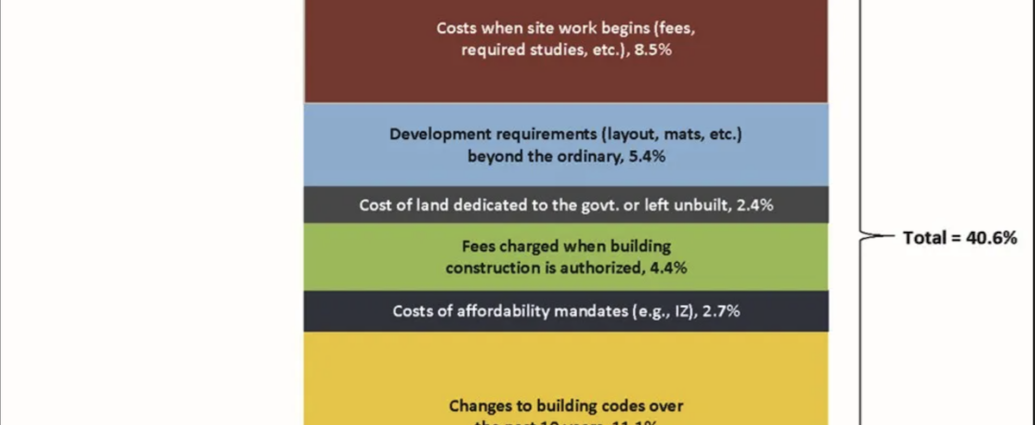
AARP, the nation’s largest nonprofit organization dedicated to serving older Americans, on Wednesday announced more than $8 million in grants across the country. The funds aim to make communities more livable, with specific targets toward improving housing, public spaces, transportation and digital connectivity.

As part of the 10th anniversary of the nonprofit’s Community Challenge grant program, AARP awarded $8.3 million in funds across 750 projects in all 50 states, as well as Washington, D.C., Puerto Rico and the U.S. Virgin Islands. About half of these projects are in rural communities and the record level of funding came amid record demand as AARP received 5,100 applications this year.

The funds also come at a time when the U.S. population is aging rapidly and seniors are overwhelmingly expressing a desire to age in place in their current homes.

Reverse mortgage professionals may be uniquely positioned to serve these needs through home equity-based financing solutions as clients seek to improve their homes with technology and live in neighborhoods with helpful amenities. Baby boomers also represent the largest shares of today’s home buyers and sellers, and they may be able to use reverse for purchase programs to remain in or relocate to senior-friendly communities.

“America is aging, and most older adults want to stay in the communities they know and love. There are a lot of things that localities can do to support residents of all ages,” Nancy LeaMond, AARP’s executive vice president and chief advocacy and engagement officer, said in a statement.

“AARP Community Challenge grants help transform local ideas into real improvements — from safer sidewalks and improved transportation options to public spaces that bring neighbors together and enhance community connections. As we celebrate the program’s 10th year, we’re proud to double our investment so even more communities can become great places to live for people at all stages of life.”

At a virtual meeting with reporters on Wednesday, AARP officials and two mayors whose cities have benefited from the grant funding spoke about the importance of making aging in place a national priority.

AARP noted that by 2034, Americans 65 and older are expected to outnumber children under 18 for the first time. The Community Challenge grants aim to create practical infrastructure — such as housing modifications, transportation and digital access — for older adults to remain independent.

The grants are also designed to move quickly as projects typically come to fruition in months, not years. The group has set a goal to improve the lives of 25 million seniors and support 100,000 community projects by 2028.

“Our health and well-being is shaped by whether or not we can safely cross the street, whether our home meets our needs as we age, whether we feel connected to the people and places around us,” AARP CEO Myechia Minter-Jordan said.

Mayors speak to local project impact

Mayor Paul TenHaken of Sioux Falls, South Dakota, said that his city previously benefited from a Community Challenge grant that funded pedestrian safety efforts — including repainted crosswalks and traffic-calming measures.

TenHaken said the changes reduced traffic speeds in the impacted areas by about 20%, leading Sioux Falls to make a related pilot program permanent. Sioux Falls was the first city in South Dakota to join the AARP Network of Age-Friendly States and Communities, which the group describes as an effort to connect elected officials, local leaders and organizations as they assess needs, plan and implement projects and evaluate their effectiveness.

“Creating livable, age-friendly cities … isn’t just a one-time thing where you spike the football, and you say, ‘Hey, we did that, all right, we’re good, move on.’ It’s an ongoing commitment,” TenHaken said.

“These Community Challenge grants, they really just provide a starting point for conversation about how we continue to enhance livability and provide community-based projects, and about the important role that we as policymakers in government play in establishing this sort of thing.”

Mayor Tim Keller of Albuquerque, New Mexico, said that his city has been part of the AARP Network since 2017. Albuquerque was a prior recipient of grants that, in part, paid to rehabilitate a number of homes with basic senior-centric safety features like wheelchair ramps, grab bars and handrails.

Keller said the funding has helped to stabilize the city’s aging housing stock and has extended the ability of some seniors to age in place by another five to 10 years. Albuquerque is also building new senior housing at a rapid rate and has made public transit free to all residents.

“This also helps us with our broader housing issue, because we don’t have empty houses turning over in the middle of neighborhoods, so it helps stabilize some of our older neighborhoods as well,” he said. “We don’t want people to have to leave behind their neighborhood, their independence or their sense of purpose or their family, just because of their age.”

Housing design grant recipients

Mike Watson, AARP’s director of livable communities, said that the grants are primarily funded through the nonprofit’s social mission budget. The remainder comes from corporate partnerships with Toyota, which funds pedestrian safety projects, and Microsoft, which funds digital connectivity projects.

One of the grant categories supports housing design competitions, with AARP allocating funds to 13 cities in 2026. Examples include:

  • Tucson, Arizona: The city’s planning and development services department is leading a design competition that seeks to increase access to middle-housing options that are smaller and more appropriate for seniors.
  • Fort Collins, Colorado: Officials at Colorado State University are working to produce age-friendly designs for accessory dwelling units (ADUs).
  • Cedar Rapids, Iowa: City officials are embarking upon an ADU project that will focus on universal design and education, with a specific emphasis on aging-in-place support.
  • Henderson, Nevada: The Las Vegas suburb is promotion a design to create mixed-use, transit-oriented housing concepts that would be built on city-owned land.
  • Rhode Island: The state’s Executive Office of Housing will launch a statewide ADU design competition for preapproved housing plans as it seeks to reduce costs and offer more choices for senior residents.

“A lot of what is needed and what we see in this grant program are some of these really basic core necessities, and I think providers that are applying for grants and receiving them are also wrapping in some of those smart home devices,” Watson said, referring specifically to tools that detect falls and monitor the overall health of seniors.

“We wanted to build something that would meet immediate needs … not multiyear planning projects, but quick, on-the-ground, visible demonstrations of livability. They’re going to help communities build momentum and jumpstart change.”

This post was originally published on here

For a decade, the housing industry has waited for a “silver tsunami,” a wave of homes released as older owners downsize or pass away. The wave has not arrived on schedule, and recent data suggests it may never break the way it was predicted. But the homes that trickle on to the market have something in common. They tend to arrive at the market in poor condition to sell and full of a lifetime of belongings. Estate sales have always played a role in clearing those homes.

What is changing is the scale: as the owner base ages, that work is becoming a routine part of the listing process rather than an occasional one, and it deserves to be planned for accordingly.

The stats are real

The demographic weight here is real, even if the inventory predictions were overstated. Adults 65 and older now own roughly a third of all owner-occupied homes in the United States, and homeowners 55 and older own more than half, according to analysis of Census Bureau data by the National Association of Home Builders.

Baby Boomers alone hold an estimated $17 trillion or more in home equity, the largest share of any generation, based on figures reported by Realtor.com and LendingTree. Boomers were also the largest group of home sellers last year, accounting for 53% of all sellers, according to the National Association of Realtors. A meaningful share of listings, in other words, already originates with an older owner, and that share will grow for years.

The friction is in the condition of the homes

More than half of the homes owned by Boomers were built in 1980 or earlier, and many have not been meaningfully updated since, according to housing market analyses of Boomer-owned inventory. When one of these properties reaches the market through an estate or a senior transition, it usually cannot simply be listed. It has to be emptied, sorted and prepared first, and that work often falls to an adult child who lives in another state, holds a job, and is managing the process during a period of grief or crisis.

This is where transactions stall. For a real estate professional, that delay is lost momentum on a listing. For the family, it is weeks of stress with no clear sequence. The property may carry real equity, but that equity sits frozen behind a logistical problem no one has owned.

An estate sale, run well, is one of the tools that unfreezes it

Clearing a home of decades of furniture, collections and household goods is not a side errand to the sale. It is a precondition for it. Increasingly, real estate agents are working alongside estate sale professionals, probate attorneys, and senior living advisors on the same transactions, because preparing an inherited or downsized home is now a multidisciplinary job, not a weekend event advertised with a sign on a corner.

Here is the obstacle. The estate sale industry is not built to plug into that process smoothly. It remains highly fragmented, with thousands of small operators, uneven standards, limited online presence, and, for families, almost no reliable way to tell a professional company from an unvetted one. A real estate agent who wants to refer a client to a trustworthy estate sale provider often has no better tool than a web search and a phone call. That is a weak link in a transaction that increasingly depends on it.

That gap is solvable, and the fixes are practical rather than aspirational. Three are worth naming.

First, treat estate clearing as a scheduled phase of the listing, not an afterthought. When an agent identifies early that a property needs estate liquidation, the clearing timeline can be planned alongside inspection, repairs and staging, rather than discovered after the listing agreement is signed. This is a sequencing change agents can make on their own, today.

Second, build standing referral relationships between real estate professionals and vetted estate sale companies, rather than relying on improvised searches. Knowing in advance which providers carry verifiable credentials, background-checked staff, and a consistent track record turns a risky handoff into a dependable one.

Third, the estate sale industry has to meet this demand with the professionalism the rest of the housing transaction already operates under: clear online presence, transparent pricing, verifiable standards and digital tools that let families and agents evaluate providers the way they evaluate everything else.

The silver tsunami may turn out to be a gentle, decades-long wave. But every home in it still has to be cleared before it can be sold. Estate sales have always done that work. The industry can keep treating them as a service off to the side, or it can plan for them as a standard part of the listing pipeline and build the standards and connections that make that pipeline work. The professionals who plan for it will be ready. The ones who do not will keep losing time in the gap.

About the Author: Simone Kelly is the founder and CEO of Estate Sales Near Me (ESNM), a digital marketplace connecting consumers with estate sale and online auction professionals. She has worked in the estate sale industry for more than two decades, including founding and franchising an estate sale company, and focuses on housing-transition services tied to downsizing, probate, and inherited property.

Simone Kelly is the founder & CEO of Estate Sales Near Me.

This column does not necessarily reflect the opinion of HousingWire’s editorial department and its owners.

To contact the editor responsible for this piece: tracey@hwmedia.com

This post was originally published on here

The Federal Housing Finance Agency (FHFA) has proposed replacing its existing Duty to Serve (DTS) regulation with an outcome-based framework that would change how Fannie Mae and Freddie Mac support manufactured housing, affordable housing preservation and rural housing.

The proposal, released in a notice of proposed rulemaking on Wednesday, would emphasize chattel loans, broaden how Low-Income Housing Tax Credit (LIHTC) activities are treated and expand “high-needs” coverage, FHFA said. Public comments are due July 24. Any final rule is expected to take effect by Jan. 1, 2028, but could be extended.

FHFA said the current regulation, in place since 2016, has produced a “compliance-centric” approach focused on detailed benchmarks rather than market impact.

“The proposed rule aims to encourage and enable the Enterprises to better serve the needs of very low-, low-, and moderate-income families in the underserved markets through greater innovation and with less administrative burden,” the regulator stated.

Manufactured housing creation

The proposal would place new emphasis on chattel loans, which FHFA estimates account for 70% to 80% of new manufactured homes. These loans are often used when borrowers do not own the underlying land, including in land-lease communities.

Chattel borrowers face a denial rate of 65.6%, compared with 8.8% for site-built home loans, according to FHFA. Approved chattel borrowers pay an average interest rate of 9.24%, versus 6.63% for traditional mortgages. FHFA characterized this “financing gap” as offsetting the lower purchase price of manufactured homes.

“The chattel lending market remains underdeveloped, with limited liquidity, the absence of a securitization infrastructure, and a lack of robust performance data,” the FHFA stated.

Despite chattel lending being designated as an “extra credit” activity, neither GSE has purchased chattel loans for Duty to Serve purposes. But under the proposed framework, chattel lending would no longer be an optional bonus category, and Fannie and Freddie would be expected to develop “robust, responsible” initiatives.

Affordable housing preservation

The proposed rule also responds to growing pressure on affordable rental stock. Between 2014 and 2024, the U.S. lost a net 2.5 million rental units with rents below $600 per month, according to FHFA.

More than 500,000 LIHTC properties are scheduled to exit their compliance periods between 2025 and 2038, increasing the risk that restricted units will convert to market-rate housing, the agency estimates.

Under the new framework, the GSEs could receive DTS credit for subordinate liens on multifamily properties for any purpose, removing the existing restriction that limited such liens to energy or water efficiency improvements.

LIHTC equity in all underserved markets could be eligible for DTS credit, not just in rural areas, FHFA said. The agency also proposed allowing permanent construction take-out loans to be used across all DTS evaluation areas.

Rural housing and Indian areas

FHFA noted that home prices in rural areas rose more than 35% from March 2020 to March 2023, and that the annual income needed to afford a median-priced rural home has more than doubled since 2019.

The agency cited Freddie Mac’s HeritageOne product, which is designed to provide conventional financing in Indian areas, as an example of how current rules can constrain GSE activity.

Because widespread poverty depresses area median income in many Indian areas, borrowers who are clearly low income on a national or state basis may not qualify as “low income” under existing DTS definitions, FHFA said.

To address this, FHFA proposes to revise income calculations so lenders can use the highest of county, state or national median income figures. The agency also proposes to explicitly expand the definition of “high-needs rural regions” to include Indian areas, reversing its 2016 position that such a change would be “over-inclusive.”

This post was originally published on here

Northeast Ohio real estate agent Tracy Jones is setting a top-ranked transaction pace after overcoming some of life’s most difficult circumstances. Today, her Keller Williams-affiliated real estate team ranks No. 1 in Ohio among medium teams for transaction sides on RealTrends Verified’s rankings — with 300 sides and $56.4 million in volume in 2025.

The Tracy Jones Team, headquartered in Strongsville and covering surrounding Ashland, Mansfield, Richland County and Huron County counties, also landed at No. 13 nationally for sides among medium teams.

For a business founded in 2019, that trajectory represents a steady climb built on accountability, systems and a willingness to learn from mistakes.

“Every year we’ve been going up, so we’re kind of a slow burn,” Jones told HousingWire. “I’ve got a good solid team, and every year we do just a little bit more, so every year is our best year.”

Her latest results come as the real estate industry adjusts to market conditions following the post-pandemic boom. While some operations have struggled with volatility, the Tracy Jones Team has continued its upward momentum.

“Honestly, it’s about coaching and training, holding our agents to a high level, accountability, and we have systems and processes,” said Jones. “I mean, it’s no secret, it’s just hard work. We have standards. [Agents’] are expected to sell a minimum of 26 transactions, and/or 3.5 million [in volume] a year to qualify to stay on the team.”

Overcoming steep challenges

Jones entered real estate a little more than a decade ago in 2017, but her path to that career was anything but conventional.

She and her husband, Ryan, met in a 12-step program while both were recovering from addiction. By 2008, she was an auto worker at General Motors making nearly $100,000 a year in skilled trades. She could not relocate when asked to do so — and chose instead to pursue education as a displaced worker, receiving 99 weeks of unemployment and a full ride to college.

“Because I was such a slacker in high school, and I partied — that was when I was still partying quite a bit through my 20s — I didn’t have any kind of education,” Jones said. “I had to get a lot of the basic classes out of the way, and I was sitting in there with a lot of high school juniors and seniors.”

She worked her way to a bachelor’s degree in business administration with a finance focus while carrying mail and working factory jobs after unemployment benefits expired. Ryan supported Jones in getting through school, and she later put him through college in return.

In 2017, while working third shift at a factory and selling real estate during the day, she was logging about 100 hours a week between two jobs.

Her husband encouraged her to quit the factory job and pursue real estate full time.

Jones’ goal in her first full year; sell 52 houses, enough to match the weekly paycheck of her blue-collar job. She sold 64.

“I gave up a job at Newman Technology making about $70,000 a year, full benefits and a 401k,” she said. “I had two children in high school, a husband in college, two car payments and a mortgage — and [my family] was like, ‘Yeah, let’s quit that factory job and have you go full time into a 100% commission job, because we believe in you.’”

Building a team

By 2019, Jones was with Howard Hanna and drawing attention for her productivity. Jose Medina, who owns several nearby Keller Williams brokerages, recruited her, warning that she would burn out without leverage.

“He thought it would be a good idea if I would hire people to help me, and what I heard was, ‘You need to start a team,’” Jones said. She started the team that year — and made mistakes.

“I did everything wrong,” said Jones. “My first hire was a buyer’s agent and not an admin. I was our first transaction coordinator. I was our first listing coordinator, and as we got a little bit further in, I hired a part-time transaction coordinator, and just built the processes and systems.

“Slowly but surely, we got it down to where we had real systems. It was not easy and it took a while.”

In 2020, Ryan graduated college as a physical therapy assistant but lost his patient load when elective surgeries were canceled at the height of serious COVID cases. Jones had signed him up for real estate school without telling him — and within two months, he had made his entire annual salary from the previous year.

Ryan Jones is now the team’s director of sales, coaching all agents. Every Monday at 1 p.m., the team holds a sales class covering objections, social media and other skills.

“Our team is in our office all the time, they’re all here all the time. We’re just more like a family than we are a team,” Jones said.

Advice for others

For those looking to enter real estate or scale a team, Jones emphasized patience and outside perspective.

“Slow down to speed up, hire a coach and learn from everyone else’s failures,” she said. “I can tell you every single thing I did wrong, and I’m willing to be completely transparent.”

The team handles clients across all price points — from first-time buyers to luxury sellers. Jones said the key is consistent service regardless of transaction size.

“Speak to people on their own level and meet people where they’re at,” she said. “If they’re luxury, meet them at that luxury level. If they’re buying a first home, meet them at that level. Don’t talk down to people, don’t try to talk over people and don’t try to be somebody you’re not. Be authentic, and people will work with you.”

A personal milestone

In May, Jones walked across the stage to receive her MBA with a finance concentration. She had paused the master’s program years earlier to get her real estate license and finally returned to finish it.

“That finance concentration is extremely rare, because it’s the most difficult MBA path, which is why I did it. That’s kind of strange, but it’s relative and it helps with the business,” Jones said.

She will mark 20 years of sobriety on Sept. 11 — a milestone that, like her business success, came through consistency and accountability.

“I have a mentor and a coach, two people that hold me accountable on a weekly basis,” said Jones. “I also have a personal trainer. I have a sponsor. I have people that I surround myself with that hold me to a higher standard.

“I don’t think it’s right to lead people if you don’t have someone leading you and holding you accountable.”

This post was originally published on here

Just in time for those trillion-dollar IPOs, a unique trophy penthouse will be up for auction this summer. Set into the iconic golden cupola atop the Sohmer Piano Building at 170 Fifth Avenue, adjacent to the Flatiron Building, this renovated penthouse condo has pride of place on the New York City skyline. The commanding sky palace, spanning over 5,000 square feet on two floors with a private roof deck, is asking $14.9 million. In an upcoming auction, bids are expected to start between $6 million and $9 million.

Built in 1898, the 13-story Beaux Arts building is considered to be among architect Robert Maynicke’s most dramatic contributions to this stretch of Fifth Avenue. As 6sqft previously reported, the duplex was last listed in 2024, asking a hefty $25 million.

The penthouse duplex has been thoroughly renovated, retaining much of its Gilded Age charm. Interiors have an open design with ceilings stretching skyward, wrapped by windows with skyline views. The entire roof deck forms a private patio for outdoor skyline-gazing.

“This is the type of trophy asset that transcends traditional luxury real estate,” Chad Roffers, CEO and Co-Founder of Concierge Auctions, said.

“Positioned atop one of Manhattan’s most iconic landmark buildings with panoramic views of the city’s skyline on prestigious Fifth Avenue, the residence offers a level of rarity and provenance that resonates with collectors and discerning buyers worldwide.”

Two grand foyers bookend a circular limestone staircase below 80 feet of greenhouse-style solarium windows.

The standout feature, of course, is the golden dome cupola. Within it, a magical lounge enjoys 360-degree views that include the Empire State Building, the Flatiron Building, and Madison Square Park.

A pristine eat-in kitchen serves open living, dining, and entertaining areas. A built-in banquette and marble-topped island invite casual dining.

The private roof deck is another opportunity to enjoy dramatic Manhattan skyline vistas. Just in view is the building’s golden pinnacle.

On the lower floor of the duplex, a corner primary suite enjoys three exposures, endless closet space, and a suitably luxurious bath. Three more bedrooms are large, luxurious, and filled with light.

Bidding opens July 15 at ConciergeAuctions.com and closes July 29. Notably, 100 percent of sale proceeds will benefit the Gorongosa Project, a conservation and community-development organization in Mozambique.

[Listing details: The Sohmer Piano Building, 170 Fifth Avenue, #PH at CityRealty]

[At Sotheby’s International Realty by Lawrence Treglia and Claire Groome]

RELATED:

The post $15M penthouse in a gold cupola high above Fifth Avenue heads to auction this month first appeared on 6sqft.

This post was originally published here

The newest wing at New York’s oldest museum officially opened this week following a 71,000-square-foot expansion. Completed just in time for the nation’s 250th birthday, the $175 million Tang Wing for American Democracy at The New York Historical, designed by Robert A.M. Stern Architects (RAMSA), marks the first expansion of the landmarked campus in nearly a century. The new wing adds space for exhibitions, programming, and democracy education, including the first dedicated home for the American LGBTQ+ Museum, the institution’s Patricia D. Klingenstein Library collection, a courtyard, and a rooftop garden with Central Park views.

Founded in 1804, The New York Historical (formerly the New-York Historical Society) is New York City’s first museum, established when the United States was still an emerging nation. The museum was originally located in Lower Manhattan before relocating to the Upper West Side at 170 Central Park West in 1908, where it gradually expanded its membership and programming, according to the New York Times.

The museum continues to grow, prompting an expansion. While momentum for the project has increased in recent years, the groundwork was first laid in 1937, when the society’s board purchased the adjacent lot at the rear of the landmarked building, as 6sqft previously reported.

The Klingenstein Family Gallery

Approved by the city’s Landmarks Preservation Commission in 2021, the six-story addition was crafted with granite sourced from a quarry in Deer Isle, Maine, the same quarry that supplied the stone for the existing building 114 years ago.

The Stuart and Jane Weitzman Shoe Museum, located on the first floor of the Tang Wing for
American Democracy at The New York Historical

On the first floor, the new Klingenstein Family Gallery serves as a flexible space for events and exhibitions, housing the Historical’s American art collection and rotating exhibitions. One exhibit, the Stuart and Jane Weitzman Shoe Museum, documents two centuries of American women’s lives through historical footwear.

Another installation celebrates the country’s first public folk art collection, displaying weathervanes, chalkware, paintings, and other highlights.

Other exhibitions include an exploration of the history of the International Ladies’ Garment Workers’ Union, a timeline of LGBTQ+ civil rights, and a photo display capturing moments of queer joy and visibility on stage, on screen, on the dance floor, and in the streets.

The galleries are also displaying special exhibitions for the nation’s semiquincentennial. On view through August 16, “House Made of Dawn” showcases artistic expression and modernist practices by artists of Indigenous heritage.

“Old Masters, New Amsterdam,” on view through August 30, uses paintings by Rembrandt and his peers to envision life in the Dutch settlement before it became the metropolis we know today. On view through October 25, “Revolutionary Women” explores how the American Revolution impacted New York’s women and examines the ways they played an active role in the event.

“Democracy Matters,” on view through November 1, unites art and historical objects from the Historical’s collection to examine how the concept of democracy has evolved throughout key moments in the nation’s history.

“You Should Be Dancing: New York, 1976 and Beyond,” on view from October 2 through April 4, 2027, highlights how New York’s youth in 1976, when the city was in crisis, helped revitalize the five boroughs and emerge from this transformative era. The exhibit features music, fashion, instruments, photographs, and original documents.

The institution’s renowned Patricia D. Klingenstein Library also finds new storage space in the wing. As one of the country’s oldest research libraries, the facility holds the Robert A. Caro Archive, the Time Inc. Archive, the Billie Jean King Archive, and millions of manuscripts, maps, photographs, and prints documenting the history of the five boroughs.

The Leni and Peter May Conservation Studio

Additionally, the Tang Wing features the Leni and Peter May Conservation Studio, allowing for the on-site preservation of rare documents and other materials from the collection. Designed by Samuel Anderson, a prominent architect of conservation studios, the space houses a team of four museum and library conservationists working with advanced technology.

The Dorothy Tapper Goldman Center for Teaching Democracy will offer space for teachers, scholars, and museum professionals to delve into history, political theory, and “engaging pedagogy.”

The Gund Democracy Classroom

The wing also provides new space for the Chang Chavkin Academy for American Democracy, a classroom initiative that educates 6th graders on gaps in their understanding of American history. The expansion will increase the number of participating students from 3,000 to 30,000 annually.

Participating NYC public school students will receive a DTG Freedom Pass, which provides one year of family-level membership access to the Historical.

The Sculpture Court

The project also included renovations to more than 30,000 square feet of existing museum space. A sculpture court provides a quiet area for relaxation or special events, while a new rooftop terrace offers views of Central Park. The project pursued LEED Gold certification and includes HVAC equipment designed to reduce energy consumption.

The rooftop terrace

The fourth floor will host the first permanent home for the American LGBTQ+ Museum, building on a partnership that began in 2019. A year-long study engaging more than 3,200 LGBTQ+ people nationwide found widespread support for the museum. Officially announced in July 2021, the space is expected to open in 2028.

“New York’s cultural institutions tell our stories, strengthen our communities and power our tourism economy,” Gov. Kathy Hochul said.

“For more than two centuries, the New York Historical has preserved the history of our state and nation, and the new Tang Wing will ensure that millions of visitors, students, scholars and families can continue to learn from that history for generations to come,” she added.

The project received $9.25 million from Empire State Development, along with $5 million from the New York State Council on the Arts.

“This tremendous achievement will expand and elevate the discussion of our nation’s history for generations to come,” Erika Mallin, executive director of the State Council on the Arts, said. “For over 200 years, the New York Historical has continued to inspire learners of all ages, celebrating our triumphs and examining our struggles.”

“The Tang Wing for American Democracy continues that commitment to our rich and complex history, ensuring every American can walk through these doors and find themselves represented here,” she added.

To mark the new wing’s opening, the Historical is offering expanded hours until 8 p.m. on Thursdays through Saturdays through July 4. Admission during these hours will be pay-as-you-wish from 5 p.m. to 8 p.m.

The museum is also offering a range of special programming and family activities to commemorate the new wing. “Songs of America” brings a lineup of live music from across American history to the museum in collaboration with Jazz at Lincoln Center, with performances free with pay-as-you-wish admission during expanded hours through July 4.

A rare copy of the Declaration of Independence, which has been in the museum’s possession for generations, will be on temporary view through July 5. One of the few broadside printings of the document, it lacks the printer’s name, though it is believed to have been printed in the aftermath of July 4, 1776.

On June 28, historian and author Doris Kearns Goodwin will lead “Leadership for a More Perfect Union: Lessons from America at 250.” The event will be held in person and streamed online. Tickets start at $30 for members and $40 for nonmembers.

Festivities conclude on July 9, the anniversary of the date when the Declaration of Independence was read aloud to New Yorkers.

Upon hearing the declaration, soldiers and colonists famously pulled down a statue of King George III in Bowling Green. At the Historical, guests of all ages will be invited to watch as a life-size replica of the statue is ceremonially pulled down, with fragments of the original statue on view as well.

“The opening of the Tang Wing for American Democracy marks a defining milestone for New York’s first museum as we commemorate the nation’s semiquincentennial,” Dr. Louise Mirrer, president and CEO of the New York Historical, said.

“This inaugural program invites the public to engage with the ongoing evolution of our democracy through exhibitions, live music, and family friendly activities. We’re thrilled to offer our visitors expanded hours and pay-as-you-wish admission during this moment of reflection and commemoration of our nation’s continuing story.”

RELATED:

The post New York Historical opens $175M democracy wing designed by Robert A.M. Stern Architects first appeared on 6sqft.

This post was originally published here

New home sales pulled back in May as elevated mortgage rates, sticky inflation and consumer uncertainty again tested the upper limit of what buyers can afford, the latest U.S. Census and HUD report shows.

Sales of newly built single-family homes fell 7.3% from April to a seasonally adjusted annual rate of 580,000 units, according to the U.S. Census Bureau and the Department of Housing and Urban Development. That pace was 6.8% lower than in May 2025, the National Association of Home Builders’ Eye on Housing blog reported.

For builders and their lenders, the data confirms that demand is highly rate-sensitive and that the industry is still operating in an affordability-constrained, not inventory-constrained, environment. The pullback also complicates land and spec strategies heading into 2027 pipelines, particularly in the South and West where production is most concentrated.

Inventory climbs, but not to a healthy balance

Total new single-family inventory in May was 496,000 units, up 2.3% month over month but 1.4% lower than a year earlier. At the current sales pace, that translates to 10.3 months of supply, up from 9.7 months a year ago and well above the 5 to 6 months that typically signals a balanced market.

By contrast, when new and existing home inventory are combined, total months’ supply is 5.2 months, Eye on Housing noted, as resale listings have gradually improved. That widening gap between new and existing inventory underscores why builders have been forced to lean on incentives and rate buydowns while still managing starts carefully.

On a not seasonally adjusted basis, there were 115,000 completed, ready-to-occupy new homes available at the end of May, unchanged from a year earlier. Completed homes accounted for roughly 25% of total new home inventory, while homes under construction represented 53%. About 24% of homes sold had not yet started construction when contracts were signed.

Why this matters: A 10.3-month new-home supply number might suggest oversupply at first glance, but the product is heavily skewed toward higher price points and under-construction units. Builders and capital providers need to read this as a warning against overextending on speculative luxury offerings rather than a signal to sharply cut overall production.

Prices stay firm, but the entry-level is still missing

Despite weaker sales, prices have not cracked in a meaningful way. The median new home sale price was $424,900 in May, up 2% from April and essentially flat year over year.

Sales were concentrated in the middle price tiers:

  • 50% of new-home sales were priced between $300,000 and $499,999
  • Only 15% were priced below $300,000
  • The remaining 35% were priced above $500,000

This distribution underlines the long-running structural issue: the industry has not been able to profitably produce enough homes under $300,000, especially in higher-cost regulatory and labor markets. With rates still elevated, the absence of a true entry-level product segment keeps many first-time buyers sidelined and forces move-up buyers to trade down in size or location to make payments work.

For builders and developers: The flat median price in the face of weaker sales suggests that most operators are still defending margins through incentives rather than cutting base prices. Over the next few quarters, maintaining this posture will require continued value engineering, smaller footprints, and using attached or higher-density product where zoning allows.

Regional story: Weakness concentrated in the big production regions

Regional performance in May was mixed, but the biggest pain is still in the regions that matter most for volume.

Month over month:

  • Midwest: Sales rose 16.2% from April
  • Northeast: Sales increased 3%
  • South: Sales declined (exact count not provided, but down on the month)
  • West: Sales dropped 26.9%, the sharpest monthly decline

Compared with May 2025:

  • Northeast: Up 17.2% year over year
  • Midwest: Down 3.7%
  • South: Down 5.4%
  • West: Down 17%

On a year-to-date basis, the pattern remains similar. New home sales were up 4.2% in the Midwest and 1.9% in the Northeast. They were down 8.2% in the South and 11.4% in the West, meaning the weakness is concentrated in the nation’s largest homebuilding regions.

Why this matters for builders and land players:

  • In the West, the year-to-date 11.4% decline, combined with the sharp 26.9% May drop, supports tighter specs, slower land takedowns and more aggressive use of buydowns on surviving projects. It also raises pressure to pivot to smaller, more attainable formats where local codes allow.
  • In the South, demand is still there but more rate-sensitive. Builders may need to moderate start volumes, particularly in outer-ring suburban locations where commute cost plus rate cost stretches affordability.
  • The Midwest and Northeast data reinforce why national builders have been shifting more capital into these regions: comparatively lower price points, less extreme pandemic-era price inflation, and more resilient demand profiles.

What this means for strategies in the back half of 2026

The May numbers reinforce several practical takeaways for homebuilders, their lenders and investors:

  1. Affordability, not demand, is the constraint. The quick reaction of sales to rate and inflation movements shows there is substantial latent demand, but buyers are at the edge of their payment capacity. Product design and incentive structures, not just more marketing, will determine who wins share.
  2. Spec strategy needs to be region-specific. A 10.3-month national new-home supply figure masks wide regional differences. Overbuilding in the South and West is a bigger risk than in the Midwest and Northeast, where the data supports a measured but ongoing appetite for starts.
  3. Entry-level and attainably priced move-up remain the growth lanes. With just 15% of sales under $300,000, builders who can profitably deliver below that line — through smaller lots, townhomes, duplexes or value-engineered detached product — have a clear competitive opening, especially in FHA and VA buyer segments.
  4. Lenders should stress-test absorption assumptions. The shift from roughly balanced total inventory (5.2 months) to elevated new-home-only supply means absorption risk is creeping up on some new-home-heavy portfolios, especially in Western markets. Loan structures and covenants will need to reflect that.

For now, the Census data suggests a market that is cooling at the margins rather than collapsing — one where builders who manage price points, incentives and regional exposure with discipline can still grow, but where assuming 2021-style absorption or appreciation will be increasingly costly.

This post was originally published on here

The Landmarks Preservation Commission on Tuesday reviewed a proposal to make a Morris Adjmi-designed Soho project larger in exchange for nearby subway station upgrades. United American Land released plans in 2023 to build a 13-story building with 100 apartments at 277 Canal Street, which the city’s Landmarks Preservation Commission approved that year. The revised plan presented to the LPC on Tuesday calls for a 21-story building with 159 units, made possible if granted a floor area bonus from the city in exchange for accessibility upgrades to the Canal Street subway station. The commission sent the 277 Canal team back to the drawing board after some commissioners took issue with the building’s increased height.

Also known as the Oltarsh Building and alternatively addressed as 422 Broadway, the three-story structure was built in 1927 as a theater and has since housed a variety of retailers. The building sits at the corner of Canal and Broadway in the Soho Cast Iron Historic District, directly above the Canal Street station.

UAL tapped Morris Adjmi to design the project for his reputation of taking a “respectful approach” to historic districts, as 6sqft previously reported.

The project’s first iteration called for transforming the building into a 13-story mixed-use structure with 100 housing units, 25 percent of them designated as affordable under the city’s Mandatory Inclusionary Housing program.

Adjmi retained the historic building’s existing red brick facade and ensured a “contextually designed” exterior using brick, metal, and terracotta materials.

Following a June LPC hearing in which the commission recommended a series of revisions, Adjmi increased the cornice depth and profile to emphasize the building’s crown, addressing feedback that also called for signage to be “more playful” and reflective of Canal Street.

Since its initial approval, UAL has proposed expanding the building using the city’s Zoning for Accessibility (ZFA) program. Created in 2021, the program offers developers density bonuses of up to 20 percent or easements that can increase project size in exchange for funding accessibility upgrades at nearby transit stations.

The developer now seeks to increase the project’s height, adding 18 stories atop the existing Oltarsh Building instead of 10. The proposal includes roughly 139,370 square feet of residential space and 6,510 square feet of retail.

The transit improvement bonus would allow the developer to build 159 total apartments, 31 of which would be made affordable.

Existing conditions of the Canal Street station entrance.
Proposed modifications to Canal Street station entrance.

In exchange for the density bonus, UAL would upgrade the Canal Street station, served by the N, Q, R, and W trains. The proposed modifications would relocate the center bay entrance to the northern bay, making room for an elevator that provides direct access to the platform.

They would also create a new fare control area and mezzanine connecting to the platform, doubling the size of the current easement area.

In Tuesday’s LPC presentation, the applicants argued that the existing building is not representative of the key period of significance for the broader historic district, which is primarily characterized by 19th-century cast-iron storefront and loft buildings.

Defending the height increase, they said that because the structure was originally designed as a theater—a use that does not relate to the district’s commercial and manufacturing history—and because its height does not define its typology, a large vertical extension would not detract from the building’s architectural style or the character of the historic district.

Additionally, the team pointed to other projects in the district that set a precedent for vertical building extensions constructed “in plane” with the original building base.

Finally, they noted that Broadway and Canal Streets are wider than other corridors in the district and feature corner buildings that are significantly larger than those on side streets, allowing taller heights to fit within the scale of the surrounding streetscape.

However, the substantial increase in the project’s height proved to be a major sticking point for some LPC commissioners. Although many commissioners approved of the project in principle, the LPC ultimately took no action and said additional modifications to the building’s height would be required in order to gain approval.

Commissioner Michael Goldblum began discussion following the hearing, calling it a “really interesting project” that he could accept “nearly as it is,” except for a few alterations to its height and shaft continuity.

“The floor increase on the upper floors, except for the top three, is gratuitous and doesn’t add to the experience of the building,” Goldblum said.

“It wouldn’t hurt anybody to knock off those extra six or seven feet off the building. I would suggest that they regularize the floors. I think that you could keep the top three floors to have a different height, but I think the shaft should be continuous,” he added.

Vice Chair Angie Masters said that while she was “compelled” by previous arguments from the applicants to consider the need for additional affordable housing in the project’s expanded height, the presentation lacked enough information and detail to justify the vertical extension.

“The crux of this is the vertical height. That is what should’ve been emphasized in the design,” Masters said. “I know that it is on the boundary of a historic district and there are other buildings in the neighborhood that might be comparable, but for me, that really needs to be emphasized, given that, going through the public testimony, there were a lot of concerns about the height.”

“I think that a taller building here could certainly be justified, but I’m not sure that we have the story yet to justify it,” she added. “I’m willing to be flexible, even if it’s taller than anything else in this historic district, but I think we do need a little more justification here.”

LPC recommended the design return at a later date after considering recommendations regarding the building’s height.

RELATED:

The post Morris Adjmi’s Soho tower could rise to 21 stories in exchange for Canal Street subway upgrades first appeared on 6sqft.

This post was originally published here

New home sales tanked this morning and had a slightly lower negative revision. But the bigger story is that demand is the main reason housing construction hasn’t been growing for years, and we simply have too much completed supply for sale for construction growth to ramp up. Let’s remember this lesson as we are on the verge of seeing the ROAD to Housing Act signed into law: builders need more demand to get housing construction going.

Let’s take a look at the report today.

From Census: New Home Sales: Sales of new single-family houses in May 2026 were at a seasonally-adjusted annual rate of 580,000, according to estimates released jointly today by the U.S. Census Bureau and the Department of Housing and Urban Development. This is 7.3 percent (±13.3 percent)* below the April 2026 rate of 626,000, and is 6.8 percent (±12.8 percent)* below the May 2025 rate of 622,000.

The new home sales sector hasn’t really gone anywhere for years. We get a few positive reports that grow sales for a few months and then a few that take sales lower but when you look at the chart of new home sales over the past 10 years, we have basically been stuck in a sales channel range for a long time. The builders have done their best to sell homes using their profit margins to buy down mortgage rates. Imagine if they didn’t have that option — sales and housing construction would be worse today.

chart visualization

Now, if new home sales start to tank more from this level, then my key economic labor data, residential construction labor, will take a bigger hit, and when we look at previous economic cycles, it’s never a good thing when this labor pool starts to fall.

So, given the demand data above, it’s not surprising that the chart below shows a negative trend in housing permits and starts for years now.

chart visualization

One slightly positive note

My theme forever has been that the builders aren’t the March of Dimes so they need to make money and make sure supply doesn’t surge on them. Historically, they really pull back on building if completed units for sale exceed 120,000. Here is the January of every year going back decades, which illustrates this point.

chart visualization

Now, in this report, we see a bit of progress here — the completed units for sale is not growing anymore but slowly moving lower. If we can get new home sales growing again, then we can get the chart below falling and more housing permits will be issued.

chart visualization

Conclusion

This report shows more of the same when it comes to new home sales, but the fact that completed units for sale aren’t growing is a positive sign that if mortgage rates can just get low enough to create more consistent demand, then we can build more homes again. The best way to deal with inflation in the long term is always supply; demand destruction is a short-term tool, not a good long-term one.

This post was originally published on here

More than 1 in 10 primary listing photographs on the nation’s four largest real estate portals show evidence of digital alteration — and over 90% of those images carry no visible disclosure, according to a new study.

The analysis by real estate intelligence platform Coraly examined just under 40,000 primary listing images from Zillow, Redfin, Realtor.com and Homes.com during the first quarter.

Researchers found that 10.8% — 4,330 images — showed indicators of digital manipulation, ranging from sky replacement to virtual staging and object removal.

Sky replacement alone appeared in 69% of altered images, making it the single most common editing technique.

Findings arrive as California Assembly Bill 723, which took effect Jan. 1, requires licensed real estate brokers and salespersons to conspicuously disclose digitally altered images and provide access to original, unaltered versions.

The law, among the first known real estate specific statutory disclosure obligations for altered listing images, applies to licensees rather than the portals that distribute listings.

Alterations focus on exteriors

Data shows that editing concentrates heavily on exterior photography, where 13.1% of images showed alteration, compared with 4.5% for interior shots — a nearly threefold gap.

Living rooms and bedrooms followed at 6.4% and 5.9%, driven overwhelmingly by virtual staging. Kitchens registered 0.7% alteration, while bathrooms showed effectively zero across all four portals.

“The split is consequential for policy: a manufactured sky carries a different risk profile than a concealed defect,” the report stated.

Among the four portals, Homes.com had the highest alteration rate at 12.4%, followed by Redfin at 11.2%, Zillow at 11.0% and Realtor.com at 8.7%.

Researchers cautioned that differences between portals may reflect listing mix, MLS feed composition, agent demographics or platform AI tool deployment rather than portal policy.

Virtual staging, object removal raise concerns

Virtual staging — the digital insertion of furniture and decor — appeared in 10% of altered images.

The study found that 88.8% of staged images were applied over existing furnished spaces.

A smaller but higher-risk category involved object removal, accounting for 1.5% of altered images. Researchers identified 66 images where items such as satellite dishes or utility meters had been digitally removed.

Coraly identified 218 images that appeared to be CGI renders or architectural imagery presented as real property photographs — characterized as “the most extreme consumer experience gap category.”

Compliance gap attributed to workflow, not will

More than 90% of altered images showed no visible disclosure language on the image itself, in captions, listing descriptions or adjacent text, according to the study.

Researchers characterized the compliance gap as “not a will problem, but a workflow problem.”

“An agent engages a photographer who delivers JPEGs with no metadata, no record of what was altered,” the report said. “The original files stay on the photographer’s hard drive — sometimes deleted after delivery. The agent often cannot comply — not because they are unwilling, but because the workflow was never built to support it.”

California’s AB 723 covers alterations to “elements outside of, or visible from, the property,” which may include sky visible above a property’s roofline.

The report recommends that regulators issue guidance on sky replacement, consider portal obligations in future regulatory guidance and explore a national working group for consistent AI image disclosure standards.

Coraly said it has developed a compliance workflow in partnership with San Diego MLS that operates at listing submission, scanning images for alteration and generating publicly accessible proof pages with stable URLs and QR codes.

This article was written by Jonathan Delozier and generated with the assistance of HousingWire Automation. It was reviewed by a HousingWire editor before publication.

This post was originally published on here

Zillow has notched what it is calling a legal win in the consolidated Real Estate Settlement Procedures Act (RESPA) lawsuit filed against it last September. 

On Tuesday, Seattle-based Federal Court Judge James Robert approved a motion filed in March by defendants The Real Brokerage and the Real-brokered The Frano Team to compel arbitration between the two parties and the plaintiffs in the Taylor lawsuit. In addition, the judge stayed the suit until the arbitration is completed. 

Zillow had also previously asked that the suit be stayed. 

In a statement published on its Front Porch blog, Zillow called the ruling “yet another setback for the plaintiffs,” adding that the ruling “just offers further proof that plaintiffs have simply been throwing new theories and parties at the wall without any substance behind them.” 

The court is still considering Zillow’s motion to dismiss the lawsuit. 

Originally filed in mid-September 2025, the lawsuit claims that the portal tricks consumers into using agents affiliated with Zillow through its Flex and Premier Agent programs, resulting in inflated home purchase prices.

In December 2025, the lawsuit was consolidated with a second suit known as the Armstrong suit, which was first filed in early November, claiming that Zillow pressures agents in its Premier Agent and Flex lead programs to steer buyers to Zillow Home Loans for their purchase mortgage pre-approval. Allegedly, agents who send more clients to Zillow’s mortgage arm for their pre-approvals received extra or higher-quality leads in exchange.

In a first amended complaint filed in the consolidated lawsuit in early January, the plaintiffs again claimed that Zillow tricks consumers into using agents affiliated with Zillow through its Flex and Premier Agent programs, resulting in inflated home purchase prices. The complaint also added Real and The Frano Team as defendants. 

In a second amended complaint filed in April, the plaintiffs added eXp Realty as a defendant, accusing it of supporting Zillow’s “fraudulent business enterprise” by allegedly steering clients to Zillow Home Loans for their financing needs.

This post was originally published on here

President Donald Trump on Wednesday abruptly canceled a planned signing ceremony for a bipartisan housing bill, saying he would withhold action on the measure until Congress passes the SAVE America Act, a sweeping election bill that has become a centerpiece of his second-term agenda.

Trump was scheduled to sign the 21st Century ROAD to Housing Act on Wednesday afternoon, less than 24 hours after the bill passed the House of Representatives after clearing the Senate.

The housing package, which passed the House in a 358-32 vote, seeks to lower the cost of homeownership and expand the nation’s housing supply while reflecting priorities shared by Congress and the White House.

But in a post on Truth Social on Wednesday morning, Trump announced that the housing bill signing would not move forward.

“Today’s Housing News Conference and Signing is hereby cancelled until such time as we pass the desperately needed SAVE AMERICA ACT, which I consider to be a National Emergency,” Trump wrote in his post.

The president has repeatedly urged lawmakers to pass the SAVE America Act, which would establish nationwide election standards and impose new voter identification and proof-of-citizenship requirements. The House approved the SAVE America Act in February, and the measure has garnered widespread support among Republicans.

But without backing from Democrats, the party lacks the 60 votes required to overcome the Senate filibuster and advance the legislation.

James Harris, CEO of real estate software firm Breezy, said in a statement that “housing affordability is one of the biggest issues facing Americans today. Anything that helps increase supply and improve affordability is a step in the right direction. Delaying action only makes homeownership more challenging for buyers who are already struggling with high prices and mortgage rates.”

According to analysts at Keefe, Bruyette & Woods, the final version of the bill represents a “broad yet incremental, supply-oriented housing package focused on incentivizing new construction, modernizing federal housing programs, and expanding financing access.

“Overall, the bill emphasizes zoning reform, streamlined permitting, and federal incentives to increase supply, while pairing these with modest tenant protections and programmatic expansions, suggesting a constructive but balanced outcome for residential real estate sectors,” the analysts wrote on Wednesday.

The 21st Century ROAD to Housing package was negotiated by congressional leaders from both parties, including Sens. Tim Scott (R-Fla.) and Elizabeth Warren (D-Mass.), as well as Reps. French Hill (R-Ark.) and Maxine Waters (D-Calif.).

If Trump neither signs nor vetoes the bill within 10 days, excluding Sundays, while Congress remains in session, the bill automatically becomes law.

Earlier Wednesday morning, Trump downplayed the significance of the housing legislation in a separate social media post, describing it as “of minor importance” before returning his focus to the SAVE America Act.

In that post, Trump criticized Warren and referred to the legislation as a “Warren-centric housing bill,” despite the measure’s bipartisan backing.

“This has to be the most unsavvy political move I’ve ever seen,” Stephen Kent of the Consumer Choice Center said in a statement. “Voters are telling pollsters again and again that access to housing and the price tag on new single-family homes and apartments is the number one issue underlying concerns over ‘affordability.’”

“What we’re witnessing is one of the biggest slaps in the face to consumers and American families in recent memory,” Kent added. “Americans, particularly young people, have all but given up on this foundation block of the American Dream — home ownership. It means something to people, the same people who voted President Trump into office. It’s a real betrayal to hold up this legislation, and we can only hope that a veto is not what comes next.”

This post was originally published on here

Americans are moving less. In 2024, about 7.15 million people relocated across state lines, according to a recent StorageCafe analysis. The number, representing 2.1% of the U.S. population, is the lowest interstate mobility rate in more than a decade and a clear step down from 2.5% in 2022 and 2.3% in 2023.

The rapid reshuffling that defined the early 2020s has cooled, easing the demographic momentum that often influences housing demand and broader commercial real estate activity. Yet the slowdown does not mean stagnation: regional winners and losers are still emerging; family, jobs and affordability remain central drivers; and generational patterns are reshaping who moves and where they settle.

Gen Z accounts for the largest share of interstate movers

Gen Z leads all generations in interstate moves, accounting for roughly 2.2 million relocations. That reflects life-stage mobility: early careers, education transitions and rental housing flexibility.

Millennials remain relatively mobile as well, with 2 million moving to a different state during the same period. However, rising home prices, mortgage rates and the natural progression toward a different stage of life have obviously altered decision-making related to moving. With borrowing costs elevated and many homeowners locked into lower mortgage rates secured before 2022, discretionary relocation has slowed.

Texas and Florida still lead in net gains, but growth has tempered significantly

Despite the broader slowdown in interstate mobility, Texas and Florida remain the top two states for net domestic migration in 2024. Texas recorded approximately 76,000 net inbound domestic migrants in 2024. That total, while enough to secure the No. 1 position nationally, represents a sharp decline from 2023, when the state added roughly 136,000 net newcomers. Florida followed with about 68,000 net new residents in 2024, down significantly from the roughly 126,000 it gained the year prior.

South Carolina posted around 54,000 net gains, and Arizona added about 51,000. Nevada, North Carolina, Georgia and Tennessee also ranked among the top states for net migration.

Nevada stands out in particular. With over 45,000 newcomers, the state more than doubled its net domestic migration compared with the previous year, marking one of the strongest year-over-year accelerations in the country. Tennessee follows the same trend, increasing net migration by 19% to receive 33,000 newcomers, incentivized by a still-affordable housing market.

The Midwest is starting to emerge as an attractive moving destination

Among the top 10 states for net migration in 2024, only one falls outside the South and Mountain West. Ohio recorded approximately 29,000 net domestic migrants, marking a meaningful reversal from prior years of population loss.

Ohio’s surprising inclusion in the top 10 signals an emerging shift. As housing costs have climbed in traditional Sun Belt destinations, some households are broadening their search. States in the Midwest are benefiting from lower home prices and stable employment bases, which are drawing movers seeking affordability without sacrificing economic opportunity. Looking beyond the top 10 states for net migration, Michigan and Wisconsin are also showing signs of capturing interest from Americans moving long distance.

While the Midwest does not yet rival the South in total inbound numbers, its relative improvement suggests we might soon see a far more diverse migration landscape.

Smaller states lead per-capita migration gains

Population-adjusted migration reveals something raw totals can’t: where growth is most concentrated relative to the existing base. That distinction matters because structural shifts in housing demand, labor supply and local economic activity are driven by growth intensity, not volume, and, on that measure, smaller states dominate the rankings.

By that measure, Vermont ranks first nationally, adding just over 20 net domestic migrants per 1,000 residents in 2024 – roughly 2% population growth from interstate moves alone. The composition of that inflow sharpens the picture further: 86% hold at least a bachelor’s degree and 36% are Gen Z. For a small state, that level of concentrated, education-driven in-migration can meaningfully reshape local labor markets, housing demand and the commercial activity that follows both.

North Dakota and Wyoming each added more than nine net newcomers per 1,000 residents, but the two states tell different stories. North Dakota’s arrivals skew younger and more rental-oriented – only about 31% purchased a home shortly after moving. Wyoming’s movers, by contrast, transitioned predominantly into homeownership, suggesting financially established households with a different footprint on local services and retail activity.

West Virginia and Idaho round out the top five at roughly eight and six net newcomers per 1,000 residents respectively. In both states, Gen Z represents the largest incoming cohort, reinforcing the growing role of affordability and lifestyle considerations in shaping where younger Americans are choosing to settle.

California heads high-cost states that continue to see net migration losses

The migration map in 2024 still shows a clear divide between high-cost coastal states and lower-cost interior markets.

California remains the largest net exporter of residents. The state recorded a net domestic migration loss of more than 263,000 people in 2024, marking the 10th consecutive year of net migration losses. While departures are no longer at the extraordinary levels seen in 2021 and 2022, when remote work flexibility accelerated exits, the overall trend has not reversed.

New York follows with a net domestic loss of approximately 129,000 residents. Unlike California, however, New York’s outflow slowed meaningfully compared with the prior year, with about 50,000 fewer net departures. The state continues to face housing affordability constraints, but the pace of relocation appears to be stabilizing as labor markets in finance, media and technology regain momentum.

Illinois and New Jersey also remain in negative territory. Illinois saw a net loss of roughly 81,000 residents in 2024, while New Jersey recorded about 61,000 more departures than arrivals. Both states improved slightly year over year, yet the longer-term direction remains outward.

Self-storage adjusts to the slower migration cycle

Self-storage demand closely follows mobility. Even with interstate migration slowing to 2.1% of the population in 2024, more than 7 million Americans still changed states, sustaining a solid baseline of relocation-driven storage use.

During the peak migration years, many inbound states expanded aggressively. Storage inventory now sits well above the national benchmark of 7.4 square feet per resident in key growth markets: 11.4 square feet in Texas, 11.7 in Nevada, 9.8 in Florida and 13.2 in Oklahoma.

As migration cooled, markets began differentiating. In states where inbound flows eased, such as Texas and Florida, street rates adjusted modestly, down 0.9% and roughly 1.5% respectively. In contrast, Nevada, where net migration more than doubled year over year, saw rates hold steady despite elevated supply. Oklahoma recorded a 1.1% rate increase alongside stronger net migration.

The takeaway is balance. Storage markets are aligning with local migration fundamentals rather than broad national momentum. For operators, that means performance increasingly depends on disciplined market selection and supply management. For renters, it generally means greater choice for self-storage services and pricing affordability and stability.

This post was originally published here

Darryl Davis Seminars Inc. has filed a multi-million dollar federal trademark infringement lawsuit against Epique Realty, accusing the virtual brokerage of unlawfully using the POWER AGENT® brand in its nationwide operations, according to an announcement on Thursday.

The complaint, filed in the U.S. District Court for the Southern District of New York, alleges that Houston-based Epique Realty adopted the POWER AGENT name and “built an entire brand architecture around it” despite being put on notice and asked to stop, according to the announcement.

Darryl Davis Seminars is seeking injunctive relief to bar Epique from using the POWER AGENT mark, disgorgement of profits, treble damages for alleged willful infringement and attorney’s fees.

In addition to Epique Realty, the lawsuit also lists Joshua Miller, Janice Delcid, Christopher Miller, XYZ Corps 1-10 and John and Jane Does 1-10 as defendants. 

Darryl Davis Seminars says it has used the POWER AGENT mark continuously since 1993 through The POWER Program, which it describes as the real estate industry’s oldest and longest-running agent training and coaching platform.

“Our members identify as POWER AGENTS,” said Darryl Davis, CSP, CEO and founder of Darryl Davis Seminars. “It stands for a particular standard of integrity, honesty and a commitment to serving people, not selling to them. They carry that designation into their markets. They are listed in the national referral directory and follow a Code of Ethics. When someone takes that name and uses it to mean something else, our members feel it. And so do I.”

Prior enforcement included Zillow’s rebrand to Premier Agent

Darryl Davis Seminars said it has enforced its POWER AGENT trademark “dozens of times” and claims to have prevailed in every instance. One cited example is a prior challenge to Zillow, which initially launched its agent advertising program under the “Power Agent” name before rebranding it as “Premier Agent.”

The company frames Zillow’s subsequent growth of Premier Agent under a different name as evidence of the strength and enforceability of the POWER AGENT mark.

“Every time we’ve had to defend this mark, we’ve won, and each time our rights have only gotten stronger,” Davis said in the announcement. “We are confident the courts will rule in our favor again. We will always fight for this brand. Always. Any company that uses POWER AGENT without our authorization knows we will aggressively defend our ownership, and we will win. That’s more than a prediction; it’s a track record.”

Epique Realty did not immediately return HousingWire’s request for comment regarding the allegations.

This article was written by Brooklee Han and generated with the assistance of HousingWire Automation, then reviewed by a HousingWire editor before publication.

This post was originally published on here

The lucky orange bag that followed the New York Knicks throughout their historic playoff run is now on view at the Guggenheim Museum. Designed and carried by Jordyn Woods, fiancée of Knicks star center Karl-Anthony Towns, the Tux Clutch Mini bag became a viral good luck charm during the team’s 13-game playoff winning streak and its Game 5 Finals-clinching victory. Woods even carried the bag during last week’s ticker-tape parade held by Mayor Zohran Mamdani. The accessory is on display at the museum’s Café Rebay for five days only, through June 28.

“New York City means so much to Karl and me, so being able to lend a piece of history—and luck—back to the city is truly an honor,” Woods said.

“The Guggenheim is one of my favorite places, and I never imagined that something I designed would one day be on view at the museum,” she added. “So many of us are still in shock over the Knicks’ historic run, and seeing the bag at the Guggenheim somehow makes it all feel real.”

The bag is now synonymous with the Knicks’ first NBA Finals victory in 53 years. Notably, Woods brought it to every game during the team’s 13-game playoff winning streak, but it was absent from Game 3 of the Finals at Madison Square Garden because of a no-bag policy in place for the visit of President Donald Trump.

Following the Knicks’ record-breaking 29-point comeback in Game 4 of the NBA Finals, a 107-106 victory over the San Antonio Spurs that marked the largest comeback in Finals history, Towns posted a video on Instagram where he joked the “bag did its thing tonight” and that “we’ve got to put this in the Whitney or the Guggenheim.”

Now, his wish has come true. The bag, a Tux Clutch Mini from the Woods by Jordyn brand, has truly lived up to its “clutch” name.

“When I heard Karl-Anthony Towns say that maybe the lucky bag should come to the Guggenheim, I was thrilled,” Mariët Westermann, director and CEO, Solomon R. Guggenheim Museum and Foundation, said. “People have always found meaning in objects that embody profound cultural moments, and they often go to great lengths to see them.”

She added, “That is one reason museums exist. Like art, basketball at the stratospheric level of the Knicks thrives on discipline, creativity, and teamwork—and on bringing people together.”

The presentation builds on the Guggenheim’s ongoing exploration of the connection between art, culture, and sports. At its 2025 Gala, the museum honored both the NBA and the NBPA alongside artist Rashid Johnson and highlighted the shared values of “discipline, innovation, and resilience that unite artists and athletes.”

The museum is further embracing New York’s summer of sports through the presentation of “Zidane, a 21st century portrait” (2006), a film portrait of French soccer star Zinédine Zidane by Douglas Gordon and Philippe Parreno.

It is also hosting a pop-up World Cup activation at its Wright Restaurant, rebranded as “Frank’s Pub,” and livestreaming select soccer matches on Friday afternoons.

RELATED:

The post ‘Clutch’ orange bag of Knicks playoff run on view at the Guggenheim first appeared on 6sqft.

This post was originally published here

The Real Brokerage Inc. has surpassed 35,000 agents across the United States and Canada as the publicly traded cloud brokerage marks its 12th year in business, the company announced Wednesday.

Real now ranks among the top five U.S. brokerages by transaction side count and sales volume, according to the 2026 RealTrends Verified Brokerage Rankings, and has added more than 15,000 agents since the start of 2024. More than 3,200 agents joined in the first half of 2026 alone, the company said in its announcement. 

“Since our founding in 2014, our mission has been simple: build a company that serves agents better than anyone else in the industry,” Tamir Poleg, Real’s chairman and CEO, said in the release. “Surpassing 35,000 agents is an incredible milestone, but more importantly, it’s validation that agents are looking for a partner that puts their success first.”

Real has also leaned into putting current or former agents in leadership roles. Recent appointments include:

  • Ken Pozek, a former agent and team leader, to the board of directors
  • Dusty Oglesby as vice president of agent learning and development
  • Jason Cassity as chief growth officer

“Agents today are looking for more than traditional brokerage support,” Cassity said. “They want access to innovative technology, meaningful professional development, a supportive community and opportunities to build long-term wealth.”

Real said it now has a presence in all 50 states and Canada. It cautioned in the release that its growth outlook is subject to risks including real estate market slowdowns and its ability to attract and retain agents.

In April, Real announced its proposed acquisition of REMAX, which would add roughly 145,000 agents and 8,500 offices to the cloud-based brokerage’s roster. 

The all-stock and cash deal values REMAX at roughly $880 million and will create a new holding company called Real REMAX Group that will support more than 180,000 real estate professionals across over 120 countries and territories. The deal is expected to close in the second half of 2026. 

This article was written by Brooklee Han and generated with the assistance of HousingWire Automation, then reviewed by a HousingWire editor before publication.

This post was originally published on here

Fannie Mae will soon announce initiatives to expand its title waiver pilot program, Federal Housing Finance Agency (FHFA) Director Bill Pulte said Tuesday.

The program, announced by President Joe Biden during his March 2024 State of the Union address, aimed at reducing closing costs as part of a broader “war on junk fees.” It allows approved lenders to use automated title review processes during loan manufacturing and prior to loan purchase.

Currently, the program is limited to certain refinance loans with loan-to-value ratios of less than 80% in specific geographic areas.

“Fannie Mae is working actively to expand its title pilot program, especially on title insurance for home refinancings,” Pulte wrote in an X post on Tuesday. “As long as it is safe and sound, our team is pushing for efficiencies and lower costs in title insurance.”

Pulte also posted that Freddie Mac is “hyper focused on reducing costs up and down the home closing chain.”

Top U.S. lenders, including United Wholesale Mortgage (UWM) and Better, joined the program in late 2024, paving the way for other companies to follow.

However, analysts at Keefe, Bruyette and Woods (KBW) noted on Wednesday morning that the initiative’s impact has been limited so far.

“The title pilot remains very small, and it is only for refinances, which account for under 10% of revenues,” the KBW analysts wrote. “So, we don’t think an expansion of the program will be meaningful to title insurance earnings.”

The program faced headwinds in its inception. The title industry, rejecting the “junk fees” label, argued that the waiver introduces unnecessary risk to the housing market. Industry advocates hoped the Trump administration would halt its advancement, and a bipartisan group of lawmakers previously urged the FHFA to pause the program until it could undergo a more thorough public review.

Doma and Westcor Land Title Insurance Co. serve as the title vendor partners for the pilot. In April, Opendoor agreed to acquire the closing and escrow operations of Doma Holdings. If approved, the acquisition will feature a three-way partnership involving Opendoor, Doma and Fannie Mae to further support the program.

This post was originally published on here

Mortgage applications increased 1.0% from one week earlier, according to data from the Mortgage Bankers Association’s (MBA) weekly mortgage applications survey for the week ending June 19, 2026. This week’s results include an adjustment for the Juneteenth holiday.

On an unadjusted basis, the index decreased 10% compared with the previous week.

The refinance index increased 3% from the previous week and was 17% higher than the same week one year ago. The seasonally adjusted purchase index decreased 1% from one week earlier, and the unadjusted purchase index decreased 12% compared with the previous week and was 3% higher than the same week one year ago.

“Mortgage rates changed little over the course of last week, despite the more hawkish tone from the FOMC at its June meeting,” said Mike Fratantoni, MBA’s SVP and chief economist. “Purchase application volume edged slightly lower, while refinance activity posted modest gains. Despite the elevated mortgage rates and overall economic uncertainty, mortgage application volume is running 8% above year-ago levels.”

The refinance share of mortgage activity increased to 41.5% of total applications from 40.3% the previous week. The adjustable-rate mortgage (ARM) share of activity decreased to 8.2% of total applications.

The Federal Housing Administration (FHA) share of total applications increased to 17.9% from 17.5% the week prior. The U.S. Department of Veterans Affairs (VA) share of total applications decreased to 12.3% from 12.9% the week prior, while the U.S. Department of Agriculture (USDA) share of total applications increased to 0.5% from 0.4%.

The average contract interest rate for 30-year fixed-rate mortgages with conforming loan balances ($832,750 or less) decreased to 6.59% from 6.60% and rates for 30-year fixed-rate mortgages with jumbo loan balances (greater than $832,750) decreased to 6.52% from 6.62%.

The average contract interest rate for 30-year fixed-rate mortgages backed by the FHA remained unchanged at 6.25% and the average contract interest rate for 15-year fixed-rate mortgages remained unchanged at 6.02%. The average contract interest rate for 5/1 ARMs decreased to 5.68% from 5.86%.

Xactus Mortgage Intent Index

Xactus‘s Mortgage Intent Index — which analyzes aggregated, anonymized credit-pull activity across the Xactus Intelligent Verification Platform — decreased week over week to a reading of 119.1, a change of -10.38%.

chart visualization

“The Xactus Mortgage Intent Index declined approximately 10% from the prior week, largely reflecting the impact of the Juneteenth holiday. On a year-over-year basis, the index was approximately 2% lower than the same week last year, which may also have been influenced by the holiday creating a long weekend,” said Thomas Lloyd, Xactus’ chief strategy officer.

Lloyd continued, “Overall, mortgage intent remains subdued as interest rates have remained relatively unchanged over the past month, providing little catalyst for a meaningful increase in borrower activity.”

This post was originally published on here

Mortgage rates are stuck in place.

The average rate on a 30-year fixed home loan was 6.47% in the week ending June 18, according to Freddie Mac, down from 6.52% the week before and well below the 6.81% level of a year ago. Daily trackers on Tuesday ranged from the mid-6.3% area to about 6.6%, depending on the lender and methodology, a sign that rates are drifting sideways rather than breaking decisively in either direction.

Behind the stalemate is a tug-of-war between two powerful forces.

Pulling rates down is the cooling of the U.S.-Iran conflict. As the two sides moved toward a deal and the Strait of Hormuz began reopening to shipping, oil prices and bond yields fell, easing pressure on borrowing costs. Because mortgage rates closely track the 10-year Treasury yield, lower yields have helped keep rates contained.

Mike Fratantoni, chief economist at the Mortgage Bankers Association, said inflation concerns pushed rates higher earlier this month, but growing optimism surrounding the reopening of Hormuz brought them lower again by week’s end.

Pushing the other way is the Federal Reserve.

At its June meeting, the central bank under Chair Kevin Warsh held rates steady but struck a hawkish tone, with most policymakers now expecting a rate increase later this year rather than a cut as inflation remains well above the Fed’s 2% target.

That stance has effectively placed a floor beneath mortgage rates.

Most economists expect 30-year mortgage rates to remain above 6% throughout the rest of 2026, with Fannie Mae projecting roughly 6.4% and the Mortgage Bankers Association forecasting around 6.5% into 2027.

For homebuyers, today’s rates are stubborn but not crushing.

Rates near 6.5% remain far above the sub-3% mortgages many homeowners locked in during 2020 and 2021, contributing to the ongoing “lock-in effect” that discourages owners from selling and keeps housing inventory tight.

Still, current rates remain below the near nine-month high of 6.65% reached in May, offering modest relief as the summer homebuying season reaches its peak.

The math remains daunting.

A borrower taking out a $300,000 30-year mortgage at roughly 6.45% would pay approximately $379,000 in interest over the life of the loan. Even a quarter-point reduction can save thousands of dollars over time, which is why brokers continue encouraging borrowers to compare offers from multiple lenders.

Demand remains soft.

Mortgage applications fell 3.8% during the week ending June 12, continuing a recent downward trend, while refinancing accounted for roughly 40% of all applications. The recent decline in rates has tempted some borrowers to refinance, although most homeowners with older low-rate loans still have little incentive to do so.

The biggest wildcard remains oil.

If the ceasefire holds and shipping through Hormuz continues normalizing, energy prices could keep easing, reducing pressure on inflation and interest rates. If the 60-day agreement collapses, however, crude prices could surge again and push borrowing costs back toward spring highs.

Sam Khater, chief economist at Freddie Mac, noted that consumers remain resilient, with retail spending improving and home purchase demand showing modest strength despite current borrowing costs.

For now, buyers face a housing market defined by one reality: mortgage rates are no longer rising rapidly, but the Federal Reserve is giving little indication that they will fall quickly either.

JBizNews Desk | New York
© JBizNews.com All Rights Reserved. Reproduction or distribution without written permission is prohibited.

Massachusetts’s highest court has blocked a statewide rent stabilization initiative from the November 2026 ballot on a technicality.

A single religious exemption in the measure violated the state’s constitution, the court ruled.

In a unanimous ruling Tuesday, the Massachusetts Supreme Judicial Court killed a petition that would have capped annual rent increases statewide at either the rate of inflation or 5%, whichever is lower.

The decision lands at a fraught moment in the national housing debate. Tenant advocates have pushed rent stabilization to the forefront of affordability politics in some of the country’s most expensive markets. New York City Mayor Zohran Mamdani won in large part on promises to expand rent stabilization. In Massachusetts, the failed petition would have applied automatically in all 351 cities and towns – one of the most sweeping state-level proposals in the country.

Problems with rent stabilization

Economists and real estate investors warned that the effort would choke off new development of the housing supply needed to bring rents down over time, citing St. Paul, Minnesota, and Montgomery County, Maryland, as examples of rent stabilization deterring apartment development.

“Because it was thrown out on a technicality and not on substance, rent control advocates will surely just regroup and run it back at some point in the near future,” apartment industry economist Jay Parsons wrote on LinkedIn. “That will keep most development capital on ice, and for good reason.”

Providence, in neighboring Rhode Island, still has rent stabilization in the offing. Incumbent Mayor Brett Smiley vetoed a measure the city council passed this year, siding with the supply-side argument. The council couldn’t override the veto. But challengers for Providence city council seats support rent stabilization, keeping the issue alive.

Legislative compromise

Had the Massachusetts question made it to the ballot, state leaders would have lined up to sell voters on opposing it. But rent stabilization isn’t completely off the table in Massachusetts. Gov. Maura Healey, Boston Mayor Michelle Wu and Somerville Mayor Jake Wilson have been pushing for a legislative compromise.

A bill circulating on Beacon Hill would allow individual Massachusetts cities and towns to opt into a limited form of rent stabilization rather than impose a statewide mandate.

“Too many renters live with the fear that one rent increase, one lease renewal, or one building sale could force them out of their home,” Wilson said in a statement last week. “We believe in helping tenants stay in their homes whenever possible – and reasonable rent regulation is one critical tool in the toolkit to help make this happen.”

This post was originally published on here

The House of Representatives on Tuesday approved what lawmakers are calling the most significant federal housing legislation in decades, passing the 21st Century ROAD to Housing Act by a decisive 358-32 vote and sending the measure to President Donald Trump, who is expected to sign it into law.

The legislation follows overwhelming bipartisan approval in the Senate, where lawmakers backed the bill by an 85-5 margin a day earlier.

The package represents one of the rare major bipartisan achievements of the current Congress and comes as housing affordability remains one of the top concerns for voters nationwide.

At its core, the legislation is designed to address what economists increasingly identify as the primary driver of rising home prices: a shortage of housing supply.

The bill includes provisions intended to speed up residential construction, reduce regulatory delays, encourage local zoning reforms, expand financing options for multifamily developments, promote manufactured and modular housing, and strengthen programs serving veterans and rural communities.

Supporters argue the reforms could reduce the time and cost required to bring new housing projects to market.

Lawmakers from both parties say increasing housing supply is essential if affordability is to improve for future homebuyers.

One of the most closely watched provisions targets institutional investors.

The legislation places new limits on large corporate investors purchasing single-family homes, an issue that has become increasingly controversial as private-equity firms and investment funds expanded their presence in residential housing markets over the past decade.

Many first-time buyers have argued that institutional investors contribute to affordability challenges by competing directly with families for available homes.

Republicans and Democrats spent months negotiating the provision before ultimately agreeing to retain it in the final bill.

While both parties supported the legislation, they emphasized different priorities.

Senate Banking Committee Chairman Tim Scott highlighted the importance of increasing housing supply and expanding opportunities for first-time homebuyers.

Democrats focused heavily on provisions aimed at limiting investor activity and increasing housing access.

Rep. Maxine Waters described the bill as an important step forward while acknowledging that additional housing reforms may still be necessary in future legislation.

Passage was not without controversy.

A group of conservative lawmakers initially threatened opposition because the package did not include unrelated voter-registration provisions supported by some Republicans.

Ultimately, congressional leadership moved forward with the housing legislation as a standalone measure.

All 32 votes against the bill came from Republicans, while every Democrat present voted in favor.

Housing experts remain divided on how quickly the measure will affect affordability.

Some economists argue that institutional investors play only a relatively small role in the overall housing shortage and that supply constraints remain the primary challenge.

Others believe investor restrictions could help ease competition in certain markets.

Many analysts note that the legislation’s largest impact will likely come from its supply-focused provisions, though those benefits may take years to materialize as new housing projects move through planning and construction.

The timing reflects growing pressure on policymakers.

Mortgage rates remain near 6.5%, affordability remains strained, and housing inventory remains historically tight across much of the country.

Recent studies show that starter homes now exceed $1 million in hundreds of American communities, while surveys continue finding that many Americans believe homeownership has become increasingly difficult to achieve.

For builders, developers, and local governments, the legislation creates new opportunities to accelerate projects and access federal support.

For prospective homebuyers, the bill represents a long-term effort to increase supply and improve affordability.

Whether it ultimately succeeds will depend less on the legislation itself and more on how many new homes are actually built in the years ahead.

JBizNews Desk | New York
© JBizNews.com All Rights Reserved. Reproduction or distribution without written permission is prohibited.

The 21st Century ROAD to Housing Act passed the House of Representatives after clearing the Senate and now heads to President Donald Trump’s desk for signature in the coming days.

The housing package aims to reduce homeownership costs and improve housing supply while incorporating priorities from Congress and the White House. Lawmakers from both chambers, who reached a deal on the package last week, want to deliver something to voters amid rising costs of living ahead of the midterm elections in the fall. 

“Washington just proved it can still do hard things on housing, and that’s worth celebrating,” Isaac Boltansky, head of public policy at Pennymac, said in a statement. “But one bill won’t solve an affordability crisis built over decades. It takes sustained effort, legislatively and administratively.”

Dennis Shea, executive vice president of the Terwilliger Center for Housing Policy at the Bipartisan Policy Center (BPC) called the bill’s passage through both chambers a “milestone.”

“For the families who’ve been priced out, squeezed out, or left behind by a broken housing market, this is a meaningful step — and it’s long overdue,” Shea said in a statement. 

“The House’s passage of the 21st Century ROAD to Housing Act marks a major milestone in the effort to address America’s housing challenges,” David M. Dworkin, president and CEO of the National Housing Conference, said Tuesday night in a statement. “With both the House and Senate now having approved the legislation, the bill is on its way to the President’s desk. This achievement reflects years of work by housing advocates, industry leaders, community organizations, and policymakers from both parties who recognized the urgent need for action.”

Institutional investor limits

The White House pushed for the bill in part because it aligns with a Trump executive order on institutional investor acquisitions of single-family properties. Institutional buyers have faced criticism for purchasing homes that might otherwise be available to owner-occupants.  

The Senate’s version of the ROAD to Housing Act, released in March, would have broadly restricted large investors from acquiring additional homes and included a seven-year divestiture requirement for build-to-rent properties. After pushback from homebuilders, investors and House members, lawmakers removed the divestiture requirement and added carve-outs for several types of transactions.

The final compromise, reached in June, retains acquisition limits on firms that own 350 or more single-family homes but exempts certain transactions and does not require the sale of existing holdings.

“The housing market is not straining under a temporary shock; it is pressing against a structural shortage of homes that has been building for more than a decade,” Realtor.com senior economist Joel Berner said in a statement, citing data that shows the U.S. was short 4.03 million homes in 2025.

“Policy choices matter: States in the South and Midwest lead on affordability and homebuilding, while many states in the West and Northeast, where zoning and land-use rules tend to be more restrictive, continue to lag,” Berner added.

Mortgage and housing finance provisions

The legislation leans more heavily toward affordable rental housing than homeownership but includes several provisions that directly affect the mortgage industry.

Among them are a pilot program for small-dollar mortgages below $100,000, a required report on how loan originator compensation rules affect the availability of small-dollar mortgages, and a provision aimed at strengthening the appraiser workforce.

The bill also increases Federal Housing Administration (FHA) multifamily statutory loan limits for the first time since 2003 and authorizes a Community Development Block Grant–Disaster Recovery program for three years.

The Mortgage Bankers Association (MBA), which commended the bill’s passage, backed reforms to the Department of Agriculture’s Rural Housing Service program tied to financing of accessory dwelling units and loan assumptions. The trade group also supported language to codify Fannie Mae‘s and Freddie Mac’s reconsideration-of-value appraisal processes without increasing lender liability.

“MBA applauds the bipartisan majority of lawmakers in both the House and Senate who voted in favor of this legislation this week, demonstrating a shared commitment to advancing practical solutions that address our nation’s housing challenges,” Bob Broeksmit, the trade group’s president and CEO, said Tuesday night in a statement. “Their work, alongside the leadership of Senate Banking Committee and House Financial Services Committee members and the Trump administration, helped forge consensus around meaningful reforms that will benefit renters, homebuyers, homeowners, and communities across the country.

“By advancing commonsense reforms that encourage housing production and improve program efficiency, Congress has demonstrated that bipartisan cooperation can deliver real results for consumers, communities, and the broader economy,” he added. “We look forward to President Trump signing this legislation into law and will continue working with Congress and the Administration to advance additional legislative and regulatory reforms that improve housing affordability, increase housing production, lower closing costs, and expand homeownership and rental opportunities.”

When the bill was before the Senate, the MBA continued to question the costs of “first look” programs that initially offer foreclosed homes to owner-occupants or nonprofits while also supporting language that narrowed the time requirements and coverage of those programs.

The MBA also said it would work with regulators on implementation of the VALID Act provision, which is designed to increase awareness of Department of Veterans Affairs (VA) home loan options by revising the FHA single-family Informed Consumer Choice Disclosure form.

This post was originally published on here

As a child Boomer Foster, the nephew of Long & Foster co-founder Wesley Foster, wrote three goals on a scrap of paper in crayon:

  • Play in the NFL
  • Practice law with his dad
  • Be president of Long & Foster

“I was too slow for the NFL, but I played football all four years at University of South Carolina, and my dad passed away before I got the opportunity to practice with him, but I guess there was always something in the back of my mind about real estate,” said Foster, who still has that scrap of paper. 

After practicing law for nearly a decade, Foster made the pivot to real estate, thanks to a call from his ‘Uncle Wes.’

“In the early 2000s, my Uncle Wes started calling to see if I was interested in joining the family business,” Foster said. “Now I had two heroes growing up — one was my dad and the other was my Uncle Wes, so when he called it was a hard thing to say no to.” 

Foster started in the business as an agent before moving into management and eventually becoming the president of the firm in 2014. He left the brokerage in 2023 in a corporate reshuffle.

“He started me from the ground up and helped me learn the business from all sides and that was a great way to come through because I know what it’s like to be an agent and how to run an office,” Foster said. 

Through all of this, Foster said his Uncle Wes was an incredible source of support, mentorship and inspiration.

“My Uncle Wes came from nothing,” Foster said. “My grandparents were dirt farmers south of Atlanta and he went to the Virginia Military Institute on a football scholarship, but he still had to do things like work in the cafeteria to get by. It was out of pure determination, grit and surrounding himself with the right people that he was able to build Long & Foster.” 

Foster said one of the greatest lessons he learned from his uncle was that if you take care of people everything else takes care of itself. 

“He believed in prioritizing relationships, prioritizing service and being a servant leader,” Foster said. “He felt like he worked for everybody at the company and really set an example for me and set a standard I have tried to emulate throughout my career.” 

Continuing the family legacy

The latest place Foster is working to apply these lessons from ‘Uncle Wes’ is at his newly launched independent brokerage Paul Wesley Real Estate, which is named after his father Paul and his Uncle Wes. 

Foster said his decision to launch his own brokerage came because he feels that it is currently hard to find a brokerage that still values relationships and service the way his Uncle Wes did. 

“There is a gap in the industry as so many companies are putting their own profit and loss statements over the consumer and that was a gap I wanted to try to fill,” Foster said. 

Despite his desire to fill this perceived void in the industry, Foster acknowledged that it is a challenging time in the industry for smaller firms, especially with the backdrop of massive industry consolidation. However, he feels this wave of consolidation is why the industry needs small independent companies like his. 

“When you look at these big companies and leaders, they are beholden to shareholder calls and a board of directors that is pushing them to find ways to make more and more money and unfortunately, in a lot of situations, I think that is coming on the backs of the consumer,” Foster said. “If you look at some of the initiatives that are all over the industry news and that everyone is fighting about, it’s clear that the consumer is being put on the back burner as compared to company profitability and I think that is a huge problem.” 

Creating an alternative

A desire to create an alternative to this for both agents and consumers is why Foster said he decided to jump back into the industry. Although opening the firm in April, in the middle of the spring selling season, posed some challenges as many agents don’t want to change firms during such a busy season, Foster said things are going well for his fledgling company, which currently serves clients in Virginia, Maryland and Washington, D.C. 

“I had a plan of where we were going to open and what I am seeing is that a lot of that plan is taking effect, but we are also pivoting to where we are seeing people swimming towards us and getting excited about who we are and we didn’t expect that to happen,” Foster said. 

So far, this has led Foster to explore expanding the brokerage into Delaware, West Virginia, North Carolina and potentially into New Jersey and Pennsylvania. 

“It has been pretty amazing to see all of the people who decided to uproot their business in the middle of the spring market,” he said. “We only started onboarding agents in April, and we already have close to $250 million in production from about 30 agents. It has been amazing to have this many great agents and great people want to be a part of what we are doing.” 

A company with values

Looking ahead, Foster said he hopes to create a company that has values and can provide agents with a sense of belonging.

“I want to create a place where character, integrity and honor really mean something, and I hope to attract people who are as passionate and obsessive about the consumer experience as I am and as the agents we already have,” Foster said. “But, at the end of the day, I am not getting caught up in how big we get, I am really focused on how many people we can help and how many communities we can strengthen. You are going to have a way more fulfilled life if you are chasing smiles versus money.” 

While his journey in the industry may have been a bit unexpected given the early professional path he chose, Foster said he is glad he ended up in real estate, as he looks to carry on the legacy of his family.

“I didn’t know that I would fall in love with real estate. When I practiced law I was a trial lawyer representing big insurance companies and while the pay was good, it was not something that, when you look at yourself in the mirror at the end of the day, feel like you did something good for people today,” he said. “But in real estate, regardless of what role I have taken on in the industry, I get to help people everyday and that made me fall in love with the industry because I knew I was doing right by people every single day when I go to work.”

This post was originally published on here

Extell Development last week secured a zoning bonus from the city required for the firm’s proposed 1,130-foot-tall tower at the site of Midtown’s former Wellington Hotel. The City Planning Commission last week granted the project at 871 7th Avenue a nearly 120,000-square-foot density bonus; in exchange, Extell will upgrade the nearby 50th Street subway station to be fully accessible. The approval allows for the project to expand by 20 percent, transforming it from a 27-story hotel into a 71-story mixed-use tower with 130 residential units and 156 hotel rooms. As first reported by Crain’s, the expansion utilizes the city’s Zoning for Accessibility (ZFA) program, which offers density bonuses to developers in exchange for transit improvements.

Previous conditions of 871 7th Avenue. Credit: CPC

Established in 2021, the ZFA program provides developers with density bonuses of up to 20 percent, or easements that can also increase the size of their projects, in exchange for committing to fund accessibility upgrades at nearby transit stations. The project at 871 Seventh Avenue marks the fifth bonus granted under the program, alongside eight prior easements, according to Crain’s.

It also complements the MTA’s 2022 commitment to make at least 95 percent of its subway stations fully accessible to riders with disabilities by 2055. For this project, Extell said it will add elevators at the northbound and southbound platforms at the 50th Street 1 train station, as well as add a stairway and fare control area at the northbound platform.

Miriam Harris, senior vice president of transit-oriented development at the MTA, told Crain’s that Extell’s investment will free up funds for station upgrades in other parts of the city where the zoning bonus is not yet desirable.

Rendering of 871 7th Avenue. Credit: CPC

In 2022, Extell purchased the 26-story Wellington Hotel from Richard Born’s BD Hotels for $94.5 million. It was among the many hotels that shuttered during the COVID-19 pandemic, as 6sqft previously reported. The structure will be demolished to make way for the new tower.

The following year, Extell filed plans for a 27-story hotel at the site, spanning roughly 336,000 square feet and including 208 rooms, 35 parking spaces, a restaurant, office space, a lecture hall, and ground-floor retail.

In October, the firm filed a zoning application to secure a transit improvement bonus of 118,796 square feet of floor area.

The breakdown of the project is over 712,000 zoning square feet, with roughly 460,700 square feet for residential and 252,000 square feet for commercial, which includes 156 hotel rooms, office space, and retail.

While the CPC has approved the project, it has not been without opposition. In May, Manhattan Community Board 5 passed a conditionally unfavorable resolution, 21 in favor, eight against, with one abstention, recommending denial of the application.

The board expressed concerns about the lack of affordable housing, disruptive construction plans, and the impact of additional curb cuts on pedestrian safety.

During the June 17 CPC public meeting, Commissioner Leah Goodridge said Manhattan CB5 called Extell “a bad neighbor” and accused the developer of treating the property as a “dumping site” that it only cleaned up after applying for rezoning.

Commissioner Gail Benjamin also echoed concerns over the project’s lack of affordable housing. She said that because the approved zoning change is not a map change, the city’s Mandatory Inclusionary Housing zoning tool—which requires developers to include a certain number of affordable units in new projects—does not apply.

Benjamin continued, recommending that the CPC “take a look” at policies surrounding affordable housing requirements for these types of projects. Despite her concerns, she voted in favor of the proposal.

“In Manhattan, if we are going to get more affordable housing through our programs, it is probably going to be on these types of special permits and authorizations,” she said. “It would be great if we could take a look towards finding a way to make that requirement more Manhattan-centric.”

Extell has led a similar project at 655 Madison Avenue. Originally planned as a 37-story mixed-use tower, the firm now seeks to build a 74-story tower in exchange for improvements to the Fifth Avenue–59th Street subway station.

It also joins a slew of other ongoing projects Extell has initiated in recent years. In April, the firm filed plans for an 86-story residential tower on the Upper West Side, which would become the tallest in the neighborhood and surpass its existing tower across the street at 55 West 66th Street on the former Disney campus.

RELATED:

The post Extell secures density bonus for 71-story mixed-use project at Wellington Hotel site first appeared on 6sqft.

This post was originally published here

The “emerging trends” in housing story over the past decade or more has been a tale of magnitude variations on a theme: constrained supply eclipsed by growing demand.

If there is one conclusion that rises above all others in this year’s “The State of the Nation’s Housing 2026” report, it is that the industry’s challenge has shifted to a new, different, unsettling theme.

Supply is still constrained. But demand, and the demographic bedrocks beneath it, now point to – and beyond – an apogee.

Demand deterioration.

HH_growth_jchs_0626
Image courtesy of JCHS

Demand destruction.

immigration_jchs_0626
Image courtesy of JCHS

Demand deceleration.

usmigration_0626_jchs
Image courtesy of JCHS

You name it.

Demand decline now figures into long-term strategic and business plans that take stock of where we are.

Until now, housing leaders could reasonably assume that demographic demand would eventually absorb whatever product they could bring to market.

Harvard’s latest analysis suggests that this assumption warrants re-examination. Household growth slowed for a third consecutive year, falling to 1.1 million in 2025 after averaging 2 million annually during the pandemic-era surge. At the same time, job growth weakened dramatically, consumer confidence remained near historic lows, mobility fell to record lows, and immigration slowed sharply.

For builders and developers, the blend of those forces and factors is meaningful. Why? It weighs directly on the industry’s fundamental growth engine: newly-formed households.

The report documents a market in which fewer young adults are forming households, fewer people are relocating, and fewer international migrants are arriving to fuel household growth. Those trends are not cyclical noise. They represent meaningful pressure on housing demand growth over the next several years.

That reality helps explain many of the operating conditions builders experienced during the disappointing spring selling season of 2026.

10 insights homebuilding leaders need to reckon with

1. Household formation is slowing materially.
The housing industry’s largest long-term demand driver weakened for a third consecutive year. Household growth has effectively returned to pre-pandemic levels after the extraordinary surge of 2020 and 2021.

2. Immigration is becoming a major housing demand variable.
Harvard projects net international migration could fall to roughly 321,000 people in 2026, dramatically below historical norms. That shift has implications not only for household growth but also for labor availability across construction and building products sectors.

3. Mobility has effectively frozen.
Only 11.2% of households relocated in 2024, a record low. Existing homeowners remain locked into low mortgage rates, reducing both resale inventory and move-up demand.
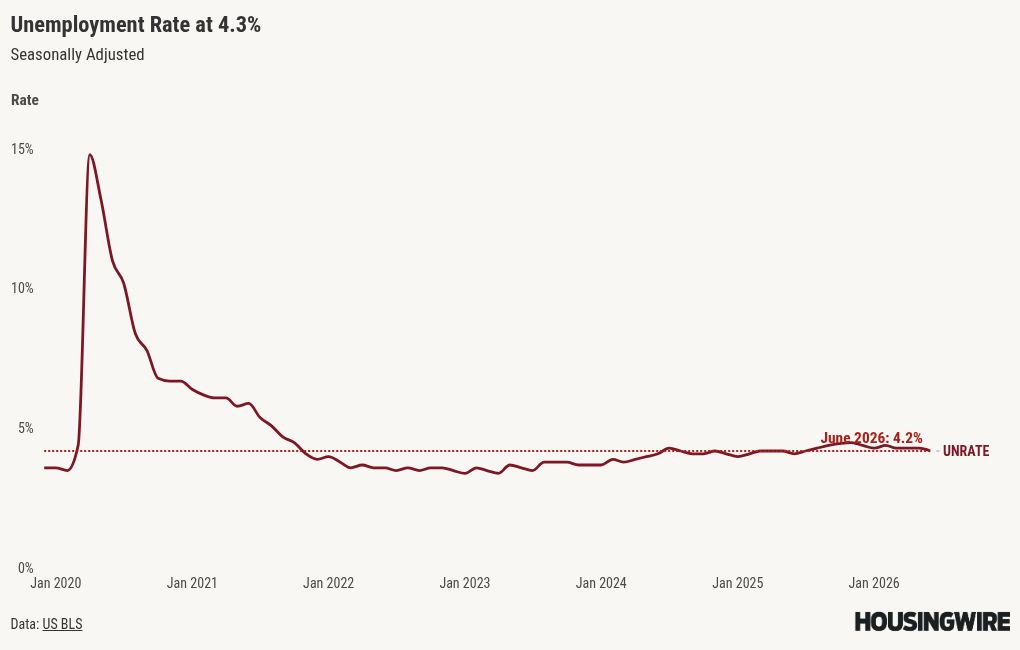
4. Builders are already adapting their product.
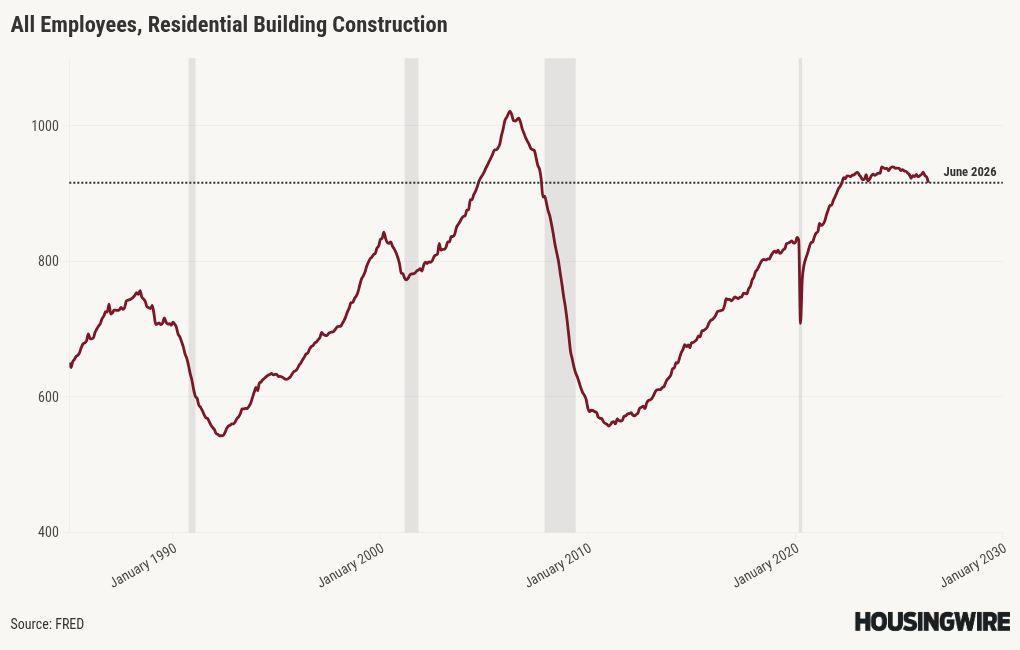
The industry’s response to affordability pressures is clearly visible. Builders are delivering smaller homes, smaller lots, more townhomes, and more incentive-driven financing packages. Homes under 1,800 square feet increased their share of completions significantly, while townhomes reached 18% of single-family completions.

5. Unsold inventory is becoming a constraint.
Unsold completed new-home inventory rose 54% over two years and reached its highest level since 2009. That inventory overhang is helping suppress additional starts.

6. Build-to-rent has moved from niche to meaningful demand channel.
Single-family homes built specifically for rental represented 11% of completions in 2025, nearly three times historic norms. Builders increasingly relied on institutional rental demand as owner-occupant demand softened.

7. Multifamily is entering a different phase of the cycle.
The industry is still absorbing the largest apartment delivery wave in decades. New supply helped moderate rents in many Sunbelt markets, but the development pipeline is shrinking as units under construction decline.

8. Affordability remains historically broken.
Even with slowing home-price appreciation, the median existing-home price remains nearly five times median household income. Mortgage payments on a median-priced home remain roughly double where they stood in late 2020.

9. Housing costs now extend far beyond mortgage payments.
Insurance premiums increased 72% between 2019 and 2025, while property taxes rose 31%. Those cost increases are becoming increasingly important purchase-decision variables.

10. The housing shortage increasingly centers on affordability, not simply volume.
The report’s most sobering statistic may be that 11 million extremely low-income households compete for only 3.8 million affordable and available rental units. The nation’s biggest housing shortfall is no longer a generic unit shortage; it is a shortage of attainable housing.

Three opportunity areas emerging for builders

The report also highlights several strategic opportunities for builders, developers, capital partners, and suppliers willing to adapt.

1. The attainability innovation race

The companies that figure out how to deliver attainable housing at scale stand to capture disproportionate market share.

The report repeatedly points to the widening gap between what households can afford and what the industry can economically produce. That gap creates opportunity for innovation in lot design, floor plans, off-site construction, automation, value engineering, and entitlement efficiency.

2. Build-to-rent becomes core strategic, not reactive tactical

Institutional rental demand is no longer merely a backstop during slow sales periods.

The growth of build-to-rent suggests a structural evolution in how housing is delivered and consumed. Builders capable of serving both for-sale and for-rent demand channels may enjoy greater resilience during future market cycles.

3. Remodeling and existing-housing preservation

The aging housing stock is quietly becoming one of housing’s largest business opportunities.

Owner improvement spending reached $376 billion in 2025 and now rivals spending on new single-family development. With owner-occupied homes reaching a median age of 42 years, demand for repairs, retrofits, resiliency upgrades, energy improvements, and modernization appears likely to remain durable.

Three risks that could reshape the next 36 months

1. Structural demand deceleration

The combination of slower household growth, weaker immigration, lower mobility and diminished consumer confidence suggests that the industry’s long-assumed demand floor may be lower than many business plans assume.

2. Housing cost escalation beyond purchase price

Insurance, taxes, utilities, resiliency requirements and climate-related expenses increasingly influence buyers’ decisions. Builders who focus solely on purchase-price affordability risk overlooking the growing importance of monthly ownership costs.

3. Climate and disaster exposure

Harvard’s report identifies climate risk as a housing-supply issue as much as an environmental one. Billion-dollar weather disasters continue to rise, while federal disaster-recovery and mitigation frameworks face growing uncertainty. Those pressures could reshape land values, insurance availability, development economics, and geographic growth patterns across many markets.

Make no mistake …

What to learn from The State of the Nation’s Housing 2026 is that housing’s challenge is shifting from whether America needs more housing to whether it can produce housing that aligns with what households can afford.

Builders spent much of the past decade responding to undersupply. The next phase may require something more difficult: aligning product, land strategy, operations, capital structures, entitlement processes, and technology investments around a consumer whose purchasing power has weakened even as housing costs remain historically high.

The industry’s leaders have already begun that transition through smaller homes, smaller lots, incentive-driven financing, build-to-rent partnerships, and operational efficiency initiatives. Harvard’s report suggests these moves are not temporary responses to a soft market. They may instead mark the early contours of housing’s next operating model.

This post was originally published on here

Mortgage rates are moving higher as 2026 nears its midway point. And sentiment has shifted when it comes to rate expectations as more housing market observers are predicting at least one rate hike this year — a stark contrast to the start of 2026 when multiple cuts were on the table and sub-6% rates seemed possible.

At HousingWire‘s Mortgage Rates Center on Tuesday, rates for 30-year conventional loans averaged 6.79%, up 6 basis points in the past week. Rates for 30-year jumbo loans also rose 6 bps to 6.81%, while rates for 30-year loans backed by the Federal Housing Administration (FHA) jumped 7 bps to 6.38%.

In the short term, rates have responded to the Federal Reserve‘s decision to hold benchmark rates steady for a fourth straight meeting, with stronger indications from Fed officials that a rate hike is more likely than a cut by the end of 2026.

A startling prediction was released Monday when Bank of America economists forecast three rate increases by the end of this year, which would bring the federal funds rate to a range of 4.25% of 4.5%, erasing all of the cuts made in 2025. But HousingWire Lead Analyst Logan Mohtashami called those actions “a bit too aggressive” and said they are unlikely to come to fruition.

“Core inflation had been picking up before the (Iran) conflict, so any rate cuts are off the table, even after the conflict ended. The conflict ending removed the worst-case scenario. However, for now, I have one rate hike planned for 2026,” Mohtashami wrote.

Interest rate traders hold similar views, according to the CME Group‘s Fed Watch tool. As of Tuesday, about 36% of those surveyed were predicting a 25-bps increase at the Fed’s next meeting in July — up from 18% a month earlier. Roughly half of respondents have penciled in a hike by September, while roughly one-quarter think there will be a 50-bps increase by October.

Impact on purchase, refi demand

Rising rates are likely to factor into summer home sales and have been suppressing activity over the past month. HousingWire Data shows that weekly pending sales remain higher than a year ago, but existing home sales — which lag the pending sales data by 30 to 60 days — are likely to slow in July, according to Mohtashami.

“Mortgage applications declined for the fourth time in five weeks, underscoring borrowers’ continued sensitivity to higher mortgage rates compared to earlier this year. Purchase activity remained above year-ago levels, but constrained housing supply in many markets, elevated home prices and ongoing economic uncertainty continue to weigh on would-be homebuyers,” Bob Broeksmit, president and CEO of the Mortgage Bankers Association (MBA), said in a statement.

Purchase application demand remains 3% higher than a year ago, the MBA reported. And consumer mentalities appear to be resilient despite affordability concerns. Bank of America survey data compiled in April and May shows that 53% of Americans would rather buy a home than rent or live with family — the first time in three years that a majority have expressed this view.

“The duration of the interest rate environment that we’re in today is now becoming a new normal, so versus the shock of movement from post-pandemic to the levels [near] 7%, now we’re consistently in this area, so this is a new normal from a market perspective,” Matt Vernon, head of consumer lending at Bank of America, told HousingWire.

“I think that is causing that clear inflection point in sentiment, where most Americans — or more Americans now — are thinking of homeownership as the preferred long-term choice.”

Refinance activity strong

Kyle Bass, production business manager at Refi.com, said that even with rates above 6.5%, more stability in recent weeks also seems to be supporting stronger refinance activity.

“For homeowners sitting on the sidelines, the question isn’t whether to refinance, it is whether you will be ready when the window opens,” Bass said. “This is why it’s more important than ever to prepare now. Those considering a refinance should complete the full pre-qualification process today, not because they’re ready to close, but because it reveals what needs to improve before they are, such as paying down credit card debt. Doing this now means you will be weeks ahead when rates reach your desired level.”

FHA loans, which represent about 17% of the mortgage market, also received a potential boost Tuesday when the U.S. Department of Housing and Urban Development announced a host of changes to the FHA’s single-family loan programs.

The U.S. Department of Housing and Urban Development (HUD) is rolling out 14 changes to the Federal Housing Administration (FHA)’s single-family mortgage insurance program, including less stringent appraisal rules, expanded flexibility for the 203(k) rehab loan program and simplified closing forms. 

The updates impact FHA policies across the origination, servicing, quality control and appraisal realms. HUD said the goal is to remove outdated requirements, reduce administrative work and make FHA financing more efficient for both homebuyers and lenders. 

This post was originally published on here

Many people in the housing industry are wondering why mortgage rates haven’t fallen even as oil prices have dropped from $111 per barrel to less than $73 today. The 10-year Treasury yield is at 4.48% and mortgage rates are near their yearly highs.

This is a fair question, and we have already discussed where mortgage rates should go now that the conflict in Iran is truly ending. Today, we’ll give you a brief take on how I view the 10-year yield and mortgage rates — and why, for now, everything looks all right to me.

Fed policy accounts for the bulk of yields, rates

When I speak at events, I always show the chart below and say that this represents the slow dance between the 10-year yield and the 30-year mortgage rate. What drives the 10-year yield in turn drives mortgage rates. And Federal Reserve policy is what drives 65% to 75% of the headline figure.

For years now, my theme for rates has been labor over inflation. In fact, from 2023 through present day, every time the 10-year yield is below 4%, it’s because the market believes the economy is slowing down and the labor market is at risk.

If the Fed cuts benchmark interest rates down to 3%, getting below 3.8% on the 10-year yield is difficult. We’ve been below 3.8% twice recently — once in 2023 and again in 2024. On both occasions, traders believed the labor market was breaking and yields shot back up when it became clear it wasn’t.

chart visualization

This is why I don’t forecast anything below 3.8% on the 10-year yield. To me, this is a recession premise or because the Fed has gotten more dovish than the market is basing neutral policy on.

chart visualization

We went into 2026 with questions about the labor market and assumptions that the Fed would price in two or three cuts. But now we have one rate hike priced in for 2026. This is why I’ve said that, once the U.S.-Iran conflict is over and the Fed becomes less hawkish, we should think of 4.46% to 4.48% as the base point for the 10-year yield until more data or clarity on the Fed arrives.

As I’m writing this, the 10-year yield is at 4.48%. So, to make this point short, the Fed has gone hawkish in a year where rate cuts were initially priced in.

No comment yet from the Fed on the conflict ending

The Fed had a lot to say about the conflict lasting longer and the risk to inflation from higher oil prices. In fact, it made the Fed in general much more hawkish. But now? Nothing much has been said about oil prices since they went back to $73 per barrel.

chart visualization

Now the Fed hawks can say that ending the conflict will make them less hawkish. Maybe over the next few days or weeks, this could help the 10-year yield as Fed policy becomes less restrictive in the marketplace. But until then, don’t expect a change.

In fact, Wall Street firms are now debating how many rate hikes we will see in 2026. Bank of America says there will be three.

Labor data is firm and core inflation is running hot

Going into the year, the Fed was going to ignore tariff-related inflation, which made the inflation data hotter than normal, as officials believed that a one-time price shock would filter out in the second half of 2026.

They might still hold this belief, but the Iran conflict gave them a reason to adopt a more hawkish stance. In general terms, the heat from the inflation data was simply too much to ignore, so all rate cuts for 2026 are off the table for now.

chart visualization

On top of that, recent labor market stabilization has made it easier for the Fed — even with oil prices rising — to not talk about rate cuts, as they see the labor market growing enough to keep the unemployment rate low. With oil prices moving much lower, the hawks can change their mind, but until they guide the market on that, bond traders will keep the 10-year yield closer to yearly highs than lows. If the unemployment rate were at 5%, we would have a different story, but that isn’t the case.

chart visualization

Conclusion

I know some people were anticipating that the 10-year yield and mortgage rates would drop right away with oil prices at $73 a barrel, but a lot has changed in 2026 beyond geopolitics. It is a huge win that this conflict is over and oil prices are down, but the Fed needs to get that message out if they want to quiet a lot of the more aggressive rate-hike talk that some market participants are forecasting.

With the conflict ending, maybe Fed officials can get back to discussing core inflation and when they think it will start to cool off. I can understand the frustration of housing market professionals on this topic — but for now, mortgage rates and the 10-year yield look right to me.

This post was originally published on here

The East Village is sometimes hard to recognize today; busy restaurants and nightlife demand more attention than colorful neighbors, landmarked buildings, and tree-shaded community gardens. But the trees and gardens are still here, and this townhouse at 746 East 6th Street, asking $5.5 million, is a fine example of an Alphabet City property on a classic neighborhood block, with plenty of ways to enjoy the Village vibe.

Available for the first time in over 20 years, this well-maintained, owner-occupied two-family townhouse will be delivered vacant and move-in-ready. Measuring 22 feet wide by 42 feet deep on a 97-foot lot, the townhouse is currently set up with two large three-bedroom duplex homes.

You get the flexibility of rental income, family space, or the chance to create one large home. Both units are separately metered with independent systems for heat, hot water, and central air conditioning.

Enter the lower unit of the duplex via the stoop, onto the parlor level. Within, a laid-back and lofty living area with ceilings over 10 feet is served by an open kitchen. This unit has central air conditioning throughout and a washer/dryer.

The colorful kitchen, anchored by a hefty dining island, features countertops of green marble, Scandinavian-inspired cabinetry, a Miele dishwasher and fridge, a Wolf range, and a double wall oven. At the back, a deck leads to a planted garden below, shaded by a mature maple tree.

Downstairs are three windowed bedrooms. The primary suite has access to the garden. Two additional bedrooms share a second full bath.

The upper unit is accessed through a separate entrance. Up a flight of stairs, a large, open living space consisting of a lounge, kitchen, and dining area occupies the lower floor, along with a full bath and laundry facilities. At the rear, glass doors open onto a wide, elegant terrace.

On the second level of the upper duplex are three bedrooms and two baths. A sprawling primary bedroom suite gets a working gas fireplace. Two rear-facing bedrooms share a second bath. This unit also has a second outdoor space in the form of a finished roof deck.

The well-maintained home sits on a leafy, surprisingly quiet East Village block. Tompkins Square Park is nearby, as is the East Village waterfront and East River Park. The property is located within an R8B zoning district and Opportunity Zone, offering 5,504 square feet of unused development rights for a potential future expansion.

[Listing details: 746 East 6th Street at CityRealty]

[At The Corcoran Group by Glenn E. Schiller and Laura Kastner]

RELATED:

The post This $5.5M two-family townhouse is classic East Village living at its best first appeared on 6sqft.

This post was originally published here

Investor activity in the U.S. housing market remained resilient in 2025 even as overall home sales fell to one of their lowest levels in decades, according to a report released Tuesday by Realtor.com.

Investors purchased roughly 534,000 homes last year, a 0.7% increase from 2024, while their share of all home purchases rose to 11.3%, up from 11% the prior year, according to the report.

By comparison, home purchases by non-investors declined 2.1% year over year.

At the same time, investors sold fewer properties for the first time in two years. Investor sales fell 1.5% to 442,000 homes, the lowest level since 2020, suggesting that investors are no longer shedding properties accumulated during the pandemic-era housing boom.

“The investor market has found a new equilibrium,” Hannah Jones, senior economist at Realtor.com, said in a statement. “With small investors now comprising nearly two-thirds of all investor purchases and large institutional players continuing to pull back, the dynamics shaping competition in entry-level housing are shifting.”

The report found that investor activity has remained stronger than the broader housing market since the COVID-19 pandemic. While overall home sales are down more than 25% from their 2021-2022 peak, investor purchases have declined by a smaller figure of 22.6%. Compared with pre-pandemic levels, overall home sales have fallen 14.3%, while investor acquisitions have increased 14.6%.

Investor sales also moderated in 2025. Although investors accounted for 9.3% of all home sellers, matching their share from 2024, the total number of investor sales declined. As a result, net investor accumulation widened to about 92,000 homes, up from roughly 80,000 in 2024.


The composition of investor activity continued to shift away from large institutional buyers. Mega investors, defined as those making 350 or more purchases annually, accounted for just 7.5% of investor purchases in 2025, their lowest share since 2011. Their purchase volumes have fallen nearly 70% from the peak reached during the pandemic-era housing boom.

Meanwhile, small investors — categorized as entities making fewer than 10 purchases per year — increased their share of investor purchases to about 63%, the highest level in more than 15 years. Realtor.com said small investors remained net buyers, purchasing approximately 53,000 more properties than they sold last year.

Jones said small investors are concentrated in lower-priced segments of the market, where they often compete directly with first-time homebuyers.

Nationally, small investors purchased homes at a median price of $330,000, compared with the overall market median of $440,000, according to the report.

Investor activity remained concentrated in several Midwest and Sun Belt markets. Among the nation’s 50 largest metropolitan areas, Memphis, Tennessee, posted the highest investor buyer share at 23.7%, followed by Kansas City at 21.2%; St. Louis at 21.1%; Birmingham, Alabama, at 21%; and Oklahoma City at 17.9%.

Las Vegas and Birmingham recorded some of the largest increases in investor buying activity from a year earlier, while San Antonio and Dallas-Fort Worth remained among the most active investor markets.

By contrast, several high-cost West Coast and Northeast markets saw relatively limited investor participation. Portland, Oregon; Sacramento; and Hartford, Connecticut, each posted investor buyer shares well below the national average.

Atlanta represented one of the most significant reversals, according to the report. Once among the nation’s most investor-heavy markets, investor purchases accounted for just 10% of home sales in 2025, below pre-pandemic levels. Investors were net sellers in the metro area by nearly 1,800 homes, the largest negative net position among major markets.

Realtor.com said investor activity appears to have stabilized at an elevated level, with investor purchase shares remaining above 11% for three consecutive years.

The report suggests that while large institutional investors have retreated, the growing role of smaller investors may help sustain current levels of investor participation in the housing market.

This article was generated using HousingWire Automation and reviewed by a HousingWire editor before publication. 

This post was originally published on here