New York City tenants have spoken. Mayor Zohran Mamdani on Thursday released a new report shaped by testimony from thousands of renters who shared their experiences during the “Rental Rip-Off” hearings held across the five boroughs. The 68-page report outlines 23 policy changes aimed at strengthening tenant protections, improving housing quality, and targeting negligent landlords while curbing hazardous conditions and deceptive practices.

“At Rental Ripoff Hearings across the five boroughs, we heard from thousands of New Yorkers living with mold that was never treated, pests that were never addressed and fees that were never explained,” Mamdani said. “Listening was only the first step. This report turns those stories into concrete action.”

“From requiring disclosure of AI-altered listings to bringing our code enforcement systems into the 21st century and finally recognizing tenant unions, we are making it clear that every New Yorker deserves a safe home—and every landlord who refuses to provide one will be held accountable,” he added.

Mamdani established the hearings during his first week in office through the signing of Executive Order 8. Between February and April, the administration held one hearing in each borough and collected online testimony from more than 2,400 New Yorkers.

Within 90 days of the final hearing, held on April 7, the city’s Departments of Housing Preservation and Development, Buildings, and Consumer and Worker Protection, along with the Office to Protect Tenants and Mass Engagement, were ordered to submit a joint summary and report to the mayor with common themes and issues addressed during the hearings.

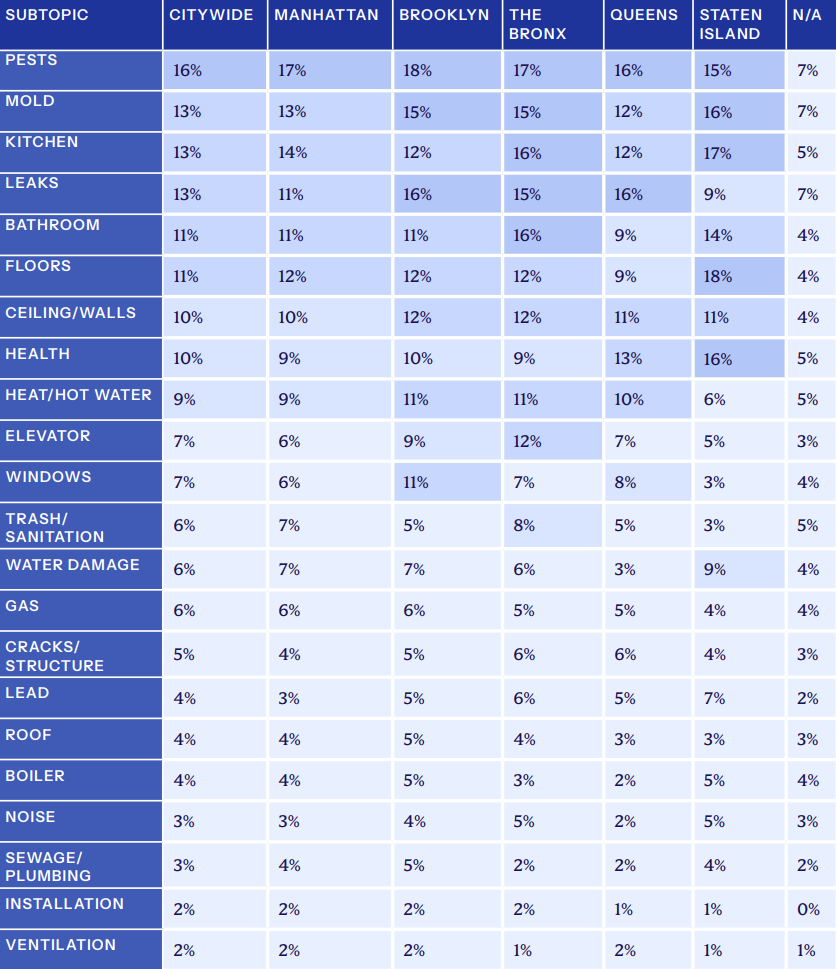
The chart lists the most common topics mentioned in rental ripoff hearing testimonies. Credit: NYC Mayor’s Office

The report identifies the most prevalent concerns raised by tenants. Sixteen percent of the testimony cited pests, while 13 percent mentioned mold, and another 13 percent cited leaks. Another 13 percent referenced kitchen issues, while 11 percent spoke about problems with bathrooms and flooring.

Tenants also described a general feeling of powerlessness amid an “uneven power dynamic” between themselves and their landlords. This imbalance can make it difficult for tenants to negotiate rent increases and address harassment from property owners and maintenance staff, another key theme raised during the hearings.

Public testimony repeatedly described landlords ignoring maintenance requests, while management companies and building superintendents were often difficult to reach or unresponsive.

Even when issues were addressed, tenants said repairs were frequently inadequate, leaving problems unresolved. When tenants called 311 to file complaints or organized with neighbors, some reported facing intimidation from property owners.

Immigrant residents described heightened fears of retaliation, with some citing cases of landlords threatening to contact federal immigration authorities after tenants filed complaints.

Another concern raised during the hearings was the ability of landlords to certify that repairs have been completed without proving to the city that violations have actually been remedied. Tenants advocated for easier ways to report false certifications and ensure conditions are fully addressed before violations are cleared.

Tenants also reported chronic heat and hot water problems, forcing some to rely on hazardous devices like space heaters to stay warm and driving up their energy bills. Seven percent of testimony cited broken elevators, which severely restricted mobility for elderly residents, parents with small children, and people with mobility disabilities.

Other issues cited by tenants included lengthy and confusing housing court processes, a lack of clarity around tenant rights and how to form tenant associations, insufficient urgency from the city in addressing housing issues, and a range of deceptive fees and unexpected utility bills.

The Mamdani administration said that it will use every tool at its disposal to address these concerns, including executive action, agency rulemaking, legislation, and litigation.

Examples of actions include investigating every heat complaint individually rather than grouping complaints from the same building, allowing tenants to schedule certain building inspections, improving response times to elevator outage complaints, streamlining public information about tenant rights, and strengthening protections against harassment based on immigration status.

The Mayor’s Office to Protect Tenants will also establish a legislative task force to recommend reforms to the city’s housing quality enforcement system.

Potential reforms under consideration include adding financial penalties for landlords who fail to address mold, strengthening the city’s Alternative Enforcement Program to better tackle chronic building violations, modernizing the property registration process, and allowing HPD to serve building owners with violations through digital notices.

While tenant advocates celebrated the hearings and the release of the report, some landlord representatives criticized the process, calling the hearings a “rigged political show” that unfairly targeted small property owners while ignoring the effects of the mayor’s two-year rent freeze, approved last month, on rent-stabilized buildings.

“The Rental Ripoff Hearings was a rigged political show designed to attack small owners while ignoring the damage being done to rent-stabilized buildings,” Ann Korchak, board president of Small Property Owners of New York, said.

“The message is clear: the administration does not see small owners as partners. It wants to weaken us, drive us into financial distress, and force private rent-stabilized housing into government-controlled, socialized housing,” she added.

Over the next three years, the Mayor’s Office to Protect Tenants (MOPT) will launch and implement many of the initiatives outlined in the report. Some efforts, including changes to how heat complaints are investigated, will begin soon, while others will enter planning phases this year before launching in 2027 or as pilot programs.

Additionally, some changes will require partnerships with the City Council, including updates to the city’s Housing Maintenance Code. The process will begin with the launch of the MOPT Legislative Task Force this fall, which will consist of Council Members, tenant advocates, and other stakeholders.

RELATED:

The post Mamdani’s ‘rental rip-off’ report outlines 23 actions to address tenant concerns first appeared on 6sqft.



This post was originally published here

Alternative asset manager Fidelis Investors announced on Thursday the closing of its fourth rated residential transition loan (RTL) securitization, FIDL 2026-RTL2, a two-year revolving, $191.5 million securitization backed by 381 residential transition loans across 24 lenders.

The closing comes amid growing demand for private lending solutions aimed at increased housing supply. The transaction is led by Unitas Funding LLC, a wholly owned subsidiary of Fidelis.

Rated by Morningstar DBRS and KBRA, the securitization marks several milestones for the residential transition loan market. Fidelis said it is the first manager to launch a second rated RTL securitization in 2026 and the first to close a transaction backed by KBRA-rated bonds.

Residential transition loans are typically used by real estate investors to finance the purchase and rehabilitation of properties, including fix-and-flip projects. Fidelis said the loans provide financing for housing rehabilitation projects that traditional lenders often do not support.

“From playing a major role in establishing the secondary market in residential transition lending to now bringing KBRA-rated bonds to market, Fidelis continues to drive the institutionalization of private real estate lending,” Brian Tortorella, managing partner at Fidelis, said in a statement.

“As the nation continues to contend with an intense housing affordability problem, investors are eager to support solutions that put more homes on the market while delivering strong opportunities for returns.”

Fidelis said investors are increasingly looking to private real estate lending as an opportunity to support housing rehabilitation while generating returns.

“The closing of our second rated RTL this year is a testament to the fact that, even as headlines repeatedly stress the private credit sector’s woes, investors remain deeply committed to private mortgage lending as an asset class,” Michael Tessitore, managing partner at Fidelis, said in a statement.

Jefferies served as sole bookrunner for the transaction.

“Fidelis’ continued growth is a testament to the company’s strong execution and best-in-class approach to the RTL sector,” said Jordan Rothstein, head of ABS trading and distribution at Jefferies.

Chris Schmidt, managing director at Jefferies, said the transaction was the first RTL securitization rated by two agencies and the first RTL transaction rated by KBRA.

Additional eligible residential transition loans may be added to the portfolio during future transfer periods, subject to the transaction’s eligibility criteria, Fidelis said.

This article was generated using HousingWire Automation and reviewed by a HousingWire editor before publication.

This post was originally published on here

eXp Realty announced that Carmen Mercado, former national president of the National Association of Hispanic Real Estate Professionals (NAHREP) and former director of affordable lending at Freddie Mac, has joined the company as a real estate agent.

Mercado brings more than 20 years of experience in residential real estate, brokerage leadership, housing finance and affordable lending.

She has served as a broker, trainer, growth strategist and New York Department of State-certified real estate instructor, and has appeared on HousingWire’s annual Women of Influence list.

“Carmen has spent her career pushing the industry to be more inclusive and better prepared for what’s ahead. That’s exactly the mindset our model was built for,” said Leo Pareja, CEO of eXp Realty. “We’re not just gaining an experienced leader. We’re gaining someone who’s spent her whole career making other people better at this business.”

Mercado entered the real estate industry in 2002 following a difficult first-time homebuying experience with her husband, a military veteran.

At the time, she was working on Wall Street, but said the Sept. 11 attacks prompted her to pursue a career that allowed her to spend more time with her family while helping others navigate the homebuying process.

“Throughout my career, I’ve found that the agents who thrive aren’t necessarily the ones who predict every market change perfectly,” Mercado said. “They’re the ones who prepare before opportunity arrives. As the Roman philosopher Seneca wrote, ‘Luck is what happens when preparation meets opportunity.’ That’s a philosophy I’ve carried with me throughout my career.”

At eXp, Mercado plans to grow her own team while expanding her residential and investor business. She will also work with corporations, nonprofits and industry partners on business development and continue sharing market insights to help agents identify opportunities.

This article was generated using HousingWire Automation and reviewed by a HousingWire editor before publication.

This post was originally published on here

You can sit any man down at a piano. Most can bang out the same three songs they learned in middle school, a few can tune it, and almost nobody can sit there and compose something worth listening to. That piano is AI.

The way highly systemized public homebuilders are approaching AI right now tells you everything you need to know about the next decade of competition in residential land and development.

Process vs. people: Who’s really playing the piano?

Public homebuilders are designed from the ground up to be process machines, not talent incubators.

They are extremely impressive organizations, especially on paper. They track every KPI you can imagine, standardize underwriting across markets, and run thick decks through committees with military precision. They’ve built layers of analysts to ingest data, managers to interpret it and executives to present it in language that Wall Street likes.

It is rational, scalable, and relatively safe.

But it comes with a quiet cost: those organizations don’t accumulate much true, native land intelligence. The business model presumes that you can take any person of average competence, plug them into a system and get consistent results. Rather than spend decades growing a small bench of people who deeply understand counties, corridors and infrastructure, public builders spend decades refining the scorecard – what to measure, how to report it and which hurdle rates to hit.

To go back to the piano, they don’t invest in people who can compose. They invest in sheet music, metronomes and rules about which keys you’re allowed to press.

That bias makes sense in a capital markets context. Analysts and managers are interchangeable parts. If one leaves, you slide another into the process and keep the machine running. The institution doesn’t depend on any single human’s intuition about a piece of land, because in theory the model and the committee will catch whatever matters.

But land in places like Texas has a nasty habit of refusing to behave like a spreadsheet. Counties don’t grow in straight lines. Infrastructure doesn’t arrive to match the PowerPoint timeline. Household formation, school dynamics, and migration waves move in ways that feel more like improvisation than execution.

The organizations that win in that environment aren’t the ones with the prettiest sheet music. They’re the ones with people who’ve been listening to the song for a long time.

What AI actually does inside a public builder

Into that structure walks AI. If you listen to the marketing, you’d think AI is going to make every builder smarter, faster and more efficient. There’s some truth to that. AI is good at grinding through repetitive cognitive labor: cleaning data, drafting memos, summarizing legal documents, building simple models and organizing notes. Inside a public homebuilder, that means AI will mostly attach itself to the analyst layer:

  • Analysts use AI to compile market reports, scrape data and produce executive summaries.
  • Finance teams use it to build sensitivity tables or stress-test assumptions more quickly.
  • Strategy teams use it to draft presentations and “thought leadership” that advances the corporate story.

On the surface, this looks like progress. The same number of people can now process more information. The decks look sharper. The memos read cleaner. The volume of deal flow in the machine increases. In some cases, headcount in back-office roles even gets reduced because one analyst with good AI tools can replace two without them.

Take note, however, of what is not happening.

The organization’s true exposure to the dirt, the days spent walking sites, the time invested in understanding how a given county really works, the patience required to develop a feel for a specific corridor does not naturally increase just because the reports get easier to generate. In fact, the temptation is to reduce that exposure because AI makes it feel like the data is “good enough” on its own.

The public company becomes even more reliant on processed information:

  • Deals are presented as pre-digested, risk-scored and model-validated.
  • Narrative around each market is polished into a tight story that fits the brand.
  • Confidence comes from the volume and cleanliness of the analysis, not from a hard-earned understanding of the place.

AI strengthens the existing bias toward process. Instead of asking “who here really understands this county,” leadership tends to ask “do the numbers look right and does the memo match our framework?” The organization does not get more curious about land; instead, it gets more comfortable with the illusion that business strategists can discern what they need to about land from behind a keyboard. Crucially, AI does not replace the need for analysts and managers in that environment. It just changes the tools they use. You still need people to frame questions, review outputs, make committees feel safe and keep the machine running.

The overhead does not disappear; it just looks more digital and slightly more efficient.

From a distance, it is easy to misread this as a leap in competitiveness. It’s a cosmetic upgrade. The builders who were already dependent on processed deal flow simply get better at processing. They don’t get better at finding the land.

The private developer’s asymmetry

Now look at another side of the table: the private, knowledge-rich land developer. This is usually a small group of principals and a tight team. They do not have the luxury of 10 analysts and five layers of management. What they do have, if they are any good, is native knowledge. They know their counties. They know which school districts matter and why. They know when a “planned” infrastructure project is genuine versus political theatre. They know who pulls the levers on zoning and utilities.

For years, the trade-off has been obvious: publics win on capital and scale; privates win on knowledge and speed. The publics can afford overhead; the privates often cannot. So the private developer spends more time doing analysis, building pro formas, preparing memos and packaging deals for lenders, partners or builders.

Their edge is the fact that they are composing the song, not just playing it, but composition is expensive in hours.

AI changes that equation far more for the private operator than for the public company. A principal who genuinely understands Parker County, Collin County, or any other Texas growth node can now use AI to offload much of the mechanical work that used to require staff:

  • Drafting financial models and adjusting assumptions.
  • Generating market summaries and competitive sets.
  • Writing lender packages, investment memos, and municipal narratives.
  • Cleaning and structuring data from public sources.

The knowledge stays with the principal. The grunt work moves to AI. That’s the inverse of the public model, where the knowledge is shallow and distributed and the process is deep and formalized. For a private developer, AI effectively acts as an overhead killer. They no longer need to hire as many analysts as possible just to keep up with paperwork.

They can keep the organization flatter, with decision-making closer to the ground.
Business leaders can put more capital into land positions, entitlement strategies and patient holding power rather than office headcount.

The result is a structural advantage:

The public builder uses AI to make its existing processes more efficient. The private developer uses AI to get rid of processes they never wanted in the first place. And because their edge is native knowledge, not process, they are able to interpret and direct AI output in ways that a process-driven organization simply cannot. AI becomes an instrument in the hands of someone who can already compose. They do not ask the tool to tell them where to buy land; they use the tool to test and package decisions they are already skilled at making.

Why this weakens public builders over time

Put these threads together and the asymmetry becomes clear.

Public homebuilders:

  • Still depend on analysts and managers to surface, scrub, and present deals.
  • Use AI primarily to polish those layers rather than to deepen their field understanding.
  • Grow more confident in processed outputs even as their direct contact with the land stays limited.
  • Become more susceptible to narrative traps – believing their own AI-generated stories about markets they don’t viscerally know.

Private, knowledge-rich developers use AI to shrink back-office cost and compress time-to-analysis. Keep judgment in the hands of people with real local experience. Allocate more capital to land and relationships, less to bureaucracy. Move faster on the right land, not just more land.

In that environment, AI becomes a net negative for highly systemized public builders relative to private competitors. It encourages them to double-down on process and distance from the ground. It does not materially reduce their need for analysts and managers, because leadership, compliance, and governance still demand human layers.

It makes their deal packages look more professional while doing nothing to improve the underlying intuition about where to plant stakes.

Meanwhile, the private developer who knows the market can show up with tighter packages, more conviction, lower overhead and better timing.

It is like giving everyone in the orchestra a metronome and sheet music upgrade, while one person quietly gets a Steinway, a quiet room, and more hours to write.

The publics will use AI. They will talk about it on earnings calls. Their decks will be cleaner and their risk matrices more detailed. But in the parts of the business where real value is created, reading counties, calling corridors, predicting infrastructure and getting ahead of migration, they will still be sitting at the piano playing other people’s songs. The people who can really compose will simply have fewer distractions, lower overhead, and better tools.

In Texas terms, AI hands the public builder a fancier clipboard, a drone and a better traffic study. It hands the private land guy a pickup truck, an extra five hours a day and someone to handle the paperwork while he walks another site.

If you are deciding where to place your next dollar in residential land, it is worth asking: Who here is using AI to help them play the piano and who is using it to tune the instrument they already know how to play?

This post was originally published on here

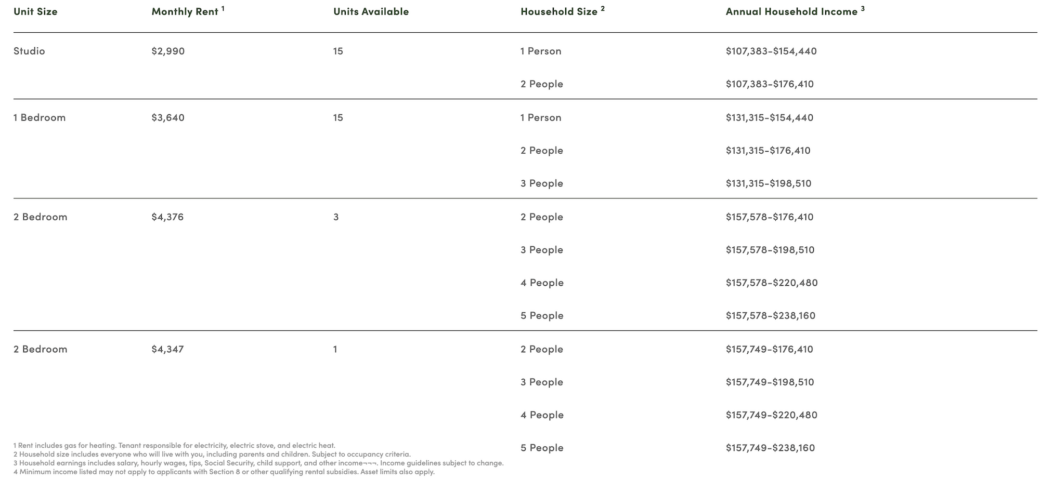
With rents at an all-time high in New York City, don’t miss this opportunity to live in a rent-stabilized apartment in Brooklyn. Located across from the 30-acre Fort Greene Park, the luxury development Verdant Fort Greene is now leasing its below-market-rate apartments, ranging from studios to two-bedroom units. Qualified New Yorkers earning 130 percent of the area median income can apply for the apartments, priced from $2,990/month studios to $4,347/month two-bedrooms.

This article is part of a paid partnership, which helps support our editorial work. 6sqft maintains editorial control over all content.

Developed by Fetner Properties, Verdant Fort Greene, located at 240 Willoughby Street, is a two-tower development with 463 apartments. Located in a quintessential Brooklyn neighborhood, the building sits less than a block from Fort Greene Park, a beloved public green space with rolling hills and open meadows designed by Frederick Law Olmsted and Calvert Vaux, the architects of Central Park and Prospect Park.

In addition to its proximity to green space, Verdant Fort Greene is also conveniently located near several subway lines, cultural institutions, like the Brooklyn Academy of Music (BAM) and the Brooklyn Paramount, and many restaurants and shops.

“This is an incredibly rare opportunity for New Yorkers to secure a luxury rent-stabilized apartment in Brooklyn with immediate occupancy,” Hal Fetner, president and CEO of Fetner Properties, said.

“We’re thrilled with the opportunity to welcome new residents to Verdant Fort Greene and hope many will make this their home for years to come.”

The studio, one-, and two-bedroom apartments feature spacious layouts, wide-plank hardwood floors, kitchens with marble backsplashes and stainless steel appliances, and an integrated Bluetooth speaker system. Another bonus is the in-unit washer/dryers.

The media room.

Amenities measure over 30,000 square feet, indoors and out. Residents have access to a fitness center, a yoga studio, a business lounge, a game room, a pet spa, a dog run, sports simulators, a children’s playroom, and a landscaped roof deck with sweeping views. There’s also onsite parking and bike storage.

The rooftop terrace.

The available apartments are rent-stabilized, which means any annual rent increases (or freezes) are regulated and approved by the Rent Guidelines Board.

Households earning between 130 percent of the area median income, between $107,383 and $238,160 annually, may be eligible for the apartments, ultimately saving about 30 percent on rent.

Pricing for the apartments starts at $2,990/month for studios, $3,640/month for one-bedrooms, and $4,347/month for two-bedrooms. Current incentives include two months free and a $ 1-per-month amenity fee.

Find out if you are qualified to apply for rent-stabilized apartments at Verdant Fort Greene by filling out the contact form found here.

RELATED:

The post This luxury Fort Greene rental offers rent-stabilized apartments with a $1 amenity fee first appeared on 6sqft.

This post was originally published here

The Community Home Lenders of America (CHLA) concluded that the Federal Housing Administration (FHA) could use direct payments to lenders as the primary tool in a forthcoming small-dollar mortgage pilot program, arguing it is the only approach likely to meaningfully increase originations of mortgages below $100,000.

In a comment letter dated July 16 and addressed to acting FHA Commissioner Joseph Gormley, the trade group said lenders generally lose money originating small-balance mortgages because fixed origination costs outweigh the revenue generated from lower loan amounts.

The suggestions address the implementation of Section 105 of the 21st Century ROAD to Housing Act, which authorizes FHA to establish a pilot program aimed at expanding access to mortgages below $100,000. The law gives the agency authority to provide direct payments to loan originators, adjust FHA loan terms and costs, and offer grants to borrowers for expenses such as down payments, closing costs, appraisals and title insurance.

Higher rates of denials

The proposal comes as policymakers continue to examine the shrinking availability of small mortgages despite the continued presence of lower-cost homes in many markets.

An Urban Institute analysis from 2022 found that about 600,000 U.S. homes — 13.1% of all home sales in 2020 — sold for less than $100,000. Yet only about one-third of these homes were purchased with a mortgage, compared with more than 80% of homes selling for at least $100,000.

The report also found that applications for mortgages under $100,000 were significantly more likely to be denied than larger loans, with researchers citing lender economics, fixed origination costs and servicing challenges as contributing factors.

The Urban Institute noted that small-dollar borrowers are often lower-income, first-time or minority homebuyers, and said expanded access would likely require policies that improve the economics of originating smaller loans.

CHLA said its member lenders have concluded that direct payments to lenders are “the most effective — if not the only way” to measurably increase the origination of FHA small-dollar mortgages.

According to the organization, independent mortgage banks originated about 90% of FHA loans in 2025.

Borrower subsidies unlikely to move the needle

CHLA said subsidies for borrowers would help reduce upfront costs but would be unlikely to significantly increase loan volume because FHA’s low down payment requirements already keep borrower contributions relatively small on lower-priced homes.

CHLA also believes that FHA has sufficient financial capacity to support incentive payments. Citing the Department of Housing and Urban Development (HUD)’s fiscal 2027 budget estimates, the group said each FHA Title II mortgage generates a negative credit subsidy of 3.14%, meaning the agency earns more than it expects to pay in losses.

Based on these estimates, CHLA said FHA could provide combined payments to lenders and borrowers totaling as much as 3% of the loan amount while remaining profitable.

The association said direct payments of up to 1.75% of the loan amount could be administered operationally by withholding the upfront FHA mortgage insurance premium that is normally collected and remitted to the agency.

The letter said CHLA did not identify any FHA loan terms or costs that substantially discourage small-dollar lending. It noted that changing underwriting standards could compromise the safety and soundness of the loans.

The group also believes that federal loan originator compensation rules could limit the effectiveness of any lender incentives. Current compensation requirements generally require loan officers employed by lenders to receive the same percentage-based compensation across all loans, preventing employers from paying higher commissions for small-dollar mortgages.

CHLA also pointed to the federal Qualified Mortgage points-and-fees cap as another obstacle to small-dollar FHA lending. It noted that Section 402 of the ROAD to Housing Act directs the Consumer Financial Protection Bureau and FHA to examine the issue.

The trade group said expanded access to small-dollar FHA mortgages is particularly important for borrowers in rural and underserved communities — and for low- and moderate-income homebuyers who purchase lower-priced homes.

This article was written by Sarah Wolak and generated with the assistance of HousingWire Automation, then reviewed by a HousingWire editor before publication.

This post was originally published on here

New York City is advancing four major public transit projects in the Bronx and Brooklyn that are expected to cut commutes by up to six minutes for nearly 200,000 daily riders. Mayor Zohran Mamdani on Wednesday announced that the city’s Department of Transportation (DOT) will begin construction of the long-delayed Tremont Avenue busway later this year and launch community engagement for improvements along Flatbush, Utica, and Church avenues in Brooklyn, three of the borough’s busiest bus corridors. The projects build on last week’s unveiling of the “Next Stop: Fast Buses, Better Service” plan, which aims to speed up service on 50 bus routes across the five boroughs.

Credit: Ed Reed/Mayoral Photography Office on Flickr

“New Yorkers should not lose hours of their lives sitting in traffic on a bus. From the Bronx to Brooklyn, we’re building streets that move people instead of sticking them in gridlock,” Mamdani said. “These projects will make commutes faster, make our streets safer and return precious time to nearly 200,000 New Yorkers every single day. That’s exactly what public transit should do.”

The “Next Stop” plan aims to improve bus reliability through a combination of service changes, traffic enforcement upgrades, and road redesigns. A key component of the plan is improving speeds on 50 “priority corridors,” which currently include 25 of the city’s slowest bus routes.

Tremont Avenue is one of the corridors identified for improvement. The thoroughfare is notoriously dangerous, with 630 people injured in crashes along the avenue between 2020 and 2024, including 46 serious injuries and four deaths. Its buses also rank among the slowest in the city, averaging as little as 5 miles per hour on some routes, according to Gothamist.

Despite its slow bus speeds, the corridor is a lifeline for Bronx residents: 72 percent of households along the avenue do not own a car. It also connects riders to several subway lines and the Metro-North Railroad, serving roughly 39,000 daily bus riders.

The avenue is now slated to become the Bronx’s first busway, a corridor with dedicated bus lanes and bus-priority infrastructure designed to improve travel times and safety for bus riders, pedestrians, cyclists, and motorists alike. Busways elsewhere in the city have increased bus speeds by up to 60 percent while reducing injuries by as much as 45 percent.

Features of the project include an eastbound busway from Third Avenue to Southern Boulevard, a westbound busway from Southern Boulevard to Belmont Avenue, and an offset shared bus-and-bike lane eastbound from Webster Avenue to Third Avenue.

As part of the initiative, DOT will also upgrade safety at several intersections, including Tremont Avenue and Webster Avenue; Tremont Avenue and Third Avenue; Tremont Avenue, Southern Boulevard, and Crotona Parkway; Third Avenue and East 175th Street; Southern Boulevard, Crotona Parkway, and 180th Street; Crotona Avenue and 180th Street; Third Avenue and 180th Street; and Tremont Avenue and Washington Avenue.

The redesign will install painted sidewalk extensions to shorten pedestrian crossing distances and slow-turning vehicles. The extensions will be reinforced with flexible delineators, granite blocks, and bike parking to discourage illegal parking.

The busway will operate seven days a week from 6 a.m. to 8 p.m. Buses, trucks with six or more wheels, emergency vehicles, and Access-a-Ride vehicles will be allowed to travel the full corridor. Other vehicles, including taxis and for-hire vehicles, will only be permitted to enter for local access and must exit at the next available right turn.

In Central Brooklyn, Flatbush, Utica, and Church avenues—three of the city’s busiest bus corridors—will receive substantial upgrades. Together, the corridors carry 150,000 bus riders every day across 13 routes, with buses crawling as slow as 5 mph.

The DOT and Metropolitan Transportation Authority will develop short-term bus-priority improvements that can be implemented as early as next year, while also creating a long-term vision for “world-class” bus service along the three avenues.

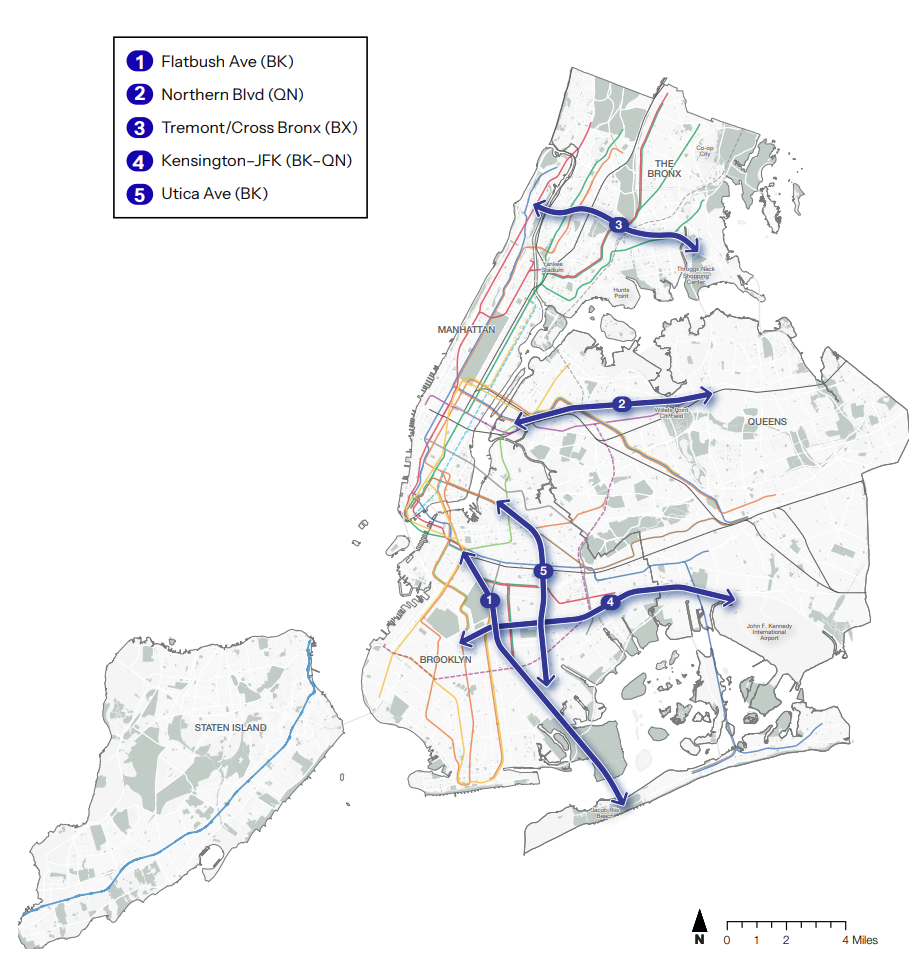
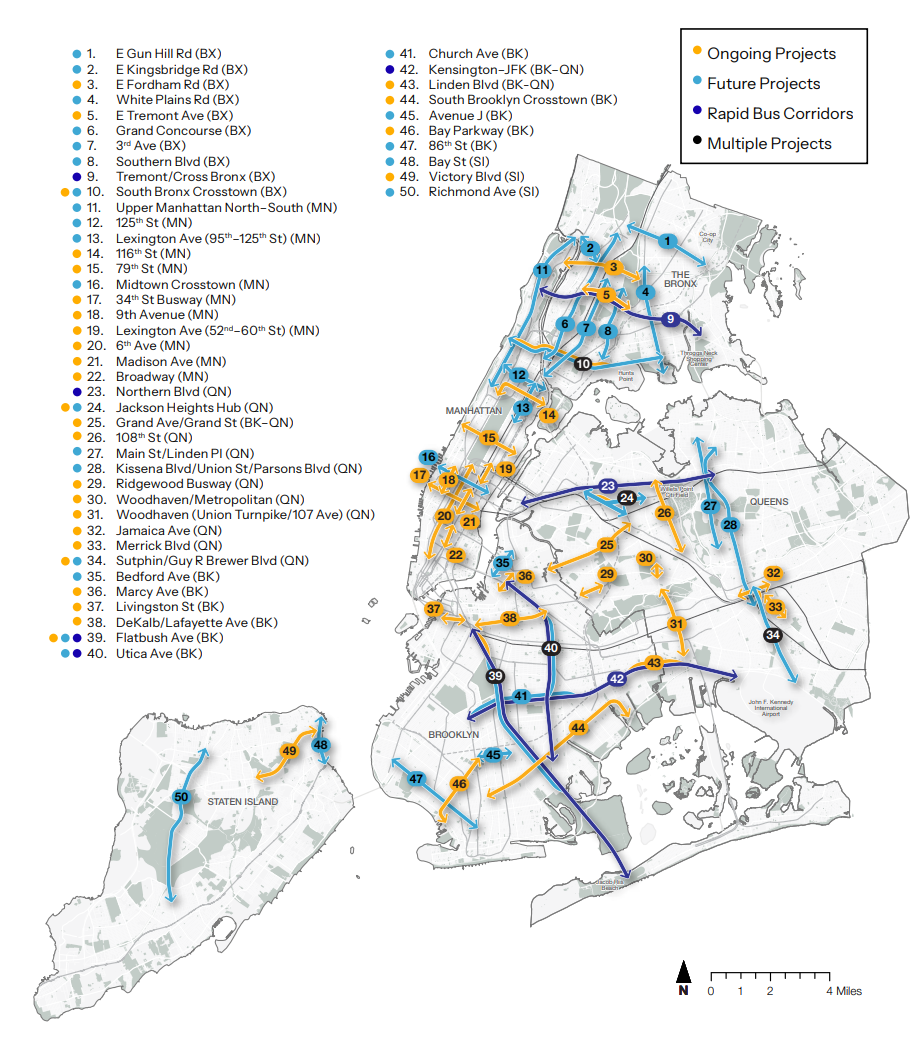
Map of the 5 rapid bus corridors. Credit: NYC Mayor’s Office

Long-term plans include establishing new “Bus Rapid Transit” corridors outlined in the “Next Stop” proposal. Of the city’s 50 priority corridors, five would be designated as “rapid bus corridors,” featuring bus-only infrastructure such as busways, fully separated lanes, or center-running lanes with transit signal priority at intersections and limited cross traffic.

The overhaul of Flatbush Avenue, one of the planned rapid bus corridors, is already underway. In April, DOT began installing center-running bus lanes along the avenue from Livingston Street to Grand Army Plaza, a project expected to speed up commutes for 132,000 daily bus riders who currently contend with average speeds below 4 mph.

Work on the four-phase project began last fall but was suspended during the winter. DOT now expects Flatbush Avenue to operate as a full rapid bus corridor by 2030.

DOT will also launch community engagement campaigns for future improvements to Utica and Church avenues, with an online feedback portal open through October 31. The agency will host bus rider engagement events beginning August 6 at 6 p.m. in Central Brooklyn, along with additional outreach at Open Streets events, block parties, and community gatherings.

Following this summer’s engagement process, DOT expects to release updated plans for bus-priority improvements this fall.

“Along Tremont Avenue in the Bronx and all through central Brooklyn, slow, unreliable buses are robbing New Yorkers of their precious time every day,” DOT Commissioner Mike Flynn said. “We want New Yorkers to have faith in our outreach, and that starts with actually delivering on projects promised years ago, like on Tremont Avenue, where riders deal with unreliable, over-packed buses every day.”

“We look forward to discussing the possibilities for fast buses through Central Brooklyn this year as we develop exciting proposals for critical bus corridors in the area.”

RELATED:

The post NYC moves forward with first busway in the Bronx, Central Brooklyn bus upgrades first appeared on 6sqft.

This post was originally published here

Gov. Kathy Hochul on Wednesday announced the development team selected to transform a Hell’s Kitchen parking lot used by the Intrepid Museum into a mixed-use development with more than 1,100 apartments. Gotham Organization, Fisher Brothers, and Mural Real Estate Group will turn the state-owned site at 621 West 45th Street into two connected skyscrapers with 1,127 homes, including about 338 affordable units, new facilities for the museum, and a public park that connects to the existing pedestrian bridge. The project stems from a request for proposals issued in February 2025 for one of the largest remaining undeveloped parcels on Manhattan’s Far West Side.

“The far West Side of Manhattan has a storied history as a vibrant, inclusive community, and this proposal will carry that legacy forward by building for a more affordable future,” Hochul said.

“By transforming a State-owned parking lot into more than 1,100 new homes — with hundreds of permanently affordable units and homeownership opportunities — we are taking direct aim at the housing shortage while strengthening one of New York’s great cultural institutions. This is what’s possible when we put State land to work for the people of New York.”

The state Department of Transportation acquired the land through eminent domain in 2000 and 2002 during the reconstruction of the West Side Highway. Under an agreement with the Intrepid Sea, Air & Space Museum, the state allows the museum to use the surface lot for parking during school trips and special events, as 6sqft previously reported. As required by the RFP, the proposal will preserve parking for the buses and provide access to the pedestrian bridge that connects to Hudson River Park.

Since the lot was the site of a manufactured gas plant, the development team intends to remediate it as part of the state’s Brownfield Cleanup Program.

The two connected towers will have a total of 1,127 homes, with 30 percent, or 338 units, affordable to those earning between 40 and 130 percent of the area median income. Some units will be designated as workforce housing, set aside for middle-income earners like teachers, nurses, and first responders. The developers also propose 108 for-sale condos, with about a quarter made affordable.

As 6sqft previously noted, the RFP sought proposals for buildings with a maximum floor area ratio of 18 and for them to incorporate “forms and facades” that enhance both visual appeal and walkability of Hell’s Kitchen.

In addition to housing, the project will include retail space and replacement parking that will open in phases. Intrepid Park, a new 9,800-square-foot landscaped open space, will connect to the museum’s existing sky bridge.

The project will also expand the museum’s footprint with a new 22,000-square-foot community hub across the West Side Highway called Intrepid Concourse, which will include a visitor center, STEM education facility, and cafe.

“We are thrilled to be a part of such a vital development project for New York City, and appreciative of Governor Hochul’s vision for the neighborhood and belief in the Museum’s mission,” Susan Marenoff-Zausner, president of the Intrepid Museum, said.

“We are excited to collaborate with ‘best in class’ firms that exude excellence and share our belief in community. This project enables us to expand our award-winning educational programs that the Intrepid Museum is renowned for and that have been so impactful for the City’s youth.”

Officials did not release a timeline for the project.

The redevelopment builds upon Hochul’s efforts to identify and convert underutilized or vacant state-owned sites into housing to help address the state’s housing shortage. Other initiatives include the conversion of the Bayview Correctional Facility in Chelsea and the Lincoln Correctional Facility in Harlem.

Another state-owned parcel on the West Side slated for redevelopment is “Site K” at 418 11th Avenue. In December 2024, Hochul unveiled plans for a $1.35 billion mixed-use project with nearly 1,400 homes across from the Javits Center. The development would include a 72-story residential tower, a 28-story hotel, and a five-story podium housing a permanent home for the Climate Museum and community facilities.

RELATED:

The post See plan to add 1,100 apartments and new park across from the Intrepid Museum in Hell’s Kitchen first appeared on 6sqft.

This post was originally published here

REMAX president and chief growth officer Chris Lim created a stir late last month when the American Real Estate Association (ARA) announced his appointment to the fledgling trade group’s board of directors. 

“I’ve always believed real estate is an industry where people should be working together,” Lim told HousingWire via email regarding his decision to join the board, “ARA stood out to me as it’s an organization focused on practical issues facing agents today but also on where the industry is headed, and I want to be part of those conversations.”

According to Lim, as he has watched ARA grow over the past few years, it became clear to him that the Mauricio Umansky and Jason Haber-founded association was one he wanted to be involved in. In practical terms, ARA is part of a broader push to give agents and brokerages more choices in professional representation — especially as MLS access becomes less closely tied to mandatory Realtor association membership. According to ARA, it is less NAR replacement and more an emerging challenger with ambitions.

“With more than 20 years as an agent and now working closely with a large network of real estate professionals, I know about and see firsthand the challenges, opportunities and changes shaping the business,” he said. “This felt like the right time to step in and help ensure those perspectives are part of the conversation as real estate continues to evolve while being part of any decisions that may impact agents and our industry.”

Focus on education 

In announcing his appointment to the board of directors, ARA said Lim would be focused on helping to shape an educational framework for ARA members. Lim told HousingWire he is looking to build “something practical and accessible that helps real estate agents operate at an even higher level in today’s market.” 

“Whether it’s an initiative on communication, negotiation or how to position themselves as trusted advisors, I would like to provide tools they can immediately put into practice for their clients,” Lim said. 

In addition to his work on member education initiatives, Lim said he will also be focused on “supporting the organization’s advocacy work and helping advance initiatives that strengthen the real estate profession.” 

“That means making sure agents are represented, that their value is clearly understood and that the work they do is protected and elevated. If we can create an environment where agents are better supported and better positioned for the future, that’s a meaningful outcome,” Lim said. 

According to Lim, one of the greatest challenges facing agents right now is staying on top of “evolving policies, practices and market dynamics while also helping consumers understand what those changes mean for them.”

“There is a lot of change happening across the industry right now, and it is happening quickly,” he said. “Advocacy that helps bring clarity to the process, supports agents through that change, and reinforces the value of professional guidance for consumers navigating an increasingly complex process is critical.”

More options for REMAX agents

In conjunction with Lim’s appointment to the board, ARA also announced that it will provide all REMAX agents in the United States with a complimentary first-year membership to the association. Lim said this is a wonderful opportunity for REMAX agents to explore the growing association and the benefits it offers members at no additional cost. 

“For those who choose to participate, I hope they gain access to meaningful advocacy, valuable educational resources and opportunities to connect with other professionals who are committed to strengthening the industry,” Lim said. 

The future of ARA

Looking ahead, Lim said he would feel like success for ARA in the next few years would be for the association to be “recognized as a trusted voice within the industry and as a valuable resource to members.” It is through this that he says ARA would have a meaningful impact on the industry and the consumers that interact with it. 

“It would mean ARA is seen as a place where real collaboration happens, between agents, between brokerages, and throughout the business, all working toward making the industry stronger.”

While some may view ARA as a competitor to the National Association of Realtors (NAR), Lim sees it as providing another opportunity for agents. 

“Having another choice where real estate professionals can access resources, education and advocacy is ultimately a good thing. ARA is creating space for modern, agent-focused advocacy, and it’s another option for agents who are looking for an emphasis on collaboration and innovation in a shifting market,” he said. “There is a real opportunity to strengthen the profession and support the real estate professionals who help consumers navigate one of life’s most important financial decisions. I’m looking forward to contributing to an organization that is focused on helping agents adapt to an evolving industry.”

This post was originally published on here

Retail activist investment firm Randian Capital is urging loanDepot’s board of directors to launch a formal review of strategic alternatives, including a potential sale, amid falling share prices and ongoing losses.

In an open letter to the board on Wednesday, Randian and its affiliates said they have economic exposure to more than 250,000 shares of loanDepot through common stock and options. The stock has been in free fall since the company went public in February 2021 at $14 per share and recently traded around $1.12 — a decline of more than 90% based on Tuesday’s closing price.

A spokesperson said loanDepot had no comment on the letter.

The push comes as loanDepot continues to struggle with profitability in a difficult mortgage market. In the first quarter of 2026, the Irvine, Calif.-based lender posted a net loss of $54.9 million, wider than the $32.8 million loss in the fourth quarter of 2025 and the $40.7 million loss a year earlier.

In its letter, Randian said macroeconomic headwinds alone do not explain loanDepot’s “prolonged underperformance,” arguing that peers have adjusted cost structures and strategies to the higher-rate, lower-volume environment.

“loanDepot has yet to demonstrate a sustainable path to restoring shareholder value,” the investor wrote.

Scale may be a “competitive disadvantage”

Randian also pointed to loanDepot’s relative scale, saying it is becoming a “competitive disadvantage” as the mortgage industry consolidates through mergers, servicing sales and exits from origination. “This can be exacerbated if reduced origination volumes persist longer than anticipated,” it added.

loanDepot originated $7.7 billion in loans during the quarter, down 5% from the fourth quarter but up from $5.2 billion a year earlier. The company’s pull-through weighted gain-on-sale margin declined to 2.71% from 3.24% in the fourth quarter of 2025. Management cited market volatility, higher rates and a shift toward lower-margin conventional loans as key factors.

loanDepot’s leadership has framed 2025 and 2026 as a multiquarter rebuild. Founder and CEO Anthony Hsieh, who returned to the chief executive role, has emphasized digital transformation, expansion of the wholesale channel the company reentered in early 2026, increasing loan officer headcount and applying automation across origination and servicing.

Hsieh has said the company is gaining market share and investing in long-term initiatives, including a partnership with Figure Technology Solutions that is expected to lower production costs, improve the customer experience and speed up loan closings.

Randian said strategic acquirers could unlock value not reflected in the current share price, particularly through cost and operational synergies.

Randian highlighted loanDepot’s mortgage servicing rights portfolio — $123 billion as of the first quarter, the 20th largest owned MSR portfolio in the country, according to Inside Mortgage Finance — as a key asset that might command a premium valuation in a transaction.

It cited the recent Mr. Cooper Group deal as evidence that strategic buyers remain willing to pay meaningful premiums for what they perceive as high-quality servicing and production platforms. In November, Rocket Companies completed its acquisition of Mr. Cooper for $14.2 billion, paying 51% more than the valuation initially announced.

Randian also pressed the board to reassess whether the current leadership structure is “best positioned to maximize shareholder value,” saying the board should be open to changes if needed to ensure the company’s needs receive sufficient time and attention from management.

“A successful sale of the company may be the best way for shareholders to finally realize fair value, and Mr. Hsieh to free up his time for the open water,” the letter states. “After years of significant value destruction, the Board owes shareholders a clear plan to maximize shareholder value, whatever path forward it ultimately chooses.”

This article was written by Flávia Furlan Nunes and generated with the assistance of HousingWire Automation, then reviewed by a HousingWire editor before publication.

This post was originally published on here

Uplist has launched Homebuyer Intelligence, a listing-connected tool that lets homebuyers see mortgage lender-specific payment estimates and affordability strategies while they are viewing a property in person or online, the company announced Thursday.

The Washington state-based mortgage technology firm said in its announcement that Homebuyer Intelligence is designed to plug loan officer expertise directly into listing flyers, open houses and online property marketing.

Loan officers generate a single Uplist link or QR code that can be added to any flyer or digital asset, taking buyers to a personalized listing page powered by the lender’s live pricing.

Once on the page, buyers can explore an estimated monthly payment with principal, interest, taxes and insurance; compare multiple financing paths; and test affordability tactics without creating an account, filling out a contact form or triggering a credit pull, according to the announcement.

“Loan officers can’t be at every open house, but their expertise can be,” Jeff Bell, founder and president at Uplist, said in a statement. “Homebuyer Intelligence gives buyers real answers the moment affordability questions come up and keeps the loan officer part of that conversation.”

The product aims to turn static listing collateral into an interactive financing resource for real estate agents and homebuilders while giving loan officers a presence at every showing.

Buyers can view options such as mortgage rate changes, home price adjustments, down payment scenarios and temporary buydowns, then share the full scenario by text, email or directly with the loan officer.

Homebuyer Intelligence also surfaces common seller-paid buydown structures, including estimated seller credits and year-by-year payment schedules. For builders, that can help quantify how seller-paid financing may affect payments in the early years of homeownership before a prospect leaves the model home.

Each listing experience carries the loan officer’s branding and required disclosures.

Uplist said the pages are built to be discoverable by AI-powered search assistants. When a consumer uses an AI tool to research affordability for a specific listing, the assistants can direct the buyer to a lender-verified resource that reflects live pricing from a lender already working with the listing agent.

In a high-rate, low-inventory market, affordability questions often determine whether a showing converts into a serious application. Homebuyer Intelligence is one of a growing number of tools that try to answer these questions earlier in the sales funnel, at the listing level, with lender-specific numbers rather than generic calculators.

For mortgage companies and loan officers, this type of integration can increase lead quality and keep them attached to the transaction even when they are not present at an open house. For agents and builders, it offers a way to handle payment objections in real time using scenarios that reflect an actual partner lender’s pricing and buydown options.

Homebuyer Intelligence is available now to Uplist subscribers, and lenders can request a demo from the company.

This article was generated using HousingWire Automation and reviewed by a HousingWire editor before publication.

This post was originally published on here

Point on Thursday announced the completion of a $508.6 million rated securitization backed by home equity investment (HEI) assets, marking what the company says is the largest transaction in the HEI market to date.

The transaction, which closed July 15, is Point‘s eighth rated securitization and its second of 2026. More than 30 institutional investors participated in the offering, including eight first-time investors on the company’s platform.

According to Point, the deal reflects continued growth in institutional demand for HEI-backed securities. The company said funding costs declined significantly from its previous securitization completed in February, with spreads on the BB (low) (sf) bonds narrowing by more than 220 basis points.

“Closing the largest securitization in the HEI asset class to date reaffirms the investment community’s confidence in this asset class and in the quality of the assets Point is originating,” Eddie Lim, co-founder and CEO of Point, said in a statement.

“Since pioneering the category in 2015, we’ve worked with our partners to build a durable, institutional-quality capital markets platform. That platform lets us access capital at scale, enhance liquidity and transparency in the market, and ultimately make home equity a more accessible financial tool for homeowners.”

The securities were issued through Point Securitization Trust 2026-2 and received ratings from Morningstar DBRS. The issuance included $328.6 million in senior Class A-1 notes rated A (low) (sf); $70.7 million in Class A-2 notes rated BBB (low) (sf); $44.5 million in Class B-1 notes rated BB (low) (sf); and $64.8 million in retained Class B-2 notes rated B (sf).

The securitization includes collateral contributed by eight purchasers on Point’s platform, including Tacora Capital Management and Deer Park Road Management. Point originated all of the HEIs included in the transaction and will continue servicing the assets.

Tacora Capital Management CEO Keri Findley said the transaction demonstrates the scale of Point’s origination platform and growing institutional interest in the asset class.

“The strength of institutional demand speaks for itself, and we’re excited to grow alongside Point as HEIs reach a broader base of homeowners,” Findley said.

Scott Burg, chief investment officer at Deer Park Road Management, said the investor base participating in Point’s securitization program has expanded considerably since his firm’s initial investment.

“The evolution of more participants at every rating level is the clearest sign that this asset class has matured,” Burg said.

Barclays Capital served as the sole structuring agent for the transaction. Barclays, Nomura Securities International and Cantor Fitzgerald were joint bookrunners, while East West Markets and StoneX Financial served as co-managers.

This article was generated using HousingWire Automation and reviewed by a HousingWire editor before publication.

This post was originally published on here

Builders can no longer rely on rising home prices to offset unexpected costs, scheduled delays and development inefficiencies. After years of home price appreciation that helped cushion operational inefficiencies, today’s market demands greater precision. Builder confidence fell to 37 in May, according to the NAHB/Wells Fargo Housing Market Index, marking the 25th consecutive month below the break-even threshold of 50.

Meanwhile, single-family construction timelines remain roughly two months longer than they were a decade ago, keeping capital tied up before homes can be delivered. As margins tighten, improving visibility in land development is becoming just as critical as improving efficiency during vertical construction.

The homebuilding industry has spent years optimizing vertical construction processes. Production builders have standardized floor plans, optimized construction schedules and developed sophisticated systems for tracking the process from foundation to closing. Yet one critical phase of development remains far less predictable: the horizontal construction process that transforms raw land into build-ready lots.

As builders face mounting pressure to protect margins, improve horizontal cycle times and navigate a more challenging housing market, attention is increasingly shifting toward land development. The ability to understand site conditions, track progress and forecast lot delivery with greater accuracy is emerging as a competitive advantage.

For many builders, the next major opportunity for operational improvement may not be found in the home itself, but in the land beneath it.

Why has horizontal construction lagged behind

The vertical construction process benefits from standardization and repetition. Production builders often construct hundreds of homes using a limited number of floor plans, creating highly standardized workflows and predictable milestones.

Horizontal construction operates differently. Every site introduces unique variables, including soil conditions, topography, drainage requirements, weather events, regulatory requirements and contractor coordination challenges. Even projects within the same region can experience dramatically different development conditions.

Because of this variability, land development has historically been viewed as difficult to standardize and benchmark. Many builders have invested heavily in improving vertical construction performance, driving cycle times lower and optimizing nearly every stage of the homebuilding process. Horizontal operations, however, have remained comparatively difficult to measure.

The cost of that uncertainty continues to grow. According to the Home Builders Institute, the skilled labor shortage now costs the single-family homebuilding industry an estimated $10.8 billion annually, including $2.7 billion in additional carrying costs tied to longer construction schedules. When projects take longer and labor remains scarce, delays during land development become increasingly expensive to absorb.

The hidden cost of uncertainty in land acquisition and development

Land acquisition and development decisions are often made long before construction begins. During those early stages, builders must estimate earthwork volumes, utility installation requirements, lot yields and development timelines using incomplete and often outdated information. While development teams rely on engineering studies, site plans and historical experience, uncertainty in the site conditions remains a constant factor after construction begins.

Earthwork represents one of the most challenging examples. Soil conditions can vary dramatically across a site, especially sites under tree cover, making it difficult to accurately predict cut-and-fill requirements, road lengths, or overall lot yield. Unexpected conditions discovered during grading can introduce delays and additional expenses that ripple throughout the entire project.

The challenge is not simply estimating costs. Builders must also understand how development activities progress over time. A site may appear active, with equipment operating and contractors working daily, but activity alone does not necessarily indicate meaningful progress toward completed lots.

Without clear visibility into site performance, unexpected change orders and delays may remain hidden until they become difficult or expensive to address. According to the NAHB Cost of Doing Business Study in 2024, builders averaged a 11% of the sales price. On a $5 million land development budget, horizontal cost overrun of just 2% to 3% can consume $100,000 to $150,000 in profit, leaving builders with less margin to absorb additional risk. By the time problems are identified, valuable time and capital may already be lost.In today’s market, builders cannot simply offset unexpected costs through higher home prices.

Activity is not the same as progress for the horizontal cycle time

One of the most important distinctions in land development is the difference between activity and measurable progress. A busy construction site can create the impression that work is advancing according to plan. However, builders ultimately need answers to more specific questions:

  • How much dirt has moved?
  • How many lots are upgraded or nearing completion?
  • How many linear feet of utilities are installed?
  • Which activities are ahead or behind schedule?
  • How will current progress affect future lot readiness?

These questions become increasingly important as projects grow larger and more complex.

Modern site intelligence platforms help answer these questions by providing a comprehensive view of development activity across entire communities. Rather than relying solely on site visits, reports or individual contractor updates, builders can measure physical progress directly and compare performance against project goals.

This shift transforms horizontal land development from a largely observational process into a measurable production system.

Turning land development into a measurable production system

While homebuilders have historically utilized production metrics to optimize vertical construction, these same frameworks are now being extended to the horizontal phase. In vertical workflows, enterprise resource planning (ERP) and accounting systems provide granular tracking. The industry is now shifting toward applying this same logic to land development, transforming a once-opaque process into a measurable production system. The goal is not to eliminate variability. Every site will remain unique.

Instead, the objective is to normalize key factors such as acreage, lot count, earthwork volumes, utility installation, drainage infrastructure and overall site complexity. Once those variables are measured consistently, builders can begin establishing benchmarks and identifying patterns that drive better decision-making.

This approach is giving rise to a new concept: horizontal cycle time. Just as builders closely monitor cycle times during vertical construction, where standardized production metrics became essential management tools, they are beginning to apply similar measurement frameworks to land development. By tracking the duration and performance of critical development activities, organizations can better forecast lot releases, identify emerging delays and improve planning accuracy.

Rather than treating horizontal construction as an unavoidable black box, builders can begin managing it as a predictable production process.

How data and AI are improving predictability

Advances in geospatial intelligence, aerial data collection and artificial intelligence are accelerating this transition. Large builders now have access to years of historical site performance data across multiple geographies and project types. When combined with modern analytics, that information creates new opportunities to identify relationships between site characteristics and development outcomes.

AI does not eliminate the complexity of land development. Human expertise remains essential. However, data-driven models can help builders assign greater weight to critical variables, identify performance trends, spot risks earlier and improve forecasting accuracy. Over time, these insights can help organizations develop increasingly reliable methods for predicting horizontal cycle times and project outcomes.

The result is earlier visibility into potential challenges and more proactive decision-making.

Why capital efficiency is becoming the defining metric

Land development requires significant upfront capital investment long before homes can be sold. Every delay extends the period between capital deployment and revenue generation.

When builders can identify issues earlier, resequence work more effectively and forecast lot deliveries with greater confidence, they shorten the timeline between development spending and vertical construction starts. That acceleration improves cash flow, reduces risk and enhances overall project economics.

In today’s market, where margins are under pressure from rising costs and affordability challenges, these improvements can have a meaningful impact on profitability. More importantly, delays in horizontal construction rarely stay isolated. Every setback in land development ultimately affects homebuilding operations, creating cascading impacts throughout the project lifecycle.

Looking ahead: A new era of land development visibility

The future of homebuilding may be defined as much by land development performance as by vertical construction efficiency.

As builders continue seeking new ways to improve margins, reduce risk and scale operations, real-time site visibility into horizontal construction is becoming increasingly valuable. The organizations that successfully measure, benchmark and optimize land development performance will be better positioned to forecast outcomes, improve capital efficiency and respond more quickly to changing market conditions.

TraceAir is helping drive this transformation by providing builders with greater visibility into site conditions, progress and performance throughout the development process. By turning land development into a measurable production framework, the company is helping builders move beyond intuition and toward more data-driven decision-making.

In an industry built on continuous improvement, the next major breakthrough may come from finally bringing the same level of visibility and control to the horizontal phase that builders have already achieved in the vertical phase.

Click Here

This post was originally published on here

A Bloomberg op-ed published this week makes a provocative argument: houses are no longer the best place for your money. I’m not here to defend housing. I’m here to defend fact and data over narrative — and in this case, the analysis doesn’t hold up. 

I promise I’m not here to pick apart another publication’s article — but I’m here to say I disagree with core components of the argument. And I feel the obligation to share the knowledge I’ve gained through years and years of leading HousingWire. 

Let’s start with math. The author compares a $500,000 Nantucket home purchased in 1995 to $500,000 invested in the S&P 500. But very few people buy a primary home with cash. The relevant comparison is what happens to your down payment. 

Twenty percent down in 1995 is $100,000. That same $100,000 in the S&P 500 with dividends reinvested grows to roughly $2.5 million by 2025. That’s a real return worth acknowledging. 

The Nantucket home, meanwhile, went from $500,000 to approximately $4 million. The $100,000 down payment became $4.0 million in equity — a 40x return. But we know that there were principal and interest payments, which assuming a blended average rate of 7%, resulted in $958,000 in P&I paid over 30 years. We could factor in taxes and insurance, but let’s call that a (really cheap) rent equivalent and ignore for these purposes. The Nantucket homeowner’s $100,000 downpayment would turn into over $3.0 million over 30 years after paying P&I on the mortgage. The person is paying for shelter one way or another, so if we were to net out real rent, the argument gets even stronger.

Real estate wins on her own example, and it isn’t particularly close. 

Then there’s the benchmark problem. The median home value in Nantucket today is nearly $4 million. Using Nantucket to make a broader point about whether Americans should buy homes is like using Amazon stock to argue everyone should invest in equities. Technically defensible. Practically useless.

But the deeper issue is the framing itself.

A home is not an investment vehicle competing with the S&P 500. It’s shelter — one of a few options, alongside renting or living with family or friends or strangers (I guess). People choose ownership because they value stability, privacy and the ability to build a life without asking permission from a landlord. Those things don’t appear in a return calculation, and they shouldn’t have to.

The real question isn’t whether a house beats the stock market. It’s what kind of life someone is trying to build. Renting is a legitimate choice with real advantages depending on the season of life. But that’s not the comparison the article set up. The frame was shelter versus stocks, and on that question the analysis starts from a broken foundation.

The author may go on to make observations worth considering about shifting cultural priorities and how younger generations think about ownership. That conversation is worth having. Homeownership may be harder to access today for aspiring first-time homebuyers than it was in 1995. Surveys may show that young people don’t think housing is a good investment (a belief furthered by sloppy frames). The American Dream may be less clear today than it was for generations that came before us. But when the opening argument rests on bad math and a misleading benchmark, everything that follows is on unstable ground.

What concerns me most is the consumer impact. The person who reads this piece and decides not to buy based on a poorly constructed narrative. The downstream effects on financial stability and community that follow from that decision. Housing professionals have an obligation to stand for what we know to be true — not to win an argument, but because the stakes are real.

Shelter matters. Community matters. And the 30-year fixed-rate mortgage remains one of the most powerful wealth-building instruments available to ordinary Americans. That story deserves better than a Nantucket comp and a broken benchmark. 

This post was originally published on here

Manhattan and Brooklyn rents have reached new highs as the cost of living continues to rise across New York City. A report from the Corcoran Group found that the median rent for market-rate residential buildings in Manhattan reached $5,295 per month at the start of summer, up 3 percent since May and 8 percent year over year. Across the East River, Brooklyn’s median rent for market-rate units reached $4,350 last month, an 8 percent annual increase. The continued surge reflects the city’s limited housing inventory, with Manhattan’s already-tight vacancy rate falling from 1.57 percent in May to 1.49 percent in June.

“Manhattan renters are chasing a shrinking pool of available apartments, and the result has become predictable—record rents,” Gary Malin, chief operating officer at Corcoran, told Crain’s New York.

“Across the board, quality apartments are commanding a premium, and renters have little room to negotiate. Brooklyn’s rental market is also rewriting the record books,” he added.

In Manhattan, studio and one-bedroom apartments each reached new average rent records for the second consecutive month in June, climbing to $4,014 and $5,408, respectively. Two- and three-bedroom rents also continued to rise, with both categories posting annual gains of 10 percent.

While there were 5,260 active listings across Manhattan in June, up 6 percent in comparison to May, listings fell by 16 percent year-over-year and registered the lowest June total in three years.

In June, the average Manhattan apartment took 36 days to find a tenant, the same rate month-over-month but down 29 percent annually.

Leasing activity increased slightly by 1 percent compared with May but remained 7 percent below last year’s level. The decline coincided with a double-digit annual drop in inventory, suggesting that limited supply continues to constrain leasing volume during one of the borough’s busiest rental periods.

In Brooklyn, median rents rose 0.1 percent from May and 8 percent year over year, reaching $4,350 per month in June. The increase surpassed the previous record of $4,347 per month set just one month earlier.

Average rents increased year-over-year across all unit types. One- and two-bedroom apartments saw the largest annual gains, rising 10 percent to $4,297 and $5,740, respectively.

There were 4,473 active listings in Brooklyn in June, up 4 percent compared with May but down 0.4 percent year over year. The average Brooklyn rental remained on the market for 37 days in June, unchanged from May but 30 percent lower than last year, further underscoring the borough’s limited inventory and strong rental demand.

In June, Brooklyn saw 1,368 leases signed, up 6 percent from May but down 11 percent year-over-year. It marked the second consecutive month of annual declines following an eight-month streak of gains that ended in May. Despite the drop, June recorded the second-highest leasing activity for the month since 2022, trailing only 2025’s total.

Annual leasing activity declined across every unit type except studios, which increased by 7 percent. Three-bedroom apartments saw the largest drop, falling 20 percent year-over-year.

New York City Comptroller Mark Levine said the housing affordability crisis is “at DefCon1” in a post on X.

“We need to push harder on every front to address our housing shortage,” Levine wrote. “Update zoning, invest more City $ in affordable units, lower the time & cost City bureaucracy imposes on construction, get 1000s of vacant regulated units back on the market. We need bold action. This is a crisis.”

Record-breaking market-rate rents came as the city’s Rent Guidelines Board approved a historic rent freeze for one- and two-year leases covering roughly one million stabilized apartments last month. The new guidelines, which apply to leases beginning on or after October 1, 2026, and September 30, 2027, fulfill a key campaign promise from Mayor Zohran Mamdani just six months into his first term.

RELATED:

The post Manhattan median rent reached new record of $5,295/month in June first appeared on 6sqft.

This post was originally published here

Airbnb plans to turn a New York City landmark into office space. The short-term rental company paid $81.5 million for the six-story limestone building at 281 Park Avenue South. Known as the Church Missions House, the property was built in the 1890s for the Episcopal Church and most recently housed the Swedish photography museum Fotografiska, which closed its doors in 2024.

As first reported by the Wall Street Journal, Airbnb plans to make the 42,500-square-foot building a hub for its roughly 600 employees in the New York area.

“New York City has been part of our story since the earliest days of Airbnb. This building reflects our long-term commitment to the city and will be home to one of our largest employee hubs outside of San Francisco,” Airbnb co-founder and CEO Brian Chesky told WSJ in a statement.

“We’re excited to keep investing in the city and the people who make it extraordinary.”

Aby Rosen’s RFR purchased the building in 2014 for $50 million from the Federation of Protestant Welfare Agencies. Fotografiska signed a 15-year lease at the site in 2017 but closed in September 2024. The museum’s restaurant, Verōnika, and the intimate lobby cocktail bar, Chapel Bar, also closed.

James Nelson, Alexandra Marolda, Brent Glodowski, Lea Voytovich of Avison Young, and Ryan Serhant and Bernadette Brennan of SERHANT. represented RFR.

“Opportunities to acquire a Manhattan landmark of this significance are exceptionally rare. 281 Park Avenue South commanded serious attention from the moment it hit the market, and the level of interest reflected just how singular this property is,” Brennan said.

“We’re proud to have brought this sale across the finish line for such an extraordinary piece of the city’s architectural fabric.”

The property is the first New York City building owned by Airbnb, which currently leases office space in Lower Manhattan. The deal comes as the company continues to push officials to roll back a 2021 law that took effect in 2023, which effectively bans Airbnb in the city.

The Church Missions House was built between 1892 and 1894 as a headquarters for the Domestic and Foreign Missionary Society, an arm of the Episcopal Church. One of a block of organizations with similar missions, known as “Charity Row,” the building, designed by Robert W. Gibson and Edward J. Neville Stent, has a striking Flemish Renaissance Revival style and a limestone facade. 

The city designated the building an individual landmark in 1979, citing its steel-framed construction and medieval sheathing as reminders of the “19th century’s commitment to technology and its appreciation for historical association.”

In addition to its architecture, the building is also associated with Anna Delvey, aka Anna Sorokin, the con artist and fake heiress who attempted to lease the space for the “Anna Delvey Foundation,” a private members’ club and art foundation. After her scams were discovered, Sorokin was indicted and convicted of fraud.

According to WSJ, Airbnb will keep its “work-from-anywhere” policy, but is “planning a major investment in its newly acquired building.”

RELATED:

The post Airbnb buys landmarked Gramercy building for $81.5M first appeared on 6sqft.

This post was originally published here

Homebuyers held the upper hand in 33 of the 47 major U.S. metropolitan areas analyzed by Redfin in June, representing roughly 70% of the nation’s largest housing markets, according to a report released Tuesday, July 14. Asad Khan, a senior economist at Redfin, said affordability remains the biggest hurdle facing prospective buyers, but those who can qualify for a mortgage now have considerably more negotiating power than at any point in recent years.

Redfin estimates that approximately 1.50 million sellers entered the housing market during June compared with 1.01 million buyers, leaving 48.5% more sellers than buyers—a surplus of nearly half a million homes. The imbalance changed little from May’s 48.7% and remains just below the record 50.1% seller surplus reached in December.

How Redfin Measures the Market

Redfin classifies a market as a buyer’s market when sellers outnumber buyers by more than 10%. A seller’s market exists when buyers exceed sellers by more than 10%, while anything in between is considered balanced.

The brokerage estimates buyer demand using its own customer activity—including the average time from a buyer’s first home tour to closing—combined with Multiple Listing Service data covering active listings and pending sales.

The report analyzes the nation’s 50 largest metropolitan areas, excluding three markets because of insufficient data.

Where Buyers Hold the Most Power

The strongest buyer’s markets continue to be concentrated across the Sun Belt.

Miami ranked first, with an estimated 140% more sellers than buyers, followed by:

  • Nashville: 129% more sellers
  • Houston: 124%
  • San Antonio: 117%
  • Austin: 101%

Each market has reached this point for different reasons.

In South Florida, soaring insurance costs and sharply higher homeowners association fees—driven in part by increasing natural-disaster risks—have encouraged more owners to sell while discouraging potential buyers, particularly in the condominium market.

Texas and Nashville face a different dynamic.

Years of aggressive residential construction have produced abundant housing inventory just as elevated mortgage rates have cooled demand. Florida has similarly experienced a surge in newly built homes that has outpaced current buyer activity.

Other metropolitan areas firmly in buyer’s territory include Atlanta, Denver, Las Vegas, Phoenix, Seattle, and Charlotte.

Meanwhile, Baltimore, Boston, Chicago, Cleveland, and New York City remain broadly balanced markets.

The Northeast Continues to Favor Sellers

Only seven major metropolitan areas qualified as seller’s markets during June, matching May for the highest number recorded in the past ten months.

The strongest seller’s market remained Nassau County, New York, where sellers were outnumbered by buyers by 38%.

The remaining seller-friendly markets included:

  • Milwaukee: 30% fewer sellers than buyers
  • Montgomery County, Pennsylvania: 21%
  • Newark, New Jersey: 21%
  • New Brunswick, New Jersey: 21%
  • Providence, Rhode Island: 18%
  • San Francisco: 16%

Redfin attributes the Northeast’s resilience largely to one factor: an ongoing shortage of available homes.

Compared with the rapidly growing Sun Belt, Northeastern states built relatively little housing over the past decade because of limited land availability, restrictive zoning regulations and slower population growth. At the same time, many existing homeowners remain reluctant to sell homes financed with historically low mortgage rates secured before interest rates climbed.

Strong employment markets and higher household incomes continue supporting buyer demand despite elevated borrowing costs.

The Trend May Be Stabilizing

Some of the country’s hottest buyer’s markets are beginning to show early signs of stabilization.

Anaheim, California, experienced the largest monthly improvement, with its seller surplus narrowing to 25%, down from 39% in May.

Riverside improved from 73% to 62%, while Tampa declined from 80% to 70%.

Homeowners appear to be responding.

A separate Redfin report released July 13 found that new home listings fell approximately 1% nationwide from May to their lowest level since December.

The sharpest monthly declines occurred in some of the country’s strongest buyer’s markets:

  • Dallas: down 6.5%
  • Fort Worth: down 6.2%
  • Jacksonville: down 5.5%

Many potential sellers appear to be delaying listings after watching neighboring homes remain on the market longer than expected.

Prices Continue Setting Records

Despite the growing supply imbalance, home prices remain remarkably resilient.

The national median home-sale price climbed 2.2% from a year earlier to a record $408,776 in June.

Existing-home sales increased 0.1% from May to a seasonally adjusted annual pace of approximately 4.4 million homes, the strongest level since November 2022 and 4.2% above June 2025.

Pending home sales also rose 0.5%, reaching their highest level since 2023 outside of April.

What It Means for Buyers

For qualified buyers, today’s housing market offers opportunities that were largely unavailable during the pandemic-era housing boom.

Negotiating leverage has improved.

Price reductions, seller-paid closing costs, repair concessions and fewer bidding wars have become increasingly common in many markets.

Still, Daryl Fairweather, Redfin’s chief economist, cautions that increased negotiating power does not solve the underlying affordability challenge.

High mortgage rates and record home prices continue placing ownership beyond the reach of many households, regardless of whether buyers or sellers currently hold the advantage.

The result is a housing market split in two.

In places like Miami, Houston, and Austin, sellers now significantly outnumber buyers, while nationally the median home price continues reaching new all-time highs.

Redfin is part of Rocket Companies (NYSE: RKT).

JBizNews Desk | New York

© JBizNews.com All Rights Reserved. Reproduction or distribution without written permission is prohibited.

Plans to build an 11-story condominium in Harlem are moving ahead after the development team secured $45 million in construction financing this week. SCALE Lending, the debt financing arm of Slate Property Group, announced Tuesday that it issued the loan to Mass Development for the multifamily project at 264-272 West 135th Street. The ground-up building will feature studio to three-bedroom condos, half of which will include balconies, along with retail space, community facility, and resident amenities.

The site’s former occupants. 264-272 West 135th Street © 2024 Google

Brooklyn-based City Buildings will serve as the general contractor, BUILTD will serve as the architect, and Reavis will lead residential sales. The loan carries a floating rate for 30 months with two six-month extension options and was arranged by Arrow Real Estate Advisors.

“Harlem is one of the most supply-constrained condo markets in New York City, with no new project of comparable scale or quality delivering in years, and the pipeline remaining effectively empty,” Martin Nussbaum, co-Founder and principal of Slate Property Group, said.

“That level of scarcity creates a rare and compelling opportunity,” he added. “We are proud to team up with Mass Development and provide the capital that will deliver 72 residences to a neighborhood that is long overdue for new for-sale product.”

The property’s two lowest floors will feature a lobby, 12,000 square feet of retail space, and a 15,000-square-foot community space already leased to a daycare operator.

A top-floor amenities suite will include a fitness center, garden, resident lounge, spa, and children’s playroom. A movie room, storage space, and additional lounge areas will be located on the lower ground floor.

The two buildings were purchased in June 2025 for roughly $9 million by a Fresh Meadows, Queens-based entity from a Midtown LLC named after the site’s address, according to Crain’s. Before the sale, the properties housed a pizza shop, an Ethiopian restaurant, a deli, a laundromat, and a former church that had long sought to sell the property.

Permits had been filed earlier that year to demolish the former church, owned by the Faithful Workers Christ of God.

The site is located within walking distance of 125th Street, which offers a wide range of shopping, dining, entertainment, and cultural destinations. The B, C, 2, and 3 subway lines are also nearby, along with several bus routes.

The project is slated for completion in summer 2028.

RELATED:

The post Harlem to get 11-story condo with 72 residences and a daycare first appeared on 6sqft.

This post was originally published here

KoiHaus, a mid-century modern home on three-and-a-quarter acres near Piermont, New York, rises from a secluded road near the banks of the Hudson River. In the style of Frank Lloyd Wright, KoiHaus in the Hudson Valley consists of clean lines and geometric shapes, surrounded by Japanese-inspired gardens and landscape. The 6,800 square feet of living space is composed of five interconnected boxes constructed of concrete, stucco, stone, and hardwood, topped by a 50-year roof. Asking $4,195,000, the precision of KoiHaus is contrasted by natural bluestone pathways and hefty stone steps found throughout the enchanted gardens.

The structure itself was designed by the acclaimed architect Brian Spence. The landscape was created by renowned Japanese garden designer Asher Browne. One hundred windows offer views of the home’s natural setting as it rises from the site line, the closer you get to it.

The home’s exterior uses light to its advantage, its many windows serving as frames for shifting natural tableaus throughout the day. Its most notable engineering feat is its split-foundation design, offering two independent structures joined by a bridge of glass and steel.

The first glimpse of the home is anchored by a 13-foot-tall steel elephant sculpture that moves with the wind. Within, every detail telegraphs sleek minimalism.

Broad moldings meet natural stone walls and bamboo flooring; pocket doors maximize space in the spirit of Japanese sliding screens. Climate control includes full zone heating and central air conditioning throughout.

On the main level is an expansive kitchen with a walk-in pantry. Premium finishes include polished bluestone countertops. A dining room offers sunset views.

Bedrooms are tranquil, varying with location and size. Baths are luxurious and spacious.

A walk-out lower level holds a fitness room, a home theater, a wet bar room and a full bath. Just outside the back doors is a hot tub.

The annex is a 1,000-square-foot semi-finished climate-controlled space. This flexible volume is currently used for band practice, but the possibilities are endless. A separate garage holds four vehicles via dual lifts.

The grounds blur the boundaries between indoors and out. Beneath a bridge flows a continuous koi pond that winds under and around the house. From almost anywhere, inside or out, residents can watch Nishikigoi swimming in their natural habitat.

This upstate N.Y. home is located near the historic riverfront village of Piermont, with five-star dining, local marinas, and a 700-acre state park. It’s a mere 15-minute commute to the George Washington Bridge into Manhattan.

“KoiHaus is not simply a luxury residence; it is a work of art and a private sanctuary for the connoisseur of art, architecture and mindful living,” Richard Ellis, the agent with the listing, said.

“The combination of its architectural pedigree, Japanese-inspired gardens, living koi pond, and remarkable proximity to New York City makes this a truly one-of-a-kind offering.”

[Listing details: 27 Castle Road by Richard Ellis of Ellis Sotheby’s International Realty]

RELATED: 

The post Japanese gardens and a koi pond surround the clean geometric forms of this modern Hudson Valley home, asking $4.2M first appeared on 6sqft.

This post was originally published here

ONE Sotheby’s International Realty announced the South Florida expansion of TFG International, the luxury real estate group co-founded by Tomer Fridman. The team’s entry into the region, led by Matthew Perrye, establishes a bi-coastal connection for the brand’s global clientele.

ONE Sotheby’s said the team brings approximately $9 billion in combined career sales experience.

“Tomer and Matthew have built exceptional reputations defined by their intuitive understanding of the ultra-luxury consumer and their ability to navigate the most complex transactions with discretion,” said Daniel de la Vega, president and CEO of ONE Sotheby’s International Realty. “As affluent buyers move fluidly between markets, their expansion from Los Angeles to South Florida is perfectly aligned with the continued growth and global demand we are experiencing here.”

Fridman co-founded TFG International while with Christie’s International Real Estate Southern California and is co-chairman and founder of Israel Sotheby’s International Realty.

He has represented celebrity clients including the Kardashian-Jenner family, Sylvester Stallone, Jennifer Lopez and The Osbournes.

TFG International has handled several notable luxury transactions, including a $115 million estate sale in Holmby Hills, a $32 million sale of the Donhill estate in Beverly Hills and the highest residential sale recorded in California’s San Fernando Valley.

“We have long viewed South Florida and Los Angeles as deeply interconnected markets, with clients who expect a seamless, world-class experience across both coasts,” said Fridman. “Expanding through ONE Sotheby’s International Realty provides the robust platform and global resources necessary to operate at the pinnacle of the industry.”

Last year, Fridman reported $385 million in transaction volume to RealTrends Verified, which ranked No. 27 nationally among agents, No. 8 in California and No. 5 in Beverly Hills.

Perrye joins the brokerage after more than 12 years in luxury real estate, including his most recent role at Carolwood. He has participated in more than $700 million in transactions and will oversee TFG International’s South Florida operations from ONE Sotheby’s Miami Beach office.

This article was generated using HousingWire Automation and reviewed by a HousingWire editor before publication.

This post was originally published on here

Polunsky Beitel Green LLP, one of the nation’s largest transactional residential mortgage lending law firms, has added Jeanine LaMay Kay to its business development team, according to a company announcement.

Based in the firm’s Dallas office, Kay will work with attorneys and client service teams to deepen existing client relationships and support national growth efforts. The move continues the expansion of Polunsky Beitel Green (PBG)’s growth-focused staff following the addition of Kimberly Friesenhahn to the business development team in February.

Kay brings more than 20 years of experience across residential real estate, mortgage lending, title insurance and homebuilding, with a background in strategic growth, channel partnerships and client relationship management.

Most recently, she spent more than a decade at 2-10 Home Buyers Warranty, a division of Frontdoor Inc., where she served as vice president of business development. In that role, she oversaw revenue and growth for the central region and some of the company’s largest national builder accounts. She helped to more than triple the company’s Texas market share over five years from less than 5% to more than 15%, according to the announcement.

Before joining 2-10, Kay held a series of leadership roles at First American Financial Corp. over roughly 10 years, spanning national accounts, sales operations, market intelligence and strategic initiatives.

“Jeanine has a proven track record of building high-performing teams and driving growth in complex, relationship-driven markets,” PBG principal Marty Green said in the announcement. “Her experience across the homebuilder and title insurance industries gives a broad perspective that will serve our clients well as we continue to grow.”

“I’ve watched PBG’s name come up again and again across the homebuilding and lending world as a firm people trust,” Kay said. “Making the move here felt like a natural next step, and I’m excited to help the firm deepen those relationships even further.”

Kay holds an MBA from the Paul Merage School of Business at the University of California at Irvine, and a bachelor’s degree in finance from the University of Idaho. She also holds a Property & Casualty Insurance License from the Texas Department of Insurance, serves on the executive board of HomeAid North Texas and previously served on the board of Professional Women in Building for the Dallas Builders Association.

This article was generated using HousingWire Automation and reviewed by a HousingWire editor before publication.

This post was originally published on here

An analysis from California-based lender NatEquity Inc. examines the growing range of home equity products available to homeowners ages 62 and older — including traditional reverse mortgages, senior home equity lines of credit (HELOCs), home equity investments (HEIs) and the company’s proprietary HouseMoney product.

The analysis — developed for mortgage industry professionals and shared with HousingWire‘s Reverse Mortgage Daily (RMD) — compares product structures, costs, repayment terms, servicing models, investor considerations and long-term viability.

It comes as lenders and investors continue to explore alternatives to federally insured Home Equity Conversion Mortgages (HECMs), which were surpassed by proprietary products in the first quarter of 2026 in terms of funded volume.

According to NatEquity’s analysis, conducted by CEO Peter Mazonas, HECMs remain the most established senior home equity product, having been introduced in the late 1980s through a program administered by the U.S. Department of Housing and Urban Development (HUD).

Senior HELOCs and HEIs largely emerged following the 2008 financial crisis as the market developed new ways for homeowners to access housing wealth outside of federally insured programs.

The comparison highlights differences in how each product provides access to equity:

  • HECMs generally allow borrowers to access a portion of their home value through a lump sum, monthly payments or a line of credit, with repayment typically deferred until the borrower dies or permanently leaves the home.
  • Senior HELOCs provide revolving access to credit, often with variable interest rates.
  • HEIs generally provide an upfront payment in exchange for a share of future home price appreciation.
  • HouseMoney combines an upfront advance with monthly payments tied to changes in the cost of living, according to NatEquity.

Mazonas said product structures can affect how much equity remains for borrowers and their heirs over time.

“What a senior HELOC does is it starts charging interest at a fairly high rate from the beginning of the loan, and your interest is building up, accumulating and compounding,” Mazonas told RMD. “Basically, you’re eating up the home value on money that was borrowed for a good purpose, but the interest is what catches up to you.”

He added that shared-appreciation products approach costs differently by exchanging future home value growth for access to funds.

The comparison also examines the costs associated with each product. HECMs generally include interest rate charges and annual mortgage insurance premiums, while senior HELOCs carry variable interest costs. HEIs rely on appreciation-sharing arrangements, which can increase costs if home prices rise significantly.

NatEquity’s report also addresses regulatory and legal questions surrounding newer home equity products, including whether some HEI agreements could be considered reverse mortgages under state or federal law.

Mazonas said recent litigation involving HEI providers has centered on whether certain contracts with older homeowners function as loans rather than investments.

“Any loan made to a senior who’s 62 or older is considered by state statute, maybe federal statute, to be a reverse mortgage,” he said, referring to legal challenges involving shared-equity providers.

He pointed to cases involving HEI providers that have settled before courts issued rulings on whether the products should be classified as reverse mortgages subject to additional consumer protections.

The document references court decisions and industry research on these issues, although its conclusions reflect NatEquity’s interpretation of the evolving regulatory environment.

Beyond borrower features, the comparison evaluates how products are serviced and financed. It notes that HECMs are securitized through Ginnie Mae programs, while many HELOCs and HEIs are held through private investment structures.

NatEquity said servicing models can influence borrower experience, particularly for older homeowners who may use home equity products over extended periods.

Mazonas, who has spent more than three decades in the reverse mortgage industry, said the market has increasingly focused on products that are easier to securitize and sell to investors.

“Over the last 35 years, the whole industry has gone to quicker, easier-to-sell, higher-dollar-amount loans which are easier to securitize and sell to private equity,” he said.

NatEquity also pointed to lessons from previous home equity lending cycles, including the senior HELOC expansion of the 2000s. The company said roughly $400 billion in HELOCs eventually reset into short-term amortizing loans that many borrowers were unable to refinance.

The comparison concludes that demand for additional senior home equity options is likely to grow as older homeowners seek ways to access housing wealth. The assessment reflects NatEquity’s views and its positioning of HouseMoney within the broader home equity market.

This article was written by Sarah Wolak and generated with the assistance of HousingWire Automation, then reviewed by a HousingWire editor before publication.

This post was originally published on here

Last week Kelley Blue Book entered the real estate space by launching Kelley Blue Book Homes, a home valuation platform for consumers and another lead generation tool for real estate professionals. 

While Russ Cofano, a co-founder of Alloy Advisors feels that the industry “needs another lead generation platform like it needs a hole in the head,” he does find the new offering, which is a joint venture between valuation and appraisal technology firm True Footage and Kelley Blue Book parent company Cox Enterprises, to be interesting.

“So far no portal, not even Zillow, has nailed seller lead generation,” Cofano said. “Zillow created the Zestimate as a way of creating a two-sided marketplace with buyers and sellers and a lot of homeowners still go to Zillow to look at the Zestimate on their home, but Zillow has not been able to monetize that in the same way they have monetized buyer leads.” 

Who is the competition? 

One party Cofano believes will be watching Kelley Blue Book Homes closely is Rocket Companies, which purchased Redfin and mortgage servicer Mr. Cooper last year.

“Rocket-Redfin is going to be looking at this and determining whether this type of human-aided, valuation, seller-intent model can actually generate listings and if it does, who is going to have the most sellers coming through their pipeline to really expand something like this? Rocket,” he said.

Like Cofano, Craig McClelland, a partner at McClelland & Hahn Consulting, sees Kelley Blue Book Homes not as competing with Zillow, but with mortgage servicers. 

“The mortgage servicers are out there talking to their database, which are consumers that own homes, telling them how much their property is worth because maybe they are interested in a HELOC or refinancing or maybe even selling,” McClelland said. “For decades now these companies have been creating automated valuation models and putting them in front of their customers’ faces to try to create business, so this is really who Kelley Blue Book is competing against.” 

Up against the big dogs

While Amit Kulkarni, the other co-founder of Alloy Advisors, agrees that this is something mortgage services and especially Rocket will be watching closely to see if it worth putting their own spin on a similar product, he questions why a company would want to enter a space with such established players. 

“I question the viability of the model because why are you different or better than a Lending Tree or Rocket?” Kulkarni said. “It is very hard to come into an established mature category with a product that is not differentiated from those that already exist.” 

Kulkarni said he currently sees the real estate space as an overcrowded watering hole in the Sahara during a drought.

“All the antelope, zebras, lion, giraffes and rhinos are around this tiny little puddle of water trying to suck out the last bit of moisture so they can stay alive — that is what the industry feels like to me,” Kulkarni said. “There are a finite number of transactions and more and more animals coming to this transaction watering hole all trying to drink from this very finite number of transactions. What puzzles me is that everyone is launching these new initiatives, but none of them are going to add a single transaction to the mix, they are just trying to further extract value from what already exists.” 

Citing data from the National Association of Realtors (NAR), Kulkarni said typically two-thirds of sellers find their real estate agent as a referral from a friend or family member. This leaves just 33% of all home sellers available on the open market, which he said greatly limits Kelley Blue Book Homes’ pool of potential seller leads to send to agents who are part of the lead generation platform. 

“It quite honestly just doesn’t make a whole lot of sense to me especially because I don’t see this product being differentiated enough that people are going to flock to it,” Kulkarni said. 

McClelland added that just because the industry adds 20% more lead sources doesn’t mean that the industry suddenly has 20% more leads. 

“It is just a new delivery system delivering the same lead,” McClelland said. “How many different paths can you take to get to the same lead?” 

However, if Kelley Blue Book Homes can find a way via company or data provider partnerships to make itself the gold standard in property valuations, just like it is in car valuations, Kulkarni could see a path toward success for the venture. 

Making a splash

As Cofano looks to see what impact Kelley Blue Book Homes may have on the future of the real estate industry, his primary question is whether you can take a brand that is highly regarded and trusted outside of the real estate industry and marry it with a seller-intent model and an automated valuation model to create a seller lead generation platform that is better than what is already out there. 

McClelland shares a similar view. 

“Just because you do a great job valuing my 2002 Toyota Sentra, doesn’t mean that you can tell me what my 2017, seven bedroom, four and a half bathroom, 4,500 square foot house is worth,” he said. “Companies entering a new space live and die by their customer acquisition costs, and they are going to war against the mortgage servicers here. I think this is a much bigger play than people are anticipating.” 

Regardless of whether or not Kelley Blue Book Homes succeeds in this endeavor, Kulkarni is excited to see non-traditional real estate firms entering the industry, and he is looking forward to seeing the ideas and innovations players like Kelley Blue Book bring to housing. 

“Everyone is focusing on monetizing the agent and it feels like a lot of the consumer stuff has been forgotten because everyone is out there trying to make the agent the center of the universe when it should be the consumer, because ultimately they are the one that pays the bill,” Kulkarni said. “The newer companies that are coming in that are completely unfettered by relationships or other constraints are going to be able to innovate and do things differently. I’m really hoping that we are going to see some real innovation here over the next 18 to 36 months.”

This post was originally published on here

The former executive director of Georgia’s Hinesville Housing Authority and a business partner face federal charges in what prosecutors describe as a $2.5 million scheme that used false invoices, kickbacks and fraudulent payments over a four-year period.

Melanie S. Thompson and Toriono L. Byrd were indicted July 8 on charges including conspiracy to commit wire fraud, wire fraud and making false claims, according to a 20-page indictment in the U.S. District Court for the Southern District of Georgia.

The alleged fraud occurred from September 2019 until October 2023 — with Thompson accused of using her position to award contracts to Byrd without following standard bidding procedures.

Byrd operated Southeastern Coastal Property Maintenance Services LLC, a contractor that did business with the agency.

Thompson is accused of creating false invoices on her work computer, sometimes emailing them to herself, and authorizing payments for work that was either never completed or far exceeded the actual value of services rendered.

The indictment alleges Thompson directed repeated payments in amounts of $5,000 or less — a practice prosecutors say was intended to avoid detection by others at the agency. Byrd then allegedly paid kickbacks to Thompson from accounts he controlled.

Prosecutors also allege Thompson and Byrd were involved in a romantic relationship that was never disclosed to the Hinesville Housing Authority.

The Hinesville Housing Authority provides affordable housing to low-income individuals, families, seniors and persons with disabilities. It operates 128 public housing units and other rental assistance programs in Liberty County, Georgia.

The scheme included Thompson incorporating Strategic Logistics Transportation Services LLC in September 2019 and purchasing two semi-trucks for nearly $30,000 soon thereafter.

During roughly the same period, Thompson is accused of directing several fraudulent “bonus” payments to her own Navy Federal Credit Union account — also totaling nearly $30,000.

The trucks were registered to Strategic Logistics Transportation Services LLC, which Thompson controlled, the indictment states.

In September 2020, Thompson issued a $5,000 cashier’s check from her personal account as a security deposit for a commercial lease she held jointly with Byrd, prosecutors said.

The pair also stored the semi-trucks at the same business address as the housing authority, according to the indictment.

The indictment details dozens of fraudulent payments, with checks and wire transfers said to be flowing from Hinesville Housing Authority accounts to ones controlled by Byrd.

On March, 19, 2021, alone, prosecutors allege Thompson authorized 50 fraudulent checks totaling more than $194,000.

She also allegedly authorized a monthly “stipend” coded as LCCHDO — a reference to the Liberty County Community Housing Development Organization — to which she was not entitled.

The government is seeking forfeiture of at least $3,039,516.76, along with a property in Savannah, Georgia, and any jewelry purchased with illicit funds.

This article was written by Jonathan Delozier and generated with the assistance of HousingWire Automation. It was reviewed by a HousingWire editor before publication.

This post was originally published on here

Russell Vought, the acting director of the Consumer Financial Protection Bureau (CFPB), testified before the House Financial Services Committee on Wednesday, arguing that the bureau has exceeded its statutory authority while lawmakers spar over its future.

During the contentious hearing — which marked Vought‘s first appearance before Congress in his role leading the CFPB — Vought defended the Trump administration’s overhaul of the agency and the rollback of the agency that he has overseen.

The hearing was convened to examine the bureau’s Spring 2026 report, which covers its activities from October 2024 through December 2025, as required under the Dodd-Frank Act.

Committee leaders also discussed a draft of the CFPB Reform Act of 2026, which would overhaul the bureau’s structure and authorities. The proposal would increase congressional oversight, revise the CFPB’s funding and governance, expand transparency and accountability requirements for rulemaking and enforcement, and recalibrate its supervisory and enforcement powers.

The proposal also includes an adjustment to the threshold for supervised institutions to $21 billion in assets to account for economic growth, up from the current threshold of $10 billion.

Vought told lawmakers during the hearing that the CFPB had become an agency that operated beyond its congressional mandate and imposed unnecessary costs on consumers and financial institutions. He said the bureau should not continue to exist in its current form and argued that Congress should subject the agency to the annual appropriations process rather than allowing it to receive funding directly from the Federal Reserve.

The hearing came as Vought’s tenure as acting director approaches its Aug. 1 expiration under the Federal Vacancies Reform Act. President Donald Trump has nominated former CFPB official Brian Johnson to serve as the agency’s permanent director, although the Senate has not yet scheduled him for a confirmation hearing.

If Johnson is not confirmed before Vought’s acting service expires, acting Deputy Director Mark Paoletta could assume the role.

Vought defends CFPB ‘culture’

Republican lawmakers praised Vought’s efforts to scale back what they described as regulatory overreach under previous administrations. They highlighted the bureau’s move away from “regulation by enforcement,” revisions to rules such as the Section 1071 small-business data collection rule, and efforts to bring more CFPB activities under congressional control.

“We have changed the culture,” Vought said, noting the agency is “about half of what we were when we came into office.” He called on Congress to reduce the bureau director’s discretion by clarifying statutory standards and limiting areas where agency leadership can make broad policy choices.

Rep. Andy Barr (R-Ky) defended Vought’s leadership choices. “If my friends on the other side of the aisle have anyone to blame for the actions that you have taken, they need to look in the mirror because they have given you the power that you have exercised here today.”

When asked about bringing the CFPB into the annual appropriations process, Vought said placing the bureau under the process would be the “most important reform lawmakers could make.” He argued that the agency’s current funding structure has contributed to what he called a “cavalier attitude” and a “swagger” at the bureau.

When asked about raising the CFPB’s supervision threshold for financial institutions from $10 billion to $21 billion in assets, Vought said the change would allow the bureau to focus oversight on larger, higher-risk institutions.

Democrats ‘ready for Vought to be gone’

Democrats, meanwhile, criticized Vought’s leadership, arguing that workforce cuts and reduced enforcement activity have weakened the CFPB’s ability to protect consumers. They accused him of undermining the agency’s mission by shrinking staff and limiting investigations.

“You’re not protecting consumers; you’re protecting big businesses,” said Rep. Juan Vargas (D-Calif.)

Democratic lawmakers also raised concerns about the CFPB’s decision to dismiss or settle dozens of enforcement actions, its suspension of nonbank supervision and examinations, and its ongoing legal dispute with the National Treasury Employees Union over proposed workforce reductions.

Rep. Brad Sherman (D-Calif.) said previous CFPB actions returned billions of dollars to consumers. He compared the agency’s enforcement role to law enforcement protecting the public from corporate misconduct.

“The only person successful in defunding the police, sir, is you,” Sherman said, arguing that the bureau had been weakened under Vought’s leadership.

Rep. Gregory Meeks (D-N.Y), questioned whether Vought — who has not been confirmed by the Senate — has the authority to make sweeping changes to the agency. Meeks and other Democrats argued that Congress created the CFPB with a mandate for robust supervision and enforcement that cannot be unilaterally scaled back.

“In your testimony, you’ve said, ‘We’ve sought to downscale this agency to the maximum extent possible.’ Then you said you don’t believe that the CFPB should exist in its current form, which is the form of which Congress created, not you, or the Dodd-Frank Act, which is still the law,” Meeks said. “You may not like it, but it is what Congress set forth.”

Rep. Maxine Waters (D-Calif.), the top Democrat on the House Financial Services Committee, criticized Vought for “hiding while unlawfully trying, and thankfully failing, to dismantle the nation’s top consumer watchdog.”

“You’ve directed CFPB to drop enforcement actions even when the bad actor offered to compensate victims,” Waters said. “You’ve blocked billions of dollars from being returned to harmed American consumers. You’ve even been terrible for the financial services industry, denying or throwing out basic guidance and safeguards [the] industry had asked for.”

Waters also said that consumer complaints about financial practices have “exploded” under Vought’s tenure.

Consumer complaints

Lawmakers also questioned Vought about the CFPB’s approach to crypto-related consumer complaints and allegations of losses tied to digital assets. Vought defended the administration’s conduct and said the agency was focused on its statutory responsibilities.

The hearing also touched on the bureau’s handling of credit repair complaints. Sherman said credit repair companies have overwhelmed the CFPB’s complaint system with automated filings. Vought said the agency has added verification requirements, including confirmed email addresses and mobile phone numbers, to improve the integrity of its complaint process.

Vought confirmed during the testimony that the agency is nearing completion of a long-awaited open banking rule, but that the timing of the proposal will depend on the Senate confirmation process for Johnson

“It is one of those things that I would like a newly confirmed director to be able to finalize,” Vought said. “We are supportive of open banking as a concept, and we’re working hard on that rule.”

This post was originally published on here

Fairway Home Mortgage has launched Fairway SAFE (Senior Advocacy & Financial Education), a nonprofit initiative focused on helping seniors and their families recognize, prevent and respond to financial scams and exploitation, the company announced Wednesday.

Fairway SAFE is positioned as an education and advocacy arm that will offer free programming, resources and partnerships aimed at senior homeowners, caregivers and financial professionals. The launch comes as elder financial exploitation continues to climb, with federal and state regulators warning that social engineering, impersonation schemes, investment pitches and romance scams are increasingly targeting older adults.

“Financial security is about more than protecting assets — it’s about protecting confidence, independence and peace of mind,” Janet Koopman, president of Fairway SAFE, said in a statement. “Our mission is to give seniors and their families the knowledge and resources they need to recognize potential threats, ask questions without fear, and make informed financial decisions.”

To mark the launch, Fairway will host a free national webinar, “Stay Safe: Protecting Yourself from Scams & Financial Abuse,” on July 29. The one-hour session will feature attorney and fraud prevention expert Steven J. J. Weisman. It’s designed to provide practical steps attendees can apply immediately to better protect themselves and their families.

The webinar, open to seniors, caregivers and financial professionals, including reverse mortgage professionals, will cover:

  • The scope of financial scams and elder exploitation
  • Common tactics scammers use to gain trust and manipulate victims
  • Populations that may be most vulnerable and why
  • Emerging fraud trends affecting older adults
  • Practical steps to protect personal finances and loved ones

“Education remains one of the most effective tools we have in the fight against financial fraud,” Weisman said in the news release. “Helping people recognize the warning signs before they become victims can make an enormous difference.”

The session will be held Wednesday, July 29, beginning at 2 p.m. ET and will be moderated by Koopman. Registration is available here.

Beyond the initial webinar, Fairway SAFE plans to grow its programming with additional webinars, educational materials, community partnerships and advocacy initiatives centered on fraud prevention and financial literacy for seniors.

This article was generated using HousingWire Automation and reviewed by a HousingWire editor before publication.

This post was originally published on here

Economic activity increased at a slight to moderate pace in 11 of 12 Federal Reserve districts during late May and June — matching the previous period’s pace.

Latest Federal Reserve Beige Book data shows consumer spending edging up, but higher fuel prices are dampening discretionary sales and pushing many households to seek cheaper goods.

Construction and real estate activity increased slightly overall, with several districts specifically highlighting growth in data center building.

Financial conditions held steady on balance, with commercial and consumer loan volumes both up modestly. Commercial loan quality was stable but consumer quality ticked down.

Beige Book respondents generally expect continued economic expansion, though several districts flagged elevated uncertainty around future fuel costs.

Regional real estate, construction trends vary

Boston reported slight expansion, with consumer spending buoyed by the World Cup but discretionary spending softening among lower-income households.

New York saw modest growth, with service sector activity finally picking up after a long weakness. Philadelphia rose slightly after a prior decrease — while Cleveland posted modest growth with robust selling price increases.

Richmond expanded moderately, with consumer spending holding up despite shifts in behavior — even among higher-income consumers.

Atlanta grew modestly, though residential and commercial real estate were little changed.

Chicago activity increased modestly, with construction and real estate up slightly.

Dallas rose moderately, with the real estate sector mixed, and San Francisco reported stable but muted activity amid steady conditions in real estate and financial services.

Employment gains widen, skilled labor remains scarce

Employment rose on balance, with five districts reporting modest, moderate or solid gains — up sharply from only one district in the prior period.

The remaining seven districts saw little to no change. Hiring occurred across manufacturing, construction and retail.

Skilled workers — especially technicians and tradespeople — remained difficult to find. A couple of districts reported small employment declines. Wage growth was modest to moderate in most districts, with two reporting only slight increases.

Some wage gains reflected heightened competition for skilled labor. A few districts noted that firms had increased use of artificial intelligence, both in hiring and screening processes and to boost worker productivity.

Prices still going up in some regions

Prices increased moderately overall, with nine districts reporting moderate growth, two robust growth and one slight growth. Compared with the prior period, price growth was the same or slower in all districts.

Non-labor input costs rose across services, construction and manufacturing — driven by higher energy, transportation and raw material expenses. Some contacts tied these increases to the Middle East conflict, while others pointed to tariffs.

Consumer prices continued to climb and a few districts noted greater price sensitivity among customers. In a couple of districts, selling prices grew less than input costs, crimping margins.

Expectations for future price growth varied. Some contacts see inflation persisting at its current pace, while others anticipate a slowdown — partly due to falling fuel prices.

This article was written by Jonathan Delozier and generated with the assistance of HousingWire Automation. It was reviewed by a HousingWire editor before publication.

This post was originally published on here

The build-to-rent (BTR) industry can finally breathe a collective sigh of relief after the passage of the 21st Century ROAD to Housing Act ended months of legislative uncertainty. 

This development is a win for the industry. But questions remain about how much uncertainty still looms over future legislation and implementation, how quickly BTR can recover the ground it lost, and where investment and demand go from here. 

The final bill removed provisions from an earlier Senate version that would have denied BTR communities an exemption from the institutional investor ban. It also would have imposed a seven-year sell-off requirement on new BTR developments. 

These provisions, added at the last minute to an earlier Senate version of the bill in March, largely froze capital investment in new BTR projects. That’s because the regulations would have made it difficult for investors to generate a return on their investment. 

“It really completely shut down the market, and most of the pipeline basically stopped. As a developer, it was difficult, because if you’re going to buy land, you have a certain timeline by which you have to buy that land,” Alex Chalmers, managing partner at Material Capital Partners, told HousingWire‘s TBD. 

“The land sellers aren’t going to extend it. They just want to sell their land, right? They don’t care if it goes to a BTR community or whatever else. So that was a real pinch point, I think, for a lot of people, and it really cut off a lot of the new project pipeline.”

Now that this legislative uncertainty is largely resolved, capital is now beginning to flow back into BTR projects. But questions persist over how quickly the industry can make up lost ground, how the Department of the Treasury will interpret the law’s exemptions and what the future outlook holds for the industry.

Renewed optimism

With the potentially harmful provisions stripped from the final text of the bill, investors feel comfortable placing capital in BTR communities once again, Chalmers said.

In his experience, investor sentiment remained mixed until the Senate passed the bill on June 23. Since then, investment has started flowing back into the sector as investors became more confident in the bill’s fate. While it could take a few months for the industry to make up for lost ground, Material Capital Partners can already feel the positive effects of the bill’s passage. 

“At least for Material Capital Partners, we have a number of projects — probably at least five — that are able to go forward now, and that’ll create close to 1,200 new housing units just in the next 18 to 24 months.”

Tony Julianelle, CEO of Atlas Real Estate, a company that purchases and manages BTR communities, argued that investors never abandoned the sector. Instead, capital simply sat on the sidelines until there was more certainty. 

“I think everybody anticipated that this would get resolved,” Julianelle said. “I don’t think there are a lot of investors who just said, ‘Oh, you know what? No more built-to-rent, no more single-family, we’re just going to go buy self-storage.’ I don’t think there were a lot of people who said, ‘Let’s fully reallocate.’ I think it was more, ‘All right, hold on a minute, let’s see what happens.’”

Now, with the wait-and-see period over, many investors, developers and operators are working with restored confidence. 

“Build to rent is here to stay. It’s going to be a meaningful way to meet housing demand, and the capital is now in play, for sure,” Julianelle added. 

Lingering uncertainty

While the bill’s passage introduced short-term clarity, it may have introduced new questions. To understand why, it’s worth examining how the institutional investor ban is worded.

Section 1001 of the bill, titled “Home-ownership for Main Street America,” defines single-family as traditional detached and attached single-family properties, as well as duplexes. Manufactured housing is omitted from the definition.

The section explicitly states that “no large institutional investor may purchase, or enter into a contract to directly or indirectly purchase, any single-family home” that aligns with this definition. 

The law’s exemptions largely pertain to new supply while banning the acquisition of existing homes. Purchases exempt from the ban include newly built, renovated or converted homes sold outright by an investor; homes built or bought under build-to-rent or renovate-to-rent programs; homes tied to homeownership or rent-to-own programs; and homes in 55-and-older communities. Purchases from another compliant institutional investor are also exempt. 

Section 1001 mainly targets individual purchases in for-sale communities, a practice that is not very common. As a result, the ban generates far more headlines than it does actual market impact.

“Most of the institutional investors have frankly gotten out of the market of buying up existing homes that they can rent. … At least with the folks that I work with day in and day out, I don’t think this really has an adverse impact on them,” said Cameron Cosby, a partner at Sullivan & Worcester and a tax attorney who works with large institutional investors and real estate investment trusts (REITs). 

But to discourage firms that already own at least 350 single-family homes from buying more nonexempt properties, the legislation would levy a “civil penalty in an amount that is not more than $1,000,000 per violation, or 3 times the purchase price of the property involved, whichever is greater.”

The Secretary of the Treasury, or the Attorney General at the request of the Secretary of the Treasury, is permitted to levy this penalty on a large institutional investor that violates this provision. 

Giving Treasury this power may not seem like a big deal in and of itself, since BTR is exempt. But there is also a risk that Treasury’s regulatory authority could broaden over time, or that the federal agency could choose to interpret and apply the bill’s language in a manner that departs from Congress‘s original intent.

“The fact that there’s now an act in place that empowers Treasury to broadly make rules means that your industry can now be impacted by each administration’s desire to do rulemaking,” Julianelle explained. “Treasury now gets to make rules. Well, they can adjust those rules whenever they see fit, so you have to keep in mind that there’s some risk around that.”

Advocacy efforts continue

On July 14, a coalition of trade organizations — including the National Multifamily Housing Council (NMHC), Mortgage Bankers Association (MBA), National Apartment Association (NAA), National Association of Home Builders (NAHB), National Rental Housing Coalition (NRHC) and Nareitsubmitted a letter to the Treasury to request clarification on this very concern. 

The coalition is concerned that ambiguous statutory language could be misread to also sweep BTR communities into the ban, even though they argue that BTR was clearly exempt. The letter requested that the Treasury quickly clarify that it will uphold the intent of the legislation, which is to ensure that BTR isn’t adversely affected. 

“To ensure BTR investments can move forward and help spur housing supply, we request that Treasury signal its intention to issue regulations consistent with this view and subsequently issue such regulations. This will unlock and unleash the BTR market so that it can continue to play an integral role in fostering housing supply and ensuring all Americans have a safe and decent place to call home,” the letter read. 

Owen Caine, NAA’s assistant vice president of federal legislative affairs Vice President of Federal Legislative Affairs, said in an interview that the letter is aimed at giving the BTR industry some much-needed clarity. 

“[The bill] did still leave some discretionary work for the regulatory space, specifically in Treasury, to make certain definitional determinations. You can argue whether it’s easier to make those definitions in Congress or in regulatory actions, right? It’s all the same work and the same conversation,” Caine said. 

While there is still work to be done, NAA and other rental housing groups indicated that they are pleased with the final version of the bill. 

“If no one is completely happy, that’s a sign of a good piece of legislation in my mind. There’s always a give and take, and there are always things that have to be worked out post-mortem on these things,” Caine added. 

The future of BTR

On one hand, some industry insiders argue that the months-long uncertainty generated by the 21st Century ROAD to Housing Act — and the threat of future legislative uncertainty — could keep some investors away from the industry. 

There’s also the fact that the bill added in some extra layers of compliance, including the establishment of a Renter Outreach Resource for tenants living in single-family homes owned by institutional landlords.

Under this federal program, renters of institutional investor-owned homes can report federal violations to the Department of Housing and Urban Development (HUD), and the federal agency is then required to investigate them. Institutional investors, in turn, must inform their renters about the program and maintain a dedicated website, among other requirements. 

“It doesn’t necessarily restrict what institutional investors can do, but it’s just an additional bureaucratic headache for them to have to deal with,” Cosby explained. 

But others in the industry argue that restrictions on other forms of single-family rentals could push more institutional capital toward purpose-built BTR communities. 

What’s indisputable, though, is that BTR has been gaining traction for many years, particularly since the onset of the COVID-19 pandemic. Estimates from Arbor Realty Trust and Chandan Economics show that BTR accounted for about 4% of all single-family rentals in 2021. By 2024, that share rose to a peak of 9% before sliding down to 7.2% last year. 

Part of this correction stems from the fact that BTR is concentrated most heavily in the Sun Belt, a region that has seen a broader construction slowdown over the past couple years after a post-COVID building boom left an excess of new supply. 

George Ratiu, vice president of research at NAA, noted that despite the recent correction, the sector’s growth trajectory points to continued strong investor demand in the near and long term alike.

“There are people who need housing that is hard to find on the for-sale side, and sometimes if they have kids or they want a different school district, a single-family rental is a much more attractive option,” Ratiu said.

“The economics here speak quite loudly. Demand for the single-family rental home remains viable and quite strong. I expect that … investors, with more clarity that the bill offers, are going to return to the market.”

This post was originally published on here

Last weekend, House Speaker Mike Johnson (R-LA) and members of his leadership team retreated to Camp David with a number of GOP members to discuss strategies for advancing a third budget reconciliation bill. Republicans hold a narrow majority in the House, with 219 Republicans, 215 Democrats and one independent. In the Senate, Republicans hold a 53-47 majority, but 60 votes are needed to overcome an opposition filibuster effort that would block legislation from advancing. But Senate procedures make a budget reconciliation bill immune to a filibuster, allowing it to advance legislation with a simple majority vote. As a result, congressional Republicans and the administration have spent much of this Congress relying on budget reconciliation as a means of advancing priorities through the Senate.

Congressional Republicans were relatively successful in using reconciliation to pass major tax legislation last summer as well as funding for the Department of Homeland Security, which ended the partial government shutdown earlier this spring. Now, they are pursuing a third reconciliation bill. President Donald Trump would like to use it to fund his Department of Defense spending priorities, while House Speaker Mike Johnson has promised to include election security measures from the SAVE America Act.

Budget reconciliation was never intended to be the legislative tool it has become today. It was originally created as a procedural mechanism to help Congress align spending and revenue with its overall budgetary framework.

Over the past several decades, however, increasing political polarization and the Senate’s 60-vote threshold for overcoming a filibuster have transformed reconciliation into the primary vehicle for advancing partisan priorities.

While President Ronald Reagan used reconciliation during his first term to pass his Economic Recovery Tax Act of 1981, the first major partisan use of reconciliation (with the president and both chambers of Congress held by the same party) occurred in 1993, when President Bill Clinton and congressional Democrats passed the Deficit Reduction Act. President George W. Bush and congressional Republicans later used the process to enact the Economic Growth and Tax Relief Reconciliation Act in 2001 and the Jobs and Growth Tax Relief Reconciliation Act in 2003. Divided government largely sidelined the process until 2010, when President Barack Obama and congressional Democrats used reconciliation to pass portions of the Affordable Care Act. It was later used in 2017 by Trump and congressional Republicans to pass the Tax Cuts and Jobs Act in his first term.

The process gained even greater prominence during the 117th Congress, when President Joe Biden and congressional Democrats successfully used reconciliation twice: first for the American Rescue Plan in 2021 and then for the Inflation Reduction Act in 2022. Not to be outdone, Trump and congressional Republicans passed the One Big Beautiful Bill Act last year and, in June, used reconciliation to fund the Department of Homeland Security and end the partial government shutdown.

Johnson is now directing Republican members of the House Budget Committee to advance a third reconciliation package before the August recess. The bill is expected to include $67 billion in supplemental funding for military operations in Iran, and Trump has requested $350 billion to cover the remaining FY 2027 Department of Defense budget request, that was not included in the regular appropriations process. Johnson is also exploring ways to incorporate provisions from the SAVE America Act.

This will be a significant challenge because reconciliation may only be used for three purposes: spending, revenue (taxes) and the debt limit. The Senate’s Byrd Rule imposes a “mere incidental” test, requiring that a provision’s budgetary impact be its primary purpose rather than a byproduct of a broader policy change. To address this limitation, House Republicans are proposing a $4 billion grant program designed to incentivize states to verify voter identification and citizenship.

The reported total for new spending in “Reconciliation 3.0” could exceed $420 billion. Although House Republicans have proposed offsetting a portion of that spending with fraud-reduction reforms in Medicare, Medicaid and other federal assistance programs, those savings are unlikely to fully cover the cost. In previous reconciliation efforts, both the Biden and Trump administrations proposed reforms to Section 1031 like-kind exchanges and carried interest provisions as ways to increase federal revenue. These tax provisions are critically important to the commercial real estate industry, and CREDA’s Federal Affairs team has successfully advocated for their preservation in prior negotiations.

The recent passing of Senate Budget Committee Chairman Lindsey Graham (R-SC), the illness of Senator Mitch McConnell (R-KY) and resistance from Senate appropriators all present significant obstacles to Reconciliation 3.0. In addition, there are fewer than 25 legislative days remaining in the 119th Congress before the Nov. 3 midterm elections. During this critical time when events can move rapidly, CREDA’s government affairs team is taking nothing for granted, and will continue working to ensure that revenue provisions harmful to commercial real estate are not included in any emerging tax and spending bill.

This post was originally published here

The American housing market delivered a familiar and frustrating message last week: homes have never cost more, and fewer people are buying them. The National Association of Realtors reported Thursday that existing-home sales fell 2.4% in June to a seasonally adjusted annual rate of 4.09 million, even as the median price for a previously owned home climbed to a record $440,600. It was the 36th straight month of year-over-year price gains, leaving would-be buyers squeezed between rising home prices and mortgage rates that remain stubbornly high.

The June decline reversed a five-month high reached in May and came in below the roughly 4.20 million pace economists had expected. Still, sales were 2.8% higher than June 2025, suggesting the market has stabilized at relatively low levels rather than entering a sharp downturn.

“The back-and-forth in monthly home sales activity, driven by mild fluctuations in mortgage rates, shows how sensitive home buyers are to affordability conditions,” said Lawrence Yun, Chief Economist at the National Association of Realtors.

Borrowing costs remain the market’s biggest obstacle. The average 30-year fixed mortgage stood at 6.49% during June, according to Freddie Mac. While slightly below last year’s level, mortgage rates remain high enough to significantly increase monthly payments compared with just a few years ago. June sales largely reflect buyers who locked in financing during April and May, when rates moved higher.

The record median sales price creates two very different realities. Existing homeowners continue building wealth as home values appreciate, while first-time buyers face increasingly difficult affordability challenges.

“Is this good news, like the stock market, or bad news, like grocery prices?” Yun asked while discussing the record price. “It’s good news for existing homeowners because it builds housing wealth, but it’s difficult news for first-time buyers and renters trying to purchase their first home.”

The typical homeowner is expected to gain roughly $16,000 in housing wealth this year if current price trends continue.

Limited inventory continues to drive the imbalance. At the end of June, there were 1.56 million homes available for sale nationwide—only slightly higher than one year ago. Yun argues inventory needs to increase 30% to 40% before affordability meaningfully improves.

“Without consistent gains in inventory, home prices can continue accelerating,” Yun said. “It’s critical to introduce more supply to widen the opportunity for homeownership.”

Housing supply stood at 4.6 months, still below the five-to-six-month level generally considered a balanced market. That continues giving sellers an advantage despite slower sales activity.

There were modest signs of improvement for first-time buyers. They accounted for 33% of June transactions, up from 30% a year earlier, although still below the roughly 40% share considered healthy historically. All-cash purchases also declined to 25% of sales from 29% a year ago, suggesting investor activity may be easing.

The housing slowdown extends well beyond real estate. Every home sale typically generates additional spending on furniture, appliances, home improvements, moving services, insurance, and mortgage financing. When transactions slow, retailers, contractors, and financial institutions all feel the effects.

Looking ahead, the National Association of Realtors expects modest improvement during the second half of the year if inventory gradually expands. The organization forecasts both existing-home sales and home prices will rise about 4% during 2026, assuming mortgage rates remain near current levels.

Whether buyers receive meaningful relief will largely depend on interest rates. With the Federal Reserve maintaining a cautious stance and global energy prices rising again, mortgage rates could remain elevated longer than many prospective homeowners had hoped. Until affordability improves, the housing market appears likely to remain stuck in its current pattern: record prices, limited inventory, and fewer completed sales.

JBizNews Desk | New York
© JBizNews.com All Rights Reserved. Reproduction or distribution without written permission is prohibited.

The average interest rate on a 30-year fixed mortgage climbed to its highest level of 2026 on Tuesday, July 14, adding fresh pressure to an already challenging housing market as elevated borrowing costs continue squeezing affordability for millions of Americans.

According to Zillow mortgage-rate data compiled by U.S. News & World Report, the average 30-year fixed mortgage rate rose to 6.771%, up from 6.734% the previous day. The 30-year refinance rate increased to 6.85%, while the 15-year fixed mortgage averaged 5.871%.

The increase extends a gradual upward trend that has developed since the U.S.-Iran conflict intensified earlier this year.

Although mortgage rates are not set directly by the Federal Reserve, they are heavily influenced by the bond market, inflation expectations and investor demand for long-term government and mortgage-backed securities.

The relationship begins with the 10-year U.S. Treasury yield, which serves as the benchmark for most mortgage lending.

When investors demand higher returns to purchase Treasury securities and mortgage-backed bonds, lenders pass those higher financing costs on to borrowers through increased mortgage rates.

Inflation remains the principal driver.

Higher energy prices resulting from the conflict have increased transportation, manufacturing and operating costs throughout the economy. As inflation remains above the Federal Reserve’s 2% target, investors continue demanding higher yields to compensate for the declining purchasing power of future interest payments.

That pressure has kept mortgage rates elevated despite recent signs that inflation is beginning to moderate.

The U.S. Bureau of Labor Statistics reported earlier Tuesday that annual consumer inflation slowed to 3.5% in June, down from 4.2% in May.

While the report was encouraging, economists cautioned that one month of improving inflation is unlikely to produce an immediate decline in mortgage rates.

The Federal Reserve reinforced that message.

At its June policy meeting, the central bank left its benchmark federal funds rate unchanged at 3.50% to 3.75%. Updated economic projections, however, indicated that most policymakers continue expecting at least one additional interest-rate increase before the end of the year if inflation fails to return toward target.

The Federal Reserve’s next policy meeting is scheduled for July 28–29.

Mortgage rates respond not only to current Federal Reserve policy but also to expectations about where interest rates will move over coming months.

Even though June’s inflation report reduced the likelihood of an immediate July increase, investors continue anticipating that borrowing costs may remain elevated well into 2027.

Housing economists believe affordability will remain one of the market’s greatest challenges.

Selma Hepp, Chief Economist at Cotality, said mortgage rates are unlikely to decline meaningfully until inflation shows sustained improvement and long-term bond yields move lower.

The housing market has remained surprisingly resilient despite elevated borrowing costs.

Pending home sales have continued running modestly ahead of last year’s pace, while housing inventory remains below historical averages.

Limited inventory has prevented home prices from falling significantly, leaving many prospective buyers facing the difficult combination of high prices and high financing costs.

The financial impact is substantial.

A $400,000 mortgage financed at today’s average rate carries a monthly principal-and-interest payment exceeding $2,500 before property taxes, homeowners insurance and maintenance costs are included.

For many households, qualifying for such a mortgage requires annual income approaching six figures while maintaining recommended debt-to-income ratios.

The effect extends well beyond individual homebuyers.

Housing remains one of the largest sectors of the American economy.

Higher mortgage rates influence residential construction, real-estate brokerage, mortgage lending, home improvement retailers, furniture manufacturers, appliance sales, moving companies, title insurers and countless local service businesses.

When financing becomes more expensive, fewer homes change hands, reducing economic activity across a wide range of industries.

Businesses tied to housing therefore continue watching interest rates as closely as prospective buyers.

The outlook remains uncertain.

Should inflation continue cooling and bond yields decline, mortgage rates could gradually ease during the second half of the year.

However, renewed increases in energy prices, persistent inflation or additional Federal Reserve tightening could keep borrowing costs near current levels—or push them even higher.

For now, economists generally expect mortgage rates to remain above 6% throughout the remainder of 2026.

That means affordability is likely to remain one of the biggest obstacles facing the U.S. housing market.

For homebuyers hoping for significantly lower borrowing costs, the message remains clear:

Meaningful relief will likely require sustained progress on inflation, calmer financial markets and lower long-term bond yields. Until then, mortgage rates are expected to remain historically elevated.

JBizNews Desk | New York

© JBizNews.com All Rights Reserved. Reproduction or distribution without written permission is prohibited.

A decade after Three World Trade Center opened in Lower Manhattan, one of its largest remaining vacant spaces has finally found a tenant. Glasshouse, one of New York City’s best-known luxury event and hospitality companies, has signed a lease for 66,436 square feet across three floors of the tower, marking one of the most significant leasing transactions in Lower Manhattan this year and another sign that demand for premier office and event space continues to strengthen.

The lease, announced Monday, July 13, 2026, fills the building’s podium-level event space that had remained vacant since the tower opened in 2018. The deal gives Glasshouse its first flagship location in Downtown Manhattan and adds momentum to the continuing revival of New York City’s commercial real estate market.

Owned by Silverstein Properties, Three World Trade Center is one of the centerpiece office towers rebuilt at the World Trade Center following the September 11 attacks. Standing approximately 1,079 feet tall with 80 stories, the building is already home to major corporate tenants including GroupM, McKinsey & Company, Kantar, and Hudson River Trading.

While office leasing has steadily improved over the past two years, large podium spaces designed for conferences, banquets and special events have proven more difficult to fill. Glasshouse’s decision to lease the property represents a major milestone for the tower and removes one of its last high-profile vacancies.

According to leasing details released Monday, Glasshouse will occupy three floors and develop a premier event venue capable of hosting corporate conferences, galas, product launches, weddings and large-scale private functions. The company expects the venue to accommodate up to 2,000 guests, making it one of the largest event spaces in Lower Manhattan.

The expansion reflects growing confidence in New York City’s recovery as corporations continue bringing employees back to the office while increasing demand for in-person meetings, networking events and conferences.

Commercial real estate analysts say companies increasingly want modern buildings with premium amenities rather than older office inventory. Buildings located near major transportation hubs, restaurants and hotels have generally outperformed much of the broader office market, with the World Trade Center campus benefiting from direct access to multiple subway lines, PATH trains and regional transportation.

The transaction also highlights the continued strength of the hospitality and events industry. After several years of pandemic-related disruptions, corporate travel, conventions and private events have steadily rebounded across New York City, supporting demand for flexible, high-capacity venues.

For Silverstein Properties, landing Glasshouse represents another important achievement in completing the long-term redevelopment of the World Trade Center campus. The developer has spent more than two decades rebuilding the site into one of the world’s premier business districts, attracting financial firms, technology companies, media organizations and professional services firms.

The lease follows several other high-profile commercial real estate announcements in Manhattan this year, including continued construction on Two World Trade Center, which will become American Express’s future global headquarters, and ongoing work on Citadel’s planned headquarters at 350 Park Avenue. Together, those projects underscore renewed confidence in premium Manhattan office assets despite broader challenges facing parts of the office market.

Industry experts note that while older Class B and Class C office buildings continue to struggle with higher vacancy rates, demand for newly constructed Class A towers remains considerably stronger. Companies are increasingly consolidating operations into fewer, higher-quality buildings that offer modern workspaces, advanced technology infrastructure and amenities designed to attract employees back to the office.

Glasshouse’s investment also reflects confidence in Lower Manhattan’s evolution beyond its traditional financial services base. The neighborhood has become increasingly diversified, attracting technology firms, media companies, hospitality operators and residential development while remaining one of the city’s most important business centers.

As construction cranes continue reshaping portions of Manhattan’s skyline and leasing activity accelerates across premium buildings, Monday’s announcement offers another indication that investors and businesses remain willing to commit significant capital to New York City’s long-term future.

For the city’s commercial real estate sector, filling one of Lower Manhattan’s most prominent remaining vacancies represents more than a single lease—it signals continued momentum in one of the nation’s most closely watched office markets.

JBizNews Desk | New York

© JBizNews.com All Rights Reserved. Reproduction or Distribution without Written Permission is Prohibited.

New York became the first state in the nation on Tuesday to impose a temporary moratorium on the construction of large new data centers, which require immense power to fuel artificial intelligence tools. Gov. Kathy Hochul announced a one-year pause on new data centers that consume 50 megawatts or more of power to give officials time to develop measures to protect New Yorkers and the environment following concerns raised by communities about the environmental impacts and rising energy costs stemming from the facilities.

The New York State legislature passed the Responsible Data Center Development Act last month, which goes further than the order announced by the governor on Tuesday. The bill calls for a one-year pause on permits for new hyperscale data centers over 20 megawatts.

Officials told the New York Times that the governor had issued the order “for the sake of expediency” but that she would continue to review the legislation.

“AI has changed the way we work, learn, communicate, and do business. It has also sparked a heated debate over the rapid construction of massive energy-guzzling infrastructure that is needed to power the industry,” Hochul said. “These hyperscale data centers consume enormous amounts of power, truly threatening to outpace our grid’s capacity and driving up costs for ratepayers.”

“I refuse to let those costs be passed onto New Yorkers, who already pay too much for utility bills. These data centers require millions of gallons of water, straining local supplies, and drive up our carbon footprint,” she added. “Progress shouldn’t arrive with a higher utility bill, depleted water supply, or noise pollution. We have no choice but to address these challenges created by these massive facilities.”

During the moratorium, the state’s Department of Environmental Conservation will not issue discretionary permits for projects whose applications have not already been deemed complete, according to Reuters.

Instead, Hochul has directed state officials to prepare a Generic Environmental Impact Statement to establish consistent standards for future data centers and assess the potential environmental impacts of their construction and operation across New York.

The move comes as communities across the country have pushed back against similar projects. According to Reuters, only one in three Americans approves of the rapid pace of data center construction, and a majority oppose building one in their own community. The opposition is bipartisan, with a recent Gallup poll indicating that both Democrats and Republicans express concerns about data center development.

Several state legislatures have also introduced bills aimed at limiting the impact of data centers on electricity costs and the environment.

In March, the Seminole Nation approved a moratorium on data center development on tribal land in Oklahoma. The following month, the Maine Legislature passed what would have been the country’s first statewide moratorium on data centers, but the measure was vetoed by Gov. Janet Mills, according to the New York Times.

Moratoriums have been proposed in nearly a dozen other states, but none have gone as far as New York, which is now the only state in the country to impose a statewide moratorium on large new data centers.

Supporters of new data centers argue they would boost job growth and help prevent China from advancing its lead in the competitive artificial intelligence industry.

President Donald Trump, who has expressed broad support for the facilities, has sought to address concerns over their energy demands by securing commitments from technology companies to cover their own energy costs, according to the Times.

Other Democratic governors, including Gretchen Whitmer of Michigan and Gavin Newsom of California, have also expressed support for data centers, citing their potential to drive economic growth in states facing “deindustrialization.”

Carlo A. Scissura, president and CEO of the New York Building Congress, said that while the data center industry requires “guardrails,” the moratorium is the “wrong tool” for addressing concerns.

Instead, he said the issue requires targeted regulation rather than a statewide pause. He also disputed Hochul’s argument that New Yorkers would bear the burden of higher energy costs, saying the evidence “points the other way.”

“Grid modernization costs don’t disappear when data centers do,” Scissura said. “They shift onto everyday New Yorkers, who will shoulder a larger share of infrastructure modernization.”

“And then there are the jobs—tens of thousands of them. When projects go to other states, the work goes with them, and so, often, do the workers,” he added.

Earlier this year, Hochul required data centers to either generate their own power by building on sites with existing power infrastructure or pay a premium to purchase electricity from the grid. Those rules are slated to take effect within the next year.

As of May, more than 12 gigawatts of large energy-consuming facilities, including data centers, were slated to connect to New York’s power grid, according to Reuters.

While New York has the eighth-most expensive residential electricity rates in the country, which has limited data center growth compared with states like Texas and Ohio, the state has continued to attract interest from server warehouses.

After the moratorium is lifted, communities will be able to negotiate directly with tech companies over new projects. The state will provide guidelines to help local governments seek concessions from developers, including investments in local infrastructure and commitments to using union labor.

RELATED:

The post New York imposes nation’s first one-year ban on new large data centers first appeared on 6sqft.

This post was originally published here

In a 25-foot-wide brick Italianate townhouse on a coveted Brooklyn Heights block, this two-bedroom co-op at 60 Pierrepont Street illustrates the charm of the historic neighborhood. Asking $1,795,000, the home is framed by pre-war elegance preserved through a comprehensive renovation, elevated further by a 500-square-foot south-facing terrace that offers a rare opportunity for real outdoor living.

Step into a large living room framed by elegant moldings and amber-toned hardwood floors. Highlights include a wood-burning fireplace with a gray marble surround and built-in shelving. There’s enough space here for formal dining as well.

Adjacent to the living room is a renovated kitchen designed in the modern farmhouse style. Clean, timeless millwork and warm wood highlight ample storage and work space.

From the living and dining space, step outside onto the home’s most fabulous feature: a south-facing terrace of nearly 500 square feet. This oversized outdoor oasis is perfect for evening drinks, morning coffee, and al fresco dining. Outdoor plumbing provides convenience for creative gardening.

Opposite the indoor-outdoor living zones are the home’s larger primary bedroom, a smaller chamber, and a renovated bath. A washer and dryer add to daily convenience.

In addition to the undeniable charm of Pierrepont Street, the Brooklyn Heights Promenade and the restaurants, cafés, and shops of Montague Street are just steps away. It’s also a block from Cadman Plaza and the 2 and 3 subway lines.

[Listing details: 60 Pierrepont Street #3 at CityRealty]

[At The Corcoran Group by Nick Andreassi, Jessica Lynch and Juan Benitez]

RELATED: 

The post Throw garden parties all summer long at this $1.8M Brooklyn Heights co-op first appeared on 6sqft.

This post was originally published here

Jeanette Cutler moved to Baird & Warner as chief marketing officer from Beam Suntory, where she served as global vice president of brand and capability.

The Chicago-based brokerage announced her appointment on Monday, saying she will oversee strategic marketing, brand, communications and growth programs for the 170-year-old, family-owned firm.

Cutler brings experience from the consumer packaged goods and luxury sectors, most recently at Beam Suntory, where she worked across a portfolio of internationally recognized spirits brands. Her background includes developing brand platforms intended to support both revenue growth and customer engagement.

At Baird & Warner, she is charged with aligning brand positioning and business performance for the company and its nearly 2,700 broker associates and staff in 30 offices, according to the announcement. Her remit covers marketing, communications and brand development, with a mandate to partner with leadership to support agent productivity and reinforce the firm’s market share in Chicagoland.

“Jeanette is an accomplished marketing leader with expertise in brand strategy, communications and operations that will be a tremendous asset as we continue to grow and innovate,” Steve Baird, president and CEO of Baird & Warner, said in the announcement. “She has a proven track record of building brands, driving business results and creating connections that resonate with consumers.”

Cutler said she was attracted to Baird & Warner’s independent ownership and emphasis on agent support.

“Baird & Warner occupies a unique position as Chicago’s premier independent real estate brokerage,” Cutler said. “I was drawn to the company’s culture of independence and focus on agent-first support through innovation to create better experiences and outcomes for agents and consumers.”

Her hire follows two other leadership moves this year: In May, the company named sixth-generation family member Lucy Baird chief stewardship officer and vice chair of the board, and elevated Laura Ellis to chief revenue officer.

This article was generated using HousingWire Automation and reviewed by a HousingWire editor before publication.

This post was originally published on here

A bipartisan housing package that includes a proposal by Sen. Raphael Warnock (D-Ga.) to limit large private equity firms and institutional investors from expanding their single-family home portfolios has become law after President Donald Trump neither signed nor vetoed the legislation within the constitutionally required 10-day window.

The 21st Century ROAD to Housing Act took effect July 11 without the president’s signature. Warnock’s office described the measure as the most significant federal housing package in a generation.

“I hear from Georgians across the state who have been clamoring for action from Washington on the affordable housing crisis, and this legislation is proof that when we center the people instead of the politics, we can get good policy done,” Warnock said in a statement. “I’m proud to have contributed to increasing our nation’s housing supply and lowering costs for hardworking Georgia families.”

The law prohibits large institutional investors that own or control at least 350 single-family homes from purchasing additional properties. The prohibition applies broadly to acquisitions — including purchases, transfers, mergers and bulk acquisitions — but does not require companies to sell homes they owned before the law took effect.

The legislation includes several exceptions. Institutional investors may continue to acquire newly constructed homes through build-to-rent developments; substantially rehabilitated homes through renovate-to-rent programs; homes purchased as part of qualifying lease-to-own and homeownership initiatives; properties acquired through foreclosure or other loss-mitigation activities; certain age-restricted housing communities; and transactions involving homes already owned by other institutional investors under specified conditions.

The new law addresses a January executive order issued by Trump that directs federal agencies to limit the role of large institutional investors in the single-family housing market. While the executive order focused on restricting the use of federal housing programs and called for legislation to codify the policy, the ROAD Act package establishes statutory limits on future purchases by covered institutional investors.

The broader housing legislation also includes provisions to increase housing supply; reform rural housing programs; encourage local governments and financial institutions to invest more in housing construction; provide grants and forgivable loans for home repairs and weatherizations; and penalize local governments that fail to meet housing goals.

The housing package also incorporates Warnock’s Appraisal Modernization Act, a measure intended to improve fairness in the home appraisal process.

The law comes as lawmakers and housing advocates continue to debate the role of institutional investors in the housing market. According to Warnock’s office, corporate investors own more than 72,000 single-family rental homes in the Atlanta metro area — more than one in four such properties in the region — and have expanded their presence into other parts of Georgia.

Warnock has argued that large private equity firms have made it more difficult for first-time and other prospective homebuyers to compete by purchasing homes in bulk and treating housing as an investment asset rather than as a place for families to live.

This post was originally published on here

June’s CPI inflation report was one of the biggest misses in history! What a crazy week, and it’s only Tuesday. So far we’ve had an escalation of the Iran conflict, oil prices are back over $80, the Federal Reserve hawks have been talking about a July rate hike and now the inflation report was an epic miss to the downside. 

Let’s take an in-depth look at the inflation report and why a July rate hike should now be off the table.

From BLSThe Consumer Price Index for All Urban Consumers (CPI-U) decreased 0.4 percent on a seasonally adjusted basis in June after rising 0.5 percent in May, the U.S. Bureau of Labor Statistics reported today. This decline in the all-items index was the largest 1-month decrease since April 2020, when it fell 0.8 percent. Over the last 12 months, the all-items index increased by 3.5 percent before seasonal adjustment. 

Now the 12-month inflation data is still above the 2% target level for sure. Fed Chairman Kevin Warsh said this in prepared testimony to Congress today: “If we get policy right—and we will—the inflation surge of the last five years will be a thing of the past.”

With this statement, it would appear that future rate hikes are still on the table, but the July rate hike is off. Headline inflation is running at 3.5%, but that is working off oil prices, which, as we all know, can be wild. Core 12-month inflation is closer to the Fed’s target.

But is this the reason the July rate hike is off the table? No.

Month-to-month inflation data matters more

Yesterday I wrote about inflation week and what the Fed’s looking at, and it was the topic of today’s episode of the HousingWire Daily podcast as well. In the past few days, the Fed told everyone that month-to-month data matters more now and that a July rate hike would be on the table if inflation worsens. Well, the month-to-month inflation data was flat.

chart visualization

If we are to take the Federal Reserve at their word, the July rate hike should be off the table.

Conclusion

Now, I know the conflict is picking up and oil prices have gone above $80 again this morning. I expect some Fed officials to say negative things about oil prices if this continues, because they did earlier in the year. Interestingly, they didn’t say anything positive about oil prices falling; in fact, Cleveland Fed President Beth Hammack said this might be bad for inflation because people have more money to spend. This might be one reason why the 10-year yield isn’t much lower today given the inflation news, only trading at 4.57%. 

For now, the July rate hike is off the table and we have to take the economics headlines one day at a time. The conflict will continue to be an issue for the bond market and for the Fed until it’s resolved.

This post was originally published on here

Robin Rossmann will become chief financial officer of CoStar Group Inc. on July 31, 2026, moving into the role from his current post as managing director for Europe, the company announced on Monday.

Rossmann succeeds CFO Christian Lown, who is leaving to pursue an opportunity outside the company’s industry, the firm said in the announcement. CoStar said Lown’s departure was not related to any disagreement over its operations, policies or practices.

As CFO, Rossmann will lead CoStar’s global finance organization, overseeing financial and operational performance, capital allocation, financial planning and investor engagement, according to the announcement. He will report to founder and CEO Andy Florance.

Over the past two years, Rossmann has overseen a significant reset of CoStar’s European operations. The company said he eliminated about $51 million in costs — roughly 25% of its European cost structure — while still delivering double-digit revenue growth and launching CoStar in France.

Rossmann joined STR in 2016 to lead its businesses across EMEA, Asia Pacific and Latin America and became part of CoStar Group when it acquired STR in 2019. Over roughly a decade with STR and CoStar, he has helped launch products in global markets, execute and integrate acquisitions, scale international operations and drive strategic initiatives.

“Robin is a rare executive who combines deep financial expertise with proven operating leadership and a demonstrated ability to dramatically reduce costs while accelerating growth,” Florance said in the release, adding that Rossmann has delivered “strong organic revenue growth” and expanded margins across CoStar’s international businesses.

Rossmann, a chartered accountant, previously spent 13 years at Deloitte as a senior director advising global public and private real estate and hospitality companies in the United States, the United Kingdom and other markets. His work there included financial assurance, internal controls and risk management, due diligence, capital markets, debt advisory, valuation and investment appraisal.

“I look forward to partnering with Andy, our leadership team and our employees to drive disciplined capital allocation, enhance operational efficiency, expand margins and support continued profitable growth while delivering long-term value for our shareholders,” Rossmann said.

Florance thanked Lown for his service on behalf of the board and the company.

“We appreciate his service and wish him continued success in his future endeavors,” he added.

This article was generated using HousingWire Automation and reviewed by a HousingWire editor before publication.

This post was originally published on here

Inflation slowed in June amid a now-defunct Middle East ceasefire, casting doubt on a potential Federal Reserve rate hike next week.

The June Consumer Price Index (CPI) fell 0.4% on a seasonally adjusted basis, following a 0.5% rise in May, according to the U.S. Bureau of Labor Statistics. That was the largest month-over-month decline since April 2020, driven mainly by a 9.7% drop in gas prices when an agreement for a ceasefire in the U.S.-Iran conflict was signed.

First American senior economist Sam Williamson, however, noted that the bigger story was core inflation.

“Stripping out the volatile food and energy categories, core CPI held flat—its weakest reading since May 2020—as prices fell for auto insurance, apparel, and used cars,” Williamson said in a statement. “Even shelter, long the most stubborn component, cooled to a 0.1% gain, its smallest since January 2021.”

Before seasonal adjustments, inflation stood at 3.5% year-over-year in June, down from 4.2% in May, though it remains above the Fed’s 2% target.

Following the CPI data, monetary policy watchers increasingly believe the Fed will once again leave benchmark rates unchanged at their July meeting. This marks a sharp pivot from just one day ago when expectations for a rate hike were rising. As of Tuesday morning, the CME Group FedWatch Tool showed an 85.6% probability that rates will stay in the 3.50%-3.75% range, up from 58.3% on Monday.

“Still, one soft reading does not settle the inflation question, especially with the Fed’s preferred inflation gauge (PCE) still running hot,” Realtor.com senior economist Jake Krimmel said in a statement. “Two data points from May to June don’t constitute a trend for the FOMC. Fed Governor Christopher Waller said yesterday policymakers would need to see a sustained series of cooler readings, especially in core, before concluding elevated inflation is truly behind us.”

For the housing market, falling inflation — combined with a drop in Treasury yields — removes a source of upward pressure on mortgage rates in the near term. Krimmel noted that mortgage rates have hovered around 6.5% for nearly two months.

Williamson added that the data suggests rates aren’t likely headed higher in the near term. “That’s not the catalyst the housing market needs, but it’s one less headwind for a recovery still searching for momentum,” he said.

Looking forward, economists warn that conditions could change rapidly. Renewed hostilities between the U.S. and Iran have already eroded the interim agreement signed in June. On Monday, President Donald Trump said the U.S. would probably take over the Strait of Hormuz, following his declaration last week that the initial ceasefire agreement was over.

“With the Middle East ceasefire fragile and energy prices historically volatile, the durability of today’s relief will depend on whether core inflation keeps cooling in the months ahead, not just this one,” Krimmel said.

This article was written by Flávia Furlan Nunes and generated with the assistance of HousingWire Automation, then reviewed by a HousingWire editor before publication.

This post was originally published on here

By now you have seen the headlines. Kelley Blue Book, the name your parents trusted when they shopped for a used car, has entered residential real estate, and the reaction across our industry was instant and familiar. Here comes another outside company trying to take over our business.

I understand the reflex. For two decades we have watched tech firms, portals and iBuyers march into our world, each promising efficiency while quietly angling to slip between us and the client. Bracing for impact is fair. But take a breath and look again, because I read this one very differently. Kelley Blue Book Homes is not the threat it appears to be. I think it may be one of the better things to happen to working agents in a long time.

Why this is not a company coming for your commission

Start with the model, because the model tells you everything. Kelley Blue Book Homes routes seller leads to agents who pay a monthly membership and clear a quality bar, screened on real performance, not just a signup. In early test markets, more than 17% of homeowners who got a price report listed within 90 days, so these are high-intent sellers, not tire-kickers. Read that carefully. The company is not replacing you. It is handing motivated sellers to you.

This is not a new creature. It is a familiar one in a fresh coat of paint. Agents have paid into portal lead programs for years. A company builds consumer traffic, then sells professionals access to it. Kelley Blue Book is doing the same thing, with one twist that favors you. Instead of surrendering a slice of your commission after a closing, you pay a flat fee up front.

Zillow’s real weapon was never the website. It was one word.

Here is something I have taught for years. Every dominant company owns one distinction nobody else can touch. Not 10 features. One. They plant a flag on a single hill in the consumer’s mind and defend it.

Zillow’s hill was the answer to a question every homeowner eventually asks. What is my home worth? Zillow branded that answer and named it the Zestimate. That word became the most valuable corner lot in the consumer’s mind, and Zillow has held the deed for close to 20 years. Everything else it sells, the leads, the advertising, the agent programs, sits in a house built on that lot. And the foot traffic is staggering. Zillow draws over 230 million page views a month, close to double Realtor.com, most beginning with someone typing their own address to see that number.

Here is what agents miss. Competitors have thrown enormous money at that hill and bounced off. Homes.com spent a fortune, Super Bowl ads and all, and Realtor.com has fought hard too, yet neither dislodged the trusted number. You cannot beat a brand’s core distinction by copying it. You have to already own a stronger version somewhere else.

Why Kelley Blue Book can do what no one else could

Which is exactly what Kelley Blue Book walks in holding. Ask who owned trusted pricing authority in the American mind before Zillow existed. It was Kelley Blue Book. For generations, when people wanted to know what something was worth, they reached for the Blue Book. That was cars, but the mental muscle is already built, and it does not reset when the asset changes. Kelley Blue Book is not asking people to believe something new, only to extend a trust they have carried their whole lives from one thing to another. That is a short walk no other portal can make, because none of them owned that ground to begin with.

And on accuracy, they are not arriving empty-handed. Let me be straight, because you deserve the real picture. Zillow itself publishes that its Zestimate for off-market homes, the number a homeowner sees when just checking, carries a national median error of roughly 7%. On a $500,000 home, that is a $35,000 miss in either direction. Kelley Blue Book Homes says its process is built to land within 3% of the sale price.

That 3% is Kelley Blue Book’s own early claim, and the two numbers are not measured the same way, so hold it loosely. But it is believable for a reason. The off-market Zestimate is passive. Nobody asks the homeowner anything. The Kelley Blue Book number comes after the owner submits photos, confirms condition, and flags renovations, then passes a quality check. It is a more involved number by design, aimed straight at the one spot Zillow has held unchallenged.

Powerfact: A monopoly on the consumer’s trust is worth more than any single feature. The day that monopoly cracks is the day the company holding it has to start treating the rest of us better.

Why a working agent should quietly root for this

Here is the payoff, and it is why I am not worried. For nearly 20 years Zillow has held a monopoly on the number consumers care about most, and monopolies do not have to bend. They set the terms and change the rules on the agents who depend on them, because those agents have nowhere else to go. Competition rewrites that math. The moment Zillow faces a real rival for that trusted-number space, a rival with an older, stronger claim to pricing authority, it can no longer take that ground for granted. A company that loses its monopoly gets more flexible, not less. That is not a threat to us. That is leverage sliding, for once, toward the professional.

So no, this is not the barbarian at the gate. It is the first credible challenger to a brand that has held too much power over our industry for far too long, and we should welcome it in.

What agents can do

None of this changes the job. Whether a seller quotes a Zestimate or a Blue Book number, they arrive anchored to a figure a machine handed them, often one they nudged upward with flattering photos. Do not argue with the number. Guide the person holding it.

1.    Thank the number instead of fighting it. The homeowner did their homework, and telling them they are wrong makes you the opponent. Treat the estimate as a starting point, then be the person who turns a starting point into a strategy.

2.   Show them what the algorithm cannot see. No model has walked their street, stood in their kitchen, or weighed the buyer psychology in their price bracket this month. That is where your market analysis, your read on condition, and your sense of timing earn their place.

3.   Trade the role of price-teller for the role of strategist. Anyone can hand a seller a number now. Fewer can build the plan that reaches it. Make your value the plan and the guidance, because that is the part no tool has learned to replace.

Serve, don’t sell. Coach, don’t close.

A machine can hand a homeowner a number in 24 hours. It still cannot sit at their kitchen table and help them make the biggest financial decision of their life.

Darryl Davis, CSP, is a national real estate speaker, coach, and the bestselling author of the McGraw-Hill book How to Become a Power Agent in Real Estate. He is the founder of the POWER AGENT® Program, a coaching community that gives agents 600-plus done-for-you tools, scripts and strategies to list more, serve better, and grow with confidence. Start a free trial or join a weekly coaching webinar at DarrylSpeaks.com.

This column does not necessarily reflect the opinion of HousingWire’s editorial department and its owners.

To contact the editor responsible for this piece: tracey@hwmedia.com

This post was originally published on here

Closinglock has released payoff statement retrieval and verification capabilities within its escrow management platform, allowing title and settlement teams to request mortgage payoff statements, receive verification and obtain insurance coverage within a single workflow.

The company said the new functionality is designed to reduce delays and errors associated with the payoff process.

Closinglock said payoff statements and verifications can now be returned within its platform and integrated into title production software systems, including SoftPro, RamQuest, Resware and Settlor.

“The handoff between verification and execution is where the real risk has always lived, not the request itself. Closing that gap means connecting the entire process, from request to insured outcome, which is exactly what we’ve built,” said Ben Brooks, vice president of product at Closinglock.

Once a request is submitted, Closinglock automatically contacts the lender or mortgage servicer, retrieves the payoff statement, verifies the information and returns it to the title team.

Leaders said a process that traditionally can take up to 75 minutes can now be initiated in under a minute.

The new capability is the latest expansion of Closinglock’s escrow management platform.

“Payoff retrieval is one piece of a much bigger problem,” said Andy White, CEO of Closinglock. “Every step in a closing where money changes hands, from the first deposit to the final wire, should be verified, insured, and connected. That’s how money should move in real estate and that’s what we’re building.”

Closinglock said its platform has protected more than $600 billion across 2 million transactions, with no reported losses from fraud.

The company said the payoff retrieval and verification release is the first step toward an end-to-end lender payoff workflow that will connect seller authorization, retrieval, verification, review, approval and wire execution within a single process.

This article was generated using HousingWire Automation and reviewed by a HousingWire editor before publication.

This post was originally published on here

AI in mortgage lending has evolved rapidly over the past two years, shifting from curiosity and experimentation to enterprise-wide operational transformation. Michael Vandi, founder and CEO of Addy AI, has spent the past several years working with mortgage lenders as mortgage AI adoption has evolved from experimentation to enterprise AI mortgage implementation.

Vandi saw firsthand how AI in mortgage lending emerged as one of the industry’s earliest and most consistent technology shifts. He shares why lenders embraced the technology so quickly, how AI conversations have shifted from experimentation to implementation and why trust, more than the technology itself, is becoming the defining factor in successful mortgage AI adoption.

HousingWire: Mortgage professionals were among the earliest adopters of AI. Looking back, why was the industry such a natural fit?

Michael Vandi: When we first looked at our users, mortgage wasn’t actually the largest group using the product, but it stood out because of how consistently people used it. Other industries, like e-commerce, had very different use cases from one business to the next. Mortgage was different.

The products are largely the same across lenders. Everyone is working with similar loan products and workflows, which has made it much easier to identify recurring problems that AI can solve. That consistency made it feel like an enterprise opportunity where we could go very deep, rather than trying to build something that worked a little differently for every customer.

That’s what convinced us to focus on mortgage and eventually build a team with deep mortgage expertise alongside the AI expertise.

HW: How have conversations with lenders changed over the past two years?

MV: They’ve changed dramatically. Early on, the conversations were mostly, “AI is cool. Let’s see what it can do.” Lenders were reading about companies using AI and felt like they needed an AI strategy because everyone else was talking about it.

Now the conversations are much more operational. Lenders come in with a clear understanding of the workflows they want to improve. They’ll say they have a certain number of processors, handle a certain loan volume and believe parts of that process can be automated.

The challenge isn’t recognizing the opportunity anymore. It’s implementation. As mortgage AI adoption has matured, lenders are focused less on whether to use AI and more on how to deploy it successfully within existing workflows.

That’s how engagements often expand. A lender might come to us wanting AI to validate closing documents, but once those agents are in place, they realize the same technology can scrub files, validate pre-underwritten loans and automate other steps throughout the workflow.

HW: You’ve described mortgage AI adoption as a trust curve rather than a learning curve. What do you mean by that?

MV: The learning curve really isn’t the issue. Our experience has been that people can learn to use AI tools very quickly. In many cases, they’re easier to use than traditional mortgage software.

What changes over time is trust. At first, users want to verify everything the AI does. They’ll let AI complete the first pass, but they’ll carefully review every recommendation before moving forward. As they continue using it on live files and see it deliver reliable results, they begin to trust it with more responsibility.

That’s why I think AI adoption is really a trust curve. The technology isn’t difficult to learn. Organizations gradually become comfortable relying on it as it consistently proves itself.

HW: As lenders expand AI across their organizations, what separates companies that make real progress from those that stay stuck in pilot projects?

MV: The organizations making progress are approaching AI through operational workflows instead of treating it as a standalone technology. The lenders we’re working with already have a thesis about where automation can create value. They know the problems they’re trying to solve. Once AI demonstrates success in one part of the process, they’re willing to extend it into adjacent workflows.

We’ve seen lenders begin with one operational workflow, such as document validation, then expand AI into adjacent processes like file review and pre-underwriting once confidence grows. Instead of deploying AI for a single task, they began to consider how AI in mortgage lending could improve the entire loan lifecycle.

HW: Looking ahead, how do you see AI reshaping mortgage operations over the next few years?

MV: AI is already changing how we work internally, and I think the same shift is coming to mortgage. Instead of AI helping with individual tasks, organizations are beginning to hand over entire responsibilities to AI agents. That changes how people think about work and where they spend their time.

We’re already seeing operational efficiency create new opportunities. We’ve seen lenders become significantly more efficient in loan operations, enabling them to launch new loan products much faster than before. Work that traditionally took months, or even years, can now move much more quickly because operational bottlenecks have been removed.

Mortgage is also a very people-driven business. Many experienced underwriters have spent decades in the industry, and it’s fascinating to watch them discover what AI can do. The technology isn’t replacing their expertise, but it is changing how those roles operate and how responsibilities are shared between people and AI.

This post was originally published on here

Mortgage lenders continue to invest in AI, automation and digital transformation despite ongoing cost pressures. Yet many organizations still struggle to achieve the returns they expected.

Larry Bailey, CEO of Mortgage Workflow Partners, said the problem isn’t the technology itself. It’s that lenders often implement new tools before fully understanding the workflows those tools are meant to improve.

In this conversation, Bailey explains why mortgage workflow governance has become a critical competitive advantage, how institutional knowledge can create hidden operational risks and why lenders should map their processes before purchasing their next technology solution.

Technology only succeeds when workflow comes first

HousingWire: Many mortgage companies have continued to invest heavily in technology despite growing budget pressures. Why do so many transformation efforts struggle to deliver results, and what role does workflow governance play in closing that gap?

Larry Bailey: Companies often assume their technology projects are succeeding because they’ve implemented new tools, but implementation isn’t the same as achieving meaningful mortgage AI ROI. Five years later, the mortgage industry is still largely document-centric. If lenders don’t fully understand their workflows and no one truly owns them, new technology simply gets layered onto inefficient processes.

The companies that succeed establish best-practice workflows first, then align technology to support those processes. Without documented ownership and governance, projects lose direction and fail to produce the operational improvements leaders expect.

The biggest blind spots are often invisible

HW: You often say you solve problems clients don’t yet realize they have. What blind spots do you uncover most often?

LB: One of the biggest is what I call the “threshold problem,” which is the gap between what two parties know about themselves versus what they understand about each other. Whether it’s lenders working with technology vendors or departments working internally, decisions are often made with incomplete information.

That’s why discovery is so important. Organizations need to slow down long enough to understand what they’re trying to accomplish, verify that a solution actually solves the problem and evaluate how it fits into existing workflows. Too many companies skip those steps and end up implementing technology based on assumptions rather than evidence.

Institutional knowledge is one of a lender’s greatest assets

HW: As organizations become more cautious about spending, how should leaders distinguish between costs they can cut and knowledge they can’t afford to lose?

LB: Institutional knowledge is irreplaceable. We’re currently documenting workflows for a large lender in which only a handful of employees possess critical operational knowledge. If those people disappeared tomorrow, the business would face enormous disruption.

The challenge is that most organizations lack visibility into how work actually moves through the company. Once workflows are documented and maintained, everyone understands how loans progress, responsibilities become clearer and operational risk declines.

That’s one reason I developed WorkflowCoach™. Existing process-mapping tools document today’s workflow, but they don’t effectively model future-state workflows after new technology is introduced. Before adopting any solution, lenders should be able to see exactly what changes and whether those changes truly create value.

Technology doesn’t fix broken processes

HW: Your new book argues that workflow should come before technology. How does that challenge traditional digital transformation?

LB: Companies have historically assumed better technology will solve their problems. I compare it to buying a fitness watch. The watch doesn’t improve your health. Better habits do. The technology simply helps you measure progress.

Mortgage companies have spent years buying better technology, yet many still aren’t achieving the financial improvements they expected. That’s why I created Mortgage Workflow Partners around the idea of Workflow Before Technology®. First, determine what you’re trying to accomplish, then identify technology that makes good workflows even better.

Always ask “why?”

HW: You’ve said your team often succeeds by asking different questions. What separates organizations that solve root causes instead of symptoms?

LB: I always encourage people to think like a curious five-year-old and keep asking “why?”

Companies frequently buy technology because they’ve always done things a certain way without questioning whether the process still makes sense. For example, many lenders continue collecting documents when much of that information can now be obtained directly from verified data sources.

Rather than asking how to process documents faster, organizations should ask why they’re collecting those documents in the first place. Once you understand the purpose behind every step, you can build better workflows that reduce unnecessary work and improve the borrower experience.

Keeping workflows aligned with reality

HW: Where do you see the biggest disconnect between how organizations design processes and how employees actually perform them?

LB: Usually, they’re miles apart. The longer a workflow goes without being reviewed, the wider that gap becomes.

During workflow alignment assessments, we often discover employees created better workarounds years ago, but management never updated the documentation. New employees are trained using procedures that no longer reflect reality, so experienced workers become the unofficial trainers.

That’s where workflow governance breaks down. Companies may have SOPs and training manuals, but they lack living workflows that clearly define how work should be done. Those workflows also need continuous updates whenever vendors, systems or business processes change. Most lenders simply don’t have that discipline today.

Preparing for the next phase of transformation

HW: Looking ahead, how should mortgage workflow governance, operational expertise and technology work together?

LB: Ideally, every department owns and continuously updates its portion of the workflow so leadership always has an accurate picture of how the business operates.

With WorkflowCoach™, we can document a client’s current workflow, analyze a new technology platform and then model exactly what the future-state workflow will look like. We can identify where steps disappear, where automation occurs and where new tasks are introduced before implementation begins.

Technology shouldn’t be evaluated because it’s new or inexpensive. Organizations should ask whether it improves workflow, produces measurable mortgage AI ROI and benefits the business as a whole.

Reducing costs starts with understanding the workflow

HW: Is there anything else leaders should be thinking about?

LB: Many lenders say the cost of doing business is too high, but few understand exactly where those costs come from. Instead of focusing only on new technology or cutting expenses, they should start by examining their workflows and using loan-level accounting to see where money is being lost. Hidden costs often show up in post-closing, defect cures, lender credits and concessions, where inefficiencies quietly reduce profits.

Lenders also tend to make operational changes, like adding mortgage AI automation or combining teams, without considering how those decisions affect the overall workflow. Other industries routinely measure the impact of these changes before making them, but mortgage lending rarely does. Until lenders understand how work actually moves through their organizations, they’ll continue to solve the wrong problem.

Click Here

This post was originally published on here

Older adults with difficulty living independently are more likely to remain in their homes when states devote a larger share of long-term care spending to home- and community-based services, according to a new study.

Researchers examined whether state investments in home- and community-based services — known as HCBS — were associated with changes in where older adults lived, including whether they moved, lived with adult children or entered group housing settings.

The study, published by JAMA Health Forum, analyzed data from 7.35 million older adults using U.S. Census Bureau American Community Survey records from 2009 through 2021.

The findings suggest that expanding access to in-home assistance may help older adults avoid unwanted moves and maintain greater independence.

“Most older adults prefer to remain in their own homes and communities,” researchers wrote. “[They want to] remain autonomous, maintain community-based social ties, and avoid the negative stigma associated with institutional living, (ie, aging in place).

“However, changes in cognitive and functional status during the aging process are associated with an increased risk of dementia and relocating and entering institutional care or living with adult children. These risks may be mitigated through high-quality long-term care.”

Greater HCBS investment tied to fewer residential changes

Among older adults with independent living difficulties, a 20-percentage-point increase in a state’s share of long-term services and support spending directed toward HCBS was associated with a 2.6-percentage-point lower likelihood of living in group quarters, such as institutional or other congregate settings.

The same increase was linked to an 0.8-percentage-point decrease in living with adult children, a 1-percentage-point increase in remaining in the same residence, and lower rates of both in-state and out-of-state moves.

Researchers said the results indicate that stronger HCBS systems may reduce the need for older adults with functional limitations to relocate for care or depend as heavily on family members for housing support.

The study also found some evidence that expanded HCBS availability may increase Medicaid enrollment among some older adults, but researchers described the effect as modest and inconsistent across analyses.

While public programs play a major role in supporting aging in place, many older adults and families also rely on personal resources to pay for modifications and services that allow someone to remain safely at home.

For homeowners with significant equity, reverse mortgages can be one option to help fund aging-in-place expenses, including home accessibility improvements, in-home care costs and other long-term support needs.

Policy focus shifts toward community-based care

The researchers said the findings support continued investment in HCBS programs, workforce development and broader access to noninstitutional care.

The study’s authors noted that the U.S. population is aging rapidly, with older adults expected to make up a growing share of the population in coming decades.

As demand for long-term care rises, policymakers face increasing pressure to expand options that allow people to receive assistance outside nursing homes and other institutional settings.

The researchers concluded that HCBS investments may provide benefits beyond direct services by helping older adults maintain residential stability while reducing disruptions for families and caregivers.

This article was written by Jonathan Delozier and generated with the assistance of HousingWire Automation. It was reviewed by a HousingWire editor before publication.

This post was originally published on here

Art Falcone — a prominent real estate developer with more than 40 years of experience in developing single-family, multifamily, hospitality, mixed-use and retail properties — recently launched a new homebuilding venture, AmeriCraft Homes

Falcone’s decision to launch a new homebuilding company during a down cycle reflects the contrarian strategy that has defined his career.

“Historically, in my career, for anybody that followed it, I’ve always been a contrarian investor. So when things are not good, that’s when I like to be going into a business and restarting. I’ve been doing that for the last 45 years pretty consistently. When I was in the fast-food business, the hotel business, or any type of business, I’ve always been that way,” Falcone said in an interview with HousingWire‘s TBD

But the timing of the new venture wasn’t a mere coincidence. Falcone founded AmeriCraft Homes as Encore Capital Management, which he co-founded, began to wind down its homebuilding pipeline. 

Instead of laying off a team of seasoned professionals, Falcone offered his employees positions at AmeriCraft Homes and spent the past year preparing for the new company’s launch. 

Falcone — who is best known for developing Miami WorldCenter in downtown Miami, the Margaritaville Resort Orlando, Encore Resort at Reunion in Orlando and a host of other residential, retail and hospitality-driven projects — is no stranger to homebuilding. Most prominently, he sold a prior homebuilding venture, Transeastern Properties, and its affiliated land company for $1.6 billion in 2005. 

Leveraging Falcone’s hospitality and resort development experience, AmeriCraft Homes aims to bring a hospitality-inspired, resort-style living experience to residential communities, a strategy Falcone said addresses an underserved segment of the market.

“Art’s been a trendsetter, a placemaker for so many years in his career, and that’s really what the path is for us as a company,” said Mark Bines, president of AmeriCraft Homes. 

Hospitality-driven approach to homebuilding

AmeriCraft Homes initially launched with operations in Florida, North Carolina and South Carolina, with plans to ultimately expand to other Sun Belt states. Some communities will feature condominiums, while others will have a single-family focus.

Every community will feature an extensive lineup of resort-style amenities, but because each market has its own buyer profiles and characteristics, the builder doesn’t plan to take a one-size-fits-all approach. 

“We’re all about the placemaking, so depending on where we are and where we see the need, will determine the amenity package that we we would put in place,” Bines said. 

For example, one of the company’s first projects, Lumara Norman Village in Mooresville, North Carolina (a suburb of Charlotte), will feature more traditional residential amenities like a clubhouse and pickleball courts. Meanwhile, Aurora at Epperson Ranch,  a townhome community set to be located just north of Tampa, will have access to the 7.5-acre, man-made Epperson Lagoon. 

Another inaugural AmeriCraft Homes project — the Margaritaville Vacation Residences Myrtle Beach in Myrtle Beach, South Carolina — will feature 271 vacation condominiums. Residents will have access to a large resort-style pool with private cabanas, a tiki-style Chickee Hut bar, an on-site restaurant, a gym and close access to the beach. 

For AmeriCraft Homes, the goal is to build communities with a wide array of amenities tailored to local needs and preferences. Some of these will be branded communities, including the partnership with Margaritaville and a license deal with Nicklaus Companies to develop golf communities. 

“Our intention is to do more branded types of communities where it makes sense,” Falcone explained. 

Falcone pointed to his decades of experience across various companies and teams — spanning large-scale golf course communities of roughly 1,500 to 2,500 homes, master-planned lagoon communities with retail, and thousands of residential units and hospitality and hotel operations — as a differentiating factor. 

That combination, he argued, means that few competitors have the same pedigree in building highly amenitized communities. Just as importantly, this gives the company the flexibility to either meet existing market demand or act as a market maker in areas where Falcone believes that demand for these highly amenitized communities exists.

“We’re used to doing resort rental homes with hotels. So there are not a lot of companies that have the pedigree and understanding of what it takes to do highly amenitized communities, or an understanding of what’s important to people today and what people are willing to pay for those amenities,” Falcone said.

Focus on attainable luxury

For AmeriCraft Homes, the goal is to go after the “attainable luxury” segment of the market. The amenities play into this approach, but so does the design of each home. The idea is to be the next step up from a traditional production homebuilder, blending a mix of production homebuilding and semi-custom building. 

This approach, Bines said, aims for a higher-end, less cookie-cutter feel through extensive personalization options. As an example, he cited lockout basements being added to some North Carolina lots, an uncommon feature that sets the community apart. He also pointed to premium finishes like wet bars, dry bars and club rooms as details that appeal to buyers of larger homes.

“Attainable luxury is really where we’re looking to be. There are a lot of people who want nice things in a house,” Bines said.

Bines said that many of the homes will also be designed to accommodate the growing need for multigenerational living, which comes down to floor plans. This includes features like ensuite layouts that separate a second owner’s suite or larger bedroom from the rest of the house — effectively creating an in-law suite for a family member living with them. 

Scaling into a large regional builder

The goal is to ultimately scale AmeriCraft Homes into a large regional builder operating throughout the Sun Belt. 

The focus on a higher-income buyer profile and a differentiated product mix gives Falcone confidence that the newly formed homebuilding venture will succeed. The recently launched Margaritaville Myrtle Beach has already secured more than 40 prebuy contracts, with an expected pace of eight to 10 sales a month going forward. 

Falcone also pointed to some of the firm’s Orlando residential communities as proof of the model. Margaritaville sold roughly 800 homes in three years, while Bear’s Den, a luxury community with homes starting around $1.5 million, posted a slower sales pace of about two homes per month.

But combining different product types within the same market, Falcone said, helps spread overhead costs, allowing slower-selling luxury communities to remain financially viable.

“Obviously, we have our work cut out for us in the first three states first. As we all know in our business, you have to have revenue and you have to have scale, right? But you also have to have margin. We’re we’re not targeting a lower-margin type of product, like first-time home homebuyers,” Falcone said, while explaining that expansion decisions are driven by whether projected home deliveries can efficiently absorb regional overhead costs.

This post was originally published on here

Shareholders at both The Real Brokerage and REMAX will convene virtually on August 14 to vote on the proposed merger between the two firms, creating the Real REMAX Group.

According to documents filed with the Securities and Exchange Commission late last week, Real’s shareholders will vote on the arrangement of the deal, while REMAX shareholders will vote on the merger as well as share issuance tied to REMAX’s acquisition of REMAX co-founder Dave Liniger’s investment firm RIHI Inc, which he and his family used to hold shares in REMAX. 

In addition to gaining shareholder approval, the merger still needs to clear regulatory and court approvals it is subject to under provincial law in British Columbia, Canada. 

According to the initial terms of the deal published in April, when the merger was announced, Real shareholders would own over 60% of the combined company, while former REMAX shareholders would own roughly 40%. 

The terms of the deal outlined in the recent SEC filings show that Real shareholders would go through a 10-for-1 share consolidation and receive shares in the new holding company, while REMAX Class A stockholders may choose either stock in the new company or $13.80 per share in cash. Between $60 million and $80 million in cash has been allotted to be paid to REMAX stockholders, with a requirement to meet the $60 million minimum. 

If the deal closes, the new holding company is expected to trade on the Nasdaq under Real’s current symbol REAX. The firms had previously announced that they expect the deal to close sometime in the second half of 2026.

This post was originally published on here

The Kogevinas Group has left Berkshire Hathaway HomeServices to join Sotheby’s International Realty – Montecito Brokerage, according to an announcement on Monday.

Led by Nancy Kogevinas, the seven-member team was recognized as the No. 36 small team in the nation and the No. 13 small team in California in the 2026 RealTrends Verified rankings, based on 2025 production. The group closed $265.5 million in sales volume in 2025 and 44 transaction sides, according to RealTrends Verified data

Over more than three decades in real estate, Kogevinas and her team have represented buyers and sellers across Southern California, from Montecito and Santa Barbara to Los Angeles, Ojai and Santa Ynez.

Sotheby’s International Realty’s rich heritage, global leadership, and unwavering commitment to excellence have established it as one of the world’s premier luxury brands,” Kogevinas said in a statement.

The team includes Nancy Kogevinas, founder and managing partner; Linos Kogevinas, partner and broker associate; Alex Kogevinas, partner and real estate advisor; Bella Fredericks, partner and real estate advisor; Olivia Ruest, partner and real estate advisor; Charlotte Mueller, marketing director; and Ella Colby, operations manager.

So far in 2026, the team has closed more than $161 million in sales volume, including six transactions above $10 million, according to the release. 

“The Kogevinas Group has built an exceptional reputation through decades of market knowledge, trusted client relationships, and consistent results,” Philip White, president and CEO of Sotheby’s International Realty, said in the announcement. “Their expertise strengthens our presence on California’s Central Coast and further expands the depth of experience available across our global network.”

The Kogevinas Group will be based out of Sotheby’s International Realty – Montecito Brokerage, part of the company’s Southern California operations.

This article was written by Brooklee Han and generated with the assistance of HousingWire Automation, then reviewed by a HousingWire editor before publication.

This post was originally published on here

It’s inflation week and the continuation of the Iran conflict has complicated how the 10-year yield and mortgage rates may react to the inflation data. Even though oil prices have fallen sharply, many Fed hawks haven’t said anything positive about that change. In fact, some have even gotten more hawkish, believing lower oil prices can be inflationary because people can spend more.

So what will be the key drivers during this inflation week, with the conflict still a big question in the market? Let’s take a look.

Key insights on the Fed and inflation

I have written extensively on some of the recent Fed statements after oil prices fell, noting it doesn’t seem like they care much about that data. Certain Fed members even made higher oil prices a big part of a new hawkish stance, saying elevated oil and food prices would make it harder for inflation to fall. But now that oil prices are down, some of those same Fed members have said that lower oil prices can keep inflation up by spurring more demand.

Here are some recent statements from the Fed, and be mindful that this was said after oil prices had fallen.

Today, Fed Governor Christopher Waller, formerly a big dove, said this in a speech at the New York Association for Business Economics:

  • “A rate hike should be on the table if this week’s inflation data come in hot.”
  • “Inflation becomes like pornography. I can’t define it…[but] I know it when I see it. That’s not how central bankers should think about inflation.”

Those statement are on top of comments Waller made last week at a conference in Rome:

  • “So I was willing to tolerate a longer movement back toward 2% target based on the labor market. But … those risks have completely flipped around now. The labor market seems to be stabilizing in the U.S., and inflation’s been taking off. So then that changes how you might want to think about policy.”

Cleveland Fed President Beth Hammack said this on CNBC June 30:

  • “If consumer data holds up, Fed policy may not be restrictive enough.”
  • “Inflation is still too high, Fed may need to consider rate hikes.”
  • “Job market is right around full employment, growth looks good.”

Minneapolis Fed President Neil Kashkari said this at the Aspen Ideas Festival on June 26:

  • “I have penciled in one rate hike in 2026.”

We also learned from New York Fed President John Williams, a dove, what he needs to see on inflation data to warrant a rate hike. Basically, he said that as long as core inflation is pricing 0.2% on a month-to-month basis, we should be fine; anything more than that needs a response https://www.wsj.com/economy/central-banking/warshs-first-big-call-whether-to-undo-last-years-cuts-cdcdb367?st=KZAonB&reflink=desktopwebshare_permalink

In short, whatever headline improvement we get from the fall in oil prices might now move the needle with the doves, as long as the month-to-month prints are running above 0.2%. This type of repricing of Fed policy is really showing itself with the 10-year yield as the conflict has dragged on.

Core inflation, not headline inflation, is what matters here. I know it’s confusing; the Fed made the conflict with Iran the basis of their hawkish stance and now they’re running away from falling oil prices, which will really benefit headline inflation. We will see headlines move around year-over-year data, as in the chart below, but the Fed is more focused on month-to-month core prints.

chart visualization

Conflict still brewing

Even though oil prices have fallen sharply, the conflict is still pushing yields higher; it did so last week, and this Monday morning the 10-year yield was still at 4.60%. We simply can’t continue to have a lack of clarity here forever; at some point, something needs to be done to make this drama end, or the bond market, even with lower oil prices, will still go higher with more conflict headlines.

If the bond market had acted differently, we would be having another conversation altogether. However, a hawkish Fed, inflation above target and the conflict still going on have pushed yields higher recently.

chart visualization

Conclusion

For this week, we can hope for some better news on the conflict and keep an eye out on core inflation data month to month. Even though we might see some better headline inflation numbers now with oil prices lower, a lot of Fed members simply don’t care about that, and until they say otherwise, we need to take that seriously. Let’s keep an eye out on that month-to-month core inflation prints this month as we get the Fed meeting at the end of the month.

This post was originally published on here

Michael Tait has built his commercial real estate career around relationships – and now he’s using those relationships to help open doors for the next generation of industry leaders. Tait, a recipient of the 2025 Developing Leaders Award, successfully revived the mentorship program of CREDA Maryland, which had previously struggled to get off the ground. Through his strategic vision and concerted efforts, Tait created a new structure for the program that has facilitated frequent meetings and long-lasting relationships between mentors and mentees.

In his role as a leasing representative with St. John Properties, Tait is responsible for the leasing efforts of an office and flex portfolio totaling more than 2.6 million square feet of space. He manages all facets of the leasing process from conducting tours, proposals and lease negotiations to collaborating with in-house design, interior construction and property management.

Tait is an active member of the CREDA Maryland chapter, including serving as a chapter board member and Developing Leaders chair. He is also a board member of both the Army Alliance and the Touchdown Club of Annapolis.

CREDA asked this passionate and driven young leader about his path to commercial real estate and his work with his chapter.

CREDA: Can you talk about a project or initiative you’re particularly proud of and what you learned from it?

Tait: One project that I’m particularly proud of is re-starting CREDA Maryland’s mentorship program. I’ve been fortunate enough to have a few wonderful mentors and coaches throughout my life and career, and I want to give back to those coming up in the industry. I believe strongly that to be successful, not only in this industry but overall, you need to have strong mentors who are invested in your success. If we’re able to open the door to new relationships between industry veterans and young Developing Leaders, that will not only help those involved but also the local CRE industry as a whole. 

CREDA: How do you continue to grow and develop as a leader?

Tait: As a leader, I believe staying curious and asking “why” is key to growth. I actively listen and ask thoughtful questions to gain deeper insights and diverse perspectives. This approach clarifies challenges, fosters collaboration and sparks creative solutions. It keeps me adaptable and committed to evolving as a leader.

CREDA: What motivated you to get involved in commercial real estate?

Tait: With my mother working in the legal department for a national real estate investment trust, my uncle in property management and my aunt handling lease administration, commercial real estate was undoubtedly in my DNA. Despite earning a degree in kinesiology with dreams of training athletes, I quickly pivoted to CRE when I realized my talents in sales and developing relationships would take me further. While the path was slightly circuitous, I firmly believe I made the right decision and never looked back.

What is one piece of practical advice you would give to Developing Leaders who are just starting out in their careers?

Tait: My biggest piece of advice would be to find a good mentor (whether in your organization or outside), that you’re able to be open with, while receiving their honest and constructive feedback. This person should be someone who celebrates the wins while helping work through challenging times – and there will be both.

CREDA: What is something you’re passionate about?

Tait: I’m very passionate about hockey – it’s been a huge part of my life. I’ve played since I was a few years old and coached for a few years after I finished playing. I am a huge fan of the Washington Capitals.

Read more about the 2025 Developing Leaders Award winners in Development magazine. Recipients of the 2026 Developing Leaders Award will be announced this summer.

This post was originally published here

The 21st Century ROAD to Housing Act is now the law of the land after President Donald Trump allowed a constitutional deadline to pass without signing or vetoing the bipartisan legislation.

Legislation — widely regarded as the most comprehensive federal housing package in decades — cleared the Senate on an 85-5 vote and passed the House on a 358-32 vote before reaching Trump’s desk.

Trump had previously canceled a planned bill signing ceremony and later announced he would not sign the legislation as part of a protest tied to the stalled SAVE America Act, an unrelated elections proposal.

Bill provisions are intended to address the nation’s housing affordability crisis by encouraging more housing production, reducing regulatory barriers, expanding financing opportunities and increasing access to homeownership.

Supporters from both parties said the legislation becoming law marks a significant milestone.

“With or without the president’s signature, the Road to Housing Act becoming law is a win for Virginians and families across the country,” said Sen. Mark Warner, D-Va. “As housing prices reach near-record highs, this bipartisan legislation will deliver real relief to veterans, renters, first-time homebuyers and rural residents in Virginia and across the country.”

Rep. Mike Flood, R-Neb., who helped lead the legislation in the House, called the measure a major bipartisan accomplishment.

“I am thrilled that the ’21st Century ROAD to Housing Act’ is now officially law,” Flood said. “While the journey was long and, at times, delicate, we arrived at the right outcome with a meaningful bipartisan housing bill that slashes red tape, lowers housing costs and helps put the American dream of homeownership within reach for more hardworking families.

“Simply put: This is legislation that the American people can be proud of.”

What the law does

The legislation targets one of the biggest drivers of high housing costs — a shortage of available homes.

Its provisions include streamlining portions of the federal review process for qualifying housing developments, promoting manufactured and modular housing, creating an FHA small-dollar mortgage pilot program, increasing FHA multifamily loan limits and authorizing additional housing and community development initiatives.

The law also includes measures designed to limit certain future purchases of single-family homes by large institutional investors.

“The president had every opportunity to sign this bipartisan bill into law, and he refused to, but the housing affordability crisis cannot wait,” Warner added. “This landmark law will boost the housing supply while lowering costs, protect veterans and renters and prevent housing in rural areas from being bought up by corporate investors.

“With the passage of this legislation, American families are one step closer to affording a place to call home.”

Why it matters for real estate agents

For real estate agents, the legislation could improve market conditions over time by increasing housing inventory and creating more opportunities for buyers and sellers.

Many markets have struggled with historically low inventory — limiting transaction volume and making it more difficult for buyers to find homes. If the law succeeds in encouraging additional construction, agents could eventually benefit from more listings, stronger buyer activity and a healthier balance between supply and demand.

The National Association of Realtors (NAR) said the legislation reflects years of advocacy focused on expanding housing opportunities.

“This law combines nearly 50 carefully negotiated measures to increase housing supply, improve affordability, expand access to homeownership, strengthen housing finance and support veterans,” NAR said. “For Realtors, this law is more than a legislative victory. It shows what sustained advocacy and bipartisan leadership can accomplish to expand housing opportunities and strengthen communities nationwide.”

The FHA small-dollar mortgage pilot could also expand financing opportunities for lower-priced homes — potentially bringing more first-time buyers into the market.

Meanwhile, provisions supporting manufactured and modular housing could create additional inventory options for consumers who have been priced out of traditional single-family homes, experts say.

What it means for brokerages

Brokerages also stand to benefit if the legislation succeeds in increasing housing production.

More available homes generally translate into more transactions, benefiting residential brokerages as well as affiliated mortgage, title and settlement businesses.

Firms with strong relationships in the new-construction sector could see additional opportunities if builders respond by accelerating development.

The law’s provisions affecting institutional investors may also modestly reduce competition for some single-family homes — although the impact is expected to vary because investor ownership remains concentrated in certain metropolitan markets.

What homebuyers should know

For homebuyers, the legislation is designed to improve affordability over the long term rather than provide immediate financial assistance.

Any increase in available homes is expected to occur gradually as developments move through the construction pipeline.

Buyers should not expect an immediate drop in home prices or a sudden increase in inventory, but the law could eventually expand choices through additional housing production, manufactured housing options and improved financing for lower-cost homes.

The American Land Title Association (ALTA) welcomed the legislation becoming law, saying it represents an important step toward expanding homeownership opportunities.

ALTA CEO Chris Morton said, “This is a big win for the American people. Homeownership is one of the most important ways families build stability, security and generational wealth — and the 21st Century ROAD to Housing Act is an important step toward helping more Americans achieve that dream.”

While the law is unlikely to solve the nation’s housing affordability crisis on its own, it represents one of the most significant federal housing reforms in decades and could reshape residential real estate markets over the coming years.

This article was written by Jonathan Delozier and generated with the assistance of HousingWire Automation. It was reviewed by a HousingWire editor before publication.

This post was originally published on here

The National Association of Realtors (NAR) released updated guidance last week clarifying how office-exclusive listings and pre-marketing options must operate within multiple listing services, reinforcing brokers’ duties to follow local MLS rules and the Clear Cooperation Policy.

The resource, titled “Office Exclusive Listings / Pre-Marketing Guidance,” is aimed at helping agents and brokers explain listing choices to sellers and stay compliant with MLS submission and marketing rules, according to the document.

In the guidance, NAR reiterated that an office-exclusive listing is an option a seller can choose when they want their property listed with limited exposure and no public marketing.

Under the guidance, an office-exclusive listing is filed with the MLS, shared only with agents within the listing firm, as allowed by the listing contract, is not publicly marketed and is not disseminated to MLS participants and subscribers outside the listing firm. 

NAR emphasizes that the choice to use this option “belongs entirely to the seller” and must be based on the seller’s best interests, which can include health, safety, privacy or other factors that outweigh the benefits of broad market exposure and broker cooperation through the MLS.

Pre-marketing options tied to local MLS rules

The guidance also addresses pre-marketing listing options such as “Coming Soon” statuses and delayed marketing exempt listings (DMELs). These options may give sellers and listing brokers more flexibility around timing and exposure, but they must operate within MLS rules.

According to NAR, local pre-marketing options, where offered, must comply with local MLS rules, including submission requirements and deadlines and follow the seller’s informed instructions. Sample use cases cited in the document include early marketing strategies, managing property preparation timelines, generating interest before a full launch and limiting exposure before full launch.

Unlike true office exclusives, many pre-marketing statuses are still considered on-market or partially on-market. NAR notes that when a listing is already filed with the MLS and available to other participants and subscribers, the listing brokerage is in compliance, even if exposure is limited or delayed under a local status.

The guidance points out that some states, including Wisconsin, Washington and Connecticut, have enacted laws or regulatory requirements that affect pre-marketing practices. NAR urges brokers to consult state law and licensing authorities in addition to MLS rules.

Broker responsibilities: informed choice and disclosure

Before using an office-exclusive listing or a pre-marketing option, NAR says listing brokers must explain all listing options to the seller, including how each aligns with the seller’s goals, marketing strategy and best interests; secure the seller’s informed instructions; and complete required disclosures for office-exclusive and delayed marketing exempt listings.

The required disclosures must disclose the professional relationship between the MLS participant and the seller, acknowledge that the seller understands the MLS benefits they are waiving or delaying, such as broad and immediate exposure and confirm that the seller’s decision that their listing will not be publicly marketed and disseminated by the MLS (office exclusive) or will not have immediate public marketing through IDX and syndication (delayed marketing). 

NAR’s guidance notes that local MLSs may impose additional disclosure requirements for “Coming Soon” and other pre-marketing options.

Clear Cooperation: when public marketing triggers MLS submission

The guidance includes a compliance checklist tied to the Clear Cooperation Policy (CCP), which requires MLS participants to submit a listing to the MLS within one business day of public marketing.

If a listing is an office exclusive, NAR’s guidance outlines two scenarios as to when the listing must be submitted to the MLS. This includes if the listing is publicly marketed or if the listing broker wants to tell an outside broker or agent in a way that is not one-to-one, broker-to-broker communication.

Even if the listing broker does market it through one-to-one, broker-to-broker communication, they must obtain a disclosure ensuring that the receiving broker does not market or show the property. Any marketing or showing that reaches beyond true one-to-one contact could trigger Clear Cooperation requirements, NAR said.

Previous NAR guidance outlines one-to-one, broker-to-broker communication as directly telling one other agent or broker either verbally or in writing about a listing.

MLS, VOWs and enforcement

The document also restates NAR’s position on the MLS as a “pro-competitive, pro-consumer” system that benefits buyers, sellers and brokers through transparency and cooperation.

On virtual office websites (VOWs), NAR says that to support cooperation, fair housing and transparency — and based on prior discussions with the U.S. Department of Justice  (DOJ) — all active listings in an MLS must be available through a VOW data feed.

MLSs have discretion to define “active” versus “non-active” listings, but NAR stresses that statuses must accurately represent the property’s availability. Some MLSs treat listings as non-active or off-market if the property cannot be shown, is not tracking days on market or does not have a list price.

Local MLSs are responsible for enforcing their own rules, including Clear Cooperation, and for evaluating potential violations and sanctions. Participants are expected to understand and explain those rules to clients, according to NAR.

This guidance comes as various industry players roll out pre-marketing products and others look to explore private listing networks.

This article was written by Brooklee Han and generated with the assistance of HousingWire Automation, then reviewed by a HousingWire editor before publication.

This post was originally published on here

Meridian Title Corp. has acquired IN Title Company, expanding its presence in Indiana and growing its network to 43 offices across Indiana and Michigan.

IN Title Company, which serves Delaware and Henry counties, will continue operating with its existing team while gaining access to Meridian’s technology, resources and expanded title service offerings.

According to Jim Smith, co-president and attorney at IN Title Company, “This partnership allows us to continue serving our clients with the same local focus, while gaining access to additional resources and technology to support our growth.”

Jim Trulock, co-president and attorney at IN Title Company, said the decision followed discussions with Meridian’s leadership team.

“After getting to know Randy, Terri and the broader Meridian team, we are confident that this is the right partnership for our employees and our clients,” Trulock said.

IN Title Company is a full-service title agency with offices in Muncie and New Castle, Indiana, handling residential and commercial real estate transactions throughout its service area.

The acquisition increases Meridian’s workforce to more than 230 employees and enables IN Title Company to offer additional services, including 1031 tax-free exchange transactions, tax sale property services and title services in additional states, including Michigan, Florida, Illinois, Kentucky, Minnesota, Missouri, Ohio, Tennessee and Wisconsin.

Founded in 1938 and headquartered in South Bend, Indiana, Meridian Title provides title insurance, title research, escrow and closing services, tax sale certification and support for residential, commercial, new construction, land development and default transactions.

This article was generated using HousingWire Automation and reviewed by a HousingWire editor before publication.

This post was originally published on here

Higher mortgage rates will weigh on second-quarter originations and third-quarter guidance for nonbank lenders, even as slower prepayments bolster servicing income, BTIG analysts said in a report issued Monday.

Earnings season will start on Tuesday with Wells Fargo and JPMorgan Chase, giving investors something to chew on before the publicly traded nonbanks deliver their results for the period. BTIG kept its estimates largely unchanged compared to a mid-June update.

“The impact of rates continues to be the biggest driver of the nonbank originators in the near term,” the BTIG analysts wrote. “The more balanced business models will benefit from the positive servicing impact of higher rates.”

Across its coverage universe — loanDepot, PennyMac Financial Services, Rithm Capital, Rocket Companies and United Wholesale Mortgage — BTIG expects second-quarter origination volume to rise about 3% from the prior quarter. The volume forecast is at $154.5 billion for its coverage list, below consensus expectations of $159 billion.

Meanwhile, for the third quarter of 2026, BTIG expects a 3% decline in origination volume for its coverage universe, compared to consensus expectations for a 1% increase. But the analysts added that “we see the risks as being skewed to the downside with 3Q guidance given the current rate environment.”

Company performance

The analysts said profitability will be pressured in the second quarter due to timing differences between rate locks and funded loans. Lock volumes, which drive revenue, are running below funded volumes, which drive expenses, as higher rates suppress new demand. BTIG estimates lock volume for its coverage list will be down 1% in the second quarter.

Gain-on-sale (GOS) margins are expected to be modestly higher in the second quarter, driven largely by a mix shift away from refinances toward second liens, which typically carry higher margins. As a proxy for primary-secondary spreads, BTIG’s coverage-wide GOS dollars as a percentage of locks is projected at 1.70% in Q2.

At a company level, BTIG analysts expect the highest GOS from loanDepot (3.45%), followed by Rocket (2.73%), UWM (1.25%), Rithm (1.04%) and PennyMac (0.79%).

Extended MSR lifespans

On the servicing side, BTIG analysts sees a rebound in second-quarter profitability driven by slower prepayment speeds and seasonally higher escrow earnings. Lower constant prepayment rates (CPRs) extend the life of mortgage servicing rights (MSR) and reduce amortization expenses.

For Q2 2026, conventional CPRs fell 90 basis points to 8.8% while government CPRs dropped 60 basis points to 11.9%, BTIG analysts said, citing Bloomberg data. Among covered originators, UWM and Onity Mortgage saw the largest declines in speeds — down 36% and 17% respectively — consistent with their higher-coupon servicing portfolios, which are more sensitive to rate moves.

BTIG also highlighted the composition of servicing books by coupon. As of June 30, portfolios show varying concentrations in 6% and higher coupons, which carry more prepayment and valuation sensitivity in volatile rate environments. Lenders with a higher share of 6% to 7% and above-7% coupons have more leverage to both rate selloffs and rallies in their MSR marks.

“Interest rates were higher in 2Q which should result in positive MSR marks; we expect more of the marks to come from the impact of higher short-term rates than slower prepay speeds, especially for the lower coupon portfolios,” the analysts wrote.

They added that volatile rates in the quarter could result in elevated hedging costs.

This article was written by Flávia Furlan Nunes and generated with the assistance of HousingWire Automation, then reviewed by a HousingWire editor before publication.

This post was originally published on here

The Federal Housing Finance Agency (FHFA) wants to drop “reputational harm” as a basis for suspending firms and individuals that do business with Fannie Mae, Freddie Mac and the Federal Home Loan Banks.

In a notice of proposed rulemaking published Monday in the Federal Register, the agency said removing the reputational-harm standard would “eliminate redundancy” and reinforce that counterparty oversight should rest on “material and measurable risks.”

If finalized, FHFA would issue a suspension order only when covered misconduct is likely to cause significant financial harm to a regulated entity or threaten its safe and sound operations. Comments are due on or before Aug. 12.

The Suspended Counterparty Program requires the government-sponsored enterprises (GSEs) to report when they learn that a counterparty has been convicted of, or administratively sanctioned for, certain types of misconduct tied to mortgages, mortgage securities or other lending products within the past three years.

FHFA can initiate a proposed suspension based on these reports, referrals from the FHFA’s Office of Inspector General or other information. A final suspension order directs the regulated entities to stop doing business with the suspended party, and respondents may appeal to the FHFA director.

Under the current rule, FHFA may issue a final order if the record shows the misconduct is likely to cause “significant financial or reputational harm” to a regulated entity, or otherwise threatens safe and sound operations.

Covered misconduct includes fraud, embezzlement, theft, conversion, forgery, bribery, perjury, false statements or claims, tax evasion, obstruction of justice, and similar offenses when connected to mortgage or other lending activity.

FHFA said its experience, administering the program shows the reputational-harm prong is unnecessary and adds subjectivity. In the agency’s view, misconduct severe enough to qualify as “covered” already implies financial risk or a safety-and-soundness concern—making an additional reputational test duplicative.

The proposal would also bring FHFA’s approach closer to that of other federal banking regulators, including the Office of the Comptroller of the Currency (OCC) and the Federal Deposit Insurance Corp. (FDIC).

FHFA said the change aligns with administration directives to reduce regulatory burdens, focus enforcement on clearly authorized statutory powers, and use public and private resources more prudently.

This article was written by Flávia Furlan Nunes and generated with the assistance of HousingWire Automation, then reviewed by a HousingWire editor before publication.

This post was originally published on here

Plans to turn a police precinct parking lot in the East Village into a mixed-use affordable housing project moved forward on Monday. The city’s Department of Housing Preservation and Development (HPD) announced the selection of Spatial Equity, Housing Works, Cooper Square Committee, and This Land Is Ours Community Land Trust to redevelop 324 East 5th Street into The Aurea, a roughly 131-unit mixed-use development with a senior center, community space, and parking facilities. Plans for new housing at the site have been in the works since the Soho Noho rezoning in 2021.

The team’s selection marks the first city land award of Mayor Zohran Mamdani’s administration and includes a community land trust as a development partner, ensuring long-term affordability, tenant oversight, and stewardship. All members of the team are mission-driven, minority-owned, or nonprofit organizations with decades of experience investing in and serving the surrounding area.

Thirty percent of the homes at The Aurea will be reserved for formerly homeless New Yorkers, with on-site supportive services provided by Housing Works.

Designed by SLCE Architects, the project will also feature landscaped terraces, green roofs, and all-electric building systems designed to meet Passive House sustainability standards.

The site is also highly accessible by public transit, with the F line located four blocks away at the 2nd Avenue subway station. The Bleecker Street and Astor Place stations are about a half mile away, offering access to the 6, B, D, F, and M lines. Several bus routes also serve the area.

“We’re turning an NYPD parking lot into approximately 131 affordable homes, a senior center and community space because public land should serve the public,” Mamdani said. “This project will provide permanently affordable housing, create homes for formerly homeless New Yorkers and put community stewardship at its center through a community land trust.”

“It’s the first City land designation of our administration, and it’s exactly the kind of housing we’re committed to building across the five boroughs: deeply affordable, community-led and worthy of the greatest city in the world,” he added.

The request for proposals for the project was shaped by extensive public feedback, including input gathered through the Soho/Noho Neighborhood Plan, multilingual outreach, and a public community workshop.

Plans to bring housing to the site date back to 2021, when the City Council approved the Soho/Noho rezoning. The rezoning is expected to bring roughly 3,000 new homes to the neighborhoods, including about 900 permanently affordable units in two of the city’s wealthiest areas.

The project builds on broader efforts to create affordable housing on city-owned land. On his first day in office, Mamdani signed a series of executive orders, including the creation of the Land Inventory Fast Track (LIFT) Task Force to identify city-owned sites that could be transformed into housing for working-class New Yorkers.

In addition to the East 5th Street site, another LIFT project recently announced by HPD is 1958 Fulton Street in Bed-Stuy, where a 100 percent affordable housing project with community space will be constructed.

“In one of the city’s highest opportunity neighborhoods, we are proud to work with our partners to create 131 new affordable homes, serving low-income New Yorkers, including seniors,” HPD Commissioner Dina Levy said.

“This development will not only provide much-needed housing, but also community space for the neighborhood. Today’s announcement is a testament to what can happen when we are able to cut through the red tape and unlock public land to build new affordable housing.”

RELATED:

The post East Village parking lot to become 130-unit affordable housing project first appeared on 6sqft.

This post was originally published here

As financial anxiety climbs and Americans accumulate record amounts of home equity, estate planning is becoming a larger part of retirement and housing conversations, with reverse mortgages among the tools that senior homeowners can use to access the wealth tied up in their homes.

Cody Barbo, co-founder and CEO of Trust & Will, said the company’s 2026 Financial Advisor Report found that 54% of Americans are experiencing the highest financial anxiety they’ve ever had, even as many older homeowners have seen their homes appreciate dramatically over decades.

That combination is prompting more consumers to consider both estate planning and ways to leverage home equity for retirement expenses, caregiving, home renovations or helping adult children. In a conversation with HousingWire‘s Reverse Mortgage Daily, Barbo shared how he sees opportunities for mortgage professionals to intersect with estate planning conversations.

Editor’s note: This conversation has been edited for length and clarity.

Sarah Wolak: Trust & Will’s 2026 Financial Advisor Report goes into how estate planning is becoming a part of a larger financial advice conversation. How does that fit in with reverse mortgages?

Cody Barbo: The statistic that we have at the top of our survey is that 54% of Americans are having the highest financial anxiety they’ve ever had. It’s increased over the last 12 months. Everything’s more expensive; everybody knows this. It’s universal. You go to every pocket of the country and all levels of wealth — low, middle, even high-income earners — are dealing with more financial stress than they’ve ever had before.

When you look at the baby boomer segment, the majority of homeowners have completely paid off their mortgages and own their homes. It’s generally boomers, and the value of those homes has increased exponentially over the last 10, 20, 30 years.

They may have bought it for $100,000, $200,000 or $300,000, and that house might be worth five, 10, 15 times what they originally paid for it. So that’s a huge amount of liquidity for them to do a handful of things. They could use it for home renovations. A lot of older parents help their adult children by taking out a loan or taking out equity in their home to help them buy their first home.

And then, in addition to that, there’s just the cost of living. You have seniors with longer lifespans. Longevity is in mind, so they actually may have dipped too far into their retirement savings and have to dip into their home to get that equity.

I think it’s really consistent with the motivation. As much as people’s financial stress is going up, fortunately, people’s motivation to set up an estate plan is at the highest it’s ever been. People still aren’t doing it, though. That’s still the biggest blocker. They don’t know where to start.

Wolak: When you say that a lot of people haven’t started estate planning yet, do you think it’s because they don’t recognize that they need it? When you hear the phrase “estate planning,” you might think of a different lifestyle because “estate” is a luxurious word. Do you think that holds a lot of people back from taking that step?

Barbo: Yeah, it’s a lack of education. It’s a lack of awareness. We started this business eight years ago [and] we’ve got over a million people who have started their estate planning journey with us. But to be direct, I think they still don’t know where to start, and they need that motivation to get started.

Why this report is interesting is the number we have here — 27% would prefer to build an estate plan with a financial adviser. It’s the trust factor and having someone to sit down with, right? Affording the $3,000 to $5,000 attorney cost — a lot of families can’t afford it, or they don’t want to spend that much, but they’re willing to do it online.

There’s this hand-holding process involved. It’s why we offer really high-touch customer support. We have humans available five days a week. We have an attorney network. We have almost 500 estate attorneys across all 50 states that customers can work with.

But financial advisers — again, parallel to real estate professionals — are trusted individuals. So it’s really special for your audience to hear that the parallel is, if they’re not a financial adviser — which most of them probably are not — but the statistic here that 27% of customers would be willing to build an estate plan with a financial adviser, that same thing would parallel over to a real estate professional.

That real estate professional could say, “Hey, I helped you find your home, helped you sell your home, helped you with this reverse mortgage. I would love to help you protect your legacy and help secure your future with an estate plan.”

Wolak: So if it’s the younger folks who are more trusting of housing professionals, would it be the older folks who want to actually sit down with a financial adviser? Or are they just apprehensive about the whole process?

Barbo: Yeah, the older ones actually trust more like a lawyer. The human piece maps. It’s a very personal process to go through estate planning. It’s not just about assets. It’s things like, “Do you want to be resuscitated or not?” Who can make medical and financial decisions for you if you’re incapacitated?”

And then the most uncomfortable part is you have to think about your own death — burial, cremation. Human composting is legal in seven states now. It’s a wild thought process to go through.

Wolak: You bring up the factor of trust and sitting down with somebody, being comfortable with it, and that very much mirrors the reverse mortgage process.

Barbo: That’s why our platform is built for everybody. It’s a pretty even bell curve of millennials, Gen X and boomers. Our youngest customers are 18. Obviously, they’re setting up things like a health care proxy, or their parents are helping them set it up when they go off to college.

Our oldest customer is 102. Cradle to grave is kind of how we think about it.

When you think of reverse mortgages, it’s going to skew older because they’re thinking, “We’ve run out of cash. We need to tap into the biggest equity we have, which is our home value.” Usually it’s for a specific reason. It’s to renovate the home, help their kids, or cover health care costs if they have major surgeries or a diagnosis.

Usually it’s an urgent need, not “let’s just take out some cash because, why not?” And I think the interest that we have is the human support side.

Gen X, right now, is the most underserved generation of estate planning. That was pretty surprising data, and they’re in the real thick of it as the sandwich generation. Most Gen Xers are mid-40s to late 50s right now; they have kids who are still minors at home, but they also have aging parents that they’re starting to take care of. And Gen Xers are old enough that they may have their home fully paid off.

So when we think of a reverse mortgage, it might be because, “Hey, we need to build a granny flat in the backyard, an ADU in the backyard. We need to extend the second primary master bedroom on the first floor because mom or dad can’t go up and down the stairs anymore. They can’t take care of themselves full time anymore. We need to move them into the house.” This is super common too.

This post was originally published on here

Have you ever been prospecting and wished you could read minds to know exactly who’s ready to sell? While telepathy isn’t an option, predictive analytics will get you pretty close. Predictive analytics in real estate combines the use of historical data and algorithms to anticipate future market trends and identify potential sellers – sometimes even buyers, too. Real estate agents can use this data to identify motivated sellers and people who are likely to buy a home. 

We’ll review the best predictive analytics software that will give you a competitive edge in any market. Plus, we’ll take a look at the benefits and best practices to give you a better understanding of how real estate predictive analytics impact your business and how to use them to your advantage.

5 best predictive analytics software for 2026: At-a-glance

Logo-Smartzip

Best for targeting motivated sellers

SmartZip

From ~$500/month

Jump to details ↓

VISIT

Top Producer logo; a real estate CRM or customer relationship management software

Best for CRM integration and nurturing leads

Top Producer

From $179/mo

Jump to details ↓

VISIT

Fello new logo

Best for personal AI teammate

Fello

From $415/mo

Jump to details ↓

VISIT

Revaluate logo

Best for buyer and seller readiness scores

Revaluate

Contact for pricing

Jump to details ↓

VISIT

Propstream logo

Best for property valuation and market trends

PropStream

From $99/month

Jump to details ↓

VISIT

5 best predictive analytics software for 2026: At-a-glance

Best for targeting sellers through probate lead data

SmartZip

From ~$500/month

VISIT

Jump to details ↓

Best for CRM integration and nurturing leads

Top Producer

From $179/mo

VISIT

Jump to details ↓

Best for personal AI teammate

Fello

From $415/mo

VISIT

Jump to details ↓

Best for buyer and seller readiness scores

Revaluate

Contact for pricing

VISIT

Jump to details ↓

Best for property valuation and market trends

PropStream

From $99/month

VISIT

Jump to details ↓

SmartZip: Best for targeting motivated sellers

Logo-Smartzip

Starting at ~$500/month

SmartZip is a real estate predictive analytics tool built with real estate agents in mind. SmartZip uses AI-driven analytics to evaluate homeowner data and consumer behavior to identify who is most likely to be ready to sell their home. What does this mean for you? Agents can now spend time converting high-quality leads that are sure to turn into more closed deals instead of spending hours trying to identify potential sellers through expired MLS listings or door knocking.

While some agents may shy away from using high-tech solutions, SmartZip’s user-friendly platform is perfect for agents at all experience levels. With a built-in CRM and automated marketing tools, agents can work smarter – not harder. Streamline lead outreach and nurturing by staying connected with potential sellers, SmartZip increases the likelihood of conversion—helping agents secure more listings.

Features

  • Smart Targeting: Grow your listing pipeline through target marketing in local markets you choose.
  • Reach150 integration: Collects client testimonials that can be turned into targeted ads to generate new leads.
  • Automated valuation model (AVM): Boosts client consultations by using its proprietary algorithms to accurately estimate home values.
  • Market Pulse: Identify local market trends in real time with downloadable graphics to use in your marketing campaigns.
  • Smart Data: Over 1 billion data points on residential and commercial real estate.

Pros & Cons

  • Built-in CRM
  • Interactive dashboard
  • Automated print marketing
  • Integrates with your own farming strategy
  • Non-exclusive leads
  • Leads have to be nurtured to convert
  • Users report spending nearly $1000 per month to see results
  • Must sign up for demo to obtain pricing

Pricing

  • Pricing is custom to location, demographics and number of leads. There are also marketing add-ons available. Typically, pricing starts around ~$500/month; call to customize your pricing.

Visit Smart Zip

SmartZip Review

This post was originally published on here

Artificial intelligence is unlikely to upend the mortgage industry, but it could make the biggest lenders even stronger by lowering costs, speeding up loan production and accelerating industry consolidation, according to a July 12 report from investment bank Keefe, Bruyette & Woods (KBW).

KBW pushes back against the growing narrative that AI will broadly disrupt financial services. Instead, the firm argues that the industry’s largest players are best positioned to benefit because they have the scale, customer data, regulatory infrastructure and capital needed to deploy AI effectively.

The report looks at several sectors in the financial services industry, including exchanges, consumer finance, traditional banks, mortgage banking and title insurance, among others.

KBW’s broader analysis found that financial sectors with significant regulatory oversight, proprietary data and large technology budgets are expected to benefit the most from AI adoption.

The firm ranked exchanges as the sector least vulnerable to AI disruption, followed by consumer finance and the nation’s largest banks, arguing that these businesses are more likely to use AI to improve efficiency than face displacement.

Mortgage banking fell closer to the middle of KBW’s risk analysis. The company said the industry’s repetitive, rules-based workflows make it well suited for automation, but they expect AI to reinforce the advantages of large lenders rather than fundamentally reshape the business.

Mortgage insurance companies and mortgage real estate investment trusts (REITs) were ranked as carrying somewhat higher AI disruption risk, although KBW said these businesses also benefit from regulatory protections and capital-intensive business models that limit the threat of displacement.

Mortgage banking outlook

In mortgage banking, KBW analysts see AI as a productivity tool rather than a disruptive force, citing that several steps in the mortgage process remain labor-intensive and repetitive. Automating these tasks could shorten loan cycle times, reduce costs and improve accuracy, the report said.

KBW ranked mortgage banking among the financial sectors facing relatively high competitive pressure from AI, assigning it a risk score of 4.65 on a 10-point scale.

Analysts said the greater risk is not that AI replaces mortgage lenders; it’s that larger companies will pull further ahead while smaller competitors struggle to keep up with technology investments. The report points to workflow automation, improved servicing economics, correspondent lending pressure and faster industry consolidation as the biggest trends to watch.

Servicing could be one of the biggest beneficiaries of AI adoption, KBW analysts noted. Because servicing involves large volumes of repetitive, data-driven work, AI could lower servicing costs while helping lenders better identify refinance opportunities and retain existing borrowers.

Among mortgage companies, KBW highlighted Rocket Mortgage as one of the firms best positioned to benefit.

“As one of the largest IMBs, Rocket has the scale, proprietary borrower data, servicing portfolio, and capital to operationalize AI, and we believe disruption across the industry should accrue to the biggest platforms rather than threaten them,” the report said.

Analysts added that they expect Rocket’s investments in AI and machine learning to improve borrower retention, increase refinance recapture rates, and reduce expenses across the origination and servicing channels.

More broadly, KBW expects AI to widen the gap between industry leaders and laggards rather than transform mortgage lending itself.

KBW said it is cautious about smaller regional and community banks because AI is “likely to become ‘table stakes’ rather than a source of durable differentiation.

“These institutions generally lack the technology budgets, internal AI talent, and structured proprietary data needed to build differentiated AI capabilities in-house, leaving them more dependent on third-party vendors and core providers,” the report said.

This article was written by Sarah Wolak and generated with the assistance of HousingWire Automation, then reviewed by a HousingWire editor before publication.

This post was originally published on here

Keller Williams (KW) has agreed to acquire the Jason Mitchell Group (JMG), a Scottsdale, Arizona-based brokerage that closed nearly $5.9 billion in sales volume across more than 12,300 transaction sides in 2025 — adding one of the industry’s largest lead-conversion platforms to its franchise network.

The deal, announced by KW Monday, is expected to close in the third quarter, subject to customary conditions. Financial terms were not disclosed.

JMG operates in 37 states with more than 1,200 affiliated agents and is ranked among the top U.S. brokerages by RealTrends Verified.

The company has built a referral- and lead-driven model that routes consumer inquiries from mortgage and real estate partners to its agent network.

“One of the most exciting parts here is Jason’s business and JMG is effectively the biggest team-rich entity in the country,” Keller Williams President and CEO Chris Czarnecki told HousingWire in an exclusive interview. “It’s incredibly exciting that he chose KW as as the place where he felt like he could take his business to the next level. That’s just a point of pride — and I’ll brag about it a little bit because I’m really excited about it.”

According to the announcement, JMG’s platform currently processes leads through relationships with major lenders and real estate brands including Rocket Mortgage, Mr. Cooper, New American Funding, Veterans United, Redfin and Zillow.

Founder Jason Mitchell will continue to lead the business as president of the JMG Division and will join Keller Williams’ executive team. JMG chief revenue officer Jake Kraft and vice president of operations Ken Friedlander will also move to Keller Williams as part of the transaction.

“We’ve spent years building a network designed to connect motivated buyers and sellers with great agents and deliver an exceptional experience for both,” Mitchell said. “When it came time to select a partner for the next phase of growth, my choice was clear. KW offers the culture, people and opportunity to be part of the most connected real estate platform in the world.”

Czarnecki said the acquisition is intended to create “an engine for further growth by providing a worldwide platform for JMG to continue to expand.”

Why this matters for brokerages and lenders

The deal underscores how large franchise brands are leaning into centralized lead-generation and referral ecosystems as transaction volume remains below peak levels and customer acquisition costs rise.

For Keller Williams’ existing franchise owners and teams, integrating a high-volume referral and lead-conversion business could influence how online and lender-generated leads are distributed and serviced inside the network.

“I think [JMG] will build on that value at KW over time and the the plan is that his future growth comes in partnership with KW, and it’s not a standalone acquisition,” said Czarnecki. “It’s an opportunity for us to grow together, so the value that he’s built across his 70-plus referral relationships and and the ability to help our agents be more productive — that’s really the value add. That can be great for our franchisees and others in our ecosystem as we go.”

Housing professionals should watch how Keller Williams structures referral economics, training and technology support around the JMG Division, and whether similar teamerage-style units emerge inside other national brokerages.

For mortgage lenders and referral partners, the transaction signals continued consolidation of lead channels into scaled, technology-enabled brokerage platforms.

“We’ve maintained a good relationship with the portals, and we’ve been part of the Zillow Preview program, which was one that we thought was another value add for our agent base,” said Czarnecki. “JMG is doing a lot with lenders, as well, so we expect JMG will continue to grow and will continue to expand with lenders.

“I’d also point out that JMG isn’t just a lender distribution platform. They work with other leading companies to help agents and to link up consumers with incredible agents. They do a lot in the relocation space. There’s some other areas that are a little bit more nascent that Jason’s excited about exploring as well, potentially.”

Relationships with JMG — which historically has been independent — will now sit inside one of the world’s largest real estate franchises, potentially affecting national account strategies, geographic coverage and co-marketing approaches.

“I think Jason has a really wonderful diversity of partnerships that he’s built over the years, and the expectation is that those continue going forward,” said Czarnecki. “We’re excited to work with them, and we expect it to grow. Frankly, he’s been amazing at finding new ways to pair agents with opportunities, and it’s been an incredible growth journey.”

Citizens Capital Markets & Advisory and Buchalter represented JMG in the transaction. Herbert Smith Freehills Kramer served as legal advisor to Keller Williams.

This article was written by Jonathan Delozier and generated with the assistance of HousingWire Automation. It was reviewed by a HousingWire editor before publication.

This post was originally published on here

AD Mortgage announced Monday that it completed its fifth non-QM residential mortgage-backed securities (RMBS) transaction of 2026, issuing a $432.4 million securitization backed by more than 1,000 residential mortgages.

The transaction, known as AD Mortgage Trust 2026-NQM5, is backed by a pool of 1,008 residential loans, with 99% of the mortgages originated by AD Mortgage or its qualified correspondent lenders, the company said.

The transaction, which is expected to close July 15, is supported by loans with an aggregate balance of $432.4 million as of the cutoff date, according to Fitch Ratings. The deal marks the 20th AD Mortgage Trust transaction rated by Fitch and the fourth Fitch-rated ADMT transaction of 2026.

The underlying collateral features a weighted average borrower credit score of 754 and a weighted average combined loan-to-value (CLTV) ratio of 69.1%. The securities include credit enhancement through excess spread and subordination designed to provide additional protection for senior certificate holders.

Florida properties account for the largest share of the loan pool at 24.89%, although the company said the transaction reflects its efforts to reduce geographic concentration by expanding loan originations into additional markets through its broker and correspondent network.

“The investor participation in the ADMT 2026-NQM5 transaction reflects the established cadence of our programmatic issuance platform,” said Dmitri Batsev, managing director at Imperial Fund Asset Management. “The consistent demand from a diversified institutional investor base is indicative of the underwriting standards applied to the underlying collateral and our regular presence in the market.

“Furthermore, this transaction demonstrates the ongoing execution of our strategy to reduce geographic concentration across our portfolio this year. By expanding our origination footprint regionally, we have broadened the credit profile of the pool, which has supported heightened investor engagement in this offering.”

The securitization follows AD Mortgage’s $407 million ADMT 2026-NQM4 transaction, which priced in May. The latest deal continues the company’s regular issuance schedule for non-QM mortgage-backed securities in 2026.

AD Mortgage will service all of the loans included in the ADMT 2026-NQM5 transaction.

This article was written by Sarah Wolak and generated with the assistance of HousingWire Automation, then reviewed by a HousingWire editor before publication.

This post was originally published on here

Samara, a California builder known for its accessory dwelling unit (ADU) models, has launched Locale by Samara, an expansion into small-scale single-family infill developments, the company announced. The builder will design and construct clusters of detached homes in existing neighborhoods in Sonoma, San Mateo, Santa Clara and Los Angeles counties.

Each Locale project will consist of a small group of homes — typically between two and 10 — tailored to the surrounding streetscape. The homes will be precision-built with higher-end materials and laid out around contemporary living patterns for families and remote or hybrid workers.

Many Locale projects are expected to rely on California’s Starter Home Revitalization Act (SB 1123), which streamlines approvals to allow eligible parcels to be subdivided for up to 10 small-footprint homes. The law is viewed by housing advocates and planners as one of the most significant supply-side measures California has adopted in recent years. Samara is among the early builders lining up projects under the new framework.

California jurisdictions face mounting pressure to meet state housing targets, particularly in job-rich coastal counties that have added far fewer homes than required. Santa Clara County, with 1.9 million residents, needs more than 100,000 additional homes by 2031 to meet current and projected demand. But fewer than 4,000 homes were built there in 2024, including less than 400 detached single-family units, according to the company.

Local governments often struggle to add single-family supply because land and construction costs favor large, high-priced homes. Samara’s model instead centers on smaller infill clusters with higher-quality, rightsized homes on compact lots located in high-demand neighborhoods. Its prices aim to broaden access compared with traditional new construction.

“Our homes are part of a movement to ensure California remains a place where families can dream about their futures,” Mike McNamara, CEO and co-founder of Samara, said in a statement. “This expansion is about making more homes possible, closer to where people want to live, work, and build their lives.”

The first Locale project, in Healdsburg in Sonoma County, includes two single-family homes, each paired with an accessory dwelling unit. The company said the design reflects buyer preference for smaller, design-forward homes in prime locations rather than larger homes in outlying areas.

McNamara said neighborhoods that stop building new homes risk losing the population growth that supports schools, local retailers and community institutions. Locale by Samara is aimed at adding modest amounts of new housing in built-out areas so price growth and scarcity do not gradually push out the very households that sustain those communities, he said.

This article was generated using HousingWire Automation and reviewed by a HousingWire editor before publication.

This post was originally published on here

Summer Streets returns to New York City this month with more than 20 miles of car-free streets and programming through August, along with later hours in the outer boroughs. Department of Transportation Commissioner Mike Flynn on Friday announced that the annual event will open select stretches of street to pedestrians and cyclists from 7 a.m. to 3 p.m. in Manhattan and from 9 a.m. to 5 p.m. in Brooklyn, the Bronx, Queens, and Staten Island over five Saturdays in July and August, starting July 25.

Credit: NYC Department of Transportation on Flickr

“Summer Streets gives back our largest public space, our streets, so that all New Yorkers can walk, run, bike, play, dance, or simply connect with their neighbors,” Flynn said.

“This year, we’re adjusting the hours of Summer Streets in the outer boroughs to help more New Yorkers enjoy these events later in the day. We thank our sister agencies, programming partners, elected officials, and advocates for their support behind New York’s biggest block party.”

Last year’s Summer Streets featured a fully car-free corridor stretching the length of Manhattan for the first time, from the Brooklyn Bridge to Dyckman Street in Inwood. More than 500,000 people walked, ran, cycled, or played on Summer Streets in 2025.

The 2024 edition returned with expanded hours, extending street closures by two hours from 7 a.m. to 3 p.m. It also marked the first time Grand Central Terminal participated in the program, hosting “The Grand Lawn” at 40th Street and Park Avenue on August 10 and 17. The event, which had been Manhattan-only for years, expanded to all five boroughs in 2023.

Like previous years’ programs, the DOT’s art program will present a series of vibrant public art installations across the Summer Streets. Two dynamic one-day art installations, “The Bower” by Elsa Ponce and “Big Spinning Wheels” by Josh Cohen, will be displayed in Queens, Brooklyn, the Bronx, and on Staten Island.

Ponce’s installation is a shade structure that invites visitors to create chalk drawings on the ground using playful shadows, while Cohen’s kinetic sculptures create mesmerizing optical patterns as colorful arms spin together.

The city will also unveil four NYC Art Stop Letter designs by illustrators Amanda Lobos and Grace Park, celebrating summer throughout the event dates. The artists and illustrators were selected through open calls.

DOT has again partnered with New York Road Runners to host several free community races during Summer Streets. The series begins Saturday, July 25, in Queens, and will include events in Manhattan on August 1 and the Bronx on August 22.

Through a partnership with Lyft, event attendees can receive discounted access to Citi Bike e-bikes and bikes on July 25 using the promo code SUMMER2Wheel. Lyft will release additional promo codes for future Summer Streets dates in the coming weeks.

WABC-TV will be the official media sponsor of Summer Streets, along with Grand Central, Zespri Kiwifruit, Yerba Madre, Volo Sports, and Just Ice Tea, according to a press release.

“As a born and raised New Yorker, Summer Streets is one of my favorite seasonal traditions in NYC,” Sen. Kristen Gonzalez said. “These Saturdays are amazing opportunities to embrace our neighborhoods, connect with small businesses, organizations, and other community members, and celebrate public open spaces!”

Credit: NYC DOT

The 2025 Summer Streets will operate from 9 a.m. to 5 p.m. at the following locations:

Saturday, July 25

Queens: Vernon Boulevard, from 44th Drive to 30th Drive.

Staten Island: Broadway, from Richmond Terrace to Harvest Avenue.

Saturday, August 22

Bronx: Grand Concourse, from East Tremont Avenue to Mosholu Parkway.

Brooklyn: Eastern Parkway, from Grand Army Plaza to Buffalo Avenue.

The 2025 Summer Streets will operate from 7 a.m. to 3 p.m. at the following locations:

Saturday, August 1, 8, and 15

Manhattan: From the Brooklyn Bridge to Dyckman Street in Inwood.

RELATED:

The post ‘Summer Streets’ returns with over 20 miles of car-free blocks and later hours first appeared on 6sqft.

This post was originally published here

Summer Streets returns to New York City this month with more than 20 miles of car-free streets and programming through August, along with later hours in the outer boroughs. Department of Transportation Commissioner Mike Flynn on Friday announced that the annual event will open select stretches of street to pedestrians and cyclists from 7 a.m. to 3 p.m. in Manhattan and from 9 a.m. to 5 p.m. in Brooklyn, the Bronx, Queens, and Staten Island over five Saturdays in July and August, starting July 25.

Credit: NYC Department of Transportation on Flickr

“Summer Streets gives back our largest public space, our streets, so that all New Yorkers can walk, run, bike, play, dance, or simply connect with their neighbors,” Flynn said.

“This year, we’re adjusting the hours of Summer Streets in the outer boroughs to help more New Yorkers enjoy these events later in the day. We thank our sister agencies, programming partners, elected officials, and advocates for their support behind New York’s biggest block party.”

Last year’s Summer Streets featured a fully car-free corridor stretching the length of Manhattan for the first time, from the Brooklyn Bridge to Dyckman Street in Inwood. More than 500,000 people walked, ran, cycled, or played on Summer Streets in 2025.

The 2024 edition returned with expanded hours, extending street closures by two hours from 7 a.m. to 3 p.m. It also marked the first time Grand Central Terminal participated in the program, hosting “The Grand Lawn” at 40th Street and Park Avenue on August 10 and 17. The event, which had been Manhattan-only for years, expanded to all five boroughs in 2023.

Like previous years’ programs, the DOT’s art program will present a series of vibrant public art installations across the Summer Streets. Two dynamic one-day art installations, “The Bower” by Elsa Ponce and “Big Spinning Wheels” by Josh Cohen, will be displayed in Queens, Brooklyn, the Bronx, and on Staten Island.

Ponce’s installation is a shade structure that invites visitors to create chalk drawings on the ground using playful shadows, while Cohen’s kinetic sculptures create mesmerizing optical patterns as colorful arms spin together.

The city will also unveil four NYC Art Stop Letter designs by illustrators Amanda Lobos and Grace Park, celebrating summer throughout the event dates. The artists and illustrators were selected through open calls.

DOT has again partnered with New York Road Runners to host several free community races during Summer Streets. The series begins Saturday, July 25, in Queens, and will include events in Manhattan on August 1 and the Bronx on August 22.

Through a partnership with Lyft, event attendees can receive discounted access to Citi Bike e-bikes and bikes on July 25 using the promo code SUMMER2Wheel. Lyft will release additional promo codes for future Summer Streets dates in the coming weeks.

WABC-TV will be the official media sponsor of Summer Streets, along with Grand Central, Zespri Kiwifruit, Yerba Madre, Volo Sports, and Just Ice Tea, according to a press release.

“As a born and raised New Yorker, Summer Streets is one of my favorite seasonal traditions in NYC,” Sen. Kristen Gonzalez said. “These Saturdays are amazing opportunities to embrace our neighborhoods, connect with small businesses, organizations, and other community members, and celebrate public open spaces!”

Credit: NYC DOT

The 2025 Summer Streets will operate from 9 a.m. to 5 p.m. at the following locations:

Saturday, July 25

Queens: Vernon Boulevard, from 44th Drive to 30th Drive.

Staten Island: Broadway, from Richmond Terrace to Harvest Avenue.

Saturday, August 22

Bronx: Grand Concourse, from East Tremont Avenue to Mosholu Parkway.

Brooklyn: Eastern Parkway, from Grand Army Plaza to Buffalo Avenue.

The 2025 Summer Streets will operate from 7 a.m. to 3 p.m. at the following locations:

Saturday, August 1, 8, and 15

Manhattan: From the Brooklyn Bridge to Dyckman Street in Inwood.

RELATED:

The post ‘Summer Streets’ returns with over 20 miles of car-free blocks and later hours first appeared on 6sqft.

This post was originally published here

Century 21 is riding a wave of franchise acquisitions and merger activity — a trend Chief Operating Officer Greg Sexton says is driven by the escalating demands of real estate technology.

Sexton, who has spent more than two decades with the company, said the aggressive push into mergers and acquisitions (M&A) began as a strategic initiative following the pandemic and has since transformed into a core component of the brand’s identity.

The company has positioned itself to lead an industry-wide consolidation trend that Sexton sees occurring in markets across the country.

One of the most notable shifts, he explained, is that acquisitions are no longer confined to geographic boundaries.

“[Mergers and acquisitions] are now are being done from state to state across the country, meaning you can have a branded company like we have in Wisconsin that ends up doing a large acquisition out in San Diego,” Sexton said. “That would have never occurred years ago, but because of technology, you can have the infrastructure at a hub office that allows you to do M&As throughout the country. Consolidation is happening everywhere.”

Century 21 has completed 16 merger and acquisition deals so far in 2026, following 24 transactions last year — a roughly 40% increase from 2022’s total of 17.

Among the 2026 acquisitions are firms in South Carolina, Illinois, Florida, California, Wisconsin, Arizona and Georgia.

Compass merger brings tech edge

The integration of Century 21 under the Compass International Holdings umbrella following Anywhere Real Estate’s acquisition has played a significant role in the brand’s M&A momentum.

Sexton said the combination has created considerable conversation in the marketplace, particularly around technology — a factor he described as paramount for broker-owners.

“By coming together and having Compass technology that’s [will be] available for our Century 21 agents in the future, it’s made a huge difference,” he said. “It caused us to go out and have those conversations to say, ‘Hey, technology is only going to continue to grow and only going to be more expensive. You need to get with a brand that’s going to be able to provide that.’”

Sexton identified a GCI (gross commission income) threshold for independent brokerages considering affiliation.

“Once you get above $2 million in GCI, it really becomes so important that you have the tools and the resources, the marketing,” he said.

Coaching franchisees through the ‘scary’ M&A process

Sexton emphasized that Century 21 distinguishes itself by immediately training new franchisees on how to pursue their own acquisitions. He said the company has developed a comprehensive coaching program to guide broker-owners through what can be a daunting process.

“We have a whole training course that we put together that takes them through the entire process,” said Sexton. “One of the things that I love about mergers and acquisitions in real estate is that it’s different than any other industry, because you are literally selling something that is an intangible.”

He said conversations often center on helping broker-owners return to the meat and potatoes of the business they enjoy most.

“We talk about going back to doing those things that you love by moving your business to a company that has a great infrastructure,” said Sexton. “It’s about having resources that can do those things that, frankly, you don’t like to do [on your own].”

Broker-owner role evolves beyond production

Sexton said the role of the franchise owner has undergone a fundamental transformation over the past two to three decades. He noted that it is now nearly impossible for broker-owners who are also active producers to successfully grow a company.

“Years ago, the broker-owner was also often a producer and was out there actually driving their own production,” said Sexton. “That meant listing, selling — doing those things that they love to do, while also trying to own and operate a company. That is very rare now, and I would say almost impossible if you’re going to be a successful growing real estate company.

“The demands of owning and operating and providing all those resources and training for your agents requires a full-time job and requires a full-time staff.”

Sexton said the long-term outlook for M&A activity remains robust, — with local brokers increasingly questioning how they can compete.

With technology costs rising, consumer expectations climbing and the gap between small and large players widening, Sexton predicted that the consolidation wave still has considerable room to run.

This post was originally published on here

MetroTex MLS will match monetary rewards paid to its broker participants under the new North Texas Real Estate Information Systems, Inc. (NTREIS) Rewards-2025 Program, doubling financial incentives for brokers who provide high-quality listing data to the North Texas real estate marketplace, the association announced.

The initiative adds a second layer of payouts on top of the NTREIS Rewards-2025 Program, which was recently launched by NTREIS to return value directly to the brokers whose listing content powers the regional multiple listing service. By committing to match those rewards, MetroTex is targeting brokers who participate in MetroTex MLS and contribute listings to NTREIS.

The program comes as MLSs nationwide face increased scrutiny over data quality, transparency and cooperation in a fast-changing regulatory and litigation environment. For brokers, additional incentive dollars tied to data standards could help offset operating costs while reinforcing the business case for full MLS participation.

“Cooperation has always been the foundation of the MLS, and the brokers who contribute their listings are the ones who make that cooperation possible,” said Franceanna Campagna, 2026 chair of the MetroTex Association of Realtors. “By matching the NTREIS Rewards payments, MetroTex is recognizing the tremendous value our broker participants create every day while reaffirming our commitment to a transparent, competitive marketplace that benefits consumers and real estate professionals alike.”

The NTREIS Rewards-2025 Program evaluates broker contributions to the MLS over the 2025 calendar year. According to the announcement, rewards will be based on factors such as listing activity, data completeness, rich media like photos and virtual tours, and successful transaction outcomes. NTREIS also expects future reward cycles to incorporate compliance standards as part of the evaluation criteria, further linking compensation to data integrity and rule adherence.

Every listing entered into the MLS feeds a broad ecosystem of buyers, sellers, real estate agents, appraisers, lenders and technology platforms that rely on accurate, timely information. High-quality listing content supports fair housing enforcement, market analytics and consumer confidence, particularly in high-growth regions like North Texas.

MetroTex said its decision to match the NTREIS rewards is intended to provide “meaningful recognition” for broker participation in that ecosystem.

“As our industry evolves, Realtor associations must continue finding ways to deliver tangible value to the members we serve,” Campagna said. “This initiative recognizes that brokers are more than subscribers. They make the market work. Their investment in accurate, complete listing data benefits every participant in the real estate ecosystem.”

Why it matters

For brokers, the combined NTREIS Rewards and MetroTex matching payments could represent a new, recurring revenue stream tied directly to listing operations and data quality. For MLS executives and association leaders, the move illustrates one strategy for defending the value of organized real estate: pushing more dollars back to the brokerages that supply listing inventory while reinforcing rules around completeness and compliance.

The combined program represents what MetroTex called a “significant investment” in the future of organized real estate by encouraging continued participation in the MLS and reinforcing the value of cooperation at a time of rapid industry change.

Qualifying brokers will hear directly from NTREIS about eligibility, registration requirements and reward distribution. MetroTex said it will provide additional details about its matching program to eligible MetroTex MLS participants in the coming weeks.

The MetroTex Association of REALTORS® owns MetroTex MLS and is a shareholder of NTREIS. The association resells the NTREIS MLS service to more than 70% of NTREIS subscribers across North Texas.

This post was originally published on here

New York City’s new tax on luxury second homes drew a wave of criticism from real estate attorneys and brokers at a Department of Finance hearing on Thursday, just days after the levy took effect, with critics arguing that property owners are being asked to comply with rules that remain unclear. Attorneys and industry professionals told city officials the guidance released ahead of implementation leaves major questions unanswered, raising concerns that confusion and legal challenges could follow.

The so-called pied-à-terre tax was included in New York State’s 2026–2027 budget, approved by the New York State Legislature in late May, and officially took effect on July 1. The measure grew out of Governor Kathy Hochul’s budget proposal supporting New York City Mayor Zohran Mamdani’s effort to generate additional revenue for the city.

Who Pays the Tax?

The surcharge applies to non-primary residences meeting certain value thresholds.

For condominiums and cooperative apartments assessed at $1 million or more, owners face a tax beginning at 4%, increasing to 5.25% for properties valued between $3 million and $5 million, and 6.5% for those above $5 million.

Separate rates apply to one-, two- and three-family homes valued at $5 million or more, with taxes ranging from 0.8% to 1.3%.

City officials estimate the measure could generate approximately $500 million annually, while estimates from the New York City Comptroller’s Office project annual revenue closer to $340 million to $380 million, affecting roughly 10,000 properties.

Lawyers Say Questions Outnumber Answers

Much of Thursday’s hearing focused less on the tax itself than on how it will actually be administered.

Under the current schedule, the Department of Finance must notify property owners by August 30 if they are subject to the tax. Owners will then have just 30 days to challenge the determination by providing documentation demonstrating that the property qualifies as a primary residence.

Attorneys argued that the timeline leaves little room to resolve disputes while guidance remains incomplete.

Co-op Buildings Face Unique Challenges

Real estate lawyers said cooperative apartment buildings could face some of the greatest uncertainty.

Unlike condominiums, where taxes are billed directly to individual owners, the law requires cooperative corporations to receive a combined tax bill for all affected units. Boards would then be responsible for collecting the appropriate amounts from individual shareholders.

Attorneys questioned how boards should proceed if shareholders cannot be located, dispute the assessment or fail to pay, warning that the statute offers little direction on those situations.

Law firms also raised concerns that the law’s valuation methodology may not accurately reflect how cooperative ownership is structured, potentially creating additional legal disputes.

Potential Court Challenges Ahead

Lawyers also pointed to questions surrounding ownership through trusts, limited liability companies and other entities, arguing that several provisions remain open to interpretation. Under the law, penalties for inaccurate filings can reach 50% of the tax owed.

Many attorneys expect litigation over residency qualifications, valuation disputes and implementation procedures as property owners seek greater clarity.

Luxury Market Remains Resilient

Despite criticism surrounding the rollout, New York City’s luxury housing market has shown little immediate impact.

According to Jonathan Miller, president and chief executive of appraisal firm Miller Samuel, luxury inventory has declined approximately 40% from a year ago, reaching its lowest level since 2004. Brokers say demand for high-end Manhattan properties has remained strong despite predictions that wealthy buyers would relocate to lower-tax states.

Whether the new tax ultimately changes purchasing behavior remains uncertain. For now, attorneys say the immediate concern is ensuring property owners understand how the law will be applied before the first tax bills arrive.

JBizNews Desk | New York
© JBizNews.com All Rights Reserved. Reproduction or distribution without written permission is prohibited.

The Real Deal just reported that Miami-Dade office rents have entered a new era. Top deals regularly clear $150 a square foot, jewel-box buildings push past $200 per square foot and one tower is finalizing a lease at $250. As one broker put it, tenants are committing to space before they can even walk the floor. They are signing leases at the highest rates in the market’s history for space they haven’t seen.

What are they buying?

Not square footage. They can’t even see it yet. They’re buying a promise about how it will feel to arrive, to host a client, to spend a day there. The most expensive real estate in Miami is being leased on the strength of an experience that hasn’t been delivered yet, only designed, rendered and described.

“Perception becomes reality,” the broker said. He’s right. But perception is fragile, and that’s the part nobody is talking about.

The premium is a promise. The promise has to be kept.

Here is the uncomfortable mechanic underneath these record rents. A building is designed once. The experience is delivered 10,000 times: every morning in the lobby, every interaction with staff, every moment of friction or grace as a person moves through the place. The rent is justified by the promise. The renewal is justified by whether the promise was kept.

And the gap between the two, between the experience that was sold and the one actually delivered day after day, is almost invisible to the people who own these buildings. They see occupancy, the rent roll, work orders, leasing velocity. None of those numbers tell them how the place is actually being experienced until it’s too late, until a tenant paying $230 a foot quietly decides the feeling no longer matches the price.

This isn’t an office story. It’s a real estate story.

Office is where the price signal is loudest right now, because office leases are large, public, and reported by brokers. But the same dynamic runs through every asset class with quieter signals. In multifamily, experience-led buildings command higher rents and see measurably lower turnover, the silent killer of multifamily returns.

In condos, resale value years later rides on the lived experience of the amenities and service.

In retail, the difference between a dying center and a thriving destination is experiential, not locational: two centers a mile apart, same demographics, wildly different outcomes. In mixed-use, the whole bet is that the place is worth more than the sum of its leasable parts.

And in hospitality, the one corner of real estate that has always known this, none of this is news. Hotels understood decades ago that the building is just the stage, that the experience is the asset, and that it has to be measured, managed and governed relentlessly or it decays.

That’s the real shift. Every other category of real estate is becoming more like hospitality, converging on a standard hotels figured out a generation ago: the place is a promise, and the promise is the product.

The owners who treat experience as something to be governed, not just built, will hold their premiums. The ones who treat it as a one-time design decision will watch perception erode, slowly and then suddenly, back toward commodity.

The missing discipline

We govern every other driver of real estate value. Capital with asset management, operations with property management, the physical building with engineering and maintenance, all of it with dashboards, standards and accountability.

For experience, now arguably the single biggest driver of premium, we have almost nothing. No continuous measurement. No defined standard of what the experience is supposed to be. No system that tells an owner, while there’s still time to act, that the gap between promise and delivery is widening. Most owners are flying blind on the exact thing their rents now depend on.

The discipline has three parts. Define the experience the place is meant to deliver, not a vague aspiration but a specific, measurable standard. Measure whether it’s being delivered, continuously, across every signal a place generates. Govern the gap, closing the distance between intent and reality before it shows up in a review, a renewal, or a softening rent.

And there’s a second return hiding inside the first. The same continuous signal that protects the premium also runs the place more efficiently. Most expensive problems in real estate, a vendor underperforming, a building system drifting, a tenant relationship souring, are cheap to fix early and ruinous to fix late. Governing experience means catching them as small signals, months before they surface as large costs. Proactive isn’t just better than reactive. It’s dramatically cheaper. And almost nobody does it: the buildings leasing at record rents have spent fortunes designing the promise and almost nothing ensuring it’s kept.

Why this matters beyond the rent roll

At these rates, experience is the asset, and it should be protected like any other. The owners who govern it will outperform the ones who don’t, on both sides of the ledger.

But there’s a simpler argument underneath. The places we move through every day are not neutral. They shape our focus, our relationships, our work. When a place is intentional, it elevates the people inside it. When it’s incidental, it quietly costs them.

That’s the real reason to govern experience. The financial return and the human return turn out to be the same return. The best-performing places and the best places to be are converging into the same thing.

We started SUMA to build that discipline: to help the people who own and steward places define the experience they’re trying to deliver, measure whether they’re delivering it, and govern the gap. Before long, it becomes simply how serious places are run.

The market just told us what experience is worth. The next question is who’s going to make sure it gets delivered.

Josh Sason is the founder of SUMA, a Miami-based firm building the discipline of experience governance for real estate.

This column does not necessarily reflect the opinion of HousingWire’s editorial department and its owners.

To contact the editor responsible for this piece: tracey@hwmedia.com

This post was originally published on here

On a leafy residential block that straddles the border of Greenpoint and East Williamsburg, this compact brick home at 110 Beadel Street has townhouse flexibility. Currently configured as a two-unit dwelling with a full basement, the property could be converted to a single-family home or offer market-rate rental income on one or both units. Asking $1.25 million, the home competes with any one-bedroom condo in this sought-after neighborhood, with many more options.

While not huge at 20 feet by 55 feet, the two-story property has an attractive brick facade and pre-war details within, ducted central air, and access to a backyard. A finished basement would make the lower unit into a duplex (though it provides plenty of storage as-is).

The top floor offers a living room, dining room, two bedrooms, and one bath. The first floor is currently set up as a one-bedroom. one-bath home with a living room, dining room, and office.

The first floor will be delivered vacant. There is a market-rate tenant on the second floor until May 2027.

[Listing details: 110 Beadel Street at CityRealty]

[At The Corcoran Group by Janely Amarante]

RELATED:

The post $1.25M two-family Williamsburg townhouse has lots of options for less than a condo first appeared on 6sqft.

This post was originally published here

Construction officially began Thursday on 2 World Trade Center, the final commercial tower planned for the rebuilt World Trade Center campus in Lower Manhattan. The building will become the new global headquarters of American Express, marking a major milestone nearly 25 years after the September 11 terrorist attacks destroyed the original towers.

A groundbreaking ceremony at 200 Greenwich Street marked the start of vertical construction on a project that had remained stalled for more than a decade. The 55-story tower, developed by Silverstein Properties on land owned by the Port Authority of New York and New Jersey, will rise 1,226 feet, encompass approximately 2 million square feet of office space and accommodate up to 10,000 employees. The project is expected to be completed in 2031.

American Express will own the building while leasing the land from the Port Authority and will occupy the tower as its sole tenant. The company will remain at its current headquarters at 200 Vesey Street until construction is complete. The headquarters project is being financed entirely with private capital, without public funding.

New York City Mayor Zohran Mamdani, speaking during the ceremony, described the World Trade Center site as hallowed ground and called the groundbreaking another important chapter in Lower Manhattan’s long recovery. He was joined by City Council Speaker Julie Menin, Comptroller Mark Levine, and other civic and business leaders. The tower, designed by internationally recognized architectural firm Foster + Partners, completes the original master plan for the 16-acre World Trade Center campus.

Beyond its symbolism, the project carries major economic significance. City officials estimate construction will generate approximately $11.4 billion in economic activity while producing about $250 million in tax revenue. More than 3,200 union construction jobs are expected to be created during the building phase, providing a substantial boost to New York’s construction industry over the next several years.

The project also represents an important vote of confidence in Manhattan’s office market. As many companies continue adapting to hybrid work arrangements, American Express is making a long-term commitment to Lower Manhattan by investing in a purpose-built global headquarters that will eventually house thousands of employees in one location.

Reaching this point took years of revisions. Earlier proposals envisioned a significantly taller tower, while several prospective anchor tenants, including News Corp., explored the project before ultimately walking away. The pandemic further delayed development as demand for office space weakened dramatically. American Express’s decision to become both the owner and sole occupant ultimately provided the certainty needed to move construction forward.

For Lower Manhattan, the benefits extend well beyond one corporate headquarters. Thousands of daily employees will eventually support local restaurants, retailers, transportation providers and small businesses throughout the neighborhood. Completing the final commercial tower also closes one of New York City’s longest-running redevelopment efforts, signaling that one of America’s most important financial districts continues attracting major corporate investment despite changing workplace trends.

With construction now underway, the final piece of the rebuilt World Trade Center campus is finally moving from decades of planning into reality, completing a project that stands as both an economic investment and a lasting symbol of New York City’s resilience.

JBizNews Desk | New York

© JBizNews.com All Rights Reserved. Reproduction or distribution without written permission is prohibited.

Manhattan’s office market turned in its busiest first half of leasing in nearly a quarter century during 2026, according to a second-quarter report released July 1 by commercial brokerage Colliers, and three marquee developments that advanced last week gave the data a physical face. Franklin Wallach, Colliers’ executive managing director of research and business development, said tenants signed 22.8 million square feet of leases across the first six months of the year, the strongest first-half showing since 2002, undercutting predictions that Mayor Zohran Mamdani’s tax agenda would drive business out of New York.

The numbers landed amid an intensifying fight over whether Mamdani, a democratic socialist who campaigned on raising taxes on corporations and the wealthy, would push companies to cheaper states. Instead, landlords spent the spring gaining leverage. Colliers put second-quarter leasing at 11.02 million square feet, down about 6.5 percent from the first quarter but up roughly 19 percent from a year earlier, the first time since 2002 that quarterly demand topped 11 million square feet for three straight quarters. Net absorption came in at a positive 3.51 million square feet.

Rents moved with the demand. The average asking rent climbed to $78.03 per square foot, its highest since July 2020, up 5.7 percent over the year in the sharpest midyear increase since 2016, per Colliers. Availability fell to 13 percent, down from 13.7 percent in March and the lowest since October 2020, well off the 18.2 percent peak of February 2024. Class A space captured nearly 69 percent of leasing, and artificial intelligence firms leased roughly 800,000 square feet in the quarter, more than those companies took in all of 2025. The quarter’s largest deal was law firm Simpson Thacher & Bartlett’s 916,000-square-foot lease at Extell Development’s 570 Fifth Avenue, followed by L’Oréal’s 484,000-square-foot renewal.

The clearest evidence of that confidence broke ground Thursday, when American Express began construction on its new global headquarters at 2 World Trade Center, the final commercial tower on the Lower Manhattan campus rebuilt after the September 11 attacks. In a statement issued through BusinessWire, the company confirmed the start of work on the 55-story, 1,226-foot tower designed by Foster + Partners and developed by Silverstein Properties. American Express, whose CEO is Stephen Squeri, will own the building and anchor it across nearly 2 million square feet, remaining at 200 Vesey Street until the tower is finished, targeted for 2031. Lisa Silverstein, CEO of Silverstein Properties, noted that her father, Larry Silverstein, 95, first promised in 2001 to rebuild the site. Mamdani attended and wielded a shovel, offering rare praise for a private-sector project, alongside Port Authority Executive Director Kathryn Garcia and Chairman Kevin O’Toole. The state estimates the build will create more than 2,000 union construction jobs and inject roughly $5.9 billion into the city’s economy.

A second project advanced in Midtown, where demolition began the week of July 7 at 350 Park Avenue to clear the way for a $4.5 billion, 1,414-foot supertall. The 64-story tower, also designed by Foster + Partners and developed by Vornado Realty Trust, Rudin and billionaire Ken Griffin, will deliver about 1.8 million square feet of Class A space. Griffin’s firms, Citadel and Citadel Securities, will anchor it with at least 850,000 square feet, nearly half the building, which the City Council approved 48 to zero. The demolition signals Griffin intends to follow through despite a bitter feud with Mamdani, who used the billionaire’s $238 million penthouse to illustrate a new tax on part-time residents. Griffin vowed to “double down” in Miami, but Vornado CEO Steven Roth attacked the mayor’s rhetoric on an earnings call, and executive Glen Weiss said the firm had “started demolition and we’re ready to roll.” Griffin took a 60 percent stake in the venture in December; Vornado and Rudin hold an option through July to keep interests of 23 to 40 percent or sell the site to Griffin for $1.2 billion.

The third move surfaced Thursday, when The Wall Street Journal identified Airbnb as the buyer of 281 Park Avenue South, the landmarked Beaux-Arts building in Gramercy known for its tie to con artist Anna Sorokin. Airbnb paid $81.5 million for the six-story, 42,500-square-foot property, its first building purchase anywhere and the only one it owns. CEO Brian Chesky said the deal reflected a long-term commitment to the city and would house one of the largest employee hubs outside San Francisco. The purchase is notable because Airbnb has been largely shut out of the city by Local Law 18, the 2022 short-term rental crackdown it continues to fight. Seller RFR, controlled by Aby Rosen, bought the 1894 building for $50 million in 2014 and booked a 63 percent premium, in a deal marketed by Avison Young’s James Nelson and broker Ryan Serhant.

The activity runs against a budget standoff beneath the leasing figures. Mamdani’s administration is weighing options to close a $5.4 billion shortfall while keeping its “tax the rich” platform, drawing warnings from Steven Fulop, president and CEO of the Partnership for New York City, that higher levies could push firms out. Expansion south remains real: JPMorgan Chase employs more workers in Dallas than in New York, and CEO Jamie Dimon wrote that the pattern would likely continue. For now, the transaction data points the other way, with Colliers projecting Manhattan’s busiest leasing year since 2000 if the second half holds.

JBizNews Desk | New York © JBizNews.com All Rights Reserved. Reproduction or distribution without written permission is prohibited.

Brookfield, one of the world’s largest owners of commercial real estate, is in talks to buy a stake in the Hudson Square office portfolio on Manhattan’s West Side, according to people familiar with the negotiations, as first reported by The Wall Street Journal on Sunday. The discussions would value the portfolio at roughly $3.5 billion, though none of the parties has publicly confirmed an agreement, and the people familiar with the matter cautioned that negotiations remain ongoing and could still end without a deal.

The properties at the center of the discussions are held by Hudson Square Properties, a joint venture assembled a decade ago by Trinity Church Wall Street, Norway’s sovereign wealth manager Norges Bank Investment Management, and developer Hines. The venture controls roughly 6 million square feet across a dozen former printing-house buildings between SoHo, Tribeca and the Hudson River. Trinity valued the portfolio at about $3.55 billion when it sold Norges a minority interest in the 75-year ground lease in 2015.

If completed, the investment would rank among the largest Manhattan office transactions since the pandemic reshaped the commercial real estate market. It would also deepen Brookfield’s already significant presence on Manhattan’s West Side, where the company developed Manhattan West and One Manhattan West near Penn Station. Downtown, Brookfield also owns One Liberty Plaza, which secured a 475,000-square-foot lease with law firm Cleary Gottlieb Steen & Hamilton earlier this year.

One reason investors continue to focus on Hudson Square is the neighborhood’s growing concentration of technology and artificial intelligence companies. According to Newmark, asking office rents on the far West Side averaged approximately $134 per square foot during the fourth quarter of 2025, an increase of 6.2% from the previous year.

Hudson Square’s transformation accelerated after Google established a major campus spanning 315 and 345 Hudson Street and purchased St. John’s Terminal at 550 Washington Street for $2.1 billion in 2021. Disney followed with its new headquarters at 7 Hudson Square, which opened in 2024 under a 99-year, $650 million ground lease from Trinity Church.

The district continues attracting large technology tenants. AI developer Anthropic has been pursuing AEW Capital Management’s entire 466,000-square-foot building at 330 Hudson Street. PayPal leased 261,000 square feet at 345 Hudson Street earlier this year, healthcare software company Tennr expanded into 125,000 square feet, while Notion and RadicalMedia renewed significant office commitments.

For Brookfield, the strategy aligns with its broader push into artificial intelligence infrastructure. The company has expanded investments in data centers, power infrastructure and digital assets, including launching a $10 billion AI-focused infrastructure fund backed by investors that include Nvidia. A Hudson Square investment would extend that strategy into one of New York City’s strongest office markets, where AI companies are increasingly driving leasing demand.

The transaction could also benefit the existing owners. Trinity Church, whose Lower Manhattan land holdings trace back to a 1705 royal charter, has used returns from the Hudson Square venture to support its ministries and charitable work. Norges Bank Investment Management, which oversees Norway’s sovereign wealth fund, has steadily expanded its investment in the portfolio over the years, including extending portions of its ownership interest to 99-year lease terms.

The broader question is whether confidence has fully returned to New York’s office investment market. Leasing activity across Manhattan has strengthened through 2026, with available office space falling to its lowest level since 2020, yet sales of large office portfolios have remained relatively limited as buyers and sellers continue negotiating pricing expectations.

If a transaction is completed at roughly $3.5 billion, it would provide one of the clearest recent benchmarks for the value of a well-leased, technology-focused Manhattan office portfolio. It would also signal renewed institutional confidence in premier New York office assets as AI-driven demand continues reshaping the commercial real estate market.

JBizNews Desk | New York
© JBizNews.com All Rights Reserved.

Homebuilders are navigating a market where slower absorption, elevated costs and shifting buyer demand are testing even the most experienced operators. In that environment, capital is more than a funding source. It influences liquidity, production pace and long-term growth.

For regional and mid-sized production builders, the question is not simply whether capital is available. It is whether that capital is durable, flexible and aligned with how builders need to operate in today’s market. Anchor Loans provides private capital for builders facing these decisions, helping them to structure capital that supports growth, preserves liquidity and provides the flexibility to execute through changing market conditions.

Why durable capital matters in uncertain markets

In periods of market uncertainty, the durability of a builder’s financing relationships becomes just as important as the cost of capital.  Most builders aren’t making six-month decisions. They’re making two-, three- and five-year decisions. Communities take time to build, and market conditions rarely stay the same from groundbreaking to final closeout. The question isn’t whether capital is available today. It’s whether that capital partner will still be there when conditions change. That need has become more visible as some traditional financing sources have tightened.

Most builders have experienced some version of this over the last several years: a lending relationship changes, credit standards tighten, concentration limits get hit or priorities shift. None of that has anything to do with the quality of the builder or the project, but it can still impact access to capital.

This is especially important because homebuilding is not a static business. Communities often take multiple phases and market cycles to complete. Demand can shift, product needs can change and builders may need to adjust floor plans, starts or production pace along the way. Experienced builders know how to pull those levers.

The challenge is making sure capital can move with those decisions. A builder may need to slow starts, increase specs, adjust product mix or carry inventory longer than expected. Those aren’t failures. That’s normal homebuilding. The right capital partner understands that and can support the business through it. Builders spend years assembling land positions, teams and trade relationships. Losing momentum because capital becomes constrained can be far more expensive than a modest difference in borrowing cost.

In homebuilding, every cycle eventually turns. The builders that continue gaining share are usually the ones that can keep acquiring lots, starting homes and serving buyers  while others are pulling back. That requires capital that remains available throughout the cycle – not just when conditions are favorable.

Builders need financing that matches how they actually build

Across many markets, builders are seeing slower absorption. Buyers are taking longer to purchase homes, and builders that started homes at a faster pace may now be managing more standing inventory than expected. Most builders aren’t changing their long-term strategy. They’re adjusting execution to match today’s demand while preserving the ability to accelerate when conditions improve.

All of these factors have increased demand for flexible construction financing, particularly around speculative starts. Spec homes are often essential for serving today’s buyer, especially first-time buyers who may need a move-in-ready home that aligns with lease timing, limited deposits and tight affordability constraints.

However, some financing structures limit the number of uncontracted homes a builder can have under construction at any given time. When that happens, builders may be forced to use cash on the balance sheet to start additional homes. While bank capital may appear less expensive on paper, restrictions can make it harder to use in practice.

Private capital for builders can help address that gap by providing qualified builders more flexibility around unsold starts, lot development and project pacing. For builders, the real cost of capital consists of more than just the interest rate. It also includes the cost of tying up equity that could otherwise be used to acquire land, develop lots or fund the next phase of growth.

Builders are rethinking the true cost of capital

Sophisticated builders understand that the cheapest capital isn’t always the most efficient capital. The real question is how financing impacts liquidity, return on equity and the ability to continue growing.

A lower-cost loan that cannot be used when and where builders need it may ultimately create a higher total cost. If a builder has to fund spec construction with equity for several months before a home is sold, that equity is no longer available for other growth opportunities. The business may lose momentum, limit community expansion or delay future lot acquisitions.

The most effective financing strategies look beyond rate and consider how efficiently capital can be deployed across the business, how quickly equity can be recycled and whether the financing structure supports long-term growth.

For builders trying to scale from one production level to the next, that efficiency can be significant. Growth often requires more land, more communities, more staff and more working capital. A capital partner that understands those goals can help structure financing around the builder’s broader business plan rather than a single transaction.

Matching financing to the builder’s operating model

There is no one-size-fits-all construction financing model. Some builders are best served by project-specific loans, while others may benefit from a borrowing base facility.

Project-specific financing is typically designed for a single subdivision, master plan or defined project. It works well for builders who raise equity around individual projects and want financing tied to a specific piece of land or community.

Borrowing base facilities are different. They are programmatic and provide a capital solution at the portfolio level, allowing builders to use a broader pool of collateral across multiple communities. Instead of setting up a new capital stack for each project, builders can recycle capital across the business more efficiently.

For larger or more active production builders, that structure can support significantly higher capital efficiency and stronger return on equity. Equity used in one project may be redeployed to another as collateral, while loan balances shift across the portfolio. For builders still relying on individual project loans despite operating at a more programmatic scale, a borrowing-base structure often provides a more efficient path to scalability.

Private capital strategy starts with the buyer

An effective financing strategy begins with understanding the end buyer. A builder serving move-up or luxury buyers may need a different capital approach than a builder focused on entry-level homes. The buyer’s timeline, product expectations, affordability constraints and need for move-in-ready inventory all influence how the builder should operate.

The best financing structures don’t dictate how builders operate. They support how builders already run their business and adapt as market conditions change.

Anchor works with experienced builders that have proven operating histories, disciplined governance and a clear understanding of their markets. The focus is on delivering reliable capital backed by disciplined underwriting and a long-term commitment to the homebuilding sector.

Looking ahead

The need for housing remains significant, but the path to delivering that supply is becoming more complex. Affordability pressures, supply shortages, changing buyer demographics and regional market differences will continue to shape how builders plan communities and manage production.

As those conditions evolve, financing strategies will need to evolve as well. Builders will increasingly look beyond traditional capital sources and evaluate private capital for builders as part of a broader capital stack strategy.

The future of construction financing will favor capital partners that can listen, adapt and tailor structures to the realities of each builder’s business. For builders looking to protect liquidity, support spec starts, finance land development and scale responsibly, flexible capital is more than a funding tool. It can become a competitive advantage.

Builders have always adapted to changing markets. The question is whether their financing structure gives them the flexibility and confidence to keep executing when conditions change. Increasingly, that’s why many builders are looking beyond rate alone and placing greater value on capital partners with the scale, experience and durability to support long-term growth.

Click Here

This post was originally published on here

Apartment renters are finally seeing relief across much of the United States, but booming artificial intelligence markets are creating a very different story in some of the country’s largest technology hubs.

According to Apartment List’s June national rent report, the median U.S. apartment rent stood at approximately $1,385, down 1.2% from a year earlier and about 4% below its 2022 peak.

The improvement follows one of the largest apartment construction booms in decades.

More than 600,000 new multifamily housing units were completed during 2024—the highest annual total since the mid-1980s—giving renters more choices and increasing competition among landlords.

As vacancies have risen, many property owners have responded by offering incentives including free rent, waived application fees and discounted parking to attract tenants.

National apartment vacancy rates have climbed to roughly 7%, easing the intense competition that characterized the housing market during and immediately after the pandemic.

The national picture, however, masks significant regional differences.

According to Apartments.com, San Francisco recorded one of the nation’s fastest annual rent increases, with rents rising more than 9% over the past year.

Nearby San Jose also experienced strong rent growth.

Housing analysts attribute much of that increase to the rapid expansion of artificial intelligence companies.

Technology firms including OpenAI, Anthropic and other AI developers continue hiring aggressively, bringing highly paid workers back into the Bay Area and increasing demand for housing near major employment centers.

By contrast, several Sun Belt cities that experienced rapid apartment construction over recent years are now seeing rents decline.

Markets including Austin, San Antonio, Phoenix and Denver have recorded year-over-year rent decreases as newly completed apartment communities compete for tenants.

Industry researchers say housing supply remains the primary factor influencing rental prices nationwide.

Areas that added large numbers of new apartments generally experienced slower rent growth or outright declines, while markets with limited supply and strong job creation continue seeing prices increase.

Despite improving conditions in many cities, affordability remains a major challenge.

The Harvard Joint Center for Housing Studies reports that a record number of American renters continue spending more than 30% of their income on housing, with millions spending over half of their income on rent and utilities.

Even after recent declines, national rents remain significantly higher than they were before the pandemic.

For renters, today’s market presents better negotiating opportunities than existed just a few years ago.

Landlords in many cities are once again offering concessions and becoming more flexible during lease negotiations.

For developers and investors, however, slowing rent growth has reduced returns in many markets and contributed to fewer new apartment construction projects moving forward.

Economists say the slowdown in new construction could eventually tighten housing supply again, placing upward pressure on rents in future years.

For now, renters across much of the country are benefiting from increased apartment availability, while the nation’s rapidly expanding AI industry continues creating localized housing demand in some of America’s most expensive metropolitan areas.

JBizNews Desk | New York
© JBizNews.com All Rights Reserved. Reproduction or Distribution without Written Permission is Prohibited.

Not every housing policy labeled “affordable” is actually designed to make housing more affordable. That is the central problem with today’s “missing middle” debate.

Across the country, duplexes, triplexes, courtyard apartments, townhomes and small multifamily buildings are being promoted as the solution to America’s housing affordability crisis. The argument sounds clean and appealing: allow more housing types, create more inclusive neighborhoods, and add diversity and affordability will follow.

But that framing quietly conflates two very different objectives. Housing affordability is an economic problem. Neighborhood diversity is a social policy goal.

They may overlap at times, but they are not the same thing. Treating them as interchangeable has fueled a housing debate that promises lower prices while often pursuing a completely different vision for how communities should be organized. That distinction matters.

America was built on frontier, not forced proximity

The American dream was not born of the idea that every family should find a discounted unit in an already-expensive neighborhood. It was built on motion, expansion, ownership, and the ability to pursue opportunity elsewhere. The cultural script was not, “How do we all fit into the same handful of elite metros?” It was, “Go West. Build. Own. Start over. Create something.”

Frederick Jackson Turner’s frontier thesis argued that the American character was shaped by the westward push into new territory: land, risk, self-reliance and reinvention. In housing terms, that dream looked like ordinary families moving outward, building new towns, and eventually owning their own homes.

Today, much of the housing debate has lost that instinct. Instead of asking how we create more places where families can live affordably, many policymakers ask how to retrofit high-demand neighborhoods to accommodate every income level, preference, and lifestyle expectation at below-market prices. That is not a housing strategy. That is a social aspiration colliding with land economics. Affordability Is About Math

At its core, affordability is not complicated. It is about the relationship among supply, demand, income, land costs, capital costs, construction costs, taxes, insurance, regulation, and time. If a region does not build enough homes for a growing population, prices rise. If incomes do not keep pace with housing costs, affordability declines. If permitting takes years, infrastructure lags, land is constrained, and every project is burdened by political friction, housing prices rise before a single nail is driven. 

That is not ideology. That is arithmetic.

Over the past decade, that math has turned against millions of American households. In many large metropolitan areas, home prices have risen far faster than incomes. Households that once could move from an expensive neighborhood to a more affordable nearby community now often find the entire region has become expensive. That is the key point. When prices rise everywhere, affordability is no longer just a neighborhood problem. It is a regional supply problem.

Missing Middle does not escape land economics

The missing-middle argument often implies that altering building form changes affordability outcomes. Replace one house with a duplex. Replace a block of detached homes with townhomes. Add triplexes near transit. Allow courtyard apartments in established neighborhoods.

Sometimes that creates more options. Sometimes that is good planning. But it does not magically create affordability. In high-demand neighborhoods, the land is already expensive. The entitlement process is expensive. Construction is expensive. Financing is expensive. Taxes and insurance are expensive. By the time a new missing-middle product reaches the market, it is usually priced at or near the prevailing market rate. The building form changes. The price often does not.

A new townhome in a desirable urban neighborhood is not automatically affordable just because it shares a wall. A duplex on expensive land does not become middle-class housing simply because it is a duplex. A courtyard apartment in a high-income neighborhood may add density, but density alone does not suspend the laws of cost. More housing helps over time. But missing-middle housing is not inherently affordable housing. That is the mistake.

Supply works regionally, not symbolically

The best argument for missing-middle reform is not that it instantly creates cheap homes. It does not. The better argument is that allowing more housing types can incrementally expand supply, increase product variety, and ease pressure over time. That is reasonable. But it is not the same as claiming missing-middle zoning is an affordability solution. Affordability improves when enough housing is produced across an entire region to shift the balance between supply and demand.

That means infrastructure, permitting capacity, predictable approvals, scalable development, construction efficiency, capital formation, land availability, product diversity, regional growth planning and political seriousness. It does not mean pretending that a handful of duplexes in a high-demand neighborhood will materially change what a teacher, firefighter, nurse, police officer, or young family can afford across a metro area. America does not have a shortage of housing rhetoric. It has a shortage of housing production.

When the debate turns moral, the math gets lost

One reason this conversation has become so confused is that housing affordability has increasingly been framed as a moral failure rather than an economic imbalance.

Expensive neighborhoods are described as exclusionary by default. Rising prices are treated as proof of injustice. A lack of socioeconomic diversity is taken as evidence that something improper must have occurred.

Sometimes discrimination and exclusion are real. When they are, they should be addressed directly through fair-housing enforcement, anti-discrimination rules, and targeted reforms. But a neighborhood becoming expensive is not, by itself, evidence of wrongdoing.

More often, it means demand has outstripped supply.

That distinction matters because the policy response should match the actual problem. If the goal is affordability, the answer is a larger total housing supply delivered at scale. If the goal is socioeconomic diversity within specific neighborhoods, say that clearly and evaluate those policies on that basis. Do not sell one as the other. One objective seeks lower prices. The other seeks a different distribution of residents. Both may be legitimate public debates, but they are not the same debate.

The real question policymakers avoid

The uncomfortable truth is that many affordability debates sidestep the hardest question:Are we trying to make housing less expensive, or are we trying to decide who should live where?Those are very different missions.

If policymakers want broader affordability, they need to focus on regional supply, infrastructure, the speed of entitlements, construction costs, development feasibility, and the ability to create new communities where ordinary families can buy or rent at attainable prices. If policymakers want more income mixing in established neighborhoods, they should be honest about that goal. That may involve subsidies, vouchers, inclusionary zoning, public land strategies, or mobility programs. But those tools should be judged by whether they achieve social-mixing objectives—not by pretending they will solve the broader affordability crisis.

The missing middle can be part of a housing toolkit. It can add flexibility, create more varied product types, and help some households find options that did not previously exist. But it is not a silver bullet. And it is certainly not a substitute for building enough housing in the places where growth is actually occurring.

The frontier still matters

A serious housing strategy should not be built on the fantasy that every household can consume more location, more amenities, more space and more neighborhood prestige at a discount to reality. That is not the American dream. That is entitlement dressed up as planning.

The American dream has always been more demanding and more optimistic than that. It calls for building new places, opening new frontiers, expanding opportunity and creating communities where families can own, grow and belong. That does not mean every household gets to live in the most expensive neighborhood at a subsidized price. It means the country must remain capable of producing new places where opportunity remains attainable. That is the real affordability test.

The missing middle may be a useful planning tool and even a desirable social vision. But let’s stop pretending it is, by itself, an affordability strategy. It is not. Affordability is measured by prices, payments, incomes and supply, not slogans.

This post was originally published on here

Last week saw an escalation of the Iran conflict, with missile strikes and rising mortgage rates as a result, but housing demand still held firm and inventory was only down a smidge year over year. We should be mindful that our data was hit by the 4th of July weekend, but even with that, demand was still positive year over year. Also, be prepared for a rebound in the data next week and look at it in context.

Let’s dive into the tracker data for last week.

Weekly pending sales

Our pending home sales data provides a week-to-week perspective, though results can be affected by holidays and short-term fluctuations. This weekly pending sales data typically takes 30-60 days to be reflected in the sales data. 

We had the traditional July 4th weekend hit to the data, which happens every year, but even with that, demand was still positive year over year. Seasonality is kicking in on our weekly data line, but we always keep an eye out for year-over-year. 

Here are the pending sales for last week over the last two years:

  • 2026: 63,971
  • 2025: 61,143

Mortgage purchase application data

Purchase application data is traditionally a forward-looking data line that looks out 30-90 days. This year, outside of two weeks, purchase apps have shown positive year-over-year growth. Last week, we had a 1% week-to-week decline but 5% year-over-year growth. Post-COVID, I would like to see at least 12-14 weeks of positive week-to-week data alongside year-over-year growth data. So far, the week to week data has been flat while the year-over-year data has shown growth.

Here are the stats on purchase apps so far in 2026

  • 11 positive week-to-week prints
  • 13 negative week-to-week prints
  • 2 flat week-to-week prints
  • 10 weeks of double-digit year-over-year growth
  • 24 weeks of positive year-over-year growth
  • 2 negative year-over-year prints

chart visualization

Housing inventory

Over the past few weeks, housing inventory has gone negative year over year, which isn’t a shock to those who have been reading the Housing Market Tracker the last 12 months. Some people just naturally assumed inventory would have been back at 2019 levels this year, but demand has picked up a bit, slowing inventory growth a lot over the last 12 months. 

Some of our weekly data has been negative year-over-year, but only by a smidge. Last week, the National Association of Realtors reported its inventory data was down month-to-month. Remember that housing inventory is up from the lows we saw during Covid and are at much healthier levels than what we had from years 2020-2023. 

Housing inventory was impacted by the holiday weekend; look for a rebound in the data next week. 

  • Weekly inventory change:(July 3-July 10): Inventory fell from to 852,241 to 844,011
  • Same week last year: (July 4-July 11): Inventory fell from 853,160 to 846,843

chart visualization

New listings

Seasonality in the new listings data is here; we will see a slow decline toward the end of the year, then start right back up again next year.  Traditionally, there would be 80,000-100,000 new listings during the seasonal peak weeks, but we’ve only cracked above 80,000 four times this year and never in back-to-back weeks. Still, new listing data for 2025 and 2026 are better than in 2023 and 2024. This year, we just had a bit more demand than at the start of last year.

Some context for those who believe that the new listings data resembles the housing bubble years: new listings during that time ranged from 250,000 to 400,000 per week for several years.

Here is last week’s new listings data for the past two years:

  • 2026: 63,405
  • 2025:  60,726

chart visualization

Price-cut percentage

Typically, about one-third of homes undergo price reductions before they sell, reflecting the dynamic nature of the housing market. For the most part, price-cut percentages this year have been lower than last year. This is a by-product of inventory growth slowing down and, in some weeks, the data being negative year over year. 

In my 2026 home-price forecast, I had a negative 0.62% call for the year nationally. Home-price growth really isn’t going anywhere this year, but the percentage of price cuts has been lower year over year for most of 2026.  My forecast of negative -0.62% might be hard to achieve: even though home-price growth isn’t positive by much this year, it is still positive.

The price-cut percentage for last week:

  • 2026: 39.57%
  • 2025: 41%

chart visualization

10-year yield and mortgage rates

In the 2026 HousingWire forecast, I anticipated the following ranges:

  • Mortgage rates between 5.75% and 6.75%
  • The 10-year yield fluctuating between 3.80% and 4.60%

Last week was hectic as we had renewed action in the Iran conflict happen during market hours, and the bond market did not like missiles being fired and oil prices heading higher. In the end, oil never really broke out and the week ended under $72. However, the 10-year yield still closed close to my peak forecast. We did bounce off that 4.60% level, but it’s inflation week coming up, so we need to keep an eye on how the bond market reacts to the inflation data, as the market has already priced in a more hawkish Fed today. 

chart visualization

Mortgage spreads

The most positive housing story in 2026 has been mortgage spreads; with all the drama, they have done their job and have kept mortgage rates lower than the previous three years.

chart visualization

Historically, mortgage spreads have ranged from 1.60% to 1.80%. Last week, spreads were at 1.95%, down from 2.01% the week before.

Let’s compare last week’s mortgage rates to where they would have been over the last three years, given the 10-year yield’s current level:

  • If we had the worst mortgage spread levels of 2023, mortgage rates would be 7.80% today, not 6.64%.
  • If we had the worst levels of 2024, mortgage rates would be 7.42% today 
  • If we had the worst levels of 2025, mortgage rates would be 7.23% today.

The week ahead: Inflation week, housing starts, pending home sales and Iran conflict?

It’s inflation week, and since the Fed has gotten hawkish, it will be very interesting to see how the bond market reacts to the inflation now that the 10-year yield is so close to my yearly peak forecast.

We will also get housing starts, builder confidence and pending home sales data from the NAR. I believe the last existing home sales report will be revised slightly higher as well. 

Also, lets see if we have another week of missiles being shot in Iran as the 10-year yield did react negatively to last week’s events.


This post was originally published on here

After months of deliberation, delays and drama, the 21st Century ROAD to Housing Act has finally crossed the finish line. 

The legislation, aimed at cutting red tape and making homeownership more attainable, is now the law of the land after President Donald Trump declined to sign or veto the bill before the deadline of midnight Eastern time Saturday.

In a Truth Social post on Friday morning, Trump said he withheld his signature “in protest” of the Senate‘s failure to pass the SAVE America Act, a separate bill targeting voter identification and registration. 

The move threw a last-minute twist into what was a drama-filled final few weeks. Trump abruptly canceled a planned signing ceremony for the bill on June 24, demanding Congress prioritize the SAVE America Act, and later dismissed the housing bill as a “big yawn” by comparison. 

The bipartisan package cleared the Senate 85-5 on June 22 and the House of Representatives 358-32 on June 23. House Speaker Mike Johnson (R-La.) sent it back to the White House on June 29. That started a 10-day clock, with Sundays excluded, for Trump to sign, veto or allow the legislation to become law without his signature — which is ultimately what happened.

The dynamic is rare but not unprecedented. In 2016, then-President Barack Obama declined to sign a 10-year renewal of the Iran Sanctions Act, enabling the legislation to become law without taking action. That bill was also overwhelmingly bipartisan, having passed the Senate in a unanimous 99-0 vote.

Recent polling from the American Property Owners Alliance indicates that the general public overwhelmingly backs the main objectives of the ROAD to Housing Act, with 89% of voters voicing their support.

First comprehensive housing package in decades

The final bill includes provisions from more than 60 different bills introduced in Congress, most of which were introduced with bipartisan sponsors. A few of the bills incorporated into the 21st Century ROAD to Housing Act include:

  • The HOME Reform Act bolstered the HOME Investment Partnerships program by updating program eligibility, streamlining environmental reviews and expanding flexibility for infrastructure and community land trusts. 
  • The Rural Housing Service Reform Act modernized U.S. Department of Agriculture (USDA) rural housing programs. Key provisions include the preservation of affordable rentals, the protection of rental assistance, and the strengthening of preservation tools to expand rental and homeownership opportunities in rural communities. 
  • The Housing Supply Frameworks Act would direct the Department of Housing and Urban Development (HUD) to produce frameworks to help states and municipalities streamline zoning and regulatory barriers. 

For homebuilders, another key provision is the establishment of $200 million in grant funding, which will reward municipalities that successfully eliminate excessive red tape and burdensome zoning. The removal of the permanent chassis requirement for manufactured homes will also open up opportunities for manufactured homes to compete in densely populated, high-cost markets that have traditionally been reserved for site-built and modular homes. 

Notably, the final version of the bill also omitted prior provisions that build-to-rent (BTR) developers said would largely freeze new investments in BTR projects.

For lenders and mortgage professionals, key provisions include a Federal Housing Administration (FHA) loan pilot program for small-dollar mortgages below $100,000 and a requirement that the Consumer Financial Protection Bureau study how loan originator compensation rules impact the availability of small-dollar mortgages. 

The ROAD to Housing Act also authorizes a three-year Community Development Block Grant-Disaster Recovery Program and raises FHA multifamily statutory loan limits for the first time in more than 20 years. 

Collaborative advocacy effort

On June 10, more than 1,100 members of the National Association of Home Builders (NAHB) met with federal lawmakers to advocate for the passage of the 21st Century ROAD to Housing Act. And in May, more than 3,000 advocates responded to call-to-action alerts from the Mortgage Bankers Association during their MAA Action Week to advocate on behalf of the bill. 

These advocacy efforts didn’t take place in isolation. Thousands of housing industry professionals — including Realtors, homebuilders, mortgage and banking professionals, community developers, rental housing providers and more — spent months advocating on behalf of the most comprehensive federal housing bill in decades. 

While most housing leaders acknowledge that there is more work to be done, the industry’s reaction to the bill’s passing has been overwhelmingly positive. 

“This bill becoming law is a genuine milestone — and I don’t use that word lightly,” said Dennis Shea, executive vice president of the Bipartisan Policy Center (BPC). “Getting Congress to move on housing supply and affordability has been a long time coming, and the American people made clear they were ready for it.

“But this moment calls for urgency as much as celebration. The hard work of implementation starts now, and there are still many issues to be tackled. BPC will be watching closely, pushing for what’s next, and working hard to increase supply and lower housing costs.”

“The bipartisan 21st Century ROAD to Housing Act is a landmark step toward protecting the American Dream of homeownership,” said Colin Allen, executive director of the American Property Owners Alliance. “By expanding our housing supply and removing barriers to ownership, this legislation will help more Americans achieve their dream, strengthen communities, and build generational wealth.”

“Too many older Americans are struggling to find housing they can afford in the communities they call home,” said Nancy LeaMond, AARP‘s executive vice president and chief advocacy and engagement officer. “AARP has consistently pushed for increasing housing availability and affordability, and with the 21st Century Road to Housing Act now law, more older Americans will be able to age where they want to be — at home.”

Scott Olson, executive director for the Community Home Lenders of America (CHLA), praised the bill’s passage while urging further action.

“Enactment of the Road to Housing bill into law is a major bipartisan accomplishment and great news for American home buyers and renters stressed by housing affordability challenges,” Olson said. “CHLA urges Congress next to move on to action on tax changes to make it easier to access the trillions of dollars in stocks and IRAs to use for a down payment on a home.”

This post was originally published on here

Fifteen named plaintiffs allege that Veterans United Home Loans — the nation’s largest lender of Department of Veterans Affairs (VA) mortgages — ran an illegal kickback and steering scheme that funneled borrowers into overpriced loans. The accusations were reiterated Thursday in court filings as the plaintiffs opposed a motion to dismiss an amended complaint that was filed by the lender in June.

The case, which is being overseen by the U.S. District Court for the Western District of Missouri, began in February when the plaintiffs sued Veterans United and Realty Search Solutions LLC, the lender’s real estate arm that does business as Veterans United Realty.

The original complaint accused Veterans United, a private, for-profit corporation, of misleading homebuyers to believe it’s connected to the U.S. Department of Veterans Affairs (VA). Court documents said that multiple real estate agents and loan officers say they often lose business because prospective borrowers believe they must obtain financing through Veterans United due to incorrect assumptions that it’s affiliated with the VA.

Missouri-based Veterans United filed a motion to dismiss the original complaint in April. A company spokesperson said at the time that “this meritless lawsuit gets next to nothing right.” The plaintiffs are represented by Hagens Berman, a law firm that has also been involved in litigation against Zillow and Rocket Companies, following settlements tied to real estate brokerage commissions that totaled more than $1 billion.

In May, the plaintiffs filed an amended complaint, which increased the number of named plaintiffs from three to 15 while doubling the number of claims from four to eight. These included two counts of violations of the Real Estate Settlement Procedures Act (RESPA) along with violations of consumer protection laws in Missouri, Illinois, New York, Ohio and Texas.

Last month, Veterans United Home Loans and Veterans United Realty urged the court to dismiss the amended complaint. They characterized the expanded class-action suit as a baseless copycat case driven by anonymous competitor complaints rather than actual consumer harm. The defendants sought dismissal with prejudice, which would preclude the plaintiffs from filing the same claims again.

Opposition to dismissal request

According to Thursday’s court filings, the plaintiffs say the request by Veterans United to dismiss the amended complaint should be denied. They argued that they paid for settlement services covered under RESPA, and that “illegal kickbacks” fostered by the lender and its network of real estate agents inflated the cost of their transactions through higher mortgage rates and fees.

The filings say that Veterans United was founded by three individuals with no military service, yet it deliberately selected a name and branding that allows them to trade on the trust and reputation that veterans associate with the VA. The plaintiffs say the company promotes itself as the nation’s No. 1 VA lender and features a panel of “military advisers” on its website while burying disclaimers about non-affiliation with the VA.

Chad Moller, corporate communications manager for Veterans United Home Loans, issued a statement to HousingWire in which he said the plaintiffs’ attorneys “undermine the foundation of their claims in their brief, abandoning the false assertion in their complaint that Veterans United claimed to be part of the VA.”

Moller pointed to language in the filing that states “Defendants also charge that Plaintiffs did not find any instances in which they ‘held themselves out as the VA’ … but Plaintiffs never claim they expressly did so.”

“We are a private mortgage lender — not a government agency, and we have always been clear about that,” Moller said. “What sets us apart is service: the hands-on guidance and support that gets Veterans and military families, including many first-time buyers, through one of the most important financial decisions of their lives. That commitment shows in hundreds of thousands of reviews from the people we’ve served.”

Steering allegations centered on higher costs

The plaintiffs also reiterated their claims that the companies operate a business model in which agents who receive referrals are required to steer buyers to Veterans United Home Loans for financing. The company uses an app, AgentDash, to ensure agents comply with the steering arrangement, they say. Agents allegedly pay the company about 35% of their commissions — or roughly 1.05% of the home’s sale price — upon closing.

In a documented example provided to the court, the plaintiffs say that a customer was offered a loan with a 6.5% rate but was locked in at 6.75% three days later, even as market rates moved lower. This allegedly cost the borrower more than $6,000 at closing. Testimony given by loan officers say that loans from competitors cost $5,000 to $10,000 less than comparable products from Veterans United.

“Veterans United has a deliberate ‘bait and switch’ policy to lure in clients with enticing terms, only to change the terms as the transaction advances,” the filings state.

The plaintiffs go on to provide more alleged evidence of steering by citing high agent referral rates to a variety of Veterans United loan officers. Three agents cited in the filings used the company to finance more than half of their clients’ transactions. In every instance where Veterans United was chosen, a different LO was utilized.

The plaintiffs say these high referral rates, combined with a rotating group of originators, rule out any legitimate professional relationships and demonstrate widespread steering.

While the amended complaint initially included alleged consumer protection violations in five states, the plaintiffs this week dropped claims in Texas that were time-barred. Additionally, one plaintiff in Ohio was removed from the case due to statutory time restrictions for litigation.

This post was originally published on here

Rechat has launched Testimonials, a new feature that enables real estate agents to collect, manage and use client reviews directly within the Rechat platform.

The feature is integrated alongside contacts, transactions and marketing tools, allowing testimonials to automatically populate marketing materials, listing presentations and campaigns without requiring agents to switch between platforms.

The feature is now available at no additional cost to Rechat users.

In a referral-driven industry, online reputation remains a key factor in winning business. According to the National Association of Realtors’ 2025 Profile of Home Buyers and Sellers, reputation is the most important factor sellers consider when selecting an agent, while 49% of consumers trust online reviews as much as personal recommendations.

Rechat said many agents currently rely on multiple platforms, leaving reviews scattered across third-party websites or stored as screenshots and emails.

“Buyers and sellers have read your reviews before you ever walk in the door. In this business, reputation decides who gets the listing. And now there’s a new buyer in real estate, and it’s not a person. It’s AI,” said Shayan Hamidi, CEO of Rechat. “AI assistants are already deciding which agents get recommended, and they make that call based on your online reputation. Testimonials exists so that when an AI is choosing who works and who doesn’t, your track record is impossible to miss.”

The company said the growing use of AI assistants to research agents and recommend professionals makes online reviews increasingly important, as those systems rely on ratings, testimonials and other digital signals when generating recommendations.

Once a testimonial is collected, it automatically becomes available in Rechat’s Marketing Center, where it can be incorporated into listing presentations, social media content and marketing campaigns.

This article was generated using HousingWire Automation and reviewed by a HousingWire editor before publication.

This post was originally published on here

The American Museum of Natural History is offering a new way to experience Manhattanhenge as the phenomenon makes its final appearance of 2026. The twice-yearly spectacle occurs when the setting sun aligns perfectly with Manhattan’s street grid, creating iconic views and photo opportunities across the borough. To celebrate the cosmic event on Saturday, museum astronomer Jackie Faherty will lead a ticketed 3D presentation using cutting-edge software, followed by a free outdoor viewing experience accompanied by live music.

79th Street block party. Photo © American Museum of Natural History

Coined by astrophysicist Neil deGrasse Tyson, Manhattanhenge is a play on “Stonehenge,” the prehistoric stone circle in England built to align with the sun’s movement. Manhattan’s street grid does not run perfectly north-south and east-west because the island is rotated roughly 29 degrees clockwise, as 6sqft previously reported.

During the summer solstice, the sun sets about 32 degrees north of true west. In the weeks before and after the solstice, the sun sets at roughly the same angle as Manhattan’s grid, which sits about 29 degrees north of true west.

The phenomenon has become a beloved tradition among New Yorkers, who flock to prime vantage points across the city to take photos and experience the striking display. This year, the half sun and full sun appeared along the street grid on May 28 and 29, respectively.

Manhattanhenge returned as a half sun on Sunday, June 12, at 8:21 p.m. A full sun will be seen on Saturday, July 11, at 8:20 p.m.

Before Saturday’s display, American Museum of Natural History astronomer Jackie Faherty will lead a 3D presentation in the LeFrak Giant-Screen Theater at 7 p.m. exploring the science and history behind Manhattanhenge using the museum’s OpenSpace visualization software. Tickets to the lecture are $20.

Following the presentation, the museum will host an outdoor viewing event featuring live music from the Williamsburg Salsa Orchestra. The event is supported by Manhattan Borough President Brad Hoylman-Sigal.

For soccer fans attending the presentation, the museum will host a free block party starting at 3 p.m. on Saturday that celebrates the sports culture of the five boroughs, including soccer. The event will highlight local traditions while exploring the impact of extreme heat and sunlight on play, performance, and community life around the world.

Inside, the museum will also show FIFA World Cup quarterfinal matches between Norway and England and Argentina and Switzerland. Learn more here.

Those who cannot attend the museum’s event can still experience Manhattanhenge from the city’s major east-west streets, including 14th Street, 23rd Street, 34th Street, 42nd Street, and 57th Street. Other popular viewing spots include the Tudor City Overpass in Manhattan and Hunter’s Point South Park in Long Island City, Queens.

RELATED:

The post AMNH to celebrate Manhattanhenge with free block party this weekend first appeared on 6sqft.

This post was originally published here

The American Real Estate Association (ARA) is joining the Missouri Association of Realtors and a coalition of organizations opposing Amendments 4 and 5 on Missouri’s Aug. 4 statewide ballot.

Amendment 5 would authorize the state legislature to expand sales taxes to a wide range of goods and services without a public vote.

ARA said the measure could reopen the door to transfer taxes on home sales, impose new taxes on services and lead to combined sales tax rates that opponents warn could exceed 20%.

Results from the legislation would be higher costs for Missouri homeowners, homebuyers and the real estate professionals who serve them, according to ARA.

ARA said Amendment 4 compounds the risk by making it substantially harder for citizens to place initiatives on the ballot — the same process Missouri voters used to enact taxpayer protections in 2010 and 2016.

Taken together, the association said, the two measures would allow lawmakers to raise taxes while limiting the public’s ability to respond. ARA is urging Missourians to vote no on both.

“Missourians didn’t nickname this the ‘Everything Tax’ by accident,” said Jason Haber, c0-founder of ARA. “It would make owning a home more expensive and hand politicians a blank check to keep raising taxes with no vote and no limit. Agents see every day what a home means to a family, and we’re not going to stand by while Jefferson City makes that harder. ARA is proud to stand with Missouri’s Realtors to defeat both.”

According to Mauricio Umansky, co-founder of ARA, “Amendment 4 would make it far harder for citizens to fight back. That is a bad deal for hard-working agents and for every Missouri family trying to buy or keep a home. When Missouri’s Realtors stood up to stop it and asked for a national partner, ARA answered. We urge a no vote on both.”

ARA said its opposition is not a position on income tax policy but a defense of protections Missouri voters have already approved and of their right to decide future tax questions at the ballot box.

“We are thrilled to have the American Real Estate Association stand with us in this critical statewide effort,” Missouri Association of Realtors President Brian Jared added. “I have sold real estate in Missouri my entire career, and I know what Amendment 5 would mean on Main Street. It would raise costs every time someone buys or sells a home, add new taxes on the services families use, and hit seniors on fixed incomes the hardest, all without a vote of the people.”

ARA said it will support the campaign by amplifying the “no on both” message through its national platform and member network — helping mobilize real estate professionals across Missouri and providing financial support to the effort to defeat the measures.

Recent statewide polling has shown broad, bipartisan opposition to both amendments. ARA said its goal is to help ensure Missouri voters understand the measures before the Aug. 4 election.

This article was generated using HousingWire Automation and reviewed by a HousingWire editor before publication.

This post was originally published on here

The Port Authority of New York and New Jersey is selling historic Art Deco bricks from the Lincoln Tunnel’s original retaining walls, built between 1937 and 1945, as they are dismantled to make way for the new Midtown Bus Terminal. The distinctive bricks were used in the walls outside the New York approach of the New Jersey-bound north tube and along Dyer Avenue. As part of a broader effort to promote sustainability and reuse, the agency will list the bricks for $2.25 each, allowing New Yorkers and architecture buffs to own a piece of history from the same era that produced the Empire State Building, Radio City Music Hall, and other Art Deco landmarks.

Courtesy of the Port Authority

The bricks are being removed as part of the Midtown Bus Terminal project. During the first phase of the $10 billion transit hub redevelopment, a new 50,000-square-foot ramp structure is being built to connect directly to and from the Lincoln Tunnel, requiring the disassembly of the existing retaining walls.

Rather than send the bricks to be crushed and disposed of in landfills, the Port Authority hopes to put them “back to work.” The agency says the bricks deserve to be preserved for their historical value, with their distinctive vertical bands and stylized columns offering a glimpse into the golden age of Deco architecture.

Courtesy of the Port Authority

The bricks were designed by an architectural team led by Aymar Embury II, who served as consulting architect to the former Port of New York Authority before collaborating with Robert Moses on the design of hundreds of projects across the five boroughs, including bridges, parks, and college campuses.

According to Orbit, an online marketplace that sells salvaged construction materials, the retaining walls were “patterned with vertical, recessed brick bands with concave ridges and capped with concrete coping.”

Sustainability is also a key motivation behind the preservation effort. The initiative addresses embodied carbon, or the emissions generated throughout the lifecycle of building materials such as steel, concrete, and brick, from production through installation and disposal. Reusing existing materials instead can significantly reduce the environmental cost associated with new construction.

According to the Authority, this approach is known as the “circular economy” model in the construction industry, which the agency is looking to explore for future projects.

The initiative is serving as a test of the circular economy concept, with support from the Transit Tech Lab, a public-private partnership between the Partnership Fund for New York City and regional transit agencies.

With help from Chief Bricks, a specialist in salvaged materials, and Orbit, a web-based marketplace for recirculating construction materials, the agency is recovering as many bricks as possible. The bricks are cleaned, stripped of mortar, and resold.

The Authority is also preserving some bricks for future repairs to the remaining tunnel walls. The rest are being sold to businesses, organizations, and individuals across the region through Orbit, here.

RELATED:

The post Art Deco bricks from original Lincoln Tunnel entrance are for sale first appeared on 6sqft.

This post was originally published here

One of the most consistent mistakes that buyers’ agents make today is ignoring one of the best sources of affordable housing available to their clients: distressed properties — short sales in particular.

After more than 40 years in the real estate business and involvement in over 25,000 distressed property transactions, I’ve watched agents make this mistake repeatedly. They avoid short sales because they believe the process takes too long, too complicated or may never close. That thinking is outdated and it’s costing both agents and their buyers real opportunities.

Let’s start with what’s actually happening in the market. Every month, more than 40,000 homeowners receive foreclosure notices. Today, more than 2 million American homeowners are behind on their mortgage payments and looking for a way out. Some of those borrowers still have equity. Many do not. For a meaningful number of them, a short sale is the most practical resolution available and often the only one. That represents a substantial pipeline of inventory that most buyer’s agents are just not pursuing.

Instead, agents continue chasing the same listings as everyone else, competing against multiple buyers and investors on the same properties and treating affordability as an unsolvable problem. Meanwhile, some of the most accessible opportunities in the market are going largely unnoticed.

Distressed sellers operate with different motivations than traditional sellers

Most homeowners want top dollar while a distressed homeowner wants a resolution. They’re navigating financial hardship and their sole priority is moving forward, not maximizing proceeds. In a short sale, the seller isn’t receiving any money from the transaction anyway, which means these properties are frequently priced at or below market value to facilitate a faster sale. That can mean all the difference in the world for first-time buyers struggling with affordability.

REO properties can carry similar advantages. Many are priced aggressively from the outset. In certain government-backed and institutional programs, First Look periods restrict investor participation for a defined window of time. Owner-occupant buyers can make offers without competing against cash investors during that period. For a first-time buyer with a conventional or FHA loan, that’s a meaningful structural advantage usually unseen in traditional listings.

For many buyers, though, short sales remain the larger opportunity, primarily because agent perception of them hasn’t kept pace with how the process actually works today.

The short sale process has improved substantially

Lender systems are more automated. Furthermore, documentation requirements are more standardized and communication has improved at nearly every stage. Most importantly, lenders have a sizeable financial incentive to resolve these files efficiently. Foreclosure is expensive. It requires legal action, property preservation, ongoing carrying costs and eventual resale. A successfully negotiated short sale typically reduces the lender’s losses and resolves the situation faster. As a result, lenders are not looking to foreclose when a legitimate short sale can be approved.

When short sales move slowly, it’s usually not because of the lender. If anything, most delays trace directly back to listing agents who submit incomplete files, use outdated financial documentation or simply haven’t made themselves familiar with the process. When the listing agent knows what they’re doing, short sales close considerably faster than most buyer’s agents assume.

One of the more reliable indicators a buyer’s agent can use to evaluate a short sale opportunity is whether the listing agent holds specialized training. A Certified Short Sale Expert, for example, understands the documentation requirements, lender procedures, and timeline expectations well enough to keep a file moving. In some cases, the package has already been submitted to the lender and a preapproved net figure may already be in place before an offer even arrives.

The business case to consider

Agents frequently cite a two-month approval timeline which causes buyers to move away from short sales. Leaving aside that timelines are often shorter than that now, a transaction under contract represents a future commission in the pipeline. The agent is free to continue working with other buyers in the meantime.

The alternative, spending those same two months showing the same buyer additional properties, writing offers that lose in competitive situations and, in all likelihood, renegotiating repeatedly, is not actually more efficient. All too often, agents who build strong businesses tend to think in terms of pipeline, not just speed to close. But it’s impossible to deny that a buyer under contract is an asset. A buyer still shopping is not.

There’s also social value to be had here. As affordability challenges continue across much of the country, distressed properties represent one of the more accessible entry points for first-time buyers who are being priced out of conventional listings. Properly priced short sales and REO properties offer better value and reduced competition, not to mention access to inventory that most buyers and agents never seriously consider. A substantial service gap is addressed with a straightforward solution.

Agents who develop working fluency in REO and short sale transactions will be helping more families become homeowners. That’s not because distressed inventory is always ideal, but because understanding it expands what’s actually available to clients in a constrained market. That fluency will only grow in importance as  delinquency rates continue rising and distressed inventory builds through servicer pipelines.

When an agent continues to ignore short sales because of assumptions formed during a different market environment are, they’re effectively making a decision for their clients. They’re deciding that the complications of an unfamiliar process outweigh the benefits of an affordable, accessible property, and that’s a trade-off worth reconsidering, especially now.

Michael P. Krein is President of the National REO Brokers Association (NRBA) and Managing Partner of House Karma.

This post was originally published on here

This is part 1 of a 3-part HousingWire special series on the impacts of data centers on housing.

Data centers are creating a split-screen effect in housing markets: They can boost regional demand and land values, while homes near controversial sites may face buyer resistance over noise, water use, construction activity and long-term uncertainty.

That tension is creating a new challenge for real estate professionals, who must assess how data center development could raise regional home values while potentially reducing demand — and prices — for properties closest to the sites.

The sometimes massive facilities generally house computer servers, storage systems and networking equipment that support websites, cloud computing and artificial intelligence. For sellers near proposed or operating data centers, the challenge may be overcoming buyer concerns about noise, water use and future land use.

For buyers, the question is whether they are purchasing ahead of an economic boom — or too close to a project that could make resale harder.

Jerry Allen — a Realtor with eXp Realty and member of the Granbury, Texas, planning and zoning commission — told HousingWire effects are becoming increasingly evident in his market, with nearby homeowners facing significant challenges. “The people that live next to [proposed data center and other local industrial sites] are obviously not very happy about it, and they’re having a hard time [selling] their property,” he said.

Bernadine Anderson, a real estate agent and licensed appraiser working near the same area as Allen, agrees that the impact is already being felt. “There [are] million-dollar homes on two acres that are right next to some proposed data centers,” she said. “They’re trying to sell as fast as they can, but the problem is they’re not able to sell because of the data center issue.”

Building pipeline is striking

The U.S. has thousands of operating data centers, with industry databases putting the count anywhere from roughly 2,000 operating facilities to more than 4,500 listed sites, depending on methodology.

The pipeline is even more striking: Aterio, that provides data on U.S. developments, tracks 774 under-construction and 3,724 announced U.S. data centers, while Pew’s analysis of Data Center Map data found more than 1,500 new data centers in development nationally, with most planned projects shifting into rural areas.

The states to watch are Texas, Virginia, Georgia, Pennsylvania, Ohio, Utah, Illinois, Arizona, Indiana and Nevada — not just because of current inventory, but because the proposed pipeline is enormous.

Data from CBRE shows vacancy rates in primary data center markets shrinking to 1.4% in the second half of last year.

Researchers said scarce available inventory continues to limit large-scale projects — prompting pre-leasing and off-market activity.

Allen said the sheer number of proposed facilities is alarming residents, as well as potential buyers looking to move to the area. Anderson cited that multiple data centers are planned within a relatively small radius in the area, adding to the uncertainty. “Somebody said nine, but I’ve only heard about four or five,” she said. “They’re all within five miles of each other, and it’s all rural, because that’s where you have all the land. Everybody’s wondering, ‘Why all of a sudden? Why so many? Why do we need them right next to each other?’”

Effect on property values

According to Allen, the arrival of data centers is skewing the entire appraisal process. A data center developer may pay a significant premium for a large tract of land, creating an outlier in the market.

“Do you value [the home] up because the data center is there, or do you value it down because the data center is there?” Allen said. “So, we’re in a state of flux.” Granbury has seen home prices fall 8.2% to $380,000 over the past year, with more than 50% of listings taking price cuts, HousingWire Data shows. However, it’s unclear whether this drop is caused by data centers or is more about current market forces.

On the flip side, Anderson noted that the financial incentives for landowners can be staggering — describing one case where a data center company offered an extraordinary price to reluctant sellers. “They got $360,000 an acre,” Anderson said. “They were older, in their 90s, and they took it. Acreage in that area was normally going for about $25,000. They’re offering ungodly amounts of money for this land.”

Allen shared an example of a friend who was offered a contract for his land near a data center development. The premium offered was hard to believe. “The cash price to buy the place was like $16 million for this tract,” he said. “It probably would have been around $3 million if not for the data center. We’re talking a major difference in money.”

The buyer also paid half a million dollars annually for a four-year option on the property — just to keep the land off the market, according to Allen.

“That part is really screwing us up on real estate, because it’s skewing the appraisal values on land,” he said. “The appraisal industry hasn’t really caught up with that yet.”

Studies measuring the effect on property values have brought back mixed results.

University of Rochester research found data center development has little measurable effect on nearby home prices — while a separate George Mason University-led study found new data centers slowed local home-price growth.

Fears unfounded, so far

While data center developments in Texas have sparked fears of plummeting property values and mass seller exodus, one Ohio Realtor says the impact in her market is more nuanced — rooted in resident distrust rather than immediate sales disruption.

Donna Deaton, a real estate agent with REMAX Victory + Affiliates in the greater Cincinnati area, said she has not seen clients abandon home purchases due to a planned data center.

Over the past year, HousingWire Data shows the Cincinnati-Middletown market holding strong — with median list prices rebounding to $399,000. Trenton currently sits at $282,500.

“So far, no one has said, ‘Oh, I’m not going to move there because they’re getting a data center,’” she said. Instead, Deaton says the most vocal concerns come from existing residents in the area, particularly in Trenton, where a significant data center project is planned.

Deaton also said many residents felt blindsided by the project, though she suggested a lack of local engagement may have contributed.

“The construction is a little bit of a concern, but they’re building it in an industrial area. It’s land that’s already zoned for industrial, so it’s not like they’re going into the neighborhood to build it. Now, is it close to homes? Yes, because [Trenton] is a smaller area.”

Deaton acknowledged the possibility of land price escalation similar to what Allen and Anderson reported in Texas.

“I have not heard that yet, but I wouldn’t be surprised,” she said. “The further out we go, we’re almost locked in with our area for farmland. We don’t have a whole lot of it left. You have to go out to the more farmland counties.”

Room for optimism?

While data center developments have sparked anxiety in some markets, one Florida real estate team leader views the industry’s growing interest in Polk County as a positive signal for the region’s economic future.

Jen Lay — team leader of eXp Realty-affiliated The Lay Group in Lakeland — said she sees the proposed data center projects as part of a broader economic transformation. “Real estate has always been about the job growth,” she said. “One large employer comes in, then they create demand and then that brings more people to the area.”

Lay said she has not yet had a buyer decline a home purchase due to data center concerns.”I haven’t had any buyer go, ‘No, I don’t want to live there because of a data center,’” she said. “But I’m sure it’ll come.”

Lakeland sits in a highly contested region for data centers due to its strategic position between Tampa and Orlando. While some established data center facilities operate in the area, a massive proposed development named “Project Swan” recently sparked intense debate and a proposed one-year development moratorium.

Lay acknowledged that water and infrastructure are legitimate concerns.

“Water is a big problem in Polk County,” she said. “If they can do [these projects] responsibly, then I believe it’s going to strengthen the housing demand over the next decade. I don’t think one project alone is going to change home values overnight. Real estate responds to sustainability — job growth, wage growth and population growth. We literally just had Orlando Health open their hospital two weeks ago in Lakeland. We don’t know what the impacts of that are going to be yet.

HousingWire data supports Lay’s assessment. Lakeland-Winter Haven, Florida, remains a relatively balanced market — with prices hovering near $350,000 and little momentum in either direction over the past 12 months.

“This [data center] project has the potential to contribute to those trends, but it’s just one tiny piece of, in my opinion, a larger economic future.”

For real estate professionals navigating client concerns about data centers, Lay recommends encouraging civic engagement. “What I love is that we do have the option to hold our city leaders accountable,” she said. “Are the residents asking the right questions about how they’re tapping into the aquifer, and how we’ll get water? I don’t know, but they need to ask.”

Broader economic impact

While community backlash against data centers has dominated headlines, the economic impact on local housing markets follows a predictable pattern that real estate agents can navigate, according to Selma Hepp, chief economist at Cotality.

“The impact has been something similar to what we’ve experienced, sort of like energy booms, or where there’s an energy town that experiences a demand shock,” Hepp said. “They don’t necessarily have the housing infrastructure, so the influx of the workers and the sheer number of workers is what makes the impact so great on these markets.”

Data centers often require hundreds or even thousands of construction workers during the building phase — creating intense short-term demand for housing.

“The wages of these employees tend to be a little bit higher — engineering facilities, electrical positions that are higher paying — so they have more income to work with, and that adds to the pressure on rents,” Hepp said.

The pattern is consistent; rents increase first, followed by home prices if the economic impact proves lasting, she added.

Hepp pointed to Reno, Nevada, as an example where data center development has created more permanent housing demand. Abilene, Texas, was also cited, where Hepp said data center construction contributed to rents going up 33% year-over-year.

In northern Virginia’s “data center alley,” developers are competing directly with new housing construction for available land, putting significant pressure on the cost of land, Hepp added.

Still, she has not seen consistent research showing negative impacts on home prices from data centers. “If [a homebuyer] is not in the midst of this volatility that’s happening during the construction, if you come in before, you’re more likely to benefit from it,” she said. “That’s because prices are likely to go up. If you’re on the back end, the prices have already gone up, so they’re likely to stay where they are.”

Data centers are creating a real estate tale of two neighborhoods; one seller may face buyer concerns about noise, traffic, utility costs and disruption, while another watches land values climb or rents rise as investment pours in.

A nearby homeowner could see challenges at resale, while a landowner may receive multimillion-dollar offers.

For agents, these projects are becoming a new map marker — a local factor that can reshape demand, pricing and the future of surrounding communities.

This post was originally published on here

With a major policy win at hand, one of America’s most promising housing affordability solutions hidden in plain sight may get the close-up moment its stakeholders have fought for decades to earn.

The 21st Century ROAD to Housing Act – on a white-knuckle countdown to midnight before going into law as expected – includes a provision that would eliminate a 1974 mandate that required manufactured homes to be built on a permanent steel chassis. 

Removing the steel chassis could cut costs, and bend affordability curves favorably toward would-be homeowners. But industry stakeholders say the greater opportunity lies in the new measure’s enabling larger, more innovative designs that can reach new customers, penetrate new urban infill and close-in markets and gain broader acceptance among residents and local officials.

Manufactured housing, which costs 50% less per square foot than traditional site-built homes, according to the Manufactured Housing Institute, provides one of the most attainable forms of housing in the United States. There are 7.2 million occupied manufactured homes in the U.S., representing nearly 5.5% of the nation’s occupied housing stock.

However, the number of new manufactured home shipments is way down from its peak, five decades ago. In 2025, there were just over 100,000 new manufactured home shipments. In 1998, new shipments were about 373,000 homes, and in the early 1970s, that figure peaked at roughly 600,000 homes annually.

Outdated perceptions and provisions, such as the permanent chassis requirement, have thwarted the industry, but Lesli Gooch, CEO at the Manufactured Housing Institute, told HousingWire TBD that the sector’s producers have been improving and innovating manufactured home building envelopes and systems for years in a bid to overcome past stigmas and earn back some of that lost ground.

Removal of the chassis will accelerate that innovation, a necessary step towards broader acceptance and adoption. The chassis has become emblematic of chronic reputational challenges that have virtually relegated manufactured housing to rural outlying areas and trailer park communities. This rule change could be one of several safety, aesthetic and land-planning advances that encourage more local municipal stakeholders to welcome manufactured homes as an organic part of neighborhood housing stock.

“Instead of forcing everyone to accept us, let’s get to a point where they’re saying ‘yes, please come’ and ‘yeah, we need more of that’, Gooch said. 

Opportunities for new product types

Manufactured homes must comply with HUD code, which offers regulatory efficiency and structural quality and safety oversight. Unlike traditional site-built housing that may require approvals from multiple jurisdictions, manufactured homes go through a centralized HUD oversight process, with inspections and quality checks throughout factory production.

The removal of the permanent chassis requirement would complement earlier policy decisions from HUD that have gradually expanded manufactured housing options. These moves include a decision to enable more townhouse-style designs by permitting zero-lot-line allowances, and a 2024 rule to allow duplex homes and multifamily buildings with up to four units. 

More recently, HUD published a proposed rule to allow upper-level sections of multi-story manufactured housing to be transported and assembled without a permanent chassis. Industry insiders say that this rule would make building multi-story manufactured homes a viable new product and business opportunity. 

All of these changes open up channels for manufacturers to design a wider array of products. Removing the ground-floor chassis will add to that momentum. Manufacturers, for example, will have the ability to go vertical and build higher-density housing.

“When you remove the chassis, you’re going to get a lot more options for elevations and for size. They will be brought in by a crane, or there are other different ways of bringing those houses in. Our industry is innovative, and we’re excited about expanding that range,” Gooch said. 

Opportunities to dispel outdated misconceptions

The chassis removal, in addition to enabling a wider array of product types, will further eliminate the reputational and aesthetic lines that separate manufactured homes from traditional site-built housing, manufactured housing advocates say. 

“I think it will change the perception of people automatically associating them with being movable,” said Arica Young, Director, Housing Access and Affordability at the Lincoln Institute of Land Policy

That misconception, Young explained, extends to some lenders and bankers, many of whom still assume the homes can simply be transported away, even though that’s not how they function once installed. Eliminating the permanent chassis requirement could allow manufactured homes to be classified as real property, giving buyers access to traditional 30-year and government-backed mortgages instead of higher-cost chattel loans.

Removing the chassis will also allow for homes with more curb appeal, more easily blending into established communities. The design flexibility could mean that manufactured homes will begin to look far more similar to site-built homes from traditional homebuilders. 

“I think it also changes the look of the homes, frankly. It gives them a lower profile, it brings them even closer to looking like a site-built home without having to do additional touches in terms of architectural details to mask the fact that it’s raised a little bit higher. I think aesthetically it makes it easier for them to blend into existing communities,” Young said. “It kind of helps dispel some of the myths about what these homes are, and their actual ability to be moved.”

The end of the chassis mandate could also signal an inflection on improved performance of manufactured homes. 

“Removing the steel frame and placing the house on the foundation could allow for better and quieter heating and air conditioning systems while boosting aesthetic appeal,” said Sam Landy, President at UMH Properties

Given the potential, the innovation potential spurred by the chassis removal could help manufactured housing improve its image. Once more people see the aesthetic appeal and higher performance of newer manufactured homes, some old misconceptions could go by the wayside. While new manufactured housing communities are much higher-quality than the trailer park communities of old, this perception persists in the minds of some residents and lawmakers. 

Gooch pointed to CrossMod homes, which are built to HUD standards but designed to resemble site-built homes, as evidence that developers are already adopting more advanced manufactured housing products.

“There is some stigma against our traditional manufactured home. Zoning is a challenge. A lot of times, that elevation [required by the chassis] is really what keeps us out, even though they’re quality, brand-new homes that those entry-level buyers would embrace over the other options they have,” Gooch explained. “But by removing the chassis, you’re overcoming some of that stigma and those hurdles. People will say, ‘Oh, yeah, we want more of that in our neighborhood,’ or ‘That works.’”

Opportunities for new reach 

With the opportunity to build larger, higher-density homes with more aesthetic appeal, manufacturers could gain access to market opportunities that were previously out of reach. Building on HUD’s previous changes allowing townhome-style homes, duplexes and small multifamily properties, manufactured housing could expand into higher-cost markets, major metropolitan areas and infill sites in established suburban and urban communities.

“People are looking to manufactured housing for infill development in cities. You’re not going to need a chassis there at the end of the day. It’s going to be a fee simple project or a developed community that may have a homeowners association,” Young explained. “We’re already seeing a lot of infill projects that are happening right now with manufactured housing the way it is. I think it’s just going to open that up more.”

During a Q4 2025 earnings call last year, Cavco Industries’ President and CEO, William Boor, also noted the market opportunity that the chassis removal provides. 

“If you think about those kinds of opportunities, you start to see the opportunity for product innovation for urban and suburban markets, and that opens up a whole new market opportunity for this industry,” Boor said during the call. 

The opportunity extends beyond expanding manufactured housing’s geographic footprint. With the ability to build better and larger homes, manufacturers could also broaden their customer base and compete more directly with traditional homebuilders.

“Many families have more than three children. When you have two stories, our residents benefit from much more space, including having four bedrooms or even six bedrooms. This could really accommodate larger families, which are increasingly common,” Landy said. 

Then, of course, there are zoning regulations. While some municipalities continue to stigmatize manufactured housing, local lawmakers have increasingly loosened zoning laws to allow manufactured housing as the industry has innovated. Removing the chassis will only make it more accepted. 

“A lot of those zoning regulations are there because of biases against the old mobile homes. I think the more we can show that these homes are regular houses, the more it facilitates the removal of those barriers,” Young explained. 

Opportunities for affordability 

Many headlines place the cost-saving measures of removing the chassis between $5,000 and $10,000 per home. While that sounds promising, Young cautioned against broad claims about these cost savings, noting that estimates vary widely. She added that any savings would also depend on whether homes are purchased individually or in bulk, with developers buying dozens or hundreds of homes potentially seeing different economics. As a result, quantifying the savings and the extent to which consumers will benefit can be tricky.

Boor, in a Q4 2026 earnings call in May, framed the chassis removal as more of an innovation opportunity as opposed to a cost-cutting measure. 

“I haven’t really thought about chassis as much as a cost-driven thing as I think about it as an innovation-driven thing,” he said. 

Gooch argued that the biggest affordability impact of removing the chassis requirement is not necessarily the direct cost savings from eliminating the steel chassis. Instead, it lies in the ability to expand the supply of attainable homes for entry-level buyers to more communities and more customers. 

Manufactured housing already provides one of the most attainable paths to homeownership. Greater design flexibility and faster delivery could help address the shortage of homes available to the “missing middle, she argued. 

“We’re providing the American Dream with a brand new house, with all of the resilience and quality features that today’s consumers want, at price points within reach,” Gooch said. “We’re excited because we think that, with the chassis removal, it really opens up that opportunity for more individuals.”

Where the permanent chassis might remain

The big benefit of removing the permanent chassis requirement is that it is only optional. Manufacturers, in many cases, will still deliver homes with a permanent chassis.

Both Gooch and Landy argued that the most affordable manufactured homes will probably still be the single-section home on a chassis. 

Additionally, chassis-built homes will likely remain common for replacement homes in manufactured housing communities and in rural or land-lease markets, where minimizing costs and simplifying installation are key considerations.

How quickly can the industry adapt?

Young argued that the manufactured housing industry is already preparing for the changes that the chassis removal will bring. HUD is evaluating what updates to the building code would be needed, and engineers at larger manufacturers are doing the same. While the exact timeline is uncertain, new designs could likely be introduced within a year or two, if not sooner, because much of the groundwork is already underway.

Boor, on a recent earnings call, said that Cavco Industries’ factories are ready to immediately move forward with chassis-free designs when they are permitted to. 

“When you make a modular home, you’re generally making it to have a removable chassis. Our factories that do modular, from an engineering and factory perspective, are in a position to make HUD-code homes without a chassis as soon as that law gets changed, the wording gets changed and the definition, and as soon as states kind of conform to it,” he said. 

Gooch explained that the manufactured housing industry itself is ready to adapt to the policy change, but the timeline will largely depend on the regulatory process rather than the manufacturers themselves. HUD must first update the manufactured housing code through its advisory committee process, public comment period and final rulemaking, and states will also need to update laws governing manufactured housing. Once those steps are complete and HUD approves new home designs, manufacturers can begin producing homes that comply with the updated requirements.

Before manufacturers can move forward with new chassis-free designs, they will need to wait for the HUD code to be updated and for the regulatory framework to be established. Once that happens, they will submit their designs for review and approval by HUD-approved third-party inspection agencies. After the designs are approved, manufacturers can begin producing the homes, with those agencies continuing to oversee construction through factory inspections and quality assurance processes.

“This doesn’t just happen. There are steps, and as the industry trade association, we’ve been trying to do what we can to make those steps move as quickly as possible,” Gooch said. 

“I think the industry is ready,” she added. 

This post was originally published on here

Existing home sales came out yesterday showing slight year-over-year growth, but the headlines were all about home prices at an all-time high. However, most people weren’t focused on the fact that wages have been outpacing home prices for some time now, which is a positive.

Yesterday I went on Yahoo Finance to talk about how the housing market is getting healthier, and today’s episode of the HousingWire Daily podcas dives into that conversation as well. So lets talk about slower price growth being a positive for affordability.

History of home prices

It’s very normal for home prices to rise. In fact, if I exclude 2007-2011, home prices have not fallen by even 1% since 1942. In 1990, we were down 0.7%, and in 1991, we were down 0.02%.

However, as you can see below, we have had many years when real home prices fell, meaning the growth rate of prices is lower than the growth rate of inflation. This year is a good example of this, where the growth rate of prices is running below the growth rate of inflation and wage growth.

For example, assume home prices are up 1% this year, but wage growth is running at 3.5% and inflation is running at 3% — this kind of year helps with affordability over time. The fact that inflation is higher than home-price growth shows that home-price growth is actually soft this year. 

I am very excited about this data because the housing market is no longer savagely unhealthy, but healthy again. My 2025 price forecast was for 1.77%; we ended the year at 1.3%. Wages rose faster than home prices. So far this year, home prices are performing a smidge better than I forecast, which was at a -0.62%, but wages are still outpacing them. These facts are a positive for the housing market, not a negative.

Housing inventory

Even though inventory fell month-to-month and we aren’t back to normal inventory levels, per the NAR data, inventory is at levels I would never describe as low. My rule of thumb has been simple: as long as we have 1.52 million -1.93 million active inventory with over four months’ supply, we are good, and we can see that to be the case in 2025 and 2026.

Now, inventory is very seasonal, and in a few months it will see its traditional seasonal decline, but price growth cooling down because of this is a positive, not a negative. Normal inventory is between 2-2.5 million, and in yesterday’s report we stood at 1.56 million with 4.6 months of supply. For context, the peak in 2007 was 4 million. More supply means more choices for buyers, and sellers can’t dictate the terms as much, which slows down price growth and increases affordability. 

chart visualization

Conclusion

Home-price growth was 1.8% in the last existing home sales report, a bit firmer than my forecast for 2026, but still lower than wage growth, which is running at 3.5%. Over time, as long as this type of price growth continues, with wage growth outpacing it, it’s a huge plus.

Just remember how unhealthy home-price growth was in 2020, at 10%, and in 2021, at 19%. Now price growth below wage growth is just what the housing doctor ordered for this marketplace.

This post was originally published on here

The 21st Century ROAD to Housing Act, after months of deliberation and delays, has encountered yet another curveball.

On Friday morning, President Donald Trump confirmed in a Truth Social post that he won’t sign the legislation, although he didn’t say that he would veto it. Assuming that Trump doesn’t veto or sign the bill today, it is set to automatically go into law at midnight Eastern time, a result that many housing stakeholders expect.

If Trump does issue a veto, Congress could have the votes to override it, but it would cause further delays.

“I will not sign the Housing Bill, which has been fully approved by Congress and sent to the White House, in PROTEST over the fact that the United States Senate is not capable of passing THE SAVE AMERICA ACT…”, Trump said in the post.

The news comes after Trump delayed a signing ceremony for the bill on June 24, instead insisting that Congress first pass the SAVE America Act, a bill aimed at strengthening voter identification and registration requirements. In the days after the cancellation, Trump downplayed the significance of the bill, calling it a “big yawn” in comparison to the SAVE America Act. 

Mike Johnson (R-La.), the speaker of the House of Representatives, formally sent the bipartisan housing package — which passed the House on June 23 by a margin of 358-32 — back to the White House on June 29. That triggered a 10-day deadline for Trump to sign the bill, veto it or allow it to become law without his signature. With Sundays excluded, the countdown will end at midnight Saturday after Friday’s deadline passes.

Housing industry stakeholders, who have almost unanimously backed the legislation, are eagerly awaiting its passage.

“The bipartisan 21st Century ROAD to Housing Act is a landmark step toward protecting the American Dream of homeownership. By expanding our housing supply and removing barriers to ownership, this legislation will help more Americans achieve their dream, strengthen communities and build generational wealth,” said Colin Allen, executive director of the American Property Owners Alliance

Build-to-rent lifeline

The housing package effectively bans institutional investors that already own 350 or more single-family homes from purchasing additional single-family properties. But the final version removed a pair of controversial provisions that largely froze new investments into build-to-rent (BTR) projects. 

One of the excluded provisions, which was included in a previous Senate version of the bill, would have included an institutional investor ban without carve-outs for BTR communities. Another would have mandated that new BTR communities be sold to individual homeowners within seven years of completion.

Both proposals, which were ultimately excluded from the final bill, would have significantly undermined the ability of BTR developers to generate returns on their investments.

The final text aligns with Trump’s executive order from January aimed at limiting institutional homebuying, while eliminating the broader restrictions on build-to-rent that raised significant concerns and opposition among housing industry stakeholders.

Streamlining homebuilding

The 21st Century ROAD to Housing Act aims to streamline the development of housing, primarily by cutting red tape. 

For example, the bill would exempt new categories of relatively small-scale development under the HOME program from review under the National Environmental Policy Act of 1969 (NEPA). The legislation would also limit duplicative environmental reviews in the HOME program and make other adjustments to reduce red tape associated with NEPA reviews. 

Another provision aimed at removing the permanent chassis requirement from manufactured homes has generated a lot of buzz in the industry. Manufactured housing is an attainable source of housing for millions of Americans, but it is primarily located in rural areas far from city centers. Removing the chassis rule could lower costs while expanding design flexibility, unlocking new opportunities for manufactured housing in higher-cost, infill and urban markets.

Shawn King, executive vice president of national sales and co-founder of Arrive Home, called the bill “the most consequential piece of manufactured housing policy in decades.”

“In the past, federal rules have forced builders to permanently attach a steel chassis to every manufactured home, even though fewer than 7% of these homes are ever moved after they’re installed,” King said. “That requirement alone has been adding $5,000 to $10,000 to the cost of every single home for no real benefit to the homeowner.

“Eliminating it doesn’t just lower the price tag; it opens the door to basements, multi-story designs and layouts that let manufactured homes fit naturally into neighborhoods instead of standing apart from them,” King added.

The legislation also creates grant programs to help state, local and tribal governments update regulatory processes and improve permitting capacity. Another grant program will help communities adopt pre-reviewed building plans that can streamline approvals.

The bill additionally simplifies approvals for multifamily buildings, expands affordable housing financing, supports the conversion of vacant commercial properties into housing, and improves access to developable land through the establishment of a database that enables better tracking of publicly owned land. 

“The 21st Century ROAD to Housing Act will help expand the nation’s housing supply by reducing regulatory barriers and encouraging local governments to reform zoning and land-use policies that have limited home building,” Bill Owens, the chairman of the National Association of Home Builders, said in a statement.

Mortgage and financing provisions

The bill includes several provisions that directly affect the mortgage industry and housing financing.

Key provisions include a Federal Housing Administration (FHA) loan pilot program for small-dollar mortgages below $100,000, along with a requirement that the Consumer Financial Protection Bureau issue a report to Congress to study how loan originator compensation rules affect the availability of small-dollar mortgages. 

Additionally, the housing package raises FHA multifamily statutory loan limits for the first time since 2003 and authorizes a three-year Community Development Block Grant–Disaster Recovery program. 

Another key provision aims to bolster the appraiser workforce by expanding training programs and providing grant funding to attract new talent.  

This post was originally published on here

An analysis published Friday by the Mortgage Bankers Association (MBA) suggests that using a single randomly selected credit bureau score, rather than the current multiscore “decisioning” method, would have little effect on loan pricing or guarantee fee revenue for the government-sponsored enterprises (GSEs).

The MBA examined nearly 105,000 mortgage applications from the first half of 2025 using Intercontinental Exchange (ICE) McDash loan application data.

Researchers found that a randomly selected credit score landed in the same Fannie Mae loan-level price adjustment (LLPA) bucket as the current decisioning score roughly two-thirds of the time, with about 90% of scores falling within one pricing bucket above or below the decisioning score.

The findings come as the mortgage industry continues to debate changes to credit scoring requirements, including proposals to move away from the longstanding practice of requiring multiple credit bureau scores for mortgage underwriting.

For the analysis, the MBA used the methodology outlined in Fannie Mae’s Selling Guide to calculate decisioning credit scores. When three borrower credit scores were available, researchers used the middle score; when two scores were available, they used the lower score; and when only one score was reported, that score became the decisioning score.

The sample excluded loans with co-borrowers and applications containing credit scores below 500.

Researchers then simulated a single-file approach by randomly selecting one available bureau score for each application and comparing its corresponding LLPA pricing bucket with the decisioning score.

Among borrowers with decisioning credit scores between 700 and 719, nearly 68% of randomly selected scores fell into the same pricing bucket, while about 91% landed either in the same bucket or one bucket higher or lower. The MBA said upward and downward movements between adjacent pricing buckets occurred at roughly equal rates, indicating little net change in LLPA revenue.

The association said these patterns remained consistent across the entire LLPA matrix, leading it to conclude that moving to a single credit file would likely have little impact on either mortgage credit risk or loan-level price adjustment revenue.

This article was generated using HousingWire Automation and reviewed by a HousingWire editor before publication. 

This post was originally published on here

Legal battling between Zillow, Compass and Midwest Real Estate Data (MRED) continued Thursday with all parties filing competing post-hearing briefs — Zillow alleging an “unlawful conspiracy” to cut off its access to Chicagoland listing data while defendants Compass and MRED counter that the company’s harm is “self-inflicted.”

The filings come after a two-day hearing earlier this week on Zillow’s motion for a preliminary injunction that would prevent MRED from suspending its listing data feeds to the online portal.

Judge John Tharp Jr. is now weighing whether to grant the injunction, with replies to the new briefs due Monday.

In a 48-page supplemental brief, Zillow argued that MRED and Compass International Holdings worked “in lockstep” to block its Listing Access Standards, which discourage private listing networks that hide properties from public view.

Zillow’s brief accuses MRED — working with Compass — of revising its display rules to target Zillow’s listing standards and create a pretext for terminating its feed access.

It’s also alleged that defendants terminated or discouraged Zillow’s direct broker feeds, eliminating its only alternative source of Chicagoland listings.

Finally, Zillow claimed that MRED and Compass formed an alliance through which Compass “laundered its failed private exclusive listings through MRED, triggering an ostensible violation of MRED’s rules to justify termination of Zillow’s feed access.”

Attorneys for Zillow pointed to an October 2025 email from Compass CEO Robert Reffkin to multiple MLSs urging them to “discipline” Zillow by terminating its feed access if its standards were not “immediately repealed.”

Zillow also said that Compass terminated direct broker feed agreements nationwide and that MRED warned its members against providing Zillow with direct feeds.

The company argued that losing access to MRED’s feeds — which cover nearly all Chicagoland listings — would cause irreparable harm by triggering a “downward spiral” of lost audience and revenue that would be impossible to quantify.

“If Zillow’s listing supply is reduced to less than 50% in Chicagoland, that would directly undermine Zillow’s brand promise and audience-driven business model in ways that are difficult, if not impossible, to quantify,” the brief states.

Defendants reject conspiracy claims

In their joint 40-page brief, MRED and Compass painted a dramatically different picture — arguing that Zillow’s ban on listings previously marketed outside the MLS is the true anticompetitive conduct.

“Zillow is not entitled to the extraordinary relief it seeks because any harm, if it exists at all, is self-inflicted,” the defendants wrote. “If Zillow wants MRED’s feed, the ‘lifeblood’ of its business that it receives virtually for free, all Zillow has to do is not subjectively ban listings. It is as simple as that.”

Compass and MRED argued that Zillow’s Listing Access Standards policy, announced in April 2025, blocks listings from appearing on Zillow’s website if they were previously marketed outside the MLS — a policy designed to discourage brokers from using private listing networks and “coming soon” marketing strategies.

“Zillow pretends it favors ‘transparency,’ but in truth its ban achieves the opposite,” the brief stated. “Zillow only bans listings that were publicly marketed off-MLS and, as such, it encourages listings to be truly secret; it knowingly and deliberately withholds the fact that a home is for sale from its users.”

Defendants also argued that private listings are procompetitive and that MRED’s rules requiring “objective criteria” for listing filters are neutral and lawful.

They also contended that Compass and MRED each acted independently, not as part of any conspiracy.

“The evidence shows that neither Defendant wanted Zillow’s data feeds permanently suspended,” the brief stated. “Defendants simply wanted Zillow to stop banning and misrepresenting listings.”

Long-running dispute over listing access

Litigation traces back to Zillow’s broader antitrust lawsuit alleging that MRED and Compass conspired to cut off the listing portal’s access to the Chicagoland MLS listing feed.

The preliminary injunction motion requires Zillow to show it would suffer irreparable harm without the injunction and that it is likely to prevail at trial.

MRED suspended Zillow’s feed access on May 20, but the suspension lasted only two days after the court issued a temporary restraining order restoring access.

Dispute centers on Zillow’s Listing Access Standards, which ban listings from its platform if they are not available for display on IDX or VOW feed-powered websites within one business day of the property being publicly marketed.

That policy impacts listings that Compass markets as private exclusives before taking them public via the MLS.

Zillow has argued that its policy is pro-competitive and good for consumers because it promotes transparency, while MRED’s enforcement of its display rules hurts consumers and protects Compass from competition.

MRED has maintained that its rules are neutral and derive from a 2008 settlement between the Department of Justice and the National Association of Realtors that prevented MLSs from selectively hiding listings from consumer-facing portals.

It remains unclear how long the court will take to rule on the motions.

This article was written by Jonathan Delozier and generated with the assistance of HousingWire Automation. It was reviewed by a HousingWire editor before publication.

This post was originally published on here

West Capital Lending (WCL) is pushing back against loanDepot‘s attempt to dismiss a lawsuit that accuses the lender of using an illegal compensation structure to gain an unfair competitive advantage in the mortgage market.

In an opposition brief filed June 18 in the U.S. District Court for the Central District of California, WCL argued that its complaint sufficiently alleges loanDepot violated the Truth in Lending Act (TILA)’s loan originator compensation rule by tying production managers’ compensation to the pricing terms offered to borrowers.

TILA’s application to production managers

WCL filed the lawsuit in March, alleging loanDepot’s consumer direct division violated the Truth in Lending Act’s loan originator compensation rule by tying production managers’ compensation to loan profitability and pricing concessions. WCL argues the rule applies to production managers because they negotiated loan terms with borrowers, despite also serving in supervisory roles.

The complaint alleges loanDepot used the compensation structure to gain pricing flexibility unavailable to compliant lenders. This allowed it to selectively undercut competitors — including WCL — while reducing managers’ compensation, causing WCL to lose customers, market share and revenue.

To support its claims, WCL cited declarations from former loanDepot production managers and executives who said managers regularly negotiated rates and fees with borrowers, and that their pay decreased when they approved pricing concessions.

The filing also points to an internal compensation formula that allegedly reduced production managers’ bonuses based on the number of pricing exceptions granted to borrowers. WCL argues the policy directly linked compensation to loan terms in violation of Regulation Z.

WCL further alleges former employees were instructed to match or beat offers from WCL regardless of profitability. According to the declarations, loanDepot was willing to lose money on individual loans to prevent borrowers from choosing the rival lender, using profits from higher-priced loans and reduced manager compensation to subsidize the discounts.

The company also argues it has standing to pursue claims under California‘s Unfair Competition Law because it allegedly lost customers, market share and revenue as a result of the practices. It contends that California law allows unfair competition claims to be based on alleged TILA violations, even though TILA itself does not provide competitors with a private right of action.

Legal battle on multiple fronts

WCL is asking the court to deny loanDepot’s motion to dismiss or, alternatively, allow it to amend its complaint if the court identifies any pleading deficiencies. The case remains pending, and neither WCL nor loanDepot returned HousingWire‘s requests for comment at the time of publication.

The suit isn’t the first time WCL and loanDepot have gone toe to toe in the courtroom.

In October 2025, loanDepot accused WCL and its founders of poaching hundreds of loan officers, misappropriating trade secrets and customer data, and violating LO compensation and labor laws. That case is still ongoing.

The lender also alleged that WCL improperly classified hundreds of loan officers as independent contractors and compensated them through revenue-sharing arrangements that gave the brokerage an unfair competitive advantage. WCL has denied the allegations.

WCL also faces a separate but similar lawsuit filed in June 2025 by consumer-direct lender Griffin Funding. That suit alleges several former LOs diverted company leads and customers after leaving for WCL. Griffin alleges the former employees misappropriated trade secrets and caused more than $3.7 million in lost revenue, claiming that WCL benefited from the alleged misconduct.

This article was written by Sarah Wolak and generated with the assistance of HousingWire Automation, then reviewed by a HousingWire editor before publication.

This post was originally published on here

Let me ask you something. How much time do you spend in your car each week?

If you’re like most real estate agents, the answer is a lot. Showings, appointments, closings, more appointments — this business keeps you moving. Here’s what I want you to consider: that drive time is either working for you or it’s being wasted. Right now, for most agents, it’s being wasted.

Here’s the math. Even a modest 30 minutes each way adds up to roughly five hours a week. Over a year? We’re talking several full work weeks. Can you imagine knowingly throwing several weeks of your career out the window? Of course not. But that’s exactly what’s happening when you treat your windshield time as nothing more than getting from Point A to Point B.

So, what do you do with it instead?

Feed your mind something that builds you. Load up a training program, an audiobook on negotiation, a coaching session. Put something in your ears that makes you sharper. In this business, nobody is handing you continuing education after you get your license. That gap between the agent who keeps growing and the one who plateaus? A lot of it comes down to self-directed learning. Your car is a rolling classroom. Start treating it like one.

Focus on the positive. I’ve always said, be informed, not infected. There’s a real performance cost to spending your most focused hours absorbing stress that isn’t even yours. Stay aware of what’s happening, absolutely. But don’t let your drive become an hour of other people’s negativity draining the life right out of you.

Use the quiet for actual thinking. Turn everything off and be present with yourself. Think through your pipeline, your clients, where you want to take your business. The car is one of the rare places where nobody can interrupt you — no inbox, no ringing phone. That’s gold.

Dictate while the ideas are hot. When a great thought hits you, grab your phone and talk it out. Have a client email you’ve been putting off? A campaign idea bouncing around in your head? Dictate it. When you get back to your desk, hand it to an AI and clean it up into a polished draft. You did the hard part — the thinking — in time that would’ve evaporated otherwise.

Make it stick

Here’s the thing about good intentions: they fade without structure. Decide in advance what each type of trip is for. Queue up your training material. Check in with yourself periodically — what did you actually learn this week? What did you capture?

The goal is to turn a passive habit into an active system. Because the time is already being spent either way. The only question is whether it’s working for you.

I’ll leave you with this: two real estate professionals can log the exact same miles every week, serve similar markets, and look identical on paper. But over a few years, one of them emerges sharper, better prepared, and more current — and the other is right where they started. The difference often comes down to what happened inside that car.

The time is already yours. Cash it in.

Darryl Davis, CSP, is a real estate coach, speaker, and bestselling author with more than 40 years in the industry. Through his POWER AGENT® Coaching Program, he helps real estate professionals build careers and lives worth smiling about. Learn more at DarrylSpeaks.com.

This column does not necessarily reflect the opinion of HousingWire’s editorial department and its owners.

To contact the editor responsible for this piece: tracey@hwmedia.com

This post was originally published on here

On a tree-shaded West Village street, this elegant co-op at 104 Bedford Street takes pre-war bones and out-of-the-box angles and adds sophisticated interiors that landed it in the pages of Architectural Digest. Asking $2.75 million, the home’s highlights include two wood-burning fireplaces, a cozy dining nook, generous closets, and a guest room optimized with a built-in bed.

Through an arched entryway wrapped in Pierre Frey wallpaper, the lush living room is light-filled and layered with lush texture and color. A wood-burning fireplace is set within a black marble hearth.

The kitchen’s cabinetry wears a deep slate blue, punctuated by knobs and pulls of burnished brass. Top-of-the-line appliances include a Viking range and a Miele dishwasher and refrigerator. Framed by a tall archway, a bespoke dining nook offers an upholstered banquette beneath a vintage light fixture.

A suitably lush primary bedroom suite gets another wood-burning fireplace and a walk-in closet. The second bedroom maximizes its compact square footage with a built-in bed for convenience, while not cutting any corners on charm.

The home’s two bathrooms feature the same design-minded details with luxurious materials and fixtures. In the primary bath, deep blue Waterworks tile joins a Grigio Carnico marble bath and a custom vanity. The guest bathroom is done in moss green Waterworks tile, with a Calacatta Viola marble backsplash.

Built in 1890, the five-story elevator co-op offers common laundry facilities (though the apartment has an in-unit washer/dryer) and bike storage. Accessed by several subway lines, the pretty, historic West Village enclave is one of New York City’s most coveted neighborhoods.

[Listing details: 104 Bedford Street #2DE at CityRealty]

[At The Corcoran Group by Sara Schwartz and Carter M. Wilcox]

RELATED: 

The post For $2.75M, this West Village co-op exemplifies timeless, sophisticated design first appeared on 6sqft.

This post was originally published here

Three housing organizations sent a letter this week to leaders at Fannie Mae, Freddie Mac and their regulator, the Federal Housing Finance Agency (FHFA), regarding pending changes to condominium lending rules through the government-sponsored enterprises (GSEs).

On July 8, the Community Home Lenders of America (CHLA), the Community Associations Institute (CAI) and the National Association of Mortgage Brokers (NAMB) told federal housing officials that they have “significant concerns” about affordability, access and inventory as they relate to the GSEs’ condo policy changes announced in March.

The letter, dated July 8, was addressed to FHFA Director Bill Pulte, Fannie Mae acting CEO Peter Akwaboah and Freddie Mac CEO Kenny Smith.

The letter addressed the role of community associations in the housing market, stating that they aren’t a “niche segment.” The groups cited 2025 data from the Foundation for Community Association Research showing that roughly 35% of the nation’s housing is located in a community association — including planned communities, condo associations and co-ops. About 78 million people live in the 373,000 community associations in the U.S.

“For many first-time buyers, moderate-income households, seniors and buyers in higher-cost markets, condominiums remain one of the most attainable paths to homeownership,” the groups said.

Higher costs, lower participation

CHLA, CAI and NAMB wrote that while they support “thoughtful efforts” to build financial resilience across condo communities, they believe the “scope, pace and operational impact” of the changes could unintentionally raise costs for borrowers and associations alike. They could also disincentivize lender participate in GSE condo loan programs while limiting credit availability for “otherwise qualified purchasers and financially stable communities.”

The groups cited the pending elimination of limited reviews in favor of full reviews — a change that’s set to take effect Aug. 3. Historically, many condo projects have qualified for streamlined treatments. But full reviews across the board are likely to increase documentation requirements, third-party review costs and processing times, they said.

“These operational burdens will fall on lenders, community managers, volunteer boards and homeowners, and the added costs will ultimately be borne by consumers,” the groups wrote, estimating that some borrowers could pay more than $1,000 in additional costs for a full review.

The letter also argued that raising required condo project reserves from 10% to 15% — a change that goes into effect Jan. 4, 2027 — will push monthly association dues higher while creating the need for additional special assessments and increased insurance costs. The groups say that while “reserve adequacy is important,” across-the-board increases are excessive as they don’t account for different risk profiles among condo projects.

Similarly, the increase in required condominium project reserves from 10% to 15% will lead to higher HOA fees, additional special assessments and increased insurance costs. While reserve adequacy is important, a uniform increase applied across widely varying project types may reduce affordability for current owners and prospective purchasers without fully accounting for differing project risk profiles.

The letter went on to say there is “continuing ambiguity” tied to the definition and application of “critical repairs” for condo projects. “Lenders have reported instances where performing loans were subjected to repurchase demands involving relatively minor repair items that appeared unrelated to material safety or structural concerns. Greater clarity and consistency would improve lender confidence and reduce unnecessary costs while preserving prudent risk management,” the groups explained.

Lastly, the groups believe that smaller lenders will have a “competitive disadvantage” as limited access to condo project eligibility creates friction. “As full condo reviews become mandatory, broader access to project status information becomes increasingly important for efficient market functioning — otherwise key stakeholders are shut out of direct access to condo project eligibility status information,” they said.

Suggested improvements

The letter encouraged the FHFA and GSEs to consider multiple options that could “preserve affordability and access while maintaining strong safety and soundness standards.”

First, the agencies could offer temporary underwriting exceptions that would speed reviews on transactions with lower risk factors. These include mortgages with strong borrower credit profiles and lower loan-to-value ratios, as well as projects that have a demonstrated history of financial health.

The CHLA, CAI and NAMB also called for delaying the implementation of the new reserve study funding standards and related reserve funding requirements for at least a year beyond the current effective date of Jan. 4, 2027. That idea was also recently mentioned by Mat Ishbia, chairman and CEO of United Wholesale Mortgage (UWM) — the nation’s largest lender.

“Overall, the industry is saying, ‘We understand what you’re trying to do, but we’ve got to delay this because it’s going to cause a major disruption in the condo market,’” Ishbia said.

The groups want to “clarify and standardize” the definitions of critical repairs and thresholds for loan repurchases as they seek to ensure enforcement is commensurate with actual transaction risk. They also wish to reevaluate the need for a single underwriting standard across all types of condo projects. For example, they say that an oceanfront high-rise carries more risk than a garden-style property in the Midwest, but both are subject to the same underwriting burdens.

The letter seeks “greater alignment” between the GSEs and the Federal Housing Administration (FHA) to share condo project eligibility details. This would reduce duplicative reviews and inconsistencies while removing unnecessary costs from the process, the groups say.

“A one-year delay and collaborative review would avoid potential market disruption, allow time to develop more flexibilities with clearer implementation guidance and prevent the problems that would otherwise arise in market adjustment to the policies,” the groups concluded.

“We fully support policies that protect taxpayers, strengthen collateral quality and promote long-term market stability. We believe these objectives can be achieved while also preserving access to one of the nation’s most affordable forms of homeownership.”

This post was originally published on here

Sales of previously owned U.S. homes declined in June even as prices climbed to a record high, the National Association of Realtors reported Thursday, underscoring how elevated borrowing costs continue to limit affordability during what is typically the busiest season for the housing market.

Existing-home sales fell 2.4% from May to a seasonally adjusted annual rate of 4.09 million, below economists’ expectations of approximately 4.21 million, according to FactSet. Despite the monthly decline, sales remained 2.8% higher than a year earlier.

At the same time, the median existing-home price reached a record $440,600 for the month of June, extending a long streak of annual price increases. The combination of slowing sales and record prices continues to challenge prospective buyers, many of whom remain priced out of the market despite modest improvements in housing inventory.

Dr. Lawrence Yun, Chief Economist for the National Association of Realtors, attributed much of the market’s weakness to mortgage affordability. He said monthly fluctuations in existing-home sales continue to track even modest changes in mortgage rates, demonstrating just how sensitive buyers remain to financing costs. While Yun pointed to continued job growth as a positive long-term factor supporting housing demand, he emphasized that affordability remains the industry’s biggest obstacle and reiterated the need for substantially more housing supply.

Mortgage rates remain central to the market’s direction. According to Freddie Mac, the average 30-year fixed-rate mortgage stood at 6.43% as of July 2, marking a seven-week low and down slightly from 6.49% the previous week and 6.67% one year earlier. Because existing-home sales are recorded at closing, June’s figures primarily reflect purchase contracts signed in April and May, when mortgage rates were moving higher.

Those borrowing costs continue to be influenced by Treasury yields, which have risen as investors respond to higher oil prices, persistent inflation concerns and renewed geopolitical tensions in the Middle East. As long as long-term Treasury yields remain elevated, mortgage rates are likely to remain under pressure as well, limiting affordability for many prospective buyers.

The composition of homebuyers also reflected the affordability challenge. First-time buyers accounted for 33% of June transactions, up from 30% a year earlier but still well below the 40% share that the National Association of Realtors considers representative of a healthy housing market. Meanwhile, approximately 25% of all purchases were completed with cash, illustrating the continued advantage enjoyed by buyers less dependent on financing.

Housing inventory showed modest improvement. Roughly 1.56 million existing homes were available for sale at the end of June, about 1.3% higher than one year earlier. Even so, that represents only a 4.6-month supply, remaining below the level generally considered balanced between buyers and sellers.

The slowdown has now persisted for several years. Existing-home sales have remained near an annual pace of 4 million since 2023, well below the long-term historical average of roughly 5.2 million. Through the first half of 2026, total sales were only 0.7% above the same period a year earlier, reflecting a market that continues to struggle despite solid employment and resilient consumer demand.

The housing slowdown affects far more than homebuyers and real estate agents. Every home sale typically generates additional spending on furniture, appliances, home improvements, moving services, insurance, mortgage financing and numerous local businesses. When housing activity slows, those industries often experience weaker demand as well, reducing economic activity across a broad range of sectors.

Lawmakers continue debating measures designed to increase housing supply and improve affordability, but meaningful expansion of inventory will take time. In the meantime, economists generally expect mortgage rates to remain above historical norms, limiting affordability for many households.

With home prices at record highs, mortgage rates still above 6%, and inventory remaining relatively limited, June’s housing report suggests the market continues to face significant affordability pressures. Until either financing costs decline meaningfully or substantially more homes become available, many prospective buyers are likely to remain on the sidelines.

JBizNews Desk | Washington

© JBizNews.com All Rights Reserved. Reproduction or distribution without written permission is prohibited.

The 2026 RealTrends Verified City Rankings recognize nearly 75,000 real estate agents and teams whose combined production reached $1.63 trillion in sales volume and 2.5 million transaction sides. The results reveal where the industry’s highest-performing professionals are concentrated — and how differently agents and teams are building scale across local markets.

The rankings include 74,906 entries across 5,249 cities, with 24,382 agents and teams qualifying specifically for city-level recognition. The expanded rankings offer a more local view of the professionals and businesses driving residential real estate production across the country.

“The RealTrends Verified City Rankings were built around a simple idea: If real estate is local, recognition should be too,” says Caroline Scanlon, director of the RealTrends Verified program. “Every year, we’re expanding our reach so we can recognize more cities, celebrate more local leaders and continue setting the standard for excellence in residential real estate.”

New York City dominates the combined rankings

The five boroughs of New York City led the country with 1,378 ranked agents and teams. Scottsdale followed with 785, while Houston had 690, Los Angeles had 654 and Dallas had 643.

New York City also led combined production volume by a wide margin, with nearly $58 billion. Dallas ranked second at $32.64 billion, followed closely by Los Angeles at $31.8 billion. Chicago generated $29.66 billion, while Phoenix rounded out the top five with $25.93 billion.

The numbers show that cities can reach the top through different combinations of price point, transaction activity and business scale. New York and Los Angeles benefit from high-value luxury markets, while Dallas, Phoenix and other growth markets generate substantial production across broad metropolitan footprints.

Scottsdale’s second-place finish by number of ranked professionals is particularly notable. Although smaller than most cities on the list, it has developed a deep pool of high-producing agents and teams supported by luxury, second-home and relocation business.

Individual agents remain the largest group

The overall rankings include 54,283 individual agents, of which 20,142 are city-ranked only. Compared with 20,623 teams, of which 4,240 were city-ranked only.

Individual agents generated $792.7 billion in volume and more than 1.2 million sides.

New York City had the largest number of ranked agents, with 818. Scottsdale followed with 658, then Houston with 530, Los Angeles with 512 and Atlanta with 421.

chart visualization

Beverly Hills led individual-agent production by volume at $13.19 billion, surpassing New York City’s $11.69 billion and Los Angeles’ $11.4 billion. Scottsdale ranked fourth with $9.56 billion, followed by Houston at $8.46 billion.

The results illustrate the influence of price point on agent production. Beverly Hills had fewer ranked agents than several leading cities but still generated the most volume, reflecting the market’s concentration of high-value properties and luxury specialists.

chart visualization

By sides, Scottsdale ranked first with 16,248.4, followed by New York City with 14,386.7, Houston with 12,981.5, Los Angeles with 11,924.8 and Atlanta with 10,103.2.

chart visualization

That list reflects a different kind of strength. Scottsdale, Houston and Atlanta demonstrate how agents can build nationally significant businesses through transaction velocity, geographic reach and repeatable operating systems — not only through luxury pricing.

Teams generate more production with fewer entries

Although teams represented less than one-third of all entries, they generated $832.69 billion in volume and nearly 1.29 million sides — surpassing individual agents in both measures.

New York City led with 560 ranked teams, followed by Chicago with 241, Dallas with 200, Austin with 195 and Denver with 180.

chart visualization

New York teams produced $46.26 billion in sales volume, nearly twice Dallas’ second-place total of $24.39 billion. Chicago followed with $23.87 billion, Austin with $22.95 billion and Phoenix with $21.44 billion.

chart visualization

New York also led team production by sides with 58,943.8. Chicago ranked second with 32,517.4, followed by Dallas with 31,876.1, Phoenix with 29,684.9 and Austin with 28,992.7.

chart visualization

The team results underscore how leverage is reshaping top production. Teams can distribute lead generation, client service, marketing and transaction management across specialized roles, allowing them to handle more business than most individual practitioners.

Small teams form the industry’s broadest production base

New York led the small-team category with 392 ranked teams, followed by Chicago with 172 and Dallas with 161.

New York small teams generated $28.46 billion and 36,412.5 sides. Dallas ranked second by volume at $12.85 billion, while Chicago ranked third at $11.93 billion. Chicago edged Dallas in sides, with 16,843.9 compared with 16,208.7.

The category shows that scale does not necessarily require a massive organization. Small teams remain a major production engine because they can combine the flexibility of an agent-led business with enough operational support to increase capacity.

Larger team models concentrate production

New York also led the medium-team category with 97 ranked teams, followed by Dallas with 58 and Austin with 53. Those markets also led medium-team sides, with New York recording 12,487.3, Dallas 6,921.8 and Austin 6,408.5.

Among large teams, New York ranked first with 38, followed by Dallas with 27 and Phoenix with 25. New York led large-team volume at $9.68 billion and sides at 9,158.6. Phoenix ranked second in both measures, followed by Dallas.

The concentration became even more pronounced among mega and enterprise teams. New York had 18 ranked mega teams and 15 enterprise teams, while Phoenix had 16 mega teams and eight enterprise teams.

New York led mega-team sides with 7,914.2 and enterprise-team sides with 5,218.7. Phoenix ranked second in both categories, while Dallas ranked third.

The larger-team rankings show how a relatively small number of businesses can account for substantial production within a market. As teams grow, their results depend increasingly on recruiting, technology, lead conversion and operational discipline rather than the production of a single rainmaker.

Taken together, the City Rankings show that real estate production remains intensely local — but the business models behind that production are becoming increasingly sophisticated. Luxury specialists, high-velocity individual agents and scaled teams can all lead their markets, but they are taking very different paths to get there.

This article was written by Tracey Velt with the assistance of HousingWire Automation, then reviewed by a HousingWire editor before publication.

This post was originally published on here

Washington says it wants to lower costs and expand access to credit. For millions of entrepreneurs, access to credit depends not only on the health of their businesses but also on their personal credit profiles. That is why regulatory decisions that make borrowing more complex or expensive deserve close scrutiny. 

Recent disclosures obtained through a Freedom of Information Act (FOIA) request by the Housing Policy Council raise important questions about the Federal Housing Finance Agency’s (FHFA) decision to require the use of two credit scores for mortgages sold to Fannie Mae and Freddie Mac.

As part of an FHFA-directed review of credit score models, Fannie Mae and Freddie Mac were asked to evaluate and recommend which models should be approved. Both Enterprises recommended moving to a single modernized credit score that incorporates trended credit data and advised against requiring an additional score as part of the transition. FHFA overruled that recommendation and instead required a dual-score framework.

That decision carries real consequences for borrowers, lenders and small businesses by raising costs and introducing uncertainty into mortgage underwriting, and it warrants reconsideration before implementation is locked in.

Unanswered questions in the FHFA review process 

The FOIA disclosures are noteworthy because they show that FHFA’s own review process produced a different recommendation than the one ultimately adopted. FHFA itself stated that “requiring two different scores for each borrower is a significant change” and acknowledged that implementation would be a multiyear effort because of the “complexity and broad impact to the industry.” The agency also noted that credit scores are used throughout the mortgage process and that determining how two different scores will operate across systems will require extensive coordination among lenders, investors, mortgage insurers and other stakeholders.

FHFA argues that requiring multiple scores will improve accuracy, prevent adverse selection and promote competition within the mortgage market. Its determination states that requiring lenders to deliver both scores would prevent lenders from choosing which score to use for eligibility or pricing. But if the Enterprises themselves, after conducting the requested evaluations, did not conclude that two scores were necessary, it is reasonable to ask what evidence justifies overriding that recommendation. FHFA has also stated that it is not publicly releasing the underlying testing results, making it difficult for outside stakeholders to independently evaluate the agency’s conclusions.

Systemic costs and real-world consequences 

For mortgage lenders, implementation extends beyond simply obtaining an additional score. In practice, it can mean updates to loan origination systems, pricing engines, compliance procedures, quality-control reviews, secondary-market delivery processes and investor reporting requirements. Mortgage technology providers and lenders alike will need to test, validate and monitor how multiple scores affect underwriting and pricing decisions. Those investments may be manageable for large institutions, but they still carry costs that ultimately flow through the mortgage system.

For small businesses, this is not an abstract debate. Personal and business finances remain closely linked for many entrepreneurs. Federal Reserve survey data show that 59% of small businesses with debt rely on a personal guarantee, while more than half of firms facing financial challenges reported using personal funds to support their businesses. Changes that affect the cost, availability or predictability of consumer credit can ultimately affect the ability of small business owners to invest, hire and grow.

When lenders face new operational mandates, those costs do not remain confined to compliance departments. Over time, lenders often incorporate added complexity and uncertainty into pricing models, risk management practices and underwriting standards. That can mean higher rates, tighter credit or reduced flexibility for borrowers near approval thresholds, including self-employed applicants, entrepreneurs with thin credit files, first-time homebuyers and borrowers whose risk characteristics may be assessed differently across models.

Preserving flexibility in credit modernization 

Supporters of the dual-score framework point to competition and pricing concerns. But requiring two scores does not automatically resolve those concerns. Credit scores represent only one component of the mortgage process, while broader cost pressures stem from technology investments, regulatory compliance obligations, operational requirements and other market factors. Introducing parallel scoring frameworks risks adding costs for lenders without clearly reducing costs for borrowers.

Importantly, the issue is not whether the mortgage market should adopt newer credit scoring models. Updating credit scoring models to reflect evolving data and risk patterns is appropriate and necessary. The question is whether requiring both models simultaneously creates benefits sufficient to justify the added operational burden.

A simpler approach would preserve flexibility while reducing risk: Allow lenders to rely on a single modernized score, with the option to use additional models where appropriate. That approach would promote innovation without forcing unnecessary complexity into a system that directly affects borrowing costs.

FHFA still has time to reconsider how this transition is implemented. Before moving further, the agency should publicly release the analysis underlying its decision, explain why it departed from its own Enterprise review process and demonstrate that the benefits outweigh the costs lenders, borrowers and small businesses will ultimately bear.

John Stanford, Co-executive Director, Small Business Roundtable
This column does not necessarily reflect the opinion of HousingWire’s editorial department and its owners. To contact the editor responsible for this piece: zeb@hwmedia.com. 

This post was originally published on here

The multifamily capital stack is evolving. As elevated interest rates and tighter loan proceeds continue to reshape acquisition and refinancing strategies, investors are challenged by a market where senior loan proceeds and liquidity preservation are constrained. One effective solution is proprietary preferred equity behind Freddie Mac conventional loans.

As demand for preferred equity Freddie Mac structures grows, investors are increasingly using the strategy to create more flexible and efficient capital stacks. Jean-Laurent Pouliot, managing director and senior production officer at Arbor Realty Trust, discusses how the product works, the borrower challenges it helps solve, the advantages of combining preferred equity and Freddie Mac financing through a single lender, and why he believes flexible capital solutions will play an increasingly important role in multifamily finance.

Preferred equity’s role in today’s multifamily market

HW: Preferred equity behind Freddie Mac conventional loans is becoming an increasingly viable financing option among multifamily investors. What is it, how does it work and why is demand growing?

Jean-Laurent Pouliot: At its core, preferred equity sits between senior mortgage financing and common equity. It gives sponsors access to additional capital without sacrificing meaningful control over an asset or locking them into inflexible financing structures.

Most investors use it as a tool for flexibility. While pref equity increases leverage, borrowers often use it strategically to preserve liquidity, reduce the amount of common equity required and execute their business plan. It can help fund capital expenditures, value-add business plans, lease-up initiatives or recapitalizations while preserving ownership economics. 

Demand has increased as interest rates remain elevated and loan proceeds are often lower than borrowers expected. At the same time, many loans originated during the low-rate environment are approaching maturity.

Preferred equity can help bridge financing gaps while allowing investors to continue executing business plans and capturing future upside.

Why certainty of execution matters more than ever

HW: Investors are increasingly focused on efficiency and certainty of execution. How is that influencing financing decisions?

JLP: Historically, investors relied on two primary sources of capital: debt and equity. Preferred equity itself is not new. What is new is the ability to provide preferred equity alongside Freddie Mac financing through the same lender.

Arbor now fills the two formerly separate roles of Freddie Mac lender and preferred equity provider. For years, third-party preferred equity providers often caused delays because they operated under different incentives, timelines and underwriting processes. When preferred equity and senior debt are managed separately, coordination becomes more difficult.

By bringing both components under one roof, everyone is aligned around the same transaction objectives. The underwriting teams, the borrower and the lender are all working toward the same timeline and execution goals. In today’s environment, certainty of execution has become one of the most important considerations for investors. When underwriting, documentation, execution and servicing are coordinated, it significantly improves the overall borrower experience.

Solving borrower challenges with a unified structure

HW: What borrower challenges does this structure solve that traditional financing approaches may not address?

JLP: From Freddie Mac’s perspective, the goal was to create greater consistency around how preferred equity works within agency financing. For borrowers, the benefits are both operational and financial. Integrating senior debt and preferred equity streamlines duplicate reports, appraisals and legal work, creating meaningful cost savings. 

More importantly, borrowers gain alignment across the transaction. Instead of coordinating multiple parties with different objectives, they work with a single lender that manages both components of the capital stack. That creates a smoother process, improves execution and helps keep transactions on schedule.

The advantages of a preferred equity Freddie Mac one-stop shop approach

HW: How does securing senior debt and preferred equity through the same lender improve the borrower experience?

JLP: Freddie Mac financing requires specialized expertise. Arbor has spent years developing a deep understanding of how Freddie evaluates risk, structures transactions and approaches underwriting. That experience helps us anticipate challenges and structure deals in ways that align with Freddie’s framework. 

When that knowledge is combined with proprietary preferred equity, borrowers benefit from a more integrated process. Because we’re working closely with Freddie throughout the transaction, we can create efficiencies, streamline execution and help move deals smoothly from underwriting through closing and servicing. Then, with the senior loan and the pref equity piece serviced under one roof, borrowers receive big advantages not just upfront but throughout the life of the loan. That’s the value of a true one-stop-shop approach.

Determining when preferred equity is the right fit

HW: How should investors evaluate whether preferred equity belongs in their capital strategy?

JLP: The answer depends on the business plan. A straightforward example is an acquisition where loan proceeds cover only part of the purchase price, but the sponsor wants to preserve liquidity and avoid raising additional common equity. Preferred equity can provide that additional capital while allowing the sponsor to maintain control.

Another powerful feature is phased contributions, available only through Arbor. A transaction may qualify for $10 million in preferred equity, but the borrower may only need $2.5 million initially for renovations. The remaining capital can be accessed later as the business plan progresses, helping investors avoid paying for unused capital while maintaining flexibility. Although future preferred equity fundings remain subject to updated underwriting requirements.

Preferred equity can also be effective in refinancing situations, particularly as loans originated during the low-rate environment face today’s higher rates. In some cases, it can help bridge the gap between existing loan balances and new loan proceeds.

The strategy becomes even more compelling when paired with Freddie Mac’s supplemental financing programs. As property performance improves, borrowers may be able to access supplemental financing and use those proceeds to pay down preferred equity.

The future of the multifamily capital stack 

HW: Looking ahead, how do you see the multifamily capital stack evolving?

JLP: The multifamily capital stack will continue evolving toward greater flexibility and sophistication. Interest rates remain elevated, senior loan proceeds are constrained in many cases, and investors are increasingly focused on preserving liquidity. Those dynamics should continue supporting demand for preferred equity.

We’re also seeing investors move away from viewing preferred equity as a last-resort financing tool. It is becoming an increasingly intentional component of the capital stack because it can complement acquisition, refinancing and recapitalization strategies. Preserving liquidity has become the principal reason sophisticated borrowers are using Arbor preferred equity.

The most effective capital structures going forward will be those that provide optionality throughout the life of an investment. Features such as phased contributions, prepayability, the ability to right-size capital needs over time and compatibility with Freddie Mac supplemental financing give investors the flexibility to adapt as business plans evolve.

Click Here

This post was originally published on here

Indianapolis-based apartment developer Milhaus started building an apartment project in Manatee County, Florida, under the state’s Live Local Act after securing its funding earlier this year.

It may be one of the few to be built in the county, next to Sarasota, under the law, until lawsuits over a major increase in impact fees are resolved.

Manatee has quickly emerged as a broader litmus test of how municipalities continue to hinder housing development, even as laws change to encourage more housing. Fights over Live Local projects continue.

In Manatee County, the fight isn’t about the Live Local Act, but a law enacted last year to limit impact fees in hurricane-stricken areas.

County officials raised fees dramatically last year for all development, invoking the “extraordinary circumstances” exception under Manatee County’s 2021 impact fee law. They said the increase would pay for the infrastructure needed to handle growth. Officials made the move despite Senate Bill 180 freezing major fee increases through October 2027.

Housing advocates and developers say the fees offset the financial incentives that make Live Local projects attractive, including workforce housing.

Developers sued the county over the fees. The county joined a lawsuit against the state over last year’s bill.

While that dispute unfolded, state lawmakers closed more loopholes in the 2023 Live Local law that preempted local zoning. Live Local is now in its 4.0 version.

The math behind the increase

Manatee County commissioners raised impact fees to the state maximum on June 5, 2025. The vote was unanimous, 6-0, with one commissioner absent earlier in the process.

Fees jumped from roughly $13,442 to $16,328 per unit. Under the new schedule, some categories now reach $33,875 per unit, an increase of 69% to 169% depending on housing type.

Consultant Benesch argued 2015-based rates left millions of dollars uncollected. Commissioners framed the increase as growth paying for itself, not as housing policy.

The new rates took effect in early September last year. Developers who filed permits by Sept. 4 locked in the old, lower fees. Anyone filing after that date absorbed the full increase.

Legal fights add uncertainty

Developers sued the county, arguing the fee hike violates SB 180. That law bars more burdensome development rules in hurricane-affected areas for roughly two years.

Florida’s Department of Commerce sent a warning letter last August. Secretary Alex Kelly said the fee increase potentially violated SB 180. The state also withheld $3 million tied to the dispute.

Manatee County pushed back. Commissioners voted in July 2025 to fight SB 180 directly, directing lobbyists to seek its repeal. The county also joined a separate lawsuit challenging the law’s constitutionality.

Beginning with Live Local

Under Live Local, housing developments bypass zoning hearings. The county’s own resolution describes Live Local procedures as supporting its affordable housing goals.

Milhaus entered with the county’s first Live Local project. A couple of others are now in the pipeline. The process has been a learning curve for everyone involved.

“We took the brunt of a learning curve,” Brad Vogelsmeier, Milhaus’s vice president of development, told HousingWire TBD.

Officials were new to Live Local. They were still figuring out, for example, what belongs in a land use restriction agreement that locks in affordability for a set period.

“We’re not technically supposed to go through public vote council approval,” Vogelsmeier said. “That was probably the highest barrier.”

Milhaus now has 231 units under construction, with completion targeted for November 2027.

Atlanta-based Rangewater Development has a 300-unit Live Local project underway in Manatee after winning approval earlier this year.

What comes next

Future Live Local projects in Manatee will likely sit on the shelf now that fees are high enough to erase much of their advantage.

Manatee is still trying to recover the nearly $3 million in withheld state funds. Until a court rules or the fee schedule changes, developers face a math problem.

“LLA projects will likely become less feasible if the county wins the case, but so will all development,” Kody Glazer, Florida Housing Coalition’s chief legal and policy director, told HousingWire TBD.

This post was originally published on here

2026 World Cup

With the 2026 FIFA World Cup making headlines, a recent PropertyShark market study revealed that in five of the 11 hosting cities, the cheapest available ticket for the most expensive game is now on par with – or above – a full month of rent or mortgage payments. Even at the low end, seats for many of the most anticipated matches already translate into a significant share of a typical household’s monthly housing cost.

The PropertyShark study analyzed the lowest available ticket price for each city’s most expensive group-stage match and priciest overall match (at the time of the publication). The analysis compared that against the local average rent and estimated monthly mortgage payment. Mortgage estimates were based on local median sale prices using a 30-year mortgage at 6.5% interest with 20% down payment and rental figures were provided by RentCafe.

Ticket prices remain subject to dynamic pricing and resale-market shifts and the exact figures presented in this study were applicable at the original time of the publication, June 4.

Five Host Cities Already Reach the One-Month Housing Costs Threshold

The broad takeaway is straightforward: In five of the 11 U.S. host cities, the cheapest ticket to the most expensive local match costs at least as much as one month of rent or mortgage, with New York City standing out the most. At current pricing, the least expensive ticket to the World Cup final would cover more than six weeks of average rent in the city and nearly two months of average mortgage payments.

Even before the knockout rounds, the numbers are substantial. In eight of the 11 host cities, the cheapest ticket to a top-priced group-stage match already represented at least 10 days of rent or about one week of mortgage expense. In other words, the affordability gap is not limited to the final rounds of the tournament.

Pricing Highlights in the 11 U.S. Host Cities

FIFA ticket New York

New York City displays the most extreme comparison. The cheapest ticket to the July 19 final is $7,256, while average monthly mortgage and rent costs stand at $4,096 and $4,872, respectively. This is the equivalent of six weeks of rent costs or nearly two months of mortgage payments. Even a major group-stage match such as Brazil versus Morocco cost $1,465 or about one-third of a month’s housing costs.

Miami FIFA ticket

Miami also showed one of the most striking examples. The Colombia-Portugal match is priced at $2,700, compared with an average monthly mortgage payment of $2,731 and average rent of $2,696. Even Scotland versus Brazil, a more typical group-stage match, was priced at $1,673 or more than half a month of housing costs.

In Dallas, the Argentina versus Austria match carried a $1,096 entry point, nearly three weeks of rent (at a $1,578 average rent) and close to half a mortgage payment (set against a $465,000 median sale price). The July 14 semi-final rises to $2,391, effectively matching a full month’s mortgage or six weeks of rent.

Atlanta’s group-stage prices are less severe, but its semi-final is not. The most affordable ticket to Spain versus Saudi Arabia cost $653, roughly one-third of a month’s rent or mortgage. Meanwhile, the July 15 semi-final is priced at $2,208, equivalent to around one month of mortgage or roughly five weeks of rent.

In Los Angeles, a USA versus Paraguay ticket started at a $905 minimum, equal to about 10 days of rent or one-fifth of a monthly mortgage. The July 10 quarterfinal rises to $1,564 or roughly one-third of a mortgage payment and more than two weeks of rent.

Kansas City is also a clear case where event pricing has moved into monthly-expense territory. A group-stage ticket to Argentina versus Algeria was significantly cheaper than other matches, priced at $823, but it still represents more than half a month of rent or mortgage. The July 11 quarterfinal is priced at $1,567, higher than the city’s average mortgage payment of $1,477 and its average rent of $1,342.

In Boston, the quarterfinal on July 9 is priced at $1,333 or more than one-quarter of a monthly mortgage and around 10 days of rent. This is prompted by the city’s $850,000 median sale price, which drives a $4,298 monthly mortgage cost and a $3,885 average rent.

Philadelphia remains the most affordable housing market among the host cities, but even there, ticket prices carry real weight. The cheapest seat for Match 89 on July 4 is $1,006, versus an average mortgage payment of $1,416 and monthly rent of $1,984. Brazil vs. Haiti, the city’s most in-demand group-stage match, was priced at a minimum $855, meaning that locals had to spend over 50% of a month’s mortgage or the rough equivalent of two weeks of rent.

Seattle, already an expensive housing market, also shows meaningful ticket-to-housing comparisons. Seattle’s USA versus Australia match cost $1,096 or roughly one-quarter of the average mortgage and half a month’s rent.

Houston is somewhat lower, but still notable. The Portugal versus Uzbekistan match was priced at $802, equal to more than two weeks of average rent and about half a month’s mortgage. The city’s most expensive match overall, Match 90 on July 4, is slightly higher at $854.

San Francisco is the main outlier, since housing costs are already high there and the city got a weaker group stage. Paraguay versus Türkiye was priced at $391 or about three days of rent and 6% of the average monthly mortgage. Meanwhile, the city’s most expensive scheduled match is $682, equal to roughly six days of rent and 10% of a monthly mortgage payment.

World Cup Pricing: Locals Might Choose Between Tickets or Housing Bills

What makes the comparison notable is not just the absolute ticket price, but the fact that entry-level access to the biggest matches is now aligned with one of the most important monthly household expenses.

Once the tournament moves beyond the group stage, the cheapest available seats in several markets sit squarely in the same range as monthly rent or mortgage obligations. And because this analysis uses the lowest ticket prices available at the time of review, that means entry is effectively barred for the majority of locals.

Top FIFA games

Methodology

Ticket prices were compiled from the official FIFA World Cup 2026 portal and major ticket marketplaces, including GameTime, SeatGeek, StubHub, TicketData and Vivid Seats and include both primary and resale listings.

Prices were last verified at 7 a.m. EST on June 4, 2026.

Match opponents, dates and locations were sourced from FIFA World Cup 2026.

Median sale prices reflect PropertyShark’s proprietary data and local MLS research for April-May 2026. Mortgage estimates assume a 30-year loan at 6.5% interest with 20% down.

Rental figures come from RentCafe, a Yardi company, and reflect December 2025 data.

About PropertyShark

PropertyShark is an online real estate database and property research tool that provides building details, ownership information, comparable sales, and foreclosure data. Founded in 2003, PropertyShark serves real estate professionals and consumers in New York and other major U.S. markets.

This post was originally published here

[Editor’s note: This is the second of a two-part article in the aftermath of filings this week from Dream Finders Homes and Beazer Homes, as Dream Finders pursues Beazer as an acquisition target. Here’s the link to Part 1]. 

The surface question in the Dream Finders HomesBeazer Homes takeover contest is the one everybody is now asking. Is $32 per share enough? What’s thornier for both parties in this “Justify My Love” chapter of the saga is how ably they each contend with what happens next.

For Dream Finders, the latest increase raises the financial fallout of being wrong about what it is buying. The company has put forward an all-cash offer near the highest level at which Beazer shares have traded in more than 15 years, without yet having access to the confidential diligence it says it needs to confirm its best offer.

What’s more, Dream Finders will likely need to convince its own shareholders that it has the ability to improve Beazer’s performance. That is, while Dream Finders margins have remained above Beazer’s, Dream Finders has nonetheless experienced margin erosion due to the affordability-challenged environment the entire industry is grinding through.  

For Beazer, the risk runs in the opposite direction. If the board rejects the offer, if talks never begin, or if a transaction ultimately falls apart, the company would remain in the public market with the same operating challenges that left its shares well below $32 before Dream Finders appeared.

On one side, Dream Finders faces financial leverage and operational risk. On the other hand, Beazer faces uncertainty risk. Both turn on the same stubborn track-record fact: Beazer has underperformed.

That underperformance is what makes the company potentially attractive to Dream Finders. It is also what makes the economics and logistics of acquiring and turning it around so difficult to assess from the outside, not yet looking in.

The next stage of the contest, therefore, is no longer only about what Beazer is worth today. It is about which company can bear the risk of what happens after $32.

Beazer’s risk: what happens if $32 goes away?

Beazer’s position since Dream Finders first went public has been that the bidder undervalues the company.

At $25.75, that argument was one thing.

At $32, it becomes a tougher position to defend.

Dream Finders has now put forward a cash price near the upper end of where Beazer shares have traded in more than 15 years. Beazer, meanwhile, says its board is considering interest from additional parties, a “range of potential transactions” and the company’s standalone strategy.

Any of those paths may ultimately produce greater value. The uncertainty lies in whether they will.

That is the risk Beazer shareholders increasingly face if the Dream Finders transaction does not happen. The board is not simply weighing $32 against its own estimate of what the company should be worth. It is weighing a certain cash proposal against alternatives whose value, timing and execution remain uncertain.

The distinction matters because the market price Dream Finders disrupted in May reflected the investor sentiment and outlook as it existed then: Beazer’s assets, strategy, management team, profitability and prospects.

Dream Finders’ arrival changed that price. Its departure could change it again.

That does not mean Beazer’s shares would necessarily return to their pre-bid level if the transaction falls apart. Nor does it mean the board should accept an offer merely because rejecting it creates market risk. However, the board must recognize that past offers, whether $25.75 or $32, won’t necessarily set a future floor for the stock.

In any event, Beazer’s standalone scenario now carries a more visible burden of proof.

The question is no longer simply whether Beazer possesses assets worth more than Dream Finders is offering. Rather, it’s how, and over what period, Beazer can convert those assets into shareholder returns that exceed the value and solidity of $32 in cash.

That requires a diagnosis of the company’s underperformance. Longtime homebuilding equity analyst Dan Oppenheim sees two very different possibilities.

One is primarily operational. If Beazer owns fundamentally sound land but has failed to extract adequate margins because of sales, construction, overhead or execution problems, better management and processes could create substantial value.

That would support the case that Beazer can improve as an independent company. It would also strengthen Dream Finders’ thesis that an acquirer can do better with the same platform. The second possibility becomes a harder conundrum.

If Beazer’s profitability problem is rooted substantially in the price it paid for land and where it bought it, there may be no rapid operating fix.

“Once the land is acquired, you can only do so much,” Oppenheim said.

That observation cuts both ways.

For Beazer, the burden is no longer simply to point to book value or argue that $32 undervalues the company’s assets. The company must communicate a credible strategy for generating better results that will yield a present value greater than $32 in cash. Turning the ship may take time, but Beazer’s board and shareholders may insist on a more rapid turnaround in order to forgo the $32 offer.

Can Beazer improve margins and inventory turns? Can it generate stronger returns from the land it already owns and controls? How long will those improvements take, and what market and execution risks must shareholders accept while they wait?

Those questions matter because $32 is not a theoretical valuation. It is cash. The more compelling the offer becomes, the more concrete the case for walking away from it ultimately has to become.

DFH’s risk: the higher the price, the less room for error

Every increase in Dream Finders’ offer puts more pressure on Beazer’s board. Every increase also raises the cost to Dream Finders of misjudging what it is buying. That factor may now be the least examined – and the hardest to fathom, given current constraints on due diligence – part of the saga.

Much of the public discussion has focused on Beazer: What price should its board accept? Is $32 enough? Can the standalone company create more value? Are there other bidders or strategic alternatives?

The latest offer gives a different question equal billing. Is buying Beazer at $32 good for Dream Finders?

Not to ignore from a high-level, in addition to Dream Finders management thinking that it can improve BZH’s results, it may also see value in amping up deeper local scale in its existing markets, given the significant overlap between the two companies. This is not just about more volume across the country –  it wouldn’t meaningfully change DFH’s market presence – but is about greater scale in the existing markets to better compete with the largest builders. 

Beyond that 40-thousand-foot strategic gain, Dream Finders’ own late-yesterday response to Beazer underscores why that question remains open. The company said it is prepared to execute an NDA immediately and accept a limited standstill so it can begin due diligence and “confirm its best offer.”

That is the black box inside the proposal.

Dream Finders is willing to pay $32 based on what it knows publicly. It is still seeking access to what it does not know.. Beazer’s public results reveal the symptoms. The company has persistently lagged stronger-performing peers on profitability and returns. What the public record cannot neatly reveal is how much of that underperformance can be fixed by a new owner — and how much is embedded in land, capital and operating decisions already made.

Beazer’s underperformance is both an acquisition opportunity and a risk. Some potential savings are easier to envision. A buyer can eliminate duplicative public-company expenses and other corporate overhead. Dream Finders may find efficiencies in purchasing, construction, sales and operations, and it may believe its operating model can improve inventory turns and capital allocation. The harder questions lie deeper in Beazer’s existing asset base, “under the hood.”

A homebuilder does not acquire land as a blank slate. It inherits where the land is located, when it was purchased, how much development capital remains to be invested, and what home prices and absorption rates those communities can support.

Those variables do not lend themselves to a clean public spreadsheet. Nor do they disappear when ownership changes. Oppenheim’s point is not that Beazer cannot be improved. It is that the difficulty of the turnaround should not be underestimated: “They’ve been in the industry for a long time. If it were simple to turn things around there, they would have done so.”

That is where the risk to Dream Finders becomes more than a question of purchase price. Without full diligence, it is difficult to know whether Beazer’s performance gap represents readily recoverable upside or a more stubborn set of asset and operating constraints. And as Oppenheim notes, Dream Finders cannot yet claim that confidential diligence has revealed synergies or improvements that were invisible when it made its earlier offers.

Yet the price has continued to rise. At $32, Dream Finders has uncomfortably less room for error in the diagnosis.

The land doesn’t reset at closing

The uncertainty is particularly important around land. If Beazer’s weaker profitability is primarily an operating problem, Dream Finders may be able to improve sales execution, construction performance, overhead or inventory turns. Dream Finders apparently believes this is a key issue, seen in its willingness and persistence in pursuing the acquisition and as it highlighted Beazer’s “inability to extract value from existing land positions” in its investor presentation.

However, if a meaningful part of the problem is embedded in the basis and positioning of land Beazer already controls, the remedy is a slower and harder slog. Ownership can change overnight. Land economics do not.

Dream Finders has also indicated that land-bank capital could play a role in financing a transaction. Such structures may reduce the amount of capital Dream Finders itself must commit to acquire and hold Beazer’s land.

Beazer has increased its lots controlled via options, which stood at 60% as of March 31st, while Dream Finders would likely aim to utilize land banking structures to minimize the land held on balance sheet should it be able to complete the acquisition.

That can make a transaction more capital-efficient, but it does not make the land cheaper. A land banker must earn a return. Lots taken down from a third-party structure embed the interest burden of that capital provider. Dream Finders could therefore reduce the capital tied up in land while adding another cost that the homes built on those lots must absorb.

Without access to the detailed economics of Beazer’s land pipeline and Dream Finders’ prospective financing structure, attaching a tidy number to that burden would suggest a precision the public facts do not make clearly evident.

The strategic challenge is clear enough without one. Dream Finders may be able to reduce the capital required to control Beazer’s land. It still has to build and sell homes profitably on it.

That is the leverage risk inside the $32 offer: The higher the acquisition price and the more expensive the capital structure needed to support it, the more operating improvement Dream Finders must produce to justify the transaction.

Two different ways to get it wrong

The contest has now reached a point where neither company holds a risk-free position.

Beazer could be right that $32 undervalues the company, only to discover that its standalone improvement takes longer than expected, that other strategic alternatives fail to materialize, or that investors are unwilling to restore the valuation Dream Finders has put on the table.

Dream Finders could be right that Beazer is fixable, only to discover after gaining access to confidential information – or after completing a transaction –  that more of the underperformance is embedded in the assets than it expected.

That is why the latest disagreement over due diligence and the standstill matters beyond process. Dream Finders says it will sign an NDA and accept a limited standstill. It wants access to Beazer’s confidential information while preserving its ability to return to shareholders or nominate directors if engagement fails.

Beazer wants the 12-month restriction it says other interested parties have accepted. Behind that dispute is a more basic reality. Dream Finders wants to know more before confirming how far it is ultimately prepared to go. In the halting dialog it has opened up, Beazer seems to want Dream Finders to give up its hostile approach in order to get the chance to find out.

Dream Finders’ persistence may reflect a belief that Beazer’s underperformance is precisely what makes the company attractive. An efficiently-run company offers fewer obvious improvements for a buyer to capture. An underperforming one may offer more. But that all depends on whether the buyer correctly discerns what is wrong and can nimbly make those operational, business-impacting adjustments.

That is the paradox inside the pursuit. Beazer faces the uncertainty of turning away from $32, based on an inference that it can deliver something better, and then having to prove it can deliver something better. Dream Finders faces the leverage risk of paying $32 and then having to prove it can turn what it bought into something better.

The question is no longer simply whether $32 is enough for Beazer.

It is about determining which company can better manage the heightened risk of being wrong.

This post was originally published on here

The Federal Reserve on Thursday outlined a slate of five new task forces led by prominent academics and business leaders. They will scrutinize how the central bank communicates, manages its balance sheet, interprets data, evaluates productivity and jobs, and responds to inflation.

The initiative, detailed in Fed press release, is aimed at advancing “the conduct of monetary policy” at a time when structural changes in the U.S. economy and advances in technology are testing longstanding policy frameworks.

“The Federal Reserve‘s commitment to price stability and maximum employment is unwavering. As is our resolve to pursue our mandate with rigor,” Fed Chairman Kevin Warsh said in a statement announcing the task forces. He framed the effort as a broad review of the tools and methods used by policymakers, emphasizing that the goal is to ensure the Fed is “best positioned to achieve our objectives in this consequential time.”

Warsh announced the coming formation of the task forces on June 17 during his first press conference as Fed chair. The groups themselves represent a shift in Fed policy as Warsh has explicitly stated the central bank will move away from the forward guidance given under former Chair Jerome Powell.

“Taking a fresh look at all of these areas should ultimately make the Fed operate more efficiently and effectively over time,” Marty Green, principal at Polunsky Beitel Green, previously told HousingWire. “It will also allow the Fed to perhaps better adjust policy in an economy that may evolve more quickly as artificial intelligence has a greater impact.”  

HousingWire Lead Analyst Logan Mohtashami said the task forces may signal Warsh’s desire to move away from the Fed’s dual mandate by Congress to achieve maximum employment and price stability.

“Look for the task force to eventually recommend losing the dual mandate that also includes maximum employment,” Mohtashami wrote. “But that move will need congressional approval, and I highly doubt he can muster the political support right now to make it happen. Warsh wants new ways to track labor and inflation data, which is fine.”

The five task forces will focus on areas central to the formation and communication of monetary policy and will be co-led by external advisers with experience in academia, business and central banking. They will be supported by Federal Reserve staff but are expected to operate independently and provide “candid feedback” and “rigorous findings” to the Federal Open Market Committee (FOMC).

Task force areas and leaders

Communications. This group will review how the Fed conveys policy deliberations and decisions, particularly under uncertainty. Its leaders are:

  • Peter R. Fisher, professor of practice, Foster School of Business, University of Washington
  • Arminio Fraga, founder and chairman, Gávea Investimentos, and former president of the Central Bank of Brazil
  • Mervyn King, former governor of the Bank of England

Balance-sheet policy. This task force will examine the costs, benefits and institutional implications of the Fed’s current balance-sheet regime, an issue that has become central since the expansion of quantitative easing and ongoing balance-sheet runoff. Its leaders are:

  • Karen Dynan, professor of economics, Harvard University
  • Raghuram Rajan, professor of finance, University of Chicago Booth School of Business, and former governor of the Reserve Bank of India
  • Jeremy Stein, professor of economics, Harvard University, and former Federal Reserve Board governor

Data. This group will focus on improving the quality and timeliness of real-economy signals that feed into policy judgments, a key issue for markets that increasingly trade on high-frequency data and alternative indicators. Its leaders are:

  • Raj Chetty, professor of economics, Harvard University
  • Doug McMillon, former president and CEO of Walmart Inc.
  • Kevin Murphy, professor of economics, University of Chicago

Productivity and jobs. This task force will assess how new general-purpose technologies, including artificial intelligence, are affecting productivity, employment and wage dynamics, with the goal of better informing policy judgments on growth and labor markets. Its leaders are:

  • Marc Andreessen, co-founder and general partner, Andreessen Horowitz
  • Charles I. Jones, professor of economics, Stanford University, currently on leave at Anthropic
  • Asha Sharma, executive vice president and XBOX CEO, Microsoft Corp.

Inflation frameworks. This group will revisit how the Fed understands and responds to the drivers of inflation, including the framework it uses to target and communicate about price stability. Its leaders are:

  • Greg Mankiw, professor of economics, Harvard University, and former chairman of the White House Council of Economic Advisers
  • Thomas Sargent, professor of economics, New York University and Nobel laureate
  • William White, senior fellow, C.D. Howe Institute, and former economic adviser at the Bank for International Settlements

The Fed said more information on the task forces and their topics will be posted periodically on its website.

This article was written by Neil Pierson with the assistance of HousingWire Automation, then reviewed by a HousingWire editor before publication.

This post was originally published on here

Chicago-based mortgage lender Rate announced on Thursday that more than a dozen loan officers have joined the company from California-headquartered New American Funding (NAF), bringing “nine figures in production volume with them.”

The group includes 14 loan officers: Lori Crabb, Maria Castorena, Cory Graciano, Donaciano Garcia Amaya, Jim Butz, Samuel Wagner, Kristi Hernandez, Andy Thom, Michael Giganti, Joe McCaslin, Kyle Travers, Peter Strahler, Jay Kunkle and Chad Geyer.

Per Modex data, the top producers among the group are Geyer with a year-to-date volume of $12.21 million and Travers with a year-to-date volume of $9.426 million.

Rate said several of the loan officers are returning to the company after spending time with other lenders, pointing to the company’s platform, technology and product offerings as factors behind the moves.

New American Funding did not return HousingWire‘s request for comment at the time of publication.

“The best in the business are making intentional decisions about where they can win,” said Shant Banosian, president of Rate. “They’re choosing the platform with the product depth, pricing, technology, execution and collaborative culture of sharing built to grow their business and give themselves and their partners a real competitive edge.

“When experienced producers look closely at what Rate offers, including those who have been here before, the decision speaks for itself.”

Some of the returning LOs cited Rate’s technology and lending platform as reasons for rejoining the company.

“I wasn’t actively looking to make a move, but after reconnecting with someone at Rate whom I greatly respected, I took a fresh look at the platform and everything that had evolved since my previous time there,” Kunkle said.

“The more I explored, the clearer the decision became. What ultimately brought me back was the combination of industry-leading technology, a broad product offering, competitive pricing, and a platform that truly allows me to better serve my clients and agent partners while continuing to grow my business.”

Geyer said Rate’s technology, products and pricing were among the factors influencing his decision to return.

“It’s great to be back at Rate,” Geyer said. “The tech, product, and rates are as good as it gets. My business is taking off, and I can better serve my borrowers and partners.”

This post was originally published on here

In Salida, a small town in Central Colorado with about 6,000 residents, a long-vacant property serves as a reminder of the community’s past while offering a glimpse into the future. 

Cleora, a small railroad town established in 1880 in what is now the Salida area, served as an early settlement in the region. The town declined quickly after its founding and was officially abandoned in 1882 after its post office closed. For more than 150 years, the historic site remained vacant. 

Now, the 55-acre property is set to become an experimental residential development with 106 3D-printed homes, which will make it one of the largest 3D-printed communities in the United States. 

In that sense, the property represents a bridge between an early chapter in Salida’s history and an emerging future where new building methods could play a key role in expanding the nation’s housing supply.

Cleora at Salida East, where construction is now underway, has the makings of a transformational real estate project for the town of Salida. Beyond its local impact, the project could serve as a proving ground for emerging 3D-printing technology and its potential to alter how homes are built. 

Fine-tuning the 3D-printed process

The developers behind Cleora identified the property as a strong site for a 3D-printed development because it offered the scale, environment and market conditions needed to test and refine the technology. For one, the project provides enough housing volume to improve efficiency over time and make the project more economically viable. 

Additionally, Colorado’s challenging climate, mountainous terrain, labor constraints and high construction costs make Salida a good proof-of-concept setting for the technology. 

Cleora Managing Partner Greg Kenny told HousingWire TBD that the team is still refining its construction process.

“This is a great project to focus on. We can hit a large volume of homes and get to a point where we can value engineer this as we go. Like I said, out of the gate, it’s not cheaper or faster. It takes some time. It’s a steep learning curve,” Kenny said. 

Cleora partnered with RIC Robotics to integrate robotics into the construction process. The robotic printer acts like a large-scale construction worker, automatically placing layers of concrete to build wall systems on the job site, layer by layer. This process, in some respects, mirrors the way traditional construction workers stack masonry materials to form a building envelope.

3D-printed homes
Cleora is leveraging robotic printers to build 3D-printed homes on-site in Salida, Colorado. (Photo courtesy of Cleora)

The robotics technology, which is intended to make the construction process more efficient, can be useful in areas where construction labor is scarce. However, Ziyou Xu, founder of RIC Robotics, stressed that robotics isn’t meant to make humans obsolete. In fact, Cleora has partnered with Colorado Mountain College to give students hands-on training in the construction process. 

“We want to use robotics to subsidize labor, but this is not robots replacing labor,” Xu said. “The old generation is retiring. The new generation doesn’t want to use their hands to do manual labor anymore. They want to use the big robot, and now you can see teenagers on the job site operating the robot…that is the most fundamental change.”

The 3D-printed homes are designed to be more resilient than traditional wood-frame construction because their concrete walls offer greater resistance to wildfires, high winds, mold and severe weather. In an area like Salida, which is susceptible to wildfires, resiliency is key. 

Robotic construction can help bring the cost of the 3D-printed concrete homes closer to the cost of conventional stick-built homes, but the Cleora team acknowledged that there are still improvements to be made before the process can scale. The cost of building is still higher, and the process isn’t quite up to speed, but the robotics and continued improvements have helped. 

“As of right now, is it quicker? No, because we are still learning. But with that being said, we’re getting quicker every day and with every wall, quite frankly. At some point, I think it definitely will be quicker than stick-built. But we still want to make sure that the home is being built right,” said Jeff Post, another Managing Partner at Cleora. 

The road to mainstreaming 3D-Printed homes

The hype for 3D-printed homes is real, but 3D-printed housing has yet to scale in any sort of meaningful way. Lennar partnered with ICON to deliver 100 3D-printed homes in Georgetown, TX, but the technology, by and large, has failed to break out into the mainstream.

Kenny believes that 3D-printed homes haven’t yet scaled extensively because there are still improvements that need to be made.

“Why hasn’t it been adopted? It is more cost-ineffective out of the gate because you’re ramping up a new skill set,” Kenny said. “We’re one of the first to do something of this magnitude, leveraging this innovation in a commercial way.”

Broader adoption will depend on proving the technology at scale through commercially viable developments. Construction speeds and costs will also need to improve through experience and value engineering before wider adoption. 

Then, the robotics technology needs to become more widely accessible. RIC Robotics CEO Ryan Cox argued that one of the biggest barriers to widespread adoption of 3D-printed construction is the high cost and technical complexity of deploying robotic systems.

“One of the biggest obstacles that the industry’s had to overcome was the barrier to market entry in robotics. Previously, you were looking at millions of dollars in robotics mobilization and then a highly technical skill set,” Cox said. “The barrier to market entry in the beginning was just hard as heck to overcome.”

“Ric Robotics has kind of lowered that barrier by providing the opportunity to share equipment, the opportunity to share personnel, the opportunity to share knowledge, and not holding that in a capsule that you know you have to pay for, but instead giving it freely so we can expand not only the industry but our abilities within it,” Cox added. 

Robotics innovation gains steam

The U.S. Department of Housing and Urban Development (HUD) recently opened applications for a program that would provide up to $10 million in funding to advance robotics and artificial intelligence in homebuilding. The goal of the program is to foster innovation and determine whether these technologies can accelerate construction, improve labor productivity, lower costs and ultimately increase housing supply. 

While the funding is geared toward factory-built housing, HUD’s initiative reflects a growing interest in using robotics and automation to improve residential construction and potentially lower the cost of housing. Any advancements in robotics could potentially benefit 3D-printed housing by improving efficiency, reducing costs and helping the technology move closer to broader adoption.

HUD has also previously supported efforts to test 3D-printed housing. In 2023, the agency awarded a $600,000 grant to the city of Nome, Alaska, to fund a portable 3D printer that would evaluate the technology’s performance in extreme sub-Arctic conditions. 

Whether or not HUD will provide future funding for 3D-printed homes is yet to be determined. However, the developers behind Cleora and RIC Robotics see their project as a crucial testing ground for the technology. As the industry looks for new ways to build faster and more cost-effectively, projects like Cleora may provide the real-world testing and refinement needed to move 3D-printed housing from experimentation to mainstream adoption.

This post was originally published on here

Existing home sales declined in June as higher mortgage rates continued to weigh on buyer activity, although sales remained above year-earlier levels and home prices reached a new record, according to the National Association of Realtors (NAR).

Existing home sales fell 2.4% from May to a seasonally adjusted annual rate of 4.09 million units. Compared with June 2025, sales increased 2.8%.

Sales rose month-over-month only in the Northeast, while the Midwest, South and West posted declines. On an annual basis, sales increased in the Midwest, South and West and were unchanged in the Northeast.

“The back-and-forth in monthly home sales activity, driven by mild fluctuations in mortgage rates, shows how sensitive home buyers are to affordability conditions,” said NAR Chief Economist Lawrence Yun. “However, job gains — more than half a million since the beginning of the year — will continue to provide support for the housing market.”

Inventory slips as prices continue climbing

Housing inventory totaled 1.56 million units at the end of June, down 0.6% from May but 1.3% higher than a year earlier. That represented a 4.6-month supply of unsold homes, up from 4.5 months in May and unchanged from June 2025.

The median existing home sales price rose to a record $440,600, up 1.8% from $432,700 a year earlier. June marked the 36th consecutive month of year-over-year price gains.

“The median home price has reached an all-time high. Even so, affordability is better than a year ago because wage growth is outpacing home price growth,” Yun said. “However, progress on long-term housing affordability could be hampered if inventory growth continues to stall. Without consistent gains in inventory, home prices can accelerate. It is critical to introduce more supply to the market to widen the opportunity for homeownership.”

The Housing Affordability Index improved to 102.3 from 95.5 a year earlier, with affordability increasing in every region.

Single-family sales outperform condominiums

Single-family home sales declined 2.4% from May to an annual rate of 3.73 million but increased 3.3% from a year earlier. The median single-family home price rose 1.8% year-over-year to $446,400.

Condominium and co-op sales fell 2.7% from May to an annual rate of 360,000 and were down 2.7% from June 2025. The median condo price increased 1.6% to $380,000.

“Today’s report reflects the uncertainty in the overall market,” said NewHomeSource Chief Economist Ali Wolf. “Discretionary buyers who have the flexibility to pause their buying plans will stay in this holding pattern until they feel conditions are more stable. Sellers too may be more cautious about listing their homes, and the combined effect is putting a damper on sales.

“This isn’t limited to existing home sales either; the majority of builders say demand is slower than expected, even with incentives being more commonplace than they were a year ago.”

Northeast posts the only monthly gain

Regionally, the Northeast was the only area to record a monthly sales gain, rising 2.1% to an annual rate of 480,000. Sales were unchanged from a year earlier, while the median price increased 3.9% to $564,800.

In the Midwest, sales fell 3.0% from May to an annual rate of 980,000 but increased 2.1% year-over-year. The median price rose 2.7% to $346,600.

Southern sales declined 3.6% month-over-month to an annual rate of 1.89 million, while increasing 3.8% from June 2025. The median price climbed 0.9% to $377,700.

Sales in the West decreased 1.3% from May to an annual rate of 740,000 and increased 2.8% year-over-year. The median sales price rose 0.9% to $633,600.

Buyer profile and mortgage rates

Homes remained on the market for a median of 28 days in June, down from 29 days in May but up from 27 days a year earlier.

First-time buyers accounted for 33% of purchases, down from 35% in May but up from 30% in June 2025. Cash sales represented 25% of transactions, unchanged from the previous month and down from 29% a year earlier.

“Until buyers and sellers gain more confidence in where the market is headed, both sides are likely to stay cautious, and sales activity may stay subdued,” Wolf added.

Individual investors and second-home buyers made up 13% of transactions, compared with 14% in both May and June 2025. Distressed sales, including foreclosures and short sales, accounted for 2% of transactions, up from 1% the previous month but down from 3% a year ago.

According to Freddie Mac, the average 30-year fixed mortgage rate was 6.49% in June, up from 6.44% in May but down from 6.82% a year earlier.

This article was written by Jonathan Delozier and generated with the assistance of HousingWire Automation. It was reviewed by a HousingWire editor before publication.

This post was originally published on here

American Express on Thursday broke ground on a new global headquarters at 2 World Trade Center, the final commerical tower of the Lower Manhattan campus. Developed by Silverstein Properties and designed by Foster+Partners, the tower at 200 Greenwich Street measures roughly 2 million square feet across 55 floors, with enough space for 10,000 American Express employees. Completion is scheduled for 2031.

Credit: Foster + Partners

The tower is rising on land owned by the Port Authority of New York and New Jersey under a long-term ground lease. Construction is expected to generate more than 2,000 union jobs and 3,200 total jobs across New York City, while contributing an estimated $5.9 billion to the city’s economy and $6.3 billion to the state’s economy.

Standing 1,226 feet tall, the headquarters will feature flexible, modern workspaces designed to support collaboration, along with more than an acre of outdoor space spread across landscaped terraces and gardens offering skyline views.

The project will prioritize sustainability through smart-building technology, fully electric and energy-efficient systems, and a planned pursuit of LEED certification.

American Express moved into its current headquarters at 200 Vesey Street in 1986 and will remain there until the new tower is completed. The company has maintained a presence in NYC since its founding in 1850.

Denise Pickett, president of enterprise shared services at American Express, said the project reflects the company’s long-standing commitment to the city.

Credit: Ed Reed/Mayoral Photography Office on Flickr

“For American Express, this project is far more than a new headquarters,” Pickett said. “It is a reaffirmation of our belief in this city, our commitment to our colleagues, and our enduring connection to the community we have proudly called home for nearly two centuries.”

“Since our founding in 1850, New York has shaped who we are, and in turn, we have sought to contribute to its growth, vitality and success,” she added. “Today’s groundbreaking marks the next chapter in that shared story.”

The tower marks the final office component of the World Trade Center master plan, a 16-acre redevelopment of the site designed by Studio Libeskind after the firm won a design competition held in the aftermath of the attacks. The groundbreaking comes nearly 25 years after the September 11 attacks.

The plan includes office towers, a transportation hub, a visitor pavilion, and the 9/11 Memorial and Museum, according to Adamson Associates.

The history of the tower dates back to 2005, when Foster + Partners first unveiled a striking design featuring four columns topped by a diamond-shaped crown. Negotiations between Silverstein Properties and Fox Corporation later prompted a complete redesign, with Bjarke Ingels Group unveiling its vision in 2015.

After Fox ultimately decided to remain at its Midtown headquarters, Foster + Partners returned with a new design that removed the diamond crown. In 2022, the firm unveiled its latest iteration after American Express emerged as a potential tenant.

Updated visuals released in May 2025 showed subtle modifications while preserving the tower’s overall massing, as 6sqft previously reported.

RELATED:

The post American Express breaks ground on 55-story headquarters at 2 World Trade Center first appeared on 6sqft.

This post was originally published here

Bright MLS is set to implement a series of rule updates later this summer designed to give agents more options and sellers greater control over property data.

Changes also establish new protections around the use of listing information in artificial intelligence (AI) applications.

Other moves include a streamlined listing submission process, unified consumer display standards, new privacy controls for sellers and expanded pre-marketing options.

A central change reaffirms the requirement that all listings must be submitted to the MLS within two calendar days of signing a listing agreement. Bright is introducing a new option for situations where a property is not yet ready for public marketing.

Agents will be able to file the listing with the MLS in a new “Registered” status while they and their sellers prepare for its marketing launch.

This allows agents to remain compliant with the two-day submission rule without triggering public exposure before the seller is ready.

“The two days has been policy for a long time,” said Rajeev Sajja, chief artificial intelligence and product officer at Bright MLS. “However, with the additional options we’re giving them, they can add it in the MLS within two days — but still restrict exposure and take the journey with the visuals that were probably shared with you anyway.”

Sajja noted that agents have multiple layers of control available in the rule updates, including office exclusive status, coming soon status and active status with internet display options.

“There are stages that they can fully control exposure while still being compliant and not worrying about more exposure than before they’re ready for it,” he said.

New reporting option, privacy controls

Bright is consolidating its IDX and VOW rules into a single “Policy on Display for Consumer Search” with uniform display standards.

While the underlying display rules remain largely unchanged, the update introduces a mechanism for agents to report websites that fail to remove information added to their listings.

Sajja said agents may submit compliance tickets through Bright’s system — with the MLS pursuing enforcement against publishers that violate display rules.

“We have a strong compliance follow-through framework,” he said. “We get a few hundred compliance issues every month, so agents can report it, and we’ll obviously go after the publisher for that reason.”

The updates also introduce two advanced settings giving sellers more control over how their property data appears online. Photo suppression allows sellers to request that all but one exterior photo be suppressed from public-facing websites — while all photos remain fully visible to professionals within the Bright MLS system.

This expands upon a listing photo control option for off-market listings introduced in December.

Price suppression gives sellers the option to withhold the listing price from public sites.

“Our goal at an MLS is to truly empower any broker’s marketing strategy or an agent’s marketing strategy, so that they don’t say, ‘I can’t do this in an MLS because my seller is asking for it,’” Sajja said. “If they feel like we want to suppress the price for those, we have a path for that. If they want full exposure, we have a path for that.

“I think our goal is give them more options and have them choose the options that best fit their strategy.”

Sajja emphasized that Bright’s role is not to direct marketing strategy.  

“We are a neutral, transparent, cooperative marketplace,” he said. “We want to empower them with all the options they need.”

AI protections, data governance

Bright is taking what Sajja described as a proactive stance on how broker data is used — and not used — in AI applications.

The MLS is prohibiting anyone from downloading MLS data and uploading it to train AI models.

“The pitfalls [of uploading data directly to AI tools] is having AI models train on our data. We want to do it the right way and give them access,” Sajja said, referring to plans to provide subscribers with secure access to MLS data through tools like model context protocol servers.

Bright is also developing an application that will allow subscribers to utilize AI to ask questions and receive answers grounded in Bright’s market data.

Sajja added that he recently tested three large language models by asking for the list-to-sale price ratio in his neighborhood, and each gave a slightly different answer.

“If it was all connected to Bright’s trusted data, the answer would be exactly the same, and that’s where we’re headed,” he said. “We want to empower our brokers and agents to win at the client conversations, the kitchen table.”

Sajja also pointed to Bright’s recent efforts to enforce data use policies — including calling out large language models that were scraping listing photos without permission.

“We think we’re taking a proactive stance on how brokers’ data is used and not used in AI,” he said.

Broader strategy, launch date

Sajja said the rule changes preserve flexibility while protecting cooperation.

“We want to give the freedom to the broker to market the way they want as they work with their sellers to supports their strategy, and we don’t really pivot to one broker strategy over the other,” he said. “Our role, we think, is to empower every broker in our marketplace to compete on their strategy and give them the options to do that in the MLS.”

Bright has not finalized a specific date for the rule updates — saying that they will take effect later this summer.

Sajja said the timing is intended to give data feed recipients time to adapt to the changes, particularly photo suppression, which requires technical adjustments. “

“Photo suppression is a big thing,” he said. “I’m a technologist and I know coding. It takes a while to get that going, and we’ve heard that initially. So, we want to leave the window a little open and give them, respectfully, some time to get the changes done.”

Bright said it will provide additional details in the coming weeks to help subscribers navigate the new tools and settings.

This post was originally published on here

Justin and Hailey Bieber paid $12 million for a luxury condo at the Herzog & de Meuron-designed 160 Leroy Street in the West Village. As first reported by the Wall Street Journal, the 2,800-square-foot residence is the couple’s first known home in New York City. The four-bedroom, four-and-a-half-bath condo features sweeping views of the Hudson River. The seller is real estate developer Steven Brauser, who purchased the unit for $10.5 million in 2018 and listed it for $12 million in April.

Photo © Travis Mark

The purchase comes at an eventful time for the couple. Justin recently released his seventh studio album, “Swag II,” and headlined this year’s Coachella music festival, while Hailey sold her skincare brand, Rhode, to e.l.f Beauty last year in a $1 billion deal, according to the Robb Report.

One of the four bedrooms was staged by New York-based luxury design firm Interior Marketing Group as a children’s room, featuring a custom chalkboard wall that the couple reportedly plans to keep for their son, Jack Blues.

Photo © Travis Mark

Brauser was represented by Adam Heller, Amanda Rosenberg, and Michael Gavin of the Heller Organization, while Romy Hechinger of Compass represented the Biebers in the transaction. Heller told 6sqft that he also closed on a three-bedroom at the building a day prior to the deal; unit #9BS sold for $8 million.

The condo joins the Biebers’ real estate portfolio. The couple’s properties include an approximately $25.8 million estate in Los Angeles, a $16.6 million getaway in La Quinta’s Madison Club, and a large lakefront retreat in Ontario, Canada.

160 Leroy Street © Ondel Hylton

Developed by the Ian Schrager Company, 160 Leroy was completed in 2017. Overlooking the Hudson River, the tower is known for its privacy features, including an on-site garage and porte cochere that offer residents privacy.

Photos © Travis Mark

The building includes a 70-foot indoor swimming pool, a fitness center, a spa, and a children’s playroom. Among its notable residents is Michael Rubin, founder and CEO of Fanatics, who purchased a five-bedroom penthouse for about $43 million in 2018 and acquired the adjacent penthouse from Ryan Seacrest in 2022 with plans to combine the two units, according to the Robb Report.

[Listing details: 160 Leroy Street, #10BN at CityRealty]

RELATED:

The post Justin and Hailey Bieber buy West Village condo for $12M first appeared on 6sqft.

This post was originally published here

HighTechLending is marketing a home equity line of credit (HELOC) targeted at older homeowners as an alternative to traditional reverse mortgages, amid a long-term decline in federally insured loan volume.

In a recent webinar, “Beyond Reverse — Winning the 55+ Borrower,” Paul Fiore, vice president of sales at HighTechLending and a former executive at American Advisors Group, positioned HighTech’s EquitySelect product as one option for borrowers 55 and older who want to tap home equity but are wary of reverse mortgages.

Fiore noted that annual Home Equity Conversion Mortgage (HECM) endorsements have fallen “about 78%” from their 2009 peak, now standing at roughly 25,000 to 30,000 loans a year.

“The 55-plus community is doing HELOCs and cash-outs, about a million loans a year,” he said. “If you just sell reverse mortgages today, you’re only capturing 50,000 of the borrowers that over a million are currently transacting in the demographic that you are marketing to.”

Recent data supports Fiore’s claims. Reverse Market Insight (RMI) reported that the top 100 HECM retail lenders logged 2,064 loans in June, a 6% increase from May but down 9.8% year to date. And while retail lender endorsements were up in June, HECM Mortgage-Backed Securities (HMBS) issuance fell to $456 million, ranking as the 10th-lowest month for HMBS issuance since the program began in 2009, according to New View Advisors.

Fiore cited higher interest rates, increased closing costs and ongoing perception issues as reasons many older borrowers who inquire about reverse mortgages ultimately do not close on them. “No matter how much we advertise, no matter how much we educate, the borrowers are choosing different products,” he said.

EquitySelect is structured as a HELOC that can be set up in a first- or second-lien position. According to Fiore’s presentation, line-of-credit sizes can reach up to $4 million in first position and $1 million in second position, with the product generally aimed at borrowers with combined loan-to-value ratios below about 60%.

Borrowers select a minimum payment based on a percentage of the outstanding balance. For borrowers 60 and older, plans range from 1% to 5% annually, and the selected plan is fixed for the life of the loan.

Fiore described EquitySelect as a “non-recourse, non-recast, no prepayment penalty loan” with a 40-year balloon term. It includes a seven-year draw period for first liens and five years for second liens.

Qualification is based on a capped minimum payment rather than a fully amortizing principal-and-interest payment, which changes how debt-to-income ratios are calculated.

“What that means is they will likely qualify for more money than they would have with a traditional mortgage lien, and they might actually qualify in situations where they otherwise would not have,” Fiore said.

As of Thursday, the EquitySelect 1st and 2nd Lien HELOC is now available in Illinois and Michigan, per a company press release.

Fiore framed the product as part of a broader strategy to give loan officers more options for older borrowers. “People buy outcomes, not products,” he said. “If you can have optionality in what you present, it boosts your credibility with the borrower.”

The product mirrors other offerings in the reverse space, including Longbridge Financial‘s HELOC for Seniors and Finance of America’s HomeSafe Second line of credit.

This post was originally published on here

Remodeling contractors remained optimistic in the second quarter of 2026 even as material costs and economic uncertainty delayed larger jobs, according to new data from the National Association of Home Builders (NAHB).

The NAHB Remodeling Market Index (RMI) came in at 61 in Q2 2026, down one point from the prior quarter but solidly above the break-even level of 50, NAHB reported on its Eye on Housing blog. The index has held in the low 60s for the past year and continues to outperform sentiment in both the single-family and multifamily new construction sectors.

The RMI is based on a national survey of professional remodelers who rate current conditions and future expectations for the residential remodeling market as “good,” “fair” or “poor.” Readings above 50 indicate more remodelers view conditions as good than poor.

Lock-in, low inventory and equity keep demand flowing

NAHB economists attributed the resilience of remodeling to several structural tailwinds that matter directly to builders, remodelers and suppliers.

  • Mortgage rate lock-in: With current mortgage rates sitting above the median outstanding rate for existing homeowners, many households are opting to remodel rather than move, especially given lean for-sale inventory.
  • Record home equity: Homeowners are sitting on record-high real estate gains, giving them the capacity to finance kitchen, bath and whole-house projects through cash-out refis, home equity lines or cash.
  • Inventory constraints: Limited existing-home supply and affordability pressures in new construction continue to push demand toward improving the current home rather than trading up.

For residential construction firms with both building and remodeling operations, the data reinforces that remodeling remains a comparative bright spot in a housing market still constrained by rates, prices and regulatory burdens.

Small and mid-size jobs hold up better than big-ticket projects

The RMI’s Current Conditions Index, which averages sentiment for small, medium and large projects, held at 70 in the second quarter, unchanged from Q1.

  • Sentiment for moderately sized projects between $20,000 and $49,999 rose four points to 73.
  • The small projects component (under $20,000) was steady at a strong 74.
  • The large projects component ($50,000 and above) fell three points to 64.

That pattern mirrors what many design-build and remodeling firms have reported anecdotally: smaller tickets are easier for homeowners to greenlight in an uncertain macro environment, while large, discretionary additions and whole-house jobs are facing more scrutiny, scope reductions or delays.

For builders and trades that rely heavily on high-dollar renovation work, the shift toward mid-range and smaller projects may require adjustments in pipeline management, pricing strategy and crew allocation.

Future indicators soften but stay positive

The Future Indicators Index, which aggregates remodelers’ views on leads and backlogs, slipped two points to 52 in Q2, NAHB said. Both components remain just above the 50 threshold:

  • The index for the backlog of remodeling jobs declined two points to 54.
  • The index tracking the rate of leads and inquiries edged down one point to 51.

The modest drop suggests demand is easing from the peak levels seen during the pandemic-era remodeling boom but remains consistent with a solid, sustainable pipeline rather than a cliff in activity.

Inflation and fuel costs pressure margins

Cost and pricing pressures continue to shape project timing and profitability:

  • 74% of remodelers said their suppliers raised material prices since March due to higher fuel costs.
  • Those remodelers reported an average 6.7% increase in material prices over that short period.

NAHB noted that inflation and broader economic uncertainty are driving more project delays, particularly for large jobs. For remodelers and homebuilders with renovation divisions, the data underscores the need to:

  • Tighten estimating and contingencies on long-duration projects
  • Revisit escalation clauses and price-adjustment language in contracts
  • Communicate early with clients about potential cost changes tied to fuel and freight

With operating costs moving higher and homeowners still price sensitive, firms that can manage procurement efficiently and lock in costs where possible will be better positioned to protect margins.

Why this matters for homebuilders and residential construction

NAHB’s baseline forecast calls for remodeling spending to remain “robust” in both the near term and over the long run. For The Builder’s Daily and broader HousingWire homebuilding audience, the RMI results highlight several strategic implications:

  • Counter-cyclical hedge: Remodeling continues to provide diversification for production builders, specialty trades and suppliers facing choppy for-sale demand.
  • Product strategy: Stronger demand in small and mid-range projects favors systems and finishes that support partial kitchen/bath upgrades, energy retrofits and exterior refreshes over full gut rehabs.
  • Land and spec strategy: Builders in supply-constrained markets may see more opportunity in “build and remodel” models, acquisition-rehab programs or partnerships with remodeling firms targeting aging stock.
  • Labor planning: A still-healthy backlog suggests firms should be cautious about cutting crews in remodeling operations, even if new-home starts slow.

For now, NAHB’s latest read on the RMI confirms that remodeling remains one of the most resilient segments in the housing ecosystem, supported by rate lock-in, equity and aging housing stock—even as cost inflation and macro uncertainty test budgets and timelines.

This post was originally published on here

A federal judge has denied the Federal Trade Commission’s request for a partial summary judgment in its antitrust challenge of Zillow Group’s partnership with Redfin, finding that disputed issues in the case must be resolved at trial.

U.S. District Judge Anthony Trenga ruled Wednesday that factual disputes in the antitrust case require a full trial rather than an early decision.

Bloomberg reported that Trenga, who declined to temporarily block the partnership between Zillow and Redfin, said, “Too many disputes exist in the case to decide it before a trial.” The trial is expected to start on Aug. 24.

Zillow released a statement on its website regarding the news: “The FTC asked the court to partially resolve this case before Zillow has the opportunity to present its full evidence at trial — evidence that will demonstrate the pro-competitive effects of this partnership for renters and housing providers. We are pleased with the court’s decision today, and look forward to presenting the full record at trial next month.”

Neither the FTC nor Redfin responded to HousingWire’s requests for comment at the time of publication.

The backstory

The news comes just months after Trenga denied Zillow and Redfin’s motion to dismiss the antitrust lawsuit filed by the FTC and attorneys general from Virginia, Arizona, New York, Connecticut and Washington.

The FTC and several states sued Zillow and Redfin over a February 2025 agreement under which Zillow paid $100 million to become the exclusive provider of multifamily rental listings on Redfin, Rent.com and ApartmentGuide.com, with two optional two-year extensions.

Zillow also operates several rental listing platforms, including Zillow Rentals, HotPads and Trulia.

Originally filed as two separate lawsuits in September 2025 and consolidated in November, the case alleges the agreement effectively paid Redfin to exit the multifamily rental listings market, eliminating it as a competitor.

According to the FTC’s complaint, Redfin also agreed to stop selling multifamily advertising, terminate its existing advertising contracts and transition those customers to Zillow.

The FTC alleges the arrangement effectively combined two of the three largest online apartment listing services and violates federal antitrust and merger laws.

This post was originally published on here

The Dream Finders-Beazer situation has now moved beyond a standard merger-and-acquisition negotiation. It has become a live case study in public company governance, board discretion, shareholder rights, and the limits of process as a defense.

On the surface, this resembles a familiar public-company takeover dispute. One homebuilder has made an all-cash offer for another. The target board says it is evaluating options. The bidder claims the board is not engaging constructively.

Both sides use the language of fiduciary duty, shareholder value, and process.

Beneath that familiar structure, however, lies a more important question: when does a board’s right to manage a sale process become a tool to prevent shareholders from deciding for themselves? That is the issue surrounding Dream Finders Homes’ pursuit of Beazer Homes.

Dream Finders’ latest public statement is not merely an argument about price. It is a call-out on how Beazer’s board is exercising its gatekeeping power. The company is effectively saying that Beazer’s board is not only negotiating hard but also using procedural controls to limit the ability of a credible bidder and a Beazer shareholder to engage directly with the company’s owners.

Boards are supposed to protect shareholders from opportunistic bids, incomplete information, inadequate financing and rushed decisions. They are not supposed to use governance mechanics to insulate themselves from credible proposals that shareholders may reasonably want to consider.

Standstill as a management tool

The most telling issue is the reported 12-month standstill requirement that prevented Dream Finders from accessing due diligence. A standstill can be a legitimate tool. Companies often require bidders who enter a data room to agree not to misuse confidential information, to launch a hostile bid based on inside materials, or to disrupt the process while the board evaluates alternatives.

In a normal context, that is defensible. But a full year is different.

A 12-month standstill is not simply about confidentiality. It can work as a muzzle. It can prevent a bidder from returning to shareholders if the board delays, refuses to engage or steers the process in another direction. That is especially significant when the bidder is already a shareholder.

In that situation, the standstill is not merely a confidentiality agreement. It becomes a governance weapon. If a board requires a yearlong silence period just to allow a bidder into the data room, shareholders should ask whether the purpose is protection or entrenchment. There is a difference between running an orderly process and disabling a competing viewpoint. The practical effect is clear. Dream Finders would be allowed to look under the hood only if it agreed to surrender its ability to pressure the board publicly or go directly to shareholders for a meaningful period. That may be convenient for Beazer’s board. It may reduce noise. It may give directors greater control over the timeline. But the question is whether that control benefits shareholders or merely protects the board’s preferred process.

That is where this dispute becomes broader than Beazer. Public company governance is often discussed in abstract terms. Annual reports and proxy statements speak of independence, ethical conduct, shareholder alignment and disciplined oversight. But governance is not proven in boilerplate. It is proven under pressure.

All-cash at a premium is a bright line

A live premium bid is one of the clearest pressure tests a board can face. When a credible buyer appears with cash, financing support and a premium over the undisturbed trading price, the board’s job is not to make the offer disappear. Nor is it to manage the optics until shareholders lose interest. The board’s job is to determine whether the proposal is genuine, whether better alternatives exist and whether shareholders should be given a clear path to evaluate the choice.

That does not mean every premium bid should be accepted. Boards are not auctioneers with an obligation to sell to the first bidder. A board may conclude that the company’s standalone value is higher. It may be that the timing is poor. It may have other strategic alternatives. It may have legitimate concerns about execution, financing, regulatory approvals, or buyer credibility. But if the board chooses to reject or slow-walk a cash premium offer, it needs to show its work.

That is the second major issue in this dispute: the references to “other interested parties.” Beazer’s board may well be pursuing alternatives. It may have other parties interested in the company. It may be believed that a more attractive transaction is possible. But shareholders deserve to understand whether those alternatives are concrete or theoretical.

Dream Finders is openly challenging Beazer to confirm whether any unnamed parties have submitted a comparable all-cash offer at or above $32 per share, with committed financing support and a clear path to closing. That is a fair question.

In public M&A, “interest” is not a proposal. A phone call is not a bid. A non-binding expression of interest is not a financed offer. Strategic chatter is not the same as value. Shareholders do not own hypothetical upside. They own shares that can be sold, held, voted, or tendered based on real alternatives. If there are other credible bidders, Beazer should be able to say so, at least in general terms, without compromising the process. If there are not, the board is effectively asking shareholders to trust an undefined process over a visible cash proposal.

That is a much harder argument.

Where due diligence meets risk

The reported premium is also central. If the Dream Finders offer represents a 60% to 70% premium over Beazer’s undisturbed trading price, it is not a marginal proposal. It is the kind of offer that requires serious, transparent engagement. Shareholders may still prefer the standalone plan. They may believe that book value, land holdings, future earnings, or cycle timing justify a higher price. But they are entitled to compare that belief with actual cash. This is especially important in the homebuilding sector.

Public homebuilders often trade in complex territory. Book value, land inventory, option exposure, debt, absorptions, gross margins, backlog, cycle risk, and local market mix all matter. A company may look cheap on paper yet be difficult to unlock in practice. Conversely, a builder may trade below book because the market does not believe the assets will generate attractive returns over the cycle.

For asset-heavy companies trading below book value, management teams and boards often argue that public markets are undervaluing the company. Sometimes they are right. But when a strategic buyer appears and offers cash at a substantial premium, the conversation shifts.

The board can no longer rely solely on the premise that the market misunderstands the story. It must explain why shareholders should continue to accept public-market discounts rather than monetize the asset base today. That is the core tension.

Measuring ‘intrinsic value’

Beazer may believe its standalone plan is worth more than Dream Finders’ offer. It may believe the bid opportunistically captures value at the wrong point in the housing cycle. It may believe shareholders would be better served by waiting for rates to normalize, margins to recover, or investor sentiment toward small- and mid-cap builders to improve. Those arguments may be legitimate, but legitimacy requires evidence.

What is the board’s view of intrinsic value? What assumptions underpin that view? What is the probability-weighted outcome compared with cash today? What execution risk is embedded in the standalone plan? How long will shareholders have to wait? What happens if the housing cycle weakens? What happens if capital costs remain elevated? What happens if Beazer continues to trade at a discount despite operational progress? These are the questions shareholders should be asking.

The real issue is not whether $32 is the perfect number. It is whether the board allows shareholders to make a clear comparison between the bid and the alternative. That is why the standstill issue matters so much. A board confident in its standalone plan should not need to impose a broad gag order on a shareholder bidder. It should be willing to test the proposal, run a process, communicate with shareholders, and defend its conclusion. If the offer is inadequate, make that case. If other bidders are real, show enough evidence to establish that. If the standalone plan is superior, explain the math.

But using restrictive process terms to control the narrative invites suspicion. Governance risk often arises when a board’s legal rights and shareholder expectations diverge. Directors may have the authority to manage the process and may have counsel advising them that certain defensive steps are permissible. Yet the fact that something is legally available does not make it persuasive to owners.

Shareholders care less about technical governance language than about practical outcomes. Did the board engage? Did it test the offer? Did it preserve optionality? Did it communicate clearly? Did it allow the owners to make an informed judgment? Or did it hide behind the process? That is why this matter has become a referendum on Beazer’s board as much as on Dream Finders’ bid.

Rules of engagement

Dream Finders’ reservation of rights to nominate directors and re-engage shareholders ahead of Beazer’s 2027 annual meeting is not a throwaway line. It signals that if the board will not run what the bidder views as a real process, Dream Finders may take the question directly to the owners.

That is the classic escalation path in public company control disputes. First comes the proposal. Then the public letter. Then the pressure on the board. Then the possibility of a proxy contest or director nominations. The message is simple: if the board controls the door, shareholders control the board. That is the part every public company should pay attention to.

The modern governance environment is less tolerant of boards that speak the language of shareholder alignment while acting as though shareholders are a constituency to be managed rather than the company’s owners. Investors may not always agree with activists or hostile bidders, but they generally dislike being told to trust a process they cannot assess.

In this case, Dream Finders seeks to portray Beazer’s board as the obstacle to a premium cash exit for shareholders. Beazer, in turn, must position itself as a disciplined fiduciary protecting shareholders from an inadequate or premature offer. The side that wins will likely be the one that presents the more credible case on process, value, and owner choice. For Beazer, the path forward is clear, even if difficult.

If the company has better alternatives, it should demonstrate their legitimacy. If the Dream Finders offer undervalues the business, it should present a convincing valuation framework. If the standstill is necessary, it should explain why a less restrictive agreement would not protect the company. If the board is truly acting in shareholders’ best interests, it should welcome scrutiny rather than rely on procedural opacity.

For Dream Finders, the challenge is also clear. It must continue to prove that its offer is credible, financed, executable, and superior to the alternatives. It must persuade shareholders that this is not merely an opportunistic attempt to buy assets cheaply but a legitimate premium proposal that deserves direct consideration. That is the battle now. Not just price. Not just process. Trust.

Do shareholders trust Beazer’s board to evaluate the bid fairly? Do they trust Dream Finders to close at the proposed price? Do they trust the standalone plan enough to reject cash today? Do they trust references to other interested parties without seeing comparable economics? Those questions will shape the next phase.

Macro implications

The broader lesson for public homebuilders is unmistakable. In an asset-intensive industry where book value, land position and cycle timing can create persistent valuation gaps, boards cannot assume that public market discounts will remain a private frustration. Those discounts invite strategic interest. Once a credible buyer appears, governance shifts from theory to practice.

A proxy statement can say “shareholder-aligned.” A board deck can say “best-in-class governance.” An annual report can say “ethical conduct.” But when a premium cash bidder shows up, the market watches what the board actually does.

Does it engage? Does it negotiate? Does it test the market? Does it explain the math? Does it allow shareholders to choose? Or does it hide behind NDAs, standstills, and process control?

That is why the Dream Finders–Beazer situation matters beyond the two companies. It is a reminder that governance is not a slogan, a committee structure or a paragraph in the proxy. Governance is behavior under pressure. At some point, the question becomes very simple. If shareholders own the company, should they be allowed to decide between the status quo and cash? 

This post was originally published on here

Howard Hanna NYC has added 26 real estate agents as the brokerage continues to expand its Manhattan operations.

The additions include the Andrew Klima Team, which joined from SERHANT. The team closed $58 million in sales across 90 transactions in 2025, according to Howard Hanna, and works in both the Pittsburgh and New York City markets.

Team founder Andrew Klima said the move will help the team serve clients relocating or investing across multiple markets.

“In this industry, agents are often forced to choose between the scale and resources of a large brokerage and the personal support of a family-run firm, but it’s rare to find both under one roof,” he said. “Howard Hanna has built a culture that combines institutional strength with genuine accessibility and care from leadership. For our team, the move creates an opportunity to better serve clients across Pittsburgh and New York City while leveraging a powerful national platform that still feels entrepreneurial, collaborative and personal.”

Howard Hanna NYC also added agents from several competing brokerages, including members of the FAST Advisory Group. Christopher Avesian, James Ferrando and Elizabeth Steele joined from Corcoran.

The brokerage said additional hires have been integrated into existing teams. Bert Johnson’s team added Nadia Sunn and Renee Bulles.

New agents joining the firm also include Alexandra Czapelski, Bess Sullivan and Malik Allen.

Michael Rossi, executive vice president of Howard Hanna NYC, said the additions reflect the brokerage’s growth strategy.

This article was generated using HousingWire Automation and reviewed by a HousingWire editor before publication.

This post was originally published on here

VantageScore on Wednesday announced the release of VantageScore 5.0, a new tri-bureau credit scoring model that the company says is designed to improve lenders’ ability to assess consumer creditworthiness, particularly for unsecured loans and auto financing.

The new model is available through the three major U.S. credit reporting companies — Equifax, Experian and TransUnion — and is built using post-pandemic consumer credit data. VantageScore said it better reflects changes in borrowing behavior since 2020.

According to the company’s press release, VantageScore 5.0 provides up to a 9% improvement in predictive performance for unsecured lending products — including credit cards, retail cards, personal loans and auto loans — compared with VantageScore 3.0.

“VantageScore 5.0 uses an innovative and simplified credit score model design that minimizes credit score migration, maintaining a more consistent credit score within an ever-changing credit environment,” the release stated. “VantageScore 5.0 also reduces variability across credit bureau files, ensuring 96% of scores remain within a 40-point range across all three bureaus.”

VantageScore claims that the new model, which is “optimized for unsecured lending and auto loans,” is the only nationwide tri-bureau credit score currently trained on post-pandemic consumer loan performance.

The company said the model incorporates new patent-pending credit attributes designed to provide lenders with more detailed insights into borrower risk. It also said the model is intended to produce more consistent credit scores over time and reduce differences in scores generated from the three national credit bureaus.

“The credit landscape has evolved rapidly,” Andrada Pacheco, VantageScore’s executive vice president and chief data scientist, said in a statement. “VantageScore 5.0 is at the forefront of a new generation of VantageScore credit scoring models built on today’s challenges and tomorrow’s opportunities.”

The release comes as competition in the credit scoring market has intensified. Federal housing regulators have recently expanded the use of newer credit scoring models in mortgage lending, including VantageScore 4.0 and FICO 10T.

This article was written by Sarah Wolak and generated with the assistance of HousingWire Automation, then reviewed by a HousingWire editor before publication.

This post was originally published on here

WNC & Associates has closed a $210 million Low-Income Housing Tax Credit fund that will finance 18 affordable housing communities across 13 states, adding or preserving more than 2,000 rental homes.

The vehicle, WNC Institutional Tax Credit Fund 59, L.P., will invest in 2,015 units across Alaska, California, Florida, Indiana, Kentucky, Massachusetts, Maine, Minnesota, Missouri, Nebraska, New Hampshire, Nevada and Texas, the company announced.

The portfolio includes seven new-construction communities and 11 preservation deals, two of which involve historic rehabilitations. Five of the properties will serve seniors, while 13 will provide family housing.

For homebuilders and developers, the fund represents another pool of equity capital targeting affordable projects at a time when higher rates, construction costs and tighter capital markets are squeezing project feasibility. LIHTC equity remains one of the few scalable tools available to fill gaps in the capital stack for income-restricted rentals.

Fund 59 will primarily use LIHTCs but also includes properties leveraging Energy Tax Credits and Historic Tax Credits. Layering multiple credit types has become increasingly common as sponsors work to cover rising hard costs and finance energy upgrades that are now embedded in many state allocation plans.

WNC framed the fund as part of a broader response to the national housing shortage. Citing National Low Income Housing Coalition data, the company noted a 7.2 million-home gap in affordable and available rental units for extremely low-income renters.

Founded in 1971, Irvine, California-based WNC and its affiliates have acquired about $21.7 billion in assets across 49 states, including more than 1,770 affordable rental properties serving over 1 million residents, according to the announcement. The firm said it has partnered with more than 400 developers and 175 institutional investors.

The fund is a potential capital source for for-sale builders with affiliated multifamily arms or those partnering on mixed-use or mixed-income communities where LIHTC rentals are part of a larger master plan.

As federal and state policymakers consider expanding LIHTC and related incentives, national funds like WNC’s are positioned to deploy capital quickly into shovel-ready affordable projects, including those embedded in larger master-planned communities where homebuilders play a lead role.

This post was originally published on here

After shuttering last year and a brief stint as a light installation, Macy’s former Downtown Brooklyn flagship will become a massive five-floor “experiential destination.” United American Land on Monday unveiled plans for BKX, a 440,000-square-foot retail hub at 422 Fulton Street. The project, the largest block of retail space available in New York City, could accommodate “flagship retail, immersive entertainment, food halls, destination dining, wellness concepts, cultural programming, and large-format branded experiences,” according to the developers.

The light installation at the former Macy’s Downtown Brooklyn flagship. Credit: Downtown Brooklyn Partnership

After closing in January 2025, Macy’s transformed into an interactive light installation that pulsed along with the sounds of Fulton Street. The exhibition ran through March of that year and featured street sounds, including music, conversations, traffic, pigeons, crosswalk signals, and subway noise, which controlled the light patterns.

More than a year later, the building is set to welcome shoppers once again, this time as a large-scale experiential destination. The project team, which also includes The Jackson Group and Dreamscape Retail & Entertainment, describes BKX as one of the city’s “largest and most ambitious retail developments.”

“When we acquired this property, we saw an opportunity to reimagine one of New York’s most iconic sites for the next generation,” Albert Laboz, principal of United American Land, said.

“Rather than pursuing a traditional retail redevelopment, we’re creating a destination that reflects how people want to spend time today—bringing together entertainment, dining, retail and community under one roof.”

BKX will be designed to accommodate flagship retailers, entertainment venues, immersive attractions, food and beverage concepts, and emerging brands seeking a high-profile urban location. Potential uses include multi-level anchor spaces and curated specialty retail, giving brands flexibility to create customized flagship locations.

Dreamscape is working with experiential design firm iCrave to design BKX’s central atrium, a shared gathering space intended to serve as the centerpiece of the destination.

Dreamscape is behind projects including Pier 17 at the South Street Seaport, the Rio Las Vegas hotel and casino, and Nashville’s Arcade shopping complex, according to Curbed. iCrave has worked on projects including Las Vegas’ Sphere, TSX Broadway in Times Square, and Mercado Little Spain in Hudson Yards.

“BKX represents a once-in-a-generation opportunity to create a first-of-its-kind urban entertainment destination,” Joshua Strauss, president of Retail & Entertainment at Dreamscape, said.

“Consumers today are looking for more than a traditional shopping experience. They’re excited by places that blend retail, entertainment, dining, culture and community, and BKX has been envisioned to meet that demand under one roof, at a scale that simply doesn’t exist elsewhere in New York.”

Located above one of the city’s busiest transit hubs, BKX will have direct access to 11 subway lines and the Long Island Rail Road. Thousands of commuters and visitors pass through the area on a daily basis. Leasing is currently underway.

RELATED:

The post Macy’s former Downtown Brooklyn flagship to become five-floor ‘experiential’ retail destination first appeared on 6sqft.

This post was originally published here

Purchase mortgage demand gained momentum in June as overall mortgage rate-lock activity increased and lenders continued adjusting to a higher interest rate environment, according to Optimal Blue’s June 2026 Market Advantage report, released Thursday.

The report found total mortgage rate-lock volume increased 10% from May and 15% from a year earlier. Purchase lock volume rose 10% month over month and 14% year over year, reaching its highest level since early spring. Purchase loans accounted for more than 81% of all rate locks during the month.

Refinance activity also remained stable, with refinances representing 19% of total lock volume. Cash-out refinance volume increased 11% from May and 10% from a year earlier, while rate-and-term refinances rose 6% month over month and 32% year over year.

“June wasn’t defined by a single headline number. Purchase demand strengthened, refinance activity held up and pull-through improved after softening in May,” Mike Vough, Optimal Blue’s senior vice president of corporate strategy, said in a statement. “Together, those trends point to a market that is battle-tested and that has adapted to a higher-for-longer rate environment.”

The report also showed continued changes in loan composition. Conforming mortgages accounted for 49% of total production in June, remaining below the 50% threshold for the second consecutive month. Non-conforming loans grew to more than 19% of production, their highest share in several years, while non-qualified mortgages represented 9% of total lock volume, up 1.4 percentage points from a year ago.

Government-backed lending remained a significant portion of the market, with Federal Housing Administration (FHA) loans making up nearly 19% of production and U.S. Department of Veterans Affairs (VA) loans accounting for almost 13%.

Mortgage rates were little changed during the month. Optimal Blue’s Mortgage Market Indices 30-year conforming fixed rate rose 1 basis point to 6.45%, though it remained 22 basis points below its level a year earlier. The yield on the 10-year Treasury note ended June at 4.44%, down 1 basis point from May, widening the spread between the Treasury yield and the 30-year conforming mortgage rate to 201 basis points.

On the secondary market, agency mortgage-backed securities executions declined for a second straight month, falling to 40% of funded loan sales, while best-efforts executions increased to 3%.

“We saw lenders continue to fine-tune execution strategy in June,” Vough said. “Agency MBS executions declined again while best-efforts activity increased, showing that lenders are evaluating all potential loan sale options.”

The report also found signs of improving borrower performance. Purchase pull-through rates rose to 81.4% after declining in May, while refinance pull-through increased to 71.1%.

First-time homebuyers accounted for 45% of conforming purchase locks, nearly 3 percentage points higher than a year earlier. Average debt-to-income ratios remained below 2025 levels across conforming, FHA and VA loans, while the average borrower credit score held steady at 731.

The average locked loan amount increased to just over $399,000, approaching record highs as home prices continued to appreciate and purchase activity remained concentrated in higher-cost markets.

This article was generated using HousingWire Automation and reviewed by a HousingWire editor before publication.

This post was originally published on here

Zillow has rolled out Zillow Pro, a nationwide premium membership designed to give real estate agents direct visibility into their clients’ activity on Zillow and tools to act on those signals.

The launch brings Zillow’s consumer data and collaboration tools directly into agents’ day-to-day workflows at a time when home sales are on track for another flat year and mortgage rates hover near 6.5%.

With 235 million average monthly unique users and 70% of actual buyers and sellers in the U.S. using Zillow, the company said most agents’ past clients are already on the platform but often without a clear next step toward a transaction.

Zillow Pro, announced Thursday by Zillow Group, Inc., is available to any agent, whether or not they currently advertise on Zillow. Nearly 20,000 agents used Zillow Pro during its beta period, according to the company announcement. Buyers working with Zillow Pro agents were 80% more likely to meet their agent in person and 50% more likely to move forward in their search, Zillow said.

“Real estate runs on relationships, and we see time and again the agents who win are the ones who show up at the right moment with the right information,” said Cynthia Taylor, senior vice president of product at Zillow, in the release. “Now any agent can have the tools and visibility to do that across their entire business.”

How Zillow Pro works

The core of the membership is My Agent, a collaboration tool that pulls agents into the consumer’s Zillow experience. Agents can invite any buyer or seller in their network to connect on Zillow. Once a consumer accepts a My Agent invitation, the agent gains real-time insight into that shopper’s behavior — including what they are browsing, saving and searching in their area.

Those signals are intended to help agents prioritize outreach and tailor their communication. Zillow said My Agent data connects with Follow Up Boss, the customer relationship management (CRM) platform it owns, to automatically surface high-intent contacts and suggest messages. Consumers who connect through My Agent are converting at more than four times the rate of those with inferred relationships, according to the company.

On the consumer side, shoppers who accept an invitation see their agent branded across Zillow listings in their local market and can message or book a tour with that agent directly from their search experience.

CRM integration and ‘Likely to List’ signals

Zillow is positioning Zillow Pro as a way to merge its audience data with CRM workflows. With a membership, agents can send My Agent invitations to any contact in their Follow Up Boss database. The goal is to keep agents visible to past clients and sphere contacts who may quietly be returning to the market.

A new premium feature called “Likely to List” uses artificial intelligence to tag properties in an agent’s Follow Up Boss database that may be preparing to come to market. Those prompts are designed to give listing agents a reason to re-engage with former clients or leads who could be considering a sale.

Branding and positioning in a slow market

Zillow Pro includes a premium Agent Profile that allows for enhanced branding with custom visuals and video. Zillow said the package is designed as a full system for branding, outreach and workflow, rather than a standalone lead product.

For housing professionals, the launch underscores how portal data is increasingly being integrated into CRM and marketing automation. As transaction volumes remain subdued, retaining and reactivating past clients has become a priority. Tools that show when a known contact starts browsing homes again, or appears likely to list, can help agents focus time and marketing spend on the highest-intent relationships.

This article was generated using HousingWire Automation and reviewed by a HousingWire editor before publication.

This post was originally published on here

Homebuyers and sellers are beginning to treat ChatGPT and other large language models (LLMs) like a genie in a bottle. They often trust AI recommendations implicitly because the suggestions are the result of personalized, deep-diving research and an authoritative verification process.

The phenomenon is ramping so quickly that agents are losing leads they’ve nurtured for years to competitors recommended by artificial intelligence (AI). However, this brave new world is also an opportunity to win those recommendations for yourself and revitalize your business. 

If you know what to do.

Below is a breakdown of how to transition your digital strategy to AI-first visibility, ranging from simple DIY steps to advanced expert tactics.

Realtor AEO vs GEO

Put simply, Answer Engine Optimization (AEO) for real estate agents is designing your digital footprint so that AI will recommend you when people Google for local realtors. 

Google search for "who is the best real estate agent in sugar land texas."

Put more technically, it’s the practice of structuring verifiable digital signals so AI systems can confidently identify:

  • Who the agent is
  • Where they operate
  • What they specialize in
  • Whether they are trustworthy

Realtor Generative Engine Optimization (GEO) is the same process, but for LLMs. It aims for recommendations from ChatGPT and Gemini, rather than Google’s AI snippet. 

Both AEO and GEO operate under very similar processes. They also share a similar foundation to traditional, local real estate SEO

For that reason, I’ve sourced these hacks from authorities with that background who are pivoting into optimizing for AI recommendations.

DIY vs expert real estate agent AEO/GEO hacks

Look at AEO as a sliding scale. You can definitely handle some basics on your own, but if you want to dial your visibility up to the max, you’ll need some technical expertise.

I’ve broken these hacks down into what you can tackle yourself versus what’s better left to the pros. 

Use this to see where you’re at. You might find you’re fine flying solo for now, or you might realize it’s time to call in an expert to handle the heavy lifting.

10 DIY hacks to boost AI recommendations

If you serve a rural area or specialize in highly particular kinds of property, you may be able to complete the steps below to enjoy the lion’s share of recommendations.

  1. Get an AI visibility audit from a real estate AEO/GEO company.
  2. Pick one version of your personal name, brokerage name, business address and phone number, and add them everywhere.
  3. Pick your real, local core areas and repeat them consistently, instead of saying you serve the whole state.
  4. Write one solid bio paragraph and paste it on Google, Zillow, Realtor.com, your site, etc.
  5. Fill out your Google Business Profile completely: categories, services, areas, hours and description.
  6. Post to your Google profile every two to three months—market updates, neighborhood notes, open-house recaps—using real place names naturally.
  7. Reverse engineer real estate AEO strategies from expert marketing firms that publish some of their secret sauce. 
  8. When you ask for a review, nudge for specifics without scripting it: “If you mention the neighborhood/city and your generation, that helps future buyers/sellers.”
  9. Reply to every review like a professional, especially negative ones.
  10. Add an “About Page” that answers four things clearly: who you are, where you work, what you specialize in and real, verifiable credibility signals, like links to awards, local involvement and media mentions.

5 expert hacks to boost AI recommendations

This section covers strategies that tech-savvy agents or real estate AEO firms can handle.

  1. Create an AI Info Page on your website, specifically for LLMs to read.
  2. Coding schema markup to promote entity verification and social proof verification.
  3. Perform a deep-diving citation audit and cleanup across the wider web.
  4. Write LLM-friendly PR releases for the most authoritative sources.
  5. Secure guest spots on local podcasts or high-authority news features to place your name alongside established local brands, proving your authority to AI through association.

Benjamin Wagner is the Chief Marketing Officer at Inbound Real Estate Marketing. 
This column does not necessarily reflect the opinion of HousingWire’s editorial department and its owners. To contact the editor responsible for this piece: zeb@hwmedia.com.

This post was originally published on here

Can mortgage rates get to 7% or above this year, given the continued nature of the Iran conflict? While not part of my forecast in 2026, the Iranian conflict has changed a lot of things. However, even with all the drama this year, mortgage rates have still not reached 7%.

Today I’ll explain why we haven’t seen those levels and what would need to happen for that to occur. 

10-year yield and mortgage rates

In the 2026 HousingWire forecast, I anticipated the following ranges:

  • Mortgage rates between 5.75% and 6.75%
  • The 10-year yield fluctuating between 3.80% and 4.60%

My high-level forecast for the 10-year yield of 4.60% was incorrect this year. Even though we are at this level today, the only reason we are here is the Iran conflict, which, of course, was not part of my forecast.

After watching how the bond market has behaved this year — even with better economic data and rising inflation — it is likely we would never have touched 4.60% without the Iran conflict. This morning we hit 4.60% again after the U.S. renewed bombing Iran last night, mirroring the last time we were above 4.60% this year, when headlines about the Iranian conflict prompted bond traders to sell.  

While oil prices are up from the recent low of $68, they’re not even over $80 today, but the 10-year yield is close to yearly highs. I have explained how this has more to do with the Federal Reserve becoming hawkish. However, since a lot of the Fed members made the conflict with Iran a huge part of their hawkish stance, I can understand why some people thought mortgage rates might go much lower when oil was below $70.

chart visualization

I believe the Fed being more hawkish is the bigger story here, and the conflict heating up again has just made their stance firmer. As I wrote yesterday, the Fed has had ample chances to talk down their hawkish stance with oil prices lower, and they haven’t.

So, can rates get above 7%?

We should now think of the base mortgage rate levels as 6.50%-6.75%, and the 10-year yield base level should be 4.46%-4.48%. These levels assume a lot of hawkishness is already priced into the markets.

So what happens if the Iran conflict gets worse? I don’t believe the conflict will be the main variable in driving rates higher. To do that, the Fed needs to be hawkish and the economic data has to firm up, but even with that, I can only go 0.375%-0.437% higher on mortgage rates above the peak forecast of 6.75% because mortgage spreads have improved so much.

chart visualization

While there is a pathway to higher rates due to the conflict, a lot would need to happen to get rates above 7% and keep them there. Obviously, this conflict could last indefinitely, but, to me, the economic data and labor are more key now with the Fed’s more hawkish stance.

Conclusion

For mortgage rates to get above 7% this year we need a lot to happen. Also, the Federal Reserve needs to be okay with rates going above 7% and Fed Chairman Kevin Warsh has stated that policy is too restrictive for housing to grow. For now, if these conflict headlines and attacks can end and we can just focus on economic data, rates getting above 7% is unlikely. At the same time, rates getting back to 6% is also unlikely unless some Fed hawks turn dovish.

This post was originally published on here

The Midtown Manhattan high-rise where two structural columns buckled on Tuesday was deemed stable on Wednesday, and the New York City Department of Buildings said crews had shored up several floors as some neighboring evacuations were lifted, according to updates from the agency and Mayor Zohran Mamdani’s office.

The building at 235 East 42nd Street, the former global headquarters of pharmaceutical giant Pfizer Inc., is in the middle of one of the largest office-to-apartment conversion projects in New York City’s history, a plan to turn the 37-story tower into roughly 1,600 residential units. The trouble began just before 8 a.m. Tuesday, when the Fire Department of New York (FDNY) received a call about bricks falling from the structure. Construction workers on the 21st floor reported that support columns were beginning to give way, and inspectors later found two bent steel columns, multiple cracks and sagging floors. No injuries were reported, and officials said all workers were accounted for.

The incident triggered a large emergency response, mass evacuations of nearby buildings and street closures on East 42nd and East 43rd Streets between Second and Third Avenues, in a stretch of Midtown near Grand Central Terminal that draws commuters, residents and tourists. The tower sits just blocks from the Chrysler Building and United Nations headquarters.

By Tuesday evening, Department of Buildings Commissioner Ahmed Tigani said temporary shoring had begun, with jacks installed and new steel put in place to stabilize the structure. He said inspectors reached the 21st floor and were confident the emergency work was securing the building, adding that an independent third-party engineer had been brought in to review the situation. Deputy Mayor for Housing and Planning Leila Bozorg said a six-person team inspected the building floor by floor and found no additional movement, calling it an encouraging sign as crews continued working toward the 37th floor.

On Wednesday, Mayor Mamdani said at an unrelated press conference that the building had shown no further movement and that eight floors, from the 18th through the 23rd, had already been shored up by late morning. He said crews would continue working through the day to reach the roof and then reinforce floors down to the ninth. Some evacuation orders affecting neighboring buildings were lifted Wednesday morning, although four nearby buildings remained under vacate orders.

The developer, MetroLoft, said Wednesday that it had identified the problem and was working with the Department of Buildings to complete repairs, maintaining that the building was never at risk of collapse and that no debris fell to the street. Developer Nathan Berman previously described the damage as a routine construction issue and told reporters the buckling was likely caused by additional weight placed on the columns.

City inspection records point to a more serious preliminary assessment. Department of Buildings comments attached to the incident indicate an investigator believed insufficient steel reinforcement, contrary to approved construction plans, may have contributed to the columns buckling. The department ordered all construction work halted except for emergency stabilization performed under full-time supervision by licensed engineers and construction superintendents. Once emergency repairs are completed, officials said a comprehensive structural assessment will be conducted before any additional construction is permitted.

The tower had already attracted regulatory attention before Tuesday’s incident. Public records show the site accumulated roughly two dozen complaints over the past year involving falling material and alleged unsafe working conditions. The developer and property owner are also defendants in an active lawsuit filed by a construction worker who alleges he suffered serious and permanent injuries after a fall at the building in September 2025.

For New York’s commercial real estate market, the incident comes at a pivotal time. Office-to-residential conversions have become a central strategy for addressing the city’s housing shortage while repurposing aging office towers with elevated vacancy rates. The redevelopment of 235 East 42nd Street has been one of the highest-profile examples of that effort. A structural failure during construction is likely to increase scrutiny of engineering oversight, construction practices and regulatory inspections as additional conversion projects move forward.

For now, city officials remain focused on fully stabilizing the building and completing a floor-by-floor structural review. The cause remains under investigation, and the New York City Department of Buildings has indicated a full inquiry will follow once emergency stabilization work is complete. Portions of Midtown surrounding the site are expected to remain partially closed while repairs continue.

JBizNews Desk | New York

© JBizNews.com All Rights Reserved. Reproduction or distribution without written permission is prohibited.

Riders on 50 bus routes across New York City could see their commutes cut by up to six minutes under a new proposal aimed at boosting bus speeds. Mayor Zohran Mamdani, Gov. Kathy Hochul, and the MTA on Wednesday released “Next Stop: Fast Buses, Better Service,” a plan outlining service upgrades that transit officials say will improve speed, reliability, and the rider experience citywide. Through a combination of service changes, traffic enforcement upgrades, and road redesigns, officials say the plan could reduce travel times by 20 percent across at least 50 bus corridors.

Photo credit: Susan Watts/Office of Governor Kathy Hochul

Buses serve as a lifeline for millions of New Yorkers, with more than 2.75 million trips taken daily across the city’s bus network, which spans roughly 1,600 miles of city streets.

However, despite their critical role, the city’s buses remain among the slowest in the nation. The average city bus travels at just 8 miles per hour, and more than 90 percent of city streets with bus routes lack dedicated bus lanes. According to the plan, buses spend 21 percent of their time stopped at traffic lights.

Despite significant investments in the bus system in recent years, the city says more work remains. The plan, a joint effort between the city’s Department of Transportation and the MTA, aims to address longstanding challenges such as slow speeds and unreliable service by setting a series of ambitious goals for the coming years.

Rendering of a future rapid transit corridor in NYC. Credit: NYC Mayor’s Office

“Every day, millions of New Yorkers rely on buses to get around this city, but for far too long, making their journeys faster and their lives easier has seemed out of reach. That all changes today,” Hochul said.

“New York is in the midst of a transit renaissance, with historic investments being made to improve the lifeblood of our city,” she added. “Now, working with Mayor Mamdani, we are advancing a bold and ambitious plan to move buses faster, dramatically expand bus priority, reduce delays and make our bus system the envy of the world.”

Map of the 50 priority corridors. Credit: NYC Mayor’s Office

A central component of the plan is improving speeds on 50 “priority corridors,” which currently include 25 of the city’s slowest bus routes. These corridors were selected based on where riders experience the greatest delays, ridership levels, on-time performance, trip length, and access to other forms of public transit.

Many of the selected corridors have ongoing projects to improve bus infrastructure, such as Flatbush Avenue and Linden Boulevard in Brooklyn, and Madison Avenue and 34th Street in Manhattan. Just last month, the DOT unveiled a proposal for a dedicated 63-block bus lane stretching from Watts Street in Soho to 58th Street in Midtown.

Of the 50 priority corridors, the city would designate five as “rapid bus corridors,” prioritizing routes in historically underserved areas. These routes would feature bus-only infrastructure such as busways, fully separated lanes, or center-running lanes that use transit signal priority at intersections and limit cross traffic.

According to the plan, rapid bus corridors across the country and throughout the Americas have been shown to expand job opportunities near stations, reduce business vacancies, and increase development investment.

Map of the 5 rapid bus corridors. Credit: NYC Mayor’s Office

Building on the center-running bus lane project on Flatbush Avenue, the city would deliver new rapid bus service along the full length of the avenue by 2030. On Northern Boulevard in Queens, the DOT and MTA will engage residents to study options for future rapid bus service.

In the Bronx, the agencies will build on the Tremont Avenue Busway and launch community engagement efforts to explore new rapid bus options aimed at improving cross-borough travel.

Later this year, the agencies will launch engagement efforts to explore rapid bus options along Church Avenue, Linden Boulevard, New Lots Avenue, and Conduit Avenue, including connections to John F. Kennedy International Airport. The agencies will also study potential rapid bus upgrades on Utica Avenue in Brooklyn.

Another major component of the plan is modernizing the city’s bus fleet. Fully funded through the MTA’s 2025–2029 Capital Program, the agency will purchase roughly 2,500 new buses, replacing about 40 percent of its aging fleet.

The MTA will also introduce “all-door” boarding in 2027 following the complete transition to the OMNY tap-and-go fare payment system, allowing riders to pay and board through all doors of the bus rather than only the front. The change will reduce the amount of time buses spend at stops, helping them move more efficiently throughout the city.

Transit officials had previously been hesitant to implement all-door boarding, citing concerns that it could lead to increased fare evasion, according to amNY. The city’s bus system has one of the highest fare evasion rates among major transit systems worldwide.

However, as the city pilots a new fare enforcement system using “onboard validation devices,” the MTA is moving forward with the program.

Bus stops will also become safer, more comfortable, and more accessible. The MTA will expand its bus stop accessibility program to reach 65 stops per year by 2030 and install 300 new bus shelters by 2028. It will also add seating at 875 bus stops annually, ensuring every feasible stop has seating by 2035.

The agency will also plant 30 trees at bus stops this year and pilot shelter design improvements aimed at combating extreme heat. Ninety new real-time passenger information displays will be installed this year, expanding to 2,900 displays citywide by 2030.

To keep bus lanes free of illegal traffic, the MTA will expand its Automated Camera Enforcement (ACE) system. The technology has increased bus speeds by as much as 30 percent while reducing collisions by 20 percent. To build on these improvements, the MTA and DOT will expand bus-mounted ACE to 25 additional routes each year in 2026 and 2027.

The agencies will also install 200 additional stationary bus lane cameras by 2027, while the NYPD will expand targeted bus lane enforcement from 14 to 20 corridors starting this year.

Working alongside the Mayor’s Office of Mass Engagement and other city agencies, the DOT and MTA will host community events, conduct surveys, and collaborate with advocacy organizations and community groups before projects begin. These efforts aim to put bus riders at the center of conversations surrounding upcoming upgrades.

The two agencies will publicly release performance data within six to 12 months after projects are completed, assessing impacts on travel times, reliability, and rider experience while identifying opportunities for further improvements.

Wednesday’s announcement raises questions about the status of one of the mayor’s campaign pledges of making buses fast and free. While the mayor has advanced other campaign priorities, including universal childcare and a rent freeze for the city’s rent-stabilized tenants, efforts to deliver free and faster bus service have yet to move forward.

During the press conference, Mamdani was asked whether the “Next Stop” plan would delay his broader goal of making buses free. He said the administration remains committed to that pledge and that the new bus plan will deliver the “fast” part of his promise.

“I’ve been very clear with New Yorkers that my commitment is to make buses fast and free,” he said. “Today, we stand together on how we deliver the fast.”

“I want to be very clear that that speed is something New Yorkers can depend on and see on the bus, and also the investments we’re making around the whole bus system,” he added. “We’ll continue not only to believe, but to work towards making our buses free as well.”

RELATED:

The post New York unveils plan to speed up NYC buses across 50 priority corridors first appeared on 6sqft.

This post was originally published here

A little more than a month into a hostile homebuilder takeover saga that has not quite reached midsummer, Dream Finders Homes’ pursuit of Beazer Homes is beginning to resemble a Shakespearean tale of unrequited love.

The ardent suitor has returned again. And again. The latest offering is richer: $32 per share in cash, up 24% from the $25.75 proposal Dream Finders made public in May and, by the bidder’s calculation, 70% above Beazer’s undisturbed May 8 share price.

The object of its affection still will not agree to a meeting.

Not, at least, without conditions.

Beazer’s July 8 response to Dream Finders’ latest proposal reveals a contest that has become more complicated than a bidder repeatedly raising its price and a target repeatedly saying no.

In fact, Beazer did not reject the $32 offer outright.

Instead, the Atlanta-based builder said it had received interest from “additional parties regarding a range of potential transactions” and was evaluating those possibilities against its standalone strategy. It also disclosed that it had previously given Dream Finders three conditions for opening discussions: raise the price, drop a demand for exclusive negotiations, and sign a customary confidentiality and standstill agreement.

Dream Finders met the first two conditions. The third condition has now become the fault line.

What that means is that the next phase of this contest turns on something other than whether Dream Finders will keep bidding against itself. At $32, the pressure now runs in both directions.

Beazer’s board faces a higher burden to demonstrate that remaining independent — or pursuing one of the other alternatives it says it is considering — offers shareholders greater prospective value than cash in hand.

Dream Finders, meanwhile, faces a question that grows more pressing with each increase in its offer: What, precisely, can it do with Beazer that Beazer cannot do for itself, and will those improvements justify what Dream Finders is now prepared to pay?

Those are the questions that will shape what comes next [and we’ll take them up in a Part 2 installment on this analysis tomorrow].

First, however, the two companies have to get into the same room.

Five offers, but a more helpful approach

Dream Finders’ latest public presentation fills in a bidding chronology that stretches back five months.

In early February, Dream Finders privately proposed paying $28.50 per share in cash. It raised that proposal to $29 in March. On May 5, it submitted the $25.75 proposal that became public six days later and turned a private courtship into a hostile pursuit.

That $25.75 figure has served as the public benchmark ever since. But it may not be the most useful number for understanding how the negotiation has evolved.

Longtime homebuilding equity analyst Dan Oppenheim regards the earlier $29 private proposal as the more relevant reference point. Seen from that perspective, Dream Finders’ June 22 move to $29.25 carried a message beyond the extra quarter per share.

With that communication, Dream Finders signaled it was prepared to move.

The offer went above its previous private proposal and, without abandoning the hostile campaign, shifted the tone toward something more constructive:

We are not simply trying to pressure you with a lower public bid. We are prepared to find a price at which you will engage.

“I think the message from that one was, ‘We’re not trying to play games here. This is higher than where we were in March. Can we talk about this?’” Oppenheim said.

That progression may help explain why Beazer’s response changed.

The company had rejected the earlier approaches. After the $29.25 proposal, it instead told Dream Finders what would be required to begin discussions: a higher price, abandonment of the exclusivity demand, and a confidentiality and standstill agreement.

Dream Finders then went to $32 and dropped exclusivity.

The price increase therefore did more than raise the prospective payout to Beazer shareholders. It signaled to investors and directors that Dream Finders was prepared to negotiate upward and put a number on the table that could not as easily be dismissed as a hostile tactic.

“From a process standpoint, it is higher than the $29 offer in March and communicates the message that Dream Finders truly wants to engage to complete a transaction rather than simply pursuing an opportunistic transaction,” Oppenheim said. “As it relates to the consideration, $32 is close to as high as BZH has traded since coming out of the downturn/GFC.”

That places the offer in a different context than Dream Finders’ preferred comparison to Beazer’s $18.77 undisturbed May 8 closing price. The bidder can fairly call $32 a 70% premium to that price.

Beazer’s board must also contend with another fact: Investors in the public market have valued the company more highly for only brief periods over the past 15 years.

The $32 offer, Oppenheim said, is now “more helpful, more productive,” and steps up the pressure on Beazer. The company can still decide that another transaction or its standalone strategy offers shareholders more value. But the number has become attractive enough that an outright rejection requires a more substantive case.

“This may be viewed as more compelling by investors as it is 1) a 10% premium to the $29 offer in March, 2) a 16.7% premium to yesterday’s closing price, and 3) nearly as high as Beazer has traded in over 15 years,” Oppenheim said. “While $32 per share would still be approximately 25% below Beazer’s book value as of March 31st, other recent transactions — Landsea et al — have shown that managements and boards can no longer view book value as a floor in a potential sale transaction.”

That, in turn, is why the standstill and Beazer’s reference to other alternatives now matter so much.

The standstill is more than a trifling matter

The immediate obstacle between the companies is no longer the exclusivity requirement Dream Finders had previously attached to its proposal. Dream Finders dropped that requirement.

Nor is it clear that price alone is preventing engagement. Beazer had asked Dream Finders for an improved proposal, and Dream Finders responded with $32.

What remains is Beazer’s insistence that Dream Finders sign a confidentiality and standstill agreement.

Standstill agreements are a familiar part of M&A processes. A target company that opens confidential information to a potential buyer commonly seeks restrictions on what that party can do with the information and on the actions it can take while diligence and negotiations proceed.

The duration matters, however.

Dream Finders characterizes Beazer’s requested agreement as a 12-month standstill that would prevent it from taking its proposal directly to shareholders if the two sides fail to reach a transaction. A year would also extend the restrictions through Beazer’s next director-nomination cycle.

That’s more than a minor procedural point in a hostile contest.

Once a bidder goes public because the target will not engage, outreach to the target’s shareholders becomes a standard part of the campaign. Unlike a friendly transaction negotiated privately between two companies, a hostile bidder seeks, in part, to persuade the target’s owners that its proposal deserves consideration.

The board sits at the center of that process. Management acts under the board’s authority; directors, in turn, are accountable to shareholders. As the contest unfolds, pressure can shift from shareholders to directors and from directors to management.

A 12-month standstill would not merely create a quiet period for diligence. Depending on its precise terms, it could prevent Dream Finders from pursuing other avenues to influence Beazer’s governance during the coming cycle, including the possibility of nominating directors.

Beazer’s public filings set the calendar for shareholder nominations. A 12-month standstill would extend beyond that window, meaning Dream Finders could surrender that option before knowing whether private engagement would produce a transaction.

That does not mean Dream Finders has decided to pursue a director slate. It means the standstill could eliminate its ability to do so.

Oppenheim called Beazer’s insistence on the provision “savvy” from the target company’s standpoint. The description need not imply anything improper.

Beazer has an obvious interest in controlling a process it now says involves multiple potential alternatives and in preventing any one participant from gaining leverage unavailable to others. Dream Finders has an equally obvious interest in preserving the tools available to a hostile bidder if private engagement leads nowhere.

That makes the disagreement substantive rather than semantic.

Beazer says Dream Finders wants to engage “under unilateral terms.” Dream Finders says Beazer is demanding a restriction that could neutralize its ability to continue the campaign.

Both descriptions can be true from the perspective of the party making them.

“Additional parties” does not equal ‘white knight’ competing bid

Another phrase in Beazer’s response deserves equally careful reading. The company said it has “received interest from additional parties regarding a range of potential transactions.”

That does come across as news. It is not, however, the same thing as saying Beazer has another offer to buy the company.

Beazer did not say it has received another whole-company acquisition proposal. It did not say another party has offered more than $32. It did not say any alternative before the board would deliver more immediate cash value to shareholders.

“Additional parties” and a “range of potential transactions” can encompass a much broader field.

Those possibilities could include another strategic buyer. They could also involve a capital investment, a land-banking arrangement, an asset or regional transaction, or another structure that releases capital or changes Beazer’s balance-sheet economics without selling the entire company. The ambiguity in the phrasing leaves the issue open to conjecture as to what and who those “additional parties” are.

That does not make Beazer’s disclosure meaningless.

Its board has publicly notified shareholders that Dream Finders is not the only path under review. Beazer says other parties have signed the confidentiality and standstill agreements that it is asking Dream Finders to accept.

The distinction is that shareholders do not yet have enough information to compare those alternatives to $32 in cash. That comparison is a burden that falls increasingly on the Beazer board.

The result is a takeover contest that has entered a new phase.

Dream Finders has done two of the three things Beazer said it would require for engagement. It raised its price and dropped exclusivity. What remains is a disagreement over a standstill that could materially limit the bidder’s leverage if talks go nowhere.

Meanwhile, Beazer has disclosed enough about other interests to make clear that its board is evaluating alternatives — but not enough for shareholders to know whether any of them offer value comparable to $32 in cash.

So the not-quite-midsummer saga continues. The suitor has returned with more. The object of its pursuit has not said yes. But this time, it has not quite said no, either.

What happens next may depend on whether the two companies can get into the same room. What happens after that raises an even harder set of questions.

Tomorrow: At $32, what does Beazer have to prove about its future – and what does Dream Finders have to prove about its ability to fix what it wants to buy?

This post was originally published on here

Buckling columns at the former Pfizer headquarters this week forced evacuations across seven Midtown East blocks.

The incident raises new questions about office-to-residential conversion, one of several tools the city has used to add housing. It is also a tool Mayor Zohran Mamdani leaned into because it fit his affordability narrative.

Mamdani has framed housing as his central promise. He has paired headline-grabbing ideas like reviving the Sunnyside Yard megaproject with more incremental tools already on the books.

Office conversions fall into the second category. The mechanism predates his tenure and builds on former Mayor Eric Adams’ City of Yes for Housing Opportunity rezoning, approved in December 2024. City officials said at the time that it could add 80,000 homes over 15 years.

That ordinance made office-to-residential conversions easier. New York City has led the nation in these conversions for several years. Mamdani inherited a pipeline with about 12,000 units and continued championing it because it aligned with his affordability pitch.

“Hopefully this doesn’t have a pause effect, or people revisiting the City of Yes legislation, but I think that might be kind of a natural impact of this,” Michael Webb, a real estate attorney with New York City firm Farrell Fritz, told HousingWire TBD.

Lawsuit followed, but lost

The City of Yes legislation was passed by a narrow margin. Some City Council members opposed the law and called it a favor to developers.

A coalition of civic associations and elected officials from Staten Island, Queens, Brooklyn, and the Bronx sued the city over the City of Yes early last year. The suit did not challenge the policy’s housing goals. Instead, petitioners claimed the city violated state and local environmental review law in adopting it.

They argued the city unlawfully segmented City of Yes into three phases – carbon neutrality, economic opportunity and housing opportunity – to avoid assessing cumulative impacts. Petitioners also said the city failed to take a required “hard look” at harms such as sewer overflows, school overcrowding, and shadows, and never proposed any mitigation or alternatives. They lost the case in November.

Building bigger

The 235 East 42nd St. project was the marquee conversion example. Developer Metro Loft is converting two 1970s-era office towers built as Pfizer’s headquarters. One rises 10 stories, and the other stands 33 to 37 stories.

Metro Loft is adding 19 stories to the shorter building, bringing the total to 1,600 units. It is the largest office conversion in city history. The project demonstrated how vacant towers could be converted into badly needed apartments at scale by leveraging the state’s 2024 tax abatement for buildings with 25% affordable units.

That symbolism now carries added weight. A 2023 Moody’s Analytics study found only 3% of city office buildings were structurally suitable for conversion. That caveat drew little attention during the boom, but it now prompts sharper questions about whether incentives pushed marginal buildings – including one requiring a 19-story vertical addition atop a 1970s tower – into conversion too quickly.

The city comptroller’s office has flagged how these projects work financially, stacking tax exemptions against tight construction timelines. Critics argue that the dynamic can favor speed over caution. The concern echoes broader skepticism about big, complicated housing fixes, and this incident suggests even smaller-scale conversions carry underappreciated structural risk.

“With these office-to-residential conversions, it’s sort of like you’re building the plane while you’re flying it,” Webb said. “This really highlights the complexities when you’re doing a very ambitious office-to-residential conversion project.”

He noted that office buildings are typically built for heavier loads than residential. Aging structures can make that capacity uncertain in advance.

“If there’s a way that we can use this to make the process better, safer, let’s examine it,” Webb said. “I don’t want to see this becoming a problem that begs 1,000 solutions that aren’t needed.”

This post was originally published on here

Synergy One Lending, a division of American Pacific Mortgage (APM), will assume control of Newrez’s distributed retail mortgage business under a new strategic agreement announced Wednesday, extending an existing partnership and reshaping both lenders’ retail strategies.

The transition moves Newrez’s distributed retail operations and personnel to Synergy One, which is building out a purpose-built retail platform following its June merger with APM. Terms of the deal were not disclosed, according to the company announcement.

San Diego-based Synergy One said the deal will increase its national retail footprint, adding branches and originators at a time when many lenders are still rationalizing their physical networks after years of margin compression and interest rate volatility. Synergy One said it’s licensed in 49 states, employs 540 people and operates 65 branches nationwide.

Data from mortgage tech platform RETR shows that as of July 6, following the addition of Synergy One, APM now has 1,135 producing loan officers. Since the start of 2026, APM has produced about $5.1 billion in mortgages, ranking No. 29 among all U.S. lenders.

Newrez — a Rithm Capital subsidiary and top-five U.S. mortgage lender and servicer by volume — framed the move as a redeployment of capital and resources toward joint venture partnerships and its localized Newrez Direct strategy, retail segments it views as having the strongest long-term upside. Newrez will continue to originate through its wholesale, correspondent, consumer direct and joint venture channels.

“This transition is direct evidence of the momentum behind Synergy One right now,” Aaron Nemec, division president of Synergy One Lending, said in a statement. “We have worked hard to build a powerful platform for retail originators, and Newrez’s decision to trust us with their people reflects the strength of what we have built. We are proud to welcome this team and energized about what we will build from here.”

“This move reflects our confidence in Synergy One as a partner and a continued deliberate focus on the areas of our business where we see the strongest growth opportunity going forward,” Newrez President Baron Silverstein said.

RETR data shows that Newrez is the 25th-largest U.S. mortgage lender since the start of the year, having closed $5.4 billion in volume.

Follows the merger with APM

The transition comes roughly a month after Synergy One joined forces with fellow California-based lender American Pacific Mortgage. Under the merger agreement, Synergy One is maintaining its brand name under APM’s divisional dba model. APM is licensed in 49 states, employs more than 2,900 people and operates nearly 300 branches.

As higher-for-longer rates and elevated origination costs keep pressure on company margins, lenders are making careful choices about which channels they want to own. Newrez’s decision to exit distributed retail in favor of JVs and consumer direct efforts — and Synergy One’s move to double down on traditional retail — illustrate diverging but conscious bets on where future home purchase business and operating leverage will come from.

APM is 49% employee-owned through an employee stock ownership plan (ESOP). That could be a factor for incoming Newrez retail teams as they weigh long-term career paths, particularly as more originators look for stability, equity participation and local control in a volatile interest rate environment.

This article was written by Neil Pierson with the assistance of HousingWire Automation, then reviewed by a HousingWire editor before publication.

This post was originally published on here

Ryan Smith will become CEO of Visionary Homes on Sept. 1, 2026, as founder and current chief executive Jeff Jackson transitions to chairman of the board, the Utah homebuilder recently announced.

Smith joined Visionary Homes on June 15 and will work alongside Jackson through the summer before formally assuming the chief executive role in September, according to the company’s announcement. Jackson, who co-founded Visionary Homes in 2004, will remain full-time through the end of 2026 to support the handover and then move into the chairman role on Jan. 1, 2027.

The company said the move is part of a multiyear leadership succession plan at one of Utah’s largest privately held homebuilders. Visionary Homes builds communities from Logan to St. George and operates in partnership with Misawa Homes America, the U.S. subsidiary of Japan’s Misawa Homes Co. Ltd.

Smith brings more than 20 years of experience in production homebuilding and master-planned communities across the Mountain West and Southwest. He joins Visionary from Oakwood Homes, a Clayton Homes company, where he served as president and chief operating officer of a four-market, $442 million homebuilder. The company said he grew sales and starts 41% in 2025 even as those markets declined.

Earlier in his career, Smith ran Oakwood’s Utah and Arizona division from Salt Lake City and held division leadership roles at Beazer Homes and Shea Homes. He holds an MBA from the University of Southern California’s Marshall School of Business.

“I am honored to join Visionary Homes,” Smith said in the announcement. “Jeff and the Visionary team have created a special organization. You can feel Visionary’s commitment to quality in everything they do by simply being around the team.”

“From the first time I met Ryan, one thing was clear: he is a kind, driven leader people instinctively respect,” Jackson said. “He is the right person to lead Visionary forward, and he has my full confidence and support.”

Visionary Homes said it is scaling toward 2,000 annual home starts and expanding into neighboring markets. The company said its mission, values and commitments to trade partners, customers and communities will remain unchanged through the transition.

The leadership change comes as Utah remains one of the nation’s fastest-growing housing markets, with strong in-migration and persistent supply constraints. A CEO with a track record of growing volume in softening markets could influence how aggressively Visionary Homes pursues land, labor and materials across the state and into adjacent regions.

This post was originally published on here

In a request for information (RFI) scheduled for publication Thursday in the Federal Register, the Consumer Financial Protection Bureau (CFPB) will seek public input on whether mortgage disclosure requirements and other lending regulations should be revised to reduce compliance burdens and improve access to mortgage credit.

The RFI, viewed by HousingWire in its unpublished version on the register, was filed by CFPB acting director Russell Vought.

The bureau said it’s considering potential regulatory changes consistent with President Donald Trump’s Executive Order 14393, titled “Promoting Access to Mortgage Credit.” The order directs federal agencies to review regulations that may increase the cost of mortgage lending and limit access to credit.

The CFPB is requesting comments on three primary areas: integrated mortgage disclosures under the Truth in Lending Act (TILA) and Real Estate Settlement Procedures Act (RESPA), together commonly known as TRID; the right of rescission for certain refinance transactions; and disclosure requirements for reverse mortgages.

The bureau is asking whether current rules create unnecessary burdens for lenders and borrowers while still providing adequate consumer protections. Areas under review include disclosure timing requirements, tolerance thresholds, electronic disclosures and whether smaller financial institutions should receive more tailored rules.

For reverse mortgages, the CFPB said current disclosure requirements rely on multiple documents, including Truth in Lending disclosures, Good Faith Estimates and HUD-1 settlement statements. The agency is seeking feedback on whether reverse mortgage borrowers would benefit from a single set of integrated disclosures designed specifically for the product.

The bureau is also reviewing the Total Annual Loan Cost, or TALC, a disclosure used in reverse mortgages. Specifically, the CFPB wants to know whether TALC calculations should be updated, and whether showing projected loan balance growth in dollar amounts would be easier for borrowers to understand than current annualized cost figures.

The CFPB is also seeking input on whether reverse mortgage borrowers would benefit from educational materials tailored specifically to the product rather than the general mortgage information currently required.

While the request for information does not propose any regulatory changes, the CFPB said comments will help determine whether future rulemaking is appropriate.

This article was written by Sarah Wolak and generated with the assistance of HousingWire Automation, then reviewed by a HousingWire editor before publication.

This post was originally published on here

Sotheby’s International Realty has acquired Majestic Realty Collective, a luxury real estate organization operating multiple Sotheby’s International Realty affiliates across the western U.S.

The acquisition expands Sotheby’s International Realty’s presence in luxury and resort markets, adding operations in Colorado, Utah, Nevada, California and other western regions.

Majestic Realty Collective includes LIV Sotheby’s International Realty, Summit Sotheby’s International Realty, Sierra Sotheby’s International Realty, Las Vegas Sotheby’s International Realty, Sun Valley Sotheby’s International Realty, Group One Sotheby’s International Realty, Desert Sotheby’s International Realty and Central Coast Sotheby’s International Realty.

The operations will join Sotheby’s International Realty’s existing company-owned locations in markets including New York City, Beverly Hills, San Francisco, Houston and Palm Beach.

Majestic Realty Collective will continue operating under its existing leadership team, including Scott Webber and Thomas Wright.

The transaction includes American Discovery Capital, Webber, founder and CEO of Majestic Realty II, and Wright, CEO and principal broker of Summit Sotheby’s International Realty and president and COO of Majestic Realty II.

“From the beginning, we built our organization around a simple belief: exceptional advisors deserve and benefit from a platform of personal and professional growth,” said Webber. “By aligning with Sotheby’s International Realty, Inc., we gain access to additional resources and enhanced technology while preserving the local expertise and culture that has defined our success. The Sotheby’s International Realty brand has been central to our growth, and this alignment creates even greater opportunities for our advisors while strengthening our ability to serve clients whose lives, businesses, and investments span multiple markets.”

Philip White, president and CEO of Sotheby’s International Realty, said the acquisition builds on an existing relationship between the organizations.

“The acquisition of Majestic Realty Collective represents a natural evolution of a long-standing relationship and shared commitment to excellence,” said Philip White, president and CEO of Sotheby’s International Realty. “Scott, Thomas, and their teams have built one of the most admired organizations in luxury real estate by combining entrepreneurial vision, exceptional local expertise, and an unwavering commitment to the Sotheby’s International Realty brand.”

Majestic Realty Collective includes a development division representing more than 40 new-construction and master-planned community projects. The organization has also focused on advisor recruitment, leadership development and operational support.

Sotheby’s International Realty said the acquisition will support additional investment in technology, marketing and advisor services, including access to Compass International Holdings’ proprietary Home Platform.

Financial terms of the transaction were not disclosed.

This article was generated using HousingWire Automation and reviewed by a HousingWire editor before publication.

This post was originally published on here

Douglas Elliman announced today a companywide technology transformation aimed at consolidating systems, automating operations and developing new real estate intelligence capabilities through a newly formed business unit called Elius.

The New York-based real estate firm said the initiative will operate across two tracks; modernizing brokerage operations and creating a separate intelligence platform designed to develop new data-driven products and services.

The transformation will be powered by Google Cloud technology, including its artificial intelligence (AI) models and enterprise infrastructure.

Through AI-enabled automation and technology consolidation, Douglas Elliman expects to reduce non-commission operating expenses over the next three years while improving operational efficiency.

The second part of the initiative centers on Elius, which Douglas Elliman said will use the company’s proprietary luxury real estate data to develop intelligence tools beyond traditional property search and portal models.

Leaders said Elius will draw from transaction activity, market data and information generated by its agents and clients while maintaining protections around confidential client information.

“The next era of this business will be defined by intelligence,” said Michael Liebowitz, president and CEO of Douglas Elliman. “For generations, residential real estate has been organized around the transaction — and for just as long, the data that real estate transactions generate has been monetized by nearly everyone except the brokerages that create it. We are changing that model and taking it back.”

Douglas Elliman said Elius is expected to support several areas of the company, including brokerage operations, development marketing and international business.

Potential applications include workflow automation, market insights, lead generation and client matching, the company aded.

Douglas Elliman said it plans to fund the initial technology rollout and Elius development using existing resources.

This article was generated using HousingWire Automation and reviewed by a HousingWire editor before publication.

This post was originally published on here

Unlock Partnership Solutions Inc., dba Unlock Technologies, has agreed to treat its home equity agreements (HEAs) as consumer credit under Colorado law, pay restitution to affected homeowners, and meet state licensing and disclosure rules, the Colorado attorney general’s office announced June 24.

The office of Attorney General Phil Weiser said it determined Unlock’s products are consumer credit transactions that must comply with the state’s Uniform Consumer Credit Code — including the Colorado Consumer Equity Protection Act (CEPA), rate caps, mandatory disclosures and licensing obligations.

Unlock markets arrangements in which homeowners receive a lump-sum cash payment in exchange for a percentage of their home’s future value, regardless of whether the home appreciates or depreciates. State regulators concluded that these HEA contracts function as loans subject to interest rate limits and other consumer protections — a position that other state and federal regulators are increasingly taking with similar shared-equity or home equity investment products.

Under the settlement, Unlock must:

  • Follow Colorado lending laws under the Uniform Consumer Credit Code, including CEPA
  • Comply with state rate caps
  • Provide all UCCC-required disclosures
  • Obtain required Colorado licenses before resuming operations in the state
  • Make restitution payments directly to affected consumers, including additional payments as more loans close

As of June 24, Unlock has identified $283,375 in restitution owed to 125 Colorado homeowners whose contracts exceeded state interest rate limits, according to an announcement by the AG’s office. That figure is expected to rise as additional loans close in the coming months and years.

“Colorado homeowners deserve transparency and fair dealing when they make decisions about their home equity,” Weiser said in a statement. “Today’s agreement ensures that homeowners receive the restitution they are owed and that Unlock will follow Colorado lending laws going forward.”

Unlock issued a statement to HousingWire‘s Reverse Mortgage Daily (RMD) to explain its reasoning for a negotiated resolution.

“We stand behind the integrity of Unlock’s Home Equity Agreement (HEA) and our compliance with all applicable state laws. With more than 20,000 homeowners funded across the U.S., an A+ BBB rating, and a 4.8-star Trustpilot rating, our track record reflects the trust homeowners place in us every day,” the statement read.

“We chose to resolve this matter with the Attorney General’s Office because a negotiated resolution, rather than prolonged litigation, is the right path forward for our business and for the Colorado homeowners who want options in how they access their equity. We want regulation for our industry and are actively advocating for it as a member of the Coalition for Home Equity Partnership (CHEP). We believe that purpose-built regulation — that matches how HEAs actually work — is the best long-term answer for both our industry and consumers, but establishing a framework under existing law is preferable to regulatory ambiguity.

“This resolution establishes a clear cost ceiling that we can operate under and keeps the HEA product available in Colorado. As we continue to clarify how existing requirements would apply to HEAs, we remain committed to working with policymakers so that Colorado homeowners have more ways to access the equity they’ve built in their homes.”

Growing scrutiny, changing guidelines

The action underscores growing state scrutiny of alternative home equity products that have been pitched as non-debt “investments” rather than loans. For mortgage lenders, servicers and real estate agents in Colorado, the settlement signals that shared-equity agreements may be treated as consumer credit, with full application of rate caps, disclosures and licensing rules.

Nonbank equity access providers operating in Colorado will need to assess whether their products trigger UCCC coverage and CEPA obligations, while ensuring they are licensed and structured as compliant loans rather than unregulated investment contracts. Lenders and brokers should also be prepared to explain these regulatory distinctions to homeowners when they compare products like home equity lines of credit (HELOCs), cash-out refinances and equity-sharing agreements.

Consumer and secondary market demand for home equity investment products remain high even as the arrangements are being investigated and reclassified.

In May, Unlock completed the largest securitization in the space this year — a $358.5 million deal backed by a pool of more than 3,500 HEAs. The company said at the time that the offering was oversubscribed and attracted interest from a number of institutional investors, including six first-time participants in Unlock’s securitization program.

Late last year, Unlock closed a $303 million HEA securitization with the help of Saluda Grade, which issued and sponsored the transaction. That came a few months after Unlock secured $250 million from D2 Asset Management through a purchase commitment agreement. D2 also invested $30 million in Unlock through a Series B seed round in late 2024.

Unlock CEO Jim Riccitelli told RMD earlier this year that shared equity products need “purpose-built regulation.” The segment remains small, but the three largest providers — Point Digital Finance, Hometap Equity Partners and Unlock — originated 54,000 agreements between 2015 and 2025, according to research from the Urban Institute.

“The core issue is a regulatory mismatch. What’s happening with shared-equity products is what happens in category formation of any new and fast-growing product category,” Riccitelli said.

“Existing rules and regulations weren’t designed for the structure of a shared-equity product, and what we’re seeing is exactly what new financial product category formation looks like: growth, scrutiny, regulatory efforts that are at times flawed and are at times good, and then clearer definition and workable solutions.”

Editor’s note: This story was updated with comments from Unlock.

This article was written by Neil Pierson and generated with the assistance of HousingWire Automation, then reviewed by a HousingWire editor before publication.

This post was originally published on here

Previously asking $20 million, this private Hudson Valley estate on 185 acres heads for auction this month, starting at or above $7.95 million. Located in Millbrook Hunt Country, the property, which offers mountain views in every direction, once served as the rural retreat of Andrew Carnegie’s daughter, Margaret Carnegie. In addition to that legacy, the estate’s top-tier equestrian facilities include a 10-stall barn with a tack room, staff housing, and paddocks enclosed with post-and-rail fencing, some with field shelters. The property also features miles of fenced pasture and private riding trails.

Several buildings, adding up to 13,700 square feet, sit on the property. In all, there are nine bedrooms and nine full baths. The main residence has been updated for modern living and entertaining.

The living room opens beneath 20-foot ceilings, anchored by a fireplace. French doors open to a terrace for outdoor living surrounded by mountain views.

The kitchen stands ready for dining and entertaining a crowd of any size with Viking and Bosch appliances, joined by a breakfast room and a large formal dining room. A paneled library has a working fireplace.

Upstairs, the private primary suite features a sitting room and dressing room in addition to a luxurious bathroom. Additional bedrooms offer timeless charm and modern comforts, including an elevator.

A carriage house contains three guest apartments and space for five vehicles. A winter greenhouse keeps the garden growing all year round.

In addition to the aforementioned equestrian amenities, serious equestrians can make use of a hunter trial course. There are two farm-manager apartments on the property in addition to groom accommodations and utility facilities.

There are numerous terraces and a gazebo for outdoor living close to home. The surrounding acreage provides the very essence of country life, with rolling meadows, woodlands, a private pond, and rolling lawns.

Millbrook is home to Millbrook Hunt, Mashomack Polo Club, Tamarack Preserve, and Sandanona hunt clubs, offering access to riding, polo, upland shooting, sporting clays, angling, hiking, golf, wineries, and outdoor recreation. The nearby village offers shopping and dining just minutes away, all just 90 minutes from Manhattan.

Previously asking $20 million, the prized property is offered for $7.95 million or above in an auction that begins Thursday, July 9, 2026, at 7 p.m.

Previews are by appointment, through July 8, 11 a.m.to 5 p.m. daily.

RELATED:

The post 185-acre equestrian estate that once belonged to the Carnegie family heads to auction first appeared on 6sqft.

This post was originally published here

As more Americans end marriages later in life, some senior homeowners are turning to reverse mortgages as a way to manage the financial challenges of a “gray divorce.”

Divorces that arise when couples are in their 50s or older, commonly known as gray divorces, present unique financial challenges because they often occur after retirement, when income is largely fixed and assets are limited.

Rates of gray divorce in the U.S. doubled between 1990 and 2010, according to research published by the National Library of Medicine and cited by The New York Times.

Lisa Moriello, the national retail reverse sales manager at loanDepot and a Certified Divorce Lending Professional (CDLP), wrote in a think piece published on social media that the “stakes are higher” for divorce later in life.

“Older adults take a bigger financial and psychological hit from divorce than younger adults, and they have far less runway to recover,” Moriello wrote. “Retirement accounts, pensions and home equity that were built to support one household must suddenly support two.”

Moriello wrote that women often “absorb the largest setback” since they often have lower lifetime earnings and smaller retirement savings.

Unlike younger divorcing couples, older homeowners have less ability to replace lost income through new jobs or career changes. Many mistakenly believe they will keep both Social Security checks if a spouse dies, only to discover that is not the case and that their post-divorce income may be even tighter than expected.

“For a 35-year-old, a rough divorce settlement is a setback. For a 65-year-old, it can be the difference between a secure retirement and outliving their money,” Moriello wrote.

Housing is often the largest asset on the table, and decisions about the home can determine whether a newly single older adult can maintain financial stability.

In cases where one spouse wants to remain in the home, a reverse mortgage can “fund an equity buy-out while eliminating the required monthly principal-and-interest payment” if the homeowner is age 62 or older, Moriello wrote.

“Many of these homeowners are house-rich and cash-flow-constrained — exactly the profile where traditional financing options narrow just when they’re needed most,” she added.

In divorce settlements, the obligation to pay an ex-spouse can be treated as a “mandatory obligation,” allowing the spouse who stays in the home to tap a lump sum from a reverse mortgage to satisfy the settlement.

“A HECM for Purchase can help the departing spouse buy their next home without draining the settlement proceeds or taking on a payment they can’t sustain. These aren’t fringe strategies; they’re underutilized ones, largely because most divorce professionals — and frankly, most loan officers — were never trained to evaluate them,” she wrote.

Moriello noted that many divorce settlements negotiate the marital home based on assumptions rather than verified facts.

“The agreement says one spouse will refinance and buy out the other within 12 months — but nobody verified whether that spouse can qualify,” she wrote. “The decree awards the house to one party — but both names stay on the mortgage, and the departing spouse discovers years later that the contingent liability is blocking their own purchase. Support income is structured in a way that works for the family court but fails mortgage underwriting guidelines entirely.”

Moriello suggests that integrating mortgage planning into divorce negotiations earlier in the process could help reduce financing obstacles and improve long-term financial outcomes for both parties.

This post was originally published on here

New York City has launched a new interactive web tool that maps the city’s diverse linguistic landscape at the citywide, borough, and neighborhood levels. Released by the Department of City Planning, the NYC Language Explorer provides users with detailed tables, maps, and charts showing the languages spoken by New Yorkers with limited English proficiency, using data from the U.S. Census Bureau. The tool offers a way to better understand the city’s many languages and identify distinct language needs at the local level.

Credit: NYC DCP

Using the explorer, users can uncover insights into language use across NYC. For example, the tool shows that roughly 1.8 million residents have limited English proficiency, with the Bronx having the highest share of residents who speak a language other than English at 58 percent.

Additionally, Spanish is the most commonly spoken language among residents with limited English proficiency in every borough except Staten Island, where Chinese is the most prevalent.

Credit: NYC DCP

While the tool provides New Yorkers and language enthusiasts with a closer look at how language is used across the five boroughs, it is especially valuable for city agencies, nonprofits, researchers, advocates, and community organizations. Using the map, these groups can better tailor services and provide more accessible resources to residents.

“NYC is home to hundreds of languages, and that diversity is central to who we are,” DCP Director Sideya Sherman said. “NYC Language Explorer gives agencies, service providers, community organizations, and New Yorkers an accessible way to better understand the languages spoken in our neighborhoods.”

“By putting this data at people’s fingertips, we can help support more responsive planning, outreach and services across the five boroughs,” she added.

Credit: NYC DCP

The Language Explorer builds on DCP’s broader commitment to making demographic data more accessible, useful, and easier to understand, alongside tools such as Population FactFinder and Population MapViewer.

Its release also follows the recent publication of DCP’s Newest New Yorkers report, which offers a comprehensive analysis of the city’s foreign-born residents.

“NYC is a multilingual city, and NYC Language Explorer serves as another example of this administration’s commitment to language justice,” Commissioner Faiza N. Ali of the Mayor’s Office of Immigrant Affairs said.

“The Language Explorer tool makes language data accessible and actionable, helping City agencies and community-based organizations to move beyond assumption-based decisions and towards evidence-based planning so that critical services and information can reach all New Yorkers,” she added.

RELATED:

The post New interactive tool maps the hundreds of languages spoken across NYC first appeared on 6sqft.

This post was originally published here

Fiserv‘s newly appointed president, Dhivya Suryadevara, has resigned less than a month after taking on the role, according to an 8-K filing with the Securities and Exchange Commission on July 7.

According to the filing, Suryadevara resigned for “good reason” under the terms of her employment agreement and Fiserv‘s executive severance policy, a designation that may entitle her to severance benefits.

While her resignation as president took effect on Tuesday, Suryadevara will remain as a “non-executive officer employee” through July 31 to assist with the transition while continuing to receive her base salary and benefits.

The global fintech and payments company named Takis Georgakopoulos as CEO and Suryadevara as president on June 15 after former CEO Mike Lyons stepped down to lead Truist Financial Corp.

Also in the filing was the news that Andrew Gelb, executive vice president and chief operating officer for financial solutions, and Srini Krish, head of technology and operations for financial solutions, were appointed as interim leaders of Fiserv’s Financial Solutions business. The moves were effective July 7.

The news of Suryadevara’s resignation comes as The Wall Street Journal reported that several major banks — including JPMorgan Chase, Bank of America, Wells Fargo and PNC Financial Services — have held preliminary discussions about acquiring one of Fiserv’s debit payment networks.

Per WSJ’s reporting, owning a debit network could exempt a bank from the federal interchange fee caps imposed by the Durbin amendment, part of the Dodd-Frank Act, potentially allowing it to collect higher fees on debit transactions. Other banks have backed away from this type of deal before due to regulatory scrutiny concerns, the outlet noted.

Fiserv issued a statement to HousingWire about Suryadevara’s resignation while declining to comment about preliminary discussions of a potential acquisition.

“We can confirm that Dhivya Suryadevara has decided to leave Fiserv, and we thank her for her contributions. Andrew Gelb and Srini Krish, who have each been with the company for 12 years, are serving as interim co-heads of Financial Solutions, ensuring continuity and strong execution,” the statement read.

“The One Fiserv Action Plan and the strategy, priorities and key actions laid out at our Investor Day remain unchanged, and we continue to focus on delivering for clients through a client-first approach, innovation, and platform modernization.”

This post was originally published on here

New York City is implementing emergency measures after an outbreak of Legionnaires’ Disease on the Upper East Side sickened at least 28 people as of Tuesday. Mayor Zohran Mamdani on Tuesday directed the city’s Department of Health to begin testing cooling towers across the affected area and mobilize more than 100 staff members for community outreach. In an unprecedented move, the administration will publicly release the addresses of buildings whose cooling towers test positive for the bacteria and order property owners to immediately drain, clean, and disinfect the systems to prevent further exposure.

“When there’s a public health threat, New Yorkers deserve urgency and transparency from their government,” Mamdani said. “That’s why we’re using every tool available to protect people by moving quickly to identify potential sources of exposure, requiring immediate remediation and making sure New Yorkers have the information they need to keep themselves and their families safe.”

Legionnaires’ Disease is a severe form of pneumonia caused by Legionella bacteria, which thrive in warm, stagnant water. Symptoms typically develop two to 14 days after exposure and may include fever, chills, muscle aches, and a cough. The disease can usually be treated effectively with antibiotics, especially when diagnosed early.

Each year, between 200 and 700 New Yorkers are diagnosed with the disease. An outbreak in central Harlem last summer infected more than 100 people and killed seven before the Department of Health concluded its investigation into the source of the outbreak, according to the New York Times.

The deadliest outbreak in city history occurred in 2015 in the South Bronx, sickening 120 people and killing 12. The outbreak persisted for more than a month as authorities struggled to identify its source, eventually linking it to a cooling tower atop the Opera House Hotel.

Rooftop cooling towers used in building air-conditioning and refrigeration systems can provide ideal conditions for the bacteria to grow.

During the summer, cooling towers can release water vapor containing Legionella bacteria that may travel thousands of feet before being inhaled, according to the Times. The Upper East Side has a high concentration of cooling towers, with roughly 160 registered across the three ZIP codes under investigation.

Two cases of the disease were identified on July 2 in Carnegie Hill and Yorkville, ZIP codes 10028 and 10128. While a community cluster is typically defined as three or more cases linked by location and time, the city began its response immediately rather than waiting for additional cases.

On July 5, ZIP code 10075 was added to the investigation after another confirmed case involving someone who lives or works in, or recently visited, the area. As of July 6, 23 people had been diagnosed with the disease, and 17 had been hospitalized, including two who have since been released and are recovering at home. No deaths have been reported.

By that day, the Health Department had collected samples from 139 cooling towers and said the remaining towers would be tested within the next 24 hours, if they were operating.

As of Tuesday, July 7, there have been 28 cases and 21 hospitalizations.

During previous outbreaks, the city required buildings with positive PCR results to increase chemical disinfectant levels while awaiting confirmation through culture testing, a process that can take up to two weeks. Full cleaning and disinfection were typically required only after a positive culture result.

This time, the city has adopted a more aggressive approach. Any building whose cooling tower tests positive during initial PCR screening will receive a Commissioner’s Order requiring full remediation, accelerating the response and reducing the risk of continued exposure.

Several property owners have already completed remediation, while others are actively carrying out the work.

Anyone who has been to the affected area since late June and develops symptoms consistent with Legionnaires’ disease should contact a healthcare provider immediately.

Residents in the affected ZIP codes can continue to drink tap water, bathe, shower, cook, and use their home air conditioners as usual.

RELATED:

The post NYC to release addresses of Upper East Side buildings linked to Legionnaires’ disease outbreak first appeared on 6sqft.

This post was originally published here

Former Federal Housing Administration Commissioner Frank Cassidy has rejoined Walker & Dunlop as a senior managing director after previously leading the FHA and serving as assistant secretary for housing at the U.S. Department of Housing and Urban Development.

The news comes just a month after Cassidy resigned from his post after taking a brief leave in April due to personal matters.

At Walker & Dunlop, Cassidy will advise clients on FHA and government-sponsored enterprise (GSE) financing strategies. He will work with owners, developers, lenders and investors as they navigate federal housing policy and capital markets, the commercial real estate finance company said.

Cassidy joined HUD in April 2025 and oversaw the agency’s housing programs as FHA commissioner and assistant secretary for housing. In that role, he managed the FHA’s approximately $2 trillion mortgage insurance portfolio covering single-family, multifamily and health care loans, supporting more than 8 million homeowners, about 1.5 million renters and nearly 4,000 health care facilities.

During his tenure, HUD reduced FHA multifamily mortgage insurance premiums to 25 basis points; eliminated the Green Mortgage Insurance Premium category and related reporting requirements; simplified multifamily mortgage insurance programs; and launched the Section 232 Express Lane initiative to expedite eligible financing applications for residential health care facilities.

Cassidy’s tenure also included the modernization of the FHA’s single-family loss-mitigation waterfall and HUD’s announcement that it would adopt the VantageScore 4.0 and FICO 10T credit-scoring models.

Cassidy also oversaw HUD’s Multifamily Assisted Housing Portfolio, which serves more than 1.2 million low-income residents, along with the agency’s housing counseling program and manufactured housing construction standards.

“Serving at HUD gave me the opportunity to help shape housing policy during an important period for our country’s history,” Cassidy said. “I’m excited to return to Walker & Dunlop and work alongside our talented team to deliver the financing solutions our clients need to increase housing supply, improve affordability, and connect public policy with private capital.”

Before joining HUD, Cassidy worked at Walker & Dunlop, where he helped expand the firm’s FHA lending platform for multifamily, affordable housing, senior housing and health care properties.

Walker & Dunlop executives said Cassidy’s experience at HUD will help clients navigate changes in federal housing policy and government-backed financing programs.

“Frank returns to Walker & Dunlop at a defining moment in the housing industry,” said Sheri Thompson, executive vice president and head of affordable housing at Walker & Dunlop. “Our country continues to face a significant housing shortage, and collaboration between the public and private sectors will be essential to delivering more affordable and workforce housing.

“Frank’s leadership at HUD and deep understanding of FHA programs will be critical in helping clients navigate the evolving finance landscape.”

This post was originally published on here

Mortgage applications decreased 2.2% from one week earlier, according to data from the Mortgage Bankers Association (MBA)’s weekly mortgage applications survey for the week ending July 3. This week’s results include an adjustment for the Fourth of July holiday.

On an unadjusted basis, the index decreased 12% compared with the previous week.

The adjusted refinance index decreased 4% from the previous week and was 8% higher unadjusted than the same week one year ago. The seasonally adjusted purchase index decreased 1% from last week. The unadjusted purchase index decreased 11% compared with the previous week and was 5% higher than the same week one year ago.

“Mortgage application volume was little changed during the week of the nation’s 250th Independence Day celebration, as the 30-year fixed rate increased slightly to 6.58%,” Mike Fratantoni, MBA’s senior vice president and chief economist, said in a statement.

“After adjusting for the Independence Day holiday, government purchase volume increased modestly, led by a 5% gain in VA purchase applications, while conventional purchase activity declined. Refinance application volume was down 4%, as homeowners saw little enticement to act with rates still elevated.”

The refinance share of mortgage activity decreased to 40.6% of total applications, down from 41.4% the previous week. The adjustable-rate mortgage (ARM) share of activity increased to 7.8% of total applications.

By product, the Federal Housing Administration (FHA) share of total applications decreased to 16.4%, down from 16.9% a week earlier. The U.S. Department of Veterans Affairs (VA) share increased to 13%, up from 12.9%, and the U.S. Department of Agriculture (USDA) share increased to 0.5%, up from 0.4%.

The average contract interest rate for 30-year fixed-rate mortgages with conforming loan balances ($832,750 or less) increased to 6.58%, up from 6.57%, while the average rate for 30-year fixed mortgages with jumbo loan balances decreased to 6.50%, down from 6.52%.

The average contract interest rate for 30-year fixed loans backed by the FHA increased to 6.28%, up from 6.27%, while the rate for 15-year fixed mortgages decreased to 5.99%, down from 6.00%. The average rate for 5/1 ARMs increased to 5.84%, up from 5.79%.

Xactus Mortgage Intent Index

Xactus’s Mortgage Intent Index — which analyzes aggregated, anonymized credit-pull activity across the Xactus Intelligent Verification Platform — declined to a reading of 110.9 for the week of July 3.

chart visualization

“The Xactus Mortgage Intent Index declined about 10% week-over-week due to the Fourth of July holiday,” said Thomas Lloyd, Xactus’ chief strategy officer. “Even so, the unadjusted index surpassed the same week in 2025 by roughly 1.56% — a positive sign after two weeks of year-over-year declines.

“With a slight dip in mortgage interest rates, the index turned positive year-over-year, underscoring the pent-up demand and potential tailwinds if rates decline further,” he added.

This post was originally published on here

The city’s Department of Buildings on Tuesday said a high-rise tower under construction in Midtown is now stable after structural columns buckled. The building, Pfizer’s former headquarters on 42nd Street, which is currently being converted into a new residential development, was found to be structurally compromised, prompting the city to evacuate several buildings in the area and close surrounding streets. DOB Commissioner Ahmed Tigani on Tuesday night said crews were able to enter and stabilize the impacted floors as part of an emergency intervention. Evacuation orders were lifted for some buildings, and the police reopened some streets, although 42nd Street between 2nd and 3rd Avenues remains closed to vehicles. Work to stabilize the building will continue this week.

Photo credit: Michael Appleton/Mayoral Photography Office

As part of an emergency intervention that began last night, crews brought in metal beams and poles, as well as galvanized steel, to replace the buckled columns. After the building is stabilized, plans for a long-term solution will need to be established.

“I can say right now that the building is stable,” Tigani said on Tuesday night. “It has not moved since we started monitoring it earlier today. We feel confident in the emergency plan that we have now to make it stable.”

The buildings still under an emergency evacuation order include: 15 2nd Avenue, 235 East 43rd Street, 231 East 43rd Street, 225 East 43rd Street, and a partial evacuation of 217 East 43rd Street.

Tigani would not speculate on the cause of the structural failure and said the city will continue to investigate. The commissioner added that the city will look at the approved plans for the conversion project to understand the situation.

Photo courtesy of FDNY on X

Just before 8 a.m. on Tuesday, fire officials received a 911 call about falling bricks near East 42nd Street. Department of Buildings officials found that wasn’t the case, but did confirm that two structural columns on the 21st floor of 235 East 42nd Street had buckled. Officials deemed the structure unstable and evacuated the building and surrounding areas, and established a collapse zone.

Fire Department officials said steel beams on the 21st floor of the 37-story building on 42nd Street started to “bend and deflect,” and multiple cracks and sagging floors were discovered. The police closed 40th to 45th Streets between 1st and 3rd Avenues to pedestrian and vehicular traffic as first responders and engineers work to shore up the building.

During a press conference at the scene, Mayor Zohran Mamdani said there have been no injuries, and all construction workers at the site have been accounted for.

“This is an extremely serious situation, and I am thankful to our first responders for quickly arriving at the site and to New Yorkers for reacting calmly and with urgency,” Mamdani said. He urged New Yorkers to avoid the area.

FDNY Chief John Esposito said the building had continued to move since the first responders arrived on the scene. Since it’s a steel-frame building, it “would not be a total collapse,” Esposito said. “It would be more of a localized collapse,” he added.

As of 4 p.m., NYC Deputy Mayor for Housing and Planning Leila Bozorg told NY1 that the building is no longer moving, allowing for a team of six people to enter the building to assess the damage.

Rendering courtesy of Streetsense.

Metro Loft Developers and David Werner Real Estate are currently converting the former Pfizer headquarters building, which sits between Grand Central Terminal and the United Nations, into more than 1,600 apartments, set to be the largest office-to-residential conversion in the country.

Designed by Gensler, the project added 19 stories atop the original 10-story building at 219 East 42nd Street and four stories to the taller tower at 235 East 42nd Street. About 100,000 square feet of amenities are planned. Leasing was scheduled to start this summer.

Nathan Berman of MetroLoft told The Real Deal that reports of a possible collapse have been “blown a little bit out of proportion,” and the issues are “fixable.”

Berman also told the website that claims from a Steamfitters Local 638 worker that the building had not used enough steel to support the additional weight were “total nonsense.”

“This was well designed and approved by structural engineers,” Berman said. “This is a freak accident that something occurred with these two specific columns that either were not reinforced or were not reinforced sufficiently, and they gave way. That’s it. There’s no mystery, and there’s no magic.”

Editor’s note: The original version of this story was published on July 7, 2026, and has since been updated. This story will continue to be updated as the situation develops.

RELATED:

The post Pfizer’s former headquarters in Midtown is stable after buckled columns led to evacuations first appeared on 6sqft.

This post was originally published here

Reggora has received verification from Fannie Mae and Freddie Mac for its Reggora Forms software under the Uniform Appraisal Dataset (UAD) 3.6 specification.

The platform can now be used during the government-sponsored enterprises’ Broad Production Period ahead of a looming compliance deadline.

Beginning Nov. 2, appraisal reports submitted to Fannie Mae and Freddie Mac must comply with the UAD 3.6 standard, replacing legacy appraisal forms with the new Uniform Residential Appraisal Report built on MISMO v3.6 standards.

Reggora said its browser-based platform will support both the new UAD 3.6 format and the existing UAD 2.6 forms, including General Purpose reports, allowing appraisers to complete both appraisal types from the same application.

“Appraisers have been forced to juggle three to five applications to complete a single report: a form filler, a data tool, MLS platforms, and standalone analytics. Every switch costs them time, context, accuracy and money,” said Brian Zitin, CEO of Reggora. “Now an appraiser will be able to do everything they need in one place, including searching MLS and public records, at no cost.

According to the company, the platform includes integrated access to MLS data, public records, comparable property research, market condition analytics, cost approach calculations and automated time adjustments based on Federal Housing Finance Agency home price index data.

It also provides side-by-side support for both UAD 2.6 and UAD 3.6 appraisal reports.

The Broad Production Period for UAD 3.6 began Jan. 26, giving lenders and appraisers time to transition before the mandatory implementation date later this year.

“A clean break on November 2 is not a real transition plan,” said Harrison Kennedy, product manager for Reggora Forms. “Appraisers need months of reps in the new workflow before it becomes a habit, and they should not have to pay for a second piece of software to get them. The result is a platform that does not just check the compliance box. It makes appraisers genuinely faster.”

Reggora Forms is available immediately to residential appraisers at no cost and operates entirely through a web browser without software installation or per-report licensing fees.

This article was generated using HousingWire Automation and reviewed by a HousingWire editor before publication.

This post was originally published on here

Brands by Integra has expanded its presence in Georgia through the addition of Century 21 Crowe Realty, a brokerage based in Locust Grove.

As part of the transition, the brokerage will operate under the Century 21 Integra name. Clint Crowe will remain broker of record and continue overseeing the office during the integration.

Crowe founded Crowe Realty in 2009 before affiliating with the Century 21 brand in 2020. The brokerage has grown to nearly 100 agents serving the greater Atlanta and middle Georgia markets.

“We are excited to welcome Clint Crowe and his outstanding team to the Integra family,” said Rob D’Amico, president of operations for Brands by Integra. “Century 21 Crowe Realty has built an exceptional reputation by putting clients first and investing in its agents. By joining Century 21 Integra, their agents will gain access to enhanced technology, marketing, operational support and collaborative opportunities while continuing to deliver the trusted, local service their communities have come to expect. We look forward to supporting their continued success for years to come.”

Crowe is a second-generation real estate professional and former law enforcement officer. According to the company, he has focused on agent development and residential real estate throughout his career.

This article was generated using HousingWire Automation and reviewed by a HousingWire editor before publication.

This post was originally published on here

The residential real estate market today is fundamentally different than just a few years ago. In April, 5.8% of homes were taken off the market, reaching delisting rates not seen since March 2020. Plus, economic uncertainty and rising inflation have made generating sufficient income a challenge for many agents.

Despite this, many brokers operate as if transaction volume will return to normal. That’s a risk. If the last decade has taught us anything, it’s that you can’t predict where the market will go.

To set your business up for long-term success, brokers need the recurring revenue streams that property management delivers. Property management was once so labor-intensive that it risked distracting brokers from their primary business. But today, property management has been streamlined by AI and automation. It’s more scalable than ever.

The revenue problem: Transactional businesses need stability

Existing home sales have fallen to roughly 4.1 million annually, well below historic norms. These aren’t the conditions that many brokers built their cost structures around, and the slow market means many are struggling to turn a profit.

As earnings have declined, fewer agents are working in real estate full-time. Only 71% of agents list real estate as their only profession, a record low number since the National Association of Realtors began tracking the data in 2005.

If they want to retain productive agents and create additional revenue streams that make their business more resilient to the ebbs and flows of the market, brokers need to offer new opportunities.

Enter property management. Unlike intermittent real estate sales, property management generates regular monthly revenue. This means stability and certainty during slow sales cycles. And beyond that, recurring payments can also be a source of fuel for your company’s growth.

What many brokers still get wrong about property management

Historically, property management earned a reputation for operational headaches because it required time-consuming and difficult-to-scale activities:

  • Managing inquiries around the clock
  • Coordinating showings
  • Processing applications
  • Screening prospective renters
  • Managing owner communication

In the past, that reputation for being labor-intensive was largely earned. But today, in part due to cloud-based software and increasingly to AI, it’s a different story. Those workflows that made property management difficult to scale are increasingly automated. It’s time for perception to catch up with this technological reality.

How AI and automation have made property management more scalable

Today, AI and automation tools remove much of the repetitive, manual work of property management. 

AI virtual agents respond instantly to prospective renters at all hours, day and night, answering questions and even qualifying leads before moving them through the leasing funnel. Self-scheduling tools let prospects schedule a tour without your agents lifting a finger. And the boom in self-guided showings means you don’t even need a real estate agent present during the tour.

And that other big headache: The midnight mechanical failure. Well, maintenance request routing and tracking are now easily automated.

The result? Small teams can manage significantly larger portfolios than before. Here’s a perfect example: We work with a two-person property management team that doubled the size of their portfolio from 80 to 160 units, all because of the technology they use.

And the best part is, the right AI and automation tools even help convert more leads because the data shows prospective renters like the flexibility these tools deliver.

In fact, our customers see 61% of conversations with our virtual AI agent happening outside of business hours, but that technology means you don’t have to deal with phone calls or emails that interrupt dinnertime or weekends. And in addition to giving you your time back, faster responses mean happier customers for you, as their properties have fewer days on market. 

The accidental landlord opportunity is already sitting in most CRMs

Of course, before you even get to property management, you’ll first need to find property owners to work with. You might not have to look too far.

More and more homeowners are opting to rent out their properties rather than sell for less than their asking price. Accidental landlords are on the rise nationally.

But brokers don’t need to sit idly by while properties stay off the market. Single-family rental inventory is increasing, and the owners of these homes are being thrust into property management, many for the first time. They’re likely looking for help — that’s your opportunity.

In fact, you probably already have relationships with some accidental landlords. Check your CRM for clients with expired or withdrawn listings and former sellers who delayed moving.

When a homeowner becomes an accidental landlord, they often need guidance on how to price the rental, market the property, screen tenants and follow compliance requirements. Brokers are uniquely positioned to provide these services because you already have the local market and industry expertise.

The best time to diversify: Right now

Some brokers have already broadened their service mix, expanding into mortgage, title and other related services. But when your goal is to create more resilient, recurring revenue, property management is a natural fit.

Not only does property management leverage your existing market knowledge, but it’s also an opportunity to strengthen relationships with clients who are thinking about renting instead of selling. And when they do eventually sell, you’re ready to help with that, too. You’ll remain part of a homeowner’s journey for years rather than weeks.

Now, AI and automation have made property management easier to scale by eliminating much of the tedious administrative work and repetitive tasks that have historically bogged down property managers’ time.

For brokers willing to embrace modern technology, property management is one of the most practical and scalable growth opportunities in residential real estate.

Vanessa Anderson is the CEO of ShowMojo and Tenant Turner, leasing platforms for single-family and multi-family rentals. 
This column does not necessarily reflect the opinion of HousingWire’s editorial department and its owners. To contact the editor responsible for this piece: zeb@hwmedia.com.

This post was originally published on here

As artificial intelligence (AI) becomes embedded across the mortgage lifecycle, lenders are rethinking how they use data to drive decisions and automate workflows. Chris McEntee, Vice President of Corporate and Product Development at ICE, discusses how AI mortgage lending is transforming mortgage business intelligence, why data governance is becoming more important than ever and what organizations need to build AI-ready mortgage operations that can scale with confidence.

HousingWire: What are your thoughts on how lenders should approach business intelligence in their organization?

Chris McEntee: Business intelligence is undergoing a major transformation because of AI. Historically, it focused on collecting data, cleaning it and presenting it through reporting tools and dashboards that helped leaders make decisions. Those visualization tools remain important, but AI is changing what happens next.

I’d like my automated tools, if they’re driven by AI, to notify me as soon as that emerges, and that’s going to require a very direct connection to business intelligence and business data.

HW: How is ICE working with its clients to support the various ways data is needed?

CM: Lending is incredibly diverse, so how organizations consume data depends on their business model, product strategy and customer channels. Some lenders use data to automate marketing campaigns or respond to refinance opportunities in real time. Others combine their own enterprise data with ICE’s proprietary market data and third-party sources to improve decision-making.

The sophistication varies widely. Some organizations have enterprise data science teams managing complex real-time environments, while others simply want better visibility into their pipeline or marketing performance.

Regardless of size, the priority is accurate data and strong data governance. Organizations need a clear source of truth and confidence that third-party data won’t create conflicts, especially when automated processes depend on it. Many clients come to us collaboratively, asking how others have approached similar implementations. We want to help them build the best solution for their business.

HW: Why is data governance so important to AI growth and development, as well as measuring business performance more broadly?

CM: People sometimes think governance puts a wet blanket on innovation. It’s actually the opposite. Governance establishes clear rules around how data is stored, managed and used while bringing together stakeholders across cybersecurity, infrastructure, engineering and product development. It helps organizations move responsibly from proof of concept to production.

As AI tools become more sophisticated, accuracy becomes critical. A false signal, inaccurate data or compliance issue can quickly create larger problems. “If I get the first task wrong, the following five tasks are going to be off.”

That’s why organizations focus heavily on testing, quality control and validating outputs before automation scales. Good governance starts with entitlements, controls and understanding how data flows through every process. Clean data creates reliable automation. Dirty data simply cascades through every downstream task.

HW: With so many companies offering business intelligence and data solutions, what differentiates ICE as a leader in this space?

CM: We begin with two major systems of record: our servicing and origination platforms. That gives lenders a trusted source of truth for managing enterprise data and producing meaningful reports. Beyond that, we can inject data directly into workflows. Whether it’s enterprise data, ICE market data or third-party information like rates, fees or fraud data, we help lenders bring it together where decisions are being made.

One of our biggest advantages is flexibility. Customers can use their own proprietary data, integrate third-party providers or combine multiple sources. We don’t believe data has to come from a single place.

Ultimately, our differentiation comes from flexibility, scalability and the breadth of data we can deliver into mortgage workflows, helping lenders make faster, more informed decisions and support AI-ready mortgage operations.

Click Here

This post was originally published on here

Loan originator pipeline growth has followed a familiar formula: originate a purchase loan, capture a refinance when rates fall and hope the borrower returns for their next home purchase.

But in today’s housing market, that model is producing fewer opportunities. Purchase volume remains constrained, refinance activity is limited and lenders are searching for new ways to generate sustainable revenue. The next phase of growth may not come from finding new borrowers. It may come from serving existing ones differently.

Millions of homeowners have substantial home equity in retirement and are entering a new stage of financial planning. Rather than looking for lower interest rates or a larger home, they’re seeking ways to unlock cash and incorporate home equity into their long-term financial plans. Yet many loan originators lose touch with borrowers long before those conversations begin.

At Finance of America, this represents one of the most overlooked opportunities in today’s mortgage market. Through its lifecycle lending approach, the company helps forward originators expand beyond traditional purchase and refinance business so they can continue serving homeowners as their financial needs evolve. By incorporating reverse mortgage solutions into their practice, originators can extend relationships well beyond the initial transaction while creating new sources of growth.

Borrower needs don’t stop at retirement

The average lead model is built around the beginning of homeownership. But for millions of homeowners, the most significant financial decisions occur decades after that initial transaction.

As retirement approaches, priorities begin to shift. Protecting monthly budgets becomes more important than building home equity. Homeowners begin exploring ways to fund healthcare expenses, supplement retirement income, preserve investment portfolios or create greater financial flexibility using the home equity they’ve built. However, many loan originators aren’t part of those conversations.

“Many originators are fishing in only half the lake,” Kris Buglino, Wholesale Account Executive Manager at Finance of America, says. “They’re focused on purchase and refinance business while overlooking a growing segment of homeowners whose financial needs have evolved. The lenders finding growth today aren’t fishing harder. They’re simply fishing more of the lake.”

Rather than replacing forward lending, reverse lending expands it by allowing lenders to serve borrowers throughout the entire homeowner lifecycle.

The hidden opportunity inside every database

When business slows, originators immediately look for new lead sources. However, the better opportunity often already exists inside their customer relationship management (CRM) systems.

Loan originators have spent years building databases filled with past clients. Those borrowers are now aging, accumulating home equity and entering retirement with different financial goals than they had when they originally obtained their mortgages.

Instead of constantly acquiring new leads, lenders can identify existing customers who may benefit from conversations about strategically using their home equity. To help originators uncover those opportunities, Finance of America developed ReverseMatch, a proprietary eligibility engine that analyzes existing customer databases and identifies homeowners who may benefit from a reverse mortgage conversation based on factors such as age, available home equity and property location.

Rather than asking lenders to rebuild their marketing strategy, the goal is to provide greater visibility into opportunities they already possess. The philosophy is straightforward: Growth does not require more leads; it requires a better understanding of the borrowers already in the pipeline and the right solutions to match their needs.

Becoming a trusted expert instead of a transaction

For many originators, the greatest value of reverse lending extends beyond production volume. It changes the nature of client relationships. Rather than participating in a single mortgage transaction, loan originators become part of broader financial discussions involving retirement income and long-term financial security.

Those conversations naturally create opportunities to collaborate with financial advisors, wealth managers, CPAs, elder law attorneys and insurance professionals who increasingly recognize home equity as an important component of retirement planning.

Instead of competing for isolated mortgage transactions, originators become part of a coordinated team helping homeowners make more informed financial decisions.

Over the past decade, Finance of America-approved partner Karl Kuhn has steadily incorporated reverse mortgage lending into his practice, expanding beyond traditional purchase and refinance business while building long-term relationships with financial professionals and retirement advisors.

“We’re finally being invited to the table with financial advisors, wealth managers, CPAs, insurance professionals and elder law attorneys,” Karl Kuhn, VP, Reverse Mortgage Manager at American Portfolio Mortgage Corporation dba Town Square Mortgage, says. “They’re all looking for funding solutions, and home equity has become part of that conversation.”

That collaborative approach also creates stronger relationships. Helping one homeowner often introduces the loan originator to family members, financial professionals and future generations of borrowers.

“Instead of losing those opportunities, we’ve been able to continue serving borrowers while creating an additional source of production,” Kuhn says.

Those conversations also create opportunities to build relationships with borrowers’ adult children, many of whom are navigating their own homeownership journeys. By helping families through retirement conversations today, originators often become trusted mortgage resources for the next generation tomorrow.

As one relationship expands into multiple trusted connections, the value extends well beyond the original loan. In an environment where differentiation has become increasingly difficult, advisory relationships can become a meaningful competitive advantage.

Lowering the barrier to entry

Despite growing interest, many forward originators remain hesitant to enter the reverse mortgage space. The hesitation rarely stems from a lack of opportunity. Instead, many worry about product complexity, longer sales cycles and the learning curve required to become proficient.

Finance of America’s wholesale reverse mortgage team was built specifically to help forward originators confidently integrate reverse lending into their existing business. Rather than simply offering products, the company acts as an extension of each partner’s team through dedicated training, borrower education resources, educational marketing support, scenario guidance and operational expertise throughout the lending process.

“They’re an extension of my team,” Kuhn says. “The product knowledge, training and communication allow me to focus on my clients while knowing I have experts supporting me throughout the process.”

The objective isn’t to replace an originator’s existing business model. It’s designed to help lenders confidently expand it, allowing them to recognize new opportunities without feeling responsible for mastering every nuance of reverse mortgage lending on day one.

Lenders are preparing for the next phase of the market

The mortgage market will continue to evolve, but one trend is already clear: America’s homeowner population is aging while home equity continues to grow. Those demographic shifts are creating greater demand for conversations around retirement planning, liquidity and long-term financial flexibility.

For originators, the opportunity extends beyond adding another loan product. It represents an opportunity to build longer-term relationships, strengthen networks and remain relevant throughout every stage of a homeowner’s financial journey.

“The lenders winning today aren’t abandoning their primary market,” Buglino says. “They’re simply recognizing that the lake is bigger than they thought.”

For Finance of America, that’s what lifecycle lending is all about. Helping homeowners build home equity and helping them strategically use it aren’t separate businesses — they’re part of a more complete lending strategy. For forward originators, recognizing that opportunity requires more than a new product; it requires a new way of thinking about the homeowner journey.

Click Here

This post was originally published on here

Artificial intelligence (AI) is quickly becoming part of every conversation in homebuilding. But as builders invest in AI to improve sales, marketing and operations, many are overlooking the factor that will determine whether those investments succeed: organizational knowledge. AI is only as valuable as the information it can access.

Most builders already generate vast amounts of buyer data through websites, CRM systems, marketing platforms and daily customer interactions. The challenge isn’t collecting more information. It’s connecting that information into a single source of organizational knowledge that can inform every customer interaction and every business decision.

With the help of New Home Star, builders that successfully centralize buyer conversations, preserve institutional knowledge and connect data across the sales journey will be best positioned to unlock AI’s full potential. From improving speed-to-lead and personalizing buyer experiences to identifying market trends and reducing administrative work, AI for builders becomes significantly more valuable when it understands how a builder’s business actually operates.

The best AI strategy starts with a business problem, not the technology

The excitement surrounding AI for builders has led many organizations to search for places to apply the technology before clearly identifying the business problem they are trying to solve. That approach often leads to disappointing results.

Instead, builders should start with an end goal and ask where AI can create measurable business value. Can it accelerate repetitive tasks, improve decision-making, deliver better customer experiences or reduce manual work for sales teams?

One of the clearest examples is speed-to-lead. Every buyer inquiry should receive an immediate response followed by consistent outreach that becomes increasingly personalized as more information is gathered. Because the process is repetitive and measurable, it represents an ideal opportunity for AI to improve execution while allowing sales professionals to spend more time building relationships.

But identifying the right use case is only half the equation. The effectiveness of AI depends entirely on the quality and accessibility of an organization’s institutional knowledge, as well as the level of training the AI has to execute those tasks. Without that foundation, even the most sophisticated technology produces limited results.

The most valuable builder data isn’t where homebuilders think it is

Many organizations believe they simply need more data. In reality, most builders already collect an enormous amount of information. Marketing platforms track website activity, advertising engagement and email performance. CRM systems capture contacts and pipeline stages. Analytics platforms measure digital behavior.

The larger problem is that these systems rarely tell the complete story. The richest buyer intelligence begins when a prospective customer interacts with the sales team. Conversations reveal motivations, timelines, objections, competing communities and the specific features buyers value most. Yet much of that information remains trapped inside conversations, personal notebooks or employee memory.

Capturing those interactions automatically creates an entirely different level of organizational intelligence. Phone calls can be logged and transcribed. Emails and text messages can be connected to customer records. Buyer meetings can generate searchable summaries. Rather than asking salespeople to document every interaction manually, builders can make knowledge capture part of the normal workflow.

Why institutional knowledge is emerging as an asset for modern builders

Disconnected information creates challenges throughout an organization. Homebuilder marketing teams understand campaign performance but not necessarily why qualified buyers choose one community over another. Sales managers see individual conversations but struggle to identify recurring objections across multiple markets. Executives rely on dashboards that often lack the context behind customer behavior. Perhaps most importantly, when experienced employees leave, valuable customer knowledge often leaves with them.

New Home Star believes builders should think beyond simply storing information inside a builder CRM. The opportunity is to create an intelligence layer that connects conversations, CRM activity, website behavior, marketing engagement and customer communications into a single knowledge ecosystem.

Once information is centralized, organizations can begin answering more strategic questions:

  • Why are buyers deciding not to move forward?
  • Which objections are appearing across multiple communities?
  • What percentage of buyers are relocating?
  • Which competitors are buyers also considering?
  • What questions are buyers repeatedly asking?
  • Which messages are creating appointments rather than just leads?

Rather than creating endless dropdown fields or manual reports, homebuilder AI can interpret unstructured conversations and surface patterns that would otherwise remain hidden.

Why connected knowledge improves every customer interaction

The benefits of connected organizational knowledge extend far beyond reporting. Sales teams gain complete visibility into every customer interaction, allowing them to deliver faster, more personalized communication while reducing manual administrative work.

Homebuilder marketing teams move beyond broad campaigns toward messaging based on actual buyer motivations. Instead of assuming what matters to customers, they can understand recurring patterns about affordability, relocation, interest rates or competitive communities directly from customer conversations.

For buyers, the biggest improvement is continuity. Customers should never feel like they have to repeat the same information every time they interact with someone new. Every conversation should build upon the last, creating a seamless experience throughout the homebuying journey.

AI doesn’t replace personal relationships. Instead, it helps the organization remember everything the customer has already shared so employees can focus on delivering the human experiences that truly influence purchasing decisions.

AI success starts long before the first prompt

Success with AI requires more than just adopting new technology; it demands the operational discipline to sustain it. Organizations must recognize that even the most advanced tools cannot fix fundamentally flawed processes. 

That begins with structuring the builder CRM strategy around the builder’s actual sales process, establishing clear lifecycle stages, ownership rules and reporting standards. Equally important is consistent adoption. Calls, emails, appointments, notes and customer activities need to be captured reliably before AI can generate meaningful insights.

The final step is ensuring those systems create value for the people using them. Rather than functioning solely as management oversight, the builder CRM data should help sales professionals understand who to contact next, what has already occurred and which activities can be automated. AI is most valuable when it reduces repetitive work rather than creating additional administrative tasks.

The next competitive advantage

As AI capabilities continue to evolve, technology itself will become increasingly accessible. The differentiator won’t be which builders use AI, but which builders have spent years building the organizational knowledge that allows AI to generate meaningful business value. The organizations investing in connected knowledge today are preparing not just for today’s tools, but for every generation of AI that follows.

Those organizations will be better at personalizing customer experiences, identifying market trends sooner, onboarding employees faster and making better decisions because their AI understands their unique business rather than relying on generic industry information.

For builders preparing for the next wave of AI, the priorities are clear: strengthen the CRM, connect communication channels, automatically capture customer interactions and organize institutional knowledge into a unified, accessible system. Only then can builders establish effective, functional workflows with this foundational data.

The builders making those investments today won’t just have better AI. They’ll have AI that understands their customers, their markets and the expertise their organization has built over time, creating an advantage that becomes more valuable with every advancement in AI.

Click Here

This post was originally published on here

Mortgage rates edged slightly lower Tuesday, offering a modest break for homebuyers during the busiest stretch of the summer housing season. While the move may save borrowers a little money, economists say the broader outlook suggests mortgage rates are likely to remain elevated well into the future.

According to Zillow, the average interest rate on a 30-year fixed-rate purchase mortgage stood at 6.635% on July 7, down from 6.664% the previous day. The average 30-year refinance rate measured 6.728%, while the 15-year fixed mortgage averaged 5.722%.

Although the decline was small, it follows several weeks of rising borrowing costs that have kept affordability under pressure for prospective buyers.

The recent increase in mortgage rates has been driven less by changes in the Federal Reserve’s benchmark interest rate than by investors’ expectations about where monetary policy is headed.

At its June meeting, the Federal Reserve left its benchmark federal funds rate unchanged at 3.50% to 3.75%, but policymakers adopted a more hawkish tone. Updated economic projections showed the median expectation for the federal funds rate rising to 3.8% by the end of 2026, signaling that at least one additional rate increase remains possible if inflation does not continue to moderate.

That marks a significant shift from much of the past two years, when financial markets were focused almost entirely on the timing of future rate cuts.

Inflation remains the central obstacle.

The latest Consumer Price Index showed consumer prices rising 4.2% over the previous 12 months, reinforcing the Federal Reserve’s concern that inflation has not yet returned to its long-term target.

Helping offset some of that pressure was last week’s softer-than-expected employment report.

The U.S. economy added only 57,000 jobs in June, well below economists’ expectations, while payroll figures for April and May were revised lower. Slower hiring generally pushes Treasury yields lower, and because mortgage rates closely track the yield on the 10-year U.S. Treasury, weaker employment data provided modest downward pressure on borrowing costs.

Housing economists caution that buyers should not expect rates to fall dramatically anytime soon.

Selma Hepp, chief economist at Cotality, said mortgage rates are unlikely to decline meaningfully until inflation slows further and long-term Treasury yields retreat. Likewise, Robert Dietz, chief economist for the National Association of Home Builders, has said mortgage rates below 6% may not become common again until 2027.

For families shopping for a home, even small differences matter.

On a $400,000 mortgage, the difference between borrowing at 6% and 6.6% can increase monthly payments by well over $150, adding tens of thousands of dollars over the life of a 30-year loan. That affordability gap continues to sideline many first-time buyers despite a gradual increase in homes available for sale.

Regional housing markets are also beginning to diverge.

According to the latest S&P CoreLogic Case-Shiller Home Price Index, several markets that experienced rapid pandemic-era appreciation—including Tampa, Phoenix, Dallas, and Miami—have begun recording year-over-year price declines. Meanwhile, more established markets in the Northeast and Midwest, including New York, Chicago, and Boston, continue posting price gains supported by stronger local employment and more limited housing inventory.

Builders say the country’s housing shortage remains the larger structural challenge.

Industry estimates suggest the United States is still short roughly 1.2 million housing units, meaning affordability problems are unlikely to disappear simply because mortgage rates eventually decline.

For now, Tuesday’s move offers only modest relief.

Prospective buyers hoping for a return to the historically low mortgage rates of recent years will likely need to remain patient. Until inflation moves decisively lower and the Federal Reserve becomes more comfortable easing monetary policy, borrowing costs are expected to remain well above the levels that fueled the housing boom earlier this decade.

JBizNews Desk | Washington, D.C.

© JBizNews.com All Rights Reserved. Reproduction or distribution without written permission is prohibited.

Hundreds Evacuated as Buckling Columns Trigger Massive Midtown ‘Frozen Zone’ at Mamdani’s Signature Housing Project

Construction workers converting the former Pfizer headquarters into apartments called 911 at roughly 8 a.m. on Tuesday, July 7, after they watched steel support columns begin to buckle on the 21st floor, the New York Police Department said. The workers evacuated the building on their own. Within hours, the city had emptied the tower and shut down a wide stretch of Midtown East, bringing one of New York City’s most ambitious housing redevelopment projects to a standstill.

The building at 235 East 42nd Street, at the corner of Second Avenue, is a 1960s office tower being transformed into housing as part of one of the city’s largest office-to-residential conversion projects. At a Tuesday afternoon briefing, Mayor Zohran Mamdani said two structural columns had buckled, several upper floors were sagging, and cracks had opened on the 21st floor. He described the situation as extremely serious and said the building continued shifting after city inspectors arrived.

Fire Chief John Esposito said the steel columns had begun to bend and deflect and that the structure was still moving while emergency crews remained on scene. While officials said a full collapse into surrounding streets appeared unlikely, they warned that a localized internal collapse remained possible. Fire Commissioner Lillian Bonsignore said the FDNY deployed approximately 150 firefighters and EMS personnel along with more than 50 emergency units to stabilize the situation.

The NYPD established what officials called a frozen zone, closing streets from 40th through 45th Streets between First and Third Avenues to both pedestrians and vehicles. Seven nearby buildings were evacuated as a precaution, including the Hampton Inn Manhattan Grand Central at 231 East 43rd Street, where hotel guests were removed from their rooms, and the Kennedy International School at 225 East 43rd Street, which was operating a summer camp serving approximately 400 children. The Israeli Consulate at 800 Second Avenue was also evacuated.

Authorities confirmed that no injuries were reported and that every construction worker had safely exited the building.

The implications extend far beyond a single Midtown block.

The former Pfizer headquarters is the centerpiece of 235 GC LLC’s redevelopment plan to create approximately 1,600 apartments, including more than 400 affordable housing units, in what developers and project architect Gensler have described as the largest office-to-residential conversion in New York City history. The development has become a centerpiece of the city’s effort to convert aging office towers into desperately needed housing as remote work reshapes Manhattan’s commercial real estate market.

The project is being developed by Metro Loft, led by veteran conversion developer Nathan Berman, together with David Werner Real Estate Investments. GACE Consulting Engineers serves as the project’s structural engineer. Financing totals hundreds of millions of dollars, including a $720 million construction loan provided by Madison Realty Capital in May 2025, in addition to earlier financing arranged through the Northwind Group. Any prolonged shutdown or major redesign could delay completion beyond the current 2027 target and increase project costs.

In a statement, a Metro Loft spokesperson thanked first responders, emphasized that public safety remains the company’s highest priority, and said the structural issues are confined to a limited section of one of the project’s two buildings. The company also stated that the overall structure is not believed to be at risk of complete collapse, consistent with the assessment provided by FDNY officials.

City officials offered a preliminary explanation for the failure. The building had been expanded to 37 stories, and as additional weight was added above the 21st floor, load-bearing columns experienced increased structural stress. A union tradesman at the scene, Cliff Johnson of Steamfitters Local 638, alleged that foundation work supporting the additional height had not been performed properly, though city officials have not reached any conclusions regarding the cause.

The development also carries an existing regulatory history. According to Department of Buildings records, the construction entity associated with the project received seven safety violations during 2025 totaling more than $32,000 in penalties. One citation issued in December carried a $10,000 fine for allegedly failing to notify the department of an incident involving serious injury or death.

By Tuesday evening, officials reported cautious progress. The Department of Buildings said inspectors had completed an initial assessment of the damaged area and authorized contractors to begin installing temporary shoring to stabilize the affected columns. Officials said the damaged structural members had shown no additional movement since the morning inspection. Deputy Mayor for Housing and Development Leila Bozorg told reporters around 4 p.m. that the building had remained stable for several hours, describing that development as encouraging. Residents of one evacuated building, located at 222 East 44th Street, were later allowed to return home.

Officials cautioned that stabilization work would continue overnight and that there was no timetable for reopening surrounding streets or allowing displaced residents, hotel guests and businesses to return. Governor Kathy Hochul said she remained in contact with city officials and confirmed that state building inspectors had joined the response.

For now, the Midtown project that was expected to showcase New York City’s effort to transform vacant office towers into housing has instead become a costly reminder of the engineering, financial and construction risks that accompany some of the largest redevelopment projects in the country.

JBizNews Desk | New York

© JBizNews.com All Rights Reserved. Reproduction or distribution without written permission is prohibited.

Several former Stockton Mortgage Corp. employees have denied allegations that they misappropriated trade secrets and interfered with the company’s business after leaving to join competitor Ixonia Bancshares, operating as Novus Home Mortgage, according to court filings.

Eighteen defendants filed their answers Monday in the U.S. District Court for the Northern District of Alabama, responding to a third amended complaint filed by Stockton Mortgage on June 22.

The suit, initially filed by Stockton in October 2025, accuses 18 former employees and Novus of orchestrating the departure of employees and “defecting en masse,” as well as violations of their nonsolicitation and confidentiality agreements.

The amended complaint called the case a “nefarious conspiracy” and a “months-long covert scheme to divert active and prospective borrowers of SMC to Novus.”

“In the course of their illicit actions, Defendants stole SMC’s intellectual property, as well as confidential and proprietary borrower data, resulting in the tortious interference with SMC’s actual and expected business relationships,” the amended complaint stated.

In the July 6 filings, defendants admitted that they resigned from Stockton Mortgage and later accepted employment with Novus in the same or similar roles. They denied, however, that they engaged in wrongdoing, including claims of breach of fiduciary duty, tortious interference and civil conspiracy.

The defendants also denied allegations that they improperly interfered with Stockton Mortgage’s business relationships or business expectancies, and they disputed the company’s request for damages and other relief. Novus also denied any wrongdoing.

The filings argue that Stockton Mortgage failed to state valid legal claims, suffered no compensable damages and failed to adequately identify any protectable trade secrets.

In addition, the defendants denied using or disclosing any trade secrets belonging to Stockton Mortgage. They argued that any information the company claims as confidential was either publicly available, lacked independent economic value or was not adequately protected to qualify for trade secret status.

Each defendant asked the court to dismiss the claims against them, award their attorneys’ fees and litigation costs, and grant a jury trial on all issues eligible for one. All of the filings, aside from Novus’s, were made by Daniel J. Wisniewski, the counsel for the individual defendants.

Neither Stockton, Novus’s legal team nor Wisniewski returned HousingWire‘s requests for comment at the time of publication.

The filings represent each defendant’s response to the allegations and do not constitute a ruling on the merits of the case. The litigation remains pending.

This post was originally published on here

Gotham FC, the reigning National Women’s Soccer League champions, will make Queens their permanent home alongside the New York City Football Club (NYCFC). On Tuesday, Gov. Kathy Hochul and Mayor Zohran Mamdani announced the team’s move from New Jersey to Etihad Park, the city’s first-ever professional soccer stadium under construction in Willets Point, in 2028. The fully electric stadium, designed by HOK, is slated to open for NYCFC’s season next spring, establishing Queens as a major hub for soccer across the five boroughs.

Courtesy of Gotham FC

Developed by NYCFC, Related Companies, and Sterling Equities, the seven-story stadium topped out in March. The venue will feature 25,000 seats and dedicated spaces for Gotham FC, including its own locker room and club merchandise area.

Located across from Citi Field, the stadium will feature a striking, “activated cube” entranceway, which will be illuminated on match days with vibrant colors and imagery to provide a dynamic experience for visitors. S9 Architecture and Turner Construction Company are design and construction partners on the project, as 6sqft previously reported.

“From Sam Kerr’s legendary four-goal comeback to Midge Purce’s championship-clinching heroics, Gotham FC has given us some of the greatest moments in women’s soccer,” Mamdani said. “Now the next electrifying chapter of that story will be written in NYC.”

“Bringing Gotham FC to Queens means that the young girl kicking a ball around Jackson Heights, Jamaica or the South Bronx will be able to take the train and watch some of the best players in the world in her own city,” he added.

Credit: NYCFC

Gotham FC has been playing in Harrison at Sports Illustrated Stadium since 2020. The team’s relocation to Etihad Park aims to match the ambitions of the club itself, a two-time NWSL champion and the reigning league titleholder.

Carolyn Tisch Blodgett, governor of Gotham FC, said the move reflects the club’s commitment to its fans and the continued growth of women’s sports.

“From day one, our ambition has been bigger than championships,” she said. “We are building one of the world’s most iconic clubs and helping define the future of women’s sports. Our move to Etihad Park reflects that ambition.”

“World-class athletes deserve world-class environments, and this move allows us to keep raising the standard for our players, supporters and the game itself,” she added. “Gotham FC is showing what is possible when you invest boldly in women’s soccer, and we are committed to building an experience worthy of the fans who have believed in this club from the beginning.”

NYC Mayor’s Office

Building on the club’s growing investments, Gotham FC is set to receive a new state-of-the-art training hub in Whippany, New Jersey, designed by SHoP Architects next summer.

Announced last month, the project will transform the former New York Red Bulls training facility into a purpose-built hub focused on player performance, recovery, and well-being. It will be among the first facilities to meet the NWSL’s new training standards.

Gotham FC is also set to face the Washington Spirit at Citi Field on July 15 in a rematch of one of women’s professional soccer’s biggest rivalries. The match will mark the first women’s sporting event held at the home of the New York Mets and will take place four days before the men’s FIFA World Cup final at MetLife Stadium.

RELATED:

The post Gotham FC will move to Queens in 2028 first appeared on 6sqft.

This post was originally published here

North Carolina housing advocates have tried for years to pass state-level zoning reform. They kept falling short.

Broad reforms met the same fate in the recently ended session – except one: parking reform. What started as a stormwater management bill became one of the most aggressive parking reforms in the country.

It passed with rare bipartisan force. A diverse coalition backed it, ranging from the Sierra Club to Americans for Prosperity to small farmers.

How it passed could serve as a model for coalition building.

Gov. Josh Stein signed the bill Monday. It eliminates most off-street parking requirements statewide for commercial and residential development, effective Jan. 1. The law follows a path other states and cities have increasingly taken to make new housing more affordable. California led the way, and other states and cities have followed.

The Parking Lot Reform and Modernization Act builds on what several North Carolina cities have already implemented. It bars local governments from requiring developers to build a minimum number of parking spaces, whether for commercial or residential projects. It also lets local governments offer incentives, including tax breaks, to developers who add stormwater controls. Coastal counties are exempt, a late addition addressing concerns about vacation-rental parking.

“This is a huge economic driver in addition to driving down the cost for surface park spaces for a home, which averages $5,000 to $10,000 per space, and a parking deck space that would be anywhere from $25,000 to $65,000,” State Rep. Donnie Loftis, a lead bill sponsor, said during a June 30 floor speech.

In a surge of bipartisan spirit, lawmakers also passed a full budget for the first time in more than 1,000 days.

Years in the making

House Bill 162 was built on a predecessor, House Bill 369, which passed the House unanimously in June 2025. That version stalled in the Senate. Lawmakers revived it this year, adding the coastal exemption to secure broader support.

North Carolina cities set the precedent for this reform. Raleigh eliminated its own parking minimums in March 2022, and Durham and Gastonia followed. Charlotte still enforces mandates, making it an outlier under the new law.

The House voted 111-2 on June 30 to concur with Senate changes, sending the bill to Stein’s desk. The Senate had approved it 44-1 a week earlier.

An unusual coalition

The bill drew support from a “strange bedfellows” mix of environmentalists, developers and housing advocates. Loftis said during his floor speech that the coalition included more than 130 groups, rattling off a list that spanned Realtors, developers, the apartment association, small business groups, “tree huggers” and “dirt pushers.”

Local governments have historically fought state preemption, but Loftis said they backed this bill, too.

“We had the spectrum from the far left to the far right and anything in between to get this bill across the finish line,” Ryan Carter, policy director for conservation group Catawba Riverkeeper and lead on the bill, told HousingWire TBD. “The broader coalition sealed the deal.”

His group spearheaded the effort because reducing pavement can also cut stormwater runoff and flooding.

“The worst thing you can do for the environment is build a parking lot,” Carter said.

Part of a larger push

A broader Democratic housing package introduced this spring sought to cap corporate ownership of single-family homes at 25 properties and allow residential construction in all commercially zoned areas.

House Bill 1056 stalled in the House Appropriations Committee after its April 28 referral. It carried 29 Democratic sponsors and no Republican support. Lawmakers split off the parking provision, a strategy that ultimately succeeded.

Supporters say the parking law could ease affordability pressure by lowering construction costs. Critics note it doesn’t mandate new housing – it only removes a regulatory obstacle.

Still, the near-unanimous votes mark a rare consensus in a Republican-controlled legislature that had resisted broader housing intervention. Backers say the bill proves that narrower, bipartisan reforms can succeed where sweeping packages tend to fail.

This post was originally published on here

Compass recently added Palm Beach luxury real estate professional Daniel Ekerold to its Florida roster, the brokerage said Tuesday.

Ekerold, who is coming to Compass from Douglas Elliman, is known for working with ultra-high-net-worth clients, hedge fund principals, developers and investors, according to the company announcement.

In 2025, Ekerold closed eight transaction sides worth $17.84 million, earning him the No. 816 rank in the state for sales volume, in the 2026 RealTrends Verified rankings.

For Ekerold and his team, the move to Compass comes as they look to expand their footprint in Palm Beach and across South Florida.

“In this business, trust and discretion are everything,” Ekerold said. “Clients want someone who can anticipate challenges, communicate clearly and execute at a high level. That’s always been the foundation of how we operate.”

Originally from South Africa, Ekerold is a graduate of the University of Cape Town. Before entering real estate, he served in the Royal Marines, worked aboard private mega yachts, built and operated service companies and led a nonprofit organization.

“Daniel Ekerold is another great addition to Compass,” Adam Vellano, principal broker of Florida at Compass, said in the announcement. “Daniel’s hyper-local market pulse and turnkey concierge approach make him one of the most knowledgeable agents in the area, and we are proud to welcome him to the team.”

This article was written by Brooklee Han and generated with the assistance of HousingWire Automation, then reviewed by a HousingWire editor before publication.

This post was originally published on here

The hearing regarding Zillow’s motion for a preliminary injunction in its ongoing antitrust battle with Midwest Real Estate Data (MRED) and Compass International Holdings may have concluded last Thursday, but the parties are still waiting for an answer. 

This week, all three parties must file post-hearing briefs by Thursday with any replies to another party’s brief due by the following Monday. But while last week’s hearing primarily focused on Zillow’s motion for a preliminary injunction that would prevent MRED from suspending its IDX and VOW listing data feeds to Zillow, the greater lawsuit rests on Zillow’s claim that MRED and Compass conspired to cut off the listing portal’s access to the Chicagoland MLS listing feed.

And it is this antitrust argument that Judge John Tharp will be examining when he rules on Zillow motion, as in order to be awarded a preliminary injunction, a plaintiff must show that it would be irreparably harmed without it and that it is likely to prevail at trial.

Zillow makes its case 

Over the course of the two-day hearing, Zillow sought to show the court that MRED and Compass had worked together to suspend Zillow’s listing feed. The listing portal argued that MRED “changed” the “objective criteria” participants are used to filter its IDX listing data to target Zillow and its listing access standards policy at the behest of Compass and that the MLS suspended Zillow’s listing feed not because of a neutral rule violation, but because Zillow’s policy threatened Compass’s business model.

Under Zillow’s policy, listings are banned from Zillow if they are not available for display on IDX or VOW feed powered websites within one business day of the property being publicly marketed, which impacts listings Compass markets as private exclusives before taking them public via the MLS, as the firm advertises the existence of these listings in a “black box” on its site.  

Zillow also argued that its policy is pro-competitive and good for consumers because it promoted transparency and provides consumers with access to all available inventory, while MRED’s enforcement of its IDX display rule resulting in the suspension of Zillow’s feed hurt consumers, reduced transparency and protects Compass from competition. 

Zillow attempted to illustrate its arguments by showing communications between Compass and MRED leaders and questioning leaders at both firms about these communications. 

MRED claims neutrality

MRED stressed that the its “objective criteria” rule is neutral and the result of the  2008 settlement between the Department of Justice (DOJ) and the National Association of Realtors (NAR), that prevented MLSs from selectively hiding listings from consumer-facing web portals and not concerted action with Compass. Under the policy, IDX participants may filter listings only using objective criteria, such as geography, price, property type and listing type. However, according to MRED’s arguments, Zillow was filtering listings based on marketing history, which is not one of the criteria allowed under the policy. 

Additionally, Rebecca Jensen, MRED’s CEO, noted in her testimony that MRED has been working toward expanding nationally since she took the helm at the MLS over a decade ago and that these aspirations did not simply come about because Compass offered a pathway toward rapid national expansion. 

Testimony also showed that in the view of the Chicagoland MLS, Zillow, not Compass, is the one attempting to dictate industry policy through its listing access standards. 

Jensen also said she was “disgusted” by Zillow’s admission in planning documents that it knew that its listing access standards policy may violate the IDX display rules of some MLSs, yet they went through with deploying the policy anyway.

Who is the anticompetitive one?

As for Compass, the Robert Reffkin-helmed firm also pushed back on Zillow’s claims that it conspired with MRED, with its attorney arguing that Compass acted unilaterally and lawfully when it complained to MRED and other MLSs about Zillow’s listing bans. During his testimony on Thursday, Reffkin said that Zillow executives repeatedly said they would not allow brokers to market listings outside Zillow and that Zillow offered Compass financial incentives if it stopped promoting off-portal marketing strategies.

He also testified that Zillow executives warned they would use “carrots and sticks” to stop marketing outside Zillow. Reffkin argued that this was anticompetitive as it sought to protect Zillow’s business model while harming others businesses. 

The brokerage defendant also argued that Zillow’s policy not only interferes with a seller’s ability to choose how they market a property, but also does not increase listing transparency, as the firm claims the policy punishes competing public marketplaces rather than hidden listings. 

The waiting game

Judge Tharp will take all of these arguments as well as those outlined in the post-hearing motions and replies all parties will file by next Monday. It is unknown how long the court will take to rule on the motion, but it may take weeks if not months for the parties to have an answer. 

In a July 2 entry on the court docket, Judge Tharp noted that both Zillow’s motion for a preliminary injunction and MRED’s motion to compel arbitration, remained under advisement.

This post was originally published on here

On an unassuming Brooklyn block near the banks of the re-emergent Gowanus Canal, this one-of-a-kind property at 128 2nd Street includes two free-standing buildings connected by a common backyard. The resulting 4,500 square feet of interior space on an L-shaped double lot adds up to a modern urban compound that goes beyond townhouse living. Asking $6,750,000, the property includes a beautifully renovated three-story townhouse plus a garage, open studio space, and two residential lofts for rental income opportunities.

The century-old townhouse has been re-imagined from top to bottom with an eye for modern design. Twenty-first-century additions include custom millwork, radiant-heated wide plank wood floors, and a passive heating system, French drains, central air, architectural staircases, and walls of glass.

The home’s primary living space offers its own creative surprise in the organic form of “the bubble,” a functional sculpture that emerges from the living room wall, offering a cozy reading nook with an integrated wood-burning fireplace. It’s the perfect spot to curl up for a nap or an afternoon read.

The large, open kitchen is a showcase of modern design, with Viking and Miele appliances, stone countertops, and custom millwork. A dining area has room for 10. Also on this floor is a powder room that continues the industrial-meets-organic vibe.

At the back of this open space, a wall of accordion glass reveals a landscaped backyard. An ipe wood deck borders a green lawn surrounded by ferns, vines, and flowering plants.

Up an architectural stair, a spacious bedroom suite adjoins an open living space. Architectural flourishes include built-in shelving and a stainless steel wet bar.

On the top floor is the primary bedroom suite with a spacious walk-in closet. The attendant primary bath is a verdant sanctuary with a built-in terrarium and a skylight. A second bedroom and bath complete this floor.

Down a lighted path off the backyard, the second structure is a 20-foot-by-40-foot building, also with three floors. A curb-cut leads to a roll-up garage door and indoor parking for two vehicles in an open garage that could easily be used for gallery space or grand-scale entertaining.

The two floors above comprise floor-through lofts, each with a kitchen, bathrooms, and a private balcony. One of the two offers a separate bedroom and laundry facilities.

[Listing: 128 2nd Street, #COMPOUND by Bruce Goveia and Brian K. Meier of Berkshire Hathaway HomeServices New York Properties]

RELATED:

The post This $6.75M Gowanus compound combines a townhouse, gallery, garage, and lofts in one unusual property first appeared on 6sqft.

This post was originally published here

Mortgage rates took a brief U-turn last week, but they resumed their upward path again this week as hawkish statements from the Federal Reserve over inflation and monetary policy are guiding the direction of borrowing costs.

At HousingWire‘s Mortgage Rates Center on Tuesday, rates for 30-year conforming loans averaged 6.77%, up 4 basis points from one week ago. Rates for 30-year jumbo loans were up 9 bps to 6.75%, while 30-year loans backed by the Federal Housing Administration (FHA) rose 6 bps to 6.35%.

The figures represent a reversal of what happened last week as rates fell across the board.

“Last week’s modest decline in mortgage rates helped sustain borrower interest, with home purchase demand up slightly and continuing to outpace last year’s levels,” Bob Broeksmit, president and CEO of the Mortgage Bankers Association (MBA), said in written commentary.

“Buyers are benefiting from a more balanced housing market as inventory improves and home-price growth moderates in many areas. If these trends continue, they should bolster housing activity through the summer.”

Inflation and home price growth

The Fed isn’t alone in its inflationary concerns. On Tuesday, the Federal Reserve Bank of New York released its Survey of Consumer Expectations for June. The responses from roughly 1,300 households showed that consumers believe the rising inflation trends of the past several months will continue over the short and medium term.

The New York Fed’s report said that median inflation expectations for one year from now increased to 3.7% in June, up from 3.5% in May and the highest level for the monthly survey since September 2023. In May, the Consumer Price Index (CPI) climbed to an annual rate of 4.2%, the fastest pace of growth since April 2023. CPI figures for June will be released July 14.

But the survey also found that median estimates for home price growth dropped to 3.2% annually, down from 3.5% in May and slightly above the 12-month trailing average of 3.1%. Moderate price appreciation across much of the country continues to be a tailwind for housing market growth, despite mortgage rates that remain near the higher end of 2026 forecasts.

Home price data released Tuesday by Cotality showed year-over-year growth of 0.8% in May. Pockets of hotter growth were found in Midwest states like Illinois, Indiana and Nebraska, where annual appreciation ranged from 5% to 5.9%. San Francisco had the highest growth among the country’s 100 largest metro areas at 8.9%, followed by Chicago at 6.2%. Contrary to consumer beliefs, the company expects national price growth to accelerate to 4.8% by April 2027.

At the other end of the spectrum, Cotality noted that markets like Austin (-2.8%) and Cape Coral, Florida (-3.3%) “appear to have hit their price floors” as monthly changes this spring are nearly flat and indicate “active stabilization.”

“The U.S. housing market in mid-2026 remains firmly entrenched in a geographic split, shaped fundamentally by an affordability gap and a wealth gap that continues to divide buyers across the nation,” Cotality chief economist Selma Hepp said in a statement.

“On one hand, buyers who are well-insulated from mortgage rate volatility — bolstered by substantial accumulated home equity and robust wealth gains — are continuing to look at high-value regions like San Francisco, driving a strong near-9% annual rebound in a market that remains fundamentally healthy and structurally undervalued relative to long-term income baselines. On the other hand, elevated mortgage rates, property taxes, insurance and other costs of homeownership continue to keep buyers out of the market.” 

Ishbia on the Fed, FHA rules and GSE condo loans

In his monthly “3 Points” video released last week, Mat Ishbia, chairman and CEO of United Wholesale Mortgage (UWM), touched on a few topics tied to mortgage affordability and availability.

Ishbia mentioned the first meeting of the Federal Reserve under new Chair Kevin Warsh. While the central bank in June held benchmark rates steady for a fourth straight meeting and officials are now indicating a rate hike is more likely than a cut in 2026, Ishbia has a different line of thinking.

“The next six to 12 months, it’s going to be more bullish — as in lower rate opportunity — with Kevin Warsh running it than the previous Fed chairman,” Ishbia said, referencing Jerome Powell.

“When this war [in Iran] ends, the CPI data slows down a little bit, there’s a big opportunity for rates to come down … which means refinance opportunity and a positive thing for the mortgage market and for consumers.”

Ishbia also believes the U.S. Department of Housing and Urban Development‘s recent request for information about potential changes to minimum property requirements for FHA loans will be beneficial for the market, if adopted. The last major changes to these regulations occurred more than 20 years ago, and the mortgage industry has sought less stringent regulations for repair conditions, second appraisals and more.

“There’s some unnecessary burdens and things that are maybe outweighing the benefits that [FHA loans] provide, and so they’re really digging into this,” Ishbia said. “The fact that they’re looking at it, asking for public comment, is a positive thing across the board, because they’re saying, ‘Hey, we understand that maybe our policies are a little outdated. We can make this process better.’”

He also touched on pending regulations from the government-sponsored enterprises (GSEs) for condominium projects. Some industry professionals are pushing to delay changes by a year, Ishbia said, over worries that more of these loans will become nonwarrantable under Fannie Mae and Freddie Mac standards. The National Association of Mortgage Brokers (NAMB) are among those opposed to ending the limited review process in favor of higher due-diligence requirements.

“Overall, the industry is saying, ‘We understand what you’re trying to do, but we’ve got to delay this because it’s going to cause a major disruption in the condo market,’” Ishbia said.

This post was originally published on here

One Raven has launched a new smart home operating system designed to keep most home automation functions local to the property rather than dependent on cloud connectivity, according to a company announcement.

The platform is aimed at homebuilders and residential developers who want to offer integrated smart home packages that emphasize privacy, reliability and long-term serviceability. Instead of routing every device command through remote servers, One Raven uses an on-premise hub as the control layer and only reaches the cloud when needed for updates, remote access or integrations.

For builders, the company is positioning the system as a way to offer a more robust whole-home technology package with less ongoing risk from vendor lock-in or cloud outages. A local-first architecture can reduce latency, maintain basic functionality during internet interruptions and limit the amount of homeowner data transmitted offsite – all issues that have become more visible as smart home ecosystems have matured and large tech platforms have revised products or shut down services.

One Raven’s model is to provide a centralized software layer that can work with a range of devices and brands, rather than a single-vendor stack. That approach is meant to give builders more flexibility in specifying hardware by price point or community standard while still delivering a unified experience for the homeowner through a single app and in-home hub.

Why this matters for homebuilders

Smart homes have moved from optional upgrades to standard expectations in many new communities, but builders are increasingly sensitive to post-closing support, cybersecurity and long-term compatibility. A system that keeps core automation functions running locally can help reduce service calls tied to internet or cloud issues and may lower liability around data practices, while still allowing builders to market connected-home features as a differentiator in a slower for-sale environment.

The launch comes as building products and technology firms race to align with standards like Matter and to define who “owns” the ongoing relationship with the homeowner – the builder, the device maker or a third-party platform. One Raven is attempting to stake out a role as that neutral platform layer focused on privacy and resilience, which could appeal to regional and production builders who want a branded smart home package without fully ceding control to a big tech ecosystem.

For builders evaluating smart home partners, key questions will include which device ecosystems One Raven supports today, how it handles commissioning at scale in new-home communities and what post-close support model is offered to minimize callbacks for the builder’s warranty team.

This post was originally published on here

Artificial intelligence (AI) has become nearly ubiquitous across the real estate industry, yet most professionals say the technology has not meaningfully improved their work, according to a July briefing from Fyxer.

The report found that 90% of surveyed real estate professionals use AI in some capacity, reflecting an industry that has embraced the technology rapidly.

Despite widespread adoption, only 35% of respondents said AI is genuinely helpful, creating a 55-percentage-point gap between usage and perceived value — the largest among industries analyzed in Fyxer’s broader AI Productivity Trap Report.

Researchers surveyed 89 real estate professionals and compared their responses with a broader sample of 2,000 U.S. office workers.

Generic tools dominate agent workflows

The report suggests many real estate professionals rely on general-purpose AI instead of software built specifically for the industry.

Adoption of sector-specific AI tools for MLS and property research, market analysis and client matching ranges from just 21% to 25%. Instead, most respondents reported using generic chatbots and research assistants.

Researchers said generic AI can draft emails and generate content but lacks the built-in understanding of property data, client history and transaction workflows that specialized platforms provide.

Real estate professionals also trail U.S. office workers in regular use of nearly every AI tool category except chat tools.

Administrative work remains a major burden

The industry’s heavy administrative workload makes it particularly well suited for AI.

Time spent managing client communications is 32 percentage points higher than the cross-sector average, while email ranks as the second-largest administrative time drain after client communication.

However, adoption of AI for email remains relatively limited. Only 39% of respondents use AI to write or reply to emails and just 23% use it to read incoming messages.

Researchers identified email automation as one of the largest untapped opportunities for improving productivity.

The report also cited Morgan Stanley’s estimate that AI could generate $34 billion in efficiency gains across the real estate sector by 2030.

Integration could unlock greater productivity

Fyxer found that one in five real estate professionals operates AI tools separately from primary workflows instead of using integrated systems.

Overall, 64% reported using integrated AI tools, compared with 73% among the broader sample of U.S. office workers. Standalone AI use also was higher in real estate, at 36% versus 27%.

Researchers said integrated platforms that connect with MLS data, market information and communication workflows can reduce the need to edit or fact-check AI-generated work.

Nearly half of respondents, 47%, identified reviewing AI outputs for accuracy as their biggest AI-related time drain, 5.2 percentage points higher than the broader survey sample.

The report found office workers using fully integrated AI tools were 63 percentage points more productive than those relying on standalone applications.

Researchers also identified signs that so-called “AI superworkers” are emerging in real estate.

Although the findings are directional because of the limited sample size, 21% of respondents said AI has transformed their work, suggesting broader productivity gains may depend less on AI adoption itself than on selecting integrated, industry-specific tools embedded throughout daily workflows for agents.

This article was written by Jonathan Delozier and generated with the assistance of HousingWire Automation. It was reviewed by a HousingWire editor before publication.

This post was originally published on here

When the National Association of Realtors (NAR) asked its members to help the trade group identify misuses of its trademarks during the association’s legislative meeting late last month, it unsurprisingly stirred up reactions among real estate professionals. 

“While agents are fighting for listings in the toughest market in years, NAR just spent its midyear meetings policing how you use the word ‘Realtor,’” Kathy Govoreau, a Las Vegas-based agent at Berkshire Hathaway HomeServices Nevada Properties, wrote on Facebook. “Here’s where I have to ask the obvious question: is this really the next hill NAR is going to stand on???” 

Govoreau’s comments came after a presentation by Leslie Nettleford-Freeman, NAR’s associate general counsel and vice president of legal affairs and brand protection, at the trade group’s midyear meeting. The association noted that members have been required to “cooperate and coordinate with NAR in any and all attempts to halt or prevent any unauthorized or improper use of the marks” under its bylaws for years. 

Bigger fish to fry

Across social media, the reaction from the majority of industry professionals seems to be that there are other, larger issues they wish NAR would address. 

“NAR sent its trademark attorney to the Realtors Legislative Meetings to talk about lapel pins. Take the pin off. Put it in your pocket. That was the guidance,” Wendy Forsythe, the chief operating officer at eXp Realty, wrote in a post on  LinkedIn. “Meanwhile, agents are navigating commission lawsuits, MLS data integrity questions, AI disruption in lead generation, and a buyer pool that’s been sidelined by affordability for going on three years.

NAR’s CEO [Nykia Wright] has said trust with members will be earned back through action. This is the action: a seven-stage brand protection plan and an AI tool to scan for trademark misuse.”

Forsythe noted that association members pay attention to what’s talked about on stage at meetings like this. Although protecting the Realtor trademark from becoming generic is “a real legal question,” she does not believe it is a “top-five problem” for the industry. 

Amit Kulkarni, a co-founder of Alloy Advisors, shared a similar view in a post on LinkedIn, in which he wrote that he was “bewildered” by the news about NAR’s increased trademark usage enforcement. 

“NAR is legally obligated to defend the ‘Realtor’ mark. I get it. Fine. But they chose to make trademark hygiene a headline at their legislative meetings, highlighting a reporting form, a “self-correct” campaign, and put the cherry on top by encouraging members to rat on other members,” he wrote. “And this is at the same time that the MLS is fragmenting, Clear Cooperation is collapsing, and the private-listing situation is fully out of control with no real governance or rules for any participants to point to.” 

According to Kulkarni, if NAR wants to “elevate the Realtor brand” as it has described in its 2026-2028 Strategic Plan, it should focus on things like increasing the standard required to enter the industry. 

“You can’t make ‘Realtor’ mean quality when the bar to become one is as little as 60 hours of coursework and a multiple-choice exam,” Kulkarni wrote.

Jason Peck, an eXp Realty-brokered agent, noted in a comment on Kulkarni’s post that protecting a trademark and elevating a brand are not the same thing. 

“If the goal is for consumers to associate ‘Realtor’ with higher-quality representation, the larger conversation has to be standards, competence, transparency, and measurable consumer outcomes,” Peck wrote. “Correcting language may protect the trademark. It does not, by itself, strengthen the value proposition behind it.”

How NAR is using AI

In addition to asking members to fill out its Brand Infringement Intake Form if they come across unauthorized uses of the Realtor brand, NAR has also publicly stated that it was “leveraging AI tools to strengthen brand protection, allowing NAR to identify trademark infringement earlier than ever before and take appropriate action.”

Although this was noted in NAR’s 2025 Annual Report, the point is one that some disgruntled industry professionals have latched onto in the discussion about increased trademark protections. 

In a post on LinkedIn, Chicago-based agent Steven Koleno shared an opinion article written by Wendy Gilch, the founder of Selling Later and a fellow at the Consumer Policy Center. Gilch argued that this is an example of NAR focusing its efforts on the wrong thing, and Koleno wrote that he “couldn’t agree more.” 

“If AI is going to be used, don’t use it to hunt down trademark violations. Use it to identify misleading consumer claims. Use it to flag agents telling buyers their services are ‘free.’ Use it to flag agents claiming there’s a ‘standard commission.’ Use it to flag misleading compensation conversations, steering, hidden incentives, and advice that puts industry interests ahead of consumer interests,” Koleno wrote. 

He added that consumers “don’t care who owns a trademark,” but they do care about trusting the professional they’ve hired to guide them through what may be the largest financial decision of their lives. 

The bright side

Although much of the industry feedback to this move by NAR has been negative, some industry professionals have posted on social media to support the move.

“Realtor is very quickly on the path of Kleenex, Xerox, Coke and many other brand names that had become the name for the generic,” Nick Nowak, a New Jersey-based managing broker at eXp Realty, wrote in a post on LinkedIn.

“NAR has defended lawsuits in the past, and have only been able to keep their trademark, due to active enforcement. That enforcement is part of a defensible position when a legal claim arises again. So I don’t bemoan the enforcement of the term.”

But Nowak agreed that NAR could be putting its resources toward other things like searching for noncompliant members making false claims in their advertising. 

Brian Phillips, a New York-based associate broker at Douglas Elliman, noted in his post on LinkedIn that he was “encouraged” to see NAR taking a more “proactive approach” to protecting its trademarks.

“Trademarks can lose their legal protection when the public begins using them as the generic name for a product or, in this case, a profession,” he wrote. “That makes me wonder whether earlier and more consistent trademark enforcement could have reduced some of the confusion between ‘Realtor’ and ‘real estate agent’ that exists today.

“If the Realtor trademark is worth protecting, then it should be used only by those who are NAR members and who have accepted the professional and ethical responsibilities that come with that membership.” 

As part of NAR’s 2026-2028 Strategic Plan, the group released a multipart trademark video series to educate members and staff on proper trademark usage. It also offers a trademark toolkit for associations and members which includes turnkey social media assets that promote correct usage of the trademark.

A NAR spokesperson issued a statement to HousingWire in which it defended increased efforts around trademark protection.

“Protecting the REALTOR® trademark has always been a core responsibility of the National Association of REALTORS®. The REALTOR® brand is one of our members’ most valuable assets. It helps our members get to their next transaction by distinguishing members, who must abide by the Code of Ethics and Professional Standards, from non-members which strengthens consumers’ preference for working with REALTORS®,” the statement read.

“NAR’s brand protection efforts are primarily focused on preventing unauthorized use of NAR’s trademarks by third parties. When trademark issues involve REALTOR® members, NAR looks to educate and provide guidance to encourage voluntary compliance. Trademark protection is just one example of the work our best-in-class legal team undertakes every day on behalf of members, alongside modernizing the Code of Ethics and Professional Standards, litigation advocacy, MLS resources, and other efforts that protect the interests of REALTORS® and the consumers they serve.”

This post was originally published on here

Why aren’t mortgage rates dropping as some people expected with oil prices lower? The 10-year yield this morning is trading at 4.51% and mortgage rates are still close to yearly highs, while oil prices are up this morning — but at $71, not over $100.

Well, the Federal Reserve hawks are running the show and they have been vocal about it. Three Federal Reserve members have come out with hawkish outlooks recently, all after oil prices have fallen sharply. I understand that people were told that as soon as oil prices fell, rates would fall with them, but right now we have had such a shift in Fed policy that the old playbook doesn’t work right now until we see some changes.

Let’s take a look at the recent statements, as one more Fed hawk has chimed in.

Statements from Fed hawks:

Minneapolis Fed President Neil Kashkari at the Aspen Ideas Festival on June 26:

  • “I have penciled in one rate hike in 2026.”

Cleveland Fed President Beth Hammack on CNBC June 30:

  • “If consumer data holds up, Fed policy may not be restrictive enough.”
  • “Inflation is still too high, Fed may need to consider rate hikes.”
  • “Job market is right around full employment, growth looks good.”

Yesterday, Fed Governor Christoper Waller threw his hat into the ring:

  • “So I was willing to tolerate a longer movement back toward 2% target based on the labor market. But … those risks have completely flipped around now. Labor market seems to be stabilizing in the U.S., inflation’s been taking off. So then that changes how you might want to think about policy.”

Waller was the main ringleader of the doves last year as he was pushing for more rate cuts because the labor market was getting softer than the Fed should be comfortable with, but even he is hawkish now.

All of these Fed members could have said something different now that oil prices have fallen, but they haven’t, on purpose. This is their version of forward guidance to show everyone that inflation above 2% is a concern as long as the labor market is intact. I mean, last year was the lowest job growth in the 21st century and they were never at a neutral policy rate around 3%.

Conclusion

I know many consumers — along with their real estate agents and mortgage lenders — are frustrated, as they were told that falling oil prices would immediately mean mortgage rates would fall. Rates have fallen from this year’s peak, but we simply aren’t back to pre-conflict-level mortgage rates, and Fed policy has shifted.

Fed members need to sound more dovish, or economic data needs to worsen to see rates drop from here. Bond yields ticked up today as the weekly Redbook sales index, which has a good track record of correlating with retail sales data, showed 11.5% year-over-year growth. These kinds of data lines make certain Fed members less dovish with inflation above target.

chart visualization

The next Fed meeting is now going to be very critical because the Fed hawks will have to justify and explain their outlook now that some of their main concerns, rising oil prices and war, are off the table.

This post was originally published on here

Rate announced on Tuesday that mortgage originator Ryan Randle has joined the company as it continues to expand its presence in the Denver market.

Randle brings more than 13 years of mortgage lending experience to the company after spending his career at U.S. Bank. According to the HousingWire Mortgage Rankings, Randle produced a total volume of nearly $30 million in 2025 with an average loan size of $712,131.

In a statement, Randle said he joined Rate because he was seeking an environment that would help him continue growing as a loan originator.

“I wasn’t looking to make a change simply for the sake of making one,” Randle said. “I wanted to be in an environment that would challenge me to become an even better originator. Rate has assembled some of the best loan officers in the country, and being surrounded by that level of talent gives me the opportunity to continue growing, learning and taking my business to the next level.”

Todd Heaton, executive vice president and Western U.S. divisional manager at Rate, said Randle’s experience and production record made him a strong addition to the company’s sales team.

“Ryan has built an outstanding reputation over more than a decade by consistently delivering for his clients and referral partners,” Heaton said in a statement. “The fact that someone with Ryan’s track record chose Rate speaks volumes about the culture we’ve built.

“The best originators want to work alongside other top performers, and that’s exactly what continues to set Rate apart. We’re thrilled to welcome Ryan to the team and excited to see what he’ll accomplish.”

Rate said the hire is part of its strategy to grow in key markets by recruiting experienced mortgage professionals.

This post was originally published on here

Finance of America (FOA) said Tuesday that it has expanded its HomeSafe Second reverse mortgage product into Louisiana, Missouri, Rhode Island and Washington, D.C., bringing the product’s availability to a total of 18 states and the District of Columbia.

The expansion comes as more older homeowners seek ways to access home equity without refinancing existing low-rate mortgages or taking on required monthly mortgage payments associated with traditional home equity borrowing.

HomeSafe Second, reintroduced in 2023, is a second-lien reverse mortgage designed for homeowners ages 55 and older, although the minimum age is 60 in Washington and 62 in Texas. The product allows borrowers to tap a portion of their home equity while keeping their existing first mortgage in place.

Borrowers must continue to meet loan obligations such as payment of property taxes, homeowners insurance and other property-related expenses while maintaining the home.

Kristen Sieffert, president of Finance of America, said the company continues to see demand from both homeowners and loan officers for the product, particularly among borrowers who want to preserve existing mortgage rates while accessing housing wealth.

“Many homeowners have significant equity but limited ways to access it without adding a monthly payment or giving up a low mortgage rate,” Sieffert said in a statement. “Expanding HomeSafe Second to additional states, along with our technology-driven approach, gives more homeowners a practical way to strengthen their financial position in retirement.”

Finance of America said the expansion reflects growing interest in second-lien reverse mortgages as housing wealth has increased in many markets while retirees face higher living expenses, insurance premiums and property taxes.

The company said homeowners in markets such as Rhode Island and Washington, D.C., have benefited from home price appreciation but may have limited access to liquid assets, while retirees in states such as Missouri may be seeking additional financial flexibility without increasing monthly expenses.

The announcement follows a previous expansion in March, when FOA expanded access to the HomeSafe Second product into Indiana, Ohio and Michigan.

This post was originally published on here

As the fate of the 21st Century ROAD to Housing Act hangs in the balance, a new poll found that roughly nine in ten voters support the main provisions of the legislation. 

Speaker Mike Johnson (R-LA) formally sent the bipartisan housing package back to the White House on June 29, setting in motion a 10-day countdown for President Trump to sign the bill, veto it or allow it to become law without his signature. With Sundays excluded from the countdown, the expected deadline for action is July 10.

After clearing the Senate, the latest version of the 21st Century ROAD to Housing Act passed the U.S. House of Representatives on June 23 by a margin of 358-32. The next day, President Donald Trump delayed a planned signing of the legislation, insisting that he would withhold action on the bill until Congress passes the SAVE America Act, which is aimed at strengthening voter ID requirements. 

Days after the delayed signing, President Trump may have ruffled some feathers in the housing industry when he referred to ROAD as “a big yawn” in comparison to the SAVE America Act. While Trump acknowledged that the SAVE America Act has dim prospects in Congress, he has still not signed ROAD into law. 

Still awaiting the Trump verdict, polling from the American Property Owners Alliance indicates that fully backing the legislation would be a political winner. 

Broad bipartisan support

The poll, which surveyed 800 registered voters between June 25 and June 27, presented respondents with five main goals of the bill:

  • Increase the supply of affordable housing
  • Convert vacant and abandoned buildings into housing
  • Expand access to small-dollar mortgages and lower-income buyer options
  • Restrict large corporate investors from buying single-family homes
  • Improve housing options and home loan access for veterans

After reviewing the proposals, 89% of voters said they support the comprehensive housing legislation, reflecting broad bipartisan backing. The measure drew strong support from across the political spectrum, including 87% of Republicans, 92% of Democrats and 91% of independents.

Another poll from the Bipartisan Policy Center, released in May, similarly found that 89% of voters agree that the House and U.S. Senate should work together to pass a bill aimed at lowering housing costs and building more affordable homes. Nearly 80% of respondents said that housing is their biggest expense, and that housing is an extremely or very important issue for them. 

The poll also asked voters about four key provisions in the 21st Century ROAD to Housing Act:

  • 84% support expanding access to affordable home financing, including new and reformed lending programs. 
  • 77% support reforming federal rental assistance and other housing programs to more effectively help families afford housing. 
  • 76% support streamlining federal regulations to reduce costs and delays in building new homes. 
  • 65% support incentivizing state and local governments to change zoning and land-use policies to allow for more housing construction. 

This post was originally published on here

A 37-story Midtown Manhattan tower under construction began buckling Tuesday morning, forcing the evacuation of at least nine surrounding buildings and shutting down a busy stretch of East 42nd Street a block from Grand Central Terminal. The Fire Department of New York said it received a call at 7:57 a.m. on July 7 reporting bricks falling from the 21st floor of the building at 235 East 42nd Street. When crews arrived, they determined that two structural columns had buckled. No injuries have been reported.

At an afternoon news conference, Mayor Zohran Mamdani said the structure remained unstable, warning that one of the columns had continued to move even after city officials reached the scene. “The building remains unstable,” Mamdani said, adding that engineers were assessing the situation “minute by minute.” The New York Police Department closed East 42nd Street between Second and Third Avenues to all foot and vehicle traffic, snarling one of the city’s busiest corridors near the Chrysler Building and the United Nations.

The high-rise is no ordinary construction site. It is the former global headquarters of Pfizer, which occupied the building for decades before selling it, and it is now the centerpiece of one of the largest office-to-residential conversions in New York City history. Construction workers on the 21st floor spotted the columns beginning to give way around 8 a.m. and were safely evacuated, according to police. City structural engineers from the Department of Buildings are investigating a report that a steel beam was compromised, a complaint the site safety manager filed the same morning.

The developer behind the project, Metro Loft Management, said it was working closely with the Department of Buildings to understand the full scope of the problem. “The safety of our workers and the public has always been, and remains, our top priority,” the firm said in a statement. Metro Loft, owned by real estate investors David Werner and Nathan Berman, is converting the aging tower — along with an adjoining building — into a rental complex of roughly 1,500 to 1,600 apartments. The architecture firm Gensler, which is leading the design, has described the building’s mixed 1960s-era structural systems as a uniquely difficult retrofit, with crews racing to pour a new floor every few days to hit a 2026 opening.

The building carries a history of code problems. City records show it has multiple active violations and tens of thousands of dollars in fines, with some complaints dating back years. What caused Tuesday’s failure will not be known until emergency trusses are installed and inspectors can examine the structure, the buildings commissioner said.

Beyond the immediate danger, the incident lands at a sensitive moment for New York’s real estate market. Office-to-residential conversions have been championed by city and state leaders as a rare fix for two problems at once: a glut of outdated, half-empty office towers and a severe shortage of housing that has pushed rents to punishing levels. The 42nd Street project has been held up as the flagship of that movement — billed as the biggest conversion the city has ever attempted, adding more than a dozen new stories atop the original tower.

Tuesday’s scare is likely to sharpen questions about the risks and costs hidden inside those ambitions. Converting a six-decade-old office building into modern apartments means cutting new window openings, removing interior structure and re-engineering floors that were never designed for residential use — delicate, expensive work on bones that are often unpredictable. When it goes smoothly, it turns dead office space into hundreds of homes and construction jobs. When it does not, as the buckling columns on 42nd Street showed, it can halt a neighborhood and put lives at risk.

The property’s ownership reflects how much institutional money rides on these deals. When the building last traded, in 2018, it was purchased for a reported $363.5 million by a group that included Alexandria Real Estate Equities, Deutsche Bank and the State of Wisconsin Investment Board, alongside Werner. Interior demolition began in 2024, with completion targeted for 2027.

For now, the priority is keeping the structure standing and the surrounding blocks clear. A school and a hotel were among the buildings emptied as a precaution, and commuters were urged to avoid the area. City officials said assessments would continue through the evening as engineers worked to stabilize the tower.

This is a developing story.

JBizNews Desk

© JBizNews.com All Rights Reserved. Reproduction or distribution without written permission is prohibited.

Every brokerage leader has experienced the same frustration. An agent leaves, and only afterward, does the pattern of agent retention risk become obvious. The listings had closed. Nothing new was coming in. The conversations became less frequent. Then the resignation came.

That instinct is measurable. We measured it.

How we tested it

Most movement analyses are inherently backward-looking. They identify the agents who left and then analyze them after the move has already happened. The problem is that once an agent changes brokerages, it’s difficult to tell which characteristics led to the move and which were simply the result of it.

We approached the problem differently.

We identified every agent in our MLS coverage areas who closed at least one transaction during a 12-month period, more than 625,000 agents, and captured a snapshot of each one on a single date. For every agent, we recorded only two variables: the number of days since their most recent closing and the number of active listings they had at that moment.

We then followed those same agents over the next 12 months to answer one question: when they closed their next transaction, was it with the same brokerage or a different one?

There were no surveys, interviews or self-reported data, and no retrospective analysis. We measured each agent’s position at a fixed point in time and observed what happened next.

The study also includes every producing agent in the market, not just high-volume producers. One-deal and two-deal agents, who are often excluded from industry research, remained in the dataset. If an agent closed at least one transaction during the observation period, they were included.

The anchor effect

Here is what that forward test found:

image

Among agents who had closed within the previous three months and had three or more active listings, only 2.7% changed brokerages over the following year. At the other extreme, agents who had gone at least six months without a closing and had no active listings switched at a rate of 15.6%, nearly six times higher.

The pattern is remarkably consistent. Switching risk rises with every additional month since an agent’s last closing and falls with every additional listing in their pipeline. There isn’t a single reversal anywhere in the grid. The signal doesn’t simply exist, it compounds across both dimensions.

The implication is important. The agent in the upper-left corner of the chart is not necessarily happier, more loyal or better supported than the agent in the lower-right corner. They’re simply more invested in staying put. Active listings, pending transactions, future commission income, and a full pipeline all increase the cost of changing brokerages. As that pipeline shrinks, so does the cost of leaving.

That shifts the conversation from loyalty to timing.

Brokerages often ask, “Which agents are thinking about leaving?” A better question is, “Which agents are becoming free to leave?”

It’s strongest exactly where owners feel safest

The pattern doesn’t weaken among top producers. If anything, it becomes more pronounced.

Among agents closing 12 or more transactions annually, those with a recent closing and three or more active listings switched brokerages at a rate of just 2.3%. Those same high producers who had gone at least six months without a closing and had no active listings switched at 17.4%, more than seven times as often.

The same relationship appears across every production tier. Mid-producing agents ranged from 3.1% to 13.4%, while lower-volume producers ranged from 4.0% to 14.2%. Regardless of production level, the condition of an agent’s pipeline remained one of the strongest indicators of future brokerage movement.

image

This challenges one of the industry’s most common assumptions. High producers are not inherently more loyal than everyone else. They’re simply less likely to experience an empty pipeline. When they do, their behavior begins to resemble everyone else’s.

That moment matters disproportionately. Losing a top producer means losing a significant book of business, making early detection far more valuable than retrospective analysis.

The implication extends beyond agent retention risk. The same signal identifies both the agents most at risk of leaving your brokerage and the agents most likely to be receptive if they’re at a competing firm. Recruiting and retention are not separate problems. They’re the same signal viewed from opposite sides of the market.

The signal everyone misreads

Conventional wisdom says that agents become vulnerable after listings fall apart. Ask most brokers what signals an agent may be preparing to leave, and they’ll point to withdrawals, cancellations, or expired listings.

The data tells a different story.

We tested whether failed listings predicted brokerage movement by examining status-change records for every canceled, withdrawn, and expired listing before the observation date. Across every level of pipeline activity, agents who had experienced listing failures were less likely to change brokerages than agents with no failed listings at all.

Among agents with no active listings, 9.7% of those with no cancellations switched brokerages, compared with 8.0% of those who had experienced two or more cancellations.

The same pattern held among agents with three or more active listings, where switching fell from 5.3% to 1.3%. Even a cluster of cancellations immediately before the observation date showed no meaningful increase in future brokerage movement.

The finding makes sense in hindsight. A canceled listing is still evidence that an agent secured a listing in the first place. It reflects business activity, even if the outcome was unsuccessful. The greater risk is not failure, it’s inactivity.

The agents most likely to leave are not those whose deals are falling apart. They are the ones who have stopped generating opportunities altogether.

Silence, not failure, is the departure signal.

Who moves: The career clock

Pipeline state tells you when the window opens. Tenure tells you who tends to be standing near it.

Experience follows a different pattern than pipeline.

First-year agents are the most likely to change brokerages, switching at a rate 63% above the market average. Movement then declines steadily with each additional year in the business until approximately year five, when it rises sharply before resuming its downward trend. By year ten, agents are roughly 40% less likely than average to switch.

image

The year-five increase stands out because it interrupts an otherwise consistent decline. Something changes at that point in an agent’s career.

By year five, these are no longer new licensees experimenting with the business. They have survived the industry’s highest attrition years, built meaningful production, and established a client base. Yet they become measurably more likely to reconsider their brokerage relationship than the surrounding experience cohorts.

Whatever drives that reassessment, it represents an important retention window. Brokerages that focus exclusively on onboarding new agents may overlook one of the most significant transition points in an established producer’s career.

Headcount and dollars tell different stories

Viewed by headcount, brokerage movement is overwhelmingly a small- and mid-producer phenomenon. Nearly half of all agents who were an agent retention risk and who changed brokerages had produced less than $1 million in the prior twelve months, and more than 85% had produced under $4 million.

Viewed by production volume, however, the picture changes completely.

Agents producing more than $8 million represented just 5% of all movers, yet accounted for approximately 37% of the total production volume that changed brokerages. Agents above $4 million made up only one in seven movers but represented nearly 60% of the production that moved.

Most movers are small. Most moved dollars are not.

The distinction matters because recruiting strategies often optimize for only one of those realities. Focusing exclusively on volume means competing for the same small pool of established producers everyone else is pursuing. Focusing exclusively on headcount captures plenty of movement, but relatively little production.

The more effective approach is to optimize for timing. A productive agent whose pipeline has gone quiet represents both meaningful opportunity and elevated switching risk. The production tier determines the size of the opportunity. The pipeline determines when it is most likely to move.

Putting the findings to work

Most brokerages approach recruiting and retention as periodic activities: quarterly recruiting initiatives, annual performance reviews, occasional coaching conversations. Implicitly, that assumes an agent’s likelihood of moving is relatively stable between those moments. The data suggests otherwise. Switching risk changes as an agent’s business changes, creating windows that can open and close within weeks.

The answer isn’t more hustle. It’s watching the right signals continuously:

For retention

Monitor your own roster for producers whose pipelines have gone quiet. An agent with no recent closing and no active listings is not simply having a slow quarter. They occupy one of the highest observed movement-risk profiles in the dataset.

For recruiting

Apply the same framework across the broader market. The highest-value recruiting opportunities are often not the loudest or most visible agents, but productive agents whose pipelines have recently emptied.

For leadership

Use data to augment agent retention risk and judgment rather than replace it. Experienced brokerage leaders often recognize subtle behavioral changes before they can explain them. Objective market signals make those observations consistent, measurable, and scalable.

The takeaway

Each year, brokerages can expect roughly 20% to 25% of their production volume to leave with departing agents. For decades, movement has largely been treated as an unavoidable consequence of the business.

This analysis suggests otherwise.

Across more than 625,000 producing agents, brokerage movement consistently followed observable patterns. An emptying pipeline increased switching risk. Career stage influenced when agents reconsidered their brokerage relationships. Contrary to conventional wisdom, inactivity proved to be a stronger signal than failed listings.

None of these indicators requires surveys, interviews, or speculation. They already exist in the production data brokerages collect every day.

The firms that consistently retain their best producers, and recruit the right ones from competitors, will not necessarily be those making the most calls. They will be the firms that recognize opportunity before everyone else does.

In brokerage recruiting and retention, timing is not a tactical advantage.

It is the advantage.

Methodology: Analysis of MLS records covering 625,000+ agents and across 32+ MLSs, conducted by Maverick Systems. The cohort includes every agent who closed at least one transaction in the twelve months before a fixed anchor date. Pipeline state (active listings, closing recency), tenure, and production were measured at the anchor; brokerage changes were observed over the following twelve months among agents who continued producing. Tenure movement is presented as an index (average producing agent = 100); production movement as shares of all switchers. Cancellation analysis uses listing status-change timestamps in the markets that report them. Tenure is measured from an agent’s first observable closing.

Diana Zaya is the founder and CEO of Maverick Systems, a real estate analytics company focused on brokerage recruiting, retention, and market intelligence.

This column does not necessarily reflect the opinion of HousingWire’s editorial department and its owners.

To contact the author of this story:
Diana Zaya at diana@mavericksystems.com

To contact the editor responsible for this story:
Tracey Velt at tracey@hwmedia.com

This post was originally published on here

Let me say something that I think a lot of real estate professionals need to hear right now. When your listing is stalled and sits on the market, it is not automatically your fault.

I know the feeling. The home isn’t moving, the seller is getting anxious, and somewhere in the back of your mind a little voice starts whispering that you must be doing something wrong. That voice is common. It is also, in most cases, lying to you, and when you believe it, you actually become less effective for your client.

So, let’s clear something up.

What you control and what you don’t

Here’s the honest breakdown. You own the marketing. You own the quality and reach of the exposure. You own the negotiation and the communication. Those are yours completely.

What you do not control? The list price. That belongs to the seller. And the broader market conditions. Those belong to nobody.

Think about it this way. No amount of hustle on your part is going to force a buyer to pay more than the market will support. That’s just not how markets work. What the market does reward is visibility, access and activity. Your job is to manufacture maximum exposure so that every qualified buyer in that price range knows the home exists. Exposure drives showings. Showings drive demand. Demand supports price.

You are an exposure manager. That’s the job.

Before you talk price, audit your marketing

Here’s something I see agents skip, and it costs them. Before you have any conversation about a price adjustment, sit down and honestly document everything you’ve done.

Every open house. Every broker tour. Every ad, social post, email and mailer. Don’t forget the exposure that keeps running in the background every single day like the MLS feed, the portal syndication, the buyers searching right now across dozens of websites. That’s ongoing, compounding marketing that most agents forget to even count.

Then pull the comps. Look at days-on-market and price adjustment data for similar active and sold listings in your market. Here’s the thing a lot of sellers don’t realize, and honestly, a lot of agents forget too, the pandemic market is over.

In most markets, homes don’t sell in three days anymore. A listing that feels stalled might actually be performing completely normally against today’s benchmarks. The data is your evidence, and you need it in your hands before you walk into that conversation.

Present the marketing audit first, on its own, so the seller can see the full picture of what’s been done. Then, and only then, introduce the market data and talk about the one lever the seller controls: the price.

The problem usually starts at the listing appointment

I want to be honest with you about where most of this stress actually comes from. It doesn’t start when the home fails to sell. It starts weeks earlier, at the listing appointment, when expectations got set.

If you let a seller anchor on an aggressive timeline or an optimistic price because you wanted to win the listing, you essentially pre-loaded that disappointment. The anxiety you’re managing now? It was created then.

Sellers’ expectations are often still living in the pandemic era that included bidding wars, offers in 48 hours, and waived contingencies. When reality doesn’t match that memory, someone gets blamed. And if you didn’t actively recalibrate those expectations with current data at the start, that someone is going to be you.

Setting realistic expectations upfront isn’t just good customer service. It’s how you protect yourself and your client from a crisis that didn’t have to happen.

Document everything — not just for the conversation, but for protection

Here’s another reason to keep that marketing log: it’s your record. In a market where consumers are scrutinizing the value agents provide, a detailed, ongoing account of your marketing activity is the clearest possible proof that you showed up and did the work. It shows that every variable you controlled was managed well — and that any gap in the outcome traces back to factors outside your hands.

This isn’t defensive. This is professional. The agent who documents consistently, resets expectations early, and separates the marketing audit from the price discussion isn’t scrambling to explain a slow listing. They’re running a system. And systems are what separate the agents who thrive in tough markets from the ones who burn out.

Care deeply — but don’t lose your judgment

There’s a reason doctors and attorneys are trained to pair genuine care with a certain clinical detachment. Emotion shows your commitment. But unmanaged emotion clouds your judgment, and a listing agent spiraling in guilt can’t think clearly enough to actually diagnose what’s happening and help their client.

You can care deeply about your seller’s outcome and still assess the situation with clear eyes. In fact, that’s exactly what they need from you.

If you’ve done everything right — maximized the exposure, documented the work, benchmarked against the real market — and the home still hasn’t sold, then the remaining levers are price and market conditions. Both of those sit outside your control and inside your seller’s reality. That’s not failure. That’s an accurate read of the situation.

And an accurate read, delivered with honesty and confidence, is the most valuable thing you can give an anxious client.

Darryl Davis, CSP, is a real estate coach, speaker, and bestselling author with more than 40 years in the industry. Through his POWER AGENT® Coaching Program, he helps real estate professionals build careers and lives worth smiling about. Learn more at DarrylSpeaks.com.

This column does not necessarily reflect the opinion of HousingWire’s editorial department and its owners.

To contact the editor responsible for this piece: tracey@hwmedia.com

This post was originally published on here

In too many American communities, residential development is now shaped less by market need than by attendance at local meetings.

In land-use discussions, debates, and decision-making, power often goes to those who show up, organize early, speak loudly, and have the time to sit through a Tuesday night public hearing. That gives a small group of existing residents outsized power to delay, shrink or kill projects that would add badly needed housing supply.

The result is a system with too many ways to say “no” and far too few ways to say “yes,” even in markets where job growth, household formation, and population growth make new homes necessary.

Homebuilders do not pick sites by public consensus

Homebuilders do not decide where to build by asking a room of neighbors what they would prefer. If they did, America would still be waiting on half its subdivisions.

Every community wants the same impossible menu: affordability, great schools, parks, trails, low taxes, low traffic, large lots, short commutes, privacy, convenient retail, and no change next door. That is not a land-use plan. That is a Santa letter.

Builders make decisions by studying demand, supply, jobs, roads, schools, utilities, absorption, household income, competitive product, lot costs, municipal attitude, capital risk, and timing. They listen to the market because the market is where buyers reveal what they will actually do, not just what they say from a podium.

That does not mean neighbors should be ignored. It means public input should inform judgment, not replace it.

The loudest voice does not always speak in the public interest

In housing debates, organized opposition often claims to represent “the neighborhood.” Sometimes it does. Often, it represents a narrower slice of existing homeowners who have already benefited from past growth and now want to pull the ladder up behind them.

They show up at city hall. They organize petitions. They cite neighborhood character, traffic, trees, schools, safety, drainage, density and quality of life. Some of those concerns are valid. Infrastructure matters. Roads matter. Schools matter. Water, sewer, drainage, fire access, and design all matter.

But the public interest extends beyond those who can attend a public hearing. The people most affected by housing scarcity are usually not in the room: first-time buyers, renters trying to become owners, teachers, nurses, firefighters, police officers, restaurant managers, construction workers and young families priced out before they ever get a chance to speak.

Future residents have no standing because their homes do not exist yet.

That is the structural flaw. Community input too easily becomes an incumbent’s veto power.

DFW is a case study in “no” winning by default

Dallas-Fort Worth does not have the luxury of pretending growth is optional. The region needs tens of thousands of additional homes, yet local hearings often devolve into a familiar ritual: preserve everything exactly as it is, oppose changes to lot size or product type, and demand affordability without allowing the housing forms that make it possible.

Recent debates over comprehensive planning, minimum lot sizes, duplexes, townhomes, smaller lots and “missing middle” housing show how quickly a conversation about growth can turn into a fight over whether the map should ever change.

That is a problem.

A region cannot add jobs, attract headquarters, and celebrate population growth, then act shocked when people need somewhere to live. That is not planning. That is inviting everyone to the barbecue and hiding the chairs.

If builders and developers can only build where every nearby resident agrees, supply stalls. When supply stalls, prices rise. When prices rise, the same communities that say they support teachers, first responders and young families quietly become unaffordable to them.

Public process should inform decisions, not paralyze them

Local governments have a hard job. They must weigh neighborhood feedback against housing shortages, price pressure, infrastructure capacity, private property rights, tax base, long-term growth and community character.

That balancing act should protect communities from reckless development. Bad projects should die. Weak plans should improve. Infrastructure should be addressed. Design should matter. Drainage, roads, schools, water and sewer are not details; they are the foundation.

But the process also has to leave room for responsible projects.

Texas has begun giving cities more tools to address housing supply, including greater flexibility on lot sizes, underused commercial sites, and housing types ranging from detached single-family to large multifamily. Those tools only matter if local leaders are willing to use them.

Otherwise, reform becomes theater. The state changes the rules, the city praises the housing supply, and the first organized neighborhood group still gets to choke out the project.

That is not leadership. That is an outsourcing policy to whoever brings the most matching yard signs.

The market is clear, even when City Hall hearings are not

Builders do not ignore buyers. Buyers are the market. But builders also understand something that public hearings often obscure: preferences conflict.

People say they dislike density, yet they want restaurants, grocery stores, services, and medical offices nearby that require rooftops. They say they hate traffic, yet they want Costco, H-E-B, Home Depot, schools, employers and convenience close to home. They say they want affordability, yet they oppose smaller lots, attached products, townhomes and walkable nodes that can deliver more attainable price points.

You cannot demand Texas growth with California-style approval politics and expect housing to remain affordable.

The market must be interpreted through behavior: deposits, closings, commute patterns, school enrollment, job nodes, retail demand, utility capacity and infrastructure plans. Local leadership should treat community input seriously, but not as a blanket veto.

Not every project deserves approval. But every project should not have to survive a political rodeo where “no” wins by default.

The endgame

In too many places, the practical outcome of land-use politics is simple: organized local opposition outweighs regional housing need.

When projects are withdrawn, rezoning dies and developers redirect capital elsewhere, demand does not disappear. It shows up as longer commutes, higher rents, higher home prices and fewer options for households that do not already own in the “right” ZIP code.

You cannot build a city by asking everyone what they want in the abstract. Housing requires trade-offs. It requires math. It requires leadership willing to say that future residents matter, too. Right now, too many communities have built a system optimized for “no.”

And then they wonder why the next generation cannot afford to live there.

This post was originally published on here

Atlantic Home Mortgage announced Tuesday the launch of Lendtrain, a refinance-focused online platform that allows homeowners to compare estimated refinance options in about 30 seconds without submitting a loan application or undergoing a credit check.

The company said the platform is designed to help borrowers determine whether refinancing is worth pursuing before speaking with a loan officer.

Users enter basic information about their existing mortgage and receive an estimated refinance quote that includes wholesale interest rates, estimated closing costs, projected monthly payments and a break-even analysis showing how long it could take to recover refinancing costs through monthly savings.

“Most homeowners do not need a sales call just to find out whether a refinance is worth exploring,” Lendtrain founder Tony Davis said in a statement. “They need a fast, transparent estimate that shows the rate, closing costs, monthly savings and break-even point before they commit.”

Lendtrain focuses exclusively on refinance transactions, including rate-and-term refis, cash-out refis, VA Interest Rate Reduction Refinance Loans (IRRRLs) and jumbo deals.

The platform operates through the mortgage broker channel, allowing borrowers to compare wholesale lender pricing rather than a single lender’s retail offerings. Homeowners who decide to proceed with a refinance are connected with licensed mortgage professionals to complete the loan process.

Davis said the platform is intended to use technology to streamline the early stages of shopping for a refinance while leaving the mortgage origination process to licensed loan professionals.

“The rate gets all the attention, but break-even is usually the real decision,” Davis said. “If refinancing costs thousands of dollars, homeowners need to know how many months of savings it takes to earn that money back.”

Lendtrain is currently available to homeowners in Alabama, Florida, Georgia, Kentucky, North Carolina, Oregon, South Carolina, Tennessee, Texas and Utah.

Year to date, Atlantic Home Mortgage has produced a volume of $29.19 million, according to Modex data. For 2025, the Georgia-headquartered company did $130.4 million in volume across 279 units.

This post was originally published on here

A Brooklyn Heights townhouse sold for $24.5 million in an off-market deal, marking the borough’s most expensive residential deal of the year. The 6,625-square-foot brownstone at 192 Columbia Heights surpassed this year’s record, a penthouse in Dumbo that sold for $16.3 million in March. The transaction ranks as the borough’s third-most expensive residential sale ever, according to the New York Times. Just two Brooklyn properties have ever fetched higher prices: a 10,000-square-foot mansion in Gravesend that sold for $32 million in 2025 and a four-story home in Brooklyn Heights that sold for $25.5 million in 2021.

Despite a decline in the number of sales across the city, prices have continued to rise. Manhattan’s median sale price reached $1.3 million during the second quarter, while Brooklyn’s climbed to $1.05 million, even as the number of closed sales dropped 29.2 percent year over year in Manhattan and 31.5 percent in Brooklyn, according to the Times.

Ravi Kantha of SERHANT., who represented the seller, said the sale reflects the growing appeal of real estate in Brooklyn Heights.

“The market in Brooklyn Heights used to be a value alternative for buyers who wanted more space than they could find in the city,” Kantha said. “It’s now a direct competitor to the Village and Upper East Side for some of New York City’s wealthiest people.”

The home’s previous owners, Granite Broadcasting CEO W. Don Cornwell and his wife, Sandra, who purchased the property in 1996, listed it for $16 million in 2014, which would have set a new sales record at the time. The home sold four years later for just under $12 million, according to The Real Deal.

Constructed in 1856, the 25-foot-wide mansion recently underwent a comprehensive renovation led by Belgian architect and designer Nicolas Schuybroek. Spanning seven bedrooms, the residence has been updated for the 21st century while retaining much of its historic charm.

A stunning entry foyer leads to a parlor floor with 14-foot ceilings, a spacious living room with a wood-burning fireplace, and a grand formal dining room with floor-to-ceiling doors opening onto a deck with sweeping harbor views, as 6sqft previously reported.

The expansive eat-in chef’s kitchen introduces a modern touch to the home’s historic aesthetic, while an operable dumbwaiter connecting to the parlor level nods to the residence’s historic roots.

The primary bedroom features its own fireplace and a sitting room larger than many living rooms across the five boroughs. Additional highlights include a library, two office spaces, and a top-floor gym.

RELATED:

The post Brooklyn Heights townhouse sells for $24.5M, the borough’s priciest sale of 2026 first appeared on 6sqft.

This post was originally published here

Rocket Pro is doubling down on speed, pricing and technology with its July “Power Play” initiative, extending broker pricing incentives while introducing same-day conditional approvals and a clear-to-close commitment period of 12 business days for conventional purchase loans.

The company’s July Power Play offerings include faster loan processing, continued pricing incentives and broker-driven technology development. Rocket Pro will offer same-business-day conditional approvals; a 12-business-day clear-to-close commitment on eligible conventional purchase loans; continued purchase and Compass pricing incentives; and the next phase of its “Big Pitch” technology competition.

July marks the fourth month of the initiative. In an interview with HousingWire ahead of the announcement, Austin Niemiec, chief revenue officer of Rocket Mortgage, said that mortgage brokers no longer need to choose between competitive pricing, operational speed and technology.

“For years, brokers have had to choose between speed, pricing or technology when choosing a lender,” Niemiec said. “We believe it’s our job to deliver all three all at once.”

As part of that delivery, Rocket Pro will commit to issuing conditional approvals on the same business day and clearing eligible conventional purchase loans to close within 12 business days.

Faster approvals and closings will provide benefits beyond operational efficiency by helping brokers strengthen relationships with borrowers and real estate agents.

“When brokers can get an approval the same day they send us documents, that’s going to wow agents and clients,” Niemiec said. “It also frees up time for our broker partners to focus on going and winning new business.”

Brokers whose qualifying loans miss these service commitments will be eligible for a $1,000 lender credit. But Niemiec said the company is confident it can stand behind the guarantees since the turnaround times largely reflect Rocket Pro’s existing performance.

“We’re just putting our money where our mouth is because we’re so confident in it,” he said. “Quality and speed are the name of the game, and we’re delivering both.”

The commitments apply to conventional purchase loans, although Niemiec said the company believes it delivers industry-leading turn times across its broader product lineup, including more complex loan types.

Extended credits through Aug. 3

On the pricing front, Rocket Pro is yet again extending its 60-basis-point purchase credit and a 40-basis-point Compass credit as part of its partnership with the real estate brokerage. Niemiec said the extension runs through Aug. 3.

Rocket Pro said broker partners can qualify for the full 100-basis-point credit when assisting clients who are working with agents affiliated with participating real estate brands, including @propertiesBetter Homes and Gardens Real EstateCENTURY 21Christie’s International Real EstateColdwell Banker, Compass, CorcoranERA and Sotheby’s International Realty.

Niemiec said broker demand and relationship-building opportunities drove the decision to continue the program beyond its original expiration.

“We keep extending it because brokers love it,” he said. “The new relationships that our Rocket Pro partners are creating with the hundreds of thousands of Compass agents out there is what’s most encouraging.”

While the pricing incentives have boosted loan production, Niemiec said they are also helping brokers establish long-term referral relationships that extend beyond the current homebuying season.

‘Big Pitch’ tech finalists announced

The July Power Play also advances Rocket Pro’s “Big Pitch” technology competition, which invited brokers nationwide to submit ideas for new technology tools.

Niemiec said the company received more than 350 submissions, including many from brokers who are not currently Rocket Pro partners. The three finalists will work directly with Rocket Pro’s product and technology teams to further develop their ideas.

The finalists include George Jules of Clearview Lending Solutions, whose proposal falls under the “cut time, not corners” category and aligns with Rocket Pro’s promise of combining human expertise with AI-driven speed. Seth Hasan of West Capital Lending submitted a “compete when it counts” concept focused on helping brokers better serve their clients. And Andrew Haff of Barren Hill Mortgage has a “save more deals” proposal to support Rocket Pro’s goal of helping more borrowers achieve homeownership.

Additional details and public voting are expected to launch in a few weeks, Niemiec confirmed, with finalists presenting their concepts live at Rocket Pro’s RPX event in September. The winning submission will receive a $100,000 grand prize.

Niemiec said the company also saw strong adoption of its temporary cash-out refinance pricing incentive introduced during June’s Power Play campaign, which aimed to help brokers remain competitive despite elevated mortgage rates.

This post was originally published on here

Better Mortgage has agreed to pay $7.185 million to settle a nearly six-year-long lawsuit, which alleges the company failed to pay overtime to mortgage underwriters it classified as exempt employees, according to court filings seeking preliminary approval of the agreement.

The proposed settlement, filed July 1, would resolve claims brought by 211 current and former underwriters who joined the federal lawsuit, along with related claims under California’s Private Attorneys General Act (PAGA) covering 116 employees. Workers whose claims were previously sent to arbitration are not included in the settlement, nor does the agreement cover a broader class of employees.

The lawsuit was filed in September 2020 by former underwriter Lorenzo Dominguez. It accused Better of misclassifying “underwriting employees as exempt from the overtime requirements of state and federal law, thereby failing to pay them proper wages when they worked overtime.”

The case stretched on for nearly six years, including hearings with the Ninth Circuit Court of Appeals and three unsuccessful mediation attempts.

According to the filing, much of the litigation centered on arbitration agreements, a retention bonus agreement that offered $10,000 to employees who remain employed for six months, and release agreements that Better rolled out after the lawsuit was filed. This prompted disputes over whether employees could continue pursuing their claims in court.

Under the proposed settlement, Better will pay a non-reversionary settlement of $7.185 million while separately covering payroll taxes and settlement administration costs.

Plaintiffs’ attorneys plan to seek about one-third of the settlement fund — or roughly $2.37 million — in fees, along with up to $70,000 in litigation costs and a $12,500 service award for the lead plaintiff. The fees and awards are subject to court approval.

The agreement also sets aside $357,750 to resolve claims under PAGA. Under state law, 75% of that amount would go to the California Labor and Workforce Development Agency, with the remaining 25% distributed to eligible employees.

After deducting attorneys fees, costs and other court-approved payments, about $3.9 million would be distributed among participating workers. That amount is in addition to $485,000 previously paid by Better to employees who signed release agreements.

Individual payouts will be based largely on the number of weeks employees worked as underwriters, with California workers receiving larger allocations because they are releasing additional state law claims. No participating employee would receive less than $1,000, according to the settlement.

Plaintiffs’ attorneys estimate the remaining claims are worth nearly $13.9 million, including unpaid overtime and California labor code penalties, making the gross settlement worth about 52% of their estimated damages.

Better denied any wrongdoing and said it complied with federal and California wage-and-hour laws. The company agreed to settle to avoid the cost, uncertainty and time associated with continued litigation and potential appeals, according to the filing.

In a statement given to HousingWire, a Better spokesperson said, “As a matter of policy, we do not comment publicly on settlements. We remain committed to maintaining a fair and respectful workplace for all employees.”

Better is expected to fund the settlement fund by Jan. 8, 2027, or 10 business days after the settlement effective date, legal documents said.

A hearing on preliminary approval of the settlement is scheduled for Aug. 11 in the U.S. District Court for the Central District of California.

This post was originally published on here

The fight between Compass, the country’s largest brokerage, and Zillow, its largest listing portal, has been covered as a corporate turf war — dueling lawsuits, a judge in Chicago ordering tens of thousands of listings restored, executives trading accusations. A two-day federal hearing wrapped in Chicago on July 2, with post-hearing briefs due July 9 and a ruling to follow. That framing is comfortable, and it misses what is actually at stake: the integrity of the data the mortgage system uses to price homes and the loans against them.

Here is the part the turf-war coverage skips

When a home is appraised, the value isn’t conjured; it’s triangulated from recent comparable sales, drawn overwhelmingly from the Multiple Listing Service — the shared database brokers maintain that feeds the public search sites. Lenders underwrite against that appraisal.

Government-backed entities buy and securitize the mortgages. The automated valuation models behind Zillow’s “Zestimate” and the banks’ own risk systems train on the same transactions. The entire collateral chain assumes one thing — that the record of what sold, when and for how much is reasonably complete and honest.

Compass wants to change that record’s completeness. The firm’s strategy is to market homes privately first — to its own agents and clients, then on its own website — and release them to the shared database only later, if ever. Market a home privately for weeks, test and cut the price out of public view, then enter it into the record scrubbed of that history, and you haven’t merely hidden a listing.

A home first offered at $900,000, cut twice, and sold at $825,000 tells a very different story than the same house appearing only as a clean $825,000 sale. The first signals softening demand; the second erases it. Appraise the next house on the block off that clean number, and you’ll set it too high — and so will every model that learns from it.

Days on market is the housing market’s odometer

There is a plainer name for this. Days on market is the number a buyer reads to judge how hard a listing has been driven and how motivated the seller has become — and the private phase quietly winds it back to zero. Congress made turning back a car’s odometer a federal crime in 1972 because the mileage is a material fact buyers rely on. The housing version carries no such penalty. It carries a friendlier name.

Why push the market this way? Follow the economics. Compass has never posted a full year of profit since its 2021 IPO. In a thin-margin business, the asset worth controlling is inventory and the data around it. And the firm’s own internal materials, cited in Zillow’s antitrust complaint, indicate its private listings end with Compass representing both buyer and seller — keeping the full commission rather than splitting it — about 72% more often than listings taken straight to the open market (roughly 31% of off-market sales versus 18%).

For the record, Compass says it doesn’t encourage double-ending. None of this is illegal. It is simply a structural reason a brokerage might prefer the private path, whatever the net to the seller.

And this is not an outsider’s theory. The MLS now at the center of the Chicago case — Midwest Real Estate Data — warned of exactly these harms in its own 2019 white paper, cautioning that homes held off the MLS leave “incomplete historical records that limit appraisals, CMAs and county assessor valuations,” before it partnered with Compass to take the private model national. The firm now selling the private path once documented the damage it does to the record you price against.

This was never really about one seller’s choice

A homeowner who markets privately may do fine, and privacy is a legitimate aim — a celebrity, a judge, a domestic-violence survivor may reasonably want it. The question is not whether private listings should exist; it is what happens to price discovery when they stop being the exception and become a mainstream strategy.

One home off the books is a choice. A meaningful share of the market off the books degrades the shared record for everyone — including the buyers, appraisers, lenders and investors who never opted in.

This is where the corporate story becomes a credit story. In an analysis last October, investment banker Teresa Grobecker modeled the effect of routing roughly a fifth of listings off the MLS: the direct hit to home prices looks modest, but appraisal variance widens and credit tightens through the mortgage market, where the near-term danger is a lending freeze rather than a price crash.

Thin, noisy comparable sales raise repurchase and model risk for lenders; that drives underwriting overlays, wider secondary-market spreads and slower closings. The price effect is the part everyone debates. The financing-plumbing effect is the part that has gone almost unexamined — and it is the one that should worry banks and their regulators.

It helps to remember what the shared record replaced

Before it, housing resembled a car lot, where the dealer knew cost and comparable sales while most customers didn’t, and price was less discovered than extracted. The MLS pulled American housing toward something closer to a transparent exchange — everyone seeing the same data, any agent able to sell any firm’s listing. Walling off inventory runs that backward, handing the advantage to whoever controls the listings.

None of this makes Zillow a disinterested party; it is a powerful company defending a business built on open access to listings. Nor is it the only one now sounding the alarm: On July 1, the Consumer Federation of America petitioned the FTC and the Department of Justice to investigate these MLS partnerships, warning they “increase steering incentives” and let a firm “make money on both ends of the transaction.”

But on this question the public interest and the soundness of the lending system align. A complete, honest record of what homes sell for is infrastructure — closer to a stock exchange’s trade tape than to any one company’s product.

Regulators and bank supervisors have spent years worrying about opacity in markets far less central to household wealth than this one. They should look past the corporate fight to the thing it obscures: the data the mortgage system quietly depends on is being privatized, one listing at a time.

Bruce Ailion is an Atlanta real estate broker and attorney with a master’s degree in real estate. He competes with Compass and other firms that advocate privately marketed listings.

This column does not necessarily reflect the opinion of HousingWire’s editorial department and its owners.

To contact the editor responsible for this piece: tracey@hwmedia.com

This post was originally published on here

Kelley Blue Book, a name synonymous with trusted automobile valuations, is the latest non-traditional player looking to make some waves in the real estate space. 

Kelley Blue Book Homes has launched a residential real estate platform that offers homeowners free, data-driven home valuations and gives real estate agents subscription-based access to seller leads, the company announced Tuesday. The platform is a joint venture between valuation and appraisal technology firm True Footage and Kelley Blue Book parent company Cox Enterprises. In April, True Footage raised a $40 million Series C round led by Cox Enterprises’ Socium Ventures.

“Through True Footage, over the last few years, we have been providing appraisal technology to a lot of the nation’s top appraisers. We have great analytics and tools like TrueTracts that can produce highly accurate and comprehensive valuations,” John Liss, the CEO of True Footage, who is also leading the charge at Kelley Blue Book Homes, said. “We wanted to get our products in front of consumers because the options available to them are not that accurate and may have different incentives to price a property a certain way.” 

Initial launch in 10 states

The service, now open for consumers to use and agents to sign-up for in 10 states, applies the Kelley Blue Book brand’s pricing authority from the auto sector to housing. Seller marketing services and lead distribution are scheduled to begin Aug. 1, according to the announcement.

The platform is live for agents and consumers in Arizona, California, Colorado, Florida, North Carolina, Nevada, Oregon, Texas, Utah and Washington. Agents can purchase marketing rights on a ZIP code basis and receive access to homeowners who request valuation reports in those areas.

But not just any agent can sign up, Liss said he and his team have a stringent screening process for agents, where they examine agents’ closed sales volume, average days on market, sale-to-list price ratio and things like their sales process and follow-up process with clients. 

“This is not just a sign up and pay type of situation,” Liss said. “We are really looking to find the best agents, and we are built on the premise that for every property there is an agent that has the best strategy to sell it. We don’t think you should hire the person that has been badgering you at the PTA meetings for the past decade, you should hire the top person based on the data in your market, and we want to make sure [that] we pair consumers with the best valuation experience and expertise, but also with the right strategy to maximize their outcome.” 

Liss added that this subscription model structure was created in response to both agent and consumer concerns with the more common success fee or commission referral fee models. 

“What we have seen is that success fees have become extremely extractive and especially top performing agents, who we are targeting, are tired of paying these exorbitant success fees,” Liss said. 

He added that agents are also not under any pressure to attach ancillary services like mortgage, homeowners insurance or title insurance to their seller leads. 

All about the consumer experience

Prospective sellers looking for a valuation on their home can input data about the property into Kelley Blue Book Homes to receive a valuation report, where they are also asked if they would like to be contacted by an agent. Regardless of their response, the report comes branded with a designated Kelley Blue Book agent’s information, who is listed as their designated Kelley Blue Book advisor, providing them with the information in case they have questions or decide to explore listing their property. Liss said that one agent will remain connected with the property and that Kelley Blue Book Homes does not send the prospective seller to several agents, which only causes confusion and annoyance on the part of the consumer. 

In early test markets, more than 17% of homes that received a Kelley Blue Book Homes price report were listed on the MLS within 90 days, according to the announcement.

“This is about as high-intent as it gets for agents,” Liss said. 

Liss believes this is a product of the quality of the firm’s valuation engine which incorporates things like neighborhood-level pricing trends, property-specific renovations and condition details supplied by the homeowner, micro-market dynamics and seasonal timing considerations. 

“Our data can break things down by neighborhood and then take things further by looking at trends for specific property types in a neighborhood because what is going on there with 5,000 square foot homes might not be the same as what is happening with 1,000 square foot homes,” Liss said. “Or if a consumer reaches out to an advisor wondering if putting in a pool would be a good investment, we can show them what the return on their investment would be in their neighborhood based on the data.” 

While the platform is more geared towards sellers, Liss said they have seen many buyers use the platform to an offer price on a property they are considering. 

The right time for the right company

Despite the current chaos of lawsuits, listing data ownership debates and consolidation taking over the housing industry, Liss said he believes this is the right time to launch Kelley Blue Book Homes. 

“I think it is a really good time for a brand that is focused on the truth and providing people with the best information possible to get into the industry,” he said. “A lot of people are fighting right now and that creates an environment of low consumer trust because people feel like the companies maybe are working for themselves and not for the consumer. A lot of people are trying to say they are all about consumers, but we are this unbiased party in the conversation, just focusing on providing people with the best information.” 

Although the platform is currently only available in 10 states, Liss said they plan to add another 10 states in the fall, with an aim of going nationwide sometime during Q1 2027. 

“It is going to be a fast and aggressive rollout, but we have already presold hundreds of spots to agents,” he said. “The response so far has been pretty positive, which I think is a combination of seller leads being the Holy Grail and people just being tired of existing options, combined with a strong affinity for the Kelley Blue Book brand.”

This post was originally published on here

North Texas Real Estate Information Systems, Inc. (NTREIS) has launched NTREIS Rewards, a new incentive program that returns a portion of MLS-generated revenue directly to broker participants based on their listing activity and data contributions, according to an announcement on Tuesday. 

The Texas- and Louisiana-based MLS said this broker rewards initiative marks a strategic shift, placing broker participants at the center of its financial model.

In its inaugural year, NTREIS has self-funded a seven-figure payout that will be distributed to qualifying brokers in July 2026, the company said. The program is funded internally, with no outside data deals or brokerage partnerships attached.

NTREIS serves more than 53,000 subscribers across 44 counties in Texas and Louisiana. As MLSs nationally face pressure over data control, compensation rules and the value of participation, NTREIS is positioning this program as a direct financial return to the brokers whose listings power that ecosystem.

How NTREIS Rewards works

The initial rewards cycle is based on broker listing activity within the NTREIS compilation during the 2025 calendar year. Evaluation criteria include the number of listings entered into the MLS, the richness and completeness of content contributed to the MLS and the successful movement of listings to sold and closed status.

Future reward cycles are expected to add compliance performance to those metrics once NTREIS assumes full compliance responsibility at the end of 2026.

Consistent with state licensing laws and MLS participation agreements, payments are made only to MLS participants — licensed brokers who contribute and hold ownership of listing content entered into NTREIS. Individual real estate agents operating under a broker’s license are not direct recipients of distributions.

“Brokers are the purpose behind the MLS and its primary content provider,” NTREIS CEO Chris Carrillo said in the announcement. “The listings they input fuel the marketplace, provide transparency for buyers and sellers, and drive fair housing. NTREIS Rewards puts that value back where it belongs. Broker participants should be the focal point of everything we do going forward, and this program is a tangible expression of that commitment.”

Broker choice and syndication

The program also recognizes brokers that opted into external data syndication, sending their listings from the MLS to third-party digital platforms. NTREIS framed this as an affirmation of broker data choice rather than a move toward exclusive arrangements with single partners.

“As a broker, I know firsthand how much work goes into building a quality listing and getting it to market,” said Tammy Kister, broker and chair of the NTREIS board of directors. “NTREIS Rewards is the board’s way of saying we see that work, and we believe the brokers who contribute to this marketplace deserve to share in the value they help create.”

Qualifying brokers will be contacted directly with instructions on how to register, submit required documentation and receive rewards electronically, the company said.

“We built this program to be straightforward and fair,” said René Galicia, executive vice president and general counsel of NTREIS. “Brokers who contributed quality data to the marketplace should see that recognized, not as a courtesy, but as a matter of principle.”

This article was generated using HousingWire Automation and reviewed by a HousingWire editor before publication.

This post was originally published on here

America’s housing affordability crisis has reached a breaking point. Home prices remain out of reach for millions of families, apartment rents continue to climb and the dream of homeownership is slipping further away for first-time buyers, working families, seniors and young Americans.

Manufactured housing should be one of the nation’s most effective answers to this crisis.

Instead, Congress is on the verge of passing housing legislation that misses the mark for the very consumers who depend most on manufactured housing as the nation’s premier source of affordable, non-subsidized homeownership.

The pending housing legislation contains worthwhile provisions, but it largely ignores the three structural barriers that have suppressed the manufactured housing industry for decades.

Manufactured housing affordability runs into three roadblocks

First, Congress fails to address exclusionary zoning that continues to keep HUD Code manufactured homes out of thousands of communities. More than twenty-five years after Congress strengthened federal preemption under the Manufactured Housing Improvement Act of 2000, too many local jurisdictions simply ignore the law. Unless Congress reinforces HUD’s responsibility to enforce enhanced federal preemption, millions of Americans will continue to be denied access to the nation’s most affordable form of homeownership.

Second, the legislation fails to fully implement the “Duty to Serve” mandate enacted by Congress nearly two decades ago. Approximately 70% of manufactured home purchasers rely on personal property (chattel) financing, yet Fannie Mae and Freddie Mac continue to provide little meaningful support for this market. Without competitive financing, families pay more, qualify less often and lose opportunities for homeownership.

Third, Congress leaves the industry vulnerable to costly Department of Energy manufactured housing standards that could substantially increase the price of entry-level homes. Every unnecessary regulatory cost imposed on manufactured housing ultimately falls on consumers who can least afford it.

These are not abstract policy debates. They directly affect whether a young family can purchase its first home, whether a senior can afford to age in place, or whether a working household can escape the cycle of rising rents. Unfortunately, the legislation also reflects a broader concern within the manufactured housing industry itself.

Manufactured housing must stay centered on modest-income buyers

Rather than focusing on the mainstream HUD Code homes that have historically provided affordable homeownership to millions of Americans, recent legislative priorities have increasingly emphasized higher-cost products and market segments. While innovation is important, policymakers should never lose sight of the industry’s core mission: providing quality, affordable homes for families of modest means.

Manufactured housing should not become another niche housing product. Its greatest strength has always been delivering homeownership at a price point that conventional site-built housing simply cannot match.

Congress still has time to improve this legislation. Strengthening federal preemption, ensuring full implementation of Duty to Serve for chattel lending and protecting consumers from unnecessary regulatory costs would do far more to expand affordable homeownership than many of the provisions currently under consideration.

A path to stronger access and lower costs for manufactured housing

At a time when elected officials from both parties agree that America faces an affordable housing crisis, manufactured housing should be at the center—not the margins—of the solution.

If Congress truly wants to make homeownership more attainable, it must focus on the barriers that prevent affordable manufactured housing from reaching the families who need it most. That is the opportunity before us. It should not be missed.

Mark Weiss, CEO & President at Manufactured Housing Association for Regulatory Reform
This column does not necessarily reflect the opinion of HousingWire’s editorial department and its owners. To contact the editor responsible for this piece: zeb@hwmedia.com. 

This post was originally published on here

Artificial intelligence has reached homebuilding’s proving ground. Not the proving ground for a demo or a pitch deck, nor the conference-stage jumbo-screen promise that technology will transform an industry whose complexity has humbled generations of would-be transformers.

It’s the real sniff test. AI’s proving ground has become the homebuilding business itself.

It is land acquired or passed over. A plan selected for a site. A wall moved two feet. An option added to a home because someone believes a buyer will value it enough to pay for it. A material quantity calculated correctly or incorrectly. A purchasing decision made against today’s cost rather than last month’s. A sales counselor looking a customer in the eye and making a promise about the home the family expects to live in.

This is where artificial intelligence, generative design, automation and the rapidly expanding field of applied AI solutions for residential construction are undergoing a trial by fire. The industry itself has become an enormous, real-time discovery and learning lab.

Homebuilders are not merely testing AI.

AI is testing homebuilding’s systems, assumptions, handoffs, product strategies, data, operating models and decision processes. It is peeling back where information arrives late or missing key data points, where the same work gets done repeatedly, where people compensate for disconnected systems, and where builders continue to spend money designing and constructing things customers do not value enough to pay for.

AI has begun to reveal differences in operating capabilities between organizations whose discovery processes are accelerated and those whose ability to learn and adapt is weighed down by delayed or missing operational and market feedback.

That is the larger context for Higharc’s announcement that it has raised a $95 million Series C led by global software investor Insight Partners, bringing its total funding to more than $170 million, and simultaneously reached an agreement with US LBM to extend its AI estimating platform into the building-materials supply chain.

The money is substantial, commensurate with investments and commitments in AI power across sectors right now. The continued expansion beyond homebuilding operators into the lumber and building materials distribution channel may be more so.

The Missouri “Show-me” state question homebuilding business leader ask is the one that will determine the fate of every AI claim now competing for their attention and capital resources:

Can people trust it?

Trust is the actual product

Homebuilding has always run on two forms of intelligence that are difficult to automate.

One is ground-level common sense. The other is the understanding that passes between two or more pairs of human eyes when people believe a business deal’s promise extends beyond the black-and-white terms on a piece of paper.

A buyer signs an agreement to purchase a house. Yet the currency of the transaction depends on something larger: the buyer’s belief that the builder means to deliver not merely the technical scope of the contract, but the full value of the promise. Livability. Memories. Sanctuary. Home.

Business leaders make technology investments on similar terms.

A software agreement can specify features, integrations, implementation schedules and service levels. It cannot, by itself, persuade an executive to believe the system will work when a real plan changes, a land opportunity appears unexpectedly, a supplier quote comes in wrong, or a customer wants something the existing process was never designed to accommodate.

If common sense and that eye-to-eye trust are absent from the table, skepticism kicks up. Cynicism follows.

Higharc co-founder and CEO Marc Minor knows that the homebuilding industry has crossed an important threshold in its willingness to talk about AI. Higharc, he said in an exclusive interview with HousingWire TBD, was an AI company before the term became pervasive and commercially useful.

“At Higharc, we’ve built models trained on real home plans. We combine them with rigorous construction logic to ensure outputs are reliable. That’s why our estimating AI and autonomous workflows produce results builders can actually trust. Higharc generates buildings as spatial databases, then uses that data to automate complex homebuilding workflows with confidence.”

That last word – trust – especially now that it has been real-time and place-tested for five-plus years, matters more than the AI label.

A hallucinated sentence can be embarrassing. A hallucinated material quantity, code condition, structural relationship, or construction detail can cost money, delay a start, and propagate errors through estimating, purchasing, permitting and field execution.

Higharc’s wager is that the distinction between impressive AI and useful AI in homebuilding begins with the underlying representation of the home. The company generates homes as structured spatial data that capture geometry, construction standards, and code requirements, then uses that foundation to automate design, estimating, and sales workflows. Its newly announced AutoTranslate capability is intended to convert existing 2D plan images into dynamic 3D data models and produce material quantities aligned with purchasable products.

Still, Minor doesn’t hesitate to set realistic, achievable bounds for the claim.

“Technology is not a panacea. So much comes down to the operating model and the strategy and the reality of land and land use and the economics of it.”

That is where the proving ground begins.

The goal is not more choices

The 2026 housing market leaves builders with razor-thin and time-bound margins for error.

Affordability remains strained. Buyers remain selective. Incentives can bridge some gaps, but they cannot permanently resolve a mismatch between a home’s cost and what a customer believes it is worth. The operational challenge, then, is not simply to build faster.

It is to become more precise, not just on paper, not just in the documentation, and not just on the construction jobsite, but in connecting the entire building lifecycle to more exactly what is in the homebuying customer’s mind and expectations.

Builders need to know which land opportunities can support which homes, at what costs, for which customers. They need to distinguish between features buyers truly value and those they will be loath to fund because of complexity, or because a particular feature or functionality fails the “must-have” test. They need to know when personalization creates willingness to pay and when variability merely creates drafting work, estimating risk, purchasing complexity and field errors.

For years, much of the technology conversation around generative design centered on adding possibilities.

The more consequential use case may be subtraction. Which plan should not be carried forward? Which option creates less customer value than operational friction? Which small variations across divisions, communities and plans consume margin without increasing willingness to pay? Which land parcel should a builder pass on because the product fit is wrong?

Conversely, which floor plan, elevation, or configuration opportunity becomes feasible because a builder can adapt the product fast enough to meet the site, the market, and the customer?

Minor is careful not to suggest that technology can simply generate the perfect house for every production buyer. He sees the most literal form of buyer-driven design emerging first in custom and infill settings. But the underlying principle extends farther.

“It’s really exciting to imagine a world where the buyer is integrated into the design process, and it’s all happening under one roof, where constructability, cost and design quality are all in one conversation. That’s really why we’re in business. Our hope is to integrate those considerations –  design decision-making, cost and constructability – into one.”

That does not mean every buyer gets everything. It means the builder gets closer to knowing what a customer values most and is willing to pay for.

Move the intelligence upstream

Homebuilding absorbs bad decisions slowly and expensively, except when they absorb them very rapidly and even more expensively. A questionable assumption early in the process can become a plan revision, a re-estimate, a rebid, a permit delay, a field question or a change order months later. By then, the cost is no longer the decision itself.

It is everything that the decision has touched, and every other decision that has not been taken. That is why one of the most useful ideas in Minor’s description of Higharc has little to do with artificial intelligence as a standalone technology. It has to do with timing.

“Ultimately, this is about creating intelligence earlier in the process. When you can make decisions much further up the decision chain, and those decisions are informed by a more fulsome context — whether that context is feasibility studies, the option mix that’s going to match demand the best, the most up-to-date view of cost to build, or, even on a more basic level, the correct plans and drawings without errors — the more empowerment and transparency and intelligence across the whole value chain that we can push upstream.”

Where does this logic become strategic? Land.

Historically, Minor said, Higharc has often helped builders react to an unexpected land opportunity by adapting product quickly enough to pursue a site that did not fit the existing plan portfolio. The next frontier moves further up the build-cycle operational stream.

By combining live product data with site information, cost, customer fit and margin profiles, homebuilding business decision-makers can now begin to run feasibility scenarios before commitments harden. Minor sees the opportunity to map the product a builder actually has – not an abstract prototype – against land use and profitability farther upstream.

That does not make AI the land committee. It does accelerate the land committee’s discovery process and adds to the discernment – the “being smarter” part – into how the lots and the product can align with customers’ needs and pocketbooks. That distinction – augmenting capability, instincts, trusted relationships, etc. – may prove crucial to adoption.

“More context for decisions is generally a good thing. I think that’s the primary use case we’ve seen successfully outside of Higharc as well when it comes to AI. It’s this kind of Ironman suit concept, where it’s really more about giving you a lot more context and capability, but you’re still the one empowered to do the work. It’s like a really great assistant.”

The human being making an effort and earning trust in a pair of locked eyes remains in the room. So does accountability.

Why US LBM Matters

The homebuilding value chain is filled with people recreating the same home, in an echo chamber of handoffs. Architects draw it. Estimators interpret it. Suppliers interpret it again. Sales and marketing teams create their own representations. Purchasing teams reconcile specifications and prices. Field teams encounter the physical version.

Every handoff creates another opportunity for one-off interpretation, delay and error.

That makes Higharc’s agreement with US LBM carry more strategic weight than a simple expansion into another customer category.

The new product is designed to allow distributors and dealers to generate material takeoffs from builder plan sets at enterprise scale. A shared- or single-source-of-truth playbook opens the door to reducing friction and learning to get more from finite money, time and human effort.

“As their preferred distributor partners and dealer partners are working from the same data that they’re working from, that ultimately should create a better opportunity for true partnership, where you can work on value engineering. By empowering this sort of better partnership, ultimately we’re improving value not just for the distributor, but for the builder.”

If the builder and distributor can work from a common, trusted representation of the home, estimating becomes the first doable step forward. Value engineering can happen earlier. Material decisions can become more transparent. Supplier knowledge can move upstream.

And the operational parties and partners can spend less time debating whose number is right and more time deciding what creates value.

The test has only begun

Higharc says customers have compressed product development from months or years to weeks or days, cut time to community opening by 25% to 50%, and increased margins by 10% to 15%.

Those claims are consequential to business viability and a business’s ability to prosper. They are also exactly the kind of claims the industry’s real-time proving ground now has to validate, builder by builder, community by community and workflow by workflow. It is the standard every AI company asking homebuilders to alter how they work must meet.

The durable winners in this phase will not be the systems that promise to remove people from decisions. They will be the ones that give people accelerated intelligence, more reliable context, and enough confidence in the underlying information to make better decisions faster.

The customer lens on this proving grounds is no different. Homebuyers do not want artificial intelligence, for by itself, it doesn’t convey value.

They want a home whose location, design, function and price align more closely with what they value. They want less of what they do not value and do not want to pay for. And they want to trust that the company selling them the home understands the difference.

For all the speed, automation and computing power now pouring like a firehose into homebuilding, the sniff test remains old-school.

Does it make common sense? Does it work? Can it reach and sustain positive net margins across housing’s parabolic ups and downs?

And when the promise meets reality, can the people on both sides look one another in the eye and have reason to believe it?

This post was originally published on here

San Diego has spent recent years earning a reputation as one of California’s most aggressive housing builders, streamlining permits citywide.

But city leaders hesitated when state law required them to draw boundaries for new housing near neighborhood bus stops. San Diego officials proposed a far tighter map than regional and state regulators wanted. They limited eligible transit stops to just four locations.

That narrower approach didn’t survive engagement with the San Diego Association of Governments, the region’s transit planning authority. SANDAG posted a draft map in June identifying 17 additional bus stops that qualify for high-density housing. The stops qualify under Senate Bill 79, the state’s new transit-oriented development law.

The change could add tens of thousands of housing units to the city’s capacity. Those stops join 47 trolley stations that no one disputes are eligible under the law. SANDAG expects to finalize the map in the coming weeks.

San Diego’s situation reflects a broader statewide struggle. Cities and counties across California are digesting the law, which took effect July 1. Some have embraced it, while others have sought ways around full implementation by phasing in density over years.

In March, Gov. Gavin Newsom threatened to take legal action against noncompliant cities and counties. The warning came as the Los Angeles City Council voted to limit density.

California wasn’t the trendsetter when it enacted this law, unlike its role in other housing reforms. It took three tries over eight years to pass. Massachusetts was the first to set the precedent in 2021, and state officials there are still working with cities on compliance.

City had already moved on density

San Diego embraced density downtown and along major transit corridors before SB 79 passed. In 2020, the city adopted Complete Communities: Housing Solutions to encourage dense, affordable, mixed-income housing near transit stops. In 2024, Mayor Todd Gloria signed an executive order requiring qualifying project permit applications to be processed within 30 days.

The city permitted nearly 8,800 homes that year, the second-most productive year in the previous decade, according to its 2025 annual housing report.

SB 79 added to that density. It permits larger buildings the closer a property sits to a qualifying transit stop.

Within 200 feet of a stop, buildings can reach 140 units per acre and 85 feet. Within a quarter mile, they can reach 100 units per acre and 65 feet. Between a quarter and a half mile, they can reach 80 units per acre and 65 feet.

The city had limited its original proposal to four stops: Park Boulevard at University Avenue, Park Boulevard at Howard Avenue, and two transit plazas where Interstate 15 meets El Cajon Boulevard and University Avenue.

City planning officials counted only bus stops served by dedicated bus lanes that cars and bikes couldn’t use. The interpretation set a stricter bar for what qualifies as “bus rapid transit” under SB 79.

YIMBY Democrats of San Diego County argued to city council members that the law wasn’t that restrictive.

“The City’s position rests on an observation about co-use, not a textual analysis of the statute,” the group wrote in a joint letter with the California Housing Defense Fund to the SANDAG board.

In the letter, they noted that several council members found the statutory case for qualification persuasive during a hearing earlier this year. Council members decided to leave the qualification decision to SANDAG.

“The City Planning Department’s maps presented at the City Council reflected SANDAG guidance at the time they were prepared,” Peter Kelly, a spokesperson for the city’s Planning Department, told the San Diego Union-Tribune. “As we understand it, SANDAG has since received additional guidance, resulting in the inclusion of additional stops in its draft map.”

Stakes go beyond the bus stops

The dispute carries financial and housing stakes. San Diego officials estimated this spring that SB 79 would require the city to allow 367,000 additional housing units near major transit stops, based on the four-stop proposal.

YIMBY Democrats of San Diego County estimate that adding 17 more bus stops will push that number to roughly 467,000 units. The group and city officials say the final figure will likely drop some, to avoid double-counting units already permitted under the city’s Complete Communities program.

Even the expanded list may not be final. Four council members recently sent SANDAG a letter urging the agency to add more stops before finalizing the map.

They argued that only partially including these corridors would create gaps and inconsistent application of SB 79. That inconsistency, they said, would hit routes that run continuously with dedicated bus lanes.

If SANDAG agrees, it opens the door to more potential housing along public transit routes.

This post was originally published on here

TitleEase has launched a software integration with transaction management platform Contract2Close.com that allows real estate agents and mortgage loan officers to order title services from within the platform.

The integration is designed to incorporate title ordering into the existing transaction management workflow used by residential and commercial real estate professionals.

Services from TitleEase include helping brokerages and lenders own compliant title businesses while providing operational support, compliance and staffing.  

“This integration puts title services directly into the daily workflows of agents and loan officers — eliminating friction and creating a better experience for their clients,” said Joe Durso, CEO of TitleEase “Contract2Close.com is redefining how real estate professionals do business, and we’re proud to be part of that ecosystem.”

Contract2Close.com serves as a transaction management platform for agents, brokerages and service providers.

“Contract2Close.com serves as the operational hub for residential and commercial real estate transactions, connecting agents, brokerages, and service providers through a single streamlined workflow,” said Lauren Schreyer-Merdinger, CEO of Contract2Close.com. “The addition of TitleEase further simplifies the closing process by enabling agents to order title services directly within the platform while leveraging a nationwide title network.”

TitleEase recently spoke to HousingWire regarding increased demand for its franchise-based title insurance model — backed by a recent capital raise, strategic acquisitions and an expanding pipeline of real estate and mortgage partners.

This article was generated using HousingWire Automation and reviewed by a HousingWire editor before publication.

This post was originally published on here

ONE Sotheby’s International Realty has appointed Shelley Figueroa as sales director in its development division, where she will oversee sales for Anantara Miami Resort & Residences.

Figueroa brings more than 15 years of experience in luxury residential real estate development.

According to the brokerage, she has been involved in more than $3 billion in closed transactions during her career.

“Shelley has built an exceptional reputation for driving luxury development sales and delivering results,” said Daniel de la Vega, president and CEO of ONE Sotheby’s International Realty. “As we expand our development portfolio along Florida’s East Coast, her experience and sharp instincts will directly support our developer partners and strengthen our team.”

Figueroa has worked on several south Florida condominium developments, including 600 Miami Worldcenter, The Crosby, 501 First Residences, Paramount Miami Worldcenter, Brickell TEN, ArteCity South Beach and JEM Miami Worldcenter.

Her experience includes pricing strategy, inventory management, floor plan optimization and sales operations throughout the development process.

“Nobody is moving the needle in new development like ONE Sotheby’s International Realty right now,” said Figueroa.

The brokerage said Figueroa also maintains professional relationships with buyers and industry contacts in Mexico, Brazil, Colombia, Peru, Chile, Argentina, Spain and New York.

This article was generated using HousingWire Automation and reviewed by a HousingWire editor before publication.

This post was originally published on here

As part of its three year strategic plan, the National Association of Realtors (NAR) promised members the trade group would work to “elevate” the Realtor brand. For the first half of the year, NAR’s vision for exactly what this effort would look like remained a bit unclear but at the association’s legislative meeting in late-June, things started to come into focus.

At the meeting, NAR told members it was in the process of updating its Trademark Protection Program webpage and pointed members to its Brand Infringement Intake Form if they come across unauthorized uses of the Realtor brand. 

According to NAR, the goals of its Trademark Protection Program “are to preserve the federal trademark registration, create and increase the value of goodwill and maintain the original intended purpose and meaning of the marks.” 

In order to accomplish these goals NAR said misuses of the Realtor marks must be identified and corrected and, as part of the association’s bylaws, members are required to “cooperate and coordinate with NAR in any and all attempts to halt or prevent any unauthorized or improper use of the marks.” 

If a misuse is identified, the party misusing the mark must send NAR a written assurance of compliance with the trademark guidelines, if this is not obtained and/or the misuser continues to misuse the trademark, NAR says it may initiate legal action.

Additionally in its 2025 Annual Report, published in January 2026, NAR told members that it was “leveraging AI tools to strengthen brand protection, allowing NAR to identify trademark infringement earlier than ever before and take appropriate action.” 

All part of the plan

After the passage of its 2026-2028 Strategic Plan, NAR said it was aiming to position the Realtor brand “as a trusted symbol of expertise, integrity and reliable service,” in the eyes of the consumer.  Additionally, in its 2025 Annual Report, NAR told members that it had restructured its legal team to prioritize this mission to protect and promote the Realtor brand and trademarks and that the team designed a seven-stage brand protection strategy, which included things like a comprehensive review of NAR’s intellectual property portfolio and the development of a detailed roadmap for enforcement priorities. 

According to the report, in 2026, NAR said it would release a multipart trademark video series to educate members and staff of proper trademark usage as well as  a trademark toolkit for associations and members that includes turnkey social media assets promoting correct usage of the trademark. The association published these resources earlier this year.

This post was originally published on here

The National Reverse Mortgage Lenders Association (NRMLA) is urging the U.S. Department of Housing and Urban Development (HUD) to overhaul several single-family property standards, arguing that current rules under the Federal Housing Administration (FHA)’s minimum property requirements are creating unnecessary costs and limiting access for older and rural borrowers.

In a June 29 letter to HUD’s Office of General Counsel — responding to a request for information on FHA’s Single Family Minimum Property Requirements — NRMLA said the rules, while intended to ensure safety and habitability, are often applied in ways that “disproportionately impact rural borrowers, senior citizens on fixed incomes, and those residing in older, well-maintained homes.”

The trade group wrote that the FHA’s application of property standards in the Home Equity Conversion Mortgage (HECM) program should shift toward more flexible, performance-based criteria that better reflect modern lending and risk practices.

One of the association’s primary concerns is FHA’s treatment of shared well systems. NRMLA argued that current requirements are overly prescriptive and often disqualify otherwise financeable properties.

Instead, the group recommended allowing shared wells to qualify based on basic performance and legal safeguards, such as recorded easements, maintenance agreements and water quality protections. It also urged HUD to “grandfather” existing systems that are functioning and compliant with local health standards, and to replace its current approach with a performance-based standard that focuses on practical risk indicators.

NRMLA also called for clearer FHA guidance on swimming pools, saying current rules create uncertainty for appraisers when determining valuation and safety status. The group suggested aligning FHA policy more closely with conventional lending standards, and distinguishing between functional pools and those that are abandoned or unsafe.

Regarding property repairs, the association pushed back on the use of FHA Form 1004D to verify completion of minor repairs, arguing it adds delays and costs. It proposed allowing lenders to use borrower certifications, photographs, invoices and other documentation instead of requiring a second appraisal inspection in all cases.

The group recommended expanding these flexibilities to minor “punch-list” items in new construction loans.

The letter also raised concerns about FHA requirements tied to individual water systems, particularly in rural areas. NRMLA said rules governing wells, springs and surface water sources can be ambiguous and difficult to comply with, especially where testing services are limited.

It recommended allowing alternative sampling methods, such as certified test kits or licensed local professionals, and urged HUD to waive requirements that borrowers connect to public water systems when existing wells are safe and functional.

On water purification systems, NRMLA said current rules requiring lifetime maintenance contracts and complex documentation are “practically impossible to execute” for many senior borrowers. It called for replacing these requirements with a one-time professional inspections and simpler disclosure standards.

Beyond property condition standards, the association also urged HUD to modernize its collateral risk assessment process. It criticized the FHA requirement for second appraisals when valuation flags are triggered, calling it redundant and costly.

Instead, NRMLA recommended allowing the use of automated valuation models, desktop appraisals or targeted field reviews to resolve discrepancies more efficiently.

Across its recommendations, NRMLA argued that the current framework increases transaction costs and delays for older borrowers who seek reverse mortgages under the FHA-insured HECM program.

This article was written by Sarah Wolak and generated with the assistance of HousingWire Automation, then reviewed by a HousingWire editor before publication.

This post was originally published on here

For Zane Burnett, technology isn’t about chasing the next shiny object — it’s about building a foundation first.

As he oversees technology, digital strategy and innovation at The Agency, Burnett brings a career’s worth of perspective from leadership roles at proptech companies, luxury real estate brokerages like Alain Pinel Realtors and consultancies including ActivePipe.

Now with The Agency for a little over a year, he’s taking a deliberate approach to artificial intelligence (AI) that starts with clean data, not flashy tools.

Burnett sat down with HousingWire to explain why operational efficiency comes before return on investment (ROI), what humans still do better than machines and how brokerages are now building custom AI solutions for less.

Editor’s note: This interview has been edited for length and clarity.

Jonathan Delozier: Where is AI making the biggest difference for The Agency right now lead generation, marketing, transaction management, etc. and what measurable results are you seeing?

Zane Burnett: That’s a good question. Right now, I would say that where AI is making the biggest impact is on operational efficiency, which is oftentimes not necessarily the first place people are looking. They want to see the immediate dollars and cents ROI. We’ve taken a pretty deliberate approach to how we implement AI in the sense that from the very start we didn’t look at it as something that we just needed to deploy. It is something that required an operational redesign of how we were going to implement it.

That started out with what most people think of as boring and monotonous work, which is laying the foundation to be able to become an AI-enabled organization. There are a lot of fly-by-night ChatGPT tools out there right now. We’ve turned our head to all of that, and we focus on setting up good data, taking in all of our data sources and making sure we have clean data to layer AI into. 

It’s really helped the company out in things like data and business intelligence, being able to audit workflows and come up with more efficient solutions. That will lead to more efficient lead gen, higher ROI, [and more] but right now the biggest effect has been operational efficiency and being able to do more with less.

Delozier: Beyond the obvious face-to-face relationships what’s a less obvious area where humans are still irreplaceable compared to AI?

Burnett: Anything creative is probably my first answer. There’s a quote out there. Ben Affleck is a really vocal voice in Hollywood around AI. He said something that really resonated with me; “Somebody who can do something is a craftsman. Somebody who knows when to stop is an artist.” That really applies for a lot of our creative. We have a brilliant and creative marketing and design team, and while some of us might be using AI to brainstorm, it’s never in place of [our] creative eye.

Something a little less obvious that we’ve run into is as we’ve layered AI into some of these operational efficiencies, we’ve learned that AI is horrible at identifying long strings of numbers and text. An example would be we have some inbound line set up where people can call in and verify things like 10-digit numbers or long strings of characters, and AI starts to get lost in the sauce when you start rattling off digits and character strings.

And of course, compliance — there’s a big push right now for AI to solve transaction management compliance, but it’s never been 100%. It always requires somebody to have eyes on that.

Delozier: Looking at the next three to five years, what are some AI-related skills that agents are going to need to pick up that maybe aren’t jumping out to them right now?

Burnett: I have an interesting response to that, because right now I think every agent is inundated with, “You need to use AI.” There’s a gap between the desire for agents to use AI and the mandate to use AI and the ability to actually execute on that.

That’s largely because agents are too busy to figure out how to go in and connect Claude to a [model context protocol] server and write custom skills. They want something that does it for them — and that makes sense because agents are busy.

I’m going to be a little bit contrarian and say that I don’t know that agents will need to necessarily learn more, because in three to five years the tools will have evolved to cater to the agent’s capability and bandwidth. 

We’re not too far away from custom-built AI solutions that have their own pre-built knowledge base of skills that are there for the agents to just say, “Hey, do this.” The gap between desire and execution and ability to execute keeps shrinking every month or two. It’s not necessarily an increase in an agent’s ability to effectively use AI — it’s an adaptation of the people providing AI tools to work with the agent’s current bandwidth and capabilities.

Delozier: What could fundamentally change about the real estate transaction in that same time period with AI?

Burnett: Let me think about how to say this, because we’re in the business of helping people buy and sell real estate. I think there are some people out there that think you can TurboTax the real estate transaction, and there’s an obvious element of face-to-face required and relationship building that AI and any piece of tech just won’t replace.

I don’t know that there’s going to be huge upheaval in the real estate transaction as we know it. I think there’s going to be an upheaval in people’s perception of what their specific agent is bringing to them in terms of value. The way we counteract that is the same way we’ve been telling everybody for years, which is be an expert at your job.

This is the single largest transaction in a person’s life. As much as that’s repeated, I don’t think it can be overstated how important it is to have somebody there to hold their hand throughout that process. An agent’s relationship-building skills, ability to be an expert on the transaction itself and expert in the industry — that need is never going to go away.

Delozier: What AI initiatives or tools have met your expectations and delivered day-to-day value and which ones haven’t been as useful?

Burnett: Answering the second part of that question first — anything related to compliance and transaction management is touch and go. Every state is different in terms of what their compliance and transaction management needs are. Compliance and transaction management is such a nuanced workflow. I would advise people to be wary of that.

Where I’ve seen a lot of [promise] is any tool for agents who want to run ads or manage their social media. There’s a lot of good brand-building AI solutions out there that are tailored to the individual that have low price points.

On the other end of the spectrum, for business owners, franchise owners or even big box brokerages dealing with massive amounts of data, there are solutions that can handle financial data and help with forecasting, running [profit and loss statements], finding inefficiencies and forecasting market conditions. The same goes for identifying recruiting and retention risks by analyzing the data that brokers have.

Brokers have been hearing for years that they’re sitting on a treasure trove of data.We went through a period where some people were talking about data as the new oil. We’re catching up to ourselves here. Data was and has been one of the single largest assets on the organizational level that brokers have had.

For the last few years, they’ve been trying to figure out what to do with it — like how today they’re hearing about AI and trying to figure out what to do with it. Well, we’ve hit a convergence where this treasure trove of data is now accessible and easy to extrapolate and interpret because we’re in this AI age. We see a lot of brokers do interesting things with the data they’ve been sitting on for years.

Delozier: You mentioned building solutions in-house now. How has that changed the calculus for brokerages?

Burnett: Right now, we’re building stuff in house that traditionally would have required a room full of [developers]. It used to be, “Do we go out and find a solution or do we build it?

If we go out and find something, then we have to decide what we’re willing to bend on in terms of our use cases. If we decide to build something, then there’s an obvious cost to that. 

Right now, we’re saying we’re going to build it, and it’s costing us 90% less to build a very custom solution than it would have two years ago. That’s the most exciting part of it, and that translates directly into agent empowerment and our agents’ ability to do business, as well as our staff.

This post was originally published on here

Tenants demands have been evolving since the start of COVID-19.  While today’s tenants generally need less overall space, the full picture is more complicated than that. When a company is moving into a new space – whether due to right-sizing, relocation, or another need – they need to make the space their own.  This is not about smaller space; it’s about smarter space.

In the past, many landlords would offer a tenant allowance, in which a tenant would need to engage an architect, hire a general contractor, plan and purchase furniture. Though this put more in the tenant’s control, it would greatly extend the amount of time needed for the tenant to properly execute this plan and ran the risk of delivering the space late and over budget.

More recently, the tenant market has moved to speculative suites (spec suites). These spaces are move-in ready, including furniture. The cost is known, and the occupancy date is determined at lease signing.

Spec suites reduce uncertainty in an uncertain decision-making environment. Not only does the timing and cost become more certain, but so does the outcome. Spec suites take the abstract and make it tangible. Tenants can walk a space and understand how it functions, then make decisions faster and with more confidence.

To address the tenants’ needs in this environment, property owners and managers need to keep some key factors in mind.

Think beyond the suite. Tenants are looking for quality from the second they enter the building through the lobby. Attractive lobbies include newer entry systems, well-maintained elevators, updated common corridors and restrooms, modernized LED lighting, etc. These features put the future occupants in the right mindset to envision what could be possible in their space.

Spec suites have and continue to evolve. Once they arrive at the spec suite, they need to feel like their business can thrive in the space. These spaces are more hospitality focused and quality driven than traditional office space. Demand is shifting toward layouts that balance collaboration and focus rather than maximize density.

Flexibility still matters, even within spec. Even though tenants reap the benefit of leasing furnished spaces, they will often have requirements to modify the layout or re-work the design altogether. The design has to work, not just fit. Landlords need to remain nimble. Strategic adjustments to layout or finishes are often part of getting a deal done, but the spec suite fosters the ability of the tenant to “fit” in the space presented with a few minor manipulations.

Make it as turnkey as possible. Tenants are not looking to manage construction projects. Most companies do not have the expertise, nor desire, to run an office buildout. Spec suites eliminate the need to dedicate internal resources to a complex, unfamiliar process. While prospective occupants want to put their stamp on their future home, they want the decisions to be streamlined.

Landlords are increasingly acting as curators, not just providers. The value is in showing tenants what a high-functioning office looks like, how space can be used to support culture, productivity and team interaction. When our industry talks about the “flight to quality,” the motivation is not just about aesthetics but about performance. The office has to compete with working from home. That means it needs to be a place people want to be – comfortable, functional and thoughtfully designed.

Spec suites demonstrate landlord strength and capital investment. Delivering high-quality, move-in-ready space shows that ownership is invested in the asset. That matters to tenants evaluating long-term stability and partnership. In an economic environment when many businesses are constricting, a decision to lease a new office means the business leaders have a vision for enduring success that will be fostered in that space.

Spec suites offer an opportunity for owner-managers to set themselves apart in the new era of office leasing. As hybrid work becomes the standard for most companies, tenants want flexible choices and efficient processes in their office buildout as well.

Image courtesy of Urban Innovations.

This post was originally published here

Analysts from Keefe, Bruyette & Woods (KBW) say that United Wholesale Mortgage (UWM) may be better off after losing its bid for Two Harbors Investment Corp. They argue that the failed acquisition removes leverage risk and increases the likelihood of a dividend cut that could strengthen the company’s balance sheet.

In a flash note released July 5, KBW analysts Bose George and Frankie Labetti wrote that Two Harbors‘ mortgage servicing rights portfolio would have been a strategic fit for UWM by expanding its servicing business and adding a low-coupon servicing portfolio with opportunities to recapture borrowers through refinancing. But they added that the revised structure of UWM’s bid — which shifted away from its original all-stock proposal — could have materially increased the company’s debt if shareholders largely elected cash.

“Not winning this deal eliminates this risk,” the analysts wrote, adding that there is “limited downside to UWMC from not acquiring TWO.”

The flash note came just days after Two Harbors shareholders approved the company’s sale to CrossCountry Mortgage (CCM), ending a months-long bidding war with UWM.

KBW reiterated its “Outperform” rating on UWM with a $3.75 price target, citing the stock’s depressed valuation and the potential for the company to improve its balance sheet. The firm said UWM’s debt-to-equity ratio stands at roughly 3.1x, “well above” many of its peers, and argued that reducing its dividend could accelerate deleveraging.

KBW estimates that if UWM cut its quarterly dividend by at least half, the company could reduce its debt-to-equity ratio from 3.1x presently to about 2.4x by the end of 2027.

The firm’s base-case forecast assumes an even steeper cut — about 70%, lowering the quarterly dividend from 10 cents per share to 3 cents. The analysts say this would bring leverage down to roughly 2.2x over the same period.

Analysts said a dividend cut would allow UWM to keep more cash and reduce debt. They noted the company currently pays about $640 million in dividends each year, more than it is expected to earn for the rest of 2026.

KBW also pointed to UWM’s recent share price decline, noting the stock has fallen about 50% year to date compared with roughly 19% for Rocket Companies. The firm said UWM is trading at about five times its estimated 2027 earnings, which it described as historically low.

The completed acquisition also significantly expands CrossCountry Mortgage‘s servicing footprint.

“Post-deal, CCM would meaningfully grow its roughly $200 billion existing servicing book to over $360 billion. Based on Inside Mortgage Finance data, this would make CCM the 8th-largest servicer in the country, up from 14th. The company is also the 2nd-largest retail originator (after RKT) and top distributed retail originator,” the analysts wrote.

The shareholder approval concludes a merger contest that began in December when UWM announced an all-stock agreement to acquire Two Harbors. The process included multiple competing bids from CrossCountry, several postponed shareholder meetings and revised offers before the Two Harbors board ultimately recommended the acceptance of the CCM proposal.

This article was written by Sarah Wolak and generated with the assistance of HousingWire Automation, then reviewed by a HousingWire editor before publication.

This post was originally published on here

A question is starting to circulate among brokerage leaders and at industry tables: Is it time to do away with IDX? On the surface it sounds like a housekeeping matter, a debate about website feeds and display rules. It is not. The IDX question is one of the most important structural questions our industry faces, because it is really a question about who owns the market.

What IDX actually does

For readers who don’t live inside the plumbing of listing data: IDX, short for Internet Data Exchange, is the permission-based system that lets every participating broker display the full pool of MLS listings on their own website. You agree to show other brokers’ listings, and in return, your listings appear on theirs. It turned the MLS from a back-office database into broad public reach spread across thousands of broker and agent sites.

IDX is also separate from portal syndication — the feeds that send listings to Zillow, Realtor.com and Redfin run on different agreements. That separation matters, because it means the industry could, in theory, switch off broker-to-broker sharing while leaving the portal feeds running. The real question is whether doing so would be wise.

Why the question is being asked now

The timing is not random. In January, Compass completed its purchase of Anywhere Real Estate and became the largest brokerage in the world, with roughly 340,000 agents operating under Compass International Holdings. Compass has built its growth around a brokerage-led model in which a large share of new listings begin inside the company’s own network, as Private Exclusives or Coming Soon properties, before reaching the MLS, if they reach it at all.

When a single company reaches that scale, the logic of sharing changes. Why distribute your inventory to every competitor’s website when you can keep it inside your own walls, where you control the buyer, the lead and the data the listing generates?

That is the real engine behind the IDX question. It is not a debate about website quality. It is a debate about data ownership and market control.

What removing IDX would actually do

Strip IDX out of the system and the shape of the market changes in three predictable ways.

First, broker websites stop showing the full market. A consumer who wants to see everything for sale would no longer find it on the average broker or agent site. They would have to go to the one place that still displays it all, which is a portal. In other words, switching off broker sharing while leaving portal feeds on would hand the portals even more control over the consumer’s first search. The industry would be shrinking its own reach and feeding the very platforms it has spent years worrying about.

Second, the advantage tilts hard toward the largest companies. A broker’s website is only as valuable as the inventory it can show. When sharing ends, the sites worth visiting are the ones owned by the companies with the most listings. The independent and mid-size brokerage, which today competes on a level field because IDX lets it display the same inventory as the national brand, loses that field overnight. A bigger share of listings for the biggest companies turns into a bigger share of where buyers look.

Third, sellers lose exposure and exposure is the entire point of listing on the MLS. Broad distribution creates more buyers, more competition and stronger prices. Zillow’s analysis of millions of transactions found a measurable price difference between homes given full market exposure and those marketed privately, in the range of roughly 1.5% to 3.7%, with the higher end concentrated in markets like California and New York.

The mechanism is simple. Fewer buyers see the home, so there is less competition to bid it up. IDX is one of the largest engines of that broad exposure. Remove it and the seller’s audience contracts to whoever happens to visit a single brokerage’s site.

The pattern of who benefits

Step back and a pattern emerges. The parties that would gain from ending IDX are the portals and the largest brokerages. The parties that would lose are independent brokers, sellers seeking the widest audience and the shared, broker-owned marketplace itself.

That is worth sitting with, because it mirrors the broader dynamic in today’s market. In the contest between the biggest brokerages and the portals over who controls listing data, nearly every outcome leaves the traditional MLS as the casualty. Ending IDX would simply speed that outcome along.

Reform, not removal

None of this means IDX is flawless. The display rules can be inconsistent across markets, the feeds can lag and the participation requirements can be burdensome. Those are real problems. But the answer to a flawed shared system is targeted repair, not demolition. Demolition only transfers control to whoever is standing in the strongest position. Right now, that’s not the independent broker or the local MLS.

The more constructive path runs the other direction. Rather than dismantling the one mechanism that keeps the marketplace open and broadly accessible, MLS and industry leadership should be strengthening broker-owned sharing and modernizing it, so brokers do not feel they have to leave the shared system to compete.

The value of the MLS has always come from its completeness. Every listing in one place, visible to every cooperating broker and every buyer. Protecting that completeness, and the broad website distribution IDX provides, is protecting the thing that makes the MLS worth belonging to.

Before the industry entertains doing away with IDX, leaders should be clear about what the question really is. It is not about feeds and display rules. It is about whether the market stays open and broadly accessible, or whether control over what buyers see moves into a smaller and smaller number of hands.

Phrased that way, the answer should give every independent broker and every MLS pause.

Darryl Davis, CSP, is a real estate coach, speaker, and bestselling author with more than 40 years in the industry. Through his POWER AGENT® Coaching Program, he helps real estate professionals build careers and lives worth smiling about. Learn more at DarrylSpeaks.com.

This column does not necessarily reflect the opinion of HousingWire’s editorial department and its owners.

To contact the editor responsible for this piece: tracey@hwmedia.com

This post was originally published on here

Mortgage lenders continued to reshuffle their sales forces last week as 266 loan originators changed employers and 1,823 individuals obtained Nationwide Multistate Licensing System (NMLS) licenses, according to RETR‘s new mortgage market intelligence report released Monday.

Venkata Rajaneesh Jandhyam, who originated $118.7 million across 206 loans during the past 14 months, joined California-based Tri Valley Home Loans LLC, representing the largest recent production volume among originators who changed companies. Sreedhar Seelam, with $111.4 million in production, also joined Tri Valley Home Loans.

Other notable moves include Ryan Stambaugh and Sam Hardy joining Union Home Mortgage Corp.; Andrew Russell, Robert Yusupov and Kelly Cordero joining CrossCountry Mortgage; Mohammed Shamsudin joining Rate; and Kalliope Orlando joining NewRez.

Among nonbank and credit union lenders, Peak Residential Lending posted the largest gain in producer volume at 11.09%, followed by Northern Mortgage at 5.67%, Hometown Lending at 4.59%, Compass Mortgage at 3.28% and RenoFi at 2.83%.

RETR introduces Agent Loyalty Index

The report also examined how consistently Realtors work with mortgage lending partners, finding that loyalty varies widely by state. Hawaii ranked as the state where agents are most likely to repeatedly work with the same lenders, while North Dakota ranked at the bottom of the list.

The findings are based on RETR’s Agent Loyalty Index (ALI), introduced at the end of June to measure how concentrated a real estate agent’s mortgage lending relationships are.

The index is scored on a scale of 0 to 10, with higher scores indicating agents direct most of their business to one or a small group of lenders, while lower scores indicate business is spread across multiple lending partners.

Hawaii posted the highest average ALI score at 5.64, followed by Nevada (5.54), Utah (5.49), Pennsylvania (5.47) and California (5.39).

At the other end of the rankings, North Dakota recorded the lowest average score at 4.11, followed by Wisconsin (4.24), Iowa (4.32), West Virginia (4.35) and Nebraska (4.45).

According to the report, the gap between Hawaii and North Dakota highlights differing competitive dynamics across local housing markets, rather than indicating that specific markets are stronger than others.

In states with higher ALI scores, Realtors are more likely to maintain long-standing relationships with a limited number of preferred mortgage lenders, making it more difficult for loan officers to establish new referral partnerships. Markets with lower scores tend to feature more diversified lender relationships, where agents are already accustomed to working with multiple lenders.

The report said the index can help mortgage professionals to understand “where Realtor relationships are concentrated can influence recruiting, market expansion, partnership strategy and sales expectations.”

This post was originally published on here

Mortgage lenders continued to reshuffle their sales forces last week as 266 loan originators changed employers and 1,823 individuals obtained Nationwide Multistate Licensing System (NMLS) licenses, according to RETR‘s new mortgage market intelligence report released Monday.

Venkata Rajaneesh Jandhyam, who originated $118.7 million across 206 loans during the past 14 months, joined California-based Tri Valley Home Loans LLC, representing the largest recent production volume among originators who changed companies. Sreedhar Seelam, with $111.4 million in production, also joined Tri Valley Home Loans.

Other notable moves include Ryan Stambaugh and Sam Hardy joining Union Home Mortgage Corp.; Andrew Russell, Robert Yusupov and Kelly Cordero joining CrossCountry Mortgage; Mohammed Shamsudin joining Rate; and Kalliope Orlando joining NewRez.

Among nonbank and credit union lenders, Peak Residential Lending posted the largest gain in producer volume at 11.09%, followed by Northern Mortgage at 5.67%, Hometown Lending at 4.59%, Compass Mortgage at 3.28% and RenoFi at 2.83%.

RETR introduces Agent Loyalty Index

The report also examined how consistently Realtors work with mortgage lending partners, finding that loyalty varies widely by state. Hawaii ranked as the state where agents are most likely to repeatedly work with the same lenders, while North Dakota ranked at the bottom of the list.

The findings are based on RETR’s Agent Loyalty Index (ALI), introduced at the end of June to measure how concentrated a real estate agent’s mortgage lending relationships are.

The index is scored on a scale of 0 to 10, with higher scores indicating agents direct most of their business to one or a small group of lenders, while lower scores indicate business is spread across multiple lending partners.

Hawaii posted the highest average ALI score at 5.64, followed by Nevada (5.54), Utah (5.49), Pennsylvania (5.47) and California (5.39).

At the other end of the rankings, North Dakota recorded the lowest average score at 4.11, followed by Wisconsin (4.24), Iowa (4.32), West Virginia (4.35) and Nebraska (4.45).

According to the report, the gap between Hawaii and North Dakota highlights differing competitive dynamics across local housing markets, rather than indicating that specific markets are stronger than others.

In states with higher ALI scores, Realtors are more likely to maintain long-standing relationships with a limited number of preferred mortgage lenders, making it more difficult for loan officers to establish new referral partnerships. Markets with lower scores tend to feature more diversified lender relationships, where agents are already accustomed to working with multiple lenders.

The report said the index can help mortgage professionals to understand “where Realtor relationships are concentrated can influence recruiting, market expansion, partnership strategy and sales expectations.”

This post was originally published on here

Last month, Florida homebuyers Jeff and Melissa Efron filed a lawsuit challenging a $475 transaction fee they were charged by their broker Compass upon the close of their August 2024 home purchase. 

While it may seem surprising that consumers are willing to risk tens of thousands of dollars in legal fees over a fee totaling less than $500, attorneys in the real estate space do not find this litigation all that surprising, given the lawsuits facing the real estate industry over the past few years. 

Pre-commission lawsuit settlement, these agents didn’t have to sit down and explain their fees, so if any consumers are looking at past transaction history they can see these fees and they have no idea what it even applies to and now it may be coming back up for them,” Wendy Gilch, the founder of Selling Later and a fellow at the Consumer Policy Center, told HousingWire

Since the terms of the National Association of Realtors’ (NAR) commission lawsuit settlement agreement went into effect in mid-August 2024, buyers’ agents have been required to obtain a signed buyer broker agreement prior to touring a home with a buyer outlining the agent’s compensation and the terms of the relationship. Prior to this, buyer broker agreements were only required in some states, meaning that some agents most likely never took the time to explain to their buyers how they were compensated and what different fees or charges went towards. 

Post-settlement scrutiny 

However, it is this post-settlement environment with its increased scrutiny on agent compensation that attorneys feel is potentially fueling lawsuits like this one, as well as those concerning referral fees. While Compass called their fee a “transaction fee,” attorneys said other firms call similar fees “administrative fees” or “regulatory compliance fees,” claiming that the fee is necessary to pay for things like properly executed paperwork. 

“I hate that there are so many lawsuits, but in a way it’s good that these conversations are coming up so the public can understand that fees like this are not mandatory, and they should try to negotiate them along with their agent’s commission,” Gilch said. 

For Doug Miller, an attorney at Miller Law PLLC and one of the attorneys who filed the Moehrl suit, one of the original commission lawsuits, these fees have no place in an already costly real estate transaction.

“There is no logical reason for them and they never should have started charging them,” Miller said. “Consumers have been paying the price with them for a long time.” 

Both Miller and Gilch said they have seen and heard agents refer to these fees as junk fees. Gilch said many of these agents have sought the Transparent Agent Certification launched by her platform Housing Rebel by Selling Later

“The fact that they are putting these fees in a purchase agreement is ridiculous, it needs to be disclosed early on and if you are charging it, you need to be clear as to what it is paying for and why you need the additional money,” Miller said of agents and brokerages charging consumers some type of transaction fee.

Appetite for more 

According to Miller, if this lawsuit succeeds in obtaining class action status, he would not be surprised if other copycat lawsuits began to proliferate.

“Anytime a class action like this is filed, if it looks like it has legs, there will be copycat lawsuits,” he said. 

He added that based on the wager these consumers are making by spending thousands in legal fees over a $475 transaction fee, they must be fairly confident the suit will obtain class action status. 

“I can’t imagine how this wouldn’t have all the elements of a good class action lawsuit,” Miller said. “I think there are going to be too many issues in the plaintiffs’ favor, and I think it will be a fairly easy case.” 

Industry impact

If these lawsuits do proliferate and there is an increased public awareness of these fees, Gilch sees the potential for an increased appetite for alternative homebuying methods. 

“If people really start to question the fees and how much things cost, I think they are going to begin looking into other avenues of how things work,” Gilch said. “I think more consumers are going to look at opportunities for buyer models that are different from what has always been done.” 

For Gilch this could mean an increase in popularity for things like á la carte buyer broker services or even more consumers using AI agent programs to assist in their homebuying journeys. 

Time will tell if other consumers are willing to risk a mountain of legal fees over a less than $1,000 transaction and if these Florida homebuyer plaintiffs will ultimately be the catalyst for the next wave of real estate agent compensation reform. 

This post was originally published on here

Last month, Florida homebuyers Jeff and Melissa Efron filed a lawsuit challenging a $475 transaction fee they were charged by their broker Compass upon the close of their August 2024 home purchase. 

While it may seem surprising that consumers are willing to risk tens of thousands of dollars in legal fees over a fee totaling less than $500, attorneys in the real estate space do not find this litigation all that surprising, given the lawsuits facing the real estate industry over the past few years. 

Pre-commission lawsuit settlement, these agents didn’t have to sit down and explain their fees, so if any consumers are looking at past transaction history they can see these fees and they have no idea what it even applies to and now it may be coming back up for them,” Wendy Gilch, the founder of Selling Later and a fellow at the Consumer Policy Center, told HousingWire

Since the terms of the National Association of Realtors’ (NAR) commission lawsuit settlement agreement went into effect in mid-August 2024, buyers’ agents have been required to obtain a signed buyer broker agreement prior to touring a home with a buyer outlining the agent’s compensation and the terms of the relationship. Prior to this, buyer broker agreements were only required in some states, meaning that some agents most likely never took the time to explain to their buyers how they were compensated and what different fees or charges went towards. 

Post-settlement scrutiny 

However, it is this post-settlement environment with its increased scrutiny on agent compensation that attorneys feel is potentially fueling lawsuits like this one, as well as those concerning referral fees. While Compass called their fee a “transaction fee,” attorneys said other firms call similar fees “administrative fees” or “regulatory compliance fees,” claiming that the fee is necessary to pay for things like properly executed paperwork. 

“I hate that there are so many lawsuits, but in a way it’s good that these conversations are coming up so the public can understand that fees like this are not mandatory, and they should try to negotiate them along with their agent’s commission,” Gilch said. 

For Doug Miller, an attorney at Miller Law PLLC and one of the attorneys who filed the Moehrl suit, one of the original commission lawsuits, these fees have no place in an already costly real estate transaction.

“There is no logical reason for them and they never should have started charging them,” Miller said. “Consumers have been paying the price with them for a long time.” 

Both Miller and Gilch said they have seen and heard agents refer to these fees as junk fees. Gilch said many of these agents have sought the Transparent Agent Certification launched by her platform Housing Rebel by Selling Later

“The fact that they are putting these fees in a purchase agreement is ridiculous, it needs to be disclosed early on and if you are charging it, you need to be clear as to what it is paying for and why you need the additional money,” Miller said of agents and brokerages charging consumers some type of transaction fee.

Appetite for more 

According to Miller, if this lawsuit succeeds in obtaining class action status, he would not be surprised if other copycat lawsuits began to proliferate.

“Anytime a class action like this is filed, if it looks like it has legs, there will be copycat lawsuits,” he said. 

He added that based on the wager these consumers are making by spending thousands in legal fees over a $475 transaction fee, they must be fairly confident the suit will obtain class action status. 

“I can’t imagine how this wouldn’t have all the elements of a good class action lawsuit,” Miller said. “I think there are going to be too many issues in the plaintiffs’ favor, and I think it will be a fairly easy case.” 

Industry impact

If these lawsuits do proliferate and there is an increased public awareness of these fees, Gilch sees the potential for an increased appetite for alternative homebuying methods. 

“If people really start to question the fees and how much things cost, I think they are going to begin looking into other avenues of how things work,” Gilch said. “I think more consumers are going to look at opportunities for buyer models that are different from what has always been done.” 

For Gilch this could mean an increase in popularity for things like á la carte buyer broker services or even more consumers using AI agent programs to assist in their homebuying journeys. 

Time will tell if other consumers are willing to risk a mountain of legal fees over a less than $1,000 transaction and if these Florida homebuyer plaintiffs will ultimately be the catalyst for the next wave of real estate agent compensation reform. 

This post was originally published on here

Want to live closer to IKEA? A housing lottery opened for 239 mixed-income apartments in a new three-building residential complex in the heart of Red Hook, Brooklyn. Rising eight stories at 498 Columbia Street, the building is the largest of Columbia Commons, the first modern large-scale residential development in the waterfront neighborhood, according to the New York Real Estate Journal. New Yorkers earning 40, 60, and 100 percent of the area median income can apply for the apartments, priced from $777/month studios to $2,668/month two-bedrooms.

Developed by Express Buildings and nonprofit service provider the Jericho Project, the building will deliver 100 percent affordable and supportive housing units in Red Hook. The Jericho Project will provide on-site services to meet residents’ needs, according to NYREJ.

The three-phase project, designed by Aufgang Architects, will deliver a total of 661 units across three eight-story buildings. Units in the first phase consist of 134 studios, 121 one-bedrooms, and 114 two-bedroom units, according to an Instagram post by Aufgang.

Amenities include bike storage lockers, a shared laundry room, outdoor spaces, and a community center. The apartments are equipped with energy-efficient appliances and high-speed internet.

While the neighborhood lacks a subway station, residents can access the B57 and B61 buses, as well as the NYC Ferry, which docks at Atlantic Basin. On Saturdays and Sundays only, the free NY Waterway Ferry travels between Midtown and Pier 11/Wall Street and IKEA.

Qualifying New Yorkers can apply for the apartments until August 28, 2026. Complete details on how to apply are available here. Preference for 20 percent of the units will be given to residents of Brooklyn Community Board 6.

Questions regarding this offer must be referred to NYC’s Housing Connect department by dialing 311.

RELATED:

The post Red Hook rental opens lottery for 239 affordable apartments, from $777/month first appeared on 6sqft.

This post was originally published here

This glittering penthouse duplex atop the Sky Lofts condominium at 145 Hudson Street served as the trophy pad of hedge funder Bobby Axelrod, the main character in ‘Billions’ (played by Damian Lewis). And if you possess actual billions, it might not be too much of a stretch to be the next owner of the 7,500-square-foot home, which is asking $59,500,000. Along with palatial interiors encased in museum-quality insulated glass, the penthouse is wrapped by 4,500 square feet of terrace for a 24-hour New York City skyline panorama effect. A renovation helmed by PHDesign spared no expense, of course.

As first reported by the New York Post, the Tribeca penthouse is owned by William Duker, a “former attorney turned investor” who spent three years in jail for defrauding the government in the 1990s. Duker later founded the electric document discovery firm Amici, which was acquired by Xerox in 2006, and Rational Enterprise. In addition to the Manhattan property, Duker also listed his Miami penthouse for $78 million.

“I’m 72, and I’m just beginning to organize this next phase of my life. The last thing I need now are two apartments of this size,” Duker told the Post.

Luxury fixtures and finishes throughout the Hudson Street home include wall paneling of cerused oak, bespoke doors with brass inlay details, Nanz hardware, and artisan-finished windows, radiator covers, and stairs.

Designer light fixtures by Holly Hunt, Michael Anastassiades, Pureedge, Henge, and Kreon cast a glow above custom-fabricated Italian smoked oak herringbone-patterned flooring.

Twenty-first-century comforts meet timeless craftsmanship, from walls and ceilings of hand-troweled plaster to a state-of-the-art high-tech security system and comprehensive humidification and climate control. A large laundry room is an additional convenience.

A private key-locked elevator opens to a double-height great room with 18-foot ceilings. Floor-to-ceiling windows offer unobstructed views of One World Trade Center. The space is anchored by a majestic two-story wood-burning fireplace with a travertine hearth. In every room, massive glass panels slide apart to reveal the wraparound terrace for a 360-degree outdoor view of the Hudson River and the city skyline.

A chef-worthy kitchen features cerused oak cabinetry, brass wall paneling, and an Italian silver travertine backsplash. Worktops are Italian stoneglass, and appliances are by Gaggenau.

Also on this lower level are a cozy den, a formal dining room, and a double-height library/media room. A game room with an en-suite bath could be a fourth bedroom.

Up a steel and glass stair are the home’s private bedroom suites. The corner primary suite overlooks the Hudson River and offers sweeping city vistas, two walk-in closets, and a wood-burning fireplace. The attendant bath wears travertine and gets a steam shower and a Boffi soaking tub. Two additional bedroom suites also have capacious closets, spectacular views, and luxurious baths, all of which feature polished concrete flooring and radiant heating.

Built in 1929 as a printing factory, the 21-unit condominium offers all residents a 24-hour doorman, an elegant lobby, and a landscaped shared roof deck. Three private dedicated parking spaces are reserved for the penthouse.

[Listing details: 145 Hudson Street, #PH at CityRealty]

[At Compass by Jim St. Andre, Trevor Stephens, and Michael Maniawski]

[At Modlin Group by Adam D. Modlin and Andrew Nierenberg]

RELATED:

The post For $59.5M, live in Bobby Axelrod’s Tribeca penthouse from ‘Billions’ first appeared on 6sqft.

This post was originally published here

Generation Z accounted for a record 20% of home purchase rate locks in the second quarter, marking the largest share on record as younger buyers continue to gain ground despite ongoing affordability challenges, according to Intercontinental Exchange (ICE)’s July 2026 Mortgage Monitor.

The report, released Monday, found that Gen Z now represents nearly one-third of all first-time homebuyer loans and 27% of Federal Housing Administration (FHA) purchase mortgages. As the oldest members of the generation approaching age 29, ICE said Gen Z’s share of the home purchase market is expected to continue growing.

“Gen Z’s rise to nearly 20% of rate locks is one of the clearest signs yet of a generational handoff in the homebuying market,” Andy Walden, ICE’s head of mortgage and housing market research, said in a statement. “Despite facing one of the tougher affordability environments in decades, younger buyers are finding ways to become homeowners.”

The report offered a glimpse into generational homebuying trends. “Together, Gen Z and millennials account for nearly two-thirds of the 2026 purchase lending market — a clear sign that younger, more tech-savvy generations now dominate purchase mortgage lending,” the report noted.

In contrast, baby boomers made up just 11% of purchase lending but accounted for 31% of cash-out refinance activity. ICE said boomers also carried higher debt-to-income ratios on cash-out refinances than other generations, suggesting some borrowers are stretching their budgets to access home equity accumulated during recent home price gains.

Affordability pressures are also prompting buyers to seek alternative funding sources for down payments. While 71% of homebuyers relied on personal savings, 29% used other sources such as family gifts, loans or retirement savings, the highest share in seven years.

Among Gen Z buyers, 13% relied on a family gift and 8% used a loan to fund their down payment. Baby boomers were more likely than any other generation to use retirement savings.

“For lenders and servicers, the generational shift in the borrower base is more than a demographic footnote, it’s a competitive inflection point,” said Bob Hart, president of ICE Mortgage Technology. “As Gen Z enters the market in force, organizations that have modernized their technology stack and customer engagement capabilities will be far better positioned to serve the next wave of homebuyers.”

Housing market trends

Home prices also continued to strengthen. ICE’s Home Price Index showed annual appreciation accelerated for a fourth straight month to 1.3% in June, the strongest annual growth rate in more than a year.

On a seasonally adjusted basis, prices rose 0.29% for the month, matching the average pace of the previous three months despite higher mortgage rates.

The report found that 72% of housing markets posted higher home prices than a year earlier — the largest share in more than a year — while 91% recorded seasonally adjusted price gains in June. ICE said nearly 87% of markets are experiencing accelerating price growth, putting annual appreciation on pace to exceed 3% by the end of the year if current trends continue.

Single-family homes continued to outperform condominiums, with single-family prices rising 1.6% annually while condo prices declined 0.8%. Nearly all major markets continued to show weaker condo price performance than single-family homes.

Among major metropolitan areas, Rochester, New York, posted the strongest annual home price growth at 7.3%, followed by the Connecticut metros of Hartford and Bridgeport at 6.2% each.

Price momentum has been strongest across parts of the South and Midwest, including Louisville, Kentucky; Miami; Jacksonville, Florida; Knoxville, Tennessee; Tampa; and Memphis, Tennessee; while Southern California markets such as Los Angeles, Riverside and Oxnard remained largely flat. Home prices also edged lower in Honolulu and Denver.

Despite strengthening home prices, inventory has continued to increase, which ICE said could moderate appreciation in the months ahead.

Mortgage delinquencies build

Separately, mortgage performance data showed the national delinquency rate rose 15 basis points to 3.5% in May. ICE said the increase was largely driven by the calendar, as May 31 fell on a Sunday, delaying the processing of scheduled mortgage payments into June. Similar month-end timing effects occurred in 2009 and 2015, producing nearly identical increases in early-stage delinquencies.

The report noted that while the rise in early-stage delinquencies was largely a timing issue, more serious mortgage distress continues to build. The number of loans at least 90 days delinquent or in active foreclosure increased by 185,000 from a year earlier, the largest annual increase since the pandemic-driven spike in 2020.

The increase continues to be concentrated among FHA loans. The share of FHA mortgages that were seriously delinquent or in active foreclosure rose 1.9 percentage points from a year ago. Department of Veterans Affairs (VA) loans saw a smaller increase, while conventional and portfolio loans were flat to slightly lower.

Foreclosure starts declined 9% from April to about 33,000 in May, the lowest monthly level since November 2025, although they remained 19% higher than a year earlier. Active foreclosure inventory climbed to roughly 280,000 loans, up 34% from May 2025 and the highest level in six years after increasing in nine of the past 10 months.

ICE also found that mortgages originated in 2022 or later account for a growing share of foreclosure activity, representing 39% of foreclosure starts, 34% of active foreclosure inventory and 43% of foreclosure sales.

The report noted that borrowers who purchased homes during the higher-rate environment with limited subsequent home price appreciation are becoming a larger portion of distressed mortgages.

This article was generated using HousingWire Automation and reviewed by a HousingWire editor before publication.

This post was originally published on here

The most dangerous pitch in business is not that a tool is powerful. It is that a tool will make a hard business easy.

That, I’d argue, is the sales pitch surrounding artificial intelligence in land today.

Find sites faster. Underwrite instantly. Source off-market deals at scale. Remove friction from development. Turn messy local markets into clean digital dashboards. The language sounds modern, but the premise is old: trust the system, skip the grind, centralize the intelligence and let the machine collapse complexity for you.

That is exactly why so much of the current AI conversation in real estate feels overstated. The software may be new, and the workflows it is designed to improve may now be more clearly recognized as data fields.

The temptation to call that a solution is not. Every generation produces its own version of the same fantasy: enough data, enough models, enough centralized logic, and the difficult parts of human judgment will disappear.

Land development is where that fantasy goes to die.

Land is not a search problem

Land development is not fundamentally a search problem. Rather, it’s a human judgment challenge.

Most markets already have no shortage of parcel maps, tax records, owner lists, zoning layers, broker packages, aerial imagery, demographic reports, traffic counts and speculative opportunities. The industry is not suffering because dirt is hard to find. There is dirt everywhere.

The hard part is determining what that dirt can actually become.

Can it be entitled? Can it be served? Can utilities reach it at a cost basis that still pencils? Will planning staff support it after the first angry neighborhood meeting? Will the city council remain constructive when the room fills up? Will the school district, water provider, transportation department, and fire marshal all align so the project can proceed?

A model can sort parcels, summarize zoning text, compare sale comps, flag anomalies in ownership data, and identify floodplain, slope, access and proximity to infrastructure.

That is useful.

What it cannot, on its own, reveal to a developer is whether the mayor is tired of apartments, whether the city engineer is about to require another million dollars in off-site improvements, whether the builder’s “interest” is genuine or merely corporate politeness, whether the lender will remain patient after a six-month delay, or whether the neighborhood opposition is loud but harmless or organized enough to kill the deal.

None of those factors is merely data entry. All of that is human experience.

A developer walking a site with a city manager, a utility director and a skeptical neighbor knows things that will never fully appear in a database.

The assumption is that, with AI, complexity can be ingested, normalized, optimized and automated away. In land development, that assumption breaks fast.

Dirt does not obey the dashboard

A development site is more than a parcel ID.

It is access. It is drainage. It is politics. It is neighbors. It is utilities. It is school capacity. It is fire response. It is road timing. It is title. It is soil. It is market depth. It is a builder’s appetite. It is lender confidence. It is city staff turnover. It is a council election. It is one angry retired lawyer with time, money, and a printer.

A spreadsheet can miss all of that. So can AI. The seductive part of AI is that it makes the first pass feel powerful. A user can scan thousands of sites, identify “underutilized” parcels, rank opportunities, build automated underwriting assumptions, and generate polished investment summaries in minutes.

That feels like progress. Sometimes it is. But the first pass is not the business. The business begins when the first pass meets the ground. The land business is full of sites that look obvious from 30,000 feet and impossible at five feet. It is also full of sites that look ugly in a database but become great deals because someone understands the local path better than the market does.

That is where money is made. Not by seeing what everyone else sees faster, but by understanding what everyone else misunderstands.

What AI can actually do

The right critique of AI is not that it is useless. That would be foolish. AI will almost certainly become a standard part of the land development stack.

When used properly, it can reduce clerical drag and improve first-pass analysis. It can help teams connect fragmented parcel, zoning, sales, ownership, and demographic datasets. It can summarize lengthy public documents. It can compare municipal codes. It can flag inconsistencies in due diligence files. It can speed internal screening. It can help organize correspondence, meeting notes, entitlement timelines, and lender materials.

That is real value, but it is incremental, not magic.

AI can help an experienced operator move faster. It cannot turn an inexperienced operator into a great developer. It can improve the workflow. It cannot replace judgment. It can produce a cleaner memo. It cannot make the council vote yes. It can find a parcel. It cannot make the water line appear.

The winners in land will use AI as leverage, not blind faith.

They will use it to eliminate repetitive work so their best people can spend more time on strategy, negotiation, political insight, engineering judgment, capital structure, and risk. They will not hand the steering wheel to a model and pretend the road is straight.

The real edge still looks old-fashioned

The teams that outperform in land still do the hard things well. They know the market street by street. They understand which cities want growth and which only say they do. They know the difference between a polite builder meeting and a real builder commitment. They understand cost basis. They respect offsite costs. They read counterparties. They know when to push and when to pause. They understand that a cheap piece of land can become expensive the moment engineering gets honest.

They also know that entitlement is not a formality. It is a campaign. Utilities are not a checkbox. They are often the deal. Capital is not just money. It is temperament. Timing is not an assumption. It is a risk.

AI can assist with all of that. It cannot own any of it.

That distinction matters because the current market is hungry for shortcuts. Land development is hard, rates have been volatile, builders have become more selective, cities are politically sensitive, and capital demands more certainty than the business can honestly provide.

Into that environment comes the perfect pitch: the machine will make it easier. That is the oldest bad idea in a new suit. AI thinking assumes the messiness is the problem. In reality, the messiness is often where the truth lives.

The sale and the reality

The easy sale is “AI will find the land.” The harder truth is that land was never the mystery. The mystery is whether a site can survive contact with the real world: planning staff, neighbors, utilities, engineers, lenders, builders, lawyers, elections, delays and time. No software can remove that test.

The best developers are not anti-technology. They are anti-fantasy. They will adopt useful tools, automate what should be automated, and use AI to move faster, see more, and reduce wasted effort. But they will not mistake a better screen for a better deal.

Land development remains a business of judgment, risk, endurance, and local truth. It rewards those who walk the site, know the town, understand the politics, establish the basis, and stay in the fight when the clean assumptions get dirty.

AI may become a useful layer in the stack, and even an essential one.

But it will not make land development easy. And any product sold on that premise is probably valued less for the results it can deliver than for the fantasy it allows people to believe.

This post was originally published on here

America has historically leaned heavily on the government-backed Home Equity Conversion Mortgage (HECM) program as a way for older homeowners to tap into their equity. But amid higher interest rates and steep upfront costs, private-sector alternatives are aggressively stepping in to fill the void.

Proprietary reverse mortgages in the U.S. are evolving to offer higher loan-to-value ratios, lower upfront costs and second-lien options, reaching more than half the market in the first quarter of 2026. But even as product offerings evolve, industry leaders are looking overseas for a road map to further innovation.

“We’re still relatively nascent in the non-government portion of the business compared with the rest of the world,” Chris Mayer, CEO of Longbridge Financial, said in an interview with HousingWire’s Reverse Mortgage Daily (RMD).

Mayer noted that markets in Europe — particularly the United Kingdom, which boasts a highly mature “later-life lending” sector — demonstrate the benefits of diverse funding sources. Abroad, life insurance companies routinely hold loans on their balance sheets and financial planners integrate equity release into holistic retirement strategies.

To unpack these market dynamics and explore the road ahead, RMD sat down with Mayer to discuss the core challenges limiting today’s HECM program, the ongoing evolution of proprietary products, and the crucial lessons American lenders can borrow from abroad to better serve borrowers.

Editor’s note: This interview has been edited for length and clarity.

Flávia Nunes: When you look at the U.S. market for senior homeowner financing solutions, what’s the core problem?

Chris Mayer: We’re still relatively nascent in the non-government portion of the business compared with the rest of the world. There are a couple places in Asia that have some government-backed programs, but they’re small. Nobody has anything like HECM, which has had a significant effect on product development.

The HECM has things you would never be able to do in the private market. Nobody is going to create a product where the principal limit grows every year and you can draw at the underlying note rate, up to that maximum, for an unlimited period — you could live 30 years. And there aren’t many places where, if your house burns down in an L.A. fire, you can continue to draw proceeds as long as you commit to rebuilding the home.

Nunes: But how does the HECM cost compare to other products?

Mayer: The interest rate in the HECM product is low relative to most parts of the world. You get a loan that is 2% to 2.5% above the index rate, plus a 50 basis-point insurance premium. The flip side is this: The underwriting hasn’t changed as interest rates rose in 2022. The HECM continues to have lower interest rates, generating bigger surpluses.

Also, the upfront insurance fee is not a share of what your principal limit is. It is a share of the home value. For example, imagine you can take 40% of the home value, paying two points on the home value. If you live in a $400,000 home, you’re going to pay $8,000 upfront to access $160,000. That’s five points on the amount of money that you take out.


People look at that and say, ‘That is just expensive.’ The principal limits haven’t changed as the program performance has improved. In the U.S., the HECM has made itself less relevant.

Nunes: How has the private sector responded?

Mayer: We’ve been developing and securitizing proprietary products, and the securitization execution is improving. We will probably have as many as six or eight this year, and completed seven securitizations in 2024 and 2025. AAA spreads on every one of those has traded the same or better than it did before.

After you do that for a couple of years, you start to have a lower cost of capital. That’s allowed us and other companies coming into the business to have a higher loan-to-value ratio. Borrowers like to be able to pull more proceeds.

Our Platinum Peak product can offer 15% to 25% more proceeds than a HECM, depending on the 10-year Treasury rate. For people in their 60s, it can be even more, maybe up to 30% more proceeds. The upfront cost is lower and the interest rate is higher. Many borrowers would take the trade, which is basically, ‘I’m willing to pay a higher interest rate if I can get a bunch more money.’

Nunes: How have proprietary products evolved over time?

Mayer: The initial set of proprietary products were predominantly about situations where you couldn’t get a HECM. The initial round was jumbo programs — houses that today would be at or above about $1.3 million — and then condominiums, for example, that don’t qualify for Federal Housing Administration insurance but might be Fannie Mae– and Freddie Mac-eligible.

As that market started to grow, people started to offer products that would be competitive with — and better than — the HECM. The first real innovation there was our Platinum Peak product, a little over a year ago, where loan-to-value ratios were a little better. You might be able to get a few thousand more.

That opened up the market because borrowers who were HECM-eligible would choose a proprietary product. That was funded because securitization executions got better. Mortgage spreads in general have improved, but proprietary spreads have been improving faster than the rest of the market.

That’s allowed people to offer other enhancements. There are second-lien products, where you can take out a reverse mortgage behind a traditional first lien. You’ve also seen our Platinum Preserve product in which you can borrow against some portion — but not all — of your home. I’ll call them more niche products. 

Nunes: Is looking abroad a natural next step for finding more solutions? If so, which regions or countries do you watch most closely — and why?

Mayer: There are nascent markets in France and Italy. Sweden has a bank that offers equity release products on its balance sheet. But let me focus on the U.K., because it has a long and distinguished history in this space.

Equity release (reverse) mortgages are anywhere between 10% to 36%, depending on the year, of all mortgages originated for borrowers who are 55 and older. In the U.S, we did about $260 billion of forward mortgages to people 62 and older last year — and about $8 billion of reverse mortgages, or 3% of originations.

The U.K. market is much more mature than the U.S. market. They refer to their products as ‘later-life lending,’ reflecting the broad variety of different products that are available. And unlike in the U.S., many of the insurance companies offer products.

The presence of insurance companies really changes things. First, they have a much more robust product offering at lower interest rates that doesn’t have such a high upfront origination fee — and those products are held on insurance company balance sheets.

They don’t have rules that make it difficult for insurance companies to originate mortgages or prohibit financial planners from earning a commission — they can get paid for originating an equity release loan the same way they can for an annuity or an insurance policy.

In the U.S., you can’t get paid a commission for a mortgage, even if the mortgage is essentially serving the same purpose as one of those other financial planning products. The entire infrastructure of the system is very different, and it allows them to do things that we couldn’t do, but are getting closer to being able to do so.

Nunes: Who are these products designed for and who is actually using them?

Mayer: Both the U.S. and the U.K. serve a market of needs-based borrowers who have an existing mortgage and are struggling to make the payments. They don’t have enough saved in retirement. Home equity is a large share of their net worth. These are middle-class and lower-middle-class borrowers who have worked their whole lives, they’ve earned their equity, and they’re using that equity to help them retire better.

What the U.K. also has, though, are people who are thinking about financial planning and are using the home as part of financial planning. They’re able to offer products at interest rates that are notably lower than we’re able to offer, because those products are not being securitized.

They don’t have a gift tax, so you’re seeing people use money to give to the kids, financial and real estate planning, liquidity to live off to keep assets invested — more of that is happening there than is happening in the U.S. Part of it is because those borrowers don’t need the highest LTV, but they’re interest rate sensitive.

On the other side, there are people who would like to have higher LTV ratios, but they have something called Solvency II — a set of regulatory restrictions that limit the LTVs on loans for insurance companies to hold the loans on their balance sheet.

We’re actually ahead of the U.K. in terms of having securitizations to fund higher-LTV products. We range up to about 61% for an 90-year-old. For borrowers under age 70, it’ll be around the low-mid 40s.

Nunes: How easy is it for borrowers to refinance or access additional funds once they already have a loan?

Mayer: Refinancing mortgages is much more an American thing than a global thing. In some years, as much as one-third of their originations are subsequent draws on loans that were taken out several years earlier. That’s much less expensive for consumers.

Their ability to give people proceeds — not by refinancing the whole loan, but by adding tranches behind the original tranche — is a lot easier to do, because the entire loan is owned by an insurance company. You don’t have to go talk to all the bond investors and redo the securitization.

FN: What other senior-focused solutions have you seen in Europe, beyond traditional reverse mortgages?

CM: In Italy and France, they have something called a ‘viager’ where you sell your home on their equivalent of the MLS and you live in it as long as you live. These are not often sold to investors; they’re often sold to other consumers. They’re not huge, but they exist.

When the person who lives in it moves out or dies, you get the home. They literally sell the equity in their home, and there’s an amortization table for how to calculate it. Let’s say you’re living in a $500,000 home. For an 85-year-old, you give them $350,000, they live as long as they want in the home, pay all the costs, and when they die, it’s yours.

Another interesting thing that they do in the U.K. — which I just cannot imagine doing in the U.S. — is health underwriting. If you are sick, you will get more money on your reverse mortgage, because your life expectancy is shorter and therefore you can borrow more money upfront. Now these are insurance companies, so they’re used to underwriting health for life insurance. They have the skill set to do it.

FN: How are lessons from international markets — especially the U.K. — shaping the product road map at Longbridge?

CM: Longbridge offers a couple of different products, and you’re going to see us do some other things this year and next year that are tied into ideas over in the U.K.

One of the things that I admire a lot about the U.K. market is the diversity of funding sources that allow them to do different things, but we’re well equipped in the U.S. to do some of those things with (parent company) Ellington Financial. As we move on, you’re going to start to see us do some things that are built off lessons in the U.K. — how they finance, how they think about risk and how they model out prepayments.

This post was originally published on here

John McManus: Carter, Arizona just passed House Bill 2999, which creates State Affordability Infrastructure Districts (“SAID” or “Districts”).  Why does this matter to builders and developers?

Carter Froelich: What matters most is that Arizona finally has a district financing tool that is built for the way land development actually happens. For years, Arizona has been competing with Texas, Florida, Colorado and Utah, and those states have had much more usable and efficient infrastructure finance platforms. The numbers tell the story.

From 2019 through 2025, Arizona community facilities districts (“CFD”) produced roughly $347 million in transaction volume, while Colorado metro districts produced about $11.7 billion, Texas MUDs about $8.9 billion, Florida CDDs about $8.4 billion and Utah PIDs about $4.5 billion. That financing gap is huge, and it impacts whether infrastructure gets built, whether lots are delivered and whether homebuilders can bring product to market at a price buyers can afford.

John McManus: You have said this has been a long effort for Launch. What was the history behind the bill?

Carter Froelich: Launch has been working with the private sector for close to 20 years to get better infrastructure financing legislation passed in Arizona. This was the third serious attempt, and the third time was the charm. The effort was led by representatives from the Central Arizona Home Builders Association, Valley Partnership and a number of private sector participants who understood that Arizona needed to catch up in the infrastructure financing space.

Tyler Cobb at Taft Law did an excellent job drafting the legislation, and Launch had significant input behind the scenes because we have lived with these Arizona financing structures in the field since 1991. We know where the law needs to be precise, where it needs to be flexible and where it needs to be practical.

This is also the fifth time Launch has helped write, lobby for and/or assist with legislation that improves private sector district financing around the US. We do it because our clients need tools that work, not tools that sound good in theory, and then fail when a project needs capital.

John McManus: What is the biggest practical change?

Carter Froelich: The biggest change is that a SAID is formed through an application to the Arizona Finance Authority (“Authority” or “AFA”), and local jurisdiction approval is not required. That is an extremely big deal. Historically, district finance in Arizona has often depended on city or county approval, which can bring politics, uncertainty and delay into the financing equation.

Under Arizona House Bill 2999, the Authority reviews the petition for compliance with the statute. It is a yes-or-no compliance review, not an open-ended political negotiation with the jurisdiction. That kind of predictability is important to developers and builders because time and uncertainty both show up as costs in the pro forma.

For example, I can’t make this stuff up because no one would believe me, but prior to the law change, a client and I were in year 20 of trying to set up a CFD in a suburban community north of Tucson.

John McManus: How does the District get created?

Carter Froelich: The petition has to be supported by 100% of the landowners, and the public infrastructure costs have to exceed $5 million. The District can include contiguous or noncontiguous property, which is important because real projects do not always fit snugly inside one contiguous boundary. The petition includes the finance plan, general plan, estimated costs, maximum tax rate, appraisal, bond counsel certificate, consultant list, petitioner experience, legal description, title report and other materials.

There is also notice to the jurisdiction, but the jurisdiction is not the approval body. Once the Authority has completed its review and the formation order is issued, the District can move toward bond issuance after the required steps, including the AFA submittal, a short waiting period, District hearing, the preparation of bond documents, pricing and the ultimate bond closing.

John McManus: How is the SAID governed?

Carter Froelich: The District starts with a three-member appointed board made up of fee property owners or people designated by property owners. The first board’s terms are staggered at three, four and five years, and regular terms are three years after that. Bond elections are required for GO bond authorizations and for dissolution. The qualified voters are property owners, including corporations, with voting based on acreage.

That structure makes sense because the people carrying the early development risk are the landowners, and they are the ones responsible for delivering the infrastructure. Over time, as the project builds out and ownership changes, governance naturally evolves to homeowners, similar to MUDS, metro districts and CDDs.

John McManus: What can these Districts finance?

Carter Froelich: The eligible improvements are broad public infrastructure items. SAIDs can finance water, sewer, stormwater, flood control, streets, roads, highways, bridges, parking, sidewalks, trails, pathways, bicycle facilities, equestrian routes, lighting, parks, open space, recreational facilities, public safety buildings, communications and digital infrastructure, real property, soft costs and financing costs. They can also finance rail corridors, crossings, grade separations, sidings and signalization.

Just as important, they can finance development impact fees when those fees fund public infrastructure that serves or is necessitated by development within the District. The impact fee piece is an especially important part of the legislation and will be a game changer for Arizona homebuilders both big and small.

John McManus: What kinds of bonds can be issued?

Carter Froelich: The law allows general obligation bonds, special assessment bonds and revenue bonds. The bonds are tax exempt municipal bonds, which helps lower the cost of capital compared with taxable alternatives. General obligation bonds are backed by the annual ad valorem tax, special assessment bonds are backed by special assessment liens and payments and revenue bonds are backed by dedicated revenue sources, including user fees, rates or charges for public infrastructure or services.

The point is that the District provides flexibility as well as certainty. Different projects need different financing structures. A master planned community, an industrial project, a mixed-use project and a residential subdivision may all have different infrastructure burdens and different repayment profiles. 

John McManus: What should the industry take away from this?

Carter Froelich: The takeaway is that Arizona now has a serious financing tool to deliver public infrastructure, lots and homes. This is not a silver bullet, and it will not fit every project. But for projects with meaningful public infrastructure costs, impact fees, rail or transportation needs, it should be evaluated early. Infrastructure finance should be part of the land strategy, the entitlement strategy and the capital strategy from the beginning.

John McManus: Final thought?

Carter Froelich: Arizona is and will remain a growth state, but providing for growth is more complicated and more expensive than any time in our history. If we want jobs, housing and economic development, we have to have better and more cost-effective ways to pay for the public infrastructure that supports growth and housing.

The SAID Act is a major step in that direction. For Launch, this is exactly the kind of financing structure we believe in. This bill gives Arizona a better chance to compete, and more importantly, it gives our clients another way to turn land into lots.

Click Here

This post was originally published on here

The real estate industry isn’t short on data or knowledge. The housing market has never been better documented. The gap is translation, turning insight into action.

Real-time inventory, weekly market reports, rate analysis, transaction trends. The intelligence available to housing professionals today is extraordinary. But information needs vary widely across roles, and what moves an executive isn’t what moves a loan officer or a builder.

HousingWire is built around that gap. More clarity and better decisions, faster.

The challenge for the working real estate agent isn’t access to intelligence. It’s knowing what to do with it. Taking what the data actually says about their local market, at this moment, for this client, and turning it into a conversation that moves someone from uncertainty to decision.

Millions of buyers are sitting on the sidelines. Not because information doesn’t exist. Because nobody has translated it for them. That uncertainty costs agents real business and relationships that never get started.

Keeping Current Matters (KCM) exists to help agents close that gap. That’s why we acquired this business and welcomed the KCM team into HousingWire.

What KCM does

KCM has spent years doing the hard work that most agents don’t have time to do: curating the best available market intelligence and translating it into clear, compelling, ready-to-use content that agents can put in front of clients immediately. Presentations, charts, scripts, social content, listing appointment tools — everything designed to help an agent walk into a room, explain the market with confidence and help a homebuyer or seller make a decision.

The core insight behind KCM is that fear is the primary driver of housing market indecision. The antidote to fear isn’t more data. It’s the right data, explained clearly, at the right moment. Agents who can do that consistently win more listings, close more transactions and build deeper client relationships. KCM is what makes that possible at scale.

Why this fits our strategy

HousingWire is organized into two groups. HousingWire Information Services covers media, data, events and awards — our intelligence layer producing and distributing authoritative analysis of everything that moves in housing. HousingWire Solutions — Altos Research, RealTrends and now KCM — is our action layer, purpose-built tools that help housing professionals turn knowledge into revenue.

Altos already plays this role for agents and brokers who need real-time local market data to win listing appointments, set accurate pricing and advise clients with confidence. Agents who walk into a listing appointment with Altos data don’t just look prepared; they are prepared, with current inventory levels, days-on-market trends and pricing dynamics specific to the neighborhood they’re working in. That data wins business.

KCM extends that capability into the full client communication cycle. Where Altos gives agents the local intelligence, KCM gives them the tools to activate it, turning market data into presentations, scripts and content that connect with buyers and sellers and move them toward decisions. For an agent, that combination means more listings, more conversions and more closed transactions.

What we’re building

KCM Local, already powered by HousingWire data, brings neighborhood-level market intelligence directly into the presentations and scripts agents use every day. The next phase extends that further with hyper-local, AI-generated content assets built on Altos data feeds, delivered automatically across social, email, video and CRM.

An agent in Phoenix gets content specific to their neighborhood this week, ready to send. An agent in Charlotte gets the same. Not national narratives with local names swapped in but genuinely local content, grounded in real market data, at a level of specificity that makes an agent the most informed person in the room. That connects directly to agent revenue through better conversations that lead to more signed agreements.

The market context

Real estate agents are operating in one of the most challenging environments in a generation. Low inventory, evolving commission structures and rising client expectations around agent expertise and value. 

The agents who win in that environment are the ones who show up prepared, communicate confidently and help clients work through the fear and uncertainty that keeps them from making decisions. That’s not a content problem. It’s a revenue problem, and the solution is better intelligence, better translated, closer to the moment it matters.

Where we go from here

At HousingWire and KCM, the second half of 2026 is about integration and acceleration. Deepening the Altos data layer across KCM’s content engine, building the enterprise channel for teams and brokerages who want this capability deployed across their entire agent roster, and continuing the product development work the KCM team has been executing consistently.

If you’re an agent or team leader ready to put better market intelligence to work, or a brokerage or enterprise partner who wants to explore what this looks like at scale, reach out.

By Clayton Collins, CEO, HousingWire

This column does not necessarily reflect the opinion of HousingWire’s editorial department and its owners. To contact the editor responsible for this piece: zeb@hwmedia.com. 

This post was originally published on here

Oil prices are under $69 while mortgage rates are near yearly highs. For some observers that might seem very odd, but for me it makes sense. During the Iran conflict, the Federal Reserve went from talking about two to three rate cuts to two to three rate hikes. Oil prices falling from over $100 to under $69 is very important, but today I want to focus on the shift in Fed policy and why this chart below hasn’t helped mortgage rates as much as people were hoping for.

chart visualization

I talked about why mortgage rates haven’t fallen much with oil prices in this article and on this episode of the HousingWire Daily podcast. However, since that article, we have had some material changes to the rate outlook.

Fed hawks run the show for now

We have heard from two Federal Reserve hawks this week. Minneapolis Fed President Neil Kashkari said he has penciled in one rate hike for 2026. Meanwhile, in an interview on CNBC on Tuesday, Cleveland Fed President Beth Hammack was not only hawkish, but said lower oil prices can be a problem for inflation, as lower gas prices will be a plus for the economy.

In addition, Hammack acknowledged that the Fed is too restrictive for housing, but said the Fed can’t do anything for housing because of the mortgage rate lockdown, something I discussed on this podcast.

Remember that we went into 2026 thinking we were getting two to three rate cuts. Now the hawks are in charge and they’re pushing for rate hikes, and so far, oil prices falling hasn’t changed their view since the last Fed meeting.

chart visualization

For mortgage rates to fall, the market needs to see that we have more doves against rate hikes versus hawks, and the Fed meeting in July will be a doozy because a lot of Fed hawks made their stance about oil, and this is the first meeting where the doves and hawks can fight it out. For his part, Fed Chair Kevin Warsh made remarks today about how inflation expectations and risk have been falling. However, he is just one person and not part of the Federal Reserve hawk crew that penciled in more rate hikes.

At this point it’s hawks 2-doves 0 because we haven’t heard from certain hawks who might have changed their mind since oil prices have crashed.

For now, treat that 4.46%-4.48% level on the 10-year yield as the base for the hawkish Fed. I believe 65%-75% of where we see the 10-year yield and mortgage rates is driven by Fed policy, and it has shifted significantly from the start of the year to today.

Think of the mortgage rate base at 6.50%-6.75%, and with better-than-expected inflation news, more doves or softer labor data, 6.25% should be a realistic target for the rest of the year.

We have the jobs report tomorrow, which will be a good test of how the bond market will react to positive or negative data.

This post was originally published on here

Finding an apartment is getting a little more expensive again this summer, but renters are still in a better position than they were a year ago thanks to a record wave of new construction that continues to keep prices in check.

According to Apartment List’s July National Rent Report, released this week, the national median rent rose 0.4% in June to $1,385 per month, marking the fifth consecutive monthly increase. The report says the gain is typical for the busy summer moving season, when demand rises and landlords generally have greater pricing power.

Even so, the broader trend remains favorable for renters.

National median rent is still 1.2% lower than it was in June 2025, a decline of roughly $17 per month, and remains 4% below its mid-2022 peak, or about $57 less. Despite that easing, rents are still approximately 21% higher than they were at the start of 2021, reflecting the lasting impact of the pandemic housing boom.

The biggest reason prices have remained relatively soft is supply.

The apartment construction boom peaked in 2024, when developers delivered more than 600,000 new apartments in large multifamily buildings—the highest annual total since 1986. That unprecedented surge gave renters more choices and forced landlords to compete more aggressively for tenants.

Now the market is beginning to tighten.

Apartment List said the national multifamily vacancy rate stands at 7.2%. Vacancy reached a record high in February but has started to decline for the first time in more than four years, suggesting the large inventory of newly completed apartments is gradually being absorbed.

Apartments are also leasing a bit faster. Properties are now spending about 30 days on the market, one day less than in May.

The report also found that annual rent growth has improved for two straight months after reaching its weakest level on record in April, based on Apartment List’s data dating back to 2017. While rents remain lower than a year ago, those year-over-year declines are becoming smaller.

Housing conditions continue to vary widely across the country.

Among major metropolitan areas, San Antonio now has the softest rental market, with median rents down 5% from a year ago as Texas continues adding new apartment supply. Austin follows closely with rents down 4.3%.

At the opposite end of the spectrum, San Francisco recorded the strongest annual increase, with median rents rising 7.4% over the past year.

The regional differences reflect where builders have been most active.

Most of the annual rent declines are concentrated across the South and Mountain West, while much of the Northeast, Midwest, and parts of the West Coast continue seeing rent increases.

Among the nation’s 56 metropolitan areas with more than one million residents, 30 posted lower rents than a year ago, but 51 experienced month-over-month increases during June, highlighting the normal seasonal strength in the rental market.

The report also carries broader economic implications.

Housing remains one of the largest monthly expenses for American households and is a major component of inflation. Slower rent growth helps reduce pressure on consumers while also easing one of the Federal Reserve’s most closely watched inflation measures as policymakers continue evaluating future interest-rate decisions.

The trend is equally important for apartment owners and developers.

After accelerating construction through 2023 and 2024, many builders have sharply reduced new projects. If that slowdown continues while today’s excess supply is absorbed, landlords could regain greater pricing power beginning in 2027.

For now, however, vacancy rates remain elevated and the record pipeline of recently completed apartments continues to give renters more leverage than they have enjoyed in several years.

The bottom line is that rents are following their normal summer pattern by moving higher, but the largest apartment-building boom in decades has prevented another major surge in housing costs. How long that continues will depend on how quickly today’s supply is absorbed—and how much developers slow future construction.

JBizNews Desk | Washington

© JBizNews.com All Rights Reserved. Reproduction or distribution without written permission is prohibited.

Earlier this week, the City of Cleveland and Cleveland’s Site Readiness for Good Jobs Fund announced that UK-based MMY was selected as the City’s preferred modular housing manufacturer, following the award of $2.56 million to support the construction of a new modular housing factory.

The news mirrors a larger trend taking shape nationwide. As local and state governments embrace modular housing as one of many solutions to their housing shortfalls, many are willing to put their money where their mouth is and provide financial support for modular manufacturing facilities in an effort to stimulate more housing production.

The funding for the Cleveland project, which comes in the form of Ohio Historic Preservation Tax Credits, will aid in the redevelopment of the Wellman-Seaver-Morgan Engineering Company building, a historic property located in an underserved area of the city. 

The Cleveland redevelopment

The 185,000-square-foot building, constructed in 1901, has fallen into deep disrepair after being mostly abandoned over the last few decades. Originally used to build ore unloaders, the building will soon serve as a key piece of Cleveland’s housing and economic development strategy. 

MMY is still lining up some of the remaining financing for the estimated $26 million redevelopment project. The builder’s CEO, Robin Bartram-Brown, told HousingWire TBD that financial support from the city and state is crucial to getting a project like this up and running, as the building needs a lot of investment. 

“This is a significant historical building in Cleveland, and the intent of the Site Readiness Fund and of the mayor was always to keep it, but that means that you need a lot of help to be able to do that,” Bartram-Brown said. “It’s a very complex capital stack to bring this building back to life.”

The factory, part of a 350-acre redevelopment initiative called The Midline, is expected to create more than 150 jobs. Beyond that, the facility, at full buildout, would have the capacity to deliver three homes a day, predominantly single-family homes in and around Cleveland. 

The MMY factory, Bartram-Brown said, will feature three production lines aimed at vertically integrating the homebuilding process: a modular housing assembly line, a sub-assembly line that manufactures housing components and a precast foundation line that produces foundation systems.

A broader national trend

This isn’t MMY’s first project in the United States. In 2024, the City of Louisville awarded the company a $500,000 grant and a subsequent $1.2 million in additional funding to develop a modular housing factory in the city. The roughly 100,000-square-foot facility could ultimately build up to 500 housing units per year, according to an announcement from the City of Louisville. 

Elsewhere in the country, many other local and state governments have provided grants, loans, tax incentives and other forms of financial support to help launch modular housing factories.

For example, in March of this year, Philadelphia Mayor Cherelle Parker unveiled a proposed 2027 city budget that would designate $10 million to lure a modular factory into the City of Philadelphia. The proposed funding, part of the mayor’s plan to build 30,000 housing units by 2028, signals that city officials see modular housing as a critical component of their effort to deliver 30,000 new housing units by 2028.

There are other examples from Colorado, where harsh winters, especially in high-altitude mountain communities, can disrupt traditional construction. To mitigate those challenges, state officials have prioritized modular housing as a way to maintain year-round building activity.

In recent years, Colorado has provided millions of dollars to finance the construction of modular housing factories across the state. In 2024 alone, the state awarded grants totalling $9.6 million and low-cost loans totalling $38 million to spur the construction of modular housing facilities statewide. 

One such facility is a new 140,000-square-foot factory in Aurora, CO. Vederra Modular received $6 million in loans and lines of credit from the state to build the facility, which is expected to produce between 500,000 and 650,000 square feet of housing per year. 

Elsewhere in Colorado, the City of Boulder built and now owns a 31,375-square-foot modular housing factory. Flatirons Habitat for Humanity operates the facility in partnership with the local school district. The factory, which builds 1,150-square-foot, three-bedroom net-zero duplex homes, is expected to boost Habitat’s housing production from just three to four homes per year to as many as 50 homes annually. 

Yet another example comes from New England. In 2024, the U.S. Department of Housing and Urban Development (HUD) awarded the Metropolitan Area Planning Council, a regional planning agency in Greater Boston, $3 million to help plan for a new modular construction facility in the region. 

Taken together, these types of public investments suggest that policymakers in various states and cities throughout the country view modular housing as a worthwhile investment. As the national chronic housing shortage persists, many local governments are betting that expanding modular manufacturing capacity can help boost long-term housing production.

This post was originally published on here

Existing home sales were still positive year over year last week, with our weekly pending home sales data holding steady even with elevated mortgage rates. While people are frustrated that lower oil prices haven’t brought rates down, they should be deeply grateful that improved mortgage spreads have helped housing growth in 2026. If this had been 2023, 2024 or even 2025, mortgage rates would have been over 7% for most of the year and housing demand tends to soften when that happens. 

In fact, that has been the reason why we can’t get traction on home sales, as the rate volatility from 2023-2025 kept home sales from growing, but not in 2026! In the past, existing home sales would get some traction with rates near 6%, only to lose it when rates popped over 7%. This year, we haven’t had to experience that, even with a hawkish Federal Reserve, oil prices over $100 and inflation above target. So, wow, yes, hug a mortgage spread folks.

Mortgage spreads

Since late 2022, housing demand has tended to perform better when mortgage rates fall below 6.64% and head toward 6%. We don’t need 3%, 4%,or even 5% rates to grow sales — rates near 6% work, mostly because we are working from record-low levels. However, mortgage spreads widened in 2023 to over 3%, which is very rare post-1986.  

Over time, as a rate-cut cycle starts, spreads historically improve, which is why, in 2026, my peak mortgage rate forecast was 6.75%, solely due to spreads getting closer to normal. For the most part, mortgage rates have been below 6.64%.

Historically, mortgage spreads have ranged from 1.60% to 1.80%. Last week, spreads were at 2.01%, down from 2.03% the week before.

Let’s compare last week’s mortgage rates to where they would have been over the last three years, given the 10-year yield’s current level:

  • If we had the worst mortgage spread levels of 2023, mortgage rates would be 7.70% today, not 6.60%.
  • If we had the worst levels of 2024, mortgage rates would be 7.32% today 
  • If we had the worst levels of 2025, mortgage rates would be 7.13% today.

10-year yield and mortgage rates

In the 2026 HousingWire forecast, I anticipated the following ranges:

  • Mortgage rates between 5.75% and 6.75%
  • The 10-year yield fluctuating between 3.80% and 4.60%

Last week was jobs week and we saw a mixed bag in the data: job openings beat estimates, ADP was a slight miss but still at elevated levels, jobless claims were low, but Jobs Friday came in at a miss of estimates and negative revisions. And yet, the 10-year yield, even with oil prices at $68, closed the week at 4.49%.

Last week I wrote about why this is happening, and Sarah and I did an important episode of the HousingWire Daily podcast on this subject, which I believe is a must-listen. My take: policy getting more restrictive has been a reason the yields like hanging out around the 4.46%-4.48% level.

The Fed meeting is a few weeks away; we need to hear some hawks turn to doves to get bond traders off the rate hike cycle mindset. Last week we had two Fed Presidents talk and Cleveland Fed President Beth Hammack made it seem that lower oil prices were bad for inflation, a reason why yields stayed firm.

chart visualization

Weekly pending sales

Our pending home sales data provides a week-to-week perspective, though results can be affected by holidays and short-term fluctuations. Our weekly pending sales data typically takes 30-60 days to be reflected in the sales data. 

In the next two weeks, our weekly Housing Market Tracker will be hit due to the holiday data, but as you can see below, even with rates near yearly highs, we are still showing growth year over year. 

Here are the pending sales for last week over the last two years:

  • 2026: 71,173
  • 2025: 66,967

chart visualization

Total pending home sales

I normally don’t include our weekly total pending home sales data in the tracker, but for this July 4th weekend and since we are tracking how beneficial mortgage spreads have been to home sales this year, I wanted to show more of a moving average of sales to show how important mortgage spreads have been in 2026. 

Here are the total pending sales for last week over the last two years:

  • 2026: 422,130
  • 2025: 396,652

chart visualization

Mortgage purchase application data

Purchase application data all year long has shown why mortgage spreads have been so important to housing in 2026. Every week this year — outside of two weeks which had harder year-over-year comps — has been positive year over year. Even with all the drama in 2026, mortgage spreads have kept rates below 6.75% and thus purchase apps have been positive.

chart visualization

Here are the stats on purchase apps so far in 2026

  • 11 positive week-to-week prints
  • 12 negative week-to-week prints
  • 2 flat week-to-week prints
  • 10 weeks of double-digit year-over-year growth
  • 23 weeks of positive year-over-year growth
  • 2 negative year-over-year prints

Housing inventory

A lot of people are surprised that inventory growth has slowed down and we have had some negative year-over-year data in recent weeks. But this isn’t shocking to our readers and those that listen to our podcast.

However, now the low bar comps are done with and we need to follow the data more closely to see where the next direction is. The most important aspect of inventory is that we are at healthier levels in 2026 than what we saw in 2020-2023, which is why we are chipping away at making housing more affordable. 

  • Weekly inventory change:(June 26-July 3): Inventory rose from to 841,547 to 852,241   
  • Same week last year: (June 27-July 4): Inventory rose from 831,050 to 853,160

chart visualization

New listings

Seasonality in the new listings data is here; we are now starting the traditional decline. Traditionally, we would see 80,000-100,000 new listings during the seasonal peak weeks, but we’ve only cracked above 80,000 four times this year and never in back-to-back weeks. Still, both 2025 and 2026 new listing data is better than what we saw in 2023 and 2024. This year we just had a tad bit more demand than last year to start the year off.

In any case, the seasonal decline is with us now, but 2026 has not been a bad year for new listings: better mortgage spreads made more sellers ready to sell and buy. 

Some context for those who believe that the new listings data resembles the housing bubble years: new listings during that time ranged from 250,000 to 400,000 per week for several years. Several years!

Here is last week’s new listings data for the past two years:

  • 2026: 75,360
  • 2025:  69,701

chart visualization

Price-cut percentage

Typically, about one-third of homes undergo price reductions before they sell, reflecting the dynamic nature of the housing market. For the most part, price-cut percentages this year have been lower than last year.

In my 2026 home-price forecast, I had a negative 0.62% call for the year nationally. Home-price growth really isn’t going anywhere this year, but the percentage of price cuts has been lower year over year for most of 2026.  My forecast of negative -0.62% might be hard to achieve: even though home-price growth isn’t positive by much this year, it is still positive.

The price-cut percentage for last week:

  • 2026: 39.54%
  • 2025: 41%

chart visualization

The week ahead: Existing home sales, bond auctions and Fed speeches

Existing home sales will be reported this week and we will have easy year-over-year comps for growth. After this month is when home sales started to pick up last year so the comps will be more difficult to show growth for the rest of the year, especially in December.

We will also have some bond auctions this week and Dallas Fed President Lorie Logan will be speaking. Logan is one of the Fed hawks and the markets will be waiting to hear what she says now, because oil prices have fallen. It will be an interesting week with bond trading and mortgage rates.

This post was originally published on here

The second and final day of the hearing regarding Zillow’s preliminary injunction motion in its ongoing antitrust lawsuit against Midwest Real Estate Data (MRED) and Compass International Holdings featured testimony from two key witnesses for the defense, Compass CEO Robert Reffkin and MRED CEO Rebecca Jensen. 

During their times on the witness stand on Thursday, Reffkin and Jensen both testified that executives at Zillow threatened them regarding their respective firms’ resistance to Zillow’s listing access standards policy, which bans listings from Zillow that are not available for display on IDX or VOW feed powered websites within one business day of the property being publicly marketed. 

The lawsuit focused on whether MRED can suspend its IDX and VOW listing data feeds to Zillow if the listing portal filters or suppresses certain listings and whether Compass unlawfully pushed MRED to do so. 

Let’s play telephone

In her testimony, Jensen detailed calls with Zillow executives, including Zillow’s chief industry development officer Errol Samuelson and the firm’s vice president of enterprise sales and industry at Showingtime+ Michael Lane. According to Jensen, both calls occurred in October 2025.

In the call with Lane, he told Jensen that he regretted using MRED’s private listing network, which has existed since 2016, to sell his Chicagoland area home. Lane allegedly argued that the network raised fair housing concerns. Jensen said she defended the network by citing research and examples of sellers facing sensitive personal circumstances, arguing it exists to give sellers flexibility during difficult times, while acknowledging they ultimately disagreed over whether the network should continue.

In a separate call with Samuelson, Jensen said the Zillow executive asked if she would consider having MRED’s private listings delayed on Zillow, which she declined citing the 2008 settlement between the Department of Justice (DOJ) and the National Association of Realtors (NAR), that prevented MLSs from selectively hiding listings from consumer-facing web portals. The terms of this settlement expired in November 2018. 

According to Jensen, when she refused to comply with Zillow’s request, Samuelson told her that she was leaving “no choice for Zillow than to litigate.” Jensen told the court that Samuelson told her she should expect her “phone to be dumped and all of [her] text messages to get out and have millions of dollars spent on litigation, and that [she was] going to have a public spectacle.” 

Learning from the past

On the stand, Jensen explained her strong desire to not acquiesce to Zillow’s request came from her experience in the real estate industry dealing with the DOJ lawsuit that resulted in the 2008 settlement, and if faced with potentially contending with a lawsuit from the DOJ or Zillow, she would rather deal with Zillow. Jensen also testified that the “objective criteria” defined in MRED’s IDX display rule, which is the policy at the center of this lawsuit, are a result of the 2008 settlement.

Over the course of the hearing, MRED’s witnesses argued that the MLS simply clarified these objective criteria in its October update and did not change them at the behest of Compass, as Zillow has claimed. Additionally, Jensen told the court that MRED has always been focused on growing its footprint and expanding nationally since she started at the MLS in 2015, claiming that this was not a new desire brought about by an alleged conspiracy with Compass. 

In an emailed statement, an MRED spokesperson told HousingWire that the lawsuit is “just a breach of contract case, not an antitrust conspiracy.” 

“MRED is enforcing a neutral rule designed to maintain data integrity between brokerages and preserve the viability of MLSs as valuable services in the real estate industry,” the spokesperson added. “Zillow’s purported harm is entirely self-inflicted and can be remedied immediately by simply complying with the same clear and longstanding license agreement terms that Zillow has complied with for years.”

Robert Reffkin takes the stand

During Reffkin’s time on the witness stand he faced screenshots of his own texts and emails presented to him by Zillow’s counsel during his cross examination. Earlier in his testimony, Reffkin had said that he rarely communicated with Jensen and could not recall sharing litigation documents with her. However, the evidence Zillow presented to the court showed a text exchange from November 2025 in which Reffkin sent a Zillow document from an earlier court filing marked “highly confidential” and “outside counsel’s eyes only,” followed by an exchange in which Jensen asked whether she could forward the documents to the Illinois attorney general and reporters. 

Through this communication, as well as other examples of conversations between Compass and executives at other MLSs, including Bright MLS,  Zillow attempted to show the court how MRED and Compass allegedly conspired to harm the listing portal. 

“A conspiracy between Compass and MRED to undermine Zillow’s pro-consumer listing standards came into clear view over two days of testimony in federal court in Chicago. Key witness testimony from Compass and MRED executives was repeatedly contradicted by texts, emails, internal documents and previous statements introduced in court,” a Zillow spokesperson told HousingWire in an emailed statement.

“The conduct at the center of this case is not limited to Chicago, but a test of whether this playbook can become a national template for hiding homes that can be replicated in market after market. If so, that could spell the end of the open, transparent housing system that benefits buyers, sellers and agents nationwide. We are pleased the truth is out.” 

Compass did not immediately return HousingWire’s request for comment on the conclusion of the hearing. 

What comes next

Post-hearing briefs from both sides are due July 9, with responses due July 13. In order to be granted a preliminary injunction, Zillow needs to have proven to the court that it would be irreparably harmed without it and that it is likely to prevail if that lawsuit goes to trial.

If the motion is denied, that would mean that Zillow was unable to meet this burden, indicating that there is a chance the defendants prevail in a trial, if Zillow does not provide stronger arguments and evidence. 

A ruling on the motion could take weeks if not months. 

This post was originally published on here

A two-day hearing regarding Zillow’s preliminary injunction motion in its ongoing antitrust battle with Midwest Real Estate Data (MRED) and Compass International Holdings kicked off Wednesday morning in federal court in Chicago. 

The hearing is focused on a motion Zillow filed in mid-May seeking to prevent the Chicagoland MLS from terminating its listing feed sent to Zillow. Just days after this motion was filed, MRED cut off Zillow’s access to its listing feed after the portal allegedly refused to cure what the MLS calls a “material breach” of its license agreements. The feed was restored a few days later after Judge John Tharp, Jr. granted Zillow a temporary restraining order (TRO).

In early June, Judge Tharp extended the TRO, which also prevents Zillow from banning any MRED listings from its site, until the court either rules on Zillow’s preliminary injunction motion or grants MRED’s motion to compel arbitration, which is also currently pending.

The hearing is proceeding as scheduled despite an attempt by MRED earlier this week to have the court deny Zillow’s motion prior to the start of the hearing, seeking a stay on all arbitratable matters and claiming that the injunction is unnecessary given the TRO currently in place. 

Wednesday morning’s proceedings included opening statements by all three parties and the beginning of Errol Samuelson’s, Zillow’s chief industry development officer, testimony.

Other executives expected to testify at the hearing include MRED’s managing director and chief technology officer Chris Haran, Compass regional vice president Fran Broude, Zillow’s chief financial officer Jeremy Hoffman, the broker-owner of McColly Real Estate Ron McColly, Compass CEO Robert Reffkin and MRED CEO Rebecca Jensen. In addition, there will be two expert witnesses, Lawrence Wu, the president of NERA Economic Consulting, and attorney Debra Aron, who is the vice president of Charles River Associates’ Competition Practice. 

The Zillow-Compass-MRED saga

The hearing is just one part of an antitrust lawsuit Zillow filed in mid-May, claiming that MRED and Compass conspired to withhold listing data and pressure Zillow to carry private “hidden” listings nationwide.

Zillow is arguing that MRED’s October 2025 clarification of its IDX and VOW rules to state that IDX participants may filter listings only using objective criteria, such as geography, price, property type and listing type were part of a concerted effort by the MLS and Compass to harm Zillow for its listing access standards policy, which bans listings that are publicly marketed for more than one business day prior to being available to display on IDX or VOW-powered websites. 

Courtroom action

According to sources in the courtroom Wednesday morning, in opening statements, Zillow’s counsel discussed an alleged coordinated effort by Compass and MRE to hide homes from consumers and that Compass pressured MRED to prevent Zillow from enforcing its listing access standards policy. The listing portal giant also argued that hiding listings from Zillow, the nation’s largest home search portal, harms buyers and sellers and could have an impact on housing affordability and availability. 

Sources told HousingWire that counsel for Compass and MRED claimed that Zillow’s listing access standards policy is solely focused on maintaining Zillow’s user traffic and not about market transparency and that the MLS is neutral industry infrastructure.

Counsel for MRED noted that Zillow would be able to maintain its access to MRED’s IDX listing feed if it did not enforce its listing access standards policy. The MLS’s attorney also contended that Zillow is challenging the rule because it conflicts with Zillow’s business model, and said MRED’s role is to distribute listings fairly rather than favor any one company.

As for Errol Samuelson’s testimony, a Zillow spokesperson told HousingWire that much of the testimony focused on the impact of private listing networks on buyers, sellers, agents, most brokers and the market at large. According to the spokesperson, Samuelson argued that Compass’s private listings are “false private” because they’re available for anyone to see as long as they work with a Compass agent, making it not about privacy for the seller at all.

During his time on the stand, the spokesperson said Samuelson drew a key distinction between truly private listings — which Zillow does not object to — and Compass’s “black box” Phase 1 of its three-phased marketing strategy, which publicly advertises the existence of off-market homes to allegedly lure buyers into Compass offices. 

“I cannot see those listings without in some way working with a Compass agent,” the spokesperson quotes Samuelson as saying, arguing that using private listings as a marketing hook to capture buyers is what makes Compass’s model harmful to competition and sellers alike. 

Additionally, the spokesperson said Samuelson noted that Zillow has been able to enforce its listing access standards policy everywhere else without any other MLSs cutting off its IDX feed, which Samuelson argued was evidence of MRED taking these actions on behalf of Compass. 

While no other MLS has actually shut off Zillow’s listing feed, Nashville-based MLS Realtracs had threatened to suspend Zillow’s feed if the listing portal failed to comply with the MLS’s updated IDX display rules. As of June 8, 2026, Realtracs had decided to continue distributing listings to Zillow while the two parties engaged in continued contract negotiations. 

Like MRED, Realtracs announced plans to expand nationwide after securing national listing feed agreements with Compass, as well as with United Real Estate.

Expected arguments

Prior to the start of the hearing, a Compass spokesperson told HousingWire that his firm is planning on arguing that Zillow, unlike licensed brokerages, does not compete for listings or owe fiduciary duties to consumers, yet is using its dominant home search platform to dictate how brokers market properties and restrict seller choice.

The company contends that Zillow’s Listing Access Standards harm consumers by penalizing sellers who choose lawful phased marketing strategies, hiding active MLS listings from buyers without clear disclosure, and undermining MRED’s long-standing Private Listing Network. Compass also plans to argue that Zillow profits from broker-created listing data while applying its policy inconsistently and using its market power to entrench its dominance rather than promote transparency.

“Zillow says that consumers deserve to see the full market. But it is both banning active, publicly available MLS listings from its platform and deceiving consumers by labeling those listings as not for sale,” the spokesperson said. “If Zillow were genuinely committed to transparency, every MLS listing would appear on Zillow without the deceptive features it adds.” 

In a post on its Front Porch blog prior to the start of the hearing, Zillow said that in court it would “present evidence regarding MRED and Compass conspiring to cut off Zillow’s listing feed in violation of federal antitrust law, among other allegations of wrongdoing.”

“And we will present evidence that MRED and Compass did it not to protect consumers or set neutral MLS policy, but to advance Compass’ private listing business at the expense of consumers and other MRED member brokers,” the post states.

MRED did not immediately respond to HousingWire’s request for comments regarding the start of the hearing.

Next steps

Although the court’s ruling from this hearing only pertains to Zillow’s preliminary injunction motion, a ruling could provide some insight as to which way Judge Tharp is leaning in the overall case, as part of the criteria to be awarded a preliminary injunction, Zillow must show that it is likely to prevail at trial. If the motion is denied, that would mean that Zillow was unable to meet this burden, indicating that there is a chance the defendants prevail in a trial, if Zillow does not provide stronger arguments and evidence. 

All parties must file any post-hearing briefs by July 9 and any replies to the post-hearing briefs are due by July 13. After this Judge Tharp will rule on the motion. However the ruling may take at least a few weeks if not months. 

This post was originally published on here

While the 21st Century ROAD to Housing Act remains in Oval Office big yawn limbo, its game-changing relevance to multifamily developers, apartment builders, rental housing investors and capital providers is clear.

The bill has passed both chambers of Congress by historic bipartisan margins. What it has not yet done is become law.

That leaves four live possibilities. President Trump could sign it. He could veto it, forcing Congress to decide whether to override. He could do nothing for 10 days, excluding Sundays, while Congress remains in session, in which case the bill becomes law without his signature. Or, if Congress adjourns in a way that prevents the bill from being returned during that 10-day window, the bill could die by pocket veto.

Pocket veto, lightning round: The Constitution gives the President 10 days, excluding Sundays, to sign or return a bill. If he does neither while Congress is available to receive a veto, the bill becomes law. If Congress adjourns and prevents return of the bill, the President can effectively kill it by taking no action. That is the pocket veto. It cannot be overridden because there is no formal veto message for Congress to act on.

In practice, Congress often avoids this outcome by staying technically available through pro forma sessions or designating agents to receive veto messages.

Is ROAD, then, likely to perish in the pocket?

Probably not, unless congressional leaders allow the calendar and adjournment mechanics to produce that outcome. Given the overwhelming House and Senate vote counts, the stronger working assumption for business leaders remains that the bill either becomes law or, if vetoed, triggers a politically charged override fight.

That is enough reason to keep reading the ROAD Act as a business inflection document. Forget the political theater aspect for the moment. For multifamily, the central question is whether the bill’s red-tape provisions reach the cost centers that actually determine whether a rental development pencils.

The 40.6% bright line challenge

Single-family builders have their own regulatory-cost burden. Multifamily developers carry an even more complicated one.

A 2022 NAHB/NMHC analysis found that regulation imposed by all levels of government accounted for an average of 40.6% of multifamily development costs. That burden included zoning approval, site-work fees and studies, development requirements beyond ordinary practice, land dedication, building authorization fees, affordability mandates, building-code changes, labor rules and delay.

Here’s how that looks in a stack.

The largest single component was changes to building codes over the prior 10 years, at 11.1% of total development cost. Costs when site work begins – including fees, required studies, and related items – increased by 8.5%. Development requirements beyond ordinary practice added 5.4%. Fees charged when construction is authorized added 4.4%. Zoning approval added 3.2%. Affordability mandates added 2.7%.

Those numbers clarify where the ROAD Act merges into opportunity lanes to bend cost barriers and where it forks off in directions that cannot affect those barriers.

Multifamily affordability is not simply a rent-versus-income problem. It is a feasibility problem. Each additional development cost requires higher rents, more subsidy, more density, lower land costs, cheaper capital or a developer willing to accept a thinner return. When too many of those inputs move in the wrong direction, the project is not value-engineered. It is canceled.

Julie Smith, chief administrative officer of The Bozzuto Group, captured that operating reality in testimony before the House Financial Services Committee late last year. She said barriers to development, high construction and operating costs, and regulatory burdens make it difficult, if not impossible, for developers to help address the housing shortage. She also highlighted the need for 4.3 million new apartment homes by 2035.

That is the backdrop against which ROAD should be measured, not by how many times it says the word affordability. By whether it changes feasibility.

Where ROAD could matter most

The bill’s multifamily impact appears strongest in four areas.

FHA multifamily finance

ROAD raises outdated FHA-insured multifamily loan limits and indexes them to a multifamily construction cost measure going forward. That is not a slogan. That is underwriting machinery.

For developers working in cost-heavy markets, loan caps that do not reflect current construction economics can subtly or not so subtly block projects that otherwise meet demand. Updating those limits will not fix zoning, labor, insurance, or property taxes. But it can improve some apartment projects’ ability to access federal credit support at a moment when capital costs remain a choke point.

Environmental review

ROAD establishes categorical exemptions for certain HOME-assisted activities, including infill housing projects, affordable-housing acquisition and rehabilitation, and new construction projects with 15 or fewer units. It also directs HUD to reduce duplicative reviews when a project’s scope, scale and location remain substantially unchanged.

This is meaningful. Multifamily development is a calendar-sensitive business. Delay is not just delay. It is interest carry, construction-cost exposure, expiring financing terms, entitlement risk, and investor patience.

CDBG and HOME flexibility

ROAD would allow Community Development Block Grant funds to be used for new construction of affordable housing, subject to limits, and would require grantees to maintain public databases of undeveloped public land. It also creates grants for planning and implementation associated with affordable housing, including zoning-code updates, housing plans, inspection capacity, and efforts to reduce barriers to housing supply elasticity.

That is not the same as forcing local governments to approve apartment projects. But it does turn some federal housing and community-development money toward supply-oriented activity rather than only downstream mitigation of scarcity.

Land-use transparency and pressure

ROAD requires certain jurisdictions to report whether they have adopted or plan to adopt land-use policies such as expanding by-right multifamily zoning, allowing apartments in retail or office zones, creating transit-oriented development zones, shortening permitting timelines, reducing parking requirements, allowing office-to-apartment conversions, increasing floor-area ratios, relaxing height limits and using property-tax abatements to enable higher-density and mixed-income communities.

For apartment developers, that roster of requirements reads like a catalog of levers for project feasibility. The big catch is that submitting those reports is not binding. The information cannot be used as the basis for enforcement action.

That makes this section more flashlight than hammer.

The code-cost collision

One of the more important data points for rental developers comes not from the bill itself, but from HUD’s recent look at multifamily code revisions.

HUD’s PD&R-backed research with Purdue University reviewed International Building Code revisions from 2009 to 2021 and found that specific code changes affecting a prototype three-story apartment building increased construction costs by 9.9%. Those higher costs translated into break-even rent increases ranging from $134 in Charlotte to $222 in Los Angeles for a two-bedroom unit.

Findings such as this one should reframe the policy discussion. Housing affordability debates tend to focus on zoning because zoning determines whether apartments can be built at all. But building-code changes determine how expensive they are once allowed.

That creates a difficult policy balance. Many code changes improve life safety, resilience, energy performance, durability, or long-term risk mitigation. The issue is not whether safety matters. It does.

The issue is whether policymakers are consistently measuring the affordability trade-off when they layer code changes onto a market already constrained by land cost, capital cost, labor scarcity, insurance, taxes, and local opposition.

ROAD gestures toward that issue by calling for cost-effective and appropriate building codes in its zoning-framework guidance. But guidance is not preemption, and one could argue that such guidance without teeth only intensifies frustration. Multifamily code adoption and enforcement remain fragmented across state and local systems.

So, for rental developers, this is one of the bill’s most important limitations. ROAD recognizes the code-cost problem. It does little or nothing to solve it.

Operations count as well

Multifamily housing is unlike for-sale housing in one crucial respect.

The regulatory burden does not stop when construction is finished.

The MetroSight study, “Behind the High Cost of Rent,” examines how rental housing laws affect multifamily revenue and expenses. Its conclusion is straightforward: source-of-income laws, eviction regulations and resident-screening restrictions can raise operating costs, reduce revenue, and ultimately discourage new construction or reinvestment.

Conversely, state preemption laws can reduce regulatory complexity and support operating stability.

This is not an argument that renter protections have no value. It is an argument that renter protections carry economic effects that must be weighed against the need for more supply.

Attention to this set of cost intolerances matters. Most of the ROAD bill is aimed at production, finance, planning, land use and federal process. It is less focused on post-completion operating regulation, even though operating stability is part of the capital stack. Investors underwrite not only what it costs to build, but what it will cost to operate, lease, insure, collect, maintain, and comply.

If local or state policies make apartment operations less predictable, development capital will price that risk or go elsewhere.

Roadmap, not ground-up multifamily engine

The ROAD Act could be meaningful for multifamily development. It could improve FHA financing alignment, reduce some environmental-review friction, make CDBG and HOME tools more supply-oriented, encourage public-land transparency, and create federal pressure for local land-use reform
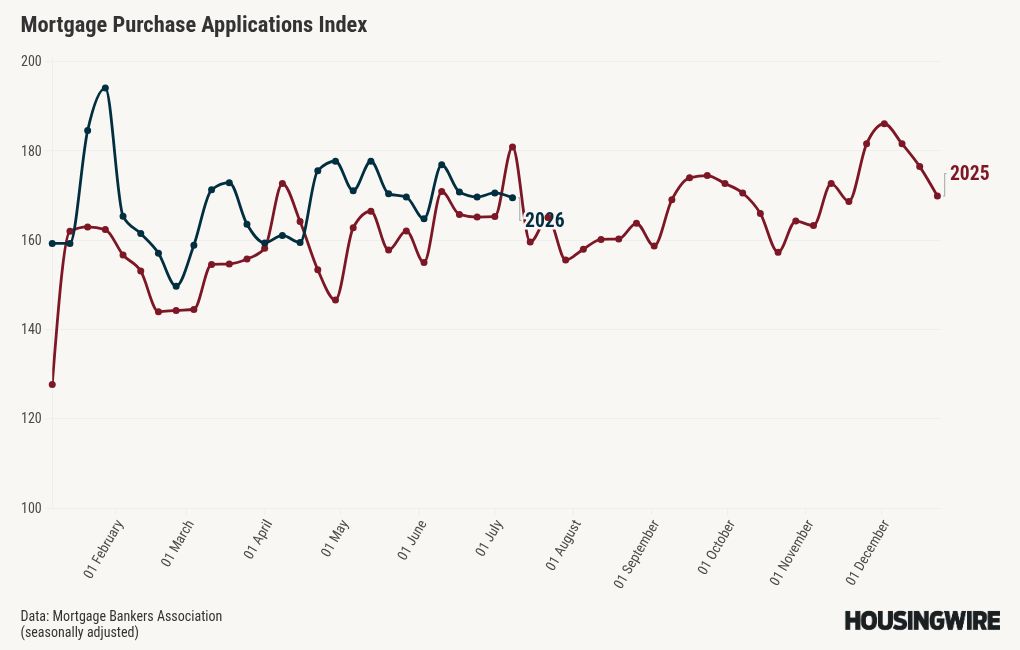
Those are real provisions. But the bill is not a machine that’s going to start bending the cost barriers for would-be renters.

It does not directly remove rent-control regimes. It does not override local zoning. It does not force cities to reduce parking mandates or impact fees. It does not preempt local design review. It does not standardize building-code adoption. It does not eliminate NIMBY delay. It does not lower insurance premiums, property taxes, or construction labor costs.

ROAD may improve the odds that certain projects pencil. It may give pro-housing state and local officials a better federal toolkit. It may help developers point to a national bipartisan consensus that more rental housing is essential. It may turn some public funding and planning energy toward supply rather than scarcity management.

But apartment production still depends on city councils, planning boards, neighborhood politics, state preemption choices, building departments, lenders, insurers, and capital markets.

The bill points in the right direction. But will enough jurisdictions follow it?

For multifamily, the ROAD Act’s promise is not that Washington can solve the rental affordability crisis by itself. Washington can stop adding friction where it controls the process and start rewarding the places willing to remove friction where they do. That is not the end of the road. For apartment investors, developers, builders, property owners and managers, it may be the first high-occupancy lane.

This post was originally published on here

Former Zillow employee Samuel James Herrera has notified a Denver-based U.S. District Court that he and his former employer are working toward a settlement in his job discrimination lawsuit. 

On Wednesday, Herrera, who calls himself “a day-one Zillow employee,” notified Judge Regina Rodriguez, who is overseeing the lawsuit in a Denver-based federal court, that the parties were working toward a settlement agreement.

According to the notice of settlement, the agreement resolves all of the claims in the case. The filing said the terms of the settlement are still being finalized. 

Parties typically file notices of settlement in a lawsuit when all or some of the plaintiff’s claims have been settled.

In his complaint, filed in September, Herrera claimed he was wrongfully terminated by Zillow in February 2024. 

During his time with the firm, Herrera claims he earned seven promotions, ultimately landing in the role of general manager of rentals, Eastern region in 2022.

At Zillow, Herrera said he was known for his “stellar performance,” which he claims continued in his final general manager role. In this role, Herrera claims he regularly exceeded his sales goals, but despite this, he says he was passed over for further promotions and held to different standards than his white colleagues. Herrera claimed that after complaining of discrimination, Zillow forced him out of the company. 

At the time of the lawsuit’s filing, Zillow told HousingWire that the claims “alleged in the complaint are inconsistent with Zillow’s culture and values, and we believe they are without merit. One of our highest priorities at Zillow is and always has been creating an environment where people do great work and treat each other with dignity and respect.” 

Additionally, the listing portal giant noted that while Zillow was founded in 2004, Herrera did not join the firm until 2010, making him a long tenured employee, but not a “day-one” employee.

Zillow did not immediately respond to HousingWire’s request for comment on the settlement. 

Editor’s note: An earlier version of this article said a settlement had been reached. The article has since been clarified to say that they parties are working toward an agreement.

This post was originally published on here

Consistent growth and disciplined hiring have helped The Craig Tann Group become one of the nation’s highest-performing real estate teams.

Based in Las Vegas, the team closed just under $486 million in sales volume across 877 transaction sides last year — earning the No. 10 national ranking for sales volume and No. 3 ranking for transaction sides among mega teams on RealTrends Verified’s rankings.

The operation also finished No. 1 in Nevada for both volume and sides.

Recognition comes as founder Craig Tann continues expanding his broader real estate business. Tann launched The Craig Tann Group in 2012 before opening independent brokerage Huntington & Ellis in 2016.

Huntington & Ellis reported $1.44 billion in sales volume across 2,496 transaction sides in 2025 and has grown to 175 agents.

Despite a challenging housing market marked by elevated mortgage rates and slower sales activity in recent years, Tann detailed consistent growth in an interview with HousingWire.

“We’ve grown every year since essentially since our inception, so 10 years,” he said. “Every year we’ve seen pretty significant growth on average between like 15% to 20%. I would say it’s our hiring process and hiring standards. We do have requirements that agents have to meet every year.

“That’s also helped us attract really high-quality agents that want to be in an environment where other agents are succeeding at a high level.”

The Craig Tann Group includes 40 agents operating within Huntington & Ellis. Consistent growth has helped pave way for the opening of a second office in Henderson, Nevada.

“We’ve talked about it for the past three years, but we’ve really worked on executing the plan over the last six to eight months,” Tann said. “We technically have a second office already, but it’s right next to our main office, so it’s really just one office. We just ran out of space.”

Building a business from the ground up

Tann entered real estate more than two decades ago after receiving an opportunity from a family friend who owned a brokerage in New York.

After working there until age 21, Tann vacationed in Las Vegas and made a life-changing decision.

“I decided I was just going to pick up and move [to Las Vegas],” he said. “So, I moved out from New York by myself at 21 and then started with a big franchise brokerage and just kind of worked my way up — slowly learned the business. Then I learned how to build a team and after building the team, I wanted to take the next step and be a little bit more creative.

“I really enjoyed the marketing side of the business, and the next step for me was starting the brokerage.”

Today, Huntington & Ellis operates as an independent brokerage, something Tann believes provides a competitive advantage in a rapidly changing industry.

“In a fast-paced changing market, you know, the independents can operate more like a speedboat versus a cruise ship, so it allows us to pivot quickly,” he said. “We can take advantage of new opportunities quickly. I think that’s one of the things that agents are attracted to. We get to create the environment. It’s not set by a big corporate company. We get to create exactly how we operate.”

The brokerage also works to differentiate itself through in-house support services, including a full marketing department and staff videographers — allowing agents to focus primarily on serving clients, Tann added.

Advice for growing teams

As more agents seek to build larger teams, Tann encourages leaders to prioritize opportunity and culture over rapid expansion.

“Build a strong reputation in town, start small and only hire as needed,” he said. “I think some of the mistakes that teams make is they hire to get bigger, and they think that means more profit, and it’s actually the opposite.”

Instead, his organization adds agents only when business demand supports it while maintaining strict expectations.

“We are very picky on the agents that we feel are going to be a good culture fit, and we only hire full-time, all-in agents,” Tann said. “So, they can’t have secondary jobs and they have to be fully committed to the business.”

Las Vegas continues attracting newcomers

Looking ahead, Tann remains optimistic about the Las Vegas housing market despite affordability challenges affecting much of the country.

He points to continued investment throughout the city, including the growth of professional sports, expanding infrastructure and Nevada’s business-friendly environment.

He also said the state’s lack of an income tax continues attracting buyers from neighboring states.

“We’re definitely seeing population grow,” Tann said. “Because we’re so much more affordable than the California or Washington market, plus we’re so much more business and income friendly, it’s just helping us attract some really great growth and population.”

While higher interest rates and home prices remain headwinds, Tann believes Las Vegas continues to offer opportunities for buyers, sellers and real estate professionals alike — positioning both The Craig Tann Group and Huntington & Ellis for continued growth.

This post was originally published on here