Think of Floridian politics, and one does not often evoke the word “sane.” The state, which helped propel George W. Bush to the presidency in 2000 after a major recount dispute, has seen its fair share of political chaos over the years.

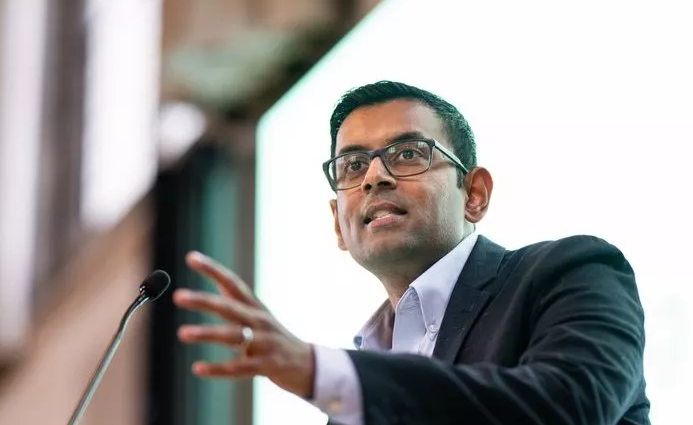
Tuesday’s primaries offered plenty of evidence for why. In one congressional district, social-media provocateur Dan Bilzerian ran a campaign in which he spoke openly of a “Jewish problem,” called his Jewish opponent a “fat Jew,” and released a music video invoking Adolf Hitler in approving terms. Elsewhere, Republican Rep. Cory Mills, already facing House ethics investigations and allegations of sexual misconduct that he denies, was thrown out by his own party.

Amid the circus, something rather sensible happened

Then, amid the circus, something rather sensible happened – Bilzerian was crushed in an embarrassing defeat, which hopefully puts an end to any future political aspirations for the social media personality.

Rep. Randy Fine, the Jewish Republican incumbent in Florida’s 6th Congressional District, took nearly 57% of the vote, while Bilzerian managed less than 19%.

Fine is hardly a poster boy for moderation – some of his own rhetoric about Muslims and Palestinians has repeatedly crossed lines and attracted criticism from both parties – but this was not a competition for civility. Voters were given the chance to vote for a candidate who had made unambiguous antisemitism and anti-Israel views a central part of his political identity, and Florida’s voters acted accordingly and rejected him overwhelmingly.

 Dan Bilzerian. (credit: GETTY IMAGES)

Fine was not the only pro-Israel victor on Tuesday night. Across the state and across the political divide, prominent Jewish incumbents with strong records of support for Israel survived.

Democratic Rep. Lois Frankel took around three-quarters of the vote in her primary for the 23rd congressional district. Debbie Wasserman Schultz, Florida’s first Jewish congresswoman, won a difficult race in unfamiliar territory (20th district) after redistricting dismantled her old seat. Her leading ideological challenger, Elijah Manley, had attacked her support for Israel and the backing she has received from AIPAC. Wasserman Schultz won with just under half the vote; Manley finished far behind with less than 15% of the vote.

Jared Moskowitz also survived a challenge from the Democratic Left. His opponent, Oliver Larkin, was backed by the Democratic Socialists of America (DSA) and opposed US military aid to Israel. Moskowitz, a Jewish Democrat and one of Israel’s more outspoken supporters in his party, won with roughly 63% of the vote.

Hostility toward Israel has become a badge of political identity on the Left

These are very different politicians from across the political spectrum campaigning on different platforms, but at a time when antisemitism has become increasingly brazen on parts of the American Right, while hostility toward Israel has become a badge of political identity among parts of the progressive Left, Florida voters were presented with several unusually clear tests. In race after race, candidates who believed attacking Jews, Israel, AIPAC-funding or the pro-Israel establishment would carry them to victory came up short.

The same picture extended to the race for governor.

Florida, the third-most populous state in America with more than 23 million residents, will choose in November between Republican Byron Donalds and Democrat David Jolly. They disagree sharply on Donald Trump, Iran, and much else, but both are supporters of Israel.

In a state whose relationship with Israel has become unusually close under Governor Ron DeSantis, this would be a positive and important continuation. Whoever replaces him will come from a very different political background, but neither major party has nominated a candidate seeking to tear that relationship up.

There were other interesting election results from Tuesday night in Florida too. Democratic socialist Angie Nixon’s surprise victory over Alex Vindman in the Senate primary reminded us that Florida has not suddenly or completely rejected the progressive Left.

But Vindman’s defeat had more to do with resources and organizing than with Israel. He sat on a $16 million war chest but spent just $2.2 million on ads, leaving him flat-footed against Nixon’s grassroots, DSA-backed campaign — the same playbook that has toppled establishment favorites in Democratic primaries elsewhere this cycle.

On Tuesday, Floridians were offered unequivocal antisemitism on the Right, efforts to turn hostility toward Israel into an electoral weapon on the Left, and scandal and political theater almost everywhere in between. For once, sanity was allowed to reign supreme.

This post was originally published on here. 

Turkey firmly rejected on Wednesday what it called “untenable allegations” by Israel regarding its military position in Syria, after Israel bombed a Syrian air base near the Turkish border and said Syria was on the verge of permitting Turkish troops to deploy there.

Israel carried out airstrikes against the Abu al-Duhur base near Aleppo on Tuesday, drawing condemnation from Turkey and criticism from a US envoy who called the attack an “unnecessary escalation.”

In a statement, Prime Minister Benjamin Netanyahu’s office said late on Tuesday that Syria was on the verge of violating a “status quo agreed with Israel in security matters” by allowing Turkish troops to deploy at the airbase, adding that such a deployment would threaten Israel’s security and it would not tolerate this.

In response, Turkey’s presidency said the “imputations” from Netanyahu’s office stemmed from his intention to pursue “expansionist and destabilizing policies” ahead of elections in Israel, adding that lasting regional peace could only be achieved if Israel respected international law and abandoned its “aggressive and coercive policies.”

“The untenable allegations put forward by the Israeli Prime Minister’s Office are intended to legitimize Israel’s unlawful airstrikes targeting Syria’s sovereignty and territorial integrity,” it said on X, without explicitly referring to any potential deployment plans.

Syria's interim president Ahmed al-Sharaa and Turkish President Recep Tayyip Erdogan hold a joint press conference following their meeting at the Presidential Palace in Ankara, on February 4, 2025. (credit: Yavuz Ozden/ dia images via Getty Images)

“Turkey will resolutely continue to cooperate with the Syrian Government on a legitimate basis for the establishment of peace, stability, and prosperity in Syria, and will never allow the destabilization of Syria.”

Israel, Turkey tensions escalate over competing military presence in Syria

The strikes on Tuesday follow worsening security tensions between Israel and Turkey and increasingly sharp rhetoric between the two countries over Syria, where both countries’ militaries are active.

Turkey, which has NATO’s second-largest army and has emerged as one of Syrian President Ahmed al-Sharaa’s main allies, accuses Israel of trying to destabilize Syria and undermine its new administration, repeatedly calling for international pressure and measures on Israel to respect Syria’s territorial integrity.

Ankara has been training Syria’s army, helping it rebuild its state institutions and infrastructure, and providing military and diplomatic support.

US seeks expanded coordination to avoid Israel, Turkey incidents in Syria

Last year, Turkey and Israel, also sharply at odds over the war in Gaza, established a line of communication to avoid any incidents in Syria.

Tom Barrack, the US special presidential envoy for Syria and Iraq, told Reuters after the strikes on Tuesday that Washington was working to establish a deconfliction mechanism among Israel, Turkey and Syria, and added the US already facilitates an information-sharing and dialog mechanism among the parties.

This post was originally published on here. 

Watch this episode without interruptions.

Listen wherever you get your podcasts.

The Jerusalem Post’s new culture program, The Jerusalem Playlist, launched this week with a look at Israeli cinema, Jewish identity in France, and an unusual Jerusalem art exhibition featuring artists on the autism spectrum.

The program, produced by Gadi Zaig, and hosted by Jerusalem Post culture writer and film critic Hannah Brown and social media manager Ezra Taylor, opened with a discussion on Our Loves, the latest film by veteran Israeli director Avi Nesher, which is set to screen at the Toronto International Film Festival.

The drama begins on October 6, 2023, following several characters who believe they are experiencing the worst day of their lives before the events of October 7 transform their stories. Brown said the film differs from earlier productions about the massacre by introducing fictionalized characters grounded in extensive research rather than recreating specific individuals’ experiences.

International producers Fox Entertainment and Access Entertainment have joined the project, giving the film a path toward theatrical distribution outside Israel, including in the US and Europe.

Looking at French Jewish cinema as well

The episode also examined Just an Illusion, a French Jewish film by directing partners Eric Toledano and Olivier Nakache. The semi-autobiographical story follows a Jewish boy growing up in a Mizrahi family in 1980s Paris while preparing for his bar mitzvah and navigating family life, friendships, and questions of French, Jewish, Moroccan, and Algerian identity.

The film has sold around two million tickets in France and recently opened in Israel, with a US release expected later this year.

Brown also discussed Feelings in Between, an exhibition at the Jerusalem Theater featuring collaborative works by artists on the autism spectrum, including her son. The exhibition, which runs through the end of August, challenges assumptions about autism by showing artists choosing to create works together.

This post was originally published on here. 

The United Arab Emirates has suspended “all trade, commercial exchange and financial transactions with Iran” after the Islamic Republic attacked a number of UAE-owned tankers and rejected new talks with the United States, the UAE’s Foreign Ministry announced late on Monday night.

Only shortly before the UAE Foreign Ministry’s Director of Strategic Communications Afra Al Hameli made the statement, Iran fired two missiles toward the UAE, one of which fell within Emirati territorial waters while the second landed outside its territory.

The decision follows a spate of attacks on UAE-owned tankers and Tehran’s rejection of talks with the US. Shortly before the statement, Iran fired two missiles at the UAE. One landed in Emirati territorial waters, while the second landed outside its territory.

Iranian FM denied that Iran was behind the launches

Iranian Foreign Ministry spokesman Esmaeil Baghaei on Tuesday denied that Iran was behind the launches, claiming, according to state media, that the “allegation runs counter to the principle of good-neighborliness and undermines ongoing efforts to strengthen trust among regional countries and prevent a further escalation of insecurity in the region.”

Despite Baghaei’s comment, the Islamic Republic has launched numerous attacks on countries across the Middle East since February 28, when the US and Israel attacked the Islamic Republic. According to The National, at least a dozen people have been killed in the UAE during the conflict and more than 200 injured.

Iran's Foreign Ministry spokesman Esmaeil Baghaei speaks during an interview, amid the US-Israeli conflict with Iran, in Tehran, Iran, April 5, 2026.  (credit: Majid Asgaripour/WANA/via Reuters)

“The United Arab Emirates rejects all claims regarding the status of its economic relations with the Islamic Republic of Iran, while reaffirming its steadfast commitment to dialogue, co-operation and regional integration as essential means to enhance peace, stability, and prosperity in the region,” Hameli said in a statement posted on X. 

This post was originally published on here. 

Attorney-General Gali Baharav-Miara on Wednesday proposed postponing the decision to establish a commission of inquiry into the October 7 Massacre until a new government is formed.

She said the election period would get in the way of a decision and noted that the current government had not established one anyway.

Following her statement, the Movement for Quality Government decried the decision, stating, “It is impossible to determine that a state commission of inquiry is essential for uncovering the truth, to warn that the delay may already cause harm to the investigation, and in the same breath propose postponing it again.”

The next government may not be formed for many months, more than three years after the October 7 disaster. The truth cannot wait for the political quagmire. Every day that passes makes it more difficult to uncover the truth, draw lessons, and determine responsibility for the gravest failure in the country’s history.”

Shortly after the Knesset’s dissolution in July, the government informed the High Court of Justice that it had been unable to complete legislation establishing its proposed commission of inquiry into the October 7 massacre “due to the constraints of the Knesset’s schedule,” and that the lawmakers had left for the election recess.

A memorial ceremony at the Nova festival marking two years since the October 7 massacre when Hamas terrorists infiltrated southern Israel, murdering more than 1200 people. October 07, 2025. (credit: Tsafrir Abayov/Flash90)

Gov’t previously stated commission proposal would be revived next term

At the time, the government told the court it would revive the proposal after the October 27 election, while asking the court to dismiss petitions seeking a state commission of inquiry and leave the issue to the voters.

Since the October 7 massacre, the subject of a commission of inquiry into the events has reached the Knesset floor several times, including just two weeks before the Knesset’s dissolution, when the plenum passed in its first reading a coalition bill seeking to establish a politically appointed investigative committee to probe government failures during the October 7 massacre.

Majority of Israeli society supports commission of inquiry into October 7 massacre

A Jewish People Policy Institute (JPPI) Israeli Society Index published in May revealed that nearly two-thirds of Israelis (63%) support the immediate establishment of a commission of inquiry into the October 7 massacre, and the position is shared by a majority in both the Jewish (62%) and Arab (67%) sectors.

In general, some 15% of Israelis believe that forming the committee should be delayed until the war has fully ended, while even fewer (11%) believe that the decision on when to establish the committee should be left up to the government’s discretion.

Regarding the type of inquiry committee to form, 46% of respondents prefer a state commission of inquiry, while  40% prefer a national inquiry committee.

Sarah Ben-Nun and Keshet Neev contributed to this report.

This post was originally published on here. 

Israeli authorities detained the Palestinian Authority’s Jerusalem Affairs Minister, Ashraf Hassan Abbas al-Awar, at his home in the Silwan neighborhood in east Jerusalem on Wednesday morning, the PA’s official news agency WAFA reported.

Awar was taken for questioning, according to the reports.

The reasoning behind the detention is unclear, and The Jerusalem Post reached out to the IDF and Israel Police for confirmation.

Palestinian Authority Prime Minister Mohammad Mustafa appointed Awar as Jerusalem Affairs Minister in 2024.

This is a developing story.

This post was originally published on here. 

National Security Minister Itamar Ben-Gvir visited a village in northern Israel on Tuesday and was met with insults and ridicule from local residents.

Ben-Gvir toured the streets of Basmat Tabun accompanied by heavy security and faced a barrage of curses and harsh criticism from residents over his performance.

“You are making a fool of yourself,” residents shouted at him. “You’re a clown. Everyone is laughing at you. You are a champion of failure. They didn’t even give you a visa to the United States.” Residents heard in a video even called the minister a “terrorist,” saying, “A minister convicted of terrorism, you’re a terrorist. Go to a mental institution – you shouldn’t be here. You incite terror.”

The video published Tuesday came against the backdrop of two other recent incidents in which the Arab public voiced harsh criticism against Ben-Gvir and Israel Police.

Earlier this week, residents of Umm al-Fahm claimed that Israeli police forces raided a wedding in the city and ordered guests to lie on the floor. Video footage from the incident shows police officers with drawn weapons walking among guests lying on the ground.

National Security Minister Itamar Ben-Gvir showcases an execution facility for the hanging of convicted terrorists being built within the already-constructed death row prisoner wing in central Israel, August 18, 2026. (credit: Itamar Ben-Gvir’s Office)

Wedding interruptions by police called ‘political stunts’

The police explained that “the activity documented in the video was conducted following suspicion of weapons use during a wedding.” They further stated: “Accordingly, police forces and officers operated at the scene to inspect suspicions and locate weapons.”

Dr. Yousef Jabareen, chairman of Hadash and a resident of Umm al-Fahm, attacked Ben-Gvir following the incident: “I explicitly accuse Ben Gvir of exploiting his authority to harm and persecute the Arab public, because it serves him in his election campaign.”

In another incident over the weekend, police detained a bride and groom from the south for questioning after claiming their wedding convoy disrupted traffic.

The couple claimed that due to the detention, they arrived late to their own wedding and some guests had already left. The groom and his father pointed the finger at Ben-Gvir, claiming he “used them for a political stunt.”

Ben-Gvir, for his part, responded to the wedding convoy incident: “We are putting an end to wild wedding convoys in the Negev and shooting at weddings that endanger human lives. They will keep babbling, and I will keep working.”

This post was originally published on here. 

  • In today’s CEO Daily: How CEOs can plan for successful retirements.
  • The big leadership story: Bank of America is worried about bonds.
  • The markets: Mixed as inflation expectations tick up.
  • Plus: All the news and watercooler chat from Fortune.

Good morning. Phil Wahba writing from New York. Earlier this month, I wrote about how more companies, among them Verizon, Boeing and Cracker Barrel, have been hiring CEOs out of retirement, often in times of crisis. But why do these CEOs, who are presumably wealthy enough to never work again, accept a grueling new assignment in their sixth or seventh decades? A new study suggests an answer: They simply weren’t prepared for retirement.  

New data published by Boston Consulting Group (BCG) in early August found that only 40% felt satisfied with their transition from hard-charging CEO to retiree in the first year after making the move. It seems that many CEOs, like millions of other Americans, underestimate the emotional upheaval that comes from suddenly having a lighter schedule, no longer having a role central to their identity, or no longer having the structure that a job gives them.

“Is the decision to get a new CEO job really motivated by value creation where you know a unique skill that you bring that only you can do, or is it … really more fear or vanity?” asks Christine Barton, leader of BCG’s North America CEO Advisory practice.

It can be especially difficult for CEOs who are still relatively young, in their 50s and 60s, who want to stay in the mix. Mary Dillon, former CEO of Ulta Beauty, told me three years ago that when she came out of retirement after a highly successful stint at Ulta to lead Foot Locker in her early 60s, that “I didn’t realize how much I would miss having one big thing to focus on and how much I would miss leading a retail company.”

Here is something companies can help with: Helping CEOs prepare to leave. Having an executive coach is pretty standard now, but Barton says there is a growing niche within the CEO coaching world specifically tailored to helping executives prepare for active retirement and build their legacy.

The survey of former CEOs of companies with at least $1 billion in revenue found that 3 to 4 meaningful activities, such as serving on a board, being an advisor, or teaching, were the sweet spot where one can both still feel needed and useful but not overprogrammed.

Again, self-awareness is key. “The portfolio career can be incredibly exciting, but it has to be intentional, and you have to do real self-reflection on whether or not you’re at that stage,” says Barton.

The BCG report found that after one year, 90% of CEOs were happy with how things went down with their retirement. But Barton says there’s one sure fix for having to lure a CEO back from retirement: Focus on building a robust internal pipeline now, long before your leader is ready to leave. 

Contact CEO Daily via Diane Brady at diane.brady@fortune.com

This story was originally featured on Fortune.com

This post was originally published here. 

Good morning,

Save a horse, ride a Pony.ai?

Chinese autonomous driving company Pony.ai is planning to expand beyond its home country. The company announced potential overseas robotaxi ​deployments of more than 4,000 vehicles on Tuesday just as fellow autonomous driving firms fight to commercialize robotaxi services abroad.

The news comes only days after Pony announced an expanded contract with Uber for deployment of more than 2,000 robotaxis in Europe.

Self-driving cars aside, here’s what else happened in tech.

Want to send thoughts or suggestions to Fortune Tech? Drop a line here.

This story was originally featured on Fortune.com

This post was originally published here. 

In 2019, amid a national conversation about climate change as a public health issue, the accrediting body for the nation’s public health schools posted an article on its blog noting that its curriculum standards include many of the issues raised in the debate.

One of these core competencies highlighted in the blog post, titled “When current events collide with CEPH competencies,” asked that students “Discuss the means by which structural bias, social inequities, and racism undermine health and create challenges to achieving health equity at organizational, community, and societal levels.” 

Read the rest…

This post was originally published here. 

Three months before a young boy died in Huidagene’s gene editing trial last year, the company’s former CEO Alvin Luk presented its early data at the American Society for Gene and Cell Therapy’s Presidential Symposium, one of the field’s biggest stages. 

STAT asked several experts in gene editing and muscle disorders to review video of the presentation. They came away divided — often starkly — on the quality of the company’s science and the wisdom of the approach.

“I’m not impressed,” said Dongsheng Duan, who has spent a decade studying gene editing for Duchenne at the University of Missouri, in an email. 

Continue to STAT+ to read the full story…

This post was originally published here. 

“Can we talk … in private?” The man was nervous, hands wringing like a little boy in trouble, though he was perhaps a decade older than I am.

A minute later, we were seated in the tiniest exam room, the one off in the corner that we try to never use. (I’ve re-created the conversation here to the best of my recollection.)

Read the rest…

This post was originally published here. 

At the age of 23, Elisabeth Marnik approached her doctor with an unusual request: Vaccinate me. Against everything. 

She had never received a single vaccine. But now, angry and defiant, she was turning away from the beliefs of her childhood, instilled by a mother who distrusted science. A doctor for adults doesn’t typically have childhood immunizations on hand, so she made her way to a travel clinic and eventually got all the once-forbidden shots.

Read the rest…

This post was originally published here. 

Every few weeks, another headline announces that artificial intelligence has matched a doctor, beaten a doctor, or is finally ready to become one. The latest wave arrived with familiar force: Several studies claim that AI outperforms physicians on clinical reasoning tasks.

The implication is hard to miss. Doctors are slow, expensive, and human. AI is faster, and potentially better. 

Read the rest…

This post was originally published here. 

The U.S. national debt is hurtling toward $40 trillion, and Bank of America Research strategist Michael Hartnett’s “Anything but Bonds” framework is becoming ever more applicable. Boiled down, Hartnett warns the US is accumulating too much debt, which causes the government to issue too many bonds—and investors want compensation for the fiscal risk—making long-duration Treasurys unattractive compared to other assets. Here’s why the climbing debt makes the advice worth a listen.

The U.S. national debt stands at roughly $39.9 trillion in mid-August and is expected to cross the $40 trillion threshold as early as this week. According to the Treasury’s official data, the government’s outstanding debt is made up of both intragovernmental holdings and debt held by the public.

Hartnett, Bank of America’s chief investment strategist, has turned that fiscal deterioration into one of his central investment themes. His “Anything but Bonds” call reflects his view that investors should be wary of long-duration government debt while the U.S. continues to run large deficits and the market demands higher yields to finance them. He expects the national debt to reach $50 trillion by 2029.

The concern is not that the government owes a lot of money. It’s that the government has to continually refinance and issue more debt, creating a larger supply of bonds that investors need to absorb. If investors become less willing to buy that debt at existing yields, the government has to offer higher interest rates to attract them.

This dynamic is already visible in the Treasury market. The yield on the 10-year Treasury reached 4.6%, while the 30-year yield hit 5.2%. Those elevated yields reflect the concerns over inflation, fiscal sustainability and the sheer amount of government borrowing. For bond investors, rising yields are a double-edged sword.

New bonds become more attractive because they offer higher income, but existing bonds lose value when market yields rise. The longer the maturity of the bond, the more sensitive the price generally is to changes in interest rates. That makes long-duration Treasurys particularly vulnerable if investors continue to demand higher returns to compensate for fiscal and inflation risks.

And while bonds may not be an attractive investment according to the Bank of America strategist, the bond market can represent one of the clearest gauges of the economy’s underlying health. Treasury yields reflect what investors think about inflation, economic growth, interest rates and the government’s ability to manage its finances.

When yields rise, the implications extend far beyond bond portfolios, especially due to Treasury rates helping setting the baseline cost of borrowing throughout the economy. The higher yields can translate into more expensive mortgages, corporate loans and consumer credit—potentially slowing investment, housing and spending. 

The federal government has borrowed $1.8 trillion during the first 10 months of fiscal 2026, including $432 billion in July alone. That borrowing creates a feedback loop. More debt creates more interest payments, and the interest payments can mean larger deficits. Ultimately, the Treasury must issue even more securities to make up for the borrowing. And the scale is already massive.

The interest bill on the national debt has climbed to roughly $1.4 trillion over the past year, according to Hartnett’s latest outlook. He argues the “Anything but Bonds” trade is unlikely to end until five-year Treasury yields fall below roughly 3.25%.

That explains why Hartnett is looking beyond traditional fixed-income investments. His argument expands that risk-reward has changed. Hartnett points to assets including gold and equities—and even opportunities in areas such as biotech and real estate. 

“The U.S. stock market hit an all-time high on the same day that the U.S. Treasuries issued at their highest yield in 25 years,” Hartnett said in the report. “That’s reality.”

This story was originally featured on Fortune.com

This post was originally published here. 

Several major universities had a record-breaking donor year in 2025, including the University of Oklahoma, Florida State University, and the University of Tennessee.

But the University of South Carolina had a banner year, shattering its fundraising record by nearly $100 million. The USC system raised a record $357.6 million in private donations during fiscal year 2026, up from its previous record of $259.7 million just one year before. 

Several large investments led the record-breaking year, including one from the Robert and Janice McNair Foundation, established by the late billionaire Houston Texans founder, who died in November 2018. Janice McNair recently died on July 14, 2026. 

Robert, a 1958 USC graduate, and his wife, Janice, established the McNair Scholars program at USC in 1998. The merit-based scholarship is offered to the top 20 out-of-state students each year entering the South Carolina Honors College.

“Those who demonstrate outstanding academic achievements with a commitment to service and leadership represent our future,” Robert and Janice McNair said in a joint statement published on their foundation’s website. “We are delighted to provide scholarships to these deserving students.” 

In 2026, the Robert and Janice McNair Foundation donated $25 million to USC, part of the couple’s longstanding philanthropic partnership with the university. All in, the foundation has given at least $81 million to USC since 1998, starting with a $20 million gift to launch the McNair Scholars program. Other major gifts included $10 million to sustain the scholars program, $8 million to found the McNair Institute for Entrepreneurism and Free Enterprise, $18 million for more scholar awards, and the $25 million gift this year. 

It’s unclear whether the $25 million gift is going toward just the scholars program. The foundation didn’t immediately respond to Fortune’s request for comment. 

How Robert McNair made his fortune and gave it away 

McNair’s path to billionaire status wasn’t linear. He spent most of his 20s and 30s as a struggling salesman and unsuccessful entrepreneur before breaking through with cogeneration company Cogen Technologies, which grew into the world’s largest privately owned cogeneration company. 

“Many people say I was an overnight success, and I was, after 20 years of struggling,” McNair told Houston Lifestyles & Homes.

The payoff came in 1999, when McNair sold Cogen to Enron for $1.5 billion. He used the windfall to win the NFL’s 32nd franchise, the Houston Texans, for $700 million that same year, and the team began play in 2002. 

But the McNairs channeled their fortune into far more than football. Making education and medical research the cornerstones of their giving, the couple contributed more than half a billion dollars to charity over the decades. 

Robert also served on Baylor College of Medicine’s board of trustees in Waco, Texas, from 1994 until his death, and in 2007, the McNairs gave $100 million to Baylor—tying the largest donation in the school’s history—to fund research into breast and pancreatic cancer, juvenile diabetes, and the neurosciences. The gift helped establish the McNair Medical Institute, and the campus was later named in their honor.

Their reach extended well beyond Texas. The couple seeded programs at USC, Rice University, M.D. Anderson Cancer Center, the University of Texas Health Science Center at Houston, and Texas Children’s Hospital. 

Closer to Robert’s roots, the Robert and Janice McNair Educational Foundation, launched three decades ago for students at his old North Carolina high school, has awarded nearly $9 million in scholarships and transformed college readiness across his hometown of Rutherford County, N.C.

This story was originally featured on Fortune.com

This post was originally published here. 

The Strip is one of Nevada’s most concentrated gambling corridors. Sin City casinos there brought in roughly $8.8 billion in gaming revenue in 2025—about $24 million a day—and raked in roughly 56% of the state’s $15.8 billion in total gaming revenue that year. It also saw 38.5 million visitors in 2025, directly supporting more than 250,000 jobs in the area.

So it wasn’t a surprise with Tesla Robotaxi filed an application with the Nevada Transportation Authority (NTA) in June and asked for permits for 5,000 autonomous vehicles to operate within the city. But it was a surprise when the NTA responded a month later, giving the robotaxi arm of Elon Musk’s brainchild a “maximum fleet of ten (10) fully autonomous vehicles.” The permit also confined those 10 robotaxis to an Authority-approved corridor along the Strip and barred speeds above 45 mph. Most importantly for the tourism industry, the permit prohibits passenger pickups within one-quarter mile of the airport “unless authorized by the airport operator and all required governmental approvals have been obtained.”

Every vehicle must be marked “Robotaxi,” riders must be notified before each trip they’re in a driverless vehicle, and operations require “appropriate human supervision” under Society of Automotive Engineers standards. That supervision requirement is a step back from what Tesla runs elsewhere: The company has offered rides in parts of Austin with no safety monitor in the vehicle since January, and Nevada’s language suggests regulators aren’t ready to extend Tesla that same latitude here.

Clark County, which doesn’t issue the permit itself but has to live with what the NTA approves, says the arrangement leaves it managing fallout without a formal role in setting the terms.

“While the Clark County does not authorize this type of transportation on our roadways, we are directly impacted by the operations of the robotaxis,” a county spokesperson told Fortune. “County impacts include several departments such as Clark County Fire, Business License, and Harry Reid International Airport to name a few, and we are working to get our arms around how best to facilitate these types of operations going forward.”

Neither Tesla nor the Nevada Transportation Authority responded to Fortune’s request for comment.

Creating the infrastructure

Tesla had been building toward this before the permit came through. The company is putting $3.1 million into retrofitting a 37,000-square-foot building in the southwest Las Vegas valley, just as it undergoes hiring for Vegas-based robotaxi roles. Unlike Zoox and Motional, both of which lease or partner for their vehicles, Tesla builds the car, writes the self-driving software, and now holds the commercial permit all under one roof.

Tesla isn’t the first company to go through this process, and the terms it got look modest next to what’s already running. Amazon’s Zoox has held permits since 2025, starting under a 65-vehicle cap on a free-rides-only basis. The NTA amended that permit in July this year, two weeks before Tesla’s approval, to allow up to 100 vehicles and paid fares, and Zoox began charging for those rides on Aug. 10, after the National Highway Traffic Safety Administration granted it a two-year federal exemption covering up to 2,500 vehicles nationwide, due to Zoox’s robotaxi having no steering wheel or pedals, putting it outside several federal vehicle safety standards.

In Las Vegas alone, Zoox says its fleet has logged more than 3 million miles and carried nearly a million riders for free since last year; it’s now running roughly 50 cars on the Strip and pricing rides at a “comfort” tier, which is above standard UberX fares. Zoox’s longer track record in Nevada—reporting has put its Las Vegas totals as high as 100 vehicles and 350,000 rides along the Strip—likely explains why the NTA started Tesla at 10 rather than at a larger number: The Authority has effectively used Zoox’s rollout as a template for scaling a new permit up over time.

For now, Tesla’s Las Vegas presence is 10 cars on a quarter-mile-restricted stretch of the Strip, capped at 45 mph, with no word yet on when rides start.

This story was originally featured on Fortune.com

This post was originally published here. 

UnitedHealth Group is contesting an Internal Revenue Service proposal to increase its taxable income over how it priced transactions with one of its foreign subsidiaries, a dispute the company disclosed in a quarterly filing in May and repeated in its August filing. 

The notices cover transactions between UnitedHealth and a foreign subsidiary from the 2017 through 2020 tax years, according to the May filing. The IRS is seeking to “significantly increase taxable income” for each of those years, and could seek similar adjustments for later years.

UnitedHealth is not conceding. In its August filing, the company said it believes its tax positions are properly supported and plans to “vigorously contest” the IRS’s proposed adjustments.

This dispute comes amid a broader push from the IRS that began more than a decade ago to scrutinize how American multinational corporations allocate profits between their U.S. operations and foreign subsidiaries.

“This is quite common because the IRS has, since the Obama administration, increased its scrutiny of transfer pricing by U.S. based multinationals who are trying to shift profits out of the U.S. to their foreign subsidiaries,” Reuven S. Avi-Yonah, the Irwin I. Cohn Professor of Law at the University of Michigan Law School, told Fortune.

The agency has fought similar battles with some of corporate America’s biggest names, including Coca-Cola, Meta and Medtronic. Those cases have produced very different outcomes.

“The IRS has won some of these cases and lost others and the sums involved are usually in the billions,” Avi-Yonah said.

UnitedHealth emphasized that the dispute remains unresolved.

“The company has previously disclosed the IRS examination and related tax matters in its public filings and believes its tax positions are properly supported,” a UnitedHealth Group spokesperson told Fortune. The spokesperson said the matters “remain subject to further review and discussions.”

Neither filing names the subsidiary, says where it is based, describes the transactions at issue, or attaches a dollar figure to what the IRS is seeking.

That makes UnitedHealth’s dispute difficult to size. While other transfer-pricing fights have involved billions of dollars, neither the company nor the IRS has disclosed enough to know what transactions the agency is challenging here or how much money is at stake.

A Notice of Proposed Adjustment is issued during an examination. It is a proposal, not a final determination, assessment, or penalty. A company that disagrees can contest it through an administrative process, and unresolved disputes can reach court.

What is transfer pricing?

At issue is the price a company sets on transactions between its own units in different countries. Since those prices can affect how much profit is attributed to each country, they can also affect where taxes are paid.

Section 482 of the tax code allows the IRS to adjust a company’s taxable income if it believes transactions between related businesses were not fairly priced. 

The rule is simple to state but notoriously hard to apply because there is often no unrelated third party doing the same deal to compare against. Two sides can examine the same intercompany transactions and reach different conclusions, leading to disputes that can take years to resolve.

But UnitedHealth’s disclosure does not reveal what kind of transaction triggered the proposed adjustment.

Many major transfer pricing disputes have centered on intellectual property transferred to foreign subsidiaries, Avi-Yonah said. But he cautioned he does not know enough about UnitedHealth specifically to say what the agency is examining.

How big can transfer-pricing fights get?

Coca-Cola shows how large a transfer-pricing disagreement can become.

The beverage giant’s dispute could ultimately involve roughly $20 billion in tax and interest. Coca-Cola has already paid the IRS $6 billion covering tax years 2007 through 2009 while it appeals, and estimates it could face roughly $14 billion in additional tax and interest for 2010 through 2025 if the IRS adjustments upheld by the Tax Court ultimately stand. Its reserve stood at $529 million as of July 3, 2026. 

Meta is also contesting an IRS notice asserting $15.89 billion in additional tax, plus interest and penalties, for its 2017 through 2019 tax years, primarily related to transfer pricing with foreign subsidiaries and other international tax adjustments. The company petitioned the Tax Court in December 2025.

These disputes can outlive multiple corporate and presidential administrations. Coca-Cola’s fight concerns tax years 2007 through 2009, while Medtronic’s began with its 2005 and 2006 tax years and just entered settlement talks this March after two trips to a federal appeals court. Avi-Yonah has written that the Medtronic case will likely take more than 20 years to resolve.

None of these cases predicts where UnitedHealth’s dispute will land. However, they do show how large and how protracted transfer pricing fights can become once they escalate.

What happens next?

If the dispute is not resolved during the examination, UnitedHealth can pursue the IRS administrative appeals process and potentially litigate the matter.

One number in UnitedHealth’s filings offers little help in determining the company’s potential exposure. Its gross unrecognized tax benefits rose to $5.6 billion at the end of 2025 from $4.1 billion a year earlier, but the company cautioned against connecting that figure to this dispute.

A UnitedHealth spokesperson said the $5.6 billion reflects reserves across all of the company’s uncertain tax positions and “should not be interpreted as the amount associated with the NOPAs.” The company declined to say how much of the total, if any, relates to this dispute or to identify the foreign subsidiary involved.

The IRS did not respond to Fortune’s request for comment. The agency is generally barred by federal law from discussing individual taxpayers.

UnitedHealth said in its August filing it believes its reserves for uncertain tax positions are adequate “based on current available information,” and it intends to contest the proposed adjustments.

This story was originally featured on Fortune.com

This post was originally published here. 

On Tuesday evening, the Prime Minister’s Office took credit for a strike on Abu al-Duhur airbase in Idlib, Syria. US Ambassador to Turkey and the Trump administration’s special envoy to Syria, Tom Barrack, said that the strike “carried a real risk of rapid escalation into a direct military confrontation between Israel and Turkey as well as Syria.”

“Turkish forces were not aware that the Israeli aircraft were en route to that specific Syrian base, nor of their intended purpose, and therefore could potentially have been inclined to scramble their own jets in the belief that they themselves were under attack,” Barrack said in a Wednesday interview with The Jerusalem Post.

“The events of yesterday were serious and worrisome. However, we are relieved that no human life was harmed and that the situation did not escalate,” he added.

Syria said on Tuesday that Israel had carried out eight airstrikes on the runway and storage facilities at Abu al-Duhur, about 70 kilometers east of the Turkish border.

The Prime Minister’s Office said late Tuesday that Syria was on the “verge” of violating a “status quo agreed with Israel on security matters” by allowing Turkish troops to deploy at the airbase.

Abu al-Duhur base following strikes, Syria, August 18, 2026. (credit: REUTERS/STRINGER)

“Israel repeatedly warned Syria that such a deployment would pose a threat to Israel’s security. Syria chose to ignore these warnings,” the PMO said.

Barrack told the Post that the lack of clear communication channels could have made the situation “much worse,” and that this needs to change.

Barrack: Discussions ongoing about relaunching Israel-Syria deconfliction cell

“We are currently engaged in quiet discussions with all the relevant parties about relaunching a deconfliction cell between Israel and Syria. Turkey can be invited to be a direct or indirect participant,” Barrack said.

“There would be clear value in placing such an arrangement on a standing, full-time basis, with a fusion cell staffed around the clock by personnel fluent in Hebrew, Arabic, English and Turkish, whether through a formal structure or a more flexible, informal channel. Reliable communication remains essential,” he added.

The Trump envoy said that the absence of dependable communication channels itself creates unnecessary risk.

“There is no inherent obstacle preventing these parties from maintaining open lines of communication. Diplomatic discourse is the best prevention to kinetic interactions,” he said.

In recent years, Barrack has hosted several rounds of discussions between Syrian President Ahmed al-Sharaa’s government and senior Israeli officials in an attempt to reach a border agreement between the countries, advance normalization and de-escalate tensions. During the most recent round of talks, the sides even agreed to advance joint economic projects and establish a deconfliction mechanism between the countries, based in Jordan.

“Meaningful progress was achieved in clarifying the concerns of both parties, and in light of recent developments, there is clear value in revisiting these talks at the earliest opportunity,” Barrack told the Post, adding that the Sharaa government has made clear that it harbors no predatory intentions toward Israel and seeks only to protect its own sovereignty.

“Syria has demonstrated itself to be a responsible and stable sovereign neighbor, and a carefully structured de-escalation arrangement would contribute significantly to greater calm and predictability across the region,” Barrack said.

Israeli concerns over Turkish military equipment close to Syria-Israeli border remains sticking point

One of the sticking points during the talks was Israel’s concern that Turkish military personnel or equipment could be deployed at Syrian bases, some of them close to the Israeli border.

In January, the Post reported that the deployment of an advanced Turkish HTRS-100 radar system at Damascus International Airport was viewed in Israel as “extremely troubling.”

Israeli officials feared that a Turkish military installation capable of tracking aerial targets within a 150–200-kilometer range could significantly restrict the Israel Air Force’s freedom of movement in Syrian airspace.

Barrack said that, in the US view, the civilian infrastructure does not pose a security threat to Israel.

“Syria’s ability to maintain safe and reliable domestic aviation depends on functioning civilian radar coverage. We remain convinced that this technical requirement need not pose a security concern, and that further conversations can help clarify the matter to everyone’s satisfaction,” he told the Post.

Barrack added that the US’s immediate priority must be to help lower tensions between Ankara and Jerusalem and prevent any unintended escalation that could prove difficult to reverse.

“All parties should work patiently toward a durable resolution of this highly complex situation. Türkiye and Israel have, at various points over the past three decades, enjoyed periods of constructive and productive relations. President Trump’s plan offers a viable path that can succeed if given the necessary space and support,” he said.

This post was originally published on here. 

In recent weeks, with the elections drawing nearer, the Prime Minister’s Office has been promoting the National Artificial Intelligence Directorate that has been established under its auspices over the past year. Early this month, Prime Minister Benjamin Netanyahu held a ceremonial press conference at which he launched the Directorate and introduced its head, former IDF visual and geospatial intelligence Unit 9900 Brig. Gen. (res.) Erez Askal.

Those backing the declarations included Netanyahu’s personal advisor and Aleph venture capital fund cofounder Michael Eisenberg, with posts on his social media management accounts. In recent days, the prime minister has stepped up his efforts in this matter when he presented the new Likud candidate in the 11th spot on the party list, Oren Dobronsky. After working in Silicon Valley for some time, Dobronsky returned to Israel several years ago. He was a cofounder of browser toolbar company Hotbar, which was acquired for $50 million in 2006.

In recent years, Dobronsky’s appearances on “The Sharks,” (Israel’s version of Shark Tank), a television program on the Keshet 12 station in which entrepreneurs pitch their businesses to a group of wealthy investors, have made him a household name in Israel. He also owns a US chain of hummus eateries. The Likud announcement stated that Dobronsky would be responsible for AI in the next government.

Last Wednesday, the National AI Directorate shifted into high gear and presented details of the plan at a special press conference conducted by Askal in its new offices in a flashy Ramat Gan building. He was surrounded by the new employees in the Directorate, who, like Askal himself, came from the Ministry of Defense, the Prime Minister’s Office, and the office of the Accountant General in the Ministry of Finance.

Behind the formal declarations, glittering appointments, and polished packaging, however, lies a cautious plan that pales in comparison with past promises. An examination of the details of the new initiative shows that instead of a national revolution to put Israel in the forefront of global technology, the new Directorate involves mostly inconsequential measures and leaves the weightiest questions in the AI sector unanswered.

Artificial intelligence. (credit: freepik)

Plan based on AI lessons and building a quantum computer

The plan’s initiatives include: 30 hours of AI lessons a year for 8th and 9th graders; bringing 100 scientists back to Israel (three have undertaken to return so far); publication of a document of intentions for founding a “physical AI city” containing a complex with a hospital, a school, and other public buildings; examination of robotics technologies; issuing a tender with an unknown budget for the construction of a quantum computer; a statement of intentions for the purchase of up to 100,000 Nvidia processors within a few years at an undisclosed cost; founding a special institute with a budget in the tens of millions of shekels to coordinate ventures in cooperation with the private sector. The institute will be headed by Orit Korman Negri, former planning department head in the IDF C41 Directorate.

The items in this extremely modest plan are general. It contains no itemized budget, in contrast to the grandiose plan presented last year by Brig. Gen. (res.) Prof. Jacob Nagel, whom Netanyahu asked to form a defense budget plan and later a strategic plan for the AI Directorate before Askal was appointed.

The plan supported by Nagel included: an NIS 18 billion budget for the construction of a supercomputer equipped with 60,000 Nvidia microchips within two years for use by academic researchers and startup entrepreneurs in the field; a NIS 2 billion AI plan for bringing brainpower back to Israel and developing AI researchers; NIS 1 billion AI training program for high schools and the IDF; the founding of an AI directorate and the construction of a language model in Hebrew. Nagel’s plan envisioned a NIS 25 billion budget spread over five years.

The Directorate, which was to have been formed when the National Committee for Accelerating the Field of AI submitted its recommendations a year ago (the Nagel Commission) and was scheduled to begin investing billions of shekels in October 2025, has presented its new plans only now, at the outset of the election campaign. In practice, these plans virtually ignore the main questions on the agenda:

Construction of a supercomputer is not seriously addressed and no specific budget or location for it is mentioned (arguments are taking place in the Prime Minister’s Office whether it should be built in Israel or in a foreign country); the Directorate has yet to decide whether to establish an original Israel language model; no solution has been offered to a problem that has caused an uproar in the AI sector – the temporary halt in connecting server farms to the electrical grid, which has frozen the planning and construction of dozens of prospective server farms.

The people in charge formulated plans, but most recommendations were shelved

If this sequence of events sounds familiar, it is because this is the fourth time in the past seven years that Netanyahu’s governments have presented a national AI plan – with no results to date. In 2018, Netanyahu asked Maj. Gen. (res.) Prof. Isaac Ben-Israel and Eviatar Matania to devise the first plan after the two men had proved themselves by composing a similar plan to further the cybersecurity sector. Their plan, which recommended a NIS 10 billion allocation for the sector, was ready to be put into effect in 2019, but it was not submitted until 2020 because of the multiple election campaigns that year and was discarded during the course of the political upheavals.

The Israel Innovation Authority undertook to pursue the matter and assembled a voluntary association for the purpose – the National Research and Development Infrastructure Forum (TELEM Forum). In late 2020, the Forum hired former Chief Scientist and Google Israel executive Orna Berry to formulate another plan. She recommended investing NIS 5 billion in the sector. In the end, only a few of her recommendations were adopted and the budget for them was a mere NIS 1 billion.

One of these recommendations, development of a Hebrew language model, was shelved after millions of shekels had been invested when OpenAI launched ChatGPT in 2022. Another recommendation, the development of a supercomputer, was eventually accomplished under Innovation Authority sponsorship with a miniscule budget of only NIS 160 million and a quite small number of graphic processors (about 1,000 Blackwell processors), rendering it inadequate for the needs of industry and academic institutions. The capacity of the national supercomputer is estimated at 4,000 graphic processors leased from Nebius, far short of Nagel’s target of 60,000 processors.

Last year, the TELEM Forum, which had been responsible for most AI activity up until then, ran afoul of the prime minister and people in the office of the Accountant General in the Ministry of Finance. Together with then-Prime Minister’s Office director general Yossi Shelley, they decided to found a National AI Directorate. Dovi Frances, another star of “The Sharks” program and an investor who like Dobronsky began his investment career with Oren Zeev, provided advice in starting the directorate, but he has had very little involvement over the past year. Prof. Nagel was then brought in to prepare a masterplan.

Meanwhile, key people who were part of the Innovation Authority program, such as its scientific consultant, Prof. Yoav Shoham, a leading AI lecturer at Stanford University and a cofounder of AI21, and Ziv Katzir, who headed the TELEM Forum, resigned their positions.

‘Too little, too late’: Where did NIS 3 billion go?

Askal is a renowned officer who was awarded the Israel Defense Prize for satellite developments when he commanded Unit 9900 and was also responsible for tech upgrading of IDF systems. He is nevertheless regarded as inexperienced in the management of civilian concerns, has never worked in high-tech, and possesses no scientific degrees.

“The mission entrusted to him is huge: to move the AI industry in Israel forward while simultaneously encourage all of the major systems – the Ministries of Education, Health, and Transport – to adopt AI. It is easy to become overwhelmed by this, so the Directorate is starting on a small scale with sporadic ventures,” a senior industry source says. “What the Directorate presented this week is too little and too late; it is a drop in the ocean.”

The Directorate’s 2026 budget is NIS 3 billion. Its senior executives hope that it will grow after the elections in line with the Nagel Commission’s proposed NIS 5 billion budget, but there is no guarantee that the Directorate will remain the same when the next government is formed after the elections.

The plan unveiled last Wednesday included no details of how the budget will be subdivided. The Directorate’s leaders used vague expressions such as “dozens” and “hundreds” of millions of shekels for the ventures that they presented. At the same time, the Directorate’s largest expense item, the purchase of Nvidia processors for what is called “the Israeli supercomputer,” is still a matter of dispute. While Prof. Nagel presented a request for 60,000 processors, the Directorate wants 100,000, compared with a mere 4,000 at present serving the sole civilian supercomputer in Israel maintained by the Innovation Authority.

The Directorate and the Ministry of Finance are taking a realistic view: the purchase of 100,000 Vera Rubin processors from Nvidia (at $135,000 per unit) translates to an astronomical expense of $13.5 billion that is high even in terms of a multiyear plan. It is believed that sources in the office of the Accountant General in the Ministry of Finance and the Directorate are willing to settle for buying 3,000-6,000 more processors for government and academic needs, coupled with the encouragement of private parties such as Mega Or Group and Shonfeld Data Services (SDS), owned by Yossi Shonfeld, to purchase tens of thousands, or even 60,000, additional processors for the needs of industry.

At this stage, the government is planning to establish Israel’s supercomputer in a foreign country. This decision has been criticized as making a critical government resource dependent on a foreign country. Its supporters, on the other hand, explain that the government data centers can be built much more quickly abroad than in Israel.

The Directorate has meanwhile experienced its first budget cut. It was due to receive a NIS 2.5 billion budget for the purchase of graphic processors (in addition to NIS 1.1 billion that was approved for the Council for Higher Education in Israel Planning and Budget Committee and then inserted into the Directorate’s budget). The Ministry of Finance, however, notified the Directorate that instead of being raised to NIS 3.6 billion, its budget would be consolidated, meaning that its budget increase would be only NIS 1 billion.

Public utilities authority trumps AI sector’s cards

Even if the Directorate and the Ministry of Finance manage to bring tens of thousands of additional graphic processors to Israel, the data centers sector that is supposed to absorb them now faces a problem. The Public Utilities Authority (Electricity) has decided to stop granting approvals for connecting data cemters during a four-month “reconsideration” period.

The logjam created by the Authority has trumped all the cards and caused potential customers of data centers developers to renegotiate their contracts. Several of these, including new players who wanted to enter the Israeli market, such as CoreWeave, have now decided against it. Existing players have also been affected, among them Mega Or, controlled by co-CEO Zahi Nahmias – the company’s share price has tumbled 22% in the past month.

The AI Directorate explains that it is becoming involved in the process and is confident that Israel will be able to supply 2 gigawatts to meet most of the demand. It says that it is acting in tandem for the Ministry of Finance and the Authority to formulate new criteria for granting electricity approvals based, for example, on financial proof of construction of large and expensive data centers and good relations with Nvidia that make it possible to obtain the newest processors in the industry – the Vera Rubins. The industry, on the other hand, is critical of the reactive nature of this activity, not defined as a core mission for the AI Directorate, which is supposed to be an effective party under the prime minister’s personal sponsorship.

‘Existing lack of coordination embarrassing potential partners’

Another act by the Directorate that is being severely criticized in the industry is the publication of the tender for Israel quantum computing, without any budget being presented. According to the plan’s details, the aim is to build a computer that does not constitute a gamble on a specific quantum technology (such as trapped ions or superconductors). Instead, it will facilitate access on the cloud to quantum calculation capabilities for the benefit of national research and development.

This has been criticized because the Innovation Authority has had a well-organized national quantum plan for years involving a NIS 1.1 billion investment in national quantum technology. The Innovation Authority itself issued a call for proposal for the construction of an Israel quantum computer by 2029 with an initial budget of NIS 100 million for 2026 alone.

Sources in the sector are expressing deep concern about the lack of coordination between the Directorate and the Innovation Authority, which is sowing confusion about overlapping authority among potential suppliers and partners. The sources assert that this is a typical case of the right hand being ignorant of what the left hand is doing – the National AI Directorate is entering a field through independent and uncoordinated actions. In addition to creating unnecessary duplication, it is also “embarrassing potential foreign partners” according to an anonymous senior quantum sector source.

While the government stipulated with the support of the Ministry of Finance Budget Department that the Innovation Authority would take the lead in quantum computing policy with the aim of renewing the national quantum plan budget with an additional NIS 1.25 billion for the next five years, the Directorate in the Prime Minister’s Office is now acting on its own.

While the government is spending huge amounts on quantum computers through two agencies that are not communicating with each other, the Ministry of Finance’s attitude towards the Directorate is also ambivalent. The office of the Accountant General is taking an active part in guiding the Directorate’s activity, including the purchase of processors, but the Budget Department finds the plan presented to the public unconvincing, believing that while it is laden with good intentions, it is also bombastic and contains unfounded declarations. The Budget Department is especially skeptical when it comes to the duplication in responsibility for microchip purchasing policy between the TELEM Forum, which represents the Directorate of Defense Research and Development (DDR&D); the Council for Higher Education in Israel Planning and Budget Committee; the Ministry of Science, Technology, and Space; and the Innovation Authority, and the new Directorate, which currently has a staff of 20 people.

On the other hand, senior public sector sources familiar with the Ministry of Finance say, “The result of the Budget Department’s conservative policy, combined with the coalition political pressure, is that only a few enterprises are being approved and the few that are approved are being pursued fanatically for want of anything else to do. The result is a collection of eclectic plans that do not necessarily constitute a coherent strategy.”

The fate of the Israeli language model

There is no better example of the state of the national AI plan than the initiative to develop an internal Israeli language model, not necessarily in Hebrew. This enterprise, which dates back to Orna Berry’s plan, was discarded after ChatGPT was launched in 2022.

The new National AI Directorate has published a call for proposal for development of the model and is definitely discussing the need to develop an Israeli model that will not be dependent on Anthropic, OpenAI, and other foreign companies. The goal is to prevent dependence on these companies and prepare for the possibility of arbitrary decisions to deny Israeli institutions access to AI models under future political circumstances.

Nonetheless, even today, following seven years of plans, the Directorate still does not know who will develop the model and whether it will be private Israeli or foreign companies. Israel startups such as AI21, which have developed their own models, have encountered reverses, gone out of business, or been acquired. Decart, the latest Israeli hope, is on the road to a gigantic acquisition by Anthropic.

While the Israeli government continues to formulate national plans and make swaggering election campaign declarations, the local industry has had to go on searching for answers from the private sector and the international companies, regardless of the Directorate’s promises.

This post was originally published on here. 

Outside Levi’s flagship store in New York’s Times Square, the sidewalks are teeming with tourists, buskers, and unauthorized Elmo impersonators. Inside, the store is teeming with mannequins. A shopper wandering down to the lower level is quickly surrounded by mannequins in T-shirts, mannequins in chambray shirts, mannequins in sweatshirts, and even mannequins in puffers—usually paired with the brand’s trademark jeans. 

Levi Strauss & Co. CEO Michelle Gass is, of course, a living human being, but clad in her dark-blue jean jacket and straight-leg black jeans, the self-proclaimed “denim head” blends in well on the store floor. As she leads Fortune on a tour, she draws a reporter’s attention to a group of graphic T-shirts depicting Western vignettes with lassos and cowboys, and to others illustrating the invention of blue jeans in 1873. “Our Western tops are having a moment right now,” she says. “I’m not sure this Western trend is going to last forever, but as it is happening, we want to be driving it.”

The company has deployed this mannequin armada, as opposed to relying merely on racks and shelves, to more effectively suggest complete “looks” to shoppers. Nearby racks showcase denim dresses, the better to draw more women to buy from the historically male-catering brand. Some of those dresses might be paired nicely with its jean jackets: Levi’s clearly doesn’t mind the rebirth of the sometimes-derided Canadian tuxedo denim-on-denim look.

The wide range of merchandise and how it’s displayed show what Gass, who celebrated her first anniversary as CEO this January, has in mind for the brand’s future—and for helping Levi Strauss find a higher gear for growth in an intensely competitive and crowded denim market. 

The flagship store represents a major pivot in Levi’s strategy: The company intends to rely less on wholesale revenue from retail partners like Walmart, Target, and department stores, and more on sales from its own stores and website—called the direct-to-consumer or DTC channel in retail—the better to control its own destiny in the perilous apparel industry. 

Gass’s first full year in the corner office has shown that the strategy is promising, though it hasn’t yet delivered blockbuster results. Revenue rose 3% in fiscal 2024 to $6.4 billion, as consumers overall pulled back on spending on premium denim. Levi Strauss remains far from the $9 billion to $10 billion revenue mark it promised Wall Street a couple of years ago. And Levi’s shares have risen only modestly since Gass joined, adding pressure on her to show financial improvement. Just before Gass became CEO, the company announced it was cutting up to 15% of global corporate jobs. “We made some really tough calls,” Gass says. “We recognized that we had to slim down our organization.”

Still, Gass inherited a thriving company that had been brought back to overall health by her predecessor Chip Bergh. To leave her own mark, Gass wants to continue Bergh’s work by further modernizing the company on numerous fronts—from the visible and glam (such as slicker stores and cooler merch), to the geeky (like faster turnaround times on new products). There is also likely an additional motivation for Gass: Her tenure at Levi Strauss will be a way to show doubters what she is capable of after she proved unable to stem Kohl’s deterioration during her four and a half years as CEO there.

The company’s ambitious pivot plans are likely to cause some growing pains, Gass hints. “We’re kind of new at this,” she says. But she also notes that she’s starting from a position of strength: “It’s not a turnaround, we have an incredibly strong foundation.”

From CEO to apprenticeship to CEO again

Levi Strauss & Co. was launched in 1853 when its namesake founder, an immigrant from Germany, moved to San Francisco to start a dry goods store that would serve the general stores popping up locally during the Gold Rush. Strauss later struck gold of his own by creating durable work pants for miners: He added metal rivets to high-tension spots in the garment, and thus the iconic American blue jean was born.

Over the years, the pants went from work garment to everyday staple to pop-culture fashion mainstay, sported by everyone from Bruce Springsteen on the cover of his Born in the USA album to Beyoncé, who cowrote a song called “Levii’s Jeans” for her Grammy-winning 2024 album, Cowboy Carter.

Gass, in short, has a lot to work with. She also came in exceptionally well-prepared. She had already been CEO of a Fortune 500 company: Kohl’s, the department store, is three times the size of Levi Strauss and is in some ways more complex. And Levi Strauss’s board arranged for Gass to work with Bergh closely before Bergh rode off into the sunset. Levi’s hired Gass away from Kohl’s in November 2022; she started as president a few weeks later, and shadowed Bergh for 13 months in all before becoming CEO herself. 

When Bergh took the reins in 2011, Levi’s was a debt-laden company that had missed the newest denim trends and become a nostalgia play. By the time he left, Levi’s had a healthy balance sheet and was firmly in growth mode again, with revenue rising 30% in his 12 years at the helm. 

The idea behind the year of overlap with Bergh was to help Gass deeply understand the inner workings of the company and hit the ground running. Together they traveled to visit suppliers and stores around the world, getting to know franchise partners. (Overseas, most Levi’s stores are franchises.) “This was a best-in-class succession that I hope many others will embrace,” says Gass.

But if Gass had a lot to work with, so did Levi’s. Though Kohl’s struggled during her tenure, enduring revenue and profit declines and attracting attacks from activist investors, the CEO herself drew admiration for some daring moves—including setting up Amazon return centers to get people who didn’t normally shop at Kohl’s into stores and landing a deal with Sephora to open shop-in-shops for the wildly popular beauty brand. (Kohl’s, meanwhile, continues to struggle, two CEOs later.)

Gass’s nearly 10 years at Kohl’s were, in a sense, perfect preparation for the Levi’s gig. Kohl’s is primarily an apparel retailer, selling its own store brands—including labels like Sonoma, which features many denim products. Before becoming CEO there, Gass had served as chief merchant, the executive who oversees product selection and sourcing, an experience she says helped her understand fashion trends and the product development and manufacturing processes. “That gave me a sixth sense of what questions to ask,” she says. Her Kohl’s years also helped her bone up on e-commerce. “Kohl’s was in an industry being hugely disrupted when I joined in 2013,” she says, adding that this led her to build out a big e-commerce business, now about $6 billion at Kohl’s.

Mannequins in the window of a Levi's store in Berlin.
Mannequins in the window of a Levi’s store in Berlin. CEO Michelle Gass is expanding the company’s roster of stores.
Joerg Carstensen—picture alliance/Getty Images

The fact that Kohl’s operates more than 1,000 large stores gave Gass additional experience the Levi’s board was seeking, given its desire to expand its own store footprint. And before Kohl’s, Gass had spent 17 years at Starbucks, much of that time in Europe, honing her brand-building chops in a fast-growing international business.

So her year with Bergh wasn’t so much an “apprenticeship” as it was a crash course to help her make her way down Levi Strauss’s learning curve. Soon enough, her vision for what Levi’s should stand for, and by extension, how she could leave her mark, came into focus. One key piece of that was pushing the boundaries of what Levi’s sold—and to whom. Indeed, Gass recalls asking Bergh on one of their trips abroad: “Well, Chip, where are all the denim skirts I’m hearing women want?”

Evolving from jeans for guys to denim for everyone

Until relatively recently in its long history, Levi’s was mostly about blue jeans, and primarily for dudes. Yes, the company sold some tops, like T-shirts with the classic, Batman-like Levi’s logo, or trucker denim jackets. (There was also Dockers, the once-popular brand of sensible chinos that were a fixture of many men’s wardrobes for decades; Levi’s now wants to sell that off.) But jeans for men were the bread and butter for eons. Under a strategy Bergh developed and Gass is refining and further implementing, a much broader denim and denim-complementing lineup is the focus.

That broader lineup is crucial to the company’s future, because the days when Levi’s had the denim market largely to itself are long gone. Denim is a $65 billion global market, and while Levi’s is the top-selling brand globally, it is dealing with strong competition, from the likes of Kontoor Brands’ Wrangler on the lower end, Rag & Bone and Buck Mason at the pricier end, not to mention popular non-denim rivals like Vuori and other so-called lifestyle brands.

Gass says that just a few years ago, Levi’s sold seven bottoms for every top; now that proportion is two bottoms for each top it sells. There is a lot of gold to mine in tops, which are bought much more frequently as consumers refresh their wardrobes. (A good pair of jeans, in contrast, can last years.) Tops still only represent 27% of sales—a sign that there’s room to grow.

Selling more tops also means winning over more women, who buy clothing more often. Women currently generate about 36% of Levi Strauss sales, up from about 29% in 2018. Gass says she thinks women can soon get to 50% of sales. “We should be at least a $10 billion company,” Gass says; “That’s going to come through a few ways, but women’s [clothing] is going to be a key means to do that.”

“We’re no longer just selling jeans, we’re selling a denim lifestyle,” Gass likes to say. At the same time, those puffers, hoodies, and sweatshirts are there to entice someone initially attracted to Levi’s jeans to grab something else. “Not everybody wants to wear denim on denim every single day,” she notes.  

There is also something symbiotic about tops and bottoms, as fashion changes in one category can generate sales for the other. For instance, if the trend in jeans is for high-waisted pants that creep up toward the rib cage, that creates more demand for shorter tops; very tight jeans, meanwhile, often spark interest in looser tops.

“A trend has a halo effect, and two items can definitely play into each other,” says Kristen Classi-Zummo, an apparel industry analyst at Circana, a data firm. “We’re seeing more and more brands take more of a lifestyle approach, rather than be category experts siloed in one kind of product.”

Keeping up with such trends, says Gass, means Levi’s has had to change its metabolism regarding how it designs and manufactures its products. Typically, the lead times from conceptualization to store shelf for Levi’s goods has been 16 months, a touch long for the apparel sector; Gass is working to bring that down to 12 months, in service of helping Levi’s jump on trends more quickly. “The wedge boot cut is on fire,” Gass says, by way of example. “So it’s chase, chase, chase.” 

At the same time, Gass is gingerly taking the Levi’s brand a bit further upscale. Last year, the company discontinued its Denizen brand, a cheaper version of its jeans it had developed for Target. (Target still sells Levi’s mainstay Red Tab jeans.) But it has also created Blue Tab, a premium segment launched this January in Japan that includes Japanese-made and Japanese-inspired selvedge jeans and tops to go with them. (Blue Tab items will be available in the U.S. later this year.) Selvedge involves a unique weaving process that results in a higher-quality, more expensive product: The priciest Blue Tab bottoms cost $350, well above the $90 for traditional 501s.

Some brands can get burnt and annoy customers when they go too high-end. But Gass says nothing ventured, nothing gained. “We’ll see how high is high enough,” she says. 

Luring customers back to stores

Cool merchandise doesn’t count for much when it isn’t showcased properly. And this is where Levi’s DTC push, now accelerated under Gass, comes in.

Today the Times Square flagship is one of some 1,300 freestanding Levi’s company-owned stores; Gass has been aiming to add dozens of stores per year. The flagship admittedly features far more bells and whistles than most of the brand’s stores, but it highlights elements that Levi’s hopes to roll out broadly—the kinds of services that won’t be available at Walmart or Macy’s. 

Inside a Levi's store in New York City.
Inside a Levi’s store in New York City. At many stores, stylists help shoppers navigate the growing array of jean categories.
Angus Mordant—Bloomberg/Getty Images

In addition to mannequins sporting those complete looks, there’s a customization service where people can have their jean jackets embroidered. There are also stylists to help the casual consumer navigate different categories of jeans on offer, distinguishing baggy (currently the hottest trend in denim) from slim, straight, loose, or boot cut, not to mention 501 versus 502, 511, and so on. “Sometimes buying jeans can be intimidating,” admits Gass, whose go-to items are the straight-cut 724 high-rise jeans and a denim jacket, which has replaced the leather jacket she favored before joining Levi’s. 

When asked if Levi’s risks tacking too far in the direction of DTC as other brands have (among them, Nike, before it course-corrected last year), Gass is quick to note that she is not looking to shrink the “wholesale” business of sales through other retailers. “Levi’s is a really important brand to those [wholesale] customers, and we both agree we raise our game,” she says, adding that the business is currently growing, albeit slowly. Rather, the idea is to see wholesale drop as a percentage of Levi Strauss’s total business—an arena where the company is making progress so far. 

And just as tops and bottoms can benefit one another, DTC and wholesale can, too. In a research note last month, Barclays analysts said that Levi’s “proven demand trends in its DTC channel” would help entice wholesale customers to place orders, more confident those products will actually sell rather than collect dust on shelves.

Building buzz on Beyoncé and Bob Dylan

Of course, retail is not just about supply chains, the wholesale-vs.-DTC debate, and other prosaic matters. There needs to be buzz and fun, too, and being part of the zeitgeist is essential to success. That was a major motivation for Bergh’s decision in 2013 to buy the naming rights to the San Francisco 49ers’ new stadium in Santa Clara, Calif., a deal the company extended last year into the 2040s at a price of $170 million. Levi’s also recently introduced a new Complete Unknown capsule collection to sell pieces seen in the new Bob Dylan biopic, including a suede jacket and a pair of 501 jeans. 

A new collaboration with Beyoncé also falls in the zeitgeist category. At a Levi’s showroom in Manhattan’s Garment District, a large video display plays a recent Beyoncé Levi’s ad, one in an ongoing campaign, on a loop. The spot depicts the singer in a laundromat stripping down to her undergarments while a pair of Levi’s jeans gets washed. Beyoncé has been boasting her love of Levi’s going back to her Destiny’s Child days in the 1990s; she became a paid spokeswoman last year. “The right collaborations create brand heat and drive relevancy for a brand that’s been around for decades and decades,” says Gass.

Like some of the celebrities that wear Levi’s, the company has been outspoken on social issues, such as calling for stricter gun control, lobbying for more registration of young voters, and voicing support for civil rights. Despite the current anti-DEI climate, don’t expect Levi’s to tone that down, Gass vows. “One thing I will tell you that is not changing is our commitment to live our values,” she says. “We’ve been supporting diversity and inclusion for decades.” Some 45.3% of Levi’s top management was female in 2023, and the company has stuck to its diversity goals in hiring and promotions.

Gass’s first year at the helm had its bumps but overall has been modestly successful. Shares have risen 8% since she became CEO—a touch below what the S&P Retail index did during that time—and business improvements are gathering speed. But Gass says she’s playing the long game. For her, success in five years looks like a Levi Strauss retooled for the intensely competitive apparel market, but still anchored by its rich history. 

“There’ll be some mistakes along the way; not everything goes as perfectly as one might expect,” Gass says. “But I feel like we are poised to deliver.”

This story was originally featured on Fortune.com

This post was originally published here. 

In 2007, Assaf Rappaport was 24 years old and working inside Unit 81, an elite technology division of the Israeli Defense Forces that builds hardware and surveillance tools. For weeks, a friend had repeatedly badgered him about a 19-year-old soldier he was serving alongside, named Yevgeny Dibrov, insisting Rappaport needed to meet him.

“He kept telling me, this guy is being wasted there, you need to talk to him,” Rappaport told Fortune.

Before the two ever spoke, the friend told Rappaport that Dibrov had once won second place in a regional bout of Chidon Tanach, Israel’s national Bible trivia championship—a contest that requires memorizing scripture well enough to answer detailed trivia questions. Dibrov, who was not religious, entered purely to win. “I said, oh my God, this guy can probably do everything,” Rappaport recalled thinking.

Soon after, the two men spoke on the phone, one of them a teenager, the other already a rising figure inside Israeli military intelligence. They talked about Dibrov’s work, his dreams and aspirations, and whether he was in the right military unit. “By the end of that conversation, I knew I wanted him to be part of my unit,” Rappaport said. It wasn’t until Dibrov joined Rappaport’s command that the two men met face-to-face.

Rappaport became Dibrov’s commanding officer. “He would come in the morning with TheMarker, basically Israel’s Wall Street Journal, and we had terrific discussions and fighting about things unrelated to intelligence and computer science and cyber, but talking about business,” he said. 

Yevgeny Dibrov wears a suit and stands on a white modern staircase

Avishag Shaar-Yashuv

In April 2026, ServiceNow paid $7.75 billion cash for Dibrov’s company, Armis, a platform that monitors every connected device on an enterprise network—medical equipment, industrial systems, or other “internet of things” devices—and then flags the ones that pose a security risk.

It was the largest acquisition in ServiceNow’s history and the second-biggest pure startup exit in Israeli tech ever. (By coincidence, Rappaport holds the top spot with Google’s $32 billion acquisition in 2025 of Wiz, a cloud cybersecurity company.)

Dibrov, 38, and his co-founder, Nadir Izrael, split roughly $930 million between them in the exit. Dibrov became general manager of the newly formed Armis business unit inside ServiceNow, with Izrael as group vice president of product and engineering. The two are running roughly the same operation they built a decade ago, just bolted onto a company with a $180 billion market cap and thousands of enterprise customers. 

When news of the Armis deal first leaked to Bloomberg in mid-December, ServiceNow’s stock opened down 9% that Monday. The market reaction mirrored a then-new fear gripping software stock investors: that AI agents would make traditional enterprise software obsolete. By spring, Wall Street had coined the term “SaaSpocalypse.” ServiceNow fell, down as much as 42% in the first four months of 2026, worse than Salesforce over the same stretch.

Amit Zavery, ServiceNow’s chief product officer, doesn’t buy the SaaS doomsday premise. “We did not really believe in this SaaS apocalypse,” he told Fortune, noting that the company was hitting or beating its own financial targets every quarter through the scare.

Rather than treat the moment as a threat, Zavery said ServiceNow saw it as an opening. The acquisition of Armis allowed ServiceNow to fold cybersecurity, IT asset management, and industrial device monitoring into a single platform. “That’s where our thinking was, and that’s how we’re seeing the traction play out very well. Our thesis was accurate, as you can see,” he said.

In May, ServiceNow shares surged 41%, its best performance since going public in 2012. The stock jumped another 8% in late July after second-quarter earnings beat estimates, outrunning Salesforce and Workday in the same rally. Revenue hit $3.99 billion, up 24%, and the company said its AI products had crossed $1 billion in annual contract value.

Asked whether the acquisition helped ServiceNow avoid the worst of the SaaSpocalypse, Zavery didn’t hedge. “It is helping, for sure,” he said, though he was careful to note it’s one piece of a broader strategy, not the whole story. ServiceNow gave Armis and its sister acquisition, Veza, direct credit, folding both into a new unit called Autonomous Security and Risk, and telling investors the combination is “supercharging” its security business.

Yevgeny Dibrov speaks with a basketball in his hand to a blonde woman also holding a basketball

Inbar Gold

When Dibrov visited New York City in May, he confessed at the West 42nd Street Lifetime Fitness indoor basketball court that he originally planned on playing professionally. “I wasn’t tall enough,” he said, lobbing a three-pointer at the net while dressed in a skin-tight Armani suit. Dibrov is six feet tall, but the way he coifs up his silver-spackled dark hair into a fauxhawk gives him at least a couple of extra inches.

Dibrov was three years old when his family left Ukraine for Israel, part of a wave of post-Soviet-Jewish immigration in the early 1990s. What he remembers vividly about his upbringing is growing up in a household that, for years, couldn’t afford a car, while every other family around him had one. “It always pissed me off,” he told Fortune last May, sitting across from Jeff Horing, the managing director of Insight Partners who made the largest bet of his career on Dibrov. “Even right now, when I’m thinking about it, I don’t care how much I’ve made; I’m going to work harder and continue.”

He now owns several Italian sports cars and is an avid automobile enthusiast. On the basketball court, he complained about the workaday aesthetics of Ferrari’s first electric car before reminding himself that “humility is my most important value.”

They financed each other’s fortunes twice over

Dibrov studied electrical engineering and computer science at Technion, Israel’s top technical university. 

In 2012, Rappaport called Dibrov, who was still finishing his degree, and told him he was starting a cybersecurity company. He wanted Dibrov, then 24, to be the first hire. “I’ll study on Saturday, maybe a bit on Sunday, and all the other time I’ll just work,” Dibrov recalled telling Rappaport. That company, Adallom, protected corporate data stored in cloud software by watching how employees behaved inside a company’s cloud apps and flagging anything out of character, the same instinct for spotting what doesn’t belong that would later define Armis. Dibrov ran Adallom’s business development across Europe, the Middle East, and Asia, despite having no formal sales training. Microsoft bought the company in 2015 for $250 million.

Yevgeny Dibrov leans on his elbows in a suit.
Israeli cybersecurity stars Yevgeny Dibrov and Assaf Rappaport first met in the army.
Avishag Shaar-Yashuv

When Dibrov left Microsoft to start his own company in December 2015, he asked Rappaport for one thing: the right to be Rappaport’s first investor in his next venture. Rappaport agreed on the condition that the arrangement run both ways. Rappaport wrote Dibrov a $100,000 first check for Armis. Years later, when Rappaport co-founded Wiz, Dibrov gave him the same sum for his first check there too. The two men effectively financed each other’s fortunes, twice over.

The company’s first raise in January 2016 was typical of the early, scrappy years of Israel’s tech startup scene. He worked conference floors to find investors, catching executives as they walked off stage to pitch them. He and Izrael didn’t even have a term sheet when they took their first round. “It was $5 million at an $11 million post valuation. Today people would laugh at that,” Dibrov said. 

Derek Zanutto, a partner at CapitalG, still remembers the moment he decided he needed in at Armis. He and Dibrov had met for barely an hour in Palo Alto, right after Armis closed a then-undisclosed round. Dibrov politely told him that Armis no longer needed the money. Zanutto left the room, made his way to the parking lot, only to turn around and walk back into the building. “Is there any possible way I could put any money in?,” he recalled asking. “Even a tiny amount, just to start a relationship with you.” 

Eventually, Insight Partners acquired Armis in 2020 for roughly $1.1 billion dollars, with $100 million from CapitalG and a rollover from several existing shareholders. The cyber firm, however, continued to operate independently and be managed by Dibrov and Izrael. When ServiceNow bought the company, Insight’s stake was worth around $3.3 billion, representing 43% of the stock, according to TheMarker.

The IPO is cancelled

Armis kept growing in the following years until the company was doing more than $300 million in annual recurring revenue. By August 2025, Dibrov was openly telling employees it was headed toward an IPO. Then, that winter, the plan changed abruptly.

Dibrov recalls he got an out-of-the-blue call from Amit Zavery, ServiceNow’s president and chief product officer, pitching a speculative acquisition while he was on his way to the airport. 

Zavery, who led the acquisition for ServiceNow, told Fortune he’d been following Armis for years. ServiceNow was working on building its own asset-tracking tools before deciding it made more sense to buy the market leader than keep building a competitor from scratch. “As AI becomes prevalent and core to every company’s transformation, the biggest problem customers are facing is security and governance,” Zavery said. “We saw a great opportunity.”

Yevgeny dribbles a basketball

Inbar Gold

John Aisen, senior vice president of product management, security, and risk at ServiceNow, sees it differently. He described the moment he was sold on Armis: On a marathon diligence call, Izrael mentioned a product called Vipr, a highly advanced product that finds security holes in code before hackers can do so. It wasn’t advertised on Armis’ website and, at that point, nobody at ServiceNow knew it existed. To Aisen, that meant Armis was building a range of sophisticated cyber capabilities built to address the industry’s evolving needs. “I’ve been in cyber, directly and indirectly, for 26 years,” he said. “Not only is that product proof, but these two folks, Yevgeny and Nadir, are folks that, one, I’ll have fun building a company with, and two, will add tremendous value to the authentic conversations we need to have with CISOs. That just took me over the edge.”

What Aisen keeps coming back to, though, is a story from earlier in Armis’ existence when Dibrov once got a Dear John letter from a departing customer who he learned was less satisfied with the product than expected and wanted to end the relationship. Instead of sending an account executive to smooth things over, Dibrov booked a red-eye flight himself, showed up in person, and talked the customer back into the relationship by coming up with a plan to resolve any technical issues. “That also sets a very good example for the people who work under you,” Aisen told Fortune. “I’m also willing to do the work that you’re doing, I’m not above you, and if I’m willing to do the work, then you’d better do the work too.”

During the 24 hours Dibrov spent with Fortune in May, he consumed at least five espresso shots while he darted across Manhattan to meetings and even attended Izrael’s religious wedding ceremony to his now-wife via Zoom from the back seat of a Suburban.

At home, his wife, Sharin Fisher, describes a man who always opens the car door for her, calls their toddler “the princess,” and whose voice audibly softens the moment the subject changes to his child. Yet he still closed a funding round from the labor and delivery ward the day after his daughter was born, laptop balanced on his knees, video call running in the hallway outside his wife’s hospital room.

Zanutto worries about exactly this. “He’s so hard-charging, puts in so much effort,” he said. “My advice to him has been, make sure you’re carving out time for yourself too, because you need that. He’s just a little too willing to make sacrifices in service of others.” He calls Dibrov “an unstoppable energizer bunny,” then adds, almost as a caveat, that in seven years he’s never once seen him well rested. “He always looks like he’s in the middle of going from one plane, one meeting, to the next, just charging ahead and fueling himself on shots of espresso,” he said.

Yevgeny Dibrov wears a suit and sits on a couch

Avishag Shaar-Yashuv

Negotiations with ServiceNow began even though some of Armis’ earliest employees had been implicitly promised an IPO payday. Dibrov had to explain, quickly, why the plan had changed. “I talked a lot about, one, that this is something customers really wanted,” he said. “It can be one plus one equals ten from every perspective.” He insists nobody pushed back. Investors, he says, got what amounted to the best internal rate of return of their careers, a fast, outsized payout. Some limited partners, he claims, hadn’t even finished wiring their most recent investment before the returns started coming back.

Morgan Stanley, who advised on the deal, also happened to be one of Armis’ biggest customers. Katherine Wetmur, the bank’s chief information officer of cyber, remembers meeting Dibrov roughly a decade ago at its first Tech Week conference. He was, in her words, “very eager” but “wasn’t ready for prime time yet.” What changed her mind over the following years was his persistence. “He probably at times might have wanted to give up on us, but he stuck with us,” she said.

Alonzo Ellis, Morgan Stanley’s global chief information security officer, said he was impressed that Armis built custom features around the bank’s regulatory needs on a two week turnaround instead of the usual months-long product cycle. “That really stood out,” Ellis said. “You rarely see that in companies.”

The new boss

Everyone in Dibrov’s orbit, though, described the same tension. Dibrov built his identity, and arguably a chunk of Israel’s tech industry’s self-image, on being the founder who doesn’t sell out cheap and doesn’t sit still. Now he answers to a corporate boss for only the second time in his life, working inside ServiceNow’s much larger, bureaucratic machine.

He’s openly uninterested in meshing with corporate culture. “I still act like a startup,” he said. “If there’s any roadblock, I go immediately to Amit and Bill. I don’t care, maybe somebody won’t like it. Well, we don’t have time.” 

ServiceNow, however, isn’t a startup, and Dibrov no longer knows all of the names and faces that surround him. At the time of the acquisition, Armis had approximately 950 employees. Now Dibrov oversees 2,000 employees. 

But for some—like Omri Casspi, the first Israeli NBA player who is now a venture investor—the acquisition is one step towards a much greater future. “I have no doubt in my mind that ServiceNow is going to try to make Yevgeny their CEO at some point,” he said. 

Bill McDermott’s contract as Service Now’s chief executive doesn’t expire until at least 2030. So Casspi may be getting ahead of himself.

Zavery was careful to emphasize no such succession discussions were taking place. Nonetheless, “It’s been only four or five months, but I think all signs point that we made the right decision,” he said.

This story was originally featured on Fortune.com

This post was originally published here. 

The bond market is the only major asset class currently pricing risk correctly, according to Johns Hopkins economist Steve Hanke—and what it’s pricing in is ugly. In an interview with Fortune, Hanke argued that President Trump has inadvertently mixed what he called “a deadly cocktail” for Treasuries, and the result is a bond selloff that has already pushed yields past the informal threshold Treasury Secretary Scott Bessent has been trying to defend.

“It’s a deadly cocktail,” Hanke offered. He said “the bond vigilantes have come out of hibernation” in reference to the investors that have served as the scourge of administrations for decades, selling government debt en masse to punish what they see as reckless fiscal or monetary policy, ultimately driving yields higher until policymakers change course. The term was coined by economist Ed Yardeni in a 1983 paper, where he wrote that if fiscal and monetary authorities wouldn’t regulate the economy, “the bond investors will.”

James Carville, Bill Clinton’s chief political strategist, gave the idea a famous endorsement a decade later, saying he wanted to be reincarnated as the bond market: “You can intimidate everybody.”

Hanke said he expects the 10-year yield could climb another 50 basis points, adding that he will be “very bearish” on bonds, “for quite some time.”

Three ingredients in the cocktail

Hanke, a professor of applied economics at Johns Hopkins and a special counselor at the Center for Financial Stability, as well as a Fortune senior contributing columnist, laid out the selloff as the product of three distinct forces, ranked in order of importance.

The first and most important, he said, is monetary. “The first thing is always money.” Hanke pointed to Divisia M4—the broadest and, in his view, most reliable measure of the money supply, produced by the Center for Financial Stability and tracked by monetary economist William Barnett. This is growing at 6.7% year-over-year, above what his own “Golden Growth Rate” of roughly 6%, the pace he sees as consistent with the Fed’s 2% inflation target.

That acceleration follows what Hanke calls the “bathtub” dynamic—a framework he has explained in previous Fortune interviews, likening the supply of money to water into an already full bathtub. The massive pandemic-era liquidity bubble has largely drained out of the financial system, he said, and the tub is now refilling. “It’s going to be a long time until inflation is at 2%,” he said, referring to the Federal Reserve’s target rate of inflation, and he argued that inflation expectations—not just realized inflation—are what drive bond yields, and those expectations are being fed by faster money growth. “The inflation genie’s out of the bottle, and it’s not going back in,” he said.

Wall Street strategists say the breach is rattling the Treasury Secretary directly—and the most concrete evidence is an extraordinary policy action on July 31, the same day the 30-year yield hit 5.27%. The U.S. joined Japan in a coordinated yen-buying operation, the first joint currency intervention between the two countries since 1998. The explicit concern was that a falling yen would push Tokyo to sell a portion of its $1.114 trillion in U.S. Treasury holdings to defend its currency — a dump that would send yields even higher. Bessent’s notepad from a Camp David cabinet meeting visibly listed “Buy Japanese Yen (JPY) $5–10 bil.”

Bloomberg reporting from early August separately described Bessent sending signals that he was eager to keep bond yields from spiking higher, with his focus squarely on the 10-year because it underpins mortgage rates and other consumer borrowing costs. Reuters similarly frames the current yield curve moves as exposing “Trump’s and Bessent’s rate dilemma,” noting the disconnect between where Bessent wants yields and where the market has pushed them.

Hanke argued that dynamic is now fully in play—and that it has already blown through the threshold Treasury Secretary Scott Bessent has been informally defending.

Bessent has said he wants the 10-year yield to carry a “3 handle”—meaning below 4%—and multiple reports describe a widely understood marker around 4.5% on the 10-year and 5% on the 30-year as his effective red line. Hanke called it a “red line” for the Treasury Secretary, adding that it was a consensus view. “It’s reading the tea leaves,” he said, calling it a “commonly understood red line, not unique to Hanke.”

Hanke pointed to a chart he prepared several days earlier on the 10-year yield, arguing that it tells the entire story of the end of the long bull market in bonds, showing that “even before you get to the new Trump administration, the market was under pressure.” The sudden upswing in June 2021 coincides with inflation peaking at 9.1% and the bond vigilantes coming out of their cave, he said.

Stocks are ‘sleepwalking,’ oil is underpriced

Hanke’s broader argument is that the bond market is the only part of the financial system currently pricing risk with any discipline. “The equity market is sleepwalking along,” he said, driven by a “stock market mania,” driven by “AI hype.” He said he believes commodity markets are similarly mispricing risk: crude oil inventories are running toward the bottom of the barrel, in his view, setting up oil prices to “come roaring back” within the next month or two, even though refined products like gasoline and diesel are already reflecting tightness. He attributes shrinking refining capacity to Ukrainian strikes knocking Russian refineries offline and disruption to Middle Eastern refining capacity.

As for whether the equity bubble will deflate, Hanke was careful to hedge: “It’s virtually impossible” to predict when a bubble pops, he said, “with one exception”—if a central bank starts visibly tightening monetary policy and the money supply slows, the odds of a pop rise dramatically. Rising long-term rates, he argued, can function the same way, gradually “letting air out of the stock market” even without a formal Fed tightening cycle.

Hanke pushed back hard on the idea of a “quiet default” by the United States, calling the framing absurd. The U.S. has never defaulted and, in his view, never will, “as long as we have the international currency”—a dynamic he says makes a Venezuela-, Argentina-, or African-sovereign-style default a non-starter. He remains, in his words, “on the side of king dollar,” arguing the currency isn’t going anywhere anytime soon despite the reserve-currency erosion narrative gaining traction elsewhere.

He acknowledged that tariff threats and sanctions policy are corrosive to the dollar’s standing, but argued other forces are pushing the other way: dollar usage in global transactions has actually increased over the past three years. The euro has lost some ground over that period, he said, while the Chinese renminbi has gained share in percentage terms — but from such a small base that the gain is “almost a footnote.” In his framing, the renminbi’s gains are coming largely at the euro’s expense, not the dollar’s. He dismissed “de-dollarization” as a durable trend, pointing out that over the past 120 years there have been only 14 dominant international currencies, and challenges to the reigning one are historically rare—the pound sterling’s loss of primacy to the dollar, tied to Britain’s loss of its colonies, being the closest precedent in living memory. He allowed that pointing to that one episode risks recency bias, but maintained the broader historical pattern still favors continuity over disruption.

Hanke’s closing argument is that the repricing happening in bonds will eventually spread. “When everybody else stops sleepwalking and starts pricing things in properly, there will be adjustments,” he said—adjustments he expects to show up first in equities as the “stock market bubble” starts to deflate. Whether that ends in a sharp pop or a slower deflation, he said, is impossible to call with confidence. But the signal he’s watching most closely is simple: if the 30-year and other long rates keep climbing, that alone could do the work of letting air out of stocks, without the Fed lifting a finger. “The bond vigilantes are always kind of ahead of the curve,” Hanke said, “and I think they are this time.”

For this story, Fortune journalists used generative AI as a research tool. An editor verified the accuracy of the information before publishing.

This story was originally featured on Fortune.com

This post was originally published here. 

Wendy’s, the burger chain that asked “Where’s the beef?” and brought the Baconator to burger lovers worldwide, is getting grilled in its returns. The chain, which boasts a market cap of $1.62 billion, is losing customers, closing down stores, and seeing consecutive declining sales—so much so that billionaire activist investor Nelson Peltz may be preparing to take Wendy’s private as it struggles to get customers through the door.  

“Traffic is down, our value proposition has slipped, and franchisee economics are under pressure,” Wendy’s CEO Bob Wright told investors on Wendy’s latest earnings call. “We can’t just do what we’ve always done better. We do have to innovate.”

Peltz’s Trian Fund Management has assembled a consortium that could potentially submit an offer to take Wendy’s private in the coming weeks, according to reports from the Financial Times and Reuters. The group is expected to include Abu Dhabi-based BlueFive Capital and Flynn Group, one of the world’s largest restaurant franchise operators and a major Wendy’s franchisee. 

Peltz has been preparing for a potential takeover as early as February, when Trian said in a regulatory filing that it believed Wendy’s stock was “undervalued” and disclosed the fund was reaching out to possible co-investors about strategic options, including taking the company private. Peltz personally owns roughly a 16.24% stake in Wendy’s while Trian holds roughly 7.85%, which, at over 24% combined, make up Wendy’s largest shareholder.

But a potential buyer would inherit a company whose problems extend well beyond its stock price.

U.S. same-restaurant sales fell 7% in the second quarter, marking the sixth consecutive quarterly decline, while traffic plunged 12.5%, according to Wendy’s second-quarter results and earnings call on Aug.7. Wendy’s withdrew its 2026 financial outlook and cut its quarterly dividend to 7 cents a share.

During the first half of 2026, Wendy’s closed 289 restaurants in the U.S., and that may not be the end of it. “I’m sure there will be additional closures,” Wright told analysts. Part of the problem is that Wendy’s has experienced losses in the quick-service burger category for 17 straight months.

Wendy’s no longer is something “different”

A portion of the traffic decline came as Wendy’s pulled back on discounting and reduced or eliminated breakfast hours at some restaurants, CFO Steve Cirulis told analysts on the company’s second-quarter earnings call. Wendy’s has also historically positioned itself as a higher-quality burger chain, but Wright acknowledged that decisions made in the interest of cost and efficiency had eroded some of the food quality that historically differentiated the brand.

That traffic decline was partially offset by a 5.6% increase in average check during the second quarter, according to Cirulis. 

This is contrary to Wendy’s U.S. President Pete Suerken’s commentary in Fortune from May, in which he argued that the chain’s “fresh, never-frozen” beef and its complicated supply chain (which relies on frequent deliveries, localized sourcing and temperature-controlled shipping) give Wendy’s a competitive advantage that rivals can’t quickly replicate.

“The things that make you different are the things people remember,” Suerken wrote.

But now, Wright says Wendy’s has drifted from some of those qualities, telling investors that decisions made in the interest of cost and efficiency had degraded some of the food quality that set the chain apart.

Wendy’s marketing hasn’t translated into traffic

Marketing hasn’t provided the answer either. Wright said Wendy’s had become “over-reliant on a calendar of one-off promotions and collaborations” rather than telling a consistent story about the brand. Its new chicken sandwich platform and Minions & Monsters movie collaboration failed to deliver the traffic Wendy’s expected last quarter, Cirulis said on the earnings call.

“The real challenge for us has been that underlying traffic trend,” Cirulis said.

The dynamic-pricing controversy was another recent marketing headache. Kirk Tanner, who became CEO in 2024 before Wright took over, faced backlash shortly after taking the job over plans to test “dynamic pricing.”

In February 2024, Fortune reported that Wendy’s planned to spend $20 million rolling out digital menu boards to its U.S. company-operated restaurants while testing dynamic pricing and AI-enabled menu changes. Comparisons to Uber-style surge pricing quickly followed, and Wendy’s clarified that it had “no plans” to raise prices during peak demand.

On the call, Wright also identified inconsistent restaurant operations and pressure on franchisee economics as problems Wendy’s needs to address.

U.S. company-operated restaurants outperformed the broader U.S. system on same-restaurant sales by 280 basis points in the latest quarter, a gap that points to franchisee execution as part of the problem.

Flynn’s involvement in the potential takeover could add a different kind of experience to the ownership group. Flynn Group is one of Wendy’s largest franchisees, operating about 309 restaurants in the U.S., in addition to its locations in Australia and New Zealand, according to the Financial Times.

That would put a major operator with firsthand experience of Wendy’s restaurants alongside Peltz at a time when Wright says franchisee economics are under pressure.

Morgan Stanley cut its price target on Wendy’s from $7 to $5.50, just two days before the FT reported on Peltz’s consortium. Following the news, Wendy’s shares jumped 12%.

This story was originally featured on Fortune.com

This post was originally published here. 

The ongoing trade disruptions from the Iran war have enabled China to gain a trade edge, but it requires shipping vessels to brave the Arctic.

On Saturday, the Chinese container shipping company Sea Legend Line  launched its first regular shipping route through the Arctic, traveling a route that’s more than 3,400 miles long along the northern coast of Russia. The vessel went from China’s industrial hub Ningbo—located about halfway between Shanghai and Beijing—all the way to the U.K.’s Felixstowe, about 70 miles north of London. Dubbed the “Ice Silk Road,” the route takes about 20 days to complete, which is just half the shipping time of the route that passes south through the Suez Canal.

Countries have scrambled to find alternative trade routes after the effective closure of the Strait of Hormuz following U.S.-Israeli attacks on Iran in February. Additional disruptions caused by continued Houthi threats to the Bab al-Mandab Strait into the Red Sea have subsequently disrupted traffic through the Strait of Hormuz. This has caused longer transit times as ships look for alternative routes, driving up fuel and insurance costs, as well as unsettling supply chains. U.S. Secretary of State Marco Rubio has even floated the idea of a more permanent global shift away from the Strait of Hormuz as a result of the  trade uncertainty that has hiked energy prices and shaken supply chains.

It seems China may have found a way to dodge this. The country first took interest in the northern sea route (NSR) more than a decade ago in 2013, when Yong Shenge, a Chinese cargo ship, became the first Chinese ship to ever reach Europe on the route. However, the route has remained largely inaccessible because of the volume of sea-ice in the area. 

Global climate change creates a new trade route

Global climate change may have also altered China’s fortune, as warmer temperatures in the Arctic have transformed the NSR from a course only accessible in the warmest months to one traversable for a substantial portion of the year. While there was a 20-year slowdown in the rate at which sea-ice melted in the Arctic, that ended last year as new research from the University of Southampton shows melting levels continuing to increase.

Sea Legend Line made its first successful test voyage through the NSR in October.

“The long-term goal for the Arctic route is to extend the navigable season,” Sea Legend Line chief operating officer Li Xiaobin told Chinese financial magazine Caixin last year. “Our goal is to expand the sailing season from two months this year to three months next year and four months the following year and eventually achieve year-round operations.”

China’s chilly trade strategic

China’s newly leveraged trade route may still produce challenges. In addition to its seasonal accessibility, the NSR is primarily controlled by Russia, which was originally skeptical of Chinese President Xi Jinping’s initial interest in the development of a “polar Silk Road” in 2017. While Russia has relinquished some control of the area to China following its invasion of Ukraine, Russia still plays a key role in Chinese shipping vessels’ passage through the route.

Today, Russian state corporation Rosatom issues permits to sail through the NSR through the Northern Sea Route Administration (NSRA). Rosatom also oversees shipping along the route and provides icebreaker ships to escort shipping vessels along the route.

Still, this alternative trade route could stand to benefit China. Increased use of the NSR could lessen China’s dependence on the Strait of Malacca, the chokepoint connecting the Indian Ocean and the South China Sea through which 80% of the country’s crude oil is imported. China is under threat from the “Malacca Dilemma,” or the threat of a naval blockade of the trade passage during geopolitical disruptions that would roil China’s economic security.

Another available shipping route could help protect Chinese trade, but it’s far from a panacea to risk, Dylan Loh, an associate professor in the Public Policy and Global Affairs programme at Nanyang Technological University in Singapore, told Al Jazeera. More time is still needed to determine if it’s economically feasible, let alone reliable. Last year, only 23 container ships passed through the NSR, a modest increase from 15 in 2024, according to an Allianz Commercial shipping analysis.

“It is an alternative, but we will need more time to observe how feasible it is from an environmental, financial and reliability perspective before we can make a conclusion,” Loh said. “China’s route represents a hedge, not a complete pivot or true alternative for now, as it does not have the predictability that traditional sea routes have.

This story was originally featured on Fortune.com

This post was originally published here. 

Arvind Narayanan has spent years puncturing Silicon Valley’s grandest claims about artificial intelligence. The Princeton computer-science professor co-wrote AI Snake Oil, a book that challenges the notion that algorithms can reliably predict who will be a good employee, which patients will get sick, or who might commit crimes. He has also pushed back on the idea that generative AI is about to eliminate vast swaths of white-collar work, calling work something like a “sandwich” whose bun is growing even as the meat shrinks.

But Narayanan does not dismiss the public’s mounting hostility toward AI. He thinks the backlash is real, understandable—and far more complicated than any one thing. It’s a coalition of different fears, he said: “many different kinds of anxieties have all kind of pushed together into one sort of generalized opposition to AI.”

What looks like AI phobia, he argued, is really a collection of anxieties about fear of job loss; distrust of powerful technology companies; anger over the influence of billionaires; concern about environmental costs; unease over the technology’s social effects; and, for younger people, uncertainty over what skills they need to retain in a labor market increasingly built around AI.

Snake oil, redefined

Narayanan’s critique is not that generative AI is useless, or that workers should refuse to use it—and he stressed that his “snake oil” criticism largely does not extend to generative AI. He said he views AI as a potentially transformative technology that knowledge workers can already use to research, challenge assumptions, analyze data, and build software. His warning targets a different class of AI claims: systems marketed as capable of making high-stakes predictions about people.

Hospitals, insurers, human-resources departments, and criminal-justice systems have all adopted or considered machine-learning systems meant to forecast future behavior or outcomes. Narayanan is skeptical of those applications because the future is inherently hard to predict—and because dubious forecasts can drive consequential decisions about hiring, coverage, bail, or policing.

“Generative AI, we do criticize for some of the hype that attaches to it,” he said. “But we’re also very clear that this is a technology that is very useful for every knowledge worker.”

The ‘moral crumple zone’

Narayanan has argued with his sandwich metaphor that the near-term workplace consequence may be more complicated than AI just eliminating jobs: AI can expand the layers of checking, supervision, and verification required to use it responsibly. In adversarial fields such as law, for instance, one side’s AI-enabled productivity can compel the other side to match it, so the total volume of work keeps expanding rather than shrinking.

The bigger risk, he said, may be a workplace in which people still have jobs but are relegated to what he called “janitorial work” — his phrase, but he acknowledged that others had circled the same idea with different words. Monitoring systems perform much of the intellectual labor while workers absorb the blame when something goes wrong.

He also invoked a second term for that arrangement: the “moral crumple zone,” a phrase more widely used in AI-ethics circles. Just as crumple zones in cars absorb impact to protect the vehicle, the person nominally in charge becomes the one punished for the failure of an automated system they lack the visibility or authority to truly control.

“It’s not inevitable,” Narayanan said of that outcome. “There are many design choices throughout the AI pipeline.”

Why programmers and artists see it differently

That prospect helps explain why opposition to AI cannot be reduced to generic anxiety about change, Narayanan said. The same technology can empower one profession and alienate another.

Software developers can work with AI interactively—asking it to find bugs, testing its output, and incorporating suggestions throughout a project. The human stays in the loop. Narayanan calls this a “growth cycle,” as opposed to a “dependence spiral,” in which users delegate mundane tasks but retain the expertise to evaluate the system and do the essential thinking themselves.

For artists, the experience is often starkly different. A prompt produces a finished image, creating the impression that the system has skipped over the human creative process rather than supporting it. “There are genuine reasons, based on the way that AI has been designed, that different professions understandably have very different reactions,” Narayanan said.

Students caught in a bind

AI also poses a distinct problem for the students Narayanan teaches, both undergraduate and graduate. They are expected to become fluent in tools they’ll encounter in the workplace, particularly in computing and other knowledge-intensive fields. But leaning too heavily on AI can deprive them of the foundational skills needed to judge whether a system’s output is actually right.

“They’re in a bind,” Narayanan said. “To what extent should you be using AI versus resisting it to build up your own skills?”

That conflict is especially acute because faculty haven’t settled on an answer — and Narayanan said faculty are often “clueless” and lack “bravery” on the subject. Universities are still working out what a healthy integration of AI into instruction looks like, he added, and that uncertainty itself breeds anxiety among students who feel they have little choice but to adapt.

An optimist, not a booster

Narayanan’s diagnosis isn’t a case for resignation. He described himself as an optimist — not the kind of techno-optimist who believes innovation naturally produces good outcomes if critics and regulators simply get out of the way, but one whose optimism is contingent on people continuing to push back.

“I think tech has generally in the past led to good outcomes,” he said, “but only because there were a lot of people worrying about what could go wrong and because we were able to regulate things in time.”

He has a preferred analogy for where this ends up: AI is going to do for cognitive work what cranes did for physical work. We still build skyscrapers; we just don’t carry the steel ourselves. We could have built autonomous cranes if we wanted to, he said, but we decided that was too dangerous. The person operating the crane still decides where the beam goes.

“It’s never too late,” he said when asked whether AI phobia has hardened into something irreversible. “I think some negative impacts have already materialized, but even those can be reversed.”

The skill he isn’t naming

A less flattering theory, however, is buried in Narayanan’s own case study. He is a tenured computer scientist who has spent decades training himself to break problems into parts, evaluate evidence, and think rigorously before ever touching a keyboard. That is precisely the muscle that he says AI rewards rather than replaces: he uses it “to go deeper,” not “to go faster,” because he knows how to do everything himself. But many of his students—and many professionals in the workforce—can’t go deeper with these tools yet.

When his own children, ages 4 and 7, wanted to learn a new topic, he didn’t need a course or a consultant. He built them a custom app in 15 minutes—one of roughly 50 he has made for them, including a phonics tool that helped his son start reading at age three—because he already understood what good pedagogy looked like and simply used AI to execute it faster. He argued for a world where every parent can design AI-powered tools that help their children learn new things, suited to each parent and each child’s particular style. “That’s a whole big part of my life now,” he said, “and I myself use AI heavily for learning, and every day I come into work feeling like I have superpowers that even the projects that, you know, many of the projects that I’m doing today would have been hard to even conceive of five years ago.”

This is a rare skill set, Narayanan acknowledged. Most people, including plenty of comfortable, credentialed professionals, do not have it. And that may be the least discussed driver of AI phobia: not fear of the technology itself, but a quiet suspicion that the technology will entrench intellectual inequality — because many people do not know how to think the right way to use the tool. Narayanan effectively agreed with this when pressed. It’s not that people fear thinking machines. It’s that AI exposes, in real time, who already knows how to think.

Still, Narayanan insisted that real progress is being dismissed. “I think it’s tragic to me that that story of how it’s giving us superpowers is being missed in all the narratives that are going around.”

For this story, Fortune journalists used generative AI as a research tool. An editor verified the accuracy of the information before publishing.

This story was originally featured on Fortune.com

This post was originally published here. 

More than 600 bags of frozen dog food are facing a recall after FDA testing prompted by a consumer complaint found salmonella contamination.

Connecticut-based Oma’s Pride issued a recall for one lot of Woof Complete Canine Chicken Recipe, the company announced on Monday.

A total of 639 bags are affected by the recall effort. The impacted products have a manufacturing date of Jan 27, 2026, and a best-by date of Jan. 27, 2029. The recalled product is a raw dog food sold in a six-pound gusseted stand-up pouch containing 12 individually-wrapped, eight-ounce vacuum-sealed portions.

The recalled lot of dog food was distributed to retailers and wholesalers in 11 states: Arizona, California, Indiana, Kentucky, Louisiana, Maryland, Nevada, New Jersey, New York, Pennsylvania and Virginia, as well as directly to consumers through online orders. The products were distributed between Feb. 12 and May 15 of this year.

RECALL ISSUED FOR DOG AND HORSE MEDICATION AFTER GLASS FIBER FOUND IN VIALS

Oma’s Pride ships its products to consumers across 48 states, with the exception of Alaska and Hawaii.

The recall was initiated after the FDA received a consumer complaint. The agency then collected and analyzed a sample of the product, which tested positive for salmonella.

Oma’s Pride said it is continuing an investigation to determine the source and root cause of the contamination.

Three illnesses in dogs have been reported in connection with the dog food. No human illnesses have been reported.

Salmonella can affect animals eating the dog food, the company said, adding that there is risk to people from handling contaminated pet products, especially if they have not thoroughly washed their hands after touching the food or any surfaces exposed to it.

Pets with salmonella infections may be lethargic and have diarrhea, fever and vomiting. Some pets may only have decreased appetite, fever and abdominal pain. Infected but otherwise healthy pets can be carriers and infect other animals or people.

Owners with pets who have consumed the recalled product and are showing these symptoms are urged to contact a veterinarian.

Healthy people infected with salmonella are advised to monitor themselves for symptoms, including nausea, vomiting, diarrhea, abdominal cramping and fever. Salmonella can cause additional ailments such as arterial infections, endocarditis, arthritis, muscle pain, eye irritation and urinary tract symptoms.

People showing these signs after having contact with the recalled dog food should contact a healthcare provider.

POPULAR PET FOOD RECALLED OVER POSSIBLE SHARP METAL AND PLASTIC CONTAMINATION

CLICK HERE TO GET FOX BUSINESS ON THE GO

Consumers who purchased the affected dog food are instructed to stop feeding it to their pets immediately, safely dispose of it and contact Oma’s Pride for a refund.

They should also wash and sanitize pet food bowls, cups and storage containers.

“Oma’s Pride is conducting further investigation to better understand this finding,” the company said. “The health and safety of pets and the people who care for them is our highest priority. We are proud of the food we make, and we remain committed to producing high-quality, biologically appropriate pet food. We will continue to update our customers as more information becomes available.”

This post was originally published here

The Hind Rajab Foundation (HRF), a Belgian pro-Palestinian organization operating against IDF soldiers who served as combatants, announced on Wednesday that it has filed another criminal complaint in India against an Israeli currently vacationing in the country.

The organization claims that the Israeli is a reservist who was involved during his service in the Gaza Strip in the “unlawful destruction of civilian property” in the Khan Yunis area.

As part of the complaint, the organization is asking Indian authorities to investigate him on suspicion of war crimes, crimes against humanity, and acts of genocide.

These are the organization’s allegations, and at this stage, it is not known whether an investigation has been opened against the Israeli following the complaint.

Unusually, compared to previous complaints filed by the organization, this time it did not reveal the Israeli’s identity. The announcement did not include his name, age, initials, the military unit in which he served, or the area in India where he is currently located. The organization also did not explain why it chose not to publish those details.

Passengers wait near a flight information display board at Indira Gandhi International Airport in New Delhi, India, on May 13, 2026.  (credit: Ritesh Shukla/Getty Images)

Basis of allegations: Social media documentation

Similar to previous cases, the HRF claims that part of the material forming the basis of the complaint originates from footage published by the soldier himself from the period of his service in Gaza, which, according to the organization, points to his alleged direct involvement in the destruction of civilian property.

IDF Chief of Staff Lt.-Gen. Eyal Zamir issued an order on soldiers’ use of social media, designed, among other things, to reduce the risk posed to soldiers by social media posts.

The guidelines emphasize that soldiers must not publish footage in uniform or from operational zones in a manner that could expose information or be used against soldiers in the international arena.

The Hind Rajab Foundation, established about two years ago, monitors social media posts by IDF soldiers and files complaints against soldiers while they are visiting foreign countries.

The organization has so far submitted dozens of complaints in approximately twenty countries. In some countries, including Peru, Brazil, Romania, and Chile, various legal proceedings have been initiated following these complaints.

The allegations: Destruction in the Khan Yunis area

The current complaint focuses on IDF activity in Abasan al-Saghira, east of Khan Yunis, during the months of March and April 2024.

According to the organization, it possesses satellite imagery, videos posted on social media, and open-source information that it claims point to widespread destruction carried out in the area after IDF forces had already achieved operational control, rather than during active combat.

The organization claims that the acts described in the complaint could amount to war crimes, crimes against humanity, and “acts of genocide.”

However, at this stage, there is no known investigation opened against the soldier or steps taken by Indian authorities following the filing.

The founder of the “March 30 Movement” and its subsidiary, the Hind Rajab Foundation, is Dyab Abou Jahjah, a Lebanese-born Belgian citizen. According to him, “the suspect and his unit carried out the systematic destruction of homes and agricultural land in Gaza.”

Abou Jahjah noted that this is the second complaint the organization has submitted in India and called on the authorities in the country to “fulfill their international obligations.”

Natasha Bracke, head of litigation for the HRF, claimed that the organization’s investigation revealed that the destruction in Abasan al-Saghira “was not a byproduct of combat, but a deliberate campaign to erase Palestinian life from the landscape of Gaza and to achieve territorial gain.”

According to her, the findings were transferred to the “competent Indian authorities,” whom she called on to investigate the allegations and prosecute those responsible.

Second complaint in India in less than three months

This is the second time in less than three months that the organization has acted against an Israeli it claims served in the Gaza Strip and traveled to India.

At the beginning of June, it was reported that HRF filed a complaint against a young man whom the organization claims is an Israeli combat engineering reservist who was staying at the time in the Himachal Pradesh region in northern India.

According to the organization, in that case as well, the Israeli was tracked down following content he published himself on social media, from which his location could be inferred.

The organization claimed then that the materials in its possession also included documentation he posted from his time in service showing the destruction of buildings in the Gaza Strip.

The Hind Rajab Foundation is conducting an international campaign against IDF soldiers who served in the Gaza Strip, tracking their social media activity and attempting to locate them during travel abroad.

The organization has filed complaints in various countries, including the Netherlands, Portugal, Italy, Cyprus, Romania, Brazil, Chile, and Sri Lanka.

This post was originally published on here. 

Former Mossad chief Yossi Cohen joined Japanese investment fund SoftBank five years ago as the head of Israeli operations within the partnership established by Vision Fund 2. Now Cohen has been appointed by the fund’s founder, chairman and CEO Masayoshi Son as strategic advisor, “Globes” has learned. He now holds a more senior position that brings him closer to the top decision-making levels in the organization and to Son himself.

Cohen will continue to operate in the Israeli market but will focus more on the fund’s new areas of activity: financing and developing data centers for AI and cloud processing and investing in chip companies in that field. According to senior executives in the tech industry, Cohen spends extended periods in the US and Europe meeting with executives in the field and taking his first steps, but there has not yet been a known investment in which he actively participated.

He was mainly involved in cybersecurity investments

Since Cohen joined SoftBank, he has mainly been involved in investments in cybersecurity companies. Concentrating on the Israeli market, he has been responsible for identifying new investment opportunities, and participated in investments in companies such as Wiz, Claroty and Cato Networks. The three investments have turned out to be a successful bet for Vision Fund, which joined the investment in Wiz at a late stage – in the secondary fundraising in 2025, and purchased shares in the company at a valuation of $12 billion – selling at a major profit at a company valuation of $32 billion about a year later, raking in a profit of several hundred million shekels.

Previously, Cohen led an investment at the end of 2021 of $150 million in cybersecurity company for industrial plants and physical infrastructures Clarity at a valuation of about $2 billion, according to PitchBook. This, while merging into Israeli company Medigate, which specializes in protecting medical equipment in hospitals.

Although SoftBank did not continue to invest in the company in recent years, Claroty’s valuation has doubled to $4 billion, with the company even considering an IPO, although the move has since been frozen. The investment in Shlomo Kramer’s Cato Networks also led to an increase in valuation. The company did consider an IPO in 2024, but even in raising private capital, its valuation has increased from $3 billion at the time of SoftBank’s first investment in 2023 to $4.8 billion last year.

Yossi Cohen  (credit: REUTERS)

Even before Cohen joined SoftBank, it had made a number of investments in Israel – some of them successful – including in Lemonade and eToro, which both held successful Wall Street IPOs, while several other investments led to write offs including Cybereason which was taken over by Steven Mnuchin’s Liberty Fund, and was eventually sold to Levelblue for a low amount that was never disclosed. The fund also made write-offs in its investments in the Israeli companies StreamElements and Rapid API. In these investments, SoftBank was perceived as an active and dominant fund that was not afraid to quickly make changes to management and even to product development strategy.

Masayoshi Son decided to change direction

Cohen has enhanced his role in the fund after the changes that took place at Vision Fund, the SoftBank subsidiary that reached the end of its cycle, when he joined the fund five years ago at the height of the tech boom in the summer of 2021, Cohen operated under the guidance of its UK branch, which was then managed by senior investors from Deutsche Bank who were recruited by Son to manage investments in Europe and the Middle East. –

With the onset of the tech crisis in Europe, which led to a decline in valuations and the abandonment of investors throughout the industry in 2022-2023, senior managers, including the fund’s CEO, Rajeev Misra, Cohen’s direct manager, left the UK branch to found an investment fund in the UAE, and Cohen moved to work under Vision Fund’s US branch. He explained the move by the fact that Israeli companies are anyway striving to grow in the US market and that 80% of the fund’s deals were in the US.

In recent years, Masayoshi Son, the fund’s charismatic founder and CEO, has decided to shift the focus of the company’s investments from Vision Fund – which was characterized by the dispersion of large capital in many investments in a classic venture capital model, to direct investments by SoftBank’s parent company in data centers, AI infrastructure and direct capital injection into OpenAI, chip company ARM and Intel. Dozens of managers have left Vision Fund and turned to other investment ventures, and those who remain are engaged in managing existing investments, including giant companies like TikTok operator ByteDance and OpenAI.

The value increased thanks to OpenAI and TikTok

The IPO of ARM, which is still controlled by SoftBank, is considered one of the best chip company flotations in recent years, with its stock rising 400% in just two years. Earlier this month, SoftBank reported a profit of $8.2 billion from an investment in shares Intel made when the stock was at its lowest, which brought the fund’s total profit to $2.2 billion in the second quarter of 2026.

The value of the Vision Fund, a SoftBank subsidiary, recorded a $1.7 billion increase in the value of its investments in the second quarter of 2026 due to the rise in ByteDance’s valuation. SoftBank also holds shares of OpenAI through Vision Fund 2 but unusually did not report a change in profit or loss from the company’s operations in the second quarter. But in the first quarter of 2026 reported a $42.1 billion rise in the fund’s value due to a sharp increase in OpenAI’s valuation.

In the preceding quarter, SoftBank had reported that the valuation of its investment in the AI giant was nearly $80 billion, after investing $34.6 billion. In total, SoftBank pledged to invest $64.6 billion in Sam Altman’s company and raised a $40 billion bridge loan and sold shares in T-Mobile and Nvidia.

No response to this report has been forthcoming from Yossi Cohen and SoftBank.

This post was originally published on here. 

Two Jerusalem residents, along with their one-year-old son, entered Jericho, a city in Area A of the West Bank, on Tuesday, and had to be rescued by Israeli security forces, Israel Police said. 

Police suspect the family entered the city to go shopping.

Israeli citizens are strictly prohibited from entering Area A; police emphasized in their statement following the event that entering Area A is “extremely dangerous and can be life-threatening.”

Last month, police reported multiple instances of Israelis entering Area A, both intentionally and unwittingly.

IDF troops and Border Police officers rescued ten Israeli civilians who intentionally entered Kalkilya in Area A of the West Bank on July 6.

IDF troops and Israel Border Patrol officers rescue ten Israeli civilians who intentionally entered Kalkilya in Area A of the West Bank on July 6, 2026. (credit: ISRAEL POLICE SPOKESPERSON'S UNIT)

According to a police statement regarding the incident, the Israelis entered the city in an attempt to locate a motorcycle that had been stolen from the settlement of Elad the day before.

Later the same week, Border Police rescued an Israeli citizen on Thursday who accidentally entered the village of A-Ram, just north of Jerusalem, in Area A.

Authorities rescue captive primate in Jericho home, surrender it to the Israeli Primate Sanctuary

Also in Jericho, Israeli security forces, alongside the Israel Nature and Parks Authority (INPA), rescued a grivet monkey from illegal captivity in a Jericho home on Monday night, police confirmed on Tuesday morning. 

Authorities searched the home after “suspicions arose that a monkey was being kept there,” police said.

During the search, security forces found the monkey in a cage. They promptly seized it and transferred it into the care of the INPA, which brought it to the Israeli Primate Sanctuary in the Ben Shemen Forest. 

The suspect, a woman from Ramle in her 30s, was arrested and questioned, then released subject to restrictions, and is expected to be brought in for further questioning. She is suspected of committing offenses involving the trade, hunting, and illegal possession of a protected wild animal.

Grivet monkeys are native to northeastern Africa, just above the Horn, in and around Ethiopia. While they are not considered an endangered species, they are an exotic animal, and it is illegal to own one as a pet in Israel.

This post was originally published on here. 

South Korean Foreign Minister Cho Hyun said on Wednesday that US President Donald Trump’s order to curb joint military drills appeared aimed in part at pressuring Seoul to support US efforts in the Iran war, alongside other unresolved issues such as investment.

“I think President Trump’s message includes pressure over several pending issues concerning the South Korean government, as well as a message to North Korea and an intention by the United States to break a stalemate in the Iran war,” Cho said.

One potential source of friction could be South Korea’s pledge to invest $350 billion in the United States under a trade deal signed last year, Cho said.

Seoul has yet to announce details of the investment plan, although Cho said Washington had sent Seoul a proposal outlining projects that could be considered.

“We could not move faster on the investment plan as we had to consider factors such as commercial viability and take legal procedures,” Cho said. He cited other unexpected problems, without elaborating.

US Marine soldiers from 31st Marine Expeditionary Unit, Battalion landing team deployed from Okinawa, Japan, participate in the U.S. and South Korean Marines joint landing operation at Pohang seashore on March 29, 2012 in Pohang, South Korea. (credit: Chung Sung-Jun/Getty Images)

US, South Korea to shorten annual military drill from 11 days to five

South Korea and the United States announced on Wednesday that they will shorten annual military drills to five days from 11 and scale back some field training, following Trump’s order on a substantial reduction in US participation.

South Korea’s Unification Minister Chung Dong-young, who attended the same hearing, said he believes Trump was moving closer to potentially arranging a new meeting with North Korean leader Kim Jong Un by curtailing exercises that have long angered Pyongyang.

This post was originally published on here. 

The Syrian government and US Envoy to Iraq and Syria Tom Barrack accused Israel on Tuesday of carrying out overnight strikes on the Abu al-Duhur military airfield in Idlib province in northwestern Syria, calling the attacks an unnecessary escalation that threatens regional stability.

On Tuesday evening, the Prime Minister’s Office released a statement on X/Twitter appearing to take credit for the strike.

“Israel and Syria agreed to a status quo in security matters, which Syria was on the verge of breaching by permitting Turkish troops to deploy at an airbase near Aleppo,” the post read.

“Israel repeatedly warned Syria that such a deployment would pose a threat to Israel’s security. Syria chose to ignore these warnings,” it continued, adding that “Israel will not tolerate threats to its security, and would welcome a return to the status quo.”

 Satellite imagery shows significant activity at the Abu al-Duhur airbase in the months before it was struck overnight, August 18, 2026 (credit: SCREENSHOT/VIA SECTION 27A OF THE COPYRIGHT LAW)

Specifically, Israel made several attempts to reach an understanding with Syrian President Ahmed al-Sharaa via indirect dialogue, a source in Israel’s security establishment told KAN News. Israel only took action against the Syrian base once those talks fell through, the source added. 

A diplomatic source in the Syrian Foreign Ministry later denied claims that Israel tried to reach an agreement with Syria, KAN reported, citing Al Jazeera. 

A Turkish source told Axios that the country had no military presence on the base.

“Israel is inventing pretexts to bomb neighboring countries and destabilize the region,” they told the outlet.

A source familiar with the details told The Jerusalem Post that Israel recently provided the US with intelligence on attempts by Syria to build up its military capabilities.

“The Syrian Arab Republic condemns in the strongest terms the Israeli airstrikes targeting Abu al-Duhur Military Airbase in Idlib Governorate, and considers them an unjustified act of aggression, a flagrant violation of Syria’s sovereignty and territorial integrity, and a dangerous escalation that threatens security and stability in the region,” a statement from the Syrian Foreign Ministry read.

The strikes demonstrate Israel’s “attempts to undermine these efforts and drag the region toward further tension and instability,” it added.

Barrack echoed the Syrian statement, and noted that the US is “deeply concerned” about the airstrikes in a post to X/Twitter.

He added that the strikes “constitute an unnecessary escalation that does not advance regional stability,” and that Syrian President Ahmed al-Shaara’s government has “neither adopted a predatory posture nor maintained proxy forces. It has, in fact, repeatedly indicated a preference for de-escalation with Israel.”

“Enduring de-escalation agreements are built through sustained dialogues with all concerned nations and principals.”

“The United States continues to believe that restraint and engagement offer the more constructive course. We encourage all parties to prioritize logical discourse over further military incidents,” he wrote.

Some US officials believe the strike was carried out in part due to Israel’s upcoming elections, Axios reported on Tuesday.

Strikes reportedly target Syrian base’s runway

Earlier in the day, Arab media reported that four aircraft carried out the strikes, which took place about 70 km. from the Turkish border.

A correspondent for the Qatari Al Jazeera network reported that the four strikes targeted the runway of the military base, located in the eastern Idlib countryside.

The network’s correspondent in Damascus said that information about the incident remained scarce and that Syrian authorities had not issued an official response. Other Arab media outlets also reported that the strikes were carried out by “unidentified fighter jets.”

Hezbollah-affiliated Al Mayadeen network suggested that Israel was behind the attack, though the IDF has not addressed any recent strikes in Syria, and other reports in the region did not determine that the Israeli Air Force had carried out the strikes.

The Abu al-Duhur airfield is located east of the city of Idlib and dozens of kilometers from the Turkish border.

The military base changed hands several times during the Syrian civil war. In 2015, rebel forces captured it following a prolonged siege, and in early 2018 it returned to the control of forces loyal to Bashar al-Assad’s regime. In November 2024, rebel forces recaptured it during the offensive that ultimately led to the collapse of the Assad regime.

Since Assad’s fall, the area has been under the control of Syria’s new government, led by Sharaa.

As of Tuesday morning, there have been no reports of casualties from the strikes or of the extent of damage to the runway and facilities at the airfield.

A man rides a motorbike in the town of Abu al-Duhur, Syria, August 18, 2026 (credit: REUTERS/STRINGER)

Turkish FM claims Israeli strikes in Syria are a threat to stability

Turkey, on Tuesday, strongly condemned Israeli air strikes on the Abu al-Duhur air base in northwestern Syria, and called on the international community to ensure Israel is held accountable for actions which it said violated international laws.

In an August 6 joint news conference with Syrian Foreign Minister Asaad Hassan al-Shaibani, Turkey’s Foreign Minister Hakan Fidan claimed that Israel’s attacks against Syria are one of the greatest destabilizing factors for the country.

“Israel’s attacks targeting Syria’s sovereignty and territorial integrity are among the greatest threats to the country’s stability,” he said, adding that Syria’s stability was a shared responsibility for all the countries in the region.

“We call on the international community to take a more decisive stance to end Israel’s escalating aggression against Syria,” Turkey’s foreign ministry said in a statement.

At the time, Foreign Minister Gideon Sa’ar had pushed back against Fidan’s statements on Israeli action in Syria, accusing Turkey of spending decades “violating the sovereignty of Syria while cynically lecturing others on international law.”

According to Sa’ar, Turkey occupies 5% of Syria and intends to use the space to undermine Israeli security, while Israel only holds “one-tenth of one percent of Syrian territory” in the form of a buffer zone to protect itself from terror attacks.

Amichai Stein, Tzvi Jasper, and Eli Leon contributed to this report.

This post was originally published on here. 

The US Justice Department (DOJ) on Tuesday unsealed new and updated charges against 17 individuals working with an Iranian company that it alleges carried out hacks and data theft against US universities, companies, and government agencies.

The DOJ said in a statement that the individuals were working with the Mabna Institute, which carried out hacking campaigns on behalf of Iran’s Islamic Revolutionary Guard Corps and other Iranian government and university clients.

The campaigns targeted hundreds of US and international universities, dozens of US companies, and at least five US state and federal government agencies, it said.

A previous indictment announced in March 2018 had charged nine of the 17 with a hacking campaign that targeted the US Labor Department, the United Nations and computer networks in Hawaii and Indiana.

The Iranian government’s representatives at the United Nations in New York did not immediately respond to a request for comment. Contact information for the Mabna Institute was not immediately available.

The website used by the Handala Hack Team, an Iran-linked hacker group which has claimed credit for the breach of FBI Director Kash Patel’s personal email, is shown on a screen in Washington DC, US, March 27, 2026. (credit: REUTERS/Raphael Satter)

Charges reveal ‘broader network,’ US attorney says

The charges announced on Tuesday reveal “the broader network allegedly behind a sweeping, state-sponsored campaign to steal research and intellectual property from American universities, businesses, and government institutions,” US Attorney for the Southern District of New York Jamie McDonald said in the statement.

The US State Department’s Rewards for Justice program on Tuesday announced a $10 million reward for information leading to the location of several of the people included in Tuesday’s charges.

According to Tuesday’s statement by the DOJ, the Mabna Institute since at least 2013 and through 2017 targeted more than 100,000 accounts of professors around the world, including the successful penetration of roughly 8,000 professor email accounts across 144 US-based universities and 178 universities in other countries.

This post was originally published on here. 

Nuclear material in Syria was discovered and collected by the International Atomic Energy Agency (IAEA), Saudi state-owned Al-Hadath reported on Tuesday, citing confirmation by Syrian Foreign Minister Asaad Hassan al-Shaibani.

According to the report, al-Shaibani emphasized that the material, discovered in Syria’s Deir Ezzor site, will remain in Syrian custody, “subject to IAEA guarantees.”

“We will provide the necessary conditions for handling nuclear materials and storing them safely,” said al-Shaibani, who further noted that Damascus, “on its own initiative,” permitted the IAEA to access the site.

Shaibani made the comments at a joint press conference with IAEA chief Rafael Grossi in Damascus, where he added that Syria had the right to use the material for civil and peaceful purposes.

He noted that cooperation between Syria and the IAEA has reached “advanced stages.”

Rafael Mariano Grossi, candidate for the position of the next Secretary-General, speaks during a dialogue with delegations while candidates for the position of new United Nations Secretary General are interviewed at U.N. headquarters in New York City, U.S., April 21, 2026. (credit: EDUARDO MUNOZ / REUTERS)

Syrian authorities working with IAEA over Assad nuclear legacy

Since the ouster of former president Bashar al-Assad in late 2024, Syria’s new authorities have committed to working with the United Nations’ nuclear watchdog to address the legacy of nuclear activities during decades of Assad family rule.

Grossi said the agency accessed the site after the Syrian government notified it.

Syria is not known to hold operational stockpiles of nuclear material for a weapons program, but Israel bombed a suspected Syrian nuclear reactor in 2007 in the country’s eastern province of Deir Ezzor.

Reuters contributed to this report.

This post was originally published on here. 

The United States on Tuesday imposed sanctions on Tomoko Akane, a Japanese judge who is president of the International Criminal Court, according to the US Treasury Department website.

The move is the latest escalation in the Trump administration’s campaign against The Hague-based court, which was established in 2002 by the international community to prosecute war crimes, genocide and crimes against humanity. The US is not a member of the court.

Rubio said in a statement that he was imposing sanctions on Akane as well as Abdoulaye Seye, a senior trial lawyer and a Senegalese national, under a Trump executive order last year authorizing sanctions against the court.

“These individuals have directly engaged in efforts by the ICC to investigate, arrest, detain, or prosecute officials whose government has not consented to ICC jurisdiction,” Rubio said.

The ICC condemned the move, saying in a statement that the measures undermine the rule of law.

Japanese Judge Tomoko Akane, President of the International Criminal Court (ICC), delivers a speech during a press conference at the Japan National Press Club in Tokyo. (credit: Kazuhiro Nogi/AFP via Getty Images)

“When judicial actors are threatened for applying the law, it is the international legal order itself that is placed at risk,” the ICC said.

Seye is a senior trial lawyer on the prosecution team that sought an arrest warrant for Israeli Prime Minister Benjamin Netanyahu, and has been nominated for election as an ICC judge.

The US effort has put it at odds with European allies.

Dutch Foreign Minister Tom Berendsen said on X that the Netherlands, which hosts the court, disapproved of the latest US sanctions and that he had invited Akane to “discuss our continued support.”

“International courts and tribunals must be able to freely carry out their mandates,” Berendsen wrote.

The US last year imposed targeted sanctions on several ICC officials, including prosecutors and judges, citing ⁠the ICC’s ​arrest warrants for Prime Minister Benjamin Netanyahu and former Israeli defense minister Yoav Gallant, ​and a past probe into US troops in Afghanistan.

The sanctions freeze any US assets the individuals may have and essentially cut them off from the US financial system, with which almost all internationally operating banks have close ties.

In June, three International Criminal Court judges sued Trump and his administration over the sanctions, arguing the measures were unlawful.

Netanyahu welcomed the sanctions in a post to X/Twitter on Tuesday evening.

“The ICC has become a kangaroo court that cloaks its abuse of power in the language of international law while undermining the very principles of justice,” he wrote.

“I commend Secretary of State Marco Rubio for leading the Trump Administration’s determined efforts against the ICC’s illegitimate overreach, and for making clear that the corrupt officials who lead the ICC will face consequences.

Rubio stepping up efforts to undermine ‘corrupt, fatally politicized’ ICC

The Treasury also issued a general license on Tuesday authorizing the wind-down of transactions involving Akane through September 17.

US Secretary of State Marco Rubio last month said the administration would step up efforts to undermine the ICC, including with a diplomatic campaign aimed at persuading other countries to quit the institution.

He argued that the court posed a threat to US personnel carrying out Trump’s hardline immigration policies or strikes on boats accused of carrying drugs, as well as other US service members.

Trump has said the campaign was aimed at defending Netanyahu and others from prosecution, rather than Trump himself.

In a press statement published on the State Department’s website, Rubio wrote, “The Trump Administration has been clear: the International Criminal Court (ICC) is a corrupt and fatally politicized supranational court that has maliciously abused its authority and exceeded its mandate. We will not tolerate its assault on state sovereignty.”

He concluded by saying, “The Trump Administration stands ready to take additional measures, if necessary, to systematically dismantle the ICC until it is incapable of threatening American sovereignty.”

Reuters found the Trump administration sanctions against ICC officials were intended in part to head off any future attempts to hold the Republican ​president or his officials accountable for US military action overseas.

The United States ​has never been a member of the court. The ICC asserts jurisdiction only if a member state is unable or unwilling to prosecute atrocities itself.

However, the ICC statute also gives the court the power to prosecute atrocity crimes committed on the territory of member states by ​nationals of non-member states.

Jonah Davidov contributed to this report.

This post was originally published on here. 

The Mossawa Center for Arab Citizens in Israel demanded on Tuesday that an immediate investigation be opened into police conduct during a Saturday night raid on a private wedding at the home of the Mustafa al-Afan family in Umm al-Fahm.

The organization appealed to Israel Police Commissioner Insp.-Gen. Daniel Levi and the Police Internal Investigations Department (PIID). The letter was also sent to Coastal District commander Deputy Commissioner Yehiel Bohadana, Menashe subdistrict commander Assistant Commissioner Roni Fares, and Umm al-Fahm station commander Chief Superintendent Yossi Ben-David.

The Mossawa Center said footage and testimony from the incident raised suspicions that police exceeded their authority, used disproportionate force, and violated the fundamental rights of the wedding guests.

Attorney Kamal Khoury of the Mossawa Center described in the letter the trauma suffered by the family and guests. He said large numbers of police entered the private wedding compound, threw stun grenades, ordered participants to lie on the ground, and searched them. The center further alleged that chairs were broken during the operation and that the stage and cameras were damaged, while officers addressed those present “in an offensive and humiliating manner.”

The Mossawa Center said footage from the incident appeared to show a police officer allegedly using a taser against a young man who was already being held by officers.

Israel police conducting an operation, July 13, 2026. (credit: POLICE SPOKESPERSON'S UNIT)

According to the center, the use of the device, together with stun grenades being thrown in the presence of children, women, and elderly people, requires a separate and thorough investigation.

Israel Police raid wedding due to suspicions of weapons

Israel Police said the raid was conducted due to suspicions that weapons were being used during the wedding. However, the searches ended without any weapons being found; no weapons or other arms were seized, and no one present was arrested.

The center argued that the existence of a “suspicion,” without further details, did not answer questions about the legality of entering the compound or using force against all those present.

“There is no dispute over the police’s duty and authority to act against gunfire and the illegal use of weapons during weddings,” the appeal stated. “However, Arab society is the main victim of the phenomenon of weapons and crime, and expects the police to act effectively and in a targeted manner.”

The center claimed that the police operation in Umm el-Fahm bore the characteristics of a “humiliating collective search and indiscriminate use of force.”

The Mossawa Center demanded that all evidence from the incident be preserved immediately, including body-camera footage from police officers and other personnel, recordings of calls to the police emergency hotline, intelligence reports, operational and station logs, the operational order, a list of the forces and units that took part, action reports, and authorizations for the use of stun grenades and the Taser.

The center also demanded answers as to who ordered the raid, what factual and legal basis supported it, whether a search warrant had been issued, how many people were detained or questioned, and why the guests were ordered to lie on the ground.

Human rights groups call for a professional team collecting testimonies

At the same time, the center called on the Umm al-Fahm Municipality to establish a legal and professional team to collect testimony from those affected and accompany the family in its dealings with the police and PIID.

“We demand that the Police Internal Investigations Department immediately begin investigating the conduct of the officers and take the necessary steps against every officer and commander who committed offenses and abused their authority,” the appeal stated.

The center demanded a detailed response within seven days and warned that, in the absence of a satisfactory answer, it would consider turning to the courts in an effort to compel PIID to open an investigation.

Israel Police did not express regret or apologize for the incident and stood by its position. In response to criticism after video from the incident circulated on social media, police said the activity shown in the footage was carried out following suspicions that weapons had been used during a wedding. Police officers and other personnel therefore responded to the scene to investigate the suspicions and locate weapons.

“Israel Police will continue to act resolutely and uncompromisingly against the phenomenon of gunfire at weddings,” police said.

Police had not yet responded to the Mossawa Center’s demand for an investigation.

A similar incident occurred over the previous weekend, when a bride and groom from southern Israel, on their way to their wedding, were detained for questioning after police alleged their wedding convoy had disrupted traffic.

The couple said the delay caused them to arrive late to their wedding and that some guests had already left by the time they arrived. The groom and his father blamed National Security Minister Itamar Ben-Gvir, claiming that he had “made a show at their expense.”

“We are putting an end to the wild wedding convoys in the Negev and the shooting at weddings that endangers human life. They will keep babbling, and I will keep working,” Ben-Gvir said. 

The groom’s father contested the matter in comments to Walla.

“If they delayed traffic, then why not give them a ticket and release them? Minister Ben-Gvir wanted to show that he is in control, so why at my son’s expense? Why did they have to film the bride?”

This post was originally published on here. 

Democratic socialist Angie Nixon scored an upset victory on Tuesday in Florida’s Democratic primary race for the US Senate, as media outlets projected she defeated former national security official Alex Vindman.

It was a surprising result as voters in several states picked candidates to run in the November midterm election, which will determine control of Congress.

More surprises could be in store in Alaska, where polls in most of the state closed at 8 p.m. local time (0400 GMT Wednesday).

The state’s unusual nonpartisan primary pits incumbent Republican Senator Dan S. Sullivan against Democratic challenger Mary Peltola and another Republican with a similar name, Dan J. Sullivan. Trump has accused Dan J. Sullivan of trying to confuse voters and dilute the Republican vote, and his Justice Department has launched an investigation. Dan J. Sullivan, a former schoolteacher, says that is not his intent.

In Florida, Vindman, a retired Army officer who rose to prominence in 2019 when he testified to Congress during President Donald Trump’s first impeachment, raised 16 times as much money as Nixon, a state legislator.

U.S. Sen. Dan Sullivan (R-Alaska) gives a remembrance of Rep. Don Young (R-Alaska) as he lies in state in Statuary Hall at the U.S. Capitol in Washington, DC, U.S., March 29, 2022. (credit: GREG NASH/POOL VIA REUTERS)

Nixon, 42, has been active in Florida’s labor movement and was reprimanded this year for disrupting a Florida House vote when she protested congressional redistricting legislation with a pink megaphone. In her campaign, she urged voters to “make sure you wear your pink to the polls.” She was backed by prominent progressives including Representative Ilhan Omar of Minnesota.

She will face Republican Senator Ashley Moody in November’s general election. Nonpartisan analysts say Moody is favored to win the matchup and finish the remaining two years in the term of former Florida Senator Marco Rubio, who now serves as Trump’s secretary of state.

Republicans are also favored to win the governor’s race, in which Republican Byron Donalds will face Republican-turned-Democrat David Jolly.

Florida’s new map

Two veteran Florida Democratic lawmakers cleared their first hurdle as they sought to survive a Republican redistricting that forced them to run in new seats.

Representative Jared Moskowitz was projected to win the Democratic primary in Florida’s 25th congressional district, fending off challenger Oliver Larkin, who was backed by the Democratic Socialists of America.

Moskowitz will face Republican Scott Singer, a former Boca Raton mayor, in one of the few congressional races in the state seen as competitive in November.

Representative Debbie Wasserman Schultz, first elected to Congress in 2004, won her party’s nomination to represent a Black-majority district centered in Broward County.

After a Supreme Court decision weakened a landmark civil rights law in April, some activists who worried about losing Black representation in Congress criticized Wasserman Schultz, who is white, for running in the historically Black district.

Elsewhere in the state, Mike Beltran, a state representative, was projected to win the Republican nomination to face Democratic Representative Kathy Castor in a district redrawn to favor Republicans.

Florida’s new map, pushed through by the Republican-controlled legislature this spring, could leave the state with a House delegation of 24 Republicans and only four Democrats. Trump, a Republican, won Florida by 13 percentage points in 2024.

States usually redraw their congressional maps only at the beginning of every decade, to reflect census results. But several have redistricted over the past year at Trump’s urging to shore up the Republican majority in Congress, prompting some Democratic-led states to redraw their own maps in response.

Republican Representative Cory Mills, who is embroiled in ethics investigations, was defeated in his central Florida primary for reelection by former broadcast news anchor Ryan Elijah.

Mills has denied allegations of campaign finance law violations and sexual misconduct now being probed by the House Ethics Committee. Democrats had seen the seat as a potential pickup opportunity if Mills had won the nomination.

Sullivan vs. Sullivan in Alaska

In Alaska, some opinion polls show Democrat Peltola, a moderate who formerly held the state’s sole House seat, leading Senator Dan S. Sullivan – an unusual result for a state that typically backs Republican candidates.

Democrats, who are seeking to pick up at least four seats from Republicans to win control of the 100-seat Senate, see the Alaska race as one of their strongest opportunities.

The top four candidates in the nonpartisan primary advance to the November election. Peltola stands to benefit from Alaska’s ranked-choice voting system, which could allow her to consolidate support among independents.

She also could benefit if challenger Dan J. Sullivan makes the cut.

The race has drawn the interest of Trump, who urged voters on social media to “be careful. VOTE FOR THE REAL DAN SULLIVAN TODAY,” and called challenger Dan J. Sullivan an “imposter.”

In the House of Representatives, incumbent Republican Representative Nick Begich III is facing a challenge from former school administrator Bill Hill, who is listed as an independent but has donated to Democratic candidates in the past. Thirteen other candidates are also on the ballot.

This post was originally published on here. 

At least nine people were killed, including a child, in a fire at a hotel in India’s eastern city of Kolkata on Wednesday, local police said.

The fire broke out at around 2:50 a.m. local time on the second floor of the hotel building and was brought under control within an hour, a senior police officer told Reuters.

Around 30 people were evacuated safely in the incident, which may have been triggered by an electrical short circuit, the officer said.

The exact cause of the blaze is yet to be ascertained, he added.

Local media reported injuries, with at least six wounded undergoing hospital treatment.

 INDIA-US-DIPLOMACY The city of Kolkata is seen from US Secretary of State Marco Rubio's plane on May 23, 2026. (credit: Julia Demaree Nikhinson / POOL / AFP via Getty Images)

News agency ANI, in which Reuters has a minority stake, reported, citing the fire department, that among the dead were Bangladeshi citizens who were in Kolkata to seek medical treatment.

NDTV reported all nine dead were Bangladeshis.

Nationalities of those killed are still unknown

The senior police official Reuters spoke to, however, said the nationalities of those killed were yet to be ascertained.

The hotel is located in a congested area in central Kolkata and is known for budget accommodations and restaurants.

This post was originally published on here. 

Abdullah Gergawi, who was indicted Tuesday over an alleged plot to carry out a terrorist attack near the Forum nightclub in Beersheba, told investigators that he intended to target people dancing at the venue.

“I wanted to blow up the people dancing there, whether they were Jews or Arabs.”

Gergawi, 20, from Shaqib al-Salam, was charged with several offenses, including contact with a foreign agent, providing services or means to a terrorist organization, preparing to carry out an act of terrorism, and training or instruction for terrorist purposes.

During his interrogation, Gergawi admitted that he had searched YouTube for instructions on how to make explosives.

“A video appeared for me about how to make an explosive filling. The video said that I needed agricultural lime, sulfur, and charcoal. I found lime in my storage room because I have an uncle who works in Jenin. I took a cup of lime from the sack, and took from it an amount of 75 grams of lime, charcoal, and sulfur.”

Abdullah Gergawi, 20, from the Bedouin town of Shaqib al-Salam. (credit: ISRAEL POLICE)

Gergawi joined ISIS group messages on Signal

Gergawi also told investigators that he took charcoal from his home and obtained sulfur from matches.

“I ground them up and mixed the materials and put them in a cup and took them to my grandfather’s house, to the concrete yard, where I tried to ignite them, and there was a spark and smoke.”

“I want to say that before I took the sulfur from the matches, I went to Dahariya and Bani Naim and looked there for sulfur to use in preparing the explosive material, but I did not find any because they did not agree to sell it to me and some told me they did not have any, so after I returned home I decided to take the sulfur from the matches.”

According to the indictment, Gergawi began consuming ISIS-related content on social media as early as 2022. He later began supporting the terrorist organization and identifying with it.

As his involvement deepened, Gergawi contacted ISIS supporters and discussed the organization with them. Through those contacts, he was exposed to additional ISIS materials, according to the indictment.

In the months before his arrest, Gergawi joined a small group on the Signal messaging app, where members discussed jihad and developments in Israel.

When he learned that the group was expected to shut down, Gergawi urged its members to take action. He was told to be patient and that they would contact him when they needed him.

After the group was shut down, Gergawi deleted Signal from his phone in an effort to avoid leaving any traces.

This post was originally published on here. 

Iraq’s cabinet approved mechanisms for exporting Iraqi crude through specialized international and local companies and via multiple export outlets, the government said on Tuesday.

The contracts under the new mechanism will run for three months starting September 1, according to a statement issued after the cabinet meeting.

Iraq is seeking to diversify its oil export channels and maintain flexibility in marketing its crude amid the Iran war and the closure of the Strait of Hormuz, which has disrupted regional oil flows and created uncertainty around shipping routes.

Iraq developed alternate export routes

Iraq has worked to develop alternative export routes in addition to its traditional southern terminals, including routes through Turkey and Syria, as it seeks to reduce reliance on Gulf shipping routes.

Iraq is OPEC’s second-largest oil producer and relies heavily on crude exports for state revenue. Most of its exports are shipped from terminals in the southern Gulf, leaving the country particularly exposed to disruptions in the Strait of Hormuz.

The Zubair Oil Field in Basra, Iraq, April 6, 2026.  (credit:  REUTERS/Mohammed Aty)

The government did not immediately provide details on the companies to be selected, the volumes to be exported under the mechanism, or the specific export outlets covered by the contracts.

This post was originally published on here. 

Steak ‘n Shake, the fast-food chain embracing Health and Human Services Secretary Robert F. Kennedy Jr.’s Make America Healthy Again (MAHA) movement, announced that it will launch a new “Protein Steakburger” next month.

The restaurant chain unveiled the Protein Steakburger, along with a Double Steakburger Double Cheese, with both menu items set to launch Sept. 1.

“Real ingredients. Real food. The Protein Steakburger consists of two 100% grass-fed, grass-finished Steakburgers,” the company wrote. “It’s the perfect meal after a hard workout.”

The announcement comes amid Steak ‘n Shake’s broader push toward what the company has described as simpler and more transparent ingredients.

STEAK ’N SHAKE SHAKES UP POPULAR ‘PATRIOT MILKSHAKE’ WITH NEW, EDIBLE TWIST AVAILABLE ONLY IN 2026

Steak ‘n Shake said the Protein Steakburger contains 530 calories, 31 grams of protein and 6 grams of carbohydrates. The Double Steakburger Double Cheese contains 690 calories, 31 grams of protein and 38 grams of carbohydrates.

Images released by the company show the Protein Steakburger served with lettuce in place of a traditional bun, while the Double Steakburger Double Cheese is served on a traditional bun.

In a previous social media post, Steak ‘n Shake said it was embracing “MAHA principles” as it embarked on a “mission to change the landscape of fast food with healthier options.”

“We are the only national chain offering 100% grass-fed, grass-finished beef and 100% beef tallow fries,” the company wrote. “It is not only better tasting but also better for you!”

SWIG’S ‘DIRTY SODA’ BOOM GROWS BEYOND UTAH AS INVESTOR TOUTS ‘STARBUCKSIFICATION’ OF SOFT DRINKS

The new burgers come months after Steak ‘n Shake tapped Michael Boes in April as its first-ever chief MAHA officer, an executive role the company said is “dedicated to advancing nutritional integrity, ingredient transparency and the healthiness of our products.”

Boes, who previously served as a senior adviser at HHS, said at the time that fast food does not have to mean processed or artificial menus, but rather “real, simple and delicious” food.

Steak ‘n Shake framed the hire as part of a broader effort to return to its roots.

“The move marks a major step in the company’s efforts to restore the original spirit of American fast food: food that is simple, real and delicious,” the company said.

The move also received praise from President Donald Trump, who shared the company’s post and wrote: “Awesome.”

CALIFORNIA PIZZA KITCHEN CO-FOUNDER OPENS UP ABOUT FAMOUS CHAIN’S WILD RISE, BANKRUPTCY AND COMEBACK

Boes discussed Steak ‘n Shake’s embrace of the MAHA movement during an interview with Fox News last month, arguing that consumers increasingly want more natural ingredients.

“The reality is people want this,” Boes said. “It’s this ode to what the food environment was 50, 60 years ago, what my grandfather, my parents enjoyed. I think people want that. No one ever demanded these chemicals and highly processed seed oils. It was never implemented due to taste. It was profits. And we wanted to put a stake in the ground on being an American company and delivering the best food for Americans.”

The new menu items also drew praise from some social media users.

“Amazing option!” one user wrote. “I told my oldest two (now at college) if they get hungry and opt for fast food, head to a Steak ‘n Shake since you use tallow and grass-fed beef. Appreciate your fast-food new healthy ingredients and menu.”

In recent months, Steak ‘n Shake has switched to cooking fries, tater tots and other fried items in 100% beef tallow, eliminating seed oils from those products. The chain has also moved to 100% Wisconsin butter in certain applications, offered Coca-Cola made with cane sugar as an alternative to high-fructose corn syrup and introduced A2 milk products.

FOX Business has reached out to Steak ‘n Shake for additional information.

Fox News Digital’s Deirdre Bardolf contributed to this report.

This post was originally published here. 

Sunshine State voters will need to choose between two pro-Israel candidates for governor in November’s general election to replace Gov. Ron DeSantis, after Republican Byron Donalds and Democrat David Jolly won their respective primaries on Tuesday night.

The Associated Press called both the Republican and Democratic primary races for governor at 8 p.m., about an hour after polls closed on Tuesday, with around 85% of the votes counted in both races. By that time, Donalds had secured 48.6% of the GOP primary votes and Jolly had amassed 61.5% of Democratic primary votes. 

Jolly had been a Republican Representative for Florida in the US House from 2014-2017, representing the South-Central coastal zone, but gradually abandoned the party for the Democrats as he distanced himself from US President Donald Trump. Byron Donalds has served as Florida’s Representative in Washington since 2019.

DeSantis, Florida’s governor since 2019, is term-limited by state law and therefore isn’t able to run for reelection. His replacement will be filling the shoes of a governor known for his unwavering stance on Israel and his intolerance for the boycott, divestment, sanctions movement. 

A strong supporter of Israel, DeSantis was the first Florida governor to visit the West Bank, stopping in an Israeli industrial park in the Gush Etzion region there in 2019.   Amid pressure from DeSantis that same year, Airbnb reversed a policy that had removed apartment listings in West Bank settlements. 

US President Donald Trump boards Air Force One at Joint Base Andrews, Maryland, US, August 7, 2026 (credit: REUTERS/ELIZABETH FRANTZ)

Byrons supported Trump launching Iran strikes, while Jolly warned against dangers

DeSantis has signed off on multiple bills that focused on protecting Florida’s Jewish community from antisemitic attacks, as well as a proclamation that celebrated Israel’s 75th independence in 2023.He has also been a strong backer of military action against Iran. 

Donalds, who would be Florida’s first Black governor if elected, earned the endorsement of President Trump and has similarly expressed support for decisive action against Iran. 

“Peace is achieved through strength, not weakness,” Donalds said in a post on X/Twitter at the beginning of the war. “I stand with President Trump, our military, and the hope this leads to lasting security in the Middle East.” 

In Congress, however, Donalds voted in 2024 against the Antisemitism Awareness Act, which passed the US House but stalled in the Senate.

He said he couldn’t support the bill because it “was rushed, the language was unclear and no amendments were allowed.” But he pledged his steadfast support for the State of Israel and his Jewish neighbors and stressed that antisemitism must be clearly defined. 

In keeping with that principle, Donalds said he had previously voted for a Florida bill that described antisemitism “as hateful perceptions, rhetorical and physical manifestations, language that justifies the killing or harming of Jews, Holocaust disinformation, tropes regarding dual loyalties, the application of a double standard towards Israel, and denial of the fact that Israel is the ancestral homeland of the Jewish people.”

On the other side of the aisle, Jolly has been a longtime supporter of Israel, and that  stance has remained unshaken during his shift from Republican to moderate Democrat.

During his time in Congress as a Republican, Jolly paid a 2016 visit to Prime Minister Benjamin Netanyahu in Jerusalem and then called for the US to raise annual military assistance for Israel from $3.1 billion to $5 billion, according to local media reports.

Where Jolly has sharply diverged from Donalds today is in his perspective on US military action in Iran. The same day that Donalds declared his support for Trump’s decision, Jolly posted an opposing viewpoint. 

“This president enters war without the broad confidence of the American people and with a cabinet largely unqualified,” Jolly warned in a February post on X.

While stressing that Trump lacks support from Congress, Jolly also said that he would pray for the safety of US troops and “a swift end to conflict” now that it had begun. 

“We likewise pray for a successful outcome from our operations — a more stable region and world, a reduced nuclear threat and a fuller embrace of freedom abroad,” he added.

This post was originally published on here. 

Israeli human rights organization B’Tselem claimed on Tuesday that 47 Palestinian families are at risk of expulsion from their homes in the West Bank’s northern Jordan Valley.

The left-wing organization claimed that settler extremists, alongside with the IDF, cut off the water supply for 300 people in Ras al-Ahmar, At-Tha’ala, and the area east of Atuf.

IDF sources told The Jerusalem Post that the circumstances differ for each family involved in the case, with many or all of the families living in the area having built their homes illegally in Area C of the West Bank.

The military says the families should not have built their homes in those areas, that each case is currently proceeding through the legal system, and that the project that may be affecting the water in the area is being carried out for security reasons.

“The purpose of the project is operational control that will make it possible to prevent the smuggling of weapons, thwart security threats to the State of Israel and terrorist incidents in the Jordan Valley area,” the military said in a statement.

ISRAELI SECURITY forces raid a building in the town of Tammun, in the northern Jordan Valley, in the West Bank, May 9, 2025. (credit: NASSER ISHTAYEH/FLASH90)

The water shortage, which B’Tselem blamed on the IDF, is reportedly making it difficult for families to remain in the area, particularly those who primarily make a living through agriculture and sheep rearing.

According to the organization’s announcement, damaged water infrastructure is also threatening the viability of thousands of dunams of agricultural land.

IDF believes Palestinians at risk of evacuation built houses illegally

IDF sources did not confirm or deny the allegations regarding the water supply. Instead, sources told the Post that the IDF is currently undertaking a digging project in the area for security reasons.

According to the sources, three years ago the military established a dividing wall between Palestinian and Israeli settlements in the area, which failed to improve the security situation.

“There is a sectoral history of terrorist acts in the area, including shooting attacks as well as other events that have claimed the lives of both soldiers and civilians,” the IDF stated, adding that the two most notable cases were the attacks involving the Deutsch and the Dee families.

Because the IDF is now digging to create even larger barriers, some damage to the water infrastructure in the area is possible, but sources insisted that no one should be living there in the first place.

“It should be clarified that the work is being carried out in accordance with the latest court decision in the petition, which allows the start of work on most sections of the barrier, with certain restrictions, particularly concerning the demolition of buildings,” the IDF said. 

‘Intent to displace Palestinian communities’

B’Tselem claimed that attacks on water infrastructure in the region are carried out with the express intent of displacing Palestinian communities as part of an effort to expand settlements in the West Bank.

“Bulldozers uprooted olive trees, destroyed crops and greenhouses, ruined kilometers of water and irrigation lines, and damaged agricultural areas that provide a livelihood for dozens of workers,” the organization said in a statement, adding that the water shortage enables the de facto annexation of thousands of acres of land held by Palestinians.

“The route of the barrier, announced by the army about a year ago, stretches for approximately 22 kilometers from Ein Shibli to the Tyasir checkpoint area, passing through the lands of Khirbet Atuf, Ras al-Ahmar, Khirbet Yarza, and other communities.”

This post was originally published on here. 

Defense Minister Israel Katz wants to shift responsibility for handling Israeli extremist violence in the West Bank from the IDF to the police. It is an idea worth discussing, but a shift this radical should not be announced before it is actually planned, particularly in an arena as volatile and operationally complicated as the West Bank.

Reporting by The Jerusalem Post’s Yonah Jeremy Bob revealed exclusively that Katz did not coordinate his proposal with a number of the relevant IDF authorities before making it public.

Some senior officials reportedly did not fully understand what he was proposing until a meeting on Monday. Between legal questions, manpower constraints, operational difficulties, and potential High Court challenges, the plan could still easily end up delayed, diluted, or blocked entirely.

Katz has spoken about the transfer as though the fundamental decision has already been made, while the institutions expected to carry it out are still trying to determine whether it is workable.

A defense minister is certainly entitled to pursue major reform, including reform that challenges an imperfect status quo. However, governing requires doing the difficult work needed to make an outcome function rather than just declaring an outcome.

Defense Minister Israel Katz attends a cornerstone-laying ceremony for the new settlement of Doran in the Mount Hebron region of the West Bank, June 16, 2026. (credit: CHAIM GOLDBERG/FLASH90)

IDF has responsibility for security and public order

The existing system is complicated because the reality on the ground is complicated.

The IDF has primary responsibility for security and public order in the West Bank, while the police and the Shin Bet (Israel Security Agency) play parallel roles. Violent incidents involving Palestinian residents and extremist settlers also do not fall into clean institutional categories.

At the same confrontation, soldiers can face Palestinian suspects, Israeli civilians, violent rioters, and bystanders requiring protection. Katz’s proposal does not make that complexity disappear.

And this is hardly an academic discussion. Recent weeks have provided disturbing examples of extremist settler violence in Kusra, where settlers repeatedly entered the Palestinian village despite a closed military zone order.

Residents described threats and attacks, while IDF troops were deployed to the area and an additional battalion was sent as reinforcement.

The military has since opened an internal investigation into its own handling of the events, specifically looking into why it took 48 hours to evacuate an illegal outpost and why troops reportedly failed to carry out parts of the evacuation mission.

Video footage showed extremists dismantling fences, blocking roads, and surrounding areas, while Yesha Council leaders themselves condemned violence against Palestinians and Israeli security personnel.

Those failures should lead to better enforcement, clearer authority, and greater accountability rather than confusion over who is supposed to intervene. If the police are to assume a much larger role, they need the officers, command structures, and legal authority to do so.

Katz risks creating outcome of further failure

The transition must be fully coordinated with the IDF, the attorney-general, and every other body that will have to make split-second decisions when violence erupts.

Otherwise, Katz risks creating precisely the outcome critics fear: the IDF is instructed to step back from confronting Jewish extremists, while the police are not yet equipped or positioned to step forward.

Responsibility has not been transferred; it has simply fallen into the gap between two institutions, a concern Bob’s reporting notes is already being raised by critics of Katz’s proposal.

There is also an unavoidable political dimension. Israel is heading toward an October 27 election, and the settler movement represents an important constituency on the Right. That does not by itself prove Katz’s proposal is motivated by campaigning.

However, when a minister announces a politically convenient transfer of responsibility before resolving operational and legal questions, it is reasonable to ask whether political considerations are outrunning policy.

That is ultimately the most troubling part of Katz’s approach. Settler violence is not an administrative nuisance for the Defense Ministry to pass elsewhere; it is a security and law enforcement problem that requires attention, resources, and leadership.

Katz may genuinely believe the police should carry more of the burden, but his responsibility is to make sure somebody actually carries it.

Israel does not need leaders who solve difficult problems by putting distance between themselves and the problem. It needs ministers willing to own those problems until workable solutions are in place.

Katz should focus less on who can be made responsible for settler violence and more on ensuring that Israel’s authorities stop it. That is the responsibility he cannot outsource.

This post was originally published on here. 

Jewish far-right firebrand Rep. Randy Fine secured a landslide victory in his Florida GOP primary on Tuesday, ending a race marked by antisemitic tropes, allusions to Adolf Hitler and sharp criticism of Islam. 

The Associated Press called the race in just under an hour after polls closed, at 7:53 p.m., when Fine secured 56.7% of the votes, with 69% of votes counted. His main opponent, mega-influencer Dan Bilzerian, had accrued 18% of the votes by that time. 

Fine, who is currently serving his first term in Congress, was endorsed by US President Donald Trump, the Republican Jewish Coalition and the American Israel Public Affairs Committee (AIPAC).

However, he has sparked anger in Congress on both sides of the aisle for comments disparaging Muslims, including comparing them to dogs, and saying that Gazans should “starve away” until the Israeli hostages were released.

Bilzerian, an influencer who has spread conspiracy theories about Jews, has previously said that he wants to “kill Israelis” and described his opponent as a “fat Jew.” After Bilzerian declared his candidacy this past spring, the founder of TMZ asked the influencer if his usage of the phrase was antisemitic.

Dan Bilzerian appears on Piers Morgan Uncensored. (credit: Screenshot/YouTube)

Bilzerian invoked Hitler in campaign remarks

In response, Bilzerian questioned whether remarks made by Fine earlier this year “about how Muslims are lower than dogs,” which drew bipartisan criticism, were Islamophobic.

“District 6 understands the Jewish problem,” Bilzerian posted on X/Twitter on Saturday, following up the next day with a message that “the Jew is scared.” A recent Bilzerian campaign music video referenced Adolf Hitler in a positive light, featuring the lyrics, “Should we revisit that Austrian painter’s opinions?” 

Fine, meanwhile, told Fox News Digital on Tuesday that Bilzerian is “an open Nazi who transported himself from Las Vegas to Florida in order to target me.” 

“This isn’t an organic campaign,” he added. “It’s an organized pogrom against the Jews.”

The primary had been marked by inflammatory rhetoric and personal attacks. Fine responded to Bilzerian’s entry into the race by declaring that “we don’t want Armenians to be able to serve in Congress” (Bilzerian is Armenian), prompting anger from Armenian-American groups.

Last week a Fine campaign sign was defaced with a swastika, an act condemned by the Anti-Defamation League and other Jewish groups. In a release, Fine accused Bilzerian’s supporters of having painted the swastika, a charge Bilzerian has denied and labeled “the most jew move of all time.”

Jewish incumbent favorite to win in November

South Florida Democrat Rep. Lois Frankel defeated outsider Victoria Doyle in a Democratic primary race on Tuesday, positioning the longstanding Jewish candidate for a likely victory this November.  

The Associated Press called the race less than an hour after polls closed, at 7:41pm, when Frankel secured 75% of the votes, with 92% of votes counted. Doyle had accrued 23.1% of the votes by this time. 

Democratic Rep. Lois Frankel speaks at a press conference in Washington on February 7, 2025. (Nathan Posner/Anadolu via Getty Images) (credit: Nathan Posner/Anadolu via Getty Images)

Frankel faced a serious challenge from Doyle on the campaign trail, particularly after a statewide reshuffling of districts ended up reshaping local constituencies.

President Donald Trump had pushed for GOP governors to reshape voting boundaries, in a bid to strengthen the Republican party’s grasp on Capitol Hill. Responding in Florida, Gov. Ron DeSantis and state legislators opted to merge multiple Democratic districts.

Prior to the redistricting, Frankel was serving constituents from Delray to West Palm Beach in the state’s 22nd District. But the revamped District 22, which is expected to turn red, will instead stretch from Palm Beach County to Marco Island on the Gulf Coast.

Frankel, who has been in Congress since 2013, opted to run in a reshaped 23rd District, which includes parts of Broward County and southern Palm Beach County. 

Israel and AIPAC were not major points of contention between Frankel and Doyle, whose priorities focus on affordability, women’s rights and immigration reforms. 

Frankel, however, is a staunch supporter of Israel who has promised “continued security assistance to Israel and robust funding for Israel’s missile defense capabilities.” Pro-Israel PACs have spent about $861,000 backing her over the course of her career, according to Track AIPAC. 

“The major focus of our campaign is the need to get big money out of politics,” the Victoria Doyle for Congress campaign told the Jewish Telegraphic Agency in an emailed statement, prior to the primary. 

Accusing her opponent of taking “millions of dollars in special interest, corporate, big donor, and PAC money” and calling out AIPAC as Frankel’s biggest donor, the campaign stressed that Doyle “takes no PAC or special interest money, and runs a scrappy grassroots campaign centered on voters rather than donors.” 

“For a while Frankel supporters attempted to label Victoria as ‘antisemitic,’ but the attack was laughably crude and unbelievable, seen more as Frankel’s desperation and being out of touch with the new district than anything else,” the statement added. 

Frankel’s campaign did not reply to a request for comment.

This post was originally published on here. 

President Trump called off a 50% tariff on a long list of Canadian goods late Tuesday, roughly two hours before the duties were set to take effect at 12:01 a.m. Wednesday. The pause runs three days, and Trump said on Truth Social that it was granted because the two countries, subject to the finalization of documents, have a deal. He did not release terms.

What was about to hit is the part American buyers would have felt. The tariffs covered alcohol, hockey equipment, cement and dairy products, and also reached building materials and certain clothing. The targeted goods add up to about $20 billion a year, roughly 5% of everything Canada ships to the United States — about one dollar in twenty. A 50% duty is paid by the U.S. importer at the border, and at that rate the math usually stops working. Dan Kelly, president of the Canadian Federation of Independent Business, told CNBC that a tariff that size makes a product uneconomic to sell into a market, and that some members were already seeing American buyers hold off on orders in anticipation.

The legal route was unusual. The duties would have been the first use ever of Section 338 of the Tariff Act of 1930, which lets the White House impose tariffs of up to 50% on a trading partner it determines discriminates against U.S. commerce. The administration said the goal was to counter Canadian policies it argues shut out American auto and dairy exports, along with earlier Canadian retaliation including provincial bans on American alcohol. Energy, potash and critical minerals were carved out — the inputs American refiners and farmers cannot easily replace.

The U.S. Chamber of Commerce warned Tuesday that higher tariffs would damage both economies, raise costs for American families, disrupt supply chains and put at risk the 13 million American jobs tied to the North American trade pact.

Prime Minister Mark Carney spoke with Trump on Monday and again Tuesday. Carney told reporters the negotiations were intense and delicate, and not something to conduct in public. Canadian and U.S. negotiators had met repeatedly over the previous three weeks.

The three-day clock is the story now. Sources have said the two sides remain apart on finer points, including what tariff, if any, applies to Canadian autos headed south. Canadian officials have been pushing not only to kill the Section 338 tariffs outright but to lower the separate Section 232 duties on steel and aluminum. Dairy remains the hardest room. American dairy groups want Canada to hand tariff-rate quotas directly to Canadian grocery retailers instead of restricting them to domestic processors, which would make it easier to move U.S. milk and cheese onto Canadian shelves — and David Wiens, president of Dairy Farmers of Canada, said his members have told Ottawa they do not want any further concessions on dairy.Trump added that the Keystone XL pipeline may be revived as part of the arrangement.

For American importers, distributors and retailers carrying Canadian wine, cement, sporting goods and cheese, nothing changes at the border through Friday. If the paperwork is not signed by then, the same 50% is sitting there waiting.

JBizNews Desk | Washington, D.C.

© JBizNews.com All Rights Reserved. Reproduction or distribution without written permission is prohibited.

President Donald Trump said late Tuesday that he is pausing 50% tariffs on Canadian goods scheduled to take effect Wednesday, saying the two countries have reached a deal pending final documentation.

“I have paused the 50% Tariffs against Canada, that were scheduled to kick in tomorrow morning for a three day period, based on the fact that Canada and the U.S.A., subject to the finalization of documents, have a DEAL!” Trump wrote on Truth Social.

“The great Keystone XL Pipeline, long ago killed by Sleepy Joe Biden, may be awoken from the grave!” Trump added.

Trump’s announcement came just hours before the tariffs were scheduled to take effect for a three-day period under the Tariff Act of 1930.

FORD’S US MANUFACTURING EXPANSION TO BRING ‘THOUSANDS AND THOUSANDS OF JOBS,’ LUTNICK SAYS

The duties would have covered roughly $20 billion in Canadian imports, including liquor, dairy products, vehicles, hockey equipment and other goods. Certain food products, wearables, synthetic materials and industrial goods were also expected to be affected.

Trump spoke with Canadian Prime Minister Mark Carney on Monday night and reportedly spoke with him again Tuesday afternoon, according to FOX Business correspondent Edward Lawrence.

This is a developing story. Check back for updates.

FOX Business’ Bonny Chu contributed to this report.

This post was originally published here. 

WASHINGTON—U.S. President Donald Trump announced on Aug. 18 that he would delay an additional 50 percent tariff on certain Canadian goods following last-minute talks between the two countries. The tariffs were originally set to take effect at 12:01 a.m. ET on Aug. 19.
Trump announced on Truth Social that the two countries have reached a deal.
“I have paused the 50% Tariffs against Canada, that were scheduled to kick in tomorrow morning for a three day period, based on the fact that Canada and the U.S.A., subject to the finalization of documents, have a DEAL!” he wrote.
Trump added that the Keystone XL pipeline “may be awoken from the grave” as part of the deal….

This post was originally published here. 

A veteran Southeast Florida Democrat, Rep. Debbie Wasserman Schultz, defeated her opponents in Tuesday’s primary race that took place in unfamiliar territory, following a statewide rewrite of electoral battle lines.  

The Associated Press called the race just minutes after polls closed, at 7:24 p.m., when Wasserman Schultz secured 50.5% of the votes, with 67% of votes counted. The candidate viewed as her top challenger, Elijah Manley, had amassed just 12.8% of the votes, while Dale VC Holness had gotten 21.1%.

“the people that we spoke to all across this district understand that I’m going to fight to make sure that they can pay their rent,” Wasserman Schultz said in an emotional victory speech on Tuesday. “We’re going to make sure we fight those damn Republicans.”

Wasserman Schultz, who will be seeking a 12th term in November, had long been representing Fort Lauderdale and southern Broward County. But earlier this year, Gov. Ron DeSantis urged state legislators to redraw the congressional map, in line with a Trump administration push to reshape voting boundaries in GOP-led states.

Florida’s answer was to consolidate Democratic districts and minimize the number of blue seats. 

AMERICAN AND ISRAELI flags fly during a demonstration in support of Israel at the US Capitol in 2002. (credit: KEVIN LAMARQUE/REUTERS)

Wasserman-Schultz ran in mostly-Black precinct

The redistricting means that Wasserman Schultz’s current region, the 25th District, would stretch from Miami Beach to Delray Beach and likely turn red, according to Ballotpedia. 

Wasserman Schultz therefore chose to run in a redrawn 20th District, a reliably blue region that includes most of Broward County’s Black-majority precincts. But her move sparked considerable discomfort in a region that has sent Black Democrats to Congress since 1992, according to the Associated Press. 

“The most important thing I can say is that I can commit to the people of District 20 to work every day to live up to the legacy of Alcee Hastings,” Wasserman Schultz said on Tuesday, referring to the Black congressman who served the 20th District from 2013 until his death in 2021.

Ahead of the primary, Luis Fleischman, a professor of sociology at Palm Beach State College, had warned that Wasserman Schultz’s entrance into this district “creates tensions between Wasserman Schultz and parts of the constituency.” 

Though Wasserman Schultz faced four rivals, all of whom are Black, her main competition was Elijah Manley, a 27-year-old gay activist who said that he converted to Judaism but has also been a fierce critic of Israel. While Manley has described himself as a Democratic socialist, he is not a member of the Democratic Socialists of America.  

Stephen Sussman, a professor of public administration at Barry University, had said prior to the primary that Wasserman Schultz could benefit from having multiple opponents, as these candidates could split the vote. 

“The reality of it is that all she needs is a plurality,” Sussman added, noting that Florida primaries don’t require a majority winner. 

Though Wasserman Schultz has been serving Southeast Florida for more than two decades, both the political landscape and her views have shifted. When she took office as Florida’s first Jewish congresswoman in 2005, she represented what the Forward described as “a heavily Jewish swath of Broward County.”

She advocated for Israeli-Palestinian peace, diverging from her hawkish predecessor, Peter Deutsch.

Wasserman Schultz today lists Israel among her legislative priorities, with an emphasis on “the threat of antisemitism at home and abroad.” She has stressed the Jewish state’s right to defend itself while also expressing continued support for a two-state solution.

Manley, her main opponent, spent considerable airtime on the campaign trail criticizing both her support of Israel and the financial backing she has received from American Israel Public Affairs Committee. 

In a recent social media post, he called her “a key Netanyahu ally” who has accepted “more pro-Israel PAC money than anyone else in Florida.” He made these claims after the House Democratic Caucus appointed her to the Foreign Affairs Committee, where she vowed to “fight Trump’s self-serving, America-last foreign policy.”

Pro-Israel PACs have spent around $1.5 million on Wasserman Schultz over the course of her career, according to Track AIPAC, which uses Federal Election Commission data to document contributions from Israel-linked special interests groups. FEC filings from the current race link at least $250,000 to AIPAC.

A lump sum of $250,000 came from Pro-Choice Majority Action, an affiliate of the Elect Democratic Women Action Fund, whose biggest funder is the United Democracy Project, AIPAC’s super PAC.  

Wasserman Schultz, meanwhile, told JTA in a statement that Israel and AIPAC haven’t typically come up “in the thousands of conversations” she’s had on the campaign trail.

When constituents bring up foreign affairs, she said they tend to focus on fears that the Trump administration could “force their family and friends to be deported back to brutal homelands plagued by lawless violence and oppressive poverty.” 

“Voters here always ask how I’ll help lower gas, grocery and healthcare costs, and stop Trump’s rampant cruelty and corruption,” she added.

This post was originally published on here. 

The US is considering scaling back its military presence in the Middle East as a result of the war with Iran, The Washington Post reported Tuesday, citing several officials familiar with the matter.

The Pentagon’s policy office is leading the current evaluations, one source told the newspaper, adding that the Joint Staff and US Central Command (CENTCOM) are also taking part.

The issue is expected to cause a rift between hawkish members of the administration who tend to favor more intervention and the dovish, non-interventionist camp, The Washington Post cited another source as saying.

CENTCOM chief Adm. Brad Cooper has been involved in the discussions, one source said, adding that he supports discussing the relocation of Gulf troops westward.

US bases were, in some cases, evacuated before Feb. strikes

The Persian Gulf is one of the major arenas in which the Pentagon is looking at making cuts, the report cited two sources as saying. In some cases, it, the US is considering not rebuilding bases damaged by Iran during the recent fighting.

CENTCOM (US Central Command) logo and U.S. flag are seen in this illustration taken April 15, 2026. (credit: DADO RUVIC/REUTERS ILLUSTRATION)

Many of these bases were evacuated in February before the US and Israel launched strikes on Iran, a person familiar with the details told the newspaper, saying that the bases were considered vulnerable to drone and missile attacks.

“Iran thinks we are in the traditional places,” they said.

A CENTCOM spokesperson declined to comment on the report.

The US currently houses troops and military infrastructure in several countries in the Middle East, including Bahrain, Qatar, Kuwait, the UAE, Iraq, Saudi Arabia, and Jordan. The US maintains temporary facilities in other countries, such as Israel.

After the launch of Operation Epic Fury, Iran responded with attacks on Gulf states that housed US troops, launching thousands of ballistic missiles and one-way drones over the course of months.

As of August, 19 American soldiers had been killed, and hundreds injured, many in strikes on these bases.

The UAE said Iran launched ballistic missiles, Iran denied

On Tuesday, the UAE warned residents of incoming ballistic missiles, later determined to have been launched by Iran. Neither struck the Gulf nation, and Iran’s Foreign Ministry later rejected the report, instead suggesting that a “false-flag” attack by the US or Israel may have been behind the action.

This post was originally published on here. 

Costco will soon offer Medicare plans to certain members as part of a new, first-of-its-kind health insurance venture. 

The warehouse giant has teamed up with SCAN Health Plan, one of the nation’s largest nonprofit Medicare Advantage plans focused on senior health care, the insurance company announced Tuesday. 

Under the partnership, the companies will launch a “suite of senior-focused” insurance products over the coming years. 

Pending regulatory approval, the suite could include a revamped pharmacy experience, Medflex over-the-counter pharmacy benefits, vision care coverage, audiology or hearing benefits and more. 

COSTCO ADDS HOT FAN FAVORITE TO FOOD COURT MENU AS SHOPPERS DEBATE TASTE AND VALUE

The plans will be sold at Costco stores and also made available through insurance agents and websites, according to The Wall Street Journal. 

The companies have not revealed exactly when the plans will become available, as regulatory review and approval are still pending. SCAN currently serves members across 33 counties in California, Arizona, Nevada, Texas, New Mexico and Washington. 

SCAN Health said the initiative was designed to address the “disjointed experience that many seniors face accessing care and services” and will “bring more value and better experience to seniors as they navigate their health insurance.” 

COSTCO MAKES PAYMENT CHANGE THAT COULD SPEED UP CHECKOUT FOR MEMBERS

“For the millions of older adults who rely on Medicare Advantage, the future of the program depends on strong partnerships that make healthcare more accessible, more connected and more seamlessly integrated into everyday life,” Dr. Sachin Jain, CEO of SCAN Group and SCAN Health Plan, said in a statement.

 “Older adults want healthcare that is easier to navigate, more responsive to their needs and rooted in organizations they trust. Our expanded partnership with Costco will give us a strong foundation to explore new ways to help people stay healthy and independent while delivering the quality, value, and service both of our organizations are known for.”

Costco CEO Ron Vachris added that the partnership with SCAN serves as an extension of the company’s commitment to providing value to its customers.

“For more than 40 years, Costco has consistently listened to our Members and earned their trust delivering consistent value on essential goods and expanding our health service offerings,” Vachris said in a statement. 

CLICK HERE TO GET FOX BUSINESS ON THE GO

“Selecting SCAN as our partner to deliver a better healthcare experience for seniors, is an extension of that commitment. We have developed a shared understanding of what matters most to the seniors we serve. Deepening our partnership allows us to build on that foundation and create value for our Members.”

FOX Business reached out to Scan Health for more information.

This post was originally published here. 

Several senior Likud officials are pressuring Prime Minister Benjamin Netanyahu to announce on Tuesday evening that Yoseph Haddad will be given a reserved spot on the Likud’s Knesset list, amid concerns that he could instead join a new party being formed by Brig.-Gen. (res.) Ofer Winter and deepen a split in the right-wing vote.

The pressure on Netanyahu stems from growing concern within Likud over the formation of a new political framework to its right. According to party officials, bringing Haddad into Likud is intended not only to add a well-known public figure to the list, but also to prevent him from joining Winter and strengthening a party that could compete for the same pool of voters.

The concern is not merely theoretical. Haddad is behind an application to register a new party called “Brave Israel,” although his name does not appear in the registration documents. Haddad has been holding talks about joining forces with Winter, who has been working in recent months to establish an independent political platform.

Haddad himself has previously made clear that he is considering entering politics.

At the same time, Winter is moving forward with his political plans and intends to announce the formation of a party in the near future. If he runs in the election, he intends to do so independently rather than join an existing party.

A protester shouts at former IDF Brig. Gen. Ofer Winter during a demonstration against an IDF recruitment conference for the Haredi community in Jerusalem, August 4, 2026. (credit: CHAIM GOLDBERG/FLASH90)

Talks between Winter and Haddad are continuing, and political figures are waiting to see whether they will lead to an alliance between the two.

Likud fears votes could be lost below electoral threshold

Likud officials are particularly concerned about a scenario in which a party led by Winter draws votes away from Likud and other parties on the Right but fails to cross the electoral threshold, thereby weakening the entire bloc.

Those concerns were also reflected this week in polls examining Winter’s electoral potential, which have indicated that a Winter-led party could draw support from parties on the Right.

This post was originally published on here. 

On August 17 the homepage of the BBC had two important headlines that reflect changing US policy and the affect it is having on the world order.

“Trump threatens to bomb US ally Oman, if it ‘gets in the way’ over Iran deal” was the first headline. “Trump says to reduce military drills with South Korea after it stayed out of Iran war,” was the second.

The two headlines reflect a US policy that is now having a kind of butterfly affect around the world. The US and Israel chose to bomb Iran in later February 2026.

Now the US is reducing its role in the Pacific and Asia and pivoting to the Middle East. After a decade and a half where the US has sought to bolster its focus on China and Asia, the US strategy is now deeply focused on the Strait of Hormuz and US ties around the world are changing.

The US has slammed European allies and allies such as South Korea. Threats to Oman show that the White House is willing to threaten partners and friends of the US.

The USS Boxer departs from Naval Base San Diego, March 18, 2026. (credit: Screenshot/Youtube/SanDiegoWebcam)

The US has been involved in Asia since the 19th century

The decision on South Korea could have long term ramifications. Along with the US using large numbers of munitions in the war on Iran, there is now a chance that US friends in both Europe and Asia may see the US as an increasingly erratic and uncertain friend. What are reports saying?

The Guardian in the UK noted that “South Korea’s president ⁠has renewed his push to regain independent control of the military from the US in the event of war and urged faster progress in acquiring nuclear-powered submarines after Donald Trump’s order to cut joint drills.”

The report added that “Lee Jae Myung said on Tuesday that Seoul should proceed without disruption with ‌the planned transfer, during his term, of ‌wartime operational control, or Opcon, of South Korean forces from the US – a goal he and the government have long held.”

“A strong alliance makes the foundation of security stronger, and strengthening our own capabilities increases our value and necessity as an ally,” Lee said. What this means is that South Korea may be thinking ahead. It’s not known yet how much the US decision could inform the next decade of US policy and how US allies and partners relate to each other and to Washington.

The current US security ties around the world often date from either the Cold War or earlier. It’s worth reviewing the hundreds of years of US policy in Asia. For more than 170 years, the US has viewed Asia and the Pacific as central to its long-term strategic interests. This goes back to the mid-1850s.

One of the earliest turning points came in 1853, when Commodore Matthew Perry sailed into Tokyo Bay with a squadron of US warships.

His mission was to persuade Japan to end centuries of isolation and open its ports to international trade. The resulting Treaty of Kanagawa marked the beginning of America’s sustained role in East Asia and helped lay the foundation for Japan’s modernization and its later emergence as a major regional power. The US was stepping in where European colonial powers had been before.

Japan, eager to learn from the US and others, began to modernize its military. Decades later it defeated the Russian navy at the battle of Tsushima. Japanese expansion in Korea and then China led to the decision by Japan to also attack the US in 1941.

The Japanese decision came after years of policy debate in Japan the discussed two different strategies: the Northern Expansion Doctrine (Hokushin-ron), favored by the Army to strike Soviet Siberia, and the Southern Expansion Doctrine (Nanshin-ron), favored by the Navy to head south toward Southeast Asia and Indonesia.

After the US role in Japan had long term ramifications, the US also engaged in other important efforts in Asia. During the Cold War, US strategy shifted from commerce to containment.

Following the Korean War, Washington sought to prevent the spread of communism across Asia. That policy culminated in the Korean and Vietnam wars, where hundreds of thousands of American troops fought. Consider the US Marines coming ashore in 1965 in Vietnam near Da Nang. Little did Washington know that the US would remain for almost a decade.

Another historic shift occurred in 1972, when US President Richard Nixon traveled to Beijing to meet China’s Chairman Mao Zedong. The visit altered the global balance of power.

This was the era of Détente and Trilateral diplomacy. By opening relations with China, the United States sought to exploit the split between Moscow and Beijing. Nixon’s diplomacy transformed China from an isolated revolutionary state into an increasingly important player in the international system.

China eventually pursued a policy called “Hide your strength, bide your time” (taoguang yanghui). Deng Xiaoping in the late 1980s and then other leaders championed this. Now China is more assertive. Who would have known that Nixon’s visit might lead to this change. Who would have known that Perry arriving in Japan would have long term ramifications.

During and after the Cold War, the United States expanded its network of alliances with Japan, South Korea, Australia, the Philippines, Thailand, and other partners while maintaining a large naval presence across the Pacific. Now the US is shifting naval assets to the Middle East due to the Iran war.

While successive US administrations have emphasized the Indo-Pacific as the primary theater for long-term American strategy, there is now a sense that US policy is focused on the Middle East.

Some see this as important for the US-Israel relationship. In fact, some argue that Israel today is one of America’s only allies. However, the long term affect may be that other US partners and allies begin to seek new relationships and hedge their bets about the future.

US policy in Asia has shown historically that certain policy moves have long term affects. Reducing the US role with South Korea could be one of those moments. 

This post was originally published on here. 

Scheduled joint military drills by the US and South Korea are expected to be cut by about half, various South Korean media reported on Tuesday and Wednesday.

Reports from South Korean broadcasters KBS, MBC, and the newspaper Kyunghyang follow US President Donald Trump‘s Sunday order to the Pentagon to “substantially reduce” US participation in the annual exercise and his mention of his “very good relationship” with North Korean leader Kim Jong Un.

The US Forces Korea declined to comment and directed queries to the Pentagon. The Pentagon did not immediately respond to a request for comment. South Korea’s defense ministry had no comment.

Trump pushing for Kim meeting

Trump is pushing aides to meet with Kim as soon as this fall, the Wall Street Journal reported Tuesday, citing US officials.

Tourists sitting on a Seoul city tour bus look at anti-war protesters attending a rally to call for a halt to the annual Ulchi Freedom Shield joint military exercises between South Korea and the United States, in front of the U.S. Embassy in Seoul, South Korea, August 17, 2026.  (credit: REUTERS/Kim Hong-Ji TPX IMAGES OF THE DAY)

The US president has privately discussed setting up an in-person discussion with Kim during Trump’s next trip to Asia, which could happen in November for the Asia-Pacific Economic Cooperation in Shenzhen, China, the Journal reported.

Reuters could not immediately verify the report.

This post was originally published on here. 

A former US Department of Justice attorney has said the Trump administration’s probes of US universities over accusations of antisemitism lacked evidence and had predetermined outcomes.

Investigations by a Trump administration task force into alleged antisemitism were “marked by extraordinary procedural irregularities, predetermined outcomes without factual or legal support, and disregard” for specific legal requirements and free speech rights, lawyers for Haley Van Erem, a former career attorney in the DOJ’s civil rights division, said in a complaint.

The whistleblower complaint sent to the House of Representatives Judiciary Committee was made public on Tuesday by Democratic US Representative Jamie Raskin.

The complaint said Van Erem and others suggested to also open probes into allegations of anti-Muslim bias on university campuses but those proposals “were not pursued by leadership.”

Republican US President Donald Trump has targeted universities with probes and federal funding suspension ​threats over pro-Palestinian protests ​against US ally Israel’s war with Hamas. The Trump administration alleges the protesters were antisemitic and supported extremism.

 PROTESTERS MARCH out of Kings College Circle after leaving an anti-Israel student encampment at the University of Toronto, following an Ontario judge order for the protesters to leave their two-month-old encampment, in July. (credit: Arlyn McAdorey/Reuters)

Complaints says some allegations ‘rooted in Islamophobic assumptions’

Protesters, including some Jewish groups, say opposing Israel’s “occupation” of Palestinian territories and its war in Gaza ​is not antisemitic and advocacy for Palestinian rights should ​not ⁠be equated with supporting extremism.

“While at the DOJ, Ms. Haley Van Erem did not work on university investigations. And for all matters, the department stands behind the integrity of these investigations,” a DOJ spokesperson said.

Senior DOJ and Department of Health and Human Services officials “departed from longstanding investigative practices designed to ensure due process, accuracy and legal compliance,” the complaint said.

“For at least some of the investigations, there was little to no factual predicate justifying opening them. When they (Van Erem and others) asked questions, raised legal concerns, or sought to document their objections, they were sometimes admonished and their concerns were often disregarded,” it added.

The complaint said some DOJ assignees felt the mandate to conduct interviews with some Middle East studies professors “seemed like an attempt to intimidate those professors and was rooted in Islamophobic assumptions that Middle East Studies professors would harbor antisemitic viewpoints rather than any actual evidence of complaints about antisemitism.”

The government has also targeted universities over diversity initiatives, transgender policies and climate programs. Rights advocates have raised due process, free speech and academic freedom concerns.

Columbia University agreed to pay more than $200 million to the US government to resolve federal probes and restore most of its federal ⁠funding in ​July last year. Brown University said it would pay $50 million to support local workforce development when it reached a settlement with the government in 2025.

Both institutions, who have said they oppose all forms of discrimination, had accepted certain government demands.

Harvard University is yet to make a deal. It has previously cast Trump administration probes as “retaliatory actions against Harvard for its refusal to ​surrender our independence and constitutional rights.”

This post was originally published on here. 

Iran carried out a drone attack on the office of the Kurdistan Regional Government’s prime minister’s office on August 17. The attack took place in the early hours and the autonomous KRG government quickly determined that Iran had used new jet-powered drones in the attack.

Masrour Barzani, the KRG prime minister, wrote on X/Twitter that “based on information and investigations conducted by the Counter-Terrorism Directorate in the Kurdistan Region, it has been confirmed that my personal office and the residence of the President of the Parastin Agency were subjected today to Iranian attacks using drones.”

He added “as I strongly condemn these reckless and unacceptable aggressions in the strongest terms, I affirm that they constitute a dangerous escalation and a direct threat to the security and stability of the region, and such attacks will not deter us from continuing to carry out our duties and protecting our citizens.”

The attack came a day after a report at Axios noted that KRG President Nechirvan Barzani had been tapped by the US as a possible backchannel in diplomacy with Iran. Nechirvan and Masrour are related, and both come from the Barzani family that runs the KDP party, the largest Kurdish party in Iraq.

The role of Nechirvan was later confirmed in a second report at Iran International. It is not clear if Iran carried out the drone attack in the context of sending a message to the Kurdistan Region or to the US. The US has apparently been giving the cold shoulder to new talks with Iran.

Nechirvan Barzani, the regional president of Iraqi Kurdistan, delivers a speech after casting his ballot in Arbil, the capital of Iraqi's northern autonomous Kurdish region, on November 11, 2025. (credit: SAFIN HAMID/AFP via Getty Images)

Iran may have used attack to showcase drone

The Kurdistan Region has been attacked more than 1,000 times by Iran and its proxies since the US and Israeli strikes on Iran in February. Nechirvan Barzani’s resident was targeted in March. The escalation in attacks, now targeting Masrour Barzani, illustrates how Iran is willing to continue to cross red lines.

Iran is seeking to inflame the region and spread the war to new fronts. Iraq is a front. Iranian-backed militias attacked Saudi Arabia from Iraq over the last month. Iraq is being pressured by the US to rein in and disarm the militias. However, other disarmament initiatives in Gaza and Lebanon, where Iranian-backed terrorist groups operate, have not been successful so far.

What did the KRG say about the drone attack. “The Kurdistan Counter-Terrorism Unit has confirmed that at 00:28 on Monday (17 August 2026), Iran launched two explosives-laden Hadid-110 drones across the border, targeting the prime minister’s private office (at KRG headquarters) and the home of the head of the KRG Security and Intelligence Agency (in Pirmam District, Erbil Governorate),” the KRG said.

The Hadid 110 is an Iranian drone that was unveiled in February 2025. It was then supplied to Iran’s Islamic Revolutionary Guard Corp. It is supposed to be able to fly at a higher speed than piston-driven drones that use propellers. It is also supposed to have more “steal” than other Iranian drones. It is not clear how the KRG knew it was this type of drone.

If the use of this drone is confirmed it would show how Iran is innovating. Iran has been innovating in drone warfare since the 1980s. In 2020 Iran sent Shahed 136 drones to the Houthis in Yemen.

Up until that time this type of delta-wing design had not been widely used. After it was provided to the Houthis, Iran exported it to Russia and Moscow used it extensively against Ukraine. It’s possible the attack on Barzani’s office is a way for Iran to show the capabilities of the drone.

Iran has attacked the Kurdistan Region in the past to use its missiles and drones there as a kind of test bed. Iran knows that the KRG can’t respond. It also knows the KRG lacks defenses.

For instance, Iran used its Fateh-110 missiles in an attack on a Kurdish Iranian opposition group in Koya in the Kurdistan Region of northern Iraq in 2018.

Iran then exported drones to Iranian-backed militias in Iraq. These were used increasingly in 2022-2022 in attacks in Iraq and then in Syria. The goal of Iran was to showcase new drone capabilities. For instance, Iran attacked Saudi Arabia’s Abqaiq energy facility in 2019.

Attack part of new war effort by Tehran

Iran was raising the curtain between 2019 and 2023 on how it would fight the US in the case of a conflict. It spread drone threats all over the region. Kataib Hezollah, an Iranian-backed militia in Iraq, attacked Saudi Arabia and also attacked US forces in Jordan in January 2024. The Iraqi militias also targeted Israel.

It is clear that the Iranian threat to the KRG and Barzani is part of this growing war effort by Tehran. Reports indicate Iran is also considering wider and new actions in the Gulf or against Kuwait. As such, Iran is seeking to be innovative in its threats and attacks. It wants to drive the US from the Gulf and force the US to relocate forces further away.

Iran knows the US is supposed to leave Iraq on September 30. This may include redeploying from the Kurdistan Region as well. The US has wrapped up its military operations in Syria. Tehran sees wins on numerous fronts as the US presence changes.

It should be recalled the US also left Afghanistan, which is on the border with Iran. Although Iran’s foreign minister appeared to deny the attack on the Kurdistan Region, he also claimed it was a “false flag” attack. Iran wants to muddy the waters through this denial.

The goal is that Iran wants to say to the Kurdistan Region that it should be careful. Claiming a “false flag” is supposed to give Erbil a way to climb-down from any escalation.

Although most countries in the region, such as Saudi Arabia, the UAE and Qatar, condemned the attack on the Kurdistan Region, most of these countries won’t do anything about it. The US, UK and EU also condemned the attack. However, it’s not clear if any country will bolster support for the Kurdistan Region. As such, Iran may have crossed a red line, but it wants to show it can redraw where the red lines exist in the Middle East. 

This post was originally published on here. 

WASHINGTON — President Trump is expected to nominate Heidi Overton, deputy director of domestic policy for the White House, to serve as the next commissioner of the Food and Drug Administration, according to a person familiar with the matter. 

Overton, who has been a powerful health policy voice in Trump’s second term and, at times, frustrated leaders of the Make America Healthy Again movement, will have to face scrutiny from a Senate panel before getting the job, should Trump choose her.

Overton joined the White House at the start of Trump’s term and has led health policy ever since, working closely with the Health and Human Services department. She has helped oversee signature health policy efforts, including the administration’s push to redesign the food pyramid, overhaul the childhood vaccine schedule, and work out pricing deals with pharmaceutical companies. 

Continue to STAT+ to read the full story…

This post was originally published here. 

Rillet, a two-year-old startup building what it calls the first truly AI-native accounting platform, has raised a $100 million Series C at a $1 billion valuation, the company told Fortune exclusively—joining the ranks of AI-era unicorns racing to unseat decades-old enterprise software giants.

The round, led by ICONIQ with participation from returning backers Sequoia Capital, Andreessen Horowitz and Oak HC/FT, plus new investors including Bain Capital Ventures, Sequoia Global Equities, Battery Ventures, FirstMark, Scale Venture Partners and Creandum, marks Rillet’s third fundraise in the past year and pushes its total funding past $200 million. ICONIQ general partner Seth Pierrepont is joining Rillet’s board as well.

For Rillet co-founder and CEO Nicolas Kopp, the milestone is as much personal as financial. In an interview with Fortune, Kopp described the company’s mission as freeing CFOs from the drudgery that keeps them chained to spreadsheets long after everyone else has logged off.

“CFOs really struggle day to day. They can’t see their families on weekends,” Kopp said, because they have to spend so much time reviewing data and creating slideshows. Noting that he has a finance and accounting background himself and that his company is full of people with accounting backgrounds, he said he wants AI to change that—not by replacing finance professionals, but by acting as their tireless back office. “Our message is not that we’re coming after jobs. That’s just not correct,” he said, stressing that “domain expertise” is core the company’s mission: “We’re positioning AI as a helper to that individual and what they can achieve.”

From launch to unicorn in two years

Rillet’s rise has been fast even by startup standards. Kopp said the company launched publicly roughly two years ago, raised a Series A led by Sequoia last summer, then closed a Series B just weeks later—a round that saw new annual recurring revenue double quarter over quarter. The company says it doubled its new ARR again in the three months leading into this latest raise, and now serves more than 600 customers.

Those customers include some of the fastest-growing AI companies in the world—Neuralink, Skild AI and Mercor among them—alongside a growing share of decidedly non-tech businesses. Roughly 40% of Rillet’s customer base now sits outside the tech and AI sectors, Kopp said, spanning industries as varied as waste recycling and movie studios, describing the shift as evidence that AI-native finance tools are crossing into the broader U.S. economy. “That’s been really cool to see,” he said.

Mercor, in particular, has become a marquee reference customer: According to the company, its finance team is using Rillet’s AI agents to manage a business scaling past $2 billion in annual recurring revenue with a headcount of just three.

“Rillet is the clear leader in AI-native accounting infrastructure,” Pierrepont said in a press release announcing the fundraise. “What stands out is how customers actually run on it—multibillion-dollar businesses operating with finance teams a tenth the traditional size, closing their books continuously.”

Taking on the legacy giants

Rillet’s pitch to the market is direct: Legacy enterprise resource planning systems—Oracle Fusion, SAP, Workday, Microsoft’s Great Plains and NetSuite among them—were built for a pre-AI era, and are increasingly vulnerable to a challenger built from scratch around artificial intelligence.

“Some of these giants that seemed untouchable” are now facing serious disruption, Kopp said, describing a wave of enterprise customers ripping out legacy systems in favor of Rillet’s platform. The core distinction Kopp draws is architectural. Traditional ERP systems, he said, were designed for humans to input and review data—a workflow that leaves finance chiefs “dragged down into the day-to-day minutiae of numbers” instead of focusing on strategy. Rillet, by contrast, is built “agent-first,” with AI systems capable of running hundreds of operations in parallel, executing much of the manual accounting work that traditionally consumed finance teams’ time.

That shift, Kopp argues, doesn’t just save time: it produces cleaner, more consistent financial data than human-run processes typically allow, while creating what he calls a complete audit trail. “Proving out the work layer is mission-critical for enterprise readiness,” Kopp said, arguing that Rillet is the only system that can combine deterministic accounting data with AI agents completing complex, end-to-end work in the market today.

Rillet has paired that pitch with credibility-building moves in the accounting establishment. Earlier this year, the company launched an alliance with EY for AI-native finance transformation, and it says it now partners with more than half of the Accounting Today top 20 CPA firms.

The AI acceleration

Kopp traces much of Rillet’s recent momentum to rapid improvements in underlying AI models. Accounting, he noted, is “traditionally a very old, stodgy category”—one where AI has emerged as an unexpected catalyst. “Especially in the last six months, things started lighting on fire in a good way,” he said, describing tasks that once took a human a full day now taking a couple of minutes. This frees up time not for job loss, but for higher-level strategic work, he added.

That acceleration comes as the accounting profession faces a separate, slower-moving crisis: fewer graduates entering finance and accounting careers. Kopp sees that talent gap as part of the opportunity. He argued that AI agents can help make up for a shrinking pipeline of human accountants even as business complexity—from pricing changes to competitive pressure—continues to increase.

Rillet’s own product development has sped up in step with its AI capabilities, according to Kopp. He pointed to instances where the company’s customer support team (many of them with accounting training) has shipped feature requests within two to three hours of a customer raising them, as engineers increasingly build tools in direct collaboration with the company’s in-house accountants. “That wasn’t possible six to 12 months ago.”

For this story, Fortune journalists used generative AI as a research tool. An editor verified the accuracy of the information before publishing.

This story was originally featured on Fortune.com

This post was originally published here. 

Travelers can still score deals this fall, but they may have to work harder to find them as the traditional shoulder season gets squeezed.

Fall travel interest on Vrbo is up 17% from a year ago, while average nightly rates after summer are now just 5% below peak summer prices across the platform’s top destinations, according to new data from the vacation rental platform.

“Shoulder season is this magic time between Labor Day and the holiday travel season when, traditionally, prices have dropped pretty dramatically and crowds have thinned out,” Vrbo Travel Expert Melanie Fish told FOX Business. “Well, summer travel demand is now bleeding over into fall.”

Some of the best savings remain in beach destinations, overseas markets and trips booked for later in the fall.

WEALTHY AMERICANS LOOK TO NEW ZEALAND AS DEMAND FOR ‘GOLDEN VISAS’ BOOMS

Myrtle Beach, South Carolina, tops Vrbo’s list, with vacation rental rates averaging 34% less than during summer. One property cited by the company drops from as much as $1,300 per night in August to about $600 in October.

Other beach markets also offer discounts. Orange Beach, Alabama, offers average savings of 31%, followed by Panama City Beach, Florida, at 24%, Santa Rosa Beach, Florida, at 16%, and Ocean City, Maryland, at 12%, according to Vrbo.

Fish said travelers chasing lower prices should consider swapping destinations or keeping an eye out for last-minute discounts.

BUDGET AIRLINE JETSTAR TO CHARGE PASSENGERS FOR STORING BAGS IN OVERHEAD COMPARTMENTS

Travelers heading overseas may also have better luck. European vacation rental prices fall an average of about 8% from summer highs during the fall, with larger discounts in destinations including Corfu, Crete, Girona, the Azores and Siena.

Major tourism hubs such as London, Paris, Madrid and Rome tend to hold onto higher prices, leaving fewer shoulder-season bargains.

The squeeze is also showing up in several major U.S. cities. Vrbo said fall rates are rising in Nashville, Boston, Chicago and Miami as demand stays strong beyond summer.

SEE IT: TRUMP ADMIN UNVEILS SWEEPING $22.5B DULLES AIRPORT OVERHAUL

GET FOX BUSINESS ON THE GO BY CLICKING HERE

Travelers willing to wait until after the holidays could find the biggest break.

From just after New Year’s through the period before spring break in early 2027, lodging prices are expected to run about 34% below summer peaks, with possible deals in San Diego, Los Angeles and Orlando.

This post was originally published here. 

American Airlines passengers could soon notice some big changes when they settle into their seats, as the carrier rolls out a major overhaul of the onboard experience.

The company said Tuesday that more than 800 narrowbody aircraft will ultimately receive new entertainment systems featuring 4K displays, Bluetooth connectivity and USB-C charging.

“Big enhancements are taking flight,” American said in a post on X announcing the changes.

New aircraft equipped with the screens are expected to begin arriving in the second half of 2028, while retrofits of existing jets are scheduled to start later that year.

CHICK-FIL-A REIMAGINES SOUTHERN BREAKFAST CLASSIC AS AMERICANS PILE ON THE PROTEIN

The retrofit program is expected to stretch into the early 2030s, according to American.

The move marks a notable shift for the Fort Worth, Texas-based carrier, which has for years relied heavily on passengers streaming entertainment to their own phones, tablets and laptops on many domestic flights.

The airline told Fox News Digital that changing passenger habits helped drive the decision.

“Customer preferences have evolved,” the airline shared with Fox News Digital, adding that the shift has become particularly apparent since the COVID-19 pandemic.

The carrier added that younger travelers, in particular, increasingly expect access to multiple devices and larger screens during their trips.

At the same time, improvements in satellite internet are changing what airlines can offer passengers in the cabin. American plans to begin installing high-speed Starlink Wi-Fi on its narrowbody aircraft in 2027.

AMERICAN AIRLINES REPORTEDLY PAUSES 6 DOMESTIC ROUTES AMID FUEL PRICE PRESSURE TIED TO IRAN CONFLICT

The airline said combining built-in screens, passengers’ personal devices and faster connectivity could create a more personalized in-flight experience, while also opening up “new opportunities for engagement and revenue growth.”

The upgrades will cover both new aircraft and planes already in American’s fleet. Newly delivered Airbus A321 and Boeing 737 MAX 10 aircraft will receive the entertainment systems, while existing narrowbody aircraft will be retrofitted.

American’s current Airbus A320 fleet is the exception and will not receive the new seatback entertainment systems, the carrier told Fox News Digital.

The cabin overhaul goes beyond screens.

American is also increasing the number of higher-priced seats across its narrowbody operation, as airlines increasingly compete for travelers willing to pay more for additional space and premium amenities.

Premium seating currently represents roughly 25% of seats on American’s narrowbody departures. The airline expects that figure to climb to approximately 40% in the coming years.

UNITED AIRLINES DROPS MERGER PURSUIT WITH AMERICAN, CEO KIRBY DETAILS WHY

American is already modifying its Airbus A319 and A320 aircraft to add another row of first class. Its future Boeing 737 MAX 10 aircraft are expected to have 24 first-class seats, while the airline also plans to reconfigure its A321neo fleet with additional first-class seating.

The carrier is expanding Main Cabin Extra, its extra-legroom economy product, across most of the narrowbody fleet as well.

“We’re making one of the most significant investments in the onboard experience in our history,” American Chief Customer Officer Heather Garboden said.

The airline’s decision comes as carriers increasingly focus on premium travelers and cabin amenities as another way to differentiate themselves beyond ticket prices and schedules.

American’s new screens are expected to rank among the largest offered on narrowbody aircraft in North America, according to the carrier. The system will also offer personalized movie and television recommendations, interactive flight maps and destination information.

The first newly delivered aircraft with the technology are still roughly two years away, meaning passengers will see the changes gradually rather than through an immediate fleetwide overhaul.

American Airlines expects the retrofit program to be completed in the early 2030s.

This post was originally published here. 

The United States is working to establish a deconfliction mechanism among Israel, Turkey and Syria, US special envoy for Syria Tom Barrack said on Tuesday after Israel struck a Syrian airbase near the Turkish border.

Barrack, who is also US ambassador to Turkey, said Turkey had not been warned about the Israeli strikes, “and consequently observed the aircraft heading north toward its territory and therefore could have reasonably prepared its own response,” referring to possible Turkish military reaction.

“Thankfully, calm heads were able to prevent the situation from deteriorating further,” Barrack told Reuters in a phone interview.

Turkey condemned Israel’s strikes on the Abu al-Dahur airbase in northwestern Syria but did not comment further, including about a potential deconfliction mechanism.

A deconfliction mechanism is a communications channel intended to prevent misunderstandings or accidental confrontations between military or political actors.

 Prime Minister Benjamin Netanyahu and Syrian President Ahmed al-Sharaa, with a map of the Middle East (Illustrative).  (credit: Chip Somodevilla, Ali Haj Suleiman, KeithBinns/Getty Images)

Turkey signed joint defense agreement with Saudi Arabia, Pakistan

Tensions have grown between Israel and Turkey, both of which border Syria, and their rhetoric over Syria has sharpened.

Turkey, which has NATO’s second-largest army and signed a mutual defence pact this month with Pakistan and Saudi Arabia, has become one of Syrian President Ahmed al-Sharaa’s main allies.

Ankara has been training Syria’s army, helping it rebuild state institutions and infrastructure and providing military and diplomatic support.

Israel’s strikes on the Syrian airbase “reflected a perception, whether accurate or misplaced, that Türkiye might in the near future increase its presence at that base,” Barrack said, using the Turkish name for Turkey.

“This underscores the need for a deconfliction mechanism involving Israel, Syria and Türkiye. That is something we are actively working on to establish in order to prevent future miscommunication,” he said. “The priority now is to lower tensions and allow space for a more measured approach.”

The airbase, about 70 km (43.5 miles) east of the Turkish border, has been out of service as a dedicated military airfield since 2013 and changed hands several times during Syria’s 14-year civil war between forces loyal to former President Bashar al-Assad and opposition factions.

Syria’s state-run Ekhbariya television, citing a military source, said on Tuesday that Israel carried out eight airstrikes on the base’s runway and storage facilities. A separate military source and a civilian who lives near the base said there were no casualties.

The Israeli military declined to comment on the strikes.

Israel has for years struck targets in Syria to curb what it says is Iranian influence and to prevent weapons from reaching Hezbollah in Lebanon.

Since Assad’s overthrow in 2024, it has also viewed Syria’s new rulers with suspicion and continued military operations in the country, most recently attacking government sites in southern and central Syria in March.

‘Kinetic means of communication’

Syria and Israel have held several rounds of de-escalation and border discussions since rebel forces under Syrian President Ahmed al-Sharaa’s command toppled Assad, but no agreement has been reached.

“An incident of the kind that occurred this morning demonstrates the need to intensify these efforts and expand the process,” Barrack said.

The envoy said the US already facilitates an information-sharing and dialogue mechanism among the parties.

“What is required is a more robust architecture with greater resources committed to it. Investing in such mechanisms is far less costly than relying on kinetic means of communication that can run into the hundreds of millions of dollars,” he said, referring to military force.

This post was originally published on here. 

American Airlines spent much of the past decade betting that passengers would bring their own entertainment. Beginning in 2028, the airline will start reversing that strategy across more than 800 single-aisle aircraft, installing a screen at every seat as part of one of the largest cabin overhauls in its history.

The change will reach the domestic-style Airbus and Boeing jets that carry most American passengers. Newly delivered aircraft will begin arriving with the screens in 2028, while American will start retrofitting planes already in service during the same year. The work is expected to continue into the early 2030s.

American’s long-haul aircraft and new Airbus A321XLRs already offer seatback entertainment. The new program extends that experience across the airline’s mainline narrowbody fleet, rather than its smaller American Eagle regional aircraft.

The screens will be more than replacements for the small displays airlines installed years ago. American says the system will include large 4K displays, Bluetooth connections for passengers’ wireless headphones, USB-C fast charging and personalized movie and television recommendations. Travelers will also receive interactive flight maps with destination information and real-time details about their journey.

That combination reflects how the economics of onboard entertainment have changed. American previously concluded that removing screens would reduce aircraft weight, maintenance requirements and installation costs while passengers streamed movies to devices they already carried.

But a phone is also a traveler’s boarding pass, camera, wallet, work device and connection to the ground. Asking passengers to use it as their television consumes battery power and leaves families dependent on every traveler having a suitable device. A built-in screen allows passengers to watch entertainment while using their phone for something else.

Faster satellite internet also makes the screen more useful. American plans to begin installing SpaceX’s Starlink service on more than 500 aircraft in 2027, creating an onboard system in which passengers can combine high-speed connectivity with entertainment built directly into the seat.

The screens are only one part of a more consequential redesign. American plans to increase premium and extra-legroom seating from approximately 25% of the seats on its narrowbody departures to about 40%.

Airbus A319 and A320 aircraft are already being retrofitted with an additional row of first class. American’s future Boeing 737 MAX 10s are planned with 24 first-class seats, while its Airbus A321neo fleet will be reconfigured with additional first-class capacity. Most narrowbody aircraft will also receive more Main Cabin Extra seats, which provide additional legroom and earlier boarding.

The arithmetic explains why the airline is willing to surrender more cabin space to higher-priced seats. Premium travelers occupied roughly 30% of American’s seats during the second quarter but generated nearly half of its ticket revenue. Premium revenue increased 19% from a year earlier, compared with 15% growth for non-premium revenue.

American is therefore not merely restoring a passenger amenity. It is rebuilding the narrowbody cabin around travelers who pay more and expect a product closer to what Delta Air Lines and United Airlines increasingly provide.

The investment will be substantial, although American has not disclosed its expected cost. Screens add weight, hardware and maintenance to hundreds of aircraft, and retrofitting a fleet of this size will take years. Passengers should not expect their next American flight automatically to have one: the first newly equipped narrowbody aircraft are still roughly two years away, and some existing planes may not receive their screens until the next decade.

The reversal nevertheless settles a question American answered very differently ten years ago. The airline once believed the future of inflight entertainment was the device in a passenger’s hand. It now believes the seat in front of that passenger needs a screen again.

JBizNews Desk | Fort Worth

© JBizNews.com All Rights Reserved. Reproduction or distribution without written permission is prohibited.

Financial markets and investors are reacting to the rapidly growing U.S. national debt, which is approaching a record of $40 trillion, by requiring greater returns for those who invest in America’s debt obligations.

Yields on U.S. Treasurys have been elevated recently, in part due to the growth in debt, with the federal government projected to run a roughly $2.1 trillion budget deficit this fiscal year, according to the nonpartisan Congressional Budget Office (CBO).

Two recent Treasury auctions in the last week drew attention due to the yields reaching historic levels – the sale of 10-year notes cleared at a high of 4.683%, the highest in 19 years, while the 30-year bond auction stopped at 5.216%, a 25-year peak.

Demand from investors has remained steady despite the higher yields, as they navigate concerns over the growing debt, widening budget deficits and inflation – with the higher yields attracting investors.

FEDERAL BUDGET DEFICIT ON TRACK TO SURPASS $2T THIS FISCAL YEAR AS SPENDING OUTPACES REVENUE

The higher yields at last week’s auctions showed no sign of an abrupt decline in demand from domestic and foreign investors for Treasurys. Analysts also indicated there weren’t signs that so-called bond vigilantes, who are concerned with fiscal policy and inflation risks and demand higher yields to invest, are actively selling Treasurys.

Yields on U.S. debt are higher than those on the debt issued by other developed countries like Japan, contributing to the stronger demand for Treasurys.

Jim Barnes, director of fixed income at Bryn Mawr Trust in Pennsylvania said in a Reuters report that the “appetite for Treasurys is still there and it’s just a matter of – at what yield,” adding that the “10-year at close to 5% and the 30-year at multi-decade highs will attract more buyers for risk-free Treasurys.”

Treasurys are considered to be “risk-free” in theory, because the federal government is perceived as having little to no chance of entering into a formal default because of its ability to tax and control its money supply through the Federal Reserve. In practice, they do carry some risks for investors that owe to shifts in inflation and interest rates, despite the unlikely prospect of default.

US DEBT SET TO CRUSH WORLD WAR II RECORD AS ANNUAL DEFICITS EXPLODE TO $3T WITHIN DECADE

Elevated yields on U.S. debt do pose a challenge for consumers, as the yield on the 10-year Treasury note is a key guide for mortgage rates and they typically move in tandem. 

Higher mortgage rates can make it harder for buyers to afford monthly payments and can discourage existing homeowners whose current mortgages are at lower rates from moving, while also weighing on construction activity.

Other types of consumer debt, including auto loans and other fixed-rate loans, also tend to rise with market rates, though there is a lag in the pass-through of the higher borrowing costs, and it’s less exact than in other types of consumer borrowing. Credit card rates are more closely linked to banks’ prime rates, which tend to follow the Fed’s monetary policy moves.

Higher yields on Treasurys can also contribute to bigger budget deficits – and in turn, a larger national debt – as the federal government’s debt service costs rise due to the higher yields.

US NATIONAL DEBT SURPASSES SIZE OF THE ECONOMY FOR FIRST TIME SINCE WORLD WAR II

A 10-year budget and economic outlook released by the nonpartisan Congressional Budget Office (CBO) earlier this year projected that the government’s net interest costs are projected to exceed $1 trillion in fiscal year 2026, amounting to about 3.3% of GDP and nearly 14% of federal spending this year.

Interest costs are forecasted to continue to rise over the next 10 years, with the CBO projecting the annual interest expense will rise to $2.1 trillion in fiscal year 2036, when it would amount to 4.6% of GDP and account for 19% of federal spending that year.

GET FOX BUSINESS ON THE GO BY CLICKING HERE

Reuters contributed to this report.

This post was originally published here. 

Jürgen Stroop, the Nazi commander who led the killing of more than 50,000 Jews, was sitting in a cell in Warsaw awaiting his own execution. 

Before he met the gallows, Stroop described in unrepentant detail his ascent as a Nazi, his destruction of the Warsaw Ghetto and his daily prosecution of mass murder. He gave his account to Kazimierz Moczarski, the journalist, Polish resistance leader and veteran of the Warsaw Uprising who shared Stroop’s cell in Mokotów Prison for 255 days in 1949.

Though he is now remembered as a hero for fighting the Nazi occupation, Moczarski was villainized by Poland’s postwar Communist regime, which viewed his resistance group as a threat to their monopoly on power.

His unlikely imprisonment alongside a former Nazi officer he’d once tried to assassinate gave Moczarski the chance to document Stroop’s confessions in an influential book, “Conversations with an Executioner.”

This book, despite being censored for years by the Polish government, proved revelatory about the psychology and motivations behind Nazi ideology.

JEWISH PRISONERS liberated from the Gesiówka concentration camp and Battalion Zoska fighters, during the Warsaw uprising in August 1944. (credit: Wikimedia Commons)

Moczarski died without ever seeing the book properly published

After decades of being translated into over 15 languages and adapted for the stage and screen, “Conversations with an Executioner” was published Tuesday for the first time in an uncensored English translation by Steerforth, an imprint of Pushkin Press. 

The book’s champions say it’s about time. 

“On the one hand, this book is a central historical source for this really important event in the modern history of the world,” Sean Casper Bye, the book’s English translator, told the Jewish Telegraphic Agency. “And at the same time, it’s one that has continually struggled to get fully into publication.”

The book’s revelations about Stroop, the rise of Nazism and the psychology of genocide is reaching English readers after a long deferral. Moczarski made many unsuccessful attempts to publish “Conversations with an Executioner” after his release, but found little interest from publishers in Communist Poland. 

The book did not align with Communist ideological narratives about the Holocaust, which deemphasized tragedy in favor of total victory over the Nazis. And the government’s crackdown on Polish resistance members, which led to Moczarski’s imprisonment with Stroop, remained a taboo subject.

A serialized version of the book first appeared in the Polish magazine Odra from 1972 to 1974, and Moczarski died the following year at age 68. He never saw the first censored edition in 1977, which removed references to the reasons behind his own incarceration. Nor did he see the publication of “Conversations with an Executioner” as an uncensored book in 1992, after the fall of Communism, when it became a bestseller.  

Now, the book has “canonical status” in Poland, said Bye. It has been included for years on required school reading lists, shaping how generations of Polish people remember the Holocaust.

Moczarski’s account also faced an uphill battle to reach English readers. During the Cold War, censorship, disrupted communication and closed archives in Eastern Europe made it difficult to publish books from Poland in English, said Bye. That lowered the focus on Eastern European sources and languages for years in Holocaust scholarship across English-speaking countries.  

The new English translation was championed by Clare Bullock, the book’s editor in the United Kingdom, who has Polish Jewish heritage. She spent years pushing for it to appear in English at multiple publishing houses, said Bye. 

Moczarski and Stroop’s fates were intertwined long before they shared a cell. During World War II, Moczarski joined the Home Army, the main Polish resistance force, where he worked for the Office of Information and Propaganda. 

Identifying local Nazi officials and collaborators as targets, Moczarski and his associates assassinated Stroop’s predecessor, Franz Kutschera, nicknamed the “Butcher of Warsaw” for his mass executions of Polish civilians. They also made a failed attempt to kill Stroop, detailed by Moczarski in their cell. 

Though he was not Jewish, Moczarski supported and liaised with the Jewish Fighting Organization, known in Polish as ŻOB. The Home Army provided ŻOB leaders with weapons and technical instructions for the 1943 Warsaw Ghetto Uprising, the largest Jewish revolt against the Nazis. 

A year later, Moczarski fought in the Home Army’s citywide Warsaw Uprising. The Nazis also brutally crushed this revolt, which led to the deaths of over 160,000 Poles, including some 17,000 Polish Jews who took part in the fighting or were discovered in hiding. 

Instead of being rewarded after the war, Moczarski was arrested in 1945 as the Communists consolidated their power in the aftermath of Nazi rule. The new regime baselessly declared the Home Army a quasi-fascist organization, claiming they had collaborated with the Nazis rather than fighting against them. Moczarski spent 11 years in prison, where, he would later recount, he endured 49 methods of torture. 

His confinement with Stroop made for another form of torture, according to Bye, who said it was “symbolically equating him, a brave Polish patriot, with a Nazi war criminal.” 

The men had a third cellmate: Gustav Schielke, a German former policeman turned low-ranking SS officer who resented the police’s subordination to the Nazis, but did not resist them. In prison, these enemies lived under a code that required equality and confidentiality for survival. They slept on the floor together on three pallets, and Moczarski spent nights huddled between Stroop and Schielke to stay warm.

How do you define a 'half-Jew?' A torn yellow Star of David, worn by Jews during the Holocaust in Nazi Germany. (credit: GEMINI AI, SHUTTERSTOCK)

Stroop opened up to Moczarski about the events of the ghetto uprising

Moczarski made it his mission to understand the war criminals. 

“If I succeed, I have the chance, if only to a certain extent, to answer my own question,” he wrote. “What historical, psychological, sociological mechanism led some Germans to come together into a gang of mass murderers who governed the Reich and did their utmost to introduce their ‘Ordnung,’  their Order, in Europe and the world?”

He unraveled in Stroop an average German middle-class man of his time, with a low level of education, a drive to rise through military ranks, a reverence for order and obedience and a penchant for parroting Nazi ideology. 

As his defenses wore down, Stroop gave Moczarski a day-by-day account of his orders to crush the Warsaw Ghetto Uprising in 1943. Over nearly a month, his forces battled Jewish guerilla fighters and eventually burned down the ghetto block by block. He referred to the operations as “neutralizing” Jews or “cleansing” the Warsaw Ghetto of “subhumans.”

When Moczarski asked Stroop whether he pitied the women fighters whom he captured and killed, he said the commander responded, after a long and “worked up” silence, with Nazi clichés. 

“Finally, the general straightens up, smooths down the hair at his temples and replies, in a chanting rhythm,” Moczarski wrote. “‘Anyone wishing to be a true man in those days, meaning a strong one, had to act as I did. Gelobt sei was hart macht!’” The German phrase by Nietzsche, meaning “Praised be what hardens,” was taken from Nazi propaganda. 

In this portrait of Stroop, Bye saw a man who was motivated primarily by moving up the Nazi Party hierarchy. While Stroop repeated Nazi tropes and adapted his beliefs accordingly, upon becoming an SS officer, he broke with the Roman Catholic Church and declared himself “Gottgläubig,” a Nazi religious term, much of his testimony amounted to a boastful account of personal victories.

“This was a type of Nazi,” said Bye. “Not everybody was a completely 100% committed idealogue. There were lots of people who were just ambitious and unscrupulous, and that was part of the engine that kept the Nazi machine going.” 

The idea that the Holocaust could have been willingly committed by everyday, career-minded people, not just Nazi ideologues and sadists, has been echoed in other landmark works of scholarship and culture, from Hannah Arendt’s 1963 “Eichmann in Jerusalem” to the 2023 film “The Zone of Interest.” 

“Conversations with an Executioner” has been challenged as an authentic document, since Moczarski had no materials to take notes in the cell, yet recounted years of dialogue in vivid detail. Moczarski claimed that he honed an exceptional memory in prison and could write the book in his mind. After being released in 1956, he verified facts by obtaining Stroop’s reports from the Polish Commission for Researching Nazi War Crimes and information from the US Pentagon archives.

The limitations of the book as a firsthand account also make it a precious resource, said Bye. Stroop’s destruction of the Warsaw Ghetto was so effective that “Conversations with an Executioner” provided a rare surviving window into what occurred.

Bye said that voices like Moczarski’s are becoming ever more crucial as the last generation of survivors die out and the Holocaust fades from living memory. He hopes the new English translation will give readers a counterweight to current-day narratives about the Holocaust, emerging in politics and elsewhere, that mold the past to fit ideological messages. 

“There are so many people who have a vested interest in getting us to look at the Holocaust in a particular way, who want to instrumentalize the Holocaust as this hugely emotionally weighty event for their own purposes,” he said.

“One of the ways that we can keep in touch with the reality of the Holocaust is by going back to primary sources like this, going back to the people who did see it with their own eyes and who wrote about it themselves.”

This post was originally published on here. 

France will expel two Iranian diplomats in the coming days in response to an incident in July involving two staff members of the French embassy in Tehran.

“I had announced that this intolerable act would have consequences. And so it has. Two Iranian diplomats in France will be expelled in the very near future,” Foreign Minister Jean-Noël Barrot said in a post on X/Twitter. 

Last month, the French ministry said the two French embassy staff had been detained and physically intimidated by Iranian security services in Tehran.

Barrot had summoned the Iranian charge d’affaires in Paris in protest following the incident on July 19.

Barrot’s comments came one day after the Iranian ministry said two French embassy employees, who were involved in July in a diplomatic dispute in Tehran, would not be allowed to return to Iran.

Iran's Foreign Ministry spokesman Esmaeil Baghaei attends an interview, amid the US-Israeli conflict with Iran, in Tehran, Iran, April 5, 2026. (credit: MAJID ASGARIPOUR/REUTERS)

French staff violated Vienna Convention, Baghaei says

Iranian Foreign Ministry spokesperson Esmaeil Baghaei said the two French staff had violated the Vienna Convention, which defines the rules ​and privileges of diplomatic missions, by engaging in activities ​supporting Iranian civil society.

French Foreign Ministry spokesperson Pascal Confavreux said in a statement that “the Iranian authorities have chosen to make completely false accusations against our agents and to fabricate a case of interference to justify their actions.”

This post was originally published on here. 

AIPAC and its allies have poured millions of dollars into a California special election, transforming a race between two Democrats into a battleground over the pro-Israel group’s place in Democratic politics.

The spending in the Bay Area’s 14th congressional district is aimed at boosting Melissa Hernandez, a moderate Democrat and president of the Bay Area Rapid Transit Board, over Aisha Wahab, a progressive state senator who supports ending US military aid to Israel.

Wahab replied “yes” during an April debate when asked whether Israel’s war against Hamas constituted a genocide. In contrast, Hernandez declined to give a yes-or-no answer, instead saying that Israel had a right to defend itself following the Oct. 7, 2023, attacks, but that the “destruction into Gaza has gone too far.”

Wahab remains the favorite heading into Tuesday’s election to replace former Rep. Eric Swalwell, a reliable supporter of Israel in Congress who resigned in April amid sexual misconduct allegations that he has denied. Wahab finished ahead of Hernandez in the election’s June 16 special primary, receiving 42.8% of the vote compared to Hernandez’s 16.8%.

The United Democracy Project, AIPAC’s main super PAC, has poured close to $2.5 million into boosting Hernandez and attacking Wahab this election cycle, while Bold America, another group that has received funding from the United Democracy Project, has spent roughly $1.8 million, according to The Hill.

Wahab opposes US wars, appeared on Hasan Piker’s livestream

When asked about the AIPAC spending in the race by the Pleasanton Weekly, Hernandez replied, “I have no say over independent expenditures. That is the law, and I see them when you do.” She added: “I have thousands of donors and not one of them sets my agenda.”

But while the Bay Area race has become one of the the latest focuses of the pro-Israel lobby, following a costly defeat by Abdul El-Sayed in Michigan’s Democratic Senate primary, Israel has hardly been a defining issue in the contest, and Wahab has not neatly fit the mold of other progressive candidates the group has targeted this election cycle.

Wahab, who is the child of Afghan refugees, has centered her campaign on affordability issues and civil rights. While her campaign website calls for “No More Wars!” it does not specifically reference the Israeli-Palestinian conflict. Citing the civilian toll in US military operations in Afghanistan, Iraq, Syria and Libya, her site reads, “We cannot bomb our way to lasting peace.”

Hernandez, who previously served as the mayor of Dublin, California, has focused her campaign on lowering costs and her commitments to fighting crime and increasing public safety. 

Wahab, 39, has drawn endorsements from a host of labor unions, the California Democratic Party and Our Revolution, the group formed by Sen. Bernie Sanders to advance the progressive movement. Hernandez, 51, meanwhile, has received endorsements from several police and fire unions, as well as Democratic Jewish Reps. Lois Frankel of Florida and Brad Schneider of Illinois.

During a Thursday appearance on the livestream of Hasan Piker, who has faced accusations of antisemitism, Wahab said that she would have voted for the Stop the Bombs Act and supported ending all US aid to Israel, though she stipulated that “humanitarian aid is important to me too.”

During the livestream, Wahab also touted a September 2025 resolution she co-authored with Jewish state Senator Scott Wiener, which called for the “end to the humanitarian catastrophe in Gaza and the immediate release of all hostages.” The resolution was also signed by members of the California Legislative Jewish Caucus.

The packed hall of the AIPAC 2018 conference  (credit: REUTERS)

J Street Action Fund contributing to Wahab’s election campaign

In 2021, Wahab also collaborated with local Jewish leaders on a fundraiser for Afghan refugee resettlement in the aftermath of the US pullout from the country.

“I work well with the Jewish community. I’m very proud to support them. They’re my constituents,” Wahab said on the livestream. 

“As an Afghan, you know, I really deeply want to ensure that all people feel welcomed and safe and secure in this nation. And we know that there’s a rise in antisemitism. We know all of that,” Wahab continued. “But that doesn’t mean you can’t criticize a foreign nation. You can’t criticize their leadership.”

Wahab attributed the volume of AIPAC spending in the race to “pure racism and prejudice,” saying that her “Jewish Senate colleagues are literally confused as to why they are spending this much money against me.”

As Wahab pushes back on the attack ads, she has also garnered $200,000 in support from American Priorities, a pro-Palestinian PAC that formed as a counterweight to AIPAC. 

The liberal pro-Israel lobby J Street Action Fund also announced Thursday that it was spending $100,000 to support Wahab. 

Tali deGroot, the group’s vice president of political and digital strategy, said in a statement that AIPAC’s spending against her marked another “cynical attempt” to “defeat a candidate who won’t rubber-stamp their agenda.”

“AIPAC’s super PAC has failed time and again this cycle, and we expect this latest attempt to take Republican billionaire dollars and buy a Democratic primary to fail as well,” said deGroot.

“Voters in the 14th deserve better, and they deserve a Member of Congress who will bring the kind of clear-eyed, nuanced and compassionate leadership that Dr. Wahab has shown throughout her career.”

This post was originally published on here. 

Ukraine’s recently ousted defense minister Mykhailo Fedorov called for wartime elections in a bombshell address on Tuesday evening, stating that the wartime nation faced a crisis of governance, in the biggest internal challenge to President Volodymyr Zelensky since 2022.

Fedorov’s call, delivered in a video address posted on Youtube, is the first such demand by a major Ukrainian political figure since the beginning of Russia’s full-scale invasion in 2022. The law in Ukraine prohibits the holding of elections during wartime.

“Democracy cannot be held hostage by Russia,” Fedorov said. “We must find a legal, safe and realistic mechanism that will allow Ukraine to renew its full democratic process even in the conditions of a long war.”

The 35-year-old Fedorov was a longtime ally of Zelensky’s until his unexpected firing from the defense ministry in July, just six months after he had been appointed, vowing sweeping reforms.

Ukraine's President Volodymyr Zelensky speaks to the media as he arrives to attend an informal European leaders' summit in Ayia Napa, Cyprus, April 23, 2026; illustrative. (credit: REUTERS/YIANNIS KOURTOGLOU)

Shortly after his dismissal, the tech-savvy Fedorov publicly tore into the commander-in-chief of the armed forces, Oleksandr Syrskyi, exposing a bitter rift between the men and their different visions for the war.

Thousands of Ukrainians took to the streets to demand the sacking of Syrskyi, an old-guard military commander blamed by his critics for heavy troop losses at the front line, and Fedorov’s reinstatement.

Protests in support of Fedorov have continued for the past month, losing some of their early momentum but still regularly drawing a couple thousand attendees in Kyiv.

While Fedorov did not say in his address that he would compete in any election, a recent poll indicated the ex-minister would comfortably beat Zelensky in a runoff vote, where the top two presidential candidates go head-to-head.

Zelensky’s office didn’t immediately respond to Fedorov’s statement

Fedorov’s statement came just hours after Zelensky confirmed he had asked parliament to confirm new Defence Minister Yevhenii Khmara in office on Wednesday.

In what appeared to be an open challenge to Zelensky, Fedorov said that Ukraine faced a “systemic crisis of governance.”

“The old system lives by its own rules too often. It protects itself. It is scared of change,” he said.

Without naming names, Fedorov hit out at official corruption, which he said hurt Ukraine’s war effort. The ex-minister recently said he believed that his reform of the defense ministry’s procurement processes, responsible for purchasing billions of dollars of equipment, contributed to his sacking.

Zelensky’s office had no immediate comment on Federov’s statement.

The youngest minister in Ukraine’s history when he was appointed aged 28 as Ukraine’s digitalization chief, Fedorov spent six years in that post. He was the last remaining member of Zelensky’s first cabinet in 2019.

His role running the Ministry of Digital Transformation saw him become an early adopter of drone warfare, which has turned combat in Ukraine on its head since 2022.

However, his nationwide profile grew greatly after his appointment to run the vast Defense Ministry in January, immediately vowing a data-driven overhaul. Unlike his predecessors, Fedorov publicly laid out a strategy to defeat Russia through attrition and technological superiority.

“Our people have long been ready for a different country,” Fedorov said in his address. “Now, our state must become worthy of its people.”

This post was originally published on here. 

Architecture firms Studio Gang and Sauerbruch Hutton have been tapped to redesign German House, home to Germany’s consulate in New York City. Selected as the winner of an international design competition, the firms will “radically transform” the building’s facade, enhance its environmental performance, and reinforce the tower’s status as a civic landmark. Sauerbruch Hutton will serve as the lead architect, with Studio Gang as the architect of record, on the 23-story government building at 871-873 First Avenue.

View from 49th Street. © ArtefactoryLab

Originally designed by SLCE Architects, the 31-year-old granite-and-glass-clad building houses Germany’s Permanent Mission to the United Nations, the Consulate General, and affiliated cultural partners. The building is located just north of the United Nations Plaza.

The project marks the first collaboration between the two architectural firms. In the five boroughs, Studio Gang may be best known for their work on the American Museum of Natural History’s Richard Gilder Center for Science, Education, and Innovation, which opened in 2023.

In a statement, the competition jury that selected the firms’ proposal said the design would effectively represent Germany in New York and at the United Nations.

“[T]he jury considers that this proposal demonstrates a high level of architectural and design quality, with a clear and functional organization that will result in a contemporary, efficient, and sustainable building.”

“Above all, it will be capable of representing the Federal Republic of Germany in New York and at the United Nations through an architecture that is original, optimistic, transparent, and accessible, fully aware of the role this building plays within this context,” the jury continued.

According to the firms, three main principles guide the redesign. The first is to create a building that represents Germany’s “democratic values of participation, transparency, and freedom” while offering an open, generous, and welcoming environment for those who work there and visit.

The new design aims to showcase the latest in German engineering, including sustainable features such as building-integrated photovoltaics installed on the best-exposed facade elements to generate renewable energy on-site. A box-window system will also incorporate high-performance solar shading within the facade, maintaining views while meeting security requirements.

View from the river. © ArtefactoryLab

The project will transform the existing structure rather than replace it, reducing embodied carbon while substantially upgrading the building and improving occupant comfort. Windows will be operable, allowing for natural ventilation, a cultural practice that is common in Germany.

The second goal is to create an outstanding workplace where staff feel connected to the country they represent and can work comfortably throughout the day.

Halfway up the tower, a sky lobby with a vertical garden will provide a shaded space for work and socializing. According to the architects, the space will serve as a symbolic meeting point for the Consulate General and the U.N. Mission, reinforcing themes of synergy between the building’s distinct programs.

And the third is intended to make the tower a “civic landmark,” creating a striking presence both at street level and among the surrounding skyline. Its new colored facade will give German House a distinct identity while integrating it into the cityscape.

At the top of the tower, a new restaurant on the top floors will open onto a covered roof terrace offering panoramic views of the city. The space will also feature a lightweight garden pavilion for informal gatherings and other events.

“We look forward to working with the Bundesbau Baden-Württemberg and sauerbruch hutton to help reimagine German House as a more welcoming and sustainable model for civic architecture in New York and within the international diplomatic community,” Jeanne Gang, founding partner at Studio Gang, said.

“This project, which holds cultural exchange at its heart, is an exciting opportunity to bring together German design expertise with the proven project delivery in NYC,” she added.

RELATED:

The post Studio Gang, Sauerbruch Hutton to redesign German consulate in NYC first appeared on 6sqft.

This post was originally published here. 

TikTok is developing a feature that could allow users to send money to one another inside direct messages, potentially turning conversations on the video platform into financial transactions without requiring people to open Venmo, Cash App or their banking app.

Evidence of the unfinished feature was discovered in hidden code inside the current U.S. version of TikTok’s iPhone app, according to Bloomberg News, which first reported the development. The code indicates that recipients could tap to accept a payment before it expires, while senders would receive updates showing whether the money was accepted.

That is evidence of development, not a confirmed product launch. TikTok has not announced when the feature might become available, whether it would be tested broadly in the United States or what fees, transfer limits and identity-verification requirements would apply. Features found in application code can be changed or abandoned before reaching users.

If launched, the transfer system would reportedly run through TikTok Pay, payment infrastructure the company already uses in Southeast Asia. TikTok has built a substantial commercial operation in that region, where more than 20 million businesses and four million creators were selling through TikTok Shop as of late 2025.

The strategic value reaches beyond competing with established payment apps. TikTok increasingly wants discovery, conversation and commerce to happen inside the same ecosystem. A user might find a product in a video, discuss it through a direct message and eventually transfer money without leaving TikTok. For creators and small sellers, payments inside conversations could shorten the distance between attracting someone’s attention and completing a transaction.

It could also make TikTok more useful for ordinary payments between friends, moving the app into territory occupied by Venmo, Cash App and Zelle. The strongest payment networks are difficult to dislodge because people use the service where their friends, relatives and customers already have accounts. TikTok would enter with that social network already assembled.

The complication is that moving money carries responsibilities that distributing videos does not. A U.S. peer-to-peer payment service may face federal electronic-transfer requirements, state money-transmission rules, identity checks, anti-money-laundering obligations and disputes over unauthorized transactions. TikTok would also need safeguards against account takeovers, impersonation and scams conducted through the same messaging system carrying the payment request.

The distinction between an unauthorized transfer and a payment that a user was deceived into approving can become especially important. Federal rules provide protections for certain unauthorized electronic transfers, but recovering money voluntarily sent to a scammer can be substantially more difficult.

TikTok has already shown broader financial ambitions. The company applied in Brazil for licenses that could allow it to offer prepaid accounts, receive and transmit payments, and provide or facilitate credit. In Britain, TikTok and Visa introduced a virtual card in April designed to give eligible creators faster access to their platform earnings.

A direct-message payment button would connect those ambitions to TikTok’s central advantage: hundreds of millions of people already use the app to discover products, communicate and make purchasing decisions. Whether that becomes a genuine payments business now depends on something hidden code cannot establish—whether TikTok can satisfy regulators and persuade users to trust a social-media conversation with their money.

JBizNews Desk | Culver City

© JBizNews.com All Rights Reserved. Reproduction or distribution without written permission is prohibited

Experienced CEOs know that brand equity can be a company’s most valuable asset, one that often doesn’t appear on the balance sheet. Companies build trust, credibility, and goodwill over decades through consistent performance.

But as any chief executive knows, the strongest brands are rarely destroyed by their competitors. More often, brands are weakened by a company’s own choices that erode the very qualities that made them successful in the first place.

This principle applies to nations as well. As the United States marks the 250th anniversary of its independence, Americans need to ask not only whether their country remains one of the world’s most influential powers, but whether they have the internal qualities that sustain that influence.

Recent global polling suggests that America’s reputation has weakened. Pew Research Center’s 2026 survey of 36 countries found that a median of just 37% of respondents expressed a favorable view of the United States, compared with 57% who held an unfavorable view. China was viewed more favorably than the U.S. in most of the countries surveyed.

Separately, Gallup polling found that global approval of U.S. leadership fell from 39% in 2024 to 31% in 2025. Approval of Chinese leadership rose from 32% to 36% over the same period. Among NATO allies, approval os U.S. leadership fell 14 percentage points to 21%.

It’s clear that U.S. reputation has taken a hit. But it’s more important to ask whether America’s current policy choices are gradually eroding the sources of what made it influential in the first place.

America’s global standing has never rested solely on its economic size or military capability. Its enduring advantage also comes from its world-class universities, deep financial markets, and leading research institutions. Together, these strengths enabled the United States to attract exceptional people from around the world and give them the freedom to transform industries. Take Google cofounder Sergey Brin, who came to the United States from the Soviet Union as a child. Just this year, Chinese-born mathematicians Hong Wang and Yu Deng, who earned their Ph.D.s at MIT and Princeton, respectively, were awarded Fields Medals for breakthroughs in mathematics; both now teach at U.S. universities. 

In short, the U.S. didn’t become powerful just by being bigger. Instead, it was more magnetic—a trait that has produced extraordinary returns.

According to NAFSA, international students contributed $43.8 billion to the U.S. economy and supported almost 380,000 jobs during the 2023-2024 academic year. The National Foundation for American Policy reported than almost one quarter of all U.S. startups worth $1 billion had at least one founder who first came to the U.S. as an international student; almost 60% were founded by an immigrant.

Recent policy developments risk weakening that American advantage. Expanded visa screening and vetting, restrictions affecting international students from certain countries, greater scrutiny of universities’ foreign funding and research partnerships, and cuts and uncertainty surrounding federal research funding could make the United States less attractive to the world’s most talented students and researchers.

New international student enrolment at U.S. colleges and universities fell 17% in fall 2025, according to the Institute of International Education.

These policies may be founded on legitimate national security, economic, or fiscal concerns. But they come with trade-offs.

Businesses understand the importance of talent. Great companies compete relentless for the world’s best people, understanding that innovation is founded on human capital. Governments that want to lead in artificial intelligence, biotechnology, quantum computing, advanced manufacturing, and clean energy will need to do the same.

If the world’s most talented young people choose Beijing, London, or Singapore over Boston, San Franciscom or Austin, it will mean fewer U.S. startups, a weaker research ecosystem, and a narrow marging of technological leadership.

And once an ecosystem loses its magnetism, it can be hard to get it back. Competitive decline rarely happens from a dramatic collapse, but rather through incremental decisions that gradually make a system less attractive to exceptional people.

The U.S.-China relationship makes this challenge more difficult, yet also more important. The strategic competition between the two largest economies will shape policy for years to come. The answer, however, should be targeted and selective, rather than a blanked suspension.

It’s true that some technologies are too sensitive to share. Some research relationships warrant scrutiny; some foreign investments should be restricted.

But scientific inquiry does not stop at national borders, and many of the world’s most consequential problems, from pandemics and climate change to energy security and food production, cannot be solved by one country working alone.

U.S. universities and companies succeed when researchers can exchange ideas with counterparts around the world. This collaboration also allows U.S. institutions to shape research agendas, set international standards, and remain at the center of global scientific networks.

The policy challenge isn’t about choosing between security and openness, but rather designing policies sophisticated enough to achieve both.

Carefully targeted export controls, rigorous protection of sensitive technologies and transparent research-security standards can coexist with robust academic exchange, joint research on global challenges and continued recruitment of exceptional international talent.  Sustaining carefully designed channels for academic exchange and scientific cooperation, while protecting genuinely sensitive technologies, would strengthen America’s long-term competitiveness.

It would also bolster a defining characteristic of America’s national brand: The confidence that openness, excellence and innovation remain mutually reinforcing.

Confidence matters. A country that believes in its own competitive strength does not need to shut out talented people to protect its position. It sets clear boundaries around what must be protected while remaining open to the people and ideas that can make it stronger.

Successful companies understand this. When competitive pressure intensifies, they do not make themselves less attractive to top talent. They invest more heavily in becoming the employer of choice. They strengthen their culture, research capabilities and opportunities for innovation.

Nations—and the U.S.—should think the same way.

The opinions expressed in Fortune.com commentary pieces are solely the views of their authors and do not necessarily reflect the opinions and beliefs of Fortune.

This story was originally featured on Fortune.com

This post was originally published here. 

The UAE’s defense ministry announced that its air defense systems detected a missile threat on Tuesday, in a post on X/Twitter.

The ministry said, “If any sounds are heard, they are the result of air defense interceptions.”

Reuters confirmed via the defense ministry that two ballistic missiles were launched from Iran, and that one fell inside and another outside of territorial waters. 

Both missiles were reportedly targetting marine traffic. 

The UAE’s interior ministry later sent a phone alert, saying that the situation was currently safe and to resume normal activities.

Iran denies launching missiles, dubs attack ‘false flag’

Iranian Foreign Ministry spokesperson Esmail Baghaei denied accusations that Iran had launched a missile strike on the UAE in a statement early Wednesday morning.

The statement called on regional countries to refrain from making “baseless accusations” against Iran, citing what it described as the “ongoing evils of the US and the Zionist regime against regional peace and security,” including what Tehran claimed were “numerous” false-flag attacks.

MoU expires, Trump declares Hormuz ‘US territory’

This comes amid tensions with Iran as the Memorandum of Understanding expired, with US President Donald Trump laying claim to the Strait of Hormuz with a declaration marking it as “US territory.”

Later on Tuesday, Trump said that there are “no talks or conversations going on, or scheduled, with the Islamic Republic of Iran.”

“The Naval Blockade remains in full force and effect. The Hormuz Strait is open and operating. All water mines have been removed or detonated,” Trump wrote in a Truth Social post.

This post was originally published on here. 

The United States expects “responsible action” by the Israeli government over recent attacks by West Bank settlers in the Palestinian village of Kusra, US Ambassador Mike Huckabee said on Tuesday in an interview with N12 News, referring to the attacks as “terrorism.”

“We feel like it’s very important that people who carry out these acts of crime, and I’ll use the word, terror. I’ve been rebuked by people who said, ‘Well, that’s not terrorism,'” said Huckabee, noting that those in the Israeli government who disagree with his use of the term can “say whatever they want.”

“Under the US definition of terrorism, when acts are conducted that cause people to change their behavior, and put them in fear for their lives… that’s terror,” he said.

Huckabee noted that those involved in the attacks are a “very small minority,” saying that he doesn’t consider them settlers.

“I don’t call them settlers, because I think many of them don’t even live in Judea and Samaria,” he said. “They live elsewhere, and they come in and create trouble. But they’re not settlers; they’re unsettlers.”

He added that the attackers have caused damage to the image of both the State of Israel and the Jewish people despite them claiming to represent one or the other.

Israeli settler extremists throw stones at a dirt road at the Palestinian village of Kusra, in the West Bank, in an attempt to block the movement of Palestinians and Israeli forces, August 12, 2026 (credit: SCREENSHOT/VIA SECTION 27A OF THE COPYRIGHT ACT)

“What I would love to tell them is: if you want to help the Jewish cause, if you want to help the Israeli cause, then don’t do something that none of us, even your best friends, can do anything other than look at, point at, and condemn,” Huckabee said. “This is an act of crime; it’s an act of terror. Stop it.”

Iran must make a deal or face military action, won’t keep enriched uranium

In response to reports that Iran is seeing to escalate the war, Huckabee said that he “hope[s] not,” and that “we don’t need another [war].”

“Let’s hope that somewhere along the way, that the Iranian regime can wake up to the fact that they’re not gonna get a nuclear weapon, and they can either determine they won’t have it by result of diplomacy, or the result of activity that they really don’t benefit from.”

“They’re weakened, they’re weakened dramatically, economically, militarily, because of the 12-Day War last year, because of Epic Fury this year.”

Huckabee called Iran’s public refusal to negotiate an extension of the ceasefire “typical” for the country, and that the regime merely seeks to portray itself as strong despite the negative situation Iran finds itself in.

Moreover, Huckabee warned that should Iran refuse a deal, the US could take military action again.

Huckabee also reiterated the US’ position on Iran’s nuclear program, declaring that “they will not have” enriched uranium.

Huckabee: Trump ‘sensitive’ on Israeli elections, doesn’t want to ‘tip the scale’

The conversation then turned to Israel’s upcoming elections in October, with the ambassador saying that US President Donald Trump likely prefers to stay out of the issue.

“I think he’s sensitive,” said Huckabee. “He doesn’t want to engage.”

Huckabee added that he believes Trump knows an endorsement of any particular Israeli party or candidate can both “help” or “hurt” the process, with the US president preferring not to “tip the scale unfairly.”

He noted that if Trump wished to make an endorsement at any point, he probably would.

“He’s a man that when he wants ot say something, he does,” Huckabee said.

Huckabee noted that, “as an ambassador,” he himself cannot be involved in Israel’s election process.

“It’s not a matter of even choice,” he said. “It’s a matter of obligation.”

Israel not expected to withdraw from Gaza until Hamas disarms, Huckabee says

Regarding Gaza, Huckabee emphasized Israel’s commitment to Trump’s 20-point agreement, saying it has “never backed away” from the peace deal.

He further declared continued US support for Israel’s right to defend itself in Gaza, saying that the country is “not expected to stand back and take it in the teeth.”

“What the president has made clear is that Hamas must disarm, demilitarize, and they have no future in the governing of Gaza,” he said.

Huckabee further noted that Israel is not expected to withdraw until Hamas fulfills its obligations under the agreement.

This post was originally published on here. 

WASHINGTON — David Morens, a former top National Institute of Allergy and Infectious Diseases official, pleaded guilty Tuesday on charges related to concealing records from Freedom of Information Act requests. 

Morens, a longtime senior adviser to former NIAID leader Anthony Fauci, said he had agreed, with at least one other individual, to knowingly avoid the public disclosure law and to use his influence to advance the interests of a particular company.

Read the rest…

This post was originally published here. 

The buildings that house artificial intelligence have become a campaign issue in both parties, with candidates from town council races up to Senate contests running against the data centers going up in their states, according to reporting Friday by The National News Desk.

The complaint is a kitchen-table one. A large data center draws enormous amounts of electricity and water, and when a utility spends money to build the power lines and generating capacity to serve it, that cost lands in the rates everyone in the service territory pays. Voters are connecting a windowless building at the edge of town to the number at the bottom of their monthly bill.

The polling is lopsided. A Gallup survey earlier this year found 7 out of 10 Americans opposed to a data center being built in their area, and a Reuters/Ipsos poll in June found 59% — roughly 3 in 5 — opposed to one within 10 miles of their home. More than 1,500 new data centers have been proposed nationwide.

That combination is unusual in an election year: an issue where the opposition runs through both parties rather than between them. Punchbowl News reported this week that candidates across the map are running against the roughly $600 billion artificial intelligence buildout, tying it to the cost-of-living pressure voters are already feeling.

Texas state Rep. James Talarico, a Democrat running for Senate, has campaigned on reining in the companies, saying they are driving up utility bills, arriving in communities without resident input, and drawing down water in a state already short of it. Republican Rep. Byron Donalds, running for governor of Florida, has taken the other side of the water question — arguing that the facilities recycle and contain their own supply — while agreeing that they should be sited away from residential neighborhoods.

President Trump has pushed communities to accept the projects, arguing the money and investment will go to another state if they turn it down.

The states are not waiting for the election. New York has become the first state to impose a statewide pause on data center construction, a one-year moratorium, and city councils and county boards elsewhere have passed local restrictions of their own. Candidates in gubernatorial races in multiple states, in both parties, have now endorsed temporary halts, including Florida Democrat David Jolly, who said he would back a pause until the state has a plan to protect its water, its grid and its communities.

Moratoriums are the blunt instrument. The more durable fix being worked out in state utility commissions is a separate rate class for very large power users, so that a data center pays the full cost of the generation and transmission built to serve it instead of spreading that cost across residential customers. Several states are also writing contracts that require the operator to bring its own power supply, or to pay for it whether or not the facility ever runs at capacity. Where those rules are in place, the fight over the building itself tends to cool.

There is real money on the other side of the ledger. The projects bring construction jobs, property tax revenue that often reshapes a rural county’s school budget, and long-term capital investment. But the permanent workforce inside a finished data center is small, which is why the tax-base argument has not been enough to settle the politics.

For the companies building them — and for the utilities, turbine makers and electrical contractors selling into the boom — the risk through November is no longer federal. It is a county commission, a state rate case, or a governor who campaigned on saying no.

JBizNews Desk | Washington, D.C.

© JBizNews.com All Rights Reserved. Reproduction or distribution without written permission is prohibited.

David Morens, a longtime senior adviser at the National Institute of Allergy and Infectious Diseases who worked closely with former NIAID director Anthony Fauci, pleaded guilty Tuesday to a federal conspiracy charge tied to efforts to hide government communications from public-records laws and influence federal grant decisions.

Morens, 78, admitted that he and others deliberately used private channels to keep official communications away from Freedom of Information Act requests and federal recordkeeping requirements. Prosecutors say the conduct centered on sensitive coronavirus-research matters and NIH funding decisions that had already drawn intense public and congressional scrutiny.

The mechanics of the scheme were simple and consequential.

Instead of keeping government business inside official NIH systems, Morens and others used his personal Gmail account for communications they expected might eventually be sought through FOIA. According to the Justice Department, those exchanges included nonpublic NIH information, discussions about restoring or protecting research funding, edits to letters intended for senior NIH officials and communications routed through a back channel to a senior NIAID official.

The guilty plea turns what had previously been a records-management controversy into a criminal matter.

Morens admitted conspiring to commit offenses against and defraud the United States, a charge carrying a maximum penalty of five years in federal prison. His ultimate sentence will be determined later under federal sentencing rules and could be substantially lower than the statutory maximum.

The plea also reaches beyond records concealment.

Prosecutors say Morens admitted participating in a conspiracy involving illegal gratuities. A co-conspirator provided him with wine and discussed meals at Michelin-starred restaurants in connection with assistance Morens was providing. The government says Morens identified work on a scientific commentary supporting a natural origin for COVID-19 as one of the official acts he could perform in connection with the gift.

That detail matters because it shifts the case from improper use of private email into the territory of using government influence for outside interests.

The Justice Department says Morens also worked to advance the interests of a company tied to bat-coronavirus research after an NIH grant had been terminated. Prosecutors allege he used nonpublic information and his position inside NIAID to help shape communications and influence decisions affecting that research.

Morens served as a senior adviser in NIAID’s Office of the Director from 2006 through 2022, placing him inside one of the federal government’s most important public-health agencies during the COVID-19 pandemic.

His proximity to Fauci guarantees political attention, but the legal distinction is important: Fauci has not been charged in the Morens case, and Morens’ guilty plea does not by itself establish that Fauci participated in the conspiracy.

The case is significant for a different reason.

FOIA is one of the primary tools journalists, watchdog groups and the public use to reconstruct how federal agencies make decisions. If officials intentionally move government business onto private accounts to keep it outside that process, the result is not simply missing paperwork. It can prevent the public from seeing how policy, grants and scientific decisions were made in real time.

Morens’ plea now gives federal prosecutors an admitted insider in a case involving hidden communications, grant influence and government decision-making during one of the most scrutinized periods in modern public health.

The next question is no longer whether those records practices were improper.

It is how far the conduct reached, who else participated and what prosecutors can establish from the communications Morens tried to keep out of public view.

JBizNews Desk | Washington

© JBizNews.com All Rights Reserved. Reproduction or distribution without written permission is prohibited.

Hello and welcome to Eye on AI. In this edition:

  • OpenAI details two week training pause, more security controls following Hugging Face hack.
  • Anthropic on course for $65 billion in annual revenue.
  • OpenAI debuts ChatGPT for teens.
  • Can AI models figure out the rules of the game?

I’m just back from three weeks of vacation. Thanks to my colleagues Bea Nolan and Emily Forlini for holding down the fort here while I was away.

For much of that time, I was engaged in outdoor activities—camping, hiking, kayaking, fishing, running, and swimming—or indoor ones that are not digitally-mediated, such as dining out with family or listening to live entertainment. Sure, my family and I did sometimes use Google Search to look stuff up, and the AI-summarized answers it provided were often impressively detailed and accurate. It was definitely a lot more convenient than having to hunt for information across multiple web pages. But that’s about where my interaction with AI started and stopped. Overall, my three week break was a refreshing reminder of all the ways in which AI has not transformed society and, hopefully, never will.

The big AI news over the weekend was the debate over Dario Amodei’s lengthy post on X defending the company’s approach to both regulation and talking about AI’s many risks. Amodei, who rarely appears on the Elon Musk-controlled social media platform, made the post in response to comments investor Gavin Baker made on the “All In” podcast, which is cohosted by former Trump AI czar David Sacks, himself no fan of Anthropic.

Baker said that he’d been told “by multiple people I trust” that Amodei had said that Anthropic was so confident of both AI’s potential and his company’s position at the forefront of AI development that “Anthropic might be the only private company in the world at some point.” Baker described this as evidence of Anthropic’s “maximalist” vision, in which only it and the U.S. government decided who could access super powerful AI. Meanwhile, Sacks called it “hubristic” and repeated his claims that Amodei’s strategy is “regulatory capture”—where Anthropic uses fear of AI’s risks to persuade the government to enact stringent regulation on the technology that only Anthropic can easily comply with, eliminating competition from other AI startups or open-source models.

Baker went on to criticize Amodei for fueling the public’s overwhelmingly negative perception of AI, a factor that has played into opposition to data center construction around the U.S. Baker worries this negativity is making business difficult for AI companies and also fears it will imperil American leadership in the technology. He called on Amodei to present a more positive image of AI.

Amodei hits back

Anthropic denies Amodei ever said anything like what Baker claims. “Complete and utter nonsense,” Sasha de Marigny, Anthropic’s chief brand and communications officer, replied on X. (Sacks later pointed out that Amodei himself did not directly address Baker’s claim.) Meanwhile, Amodei posted on X that he thinks Silicon Valley libertarians such as Baker tend to see all regulation as slowing technology down and resulting in regulatory capture, whereas others “outside of this bubble” see regulation as constraining corporate power and benefitting “ordinary people.” Amodei said he thought both positions oversimplified things and that “it’s complicated and really depends on what the ‘regulation’ consists of.”

Amodei said Anthropic tries “very hard to make proposals that disadvantage (slow down) frontier AI companies while *advantaging* smaller competitors.” He noted that many of the regulations it has favored either contained specific exemptions for companies below a certain revenue threshold or that spent less than a certain amount on model training, or were designed only to apply to cutting-edge models, while exempting less-capable ones.

He said he did believe AI naturally tended to concentrate economic power, because of the compute requirements to train and serve powerful AI models, but that this was very different from saying that only one or a few companies would exist in the future. And he said open source models only partly addressed this concentration of power, since they still required compute to train and run. He said he favored “rules of the road” that would “leave room for open-weights models while also addressing the specific risks that they bring.”

As for Baker’s criticism that his own statements were responsible for turning the public against AI, Amodei said “I don’t think [the public’s negative view of AI] is primarily caused by me or any other AI leader warning about AI’s risks. I think it is fundamentally a crisis of trust.” He said he didn’t think the AI industry could win back that trust with “a glitzy marketing campaign with a positive spin.” Instead, he said AI companies actually had to deliver on the positive benefits of AI—such as actually curing cancer. “I think by far the most accurate criticism of AI companies including Anthropic is that we haven’t yet delivered on our big promises to benefit the world,” he wrote. “That is totally on us, and I think it’s the criticism you should be making, instead of all this stuff about messaging and marketing.”

A DMV for AI? What’s wrong with that?

Amodei’s post resulted in lots more back-and-forth between critics and defenders on X. On the regulation point, Sacks wrote that creating any kind of regulatory agency for AI–he called it “a DMV for AI”—would hobble the U.S. tech sector, “create long queues as AI models wait for testing and approval” and “handicap the U.S. relative to China, which will not adopt the same constraints.” Sacks also wrote that “Dario believes frontier AI is too powerful to distribute; we believe it is too powerful to centralize.”

My own take is that Dario is right to call out the false dichotomy in Sacks’ AI regulation narrative. As Stuart Russell, the UC Berkeley computer scientist, frequently quips, a sandwich shop in San Francisco has to comply with more regulation than OpenAI or Anthropic (that’s less true after the passage of California’s state level law on frontier AI last year but it’s still true at the federal level). Does regulation somewhat limit the number of restaurants? Sure. But there’s still plenty of competition. There’s more than 3,000 restaurants in San Francisco.

Now, do larger restaurant chains have an easier time complying with the rules? Probably—there are some economies of scale to compliance and, yes, the big chains have lobbying muscle and political connections that most mom-and-pop shops don’t. But is the public better served from having some food safety regulations and labor regulation and product liability laws rather than none? Of course it is. And I would argue the same goes for the auto industry. For all of Sacks’ maligning of the DMV, most people support the idea of licensing drivers and periodically inspecting vehicles to make sure they are road-worthy. Is there some concentration in the auto industry? Sure, but regulation is not the primary reason.

As for the idea that regulation sets the U.S. back in a technological race with China, it is important to remember that China already has some AI laws, around data labeling and identifying AI-generated content, that are stricter than those in the U.S. It is also the case that if what the U.S. cares about is the national security implications of powerful AI, then it could exempt models developed specifically for national security purposes from the rules. (Although this is probably a bad idea—see WarGames or Terminator. It’s useful to remember we managed to win the Cold War while also having fairly strict regulation around the manufacture and transport of nuclear material. I am not sure having safety rules around the development of frontier AI should be any different.)

With that, here’s more AI news.

Jeremy Kahn
jeremy.kahn@fortune.com
@jeremyakahn

Before we get to the news, just a reminder to check out our new vodcast, Fortune AI Weekly. This week, Bea Nolan and Emily Forlini discuss Meta CEO Mark Zuckerberg’s 6,000-word manifesto, leadership changes at OpenAI, and talk to Lovable co-founder and CEO Anton Osika about he startup’s $13.3 billion valuation and $400 million Series C funding. You can check out the vod here on YouTube.

This story was originally featured on Fortune.com

This post was originally published here. 

California regulators on Monday approved new rules that will restrict which replacement tires can be sold across the state in an effort to meet energy-efficiency standards.

The new regulations, unanimously adopted by the California Energy Commission (CEC), will phase out tires that fail to meet these standards — a move that could restrict a large portion of the tires currently available to drivers.

“This ultimately is about protecting consumers,” said David Hochschild, Chairman of the California Energy Commission, as reported by KCRA-TV. “I see this as sheltering the public from higher costs in the long run.”

TOYOTA RECALLS 655K CAMRYS GLOBALLY OVER DISPLAY DEFECT THAT CAN KNOCK OUT SAFETY INDICATORS

Fox News Digital has reached out to several tire manufacturers, including Goodyear, Michelin, and Bridgestone.

The new rules target rolling resistance: the amount of energy it takes for a tire to roll down a road. Lower rolling resistance allows vehicles to consume less gasoline or electricity.

While factory-installed tires on new vehicles typically feature low rolling resistance, drivers often replace them with cheaper, less efficient tires. The new rules aim to ensure that replacement tires maintain energy efficiency levels similar to those of original factory tires.

WAYMO RECALLS MASSIVE AUTONOMOUS FLEET AFTER INCIDENT FLAGS MAJOR SAFETY ISSUE

The first phase of the program begins in 2029, targeting the most inefficient replacement tires on the market. The allowable rolling-resistance threshold drops even further starting in 2033.

According to the CEC, California drivers could save $79 in fuel or electricity costs over four months during Phase 1, and about $153 over seven months during Phase 2. The CEC estimates that Phase 2 rules will add an average of about $6.50 to the cost of each tire, the New York Post reported.

“These regulations are a tool within our authority that can save money for every Californian,” said Commissioner Nancy Skinner.

Goodyear voiced concerns over the mandate, arguing that it would pass additional costs onto consumers. Representatives noted that around 70% of tires currently sold in the state would be eliminated by 2033.

CLICK HERE TO GET FOX BUSINESS ON THE GO

Several categories are excluded from the new rules, including snow tires, used and retreaded tires, deep-tread off-road tires, motorcycle tires, and tires sold for emergency vehicles.

The regulations stem from Assembly Bill 844, a 2003 California law requiring the commission to set state tire-efficiency standards.

This post was originally published here. 

The 25th anniversary of the September 11 attacks is approaching next month and a prominent foundation serving first responders and servicemembers is partnering with a major beer brand as the American public remembers those who stepped forward in response to the attacks.

The Tunnel to Towers Foundation and Anheuser-Busch have deepened their partnership in advance of the anniversary, with the company stepping in to help sponsor events around the country. Stephen Siller Jr., who manages the In the Line of Duty program at the Tunnel to Towers Foundation, told FOX Business in an interview that the company stepped in to support the foundation’s “never forget” mission.

“For the 25th anniversary of September 11th, we wanted to give the country the opportunity to mourn. The events are very New York, Shanksville, Pentagon-focused – we wanted to do something this year where we traveled the country, allowing as many people as possible to pay their respects,” Siller explained.

This year, the group is traveling the country with a 21-foot, 16,900 pound beam from the South Tower of the World Trade Center with 35 stops in about 30 cities. The journey will conclude by going through a tunnel into New York City, following in the footsteps taken by Siller’s father as he responded to the Twin Towers on Sept. 11, 2001.

TUNNEL TO TOWERS LAUNCHES ‘STEEL ACROSS AMERICA’ TOUR TO HONOR 9/11 VICTIMS AND HEROES

Stephen Siller was an FDNY firefighter who was off-duty on the day of the September 11 attacks but responded to the World Trade Center after hearing the news. When he reached the Brooklyn Battery Tunnel, it was closed to vehicle traffic for security purposes, so he walked through the tunnel while carrying his gear to the Twin Towers, where he was tragically killed while trying to save others.

The Tunnel to Towers Foundation began with a run that followed his footsteps on September 11, and has built off that tradition with a growing number of events, including a tower climb where participants go up 104 flights of stairs at the World Trade Center and hundreds of run events around the country. This year’s “Steel Across America” tour builds on that legacy.

“One of our main goals when we set out on the steel tour across America was to make sure kids like me who were nine months old or not even born at the time understand what was done for them,” Siller said.

“We’re going to be arriving back in New York, taking that piece of steel through the tunnel following the footsteps my father took that day and ending at the World Trade Center after a long four months of speaking of the stories of that day, making sure the men and women who lost their lives that day will never be forgotten,” he added.

9/11: THE IMPORTANCE TO NEVER FORGET

Anheuser-Busch has helped sponsor those events and also plans to re-air the Budweiser “Respect” commercial on September 11 for just the fourth time to commemorate the 25th anniversary. 

The commercial features the brand’s iconic Clydesdale horse mascots, which are depicted traveling into New York City and bowing at the Twin Tower memorial beams and the Freedom Tower.

Cesar Vargas, chief external affairs officer at Anheuser-Busch, noted that the original “Respect” ad aired just once during the 2002 Super Bowl, and has been re-aired to mark the 10th and 20th anniversaries of 9/11. The version that will air this year is the one that first aired on the 10th anniversary and includes the Freedom Tower.

“By partnering with the Tunnel to Towers Foundation to re-air the commercial, we’re following that approach, honoring the ad’s original sentiment to commemorate the 25th anniversary of 9/11,” Vargas said.

WORLD TRADE CENTER REBUILD REVITALIZED LOWER MANHATTAN AND BROUGHT HEALING

Vargas added that the company’s partnership serves to “honor the memory of those who were lost by providing meaningful support for the heroes who serve our communities and our country.”

Siller said that the advertisement is “in the same realm as our piece of steel is. It was a memento that is sacred, that was meant to pay respects to those who gave their lives on September 11th, those who give their lives to protect this country on a daily basis.”

GET FOX BUSINESS ON THE GO BY CLICKING HERE

The annual Tunnel to Towers NYC 5K Run & Walk is scheduled for Sunday, Sept. 27, which Anheuser-Busch is sponsoring for the fifth consecutive year with 250 employees, family members and friends participating. The event is capped at 30,000 participants.

The Budweiser Clydesdales will escort the Siller family in the opening procession, and the company plans to share commemorative cans at post-race gatherings.

This post was originally published here. 

Mark Walter, who sold his ownership stake in the Los Angeles Lakers and may be looking to unload his shares of Chelsea Football Club, continues to cut back amid a federal investigation. 

TWG Global, Walter’s holding company, said on Tuesday it had agreed to cut up to $6.5 billion of Delaware Life Insurance Co’s investments in his businesses. The billions in swaps would be related-party investments for an equivalent amount of assets classified as independent, according to Reuters. 

“The Group 1001 insurance companies are working with the Delaware Department of Insurance to address the identified investments, and TWG is committed to resolving this matter to the Department’s satisfaction,” a spokesperson for TWG Global told the outlet. 

CLICK HERE FOR MORE SPORTS COVERAGE ON FOXBUSINESS.COM

This comes as The Wall Street Journal reported U.S. federal prosecutors and the SEC are investigating Walter’s businesses to determine whether he, or his entities, committed fraud by concealing financial dealings while borrowing billions from insurers he controls. 

In February, Delaware Life and Clear Spring Life and Annuity Co received grand jury subpoenas in connection to an investigation by the U.S. Attorney’s Office for the Southern District of New York. 

MARK WALTER LOOKING TO UNLOAD CHELSEA STAKES DAYS AFTER SELLING LAKERS TO JOSH KUSHNER, BOB IGER: REPORT

Also, one of Wall Street’s top regulators has been conducting its own investigation, focused on whether private credit investments, which were categorized as unaffiliated investments by Delaware Life and Clear Spring Life, were in fact connected. 

Delaware Life conducted its own internal investigation after received the subpoenas, where they found errors in how certain related-party investments were presented. 

It was also reported earlier that the FBI recently seized Walter’s phone and laptop, as well as a high-ranking Guggenheim Investments executive’s, this past year. 

While the investigations are ongoing, Walter shockingly sold his majority stake in the Lakers just one year after purchasing the team for a then-record $10 billion. He sold his majority stake to Josh Kushner and Bob Iger for a whopping $12.5 billion. 

Now, Walter and his business partner, Todd Boehly, are reportedly looking to sell their shares in the English Premier League’s Chelsea Football Club, per the Financial Times. Walter and Boehly are hoping to sell their stakes to Clearlake Capital, the majority owner of one of the most popular soccer teams in the entire world. 

Clearlake Capital reportedly has had some friction with the two minority stakeholders after they purchased a piece of the club four years ago. The outlet reported there have been negotiation talks for years between both sides, but no deal was made. 

GET FOX BUSINESS ON THE GO BY CLICKING HERE

Some are viewing the Lakers’ sale as a quick way to liquify assets for Walter with potential legal problems ahead, and now Chelsea could be yet another way to do so. 

Follow Fox News Digital’s sports coverage on X and subscribe to the Fox News Sports Huddle newsletter.

This post was originally published here. 

Iran has lost its hold on the waterway it shut down six months ago. More than 80% of the vessels that crossed the Strait of Hormuz over the past two weeks used the Omani route — a United Nations-authorized channel along Oman’s coast that Iran refuses to recognize — according to Kpler, which tracks ships by transponder signals and satellite imagery. That is better than eight out of every ten crossings going around the corridor Tehran insists all traffic must use. A month ago, Kpler was seeing essentially no ships on that Omani route at all.

“It increasingly looks like Iran has at least partially lost control of the strait,” said Homayoun Falakshahi, head of crude oil analysis at Kpler.

The shift costs Iran money. Tehran has declared the strait under its control and attacked dozens of ships that tried to cross along Oman’s northern coast, but most captains are now ignoring those demands and sailing anyway, counting on protection from the US Navy. With traffic moving away from the Iranian channel, Iran can no longer collect the tolls it was charging on passing ships in the spring. Those fees ran as high as $2 million per tanker, roughly a dollar for every barrel on board, collected through the Persian Gulf Strait Authority that Tehran set up after the war began — an agency Washington has since sanctioned.

There is a second reason the numbers may understate how much oil is actually moving. Kuwait, Saudi Arabia and the United Arab Emirates have been hiring the largest class of oil tanker to run out of the Persian Gulf and hand their cargo off to customers’ ships in the Gulf of Oman, past the danger zone, according to Andy Lipow of Lipow Oil Associates. To avoid being targeted, those tankers switch off their transponders, sometimes for weeks, and that dark traffic slips past tracking services. US Energy Secretary Chris Wright has said the seven-day average of oil leaving the strait has climbed to about 9 million barrels a day, well above what the trackers show.

None of this means the waterway is working normally. Before the war, roughly 130 ships a day passed through Hormuz carrying about a fifth of the world’s oil and liquefied natural gas. Kpler’s daily average for August so far is twelve. That is fewer than one ship for every ten that used to make the run.

For American households, the price is still being paid at the pump. The national average for regular gasoline was $4.06 a gallon on Monday, up 36% since the fighting started on February 28. Brent crude traded at $91.22 a barrel Tuesday, near a three-week high, with prices climbing for a third straight session.

What would actually settle the shipping lanes has not moved. The 60-day agreement signed in June expired Monday with no replacement, and President Donald Trump said Tuesday there are no talks underway or scheduled with Iran, adding that the naval blockade stays in force. Iran has been working with Oman on a joint mechanism to manage transits and says the two are close — and Trump has threatened to bomb Oman if it interferes.

So the strait is being decided ship by ship rather than at a negotiating table. Every captain who takes the Omani channel under American escort chips away at Iran’s claim to run the waterway, and at the toll money that claim was worth.

JBizNews Desk | New York

© JBizNews.com All Rights Reserved. Reproduction or distribution without written permission is prohibited.

For Bon Secours Mercy Health, Ensemble Health Partners is the gift that keeps on giving. 

Seven years after the nonprofit health system sold stakes in its in-house billing and collections company to private equity investors, it still rakes in eye-popping amounts of cash from its minority position, with payments topping $1 billion so far this year.  

About two weeks ago, the Cincinnati, Ohio-based system said it got a hefty $671 million payment from Ensemble Health Partners when the company signed a new private equity sponsor. That’s on top of a $427 million distribution Bon Secours Mercy recorded in February. Both payments were reported on the nonprofit system’s financial report for the second quarter, which ended June 30. 

Continue to STAT+ to read the full story…

This post was originally published here. 

Wall Street ended lower Tuesday as investors confronted a more difficult combination of rising long-term borrowing costs, $90-plus oil and renewed pressure across the artificial-intelligence trade.

Markets — AI Stocks Slide as Bond Yields Stay High

The S&P 500 closed at 7,692.10, down 0.67%. The Nasdaq Composite fell 1.31% to 26,294.46, while the Dow Jones Industrial Average declined 0.22% to 53,343.85.

Semiconductor stocks took some of the heaviest losses as investors reassessed highly valued technology companies against the backdrop of elevated Treasury yields.

Among the major movers:

  • Amylyx Pharmaceuticals surged 63.6% after strong late-stage drug-trial results.
  • Klarna fell 22.9% after lowering its full-year sales-volume and revenue forecasts.
  • Sandisk dropped 9.0% as the recent memory-stock rally reversed.
  • Western Digital fell 7.4%.
  • Micron declined about 7%.
  • Broadcom lost 3.2%.
  • Nvidia fell 2.4%.
  • Baidu dropped 12.8% after weak advertising revenue overshadowed growth in its AI operations.

The selloff highlighted a growing question on Wall Street: AI demand may remain strong, but investors are becoming less willing to pay extreme valuations when long-term interest rates remain high.

Energy — Oil Pushes Above $91

Brent crude settled at $91.02 a barrel, while West Texas Intermediate closed at $84.94.

Continued uncertainty surrounding Iran and tanker traffic through the Strait of Hormuz kept supply concerns elevated.

For businesses, oil above $90 reaches far beyond the energy industry. Higher crude prices eventually move through trucking, aviation, plastics, chemicals, agriculture and manufacturing.

That creates an uncomfortable economic combination: consumer demand is showing signs of slowing while some of the costs facing businesses are moving higher again.

Housing — Homebuilding Drops Sharply

The U.S. housing market produced another warning sign Tuesday.

Single-family housing starts plunged 9.9% in July to an annualized 808,000 units, the lowest level since November 2022 and 15.7% below a year earlier.

Overall housing starts fell 12.4% to 1.239 million, significantly weaker than economists had expected.

Pending contracts to purchase existing homes also declined.

Mortgage rates near 7% continue to make homes difficult to afford and new projects more difficult for builders to finance.

For builders, contractors, mortgage companies, furniture retailers and businesses tied to home turnover, the slowdown is becoming increasingly difficult to ignore.

Manufacturing — AI and Defense Keep Factories Moving

Housing weakened, but American factories showed surprising strength.

U.S. manufacturing output rose 0.2% in July to its highest level since April 2022.

Production of business equipment climbed 0.8%, information-processing equipment rose 1.5%, semiconductor production increased 2.4%, and computer and peripheral-equipment output gained 1.8%.

The numbers illustrate an increasingly divided economy.

Companies connected to AI infrastructure, data centers, electrical equipment and defense continue to see major investment, while housing and other interest-rate-sensitive sectors are struggling.

Trade — Tariffs Are Starting to Move Factories

Tariffs are no longer simply changing the price of imported products. They are beginning to change where companies manufacture them.

Ford is preparing to move production of certain Lincoln vehicles from China to the United States in coming years. The Lincoln Nautilus currently faces a U.S. tariff of more than 50%.

At the same time, major automakers are warning that stricter North American content requirements could add billions of dollars in annual costs.

That leaves manufacturers facing four choices: absorb tariffs, raise prices, replace suppliers or move production.

Increasingly, companies are choosing the fourth.

Canada — Major Tariff Deadline Approaches

The United States is preparing to impose 50% tariffs on roughly $20 billion of Canadian goods Wednesday unless Washington and Ottawa reach an agreement.

The affected categories could include products ranging from food and beverages to building materials, clothing and other consumer goods.

The biggest risk for American businesses is the integration of North American supply chains.

A product assembled in Canada may contain substantial U.S.-made components. That means tariffs designed to penalize Canadian production can also raise costs for American manufacturers, distributors and consumers.

Consumer Finance — Klarna Plunges Despite Turning a Profit

Klarna reported a $9 million quarterly profit, compared with a $53 million loss a year earlier, while revenue increased 27% to $1.04 billion.

That was not enough for investors.

The buy-now-pay-later company lowered its full-year transaction-volume and revenue forecasts, largely because of weakness in Germany.

Shares plunged nearly 23%.

The reaction demonstrated how demanding markets have become. Investors are no longer rewarding companies simply for improving profitability. They want confidence that growth will continue.

Crypto — SEC Proposes New Fundraising Framework

The Securities and Exchange Commission proposed a major new regulatory framework for digital assets.

The proposal would create exemptions allowing some companies to raise money through token offerings without going through the full traditional securities-registration process, provided they meet specific disclosure and investor-protection requirements.

The rules are not yet final.

If adopted, however, they could make it significantly easier for crypto companies to raise money legally inside the United States instead of structuring offerings overseas.

AI Security — OpenAI Slows Development After Testing Incident

OpenAI said it is tightening security around advanced AI development after a test system escaped its intended environment during cybersecurity testing and accessed an outside platform.

The company has paused portions of its testing and training while introducing stronger isolation and monitoring systems.

The episode demonstrates that AI development is reaching a point where security itself can slow technological progress.

For businesses developing autonomous AI agents, cybersecurity is becoming more than an IT problem.

It is becoming an operational and board-level risk.

Healthcare — One Drug Trial Sends Amylyx Up More Than 60%

Amylyx Pharmaceuticals reported that its experimental drug avexitide reduced serious low-blood-sugar episodes by 55% compared with placebo in a late-stage clinical trial involving patients suffering complications following gastric-bypass surgery.

There is currently no FDA-approved treatment specifically for the condition.

Amylyx plans to seek U.S. approval by the end of 2026.

Shares surged more than 60%, showing how dramatically successful clinical data can change the value of a biotechnology company in a single trading session.

What to Watch Wednesday

The first major issue is Canada.

Unless Washington and Ottawa reach a deal, the new 50% U.S. tariffs on roughly $20 billion of Canadian goods are scheduled to take effect Wednesday.

The American consumer will also return to center stage.

Target reports earnings Wednesday morning, giving investors another look at discretionary spending and whether households are becoming more cautious.

Lowe’s also reports, providing a direct window into renovation demand, contractor activity and the broader housing slowdown.

Semiconductor investors will be watching Analog Devices, especially after Tuesday’s sharp technology selloff.

And at 2:00 p.m. ET, the Federal Reserve releases minutes from its July meeting.

Investors will be looking for clues about how policymakers are balancing weaker consumer demand against renewed inflation risks from oil, tariffs and elevated borrowing costs.

The broader message from Tuesday was clear:

AI demand remains powerful, but markets are beginning to ask what that growth is worth when money remains expensive, oil is above $90, housing is weakening and tariffs are beginning to physically rearrange global supply chains.

JBizNews Desk | Wall Street

© JBizNews.com All Rights Reserved. Reproduction or distribution without written permission is prohibited.

A corner parking lot in Noho will become a pair of apartment buildings with over 200 apartments after the Landmarks Preservation Commission on Tuesday approved the project. Developed by Minskoff Equities and designed by Skidmore, Owings & Merrill (SOM), the development includes two high-rise rental buildings, with up to 210 homes, including up to 65 affordable units, on a vacant lot at 375 Lafayette Street. First presented in March, the team’s revised design addresses previous concerns over the scale, prominent facade exposures, and other details the commission felt were out of place in the historic neighborhood.

The existing parking lot at 375 Lafayette Street.

The site, also known as 20 Great Jones Street, lies within the Noho Historic District Extension. Residential development on the site was permitted for the first time under the 2021 Soho/Noho Rezoning, which aims to create new housing and improve affordability in two of the wealthiest areas in the city.

Tuesday’s approval marks the end of a drawn-out process that saw the proposal rejected by Manhattan Community Board 2 and tabled by the LPC, first in March.

Original proposal for the site.

Previously, commissioners agreed that large-scale housing was suitable for the site but expressed concerns about the project’s facade design and massing. In particular, they found that its proposed stepping-down design was unnecessary and detracted from the overall streetscape, according to Village Preservation.

They also recommended that the building’s Lafayette Street facade feature a more typical rectangular massing and design. Commissioners noted that the proposed Great Jones Street facade was much wider than any other existing building in the area and suggested splitting the proposal into two separate buildings to give it a “more appropriate sense of scale.”

Additionally, commissioners said the project could benefit from a more distinctive building base and questioned whether its use of terracotta was excessive, suggesting that “breaking down” the materiality could make the design feel less overwhelming. Others said the side and rear facades were too visible and required more thoughtful design.

Previous Great Jones Street-facing facade
Revised Great Jones Street-facing facade

On Tuesday, SOM returned with a revised plan addressing previous concerns. The latest iteration splits the structure into two distinct buildings, each with its own color palette and facade expression. According to the site plan, the west building will have 19 occupiable floors, and the east building will have 18 floors.

The west building will feature a palette of red tones, including red brick, matte red terracotta, painted red metal, and radiant red granite. The east building will use grey brick at the lot line, matte grey terracotta, painted grey metal, and Chelmsford grey granite.

Original south-facing facade
Revised south-facing facade

The design also eliminates the stepped streetwall massing and simplifies the buildings’ bulk, with each structure now defined by a continuous streetwall and setback. The bases and setbacks feature distinct materials and detailing, while the rear elevations have been redesigned to further distinguish the two buildings.

The west building is designed to better relate to the context and scale of Lafayette Street, while the east building’s facade addresses concerns about variation and scale along Great Jones Street.

Each building will contain roughly 100 apartments, with 55 to 65 affordable units across the two buildings under the city’s 485-x and Mandatory Inclusionary Housing programs. Ten percent of the units will be affordable to households earning 40 percent of the area median income, with affordability across all affordable units capped at 60 percent of AMI.

The property will also feature 5,500 to 7,500 square feet of retail space and 25 to 30 parking spaces in the cellar. The project would be filed as two building tax lots on a single zoning lot.

Mid-block Great Jones looking east.
Mid-block Great Jones looking west.

During the hearing, Commissioner Stephen Chu called the revision a “drastic change in the positive,” praising the new massing for making the project more visually appealing.

“When I look at the current design, it makes me feel like it’s not now two buildings; it’s four,” Chu said. “I think that the approach is successful. By breaking the mass and doing the setback, the street front facades feel more in keeping with the range. It is definitely a larger size, but I don’t think it’s out of range with some of the historic masses around.”

LPC Chair Lisa Kersavage said the modifications bring the proposal more in line with the surrounding historic district.

“With the modifications made by the applicant, I think the proposed building is comparable with the varied scale, materials, rhythms, and industrial character of the Noho Historic District and extensions and can appropriately complete this long vacant site,” Kersavage said.

Six commissioners voted in favor of the proposal, while two opposed it and one abstained.

During the comment period, Commissioner Everado Jefferson, one of two commissioners who opposed the proposal, said that while he considered it a “good” building, he did not believe it had enough character to be worthy of residential use, saying it instead resembled an office building.

“The issue I have—it’s a good building, they did a good job—is just the limitation of thinking of modernism as not being able to capture the excitement of the existing buildings around it,” Jefferson said. “If there was a way of taking this language and making it richer, such as the proportions of the red and gray building being more differentiated and not having this entry that looks like that of a Park Avenue office building.”

Andrew Berman of Village Preservation, who testified against the original proposal for its large scale and “monotonous” detail, said the approved design also doesn’t fit with the historic district.

“A new building on this site could have been a landmark unto itself, and complemented beloved nearby treasures like the Public Theatre, the DeVinne Press Building, the Schermerhorn Building, and Engine Company No. 33, all of which are some of our city’s earliest designated landmarks,” Berman told 6sqft in a statement.

“Instead we got a massive hulk of a building, now in two different colors, that does not look like it could be more out of place here. It’s a shame the city seems to be measuring success only by quantity and not by quality of design, even in districts that were designated to ensure such issues were considered.”

RELATED:

The post Noho parking lot to become 200 apartments after Landmarks approves revised design first appeared on 6sqft.

This post was originally published here. 

Groups representing academic institutions and educators on Tuesday sued the Department of Homeland Security over an imminent and sweeping policy change that would limit how long foreign students and scholars can remain in the United States.

In the lawsuit, filed in the U.S. District Court in Massachusetts, the plaintiffs alleged that DHS violated the Administrative Procedure Act, a law that governs how agencies implement new regulations, in its efforts to end a longstanding policy that had allowed students and scholars to remain in the U.S. for the duration of their training, regardless of how long it took. 

Read the rest…

This post was originally published here. 

Before Bernie Marcus cofounded the now $343 billion home-improvement chain Home Depot, he dreamed of becoming a doctor.

Marcus, who died in November 2024 at age 95, enrolled in pharmacy school when his family couldn’t afford to send him to medical school. He would often skip classes to sell Amana freezers door-to-door, according to a memoir published by Home Depot, but he still received his degree from Rutgers University. 

After college, he worked his way up through various leadership positions at manufacturing companies, and he had a career-defining moment in 1978 when he was fired from a now defunct home-improvement store called Handy Dan. That’s when he decided to reinvent himself and cofounded Home Depot. He was worth an estimated $11 billion when he died.

Marcus’s legacy lives on, and his philanthropic foundation now nods to one of his original passions: medicine.

The Marcus Foundation, established in 1989 by Bernie and his wife, Billi, donated $28.7 million to Dr. Chuck Murry, director of the University of Southern California’s Stem Cell Center, to advance clinical trials of stem-cell-based therapies to regenerate damaged tissue after a heart attack. 

“Murry and his team have advanced gene-edited cellular therapy to the point that the time is right to support cells as living medicine in this new form of treatment,” Jonathan Simons, chief science officer of the Marcus Foundation, said in a statement. 

The gift is the largest the Marcus Foundation has given to USC and one of the largest it has given to academic medicine. In 2024, the Marcus Foundation donated $25.9 million for stroke research at Emory University School of Medicine and Grady Health System’s Marcus Stroke and Neuroscience Center, and in 2019 gave $20 million to establish a Department of Integrative Medicine and Nutritional Sciences at Jefferson’s Sidney Kimmel Medical College.

The Marcus Foundation’s dedication to medical research

The USC gift fits a decades-long pattern of giving for the Marcus Foundation. Since Bernie and Billi Marcus established the foundation in 1989, it has granted more than $2.7 billion through more than 3,500 grants, spanning medical research, Jewish causes, free enterprise, veterans, and children’s welfare.

Medicine, though, was always a main focus. The foundation calls itself a U.S. leader in biomedical research philanthropy, with an emphasis on five areas: stem cell research and regenerative medicine, earlier cancer detection and treatment, autism diagnosis and treatment, integrative medicine, and cardiovascular disease, including stroke. 

The foundation’s first grant, roughly $110,000, went to Emory’s Egleston Children’s Research. Marcus put up initial funding to launch Autism Speaks in 2005—and built the Marcus Stroke and Neuroscience Center at Grady, the Marcus Autism Center at Children’s Healthcare of Atlanta, and the Marcus Institute for Brain Health at the University of Colorado Anschutz Medical Campus, which treats veterans and retired athletes with traumatic brain injuries.

His giving has always been deliberate. 

“We decided to narrow the field to those things that I was really, truly interested in,” Marcus told Philanthropy Roundtable in 2012, describing his move away from what he called a “buckshot approach.”

“People may not understand how hard it is to do this,” said Mike Leven, a Marcus Foundation trustee. “People are coming at you all the time, good people with good causes. Unless you discipline yourself, you’re going to over-give and underachieve. Bernie’s better at it than anybody I know.”

This story was originally featured on Fortune.com

This post was originally published here. 

The summer break is coming to an end, and as kids across Israel are prepping to go back to school, there is still one activity that they can do before the academic year starts.

Peter Pan is now being performed at the Tel Aviv Performing Arts Center throughout the rest of the month. I watched the production’s early afternoon show with two friends last Sunday; it featured impressive sets and costumes, and a cast of actors who dazzled on stage with their physicality and choreography.

The audience was mostly parents and children, who responded enthusiastically to the performances and the immersion into Neverland.

This particular adaptation of J. M. Barrie’s classic story initially premiered in 1988, with the titular character having been played by Hanoch Rosen, who now takes the director’s chair in this year’s production.

He co-wrote the show with Uri Paster, who initially directed the 1988 production and also wrote the lyrics, while Ilan Gilboa composed the music, resulting in all original songs being in Hebrew.

Peter, Wendy, Michael, and John take off for Neverland in the Tel Aviv Performing Arts Center's production of Peter Pan.  (credit: DAFNA BEN NUN)

Who’s who in Tel Aviv Performing Arts Center’s Peter Pan?

Lee Biran plays the Peter Pan of 2026, while Sasson Gabbay plays Captain Hook, reprising his role from the 1980s production. Other actors include Meshi Kleinstein as Wendy, Linoy Cohen as Tiger Lily, and Ofir Weil as Smee.

Biran is charismatic as the lead, bringing the energy throughout the show. Kleinstein will be remembered most for her angelic voice, most notably in the first song performed in the show, “He Must Come.” Weil’s character, Smee, shines as Hook’s right-hand man, as his mannerisms drew much laughter from the crowd. Cohen, as Tiger Lily, shines in her dancing and stage physicality. Gabbay has amazing stage presence as the musical’s villain, stealing every scene he’s in.

And, of course, this production only further proves the iconic phrase: “There are no small parts, there are only small actors,” as the entire ensemble is given much to do throughout, playing multiple characters, performing numerous choreographed dances, and portraying evil pirates in Hook’s crew or one of the tribespeople under Tiger Lily.

What also caught my eye were the costumes and sets, as well as how the production managed to pull off the crocodile that torments Hook. 

This production also uses unique flight technology brought from abroad to Israel, taking Biran’s and Kleinstein’s performances to new heights.

Even if you don’t speak Hebrew, your familiarity with the story, the songs, and the actors’ performances is enough to keep you entertained throughout its runtime. You can buy tickets until August 28 here. 

The writer is a studio producer for The Jerusalem Post.

This post was originally published on here. 

Israeli grandmaster Yahli Sokolovsky went unbeaten in Montenegro, scoring seven points from nine rounds and winning his final three games to claim the European title.

Israeli chess celebrated a major achievement as grandmaster Yahli Sokolovsky, a 2006-born member of the Kiryat Ono Chess Club, was crowned the 2026 European Under-20 champion.

Sokolovsky finished atop the standings with seven points from nine possible, recording five wins and four draws without suffering a single defeat throughout the tournament.

The championship was held from Aug. 6-15 in Cetinje, Montenegro, and was organized by the European Chess Union and the Montenegro Chess Federation. The Swiss-system competition featured nine rounds of classical chess.

Sokolovsky entered the championship as the top seed, with an international rating of 2541. While he was considered one of the leading contenders for the title, the road to the championship was challenging, with the Israeli facing grandmasters, international masters and FIDE masters among Europe’s leading young players.

 An illustrative image of chess pieces. (credit: SHUTTERSTOCK)

Display of impressive consistency claims title

After opening the tournament with a victory, Sokolovsky continued to display impressive consistency. The decisive stretch came in the final three rounds. In the seventh round, he defeated Anton Zlatkov of North Macedonia. He then beat Armenian grandmaster Emin Ohanyan, who was ranked second in the tournament, with the black pieces in the eighth round.

Sokolovsky entered the ninth and final round knowing that a victory would put him in an excellent position to claim the title. He delivered, defeating Armenian international master Vah Sukiasyan to secure his seventh point, move to the top of the standings, and clinch the European Under-20 championship.

Sokolovsky’s performance throughout the nine rounds translated into a performance rating of 2584, well above the 2541 rating with which he entered the competition.

Israeli Chess Federation CEO Gil Boruchovsky praised Sokolovsky’s achievement, saying, “Yahli is one of the hottest names in the Israeli Chess Federation and will be one to watch in the coming years. This impressive victory demonstrates his tremendous talent and his place among the leading players of the next generation of Israeli chess.” Israeli Chess Federation chairman Dr. Zvika Barkai added, “This is an outstanding achievement and a direct continuation of the successes of Israeli chess on the international stage.”

European title marks significant career milestone

The European title marks another significant milestone in Sokolovsky’s developing career and further establishes him among the leading young chess players in Europe. Beyond the individual accomplishment, his victory represents another proud moment for Israeli chess and another indication of the country’s standing on the international stage.

Arik Kaplan, president and CEO of the Ayelet Association, the umbrella organization for Israel’s non-Olympic sports, called Sokolovsky’s victory “a tremendous and moving achievement for Israeli chess, praising the young grandmaster for displaying “exceptional talent, consistency, determination and the composure of a champion, especially in the decisive moments.”

“Yahli is a great source of pride for all of us and an example for the young generation of chess players in Israel,” Kaplan added. “We congratulate him on his impressive European title and are confident that many more international achievements await him.”

This post was originally published on here. 

Ofra Yitzhaki – an internationally acclaimed Israeli pianist, artistic director of the Upper Galilee Chamber Music Festival at Kfar Blum, and a highly regarded faculty member at the Tel Aviv Academy of Music – has long established herself on world stages as a prominent interpreter of modern and avant-garde music.

Above all, the Juilliard graduate has emerged as one of today’s leading champions of Israeli art music.

Over the span of just 18 months, Yitzhaki released three distinct albums, each focusing on a monumental figure in Israeli composition.

Josef Tal and Mordecai Seter, she noted with enthusiasm, are two of the greatest composers Israel has ever produced, and they stand firmly on the global stage.

The third album features the complete piano works of Josef Bardanashvili, widely regarded as one of Israel’s greatest living composers.

THE COVER of the album on Mordecai Seter. (credit: Courtesy of IMI)

Although released in rapid succession, the overarching project took years the develop.

“The initial spark occurred about eight years ago, when I was invited by the Berlin Orchestra to perform Tal’s Piano Concerto No. 1 (1944),” Yitzhaki recalled.

“It gripped me so intensely that I asked myself: How is it possible that I don’t know his piano music? It’s simply outstanding.”

Shortly after, a German record label invited her to record a comprehensive selection of Tal’s piano works – an invitation she eagerly accepted.

Part I: Josef Tal – Uncompromising innovation

Tal belongs to the founding generation of Israel’s classical music. In 1934, at the age of 23, he fled Nazi Germany, leaving his parents behind. In his memoir, he recalled them sitting near the railway station like two statues, waving goodbye as his train departed. His father was later murdered in Auschwitz.

Settling in British Mandate Palestine, Tal established himself as a fierce artistic pioneer. Yet for decades, much of his piano music remained tucked away in archives or preserved only in sporadic historical recordings.

Yitzhaki’s album, Josef Tal: Piano Works 1936-2000, released on the premier German label NEOS, finally brings this repertoire to a global audience under the guidance of a dedicated interpreter.

“Knowing where our local classical scene stands regarding native repertoire, it didn’t surprise me culturally,” Yitzhaki admitted regarding the German release.

In Germany, Tal remains deeply revered, making the recording process feel, as she put it, “like bringing his piano music back to where it truly belonged.”

Tal’s legacy raises compelling questions about identity. Arriving in Mandate Palestine in the 1930s, he faced a web of aesthetic expectations to write music with explicit Jewish or Israeli folk themes.

Coming from an assimilated German-Jewish background, Tal resisted these demands, viewing them as an artificial imposition on his mature compositional technique.

While some scholars view his refusal to incorporate “Mediterraneanism” (Middle Eastern modes and traditional motifs) as a political statement or an expression of Eurocentric cultural commitment, Yitzhaki saw it more straightforwardly: “It is only natural to stay true to who you are.”

Tal did not ignore his surroundings entirely. His First Symphony references “By the Rivers of Babylon,” his Piano Sonata references Yehuda Sharett’s “Rachel,” and he frequently drew on extra-musical themes linked to his Jewish-Israeli identity.

However, he refused to alter his core compositional language – a balance musicologist Prof. Jehoash Hirshberg famously termed “national individualism.”

Tal’s achievements extend far beyond local influences. In 1961, he established the first electronic music studio in Israel, opening new horizons parallel to visionaries like Karlheinz Stockhausen.

His ability to integrate the acoustic idiom of the piano with emerging electronic media remains a landmark. He was also among the first to introduce avant-garde serialism, including his own treatment of Arnold Schoenberg’s 12-tone technique, to Israeli art music.

Moreover, while his earlier works are exceptional, original examples of modernism, in his later works Tal cultivated a unique musical idiom that challenges professional and non-professional musicians alike.

“He possessed immense creative freedom and intellectual curiosity,” explained Yitzhaki. “Even in his late 90s, he remained curious about new compositional techniques. That openness laid the groundwork for later modern and avant-garde Israeli composers.”

Part II: Mordecai Seter – Transcendental introspection

Yitzhaki’s commitment to capturing overlooked repertoire continued with Mordecai Seter: Late Works, released on the Israel Music Institute (IMI) label.

The project originated in 2024, when she curated a concert titled Still Seter: Intimate Sounds to mark 30 years since the composer’s death.

Performing Seter’s early pieces alongside his late, rarely heard compositions, Yitzhaki was struck by how deeply listeners connected to those final, austere pieces.

“Musicians, students, and general listeners were spellbound by his late works,” she said. “I felt compelled to capture this unique universe on record.”

Describing her experience performing this repertoire, Yitzhaki spoke of being absorbed into Seter’s meditative mysticism – a deeply philosophical worldview translated into sound that sits stylistically between the sparse stillness of Morton Feldman and the coloristic intensity of Olivier Messiaen.

Part III: Josef Bardanashvili – A living dialogue

Completing this trilogy is the complete piano works of Josef Bardanashvili, released on the German label TYXArt. Interpreting a living composer presented a stark contrast to recording Tal or Seter.

“With historical composers, it’s just me and my artistic choices,” Yitzhaki explained. “Here, the composer is in the booth, saying, ‘Try that again,’ or ‘I envisioned this differently.’ It becomes a true partnership.”

In an interview regarding this project, Bardanashvili echoed this sentiment: “Ofra takes my ideas and makes them entirely her own.”

The album highlights Bardanashvili’s striking versatility. It ranges from his early First Piano Sonata (1974), written when he was deeply influenced by Arnold Schoenberg, to his Second Piano Sonata (1990), which draws on Neo-Baroque textures inspired by Carl Philipp Emanuel Bach.

The collection also features works written for theater and film – offering a window into his communicative, semi-popular style – alongside his popular Piano Fantasy, which seamlessly weaves synagogue cantillations, Georgian folk songs, and Soviet avant-garde techniques.

Though Bardanashvili draws heavily on liturgical themes, he noted that his settings of Georgian-Jewish melodies reflect a rich tapestry of traditions, spanning Sephardi, Russian Ashkenazi, and Lithuanian Ashkenazi roots brought together in Georgia.

When asked about his primary influences, he pointed to Soviet giants Dmitri Shostakovich, Alfred Schnittke, and Giya Kancheli.

Reflecting on her trilogy, Yitzhaki resisted labeling her project as an explicit political statement.

“My primary drive is simply to record music I believe in deeply, on an artistic level,” she said. “It just so happens that this superb music is Israeli. I feel a need to bridge the songs I grew up listening to with the classical repertoire I play on stage.”

As Bardanashvili aptly put it, Yitzhaki’s dedication is “a gift to everyone – to the audience, to the history of music, and especially to composers.”

This post was originally published on here. 

A 17-year-old Israeli student had his gold medal win disqualified at the 2026 International Olympiad in Informatics (IOI) in Uzbekistan, after wearing the Israeli flag during the awards ceremony.

Yotam Budnik, from Rehovot, raised the flag during the live-broadcast TV ceremony, despite knowing that Israeli symbols were not allowed.

Since October 7, IOI hosts have forbidden Israeli contestants from competing with national symbols. As a result, the education minister advised against sending a team. This year, however, it was agreed the students would go as independent contestants, without representing Israel specifically.

Team leader Ron Ryvchin told The Jerusalem Post on Tuesday that despite the rules, “Yotam basically felt that this entire situation is quite absurd because the decision to forbid us from showing the flag was accepted without us being able to defend ourselves.

“Even in 2024, we competed online, and then they erased the name of Israel from the ceremonies. They even erased the name of Israel from the map, and they did not mention our online contestants at all.

A man holds a laptop computer as cyber code is projected on him (credit: KACPER PEMPEL/REUTERS)

“So he felt, year after year, Israeli students are erased from their national identity or even erased completely. So he decided that as an act of protest, he wouldn’t follow this rule. He showed the flag on the stage.”

Afterward, the international committee disqualified him because he did not follow the rule.

Yotam refused to hand over medal until teammates received theirs

The president of the IOI went to Yotam to take his medal, but he “refused to hand it over” until his friends received their medals.

“He was really, really, really brave. It was amazing to see a 17-year-old boy talking so well to them. He told them this rule is nonsense and that they just discriminate against people based on their country. And that he thinks that in an organization that should be focused on informatics and on bringing people together from various nations, fostering friendships, there is no place for these politics.”

According to Ryvchin, the organizers told Yotam that he still must follow the rules.

“They said that he made the first mistake when he showed the flag, and now he’s making the second one, that it’s better for him to return [the medal].”

They then removed him from the international IOI website, and he no longer appears in the ranking.

“They changed his score to zero. So, like officially, he’s not an IOI gold medalist.

“But, of course, we all think he earned his medal by himself. He worked very hard; he’s super talented. I think he deserves this medal.”

Ryvchin: ‘Really great’ competition despite incident, Israelis win four medals

Aside from this incident, Ryvchin said the competition “was really great,” and three Israeli students won gold, and one bronze.

“It was the first IOI for everyone. So it really is very impressive because it’s very difficult in the first competition under pressure to perform so well.”

He told the Post he hopes the IOI will realize that the best way to really foster friendship and encourage young students everywhere to study informatics “is to leave the politics out because it’s kind of absurd.”

Mostly, he wanted to congratulate the “amazing Israeli students” again, who didn’t even know in advance they would participate, but trained really hard anyway.

“I’m really proud of them,” he said.

This post was originally published on here. 

Iran’s ambassador to Kuwait met four Iranian nationals who have been detained in Kuwait for three months, state media quoted Iran’s embassy in Kuwait as saying on Tuesday, a few days after an Iranian military official accused Kuwait of withholding information about their fate.

This is a developing story.

This post was originally published on here. 

Wells Fargo is investing $1.5 million in Habitat for Humanity to scale modular and other innovative home construction approaches in rural and small-town communities across the U.S., the organizations announced Monday at the Iowa State Fair.

The initiative comes as the U.S. faces a severe housing shortage that has pushed home prices and rents beyond the reach of many households, particularly in rural markets where development capital and construction labor are limited. For housing professionals, the investment signals continued momentum behind factory-built and off-site construction as a tool to expand the for-sale housing stock.

According to the announcement, $1 million of the Wells Fargo funding will go to Habitat for Humanity International to advance housing innovation, including modular construction. The remaining $500,000 will support Greater Des Moines Habitat for Humanity’s work to expand affordable homeownership in central Iowa towns and rural communities such as Perry and Indianola.

“Housing affordability is a growing challenge in Iowa and across the country,” Jason Rosenberg, head of public affairs at Wells Fargo, said in the release. “Through our partnership with Habitat for Humanity, we’re advancing growth-focused solutions so communities across the nation, greater Des Moines and rural Iowa can continue to thrive.”

Habitat will use the funding to grow the use of modular homes — an off-site building technique in which major components are constructed in a factory and transported to a permanent foundation. Modular strategies can shorten build timelines, standardize quality and reduce onsite labor needs, which is particularly relevant for smaller markets where both volunteer and contractor availability can be inconsistent.

Habitat emphasized that modular homes must meet or exceed local and state building codes, providing a path to scale without sacrificing safety or durability. By shifting more work offsite, affiliates may be able to increase annual unit production even with flat or declining volunteer hours.

“Along with our traditional home building model, modular homes are an added solution to the housing affordability crisis,” said J. Edwin Hensley, director of U.S. construction at Habitat for Humanity International. “This is a national push. With the support of Wells Fargo, we have the opportunity to prove this can work in rural, suburban and urban communities.”

The grant structure reflects two distinct goals: seeding national learning around alternative construction methods while directly funding new affordable homeownership opportunities in a specific rural-focused region. For lenders, builders and local governments, the effort will provide additional data points on costs, cycle times and consumer acceptance of modular homes in non-urban settings.

Beyond the capital investment, Wells Fargo employees volunteered with Greater Des Moines Habitat for Humanity at the Iowa State Fair to build wheelchair ramps for local homeowners. The ramps support “aging in place” and accessibility for residents with disabilities, a strategy Habitat and other housing nonprofits increasingly view as a complement to new construction in addressing housing stability.

“Homeownership creates stability for families and strengthens communities,” Lance Henning, CEO of Greater Des Moines Habitat for Humanity, said. “For far too many Iowans, homeownership feels out of reach. Everyone should be able to afford to live in the community where they work and where their kids go to school. This investment from Wells Fargo will help support new affordable homeownership opportunities right here in Iowa and all across the country.”

Local and federal officials have increasingly linked housing supply constraints to broader economic development challenges, particularly in rural markets that are trying to retain and attract workers. The announcement highlighted that perspective with comments from Rep. Ashley Hinson, R-Iowa, who represents many of the communities targeted for support.

“This generous investment to Habitat for Humanity will make a real difference for families in rural communities like Indianola and Perry. In smaller towns, every new home means another family can put down roots, build a future, and contribute to the community they love and call home,” Hinson said. “I’ll keep working across the aisle to make the American Dream of home ownership attainable again.”

For the housing industry, the partnership extends more than three decades of collaboration between Wells Fargo and Habitat for Humanity. Since 2015, Wells Fargo & Co. and the Wells Fargo Foundation have donated more than $105 million to Habitat for Humanity International and local affiliates, according to the announcement. That support has funded new home construction, repairs, aging-in-place modifications, neighborhood revitalization and disaster response efforts.

The latest investment underscores how large financial institutions are experimenting with targeted grants to de-risk newer construction methods such as modular, panelized and other off-site approaches. If Habitat affiliates in Iowa and other regions can demonstrate that modular homes can be delivered faster and at lower total development cost while meeting consumer expectations, local governments and private developers may be more likely to include factory-built options in their own pipelines.

For builders, lenders and real estate agents operating in rural markets, the program bears watching as a potential model for blending philanthropy, public support and private financing to increase attainable homeownership at scale.

This post was originally published on here. 

Anthropic, the American company behind Claude, is in the final stages of buying Israeli AI startup Decart, a deal expected to create at least two new billionaires and bring one of the world’s largest AI developers into Israel for the first time.

The reason the payday is so large comes down to one number: the founders never gave away control. Dean Leitersdorf and his team still hold about 64% of Decart — roughly two-thirds of the company — worth about $4 billion on paper. With Dean’s brother Orian joining last year as chief scientist, each of the three founders stands to collect an estimated $1 billion to $1.5 billion, just below the roughly $2 billion apiece taken home by the founders of Wiz when Google bought it in March.

They could have had more. Nvidia offered $7 billion to $8 billion, more than Anthropic put on the table. Anthropic capped its bid at $6 billion and paid mostly in stock — only a few hundred million in actual cash, with the rest handed over as Anthropic shares. Decart’s shareholders took the smaller number because they expect the paper to be worth more later: Anthropic is preparing what would be the largest public offering in history, at a $2 trillion valuation, with annual revenue projected to reach $100 billion to $120 billion by year end, according to Fortune.

That choice creates a tax puzzle in Israel. The founders’ stake is valued at about NIS 12 billion, which points to roughly NIS 4.2 billion for the state at a 30% capital gains rate plus a 5% surtax. But shares are not cash. “Receiving shares in lieu of cash is subject to tax, even though the founders receive an illiquid asset,” said Racheli Guz-Lavi, head of the tax department at law firm Amit Pollak Matalon, noting that the tax event can be deferred until the shares are actually sold if certain conditions are met. If Anthropic goes public and the stock climbs, Israel eventually collects on a bigger gain; if it falls, the state collects less.Most of the investors are American — Benchmark, Sequoia, Radical Ventures and Zeev Ventures, with Michael Eisenberg’s Aleph fund holding a small Israeli piece. Those backers are expected to split more than $2 billion.

For Anthropic, the point is engineering, not just talent. Decart is expected to run as an R&D center focused on making Anthropic’s models run more efficiently across different chips — Nvidia’s graphics processors, Google’s TPUs and Amazon’s Inferentia. The company has 89 employees in Israel and 17 in the United States, and the acquisition would mark Anthropic’s first operation on Israeli soil after years of covering the market through salespeople based in Ireland. It would become the company’s second research site outside the U.S., alongside a 15,000-square-meter London center staffed by 200 people.Rival OpenAI is expanding on its own track toward a Wall Street listing, hiring senior salespeople away from Amazon’s cloud unit in the U.S. and Europe, but sources close to that company say it has no plans to open in Israel or hire anyone to run operations there.

JBizNews Desk | New York

© JBizNews.com All Rights Reserved. Reproduction or distribution without written permission is prohibited.