Major clothing retailers are expanding repair, resale and sewing services as more consumers look for ways to keep clothes longer rather than continuously replacing them.

Uniqlo, Zara and Levi Strauss are among the brands pushing clothing repair further into the mainstream, with programs ranging from low-cost in-store fixes to mail-in repairs and sewing workshops aimed especially at younger shoppers.

The shift is partly about sustainability, but it is also increasingly about household economics.

For consumers, the appeal is simple: repairing a shirt, jacket or pair of jeans can cost far less than replacing it.

Uniqlo’s U.S. RE.UNIQLO Studios offer stitching, patching, taping and button replacement on eligible Uniqlo clothing for $5 per repair. The company has been expanding the concept as part of a broader push to keep garments in use longer.

Zara offers repairs through its U.S. Pre-Owned platform. Customers can select an item and the repair needed online, then send it for servicing. Zara says repairs can take as long as 14 days and charges $9.99 for shipping in addition to the cost of the repair itself.

Levi Strauss is taking a somewhat different approach.

The denim company launched its Wear Longer Project this year, targeting high-school students with workshops that teach basic sewing and clothing-repair skills. Levi’s also operates Tailor Shops in selected stores where customers can repair, customize and alter denim.

Other major retailers including H&M and Primark have been experimenting with repair workshops, resale and clothing-care programs as well.

The trend reflects a change in how retailers are trying to reach younger consumers. For decades, much of the apparel business depended on convincing customers to replace clothing frequently. Repair services essentially encourage the opposite behavior — but they can also keep shoppers connected to a brand for longer.

Retailers are betting that a customer who repairs a favorite pair of jeans or jacket may become more loyal to the company that helped extend its life.

There is also a growing resale business behind the strategy. Zara’s Pre-Owned operation includes repair, resale and donation, while other fashion companies are building their own secondhand marketplaces instead of leaving that business entirely to platforms such as eBay, Depop and Poshmark.

The economics are not easy. Clothing repair requires skilled labor, and repairing a cheap garment can sometimes cost nearly as much as manufacturing another one. That is one reason repair services historically remained concentrated among expensive outdoor, denim and luxury brands.

But retailers now see another benefit: shoppers are increasingly sensitive to price.

If consumers begin viewing a $5 repair as an alternative to another $40 or $60 purchase, clothing companies have an opportunity to remain part of the transaction even when customers are spending less on new merchandise.

For shoppers, that means something relatively unusual is returning to mainstream retail: instead of being told to throw worn clothing away and buy another one, some of the world’s biggest fashion companies are now offering to fix it.

JBizNews Desk | New York

© JBizNews.com⁠ All Rights Reserved. Reproduction or distribution without written permission is prohibited.

Families are spending less per child on back-to-school shopping this year once inflation is accounted for, and the largest retailers have responded by cutting prices on the items every classroom list requires. The reason parents are squeezing that budget shows up elsewhere on the receipt: the grocery bill is still climbing.

Walmart is offering its lowest prices since 2019 on 14 of the most common school supplies found on classroom lists nationwide, with some items starting at 25 cents. The retailer is also running 1,300 more price rollbacks than it did during last year’s back-to-school season.

It has the traffic to match. Seventy-seven percent of parents named Walmart as a back-to-school destination, well ahead of Target at just over 40% and Amazon at nearly 39%.

Deloitte’s annual survey of more than 1,200 parents puts expected spending at $557 per child for K-12 students, down $13 from a year ago and roughly 6% lower after adjusting for inflation. The total back-to-school market is estimated at $30.4 billion.

Parents shopping primarily in stores expect to spend $521 per child, compared with $614 for online shoppers. Mass merchants are expected to capture 80% of planned spending, with value for the money emerging as the deciding factor across channels.

Different surveys produce different dollar estimates. Jones Lang LaSalle put spending at $489 per child and rising, while PwC found parents expecting to spend an average of $922 across a broader basket of purchases. But the surveys agree on the larger behavior: households are watching prices closely.

Inflation remains a concern for 64% of parents in JLL’s survey, while nearly 69% say saving money is a top priority.

The most revealing number may be elsewhere in Deloitte’s findings. Fifty-seven percent of consumers said they expect the economy to get worse in the coming months, the highest share since 2020.

Parents are also delaying purchases, with spending expected to peak in late July and early August. For retailers, that means families who know they must eventually buy school supplies are increasingly waiting to see whether another promotion appears before the deadline arrives.

The pressure is easier to understand when the school-supply budget is viewed alongside the grocery bill.

Grocery prices have risen about 3.4% since January 2025, but some staples families buy every week have increased far more. Coffee is up roughly 35%, ground beef 23%, steak 21%, sugar and sweets 9%, chicken breast 5.3%, and fruits and vegetables 5.2%.

Bread, bacon and eggs have become cheaper over the same period, with egg prices retreating sharply as the bird-flu-driven shortage eased.

But falling egg prices do relatively little for the overall household budget. Eggs represent only about 0.8% of the typical grocery basket, compared with roughly 4.7% for beef and 10% for fruits and vegetables. A large decline in one highly visible item can therefore coexist with a grocery bill that remains considerably higher overall.

The Agriculture Department’s July forecast calls for grocery prices to rise approximately 2.7% during 2026 and restaurant prices around 3.5%. Prices in eight of the 15 food categories it tracks are expected to increase faster than their 20-year averages.

Beef remains one of the largest pressure points. Beef and veal prices were 11.8% above year-earlier levels in June and are forecast to finish 2026 about 10.7% higher. Fresh vegetables were 9.9% more expensive.

For a family spending $1,000 to $1,400 a month at the supermarket, even a modest increase means roughly another $40 a month for essentially the same basket.

That is close to the entire year-over-year reduction in back-to-school spending for one child.

The money did not disappear. It moved to the supermarket.

For retailers, the competitive lesson is becoming clearer. Price leadership is doing much of the work this season, and it is concentrating traffic rather than distributing it evenly.

Four out of every five back-to-school dollars are expected to go to mass merchants, while Walmart alone is attracting roughly three-quarters of surveyed shoppers.

For independent retailers and specialty stores, competing directly with a 25-cent notebook is unlikely to work.

The opportunity is in what the big-box price war does not easily provide: fitting and sizing for shoes and uniforms, school-specific supply bundles, extended hours immediately before classes begin, specialized merchandise and delivery for parents who waited until the last minute.

The spending difference between channels is also important. Online shoppers expect to spend $614 per child compared with $521 for in-store shoppers. The higher-value customer is increasingly the one buying from a screen, giving smaller retailers a channel where convenience and specialization can compete with sheer purchasing power.

Back-to-school spending will continue into September through replacements, dorm purchases and classroom replenishment.

But the character of this year’s shopper is already clear: parents still have money to spend, but they know exactly what it buys — and increasingly will drive past one store to save a few dollars at another.

JBizNews Desk | New York

© JBizNews.com⁠ All Rights Reserved. Reproduction or distribution without written permission is prohibited.

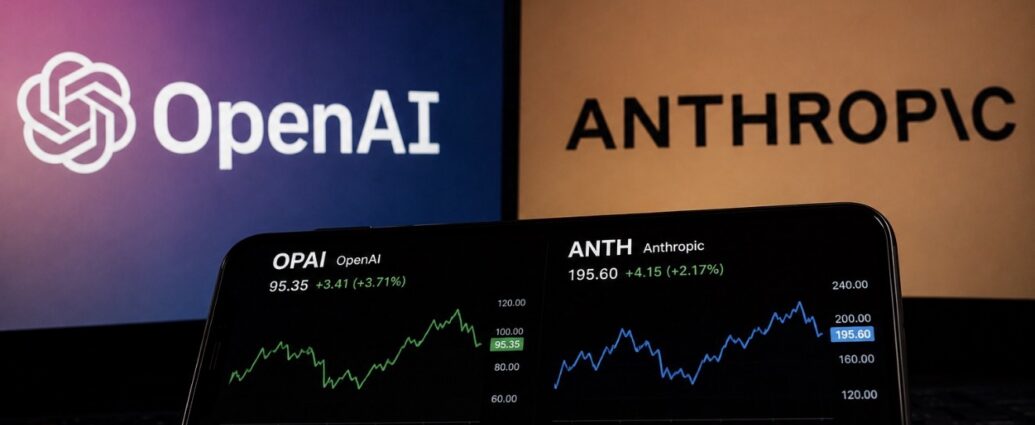
The two largest private AI companies both filed confidentially for public listings within days of each other in June. Two months later they are on completely different clocks, and the gap between them has become the market’s clearest read on how AI businesses are actually valued.

Anthropic filed a confidential S-1 with the SEC on June 1 and is still targeting an October listing on Nasdaq, potentially becoming the first company to debut at a $1 trillion valuation. The company is looking to raise roughly $30 billion at a $900 billion valuation, according to the Financial Times. OpenAI filed a week later and is now leaning toward 2027, per Bloomberg’s reporting, citing market volatility and CEO Sam Altman’s insistence on a $1 trillion floor. Prediction markets have moved with that: Polymarket priced the odds of a 2026 OpenAI listing near 18%, down sharply from 48% earlier in the year.

What changed both timelines was SpaceX. It priced at $135 on June 11, ran to $225 within days, then surrendered roughly 32% of those gains. The stock has since traded around $153, denting confidence in mega-cap technology listings, and the debut raised more than $85 billion. The lesson the market took was that enormous private valuations do not survive contact with daily price discovery unchanged.

The sequencing matters more than the calendar. Whatever multiple public investors assign Anthropic in October becomes the reference point for every OpenAI model built in 2027 — if Anthropic lists at, say, 20 times forward revenue, OpenAI must either match it with stronger financials or explain why it deserves a premium despite heavier cash burn. Going second means pricing against a year of a competitor’s public disclosures and settled analyst consensus.

The two businesses are less alike than the pairing suggests. Anthropic’s annualized revenue run rate expanded from $9 billion at the end of 2025 to more than $30 billion in April 2026, with roughly 134 million monthly active users against OpenAI’s 900 million weekly, and about 80% of revenue from enterprise customers compared with roughly 40% at OpenAI. CNBC reported Anthropic expected about $10.9 billion in second-quarter revenue and roughly $559 million in operating income — its first profitable quarter — while OpenAI was still loss-making in the first quarter. One is an enterprise software company by revenue mix; the other is a consumer platform.

OpenAI has raised approximately $180 billion to date, with Microsoft and SoftBank among its backers, and leads Stargate, a $500 billion joint venture targeting 10 gigawatts of AI data center capacity by 2029. Cracks appeared in April: ChatGPT stalled near 900 million weekly active users, short of internal targets, and monthly revenue milestones have been missed several times this year.

Anthropic’s valuation climbed fast — $380 billion in a February Series G, then roughly $965 billion after a $65 billion round in May, on cumulative fundraising above $129 billion since 2021 — a pace that makes fair IPO pricing genuinely difficult to set.

Both carry regulatory overhangs that public markets will have to price. The Department of War placed Anthropic on its supply chain risk list in February and barred federal contractors from using its services after the company declined to permit Claude’s use for mass surveillance and fully autonomous weaponry; oral arguments in the related lawsuit were heard May 19, with judges divided, while seven competitors including OpenAI were cleared to work with the Pentagon. A separate Commerce Department export control action took Anthropic’s Fable model offline on June 12. Those controls were lifted June 30 and access was restored July 1. OpenAI, meanwhile, still has to finalize its restructuring from nonprofit into a for-profit public benefit corporation.

The scale of what is queued is the systemic question. SpaceX, OpenAI and Anthropic together are expected to form three trillion-dollar listings in a single cycle — a combined demand for capital large enough that analysts have warned it could disrupt global capital markets. Estimates put their combined target market capitalization near $3.8 trillion.

For public investors, the read-through runs well past the two names: whichever lists first sets the first U.S. benchmark for pure-play AI model valuations, with direct implications for Nvidia, Oracle and CoreWeave, while Microsoft and SoftBank hold stakes that get marked to market on debut.

Neither company is currently accessible to retail investors, and a confidential filing guarantees neither a date nor a price. October will supply the number everyone is waiting for — or it won’t, and the wait extends into 2027.

JBizNews Desk | New York

© JBizNews.com All Rights Reserved. Reproduction or distribution without written permission is prohibited.

Biotech companies don’t hide or obfuscate strong data. 

It’s an old saw but one that I have found to be a reliable predictor of future success or failure, particularly when judging clinical trial results. Yet once again, MoonLake Immunotherapeutics has announced “positive” results from a study of its autoimmune drug candidate marred by a level of data obtuseness that renders the word meaningless. 

It’s a subject I keep returning to, because with MoonLake it happens again, and again, and again. 

Continue to STAT+ to read the full story…

This post was originally published here. 

Nurses, who make up the largest part of the health care workforce, are getting more vocal about the risks posed by clinical artificial intelligence to their jobs and patient care as the technology makes deeper inroads into the practice of medicine. 

At Montefiore hospital in the Bronx, laid-off nurses have raised the alarm about administrative AI they say is replacing them. Across the country in California, nurses at Kaiser Permanente are striking and picketing against the AI surveilling their work and playing a growing role in patient care. Collectively, the loudest voices have come from unions like National Nurses United, which represents over 200,000 nurses, including those at Kaiser and Montefiore. 

As that workplace advocacy and bargaining continue, educators and researchers also have their eyes on the future: They’re trying to build solutions to support the next generation of nurses through training and involvement in how patient-facing AI is developed and deployed. By giving nurses a voice in AI’s inevitable disruption of health care, they hope to make the current adversarial relationship more collaborative.

Continue to STAT+ to read the full story…

This post was originally published here. 

In Venice, Italy, the fabled Bridge of Sighs spans a narrow canal, its small stone-barred windows once offering prisoners a final glimpse of freedom as they were escorted to their cells. The name reflects their resignation, the quiet exhale of those who knew what awaited them.

For many primary care physicians, a similar sigh now accompanies the start of Medicare’s “Bridge” program, which promises discounted access to the GLP‑1 weight loss medications Wegovy, Zepbound, and Foundayo. Despite its admirable goal — making highly effective treatments more affordable — the program risks doing the opposite by creating a complex, burdensome process that could limit access in practice.

Read the rest…

This post was originally published here. 

A physician is eating dinner with her family when an encrypted message appears on her phone. A frightened 17-year-old explains that she took misoprostol — one of the medications commonly used to end a pregnancy. Four weeks later, she is still nauseated and her pregnancy test remains positive.

She wants to know: Can she see a doctor without her parents finding out? Could she get into legal trouble for taking abortion pills?

Read the rest…

This post was originally published here. 

When Stephen Rosenfeld and Patricia Seymour founded the not-for-profit North Star Review Board, they’d become disillusioned with the scientific oversight system in America. IRBs, or institutional review boards, are supposed to have one priority top of mind: the rights and welfare of human research participants. But after decades as research ethicists, Rosenfeld and Seymour thought the industry had lost its way.

The problem, they said, isn’t just theoretical. Over the last couple of decades, IRB scandals have cast a spotlight on a fundamental problem in the system, experts said. In one such example, the Government Accountability Office in 2009 tested whether a group of for-profit IRBs could successfully detect a bogus unethical research protocol and reject it. One of the three companies tested, Coast IRB in Colorado, approved the fictitious application, even though the fake device had specifications and matched several examples of “significant risk” per FDA guidance. The sting operation revealed what the GAO called a vulnerability to “unethical manipulation” in the IRB system.

Read the rest…

This post was originally published here. 

Meir Ben-Shabbat, a former National Security Council head, warned against complacency toward Syria and Turkey’s growing regional influence in an interview with Maariv published Tuesday.

According to Ben-Shabbat, who served as one of the architects of the Abraham Accords and currently leads the Misgav Institute for National Security and Zionist Strategy, Israel should continue striving for peace agreements, but not at the cost of relinquishing security assets or relying on agreements that could ultimately prove reversible.

“We must not give up the aspiration for peace,” he said, “but we must not allow it to make us lose our judgment.”

Asked whether or not he believes Syria is attempting to “lull” Israel into complacency while rebuilding its military capabilities, he said that it should not be assumed that Syrian President Ahmed al-Sharaa “has abandoned his path.”

“I do not know how to read innermost thoughts and intentions,” Ben-Shabbat said. “But as someone who came from the heart of the jihadist darkness, sat in prison with the most extreme jihadist leaders, fought in its ranks for years while yearning for the realization of the vision of the Islamic State, and reached where he is on the shoulders of a jihadist base, with [Turkish President Recep Tayyip] Erdogan’s encouragement and support, one should not be impressed by the change in his outward appearance and under no circumstances assume that he has abandoned his path.”

Syrian President Ahmed Al-Sharaa attends a press conference, on the day he meets France's President Emmanuel Macron, in Damascus, Syria, July 7, 2026.  (credit: Mahmoud Hassano/Reuters)

“In a long series of articles I have published since he came to power, I recommended assuming that the change is part of the tactic he is using in order to gain recognition for his rule, stabilize it and consolidate his position, and then turn to achieving his ideological goals.”

He added that two weeks ago, he’d said that Israel “must not give up its control of the territory or its freedom of security action for agreements that will not be worth the paper on which they are signed. This is true with regard to Lebanon, and no less so with regard to the jihadist in a suit who also serves as Erdogan’s proxy.”

“‘In any case, and above any arrangement that is formulated, the prophetic warning must hover, “‘Can a leopard change its spots?'”

Turkey taking advantage of regional power vacuum

Ben-Shabbat further stated that Turkey appears to be taking advantage of regional changes in order to establish itself as a leading regional power, and that these moves, alongside Erdogan’s “ambitions and his hostility toward Israel, increase the potential for confrontation” between the two countries.

“The first is Syria,” noted Ben-Shabbat. “Following the collapse of the Assad regime and the forced withdrawal of the Iranian military presence, Turkey has become the dominant player in Syria. Ankara is deepening its foothold through financing and training a ‘new Syrian army,’ establishing energy infrastructure, transportation infrastructure, and more.”

Another example is the newly signed Mecca Joint Defense Agreement (MJDA) between Turkey, Saudi Arabia, and Pakistan, explained Ben-Shabbat, which “reflects the rise of a central Sunni axis.”

“This alliance is intended to provide mutual defense and regional stability without complete dependence on Washington, placing Turkey in a position of diplomatic and military leadership,” he said.

Turkey’s Blue Homeland doctrine (Mavi Vatan) is a third instance of this, Ben-Shabbat said, explaining that “Turkey’s maritime ambitions in the eastern Mediterranean directly clash with Israel’s geopolitical energy and gas alliances with Greece and Cyprus, IMEC, and its economic agreements, creating a permanent arena of maritime friction.”

A fourth example is Turkey’s continued support for Hamas and its leaders, said Ben-Shabbat.

“In addition to all of this, Turkey is currently conducting a comprehensive campaign to institutionalize accusations against Israel through a series of measures and legal proceedings,” Ben-Shabbat said. “This is intended to position Israel as an international offender whose actions violate basic norms and international law.”

Turkey, Iran are not the same

However, Ben-Shabbat said Turkey should not be equated with Iran.

“Each has its own characteristics and requires a different way of dealing with it,” he said.

To some extent, suspicion and caution on Israel’s part of regional agreements cannot hurt, Ben-Shabbat went on, but stressed that Israel “must not give up the aspiration for peace, but on the other hand, we must not allow that aspiration to make us lose our judgment.”

“We need to give everything its proper time, not rush into premature agreements, but at the same time not miss genuine opportunities. Most important, we must not place our security in the hands of any other party; we must preserve security margins, not exchange tangible assets for one piece of paper or another, and understand that an agreement can be reversible,” he said. “Even if we sign with a party that supports us and wants genuine peace, someone with a different position and different ambitions can always replace them.”

This post was originally published on here. 

Two Pakistanis and an Indonesian national were killed in a Houthi missile strike on a commercial ship in the Bab el-Mandeb Strait, the Saudi state-owned Al Hadath reported on Tuesday morning. 

Bab el-Mandeb is located between Yemen and the Arabian Peninsula, connecting the Red Sea to the Gulf of Aden and the Indian Ocean.

This is a developing story.

This post was originally published on here. 

Two days after Saudi Arabia, Turkey, and Pakistan signed their new joint defense agreement in Mecca on Friday, the Houthis claimed a drone attack against Saudi Aramco’s Jazan refinery. The fire was extinguished without reported casualties, but the timing brought into immediate focus the central question surrounding the new pact: If an attack against one member is considered an attack against all, what does that commitment actually require from the other two? 

Signed on August 7, the Mecca Joint Defense Agreement commits the three countries to regard an armed attack against one as an attack against all. Turkish Foreign Minister Hakan Fidan has compared its collective-defense provision, technically, to NATO’s Article 5, and officials from the three countries have insisted that the agreement is defensive and not directed against Iran, or any particular state. A permanent secretariat is expected to be established in Saudi Arabia, alongside regular coordination among the parties’ foreign and defense officials.

Yet describing Mecca simply as a new “Sunni NATO” risks obscuring what may be more important about it.

The pact brings together three countries with substantially different strategic priorities: Saudi Arabia, still deeply dependent on American defense systems and intelligence; Turkey, a NATO member pursuing increasingly autonomous regional policies; and nuclear-armed Pakistan, whose primary strategic competition remains with India.

It also emerged from discussions that predated the latest phase of the Iran conflict. Talks over a broader Saudi-Pakistani-Turkish framework had already advanced earlier in 2026, building on the bilateral Saudi-Pakistan Strategic Mutual Defense Agreement signed in September 2025. The continuing war involving Iran, however, appears to have accelerated the logic behind institutionalizing regional defense cooperation at a moment when missile attacks, maritime disruption and pressure on Gulf infrastructure have exposed the vulnerabilities of the existing security order.

Turkish President Tayyip Erdogan, Saudi Crown Prince Mohammed bin Salman and Pakistan's Prime Minister Shehbaz Sharif chat after signing a joint defense agreement in Mecca, Saudi Arabia, August 7, 2026. (credit: Murat Cetinmuhurdar/Turkish Presidential Press Office/Handout via REUTERS)

Saudi leadership doubts US power of deterrence 

For Cyril Widdershoven, senior advisor at Blue Water Strategy, the agreement should not be understood as a clean break with Washington, but rather a “post-dependence insurance policy,“ reflecting a regional conclusion that while Washington may still possess the greatest military capabilities, “its willingness to use those capabilities, the conditions under which it will intervene and the identity of the threats against which it will provide protection have become uncertain,” Widdershoven told The Media Line.

“The Gulf leadership increasingly doubts that US power is able actually to prevent missile attacks, drone warfare, and maritime disruption,” he said. “It does not question the capabilities of the US to attack Iran, defend Israel, deploy carrier groups, reinforce bases, and sell billions of dollars of weapons.”

That distinction is central to understanding Riyadh’s position.

Saudi Arabia is not replacing Washington with Ankara and Islamabad. Its military relationship with the United States remains difficult to replicate, particularly in high-end weapons, intelligence, logistics and integrated air and missile defense. Rather, the kingdom appears to be increasing the number of security relationships it can activate simultaneously.

Widdershoven described this as an attempt to create “strategic redundancy.”

“From a Saudi viewpoint, there is only one main strategy: to build strategic redundancy by linking to the United States for high-end weapons and global deterrence, Pakistan for workforce, training, and possible strategic deterrence, and, right now, Turkey for operational experience, defense technology, and geopolitical reach,” he said.

“At the same time, Riyadh wants to have China for economic leverage and diplomatic balance, while using it also for a selective engagement with Iran to reduce the probability of war. This is not coherence. It is hedging under pressure,” he argued.

Abdulaziz Alshaabani, a Saudi political analyst, sees the same diversification but places greater emphasis on regional autonomy rather than declining confidence in Washington. “Saudi Arabia is building a more diverse and balanced network of security partners. While continuing to deepen cooperation with its traditional partners, it is also strengthening defense cooperation with important regional countries in order to enhance greater regional security, autonomy and stability,” Alshaabani told The Media Line.

Turkey comes with NATO experience, defense industry

For Turkey, the benefits are different. Ankara enters the pact with NATO experience, a large conventional military and an increasingly important domestic defense industry. Its companies have become significant exporters of drones, missiles, electronic warfare systems, armored platforms, and naval technology, giving Turkey both a military and a commercial incentive to deepen its access to Gulf defense markets.

But Turkish participation does not necessarily mean Ankara has accepted Saudi strategic leadership, nor that it would automatically enter every conflict involving Riyadh.

Barın Kayaoğlu, chair and assistant professor of American Studies at the Institute for Area Studies at the Social Sciences University of Ankara, cautioned against interpreting the agreement as a sectarian military bloc.

“It is no more a ‘Sunni NATO’ than it is a ‘Muslim NATO.’ So far, the three actors that have made the most noise about it are Israel, Iran, and the Houthis, none of which have contributed much to regional peace in a long time,” Kayaoğlu told The Media Line.

“This is a defensive pact that, over time, could come to resemble the OSCE [Organization for Security and Co-operation in Europe] more than NATO. It is also important to remember that even NATO’s Article 5 does not amount to an automatic declaration of war,” he said.

That qualification is important. Even though the agreement contains language resembling collective defense, the operational consequences remain less defined than the political commitment.

Kayaoğlu argued that collective-defense provisions should not be interpreted as automatically placing each signatory at war with every adversary of another member.

“The same principle applies here. Turkey and Pakistan will not suddenly find themselves at war with the Houthis, just as Turkey and Saudi Arabia would not automatically find themselves at war with the Taliban,” he said.

The comparison also highlights one of Mecca’s biggest unanswered questions: whether it evolves from a political commitment into an integrated security institution.

No publicly available evidence yet indicates the existence of a NATO-style integrated military command. How intelligence will be shared, which threats trigger collective action, what military contributions each state must provide, and how disagreements among the signatories will be resolved will determine whether Mecca becomes an operational alliance or remains primarily a mechanism for strategic coordination.

Alshaabani similarly cautioned against prematurely treating it as a conventional military alliance, noting that it currently functions more as a strategic coordination mechanism that could, over time, deepen into a broader security platform.

Pakistan’s inclusion raises questions on nuclear deterrence

Pakistan presents perhaps the most sensitive variable. Islamabad has decades of military relations with Riyadh and longstanding defense ties with Ankara. But its participation also introduces a nuclear-armed state into a Middle Eastern collective-defense framework, immediately raising questions about deterrence.

The agreement itself should not be equated with a Pakistani nuclear guarantee for Saudi Arabia. Publicly available details do not establish an automatic nuclear umbrella, and Pakistan’s strategic posture remains overwhelmingly structured around India.

For Widdershoven, the ambiguity itself may nevertheless have deterrent consequences.

“It is currently unclear whether the 2025 agreement also covers Pakistan’s nuclear capabilities. This ambiguity is important, as Pakistan does not need to transfer nuclear weapons or explicitly place Saudi Arabia under a formal nuclear umbrella to generate deterrent value,” he said.

“Pakistan’s nuclear doctrine, command structure and force posture are overwhelmingly designed around India. To redirect its strategic deterrent also to Iran or Israel could have severe consequences,” he added.

That India dimension is also one reason the consequences of Mecca may extend well beyond the Gulf.

The agreement links Saudi Arabia directly to Pakistan while strengthening Turkey, another close Pakistani defense partner. India, meanwhile, has developed a substantial defense-industrial relationship with Israel. Israel and India signed a memorandum in November 2025 to expand defense, industrial, and technological cooperation, while Israeli officials have continued to push for deeper strategic relations with New Delhi.

In the eastern Mediterranean, Israel, Greece and Cyprus already have their own increasingly institutionalized security relationship. The three signed a Joint Action Plan for military cooperation for 2026, adding to an established trilateral framework covering security, energy and regional coordination. Those relationships have fueled speculation that a more explicit Israel-India-Greece-Cyprus alignment could develop as Turkey and Pakistan consolidate their own position.

But that possibility should not yet be described as a counter-pact.

India’s Ministry of External Affairs has specifically rejected reports that New Delhi approached Israel seeking a new defense treaty in response to the Mecca agreement. What exists instead is a collection of deepening bilateral and trilateral relationships that could acquire greater strategic relevance if regional bloc-building accelerates.

Israeli officials had also discussed broader cooperation connecting Israel with India, Greece and Cyprus before the Mecca agreement was signed, meaning the emerging geometry cannot be explained solely as a reaction to the August pact.

This is where the consequences of the current war involving Iran may prove larger than the agreement itself.

The conflict has not simply pushed countries into two fixed camps. Instead, it is accelerating a regional system in which states maintain multiple, sometimes contradictory partnerships simultaneously.

Saudi Arabia can expand defense cooperation with Turkey and Pakistan while remaining strategically connected to Washington, economically linked to China and diplomatically engaged with Iran. Turkey can remain inside NATO while building autonomous security structures outside it. Pakistan can deepen Gulf involvement while keeping India at the center of its military planning. India can maintain major economic relations with Saudi Arabia while simultaneously strengthening defense cooperation with Israel.

Alshaabani argued that this increasingly autonomous approach is one of the agreement’s most significant features. “… Middle Eastern countries are becoming increasingly proactive in participating in regional security arrangements, rather than relying entirely on external powers to provide security. Saudi Arabia’s stronger defense cooperation with Turkey and Pakistan is one example of this trend,” he said.

He also rejected the automatic interpretation of the framework as an anti-Iranian or anti-Chinese alignment. “Overall, the agreement is not directed against any particular country. Rather, the three countries are seeking, through institutionalized cooperation, to strengthen their collective deterrence capabilities and improve strategic coordination in responding to future regional security challenges.”

Iran may nevertheless assess the pact through a different security lens.

Saudi Arabia views Iranian missile capabilities and Iran-aligned armed groups as threats to its infrastructure and territorial security. Tehran, conversely, could perceive tighter military coordination among a wealthy Gulf power, NATO’s second-largest military, and nuclear-armed Pakistan as an emerging containment structure, regardless of the signatories’ declared intentions.

Widdershoven described the resulting dynamic as a classic security dilemma. “Saudi Arabia sees Mecca as defensive insurance; Iran sees encirclement by a wealthy Arab monarchy, a major NATO military power, and a nuclear-armed Sunni neighbor,” he said. “Defensive measures on both sides begin to look offensive.”

That may ultimately be the more consequential legacy of the Mecca pact.

The agreement does not yet establish a Middle Eastern NATO, nor does it replace American military power. It does, however, formalize a trend accelerated by the Iran war: regional powers are increasingly building overlapping security networks of their own, even while retaining their older alliances.

And if one new arrangement incentivizes another—Saudi Arabia, Turkey, and Pakistan on one side; deeper Israeli, Indian, Greek, and Cypriot coordination on the other; Iran turning further toward its own partners—the region may not be moving toward two stable, opposing blocs at all.

It may instead be entering a more complicated system of competing and overlapping alignments, in which countries hedge across several partnerships until a crisis forces those commitments to be tested.

As Widdershoven put it: “What we see emerging is not a replacement regional order, but an increasingly competitive network of overlapping security pacts, corridors, and transactional alignments. Still, this is not stability, but armed hedging,” he said. “Armed hedging, as history has shown, only works until the same crisis tests contradictory alliances.”

This post was originally published on here. 

Anthropic confirmed Wednesday that it is assembling an internal team to design custom silicon for its Claude models, joining the growing list of artificial intelligence companies attempting to reduce their dependence on chips they buy from someone else.

The company said it is hiring engineers with experience spanning the hardware and software stack to co-design custom chips and AI models that can run Claude faster and more efficiently at the scale customers require, responding to a shortage of the chips needed to build and operate more advanced systems.

Anthropic described custom silicon as the latest step in a multi-chip strategy and said it will continue relying on a diversified hardware stack that includes technology from Amazon Web Services, Google, Nvidia and AMD. The company gave no timeline and did not say whether it intends to manufacture the chips itself.

The Job Listing Tells the Story

The posting behind the announcement is unusually specific about what the company is looking for.

A recent listing refers to a “custom silicon team” and seeks engineers with broad expertise in chip design and verification, offering annual compensation between $320,000 and $485,000. Candidates must have a demonstrated record of completing and delivering semiconductor designs. The posting describes the role as one for someone who has shipped silicon, holds a realistic relationship with schedules, and is comfortable making consequential decisions without a large organization behind them.

That last line describes a small team building from zero rather than a division absorbing an existing program.

Why Every Lab Is Doing This

The economics are punishing but the alternative may be worse.

Industry figures cited by Reuters put the cost of developing an advanced AI chip at close to half a billion dollars, driven largely by the specialized engineering required. Committing that kind of capital to a project with no guaranteed payoff only makes sense if the alternative — buying compute on the open market at whatever price and availability the vendors set — represents a larger strategic risk.

For AI labs, it does. Access to advanced chips has become the binding constraint on how fast a model company can grow, and that access currently runs through a small number of suppliers.

Anthropic is not first. OpenAI unveiled its Broadcom-built Jalapeño chip in June, designed for inference workloads. Alphabet’s TPU chips underpin Google DeepMind’s systems, and Meta has been working to deploy its own MTIA accelerators. Designing in-house lets AI labs tailor computing capacity to their specific models while reducing reliance on Nvidia.

What Anthropic Already Has

The chip team is one piece of a much larger infrastructure buildout.

Anthropic has signed deals with AWS, Google, Nvidia and AMD to secure computing hardware, but meeting demand at scale has evidently made outside supply alone insufficient. Through a long-term agreement with Google and Broadcom, the company will have access to roughly 3.5 gigawatts of custom TPU capacity beginning in 2027.

The Information reported last month that Anthropic was evaluating Samsung as a potential manufacturing partner for such chips. Reuters had reported in April that the company was considering designing its own.

The Broader Signal

For investors watching the AI infrastructure trade, the pattern across the sector matters more than any single announcement.

Every major model developer has now concluded that outside chip supply is a strategic vulnerability serious enough to justify a half-billion-dollar internal engineering program. That is a statement about how tight the market is expected to remain and about how much of the value in AI is captured at the hardware layer rather than the model layer.

It is also a long game. Full independence from established suppliers remains distant, and Anthropic has been explicit that its existing hardware relationships continue unchanged in the near term.

The immediate question for the chip vendors is whether these programs eventually displace purchases or simply supplement them. Google’s TPUs never eliminated its Nvidia buying. Amazon’s Trainium has not either. Custom silicon has generally functioned as leverage in supplier negotiations rather than a replacement for the suppliers themselves.

Whether that holds as the AI labs mature is the question underneath a hiring announcement that, on its surface, is just a job posting for a team that does not yet exist.

JBizNews Desk | New York

© JBizNews.com All Rights Reserved. Reproduction or distribution without written permission is prohibited.

An Iranian threat to assassinate US President Donald Trump prompted a secret security operation last month in which the president was flown from Turkey to the UK aboard an alternate military aircraft, while the White House publicly gave the impression that he was traveling on the older Air Force One, according to the Washington Post.

The covert mission, which had not previously been reported, was carried out without the knowledge of journalists and even some White House staff members, who believed they were traveling on the same aircraft as the president.

The report was based on materials reviewed by the Washington Post, as well as interviews with a US official familiar with the operation and another person familiar with the president’s travel arrangements. Both spoke anonymously because they were not authorized to discuss the matter.

The administration said Trump left Turkey on July 8 aboard the older Air Force One. Trump also announced on social media that he would use the “former Air Force One,” rather than the newer aircraft on which he had arrived in Turkey, a Boeing 747-8 given to the US as a gift from Qatar.

According to the report, however, Trump did not remain aboard the aircraft he was seen boarding in front of cameras.

 (Illustrative) A silhouette over an Iranian flag. (credit: SHUTTERSTOCK)

Trump boarded Air Force One, then was secretly transferred

Trump was in Ankara for a NATO summit attended by leaders from around the world when the incident occured. The operation took place the night after US forces resumed military strikes against Iran on the president’s orders, following the collapse of negotiations between Washington and Tehran.

That evening, Trump boarded the older blue and white Air Force One in front of television cameras and waved goodbye. Several minutes later, according to a US official and materials reviewed by the Washington Post, he was secretly transferred to a smaller US Air Force C-32A aircraft.

The transfer was carried out using a catering truck, typically used to load food and supplies onto aircraft. The truck was raised by a hydraulic system to a door on the opposite side of Air Force One from the entrance used by Trump and the journalists.

Trump and several of his aides entered the truck, which then moved away from Air Force One and drove toward the nearby C-32A.

According to the US official, the older aircraft effectively served as a “decoy.” Journalists and several White House staff members remained aboard, believing Trump was traveling with them, while the president flew to the UK on the other aircraft.

The arrangement concealed Trump’s actual location for several hours, not only from the American public but also from many senior administration officials.

Iranian threat prompted the switch

The New York Times and CBS News also reported last month that intelligence officials had identified a specific threat against the president or his aircraft, leading authorities to implement additional security measures.

The US government has for years been concerned about Iranian plots targeting senior American officials, including Trump. Those concerns intensified following Washington’s involvement in the killings of senior Iranian military and political officials.

Turkey, which hosted the NATO summit and from which Trump departed, is a US ally and NATO member, but it also shares a border with Iran.

The operation took place only days after Trump began using the Boeing 747-8 received by the US from Qatar. The aircraft underwent upgrades costing hundreds of millions of dollars and entered Air Force service in July, but according to reports, it lacks some of the defensive capabilities found on the older Air Force One aircraft.

Trump initially said he had decided to fly from Turkey on the older aircraft “for old times’ sake,” while the aircraft received from Qatar would fly to the UK and be displayed to US troops stationed there.

According to the Washington Post, that was not what happened.

The new Air Force One received from Qatar departed Turkey first on the evening of July 8. Trump then boarded the older Air Force One in front of cameras.

Minutes later, he was secretly transferred by catering truck to the C-32A.

Photographs and videos taken at the airport in Turkey show stairs positioned on one side of Air Force One and a catering truck on the other, with its container raised to the height of the aircraft.

After members of the White House press pool boarded the older aircraft, White House staff instructed them to close the window shades.

Defense Secretary Pete Hegseth separately boarded the C-32A using external stairs. According to the US official, the move was intended to make the flight appear routine. Hegseth then flew with Trump to the UK aboard the same aircraft.

The C-32A is a modified Boeing 757 used to transport senior US government officials and can also carry the president or vice president.

When the president is aboard, its call sign is supposed to be “Air Force One,” since the term refers not to a particular aircraft but to any US Air Force aircraft carrying the president.

US President Donald Trump boards Air Force One at Joint Base Andrews, Maryland, US, August 7, 2026 (credit: REUTERS/ELIZABETH FRANTZ)

On this flight, however, the generic call sign “Reach 18,” or “RCH18,” was used, according to a person involved in the mission and additional materials reviewed by the Washington Post.

The aviation tracking outlet Thenewarea51 identified the C-32A arriving in the UK under the same designation and reported that systems allowing the aircraft to be easily tracked while in flight had been turned off.

Meanwhile, the older aircraft carrying White House staff and journalists appeared on radar en route to the UK. Although Trump was not aboard, it used the Air Force One call sign “AF1” during the flight.

According to flight tracking data, the aircraft received from Qatar landed at RAF Mildenhall in the UK at 6:26 p.m., using the call sign “SAM 33.”

Videos posted online showed that the C-32A, which according to the report was carrying Trump, landed several hours later, at around 10:20 p.m. The older Air Force One landed around nine minutes later, at approximately 10:29 p.m.

It remains unclear exactly how Trump was transferred from the C-32A back to the older aircraft after landing.

Shortly afterward, however, the president appeared in front of television cameras descending the stairs of the older Air Force One at around 10:56 p.m., creating the impression that he had arrived in the UK aboard the same aircraft he had been seen boarding in Turkey.

The White House also published a post that night stating that Trump had landed at the British base “aboard the former Air Force One,” accompanied by a photograph of the aircraft.

After greeting US service members, Trump boarded the new Air Force One received from Qatar at around 11:01 p.m. for the flight back to Washington. White House staff and members of the press then transferred to the aircraft from the older plane.

White House: “We use every tool at our disposal”

The Washington Post presented the White House with details of its investigation and a series of questions.

In response, White House Communications Director Steven Cheung issued a statement defending the aircraft received from Qatar.

“The new Air Force One is a state-of-the-art aircraft equipped with high-level security protocols that ensure the safety of the president and his staff,” Cheung said. “As the president recently said, there are many enemies of America who have set their sights on him, and we use every tool at our disposal to address those threats.”

A Pentagon spokesperson referred questions to the White House, while the Secret Service did not respond to a request for comment.

The White House also released a statement from the Air Force regarding the safety of the new aircraft: “The aircraft is safe, secure and equipped with the most advanced technologies necessary to meet the requirements of the presidential mission.”

The statement added: “No risks were taken with security, safety or mission communications, but the joint team made tradeoffs on some of the less frequently used mission systems that Boeing must provide to support the next 40 years.”

The controversy surrounding the Qatari aircraft intensified after the New York Times reported that it lacks defensive capabilities available on the older presidential aircraft.

Following the report, the Trump administration took the unusual step of issuing subpoenas to several journalists in an effort to identify confidential sources.

Administration officials said the move was part of an investigation into a national security breach, while the New York Times accused the administration of attempting to undermine transparency and intimidate journalists and sources.

The administration later withdrew the subpoena and acknowledged that mistakes had been made in its handling of the matter.

Maariv contributed to this report.

This post was originally published on here. 

Israel is experiencing a deep erosion of support in the United States among both Democrats and Republicans, Prof. Yossi Shain, an expert on international relations, warned in an interview with 103FM on Monday.

Speaking about the changing attitude toward Israel in the American political arena, Shain, who formerly served as a Yisrael Beytenu MK, said that “Being anti-Israel in the US today is a hot commodity; it is worthwhile and rewarding, and not just anti-Israel, but anti-AIPAC.”

“The entire idea around the world that Israel projects strength and that the Israeli lobby projects strength, and that it is not worth messing with it, is an idea that has collapsed in the US. Today, people are running for the Senate on hostility toward Israel, and that is what wins votes and victory,” Shain argued.

Shain later addressed Israel’s relationship with the Democratic Party and the standing of the Jewish community in the United States. “We are in a long process of collapse,” he explained. “David Hess, who headed the American Jewish Committee, recently said that US Jewry and Israel’s standing are like a building in Florida that collapsed on its residents.

“We can begin arguing about what causes what and how, but there is no doubt that two important points must be mentioned regarding Israel’s contribution. The State of Israel and the Israeli government simply betrayed the Democratic Party. Biden saved us, from their perspective, and we all went in the direction of Trump,” he said.

 US President Joe Biden meets with Israeli Prime Minister Benjamin Netanyahu (not pictured) and the Israeli war cabinet, as he visits Israel amid the ongoing conflict between Israel and Hamas, in Tel Aviv, Israel, October 18, 2023. (credit: REUTERS/EVELYN HOCKSTEIN)

US-Iran agreement will not happen, expert says

There will be no agreement between the US and Iran, Shain also stated.

“Israel would be praying for an agreement. At present, there will be no agreement, and future administrations will also not be bound by an agreement as they were in previous years, partly because of the issue of power. Therefore, there was no international political dialogue because we relied on Trump to do the work for us, after he pledged to ‘pull the chestnuts out of the fire,'” he said.

Addressing the handling of Iran and the expectation that the United States would complete the process, Shain said that “The situation with Iran was that it had to be done within days. He asked us after we convinced him that we would bring down the regime and everything would collapse. Unfortunately, after our phenomenal victory with the Americans, we thought we would take another step forward, and America did not complete it.”

“When America did not complete it, we kept chipping away more and more at its standing in the system and at its willingness,” he noted. “On the Republican side, there is no willingness, from their perspective, for Israel to drag the US into another war,” he said.

According to Shain, the erosion of support for Israel is no longer limited to the Democratic camp. “Unfortunately, Israel has become a toxic brand. This is no longer only a question of politics right now, although it is also connected to it. We have also become toxic among Republicans. People forget what this means, and it is not only with Tucker Carlson and others, you can see it spreading. I speak with the offices of senators who are supporters of Israel, and they are worried about this. The perception that Trump is not delivering is also filtering down to voters.”

Israel ‘genocide’ campaign spreads to US education system

Shain also addressed the political considerations surrounding Trump and the changing attitudes among his supporters. “If in the past they said Trump wanted to reach the midterm elections, and therefore did not want to escalate because it did not win him points, right now there is concern that the lack of a decision is also costing him points among his supporters,” he explained.

“On the one hand, there is the campaign that began immediately after the war in Gaza, about genocide, which has penetrated very deeply both intellectually and politically. On the other hand, it has penetrated to the point that even in the American education system, when you examine how the issue of genocide is taught, it is identified as an Israeli genocide,” he added.

In conclusion, Shain warned of a continued deterioration in Israel’s standing in Washington. “If Israel does not replace its leadership with one perceived in America as sane, Israel does not have supporters even in the White House today,” he said. “It is impossible to understand the scale of the fiasco. We are telling stories because we are in an election campaign, but this is something deep,” he stated.

This post was originally published on here. 

JPMorgan raised its year-end target for the S&P 500 to 8,000 from 7,800, arguing that stronger corporate profits and accelerating artificial-intelligence investment are giving the market more room to run.

The new target implies roughly 3% upside from Friday’s record close of 7,757.64.

The bank also raised its earnings forecasts for the companies in the index, now expecting $365 a share in 2026 and $420 in 2027, up from previous estimates of $350 and $390.

The reason is increasingly clear: the enormous sums being spent on AI are beginning to show up in actual revenue and profits.

JPMorgan pointed to stronger cloud growth and larger backlogs at companies including Amazon, Microsoft and Google as evidence that AI spending is moving beyond promises and into measurable business results.

Corporate earnings broadly have also come in stronger than expected. More than 85% of S&P 500 companies that had reported through Friday beat analysts’ profit estimates, well above the long-term average.

JPMorgan is not assuming investors will simply pay ever-higher valuations. The bank kept its forward valuation target near 20 times earnings, meaning most of the expected market upside would have to come from companies generating more profit rather than investors paying substantially more for each dollar of earnings.

That distinction matters because several risks remain.

Interest rates are still elevated, oil prices remain vulnerable to disruptions around the Strait of Hormuz and companies are issuing large amounts of both debt and equity to finance AI infrastructure.

Still, JPMorgan’s call shows how powerful the earnings cycle has become.

The S&P 500 is already up more than 13% this year, yet Wall Street’s biggest banks continue raising targets because profit growth is outpacing earlier forecasts.

The next challenge is whether companies can keep converting massive AI spending into enough revenue to justify both the investment and today’s elevated stock prices.

JBizNews Desk | New York

© JBizNews.com⁠ All Rights Reserved. Reproduction or distribution without written permission is prohibited.

New York City Mayor Zohran Mamdani’s wife, Rama Duwaji, is expected to travel to Syria and Lebanon next month, protected by police officers assigned to her taxpayer-funded New York Police Department (NYPD) security detail, The New York Post reported on Monday evening, citing a source familiar with the details.

Both countries are on the United States’ “Level 4: Do not Travel” list for citizens. Lebanon’s Level 4 status was issued on June 5, while Syria’s was issued on July 8. 

According to the source, Duwaji requested the NYPD security detail after traveling abroad in July with no police protection.

Mamdani’s office later confirmed the trip and the police security detail, The New York Post reported, but did not provide any additional detail.

“Upon the strong recommendation of the NYPD, the First Lady’s security detail will be joining her when she travels to visit family in Syria and Lebanon,” said mayoral spokesperson Dora Pekec, per The New York Post.

Smoke rises from southern Lebanon during an Israeli military operation, August 5, 2026. (credit: AYAL MARGOLIN/FLASH90)

The source familiar with the trip told The New York Post that the trip is not official business and that “it’s not doing anything for the city.”

Trip puts NYPD officers in danger

Pro-Israel Jewish advocate Dov Hikind, founder of Americans Against Antisemitism and a former Brooklyn Assemblyman, opposed sending NYPD officers to the Middle East on X/Twitter, following the report’s publication.

“We’re putting the police officers in danger,” Hikind wrote. “They will be viewed as the bad guys. These are war zones.”

“Duwaji doesn’t need security. She will get a hero’s welcome and be protected by Hezbollah, Hamas and the Houthis.”

“Duwaji will be fine,” he said.

This post was originally published on here. 

Seventy percent of general contractors and subcontractors consistently face late payments, costing the construction industry nearly 300 billion dollars last year. In today’s economy, GCs and subcontractors are already working on incredibly thin margins. Without cash coming in when planned, there is a ripple effect to their business, from a delay in purchasing materials to covering payroll to even forgoing bids on new projects.

The average payment cycle in the construction industry is 90 days, which is double the 45-day threshold that financial analysts consider a healthy business. This means that a contractor completing work in August won’t get paid until November. That’s an incredible operational risk, as fixed costs for a business such as rent and taxes are still due, even if customers have not paid.

Standardizing estimates

Creating detailed, standardized estimates will help minimize disputes before the bid is even accepted. A clear estimate ensures all parties involved are aware of the payment required, including specific terms and timelines.

An article on the U.S. Chamber of Commerce around late or non-paying customers says it best: “The best time to establish boundaries over late or nonpayments is before the work begins.”

By eliminating ambiguity with a standard invoice, GCs and subcontractors can reduce friction if disagreements arise, as well as build trust with clients through strong communication. The goal is also to hopefully establish a predictable schedule for when you can expect payments before the project even begins.

Utilizing invoice templates

Along with ambiguity in the estimate process, unclear terms in an invoice are also a catalyst for delayed payments. Regardless of how you create an invoice, there are a few key things that should be included no matter what:

  • Set clear terms from the jump – what does the payment structure look like, within how many days do you expect to be paid upon receipt of the invoice, etc. 
  • Establish a late fee policy – this is up to the discretion of your business but sets a clear understanding of when late fees will be added to the total amount due
  • Invoicing promptly and professionally – selecting a free template from invoice template platforms such as Invoice Home. Your business should establish what the template will look like, the cadence for when invoices will be sent and how they’ll be sent to clients. This should be communicated in advance of the service. 
  • Offering payment options – offering easy-to-use and convenient payment options for clients. Opting into a service that offers automated reminders can also be a helpful tool 

Automating invoices with digital tools

One way to get in front of delayed payments is sending invoices on time. Issuing invoices quickly could drastically reduce that alarming percentage, and it’s the easiest way to speed up payment.

Leveraging digital tools to make this process automatic is the first step in ensuring your business is set up for success. This helps avoid batch invoices at the end of the week or month, both of which delay payment since you are just sitting on your bill.

Digital tools can also increase visibility, providing real-time status of account status and allowing you to pinpoint who has a history of on-time payments and which accounts tend to wait until the 60- or 90-day payment mark.

Hesitation in implementing automation

Most businesses know they should move towards automating processes, from invoicing to collecting payment to even project management, but many are hesitant to make the move. Many GCs and subcontractors still rely on manual workflows out of habit, and a concern that adopting new technology will be too complex. As payment cycles continue to lengthen and margins remain tight, manual processes can become a significant barrier to financial growth. 

Only 17% of businesses surveyed by American Express last year had fully automated their payments processes. The leading concerns? Cost (45%), not believing it would benefit their business (28%) and security (26%). As with any new process, there is always a pinch of skepticism. However, when it comes to financial processes, the benefits of automation usually outweigh the risks, reducing processing time and human error.

Cash flow equals growth, and even a one- or two-day delay on payment can delay long-term growth strategies for small businesses. Late payments can be the difference between bidding on a dream project and sitting it out.

It’s inevitable that you’ll find yourself with unpaid invoices at some point. It’s important to have the tools and resources in place for the best possible outcome: resolving payment as quickly as possible. Being proactive in your communication and leveraging digital tools helps tighten the gap in delayed payments. A proactive approach to late payments can help create healthier, consistent cash flow and stronger business growth.

Petr Marek is the Co-Founder and CEO of Invoice Home, an invoice-generating platform designed for small businesses, freelancers and entrepreneurs. Invoice Home currently has more than 12 million users worldwide.
This column does not necessarily reflect the opinion of HousingWire’s editorial department and its owners. To contact the editor responsible for this piece: zeb@hwmedia.com. 

This post was originally published on here. 

In the last six years, the typical American home started requiring a much higher salary. Today, according to the Housing Studies’ 2026 State of the Nation’s Housing report, a household needs an income of more than $120,000 to afford the payment on a median-priced home. In 2020, that number was just $66,000. So in only six years, the price of becoming a homeowner has nearly doubled, and for millions of people, buying a home has started to feel like less and less of a possibility.

When faced with that number, most prospective buyers land on the same plan: wait for fall, when the market cools, or for a rate cut or a correction. I get questions about this all the time from prospective buyers. They wonder whether it makes more sense to move this summer or hold out for the second half of the year. Given the moment and these questions, it’s worth looking honestly at what the second half of 2026 is actually forecast to hold for prospective homebuyers.

What the second half of 2026 actually looks like for buyers

The answer is likely more of the same. The Mortgage Bankers Association expects rates to hold near 6.5% through the end of the year, and Fannie Mae’s outlook is nearly identical. The median home price just set a record in June, the 36th straight month of year-over-year increases. While prices are only climbing slowly, they’re still not falling. Fall will bring the usual seasonal lull, with a few less crowded open houses but essentially the same rate and the same prices buyers face today. 

Even if rates do drift lower against expectations, the large pool of sidelined buyers may come back, and the negotiating leverage available in today’s better-stocked market will shrink quickly. That’s why waiting until fall to check out the market won’t necessarily buy relief.

So my answer to the buy-now-or-wait question is that it’s the wrong question. The right one is whether you’re prepared because preparation, not timing, is where affordability actually gets made this year. And over two decades in lending has taught me that for a surprising number of buyers, the door isn’t locked. 

The down payment myth that’s keeping buyers on the sidelines

Nearly half of consumers believe they need a down payment of 16% or more to buy a home. However, the typical first-time buyer has put down between 6% and 9% since 2018, and that number has never once topped 10% in more than three decades of record-keeping. The gap between what buyers assume and what buyers actually do is enormous. 

Zero- and low-down-payment programs exist across the market, some without private mortgage insurance, and conventional loans can go as low as 3% down for first-time buyers. Service members, Veterans and military families have earned benefits along exactly these lines, and they go chronically underused because many don’t even know they exist.

Instead of waiting for the market to move in the second half of the year, prospective homebuyers should assess their personal financial situation, goals and options first. While rates and prices play a big role in what buyers can afford, there’s also missing information and available options that many families in the market for a house go unexplored. 

I’ve sat across from people who were qualified to buy years before they believed they were, not because of a change in the market but because they now had a more accurate picture of the possibilities.

Knowing your number before you know your home

Preparation impacts the other way around too. Many times, if buyers are struggling after closing, it’s not because they bought at the wrong time. They may have chosen to buy based on a listing price or rate, forgetting to account for taxes, insurance, dues and maintenance, or treated a pre-approval as a target when it’s really a ceiling. The buyers who thrive in any market know their full monthly cost, keep it comfortably below about 28% of gross income and decide their own number underneath whatever a lender approves.

First-time buyers made up a third of home sales in June, a larger share than a year ago, in the same market everyone else is waiting out. There’s room to get in if it’s the right time for you and your family.

For buyers who are financially ready and have good options in mind, moving sooner makes more sense than holding out for a fall that forecasts say will look just like today. And for buyers who aren’t ready yet, the second half of 2026 gives them more time to prepare and see if their situation changes.

Roger Strecker is the residential lending expert at Navy Federal Credit Union.
This column does not necessarily reflect the opinion of HousingWire’s editorial department and its owners. To contact the editor responsible for this piece: zeb@hwmedia.com. 

This post was originally published on here. 

I’m a mortgage servicer by trade, but also a music lover and guitar player. A guitar has twelve notes, and from this comes every song, every genre, every hit ever written. Servicing works the same way. The structure is fixed – loan, customer, property – but what you can now build on top of it with AI in mortgage servicing is close to limitless.

And servicing was never just servicing. It’s a key play in customer-for-life, a continuous customer engagement and retention loop that runs from origination to servicing and back to origination. Winning that loop at scale takes many things. Below I lay out six of them, starting where every servicing relationship both ends and begins – migration.

1. Migration is a product, not a project.

Most system providers treat migration as a one-time act of heroics, whether it’s mortgage service rights (MSR) trades or a system conversion. We treat it as a product – it lives inside Dara. That means automation that learns your database without your team having to hand us your database structure first.

When it comes to migrations, we’ve mapped the common big platform. We own other big platforms, LSAMS, LoanServ and Dara, so we know them cold. Proof: we moved three million loans for one of the country’s largest servicers to LSAMS in four months – and now we’re bringing them all home to Dara.

As momentum grows, we’re able to run many migrations at once without missing a customer service or compliance beat. Migration as a product only works if your platform can handle every loan type and scenario it receives. Ours can.

2. Integration used to be an ordeal; now it’s flipping a switch.

Servicers run on integrations – systems connected to vendors, service partners of every kind, investors, insurers, regulators and the list goes on. Until now, every new one was a big ordeal, and the result was a patchwork sprawled across core and default. Open architecture that’s agnostic to the system and the database structure underneath changes that.

Want to add a vendor? Flip a switch. Test it in your own environment. See the actual code that drives the process. And see the results. We call this a show-your-work mentality. For example, a file leaves the system, you see immediately when it left, what was in it and that the counterparty acknowledged receipt. Your whole ecosystem performing in perfect time.

3. Recapture: Your best leads are already on your books.

Here’s where it gets fun. Servicing holds all the data, which makes the servicer the most powerful originator out there. For banks and nonbanks, we combine what a loan looked like the day it closed in their LOS with what it looks like right now in servicing.

Dara houses all of this in one place with the live loan. So data can be analyzed in real-time, and the results can be stored and displayed in the same place, making borrower outreach and engagement immediate and hyper-relevant to borrower needs right now.

Regardless of outreach method – whether it’s an inbound service call, an IVR or your web presence – all of them can present the information immediately to benefit the borrower. That turns a mortgage recapture strategy from a periodic marketing campaign into a continuous, data-driven part of servicing. Sagent doesn’t need to be your LOS; we’re the funnel to it, powering your continuous servicing-to-originations loop. Play it however you want.

4. Default doesn’t belong in five systems.

Ask a servicer how many systems they touch when caring for customers experiencing hardships. Loss mitigation in one, foreclosure in another, bankruptcy in a third, claims in a fourth – each one bolted onto a system of record. That’s the disparate-systems tax, and the default is where it hurts most – because compliance timelines and investor stakes are unforgiving, and clarity of resolution is what strained customers need most.

Dara Core puts the full default lifecycle in one place, on the same real-time data as everything else. One borrower, one loan, one view – current, in loss mitigation or in claims. End of story. This is one of the biggest pain points in all of servicing, solved.

5. Real-time solutions with real-time impact.

Much of servicing has been multi-step manual processing, and now it’s time to play a new tune. Example: A hurricane makes landfall. FEMA declares the disaster zone. In most shops, someone starts matching up zip codes in spreadsheets and databases.

In Dara, the FEMA-connected system already did it. Line up the impacted areas, and one click flags every loan that may be affected. From there, the system does the right thing – it holds back the outreach that shouldn’t happen during a disaster and prioritizes the outreach that should. If an impacted borrower calls in, you already know why. If they don’t, you reach out to check in and help. That’s what AI in mortgage servicing should look like: timely, practical and connected to a real customer need. That’s music to the ears of already-strained servicers or borrowers.

6. Compliance that keeps up – and yes, it’s cool.

As of last week, every servicer is on the hook for 8,879 rules, and that number continues to climb. The old way to absorb a change – read it, convene product, engineering and compliance, dig through code, publish a PDF – takes months.

AI-powered Dara RegIQ takes hours. It scans the CFPB, the GSEs, FHA, VA, USDA, OCC and FDIC around the clock, maps each change to the exact features it touches and links straight back to the source. Humans still make the call on what changes and when. Who knew keeping up with regulatory requirements could be cool? We did.

Same twelve notes. Limitless servicing songs.

So these are six keys of many for servicer success today. Together, they form a practical framework for mortgage servicing modernization: One event-driven, API-based platform running all six, supported by a three-layer foundation – data access, process automation and event-driven workflows. That gives you the freedom to run our AI agents, bring your own or mix. We call this BYOA – Bring Your Own Agents – and it’s why you can build a process for ten loans or ten million and never rebuild it.

So now the vendor-to-servicer pitch – “just use our AI, we’ve got it all covered” – describes a world that’s already gone. Instead, we must keep enabling servicers to mix and match AI in their own way while ensuring the core structure is solid. That way, what you play is up to you. That’s how servicing becomes the funnel to every new loan, and how a $15 trillion sector finally performs like one system instead of five. That’s what we built Dara to be. For servicers and the consumers they serve, by servicers, running down our dream. Play on.

Click Here

This post was originally published on here. 

Tucker Carlson, one of the most prominent and provocative voices on the American right, and Hunter Biden, the son of former Democratic president Joe Biden, who for years was himself one of the right’s favorite targets, bonded over a common enemy in an interview Carlson conducted with Biden on Tuesday: Prime Minister Benjamin Netanyahu, and to a large extent Israel as well.

Biden is continuing an unusual round of media interviews. Last Friday, in an interview with the BBC, he spoke about his father’s condition and said that the cancer affecting the former president had spread to his bones.

In the interview with Carlson, however, the discussion focused at length on the controversies surrounding Hunter himself, his drug addiction, the laptop that became a political weapon against the Biden family, and, at one point, Israel.

During the conversation, Carlson claimed that at the time of the Hunter Biden laptop affair, Israeli figures or figures with ties to Israel were the ones who pushed claims to him that material showing the abuse of minors had been found on the computer. It is important to emphasize that Carlson did not present public evidence for this claim during the segment, but described it based on what was referred to as his personal experience.

“The claim that there was material involving the abuse of minors on the computer came from the Israelis,” he said. “I’m just telling you that they came to me with it, and that’s how I know it.”

Political commentator Tucker Carlson arrives for a memorial service for slain conservative commentator Charlie Kirk at State Farm Stadium, in Glendale, Arizona, US, September 21, 2025. (credit: REUTERS/CARLOS BARRIA)

Carlson rejects Russian involvement in Hunter Biden laptop 

Carlson went on to claim that at the time, he sent one of his producers to meet with a person who, he said, had ties to Netanyahu. According to Carlson, this particularly angered him when former senior US intelligence officials instead pointed to Russia in connection with the affair.

“They were behind it,” Carlson claimed. “I felt like everybody in Washington knew it, but there was so much pressure not to criticize Israel in any way that they just said, ‘It’s the Russians, it’s the Russians.'”

Carlson also acknowledged that while he was working at Fox News, he did not say this publicly. “I admit it. I didn’t say it. I was part of the problem too, but I knew.”

It was precisely at this point that a symbiotic connection emerged between the two participants in the interview. Hunter Biden, who explained how deeply the serious allegations against him had affected him, moved on to discuss the criticism now directed at Carlson himself and rejected claims that Carlson is antisemitic.

“I’m supposed to hate Tucker Carlson because he’s antisemitic and all of that stuff,” Biden said to Carlson, adding, “I know you’re not. You’re not antisemitic. I know 100 percent you’re not antisemitic.”

From there, Biden launched his harshest attack on the prime minister. “If it is antisemitic to say that [Prime Minister Benjamin] Netanyahu is evil incarnate, then you know what? I don’t know what to tell people anymore,” he said. “All you have to do is open your eyes. Literally, open your eyes, open your heart for one second and understand.”

Carlson responded that, in his view, the claim that such criticism is antisemitic is “such an obvious lie,” and effectively asked who else feels threatened by such an accusation.

Criticism of Israel spreading across US party lines

In doing so, two people who for years belonged to almost entirely opposing political camps found themselves agreeing on an issue that in recent years has become one of the deepest fault lines in American politics: attitudes toward Israel and Netanyahu.

Harsh criticism of Israel no longer comes only from the progressive wing of the Democratic Party, but has also gained a foothold in parts of the populist right and the “America First” movement, in which Carlson is one of the most influential figures. Biden and Carlson are not political partners, and their agreement does not turn the two camps into one.

But the moment in which the son of a former Democratic president and a star of the American right agree that Netanyahu is a legitimate target for the harshest criticism, and jointly reject the claim that such criticism is necessarily antisemitic, once again illustrates the extent to which negative attitudes toward Israel today cross the old dividing lines of American politics.

This post was originally published on here. 

After months of war, strikes, threats, and negotiations that have so far failed to end the ongoing conflict, US President Donald Trump is returning to one of the oldest tools in the United States’ arsenal against Iran: choking it economically.

According to a Wall Street Journal report, Trump has for now adopted a “wait and see” strategy, giving financial sanctions and the US naval blockade of Iranian ports more time to deepen the damage to the Islamic Republic’s economy instead of launching another broad round of strikes.

According to the report, the shift followed persuasion efforts within the administration. Trump’s aides presented him with data intended to show the extent to which existing sanctions have already hurt Iran.

Senior administration and White House officials have recommended tightening the current sanctions further and imposing new ones, based on the assessment that economic pressure could be the most effective way to force the Iranian regime to back down. Trump, at least for now, was persuaded and told his advisers that he would prefer not to order additional strikes.

Trump publicly announced the return to this approach on Monday, telling reporters that Iran has “no money,” adding, “Iran is broke, completely broke.”

Ships and tankers in the Strait of Hormuz off the coast of Musandam, Oman, April 18, 2026. (credit: REUTERS/STRINGER/FILE PHOTO)

Iranian economy in ‘free fall’

US Treasury Secretary Scott Bessent said last month that the administration’s economic policy had sent the Iranian currency into “free fall” and pushed inflation into triple-digit rates.

The decision to pursue the economic sanctions route comes as Trump currently has reservations about the two other options available to him. He is reluctant to return to an all-out war, but he is also wary of another round of negotiations with Tehran.

In recent days, talks surrounding the Strait of Hormuz have once again become complicated after Iran presented far-reaching demands in exchange for fully reopening the shipping route, including billions of dollars in US payments, the lifting of the blockade, and the withdrawal of US forces from the region.

From the White House’s perspective, the sanctions strategy offers another advantage: It allows Washington to maintain heavy pressure on Tehran without immediately entering a new military round that could drive up energy prices and trigger an Iranian response against infrastructure in the Gulf.

Risk of economic pressure

Former senior officials described this as the “optimal space” for the US, provided that increasing amounts of oil can continue to reach the market despite the threats. According to one, a bad agreement could effectively subsidize Iran’s reconstruction, while a major military escalation could shock the oil market if the regime survives the strikes and retaliates against energy infrastructure in the Gulf.

Economic pressure, however, also comes with risks. Experts who served in previous US administrations warned that an American blockade could further worsen Iran’s already difficult economic situation, and that this could make a response from Tehran more likely, as “no one should expect Iran to simply sit idly by while this is happening.”

That is also the main vulnerability of the renewed strategy. It rests on the assumption that economic pain will force Tehran to yield before it chooses to escalate militarily.

US officials stressed that Trump could still change his mind, particularly in the event of a severe Iranian response. For now, however, the president is choosing to give time, sanctions, and the blockade a chance to do the work instead of aircraft and bombs.

This post was originally published on here. 

Artificial intelligence is going to bring about a new era, Prime Minister Benjamin Netanyahu said at the launch of Israel’s National AI Program on Sunday.

The program has been under development for several months and was launched in a joint ceremony by Netanyahu and the Head of the National AI Directorate, Brig.-Gen. (res.) Erez Eskel.

“AI is not just another technology; it is going to change the world,” Netanyahu stated. “It is going to change the lives of each and every one of us, of our children, and of generations to come. Quite a change is taking place, much like the Industrial Revolution.”

He also warned that those who were not able to keep up with the developing technologies would be “left behind.”

The two goals of the program, Netanyahu said, were to ensure that Israel would be a “global superpower” in the field of AI, and to promote Israel’s economic success.

Prime Minister Benjamin Netanyahu at the launch of the National AI Program, August 9, 2026. (credit: MA'AYAN TOAF/GPO)

“This is important. Not only did we do this in cyber, but we also did it in agriculture, medicine, medical devices, and many other fields that you know, and we will do it here too, in artificial intelligence.”

National AI Program is first step forward

The program is only the first step forward, Eskel said during the ceremony.

“We are launching this program, which takes into account the distinct advantages of the State of Israel in the fields of cyber, physical AI, and solving life’s problems with AI, while providing infrastructure for the needs of the country and the economy, whether that is Compute infrastructure, powerhouse computing capabilities that almost no countries currently possess, a national quantum computer, and addressing the central and most important issue, the human capital in the State of Israel, which is our true engine.”

This post was originally published on here. 

FIFA would be making a “terrible mistake” by replacing President Gianni Infantino, US President Donald Trump said in a Monday post on Truth Social.

“He is fantastic, having just presided over the most successful World Cup, by four times, ever presented. If he is gone, it will never be as successful or profitable again!” Trump added.

Infantino has been under fire since FIFA proposed to sell stakes to external investors in a subsidiary that will run the global governing body’s tournaments.

Last month, the world soccer governing body said it plans to create a $20 billion subsidiary to run the World Cup and its other events and will offer stakes of up to 20% in it to external investors, causing a backlash from the influential European and South American soccer confederations.

However, Swiss-born Infantino has developed a close relationship with Trump as they worked together to organize this year’s World Cup, in which the United States was one of the host countries.

US President Donald Trump holds up a red card as he meets with FIFA President Gianni Infantino in the Oval Office of the White House in Washington, August 2018; illustrative. (credit: REUTERS/LEAH MILLIS/FILE PHOTO)

Trump has said that he believes that everyone in the world respects Infantino and understands that “he has a special ability to bring people together.” Last month, The New York Post reported that he wants the FIFA president to replace António Guterres, the current United Nations secretary-general, who is retiring at the end of the year.

Trump asks Infantino to reverse foul on US player during World Cup

Trump also asked Infantino to review a red-card foul against USA striker Folarin Balogun during the World Cup, saying that he did not think the foul called by the “horrible” referee was fair.

FIFA proceeded to reverse the foul, prompting European soccer body UEFA to say that the “unprecedented, incomprehensible and unjustifiable decision” crossed a “red line.”

Additionally, in December, Infantino awarded Trump the inaugural FIFA Peace Prize.

Corinne Baum, Eitan Elias, and Reuters contributed to this report.

This post was originally published on here. 

The fire at the Aramco refinery in Jizan started Sunday morning. Yahya Saree, the Houthi military spokesman, said his forces had hit it with a drone, precisely, in retaliation for Saudi drones over Saada and Hajjah. The Saudi energy ministry confirmed the fire and said it was extinguished.

Forty-eight hours earlier, Saudi Crown Prince Mohammed bin Salman, Turkish President Recep Tayyip Erdogan, and Pakistani Prime Minister Shehbaz Sharif had stood together in Mecca and signed an agreement stating that an armed attack on any one of their countries would be regarded as an attack on all three.

Turkey said nothing. Pakistan said nothing. There was never any reason to think otherwise.

Israeli commentary reached for the largest available frames: an Islamic NATO, a Sunni axis, a Pakistani nuclear umbrella over the kingdom. The Prime Minister’s Office declined to comment at all. The pact deserves neither response.

The joint statement says the agreement strengthens collective deterrence against aggression. The text has not been published, so everything written about the pact rests on what officials choose to describe.

A composite satellite image shows trail of smoke rising from an oil facility, in Jizan, Jazan province, Saudi Arabia, July 26, 2026. (credit: EUROPEAN UNION/COPERNICUS SENTINEL-2/HANDOUT VIA REUTERS)

Turkish Foreign Minister Hakan Fidan has described it the most. He told Anadolu the collective-defense clause is technically comparable to NATO’s Article 5, and named the institutions: a ministerial committee and a permanent secretariat in Saudi Arabia. Then he added the part almost nobody covered. If one member is attacked, the others consult to determine the nature and scale of any assistance. Consultation is what NATO members do too. It is also what they did in February 2003, when three of them blocked planning for Turkey’s own defense before the Iraq war.

Experiment was done once already

Riyadh has run this experiment once already. Its defense agreement with Pakistan was signed in September 2025, days after the Israeli strike on Hamas figures in Doha, and both capitals say it obliges each to defend the other. When the United States and Israel began striking Iran on February 28, Riyadh called it in.

Reuters reported in May, citing five Pakistani and Saudi sources, that Pakistan sent roughly 8,000 troops, some 16 aircraft, mostly JF-17s, two squadrons of drones, and a Chinese-built HQ-9 battery. Pakistanis operate the equipment. Saudi Arabia pays for it. Two of those sources said the role was mainly advisory and training.

Iran spent the months that followed hitting Saudi refineries and American aircraft parked at Prince Sultan Air Base. Two Saudi civilians were killed. The Pakistani squadron stayed where it was, and Islamabad carried on hosting talks between Washington and Tehran.

Mecca turns that arrangement into an institution: foreign hardware on Saudi soil, Saudi money paying for it, foreign crews operating it, and no obligation on anyone to fire. A senior Israeli official, asked privately about the Pakistani element, described it in narrow terms. He is right about the military content. The reason to watch this is political.

Fidan also let a date slip. Preparations, he said, ran nearly two years and eight months, putting the start around December 2023. They began building this while Israeli forces were in Khan Yunis, long before the first Iranian missile landed on Saudi soil.

The claim that Egypt is joining deserves less confidence than it has received. Fidan says Cairo will come in once technical issues are settled and calls it a natural partner. Mada Masr, citing Egyptian and regional sources, reported that Egypt was invited and refused, unwilling to enter a bloc drafted in Riyadh. In May, Egyptian fighter jets flew to Abu Dhabi, not to Jeddah.

None of which makes the pact benign.

The day after the signing, Pakistan’s defense minister, Khawaja Asif, called Israel a threat to the entire Muslim world and urged a united military front against it. He said his position would hold regardless of who wins on October 27. Asif has previously implied that Pakistan’s nuclear guarantee covers Saudi Arabia, a claim no published text supports. He does not speak for Riyadh. He does sit inside the arrangement, and within a day he had handed it the enemy its drafters were careful not to name.

The question of Israeli normalization

For a decade, Israeli planning assumed a chain: Iran frightens the Arabs, fear sends them to Washington, Washington routes them through Jerusalem, normalization follows. Israel’s place in it rested on being the only address for what Riyadh wanted.

The crown prince now has a second address. It cannot defend him, as Sunday showed. It can be photographed and pointed at, and unlike normalization, it costs him nothing at home.

Yoel Guzansky, head of the Gulf Research Program at the Institute for National Security Studies, told this paper the agreement “doesn’t shut the door completely” on normalization. He is right, and the July civil nuclear agreement with Washington, which President Donald Trump says is conditioned on Saudi accession to the Abraham Accords, is the door.

A refinery fire in Jizan was never going to move Turkish or Pakistani forces. The question the pact has not yet been asked is what happens when something larger is hit, and whether Riyadh would want the clause invoked even then, or would prefer to keep it exactly where it is now, useful and untested.

This post was originally published on here. 

Turkey‘s parliament passed a law on Monday establishing a legal framework for the disbandment of the outlawed Kurdistan Workers’ Party (PKK), a major step toward ending a decades-old conflict that has killed tens of thousands.

The legislation provides legal protections for many former militants who have not committed specific crimes and facilitates the suspension of prison sentences for some people convicted of PKK membership, paving the way for their reintegration into society.

The law was approved by 468 votes in the 600-seat parliament after securing support from President Tayyip Erdogan’s ruling AK Party, its nationalist MHP allies and the pro-Kurdish DEM Party.

Measure a concrete step

The measure is the most concrete step taken by Ankara in the process since jailed PKK leader Abdullah Ocalan called on the group in February 2025 to disarm and disband. The PKK announced in May 2025 that it would end its armed struggle and break up, and a group of militants symbolically burned their weapons at a ceremony in northern Iraq two months later.

The PKK, designated a terrorist organization by Turkey, the United States and the European Union, launched its insurgency in 1984. The conflict has killed more than 40,000 people, imposed a heavy economic burden on mainly Kurdish southeast Turkey and fueled decades of political and social division.

A boy holding a flag bearing an image of jailed Kurdish militant leader Abdullah Ocalan looks on as supporters of the pro-Kurdish Peoples’ Equality and Democracy Party (DEM Party) march during a rally in Diyarbakir, Turkey, May 16, 2026.  (credit: Sertac Kayar/Reuters)

The legislation is intended to address one of the central questions hanging over the peace process: what will happen to thousands of PKK members as the group dismantles its military and organizational structures.

Process began in 2024

The process began publicly in October 2024 when MHP leader Devlet Bahceli, long known for his hardline stance against Kurdish militancy, unexpectedly suggested Ocalan could address parliament and announce the PKK’s dissolution.

A parliamentary commission established in August 2025 subsequently heard politicians, officials, civil society groups and others before recommending legislation to manage the disarmament and reintegration process.

The law does not by itself resolve broader Kurdish demands for expanded political and cultural rights, changes to anti-terrorism legislation or the status of Ocalan, who has been imprisoned on Imrali island since 1999.

The government has described the initiative as part of its goal of creating a “terror-free Turkey,” while Kurdish politicians have said lasting peace will require broader democratic and legal reforms.

This post was originally published on here. 

Three Israeli civilians who crossed into Syria from the Mount Hermon area overnight were returned to Israel by the IDF, the military announced in a Tuesday morning statement.

It noted that upon return, all three were transferred to Israel Police for questioning.

The military condemned the civilians’ behavior, explaining that such incidents not only disturb IDF activity in the area, but are considered to be criminal offenses.

The incident follows a rising trend of Israeli civilians and activists breaching the Israel-Syria border over the past few weeks.

In late July, the IDF detained two Israelis who had crossed the border, while Syrian media separately reported that troops had arrested a Syrian citizen during an overnight raid in the Quneitra area.

View of the Israeli border area with Syria, as seen from the northern Golan Heights, April 11, 2026. (credit: MICHAEL GILADI/FLASH90)

According to the military, troops dispatched to Mount Hermon located the two, returned them to Israeli territory, and transferred them to police.

IDF detains three settler activists who breached Syrian border

Two days later, the IDF said it had detained three Israeli settler activists from the “HaBashan Pioneers” settler movement after they breached the Syrian border in the Mount Hermon area.

However, an earlier report from Army Radio said the activists were only in Syrian territory for several hours on Wednesday morning before being located by the IDF.

The activists were returned to Israeli territory and handed over to police, the IDF said, noting that the military “strongly condemns” such incidents as they disrupt operations and create a dangerous situation for all involved.

Sarah Ben-Nun and Jerusalem Post Staff contributed to this report.

This post was originally published on here. 

Chrysler is recalling nearly 50,000 vehicles over a seat belt defect that could increase the risk of injury in a crash, according to federal regulators.

The recall affects certain 2023-2025 Dodge Hornet and 2023-2026 Alfa Romeo Tonale vehicles, according to the National Highway Traffic Safety Administration (NHTSA).

A total of 48,777 vehicles are covered by the recall, the NHTSA said in its announcement, noting that an estimated 1.6% have the defect.

CHRYSLER RECALLS 1.27M RAM PICKUPS OVER POTENTIAL SEAT BELT SAFETY ISSUE

The recall was issued because the rear outboard seat belts may become twisted and fail to retract properly.

A seat belt that does not retract may fail to properly restrain an occupant, increasing the risk of injury in a crash.

SOME OLDER FORD VEHICLES POSE ‘UNREASONABLE’ SAFETY RISKS, REGULATORS WARN

The NHTSA said that drivers can take their cars to a dealer, so the seat belt retractors can be replaced, free of charge.

CLICK HERE TO GET FOX BUSINESS ON THE GO

Notification letters will be sent to owners starting on September 24.

This post was originally published here. 

Michigan rabbis and other Jewish figures delivered a petition to the head of the state’s Democratic Party Monday urging him to “ensure the safety” of all Jewish delegates at the state party’s upcoming convention, underscoring anxieties about growing antisemitism in the state’s blue coalition.

The petition, whose total signatories numbered around 200, comes days after Michigan Attorney General Dana Nessel, who is Jewish, announced she would not be attending the Aug. 29 convention out of fear of being targeted for harassment. 

“We believe you need to make it clear, publicly, that anyone who chases, screams at, or otherwise harasses Jews at your convention will be arrested and prosecuted to the fullest extent of the law,” reads the petition, delivered to Curtis Hertel, Jr., the state party chair. 

Citing Nessel’s comments, the letter continues, “If Jews — including the highest-ranking Jewish state official in Michigan — are intimidated into staying away from your convention, it will not stop there.”

El-Sayed not mentioned by name in the letter

Among the clergy who signed the letter at press time are five rabbis who actively lead congregations in the state, representing Reform, Conservative and Humanistic denominations.

Abdul El-Sayed campaigns for the U.S. Senate at the Michigan Democratic Nominating Convention in Detroit, Michigan, April 19, 2026. (Jim West/UCG/Universal Images Group via Getty Images) (credit: Jim West/UCG/Universal Images Group via Getty Images)

Those include Amy Bigman of Congregation Shaarey Zedek in East Lansing; Aaron Starr of Congregation Shaarey Zedek in Southfield, a Detroit suburb; Nadav Caine of Beth Israel Congregation in Ann Arbor; Natalie Shribman of Temple Kol Ami in West Bloomfield; and Jeffrey Falick of the Congregation for Humanistic Judaism of Metro Detroit, in Farmington Hills.

The vast majority of signatories hailed from outside the state, including Rafael Medoff, director of the David S. Wyman Institute for Holocaust Studies, who organized and delivered the petition to Hertel; Rabbi Etan Tokayer, president of the Rabbinical Council of America, an Orthodox rabbinical network; Jewish historian and Zionist commentator Gil Troy; and several other rabbis and Jewish academics across the country.

The letter did not mention Abdul El-Sayed, the party’s newly minted US Senate nominee in Michigan. But the state’s Jewish Democrats have been on edge with El-Sayed’s rhetoric on both Israel and local matters of Jewish safety, including what they believe was his equivocal response to the Temple Israel attack in March in West Bloomfield.

No rabbis affiliated with Temple Israel had signed the Hertel petition as of press time.

El-Sayed, a former county health official, appeared to acknowledge the concerns in his victory speech last week. “My commitment to Jewish safety is the same commitment that I have to the safety of my own daughters,” he said.

A number of Jewish Democratic leaders are not yet convinced, and many believe the threat of antisemitism within the party has become more acute with his rise. 

“Acceptance or tolerance of antisemitism in Democratic spaces must also come to an end, and this requires clear action, not just words, on the part of El-Sayed,” Halie Soifer, chair of the Jewish Democratic Council of America and a Michigan native, wrote in a JDCA statement Friday. 

Soifer called on El-Sayed to “stand with and defend Nessel and other Jewish Democrats,” noting that JDCA would focus its campaign season on helping elect “Democrats who share our values.” She added, “The Jewish vote is a critical component of a winning Democratic coalition, including in Michigan, and it’s not something that can be taken for granted.”

Last Democratic convention saw controversial picks, including pro-Hezbollah nominee

More than 100,000 Jews live in Michigan, a swing state, and two thirds identify as Democrats, according to a 2020 Brandeis University population survey.

The Michigan Jewish Democratic Caucus, too, recently said El-Sayed’s campaign “must commit to … rejecting rhetoric that demonizes the Jewish civic identity.” 

An El-Sayed campaign spokesperson did not immediately respond to a Jewish Telegraphic Agency request for comment on Nessel and antisemitism. Nessel has been targeted by pro-Palestinian activists in the state, who rallied against her ultimately unsuccessful efforts to prosecute encampment protesters at the University of Michigan.

The state’s last Democratic convention, in April, was marred by what many of its Jewish attendees said was a toxic environment that included nominating an attorney with a social media history of praising Hezbollah and far-right conspiracist Candace Owens to the ballot for the University of Michigan board of regents.

Attendees also booed US Rep. Haley Stevens, El-Sayed’s pro-Israel primary rival; a third candidate, state Sen. Mallory McMorrow, alleged that some attendees directed antisemitic remarks at her Jewish husband.

In her recent statement, Soifer said El-Sayed’s supporters had “created a hostile environment” at that convention. The candidate has said he directed his supporters not to boo anyone in April.

This post was originally published on here. 

A crowded field of candidates will compete in South Carolina’s special primary this Tuesday, with hopes of securing the Republican nomination for a US Senate seat long held by the late Lindsey Graham, one of Israel’s strongest allies on Capitol Hill and an advocate for military action against Iran.

There is little doubt that the winner will be supportive of Israel, but it remains to be seen just how high the Jewish state will rank among the candidate’s priorities. Matching Graham’s level of foreign policy experience and focus on the Middle East, a region he often visited, would be difficult.

“If other people are quite that hawkish, then they just don’t have the platform and power to say it. Whereas, he did,” Scott Huffmon, a professor of political science at South Carolina’s Winthrop University, told the Jewish Telegraphic Agency. 

Graham died suddenly on July 11 from an aortic dissection, at 71 years old, after serving 23 years in the Senate and eight in the US House. He was a longstanding member of the Senate’s Armed Services and Budget committees and had traveled to Israel about a dozen times since Hamas’s Oct. 7, 2023 attack on Israel. 

Having grown up in the Cold War era, Graham was an anti-Soviet and then anti-Russia conservative who was always solidly pro-Israel, said Huffmon, who also directs Winthrop’s Center for Public Opinion and Policy Research. 

US Senator Darline Graham (R-SC), the sister of late US Senator Lindsey Graham (R-SC) and her husband Larry Nordone react on the day of the funeral service of Lindsey Graham in Columbia, South Carolina, US, July 29, 2026. (credit: Alyssa Pointer/Reuters)

“He viewed peace in the Middle East through the lens of a protected Israel,” Huffmon said, noting that Graham made Israel a priority issue. “It would be really tough for a new person to have the traction to do that, even if they believe just as strongly as the late Senator Graham.”

Darline Graham quickly earned Trump’s endorsement

Just a few days after his death, South Carolina Gov. Henry McMaster, a Republican, appointed the late senator’s younger sister, Darline Graham, to complete the rest of his term. Despite having limited policy experience, including previously serving on the South Carolina Commission for the Blind, she quickly earned President Trump’s endorsement and announced she would be running in Tuesday’s special primary.

Graham will be up against nine fellow Republicans, with her biggest challengers including Ralph Norman and Russell Fry, who are both currently serving in Congress, as well as Mark Sanford and Mark Lynch. 

A recent Emerson College poll showed Graham and Norman vying for the lead, with 19% and 22% support, respectively, while Fry had 12%. Sanford is a former congressman and South Carolina governor, while Lynch is a businessman. 

Among Norman’s top priorities is the Safeguard American Voter Eligibility Act (SAVE America Act), a bill he co-sponsored in the US House that would require voters to provide identification at the polls – and a top priority for Trump. He also has pledged to reduce spending, secure the US borders, fund law enforcement, protect gun ownership rights, restrict women’s sports to assigned females at birth, support veterans and strengthen the military.

“We should be slow to send America’s sons and daughters into harm’s way, but when we do, they deserve every advantage to accomplish the mission and return home safely,” the campaign stated.

Darline Graham revealed her platforms less than a week ago on Fox News, noting that the SAVE America Act is her first co-sponsored bill in the US Senate. Her other policies were similar to those on Norman’s list, though she also expressed specific support for the right to life. She slams diversity, equity and inclusion, and two bugbears of the left: progressive leader Rep. Alexandria Ocasio-Cortez of New York and Anthony Fauci, the former top federal health official Republicans say bungled the COVID pandemic. Graham earned the backing of the Republican Jewish Coalition shortly after announcing her candidacy. 

Fry’s campaign also promotes the Trump-branded “America First” agenda, focusing on securing borders, ending the fentanyl crisis, lowering costs, advocating for farmers and rural communities, honoring veterans, confronting China’s communist party and advancing US oil, gas and nuclear energy development.

Sanford’s top priority, as highlighted in bold and red on his website, is the “nation’s debt and the spending that drives it.” His campaign focuses on reversing the “financial tipping point” that has threatened the country’s “ability to sustain the American Dream.” Sanford, whose governorship was plagued with scandals, briefly ran against Trump in the 2020 presidential primaries.

Lynch’s focuses are fairly similar to those of Norman, Graham and Fry, with stronger language on foreign policy that demands a “lethal military focused on defending the homeland,” an end to “American involvement in open-ended foreign conflicts” and formal congressional authorization for new military engagements. 

Israel has not been an active issue in the campaign. 

Although Graham earned Trump’s endorsement, Huffmon said that supporters of Norman and Fry also see them as candidates who “will help push Trump’s agenda.” Norman has a strong track record and statewide recognition as a fiscal conservative, while Fry has “solid conservative bona fides” but less notability, according to Huffmon. 

In his own past polls of South Carolina Republicans, Huffmon said he found that the most conservative voters tended to have high approval ratings for Trump, McMaster and former governor Nikki Haley, but they saw Lindsey Graham as “too moderate.”

“The people who want the Trump agenda to succeed the most were not always Graham’s biggest fan,” he added. “So they might not automatically say, ‘Well, Graham’s sister is the natural candidate.’”

Christopher Cooper, a political science professor at Western Carolina University,  predicted that “she will be fairly close to her brother on most issues,” noting that this is in some ways “her feature as a candidate.” But like Huffmon, he stressed that “Lindsey Graham was not that popular,” even if he was expected to win reelection.

South Carolina still a conservative, Trump-supporting state

That said, Huffmon stressed that South Carolina “is still a conservative, Trump-supporting state” and that “his endorsement still matters a lot.”

Cooper agreed. “I think you’d rather have it than not have it, but it’s no longer a guarantee for victory,” he said.

The Emerson poll — which included about 500 GOP primary voters — also asked respondents what issues the next senator of South Carolina should prioritize. Just 3.5% chose foreign policy, while 59.5% picked the economy, 18.7% immigration, 8.3% healthcare and 10% “something else.” On the other hand, 56.1% said they “strongly support” US military action in Iran, with only 14.6% voicing strong opposition. 

Huffmon said that when a poll asks for a voter’s top priority, the respondent’s second most important issue could be “millimeters behind,” but they can only name one. Voters right now might feel like a strong foreign policy approach “is necessary but not sufficient,” he said.

Huffmon characterized Israel as “a threshold issue,” meaning that voters would view anti-Israel, pro-Palestinian sentiments as disqualifying factors, but the issue is not as high priority in comparison to other concerns, like the economy. 

Cooper agreed. “GOP voters are going to be fairly hawkish, but if you ask any group of people right now, what’s your most important issue, it’s going to be the economy,” he said.

This post was originally published on here. 

The International Atomic Energy Agency (IAEA) is set to remove nuclear material from a clandestine Syrian site following an agreement made by the US, Syria, and Israel, Axios reported on Monday, citing Israeli and US officials. 

The Trump administration and IAEA scrambled to reach the agreement that would secure the material and prevent a potential escalation between Israel, Syria, and Turkey, said Axios, adding that the site in question is sensitive. 

The agreement validates US President Donald Trump’s approach towards Syria and shows that his administration is utilizing close relations with Syria to neutralize a possible crisis, according to the report. 

Effort was kept secret

An exchange of threats and diplomatic correspondence occured throughout months until a resolution was reached a few weeks ago, said Axios. The efforts had since been kept secret and unreported. 

According to Axios, the regime of former Syrian President Bashar al-Assad had developed the secret nuclear program around the Al-Kibar reactor, a plutonium production facility built with the help of North Korea in the Dayr Az Zawr region of northeastern Syria. 

 This undated image released by the US Government shows a steel liner in place for a concrete reactor vessel before concrete was poured at the suspected Syrian nuclear reactor site in Syria.  (credit: US Government/Handout via REUTERS)

Following Assad’s fall, the IAEA signed an agreement with the country’s newly installed government to visit the reactor and several other nuclear sites, the report said. 

Axios said Israel has been closely monitoring Syria’s nuclear facilities, particularly a site called “Site 99,” which US officials claim held residue from al-Kibar. 

Discussions underway for over a year

The US and Israel have been discussing for more than a year the best way to deal with the site, Axios cited a US official as saying. An Israeli official said that Jerusalem made it clear it wouldn’t allow nuclear material to remain at the site, with Israel even threatening to bomb the facility again if the material was not removed or if Syria showed signs it was trying to access it.

The US and Israel eventually agreed that the best approach would be to “buy in” from the Syrian government to remove the material, said Axios. However, Syrian officials denied having knowledge of nuclear material at the site, sources said. 

A US official said that “very few people in the US, Israel, and Syria were aware of this” and added that the new Syrian government was a “good partner” in the newly established relationship, the report said. 

This post was originally published on here. 

Nvidia is teaming up with some of Wall Street’s largest investment firms to assemble as much as $500 billion for artificial-intelligence infrastructure, a financing push that would help fund the data centers, power systems and computing campuses needed to keep the AI buildout moving.

Apollo Global Management, Blackstone, BlackRock, Brookfield Asset Management, Goldman Sachs and KKR are among the firms expected to participate. The capital would be deployed through multiple investment vehicles rather than a single $500 billion fund, with financing aimed at developers and customers building large-scale AI infrastructure.

The structure matters because Nvidia is moving beyond simply selling chips. It is increasingly helping create the financial ecosystem that allows customers to afford the massive projects those chips require.

AI data centers can cost tens of billions of dollars once land, power generation, transmission, cooling, networking and processors are included. That is pushing the industry toward private credit, infrastructure funds, project finance and bond markets on a scale normally associated with energy and transportation megaprojects.

For Nvidia, the logic is straightforward. If customers cannot finance new data centers, they cannot buy more Nvidia systems. Helping Wall Street provide that capital effectively supports future demand for Nvidia’s own products without requiring the company to fund every project from its balance sheet.

The arrangement also deepens the connection between the AI boom and the financial system. Private-equity firms, infrastructure funds and lenders are increasingly financing projects whose economics depend on continued growth in demand for AI computing.

That creates opportunity for Wall Street, which can earn management fees, interest income and investment returns from what is rapidly becoming a new infrastructure asset class.

It also increases the risk of concentration. Nvidia is investing in AI companies, those companies are raising money to build data centers, and many of those facilities are buying Nvidia hardware. The more interconnected those transactions become, the more investors will scrutinize whether underlying AI revenue is growing fast enough to support the financing behind it.

The reported $500 billion target follows a series of increasingly large AI financing arrangements. Nvidia has separately discussed backing major data-center projects and recently moved deeper into power infrastructure through a planned investment in Texas developer Lancium.

Nvidia shares fell nearly 3% Monday even as shares of several participating alternative-asset managers rose, suggesting investors viewed the announcement as particularly favorable for firms that will earn fees and returns from supplying the capital.

The larger shift is becoming difficult to miss. Artificial intelligence is no longer simply a technology spending cycle. It is becoming one of the largest infrastructure-financing campaigns in the world — and Nvidia increasingly sits at the center of both the computing and the capital behind it.

JBizNews Desk | Wall Street

© JBizNews.com All Rights Reserved.
Reproduction or distribution without written permission is prohibited.

A fire, accompanied by heavy smoke, broke out on Monday in a diesel tank oil depot at Libya‘s Zawiya refinery after the tank was struck, Brega Petroleum Marketing Company said in a statement.

The facility was attacked by a drone, Libya’s National Oil Corporation said in a statement early Tuesday morning, adding that the plant suffered no damage or casualties.

This was the third drone attack targeting oil assets in Zawiya over Sunday and Monday, the company said. Moreover, the company announced that it will be forced to completely halt operations at the refinery should attacks continue.

Brega is owned by state oil firm NOC and is in charge of fuel supplies.

Zawiya refinery, the largest in the country as Ras Lanuf is out of operation, around 40 km (25 miles) west of Tripoli, has a capacity of 120,000 barrels per day. It is connected to the country’s 300,000 ⁠bpd Sharara oilfield.

Firefighter brigades are working on containing the blaze, the company said.

Tank ‘was directly targeted,’ NOC said

The tank, with an estimated 4.5 million liters of gasoline, “was directly targeted,” NOC said in a statement, declaring the extreme state of emergency in the area.

The new Libyan flag flutters outside an oil refinery in Zawiya on September 23, 2011.  (credit: LEON NEAL/AFP via Getty Images)

It demanded that competent authorities “immediately intervene” and launch investigations into the incident.

Unverified footage posted on the internet showed huge blazes and thick black smoke billowing in the sky in Zawiya city.

The refinery is still functioning without any suspension, two engineers working at the refinery said.

The incident came two days after a drone crashed into an untreated naphtha tank at the Zawiya refinery early on Saturday, causing a leak that staff managed to control.

This post was originally published on here. 

Nothing breeds public cynicism about leaders more quickly than a gap between their words and their actions; when they say one thing and do another.

Prime Minister Benjamin Netanyahu would do well to keep this in mind when discussing Israel’s response to the Board of Peace’s 15-point road map for Gaza.

At Sunday’s weekly cabinet meeting, Netanyahu took the unusual step of publicly breaking with US President Donald Trump, who hailed the road map – and Hamas’s acceptance of it two weeks ago – as historic. Netanyahu declared that Israel rejected the plan.

A strong argument can be made for doing precisely that: rejecting the plan because its sequence is ambiguous and because Israel may ultimately be pressured to withdraw from Gaza before Hamas is fully disarmed of everything from missiles and tunnels to Kalashnikovs.

Despite assurances from the Board of Peace’s high representative for Gaza, Nickolay Mladenov, that Israel would withdraw only sector by sector, after weapons in each area had been collected and rendered unusable under international supervision, Israel has ample grounds for skepticism.

Nickolay Mladenov takes part in a charter announcement for U.S. President Donald Trump's Board of Peace initiative aimed at resolving global conflicts, alongside the 56th annual World Economic Forum (WEF), in Davos, Switzerland, January 22, 2026 (credit:  REUTERS/Denis Balibouse)

In short, a credible case can be made for Netanyahu’s rejection of the plan.

Netanyahu’s rejection of the plan while still implementing it is difficult to justify

What is more difficult to justify, however, is categorically rejecting the plan in public while taking steps on the ground consistent with several of its central provisions.

For instance, Israel has sharply scaled back its attacks in Gaza since Trump announced Hamas’s acceptance of the road map, and the IDF stopped carrying out targeted assassinations, limiting its military actions to immediate threats.

In addition, even before Trump announced Hamas’s acceptance of the document, the security cabinet approved the entry into Gaza of an initial contingent of up to 200 members of the International Stabilization Force. That force is a central component of the broader plan for Gaza and is intended to support Hamas’s disarmament, stabilize areas from which Israel withdraws, and help prepare the ground for a new Palestinian administration.

Then there is the question of reconstruction. Netanyahu loudly proclaims that there will be no rehabilitation of Gaza until Hamas is completely disarmed. Nevertheless, Israel has reportedly approved infrastructure work for an Emirati-backed pilot project in eastern Rafah that would provide temporary housing in an area free of Hamas control.

This is not yet broad reconstruction, and temporary housing is not the same as permanent rehabilitation. But water, sewage, electricity, and housing infrastructure are initial elements essential to the rebuilding of Gaza.

Governments often accept some elements of a proposal while rejecting others. There is nothing inherently contradictory about that. But what breeds confusion – and cynicism – is Netanyahu’s categorical declaration that Israel rejects the document even as his government advances significant elements of the framework, without leveling with the public about what it is actually prepared to implement.

So why is he doing this? The answer is simple: politics.

Netanyahu does not want to alienate his current or potential future coalition partners – the Religious Zionist Party and Otzma Yehudit – or hard-right Likud voters who are adamantly opposed to the plan. At the same time, he cannot afford to antagonize Trump, for whom the road map is, as the president himself has said, a major achievement.

How does Netanyahu square that circle? By saying one thing and doing another.

Netanyahu’s tactics appear to be working

Incredibly, the tactic appears to be working. Finance Minister Bezalel Smotrich issued a statement praising Netanyahu for unequivocally rejecting the road map, even though he, too, knows what is happening on the ground.

And Trump, despite Netanyahu’s rejection of the president’s own plan, has – at least through Monday afternoon – remained silent.

That silence suggests either that Washington anticipated Netanyahu’s declaration or that it does not regard his words as the definitive rupture they would seem to imply.

It may even indicate that the maneuver was thought through and coordinated in advance: Netanyahu would be allowed to say what he needed to say for domestic political purposes, while Israel would continue taking measures compatible with the broader framework.

There may be a certain political logic in trying to appease both the Israeli Right and Trump. But what the public sees is a prime minister categorically rejecting a plan while quietly carrying out parts of it.

That does Netanyahu no credit. Worse, it fuels the political cynicism that this country already has in abundance – and needs less of, not more.

This post was originally published on here. 

The head of military intelligence for eastern Libya’s Libyan National Army was killed on Monday when an explosive device detonated in his car outside his home in the Hawari area of Benghazi, two security sources told Reuters.

Brigadier Fowzi Mansouri was killed in the evening blast, the sources said, speaking on condition of anonymity. They did not say who was responsible for the attack or provide further details on the device.

The killing highlights continuing security challenges in Libya, where rival administrations and armed groups have retained influence despite a 2020 ceasefire that halted major warfare. Libya split in 2014 between rival eastern and western factions after a 2011 NATO-backed uprising toppled longtime autocrat Muammar Gaddafi.

The Libyan National Army, led by military commander Khalifa Haftar, controls much of eastern and southern Libya. It is aligned with authorities based in Benghazi, while the internationally recognized Government of National Unity is based in the capital Tripoli and controls much of the west.

Libya’s central bank governor submits resignation, documents show

The governor of Libya’s Central Bank (CBL), Naji Issa, has submitted his resignation to the country’s rival legislative chambers, according to two documents seen by Reuters on Monday.

Cars parked in front of Libya's Central Bank branch the southern city of Sebha on September 4, 2024 (credit: Abdullah DOMA/ AFP via Getty Images)

In the documents, whose authenticity was confirmed by Issa, he said he could not continue in his post, but did not explain why, citing the sensitivity of the reasons.

Issa said in the documents addressed to the heads of the two rival chambers that he could not continue in his post.

“I apologize for not being able to continue in my duties as Governor of the Central Bank of Libya, without stating the reasons, due to their sensitivity,” the two documents read.

Issa confirmed the authenticity of the letters in a message to Reuters, declining to reveal more about the reasons behind his decision.

The two documents are dated August 9.

The two legislative chambers are the eastern-based House of Representatives that was elected in 2014 and the High Council of State in the west, which was formed as part of a 2015 political ​agreement and whose members were drawn from a parliament elected in 2012.

Libya has been divided since 2014 into rival authorities in the west and east that emerged from the chaos following the fall of Muammar Gaddafi in a NATO-backed uprising in 2011.

The two chambers have not yet responded to Issa’s request.

Issa took up the post in 2024 when the two legislative chambers agreed his appointment as a way to end a standoff over control of the CBL that led to the ousting of former governor Sadiq al-Kabir.

The standoff was triggered when western factions moved in August 2024 to oust Kabir and replace him with a rival board, leading eastern factions to shut down all oil production. The move sharply reduced Libya’s oil output and exports during the crisis.

This post was originally published on here. 

This city in the autumn of 1935 was a small fishing port of corrugated-iron houses battered by high winds, cod trawlers idling in the harbor, and geothermal steam curling up from hot springs that would one day heat the whole city. Fewer than 30,000 people lived there. There was no concert hall, no real orchestra, and no conservatory worth the name.

Onto this isolated island, in late 1935, stepped a 22-year-old pianist from Berlin named Robert Abraham. He carried almost nothing with him and hoped no one would ask too many questions about why he had left Germany.

He wasn’t the only one. Three years later, a Viennese conductor named Victor Urbancic disembarked with his Jewish wife, Melitta, after years of trying and failing to find a safe harbor elsewhere in Europe. And somewhere in between came Heinz Edelstein, a cellist and teacher from the German town of Freiburg, who arrived with his wife and two sons.

None chose Iceland as safe haven

None of them had chosen Iceland. For a classically trained European musician fleeing the Nazis, an island near the Arctic Circle with no symphony orchestra and a government hostile to Jewish immigration was about as far from a dream destination as it got. Yet Urbancic, Abraham, and Edelstein went on to build the institutions that still define Icelandic classical music today.

Iceland is a nation that has always known how to keep its stories alive, from the medieval sagas to the living oral traditions that shaped its literature and language. But its more recent history of Jewish exile has gone largely untold for nearly a century until now — as scholars have worked both to recover the music that Nazi persecution scattered across the globe and reconstruct an Icelandic musical history that offers a painful reminder of the country’s Holocaust history.

Árni Heimir Ingólfsson is an Iceland musicologist. (credit: Courtesy Árni Heimir Ingólfsson/JTA)

The musicians’ story is the subject of a newly translated book, “Music at World’s End: Three Refugee Musicians from Nazi Germany and Their Contribution to Iceland’s Music Life,” by Icelandic musicologist Árni Heimir Ingólfsson. It was published in English this year by SUNY Press following the Icelandic edition in 2024.

The book reconstructs the three refugees’ individual pathways to Iceland. Urbancic was born in Vienna in 1903 and trained as a pianist, composer, and conductor at the Vienna Conservatory, working his way through theaters in Mainz and Graz. He was raised Catholic, but his wife, Melitta, came from a Jewish family, and under the Nazis, that was enough to end his career. After doors closed on him in Switzerland and the United States, an old classmate helped him find a foothold in Iceland in 1938.

Abraham’s path was more solitary. Born in Berlin in 1912, the son of musicologist Otto Abraham, he trained at the Berlin Hochschule für Musik before fleeing Germany in 1934, at age 22. Denmark turned him down. In late 1935, he sailed for Iceland alone and was advised to settle first in the fishing town of Akureyri, in the north.

Edelstein’s journey looked different from the start, a father bringing his family into exile rather than a young man traveling light.

“Today, there are as many as 100 descendants of these three men living in Iceland,” Ingólfsson said in an interview.

Their arrival was never guaranteed. At least four other Jewish musicians, including composer Viktor Ullmann, who would later die in Auschwitz, applied for Icelandic work permits around the same time and were turned away under a government that had largely closed the door to Jewish immigration. At the time, Icelandic immigration policies were very restrictive, similar to Denmark’s policies before and during the war. Iceland was a poor country with economic hardship, and antisemitism also played a role.

Xenophobia grew easily

“Iceland is small and isolated, and in a place like that, xenophobia takes root easily,” Ingólfsson said. “The country was struggling economically, which fed suspicion of foreigners, and there was a prime minister who, on his own authority, closed the country to Jews entirely.”

Yet that same isolation created a practical need for what these three men could offer. “Iceland was pushing toward full independence from Denmark, and we felt we needed our own institutions to be taken seriously as a nation,” Ingólfsson said. “Musically, we still had a long way to go. … These three musicians arrived at exactly the right moment, despite the antisemitism.”

One more factor may have eased their acceptance, Ingólfsson said: By the time they reached Iceland, none of the three was a practicing Jew.

Abraham had been raised Protestant by his Jewish parents; he was no longer religious, according to Ingólfsson. Urbancic’s wife was Jewish, but he was not. And Edelstein had become an atheist.

“That made them easier for Icelanders to accept,” Ingólfsson said.

The three were admitted based on luck, timing, and getting their cases in front of the right people.

“In a way, it happened in a very Icelandic way,” said Ingólfsson. “They were lucky; instead of an automatic no, their applications were forwarded on based on people who knew people.”

Tina Frühauf of the CUNY Graduate Center, who studies Jewish music in the modern era, noted that Jewish identity across pre-Holocaust Europe was far from monolithic, meaning that many emigres had biographies like the Iceland refugees’.

“Before the Holocaust, Germany had an incredibly diverse Jewish religious landscape, and that diversity carried over into the migration itself,” she said.

What happened next still seems improbable. Urbancic became chief conductor of the Reykjavík Orchestra, the ensemble that, by 1950, had grown into the Iceland Symphony Orchestra, and led the country’s first performances of Bach’s “St. John Passion” and Mozart’s “Requiem,” and, in 1951, its first staged opera, Verdi’s “Rigoletto.” He also taught piano and theory at the Reykjavík School of Music and played the organ in the city’s only Catholic church.

Abraham became a central figure in Icelandic choral music. He conducted the Iceland Symphony Orchestra’s first-ever concert in 1950, founded the Philharmonia Choral Society in 1959, and earned a doctorate in musicology, eventually serving as director of music for the Church of Iceland — a long way from the young man who had arrived in Akureyri with one suitcase and instructions to keep a low profile. Edelstein, meanwhile, helped build the music schools and teaching pipelines that a country with no conservatory tradition simply didn’t have.

Melitta Urbancic strolls with her children in downtown Reykjavik in the postwar years. (credit: Courtesy Árni Heimir Ingólfsson/JTA)

“They essentially created it,” Ingólfsson said of Iceland’s classical music scene. “People often ask why a country this small punches so far above its weight musically. Part of it is training, but just as important is a willingness to do the work. These three men set their egos aside. They were multi-talented and willing to take on any role — training orchestras, building choirs, teaching children — not just performing or conducting.”

That willingness, Ingólfsson argued, wasn’t incidental. A country with no infrastructure needed people willing to do five jobs at once, for little money and less glory. Urbancic, Edelstein, and Abraham fit that need because their old lives had already been upended. They weren’t protecting professional reputations; they were starting over.

Despite its impact, the story sat largely untold for decades, even in Iceland. Ingólfsson stumbled into it by chance. “It came to me by accident — about 25 years ago, an editor in Iceland approached me with the idea,” he said. “I was in graduate school at Harvard, so I researched and wrote much of it during my summer break.”

He published three newspaper profiles of the men in 2001, then set the project aside for two decades before finally turning it into a full book — work that meant tracking down archives, and just as often, tracking down people.

“I got in touch with the musicians’ families and met each of their children,” he said. “It’s a small world, and one connection led to another. Having that access early on made all the difference.”

One connection led somewhere unexpected and miraculous. While researching Abraham, Ingólfsson learned that the young musician had once been engaged to a non-Jewish woman who stayed behind in Berlin when he fled, and that he sent her care packages for years. Ingólfsson tracked down her daughter and wrote to her cold. “I’m writing a biography of your mother’s ex-boyfriend,” he told her. “She was overjoyed,” he recalled. “I met her in Hamburg, and she handed me a box of letters. That daughter became a second grandmother to me.”

So why did the story take so long to surface? “There’s still a tendency to tell the stories of our own,” Ingólfsson said. “Yes, these men did extraordinary work, but they were foreigners. Musicology is also a fairly new field in Iceland; there are only three or four musicologists in the whole country.”

Recognition is arriving now: Weeks ago, the Exile Museum in Berlin launched a series with foreign embassies, each spotlighting a refugee story tied to their country, and Iceland was chosen to go first.

Set against the wider history of Jewish musical exile, Iceland is an extreme case of an ordinary pattern. Musicians fleeing Nazi Europe scattered unevenly across the globe, and what happened to them next often depended on little more than where an immigration officer happened to say yes.

“Exile happened in very different ways,” Frühauf said. “Some musicians were actively forced out, threatened with internment, and some were even interned before being released. Others left earlier, and where they ended up varied enormously — America, Singapore, all over the world.”

The German musicologist Albrecht Dümling, meanwhile, saw his research take him to Australia, where nearly 100 German-Jewish refugee musicians landed, some of whom, after fleeing the Nazis, were deported there by the British, who considered them “enemy aliens.”

“They were horrified, as they had come as Jewish refugees to Britain and had hoped to be in a safe country,” he said of men sent aboard the prison ship Dunera in 1940. “They could not believe that in England they had been interned, and this was continued in Australia as well. Some were very depressed. But others saw their internment as a challenge to write songs that made clear their opposition to Hitler’s Germany.”

What separated musicians who thrived from those who vanished, Dümling said, often had less to do with talent than paperwork: Refugees in Iceland typically weren’t permitted to resume their old careers, a fate Urbancic, Edelstein, and Abraham avoided only because Iceland’s need for musicians overrode the usual restrictions.

Obscurity instructive rather than incidental

Frühauf sees Iceland’s relative obscurity as instructive rather than incidental. “Smaller countries of exile are exactly where you find figures who’ve been overlooked,” she said. “Because exiles were so widely dispersed, many remain unknown simply due to geography.”

All three scholars described a sense of urgency, with the window for hearing these stories firsthand closing fast. “As eyewitnesses to the Nazi era pass away, hopes are pinned on the second generation,” Dümling said, “but the publication of personal memoirs, letters, and diaries written by these eyewitnesses is also taking on greater significance.”

That urgency comes with an ethical balancing act, Frühauf said. Recover the work too cautiously, and the story behind the music stays lost; recover it carelessly, and real artists risk being seen merely as symbols of suffering. “We have to avoid reducing these artists to simply victims or survivors, and instead make sure their music is valued on its own artistic merit,” she said. “The goal isn’t only to recover lost works, it’s to bring these musicians back into the canon.”

For Ingólfsson, the project has become something closer to a rescue than a research assignment, a chance to explain to the country that has been hearing this music for so many years where so much of it actually came from.

“What strikes me most is the sheer randomness of it, how much depended on one person knowing another, often in events far outside Iceland,” he said. “These men were growing desperate in the 1930s, trying everything to get out. For a classical musician, Iceland was hardly a dream destination. And yet they turned something depressing and unfortunate into something extraordinary. It’s a very Icelandic story.”

This post was originally published on here. 

The Syrian city of Kobani, also known as Ayn al-Arab, was placed under curfew Monday night, the country’s Internal Security Department announced after Kurdish protesters attacked several government-affiliated locations. 

Aleppo’s Media Directorate said that internal security forces had been deployed, according to Sky News Arabia.

The curfew was announced “out of concern for the safety of citizens and to preserve security and stability” after unrest continued Monday night in a number of Kurdish areas. 

Kurds in the Syrian city of Kobani reportedly burned a Syrian flag in front of a government office in Aleppo, i24NEWS reported on Monday.

Members of the Kurdish-led Syrian Democratic Forces (SDF) hold a flag in the divided city of Deir al-Zor, Syria December 7, 2024.  (credit: REUTERS/Orhan Qereman)

Multiple cities saw attacks against government symbols

According to the Hasakah Media Directorate, groups attacked internal security headquarters in the cities of Al-Hasakah and Al-Qamishli, both of which contain a large number of Kurds.

“In the city of Al-Hasakah, those groups removed the flag of the Syrian Arab Republic from one of the internal security headquarters and assaulted it,” said the directorate in a post on X/Twitter on Tuesday morning.

“Other groups attacked security personnel stationed at one of the headquarters in Al-Qamishli, causing damage to several internal security vehicles,” it added.

As a result,” it said, “internal security forces reinforced their presence at several points in the two cities, aiming to contain the tension, control the security situation, and preserve the safety of citizens while protecting public and private property.”

Kurds have a complicated relationship with Syria’s new leadership following Bashar al-Assad’s loss of power in December 2024. Within months of President Ahmed al-Sharaa’s takeover, the new Syrian government effectively took control of the the Kurdish-led Autonomous Administration of North-East Syria. 

Since then, sectarian tensions have become more heated, and serious attacks on national and ethnic minorities have occured.

This post was originally published on here. 

Former Ukrainian detainees and Ukrainian officials accused Russia on Monday of systematically torturing prisoners of war and civilian detainees, holding captives incommunicado and subjecting them to beatings, electric shocks and sexual abuse, with thousands still in captivity.

Russia rejected the allegations made at an informal UN Security Council meeting, with its Deputy UN Representative Maria Zabolotskaya calling it “a disinformation campaign” and alleging that Russian prisoners in Ukraine were subjected to “torture and degradation and moral and physical abuse.”

Khuan Alberto Levya Garsiya, still an active member of the Ukrainian military, said his Russian captors subjected him to every imaginable form of torture during 1,183 days in captivity.

“Yes … I was tortured,” he told reporters after the UN meeting. “Anything you can think of that can be done hurtful, humiliating to a man, unwillingly. Anything that comes to your mind, not only verbal, physical abuse, daily beatings, electrocution, excessive, excessive exercises in freezing cold when it’s minus degrees … sexual abuse. Everything that can be applied to a person into making a person break mentally. It was all applied to me and most of my comrades.”

Garsiya said he was lucky to survive but two of his friends were beaten to death in detention centers in the Donetsk region. Prisoners were held in “overcrowded barracks without adequate conditions,” where “almost all POWs were ill with dysentery” and many were starving, he told the UN meeting.

 RUSSIAN PRESIDENT Vladimir Putin in Moscow. (credit: Sputnik/Grigory Sysoev/Reuters)

Thousands of Ukrainians have been returned in prisoner exchanges

A Ukrainian with a Cuban father, he said guards targeted him particularly because of his Latino name, accusing him of being “a mercenary and an American spy.”

Crimean Tatar activist Leniie Umerova, released in a prisoner exchange in 2024, said she was detained while trying to visit her seriously ill father in Crimea.

She described being moved through “seven detention facilities” in what she called “a carousel of repression” and accused Russia of using torture against Ukrainians in captivity.

Oleg Gushin of the Ukrainian government’s Coordination Headquarters for the Treatment of Prisoners of War said Ukrainian prisoners were “killed and tortured” in detention.

He said Kyiv had identified “more than 300 places of detention” in Russia and occupied Ukrainian territory and that while more than 9,000 Ukrainians had been returned through exchanges, “thousands” remained in Russian captivity.

Ukraine’s Chargé d’Affaires Volodymyr Pavlichenko called for greater international pressure and accountability for Russia’s treatment of prisoners.

UN Assistant Secretary-General for Human Rights Claudia Fuentes Julio said UN monitoring showed that “widespread and systematic torture and ill-treatment of Ukrainian prisoners of war and civilian detainees by the Russian Federation authorities continues,” including sexual violence.

Since February 2022, the UN Office of the United Nations High Commissioner for Human Rights had documented the execution of 129 Ukrainian prisoners of war at the beginning of their captivity and the deaths of 48 in custody, resulting from torture, denial of medical care, or other inhumane conditions of detention, she said.

She said more than 95% of Ukrainian prisoners of war interviewed reported experiencing torture or ill-treatment.

She said more than half also reported sexual violence, including “rape, gang rape, beating while nude, beatings to the genitals, electric shocks to the genitals and nipples, and degrading treatment of a sexualized nature.”

She said the UN had received “consistent accounts of severe beatings with objects such as batons, heavy belts, and wood, electric shocks, dog attacks, mock executions, and other forms of torture.”

Fuentes Julio said the OHCHR had also documented torture and ill-treatment of Russian and third-country national prisoners of war held by Ukraine, but “on a fundamentally different scale.”

She said about half of Russian and third-country prisoners interviewed reported abuse during initial stages of captivity.

This post was originally published on here. 

The Gulf’s biggest oil and gas exporters are confronting an arrangement they spent months trying to avoid: reopening the Strait of Hormuz under a system that would give Iran control over ships entering the Persian Gulf — while Tehran separately moves to prohibit U.S.- and Israeli-linked vessels from passing through.

That distinction is critical. Gulf governments have not publicly endorsed an Iranian ban on American or Israeli shipping. But they are increasingly willing to negotiate around a framework that gives Tehran a formal role in managing traffic because the alternative — continued closure, attacks on energy infrastructure and potentially another round of war — could cost them considerably more.

The framework taking shape between Iran and Oman would establish a temporary traffic system for 60 days, with the possibility of an extension. Under the proposal reported by Reuters, inbound vessels would enter the Persian Gulf through a northern lane in Iranian territorial waters, while outbound vessels would use a southern lane in Omani waters. Iran and Oman would oversee traffic through their respective sides. 

That changes the practical balance in Hormuz.

Before the war, commercial shipping moved through an internationally recognized transit system in one of the world’s most important energy corridors. Under the emerging arrangement, vessels entering the Gulf would be routed through Iranian waters, placing Tehran in a powerful position over inbound traffic.

And Iran is making clear how it wants to use that leverage.

Iranian lawmakers are considering legislation that would prohibit vessels belonging to the United States, Israel and other countries Tehran considers hostile from transiting the strait. The proposed restrictions would also cover Israeli-linked cargo and could impose substantial financial penalties for violations. 

That does not mean the Oman-Iran agreement itself automatically gives Iran internationally recognized authority to exclude American or Israeli ships. The parliamentary proposal and the Oman negotiations are separate tracks.

But put together, they reveal what Tehran wants the postwar order in Hormuz to look like: commercial traffic resumes, Iran gains a formal role in managing passage, and Tehran retains the ability to discriminate against countries it considers enemies.

That is precisely why the emerging arrangement is so consequential.

Iran has already demonstrated during the conflict that it can discriminate between ships in practice. Some vessels associated with countries Tehran considers non-hostile have been permitted through, while vessels perceived as linked to the United States or Israel have faced the greatest restrictions and security risks. 

The Gulf states therefore face an uncomfortable choice.

Saudi Arabia, the United Arab Emirates, Qatar, Kuwait and Bahrain depend heavily on secure access through Hormuz for energy exports, imports and basic commercial traffic. They would prefer the old system of unrestricted navigation. But months of military pressure have not removed Iran’s ability to threaten shipping through missiles, drones, mines and other weapons.

The result is a compromise Gulf governments may dislike but increasingly have reason to tolerate: get commercial traffic moving again even if the mechanism leaves Iran with substantially more influence over the strait.

The toll issue adds another layer.

Iran has pushed proposals under which commercial vessels could eventually be charged for passage. The temporary Oman framework reportedly would not impose tolls, but that only postpones the larger dispute. If Tehran’s role over the northern lane survives into a permanent arrangement, Iran would already possess the enforcement mechanism necessary to impose future conditions on traffic.

For Washington, that is a very different outcome from restoring freedom of navigation.

For Israel, the implications are even more direct. If Iran succeeds in turning its proposed restrictions into an enforceable part of the postwar reality, Israeli-linked vessels could find themselves formally excluded from a waterway through which a major share of global energy trade passes.

And for the Gulf states, accepting the broader framework would create an awkward contradiction: countries that rely heavily on American security guarantees would be conducting their commerce through a system in which Iran seeks the right to decide that American vessels cannot enter.

The Gulf governments have not said they accept that condition.

But their willingness to continue negotiating around an Iranian-controlled inbound lane shows how dramatically their calculations have shifted.

The alternative remains expensive. Gulf energy infrastructure has been exposed to Iranian retaliation, shipping insurance costs have surged, crude exports have been disrupted and alternative routes cannot fully replace Hormuz.

Saudi Arabia can push additional crude west through its East-West pipeline to the Red Sea, while the UAE can move barrels through its pipeline to Fujairah on the Gulf of Oman. Those routes reduce dependence on Hormuz but cannot eliminate it.

So the Gulf’s calculation is increasingly pragmatic: reopening under imperfect terms may be preferable to keeping the strait closed while waiting for Iran to surrender control it has demonstrated it can enforce militarily.

That does not make the Gulf states comfortable with Iranian control. It means they may be learning to live with it.

And that is the real new reality in Hormuz: Iran is no longer simply threatening to close the strait. It is trying to establish the rules for who gets to use it — including potentially saying no to American and Israeli ships.

Whether Washington will accept a reopening on those terms remains the biggest unresolved question.

JBizNews Desk | New York

© JBizNews.com⁠ All Rights Reserved. Reproduction or distribution without written permission is prohibited.

Zillow no longer has a chief operating officer. It has a chief financial officer who also runs operations.

The company announced on Aug. 5 that it expanded Jeremy Hofmann’s role, appointing him chief operating officer in addition to his existing job as chief financial officer, with responsibility for both financial strategy and day-to-day operational execution. The change is already in effect.

The reason the seat opened up is the part that matters. Jun Choo, who had been chief operating officer since November 2024, is stepping down from the role to focus on his health and will stay on in an advisory capacity through the end of 2026. The executive reshuffle followed layoffs affecting roughly 7% of Zillow’s staff.

So the sequence is: a workforce cut, an operations chief departing on health grounds, and a company that chose not to hire a replacement. Instead of running a search, Zillow folded the job into the one executive who already had a full view of the numbers.

The board pointed to Hofmann’s nine-year tenure, his command of company strategy and financial architecture, his understanding of how the business’s operating pieces depend on one another, and the strength of the finance team he built. “Jeremy is an exceptional financial and operational leader and a critical strategic partner to the entire executive team and me,” Zillow Group Chief Executive Jeremy Wacksman said.

For a company that just cut headcount, consolidating two executive seats into one is also a cost decision, and a fast one.

Hofmann came to the finance job from Wall Street. Before joining Zillow he spent nearly a decade in financial services, most of it at Goldman Sachs, where he was a vice president in investment banking. He was named chief financial officer in 2023.

Zillow, which trades on the Nasdaq, was not the only company to merge the two roles last week.

Zoetis, the Parsippany, N.J., animal-health company, announced on Aug. 6 that it had appointed James “Jay” Saccaro as executive vice president, chief financial officer and chief operating officer, effective Aug. 17. The role is newly created. Saccaro will lead global finance — capital allocation, financial strategy, reporting and controls, and investor engagement — and will also oversee Global Manufacturing and Supply.

That second piece is narrower than it sounds. Zoetis did not put all of operations under the finance chief. It put the factories and the supply chain there.

Saccaro joins from GE HealthCare, where he was chief financial officer since 2023. Before that he was executive vice president and chief financial officer at Baxter International from 2015 to 2023, where he worked on the company’s post-spin transformation, margin improvement and capital structure. “Jay brings a unique combination of skills to this newly created leadership position,” Zoetis Chief Executive Kristin Peck said. “He is a seasoned finance executive with 12 years of CFO experience at some of the world’s leading healthcare companies.”

Wetteny Joseph, the current finance chief, moves to an advisory role on the same date and will remain with the company as a special advisor to the chief executive on financial matters until early 2027.

Zoetis is paying for the combined job. Saccaro’s offer letter, dated July 31, sets a $1 million base salary, a target annual bonus equal to 100% of base, and an annual long-term incentive opportunity of $5 million in performance stock units, restricted stock units and options. He also receives a one-time make-whole stock award of $6.25 million vesting over three years and a one-time make-whole cash award of $1.25 million, repayable if he leaves under certain circumstances.

Two companies in unrelated industries reaching the same structure in two days is not proof of a trend, and the two cases are not the same. Zillow consolidated a role after an unplanned departure and a downsizing. Zoetis built a role from scratch and recruited an outside executive to fill it, at a price that signals the job is meant to be permanent.

What they share is the logic of the reporting line. When the person setting the budget is also the person accountable for hitting the operating targets that budget funds, the argument between finance and operations happens inside one head instead of across a conference table. Decisions on hiring, capital spending, procurement and technology move faster.

The risk sits on the other side of the same fact. The finance chief’s own job has expanded over the past decade to include investor communication, internal controls, cybersecurity spending and regulatory compliance. Adding an operating platform on top requires deep benches in accounting, treasury and the business units — because there is no longer a peer executive whose full-time job is to push back.

For shareholders, the measures are ordinary and will take several quarters to read: operating margin, expense growth and free cash flow. At Zillow specifically, whether combining the roles helped or simply concentrated authority will show up in how efficiently the company converts its traffic into transaction revenue with a smaller workforce.

JBizNews Desk | Seattle

© JBizNews.com All Rights Reserved. Reproduction or distribution without written permission is prohibited.

The Toto Cup preseason tournament group stage came to an end, with the semifinals now set as Maccabi Netanya hosts Maccabi Tel Aviv and Ironi Kiryat Shmona welcomes Hapoel Tel Aviv this coming Sunday night.

In group play, Hapoel Jerusalem defeated Hapoel Petah Tikva 3-1 as Israel Dappa scored a late brace to help the capital city Reds to the Toto Cup victory. After 75 minutes of goalless play, the floodgates opened as Dappa headed home an Ohad Almagor ball to give the hosts, who are playing their home games in Rehovot, a 1-0 lead.

However, Avishay Cohen equalized at 1-1 in the 84th minute, but Andrew Idoko scored immediately afterward to help Jerusalem retake the lead. Dappa then finished off the win with his second of the game in the 89th minute to give the fans a thrilling end to the Toto Cup group stage.

Hapoel Jerusalem finishes group stage with victory

Petah Tikva will face Bnei Sakhnin, while Jerusalem will play Maccabi Haifa in Toto Cup placement games next weekend.

Jerusalem Head Coach Lior Zada spoke about the win: “I felt the exhaustion of the players in the second half, but the final quarter hour was great, and the guys did what they needed to do to win the game. I’m happy that Israel Dappa was able to score, although he had a rough time when he first came in, but he did what he needed to. We have one more game against Maccabi Haifa at Sammy Ofer Stadium, which will be a good test for us ahead of the season.”

The Toto Cup match between Maccabi Haifa and Hapoel Ironi Kiryat Shmona at Miriam Stadium in Netanya, central Israel, July 28, 2026.  (credit: Danny Maron/Flash90)

Petah Tikva Head Coach Omer Peretz discussed the defeat: “This wasn’t a good game, and it’s our second one in a row that we had trouble creating chances and that we conceded as well. We have a good base here, but we need to improve, and we have to make sure that we score when we have the chance to. We have a bit of time until the season starts, but we need to strengthen the squad before the league begins.”

Vitalie Damascan looked back at the win: “It was a good game against a tough opponent. Petah Tikva knows how to keep the ball, and I’m happy with how we handled it and that we were able to eventually win. It’s not my first time in Israel, so I’m used to playing, and the club has done everything to make me feel comfortable since I’ve arrived.”

Up north, Maccabi Haifa blanked Bnei Sakhnin 1-0 as Silva Kani put the ball in off Cedric Don’s shot, which had hit the post, to give the Greens the Toto Cup victory.

Haifa will play Hapoel Jerusalem, while Sakhnin will host Hapoel Petah Tikva in placement games next week.

“This was a better game. It wasn’t great, but it was definitely one that was more aggressive,” Haifa Head Coach Barak Bachar began after the win. “We didn’t concede, and they didn’t create chances as easily as they have in recent games. We’re working and putting the pieces together. We’re trying to establish a core of players who can play together, and we’re working and will continue to work. I saw improvement, and I expect to see further improvement going forward.”

Yossi Abukasis summed up the loss: “We’re playing without a natural striker at all; everyone is a midfielder. The only striker in the squad is suspended after receiving a red card, and we’re waiting for a foreign striker to arrive. Our attacking play isn’t good because we don’t have a natural striker. We haven’t been worse than our opponents in these games.”

Kiryat Shmona clinches Toto Cup semifinal berth

Elsewhere, Kiryat Shmona defeated Hapoel Haifa 3-1 as the northerners turned around an early deficit with a trio of second-half goals to finish atop Group A in Toto Cup play with four wins and a spot in the semifinals, where they will play Hapoel Tel Aviv.

Liran Rotman gave the Carmel Reds a lead off a poor clearance by goalkeeper Daniel Tennebaum, but from that point on, it was all Shai Barda’s squad.

Adrian Ugarriza drew Kiryat Shmona even from the penalty spot in the 64th minute, while two minutes later, Ariel Sheratzky sent a left-footed scorcher into the top corner of the goal to snatch a 2-1 lead. Shai Sabag polished off the victory during second-half injury time as he scored into a wide-open goal to secure the win and a place in the semifinals.

Goal scorer Ariel Sheratzky spoke about the match: “We really wanted to reach the semifinals. We wanted it badly, and we appreciate the situation we’re in. We need to continue working hard so that we can be even more prepared for the league, because that’s the real money time. We’ll try to be as prepared as possible and win the next game, but for now, the entire team looks good and is giving everything, so I’m happy about that.”

Hapoel Haifa Head Coach Haim Silvas summed up the loss.

“First of all, credit goes to Kiryat Shmona, who reached the semifinals after recording four wins. We had an excellent first half, and we gave Kiryat Shmona no chances. But the second half is something that has characterized us somewhat so far. Our response to the penalty wasn’t good enough, and we’ll have to learn from that; it’s an excellent lesson. The fact that we conceded a goal immediately after the penalty is something I don’t like. We got ourselves into trouble with the ball in the second half.”

Maccabi Petah Tikva closes group stage with win

Also, Maccabi Petah Tikva slipped by Hapoel Ramat Gan 2-1 in the final game of the Toto Cup group stage. After a goalless first half, Samuel Owusu scored a screamer off the bar to give Petah Tikva the lead, while Liran Hazan doubled the advantage when he headed home the ball in the 74th minute.

Amit scored soon thereafter to cut the lead, but that’s as close as Ramat Gan would get as Ziv Arie’s team wrapped up the win. Petah Tikva will now visit Ironi Tiberias, while Ramat Gan will host Beitar Jerusalem in placement games next week.

See more Israeli sports coverage at www.sportsrabbi.com/en

This post was originally published on here. 

For many businesses, the next major cost increase won’t come from wages, tariffs or interest rates. It will arrive when insurance policies come up for renewal.

Commercial insurance premiums have risen steadily across multiple lines of coverage as insurers respond to larger catastrophe losses, rising litigation costs, cyber threats and higher rebuilding expenses. What was once viewed as a routine operating expense is increasingly becoming a strategic issue influencing investment decisions, expansion plans and even where companies choose to operate.

The shift is extending well beyond property insurance.

Manufacturers, retailers, healthcare providers, transportation companies, real estate owners and professional service firms are all facing higher premiums for property, liability, directors and officers (D&O), cyber insurance and umbrella coverage. Businesses with clean claims histories are discovering that broader industry risks—not just their own performance—are driving renewal prices.

Climate risk is changing the economics of insurance.

Hurricanes, floods, wildfires, severe storms and other natural disasters have generated record insured losses in recent years, forcing carriers to reassess pricing models and reduce exposure in some regions. In several states, insurers have limited new policies, increased deductibles or withdrawn from high-risk markets altogether, leaving businesses with fewer options and higher costs.

Cybersecurity has become another major driver.

Ransomware attacks, data breaches and business interruption claims continue pushing cyber insurance premiums higher, while insurers increasingly require stronger security controls before issuing or renewing policies. Multifactor authentication, endpoint monitoring, employee training and incident-response planning are rapidly becoming underwriting requirements rather than optional best practices.

The impact is changing boardroom decisions.

Companies planning new facilities, acquisitions or geographic expansion are increasingly evaluating insurance availability alongside labor, taxes and financing. In some industries, higher insurance costs are beginning to influence where projects are built and how much capital businesses are willing to commit.

The consequences extend into lending as well.

Banks and private lenders frequently require borrowers to maintain specified insurance coverage. As premiums increase, debt-service costs effectively rise even when interest rates remain unchanged, placing additional pressure on cash flow for property owners and operating businesses alike.

For insurers, the environment presents both opportunity and risk.

Higher premiums can improve profitability, but only if pricing keeps pace with increasingly expensive claims. Companies that accurately measure emerging risks may strengthen earnings, while those that underestimate catastrophe exposure or cyber losses could face renewed pressure on underwriting results.

The broader business story is that insurance is no longer simply protecting assets after something goes wrong. It is becoming a larger factor in corporate capital allocation, site selection and enterprise risk management. Businesses that actively reduce operational risk, strengthen cybersecurity and improve resilience may increasingly find those investments paying for themselves through lower insurance costs and greater access to coverage.

In the years ahead, insurance may no longer be viewed as just another overhead expense. It is becoming a competitive advantage for companies that can demonstrate they are better risks than everyone else.

JBizNews Desk | New York

© JBizNews.com All Rights Reserved.
Reproduction or distribution without written permission is prohibited.

Nearly 30,000 pounds of imported raw beef from South America have been recalled in two states over the failure to reinspect the product after arriving in the U.S., according to the U.S. Department of Agriculture’s Food Safety and Inspection Service (FSIS).

Florida-based Corte Argentino USA LLC is recalling about 29,628 pounds of raw beef products that were imported from Argentina “without the benefit of import reinspection into the United States,” which checks documentation, labeling, packaging, the product’s general condition and sometimes samples for contaminants, FSIS announced on Friday.

After incoming shipments meet U.S. Customs and Border Protection and Animal and Plant Health Inspection Service requirements, they must be reinspected by FSIS.

MORE THAN 3,200 POUNDS OF PASTRAMI, CORNED BEEF RECALLED OVER POSSIBLE LISTERIA CONTAMINATION

The products were distributed to distributors and retailers in Florida and Texas.

The affected products were produced between May 15 and May 20. They have use or freeze-by dates between September 15 and September 20.

The recall includes various weight cardboard boxes containing “FrigorIfico Gorina SAIC” boneless beef “Top Sirloin Butt” (“Cuadril Sin Tapa”), “FrigorIfico Gorina SAIC” boneless beef “Eye Round” (“Peceto”), “FrigorIfico Gorina SAIC” boneless beef “Topside Cap Off” (“Nalga AD S/Tapa”), “FrigorIfico Gorina SAIC” boneless beef “Flat” (“Carnaza Cuadrada”) and “FrigorIfico Gorina SAIC” boneless beef “Knuckle” (“Bola de Lomo”).

The affected products feature Argentinian establishment number “EST. N° OF. 2025” and shipping mark “26644-AA.”

The issue was discovered during routine FSIS inspection activities.

There have been no confirmed reports of illness or injury in connection with the consumption of the recalled products, FSIS said. Anyone concerned about an illness or injury is urged to contact a healthcare provider.

CLIMBING ROPES RECALLED OVER RISK OF DEATH FROM FALLING, REGULATORS SAY

CLICK HERE TO GET FOX BUSINESS ON THE GO

FSIS said it is concerned that some affected products may be in consumers’ refrigerators and freezers.

Consumers who have purchased these products are instructed not to consume them and to either throw them away or return them to the place of purchase.

This post was originally published here. 

Zoox CEO Aicha Evans agreed that autonomous vehicles should be regulated as the Amazon subsidiary’s fleet of autonomous vehicles launched its first paid service in the United States in Las Vegas Monday. 

In June, one of Zoox’s robotaxis drove into heavy smoke at an active emergency scene in Las Vegas. Zoox issued a software recall following the incident and has since updated the technology to better detect and respond to fire and smoke.

Evans told FOX Business host Liz Claman the company believes in transparency and taking responsibility.

“These are rare edge cases,” Evans told “The Claman Countdown” on Monday. “We learn and we continue to improve our processes along the way to make them better and better.”

THIEF USES WAYMO AS A GETAWAY CAR

“Sometimes it’s software, sometimes it is firmware, sometimes it is just using simulation,” she added. “We throw the best at it, we root cause, we learn, we improve and we deploy.”

Evans’ remarks come as federal officials press autonomous vehicle (AV) developers to improve interactions with first responders and emergency personnel, warning that failures to do so could pose a serious risk to public safety.

“To state it bluntly: an AV that cannot safely interact with first responders is a danger to the general public,” National Highway Traffic Safety Administration (NHTSA) Administrator Jonathan Morrison wrote in July.

Evans, who thanked Morrison for his partnership in advancing American innovation, said she believes autonomous vehicle regulation is necessary.

100 KODIAK DRIVERLESS TRUCKS ARE HEADED FOR PUBLIC ROADS

“I want to unequivocally say we agree with the administrator and the administration and the regulatory agency. We need to be regulated,” she said. “And EV scenes are extremely important, because it’s about saving lives all around.”

After providing free Zoox rides in Las Vegas since 2023 under a three-year pilot program, the Amazon robotaxi brand officially began charging customers for rides on Monday.

“We have essentially, so far, the same number as people who are taking free rides,” Evans told FOX Business.

Unlike competitors such as Waymo, which retrofits regular cars for driverless operations, Zoox’s vehicles are pedal-free, steering-wheel free and passenger-focused. The robotaxis feature face-to-face campfire-style seating for up to four passengers.

SILICON VALLEY DEVELOPER ACCUSED OF MURDER AFTER INVESTIGATORS SAY TESLA REACHED 142 MPH BEFORE FATAL CRASH

GET FOX BUSINESS ON THE GO BY CLICKING HERE

Roughly 65 Zoox are currently deployed in Las Vegas and Evans said production is “ramping up,” with the company’s California factory is doubling output to five to six vehicles per day.

The CEO also told FOX Business where the company could expand next, beyond Las Vegas, San Francisco, Austin and Miami, where Zoox currently operates pilot programs.

“We will be entering Atlanta and LA and… we have big ambitions,” Evans said. “We want to be everywhere where we are welcome and show and deliver these wonderful and lovable experiences to customers around the U.S.”

This post was originally published here. 

A Staten Island judge halted New York City’s new tax on luxury second homes on Monday, ordering the city to take down a public list naming roughly 900,000 property owners and barring officials from acting on the 17,000 tax notices already in the mail until at least the end of the month.

The ruling from Richmond County Supreme Court Justice Wayne Ozzi does not strike down the surcharge itself. It stops the city from running it. Until a hearing on Aug. 31, the Department of Finance cannot grant exemptions, cannot rule that any owner owes the tax, and cannot issue new notices. The supplemental market value roll posted on the agency’s website has to come off.

The tax was enacted as part of the state budget and signed into law in May, aimed at closing roughly $500 million of the city’s deficit. It applies to one- to three-family homes assessed at $5 million or more, and to condominiums and co-ops valued at $1 million or more, in each case only where the property is not the owner’s primary residence.

The trouble started with how the city identified who owed it. Rather than determine property by property which homes were actually second residences, the Department of Finance published a roll listing names, addresses and property values for about 900,000 residential properties, then mailed notices to some 17,000 owners telling them they would be assessed unless they applied for an exemption by Sept. 18. Owners who had lived in their homes for decades found themselves on a public list and holding a letter demanding they prove a negative.

Ozzi found that approach unlawful. He ruled the mailed notices did not amount to proper notice under tax law and wrote that no statute permitted or required the city to publish a list of that scale, or to release it through an off-cycle mid-year publication. The city, he said, owed each owner an individualized determination before shifting the burden onto the homeowner.

Three homeowners brought the suit last Friday: Simon Hedley of Chelsea, along with Rachel O’Brien and Carmine Morano, the wife and father of Staten Island City Councilman Frank Morano. All three said their properties are primary residences. They are represented by Randy Mastro, first deputy mayor under Eric Adams, who called the ruling a vindication for hundreds of thousands of owners swept into a process they should never have been in.

The complaint does not attack the surcharge’s legality. It argues the city ignored state records made available under the law precisely so officials could identify eligible properties in advance, and instead ran a dragnet.

City Hall said it will appeal immediately, and expects the appeal to stay the order. A spokesman for the mayor, Matt Rauschenbach, said the administration remains confident in the surcharge and in the city’s ability to administer it fairly, describing it as asking owners of $5 million second homes to pay their share.

In court, the city warned that a freeze would strand homeowners already in the queue. It told the judge the finance department had received 3,801 challenges to its primary residence determinations, and argued that pausing the Sept. 18 deadline could leave appeals unprocessed before bills go out on Nov. 15. Filings also showed that Hedley’s own exemption was approved on Saturday, a day after he sued, once he uploaded a tax return.

Gov. Kathy Hochul, who announced the proposal alongside Mamdani in April and signed it into law, put distance between Albany and the rollout hours before the ruling. Speaking in the Bronx, she said the state is not responsible for the implementation, that the city was consulted in advance, and that City Hall should streamline the process. It was a shift from her earlier framing of the measure as a way to make wealthy foreign owners of empty apartments contribute.

The pause carries real weight for the residential market. Brokers had reported second-home buyers pulling back while the tax picture stayed unsettled, and co-op and condo boards had begun fielding questions from shareholders who appeared on the published roll. The list coming down removes an immediate exposure for owners whose names, addresses and property values were searchable by anyone.

For the city’s finances, the timing matters more than the legal question. The surcharge was written into the budget as a revenue line for the current fiscal year, and the collection calendar runs through the November billing cycle. Every week the rollout stays frozen compresses the window to process exemptions and issue accurate bills.

Both sides return to court on Aug. 31. Until then, the tax exists on the books and cannot be collected.

JBizNews Desk | New York

© JBizNews.com All Rights Reserved. Reproduction or distribution without written permission is prohibited.

The next round of Israel-Lebanon talks is set to be held at the beginning of September, a US official told Saudi state-owned Al-Arabiya English Tuesday morning.

Hezbollah is still seeking to disrupt the peace process between the countries, said the official, adding that Washington remains optimistic about the talks.

The discussions between the countries have included talks on a third country demining certain areas, the official reportedly said.

This is a developing story.

This post was originally published on here. 

A new VIP lounge opened Monday morning at Ben Gurion Airport’s Terminal 3, in the duty-free area beside the synagogue — arriving roughly a month before the heaviest inbound travel weeks of the Jewish year.

The lounge runs about 250 square meters and is the first of two that Jetex, the Emirati aviation services group, will operate at Ben Gurion in partnership with LAYAM, part of Teddy Sagi’s group. The second, at roughly 370 square meters, is expected to open in the coming months, giving the two facilities a combined 620 square meters. It operates 24 hours a day, seven days a week.

The menu is led by chef Eitan Mizrahi, formerly of the Royal Beach hotel in Tel Aviv, built around an interpretation of Israeli cooking, with desserts from pastry chef Dudu Otmezgine, Nespresso coffee and a bar stocked with international brands. The facility includes a cold buffet of cheeses and salads, a hot buffet with pizzas and burekas, and dedicated work and rest areas.

Who gets in

Premium-cabin passengers and eligible club members enter at no charge. Holders of American Express premium cards also enter free — but the physical card must be presented at the desk, and a card stored in a digital wallet will not be accepted. Guest entry follows the terms published by American Express. The arrangement falls under an exclusive credit-card agreement between American Express and Jetex.

Business-class passengers on foreign carriers operating at Ben Gurion, including Etihad, British Airways and Air France, also enter free, as do members of the Israeli Medical Association and other institutional partners of the group. Travelers without an entitlement can buy a single entry for $100 per person.

The question American travelers need to ask first

This is where readers flying in from New York should slow down. The American Express relationship in Israel runs through the local licensee, and Israeli reporting on Monday’s opening describes eligibility by card tier without specifying the country of issue.

When Jetex opened its earlier Ben Gurion lounge in partnership with American Express Israel, access was limited to Israeli-issued Platinum and Centurion cards. A U.S.-issued Platinum or Centurion card did not qualify, and neither did Priority Pass membership attached to it — a repeat of the situation at the former Dan Lounge, where American cardholders were routinely turned away at the desk. Priority Pass has not been accepted at Ben Gurion since January 2026.

Anyone counting on a U.S. Platinum card to cover a family’s pre-flight stop should confirm eligibility with American Express before arriving, rather than at the entrance with luggage and a boarding time. At $100 a head for walk-in entry, a family of four discovering the answer at the door is looking at $400.

The timing is the business story

Rosh Hashana begins at sundown on Friday, September 11, Yom Kippur falls on September 21, and Sukkot begins the evening of September 25 and runs through October 2. That sequence produces the densest concentration of inbound and outbound traffic Ben Gurion sees all year — three separate travel peaks inside three weeks, against a fixed number of seats on a route network that has still not fully recovered its pre-war carrier mix.

The consequence for travelers is familiar: fares to Tel Aviv climb steeply into that window, and the flights that remain available fill early. The consequence for the airport is congestion — long queues, packed terminals, and a premium on any space where a family can sit down. Opening a lounge in August rather than October is a commercial decision aimed squarely at that.

It also tells you something about who Jetex thinks the customer is. A Dubai-based operator of private terminals across more than 40 destinations does not enter Ben Gurion for the off-season. It enters for the weeks when demand outruns capacity and a $100 walk-in fee looks reasonable to a traveler facing a four-hour wait.

One practical note for the holiday itself: Ben Gurion effectively shuts down for Yom Kippur, and lounge service goes with it. Anyone booking around September 20 and 21 should plan on that.

The second lounge lands sometime in the coming months. Whether either one solves anything for the American traveler depends entirely on a detail that Monday’s announcements did not spell out — and that is worth a phone call before you rely on it.

JBizNews Desk | Tel Aviv

© JBizNews.com All Rights Reserved. Reproduction or distribution without written permission is prohibited.

SpaceX shares climbed back above their $135 initial-public-offering price Monday for the first time in nearly a month, extending a sharp rebound from the selloff that followed the company’s first earnings report as a public company.

The stock closed at $138.74, up about 4%, marking its highest close since mid-July and putting it back above the $135 price at which SpaceX sold shares in its record June IPO.

The recovery has been fast. SpaceX shares fell as low as roughly $104.83 on August 3, meaning the stock has rebounded more than 30% from that low in just over a week.

The biggest change has been investor concern over insider selling. Hundreds of millions of early-investor and employee shares recently became eligible for sale as lockup restrictions expired, raising fears that a flood of new supply would pressure the stock.

That selling wave has not materialized at the scale investors feared.

The stock also gained 15.8% Friday, its second-best session since going public, helping erase much of the damage from the company’s first quarterly report. Investors had initially punished SpaceX over the amount of cash being directed toward artificial intelligence and other capital-intensive projects even as Starlink and launch revenue continued growing.

Retail investors are showing a different behavior now. They became net sellers of SpaceX shares Friday for the first time since the IPO, selling roughly $4.5 million, after spending weeks buying through the decline.

That shift looks more like profit-taking than abandonment. Retail investors bought roughly 30% of the IPO allocation and are estimated to have paid an average price around $147, leaving many still below their cost basis even after Monday’s rebound.

The $135 level matters because IPO prices often become psychological markers for recently listed companies. Falling below the offering price raised questions about whether investors had overpaid for SpaceX’s $1.77 trillion IPO valuation. Recovering above it reduces some of that pressure.

SpaceX is still far below its post-IPO high above $225, meaning the stock remains one of the market’s most volatile large-cap names.

The next important level is around $150, the price where SpaceX shares opened on their first day of public trading. A sustained move above that level would put a much larger portion of early public investors back into profit.

For now, Monday’s close marked an important reversal: the market absorbed the first major wave of post-IPO selling eligibility without the collapse many investors feared.

JBizNews Desk | Wall Street

© JBizNews.com⁠ All Rights Reserved. Reproduction or distribution without written permission is prohibited.

President Donald Trump said on Monday that the United States controls the Strait of Hormuz and had swept the strategic oil waterway for Iranian mines.

“Look, the only one that has control of the Strait of Hormuz right now is the United States Navy,” Trump told reporters in the Oval Office. “We’ve mine-swept the entire strait.”

This is a developing story.

This post was originally published on here. 

Trump Media & Technology Group reported a sharply wider second-quarter loss Monday as declines in the value of its digital-asset and equity holdings overwhelmed modest growth in revenue.

The parent of Truth Social posted a $238.1 million net loss, compared with a $20 million loss a year earlier. The company recorded roughly $190.4 million in unrealized losses tied to digital assets, pledged digital assets and equity securities during the quarter. 

Revenue rose 89% to $1.7 million, helped by advertising, Truth+ subscriptions, management fees and the newly launched Truth API. But the increase remains small relative to the scale of the company’s investment losses. 

The second-quarter result brought Trump Media’s first-half loss to $644 million, compared with $51.7 million in the same period last year. 

The company has also begun pulling back from parts of its earlier crypto expansion. It recently terminated planned ventures with Crypto.com and Yorkville tied to a proposed digital-asset treasury strategy, while management shifts attention toward monetizing Truth Social and completing its planned merger with nuclear-fusion company TAE Technologies. 

That merger represents an unusually large strategic shift. Trump Media has committed $300 million ahead of a proposed transaction valuing the combined fusion venture at roughly $6 billion, even though commercial fusion power remains unproven. 

For investors, the quarter highlights the difference between operating performance and balance-sheet exposure. Trump Media’s core media revenue grew, but the company’s results are increasingly being driven by the market value of investments outside its original social-media business.

That means future earnings could remain highly volatile even if Truth Social itself grows. Large digital-asset positions can generate substantial reported gains when markets rise and equally large losses when they fall.

The company is effectively becoming a hybrid of media, digital assets, financial services and speculative energy investment — making its quarterly results less dependent on advertising revenue and more dependent on the value of assets and businesses far removed from its original platform.

JBizNews Desk | Sarasota

© JBizNews.com⁠ All Rights Reserved. Reproduction or distribution without written permission is prohibited.

Congresswoman Alexandria Ocasio-Cortez, appearing on an ABC Sunday talk show interviewed by Jonathan Karl, had a word salad answer to a simple question that is every bit as bad or even worse than anything Vice President Harris has ever produced. 

Here’s the setup by Mr. Karl, who should have been much tougher in this interview: “So you have Wisconsin coming up next, Francesca Hong, who is the Democratic Socialist of America supported candidate for governor.” Mr. Karl added: “What do you make of those controversial statements I’m sure you’ve seen?” adding, “How do you, how do you get around that? AOC replied: “My understanding is that Francesca Hong has made clear her present stances.” Mr. Karl: “Yeah, she’s moved away from a lot of that.” AOC: “Right, she’s moved away from it and I have a local city councilman that has this saying, ‘woke one was crazy.”

This is beyond goofiness. AOC is trying to back out of a lot of issues and values that she herself has stood for. And there’s no such thing as blaming something called “woke one.”  You can’t laugh off defunding the police, or 20 million illegal immigrants from open borders, or closing down schools and colleges and businesses — which created unbelievable physical and mental hardship and torment and loneliness and alcohol and drug addictions. And suicides and family breakups. And just about everything else that these crazy left-wingers believed in.

Framing white supremacy as an embedded/systemic American problem, “Defund the Police” as a racial-justice project, immigration rhetoric centered on racialization and systemic cruelty, the Green New Deal’s combination of climate policy with sweeping system injustices, abolish ICE, men in women’s sports.

Ms. Ocasio-Cortez cannot laugh this stuff off. She said it and one way or another she continues to say it because she believes it. By the way, because she believes it, a recent poll shows her growing unpopularity in her own congressional district in New York City’s outer boroughs.

People are onto her. Now the same holds true for the front-runner in the Democratic primary for Wisconsin governor, Francesca Hong. She has a whole litany of far-left socialist or communist policy ideas. And she’s trying to sluff them off as some old internet posts. But they are not. She said them and she believes them.

No more Thanksgiving because it’s a “colonizer holiday.” Abolish the police department that “exists to uphold white supremacy.” She wants a state public option for healthcare, a state public bank, publicly owned grocery stores, to repeal Governor Scott Walker’s right to work laws, illegal migrant state IDs, sanctuary policies, a $20 minimum wage, legalizing marijuana, and a 17 percent tax on millionaires and corporations.

We don’t need any of this for Wisconsin or Abdul El-Sayed’s Michigan, or for that matter Zohran Mamdani’s New York. Or anywhere in America. American free enterprise and free market capitalism is working very well, thank you very much.

The Atlanta Fed is looking for 6 percent growth in the current quarter. The unemployment rate is historically low 4.1 percent. Private jobs are rising and government jobs are declining. Manufacturing and construction output and jobs are running at the fastest pace in decades. Inflation is modest. And President Trump has changed the culture towards traditional and religious values. Tell the comrades to stay home.

This post was originally published here. 

The federal government moved today to write the trucking industry’s English requirement directly into the rulebook, so that a driver who cannot read a road sign or answer an inspector’s questions must be pulled off the road — and so that no future administration can quietly reverse it.

The Federal Motor Carrier Safety Administration’s proposed rule was published in the Federal Register this morning under Docket No. FMCSA-2026-0826, with a 60-day comment window. Comments are due by October 9, 2026.

Here is the mechanic of it in plain terms. The English requirement itself already exists and has since the 1930s. What has been missing is a regulation saying what an inspector must do when a driver fails. That instruction has lived in a separate handbook — the out-of-service criteria maintained by the Commercial Vehicle Safety Alliance, an inspectors’ group — which is guidance, not law, and can be rewritten at any time. The proposal moves the consequence into the regulations themselves, adding a new paragraph to the driver-qualification rule stating that a driver in violation must be placed out of service immediately.

That distinction is the whole point of the rulemaking. States that take federal motor carrier safety grant money must keep their own laws compatible with the federal regulations — so once the requirement is codified, states have to adopt it regardless of how the inspectors’ handbook is amended later. Transportation Secretary Sean P. Duffy framed it as insurance against reversal, saying the codified version would prevent future administrations from weakening the standard the way the Obama administration did.

The enforcement history explains the urgency. A 2016 policy memo told federal personnel to cite drivers for English violations but not to park them, mirroring the inspectors’ group having dropped the violation from its criteria the year before. That reversed after an April 28, 2025 executive order directing the agency to rescind the memo and get the violation restored to the out-of-service list, which the safety alliance voted to do effective June 25, 2025. The alliance then petitioned the agency in October 2025 to put the requirement into regulation — the petition this proposal grants.

The numbers show what changed at roadside. In the first half of 2025, before the switch, 7,812 English violations were written nationally and only 33 produced out-of-service orders. From June 25, 2025 through March 19, 2026, inspectors wrote 60,399 violations and issued 19,045 out-of-service orders. The Transportation Department now puts the total pulled off American roads at more than 26,000.

The one carve-out involves the Mexican border. Drivers working strictly inside the designated commercial zones along the U.S.-Mexico border are cited but not parked. The proposal narrows that exception: if paperwork — bills of lading, dispatch records, interchange receipts — shows the trip continues past the zone, the driver goes out of service. Of roughly 41,563 violations written inside those zones during the enforcement period, the agency estimates about 16 percent would have drawn an out-of-service order under the tighter test.

For carriers, that is the cost line. The agency projects roughly 9,000 additional out-of-service orders a year in the border zones, and prices the disruption at about $800 per truck per day for an average two days to find a replacement driver and get the freight moving — $14.4 million annually across the industry. The agency is explicitly asking shippers and carriers to comment on whether that estimate is right and what the knock-on effect is on shipping costs and delivery times.

Worth noting for anyone reading it as a new burden: the agency’s position is that it is not adding a requirement at all. The English standard has been on the books since the Interstate Commerce Commission wrote it in December 1936, effective July 1, 1937, and the proposal codifies enforcement practice already in effect rather than creating a new obligation. The agency also says the rule sits comfortably inside the USMCA framework, since the standard applies to every driver operating in the United States regardless of nationality.

What comes next is the comment docket, then a final rule. The agency has said it will retrain federal and state inspectors on the border-zone test once a final rule publishes — roughly 100 federal border inspectors and 1,900 state enforcement personnel. Until then, the roadside practice stays as it has been since last summer: fail the interview or the road-sign check, and the truck stops.

JBizNews Desk | Washington

© JBizNews.com All Rights Reserved. Reproduction or distribution without written permission is prohibited.

A Channel 12 News poll published Monday evening showed a shift at the top of Israel’s political landscape, with Gadi Eisenkot’s Yashar party moving into first place with 24 Knesset seats, one up from a previous poll. Prime Minister Benjamin Netanyahu’s Likud party fell to 22 seats, placing it second.

Naftali Bennett’s B’Yachad party came in third with 15 seats. The Democrats, led by Yair Golan, also gained support, rising to 11 seats, while Avigdor Liberman’s Yisrael Beytenu climbed to 10. Otzma Yehudit, led by Itamar Ben Gvir, also strengthened, receiving eight seats.

There was no significant change among the ultra-Orthodox parties. United Torah Judaism remained at eight seats, while Shas held steady at seven after declining in the previous poll. Bezalel Smotrich’s Religious Zionist Party also remained unchanged at five seats.

The two Arab parties each received five seats, with Hadash-Ta’al and Mansour Abbas’s Ra’am both projected to enter the Knesset.

Tropper, Hendel’s The Zionist Home – The Reservists below threshold

Several other parties seeking to establish themselves as alternatives in Israel’s political landscape remained below the electoral threshold. The Zionist Home – The Reservists, led by Hili Tropper and Yoaz Hendel, which had crossed the threshold in recent polls, fell to 2.7%.

Leader of the Blue and White Party MK Benny Gantz leads a faction meeting at the Knesset, the Israeli parliament in Jerusalem, on March 23, 2026. (credit: YONATAN SINDEL/FLASH90)

Balad, led by Sami Abu Shehadeh, received 1.6%, while Gilad Erdan’s Yamin party received 1.3%. Benny Gantz’s Blue and White received just 0.8%. All four parties remained below Israel’s 3.25% electoral threshold.

The overall balance between the political blocs remained similar to the previous poll. Parties opposed to Netanyahu received a combined 70 seats, including 60 for the Zionist opposition parties and 10 for the Arab parties. The parties currently making up the governing coalition, meanwhile, received a combined 50 seats.

Poll examined united Arab parties, other scenarios

The poll also scrutinized how voters would react to a scenario in which Hadash, Ta’al, and Balad united to run as a joint list, and former Yesh Atid MK Yoav Segalovitz runs on Ra’am’s list, as he has reportedly been planning on doing.

In this scenario, Yashar would fall by one seat to 23, as would the Democrats, to 10. Ra’am, however, would rise to six seats, and the joint Arab list would rise to six. 

This scenario would see the anti-Netanyahu bloc remain at 70 seats, but with Arab parties holding 12 of them.

In another scenario, namely the the unification of Blue and White, The Zionist Home-The Reservists, and Gilad Erdan’s Yamin party as a “third bloc,” the joint list mentioned would receive six seats. Yashar would fall to 22, Likud to 19, and B’Yachad to 14.

This would mean that the opposition bloc would fall to 67 seats as a whole while the opposition would stand at 47 seats and the third bloc at six.

Respondents of the poll chose Eisenkot as more suitable than Netanyahu for the prime minister’s post by a margin of 5%, and Bennett over Netanyahu by 2%.

63% of respondents said US President Donald Trump undermines Israel’s security more than Netanyahu, at a margin of 63% to 25%. Voters also trust Netanyahu to deal with Trump more than other party leaders. 

At 44%, a plurality of voters said Israel shouldn’t go against Trump if he declares the war with Iran over, but 36% said Israel should strike Iran by itself in that scenario.

Despite this, 64% of the public said Israel should continue to attack Hamas targets in Gaza amid Trump administration officials’ plans to end hostilities in the area.

This post was originally published on here. 

.

As Americans looking to travel to the South Pacific, rich Americans are making an investment in New Zealand’s “golden visas.”

After the government relaxed the approval requirements, over 700 rich foreigners applied for the country’s beautiful visa in the last 14 months, an increase from 115 in the previous three years.

According to the report, over one-third of the software received since April 2025 have been from Americans. Additionally, it was noted that Americans made up 277 of the software, with some Californians showing interest in the formally-named Active Investor Plus Visa.

Applications for the golden visa program must make a minimum investment of$ 5 million New Zealand dollars over the course of three years, with the exception of making philanthropic commitments of 20 % of the total investment.

A BRAND-NEW OFFERING IS RELEASED BY PARADISE TRAVEL DESTINATION, INCLUDING A” GOLDEN” VISA BOOM.

A separate plan, which requires investing$ 10 million in passive property like bonds over a five-year time, has also been applied for by 127 additional applicants for a golden visa.

The country’s population of more than 5 million people has the right to work in New Zealand for an indefinite period of time thanks to foreigners who have a beautiful visa.

The state of New Zealand recently relaxed some of the other regulations governing the gold visa programs, including reducing the number of days that applicants can spend in the country and reducing the requirement for English-language applicants.

‘GOLDEN’ VISA APPLICATIONS TO VACATION DESTINATION ARE THE ELITE LEAD BOOM OF AMERICA’S ELITE LEAD BOOM

The range of acceptable investments was also broadened for the balanced category, which included bonds and property investments, and it was reduced from the original 2022 requirement of$ 15 million to$ 5 million for the growth category and$ 10 million for the “balanced” category.

After the government relaxed the restrictions on the length of time spent in New Zealand, applicants for gold permits in the development category are required to spend at least 21 times there over the course of three years.

Golden card holders may spend at least 105 days in New Zealand over the course of five years under the balanced purchase category.

LUTNICK SAYS TRUMP WANTS” THE TOP OF THE TOP” WITH THE NEW GOLD CARD VISA PROGRAM, WHICH Then ACCEPTES APPLICATIONS.

However, for every$ 1 million in New Zealand invested in development categories, the time-in-country condition may be reduced by 14 days, with the exception of 42 days, at which point the card holder must spent 63 days in the country over the course of five times.

Before the card application is submitted in theory, any purchases made to reduce the time requirement must be made.

Clicking HERE WILL GET FOX BUSINESS ON THE GO.

Ashley J. DiMella, a contributor to Fox News Digital, wrote this article.

This post was originally published here

Joint Base Charleston was formally renamed Joint Base Lindsey Graham Monday in honor of the late South Carolina senator and longtime Air Force veteran, giving one of the state’s most important military installations the name of a lawmaker who spent decades advocating for U.S. defense and the base itself. 

The Charleston-area installation is home to more than 50 military commands and operates the largest fleet of C-17 Globemaster III transport aircraft in the United States. The renaming follows a directive signed in late July by Air Force Secretary Troy Meink, who cited Graham’s service in Congress and the military. 

Graham served more than 30 years across the Air Force, Air National Guard and Air Force Reserve, retiring as a colonel in 2015. He also spent more than three decades in Congress and became one of Washington’s most prominent advocates for defense spending and military readiness. 

The decision also reflects Graham’s direct ties to South Carolina’s defense economy. Over the years, he supported federal investment in military infrastructure and programs tied to the Charleston region, including funding benefiting the base and nearby aerospace operations.

The installation plays an outsized role in the state’s economy. Beyond military personnel, it supports contractors, logistics companies, housing demand and the broader aerospace supply chain around Charleston.

The renaming is therefore more than symbolic. It permanently links Graham’s name to one of South Carolina’s largest defense and transportation hubs and to a sector that has become central to the state’s economic growth.

JBizNews Desk | Charleston

© JBizNews.com All Rights Reserved.
Reproduction or distribution without written permission is prohibited.

Ford has shown its dealers a working prototype of a Mustang with four doors, and told them it intends to sell it for less than $40,000 — the first time in the nameplate’s 62-year history that a Mustang sedan has moved from sketch to metal.

The car was rolled onto the stage at a private dealer meeting in Las Vegas earlier this week. Ford executives told the room the four-door Mustang would carry a starting price below $40,000, reach 60 miles per hour in under four seconds, and offer more rear-seat legroom than a Porsche Panamera. Dealers who saw it compared its size and proportions to the Panamera itself, and it marked the first time Ford put a physical prototype in front of them, after showing only a rendering in 2024.

Executive Chair Bill Ford and Chief Executive Jim Farley were both in the room. Dealers were told the car will not go on sale until the end of the decade, with 2028 and 2029 both still in play, and Ford did not specify the engine. The version shown was gas-powered with the potential for a hybrid, but not a full electric. Ford spokesman Mark Truby said the company does not comment on future product.

The business logic is plain. One dealer who attended said the goal is to “broaden the appeal and make it a vehicle that a young family can use.” That is a direct answer to the Mustang’s core problem: a two-door coupe can only sell to people willing to live with two doors. The Mustang is still the world’s bestselling sports car, but it sold just over 45,000 units in the United States last year, against more than 122,000 in 2015 and an all-time peak near 607,500 in 1966. Sales have rebounded this year, with 32,131 sold through July, up nearly 16%.

Ford is also walking back one of its own decisions. The company cleared its North American lineup of passenger cars years ago, leaving the Mustang as its only vehicle that is neither a truck nor an SUV. That left an open lane in the affordable performance-sedan market — and a rival has already driven into it. Dodge killed the Charger and Challenger in 2023, then brought the Charger back with a gasoline engine in 2025, and the 2026 lineup now offers both two-door and four-door versions. A Mustang sedan would land directly on top of it.

The price target is the most aggressive number in the pitch. A sub-$40,000 sticker would put the car far below the premium fastbacks it was visually compared to, and within reach of shoppers cross-shopping ordinary performance sedans rather than luxury cars. For context, Ford’s existing electric Mustang Mach-E starts at $37,795 for the 2026 model year.

Hitting that price requires Ford to avoid an expensive clean-sheet program. Reporting ahead of the dealer meeting indicated the car will likely ride on a stretched version of the S650 architecture that underpins today’s Mustang, and reworking an existing rear-wheel-drive platform costs far less than developing a new one. That is how a car that looks like a Panamera can be priced like a Camry.

The name is not settled publicly, but the paperwork points one direction. Ford used the Mach 4 name internally to identify the Mustang sedan when it showed the 2024 rendering, and has since trademarked it, covering both gas and electric applications.

The Mustang sedan was not the only product on display. Dealers also saw the Ford Fathom, the all-electric midsize pickup launching next year at a starting price under $30,000. The meeting placed unusually heavy emphasis on the service side of the business — performance parts, accessories and aftermarket offerings, a reminder that fixed operations, not new-vehicle margin, is where dealer profit increasingly sits.

For dealers, a four-door Mustang solves a showroom problem as much as a product one. A customer who walks in wanting a Mustang and walks out because there is nowhere to put a car seat is a lost sale that currently goes to Dodge, or to nobody. Adding a body style to a nameplate that already carries enormous brand recognition costs far less in marketing than launching a new name from scratch — the same arithmetic that made the Mach-E work in 2021 despite the objections of purists.

The caution is that this is a product plan, not a production commitment. Automakers regularly shelve vehicles between the dealer preview and the assembly line when the market moves, and nothing shown in Las Vegas has been publicly confirmed. But a physical prototype, a price target, a performance target and a trademark filing represent considerably more progress than a rendering on a screen.

JBizNews Desk | Detroit

© JBizNews.com All Rights Reserved. Reproduction or distribution without written permission is prohibited.

UWM Holdings Corp. is facing a securities fraud investigation and fresh cuts on Wall Street after reporting a loss for the second quarter and a $2.05 billion capital raise.

UWM reported that a hedge established around its attempted acquisition of Two Harbors Investment Corp.’s mortgage servicing rights portfolio produced a $603.2 million derivatives loss. This contributed to a $451.9 million net loss for the second quarter of 2026. Total equity fell 43.6% year over year, reflecting the loss and related derivative charges, the company disclosed.

The Law Offices of Frank R. Cruz said last week that it has opened an investigation into potential federal securities law violations. UWM shares fell 34.78% to close at $1.20 on Thursday. As of this writing, UWM shares rose to $1.40.

The Cruz firm — which investigates and prosecutes class-action lawsuits for securities fraud and corporate malfeasance — is seeking information from investors who purchased UWM securities and may have sustained losses. A lawsuit has not been filed at this point.

According to analysts, UWM held an 8.5% overall mortgage market share and a 40.5% share of the wholesale channel during the second quarter. Its wholesale share exceeded the combined share of the next 18 wholesale lenders.

Analysts covering UWM are changing their target price for the stock. 

BTIG’s specialty finance team reaffirmed a “buy” rating but lowered its price target to $2 from $4, citing dilution from the capital raise and weaker-than-expected operating results in Q2 2026.

“We are disappointed with the series of events that led to the dilutive capital raise,” BTIG analysts said in a report. “That being said, we view the underlying operating business (especially now that it’s delevered) as strong and it remains an industry leader.”

The analysts noted they were aware that UWM’s leverage was rising but “missed the magnitude of the hedge loss (Two Harbors related) and the resulting need for incremental capital.”

UWM closed a $1.65 billion preferred equity deal last week, including $1.5 billion from Oaktree Capital Management and $150 million from an Ishbia family vehicle, alongside 330 million warrants split evenly at $2 and $6 strikes with a 10-year term.

The preferred equity accrues at 10% if paid in cash or 13% if paid in kind, and the liquidation preference increases 10% per year on a cumulative basis. Proceeds are earmarked for debt repayment.

Keefe, Bruyette & Woods (KBW) also reduced its outlook for UWM stock following the quarter. The team cut its price target to $2.75 from $3.75 while maintaining an “outperform” rating.

“We are reducing operating earnings to reflect weaker near-term trends, with expenses improving in 2027 as the servicing transition costs roll off,” KBW analysts said. “Our estimates now include the $205 million annual preferred dividend at the 10% cash rate, offset by the paydown of debt.”

Regarding capital return, KBW noted that UWM’s board suspended the 10-cent quarterly dividend entirely — ahead of an expectation of a 70% cut — which will preserve approximately $640 million per year.

This article was written by Flávia Furlan Nunes and generated with the assistance of HousingWire Automation, then reviewed by a HousingWire editor before publication.

This post was originally published on here. 

Splitero, a financial technology company that aims to help homeowners access their home equity without taking on additional debt, has expanded to Idaho, Missouri, Montana and Wyoming.

“Our latest expansion allows us to help more homeowners access the equity in their homes to better their lives without the burden of additional monthly payments,” said Michael Gifford, CEO and co-founder of Splitero. “Most homeowners are equity-rich with low-interest-rate mortgages that they do not want to give up.

“We are helping homeowners use their equity to renovate their homes, prepare for retirement, start a business, cover medical bills and kids’ college expenses, but most of all, to relieve the stress of compiling monthly debt payments.”

Homeowners across the country hold $35 trillion in home equity, with many locked into low mortgage rates or battling strict income requirements for new financing, the company said.

Splitero offers its Maturity Match option, which leaders said aligns the home equity investment term with the homeowner’s mortgage timeline. Homeowners can repurchase their home equity investment option through a home sale, refinance or cash settlement without penalty, according to the company.

Splitero now operates in Arizona, California, Florida, Idaho, Missouri, Montana, Nevada, New Jersey, Ohio, Oregon, Pennsylvania, South Carolina, Tennessee, Utah, Virginia, Washington and Wyoming.

The company’s expansion comes at a time when regulators and law firms are ramping up scrutiny of HEI frameworks across the country.

A new Senate bill, the Home Equity Lending Integrity Act, would amend the Truth in Lending Act to explicitly classify home equity investments as residential mortgages, subjecting them to federal consumer protections, disclosure requirements and Consumer Financial Protection Bureau oversight. 

This article was written by Jonathan Delozier and generated with the assistance of HousingWire Automation. It was reviewed by a HousingWire editor before publication.

This post was originally published on here. 

The IRS has answered one of the biggest unanswered questions surrounding the new Trump accounts—and the decision removes what could have become a paperwork headache for millions of families. By creating a gift-tax safe harbor, the Treasury Department has effectively confirmed that most grandparents can contribute to a grandchild’s account without filing a federal gift tax return, provided they stay within several important limits.

The guidance, issued June 29 as Revenue Procedure 2026-25, eliminates uncertainty that had surrounded one of the centerpiece savings provisions created by the One Big Beautiful Bill Act. Rather than creating an entirely new reporting system, the IRS folded qualifying Trump account contributions into the same annual gift-tax framework families already use, allowing most contributions to proceed without additional filings.

Why the Question Mattered

Trump accounts, created under Section 530A of the Internal Revenue Code, allow children under 18 to build long-term savings through tax-advantaged accounts that function similarly to traditional IRAs. Children born between January 1, 2025, and December 31, 2028, also qualify for a one-time $1,000 federal contribution, while annual contributions from parents, grandparents and others are generally capped at $5,000, with that limit indexed for inflation after 2027.

The uncertainty centered on one technical issue.

Because the money generally cannot be accessed until the child reaches age 18, tax professionals questioned whether contributions represented a future-interest gift—a category that normally does not qualify for the annual federal gift-tax exclusion. Without IRS guidance, even relatively small contributions could have required families to file Form 709, creating a compliance burden far larger than any potential tax liability.

That prospect carried enormous administrative implications. Millions of Trump account elections had already been filed, while only a fraction of that number of federal gift-tax returns are normally submitted each year. Treasury concluded the reporting burden would overwhelmingly fall on families who would never owe gift tax because of the federal lifetime exemption.

What the Safe Harbor Requires

The new guidance treats qualifying Trump account contributions as completed gifts eligible for the annual exclusion, eliminating the need to file a federal gift-tax return in most situations.

To qualify, all of the following conditions must be satisfied during the calendar year:

  • The donor must be an individual rather than a trust, corporation or other entity.
  • Contributions must be made in cash, including checks or electronic transfers.
  • Contributions must occur before the child reaches age 18.
  • Total gifts from the donor to that child—including Trump account deposits, cash gifts, 529 plan contributions and other transfers—must remain below the 2026 annual exclusion of $19,000.
  • The donor cannot otherwise be required to file a federal gift-tax return that year.

Although no return is required under the safe harbor, the IRS expects families to retain records documenting their contributions and eligibility.

The Hidden Catch

The relief is not automatic if a donor exceeds the annual exclusion.

A grandparent who contributes $5,000 to several grandchildren’s Trump accounts may not need to file any paperwork. But if that same grandparent later gives one grandchild enough additional gifts during the year to exceed the annual exclusion, the donor must file a federal gift-tax return—and the Trump account contributions made during that year are reported along with the other gifts.

The safe harbor also applies to generation-skipping transfer tax treatment, an important consideration for grandparents. However, married couples planning to elect gift-splitting should seek professional advice because filing a return to split gifts removes them from the safe harbor.

Opening an Account Is Different From Funding One

The IRS guidance addresses contributions—not the initial creation of the account.

Opening a Trump account requires a separate election filed through the tax system by the individual claiming the child as a dependent, which in most cases is a parent. Grandparents generally contribute only after the account has already been established.

Coordination is essential because the annual contribution limit applies collectively across all contributors. A grandparent who contributes the full amount early in the year could unintentionally prevent parents or an employer from making additional qualifying contributions.

What It Means for Families and Advisors

The new guidance does more than simplify tax reporting. It removes one of the largest compliance uncertainties surrounding Trump accounts and allows financial advisors, accountants and estate planners to incorporate them into long-term wealth transfer strategies with far greater confidence.

The conversation now shifts away from whether grandparents must file gift-tax returns and toward coordinating contributions efficiently within the annual limits. For families building multigenerational financial plans, that certainty may prove just as valuable as the tax benefits the accounts themselves provide.

JBizNews Desk | Washington

© JBizNews.com All Rights Reserved.
Reproduction or distribution without written permission is prohibited.
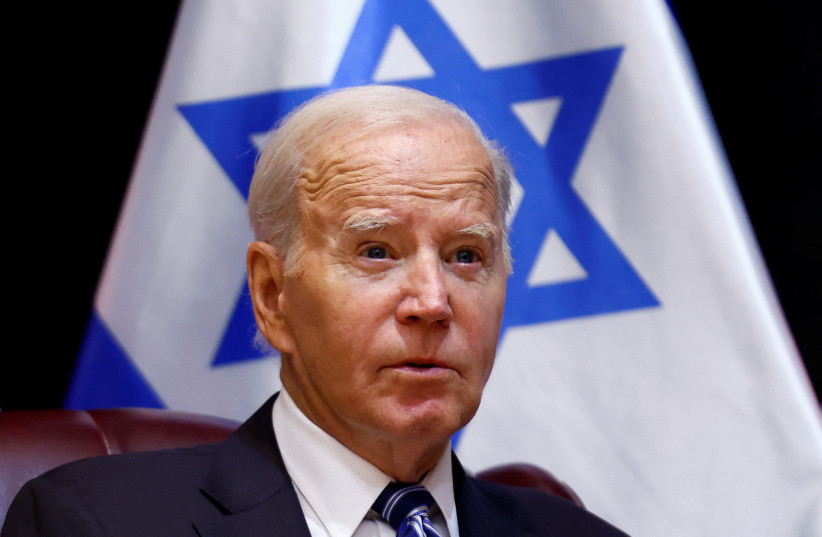
Wall Street gave back a sliver of last week’s record run on Monday after crude oil surged roughly 5%, driven by growing doubt that Washington and Tehran will reach a deal to reopen the Strait of Hormuz any time soon.

The mechanics are straightforward: higher oil means higher inflation, and higher inflation means the Federal Reserve is more likely to raise rates — the opposite of what stocks rallied on last week.

The S&P 500 finished just below the flatline, slipping 0.06% to 7,753.11. The Nasdaq Composite fell 0.32% to 26,605.36, and the Dow Jones Industrial Average dropped 60.95 points, or 0.11%, to close at 53,975.98. The Russell 2000 lagged the large-cap indexes, trading down about 0.6% near 3,015.

That leaves the S&P a whisker under Friday’s record close of 7,757.64 — a pause rather than a reversal.

The week that came before

Stocks posted a second straight winning week last week. The S&P 500 advanced 3.6%, closing above 7,700 for the first time in its history. The Nasdaq gained 5.2% on a rebound in chip stocks, with the iShares Semiconductor ETF up more than 7%. The Dow added nearly 3%.

Friday’s fuel was the July jobs report: nonfarm payrolls fell by 23,000 against expectations for a gain of about 82,000, and June was revised down to 20,000 from 57,000. The unemployment rate came in at 4.1%, below June’s 4.2%. Labor force participation slipped to 61.4% and average hourly earnings rose just 0.1% on the month.

Weak jobs plus soft wages equals a Fed that can sit still. Monday’s oil move put a question mark on that.

Market movers

Nvidia was the single heaviest drag on the tape, falling nearly 3% after a Financial Times report that the chipmaker is working with Apollo Global and Blackstone on a $500 billion AI infrastructure funding package. Bank of America kept its buy rating and called Nvidia a top sector pick, dismissing memory-cost and circular-financing concerns as overblown ahead of the company’s fourth-quarter report on Aug. 26.

Intel dropped 4% after announcing a $15 billion common stock offering. Equity offerings dilute existing shareholders, and the market priced that in immediately. Apple shed 1.5%.

The day’s biggest winners were both takeout targets. MarineMax soared 46% after agreeing to be sold to Blackstone Infrastructure’s Safe Harbor Marinas for $53 a share in cash, a $1.5 billion deal expected to close by year end. Varex Imaging climbed 48% after Teledyne Technologies agreed to buy it for $18.90 a share in cash, with closing expected in early 2027. Teledyne rose slightly.

AI infrastructure names sold off across the board. The Global X Data Center & Digital Infrastructure ETF lost 1%, Corning fell more than 3%, and photonics makers Coherent and Lumentum dropped 12% and more than 6%.

Exxon Mobil rose 3.4% as energy tracked crude higher, while Eli Lilly gained 2.3%, Microsoft 2.2%, Amazon 1.9% and Meta Platforms 1.3%. AbCellera surged 36% after a mid-stage trial showed its drug reduced hot flashes against placebo after a single dose.

Critical mineral stocks — MP Materials, 5E Advanced Materials, United States Antimony, Critical Metals, USA Rare Earth and Energy Fuels — moved on the White House announcement late Friday of more than $2 billion in new mining investments plus over $180 million for mining schools and workforce development.

Berkshire Hathaway reported second-quarter operating earnings of $12.98 billion against $11.16 billion a year earlier, on revenue of $101.81 billion versus $92.52 billion, and repurchased roughly $4.5 billion of its own shares in the quarter.

Commodities

West Texas Intermediate futures climbed about 5% to close at $82.13 a barrel, and Brent settled around 5% higher at $87.72. Both benchmarks had fallen more than 7% last week on expectations that Iran and Oman were closing in on an agreement. Before the war, the strait carried roughly one-fifth of global oil shipments. U.S. Strategic Petroleum Reserve stocks have fallen below 300 million barrels, the lowest since January 1983.

Gold futures rose 0.43% to $4,418.60 an ounce. The metal gained 7.4% last week, its best week since January, with silver up 10.2% to $65.34.

Rates, the dollar and the Fed

The 10-year Treasury yield held near 4.66%, still subdued after the payrolls miss, though it traded as high as 4.703% against Friday’s close of 4.658% — pressure from oil rather than from growth optimism. Futures now price roughly a 44% chance of a quarter-point hike in September, down from about 67% a week ago. The dollar hovered near a two-month low against major currencies.

What moved the world

Iran says it is nearing a deal with Oman to reopen Hormuz but continues to resist direct talks with the United States until conditions are met. Foreign Minister Abbas Araghchi said Sunday there is no possibility of restarting negotiations while those conditions stand. Tehran wants the naval blockade lifted and compensation for war damages.

President Trump told Axios on Sunday the U.S. is “only semi-negotiating” with Iran, and indicated he would lean on the blockade rather than new airstrikes. Iran’s supreme leader replaced the official who issued those demands with a veteran Revolutionary Guards commander skeptical of talks with Washington. Houthi militants claimed an attack on a Saudi refinery near the Red Sea, and an Abu Dhabi National Oil Co. tanker was attacked in Hormuz over the weekend.

Overseas, Australia’s S&P/ASX 200 closed down 0.3% at 9,232.60.

What’s next

The Consumer Price Index and initial jobless claims are due this week, along with earnings from Super Micro Computer, CoreWeave and Cisco Systems. Producer prices and the University of Michigan inflation survey follow.

A cool CPI keeps last week’s rally intact and September on hold. A hot one, with oil back above $80, puts the hike squarely back on the table.

JBizNews Desk | Wall Street

© JBizNews.com All Rights Reserved. Reproduction or distribution without written permission is prohibited.

A restaurant industry veteran who has led some of America’s best-known chains sees major growth potential in one segment of the dining business.

G.J. Hart, CEO of Houston-based SPB Hospitality, told FOX Business that the “upscale casual” category is “there for the taking” as the company looks to expand J. Alexander’s, one of the brands in its portfolio.

Hart, who previously served as CEO of Red Robin, California Pizza Kitchen and Texas Roadhouse, said consumers continue to respond to restaurants that deliver both value and a strong experience.

“It’s a space that, from my perspective, my thesis is that it will continue to resonate with consumers, because you’ve got a pretty decent value for a great experience,” Hart said.

CRACKER BARREL SELLS MAPLE STREET BISCUIT COMPANY, CLOSES 16 LOCATIONS

Hart added, “[J. Alexander’s] has been around a long time and it’s very well respected, has a very loyal guest base. … There’s a ton of opportunity to grow [J. Alexander’s] in those strong markets and build out from those core markets and fill a need that’s out there.”

Unlike restaurant segments dominated by national chains, Hart said upscale casual is still made up largely of regional operators.

“When you think about who the real players [are] in upscale casual, it’s mostly regional players,” he said. “… Us becoming bigger will help us get stronger in that space, and I think it’s a space that’s there for the taking.”

SPB Hospitality owns a portfolio of restaurant brands including J. Alexander’s, Logan’s Roadhouse and Krystal.

WENDY’S LOSES STATUS AS SECOND-LARGEST BURGER CHAIN AFTER 6-YEAR RUN

Hart said the company is preparing to open six to eight restaurants annually as it ramps up its growth plans.

“We’ve got a fairly aggressive plan,” Hart said.

SPB Hospitality is working to ensure it has the infrastructure, training and management pipeline needed to support those new locations, he said.

Since becoming CEO of SPB Hospitality in September 2025, Hart said he has focused on making restaurant operations easier and applying lessons from his time leading Texas Roadhouse, California Pizza Kitchen and Red Robin.

“The basics are the same,” Hart said, pointing to leadership, communication and giving employees a voice.

PIZZA CHAIN TO CLOSE UP TO 50 LOCATIONS AS SALES SLUMP

GET FOX BUSINESS ON THE GO BY CLICKING HERE

As SPB Hospitality enters its next phase of growth, Hart said the larger challenge is keeping its brands relevant as consumer preferences evolve.

“What I’ve learned in all these brands and now bring to [J. Alexander’s] and SPB is this idea around relevancy,” he said. “How do you stay relevant for today’s ever evolving consumer and consumer needs and consumer wants?”

This post was originally published here. 

After years of honing the craft of brokerage growth and development at firms like The Real Brokerage and eXp Realty, Erinn and Peter Nobel decided to use their skills to found and launch ENRG. Realty in January 2024. 

After starting her real estate career in 1999 as an agent at a boutique brokerage in Washington state, Erinn Nobel eventually found herself joining a fledgling eXp Realty affiliate where she would go on to become a regional growth leader.

In 2020, just before the onset of the COVID-19 pandemic, Nobel’s career arc took her and husband Peter, a former Microsoft systems leader and eventual chief operating officer at eXp, to Real. 

“I brought 1,600 agents over within a matter of months, grew revenue 885% — we set the trajectory of the company, rebuilt their back-end technology system, redesigned the agent revenue share model, built the culture and the vision statements, and we had a lot of fun doing it, but we were totally burnt out,” Erinn Nobel told HousingWire.

“We just looked at ourselves and I said, ‘We are the ones with the knowledge; let’s do this for ourselves and launch a company that is built very intentionally.” 

Boutique service on a national scale

It’s with this in mind that the Nobels created ENRG. Realty, which Erinn Nobel describes as both a virtual brokerage with a national platform that is also a boutique firm.

“We have that human-to-human contact and support,” she said. “It is really about using technology to support that human interaction. We are never going to have our agents answer to a bot. Humans understand the real estate life cycle and we are not outsourcing the support.”  

While Nobel said the company has resources and support for agents readily available through their technology, agents can also quickly access support from a human broker. 

“We feel the only way a virtual company is going to be successful is by having really well-educated and knowledgeable managing brokers in each state that are empowered to make decisions and run their state, because they understand what the local culture there is like and things can really differ from state to state,” she said. 

Growth trajectory

Although the firm launched in January 2024, it wasn’t until January 2025 that things really began heating up, with the company announcing plans to launch in Florida, Washington, Ohio and Texas. The firm is currently in 16 states, but Nobel said growth has been slow. 

“It has been a weird year,” she said. “I think everybody came out of the lawsuit and the settlement, and then we had all of the acquisitions, and they are just frozen trying to figure out what is going on.” 

In addition to market dynamics, Nobel also attributed the firm’s slower pace of growth to the fact that they don’t take just any agent. In order to join the firm, agents must be in production and meet ENRG production requirements.

“We’re not a fit for brand-new agents, and we’re not a company here just to recruit agents and help people become rich through revenue share,” Nobel said. 

Revenue share without a recruitment focus

Despite this stance on recruitment, ENRG. Realty does have a revenue share model, but Nobel said the firm does not want its agents to be “distracted by recruiting.” 

“We offer recruiting as a service, where the agent simply introduces us to a potential recruit, and we then have a team that handles all of the recruiting. That helps keep both the recruiting agent’s brand intact, and it helps ensure that our reputation stays intact and that we are making sure that the recruit really aligns with our company,” she said. 

In addition to offering revenue sharing, ENRG. also offers a five-tier equity award system that’s based on production, incentivizing agents with stock, as Nobel said they plan to eventually take the company public. 

“It is an expensive process, so we need to be thoughtful about when we initiate the process,” Nobel said. “We got to ring the bell at the New York Stock Exchange when we were at Real, and I can’t wait to do that again.” 

For now, though, Nobel said she is focused on building out the business with intention.

“We are not looking to be the biggest company in the world. We are looking to go international and we will be moving into Canada at some point soon, but it is really about being in a true business partnership with our agents,” she said.

“We want to be an answer in a platform to any type of way a group is structured — from an independent brand that wants to keep their branding but have back-end support, to a team that wants to scale nationally, to a small mother-daughter team. It is really about being able to cater to and create the right fit for where that agent is right now. It is also about being flexible and about listening to what the agents need, and being nimble enough so that we can support them into the future.”

This post was originally published on here. 

CrossCountry Intermediate Holdco (CCM) is expected to issue $500 million of senior unsecured notes, coinciding with the projected August closing of its Two Harbors Investment Corp. acquisition.

Fitch Ratings said it expects to rate the issuance at ‘BB-(EXP)’, ranking pari passu with existing senior unsecured debt. Proceeds are expected to be used to repay mortgage servicing rights (MSR)-backed facilities that will be drawn to fund the transaction.

The credit ratings agency estimates corporate leverage for CCM will increase to 2.4x after the acquisition, up from 1.2x in the second quarter of 2026 and exceeding its downgrade trigger of 1.5x.

“However, retained earnings growth should reduce leverage toward the company’s 1.0x target over the medium term,” Fitch said. “Negative rating action could result from an inability to reduce corporate leverage to 1.5x or below over the rating outlook horizon.”

Analysts expected CCM to raise debt to proceed with the Two Harbors deal, valued at $1.26 billion, flagging rising leverage as an integration challenge as well as the complex task of bringing a large servicing portfolio in-house.

A shift from secured to unsecured debt, however, is viewed as credit positive because it frees up collateral and strengthens liquidity, analysts added.

CCM told HousingWire previously that “while leverage will temporarily increase following the transaction, it’s important to view that in the context of a significantly larger and more cash-generative business.”

“The combined company will benefit from substantially higher recurring servicing cash flows, a larger MSR portfolio and meaningful synergy opportunities, all of which support rapid deleveraging over time,” the company added.

Two Harbors will bring a $159 billion portfolio to CCM’s $202 billion as of the first quarter, according to Inside Mortgage Finance. The deal pushes the lender from the No. 15 spot to No. 8 among the largest servicers by owned portfolios.

According to Fitch, Two Harbors will further enhance CCM’s business profile by growing its servicing portfolio and enabling more profitable in-house servicing through RoundPoint Mortgage Servicing LLC, which Two Harbors acquired in 2023.

“CCM’s ratings reflect its growing distributed retail franchise, conservative debt usage, solid profitability, adequate liquidity, limited asset quality risks and well-executed growth strategy,” Fitch analysts said.

Earlier this month, Two Harbors said it had secured required state and agency approvals from all but one state for its planned sale to CCM.

This article was written by Flávia Furlan Nunes and generated with the assistance of HousingWire Automation, then reviewed by a HousingWire editor before publication.

This post was originally published on here. 

Aner Shapiro, the Jerusalem artist and musician who was killed while saving others during the October 7 massacre, will be honored at this year’s Israel Festival with an unusual event this week aimed not simply at celebrating creativity, but at putting it to work.

The “Creators of Impact” hackathon, to be held Wednesday as part of the festival’s two-day VERSE program, will bring together 10 artists working in different disciplines and 10 nonprofit organizations to develop new artistic projects designed to address social problems.

The event is being organized by the Israel Festival, the Aner Shapiro Association (also known as the Aner Foundation), and JDC-Israel.

Aner Shapiro’s legacy of art and healing

VERSE, taking place August 11-12 at the Jerusalem Campus of the Arts, is conceived as a meeting point between artistic creation and social activism. The festival describes it as art driven by “radical compassion,” bringing together artists and activists who see creativity as a way to listen to different voices, connect communities, and encourage change.

That philosophy reflects Shapiro’s own life. A multitalented Jerusalem artist, composer, writer, and singer, he believed in the ability of music and art to unite and heal. On October 7, 2023, he was at the Nova music festival and took shelter with others in a roadside shelter near Re’im. 

A MULTITALENTED Jerusalem artist, composer, writer, and singer, Aner Shapiro believed in the ability of music and art to unite and heal.  (credit: Courtesy the Israel Festival)

When Hamas terrorists repeatedly threw grenades inside, Shapiro threw them back out until he was killed at the age of 22. His actions saved the lives of others sheltering there. The association established in his name seeks to continue his belief in using art as a means of repairing the world.

Artists and nonprofits unite for ‘Creators of Impact’

The invitation-only hackathon begins at 12:30 p.m. on August 12. Artists and representatives from the participating organizations will work together on social challenges. Their goal is to develop artwork ideas that can tell stories, stimulate discussion, and inspire action. A jury will select one proposed work to receive funding for its realization.

The organizations reflect an unusually broad range of issues in Israeli society. They include Otot, which supports at-risk youth; I-School, which provides online educational opportunities for students from disadvantaged areas and those affected by the war; ASSAF, which assists refugees and asylum seekers; and Blendar, which promotes Jewish-Arab connections through Arabic language and cultural education.

Among the others are a Sakhnin organization providing care for people with disabilities and special needs; Kanfey Dror, which combats bullying and social exclusion; Home Base, which works with homeless people through sports and community rehabilitation; Machshava Tova, which seeks to reduce social disparities through access to technology; the Council of Youth Movements in Israel; and Ruach Oz, which helps wounded IDF soldiers navigate recognition and rehabilitation.

The 10 artists were chosen in part because of their previous engagement with socially oriented art and their experience taking projects from conception through public presentation. They represent disciplines including visual art, poetry, choreography, theater, music, street art, performance, sound, and film.

Among them are multidisciplinary artist Shani Avivi, whose work explores memory, home, community, and personal archives; poet and choreographer Efrat Nachma; theater creator and actress Ofri Fuchs; participatory artist and designer Shmulik Twig; musician and rapper Yitzhak Vodaj; multidisciplinary performer Uri Duvdevani; performance artist Mohammed Abu Sarah; street artist Lior Ben Tov (Pesh); performance and sound artist Rotem Volk; and filmmaker Liav Kovalchuk, a Sam Spiegel Film School student whose work deals with identity, trauma, memory, and relationships.

VERSE brings art and social activism together

The VERSE program extends the same idea of art as a vehicle for connection throughout its two days, with music, film, exhibitions, participatory art, and discussions. Performers include Ninet Tayeb with Berry Sakharof, Ehud Banai, Pele Ozen with Hasan MC, and Orit Tashoma.

Also on August 12, a special edition of Jerusalem Story will be held, the storytelling project and podcast devoted to highlighting the city’s diverse communities. Six Jerusalemites will tell personal stories representing different backgrounds, neighborhoods, religions, and traditions in an evening hosted by Mishy Harman and featuring music by Rona Kenan.

Taken together, the events make VERSE less a conventional tribute to Shapiro than an attempt to continue his legacy and life. He was motivated by the wish both to help and inspire others through his creativity and his belief that art can do more than reflect the society around it, that it can also help change it.

This post was originally published on here. 

“We achieved the unimaginable together. Our joint achievement is historic,” US Central Command (CENTCOM) chief Adm. Brad Cooper told senior IDF commanders on Monday in remarks obtained exclusively by The Jerusalem Post.

“You are a nation of warriors, and the people sitting here are the leaders of those warriors,” Cooper told the officers. “I am proud to serve shoulder to shoulder with you.”

Cooper also delivered a direct message about the future of the US-Israel military relationship.

CENTCOM chief stresses enduring US commitment to Israel

“We have a high and enduring commitment to you,” he said.

According to a source familiar with the closed forum, Cooper said that many countries speak about allies fighting “shoulder to shoulder,” but that in the case of the US and Israel, the phrase described an operational reality.

CENTCOM chief, Brad Cooper, addresses IDF Chief of Staff Lt.-Gen. Eyal Zamir and IDF commanders on the US-Israel military partnership. August, 8, 2026. (Credit: IDF Spokesperson’s Unit)

The source described Cooper’s appearance as historic, saying it was highly unusual for a CENTCOM commander to address an IDF operational forum of this kind.

The gathering, led by IDF Chief of Staff Lt.-Gen. Eyal Zamir, included senior IDF officers and operational commanders from the rank of lieutenant-colonel and above, among them battalion commanders and squadron commanders who had taken part in the war.

The commanders received a multi-front operational and intelligence briefing, including a review of developments during the war and Israel’s achievements against Iran. Zamir also delivered an extensive assessment of the current strategic situation.

US-Israel military partnership deepens amid war

Cooper’s closed-door comments were stronger and more personal than the remarks included in the IDF’s official statement on the meeting.

The IDF said Cooper reviewed the deepening strategic partnership between the US and Israeli militaries, saying that cooperation between the two had repeatedly proven itself throughout the campaign.

According to the military, Cooper stressed that the partnership was based on trust, commitment and close cooperation, and had become an important element in strengthening regional security and stability.

Zamir thanked Cooper for the close cooperation between the militaries and presented him with a gift. He described cooperation with the US military as “unprecedented” and called it a “strategic anchor.”

Zamir: Israel at a ‘strategic crossroads’

“We are in a significant period and at a strategic crossroads,” Zamir told the forum.

“The IDF is a fighting military, and we are engaged in a large, prolonged, multi-front campaign. Our mission is to influence reality and not be dragged behind it, through tactical and systemic initiative.”

Zamir said diplomatic negotiations were currently taking place in several of Israel’s main theaters and linked those talks directly to the IDF’s military achievements.

“All of these are the result of the IDF’s historic achievements,” he said. “We must ensure that we fully realize the achievements of the campaign and maximize them.”

IDF Chief of Staff Lt.-Gen. Eyal Zamir and US CENTCOM commander Adm. Brad Cooper salute during Cooper’s meeting with senior IDF commanders on August 10, 2026. (credit: IDF SPOKESPERSON'S UNIT)

“We are well prepared on defense, alongside immediate readiness and alertness for a return to high-intensity fighting.”

Zamir told commanders that the IDF was carrying out what he described as a systematic and structured plan for victory.

“Since October 7, the IDF has proven itself as a victorious military, with a spirit of strength, an offensive and initiating military,” he said.

“The achievements we have made on all fronts are first and foremost your achievements,” Zamir told the commanders, referring to troops and personnel across the ground forces, navy, air force, intelligence, communications, logistics and administration.

“Together, you led the IDF to significant achievements and changed the security reality.”

Zamir said the military was now in an interim period and warned commanders against allowing forces to lose their readiness.

“Alongside the desire to allow forces to refresh, we must not lose vigilance,” he said.

“We are required to maintain high readiness, be prepared for a rapid return to high-intensity fighting, respond quickly to every development and continue protecting our citizens.”

“The challenge now is to continue shaping reality, build the force and ensure that the IDF is prepared for every scenario,” Zamir said.

This post was originally published on here. 

Dozens of ultra-Orthodox protesters denounced the expansion of the light rail in the Bar-Ilan Street area of ​​Jerusalem, Israel Police confirmed on Monday night. 

Israel Police and Border Police officers are currently working to restore public order and have instructed the rioters to clear the roadway after officially declaring the protest a public disturbance, police said.

“The rioters are disrupting daily life in the area while attempting to intermittently block traffic routes and cause damage at the light rail construction site,” police added.

This is a developing story.

This post was originally published on here. 

The US State Department said on Monday it has revoked more than 175,000 visas from foreign nationals under President Donald Trump’s administration, as it continues a sweeping immigration crackdown that has stripped travel and immigration privileges from tens of thousands more people.

The department said in a statement the revocations targeted foreigners who “violated the terms of their visas, committed crimes, called for violence against US citizens, defrauded Americans, abused our immigration system, or endangered national security.”

Most visas were revoked following “law enforcement encounters,” with assault, driving under the influence, theft and drug crimes the leading causes, the department said.

Specific cases cited by the department include a person charged with felony rape and sexual battery, another charged with kidnapping and human trafficking, and a person facing more than a dozen counts of possessing child sexual abuse material. A US embassy in North Africa revoked more than 100 visas from “birth tourist” parents who allegedly came to the US primarily to give birth so their children would receive US citizenship, it said.

State Department revokes visas of those who ‘celebrated’ Charlie Kirk assassination

The department also said it had revoked the visas of multiple foreigners who “celebrated” the assassination of conservative activist Charlie Kirk, including one who said he “died too late.”

Charlie Kirk debating pro-Palestinian activists at the University of Washington, Seattle, May 7, 2024. (credit: REUTERS/DAVID RYDER)

In January, the department said it had revoked more than 100,000 visas, a record at the time.

The extent of the revocations reflects the broad immigration crackdown initiated when Trump returned to the White House last year, deporting an unprecedented number of migrants including some who held valid visas. The administration has also adopted a stricter policy on granting visas, with tightened social media vetting and expanded screening.

Rights advocates and human rights experts have condemned the Trump administration’s social media screening efforts, which they say threaten free speech and are akin to surveillance and singling out of immigrants.

This post was originally published on here. 

WASHINGTON — The Trump administration, which in recent months had avoided public discussions of vaccine policy because of concern around the political repercussions, is changing course. 

Speaking from the Oval Office, President Trump on Monday unveiled a new executive order as he and his top health officials presented a new, skeptical government approach to vaccines, making extraordinary claims without evidence to support the remade federal agenda.

Read the rest…

This post was originally published here. 

Gold just posted its strongest week in seven months, and the reason is simple: a bad jobs report made a Federal Reserve rate hike look a lot less likely, and gold always gains when the case for higher interest rates weakens.

Bullion climbed 7.4% over the week, its fastest advance since Jan. 19. Spot gold jumped 2.3% on Friday alone to $4,336.02 an ounce, touching its highest level since June 17, while U.S. gold futures settled up 2.3% at $4,399.70.

Here is the mechanism in everyday terms. Gold pays no interest and no dividend. When the Fed raises rates, cash and bonds start paying more, and holding a metal that pays nothing becomes expensive. When a rate hike looks less likely, that cost falls away and money moves back into gold.

The jobs number that did it

The Labor Department reported Friday that U.S. nonfarm payrolls fell by 23,000 in July, after a downwardly revised gain of 20,000 in June. Economists had been looking for an increase of 80,000. A negative print where the market expected a solid gain is the kind of surprise that resets rate expectations in a single morning.

Traders now put the odds of a quarter-point hike in September at roughly 44%, down from about 67% a week earlier. Separate futures pricing showed the probability of the Fed simply holding rates in September rising to 56.1% from 43.2% before the report landed.

The dollar softened and Treasury yields eased alongside it, both of which push in gold’s favor.

Where prices stand now

December gold futures opened Monday at $4,400 an ounce, unchanged from Friday’s close and the highest opening level since early June, before slipping to $4,391.50 by 8:22 a.m. Eastern. Spot gold was at $4,333.81 an ounce at 10 a.m. Eastern, down about $10 from the prior session. By midday the spot price had firmed to $4,375.89.

Gold has held above $4,300 through Monday, keeping last week’s gains even as oil prices moved higher on continued uncertainty over reopening the Strait of Hormuz.

The rest of the precious metals complex ran harder than gold. Silver gained 10.2% on the week to $65.34 an ounce, also its fastest weekly move in nearly seven months. Platinum rose 1% Friday to $1,745.87 and palladium added 0.4% to $1,376.90, with both finishing the week higher.

Why this year has been strange for gold

Gold normally thrives on war and inflation. This year it did not, and the reason matters for reading what comes next. Both metals started 2026 strong on expectations of an easier Fed — gold rose 8.7% in the week of Jan. 19 to $4,980 an ounce, silver 14.7% to $102.48. That reversed on Feb. 28, when the U.S. and Israel struck Iran and Tehran retaliated, driving oil and global inflation higher and pushing central banks toward rate hikes. Rising rates and wartime demand for cash pulled money out of both metals, and they only found support as Middle East tensions eased somewhat and the U.S. labor market began to cool.

In other words, the war worked against gold this year rather than for it, because it forced central banks to tighten. Last week’s payrolls number was the first real crack in that logic.

The central bank bid underneath

Behind the price action sits steady official buying. China’s central bank is expanding its gold storage in Hong Kong as part of a broader shift of sovereign reserves out of London, and it added 20 tons in July alone in what is now a 21-month buying streak. That is a floor under the market that does not move with weekly data.

UBS said Friday it expects gold to reach $5,000 an ounce in the first half of 2027.

What’s next

This week brings the July Consumer Price Index and Producer Price Index, along with jobless claims and the University of Michigan inflation expectations reading. A hot inflation print would put a September hike back on the table and take the wind out of last week’s move. A soft one extends it.

Gold miners are the second-order trade. Newmont, the largest holding in the major mining ETFs, has broken above its 150-day moving average, while the GDX and GDXJ funds are still testing theirs and gold itself remains below that line. Miners tend to move harder than the metal in both directions.

JBizNews Desk | Wall Street

© JBizNews.com All Rights Reserved. Reproduction or distribution without written permission is prohibited.

President Trump signed an executive order at the White House on Monday that tells the federal government to recommend fewer vaccines for American children and to stop giving several of the remaining ones on the same day. A draft of the order said the number of vaccines recommended for children should be more limited, and it gave the Department of Health and Human Services 90 days to reassess the sequencing and timing of the childhood schedule.

In plain terms: the shots a child gets, the order they get them in, and how many can be given in a single visit are all being rewritten, and the clock on that rewrite started Monday.

The order pushes single-dose vaccines over combination shots, stating that childhood immunizations should be given at separate medical visits to the maximum extent feasible. It calls for the MMR vaccine to be broken into three separate shots, and it moves RSV and hepatitis A and B into a category reserved for high-risk children. The draft text did not mention autism. The president did.

Speaking before signing, Trump said the administration was announcing what he called the country’s “Gold Standard” childhood vaccination recommendations, and said autism was among the subjects involved. He also said the cause of autism is not known. Decades of studies involving millions of children have found no link between vaccines and autism.

Why drugmakers are watching

The federal childhood schedule is not just guidance. It drives insurance coverage, state school requirements, and the government’s own Vaccines for Children program, which buys shots for roughly half the children in the country. A vaccine that comes off the recommended list loses much of its market in a single stroke.

Merck sits closest to the fire. The company makes the MMR shot used in the United States, along with the combination version that adds chickenpox. Standalone measles, mumps, and rubella vaccines are not currently licensed or sold in this country — Merck stopped making them more than fifteen years ago. An instruction to split MMR into three separate shots therefore points at products that do not exist on the American market today and would take years and new regulatory approval to bring back. Merck’s HPV franchise, Gardasil, is separately exposed if the review reaches recommendations for that shot. Pfizer, Moderna, Sanofi, GSK, BioNTech, and Novavax all carry exposure to routine and childhood immunization revenue.

Analysts had already flagged the risk that even a vague executive action erodes voluntary uptake and destabilizes payer networks and state mandates, while noting the counterargument that the order might direct new studies rather than restrict access outright. Monday’s text lands closer to the first case: it does not ban anything, but it tells the government to trim the list and space out the visits.

The legal wall already standing

This is the second run at the schedule this year. The CDC in January recommended cutting childhood vaccination down to 11 diseases. The American Academy of Pediatrics refused to follow and kept its recommendations at 18. In March, a federal judge blocked the CDC’s changes. The new order acknowledges that litigation has delayed the earlier push, which is the stated reason for pursuing additional measures now.

It cites efforts to align the American schedule with what it calls best practices from peer nations, along with religious liberty and parental authority. The American Academy of Pediatrics has countered that peer nations face different disease conditions and that best practices vary accordingly.

That leaves the same question hanging over Monday’s signature that hung over January’s guidance: whether it survives contact with the courts.

What comes next

The 90-day review is the number to watch. HHS, under Secretary Robert F. Kennedy Jr., now has until roughly early November to come back with a reassessed schedule. Trump’s own political advisers had urged Kennedy to stay off vaccine issues until after the November midterms, out of concern the fight would cost Republicans. The signing overrides that advice.

For manufacturers, the near-term financial hit is not the order itself but what the review produces in the fall — which shots stay on the list, which move to high-risk-only status, and whether pediatricians and insurers follow Washington or follow the pediatricians’ academy. For parents, the practical change, if the recommendations hold, is more trips to the doctor’s office for the same set of shots.

JBizNews Desk | Washington

© JBizNews.com All Rights Reserved. Reproduction or distribution without written permission is prohibited.

U.S. seaports handled 2.5 million twenty-foot-equivalent units of containerized imports in July, the fourth-highest July total on record, as retailers and manufacturers rushed goods into the country ahead of a new round of tariffs.

The surge reflects a familiar strategy: bring merchandise in before import costs rise.

China remained the biggest source of U.S. containerized goods, with imports from China climbing to 873,129 TEUs, the highest monthly volume in a year. That matters because Chinese-made goods remain deeply embedded in U.S. retail inventories, from electronics and furniture to clothing and household products.

The July rush came as the U.S. tariff structure shifted again. A 10% global tariff expired in late July and was replaced by tariffs of as much as 12.5% on imports from 60 countries, increasing the incentive for companies to move merchandise before the higher duties took effect.

Walmart, Amazon, Home Depot and other major retailers account for a significant portion of the goods entering U.S. ports, meaning much of July’s cargo is destined for American stores, warehouses and consumers.

For shoppers, the important question is what happens after the warehouses are full.

Front-loading merchandise can temporarily shield consumers from tariff increases because retailers have inventory purchased under the earlier cost structure. It does not eliminate the higher cost once companies need to reorder.

That means the impact may arrive gradually. Retailers can absorb part of a tariff through lower margins, pressure suppliers for concessions, change sourcing or raise prices. Most large companies use some combination of all four.

The timing is particularly important because much of the merchandise arriving now will support back-to-school, fall and holiday sales.

Despite July’s huge volume, imports were still 4.3% below the near-record level reached in July 2025. Through the first seven months of 2026, container imports were down about 0.9% from a year earlier while remaining well above pre-pandemic levels.

Shipping analysts also expect the import rush to begin fading. Companies moved their traditional peak shipping season earlier to get ahead of tariffs and supply-chain disruptions, leaving fewer goods that still need to arrive later in the year.

The consumer takeaway is that packed ports today can mean well-stocked shelves tomorrow — but not necessarily lower prices.

Retailers have stocked up before the newest tariffs hit. Once those inventories turn over, shoppers could get a clearer picture of how much of the additional import cost companies intend to absorb and how much they intend to pass along.

JBizNews Desk | Los Angeles

© JBizNews.com⁠ All Rights Reserved. Reproduction or distribution without written permission is prohibited.

An earthquake with a magnitude of 7.4 shook Colombia’s coastal Choco province at 7:34 a.m. local time on Monday, killing at least 111 people and trapping an unknown number of people underneath rubble.

According to the geological service, the quake struck at a depth of 79 km, with its epicenter near San José del Palmar.

Shortly after the initial tremor, the geological service reported an additional magnitude 4.8 seismic incident in the same region.

Choco province Governor Nubia Carolina Córdoba-Curi stated that many injuries have been reported and there was severe damage to buildings. Córdoba-Curi added that damage assessments are underway. 

People look for survivors amid the rubble of a collapsed building after an earthquake in Cali, Colombia on August 10, 2026. (credit: JOAQUIN SARMIENTO/AFP via Getty Images)

Videos posted on social media showed parts of Manizales city’s Metropolitan Cathedral Basilica, the tallest cathedral in Colombia, crumbling after the tremor.

Santiago de Cali City Mayor Alejandro Eder stated that at least 20 structures have collapsed, trapping people underneath rubble as emergency services work to get the situation under control. 

Colombia’s National Unit for Disaster Risk Management (UNGRD) stated that there is no tsunami threat.

The Colombian Geological Service initially reported that the earthquake had a magnitude of 6.6, before revising the official measure to 7.4. Other initial reports also varied in magnitude between 6.6 and 7.4.

Colombian president calls emergency meeting, Israel offers assistance

Colombian President Abelardo De La Espriella convened an emergency meeting with UNGRD to evaluate the damage, review incoming reports, and coordinate emergency response in affected areas, according to a statement released by Espriella’s office.

Foreign Minister Gideon Sa’ar shared his concerns over the earthquake in a statement on X/Twitter and offered his Colombian counterpart any assistance that Israel could contribute in the aftermath of the quake. 

“Israel is prepared to assist Colombia as much as required,” Saar stated, adding that his “thoughts and prayers are with the Colombian people during this difficult time.”

Reuters contributed to this report.

This post was originally published on here. 

A coalition of consumer and housing advocacy organizations is urging the Consumer Financial Protection Bureau (CFPB) to preserve key mortgage borrower protections, warning that proposed changes to federal lending rules could leave consumers vulnerable to predatory practices and unaffordable loans.

The National Consumer Law Center, National Housing Law Project, National Fair Housing Alliance, Americans for Financial Reform Education Fund and Consumer Federation of America submitted comments opposing changes affecting the Truth in Lending Act and Real Estate Settlement Procedures Act, which together underpin the TILA-RESPA Integrated Disclosure rules.

The groups said the existing framework was developed after years of evidence that consumers were being harmed by the complexity of mortgage transactions and urged the CFPB to focus instead on enforcing the current rules.

“Instead of weakening regulations, we urge the CFPB to enforce the existing TRID regulations,” said Steve Sharpe, senior attorney at the National Consumer Law Center. “Any changes must serve the ultimate goal of helping borrowers access safe and affordable credit.”

A central concern is the potential impact on the rules governing borrowers’ right to rescind certain mortgage transactions.

Under the current framework, borrowers have a three-day window to cancel a mortgage without penalty, giving them additional time to review final loan terms and reconsider a transaction if they were pressured into closing.

“Mortgage transactions are too complex to digest at the closing table, at the last minute,” said Andrew Pizor, senior attorney at the National Consumer Law Center. “The pre-consummation disclosures and the right of rescission complement each other. Consumers deserve to see the final loan terms before closing, and they need a chance to cancel if they have been pressured into signing. A family’s home is too important to take away these protections.”

The organizations also highlighted reverse mortgages, which they said require particular attention because borrowers must evaluate products with different loan terms and payment structures.

The groups called for improved reverse mortgage disclosures based on consumer testing and public feedback, as well as mandatory pre-loan counseling. They also recommended responsive electronic disclosures designed for different devices and streamlined disclosure options in certain circumstances.

“Disclosure is not enough,” Pizor said. “Given the complexity of reverse mortgages, pre-loan counseling is necessary to ensure that consumers are aware of the risks and can weigh their options.”

This article was generated using HousingWire Automation and reviewed by a HousingWire editor before publication.

This post was originally published on here. 

Apple is testing memory chips made by China’s ChangXin Memory Technologies as the artificial-intelligence boom drives up prices and tightens supplies of components used in iPhones, Macs and other consumer electronics.

The discussions center on using CXMT chips in devices sold in China. Apple has also sought U.S. government clearance to purchase from the company, which has drawn scrutiny in Washington over national-security concerns and its role in China’s semiconductor expansion.

The move does not mean Apple has selected CXMT as a supplier. Testing is part of the qualification process, and Apple has not publicly confirmed that it will use the chips in commercial products.

But the fact that Apple is evaluating a Chinese memory supplier shows how dramatically the global chip market is being reshaped by AI.

Data centers are consuming enormous quantities of memory and storage components, forcing consumer-electronics manufacturers to compete for capacity with companies building AI servers. That demand has pushed memory prices higher and made additional sources of supply more valuable.

Apple Chief Executive Tim Cook has already acknowledged that rising memory and storage costs are pressuring the company, with Apple preparing to pass some of those increases through to product prices.

CXMT has become increasingly important in the global DRAM market as China pours money into domestic semiconductor manufacturing. The company is expanding production and has gained market share in conventional memory even as U.S. restrictions seek to limit China’s access to advanced chipmaking technology.

That creates a difficult policy question for Washington.

The U.S. wants American technology companies to reduce their dependence on Chinese semiconductor suppliers. At the same time, AI-driven shortages are making Chinese manufacturing capacity increasingly attractive to companies trying to control costs.

For Apple, the issue is especially sensitive because China remains both a major manufacturing base and one of its largest consumer markets.

Using CXMT components only in Chinese-market devices could help Apple contain costs without immediately restructuring its worldwide supply chain. It could also give Apple additional leverage when negotiating with existing memory suppliers including Micron, Samsung Electronics and SK Hynix.

The wider message for consumers is that AI infrastructure spending is no longer affecting only the companies building data centers.

The competition for chips is moving downstream into phones, computers and other everyday electronics — and could ultimately show up in the prices consumers pay.

JBizNews Desk | Cupertino, California

© JBizNews.com⁠ All Rights Reserved. Reproduction or distribution without written permission is prohibited.

Likud announced on Monday that entrepreneur and businessman Oren Dobronsky, a co-founder of the tech company Hotbar who spent years working in Silicon Valley, would receive Prime Minister Benjamin Netanyahu‘s first reserved slot on the party’s Knesset list ahead of the elections.

In its announcement, the Likud said Dobronsky, whom the party described as right-wing, would be part of the “Likud team” and was expected after the elections to lead the development of artificial intelligence in the economy, education, medicine, and other sectors.

Shortly after the announcement of his reserved slot, it emerged that Dobronsky had previously attacked US President Donald Trump, calling him “a morally corrupt person” in a post on X/Twitter.

“Put aside for a moment the question of whether the agreement with Iran is good or bad,” Dobronsky wrote in the post. “In what world is it normal not to invite to the negotiating table the ally that fought shoulder to shoulder with you?” He added, “Not only did Trump not invite Israel to the negotiating table, he didn’t even share the text of the agreement itself with it? What kind of morally corrupt person treats an ally like that?”

However, on Monday, Dobronsky walked back his statement writing on Facebook that “President Trump is the greatest friend that Israel ever had in the Whitehouse [sic]. I posted in his favor countless times. On one occasion, not knowing all the facts, I lost my temper and posted something I regret. My apologies to President Trump whom I admire deerly [sic].”

Entrepreneur and businessman Oren Dobronsky talks with Prime Minister Benjamin Netanyahu, published August 10, 2026. (credit: GPO)

Dobronsky is well known in the Israeli and American tech industries. He was a co-founder of a company that developed a toolbar for Internet browsers and later completed a significant exit. He subsequently continued working as an entrepreneur and investing in start-ups.

Dobronsky later moved to Silicon Valley, where he became a well-known figure in the Israeli community and the technology industry. Among other ventures, he founded Oren’s Hummus in Palo Alto, a hummus restaurant that became a popular meeting place for tech industry figures in the area, including senior employees of major technology companies.

Dobronsky also appeared on the television program Shark Tank, where he served as an investor alongside Israeli businesspeople and entrepreneurs. Over the years, he invested in start-ups and was involved in initiatives aimed at strengthening ties between Israel’s tech industry and Silicon Valley.

Likud stated that Dobronsky would lead efforts on artificial intelligence in the economy, education, medicine, finance, and “across all sectors of the country.”

“The Likud movement welcomes Oren Dubronsky as the party’s first reserved candidate,” the party stated.

“Oren is a successful businessman, one of the pioneers of Israel’s high-tech industry, and a right-wing figure,” Likud added.

Netanyahu stated that he was “really very excited” about Oren joining because “I think we’re getting an addition here, you could say additional strength, but also additional initiative, additional understanding, additional experience.”

Tel Aviv District Court rejects Likud decision over party’s district slots

Earlier on Monday, the Tel Aviv District Court rejected petitions filed against a Likud tribunal decision concerning candidates running in the party’s district slots. The court’s decision upheld the cancellation of a vote that had sought to allow incumbent MKs, ministers, and deputy ministers to run for the slots reserved for the districts.

The party tribunal’s decision was made last week following petitions against the provision, which had been approved by a margin of just five votes, against the backdrop of the discovery that five voting envelopes had gone missing, exactly the same number as the margin of victory.

The tribunal overturned the vote, and efforts by party officials to reverse the decision in the civil courts ultimately failed on Monday. The immediate result is that the district slots will remain open only to new candidates, without incumbent elected officials competing for them.

Dobronsky’s reserved slot is part of Netanyahu’s efforts to shape the party and its messaging ahead of the coming period. In recent weeks, the prime minister has held a series of conversations and meetings with a specific group of ministers and MKs, aiming the identify the Likud figures who will spearhead the party’s public messaging in television studios and the media.

Those selected for this group include Agriculture Minister Avi Dichter, Knesset Speaker Amir Ohana, Knesset Foreign Affairs and Defense Committee chairman Boaz Bismuth, coalition chairman Ofir Katz, Education Minister Yoav Kisch, and Diaspora Affairs Minister Amichai Chikli.

Party officials said Netanyahu was seeking to create a front made up of figures with a statesmanlike profile and media experience who would be capable of appealing to audiences beyond the party’s natural support base and leading its messaging on a range of security and political issues.

Likud has for years prided itself on conducting primaries in which over 100,000 of its registered members are eligible to vote for the Knesset list. Netanyahu has pushed to change the system in recent weeks ahead of the primaries, which were set for August 17.

The changes to the party’s primaries have led to fierce internal tensions, with some party members in favor and others strongly against.

The primaries determine the Likud’s Knesset slate, with the party chairman placed first. Registered members then vote for candidates on the national list, while members from geographic districts vote for candidates from their respective districts.

Candidates chosen on the national list are combined with district representatives and places that guarantee representation for groups including women, immigrants, young members, and minorities. The regulations also reserve certain positions for candidates chosen by the party chairman.

In the 2022 primaries, for example, the first group of positions after the party chairman was largely filled by nationally elected candidates, while district positions and guaranteed-representation slots were inserted farther down the slate. Netanyahu was also given several reserved positions.

The precise locations of those different categories are determined before each election through the party’s temporary election regulations. That is why the current fight has centered not only on whether primaries will take place, but on how much of the resulting slate the members will actually control.

Netanyahu reportedly has held several meetings with senior Likud figure Haim Katz, seeking to bridge disagreements over the primary system.

The first vote on the primaries had been postponed multiple times, prompting reports that Netanyahu was working to secure internal support for changing the system.

There were also reports that Netanyahu has threatened to leave Likud if the proposed changes were not advanced.

Some of the reserved slots could also reportedly go to figures such as Foreign Minister Gideon Sa’ar and former finance minister Moshe Kahlon.

Those within the party who oppose changing the primaries have argued that it will cause those who would otherwise score highly in the primaries to fall further down the list.

A fierce critic of changing the system has been MK Tally Gotliv, who is viewed as a candidate who would receive broad support from registered party members.

Parties are not required to hold primaries in Israel, and only a few do so.

The Likud primaries are expected to be highly competitive. Likud currently has around 40 ministers and MKs serving in the government and Knesset, but recent polls project the party winning only about 25 seats, leaving many at risk of losing their places on the party’s Knesset list.

The debate on how to hold the Likud primaries comes ahead of the general elections, which are set to take place on October 27.

The addition of Orden to the list also came after the Tel Aviv District Court on Monday rejected Likud MK Afif Abed’s attempt to restore a narrowly approved change allowing current and former MKs, ministers and deputy ministers to run in the party’s district primaries, leaving the restrictions in place ahead of the August 17 vote.

Judge Yaakov Shaked nevertheless sided with Abed on a central issue in the dispute, ruling that the Likud’s top internal court had exceeded its authority when it found that allowing incumbent politicians to compete in district races violated the party’s principle of equality.

Avi Solomon and Sarah Ben-Nun contributed to this report.

This post was originally published on here. 

Jewish families across Ukraine are struggling through a summer marked by intensified missile and drone attacks, economic hardship and limited opportunities to escape the country for a vacation, community leaders said.

The recent escalation in Russian aerial attacks has left civilians across much of the country facing repeated air-raid alerts, forcing Jewish communities to find ways to give children some sense of a normal summer while continuing to provide humanitarian assistance to families in need.

“The children have to be able to disconnect from the sirens,” one community rabbi said.

Ukrainian Jewish families struggle to escape war for summer

For many Ukrainian families, leaving the country for a summer break is either financially impossible or complicated by wartime restrictions. Men of military age generally face restrictions on leaving Ukraine, meaning families may have to choose between remaining together at home or having women and children travel without them.

Some Ukrainian women and children who can afford to travel have sought temporary respite in the Carpathian Mountains or in areas considered relatively quieter. For many Jewish families, however, local communities have become the main source of recreation, assistance and stability.

The Jewish Relief Network Ukraine delivers supplies to those in need, August 10th, 2026. (credit: Courtesy of JRNU)

Synagogues and Jewish community centers across the country have organized activities intended to give children time away from the pressures of wartime life.

Even routine visits to a synagogue or community center can provide families with an opportunity to leave their homes and spend time with others.

The summer months have also created additional financial pressure for households already struggling with higher living costs and years of war.

Jewish organizations provide food amid growing hardship

The Jewish Relief Network Ukraine, known as JRNU and affiliated with Chabad communities across the country, has been working with the International Fellowship of Christians and Jews to distribute food and humanitarian assistance throughout the summer.

The organizations said they were delivering thousands of kosher food packages to elderly residents, people with illnesses and low-income families, including those living in relatively isolated communities.

“We don’t really have the ability to go on vacation, and these food deliveries are a lifeline,” said a mother in Kyiv who is a member of the city’s Jewish community. “We are living in a state of day-to-day survival.”

Rabbi Simcha Levenharz of JRNU said the end of winter had brought little relief for families coping with the war.

“The long winter ended and summer brought the heat, but the reality on the ground has only become more difficult with the latest missile barrages,” Levenharz said. “Prices have risen, and people are struggling for their most basic needs.”

He said Jewish communal institutions had continued operating throughout the summer despite the traditional vacation period.

“While other institutions have gone on vacation, our kitchens are working nonstop, every day,” he said.

“When the assistance and food reach families, there is tremendous relief simply from knowing that they are not alone, that someone is thinking about them and supporting them through this exhausting routine that all of us here are experiencing.”

Communities seek to preserve normalcy for children

For Jewish community leaders, the challenge extends beyond meeting immediate material needs. After years of war and displacement, they are also attempting to preserve community life and provide children with periods of normalcy despite the continuing threat from the air.

For many families, that has made the local Jewish community one of the few places where a summer break, even for several hours, remains possible.

This post was originally published on here. 

Apple is reportedly in the process of testing memory chips made by Chinese company CXMT across its lineup of devices, including in iPhones and MacBooks, as it looks at options to address the shortage of memory chips.

The Wall Street Journal on Sunday reported that Apple has held early talks with CXMT about the company providing chips that would be used in devices sold in China, citing people familiar with the matter.

Apple is hoping to receive approval from the White House for the arrangement, which could face scrutiny under rules that aim to block U.S. firms from transferring technology and sensitive data to Chinese companies, including CXMT.

The Journal reported that while the rules allow Apple to buy off-the-shell components from CXMT, it couldn’t order custom chips built to the company’s specifications. If the arrangement moves forward, Apple may be forced to redesign parts of its products sold in the Chinese market that would use standard CXMT chips.

APPLE POSTS RECORD JUNE QUARTER AS IPHONE SALES SURGE; COOKS WEIGHS IN ON AI, CHINA

Laptop makers HP and Acer have obtained limited quantities of memory chips and are looking to lock in additional supplies for next year, the Journal reported. The deals with HP and Acer were previously reported by Nikkei Asia.

Apple has raised prices on its products in markets around the world, which it has attributed to surging memory chip costs amid a shortage caused by demand from artificial intelligence (AI) companies.

APPLE RAISES IPAD AND MACBOOK PRICES AS MEMORY CHIP COSTS SURGE

CXMT is the largest chipmaking company in China based on market value, and the report noted it has emerged as the world’s fastest-growing supplier of DRAM memory chips.

Reuters previously reported that the firm was considering building a second memory chip plant in Beijing to expand its output, as the Journal’s report from the weekend noted that CXMT maxed out its production this year.

The company is giving priority to domestic tech companies in China and is aiming to more than double its current production capacity by 2028, the Journal reported.

APPLE TO INVEST $30 BILLION IN US CHIP MANUFACTURING

U.S. companies are restricted in their dealings with CXMT because it’s among the companies on a Pentagon list due to links with the Chinese military.

The list indicates that CXMT is directly and indirectly affiliated with the Chinese government’s Ministry of Information Technology, while it’s also indirectly linked to an agency that manages and supervises state-owned enterprises.

FOX Business reached out to Apple and CXMT for comment.

GET FOX BUSINESS ON THE GO BY CLICKING HERE

Reuters contributed to this report.

This post was originally published here. 

The U.S. government’s Strategic Petroleum Reserve (SPR) is at its lowest level since 1983 as inventories that were already low before the Iran war come under increasing pressure.

Data released by the Department of Energy on Monday showed that the number of barrels of oil in the SPR declined by 6.1 million barrels last week, ending the week at 298.7 million barrels in inventory.

That is the lowest level in the EIA’s weekly data on SPR stocks since January 1983.

SPR inventories have fallen this year after President Donald Trump in March authorized the release of up to 172 million barrels in response to the impact of the Iran war on energy supplies, as Iranian attacks have slowed the flow of tanker traffic through the Strait of Hormuz.

TRUMP BLASTS BIG OIL FOR ‘MAKING TOO MUCH MONEY’

The Trump administration announced the releases on March 11, 2026, while EIA data shows that the SPR had about 415.4 million barrels of oil in inventory during the middle of March – with inventories now down about 116 million barrels as of early August.

The latest SPR releases follow a historic drawdown over the last several years, beginning with the release of 180 million barrels that was authorized by the Biden administration in response to Russia’s invasion of Ukraine in early 2022.

Inventories had been around 600 million barrels at the start of 2022 and fell to 375 million barrels by the end of the year. 

FORGET GASOLINE: THIS OVERLOOKED FUEL COULD RAISE THE PRICE OF NEARLY EVERYTHING YOU BUY

When SPR levels hit a low of about 347 million barrels in the summer of 2023, they began to gradually recover and reached 400 million barrels in May 2025. They hit a recent peak of over 415 million barrels in February, before the latest round of drawdowns began in March.

The SPR was created in 1975 under the Energy Policy and Conservation Act in response to the OPEC oil embargo of 1973-74, which was imposed by Arab countries in OPEC as retaliation for the U.S. resupplying Israel’s military during the Yom Kippur War.

The SPR was initially intended to have a capacity of 1 billion barrels of oil, although it never reached that level. Currently, the SPR has a congressionally-authorized maximum of about 714 million barrels of oil, while its highest ever inventory was 726.6 million barrels in December 2009 when it had an authorized capacity of 727 million barrels. 

US OIL RESERVES DROP TOWARDS REAGAN-ERA LOWS, ‘SIGNIFICANT IMPACT AT THE PUMP’ COMING, EXPERTS WARN

SPR reserves are stored at four locations thousands of feet below ground in salt caverns because those geological formations are more advantageous than surface facilities in terms of cost and maintenance, in addition to environmental and security concerns.

Geological pressures naturally seal cracks that emerge in salt formations to prevent leaking oil from seeping out, while the temperature difference keeps oil circulating to maintain its quality. Salt caverns can also be enlarged to fit precise dimensions through a mining process in which the salt is dissolved using fresh water.

The Government Accountability Office (GAO) issued a report in May which warned that Congress and the Department of Energy need to develop a unified long-term plan to address the SPR’s maintenance needs and a strategy for managing inventories into the future.

GET FOX BUSINESS ON THE GO BY CLICKING HERE

The One Big Beautiful Bill Act, which Republicans in Congress and Trump enacted in July 2025, included $171 million for acquiring petroleum products to be stored in the SPR, as well as $218 million to maintain the SPR.

This post was originally published here. 

United Wholesale Mortgage (UWM) filed a lawsuit on Monday that accuses Two Harbors Investment Corp. (TWO) of willfully breaching its merger agreement and committing fraud while pursuing a competing deal with CrossCountry Mortgage (CCM).

UWM alleges TWO’s leadership deliberately undermined the stockholder process for UWM’s transaction, including by sabotaging the March 16 meeting scheduled to approve the deal. UWM also claims TWO threatened to sell RoundPoint Mortgage Servicing Corp., its servicing subsidiary, to CCM if UWM would not agree to keep TWO’s business operating after an acquisition.

UWM is seeking more than $500 million in damages, citing alleged lost profits, expected synergies, foregone capital-efficiency opportunities, and costs incurred to keep the deal on track, among other items.

In the complaint, UWM says TWO’s “chicanery, backroom dealing, and prioritization of management self-interest over its contractual and other legal obligations inflicted significant financial harm.”

The prospect of litigation was flagged last week by UWM president and CEO Mat Ishbia after the company reported a $451.9 million net loss for the second quarter of 2026. UWM attributed the result largely to a $603.2 million derivatives loss connected to the potential acquisition, reported alongside a $2.05 billion capital raise.

The lawsuit — brought by UWM Holdings Corp. and UWM Acquisitions 1 LLC — was filed in the U.S. District Court for the District of Maryland‘s Northern Division.

“Earlier today, UWM sued Two Harbors in Maryland federal court seeking more than $500 million based on Two Harbors’ fraudulent conduct and deliberate breaches,” a UWM spokesperson told HousingWire. We exhausted every reasonable alternative before taking this step, but Two Harbors’ actions made litigation unavoidable. We intend to prove our claims and pursue full accountability through the judicial process.”

Two Harbors did not immediately respond to HousingWire’s request for comment.

The bidding war

UWM and TWO entered into a merger agreement in December 2025 for a stock-for-stock transaction valued at $1.3 billion, with an initial stockholder vote scheduled for March 16.

UWM claims TWO was under significant pressure following a dispute with its former external adviser, Pine River Capital Management Advisers LLC, that ended in a $375 million settlement. Despite that, UWM argues TWO held an attractive portfolio of mortgage servicing rights (MSRs) and presented an opportunity to apply UWM’s operating platform to generate cost savings, operational efficiencies, revenue growth and “substantial profit,” according to the filing.

TWO ultimately rejected UWM’s deal in March and accepted a bid from CCM. UWM alleges that decision was driven not by stockholder value but by “pride, greed, and self-interest,” arguing TWO orchestrated a process that stripped UWM of a business opportunity it had “identified, pursued, and contracted to receive.”

UWM also alleges the relationship deteriorated once Two Harbors learned UWM did not intend to retain TWO’s operating infrastructure or management team. The complaint says Two Harbors CEO William Greenberg at one point “taunted” UWM during the agreement’s nonsolicitation period, threatening to sell RoundPoint to CCM if UWM would not operate the business on management’s preferred terms.

At the center of UWM’s theory is executive compensation. UWM alleges TWO’s management wanted to “cash out” at closing through executive benefits that could total roughly $35 million, including cash incentive bonuses and the vesting and settlement of equity awards.

Under UWM’s stock-for-stock structure, the complaint says, these awards would have converted into UWMC Class A common stock at a 2.3328 exchange ratio — effectively tying management’s upside to the performance of the combined company. Meanwhile, under CCM’s March 17 proposal and subsequent offers, management’s awards would accelerate and be paid in cash at closing, UWM alleges.

The shareholder meeting

UWM alleges TWO’s chief legal officer, Rebecca Sandberg, mischaracterized the company’s investor base by overstating the institutional shareholdings.

Specifically, UWM claims Sandberg represented retail ownership — investors who would require “direct, targeted outreach”— as 12% to 15%, when UWM says it was closer to 30% to 35%. UWM alleges that misrepresentation reduced the likelihood of securing the votes needed to approve the merger.

UWM also claims TWO delayed obtaining the list of Non-Objecting Beneficial Owners (NOBO) — stockholders who allow the company to know their identity — until just days before the March 16 vote, making targeted outreach “too little, too late.”

UWM says the proxy solicitor did not adequately cooperate, prompting UWM to retain its own proxy solicitor, which it says located 20,000 stockholder phone numbers within days. The complaint alleges TWO still refused to allow that effort to proceed, arguing that could be perceived as a “conflict” and might “confuse” stockholders.

According to the lawsuit, by March 16, holders of 43.85% of TWO’s outstanding shares had voted in favor of the UWM deal. UWM claims the shortfall was “exclusively a turnout issue,” noting that “for” votes represented 69.62% of votes cast at that point. The filing adds that, historically, only about 60% of TWO stockholders vote in annual meetings. The meeting was adjourned several times.

Separately, UWM alleges Greenberg encouraged CCM to submit a competing bid — conduct UWM says violated the nonsolicitation provisions of the merger agreement. The complaint references what UWM characterizes as a “ready-to-sign” agreement and “all-cash” golden parachute payments for TWO’s management to be paid at closing.

UWM says it increased its offer multiple times. It argues its proposal offered “higher guaranteed value, faster closing, no financing contingency” and preserved upside for TWO stockholders through equity in the combined company. Because the deal was structured as a stock-for-stock exchange, UWM also argues it would have been tax-free to TWO stockholders — an additional benefit, it claims, particularly for a retail-heavy investor base.

The complaint further alleges that TWO violated a separate “good faith negotiation” provision by failing to engage constructively on whether UWM would improve its deal in response to CCM’s purportedly unsolicited proposal.

The complaint says the UWM-TWO agreement provided a $25.4M termination fee, but UWM argues that for willful breach or intentional fraud, liability is not capped by that fee.

This article was written by Flávia Furlan Nunes and generated with the assistance of HousingWire Automation, then reviewed by a HousingWire editor before publication.

This post was originally published on here. 

Wall Street is beginning to price local resistance into the AI infrastructure boom.

Banks and asset managers financing new U.S. data centers are increasingly looking beyond traditional credit metrics and asking a more basic question before committing billions of dollars: will the surrounding community actually allow the project to be built?

Lenders are now examining zoning fights, permitting delays, electricity constraints and public opposition alongside a developer’s balance sheet, tenant agreements and projected returns.

The reason is simple. A data center can have a major technology company signed as a customer and still become significantly more expensive if construction is delayed for months or years by lawsuits, utility disputes or local political pressure.

At least 75 U.S. data-center projects worth roughly $130 billion faced some form of local opposition during the first quarter, according to Data Center Watch estimates cited by financial institutions.

That opposition is becoming more intense as AI campuses grow larger.

Residents and local officials are raising concerns about electricity demand, water consumption, noise, land use and whether households could end up paying higher utility bills to support infrastructure built primarily for technology companies.

For lenders, those concerns translate directly into financial risk.

A delayed project can mean higher interest costs, missed construction deadlines and penalties tied to customer agreements. A project that loses zoning approval can force developers to relocate entirely, putting millions of dollars of early-stage spending at risk.

Banks are therefore beginning to treat community support almost like another layer of collateral.

The shift is especially important because the amount of capital involved is enormous. Goldman Sachs has estimated that technology companies and infrastructure providers could spend more than $6 trillion on AI-related infrastructure through 2030.

Much of that money will be financed rather than paid entirely from corporate cash.

That means banks, private-credit funds, insurers and infrastructure investors will increasingly determine which AI projects actually get built.

For developers, winning financing may now require more than showing a strong tenant and attractive projected returns. They may also need commitments from utilities, local governments and surrounding communities before lenders are willing to release capital.

The change illustrates how quickly the AI boom is moving from Silicon Valley into local politics.

The next bottleneck may not be chips or even electricity.

It could be permission to build.

JBizNews Desk | New York

© JBizNews.com⁠ All Rights Reserved. Reproduction or distribution without written permission is prohibited.

Following a strong second-quarter earnings report, analysts at Keefe, Bruyette & Woods (KBW) released a positive forecast for Ellington Financial and its reverse mortgage subsidiary, Longbridge Financial.

In a note to investors published over the weekend, KBW said that it was “moderately raising” its guidance for Ellington’s earnings per share (EPS) to $2.12 by the end of 2026 and $2.05 by end of 2027, up from previous expectations of $1.96 and $2.00. And it continues to rate Ellington as an outperformer.

The positive forecast comes after Ellington reported adjusted distributable earnings (ADE) of $0.60 per share in the second quarter, easily outpacing previous KBW guidance of $0.46 and higher than the company’s quarterly dividend of $0.39 per share.

The analysts wrote that their estimates point to return on equity (ROE) of roughly 15.3% this year and 14.3% next year as ROE for the second quarter finished at 17.7%, up from 16.1% in the prior quarter.

“We are maintaining our $15 (per share) price target, which equates to 1.1x book and remains unchanged,” the analysts wrote. “We continue to believe a premium to book is warranted given the stable book value, growing mortgage banking businesses, and dividend coverage. Shares currently trade at 0.97x current book value and a ~12% dividend yield.”

On Monday, Ellington’s shares were trading at roughly $13.40, down 1.51% from the close of the market on Friday.

“We like EFC’s focus on niche credit strategies using low balance sheet leverage,” KBW’s note added. “The company also has a relatively stable book value and upside earnings optionality from its mortgage banking business.”

KBW noted that Ellington has exceeded its quarterly dividend on both a GAAP and ADE basis for eight straight quarters, with the current dividend of $0.39 equating to a break-even ROE of about 11.5%.

“Management said the $0.13 monthly dividend remains appropriate and that continuing to build book value per share is the best use of excess earnings, while acknowledging that ADE running this strong could create upward pressure on the dividend under REIT distribution requirements,” the analysts wrote.

Consistent secondary market activity

During last week’s earnings call with investors and analysts, Ellington’s leadership discussed its thoughts on Longbridge’s contributions to the firm’s broader financial performance.

“For the last two quarters, their contribution to ADE was 23 cents and 21 cents, and the average of 2025 was 12 cents. The portfolio is growing. Origination volumes are growing,” said JR Herlihy, Ellington’s chief financial officer.

Herlihy pointed out that recent quarterly net profits from Longbridge’s mortgage servicing rights deals have come in at roughly $0.06 per share, with other segments accounting for about $0.17 per share. Company executives expect this to continue as Longbridge has been executing roughly two securitizations per quarter in recent years — much of it tied to growth in the proprietary reverse mortgage market.

“Securitization execution has been notably strong in the first two quarters of this year,” he said. “I don’t know that 16, 17 cents (per share) aside from servicing is the run rate. It’s probably a little bit high, but we don’t need it to be that high to hit our mid-40s run rate (guidance) that we had mentioned last quarter. If it’s in the low- to mid-teens, that’s plenty to kind of carry its contribution to the overall earnings stream.”

Longbridge reported $30.2 million of net income attributable to common stockholders in the second quarter, more than half of Ellington’s total profit of $54.4 million from April to June. And Longbridge originated $589.7 million of reverse mortgages in Q2 2026, up 38% increase year over year.

Across all reverse mortgage originations, $316.2 million (or 54%) were tied to proprietary loans, a share that’s representative of what other lenders are seeing. “That momentum is continuing with July 2026 marking Longbridge’s highest ever month for prop reverse mortgage originations and submissions,” Herlihy said last week.

But the company is also seeing modest progress with government-insured reverse mortgages. Longbridge’s HECM Mortgage-Backed Securities (HMBS) market share hit a new high of 29% for the quarter, making it the No. 2 issuer in the market behind only Finance of America.

“When rates are low, the principal limit factors that are dictated by [the Federal Housing Administration] actually are often more competitive than on the prop side, but when rates rise, the opposite is true,” said Laurence Penn, Ellington Financial’s president and CEO. “We’re actually, in some cases, seeing the prop product take some of that market share away from the government product.”

This post was originally published on here. 

Intel launched a $15 billion public stock offering Monday as the chipmaker looks to finance the enormous cost of rebuilding its manufacturing business while demand for artificial-intelligence computing accelerates.

The company said proceeds from the offering will be used for general corporate purposes, including capital spending and working capital. Underwriters also have a 30-day option to purchase as much as another $2.25 billion of Intel shares.

The size of the offering shows just how expensive the AI infrastructure race has become.

Intel is spending heavily on advanced chip manufacturing, packaging and its foundry business as it attempts to compete more directly with Taiwan Semiconductor Manufacturing Co. and win more outside customers for its factories.

The company recently raised its 2026 capital-spending outlook to more than $20 billion and has indicated spending could rise again next year.

Intel said strong and sustainable customer demand, driven partly by unprecedented investment in AI computing, helped support its decision to raise additional capital.

The offering also comes after a major rebound in Intel’s stock this year, giving the company an opportunity to sell new shares at substantially higher valuations than it could have earlier in its turnaround.

JPMorgan, Goldman Sachs, Morgan Stanley and Citigroup are leading the offering.

For existing shareholders, the transaction carries a tradeoff. Selling new stock gives Intel billions of dollars without taking on additional debt, but it also increases the number of shares outstanding and dilutes current investors.

For the broader technology industry, the bigger message is that AI is increasingly becoming a financing story as much as a technology story.

Chip fabrication plants, advanced packaging facilities, data centers and the power infrastructure supporting them require enormous upfront investment. Intel’s $15 billion offering is another sign that even some of the world’s largest technology companies are looking for additional capital to keep pace with the buildout.

JBizNews Desk | Santa Clara, California

© JBizNews.com⁠ All Rights Reserved. Reproduction or distribution without written permission is prohibited.

A national state of emergency, a special task force, and an annual budget of NIS 1 billion are at the center of a plan unveiled Monday by the Democrats Party leader, Yair Golan, to combat organized crime in Arab society.

Golan presented the plan, which he described as a “root treatment,” at a press conference in Nazareth.

Under the proposal, Golan pledged that within the first week after the formation of a government led by him or including his party, a national state of emergency would be declared and a dedicated task force would be established to bring together the country’s law enforcement agencies.

Golan outlined several key elements of the plan, including shortening judicial proceedings with the goal of moving from arrest to imprisonment within nine months, establishing dedicated courts for serious crimes, and launching a broad economic campaign to cut off criminal organizations’ sources of funding and bar companies linked to them from public tenders.

Golan also announced the establishment of “Team 49,” an interministerial body that would bring together the education, welfare, law enforcement, and rehabilitation systems to identify and rescue at-risk youth from the grip of criminal organizations. The body is named for the 49 children and minors who have been murdered in recent years.

Thousands attend a protest against the violence in the Arab community, in Tel Aviv. January 31, 2026. (credit: YONATAN SINDEL/FLASH90)

Golan speaks to Israel’s Arab citizens

During the press conference, held alongside a display of weapons seized in the field, including rocket-propelled grenades (RPGs), automatic rifles, and handguns, Golan directly addressed Arab citizens and bereaved families and asked for their forgiveness.

“Sorry that the government abandoned you and gave up on its most basic duty, to protect the lives of its citizens,” he said. “Instead of fighting the criminal organizations, it allowed them to grow stronger and become the de facto rulers of entire streets.”

Golan also sharply criticized Prime Minister Benjamin Netanyahu and National Security Minister Itamar Ben-Gvir, stressing that the rise in crime was neither inevitable nor a cultural issue.

“This is an ongoing failure of the government. A country that knows how to reach every terrorist organization in the world and expose nuclear facilities in Iran knows how to reach every criminal organization and locate illegal weapons anywhere in Israel. When there is a decision and a will, there is also the ability.”

Golan said crime in Arab society should not be viewed as a problem affecting only one sector, but as a threat to Israeli society as a whole.

“When a criminal organization takes control of an Arab locality, it does not stay there, it reaches the roads, the cities, businesses, and all of our lives. No one will be safe until all of us are safe,” 

Golan concluded, pledging: “Our first demand will be to receive the National Security Ministry portfolio. We have one test, the test of results.”

MK Naama Lazimi presented a firm position on the role of Arab society in Israel’s political and social future.

Drawing on childhood memories from the Migdal HaEmek, Yafia, and Nazareth area, Lazimi described how the shared life she once took for granted had eroded as a result of what she described as discriminatory government policies.

Lazimi stressed that “democracy is measured not only by the inclusion of the minority but by the treatment of it,” and said Arab society must be an integral part of rebuilding a cohesive and democratic Israel.

She sharply criticized the current government, saying that approximately 700 citizens had been murdered since it took office and describing the failure to provide security as abandonment rather than governance.

Lazimi also addressed potential partners in a future coalition, calling on them to abandon cynical political calculations and stop rejecting partnership out of fear.

She made clear that “those who ignore the existing situation give power to the elements seeking to destroy shared life in this country.”

MK Gilad Kariv accused Netanyahu’s governments of abandoning Arab society for years, which he said had contributed to the spread of weapons and deadly crime.

Kariv argued that Netanyahu and his political partners had turned Arab citizens into enemies for political reasons. He stressed that combating crime requires Jewish-Arab partnership.

According to Kariv, his party would not be drawn into Netanyahu’s “disqualification campaign” and would work to ensure that Arab citizens are included as equal partners.

Parents of crime victims speak out

Parents whose children had been murdered also addressed the conference. Among them was Dr. Ashraf Sapia, a well-known and respected dentist and the father of 15-year-old Nabil, a gifted student who was shot dead while walking on a street in Kafr Yasif.

“For those who don’t know, I am Nabil’s father. A gifted child who studied all day for his biology exam, and with permission from his father and mother, went out for a walk after a full day of studies. At seven thirty, after the visit from his father and mother, at eight o’clock he came back in a coffin. Now, Nabil, like every boy, every girl… We in Arab society have been abandoned. For 70 years we lived in this country; there were no people killed. We were young, we were children, we were little, and we didn’t have this. 75,000 weapons circulating.”

“My duty is to protect my son, teach him, and educate him. But who guarantees me… Now my youngest son, two groups in Kafr Yasif want him for soccer, I work at a hospital, work at my clinic… Who guarantees me that he finishes soccer practice in Kafr Yasif and that from the game he will come home and no one will come near him? No one can guarantee that. And the one who deals with this is the top of the pyramid and downward. Whoever abandoned us, then he has to move himself aside and bring us people who will look us in the eyes.”

“I thank you very much, and with God’s help I see light at the end of the tunnel. I really see light. We will succeed because God does not accept this chaos. There needs to be order. I fulfill my obligations, and the entire sector fulfills its obligations, but we are asking the leadership to protect us. Simple. That’s all.”

This post was originally published on here. 

US President Donald Trump demanded that Iran compensate the families of all US citizens injured or killed in attacks orchestrated by the Islamic Revolutionary Guard Corps (IRGC) in a post on Truth Social on Monday.

Trump also asserted that compensation should be given to the families of anti-IRGC protestors who have been killed by regime forces over the last 50 years.

He stated that he has instructed US officials to require that compensation be included in any future deals or agreements negotiated between Washington and Tehran.

This is a developing story.

This post was originally published on here. 

Colombia has recognized Israel’s sovereignty over the Golan Heights, the country’s Foreign Ministry announced on Monday.

In a statement released on X/Twitter, the ministry stated that it recognizes Israeli control over the area as “an essential component of its national defense and its ability to protect and safeguard its citizens.”

The recognition resulted from a commitment made by both Israel and Colombia on Saturday, the ministry said.

In its declaration, Bogota became only the second UN member state to recognize Israeli sovereignty over the territory captured from Syria in 1967 and effectively annexed by Israel in 1981, after the United States recognized Israeli sovereignty in 2019 during US President Donald Trump’s first term in office.

An Israeli flag flutters at the Tel Saki Memorial Site, in the Golan Heights, northern Israel, October 11, 2024 (credit: MICHAEL GILADI/FLASH90)

Gideon Sa’ar: Colombia demonstrated ‘commitment to Israel’ in declaration

Foreign Minister Gideon Sa’ar thanked Colombian President Álvaro de la Espriella for the move and Colombian Foreign Minister Omar Bola Escobar for his cooperation on the matter. 

“Israel is a small country without strategic depth. Defensible borders are essential to ensure the continued existence of the Jewish people in their historic homeland,” the foreign minister wrote on his social media accounts.

“I will continue working to see more countries join the United States, under President Trump’s leadership, and Colombia, under President de la Espriella’s leadership, in recognizing Israeli sovereignty over the Golan, to which Israeli law was extended 45 years ago.”

Sa’ar also praised the recognition as a show of the newly-elected Espriella’s leadership, values, and commitment to Israel, coming in the wake of the foreign minister’s recent visit to South America.

Tal Spungin contributed to this report.

This is a developing story.

This post was originally published on here. 

A handful of property owners have begun a legal challenge against New York City over Mayor Zohran Mamdani’s rollout of the new pied-à-terre tax, claiming the “chaotic” rollout of the measure caused mass confusion, as Gothamist reported. The surcharge, aimed at people who own second homes valued at over $5 million for one-to-three family homes and over $1 million for condos or co-ops, began with the publication of a Department of Finance (DOF) database of 900,000 properties, many of which were not actually subject to the tax. The complaint alleges that the city violated state law by subsequently sending 17,000 letters to homeowners alerting them that they may be subject to the high-value property tax.

Homeowners Rachel O’Brien, Carmine Morano and Simon Hedley filed the complaint Friday in Staten Island state Supreme Court, claiming that, “Thousands of people who owe nothing have been confused, exposed, and put to real expense so this administration could make a political point,” according to Randy Mastro, the homeowners’ lawyer, who was first deputy mayor under previous Mayor Eric Adams.

The complaint names the city, Mayor Zohran Mamdani, the Department of Finance and agency Commissioner Richard Lee as defendants.

Hedley, a Manhattan homeowner who received a letter identifying him as subject to the tax, claims that: “As a full-time New York City resident and homeowner, receiving a threatening letter warning of a potentially massive pied-à-terre surcharge bill was deeply unsettling. The city has endless ways to verify residency; resorting to a scattergun approach and demanding that residents prove their status is disturbing, and not a very friendly act toward someone who lives in New York City.”

In defense of the process, Mamdani said the database released the city’s property tax roll as a state law requirement. The DOF eventually changed its website, adding “The vast majority of properties and units listed in the roll will NOT be subject to the surcharge.”

The city also extended the deadline for recipients of the letters from the original date of Aug. 21 to Sept. 18.

As 6sqft previously reported, the initial extension offered time for homeowners to ask questions and submit the required documentation. At a press conference announcing that extension, Mamdani addressed the confusion between the property tax lists and the letters New Yorkers have been receiving, saying that 17,000 homeowners had already received the notices, stating that “There has been both a willful and an unintentional conflation of both the property tax roll and these letters.”

The lawsuit, which does not dispute the merits of the tax, seeks to further extend the deadline, giving homeowners time to prove their homes are primary residences. The homeowners are also asking the court to make the city take down the database, though it is publicly available elsewhere.

State lawmakers included the second-home tax as part of the $268.5 billion 2027 budget approved in May. For the first two years, co-ops and condos valued at $1 million or above and one- to three-family homes valued at $5 million or above by the city’s Department of Finance will face the tax. In 2028, the city will evaluate properties by looking at comparable sales and then update the tax. 

A chart from DOF details the surcharge rate for tax years 2026-2027 and 2027-2028:

RELATED:

The post NYC homeowners sue the city for ‘mass confusion’ over pied-à-terre tax first appeared on 6sqft.

This post was originally published here. 

The Powerball jackpot surged to an estimated $905 million ahead of Monday night’s drawing, making it the eighth-largest prize in the game’s history.

The pot grew after no ticket matched all six numbers from Saturday night’s drawing.

The white balls were 5, 9, 35, 54 and 63. The red Powerball was 7 and the Power Play multiplier was three.

It now has an estimated cash value of $391.9 million, according to the lottery.

The odds of winning a prize are 1 in 24.9, while the odds of hitting the jackpot are 1 in 292.2 million.

Though there was no jackpot winner in the latest drawing, four tickets matched all five white balls and won $1 million each, the lottery said. Winning Match 5 tickets were sold in Arizona, Florida, Michigan and New York. A ticket matching all five white balls was sold in Texas and included the Power Play option, increasing the prize to $2 million. 

Monday’s drawing will mark the 43rd in the current jackpot run.

The Powerball jackpot was last won on May 2, when two tickets in Florida and Texas split a $20 million prize.

The winner can choose between a lump sum payment or an annuitized prize – one immediate payment followed by 29 annual payments. Both options are before taxes.

Powerball tickets are sold in 45 states, Washington, D.C., Puerto Rico, the U.S. Virgin Islands and the United Kingdom. Drawings occur three nights a week, on Monday, Wednesday and Saturday.

This post was originally published here. 

Whatnot is an app where ordinary people sell things on live video. A seller points a phone at a table of sneakers, trading cards, handbags or comic books, talks through each item, and viewers bid in real time. The sale closes on the stream, the item ships, and Whatnot keeps a fee on the transaction. On Friday the Los Angeles company said investors bought into it at a price that values the whole business at $20 billion — roughly double what it was worth ten months ago.

The company closed a $545 million Series G round led by ICONIQ, Lightspeed and Avra. New backers include Kleiner Perkins and Wellington Management, along with Standard Capital, the new firm started by former Y Combinator partner Dalton Caldwell. Returning investors include Andreessen Horowitz, Bond, DST Global and Greycroft, plus Alphabet’s CapitalG, which has now led three earlier rounds going back to a $150 million Series C closed at a $1.5 billion valuation in 2021. Total money raised since the company was founded in 2019 comes to about $1.5 billion.

The jump in price is the part that stands out. Whatnot was valued at just under $5 billion in January 2025, then at $11.5 billion in a $225 million Series F last October. Eighteen months, four times the price.

What investors are paying for is volume. Whatnot reported $8 billion in gross merchandise value for 2025, more than double the prior year, and revenue crossed $1 billion. Black Friday alone produced over $100 million in sales on the platform in a single day. The company says it has already passed last year’s $8 billion figure, that more than 650,000 new users join each week, and that its buyer count has more than doubled over the past year.

Gross merchandise value is simply the total dollar value of everything sold through the app. Whatnot does not keep that money — the sellers do. Whatnot keeps a slice of each transaction, which is how $8 billion in goods sold turns into roughly $1 billion in company revenue.

The category mix explains part of the growth. The platform started with collectibles — sneakers, sports cards, vinyl records, and has since expanded into fashion, electronics and a widening range of general consumer goods. It has pushed into designer handbags and even fresh groceries, and says it has processed more than a billion orders globally. It now ranks among the top shopping apps in both the U.S. and U.K. app stores.

Live selling is not a new idea. It is essentially QVC rebuilt for a phone screen, with the professional host replaced by a hobbyist in a spare bedroom. The format has been enormous in China for years through platforms like Taobao Live, and several American tech companies tried and failed to make it work here. Whatnot’s bet was that the missing ingredient was not better video, but sellers who genuinely know their niche and buyers who want to talk to them.

The company puts the U.S. live commerce market at more than $22 billion and claims roughly 60% of it.

There is also a fundraising story underneath the numbers. Nearly every venture dollar in Silicon Valley right now is going to artificial intelligence, and a consumer shopping marketplace is not what most firms are hunting for. Chief Executive and co-founder Grant LaFontaine said the market is almost entirely AI at the moment, and that some firms tell him outright that AI is all they do — while others, he said, are glad to see a consumer company with network effects and real growth rather than chasing the same handful of AI deals.

That framing matters for anyone selling on the platform. A company that just raised half a billion dollars in a market that is not looking for its type of business has capital to spend on the seller side rather than on survival. LaFontaine said the money will go toward better seller tools, bringing AI into more parts of the selling process, helping sellers reach more buyers, and expanding into new markets.

For small merchants, that is the practical read. Whatnot has become a distribution channel that reaches hundreds of thousands of new shoppers a week, with no storefront lease, no website build and no ad budget required — just inventory, a phone and someone willing to talk about what they are selling. The valuation is a headline number. The relevant number for a retailer is that $8 billion in goods moved through people doing exactly that.

JBizNews Desk | New York

© JBizNews.com All Rights Reserved. Reproduction or distribution without written permission is prohibited.

“It reminded me of Israel with the sirens and the bombs,” Israeli resident Fernando Chaim Bisker told The Jerusalem Post from Bogotá, Colombia.

An earthquake with a magnitude of 7.4 shook Colombia’s coastal Choco province at 7:34 a.m. local time on Monday, killing at least 21 people and trapping an unknown number of people underneath rubble. According to the geological service, the quake struck at a depth of 79 km, with its epicenter near San José del Palmar.

Bisker, his wife Chaya, and their two children were on holiday in Cali until yesterday, when they flew to the capital.

Bisker said they are safe as the building is new and is built to be protected in case of an earthquake.

Nevertheless, the earthquake was frightening.

Rescue workers and residents stand atop a collapsed building in the aftermath of an earthquake in Cali, Colombia, August 10, 2026 (credit: REUTERS/Reuters TV)

“I was having my breakfast after Shacharit [morning prayers], and then we noticed it was shaking stronger and stronger. And I always saw it in the movies, not in my life. And we went down to the street, and we needed to hold on to the walls because we could not walk; it was shaking so much.”

Down in the street, he said he could see all the buildings shaking.

Something ‘beautiful’ happened on the street in Colombia

“It’s not an easy feeling.”

While standing in the street in his pajamas holding his two children, Bisker said something “beautiful” happened.

“I went to the street with kippah – I’m a religious Jew. And the people there in the street started saying, ‘Viva Israel’ and ‘bless us.’ That was very touching to see the people in the street ask me to bless them.”

“Usually people think that there is so much hate, but there is so much love toward the Jewish people.”

This post was originally published on here. 

Iranian Supreme Leader Ayatollah Mojtaba Khamenei on Monday issued decrees appointing six military and Islamic Revolutionary Guard Corps officials to leadership positions after the preceding holders were killed in Israeli-US strikes during operations Roaring Lion and Epic Fury.

Ali Abdollahi was appointed as chief of staff of Iran’s Armed Forces, with Kioumars Heydari named as his deputy.

Additionally, Ahmad Vahidi was named as head of the IRGC, with Mostafa Izadi named as his deputy.

Further, Ali Ozmaei was named as head of the IRGC Navy, and Hossein Taeb was named as commander of the IRGC’s Basij paramilitary.

Notably, Vahidi and Ozmaei had already been operating as respective IRGC and IRGC Navy heads, but without any official published appointment from the Supreme Leader’s Office.

Ahmad Vahidi, the new IRGC commander-in-chief. (credit: SCREENSHOT/X/VIA SECTION 27A OF THE COPYRIGHT ACT)

Khamenei appoints two foundational IRGC leaders to senior political positions

These appointments follow Sunday’s statement attributed to Khamenei naming two figures who played key roles in the formation of the IRGC to senior political positions.

Mohsen Rezaee, who commanded the IRGC from 1981 until 1997, was appointed as Khamenei’s representative on the Supreme National Security Council.

Additionally, Mohammed Bagher Zolghadr, who held several senior positions across the IRGC since the Islamic Revolution in 1979, including being deputy chief from 1997 until 2006, was appointed as Khamenei’s political advisor.

This post was originally published on here. 

Israel is unlikely to make security concessions as part of any new peace agreement with regional countries, making it difficult for those seeking to lull Israel into a false sense of security before launching an attack to succeed, Prof. Eytan Gilboa told The Jerusalem Post on Monday.

Gilboa is an expert on diplomacy at Bar-Ilan University and Reichman University and a senior research associate at the Begin-Sadat Center for Strategic Studies.

Gilboa spoke with the Post after KAN reported that officials from a regional country advised another to agree with Israel to “lull it to sleep” before an attack.

Though the countries involved in the alleged plan were unnamed by KAN, as were the foreign sources who informed the Israeli public broadcaster of the alleged scheme, Gilboa had little doubt that such a tactic would fail.

“That’s the problem with October 7. The trauma is so significant and will last for so long that I don’t think signing peace agreements in the future that require substantial security compromises,” he said. “I don’t think that would be possible.”

Eytan Gilboa (credit: BAR ILAN UNIVERSITY)

Doubting that any countries Israel currently has any kind of agreement with would risk offering such advice, Gilboa noted that several countries and armed groups are currently in a state of negotiation with Israel or are being pushed by Washington to begin such talks.

A possible agreement with Damascus has been widely discussed since the fall of the Assad regime, despite interim president Ahmed al-Sharaa’s terrorist history as the leader of the Islamist group Hay’at Tahrir al-Sham and his own history of anti-Israel commentary.

Peace agreement requiring concession of Golan Heights ‘isn’t in the cards,’ Gilboa says

With a peace agreement likely requiring Israel to hand over the strategically vital Golan Heights, something that Gilboa said “isn’t in the cards” for Jerusalem, US President Donald Trump has pushed to see a security agreement between the countries that would not require such a concession.

Gilboa said the rough idea would see Israel withdraw from areas in Syria beyond the 1974 separation line, agreed upon by the Disengagement Agreement, for Damascus to “commit to some kind of non-belligerence agreement, pledging not to attack Israel.”

Regardless of what Trump may want, Gilboa said he couldn’t see such an agreement materializing because neither Prime Minister Benjamin Netanyahu nor whoever is in power following the upcoming election is likely to withdraw from the territories in exchange for “f commitments that you never know whether the other side will implement or respect.”

On the Lebanon front, where there are discussions and processes in play to perhaps see an Israeli withdrawal, Gilboa said Lebanon had a genuine desire to end the war, even if Hezbollah was focused on creating more instability.

“If Hezbollah were to disarm, I think there’s a good chance for Israel to take a chance on peace with Lebanon,” he said, adding such a gamble would only be made if the Lebanese Armed Forces can demonstrate its capable of policing Hezbollah in the pilot zones.

Israeli experts say BoP 15-point plan is insufficient 

There are also discussions to see Hamas disarmed and the National Committee for the Administration of Gaza take over the Palestinian territory. Though Israeli experts have made clear that the Board of Peace’s 15-point plan to see the transfer of weapons and power as insufficient, and Israel has already rejected the agreement, Gilboa said there was a faint chance of a reformed Palestinian Authority eventually being allowed to take control.

The BoP “think that Hamas’s disarmament could be carried out gradually, that Hamas is serious about doing it, and that an international stabilization force, with soldiers from Morocco, the UAE and other countries, would be able to take over. But Hamas has not changed its goal of destroying Israel. Given that reality, I believe the chances of meaningful peace negotiations and agreements in the next decade are slim,” he said.

Outside the question of which actor is believed capable of lulling Israel into a false sense of security with an agreement, Gilboa said October 7 marked a significant change in Israel’s calculus. While before the massacre it had focused on which groups were capable of doing harm, it now also looked at which actors have bad intentions.

“Since then, Israel would not judge the positions of any potential enemy based on intentions. You can sign a peace agreement with the intention of maintaining peace, but that would not guide Israeli national security. The main guideline would be capabilities. Are you developing military capabilities that could threaten Israel’s survival? That is the main issue.

“I believe that even if, somehow, through American mediation, another peace agreement were signed in the next decade with any country in the region, the agreement would be judged based on capabilities,” he concluded. “Therefore, the probability of a country signing a peace agreement with Israel while accumulating military power designed to attack Israel would be very low.”

This post was originally published on here. 

The income of UK charity Palestine Solidarity Campaign (PSC) has increased more than fivefold since the October 7 massacre, financial filings show.

The Jerusalem Post began exploring the finances of PSC after The Sunday Times published an article named ‘The well-funded activists driving your council’s Gaza obsession.’

PSC is incorporated as a private company limited by guarantee, rather than a company with shareholders. It describes its main purpose as building a mass solidarity movement in support of the Palestinian people, their right to self-determination, and the end of “Israeli occupation.”

PSC income surges following October 7 massacre

Before October 7, 2023, PSC registered yearly incomes of around £600,000 to £700,000.

According to its incoming statement for the year ending 31 August 2023, it had a yearly income of £773,886. It listed the direct costs of campaigning at £789,528, putting it in a deficit. The year before, 2022, PSC listed an income of £691,736.

Protesters hold placards and wave Palestinian flags during a march organised by the Palestine Solidarity Campaign in central London on January 31, 2026; illustrative (credit: JUSTIN TALLIS / AFP via Getty Images)

However, for the financial year ending 31 August 2024, PSC registered an income of £3,675,576 with a total cost of campaigning of £1,941,615. This represents a 375% increase in just one year.

This increased again for the 2025 financial year, with a registered income of £3,838,259 and a registered campaigning cost total of £2,386,923.

According to an internal report cited by The Times, PSC outlined its strategy as “maximizing pressure on MPs and holding them accountable” through online actions, lobbying, leafleting and protests at MPs’ constituency offices.

Palestine Solidarity Campaign’s influence on UK local councils

PSC has in fact had significant influence over local councils in the UK.

It claims that it has successfully pressured at least 34 councils into proposing motions to divest from Israeli-linked companies since June 2024.

Additionally, PSC reports that a total of 1468 councilors have signed its pledge to take all appropriate steps to uphold the rights of the Palestinian people, stand up to Israel for its crimes of genocide and apartheid, and ensure their councils are not complicit, including through divestment of pension funds from complicit companies.

Its lobbying has had a tangible impact on local government policy.

For example, Hackney’s recent decision to de-twin with Haifa in Israel and its move to divest its pension fund from companies “complicit in territorial human rights violations” came after significant lobbying from the PSC.

There are also other ways that PSC and its ideology influence local government. Kamel Hawwash, who in May 2026 became the first councillor of Palestinian origin in Birmingham, formerly served as PSC director.

Sheila Guhadasan, who was appointed as director on 24 February 2024, stood as a local candidate for the Arise political movement representing the Marlborough ward in the London Borough of Harrow during the May 2026 elections.

Lewisham’s new mayor is Liam Shrivastava, who previously spoke at a PSC rally pledging “Palestine is firmly on the ballot this Thursday.”

This post was originally published on here. 

Police announced in a statement on Monday that they have concluded an investigation involving a fragmentation grenade thrown at a Japanika restaurant branch in Kiryat Ono last month. 

An 18-year-old resident of Bat Yam was reportedly arrested about two days after the incident. Later that week, police apprehended a second suspect, a 22-year-old who also lives in Bat Yam.

Searches were conducted at the homes of both suspects, where investigators seized evidence and clothing items linking them to the incident.

The investigation revealed that the two suspects arrived at the scene around 2:00 a.m. on July 13 on a two-wheeled vehicle. They threw the fragmentation grenade toward the entrance of the business before fleeing the scene.

According to the police statement, a prosecutor has filed charges against both suspects.

A view of a Japanika restaurant branch owned by businessman Barak Abramov that was damaged in a shooting in Herzliya, central Israel, July 14, 2026. (credit: Tal Gal/Flash90)

A wave of organized gang crime

In the statement, police also clarified that the incident is linked to conflicts among criminal gangs.

On the same day as the grenade attack, eight other branches of the food chain were damaged as part of a dispute between the Jarushi and Mosli crime organizations, according to a KAN News report. 

Most of the affected branches are operated as franchises by the Jarushi family, which manages the franchises under the chain’s owner, businessman and Beitar Jerusalem owner Barak Abramov.

However, according to sources familiar with the matter, Abramov himself is not currently a suspect in the case.

Shlomi Gabai contributed to this report.

This post was originally published on here. 

Activist Einav Zangauker, the mother of former hostage Matan Zangauker, said on Monday that Democrats Party leader Yair Golan had promised her a spot near the top of the party’s Knesset slate but later backed out of the agreement.

The left-wing Democrats Party finalized its Knesset slate last month after more than 97,000 of its registered members voted in internal primaries to determine which candidates would be on the party’s list ahead of the upcoming elections.

Zangauker stated that in February she had met with Golan and was guaranteed by him a spot near the top of the list, immediately after the incumbent Knesset members.

‘The commitment was reaffirmed directly by Yair himself’

“From that moment on, I was asked to keep it secret. Golan’s associates maintained contact with me throughout, and on several occasions during this period, the commitment was reaffirmed directly by Yair himself,” she wrote in an X/Twitter post.

”Each time, I was told that a word is a word, that our agreement remained in effect, and that after the list of candidates in the primaries had been chosen, my guaranteed placement at the top of the list would be announced.”

Democrats Party chair Yair Golan speaks to the press in Tel Aviv in July 2026.  (credit: AVSHALOM SASSONI/FLASH90)

She also noted that as part of the agreement, she was asked to keep a low media profile during the period leading up to the announcement.

“Of course, I honored my commitment and kept our agreement confidential. I kept a low profile and did not explore other options, such as running in the primaries, nor did I pursue other opportunities. I held up my end of the agreement.”

Zangauer also called on the current government to be replaced, so that it would “not succeed in its plot to erase and make people forget the [October 7 Hamas] massacre, the abandonment, and the utter failure for which it bears responsibility on every front.”

Golan responded to Zangauker’s Monday statement, acknowledging that he had decided not to place her on the party’s list.

“I know that my decision disappointed you, and I am deeply sorry for that. It was my decision, and I take full responsibility for it and for the pain it caused you,” he stated, directly addressing Zangauker.

Golan added that he had decided not to reserve a spot on the party list, “out of respect for the decision of the 113,000 members of the Democrats and out of confidence in the excellent list they chose.”

“This was a decision I made regarding the list as a whole, and other candidates who were considered for reserved spots received the same message from me: there will be no reserved spots.”

“I offered you a significant role in the campaign and to continue working with us after the election. That offer still stands. I see you as an important partner on this journey, and I hope you will choose to accept it and that we will accomplish much more together,” Golan continued.

Golan remained in first place throughout Democrats’ primaries

During the Democrats’ primaries, Golan remained in first place. Current Democrats MK Naama Lazimi secured the second slot on the list. She was followed by fellow Democrats MKs Gilad Kariv in third place and MK Efrat Rayten in fourth.

The fifth through 10th slots went to social and political activist Yaya Fink, former Meretz MK Gaby Lasky, social activist and reservist Omri Ronen, former Meretz MK Michal Rozin, judicial reform protest leader Moshe Radman, and Arab Israeli activist Soumaya Bashir.

The voting reached an 86% turnout, the party said, after the primaries were held. The large group of 112,000 of its registered members was eligible to cast votes virtually for candidates throughout the day.

The candidates included 17 leaders involved in protest movements and public activism, 12 former IDF officers, 11 candidates with backgrounds in the civil service, 19 women, nine candidates under the age of 45, eight former Knesset members, four candidates from the Arab community, three from the Druze community, and two members of the LGBTQ community.

The Democrats have stated that more than 114,000 people have joined the party in total.

This post was originally published on here. 

The sector added 22,000 jobs in July, well below the monthly average of 36,000 new jobs added in the past year. Still, healthcare buoyed what was otherwise a weaker-than-expected report for the economy overall.

This post was originally published here. 

For decades, food companies have been able to decide on their own that an ingredient is safe, put it into American food and never tell the Food and Drug Administration.

The Trump administration moved Monday to close that gap.

The FDA proposed requiring manufacturers to notify the agency when they conclude that a substance is “Generally Recognized as Safe,” or GRAS, and provide the scientific basis supporting that conclusion. The system is currently voluntary.

If finalized, the rule would give the FDA something it does not have today: a much fuller picture of the ingredients entering the U.S. food supply without traditional food-additive approval.

Nothing changes on grocery shelves immediately. The proposal is scheduled for publication in the Federal Register on August 11 and must go through the federal rulemaking process before it can become binding.

The distinction matters. The FDA is not proposing to eliminate GRAS, nor would every new ingredient require traditional FDA premarket approval.

Companies could still conclude that an ingredient qualifies as GRAS when qualified experts generally recognize it as safe for its intended use. What would disappear is the ability to make that determination privately and never notify the government.

“By proposing mandatory GRAS notifications, we are closing critical information gaps and giving the FDA greater visibility into substances entering the food supply,” Acting FDA Commissioner Kyle Diamantas said in announcing the proposal.

The GRAS exemption dates to 1958 and was designed to exempt substances whose safety was already generally recognized. Over time, however, manufacturers increasingly used independent GRAS conclusions for newer ingredients.

FDA currently encourages companies to submit their conclusions voluntarily. When they do, the agency reviews the supporting information and can say it has no questions, determine that the filing does not establish an adequate GRAS basis, or stop reviewing the notice at the company’s request.

But a manufacturer that does not voluntarily notify FDA can currently market an ingredient based on its own GRAS conclusion, provided it is legally supportable.

That is the part the administration wants to change.

FDA’s own economic analysis estimates that roughly 2,000 substances already entered interstate commerce based on independent GRAS conclusions, with the agency estimating the actual number could range from approximately 1,000 to 3,000.

For those already-existing ingredients, the proposal would create a temporary streamlined reporting process. Companies would submit information describing substances and their existing uses, giving FDA and the public visibility into products that may have been sold for years without a GRAS notice.

For new uses going forward, companies covered by the rule would generally have to submit a full GRAS notice rather than keeping the determination entirely inside company files.

That means more paperwork for manufacturers, ingredient suppliers and food companies — and a much larger public record.

FDA maintains a public inventory for GRAS notices it receives. Expanding mandatory reporting would make information about substantially more ingredients, their intended uses and the reasoning behind their safety determinations visible to regulators, retailers, competitors, researchers and consumers.

The proposal could also expose weak safety determinations. FDA says mandatory notification would allow it to identify cases where there is insufficient scientific support for a GRAS conclusion and determine whether an ingredient instead requires formal food-additive approval.

That does not mean FDA will approve every GRAS ingredient before it reaches stores. GRAS substances would continue to operate under a different legal framework from conventional food additives.

But manufacturers would no longer have the same ability to operate outside the agency’s view.

The compliance burden could be substantial. FDA estimates the rule would have a significant economic impact on many small businesses and projects annualized industry and government costs in the millions of dollars, with a larger one-time burden as companies inventory existing ingredients and reconstruct older safety records.

That could be particularly difficult for businesses relying on GRAS determinations made years or decades ago.

The rule also raises a larger legal and regulatory fight. Food manufacturers have long argued that GRAS is not a loophole but an exemption written into federal law by Congress. The administration is attempting to require notification without transforming GRAS into a full approval program, a distinction that could become important if industry groups challenge the final rule in court.

Separately Monday, HHS and the Agriculture Department said they submitted the federal government’s first proposed definition of “ultra-processed foods” for final review.

The definition itself has not yet been released.

The two moves point in the same direction: Washington is preparing to take a more active role in determining what ingredients are in processed foods, how those ingredients entered the market and how much information manufacturers must disclose.

For consumers, there is no immediate ban and no overnight reformulation of supermarket products.

For the food industry, however, the direction is clear: the era in which a company could make a GRAS determination entirely behind closed doors may be coming to an end.

JBizNews Desk | Washington

© JBizNews.com⁠ All Rights Reserved. Reproduction or distribution without written permission is prohibited.

Home equity reached a record $18 trillion in the second quarter as annual home price growth accelerated to a 14-month high in July, while mortgage delinquencies and foreclosure activity continued to rise, according to Intercontinental Exchange (ICE)’s August Mortgage Monitor report.

Annual home price growth rose to 1.5% in July, marking the fifth consecutive month of acceleration and its strongest single-month increase in more than three years.

ICE said lower mortgage rates earlier in 2026 helped boost housing demand, although rates have since moved higher and could limit further acceleration in the second half of the year.

“Mortgage holder equity hitting $18 trillion is a remarkable milestone — one that reflects just how much wealth American homeowners have built,” said Andy Walden, head of mortgage and housing market research at ICE.

“The spring market provided a meaningful boost to both prices and equity, and we’re seeing those tailwinds work through the data now. At the same time, rates have trended higher since early in the year, which may soften how much additional acceleration we’re likely to see in the second half.”

Mortgage holders had $11.7 trillion in tappable equity in the second quarter, with about 47.5 million borrowers holding an average of $212,000 each.

Total mortgage debt surpassed $15 trillion for the first time, although mortgage debt remained well below historical levels relative to home values.

At the same time, 813,000 mortgage holders remained underwater, up 44% from a year earlier. About 320,000 borrowers were both underwater and behind on payments entering the third quarter, nearly double the number recorded a year earlier. Texas and Florida accounted for 39% of underwater homes nationwide.

Mortgage delinquencies rose modestly in June. The national delinquency rate increased 5 basis points to 3.55%, roughly half the typical seasonal increase, but remained below the 4.16% rate recorded in June 2019.

The share of mortgages in active foreclosure reached 0.53%, its highest level in six years, although it remained below the pre-pandemic benchmark of 0.57%. Foreclosure starts reached 43,200 in June, also a six-year high. Foreclosure sales totaled 7,300, up 16% from a year earlier but still 46% below 2019 levels.

Loans originated in 2022 or later accounted for nearly 35% of active foreclosure inventory, as borrowers who purchased during the higher-rate environment and have seen limited subsequent home price appreciation make up a growing share of distressed mortgages.

Despite the increase in foreclosure activity, new defaults have not accelerated broadly. Borrowers entering default were down 4% year over year in June and 2% in the second quarter. New Federal Housing Administration (FHA) loan defaults fell 15% year over year in June, driven in part by a 24% decline in FHA re-defaults. New Department of Veterans Affairs (VA) loan defaults, however, rose 25% in the second quarter.

Serious delinquencies remain concentrated among government-backed loans. The share of FHA mortgages at least 90 days delinquent or in active foreclosure stood at 5.7% in June, up 1.8 percentage points from a year earlier. For VA loans, the share was 2.3%, up 0.4 percentage points.

Mortgage rates, pricing differences

Mortgage rates climbed through July, ending the month near 6.7%, their highest level since the same period last year. ICE attributed the increase to a nearly 30-bps rise in 10-year Treasury yields.

Borrowers with similar credit profiles also continued to receive significantly different rates depending on their lender. Among conforming purchase borrowers, rates varied by about 38 bps across the middle 50% of outcomes and 82 bps between the 10th and 90th percentiles. On a $300,000 mortgage, that translates to monthly payment differences of about $76 and $162, respectively.

“Whether it’s identifying borrowers at risk of refinancing away, understanding where rate variation is costing customers, or tracking equity trends that create new lending opportunities, ICE’s integrated data and technology platform gives servicers and lenders the insight they need to move first,” said Bob Hart, president of mortgage technology at ICE.

This article was generated using HousingWire Automation and reviewed by a HousingWire editor before publication.

This post was originally published on here. 

Denmark recently expanded mandatory conscription to include women for the first time, with its NATO allies seeking inspiration from the gender-equal program.

This post was originally published here. 

If you haven’t been able to snag one of the elusive tickets to see Christopher Nolan’s adaptation of “The Odyssey” in IMAX 70-millimeter film at AMC Lincoln Square (join the club), a visit to the Metropolitan Museum of Art may temporarily suffice. The museum’s collection of Greek and Roman art comprises more than 30,000 works, including several related to Homer’s epic poem, a story that has inspired artists for thousands of years. Ahead, discover pieces currently on view at the Met that retell the story of Odysseus’ 10-year journey home to Ithaca after the Trojan War.

Since its creation in the 8th century BCE, the Odyssey has been retold and interpreted across various media over centuries. Museums around the world display these interpretations, from ancient Greek wine jars at the Museum of Fine Arts in Boston to a decorated chest from Renaissance Italy at the Art Institute of Chicago, as the New York Times reported.

Kenneth Lapatin, the curator of antiquities at the J. Paul Getty Museum in Los Angeles, told the Times: “You have it on vases,” he said. “You have it in silver. You have it in wall paintings. You have it on gems. You have it in sculpture.”

Several objects on view at the Met take you on Odysseus’ famed journey:

Papyrus fragment with lines from Homer’s Odyssey

Papyrus fragment with lines from Homer’s “Odyssey,” ca. 285–250 BCE. Greek, Ptolemaic. Papyrus, 7 1/2 in. (19.1 cm). The Metropolitan Museum of Art, New York, Gift of Egypt Exploration Fund, 1909 (09.182.50). On view in Gallery 162.

This is the first early Ptolemaic fragment of the Odyssey ever discovered. According to the museum, this piece dates to around 285-250 BCE from Egypt. The text was written with a stylus in ink made of charcoal and water on papyrus. It has three lines from Book 20 that do not exist in the standard text preserved today, showing that local variations of the work existed in the third century B.C.

Photo by Rebecca Schear, Courtesy of The Met

The Met just recently announced the fragment would be back on view after not being displayed to the public for many years. “It’s incredibly rare to have a fragment like this of such an early book,” Séan Hemingway, the Met’s curator in charge of Greek and Roman Art, said in a video posted by the museum on X.

Terracotta oil lamp

Terracotta oil lamp, ca. 150–250 CE. The Cesnola Collection, Purchased by subscription, 1874–76. On view in Gallery 171.

This terracotta oil lamp is a Roman artifact from 150-250 CE depicting Odysseus escaping from the Cyclops Polyphemus. The hero escapes the cave of the one-eyed monster by holding onto the belly of a large ram.

Terracotta plaque

Terracotta plaque, ca. 460–450 BCE. Greek, Melian. Terracotta, 7 3/8 x 11 in. (18.7 x 27.8 cm). The Metropolitan Museum of Art, New York, NY, Fletcher Fund, 1930 (30.11.9). On view in Gallery 157.

This terracotta plaque, dating to around 460-450 BCE, shows one of the final interventions of Athena, as the museum describes, at the end of Odysseus’ journey. The goddess disguises Odysseus as a beggar so he can sneak into the palace, where he finds his wife Penelope harassed by suitors who “deplete his wealth.” In the plaque, Penelope is seen expressing her grief, as members of his household, his father, Laertes, his son, Telemachos, and the swineherd, Eumaios, sit behind her.

Terracotta plaque

Terracotta plaque, ca. 450 BCE. Fletcher Fund, 1925. On view in Gallery 157.

This terracotta plaque shows another scene near the end of the Odyssey. After being away for 20 years, Odysseus is not recognized by his family at first. But his wet nurse Eurykleia, who is seen here washing his feet, recognizes him from an old scar. The plaque also shows his son Telemachos and wife Penelope.

As noted by the Met in a blog post, other items from the museum’s collection that are related to The Odyssey include a scarab made of carnelian that is carved with the Trojan Horse, a terracotta jug showing Odysseus using a bow, and a 1st-century BCE fresco showing Polyphemus in a more “compassionate light,” as the museum notes.

RELATED:

The post Explore how ‘The Odyssey’ is depicted in art at the Met first appeared on 6sqft.

This post was originally published here. 

Israel’s government moved Monday from planning to execution on artificial intelligence: Prime Minister Benjamin Netanyahu and Brig. Gen. (res.) Erez Askal, who runs the National Artificial Intelligence Directorate, formally launched the country’s national AI program. In plain terms, the state is now spending public money to buy computing power, train workers, and put AI tools inside government offices, rather than leaving the field to private companies alone.

Netanyahu said the program’s core aims are to make Israel a global AI powerhouse and to spread the economic gains to the broader public, adding that the country sits in a historic but very brief window of opportunity: “The future is not waiting for us; we are creating it.”

Monday’s launch puts machinery behind a cabinet decision taken earlier this summer. On June 16, ministers approved Netanyahu’s National Program to accelerate artificial intelligence, a resolution spanning infrastructure, research and development, human capital, the labor market, public service and international partnerships. That decision also called for a National Artificial Intelligence Institute linking government, academia, industry and investors, plus acceleration hubs meant to turn national problems into working AI products, a security push into cyber and physical AI with defenses against deepfakes, and the rollout of AI tools across government agencies to cut waiting times and paperwork. Netanyahu’s framing then was blunt: he pledged to make the country “a global AI superpower, just as we did with cyber.”

The headline number is hardware. The plan sets a target of 100,000 processing units of sovereign compute, alongside a national quantum computer, AI education and retraining, and the new institute and hubs. Chips at that volume are not a line item — they are a construction program. Outside analysis of the target put the potential cost at $20 billion to $30 billion or more once hardware, data centers, power, cooling, networking and replacement cycles are counted, and GPUs age out fast enough that the bill repeats rather than clears.

For American suppliers, that is the part worth watching. Israel’s existing compute base already runs on U.S. silicon. The country’s first national AI supercomputer was built on an investment topping NIS 500 million, roughly $158 million, including about $50 million in government support, and distributes computing capacity equivalent to 1,000 Nvidia B200 accelerators — 70 percent to commercial technology firms training large models and 30 percent to academic researchers. A jump from one cluster to a six-figure chip fleet means years of orders flowing to chipmakers, data center builders, power and cooling contractors and security integrators, most of them American or American-partnered.

Money is the open question. Askal told a Knesset committee in July that carrying out the national plan would take roughly NIS 5 billion a year, about $1.66 billion, and the Finance Ministry declined to comment when asked about the figure. Israel has been here before. A national AI program launched in 2021 was budgeted at about NIS 5.26 billion over five years; by April 2025 only around NIS 1 billion had actually been spent, with the compute cluster unbuilt and the flagship projects unfunded. The difference this time is where the authority sits: the directorate reports inside the Prime Minister’s Office rather than a line ministry, which puts budget and policy under Netanyahu directly.

The government is already extending the program into adjacent technology. On August 4, the National AI Directorate and the Finance Ministry’s Accountant General issued a tender to build a domestically produced quantum computer, dubbed Project Nexus, with the stated goal of establishing Israeli technological sovereignty and strengthening the local high-tech sector — though the announcement carried no budget or timeline details.

The workforce piece may be the one Israeli households feel first. Estimates cited in Israeli reporting suggest between one million and four million Israelis could need partial or full retraining as AI spreads through the economy, and universities, working with Askal’s office, plan to open a new AI degree track in October 2026 designed to fit the coming job market better than a conventional computer science program. In a labor force of roughly four million, that is not a niche adjustment.

Askal, appointed Israel’s first national AI chief in October 2025, came out of the military’s technology side — a former commander of Unit 9900, the visual intelligence and geospatial unit, and former head of the IDF’s digital transformation directorate. That background points to where Israel expects to compete rather than to spend its way in: security-grade AI, sensor and geospatial work, and defense against synthetic media, areas where the country already has depth and does not need to outbid Washington or Beijing on raw compute.

Whether the launch turns into installed capacity depends on the treasury, not the podium. The 2021 program had the speeches too.

JBizNews Desk | Jerusalem

© JBizNews.com All Rights Reserved. Reproduction or distribution without written permission is prohibited.

Charles Boyett and Allison Watkins have joined Realty of America as anchor partners to launch and lead the brokerage’s expansion into North and South Carolina from its national platform based in Chicago, the company announced on Monday.

Realty of America (ROA), founded in September 2024, has grown to more than 3,500 agents across 25 markets in 21 months, according to the company. 

Boyett and Watkins will be responsible for establishing ROA’s leadership presence and growing its agent base across both states. Their regional roles are part of the firm’s “anchor partner” model, in which local leaders are charged with market development, recruiting and culture-building.

Boyett brings nearly 30 years of residential real estate and brokerage leadership experience. His background includes serving as director of market development at Coldwell Banker Vanguard and later as chief operating officer of one of the top five organizations at eXp Realty. During his tenure at that eXp organization, the group expanded from roughly 5,000 to 15,000 agents, giving Boyett experience helping manage rapid agent-count growth inside a national platform brokerage.

Most recently, Boyett served at Epique Realty as chairman of the founders’ board, a member of the executive board and North Carolina state broker, a combination of governance and operational roles that align with multi-state expansion strategies used by virtual and hybrid brokerages.

Boyett said his decision to join ROA was driven in part by the firm’s leadership team and pace of growth.

“I’ve been in this industry for nearly 30 years, and I’ve never seen a leadership team so focused on building their leaders and supporting their agents,” Boyett said. “More than 3,500 agents in just 21 months since opening their doors speaks for itself. There is something special happening at Realty of America, and I’m excited to be part of what comes next.”

Watkins has nearly two decades of real estate experience as both a top-producing agent and organizational leader, the company said. She was the third agent to join Real Brokerage in North Carolina and later the second agent to join Epique Realty in the state, where she also served as an area leader. That track record positions her as an early adopter of newer brokerage models that rely on revenue sharing, equity participation and virtual infrastructure.

“As we continue building Realty of America across the country, who we build it with matters,” said Eddie Garcia, CEO and founder of Realty of America, in the announcement. “Charles and Allison are proven leaders who understand how to develop people, build culture, and grow large organizations. The Carolinas are an important part of our national expansion, and I couldn’t think of two better people to lead us there.”

This article was generated using HousingWire Automation and reviewed by a HousingWire editor before publication.

This post was originally published on here. 

Douglas Elliman reported improved financial results during the second quarter of 2026 compared to a year ago as the company looks toward the future of the real estate industry. 

According to an announcement on Friday, Douglas Elliman recorded a 4.5% annual increase in revenue for Q2 2026, with revenue for the quarter coming in at $283.4 million. In addition, its net loss for the quarter came in at $2.7 million, down from $22.7 million a year ago. 

This growth came as the firm’s gross transaction value for the quarter rose 5.9% annually to $10.8 billion, with an average price per transaction of $1.86 million. 

Looking to the future, the company said it is excited about the recent launch of a companywide technology infrastructure transformation, which it said is designed to support its evolution into a technology-forward real estate brokerage. 

“Last month, we announced the launch of our AI transformation. I want to be clear about what this launch is and what it is not. This is not simply a technology upgrade. This is a fundamental redesign of how Douglas Elliman operates and, more importantly, how we create value,” Michael Liebowitz, the president and CEO of Douglas Elliman, told investors and analysts on his firm’s Q2 2026 earnings call on Friday.

The firm said this effort is “designed to fundamentally change how Douglas Elliman operates to improve efficiency, enhance the agent adviser and client experience, and reshape its long-term cost structure.”

Elius tech initiative

 Additionally, Douglas Elliman is also launching a newly formed intelligence platform, Elius, which it described as being “positioned to build proprietary real estate intelligence capabilities beyond traditional brokerage.” 

“Elius is designed to power a new generation of intelligent real estate experiences, products, and services that move beyond today’s search and portal-based models by anticipating opportunities, surfacing insights earlier, and delivering guidance that today’s static platforms cannot,” the company said in its announcement. 

While still in the early stages, Douglas Elliman executives said they are excited about their new technology initiatives and where they will be able to take the company. 

“For generations, residential real estate has been organized around the transaction, and for just as long, the data that those transactions generate has been monetized by nearly everyone except the brokerages that created it. Third-party portals and platforms built billion-dollar businesses on the back of data that our agents and our clients produced,” Liebowtiz said. “We are changing that model.”

In addition to the firm’s AI initiatives, Liebowtiz also highlighted the May launch of Elliman Capital in California through a strategic partnership with Mark Cohen and Cohen Financial Group.

Liebowitz said that in July, the parties extended the platform, which offers a full suite of lending solutions. This includes conventional and jumbo loans, construction financing, commercial lending, bridge loans, Federal Housing Administration (FHA) loans and Department of Veterans Affairs (VA) loans, to consumers in Texas. Loan officers are based in the Dallas-Fort Worth metro area, as well as Houston and Austin. 

“In both markets, the platform provides clients with competitive rates, fast approvals, and the expert guidance of our experienced mortgage professionals, all under the Douglas Elliman umbrella,” Liebowitz said. “Each expansion deepens the client relationship across the full transaction and is a revenue opportunity beyond the commission.”

As he looks ahead, Liebowitz said he is confident Douglas Elliman has what it takes to succeed in whatever conditions are thrown at the industry next.

“I remain deeply confident in the strength and brand power of the Douglas Elliman franchise and am extremely energized by the incredible opportunities that lie ahead,” he said. 

This post was originally published on here. 

FIRST ON FOX: In the heart of Manhattan, at the corner of Broadway and West 43rd Street, a massive new billboard is sending a provocative message to New York leadership: “Thanks for the jobs!”

As America faces what business leaders call a historic choice between free enterprise and expanding government control, Florida is taking the ideological fight directly to the doorstep of Democratic socialism. 

Armed with a $1.8 trillion economy and record-breaking wealth migration, the Florida Chamber of Commerce has officially launched a Times Square campaign naming New York City Mayor Zohran Mamdani Florida’s “Economic Developer of the Year” — a reminder, according to the Chamber, of how progressive taxes and socialist policies are driving wealth, businesses and families to the Sunshine State.

“We wanted to thank him for the jobs, the companies, the people that they’re pushing out of New York — and a lot of them are coming to Florida,” Chamber CEO Mark Wilson first told Fox News Digital on Monday.

“America is at a crossroads right now. I think everyone that’s paying attention knows that our country was built on freedom and free enterprise and people having the liberty to make their dreams come true,” he said. “And there’s a push in our country right now to take those liberties away and to attack free enterprise. And that’s never worked anywhere, and it won’t work in America.”

FLORIDA STOCK RISING: HOW IT BECAME WORLD’S 14TH LARGEST ECONOMY AS BLUE STATES CONTINUE A ‘DEATH SPIRAL’

“What Mayor Mamdani is doing is dangerous for the country, right? It’s bad for New Yorkers. It’s bad for New York. It’s very harmful for the country,” Wilson continued. “We can choose free enterprise, which is what America was built on, or we can choose to destroy that, which is what the social[ist] policies do… And so, what we’re hoping happens from this campaign is that we refocus America on free enterprise.”

In addition to putting the onus on Mamdani, the Chamber’s campaign highlights its argument that lower tax rates yield higher total state revenues by incentivizing growth, while blue-state tax hikes trigger a tax-based exodus. According to the Chamber, citing IRS migration data, Florida gains approximately $2.4 million in net taxable income every hour, while New York loses approximately $1.1 million per hour. The Chamber also says Florida gains a net 551 residents daily, compared to New York losing 115 residents daily.

According to the Chamber’s press release, New York’s state budget is more than double Florida’s, and New York City’s municipal budget alone is more than $8 billion higher than the entire Florida state budget.

“What do people like Mayor Mamdani do? They want to then increase taxes on the people who are left, which just further accelerates people leaving places like New York,” Wilson explained.

“Florida’s lowered taxes over 50 times in the last 15 years. And we have record revenues coming in because people want to be here. And when the economy grows, tax revenues grow. That’s how free enterprise works,” Wilson said.

“The socialist agenda sounds crazy because it is crazy, right? ‘Free Enterprise Florida’ is a way to highlight what happens in states like Florida — when we focus on less tax, less government, more freedom, more liberty — and what happens in places like New York when they increase taxes and regulation,” the CEO added. “So this is an opportunity for people in New York and people across the country to say, ‘Hey, we have a choice to make here.’”

“What we’re really trying to do here is remind people that America is an experiment. It’s 50 states competing for where do we take America going forward? And I think if you look at the scorecard of how Florida is doing compared to how New York is doing, we want to help New York follow in Florida’s footsteps.”

According to Wilson, Florida is not seeking to tear down New York or “spike the football,” but rather wants every state to succeed by embracing free-market principles to boost overall U.S. GDP growth.

“Even though Florida is winning right now, we’re not looking for New York to lose. We’re hoping that these other states will say ‘no’ to this move towards socialism and say ‘yes’ to the very policies that our country was founded on,” he said. “This isn’t about spiking a football or looking at the scoreboard about Florida versus New York. This is really about trying to save our country from crazy.”

“We’re in a big competition with every other state, but it’s a competition for ideas. And we’re trying to highlight to the country that free enterprise wins every single time. It’s what’s best for customers, it’s what’s best for job creators. And if we focus on it in America, we can get back to that three-plus percent GDP growth, which is what our country really needs,” Wilson noted.

Mayor Mamdani’s office did not immediately respond to Fox News Digital’s request for comment.

Wilson also outlined future targets for the “Free Enterprise Florida” campaign beyond Manhattan while highlighting decades of bipartisan and conservative governance that built Florida’s modern economic engine.

GET FOX BUSINESS ON THE GO BY CLICKING HERE

“We had to start in New York City because the mayor of New York City, obviously, is pushing that community into a direction that it’s not good for the people who live there,” the CEO said. “But there’s several runner-ups for this. When you look at Chicago, when you look at California, Minneapolis, there’s places all over the country that come in a close second to the movement in New York City. So we’re gonna continue to highlight what works.”

“Our country is celebrating 250 years this year, and it has a lot to do with our freedom, our faith and our free enterprise,” Wilson said. “And I think if we can focus on free enterprise for the next few years and make that what we base our decisions on, then this country can grow at 3% GDP, and we’ll once again get back on the track that we need to be.”

READ MORE FROM FOX BUSINESS

This post was originally published here

Data released by the Israeli security establishment on Monday revealed a significant 63% increase in nationalist crime in the West Bank during the first half of 2026 compared to the same period in the previous year, Israel’s public broadcaster, KAN News, reported.

In total, some 660 incidents were recorded in the first half of 2026, up from 405 in the second half of 2025 and 440 in the first half of 2025.

The report also indicated that the number of deliberate attacks against security forces rose significantly, with 45 incidents reported in the first half of 2026, compared to 30 in the second half of 2025, marking a 50% increase in violence directed at security personnel.

The rise in violence was also reflected in the number of Palestinian casualties. During the first half of the year, 140 Palestinians were wounded, and six were killed, compared with 82 wounded and no fatalities during the previous six months.

The figures mentioned do not account for incidents recorded in July. According to data from the security establishment, around 100 additional incidents of nationalist crime were reported in July alone, indicating that the upward trend persisted into the second half of 2026.

(Illustrative) A Palestinian man stands next to a burnt car after an attack by Israeli settlers in Kafr Malik, in the West Bank, June 26, 2025. (credit: REUTERS/Ammar Awad TPX IMAGES OF THE DAY)

IDF increased deployment to combat violence

The data was released amid increasing public and international concern about the rise in violence in the West Bank.
Last month, the IDF increased its deployment across the West Bank to 26 battalions, adding two battalions amid the sharp escalation in Palestinian terrorist attacks and attacks from settlers.

The reinforcement followed Prime Minister Benjamin Netanyahu’s order to increase troop deployments, additional checkpoints, and expanded counterterrorism operations following Security forces arrested more than 70 terror suspects across the West Bank the day following the deadly shooting near Gilad Farm.

Rabbi Brander speaks out against West Bank violence

Rabbi Dr. Kenneth Brander from Ohr Torah Stone commented on the recent uptick in West Bank violence on Monday following the Israel security establishment report’s release.

“This violence committed by Jewish extremists is deeply disturbing and demands a clear moral response from Jewish and Israeli leadership. There is no justification, religious or otherwise, for attacking innocent people because of their identity,” he stated.

“Such acts violate the most fundamental principles of Jewish law and undermine the values that should guide our society and democracy,” he added.

“Jewish leaders, educators and rabbis have a responsibility to speak clearly and without hesitation. Condemning this violence is not about weakening Israel or ignoring the very real threats facing our country.

It is about reaffirming the Jewish values of justice, human dignity and responsibility that must remain at the heart of the society we are building,” he continued.

Jerusalem Post Staff and Sarah Ben-Nun contributed to this report.

This post was originally published on here. 

The Food and Drug Administration has rejected a radiopharmaceutical therapy due to manufacturing issues, halting what would have been a competitor for Novartis. 

The drug, ITM-11, had been developed by ITM Isotope Technologies Munich SE, a long-standing player in the field. Radiopharmaceuticals are an emerging type of treatment designed to shoot radioactive isotopes directly at tumor cells. 

ITM’s therapy was designed to treat gastroenteropancreatic neuroendocrine tumors, or GEP-NETs, a rare type of cancer that grows in the pancreas, stomach, small intestine, and other parts of the gastrointestinal system. ITM reported in March 2025 that patients with the earliest forms of this cancer who received ITM-11 infusions lived for 23.9 months without their tumors growing. Meanwhile, patients taking another treatment on the market, everolimus, went a median 14.1 months before their cancer progressed. 

Continue to STAT+ to read the full story…

This post was originally published here.