


Oil Slides as Israel-Lebanon Truce Lifts Hopes for an End to the Iran War
Oil prices moved lower on Thursday, June 4, after Israel and Lebanon confirmed they had agreed to implement a ceasefire, a development that traders interpreted as a potential step toward calming a region that has spent months on the brink of a wider conflict. The announcement, reported by Reuters, prompted investors to unwind part of the geopolitical risk premium that has been embedded in energy markets throughout the war.
Early trading saw Brent crude, the international benchmark, fall approximately 0.9% to $96.92 a barrel, while West Texas Intermediate (WTI), the U.S. benchmark, declined to roughly $95.24 a barrel. The retreat came just one day after both benchmarks had surged nearly 2% following renewed fighting in the region, including reported Iranian strikes in Kuwait and additional U.S. military operations near the Strait of Hormuz.
The reaction underscores a reality that has defined global energy markets since late February: oil prices are being driven as much by military developments and diplomatic signals as by traditional supply-and-demand fundamentals.
At the center of investor concerns remains the Strait of Hormuz, one of the world’s most important shipping routes. A significant portion of global crude exports pass through the narrow waterway each day. Any threat to traffic through Hormuz immediately raises fears of supply disruptions, pushing oil prices higher and increasing costs throughout the global economy.
The ongoing U.S.-Israeli conflict with Iran has repeatedly raised concerns that shipping through the strait could be interrupted. Every escalation has sent traders scrambling to price in the possibility of reduced oil flows, while every sign of de-escalation has triggered the opposite reaction.
The Israel-Lebanon ceasefire is being viewed as more than a local agreement. Investors see it as a possible indication that broader diplomatic efforts may be gaining traction throughout the region. Reports that discussions between Washington and Tehran could continue have further strengthened hopes that the conflict may eventually move toward a negotiated resolution.
Should those talks produce meaningful progress, traders believe the risk of a prolonged disruption to shipping through Hormuz would decline significantly, potentially removing one of the largest drivers of oil-market volatility.
However, supply fundamentals continue to provide support for crude prices.
According to figures cited by Reuters, inventories at Cushing, Oklahoma, the delivery hub for WTI futures contracts, fell by approximately 583,000 barrels to around 22.4 million barrels. Falling inventories indicate relatively tight supply conditions and help explain why Thursday’s decline remained relatively modest despite the positive geopolitical developments.
In other words, even if fears of war begin to ease, underlying supply constraints may prevent oil prices from falling dramatically.
For American consumers, the significance extends far beyond commodity markets.
Energy costs have remained one of the most persistent contributors to inflation. According to the Bureau of Labor Statistics, consumer prices increased 3.8% over the twelve months ending in April, with energy representing a significant portion of that increase. Higher oil prices eventually affect gasoline, diesel fuel, airline tickets, shipping costs, and the price of countless goods transported throughout the economy.
A sustained decline in crude prices would likely provide relief at the pump and help ease pressure on household budgets during the summer travel season.
Businesses would also benefit.
Industries heavily dependent on fuel—including airlines, trucking companies, logistics providers, delivery services, manufacturers, and agricultural operations—closely monitor crude prices because energy represents one of their largest operating expenses. Greater stability in the Middle East could allow these businesses to plan with greater confidence after months of uncertainty and fluctuating costs.
Yet few analysts believe the danger has passed.
The ceasefire announced between Israel and Lebanon is not a comprehensive peace agreement, nor does it directly resolve the broader conflict involving Iran. Market participants have learned over the past several months that periods of calm can quickly give way to renewed escalation.
A breakdown in talks, additional military action near Hormuz, or a broader regional confrontation could rapidly send oil prices higher again.
There is also an important political development unfolding in Washington that investors are watching closely.
On Wednesday, the U.S. House of Representatives approved a resolution aimed at limiting the president’s authority to continue military operations against Iran without additional congressional authorization. While the measure faces significant obstacles in the Senate and is unlikely to become law in its current form, it reflects growing political pressure against an open-ended conflict.
For traders, that political signal matters.
The willingness of lawmakers to challenge continued military engagement suggests that support for a prolonged war may be weakening. Combined with diplomatic efforts and the Israel-Lebanon ceasefire, the congressional action has contributed to growing expectations that the conflict could eventually move toward a negotiated outcome.
For now, energy markets are cautiously embracing a more optimistic scenario.
Oil remains expensive, geopolitical risks remain elevated, and the conflict itself remains unresolved. But the combination of a ceasefire, ongoing diplomatic discussions, and growing political pressure for de-escalation has given traders a reason to believe the worst-case scenarios may become less likely.
Whether that optimism proves justified will depend largely on diplomacy. If regional leaders can transform a temporary ceasefire into a broader framework for stability, the result could be lower energy prices, reduced inflationary pressure, and greater confidence across global markets. If not, oil traders may once again find themselves pricing in the possibility of another major disruption to the world’s most important energy corridor.
JBizNews Desk — Middle East
© JBizNews.com All Rights Reserved. Reproduction or distribution without written permission is prohibited.


Opinion | Europe’s Anti-Israel Sanctions

Flesh-Eating Screwworm Reaches Texas, Threatening Record Beef Prices
A flesh-eating parasite that the United States stamped out 60 years ago is back, and it landed at the worst possible moment for anyone who buys beef. The U.S. Department of Agriculture confirmed Wednesday evening that a New World screwworm was found in a three-week-old calf in La Pryor, in Zavala County, about 60 miles from the Mexican border — the first case on U.S. soil in decades and the first in Texas since 1966.
Agriculture Secretary Brooke Rollins said it is the only confirmed case so far and stressed it is not a danger to the food supply, because the pest infects living animals, not meat.
For shoppers, the bigger story is what this does to a beef market that is already stretched to its limits. Ground beef hit a record $6.89 a pound in May, the highest since the government began tracking the price in 1984, and beef overall is up about 57% since 2020.
The reason is simple supply. The U.S. cattle herd has shrunk to roughly 86.2 million head, the smallest since 1951, after years of drought pushed ranchers to sell breeding cows and high feed costs made rebuilding slow and expensive. A new threat to the herd is the last thing a tight market needed.
The screwworm makes that squeeze worse from two directions.
First, it has already cost the market its main relief valve. To keep the pest out, the USDA shut the southern border to live cattle imports in 2025. Mexico had supplied more than 60% of U.S. live cattle imports, roughly 1.1 million to 1.2 million head annually. Cutting that off removed a major source of young cattle that normally enter U.S. feedlots.
Second, an actual outbreak could sicken or kill cattle inside Texas, the nation’s largest beef-producing state, shrinking the herd even further.
The market’s first reaction was surprisingly negative. Feeder cattle futures for August fell 5.80 cents to 342.625 cents per pound, while August live cattle futures slipped to 237.85 cents. Shares of major meat companies including Tyson Foods and JBS also declined.
Traders worried that a confirmed U.S. case could temporarily weaken consumer demand. As market analyst Brad Kooima of KKV Trading noted, cattle futures have been trading “almost exclusively” on screwworm concerns for days.
But the cash cattle market tells a different story. Prices remain near record levels, with negotiated sales in parts of the Plains reaching approximately $257 per hundredweight last week. Live cattle futures topped $250 for the first time ever in April.
The takeaway is straightforward: there still are not enough cattle to satisfy demand, and any threat to the herd could tighten supplies further.
That creates a two-speed outlook for beef prices. In the short term, fear-driven futures selling could temporarily pressure prices. Longer term, the risk points higher.
Research from the Federal Reserve Bank of Dallas has warned that a widespread outbreak could reduce cattle inventories, cost billions of dollars, and push beef prices even higher. Because cattle take years to breed and raise, any rebuilding effort started today would not meaningfully increase beef supplies until approximately 2028.
The potential economic damage is substantial.
A screwworm outbreak could cost Texas roughly $1.8 billion annually, according to Peyton Schuman of the Texas and Southwestern Cattle Raisers Association. Cattle producers alone could face annual losses of approximately $735 million to $745 million. Texas’ cattle industry is valued at roughly $15 billion.
Corporate America is already feeling the pressure from limited cattle supplies.
Tyson Foods has projected an adjusted operating loss of up to $600 million in its beef division for fiscal 2026 and has reduced shifts at its Amarillo, Texas, processing facility, citing the shortage of cattle resulting from border restrictions. Retailers including Walmart and Kroger have also reported consumers increasingly shifting toward less expensive proteins as beef prices continue climbing.
For now, officials are moving aggressively to contain the outbreak.
Federal and state authorities established a roughly 12-mile quarantine zone around the affected ranch, expanded surveillance efforts, and began releasing sterile flies — the same technique that successfully eradicated the pest in the United States during the 1960s.
A new $610 million federal facility in Edinburg, Texas, is expected to eventually produce 300 million sterile flies per week, though it is not scheduled to open until late 2027.
Secretary Brooke Rollins said the response plan developed over the past year is already being implemented. The National Cattlemen’s Beef Association, led by Colin Woodall, said ranchers and industry leaders have spent more than a year preparing for the possibility of the pest’s return.
For consumers, the bottom line is simple: beef prices were already at record highs before the screwworm crossed the border. Now, a new threat to the nation’s cattle herd has introduced another layer of uncertainty into an already strained market — making meaningful relief at the meat counter look further away than ever.
Agriculture & Consumer Markets — JBizNews Desk
© JBizNews.com All Rights Reserved. Reproduction or distribution without written permission is prohibited.

Opinion | The U.S. Needs Its Mideast Bases



Tech Is Spending $700 Billion on AI While Cutting 142,000 Workers. What Happens Next?
SAN FRANCISCO — The American technology industry is sending two completely different messages at the same time.
One message is visible in corporate earnings calls, investor presentations, and record capital-spending plans. Artificial intelligence is creating one of the largest investment booms in modern business history. Companies are building data centers at unprecedented speed, ordering billions of dollars of chips, and committing enormous resources to AI infrastructure.
The second message is arriving in employees’ inboxes.
Layoff notices.
As of early June 2026, technology companies have eliminated approximately 142,000 jobs, according to widely followed industry trackers. More than 212 significant layoff events have been recorded this year alone.
The contradiction has become one of the defining economic stories of 2026.
The companies cutting jobs are often the same companies reporting strong profits, expanding operations, and spending aggressively on artificial intelligence.
Amazon, Microsoft, Alphabet, and Meta Platforms have collectively committed roughly $700 billion in capital expenditures tied largely to AI infrastructure, according to industry estimates. The spending includes new data centers, advanced semiconductor purchases, power-generation requirements, networking equipment, and software investments.
At the same time, many of those companies continue reducing headcount.
Historically, large-scale layoffs typically signaled distress.
Companies cut jobs when sales declined, profits disappeared, or survival required cost reductions.
Today’s layoffs look different.
Many are occurring at highly profitable firms generating billions of dollars in earnings.
Consider what happened on May 20.
Meta Platforms began notifying approximately 8,000 employees, representing about 10% of its workforce, that their positions were being eliminated. The same day, Intuit, maker of TurboTax and QuickBooks, announced plans to eliminate approximately 3,000 jobs, or roughly 17% of its workforce.
Neither company was facing financial distress.
Both were restructuring around artificial intelligence.
That distinction matters because it suggests a potentially deeper shift taking place throughout the economy.
The impact appears particularly severe for younger workers entering the profession.
Research from Stanford University’s Institute for Human-Centered AI shows employment among software developers under age 26 has fallen nearly 20% since 2024.
The reason is increasingly apparent.
Many of the tasks traditionally assigned to junior software developers—coding assistance, debugging, documentation, testing, and routine programming work—can now be performed more efficiently by AI tools.
Companies are beginning to ask a difficult question: if AI can perform a meaningful portion of entry-level work, how many entry-level workers are still needed?
That question extends far beyond technology.
The broader concern is whether artificial intelligence is weakening one of capitalism’s traditional assumptions: that successful companies naturally create more jobs.
For decades, economic growth and hiring generally moved together. When corporations expanded revenue, they typically expanded payrolls.
AI may be changing that relationship.
A company can now potentially increase output, improve productivity, expand market share, and grow earnings while employing fewer people.
The benefits flow to shareholders and customers through greater efficiency, but fewer workers may share directly in that growth.
None of this means the labor market is collapsing.
Healthcare continues hiring. Construction remains active. Hospitality and services still employ millions of workers. Many laid-off technology employees will find opportunities elsewhere.
But Silicon Valley may be providing an early glimpse into how artificial intelligence reshapes labor markets.
The technology industry’s largest companies are investing unprecedented amounts of money into systems specifically designed to make work more productive.
The question is whether greater productivity ultimately creates new categories of employment, as previous technological revolutions did, or whether AI fundamentally changes the equation.
For now, the paradox remains.
The same companies spending hundreds of billions of dollars building the future are simultaneously employing fewer people to do it.
The answer to what comes next may become one of the most important economic questions of the decade.
Wall Street — JBizNews Desk
© JBizNews.com All Rights Reserved. Reproduction or distribution without written permission is prohibited.


Rabbi warns proposed Kotel bill could criminalize egalitarian prayer
A Canadian Conservative rabbi who was detained at the Western Wall in 2013 for praying with Women of the Wall warned that proposed legislation advancing in the Knesset could threaten egalitarian prayer at the site and alienate non-Orthodox Jewish communities worldwide.
Thirteen years ago, on the morning of Rosh Chodesh Adar, Rabbi Elyse Goldstein was detained at the Kotel after joining a group praying with Women of the Wall in the women’s section.
A minyan of women, 10 in total, were detained by police.
Goldstein wrote that her “crime” was violating regulations governing holy places and behaving in a way that could endanger public safety. She was subsequently banned from the entire Western Wall plaza for 30 days.
At the time, she said the arrest was confusing.
“All I did was daven, or pray, just as I do every day, as a rabbi serving the largest Conservative synagogue in Canada,” she wrote.
Proposed legislation sparks concern among non-Orthodox Jews
In the years since, Goldstein said she has witnessed police interfere with women’s prayer at the Kotel on a near-monthly basis. However, she argued that current legislative efforts concerning prayer arrangements at the site are even more troubling.
According to Goldstein, the Knesset Constitution, Law and Justice Committee has been advancing legislation that would criminalize egalitarian prayer at the Western Wall, including at the egalitarian section established nearly a decade ago.
The rabbi said lawmakers are continuing to discuss the proposal despite ongoing political uncertainty surrounding the governing coalition.
“The bill is an insult to millions of Conservative, Reform and progressive Jews who are deep supporters of Israel and have been advocating tirelessly for the Jewish state before and after Oct. 7, 2023, and during the war with Iran,” she wrote.
Currently, the Western Wall includes separate men’s and women’s sections overseen by the haredi Chief Rabbinate, as well as a nearby egalitarian section that has been administered by non-Orthodox Jewish movements since 2016.
Goldstein said the proposed legislation would place the entire Western Wall complex under the authority of the Chief Rabbinate and prohibit religious services that do not conform to Orthodox standards.
Rabbi says bill could alienate Diaspora supporters of Israel
Goldstein argued that Diaspora Jews who have strongly supported Israel should oppose the legislation.
She said the proposal would make her unwelcome both as a practicing Jew who prays with a tallit and tefillin and as a committed supporter of Israel.
Goldstein noted that she owns a home in northern Israel and has been a vocal supporter of the country, particularly since the October 7 attacks.
Reflecting on her arrest, she wrote that she no longer feels comfortable praying in the women’s section of the Western Wall.
Instead, during visits to Israel, she now prays primarily in the egalitarian section.
Over time, she said she has come to view the egalitarian section as equally holy because it is part of the same wall while allowing families to pray together without a mechitzah separating them.
Goldstein recalled standing there earlier this year with her husband and daughter and expressing gratitude that they could worship together.
“We never dreamed it could be our last time praying together there,” she wrote.
Concerns over the bill’s future
The rabbi said there are many ways to be Jewish and argued that while the Orthodox establishment should continue overseeing the gender-segregated sections, the egalitarian section should remain available for egalitarian worshippers.
She encouraged supporters of egalitarian prayer to join a petition opposing the legislation.
While acknowledging that the bill may not become law before potential elections, Goldstein warned that advancing it through an initial reading could allow a future Knesset to move it forward more quickly.
“If that happens, even a plane ride to Israel could never make me feel welcome there again,” she wrote.
The views and opinions expressed in this article are those of the author and do not necessarily reflect the views of JTA or its parent company, 70 Faces Media.


House Defies Trump and Votes to End the Iran War as Oil Surge Hammers Markets
Lawmakers told the president to stop fighting Iran. The vote won’t end the war by itself — but it shows how much the war’s cost, from pricier gas to a falling stock market, is starting to bite.
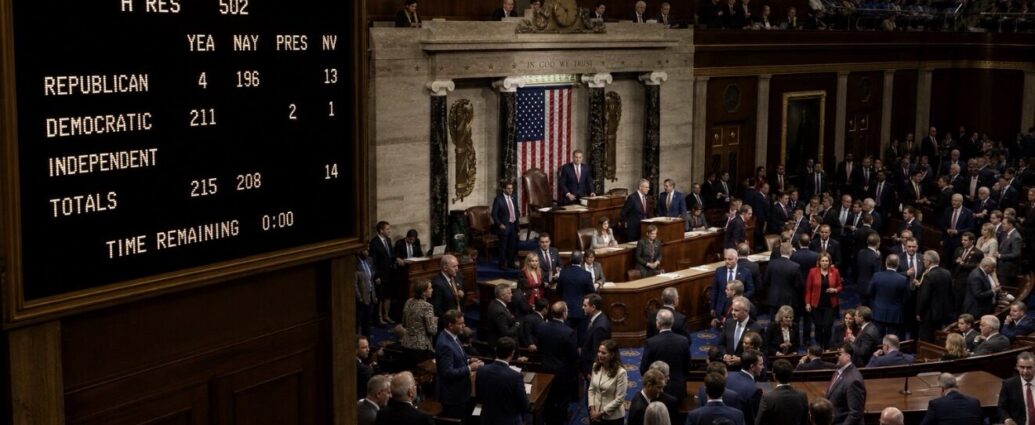
WASHINGTON, D.C.—For the first time since the Iran conflict began more than three months ago, Congress has formally voted to limit President Trump’s war powers. The House voted 215-208 on Wednesday to direct the administration to end U.S. military involvement in Iran unless Congress authorizes continued military action. The vote comes as the economic consequences of the conflict are increasingly being felt across the country, with oil prices approaching $100 a barrel, stock markets retreating from record highs, and inflation concerns resurfacing.
The House voted 215 to 208 to tell the president to stop the war with Iran. Four Republicans crossed over to join Democrats in passing the measure.
This kind of vote is called a War Powers Resolution. In plain terms, it is Congress reminding the president that, under the Constitution, only Congress is supposed to take the country to war. The resolution orders the president to pull U.S. troops out of Iran unless Congress votes to authorize continued military action.
So does this end the war?
Not by itself.
Here is why. The president can reject it — that is called a veto — and Trump is expected to do exactly that. To force him to comply anyway, Congress would need a two-thirds majority in both chambers, a much higher threshold known as a veto-proof majority. Lawmakers do not currently have those numbers, and the Senate has not yet passed its own version of the measure.
Then why does it matter?
Because it is rare.
This is the first time since the conflict began more than three months ago that either chamber of Congress has approved such a measure on a final vote. It also happened in a House controlled by Trump’s own party. When members of a president’s party break with him on a war vote, it is often viewed as a sign that concern about the conflict is spreading.
Much of that concern centers on the economy.
War in the Middle East has historically pushed oil prices higher, and Wednesday provided another example. Iran fired missiles at Kuwait and Bahrain, U.S. forces responded, and oil rose for a third consecutive day. Brent crude, one of the world’s key oil benchmarks, climbed toward $98 a barrel.
Why should that matter to the average family?
Because oil touches nearly everything.
When oil becomes more expensive, gasoline becomes more expensive. The trucks, ships, and airplanes that move food and consumer goods also become more expensive to operate. Businesses often pass those higher costs along to consumers. As a result, groceries, deliveries, travel, and countless everyday products can become more expensive.
Economists call that process inflation.
The connection may seem distant, but history shows energy prices have a way of reaching nearly every household. Every major jump in oil prices eventually works its way through transportation, manufacturing, shipping, and utility costs. Even Americans who never follow foreign policy can end up feeling the effects of events unfolding thousands of miles away.
That ripple reached Wall Street on Wednesday.
The three major U.S. stock market indexes all fell. The Dow Jones Industrial Average dropped 1.21%, the S&P 500 lost 0.73%, and the Nasdaq Composite slid 0.89%, just one day after all three reached record highs.
The war is also influencing expectations for interest rates.
The Federal Reserve, the nation’s central bank, raises or lowers interest rates to help control inflation and support economic growth. When inflation accelerates, the Fed often raises rates. Higher rates typically make mortgages, auto loans, business loans, and credit cards more expensive.
Only weeks ago, investors expected the Fed, under new Chairman Kevin Warsh, to cut rates later this year. Now, as oil prices climb and inflation concerns return, many traders believe the next move could be a rate increase instead.
Much of that concern centers on one narrow stretch of water known as the Strait of Hormuz.
Roughly 20% of the world’s oil supply passes through the waterway each day. If shipping is disrupted—or even threatened—global oil prices can rise quickly. President Donald Trump has said a deal to keep the strait open could be reached within a week, though Iranian media outlets have expressed skepticism about the prospects for a near-term agreement.
Not everyone supported the House vote.
Most Republicans backed the president.
House Foreign Affairs Committee Chairman Brian Mast of Florida dismissed the measure as “a stupid political vote.”
Rep. Abe Hamadeh of Arizona argued that the conflict had effectively ended months ago.
“The war for all intents and purposes ended back in April,” Hamadeh said, adding that Trump should be allowed to continue negotiating a peace arrangement.
Supporters saw the issue differently. They argued that the conflict has dragged on, cost lives, increased economic uncertainty, and that Congress deserves a formal role in determining whether U.S. military involvement should continue.
Rep. Brian Fitzpatrick of Pennsylvania was among the four Republicans who joined Democrats in voting for the measure.
What happens now?
The battle shifts to the Senate, where a similar proposal led by Sen. Tim Kaine of Virginia has yet to receive a final vote. Even if both chambers ultimately approve the measure, Trump would still retain the power to veto it.
The bottom line for businesses and families is far simpler than the politics unfolding in Washington.
As long as fighting continues and oil remains elevated, gasoline prices, grocery costs, inflation expectations, and financial markets are likely to remain sensitive to every headline coming out of the Gulf.
Wednesday’s vote will not bring a single soldier home, nor is it likely to end the conflict on its own. But it delivered a clear message: as oil prices rise, markets react, and inflation fears return, the economic consequences of the war are becoming harder for lawmakers to ignore.
Whether Congress ultimately changes U.S. policy or not, the costs of the conflict are already being felt far beyond the battlefield—in gas stations, grocery stores, retirement accounts, and household budgets across America.
Washington, D.C. — JBizNews Desk
© JBizNews.com All Rights Reserved. Reproduction or distribution without written permission is prohibited.
Goldman CEO Says There’s More Greed Than Fear in Today’s Market
Subheadline:
David Solomon says investors are showing more greed than fear as OpenAI, Anthropic, and SpaceX prepare massive public offerings that could reshape Wall Street.
By JBizNews Desk
June 3, 2026
The head of Goldman Sachs says investors have tipped into outright greed.
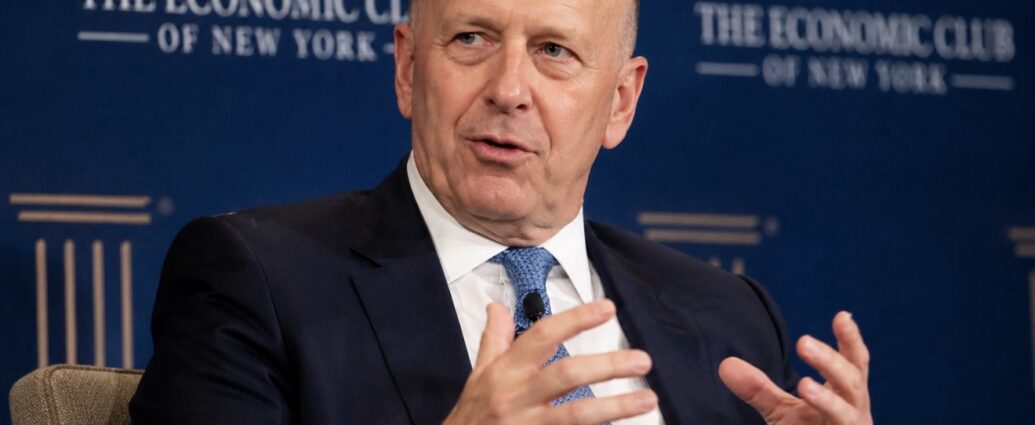
Speaking Tuesday at an event hosted by the Economic Club of New York, Goldman Sachs CEO David Solomon was asked whether financial markets could absorb the enormous wave of stock offerings expected from artificial-intelligence companies. His answer was unusually direct.
“We are definitely in a moment where there’s more greed than there is fear.”
Solomon made the remarks during an interview with CNBC’s Leslie Picker, responding to questions about the growing pipeline of AI companies preparing to tap public markets.
The timing is significant. Some of the biggest names in technology — including OpenAI, Anthropic, and Elon Musk’s SpaceX — are preparing public offerings that could value individual companies at hundreds of billions, and potentially more than a trillion dollars. At the same time, dozens of AI-related businesses are seeking billions in fresh capital to build data centers, expand computing infrastructure, and purchase advanced semiconductor chips.
Wall Street Still Has Money to Spend
Solomon’s core message was simple: investors still have plenty of cash.
“There’s plenty of liquidity in the system if the world continues to remain as optimistic,” Solomon said.
In other words, the capital exists to fund these massive offerings — provided investor confidence remains intact.
As evidence, Solomon pointed to Alphabet’s recent $80 billion stock offering, one of the largest equity raises ever attempted. Despite concerns about dilution, Alphabet’s shares largely held up following the announcement.
Goldman Sachs served as an adviser on that transaction.
To Solomon, the market’s reaction suggests investors remain willing to finance enormous AI-related spending plans.
Goldman Stands to Benefit
The comments carry additional weight because Goldman is positioned at the center of the AI IPO boom.
The firm has reportedly secured the lead underwriting role for the highly anticipated SpaceX offering and is considered a leading candidate for future roles in potential OpenAI and Anthropic listings.
Following nearly $17 billion in profit last year, Goldman is poised to benefit substantially if the current IPO pipeline remains active.
Solomon himself appeared aware of how his comments might be received.
He joked during the discussion that he knew his use of the word “greed” would likely become the headline.
Why Solomon Thinks the Boom Can Continue
While acknowledging elevated enthusiasm, Solomon argued that today’s markets may still be early in the AI investment cycle.
He pointed to record levels of household and institutional wealth, suggesting that large stock offerings can be absorbed without draining investor demand elsewhere.
The proceeds from successful IPOs, he noted, tend to flow back into the economy through taxes, spending, venture investments, and new business creation.
“There’s a good chance that we’re earlier in the cycle than later,” Solomon said.
His advice to companies considering fundraising was equally straightforward:
When capital is available and a company needs it, raise it.
But the Mood Can Change Quickly
Despite the optimism, Solomon stopped short of sounding euphoric.
“Greed can turn into fear very quickly,” he warned, adding that while investor enthusiasm can last much longer than many people expect, it is never permanent.
That caution echoes remarks made recently by JPMorgan Chase CEO Jamie Dimon, who warned that market participants have become increasingly exuberant.
Neither executive predicted a crash.
Both simply observed that investor enthusiasm surrounding artificial intelligence has reached unusually elevated levels.
Why It Matters Beyond Wall Street
The stakes extend far beyond investment banks and technology companies.
The upcoming AI IPO wave could become one of the largest periods of capital formation in modern financial history.
The money raised will help fund:
- Massive AI data centers
- Advanced semiconductor purchases
- New cloud-computing infrastructure
- Artificial-intelligence research and development
These investments will directly influence the technologies consumers and businesses use every day.
If markets remain receptive, AI companies may secure the capital needed to accelerate development for years.
If investor sentiment shifts and fear replaces greed, the funding window could narrow rapidly.
The Bottom Line
David Solomon’s message was not that markets are irrational.
It was that investors remain highly willing to take risk, particularly when artificial intelligence is involved.
For now, the appetite appears strong enough to support some of the largest IPOs and stock offerings ever attempted.
Whether that optimism proves justified may become one of the defining financial stories of the AI era.
New York — JBizNews Desk
© JBizNews.com All Rights Reserved. Reproduction or distribution without written permission is prohibited.


Opinion | The Woke Murder of Henry Nowak

Opinion | India Is Losing Its Economic Edge

Opinion | Trump Talks, Iran Escalates

Robinhood Launches a Credit Card Your AI Agent Can Use to Shop
By JBizNews Desk
June 3, 2026
Robinhood is letting artificial intelligence do something that until recently sounded like science fiction: shop with your credit card.
In a May 27 announcement posted to its company newsroom, Robinhood introduced its new Agentic Credit Card, a feature that allows customers to give third-party AI assistants the ability to make purchases on their behalf using a dedicated version of the company’s Robinhood Gold Card. The AI can monitor prices, track availability, and complete purchases automatically within spending rules set by the cardholder.
Vlad Tenev, Robinhood’s Chief Executive Officer, described the move as an extension of the company’s long-running mission to democratize finance, saying that mission now “extends to AI agents.”
The launch marks one of the clearest examples yet of artificial intelligence moving beyond providing recommendations and into actually spending money.
How the AI Shopping Card Works
The system is designed to work with outside AI assistants such as OpenAI’s ChatGPT and Anthropic’s Claude.
Customers connect an AI assistant to Robinhood through the Model Context Protocol, an emerging standard that allows AI systems to communicate directly with external services and applications.
Rather than giving an AI access to a customer’s actual credit card, Robinhood creates a separate virtual version of the Gold Card specifically for the AI agent.
The AI never sees the customer’s real card number and cannot access the broader account. It only receives access to the virtual card, its transaction history, and whatever spending limits and permissions the owner establishes.
The virtual card can also be revoked at any time.
Your AI Watches Prices and Buys Automatically
Once connected, the AI can act independently within the instructions provided by the user.
Robinhood’s examples include:
- Buying a limited-edition sneaker if the price falls below $300
- Reserving a hard-to-book restaurant table the moment one becomes available
- Purchasing airline tickets when fares drop below a specific threshold
- Monitoring product availability and completing purchases automatically
The goal is to eliminate the need for customers to constantly monitor prices or inventory themselves.
Purchases made through the system earn the same 3% cash back available through the Robinhood Gold Card.
The card is issued by Coastal Community Bank and operates on the Visa network.
The feature is currently available through a waitlist and requires a Robinhood Gold Card membership. Robinhood says support for its upcoming Platinum Card will follow later this year.
Built-In Controls
Robinhood says the product was designed around consumer controls and spending limits.
Users can:
- Set monthly spending caps
- Require approval for every purchase
- Receive notifications before transactions are completed
- Disable the AI card instantly
If a customer chooses not to approve each purchase individually, Robinhood requires that they establish spending limits instead.
The virtual-card structure resembles the tokenized payment systems already used by services such as Apple Pay, where merchants never receive the actual card number.
A Growing Industry Race
Robinhood is not alone.
The launch places the company near the front of a rapidly emerging market known as agentic commerce, where AI systems make purchases and transactions on behalf of users.
Stripe has introduced similar technology allowing AI agents to transact using designated payment credentials.
Both Visa and Mastercard are developing infrastructure specifically designed for AI-driven payments.
The announcement also comes just weeks after OpenAI introduced new personal-finance capabilities of its own, highlighting how quickly AI is moving deeper into everyday financial activity.
Investors have responded enthusiastically. Shares of Robinhood (NASDAQ: HOOD) have risen roughly 28% in recent sessions as Wall Street bets that AI-powered financial tools could drive greater engagement and spending on the platform.
The Biggest Question: Who Pays When AI Gets It Wrong?
That excitement is matched by growing concern among consumer advocates.
Robinhood makes clear that customers remain responsible for purchases made by their AI agents, even if those purchases ultimately prove to be mistakes.
That liability is drawing scrutiny.
Eva Velasquez, Chief Executive Officer of the Identity Theft Resource Center, warned that the technology remains too new for many consumers to fully understand the risks associated with connecting AI systems to financial accounts.
The Consumer Bankers Association echoed similar concerns in a January report, noting that agentic payments could reshape commerce but leave consumers exposed if an AI makes costly errors or unauthorized decisions.
The organization warned that regulatory protections have not yet caught up with the technology.
Americans Are Already Using AI for Money Decisions
Consumer behavior suggests growing comfort with AI-driven financial tools.
According to financial technology company Plaid, approximately 55% of Americans used AI to help manage money during the past year.
Many users already rely on AI for budgeting, financial planning, savings strategies, and spending analysis.
Robinhood’s new card pushes that trend further by moving from advice to action.
The shift raises a broader question for consumers: how much control are they willing to hand over to software?
The Bottom Line
Robinhood’s Agentic Credit Card represents one of the most ambitious attempts yet to put artificial intelligence directly between consumers and their wallets.
The technology promises convenience, automation, and the ability to act instantly when opportunities arise.
But it also introduces a new reality: when an AI assistant spends your money, you remain responsible for the outcome.
The technology may be new, but Robinhood’s position is straightforward.
If the AI buys the wrong thing, at the wrong time, for the wrong price, the bill still belongs to you.
Menlo Park, Calif. — JBizNews Desk
© JBizNews.com All Rights Reserved. Reproduction or distribution without written permission is prohibited.


Google Is Forcing Millions of Advertisers Onto AI This September
Millions of businesses will be automatically moved from Google’s traditional search-ad system to its new AI-powered platform, whether they choose to switch or not.
By JBizNews Desk
June 3, 2026
Google told advertisers in an April 15 post on its advertising blog that beginning in September it will automatically convert a wide swath of older Google Search ad campaigns to its new artificial-intelligence system, called AI Max — a shift that lands squarely on the small businesses and marketing agencies that have relied on those tools for years.
The change affects three advertising setups that millions of businesses still use today.
The largest is Dynamic Search Ads, a long-running Google tool that automatically builds search ads using content from a company’s website instead of relying entirely on manually selected keywords. The other two include Automatically Created Assets, where Google generates ad headlines and images, and campaign-wide Broad Match settings that allow ads to appear for a wider range of related searches.
Any eligible Search campaign still using these features in September will automatically be upgraded to AI Max.
What Is AI Max?
AI Max is Google’s next-generation AI-powered search advertising system.
Unlike Dynamic Search Ads, which primarily analyzed a company’s website to determine when ads should appear, AI Max combines website content with broader real-time search behavior and artificial intelligence models that can generate ad copy, select landing pages, and optimize campaigns with significantly less human involvement.
Google moved AI Max from testing into general availability in April and said hundreds of thousands of advertisers are already using the platform globally.
The Choice Disappears in September
Google is currently allowing advertisers to switch voluntarily.
Many businesses are already seeing prompts inside their Google Ads dashboards encouraging them to upgrade.
But beginning in September, the decision will no longer be optional.
Google says all remaining eligible campaigns will be automatically migrated, and businesses will no longer be able to create new Dynamic Search Ads through Google Ads, Google Ads Editor, or the company’s developer tools.
The company expects the migration process to be completed by the end of September.
Google Says Performance Improves
Google argues the transition should benefit advertisers.
According to company data, advertisers using the full AI Max feature set saw an average 7% increase in conversions or sales value while maintaining similar advertising costs.
The company says existing campaign settings will be copied into the new system to make the transition smoother.
However, Google noted that those performance figures primarily reflect non-retail advertisers. Businesses selling physical products are generally being directed toward separate AI-powered Shopping campaign products.
The Real Risk for Small Businesses
The biggest concern is not necessarily the technology itself.
It is businesses being caught unaware.
Marketing professionals who manage Google Ads accounts say AI Max behaves differently than the systems it replaces, even when existing settings are transferred over.
The platform gives Google greater control over:
- Which searches trigger ads
- How budgets are allocated
- Which landing pages are used
- How ad copy is written and optimized
That means campaign performance can shift unexpectedly during the system’s learning period.
For a small business spending only a few hundred or a few thousand dollars per month on advertising, unnoticed changes can quickly affect results.
Google’s Advice: Don’t Wait
Interestingly, Google’s own recommendation is for advertisers not to wait for the automatic transition.
The company urged businesses to switch on their own timetable so they can test campaigns, review performance, and make adjustments before September arrives.
That gives advertisers an opportunity to understand how AI Max behaves before Google makes the switch for them.
Part of a Much Bigger AI Strategy
The move fits into a broader transformation happening across Google’s advertising business.
Advertising remains the largest source of revenue for Alphabet, Google’s parent company.
At its recent Marketing Live event, Google outlined plans to integrate its Gemini AI technology across nearly every part of its advertising ecosystem, including placing ads directly into AI-generated search experiences.
The retirement of Dynamic Search Ads — a tool that has existed for more than a decade — is one of the clearest signals yet that Google intends to automate far more of the advertising process.
Increasingly, advertisers will set goals while Google’s AI makes many of the decisions.
What Businesses Should Do Now
For business owners, the message is straightforward.
The change is coming whether they act or not.
Businesses that review their campaigns before September will have time to understand the new system, test performance, and make adjustments.
Those that ignore the change may wake up this fall to discover that Google’s AI is managing a larger share of their advertising than they realized.
The transition marks another milestone in the broader shift from human-managed software toward AI-managed systems — a trend that is rapidly reshaping marketing, sales, customer service, and business operations across the economy.
Mountain View, Calif. — JBizNews Desk
© JBizNews.com All Rights Reserved. Reproduction or distribution without written permission is prohibited.

Building on Historic U.S. Commerce Department Minority Status MOU, Orthodox Jewish Chamber and NMSDC Sign Capitol Hill Partnership to Expand Opportunity Across Corporate America
WASHINGTON, D.C. — June 3, 2026 — As businesses increasingly look beyond government contracting and toward Corporate America for growth, two organizations with roots in both the public and private sectors are joining forces to expand economic opportunity nationwide.
The National Minority Supplier Development Council (NMSDC), led by former Under Secretary of Commerce for Minority Business Development Donald Cravins Jr., and the Orthodox Jewish Chamber of Commerce signed a Memorandum of Understanding on Capitol Hill Wednesday aimed at strengthening connections between entrepreneurs, supplier networks, major corporations, chambers of commerce, and economic-development partners.
The agreement is the latest step in an effort that began at the U.S. Department of Commerce, where the Orthodox Jewish Chamber of Commerce signed a historic Memorandum of Understanding with the Minority Business Development Agency (MBDA). That agreement, which generated nationwide attention, established a framework for expanding economic opportunity, strategic partnerships, educational resources, and business growth across both the public and private sectors, while marking the first formal partnership of its kind between the U.S. Department of Commerce’s Minority Business Development Agency (MBDA) and a Jewish business organization.
As part of the Chamber’s historic MOU with the U.S. Department of Commerce’s Minority Business Development Agency (MBDA), federal officials directed the Orthodox Jewish Chamber of Commerce to establish its own independent certification program to help advance the agreement’s broader goals of economic inclusion, business development, and expanded access to opportunities in the Public and Private sectors. The Chamber subsequently launched an inclusive Minority certification program for its Patron members backed by a rigorous vetting and due-diligence process, creating a pathway for qualified businesses to gain greater visibility and open doors that may have previously remained out of reach.
Now, with Donald Cravins Jr.—who previously served as Under Secretary of Commerce for Minority Business Development and now leads the National Minority Supplier Development Council—heading one of the nation’s most influential supplier-development organizations, both groups see an opportunity to build upon that foundation and extend the MBDA commitment to help further its certied members reach into Corporate America.
The timing is significant. Business leaders estimate that roughly 70% of supplier-diversity and minority-business contracting opportunities originate within Corporate America, making private-sector engagement one of the most important drivers of growth for businesses seeking to scale nationally.
Founded in 1972, NMSDC is among the nation’s oldest and largest supplier-development organizations, connecting certified businesses with major corporations through a nationwide network of regional affiliates and corporate members. According to the council’s most recent economic impact report, NMSDC-certified minority business enterprises generated $599.7 billion in economic output and supported more than 2.2 million jobs in 2024.
The partnership is rooted in the belief that stronger collaboration creates stronger outcomes. NMSDC brings one of the nation’s most established supplier-development and corporate-engagement networks. The Orthodox Jewish Chamber of Commerce brings extensive experience in advocacy, public-private partnerships, economic-development initiatives, and coalition building across chambers of commerce, business organizations, government agencies, and economic-development stakeholders.
Leaders from both organizations view the relationship as highly complementary. While NMSDC focuses on supplier development, certification, and corporate engagement, the Chamber has developed a strong track record advocating for policies and initiatives that support businesses, employers, economic growth, innovation, and stronger economic participation throughout the United States.
By combining their respective strengths, networks, relationships, and expertise, both organizations believe they can help businesses identify new opportunities, strengthen supply chains, expand market access, build strategic partnerships, and contribute to stronger economic outcomes.
The collaboration is also intended to create value for Corporate America itself. By fostering stronger connections between corporations, suppliers, chambers of commerce, entrepreneurs, and community stakeholders, both organizations believe the partnership can help businesses become more competitive, strengthen procurement networks, improve access to talent and innovation, and ultimately support stronger bottom-line performance.
“This is a true partnership where both organizations bring meaningful value to the table,” said Duvi Honig, Founder and CEO of the Orthodox Jewish Chamber of Commerce. “NMSDC has built one of the most respected supplier-development and corporate-engagement networks in America. We bring advocacy, public-private partnerships, economic-development initiatives, and relationships throughout government, chambers of commerce, and the business community. Together we are stronger.”
Honig said the Chamber’s original partnership with MBDA was never intended to focus solely on government opportunities.
“The vision behind our Commerce Department partnership was always larger than government contracting alone,” Honig said. “It was about opening doors, creating opportunity, empowering businesses, and helping entrepreneurs access the relationships and resources they need to succeed across both the public and private sectors. This partnership with NMSDC strengthens that mission and expands it.”
Donald Cravins Jr., President and CEO of NMSDC, said the agreement reflects a shared commitment to expanding economic opportunity and helping businesses grow.
“Partnerships create scale and opportunity,” Cravins said. “When organizations with complementary strengths work together, businesses gain access to more relationships, more opportunities, and more resources to help them grow and succeed.”
For businesses in both networks, the partnership is expected to create greater exposure to new relationships, business-development opportunities, educational resources, supplier-engagement initiatives, conferences, advocacy efforts, workforce-development programs, and strategic partnerships. The organizations also expect to collaborate on initiatives helping businesses adapt to emerging technologies, including artificial intelligence.
The Chamber also credited Don Graves, former Deputy Secretary of the U.S. Department of Commerce, with helping foster relationships that contributed to the agreement and with supporting continued collaboration between business communities.
“We are grateful to Don Graves for his leadership and commitment to expanding economic opportunity,” Honig said. “His efforts helped lay the groundwork for partnerships that continue to create meaningful opportunities for businesses and communities across America.”
Supporters of the agreement say the Capitol Hill signing reflects a broader trend across the business community: organizations increasingly recognizing that in a more competitive economy, growth is often accelerated when networks are shared, relationships are expanded, and complementary strengths are aligned.
For both organizations, the signing represents a belief that economic growth is increasingly driven not by institutions working independently, but by partnerships that combine strengths, widen networks, strengthen Corporate America, and open doors neither side could open alone.
Washington, D.C. — JBizNews Desk
© JBizNews.com All Rights Reserved. Reproduction or distribution without written permission is prohibited.


Paramount Lawyer Claims Some Warner Bros. Deal Opponents Hold ‘Antisemitic Views’
Accusation escalates an already contentious battle over a proposed $111 billion media merger that has drawn scrutiny from Hollywood, labor groups, and antitrust regulators.
By JBizNews Desk
June 3, 2026
The battle over the proposed $111 billion merger between Paramount Skydance and Warner Bros. Discovery took a dramatic turn this week after the deal’s top attorney accused some opponents of being motivated by antisemitism.
In an interview published June 1 by the Los Angeles Times, Makan Delrahim, chief legal counsel for Paramount Skydance, said some critics of the merger are driven by “their own antisemitic views” and argued that parts of the opposition campaign have become political rather than focused on competition concerns.
The remarks immediately elevated what had largely been an antitrust and media-consolidation debate into a far more politically and culturally charged confrontation.
Notably, Delrahim did not publicly identify specific individuals or organizations he believes hold such views, nor did he provide evidence supporting the allegation. Paramount also did not immediately clarify whom he was referring to.
A Merger Facing Growing Resistance
Opposition to the transaction has been building for months.
More than 5,500 filmmakers, actors, producers, writers, and entertainment professionals have signed public letters opposing the merger.
The Writers Guild of America has vowed to challenge the deal, arguing that further consolidation in Hollywood could reduce competition, weaken worker bargaining power, and limit creative diversity.
Several Democratic lawmakers have also called for heightened scrutiny.
Senator Elizabeth Warren previously described the proposed merger as a “five-alarm antitrust fire,” while members of Congress have urged regulators to closely examine the transaction’s impact on competition across media, streaming, and news businesses.
Most opponents have focused their arguments on antitrust concerns, market concentration, employment impacts, and media ownership rather than the issues raised by Delrahim.
Why the Israel Issue Entered the Debate
The comments come against the backdrop of broader tensions within Hollywood over Israel and the Middle East.
Larry Ellison, father of Paramount CEO David Ellison and one of the transaction’s key financial backers, has long maintained close ties with Israel and has reportedly supported organizations connected to Israeli causes.
Following the October 7 attacks, Skydance publicly expressed support for Israel and contributed to Israeli humanitarian and emergency-response organizations.
Paramount also became one of the first major entertainment companies to publicly oppose efforts by certain activist groups to boycott cooperation with Israeli film institutions.
Supporters of those campaigns have argued they target institutions rather than individual Israelis, while critics have characterized some efforts as discriminatory.
Against that backdrop, Delrahim’s comments are likely to intensify an already polarized debate.
The Business Stakes Are Massive
Beyond the controversy, the financial implications are enormous.
A combined Paramount-Warner Bros. Discovery would create one of the largest media companies in the world.
The merger would unite:
- CBS
- Paramount Pictures
- Warner Bros. Studios
- CNN
- HBO
- Max
- Numerous cable and streaming assets
Supporters argue the combination is necessary to compete against increasingly dominant streaming rivals such as Netflix, Amazon Prime Video, and Disney+.
Delrahim has repeatedly argued that the merger would strengthen competition rather than reduce it by creating a larger challenger capable of competing in a rapidly consolidating entertainment landscape.
Shares of Warner Bros. Discovery have risen more than 24% since reports of the merger discussions first emerged.
Regulators Hold the Final Say
The deal’s future ultimately rests with regulators.
Although Paramount has stated that the transaction has already cleared certain procedural hurdles at the Department of Justice, federal authorities retain the power to challenge the merger if they conclude it harms competition.
The DOJ’s antitrust leadership has publicly stated that the transaction will not receive special treatment despite the Ellison family’s relationships within political circles.
Delrahim has rejected suggestions that the company enjoys political advantages and insists the merger can withstand regulatory review on its merits.
Who Is Makan Delrahim?
Delrahim brings unusual credibility to the antitrust debate.
Before joining Paramount Skydance in 2025, he served as Assistant Attorney General for the Antitrust Division of the U.S. Department of Justice during President Trump’s first administration.
He later became a partner at Latham & Watkins, where he advised on major corporate transactions before joining Paramount.
Today, he serves as the chief legal architect defending one of the largest media mergers in modern history.
What Happens Next
The merger will ultimately be judged by regulators based on competition law, consumer impact, and market structure—not political rhetoric.
Still, Delrahim’s comments ensure that a transaction already attracting intense scrutiny will now face even greater public attention.
The core question remains unchanged:
Will combining two of Hollywood’s largest media companies strengthen competition against streaming giants—or further concentrate power in an industry already dominated by a handful of players?
Regulators in Washington and California will ultimately decide.
Los Angeles — JBizNews Desk
© JBizNews.com All Rights Reserved. Reproduction or distribution without written permission is prohibited.

Google and SBA Launch Free AI Training to Help Small Businesses Find and Win Grants
By JBizNews Desk
June 3, 2026
For many small-business owners, finding grant money can feel like a full-time job. Applications are time-consuming, funding opportunities are scattered across dozens of websites, and many entrepreneurs simply don’t have the staff to track deadlines, research eligibility requirements, and prepare submissions.
Google says artificial intelligence may help change that.
The company announced a new initiative with the U.S. Small Business Administration (SBA) designed to help entrepreneurs learn how to use AI tools to identify grant opportunities, prepare stronger applications, improve marketing, and operate more efficiently. The program was unveiled during National Small Business Week as part of Google’s broader push to bring artificial intelligence into the hands of Main Street businesses.
At the center of the effort are free workshops jointly offered by Google and the SBA, along with additional training resources that remain available year-round. The goal is to help small-business owners understand how AI can reduce administrative work and uncover opportunities that many businesses may otherwise miss.
For grant seekers, the practical applications are significant. AI tools can help business owners research federal, state, local, nonprofit, and private-sector grant programs, summarize eligibility requirements, organize application materials, track deadlines, draft proposal language, and identify supporting documentation needed for submissions. What once required hours of manual searching can often be completed in minutes.
Google is also steering entrepreneurs toward its broader small-business learning programs, including a dedicated training path through Google Cloud and its AI Professional Certificate program, which includes three months of access to Google’s paid Gemini AI assistant at no cost.
The training is part of a larger effort to encourage small businesses to adopt Google’s expanding suite of AI-powered products.
Among the featured offerings is the Gemini Enterprise app, which allows businesses to build and deploy AI-powered assistants that can automate repetitive tasks, analyze information, summarize meetings, draft communications, and assist with planning. Gemini is also integrated throughout Google Workspace, including Gmail, Docs, Sheets, and Drive.
For many small businesses, that means the ability to perform tasks that previously required additional staff or outside consultants.
Google is also promoting AI-powered creative tools designed for businesses with limited marketing budgets. The company highlighted products that can generate professional-looking images, flyers, social-media content, and marketing materials in minutes, allowing smaller companies to present themselves with the polish of much larger organizations.
To encourage adoption, Google is offering limited-time incentives, including discounted Workspace subscriptions and a free 30-day trial of Gemini Enterprise.
The grant-focused training arrives at a time when many small businesses are searching for new sources of capital. Higher borrowing costs, tighter lending standards, and economic uncertainty have made grant funding increasingly attractive because, unlike loans, grants typically do not require repayment.
For business owners with limited resources, learning how AI can help locate and organize funding opportunities may prove just as valuable as the software itself.
The initiative also highlights the growing competition among major technology companies to become the primary AI provider for America’s roughly 36 million small businesses. Google is competing directly with Microsoft, OpenAI, and other technology firms that are racing to embed AI into the daily operations of businesses across the country.
Whoever becomes the platform entrepreneurs rely on for grant applications, customer communications, marketing, bookkeeping, and research could gain a long-term advantage in one of the largest business markets in the world.
Still, experts caution that technology is only a tool. Finding grants is one thing; winning them requires strong applications, clear business plans, and the ability to demonstrate impact. AI can help simplify the process, but it does not replace the judgment and preparation required to secure funding.
For now, the most immediate benefit may be the free education itself.
The workshops cost nothing, the training resources remain available, and business owners can begin learning how to use AI before committing to any paid products.
The takeaway for entrepreneurs is straightforward: grant opportunities exist, but many businesses never find them. Google and the SBA are betting that artificial intelligence can help change that — giving small-business owners another tool to compete for funding, grow their operations, and save valuable time along the way.
Washington — JBizNews Desk
© JBizNews.com All Rights Reserved. Reproduction or distribution without written permission is prohibited.



Stocks Waver as Oil Nears $100, Hiring Holds, and Chips Keep Climbing
JBizNews Desk
Wednesday, June 3, 2026
Wall Street opened in mixed fashion Wednesday, June 3, after two fresh reads on the economy showed steady hiring and a strengthening service sector, even as oil pushed back toward $100 a barrel following an overnight exchange of fire between the United States and Iran. The ADP National Employment Report, released Wednesday, said private employers added 122,000 jobs in May, topping the 117,000 economists expected, while the Institute for Supply Management reported its Services PMI rose to 54.5% from 53.6% a month earlier, the 23rd straight month of growth, according to committee chair Steve Miller. At the opening bell, the S&P 500 slipped 0.14% and the Dow Jones Industrial Average fell 0.56%, while the Nasdaq was virtually flat and the small-cap Russell 2000 rose 0.90%. The moves came a day after all three major indexes closed at records, with the S&P 500 posting its first finish above 7,600 at 7,609.78.
The data carried a catch for anyone hoping for lower interest rates. The same ISM report that showed services expanding also put its prices gauge at 71.3%, near a multi-year high, a sign that companies are still paying more for fuel, materials and labor and passing those costs along. The employment piece of that survey stayed below 50, meaning service businesses are still trimming staff even as orders pick up. April’s ADP gain, meanwhile, was revised down to 105,000.
Energy set the tense backdrop. Brent crude climbed toward $97 a barrel and West Texas Intermediate rose above $93, both gaining for a third straight session, after U.S. Central Command said Iran fired ballistic missiles toward neighboring states and U.S. forces carried out strikes on Iran’s Qeshm Island. Iran’s missiles hit Kuwait and Bahrain, killing one person in Kuwait, according to Kuwait’s Foreign Ministry. Adding fuel, the U.S. Energy Information Administration reported Wednesday that domestic crude inventories fell by 7.974 million barrels last week, far more than the roughly 2.9 million-barrel draw forecast and the sixth straight weekly decline. President Donald Trump said Iran had agreed not to pursue a nuclear weapon and that talks continue, though Iranian state media disputed that.
The day’s hardest hits landed on the private-equity group. Blackstone dropped about 6%, KKR fell more than 5.5% and Blue Owl Capital lost nearly 4% after Bloomberg News reported that Swiss firm Partners Group had capped withdrawals from one of its private-equity funds, a move that rattled investors holding similar managers. GitLab fell roughly 4% after the software maker guided to adjusted earnings of 17 to 18 cents a share, below the 19 cents analysts expected, and flagged $30 million to $35 million in restructuring charges. Palo Alto Networks slipped about 2% even after beating, posting adjusted earnings of 85 cents a share on $3 billion in revenue, ahead of the 80 cents and $2.94 billion expected, and lifting its full-year revenue forecast.
The chip trade still had momentum. Marvell Technology rose more than 13%, building on a 32% surge Tuesday that ranked as its best day ever after Nvidia Chief Executive Jensen Huang suggested the company could one day reach a trillion-dollar valuation. In retail, Macy’s gained about 1.5% after reporting its strongest first-quarter sales growth in four years, with revenue of $4.68 billion beating the $4.61 billion estimate and a raised full-year outlook. Cboe Global Markets rose about 1.5%, steadying after a three-day slide of nearly 20% tied to worries that newly proposed perpetual futures could eat into traditional exchanges. Ulta Beauty dipped about 1% despite a quarterly beat and a bigger $1.5 billion buyback target.
On the analyst side, Loop Capital raised Hewlett Packard Enterprise to Buy from Hold after Tuesday’s blowout quarter, in which cloud and AI revenue climbed 22.9% from a year earlier and the stock jumped about 26%. Upgrade activity this month has clustered in chip and AI infrastructure names, while several previously cautious analysts have warmed to Intel after a sharp run higher.
The day is not over. Broadcom and CrowdStrike are scheduled to report results after the closing bell, two readings that will test whether the AI-spending boom still has room to run. The bigger event comes Friday, when the Labor Department releases the May jobs report, the broadest look yet at whether hiring is holding up as oil prices climb. Beyond that, new Federal Reserve Chair Kevin Warsh holds his first rate-setting meeting on June 16–17, with markets caught between a growing economy and a war that keeps pushing energy costs higher.
Wall Street — JBizNews Desk
© JBizNews.com All Rights Reserved. Reproduction or distribution without written permission is prohibited.


Opinion | Climate Satire or Reality?
Trump Revives ‘51st State’ Remark After Canada Slips Into Recession
Canadian leaders push back as renewed trade tensions emerge alongside calls to revisit the USMCA trade agreement.
By JBizNews Desk
June 3, 2026
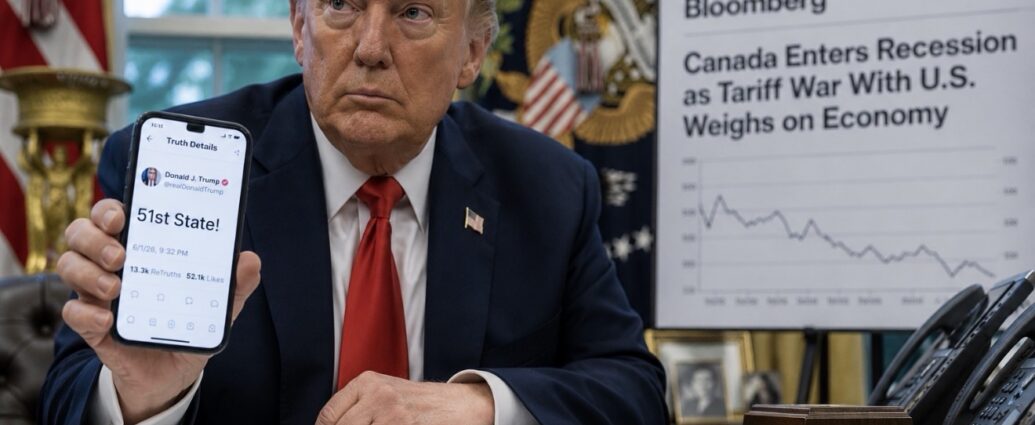
President Donald Trump reignited debate over U.S.-Canada relations this week after responding to reports that Canada had entered a technical recession with a brief but provocative post on Truth Social: “51st State!”
The comment came Monday evening after economic data showed Canada’s economy had contracted for a second consecutive quarter, meeting the common definition of a technical recession. The post quickly spread across social media and political circles on both sides of the border, drawing swift responses from Canadian officials.
The economic backdrop is real.
Fresh data released this week showed Canada’s economy shrinking for a second straight quarter, marking its first technical recession since 2020. While Bank of Canada Senior Deputy Governor Carolyn Rogers cautioned lawmakers against drawing sweeping conclusions from a single set of figures, the report nevertheless raised concerns about slowing growth, weaker consumer spending, and pressure on key industries.
For Trump, the recession provided an opportunity to revisit a theme he has raised repeatedly since returning to office.
Over the past year, the president has repeatedly joked—or suggested, depending on the audience—that Canada would be better off as America’s 51st state. He has often linked the idea to trade disputes, arguing that many economic disagreements between the two countries would disappear if Canada were part of the United States.
Canadian leaders were quick to reject the notion.
Ontario Premier Doug Ford responded publicly, stating, “Canada will never be the 51st state. Canada is not for sale.”
Prime Minister Mark Carney has previously dismissed similar remarks, saying annexation “will never happen” and emphasizing Canada’s sovereignty while continuing to pursue cooperation with Washington on trade, defense, and economic issues.
Behind the political rhetoric lies a more consequential business story.
On Tuesday, Canadian Minister for Internal Trade Dominic LeBlanc formally called for renewal discussions surrounding the United States-Mexico-Canada Agreement (USMCA), the trade pact governing commerce across North America.
The agreement affects hundreds of billions of dollars in annual trade involving automobiles, auto parts, energy, agriculture, manufacturing, and consumer goods.
Any uncertainty surrounding USMCA negotiations carries significant implications for businesses throughout the continent.
For investors and corporate executives, that may matter far more than the headline-grabbing political exchange.
Canada remains one of America’s largest trading partners, with deeply integrated supply chains stretching across automotive manufacturing, energy production, agriculture, construction materials, and technology sectors.
A slowing Canadian economy could affect demand for American exports, while renewed trade tensions could create additional uncertainty for companies already navigating elevated interest rates, geopolitical risks, and shifting global supply chains.
Markets have largely learned to treat Trump’s “51st state” comments as negotiating rhetoric rather than a serious policy proposal.
The more important questions involve tariffs, trade rules, currency movements, and the future of North America’s economic partnership.
Those issues carry real financial consequences for businesses and investors on both sides of the border.
For now, the headline may be Trump’s latest jab, but the underlying story is a Canadian economy under pressure, a critical trade agreement entering a new phase of negotiations, and a relationship that remains both politically complicated and economically indispensable.
Washington — JBizNews Desk
© JBizNews.com All Rights Reserved. Reproduction or distribution without written permission is prohibited.


Israel’s Arms Exports Hit Record $19.2 Billion as Global Demand Surges
By JBizNews Desk
June 3, 2026
Israel’s defense industry delivered another record-breaking year.
The Israeli Ministry of Defense announced Tuesday that defense exports reached an all-time high of $19.2 billion in 2025, representing a nearly 30% increase from the prior year and marking the fifth consecutive annual record.
Officials said defense exports have more than doubled over the past five years and quadrupled over the past decade.
The strongest growth came from large contracts.
More than half of all export agreements signed during 2025 were valued at $100 million or more, while government-to-government agreements alone accounted for approximately $10 billion, another record.
The largest category was missiles, rockets, and air-defense systems, which represented 29% of exports.
Observation, surveillance, and optronics technologies followed at 22%, up sharply from just 6% the year before.
The customer base was global.
Europe accounted for 36% of exports, followed by the Asia-Pacific region at 32%, while the Middle East and North Africa represented 15%.
The ministry declined to identify specific buyers.
Industry officials noted that some governments publicly critical of Israeli military actions continue purchasing Israeli defense systems privately, highlighting the growing demand for combat-proven military technologies.
Israeli officials directly linked the export surge to the country’s recent military conflicts.
Amir Baram, Director General of the Ministry of Defense, said the figures reflect the strength of Israel’s defense sector, the performance of Israeli military systems in combat, and rising global security concerns.
Israeli defense manufacturers increasingly market their products as “battle-tested,” having been deployed in conflicts involving Hamas, Hezbollah, and Iran.
That distinction has become a significant competitive advantage as governments worldwide accelerate military spending.
The ministry also credited regulatory reforms that expanded access to foreign markets and streamlined export procedures.
The timing has been favorable.
Governments across Europe, Asia, and the Middle East continue increasing defense budgets amid growing geopolitical tensions and regional conflicts.
The record arrives despite persistent international criticism of Israel’s military operations.
Several advocacy groups and governments have called for restrictions on Israeli defense exports.
The latest figures suggest those efforts have done little to reduce demand.
The results carry major implications for companies such as:
- Elbit Systems
- Israel Aerospace Industries
- Rafael Advanced Defense Systems
The firms manufacture many of the air-defense systems, drones, radar platforms, missiles, and precision-guided munitions driving export growth.
Record sales translate into larger production runs, expanded hiring, and growing order backlogs.
Looking ahead, officials identified counter-drone technologies as a major growth area.
Recent conflicts have highlighted the challenge of defending against low-cost drones, creating demand for new detection, tracking, and interception systems.
That market is expected to become a significant focus of future investment and export activity.
The broader takeaway is clear.
As countries around the world increase military spending, suppliers offering proven battlefield performance continue gaining market share.
Israel’s fifth consecutive record year underscores the country’s growing importance within the global defense industry—and suggests demand remains strong heading into 2026.
Jerusalem — JBizNews Desk
© JBizNews.com All Rights Reserved. Reproduction or distribution without written permission is prohibited.
Europe’s Israel policy, the search for a unifying narrative – opinion
Three groups are competing for Europe: Integrationists, nationalists, and Muslims. While the first two have a cohesive narrative and flags, the nascent Muslim national movement is in its early stages of development.
Muslims who came to Europe from various cultures and locations are united on the one hand through voluntary separatism, and on the other, through European actions that force Muslims together: religious suppression, racism, and alleged rising anti-Muslim violence.
Both forms of Muslim collectivization are viewed as a threat to Europe.
But what if Europe can collectivize Muslims through a common bond that has nothing to do with Europe: Opposition to Israel?
As Europe is escalating its assault on the Jewish state, some argue that this is exactly what is happening: Throwing the Jewish nation under the bus in a desperate effort to save Europe.
Europe’s engineering of such a “replacement narrative” worked well in the past:
Nation building: through war vs through peace
In the mid-19th century, the father of Germany, Otto von Bismarck, first tried to unite a number of unrelated German-speaking kingdoms and principalities through the “German spirit”: German songs, banners, and dreams.
This did not work, and Bismarck resorted to Plan B: Unite through a common enemy. Bismarck orchestrated what historians view as intentional wars – first against Denmark, then against Austria, and eventually against France.
This worked, and after a decade of wars, United Germany was established – not in Germany, but on French soil, in the Palace of Versailles.
Theodor Herzl, who studied Bismarck’s efforts, fathered Zionism as an ideological exodus from Europe. He replaced the European value of voluntary wars with the Zionist value of peace through strength: Once free at home, Jews would advance humanity to such an extent that Europe and the world would need the Jewish state to thrive, he posited.
Indeed, today innovations produced in Tel Aviv, Judea and Samaria (the West Bank), Jerusalem and throughout Israel are prolonging life, revolutionizing science, and altering humanity.
And yet, Europe and its proxies have been spending billions to block the light from Zion through sanctions, threats of renewed arrests of Jews, travel paralysis, and massive incitement of the global population against the Jewish state.
If Bismarck could unite Germans through opposition to France, perhaps Europe today could unite its Muslims through opposition to Israel.
This is even more so, given Europe’s successful identity-engineering experience in the Middle East over the last century.
European identity engineering
In the 1920s, the British were given a mandate by the League of Nations to usher in a Jewish homeland in Palestine. But the British wanted Palestine for themselves, and therefore resorted to the good-old “divide and rule” tactics deployed throughout their empire.
With France obliterating the short-lived Arab Kingdom of Syria, the British forced a new identity on Arabs living between the Jordan River and the Mediterranean Sea: Palestinians.
British diplomat Mark Sykes (of the Sykes-Picot agreement) even designed a flag.
This colonialist identity-engineering exercise was initially rejected by Arabs living in Palestine. Yet, during the following century, European powers successfully cultivated Palestinian nationalism in order to promote their own interests: The British as counterforce to the Jews, Germans as counterforce to the British in the lead-up to World War II, and in recent decades, the EU and European governments as a counterforce to the State of Israel and by extension to America.
Continuing this trend, Palestinian nationalism cultivated by Europeans in the 20th Century is now arguably exploited by Europe to deflect Muslim frustration away from Europe, and towards the Jewish state.
Moreover, the Sykes flag is now waved throughout the streets of Europe.
And so, European integrationists have a flag – that of the EU, the nationalists have a flag – that of their countries, and now the Muslims have a flag – that of Palestine.
But this is where European colonialist thinking of 2026 has not caught up with realities: Europe seems to believe that it can deflect Muslim frustration towards Israel, while convincing Muslims to integrate en masse. For example, it established “The Office of Promoting Our European Way of Life.”
Neither is happening, and Europe, through its own actions, is turning into a rising threat to global stability and to US national security.
Europe’s hope: End the assault
Can Europe pivot and recognize that its assault on the Jewish state is harming, not benefiting Europe?
It could do so by asking US President Donald Trump to lead a Truth and Reconciliation Commission that would halt the 2,300-year-old European-Israeli conflict, as suggested in a recent column article.
Moreover, there is still hope that a class of righteous Europeans would emerge that would force their governments to end this century’s assault.
Some argue that this is already happening – a concurrent shift within European countries, and from West to East; from “Old Europe,” which obsessively prioritizes opposition to Israel over self-perpetuation, to “New Europe,” which wishes to benefit from the crisp light emanating from Zion.
The writer is the author of the new book From Survival to Peace: Turning the Assault on Judaism around (2026). He is also the author of The Assault on Judaism: The Existential Threat is Coming from the West (2024), and of Judaism 3.0: Judaism’s Transformation to Zionism (2022). He is chairman of the Judaism 3.0 think tank. For his geopolitical analysis, visit EuropeAndJerusalem.com.
Treasury Sanctions Iran’s Largest Crypto Exchange, Tightening Pressure on Tehran’s Digital Finance Network
U.S. officials say Nobitex helped facilitate billions of dollars in transactions tied to sanctioned entities, terrorist organizations, and Iran’s financial system.
By JBizNews Desk
June 3, 2026
The U.S. Department of the Treasury on Tuesday took one of its most significant actions yet against Iran’s digital-finance infrastructure, sanctioning Nobitex, the country’s largest cryptocurrency exchange, over allegations that it facilitated transactions for sanctioned entities, terrorist organizations, and key components of the Iranian regime.
The action, announced by Treasury’s Office of Foreign Assets Control (OFAC), places Nobitex directly in Washington’s crosshairs and dramatically raises the stakes for cryptocurrency firms, financial institutions, and trading platforms worldwide that may have interacted with the exchange.
For many Americans, the move may sound like another sanctions announcement.
For the global cryptocurrency industry, it represents something much larger.
It signals that Washington increasingly views major crypto exchanges as part of the modern financial system and expects them to comply with sanctions rules much like traditional banks.
The Center of Iran’s Crypto Economy
Nobitex is not a niche platform.
The exchange has emerged as the dominant cryptocurrency marketplace inside Iran, with reports indicating it serves approximately 11 million users and handles a majority of the country’s digital-asset trading activity.
As Iran’s currency has weakened under years of sanctions and inflation, many citizens have turned to cryptocurrencies and dollar-pegged stablecoins as a way to preserve savings and conduct transactions outside the traditional banking system.
Blockchain analytics firms have estimated that billions of dollars in digital assets have flowed through Nobitex in recent years, making it one of the most important gateways between Iran’s domestic economy and the broader cryptocurrency market.
According to U.S. officials, that role also made it an attractive platform for sanctioned actors.
Treasury’s Allegations
Treasury alleges that Nobitex facilitated transactions connected to entities already under U.S. sanctions, including organizations tied to the Islamic Revolutionary Guard Corps (IRGC) and other components of Iran’s financial apparatus.
Investigations by blockchain intelligence firms and international reporting organizations have previously linked wallets associated with the exchange to networks connected to Hamas, Ansar Allah (the Houthis), and other sanctioned organizations.
Nobitex has repeatedly denied those allegations and has maintained that it operates as an independent private company rather than an arm of the Iranian government.
Still, the U.S. government concluded that the exchange had become sufficiently intertwined with sanctioned activity to warrant direct designation.
What the Sanctions Actually Do
The immediate effect is straightforward.
Any property or interests in property of Nobitex that fall under U.S. jurisdiction are blocked, and U.S. persons are generally prohibited from conducting transactions involving the exchange.
The broader impact may be far more significant.
Foreign cryptocurrency exchanges, brokers, over-the-counter trading desks, payment processors, and financial institutions that continue doing business with Nobitex could expose themselves to secondary sanctions or increased regulatory scrutiny.
In practice, many global firms choose to cut ties immediately rather than risk losing access to the U.S. financial system.
That is often where sanctions derive much of their power.
Why Crypto Firms Are Paying Attention
The designation also places pressure on stablecoin issuers, blockchain analytics firms, and major cryptocurrency exchanges to identify and isolate wallets linked to the sanctioned platform.
Companies operating in the digital-asset sector increasingly face the same compliance expectations that banks have confronted for decades.
That means screening transactions, monitoring counterparties, identifying sanctioned wallets, and preventing indirect exposure to prohibited entities.
The message from Treasury is becoming increasingly clear:
Cryptocurrency may be a new technology, but sanctions compliance remains an old rule.
The Human Side of the Story
The sanctions also create challenges for ordinary Iranians.
Millions of users reportedly relied on Nobitex as a mechanism to convert savings into digital assets, hedge against inflation, and gain access to global financial markets that are otherwise difficult to reach under existing sanctions.
As compliance measures tighten, some users could find themselves facing greater restrictions or reduced access to financial services, even though they are not the intended targets of the designation.
That tension has long been one of the most difficult aspects of sanctions policy.
Measures designed to isolate governments often affect ordinary citizens as well.
Part of a Larger Campaign
Tuesday’s action fits into a broader effort by the Trump administration to increase financial pressure on Tehran through what officials have described as the Economic Fury campaign.
Recent actions have targeted Iranian-linked shipping networks, energy infrastructure, financial facilitators, and digital-asset operations.
The administration has increasingly focused on cryptocurrency as Iran and other sanctioned regimes seek alternative pathways around traditional banking restrictions.
As digital assets become more integrated into global finance, regulators are devoting greater resources to monitoring how those networks are used by governments, criminal organizations, and sanctioned actors.
What Happens Next
The next major developments will likely come from the private sector.
Market participants will be watching to see whether major exchanges, stablecoin issuers, and trading platforms move quickly to sever ties with Nobitex-linked wallets and accounts.
The response could determine how isolated the exchange becomes in the weeks ahead.
For Washington, however, the objective is already clear.
The Treasury Department is signaling that cryptocurrency exchanges operating at the center of sanctioned financial networks will no longer be treated as peripheral players in the global economy.
They will be treated as financial institutions—and held to the same standards.
Washington — JBizNews Desk
© JBizNews.com All Rights Reserved. Reproduction or distribution without written permission is prohibited.

Student group praises Boulder firebomb terrorist for ‘resistance’ on anniversary of deadly attack
Boulder firebomb terrorist Mohamed Sabry Soliman and his murder of an Israeli hostage advocate were praised by a Colorado anti-Israel student group on the anniversary of the attack.
Boulder Students for Justice in Palestine (SJP) and Leeds group Direct Confrontation Media published a now-deleted statement of solidarity with Soliman on Monday, who in 2025 threw two Molotov cocktails at participants of a Run for Your Lives rally for the release of October 7 Massacre hostages, burning 29 people and inflicting fatal wounds on 82-year-old Karen Diamond.
“One year ago today, Mohamed Sabry Soliman took direct action against the Zionist death cult festering in our city. He struck against the colonist procession that gathers weekly to celebrate the pretext for ongoing genocide,” read the text of a website version of the statement published by SJP and still linked in its social media biography.
“The state would have us believe that Mohamed took the action he did because he is insane-a fanatic, a terrorist, guilty of a hate crime-but we know the truth and we reject the state’s inversion of it. Mohamed chose the only sane response available to a rational human being confronted with the normalization of genocide. He refused the comfortable position of the grateful immigrant and the role of obedient subject, choosing confrontation with a violent system over passive proximity to the comfort of empire.”
Boulder SJP characterized the victims and participants of the rally as “colonists,” and the hostages that they were advocating for as “war criminals” who ostensibly provided a pretext for a supposed genocide in Gaza. The march was an act of “Zionist violence,” according to the SJP chapter, asserting that there was no difference between speech and force.
‘Manifestation of Zionist violence a lethal threat,’ SJP says
“We reject the distinction between speech and material force. The Run for Their Lives procession functions as a mechanism for normalizing the celebration of mass killers, rendering ordinary the sight of war criminals treated as heroes on streets that sit upon stolen land,” said Boulder SJP. “Mohamed refused their normalization with direct action. He chose to treat the manifestation of Zionist violence as the lethal threat it actually constitutes.”
The American student group condemned the 46-year-old Egyptian National’s May 7 sentencing to life in prison, though Soliman himself expressed remorse for his crimes and himself pleaded guilty to the 101 charges, which included first degree murder, attempted murder, assault, and criminal use of incendiary devices. The eight consecutive life sentences were a federal attempt to “assassinate” Soliman, according to SJP, which also decried the hate crime charges that he still faced in federal court as a discriminatory legal mechanism used against Muslims and Arabs since the September 11 attacks.
Boulder SJP also attacked the arrest and subsequent release of Soliman’s family by Immigration and Customs Enforcement (ICE) as “an instrument of collective punishment,” and a tactic used both in the US and Gaza.
“We honor a man who sacrificed his comfort and his proximity to empire, willingly expending his own liberty in attaining his objective,” said SJP.
The group demanded the release of Soliman, abolish ICE, and called on others to “continue the struggle,” as his “act of resistance obligates us to maintain unyielding opposition against every structure that normalizes occupation while enabling genocide.”
“Boulder Students for Justice in Palestine affirms that the Palestinian Resistance stands as the sole legitimate authority capable of delivering accountability for the genocidal actions of the Zionist entity,” the statement concluded. “Mohamed acted alone on June 1st, compelled by the grisly realities of a war against his people and the absolute refusal of formal channels to deliver anything resembling justice.”
The Anti-Defamation League, which brought attention to the now-deleted Instagram post on Tuesday, called the post “unacceptable and simply horrific.”
“While we and others around the country remembered and mourned Karen Diamond z”l, who died from her injuries, and honored the other victims who were badly burned, the local SJP chapter chose to condone the violent attack that claimed an innocent life and left others with devastating injuries,” ADL said in X. “The content of the post is beyond reprehensible. It is so detached from basic facts, human decency, and reality that it would be difficult to take seriously if its message were not so dangerous.”
Reuters reported that at his trial, Soliman had asked the prosecution to impose the death penalty, and previously told investigators that he wanted to “kill all Zionist people” in an attack that he had plotted for a year.
Soliman had reportedly yelled “free Palestine,” as he threw the gasoline bombs. While he apologized and insisted he held no malice against Jewish people, he lamented the war in Gaza and insisted that the “enemy is Zionism.”

US Enforces Hormuz Blockade with Tanker Strike as Iran Retaliates Against Gulf Bases
DUBAI — The United States military carried out fresh strikes on Iranian territory and disabled an oil tanker attempting to reach an Iranian port on Tuesday, prompting Iran to launch missiles and drones toward U.S.-linked targets in Kuwait and Bahrain in one of the most serious tests of the fragile ceasefire since April.
U.S. Central Command confirmed it fired a Hellfire missile into the engine room of a Botswana-flagged tanker after the vessel ignored repeated warnings over 24 hours while heading toward Iran’s Kharg Island. The action is part of Washington’s ongoing naval blockade of Iranian ports along the Strait of Hormuz. No injuries were reported on the empty tanker.
CENTCOM also conducted self-defense strikes on Iran’s Qeshm Island, targeting what it described as military sites including drone and radar positions. The moves followed Iranian claims of attacks on U.S. assets and came amid stalled nuclear and sanctions talks.
Iran’s Islamic Revolutionary Guard Corps said it responded by firing missiles and drones at U.S. positions in the region. Kuwait and Bahrain reported incoming projectiles; most were intercepted or fell short, according to U.S. and local officials. Air-raid sirens sounded in both countries.
The exchange underscores the precarious state of U.S.-Iran diplomacy. A ceasefire brokered earlier this year has been repeatedly tested by Iranian proxy actions, Israeli operations in Lebanon, and Washington’s determination to prevent Tehran from evading sanctions through maritime routes.
President Trump has repeatedly stated that any final agreement must be “good for us” and has warned of further action if talks collapse. Iranian state media has accused Washington of violating the ceasefire and threatened to suspend negotiations entirely if Israeli strikes in Lebanon continue.
The latest incidents come as Israel and Hezbollah maintain a tense partial ceasefire in Lebanon, with violations reported on both sides. Israeli operations in southern Lebanon have been cited by Iranian officials as a key obstacle to broader de-escalation with the United States.
Regional analysts note that sustained enforcement of the Hormuz blockade and targeted strikes on Iranian military infrastructure signal a shift toward maximum pressure tactics, even as back-channel talks mediated by Pakistan continue. Tehran’s ability to project force against Gulf Arab states allied with Washington remains limited by U.S. and partner air defenses.
The situation remains fluid. U.S. officials have emphasized that strikes were defensive and proportionate, aimed at deterring further Iranian aggression and protecting freedom of navigation and sanctions enforcement in the vital waterway.
JBizNews will continue monitoring developments for their implications on regional security, energy flows, and U.S. policy toward Iran.
jBizNews Desk
© JBizNews.com All Rights Reserved. Reproduction or distribution without written permission is prohibited.


