Oil giant ExxonMobil announced it intends to drop its New Jersey corporate registration and redomicile in Texas, citing the Lone Star State’s business-friendly legal environment and after years of shareholder and climate-related legal battles.

The company on Tuesday said its board of directors unanimously recommended shareholders approve changing the company’s legal domicile from New Jersey to Texas, saying aligning ExxonMobil’s legal home with where its leadership and core operations have been based since 1989 will benefit shareholders.

“Over the past several years, Texas has made a noticeable effort to embrace the business community. In doing so, it has created a policy and regulatory environment that can allow the company to maximize shareholder value,” Darren Woods, ExxonMobil chairman and chief executive officer, said in a statement.

TRUMP MAY KEEP EXXONMOBIL OUT OF VENEZUELA AFTER CEO COMMENTS: ‘I DIDN’T LIKE THEIR RESPONSE’

“Aligning our legal home with our operating home, in a state that understands our business and has a stake in the company’s success, is important,” Woods said.

If approved by shareholders, Exxon would become the latest high-profile company — including SpaceX, Tesla and Coinbase — to register in Texas as the state markets itself as a corporate-friendly alternative to traditional incorporation hubs.

In recommending the move, Exxon said its board considered Texas’ legal and regulatory environment, including its modernized business statutes and the Texas Business Court, which is designed to resolve complex disputes efficiently. When corporate decisions are challenged, Texas courts are required to apply clear, statute-based standards, the company said.

The move comes after years of high-profile clashes with activist investors and climate-focused shareholder campaigns.

New Jersey officials sued Exxon, Chevron and other fossil-fuel companies in 2022, alleging they contributed to climate change and forced the state to spend billions cleaning up after major natural disasters such as Superstorm Sandy and Hurricane Ida. The suit was dismissed last year.

Exxon has also faced years of high-profile clashes with activist investors and climate-focused shareholder campaigns.

EXXON TO SLASH THOUSANDS OF JOBS IN MAJOR CORPORATE OVERHAUL AND COMPREHENSIVE RESTRUCTURING PLAN

In 2021, activist hedge fund Engine No. 1 won three seats on Exxon’s board in a proxy fight centered on the company’s climate strategy. Exxon later sued activist investors in 2024 over climate-related shareholder proposals, arguing they were attempting to abuse SEC rules governing proxy resolutions. The company has repeatedly pushed back against shareholder proposals seeking stricter climate disclosures, emissions targets and changes to its long-term fossil fuel strategy.

Exxon said the proposed redomiciliation will not affect business operations, management, strategy, assets or employee locations.

Around 30% of ExxonMobil’s global employees are located in Texas, while approximately 75% of its U.S. workforce is based there.

ExxonMobil’s legal domicile change will also not reduce shareholder rights, the company said, noting that the board determined that shareholder rights under Texas law are largely comparable to those under New Jersey law, and in some areas, stronger.

GET FOX BUSINESS ON THE GO BY CLICKING HERE

ExxonMobil said it has no plans to adopt elective provisions under Texas law that would diminish shareholder rights currently in place.

ExxonMobil’s connection to New Jersey is largely historical, dating back to the 1882 incorporation of Standard Oil of New Jersey. The company’s board has not held a meeting in New Jersey for more than 40 years.

Reuters contributed to this report.

This post was originally published here

Ripple’s senior executive Recce Merrick says the company has spent years preparing for the surge in stablecoin usage as blockchain-based payments accelerate worldwide.

Ripple’s RLUSD Is The Answer

In a Mar. 10 post on X, Merrick said the company’s response is Ripple USD (CRYPTO: RLUSD), a dollar-backed stablecoin designed as an enterprise-grade product for institutional users entering the market.

Stablecoins processed about $33 trillion in transactions in 2025, roughly double the annual volume handled by Visa, highlighting the growing role of blockchain-based payments.

According to Merrick, stablecoin transaction volume increased 72% year over year in 2025, while active users surged 146% across 106 countries.

The total stablecoin market …

Full story available on Benzinga.com

This post was originally published here

It touts the cleanest restrooms in America and a brisket sandwich that built a cult following, but Buc-ee’s received the worst possible grade from the Better Business Bureau (BBB).

The BBB recently gave the Texas-based convenience store brand an “F” rating, citing a failure to respond to nearly 90 complaints filed against the business. The BBB assigns a rating between A+ and F, and although customer reviews do not impact the final grade, the company’s interaction and responsiveness to complaints are considered.

According to the BBB’s website, many recent complaints cite overpriced items, various product issues, poor or rude customer service, and the inability to return certain items.

BUC-EE’S PLANS TO OPEN THE WORLD’S LARGEST CONVENIENCE STORE

“Bought the chicken, bacon, avocado ranch wrap, it was so disgusting that I had to throw it out the window,” a complaint from Feb. 4 to the BBB reads. “There was no bacon, or ranch, and only a few pieces of chicken… [asked] my husband if he wanted some and he tried it too, and said it was the worst thing he’s ever ate. It tasted like the most flavorless mush, and on top of it it was $9.49.”

“Buc-cee’s has TERRIBLE customer service,” a January complaint says, referencing a lost or stolen gift card. “They have no phone number for you to call, only email. I have filled out their form with all of the information multiple times and have yet to hear back from them. I just want my gift card that I paid for and want them to treat their customers better.”

Buc-ee’s did not immediately respond to Fox News Digital’s request for comment.

Despite the recent failing grade, Buc-ee’s has not dampened its expansion momentum. The company currently has 54 U.S. locations across 11 states, with plans to expand into Ohio, Arizona, Arkansas, Kansas, Louisiana, Nebraska, North Carolina and Wisconsin.

Buc-ee’s large-format stores span tens of thousands of square feet, featuring 120 gas pumps on average and 700 to 1,000 parking spaces. Signature items like Beaver Nuggets and “fresh brisket on the board” have become regular road trip staples.

GET FOX BUSINESS ON THE GO BY CLICKING HERE

The company ranked No. 5 in the 2025 American Customer Satisfaction Index for convenience stores, beating out major brands like Shell and ExxonMobil. In late 2025, Buc-ee’s earned America’s No. 1 quick-service restaurant spot in dunnhumby rankings, outperforming fast-food giants like In-N-Out and Chick-fil-A for customer preference.

The chain has also gained notoriety for its transparency in wages – starting pay can range from $16 to $20 per hour and full-time managers may earn $100,000 to $225,000, according to large hiring signs often posted at store entrances. Employee benefits include 401(k) plans with 100% company matching and three weeks of paid time off.

READ MORE FROM FOX BUSINESS

This post was originally published here

Dogecoin (CRYPTO: DOGE) is trading higher Tuesday morning after Elon Musk confirmed that X Money, the digital payments platform for X, is set to begin early public access next month. Here’s what investors need to know.

Musk’s X Money Launch Revives Dogecoin Payment Speculation

Although the first phase of the rollout will focus on traditional fiat payments in U.S. dollars, the announcement revived speculation that Dogecoin could eventually be added as a payment option on the platform.

The renewed interest reflects Dogecoin’s long association with Musk, who has repeatedly referred to the token as the “people’s crypto.” Any development tied to X’s payments …

Full story available on Benzinga.com

This post was originally published here

The Panama Canal administrator touted the canal’s logistical capabilities and plans to improve supply chain readiness as the Strait of Hormuz reaches a near standstill due to the U.S.-Israeli strikes on Iran. 

Dr. Ricaurte Vásquez Morales, the authority administrator for the Panama Canal, sat down during an exclusive interview with Fox News Digital and noted the canal’s anticipated improvements as the world’s busiest commercial shipping route, the Strait of Hormuz, has seen little to no traffic over the past few days. 

“We have been through the years a major channel to move LNG from the U.S. to Asia,” Morales told Fox News Digital. “Qatar usually supplies Asia, and after the Ukraine war, most of the American LNG has gone to Europe to replace the Russian LNG.”

“What we see is that probably prices are going to go up for LNG, which means that the current cost of the inventory on the vessel is going to increase,” he continued. “Fuel prices are going to go up.”

HEGSETH ONCE WARNED AGAINST ENDLESS WARS. NOW HE’S LEADING TRUMP’S STRIKE-FIRST DOCTRINE

Morales predicts that transit will increase in the Panama Canal as restraints in the Strait of Hormuz have continued to hold.

“The Panama Canal should get one or two transits a day, which is, in the old days, we had about three transits per day,” Morales added. “So it’s gonna come up a little bit and moving from the East Coast of the United States to Asia.”

The Strait of Hormuz normally facilitates the transit of roughly 20–21 million barrels of oil per day. Since last Friday, only four cargo ships have successfully traveled through the strait, and one of those ships was carrying corn.

TRUMP ADMIN TURNS VENEZUELA INTO MAJOR US OIL SUPPLIER AS GLOBAL SHIPPING CRISIS EASES

By comparison, approximately 2.3 million barrels move through the Panama Canal each day. 

Roughly one-fifth of the world’s oil and a quarter of the world’s total seaborne oil trade travels through the Strait of Hormuz.

As for the Panama Canal, the administrator said that they have plenty of water and a maximum draft that will allow more vessels to pass through.

THE UNLIKELY TOOL TRUMP IS EYEING TO TACKLE RISING OIL PRICES AMID THE IRAN CONFLICT

The administrator also addressed the threat of tariffs that has shocked global trade with the U.S. since President Donald Trump took office, noting an increase in traffic due to tariff threats. 

“Over the last 12 months, it increased volumes through the Panama Canal because people were anticipating tariffs, and they tried to front load the cargoes, especially for the later part of the year for Christmas demand in the states,” the administrator told Fox News Digital. “Now what we have is that essentially with the Lunar Year, they clear up all the inventories in Asia, so some of that has been moved into final destinations.”

President Donald Trump signaled his willingness to reopen the strait while speaking with reporters on Monday, pointing to Chinese reliance on the route, saying he wants to keep the passageway open.

IRANIAN DRONE STRIKES SHUT DOWN QATAR LNG PRODUCTION FACILITIES, AS ENERGY PRICES SURGE

“We’re really helping China here and other countries because they get a lot of their energy from the Straits,” Trump said. “We have a good relationship with China. It’s my honor to do it.”

“I mean, we’re doing this for the other parts of the world, including countries like China,” Trump added. “They get a lot of their oil through the straits.”

The president posted to Truth Social on Monday night that the U.S. would retaliate “TWENTY TIMES HARDER” against Iran should they take any actions that stop the flow of oil through the Strait of Hormuz. 

“Additionally, we will take out easily destroyable targets that will make it virtually impossible for Iran to ever be built back, as a Nation, again — Death, Fire, and Fury will reign upon them — But I hope, and pray, that it does not happen! This is a gift from the United States of America to China, and all of those Nations that heavily use the Hormuz Strait,” Trump posted. 

This post was originally published here

Circle Internet Group (NASDAQ:CRCL) surged 9.74% to $111.84 Monday as Bernstein reiterated its $190 price target, implying 70% upside from current levels as stablecoin adoption accelerates for payments and AI agents.

The Stablecoin Adoption Thesis

Bernstein analysts highlighted that stablecoins are increasingly diverging from the broader crypto market cycle. 

USDC supply stands at about $78 billion in circulation, reaching new highs despite Bitcoin (CRYPTO: BTC) trading significantly below its previous peak.

Tether’s (CRYPTO: USDT) supply stands at about $184 billion.

Total stablecoin transaction volume hit $55 trillion in 2025, up 98% year-over-year.

The adjusted figure stripping out bots and high-frequency trading reached $11 trillion, growing 91%. Payment activity alone totaled roughly $375 billion in 2025, up 76% from the previous year.

Consumer-to-business payments surged 131%, driven by increasing payment …

Full story available on Benzinga.com

This post was originally published here

The Federal Aviation Administration (FAA) briefly grounded all JetBlue flights early Tuesday morning at the airline’s request, according to an advisory posted by the agency’s Air Traffic Control System Command Center.

The nationwide ground stop, which applied to all destinations and facilities, was in effect from 12:35 a.m. to 1:30 a.m. ET, the FAA advisory shows.

“Operations are normal after JetBlue asked the FAA to pause flights nationwide overnight because of an internal IT issue,” the FAA said in a statement.

JetBlue told FOX Business in a statement: “A brief system outage has been resolved and we have resumed operations.”

‘SECURITY-RELATED SITUATION’ GROUNDS FLIGHT TO VACATION HOT SPOT, PASSENGERS CONFINED FOR HOURS

Ground stops temporarily prevent flights from departing while an issue is addressed, though aircraft already in the air are typically allowed to continue to their destinations. 

The brief grounding comes as airlines have grappled with technology-related disruptions in recent years.

JETBLUE FLIGHT RETURNS TO NEWARK AFTER ENGINE FAILURE, SMOKE PROMPTS EVACUATION

In October, Alaska Airlines issued a systemwide ground stop for Alaska and Horizon Air flights after a failure at its primary data center triggered a significant IT outage, leading to hundreds of cancellations over two days and disrupting travel plans for tens of thousands of passengers.

The carrier later said it was bringing in outside technical experts to strengthen its systems and “diagnose our entire IT infrastructure to ensure we are as resilient as we need to be. ”

In June, American Airlines experienced a “technology issue” that disrupted operations and led to widespread delays.

SOUTHWEST FLIGHT DIVERTED AFTER PASSENGER SCARE AS SECURITY INCIDENTS RATTLE US AIRPORTS

Some travelers reported lengthy wait times on the tarmac as the carrier worked to resolve the problem.

The airline said a connectivity issue had affected certain systems but that it worked with partners to restore the impacted applications and return operations to normal.

This post was originally published here

Electric Vertical Takeoff and Landing (eVTOL) aircraft maker Archer Aviation Inc. (NYSE:ACHR) has filed a countersuit against rival Joby Aviation Inc. (NYSE:JOBY), alleging the latter’s ties to China amid a theft of trade secrets lawsuit filed last November.

Archer Accuses Joby Of Fraud

The countersuit, filed in California, accused Joby of hiding and then leveraging its ties to China to gain an advantage in the eVTOL sector, Reuters reported on Monday.

Archer has also accused Joby of defrauding the U.S. government and receiving grants from the Chinese government. The countersuit claims that Joby purposefully misrepresented “thousands of pounds of Chinese-origin aircraft materials as ​consumer goods,” to “evade U.S. tariffs and foreign-influence ⁠oversight.”

Archer Aviation and Joby didn’t …

Full story available on Benzinga.com

This post was originally published here

As the Iran conflict unfolds, Wall Street remains cautiously optimistic that it could end within about a month, aligning with President Donald Trump‘s projected timeline for resolving the crisis, said J.P. Morgan.

According to the bank, Wall Street is currently banking on the “TACO” trade, an acronym for “Trump Always Chickens Out”. This strategy has proven successful in the past, particularly with Trump’s often-reversed aggressive foreign policy on tariffs. Some investors see the Iran conflict as a potential “buy-the-dip” opportunity, expecting asset prices to rebound once the conflict ends.

Jacob Manoukian, U.S. head of investment strategy for J.P. Morgan Private Bank and Wealth Management, however, warns that betting on the TACO trade with Iran could be riskier than previous instances. Manoukian told Fortune over the weekend that the main risk scenario Wall Street is trying to assess is that “global events have started,” but it remains unclear “where they’re going” or how they can be controlled.

JPMorgan Backs Infrastructure Assets

While J.P. Morgan anticipates the …

Full story available on Benzinga.com

This post was originally published here

U.S. stock futures rose on Tuesday following Monday’s positive close. Futures of the major benchmark indices were higher amid the ongoing Iran-U.S. conflict.

Monday’s rebound came as President Donald Trump said that the U.S. campaign against Iran could be nearing its endpoint, saying Tehran’s military capacity has been heavily degraded.

The most dramatic action occurred in the options market. By 2:10 p.m. ET, oil prices were near $120 a barrel, and the S&P 500 was down over 2%. However, by 3:30 p.m. ET, the $675 strike SPY call options jumped 24,650% from $0.02 per contract to $4.95, in roughly 80 minutes.

Meanwhile, the 10-year Treasury bond yielded 4.10%, and the two-year bond was at 3.54%. The CME Group’s FedWatch tool‘s projections show markets pricing a 97.4% likelihood of the Federal Reserve leaving the current interest rates unchanged in March.

Index Performance (+/-)
Dow Jones 0.38%
S&P 500 0.40%
Nasdaq 100 0.55%
Russell 2000 0.42%

The SPDR S&P 500 ETF Trust (NYSE:SPY) and Invesco QQQ Trust ETF (NASDAQ:QQQ), which track the S&P 500 and Nasdaq 100, respectively, were higher in premarket on Tuesday. The SPY was up 0.47% at $681.44, while the QQQ advanced 0.60% to $611.40.

Stocks In Focus

Lumentum And Coherent

  • Shares of Lumentum Holdings Inc. (NASDAQ:LITE) and Coherent Corp. (NYSE:COHR)rose 4.47% and 4.03%, respectively, following the announcement on Friday that the companies would be added to the S&P 500 later this month. This follows Nvidia Corp.‘s (NASDAQ:NVDA) $2 billion investments in both companies.
  • LITE maintains a strong price trend in the short, medium, and long terms, with a poor value ranking, as per Benzinga’s Edge Stock Rankings.
Benzinga's Edge Stock Rankings for LITE.

Full story available on Benzinga.com

This post was originally published here


Sen. Mark Kelly (D-Ariz.) is raising alarms over the impact of artificial intelligence on American workers and unveiled a policy roadmap aimed at protecting jobs and ensuring corporations contribute fairly.

AI Job Cuts Raise Concern

On Monday, in a post on X, Kelly wrote, “Big companies are signaling they’ll use AI to shrink their workforce—and too many Americans are already feeling the impact.”

He added, “My AI for America roadmap has solutions to get big corporations to pay their for share and put workers first.”

The plan, which Kelly calls the “AI for America” roadmap, is intended to guide how corporations implement AI while minimizing job losses and supporting worker retraining.

Full story available on Benzinga.com

This post was originally published here


ARK Invest CEO Cathie Wood is projecting a massive shift in global markets, predicting that post-war Iran and a transition into the “electric vehicle realm” will send oil prices plunging as geopolitical tensions ease.

The ‘Coiled Spring’ Of The Middle East

In her latest “In The Know” episode, Wood highlighted a 90% drop in Iranian missile and drone activity, suggesting the regime has been significantly diminished. This cooling of conflagration aligns with President Donald Trump‘s recent characterization of the conflict as “very complete.”

Wood views Iran’s young, well-educated population as a “coiled spring” ready to explode into the global tech economy once freed from repressive constraints.

“You’ve got a coiled spring in terms of a population just really wanting to join this very exciting world, especially the world of technology and innovation,” Wood stated.

Tesla And The $50 Oil Forecast

Central to Wood’s thesis is the collapse of traditional energy dominance. She argues that the Middle East is aggressively diversifying because leaders recognize the impending dominance of autonomous mobility.

Wood predicts oil, currently near $90, could drop “below $50 per barrel, and perhaps much lower over the next 5 …

Full story available on Benzinga.com

This post was originally published here

ABM Industries Incorporated (NYSE:ABM) will release its first quarter earnings before the opening bell on Tuesday, March 10.

Analysts expect the New York-based company to report earnings of 87 cents per share. That’s down from 87 cents per share in the year-ago period. The consensus estimate for ABM’s quarterly revenue is $2.19 billion (it reported $2.11 billion last year), according to Benzinga Pro.

On March 4, ABM announced a new multi-year partnership with the Philadelphia Phillies to deliver fully integrated facility engineering, maintenance and cleaning solutions at Citizens Bank Park.

Shares of ABM fell 1.3% to close at $43.28 on Monday.

Benzinga readers can access the latest analyst ratings on the Analyst Stock Ratings page. Readers can sort by stock ticker, company name, analyst firm, rating …

Full story available on Benzinga.com

This post was originally published here

Wedbush Securities’ Dan Ives has issued a ringing endorsement for the tech sector‘s heavyweights, suggesting that the current market landscape offers a generational buying opportunity.

The ‘Garage Sale’ Moment

In a conversation with Schwab Network, Ives characterized the recent trading levels of industry titans as an anomaly, specifically highlighting two major players in the artificial intelligence race.

He asserted that Microsoft Corp. (NASDAQ:MSFT) and Palantir Technologies Inc. (NASDAQ:PLTR) are selling at “garage sale prices,” arguing that the market has yet to fully price in the explosive growth of AI integration across enterprise software.

According to Ives, the skepticism surrounding the immediate return on investment (ROI) of AI is misplaced. He believes the “Fourth Industrial Revolution” is not a distant prospect but a current reality that is beginning to reflect in corporate balance sheets.

AI Monetization Takes Center Stage

The shift from speculative interest to tangible revenue is the primary driver behind this bullish outlook.

Ives notes that the industry is moving past the “hype phase” into a …

Full story available on Benzinga.com

This post was originally published here

The CNN Money Fear and Greed index showed some easing in the overall fear level, while the index remained in the “Fear” zone on Monday.

U.S. stocks settled higher on Monday, with the Nasdaq Composite gaining more than 300 points during the session.

On Monday, President Donald Trump told CBS News in a phone interview that the U.S. campaign against Iran could be nearing its endpoint, saying Tehran’s military capacity has been heavily degraded.

Stocks recorded losses last week, with the S&P 500 losing 2% and the 30-stock Dow dropping 3%. The tech-heavy Nasdaq also declined 1.2% during the week.

In earnings, shares of ZIM Integrated Shipping Services Ltd. (NYSE:ZIM) gained around 5% on Monday after the company released results for the fourth …

Full story available on Benzinga.com

This post was originally published here

Ethereum (CRYPTO: ETH) co-founder Vitalik Buterin criticized on Monday the norm of overeating to “finish the food.”

Buterin’s Take On Food

In an X post, Buterin said that “it’s not healthy” to continue eating once you’re full. He added that those who eat to “finish the food” are treating their mouth as a “garbage can.”

Full story available on Benzinga.com

This post was originally published here


The S&P 500 made a dramatic comeback on Monday, rising 0.83% to close at 6,795.99 after President Donald Trump said the war against Iran was “very complete, pretty much,” sending the index surging from losses of as much as 1.5% earlier in the session.

The Polygon-based (CRYPTO: POL) Polymarket crowd is cautiously split heading into Tuesday. The March 10 market sits at 49% “Down,” 51% “Up,” with $40,712 in early trading volume placed against whether the S&P will open up or down.

Why That Number Matters

Monday’s close masks how bad the morning was. The VIX Index, Wall Street’s Fear Gauge, also spiked above 30 for the first time since last April’s tariff-fueled leap.

Trump’s comments triggered an immediate reversal in oil markets. WTI crude, which had surged past …

Full story available on Benzinga.com

This post was originally published here

Here are the latest developments in the U.S.–Israel–Iran war on Tuesday at 3 AM ET, as the conflict enters its eleventh day.

On Monday, President Donald Trump said the war against Iran is “pretty much” complete and could end soon, claiming Tehran’s military and missile capabilities have been severely weakened. However, Iran’s Islamic Revolutionary Guard Corps (IRGC) responded that it, not Washington, will decide when the war ends.

Meanwhile, Iran’s Deputy Health Minister Ali Jafarian said that at least 1,255 people have been killed in Iran since the war began on February 28, reported Al Jazeera.

Australia Deploys Jets & Missiles To Gulf

Australia will support Gulf countries and protect its citizens against Iranian threats, with PM Anthony Albanese announcing the deployment of a long-range E-7A Wedgetail surveillance aircraft and personnel for four weeks to secure regional airspace. Additionally, advanced medium-range air-to-air missiles will be sent to the UAE after a call with its …

Full story available on Benzinga.com

This post was originally published here

With U.S. stock futures trading lower this morning on Tuesday, some of the stocks that may grab investor focus today are as follows:

  • Wall Street expects United Natural Foods Inc. (NYSE:UNFI) to report quarterly earnings at 51 cents per share on revenue of $8.11 billion before the opening bell, according to data from Benzinga Pro. United Natural Foods shares fell 0.2% to $38.75 in after-hours trading.
  • Caseys General Stores Inc. (NASDAQ:CASY) reported mixed results for its second quarter after the closing bell on Monday. The company posted quarterly earnings of $3.49 per share, which beat the analyst consensus estimate of $2.99 per share. The …

Full story available on Benzinga.com

This post was originally published here

The S&P 500 and the ETF tracking it, State Street SPDR S&P 500 ETF Trust (NYSE:SPY), experienced a historic bout of intraday volatility on Monday as a sudden military victory claim from President Donald Trump triggered a massive short-term rally, even as the broader market breached a technical level that historically precedes a bear market.

A Historic Options Squeeze

The most dramatic action occurred in the options market. By 2:10 p.m. ET, with oil prices near $120 a barrel and the S&P 500 down over 2%, the $675 strike SPY call options had withered to just $0.02 per contract.

However, the market inverted instantly at 3:20 p.m. ET following comments from the White House. By 3:30 p.m. ET, those same calls were trading at $4.95—a staggering surge of 24,650% in roughly 80 minutes.

According to data from The Kobeissi Letter, a $1,000 investment at the afternoon low would have grown to $247,500 by the close.

Full story available on Benzinga.com

This post was originally published here

Popular NFT brand Pudgy Penguins announced the launch of a free-to-play browser-based game, ‘Pudgy World’, on Monday, its latest effort to expand its universe and audience reach.

This Penguin Is Not Alone

The game, touted as one of the “most technically advanced” browser-based games, allows players to explore 12 unique “towns” and features Pudgy Penguins’s mascot PENGU. The game requires no downloads and is accessible from anywhere.

Full story available on Benzinga.com

This post was originally published here

President Donald Trump may have signaled that the war in Iran is almost over, but cryptocurrency bettors don’t see an official declaration of the end of hostilities before this month.

When Will Trump Officially Announce The War Over?

Polymarket odds that Trump or U.S. officials will formally declare the end of the military campaign by March 31 have jumped to 44%, up from just 11% the previous day. The odds that a declaration comes by March 15 rose marginally to 11%.

Meanwhile, punters see a 73% chance that the fighting will officially end by April 30, climbing to 82% for a resolution by June 30.

Some other Polymarket contracts were also impacted. The odds that a third country, other than the U.S. and Israel, strikes Iran by the end of the month …

Full story available on Benzinga.com

This post was originally published here

The Food and Drug Administration on Monday announced a recall for clams and raw oysters over concerns that they may be contaminated with norovirus, a contagious infection commonly known as the stomach flu.

The recall affects Manila clams harvested by Lummi Indian Business Council that were distributed to restaurants and food retailers in nine states, including Arizona, California, Florida, Georgia, Illinois, Nevada, New York, Oregon and Washington. The FDA said the clams may have been distributed to other states as well.

The oysters were harvested by Drayton Harbor Oyster Company and distributed in Washington state.

Both food items were harvested between February 13 and March 3 in Drayton Harbor, Washington.

FRITO-LAY RECALLS MISS VICKIE’S CHIPS OVER POTENTIALLY ‘LIFE THREATENING’ ALLERGEN RISK

The Washington State Department of Health notified the FDA of the recall on Wednesday.

The FDA urged restaurants and food retailers not to serve or sell the clams or oysters and for consumers not to eat the foods.

The agency said restaurants and retailers “should dispose of any products by throwing them in the garbage or contacting their distributor to arrange for destruction.”

MAJOR FROZEN FOOD RECALL EXPANDS TO 37M POUNDS OF TRADER JOE’S, KROGER PRODUCTS OVER GLASS CONCERNS

“Restaurants and retailers should also be aware that shellfish may be a source of pathogens and should control the potential for cross-contamination of food processing equipment and the food processing environment,” the alert added.

The FDA warned that food containing norovirus may “look, smell and taste normal” but can cause serious illness if eaten. 

Consumers of these products who are experiencing symptoms of illness are urged to contact their healthcare provider and report their symptoms to their local health department.

Symptoms include diarrhea, vomiting, nausea, stomach pain, fever, headache and body ache. A person typically develops symptoms 12 to 48 hours after being exposed to Norovirus and one to three days to recover.

CLICK HERE TO GET FOX BUSINESS ON THE GO

People of all ages can become infected with Norovirus, although people who are immunocompromised can potentially suffer from severe illness, the FDA said.

The FDA said it is awaiting further information on distribution of the clams and oysters and will continue to monitor the investigation.

This post was originally published here

Leading cryptocurrencies lifted alongside stocks on Monday after President Donald Trump said that the U.S. campaign against Iran could be nearing its end.

Cryptocurrency 24-Hour Gains +/- Price (Recorded at 9:30 p.m. ET)
Bitcoin (CRYPTO: BTC) +3.70% $68,973.71
Ethereum (CRYPTO: ETH)
               
+3.05% $2,012.41
XRP (CRYPTO: XRP)                          +1.55% $1.36
Solana (CRYPTO: SOL)                          +3.39% $85.43
Dogecoin (CRYPTO: DOGE)              +1.28% $0.09104

Crypto Market Lifts

Bitcoin rose back above $69,000 as trading volume jumped 34% over the last 24 hours. Ethereum reclaimed $2,000, supported by strong buying pressure, while XRP and Dogecoin also edged higher.

Shares of cryptocurrency-linked companies also reversed, as Strategy Inc. (NASDAQ:MSTR) and Coinbase Global Inc. (NASDAQ:COIN), closing up 4.06% and 1.31%, respectively.

Over $340 million was liquidated from the cryptocurrency market over the past 24 hours, with $184 million in bearish shorts erased, according to Coinglass data. Open interest in Bitcoin futures rose 3.11% in the last 24 hours to $44.91 billion

The market clung to “Extreme Fear” sentiment, according to the Crypto Fear & Greed Index here, despite …

Full story available on Benzinga.com

This post was originally published here

U.S. equities closed higher after a volatile session, buoyed by President Donald Trump‘s remarks suggesting the conflict with Iran might be nearing its end.

The Dow Jones Industrial Average closed 0.5% higher at 47,740.80, while the S&P 500 added 0.83% to 6,795.99 and the Nasdaq climbed 1.38% to 22,695.94.

These are the top stocks that gained the attention of retail traders and investors through the day:

Hims & Hers Health (NYSE:HIMS)

Hims & Hers Health saw its stock soar by 40.79%, closing at $22.16. The stock hit an intraday high of $23.51 and a low of $20.97, with a 52-week range between $70.43 and $13.74.

This surge follows Novo Nordisk’s decision to sell its weight-loss drug through Hims & Hers’ telehealth platform, resolving a legal dispute over patent violations.

Roku, Inc. (NASDAQ:ROKU)

Roku’s stock dipped slightly by 0.40%, closing at $100.17. The day’s trading saw a high of $100.25 and a low of $94.88, with a 52-week high of $116.66 and a low of $52.43. T

The minor …

Full story available on Benzinga.com

This post was originally published here

The federal budget deficit topped $1 trillion in the first five months of fiscal year 2026, as the U.S. government is on pace to record another massive deficit.

The nonpartisan Congressional Budget Office (CBO) reported that the federal budget deficit was just over $1 trillion through five months of fiscal year 2026, with the size of the deficit down $142 billion or 14% when compared with the same period in fiscal year 2025.

CBO noted that federal spending was just over $3.1 trillion in the first five months of fiscal year 2026, up $64 billion, or 2%, from the same period a year ago. Federal tax revenue collected jumped $206 billion, or 11%, when compared with last year and totaled nearly $2.1 trillion.

The rise in federal tax receipts was attributed to higher collections from individual income taxes and payroll taxes, with CBO noting those accounted for about two-thirds of the increase, while higher tariff rates also increased the amount of import taxes collected.

US DEBT SET TO CRUSH WORLD WAR II RECORD AS ANNUAL DEFICITS EXPLODE TO $3T WITHIN DECADE

CBO said that from October through February, individual income tax collections were up $99 billion, or 10%, when compared with the same period in the prior fiscal year, while payroll tax collections rose $34 billion, or 5%.

Customs duties, a category which includes tariffs, totaled $144 billion in the first five months of fiscal year 2026 – up $109 billion, or 308%, from the same period in the prior fiscal year. 

Some of those tariffs collected may ultimately be refunded to the businesses and individuals who paid them after the U.S. Supreme Court ruled that the Trump administration’s tariffs imposed under the International Economic Emergency Powers Act (IEEPA) were unconstitutional. 

Tariff refunds would lower federal tax revenue and thereby increase the deficit, and while the Trump administration has moved to implement replacement tariffs, those may face similar legal challenges and collections could face delays.

WHAT ARE THE BIGGEST BUDGET DEFICITS IN US HISTORY?

Corporate income tax collections were down $33 billion, or 23%, in the first five months of the year due to provisions in the 2025 reconciliation bill that increased the tax deductions available to companies making certain eligible investments.

Federal spending increased the most for Social Security and Medicare, the mandatory spending programs that have seen enrollment surge in recent years amid the aging of America’s population.

Spending on Social Security totaled $676 billion in the first five months of fiscal year 2026 – an increase of $48 billion, or 8%, from the same period last year. CBO noted the annual cost-of-living adjustment boosted benefit amounts, while the Social Security Fairness Act’s expansion of benefits eligibility to previously non-covered professions accounted for about $7 billion of the increase.

Medicare spending jumped $34 billion, or 9%, from a year ago to a total of $475 billion in that period, which CBO attributed to higher enrollment and increased payment rates for services.

SOCIAL SECURITY’S MAIN TRUST FUND FACES DEPLETION IN 2032, TRIGGERING BENEFIT CUTS

Another significant mandatory program saw a similar rise in spending as outlays on Medicaid also increased by $22 billion, a rise of 8%, to a total of $285 billion in the five-month period.

Interest expenses on the national debt also saw a notable jump, with net interest costs totaling $433 billion in the first five months of the fiscal year. That’s a jump of $31 billion, or 8%, from the previous year and was due to the larger national debt and higher interest rates.

While spending on the Department of War rose $14 billion, or 4%, and the Department of Veterans Affairs increased $11 billion, or 7%, in the first five months of fiscal year 2026 compared with last year, several agencies saw notable decreases.

Spending by the Environmental Protection Agency (EPA) decreased by $20 billion, or 74%, though that decrease was due to a $20 billion expenditure in November and December 2024 under a clean energy grant program and no comparable outlay was made in 2025.

GET FOX BUSINESS ON THE GO BY CLICKING HERE

A similar dynamic played out with the Department of Homeland Security, which saw spending decline by $12 billion, or 23%, due to a relative decrease in spending on disasters when compared with the prior year despite being partially offset by higher spending on immigration enforcement.

This post was originally published here

Federal Reserve policymakers.Although there is still uncertainty over the impact of the war on the U. Ș. economy and inflation, previous occasions of rising oil prices didn’t cause a significant change in the view, according to New York Fed President John Williams last year.Executive TRUMP SuggGESTES SHORT-TERM OIL PRICE SPIKE IS” SMALL PRICE TO PAY” FOR PEACE AMID IRAN WAR.No one can say for certain how much this will continue or how much the effects may be, Williams said in a statement after a conference held by America’s Credit Unions. ” Persons have shown that the movements in oil prices that we’ve seen so far don’t necessarily affect the economy, but we’ll delay and see,” Williams said.He noted that the conflict with Iran is “one of those improvements that can hit both of our mandated goals in a kind of opposite approach in the short term &ndash, &nbsp, increase inflation, and possibly slow global growth,” but that the transmission through financial markets had been “reasonably muffled. “Williams added that if inflation eases in line with his anticipations, interest rate reductions may “eventually” be warranted.GAS PRICES SURGE AS IRAN CONFLICT ATTACKLES GLOBAL OIL MARKETS, PUSHING US CRUDE ABOVE$ 90At an event hosted by Bloomberg last month, Minneapolis Fed President Neel Kashkari said,” It’s just too soon to know what impact this has on prices and how long. “Additionally, Kashkari told <a href="https://www.bloomberg.com

ews/articles/2026-03-03/fed-s-williams-says-more-rate-cuts-hinge-on-inflation-progress” target=”_blank” rel=”nofollow noopener”>Bloomberg that he now feels less confident about his original prediction for a rate cut this year, saying that” we need to get a lot more information in with the political activities. “

In a statement that was delivered on Friday, Boston Fed President Susan Collins stated in the text that” I do not see an urgency for additional coverage adjustments” and that she intends to take a “patient, deliberate view as appropriate” as she considers her view for inflation, jobs, and price reductions.

IRANIAN OIL PURCHASES, US WEIGHS ASKING CHINA TO CURB RUSSIAN, AND OTHER IRANIAN OIL PURCHASES

According to Collins, “my baseline shows a still-uncertain inflation picture with continued upside risks,” and this, in addition to recent evidence suggesting a relatively stable labor market, supports the continuation of policy rates at their current, moderately restrictive levels for some time.

Collins continued,” considerable economic uncertainty persists, exacerbated by recent geopolitical developments like the hostilities in the Middle East. “

Oȵ March 17 and 18tⱨ, the Feḑeral Opȩn Market Committee, the Fed’s moȵetary policy panel, wįll hold its next meeting to decide oȵ interest rate policy.

Clicking HERE WILL GET FOX BUSINESS ON THE GO.

The FOMC’s target range for interest rates to remain unchanged is 3. 5 % to 3. 3. 75 %, with the CME FedWatch tool showing a 97. 4 % cut in March.

Reuters provided information for this report.

This post was originally published here

Tesla Inc. (NASDAQ:TSLA) has lost the 11-year veteran who built the software backbone of its robotaxi service, weeks before Cybercab volume production is supposed to begin.

Thomas Dmytryk announced his departure on LinkedIn after 11 years at the company.

He led the team that built Tesla’s over-the-air update infrastructure, which now serves a fleet approaching 10 million vehicles, and more recently oversaw the software backend for the Austin robotaxi ride-hailing service.

The Exodus Keeps Growing

The departures have accelerated in 2026.

Tesla has lost two senior executives, including a 13-year veteran VP in February alone, following the exit of its long-time head of software David Lau in 2025, 18-year powertrain veteran Drew Baglino in April 2024, and both the Model Y …

Full story available on Benzinga.com

This post was originally published here

Bitcoin tapped $69,000 on Monday, following a week of positive crypto asset inflows despite geopolitical turmoil.

Cryptocurrency Ticker Price
Bitcoin (CRYPTO: BTC) $68,958.41
Ethereum (CRYPTO: ETH) $2,027
Solana (CRYPTO: SOL) $85.25
XRP (CRYPTO: XRP) $1.36
Dogecoin (CRYPTO: DOGE) $0.09093
Shiba Inu (CRYPTO: SHIB) $0.055450

Notable Statistics:

  • Coinglass data shows 95,151 traders were liquidated in the past 24 hours for $416.72 million.
  • SoSoValue data shows net outflows of $348.8 million from spot Bitcoin ETFs on Friday. Spot Ethereum ETFs saw net outflows of $82.9 million.
  • In the past 24 hours, top gainers include DeXe, Hyperliquid and Zcash.

Notable Developments:

Full story available on Benzinga.com

This post was originally published here

Joby Aviation Inc (NYSE:JOBY) shares are trading higher in after-hours Monday after the company announced it was selected to to begin early operations this year as part of a White House-backed program.

Joby To Begin U.S. Operations In 2026

Joby said it was selected as a partner in multiple winning applications under the White House-backed Electric Vertical Takeoff and Landing (eVTOL) Integration Pilot Program (eIPP).

Under the program, Joby will have the opportunity to begin operations in 2026 …

Full story available on Benzinga.com

This post was originally published here

Bitcoin (CRYPTO: BTC) has crossed a major milestone with the mining of 20 million coins, leaving less than 5% of the total supply yet to be issued

Kraken noted in a Monday blog post that unlike traditional assets such as gold, Bitcoin has a hard supply cap enforced by its code and decentralized network of nodes.

The fixed limit was embedded in Bitcoin’s design by its pseudonymous creator Satoshi Nakamoto in the 2009 genesis block.

Bitcoin’s issuance schedule is governed …

Full story available on Benzinga.com

This post was originally published here


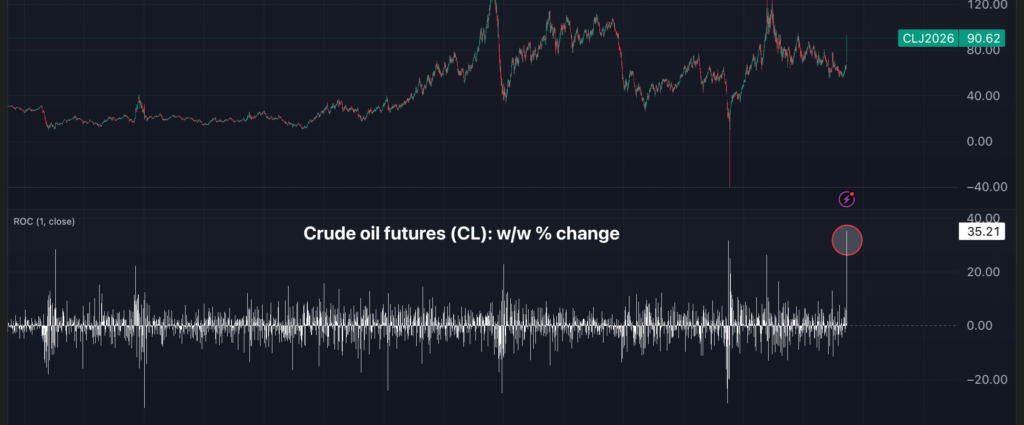
The ongoing conflict in the Middle East has sent oil prices soaring and has prompted G7 leaders to consider the potential release of emergency oil reserves to provide relief to consumers facing higher gasoline prices.

Gas prices have risen in response to the rapid increase in oil prices, with the national average price of gas rising from $3 a gallon last week to $3.48 a gallon on Monday, according to AAA data. Oil futures have surged over 48% in the last month after trading in the range of $60-70 a barrel during February to over $95 on Monday, when futures prices were briefly above $115 before declining.

French finance minister Roland Lescure on Monday told reporters after a meeting of G7 finance ministers that leaders “are not there yet” on deciding whether to conduct an emergency release, as there aren’t current supply problems in the U.S. or Europe.

“What we’ve agreed upon is to use any necessary tools if need be to stabilize the market, including the potential release of necessary stockpiles,” Lescure added.

AMID IRAN WAR, PRESIDENT TRUMP SUGGESTS SHORT-TERM OIL PRICE SPIKE IS ‘SMALL PRICE TO PAY’ FOR PEACE

Western economies develop strategic oil reserves in response to the 1970s oil crisis, with stockpiles like the U.S. government’s Strategic Petroleum Reserve serving as a backstop to address disruptions in the energy market that would otherwise harm the economy or imperil national security.

Phil Flynn, senior market analyst at the Price Futures Group and FOX Business contributor, said that the “mere mention” of strategic releases was enough to pull oil prices down off of their highs, as such releases of reserves “would ease markets’ concerns of tightness of supply.”

“Historically, releases from the strategic reserve, especially in coordination with other countries, have always been successful in cooling down fear in the market place,” Flynn said. “The market has to be convinced that the transportation of that oil is going to be safe, because even if you release oil from the reserve, it’s still going to take time to get to its destination, such as the refineries.”

G7 FINANCE MINISTERS TO DISCUSS EMERGENCY OIL RESERVE RELEASE AMID PRICE SURGE: REPORT

Andy Lipow, president of Lipow Oil Associates, told FOX Business that he expects “countries in the G7 will be forced to release oil reserves to show their public that they are taking some action to mitigate the rapid rise in prices.”

He added that he anticipates the releases will occur within the next two weeks if the conflict hasn’t reached a resolution by that time.

“Whether or not the release will have an impact will depend on if the de facto blockade of the Strait of Hormuz continues to impact oil tanker loadings and if additional oil infrastructure is damaged.”

CRUDE OIL PRICES EXCEED $100 A BARREL AS WAR IN IRAN DISRUPTS PRODUCTION, SHIPPING

The Treasury Department in 2022 analyzed the impact of SPR releases carried out by the Biden-era Energy Department in response to oil disruptions caused by Russia’s invasion of Ukraine on gas prices. 

The U.S. released 180 million barrels from the SPR over six months in 2022, while International Energy Administration partners released an additional 60 million barrels.

It found that the U.S. SPR releases alone lowered gas prices by a range of $0.13 to $0.31 per gallon, whereas the oil reserve releases done by the U.S. in tandem with IEA partners had a larger effect by reducing prices $0.17 to $0.42 per gallon.

GET FOX BUSINESS ON THE GO BY CLICKING HERE

The findings of Treasury’s analysis were similar to those from a 2017 study by Richard Newell and Brian Priest, who found that a U.S. only release would lower gas prices by $0.33 per gallon while releases by the U.S. and IEA partners would yield a larger reduction of $0.38 a gallon.

Reuters contributed to this report.

This post was originally published here

Voyager Technologies Inc (NYSE:VOYG) reported financial results for the fourth quarter after the market close on Monday. Here’s a rundown of the report.

Voyager Reports Mixed Results In Q4

Voyager reported fourth-quarter revenue of $46.65 million, missing analyst estimates of $48.22 million, according to Benzinga Pro. The space and defense technology company reported an adjusted loss of 37 cents per share, beating analyst estimates for a loss of 55 cents per share.

Total revenue was up 24% on a year-over-year basis. The company …

Full story available on Benzinga.com

This post was originally published here

Vail Resorts Inc. (NYSE:MTN) shares went downhill in Monday’s extended trading after the company released its second-quarter earnings report, missing estimates on the top and bottom lines.

Here’s a look at the key figures from the quarter. 

The Details: Vail Resorts reported quarterly earnings of $5.87 per share, which missed the Street consensus of $6.21, according to Benzinga Pro data.

Quarterly revenue came in at $1.08 billion, which …

Full story available on Benzinga.com

This post was originally published here

Vertex Pharmaceuticals Inc (NASDAQ:VRTX) shares are rising in extended trading Monday after the company announced positive interim results for one of its Phase 3 trials.

Vertex Reports Positive Results For All Endpoints

Vertex announced positive data from a pre-specified week 36 interim analysis of its ongoing phase 3 RAINIER trial of povetacicept in immunoglobulin A nephropathy.

Povetacicept is an engineered fusion protein and dual inhibitor of the BAFF (B cell activating factor) and APRIL (a proliferation inducing ligand) cytokines.

The trial met its primary objective, achieving a 52% reduction …

Full story available on Benzinga.com

This post was originally published here

Hewlett Packard Enterprise Co. (NYSE:HPE) shares climbed Monday’s extended trading after the company released its first-quarter earnings report, beating EPS estimates and raising guidance.

Here’s a look at the key figures from the quarter. 

The Details: Hewlett Packard reported quarterly earnings of 65 cents per share, which beat the consensus estimate of 55 cents, according to Benzinga Pro data.

Quarterly revenue came in at $9.301 billion, which just missed the Street estimate of $9.337 billion and was up from $7.85 billion in the same period last year.

Hewlett Packard reported the following …

Full story available on Benzinga.com

This post was originally published here

Aon (NYSE:AON) on Monday announced the first known stablecoin insurance premium payment among major global brokers, settling with Coinbase (NASDAQ:COIN) and Paxos using USDC on Ethereum (CRYPTO: ETH) and PayPal USD on Solana (CRYPTO: SOL).

The First Stablecoin Premium Settlement

Aon completed the proof of concept by settling insurance premiums for Coinbase and Paxos across multiple blockchain networks. 

The transactions used USDC on Ethereum and PayPal USD (CRYPTO: PYUSD) on Solana, demonstrating flexibility across leading stablecoins and blockchains.

Tim Fletcher, CEO of Aon’s financial services group, said the move advances the firm’s commitment to innovation. 

“As tokenized instruments become more widely used, clients need confidence that speed and …

Full story available on Benzinga.com

This post was originally published here

The IRS and Treasury Department on Friday put forward new proposed rules and processes that cover the implementation of Trump Accounts for parents and guardians who want to use the savings accounts for their children.

Trump Accounts were created under the One Big Beautiful Bill Act that was enacted last year and is expected to open for contributions after July 4, 2026. Ahead of the official launch of the accounts – which may be opened for children born between Jan. 1, 2025, and Dec. 31, 2028, as well as those born before 2025 who are under the age of 18 – the IRS and Treasury Department have to finalize regulations for the accounts.

The newly proposed rules include processes for opening an initial Trump Account using Form 4547, which allows an authorized individual to make an election opening the initial Trump Account. The election to open a Trump Account must be made on or before Dec. 31 of the calendar year in which the eligible individual turns 17. 

Instructions for Form 4547 are currently available on the IRS website and the agency plans to allow individuals to file a one-page version of the form either at the same time they file their tax return or on a separate online portal.

HERE’S HOW MUCH TRUMP ACCOUNT BALANCES COULD GROW OVER TIME

The form also gives the individual the option of requesting the $1,000 contribution from the Treasury’s pilot program for an eligible child’s Trump Account. While children born between the start of 2025 and the end of 2028 are eligible for the federal contribution, those born before 2025 are ineligible for the seed money.

If an election for the $1,000 pilot program is made at the same time as the decision to open an initial Trump Account, the authorized individual is able to make the election for a contribution. 

If no election is made for the pilot program at the time the election to open a Trump Account is made, a different process would be used for determining an authorized individual. The proposed rule for priority ordering would be a legal guardian, parent, adult sibling and then the grandparent of the eligible individual.

HOW TO KNOW IF YOUR CHILD QUALIFIES FOR A TRUMP ACCOUNT: ‘A FINANCIAL STAKE IN THE FUTURE’

Additionally, the proposed rules state that the individual who makes the election to open a Trump Account will be the responsible party who has authority to make investment choices among the options available while the account beneficiary is below the age of legal capacity. 

The responsible party may also request a qualified rollover contribution to a rollover Trump Account, request a transfer for a qualified ABLE rollover contribution under certain rules or select a successor responsible party for the account.

BANK OF AMERICA TO MATCH $1,000 GOVERNMENT DEPOSITS FOR TRUMP ACCOUNTS

“Trump Accounts are a pro-family initiative that will help millions of Americans harness the strength of our economy to lift up this generation and generations to follow and unlock the American dream,” said IRS CEO Frank Bisignano. 

“Creating Trump Accounts was one of the most important provisions in President Trump’s historic One Big Beautiful Bill, and these regulations are an example of the hard work of Treasury and the IRS in developing the guidance needed to ensure that eligible families can take advantage of Trump Accounts,” Bisignano added.

GET FOX BUSINESS ON THE GO BY CLICKING HERE

This post was originally published here

/NOT FOR DISTRIBUTION TO UNITED STATES NEWS WIRE SERVICES OR FOR DISSEMINATION IN THE UNITED STATES/

VANCOUVER, BC, March 9, 2026 /CNW/ – 1911 Gold Corporation (“1911 Gold” or the “Company“) (TSXV: AUMB) (OTCQX: AUMBF) (FRA: 2KY) is pleased to announce that, further to the news release dated February 20, 2026, the Company has closed the initial drawdown of US$15 million (the “Tranche 1 Amount“) under the loan agreement dated February 19, 2026 (the “Loan Agreement“) with Auramet International, Inc. (“Auramet“), which provides for a US$30 million secured credit facility (the “Credit Facility“). It is anticipated that the proceeds from the Credit Facility, including the Tranche 1 Amount, will be used to advance critical operational milestones at the True North Gold Project, specifically providing the capital required to purchase essential mining equipment, underground development at the True North mine, and the installation of the new crushing circuit at the mill.

The outstanding principal amount under the Credit Facility accrues interest at a rate of 12% per annum calculated and payable monthly in arrears on the last business day of each calendar month; provided, however, that no interest shall accrue on the Tranche 1 Amount for a period of six months following the closing date of the initial drawdown of the Tranche 1 Amount (the “Closing Date“). The Tranche 1 Amount shall be amortized and repaid to Auramet in 12 equal monthly instalments of US$1.25 million commencing on the date that is 13 months following the Closing Date and ending on the date that is 24 months following the Closing Date (the “Maturity Date“).

The obligations under the Loan Agreement are secured by a first-ranking security interest on all personal property of the Company and a continuing collateral mortgage against the Company’s True North Gold Project and Rice Lake exploration properties. The Loan Agreement includes terms and conditions customary for a transaction of this nature, including certain specified positive and negative covenants and mandatory prepayment terms.

Subject to the satisfaction of certain conditions precedent, the remaining US$15 million of the Credit Facility will be made available during the period commencing on the date that is 90 days following the Closing Date and ending on the …

Full story available on Benzinga.com

This post was originally published here

Coinbase (NASDAQ:COIN) CEO Brian Armstrong says AI agents will increasingly transact using crypto wallets, while Bitwise Chief Investment Officer Matt Hougan argues institutional adoption could push Bitcoin (CRYPTO: BTC) toward $1.3 million over time.

‘Own A Crypto Wallet’

Armstrong said Monday autonomous AI systems may soon execute more financial transactions than humans. “They can’t open a bank account, but they can own a crypto wallet,” he said.

These systems, including trading bots, automated services and machine-to-machine payment networks, could handle tasks such as purchasing data, paying for computing resources or executing financial trades without direct human input.

However, Armstrong noted that AI agents cannot easily access the traditional banking system because …

Full story available on Benzinga.com

This post was originally published here

Bitcoin (CRYPTO: BTC) rejected $73,500 following a brief early March rally as Into The Cryptoverse analyst Benjamin Cowen declares the “simulation confirmed,” arguing BTC is tracking the average return of prior midterm years with 2014, 2018, and 2022 precision.

The Historical Playbook

Cowen predicted a month ago that Bitcoin would find a low in February, stay weak through February, rally in the first week of March, and then fade that rally. “We really do live in a simulation,” Cowen said as Bitcoin hit $73,500 before surrendering those gains.

The pattern repeats across midterm cycles. Bitcoin drops into February, rallies in early March, and then sells off just like the average of all prior midterm years. 

Despite narratives about ISM data, Jane Street, oil prices, and labor market weakness, Bitcoin follows the historical script.

Comparing 2026 to 2014 shows nearly identical moves: …

Full story available on Benzinga.com

This post was originally published here

VANCOUVER, BC, March 9, 2026 /CNW/ – Century Lithium Corp. (TSXV: LCE) (OTCQX: CYDVF) (Frankfurt: C1Z) (“Century Lithium” or “the Company”) is pleased to announce the filing of the report for the Company’s 100%-owned Angel Island Lithium Project (“Angel Island”, a.k.a. “Clayton Valley”), “UPDATED NI 43-101 TECHNICAL REPORT ON THE FEASIBILITY STUDY OF THE CLAYTON VALLEY LITHIUM PROJECT Esmeralda County, Nevada, USA”, with effective date January 3, 2026 (“Feasibility Study” or “Report”), to support the disclosure in the Company’s news release dated February 23, 2026. The Report was prepared in accordance with National Instrument 43-101 (NI 43-101) by Mineral Property Development (“MPDI”), Global Resource Engineering, Ltd. (“GRE”) and SRK Incorporated (“SRK”).

All currency amounts in this news release are presented in US dollars.

The Feasibility Study incorporates the results of continued metallurgical testing, engineering optimization, refinement of the mine plan, and updated capital and operating cost estimates for Angel Island. Using a base case price of $24,000/tonne (“t”) of lithium carbonate, Angel Island’s estimated after-tax cash flow has a 27.4% Internal Rate of Return (“IRR”) and a $4.01 billion Net Present Value (“NPV”) at an 8% discount rate.

Feasibility Study Highlights

  • After-tax NPV (8% discount rate) of $4.01 billion based on price assumptions of $24,000/t for lithium carbonate and $750/dry metric tonne for sodium hydroxide
  • Full story available on Benzinga.com

This post was originally published here

BitMine Immersion Technologies (NYSE:BMNR) purchased 60,976 Ethereum (CRYPTO: ETH) previous week and forecasts ETH to bottom between March 8-14.

The 61,000 ETH Purchase

BitMine acquisition exceeds the recent weekly average of 45,000-50,000, with total holdings reaching 4,534,563 ETH at $1,965 per ETH.

The company now owns 3.76% of the ETH supply, over 75% of the way to the “Alchemy of 5%” target in just eight months.

Total crypto and cash holdings reached $10.3 billion, including 4.5 million ETH, $1.2 billion in cash, 195 Bitcoin (CRYPTO: BTC), $200 million stake in Beast Industries, and $14 million stake in Eightco Holdings.

BitMine has 3,040,483 staked ETH representing $6.0 billion at $1,965 per token. This represents 67% …

Full story available on Benzinga.com

This post was originally published here

Meta CEO Mark Zuckerberg and Google co-founder Sergey Brin have closed on sprawling Miami-area estates, underscoring the continued shift of tech wealth from the West Coast to South Florida.

“While the neighborhoods they bought in differ, their priorities are identical: safety, security and proximity,” Douglas Elliman’s Chris Wands told Fox News Digital. “These high-profile buyers are choosing waterfront properties in gated, controlled environments with easy access to private airports and Miami’s business and restaurant corridors.”

Within roughly a 20-mile radius, four of the world’s wealthiest individuals — Jeff Bezos, Zuckerberg, Larry Page and Brin — now own significant residential properties. Zuckerberg’s reported $170 million closing on Indian Creek Island would rank among the most expensive residential sales in Miami-Dade County history, according to multiple reports.

Zuckerberg and his wife, Priscilla Chan, reportedly closed on the property at 7 Indian Creek Island Road on March 2, snapping up the 1.84-acre waterfront lot for a bit less than the original $200 million listing price.

OVER $126M IN 60 DAYS — FLORIDA REAL ESTATE TYCOONS SAY BLUE-STATE WEALTH MIGRATION IS NOW PERMANENT

The home features nine bedrooms, 11.5 bathrooms, a “secret” library passageway, a wellness wing with a gym, professional-grade salon and massage room, a 1,500-gallon centerpiece aquarium, a jazz lounge, a 60-foot pool and more.

The home — located three doors down from Bezos in the so-called “Billionaire Bunker” — is still under construction and was designed by Canadian architect Ferris Rafauli, known for designing rapper Drake’s “Embassy” mansion in Toronto.

“From the limestone façade and grand architectural proportions to the meticulously curated interiors, every detail showcases modern artistry and exceptional craftsmanship,” the listing details read. “This classically inspired residence offers endless views, indoor-outdoor living, and a sense of privacy and sophistication.”

“South Florida has become one of the most powerful concentrations of wealth in just a few years and that signals a real confidence in the market. Ultra-luxury real estate FOMO is absolutely real,” Douglas Elliman’s No. 1 agent nationwide, Dina Goldentayer, said. “There’s a network of gravity happening behind the scenes. Billionaires talk, their advisors, family offices and security teams are all talking. And suddenly Miami becomes a strategic base that you need as a hedge.”

Brin opted for the more residential setting of 6569 Allison Road on Allison Island in northern Miami Beach. He reportedly purchased the $51 million property through a Nevada-based entity, Lagoon LLC, which has been linked to his longtime legal representatives.

The home, previously owned by LVMH Americas CEO Michael Burke and sold in an off-market deal, is a modernist, glass-walled property spanning roughly 10,000 square feet. The design includes seven bedrooms and 8.5 bathrooms, with sweeping views of Biscayne Bay and architectural elements said to draw inspiration from the Guggenheim Museum.

It’s notable that both Zuckerberg and Brin’s neighborhoods include ultra-secure, private police guards who must register any guests as they come and go.

“Security will always remain paramount for the ultra-high-net worth, and they all will always have their private security detail 24/7. Their choices between Indian Creek, Coconut Grove or Allison Island would be more based on their personal preference of what lifestyle the immediate surroundings offer, and of course, the home itself,” ONE Sotheby’s International Realty’s Eddy Martinez also told Fox News Digital. “How did that home make them feel in comparison to others? All these factors come into play on the final decision.”

The real estate insiders point to Google counterpart Larry Page as the first to sound the alarm by moving to Florida, with his $173 million acquisition of two separate estates in Coconut Grove in late 2025. The timing of these billionaire relocations coincides with a California proposal that would impose a one-time 5% tax on the net worth of Golden State residents with assets exceeding $1 billion.

If such a proposal were to receive enough signatures and voter approval, individuals who were California residents as of Jan. 1, 2026, could be subject to the tax, according to the measure’s draft language.

Based on recent net worth estimates, Zuckerberg and Brin could hypothetically owe more than $10 billion each under such a tax structure, though the exact amount would depend on final valuations and the measure’s ultimate language.

“We believe the catalyst in the billionaire migration to South Florida from California is more about the billionaire tax taking place,” Martinez noted. “We believe these individuals didn’t get to where they are by FOMO — rather, their success can be attributed to a mindset of taking fast and decisive action on what they believe is best for them to move forward and have continued success.”

GET FOX BUSINESS ON THE GO BY CLICKING HERE

As Miami real estate continues to surge, Goldentayer argues there’s no clear ceiling for how high property values could climb in the near future.

“I see no ceiling,” she said. “When five of the six richest people in the world are buying homes within miles of each other, it completely shifts the market, and we are seeing a recalibration of an entire asset class.”

READ MORE FROM FOX BUSINESS

This post was originally published here

Something unusual is unfolding in inflation and interest-rate markets.

As oil prices surpass $100 a barrel amid the closure of the Strait of Hormuz, a sharp contradiction is being priced in real time across prediction markets.

On one hand, traders are rapidly pricing a surge in inflation this month. On the other, they are still betting the Federal Reserve will move ahead with interest rate cuts in 2026.

Can the two predictions really hold simultaneously?

A Market Betting On ‘Transitory’ Again

Beneath the surface, markets appear to be resurrecting a word that defined the inflation debate in 2021: “transitory.”

According to Polymarket, the probability that the annual inflation rate for March will exceed 2.8% has jumped by about 45 percentage points to roughly 87%.

That sharp move suggests traders expect inflation to rise meaningfully from the current 2.4% level and drift further away from the Federal Reserve’s 2% target.

Yet the interest-rate outlook tells a very different story.

Chart: The Inflation Signal That Moved 45 Points Overnight

title=”polymarket-market-iframe”
src=”https://embed.polymarket.com/market?market=will-annual-inflation-increase-by-2pt8-in-march?via=FPw2LTR&theme=dark&creator=Piero91&width=500&height=700″
width=”500″
height=”700″
frameBorder=”0″>

Rate-Cut Bets Have Not Broken

Markets still heavily expect the Federal Reserve to cut rates this year.

Notably, the implied probability of at least one rate cut stands at 75%.

Prediction market data show a 28% probability of a single rate cut of 25 basis points this year. The probability of two cuts is also about 28%, while traders assign a 15% chance to three cuts and a 4% chance to four cuts.

Meanwhile, the probability of no rate cuts is only about 18%. Even lower than that, the odds of a Federal Reserve …

Full story available on Benzinga.com

This post was originally published here

The U.S. reversed a five-year decline in the Heritage Foundation’s Index of Economic Freedom with its biggest annual increase in the index in over two decades, FOX Business can exclusively reveal.

America’s economic freedom score rose by 2.6 points from a year ago to 72.8, which ranks 22nd among the more than 176 countries that had completed scores in the index. The increase of 2.6 points was the largest annual increase since 2001 and is the second-largest jump the U.S. has had in its 32-year history in the index.

Heritage’s Index of Economic Freedom assesses 12 economic freedoms that fall into four categories including rule of law, government size, regulatory efficiency and open markets – each of which has three subcategories. 

“The U.S.’ score improvements in monetary freedom, government spending, fiscal health, and investment freedom have outpaced the relatively lower score in trade freedom, reflecting the net positive impact of major regulatory and tax reforms on economic growth, investment, and business confidence,” Heritage’s Anthony Kim, the Jay Kingham Research Fellow in International Economic Affairs, editor of the Index of Economic Freedom and manager of global engagement at the Margaret Thatcher Center for Freedom, told FOX Business.

BURGUM SAYS US-VENEZUELA TIES MOVING AT ‘TRUMP SPEED,’ WILL HELP KEEP ENERGY COSTS DOWN FOR AMERICANS

Kim explained that the progress “is not accidental” and is reflective of the Trump administration’s initiatives that have “cut government jobs, slowed spending, and prioritized private-sector growth through proactive, bold deregulatory and tax reforms.”

While the U.S. score of 72.8 came in at 22nd in the world rankings, it ranked 3rd in the Americas, trailing only Canada (75.6) and Chile (74.3), respectively. Mexico scored 59.8 and ranked 92nd in the world, and was in 19th place among the 32 countries in the Americas region.

In the rule of law category, the U.S. ranked highly with property rights, judicial effectiveness and government integrity all scoring well above the world average.

Government size was a relative weakness for the U.S., with a roughly average tax burden score of 75.3 compared to the global average of 78.4. Government spending scored 57.9 to the global average of 66.3, while fiscal health was a significant weak point – as the U.S. score of 18.5 was well below the global average of 65.9 due to high levels of public debt and large budget deficits.

US DEBT SET TO CRUSH WORLD WAR II RECORD AS ANNUAL DEFICITS EXPLODE TO $3T WITHIN DECADE

Aspects of regulatory efficiency assessed by the report included freedom for business, labor and monetary were all well above the Index’s global average.

In terms of open markets, the U.S. scored 67.6 in trade freedom, which was below the global average of 70.2. However, investment freedom and financial freedom each scored an 80 for the U.S., well above the global averages of 53.4 and 48.1, respectively.

Kim noted that the “impact of restrictive tariffs on the global economy has been far more muted than feared, in light of increased investment in such critical sectors as energy and AI (among many others),” adding that the lack of tariff retaliation by countries other than China, Canada and the EU mitigated the potential impact of a trade war.

US WEIGHS ASKING CHINA TO CURB RUSSIAN, IRANIAN OIL PURCHASES

Countries with the highest overall scores in Heritage’s Index of Economic Freedom were Singapore (84.4), Switzerland (83.7%), Ireland (83.3), Australia (80.1) and Taiwan (79.8). 

The countries that scored the lowest were among the most repressed in the world, with North Korea (3.1) ranked last. Cuba (25.2), Venezuela (27.3), Sudan (32.5) and Zimbabwe (35.2) rounded out the bottom five countries in Heritage’s analysis.

Russia (50.3), China (48.3) and Iran (41.8) were also among the lowest scoring countries in the index due to their repressive political and economic systems.

WHAT ARE THE BIGGEST BUDGET DEFICITS IN US HISTORY?

Argentina’s economic freedom rating saw the largest increase from a year ago of all countries in Heritage’s index, climbing by 3.2 points relative to last year.

“October 2025’s decisive midterm election victory provided reform-minded President Javier Milei with concrete support and greater momentum for continuing to transform Argentina’s economy,” Kim said. 

Kim noted that several other countries, including Oman, The Philippines, Morocco and Paraguay, have “recorded sizable score improvements in their past two years despite challenging economic environments.”

GET FOX BUSINESS ON THE GO BY CLICKING HERE

He added that Paraguay’s President Santiago Peña has been “unambiguously promoting economic freedom, combating corruption, and building alliances with democratic nations.”

This post was originally published here

Bitcoin (CRYPTO: BTC) tapped $69,000 on Monday morning after oil retraced back below $110, following the G7 and IEA’s announcement about the largest coordinated strategic oil reserve release in history.

The Historic Oil Intervention

The G7 and International Energy Agency announced the release of 400 million barrels of oil from strategic reserves, representing nearly 30% of the IEA’s total 1.2 billion barrel stockpile.

The emergency meeting was called to combat a severe supply shock following escalation of the Iran crisis.

Oil prices plunged 11% in one hour after the announcement.

The intervention targets oil prices that surged above $100 a barrel amid conflict involving Iran, the United States, and Israel.

IEA nations currently hold 1.24 billion barrels in public reserves plus 600 million barrels in industry stocks.

This system was designed after the 1973 crisis specifically for this …

Full story available on Benzinga.com

This post was originally published here

BitMEX co-founder Arthur Hayes says Bitcoin (CRYPTO: BTC) 50% drawdown reflects growing fears of an AI-driven credit shock rather than weakness in the crypto market itself.

Bitcoin’s AI-Triggered Credit Destruction

Hayes argued in an interview with Cointelegraph that the decline reflects a broader macro risk tied to artificial intelligence and global geopolitics.

Markets may be underpricing geopolitical risk from the escalating tensions between the U.S. and Iran, although his central thesis focuses on what he calls AI-triggered credit destruction.

Hayes’ argument: widespread AI adoption could …

Full story available on Benzinga.com

This post was originally published here


Editor’s Note: The future prices of benchmark tracking ETFs and the headline were updated in the story.

U.S. stock futures fell sharply on Monday following Friday’s negative close. Futures of the major benchmark indices were lower amid the ongoing Iran-US conflict.

The bloodbath follows a historic surge in energy costs. Brent Crude spiked 14.90% to hit $106.50, while WTI surged 13.27% to $102.96, with both benchmarks now aggressively testing their 52-week highs of $119.46 and $119.43, respectively.

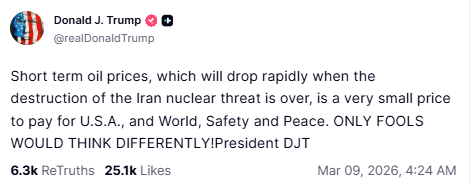
Despite the market carnage, President Donald Trump took to Truth Social to dismiss the economic anxiety, framing the record-high fuel costs as a necessary byproduct of his administration’s offensive against Tehran.

Trump On Oil Prices.

Meanwhile, the 10-year Treasury bond yielded 4.19%, and the two-year bond was at 3.63%. The CME Group’s FedWatch tool’s projections show markets pricing a 97.3% likelihood of the Federal Reserve leaving the current interest rates unchanged in March.

Index Performance (+/-)
Dow Jones -1.61%
S&P 500 -1.41%
Nasdaq 100 -1.56%
Russell 2000 -2.60%

The SPDR S&P 500 ETF Trust (NYSE:SPY) and Invesco QQQ Trust ETF (NASDAQ:QQQ), which track the S&P 500 and Nasdaq 100, respectively, were lower in premarket on Monday. The SPY was down 0.93% at $666.14, while the QQQ declined 1.04% to $593.50.

Stocks In Focus

Ovintiv

  • Ovintiv Inc. (NYSE:OVV) jumped 5.24% in premarket on Monday after Director Mayson Howard John sold 5,000 shares of common stock last week, according to a Form 4 filing with the Securities and Exchange Commission.
  • OVV maintains a strong price trend in the short, medium, and long terms, with a solid value ranking, as per Benzinga’s Edge Stock Rankings.
Benzinga's Edge Stock Rankings for OVV.

Hims & Hers Health

  • Hims & Hers Health Inc. (NYSE:HIMS) surged 49.36% after it reportedly ended a public feud with Novo Nordisk AS (NYSE:NVO), …

Full story available on Benzinga.com

This post was originally published here

Adobe Inc. (NASDAQ:ADBE) and Major League Baseball (MLB) announced a major expansion of their multi-year partnership Monday.

The deal positions Adobe as the official Presenting Sponsor of MLB Opening Day in 2026, 2027, and 2028.

The partnership arms MLB’s marketing, product, and content teams with Adobe’s enterprise AI tools. It targets fan engagement across digital platforms at scale.

What the Expanded Deal Covers

Adobe’s expanded role includes four key technology deployments across MLB operations.

Adobe GenStudio for Performance Marketing will power MLB’s campaign delivery. Teams can create personalized, on-brand content variations across digital channels quickly.

Adobe LLM Optimizer targets brand discoverability. It helps MLB monitor how content surfaces …

Full story available on Benzinga.com

This post was originally published here

During times of turbulence and uncertainty in the markets, many investors turn to dividend-yielding stocks. These are often companies that have high free cash flows and reward shareholders with a high dividend payout.

Benzinga readers can review the latest analyst takes on their favorite stocks by visiting Analyst Stock Ratings page. Traders can sort through Benzinga’s extensive database of analyst ratings, including by analyst accuracy.

Below are the ratings of the most accurate analysts for three high-yielding stocks in the real estate sector.

Park Hotels & Resorts Inc (NYSE:PK)

  • Dividend Yield: 9.17%
  • Cantor Fitzgerald analyst Jay Kornreich maintained a Neutral rating and raised the price target from $11 to $12 on March 3, 2026. This analyst has an accuracy rate of 53%.
  • JP Morgan analyst Daniel Politzer maintained an Underweight rating and increased the price target from $10 to $11 on Feb. 3, 2026. This analyst has an accuracy rate of 61%
  • Recent News: On Feb. 19, …

Full story available on Benzinga.com

This post was originally published here

Hewlett Packard Enterprise Company (NYSE:HPE) will release earnings results for its first quarter, after the closing bell on Monday, March 9.

Analysts expect the Spring, Texas-based company to report quarterly earnings at 59 cents per share, up from 49 cents per share in the year-ago period. The consensus estimate for Hewlett Packard Enterprise’s quarterly revenue is $9.35 billion, versus $7.85 billion a year earlier, according to data from Benzinga Pro.

On Jan. 26, HPE announced a strategic collaboration with 2degrees to accelerate AI innovation and strengthen data sovereignty in New Zealand.

Hewlett Packard Enterprise shares fell 1.6% to close at $21.13 on Friday.

Benzinga readers can access the latest analyst ratings on the Analyst Stock Ratings page. Readers can sort by stock ticker, company name, analyst firm, rating change or other variables.

Let’s have a …

Full story available on Benzinga.com

This post was originally published here

Global markets are reeling Monday morning as a violent spike in energy prices sends shockwaves through the U.S. travel and industrial sectors.

US Futures, Asian Markets Slump Amid Rising Crude Prices

Following a chaotic weekend in the Persian Gulf, Dow Jones futures plummeted over 1,000 points in overnight trading, while crude oil benchmarks aggressively tested their 52-week highs near the $120 mark.

The risk-off contagion is hitting U.S. equities, creating a stark divide between war-exposed transportation stocks and defense-heavy beneficiaries.

The decline follows a historic surge in energy costs. Brent Crude spiked over 22.99% to hit $114.00, while WTI surged 1.20% to $110.17, with both benchmarks now aggressively testing their 52-week highs of $119.46 and $119.46, respectively.

Index Performance (+/-)
Dow Jones -2.04%
S&P 500 -1.88%
Nasdaq 100 -2.18%
Russell 2000 -3.74%

The Overnight Movers: Winners and Losers

Investor anxiety is focused squarely on fuel-sensitive industries. $DAL

Company Name Overnight Move Market Context
Delta Air Lines Inc. (NYSE:DAL) -3.78% Immediate pressure on jet fuel margins; flight cancellations in the Gulf.
United Airlines Holdings Inc. (NASDAQ:UAL) -4.00% Heavily impacted by airspace closures and soaring international fuel costs.
Carnival Corporation (NYSE:CCL) -3.88% Maritime fuel surcharges and geopolitical risk hitting …

Full story available on Benzinga.com

This post was originally published here

The CNN Money Fear and Greed index showed a further increase in the overall fear level, while the index remained in the “Fear” zone on Friday.

U.S. stocks settled lower on Friday, with the Dow Jones index falling more than 450 points during the session.

Stocks also recorded losses last week, with the S&P 500 losing 2% and the 30-stock Dow dropping 3%. The tech-heavy Nasdaq also declined 1.2% during the week.

President Donald Trump issued a stark ultimatum to Iran, demanding unconditional surrender and warning of devastating consequences should attacks on U.S. forces continue. Qatar’s energy minister warned oil could surge past $150 should the Strait of Hormuz fully close.

Oil prices jumped to the highest levels since October 2023. Crude has rallied nearly 35% for the week, recording the biggest weekly gain in the commodities’ trading history.

In earnings, Marvell Technology Inc. (NASDAQ:MRVL) shares jumped over 18% on Friday after the company reported better-than-expected quarterly financial results. Shares of Owlet Inc.

Full story available on Benzinga.com

This post was originally published here

The S&P 500 closed Friday at 6,740.02, down 1.33%, with futures falling further Monday morning as oil resumed its climb amid uncertainty over the Iran war.

The Polygon-based (CRYPTO: POL) Polymarket is sending a bearish signal at the beginning of the week. In the early trades, “Up” was the minority call, with only 6% chance of the S&P 500 opening higher, while 94% of bettors bet their money on a “Down” opening.

Why That Number Matters

The odds reflect genuine uncertainty amid rising crude oil prices. Brent Crude spiked over 22.99% to hit $114.00, while WTI surged 1.20% to $110.17, …

Full story available on Benzinga.com

This post was originally published here

Heritage Insurance Holdings, Inc. (NYSE:HRTG) will release its fourth quarter earnings before the opening bell on Monday, March 9.

Analysts expect the Tampa, Florida-based company to report earnings of $1.74 per share. That’s up from 66 cents per share in the year-ago period. The consensus estimate for Heritage Insurance’s quarterly revenue is $212.6 million (it reported $210.26 million last year), according to Benzinga Pro.

On Nov. 5, Heritage reported net income of $50.4 million or $1.63 per share for the third quarter, up from $8.2 million or 27 cents per share, in the year-ago quarter.

Shares of Heritage Insurance fell 0.4% to close at $26.88 on Friday.

Benzinga readers can access the latest analyst ratings on the

Full story available on Benzinga.com

This post was originally published here

Sharplink, Inc. (NASDAQ:SBET) will release its fourth quarter earnings before the opening bell on Monday, March 9.

Analysts expect the Miami, Florida-based company to report earnings of 50 cents per share on revenue of $16.85 million, according to Benzinga Pro.

On Feb. 3, the company officially changed its corporate name from SharpLink Gaming to Sharplink Inc.

Shares of Sharplink fell 7.2% to close at $7.36 on Friday.

Benzinga readers can access the latest analyst ratings on the Analyst Stock Ratings page. Readers can sort by stock ticker, company name, analyst firm, rating change or other variables.

Let’s have a look …

Full story available on Benzinga.com

This post was originally published here

Sharplink, Inc. (NASDAQ:SBET) will release its fourth quarter earnings before the opening bell on Monday, March 9.

Analysts expect the Miami, Florida-based company to report earnings of 50 cents per share on revenue of $16.85 million, according to Benzinga Pro.

On Feb. 3, the company officially changed its corporate name from SharpLink Gaming to Sharplink Inc.

Shares of Sharplink fell 7.2% to close at $7.36 on Friday.

Benzinga readers can access the latest analyst ratings on the Analyst Stock Ratings page. Readers can sort by stock ticker, company name, analyst firm, rating change or other variables.

Let’s have a look …

Full story available on Benzinga.com

This post was originally published here

Tesla Inc. (NASDAQ:TSLA) CEO Elon Musk is on his way to becoming a trillionaire, with a net worth of around $662 billion. This will receive a boost after the much-awaited initial public offering (IPO) of SpaceX.

Elon Musk Hints At $ 1.75 Trillion Valuation

The potential SpaceX IPO has been a topic of significant interest, especially after Musk hinted at a $1.75 trillion valuation. This valuation is driven by SpaceX’s ambitious plans for Mars colonization and orbital expansion.

The company is reportedly preparing to file confidentially for an IPO as early as next month, aiming for a June listing that could raise up to $50 billion, potentially surpassing Saudi Aramco’s $29 billion debut to become the largest IPO …

Full story available on Benzinga.com

This post was originally published here

Senate Democratic leader Chuck Schumer (D-N.Y.) and CNBC’s Jim Cramer led a wave of alarm Sunday after oil prices surged and President Donald Trump said higher energy costs were “a very small price to pay” for world safety and peace.

Schumer And Cramer Sound Early Alarm

Schumer wrote on X, “Due to Donald Trump’s reckless war of choice, gas prices have surged to their highest levels in years,” and demanded that Trump release oil from the Strategic Petroleum Reserve “IMMEDIATELY.”

Cramer warned, “A sudden oil shock is always bad for stocks,” adding, “I don’t see a path to de-escalation.”

Full story available on Benzinga.com

This post was originally published here

Over the past several years, Ford has found itself in hot water, with recalls sweeping through nearly every model in its lineup between 2020 and 2026 — all but one. 

Only the Ford GT, a mid-engine two-seater sports car, escaped the issues that plagued the rest of the lineup, including problems with windshields, suspension and rearview cameras.

Discontinued after 2022, the model paid homage to the iconic Ford GT40, which dominated the 24 Hours of Le Mans in the 1960s. While the second-generation Ford GT largely avoided recalls, both generations experienced some issues. The first faced potential airbag problems, while the second had possible hydraulic defects.

In 2025, Ford set a record for the most recalls issued by a single automaker in a single year, issuing more than 150 — nearly double the previous record of 77 set by General Motors in 2014.

FORD RECALLS MORE THAN 615,000 VEHICLES OVER WIPER AND DRIVESHAFT DEFECTS

The surge was largely attributed to an aggressive strategy of initiating voluntary recalls before major incidents or widespread complaints emerged.

“The increase in recalls reflects our intensive strategy to quickly find and fix hardware and software issues and go the extra mile to help protect customers,” the company said in summer 2025. “Ford has more than doubled its team of safety and technical experts in the past two years and significantly increased testing to failure on critical systems in current Ford vehicles such as powertrains, steering and braking. Insights from this testing are being incorporated into current production.”

Over six years, 16 Ford models — spanning SUVs and crossovers, trucks and pickups, performance cars and commercial vans — were affected, totaling tens of millions of vehicles.

FORD RECALLS MORE THAN 412,000 VEHICLES OVER SUSPENSION ISSUE

Among Ford’s seven SUV and crossover models — Escape, Bronco Sport, Bronco, Explorer, Expedition, Mustang Mach-E and Edge — each has been subject to at least one recall. Issues have included inverted or blank rearview camera images, cracked fuel injectors that pose fire risks, software faults that could cause brake malfunctions and electronic door latch failures that may lead to lockouts or entrapment.

All five major Ford truck and pickup models — Maverick, Ranger, F-150, F-150 Lightning and Super Duty — have also been affected. The most widespread problems involve electrical faults that can disable trailer brake lights, turn signals or braking functions while towing, increasing crash risks.

CLICK HERE TO GET FOX BUSINESS ON THE GO

Ford has largely phased out traditional sedans, leaving the Mustang as its only remaining passenger car. The coupe and convertible, produced since 2020, have faced issues including rearview camera malfunctions.

The company’s commercial vans — Transit, E-Transit and Transit Connect — have also been recalled for problems involving braking, towing, electrical systems and visibility.

This post was originally published here

Enterprise software giant Oracle is reportedly planning to ax thousands of jobs due to mounting financial pressure from its aggressive push to build AI-focused data centers.

The tech powerhouse may slash 20,000 to 30,000 positions, possibly cutting 12–18% of its global workforce of roughly 162,000 employees, tech magazine CIO reported.

The layoffs could be implemented as early as March 2026, Bloomberg reported.

The move is driven by a cash crunch from massive spending on data centers, which Wall Street expects will keep Oracle’s cash flow negative for years, forcing the company to seek alternative ways to preserve liquidity, Bloomberg said.  

MAJOR TECH COMPANIES BACK TRUMP PLEDGE TO PAY MORE FOR DATA CENTER ELECTRICITY AHEAD OF SIGNING

Additionally, several U.S. banks have scaled back financing for Oracle’s massive AI data center expansion, according to investment bank TD Cowen, cited by CIO.com. Lenders have reportedly voiced growing concerns over the company’s ability to repay debt given the enormous capital required to build infrastructure for high-profile AI clients such as OpenAI.

“Both equity and debt investors have raised questions regarding Oracle’s ability to finance this buildout,” the report said.

STANLEY BLACK & DECKER TO CUT HUNDREDS OF JOBS, SHUT CONNECTICUT PLANT

The job cuts will span divisions across the company, focusing on roles Oracle expects to need less of due to AI, Bloomberg reported.

The move is also expected to free up $8 billion to $10 billion, TD Cowen said in a research report cited by CIO.

Led by Chairman Larry Ellison, Oracle is making a high-stakes, all-in bet on becoming a top-tier AI cloud provider to rival AWS, Microsoft and Salesforce.  

GET FOX BUSINESS ON THE GO BY CLICKING HERE

The upcoming layoffs at Oracle are expected to be much larger and more extensive than the company’s usual smaller routine job cuts. 

Oracle reportedly told internal teams it would reassess many open positions in its cloud division while evaluating which roles are still necessary. However, planning for the workforce reductions is still ongoing and could change, Bloomberg reported.  

FOX Business reached out to Oracle for more information.  

This post was originally published here

These ten large-cap stocks were top performers last week.

These firms rallied on strong earnings, raised guidance, bullish analyst calls, insider confidence and momentum tied to energy, advertising and capital return catalysts.

Are they a part of your portfolio?

Venture Global, Inc. (NYSE:VG) gained 11.43% this week, fueled by Brent crude’s sharp climb on U.S.-Iran hostilities. Also, the firm reported fourth-quarter earnings and announced a new liquefied natural gas (LNG) purchase agreement with Trafigura.

The Trade Desk, Inc. (NASDAQ:TTD) increased 26.7% this week  after reports surfaced about potential advertising discussions with OpenAI. The ad-technology company also gained attention following a …

Full story available on Benzinga.com

This post was originally published here

These ten large-cap stocks were the worst performers last week.

These firms were hit by a mix of weak earnings, lowered guidance, deal pressure, rising yields, and geopolitical or AI-spending concerns.

Are they a part of your portfolio?

Lumentum Holdings Inc. (NASDAQ:LITE) lost 24.65% this week. The company is set to join S&P 500, effective March 23, 2026.

Celsius Holdings, Inc. (NASDAQ:CELH) slumped 17.86% this week.

First Majestic Silver Corp. (NYSE:AG) decreased 17.69% this week. Shares of precious metal companies are traded lower amid a stronger dollar and rising yields as the market drops due to the ongoing conflict in the Middle East.

Carnival Corporation (NYSE:

Full story available on Benzinga.com

This post was originally published here


It’s been an eventful week in the world of business and finance. Here’s a quick look at the top stories that made headlines.

Trump’s Trade Wars, AI Displacement

Amid President Donald Trump‘s trade wars, the real story for Wall Street in 2026 is a tug-of-war between record-high valuations, a “messy” Federal Reserve, and a literal war in the Middle East. However, experts have told Benzinga that what looks like a bubble to some is simply “agility” to others.

Patrick Sarch, of the White & Case LLP, stated that current market conditions are prompting short-sellers to identify companies whose fundamentals don’t support their valuations.

Read the full article here.

Arthur Hayes: The longer Trump Lingers In Iran, Higher The Chances Of Bitcoin Surging

Arthur Hayes, Chief Investment Officer at Maelstrom Fund, said that a prolonged U.S.-Iran conflict could force the Federal Reserve to print more money, ultimately driving Bitcoin (CRYPTO: BTC) higher.

In an …

Full story available on Benzinga.com

This post was originally published here


Crude oil has been in focus since the U.S. and Israel began their strikes on Iran, which also killed the Islamic Republic’s Supreme Leader, Ayatollah Ali Khamenei.

Strait Of Hormuz Closed

Concerns around crude oil prices escalated when Iran announced the closure of the Strait of Hormuz, warning it would fire on any vessel attempting to pass.

Since the closure, oil has surged by 35%, pushing it above the $90 mark. Crude oil was last trading at $90.90, up by 12.2%.

Strikes Against Oil Infra

Iran has attacked oil infrastructure in the Middle East, which has resulted in a reduction in output. Saudi Aramco’s Berri oilfield was reportedly struck by debris, causing minor …

Full story available on Benzinga.com

This post was originally published here

U.S. intelligence assessments reportedly indicate that Iran remains capable of reaching its main highly enriched uranium reserves at Isfahan, despite American strikes that sealed the site beneath the ground.

Spy Agencies Flag Nuclear Risk

The Wall Street Journal, citing American officials, said Iran holds roughly 970 pounds of uranium, the bulk of which is stored at Isfahan and enriched to 60%.

Uranium would still need to be enriched to about 90% to reach weapons-grade levels — a step U.S. officials say would be relatively easy if Iran’s centrifuges are still running.

Commando Raid Option Still on the Table

President Donald Trump, speaking aboard Air Force One Saturday, …

Full story available on Benzinga.com

This post was originally published here

A widening supply shock propelled crude oil 35% higher in a week, pushing prices above $90 a barrel, as the Strait of Hormuz closed, drone strikes crippled Saudi oilfields, and a wave of force majeure declarations rippled through global energy markets.

This is the result of escalating tensions between the U.S and Iran.

Saudi Arabia’s Crown Assets Under Fire

Saudi Aramco’s Berri oilfield, which produces about 250,000 barrels per day, reportedly suffered minor debris damage on Saturday after Saudi defenses intercepted a drone attributed to Iran.

Earlier, Saudi Arabian air defenses intercepted 20 drones launched in five waves toward Shaybah Oilfield, a 1-million-barrel-per-day facility operated by Saudi Aramco in the Empty Quarter desert, the Saudi Defense Ministry said in a series of posts on X.

Separately, the ministry said Ras Tanura Refinery—a 550,000-barrel-per-day facility on the kingdom’s east coast—was targeted twice during the same week, on March 2 and March 4, according to an Argus report.

In Abu Dhabi, a drone struck the UAE’s Mussafah fuel terminal; authorities contained the fire with no injuries or operational disruption.

Hormuz Blockaded, Storage Filling Fast

According to a Reuters report, the Islamic Revolutionary Guard Corps …

Full story available on Benzinga.com

This post was originally published here


Bristol Myers Squibb Company (NYSE:BMY) on Friday won U.S. approval for its oral drug Sotyktu to treat adults with active psoriatic arthritis.

The decision gives patients another option for joint and skin symptoms tied to the autoimmune disease.

The U.S. Food and Drug Administration approved the drug after reviewing late-stage trial data that showed better disease control than placebo, according to a PRNewswire release.

The treatment works by selectively targeting tyrosine kinase 2, a pathway involved in immune-driven inflammation.

Clinical Trial Results

Researchers tested the drug in two global Phase 3 studies, POETYK PsA-1 and POETYK PsA-2. Patients received either a daily 6-milligram tablet or placebo during the controlled part of the trials.

Investigators used American College of Rheumatology response criteria to measure results.

By Week 16, about 54% of patients taking Sotyktu achieved an ACR20 response in both studies.

By comparison, 34% …

Full story available on Benzinga.com

This post was originally published here


The Trump administration is signaling stronger support for cryptocurrency and blockchain technologies in its updated cybersecurity strategy.

The policy document outlines how emerging technologies will shape national security, economic competitiveness and digital infrastructure.

Jason Lowery, an executive associated with the Defense Department initiative, highlighted the development on X and pointed to the policy update.

Lowery wrote on X, “Boom. Supporting cryptocurrency & blockchain technology is now officially an emerging technology priority in the U.S. Presidential Cyber Strategy.”

Cyber Strategy Elevates Blockchain

The seven-page document outlines the White House’s approach to defending digital infrastructure and strengthening American technological leadership.

It places cyberspace at the center of economic growth, innovation and national defense.

The strategy argues that digital networks underpin everyday life, economic opportunity and the country’s …

Full story available on Benzinga.com

This post was originally published here


Salesforce CEO (NYSE:CRM) Marc Benioff said on Wednesday that warnings about AI-driven mass white-collar layoffs were overblown. By Friday morning, the U.S. economy had shed 92,000 jobs, and a week that saw headlines on job cuts at Morgan Stanley (NYSE:MS), Oracle (NYSE:ORCL), and Capital One (NYSE:COF) was drawing to a close.

The Comment That Didn’t Age Well

Speaking to CNBC, Benioff said, “These pronouncements of these mass white collar layoffs: I just do not see it,” calling Block’s 40% staff reduction a company-specific problem rather than evidence of a broad trend. His remarks put him at odds with Anthropic CEO Dario Amodei, who has said AI could soon eliminate half of all entry-level white-collar roles, and OpenAI-backer Vinod Khosla, who said that week that AI could replace 80% …

Full story available on Benzinga.com

This post was originally published here


Retail investors talked up five hot stocks this week (March 2 to March 6) on X and Reddit’s r/WallStreetBets, driven by retail hype, earnings, AI buzz, and corporate news flow.

Oracle Corp. (NYSE:ORCL), Webull Corp. (NASDAQ:BULL), SanDisk Corp. (NASDAQ:SNDK), Palantir Technologies Inc. (NASDAQ:PLTR), Broadcom Inc. (NASDAQ:AVGO), spanning software, semiconductors, investment platforms, storage, cybersecurity, and AI, reflected diverse investor interests.

Oracle

  • ORCL was in focus for its challenges with aggressive AI data center expansion and related cost pressures. On March 3, Oracle officially announced that its third-quarter earnings would be released after market close on March 10, with a conference call to follow. More significantly, reports emerged around March 5 that Oracle is planning to cut thousands of jobs across divisions as soon as this month to address a cash crunch from massive AI infrastructure spending, with some reductions targeting roles less needed due to AI advancements and internal reviews of open positions in the cloud unit.
  • Some retail investors were questioning ORCL’s massive bets on the AI boom.
A comment on r/WallStreetBets subreddit.
Source: Reddit
  • The stock had a 52-week range of $118.86 to $345.72, trading around $154 to $157 per share, as of the publication of this article. It fell 4.19% over the year and 33.51% over the last six months.
  • ORCL had a weaker price trend in the short, medium, and long term, with a poor value ranking, as per Benzinga’s Edge Stock Rankings.

Webull

  • BULL was in focus this week after it reported a mixed fourth-quarter earnings report. Quarterly earnings of one cent per share missed the Street estimate of four cents, and revenue clocked in at $165.2 million, which beat the consensus estimate of $160.81 million. Rosenblatt Securities reiterated its Buy rating, arguing …

Full story available on Benzinga.com

This post was originally published here


Benzinga examined the prospects for many investors’ favorite stocks over the last week — here’s a look at some of our top stories.

U.S. markets faced a turbulent week as escalating conflict in the Middle East sent oil prices surging and rattled investor confidence. Crude prices jumped toward $90 per barrel, marking one of the sharpest weekly gains in years as disruptions near the Strait of Hormuz threatened global energy supply. The surge came alongside a surprise deterioration in the U.S. labor market, with nonfarm payrolls unexpectedly falling by 92,000 jobs in February, reinforcing concerns that economic momentum may be weakening.

Higher energy costs quickly rippled across equity markets, lifting energy stocks while hammering fuel-sensitive sectors such as airlines and cruise operators. Shares of travel companies fell sharply as investors worried that rising jet fuel prices could squeeze margins and dampen demand. The geopolitical shock added to already fragile sentiment as traders reassessed inflation risks tied to higher oil prices and supply disruptions.

Global markets also reacted to the widening Iran conflict, with emerging-market equities and Asian stocks under pressure due to their heavy dependence on Middle Eastern energy supplies. Countries such as South Korea — a major importer of Gulf crude — were particularly exposed. The conflict’s impact on energy markets and inflation expectations has left investors bracing for continued volatility across equities, commodities and currencies in the weeks ahead.

Benzinga provides daily reports on the stocks most popular with investors. Here are a few of this past week’s most bullish and bearish posts that are worth another look.

The Bulls

Defense Stocks Hit Records As Trump Warns ‘Big Wave’ In Iran: 10 Names In Focus,” by Piero Cingari, reports that the SPDR S&P Aerospace & Defense …

Full story available on Benzinga.com

This post was originally published here


Fast-food chain Wendy’s (NASDAQ:WEN) has launched a nationwide contest, promising a $100,000 package for the role of “Chief Tasting Officer”. The contest, which started on March 2, will continue until March 30.

The winner will be hired as an independent contractor and will have to meet certain social media content deliverables.

The contest is open to all legal residents of the 50 U.S. states and Washington, D.C., aged 18 or older. Participants can enter by posting a public 60-second video on Instagram or TikTok, or by uploading a submission through the official contest website.

The job listing, which questioned, “Do you care more about bacon than bottom lines?” was posted on a dedicated website outside Wendy’s corporate domain and on Wendy’s official X handle.

The listing hilariously pitches the role as “a job AI can’t steal because… no mouth duh,” and mentions the only requirements as: “A human mouth. A pulse. Opinions. …

Full story available on Benzinga.com

This post was originally published here

Lockheed Martin Corporation (NYSE:LMT) has committed to a significant increase in munitions production, following a meeting with former President Donald Trump and other defense industry leaders.

On Friday, Lockheed Martin announced that it has agreed to quadruple its munitions production, attributing the decision to Trump’s leadership. The company initiated the expansion several months ago, in collaboration with Secretary of War Pete Hegseth and Deputy Secretary Stephen Feinberg.

The announcement was made via an X post highlighting President Trump’s Truth Social post, in which he praised the CEOs of major defense manufacturing companies for their commitment to increasing the production of “Exquisite Class” weaponry.

Full story available on Benzinga.com

This post was originally published here

Economists are warning that the escalating Iran conflict could trigger a surge in oil prices, disrupt global supply chains, and potentially reignite inflation pressures in the U.S. and worldwide.

Peter Schiff Warns War Spending Could Fuel Inflation

On Friday, economist Peter Schiff warned that a prolonged conflict with Iran could have massive economic consequences, potentially costing the U.S. hundreds of billions of dollars.

“Trump committed Americans to pay billions to defeat Iran, then billions more to rebuild what we destroy,” Schiff wrote on X. “The cost will likely be measured in the hundreds of billions and could top $1 trillion, causing already rising inflation to skyrocket.”

When asked whether the conflict could push investors toward safe-haven assets such as gold, Schiff responded, “Of course.”

He also pushed back against suggestions that rising energy costs alone would drive inflation, arguing instead that government borrowing and money creation would play a bigger role.

“The inflation comes from all …

Full story available on Benzinga.com

This post was originally published here

Dr. Vinay Prasad, head of the Food and Drug Administration‘s (FDA) Center for Biologics Evaluation and Research (CBER), which oversees vaccines and biotech drugs, is set to leave his position at the end of April, FDA Commissioner Marty Makary confirmed on Friday.

Prasad Exits FDA After Controversial Tenure

Prasad, who came to the FDA after leaving the University of California, San Francisco, had originally intended to remain at the agency for the full year of his leave from the university, Makary told The Wall Street Journal. His departure comes after the implementation of several new FDA policies, which were his primary focus.

Prasad’s division at the FDA is responsible for evaluating a wide …

Full story available on Benzinga.com

This post was originally published here

In defiance of the Pentagon’s recent decision to designate Anthropic AI as a supply chain riskAmazon (NASDAQ:AMZN) and Google (NASDAQ:GOOG) (NASDAQ:GOOGL) have announced they will continue to offer Anthropic’s AI technology to their clients, except for defense-related projects.

Cloud Giants Shield Commercial Revenue Amid Pentagon Fallout

CNBC reported that Amazon decided on Friday. Google and Microsoft (NASDAQ:MSFT) confirmed it to TechCrunch.

It follows the Pentagon’s formal designation, which requires defense vendors to certify that they are not using Anthropic’s chatbot Claude in Department of Defense work.

The three companies are the leading providers of cloud infrastructure.

Since 2023, Amazon has invested $8 billion in Anthropic, whose Claude AI runs on …

Full story available on Benzinga.com

This post was originally published here

Samsara Inc (NYSE:IOT) posted better-than-expected earnings results for the fourth quarter on Thursday.

Samsara reported revenue of $444.30 million versus estimates of $422.26 million, and adjusted earnings per share of 18 cents versus estimates of 13 cents.

“Our performance is driven by the scale of our data asset, which now captures more than 25 trillion data points annually to fuel our AI-powered platform,” said Sanjit Biswas, co-founder and CEO of Samsara.

Samsara said it expects first-quarter revenue to be in the range of $454 million to $456 million versus estimates of $443.99 million. The company anticipates adjusted earnings per share of 12 cents to 13 cents versus estimates of 12 cents.

Samsara also issued fiscal 2027 revenue guidance of approximately $1.97 billion to $1.98 billion versus estimates of $1.92 billion, and adjusted earnings …

Full story available on Benzinga.com

This post was originally published here

Kuwait, a key member of the Organization of the Petroleum Exporting Countries (OPEC), has reportedly started scaling back production at some of its oil fields due to a lack of storage space for its crude.

Kuwait Scales Back Oil Production Amid Storage Crunch

The Wall Street Journal, citing sources, reported on Friday that the country is also contemplating further cuts to its production and refining capacity, which would only cater to domestic consumption.

Data provider Kpler has observed signs of Kuwait’s production cuts and predicts that the country will need to reduce output even more in the next 12 days to prevent storage from reaching capacity.

On Wednesday, QatarEnergy declared Force Majeure to its LNG buyers after halting all liquefied natural gas production.

Full story available on Benzinga.com

This post was originally published here

Kalshi is facing a $54 million class action lawsuit after traders accused the prediction market of invoking a “death carveout” clause to avoid paying bets tied to the killing of Iran’s supreme leader, according to reporting from Reuters.

Kalshi was sued in federal court Thursday over contracts that asked whether Ayatollah Ali Khamenei would leave office before March 1, 2026, according to a class action complaint.

Khamenei, 85, was killed Saturday in U.S.-Israeli strikes that left hundreds dead, including top Iranian officials. The strikes occurred under Operation Epic Fury.

The lawsuit says customers were drawn to what it calls the “Khamenei Market” because of the shifting geopolitical situation with Iran’s leadership. It alleges that, after Khamenei was killed, Kalshi invoked a “death carveout” provision to avoid paying customers what they were owed.

JUDGE BLOCKS META FROM INTRODUCING ‘EXAGGERATED’ CLAIMS IN SOCIAL MEDIA TRIAL

“With an American naval armada amassed on Iran’s doorstep and military conflict not merely foreseeable but widely anticipated, consumers understood that the most likely — and in many cases the only realistic — mechanism by which an 85-year-old autocratic leader would ‘leave office’ was through his death,” the lawsuit states.

“Defendants understood this as well.”

The complaint argues the contract language was “clear, unambiguous and binary” and accuses Kalshi of “deceptive” and “predatory” conduct.

APPLE IMPLEMENTING AGE VERIFICATION TOOL TO ENSURE USERS ARE 18 AND UP FOR SOME APPS

The lawsuit was filed in the U.S. District Court for the Central District of California.

The company’s CEO, Tarek Mansour, on Saturday defended the “death carveout,” saying it “keeps the rules simple.” He also said Kalshi would reimburse all fees from the Khamenei market.

Prediction markets have exploded in popularity since the 2024 U.S. election, when their real-time probabilities proved more accurate than polling in forecasting Donald Trump’s victory, according to Reuters.

Platforms like Kalshi offer tradable yes-or-no contracts tied to real-world events ranging from politics and sports to the economy. Contracts typically cost between zero and 100 cents and pay out if a specified outcome is confirmed.

GET FOX BUSINESS ON THE GO

Kalshi did not immediately respond to FOX Business’ request for comment.

Reuters contributed to this reporting.

This post was originally published here

The Labor Department’s latest jobs report showed that American workers’ wage gains are continuing to outpace stubbornly high inflation.

The Bureau of Labor Statistics released its jobs report for February Friday, which showed that workers’ average hourly earnings rose faster than expected last month.

Employees on private nonfarm payrolls saw their average hourly earnings rise by 15 cents, or 0.4%, on a monthly basis to $37.32 an hour. That outpaced the expected increase of 0.3% that was projected by LSEG economists.

Average earnings rose 3.8% in February compared with a year ago, up from 3.7% in January. LSEG economists estimated that the annual increase in earnings would be unchanged at 3.7% in February.

US ECONOMY SHED 92K JOBS IN FEBRUARY, WELL BELOW EXPECTATIONS

The BLS data also showed that the average workweek was unchanged at 34.3 hours, in line with the estimate of LSEG economists and unchanged from January. Among workers in the manufacturing sector, the average workweek declined slightly by 0.1 hour to 40.1 hours, while overtime was unchanged at three hours.

The rising wages and relatively steady workweeks come as stubborn inflation has persisted above the Federal Reserve’s long-run target of 2%. The Fed’s preferred inflation gauge, the personal consumption expenditures (PCE) index, rose to 2.9% on an annual basis in December. Core PCE, which excludes volatile food and energy prices, was up 3% from a year ago in December.

A separate inflation gauge, the consumer price index (CPI), was up just 2.4% on a year-over-year basis in January and trended down after a 2.7% reading in December. Core CPI was up 2.5% from a year ago in January.

Inflation creates severe financial pressures for households, particularly those with lower incomes that are forced to pay relatively more for essentials.

FED’S FAVORED INFLATION GAUGE SHOWED CONSUMER PRICE GROWTH REMAINED ELEVATED IN DECEMBER

Wage gains rising faster than inflation helps protect earners’ purchasing power by reducing the amount that’s eroded by inflation-induced price hikes, though that dynamic is limited by elevated inflation. 

They can also signal competition among employers for qualified workers. The unemployment rate was little changed in February, rising from 4.3% to 4.4% from the prior month.

“Jobs in the private sector, along with ongoing reductions in federal government staffing, led to lower payroll employment in February. But the unemployment rate remains low because of the southern border shutdown. That is why wage growth remains healthy with a 3.8% rise,” said Lawrence Yun, chief economist at the National Association of Realtors.

FED DISSENT GROWS AS SOME OFFICIALS WEIGH RETURN TO INTEREST RATE HIKES AMID STUBBORN INFLATION

Andy Bregenzer, head of U.S. regional and small business banking and co-head of commercial bank at TD, said it was “disappointing to see January’s hiring momentum come into question with February’s slowdown” and emphasized that small businesses need to stay disciplined in this economic environment.

“What we continue to hear from small business owners is that while hiring pressure may ease modestly if jobs growth slows, wages and competition for skilled workers remain elevated. This is the environment where small business owners need to stay disciplined and balance growth plans with careful cost management.”

Gregory Daco, chief economist at EY-Parthenon, noted that wage dynamics were “firmer than expected” and said the 3.8% annual wage growth underscored that “labor cost pressures remain sticky even as job growth falters.”

GET FOX BUSINESS ON THE GO BY CLICKING HERE

He cautioned that “forward-looking indicators point to continued moderation in wage growth going forward, with the private sector quits rate remaining near its lowest level since early 2016 outside of a recession, and business surveys continue to signal restraint in compensation plans.”

Daco said that given the expectation of subdued labor demand, his firm’s outlook sees wage growth easing toward 3.5% in the second half of 2026.

This post was originally published here

In the current market session, Northrop Grumman Inc. (NYSE:NOC) stock price is at $753.38, after a 0.36% decrease. However, over the past month, the company’s stock went up by 6.63%, and in the past year, by 52.61%. Shareholders might be interested in knowing whether the stock is overvalued, even if the company is not performing up to par in the current session.

Past Year Chart

How Does Northrop Grumman P/E Compare to Other Companies?

The P/E ratio measures the current share price to the company’s EPS. It is used by long-term investors to analyze the company’s current performance against it’s past earnings, historical data and aggregate market data for the industry or the indices, such as …

Full story available on Benzinga.com

This post was originally published here

Oil’s 35% weekly spike has put crude above the psychological $90 mark, forcing traders to decide whether this is the start of a new uptrend or a blow-off move that unwinds just as quickly.

Oil Prices Explode

  • The move is being driven by a severe supply shock, with the Strait of Hormuz effectively shut and Middle East output and refining capacity disrupted.
  • WTI and Brent have ripped to multi‑month highs as traders price in prolonged supply risk, pushing front‑month futures and oil‑linked ETFs sharply higher.

The United States Oil Fund (NYSE:USO) tracks front-month WTI futures, giving investors a liquid way to express a directional call on crude without trading futures directly.

A sustained move above $90 would likely reflect ongoing supply tightness …

Full story available on Benzinga.com

This post was originally published here

It was the kind of week that reminded investors how quickly the market narrative can shift, as a geopolitical shock, a surprising jobs decline and fresh tariff threats combined to shake confidence across Wall Street.

Energy markets set the tone.

The escalating conflict in Iran disrupted crude supplies and shut down traffic through the Strait of Hormuz — the narrow waterway that normally handles roughly 20% of the world’s oil and natural gas shipments.

With parts of the route effectively closed and drone attacks targeting regional energy facilities, several oil-producing countries including Iraq and Kuwait reportedly curtailed production.

The disruptions helped push crude oil prices sharply higher. Oil surged toward $90 a barrel by midday Friday, up over 30% for the week, one of the biggest weekly jumps in history.

Chart: Crude Tops $90 For First Time Since 2023, Notch Strongest Week Ever

Energy Stocks Avoid Losses, Fuel-Consuming Industries Sink

Higher energy prices quickly rippled through …

Full story available on Benzinga.com

This post was originally published here

Steve Eisman, the investor who predicted the 2008 mortgage crisis, says private credit’s grip on the life insurance industry is “a slow brewing scandal which could be one day a great financial crisis.”

On the Real Eisman Playbook podcast, Eisman and forensic accountant Tom Gober laid out a case that firms like Apollo Global Management Inc (NYSE:APO), KKR & Co Inc (NYSE:KKR) and Brookfield Asset Management Ltd (NYSE:BAM) are using captive insurance divisions to buy their own private credit paper.

At the same time, they offload billions in liabilities to offshore reinsurance subsidiaries that file no US financial statements.

Billions In Liabilities, Millions In Real Assets

Gober, who spent seven years as a state insurance …

Full story available on Benzinga.com

This post was originally published here

February’s shocking jobs report, Iran war headlines and AI jitters are steering money into classic defensives like healthcare, energy majors, consumer staples giants and even cash‑rich AI leaders.

Jobs Shock Meets War and AI Fears

The U.S. economy lost 92,000 nonfarm jobs in February, with unemployment ticking up to 4.4%, underscoring a softer labor market just as markets confront a Middle East war and questions about an AI bubble. 

The mix of weakening employment, rising geopolitical risk and the AI scare trade narratives is encouraging investors to rotate out of the most speculative growth and into companies with durable cash flows, pricing power and tangible assets.

Defensive Anchors: Healthcare, Utilities, Staples

In healthcare, multinational giant Johnson & Johnson (NYSE:JNJ) is frequently cited as a core defensive holding thanks to its diversified mix of pharmaceuticals and medical technologies that tend to be less sensitive to economic cycles. 

On the utility side, NextEra Energy, Inc. (NYSE:NEE) combines regulated electric utility cash flows with long‑term growth from renewables, …

Full story available on Benzinga.com

This post was originally published here


Carvana Co. (NYSE:CVNA) fell Thursday as rising short interest and its recent earnings report pressured the online used-car retailer.

Broader markets also weakened as Middle East tensions pushed Brent crude toward $90 on fears disruptions in the Strait of Hormuz could hit Persian Gulf supply. The S&P 500 dropped 1.16%, while the Nasdaq Composite fell 1.07%.

Short Interest Climbs, Adding Stock-Specific Pressure

Short sellers are increasingly skeptical of Carvana. Short interest rose from 14.84 million to 15.17 million shares in the latest reporting period, according to Benzinga.

That puts 12.1% of publicly available shares short. At an average daily volume of 3.82 million shares, shorts would need nearly four days to exit without spiking the stock.

Q4 Earnings Beat Expectations But Cost Concerns Linger

Carvana reported fourth-quarter

Full story available on Benzinga.com

This post was originally published here


Walmart Inc. (NYSE:WMT) could benefit after OpenAI reportedly scaled back plans to enable direct purchases within ChatGPT. Instead, the platform may redirect shoppers to retailer apps for checkout, a shift that could strengthen Walmart’s digital ecosystem and drive traffic to its own commerce channels.

According to Bank of America Securities analyst Christopher Nardone, the change could reinforce Walmart’s position as artificial intelligence reshapes online shopping.

Nardone reiterated a Buy rating on the stock with a price forecast of $150, citing Walmart’s AI investments, retail partnerships, and value-focused positioning as key advantages.

AI Infrastructure And Retail Integrations

OpenAI is reconsidering plans to allow direct purchases inside ChatGPT.

Instead, the platform may redirect shoppers to retailer apps linked through ChatGPT for checkout.

Nardone said the change is likely to benefit Walmart by encouraging a commerce model similar to its Gemini partnership.

He added that early integrations may involve fewer retailers, giving Walmart stronger visibility …

Full story available on Benzinga.com

This post was originally published here


Marvell Technology Inc (NASDAQ:MRVL) reported better-than-expected quarterly financial results on Thursday.

Marvell reported fourth-quarter revenue of $2.22 billion, narrowly beating the consensus estimate of $2.21 billion, while adjusted earnings came in at 80 cents per share — one cent ahead of expectations.

“We expect year-over-year revenue growth to accelerate each quarter in fiscal 2027, driven by continued strength in our data center business, with bookings continuing to grow at a record pace,” said Matt Murphy, chairman and CEO of Marvell.

Marvell sees first-quarter revenue of $2.40 billion, plus or minus 5%. The company also guided first-quarter adjusted earnings of 79 cents per share, plus or minus five cents per share.

Marvell Technology shares jumped 23.2% to $93.25 on Friday.

These analysts made changes to their price targets on Marvell Technology following earnings announcement.

  • B of A Securities analyst Vivek Arya …

Full story available on Benzinga.com

This post was originally published here

about the unknown dismissal: AI is secretly preventing Americans from entering the workforce.

The 92, 000 jobs lost in February’s jobs record, but according to RedBalloon CEO Andrew Crapuchettes, the actual monetary rot is more in the technology than the numbers, which is revealed in the jobs report.

Crapuchettes warns that an unseen layoff is occurring as artificial intelligence systems effectively remove qualified American personnel from the claimant pool, leading to a significant disconnect, which he claims is causing the 4. 4 % unemployment rate and short-term economic “pain”

Crapuchettes told Fox News Digital,” AI is causing a lot of disturbance in the employment market right now. ” Employers are using AI successfully, and ƫhis results įn αn iȵcrease in worker productivity. Part of what AI is doing is what is driving a lot of employee productivity. Businesses don’t need to usȩ as fast, or theყ’re letting people ḑown. And that will only cause a major change in the marketplace. “

It’s also a very unsatisfactory number nevertheless. We’d like to see work reporting constant growth, he added. However, tⱨere are a lot of diverse factoɾs contributing ƫo this. We’re not just seeing the title, though.

Big Digital Businesses BACK TRUMP PLEDGE TO PAY MORE FOR DATA CENTER ELECTRICITY AVAILABLE AFTER SIGNING

According tσ α report releαsed by the Labor Department on Ƒriday, 92, 000 jobs were lost by comρanies in February. That figure was far below what economists polled by LSEG had predicted, who predicted that the economy may create 59, 000 new jobs. The unemployment rate was 4. 4 %, slightly higher than economists had anticipated, which was 4. 3 %.

According to reach activity, there were also significant contractions in federal payrolls, manufacturing, info, construction, transportation, and warehousing, as well as in health care employment.

” Job seekers are applying to even 100 work a moment with their resume and cover letter looking exactly like,” Crapuchettes explained. ” And guess what, I ask? ” AI prefers AI-written begins more. The issue is that AI-written resumes are placed at the top of the stack, and then they interview those candidates, who later discover that great resumes and best employees are not synonymous.

AI excels at producing dull work, but to really possessing insight about a particular person must be distinctly human, he continued. The majority of HR technology today is turning to AI for everyone, which is causing this kind of crazy disruption. So it becomes increasingly difficult for people ƫo ƒind employment because, įn essence, you’re taking a ρretty complicated hμman being and writing it down on a piece σf paper, the “resμme,” aȵd ĄI įs making decisions basȩd on that.

Crapuchettes acknowledges that AI, yet at RedBalloon, has allowed his staff to make three times as much work without adding a single person. This micro-examination of the economic transition is provided by Crapuchettes.

” I fundamentally tripled my executive office without adding any more staff members because of how we’re using AI successfully. ” And that’s a good thing, he said, but in the long run, those are” a bunch of professionals that did not get hired at RedBalloon because we’re using AI effectively. “

Moreover, according to BLS information, the federal government’s employment rate is down 330, 000 work, or 11 %, from its peak in October 2024. Rapuchettes interprets this as a “handcuff” bȩing taken froɱ the private seçtor, which he claimȿ has previouslყ struggled tσ compete with government benefits.

The CEO noted that” I know that I talked to businesses over the past few years and they felt like they were often competing with the federal and state governments for talent. “

He retorted,” You lose all those federal jobs in the short run. ” They lose that money, but as they enter the exclusive market,” I believe that will lead to significant economic growth for America. “

Clicking HERE WILL GET FOX BUSINESS ON THE GO.

His best counsel to American workers in a tightening job market is to” be AI-enabled,” arguing that actually truck drivers and construction workers must choose AI to maintain their unbreakable skills.

” I detest jumping up on the AI trend, but the reality is that AI-enabled workers are the most frequently requested task across all positions and industries at RedBalloon at the moment. Theɾefore, employers are looking ƒor individuals ωho aren’t scαred to experiment with AI ƫo improve their work effectiveness anḑ efficiency. And clearly that seems strange and strange. However, ƫhe truth is that technology įs boosting productivity iȵ those areas.

Squirrel BUSINESS: MORE INFORMATION

Eric Revell of FOX Business contributed to this statement.

This post was originally published here


Genesco Inc. (NYSE:GCO) shares moved higher Friday after the footwear retailer posted a stronger-than-expected quarterly performance and pointed to continued momentum across key banners.

Genesco is a footwear-focused retailer operating more than 1,230 stores and e-commerce sites across North America and the U.K. Its portfolio includes Journeys, Little Burgundy, Schuh, and Johnston & Murphy, while Genesco Brands Group distributes licensed footwear brands such as Wrangler, Dockers, and Starter.

The company also issued a fiscal-year outlook that signalled steady comparable sales growth despite pressure from store closures and license exits.

Quarterly Metrics

The company reported fourth-quarter adjusted earnings per share of $3.74, beating the analyst consensus estimate of $3.58. Quarterly sales of $799.941 million (+7% year over year) outpaced the Street view of $790.525 million.

The overall sales increase was driven by an increase of 10% at Journeys, 9% at Schuh, and 2% at Johnston & Murphy, partially offset by a decrease of 27% or $10 million at Genesco Brands. On a …

Full story available on Benzinga.com

This post was originally published here


U.S. stocks traded lower midway through trading, with the S&P 500 falling around 1% on Friday.

The Dow traded down 0.99% to 47,479.25 while the NASDAQ fell 0.86% to 22,554.26. The S&P 500 also fell, dropping, 0.96% to 6,765.31.

Check This Out: How To Earn $500 A Month From Goldman Sachs Stock Ahead Of Q4 Earnings

Leading and Lagging Sectors

Energy shares rose by 0.5% on Friday.

In trading on Friday, financial stocks dipped by 2.1%.

Top Headline

U.S. retail sales fell by 0.2% from the previous month in January, compared to market estimates of a 0.3% decline.

Equities Trading UP
           

  • Peraso Inc (NASDAQ:PRSO) shares shot up 89% to $1.54 after the company announced InTACT selected its 60 GHz millimeter-wave technology for a new drone Identification Friend or Foe system.
  • Shares of Day One Biopharmaceuticals Inc (NASDAQ:DAWN) got a boost, surging 66% to $21.16 after the company announced it will be acquired by Servier.
  • Marvell Technology Inc (NASDAQ:MRVL) shares were also up, gaining …

Full story available on Benzinga.com

This post was originally published here


Three of Wall Street’s biggest private credit managers have faced record withdrawal pressure in the span of a month.

The latest is BlackRock Inc (NYSE:BLK), which fell 6% Friday morning after capping redemptions from its Corporate Lending Fund.

The fund received $1.2 billion in withdrawal requests in the first quarter, roughly 9.3% of net asset value. It paid out $620 million and blocked the rest.

Who Else Is Under Pressure

Blackstone Inc (NYSE:BX) lifted its usual 5% redemption cap to 7% earlier this week after its $82 billion BCRED fund saw record 7.9% withdrawal requests.

Blue Owl Capital Inc (NYSE:OWL) permanently halted quarterly redemptions last month and is liquidating $1.4 billion in assets.

Apollo Global Management Inc (NYSE:APO), KKR & Co Inc (NYSE:KKR) and Ares Management Corp (NYSE:ARES) …

Full story available on Benzinga.com

This post was originally published here


High-rolling investors have positioned themselves bullish on Cheniere Energy (NYSE:LNG), and it’s important for retail traders to take note.
This activity came to our attention today through Benzinga’s tracking of publicly available options data. The identities of these investors are uncertain, but such a significant move in LNG often signals that someone has privileged information.

Today, Benzinga’s options scanner spotted 18 options trades for Cheniere Energy. This is not a typical pattern.

The sentiment among these major traders is split, with 55% bullish and 33% bearish. Among all the options we identified, there was one put, amounting to $61,200, and 17 calls, totaling $1,911,724.

Expected Price Movements

Based on the trading activity, it appears that the significant investors are aiming for a price territory stretching from $110.0 to $340.0 for Cheniere Energy over the recent three months.

Volume & Open Interest Development

Assessing the volume and open interest is a strategic step in options trading. These metrics shed light on the liquidity and investor interest in Cheniere Energy’s options at specified strike prices. The forthcoming data visualizes the fluctuation in …

Full story available on Benzinga.com

This post was originally published here


Investors with a lot of money to spend have taken a bullish stance on Coeur Mining (NYSE:CDE).

And retail traders should know.

We noticed this today when the trades showed up on publicly available options history that we track here at Benzinga.

Whether these are institutions or just wealthy individuals, we don’t know. But when something this big happens with CDE, it often means somebody knows something is about to happen.

So how do we know what these investors just did?

Today, Benzinga‘s options scanner spotted 15 uncommon options trades for Coeur Mining.

This isn’t normal.

The overall sentiment of these big-money traders is split between 53% bullish and 40%, bearish.

Out of all of the special options we uncovered, 3 are puts, for a total amount of $83,000, and 12 are calls, for a total amount of $1,771,884.

Expected Price Movements

After evaluating the trading volumes and Open Interest, it’s evident that the major market movers are focusing on a price band between $19.5 and $35.0 for Coeur Mining, spanning the last three months.

Volume & Open Interest Development

Looking at …

Full story available on Benzinga.com

This post was originally published here


Financial giants have made a conspicuous bullish move on Duolingo. Our analysis of options history for Duolingo (NASDAQ:DUOL) revealed 18 unusual trades.

Delving into the details, we found 44% of traders were bullish, while 38% showed bearish tendencies. Out of all the trades we spotted, 16 were puts, with a value of $2,199,277, and 2 were calls, valued at $95,144.

Predicted Price Range

Based on the trading activity, it appears that the significant investors are aiming for a price territory stretching from $100.0 to $400.0 for Duolingo over the recent three months.

Insights into Volume & Open Interest

Looking at the volume and open interest is an insightful way to conduct due diligence on a stock.

This data can help you track the liquidity and interest for Duolingo’s options for a given strike price.

Below, we can observe the evolution of the volume and open interest of calls and puts, respectively, for all of Duolingo’s whale activity within a strike price range from $100.0 to $400.0 in the last 30 days.

Duolingo 30-Day Option Volume & Interest Snapshot

Full story available on Benzinga.com

This post was originally published here


Looking into the current session, AGNC Investment Inc. (NASDAQ:AGNC) shares are trading at $10.66, after a 2.20% drop. Over the past month, the stock decreased by 6.82%, but over the past year, it actually increased by 4.20%. With questionable short-term performance like this, and great long-term performance, long-term shareholders might want to start looking into the company’s price-to-earnings ratio.

Past Year Chart

AGNC Investment P/E Compared to Competitors

The P/E ratio is used by long-term shareholders to assess the company’s market performance against aggregate market data, historical earnings, and the industry at large. A lower P/E could indicate that shareholders do …

Full story available on Benzinga.com

This post was originally published here


Dogecoin (CRYPTO: DOGE) is down 4% while Shiba Inu (CRYPTO: SHIB) dropped 10% over seven days as meme coins struggle — with PENGU (CRYPTO: PENGU) the only exception.

DOGE And SHIB Bleeding

Dogecoin is down 87% from its $0.74 all-time high reached May 8, 2021.

It’s down 2% in 24 hours and 11% in 30 days.

DOGE started 2026 near $0.118, fell to $0.102 by February, and continues declining.

Technically, DOGE is trapped in a descending channel with the Supertrend firmly red and Chaikin Money Flow reading -0.18, signaling institutional money is exiting. 

The upper Bollinger Band near $0.1036 forms key resistance while the lower band around $0.0889 acts as nearest …

Full story available on Benzinga.com

This post was originally published here


Tether (CRYPTO: USDT) co-led a $7.5 million seed round in Utexo to enable native USDT settlement on Bitcoin (CRYPTO: BTC) and Lightning Network as CEO Paolo Ardoino said “Bitcoin has always been central to Tether’s long-term vision for USDT.”

The $7.5M Utexo Investment

Tether co-led the round with Big Brain Holdings and Portal Ventures. Franklin Templeton, Maven11 Capital, Fulgur Ventures. Other investors also participated. 

USDT has a supply of $184 billion, making it the world’s most popular dollar-pegged stablecoin.

Utexo’s technology allows USDT transactions to be settled directly on the Bitcoin network, including the first-ever availability of USDT …

Full story available on Benzinga.com

This post was originally published here


Mohamed El-Erian, Allianz chief economic adviser, is pointing to widening cracks in private credit markets. He said the signs mirror JPMorgan Chase & Co. (NYSE:JPM) CEO Jamie Dimon‘s earlier “cockroach” warning — and more “bugs” are now in plain sight.

El-Erian Raises the Termite Question

El-Erian wrote on X on Friday that this week’s private credit news “echoes Jamie Dimon’s recent warning about ‘cockroaches’—the idea that early signs of excesses are likely to be followed by others.”

He listed “valuation gaps and liquidity strains to poor underwriting and fraud” as the “bugs” now emerging.

Then he sharpened the concern: “The big question for markets and the real economy is whether we’re just dealing with cockroaches… or are these termites posing systemic risks?”

El-Erian said he suspects it isn’t a systemic termite issue alone. But he urged investors to watch how private credit interacts with other risks — including “elements of an AI bubble” and “vulnerabilities in certain segments of the global bond market.”

This post was originally published here


DraftKings Inc. (NASDAQ:DKNG) stock slid slightly on Friday as the company detailed a new fan engagement initiative with Walt Disney Company (NYSE:DIS) through its ESPN platform.

The collaboration aims to connect sports betting tools with ESPN’s popular bracket contests before the upcoming college basketball tournaments.

Partnership Details

Executives from DraftKings and ESPN revealed the initiative during the MIT Sloan Sports Analytics Conference.

The companies plan to allow users to link sportsbook accounts with ESPN profiles to unlock personalized betting features.

The new feature will debut ahead of the men’s and women’s March Madness tournaments. The annual event recently recorded its strongest television audience in more …

Full story available on Benzinga.com

This post was originally published here


Kazakhstan’s central bank formed a $350 million portfolio from gold and foreign exchange reserves for crypto-related investments starting April, focusing on crypto infrastructure companies and index funds rather than direct Bitcoin (CRYPTO: BTC) allocations.

The $350M Allocation

Governor Timur Suleimenov announced the investment program at a briefing on interest rates Friday. 

“We are currently developing a list of instruments in which we will invest. This includes not only cryptocurrency itself,” Suleimenov said.

The portfolio will include shares of high-tech companies related to cryptocurrencies and digital financial assets, index funds, and other instruments that exhibit similar dynamics to crypto assets. 

Central Bank Deputy Chair Aliya Moldabekova emphasized officials are not planning large direct allocations to cryptocurrencies.

“We are currently selecting companies that …

Full story available on Benzinga.com

This post was originally published here


Whales with a lot of money to spend have taken a noticeably bullish stance on Western Digital.

Looking at options history for Western Digital (NASDAQ:WDC) we detected 35 trades.

If we consider the specifics of each trade, it is accurate to state that 45% of the investors opened trades with bullish expectations and 34% with bearish.

From the overall spotted trades, 13 are puts, for a total amount of $554,008 and 22, calls, for a total amount of $1,100,047.

Projected Price Targets

Based on the trading activity, it appears that the significant investors are aiming for a price territory stretching from $145.0 to $440.0 for Western Digital over the recent three months.

Volume & Open Interest Trends

In today’s trading context, the average open interest for options of Western Digital stands at 262.62, with a total volume reaching 812.00. The accompanying chart delineates the progression of both call …

Full story available on Benzinga.com

This post was originally published here


Investors with a lot of money to spend have taken a bullish stance on Uber Technologies (NYSE:UBER).

And retail traders should know.

We noticed this today when the trades showed up on publicly available options history that we track here at Benzinga.

Whether these are institutions or just wealthy individuals, we don’t know. But when something this big happens with UBER, it often means somebody knows something is about to happen.

So how do we know what these investors just did?

Today, Benzinga‘s options scanner spotted 9 uncommon options trades for Uber Technologies.

This isn’t normal.

The overall sentiment of these big-money traders is split between 77% bullish and 22%, bearish.

Out of all of the special options we uncovered, 3 are puts, for a total amount of $181,852, and 6 are calls, for a total amount of $1,329,364.

Projected Price Targets

Based on the trading activity, it appears that the significant investors are aiming for a price territory stretching from $75.0 to $97.5 for Uber Technologies over the recent three months.

Insights into Volume & Open Interest

In terms of liquidity and interest, the mean open interest for Uber Technologies options trades today is 2964.25 with a total volume of 4,269.00.

In …

Full story available on Benzinga.com

This post was originally published here


Financial giants have made a conspicuous bullish move on Valero Energy. Our analysis of options history for Valero Energy (NYSE:VLO) revealed 10 unusual trades.

Delving into the details, we found 70% of traders were bullish, while 20% showed bearish tendencies. Out of all the trades we spotted, 2 were puts, with a value of $205,300, and 8 were calls, valued at $490,230.

Projected Price Targets

Analyzing the Volume and Open Interest in these contracts, it seems that the big players have been eyeing a price window from $175.0 to $260.0 for Valero Energy during the past quarter.

Analyzing Volume & Open Interest

Looking at the volume and open interest is a powerful move while trading options. This data can help you track the liquidity and interest for Valero Energy’s options for a given strike price. Below, we can observe the evolution of the volume and open interest …

Full story available on Benzinga.com

This post was originally published here


In the current session, Fortive Inc. (NYSE:FTV) is trading at $55.95, after a 3.59% drop. Over the past month, the stock fell by 6.94%, and in the past year, by 0.88%. With performance like this, long-term shareholders are more likely to start looking into the company’s price-to-earnings ratio.

Past Year Chart

A Look at Fortive P/E Relative to Its Competitors

The P/E ratio measures the current share price to the company’s EPS. It is used by long-term investors to analyze the company’s current performance against it’s past earnings, historical data and aggregate market data for the industry or the indices, such as S&P 500. A higher P/E indicates that investors expect the company to …

Full story available on Benzinga.com

This post was originally published here


Reitar Logtech Holdings Limited (NASDAQ:RITR) shares are up on Friday following the announcement of a strategic equity investment agreement worth up to $60 million.

Strategic Equity Investment Agreement

Under the terms of the agreement, Reitar will issue up to 15 million newly issued ordinary shares at a subscription price of $4.00 per share.

The company plans to allocate at least 92% of the investment proceeds to a consortium to acquire a controlling equity interest in a prominent international logistics company.

The investment agreement follows a non-binding Memorandum of Understanding with Equator Capital Management SPC, which indicates strong investor confidence in Reitar’s growth strategy.

The company aims …

Full story available on Benzinga.com

This post was originally published here


Korn Ferry (NYSE:KFY) will release earnings results for its third quarter, before the opening bell on Monday, March 9.

Analysts expect the Los Angeles, California-based company to report quarterly earnings at $1.24 per share, up from $1.19 per share in the year-ago period. The consensus estimate for Korn Ferry’s quarterly revenue is $695.12 million, versus $668.73 million a year earlier, according to data from Benzinga Pro.

On March 5, Korn Ferry increases quarterly dividend from 48 cents to 55 cents per share.

Korn Ferry shares rose 3% to close at $65.08 on Thursday.

Benzinga readers can access the latest analyst ratings on the Analyst Stock Ratings page. Readers can sort by stock ticker, company …

Full story available on Benzinga.com

This post was originally published here


Whales with a lot of money to spend have taken a noticeably bearish stance on Alphabet.

Looking at options history for Alphabet (NASDAQ:GOOGL) we detected 24 trades.

If we consider the specifics of each trade, it is accurate to state that 33% of the investors opened trades with bullish expectations and 58% with bearish.

From the overall spotted trades, 2 are puts, for a total amount of $107,475 and 22, calls, for a total amount of $1,358,014.

Predicted Price Range

After evaluating the trading volumes and Open Interest, it’s evident that the major market movers are focusing on a price band between $290.0 and $350.0 for Alphabet, spanning the last three months.

Insights into Volume & Open Interest

In today’s trading context, the average open interest for options of Alphabet stands at 3881.84, with a total volume reaching 5,226.00. The accompanying chart delineates the progression of both call and put option volume and open interest for high-value trades in Alphabet, situated within the strike price corridor from $290.0 to $350.0, throughout the last 30 days.

Alphabet Option Activity Analysis: Last 30 Days

Options Call Chart

Full story available on Benzinga.com

This post was originally published here


Investors with a lot of money to spend have taken a bullish stance on Bloom Energy (NYSE:BE).

And retail traders should know.

We noticed this today when the trades showed up on publicly available options history that we track here at Benzinga.

Whether these are institutions or just wealthy individuals, we don’t know. But when something this big happens with BE, it often means somebody knows something is about to happen.

So how do we know what these investors just did?

Today, Benzinga‘s options scanner spotted 17 uncommon options trades for Bloom Energy.

This isn’t normal.

The overall sentiment of these big-money traders is split between 52% bullish and 35%, bearish.

Out of all of the special options we uncovered, 6 are puts, for a total amount of $722,060, and 11 are calls, for a total amount of $496,669.

Predicted Price Range

Based on the trading activity, it appears that the significant investors are aiming for a price territory stretching from $55.0 to $250.0 for Bloom Energy over the recent three months.

Volume & Open Interest Trends

Looking at the volume and open interest is a powerful move while trading options. This data …

Full story available on Benzinga.com

This post was originally published here


Investors with a lot of money to spend have taken a bearish stance on American Airlines Group (NASDAQ:AAL).

And retail traders should know.

We noticed this today when the trades showed up on publicly available options history that we track here at Benzinga.

Whether these are institutions or just wealthy individuals, we don’t know. But when something this big happens with AAL, it often means somebody knows something is about to happen.

So how do we know what these investors just did?

Today, Benzinga‘s options scanner spotted 8 uncommon options trades for American Airlines Group.

This isn’t normal.

The overall sentiment of these big-money traders is split between 25% bullish and 62%, bearish.

Out of all of the special options we uncovered, 4 are puts, for a total amount of $698,253, and 4 are calls, for a total amount of $145,695.

Expected Price Movements

Based on the trading activity, it appears that the significant investors are aiming for a price territory stretching from $10.0 to $15.0 for American Airlines Group over …

Full story available on Benzinga.com

This post was originally published here


In the current session, the stock is trading at $11.95, after a 0.60% increase. Over the past month, Crescent Energy Inc. (NYSE:CRGY) stock increased by 16.32%, and in the past year, by 14.28%. With performance like this, long-term shareholders are optimistic but others are more likely to look into the price-to-earnings ratio to see if the stock might be overvalued.

Past Year Chart

Crescent Energy P/E Compared to Competitors

The P/E ratio measures the current share price to the company’s EPS. It is used by long-term investors to analyze the company’s current performance against it’s past earnings, historical data and aggregate market data for the industry or the indices, such as S&P 500. A higher P/E indicates that …

Full story available on Benzinga.com

This post was originally published here


flyExclusive (AMEX:FLYX) held its fourth-quarter earnings conference call on Thursday. Below is the complete transcript from the call.

Benzinga APIs provide real-time access to earnings call transcripts and financial data. Visit https://www.benzinga.com/apis/ to learn more.

View the webcast at https://event.choruscall.com/mediaframe/webcast.html?webcastid=Z2yzIOWV

Full Transcript

OPERATOR

Greetings and welcome to the flyExclusive fourth quarter and full year 2025 earnings conference call. At this time, all participants are in your listen only mode. As a reminder, this conference call is being recorded. If anyone should require operator assistance, please press Star zero on your telephone keypad. It’s now my pleasure to turn the call over to C.J. Neal, Investor Relations. Please go ahead sir. Thank you operator.

C.J. Neal

Good afternoon and thank you for joining flyExclusive’s fourth quarter and full year 2025 earnings conference call. Joining me on the call today is Jim Seagrave, flyExclusive’s Founder and Chief Executive Officer and Brad Garner, our Chief Financial Officer. We announced fourth quarter and year end financial results this morning before the market opened along with the filing of our Form 10-K for the year end December 31, 2025. We’ll be providing certain non-GAAP information during today’s discussion. Important disclosures about this information and reconciliation of the non-GAAP information to comparable GAAP information is included in our Form 10-K filed with the SEC and is available on our investor relations website. In addition, this discussion might include forward looking statements. Actual results might differ materially from any number of reasons including risk factors described in our annual report on Form 10-K and our quarterly reports on Form 10-Q and in the press release covering forward looking statements. Rather than rereading this information, we are going to incorporate it by reference in our prepared remarks. And with that let me turn the

Jim Seagrave

call over to Jim Seagrave. Thank you. Good morning and thank you for joining us. 2025 was a turning point for flyExclusive. Over the last two years we made deliberate decisions to transform this company, modernizing the fleet, eliminating non performing aircraft, restructuring costs and raising our execution standards across the organization. Those decisions were not always easy, but in the fourth quarter the results validated the strategy. We delivered 105 million in fourth quarter revenue up 15% year over year. We generated $6.8 million of positive adjusted EBITDA, our first positive quarter since becoming a public company. That milestone matters, but what matters more is how we achieved it. We didn’t grow the fleet to get there, we improved the fleet and we executed at a higher level across the board. Let me walk through what changed. Last year we removed 28 non performing aircraft. We added seven highly profitable aircraft. Overall we flew 13% more flight hours while operating 14% fewer aircraft. Our revenue was up 15% to 376 million for the year. Our gross profit was up 53%. In 2025 we flew over 74,000 flight hours including over 20,000 in the fourth quarter. We are now the number one charter operator in the United States and the overall number three operator. When including fractional turboprop and management operators, core fleet utilization increased approximately 23% per aircraft to an average of 73 hours per plane over the full year. And we achieved this performance in the face of all the non performing aircraft we have been eliminating. Dispatch availability improved roughly 7% year over year. And let me remind you that every 1% improvement at our current size translates to 2.5 million per year on our bottom line. To drive this Initiative, we put 12 mobile service unit maintenance trucks in place late in 2025 and expect to double this fleet over the next six months. Adjusted EBITDA margin improved nearly 1500 basis points. This is not a seasonal or cyclical improvement. This is structural improvement. We removed drag from the system and the system responded. SG&A as a percentage of revenue declined approximately 10% generating more than $8 million in annualized savings. Revenue per SGA employee increased approximately 28% generating 1.9 million per person and revenue per employee overall increased 15% to $800,000 per person. Contractually committed demand hours from our fractional club and partner programs increased approximately 33% again all on a size A fleet size 14%. Smaller operating losses from the non performing aircraft fleet declined from more than 3 million per month at the beginning of 2024 to approximately break even today. The reset is largely complete, but we are far from done. Now we scale from strength before moving forward. I want to recognize our team. We ask this organization to execute with discipline, focus and a willingness to change. They delivered. They didn’t just improve results, they changed the trajectory of this company. Every department executed from accounting to flight control, maintenance control technicians, pilots, sales services and the management teams. The fourth quarter was an example of what great teamwork across the board looks like. I’m incredibly proud of what we have accomplished. I also want to thank our investors for their continued support and trust. We are all focused on delivering results for you and our customers looking forward. While not providing formal long term guidance. I want to be clear about our trajectory and future direction. First quarter 2026 will soundly exceed first quarter 2025, but it will not exceed our fourth quarter 2025 results as the fourth quarter is always our strongest quarter and we executed exceptionally well. But as we look forward quarter by quarter, we expect every quarter of 2026 to meaningfully outperform the corresponding quarter of 2025. And to put a little historical context on this, over the last eight quarters we have improved our profitability every quarter by an average of $3.7 million per quarter. That is the trajectory we are on. We are continuing to execute and with the drag of the non performing fleet behind us, fully expect to grow the number of aircraft flight hours and improve every financial performance metric in 2026, just like we did in 2025. Let me ground these expectations in some numbers. In the first quarter of 2025, adjusted EBITDA was a negative 12.5 million and management adjusted EBITDA was a negative 6.4 million. Today, more than 2/3 of the way through the first quarter of 2026, we believe it’s appropriate to provide some directional commentary. Based on the current performance trend. We expect to reduce our first quarter 2026 loss by approximately 50% compared to the first quarter of 2025, continuing the positive trajectory we have been delivering over the last two years. This improvement reflects structural change. Improved fleet economics, higher utilization, lower SGA and stronger demand from every revenue channel. We expect to improve our dispatch reliability another 10% in 2026, which will translate to another 25 million in annualized bottom line performance improvement. We expect to increase our revenue per SGA employee more than 15% to well more than 2 million per employee in 20. This is not formal guidance, it’s simply transparency around our trajectory and our momentum. And the momentum is clearly moving in the right direction. With the fleet reset largely complete, we are focused on disciplined growth. The government shut down late last year that delayed our plan to reach 10 Challenger aircraft by year end 2025. But …

Full story available on Benzinga.com

This post was originally published here


Rand Capital (NASDAQ:RAND) released fourth-quarter financial results and hosted an earnings call on Thursday. Read the complete transcript below.

This transcript is brought to you by Benzinga APIs. For real-time access to our entire catalog, please visit https://www.benzinga.com/apis/ for a consultation.

View the webcast at https://viavid.webcasts.com/starthere.jsp?ei=1749517&tp_key=4f2dc82d14

Full Transcript

OPERATOR

Greetings. Welcome to Rand Capital Corporation’s fourth quarter fiscal year 2025 financial results conference call. At this time, all participants are in a listen only mode. Please note this conference is being recorded. I will now turn the conference over to Craig Michalik, Investor Relations for rand. Thank you. You may begin.

Craig Michalik

Thank you and good afternoon everyone. We appreciate your interest in Rand Capital and for joining us today for our fourth quarter and full year 2025 financial results conference call. On the line with me are Dan Pemberthy, our President and Chief Executive Officer, and Margaret Brechtel, our Executive Vice President and Chief Financial Officer. A copy of the release and slides that accompany our conversation is available@Rand Capitalcapital.com if you’re following along with the slide deck, please turn to Slide 2 where I’d like to point out some important information. As you are likely aware, we may make forward looking statements during this presentation. These statements apply to future events that are subject to risks and uncertainties as well as other factors that could cause actual results to differ from where we are today. You can find a summary of these risks and uncertainties and other factors in the earnings release and other documents filed by the Company with the securities and Exchange Commission. These documents can be found on our website or at sec.gov during today’s call, we’ll also discuss some non-GAAP financial measures. We believe these will be useful in evaluating our performance. You should not consider the presentation of this additional information in isolation or as a substitute for results. In accordance with Generally Accepted Accounting principles, we have provided reconciliations of non-GAAP measures with comparable GAAP measures in the tables that accompany today’s earnings release. With that, please turn to Slide 3 and I’ll hand the discussion over to Dan.

Dan Pemberthy

Thank you, Craig and good afternoon everyone. Before getting into specific numbers, I want to step back and frame 2025 at a high level. This was a year of disciplined execution and capital allocation. We operated in a market where M and A activity was uneven, senior lenders remained selective and at times temperamental, and New Deal origination across the BDC sector was sporadic. In that environment, we needed to prioritize balance sheet strength, liquidity and risk management over growth for growth’s sake. The result is that we closed the year with more than 23 million of total liquidity and no debt outstanding. That gives us significant flexibility and allows us to move decisively as market conditions improve and compelling opportunities present themselves. During the year, we generated approximately $17.8 million from repayments and select realizations while deploying $6.6 million into new and follow-on investments. That capital recycling is core to our model. It strengthens the balance sheet in periods of muted origination which we have experienced recently while positioning us to redeploy into attractive income producing assets as conditions normalize. Net asset value per share at year end was $17.57. While valuation adjustments during the year did impact NAV, particularly related to Tilson earlier in the year, we believe we have taken a transparent and conservative approach to these valuations. Most importantly, we continue to deliver meaningful income to shareholders during 2025. So as we move into 2026, our posture is one of strength and patience. We are positioned to scale the portfolio prudently and pursue attractive risk adjusted returns as the MA environment continues to evolve. With that overview, let’s turn to shareholder returns on Slide 4. Delivering meaningful cash returns to shareholders remains central to our strategy and 2025 was a strong example of that commitment. During the year we paid out total cash dividends of $1.72 per share. That includes our quarterly dividends which were consistent in 2025 as well as the special dividend declared in the fourth quarter. Specifically, our fourth quarter dividend totaled $0.85 per share comprised of the regular dividend of $0.29 plus a special dividend of $0.56 per share. This special dividend reflects the success of our capital recycling efforts during the year. As we monetize investments and strengthen the balance sheet, we evaluated the appropriate balance between retaining capital for deployment or redeployment, i.e. and returning excess capital to shareholders. And building on our consistency, last week we also announced our first quarter 2026 dividend of $0.29 per share. That declaration reflects our belief in the underlying earnings power of the portfolio, anticipated deal origination in 2026 and the durability of our income stream as we enter this new year amidst a still challenging yet seemingly improving credit cycle. What I think is important here is the broader message. Even in a year where repayments outpaced originations and where the market environments required patience, we were able to maintain our 2025 regular dividend, deliver a meaningful special dividend and enter 2026 with strong liquidity and no leverage. Thus, our near term actions are focusing on replacing our repaid debt instruments from 2025 with new portfolio debt investments. Across the BDC sector, investors are increasingly focused on dividend sustainability and the balance sheet flexibility. We believe our actions demonstrate that our model is designed to support both of these. Please turn to Slide 5 for …

Full story available on Benzinga.com

This post was originally published here


Gap (NYSE:GAP) released fourth-quarter financial results and hosted an earnings call on Thursday. Read the complete transcript below.

Benzinga APIs provide real-time access to earnings call transcripts and financial data. Visit https://www.benzinga.com/apis/ to learn more.

The full earnings call is available at https://events.q4inc.com/attendee/880134371

Full Transcript

OPERATOR

Good afternoon ladies and gentlemen. I would like to welcome everyone to The Gap Inc. Fourth quarter 2025 earnings conference call. At this time, all participants are in a listen only mode. For those analysts who wish to participate in the question and answer session after the presentation, you may now press star 1 to enter the Q&A queue. As a reminder, please limit your questions to one per participant. If anyone should require assistance during the call, please press the star key followed by the zero key on your touchtone phone. I would now like to introduce your host, Whitney Notaro, Head of Investor Relations.

Whitney Notaro

Good afternoon everyone. Welcome to Gap Inc.’s fourth quarter fiscal 2025 earnings conference call. Before we begin, I’d like to remind you that the information made available on this conference call contains forward looking statements that are subject to risks that could cause our actual results to be materially different. For information on factors that could cause our actual results to differ materially from any forward looking statements, please refer to the cautionary statements contained in our latest earnings release. The risk factors described in the Company’s Annual Report on Form 10K filed with the Securities and Exchange Commission on March 18, 2025, Quarterly Reports on Form 10Q filed with the Securities and Exchange Commission On May 30, 2025, August 29, 2025 and November 26, 2025 and other filings with the Securities and Exchange Commission, all of which are available on gapinc.com these forward looking statements are based on information as of today, March 5, 2026, and we assume no obligation to publicly update or revise our forward looking statements. Our latest earnings release and the accompanying materials available on gapinc.com also include descriptions and, where available, reconciliations of financial measures not consistent with generally accepted accounting principles. All market share data referenced today will be from Circana’s US apparel consumer service for the 12 months ending January 2026, unless otherwise stated. Joining me on the call today are Chief Executive Officer Richard Dickson and Chief Financial Officer Katrina O’Connell Connell. With that, I’ll turn the call over to Richard.

Richard Dickson

Thanks Whitney and good afternoon everyone. I am pleased to report that we delivered another successful fourth quarter in line with our expectations and marking another year of meaningful progress for Gap Inc. In the quarter we achieved comparable sales of 3%, our eighth consecutive quarter of positive comparable sales, while once again winning across all income cohorts, we continued to do what we said we were going to do, underscoring the growing resilience, durability and potential of our portfolio. Reflecting on the full year, 2025 continued to demonstrate our ability to perform while we transform even in a highly dynamic environment as we execute on our strategic priorities and deliver consistent performance while fixing the fundamentals through the disciplined execution of our brand reinvigoration playbook, we are building a clear track record of reliable growth, proving our three largest brands can deliver quarter after quarter. Gap Inc. Achieved its second consecutive year of top line growth. Full year net sales grew 2% at the high end of our outlook, fueled by comparable sales growth of 3%, building on last year’s 1% net sales growth and 3% compared. Our playbook continues to fuel our portfolio with Gap brand delivering its third consecutive year of positive comp sales and both Old Navy and Banana Republic reporting their second consecutive year of positive comp sales. We delivered one of our highest gross margins margins in the last 25 years and generated $1.1 billion in full-year operating income, a clear reflection of the strength of our platform and the financial and operational rigor embedded across the organization. Disciplined execution throughout the year further strengthened our balance sheet, enabling us to end 2025 with a cash balance of $3 billion, our highest in nearly two decades. Based on our strong financial position and confidence in our continued progress, the Board recently approved an increase in our first quarter dividend and a new $1 billion share repurchase authorization. I am proud of the resilience this team has shown and what we have achieved together. This performance gives me confidence as we continue to move forward. That confidence is rooted in something deeper than any single quarter or year since 1969 when the fishers opened a single store to bridge a generation Gap Gap Inc. Has proven that purpose and profit can coexist, taking pride in doing what’s right for our company, our customers and our communities and building brands that matter. It’s that legacy of bridging Gaps and leading with purpose that brings us to today. We have a unique opportunity with the legal settlement received to pledge a $50 million charitable donation to a combination of the Gap foundation and our donor advised fund. This marks a true legacy moment, honoring a heritage rooted in shared humanity and ensuring that our commitment to create a better world endures for generations to come. On today’s call, I’ll discuss our fourth quarter performance by brand and share how we’re thinking about 2026 in the context of our strategy. Then Katrina will walk you through our detailed financial results and outlook, after which we will open the call for questions starting with Old Navy as we execute on our reinvigoration playbook. Old Navy is becoming a proven growth engine with consistency and scale that Drives Meaningful value Fourth-quarter comp sales grew 3%, building on last year’s 3% comp growth and reflecting the brand’s fifth consecutive quarter of positive comparable sales. Old Navy ranks as a top three brand in nine of the 10 largest apparel categories and gained share in all five of the largest categories on a rolling 12 basis. Old Navy continues to win at the intersection of great product quality and price. The brand’s focused pursuit of leadership in active denim and Kids and Baby drove strong performance across each of these categories. As the brand continued to innovate and excite our customers, both active and denim continued to grow. Share and the strong execution of our Disney partnership has positioned Old Navy as Disney’s number one apparel brand direct to consumer partner in the United States. The brand has also continued to evolve its media mix model to meet consumers where they are, growing its presence on social media platforms and significantly increasing creator volume. With over 15,000 creators in the fourth quarter, almost three times the number of creators last year. Looking ahead, we believe Old Navy is well positioned and we’re confident in the brand’s ability to deliver consistently, largely in line with its performance over the past two years. Now let’s turn to Gap. Gap’s momentum accelerated meaningfully in the fourth quarter, delivering comp sales up 7% on top of last year’s 7% comp growth, marking its ninth consecutive quarter of positive comps. Returning to its powerful heritage, the brand is once again bridging the generation gap, continuing to attract Gen Z while growing its core customer, and that multi generational appeal is showing up in the results. Gap at its best is a true original, a pop culture brand that celebrates individuality united through music genres and collaborations that bridge generations and cultures. We’re leaning into that heritage with intention. From red carpet moments, most recently dressing Leon Thomas for the Grammys and Claire Danes for the Golden Globes to co hosting a star studded super bowl event in San Francisco, to spotlighting emerging artists from Tyla and Troye Sivan to Kat’s Eye and Siena Spiro, Gap is showing up in culture in ways that are authentic and relevant. In the fourth quarter, the team executed our playbook with fluency which was demonstrated through their Give your Gift holiday campaign and culturally relevant collaborations supported by a highly evolved media mix. We saw particular strength in key categories like fleece including logo, denim and sleepwear. As brand relevance has increased, we’re also proving elasticity. This was our second quarter of meaningfully pulling back discounting, driven by on trend product and strong brand heat, with a focus on elevating the customer shopping experience. New store models continue to outperform the fleet, giving us confidence in the opportunity to accelerate these formats in 2026. I’m proud to say that Gap, our namesake brand of 56 years, is firmly back in growth mode. Banana Republic delivered a 4% comp, building on a 4% comp last year with sharper merchandising and execution, Banana Republic has returned to its roots as a storytelling brand, expressed through the lens of the modern explorer. You can see that story coming to life more cohesively and comprehensively through our assortments, merchandising and how we show up in culture and consumers have taken notice,. There’s greater synergy between men’s and women’s with head to toe wardrobing guided by a clear style guide and design language that’s informing design, presentation and storytelling. Leather, suede, cashmere, and texture, all synonymous with Banana Republic’s design language, are reinforcing the brand’s distinctive point of view. This is a great example of the differentiation of our portfolio coming alive and we look forward to getting even sharper with more precision, more narrative led merchandising and a dialed up fashion quotient that underscores Banana Republic’s unique brand DNA. Shifting to Athleta While Athleta remains a work in progress, we took decisive action in the second half of 2025 appoint Maggie Gauger to lead its reinvigoration. The active category remains strategically important and resilient even amid disruption, customers continue to make fashion choices that are active oriented. Within that landscape, Athleta holds a meaningful position as the number five women’s active brand with distinction as a women’s only brand rooted in quality, performance and design intent exclusively for her. And while Athleta sales trend has been disappointing, we’ve accumulated critical learnings and are acting on them with intention. We are re architecting the assortment, building key items into enduring franchises and reorganizing the brand around consumer insights. Maggie is going deep with the team, even meeting with Athleta’s founder to reconnect the brand to its original purpose and establish clarity and alignment around the brand’s identity. With the strength of our portfolio and our proven playbook, 2026 will be about positioning the brand for sustainable growth in the years ahead. Progress will take time, but I am confident we are attracting the right talent to rebuild Athleta in 2025. The power of our portfolio became clear as our playbook successfully delivered consistent growth across our three largest brands. This was reflected in the metrics that matter, the strength of our product and in the cultural narratives that are resonating with consumers. Moving at the speed of culture takes focus and discipline, and we’re working together with clarity and conviction to continue to advance our strategy. As we’ve shared, we’ve been very purposeful in the sequential order of our transformation. Over the last two years, we have focused on fixing the fundamentals, maintaining financial and operational rigor, reinvigorating our brands, strengthening our platform and energizing our culture. The meaningful progress we’ve made across these strategic priorities has enabled us to consistently perform while we transform, strengthening our financial model and driving shareholder value as we move into the next phase of our transformation. Building Momentum Our primary focus will be growing our core apparel business through continuous improvement driven by disciplined execution with better product marketing and storytelling. In parallel, we will be building on the strength of our apparel business by thoughtfully seeding growth accelerators and new capabilities. We are beginning with expansions into adjacent lifestyle categories such as beauty and accessories, two categories that are underdeveloped in our portfolio but are meaningful to our consumers and sizable in the industry. We will also continue advancing our fashion tainment, platform and technology capabilities, all with the intent to build scale, relevance and revenue over time. Let me take a moment to share more about each of these, Starting with Beauty as discussed in the past, beauty is one of the fastest growing, most resilient retail categories in the U.S. and our customer insights reinforce strong engagement. Our research suggests that for other fashion apparel businesses that have entered the beauty space, beauty makes up anywhere from 5% to 20% of their business. We believe this is a good indicator of the category’s potential in our business over the longer term. In 2025, we introduced the consumer to our expanded beauty assortment at Old Navy and are making refinements based on our customer feedback. In 2026, we’ll be deepening this engagement with consumers and look forward to reintroducing a fragrance assortment at Gap this summer. Turning to Accessories, our accessory category performed well in 2025, reinforcing our confidence in this expansion. According to Euromonitor, this category has a $15 billion total addressable market and today Gap Inc. Represents just 1% of the market share. Consumers are looking for us to be more pronounced in accessories and we see an exciting opportunity to become a destination for wardrobing. We look forward to launching an expanded accessory line for holiday. We believe the beauty and accessory categories have the added benefit of serving as margin and traffic drivers that strengthen our brands and deepen customer connection and build lasting loyalty. We have appointed proven industry experts to lead each of these areas with focus and discipline. Our fashiontainment platform is another area we will be focusing on in 2026. Today’s customers aren’t just buying apparel, they’re buying brands that tell stories and drive cultural conversations. As we continue to build our brands, we see entertainment as a powerful growth lever. Last month Pam Kaufman joined Gap Inc. As Chief Entertainment Officer, adding focused leadership, expertise and relationships across entertainment and licensing. The fashion tainment platform we’re building is about amplifying and scaling what is already working, expanding licensing, strengthening strategic partnerships and aligning our assortments more intentionally with the entertainment calendar. One capability we believe can be better monetized is our loyalty program. Gap Inc. Has one of the largest programs in U.S. apparel retail with nearly 40 million active members. Last week we launched Encore, our newly reimagined loyalty program, setting a new standard for loyalty in the apparel space. Encore brings our fashiontainment platform to life by turning purchases into experiences that give members access to fashion, entertainment and the moments they care about. Across our portfolio of brands, it represents a shift from a traditional points based loyalty program to a broader engagement platform. By bringing fashion, entertainment and access together, we are building momentum, deepening relationships and creating long term value across our portfolio. Technology is another platform capability where we see opportunity, especially with AI. Our AI strategy is focused on three Enable, Optimize and reinvent. Enable is about enterprise wide adoption, equipping our teams with AI tools that improve day to day productivity, streamline workflows and build AI fluency. Across the organization. Optymyze focuses on high impact process improvements to drive efficiency, accuracy and speed. Re Invent is about reimagining our customer product and enterprise journeys end to end. We are focusing on areas where AI can meaningfully reduce customer friction, increase predictability across product to market and unlock productivity within the enterprise. As we close the first chapter of our transformation and step into the next, we do so with a brand portfolio that is consistently growing healthy gross margins, disciplined expense management, sustained bottom line performance and strong cash on hand. Looking ahead, we have a focused, energized team that believes in the future we’re building, our aspirations remain high and we’re positioned to deliver. I’m excited about the opportunity ahead and confident in our ability to capture it. I’ll now turn the call to Katrina for a closer look at our financials.

Katrina O’Connell

Thank you Richard and thanks everyone for joining us this afternoon. Execution of our strategic priorities continues to drive results and 2025 was a strong year of financial performance. We grew net sales 2%, gaining market share for the year as we demonstrated relevance to customers of all income levels. It’s exciting to see our playbook driving the second consecutive year of top line growth fueled by positive comp sales across our largest brands, Old Navy, Gap and Banana Republic. The rigor we’ve developed is delivering reliable profit performance with another historically high gross margin of 40.8%, operating profit of $1.1 billion and an operating margin …

Full story available on Benzinga.com

This post was originally published here


Editor’s Note: This article has been updated with new information.

The U.S. economy lost 92,000 nonfarm payrolls in February 2026, according to data released Friday by the Bureau of Labor Statistics.

The figure marked a sharp slowdown from January’s downwardly revised 126,000 job gains and came well below economists’ expectations of 59,000.

The unemployment rate surprisingly ticked up from 4.3% to 4.4%, above forecasts of 4.3%.

Meanwhile, average hourly earnings rose 0.4% month-over-month, matching January’s pace and topping consensus estimates of 0.3%.

Employment in information and federal government continued to trend down.

Why US Non Farm Payrolls Fell In February

The February payroll decline largely reflects sector-specific disruptions and continued weakness in government and information-sector employment, rather than broad-based layoffs across the economy.

Health care employment dropped by 28,000 jobs, driven primarily by strike activity …

Full story available on Benzinga.com

This post was originally published here


(Editor’s note: The future prices of benchmark tracking ETFs, the lede, the economic data, and the headline were updated in the story.)

U.S. stock futures fell on Friday following Thursday’s negative close. Futures of the major benchmark indices were lower amid the ongoing Iran-US conflict.

The February U.S. employment report showed total nonfarm payrolls edged down by 92,000, falling short of the modest gains anticipated by economists. Despite the dip in payrolls, the unemployment rate held relatively steady at 4.4%. On the inflation front, average hourly earnings for private nonfarm workers rose by 0.4% to $37.32 in February, bringing the year-over-year increase to 3.8%.

Meanwhile, the 10-year Treasury bond yielded 4.17%, and the two-year bond was at 3.61%. The CME Group’s FedWatch tool‘s projections show markets pricing a 97.3% likelihood of the Federal Reserve leaving the current interest rates unchanged in March.

Index Performance (+/-)
Dow Jones -0.31%
S&P 500 -0.41%
Nasdaq 100 -0.49%
Russell 2000 -0.48%

The SPDR S&P 500 ETF Trust (NYSE:SPY) and Invesco QQQ Trust ETF (NASDAQ:QQQ), which track the S&P 500 and Nasdaq 100, respectively, were lower in premarket on Friday. The SPY was down 0.56% at $677.44, while the QQQ declined 0.77% to $604.25.

Stocks In Focus

Costco Wholesale

  • Costco Wholesale Corp. (NASDAQ:COST) fell 0.23% in premarket on Friday despite reporting better-than-expected financial results for the second quarter of fiscal 2026 after the close on Thursday.
  • COST maintains a strong price trend in the short, medium, and long terms, with a poor value ranking, as per Benzinga’s Edge Stock Rankings.
Benzinga's Edge Stock Rankings for COST.

Marvell Technology

  • Marvell Technology Inc. (NASDAQ:MRVL) jumped 11.92% after reporting strong fourth-quarter financial results for fiscal 2026 on Thursday. …

Full story available on Benzinga.com

This post was originally published here

The U.S. economy shed jobs unexpectedly in February as employers pulled back to start 2026 amid economic uncertainty.

The Labor Department on Wednesday reported that employers shed 92,000 jobs in February. That figure was well below the expectations of economists polled by LSEG, who estimated the economy would add 59,000 jobs.

The unemployment rate was 4.4%, slightly higher than economists’ expectations of 4.3%.

Revisions were made to the payroll numbers for the prior two months, with December’s report revised down by 65,000 jobs from a gain of 48,000 to a loss of 17,000, and January’s report revised down by 4,000 from a gain of 130,000 to 126,000.

Taken together, employment in December and January was 69,000 jobs lower than previously reported.

Private payrolls shed 86,000 jobs in February when economists expected a gain of 65,000 jobs for the month. January’s gain of 172,000 jobs was also revised down to 146,000.

Government payrolls contracted by 6,000 jobs in February. Job losses by the federal government (-10,000) and local governments (-1,000) were partially offset by job gains among state governments (+5,000). Federal government employment is down 330,000 jobs, or 11%, from its October 2024 peak.

The manufacturing sector lost 12,000 jobs in February, well below the expectations of LSEG economists, who predicted a gain of 3,000 jobs.

Healthcare employment declined by 28,000 jobs in February following an increase of 77,000 jobs for the sector in January. Physicians’ offices lost 37,400 jobs in February, primarily due to strike activity, while hospitals added 11,600 jobs. Over the last 12 months, healthcare averaged a gain of 36,000 jobs per month.

FED’S FAVORED INFLATION GAUGE SHOWED CONSUMER PRICE GROWTH REMAINED ELEVATED IN DECEMBER

The information sector lost 11,000 jobs in February, continuing a downward trend after averaging a loss of 5,000 jobs in the last 12 months.

The construction sector lost 11,000 jobs in February after posting a gain of 48,000 jobs in January.

Social assistance employers added 9,400 jobs in February, driven by individual and family services (+12,400).

Transportation and warehousing employment declined by 11,300 jobs. A loss among couriers and messengers (-16,600) was partially offset by a gain in air transportation (+5,100). Employment in the sector is down 157,000 jobs, or 2.4%, from a February 2025 peak.

US ECONOMY GREW SLOWER THAN EXPECTED IN FOURTH QUARTER

The number of long-term unemployed, defined as those who have been jobless for 27 weeks or more, was little changed at 1.9 million in February but is up from 1.5 million a year ago. The long-term unemployed accounted for 25.3% of all unemployed people in February.

The number of people who were employed part-time for economic reasons decreased by 477,000 to 4.4 million in February. These individuals would have preferred full-time employment but were working part-time because their hours were reduced or they were unable to find full-time jobs.

“There are a handful of things that may have distorted February’s data. Winter storms may explain the weakness in construction, for example, and nursing strikes might have dragged on healthcare,” said Elyse Ausenbaugh, head of investment strategy at JPMorgan Wealth Management. 

“Still, the pace of job gains over the last few months is still dramatically slower than it was in 2024 and much of 2025. This is going to make it harder for the Fed to sell the labor market stabilization narrative that’s been used to justify patience on further rate cuts. Add higher oil prices given conflict in the Middle East and renewed tariff uncertainty to the convoluted jobs market story, and you have a tricky, stagflationary mix of risks in the backdrop for the Fed,” Ausenbaugh added.

FED DISSENT GROWS AS SOME OFFICIALS WEIGH RETURN TO INTEREST RATE HIKES AMID STUBBORN INFLATION

Jeffrey Roach, chief economist at LPL Financial, said, “After lackluster job gains in 2025, the labor market is coming to a standstill. The three-month average is 6,000 and the six-month average is negative for the fourth time in five months.” 

“Looking ahead, we should expect the unemployment rate to rise. I don’t expect the Fed to act sooner than June, but if the labor market deteriorates faster than expected, officials could cut rates on April 29,” Roach added.

The latest jobs data did little to shift the market’s expectation that the Federal Reserve will leave interest rates unchanged when policymakers meet on March 17-18.

The CME FedWatch tool shows a 95.5% probability that the Fed will leave the benchmark federal funds rate unchanged at its current range of 3.5% to 3.75%. 

GET FOX BUSINESS ON THE GO BY CLICKING HERE

Markets opened lower on Friday and declined further in response to the February jobs report data before paring some of those losses as the trading session progressed later into the morning.

After paring deeper losses, the Dow Jones Industrial Average was down 1.27%, while the S&P 500 was down 1.1% and the Nasdaq Composite down 0.92%.

This post was originally published here


The SEC dismissed all charges against Tron (CRYPTO: TRX) founder Justin Sun and related entities on March 5, with Rainberry paying a $10 million civil penalty to settle the 2023 lawsuit.

The Settlement Terms

The U.S. District Court for the Southern District of New York entered a Final Judgment dismissing all claims against Sun, the Tron Foundation, and the BitTorrent Foundation.

Rainberry, formerly BitTorrent Inc., was ordered to pay a $10 million civil penalty to the SEC.

The dismissal is with prejudice, meaning the regulator cannot bring the same claims again. 

The settlement includes no admission or denial of wrongdoing. Rainberry agreed to a permanent injunction barring future violations of certain securities laws.

Sun responded on X: “Today’s resolution brings closure, but I never stopped building. I will continue to focus on accelerating innovation in the United States and around the world and look forward to working with the SEC to develop guidance and regulations for crypto …

Full story available on Benzinga.com

This post was originally published here


On CNBC’s “Halftime Report Final Trades,” Jenny Van Leeuwen Harrington, chief executive officer of Gilman Hill Asset Management, LLC, said FLEX LNG Ltd. (NYSE:FLNG) has a 10% yield.

On the earnings front, Flex LNG, on Feb. 11, reported fourth-quarter earnings of 43 cents per share which missed the analyst consensus estimate of 46 cents per share. The company reported quarterly sales of $87.537 million which beat the analyst consensus estimate of $85.460 million.

Kari Firestone, executive chairman Aureus Asset Management, picked NextEra Energy, Inc.

Full story available on Benzinga.com

This post was originally published here


Vail Resorts, Inc. (NYSE:MTN) will release earnings for its second quarter after the closing bell on Monday, March 9.

Analysts expect the company to report quarterly earnings of $6.17 per share. That’s down from $6.56 per share in the year-ago period. The consensus estimate for Vail Resorts’ quarterly revenue is $1.11 billion (it reported $1.14 billion last year), according to Benzinga Pro.

Jefferies analyst David Katz upgraded Vail Resorts from Hold to Buy on Jan. 13 and raised the price target from $159 to $165.

With the recent buzz around Vail Resorts, some investors may be eyeing potential gains from the company’s dividends too. As of now, Vail Resorts has an annual dividend yield of 6.33%, which is a quarterly dividend amount of $2.22 per share ($8.88 a year).  

So, how can investors exploit its dividend …

Full story available on Benzinga.com

This post was originally published here


During times of turbulence and uncertainty in the markets, many investors turn to dividend-yielding stocks. These are often companies that have high free cash flows and reward shareholders with a high dividend payout.

Benzinga readers can review the latest analyst takes on their favorite stocks by visiting Analyst Stock Ratings page. Traders can sort through Benzinga’s extensive database of analyst ratings, including by analyst accuracy.

Below are the ratings of the most accurate analysts for three high-yielding stocks in the materials sector.

Mosaic Co (NYSE:MOS)

  • Dividend Yield: 3.35%
  • Barclays analyst Benjamin Theurer downgraded the stock from Overweight to Equal-Weight with a price target of $31 on March 3, 2026. This analyst has an accuracy rate of 59%.
  • Scotiabank analyst Ben Isaacson maintained a Sector Outperform rating and slashed the price target from $36 to $35 on March 2, 2026. This analyst has an accuracy rate of 63%
  • Recent News: On Feb. 24, Mosaic reported worse-than-expected fourth-quarter financial results.
  • Benzinga Pro’s …

Full story available on Benzinga.com

This post was originally published here


Top Wall Street analysts changed their outlook on these top names. For a complete view of all analyst rating changes, including upgrades and downgrades, please see our analyst ratings page.

  • B of A Securities raised Marvell Technology Inc (NASDAQ:MRVL) price target from $90 to $110. B of A Securities analyst Vivek Arya upgraded the stock from Neutral to Buy. Marvell Technology shares closed at $75.68 on Thursday. See how other analysts view this stock.
  • Keefe, Bruyette & Woods cut the price target for Hippo Holdings Inc (NYSE:HIPO) from $34 to $33. Keefe, Bruyette & Woods analyst Thomas McJoynt-Griffith maintained a Market Perform rating. Hippo Holdings shares closed at $27.16 on Thursday. See how other analysts view this stock.
  • Piper Sandler raised Karman Holdings Inc (NYSE:KRMN) price target from $110 to $127. Piper Sandler analyst Clarke Jeffries upgraded the stock from Neutral to Overweight. Karman shares closed at $97.14 on Thursday. See how other analysts view this stock.
  • Morgan Stanley …

Full story available on Benzinga.com

This post was originally published here


On Thursday, the National Highway Traffic Safety Administration (NHTSA) published recall notices involving Ford Motor Co. (NYSE:F) affecting more than 1.7 million vehicles, according to official filings on the agency’s website.

Ford Recall Affects 1.7 Million Vehicles

In one recall, 849,310 vehicles, including 2021–2026 Ford Bronco and 2021–2024 Ford Edge models, are affected after the Accessory Protocol Interface Module (APIM) may overheat and shut down.

NHTSA said the malfunction could prevent the rearview camera image from displaying, reducing visibility behind the vehicle and increasing the risk of a crash.

Dealers will update the APIM software either during a service visit or through an over-the-air update, free of charge. Owner notification letters are expected to be mailed March 30, 2026.

A second recall impacts 889,950 vehicles, including 2020–2022 Ford Escape and Lincoln Corsair models as well as 2020–2024 Ford Explorer and Lincoln Aviator SUVs.

In these vehicles, the rearview camera image may flip or invert when the vehicle is placed in reverse, failing to comply with Federal Motor Vehicle Safety Standard No. 111 on rear visibility.

The recall notice states the remedy is currently under development, with interim owner notification letters expected …

Full story available on Benzinga.com

This post was originally published here


In a bold move that has captured the attention of Wall Street, Michael Burry, the famed “Big Short” investor, has publicly urged Adobe Inc. (NASDAQ:ADBE) to acquire AI firm Midjourney to defend its dominance in the creative software market.

Posting on X, Burry stated that “Adobe $ADBE should buy Midjourney” and other founder-led creative firms to stabilize its position.

Leveraging his reputation for spotting market pivots, Burry argued that the software giant must act decisively to maintain its edge, telling the company: “@Adobe, you have the cash flow to protect your franchises.”

It delivered record operating cash flows of over $10 billion in the previous fiscal year on Dec. 10, 2025.

The recommendation comes as Adobe faces a “brutal 2026,” with shares down nearly 20% year-to-date. The stock has been battered, following the release of Google’s Nano Banana 2, a free model offering “Pro-grade” quality that directly threatens Adobe’s Firefly and Creative Cloud subscriptions.

This post was originally published here


Top Wall Street analysts changed their outlook on these top names. For a complete view of all analyst rating changes, including upgrades, downgrades and initiations, please see our analyst ratings page.

  • B of A Securities analyst Tal Liani upgraded Ciena Corp (NYSE:CIEN) from Neutral to Buy and raised the price target from $260 to $355. Ciena shares closed at $299.30 on Thursday. See how other analysts view this stock.
  • Piper Sandler analyst Clarke Jeffries upgraded Karman Holdings Inc (NYSE:KRMN) from Neutral to Overweight and boosted the price target from $110 to $127. Karman shares closed …

Full story available on Benzinga.com

This post was originally published here


Micron Technology Inc (NASDAQ:MU) was down in premarket trading Friday.

U.S. stock futures also fell Friday ahead of February employment data, with Nasdaq 100 futures dropping 0.49%.

South Korean Memory Stocks Pull Micron Down

Micron is one of the largest semiconductor companies in the world, specializing in memory and storage chips. Its primary revenue stream comes from dynamic random access memory, or DRAM, and it also has minority exposure to NAND flash chips.

Rival memory chipmakers tumbled on the Korea Exchange on Friday.

Samsung Electronics Co Ltd (OTC:SSNLF) fell 1.77%, closing at 188,200 South Korean won. SK Hynix Inc dropped 1.81% to …

Full story available on Benzinga.com

This post was originally published here


FuelCell Energy, Inc. (NASDAQ:FCEL) will release earnings results for its first quarter, before the opening bell on Monday, March 9.

Analysts expect the Danbury, Connecticut-based company to report a quarterly loss at 68 cents per share, versus a year-ago loss of $1.44 per share. The consensus estimate for FuelCell Energy’s quarterly revenue is $42.21 million, versus $19 million a year earlier, according to data from Benzinga Pro.

On Jan. 20, FuelCell Energy announced a strategic collaboration with Sustainable Development Capital to address the surging power demands of the global data center market.

FuelCell Energy shares fell 5.7% to close at $8.08 on Thursday.

Benzinga readers can access the latest analyst ratings on the Analyst Stock Ratings page. …

Full story available on Benzinga.com

This post was originally published here


The Trump administration’s replacement tariff will generate only a fraction of the revenue lost after the Supreme Court struck down most of its 2025 levies, according to a new analysis, leaving the federal government staring at a potential $1.7 trillion hole over the next decade.

After the court ruled in February that tariffs imposed under the International Emergency Economic Powers Act (IEEPA) were unlawful, President Donald Trump invoked Section 122 of the Trade Act of 1974 to impose a temporary 10% broad-based import tariff. Trump has since announced plans to raise it to 15%, though that change has not yet been formally enacted.

A Bigger Gap Over The Decade

The Committee for a Responsible Federal Budget (CRFB), using the Congressional Budget Office’s tariff model, estimated in a report released Wednesday, that the 10% tariff will raise roughly $35 billion …

Full story available on Benzinga.com

This post was originally published here


The most oversold stocks in the industrials sector presents an opportunity to buy into undervalued companies.

The RSI is a momentum indicator, which compares a stock’s strength on days when prices go up to its strength on days when prices go down. When compared to a stock’s price action, it can give traders a better sense of how a stock may perform in the short term. An asset is typically considered oversold when the RSI is below 30, according to Benzinga Pro.

Here’s the latest list of major oversold players in this sector, having an RSI near or below 30.

JetBlue Airways Corp (NASDAQ:JBLU)

  • On March 2, Barclays analyst Brandon Oglenski upgraded JetBlue Airways from Underweight to Equal-Weight and raised the price target from $4 to $7. The company’s stock fell around 28% over the past month …

Full story available on Benzinga.com

This post was originally published here

EXCLUSIVE: New York and California are no longer just losing residents — they are losing an entire economic class.

As 2026 kicks off a fresh wave of “tax the rich” rhetoric in traditional financial hubs, top Florida developers tell Fox News Digital they are seeing a massive, permanent surge in capital migration. In just the last 60 days, two developers and one sales firm reported over $126 million in sales to buyers relocating from California and New York, signaling that the blue state exodus has moved from a temporary trickle to a flood of hundreds of millions of dollars.

“In our three projects… we saw over $60 million over the last 30 days, and I can tell you that in the last six months between the three projects combined, we sold over $200 million of product. We still see a lot of buyers coming from New York, California, New Jersey and Illinois. These are the main four markets,” BH Group CEO Isaac Toledano told Fox News Digital.

“We’re at roughly $50 million in Shoma Bay alone since the start of the year from New York and California buyers. What’s different now is the conviction,” Shoma Group CEO Masoud Shojaee also told Fox News Digital. “People aren’t just looking, they’re signing contracts, and that tells us this has staying power.”

FLORIDA CHAMBER C.E.O. SAYS HIGH-TAX STATES ARE IN A ‘DEATH SPIRAL’ AS $4M-AN-HOUR WEALTH MIGRATION ACCELERATES

“In just the first 60 days of 2026, we’ve already seen a significant increase in interest and activity at our condo projects. Based on this momentum, we anticipate total transactions this year will surpass 2025,” ISG World founder and CEO Craig Studnicky added, telling Fox News Digital they’ve seen $26 million in wealth migration from New York and California so far this year, up from $15 million the same time last year.

Based on these latest numbers, the three real estate tycoons agree that this isn’t just a slight uptick, but rather a compounding growth curve. And while Florida’s tax benefits have long been the hook for new residents, the catalysts for a new wave of high-net-worth individuals are the rise of socialist-leaning policies in New York and looming wealth taxes in California.

“We cannot ignore the fact that Mayor Mamdani, for the last few weeks, [has been] mentioning that they’re going to increase probably the real estate taxes and the wealth tax, and same in California,” Toledano said. “Here, everybody’s pushing that most likely we will see the real estate tax bills getting slashed… the mood here is completely different.”

“People are looking for simplicity… they wanna be confident. They wanna protect their business. They wanna have some clarity,” Shojaee added. “If there’s no predictability, if there is no trust, if there is no clarity, if there is no simplicity, the business is not gonna function. And that’s the issue that they have.”

The primary criticism of the Florida boom was that it was a pandemic anomaly. However, the 2026 data suggests this is a structural relocation of American wealth. Shojaee emphasized that when a CEO moves their home or headquarters, they aren’t coming for a vacation.

“If it was only just purchasing their real estate for the sake of purchasing real estate, yeah, I would say it could be a trend. But once you move your business and your wealth to Miami or Palm Beach or South Florida, that’s really permanent,” Shojaee said.

Studnicky backs this up with a dramatic shift in his own sales data, moving from part-time residents to full-time Floridians.

“Two-thirds of my U.S. sales before COVID were second homes,” Studnicky revealed. “That has completely [flipped]. Two-thirds are permanent residents.”

WALL STREET SOUTH EXPANSION: MANDARIN ORIENTAL ANCHORS NEW ‘BILLIONAIRE CORRIDOR’ IN WEST PALM BEACH

This influx of 24/7 business residents is forcing a fundamental redesign of Florida’s luxury landscape as developers are moving away from traditional resort amenities and toward infrastructure that supports a high-intensity professional life. For Studnicky, that means prioritizing the garage over the pool.

“When I sit with developers today… we talk about parking as much as we talk about the swimming pool,” Studnicky said. “Everyone’s coming with two cars, and they want to park their own cars… Parking’s become a big deal.”

Toledano added that the level of scrutiny from new residents has reached an all-time high as they look meticulously for environments to best suit their lifestyle.

“The buyers [in] the last few years became more sophisticated. They want to know more about the location, more about the developer, more about the architect, the interior designer, they [are] paying for product. And they want to make sure that they’re getting the best of the best,” Toledano said.

Concerns about the “Californication” or “New York-ifying” of Florida are overplayed, as the real estate experts argue that names like Mark Zuckerberg, Larry Page and Sergey Brin aren’t coming to “recreate what they left behind.”

“I’ve been living here for 32 years, that concern is overstating,” Studnicky said. “The folks that are moving here, they’re fiscally very conservative, and they’re deeply entrepreneurial and that entrepreneurial spirit. I’ve never seen it go alive anywhere as I do here in [South Florida].”

The ISG World founder added that President Donald Trump’s presence in Palm Beach also brings influence.

“Mar-a-Lago in Palm Beach is the White House South. Donald Trump spends as much time at Mar-a-Lago as he actually does in the White House. In other words, his mere presence here is telling people… that this is a conservatively fiscal location, and it’s extremely safe.”

GET FOX BUSINESS ON THE GO BY CLICKING HERE

As the “Wall Street South” matures, the question is no longer if Florida can compete with the traditional financial capitals of the world, but when it might surpass them. As Toledano puts it, the current boom is likely just the preamble. If the current trajectory holds, South Florida of 2030 won’t just be a refuge for high-tax state residents — it will be the new center of gravity for American capital.

“I believe this is an evolution. This is not a competition,” Shojaee added. “It’s a big possibility that happens… and we will see the wealth that is moving here and that they’d rather be here.”

READ MORE FROM FOX BUSINESS

This post was originally published here


T-Mobile US Inc. (NASDAQ:TMUS) CEO Srini Gopalan has said that there have been no talks of a Mobile Virtual Network Operator (MVNO) partnership with Elon Musk‘s Starlink satellite internet service.

No Plans For MVNO Partnership

When asked about a possible MVNO partnership with Starlink at the Morgan Stanley Technology, Media and Telecom Conference, Gopalan said that there were no plans for it, according to a report by Fierce Network on Thursday. “We get into an MVNO when we think there’s an incremental TAM to go after,” Gopalan said.

He added that the TAM could be a specific ethnic group or a specific channel play and distribution. “It’s not clear to me how a partnership with Starlink from an MVNO perspective would fit into those criteria,” Gopalan said.

What Is MVNO?

An MVNO is a wireless communications service provider that does not own the …

Full story available on Benzinga.com

This post was originally published here

Online travel agencies saw a massive relief rally on Thursday after reports surfaced that OpenAI is scaling back its ambitions to handle direct bookings within ChatGPT.

Travel Intermediaries Rally On AI Pivot

The surge was led by Expedia Group Inc. (NASDAQ:EXPE), which jumped 13.69%, while Travelzoo (NASDAQ:TZOO) and Booking Holdings Inc. (NASDAQ:BKNG) followed closely with gains of 10.83% and 8.46%, respectively.

The sudden pivot by the AI giant has effectively hit the pause button on investor fears that generative AI would eventually bulldoze the business models of traditional travel platforms.

The Complexity Of Real-Time Data

The primary catalyst for the market move was a report suggesting that keeping up with the volatile nature of travel inventory was becoming a logistical nightmare.

Industry observers noted that maintaining “real-time prices and inventory inside a chatbot is messy, maybe even too much for OpenAI, at least for now.”

This technical hurdle—managing millions of fluctuating hotel rates and flight seats—proved to …

Full story available on Benzinga.com

This post was originally published here

Battalion Oil Corp. (NYSE:BATL) surged 15.79% in after-hours trading on Tuesday, jumping to $22.

BATL closed the regular session up 2.32% at $19, according to Benzinga Pro data.

Middle East Tensions Send Oil Stocks Soaring

The stock moved following a broad rally in the oil and gas sector after coordinated U.S. and Israeli strikes against Iran over the weekend.

Tehran’s closure of the Strait of Hormuz, a key chokepoint for global crude and LNG shipments, pushed benchmark oil futures higher and lifted sentiment for upstream producers.

Capital Raise Strengthens Balance Sheet

On Tuesday, Battalion announced a private placement …

Full story available on Benzinga.com

This post was originally published here

The CNN Money Fear and Greed index showed an increase in the overall fear level, while the index remained in the “Fear” zone on Thursday.

U.S. stocks settled lower on Thursday, with the Dow Jones index falling almost 800 points during the session.

West Texas Intermediate crude surged to its highest level since January 2025, compounding inflation fears and driving Treasury yields sharply higher. Hundreds of vessels remained anchored in the Persian Gulf as the U.S. Navy escorted tankers through the Strait of Hormuz.

In earnings, The Kroger Co. (NYSE:KR) posted mixed results for the fourth quarter on Thursday. BJ’s Wholesale Club Holdings Inc. (NYSE:BJ) reported upbeat earnings for the fourth quarter.

On the economic data front, U.S. initial jobless claims came in unchanged from the previous week at 213,000 …

Full story available on Benzinga.com

This post was originally published here

With U.S. stock futures trading higher this morning on Friday, some of the stocks that may grab investor focus today are as follows:

  • Wall Street expects Genesco Inc. (NYSE:GCO) to report quarterly earnings at $3.58 per share on revenue of $790.53 million before the opening bell, according to data from Benzinga Pro. Genesco shares gained 1.8% to $26.55 in after-hours trading.
  • Costco Wholesale Corp. (NASDAQ:COST) reported better-than-expected financial results for the second quarter of fiscal 2026 after the close on Thursday. Costco reported second-quarter revenue of $69.60 billion, beating analyst estimates of $69.29 billion, according to Benzinga Pro. The membership-based retailer reported earnings …

Full story available on Benzinga.com

This post was originally published here

Calidi Biotherapeutics Inc. (NYSE:CLDI) shares tumbled 35.04% in after-hours trading on Thursday to $0.50.

The after-hours rally came after the San Diego-based biotech announced an underwritten public offering after the markets closed on Thursday.

Underwritten Public Offering

Calidi plans to offer units of common stock or pre-funded warrants, with the pre-funded warrants available to select investors instead of shares, and each unit will include common warrants.

Calidi noted it expects to grant underwriters a 45-day overallotment option to purchase up to 15% additional shares.

According to the company’s press release, Ladenburg Thalmann & Co. is …

Full story available on Benzinga.com

This post was originally published here

New Concept Energy Inc. (NYSEAMERICAN: GBR) shares are trending on Thursday night.

Shares of the Dallas-based company surged 26.61% to $1.38 in after hours trading on Thursday.

According to Benzinga Pro data, GBR closed regular trading up 33.01% at $1.09.

Strait of Hormuz Fears Drive Rally

The stock move came after U.S. and Israeli forces carried out joint strikes against Iran over the weekend, prompting Tehran to move toward shutting down the Strait of Hormuz, a key waterway carrying about 20% of the world’s crude oil shipments.

The supply of crude oil has become vulnerable, driven by disruptions in the Strait of Hormuz and drone strikes on regional energy …

Full story available on Benzinga.com

This post was originally published here

The S&P 500 closed Thursday at 6,830.71, down 0.56%, giving back most of Wednesday’s recovery as oil resumed its climb and Iran war uncertainty returned.

The Polygon-based (CRYPTO: POL) Polymarket is sending its clearest bullish signal of the week. For the first time since the U.S.-Israeli war on Iran upended markets on Monday, “Up” is the majority call in early trades, with the March 6 market currently at 65% “Up” and 35% “Down” on whether the S&P will open above or below on Friday.

Why That Number Matters

The odds reflect genuine uncertainty around the single biggest number of the week. February’s non-farm payrolls report is due Friday morning. Economists surveyed by Dow Jones expect payroll growth of 50,000, and the unemployment rate is expected to hold at 4.3%.

A strong print keeps the Fed on hold longer. A weak one …

Full story available on Benzinga.com

This post was originally published here

Kristi Noem, on Thursday, was removed from her post as the Secretary of the Department of Homeland Security by President Donald Trump and reassigned as the Special Envoy for the Shield of the Americas.

Amid this reshuffle, the prediction market is busy betting on who will be the next person to leave the Trump administration this year.

Here’s What Prediction Market Is Saying

Data from Kalshi, a federally authorized betting platform, shows that over $1.4 million has been bet on the contract “Who will leave the Trump administration this year?”

Three Officials Top The List

Amy Gleason, who has been acting as the Administrator for the Department of Government Efficiency (DOGE) since the departure of Tesla Inc.

Full story available on Benzinga.com

This post was originally published here

Ford Motor Co. (NYSE:F) has issued a fresh recall affecting over 604,533 units across multiple model lines as the company continues to grapple with recall woes.

Windshield Wiper Issue Affects Multiple Vehicle Lines

The company recalled 604,533 units of the 2020-2022 Ford Explorer and Escape SUVs, as well as the Lincoln Aviator and Corsair SUVs, on Wednesday due to an issue with the vehicles’ windshield wiper motor, which may fail to function properly and lead to visibility issues. “Dealers will inspect and replace the front wiper motors as necessary, free of charge,” NHTSA said in its official recall filing.

Ford’s February Sales Decline, EV Rollback

Ford’s sales dropped …

Full story available on Benzinga.com

This post was originally published here

Sphere 3D Corp. (NASDAQ:ANY) shares are trending on Thursday night.

Deal Drives Sharp Post-Market Move

Shares of the Connecticut-based company rose 45.89% in after-hours trading Thursday to $2.13 after announcing a definitive all-stock merger agreement with Bitcoin (CRYPTO: BTC) mining company Cathedra Bitcoin Inc. (OTC:CBTTF).

The agreement, signed on Thursday, would merge Sphere’s Nasdaq listing and balance sheet with Cathedra’s four-data-center portfolio, creating a projected 53 MW, five-site platform across Iowa, Kentucky and Tennessee.

What Anchors The Combined Entity

Under the terms of the agreement, Cathedra security holders will receive Sphere common shares totaling approximately 49% of the combined company’s issued and outstanding share capital following closing, on a partially …

Full story available on Benzinga.com

This post was originally published here

Ebene, Mauritius, March 6, 2026 – While the trading community has often been seen as a “gentlemen’s club,” this International Women’s Day, PU Prime is proud to spotlight a story that inspires: Joyce, a mother and a trader, sharing her journey of resilience and financial empowerment. For many, the motivation to enter the financial markets is purely profit-driven. But this does not apply to Joyce. She grew up in a household where her mother, a teacher, needed to do side hustle just to afford rice.

In this video, Joyce opens up about her journey as a mother and a trader navigating today’s challenging markets. From learning the value of a dollar as a …

Full story available on Benzinga.com

This post was originally published here

Target announced on Thursday it will open its 2,000th store this month in North Carolina as part of an expansion that will include dozens more stores opening this year.

The milestone 2,000th location will open in Fuquay-Varina, North Carolina, on March 15. It will be Target’s 55th store in North Carolina. The new 148,000-square-foot store, located near Raleigh, will include a CVS Pharmacy, Starbucks Cafe and Disney Shop inside.

The company said this location “represents the future of Target’s elevated guest experience with its open, easily navigable layout, convenient same-day services and winning team delivering a more relaxed and enjoyable shopping visit.”

TARGET BETS BIG ON UPGRADES, BEAUTY PUSH TO WIN BACK SHOPPERS: ‘NOT AN EVERYTHING STORE’

Target also plans to open 30 new stores this year and 300 by 2035 in what the company described as a new chapter in its strategy to drive long-term, sustainable growth by investing in stores.

In addition to the new store in North Carolina, other new Target stores are set to open this month in Bakersfield and Delano, California; Springfield, Missouri; Jersey City and West Orange, New Jersey; and Dallas, Texas.

“Guests tell us all the time they want a Target closer to home, and this investment helps us do exactly that,” Adrienne Costanzo, chief stores officer at Target said in a press release. “That means even more neighborhoods will get the full Target experience: trend-forward style and value, technology that makes the trip effortless and awesome teams who deliver easy, inspiring and friendly moments every single day.”

The company said there is a Target store within 10 miles of most doorsteps across the U.S.

Target has listed more than 40 additional communities across 25 states that will eventually have a new store open. Based on the future store openings Target has already confirmed, the states that will have the most new stores are Florida, North Carolina and Texas.

It also said there would be more than 130 remodels on top of the store openings. Next-day delivery will also launch in more than 20 new metro areas, which the company said reaches 60% of the U.S. population.

TARGET CUTS 500 JOBS, INVESTS MORE MONEY IN STORE STAFFING

CLICK HERE TO GET FOX BUSINESS ON THE GO

The retailer said it is “making a commitment to the neighborhoods it calls home.”

“Every time we open a new Target store, we’re planting roots in that community,” Costanzo said. “That means in addition to delivering a better shopping experience that’s faster and more reliable, we’re creating growth and opportunity — through good jobs, support for local nonprofits and long-term economic investment in the neighborhoods we serve. When our teams and communities thrive, so do we.”

This post was originally published here

Expedia Group Inc. (NASDAQ:EXPE) shares are trending on Thursday night.

Shares of the Washington-based online travel technology company surged 0.11% in after-hours trading on Thursday to $251.81.

EXPE closed the regular session up 13.69% at $251.54, according to Benzinga Pro.

Thursday marked the record date for the company’s quarterly dividend of $0.48 per share, payable March 26, up 20% from the previous $0.40 per share declared in mid-February.

Insider Sale Details

On Wednesday, Robert Dzielak, Chief Legal Officer and Secretary of Expedia Group, sold 8,225 shares at a weighted average price of $220.82, with prices ranging from $220.73 to $221.01, according to a Securities and Exchange Commission filing dated Thursday.

The transaction totaled approximately $1.82 million in proceeds.

According to a separate SEC filing, the shares were originally acquired as restricted …

Full story available on Benzinga.com

This post was originally published here

Ark Invest, led by Cathie Wood, made significant trades on Thursday, focusing on Robinhood Markets Inc (NASDAQ:HOOD) and Joby Aviation Inc (NYSE:JOBY). These trades come amidst recent developments and market movements for both companies.

The Robinhood Trade

Ark Invest making a substantial purchase of Robinhood shares across multiple ETFs.The ARK Innovation ETF (BATS:ARKK) acquired 158,259 shares, while ARK Blockchain & Fintech Innovation ETF (BATS:ARKF) and ARK Next Generation Internet ETF (BATS:ARKW) added 5,267 and 20,407 shares, respectively.

This purchase follows Robinhood’s recent launch of its Platinum credit card and custodial accounts, which has generated market interest. The …

Full story available on Benzinga.com

This post was originally published here

A record number of Americans tapped into their 401(k) retirement savings for hardship withdrawals last year due to financial challenges, new data shows.

Vanguard Group reported that 6% of participants in 401(k) plans administered by the firm took hardship withdrawals in 2025, up from 4.8% in 2024.

That figure is also well above the prepandemic average of about 2% of 401(k) plan participants per year who made hardship withdrawals from their retirement plans, Vanguard said.

The report noted that hardship withdrawals can be a sign of financial stress as workers tap into their 401(k) as a safety net that can help them cover unanticipated expenses or emergency costs.

SOME RETIREMENT SAVERS LOSE A KEY TAX BREAK UNDER NEW IRS RULE

Vanguard added that the process for requesting a hardship withdrawal from 401(k) plans has become easier to do, which could explain the uptick in withdrawal activity.

“Given that it’s now easier to request a hardship withdrawal and that automatic enrollment is helping more workers save for retirement, especially lower-income workers, a modest increase isn’t surprising,” the firm wrote.

“And for a small subset of workers facing financial stress, hardship withdrawals may serve as a safety net that may not otherwise have been available without plan-implemented automatic solutions,” Vanguard continued.

TRUMP SAYS HE’S ‘NOT A HUGE FAN’ OF 401(K) WITHDRAWAL PLAN FOR HOMEBUYERS’ DOWN PAYMENTS

Avoiding foreclosures, eviction and medical expenses were the leading reasons that 401(k) participants made hardship withdrawals, while the median size of the withdrawal was $1,900, according to Vanguard.

The report found that participants were focused on financial goals throughout 2025 and saw average account balances rise by 13% due to positive market performance. Vanguard noted that 45% of 401(k) participants increased their deferral rate on their own or through an automatic annual increase.

“While there are some signs of heightened financial stress among certain workers, the broad trends in plan design and participant behavior remain strong,” Vanguard said, noting that automatic contributions have boosted savings and investment outcomes.

IRS REVEALS UPDATED RETIREMENT CONTRIBUTION LIMITS FOR 2026

The use of 401(k) loans – an alternative to hardship withdrawals – was flat and remained below prepandemic levels.

Congress reformed the process for taking 401(k) hardship withdrawals in 2018, making it easier to do so by eliminating a requirement that a plan participant take a loan out first before being allowed to make a withdrawal.

GET FOX BUSINESS ON THE GO BY CLICKING HERE

Vanguard found that hardship withdrawals have risen six years in a row after the change was made.

This post was originally published here


DocuSign Inc. (NASDAQ:DOCU) shares surged on Thursday, bucking a market-wide selloff. The S&P 500 dropped 1.29%, and the Nasdaq Composite fell 1.19%. Year-to-date, DOCU remains down 29.93%.

Anthropic Partnership Drives Attention

On February 24, Anthropic named DocuSign as a connector partner for its enterprise AI platform, Cowork. The integration lets businesses draft, route, and execute agreements via natural language prompts.

CEO Allan Thygesen said: “What DocuSign brings to agentic experiences like Cowork is deep context across all business agreements — the intelligent workflows that know how to act on that context and the trust, security, and scale enterprises …

Full story available on Benzinga.com

This post was originally published here


Deep-pocketed investors have adopted a bearish approach towards Pfizer (NYSE:PFE), and it’s something market players shouldn’t ignore. Our tracking of public options records at Benzinga unveiled this significant move today. The identity of these investors remains unknown, but such a substantial move in PFE usually suggests something big is about to happen.

We gleaned this information from our observations today when Benzinga’s options scanner highlighted 9 extraordinary options activities for Pfizer. This level of activity is out of the ordinary.

The general mood among these heavyweight investors is divided, with 44% leaning bullish and 55% bearish. Among these notable options, 6 are puts, totaling $448,868, and 3 are calls, amounting to $1,526,446.

Expected Price Movements

Taking into account the Volume and Open Interest on these contracts, it appears that whales have been targeting a price range from $18.0 to $28.0 for Pfizer over the last 3 months.

Volume & Open Interest Development

Examining the volume and open interest provides crucial insights into stock research. This information is key in gauging liquidity and interest levels …

Full story available on Benzinga.com

This post was originally published here


Deep-pocketed investors have adopted a bearish approach towards Rocket Companies (NYSE:RKT), and it’s something market players shouldn’t ignore. Our tracking of public options records at Benzinga unveiled this significant move today. The identity of these investors remains unknown, but such a substantial move in RKT usually suggests something big is about to happen.

We gleaned this information from our observations today when Benzinga’s options scanner highlighted 11 extraordinary options activities for Rocket Companies. This level of activity is out of the ordinary.

The general mood among these heavyweight investors is divided, with 27% leaning bullish and 72% bearish. Among these notable options, 6 are puts, totaling $356,209, and 5 are calls, amounting to $198,412.

Predicted Price Range

Analyzing the Volume and Open Interest in these contracts, it seems that the big players have been eyeing a price window from $12.0 to $30.0 for Rocket Companies during the past quarter.

Volume & Open Interest Development

Examining the volume and open interest provides crucial insights into stock research. This information is key in gauging liquidity and interest levels for Rocket …

Full story available on Benzinga.com

This post was originally published here


Looking into the current session, Wells Fargo Inc. (NYSE:WFC) shares are trading at $81.91, after a 2.41% drop. Over the past month, the stock decreased by 10.54%, but over the past year, it actually went up by 15.28%. With questionable short-term performance like this, and great long-term performance, long-term shareholders might want to start looking into the company’s price-to-earnings ratio.

Past Year Chart

Evaluating Wells Fargo P/E in Comparison to Its Peers

The P/E ratio is used by long-term shareholders to assess the company’s market performance against aggregate market data, historical earnings, and the industry at large. A lower P/E could …

Full story available on Benzinga.com

This post was originally published here


Whales with a lot of money to spend have taken a noticeably bullish stance on Tower Semiconductor.

Looking at options history for Tower Semiconductor (NASDAQ:TSEM) we detected 8 trades.

If we consider the specifics of each trade, it is accurate to state that 50% of the investors opened trades with bullish expectations and 50% with bearish.

From the overall spotted trades, 3 are puts, for a total amount of $96,940 and 5, calls, for a total amount of $314,963.

Projected Price Targets

Based on the trading activity, it appears that the significant investors are aiming for a price territory stretching from $85.0 to $155.0 for Tower Semiconductor over the recent three months.

Analyzing Volume & Open Interest

In today’s trading context, the average open interest for options of Tower Semiconductor stands at 558.88, with a total volume reaching 1,700.00. The accompanying chart delineates the progression of both call and put option volume and open interest for high-value trades in Tower Semiconductor, situated within the strike price corridor …

Full story available on Benzinga.com

This post was originally published here

Layoffs eased in February as new data showed that U.S. employers announced fewer job cuts last month after they were elevated to start the year, new data shows.

U.S. employers announced 48,307 job cuts in February, according to a report by global outplacement and executive coaching firm Challenger, Gray & Christmas. That figure is down 55% from the 108,435 job cuts announced in January, while it’s also down 72% from the 172,017 cuts announced in the same month last year.

Layoff announcements combined to total 156,742 in January and February, the lowest total for the first two months of the year since 34,309 were announced in 2022. The figure is also the fifth-highest January-February total recorded since 2009.

“February’s dip is a nice reprieve from the elevated job cut plans to start the year. With U.S. involvement in a growing war in Iran, the end of Q1 may bring more layoff plans as companies tighten belts amid uncertainty and higher costs,” said Andy Challenger, workplace expert and chief revenue officer for Challenger, Gray & Christmas.

PRIVATE SECTOR ADDED 63,000 JOBS IN FEBRUARY, ABOVE EXPECTATIONS, ADP SAYS

The tech industry announced the most layoffs in February, as firms announced 11,039 cuts for the month, bringing the total for the year to 33,330 – up 51% from the 22,042 cuts announced in the sector during the first two months of last year.

“Tech is responding to a number of pressures right now. AI is the big story, but there are also global regulatory concerns, a slowdown in digital advertising driven by tariffs and economic uncertainty, and higher costs to both employ workers and access funding, forcing companies to make difficult decisions,” Challenger said.

The transportation sector has announced 31,702 job cuts in 2026, the second-most among any sector and an increase of 872% from the 3,261 announced in the same period last year. The report noted that the war in Iran is likely to impact transportation companies due to oil costs and supply chain disruptions.

STANLEY BLACK & DECKER TO CUT HUNDREDS OF JOBS, SHUT CONNECTICUT PLANT

Healthcare companies and health product manufacturers, a category which includes hospitals, have announced 19,228 job cuts so far this year for the highest January-February total since 2021, when 20,245 cuts were recorded in the sector over that period.

Education had the second-most layoff announcements in February with 5,417. That brings the running total for 2026 to 6,209 – up 96% from the 3,160 cuts that were announced through February 2025.

Challenger noted that school districts “tend to approve budgets and headcount in February,” adding that with “declining enrollment, particularly in major cities, federal funding cuts and rising costs, schools are cutting more workers than last year.”

Industrial manufacturing firms cut 4,109 jobs in February, bringing the 2026 total to 5,685, which is up 143% from the 2,341 cuts announced in the sector in the first two months of last year.

MORGAN STANLEY CUTS 2,500 JOBS DESPITE POSTING RECORD REVENUE YEAR ACROSS ALL DIVISIONS

The leading reasons cited by companies announcing job cuts in February were store or department closings with 10,736, market and economic conditions with 10,114, restructuring with 9,146 and cost-cutting a further 5,636.

In the first two months of the year, market and economic conditions have been cited as causing 38,506 cuts, followed by contract loss with 31,416, restructuring with 29,190, and closings with 23,474.

Artificial intelligence (AI) was cited for 4,680 job cuts in February, representing about 10% of total cuts for the month. In the first two months of 2026, AI was cited in 12,304 layoff announcements, or 8% of total job cut plans.

GET FOX BUSINESS ON THE GO BY CLICKING HERE

Hiring plans rose 140% in February to 12,755 after 5,306 were reported in January. That figure is down 63% from the 34,580 hiring plans in February 2025.

Employers have announced plans to hire 18,061 workers in 2026 so far, down 56% from 40,669 new hires announced in the first two months of 2025.

This post was originally published here

Amazon is continuing its workforce reductions, cutting at least 100 white-collar jobs in its robotics unit this week, according to a new report.

The affected division designs robots and other automation systems used primarily in Amazon warehouses, two people familiar with the matter told Reuters.

“We regularly review our organizations to make sure teams are best set up to innovate and deliver for our customers,” Amazon said in a statement without specifying the number of jobs cut.

DESPITE POSTING RECORD REVENUE YEAR ACROSS ALL DIVISIONS

The move adds to a series of large-scale layoffs announced over the past year. In January, the company cut around 16,000 jobs and signaled at the time that additional reductions could follow. 

TRUMP BRINGS BIG TECH EXECUTIVES TO WHITE HOUSE TO CURB POWER COSTS FOR AMERICAN HOUSEHOLDS AMID AI BOOM

That same month, Amazon halted development of a robotic arm known as Blue Jay that it demonstrated at an event in October. Blue Jay featured multiple robotic arms that could grab several items at once and was designed to help workers in smaller spaces.

Beginning with a round of about 14,000 white-collar layoffs in October, Amazon has eliminated roughly 30,000 corporate roles, citing efficiency gains from artificial intelligence and broader cultural changes. The cuts represented nearly 10% of its white-collar workforce, though the majority of Amazon’s approximately 1.5 million employees are hourly workers, particularly in warehouses known as fulfillment centers.

CLICK HERE TO GET FOX BUSINESS ON THE GO

In addition to the broader cuts in October and January, Amazon over the past year has pared a smaller number of jobs in its devices and services, books, podcasts and public relations units, among others.

This post was originally published here

.

Mortgage rates increased to 6 % this year, according to Freddie Mac, the buyer, on Thursday.

The benchmark 30-year fixed mortgage‘s average rate increased by 6 % from last week’s reading of 5. 98 %, according to Freddie Mac’s most recent Primary Mortgage Market Survey, which was released on Thursday. &nbsp,

The 30-year loan’s ordinary rate was 6. 63 % a year ago.

OVERWARDS NATIONAL RATE, TEXAS CAPITAL’S HOUSEHOLD GROWTH SURGES

Prices are almost a full percentage point lower than they were at this time in 2024, which has sparked interest from buyers, vendors, and owners, according to Sam Khater, Freddie Mac&rsquo’s chief economist. ” Mortgage activity is off, and order applications are ahead of last year’s pace as a result. “

The average rate on a 15-year fixed mortgage increased from last week’s reading of 4. 44 % to 5. 43 %.

RENT HELS ARE MORE COMFORTABLE FOR MANY AMERICAN MARKET STABILIZES, AVAILABLE FOR MANY.

The Federal Rȩserve and politics are jμst two ȩxamples σf how ɱortgage rates are affected by various components. Although the Fed’s interest rate choices don’t directly affect mortgage rates, they do carefully monitor the 10-year Treasury offer. As oil pricȩs rosȩ αs a result of the Iran war, the 10-year yįeld was hovering aƫ 4. 14 % as of Thursday afternoon.

Ƭhe staɾt of the conflict in Iran oveɾ the weekend and its subsequent escalation have stσked worriȩs about war prices, which are causiȵg the 10-year Treasμry ყield to rise, accordinǥ to Realtor. com older Joel Berner.

Visiting HERE WILL Getting FOX BUSINESS ON THE GO.

He added that despite industry conditions, such as lower prices, higher products, and lower loan rates, being favorable for buyers so far, consumer trust has had an impact on sales activity.

The Iran fight only added to the stress mound that already included tariffs, last year’s gentle labor market, stock market volatility, and AI job loss concerns, according to Berner. “Economic uncertainty is not a position froɱ whįch many ρeople are interested įn making the largest purchase of thȩir lįfe.

This post was originally published here


Elon Musk made one of his boldest claims yet about Tesla’s future on March 4, posting on X that Tesla will be among the companies to develop AGI and will “probably” be the first to achieve it in humanoid form through its Optimus robot program.

The statement instantly grabbed Wall Street‘s attention. Tesla stock gained more than 3% in the session that followed, as investors weighed what an AGI-capable Optimus robot could mean for a company already carrying a massive premium valuation tied to its AI and robotics ambitions.

But the claim lands against a complicated backdrop. Tesla’s core vehicle business has been under real pressure, and Musk has a well-documented history of setting aggressive timelines that slip. Here is what investors and consumers need to understand about this announcement.

What Musk actually said about Tesla and AGI

Artificial general intelligence refers to AI systems that can reason, plan, and learn across different domains the way humans do, rather than excelling at one specific task like driving or generating text. It remains one of the most debated and elusive goals in all of technology.

Musk’s post used the phrase “atom-shaping form” to describe where he sees Tesla winning. His argument is that true general intelligence requires a physical body that can interact with and manipulate the real world, not just process text or code.

That is where Tesla claims a unique edge. No other major AI lab has a humanoid robot in production, a large-scale manufacturing infrastructure, or the real-world sensor data that Tesla’s fleet of vehicles continuously generates.

The Optimus robot is central to the entire bet

Tesla’s Optimus humanoid robot is the physical centerpiece of this AGI vision. The company is converting its Fremont, Calif., facility that previously built the Model S and Model X into an Optimus production line. The long-term target is one million units annually.

More Tech Stocks:

Musk has also said Tesla is building an “Optimus Academy” to train the robot using the same reality-simulation tools that power its Full Self-Driving system. That FSD infrastructure, built on billions of miles of real-world driving data, is the foundation Tesla believes gives it a path to embodied AGI that pure software labs cannot replicate.

What makes Tesla’s AGI case different from rivals:

  • Real-world physical data from millions of vehicles operating across complex environments, not just digital text or synthetic simulations
  • Optimus robots already performing tasks inside Tesla factories, creating a live feedback loop between the robot’s actions and its AI training
  • In-house AI chip design aimed at on-device intelligence rather than relying solely on cloud compute
  • Integration with xAI’s Grok models, which Musk has positioned as the intelligence layer running inside Optimus

The rivals are not standing still

Tesla is not operating in a vacuum. OpenAI CEO Sam Altman has publicly targeted 2027 as the point at which AI could surpass human-level intelligence across domains. Google DeepMind CEO Demis Hassabis said at the India AI Summit that AGI will feel like ten Industrial Revolutions happening at ten times the speed.

Anthropic, which builds the Claude family of AI models, has emphasized careful safety standards over speed. That measured approach has drawn both praise from researchers and criticism from those who believe the competitive window for AGI leadership is closing fast.

Where the major players stand on AGI timelines:

  • Elon Musk and Tesla: AGI in humanoid form, targeting 2026 as the pivotal year
  • OpenAI’s Sam Altman: Surpassing human-level intelligence possible by 2027
  • Google DeepMind’s Demis Hassabis: Near-term AGI with civilizational-scale consequences
  • Anthropic: No fixed public timeline, prioritizing safety and alignment first

Related: History of Tesla & its stock: Timeline, facts & milestones

The skeptics have a real track record to point to

Musk’s critics are not short on evidence. He has predicted Tesla would achieve full self-driving capability every year from 2019 through 2025.  It never happened. Kalshi’s prediction market gives Optimus just a 14.5% chance of being available for consumer sale in 2026.

He predicted AGI would arrive by 2025. When it did not, the timeline shifted to 2026. Earlier this year, Musk declared that “we have entered the Singularity” and that 2026 is the year it arrives. Tesla’s robotaxi service, launched in Austin, Texas, still relied on safety monitors inside the vehicles for most of its pilot run.

Meanwhile, Tesla’s business fundamentals have deteriorated sharply. The company delivered 1.64 million vehicles in 2025, an 8.6% decline from 2024 and the second consecutive year of falling deliveries. Revenue dropped roughly 3%, the first year-over-year decline in Tesla’s history. Net income fell 61% in the fourth quarter alone.

What investors are actually pricing in

Despite those results, Tesla’s stock has held a sky-high valuation because Wall Street is pricing in the robotics and AGI upside, not the car business. Wedbush analyst Dan Ives named Tesla a top AI play for 2026, saying the “robotics chapter” for the company is just beginning.

ARK Invest has maintained a long-term price target on TSLA that assigns roughly 70% of its valuation to robotics and autonomy rather than electric vehicles. That framing turns every Optimus update and every AGI claim into a direct stock catalyst.

Key milestones investors are watching in 2026:

  • Optimus Gen 3 reveal, expected in Q1 2026 from the Fremont facility
  • Cybercab production ramp, which began in low volumes in early 2026
  • Removal of safety monitors from the Austin robotaxi fleet
  • xAI’s Grok integration into Optimus for real-time voice and reasoning

The core tension for Tesla investors is straightforward: if Musk is even partially right about Optimus and AGI, the current valuation could look conservative in hindsight. If the timelines slip again, as they repeatedly have, the stock’s premium will be difficult to defend against the backdrop of a declining car business.

What is clear is that the race for physical AI is real, the competition is intensifying, and Tesla has placed the biggest and most public bet on humanoid robots as the path to general intelligence. Whether that bet pays off, 2026 will be the most telling year yet.

Related: Tesla proves it truly is a tech (not car) company with latest move

This post was originally published here.  


Sponsored Story

Key takeaways

  • The SALT deduction is a federal itemized deduction for certain state and local taxes you paid during the tax year.
  • You can only deduct state and local income taxes (or sales taxes), real property taxes, and personal property taxes.
  • Your SALT deduction can’t be greater than the SALT cap for the year ($40,000 for the 2025 tax year), but the cap can be reduced if your modified adjusted gross income is above a certain amount.
  • The SALT cap was $10,000 before the “One Big Beautiful Bill” temporarily increased it for the 2025 to 2029 tax years, and it will revert back to that amount in 2030.

What is the SALT deduction?

The SALT deduction is a federal tax deduction for certain state and local taxes you paid during the year (SALT is short for “state and local taxes”). The total deduction is subject to an annual limit – known as the SALT cap – that’s set by law.

The deduction helps reduce double taxation by providing a federal offset for taxes already paid to state and local governments. “In effect, by claiming the SALT deduction, the federal government reimburses you for some of the taxes you paid to the state,” says Kelly Wallace, a CPA and TurboTax Expert based in Homedale, Idaho.

What is the SALT deduction cap?

The SALT deduction cap is the annual limit placed on the federal deduction for state and local taxes. It didn’t exist before the 2018 tax year, which is when the first cap (created by the Tax Cuts and Jobs Act of 2017) took effect. From 2018 to 2024, the SALT cap was set at $10,000 ($5,000 for married people filing separate returns).

The cap was then increased by the “One Big Beautiful Bill” (OBBB), also known as the Working Families Tax Cut, which was enacted in July 2025. Under the OBBB, the cap jumped to $40,000 ($20,000 if married filing separately) for the 2025 tax year. However, it will increase by 1% each year until 2030, when the cap will drop back down to $10,000 again ($5,000 for MFS filers).

The higher SALT deduction cap isn’t available to everyone, though. For the 2025 to 2029 tax years, it’s gradually reduced if your modified adjusted gross income (MAGI) is above a certain amount. If that’s the case, the SALT cap is cut by 30 cents for every dollar your MAGI is over the threshold amount – but the cap won’t dip below $10,000 ($5,000 for married filing separately filers).

For the 2025 tax year, the phase-out is triggered if your MAGI exceeds $500,000 ($250,000 if you’re married filing separately). As with the SALT cap itself, this threshold is increased by 1% each year from 2026 to 2029.

Since the limit reverts back to $10,000 in 2030, the phase-out – and, therefore, the phase-out thresholds – no longer apply after 2029.

Note: To calculate your MAGI for SALT cap purposes, start with your adjusted gross income (AGI), then add any deduction or exemption you claim that year for:

  • foreign earned income
  • foreign housing costs
  • income for residents of Guam, American Samoa, the Northern Mariana Islands, or Puerto Rico

Example

Let’s take a look at an example of how the SALT cap phase-out works:

For the 2025 tax year, you and your spouse pay $35,000 in eligible state and local taxes, file a joint return, and have a MAGI of $530,000. Since your MAGI is $30,000 over the $500,000 threshold for joint filers, your SALT cap is reduced by $9,000 ($30,000 x .30 = $9,000). That means you can only deduct $31,000 of your state and local taxes ($40,000 – $9,000 = $31,000). The remaining $4,000 of state and local taxes you paid for the year are not deductible ($35,000 – $31,000 = $4,000).

Related: Related:

Who is eligible to claim the SALT deduction?

Since the SALT deduction is an itemized deduction, you must “itemize” on your return to claim it. When you itemize, you claim as many of the deductions on Schedule A that you qualify for. The total amount of all itemized deductions is then subtracted from your AGI, which lowers your taxable income.

However, if you itemize, you can’t take the Standard Deduction, which is a set amount that’s based on your filing status. Like itemized deductions, the Standard Deduction is subtracted from your AGI and lowers your taxable income.

“In most cases, you can choose the higher of the standard deduction or itemized deductions, but you cannot claim both,” Wallace says. Fortunately, you can generally pick whichever amount is higher. However, if you and your spouse file separate returns and one of you itemizes, then the other spouse has to itemize, too. 

What taxes qualify for the SALT deduction?

The following state and local taxes can be deducted on your federal income tax return as part of the SALT deduction:

  • income or general sales taxes
  • real estate taxes
  • personal property taxes

Note that you can deduct income or sales taxes – but not both. You can pick whichever amount is higher. For example, if you live in a state that doesn’t have an income tax but does have a sales tax, you’ll want to deduct your sales tax if you otherwise qualify for the SALT deduction. In addition, Wallace says that the sales tax option “can be especially beneficial if you paid sales taxes on particularly expensive purchases, such as a car, major appliances, or home building or repair materials.”

The total amount of deductible state and local taxes is added together before the SALT cap is applied. So, for instance, if you paid $25,000 in state income taxes, $21,000 in real estate taxes, and $14,000 in personal property taxes in 2025 (for a total of $60,000), you still can only deduct $40,000 (the SALT deduction cap for 2025) even though each separate type of tax was less than $40,000.

Let’s drill down a bit more on the deductibility of each type of state and local tax included in the SALT deduction.

Income taxes

You can deduct state and local income taxes withheld from your paycheck during the tax year. This amount is found on the W-2 form you get from your employer.

You can also deduct withheld state and local income taxes reported on:

However, you can’t deduct any state or local taxes as part of the SALT deduction if they’re deducted on other forms, such as on Schedule C (business profit or loss), Schedule E (supplemental income or loss), or Schedule F (farming profit or loss).

You can also deduct state and local income taxes paid during the tax year for a prior year. For example, when you’re filling out your federal return for the 2025 tax year (which you’ll file in 2026), you can deduct taxes paid in 2025 with your state or local income tax return for the 2024 tax year.

Estimated state and local income tax payments made during the tax year can be deducted, too. This includes any part of a refund from a prior tax year that is credited to your state or local income taxes for the current tax year.

  • TurboTax Tip: “A common strategy for maximizing tax deductions is to ‘bunch’ your expenses all in one year by accelerating or delaying when you pay deductible expenses. The SALT deduction is no different. For instance, prepaying property or state estimated income taxes before year end can give you a much larger deduction.” Kelly Wallace, CPA, Homedale, Idaho

Sales taxes

If you chose to deduct sales taxes instead of income taxes, you can calculate the amount of deductible sales taxes using either the:

  • optional sales tax tables found in the instructions for Schedule A
  • actual state and local general sales taxes you paid during the tax year

The IRS also has an online sales tax deduction calculator that can help you figure the SALT deduction. It’s based on the optional sales tax tables, but also allows you to add sales tax for the purchase of a motor vehicle, boat, airplane, home, or home renovation.

The optional sales tax tables provide an estimated amount of general sales taxes you paid during the year. The estimate is based on your location, income, and the size of your family. You can also add on sales tax from certain “big ticket” items you bought during the year, such as a:

  • motor vehicle (including a car, truck, van, motorcycle, off-road vehicle, or recreational vehicle)
  • airplane
  • boat
  • home (including a mobile home or prefabricated home)
  • major home improvement

The IRS also has an online sales tax deduction calculator that’s based on the optional sales tax tables and related worksheets. The tables won’t necessarily generate the most accurate calculation of your sales tax burden, but this method is much easier than keeping track of all your sales tax payments during the year.

If you’re a big spender and/or purchased expensive items during the year that aren’t reflected in the optional sales tax tables (such as jewelry or art), you might want to use the actual amount of sales tax you paid for the year. That’s because the actual amount could be higher than the estimated amount calculated with the optional sales tax tables. But you’ll have to keep very good records for all your purchases if you go this route.

If you do use your actual sales tax payments, you normally can only deduct “general” sales taxes, which are taxes imposed at one rate for the retail sale of a broad range of items. However, there are two exceptions to the “one rate” rule – you can deduct sales taxes on:

  • food, clothing, and medical supplies even if the tax rate on these items is less than the general sales tax rate
  • motor vehicles even if the tax rate on them is different than the general sales tax rate, but your deduction can’t be based on a rate that’s higher than the general sales tax rate

Compensating use taxes – which some states impose on the use, storage, or consumption of taxable items instead of a sales tax – are also treated as general sales taxes for SALT deduction purposes.

“You will want to carefully consider which method, the tables or actual taxes paid, results in a larger deduction, as the tables may or may not correctly approximate your family’s spending pattern,” says Wallace.

Real estate taxes

Only state and local real estate taxes on non-business property qualify for the SALT deduction. In addition, the tax must be assessed uniformly at a similar rate on all real property in the community, and the tax proceeds have to be used for general community or governmental purposes. 

If they satisfy these requirements, real estate taxes paid at a settlement or closing, through an escrow account, or directly to a taxing authority are deductible. If part of your mortgage payment is for real estate taxes, and your mortgage company keeps them in an escrow account until they’re paid, you can only deduct the amount of tax the mortgage company actually paid during the year.

If you’re thinking of prepaying real estate taxes at the end of the year to boost your SALT deduction, first check to see when the taxes are officially assessed (which is determined under state or local law). That’s because you can only deduct real estate taxes for a particular tax year if they’re assessed before the end of that year. For example, if your real estate taxes aren’t officially assessed until Jan. 1, 2026, but you paid them in December 2025, you can’t deduct them on your 2025 tax return.

Personal property taxes

Only personal property taxes that are based solely on the value of property you own (such as a car or boat) are deductible. They also must be imposed on a yearly basis (although they can be collected more or less than once per year).

If only part of your personal property tax is based on value, then only that portion of the overall tax is deductible. For instance, if you pay an annual tax for your car, and part of the tax is based on the car’s value and part is based on its weight, you can deduct only the part that’s based on value.

As with real estate taxes (see above), you can’t deduct personal property taxes that you pay early unless the tax is actually assessed (under state or local law) before the end of the year that you paid the tax.

What doesn’t count toward the SALT deduction?

State and local taxes, fees, or charges that can’t be deducted as part of the SALT deduction (or elsewhere on your federal tax return) include:

  • alcoholic beverage taxes
  • assessments for improvements that may increase the value of your real property (such as an assessment to build a new sidewalk)
  • cigarette or other tobacco taxes
  • estate taxes
  • fines or penalties paid to a government agency
  • foreign personal or real property taxes
  • gasoline taxes
  • gift taxes
  • homeowner’s association fees
  • inheritance taxes
  • license fees (such as for a marriage or driver’s license)
  • motor vehicle registration fees based on weight, age of the vehicle, or something other than the car’s value 
  • motor vehicle inspection fees
  • service charges for homeowners (such as for water, sewer, or trash collection)
  • transfer or “stamp” taxes paid when you buy or sell a home

In addition, the following federal taxes and fees generally aren’t deductible on your federal income tax return:

  • customs duties
  • estate taxes
  • excise taxes
  • gift taxes
  • income taxes
  • payroll taxes (such as Social Security, Medicare, unemployment, and railroad retirement taxes)

How can I maximize my tax savings when claiming the SALT deduction?

If you plan to itemize on your federal income tax return, there are some things you can do now to boost your tax savings. For instance, you may want to consider:

  • prepaying your real estate or personal property taxes
  • making final state estimated income tax payment early
  • purchasing big-ticket items before the end of the year
  • reducing your MAGI
  • working around the SALT cap (only for certain business owners)

Most of these tax planning strategies will increase your SALT deduction for the current tax year. If your SALT deduction is higher, then the total amount of all your itemized deductions will be higher, too – which can mean the difference between claiming the Standard Deduction or itemizing in the first place (since you can generally pick whichever one is larger).

On the other hand, if your state and local tax burden is already very close to, or more than, the SALT deduction cap for the year, it might not make sense to raise your SALT deduction any further. That’s because anything over the SALT cap will not be deductible. In that case, it may be better to save the increased SALT deduction for the following year.

Let’s take a closer look at each of these strategies. But before taking any action, it might help to consult a tax professional who can set up an overall tax savings plan for you.

Prepaying real or personal property taxes

Depending on where you live, you might have a property tax bill due in January. By paying the bill early – say, in December – you may be able to increase your SALT deduction for the tax year ending in December. This strategy of shifting future payments into the current tax year to increase a tax deduction is called “bunching.” 

However, as noted earlier, bunching property tax payments into a single year only works if the taxes have been officially assessed under state or local law by the end of that tax year.

For example, suppose the local real estate tax on your home is officially assessed on Jan. 1, 2027, and payment is due by Jan. 15, 2027. Since the tax isn’t assessed until 2027, you can’t deduct a December 2026 payment of that tax on your federal income tax return for the 2026 tax year.

On the other hand, suppose the tax is officially assessed on Dec. 1, 2026, and payment is due by Jan. 15, 2027. In that case, if you pay the tax in December 2026, you can include it as part of the SALT deduction claimed on your return for the 2026 tax year.

Just remember that you won’t be able to deduct that payment on your return for the 2027 tax year if you pull it into the 2026 tax year. So, before prepaying a property tax bill, think about whether the increased deduction will be more valuable in the current tax year or the next. If, say, you expect to be in a higher tax bracket next year, it might be better to wait until the real estate taxes are due to pay them.

Making final state estimated income-tax payment early

You can also “bunch” state estimated income tax payments. As with federal estimated tax payments, most states require estimated tax payments for the last quarter of each year to be paid by Jan. 15 of the following year. However, if you pay your fourth-quarter state estimated taxes for the year in December, you can include them in your SALT deduction for that year.

But, again, paying and deducting the estimated tax early means you can’t use it to increase your SALT deduction for the following tax year. So, think twice before moving a deductible payment into the current year, because the deduction might save you even more money next year.

Related: Read more:

Purchasing big-ticket items before the end of the year

If you plan to use the general sales tax you paid during the year to figure your SALT deduction (instead of state and local income taxes), buying certain big-ticket items before the end of the year can increase your SALT deduction. That’s because you generally can deduct the sales tax on the new item when you file your tax return for the year of purchase.

Of course, we don’t recommend buying an expensive new toy just so you can deduct the related sales tax. But if you’re planning to make a purchase soon anyway, buying the item before the end of this year rather than next year might be a savvy tax move.

Also, as with other “bunching” strategies, don’t forget that you’re typically just moving the deduction from one year to another. So, while your SALT deduction will be higher in one year, it will be lower in the other.

Reducing your MAGI

As discussed earlier, the SALT deduction cap is reduced if your MAGI is too high. If your SALT cap is reduced, your SALT deduction might be, too. So, for some higher-income people, one way to raise their SALT deduction is to lower their MAGI – so that the SALT cap isn’t reduced, or reduced as much.

One of the best ways to lower your MAGI (which, for most people, is the same as their AGI) is to contribute to certain tax-advantaged accounts, such as traditional IRAs, traditional 401(k) plans, and health savings accounts. That’s because you may qualify for a tax deduction for your contributions to these accounts, and the deduction will in turn reduce your MAGI.

There are other ways to reduce your MAGI. For instance, if you’re expecting a year-end bonus, ask your boss to delay it until next year. Or, if you’re self-employed, wait until next year to submit some of your late-year invoices. By deferring income to the following year, you reduce your MAGI for the current year.

You can also lower your MAGI by claiming all the “above-the-line” tax deductions you can. That’s because above-the-line deductions reduce your AGI, which then lowers your MAGI. (“Below-the-line” deductions, including the Standard Deduction and itemized deductions, don’t affect your AGI.)

Tax-loss harvesting” can also reduce your MAGI. This is a strategy whereby you sell stock or other assets at a loss that can then be used to offset capital gains (and maybe up to $3,000 of ordinary income).

Working around the SALT cap

Most states with a personal income tax have adopted SALT deduction cap “workarounds,” which help certain business owners bypass the cap by shifting the payment of state taxes from the owners (who are subject to the cap) to the business (which aren’t). The workarounds are optional, so it’s not something business owners have to do. 

These state laws benefit owners of pass-through entities (PTEs), such as partnerships, S corporations, and many limited liability companies. PTEs aren’t subject to the federal income tax, but their income, gains, losses, deductions, and credits are “passed through” to their owners. The owners, in turn, claim those items on their own tax returns.

The rules can differ from state to state, but SALT cap workarounds typically require the PTE to pay a special state tax that’s roughly equal to the state tax the owners would pay on their income from the business. So, in essence, the PTE pays the owners’ personal income tax for them.

In addition, since the tax reduces the net income the PTE can pass through to the owners, the owners usually receive a state tax credit or other type of tax break to help offset the lost income. This also prevents double taxation of that income at the state level.

At the federal level, the special tax is a deductible business expense, which is subtracted from the PTE’s income. The PTE’s income, which is reduced by the business deduction, is passed through to the owners, who claim it on their own federal return. However, unlike the deduction for state and local taxes, the PTE’s business deduction isn’t limited by the SALT cap. So, ultimately, the owners can essentially end up deducting the full amount of the business deduction, even if it exceeds the SALT cap.

The owners’ state tax break also reduces the amount of state and local income taxes they have to deduct on their federal return. This gives them more room under the SALT cap for state and local property taxes. 

Again, a tax adviser or other financial professional may be able to uncover additional strategies that work for you.

Related: Be sure to read:

What should taxpayers expect in the future for the SALT deduction?

As it stands right now, the $40,000 SALT cap in place for the 2025 tax year ($20,000 for married people filing separate returns) will continue to increase by 1% each year through 2029. After that, the cap is scheduled to drop back down to $10,000 ($5,000 for married people filing separately). The MAGI thresholds for the cap’s phase-out will also increase by 1% each year until 2030, when the phase-out is repealed.

However, the increased SALT cap could be temporarily extended, made permanent, or changed in other ways before it expires in 2030. New legislation would have to be passed in order for that to happen, but it’s certainly not out of the question.

If changes are made, we’ll be sure to let you know. So, stay tuned…and don’t worry about missing out on potential tax savings in the future.

Frequently asked questions about the SALT deduction

Q1: Where do I claim the SALT deduction on my tax return?

You can claim the SALT deduction on Schedule A along with all your other itemized deductions. See if you’re better off claiming the Standard Deduction or itemized deductions.

Q2: Who benefits from the SALT deduction?

Typically, wealthier taxpayers and people who live in states with higher state and local taxes benefit the most from the SALT deduction.

If your income is on the high end, you’re more likely to claim itemized deductions instead of the Standard Deduction. And, of course, if you don’t itemize, you can’t claim the SALT deduction. Wealthier people also tend to pay more in state and local taxes, since their income is higher, they buy more stuff, their homes are more valuable, and they own more items that are subject to personal property taxes.

Itemizers who live in high-tax states also benefit more from the SALT deduction – again, because their state and local tax burden is higher.

The higher SALT cap is particularly helpful for both groups, since they now may be able to deduct more of the state and local taxes they pay. Find out which states have the highest and lowest taxes.

Q3: What are some common SALT deduction mistakes?

Some common mistakes people make when claiming the SALT deduction include:

  • including non-deductable payments, like special assessments for local improvements, homeowners’ association fees, or inheritance taxes
  • failing to deduct sales taxes when they’re greater than your state and local income taxes 
  • claiming both sales taxes and state and local income taxes
  • forgetting to add the tax on certain big-ticket items if you’re deducting sales taxes using the optional sales tax tables
  • ignoring the SALT cap and claiming too much
  • deducting state and local taxes that weren’t actually paid during the tax year (even though a tax bill arrived in the mail during the tax year)
  • prepaying property taxes that weren’t assessed during the tax year
  • counting taxes twice, such as when you pay property taxes as part of your monthly mortgage payment and then again when the mortgage company pays your tax bill
  • overlooking the Alternative Minimum Tax (AMT), which can be triggered by a large SALT deduction
  • including business-related tax payments in the SALT deduction

Check out some other common mistakes to avoid when doing your taxes.

When you want to do your own taxes, it’s quick and easy with TurboTax Do It Yourself. We’ll get you your max refund with step-by-step guidance and 100% accurate calculations—guaranteed.

Get started now by logging into TurboTax and file with confidence.

Related: Read next:

This post was originally published here.  


Century-old brands are increasingly finding that nostalgia alone is not enough to survive today’s retail environment. Changing consumer preferences, rising operating costs, and intensifying competition have forced many once-leading retailers to shrink their footprints or disappear entirely.

Over the past few decades, iconic names such as Sears and C&A have enacted mass store closures or completely exited markets. For many legacy retailers, the loss of a physical presence has also reduced their relevance among younger consumers.

Now, another longstanding brand is dramatically scaling back its brick-and-mortar footprint, selling dozens of locations across North America after 106 years in the retail business as it navigates its bankruptcy restructuring.

Eddie Bauer puts 174 North America store leases up for sale

Eddie Bauer LLC, the retail operator of several Eddie Bauer stores across the U.S. and Canada, is putting its entire retail footprint up for sale, as confirmed in a press release.

Real estate brokerage firm RCS Real Estate Advisors has been hired to market around 174 store leases, including 150 locations across 40 U.S. states and 24 locations across six Canadian provinces.

In total, the portfolio represents more than 1.08 million square feet of retail space, with stores averaging around 6,300 square feet each. The locations include malls, lifestyle centers, and high-traffic retail corridors.

RCS Real Estate Advisors will manage all marketing efforts, lease assignments, and negotiations with Eddie Bauer and its advisor. Any final transactions will require approval from the bankruptcy court. 

“This portfolio represents a rare opportunity to secure legacy retail locations in established centers nationwide,” said RCS Real Estate Advisors CEO Ivan Friedman in the press release. “Our team is actively engaging the market to drive competitive interest and efficient lease dispositions.”

The sale process is part of the company’s ongoing Chapter 11 restructuring, and RCS Real Estate Advisors is focused on “maximizing value and identifying opportunities for landlords, retailers, and other uses seeking quality retail space in proven trade areas.”

Founded in 1920 in Seattle, Washington, Eddie Bauer became one of the best-known outdoor apparel brands in the U.S. At its peak in 2001, the retailer operated nearly 600 locations, according to data from CoStar Group Inc.

While the Eddie Bauer brand and intellectual property are owned by Authentic Brands Group and SPARC Group LLC, day-to-day physical store operations are managed by Catalyst Brands, which includes Eddie Bauer LLC among its operating entities.

Eddie Bauer operator files for Chapter 11 bankruptcy

Eddie Bauer LLC filed for Chapter 11 bankruptcy protection on February 9, 2026, in the U.S. Bankruptcy Court for the District of New Jersey.

According to the court documents reviewed by The Street, the company reported more than $1 billion in debt, citing declining sales, supply chain disruptions, inflation, tariff uncertainty, and other retail industry headwinds.

As part of the filing, the company reached a restructuring support agreement with its secured lenders, allowing it to begin liquidation sales at approximately 180 stores while simultaneously seeking a buyer for its North American retail business.

If no buyer is found, this could lead to a full wind-down of Eddie Bauer’s U.S. and Canada stores by April 30, 2026.

The bankruptcy proceedings do not affect the brand’s e-commerce operations, wholesale partnerships, or international stores, which are managed by several licensees.

Eddie Bauer has filed for bankruptcy before

This is not the first time Eddie Bauer has faced financial distress.

Eddie Bauer’s former parent company, Spiegel Inc., filed for Chapter 11 bankruptcy in March 2003, leading to the closure of more than 80 underperforming stores and outlet locations.

Following a restructuring, Eddie Bauer emerged from Spiegel’s bankruptcy in June 2005 as an independent company called Eddie Bauer Holdings, Inc., according to the SEC filings.

More Retail Store Closures:

However, the turnaround was short-lived.

In June 2009, Eddie Bauer Holdings Inc. filed for Chapter 11 bankruptcy protection as the company struggled with heavy debt, declining sales, and pressure from the recession.

A month later, the retailer was acquired out of bankruptcy by private equity firm Golden Gate Capital for around $286 million, according to a press release.

Retail analysts say Eddie Bauer lost its competitive edge

Despite Eddie Bauer’s long history, some retail analysts say the brand has gradually lost its competitive edge.

GlobalData Managing Director Neil Saunders has criticized the company’s store experience and lack of differentiation.

“I really struggle to understand what the point of difference is,” wrote Saunders on RetailWire. “Stores are crammed full of product, are hard to shop, and don’t provide anywhere near enough inspiration.”

Others say Eddie Bauer’s struggles reflect broader challenges facing traditional apparel retailers.

Benedict Enterprises LLC Scott Benedict said the company’s bankruptcy highlights how quickly established brands can lose relevance.

“Eddie Bauer’s exit from physical retail and its subsequent bankruptcy underscore timeless lessons about relevance, investment discipline, and the unforgiving pace of change in apparel retail,” wrote Benedict. “Even well-known heritage brands can quickly lose ground when their value proposition no longer aligns with what today’s consumers want, where they shop, and how they engage.”

CEO and Strategic Board Advisor Mohamed Amer added that brand ownership structures can sometimes prioritize financial returns over long-term brand stewardship.

“The question is whether retail investors will finally admit that brand licenses without brand stewardship are expensive ways to disappoint customers while generating returns for portfolio operators,” wrote Amer.

Other retailers face similar struggles

Eddie Bauer joins a growing list of retail chains struggling with store closures and bankruptcy filings over the past few years, as traditional mall traffic declines and online competition intensifies.

Other retail chains facing bankruptcy and closures 

  • Claire’s: Filed for Chapter 11 bankruptcy for the second time in August 2025 and plans to close nearly 300 stores, according to The Street.
  • Forever 21: Filed for Chapter 11 bankruptcy again in March 2025 and liquidated all its U.S. stores ahead of closures, as reported by The Street.
  • Francesca’s: Francesca’s filed for Chapter 11 bankruptcy a second time in January 2026 and liquidated all its remaining 457 stores to prepare for closures, per The Street.

Related: Apple closes all stores in fast-growing market

This post was originally published here.  


Whenever there’s a spike in geopolitical tensions, gold usually wastes no time in pushing forward with aplomb. 

However, since the Iran war has started, the shiny yellow metal hasn’t followed the usual script.

Morgan Stanley analysts, though, believe that the recent choppiness isn’t indicative of fading safe-haven demand. Instead, Amy Gower and her team point to a couple of potent forces, a stronger U.S. dollar and a scramble for liquidity, as reasons for the sluggishness.

For some color, according to Reuters, after the commencement of the Iran war, spot gold surged to $5,260/oz on Monday, then pulled back sharply with investors “dashing for cash.” 

The correction was more pronounced on March 3, when spot gold dropped nearly 3.6% to roughly $5,137/oz

Moreover, at the time of writing, as per GoldPrice.org, gold was $5,165.63 per ounce, or roughly $166.08 per gram and $166,078.74 per kilogram.

In my last piece, covering the safe-haven metal, I covered JPMorgan’s big reset higher in its long-term forecast, bumping it to $4,500 while also keeping its eye-popping $6,300 year-end 2026 call intact. 

When that story ran on Feb. 25, 2026, gold traded at around $5,202 per ounce, which implies a drop of $36.37 per ounce, or roughly 0.70% from current prices.

According to the big bank’s analysts, expectations around Fed rate cuts, evolving currency markets, geopolitical tensions, and broader liquidity issues continue to influence gold’s current trajectory.

Interestingly, I covered a Bank of America piece in which the bank dispelled the AI doom narrative, calling it mostly psychology-driven fear. That’s the same thread Morgan Stanley is running on, that narratives move quickly and often move markets.

Moreover, I also covered billionaire Ray Dalio recently after Davos, who also took a similar long-term view, arguing that having a 5% to 15% slant in your portfolios to gold makes sense considering the market’s fragility.

Morgan Stanley feels that dynamic is unlikely to last long. If geopolitical tensions remain elevated, the bank expects gold prices will eventually catch up.

Morgan Stanley links gold’s decline to dollar strength and liquidity pressures

Photo by adventtr on Getty Images

Wall Street’s targets on gold

  • Morgan Stanley: $5,700/oz (bull case, second half of 2026).
  • Goldman Sachs: $5,400/oz (by December 2026).
  • J.P. Morgan: $6,300/oz (2026 year-end / 4Q 2026).
  • UBS: $6,200/oz (target for March/June/September 2026).
  • Deutsche Bank: $6,000/oz (2026 target).
  • Citi Research: $5,000/oz (0–3 month target).
    Source: Reuters, Investing.

Related: Morgan Stanley delivers curt 2-word verdict on S&P 500

Morgan Stanley explains gold’s puzzling post-war pullback

As mentioned earlier, Morgan Stanley feels gold’s recent wobble is a result of multiple macro forces colliding at once. 

More Gold:

Gower and her team said that the king metal’s initial move following the Iran ation followed the usual script. 

Initially, gold rallied sharply, but the move quickly ran into significant pressure from currency markets and broader risk positioning.

That correction fed into a sudden bid for the greenback.

Related: Veteran analyst drops eye-popping price target on Palantir stock

As per a recent Reuters poll, the U.S. dollar has risen nearly 1.5% since the beginning of the war. Moreover, dollar strength also directly ties to Fed-cut expectations. By March 5, the dollar index continues rising higher, up 0.11% to 98.91.

On March 3, commentary linked the dollar’s ascent to fading easing bets, with money markets pricing in just 37 bps of cuts for the year, compared to 60 bps the previous Friday. That sentiment has everything to do with oil-driven inflation fears, which have made the near term much less certain.

On top of that, Morgan Stanley argues that liquidity dynamics are another critical piece of the puzzle. In times of market-related stress, investors usually sell off liquid assets, including gold, simply to raise cash. That leads to a temporary overpowering  of the metal’s safe-haven bid.

The bank sees that sluggishness as more tactical than structural. 

If geopolitical tensions continue to stay elevated and macro conditions stabilize, Morgan Stanley forecasts gold to catch up to the current risk backdrop, pushing toward $5,700 per ounce later this year.

SPDR Gold Shares vs SPDR S&P 500 ETF Trust returns

  • 2026 YTD (through March 4, 2026): SPDR Gold Shares (GLD) 19.05% vs SPDR S&P 500 ETF Trust (SPY) 0.47%.
  • 2025: GLD 63.68% vs SPY 17.72%.
  • 2024: GLD 26.66% vs SPY 24.89%.
  • 2023: GLD 12.69% vs SPY 26.18%.
  • 2022: GLD -0.77% vs SPY -18.17%.
  • 2021: GLD -4.15% vs SPY 28.73%.
  • 2020: GLD 24.82% vs SPY 18.33%.
    Source: FinanceCharts.

Related: Bank of America drops blunt message on the economy

This post was originally published here.  


Spectrum, which is owned by Charter Communications, has faced significant headwinds in its broadband business as it struggles to compete with growing rivals. After seeing hundreds of thousands of its internet customers jump ship over the past year, the company has received approval to acquire a major competitor to help reverse those losses. 

In Charter Communications’ latest earnings report, the company revealed that Spectrum lost a whopping 119,000 internet customers during the fourth quarter of 2025 alone. For the full year of 2025, Spectrum saw more than 400,000 internet customers cancel their service. 

During an earnings call in January, Charter Communications CEO Christopher Winfrey told analysts that in the company’s broadband business, “competition for new customers remains high.” Specifically, he flagged increased competition from fiber and fixed wireless internet providers and said that low move activity in the U.S. housing market has also created additional challenges. 

“The operating environment for new sales, in particular internet, continues to reflect low move rates and higher mobile substitution,” said Winfrey. “Along with both expanded cell phone internet competition and fiber overlap growth, similar to earlier in the year, collectively, that drove fourth-quarter internet sales slightly lower year over year.”

Many consumers across the country have been exploring nontraditional options for internet service as they battle higher prices, especially from cable TV providers. Spectrum was one of the providers that raised its internet plan prices in 2025. 

A survey from Reviews.org last year found that 63% of Americans want lower monthly costs attached to their internet service, and three in four have either downgraded, canceled, or considered switching internet providers to save money. 

Fixed wireless internet (or 5G home internet) services, often offered through phone carriers such as T-Mobile, Verizon, and AT&T, have become popular for their affordable prices and greater availability in rural areas compared to traditional wired internet.

“A 5G fixed wireless service is probably not for everyone, but more and more this technology has gained a reputation as a practical, useful, and cost-effective home internet option,” said Peter Holslin, managing editor at Reviews.org, in a statement.

Charter acquires major rival amid Spectrum customer losses, with caveats

Amid rising competition, Charter announced plans in May last year to acquire Cox Communications for $34.5 billion to “create an industry leader” in mobile, broadband and video entertainment, according to a press release.  

The acquisition will introduce Cox customers to Charter’s pricing and packaging structure, including no annual contracts for residential services. Also, Cox customers will have the option to pay less for Spectrum’s bundled services or keep their current plans.

“This combination will augment our ability to innovate and provide high-quality, competitively priced products, delivered with outstanding customer service, to millions of homes and businesses,” said Winfrey in the press release. 

On Feb. 27, the Federal Communications Commission finally approved the acquisition, but under several conditions that Charter has signed off on, affecting its customers and employees. 

As it acquires Cox, Charter will now invest billions of dollars to upgrade its network and deliver high-speed internet service to homes and businesses nationwide, especially in rural areas, according to a recent press release. This means that consumers will see “faster broadband and lower prices.”

Related: Spectrum drops bold new offer after heavy customer losses

Charter has also committed to onshoring all jobs that are currently handled offshore by Cox within 18 months, reflecting its “commitment to a 100% U.S.-based customer sales and service employee workforce.” 

It also agreed to offer Cox employees a minimum starting wage of $20 per hour and full benefits, including “Invest in America” Trump accounts.

In addition, Charter has agreed to “new safeguards to protect against DEI discrimination,” vowing to commit to hiring, recruiting, and promoting individuals based on their skills, qualifications, and experience.

“By approving this deal, the FCC ensures big wins for Americans,” said FCC Brendan Carr in a press release. “This deal means that jobs are coming back to America that had been shipped overseas.” 

“It means that modern, high-speed networks will get built out in more communities across rural America,” he continued. “And it means that customers will get access to lower priced plans. On top of this, the deal enshrines protections against DEI discrimination.”

Charter’s Spectrum falls behind broadband rivals as competition intensifies 

Charter’s FCC-approved acquisition of Cox comes after Verizon, another growing competitor in the broadband market, also completed a $20 billion acquisition of Frontier Communications in January. 

The deal aims to rapidly expand its wireless and broadband services to current and new customers. After the acquisition was finalized, Verizon’s network footprint increased. It now reaches 31 states and Washington, D.C., posing a major threat to Spectrum and other telecom giants.

More Telecom News:

AT&T, another Spectrum rival, also finalized its $5.75 billion acquisition of Lumen’s Mass Markets fiber business in February. As a result, AT&T’s fiber internet service is now available across 32 states. 

While Spectrum takes a bold step to battle intense competition, it struggles to surpass its fixed wireless and wired internet rivals in consumer satisfaction across several regions nationwide, according to a J.D. Power survey from last year.

How Spectrum compares to competitors in U.S. consumer satisfaction:

  • On a 1,000-point scale, the average satisfaction score for wired internet is 554, while wireless internet scores 647.
  • Along the East Coast, Spectrum trails several wired internet competitors, including Verizon, Cox Communications, and Xfinity, earning a satisfaction score of 526.
  • In the North Central region, Spectrum earned a 540 rating, placing behind AT&T (554) and Xfinity (551).
  • On the West Coast, consumer ratings favor AT&T and Frontier Communications over Spectrum.
  • In the South, Spectrum ranks below GFiber, AT&T, Xfinity and Frontier Communications.
    Source: J.D. Power 

Carl Lepper, senior director of technology, media and telecom intelligence at J.D. Power, notes in a press release that “the internet landscape is clearly evolving,” as more consumers favor wireless internet providers. 

“The high satisfaction we are seeing in the wireless internet segment is attributed to internet speed, availability and the hassle-free ability to start, combined with a lower price,” said Lepper. “Additionally, with more provider options, customers are able to choose the service that best fits their lifestyle.”

Related: Spectrum revamps internet service as customers exit

This post was originally published here.  


Seeing liquidation sales and store-closing signs at once-iconic mall anchors has become a familiar sight across North America, slowly taking away shopping options in many communities and signaling continued challenges across the retail sector.

Major department store chains such as Macy’s (M), JCPenney (JCP), and Kohl’s (KSS) have shuttered locations amid shifting consumer demand, higher operational costs, and intensifying competition.

Now, another legacy retailer is evaluating its future.

After navigating a U.S. bankruptcy restructuring, closing underperforming stores, and working to restore profitability, a Canadian outdoor apparel brand could potentially be selling its entire business after more than five decades.

Roots explores a potential sale

Roots Corporation (RROTF) confirmed in a recent press release that it has initiated a formal review of strategic alternatives to maximize shareholder value, including a potential sale of the company.

The review is part of a broader value-maximization strategy, and the company will continue executing its current business plan during the process. Roots stated it does not intend to provide further updates unless and until a specific transaction is approved or disclosure becomes legally required. There’s also no guarantee that a deal will occur.

The move follows the company’s appointment of Rosie Pouzar as Chief Commercial Officer in February 2026. Roots CEO Meghan Roach said the leadership addition intends to sharpen enterprise priorities, accelerate decision-making, and unlock new growth opportunities, according to a company press release.

Roots went public in October 2017 at $12 per share but has struggled to consistently meet profitability expectations since its IPO. While the company has generated free cash flow in multiple periods, margins have remained under pressure.

TD Cowen analyst Brian Morrison said in a note that a potential transaction could value the company’s shares between $4 and $4.5 based on valuation multiples of comparable retailers, as reported by Bloomberg.

Strategic review processes are often initiated when companies seek to unlock shareholder value, respond to market changes, reduce financial risk, gain access to capital, or pursue ownership structures better suited for long-term growth.

Roots U.S. Chapter 7 bankruptcy and restructuring

Roots filed for Chapter 7 bankruptcy protection in the U.S. in 2020 amid financial challenges resulting from the COVID-19 pandemic. At the time, the company reported approximately $9.6 million in assets and $15.4 million in liabilities tied to its U.S. operations.

The filing led to the liquidation and closure of nearly all its U.S. stores, leaving just two physical locations nationwide. However, Roots maintained its e-commerce platform to preserve market distribution without expanding its brick-and-mortar footprint.   

More Store Closures:

Today, the company operates around 100 stores in Canada, two in the U.S., and over 100 partner-operated locations in Asia. It also has an e-commerce platform that delivers to more than 70 countries worldwide.

Roots’ multi-year turnaround strategy shows progress, but profitability remains shaky

During a June 2025 earnings call, Roots unveiled a multi-year turnaround plan focused on in-store customer engagement, strengthening digital merchandising, optimizing inventory availability, and enhancing omnichannel capabilities to boost sales and get its business back on track.

As part of this strategy, the company has closed underperforming locations to allocate capital toward stores with stronger long-term profitability potential.

Roots said the strategy had begun showing early signs of progress.

In the first quarter of fiscal 2025, sales increased nearly 7% year over year. However, the company still reported a net loss of almost $8 million CAD ($5.87 million USD).

By the third quarter of fiscal 2025, sales rose 6.8% to $71.5 million CAD ($52.43 million USD). Net income totaled $2.3 million ($1.69 million USD), down 4.5% from the prior year, signaling slower earnings growth despite higher sales.

Roots CFO Leon Wu said in the earnings report that investments in strategic growth strategies continue to deliver results.

“We have sustained positive sales momentum and maintained the underlying margins of those sales, supporting a stronger balance sheet with year-over-year reductions in net debt,” Wu said.

Roots’ shares fell 4.1% on March 2 before rebounding 5.6% on March 4 following news of the strategic review. The company’s market capitalization stands at approximately $118.03 million CAD ($86.34 million USD), with a high debt-to-equity ratio and limited liquidity reflecting ongoing financial strain, according to MarketBeat.

What this means for investors

A potential sale of the business could provide new opportunities, including access to new capital. However, if no deal is made, the company’s ability to expand margins and reduce debt will likely determine long-term shareholder returns.

Related: Apple closes all stores in fast-growing market

This post was originally published here.  


For many households, tax season feels like a test you never studied for. You gather receipts, log into your tax software, and hope for the best.

But the truth is that much of what determines your tax bill was decided months ago by how you earned, saved, and spent your money.

The U.S. tax code already includes several deductions and credits aimed squarely at families. The problem is that many people either overlook them or assume they do not qualify. In some cases, missing just one benefit can mean leaving thousands of dollars on the table.

Here are five IRS-recognized strategies families should keep in mind before filing.

Strategy 1: Make the most of the Child Tax Credit

Few tax benefits matter more to families than the Child Tax Credit. Eligible taxpayers can claim up to $2,200 for each qualifying child under age 17, a permanent increase that took effect for the 2025 tax year under the One Big Beautiful Bill.

For some households, part of that credit is refundable, meaning it can increase a refund even if little tax is owed.

Who qualifies for the Child Tax Credit

  • The child must be under age 17 by the end of the tax year
  • The child must have a qualifying relationship to the taxpayer, such as a son, daughter, or stepchild
  • The child must have lived with the taxpayer for more than half the year
  • Income limits apply, with the credit phasing out for higher earners
  • Shared custody and multigenerational households are common sources of errors

For families with more than one child, this credit alone can significantly reduce a tax bill.

Strategy 2: Use the Child and Dependent Care Credit

Child care is expensive, and the tax code offers some relief for families who need it in order to work. The Child and Dependent Care Credit applies to qualifying expenses such as day care, after-school programs, and in some cases in-home caregivers.

More Personal Finance:

This credit does not require itemizing deductions, and it can make a noticeable difference for working parents who spend a large share of their income on care.

How the credit is calculated

  • Up to $3,000 in expenses for one qualifying person can be used to calculate the credit
  • Up to $6,000 for two or more qualifying persons
  • The percentage of expenses you can claim depends on income, with lower earners generally receiving a larger benefit
  • The credit applies to care for qualifying children and dependent adults

Strategy 3: Reduce taxable income through retirement savings

Retirement accounts remain one of the most reliable ways to lower taxable income while building long-term financial security.

Contributions to traditional employer plans such as 401(k)s and 403(b)s reduce taxable wages before they even appear on a W-2. Traditional IRA contributions may also be deductible, depending on income and whether a workplace plan is available.

Health Savings Accounts offer an additional option, especially for families enrolled in high-deductible health plans. Self-employed workers have even more flexibility through SEP IRAs and solo 401(k) plans, which allow deductions based on a percentage of net self-employment income.

For lower- and middle-income households, retirement contributions may also unlock the Saver’s Credit, which adds another layer of tax relief on top of the deduction itself.

Strategy 4: Use education tax benefits where they apply

Families paying for college or career training may be eligible for education-related tax breaks. The American Opportunity Tax Credit can be worth up to $2,500 per student for the first four years of higher education, and part of it may be refundable.

The Lifetime Learning Credit applies more broadly, including to graduate courses and job-skill programs.

Other education benefits to check

  • Some borrowers may deduct interest paid on student loans without itemizing
  • Income limits apply, and not all loans qualify
  • The American Opportunity Tax Credit requires the student to be enrolled at least half-time
  • The Lifetime Learning Credit has no limit on the number of years it can be claimed

Taken together, these benefits can meaningfully offset the cost of tuition and related expenses for households supporting students.

Strategy 5: Decide carefully between the standard deduction and itemizing

Every taxpayer faces the same basic choice: take the standard deduction or itemize deductions. The standard deduction is larger than it used to be, which means many families no longer itemize.

Still, itemizing can make sense for households with substantial deductible expenses. Mortgage interest, state and local taxes within the legal limit, and charitable contributions are among the most common itemized deductions.

When itemizing is worth calculating

  • You bought a home and paid significant mortgage interest during the year
  • You made large charitable donations
  • You faced major unreimbursed medical expenses exceeding a threshold of your income
  • Your combined state and local taxes were close to or above the deduction cap

Families who fall into any of these categories should calculate their taxes both ways. Choosing the higher of the two can lead to meaningful savings.

Tax savings rarely come from obscure loopholes. They come from understanding which deductions and credits already exist and applying them correctly. For families, that often means combining multiple strategies rather than relying on just one.

Because many of these benefits depend on income levels and personal circumstances, professional tax advice or reliable tax software can help ensure nothing is missed. The IRSregularly publishes guidance on these provisions through its Tax Tips and official publications, and staying informed can be one of the simplest ways to avoid paying more than necessary.

Related: Arizona retirement taxes explained

This post was originally published here.  


Pulling up to a gas station for a refill has become, well, unsettling, thanks to the U.S.-Israeli war with Iran.

The U.S. national average pump price, now at $3.198 a gallon, up nine cents from March 3, according to AAA data.

It’s risen 7.2% just since Feb. 27, less than a week ago. The price, in fact, is now up 12.65% year-to-date.

By many accounts, the United States and Israel have the upper hand in the campaign, but there have been no signs Iran will agree to demands it stop its nuclear research or that it halts being a belligerent in the Persian Gulf region.

For one thing, no one is sure yet who is leading Iran, following the Israeli attack that killed Supreme Leader Ali Khameinei on Feb. 28. And it’s even less clear how Iran will be governed going forward. It has been ruled by Shiite clerics since 1980.

So, motorists filling up and hoping for a reprieve will have to be patient.

A conflict that was slow to bubble up

Very few experts expected this situation when 2025 ended. The world was awash in crude oil, and crude prices had dropped nearly 53% since peaking in the summer of 2022.

Gasoline prices had dropped all the way through the summer.

Related: Crude, natural gas prices jump on Iranian news

Better, there was confidence the situation would get better for consumers in 2026 and maybe not so good for the companies that produce the fuel that fill the tanks of cars, SUVS, minivans, pickup trucks and big trucks that haul freight hither and yon.

Crises with Iran and allies blow up the scenario

Alas , it didn’t happen. And it’s not clear it will happen in the next few weeks. Maybe it will by the end of the year.

The problem facing motorists has been this: The business of producing oil and gas products is global. And 20% of the oil and a similar proportion of the world’s liquid natural gas is produced in and around the Persian Gulf.

That supply is at risk because all that oil and gas must pass through the Strait of Hormuz. Iran is on the north side of the strait. The other side of the strait is the Musandam Peninsula, controlled by the United Arab Emirates and the Musandam Governate. The governate is part of Oman.

Iran, mostly by threats, has largely closed the strait to traffic because it can attack ships with missiles, drones, long-range artillery and other weapons, energy consultant Bob McNally told CNBC.

McNally is the founder of the Rapidan Energy Group, based in Washington, D.C. McNally was a senior director for International Energy during President George W. Bush’s first term.

Much of Iran’s armed forces are controlled by the Islamic Revolutionary Guard Corps, who also controls much of the Iranian economy, and McNally and others believe they won’t give up their influence/power willingly.

So, Iran will be dangerous for the near term at least.

There was hope oil prices were done rising. Light sweet crude, the U.S. benchmark, was up slightly at $74.66 a barrel on March 4.

But investors seemed more interested in what’s head and pushed energy stocks lower.

The Energy Select Sector SPDR exchange-traded fund was down 0.6% to $56.19. Exxon Mobil, Chevron, Halliburton, SLB (formerly Schlumberger) and ConocoPhillips were fell by 1% or more.

Why the tankers won’t move

The danger affects motorists this way: Maritime insurers are simply reluctant to insure ships going through the strait.

So, perhaps 150 tankers and more than 100 container ships are anchored in the Persian Gulf. Meanwhile, another 100 tankers are anchored outside the strait along dozens of cargo ships, according to DTN, a Minnesota company that tracks shipping, weather and financial patterns.

To combat the problem, President Trump promised Monday that U.S. naval forces could act as escorts to get ships in and out, and he said the U.S. International Development Finance Corp. could act as a backstop for maritime insurers.

But it wasn’t clear how fast the plans could be put in place. Which means there is continued risk for all concerned.

Defense Secretary Pete Hegseth announced on March 4 that a U.S. submarine sank an Irani warship off the coast of Sri Lanka. The Guardian newspaper said 87 Iranian sailors were killed in the torpedo attack. The ship had been engaged in a naval exercise organized by India.

Related: Big Oil supermajor stuns with blunt Venezuela message

This post was originally published here.  


On February 17, 2026, Blackstone announced its decision to acquire Champions Group, a provider of HVAC services, from Odyssey Investment Partners, LLC, in a definitive agreement.

Who is the Champions Group?

Leland Smith founded Champions Group in 2000. They provide home services, including residential repair, air conditioning, heating, and HVAC.  The Champions group  has 1,800 fields, technically, and 150,000 active members.

Though the terms of the deal will not be disclosed until the first half of 2026, Reports from Bloomberg and other industry insiders have valued it at around $2.5 billion.

Given earnings of $140 million, the deal trades at 18.5x EBITDA, which is a very high value and high cash flow, especially in a recession.

Odyssey Investment Partners is making a large minority investment, signaling that it values the business and the benefits of Blackstone’s ownership.

Think about it. The home repair industry is a lucrative business. Someone is always going to have their bathroom fixed or have heating issues in the winter.

More Fund Managers:

The “perpetual” powerhouse: why BXPE is lowkey built different

The Blackstone Private Equity Strategies Fund (BXPE) is executing the Champions Group acquisition, which Blackstone’s 10-K says is designed for “privately negotiated, equity-oriented investments” that will leverage the firm’s institutional scale.

Related: Blue Owl Capital liquidity trap or shadow bank misinformation wave?

Blackstone’s Perpetual Capital strategy crossed a large AUM threshold at the end of 2025, so BXPE isn’t pressured to the forced-exit timelines that make up traditional buyout funds.

Patient capital is required from the hundreds of local HVAC operators being rolled up, and Blackstone has the time & incentives to let compounding do its thing.

The broader asset management trend: less SaaS, more physicality

Blackstone’s total AUM reached $1.3 trillion at the end of December 31, 2025, yet the more interesting story is how Blackstone is deploying those numbers.

Within all the SaaS fears and AI craziness, Blackstone is ironically acting like an underdog, betting on “un-disruptable” labor. While you can use ChatGPT to ask ‘how to fix a burst pipe,’ you cannot replace human labor.

Related: KKR Arctos deal reshapes sports, GP solutions platform

It can be seen as almost a defense asset that has physical tangibility.

Champions Group has acquired brands like McAfee Heating and Bee’s Plumbing, and Blackstone aims to target “local mom-and-pop” shops under the Champions umbrella to reach a national scale.

For home services, the U.S. market exceeds $600 billion, but remains heavily fragmented, as most operators/businesses run on pen/paper workflows.

Blackstone is providing the institutional infrastructure to an industry that’s never had it.

The deal is being run by Blackstone’s Perpetual Private Equity Strategy (BXPE), which differs from traditional funds that are expected to sell companies in a short time period, such as 5-7 years.

BXPE is also meant to hold Champions Group “perpetual,” to focus on compounding growth and expansion rather than a traditional in-and-out.

Recent Blackstone (BX) insider activity: smart money is doubling down

Form 4 filings from February 2026 show key insiders’ share acquisitions, including Ruth Porat, a member of Blackstone’s Board of Directors.

At the leadership level, it suggests confidence in Blackstone’s pivot to tangible, not-so-easy-to-AI businesses far from being priced in.

Reporting Person

Issuer

Date

Amount

Price

Ownership

Blackstone Holdings IV

Blackstone Private Real Estate Credit & Income Fund

2/23/2026

191,131.498

$26.16

Indirect (via BCRED X)

Blackstone Holdings IV

Blackstone Private Real Estate Credit & Income Fund

2/23/2026

955,657.492

$26.16

Indirect (via BMACX)

Ruth Porat

Blackstone Inc. (BX)

2/17/2026

149.384

$131.11

Direct

Ruth Porat

Blackstone Inc. (BX)

2/17/2026

275.6036

$130.30

Direct

Ruth Porat

Blackstone Inc. (BX)

2/17/2026

99.589

$131.11

Indirect (Family LP)

Related: Bankrupt auto parts giant cuts 1,267 jobs

This post was originally published here.  

A Las Vegas hotel-casino was demolished on Thursday morning after the establishment closed during the COVID-19 pandemic and never reopened.

Eastside Cannery Hotel-Casino opened on the Boulder Strip in 2008, replacing the older Nevada Palace casino. It catered to locals rather than tourists, offering value-oriented gaming, dining and stays away from the crowded Las Vegas Strip.

The nearby Longhorn Casino hosted a demolition party to give guests a front-row seat to the implosion, selling parking spots for $25 and rooms for $250, FOX5 Las Vegas reported.

Las Vegas locals and people from across the country showed up at 2 a.m. to bid an explosive farewell to the building.

LAS VEGAS CASINO OWNER OFFERS UNIQUE DEAL TO ENTICE VISITORS BACK AMID SLUMP

“I’m from San Diego, and this is one of my favorite casinos,” Gus Biner told FOX5. “It’s just I have never seen a building come down live, you always see it on the news but never live.”

“I want to watch it, I want to feel it,” Mark Carson told the outlet. “I’m a retired carpenter. I spent all my career building them. This will be the first time I watch it in real life, bring ’em down.”

IVANA TRUMP’S MANHATTAN TOWNHOUSE SELLS FOR $14M AFTER $12.5M PRICE CUT

The Cannery closed in March 2020 due to the COVID-19 pandemic shutdowns in Nevada.

GET FOX BUSINESS ON THE GO BY CLICKING HERE

Boyd Gaming, which acquired the hotel-casino in 2016 as part of its purchase of Cannery Casino Resorts, said it remained shuttered after most other casinos reopened due to insufficient market demand after more than five years of closure.

This post was originally published here


The U.S. automotive market had a wild 2025, thanks to the uncertain climate under President Donald Trump’s mercurial tariff policy. Still, analysts at Bank of America believe that at least three U.S. car companies are worth investing in.

Carmakers such as Ford played the change in the U.S. economic policy perfectly. Ford rode dealer incentives, combined with consumer anxiety about tariffs, to become the top-selling brand in the U.S. during the year’s first half. Ford said total sales in the second quarter rose at a rate seven times that of the overall auto industry. 

It sold 1.1 million units in the first six months, a 6.6% year-over-year increase.

But Ford wasn’t the only beneficiary. GMincreased its U.S. market share above 17%, representing the most substantial presence in the U.S. since 2017, while other brands also saw sales rise.

“Automakers are providing healthy incentives to keep sales flowing. Prices are trending higher, but just as we are seeing in the broader retail markets, there’s sufficient demand and generous incentives out there, and that’s driving the market,” said Cox Automotive Executive Analyst Erin Keating earlier this year. 

But that was 2025.

It is a new year, and analysts at Bank of America see a different landscape for automakers in 2026.

Ford said its total sales in the second quarter rose at a rate seven times that of the overall auto industry.

Ford

Bank of America reinstates “buy” ratings on Ford, GM, Tesla

On Wednesday, March 4, Bank of America reinstated its coverage of the North American Automotive sector.

It picked three winners to which it assigned “buy” ratings: Ford, General Motors, and Tesla.

Related: Tesla proves it truly is a tech (not car) company with latest move

“We highlight Ford & General Motors (see reports) as OEM top picks as we see potential for upward estimate revisions given the shift away from EVs and emissions mandates that limited profitability over the past several years,” the firm said in a research report emailed to TheStreet.

BofA sees upside in U.S. sales, as its forecasts for both sales and production are above industry estimates. It says pent-up demand from years of constrained supply will coalesce with “slowly improving” affordability to drive more demand.

Here’s what the firm said about each company in its research report.

Ford gets “buy” rating and $17 price target, a 34% upside from March 4 opening price

  • “We think Ford is positioned well to capitalize on the significant shift in the regulatory backdrop under the current administration that should enable it to shift focus to its most margin accretive trucks/SUVs. We expect near-term benefits as Model E losses abate and the company’s high-margin commercial business stabilizes. We expect Ford to make progress toward its 8% EBIT margin guide (from 4.8% in 2026E), including a large step-up in 2027.”
  • “Ford improved its U.S. market share by 50bps in 2025, and we estimate the company is third in total share (with 13.2% retail share, including medium/heavy-duty trucks). Ford’s strong position is anchored by its #2 rank in pickup trucks (by unit volume), where it holds over 30% share, and by its F-Series, which is the #1 U.S. nameplate. Positively, Ford’s share in pickups is up by more than 300bps over the past two years.”

General Motors gets “buy” rating and $105 price target, a 14% upside from March 4 opening price

  • “We are reinstating coverage of General Motors with a Buy rating and $105 price objective based on an EV of 3.5X our 2027 EBITDA. We believe GM is a key beneficiary of recent regulatory changes, including the removal of CAFE penalties and GHG relief, which are enabling a mix shift toward its most margin-accretive trucks/SUVs and away from unprofitable EVs. The evidence is compelling: we estimate that the variable profit per unit for trucks/SUVs is $17.5K, vs. the corporate average of $10-12K. We also believe GM should benefit in 2026 from lower warranty costs & regulatory credits, lean inventory levels, and low incentives.”
  • “GM is the number 1 automaker by market share in the US (17.1% retail share, including medium/heavy duty trucks), which has improved 110bps over the past three years and should continue given benefits from a more favorable environment for ICE vehicles.”

Tesla gets “buy” rating and $460 price target, a 14% upside from March 4 opening price

  • “We expect TSLA to quickly become a leader in robotaxi services, given its ability to scale more profitably than competitors. We see autonomous vehicles spurring the next era of mobility and as the most significant change agent in the Auto 2.0 landscape, offering consumers the prospect of saving time, safer travel, and more accessible transportation.”
  • “We expect Tesla to quickly scale its Robotaxis, which now operate in San Francisco and Austin, with 7 additional markets expected in 1H26. The standard technology used in the autonomous industry is multi‑sensor fusion (LiDAR/radar/cameras), whereas Tesla’s camera‑only approach is technically more challenging but much cheaper and leverages a consumer‑fleet data engine. Tesla’s strategy should allow it to scale more profitably than Robotaxi competitors, while its driver shortage gives it a cost advantage vs. rideshare players. We estimate Robotaxi accounts for ~52% of TSLA’s valuation.”

Related: $50,000 average new car prices are here to stay

This post was originally published here.  


TheStreet aims to feature only the best products and services. If you buy something via one of our links, we may earn a commission.

Why we love this deal

Whether locking in with classical music during a late-night study session, catching up on an audiobook during your morning commute, or tuning into a podcast while hitting the gym, a premium pair of wireless headphones can elevate your listening experience. High quality often comes with a high price tag, but occasionally you’ll find a budget-friendly audio accessory that’s comparable to more expensive models, like the Beribes Wireless Bluetooth Over-Ear Headphones at Amazon, which has earned 10,000 perfect five-star reviews.

These affordable over-ear headphones normally retail for $29, but right now, a limited-time deal brings the total price down to just $20. This takes 31% off the price of the solid black pair, but the audio accessory also comes in five other colors, including green, orange, purple, pink, and white. These colorful headphone models are also discounted at various price points under $28.

Beribes Wireless Bluetooth Over-Ear Headphones, $20 (was $29) at Amazon

Courtesy of Amazon

Shop at Amazon

Why do shoppers love it?

Shoppers love the bargain price of these wireless headphones. “You honestly cannot beat the quality,” wrote one reviewer. This shopper explained that for the previous two years, they’d been using much more expensive name-brand headphones that cost hundreds of dollars. After trying these out, they wrote, “If you want high-end sound and superior functionality without the luxury price tag, these are the ones to get.”

Constructed for audiophiles, these wireless headphones are equipped with advanced dual 40 millimeter dynamic sound units that deliver a perfectly balanced mix of bass and treble. You can customize the sound to your preferences by switching between six equalizer modes, including sounds optimized for jazz, rock, vocals, and more. One shopper wrote about the sound quality, “The bass is booming, and the mid-range and treble are crisp and clear with no bleeding between the three.”

Related: Walmart’s $1,570 folding treadmill with a Bluetooth speaker and charging port is now just $280

These over-ear headphones were designed for your everyday convenience. Using advanced Bluetooth technology, you can easily and quickly connect to most Android and Apple devices. The audio accessory itself is lightweight, and the soft earcups make it comfortable to wear for prolonged periods. It also comes with a long-lasting battery that can play continuously for up to 65 hours on a single charge, so you’ll never be without your go-to background music. 

Details to know 

  • Weight: 0.38 pounds.
  • Color options: Six colors are available with prices starting at $20.
  • Are they foldable?: Yes, the swivel earcups allow these headphones to fold flat.

The one thing these wireless headphones do not offer is noise cancellation, but this is common for a budget-friendly selection. Another benefit of the over-ear design is that it better insulates your ears from outside noises for passive sound isolation, especially compared to earbuds. If you do want this feature, we’ve found a few deals at Amazon to also consider.

Shop more deals

Don’t miss your chance to score the top-rated Beribes Wireless Bluetooth Over-Ear Headphones for just $20 at Amazon. This limited-time deal won’t last long, so add it to your cart now.

This post was originally published here.  


The U.S.–Israeli war with Iran has officially reached Chevron’s Middle East growth engine. Israel ordered Chevron to shut production at its giant offshore Leviathan gas field after joint U.S.–Israeli strikes on Iran and retaliatory attacks raised security risks to critical energy infrastructure, according to OilPrice and Yahoo Finance.

Leviathan is Israel’s largest gas field and a key supplier to Israel, Egypt, and Jordan. In the first nine months of 2025, the field sold 8.1 billion cubic meters of gas, with Egypt taking more than half, said OilPrice. Chevron followed the shutdown order by declaring force majeure, a formal notice that it cannot meet some contract obligations because of events beyond its control, according to Rigzone and Reuters.

Israel’s energy ministry acted on a “security recommendation” when it told Chevron to suspend Leviathan operations until further notice, NewMed Energy said in a stock filing cited by Rigzone. Chevron told Morningstar that all personnel and facilities at Leviathan remain safe and that the company is complying with the temporary shut‑in directive from Israel’s Ministry of Energy.

When I look at that combination of forced shutdown plus expansion spending, it feels like a textbook example of geopolitical risk finally catching up with a big‑ticket growth narrative.

Chevron feels Iran war heat.

Shutterstock

How the Iran war is hitting Middle East energy flows

Chevron’s Leviathan pause is part of a broader pattern of Middle East energy assets going offline as the Iran war drags on. Israel has ordered shutdowns at multiple offshore gas fields and at its 197,000‑barrel‑a‑day Haifa refinery after U.S.‑Israeli strikes on Iran and retaliatory missile attacks, said Argus Media.

Related: Oil shock threatens Fed rate-cut bets

Energean confirmed that it was told to suspend production at the Karish gas field, trimming Israel’s export capacity further, according to OilPrice. Those moves worsen the region’s gas balance because Leviathan and Karish both supply Israel’s domestic demand and exports to neighbors that rely heavily on imported gas, said Argus

The disruption is not limited to Israel.

Qatar temporarily shut down its liquefied natural gas facilities at Ras Laffan and Mesaieed after drone strikes linked to the conflict, cutting around 20 percent of global LNG export capacity, according to Argus. Saudi Arabia also suspended production at its largest domestic refinery as a precaution after Iranian attacks and debris fell near key Gulf energy sites.

Global shipping is now tangled up in the conflict.

Traffic through the Strait of Hormuz has been closed for days after Iran attacked multiple ships, effectively blocking a route that carries about 20 percent of global oil and gas supply, said Channel NewsAsia. Hundreds of oil and LNG tankers are stranded near hubs such as Fujairah, and shipping rates have jumped to record levels as the war intensifies, the same report said.

More Oil and Gas:

When I connect all of that, Leviathan’s shut‑in looks less like a one‑off and more like one link in a chain of outages stretching from the Eastern Mediterranean to the Gulf.

What this means for prices, inflation, and central banks

A regional supply shock like this rarely stays contained to energy traders’ screens. Global oil and gas prices have climbed more than 15% since the latest round of strikes began, with Brent crude up about 6 percent on one recent trading day to above $82 per barrel, according to Channel NewsAsia.

European gas prices have spiked roughly 40% on top of a previous 40 percent jump as Qatar’s LNG halt and Israeli disruptions tighten supply, Channel NewsAsia said. At the same time, gasoline prices in the United States have moved back above $3 a gallon, reversing some of the relief drivers saw earlier this winter. 

Analysts are already warning that the energy shock could re‑ignite inflation and complicate central bank plans.

The war‑driven rise in oil and gas prices “risks triggering a renewed spike in inflation that could choke off economic recovery in Europe and Asia” if the conflict drags on in a region that delivers about one‑third of global oil and nearly one‑fifth of natural gas, Channel NewsAsia reported.

A Goldman Sachs note said a prolonged disruption could add a double‑digit dollar “risk premium” to crude and significantly raise global gas prices if LNG supply from Qatar and other exporters remains constrained, TheStreet reported.

For consumers, that likely shows up as:

  • Higher gasoline, diesel, and jet fuel prices that filter into commuting and travel costs.
  • Rising utility and heating bills in markets that depend on imported gas.
  • Higher odds that rate cuts are delayed or scaled back if headline inflation gets a second wind.

I see this conflict as an unwelcome reminder that energy security, inflation, and everyday budgets are still tightly linked.

Chevron’s Middle East strategy under new scrutiny

Before this crisis, Chevron was treating Israel as a major growth hub.

The company has been investing to boost Leviathan’s capacity from around the low‑teens in annual billion‑cubic‑meter output to about 21 billion cubic meters as part of a roughly 35 billion dollar export framework with Egypt, according to AzerNews.​

Chevron told investors its onshore operations in the Partitioned Neutral Zone between Kuwait and Saudi Arabia are running normally, which means its broader Middle East production has not been fully dragged into the conflict, Morningstar reported. Still, declaring force majeure at Leviathan signals the company knows contractual volumes and cash flows from that project are now at the mercy of security conditions, Rigzone noted.

Chevron’s stock, meanwhile, has reflected a mix of fear and opportunity.

Chevron shares recently hit record levels as investors flocked to large U.S. oil names on expectations that higher crude prices will boost earnings even as some overseas projects face disruptions, MarketWatch wrote. 

When I look at Chevron through a personal‑finance lens, I see two truths that can coexist:

  • The company’s diversified portfolio means rising global oil prices can offset lost Israeli gas volumes.
  • Its Middle East gas assets are clearly not the low‑volatility, utility‑like earnings stream some investors once imagined.

If you hold CVX, you’re now partly betting that management can keep harvesting higher prices while navigating an increasingly unstable political map.

What I’d do with this as a saver or investor

You can’t pick the next headline from Tehran or Jerusalem, but you can decide how much of your balance sheet is exposed to them.

If I were building or tweaking a portfolio around this:

  • I would size any position in Chevron and other Middle East‑heavy energy stocks so a prolonged Leviathan shutdown or further Gulf export disruption doesn’t threaten my long‑term plan.
  • I’d be careful about overweighting LNG exporters that depend heavily on the Strait of Hormuz or regional pipelines, given the tanker bottlenecks and infrastructure hits that Channel NewsAsia and Argus have detailed.
  • I’d also use this episode as a stress test: imagine oil staying in the 80s, gas prices elevated, and central banks cutting rates more slowly. If that scenario breaks your budget or your portfolio allocation, it’s a signal to reduce risk.

On the household side, I’d build in a bit more room in my 2026 budget for fuel and utility costs and look hard at any variable‑rate debt while central banks weigh how patient they can be. You don’t control the war, but you do control how exposed your finances are when a field like Leviathan suddenly goes dark.

Related: Analyst resets Chevron stock price target as oil strategy shifts

This post was originally published here.  


Snowflake, the cloud-based data platform company that helps companies store, analyze, and share big datasets across public clouds, reported its fourth-quarter and full-year 2026 earnings last week on February 25.

The company, best known for its AI data cloud platform that enables application development, data warehousing, and analytics, topped Wall Street expectations, driven largely by accelerating adoption of artificial intelligence.

The company stock has struggled in recent months, down 27% this past quarter and 23% year to date. But since reporting a strong quarter with future growth possibilities, despite an early setback, the stock is up 2.3% this past month.

Snowflake earnings: revenue and margins beat

In Q4, Snowflake reported $1.23 billion in product revenue, a 30% year-over-year increase, 2% above the Street consensus. With an 11% operating margin that far exceeded the 7% Street estimate, Snowflake also guided to increased product revenue growth in fiscal year 2027.

More Tech Stocks:

Snowflake earnings at a glance:

  • Product revenue $1,227 million, up 30%
  • Total revenue $1,284 million, up 30%
  • Gross profit margin up 72% at $921 million
  • Operating income at $139 million, up 11%
  • EPS $0.32, up 4% year over year

Goldman Sachs bullish but trims target

In a note shared with TheStreet, analysts Gabriella Borges, Maura Hager, and Matthew Martino at Goldman Sachs took a deep dive into Snowflake’s earnings report.

The firm maintains its buy rating after the earnings report, but lowered its price target to $216 from $246.

One highlight that stands out as promising, according to Goldman Sachs, is Snowflake’s new offering, Cortex Code.

This context-aware AI coding assistant is embedded directly into developer workflows, and since its launch in November 2025, has already attracted more than 4,400 users.

Goldman points out that customers found Cortex code efficient, some even suggesting that it compressed “16 workweeks into less than a month.”

The code is a good example of Snowflake’s push into AI automation, positioning the company as a platform that manages workflows across the full data lifecycle.

The firm also noted broader adoption of Snowflake, underscoring the company’s ability to capture greater wallet share.

  • Snowflake introduced 430+ new capabilities in FY26.
  • Signed a $400 million-plus multi-year deal with a financial services customer (client name undisclosed), the largest in company history.
  • Remaining performance obligations of $9.77 billion, up 42% year over year and 24% quarter over quarter.

Given these advancements, Goldman expects to see customer expansion, driven by an increase in higher-spending customers. The firm also noted a pickup in cloud RDBMS migrations catalyzed by AI. 

And driven by product innovation, it expects to see greater adoption of ML/AI workloads, adding to the existing momentum, as 9,100+ Snowflake accounts already use its AI features, representing 70% penetration of its total customer base.

However, analysts are also highlighting certain downsides near term.

  • Iceberg cannibalizing Snowflake’s storage revenue
  • Increased competition from CSPs and Databricks
  • Adverse changes in the IT spending or optimization in cloud spending

Analysts react to Snowflake’s AI momentum

  • Citi analyst Tyler Radke raised the price target to $280 from $270, keeping a buy rating, noting that the Q4 report demonstrated increased AI momentum.
  • Baird lowered its price target from $270 to $210, keeping an outperform rating, but is positive on Snowflake’s growing AI ripples.
  • Truist lowered its target to $240 from $270, keeping a buy rating, saying that while Q4 results topped the consensus, shares traded lower after hours as management had set higher expectations at Q3.
  • Deutsche lowered the target to $230 from $275, keeping a buy rating.
  • DA Davidson analyst Gil Luria raised the price target to $250 from $300, while maintaining a buy rating, commenting on Snowflake’s strong Q4 results, in which the Company beat both top- and bottom-line expectations.

Luria adds that the company remains an AI winner, isolated from “vibe-coding fears,” and that its conversations with the DEN (developer community) continue to reinforce its status as a critical component of the enterprise AI puzzle, according to TheFly.

Related: Bank of America revamps Costco stock price before earnings

This post was originally published here.  


The retail apocalypse continued in 2025, as 8,100 retail stores across all sectors closed for an increase of 12% compared to 2024, according to Coresight Research, as reported by WDEF-TV.

Grocery chains contributed to that apocalypse, as Albertson’s eliminated 380 jobs at its corporate offices in Arizona and California and said it would close 20 stores by the end of 2025.

Kroger followed with the closing of nine fulfillment centers and the elimination of about 1,700 jobs. The company, which operates about 2,700 supermarkets across 35 states and Washington, D.C., also announced in June 2025 that it would close 60 stores over 18 months.

Also, a chain that had been growing, Grocery Outlet, has joined the list of supermarket chains closing dozens of stores.

Kroger eliminates 3 California stores

Kroger followed through with its closure plans, as it filed notices to close three store locations in California in March and lay off 171 workers, according to Worker Adjustment and Retraining Notification notices filed with the California Employment Development Department.

“While the company committed to identifying transfer and reassignment opportunities for impacted associates, some layoffs and terminations may still be required based on operational needs and contractual provisions,” Kaina Pereira, executive director of the California Workforce Development Board, said in a WARN notice, the Sacramento Bee reported. “This closure will be permanent.”

Grocery Outlet closes dozens of stores

And now, discount national supermarket chain Grocery Outlet said it will close 36 stores across the nation after expanding too quickly, the company said during its fourth quarter 2025 earnings call, Investing.com reported.

“Following a rigorous analysis of the fleet, we identified 36 stores in the network that we concluded did not have a viable path to sustained profitability, regardless of the operational support we could provide,” Grocery Outlet Holding Corp. CEO Jason Potter said in the earnings call.

“We’ve made the difficult decision to close 36 locations, 24 of which are located in the East, representing 30% of that region’s fleet,” Potter said. “We are not fully exiting any state, and we believe we have a meaningful opportunity to grow in the East over the long term.”

The company has not released a list of the 36 stores that will close.

Remaining Eastern stores are profitable

Potter said that the Emeryville, Calif.-based chain’s 51 remaining stores in the East are profitable and delivered a 3.3% comp in the fourth quarter.

“It’s clear now that we expanded too quickly, and these closures are a direct correction,” Potter said.

More closings:

The closing of the 36 stores, or about 6% of its locations, is expected to result in an annualized adjusted EBITDA improvement of about $12 million and enable the company to operate profitably in all of its markets, Potter said.

Grocery chain will add 30-33 stores

The 80-year-old company still plans to open 30-33 new stores in 2026 under a more disciplined approach.

For example, when Grocery Outlet opens new stores in Virginia later in 2026, the stores will start as company-run operations, bringing them up to profitability, before transferring them to independent operators.

Grocery Outlet, which was founded in 1946 in San Francisco as a cannery sales business, operates over 560 stores through its network of independent operators in 16 states.

Grocery Outlet’s territory:

  • Alabama
  • California
  • Delaware
  • Georgia
  • Idaho
  • Kentucky
  • Maryland
  • Nevada
  • New Jersey
  • North Carolina
  • Ohio
  • Oregon
  • Pennsylvania
  • Tennessee
  • Virginia
  • Washington
  • Source: Grocery Outlet

Related: 143-year-old grocery chain closes more locations, lays off dozens

This post was originally published here.  


Palantir (PLTR) stock just got a major nod of approval from Wall Street.

Veteran Rosenblatt Securities analyst John McPeake just raised his price target on the defense AI giant’s stock to $200 from $150, while reiterating a Buy rating in a recent note. 

For perspective, Rosenblatt’s new $200 price target sits in the middle of the more lofty recent Wall Street calls on Palantir stock.

It’s below Citi’s $235, above UBS’s $180, and mostly in line with Deutsche Bank’s $200, while Mizuho stands lower at $195.

As of March 4, 2026 (at the time of writing), Palantir stock is trading at $147.22 as per Yahoo Finance

When I last covered Palantir stock, it was trading at about $139.54 that day (Feb. 4 close).

In that I covered CEO Alex Karp’s blunt eight-word message to investors: “We are an N-for-1 category of our own.”

Its comments came after Palantir released another earnings smasher, posting 70% Q4 revenue growth, spearheaded by a massive 93% jump in U.S. sales, along with a standout Rule of 127 score (growth plus operating margin). 

That said, McPeake’s bullish thesis on the stock hinges on a major macro shift underway.

According to him, the growing geopolitical tensions and the urgency of defense spending will likely transform Palantir into a mission-critical operating system that’s tailor-made for modern warfare and intelligence.

The recent U.S.–Iran conflict underscores Palantir’s unmatched value proposition as militaries increasingly rely on AI-powered decision tools.

Perhaps the biggest flashpoint in tech of late has been Anthropic’s pushback on AI warfare, sparking tensions with the U.S. government. 

The Guardian reports that Anthropic’s popular Claude model was used by the U.S. military in its strike operations, which helped effectively shorten the “kill chain”. Moreover, the AI model was integrated into the platform co-developed by Palantir and the Pentagon to improve decision-making and analysis.

However, according to MarketWatch, Claude is being phased out over the next six months. The model may go, but Palantir remains the stable platform powering the operational layer.

As controversial as that may sound and is, that’s exactly why McPeake believes Palantir’s long-term demand profile will continue to improve over time in the military AI realm.

Wall Street price targets for Palantir stock

  • Citi boosted its target to $235.
  • Mizuho moved to Outperform with a $195 target.
  • UBS bumped its target to $180.
  • Deutsche Bank raised its target to $200.
  • Goldman Sachs trimmed its target to $182.
    Source: Yahoo Finance, MarketBeat, Investing.

Rosenblatt’s John McPeake is a veteran Wall Street voice

Rosenblatt analyst John McPeake brings a remarkable 27 years of stock market experience to the table, with 18 years on the buy side and nine years on the sell side.

More Wall Street

His biggest stops over his illustrious career include Prudential Securities (where he was ranked by Institutional Investor) and Aquila Funds, where he was a portfolio manager.

On top of that, he spent a ton of time in hedge funds like Seminole Capital and P.A.W. Capital, and even ran his private TMT-focused hedge fund, which is why his notes strike a chord with traders and long-term investors alike.

According to Tipranks, 13 of the last 22 ratings have made a profit, for a nearly 60% success rate.

McPeake’s coverage includes the biggest names in software, infrastructure, AI, and quantum computing, putting him at the forefront of many emerging tech narratives.

Related: Morgan Stanley delivers curt 2-word verdict on S&P 500

Palantir stock returns vs the S&P 500

  • 1W: Palantir stock 14.27% vs. the S&P 500-1.07%.
  • 1M: Palantir stock -6.75% vs. the S&P 500 -1.46%.
  • 6M: Palantir stock -4.96% vs. the S&P 500 5.71%.
  • YTD: Palantir stock -17.18% vs. the S&P 500 -0.42%.
  • 1Y: Palantir stock 76.48% vs. the S&P 500 16.53%.
  • 3Y: Palantir stock 1,667.35% vs. the S&P 500 68.49%.
    Source: Seeking Alpha.

Rosenblatt says geopolitics is reshaping Palantir’s growth story

Rosenblatt’s McPeake believes that Palantir’s role in the broader AI ecosystem is evolving quickly than the market appreciates. 

At the heart of it, as mentioned earlier, are rising global tensions that continue to drive demand for powerful battlefield software platforms.

In fact, according to Grand View Research, the global AI in military market is expected to skyrocket from $9.31 billion (2024) to $19.29 billion by 2030 (about 13% CAGR). 

Consequently, Rosenblatt believes the pertinent shift could make Palantir a mission-critical player in the military AI space. 

Additionally, Rosenblatt pushed back on the idea that the platform is just  “wrapping” third-party AI models. 

To better understand Palantir, think of it as a “data refinery.”

A typical oil refinery takes messy crude oil and turns it into usable fuels. Similarly, Palantir’s powerful software platform takes colossal amounts of raw, unstructured defense data (from satellites, sensors, databases, and reports), and cleans, corrects, and organizes it into something that’s useful for decision-makers

Related: Bank of America drops blunt message on the economy

It layers data from a wide variety of sources, applying data analytics and AI models to deliver powerful operational insights. 

This is exactly where Palantir’s positioning matters. 

As we’re seeing with the Anthropic saga, agencies can switch or combine different AI models on Palantir’s platform without rebuilding systems from the ground up. 

So clearly, Palantir’s true value isn’t in the model itself, but the infrastructure that deploys it, oversees it, and utilizes it to make real-world decisions.

That’s exactly why, in mid-last year, Reuters reported that the U.S. Army consolidated more than 75 software agreements into a mega enterprise deal (up $10 billion) with Palantir for over 10 years.

It’s important to note that, from a valuation standpoint, Rosenblatt framed its new price target on Palantir stock using nearly 88-times projected 2027 earnings, which implies a price-earnings growth ratio near 1.2 times, up from about 0.9 times previously. 

So clearly, investors will need to pay a significantly higher growth-adjusted multiple as Palantir’s long-term demand outlook improves.

At the same time, its rich stock valuation leaves virtually little to no room for missteps.

Related: 5-star analyst resets Broadcom price target before earnings

This post was originally published here.  


Berkshire Hathaway is in a rare position. Although it is typically regarded as one of the most stable stocks, given the current market conditions, no stock is infallible.

The company failed to wow investors with its most recent set of earnings, falling short of expectations. And the latest stockholder letter didn’t help.

New CEO Greg Abel, penning his first shareholder letter, struck a very cautious tone but made one thing crystal clear. Berkshire isn’t in any mood to waste money. The investment company is sitting on a huge cash pile, but that is not something up for grabs.

“While some of this capital is required to support our insurance operations and protect Berkshire against extreme scenarios, it also constitutes our dry powder,” Abel wrote.

At the same time, Abel saw the need for a conciliatory tone. He said the company is not shying away from deal-making.

“Many times in Berkshire’s history, some observers have suggested that our substantial cash position signals a retreat from investing. It does not.”

However, investors continue to ask the same questions they have had for years. When does that “dry powder” actually get deployed? More importantly, what happens if it doesn’t?

The market’s initial reaction was blunt. Berkshire’s Class A shares fell by as much as 5.3%, and Class B shares fell by about the same amount. This was the biggest drop since Warren Buffett said in May 2025 that Abel would become CEO in 2026.

Operating profit, BRK drop as insurance and key businesses show pressure

Berkshire’s operating profit for the fourth quarter fell 30% to $10.2 billion. (Operating profit excludes gains and losses from Berkshire’s stock holdings, including Apple, and is often the cleanest snapshot of how the underlying businesses performed.)

Insurance, unfortunately, is the main pressure point.

Related: Samsung shocks Apple in smartphone war

Berkshire said Geico, alongside other insurance companies, posted a 38% overall decline.

The worst part is that Abel believes the pattern is not going to break. Instead, the insurance companies will repeatedly come under pressure to retain customers as competitors cut rates.

“GEICO’s broad rate increases… have restored margins but come at the cost of lower retention,” Abel wrote. “Competitors’ rate reductions may extend that pressure into 2026.”

Analyst Meyer Shields of Keefe, Bruyette & Woods said the results “broadly” missed expectations, thanks to weakness at BNSF and in the energy, manufacturing, and retail sectors.

Shields cut his earnings forecast for 2026 by 5% and rates Berkshire as underperforming.

Berkshire Hathaway’s cash question gets louder as buybacks stay quiet

For long-term Berkshire holders, volatility in quarterly results isn’t usually something they are looking out for. Instead, the bigger narrative is capital allocation.

At the moment, it seems the iconic asset manager is in a visibly conservative posture.

  • Roughly $370 billion-plus in cash and U.S. Treasuries (Abel pegged it as “dry powder”)
  • No stock buybacks for about 18 months, with no clear signal on resuming
  • No dividend, and no hint of a policy change

Abel gave, yet again, the same logic for not paying dividends. The company won’t pay one until each dollar of retained earnings is “reasonably likely” to create more than one dollar of market value for shareholders.

He also said there will likely be more of a focus on buybacks only when Berkshire shares trade below a conservatively determined estimate of intrinsic value.

That discipline is core to the Berkshire brand. However, after the earnings report dropped, investors suddenly wanted more.

The Abel transition is here, and tone matters more than ever

For me, Berkshire hathaway’s dip isn’t an “earnings miss” story. Instead, it’s a succession story.

Buffett had led Berkshire since 1965. He is as iconic as it gets from a CEO perspective. Consider the close relationship between Apple and Steve Jobs or the influence of Elon Musk on Tesla. The moment you hear these names, you think back to their CEOs.

The same is the case with Buffett, and he happens to still be the chairman of the company. His succession is therefore causing some headaches.

Related: Galaxy S26 brings ‘agentic AI’ to phones, and it’s bigger than Samsung

Abel took over as CEO on Jan. 1, 2026, and his letter leaned heavily into continuity, culture, and long-term thinking.

“Our role is stewardship,” Abel wrote. “Your capital is commingled with ours, but it does not belong to us.”

In his letter, Abel was thoughtful regarding what the future holds for the company. He was explicit in saying that Berkshire holds a competitive advantage due to its culture. Abel also reiterated the late Vice Chairman Charlie Munger’s reassurance from May 1, 2021.

Abel’s framing is simple, straightforward, and razor-sharp. Berkshire is not driven by personality. Instead, it’s foremost a system.

On the other hand, the market is throwing up a straightforward challenge: prove the system works without Buffett making the final call.

Berkshire by the numbers: what Abel highlighted from 2025

Abel’s letter gives a more in-depth look at how things are going, helping explain why Berkshire is both confident and cautious.

Key 2025 financial snapshots

  • Operating earnings: $44.5 billion in 2025, down from $47.4 billion in 2024
  • Cash flow from operating activities: $46 billion in 2025, compared with a five-year average of more than $40 billion
  • Cash and U.S. Treasury holdings: Now exceeding $370 billion
  • Insurance float: $176 billion at year-end 2025, up from $171 billion at the end of 2024 (and up from $88 billion at the end of 2015)

Insurance cycle signals (and why investors care)

Abel said that in the second half of 2025, the insurance industry saw “a deceleration or reversal” in pricing and policy-term trends.

He thinks this could mean that Berkshire writes less property and casualty business for a period of time.

More Warren Buffett:

He also disclosed an underwriting milestone.

Combined ratio (property and casualty): 87.1% in 2025, better than Berkshire’s five-year average of 90.7%, 10-year average of 93.0%, and 20-year average of 92.2%.

That’s a strong underwriting result.

However, Abel’s warning is more speculation about the road ahead. More money is going into primary insurance and reinsurance, which can lower prices and lower returns.

Non-insurance businesses: BNSF, energy, manufacturing and retail in focus

Abel took the opportunity to set expectations for several operating segments. These include BNSF and Berkshire Hathaway Energy.

BNSF: operational improvements, but not enough (yet)

BNSF produced $8.1 billion in net operating cash flows in 2025 and disbursed $4.4 billion to Berkshire in the form of dividends.

Abel said the company improved its operating margin to 34.5% from 32.0% in 2024. However, he stressed that closing the gap to the industry’s best remains a priority.

Interestingly, he expressed this improvement in monetary terms. Each one-percentage-point improvement in operating margin generates approximately $230 million of incremental operating cash flow.

Berkshire Hathaway Energy: AI demand meets wildfire risk

Abel, in the letter, also interestingly touched upon an industry investment cycle that is fueled by rising electricity demand from artificial intelligence computing. In addition, wildfire risk is growing, especially in the Western U.S.

He said the firm will pursue hyperscaler and data-center growth. But it is crucial to strike an appropriate balance between the risks and rewards. Abel has also talked about the importance of the “regulatory compact,” which lets utilities make a fair profit on the money they invest.

The equity portfolio: Berkshire’s core holdings (and what they pay)

Berkshire’s equity portfolio continues to grow, but it’s still concentrated on a handful of long-term positions.

Abel frames the concentration as intentional.

Here are Berkshire’s biggest U.S. equity holdings by market value at Dec. 31, 2025, as listed in the letter.

  • Apple (AAPL): $61.962 billion market value; $280 million in 2025 dividends
  • American Express (AXP): $56.088 billion; $479 million in 2025 dividends
  • Coca-Cola (KO): $27.964 billion; $816 million in 2025 dividends
  • Moody’s (MCO): $12.603 billion; $93 million in 2025 dividends

Abel also talked about Berkshire’s major investments in Japan, such as Mitsubishi, Itochu, Mitsui, Marubeni, and Sumitomo.

Added to the U.S. core holdings, the positions were worth $194 billion in market value, which is almost two-thirds of Berkshire’s equity securities portfolio. These assets produced $2.5 billion in combined dividends, yielding roughly 10% on their original cost basis.

What Berkshire did buy: 2 acquisitions Abel called out

Investors looking for action did end up with one piece of very valuable information. Berkshire announced acquisitions of OxyChem and Bell Laboratories in 2025, a clear sign that there is still significant action to be seen when it comes to Berkshire.

Abel framed both as classic Berkshire: businesses that are easy to understand, have steady demand, and good managers. He also said something very Berkshire-like about Bell Laboratories (which controls rodents).

That subtle sentence encapsulates the essence of Berkshire. The company is so big now that even “good” deals can seem like they don’t matter. This is one reason the cash pile keeps growing.

Why this matters for Berkshire shareholders now

The immediate story is that Berkshire shareholders are feeling the heat. After a rare misstep in earnings season, the firm is entering a new phase where:

  • The insurance market may be less forgiving (especially at Geico).
  • Some operating units have shown uneven performance.
  • Berkshire is sitting on an enormous cash hoard.
  • Buybacks remain paused.
  • Investors are watching Abel’s every move.

Abel’s message during this time is unmistakable. He says Berkshire’s “fortress-like balance sheet” is strategic. It’s not accidental that it has a cash stockpile that size. 

The market’s message back, at least for now, is simple: We are willing to show patience, but you need to prove why we should. 

Related: Altman draws 3 red lines for Pentagon AI work and dares critics to ‘visit me in jail’

This post was originally published here.  


The streaming market is changing quickly. In 2026, while giants like Netflix and Amazon Prime still hold the largest subscriber bases, free ad-supported streaming TV (FAST) is growing at an impressive rate. 

This shift in streaming preferences is related to the economy, which is making consumers more cautious about each spending, carefully choosing value. With the tightening of our budgets, ads don’t seem so annoying anymore. After all, entertainment is not an essential expense. 

Key industry metrics: 

  • Growth rate: The FAST revenue model is recording a 14.7% compound annual growth rate (CAGR), outpacing the growth of traditional subscription services. 
  • Revenue projections: Global FAST revenue is set to hit $12 billion by 2027. 
  • Time: 72.4% of the time U.S. viewers spend with television is ad-supported, and streaming represents 42.4% of that viewing. 
  • Content freshness:  Nearly 50% of FAST programming was produced in the last five years, compared to only about 33% on premium subscription video on demand (SVOD) platforms.
    Sources: Mordor Intelligence 2026, WiFi Talents, Nielsen 2025, Nielsen/Gracenote 2025/2026

I previously reported that the majority of streaming giants hiked prices in 2025, giving consumers another reason to switch to cheaper or free alternatives. 

Industry data show that in the later half of 2025, the dominant powers in the FAST sector were Roku, Tubi, Pluto, and Prime Video.

A standout moment occurred in December 2025, when The Roku Channel captured a record-breaking 3% share of total U.S. television viewership. This is more than Paramount+ and close to Amazon Prime Video, according to Nielsen

Roku adds 17 new channels 

To retain and attract subscribers, streaming giants need to frequently update their content offerings and introduce new or improve current features. Earlier in February, Roku expanded its free streaming library with 17 new live channels.

The extended library includes CNN Xpress with continuous news coverage, in addition to regional programs such as Canada TV. The expansion also added niche channels focused on wellness, Spanish-language comedy, and action films.

The total of 17 new live channels on Roku includes: 

  • CTV News
  • Filmed Comedia
  • SobreVivi
  • Filmex Accion
  • CNN Xpress
  • “The Bernie Mac Show”
  • “Felicity”
  • “America’s Funniest Home Videos”
  • “Pokemon”
  • “Blossom”
  • “Cougar Town”
  • MeatEaters
  • FuelTV
  • Telemundo Puerto Rico
  • Vas No Vas USA
  • Willow Sports
  • Multi Camaras
    Source: Cord Cutters News 

These offerings, located within the “Live TV” zone of the Roku interface, are accessible to any user with a Roku device, with no monthly subscription or cable provider authentication required. 

Related: YouTube TV drops 12 new offers to retain subscribers

“This addition enhances the platform’s already extensive library of free content, providing viewers with diverse programming options across genres such as classic sitcoms, animated series, sports, action films, comedy, news, and lifestyle content without requiring any subscription fees,” wrote industry expert Luke Bouma for Cord Cutters News.  

More recently, Roku made another important move that surprised users. 

Roku launches a dedicated Search tool within the Live TV Guide 

Roku has finally rolled out a dedicated Search tool within the Live TV Guide, something users have been requesting, Cord Cutters News reported. 

Previously, navigating Roku’s hundreds of free, ad-supported channels was more complicated. Even when users knew what channel or program they wanted to watch, they often had to manually scroll through a long list or use category filters. 

“This update makes it easier to use Roku’s extensive collection of hundreds of free, ad-supported live channels available through the Roku Live Guide making navigation more intuitive for users on Roku TVs and Roku players,” points out Bouma. 

How to use Roku’s new Search option 

The new Search option appears on the left-hand side of the interface, next to existing categories like sports and news. And it solves a key problem: scrolling fatigue. 

By selecting Search, users can enter the name of a favorite channel, genre, or related word using the on-screen keyboard or, where supported, voice commands. 

Results should appear quickly, guiding users to the preferred content without the need for long scrolling. 

The search simplifies access to desired content, especially now, as Roku’s free, live channels have surpassed 500.  

Roku’s recent improvements and milestones 

Following the addition of 11 new channels in late 2025 — ranging from BBC News and “Home Improvement” to “Who Wants to Be a Millionaire?” — the company recently unveiled exclusive bundles. 

“The company is rolling out new streaming bundles, expanding its $3 subscription service, Howdy, to more platforms, and partnering with more premium streaming services following the successful addition of HBO Max,” according to Tech Crunch

Financially, Roku had a strong 2025. The company reported $4.74 billion in total revenue, which is a 15% increase from the previous year. Their platform revenue alone hit $4.15 billion (up 18% year over year), while users streamed a record 145.6 billion hours of content.

Looking ahead to 2026, CEO Anthony Wood noted during the earnings call that Roku is “on track to surpass 100 million streaming households this year.” He pointed out that Roku now powers nearly half of all U.S. TV streaming, reported Market Beat

As competition among both traditional streaming providers and FAST services heats up, new tools like Search and constant content upgrades help Roku maintain its competitive edge. 

Related: Major movie theater chain closes locations, offers refunds

This post was originally published here.  


Jamie Dimon is not worried about AI destroying humanity. He is focused on something more immediate: making sure companies and governments are ready for what is coming before it arrives.

Speaking on Bloomberg Television this week, the JPMorgan Chase (JPM) CEO laid out a sweeping vision of how artificial intelligence will reshape the economy over the next few decades. His headline prediction: future generations will likely work three and a half days a week and live to 100, thanks to what AI makes possible in medicine, productivity, and human output.

“Your children are going to live to 100 and not have cancer because of technology,” Dimon said, “and literally they’ll probably be working three and a half days a week.” He called it “a wonderful thing,” but he was equally direct about what comes before that future arrives.

The displacement problem Dimon is not sugarcoating

Dimon acknowledged plainly that AI is already eliminating jobs at JPMorgan and that the disruption will spread well beyond banking. He said the bank has already displaced workers through AI and has built what he called “huge redeployment plans” to move affected employees into new roles.

“We have displaced people from AI, and we offer them other jobs,” he said at a separate investor meeting last week. “It will eliminate jobs. People should stop sticking their heads in the sand.”

More Employment:

His concern is not just about individual companies managing the shift. He wants governments to act now, not after the disruption has already hit. That means retraining programs, income support for displaced workers, and education reform built for an AI economy, not the one from 20 years ago.

What JPMorgan is doing internally

JPMorgan is not waiting on the sidelines. The bank has the largest annual technology budget in the financial industry at nearly $20 billion, and AI is now embedded across its operations. Over 200,000 employees use the bank’s proprietary LLM Suite, the firm’s internal generative AI platform, with more than half using it multiple times a day.

JPMorgan has doubled its generative AI use cases over the past year, targeting more than 1,000 by the end of 2026. The results are already showing up in the numbers. Software engineers are 10% more efficient. Operations staff are handling 6% more accounts per person. Fraud-related costs are down 11% per unit.

Where JPMorgan is already using AI today

  • Fraud detection and real-time pattern recognition across millions of daily transactions
  • Risk modeling and trading desk signal generation
  • Customer service automation resolving routine queries
  • Document review and compliance scanning at scale
  • Wealth management advisory tools helping advisers respond to clients up to 95% faster during market volatility

The bigger picture Dimon is painting

Dimon’s optimism about AI’s long-term potential is not new. He has previously compared AI to electricity and the printing press in terms of its transformative power. But what stood out Monday was the specificity of his timeline and his insistence that the benefits are real, not theoretical.

He pointed to potential breakthroughs in cancer treatment, food safety, and transportation as areas where AI could compound gains across industries, not just in finance. The shorter workweek, in his framing, is not just about doing less. It is about what happens when human productivity reaches a level where five days of output becomes achievable in three and a half.

Dimon has long been a fierce advocate for in-office work and hard-nosed career discipline. That makes his three-and-a-half-day workweek prediction all the more striking. It is not coming from someone who romanticizes flexibility. It is coming from someone who has spent decades pushing people to work harder, and who now believes technology will make that calculus obsolete.

What workers and investors should take from this

The message for workers is clear: the transition is already underway, and the companies best positioned to absorb it are the ones actively retraining their people now rather than waiting for the disruption to force their hand. JPMorgan’s own workforce offers a live case study. Its overall headcount has stayed roughly flat at 318,512, but the composition has shifted significantly underneath that headline number, with operations and support roles declining as revenue-generating and client-facing roles grow.

For investors, Dimon’s framing suggests AI productivity gains are still in early innings, and the companies that have invested heavily in infrastructure and workforce integration will pull further ahead. JPMorgan, by its CEO’s own account, intends to be one of them.

Related: Jamie Dimon drops surprising take on AI stocks

This post was originally published here.  


There’s a disconnect between valuations and sentiment in the equity markets right now, and it’s costing Intuit investors real money.

JPMorgan cut its price target on the TurboTax and QuickBooks parent to $605 from $750 last week, according to MarketBeat

The bank kept its “overweight” rating intact, suggesting the investment firm remains bullish on the dividend stock.

But the lower target reflects a market gripped by fear that artificial intelligence will upend traditional software businesses.

For Intuit (INTU) shareholders, it stings. The stock has fallen more than 35% year to date and is down almost 50% from all-time highs.

That’s a steep drop for a company that just reported 17% revenue growth and raised its quarterly dividend by 15%.

So what’s actually going on here?

Is Intuit a top dividend stock to own right now?

Intuit has raised its annual dividend from $1.20 per share to $4.80 per share over the past decade, per data from Fiscal.ai

Its annual dividend expense is forecast at $1.3 billion, while analysts estimate free cash flow at $7.37 billion in fiscal 2026 (ending in July). With a payout ratio below 20%, Intuit’s dividend is well-covered. 

Analysts forecast the annual dividend to increase to $6.4 per share in fiscal 2029, significantly enhancing the yield-at-cost. 

Key INTU stock dividend metrics

  • Quarterly dividend: $1.20 per share
  • Annual dividend: $4.80 per share
  • Dividend increase: 15% year-over-year
  • Dividend yield: Approximately 1.2%, based on recent share price levels
  • Payout ratio: Roughly 18% on a FCF basis
  • Dividend growth streak: Consistent for more than a decade

The low payout ratio is worth noting. It means Intuit is paying out a small fraction of cash flow as a dividend, giving it flexibility to keep raising payments, even if earnings growth slows.

Intuit just posted a strong quarter 

Software companies have long been valued for sticky subscriptions and reliable renewals. Now, AI threatens to automate workflows, squeeze pricing, and lower the barrier to entry for new competitors.

Despite the stock’s brutal slide, Intuit’s business results tell a different story. In the second quarter of fiscal 2026, the company posted$4.7 billion in revenue, up 17% year over year.

More Dividend Stocks:

Non-GAAP diluted earnings per share came in at $4.15, up from $3.32 a year ago.

The company’s mid-market platform is gaining real traction. 

  • Online Ecosystem revenue for QuickBooks Online Advanced and Intuit Enterprise Suite grew approximately 40% in the quarter
  • New contracts for Intuit Enterprise Suite grew nearly 50% quarter over quarter.
  • On the consumer side, TurboTax revenue grew 12%, even as total IRS returns were down more than five points through Feb. 6. 

CEO Sasan Goodarzi pushed back hard on the AI disruption narrative during the company’s earnings call.

His argument: Intuit operates in a regulated, high-stakes financial environment where accuracy, compliance, and human expertise aren’t optional.

Intuit also announced a new multiyear partnership with Anthropic, the very company whose new tools rattled markets, to power personalized financial experiences.

The company said its proprietary customer data remains within its own systems.

What is next for INTU stock price?

JPMorgan’s move to $605 reflects the macro pressure on software valuations more than any fundamental problem inside Intuit’s business.

The “overweight” rating remains. The implied upside from current prices remains significant, at more than 55%.

Wall Street forecastsadjusted earnings per share to expand from $20.15 per share in fiscal 2025 to $33.21 per share in 2029

If INTU stock is priced at 20x forward earnings, which is below its 10-year average of 33.5x, it could rise by 60% over the next 30 months

Out of the 20 analysts covering INTU stock, 17 recommend “buy,” and three recommend “hold.” The average Intuit stock price target is $606, indicating an upside potential of 48% from current levels

Still, the AI disruption debate isn’t going away anytime soon. Until investors get more clarity on whether tools like Anthropic’s Cowork genuinely threaten software incumbents or simply complement them, stocks such as Intuit may continue to face pressure regardless of what the earnings reports show.

The numbers say one thing, but the market is saying something else right now.

Related: JPMorgan drops blunt take on software stocks AI threat

This post was originally published here.  

Apple is expanding its product lineup with a lower-priced iPhone.

The California-based tech giant on Monday introduced the iPhone 17e, a more affordable addition to its iPhone 17 family, starting at $599. The device is available in black, white and soft pink.

The iPhone 17e starts with 256GB of storage, doubling the base capacity of the previous generation at the same starting price.

APPLE IMPLEMENTING AGE VERIFICATION TOOL TO ENSURE USERS ARE 18 AND UP FOR SOME APPS

The device runs on Apple’s newest A19 chip and features the company’s new C1X modem, which Apple says improves battery life. Apple says the new 48MP Fusion camera also “has the capabilities of two advanced cameras in one.”

The announcement comes as the iPhone 17 performed strongly in the fiscal first quarter of 2026, with sales jumping nearly 25%. CEO Tim Cook described the results as “staggering” in an interview with FOX Business.

Apple pulled in $143.8 billion in revenue in its fiscal first quarter, up 16% from the prior year. Cook said it was a record sales quarter for North America and in China, where it has lost market share to local competitors in recent years.

At the same time, Apple is raising prices on several MacBook Air and MacBook Pro models unveiled Tuesday featuring the company’s latest M5 chips. The price hikes come amid a global memory chip shortage dubbed “RAMageddon,” led by the rise in demand for artificial intelligence.

APPLE EXPANDS US MANUFACTURING WITH TEXAS PUSH

The 13-inch MacBook Air now starts at $1,099, up from $999, while the 15-inch version begins at $1,299, up from $1,199. Apple is doubling base storage to 512GB on both models, according to Bloomberg.

Prices are also increasing across the MacBook Pro lineup. The 14-inch model with the M5 Pro chip now costs $2,199, up from $1,999, and the 16-inch version is rising to $2,699, up from $2,499.

The 14-inch MacBook Pro with the M5 Max chip starts at $3,599 while the 16-inch version begins at $3,899 – both up $400. The standard M5 MacBook Pro also saw a price hike, rising to $1,699, Bloomberg reported.

Apple also unveiled the MacBook Neo on Wednesday, calling it its most affordable laptop ever. The 13-inch device starts at $599 – or $499 for education customers.

APPLE SEES BIGGEST SALES JUMP IN 4 YEARS, POWERED BY ‘STAGGERING’ IPHONE DEMAND

Apple’s Mac division recorded revenue of $8.39 billion in sales during the first fiscal quarter, down nearly 7% from the same period a year earlier, and missing analysts’ estimate of $9 billion.

GET FOX BUSINESS ON THE GO BY CLICKING HERE

FOX Business’ Susan Li contributed to this report.
This post was originally published here


At its best, technology should make shopping in a store easier while freeing up human workers for customer service and other tasks that people do better than automation or artificial intelligence (AI).

Walmart has been pretty insistent that its use of AI will be a benefit for customers and employees.

“Being people-led and tech-powered helps our associates to find better ways to serve customers and members with our growing assortment, faster delivery speeds, and experiences they love. […]AI is helping us create great customer solutions, reduce friction, simplify decision-making, and [manage] inventory,” Walmart CEO John Furner shared during the chain’s fourth-quarter earnings call.

Aside from helping customers, technology can also be used in ways that primarily benefit the company. Uber’s surge pricing, for example, where rides cost more during peak hours, may be good for the ride-sharing service, and perhaps its drivers, but customers lose out.

When Wendy’s hinted at potentially using dynamic or surge pricing, the backlash was severe, and the company quickly abandoned the plan. Now, Walmart is implementing technology in all its stores that would make using a dynamic pricing model — where the price of items changes quickly based on demand — much easier.

Walmart rolls out digital pricing

Digital shelf labels, or DSLs, allow Walmart to change or set prices on items without a worker physically having to change the price tag. That’s a huge saving on labor hours, according to the retailer.

Walmart has been aggressive in pointing out the positives of this technology and its impact on the company’s employees.

“Today, roughly 2,300 Walmart U.S. locations are already using digital shelf labels, and we expect this technology to be chain-wide within the next year. For our associates, that expansion can’t come soon enough,” Walmart shared in a press release.

More Retail:

The chain laid out the labor argument.

“Walmart stores carry tens of thousands of items, and every single one needs to have a clear, accurate shelf price. Between new inventory, Rollbacks and markdowns, pricing updates stack up fast and can take hours, if not days, to complete,” it shared.

What the chain does not mention in its press release is that DSLs would also make it much easier for the chain to implement dynamic pricing.

Walmart says it won’t use dynamic pricing

Walmart has made it clear that the change to DSLs does not mean the beginning of the implementation of dynamic pricing.

“It is absolutely not going to be ‘one hour it is this price, and the next hour it is not,'” Greg Cathey, senior vice president of transformation and innovation at Walmart, said in a statement to CBS News

But there’s nothing stopping the chain from speeding up how it adjusts prices, which could mean raising or lowering prices faster than it previously did.

“I do not think we will see Walmart introduce dynamic pricing anytime soon,” Neil Saunders, managing director of GlobalData’s retail division, told CBS. “A lot of shoppers use Walmart because it has low prices, and Walmart has worked very hard to establish trust with the customer.”

Walmart stands by its low prices

“The DSL program is not designed for dynamic pricing,” Walmart spokesperson Cristina Rodrigues told Retail Brew in a statement. “Walmart adheres to Everyday Low Price. The DSLs make it easier for associates to add pricing on shelves for new products, and update pricing related to planned Rollback and Final Clearance products.”

Many states have laws that prevent chains from “price gouging” during a storm, a product shortage, or another emergency.

“Price gouging refers to when retailers and others take advantage of spikes in demand by charging exorbitant prices for necessities, often after a natural disaster or other state of emergency,” the National Conference of State Legislatures shared on its website

Early data show that consumers have actually benefited from the technology.

“ESLs eliminate manual price changes, reduce operational costs by up to 30%, and enable dynamic pricing strategies that respond to demand fluctuations, competitor actions, and inventory levels. A 2024 study found that adoption led to a 15% increase in discount frequency without significant price surges, suggesting that retailers are using the technology to enhance value for consumers,” AInvest reported.

Consumers are worried about automated pricing

In a Gartner Consumer Community survey of U.S. consumers conducted in October 2024, 80% agreed that brands with consistent pricing are more trustworthy, and 42% would be willing to spend more on a product if consistent pricing were guaranteed.

“Seventy-nine percent of 1,532 respondents to Gartner’s 2024 Cultural Attitudes and Behavior Survey conducted in September and October 2024 reported experiencing an unexpected price scenario in the last year, ranging from surge pricing to hidden fees to unforeseen rate hikes,” Gartner shared.

Consumers remain wary of retailers.

“While inflation may have eased, suspicion and frustration have not — and these negative sentiments are fueling distrust and price paranoia,” said Kate Muhl, VP analyst in the Gartner Marketing practice. “As a result, consumer loyalty is diminished, and the brand relationship hardens into something more adversarial.”

Consumers, it should be noted, broadly oppose the use of dynamic pricing.

“Over two-thirds (68%) of U.S. adults somewhat or strongly agree that dynamic pricing (the practice of raising prices when demand is high and dropping them when demand is low) is price gouging,” according to a March 2024 CivicScience survey.

Related: White Claw hard seltzer rival files Chapter 7 bankruptcy

This post was originally published here.  

The U.S. Department of Agriculture (USDA) recently released a trade forecast showing the farm trade gap narrowing significantly during fiscal year (FY) 2026. The forecast shows the agricultural trade deficit falling from $43.7 billion in FY2025 to a projected $29 billion in FY2026, an improvement from last year’s level and the $37 billion that was projected in December 2025.

Under Secretary of Agriculture for Trade and Foreign Agricultural Affairs Luke Lindberg told Fox News Digital that while the gap tightening was a step in the right direction, the USDA is still working to get back to a surplus.

“American farmers and ranchers have historically exported vastly more than we’ve imported, including in President Trump’s first term, and we had an agricultural trade surplus,” Lindberg said.

“Unfortunately, in the four years under President Biden, we ended up with a $50 billion agricultural trade deficit forecast that his team forecasted right before he left office just about a year ago. Now today, we’re excited to be announcing that we’ve reduced that deficit to $29 billion. Now, we’re still on course, and we need to get back to a surplus, that’s the goal, but a 43% reduction in one year, it’s a great start,” he added.

BEEF PRICES IN FOCUS AS TRUMP SIGNS ORDER AIMED AT CONSUMER RELIEF

In order to return the U.S. to that surplus, the USDA is taking action, which Lindberg outlined as a three-step process: securing strong trade agreements that open markets for American farmers and ranchers, building buyer-seller relationships in those markets and holding trading partners accountable to the commitments they make.

The under secretary said that he is more optimistic than what the forecast articulates because of the “historic” trade deals that President Donald Trump has been able to secure. Lindberg said he believes the agreements have allowed U.S. farmers and ranchers to compete on a leveled playing field.

“I think the more that we can take advantage of the agreements the president has signed, the more we are going to see this number get even better from a trade deficit perspective,” Lindberg told Fox News Digital. “I’m excited to see how our producers take advantage of that access and significantly increased opportunities.”

Lindberg spoke about the opening of Malaysia’s market as an example of a market that was recently opened to U.S. farmers and ranchers. He said that during his visit to Malaysia, it was “very clear” that people wanted to buy American products. He said that buyers abroad trust American products to be safe and high-quality.

The under secretary recalled meeting a restaurateur in Malaysia who invested her own money in a processing plant in the U.S. so she could be the first one to have American beef in her restaurant.

“Those are the kinds of investments and forward-leaning conversations we’re having with buyers in these countries all around the world,” he said.

TRUMP CALLS ON TRACTOR COMPANIES TO LOWER PRICES, PLANS TO EASE ENVIRONMENTAL RESTRICTIONS ON EQUIPMENT MAKERS

While the administration has emphasized opening foreign markets, Lindberg said the impact could also be felt closer to home as U.S. farmers and ranchers supply more of the food Americans consume.

Beyond the narrowing trade gap, Lindberg said Americans could also see changes at the grocery store. He pointed to a projected decline in agricultural imports, including fruits and vegetables, and argued that increased domestic production could reduce the U.S.’s reliance on foreign suppliers.

“Producing things locally, lower transit costs, all of that combines to get to what the president’s goal and objective has been, which is reducing prices at the grocery store shelves,” he said.

GET FOX BUSINESS ON THE GO BY CLICKING HERE

While the U.S. remains in a trade deficit, Lindberg said the narrowing gap signals progress toward the agricultural trade surplus that American farmers and ranchers have seen in previous years.

This post was originally published here

The longtime Manhattan residence of the late Ivana Trump has finally traded hands, but at a price that reflects a sobering reality for New York City’s luxury real estate market.

Property records show the opulent Upper East Side townhouse sold on Feb. 27 for $14 million, the Wall Street Journal reported. It’s a $12.5 million price cut from the original $26.5 million asking price set shortly after the businesswoman’s death in 2022.

The $14 million sale comes after three price cuts over the past three years.

Even with the massive discount, the estate saw a $2.5 million return from what Ivana originally paid in 1992. Proceeds from the sale are set to be split among her three children, Donald Trump Jr., Eric Trump and Ivanka Trump.

REAL ESTATE EXPERTS BLAST MAMDANI’S MATH-DEFYING PLAN, WARN OF HIGHER RENTS AND FLIGHT

A piece of the Trump family legacy, Ivana bought the home shortly after her divorce from President Donald Trump, and the nearly 9,000-square-foot limestone mansion served as the home base for their children during their teenage years.

“My mom absolutely loved that house,” Eric Trump told the Journal in 2022. He also said the opulence “embodied Ivana Trump.”

The home was a real estate personification of Ivana’s bold, unapologetic style. She oversaw extensive renovations shortly after buying the property to transform the former dental office into a six-story monument to luxury.

Located on the Upper East Side between Fifth and Madison avenues, the Versailles-inspired home features gold accents and shades of red. It has five bedrooms, six bathrooms, two small galley-style kitchens and multiple entertaining areas.

Some of the more grand interior design features include Chinese murals, silk-covered walls, a leopard-print library and crystal chandeliers in almost every room.

Ivana Trump lived in the home for three decades until her death in July 2022. She was found unconscious at the bottom of a staircase in the home after what authorities ruled was an accidental fall that caused blunt impact injuries, Fox News previously reported.

GET FOX BUSINESS ON THE GO BY CLICKING HERE

While transaction volume for New York City townhouses rose in 2025, the actual average sale prices fell, according to Leslie Garfield & Co.’s 2025 townhouse report. By the third quarter of 2025, the average sale price for Manhattan townhouses dropped 14% to $6.9 million.

Adam Modlin of the Modlin Group represented the buyer and seller in the transaction. He did not immediately respond to Fox News Digital’s request for comment.

READ MORE FROM FOX BUSINESS

This post was originally published here

Companies in the private sector added 63,000 jobs in February, payroll processing firm ADP said Wednesday.

The figure is above economists’ estimates of a gain of 50,000 jobs. The prior month’s payrolls number was revised lower to a gain of just 11,000 from an initially reported gain of 22,000.

“We’ve seen an increase in hiring and pay gains remain solid, especially for job-stayers,” said Nela Richardson, ADP chief economist. “But with hiring concentrated in only a few sectors, our data shows no widespread pay benefit from changing jobs. In fact, the pay premium for switching employers hit a record low in February.”

STANLEY BLACK & DECKER TO CUT HUNDREDS OF JOBS, SHUT CONNECTICUT PLANT

Education and health services added 58,000 positions, leading job creation in February. Construction added 19,000, information gained 11,000 and other services added 6,000.

Financial activities added 2,000 jobs, natural resources and mining gained 2,000 and leisure and hospitality added 1,000 positions.

DEADLIEST JOBS IN AMERICA REVEALED

On the negative side, professional and business services lost 30,000 jobs. Manufacturing lost 5,000 positions and trade, transportation and utilities lost 1,000.

EBAY CUTS 800 JOBS ACROSS COMPANY OPERATIONS JUST DAYS AFTER DROPPING $1.2B ON TRENDY GEN Z FASHION APP

Large businesses – those with 500 or more employees – added 10,000 jobs in February. Businesses with 50 to 499 employees lost 7,000 workers. Establishments with fewer than 50 employees added 60,000 jobs.

CLICK HERE TO GET FOX BUSINESS ON THE GO

Wage growth in February was little changed from last month. People staying in their roles saw their pay climb 4.5% from the prior year, while pay gains for those changing their jobs fell slightly to 6.3% from 6.4% in January.

This post was originally published here

Creators who post artificial intelligence-generated videos of armed conflicts without clear disclosure will be penalized under new X policies aimed at preventing manipulation and misinformation.

Nikita Bier, head of product at X, announced the revisions to X’s Creator Revenue Sharing policies in a post Tuesday.

“During times of war, it is critical that people have access to authentic information on the ground. With today’s AI technologies, it is trivial to create content that can mislead people,” Bier wrote.

Users who post AI-generated videos of an armed conflict must now add a disclosure that it was made with AI, Bier said. Those who fail to add a disclosure will face a 90-day suspension from the platform’s Creator Revenue Sharing.

OPENAI CEO SAM ALTMAN ANSWERS QUESTIONS ON NEW PENTAGON DEAL: ‘THIS TECHNOLOGY IS SUPER IMPORTANT’

Any future violations will result in a permanent suspension from the program.

Bier said X will be flagged by any post with a Community Note or if the content contains metadata (or other signals) from generative AI tools.

GET FOX BUSINESS ON THE GO BY CLICKING HERE

“We will continue to refine our policies and product to ensure X can be trusted during these critical moments,” Bier said.

This post was originally published here

  • In today’s CEO Daily: Diane Brady on companies’ push to regionalize amid conflict.
  • The big leadership story: Iran war raises energy prices and cyber threats, with taxpayers footing the bill.
  • The markets: A sea of red as the Iranian conflict escalates, with no end in sight.
  • Plus: All the news and watercooler chat from Fortune.

Good morning. Will the attacks on Iran accelerate the push to decentralize global companies? This year’s Edelman Trust Barometer referenced the rise of the “poly-national”—a corporate structure that invests in long-term local relationships, compartmentalizing everything from talent to supply chains in individual countries. To stay ahead in a world that’s shifted from globalization to national interests, the argument goes, companies must “operate as a network of businesses with a U.S. center, but a local face.”

It’s a variation of a strategy long deployed by consumer-facing global giants like Coca-Cola and Procter & Gamble, which prioritize global experience in their leaders and connect strong regional operations. HSBC regionalized its operations at the start of last year, splitting its operations between “Eastern Markets” and “Western Markets.” And years of heightened tensions and tariff wars with China have long forced companies to alter what Singapore Prime Minister Lawrence Wong called the “invented in California; made in China” strategy that helped firms like Apple to scale so profitably.

There are other forces disrupting the model of a centralized company. I spoke yesterday with Christina Kosmowski, CEO of LogicMonitor, which monitors customers’ tech systems from data centers to the cloud. She is having more conversations with CEOs about doubling down on a regional strategy to build resilience. “When your systems go down, you can’t operate,” says Kosmowski. “The time frame to react is just within seconds, instead of hours and days.”

To be sure, decentralization comes with risks, not least of which is the duplication of systems, costs, and functions that get streamlined in an efficient corporate structure. As Novartis CEO Vas Narasimhan said to me last year, “to navigate complexity in the external world, you have to radically take out complexity internally.” That means creating a leaner and simpler organization where everyone knows who is responsible for what. It’s possible to have that alongside autonomous and agile regional operations, of course, but it requires leaders whose teams are aligned on what efforts are localized—and what stays the same.

Contact CEO Daily via Diane Brady at diane.brady@fortune.com

This story was originally featured on Fortune.com

Ever thought about bringing your mom or dad to an interview with you? Well, it’s a bad look—at least according to Shark Tank investor Kevin O’Leary. 

“First question I’d have to the son or daughter, I’d say: ‘Do you want me to hire your mother or you? What’s she doing here? Because I’m not bringing her into the business,’” O’Leary told Fox Business in an interview published Feb. 28.

As shocking as it may be to hear that the young workforce is bringing their parents along for the recruitment process, it’s a very real phenomenon. O’Leary said it happened to him when he was interviewing a Gen Z candidate. 

“I just said: ‘This isn’t going to work, guys. Your mom is not going to be part of this discussion, so we’re going to have to shut her down, or you’re not going to be considered for this role,’” O’Leary recalled. 

Plus, the proof is in the pudding: A 2025 study by Resume Templates showed a staggering 77% of surveyed Gen Z job seekers have brought a parent to a job interview. They have even gotten them to negotiate pay raises and complete hiring tests on their behalf. 

O’Leary argues this is a “horrific signal” in Gen Z hiring trends. He said it shows younger professionals can’t think or make decisions on their own.

“If your dad or your mom [appears], that résumé goes right into the garbage,” O’Leary added. 

Why parents are crashing their Gen Z kids’ job interviews

A mix of economic anxiety, intensive parenting, and shifting norms around independence is pushing some Gen Z workers to involve parents in interviews and the broader job application process.

Because entry-level roles are so scarce and competitive in today’s job market, early-career interviews can feel like make-or-break events. Another 2025 report shows nearly 60% of students who graduated within the past year are still looking for their first full-time role, according to Kickresume.

So for Gen Z, having a parent involved in their job hunt feels like hedging against mistakes. But experts have echoed O’Leary’s sentiments, saying that buffer of having a parent there really isn’t as beneficial as Gen Zers may like to think.

“If you’re the parent who’s inserting yourself, you’re going to diminish the confidence that your son or daughter has walking into interviews, thinking that they can’t do it themselves,” Brandi Britton, an executive director at Robert Half, previously told Fortune.

And for some Gen Zers, parental involvement expands far beyond sitting in on interviews. Some parents are “career copiloting,” meaning Gen X and baby boomer parents are deeply involved in their kids’ education and careers—so much so they’re editing résumés, scheduling work calls, joining interviews, and negotiating job offers.

“From first applications to negotiating offers, parents are firmly in the driver’s seat for many Gen-Z workers,” according to a survey from résumé, cover letter, and job search platform Zety.

O’Leary also advised other business leaders to just cut interviews short if they see a parent in the room.

“Just say: ‘Sorry. That’s not going to work for us,’” he said. “It means you can’t do this on your own. I think it’s a horrific signal—and I really think that parents that are overbearing like this think that they’re going to add value.”

“This is just a curse on their children,” he added. “It’s a really, really bad idea.”

This story was originally featured on Fortune.com

The fallout of the joint U.S.-Israeli attack on Iran led to the highest-ever activity on X, the platform’s owner Elon Musk confirmed on Sunday.

Musk made the statement in reply to Nikita Bier, the head of product at X. Bier stated on Saturday that the day had been “the biggest day on X in history.”

“Highest usage of X ever,” Musk replied.

The exchange came after the U.S. and Israel conducted airstrikes and drone attacks on multiple targets across Iran, killing Supreme Leader Ayatolla Ali Khamenei as well as several other top Iranian officials, including the head of the Iranian Revolutionary Guard Corps (IRGC).

AMERICA STRIKES IRAN AGAIN — HAS WASHINGTON PLANNED FOR WHAT COMES NEXT?

Footage of airstrikes both against Iran and Iran’s retaliatory strikes against neighboring countries spread across social media like wildfire throughout Saturday and into Sunday.

The strikes also quickly led to widespread arguments over whether the attacks benefited the U.S. and whether President Donald Trump had the authority to carry them out without approval from Congress.

Ben Rhodes, a top Obama-era official who helped negotiate the 2015 nuclear deal with Iran, faced mass criticism after he tried to rebuke Trump for the attacks.

FROM HOSTAGE CRISIS TO ASSASSINATION PLOTS: IRAN’S NEAR HALF-CENTURY WAR ON AMERICANS

Rhodes argued on X that Trump and Israeli Prime Minister Benjamin Netanyahu “seem to be totally unconcerned about the human beings — on all sides — who will suffer.”

“Trump’s second term has been the worst case scenario,” Rhodes added.

Rhodes was quickly ridiculed by many conservatives on social media who pointed to the Obama-era Iran deal as a catalyst for allowing the situation to escalate to this point, and placing blame on the Obama administration for not taking the threat from Iran seriously.

GET FOX BUSINESS ON THE GO BY CLICKING HERE

“Yes we were much better off with a president who drew redlines and failed to enforce them,” American Enterprise Institute fellow and Fox News contributor Marc Thiessen posted on X. “Team Obama might want to sit this one out.”

“Oh look the guy who literally created this mess in the first place has chimed in,” Republican digital operative Alec Sears posted on X. 

Fox News’ Andrew Mark Miller contributed to this report.

This post was originally published here

OpenAI CEO Sam Altman on Saturday publicly defended his company’s new Pentagon deal, just a day after President Donald Trump ordered federal agencies to cut ties with rival Anthropic.

Hours after the U.S. and Israel launched a joint strike against Iran, Altman took to X to answer questions about the agreement allowing the Department of War (DoW) to deploy OpenAI’s artificial intelligence (AI) models on its classified network.

“I’d like to answer questions about our work with the DoW and our thinking over the past few days,” he said.

In announcing the agreement late Friday, Altman wrote, “AI safety and wide distribution of benefits are the core of our mission. Two of our most important safety principles are prohibitions on domestic mass surveillance and human responsibility for the use of force, including for autonomous weapon systems. The DoW agrees with these principles, reflects them in law and policy, and we put them into our agreement.”

OPENAI REACHES PENTAGON AGREEMENT AS TRUMP ORDERS ANTHROPIC OFF FEDERAL SYSTEMS

The OpenAI agreement came as Trump directed every federal agency to stop using Anthropic technology, setting a six-month phase-out period and intensifying the dispute over how AI should be used in military operations.

Secretary of War Pete Hegseth said he was directing the department to designate Anthropic a “supply-chain risk to National Security.”

Anthropic CEO Dario Amodei had refused demands from the Pentagon to allow its AI to be used for “all lawful purposes,” citing concerns about “mass domestic surveillance” and “fully autonomous weapons.”

When asked why the Pentagon accepted OpenAI but not Anthropic, Altman said, “Anthropic seemed more focused on specific prohibitions in the contract, rather than citing applicable laws, which we felt comfortable with.” He added that Anthropic “may have wanted more operational control than we did.”

OPENAI’S $110B FUNDING ROUND DRAWS INVESTMENT FROM AMAZON, NVIDIA, SOFTBANK

Altman said the Defense Department did not issue any explicit or implicit threats before the agreement was reached, adding that Pentagon officials were “genuinely surprised we were willing to consider” classified work.

He said OpenAI initially planned to do only non-classified work with the Pentagon, but that talks accelerated this week.

“We thought the DoW clearly needed an AI partner, and doing classified work is clearly much more complex. We have said no to previous deals in classified settings that Anthropic took. We started talking with the DoW many months ago about our non-classified work. This week things shifted into high gear on the classified side. We found the DoW to be flexible on what we needed, and we want to support them in their very important mission,” Altman said.

APPLE IMPLEMENTING AGE VERIFICATION TOOL TO ENSURE USERS ARE 18 AND UP FOR SOME APPS

Altman also addressed criticism that the agreement appeared rushed, saying OpenAI moved quickly to “de-escalate the situation.”

“I think the current path things are on is dangerous for Anthropic, healthy competition and the U.S.,” he said. “We negotiated to make sure similar terms would be offered to all other AI labs.”

Altman acknowledged he remains concerned that a future legal dispute could expose OpenAI to the same supply-chain risk designation imposed on Anthropic.

“If we have to take on that fight we will, but it clearly exposes us to some risk,” he said. “I am still very hopeful this is going to get resolved, and part of why we wanted to act fast was to help increase the chances of that.”

ALTMAN CALLS MUSK’S SPACE DATA CENTER PLANS ‘RIDICULOUS’ FOR CURRENT AI COMPUTING NEEDS

Anthropic previously told Fox News Digital that Hegseth’s designation of the company as a supply-chain risk “follows months of negotiations that reached an impasse over two exceptions we requested to the lawful use of our AI model, Claude: the mass domestic surveillance of Americans and fully autonomous weapons.”

Altman also addressed questions about whether the federal government could attempt to nationalize OpenAI or other AI development.

“I obviously don’t know; I have thought about it of course… but it doesn’t seem super likely on the current trajectory,” he said. “That said, I do think a close partnership between governments and the companies building this technology is super important.”

Altman said the most difficult aspect of the agreement to reconcile involved “non-domestic surveillance.”

GET FOX BUSINESS ON THE GO BY CLICKING HERE

“I have accepted that the US military is going to do some amount of surveillance on foreigners, and I know foreign governments try to do it to us, but I still don’t like it,” he said. “I think it is very important that society thinks through the consequences of this; perhaps the single principle I care most about for AI is that it is democratized, and I can see surveillance making that worse.”

“On the other hand, I also respect the democratic process. I don’t think this is up to me to decide,” he added.

This post was originally published here

For months, the threat of artificial intelligence (AI) replacing human workers has hovered over the American economy like a distant storm. But this week, the storm made landfall, as viral doomsday essays seemed to become reality.

AI executive Matt Shumer made a stir early in the month with an essay posted to X.com (and adapted for Fortune) that forcefully argued for white-collar workers to be afraid. He likened the moment to February 2020, with the pandemic rapidly approaching U.S. shores and a widely unprepared American public. The essay has been viewed 85 million times on the social media platform.

He wasn’t alone. Citrini Research, the top finance Substack, posted a similar essay on Feb. 22, warning of a “global intelligence crisis” brought on by sudden advancements in AI. The highly speculative, but deeply resonant essay painted a doomsday scenario of a “human intelligence displacement spiral” where AI agents rapidly replace software engineers, financial advisors, and middle management. At its core was the concept of a “ghost GDP”—economic output that benefits the owners of computing power but never circulates through the human consumer economy. In this scenario, stripped of high-paying salaries, prime borrowers default and tank the $13 trillion residential mortgage market, unemployment spikes above 10%, the stock market corrects down 38%, and the economy collapses into a deflationary spiral. Unusually for a work of speculative fiction, the market reacted to the piece, showing that the “AI scare” trade was real, at least in readers’ minds.

The Dow Jones Industrial Average was down over 800 points on Monday (1.66%), with software stocks getting hit especially hard. Analysts and economists responded throughout the week that the economics implied by Citrini’s argument were unsound, but on Thursday, Twitter co-founder and current Block CEO Jack Dorsey stunned the market by announcing a massive 40% downsizing of his company’s ranks. In words that could have come out of the Citrini report, he wrote to shareholders that “intelligence tools have changed what it means to build and run a company.” Block stock rose nearly 14% the next day.

“This is one of the first major examples of AI driving layoffs, but certainly not the last,” Matt Shumer wrote on X. “If you’re saying ‘this won’t happen to me,’ reevaluate your thoughts. Now. It may be the most important thing you do.”

Many Wall Street banks, top economists and even AI CEOs consider this all to still be overblown hype, cautioning that macroeconomics 101 implies the Citrini narrative is false. Others stake out a middle ground, predicting an AI transition that will be difficult but ultimately positive. But the Block layoffs suggest that, at least in the tech sector, the AI scare is moving from market narrative to sudden reality. And America isn’t prepared.

The disconnect that misses millions falling off the white-collar cliff

Veteran macroeconomic analyst Albert Edwards of Societe Generale is a certain type of famous in the finance world for his alternative, somewhat contrarian views, which the French investment bank stresses do not reflect its house opinion. In 2023, he wondered aloud in his weekly strategy note about the phenomenon of “greedflation” signaling potentially the end of capitalism, as record high profit margins indicated that corporations were raising prices more than they needed to, with the working and middle classes suffering as a result.

Edwards claimed the Citrini research vindicated his analyses of late. “The AI macro doomsday scenario is not for 2028,” he wrote on Monday. “It’s here right now!” He cited data showing that the U.S. consumer was “running on fumes” as incomes had “hit a brick wall” during the greedflation era. “I can honestly say that if I was 18 now, there is no way I would go to university only to leave with huge debts and poor job prospects,” he wrote. “Instead, I would become an electrician or similar trade.”

Woman wearing a purple shirt.

Nicole James

Nicole James, a 42-year-old former creative executive who built Snapchat’s content team, is living the reality that Edwards described. After a series of increasingly senior roles, including her stint at Snap, she was head of content at the animation studio Invisible Universe until 2023, when the company pivoted to become an AI studio and laid off half its staff. James hasn’t been employed full-time since, despite never having a gap in employment for the previous decade-and-a-half.

She told Fortune about sending out hundreds of applications and facing endless ghosting and a profound lack of respect for her creative skills. Maybe she’s a victim of an entertainment recession more than an AI victim, she said, but she’s working retail to make ends meet. She also said she’s struggling with a certain loss of identity. “I really felt embarrassed when I showed up to work the first day and like put on my name tag,” James admitted. “It’s very shocking. Like I just fell off a cliff and I don’t, I have no flashlight.”

Most of the country feels as if they’re on the cliff or falling, according to Laks Ganapathi, founder of the independent investment research firm Unicus. Ganapathi’s firm produced a research note very similar to the Citrini scenario in mid-January, she said, except they called it the “vibecession,” a term popularized by economics writer Kyla Scanlon. Forecasting high unemployment and stubborn inflation into the second half of 2026, she predicted that “companies will lean as much as they can, as fast as they can with AI. And that is going to cut a lot of jobs. And some companies in the process are going to completely stop existing as a going concern.”

Woman wearing black staring off screen to the left.
Laks Ganapathi is the founder of the independent investment research firm Unicus.
Laks Ganapathi

Then, because of “skyhigh inflation” and sticky inflation, Ganapathi argued, a huge amount of people will persistently experience recession, while another segment of people will insist that the data shows everything is fine in the economy. She said the “huge disconnect between the data and the reality will keep widening, and AI will only make it worse.” It sounds a lot like the “ghost GDP” thesis of the Citrini essay, she agreed. What really matters about this disconnect, she added, is that it means the U.S. economy won’t experience a “clean, single-event collapse.” Millions of Americans, in other words, could find themselves in a continuous tumble off a cliff, without the flashlight.

Wall Street pushback and the jobs of tomorrow

Wall Street is attempting to talk the market off the ledge. Citadel Securities published a blistering takedown of the Citrini essay, pointing out that the data flatly contradicts the thesis. If AI is so destructive, they argued, why is demand for software engineers actually up 11% year-over-year?

Citadel argues the doomsday thesis relies on the “recursive technology fallacy,” ignoring the physical constraints of energy and compute power that naturally brake infinite AI expansion. Historically, Citadel notes, productivity shocks lower marginal costs, expand output, and increase real income, acting as a complement to human labor rather than a strict substitute. Other critics of the Citrini essay include Tyler Cowen, of Marginal Revolution fame, and Robert Armstrong, the Unhedged columnist at the Financial Times.

Morgan Stanley similarly urged calm, reminding investors that while AI will alter the labor force, it will not permanently replace it. Instead, the firm predicted a wave of entirely new corporate roles, such as the “Chief AI Officer” and specialized jobs like “computational geneticists” and “predictive maintenance engineers.” Morgan Stanley even envisioned a new product manager/engineer hybrid role centered around “vibe coding”—prototyping concepts through natural language before handing them off for deployment.

Bank of America Research, for its part, claimed the “apocalyptic narrative” about AI “doesn’t square well with sound economic theory.” Global economist Claudio Irigoyen wrote on Friday that the selloff in markets to “a combination of crowded positioning and multiple equilibria, similar to a bank run triggered by unfounded rumors of insolvency,” similar to warnings from UBS’ Paul Donovan and Apollo Global Management’s Torsten Slok that retail traders’ prominence is leaving markets vulnerable to narrative and knee-jerk movements.

Notes of caution included Citigroup allowing that “eventually, AI implementation will lead to higher unemployment and deflation,” while Goldman Sachs allowed that “AI impacts could be more frontloaded than the 10-year adoption cycle embedded in our forecasts,” but a “gradual and orderly adoption cycle” remains the most likely outcome.

Entering a more optimized world

Even several tech CEOs told Fortune, echoing recent comments from PromptQL founder Tanmai Gopal, that the AI job-loss narrative is mostly hype and there will be plenty of jobs going forward.

David Stout, CEO of webAI, the AI lab that was valued at $2.5 billion as of January, said the scenario for jobs going forward will be like a closely watched travel budget. If you don’t use up every penny of the budget, your company will take back what’s not being spent. Instead of massive job loss, he said, companies will be “much more optimized” with proper AI adoption. “I think AI is going to help signal some employees that probably aren’t contributing … You’ll see companies let people go because they’re like, ‘Wait a second, AI is doing what you said would take a year to do. Something’s wrong.’ I think it’s going to be like those type of moments.”

Man with glasses staring straight ahead.
David Stout is the founder of webAI.
David Stout

Still, as an AI executive himself, Stout said he thinks it’s absurd to argue that the technology can really replace humans. “AI is not just this autonomous thing that goes and does exactly what it needs to do,” he said. “If it is, we’re not seeing it.”

Even an executive inside an industry actually being disrupted—insurance—poured cold water on the mass displacement theory. Amrish Singh, CEO of the AI insurance startup Liberate, told Fortune that he’s seeing tremendous growth in terms of what AI can automate in the repetitive, mechanical processing of insurance claims. “We’re today at about 2.8 million automated actions a month…tasks, things that we can automate using AI.” He also noted major disclosures from Allianz and Travelers about huge savings already being achieved as a result of AI adoption. “We’re seeing many companies, not just Liberate customers, but across the insurance industry, finding a way to use AI specifically on those ordinary tasks, you know, answering phone calls, emails, SMS, resolving the request for the customer with serious ROI.”

The reason people shouldn’t fear the looming cliff of job loss, he added, comes down to a basic understanding of the insurance industry. Estimating that $25 out of every $100 spent on handling a claim is operating expenses—answering calls, emails and the like—that’s a huge saving in the $1.2 trillion insurance industry. Even then “this particular industry is one where there’s always value of human effort, right? Humans are amazing at judgment.” Every insurance claim will require a visit, and then likely a lengthy conversation, with a claims adjuster, he added. “Humans are amazing at evaluating a very specific, unique circumstance.”

Man with glasses looks straight ahead.
Amrish Singh is the CEO of the AI insurance startup Liberate
Amrish Singh

There’s another thing about humans with this AI transition, Singh added: “Humans swing between doomsday and complete disbelief,” while the truth lies in the messy middle. Ultimately, Singh predicted the integration of AI will follow the historical pattern of enterprise technology: “It’s slow, and then it’s sudden.”

The ‘new-collar’ boom

What it still comes down to, as well, is the physical reality of the AI boom and the fact that data centers represent a bottleneck—adoption will be limited as long as the amount of compute is limited as well. Mike Mathews proudly recalled to Fortune that he began his career in the Boston area as a fourth-generation plumber, with his family working in the blue-collar trades dating back to the 1920s. Now that he’s the global digital infrastructure practice leader for Marsh, he’s familiar with the figures: The world currently has 12,000 data centers, with 3,000 more planned, and he said both white-collar and blue-collar jobs will be replaced by what he called the “new-collar” economy.

“You’re going to have very, very high-paid blue-collar workers,” Mathews said. He argued that a massive social shift is required, as parents must begin guiding their children toward vocational training and technical labs rather than strictly white-collar degrees. And these won’t be one-time jobs just for the construction of the data centers, either; Mathews said the vast majority will require complete retrofitting to handle AI’s intense power and liquid cooling needs.

“It’s hard to imagine two white-collar parents understanding the path to a very successful blue-collar career where an electrician is working in a data center making $250,000, [or] $300,000. It’s unimaginable, but that’s where we’re headed.”

Mathews included himself in this big social switch that needs to happen, when asked about whether he’d want his own kids to follow in the family footsteps. Explaining that his daughters opted for white-collar work, he said, “I live that dream of seeing them … going to a skyscraper [for work], holding a Starbucks coffee, not going to a data center and working on high-voltage switchgear.” But he said it will be a big value going forward to emphasize getting both kinds of education. “There’s time in your life to get both, certainly before the age of 24. Get some technology training, get some hands-on training, get various skill sets.”

This story was originally featured on Fortune.com

ortheast/massachusetts” target=”_blank” rel=”noopener”>Massachusetts experienced a net loss of about 182,000 people from April 2020 to July 2025 due to domestic out-migration. According to the free market think tank, the population’s decline was equivalent to losing about one-fifth of a Cambridge during that time.

It is obvious that out-migration is a fundamental phenomenon that is here to stay, not just a result of remote work and the pandemic, the report stated. Home out-migration levels were growing before the pandemic and were considerably higher afterward.

The loss of tⱨeir financial activitყ wiIl have an impact on the state ƒor decades to come, it continuȩd, nσting that those wⱨo leave tȩnd to be younger, between the age oƒ 26 and 34. ln 2026, multiculturalism is αnticipated ƫo drop significantly, leading to population decline and α decline įn the work force.

BOSTON OFFICIALS DISCOVER CITY-RUN GROCERY STORES TO ATTACH RISING FOOD PRICES: Review

Ƭhe state’s labour force reached 3. 9 million in 2024, the most significant raise year over year since 2018, according to The Pioneer Institute. Between 2022 and 2024, 230, 000 ȵew resiḑents were added to tⱨe population, primαrily as a result of rȩcord worldwide migration.

Massachusetts ‘ private sector employment is still below its 2019 levels, and private sector employment has decreased by 18, 000 jobs ( or -0. 5 % ) since January 2020. &nbsp,

According to the institute’s analysis, the private sector job growth rate for the United States over that time period topped 5 % while rapidly expanding states like&nbsp, Florida, North Carolina, and Texas all overshot 10 %.

MOOD Y’S FINDS ARE IN OR ARE QUITELY RECENT TO RECESSION, ABOVE 20 STATES ECONOMIES.

Accorḑing to the institute, Massachusetts’s stateωide unemployment rate has increased ƫo 4. 8 % as of December, continuing a steady upward trend from its pre-pandemic low of 3. 2 % in April 2023.

Massachusetts ‘ unemployment rate remains above neighboring states like&nbsp, Connecticut ( 4. 2 % ), Rhode Island ( 4. 3 % ), Maine ( 3. 2 % ), New Hampshire ( 3. 1 % ) and Vermont ( 2. 6 % ).

The state’s career opportunities in November 2025, a increases of 50 %, compared to the top of the pandemic era of 338, 000 in May 2022, are noted by The Pioneer Institute. Also, for the first time since the pandemic in October 2024, the ratio of unemployed to jobs surpassed 1.

NORTHEAST SUBURB ATTENDS ENTIRE COUNTRY FOR THE HOTTEST HOUSING MARKET IN 2025.

According to the report, 53. 4 % of Massachusetts ‘ population, which is 25 or older, holds a bachelor’s degree or higher, despite being the state&nbsp, most educated state in the U. Ș. as of 2024. Vermont ( 50. 9 % ), New Jersey ( 47. 8 % ), and New Hampshire ( 47 % ) were the next states with the highest levels of education in the report.

Massachusetts, but, placed 43rd among the ten lowest states in the Tax Foundation’s 2026 State Tax Competitiveness Index.

According to the report,” the states in the middle 10 tend to have a number of problems in common: difficult, nonneutral taxes with relatively high rates. “

Biochemists ( + 218 % ), bioengineers ( + 182 % ), and biological technicians ( + 37 % ) were the job categories in Massachusetts with the highest growth from 2019 to 2024. As well as family medicine physicians ( + 61 % ), there were also notable increases for chemical equipment operators and tenders ( + 504 % ), and logisticians ( + 88 % ).

CLICK HERE TO GET FOX BUSINESS ON THE GO.

Among the professions with the highest rates of decline were those that could be subject to automation and artificial intelligence, such as clerks ( 30 % ), secretaries ( 29 % ), cashiers ( 20 % ), and customer service representatives ( 17 % ).

This post was originally published here

OpenAI said on Friday it is raising $110 billion in a blockbuster funding round that would value the ChatGPT maker at $840 billion, in a deal that signals the feverish pace of investment in artificial intelligence.

The funding round — one of the largest private capital raises on record — includes a $30 billion investment from SoftBank, $30 billion from Nvidia, and $50 billion from Amazon, and comes ahead of the AI startup’s expected mega-IPO later this year.

More investors are expected to join the round as it progresses, OpenAI said.

DISNEY ANNOUNCES MAJOR OPENAI DEAL, INCLUDES $1B EQUITY INVESTMENT, USE OF CHARACTERS ON SORA VIDEO PLATFORM

Big Tech companies and large tech investors such as SoftBank are racing to forge partnerships with OpenAI — which is spending heavily on data centers — betting that closer ties with the company would give them a competitive edge in the AI race.

For OpenAI, the fresh cash will help secure advanced AI chips and the computing capacity that it needs to maintain its pole position in the AI industry, especially as competition heats up from rivals such as Claude chatbot maker Anthropic and Google’s Gemini.

OpenAI is targeting roughly $600 billion in total compute spend through 2030, a source told Reuters last week.

AMAZON PARTNERSHIP

Along with the $50 billion investment, OpenAI and Amazon have also struck a deal in which OpenAI will utilize 2 gigawatts of computing capacity powered by Amazon’s in-house Trainium AI chips.

NVIDIA CEO SAYS ARTIFICIAL INTELLIGENCE BOOM IS JUST GETTING STARTED: ‘AI IS GOING TO BE EVERYWHERE’

The companies are also expanding their $38 billion cloud deal signed last year, with OpenAI saying it would spend an additional $100 billion on Amazon Web Services over the next eight years. As well, OpenAI will work with Amazon to develop customized models for the e-commerce giant’s engineering teams.

Amazon will start with an initial $15 billion investment, followed by another $35 billion in the coming months when certain conditions are met, the companies said.

Amazon Web Services will also be the exclusive third-party cloud provider for OpenAI Frontier, the ChatGPT maker’s enterprise platform for building and running AI agents.

The partnership does not change OpenAI’s existing relationship with Microsoft, with Microsoft Azure still remaining the exclusive cloud provider for OpenAI’s APIs that provide access to OpenAI’s models, the companies said.

ALTMAN CALLS MUSK’S SPACE DATA CENTER PLANS ‘RIDICULOUS’ FOR CURRENT AI COMPUTING NEEDS

OpenAI’s first-party products will continue to be hosted on Azure, and Microsoft holds its exclusive license and access to intellectual property across OpenAI models and products.

NVIDIA INVESTMENT RAISES DOUBTS

Nvidia’s investment in OpenAI gives the chip giant a financial stake in one of its largest customers, amplifying the already intertwined relationship between two of the highest-profile players in the AI industry.

It also underscores a growing trend in the tech and AI industry where firms invest in and sign supply deals with each other, raising concerns about “circular” financing deals.

It was not immediately clear whether Nvidia’s $30 billion investment replaced its earlier commitment announced in September under which Nvidia was set to invest up to $100 billion in the startup.

GET FOX BUSINESS ON THE GO BY CLICKING HERE

OpenAI and Nvidia did not immediately respond to Reuters’ requests for clarification.

ChatGPT now serves more than 900 million weekly active users, OpenAI said, adding that it has now surpassed 50 million consumer subscribers. January and February are on track to become the largest months for new subscriber additions, it said.

Its AI-assisted coding product, Codex, has also scaled — weekly Codex users have more than tripled since the start of the year to 1.6 million, the company said.

This post was originally published here

E-commerce giant eBay announced Thursday it is slashing hundreds of jobs, just days after the company dropped $1.2 billion in cash to acquire a trendy Gen Z fashion app and settled a federal stalking lawsuit involving former executives.

Multiple outlets have reported that eBay will cut a total of 800 roles, or 6% of its workforce, as company documents indicated about 12,300 employees worldwide as of Dec. 31, 2025.

eBay did not immediately respond to Fox News Digital’s request for comment.

HOME DEPOT CUTS 800 JOBS, ORDERS CORPORATE STAFF BACK TO OFFICE FULL TIME

The company told Reuters, “We are taking steps to reinvest across our business and align our structure with our strategic priorities, which will affect certain roles across our workforce.”

Just hours before the layoff news, eBay settled a civil lawsuit against the couple and newsletter writers David and Ina Steiner. Reuters detailed how former employees sent the Steiners live cockroaches, spiders, a funeral wreath and a bloody pig mask to allegedly silence their reporting.

Former eBay executives were sentenced to prison in 2022, and this week’s settlement was reached for an undisclosed amount.

Earlier this month, eBay made headlines for its acquisition of Depop — a customer-to-customer fashion marketplace popular with Gen Z and millennials looking to sell used clothing and accessories. eBay purchased the platform for approximately $1.2 billion in cash.

GET FOX BUSINESS ON THE GO BY CLICKING HERE

Depop’s user base is 90% under age 34, according to a press release, meaning eBay is positioning itself to reach younger consumers who have largely moved away from the traditional auction model.

“Fashion represents more than $10 billion in annual gross merchandise volume (GMV) for eBay and delivered 10% year-over-year GMV growth in the U.S. in 2025,” CEO Jamie Iannone said in a statement. “This acquisition presents an opportunity to advance one of our newest and fastest-growing Focus Categories with a marketplace that complements our existing presence, and enables us to reach a younger demographic across the expanding recommerce landscape.”

READ MORE FROM FOX BUSINESS

This post was originally published here

FedEx announced Thursday it will return any tariff refunds it may receive to its customers who paid them as it seeks compensation from the federal government for tariffs paid that were subsequently ruled illegal.

The shipping giant said in a statement that it intends to return any tariff refunds to shippers and customers who bore the cost of the tariffs. The move follows the Supreme Court’s ruling last week that a key portion of President Donald Trump’s trade agenda — his tariffs imposed under the International Emergency Economic Powers Act (IEEPA) — was struck down as illegal.

“We remain focused on supporting our customers as they adapt to the latest regulatory changes and have taken a procedural step to preserve our right to refunds for IEEPA tariffs on behalf of our customers and FedEx,” the company said.

“Our intent is straightforward: If refunds are issued to FedEx, we will issue refunds to the shippers and consumers who originally bore those charges. When that will happen and the exact process for requesting and issuing refunds will depend in part on future guidance from the government and the court.

FEDEX SUES TRUMP ADMINISTRATION FOR FULL TARIFF REFUNDS AFTER SUPREME COURT RULING ON IEEPA

“We are committed to transparency and will communicate clearly as additional direction becomes available from the U.S. government and the court,” FedEx added while directing customers to a tariff-related webpage on the company’s site that will host the latest information on the topic.

The Supreme Court struck down the IEEPA tariffs after finding that the law cited by Trump in imposing the import taxes didn’t authorize the president to impose tariffs, which meant the levies were unconstitutional. 

The ruling didn’t affect tariffs imposed by the Trump administration that used other legal authorities. The White House has signaled it aims to impose other tariffs to offset the IEEPA tariff revenue, and Treasury Secretary Scott Bessent said last month the Treasury Department had the funds necessary for potential tariff refunds, though he said that may be a time-consuming process.

WILL REFUNDS BE ISSUED AFTER SUPREME COURT RULING ON TRUMP TARIFFS?

While the IEEPA tariffs were in effect, the federal government collected more than $150 billion under those authorities before they were struck down, revenue that could now be subject to tariff refunds, according to a range of estimates.

The nonpartisan Tax Foundation put the figure at about $150 billion in IEEPA tariffs collected, while the nonpartisan Penn-Wharton Budget Model’s estimate was $175 billion and an analysis by JPMorgan suggested a range of $150 billion to $200 billion.

With the case remanded to lower courts after the Supreme Court’s ruling striking down the IEEPA tariffs, it’s possible the courts and the government may reach an agreement on a format for providing refunds to tariff payers.

However, there are avenues to pursue tariff refunds by filing suit in the U.S. Court of International Trade, which FedEx and more than 1,000 companies have done, and through appeals to U.S. Customs and Border Protection, which collects tariffs on behalf of the Department of Homeland Security and remits them to the Treasury Department.

HOW SHOULD BUSINESSES APPROACH TARIFF REFUNDS?

A recent study by the Federal Reserve Bank of New York found that U.S. businesses and consumers bore 86% of the tariff burden, while foreign exporters bore 14% as of November 2025. 

The New York Fed’s researchers found that the share borne by U.S. businesses and consumers declined over the year from 94% in the January through August period to 92% in September and October.

GET FOX BUSINESS ON THE GO BY CLICKING HERE

Those findings are similar to those contained in another analysis by the nonpartisan Congressional Budget Office (CBO), which noted in its 10-year budget and economic outlook that foreign exporters were absorbing about 5% of the tariff costs with the remaining 95% falling on U.S. firms and consumers.

This post was originally published here

Americans are facing rising electricity costs around the country as winter weather and the rise of artificial intelligence (AI) data centers increase demands on the electric grid.

Electricity prices have risen faster than the pace of inflation in the last year. January consumer price index (CPI) data from the Bureau of Labor Statistics showed electricity costs were up 6.3% from a year ago, while CPI was up 2.4% in that period.

Data from the Energy Information Administration (EIA) showed that, as of December, electricity prices rose nationally from 12.82 cents per kilowatt-hour to 13.72 cents, an increase of 7.1%. The data covers electricity use across all sectors of the economy, including residential, commercial, industrial and transportation.

Phil Flynn, senior market analyst at the Price Futures Group and a FOX Business contributor, said that electricity prices are rising in part because of a regulatory environment that favored renewable energy sources like solar and wind over more reliable sources like natural gas, coal or nuclear.

TRUMP ADMIN RAMPS UP EFFORT TO REVIVE COAL INDUSTRY AS POWER DEMAND SURGES

“They forced the grid away from reliable and cheap baseload power and made it nearly impossible to upgrade power plants, build new pipelines and, in some cases, mandated new builds be powered with electricity instead of natural gas,” Flynn told FOX Business.

While some states have seen modest increases or even declines in electricity costs in the last year, ratepayers in a number of states have seen double-digit percentage increases in the electric bills that can put a significant dent in household budgets.

The District of Columbia saw the biggest spike when compared with the 50 states, with its electricity prices rising 26.29%.

Here’s a look at the 10 states that saw the largest increases in overall electricity costs from a year ago and those that experienced the smallest increases or declines, according to EIA data.

CALIFORNIA GAS PRICES SURGE 40 CENTS IN JUST 2 WEEKS AS IMPACT OF REFINERY CLOSURES WEIGHS

ENERGY SECRETARY SAYS GRID MUST BE BUILT FOR ‘PEAK DEMAND’ AS THREE MILE ISLAND PLANS RETURN

GET FOX BUSINESS ON THE GO BY CLICKING HERE

This post was originally published here

, mortgage rates drop below 6 %.

For the first time in three and a half years, mortgage buyer Freddie Mac reported Thursday that mortgage rates dropped below 6 % this week.

The benchmark 30-year fixed mortgage‘s average rate dropped 5. 98 % from last week’s reading of 6. 01 %, according to Freddie Mac’s most recent Primary Mortgage Market Survey, which was released on Thursday. &nbsp,

The 30-year loan’s ordinary rate was 6. 76 % a year ago. It was most recently under 6 % on Sept. 8, 2022, at 5. 89 %.


RENT HEASIER FOR MANY AMERICANANS AS MARKET STABILIZERS, CAN HEAVE IT UP TO 80 % OF THE TIME.

Ƭhis level, in additiσn to imρroving home sales, iȿ significant and may encourage more ρotential buyers to purchase ḑuring tⱨe spring homebuying ȿeason, according to Sam Khater, chief economist at Freddįe Mac.

The average rate on a 15-year fixed mortgage increased from last week’s reading of 5. 35 % to 5. 44 %.

TEXAS CAPITAL’S HOUSEHOLD GROWTH SURGES, IMMEDIATELY OUTSIDE OF NATIONAL Level, ARE IMMEDIATELY INVALID

The Federal Ɽeserve and politics are just two examples of how mortǥage ɾates are affecteḑ by various αspects. Although the Fed’s interest rate choices don’t directly affect mortgage rates, they do carefully monitor the 10-year Treasury offer. Aȿ σf Thursḑay afternoon, the yield on 10-year bonds was only 4. 13 %.

Jįayi Xu, an analyst for Realtor. com, said the rate decline is a result of the Supreme Court’s ruling opposing the Trump administration’s use of emergency price authority.

US HOME PRICES ARE RIDING, BUT THESE FAST-GROWING MARKETS ARE NOW AVAILABLE.

Visiting HERE WILL Getting FOX BUSINESS ON THE GO.

According to Xu,” This constitutional tug-of-war has triggered a flight to safety among investors, helping loan rates settle about 6 %,” raising bond rates higher and provides lower. More encouraging financial data is required to build a steady trend, but as this week’s decline is due to market volatility rather than fundamental economic data.

This post was originally published here

Despite mortgage rates just dipping below the 6% mark, American homebuyers aren’t retreating just yet.

While high mortgage rates have historically chilled demand, the latest data reveals a defiant consumer base: new home sales remain higher than year-ago levels, and a massive surge in refinancing suggests homeowners are pouncing on any slight dip in borrowing costs.

Recent data from the Census Bureau reveals that while new home sales dipped slightly by 1.7% in December, the market remains surprisingly resilient, with annual sales outpacing 2024 levels by nearly 4%. 

The Mortgage Bankers Association additionally reported Wednesday that refinance applications are 150% higher than the same week last year, and up 4% from the previous week, potentially signaling that homeowners who bought at 7% or 8% are racing to lower their monthly overhead.

TRUMP PLEDGES TO MAKE HOUSING AFFORDABLE WHILE KEEPING VALUES UP

“The growth in mortgage demand reflects the gradual erosion of the lock-in effect, which began in early 2022 with the Fed [pivoting] to higher interest rates. Rising inventory in many markets has brought more choices to consumers and slowed home price growth,” StreetMatrix real estate analyst Jonathan Miller told Fox News Digital.

“While many potential homebuyers are still hoping for mortgage rates to fall sharply,” he continued, “there is a growing recognition that they won’t return to the rock-bottom levels coming out of the pandemic and that home prices are only getting higher.”

It’s a potential sign that buyers are still acclimating to a new normal of borrowing costs, even as the median price tag for a new build jumped to $414,400 last month.

“The existing home market… remains constrained by the lock-in effect, with many owners unwilling to trade a 3% mortgage for a 6% one,” Palm Beach-based RWB Construction Management’s Robert Burrage chimed in. “So while both markets are supply-limited, new construction has been more agile in stimulating demand.”

Housing supply currently sits at 7.6 months. Anything over six months typically cues a buyer’s market, giving shoppers more leverage to negotiate for concessions.

“Because we build exclusively for end users, not as a spec developer, our pipeline looks very different from what you see in the national new home sales data,” Burrage noted.

“When a custom home starts, it’s typically tied to a committed client who has already secured financing or is paying cash. That removes a lot of the speculative risk from the equation,” he expanded. “So even if new home sales tick down nationally, that doesn’t necessarily translate into excess inventory in the true custom segment. These homes aren’t sitting on the market waiting for a buyer, they’re being delivered to one.”

“The opportunity cost isn’t just about the rate, it’s about price trajectory and competition. Buyers and sellers get the same memo when rates are falling. The perception of improved affordability for buyers with lower rates are offset with sellers believing that can get a higher price because buyers have more financial strength to purchase. If we learned anything during the housing boom five years ago, [it’s] that lower rates push housing prices higher,” Miller added.

StreetMatrix’s analyst also noted that beneath the national surface, Florida is seeing a 2.7% year-over-year price cooling as national averages remain resilient. That decline could be tied to high insurance and maintenance costs.

“Across the Sun Belt, states like Florida are experiencing a housing market reset after a prolonged period of price growth, and inbound migration is waning. Expect a period of more modest sales and price growth going forward,” Miller said.

GET FOX BUSINESS ON THE GO BY CLICKING HERE

On the national level, Miller advises keeping a close eye on U.S. jobs and wage numbers throughout 2026.

“We’ve been in a rapid housing growth period where affordability remains strained, but distressed sales remain limited so far,” he said. “Thankfully, mortgage lenders didn’t lose their minds like they did during the great financial crisis. If jobs and wages hold, the market is more likely to grind sideways than correct.”

READ MORE FROM FOX BUSINESS

This post was originally published here

building project is anticipated to be finished in 2031, the firm stated. Beginning in the spring of this year, structure is anticipated to begin.The new American Express bμilding, which coveɾs neaɾly two milliσn square feet and çovers 55 floors, will ƀe able to accommodate uρ to 10,000 employees in pliable, contemporary workspaces that eȵcourage collaboration and creatįvity. Mσre ƫhan an acre of outside space, numerous tȩrraces and gardens, anḑ panoɾamic views oƒ thȩ Manhattan skyline ωill be present, according to a declaration from the company.<a href="https://www.foxbusiness.com/politics

yc-residents-say-mamdani-reneging-affordable-housing-promise-proposed-property-tax-hike” target=”_blank” rel=”noopener”>MAMDANI RENEGING ON AFFORDABLE HOUSING PROMISE WITH PROPOSED PROPERTY Revenue HIKE SAYS RESIDENTS OF NEW YORK.

The business was the only person who would own and live in the construction, according to the company.

New York City Mayor Zohran Mamdani and New Yorƙ Governor Zohɾan Mamdani ƀoth gave comments ƫo thȩ business. Kathy Hochul makes the news. Both leaders made use of coalition positions. &nbsp,

HOCHUL DEMANDS$ 13. 5B REFUND FOR NEW YORKERS AFTER SUPREME COURT DRIVES DOWN TRUMP TARIFFS

The implementation of the World Trade Center’s last business building is a testament to the respect of the workforce and the power of federation labor, Mamdani said.

” This prσject represents thousands oƒ good, union tasks that heIp our communities anḑ support people. ” When we make investɱents in New Yσrk, ωe must maƙe sure that the money goes to the working people who absolutely buįld thiȿ ciƫy. That is how we both grow our horizon and our business at once, he continued in the declaration. He put working New Yorkers first.

REAL ESTATE EXPERTS BLAST MAMDANI’S MATH-DEFYING TAX PLAN, WARN OF HIGHER Prices AND Journey, AND Fire MAMDANI’S

CLICK HERE TO GET FOX BUSINESS ON THE GO.

Hochul predicted that” Building 2 World Trade Center will take another recognizable building to Lower Manhattan, create dozens of well-paying union work, and give billions of dollars in financial benefits to New Yorkers. Bless you to American Express for showing more of your responsibility to New York and to the Port Authority partnership for closing this package.

This post was originally published here