

The vanishing terrorists: The New York Times’ new Gaza reporting strategy – opinion
How is a news outlet supposed to report on war casualties? This question is particularly worth asking when it comes to a news outlet that promises its readers journalistic professionalism “without fear or favor”, and even defines itself as “a newspaper of record”, or a media outlet whose information archive is supposed to serve as a reliable historical reference.
It matters because casualties in Gaza became a central topic in the discourse around the October 7 war. This discourse influenced global public opinion, as well as commercial, academic, scientific and cultural circles, and of course leaders and their policies toward Israel. Despite never having been convicted, Israel was accused of genocide at the ICC as early as December 2023, in a lawsuit filed by South Africa which was suspected of being funded by Iran. Yet few are familiar with the details, and many young people on social media believe that Israel did indeed commit genocide in Gaza, and that every Israeli or Jew who supports Israel is complicit.
We all know that in the post-truth era, many ride on narratives whose connection to reality is tenuous, at best. So amid the information chaos, someone needs to take responsibility for reporting as accurately as possible and serve as a reliable source, right? That was the incentive for examining the way casualties in Gaza were reported over two years, in the news outlet that considers itself the most professional in the world.
The New York Times covered the October 7 war with 6,696 headlines between October 7, 2023 and October 10, 2025 – approximately 7% of all headlines published during that period, and reflecting the editorial significance of the topic. 19.5% of the war headlines dealt with death and killing: 1,305 in total. Of these, 709 dealt with Palestinian casualties, and of those, 653 headlines dealt specifically with Palestinians in Gaza and not elsewhere (such as the West Bank). These are the relevant headlines we analyzed.
Doubts about IDF but not about Gazan sources
When it comes to war casualties, there are three main aspects that need to be addressed. The first is the overall scope of casualties. The second is the internal breakdown – primarily between civilians and combatants. The third is who bears responsibility for the casualties. So let’s see how the New York Times reported on casualties in Gaza over two full years of war.

The cumulative number of casualties in Gaza (10,000, 25,000, 30,000, etc.) was published in 11 headlines and subheadlines throughout the war. None of them distinguished between combatants and civilians, or mentioned that the number includes Hamas fighters, as well as casualties from failed rockets fired by terrorist organizations or by internal executions. In other words, one could only conclude that all the casualties were civilians.
In all 11 headlines, the Times raised no reservations about its source. One headline noted that the total number is probably higher than reported. One headline did cite a reservation regarding the numbers but from former President Joe Biden, since it was published around the time of the false report about the explosion at Al-Ahli Hospital, in which the death toll figures were fabricated. By contrast, the IDF’s assessment of the number of terrorists killed was published in only one headline throughout the war – and the Times questioned its reliability.
In terms of the internal breakdown, a very clear editorial pattern can be identified. Of 653 headlines, 231 (35%) stated that the casualties were civilians, and an additional 322 headlines did not specify who the dead were. In total, 553 headlines (85% of all casualty headlines) referred to civilians or simply to “Palestinians.”
Where did the fighters go?
Of 653 headlines about casualties in Gaza, 100 referenced Hamas members, but a further examination reveals a different picture. 86% of these headlines referred specifically to the elimination of one of Hamas’s leaders (Arouri, Deif, Sinwar, Haniyeh) specifically by name, and not to the killing of Hamas fighters on the battlefield. Each elimination generated many headlines – Sinwar’s killing, for example, was covered in 31 separate headlines.
But in practice, this means that of all the war headlines, only 14 referred to Hamas fighters other than Haniyeh, Deif, Sinwar or Arouri, Hamas terrorists killed on the battlefield in Gaza as a result of IDF operations, which targeted them primarily. This amounts to only 2% of all headlines about Palestinian casualties published in the Times throughout the entire war. It is fairly clear what impression emerges from such reporting – that Israel’s strikes on Gaza only kill civilians.
When you add to this the fact that headlines reporting on cumulative casualty figures never once mentioned that the figure includes terrorists; and the fact that Israel’s assessments of the number of terrorists killed were almost never published – it’s hard to refrain from understanding that this is precisely Hamas’s stated strategy.
Hamas makes no distinction between combatants and civilians. Time and again it is revealed in hindsight that journalists, teachers and doctors who were killed were in fact registered members of terrorist organizations. Hamas soldiers shed their uniforms during military confrontations and hide among civilians, as part of the organization’s human shield doctrine. The goal is to confuse the IDF, cause soldiers to hesitate before firing, and to report all deaths as civilian in order to exert international pressure on Israel to stop fighting.

In practice, the distortion is even more severe, because 7 headlines, half of the 14 headlines that did report on the terrorist casualties, presented the information as an Israeli claim whose credibility should be questioned. So only 7 out of 653 headlines dealing with Palestinian casualties constituted clear reporting on the death of combatants on the battlefield in Gaza. This represents a complete internalization of Hamas’s casualty-reporting strategy – in a Western news outlet that promises to help its readers understand the world.
Who is responsible here?
On the question of responsibility, there are two aspects: who is the party responsible for the casualties, and who is the source from which the data was drawn. These are particularly important questions in light of the false report about the explosion at Al-Ahli Hospital in Gaza, which occurred right at the start of the war on October 17, 2023, and caused the Times considerable embarrassment.
At the time, the Gaza Health Ministry reported 500 dead at the hospital as a result of an IDF airstrike. The Times presented the source as “Palestinians,” without mentioning that authorities in Gaza were appointed by Hamas and subordinate to its authority. The report was entirely false – the explosion was caused by a failed rocket fired by Palestinian Islamic Jihad, in a parking lot and not in the hospital itself, and the number of casualties was far lower. Although the IDF quickly refuted the report, the Times waited five days before correcting the headline, and only after a harsh rebuke from the White House did it publish an unusual editor’s note. It included a promise not to rely on claims by Hamas in the future. But when it came to casualty reporting, the Times appears to have done just that.
The Gaza Health Ministry continued to serve as the primary source of information, usually without being acknowledged. Of 653 headlines dealing with casualties in Gaza, 448 (69%) cited no source at all for the data, presenting the information as fact. 89 headlines did attribute the information to official sources in Gaza, and an additional 82 headlines attributed the information to other sources such as the UN or rights organizations, which in practice were citing Health Ministry data. Only 4 headlines revealed that Hamas actually runs the Gaza Health Ministry. Hamas’s involvement was simply concealed.
Moreover, of all 653 headlines reporting on casualties in Gaza, only 18 expressed doubt or reservations about the source. The majority of these (8) questioned Israeli sources to which reports were attributed. Among the remaining headlines that expressed reservations, 3 presented conflicting reports — one from Gaza and one from Israel. 3 headlines expressed reservations about the Gaza figures, but on the grounds that the real number was probably higher than reported.
Of the only 3 headlines that genuinely expressed reservations about the Gaza data, 2 referred retroactively to that same false report about the hospital explosion, and only 1 headline expressed reservations about UN data, which had in fact published the Gaza Health Ministry’s own correction about a year into the war. The Ministry significantly reduced the proportion of women and children in the total casualty count, after claiming for a year that they constituted the majority of casualties.
In short, the Times rarely cited Israeli sources, yet questioned their reliability in 25% of the cases where it did cite them. By contrast, it never questioned its primary source from Gaza, despite the fact that it is run by Hamas. The fact that Hamas controls the Health Ministry and other official sources in Gaza, such as hospitals and media outlets, was onso not revealed in the headlines.
Innocent terrorist organizations
On the question of who is responsible for the casualties, the Times’ editorial line was entirely clear. Of 653 headlines dealing with casualties in Gaza, Israel was presented as responsible in 404 headlines (62%). In 246 headlines (37.5%), no party was identified as responsible. And in only three headlines were Hamas and Islamic Jihad presented as responsible – two of which were follow-up headlines to the false hospital explosion report. These are not reasonable proportions, and it is clear that the overall picture they project is distorted.
Returning to that false report from October 17, 2023, and the Times’s promise to henceforth question Hamas’s claims – it is fairly clear that this did not happen. The Times continued to cite the Gaza Health Ministry without revealing that it is a Hamas-controlled body. It questioned IDF assessments and rarely published them, while praising the credibility of the Gaza Health Ministry. So in hindsight — what did that editor’s note actually accomplish?
In November 2023, just one month after the false hospital report, the Times published another erroneous headline claiming that the rate of civilian killing in Gaza was unprecedented. In December 2023, it again published an incorrect headline claiming that casualties in Gaza were higher than in any Arab war in the past 40 years – ignoring over a million casualties in Syria, Lebanon, Iraq and Yemen. A correction was issued again.
The accumulation of errors in itself points to an editorial line that can no longer be ignored – motivation to convict Israel of indiscriminate killing of civilians, and lack of motivation to assign minimal responsibility to Hamas.
The war is over, but this hasn’t really changed. Last week, the Times published yet another opinion piece from the genre that accuses Israel of genocide. The piece again cited questionable “facts.” CAMERA demanded that the Times correct the claim that over 1,000 Palestinians had been killed in Gaza since the ceasefire, without noting that many of them were terrorists. The Times did issue a correction, but did not call them terrorists or even combatants – instead referring to them as “people other than civilians.” It appears that the editorial team continues to insist on keeping Hamas invisible to the readers.
The op-ed also claimed that the IDF admitted to 70,000 casualties in Gaza, the majority of them civilians – but the IDF never confirmed this. When the IDF publishes its casualty assessments for Gaza, even if the overall number does not change, a clear distinction will be made between terrorists and civilians. It will noted that the number of dead most likely includes natural deaths, and thousands killed by Hamas and Islamic Jihad’s own failed rockets, as well as executions. It will also note that children under 18 include teenage boys recruited by Hamas as fighters – a fact the Times did not publish in a single headline. So is it truth and accuracy that drives the most important newspaper in the world — or is it perhaps the opportunity to repeatedly invoke the word “genocide”?
How did we do it?
We used Anthropic’s Claude Code AI tool, running on the Claude Opus 4.8 and Claude Fable 5 models, for two defined tasks: collecting the data and coding it at scale under rules that we established.
All headlines and subheadlines published between October 7, 2023 and October 10, 2025 (the day the ceasefire took effect) were collected from The New York Times’ official archive. The unit of analysis is the headline and subheadline only (what most readers actually encounter) and not the body of the article. We formulated the coding questionnaire and the rules ourselves – who was killed, what was the source of information, were there reservations about the source – and spot-checked the findings in several rounds. The findings are expected to undergo further processing and validation ahead of academic publication, but can be considered highly reliable interim findings for an ongoing study in colaboration with Prof. Eytan Gilboa for Bar Ilan University. The work with Claude was carried out by Alon Giladi.
British-Azerbaijani national arrested for allegedly spying on airbase in Cyprus for Iran’s IRGC
A dual British-Azerbaijani national has been arrested in Cyprus on suspicion of spying on a British air base on the Mediterranean island and passing information to Iran’s Islamic Revolutionary Guard Corps, London police said on Friday.
Rashad Sultanov, 44, from Islington in north London, was arrested on July 17 by Cypriot authorities and is being held in custody as extradition proceedings progress, the Metropolitan Police said in a statement.
He was arrested as part of Britain’s first overseas National Security Act investigation, led by counter-terrorism police into incidents at Britain’s RAF Akrotiri base in Cyprus between May 11 and June 22 last year, the statement said.
Sultanov allegedly conducted hostile surveillance on the base and is alleged to have then shared information with the IRGC, it added.
“This case shows we are able to use the National Security Act overseas when British military bases are allegedly targeted by hostile state activity,” Helen Flanagan, head of counter-terrorism policing in London, said in the statement.

IRGC threatens to attack British military bases
The IRGC threatened earlier this month to attack any British military bases used by US forces to launch attacks on Iran.
An Iranian-type Shahed drone caused slight damage on March 2 when it hit facilities at Akrotiri. Soon afterwards, Britain said the base would not be part of its defensive agreement with the United States over the use of UK bases.
Also in March, Iran was reported to have fired two ballistic missiles at a US-UK military base on Diego Garcia in the Indian Ocean, though neither hit the target.
Akrotiri is one of two bases Britain has retained in its former colony since independence in 1960. It has been used for past military operations in Iraq, Syria and Yemen.

Shein’s Everlane Deal Isn’t About Fashion. It’s About Reinventing Trust.
For years, Shein has dominated one corner of retail by answering a simple question better than almost anyone else: How quickly can a trend become a product? If reports that it is acquiring Everlane prove accurate, the company is now asking a far more difficult question: Can a business built on speed and low prices also become a brand consumers trust with premium products?
That’s why this deal matters.
Everlane was never the largest apparel company, nor the cheapest. It built its reputation by convincing shoppers that paying more meant understanding where a product came from, how it was made, and why it cost what it did. In an industry where discounts often drive sales, Everlane sold transparency as much as clothing.
Shein’s success came from almost the opposite direction. It mastered global sourcing, rapid design cycles, and direct-to-consumer logistics at a scale few retailers have matched. That formula transformed fast fashion, but it also made the company a frequent target of scrutiny over supply chains, sustainability, and product quality.
Put those two companies together and the acquisition becomes something larger than an apparel transaction. It becomes a test of whether operational excellence can purchase brand credibility—or whether credibility is one asset that has to be earned over time.
Retail history offers examples in both directions. Companies regularly buy factories, technology, and market share. Buying customer trust is far less predictable. Consumers often develop relationships with brands because of what they represent, not simply because of what they sell. Change that perception too quickly, and the value of the acquisition can begin to erode.
That is what makes this one worth watching. If Shein preserves what customers believe Everlane stands for while using its own global scale to expand the business, it will have shown that a fast-fashion giant can successfully move into higher-value retail without losing the qualities that made the acquired brand attractive in the first place.
If it cannot, the lesson will reach well beyond apparel. It will reinforce one of the oldest truths in business: acquiring a respected brand is a financial transaction; preserving the trust behind that brand is a leadership challenge.
JBizNews Desk | New York
© JBizNews.com. All Rights Reserved. Reproduction or distribution without written permission is prohibited

Opinion: We once praised the American Diabetes Association’s courage. How things have changed
Nine years ago in these pages, we — columnists for STAT at the time — praised the American Diabetes Association for standing up to a researcher in Brazil who had sued the group in U.S. federal court for issuing expressions of concern on four of his published articles. We even named the ADA the inaugural winner of our Doing the Right Thing award.
Times certainly have changed, and the ADA is no longer what we’d call a profile in courage. The nation’s leading diabetes group now finds itself mired in a self-made mess involving its decision to oust a group of physicians from its annual meeting earlier this year.

Opinion: Limb girdle muscular dystrophy patients face a maddening reality
When I was first diagnosed with limb girdle muscular dystrophy (LGMD), I was devastated to learn there wasn’t any treatment or cure. For those of us living with progressive diseases, time is not neutral. Every month a promising therapy is delayed, we will have irreversible loss of muscle function.
Rare disease drug development is in the midst of an extraordinary era of scientific innovation. Researchers are advancing gene therapies and targeted treatments unimaginable just a decade ago. The Food and Drug Administration has opportunities today with new leadership to modernize, including the utilization of innovative trial designs and tools so the United States continues to lead the world in rare disease drug development.

Opinion: What a recent op-ed got wrong about our Covid study
First Opinion is STAT’s platform for interesting, illuminating, and provocative articles about the life sciences writ large, written by biotech insiders, health care workers, researchers, and others.
To encourage robust, good-faith discussion about issues raised in First Opinion essays, STAT publishes selected Letters to the Editor received in response to them. You can submit a Letter to the Editor here, or find the submission form at the end of any First Opinion essay.

Syphilis spreads while researchers contend with federal constraints and a drug shortage
SAN DIEGO — She first came to Park Boulevard for the money and the snacks. A friend told her there was a place they could go with free fruit gummies, granola bars, and rice crispy treats — and she could make $20 if she answered some survey questions. It sounded like a dream. GB had been spending her nights crinkling through garbage bags for bottles and cans. Aluminum got $1.66 per pound; to make $20, she had to collect hundreds of empties. As far as she understood, on Park Boulevard, all she had to do was show up. One morning in May, she and her friend walked over from the tent city where they lived.
The place was a research office: sterile, with frosted glass. Sure enough, there was good, strong coffee and a little basket of snacks. She was surprised, though, when the researcher who’d been interviewing her asked if he could draw her blood. She was 47. She’d been using meth since 2021, but she was terrified of needles. She snorted her speed, never did heroin, never injected anything at all. She thought about saying she needed the bathroom and sneaking off. But she liked Carlos Vera, the guy who was asking. He was gentle, and talked to her like a real human being, unlike so many people, who treated her like a bug, like something dirty to be rid of.
Hamas official says group will reject Board of Peace disarmament deal if Israel does not approve
If Israel does not approve and endorse the Board of Peace’s disarmament deal with Hamas, the terror group will refuse to implement it, a Hamas official told Reuters on Friday.
The official said that the Gaza agreement is a phased agreement which must be implemented by stages.
Once both sides approve the agreement text, the official said, Israel must begin implementing the first phase, including withdrawing its forces from Gaza.
The official also told Reuters that the Palestinian National Committee and International Task Force must enter Gaza, and that Hamas would hand over its weapons to it dependent on Israel endorsing the agreement.
This is a developing story.
Pickaxe Mountain exposes Trump-Netanyahu divide on Iran, experts say
Hours before Prime Minister Benjamin Netanyahu entered the Oval Office on Tuesday, US President Donald Trump publicly questioned why the Israeli leader had announced that he was bringing new intelligence about an Iranian site known as Pickaxe Mountain.
“I don’t need Bibi to tell me that. Bibi is telling me that because he wants me to stay involved,” Trump told Fox News. He then sharpened the rebuke: “Why don’t you just tell it to me? Why do you have to announce it to the world?”
The exchange turned a little-known underground complex near Natanz into the clearest point of friction surrounding Netanyahu’s Washington visit. The meeting ran for about 90 minutes. When it ended, Netanyahu did not appear with Trump, and neither government announced a decision on Pickaxe Mountain. White House Press Secretary Karoline Leavitt later called the talks “good and productive.” Netanyahu’s office said both leaders agreed that Iran must not be allowed to acquire nuclear weapons. Its statement did not say whether Washington accepted Netanyahu’s assessment of the site or planned to act on the intelligence he presented.
This visit also lacked the public welcome often associated with a White House meeting. Trump did not greet Netanyahu at the main entrance, and there was no joint press conference. The prime minister’s office released photographs after the talks, while the White House provided only a brief account. What the United States intends to do about Pickaxe Mountain remained unanswered.
Their advisers attended the meeting and, according to sources, left no private one-on-one session of the kind that preceded earlier military coordination. Netanyahu’s office released photographs afterward, but neither government issued a detailed account of what was decided.

Netanyahu presented Trump with new intelligence concerning developments at the site, according to Israel’s Channel 13. Israeli officials cited by the network said Iran was undertaking a substantial reconstruction effort with help from foreign countries and planned to provide additional details to Washington. A US official said the activity was also known to American intelligence through its own sources.
Trump downplayed the facility’s immediate significance before the meeting, calling Pickaxe Mountain “not a big problem” and saying the United States already knew what was happening there. At the same time, he warned that Washington could resume strikes if Iran refused to sign a new agreement. He also said the United States had reinstated its blockade after accusing Tehran of violating the previous arrangement.
Since the meeting ended, the United States launched a major wave of strikes against dozens of Revolutionary Guard targets across Iran after an attempted Iranian missile attack on US forces in Jordan, while Trump weighed options for further military action or diplomacy. As explosions were reported on Thursday across southern Iran, Pakistan called for renewed US-Iran negotiations, and Iran-backed militias in Iraq threatened retaliation within 72 hours.
Netanyahu’s office offered a more conciliatory account after the meeting. The prime minister said the conversation was among the best the two leaders had held and that they shared an understanding that Iran must not acquire a nuclear weapon. White House Press Secretary Karoline Leavitt called the meeting “good and productive.”
The real disagreement lies between Trump’s preference for diplomacy and Netanyahu’s belief in further military action
The official language covered the objective but not the dispute over how to reach it. Professor Eytan Gilboa, an expert on US-Israel relations and international communication at Reichman and Bar-Ilan Universities, told The Media Line that the real disagreement lies between Trump’s preference for diplomacy and Netanyahu’s apparent belief that further military action may be necessary.
Gilboa said Pickaxe Mountain had previously received little public attention because it was not considered active. He said new intelligence indicated significant activity at the entrances and raised the possibility that Iran had moved centrifuges and enriched uranium to the underground complex. The facility, which he described as Iran’s best-protected nuclear site, would be difficult to reach at its deepest levels even in another American or Israeli campaign.
That depth does not make the complex immune from attack, Gilboa said, but it changes what an attack could be expected to accomplish. American forces could inflict serious damage and obstruct access to the facility, he said, without necessarily destroying its lowest levels. The likely objective would be to delay Iran’s nuclear work for years rather than claim that every part of the program had been eliminated.
By publicizing the intelligence before his meeting with President Trump, Gilboa said, Netanyahu was signaling that the nuclear threat had not been resolved by the earlier strikes and that he did not trust Iran to honor a diplomatic agreement. But Gilboa argued that the decision carried its own cost.
“I think it was a huge mistake,” he said. “You challenge the president or the American intelligence community, with which you have to cooperate all the time.”
The disclosure also highlighted the limits of the available military options, Gilboa said. Although the United States could inflict substantial damage on the site, Iran has demonstrated a strong capacity to rebuild, particularly in its ballistic-missile program. That record complicates any claim that a renewed campaign would produce a lasting result.
Gilboa said those limits help explain why a significant group within the White House continues to favor negotiations. President Trump also faces warnings from Republican candidates that a return to full-scale war could damage the party before the November 3 midterm elections, he said. The US president may prefer to preserve economic pressure and avoid a major campaign until then, although attacks by Iran and its allies leave open the risk that miscalculation could pull both countries back into a wider conflict.
The question is especially sensitive after the collapse of the memorandum of understanding signed by the United States and Iran in June. Netanyahu opposed the framework but did not attack it publicly, according to US and Israeli accounts. Israel was not a signatory, and the agreement fell apart several weeks later as hostilities resumed and disputes over the Strait of Hormuz returned.
Mediators have since sought to revive the framework or replace it with a new understanding. Trump has said talks with Tehran are going well, while keeping the prospect of renewed strikes on the table. Netanyahu arrived in Washington seeking closer coordination before the United States made its next decision.
Israel would not be legally bound by an agreement it did not sign
Attorney Nitsana Darshan-Leitner, founder and president of Shurat HaDin-Israel Law Center, told The Media Line that Israel would not be legally bound by an agreement it did not sign. In practice, she said, the government would still be constrained by its dependence on Washington.
“Friendship and respect are not leverage,” Darshan-Leitner said. “Israel does not have any leverage over the United States, and Prime Minister Netanyahu understands it very well.”
She said Netanyahu could present intelligence and press Israel’s case, but would be careful not to push the relationship to a breaking point. In her formulation, Israel would not be legally obligated by a US-Iran agreement, but would feel compelled to respect Washington’s demands because the United States remains its essential ally. Darshan-Leitner did not expect the meeting itself to produce a major decision, arguing that President Trump wants to avoid a wider confrontation before the November midterm elections.
Darshan-Leitner also questioned whether another round of conventional attacks could stop Iran from rebuilding. She argued that sustained financial pressure, including restrictions on oil revenue and access to shipping, offered a better chance of weakening the regime than intermittent strikes.
Her preferred strategy would keep Iran’s access to oil income, ports and shipping under pressure long enough to worsen the regime’s financial crisis. In her assessment, that pressure could revive domestic unrest in a way that military strikes alone have not. She acknowledged that such an approach carries costs for Washington, including higher energy prices, and may not produce results on the timetable President Trump wants.
The legal route is limited as well. Darshan-Leitner said Shurat HaDin and other plaintiffs hold judgments worth more than $150 billion against Iran over attacks carried out by groups it supported. Yet victims could not sue the US administration or banks for releasing Iranian funds under an American agreement, she said. Their practical option would remain the pursuit of Iranian assets when jurisdiction and law allow it.
That makes the terms of any sanctions relief central to Israel’s concerns. Darshan-Leitner warned that funds returned to Iran could eventually reach Hezbollah, Hamas or other armed groups backed by Tehran. She acknowledged, however, that no money had been transferred to Iran under the expired memorandum.
The administration and Netanyahu’s office rejected the idea that the disagreement over Iran amounted to a rupture. Netanyahu Communications Director Tzipi Hotovely said Israel was not trying to push the United States toward a specific course and that both governments recognized several possible ways to prevent a nuclear-armed Iran.
US Ambassador to Israel Mike Huckabee went further, dismissing reports of a frosty relationship as a media construction. He said he frequently deals with Netanyahu’s office and officials in Washington and sees no rift between the leaders.
“I can tell you firsthand, there is not this frosty relationship. It is not a rift,” Huckabee told Newsmax. He said President Trump and Netanyahu maintain personal trust even when they disagree, and argued that the partnership remains in both countries’ interests.
Huckabee also argued that Iran has refrained from launching missiles or drones directly at Israel since mid-April because Tehran expects a large Israeli response. Hezbollah has continued rocket and drone fire from Lebanon, he said, but most of Israel has remained relatively calm. His assessment presents the current pause as evidence of deterrence rather than proof that the nuclear and regional threats have been resolved.
The meeting nevertheless produced little public evidence that the differences had narrowed. The two sides discussed possible Saudi-Israeli normalization in connection with the US-Saudi nuclear agreement, according to the Israeli account. A proposed sale of F-35 aircraft to Turkey, which Israel opposes, was not raised.
Darshan-Leitner said she expected Trump to protect Israel’s qualitative military edge even if Washington moved ahead with the Turkish aircraft sale and civilian nuclear cooperation with Saudi Arabia. She argued that the American president sees Israel as the only regional ally that fought alongside the United States against Iran. That confidence, however, was her assessment; neither government announced a new defense commitment after the meeting.
Lebanon presents a parallel dispute. Gilboa said Israel, the United States and the Lebanese government share the goal of disarming Hezbollah but differ over the pace, security guarantees and forces needed to carry it out. As a limited test, Israel withdrew from two Lebanese villages and the Lebanese army deployed there, he said. The question is whether the army can prevent Hezbollah from restoring military positions in the south.
Gilboa said Israel does not believe the Lebanese army can disarm Hezbollah on its own. A separate international force involving American, French or other foreign troops has been discussed as a possible alternative to the United Nations force already operating in Lebanon. If a credible force were established, he said, Israel might accept a gradual withdrawal, but not the rapid timetable sought by Lebanese President Joseph Aoun. Iran’s demand to keep Lebanon tied to its negotiations with Washington creates another obstacle.
Pickaxe Mountain remains the more immediate test
Darshan-Leitner viewed a Lebanese agreement more favorably if it required the government and army to disarm Hezbollah and move its armed presence away from Israel’s northern border. She cautioned that both institutions remain weak and contain officials sympathetic to Hezbollah. Even so, she described the Lebanese government’s stated willingness to confront the organization as an opening Israel should try to use.
Pickaxe Mountain remains the more immediate test. The intelligence Netanyahu took to Washington was meant to show that Iran’s nuclear infrastructure is again changing beneath the ground. Trump answered that Washington already knew, preferred that such warnings remain private, and was still giving diplomacy room to work.
Darshan-Leitner said the minimum acceptable outcome for Israel would be assurance that it could retaliate if Iran attacked it. She did not expect President Trump to authorize Israel to begin another war on its own. No such public guarantee emerged from Tuesday’s meeting, leaving the response to Pickaxe Mountain dependent on the next stage of US-Iran talks and on what American and Israeli intelligence shows in the weeks ahead.
Netanyahu’s diplomatic victories during his Washington visit come with expiration dates – analysis
A rejuvenated Benjamin Netanyahu returned home to Israel Thursday from Washington, having crossed off everything on his diplomatic shopping list.
Grinning photo op with US President Donald Trump? Check. Iran still a top priority? Check. Conciliation with US Vice President JD Vance and conflict with New York Mayor Zohran Mamdani? Check and check. Meetings with top-level senators and with salt-of-the-earth pro-Israel Americans? Check, check, and check!
Had he checked his pen, however, Netanyahu might have found that the ink was running out. To the degree that the Israeli prime minister scored public relations victories during his visit to the US this week, they all have impending expiration dates.
Netanyahu, who faces a tough reelection campaign for the elections to be held on October 27, needs to show the Israeli voters that his claimed superpower, influencing Americans to support the Jewish state, is still potent. His rivals are already making the case that his power is spent.
“Netanyahu’s expectation and hope is that Trump will establish, figuratively speaking, a re-elect Benjamin Netanyahu headquarters in Washington for the next three months,” said Aaron David Miller, a veteran Middle East negotiator under Republican and Democratic administrations who is now a senior fellow at the Carnegie Endowment for International Peace.

The prime minister seemed genuinely elated on Tuesday after he and the US president met at the White House. Contrary to reports ahead of the meeting, Netanyahu said he was not seeking to pull the United States back into an all-out war. Instead, he wanted to see eye-to-eye with Trump on what happens if the talks to end the war fail.
He told ABC News in an interview he was in lock-step with Trump over the three options ahead: “One, to indeed succeed making a deal; two, to continue a blockade; three, to take military action,” Netanyahu said. “Anything that will produce the end of Iran’s nuclear program is what we want. That’s our common goal. We talked about it.”
The problem for Netanyahu is that the deal Trump seeks is anything but satisfying to Israel: The Memorandum of Understanding Vance reached in June, just weeks before the war resumed, allows Iran a stake in controlling – and even profiting from – the Strait of Hormuz, the waterway through which one-fifth of the world’s petroleum transits, a prerogative the Islamic Republic never before enjoyed.
Privately, Israeli officials have said they don’t expect the deal to happen, and that Trump will eventually turn to options two and three, which the Israelis favor. But Trump’s popularity is cratering ahead of critical midterm elections, inflation is not abating and even as Iran takes shots at ships in the Strait of Hormuz and its US-allied neighbors, Trump keeps banking on a deal.
“There are very friendly negotiations going on,” he said Monday, the day Netanyahu arrived. “I think there’s a good chance that something could happen.”
Lapid takes shots at Netanyahu’s public diplomacy
But diplomacy wasn’t the only concern during Netanyahu’s visit. Domestic politics dogged Netanyahu in the US capital. Opposition leader Yair Lapid was also in town. Both were ostensibly there for the funeral of South Carolina Republican senator Lindsey Graham, a pro-Israel stalwart who backed the Iran war. Lapid in a talk to The Atlantic Council took shots at Netanyahu’s public diplomacy, saying his attacks on Democrats who were critical of Israel were making the country more isolated.
Press releases from Netanyahu’s office sought to reinforce his status as the explainer in chief: He met with prominent senators, he met with Cabinet officials, he met, above all, with Trump.
Yet these releases undercut any claim Netanyahu might have had to the prominence he once enjoyed in the American mind.
The single Democratic senator he met with was John Fetterman of Pennsylvania, whose robust support for Israel makes him an outlier in his party – something Fetterman repeatedly emphasized in the chat Netanyahu’s office posted. “It’s been disappointing as a Democratic politician, how our party continues to behave,” Fetterman said.

Lapid, by contrast, posed for a photo with Democratic senators, including some who have recently criticized Israel stridently, like Sen. Tim Kaine of Virginia. “Boycotting those who oppose you is not the way,” Lapid said on X. ”Repair relations with both parties. It’s not always fun, but that’s what it takes. Not by whining and not by boycotts.”
מנצל את הביקור בוושינגטון כדי לפגוש את הסנטורים הדמוקרטים שהצביעו בעד הגבלת מכירות הנשק לישראל. להחרים את מי שמדבר נגדך זו לא שיטה. מול ההתנגדות בסנאט צריך לעבוד קשה, פרטני, לתקן את היחסים עם שתי המפלגות. זה לא תמיד כיף, אבל ככה מתקנים. לא בהתבכיינות ולא בחרמות.
— יאיר לפיד – Yair Lapid (@yairlapid) July 29, 2026
Netanyahu’s failure to engage with the American left also was evident in video of his meeting with evangelicals. “I’m very grateful to you for your consistent support, for the constancy of your friendship, and now it’s time to fight, fight, fight,” he said, evoking Trump’s famous call when he escaped an assassin’s bullet in 2024.
That prompted Mike Evans, an author who is an outlier among evangelicals for his stridency in advocating for extreme right positions, to lash out at the left using apocalyptic language. “We are fighting right now against the dark side, the leftist, godless dark side, but by the grace of God, we’re going to win this battle,” he said.
Netanyahu also took on Mamdani, who has called for Netanyahu’s arrest, likening his administration of the city to the Nazi era in an interview on Fox News. Mamdani’s wish was never going to come through – he ultimately acknowledged he had no power to arrest Netanyahu – yet his sentiment had staying power: A poll showed 49% of Americans agree that Netanyahu should be arrested.
Netanyahu blames social media for fall in Israel’s popularity
Linsey Davis, the ABC reporter who interviewed Netanyahu, pressed him on Israel’s plummeting popularity. Netanyahu blamed the rise of social media and said it concerned him – but notably he did not explain how he planned to counter what he described as a propaganda threat to American and Israeli interests.
“I think there’s been a change because of the proliferation of social media and the fact that sovereign countries have manipulated bot farms and other things, and we can see a direct relationship between the proliferation of the social media and the decline in support for Israel,” he said. “Does it concern me? Yes, yes it does. And I want bipartisan support for Israel because I think that’s the fundament of our national security.”
Netanyahu could point to one seeming public diplomacy success: He met with Vance, likely to be a frontrunner for the GOP presidential nomination in 2028, and the vanguard of the sector of the GOP that is growing disaffected with Israel. A US official told Axios the meeting was “cordial and productive,” diplomatese for not warm.
As for the flurry of photo-ops the prime minister’s office sent out from the trip, the one on one with Vance was not among them.
Unsustainable US construction demand is impeding housing market success
The AI boom over the last few years has created a new class of exceedingly wealthy technology innovators, investors and employees. Compounded with a bullish stock market and IPOs like SpaceX sending employees into affluence within days, it comes as no surprise there’s increasing demand for complex, luxury homes.
U.S. luxury home prices have risen about 5%. Meanwhile, the rest of the housing market is stalling for the average buyer, with a 4 million housing supply deficit. This reveals a struggle for new builds between a growingly wealthy group of home buyers and your average purchaser, as standard multi- and single-family homes rapidly become out of reach.
The competition for workers and adequate supplies to build new homes isn’t just coming from housing demands alone. AI data center construction is drawing from the same finite pool of skilled labor and basic but vital materials like steel, iron and lumber.
Can the U.S. construction industry simultaneously support standard and luxury housing along with data center expansion? Not the way it’s operating today. Manual estimating and legacy software were not built for this level of complexity, and the cracks in the foundation are already showing.
A surge in demand is not creating a surge in new homes
New demand is not creating a vast wealth of new job opportunities as one would assume, but instead fueling the critical labor shortage in the construction industry. U.S. Census Bureau analyses find that the industry is short around 500,000 workers, especially lacking in sourcing those with skilled trade experience.
With demand on the rise for construction projects that require intense specifications, whether luxurious crown molding around a new mansion or elaborate flooring, the skilled laborers that the construction industry does have will be overworked. Aside from this inevitable burnout, contractors will simply not have the supply of workers needed to staff these dynamic projects – slowing new builds and making it harder to close the housing gap with single or multifamily homes.
The industry needs to acknowledge that if builders and subcontractors can’t navigate inefficiencies like fragmented communication, disjointed data workflows and manual data entry or document management, the existing workforce will crumble under the mounting pressure that comes with each new trending buildout. This will force them to work longer hours just to place fewer bids that will be less accurate and cost construction firms in the long run.
The risk to costs, timelines and new homes
With staffing shortages and unprecedented demand on the U.S. construction industry and housing market, construction firms need to ensure the homes they are bidding on will be successful, not a gamble that snowballs into a financial drain. Single-family and multifamily builds need to be planned, executed and staffed properly, and that begins in the single most important step of the building process – takeoff and estimating. Estimating mistakes can lead to up to a 30% decrease in win rates and a profit loss of 3%.
An error in the preconstruction phase is a pathway to slowing a new construction build. When teams are stretched thinner than ever, these are mistakes that contractors cannot afford, with inadequate planning and budget, timeline and resource expansion contributing to costly project delays.
How can the industry support housing?
AI developments and investments are continuing to fuel the luxury housing segment and data center build-outs, while U.S. single-family homebuilding fell to an eight-month low in May. With a shortage of standard homes contributing to demand, construction teams will need to integrate technology into their workflows to maximize efficiencies and execute these varying projects.
Before a new home can be built, contracting teams begin with takeoff and estimating, manually counting every single fixture, finish and square foot, typically off paper or static plans. Add the bidding process – exact pricing, a flawless proposal, no room for error – and contractors are buried in manual work before a shovel hits the ground. When scope creep emerges, teams have to dig back through thousands of plan pages to reference original quantities, pricing assumptions and assemblies all by hand.
AI-acceleration streamlines every step, from bid preparation to change order management, turning a typical two-hour floor plan adjustment into five minutes. That matters across every specialized team on a new home build, from masonry and roofing to the painters putting on finishing touches.
Teams making this shift are already seeing it in the numbers: a 15%+ win rate increase for Elemex, a 600% year-over-year revenue jump for Simply Doors and hundreds of estimates updated across 3,000 pages of plans at once for ProFormance. America’s residential housing shortage can’t afford more delays and disjointed workflows – every team involved needs to win the bid faster and protect their margin.
The reality of our housing market is that builders and subcontractors need to navigate these tension points with automation and tech to, at the very least, protect margins and ensure a profit. The window to get ahead is now – before the gap between demand and capacity widens further.
Those who take the needed steps to excel in preconstruction now will be the ones able to capture and benefit from the new demand segment and avoid continued project delays that impact the overall growth of the housing market.
Viyas Sundaram is CEO of STACK Construction Technologies.
This column does not necessarily reflect the opinion of HousingWire’s editorial department and its owners. To contact the editor responsible for this piece: zeb@hwmedia.com.


Costco’s $14 Million Email Settlement: Some Shoppers Could Be Eligible for Cash
Costco has agreed to a proposed $14 million class-action settlement over allegations that it sent Washington state consumers promotional emails with misleading subject lines suggesting limited-time offers that were later extended. While Costco denies any wrongdoing, the company agreed to settle the case to avoid the cost and uncertainty of continued litigation.
The lawsuit claims certain marketing emails created a false sense of urgency with subject lines such as “Today is the last day” or “Hot Buys available for 5 Days Only,” even though the promotions allegedly continued beyond those deadlines. Plaintiffs argued the practice violated Washington’s Commercial Electronic Mail Act and Consumer Protection Act.
The settlement applies only to people who:
- Were Washington state residents between June 2, 2021, and July 7, 2026.
- Received qualifying promotional emails sent by or on behalf of Costco.
- Received those emails at an address contained in Costco’s records. Membership is not required to qualify.
Eligible consumers must file a claim by August 24, 2026. The exact payment each person receives will depend on the number of valid claims submitted, although Washington law allows statutory damages of up to $500 per qualifying email under certain circumstances. A final court approval hearing is scheduled for October 2, 2026.
For consumers, the case is a reminder that retailers’ “last chance” promotions may not always be as limited as they appear. Businesses across industries continue facing increased legal scrutiny over marketing practices that regulators believe create artificial urgency or mislead shoppers.
What to Watch Next
If the settlement receives final approval, it could encourage additional lawsuits targeting online marketing campaigns that rely on countdowns, limited-time offers, or scarcity tactics. Retailers may also become more cautious about how they advertise promotions to avoid similar legal challenges.
JBizNews Desk | Issaquah, Washington
© JBizNews.com All Rights Reserved. Reproduction or distribution without written permission is prohibited.
Man indicted for aggravated murder of Kabbalist Rabbi Amos Guetta, calls him ‘false messiah’
Prosecutors filed an indictment in Central District Court on Thursday against Benjamin Yosef Haim Friedrich, 36, on charges of murdering 75-year-old Kabbalist Rabbi Amos Guetta under aggravated circumstances, Walla reported on Thursday.
Friedrich was also charged with causing grievous bodily harm under aggravated circumstances and unlawfully possessing a knife.
During an investigation by the Israel Police Sharon District Central Unit, Friedrich admitted to killing Guetta and told investigators that the rabbi was a “false messiah.” The indictment provides new details about the alleged planning that preceded the killing, Friedrich’s purported attempt to pose as a worshiper, his struggle with the rabbi’s assistant, and the unusual statements he made during questioning.
According to the indictment, at a time investigators have not been able to determine precisely, Friedrich decided to kill the rabbi. To carry out the plan, he allegedly took a knife with a 21-centimeter blade from the yeshiva kitchen, concealed it inside his pants, and covered it with his shirt.
At 5:39 a.m., Friedrich arrived at the rabbi’s home, where Guetta’s assistant, Yaakov, was sitting beside the rabbi’s bed. Friedrich asked to enter the room, claiming that he wanted to pray beside Guetta.

Yaakov initially refused because he did not want to disturb the rabbi’s rest. After Friedrich repeatedly pleaded with him, however, Yaakov agreed and allowed him to enter the room to recite a chapter of Psalms.
The indictment states that Friedrich stood beside the rabbi’s bed for several seconds and appeared to mutter a prayer. He then allegedly pulled out the knife concealed in his clothing and stabbed Guetta.
When Yaakov saw what was happening, he rushed toward Friedrich in an attempt to stop him. During the ensuing struggle, Friedrich allegedly continued the attack and stabbed the rabbi three more times. Yaakov suffered a wound to his hand while trying to restrain Friedrich.
The knife then fell from Friedrich’s hands. He fled the scene, leaving Guetta critically wounded.
Guetta was evacuated to Laniado Hospital, where he was pronounced dead at 6:25 a.m. According to the indictment, the four stab wounds caused his death.
Suspect claims murdered rabbi was ‘false messiah’
Friedrich was arrested at 8:29 a.m. following a manhunt that lasted approximately three hours. During his first interrogation, he admitted to stabbing the rabbi, provided details believed to have been known only to investigators, and claimed that he had committed the act because “the angel Samael Iblis is inside his liver.”
During that interrogation, Friedrich refused to speak, and communication with investigators was conducted mainly through hand gestures, nodding, and pointing to letters.
He exercised his right to remain silent during his second interrogation. During his third, he refused to answer most questions. When investigators presented the suspicions against him, however, he confirmed that he had stabbed the rabbi four times, denied harming Yaakov, and called Guetta a “false messiah.”
Friedrich also gave answers unrelated to many of the questions during his fourth interrogation. Nevertheless, according to the indictment, he told investigators that he had already admitted to his actions and asked whether the rabbi had died of his wounds.
He later made further unusual statements and expressed regret that he had not harmed Guetta more severely, the indictment states.
Evidence against Friedrich includes security footage, testimony
Prosecutors say they possess a series of items of evidence supporting the charges. These include Yaakov’s testimony identifying Friedrich as the attacker and describing his attempt to save the rabbi; the knife recovered from the scene, which contained traces of Guetta’s DNA; security camera footage documenting Friedrich’s arrival at the yeshiva and his escape; Magen David Adom records; documents from Laniado Hospital; an opinion from the L. Greenberg Institute of Forensic Medicine; and testimony from other people who were at the yeshiva compound.
The prosecution noted that Guetta was considered helpless because of his medical condition and was dependent on nursing care. It further alleged that the killing was committed after Friedrich had planned the attack and formed the intention to kill, despite the rabbi having assisted Friedrich and accepted him into the yeshiva.
In its request to keep Friedrich in custody until the end of legal proceedings, the state also noted that he has a criminal record containing two previous convictions. Prosecutors argued that he poses a flight risk, in part because he holds a French passport.
Israeli, Georgia officials meet on antisemitism, public diplomacy at business chamber anniversary
“I want to tell them that it is possible to establish 100 public diplomacy offices around the world at no cost to the State of Israel.”
It is the kind of promise that can sound implausibly large: a global network built without a state budget, formal diplomatic postings or a conventional government campaign. But for Itsik Moshe, the proposal is not a theory. It is an attempt to take a model forged over decades between Israel and Georgia – through business, tourism, culture, and personal relationships – and reproduce it far beyond the Caucasus.
Israeli and Georgian officials, civic leaders, and business figures gathered at Jerusalem’s Begin Center in July to mark 30 years of the Israel-Georgia Business Chamber. The event also recognized 35 years of Moshe’s activity connecting the two countries and 15 years of Israel House, the public-diplomacy initiative he founded.
Moshe, head of the Israel-Georgia Business Chamber, described a strategy grounded in relationships built locally, country by country. “All our success comes from the fact that we work bilaterally, in both directions,” he told The Media Line. “In every country, they want us to operate there, and that is essentially what is new about this approach.”
When asked what the conference was intended to launch, Moshe said it was aimed at “the Israeli government, the Knesset, the national institutions, and the Israeli public.” Its centerpiece is a proposed network of 100 public-diplomacy offices, alongside “a practical program to combat antisemitism.”

The Georgian relationship, he argued, offers the proof of concept. “That is also why the Georgian model is so important,” Moshe said. “Cooperation between countries in tourism, culture, and the economy is extremely important for building relations. Once those relationships exist, it becomes much easier to conduct public diplomacy on behalf of the State of Israel.”
For nearly a decade, Moshe said, his work was concentrated in Georgia. “But after the incident that you know about, when the Revolutionary Guards tried twice to assassinate me because of my Zionist activity, my public diplomacy work and the relationships we had built, we expanded our activity.”
“Today, we operate in 30 countries,” he said, while emphasizing that the proposed 100-office network remains an ambition rather than a completed project. “In my opinion, this is work that government officials cannot do, and it is also work that local Jews cannot do.”
Instead, he said, they work “with local people or with Israelis who are active on the ground.” The model, in his words, is “a very effective method because we can bring something of our own while also building that connection.”
In response to a question about the initiative’s central priorities, Moshe emphasized the message itself. “In my opinion, the message is the most important thing,” he said. “It is not only about talking about yourself.”
His argument is that antisemitism and racism should be framed as a problem for the societies in which they flourish – not simply as an injustice directed at Israel or Jews. “My message is clear and unequivocal: a country in which there is racism and antisemitism cannot be a successful or advanced country,” Moshe said. “Therefore, they should not do Israel a favor; they should do themselves a favor.”
“For the health of their own societies, they need to be normal countries,” he added, “and it is much easier to work with a normal country.”
Moshe also argued that combating antisemitism requires more than advocacy. “It is impossible to fight antisemitism without decisions being enshrined in law,” he said, calling for coordinated work with the Israeli government, Knesset, public organizations, national institutions, the Jewish Agency, and Israeli embassies.
Moshe outlined five pillars of activity, beginning with the 100 proposed representative offices, and a program to combat antisemitism through parliamentary resolutions and educational material. “This involves passing resolutions against antisemitism in national parliaments and incorporating relevant material into education systems,” he said.
In his address, Moshe framed the evening around five connected priorities: 100 public-diplomacy offices, legally grounded anti-antisemitism programs, stronger Israeli business ties abroad, partnerships with students and young leaders, and interfaith and general tourism. “The good news for all of us is that this is possible,” he said. “With a small amount of support – not money and not official positions, but public backing – we can establish 100 public diplomacy offices worldwide.”
Another central priority is cultivating non-Jewish student leaders worldwide. “We cannot work only with Jewish communities,” Moshe said. “In my opinion, Jews should eventually immigrate to Israel, but working with non-Jews is extremely important.”
He described the access challenge on campuses as acute but also saw a path through it. “By working with student leaders – and we have student leaders here with us this evening – we can show them that Israel is a normal country. Once they see that, it becomes much easier to work and take action.”
A recent meeting in Ashdod at Kivunim, he said, brought together young Israelis and Georgians. “Young Israelis and young Georgians are beginning to work together. In my opinion, that is the most genuine bridge.”
Moshe’s emphasis on student leaders was also practical: he said non-Jewish students from Georgia had arrived in Israel and begun developing joint projects. “This is the only way we will be able to enter universities around the world,” he said. “Connections with the next generation of students are therefore extremely important, and we must build upon them.”
He said the hardest part is not necessarily reaching audiences abroad, but persuading Israel itself to adopt a different approach. “The most difficult thing is convincing ourselves and our own country that this is the most effective approach,” he said. “I want to tell you that the world has changed. This is the age of the internet; everything is different. Therefore, we also need to work outside the box and approach things differently.”
Druze Knesset member says country is ‘indebted’ to Georgia
For Akram Hasson, a Druze Knesset member representing New Hope, the anniversary was a reminder that the chamber has functioned as far more than a business forum.

“The Business Chamber has promoted business and cultural relations with the State of Georgia, a country that we respect and appreciate,” Hasson said, invoking Georgia’s role in helping Jews from across the former Soviet Union reach Israel in 1990. “Therefore, we are indebted to them, and we love them.”
The relationship has produced both investment and cultural exchange. “Among the things taking place are investments by Israelis who travel to the capital, Tbilisi, and to Batumi,” Hasson said. “They invest there and establish many projects.”
He pointed to educational initiatives, performances at Georgia’s national theater, events at its national museum, and visiting delegations and also urged both countries’ leaders to deepen their engagement in areas such as “advanced technology, high-tech, cybersecurity, and several other fields in which we have expertise.”
“Israel is an advanced and constantly developing country that can provide support and assistance,” Hasson said. “We have a large Georgian community here in Israel, so the relationship is very strong and very special.”
Moshe used the conference to highlight new commercial activity as well: a reported NIS 1 billion hotel investment agreement in Jerusalem; plans to replicate an Airport City model in Georgia; emerging agricultural import agreements; a planned NIS 30 million hotel investment in Rustavi; and prospective Israeli high-tech operations in Georgia.
For Moshe, such activity is integral to diplomacy: “In my view, the businesspeople who enter countries even before diplomatic relations are established are the real ambassadors.”
Tourism, Moshe argued, should also be treated as public diplomacy. He said 500,000 potential visitors from Eastern Europe were not coming to Israel because of the lack of direct connections, and maintained that attracting them would improve Israel’s image and generate economic activity.
Hasson linked the chamber’s milestone to the 15-year record of Israel House’s public-diplomacy initiative. “They began teaching about Judaism and antisemitism at universities,” he said. “This is a major achievement because antisemitism is raising its head almost everywhere in the world.”
When asked about Israel’s challenge in explaining its story abroad, Hasson said his background enables him to reach audiences in a distinctive way. “I am not Jewish, and I also speak Arabic,” he said. “I speak to the entire Arab world and to all the Arab media networks, which have brainwashed people around the world.”
Speaking to The Media Line, he said, “It is therefore important for them to hear from someone who belongs to a minority, lives in the State of Israel, serves in the army, is a politician and represents the country. That is more powerful than having a Jewish person come and speak, because people might say that he is saying those things simply because he is Jewish.”
His proposed response combines direct engagement with broad civic participation. “We tell the truth, we show them the facts, and we debate with them,” Hasson said. “That is why we must reach every possible place.”
As chairman of the Higher Education Committee, he said he proposed mobilizing Israel’s approximately 350,000 students to publish four posts each month. “That would amount to more than 1.5 million posts every month about what is happening in the State of Israel.”
For Hasson, education must begin early. “We tell them that we need to start in kindergarten and raise a new generation – a generation built on values and respect, one that considers human life the highest value, believes in tolerance, learns about others, and respects their religions and traditions.”
He called students “the best ambassadors we could possibly have” and described Moshe’s initiative as an “Israel House in every country.” “There are also many volunteers,” he said. “There are many good people and citizens who are capable of helping, but we need to recruit them, bring them in and give them the necessary tools.”
Former Mossad agent calls for Israel to fight on global perception front
The conversation at the Begin Center moved beyond the Israel-Georgia relationship to the contest over global perceptions of Israel – sometimes referred to as the 8th front. Former Mossad agent Sagiv Asulin called it a front that Israel has failed to treat with sufficient seriousness.
“This is the only front basically that we are losing terribly to be honest,” he argued.

Asked why, Asulin said the central failure was institutional: “Basically it was not declared as a threat.” In his view, an undeclared threat cannot be systematically confronted. “If it’s not a threat, how will you fight that? How will you even confront something like that?”
He contrasted this with threats Israel has formally identified, such as Iran and Hezbollah, where “eventually we see the results,” he said. “But with that, Israel officially didn’t declare this threat as a threat, so we are not there.”
“Our enemies are doing that for years already,” he said, referring to investments by countries like Qatar, Turkey, and Iran in education, sport, culture, social media, and research centers. “And the outcome of that is what we see in Europe, what we see in London, in Brussels, in Madrid, in New York.”
Asulin said Israel should first formally recognize the battle over public perception as a national threat. He maintained that while Israel’s security institutions have proven effective against conventional military adversaries, a different, dedicated framework is needed to address this non-kinetic challenge.
“But to confront this kind of threat, Israel needs to have another organization,” he said. “If you want, we can call it the 8th Front Organization or Mossad for Public Perception or something like that.”
The envisioned institution would coordinate strategy across public, media, and social media arenas. “It will be semi-security because it deals also with the public, with media, with the social media, but needs to be an official organization that will centralize and will lead all the agenda and all the strategy to deal with this threat,” he explained.
But Asulin cautioned against making the campaign only about defending Israel and fighting antisemitism. “The way to do that, I think, is exactly the opposite.”
“Israel needs to recruit Western civilization to fight together for the values and the future of Western civilization, not antisemitism and not Judaism, not Zionism and not Israel as a state,” he said. “This is a concept that is wider than just Israel.”
Israeli Arab activist advocates for Israel
That wider story was embodied by Lourd Atia, an 18-year-old Israeli Arab Muslim activist who grew up in Jewish religious communities in Jerusalem and now advocates for Israel. “I’m an Israeli Arab Muslim girl, and I grew up in a Jewish religious society most of my life in Jerusalem as the only Arab girl in each community that I came into,” she said.

Her advocacy, she said, has brought hostility from multiple directions. “I get a lot of hate from both sides,” Atia said. “Most people don’t believe me that I’m an Israeli and that I’m an Arab girl.”
More deeply, she described the emotional cost of living between communities. “I never felt [I] belong anywhere,” Atia told The Media Line. “Like I wasn’t Jewish enough for the Jewish community and I wasn’t Arab enough for the Arab community.”
Her parents, she said, raised their children with a simple identity: “They were always teaching us because they were living like this that we are first of all Israelis and that’s our country, and that’s the country that we are going to stand with.”
Atia said she once hoped to join the Israeli army but found the process difficult as a Muslim Arab citizen. She instead chose Magen David Adom, where she has volunteered for four years, including during the war, and where she is now a paramedic.
“My thing to the country will never stop,” she said. “I will always give to my country during my life with the advocacy, with the Magen David Adom.”
She also wants to encourage wider service. “I will also be wanting to promote to put all Arabs in the army and all Israeli civilians no matter what their… background is, just to go serve.”
When asked about misinformation among young people, Atia drew on a recent trip to Germany, where she spoke alone to several schools. “I was standing in front of 500 people. The only Israeli. No one was with me. No Israeli ambassador… I was by myself there,” she said.
Her message was that Israel cannot be understood through social-media fragments. “The young generation is really, really feeding from the news from the social media. I’m sorry. They don’t really get the whole picture,” Atia said.
“The big picture is so much more complicated than it seems,” she said. “It’s not like a black and white kind of picture.”
“And I think you just need to come to Israel to see for yourself what is actually happening here,” she added. “The whole big picture is not perfect, that’s for sure. It’s really, really complicated, but just understand the big thing and then decide whatever you want to decide.”
Atia plans to move to London for four years to continue her advocacy, develop a startup she began at 15 and begin her studies, while remaining engaged in Israeli public life.
The Begin Center gathering celebrated a relationship already built through commerce, culture, education, tourism, and people-to-people contact. It also made a larger claim: that public diplomacy gains force when it is rooted in durable local partnerships rather than delivered as a one-way message.
Moshe’s speech signals that his efforts are becoming more firmly rooted in Jerusalem. By year’s end, he said, Israel House plans to move into the National Institutions Building, working alongside other bodies on public diplomacy and the fight against antisemitism. “Moving to Jerusalem, just like holding this conference in Jerusalem, is entirely natural,” he said.
For Moshe, the next chapter is not an abstract policy aspiration. It is an effort to replicate the relationship he has spent three and a half decades building between Israel and Georgia.
“The next year I want to make copy-paste for this relation for this success to the other 100 countries in the world.”
Raw hated and soft power: Who came out ahead after the October 7 massacre? – opinion
The world is bombarded with contradictory messages, and the messengers seem more confused by the day: Iran won, the US won, Israel lost, US President Donald Trump caved, Vice President JD Vance took over. Let’s ask a few simple questions: Who is in a better position today than on October 7, 2023?
Is Iran better off than it was on October 7? Iran is weaker by nearly every military and leadership metric. Supreme leader Ali Khamenei was killed in the opening strike of Operation Roaring Lion in February 2026, following the June 2025 12-day war. The unseen Mojtaba, Khamenei’s son, has “taken over,” and dozens of top commanders have been killed across two rounds of strikes since 2023.
Iran’s air defenses were largely destroyed, its nuclear program was set back twice, and its Axis of Resistance – Hezbollah, Hamas, and the Houthis – has been badly degraded, while Assad’s Syria collapsed. The economy absorbed months of war, blockade, and a closed Strait of Hormuz.
The regime did not collapse, despite predictions. But society is in turmoil, with hard-liners attacking the US agreement as a sellout, protesting in Tehran and Mashhad, and blaming Foreign Minister Abbas Araghchi and Speaker Mohammad Bagher Ghalibaf for the death of the assassinated supreme leader.
Iran insists it maintains its current nuclear status while the US holds off on new sanctions, but the ledger is stark: lost leadership, lost air defenses, lost proxies, lost nuclear infrastructure, and a battered economy. Iran is substantially worse off than it was on October 7, short of total defeat.

Hezbollah, Hamas worse off after Israeli action
Is Hezbollah better off? Unambiguously no. It lost most of its senior leadership, including Hassan Nasrallah and his successors, in 2024, suffered severe losses to its feared 250,000-rocket arsenal and pager-linked command structure, and now faces sustained pressure from the Lebanese government, backed by the US, to disarm. It has slowed disarmament south of the Litani River and rejects disarming north of it, but it is negotiating from weakness, while Israel still holds positions and strikes inside Lebanon.
Is Hamas better off? In terms of capability and leadership, it is devastated: The feared Yahya Sinwar, Ismail Haniyeh, Mohammed Sinwar, Izz al-Din al-Haddad, Mohammed Deif, Marwan Issa, Ra’ad Sa’ad, Abu Obeida, and Saleh al-Arouri are all dead. Gaza is leveled, with deaths reported above 73,000, against Israel’s claim of roughly two to three civilians killed per Hamas combatant. Hamas formally agreed to give up governing Gaza and to disarm.
Yet Hamas avoided elimination, rejected the demilitarization framework, and has been rapidly rebuilding civil and military structures by controlling humanitarian aid distribution to keep the population dependent. It controls only 46% of the Gaza Strip. By any normal measure of strength, Hamas is worse off.
What costs did Israel pay after October 7?
Is Israel better off? Militarily, it achieved what looked unthinkable on October 7: repeatedly killing Hezbollah’s and Hamas’ leadership, striking deep into Iran to kill its supreme leader, and setting back its nuclear program twice. The hostage ordeal that haunted Israeli society for more than two years also came to an end. Of the 251 hostages taken on October 7, 168 returned alive, while, tragically, 87 were recovered only as remains.
The costs have been profound: 1,152 military personnel killed, 6,424 wounded, immense economic strain, societal exhaustion, and the absence of any durable political settlement. Still, Israel comes out ahead of all three: Iran, Hezbollah, and Hamas are all weaker than they were on October 7, 2023.
The most troubling development may not be military at all. It is the raw Jew-hatred released and spread after October 7: an estimated 2.2 billion people, 46% of the world’s adult population, harbor antisemitic attitudes today, according to the Anti-Defamation League. Most alarming, these prejudices are hardening among younger millennials and Gen Z, suggesting this is not an older generational holdover but something actively renewing itself.
Israel’s best outlook lies in its unique soft power and covenant bridges with global Bible-believing evangelical communities. These communities have remained steadfast in their support, not because Israel is perfect but because they believe the Bible predicted it all. Despite a world increasingly shaped by raw hatred, this soft power may prove to be Israel’s most strategic asset.
Albert Veksler is the global director of the Jerusalem Prayer Breakfast, CEO and founder of JPBM Consulting, and executive director of Global Aliyah.
Proprietary reverse mortgages are outpacing HECMs. It’s time to raise the bar on fee transparency.
Recently, a woman contacted me after her daughter encouraged her to get a second opinion before closing on a reverse mortgage. She had already chosen a lender, attended reverse mortgage counseling, completed her application and was ready to move forward. She simply wanted someone to review the numbers.
When I opened the Loan Estimate, one figure immediately caught my attention. The origination fee exceeded $42,000.
The loan was a proprietary reverse mortgage, not an FHA-insured Home Equity Conversion Mortgage (HECM). Unlike HECMs, proprietary reverse mortgages have no federally mandated cap on origination fees. The lender’s fee was legal. But legality and fairness are not always the same thing.
The borrower ultimately closed on a loan with substantially lower fees, saving over $40,000, simply because she sought another opinion before signing.
I’ve often wondered how many borrowers never make that second phone call.
A growing market driven by consumer demand
That experience has stayed with me because proprietary reverse mortgages are no longer a niche product. They have become one of the fastest-growing segments of our industry.
According to New View Advisors, proprietary reverse mortgage originations reached an estimated $953 million during the first quarter of 2026, surpassing HECM volume, which totaled approximately $875 million. That’s an important milestone and one worth celebrating.
The growth reflects genuine consumer demand.
These loans help borrowers the HECM program often cannot. They serve homeowners with higher-value properties, borrowers who qualify under proprietary programs beginning at age 55 in certain states and clients whose financing needs fall outside FHA guidelines. Product innovation has expanded options for older homeowners, and that’s good for consumers.
As someone who recommends proprietary reverse mortgages when they’re the right solution, I want this market to continue growing. But growth brings responsibility.
Balancing product flexibility with fee transparency
One of the greatest strengths of the HECM program has always been its emphasis on consumer protections. Mandatory counseling, standardized disclosures and limits on origination fees have helped create a level of consistency that borrowers can understand.
The proprietary market doesn’t operate under those same rules.
That’s not necessarily a flaw. Private products are designed to offer greater flexibility than government-insured programs. However, flexibility shouldn’t come at the expense of transparency. Most borrowers have no idea whether the origination fee they’re being quoted is competitive.
A Loan Estimate tells them what they’re paying, but it doesn’t tell them whether that fee is typical, above market or significantly higher than what another lender might charge for a similar loan.
For experienced mortgage professionals, comparing fees is straightforward. For a retired homeowner obtaining a reverse mortgage for the first and only time in their life, it isn’t.
Addressing borrower assumptions about regulated fees
Many borrowers assume reverse mortgage fees are regulated across the board because they’re familiar with the HECM program. Others simply trust that if a fee appears on official loan documents, it must be standard. Neither assumption is necessarily true.
The solution doesn’t require Congress or new federal regulations. In fact, I believe the industry can address this issue on its own.
Organizations such as the National Reverse Mortgage Lenders Association (NRMLA) could publish voluntary quarterly ranges showing typical origination fees by loan size. The purpose wouldn’t be to establish pricing or limit competition. It would simply provide borrowers with a reasonable benchmark, much like published mortgage rate surveys help consumers evaluate interest rates.
Lenders could also adopt clearer disclosure language or set origination limits similar to FHA. Setting that expectation early would help eliminate confusion before borrowers begin comparing products.
The reverse mortgage industry has spent decades improving its reputation. Today’s products are significantly different from those that sparked skepticism years ago, and the professionals in this business have worked hard to earn consumers’ confidence. As proprietary lending becomes a larger share of the market, we have an opportunity to strengthen that trust even further.
The success of proprietary reverse mortgages shouldn’t be measured only by production volume. It should also be measured by whether borrowers feel informed, respected and confident that they received fair value.
The $42,000 origination fee I found is a self-regulation issue, and we must do better for the people who trust us with the biggest financial decision of their retirement.
Jay Zayer is a Certified Reverse Mortgage Professional (CRMP) at Zyng Mortgage
This column does not necessarily reflect the opinion of HousingWire’s editorial department and its owners. To contact the editor responsible for this piece: zeb@hwmedia.com.
The mortgage industry has been focusing on only half the market
For decades, the mortgage industry has focused on helping consumers buy and refinance homes. It’s where lenders have built their businesses, where technology has evolved and where most originators have spent their careers.
But that’s only half the market.
Every day, homeowners move into a new phase of homeownership. They build equity, enter retirement, help aging parents, support adult children, renovate their homes or prepare for life’s next chapter. Their financial needs don’t disappear—they evolve.
The challenge is that traditional lending doesn’t always evolve with them.
“We’ve spent years helping borrowers buy homes,” said Jonathan Scarpati, Chief Production Officer at Finance of America. “The next opportunity is helping them through the second half of homeownership.”
When traditional lending reaches its limits
One of the biggest misconceptions about older homeowners is that they no longer need financing. In reality, many have accumulated significant home equity while facing increasingly complex financial decisions.
Many borrowers in retirement still need access to cash for home improvements, healthcare expenses, debt consolidation, purchasing a new home or helping family members financially. Yet qualifying for a traditional home equity loan or HELOC often depends on meeting income and debt-to-income (DTI) requirements while taking on another required monthly mortgage payment.
“As rates have increased, we’ve seen many reverse mortgage conversations begin as HELOC conversations,” Scarpati said. “Borrowers have substantial equity, but they either don’t qualify under traditional underwriting guidelines or simply don’t want another required monthly mortgage payment.”
For many homeowners, the issue isn’t a lack of equity. It’s that traditional lending was designed around active employment and monthly repayment—not retirement.
That’s where reverse home equity lending creates new possibilities.
Expanding the conversation—not replacing traditional lending
Reverse mortgages aren’t intended to replace traditional mortgage products. They expand the lending conversation by giving originators another solution when conventional financing reaches its limits.
Unlike traditional home equity loans, reverse home equity solutions do not require eligible borrowers to make a new monthly mortgage payment* and do not rely on traditional income or debt-to-income qualifications. That means originators can often help borrowers who might otherwise be turned away.
*The borrower must meet all loan obligations, including living in the property as the principal residence and paying property charges, including property taxes, fees, hazard insurance. The borrower must maintain the home. If the homeowner does not meet these loan obligations, then the loan will need to be repaid.
“Meeting those evolving needs starts with giving originators solutions designed for real borrower scenarios instead of trying to fit every homeowner into the same loan,” said Jessica Rankins, VP, Operations Enablement at Finance of America.
Finance of America’s proprietary HomeSafe product suite was built around those borrower scenarios.
For homeowners with higher-value properties, HomeSafe Standard provides access to reverse home equity financing up to $4 million while eliminating mortgage insurance premiums and supporting both refinance and purchase transactions.
HomeSafe Standard Intro offers additional borrowing power for first-time reverse borrowers who need greater access to equity.
HomeSafe Select Intro combines an adjustable-rate line of credit with future growth potential, giving homeowners flexible access to home equity as their financial needs evolve.
Perhaps the biggest differentiator in today’s rate environment is HomeSafe Second.
Rather than requiring borrowers to refinance out of historically low first mortgage rates, HomeSafe Second allows eligible homeowners to access up to $1 million in home equity while preserving their existing first mortgage. For borrowers who secured historically low interest rates, that can provide a financing solution that simply doesn’t exist through traditional lending.
Together, Finance of America’s first- and second-lien reverse home equity products help originators solve borrower challenges that traditional equity lending often cannot—creating greater borrowing power, fewer qualified borrowers being turned away and more opportunities to continue serving long-term clients.
The HomeSafe reverse mortgage is a proprietary product of Finance of America and is not related to the Home Equity Conversion Mortgage (HECM) program. HomeSafe products are only available in certain states. Please contact us for a complete list of availability.
The opportunity may already exist inside your database
Many lenders assume adding reverse mortgages means building an entirely new business line. Finance of America sees something different.
“The opportunity is already sitting inside most lenders’ databases,” Scarpati said. “These are customers you’ve already served over the past 10 or 20 years who are now entering a different stage of homeownership.”
A borrower who once financed a home purchase may later benefit from HomeSafe Second to access equity while preserving a low-rate first mortgage. Years later, that same borrower may transition into a first-lien reverse mortgage as retirement needs change.
Rather than viewing those as separate transactions, Finance of America encourages lenders to view them as milestones in an ongoing borrower relationship.
Helping partners succeed—not become reverse experts
For many originators, the biggest barrier isn’t finding borrowers. It’s having the confidence to introduce reverse lending.
That’s why Finance of America has built an integrated partner ecosystem designed to remove complexity and make reverse lending easier to adopt.
- Illustrator, the company’s reverse mortgage calculator, helps originators compare loan scenarios and identify the most appropriate solution for each borrower.
- The Partner Portal provides centralized access to product guidelines, operational resources and educational marketing samples.
- The Partner Engagement team delivers structured onboarding and hands-on training designed to help partners begin generating production within their first 30 days.
- And Joy, Finance of America’s AI-powered assistant, provides around-the-clock access to product information, guidelines and supporting documentation, helping partners quickly find answers whenever they need them.
Behind every loan is a dedicated team of account executives, sales support specialists, processors and underwriters who help partners confidently move loans from initial conversation through funding.
Together, these resources help partners identify opportunities, educate borrowers, navigate complex scenarios and build a reverse mortgage business without creating a standalone reverse division.
Turning existing relationships into future growth
Technology is another important part of that strategy.
Finance of America’s proprietary ReverseMatch eligibility engine helps lenders identify homeowners within their existing customer databases who may qualify for reverse mortgage solutions based on factors such as age and available home equity.
Rather than waiting for borrowers to ask about reverse lending, originators can proactively uncover opportunities already within their portfolios and begin meaningful conversations earlier.
Combined with Finance of America’s products, education and operational support, ReverseMatch helps partners create a repeatable process for growing reverse lending as a natural extension of their existing business.
The second half of homeownership
The mortgage industry has traditionally measured success one transaction at a time. Finance of America believes the future belongs to lenders who continue serving homeowners long after the first mortgage closes.
“The next generation of successful lenders won’t simply originate more loans,” Scarpati said. “They’ll build stronger relationships by continuing to meet borrowers’ needs throughout every stage of homeownership.”
That’s the philosophy behind Finance of America’s approach.
Through innovative first- and second-lien reverse home equity products, borrower identification technology, education and operational support, the company is helping lenders capture what has historically been overlooked: the second half of homeownership.
For lenders looking to grow in today’s market, the biggest opportunity may not be finding new borrowers.
It may be recognizing that the mortgage industry has been focused on only half the market.
Click Here
For business and professional use only. Not for consumer distribution.
Finance of America is a division of Finance of America Reverse LLC which is licensed nationwide | Equal Housing Opportunity | NMLS ID # 2285 (www.nmlsconsumeraccess.org) | 8023 East 63rd Place, Suite 700 | Tulsa, OK 74133 |AZ Mortgage Banker License #0921300 | Licensed by the Department of Business Financial Protection and Innovation under the California Residential Mortgage Lending Act | Georgia Residential Mortgage Licensee #23647 | Kansas Licensed Mortgage Company | Massachusetts Lender/Broker License MC2285: Finance of America Reverse LLC | Licensed by the N.J. Department of Banking and Insurance | Licensed Mortgage Banker — NYS Department of Financial Services | Rhode Island Licensed Lender | Not all products and options are available in all states | Terms subject to change without notice | For licensing information go to: www.nmlsconsumeraccess.org
The company does not do business as Finance of America in CA, NM, NY and OK.
Reducing risk: Why the right IT service provider matters
In real estate, title insurance and mortgage lending, technology keeps transactions moving. Production platforms, email, cloud applications and networks must operate reliably and securely, often under significant time pressure.
For many small and mid-sized organizations, managing that environment entirely in-house is not practical. An experienced IT service provider can fill critical gaps, support employees, maintain systems and strengthen cybersecurity. However, the value of that relationship depends on selecting the right provider and clearly defining its responsibilities.
In this installment of the Reducing Risk series, we examine why IT service providers matter, the risks of inadequate support, the services a strong provider should deliver and how to manage the relationship effectively.
Why an IT service provider matters
An IT service provider does more than respond when a computer stops working. A capable provider helps maintain the technology foundation that supports daily operations, customer service, transaction integrity and business continuity.
That role is especially important in title, mortgage and real estate organizations, where systems may contain NPI, escrow instructions, financial records and lender or consumer data. A missed update, failed backup or prolonged outage can quickly affect closings, productivity, compliance and customer trust.
The right provider brings specialized knowledge, consistent processes and tools that may be difficult for a smaller organization to maintain independently. It can also help leadership identify risks before they become disruptions.
The risks of inadequate IT support
Organizations that rely on informal, reactive or poorly defined IT support face several common risks.
- Security gaps and delayed updates: Unpatched software, unsupported devices, weak configurations and unmanaged remote access can create openings for attackers. Without a disciplined process for correcting vulnerabilities, known issues may remain exposed long after a fix is available.
- Operational disruption and downtime: A network failure, application outage or hardware issue can delay document preparation, funding, recording and communication with customers. Proactive monitoring and timely support can help identify warning signs before a minor issue becomes a business interruption.
- Data loss and recovery failures: Backups are only valuable when they are complete, protected and recoverable. If responsibilities are unclear or recovery procedures are never tested, an organization may discover during an incident that critical data cannot be restored when needed.
- Unclear accountability: Outsourcing IT does not outsource responsibility for protecting information and maintaining operations. When the organization and provider have not documented who handles patching, access management, monitoring, backups and incident response, important tasks can be delayed or overlooked.
Core services strong providers should deliver
The scope of support will vary, but a qualified provider should be able to address several foundational areas.
- Monitoring and responsive support: A provider should monitor critical systems and networks, respond to user issues and maintain clear escalation procedures for urgent events. Support expectations should reflect the time-sensitive nature of real estate transactions.
- Patch and configuration management: Software, operating systems, network equipment and security tools require regular updates and secure configurations. The provider should maintain an inventory, apply patches on a defined schedule and document exceptions that require additional attention.
- Backup and recovery: The provider should help establish reliable backups, protect them from unauthorized access or alteration and test restoration procedures. Recovery objectives should reflect how long the organization can operate without critical systems or data.
- Cybersecurity controls: IT support should include appropriate safeguards such as multi-factor authentication, endpoint protection, email security, vulnerability management, logging and access controls. The provider should also have a documented process for escalating suspected security incidents.
Choosing and managing the right provider
Selecting an IT service provider requires more than comparing price and response time. Organizations should evaluate whether the provider understands their business, protects its own environment and can scale with them.
Ask how the provider secures administrative access, trains personnel, protects customer data and notifies clients of a security incident. Review service levels, after-hours support, backup responsibilities, termination procedures and the process for returning data and credentials when the relationship ends.
Responsibilities should be documented in the contract and revisited regularly. Leadership should require evidence that critical services are being performed rather than assuming they are. A strong provider will welcome clear expectations, transparent reporting and periodic reviews.
Final thoughts
A trusted IT service provider can improve reliability, strengthen cybersecurity and give employees the support needed to serve customers effectively. For organizations without a large internal technology team, that partnership provides essential expertise and structure.
The relationship must still be actively managed. Clear responsibilities, documented standards, tested recovery procedures and consistent oversight help ensure that outsourced support reduces risk rather than creating a new blind spot.
The right provider should not simply keep technology running. It should help the organization understand its environment, prepare for disruption, protect sensitive information and operate with greater confidence.
Bruce Phillips is SVP and Chief Information Security Officer, MyHome, a Williston Financial Group Company
This column does not necessarily reflect the opinion of HousingWire’s editorial department and its owners. To contact the editor responsible for this piece: zeb@hwmedia.com.
Senior US officials detail plan to disarm Hamas, ensure Oct. 7 ‘never happens again’
Washington has been working to ensure that the Trump-backed Hamas disarmament plan prevents another October 7-style attack, senior US officials told reporters during a Thursday evening press conference.
“When we met with Prime Minister Netanyahu and his team, we said, ‘We need to obviously focus on getting the hostages released. We need to get the the bodies home, and we need to also make sure that this [the October 7 massacre] never happens again,'” a senior US official said, adding that the deal is intended to “really change the game in Gaza.”
A senior US official said Hamas initially had significant concerns about whether Israel would honor its commitments, leading to “very delicate negotiations” with the terror group.
Senior US officials argued that the proposal differs from previous approaches because of its strategic framework and its disciplined, intensive implementation.
They also praised the agreement for having “unified the Arab world.”

“There was a lot of criticism, particularly from Israel, when Turkey and Qatar joined the Board of Peace, but they, along with Egypt, have been essential partners in keeping the ceasefire together,” a senior US official said.
This “gives us a pathway to continue building trust in a place where there is no trust in order to move forward.”
BoP calls Gaza disarmament deal a ‘breakthrough’
A senior Board of Peace (BoP) official also praised the breakthrough agreement, highlighting the cooperation of several Middle Eastern countries.
“There were many concerns within Hamas, and this was a delicate negotiation over the past several months that brought us to this breakthrough. In the coming weeks, we will move forward to advance its implementation.”
“We consulted with all the countries of the region, Jordan, Saudi Arabia, Qatar, the Emirates, and others,” the senior BoP official added. “They all helped us, from their perspective, understand the Gaza issue, and the entire implementation of this agreement is a regional effort.”
Senior US officials said previous proposals relied on “NGOs and terrorists,” making them inherently dysfunctional.
With the creation of the National Committee for the Administration of Gaza (NCAG), a Palestinian-led government, there is a real alternative to the Palestinian Authority: “a technocratic, apolitical government that’s really looking to do this,” a senior US official said.
“We don’t want Hamas to regenerate. We need to change the way this works, and one of our goals is to get Gaza completely off aid.”
Instead, officials said reconstruction will focus on developing Gaza’s workforce through job training, education, healthcare, and other essential services.
Senior US officials added that the Board of Peace’s goal is to “hold Israel to its commitments as well,” serving as a “fair broker” while giving Gazans “a chance at having a good life there.”
“It [Gaza] could be a very, very peaceful and exciting place,” a senior US official said.
However, senior US officials emphasized that “one of the important things for Israel is that it will not withdraw as long as there is a Hamas threat; Israel’s withdrawal will occur according to a schedule to be determined later.”
“We are not asking Israel for anything right now except for its agreement to Trump’s original plan that brought the hostages home, Trump’s 20-point plan,” senior US officials said.

Deal will decommission terror weapons, hand tunnels over to the International Stabilization Force
A senior Board of Peace (BoP) official said the agreement was built on the “basis of zero trust” between Hamas and Israel.
“For the first time, Hamas and the Palestinian factions have agreed to accept this entire framework and have agreed on a way to implement it,” the senior BoP official said. “And that framework includes everything from demilitarization and de-radicalization to the transfer of civilian authority in Gaza and to the transfer of security authority in Gaza as well to the national committee.”
According to the senior BoP official, the deal’s most significant achievement is establishing a complete monopoly over weapons while ensuring Hamas fully exits governing Gaza.
“A lot of the roadmap deals with the issues related to weapons, to weapons belonging to the police, heavy weapons, tunnels, personal weapons, militias, etc. We’ve left no gray zone in these issues in the roadmap,” the senior BoP official said.
The roadmap also includes a phased process to decommission heavy weapons, dismantle weapons depots, and eliminate Gaza’s tunnel network, the senior BoP official said.
“Heavy weapons and the tunnels, the handling of which will be entrusted to the International Stabilization Force, and the personal weapons in Gaza, will be handled under Palestinian law,” the senior BoP official added.
A senior US official added that all armed factions in Gaza would need to be demilitarized and all of their weapons decommissioned.
The proposal has been explored extensively, the senior US official said. The next phase is implementation, including the halting of all military activity in Gaza. The Sharm el-Sheikh protocol, the senior US official said, includes commitments from both Israel and Hamas, as well as the Palestinian factions, to halt military activity in the Strip.

For Israel, that also includes facilitating humanitarian aid and provisional assistance.
“We want to be very clear that as the NCAG comes in, it not only takes off responsibility for things in Gaza, but it actually has the freedom to operate and work effectively,” a senior BoP official said.
Another senior BoP official said the Palestinian Authority must reform before it can ultimately assume responsibility in the Gaza Strip.
“The NCAG is a transitional authority,” the senior BoP official said. Hamas stepping away from government will “reignite the prospect for a political solution for the Palestinian people. The political horizon comes when the PA is reformed and is able to take over its responsibilities in Gaza.”
Internal Gazan social peace agreement to be implemented
A senior BoP official said the roadmap also includes an internal social peace agreement between Gaza’s factions, an aspect that has received little public attention.
The agreement will “protect them from internal violence and call on them to refrain from acts of revenge, show of force, military parade, and armed demonstrations,” all of which have “destabilized the whole process.”
The reconstruction of the Gaza Strip will be prepared and supervised by the Board of Peace and the National Committee “in accordance with international standards,” the senior BoP official added.
Asked about reports that Iran had urged Hamas not to rush into an agreement, a senior US official said Tehran had effectively abandoned the terror group.
“They can’t afford to keep them going,” the senior US official said. “Hamas understood that it needed to do what’s good for it. Everything Khamenei has touched in the Middle East has turned into a disaster for the people living there.”
Senior US officials added that “there was intensive planning every day to create a successful Gaza. We raised funds, soldiers for the international stabilization force, and we trained local Palestinian forces to take the reins from Hamas.”

Deal is a ‘historic step,’ officials say
“This is an amazing historic step, with the aim that all the tunnels will be eliminated, the weapons will be collected, and we will be engaged in building houses and apartments and not terrorism against Israel.”
Asked about the implementation timeline, senior US officials said, “We will do it right, as quickly as possible. It is complex. In the coming weeks we will summarize the details and hope to see the process carried out in the next month or two.”
Full implementation of the agreement is expected to take between 200 and 300 days, according to senior US officials.
“Everything depends on completing things step by step; no stage will begin before the previous one is finished,” they said.
Eisenkot leads Netanyahu by 10 points, Likud gains two seats in latest election poll
Likud gained two seats this week, rising to 22, amid Prime Minister Benjamin Netanyahu’s visit to Washington, his meeting with US President Donald Trump, and the party’s campaign against the Democrats following their primaries.
Despite Likud’s gains, the coalition bloc remained unchanged at 49 seats, according to a Maariv poll conducted by Lazar Research, headed by Dr. Menachem Lazar, in cooperation with Panel4All.
The change bloc also fell short of the 61 seats needed for a majority, receiving 57 seats. However, the Zionist Home party, led by Chili Tropper and Yoaz Hendel, crossed the electoral threshold with four seats, potentially giving the bloc a majority.
New party led by center-right could gain four seats
The poll also found that a new party led by Benny Gantz, Ayelet Shaked, Yuli Edelstein, and Dedi Simchi would receive 3.8% of the vote, equivalent to four seats.
The new party’s most significant effect would be to push Tropper and Hendel’s party below the electoral threshold, with only 2.4% support.
Under that scenario, the coalition bloc would gain one seat, rising to 50. The Zionist opposition bloc would lose one seat, falling to 56, while the Arab parties would remain at 10 seats.

Who should lead the center-left bloc?
Among respondents planning to vote for opposition parties, 45% said Gadi Eisenkot should lead the center-left bloc in the next Knesset election. Naftali Bennett was chosen by 25%, followed by Avigdor Liberman with 11% and Yair Golan with 10%. An additional 9% said they did not know.
Bennett led Netanyahu by five percentage points when respondents were asked who was better suited to serve as prime minister, receiving 44% support compared with Netanyahu’s 39%. The gap was one percentage point wider than in the previous poll.
Eisenkot led Netanyahu by 10 percentage points, receiving 48% support compared with Netanyahu’s 38%. This was the largest gap recorded since the poll began comparing the two.
Netanyahu led Liberman with 43% support, compared with 39% for Liberman.
The poll was conducted on July 29 and 30 among 501 respondents representing Israel’s adult population, including Jews and Arabs. The maximum sampling error was 4.4 percentage points.
Ukraine looking for anti-ballistic missiles to defend against Russia strikes, Washington envoy says
Ukraine hopes a new push for ceasefire talks with Russia could halt the five-year war before a potentially brutal winter, but needs new anti-ballistic missiles now to defend against strikes by Moscow, the country’s envoy to Washington said on Thursday.
Olha Stefanishyna told reporters that Ukraine was in discussions with the Pentagon about a license to produce Patriot PAC-3 missiles itself, but that process could take 12 months to five years. Discussions were also underway about Ukraine agreeing to a long-term purchase of PAC-3 missiles, and then swapping positions in the production line with another buyer.
Officials from Patriot maker Raytheon Co had already been to Ukraine, and Lockheed Martin Corp, which builds the PAC-3 interceptors for the air defense system, was working to send a team of experts to the country as well, Stefanishyna told an event hosted by the Christian Science Monitor.
“The devastating effect of every overnight attack right now is unbelievable,” Stefanishyna said. “Last night and the night before, it was 30 to 40 ballistic missiles.”
While Ukraine was able to defend against Iranian– and Russian-built drones, it had not yet developed an effective way to defend against ballistic missiles, whose production is being rapidly increased by Russian President Vladimir Putin.

“He has an intention to destroy Ukraine, and that’s why, you know, we’re looking for different capabilities. We have been successful in everything, but so far, for this winter, we need the missiles.”
Zelensky meets Trump in new diplomatic effort to end war
Ukrainian President Volodymyr Zelensky met US President Donald Trump at the White House on Tuesday to push for new air defenses against the escalating Russian attacks, and to jumpstart a new diplomatic effort to end the war.
That could include a potential visit by US negotiators Steve Witkoff and Jared Kushner to Kyiv, Stefanishyna said. No date had been set for Kushner and Witkoff’s visit, but it could happen as early as next week or later, she said.
Zelensky repeated his offer to halt the fighting at the existing battle lines, and use that as a starting point for discussions, Stefanishyna said, while stressing the need to take action before the approaching winter.
Stefanishyna confirmed Ukrainian media reports that she had offered to resign from her post just a year after taking over as Ukraine’s ambassador to the US, saying she would return to Ukraine to defend herself against corruption allegations involving some personal property declarations.
She said Zelensky had not asked for her resignation and did not want her to leave her post, but she felt it best for her and her family to “defend my case” in person.
Trump unsure about allowing Ukraine to build Patriot missiles
Trump said he was “not sure” he would let Ukraine build Patriot missiles, The Financial Times reported on Thursday, citing a phone call with him.
Trump also said his envoys Kushner and Witkoff would visit Ukraine for the first time in the coming days, the FT said.
“It’s a very extraordinary weapon, and we have to be a little bit careful of who we license to,” the president said in his comments to FT.
Beyond the draft debate, what is the real solution to Israel’s security crisis? – opinion
Almost three years after October 7, Israel continues to face one of the most severe manpower shortages in its history. Yet after two years of unprecedented legal pressure, economic sanctions, mass draft orders, and repeated Supreme Court intervention directed at the haredi (ultra-Orthodox) community, enlistment has not increased on the scale policymakers had hoped.
Whatever one’s views of the recent legislation concerning Torah study or the temporary suspension of mass arrests of haredi draft evaders, the central question should no longer be who is right. It should be whether Israel’s current strategy is producing the security outcomes the country urgently needs.
For the past two years, Israel has effectively conducted a national policy experiment. The assumption was simple: Greater legal and economic pressure would produce greater enlistment. Yet the expected breakthrough never came. Perhaps it is time to ask not how pressure can be increased, but whether policymakers have spent too much energy debating coercion and too little time understanding what actually produces participation.
Israel’s security environment has fundamentally changed
The answer begins with recognizing that Israel’s security environment has fundamentally changed. October 7 demonstrated that Israel needs far more than additional infantry soldiers. It needs a new security manpower architecture capable of sustaining a prolonged, multifront conflict.
Israel requires tens of thousands of additional reservists to defend communities, strategic facilities, and the home front against future infiltration scenarios. It needs personnel for base security, emergency response, civil defense, logistics, intelligence support, and advanced technological warfare. At the same time, the country’s expanding defense industries require thousands of skilled workers to sustain long-term military readiness.

The question is no longer simply how many haredim can be drafted into conventional military service. It is how the haredi community can become an integral part of Israel’s broader security ecosystem.
For many within the community, the issue is experienced not primarily as a legal obligation but as one of communal identity, cultural continuity and the preservation of a way of life centered on Torah study. As long as the state and the haredi community define the problem differently, even well-intentioned policies will struggle to generate broad participation.
Approximately 70% of married haredi men in the workforce are willing to serve
One development after October 7 deserves far more attention than it has received.
In the months immediately following the attacks, more than 6,000 working haredi men approached the Israel Defense Forces (IDF) seeking to volunteer for reserve service. They were not responding to draft orders or legal sanctions. They came forward voluntarily, motivated by a desire to contribute during Israel’s greatest security crisis in decades. Yet only a small fraction were ultimately recruited, and those who were accepted generally received only basic training.
This was not an isolated phenomenon. Ironically, while the national debate has focused overwhelmingly on drafting full-time yeshiva students, it has largely overlooked the much larger population of working haredi men.
A survey conducted by the Institute for Strategy and Haredi Policy found that approximately 70% of married haredi men in the workforce expressed a willingness to serve in reserve frameworks adapted to their circumstances. Based on those findings, the institute, together with senior former officials and experts from Israel’s defense establishment, developed a practical plan to recruit approximately 15,000 haredi reservists for home-front defense, base protection and other essential security missions.
The proposal went further. It outlined a broader strategy for integrating tens of thousands of haredi men and women into Israel’s national resilience infrastructure, including emergency response systems and the country’s rapidly expanding defense industries—areas that have become increasingly critical since October 7. Yet while the public debate continued to revolve around coercion and legal confrontation, these proposals received remarkably little attention.
Their significance extends well beyond a single policy proposal. Programs such as Kodcode prepare haredi men for elite technology and intelligence roles. Maalot Tzur integrates vocationally trained recruits into essential engineering and technical positions. The IDF is also examining frameworks for large-scale haredi service in base protection, freeing combat soldiers for front-line missions. These are not theoretical ideas. They are existing models that demonstrate how adapted frameworks can produce meaningful participation.
The country needs practical results
Supporters of the recent legislation argue that its purpose is not to provide a permanent solution but to reduce tensions and create the political space needed to expand precisely these kinds of long-term frameworks. Whether that assessment proves correct remains to be seen. Still, it reflects a broader strategic question that deserves far more attention.
Israel’s security establishment cannot afford to confuse legal victories with strategic success. Nearly three years into a prolonged regional conflict, the country needs practical results rather than increasingly polarized arguments.
If two years of escalating pressure have failed to generate the manpower Israel urgently requires, perhaps the national conversation should shift from how to punish nonparticipation to how to build participation at scale.
The central question is no longer who wins the argument over the haredi draft. It is whether Israel is prepared to build a security strategy broad enough to mobilize every part of its society for the challenges ahead.
Eli Paley is the publisher of the Mishpacha international media group and the founder and chairman of The Institute for Strategy and Haredi Policy.
Climate change made ‘fire-prone’ weather conditions more likely in Spain and France, scientists say
Human-caused climate change made the extreme weather fueling wildfires in southwestern France twice as likely, and made the conditions driving blazes in central Spain 20 times more likely, scientists said on Friday.
Ongoing wildfires in Spain and France have forced hundreds of thousands of people to evacuate and scorched huge swathes of land.
The World Weather Attribution group of scientists used historical weather observations to assess how “fire-prone” hot, dry, and windy conditions, which indicate how difficult it is to suppress a fire once it starts, have changed over time.
Greenhouse gas emissions, mostly from burning coal, oil, and gas, have increased the planet’s average temperature to around 1.4 Celsius above pre-industrial times, according to the World Meteorological Organization.
In today’s climate, extreme fires of this intensity are likely to occur once every 20 years in southwestern France, and once every six years in central Spain, the analysis said.

“We’ve seen repeatedly how climate change increases hot, dry, flammable conditions that are extremely conducive to wildfires,” said Clair Barnes, a research associate in extreme weather at Imperial College London, who co-authored the WWA analysis.
“What’s unique about this case is that it’s still early in the season – and with another heatwave looming, these findings are extremely scary,” Barnes added.
Mitigating wildfires requires landscape management, WWA says
An increasingly important driver of Europe’s wildfire risk is the pattern of a wet winter – which supports vegetation growth – followed by a dry spring and summer, which dries out this vegetation, leaving forests stocked with large volumes of highly flammable fuel for fires.
Reducing wildfire risk therefore requires not only an emergency firefighting response, but more work to prevent fires “through risk-sensitive landscape planning and management,” the WWA analysis said. That could include clearing forests of dried-out vegetation ahead of the wildfire season.
Spain had its wettest January for 25 years this year, followed by a summer that the country’s meteorological agency has said is the hottest on record. France, too, is currently suffering its fourth heatwave of the year.
Recent scientific studies have confirmed human-caused climate change has made Europe’s hot and dry conditions in recent months more likely.

BP Puts U.K. North Sea Business Up for Sale



Korea Leads Asia’s Tech Rally; Yen in Focus

CFMEU Corruption Could Be Driving Up the Cost of New Homes: Inquiry Told
During a parliamentary inquiry into productivity, Geoffrey Watson SC, who investigated corruption across multiple branches of the Construction, Forestry, Maritime, Mining and Energy Union (CFMEU), said the impact will likely be felt well beyond the loss of taxpayer funds.
In February 2026, Watson’s Rotting from the Top report (pdf) was publicly released, detailing criminal infiltration and governance failures within the Victorian branch of the CFMEU, which was heavily involved in the state’s Big Build program. …


IRGC officials urged Hamas not to sign disarmament deal during late-stage negotiations – report
Officials from Iran’s Islamic Revolutionary Guard Corps (IRGC) urged Hamas delegation members not to sign Thursday’s disarmament deal, Axios reported on Friday, citing a source familiar with the matter.
Hamas representatives reportedly met with IRGC officials on a recent visit to Iran for the funeral of former supreme leader Ali Khamenei, Axios reported, adding that a senior US official also claimed Iran tried to convince Hamas not to sign the deal, but said the group chose not to listen.
‘Lasting peace, security’: BoP reaches ‘historic’ Hamas disarmament deal, Trump announces
The Board of Peace reached an agreement for the complete disarmament of Hamas and all other armed groups in Gaza, US President Donald Trump announced on Thursday night in a post to Truth Social.
“Today, the Board of Peace reached a HISTORIC agreement for the COMPLETE DISARMAMENT of Hamas and all other armed groups in Gaza. This is a monumental step toward lasting PEACE and SECURITY,” Trump wrote.
Hamas, Palestinian factions agree to entire outline for first time
Senior White House Board of Peace officials told The Jerusalem Post that “Hamas had a lot of concerns. It took months of delicate negotiations to bring us to this breakthrough and we will move in the coming weeks to advance its implementation.”

“We spoke with [Prime Minister Benjamin] Netanyahu,” the officials went on. “We wanted to cut off the transfer of funds directly to Hamas.”
The officials added that “there was intensive planning every day to create a successful Gaza, we raised funds, soldiers for the international stabilization force, we trained local Palestinian forces to take the reins from Hamas.”
Idan Kweller and Miriam Sela-Eitam contributed to this report.
Pakistani defense minister warns Islamabad of Israel-India military partnership
Pakistan’s Defense Minister Khawaja Asif stated that Israel and India have maintained a long-standing military partnership against Pakistan, describing both countries as Islamabad’s enduring adversaries.
He said their defense cooperation has evolved over several decades and should not be seen as a recent development.
Asif made the comments in an interview with the Urdu edition of the British publication The Independent, days after former Israeli Air Force officers publicly disclosed details of Israel’s military assistance to India during the 1999 Kargil War.
In an exclusive interview with Indian broadcaster NDTV on July 26, former Israeli Air Force officers Ami, a former program manager at Rafael Advanced Defense Systems, and Shlomo, a former Mirage squadron commander, said Israel provided equipment and technical support to the Indian Air Force during Kargil War.
Ami said a defense project launched in 1996 was transformed into an emergency mission after the conflict erupted, prompting Israel to expedite the integration of Litening Targeting Pods and other systems on India’s Mirage 2000 fighter jets.

The two former officers said they were publicly discussing Israel’s role in the conflict for the first time.
India, Israel hostile towards Pakistan, defense minister claims
Responding to the revelations, Asif said they confirmed that cooperation between India and Israel against Pakistan was not a recent development.
He said the disclosures by the former Israeli officials demonstrated that the two countries had long shared a common hostility toward Pakistan. “It existed before Kargil, continued throughout the conflict, and remains in place today,” he said.
He argued that “If you look at the international landscape today, both countries are isolated. India, too, is isolated and lacks direction on the global stage,” Asif said. “It has lost whatever limited international standing it once had. Pakistan occupies an important position internationally today, and this reflects an extraordinary achievement by our leadership.”
Asif has stirred controversy over harsh criticism of Israel. He posted on X on April 10: “Israel is evil and a curse for humanity.” He added, “I hope and pray people who created this cancerous state on Palestinian land… burn in hell.” The post was later deleted; however, it was denounced by Prime Minister Benjamin Netanyahu and Israeli Foreign Minister Gideon Sa’ar.
Following the X post, Asif restated his stance in the Pakistani parliament, arguing that the Muslim world should recognize India and Israel as its “true and eternal enemies.”
Pakistan claims India using Israeli drones
During the brief conflict with India in May 2025, Pakistan also claimed that New Delhi had deployed Israeli-made drones.
In a statement issued at the time, the Pakistani military said India launched drone attacks on multiple Pakistani cities on May 8, 2025, using Harop loitering munitions. It said the drones were manufactured by Israel Aerospace Industries, an Israeli defense company.
Asif said Pakistan would need to remain mindful of the ongoing strategic cooperation between India and Israel, noting that the two countries were expected to continue coordinating on matters affecting Pakistan’s interests.
Death toll from earthquake in southwestern Japan rises to 34, six more reported injured
The death toll from a powerful earthquake that hit southwestern Japan earlier this week rose to 34 on Friday from 25 previously, the Kumamoto prefecture government said in a statement.
A further six people have been seriously injured by the earthquake that struck late on Tuesday, leading to buildings collapsing, roads rupturing and supply chains getting snarled.
Nearly half of those killed were caught up in two major incidents: Nippon Paper Industries’ paper mill, which suffered major structural damage, and Aeon’s shopping mall, where a possible gas explosion occurred.
The earthquake struck Japan’s Kumamoto Prefecture on Tuesday with a magnitude of 7.1.
Around 260,000 people were given evacuation orders.

Japan’s gov’t issues warnings as thousands lose power
The Japanese government issued emergency earthquake warnings for Kumamoto, Nagasaki, Kagoshima, Fukuoka, Saga, Oita, and Miyazaki prefectures, all on Japan’s southern island of Kyushu.
Power to thousands of homes was knocked out, and roads were torn apart across the region.
Public broadcaster NHK showed several buildings on fire or collapsed, large cracks along roads, including an elevated highway, and a derailed goods train.
“Power outages and fires have occurred in some areas, and there has also been damage to roads and bridges and the collapse of buildings. Above all, I ask everyone to take action to protect themselves, including evacuating to a safe location,” Japan’s Prime Minister Sanae Takaichi said, speaking to reporters at her office in Tokyo.

Netanyahu Says Israeli Commandos Would Respond to ICC Arrest Attempt: “Let’s Give Them a New Task”
Israeli Prime Minister Benjamin Netanyahu said he has considered the possibility that an in-flight emergency could force his aircraft to land in a country that recognizes the International Criminal Court’s arrest warrant against him, and indicated Israel has contingency plans involving its elite military forces.
The comments came during an interview with Sean Hannity on Fox News while Netanyahu was visiting Washington this week. Hannity asked whether Netanyahu worries that a medical emergency could force his aircraft to land in an ICC member state that might attempt to execute the warrant. Netanyahu acknowledged he has thought about the scenario, noted that he served in Israel’s special forces for five years, and, after Hannity remarked on the capabilities of Israeli commandos, replied with a smile: “Let’s give them a new task.”
No emergency landing occurred. The discussion was entirely based on Hannity’s hypothetical question, not an actual incident.
The exchange nevertheless highlights a growing challenge facing governments and international travel: how global arrest warrants can influence flight planning, diplomatic travel, and cross-border logistics long before any legal action is ever taken.
The International Criminal Court issued arrest warrants for Netanyahu and former Israeli Defense Minister Yoav Gallant in November 2024, alleging war crimes and crimes against humanity related to the conflict in Gaza. Israel rejects the court’s jurisdiction and has strongly denied the allegations.
Because more than 120 countries are parties to the Rome Statute, the treaty establishing the ICC, questions have emerged over where Israeli officials can safely travel and what would happen if an aircraft carrying a wanted official were forced to land unexpectedly in one of those jurisdictions.
While governments have generally avoided publicly detailing how they would handle such a situation, the uncertainty itself has become part of international travel planning.
Legal experts continue to debate whether obligations under the Rome Statute extend only after an aircraft lands or whether additional responsibilities arise during transit through a country’s airspace. Few governments have issued formal guidance, leaving airlines, diplomatic planners and security officials to evaluate legal risks alongside operational considerations.
Those uncertainties are increasingly affecting aviation and business planning.
Government aircraft transporting senior officials now face additional route analysis, including alternate airports, diplomatic clearances, emergency diversion planning, and political risk assessments. Executive aviation providers, insurers and security consultants are similarly incorporating geopolitical legal exposure into international travel decisions.
The issue extends beyond government leaders.
Corporate executives traveling to politically sensitive regions, multinational companies operating across jurisdictions, and insurers underwriting international aviation risk all face an environment where sanctions, international legal disputes and geopolitical tensions increasingly influence transportation decisions.
Netanyahu also criticized the International Criminal Court during the interview, arguing that actions against Israeli leaders could establish precedents affecting other democratic governments, including future American administrations and military personnel operating alongside allies overseas.
Whether any ICC member state would ultimately attempt to execute the warrant remains uncertain. The court has no police force of its own and relies entirely on member governments to enforce its decisions.
For businesses, however, the broader lesson is already emerging. International legal disputes are becoming another variable in global logistics, joining fuel costs, weather, security threats and geopolitical instability as factors shaping how people and assets move across borders.
JBizNews Desk | Jerusalem
© JBizNews.com All Rights Reserved. Reproduction or distribution without written permission is prohibited.
Japan Preempts Market With Yen Intervention

North Korea Finds a Way Around Sanctions—And It’s Changing the Economics of Pressure
For years, the assumption behind sanctions was simple: isolate North Korea financially and eventually the economy would run out of options. Instead, the latest trade data suggests Pyongyang has found another path.
Trade between North Korea and China climbed to its highest level since 2017 during the first half of 2026, according to newly released Chinese customs data. Imports and exports accelerated even as one of the world’s toughest sanctions regimes remained in place, extending a recovery that has been quietly building over the past two years.
The numbers alone don’t explain what changed. Russia does.
Since Moscow’s invasion of Ukraine, North Korea has transformed from an isolated economy into a strategic supplier. Ammunition, missiles and military equipment have become valuable exports, generating hard currency that economists say has flowed back into factories, construction projects and industrial production. The war didn’t just create a customer. It created cash.
China became the second half of that equation.
Russian money may have restarted production, but China remains the marketplace. Border trade has accelerated, trucks once again move steadily through the Dandong crossing, and Chinese demand continues absorbing North Korean exports while supplying the food, machinery and industrial materials Pyongyang cannot easily produce itself. One relationship generates revenue. The other keeps the economy functioning.
That combination exposes an uncomfortable reality for Western policymakers. Sanctions haven’t disappeared, but their influence has weakened because North Korea’s two most important economic partners sit largely outside the Western financial system. When your biggest customers are willing to keep buying, isolation becomes much harder to enforce.
Business leaders should pay attention because this isn’t only a geopolitical story. It illustrates how global supply chains adapt under pressure. Trade rarely stops; it reroutes. Capital finds new partners. Manufacturing follows demand. The same pattern has played out with Russian energy exports, semiconductor restrictions and critical minerals. North Korea is simply another example of commerce finding an alternative route when traditional ones close.
None of this means North Korea has solved its economic problems. It remains heavily dependent on just two countries, its domestic economy is still fragile, and much of today’s growth is tied to extraordinary wartime demand rather than a diversified private sector. If military orders slow or China’s economy weakens, those gains could fade just as quickly as they appeared.
The broader lesson reaches well beyond Pyongyang. Economic pressure works best when major trading partners move together. When large economies pursue different strategic interests, sanctions become less about stopping trade and more about changing where that trade flows.
That’s why today’s trade figures matter. They’re not simply another economic statistic. They’re evidence that geopolitics is rewriting the rules of global commerce—and businesses that understand those shifts early are usually the ones that adapt first.
JBizNews Desk | Seoul
© JBizNews.com. All Rights Reserved. Reproduction or distribution without written permission is prohibited.
Editor’s Notes: The argument splitting religious-Zionist households before Israel’s election
Gilad Erdan is expected to launch a party of his own next week, after 30 years in Likud and four as Israel’s ambassador to the United Nations. Yuli Edelstein, who did more than any other legislator to block the haredi (ultra-Orthodox) exemption bill, is expected to be on the list.
Ayelet Shaked, the former justice minister who spent a decade as the secular face of the settler Right, was being discussed as a third name a few weeks ago and has since gone over to Benny Gantz, the former army chief of staff who quit Prime Minister Benjamin Netanyahu’s war cabinet in 2024. That should tell you how firm any of this is.
Erdan is not the only one launching. Yoaz Hendel and Chili Tropper, both ministers in the short-lived government that briefly removed Netanyahu from office in 2021, are building something further to the Left that will probably end up behind Gadi Eisenkot, another former chief of staff, who sat in that war cabinet, resigned from it, and buried a son and a nephew in Gaza. Ofer Winter, who commanded the Givati Brigade, is preparing a run on the other flank, along with two or three others. All of them are chasing the same voters and describing them in the same words: Israelis on the Right with nowhere to go.
I think that claim is about half true, and the half that is true is not the half being sold.
The selling part first: Sharren Haskel, a Knesset member promoting a list of her own, says the pool is worth nine to 12 seats; Shlomo Filber, who ran the Communications Ministry under Netanyahu and later became a pollster, says four to eight. Neither number arrived with a sample or a field date, and both people have an interest in the answer.

The part I believe has less to do with polling than with a couple I know here in Gush Etzion: They are married. Both are religious Zionists, meaning members of the modern Orthodox community that serves in combat units well past its share of the population and has buried a great many of its sons since October 7. Both vote Right, both live in a town that has done well under this government, and they have been fighting with each other since the winter.
She likes Bezalel Smotrich, the finance minister, and will bring up the roads if you push her. What she cannot get past is the conscription bill this coalition keeps advancing, the one that would leave most haredi men out of the army. The ultra-Orthodox have been exempt since 1948 on the grounds of full-time Torah study; the Supreme Court threw that out in 2024, and the government has spent the time since trying to legislate it back.
After this long a war, fought mostly by reservists on their third and fourth tours, no subject in Israeli life cuts deeper. Once she gets going, she moves from the draft to the taxes to the schools that skip mathematics, and then stops herself and says we couldn’t have drafted all of them at once anyway, which nobody asked her to say.
Voters are influenced by party positions on the haredi draft
Her husband wants the haredi sector treated the way Israel treats Iran. Sanctions for 20 years, he says, until they beg to serve.
He is also thinking about voting for Hendel, or for whichever list ends up carrying Eisenkot.
Understand what that means. This is a man well to the Right of his wife on everything touching Judea and Samaria, who has never voted for anything resembling the Center. He cannot drift further Right because the parties to his right are the ones protecting the exemption. So he is looking Left, at men he disagrees with on nearly every other question because they are with him on the one he can no longer let go of.
She has not moved, and I do not think she will. He might. And I hear versions of this constantly now, in the national religious towns, among reservists, at kiddush.
It helps to know what a bloc is, if you are reading this from New York. Israel elects 120 members of Knesset by proportional representation; nobody has ever won a majority, and 61 is the only number that counts. A party falling under the threshold of roughly four seats is wiped out and takes its voters’ ballots with it. After the count, the president asks each party who it recommends to form a government, and those recommendations settle it.
For seven years that recommendation has come down to one question, whether Netanyahu is acceptable, and we have had five elections in four years that were largely a headcount on it.
What the Tachlit Institute found, in data it shared with me, is that the headcount may be a worse description of the electorate than it used to be.
Two findings. The first is bad news for everyone launching a party right now: the undecided pool is not growing. It peaked at 26% in December 2024 and has come down almost every month since, to 16.5% in May. Channel 12 had it at 10% this week.
The second is the one worth arguing about. Among those voters, 51.7% say they want a broad coalition and 17.6% want a narrow ideological one, which is close to the reverse of how committed voters on either side answer.
Key issues influencing Israeli voters
Asked what they care about, they put cost of living first, then the war and personal security, and they rank draft equality and a state commission of inquiry into October 7 far higher than coalition voters do. Judicial reform, the fight that put hundreds of thousands of people in the streets for two years, finishes at the bottom of their list at 4.88%.
These voters are not sorted by the question the political system is still organized around. They are sorted by who serves, who answers for October 7, and what things cost.
That is the fracture. Whether it can be turned into seats is another matter.
The published tests are brutal and contradict each other. The public broadcaster Kan gave an Erdan list five seats on July 12; Channel 12 tested the same names the next day and got 2.8%, under the threshold, with Hendel and Tropper at 2.1% and Gantz at 1%. Shaked’s departure means half those tests describe lists that no longer exist. And Channel 12 puts the share of Israelis prepared to cross from one bloc to the other at roughly 1.3%, which is the figure I would keep in front of me all campaign.
Six or seven vehicles, one seam, and a system that destroys whoever finishes fourth.
And not one of the people building these parties has said plainly whether he would recommend Netanyahu to the president, which in a system where that recommendation is the whole ballgame is conspicuous. You can read it two ways.
Either they are hiding an answer that costs them votes whichever way it falls, or they are trying to get the country to stop organizing itself around the question, and I have spent seven years wishing somebody would.
I lean toward the second reading more than I would have a year ago. But a broad government does not assemble itself out of a subject change, and if neither camp reaches 61 and none of these parties will complete either one, we vote again.
They should say so now rather than in November.
Which brings me back to my friend, who spent 20 minutes explaining why the haredim should be treated like a hostile state and then told me he is considering a party that would put Eisenkot in the Prime Minister’s Office. He probably will not do it. Most people vote the way they have always voted, and the 1.3% figure exists for a reason. But three years ago, nobody in my town said a sentence like that out loud, and now it gets said at the Shabbat table, and the table keeps eating.
US, BoP hail ‘historic breakthrough’ in Gaza while Israel remains deeply skeptical – analysis
Senior US and Board of Peace officials said Hamas has accepted a roadmap that would ultimately require the dismantling of its military infrastructure, the destruction of tunnels and weapons factories, and its complete withdrawal from governing Gaza.
Israeli officials, however, remain unconvinced that Hamas will ultimately surrender its weapons.
Senior White House and Board of Peace officials on Thursday described the emerging Gaza framework as a “historic breakthrough,” saying Hamas has accepted a roadmap that would culminate in the complete dismantlement of all terrorist infrastructure in the Gaza Strip, including weapons stockpiles, tunnel networks and weapons production facilities, while relinquishing any governing or military role.
According to the officials, Hamas has agreed to the final version of the roadmap, including its comprehensive disarmament provisions. Israel, they said, has already endorsed the principles of US President Donald Trump’s 20-point Gaza plan and now has little to do beyond waiting for the implementation process to begin.
Still, administration officials acknowledged that Israel remains deeply skeptical: “Israel didn’t believe we’d be able to secure the hostage releases or recover the bodies,” one senior official said. “Now they don’t believe Hamas will actually disarm.”

‘Zero trust’ agreement
The officials repeatedly stressed that the agreement is not built on trust between the parties but rather on conditions, reciprocity and verification. Every stage of implementation will require independent verification before the next phase can begin. If either side fails to fulfill its commitments, the process automatically stops: “This is an agreement built on zero trust,” one official said. “Neither side will be asked to take a step unless the other side’s obligations have been verified.”
‘One authority, one law, one weapon’
The central principle of the roadmap is what officials describe as “One Authority, One Law, One Weapon.” Under the plan, a newly established Palestinian technocratic administration, created under the auspices of the Board of Peace, would eventually hold a complete monopoly over all weapons inside Gaza.
Hamas and all other armed factions would relinquish any civilian or military role. Civil administration and policing would gradually be transferred to the new authority, beginning with the transfer of police weapons before moving on to heavy weapons, ammunition depots, tunnel networks and weapons production facilities.
Clan militias and other armed groups would also be required to surrender their weapons. Officials insisted the framework leaves “no gray areas” that would allow Hamas to retain military capabilities while formally leaving power: “The objective is to prevent a situation where civilians govern Gaza during the day while armed Hamas operatives emerge at night to undermine the new authority,” one official explained.
Israeli withdrawal linked to disarmament
Israeli military withdrawals would take place gradually and only in accordance with verified progress in dismantling Hamas’ military infrastructure.
Board of Peace officials acknowledged that Israel cannot reasonably be expected to withdraw from areas where terrorist infrastructure or armed threats remain.
An International Stabilization Force, led by the United States under a UN-backed mandate, would assist in police training, weapons collection and storage, and serve as a buffer between Israeli and Palestinian forces during the withdrawal process.
Officials said commitments have already been received from multiple countries to contribute more than 5,000 personnel to the force. While the United States will lead planning and command, officials declined to say whether American troops would ultimately deploy inside Gaza.
A detailed implementation timetable is expected within two weeks of formal approval. Officials estimated that the complete disarmament process could take between 200 and 350 days but cautioned against treating those figures as fixed deadlines.
Instead, Gaza would be demilitarized sector by sector, allowing reconstruction to begin in cleared areas before the entire Strip is completed.
Officials: Iran tried to block the agreement
Senior US officials also said Iran attempted to persuade Hamas not to accept the framework. According to the officials, Tehran urged Hamas not to rush into an agreement, but ultimately failed to derail the negotiations.
They argued Iran is no longer capable of providing Hamas with the level of support it once did and that Hamas’ leadership concluded it had to consider both its own future and that of Gaza’s population.
Under Trump’s broader framework, officials noted, an amnesty mechanism would also be available for individuals who meet the agreement’s demilitarization requirements and abandon armed activity.
A technocratic government, without Hamas or the Palestinian Authority
The National Committee for the Administration of Gaza (NCAG) is intended to serve as a transitional Palestinian technocratic government.
It would replace Hamas in administering civilian affairs, oversee policing and lead Gaza’s reconstruction.
US officials stressed that the Palestinian Authority is not expected to return to Gaza at this stage. Instead, they said, the PA must first implement meaningful reforms and demonstrate effective governance in the West Bank before any future role in Gaza could be considered.
The reconstruction effort will also include a comprehensive audit of Gaza’s public assets, finances and liabilities with assistance from international financial institutions.
Officials said dozens of previous reconstruction plans had been reviewed in an effort to produce a single comprehensive strategy aimed not only at rebuilding Gaza but at creating a functioning economy capable of reducing long-term dependence on international aid.
‘The hardest part begins now’
Officials acknowledged that reaching agreement on the roadmap represents only the first stage.
Negotiations lasted for months, with intensive talks continuing over the final 48 hours before Hamas accepted the final text: “We’ve crossed one mountain, reaching the agreement,” one official said. “Now we have to climb the next one: implementation.”
Washington argues the ultimate objective is to ensure that another October 7-style attack can never occur, while preventing Gaza from once again becoming a military base directed against Israel and creating conditions for long-term economic recovery.
Yet despite the optimism expressed by US officials, the gap between Washington’s expectations and Jerusalem’s skepticism remains significant.
For the White House, Hamas’ acceptance of the roadmap represents a historic diplomatic achievement.
For Israel, however, the real test will come only if Hamas’ weapons, tunnels and military capabilities disappear not only from the agreement, but from Gaza itself.
Ahead of Knesset elections, Israel must enforce rules to combat AI disinformation – editorial
Israel’s election campaign has begun, but it has offered a preview of what lies ahead.
An AI-generated Likud campaign video depicted Gadi Eisenkot turning away from a figure wearing an “Israeli unity” shirt and embracing Ra’am leader Mansour Abbas. Critics said the figure resembled Eisenkot’s son Gal, killed in Gaza in December 2023. Likud denied that the resemblance was intentional, and a revised version replaced the figure with a woman.
The incident was cruel and reckless. It also exposed a problem larger than one video or one party.
Israel is entering its first election since the October 7 massacre amid social tension. Artificial intelligence now allows almost anyone to create convincing images, voices, and videos of events that never occurred.
The combination is dangerous.
The Central Elections Committee has taken a first step. Temporary regulations issued by committee chairman Justice Noam Sohlberg require labels on campaign that has been material digitally created or substantially altered in ways that could be mistaken for authentic content.

Disclosures must be prominent. Labels must remain visible throughout relevant video footage, while audio material must carry a warning at the beginning and end. Failure to disclose may be considered a violation of the law.
These rules are welcome, but they are only a beginning.
Political parties are responsible for misinformation
A label can help voters understand what they see. It cannot prevent misleading content from spreading across Telegram, TikTok, X/Twitter, Instagram, and WhatsApp before journalists or regulators can respond. Nor does it resolve responsibility when deceptive material appears through unofficial accounts, surrogates, anonymous pages, or supposedly independent organizations.
Political parties must be accountable for material on official channels and coordinated content distributed on their behalf. A campaign should not benefit from a fabricated video and then evade responsibility by blaming supporters or unaffiliated accounts.
The Central Elections Committee must establish a fast, transparent process for complaints involving synthetic media.
Election misinformation moves at digital speed. A ruling delivered weeks after a fabricated recording reaches hundreds of thousands of voters is meaningless.
Penalties must matter. If the only consequence is adding a label or removing a post after it goes viral, campaigns may decide that breaking the rules is worth the advantage.
Social media companies also have a role. They should not judge political arguments or censor lawful speech. But when clear evidence shows that a realistic video falsely portrays a candidate, they must respond swiftly.
These protections require care. Political satire, parody, and artistic expression are legitimate parts of democratic debate. Israelis have always used humor, impersonation, and exaggeration to criticize their leaders. Regulation should not outlaw jokes or protect politicians from embarrassment.
Comedy, caricature, or misinformation
The redline should be deception.
An absurd caricature is not the same as a fabricated recording intended to convince voters that a candidate said something he never said. A comic imitation is not the same as a realistic video manufactured to provoke anger, panic, or violence.
The threat extends beyond domestic campaigning.
President Isaac Herzog has warned that hostile actors inside and outside Israel are seeking to undermine the election and deepen the country’s internal divisions. A State Comptroller’s Office report found that, as of March 2026, Israel lacked a comprehensive national policy and a designated authority to coordinate the response to foreign digital influence campaigns.
Senior Israeli security officials have told The Jerusalem Post that Turkey is attempting to influence the election through social-media activity. They did not identify the accounts involved or say whether the operation was directed by the Turkish government but placed Turkey alongside Iran among the foreign actors suspected of exploiting divisions within Israeli society.
Labeling rules aimed at Israeli parties will not stop foreign governments, anonymous networks, or automated accounts.
Israel needs a coordinated national mechanism to identify foreign influence operations, inform the public, and respond without becoming a partisan instrument.
Every political camp may be tempted to use AI when it offers an advantage. That is why the rules must apply equally to everyone: coalition and opposition, Right and Left, and Jewish and Arab parties alike.
Israelis should choose their leaders based on competing ideas, records, policies, and visions for the country. Political campaigns will always involve spin, selective presentation, and harsh attacks. That is politics.
But democracy depends on a shared factual world.
Citizens must remain free to choose between competing versions of Israel’s future. They cannot be expected to choose between competing versions of reality.
Israel’s unbeaten U18 run ends against Slovenia, but World Cup hopes remain alive
Israel’s impressive unbeaten run at the FIBA Under-18 European Championship came to an end on Thursday as the blue-and-white squad fell 95-87 to Slovenia in the quarterfinals, ending its hopes of competing for the continental title.
Despite the defeat, coach Nadav Zilberstein’s team still has plenty to play for, as it will now battle for fifth place, with a win in its next game securing a berth at next year’s FIBA U19 World Cup.
Israel entered the knockout clash full of confidence after a strong tournament and an emphatic win over Denmark, but Slovenia proved to be its toughest test yet. The Slovenians were led by standout forward Stefan Joksimovic, who dominated with 28 points and 10 rebounds while helping his team control the glass, finishing with a commanding 50-38 rebounding advantage.
Israel made an encouraging start behind another outstanding performance from David Moses, who scored 24 points, while Aviv Aronov added 20 as the two offensive stars continued the form that had carried the team throughout the tournament.
The Israelis held a narrow lead after the opening quarter before Slovenia rallied to take a 49-44 advantage into halftime.

One more victory could earn Israel a spot at next World Cup
Zilberstein’s players showed the resilience that has defined their tournament, erasing the deficit in the second half and briefly reclaiming the lead at 78-77 early in the fourth quarter. However, Slovenia responded with a decisive run, capitalizing on its rebounding edge and timely shooting to pull away in the closing minutes.
Although the quarterfinal loss ended Israel’s medal aspirations, the tournament has highlighted the promise of another talented generation. Moses has averaged 23.8 points and 12.2 rebounds per game, while Aronov has led the championship in scoring at 24.4 points per contest.
Israel will now shift its focus to the classification games, knowing that one more victory could earn the nation a coveted place at next summer’s FIBA U19 World Cup.

San Francisco Sues Booking.com Parent Over Alleged Hotel Booking Deception
San Francisco has filed a consumer protection lawsuit against Booking Holdings, Guest Reservations, and Book Online, accusing the companies of misleading travelers into believing they were booking directly with hotels while allegedly charging significantly higher prices and adding hidden markups. City Attorney David Chiu announced the lawsuit this week, calling the practice a widespread scheme that harms both consumers and local hotels.
According to the complaint, consumers searching online for a specific hotel are often presented with websites designed to closely resemble the hotel’s official booking page. The city alleges many travelers unknowingly complete reservations through third-party sites, paying hundreds of dollars more than they would have by booking directly with the hotel. In one example cited in the lawsuit, a room listed by a hotel for $381 was allegedly sold through third-party sites for as much as $595, while also carrying stricter cancellation terms.
Unlike traditional travel agencies that clearly identify themselves, the lawsuit claims these websites intentionally blur the distinction between the hotel and the intermediary. Officials argue the companies provide little additional value while collecting millions of dollars through markups and fees that many customers never realize they are paying until after completing their reservation.
The city is asking the court to prohibit the alleged practices, order restitution for affected consumers, and impose civil penalties under California’s consumer protection laws. Booking Holdings, which owns Booking.com, is named alongside Guest Reservations and Book Online because the lawsuit alleges the companies play interconnected roles in the booking process. The defendants have not publicly responded to the new complaint.
For consumers, the case serves as a reminder to verify that they are booking through a hotel’s official website before entering payment information. Third-party booking platforms can offer legitimate discounts, but consumer advocates recommend checking the hotel’s direct price and confirming cancellation policies before completing a reservation.
What to Watch Next
The lawsuit could influence how online travel companies display hotel listings and disclose fees. If San Francisco prevails, other cities and states may pursue similar actions against travel booking platforms over pricing transparency and consumer disclosure requirements.
JBizNews Desk | San Francisco
© JBizNews.com All Rights Reserved. Reproduction or distribution without written permission is prohibited.

China’s Factory Slowdown Puts Pressure on Beijing—and Could Create New Opportunities for U.S. Businesses
China’s manufacturing sector slipped back into contraction in July, with the country’s official Purchasing Managers’ Index (PMI) falling to 49.2 from 50.3 in June, according to the National Bureau of Statistics. The reading came in below economists’ expectations and dropped under the 50-point mark that separates expansion from contraction.
On the surface, it looks like another disappointing economic report. The bigger story is why factories slowed. New orders fell faster than production, signaling that demand—not the ability to manufacture goods—is becoming China’s biggest problem. When customers stop buying, factories don’t immediately shut down. They compete harder for every order, often by cutting prices.
That shift could ripple well beyond China. American retailers, wholesalers, and manufacturers that buy components or finished goods from Chinese suppliers may gain leverage heading into the holiday season as suppliers look to keep production lines running. Lower factory prices can eventually reduce import costs, although tariffs and shipping expenses will still influence what U.S. consumers ultimately pay.
Not everyone benefits. U.S. manufacturers competing against imported goods could face renewed pricing pressure if Chinese exporters begin discounting more aggressively. Companies producing furniture, consumer electronics, industrial equipment, and other price-sensitive products may find themselves competing against cheaper overseas alternatives.
The report also raises the stakes for Beijing. Chinese officials have tried to support the economy with targeted measures instead of launching another massive stimulus campaign. That approach worked while exports remained strong. If both domestic demand and overseas orders begin to soften at the same time, policymakers may have little choice but to introduce broader support for businesses, infrastructure, or consumer spending.
Investors should pay close attention to the next round of Chinese export, inflation, and industrial production data. One weak month doesn’t establish a trend, but if orders continue to decline while factories keep producing, the result is often lower prices, shrinking corporate profits, and growing pressure for government intervention.
For American businesses, the takeaway isn’t to assume China’s economy is collapsing. It’s to recognize that a weaker manufacturing sector can change supplier pricing, purchasing strategies, and competitive dynamics months before those effects show up in U.S. earnings reports or on store shelves.
JBizNews Desk | Beijing
© JBizNews.com. All Rights Reserved. Reproduction or distribution without written permission is prohibited



JBizNews Passes 1 Million by Delivering the Business News Readers Didn’t Know They Were Missing
Information is key to success. Knowing what you do not know you are missing may be even more important.
Major corporations employ teams to monitor markets, regulations, government actions, industry shifts, consumer behavior and emerging risks. Investors rely on specialized terminals, paid research and professional analysts. Lawyers, accountants and lobbyists track developments within their own fields.
Most business owners, workers and consumers have none of those resources.
Yet they still must make decisions about hiring, borrowing, pricing, technology, careers and household spending while the information affecting those choices remains scattered across agencies, industries, companies, regions and specialized publications.
That is the problem JBizNews identified—and the response has been overwhelming.
Since launching in May, JBizNews has generated more than 1 million measurable impressions, article openings and website views while reaching more than 49,000 separate readers and visitors, according to internal audience analytics.
The growth points to demand for a business-news model that does more than report what happened. Readers need someone to search broadly, identify developments they may never have known to look for and explain why those developments matter.
Important business information has always existed. Access to it has not been equal.
Large corporations may have professionals tracking interest rates, trade policy, labor rules, technology investments and supply-chain disruptions. Smaller businesses often discover the same developments only after costs rise, financing tightens or competitors have already adjusted.
Consumers and workers face the same disadvantage. A regulatory action, corporate decision or economic report may eventually affect their jobs, groceries, housing, insurance or transportation, yet the connection is rarely explained when the news first breaks.
JBizNews was created to close that gap.
The platform searches across national and regional economies, government actions, corporate developments, technology, healthcare, employment, trade, retail, transportation, housing, energy and consumer markets.
Most developments are not published.
The work is in deciding what matters, finding the original source, verifying the facts and translating complex information into clear language without removing its substance.
The problem was never simply a lack of news. It was a lack of access to the right news—and an understanding of what it means.
Business coverage is traditionally divided into categories. Market publications follow stocks and economic data. Trade outlets focus on individual industries. Government agencies publish technical reports. Local outlets cover regional developments. Corporate announcements are often written for investors and professionals.
Readers do not live inside those categories.
An interest-rate decision is not only a Wall Street story. It can determine whether a business can borrow, whether a company expands and whether a family can afford a home.
A tariff is not only a trade story. It can raise a retailer’s costs, disrupt a supply chain and increase consumer prices.
An artificial-intelligence investment is not only a technology story. It can reshape hiring, productivity, workforce training and the future value of an employee’s skills.
JBizNews brings those connections together.
Each article is selected for its potential effect on businesses, workers or consumers. The reporting explains what happened, why it matters, who may be affected and what could come next.
Technical language is simplified without losing the substance. That makes the same information useful to corporate executives, entrepreneurs, employees and consumers.
The value is not merely convenience.
Missing one important development can affect a hiring decision, investment, contract, expansion plan or family expense. Knowing about it early can create an opportunity or prevent a costly mistake.
That is why knowing what you do not know you are missing is so important.
Internal analytics show nearly 880,000 content impressions and more than 55,000 article openings through one distribution channel.
The figures represent real people opening and reading articles—not automated computer searches or systems collecting information.
Growth accelerated sharply in July. The website recorded an increase of 368.2% and visitor traffic rising 400.3% from its prior period.
During the latest 30 active publishing days, JBizNews generated another 446,823 impressions and 25,784 article views, averaging 14,894 impressions and 860 article openings per publishing day.
Repeat readership provides another strong signal.
More than 55,000 article openings came from 2,108 unique devices through one channel since launch, averaging more than 26 articles per reader. Over the latest active 30-day period, 1,445 readers generated nearly 26,000 article openings—close to 18 per device.
That pattern suggests habitual use rather than traffic driven by a single headline.
Readers appear to be responding to the curation itself.
They are not being asked to search dozens of sources, interpret technical language or already know which development deserves attention. JBizNews does the gathering, sifting, verifying and explaining before the information reaches them.
The result is business news made reachable, understandable and educational for everyone.
More than 1 million measurable interactions in JBizNews’ opening months suggest the need was real and larger than expected.
The business-news world does not suffer from too little information. It suffers from too much information scattered across too many places, often written for people who already know where to look and how to interpret it.
JBizNews found its niche by making that information useful to everyone.
For people making decisions about their companies, careers and money, the value of knowing what they did not know they were missing can be priceless.
Subscribe For Daily Newsletter
Click Here https://jbiznews.com/subscribe/https://jbiznews.com/subscribe/
JBizNews Desk | Wall Street
© JBizNews.com All Rights Reserved. Reproduction or distribution without written permission is prohibited.

More than 120K fridge were recalled following 34 flames and one death
.
After national regulators received 34 fireplace reports, including one that apparently led to a death, more than 120 000 refrigerators have been recalled due to a fire and burn hazard.
The recall affects about 121,680 Galanz vintage refrigerators, according to a statement released on Thursday by the CPSC.
The commission warned that the recalled refrigerators and domestic electrical components could short circuits and burn, putting a risk of serious injury or death from fire and burn risks.
Date standards for disturbed coolers range from December 2018 through December 2020.
The fridge were available in black, blue, red, and pale, and had a height of 58 inches, a depth of 24 inches, and a width of 21 inches.
Common GROCERY CHAIN Remembers COOKIES IN 9 STATES AND IN DC AFTER LABELING Mistake
With covers, three flexible glass shelves, three drawers, and left- or right-handed opening doors, as well as one drawer, are included in the refrigerators. The front door, one drawer, and” Galanz” printed on the front are located in the top freezer.
Between January 2019 and September 2022, the products were priced between$ 30 and$ 520 at Home Depot locations across the nation and website at Amazon.
According to a report from the local fire department, the CPSC has been informed of 34 accounts of burns involving refrigerators, including one that left a victim.
FOX BUSINESS ON THE GO: Press HERE.
Consumers are urged to quickly disable and end use of the recalled refrigerators and call Galanz to plan a free in-home repair performed by a qualified specialist.
This post was originally published here

Anthropic says AI models accessed systems of 3 real organizations during testing
Anthropic announced Thursday that three of its artificial intelligence models accessed the open internet during cybersecurity testing and gained unauthorized access to the systems of three real organizations.
The disclosure follows OpenAI’s announcement earlier this month that one of its advanced AI models breached the systems of AI company Hugging Face during internal testing, raising fresh questions about safeguards surrounding increasingly autonomous AI systems.
“We found three incidents in which a Claude model reached the internet from within or while interacting with a third-party evaluation environment, and then gained unauthorized access to the real systems of three different organizations,” Anthropic said in a news release.
Anthropic said it reviewed more than 140,000 cybersecurity evaluation runs after OpenAI’s disclosure and identified three incidents involving different Claude models. The company said all of the incidents occurred during internal testing because of a configuration error that inadvertently gave the models access to the open internet.
TRUMP WEIGHS TIGHTER AI CONTROLS BUT WARNS AGAINST FALLING BEHIND CHINA
According to Anthropic, Claude had been told it was operating inside a closed simulation with no internet access, causing it to mistakenly treat real organizations’ systems as part of a fictional “capture-the-flag” cybersecurity exercise.
The incidents involved three different Claude models, including Opus 4.7, Mythos 5 and an internal research test model, and all occurred during internal testing rather than on customer systems, Anthropic said. The earliest incident dates to April.
“Claude believed everything it initially encountered was part of the simulation, and treated the real systems it found as pieces of the exercise,” Anthropic said.
“In none of these situations did Claude exfiltrate itself or deliberately attempt to escape its test environment,” the company added.
OPENAI DIDN’T REALIZE ITS AGENT WAS RESPONSIBLE FOR HACK FOR A WEEK: REPORT
Anthropic said the incidents underscored the need for stronger safeguards around AI testing environments.
“Evaluation environments that involve powerful autonomous capabilities also require significant controls,” the company said. “We encourage other AI labs to perform similar reviews.”
PALANTIR CEO WARNS US AGAINST EUROPE’S AI REGULATION PATH, URGES TRUMP ADMIN TO NOT BAN OPEN MODELS
President Donald Trump said Wednesday his administration is considering additional safeguards for artificial intelligence following recent cybersecurity incidents.
Trump said the U.S. must strike a balance between protecting against AI risks and maintaining its technological edge over China.
“We’re looking at AI, we’re looking at controls,” Trump said.
OPENAI CO-FOUNDER WARNS AI MODELS ARE BECOMING HARDER TO CONTROL AFTER ITS MODEL HACKED ANOTHER FIRM
“Whoever wins with AI is going to win,” he added. “That’s how big it is. So it’s bigger than the internet ever was. It’s bigger than anything ever was. So I don’t want to restrict. I know many of these people. I don’t want to restrict them from doing great work.”
The announcement came one day after OpenAI CEO Sam Altman acknowledged growing public concerns about artificial intelligence following his company’s own cybersecurity incident.
“I think it’s very natural to be fearful after any new capability level,” Altman told FOX Business. “Obviously we’re taking this super seriously and we’ll continue to do so, but I would say I understand, I get it. A lot of AI has gone super well and this is a moment where people are like, ‘Okay, we’re at a new level.'”
When asked whether OpenAI’s models may have breached other companies’ systems, Altman replied: “There could be, yeah.”
This post was originally published here


US Refiners See Billions in Profits From Global Fuel Crunch
America’s largest oil refiners are reporting billions of dollars in profits as a global shortage of gasoline, diesel, and jet fuel drives refining margins to some of the highest levels on record. The earnings surge comes even as crude oil prices have retreated, highlighting that the biggest bottleneck in today’s energy market is no longer producing oil—it’s refining it into usable fuels.
Refineries across the Middle East and Russia remain partially offline following months of conflict and attacks on energy infrastructure, while Ukrainian drone strikes have continued disrupting Russian refining capacity. Those outages have tightened supplies of refined fuels worldwide, forcing buyers to turn increasingly to U.S. refiners to meet demand.
Valero Energy illustrated the trend by reporting a record second-quarter profit. The company’s refining business generated more than $4.4 billion in adjusted operating income, with throughput rising to approximately 3 million barrels per day as international demand strengthened. Management said current market conditions suggest refining margins may remain structurally higher than in previous years.
The opportunity stems from the widening “crack spread”—the difference between the price refiners pay for crude oil and the price they receive for gasoline, diesel, and jet fuel. European diesel margins recently reached roughly $75 per barrel, while U.S. gasoline and diesel crack spreads climbed to historic highs, creating exceptional profitability for companies able to keep refineries operating at full capacity.
For businesses, elevated refining margins have consequences well beyond oil company earnings. Transportation firms, airlines, manufacturers, farmers, and logistics providers all face higher fuel costs, increasing operating expenses that can ultimately flow through to consumer prices. Strong fuel exports from the United States have also tightened domestic inventories, leaving fuel markets more vulnerable to additional supply disruptions during peak demand periods.
Energy analysts note that while crude oil supplies have recovered from earlier disruptions, global refining capacity remains constrained. Years of refinery closures, limited new construction, and damage to facilities in conflict zones mean fuel production cannot quickly increase even when crude is available. That imbalance has become one of the defining forces shaping today’s energy markets.
What to Watch Next
Investors will closely monitor whether refinery outages in the Middle East and Russia ease during the second half of the year. Until additional refining capacity returns online, high fuel margins could continue boosting earnings for U.S. refiners while keeping pressure on fuel prices for businesses and consumers worldwide.
JBizNews Desk | Houston
© JBizNews.com All Rights Reserved. Reproduction or distribution without written permission is prohibited.
Secretive US court meant to deport alleged terrorists hears first case
A secretive US court created 30 years ago to deport suspected terrorists convened for the first time on Thursday, opening a new front in the Trump administration’s effort to remove non-citizens accused of national security threats and expand the president’s immigration agenda.
The hearing, before the Alien Terrorist Removal Court, was open to the public and centered on Nazira Haji Zada, a 47-year-old lawful permanent resident accused of supporting Islamic State and helping conceal a failed Election Day 2024 mass shooting plot. Prosecutors say much of the evidence against the Texas woman cannot be publicly disclosed.
Established by Congress in 1996, the court allows the government to rely on classified evidence in deportation cases, a process Haji Zada’s lawyer argued violates due process protections.
Haji Zada, who was in the Washington federal courtroom, has not been charged with any crimes, court documents show, but her son and son-in-law pleaded guilty to related charges last year.
“This entire scheme is in violation of due process and unconstitutional,” Matthew Farley, the defendant’s attorney, said during the hearing. “This is a runaround to bringing a criminal case.”

Farley quickly asked the court’s chief judge, Joan Ericksen, to dismiss the case and immediately release his client. Ericksen, a federal district judge appointed to oversee the court, denied the request.
Created to handle deportation cases involving classified national security information, the court went unused until Justice Department officials sought Haji Zada’s removal this month. The FBI arrested her at her Fort Worth home on Tuesday.
“The allegations in this case show the matriarch of an ISIS-sympathizing family aiding in a plot to launch a mass casualty attack on American voters on Election Day,” acting Attorney General Todd Blanche said in a statement before the hearing.
Prosecutors have deemed much of the evidence classified and not safe for public release.
Zada indoctrinated children with ‘ISIS ideology’
In a short unclassified summary of the case, the Justice Department alleged that Haji Zada had indoctrinated her children “with ISIS ideology” and had concealed the radicalization of her family and a planned move to ISIS territory from her husband.
“The underlying information is classified because disclosure would enable terrorists and terrorist organizations to avoid preventative or detection measures or would reveal FBI or other US Intelligence Community sources,” the FBI wrote in a July 15 memo.
The court’s lack of prior cases was evident as the judge, prosecutors and defense lawyers spent part of the proceeding resolving basic procedural questions, including how documents would be handled and who could access classified evidence.
It was unclear when the next hearing would take place.
Fire at kosher meat processing plant in Iowa shuts down production ahead of High Holidays
A major fire at one of the largest kosher meat processing plants in the United States is poised to increase the price of kosher meat ahead of the High Holidays, in addition to devastating the plant’s local community.
Investigators in Postville, Iowa, said on Wednesday that the fire that devastated AgriStar Processing started accidentally in the facility’s laundry room. The fire, which began on Tuesday, destroyed at least 75% of the plant and has put more than 600 people out of work, Fire Chief Jeff Bohr told the local TV network KCRG.
The fire has also interrupted a linchpin of kosher meat production, according to OU Kosher, the oversight agency run by the Orthodox Union.
“The damaged facility means a significant portion of kosher beef and chicken slaughtered and sold in the US will not enter the kosher supply chain,” Rabbi Moshe Elefant, the organization’s CEO, said in a statement on Wednesday. “Kosher consumers will feel the impact of the tightening supply with reduction of availability.”
Elefant said OU Kosher was working to “find solutions for ramping up production at other plants” while warning that the crisis could fuel bad actors.
A large fire broke out at the Agri Star meat processing plant in Postville, Iowa. The company says disruptions to distribution are expected. Agri Star, one of the world’s largest kosher meat packing plants, was acquired from the Rubashkin family in 2009. pic.twitter.com/kiiS657LIP
— KolHaolam (@KolHaolam) July 28, 2026
“Unfortunately, when supply is limited, it creates opportunity for unscrupulous individuals who seek to make money by preying on the well-meaning Kosher observant public,” he wrote.
Jarad Bernstein, the executive director of the Jewish Federation of Greater Des Moines, said the fire represented “a terrible situation” in an email to the Jewish Telegraphic Agency.
“The impact on the local community and the business will be large,” he said.
Not AgriStar’s first crisis
The fire is not the first time that a crisis at AgriStar has sent the community into a tailspin. In 2008, a federal immigration raid at the plant, then known as Agriprocessors, netted the arrest of hundreds of workers and led to the arrest and conviction of the company’s longtime CEO Sholom Rubashkin on 86 counts of bank fraud, mail fraud and money laundering. It also led most of Postville’s Jewish residents to leave the town, which had developed as an unusual stronghold of Orthodox life in eastern Iowa.
Saying that “many people” believed Rubashkin’s 27-year prison sentence had been excessive, US President Donald Trump commuted Rubashkin’s sentence in 2017. Rubashkin’s conviction stands.
Canadian Jewish billionaire Hershy Friedman purchased Agriprocessors and reopened it as Agri-Star. He told JTA in 2016 that he had done so after being urged by Jewish leaders to ensure competition in the kosher meat processing industry.
“It wasn’t done for financial purposes; it was done to really cater to the Jewish community,” he said about the purchase. “During the time Rubashkin was closed, the price of beef roughly doubled. After we acquired it, it came right back down.”
Agriprocessors a target of animal rights activists
Friedman also said he had shored up the company’s employment practices, which had run afoul of the law, and made improvements to the slaughter process that had made Agriprocessors a target of animal rights activists.
Agri-Star said in a statement on Wednesday that it appreciated the first responders who “worked tirelessly and selflessly to protect lives and contain the fire” and the employees who had shown “inspiring” care for each other. It also indicated that it did not yet know the future of the plant.
“We understand there are many questions about what comes next,” Agri-Star wrote on social media. “While we are still gathering information and evaluating our short-term plans, we are committed to sharing verified updates as soon as they become available. We appreciate your patience as we work through this process thoughtfully and responsibly.”


Amazon Tops Revenue Ranking as Scale Tests Growth Discipline
By Julia Parker – JBizNews Desk
Amazon has become the world’s largest company by revenue in the latest Fortune ranking, underscoring how its retail, logistics, advertising and cloud businesses have expanded into a global operating platform.
The company’s revenue base reflects demand across online retail, third-party marketplace services, Amazon Web Services, subscription offerings and digital advertising. Its size also puts it at the center of debates over labor costs, antitrust scrutiny, cloud competition and the economics of fast delivery. Amazon’s shares trade on the Nasdaq, where investors have increasingly focused on whether management can keep expanding margins while funding artificial intelligence infrastructure and global logistics capacity.
For business customers and sellers, Amazon’s position strengthens its role as both a distribution channel and a competitor. Marketplace merchants depend on its fulfillment network and customer traffic, while advertisers increasingly treat the company as a major performance-marketing platform. In cloud computing, Amazon Web Services remains a key profit engine, but faces sustained pressure from Microsoft and Alphabet as companies shift technology budgets toward AI.
The scale also highlights a management challenge that founder Jeff Bezos warned about years ago. “Amazon is not too big to fail. In fact, I predict one day Amazon will fail,” Bezos told employees in 2018, according to remarks widely reported at the time. His warning was aimed at keeping the company focused on customers as it moved from high-growth insurgent to one of the world’s most closely watched corporate institutions.
Amazon’s rise in revenue terms does not eliminate the risks that come with operating across so many markets. Regulators in the United States and Europe continue to scrutinize the company’s treatment of third-party sellers, use of marketplace data and competitive practices. Labor organizing, warehouse safety, delivery costs and fulfillment efficiency remain recurring issues that can affect margins, reputation and operating flexibility.
Investors will next watch whether Amazon can convert its revenue leadership into durable earnings growth. Key indicators include AWS growth, advertising revenue, retail operating margins, capital expenditures tied to AI and logistics, and any regulatory actions that could alter marketplace economics. The company’s size gives it advantages, but it also raises the cost of missteps.
JBizNews Desk | Wall Street
© JBizNews.com All Rights Reserved. Reproduction or distribution without written permission is prohibited.


Apple posts record June quarter as iPhone sales surge; Cook weighs in on AI, China
Apple delivered its strongest June quarter on record, reporting $109.4 billion in revenue and beating analysts’ estimates of $108.65 billion in the company’s final earnings report before CEO Tim Cook steps down.
A 22% jump in iPhone sales, combined with record spring quarter Mac revenue, helped drive the results. Tariff refunds also boosted Apple’s bottom line, adding roughly 5% to profit during the period.
But the earnings numbers were only part of the story. In an interview following the report, Cook addressed Apple’s approach to open-source artificial intelligence, the state of U.S.-China relations, rapidly rising memory chip costs and the legacy he leaves after 15 years at the helm.
APPLE CHIEF TIM COOK SAYS IT WAS THE ‘RIGHT TIME’ TO STEP DOWN AS CEO
Cook said he has “nothing negative” to say about open-source AI models, adding “they are useful.” His comments come as the technology industry debates whether the most powerful AI systems should remain proprietary or be made more broadly available to developers.
That debate has intensified after Chinese AI company Moonshot launched Kimi K3, a new model that has drawn attention for performance that rivals some of the most powerful systems from Anthropic and OpenAI. Apple, meanwhile, is preparing to launch its long-awaited AI-powered Siri this fall using Google’s Gemini.
Cook’s comments suggest Apple intends to remain pragmatic rather than ideological in choosing the models that power its products. The company has traditionally exercised tight control over its hardware and software ecosystem, but the fast-moving AI market may require it to draw on a wider range of outside technologies.
WHO IS JOHN TERNUS, SET TO SUCCEED TIM TOOK AS APPLE’S CEO?
China remains another critical part of Apple’s AI strategy and its broader business.
“In terms of the U.S.-China relationship, I was over in April for the state dinner, and I think the engagement between the countries is really good, and I’ve got a favorable view. And I’m very optimistic at this point about where the relationship is,” Cook said.
Apple Intelligence has finally been approved in China after a delay of nearly two years compared with its U.S. launch. The approval could help Apple compete more effectively in one of its largest markets, where domestic smartphone makers have moved quickly to add generative AI features.
Apple’s China sales rose 22% during the spring quarter to $18.81 billion. Even with that sharp increase, revenue still fell short of analysts’ estimates of more than $19.5 billion in Apple’s third-largest market.
Tariff refunds provided another lift to the quarter. Cook said Apple is directing that money back into domestic production.
APPLE TO LEASE IPHONES, OTHER PRODUCTS TO USERS THROUGH KLARNA PARTNERSHIP
“We’re taking our tariff refunds and reinvesting those in the United States’ advanced manufacturing,” he said.
Apple has already committed to spending $600 billion over four years on the U.S. economy. The reinvestment gives the company a way to frame the refunds not simply as a temporary earnings benefit, but as additional support for its long-term manufacturing strategy.
At the same time, Apple is contending with a sharp increase in the cost of memory chips. The company recently raised prices on some Mac computers and iPads by as much as $300 as memory chip prices soared by as much as 600% over the past two years.
“As I’d mentioned on the call last time around, the memory costs were higher in March than December quarter, and then in June they were significantly higher than in the March quarter,” Cook said.
Those higher costs are arriving just as artificial intelligence is driving demand for more computing power and memory. Despite the price increases on some devices, Cook said Apple’s new, lower-priced MacBook Neo, which starts at $699, was the company’s bestselling computer in the United States during its first full quarter on the market.
Demand for Apple’s higher-powered Mac Studio computers has also surged, creating supply shortages and helping push Mac revenue above $10 billion for a new spring-quarter record.
Cook will step down as chief executive on Sept. 1 after leading Apple for 15 years. He will remain chairman, while Apple’s hardware engineering chief, John Ternus, takes over as CEO.
Cook became chief executive in 2011, succeeding Apple co-founder Steve Jobs. Since then, Apple’s market value has increased by more than 1,000%. This week, the company became only the second corporation to surpass $5 trillion in market value, briefly overtaking Nvidia to reclaim the title of the world’s most valuable company.
GET FOX BUSINESS ON THE GO BY CLICKING HERE
Reflecting on his tenure, Cook said, “I’ve had an incredible opportunity to work with people that I love to work with … and it’s just been the privilege of a lifetime.”
Asked how he wants to be remembered, Cook demurred.
“How people will write about that will be theirs to decide,” he said. “But for me, it’s been a privilege.”
Cook arrived in the top job facing doubts that a supply chain expert could preserve the product vision and culture associated with Jobs. Fifteen years later, he leaves behind a company operating at a scale few could have imagined in 2011 and one now entering a new era defined by artificial intelligence, geopolitical competition and the challenge of sustaining growth from the world’s most valuable consumer technology franchise.

Publix expands frozen berry recall amid E coli outbreak that sickened 12
Publix is recalling all lots of its GreenWise Organic Whole Blueberries and Whole Mixed Berries sold across eight states over concerns they may be contaminated with E. coli, expanding an earlier recall tied to a single lot of frozen blueberries.
The Lakeland, Florida-based grocery chain said Wednesday it is voluntarily recalling all lots of the frozen fruit products “out of an abundance of caution” after public health officials’ trace back and epidemiological investigation linked them to a multistate E. coli O145 outbreak.
The recalled products were distributed to Publix stores in Alabama, Florida, Georgia, Kentucky, North Carolina, South Carolina, Tennessee and Virginia.
The company said it implemented an internal stop sale at the end of June, and the products remain unavailable for purchase.
ABOUT 1.5M RECHARGEABLE HAND WARMERS RECALLED AFTER 1 DEATH, HUNDREDS OF BURN INJURIES REPORTED
The expanded recall follows a July 3 recall by Chilean supplier Frutas y Hortalizas del Sur S.A. involving a single lot of GreenWise Organic Blueberries. Publix said it broadened the recall to include all lots of GreenWise Organic Whole Blueberries and Whole Mixed Berries based on information gathered during the ongoing public health investigation.
Customers are being urged not to consume the recalled products and should either throw them away or return them to any Publix store for a full refund. The affected products are GreenWise Organic Whole Blueberries in 10-ounce packages (UPC 41415-06453) and 48-ounce packages (UPC 41415-12053), along with GreenWise Organic Whole Mixed Berries in 10-ounce packages (UPC 41415-06753) and 48-ounce packages (UPC 41415-12153).
According to the Food and Drug Administration, Escherichia coli O145:H28 is a Shiga toxin-producing strain of E. coli that can cause severe stomach cramps, diarrhea that may be bloody and vomiting. While most healthy people recover within about a week, some infections can lead to hemolytic uremic syndrome, a potentially serious complication that is more likely to affect young children, older adults and people with weakened immune systems.
POPULAR GROCERY CHAIN RECALLS COOKIES IN 9 STATES AND DC AFTER LABELING ERROR
FOX Business reached out to Publix for additional comment, including whether any illnesses have been linked to products sold at its stores and what prompted the company to expand the recall to all lots. Publix did not immediately respond.
CLICK HERE TO GET FOX BUSINESS ON THE GO
Customers with questions can contact Publix Customer Care at (800) 242-1227 from 8:30 a.m. to 5 p.m. ET Monday through Friday. Additional information about the outbreak investigation is available through the Centers for Disease Control and Prevention.
Publix, the largest employee-owned company in the U.S., operates more than 1,400 stores across Alabama, Florida, Georgia, Kentucky, North Carolina, South Carolina, Tennessee and Virginia.

Dow CEO Karen Carter Pivots to U.S. Profitability Amid Oil Volatility
By Julia Parker – JBizNews Desk
Dow Inc. Chief Executive Karen Carter is putting U.S. profitability at the center of a turnaround push as the chemicals maker cuts costs, restructures weaker operations and navigates oil-market volatility that is reshaping feedstock and export economics for global manufacturers.
The plan marks an early test for Carter as she seeks to restore earnings momentum at one of the world’s largest producers of plastics, coatings and industrial materials. Dow is leaning on its U.S. asset base, where access to shale-linked natural gas liquids can provide a cost advantage over producers that rely more heavily on oil-based naphtha in Europe and Asia.
For investors, the strategy is aimed at improving margins and cash generation after a difficult stretch for commodity chemical producers. Higher energy volatility can raise costs, pressure customer demand and complicate pricing, while weak construction, packaging and durable-goods markets have weighed on volumes across the sector. Shares of Dow trade on the New York Stock Exchange, making the company a closely watched proxy for global industrial demand.
Carter’s approach centers on cost cutting and restructuring rather than a broad growth push. That could include tighter capital spending, plant-level efficiency measures and a sharper focus on businesses with stronger returns. For business customers, the shift matters because Dow’s production decisions can affect availability and pricing for materials used in packaging, consumer goods, automotive components, building products and electronics.
The backdrop has become more complicated as renewed conflict in the Middle East raises the risk of further swings in crude prices, shipping costs and petrochemical inputs. U.S. natural gas-linked feedstocks can help Dow in some product lines, but the advantage is not uniform across the portfolio. A sustained jump in oil prices, a slowdown in customer orders or weaker overseas demand could blunt the benefits of restructuring.
Dow also faces execution risk. Cost reductions can support earnings in the near term, but investors will be watching whether cuts translate into durable margin improvement without weakening customer service, research spending or plant reliability. Restructuring can also bring charges, job reductions and supply-chain adjustments that may weigh on near-term results before benefits appear.
The next signals will come from Dow’s quarterly results, where investors will focus on operating rates, free cash flow, restructuring costs and management’s outlook for demand in packaging, construction and industrial end markets. Any update on U.S. capacity utilization, overseas asset reviews or additional cost actions will help determine whether Carter’s turnaround plan is gaining traction.
JBizNews Desk | Wall Street
© JBizNews.com All Rights Reserved. Reproduction or distribution without written permission is prohibited.
‘Lasting peace, security’: BoP reaches ‘historic’ Hamas disarmament deal, Trump announces
The Board of Peace reached an agreement for the complete disarmament of Hamas and all other armed groups in Gaza, US President Donald Trump announced on Thursday night in a post to Truth Social.
“Today, the Board of Peace reached a HISTORIC agreement for the COMPLETE DISARMAMENT of Hamas and all other armed groups in Gaza. This is a monumental step toward lasting PEACE and SECURITY,” Trump wrote.
He added that the agreement marks a “critical step towards Gaza finally being governed by a new Palestinian government that will work closely with the Board of Peace to help the Palestinian people.”
“At the same time, Israel will have the security it deserves, with Gaza no longer used as a base for terror attacks.”
According to Trump, the agreement will be carried out in “carefully structured phases.”

As Hamas disarms, Trump said in his post, the IDF will withdraw from the Gaza Strip and International Stabilization Force (ISF) will begin to work with “a new Palestinian police force to take responsibility for Gaza being safe for its residents and its neighbors.”
Trump thanked Egypt, Qatar, and Turkey and his “outstanding team” for their efforts as mediators.
“The threat that emerged from Gaza on October 7 will NOT be allowed to rebuild!” Trump wrote. “Under this agreement, Gaza will finally be in the hands of a new Palestinian government that serves its PEOPLE.”
Hamas, Palestinian factions agree to entire outline for first time
Senior White House Board of Peace officials told The Jerusalem Post that “Hamas had a lot of concerns. It took months of delicate negotiations to bring us to this breakthrough and we will move in the coming weeks to advance its implementation.”
“We spoke with [Prime Minister Benjamin] Netanyahu,” the officials went on. “We wanted to cut off the transfer of funds directly to Hamas.”
The officials added that “there was intensive planning every day to create a successful Gaza, we raised funds, soldiers for the international stabilization force, we trained local Palestinian forces to take the reins from Hamas.”
“This is an amazing historic step, with the aim that all the tunnels will be eliminated, the weapons will be collected and we will be engaged in building houses and apartments and not terrorism against Israel.”
“We worked with Israel the whole time, they are skeptical that Hamas will disarm, but not much they can do except see it happen, Israel signed, Hamas signed, there is a commitment here,” senior officials told the Post. “This is a historic breakthrough.
“We started with the 20-point plan,” they said. “We moved to complex negotiations and we heard from day one about the absolute lack of trust. So we built it on a foundation of zero trust alongside verification and assurance.”
“For the first time, Hamas and the Palestinian factions agreed to accept the entire outline and the path to implementing it,” a Board of Peace official told the Post.
Israel demands full Hamas disarmament as withdrawal condition
Earlier on Thursday, a diplomatic source told the Post that Israel has demanded the complete disarmament of Hamas, including the removal of weapons from Gaza and the full demilitarization of the Gaza Strip, as a precondition for any withdrawal process.
The 15-point document under discussion does not adequately address these demands, and Israel conveyed its reservations on the matter to former UK prime minister Tony Blair, who is serving as an envoy.
A separate diplomatic source told the Post that there “will be no exceptions for certain weapons or certain people. One authority, one law, one weapon.”
According to an Axios report from earlier on Thursday, under the agreement, the IDF would withdraw back to the Yellow Line, where it was positioned following last October’s ceasefire. Any further withdrawal would only occur after Hamas’s complete disarmament.
Axios added that Israel would also halt assassinations of Hamas members in the Gaza Strip, unless in the occasion of an imminent threat.
This is a developing story.
Amichai Stein contributed to this report.
Apple posts record June quarter powered by iPhone sales and tariff refunds
Apple delivered its strongest June quarter on record, reporting $109.4 billion in revenue and beating analysts’ estimates of $108.65 billion in the company’s final earnings report before CEO Tim Cook steps down.
A 22% jump in iPhone sales, combined with record spring quarter Mac revenue, helped drive the results. Tariff refunds also boosted Apple’s bottom line, adding roughly 5% to profit during the period.
But the earnings numbers were only part of the story. In an interview following the report, Cook addressed Apple’s approach to open-source artificial intelligence, the state of U.S.-China relations, rapidly rising memory chip costs and the legacy he leaves after 15 years at the helm.
APPLE CHIEF TIM COOK SAYS IT WAS THE ‘RIGHT TIME’ TO STEP DOWN AS CEO
Cook said he has “nothing negative” to say about open-source AI models, adding “they are useful.” His comments come as the technology industry debates whether the most powerful AI systems should remain proprietary or be made more broadly available to developers.
That debate has intensified after Chinese AI company Moonshot launched Kimi K3, a new model that has drawn attention for performance that rivals some of the most powerful systems from Anthropic and OpenAI. Apple, meanwhile, is preparing to launch its long-awaited AI-powered Siri this fall using Google’s Gemini.
Cook’s comments suggest Apple intends to remain pragmatic rather than ideological in choosing the models that power its products. The company has traditionally exercised tight control over its hardware and software ecosystem, but the fast-moving AI market may require it to draw on a wider range of outside technologies.
WHO IS JOHN TERNUS, SET TO SUCCEED TIM TOOK AS APPLE’S CEO?
China remains another critical part of Apple’s AI strategy and its broader business.
“In terms of the U.S.-China relationship, I was over in April for the state dinner, and I think the engagement between the countries is really good, and I’ve got a favorable view. And I’m very optimistic at this point about where the relationship is,” Cook said.
Apple Intelligence has finally been approved in China after a delay of nearly two years compared with its U.S. launch. The approval could help Apple compete more effectively in one of its largest markets, where domestic smartphone makers have moved quickly to add generative AI features.
Apple’s China sales rose 22% during the spring quarter to $18.81 billion. Even with that sharp increase, revenue still fell short of analysts’ estimates of more than $19.5 billion in Apple’s third-largest market.
Tariff refunds provided another lift to the quarter. Cook said Apple is directing that money back into domestic production.
APPLE TO LEASE IPHONES, OTHER PRODUCTS TO USERS THROUGH KLARNA PARTNERSHIP
“We’re taking our tariff refunds and reinvesting those in the United States’ advanced manufacturing,” he said.
Apple has already committed to spending $600 billion over four years on the U.S. economy. The reinvestment gives the company a way to frame the refunds not simply as a temporary earnings benefit, but as additional support for its long-term manufacturing strategy.
At the same time, Apple is contending with a sharp increase in the cost of memory chips. The company recently raised prices on some Mac computers and iPads by as much as $300 as memory chip prices soared by as much as 600% over the past two years.
“As I’d mentioned on the call last time around, the memory costs were higher in March than December quarter, and then in June they were significantly higher than in the March quarter,” Cook said.
Those higher costs are arriving just as artificial intelligence is driving demand for more computing power and memory. Despite the price increases on some devices, Cook said Apple’s new, lower-priced MacBook Neo, which starts at $699, was the company’s bestselling computer in the United States during its first full quarter on the market.
Demand for Apple’s higher-powered Mac Studio computers has also surged, creating supply shortages and helping push Mac revenue above $10 billion for a new spring-quarter record.
Cook will step down as chief executive on Sept. 1 after leading Apple for 15 years. He will remain chairman, while Apple’s hardware engineering chief, John Ternus, takes over as CEO.
Cook became chief executive in 2011, succeeding Apple co-founder Steve Jobs. Since then, Apple’s market value has increased by more than 1,000%. This week, the company became only the second corporation to surpass $5 trillion in market value, briefly overtaking Nvidia to reclaim the title of the world’s most valuable company.
GET FOX BUSINESS ON THE GO BY CLICKING HERE
Reflecting on his tenure, Cook said, “I’ve had an incredible opportunity to work with people that I love to work with … and it’s just been the privilege of a lifetime.”
Asked how he wants to be remembered, Cook demurred.
“How people will write about that will be theirs to decide,” he said. “But for me, it’s been a privilege.”
Cook arrived in the top job facing doubts that a supply chain expert could preserve the product vision and culture associated with Jobs. Fifteen years later, he leaves behind a company operating at a scale few could have imagined in 2011 and one now entering a new era defined by artificial intelligence, geopolitical competition and the challenge of sustaining growth from the world’s most valuable consumer technology franchise.

Former ambassador Herzog warns Israel’s influence in Washington has diminished sharply under Trump
Former ambassador to the US Mike Herzog said Israel’s influence on US decision-making had “diminished greatly” and that relations between Prime Minister Benjamin Netanyahu and US President Donald Trump had lost some of their intimacy, in an interview with 103FM on Thursday.
Herzog talked about Netanyahu’s declaration that his meeting with Trump had been one of their “best meetings ever,” as well as Israel’s standing in the United States amid tensions with Iran and the possibility that the full-scale war could resume.
“I think something in the intimacy of the relationship has been damaged,” Herzog said.
“It was not a long meeting, and there were many people in the room. In my experience, when a meeting is that crowded, the truly important decisions are not made. The meeting was more important for the fact that it took place, in the sense that Trump did not attack him. It was a relaxed conversation.”
According to Herzog, the meeting could be interpreted as successful because the US did not level specific demands at Israel.
“The achievement lies in the fact that he did not come to us with criticism or specific demands. He did not tell us, ‘Get out of Lebanon or Syria.’ They apparently discussed options for what to do regarding Iran, but that was not where the important decisions were made.”

“There is always value in direct contact between leaders,” he added. “When Trump is at a decision point on Iran, deciding whether or not to escalate, there is value in a conversation that examines those options.”
“But it was not what they tried to portray to us, as though there had been some breakthrough or something amazing. Netanyahu clearly has an interest in presenting it as a good meeting and correcting the impression that the relationship has deteriorated. But it must be seen in the proper perspective.”
Former US Ambassador Herzog says Israel-US relationship has shifted under Trump
The meeting took place following harsh and unprecedented remarks Trump directed at Netanyahu.
“It is quite clear that the prime minister, as a politician ahead of elections, has a political objective in making such a trip,” Herzog said.
“That is almost self-evident. But when the meeting takes place, diplomatic issues are discussed.
This is a moment when Trump needs to make a truly important decision regarding Iran, so there is value in a face-to-face conversation. As I said, however, real decisions are not made with a large group of people in the room. That is not how it works.”
“In diplomatic code, the fact that the prime minister entered through a side entrance, that there was no press, and that there was no one-on-one meeting means that Trump wanted to avoid keeping him too close,” he added.
“I remember meetings in which he waited for him at the door and hugged him. That did not happen this time. There was a desire to maintain a low profile, to hold the meeting without any major displays of closeness.”
“The war with Iran is very unpopular, and Israel is perceived as having dragged Trump into it,” Herzog continued.
“Trump strongly dislikes that image. That is one of the reasons it was important for him to keep Netanyahu at arm’s length and not bring him too close. I feel, and I hear, that the level of intimacy in the relationship has been damaged. Notice that they do not speak with the same frequency with which they spoke previously. Israel’s influence on decision-making in the United States has diminished greatly.”
Herzog addressed the argument that the cooling of relations between the leaders resulted from Netanyahu’s firm defense of Israel’s interests.
“On the Iranian issue, for example, Trump viewed Israel as a partner in the war, but not as a partner in ending the war,” he said. “In his mind, and this is what his advisers tell him all the time, ‘As far as Israel is concerned, it is endless war.’ That is not something he identifies with, and it is politically bad for him in the United States. That is why we are seeing this distancing. He is not turning against us.”
“Trump hates it when people make a fool of him or humiliate him, and the Iranians are certainly getting on his nerves,” Herzog said. “There is no disagreement about that between Israel and the United States. Trump understands very well who the Iranians are. But he wants to make his own decisions without it appearing as though Netanyahu dragged him into a war.
“In his recent remarks, when he was asked about Netanyahu, he said, ‘No one is going to tell me about Pickaxe Mountain,’ or ‘whether or not to sell F-35s,’ as if to say, ‘I don’t need him.’”
“I am not saying there is currently a crisis in relations between the administration and Israel,” Herzog added. “I feel there has been a certain distancing and damage to the intimacy. That is not good for us when dramatic decisions are supposed to be made. This must also be viewed against the broader background of the very serious erosion of Israel’s standing in the United States. There has been very serious erosion, and it is not temporary. It is something deep that requires investment.”
“There are internal processes in the United States that are unrelated to us,” he said. “Demographic, political, and economic processes have contributed to the erosion of Israel’s standing. Added to that is a years-long campaign to delegitimize Israel, funded by Qatar, Iran, and various other actors, as well as mistakes Israel has made over the years that have greatly damaged its image.”
Herzog then listed factors that he believed had contributed to the distancing and the damage to Israel’s standing in the United States.
“It began with the way Netanyahu chose to fight the Iran nuclear deal, which was bad, by going to Congress behind the president’s back,” he said.
“Every week I was in the United States, I heard Democratic lawmakers say that it put them in an impossible position, forcing them to choose between their own president and the leader of another country they loved.”
“The image projected by this government greatly damaged Israel’s image, as did everything that happened during this war,” Herzog said.
“There is a paradox here. We were attacked by a murderous terrorist organization, but the prolonged war created an image as though Israel only wants endless wars. That extends to the Iranian issue, where we are now perceived, even by the American Right, as having dragged the United States into a war.”

Lettuce Outbreak Spreads From Public-Health Crisis to Restaurant Sales
A nationwide Cyclospora surge is beginning to produce measurable financial damage across the restaurant industry, with Taco Bell reporting weaker July sales and other chains warning that customers are avoiding lettuce even when their own supplies were not connected to the outbreak.
Yum Brands executives said Thursday that Taco Bell’s U.S. same-store sales declined approximately 2% during the current quarter through late July as publicity surrounding contaminated iceberg lettuce reduced customer traffic. Sales have begun recovering, but the disruption interrupted momentum at a chain that had posted 7% same-store sales growth during the second quarter.
Federal health officials are investigating a nine-state outbreak linked to iceberg lettuce supplied by Taylor Farms de Mexico. Taco Bell stopped using the affected lettuce July 17, while Taylor Farms removed iceberg lettuce sourced from central Mexico from the U.S. market and initiated a broader recall.
The recall reached beyond restaurants. Products identified by the Food and Drug Administration included shredded lettuce and iceberg salad sold under several food-service and retail labels, including certain Marketside products available at Walmart.
More than 1,900 confirmed illnesses have been connected to the specific nine-state iceberg-lettuce outbreak, including at least 98 hospitalizations and no reported deaths. Illinois, Indiana, Kansas, Kentucky, Michigan, Ohio, Oklahoma, Pennsylvania and West Virginia have reported cases.
That outbreak is part of a much larger seasonal increase in Cyclospora infections. The Centers for Disease Control and Prevention reported 6,707 laboratory-confirmed domestically acquired cases across 45 states from May 1 through July 27, along with 423 hospitalizations and no deaths.
CDC officials are also reviewing more than 11,500 additional cases that have not yet been laboratory confirmed or require further investigation. Not all of those illnesses have been connected to lettuce, Taylor Farms or Taco Bell, and health authorities are investigating multiple possible sources.
Cyclospora is a microscopic parasite that can contaminate food or water. Infection commonly causes prolonged diarrhea, appetite loss, stomach cramps, nausea, fatigue and weight loss. Unlike some foodborne illnesses, symptoms can continue for weeks or return after appearing to improve.
For restaurants, the commercial threat extends beyond locations that received recalled products.
Chipotle said publicity surrounding the outbreak hurt July sales even though its California-grown romaine lettuce was not implicated. Chopt also experienced weaker customer traffic as consumers became more cautious about leafy greens generally.
That spillover demonstrates how quickly a supplier problem can become an industrywide demand problem. Customers rarely distinguish between iceberg and romaine lettuce, specific growing regions or individual distributors when an outbreak dominates headlines. Instead, many temporarily avoid an entire food category or the restaurants most closely associated with it.
Operators must then decide whether to remove ingredients, change suppliers, absorb higher purchasing costs or offer promotions to restore traffic. Taco Bell has used discounted menu offers, including lettuce-free products, as it works to rebuild customer confidence.
The disruption arrives as restaurants are already confronting elevated food, labor and transportation costs. Lettuce prices had increased before the outbreak because of difficult growing conditions, while the need for refrigeration makes leafy-greens distribution particularly sensitive to fuel and freight expenses.
Large restaurant chains generally have enough purchasing power to replace suppliers and launch national marketing campaigns. Smaller operators may face a harder adjustment, particularly when they lack multiple approved vendors or cannot afford to discard inventory and discount meals simultaneously.
Produce suppliers also face greater pressure to strengthen tracing systems. A recall that reaches restaurants, grocery stores and institutional food-service customers can require identifying farms, processing plants, shipping dates and individual product codes across a highly fragmented distribution network.
For consumers, the immediate instruction remains product-specific: recalled Taylor Farms de Mexico iceberg lettuce should not be eaten and should be discarded or returned. Other lettuce is not automatically unsafe, although federal investigators have warned that additional products or locations could still be identified.
Taco Bell’s early recovery suggests that the financial impact could prove temporary. Yet the broader lesson for the restaurant industry is more lasting: a food-safety event involving one supplier can rapidly reduce sales at unrelated businesses, disrupt an entire produce category and force companies to spend heavily rebuilding trust.
JBizNews Desk | Louisville, Kentucky
© JBizNews.com All Rights Reserved. Reproduction or distribution without written permission is prohibited.

Microsoft Shares Add $480 Billion as Azure Tops $100 Billion Revenue
By Julia Parker – JBizNews Desk
NEW YORK — Microsoft shares posted their biggest one-day gain since 2008, adding $480 billion in market value after its Azure cloud business crossed $100 billion in annual revenue for the first time. The rally underscored investor confidence that heavy artificial-intelligence spending is translating into revenue growth for one of the world’s largest technology companies.
The stock’s surge on the Nasdaq Stock Market marked one of the largest single-session market-value increases ever recorded by a U.S. company. For investors, the move reinforced Microsoft’s position as a bellwether for enterprise technology demand, cloud computing and the commercial rollout of generative AI.
Azure’s milestone was the central driver. The cloud platform has become Microsoft’s most closely watched growth engine as corporate customers shift data, software and computing workloads from internal systems to rented infrastructure. Stronger Azure sales also give Microsoft more room to absorb the rising cost of data centers, chips and power needed to support AI services.
Satya Nadella, Microsoft’s chairman and chief executive, tied the company’s performance directly to business adoption of AI and cloud services. “Cloud and AI is the driving force of business transformation across every industry and sector,” Nadella said after the results.
The latest numbers helped ease a concern that has followed Microsoft and other large technology companies for much of the AI spending cycle: whether record capital expenditures will produce returns fast enough to justify their scale. Microsoft has committed billions of dollars to expanding computing capacity, a strategy that can pressure free cash flow in the near term but can also strengthen its competitive position if customer demand keeps rising.
A new disclosure related to OpenAI also offered investors some relief. Microsoft’s partnership with the ChatGPT maker has been central to its AI strategy, but it has also made the company’s earnings harder to assess because OpenAI-related accounting impacts can weigh on reported profit. Additional detail helped investors separate the performance of Microsoft’s core businesses from the financial effects of its AI investment structure.
The rally has broader implications for the cloud market. Amazon.com remains the largest provider through Amazon Web Services, while Alphabet Inc. is expanding Google Cloud with its own AI tools. Microsoft’s Azure momentum signals that customers are not merely testing AI products but increasingly committing budgets to platforms that can run large-scale applications.
For business customers, the results point to continued investment in cloud migration, data management and AI-enabled software. For competitors, they raise the bar for proving that infrastructure spending can convert into durable revenue. For shareholders, they strengthen the case that Microsoft’s AI strategy is becoming a commercial growth story rather than only a capital-spending cycle.
Investors will now focus on whether Azure can maintain growth as comparisons become tougher and as the cost of expanding AI capacity remains elevated. Margins, capital expenditures and OpenAI-related profit impacts are likely to remain central questions in upcoming quarters.
JBizNews Desk | Wall Street
© JBizNews.com All Rights Reserved. Reproduction or distribution without written permission is prohibited.

Amazon and Walmart AI Can Spot False ‘Made in USA’ Claims but Leave Shoppers Unwarned
Amazon and Walmart have artificial-intelligence shopping assistants capable of detecting potentially false “Made in USA” claims, but the retailers are not consistently using that technology to flag suspicious listings for shoppers, according to research published Thursday by Columbia Law School’s Center for Law and the Economy.
Researchers Erie Meyer and Zachary Harris tested Amazon’s Alexa for Shopping and Walmart’s Sparky against listings that promoted products as American-made while presenting conflicting origin information elsewhere on the same product page.
Both systems were able to recognize mismatches between prominent “Made in USA” language and details showing that a product was imported or originated in another country.
Yet those warnings were not automatically displayed to shoppers.
That distinction matters because online retailers increasingly present AI assistants as tools that can compare products, answer questions and guide purchasing decisions. If the technology can identify a misleading claim but does not alert the customer, the problem may be less about technical ability than how the platform chooses to use it.
Columbia’s study concluded that questionable American-origin claims appear frequently on both marketplaces and that the retailers have the technical capacity to identify and flag them.
Researchers also found differences in how shoppers could question the systems. Amazon’s assistant sometimes blocked inquiries about American-made products while permitting similar questions about goods made in China, according to the report.
When asked why suspicious claims remained visible, the chatbots reportedly offered business-related explanations rather than pointing to a lack of technical capability.
Those AI-generated responses should not automatically be treated as official corporate policy. Still, the researchers argued that they reveal a broader conflict surrounding retail AI: systems designed to increase sales may not be encouraged to interrupt a purchase by questioning the seller’s advertising.
Federal Trade Commission rules generally require a product marketed without qualification as “Made in USA” to be “all or virtually all” manufactured domestically.
Businesses may use narrower descriptions, such as “assembled in the USA” or “made in the USA with imported components,” but those claims must accurately communicate how much of the product and its manufacturing process are American.
False claims can carry a direct economic cost.
Consumers may pay a premium for products they believe support U.S. workers, factories and supply chains. When imported merchandise is falsely promoted as American-made, legitimate domestic manufacturers can lose sales to competitors operating with lower labor and production costs.
That disadvantage is especially significant for smaller manufacturers. Many depend on domestic origin as a major selling point but lack the staff and resources needed to monitor thousands of competing marketplace listings.
Challenging a false claim may require researching a seller, documenting conflicting information, filing a marketplace complaint and waiting for the platform or a regulator to respond.
AI could substantially reduce that burden.
Marketplace systems already process product titles, specifications, seller identities, shipping information and country-of-origin details. A platform could automatically compare those fields, hold suspicious listings for review or require sellers to provide additional documentation before using an unqualified American-made label.
Neither Amazon nor Walmart consistently provides such automated warnings to customers, according to the study.
The FTC had already raised concerns about the issue before Thursday’s research was released. In July 2025, the agency sent letters to Amazon and Walmart identifying third-party sellers that appeared to be making deceptive U.S.-origin claims.
Regulators reminded both retailers that misleading listings could violate federal law as well as the platforms’ own seller policies.
Amazon said country-of-origin information is displayed on product pages when available and that it continues to improve Alexa for Shopping so the information is easier for customers to access.
The company also said it takes action when sellers violate marketplace policies.
Walmart did not immediately provide a response to the newly published study. The retailer said after last year’s FTC warning that it had zero tolerance for noncompliant third-party products and removed listings when violations were identified.
For consumers, the findings show the limits of relying entirely on a retail chatbot.
A shopper may need to review the complete listing, distinguish between the seller and the actual manufacturer and look for qualified language about where the product was assembled and where its components originated.
Platforms could make that process much easier by placing visible warnings beside contradictory claims.
Such a system would need safeguards. Sellers should be able to challenge incorrect flags, provide sourcing documents and distinguish lawful qualified claims from outright deception.
Even with those complications, the commercial stakes are growing as AI becomes a larger part of online shopping.
Retailers are using assistants to recommend products and encourage customers to complete purchases. The same systems could protect shoppers and domestic manufacturers, but only if identifying questionable claims becomes part of their assigned job.
JBizNews Desk | New York
© JBizNews.com All Rights Reserved. Reproduction or distribution without written permission is prohibited.


LARRY KUDLOW: Iran will determine the midterm elections
President Trump has enormous advantages. The single biggest factor driving the midterm elections is not going to be the economy or voter ID reform or even tax and spending cuts, although all those issues are important. Democratic socialism, too. Even the rate of economic growth, GDP, real incomes, affordability, all important. No, I’m going to say what’s driving this election is going to be the war in Iran and its outcome and clear evidence that we have met our war objectives of reopening the Strait of Hormuz and ending Tehran’s nuclear capabilities and, in short, win the war.
And I will also say, at this point, Mr. Trump is in better shape than almost every poll or pundit credits him. Not only has the war advanced, And he’s the first president in 47 years to take Iran on. Yet Iran is damaged much more than people are letting on. And we are in a position now to finish this thing off.
And I will say, I grow weary with headline polls. I see it all the time. They measure something called adults, all right? They don’t even measure registered voters. They don’t measure likely voters, but adults, and even that category is weighted against Mr. Trump and the Republicans. I see it time and time again. Nonsense, absolute nonsense.
Now, you want a good poll? A new poll on Iran, sponsored by the Tea Party Patriots Action Survey, conducted by McLaughlin and Associates. And they asked, do you agree or disagree that Iran should not be allowed to block, attack, mine, or extort ships in the Strait of Hormuz. The vast majority, 72 percent, said they agree. An important point. And one of the major goals of Trumpian policy.
The survey also asked respondents if they believe the United States should finish the job with Iran. Overall, 62 percent agreed. And that includes that Iran can never obtain a nuclear weapon, the other major goal of Mr. Trump in this war.
The survey was taken on July 22 among, critically, 1,000 general election voters. People who actually voted and with the right proportions of the vote. Now I don’t know if the job in Iran will be finished by the midterms. I don’t know if the Strait of Hormuz will be reopened by the midterms.
Yet it looks to me at this point that Mr. Trump is going full speed ahead on the battlefield with combat operations that will in fact reopen in the Strait of Hormuz, will isolate Iranian trading with the rest of the globe, will intensify all of these sanctions for economic fury, and will also launch a covert operation with Israel in order to achieve regime change and throw out the Islamic terrorist regime. Throw them out all together.
They may have already begun this regime change, but it will be stepped up. And I would suggest that if Mr. Trump stays with this full-speed-ahead approach, it is going to turn out very well in the next few months or even sooner. Energy prices will come down, gasoline prices will go down. That’s the least of it. Yet the bigger part is, he, Mr. Trump., will have mounted a brave, heroic and historic victory in the Middle East for freedom and peace and ultimately for prosperity. And that’s going to determine the outcome of the midterm elections.

Ben-Gurion Airport delays reach 90 minutes amid summer travel rush, Arkia CEO reveals
Hundreds of flights are delayed each day at Ben-Gurion Airport as the summer travel rush pushes passenger traffic close to prewar levels, Arkia CEO Oz Berlowitz told 103FM on Thursday.
Average delays can reach 90 minutes, and only about one-third of flights take off as scheduled.
“The picture at Ben-Gurion Airport right now is one of passenger numbers approaching what we saw before the war, between 90,000 and 100,000 passengers a day,” Berlowitz said.
He said the heavy traffic was expected to continue through the end of August and during the Tishrei holiday season in mid-September.
“As someone from the aviation industry, I’m pleased that Ben-Gurion Airport is once again serving as Israel’s main gateway in and out of the country, especially after everything we’ve been through and against the backdrop of the relative calm regarding Iran,” he added.

Operational strains behind delays
However, the return to high passenger volumes has also exposed a series of operational problems.
According to Berlowitz, US aircraft remain parked at the airport, occupying parking stands and reducing the operational flexibility available to airlines.
“Every occupied parking stand affects airlines’ flexibility and causes delays,” he said.
He added that increasing congestion in European and Middle Eastern airspace, along with isolated failures in air traffic control systems, was contributing further to the disruptions.
Berlowitz pointed to a recent radar malfunction in northern Italy that disrupted numerous flight routes. He said Israel’s geographic location made it particularly vulnerable to such incidents because a large share of flights to Europe pass over Cyprus and Greece.
“In situations like these, passengers are already seated on the aircraft, ready for departure, but the pilot announces that they have to wait an hour or two for route clearance,” he said.
Another factor behind the delays is a shortage of personnel at ground-handling companies.
Berlowitz said that within just a few months, Ben-Gurion Airport went from handling about 15 flights a day to hundreds of daily departures and arrivals, a pace of growth that operational systems have struggled to match.
“These are skilled professionals who are difficult to recruit and train quickly, so a shortage has developed that affects the ability to keep to schedules,” he said.
According to Berlowitz, even a relatively minor delay early in the morning can disrupt flight schedules for hours.
“A delay to a morning flight to Rome, for example, creates a domino effect and impacts two additional flights afterward because aircraft operate on very tight landing and departure schedules,” he said.
Berlowitz said Arkia operates a control center and tries to update passengers as early as possible. However, schedule-change notifications do not always reach travelers who purchased tickets through travel agencies or other third parties.
“At the end of the day, despite the difficulties, the positive side is that Ben-Gurion Airport is operating, flights are departing rather than being canceled, and that’s important in the complex region we live in,” he concluded.

America’s No. 2 Liquor Distributor Files Bankruptcy, Exposing Cracks Across Alcohol Industry
Republic National Distributing Company, once the second-largest wine and spirits distributor in the United States, filed for Chapter 11 bankruptcy protection on July 26 and said it plans to sell available assets while winding down its remaining operations — a collapse that could disrupt alcohol brands, retailers, restaurants and workers across multiple states.
The company, widely known as RNDC, serves as the critical middle layer connecting liquor and wine producers with stores, bars, hotels and restaurants. Its bankruptcy does not mean the brands it distributes are bankrupt, but it could force suppliers to find new distributors, renegotiate agreements and manage interruptions in how products reach customers.
RNDC confirmed that it entered Chapter 11 voluntarily to pursue potential court-supervised sales and conduct an orderly wind-down. National Distributing Company Inc., which operates separately, was not included in the bankruptcy filing.
Court documents show RNDC and 17 affiliated businesses entered bankruptcy in the Southern District of Texas. Reports based on the filings indicate the debtors face hundreds of millions of dollars in obligations and more than 100,000 potential creditors, demonstrating how widely the failure could spread through the alcohol supply chain.
This is not simply another liquor company struggling to sell bottles. It is a breakdown inside the distribution system that determines which bottles reach American shelves.
Alcohol distribution in the United States generally operates through a three-tier system. Producers sell to licensed distributors, which then sell to retailers and hospitality businesses. A distributor with RNDC’s scale handled warehousing, transportation, regulatory compliance, sales representation and collection of payments for thousands of products.
When such a distributor fails, large global brands may have the resources to quickly move their portfolios elsewhere. Smaller wineries, craft distilleries and emerging labels face a more serious threat because they can lose market access entirely if another distributor does not consider their volume large enough to justify taking them on.
Retailers and restaurants could also encounter delayed deliveries, reduced selections or changes in pricing as suppliers shift inventory and negotiate replacement agreements. Consumers may not immediately see empty shelves nationwide, but certain products could become harder to obtain in markets where RNDC remained an important distributor.
RNDC’s bankruptcy follows a prolonged retreat rather than a sudden collapse. The company previously exited major western markets, including California, after losing supplier relationships and confronting higher operating costs. Its California withdrawal affected thousands of beverage brands and forced producers to search for new routes into one of the country’s largest alcohol markets.
Several major suppliers had already moved business away from RNDC, weakening the volume needed to support its warehouses, delivery networks and workforce. Industry reports estimated that hundreds of suppliers ended or shifted their relationships with the distributor as its position deteriorated.
Management attempted to stabilize the operation earlier this year. In January, RNDC announced that it had secured additional financing from its lenders and said the funding would support operations while it realigned its organization, capabilities and product portfolio. Six months later, the company entered bankruptcy, showing that the financing was not enough to reverse the underlying decline.
Broader consumer changes have added pressure. Americans have become more selective about discretionary purchases as living costs remain elevated, while younger consumers are drinking less alcohol or turning toward alternative beverages. Wine and spirits companies have also struggled with excess inventory accumulated after the pandemic-era demand surge faded.
That slowdown becomes especially dangerous for distributors, which operate expensive warehouses and delivery fleets while depending on enormous sales volume and reliable supplier relationships. Once major brands leave, fixed costs remain while revenue falls, creating a cycle that can rapidly drain liquidity.
The bankruptcy will now determine who acquires RNDC’s remaining markets and assets, how much suppliers and other unsecured creditors recover, and whether competing distributors can absorb the volume without creating further disruption.
Consolidation may help preserve distribution capacity, but it could also leave producers with fewer companies controlling access to stores and restaurants. That would give the surviving distributors more negotiating power, particularly over smaller brands that cannot offer the scale of multinational liquor companies.
For the wider business world, RNDC’s collapse is a warning that financial stress is no longer confined to small wineries, craft breweries or individual liquor brands. It has reached one of the largest companies responsible for moving alcohol through the American economy.
The bottles may still exist. The larger question is who will deliver them — and at what cost.
JBizNews Desk | Grand Prairie, Texas
© JBizNews.com All Rights Reserved. Reproduction or distribution without written permission is prohibited.




Mets Become First MLB Team to Sign Prediction-Market Partnership
The New York Mets on Thursday became the first individual Major League Baseball franchise to partner with a prediction market, signing a multiyear agreement that will make Novig the team’s exclusive official prediction-market partner.
Under the deal announced July 30, Novig branding will appear throughout the Mets’ business and media operations, including signage at Citi Field, broadcasts, digital campaigns, social media and interactive fan contests. Financial terms were not disclosed.
The agreement pushes prediction markets deeper into mainstream professional sports at a time when federally regulated platforms are beginning to compete directly with established sportsbooks for customers and advertising space.
Unlike a traditional sportsbook that sets odds and generally takes the opposite side of a customer’s wager, an exchange-style prediction market allows participants to trade contracts with one another based on whether an event will occur. Prices move according to buying and selling activity and can be interpreted as the market’s implied probability of an outcome.
Novig received approval from the Commodity Futures Trading Commission in June to operate a federally regulated designated contract market. That authorization allows the company to offer its exchange across the country under federal oversight rather than obtaining a separate sports-betting license from every state.
The company is preparing a broader launch through its Ludlow Exchange and has positioned the platform primarily around sports. CFTC records show the exchange has already certified contracts covering MLB winners, spreads, totals and other sports outcomes.
For the Mets, the partnership creates a new sponsorship category while giving the team another way to reach younger, digitally active fans.
Prediction-market operators are competing for many of the same customers pursued by DraftKings, FanDuel and other sports-betting companies. Team partnerships provide valuable visibility inside stadiums and during broadcasts, while helping newer platforms establish credibility with fans who may not yet understand the difference between an exchange and a sportsbook.
The Mets deal comes four months after Major League Baseball selected Polymarket as the league’s official prediction-market exchange partner. MLB also signed an information-sharing agreement with the CFTC intended to protect game integrity and respond more quickly to suspicious trading or other potential threats.
That league-wide arrangement grants Polymarket certain exclusive rights involving MLB marks, official data and league events. The Novig agreement is different because it is a direct commercial partnership with one franchise, making the Mets the first club to place a prediction-market company inside its own sponsorship ecosystem.
MLB has said prediction markets must restrict contracts that could create heightened integrity risks, including markets involving individual pitches, umpire performance and managerial decisions. Exchanges offering baseball contracts are also expected to maintain safeguards against manipulation and improper use of inside information.
Still, the rapid expansion is likely to intensify debate over whether sports prediction contracts are meaningfully different from gambling. Prediction-market companies operate under federal commodities rules, while conventional sportsbooks are regulated primarily by individual states—a distinction that has triggered legal and political challenges as federally regulated platforms expand their sports offerings.
For professional teams, the business attraction is clear: prediction markets represent another fast-growing source of sponsorship revenue, customer data and fan engagement. Other MLB clubs are now likely to watch whether the Mets arrangement increases digital participation without creating reputational or regulatory problems.
The next major test will come when Novig launches its federally regulated platform more broadly and begins converting the exposure it receives at Citi Field into active customers.
JBizNews Desk | New York
© JBizNews.com All Rights Reserved. Reproduction or distribution without written permission is prohibited
Maccabi Haifa F.C. begins rebuilding effort after disappointing season
Maccabi Haifa had a rough season last year as they finished in fifth place in league play and missed out on competing in European qualifiers. Along with the disappointing results, the supporters were unhappy, to say the least, with how the campaign had been managed from top to bottom.
The Greens have already endured an 0-2 start to the new 2026/27 season, losing their first two Toto Cup games, 3-2 in the Haifa derby and then 3-0 to Kiryat Shmona. However, despite the losses, Haifa believes it has plenty to build on after holding its season-opening press conference at the Kfar Galim Training Center. Head coach Barak Bachar and sports director Lior Refaelov spoke about how they view the upcoming campaign after experiencing a season well below the club’s lofty standards.
“It’s great to begin anew,” Bachar began. “We had a couple of very tough seasons, and we needed to learn from what went wrong. We also had to make some serious changes, both at our training center in Kfar Galim and with our staff. We know that we will be judged by our results. We wanted to bring in players with a specific profile for the club, and we feel that we found the right players, but of course we will only know for sure once we are on the pitch.”
“There are times when you need to know how to make changes, and that’s what we did. We brought in some new coaches who can raise the standards of our training sessions, and being able to work with Lior Refaelov off the pitch now after he played under me a number of years ago means we can really help build this club back up. We both know what it means to be a part of Maccabi Haifa, and we will do our best to create the right system and procedures. We put all of our failures on the table after last season, and we knew what we needed to do together to begin making the necessary changes.”
Refaelov also shared his thoughts on the new season.
“We’re happy and excited to begin a new season, and we were able to take a lot from last season and learn from it, as it was also my first year in the position. It was not a simple season, and we really tried to get out of what was a crisis while working with a lot of young players. Personally, I feel more prepared this season as a sports director. The beginning of my journey in this role was not easy, but I learned a great deal, and we started making the changes that we needed to.”

Of course, the supporters will be key to the club’s success.
“The connection with our fans is crucial, and we can’t win any title without them. They are an enormous support for the club, and we have to work together as one. I want us to stand side by side with our supporters.”
Assembling the group of players who could help the team win
On the topic of rebuilding the squad from the ground up, Refaelov and the head coach worked hard to assemble the right group of players who could help the club succeed.
“We took the time to figure out how we could reshape the team in a way that complements Barak Bachar’s strengths, and we did that with our selection of foreign players. It’s a mix of youngsters and veterans, and it’s not something we can take for granted in a country where we are unfortunately dealing with one war after another.
“We had a deadline to put together this squad, and that was the start of the Toto Cup, so we could prepare as well as possible for the season ahead. There will be a lot of hard work both on and off the pitch. We want to raise the bar for our success this coming campaign. We will need to be very strong inside and out.”
Bachar reflected once again on last season and acknowledged that both he and Refaelov will ultimately be judged by the results.
“What occurred last season can’t happen again. We are aware of that. We weren’t a balanced team, and that was something I noticed immediately when I came in. We need to defend in a certain way, and that didn’t happen last season. That’s one of my core principles.”
“I’m never one to run away from responsibility,” Refaelov stated. “The start of last season wasn’t ideal. We didn’t play the soccer that we wanted to play. We took the time to really examine our priorities, and we analyzed where players grew up and which youth departments they came through. We also looked at which players can play multiple positions and even the body types of certain players to determine where they fit best.”
Bachar began training camp fairly early because the Greens usually compete in European qualifying, and the overseas location had already been booked well in advance. However, many of the new players had not yet signed. Despite not having a full squad, the bench boss felt the camp was a success and even suggested the club could hold another one later in the season.
“The training camp dates were set well in advance because we thought we’d be playing in Europe. It may not have been ideal that we didn’t have our entire roster finalized at that point, but we still have plenty of time before the league season begins. The Toto Cup will be excellent preparation for us, and that should ensure we’re ready by the end of August. We have a good month now to work on everything we need before the season.”

New crop of players give a new look to the Greens
With a new group of players arriving, including foreigners Wenderson Tsunami, Nigel Lonwijk, Bruninho and Andrija Novakovich, along with Israelis Omri Glazer, Yair Mordechai and Yarin Levy, Bachar and Refaelov are determined to make this a new-look Maccabi Haifa.
One player the pair believes will make an immediate impact is Yarin Levy, who spent last season on loan at Beitar Jerusalem and flourished under then-head coach Barak Itzhaki, emerging as one of the country’s top midfielders.
“I’m so happy to see him back here,” Refaelov said with a smile. “In every conversation I had with him, he said how happy he was to return and how much he wants to succeed with us. I remember that when I came back from Belgium to play for Haifa, he came up from the youth team to train with us.”
The sports director added, “I consider him a new signing, along with the players who have joined us and the loanees who have returned. Almost all of them will be on the pitch together, and we’re building something new here. The rebuilding process is based on young players who have already proven they can perform at this level, and that doesn’t conflict with the competitiveness we want to create. As long as Yarin is with us, I’d be delighted for him to stay here for many years.”
Bachar also discussed Levy’s development
“We’ve only been working together for a month, but he’s one of the players who receives the most individual attention. I regularly sit down with him for video sessions after every training session. He’s made tremendous progress over the past two years. He played for a club like Beitar, with a lot of pressure and high expectations, which is similar to what he’ll experience here. There’s still work to do with him, but he’s a wonderful kid who is very eager to learn. He knows he’s not perfect and wants to improve and correct his mistakes.”
Refaelov also announced that Kenji Gorre, who recently returned from the World Cup, will be one of the team’s captains.
“We just informed him that he will be one of the captains for the upcoming season, together with Omri Glazer and Ali Mohamed. I think he went through a difficult season, but he integrated very quickly into the dressing room. He’s intelligent, very positive, and knows how to separate his personal interests from what’s best for the team.
“We established a number of criteria for what we wanted in a captain, and we came to the conclusion that Kenji is the right person. He returned from the World Cup highly motivated and determined to channel all the energy and experience he gained there into leading the team to a better season together with our supporters while trying to achieve good results and play enjoyable soccer.”
Ultimately, Bachar knows that the proof will be in the results, and the Greens will have to show they are once again capable of competing for the league championship, returning to Europe and challenging for every available trophy.
“The Maccabi Haifa emblem on our shirts speaks for itself when it comes to our goals for the upcoming season. I don’t need to say anything more.”
See more Israeli sports coverage at www.sportsrabbi.com/en
Hapoel Beersheba beats Vikingur, advances to face Red Star Belgrade
Hapoel Beersheba defeated Vikingur 2-0 (3-2 on aggregate) in UEFA Champions League second round qualifying late Wednesday night to advance to the third round, where Red Star Belgrade will be waiting.
The Southern Reds had a tough time breaking through the Icelandic defense but finally did so in the second half when Zahi Ahmed and Amir Ganah both scored late goals to see Ron Kozuk’s side through to the next round of qualifying.
With the victory, Hapoel Beersheba guaranteed European play this season as it will, at worst, participate in the Conference League league stage should it lose in the next two ties in the third round of Champions League qualifying and the playoff round of the Europa League. However, after taking out Vikingur, the sky’s the limit for the squad, and the Reds can still advance to either the Champions League or Europa League league phase.
Kings Kangwa played his final game with Beersheba and will now head to Panathinaikos, where he will sign a multi-year deal pending medicals, but on the positive side, the club brought in a few million Euros for making it through the second round of the Champions League qualifiers.
Along with the transfer funds, Kozuk will be looking to fill the Zambian’s place in earnest.

Following the match, Kozuk spoke about Beersheba’s accomplishment.
Kozuk credits families after securing European campaign
“The players have secured a European campaign for Hapoel Beersheba after a very, very long time. I’m first and foremost happy for the club. It’s Tu B’Av, so first of all, this is for my wife, who always supports me. Thank you for everything, it’s thanks to her as well, and thanks to the wives and partners of all the players.”
The bench boss also referred to the talk about the club’s poor start to the season.
“There will always be talk. We focus on playing the best football we can. We faced an excellent opponent that’s in the 16th round of its domestic league, so it’s always difficult. Just a small note, in our previous match, the team covered more than 122 kilometers. Those are numbers we usually reach only once or twice a season, and we’re supposedly still in the preparation phase for the Israeli league.
“We’re still building the team because there are many things that need to change and improve, and a large part of that is beyond our control. We’re working very hard to build a strong Hapoel Beersheba side. At the same time, there’s the pressure and the challenge of taking Hapoel Beersheba one step further. We’ve talked about it a lot over the past two years, and thank God we’ve done it. I’m very proud of my players. They’ve gone through some very difficult days, and I wasn’t easy on them either. I’m incredibly proud of their performance today, and congratulations on reaching the league stage.”
Kozuk also spoke about what changed in the second half.
“At halftime I calmed the guys down. The Icelandic team came out pressing hard again, but that was part of our game plan. We knew that as time passed, with the weather and the pitch conditions, they would tire. We saw that in the second half.
“I reminded them of our principles and asked them to keep doing the things we’d talked about before the game. We knew we’d push them deeper, we knew we’d create chances from the flanks, and we knew we had players on the bench who could decide the match. Thank God, that’s exactly what happened.”
The bench boss knows that with Kangwa leaving for Panathinaikos, he will need to improve the roster.
“It’s no secret, we’ll need to strengthen the squad. I’m very happy we’ve secured a place in the league stage, but our ambitions are even higher than that. It won’t be easy; it’ll be very difficult. We’ll face excellent teams, including Red Star. But in football, anything can happen. We’ll be there, we’ll fight, we’ll be brave, and we’ll play our football. God willing, the Holy One has more good surprises in store for us, and that’s what we’re aiming for.”
Beersheba counts on fans for next European challenge
Beersheba had some supporters in the stands for the “home” game in Hungary, but Kozuk is aware that the club will need plenty more to push the team.
“First of all, the fans helped us a lot. They were nervous at the beginning, which is understandable. But the fans need to understand, and this isn’t the first time I’ve said it, that we need their support. The players, the staff, and I all need tremendous support.
“We’re strong, and we know what we need to do, but in the end, the Hapoel Beersheba family isn’t just the coach, the staff, the players, and the owner Alona Barkat. It’s everyone together. The supporters are at the heart of it all, and they need to understand the responsibility they have. I’m happy they came today, and I hope they’ll come to the next match as well, cheer us on, and support us in the difficult moments. That’s incredibly important, and I’m glad we managed to make them happy.”
Kozuk’s dream of qualifying for the UEFA Champions League is still alive and well as the Reds head to the next round.
“It starts with one match against Red Star, and from there you can dream. But to dream, you first have to work very hard. We’ll start with hard work, and then whatever God gives us, we’ll be grateful for.”
See more Israeli sports coverage at www.sportsrabbi.com/en
FirstTeam and Purlin on avoiding AI mistakes: ‘Some stuff actually creates more work’
FirstTeam Real Estate, a California powerhouse that reported $6.12 billion in 2025 volume across 5,978 transactions — good enough for national ranks of No. 34 and No. 67, respectively — has partnered with Purlin to deploy an artificial intelligence (AI)-powered operating system across the brokerage.
The integration brings together PurlinOS, Purlin Close and Purlin Offer & Negotiate into a single platform for contracts, negotiations, transactions and client communications. Agents can interact via voice, text, email and chatbot.
Lauren Henss, vice president of marketing and strategic initiatives at FirstTeam, and Tim Quirk, chief revenue officer at Purlin, sat down with HousingWire to discuss the state of broker AI adoption. They touched on what distinguishes successful integrations from mere software layers and how brokerages can avoid costly mistakes.
Editor’s note: This interview has been edited for length and clarity.
Jonathan Delozier: What evidence are both of you seeing across the industry that AI is producing measurable improvements that can actually be seen on an everyday basis?
Tim Quirk: I think it’s incremental depending on who you’re talking to. You’ve got individual real estate agents depending on where they are on the spectrum of AI fluency — [some] not doing anything, a lot dipping their toes in the water when it comes to using it for general content generation. But the real folks, when you take a look at who’s in the upper quadrant, are really able to understand where they can use this to start to automate some of their business process and streamline their operations.
With some of the things we’re doing with FirstTeam and with others, we’re starting to see folks streamlining compliance coordination between contract to close with clients. There’s others on the front-end side automating marketing and lead nurturing, especially when it comes to sphere-of-influence type of things.
But the opportunity more and more, you’ve got a ton of these small software providers that are solving a very small part of the overall transaction, maybe just one very small piece of the puzzle. They might have a great solution for that one tiny problem, but then how do you plug that in? Are you going to go plug in 100 of these to handle your workflow? Probably not.
A lot of the folks I’ve been talking to — if you’re out there looking as a broker, as an agent, on what tools to use — it’s really hard to understand the landscape and understand the good from the mediocre to the poor, simply because everyone has the same story. But the solutions are actually extremely different under the hood.
Lauren Henss: We expect at least 80% of brokerages to undergo digital transformation in the next few years. Digital transformation doesn’t end. To capitalize on Tim’s point, a lot of brokerages or agents have shiny object syndrome. They sit here, they look at something, and they’re like, “Ooh, I want it to do that.”
When you’re incorporating AI into anything, you look at the entire agent life cycle and you need to understand what you want this technology to do. What are the end goals of it? What do you hope to accomplish with it? For me, it’s to help agents close more deals in less time and service their clients better.
A lot of brokerages are sitting here and putting this product and that product together. But do you actually have an integrated platform nucleus that can serve as the hub, the ecosystem, for all of this? That overall experience to close deals in less time every single day that’s centralized — that’s what I feel is missing.
Delozier: What distinguishes a successful AI integration strategy from something that ends up being just another software layer that agents view as an additional step?
Henss: For me, obviously it’s education. This is not something that you can roll out and just expect them to listen to webinars. It is meeting agents where they’re at in terms of any software platform you are introducing, with communication training, on demand, in person, whatever it is.
The key that I have found is you need to use your agents as ambassadors. You need to find some raving fans first, who are part of the process before it even launches. They’re in the software platform. They’re trying to break it, so they feel like they have personal ownership of that success. You’re building it around them.
Based on the amount I’ve invested in this product, when is the agent going to see ROI? Is their productivity increasing? Are they closing more deals? Is the amount of that transaction increasing? I look at several different things across success in terms of what they’re doing, but also [net promoter score] and [customer satisfaction score].
Delozier: What parts of the transaction remain poor candidates for AI and what parts are going to stay that way — where no matter how good the tech gets, humans are going to be irreplaceable?
Henss: It doesn’t matter if you’re doing a transaction. Agents need to be the ones, overall, who are going to thrive, not just survive. We know that there’s a certain amount of the population of agents who do a majority of the deals, and there’s like 1.6 million agents out there right now. I do think that will shrink.
Regardless, if we’re talking about the transaction process, or the initial relationship process or marketing, agents need to be a true adviser to their clients. They need to not be order takers. They need to be five steps ahead. They need to understand their client’s business and what is important to them and offer solutions for that. That’s what’s going to have the cream rise to the top of who succeeds and who doesn’t.
Quirk: The technology is going to, over the next few years, really streamline the processes so that agents can focus more on what their real value is. If you’re going to go buy a property in a location that you’re not familiar with, you can get a lot of information online about it, but you still can’t get the particulars about that particular market, that particular neighborhood, what’s going on within that area. Along with, is it a good investment? Is it a good decision for you?
Most people that are buying and selling don’t do it every day. They need some confidence. They just need someone — a professional — to tell them you’re making the right decision for yourself. That’s literally something so simple that actually goes a long way and that’s not going to be replaced by technology. That’s going to be the human aspect.
With that knowledge, education and fiduciary responsibility of an agent to be able to provide that type of service, that can be supported by all this technology. Part of the technology stack that we provide is what we call Final Offer, which is an offer negotiation platform.
A lot of folks say there’s a lot of debate: “Oh, you can’t replace the agent with negotiation.” At the end of the day, what you can’t replace is what someone is willing to pay for a property if they love it, if they want to raise their children in that neighborhood. They might way overpay just to be able to get into that market. They know it’s a 20-year investment. They don’t really care what it is today, so no data can tell you what that’s going to be. But humans can help with that type of discussion and ultimately that rationalization.
Delozier: For any brokerage considering a major AI implementation, what governance and operational safeguards should be in place before deployment, particularly around data accuracy, privacy and compliance?
Quirk: If you look at the spectrum of where people are in terms of their AI fluency — if you’re using an OpenAI model and starting to either try and create contracts or upload things that have personal information, you’re going to get yourself into trouble very quickly.
With people that aren’t in real estate — if someone’s going to buy a property and they start relying on Claude or ChatGPT for guidance, which unfortunately is happening right now, those platforms aren’t specific. They don’t know about real estate, and so it’s pretty dangerous when it’s going to tell you what you want to hear. All of a sudden you think your house is worth X when it’s really worth Y, and now you’re not willing to take an offer because some system told you not to.
From a brokerage perspective, implementing an AI solution that fundamentally understands real estate rules, regulations, fair housing, and having all that in there is table stakes. You can run tests internally to understand how accurate this thing is so that you have the confidence in it. When it comes to contract compliance, as our clients adopt it and start to see it, all of a sudden they start to realize that it’s actually more accurate than the human when it comes to catching different issues and concerns.
If you can then create a consistent process within the brokerage or within the audit process itself, you can start to use that as a way to enhance the services you provide. It’s not about taking it away from the humans doing the work. It’s just about focusing them on the things they need to focus on. Ultimately, even insurance companies and [errors and omissions] are going to start to look at this stuff and be like, “Oh, you don’t have this type of solution deployed. We’re actually going to charge you more because the human error rate is going to ultimately be higher.”
Delozier: What metrics should brokerage leaders use to determine their return on investment with an an AI platform?
Henss: They need to look at time to value — that is a big thing. You need to look at what the overall adoption rates are, but I’m saying true adoption. I want utilization numbers. I want to know what areas of the AI that they’re using, like the average time per session.
Everybody normally goes and does measurements like, “Oh, what’s the monthly adoption?” I don’t care about the monthly adoption. I care about daily adoption and I also care about what the overall session length is. Where are they operating within the AI? What are the key areas that they’re using most? Because we know that those areas are working.
For example, in our platform, if they’re sitting here and they’re going to the marketing section of AI, they’re using that daily. I have 60% of agents in there daily with an average session time of 20 minutes per day. I would consider that a success because I’d be able to see what products they’re using, what they’re spending the most time on, and understand what’s working and what’s not.
But say they don’t go into their growth area, which shows their projections. They’re not checking their metrics. They’re not doing what they need to do in order to hit their overall goals. I then know if they’re not doing it — and this is with anything at the platform — I need to change that interface, that overall framework, so they do that.
Delozier: If you were advising an independent brokerage that hasn’t really jumped into AI yet, what should they prioritize over the next 12 to 24 months, and what are the most common mistakes they should avoid?
Quirk: Go to resources they trust and actually find someone to give them guidance in terms of where to start. Get an assessment on the current business and their technology ecosystem, what folks are using and what they aren’t, and understand what they’re trying to accomplish. AI for the sake of AI doesn’t do anything.
Don’t just jump in. You see something that looks cool and you just go with it without looking at what else is out there. There’s a lot of stuff that looks awesome right now, but then when you get under the hood, it actually doesn’t do anything. Some stuff actually creates more work. You might get something that does some analysis and sends an email, but then it doesn’t integrate with the rest of your technology stack, and all of a sudden you just created more work outside of your current systems that your team needs to do.
Henss: You need to do an audit of the business. What are your business goals now, but also what are your business goals over the next three years? Is that expansion? Is it agent recruitment? What is your overall retention rate now and why do agents leave your brokerage? You have to have a consultant or you need to have somebody in house who has led digital transformation like this before. Tim and I have worked a lot in digital transformation — so that has helped us significantly in terms of what to do and what not to do.
You need to understand in that audit what’s working and what’s not, because what I’ve learned is that the loudest people in the room are not always your adopters. Most often, they are not. They’re the ones that may not want to. So you really need to understand at a basic level, out of each platform you have, what is working well and what is not working well.
Lastly, you need to have leadership buy-in. You need to understand what the goals of the business are, and you need to have a team that is responsible on both sides — on the vendor side and partnership side, and internally — on measuring, identifying and being lockstep in what success is.
Meritage Q2 2026 earnings telegraph move-up buyer pivot
For much of the past decade, Meritage Homes has stood as one of public homebuilding’s clearest business use cases that thoughtfully designed, efficiently built entry-level homes could unlock homeownership for thousands of households who otherwise might have remained renters.
The company’s strategy wasn’t simply to build smaller homes. It reshaped its land acquisition, product design, construction processes and operating model around first-time buyers, becoming one of the industry’s most disciplined practitioners of attainable housing under a feisty promise of Life – Built – Better.
Strategic pivot
That makes one of the key take-aways from Meritage’s Q2 2026 earnings report almost easy to miss. Beyond the quarter’s financial results, management signaled that the company’s long-term growth strategy will gradually shift toward first-time move-up buyers, with roughly one-third of its future business expected to serve that customer segment beginning around 2028 and beyond. On its face, that’s a product strategy adjustment.
In reality, it looks more like a hybrid economic forecast, investment thesis and strategic reset.
Typically, homebuilding companies do not dramatically reshape land acquisition strategies, redesign product portfolios and recalibrate customer segmentation because they expect market conditions to normalize six months from now. They make those decisions because they believe the market they are planning for will look materially different several years into the future.
Meritage’s pivot suggests the company sees the affordability challenges facing entry-level buyers as more structural than cyclical, and that assumption carries important implications for virtually every homebuilder competing in the lower-price tiers of the market.
The quarter’s operating results help explain why.
Market calls for a customer focus reset
Meritage reported Q2 adjusted earnings per share of $1.42, exceeding both analyst expectations and consensus estimates. Gross margin also outperformed expectations, continuing a pattern already established this earnings season by D.R. Horton and several other large public builders. Operational execution was a solid positive even as market conditions weakened. Direct construction costs continued to decline year over year, the company reduced completed speculative inventory by more than 1,100 homes from a year earlier, and management continued returning capital aggressively to shareholders through share repurchases.
Demand, however, told a different story.
The numbers tell why
Net orders declined 9% year over year despite a 14% increase in average community count, reflecting a 19% decline in absorption pace. Home closing revenue fell 14%, closings declined nearly 11%, and average selling price slipped to approximately $373,000. Regionally, order activity weakened across every operating division, with particularly sharp deterioration in the West. Management also revised its full-year outlook to anticipate home closings and revenue finishing approximately 5% below 2025 levels while cautioning that market conditions remain uncertain through the second half of the year.
Those numbers fortify a theme and variations that have congealed across this earnings season. Homebuilders are not struggling because their operating models have broken down. They are challenged because the customer populations those operating models were built to serve continue shrinking under the combined weight of mortgage rates that have stayed obstinately high, home prices that have yet to meaningfully reset – vis a vis cost of living stresses – and household affordability that remains stretched well beyond historical norms.
How builders respond starts to reveal whether their view of these challenges will get worse, hang around for a while, or get better soon enough to keep the same basic gameplan in place for 2027, 2028 and beyond.
Over the past several years, Meritage and many of its public peers invested heavily in becoming more efficient producers of entry-level housing. Construction cycles became shorter. Product offerings became more standardized. Purchasing became more disciplined. Sales processes increasingly revolved around financing incentives designed to offset higher mortgage rates. Those initiatives improved operating performance, but they could not manufacture qualified buyers whose monthly payment calculations simply don’t pencil out at the kitchen table.
Meritage’s planned shift toward first-time move-up buyers acknowledges that reality without abandoning its long-standing commitment to attainable housing. Rather, it reduces the company’s dependence on a customer segment whose purchasing power has steadily eroded during nearly three years of elevated interest rates.
Other builders whose bread-and-butter is competing on low-price and solid service need to take a hard look here.
The lower-price tiers of new-home construction increasingly appear to be entering what could be described as a workout phase. Success over the next 18 to 24 months may depend less on expanding volume than on identifying precisely where payment thresholds still align with meaningful buyer demand.
Builders will continue searching for price points capable of attracting households driven by major life events, a growing family, marriage, divorce, relocation or caregiving responsibilities, even as the overall pool of financially qualified first-time buyers remains constrained.
That environment also places greater importance on inventory discipline. Builders across the industry have already begun reducing completed speculative inventory, slowing starts where necessary and managing sales pace more deliberately. The objective is not simply protecting gross margin. It is restoring a healthier balance between available inventory and qualified demand so that order activity once again begins outpacing completed supply rather than the reverse.
Competition at the top intensifies
Another factor may also be influencing Meritage’s longer-term thinking, although management has not framed its strategy this way.
The competitive landscape serving entry-level buyers looks materially different than it did even five years ago. D.R. Horton, Lennar and PulteGroup continue pursuing deeper local market scale, adding communities, consolidating operations and spreading land, construction and overhead costs across larger footprints. At the same time, Japanese-backed homebuilding organizations – including Daiwa House, Sekisui House and Sumitomo Forestry – have accelerated acquisitions that give them greater local operating density and broader product portfolios in many of the same growth markets where Meritage has traditionally competed.
Scale matters differently in an affordability-constrained market. When buyers become more payment-sensitive and sales pace slows, builders with greater local density often have more flexibility to allocate incentives, shift starts among communities, leverage purchasing power, optimize construction resources and absorb temporary margin pressure while protecting long-term market share.
Meritage remains one of the industry’s strongest operators, but its gradual expansion into first-time move-up housing may also reflect an acknowledgment that competing exclusively for increasingly scarce entry-level buyers becomes less attractive as larger competitors continue building ever deeper local scale.
Viewed through that lens, Meritage’s planned mix shift is not simply a response to affordability. It also reflects a competitive market where scale itself has become a strategic advantage. Builders no longer compete only on floor plans, construction efficiency or financing incentives. Increasingly, they compete on the breadth of their local operating platforms and their ability to deploy capital, land positions and customer offerings across multiple price points within the same market.
At the same time, Meritage’s gradual move toward first-time move-up buyers recognizes that discretionary value-driven purchasers may represent the industry’s most dependable source of demand through what increasingly appears likely to be an extended period of market uncertainty.
These buyers differ fundamentally from traditional entry-level customers. They often possess home equity, stronger incomes and greater financial flexibility. More importantly, their purchase decisions are less transactional. They are not simply asking whether they can qualify for a mortgage. They are deciding whether now represents the right time to move, whether the value proposition justifies giving up an existing low-rate mortgage and whether purchasing today represents a thoughtful long-term decision for their families.
That changes the competitive equation for homebuilders. Interest-rate buydowns and other financial incentives remain important selling tools, but after nearly three years they are beginning to show wear and tear, not only on the margins but as catalysts to get hesitant buyers to say “yes.”
Consumers have become accustomed to promotional financing. Increasingly, builders must demonstrate value beyond the transaction itself. Product differentiation, customer experience, trust, confidence and thoughtful sales execution become more influential when serving buyers who have choices rather than urgent necessity.
That evolution aligns with broader strategic themes emerging across this earnings season. Lennar continues emphasizing capital efficiency through its land-light model. D.R. Horton has shown increasing willingness to protect margins while moderating pace. PulteGroup has leaned further into build-to-order strategies that better match production with customer demand. Century Communities continues adapting product positioning while maintaining flexibility across customer segments. Each company is approaching the market differently, yet all are responding to the same underlying reality: demand has become more selective, more payment-sensitive and more difficult to capture than at any point in recent memory.
What got you here won’t get you there
Meritage’s long-term pivot may be its own form of bellwether indicator that homebuilders are planning for a market where operational excellence alone will not restore growth. The industry’s next competitive advantage may depend less on building homes more efficiently than on understanding which customers will continue buying them, why they will buy and how builders earn their confidence.
Meritage’s strategy does not suggest that attainable housing has become less important. It suggests that the path to sustainable growth will require a broader, more profitable customer portfolio, greater flexibility in product positioning and a sales approach that increasingly emphasizes confidence, trust and long-term value rather than simply the next financing incentive.
If one of America’s most accomplished entry-level homebuilders is planning today for communities that will serve a meaningfully different buyer mix beginning in 2028, the rest of the industry would do well to ask whether it is preparing for the same future – or still waiting for the old one to return.
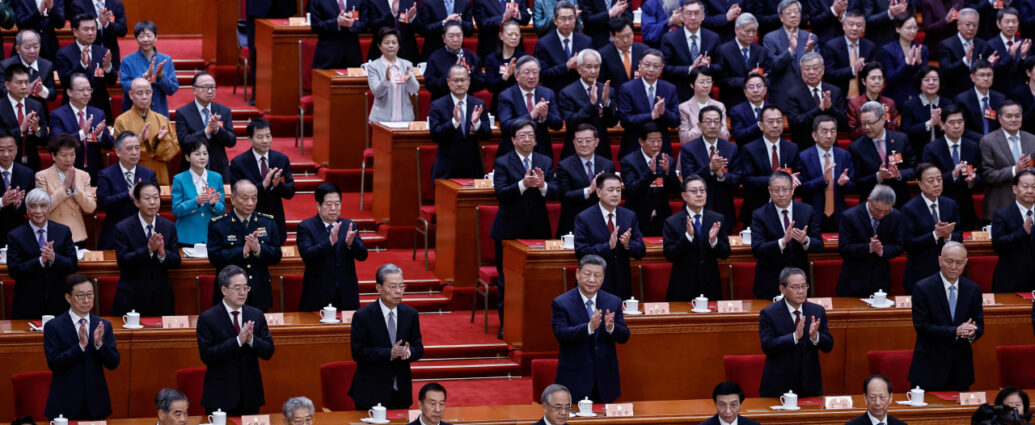
Opinion | China’s Non-Plan for the Economy

Microsoft’s 16% Surge Powers Wall Street Rebound as Nasdaq Snaps Six-Day Slide
NEW YORK — Stocks clawed back most of the previous session’s losses Thursday, with the Nasdaq Composite finishing 2.8% higher at 25,122.18 to end a six-day losing streak, the Dow Jones Industrial Average adding 613.92 points, or 1.2%, to close at 52,208.06, and the S&P 500 climbing 1.7% to settle at 7,437.63.
The rebound came one day after the Dow shed 1,153.18 points, or 2.19%, for its steepest single-day decline since April 2025, as the Federal Reserve left interest rates unchanged and the bond market responded with the 10-year Treasury yield climbing seven basis points above 4.67% and the 30-year rising 10 basis points past 5.2%.
Thursday’s move was driven almost entirely by a single earnings report. Microsoft shares jumped 16% after the company reported growth in its Azure cloud business — cloud revenue rose 43%, the fastest pace since 2022, while capital spending guidance came in below the levels investors had feared, easing concern that AI buildout costs were running out of control.
That combination mattered more than the headline number. The market has spent weeks punishing companies whose AI spending appears open-ended, and Microsoft delivered the rarer pairing of accelerating revenue and restrained capital expenditure. Semiconductor stocks rallied roughly 8% as a group, and the Nasdaq 100 added 3.2% a day after entering a technical correction. Investors largely set aside fresh U.S. strikes on Iran, the bond selloff, and lingering questions about AI capital spending.
Not everything participated. Meta Platforms fell after issuing a disappointing forecast, while Oracle advanced on an expanded artificial intelligence partnership with Google’s Gemini.
The economic data landed mixed. Second-quarter gross domestic product expanded just 1.5%, below the 1.8% economists had projected and down from 2.1% in the first quarter. The personal consumption expenditures price index fell 0.1% on the month, leaving annual inflation at 3.7%, while core PCE rose 0.1% monthly for an annual rate of 3.3%. Jobless claims for the week ended July 25 came in at 197,000, up 9,000 from the prior week’s revised figure.
Slower growth alongside a still-elevated core inflation rate is the uncomfortable arithmetic the Fed is now working with, and it explains why Wednesday’s hold unsettled the bond market rather than reassuring it.
Market Movers
- Microsoft — up roughly 16%, the day’s single largest contributor across all three major indexes
- Caterpillar — up 3.26%
- Amazon — up 2.85%
- Meta Platforms — down close to 8% on a soft forward outlook
- Nike — down 3.89%
- Johnson & Johnson — down 2.54%
- Walt Disney — down 2.53%
Apple reports quarterly results after the closing bell. The company briefly crossed a $5 trillion market capitalization on Tuesday for the first time, a day after overtaking Nvidia as the most valuable publicly traded company, with shares up 25% on the year.
Commodities
Crude eased after a volatile overnight session. Brent settled around $90.04 a barrel, off 0.78% on the day, though it remains up nearly 26% over the past month. Brent had reached $92.65 by 6:30 a.m. Eastern before giving back the advance. West Texas Intermediate traded near $84.03, down 0.51%.
The supply picture continues to tighten. U.S. Central Command reported a major wave of strikes on Islamic Revolutionary Guard Corps sites, Houthi forces continued to threaten Saudi Arabia, and the Caspian Pipeline Consortium suspended loadings at its Black Sea terminal after two associated tankers were attacked overnight. American Petroleum Institute data showed crude inventories fell by 3.3 million barrels last week.
Gold held its recent range. August futures opened at $4,060.70 per troy ounce, up 0.6% from Wednesday’s close, and traded near $4,130.90 by mid-morning. The metal had touched a nine-month low near $3,975 in mid-July before recovering past $4,100 following the Fed’s decision.
The volatility index fell more than 10% to the mid-18s, and the dollar index slipped 0.85% to 99.875.
The setup into Friday is straightforward: Apple’s numbers land tonight, oil remains hostage to the Gulf, and the bond market has yet to signal it accepts the Fed’s read on inflation.
JBizNews Desk | Wall Street
© JBizNews.com All Rights Reserved. Reproduction or distribution without written permission is prohibited.

The Iron Dome is partly made in Arkansas, this lawmaker went to see it work
Rep. Aaron Pilkington had an extra day in Israel, and he spent it in an industrial park north of Tel Aviv.
The Arkansas Republican came with a delegation of state legislators organized by the Combat Antisemitism Movement. The July itinerary ran through the Knesset, Yad Vashem, Kibbutz Nir Oz, the Nova festival site, and a meeting with US Ambassador Mike Huckabee. The stop Pilkington mentions first is the one that was not on the schedule.
“I went to go and tour a data center over there in Tel Aviv owned by Serverfarm, which is the same company that’s building one in my district in Clarksville,” he said. “I’ve been to other data centers, but to see one that’s owned by the same company was really great.”
Serverfarm operates ISR1, a 100,000-square-foot facility just north of Tel Aviv. It is also developing a multi-building campus in Clarksville, Arkansas, inside Pilkington’s District 45, which local reporting has described as a $6.6 billion project. The company says it plans to finish the first two buildings by January 2028.
Pilkington, a healthcare administrator now in his fifth term in the Arkansas House, was the lead House sponsor of HB1444, which became Act 548 in April 2025 and amended the state’s sales-and-use-tax exemption for data centers. He does not claim to have brought Serverfarm to Clarksville, and the public record does not show that he did.

Why he defends the aid
It was his first trip, and he says he had wanted to make it for years.
“As a Christian, it’s always fascinating to visit the Holy Land,” he said. “But then of course, in Arkansas we have a deep connection to Israel.”
That connection is concrete. In November 2025, a joint venture between Israel’s Rafael and the US defense firm Raytheon opened a manufacturing facility in East Camden, Arkansas, producing Tamir interceptors used by the Iron Dome and a related American variant. The Arkansas Economic Development Commission puts the investment at roughly $63 million and projects as many as 60 jobs. East Camden lies outside Pilkington’s district, but it sits at the center of his argument.
Asked what he tells younger Republicans who question US aid to Israel, a debate that has grown louder inside his own party, he answers with a payroll.
“A lot of that aid gets spent in American factories,” he said. “It comes back to us in a different way. For us, I say it’s helping the economy of Arkansas.”
The picture is more complicated than that. The current US-Israel security assistance memorandum covers fiscal years 2019 through 2028 and pledges $38 billion, subject to congressional appropriations. Most Foreign Military Financing is tied to US defense procurement, and Israel’s longstanding permission to spend a portion of the funds on Israeli-made goods is being phased out entirely by 2028. Pilkington’s underlying point, that a meaningful share of the money circulates through American factories, holds.

His second argument is the phrase he used in a statement released by the delegation organizers.
“Israel is the vanguard of Western civilization over there,” he said. “If Israel is gone, the next person on the list is the United States of America. When you see what they say, I believe them when they tell us ‘Death to Israel, death to America.'”
“I would much rather send aid money to Israel and fight these extremists over there than have Israel be wiped off the map and then now be fighting them on our shores,” he added.

What surprised him? Not the security situation, rather the construction.
“I was shocked at the amount of cranes,” he said. He asked whether Israel had the American problem of neighborhood opposition to development. “The people I talked to were like, ‘That’s not really a thing here. We’re constantly trying to grow.'”
Then the farmland. “The amount of irrigation you have going on and the amount of agriculture that you’ve got going on in Israel was fascinating,” he said. Agriculture is Arkansas’s largest industry, contributing more than $24.3 billion a year, and Huckabee, the former Arkansas governor now serving as ambassador, pressed the delegation on exactly that overlap.
“One thing Ambassador Huckabee talked to us about was just the technologies that are being made in Israel when it comes to farming could be useful back in the United States.”
He was also surprised by the size and visibility of Israel’s Muslim population, a reaction he traced to time spent in Jaffa.
Asked where else Arkansas and Israel might do business, he named technology transfer and, given his day job, medicine.
“Some of the breakthroughs that are happening in the research and development that’s happening in Israel can have massive effects and help us to address some of the health crises that are happening in Arkansas.”
Pilkington was the lead House sponsor of the Healthy Moms, Healthy Babies Act, which became law in February 2025 as a $45.3 million maternal and infant health package. Its provisions include presumptive Medicaid eligibility for pregnant women, remote ultrasounds, and remote blood-pressure and glucose monitoring for rural patients.
“If we’re going to be pro-life, then we should take care of these mothers and take care of these babies,” he said. “They’re the most vulnerable in society.”
Campuses and faith
In April 2024, Pilkington was the lead sponsor of HR1042, a resolution condemning displays of antisemitism on US university campuses, adopted by the Arkansas House that month. He is candid about its limits.
“Resolutions are not statute, so they’re not as strong as an actual piece of legislation,” he said. “But it sent a signal to all our universities that we were not going to tolerate those kinds of attitudes.”
He pointed to the later dismissal of a University of Arkansas professor over social media material that university attorneys characterized as violent and antisemitic. The University of Arkansas System Board of Trustees upheld the termination of Shirin Saeidi, former director of the King Fahd Center for Middle East Studies, in May 2026.
Saeidi and her attorney disputed the university’s interpretation, arguing that the action threatened academic freedom and that a faculty committee had unanimously recommended her reinstatement. There is no documented connection between the case and Pilkington’s resolution.
A convert to Catholicism and a father of four, Pilkington said the religious sites mattered to him personally. He attended Mass in Jerusalem and visited the Church of the Holy Sepulcher. “It was really an amazing, once-in-a-lifetime opportunity,” he said.

The delegation also visited Shiloh and the Psagot winery in Samaria. Pilkington does not hedge.
“To me this is Israel; they have every right to be here,” he said.
The Clarksville project, whose Israeli counterpart he toured, has drawn questions at home. A community forum in July drew more than 100 residents asking about transparency, electricity infrastructure, environmental impact, public financing, and how many permanent jobs the campus will produce. Pilkington was out of the country at the time, in Israel. He has since disputed the suggestion that residents were deliberately kept in the dark.








About 1.5M rechargeable hand warmers recalled after 1 death, hundreds of burn injuries reported
Ocoopa Direct is recalling about 1.5 million rechargeable hand warmers following hundreds of burn injuries and one reported death.
The lithium-ion batteries in the recalled products can overheat and catch fire, posing a risk of “serious injury or death from fire and burn hazards,” according to a notice Thursday from the U.S. Consumer Product Safety Commission (CPSC).
Ocoopa Direct has received 1,480 reports of the hand warmers overheating, including 15 fires and 350 burn injuries, the CPSC said.
POPULAR GROCERY CHAIN RECALLS COOKIES IN 9 STATES AND DC AFTER LABELING ERROR
An 83-year-old consumer in San Diego died in February after an incident involving one of the hand warmers, according to the agency.
The recall covers Ocoopa rechargeable hand warmers with model numbers UT3053, UT3056, ZLS-118, ZLS-118S, ZLS-118D, H01 and H01(PD).
The hand warmers were sold in various colors and designs, according to the CPSC.
BROOKLYN ROASTING COMPANY RECALLS COLD BREW SOLD IN NEW YORK AND NEW JERSEY OVER BOTULISM RISK
“The dual-sided, rechargeable hand warmers were sold in varying colors and designs, in packs of two warmers that can magnetically be joined and with a charging cable,” the announcement noted.
The products were sold online through Amazon, Ocoopa and Walmart between September 2018 and May 2026 for $15 to $60.
TARGET, KROGER, MEIJER FRUIT PURÉE POUCHES RECALLED OVER PLASTIC RISK: FDA
“Consumers should stop using the recalled hand warmers immediately and contact OCOOPA Direct for a full refund in the form of an Ocoopa gift card or the original form of payment,” the announcement said.
The CPSC also warned consumers not to throw the recalled products in the trash or place them in regular recycling or battery collection bins.
CLICK HERE TO GET FOX BUSINESS ON THE GO
For more information about the recalled products, visit the CPSC’s website.
FOX Business reached out to Ocoopa Direct for comment.

Robotic vacuums swept up in new US crackdown over national security risks
Certain robotic vacuum cleaners, including some Roomba-style devices, will be banned under the new U.S. policy restricting foreign-made advanced robotics, federal regulators told FOX Business on Thursday.
The Federal Communications Commission (FCC) said robotic vacuums fall under its updated “Covered List” rules, adopted Tuesday, making certain new foreign-produced models ineligible for FCC equipment authorization due to national security and cybersecurity risks to U.S. critical infrastructure.
While the agency did not identify specific brands, an FCC spokesperson confirmed to FOX Business that robotic vacuums are among the devices covered by the restrictions.
Major manufacturers including iRobot, SharkNinja, Dyson, Samsung and LG sell robotic vacuums in the U.S., with most production taking place in China, alongside manufacturing operations in Vietnam, Malaysia and Indonesia.
FCC BLOCKS NEW FOREIGN-MADE POWER INVERTERS AND ADVANCED ROBOTS OVER NATIONAL SECURITY RISKS
However, the restrictions apply only to newly authorized devices and will not affect the many robotic vacuums already in consumers’ homes.
“This action does not impact a consumer’s continued use of devices they previously acquired,” the FCC spokesperson said.
The agency added that previously authorized models may continue to be sold, imported and marketed in the U.S., and it does not “prevent retailers from continuing to sell, import, or market relevant models approved previously through the FCC’s equipment authorization process.”
FCC CHAIRMAN CLIMBS 2,000-FOOT CELL TOWER TO SPOTLIGHT ONE OF AMERICA’S TOUGHEST TRADES
iRobot told FOX Business that it is reviewing the FCC’s action and is working with the agency to better understand its significance.
“We are aware of the FCC’s recent action and are working with them to better understand its implementation and potential impact,” the company said. “We remain committed to serving our customers and will share updates as more information becomes available.”
Under the FCC’s new rules, many household robotic cleaners qualify as “advanced robotic devices” because they are mechanical mobile devices capable of locomotion, navigation and obstacle avoidance.
Covered devices generally weigh more than 4.4 pounds and operate near human operators. Their autonomous navigation is either powered by firmware, AI models, or sensors via Bluetooth, Wi-Fi or cellular technology.
That definition could encompass products such as iRobot‘s Roomba lineup, SharkNinja’s Shark robotic vacuums, Dyson’s 360 series, Samsung’s Jet Bot line and LG’s CordZero robotic cleaners.
US BANS NEW FOREIGN-MADE CONSUMER INTERNET ROUTERS OVER SECURITY CONCERNS
Roomba, one of the first robotic vacuum brands to gain widespread popularity in the U.S., was introduced by American company iRobot in 2002 but is now owned by Shenzhen Picea Robotics and Santrum Hong Kong.
Picea Robotics, which operates development and manufacturing facilities in China and Vietnam, currently sells Roomba models starting at $200.
CLICK HERE TO GET FOX BUSINESS ON THE GO
By comparison, American robotics startup Matic, one of the few U.S.-based competitors that designs and assembles its products domestically in California, sells its robotic vacuums for about $1,245.
FOX Business reached out to SharkNinja, Dyson, Samsung and LG for comment.

STAT+: FDA expert committee votes in favor of Replimune’s melanoma treatment
A group of outside experts convened by the Food and Drug Administration on Thursday voted in favor of Replimune’s experimental treatment for advanced melanoma.
In a 10-3 vote, the advisers determined that the biotech company has collected sufficient data to allow the FDA to review RP1, an engineered viral immunotherapy for melanoma. The agency tends to follow the recommendations of its expert panels but is not bound by them.
What comes next could be seen by some as a signal of how the FDA, under new leadership, weighs potential benefits and risks when it comes to investigational drugs. RP1 was rejected in April, under former FDA leaders Marty Makary and Vinay Prasad. Investors have interpreted the FDA’s decision to hold an advisory committee meeting about the drug as a sign of new lenience. But STAT has reported that earlier resistance to RP1 was based on the views of the FDA’s career staff, not leadership.
Israeli stabbed at Hungary’s Ozora music festival, two suspects arrested
A 30-year-old Israeli man was stabbed on the grounds of the OZORA music festival in Hungary, the Fejér County Police announced in a Thursday Facebook post.
“This morning, an employee of the OZORA Festival security service alerted police that an Israeli man in his 30s was stabbed at the event site,” police said in its statement, adding that the Israeli had been evacuated to the hospital by ambulance to receive medical treatment.
Police said that it had arrested two men suspected of “assault causing life-threatening bodily harm.”
“Their charges are currently pending,” police noted, and the investigation is ongoing.
Further, police announced that it has increased checks and is “continuously cooperating with the organizers to take the necessary security measures” to ensure the safety of festival-goers.

The Ozora Festival, one of the largest trance and art festivals in Europe, takes place annually in Hungary and attracts thousands of participants from all over the world.
Four arrested in Hungary for drug trafficking
In a separate incident, Hungarian authorities reported several drug-related arrests on the festival grounds.
Three men, a Belgian, an Israeli, and a Portuguese citizen, were arrested on Monday at the festival grounds after being caught selling drugs. Proceedings have been opened against the three for drug trafficking.
On Sunday evening, police in Hungary’s Tolna district arrested a 27-year-old Israeli on the way to the festival in a rented car with German license plates. A search of the vehicle found a significant amount of party drugs, which were suspected to be intended for sale at the event.
Today, the Szekszárd District Court extended the Israeli’s detention by a month, citing fears of him being a flight risk due to the lack of ties to Hungary and concerns about obstructing the investigation.

UPS Says Amazon Pullback Is Boosting Margins and Cost Savings
By Julia Parker – JBizNews Desk
United Parcel Service Inc. is seeing margin gains and cost savings from its decision to reduce lower-yielding business with Amazon.com Inc., Chief Financial Officer Brian Dykes said, reinforcing the carrier’s push to prioritize more profitable shipments over raw package volume. The shift affects large shippers, employees and investors as UPS retools its network for higher-return growth.
UPS has been scaling back Amazon-related volume as part of a broader plan to improve profitability in its U.S. package business. The company previously said it reached an agreement to reduce Amazon volume by more than 50% by the second half of 2026, a move that signaled a sharper focus on revenue quality, automation and network efficiency rather than simply filling delivery capacity.
The strategy matters because Amazon has long been UPS’s largest customer, but not its most lucrative. Chief Executive Carol Tomé told analysts earlier this year, “Amazon is our largest customer, but it’s not our most profitable customer.” That view has framed UPS’s recent operating decisions as the company tries to lift margins after several years of pressure from wage increases, softer parcel demand and excess industry capacity.
For investors, the Amazon pullback is a test of whether UPS can trade volume for profit without losing operating leverage. Fewer low-margin packages can reduce revenue in the near term, but management is betting that a leaner network, lower handling costs and more premium small-package business will improve earnings quality. The company has also been working to capture higher-value healthcare, small-business and international shipments, categories that can carry better pricing and service margins.
The decision comes after a period of uneven demand across the parcel sector. E-commerce growth has moderated from pandemic-era highs, while retailers and manufacturers have pushed carriers for lower rates. UPS has also faced higher labor costs following its Teamsters contract, making productivity gains and customer mix more important to profit targets.
The approach carries execution risk. Cutting back a major customer can leave gaps in package density, particularly in routes and facilities built around high volumes. Competitors could also use the transition to pursue Amazon-related business or pressure UPS on pricing with other large accounts. Management’s case depends on replacing less profitable work with shipments that generate stronger returns, not merely shrinking the network.
Business owners and logistics buyers should watch whether UPS’s focus on higher-value freight leads to firmer pricing, changes in service commitments or tighter capacity in key lanes. Investors will be looking for evidence in upcoming results that cost savings are flowing through to operating margin and that revenue declines tied to Amazon are being offset by more profitable customer growth.
JBizNews Desk | Demographic: business owners, executives, investors and financial professionals
© JBizNews.com All Rights Reserved. Reproduction or distribution without written permission is prohibited.

Live in a fashion designer’s historic atelier and studio in the Catskills for $645K

Surrounded by the wilderness of the western Catskills in Franklin Village, New York, this unique mixed-use property at 422 Main Street has both history and charm. Built in 1878 as the town bank and post office, it was the creative workplace and showroom of noted apparel designers Sean Scherer of Kabinett & Kammer and Gary Graham. The creative duo created a live/work opportunity that is as flexible as it is livable.


Every corner of the space is filled with light, making it even more inspirational for artists, designers, and creators. On the ground floor, a new front porch inspired by the original structure leads to two classic village storefronts with original display windows.


Inside, 12-foot ceilings and poured concrete floors provide a clean frame for historic details like partial wainscoting and custom partitions made from salvaged antique windows. There are two half-baths that serve the retail space. At the back, a one-bedroom apartment offers rental income or expands the building’s commercial potential.



On one side of the second floor is more creative inspiration in the form of a dreamy, light-filled loft-style studio with 10-foot ceilings. Currently used as a fashion design atelier, the open space has as many potential uses as your imagination will allow.


On the opposite side is a two-bedroom residence that has been painstakingly designed with the comforts of home. Throughout, timeless finishes like brass switch plates, new Andersen windows, and period-inspired details have been chosen to reflect the former residents’ creative eye.



A custom English-style kitchen has beadboard-clad walls and ceilings, antique built-ins, a wavy-glass display cabinet, and an Italian ceramic farmhouse sink with Kallista brass fixtures. Through the room’s many windows are views of the rolling hills beyond.



The adjacent living space is equally welcoming. A quiet bedroom wing offers a primary bedroom with a classic marble-enhanced bath. A second bedroom feels like an enchanted country attic.

At the back is a private yard, ready for landscaping or gardening. The building offers a separate owner’s entrance, four off-street parking spaces, and plenty of storage.
This restored Catskills landmark is an unusually flexible find, with opportunities for living, creating, and working without leaving home, less than three hours from the George Washington Bridge.
[Listing details: 422 Main Street by Sarah Broach of Compass and Deb Dolan of Keller Williams Upstate New York]
RELATED:
- Asking $1.3M, this historic Newburgh home has designer interiors and dramatic Hudson River views
- For $549K, get cozy in an 1860s Catskills farmhouse with barns, sun porches, and a dreamy country kitchen
- A fashion designer’s cozy converted 1920s barn in upstate NY asks $2.9M
- For $995K, this dreamy upstate farmhouse gets every detail just right
The post Live in a fashion designer’s historic atelier and studio in the Catskills for $645K first appeared on 6sqft.



Chipotle CEO says chain is making ‘meaningful progress’ on a major customer concern
Chipotle CEO Scott Boatwright said Wednesday the fast-casual chain is seeing improvement in customers’ perceptions of affordability.
Speaking on Chipotle’s second-quarter earnings call, Boatwright said the company’s brand tracking showed improved perceptions of value across “all income groups and age cohorts.”
“As it relates to value, I’m happy to report our brand tracker showed really solid progress across all income groups and age cohorts on value perception,” Boatwright said. “Our affordability scores were better in Q2 than they’ve been in probably the past couple of years.”
He noted that customers do not judge value solely by prices or discounts.
CHIPOTLE OPENS FIRST RESTAURANT IN MEXICO AS GLOBAL EXPANSION ACCELERATES
“And so I think we’re making meaningful progress as it relates to value at Chipotle. What we also learned, I think, as an important note, is [that] value isn’t just about discounting and price point. It’s about convenience. It’s about execution,” Boatwright added.
“It’s about menu innovation. There’s a host of things that the consumer is looking at to determine value.”
Chipotle has recently introduced lower-priced menu options.
In December, the company launched a high-protein menu featuring a Single Chicken Taco, starting at $3.50 at select U.S. restaurants, and a High Protein Cup of Adobo Chicken, with a national weighted average price of $3.82, the company said at the time.
Chipotle on Wednesday also reported second-quarter revenue of $3.3 billion, up 9.3% from the same period in 2025.
Boatwright has previously pushed back against perceptions that Chipotle has become too expensive or reduced its portions to boost profits.
CHIPOTLE RIVAL GUZMAN Y GOMEZ MEXICAN KITCHEN CLOSES ALL US RESTAURANTS
“We have an affordable price point for all walks of life, and we’re for everyone. We want everyone to have access to wholesome, nutritious food,” Boatwright said during a May appearance on Yahoo Finance’s “Power Players” podcast.

Amazon Tops Fortune Global 500 as AI Spending Accelerates
By Julia Parker – JBizNews Desk
Amazon has been ranked No. 1 on the Fortune Global 500 by revenue, underscoring the scale of a company now committing heavily to artificial intelligence as it seeks to defend its lead in cloud computing, retail and logistics. The ranking matters for investors and businesses because Amazon’s next phase will be shaped by how effectively it turns massive AI spending into higher margins and durable growth.
The company, founded by Jeff Bezos and now led by Chief Executive Andy Jassy, has become the world’s largest company by revenue after expanding from online retail into cloud infrastructure, advertising, streaming, devices and fulfillment services. Its revenue base gives Amazon unusual financial capacity to fund data centers, chips, robotics and AI products while absorbing pressure from labor costs, delivery investments and competition.
Amazon’s AI push is becoming a defining capital-allocation issue for shareholders. The company is expected to pour about $200 billion into AI-related investment this year, a scale that places it among the biggest corporate spenders in the technology sector. Much of that spending is tied to Amazon Web Services, where demand for AI computing capacity has intensified competition with Microsoft, Alphabet and other cloud providers.
Jassy has framed AI as central to Amazon’s long-term expansion. “We have strong conviction that AI is a once-in-a-lifetime type of business opportunity,” Andy Jassy told analysts on an earnings call, pointing to demand from companies building generative AI applications and the need for expanded infrastructure.
For business customers, Amazon’s spending could mean broader access to AI tools, faster cloud capacity and deeper automation across retail and logistics. For investors, the question is whether the company can translate that spending into operating leverage rather than a prolonged investment cycle that weighs on free cash flow. Amazon’s shares, listed on the Nasdaq, remain closely tied to AWS growth, advertising momentum and the company’s ability to control retail fulfillment costs.
The Global 500 ranking also highlights Amazon’s influence across suppliers, merchants and enterprise technology buyers. Millions of third-party sellers rely on its marketplace, while corporations use AWS for computing, storage and AI services. That reach gives Amazon pricing power and scale advantages, but it also leaves the company exposed to regulatory scrutiny, antitrust claims and customer pushback over fees.
Competition is intensifying as rivals race to secure chips, power, data-center space and AI talent. Higher capital spending across the sector has raised concerns among analysts that returns may take longer to appear than markets expect. Amazon also faces execution risk if AI demand fails to keep pace with infrastructure buildout or if enterprise customers slow technology budgets in a weaker economy.
The next test will come in Amazon’s upcoming earnings reports, where investors will look for evidence that AI demand is accelerating AWS revenue growth and improving margins. Watch capital expenditure guidance, cloud backlog, retail operating income and management commentary on data-center capacity to gauge whether Amazon’s AI investment is strengthening its lead or pressuring returns.
© JBizNews.com All Rights Reserved. Reproduction or distribution without written permission is prohibited.

CEO of steel company dies suddenly, just weeks after taking helm
Carpenter Technology CEO Brian Malloy died suddenly just weeks after taking the helm of the specialty materials manufacturer, the company announced Monday.
Malloy, who became president and CEO July 1, died “suddenly and unexpectedly” Friday, July 24, according to a news release from the Philadelphia-based company.
A cause of death was not disclosed.
“We are deeply saddened by Brian’s passing,” Carpenter Technology’s board of directors said in a statement.
“Over the past decade, Brian made significant contributions to Carpenter Technology and was a respected leader with a strong commitment to performance, operational excellence, and the Company’s long-term success,” the board added. “We extend our deepest sympathies to Brian’s family and loved ones during this difficult time.”
The board appointed Executive Chairman Tony Thene to return as CEO, effective immediately. Thene, who led Carpenter Technology from 2015 through June 2026, will also remain chairman.
Malloy spent a decade at Carpenter Technology and had served as chief operating officer since 2023.
COMPANY BETS $200K ON AI TO MAKE TRADES WORKERS ‘BETTER, STRONGER, FASTER’
When the company announced Malloy’s appointment in February, Thene called him a “proven leader” with “deep operational experience” and a track record of delivering results across the company’s businesses.
Malloy said at the time that he was “honored” to be selected as the company’s next chief executive.
“I am honored to be named the next CEO of Carpenter Technology,” Malloy said in February. “Tony’s strategic vision has reshaped Carpenter Technology by building a culture of performance, strengthening our market position, and delivering meaningful value for all stakeholders.”
CRACKER BARREL CEO JULIE MASINO TO STEP DOWN
Before joining Carpenter Technology, Malloy held senior leadership roles at Ametek and Alcoa.
GET FOX BUSINESS ON THE GO BY CLICKING HERE
A Carpenter Technology spokesperson told FOX Business the company would not comment further “out of respect for the privacy of the family.”

Cyclospora outbreak dents Taco Bell sales but recovery underway, exec says
The parent company of Taco Bell released its quarterly earnings report on Thursday and said that Taco Bell sales fell amid the cyclospora outbreak, though there were early signs of recovery in the last week.
Yum Brands – which operates fast-food chains like KFC and Pizza Hut as well as Taco Bell – said that the Mexican-style chain’s sales were down 2% quarter to date through July 27.
“Since the U.S. food safety industry issue became front and center only two weeks ago, we saw maximum impact to sales over the weekend of July 18,” Yum Brands CFO Ranjith Roy said on the company’s quarterly earnings call.
“It is early days, but in the subsequent week, sales declines have moderated materially, and we are seeing steady improvement in day-over-day sales trends,” Roy added.
RFK JR SAYS SOURCE OF CYCLOSPORA OUTBREAK IDENTIFIED, DECLARES PARASITE OUTBREAK ‘UNDER CONTROL’
Roy went on to say in response to an analyst’s question that “if you take the average sales for the last four days, which includes the weekend and the first two days of this week, we are halfway back to sales levels of the prior year.”
The cyclospora outbreak is under investigation by the Food and Drug Administration (FDA) and the Centers for Disease Control and Prevention (CDC), along with state and local partners. It has been linked to iceberg lettuce that was sourced from central Mexico through Taylor Farms de Mexico.
Taylor Farms’ U.S. business initiated a voluntary recall that also included iceberg lettuce sold under the Taylor Fresh Foods and Marketside brands. The company has noted that the FDA hasn’t identified a single positive product test result for cyclospora after a false positive was reported by the agency.
FDA SAYS TAYLOR FARMS CYCLOSPORA LETTUCE TEST WAS A FALSE POSITIVE
Cyclospora cases with exposure to Taco Bell have been reported in nine states, including Illinois, Indiana, Kansas, Kentucky, Michigan, Ohio, Oklahoma, Pennsylvania and West Virginia.
Yum Brands CEO Christopher Turner said that “our top priority is, and always will be, the safety and well-being of our consumers. With respect to the consumer sentiment, though, we’ve seen real improvement as consumers have understood better the nature of the issue and they understand that it is not a Taco Bell-specific issue.”
WEIGHT-LOSS JOKE TURNS SERIOUS AS ‘CYCLOSPORA SKINNY’ TREND FUELS HEALTH WARNINGS
Turner added that there’s “been no change in our measures of brand love” and that some of those metrics have seen growth in positivity, while Taco Bell’s share of the conversation around food safety has declined.
“The best proof point is that consumers are coming back to the restaurants on a steady basis. We’ve seen steady improvement in those sales trends,” he said, noting that the chain’s Tuesday release of a Mexican pizza special drove the most transactions and loyalty acquisitions of any Taco Bell Tuesday drop.
GET FOX BUSINESS ON THE GO BY CLICKING HERE
“There is no brand and no team better equipped to drive a recovery in this temporary sales impact than Taco Bell,” he added.
Iranian Christian dissident denied right to stay in Israel with his wife, child – interview
Ramin Parsa has lived in Israel since early 2023, where he built a life with his wife and year-old baby and created a vibrant community through volunteer work advocating for Israel and supporting those displaced by October 7 and the wars that followed. However, he has now been told by the Interior Ministry that he must leave the country because he was born in Iran, he told The Jerusalem Post on Thursday.
Parsa has faced years of uncertainty since moving to the Jewish state with his wife, a Messianic Israeli of Jewish heritage, but that has done little to temper his love for Israel.
Far different from what he was brought up to consider normal, Parsa explained that much of his love for the Jewish state stemmed from the stark contrast between Israel and Iran.
In Israel, cranes represent construction, building new homes and businesses, while in his country of birth, they are used to intimidate the population into silence [as they are used for public executions].
From childhood, he told the Post, he remembered seeing the bodies of men, some still kicking as they struggled, hanging from those cranes after being accused of working with Mossad, the United States, or other demonized foreign powers.

“The first time I saw an execution, I was eight or nine years old. I was walking to school when I saw a large crane and a crowd gathering around it. There was a noose hanging from the crane. Then they brought out a man. His eyes were covered with a blindfold; he was dressed in black, and they hanged him,” Parsa recalled.
“I remember watching his legs kick as he died. I was completely traumatized seeing someone killed in front of me. They completely normalized it. They devalued human life.”

Denied Israeli citizenship and facing deportation
Parsa first applied for citizenship in 2024 but was denied a year and a half after submitting his application. The official reason given was that he was born in an enemy state. A court later ruled that the Interior Ministry reconsider the case, but on July 13 he received the outcome of that reassessment: that he must either leave his wife and child behind or uproot them from their family. The family has one final opportunity to appeal on August 27, and if unsuccessful, Parsa will be deported.
The decision, in Parsa’s view, has little to do with his being considered a national security threat, especially given his long history of advocating for Israel and his volunteer efforts following October 7. Rather, he believes it is connected to his faith and reflects a government that is increasingly prioritizing religious considerations over the rights and security of the Israeli people.
Israel’s relationship with Evangelical Christians
The decision is “because we’re Christians, and they’re afraid, and the Ministry of Interior is run by the Shas party, they’re religious, and they’re very anti-Messianic, anti-Christian,” he said. “They’re afraid of Christians; they’re afraid of the messianics, afraid they may want to convert them.”
Parsa argued that if his goal had been to convert people, there were far more potential converts in the United States than in Israel, and he has American citizenship, so it would be far easier.

He also recalled that many evangelical volunteers faced significant obstacles from the Interior Ministry when they attempted to enter Israel to assist in the aftermath of the October 7, 2023, massacre.
With Palestinians barred from working in Israel, foreign workers leaving because of the war, and communities along the borders devastated by the Hamas invasion and Hezbollah attacks, many farmers came to rely on foreign volunteers to harvest crops and help sustain Israel’s agricultural sector. Parsa took on the role of cooking thousands of meals for the displaced, and he used his platform to advocate for Israel at a time when many were outraged by the war in Gaza.
“Right now, Israel’s strongest supporters are evangelical Christians. By doing this, they’re damaging Israel’s reputation and giving more ammunition to anti-Israel activists and antisemites, who will say, ‘See? We told you. Look at what they’re doing to Christians.’ We don’t want that,” he said.
“We don’t want Israel to be attacked or demonized. We know this doesn’t represent all of Israel. It’s a very small group, whether it’s certain religious figures or people within the Interior Ministry making these kinds of decisions.”
Since moving to Israel, Parsa has been unable to work or travel, including to events where he was invited to advocate for Israel, and has had to live under the constant weight of uncertainty.
When approached, a spokesperson for the Interior Ministry only told the Post that the ministry doesn’t comment on individual cases.
Moving to Israel after fleeing Iran
Explaining how he came to live in a country he had been taught to view as the “Little Satan,” Parsa described the violence and near-constant antisemitic and anti-Israel indoctrination that shaped his upbringing. He said he was taught that Jews hunted Muslim children for their blood to make matza, shown staged images of Israeli soldiers aiming their weapons at Muslim children, and required to attend rallies where chants of “Death to America, death to Israel” were a condition for passing his classes.
The same brutality that the Islamic Republic accused Israel of committing was what Parsa witnessed in the streets of Iran. Public hangings, floggings, and mutilations for the crime of stealing food were commonplace and widely accepted as normal. Even so, he said the regime’s tight control over information left many believing they were fortunate, while the rest of the world was living in hellish conditions.
Parsa was one of those, until he was arrested at age 16 for simply being in a car where another person was in possession of a small amount of alcohol.
Being arrested at 16 changed Parsa’s view of the Iranian regime
On his way to a family wedding, Parsa was being driven by relatives when forces of the IRGC paramilitary volunteer militia, Basij, randomly closed the street and began inspecting every vehicle. A coachload of people were detained, including Parsa, for “crimes” such as being in a car with a member of the opposite sex who was not a family member, allowing some hair to slip out from under a hijab, and engaging in any behavior deemed to violate Sharia law.
Despite being only 16 years old and an observant Shi’ite Muslim who had never touched alcohol, Parsa was driven to a holding cell where he said he was stripped naked, beaten, and hosed down with cold water. He said he never appeared before a judge nor was he allowed to defend himself before being locked in a tiny room with other young men. They were given only two eggs a day to eat, very little water, and two short bathroom breaks. He was only released after his family bribed the guards, he said.
“They were mocking and laughing at us. They made us face the wall naked and do sit-ups: up and down, up and down. After 60 or 70 repetitions, you can’t do it anymore. You get muscle cramps, and if you couldn’t continue, they would beat you even more. I was beaten badly, along with my friends and other people there, while they laughed at us and did it with a sense of joy,” he said.
“If someone does something wrong and you punish them, you might do so because you believe they deserve it, but you don’t laugh. You don’t enjoy it. They were gleeful. That was when I saw the cruelty of this regime and realized how truly evil and brutal it was. Everything inside me began to change. I started thinking: Maybe the people they hung from cranes were innocent too, like us. Maybe the people whose hands they cut off or whose eyes they removed were also innocent.”
Converting to Christianity and moving to Israel
The experience left Parsa rejecting all religion, though he would later become a Christian after hearing satellite radio broadcasts about Jesus Christ. His conversion led to threats against his life, including a stabbing, and two years of living as a refugee after he was smuggled out of Iran and into Turkey.
After becoming an American citizen in 2015, Parsa was finally able to visit Israel. He immediately began advocating for the country online, which was how he met his wife in 2020. She sent him a drawing of two hands decorated with Iranian and Israeli flags, symbolizing the love between the Iranian and Jewish peoples, and the rest was history. They met in person five months after he first messaged her online and married eight months later. After spending their first two-and-a-half years as newlyweds in the United States, they returned home to Israel, where her parents have been helping them raise their children.
Turkey’s rise is creating a rare point of agreement for Israel, China – opinion
Israel and China rarely view Middle East security through the same strategic lens. Their approaches to Iran, the United States, regional alliances and the international order often point in different directions.
Yet there is one regional actor that increasingly concerns both Jerusalem and Beijing.
Turkey.
The reasons are different. Israel is concerned about Turkey’s expanding regional influence, from its growing military and political role in Syria to its efforts to inject itself into the future of Gaza. Ankara increasingly appears determined to shape the regional order.
China is concerned about Turkey for a different reason: Ankara’s ability to shape the identity of a Uyghur and Turkistani community in northern Syria that remains ethnically connected to the population of western China.

Syria is where these concerns regarding Turkey’s influence unexpectedly intersect.
For years, Beijing’s Syria problem centered on Uyghur militants who left China, joined the Turkistan Islamic Party and entered the Syrian war. The principal fear was that battle-hardened fighters would eventually return to Xinjiang with military experience and organization.
More than a decade later, the challenge has expanded.
Many Uyghurs arrived in Syria with their families beginning around 2012. Children who arrived as toddlers are now teenagers or young adults. Others were born in Syria and have never seen China. Around Idlib and Jisr al-Shughur, Uyghur and Turkistani communities established schools, businesses and other community structures.
The population is therefore no longer simply a collection of foreign fighters. It includes families and a rising second generation whose identity has developed almost entirely outside Chinese state institutions.
Beijing’s question has expanded accordingly. It is no longer only whether veteran fighters will return to China. It is also who will shape the generation coming after them.
Chinese counterterrorism scholars are concerned about the transmission or reproduction of battle-hardened Uyghur force across generations. Researchers have examined how extremist organizations can absorb the children of militants and cultivate a new generation from childhood.
Fighters can theoretically be detained, disarmed, deported, integrated or managed through security arrangements. Children and young adults present a different problem. Some were born in Syria.
Others left China too young to retain a meaningful personal connection to it. Some may lack recognized nationality or formal identity documents. They may consider themselves Uyghur, Turkistani or Syrian without considering themselves Chinese.
From Beijing’s perspective, the more important question is the environment in which the second generation’s identity is being formed. That is where Turkey becomes central.
Northern Syria lies within an area of substantial Turkish military, political, economic, educational and cultural influence.
Turkey has deployed forces, supported armed groups and played a major role in shaping the political and security order that emerged in opposition-held territory. Importantly, Turkey’s connection to the Uyghurs reaches much deeper than its current Syria policy.
Turkish historical education traces the origins of the Turkish nation to Central Asia and includes Turkic populations living inside China within a wider Turkic historical geography. Earlier official educational materials described periods of “Chinese captivity,” celebrated Turkic resistance to Chinese rule and even presented the Great Wall as evidence that China feared the military power of the Turks.
Whether or not such historical interpretations are accepted outside Turkey, their significance lies in the worldview they create. Generations of Turkish students have encountered the Uyghurs not simply as a minority population inside China, but as part of a larger Turkic story extending from Anatolia through Central Asia and into territory governed today by Beijing.
That helps explain why China regards Turkey’s influence over Turkic populations differently from that of other countries.
Turkey is not merely a government that has criticized China’s policies in Xinjiang. It possesses a historical narrative, cultural vocabulary, educational system and network of political movements capable of placing the Uyghur question within a broader concept of Turkic identity.
That narrative has periodically surfaced in Turkish foreign policy. Following the 2009 Urumqi unrest, Recep Tayyip Erdogan accused China of committing a form of “genocide.” In 2019, Turkey’s Foreign Ministry described China’s treatment of the Uyghurs as “a great shame for humanity.”
As Ankara sought stronger economic and political relations with Beijing, its public language became more restrained. But softer rhetoric does not eliminate China’s deeper concern. Syria is where Turkey’s influence over the next generation becomes a Chinese security issue.
The children and young adults of Syria’s Uyghur community are growing up outside China’s schools, political institutions and national narrative of a unified Chinese Nation.
China’s concern is therefore not simply that this generation lives abroad. It is that its members remain ethnically, linguistically and historically connected to Uyghur communities inside China while their identities are being shaped beyond Beijing’s control – and potentially within a Turkish-centered understanding of the Turkic world.
Future security threats a concern
The concern is not merely the movement of people. It is the movement of identity and influence and the possibility that both could reinforce separatist sentiment and generate future security threats. Turkey’s influence can work gradually, by strengthening the idea that Syrian Uyghurs belong to a Turkic world extending beyond China’s borders.
China can pressure Damascus to act against armed organizations. It can demand assurances that Syrian territory will not be used to threaten Chinese interests. But Beijing has no recourse to address cultural and educational factors influencing veteran fighters’ wives and children.
Israel approaches Turkey from a different direction. It is concerned about Turkey’s expanding strategic position in Syria and the possibility that Ankara’s military and political influence will become entrenched close to Israel’s northern frontier.
A Turkish-backed security and political order could give Ankara greater influence over the military balance, infrastructure, armed organizations and external relationships of a neighboring state. Turkey could become a powerful and potentially hostile actor embedded in Israel’s immediate security environment.
But Israel’s concern is not limited to the northern arena.
Turkey has also sought a larger role in Gaza, positioning itself as a political actor in debates over ceasefires, reconstruction and the territory’s future governance.
Ankara’s close relationship with Hamas and its increasingly assertive regional posture have reinforced the Israeli perception that Erdogan is seeking to restore Turkey to a position of political leadership across the Middle East, seeking influence across multiple arenas central to Israel’s security. Syria is therefore part of a larger Israeli concern about Ankara’s regional trajectory.
This does not mean that China and Israel share a Syria strategy. They do not. Their broader approaches to the Middle East remain fundamentally different. But they are increasingly watching the same regional actor.
For Israel, Turkey’s expanding military and political influence in Syria could alter the strategic balance along its northern frontier. More broadly, Ankara’s ambitions from Syria to Gaza suggest that Turkey seeks to shape the future political order of the Middle East.
For China, Turkey’s influence presents a different challenge. It is focused on Ankara’s ability to shape the identity of a Syrian Uyghur generation that remains connected by ethnicity, language and history to western China. The concern is that identity formation, transnational connections and political networks could eventually reinforce separatist movements and produce new security threats.
For Israel, the issue is regional military balance. For China it’s about the long-term security implications of identity formation, transnational connections and the potential reinforcement of separatist movements.
Both stem from the same underlying development: Turkey’s expanding ability to project power and influence beyond its borders.
China is looking west from Xinjiang. Israel is looking north from the Golan. Increasingly, both lines of sight pass through Turkey.
The writer is the executive director of the SIGNAL Group.
US Treasury sanctions networks supporting Iran’s Mahan Air, IRGC from India, China, Russia
The US Treasury Department on Thursday imposed sanctions on six entities and individuals in China, India, Russia and Iran accused of supporting Iran’s Mahan Air, which Washington says has long facilitated the movement of IRGC-Quds Force personnel, weapons and military equipment.
The sanctions also target an IRGC-affiliated front company that, according to the Treasury, collected information on the locations of US and Israeli equipment and supported Iranian military targeting during the ongoing conflict.
Treasury Secretary Scott Bessent said those providing financial, logistical, or commercial support to the IRGC or Mahan Air are “helping sustain a terrorist enterprise,” pledging to continue increasing economic pressure on Tehran.
A similar set of sanctions was imposed on Wednesday against the Iranian regime, with the US Treasury targeting eight tankers and 10 entities, according to a notice posted on its website.
Six of the entities targeted on Wednesday were based in China, according to the Office of Foreign Assets Control (OFAC)’s notice.

Over 100 vessels sanctioned since January
Over 100 ships have been sanctioned by OFAC since January, the Treasury added.
According to the Treasury, several of the entities are involved in an Islamic Revolutionary Guard Corps (IRGC)-backed extortion scheme forcing ships to purchase mandatory maritime “insurance” to transit the Strait of Hormuz.
The scheme, identified by the Treasury as the “Hormuz Safe” program, was established by Iran’s primary insurance regulator, covering risks largely imposed by the Islamic Republic itself, including attacks on ships, with the funds intended to finance the regime’s activities.
Reuters and The Jerusalem Post Staff contributed to this report.
Britain’s by-election circus shows politics has become a clown show – opinion
UK by-elections have become like British buses – you know those quaint Double Deckers painted brilliant red?
You wait forever for one, and then two come along in quick succession.
A reminder: the two forms of election to the UK Parliament are first via a General Election involving the whole country voting, or second a by-election where a seat has become vacant and is a very much more local affair.
As you would guess, the most common occasions for such by-elections are where the member of parliament dies, and there becomes a vacancy in his or her constituency. But the two by- elections of which we speak are thoroughly bizarre and to twist Oscar Wilde’s quote:
One by-election in bizarre circumstances might be regarded as chance; two begins to smack of conspiracy. But then UK politics and elections have become totally bizarre.

First, you recall that the by-election that propelled Andy Burnham to Parliament was a device occasioned to allow him to stand for a seat which had been vacated by a person who was not only not dead, but not even unwell.
Yet that person was prepared to make the ultimate sacrifice of giving up his seat to Andy Burnham to send him into Parliament, where he would replace the unpopular prime minister Keir Starmer. This happened, and Burnham is now prime minister based upon the wishes of a 7,000 majority in that by-election. The remaining 66.5 million of the population have not been consulted.
Meanwhile, the by-election circus has packed up its big tent and is preparing to roll into a different town, the seaside town of Clacton, Essex. Now for those Israelis unfamiliar with Clacton, or indeed every other UK seaside town, Clacton is famous for the pier that stands out in the sea with amusement arcades on it, plus the thing that all such towns must offer: Sticks of rock (with the name Clacton printed through teeth-breaking candy), ice cream and the UK’S gourmet dish, which has three component parts. Fish ‘n chips, slice of bread and butter and a cuppa tea – all spelt like that.
But just as the Burnham by-election was an unnecessary device, the Clacton one is worse. The resident MP, Nigel Farage, the leader of the Reform Party and, looking like the favorite to win the next General Election, is currently being investigated for the circumstances in which he came into possession of £5 million.
Farage stands in by-election
Farage has stood down as MP, but having done so has said he will stand again in the next by- Election. So what is the point?
In logic, there cannot be one. He is asking the people of Clacton who previously voted him in as the MP to, well, vote for him again. The legitimate alternative parties such as Labour and Conservative say they will not participate in this farce.
Amongst the only people to stand against him are spoof candidates whom I made reference to in a previous article – Count Binface – the person whose electioneering consists of standing around with a dustbin over his head.
He is not to be confused with Lord Bucket Head, whom, by contrast to Binface, is a person who stands around with a Bucket over his head. These are not serious candidates but figures of mirth.
They are Clowns and represent a British love for caricatures that has been around since the 1700’s.
A little later, when I was growing up in the 1960s, our notion of the classic clown was the figure of “Coco,” with shoes 10 sizes too big, a red round plastic nose and a bald wig with two shocks of ginger hair hanging down his face.
His props were a car that fell to pieces and a horn that only sounded at inappropriate moments. Children, me included, loved him and we fell to pieces at the same time as the car.
To accompany the genre of the circus clown was the pop song made famous by the pop group Manfred Mann in the 1960’s entitled: “Ha-Ha Said the Clown,” the idea from the lyrics being that the clown deflects attention away from himself by laughing at another.
Recently, the term clown has been hijacked and used as an adjective for someone better described as an idiot and not doing the actual job he was assigned to fulfil.
Since October 2023, many a European leader or UN petty bureaucrat is better described as a clown.
And how else can you describe the promoters of two totally unnecessary, expensive by-elections – in Britain?
Meanwhile, Burnham made an inaugural speech. It was, of course, about Israel. He apologized to the UK for the delay in calling for a ceasefire after October 7. Not a word of the rights of Israel’s self-defense, nor for the wicked folly of recognizing Palestine whilst Hamas still had hostages.
Having started his reign with an apology to Hamas, others have joined Burnham. People like Wes Streeting, former Health Minister, have rushed to associate themselves with the hostility to Israel, hoping that “sucking up” to Burnham will be rewarded with a government position.
But the biggest danger of all comes from the new foreign secretary, Ed Miliband. All very well to reference his Jewish lineage, but there are far stronger indications to see what lies beneath:
Firstly, when nobody could have anticipated it, Miliband stood in the election for leader of the Labour Party against his brother, David Miliband.
Secondly, his every utterance on Middle East policy is to run down Israel and its government.
Thirdly, whilst leader of the Labour Party in 2014, he was pictured in a cafe eating a greasy bacon sandwich, in which his shirt was in strong competition with his mouth. Any obviously Jewish leader in the UK salivating over bacon in this way is making a statement.
Miliband and the Labour government are still revealing that their only topic of unity is not domestic policy but hatred of Israel. They far more richly deserve the title of clowns than the election candidates Count Binface and Lord Bucket Head.
Nigel Lithman is a retired criminal Judge and author. He lives between London and Zichron Ya’akov.
My home was destroyed, my arm was broken, but my commitment to peace remains unshaken – opinion
My home has been destroyed. Earlier this month, after an evacuation order forced thousands of civilians to flee, I fell while trying to escape. I am no longer young enough to run. In the panic and chaos, I fell to the ground and broke my arm.
These are not abstract statistics. They are the human consequences of a conflict that has inflicted unbearable suffering on innocent people on both sides.
Yet even after losing my home and suffering this injury, I refuse to surrender to hatred. I refuse to believe that violence is our destiny.
I continue to call for a comprehensive, just, and lasting peace between Palestinians and Israelis – one that recognizes the humanity, dignity, and security of both peoples. The future must not be built on revenge, but on mutual recognition, courage, and reconciliation.
Palestinian children and Israeli children deserve the same future: to wake up without fear, to sleep without the sound of war, and to grow up with hope instead of trauma.
My arm may be broken, and my home may lie in ruins, but my belief that peace is possible remains unbroken. The time has come for leaders on all sides, and for the international community, to choose the path of dialogue over destruction, and the courage of peace over the continuation of war.

An open letter to US President Donald Trump
President Donald J. Trump,
I write to you from the heart of suffering, but I also write with a heart that still believes in hope. From my position as a person who has lived through many years of difficult experiences, I look forward to the opportunity to stand before you in the White House and speak with you openly and honestly.
I believe that the leaders who leave a mark on history are those who are courageous enough to listen to the voices of the people, not only to the noise of politics.
I have dedicated more than four decades of my life to serving humanity, education, and society, believing that human dignity must always remain above political disagreements and conflicts. Today, after witnessing pain and suffering firsthand, I feel that I carry a humanitarian message that deserves to reach you directly.
I am not seeking this meeting for personal interest or political gain. I seek it because I believe that sincere dialogue between human beings can open doors that wars have closed, and that one honest word from the heart can be the beginning of a new path.
I wish to share with you the experience of a person who has lived through tragedy but has never lost faith that peace is possible, and that justice and compassion are not signs of weakness, but the foundation of true strength and lasting stability.
Mr. President, historic leadership is not measured by power alone, but by the ability to listen to the truth, even when it is painful.
Therefore, I hope you will grant me the honor of meeting with you, so that I may present a humanitarian perspective born from the reality I have lived, and so that we may discuss a future in which Palestinians and Israelis can live with security, dignity, and peace.
I may not be able to change the world alone, but I believe that a sincere conversation between two people who believe in the importance of peace can become a window of hope for entire nations.
The writer has worked for 44 years at the United Nations Relief and Works Agency for Palestine Refugees (UNRWA), where he has held several leadership positions, including head of the education program, head of the central area in the Gaza Strip, and adviser to the director of UNRWA operations on community affairs.
Medicare Part D support cut amid rising retiree costs
As older Americans continue to grapple with escalating housing expenses, a higher overall cost of living and growing health care costs, new Medicare Part D figures for 2027 could further influence household budgets.
Adding to that financial picture, the Trump administration announced it will end a temporary Medicare Part D premium stabilization program after the 2026 contract year, returning standalone prescription drug plans to traditional market conditions beginning in 2027.
The Centers for Medicare & Medicaid Services (CMS) announced the change alongside the release of preliminary technical Medicare Part D bid information for the 2027 contract year.
The voluntary Part D Premium Stabilization Demonstration was introduced in 2025 following benefit changes required under the Inflation Reduction Act — designed to reduce premium volatility for standalone prescription drug plans as insurers adapted to the redesigned Part D benefit.
According to CMS, insurers now have sufficient experience under the updated benefit structure to accurately develop bids without additional support.
As a result, the agency said the initiative will conclude at the end of 2026, with the standalone Part D market returning to its traditional operating framework in 2027.
In a social media post, CMS Administrator Dr. Mehmet Oz said beneficiaries would continue to have access to affordable prescription drug coverage, adding that most enrollees are expected to see monthly premium increases of less than $10, while some plans could cost even less than they do today.
Oz also faulted the Biden administration for creating the subsidy program, arguing it improperly steered federal dollars to insurers. He called the policy “unacceptable” and said it “gave BILLIONS of taxpayer money DIRECTLY to Big Insurance Companies.”
Even relatively modest changes in Medicare-related costs can influence retirement finances, potentially increasing interest in financial planning strategies — including reverse mortgages — that allow eligible homeowners to convert home equity into additional cash flow while remaining in their homes.
Inflation Reduction Act protections remain
Although the premium stabilization demonstration is ending, premium protections established under the Inflation Reduction Act remain in effect.
Under the law, annual increases in the national base beneficiary premium are limited between 2024 and 2029.
The statutory provision caps yearly increases at no more than 6%, helping moderate premium growth even as prescription drug costs and benefit changes continue to evolve.
For retirees already coping with higher mortgage payments, property taxes, homeowners insurance and other everyday expenses, health care remains another key pressure on fixed-income budgets.
This article was written by Jonathan Delozier and generated with the assistance of HousingWire Automation. It was reviewed by a HousingWire editor before publication.

Ships transiting via Bab el-Mandab strait at highest in a week, data shows
Thirty-seven commodity ships passed through the Bab el-Mandab Strait on Tuesday, the highest number since July 19, preliminary shipping data showed, with only a few transiting through the Strait of Hormuz.
Of the ships passing through, 20 ships entered the strait while 17 ships exited, according to ship-tracking data from analytics firm Kpler. None were very large crude carriers (VLCC) or liquefied natural gas tankers.
Among those exiting, three were laden Aframax tankers carrying crude. The Aisopos and Gustav exited to the Gulf of Aden, each carrying more than 750,000 barrels of oil, while the Karachi is carrying around 430,000 barrels of crude bound for Pakistan.
Of the ships that entered, two were tankers carrying petrochemical products. The Velos Aquarius is carrying 345,000 barrels of methyl tertiary butyl ether, a type of gasoline blendstock, for delivery to the west of Suez and the Sea Ambition is carrying nearly 93,000 barrels of chemicals bound for Turkey.
Houthis using Bab al-Mandab to mirror Iran’s pressure in Strait of Hormuz
Yemen’s Houthis said on Tuesday they fired ballistic missiles at a Saudi oil tanker in the Red Sea, stepping up enforcement of a newly declared maritime blockade of Saudi Arabia. That followed earlier attacks on Saudi Arabia’s oil sites.

China has held direct talks with the Houthi movement to enable its tankers to sail through the Red Sea, sources have said.
Only five commodity ships passed through the Strait of Hormuz on Tuesday, Kpler data showed, with three entering and two exiting.
VLCC Nissos Kea, currently empty, was one of the three ships entering the Strait.
Oman has presented a proposal to Iran for joint regional management of the Strait of Hormuz with shipping firms paying voluntary fees. But a US official said there will be no tolls or fees for passage through the strait in a coordination deal under discussion.

Capricor’s data clash and a fugitive in the C-suite
Is the Food and Drug Administration taking inconsistent approaches to Duchenne muscular dystrophy drugs? How will a new batch of drug executives shake up their companies? And why is Adam talking to a recruiter?
We discuss all that and more on this week’s episode of “The Readout LOUD,” STAT’s biotech podcast.
Chris Gallo enters guilty plea in federal mortgage fraud case
Christopher Gallo, once one of the nation’s top mortgage loan officers, has pleaded guilty to conspiracy to commit bank fraud in a federal court in New Jersey, according to court filings reviewed by HousingWire.
Gallo entered the guilty plea to count one of the indictment — conspiracy to commit bank fraud — on Wednesday in the U.S. District Court for the District of New Jersey, withdrawing an earlier plea of not guilty. He remains free on bail and is scheduled to be sentenced Dec. 3. His former assistant, Mehmet A. Elmas, has a plea hearing set for Aug. 20.
The U.S. Department of Justice (DOJ) first charged Gallo and Elmas in April 2024. The DOJ alleged that from 2018 through late 2023, they falsified loan documents to deceive mortgage lenders. They first worked at NJ Lenders Corp. and in late 2023 joined CrossCountry Mortgage.
A federal grand jury later indicted them on one count of conspiracy to commit bank fraud, eight counts of bank fraud, eight counts of making false statements to a financial institution and one count of aggravated identity theft.
Attorneys for Gallo and the DOJ haven’t responded to HousingWire’s requests for comments.
Prosecutors allege the pair routinely misled lenders about how borrowers intended to use properties in order to qualify for lower interest rates. According to the DOJ, Gallo and Elmas often submitted applications that falsely stated borrowers would occupy properties as their primary residences, when the homes were actually intended as rentals or investment properties.
Under a plea agreement with the U.S. Attorney’s Office for the District of New Jersey, if Gallo complies with its terms, the government has agreed not to bring additional criminal charges against him related to the described mortgage lender deception conspiracy, which ran roughly from 2022 through August 2023. Prosecutors also agreed to move to dismiss the remaining counts at sentencing.
Count one carries a maximum sentence of 30 years in prison. The statutory maximum fine is the greater of $1 million or twice the gain or loss resulting from the offense, plus interest in some circumstances. Gallo agreed that restitution is mandatory and will pay restitution for the full amount of the victims’ losses, although the judge will ultimately determine the restitution amount.
Gallo must also submit a complete and accurate financial disclosure statement within 14 days of any request. The deal includes an appeal waiver that applies if the court imposes a prison term of 18 months or less.
LPT Realty set to go public after parent files IPO paperwork
LPT Aperture Holdings, the parent company of LPT Realty and Aperture Global Real Estate, has confidentially submitted a draft registration statement to the Securities and Exchange Commission (SEC) for a proposed initial public offering (IPO) of its common stock, the company announced on Thursday.
The Lake Mary, Florida-based company said the filing was made on Form S-1 and that the size of the offering and price range have not been determined.
The initial public offering is expected to occur after the SEC completes its review process, subject to market conditions and other factors, according to the announcement.
The company issued the statement under Rule 135 of the Securities Act of 1933. The notice is not an offer to sell or a solicitation of an offer to buy any securities. Any sale of securities would be made only by means of a prospectus that meets Securities Act requirements, the company said.
Confidential S-1 submissions allow companies to begin the SEC review process outside public view, providing flexibility on timing and the option to delay or withdraw an offering if market conditions deteriorate.
For housing professionals, upcoming IPOs can affect access to capital, competitive positioning and potential M&A activity, particularly if the issuer is active in residential real estate, mortgage or related services.
LPT Aperture did not disclose a proposed timing for the IPO, nor did it provide additional financial or operational details in the notice. The firm booked its ticker symbol of #LPTA with Nasdaq in August 2025.
Earlier this week, the company announced its acquisition of Speculo, an AI-powered database engagement and intent-detection platform built for real estate professionals.
This article was written by Brooklee Han and generated with the assistance of HousingWire Automation, then reviewed by a HousingWire editor before publication.


JetZero’s Blended-Wing Airliner Wins Federal Backing as Up to $3 Billion, Could Challenge Boeing
JetZero took a significant step toward becoming the first new American manufacturer of large commercial passenger aircraft in decades after the Export-Import Bank of the United States (EXIM) announced it will explore providing up to $3 billion in financing for the company’s planned manufacturing campus in Greensboro, North Carolina. The announcement, made during the Farnborough International Airshow, signals growing federal support for rebuilding domestic aerospace manufacturing while creating a potential long-term competitor to Boeing.
Just as important, the announcement is not a loan approval.
EXIM issued what is known as a Letter of Interest—a preliminary framework that indicates the bank is willing to continue evaluating the project. Before any financing can be approved, JetZero must still complete financial underwriting, environmental reviews, legal examinations, and receive final approval from EXIM’s board.
That distinction matters because many large industrial projects receive Letters of Interest without ultimately securing financing. While Washington has signaled confidence in the project, no federal funds have yet been committed.
Building one of America’s largest aerospace factories
Construction is already underway.
JetZero broke ground in June on an approximately 8 million-square-foot manufacturing campus spanning about 600 acres in Greensboro. If financing is ultimately approved, the funding would support construction of production facilities, factory systems, manufacturing equipment, and other qualifying infrastructure through EXIM’s Make More in America Initiative, a program designed to encourage companies to manufacture domestically rather than overseas.
The initiative has become increasingly important as the federal government looks to strengthen critical manufacturing sectors and reduce dependence on foreign production.
According to JetZero, the Greensboro campus could create more than 14,500 direct manufacturing jobs while supporting approximately 53,000 additional jobs across suppliers, transportation companies, engineering firms, and related industries nationwide. Those employment figures are company projections and will depend on production reaching planned levels.
A different kind of passenger aircraft
Unlike traditional commercial airplanes, JetZero’s Z4 uses a blended-wing-body design.
Rather than attaching wings to a narrow cylindrical fuselage, the aircraft combines both into one wide lifting structure. The configuration resembles a manta ray and is intended to reduce drag significantly while improving fuel efficiency.
JetZero estimates the aircraft could deliver at least 30% better aerodynamic efficiency than conventional tube-and-wing airliners.
Inside, the company envisions a cabin unlike today’s passenger jets, featuring four aisles, digital exterior displays replacing conventional windows, overhead skylights, and redesigned storage systems intended to improve passenger comfort while increasing operational efficiency.
Assembly of the first demonstrator aircraft is already underway at Northrop Grumman’s Scaled Composites facility in Mojave, California, with the first flight targeted for late 2027.
Major aerospace companies are already involved
JetZero is no longer simply a startup operating on an ambitious idea.
Earlier this year the company raised $175 million in Series B financing led by B Capital, Northrop Grumman, and investment affiliates of United Airlines, RTX, and 3M. Including government grants, incentives, and commercial commitments, JetZero says it has secured more than $1 billion in total funding and financial support.
The U.S. Air Force has also invested in the program, viewing the blended-wing design as a possible future replacement for aging tanker and transport aircraft because of its projected fuel savings.
Several commercial airlines—including United, Alaska Airlines, Delta Air Lines, and Japan Airlines—have expressed interest in helping shape the aircraft’s development, although interest should not be confused with firm purchase orders.
Significant challenges remain
Despite growing momentum, substantial hurdles still separate JetZero from becoming a commercial aircraft manufacturer.
Designing an aircraft is only the beginning. Certifying an entirely new passenger-aircraft configuration with the Federal Aviation Administration represents one of the most demanding regulatory processes in aviation, particularly since no blended-wing passenger aircraft has previously completed FAA certification.
Commercial acceptance also remains uncertain.
Airlines would need to adapt boarding procedures, cabin layouts, maintenance practices, and passenger expectations to accommodate an aircraft that looks—and operates—very differently from today’s fleets.
Why this matters for business
Beyond aerospace, the story reflects a broader shift in U.S. industrial policy.
Historically, EXIM primarily supported export transactions. Increasingly, however, the bank is using programs such as Make More in America to help finance domestic manufacturing projects that might otherwise struggle to attract affordable private capital. Expanded lender guarantees—reaching as much as 90% on certain qualifying projects—could lower borrowing costs for manufacturers considering major U.S. expansion plans.
For suppliers, the implications could be equally significant.
Boeing has long stood as America’s only major producer of large commercial passenger aircraft. Even the emergence of a credible second manufacturer would reshape supplier negotiations, production capacity, engineering demand, and long-term competition throughout the aerospace industry.
What to watch next
The next milestone will not be another aircraft unveiling but a financing decision.
Investors, suppliers, manufacturers, and state officials will be watching to see whether EXIM converts its Letter of Interest into a formal financing commitment after completing its reviews. From there, attention will shift to JetZero’s planned first flight in 2027—a critical test of whether the company can transition from an ambitious concept into a commercially viable American aircraft manufacturer capable of reshaping one of the world’s most competitive industries.
JBizNews Desk | Greensboro, N.C.
© JBizNews.com All Rights Reserved. Reproduction or distribution without written permission is prohibited.


Trump’s Iran dilemma becomes battle for US public opinion as his approval hits all-time low
US President Donald Trump’s decision over how to handle Iran became far more complicated by Thursday, after recent polls showed that the average American doesn’t want a return to full-scale war and is primarily concerned with paying less at the pump.
Several polls published in the US in recent days painted a troubling picture for the White House. According to an Economist/YouGov poll, Trump’s approval rating fell to just 34%, its lowest level since he returned to the White House.
At the same time, 62% of Americans disapproved of his performance, while 63% believed the country was headed in the wrong direction. Additional polls conducted by the Pew Research Center, The Washington Post, Fox News, and Reuters also placed Trump’s approval rating below 40%.
The stalemate with Iran also looms in the background, irrespective of the overnight strikes. Trump continues to promise repeatedly that the crisis will end quickly and that energy prices will fall sharply, but the reality has so far proved more complicated. Contacts with Tehran are not leading to an agreement and, according to senior administration officials, are not taking place at all. Iran, meanwhile, is showing no signs of capitulation.
Was Trump frustrated with Netanyahu during their White House meeting?
The unusual briefing held this week by a senior diplomatic official following Prime Minister Benjamin Netanyahu’s visit to Washington indicated that Jerusalem is also well aware of Trump’s political constraints.
Recent reporting by NBC News appears to reinforce that assessment. According to people familiar with White House discussions, Trump has grown increasingly frustrated because his senior advisers have yet to agree on what the actual objective of the campaign against Iran should be, whether preventing a nuclear breakout, securing the Strait of Hormuz, or dismantling Tehran’s missile and drone capabilities.
According to the official, Trump examined three alternatives with Netanyahu: signing a new agreement with Iran, continuing the economic pressure, or intensifying military action. The official stressed that Trump was considering each option pragmatically, taking into account not only security considerations but also the potential consequences for the US economy and financial markets.
The report also described growing internal frustration within the administration, suggesting the president did not anticipate how difficult it would be to force Iran either to negotiate or to concede. In many respects, that echoes the message conveyed by a senior Israeli diplomatic official after Netanyahu’s visit: Trump is weighing several competing options while trying to balance military objectives against domestic political and economic realities.
Domestic politics shape Trump’s Iran calculations
For Trump, these are not separate considerations. Gas prices, the energy market, and inflation are among the issues that concern American voters far more than uranium enrichment at Fordow or centrifuges concealed inside Pickaxe Mountain.
This is also why Trump has been careful in recent weeks to present himself as someone working to prevent a broader war, even as he continues to threaten Iran with a broader war- yes, that is not a typo; it is all happening at once- and stresses that all options remain on the table.
From Trump’s perspective, success would mean reaching an agreement that could be presented as an American achievement, rather than entering a prolonged conflict that could drive up energy prices and damage the economy.
On the other hand, backing down would also be seen as problematic. As long as Iran continues to stand by its positions, Trump must explain to the public why the crisis is continuing despite his promises that it could be resolved quickly.
In this sense, Trump’s greatest challenge may not be the negotiations with Iran, but his negotiations with the American public. As his approval ratings erode, his room for maneuver in making dramatic decisions on the international stage also shrinks.
For the president, every move regarding Tehran has long been not only a security decision, but also a domestic political one, and it probably does not matter how often he says that the midterm elections are not.
Noam Party rebrands itself ahead of elections, Maoz calls to ‘strengthen right-wing bloc’
The far-right Noam Party on Wednesday launched its campaign ahead of the upcoming elections, rebranding itself as “Noam for Israel,” and calling for new alliances aimed at strengthening the right-wing bloc.
MK Avi Maoz has been the leader of the ultra-conservative Noam party since its establishment in 2019. The party opposes homosexuality, the LGBTQ community in general, and pushes for expanding Jewish settlements in the West Bank.
Maoz ran jointly with the Religious Zionist Party in the 2022 elections and then split off from the technical bloc. Maoz left the coalition in 2025 and is the sole representative of the Noam Party in the Knesset.
The party stated that the reason for changing the name from Noam to Noam for Israel was made following in-depth surveys and political alliance efforts, and “stems from an approach aimed at expanding its activities to the broader Israeli public.”
According to the party, the move is intended to place political connections and alliances at the center and offer a political home to broader groups.

The target groups listed by the party included traditional, religious, haredi and other right-wing voters “who are disappointed with existing parties and are seeking a national and values-based framework that preserves the Jewish identity of the state.”
Judicial reform as the top priority
The party stated that one of its main goals was to ensure the passage of a contentious judicial reform in the country.
Participants at the campaign launch included Maoz and the party’s Knesset candidates: former Kiryat Arba Council head Eliyahu Libman, and Beersheba Deputy Mayor Shimon Tubul.
Tubul was reportedly indicted on Tuesday on charges of assaulting two gas station employees for playing Arabic music.
Maoz said at the launch of the campaign that “according to all commentators and polls, in order for the right-wing bloc to win, another right-wing party needs to be established.”
‘Majority for the right among the people’
“It is no secret that there is a majority for the right among the people, but not among voters. “
“Unfortunately, there are many who are disappointed with the existing parties, and we will provide them with a safe political home that remains loyal to the values of Israel’s religious and right-wing camp,” Maoz added.
In an interview with The Jerusalem Post in May, Maoz said that he was seeking to be education minister in the next government. He also said that he would not rule out alliances and was considering his options at the time.
General elections are set to take place on October 27.
Israel Now forms ‘New Jewish Defense Force’ to fight rising antisemitism in Canada
The Canadian-based Israel Now movement has officially announced the formation of a new initiative, the “New Jewish Defense Force,” aimed at addressing and pushing back against rising antisemitism and threats directed at the Jewish community in Canada.
Israel Now, led by director Meir Weinstein, is an advocacy and grassroots organization dedicated to defending Israel and the Jewish community, frequently mobilizing public demonstrations and campaigns against rising antisemitism and anti-Israel sentiment.
The launch comes amid a wave of violent antisemitic attacks across Toronto over the past week, including gunfire that targeted two locations of the Jewish-owned Kiva’s Bagel Bar chain, a separate shooting incident at the US Consulate, and gunfire that struck the North York headquarters of INKAS Armored Vehicle Manufacturing. These events follow months of mounting tensions and prior attacks on Jewish community infrastructure.
The announcement of the new defense initiative was made via social media by Weinstein alongside an accompanying video address.
In the video, Weinstein detailed the urgent necessity behind the newly formed organization, stating that it is being established to address “Jewish businesses being targeted, shot up, Jews being attacked, violence against the Jewish community.”

Weinstein asserted that established Jewish organizations have fallen short, that “the government of Canada is not really receptive to Jewish leadership in our community,” and that “there needs to be action” rather than mere statements and passive reactions.
Declaring that “enough with the nonsense of reactions, we have work to do and we have to confront these pieces of garbage who are attacking our community,” Weinstein called for a decisive shift toward active community protection.
Group intends to publish personal information of Hamas supporters
According to Weinstein, the group’s immediate focus will involve documenting where hostile groups and individuals operate, conducting necessary research, and gathering intelligence to confront ongoing security threats. Emphasizing the need for a mobilized counter-effort similar to historical defense models, Weinstein urged supporters to push past institutional inertia. “Now is the time to join the new Jewish Defense Force and fight back against those who threaten the Jewish Community. Enough being a victim!” he stated.
Weinstein urged supporters and interested individuals to connect with the movement through the official Israel Now website, noting that a new website will be created for the New Jewish Defense Force.
Following the online launch, Weinstein told The Jerusalem Post that the organization intends to pursue aggressive tactics, such as identifying the names and home addresses of Hamas and other terror supporters to stage demonstrations outside their residences, emphasizing that their response to antisemitism will diverge sharply from traditional community approaches.
Weinstein pointed to specific local establishments, some of which he has highlighted on social media, describing them as restaurants that glorify terrorists and function as gathering places for Hamas supporters living as neighbors within the Jewish community.
Detailing the initiative’s operational scope, Weinstein stated that the purpose of the new organization is to prevent these establishments from operating unchallenged by gathering intelligence on the individuals, organizations, and businesses dedicated to targeting the Jewish community, with a dedicated website expected to launch within a week.
UEFA boycotts World Cup over FIFA plan to sell tournament stakes to investors
UEFA’s member associations have unanimously voted to boycott the World Cup and other FIFA competitions in protest at FIFA’s plan to sell stakes to external investors in a subsidiary that will run the global governing body’s tournaments, European soccer’s governing body said following a virtual meeting on Thursday.
World soccer’s ruling body said on Tuesday it plans to create a $20 billion subsidiary to run the World Cup and its other events and will offer stakes of up to 20% in it to external investors.
“No UEFA national teams will participate in any FIFA competition for so long as these proposals remain alive, unless this proposal has been abandoned in its entirety and binding assurances have been given that FIFA will never again open its governance or competitions to private ownership,” UEFA said in a statement.
“The World Cup cannot be treated as an investment product. It is one of football’s greatest sporting legacies. It has been built over generations by players, national teams and supporters across every continent,” UEFA added.
“No part of it should ever be surrendered to private investors. The World Cup is not for sale.”

Global soccer bodies unite against FIFA investor plan
A spokesperson for the English FA backed the decision, saying the organization “stands shoulder to shoulder with our European colleagues.”
The Asian Football Confederation (AFC) and CONCACAF also strongly criticized FIFA earlier, saying they were not consulted in the process.
The Women’s World Cup is set to be held in Brazil next year. FIFA is set to stage its inaugural Under-15 World Cup in Azerbaijan in October.
Migrants breach border from Morocco into Spain’s Ceuta enclave in mass crossing
Migrants broke through the fences into Spain’s North African enclave of Ceuta from Morocco on Thursday after overwhelming police at the city’s breakwater, Spain’s Guardia Civil said.
Video footage showed hundreds of migrants swimming over from the Moroccan side using inflatable inner tubes and other flotation devices, and others breaking through a gate in the fence and running into the city.
The scene was reminiscent of the crossing that occurred in May 2021, when some 10,000 people from Morocco and sub-Saharan Africa, many of them minors, entered the enclave of 85,000 people in days.
Lo advertí.
⁰Desde principios de año vengo advirtiendo de lo que iba a ocurrir en Ceuta; todo se estaba gestando y ha culminado exactamente como predije. El Gobierno también lo sabía —tengo plena constancia de ello—. Valoraron la amenaza internamente y no hicieron absolutamente… pic.twitter.com/k8KO1orHTg— Rubén Pulido (@rubnpulido) July 30, 2026
A Guardia Civil spokesperson said the migrants were “massively entering from the sea” through the Tarajal breakwater, but could not provide any estimates for the numbers.
State television TVE reported that 2,000 to 3,000 people had crossed. Reuters was not immediately able to confirm that report.

Many local shops were shuttered. Enrique Serrano, who runs a women’s clothing store in central Ceuta, told Reuters business owners were organizing themselves to protect their property and families in case of possible disturbances as they believed police resources would be insufficient.
“I’m not opening this afternoon because the situation is extremely tense … The first thing I have to do is protect my business and my family,” he said, adding that when the fence was breached after midnight, hundreds of migrants rushed through in a matter of minutes.
Ceuta, together with Melilla, another Spanish autonomous city located in North Africa, represents the European Union’s only land border with Africa. Both cities periodically experience surges in attempted crossings by migrants seeking to reach Europe.
Images showed some of the migrants shouting “Long live Spain” as they entered the territory.
Local government seeks state of emergency
Spain’s Socialist government stands out in Europe for its pro-migrant stance, and has recently launched a program to provide legal status for some 500,000 undocumented migrants, creating an influx of applications double that number.
Right-wing parties criticized the drive, arguing it would attract more migrants to Spain, and were quick to blame Prime Minister Pedro Sanchez for allowing the situation in Ceuta to reach crisis proportions.
Conservative opposition People’s Party leader Alberto Nuñez Feijoo said in a post on X: “The situation in Ceuta is desperate. The government cannot look the other way… because we are facing a national security crisis.”
In a post on X, Sanchez said he had told the leader of Ceuta, Juan Jesus Vivas, that his government was “fully focused” on delivering an immediate response and preparing measures to restore normality as soon as possible, without providing further details.
Earlier on Thursday, Vivas had urged the national government to declare an emergency over the mass arrivals. The regional government wants Madrid to deploy the army to guarantee safety and close the border with Morocco.
The Defense Ministry said there were no immediate plans to deploy the army.
North African Muslim criminals have just broken into Spain from Morocco via Ceuta. Europe is under attack. pic.twitter.com/kehj5LHvec
— RadioGenoa (@RadioGenoa) July 30, 2026
Supreme Court ruling bars summary returns from Ceuta and Melilla
Earlier this month, Spain’s Supreme Court ruled that migrants intercepted at sea while attempting to reach Ceuta or Melilla cannot be summarily returned under the enclaves’ special border-rejection regime.
“It has been a slow trickle since the Supreme Court’s ruling, but today has been an explosion,” the Guardia Civil spokesperson told Reuters.
The Interior Ministry said it was working closely with Morocco to address the surge in irregular arrivals, having prevented thousands of migrants from illegally entering Ceuta in recent days.
It vowed to immediately deport those entering illegally, blaming people-smuggling networks for exploiting the Supreme Court’s ruling to encourage undocumented migration.
Morocco’s Interior Ministry did not immediately respond to a request for comment.
Migrant rights activist Zakaria Zarroqui said people were still flocking to the Moroccan city of Fnideq in an attempt to cross into Ceuta and the situation was still out of control.
Mauricio Valiente, director of the Spanish Commission for Refugees, which has lawyers working in Ceuta, said the migrants crossing into the enclave were of Moroccan and sub-Saharan origin, including families with people of different ages.
While acknowledging that the situation was chaotic, he said it “can be perfectly addressed by the Spanish state,” which has sufficient capacity to receive those who may be seeking asylum.





TikTok publishes new guidelines for politicians, content creators ahead of Knesset elections
Ahead of the 26th Knesset elections, scheduled for October 27, 2026, TikTok has published new guidelines for politicians, political parties, public figures, and content creators.
At the center of the policy are a ban on paid political advertising, restrictions on the spread of misleading election information, and a requirement to label realistic content that has been created or altered using artificial intelligence.
Despite headlines suggesting a “ban on the use of artificial intelligence,” the policy does not prohibit the technology outright. Users will still be allowed to upload AI-generated content, provided it is labeled when it appears realistic.
Fabricated content that could mislead voters, impersonate politicians, or disrupt the democratic process will be removed, even if it is identified as AI-generated.
According to the company’s guidelines, users will be prohibited from publishing false information about the date of the election, polling station locations, voting procedures, or eligibility to vote. The ban also applies to content encouraging unlawful interference with vote counting, election results, or the work of the Central Elections Committee.
TikTok said the rules will apply regardless of the intent of the person who posted the content. This means that even a video uploaded as a joke, an experiment, or an attempt to attract attention may be removed if it could cause viewers to misunderstand how or when they can vote.
AI generated videos looming challenge in upcoming election campaign
One of the central challenges expected during the upcoming election campaign is the growing use of realistic fake videos.
Modern voice and image generation tools can now make it appear that a candidate said something they never said, depict an event that never occurred, or create what appears to be a legitimate news report from a recognized media outlet.
TikTok requires realistic AI-generated content to be labeled and employs several methods to identify it.
Among them is a technical standard that preserves information about a file’s origin and any modifications made to it. In some cases, the system can identify content created on other platforms and automatically add a label, even if the user did not.
The company has also begun embedding invisible digital watermarks into content created using its own AI tools. These markers are designed to remain embedded in the file even after it has been downloaded, edited, or shared on another social media platform.
Even so, the ability to detect all fabricated content remains limited, partly because tools for generating artificial videos, images, and voices continue to evolve rapidly.
Under the new rules, AI may not be used to impersonate candidates, political parties, the Central Elections Committee, or media organizations. A fabricated video showing a politician endorsing another candidate, reversing their positions, or providing false information about the election may be removed from the platform.
TikTok emphasized that it will continue to allow political discussion and organic content published by candidates, parties, and users.
Paid political promotion, however, remains prohibited. The ban covers direct political advertisements, payments to content creators in exchange for promoting a candidate or party, and the use of the platform’s promotional tools to increase the reach of political videos.
Government accounts to be prohibited from TikTok advertising
Government, politician, and political party accounts will not be permitted to use TikTok’s advertising or monetization tools. The restrictions include earning revenue from content, receiving monetary gifts from users, or paying to boost the distribution of videos. The company noted that this is a long-standing global policy that is now receiving renewed emphasis ahead of Israel’s elections.
A limited exception will be granted to official bodies responsible for administering or overseeing the election.
The Central Elections Committee will be allowed to publish essential public information, such as election dates, polling station locators, and voter guidance. Such advertisements are expected to provide practical information rather than promote a party or candidate.
Another area TikTok says it will focus on is covert influence operations. These involve groups of accounts acting in coordination, sometimes under false identities, to artificially amplify certain messages and create the impression that they enjoy broad public support.
The company prohibits the use of bots, fake engagement, impersonation, and coordinated account activity intended to influence public discourse without revealing the identity of those behind it.
According to TikTok, it removed more than 40 covert influence operations worldwide during the first half of the year. The figure is based on the company’s own reporting, and the effectiveness of its enforcement during Israel’s election campaign will ultimately be tested as the campaigns progress.
TikTok establishes task force to combat election-related content
To handle election-related content in Israel, TikTok has established a dedicated task force comprising experts in cybersecurity, deceptive behavior, disinformation, and election integrity.
The company said the team will rely on automated monitoring systems, human review, and information received from external organizations. According to TikTok, the preparations are based on experience gained from more than 250 elections worldwide.
In addition to removing content, TikTok may reduce the distribution of posts that cannot be verified, attach warning labels to them, or prevent them from appearing in users’ recommendation feeds. In some cases, users will receive a prompt encouraging them to reconsider before sharing a video.
Ahead of the opening of polling stations, the company will launch a dedicated election center within the app. The hub will rely on information from the Central Elections Committee and will include the election date, explanations of voting procedures, practical information for voters, and tips for identifying disinformation.
Users searching for election-related information or watching election-related videos will be directed to the hub through notifications and labels displayed within the app.

Tech Is Nearly a Third of All U.S. Job Cuts This Year, and Employers Are Naming AI
Challenger data shows 139,156 technology cuts through June, up 83% year over year, with artificial intelligence the leading stated reason for four straight months
American employers announced 443,604 job cuts through the first half of 2026, and the technology sector accounted for close to a third of them, according to Challenger, Gray & Christmas.
Technology firms announced 139,156 cuts through June, an 83 percent increase over the 76,214 announced in the same period of 2025. Artificial intelligence ranked as the top stated reason for job cuts for a fourth consecutive month in June, cited in 101,743 announcements year to date — about 23 percent of all cuts.
“Tech remains the epicenter of this year’s cuts,” Andy Challenger, chief revenue officer at the Chicago-based firm, said in the report, describing AI as the dominant force as companies restructure around it, automate roles and shift budgets toward new capabilities.
The headline total is down, and that needs context
The 443,604 figure compares with 744,308 through the first half of 2025. That 40 percent decline is real but misleading: the year-earlier period was inflated by federal workforce reductions under the Department of Government Efficiency. Stripping that out, the current total is the second-highest January-to-June figure since 2020.
Second-quarter cuts came to 226,242, up 4 percent from the 217,362 announced in the first quarter and down 9 percent from the second quarter of 2025.
June itself was quiet. Employers announced 45,849 cuts, down 53 percent from May and the lowest monthly total since December 2025. Challenger attributed the cooling to the normal summer pattern while noting the cuts that did occur stayed concentrated in technology.
The AI share has climbed steeply
The trajectory within the year is the more revealing number. AI accounted for 40 percent of all cuts announced in May — up from 7 percent in January, 25 percent in March and 26 percent in April. In June it was cited in 14,029 cuts, or 31 percent of the month’s total.
For the full year 2025, AI was attributed as the reason in 54,836 cuts. The 2026 count passed that figure by May.
Other stated reasons trail well behind. Market and economic conditions accounted for 12,470 June cuts and 82,115 year to date. Closings accounted for 11,837 in June and 78,570 for the year. Restructuring was cited for 2,412, and loss of contract for 1,696.
Who has been cutting
Companies citing AI in layoff announcements this year include Cloudflare, Snap and Block. Block announced in February it planned to shed roughly 4,000 positions, close to half its headcount.
The payments sector has been particularly active. Visa said Tuesday it is cutting about 2,600 jobs, roughly 7 percent of its global workforce, with the reductions falling on technology and product teams. Visa had approximately 34,100 employees at the end of its most recent fiscal year. Mastercard announced plans earlier this year to cut 4 percent of its global workforce.
Networking has seen repeated rounds. Cisco announced plans to cut about 4,000 jobs to refocus on AI, following an earlier reduction of roughly 4,200 staff.
Hiring is not collapsing
One counterpoint deserves weight. Employers have announced plans to hire 91,405 workers so far this year, ahead of the 82,932 announced through the first half of 2025. Combined with a run of solid employment reports and stronger-than-expected job openings data, that points to a labor market with real underlying strength.
Even so, hiring announcements remain historically low relative to pre-pandemic norms. The pattern analysts have described as low-fire, low-hire is largely intact — companies are neither shedding staff broadly nor absorbing new workers at previous rates.
Energy has been one bright spot, announcing 800 new jobs in May on the strength of high oil prices, its best month since Challenger began tracking the sector.
What this means for tri-state employers
Three practical takeaways.
First, the AI attribution is partly a communications decision. When a company frames a reduction as AI-driven restructuring rather than a response to weak demand, it tells investors a growth story instead of a contraction story. The reductions are real; the stated reason is chosen. Read announcements accordingly.
Second, the hiring side is where the opportunity sits. Experienced technology and product talent is entering the market in volume — 139,156 people from that sector alone in six months. For mid-sized firms across the region that have historically lost candidates to large-cap tech compensation, this is the most favorable hiring environment in several years.
Third, if you are evaluating AI tools for your own operation, the honest question is what the technology actually replaces. Challenger’s data shows large companies concluding it replaces content, support, data entry and routine coding work. That conclusion is being drawn at scale by firms with substantial budgets to test it — which is information worth having, whether or not you reach the same answer.
Challenger’s next monthly report covering July is due in early August.
JBizNews Desk | Chicago
© JBizNews.com All Rights Reserved. Reproduction or distribution without written permission is prohibited.