


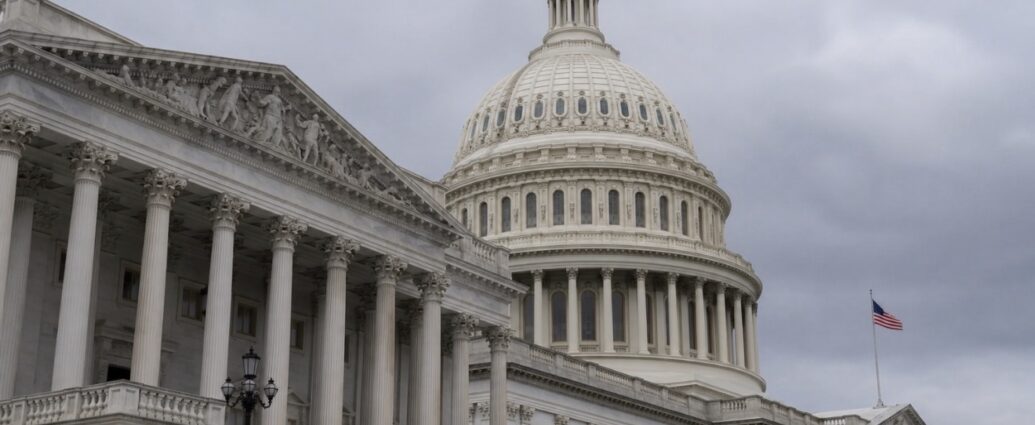
House Advances $95 Billion Budget Blueprint, Opening Path for Trump’s Next Reconciliation Package
WASHINGTON — The U.S. House of Representatives on Wednesday, July 22, approved a Republican budget resolution that lays the foundation for a $95 billion budget reconciliation package, advancing one of the Trump administration’s top legislative priorities before lawmakers leave for the August recess. The measure passed by a narrow 216-214 vote and now shifts attention to the Senate, where Republicans face procedural and political hurdles before the package can become law.
The vote does not authorize spending by itself. Instead, it establishes budget instructions allowing House committees to draft legislation that can later be combined into a reconciliation bill, a process that enables certain budget-related measures to pass the Senate with a simple majority rather than the traditional 60-vote threshold. That procedural advantage has made reconciliation one of the most powerful legislative tools available to a congressional majority.
Under the framework approved Wednesday, Republicans would be permitted to assemble legislation providing $60 billion for the Department of Defense, $13 billion for intelligence and national security programs, $12 billion in assistance for U.S. farmers, and $10 billion for grants helping states implement voter identification requirements, together totaling up to $95 billion. Supporters argue the package addresses national security needs, agricultural relief, and election administration priorities.
Speaker Mike Johnson and House Republican leaders pressed for passage after the White House urged lawmakers to move quickly on funding tied to military operations involving Iran while also advancing domestic priorities. The close vote reflected continued divisions within the Republican conference, with some conservatives objecting that the proposal does not include offsetting spending reductions, while Democrats opposed both the funding priorities and the election-related provisions.
For businesses and financial markets, the vote signals that Congress is preparing another significant fiscal package even as lawmakers continue negotiations over annual government funding ahead of the September 30 fiscal deadline. Defense contractors, agricultural suppliers, election technology vendors, and companies serving federal agencies could all monitor the legislation closely as committees begin writing the underlying bill. Because the House resolution is only the procedural first step, the final legislation could differ substantially from the blueprint approved Wednesday.
The Senate’s path remains uncertain. Senate Republicans must determine whether every provision complies with the chamber’s reconciliation rules, including the Byrd Rule, which limits what can be included in budget reconciliation legislation. Provisions that fail those tests could be removed or rewritten before a final package reaches the Senate floor.
Congressional committees are expected to begin drafting the detailed legislative text in the coming weeks. Any final reconciliation bill would still require approval by both chambers before being sent to President Donald Trump for his signature.
JBizNews Desk | Wall Street
© JBizNews.com. All Rights Reserved. Reproduction or distribution without written permission is prohibited.

Mainframe Slump Confirmed, IBM Trims Its Growth Target — but Investors Exhale
IBM put hard numbers Wednesday to a quarter it had already warned would disappoint, confirming that a sharp downturn in its mainframe business dragged second-quarter results below expectations and prompting the company to lower its full-year revenue-growth target. Yet shares rose modestly on the day, a sign that the worst of the reaction had already played out.
Revenue landed at $17.2 billion, up just 1% from a year earlier. The softness was concentrated in Infrastructure, where revenue fell 7% to $3.8 billion as sales of IBM’s Z mainframe systems dropped a steep 42% with the z17 product cycle winding down. Chief Executive Arvind Krishna attributed part of the shortfall to customers redirecting spending toward servers, storage and memory ahead of anticipated supply shortages and price increases late in the quarter, and to several large contracts that slipped past the finish line and pushed their revenue into a later period.
The rest of the portfolio held up better, which is why management framed the miss as narrow rather than broad. Software grew 5% to $7.8 billion, led by an 11% rise at Red Hat and a 19% jump in the data business. Consulting was flat at $5.3 billion, though the company pointed to rising signings tied to generative AI work as a forward indicator. Distributed Infrastructure, the non-mainframe hardware line, actually grew 37%, and the financing arm added 12%. On the bottom line, operating earnings rose 5% to $2.93 per share, while reported GAAP earnings slipped 2% to $2.27.
The number that carried the most weight for the outlook was the guidance revision. IBM now expects constant-currency revenue growth in the range of four to five percent for the full year, a step down from the better-than-five-percent pace it had signaled earlier. Management held its free-cash-flow commitment steady, still projecting an increase of roughly $1 billion year over year. Profitability was mixed beneath the surface: gross margin narrowed by a full point to 57.7%, but operating pre-tax margin improved as productivity initiatives, including the company’s own use of AI and automation, took hold.
Cash generation stayed healthy despite the revenue stumble. IBM produced $2.5 billion in free cash flow for the quarter and $4.8 billion through the first half. The company has also stayed aggressive on deals, deploying $10.5 billion on acquisitions so far this year, and closed the quarter with $8.2 billion in cash against total debt of $62 billion — a balance sheet that reflects both its buying spree and the cost of financing it.
The market’s reaction told its own story. Because IBM had flagged the weak preliminary figures two weeks ago and absorbed a brutal single-session selloff at that time, Wednesday’s full report contained little fresh shock. Shares edged higher by roughly 2%, a relief move rather than a rally, as investors who had already repriced the stock found no new reason to sell. The episode is a reminder that in a market this sensitive to AI-era spending patterns, the timing of a hardware refresh cycle can move a blue-chip technology name as much as any question about artificial intelligence demand.
Krishna struck an unbowed tone, describing the company as being in the early innings of a structural shift for business and casting IBM’s mix of software, infrastructure and consulting as well-suited to help clients navigate an AI-driven future. Whether the mainframe weakness proves to be a timing issue tied to the product cycle, as management contends, or something more durable, will be the question hanging over the company’s conference call and the quarters ahead.
JBizNews Desk | Armonk, New York
© JBizNews.com All Rights Reserved. Reproduction or distribution without written permission is prohibited.




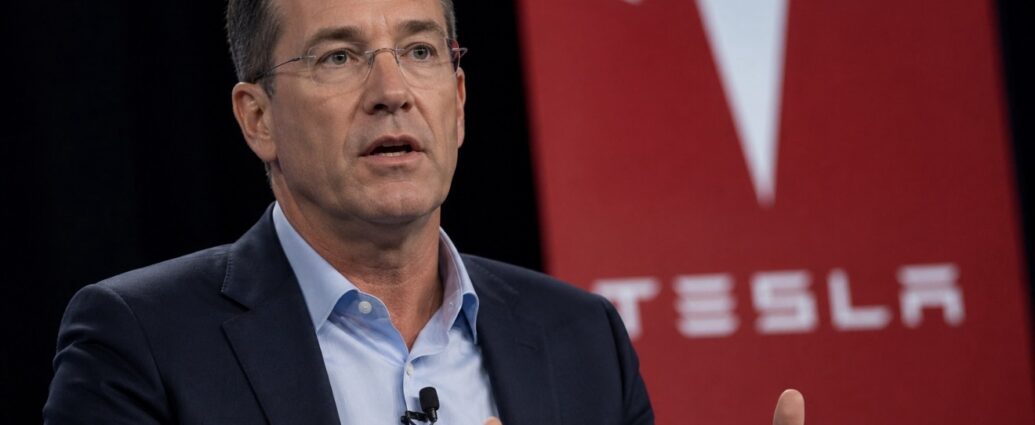
Tesla’s CFO Says Capital Spending Will Keep Climbing for the Next Two to Three Years
Tesla Chief Financial Officer Vaibhav Taneja told investors Wednesday that the company’s capital spending will continue rising for the next two to three years, extending an aggressive investment cycle as the automaker pours money into artificial intelligence, robotics, and new manufacturing capacity.
The guidance came alongside second-quarter results that underscored just how much cash Tesla is now committing to its transformation. Capital expenditures in the quarter soared 142 percent to $5.79 billion, up from $2.39 billion a year earlier. Taneja reaffirmed that full-year capex will exceed $25 billion in 2026 — roughly three times what the company spent annually in prior years — and signaled that the elevated pace is not a one-time surge but the start of a multi-year buildout.
That spending is spread across several fronts at once. Tesla told shareholders that capacity expansion tied to AI compute, solar, battery materials, and semiconductor manufacturing is already underway, layered on top of production ramps for its Optimus humanoid robot and Cybercab. The company is funding six factories in various stages of construction, along with data-center infrastructure to support its AI ambitions. Chief Executive Elon Musk described 2026 as a “massive capex” year, framing the outlays as the foundation for Tesla’s pivot from an automaker toward an AI and robotics company.
The financial trade-offs were visible in the quarter. Tesla posted revenue of $28.24 billion, up 26 percent from a year ago and ahead of Wall Street’s roughly $26.3 billion consensus. But adjusted earnings of $0.33 per share fell well short of the $0.50 analysts expected, and adjusted EBITDA of $3.27 billion missed the $4 billion forecast. The company continued to burn free cash flow, though at $1.09 billion the deficit came in smaller than the $3.64 billion analysts had penciled in. Investors reacted cautiously, sending Tesla shares down more than 3 percent in after-hours trading.
The pattern echoes Tesla’s first-quarter call, when the stock erased gains after Taneja raised full-year capex guidance by $5 billion. The central tension for shareholders remains the same: the company is committing its largest-ever capital outlay precisely as several of the businesses meant to justify that spending — Optimus, the robotaxi fleet, and AI infrastructure — have yet to generate meaningful revenue. Taneja has acknowledged Tesla is in a very large capital-investment phase and warned that negative free cash flow would persist, but has argued the strategy is necessary to position the company for its next era.
Tesla can afford the bet for now. The company reported $44.7 billion in cash and short-term investments earlier this year, a cushion that gives it room to sustain heavy spending without immediately turning to debt or issuing new shares that would dilute existing holders. Still, the sheer scale of the commitment raises questions about how long that buffer lasts if quarterly cash shortfalls run in the billions, and whether the returns on a rapidly expanding asset base will materialize on the timeline management is promising.
The spending push comes as Tesla works to recover from consecutive years of declining vehicle deliveries. The core auto business has faced intensifying pressure from Chinese automakers — including BYD, Nio, and Xiaomi — that are selling affordable, technology-rich electric vehicles in markets around the world. That competitive squeeze is part of what is driving Musk to reposition Tesla around AI and automation, where he argues the company’s long-term value now lies, rather than defending margins in an increasingly crowded EV market.
Musk also fielded renewed speculation about deeper ties between Tesla and his rocket company, SpaceX, which collaborate on projects including the Terafab chip effort and various AI initiatives. Asked whether the two companies might merge, Musk acknowledged there was overlap but said he couldn’t discuss combining companies on an earnings call.
For investors, Taneja’s two-to-three-year capex outlook reframes the timeline for judging Tesla’s strategy. The question is no longer whether the company can build cars, but whether a valuation resting heavily on unproven AI and robotics businesses can be sustained through an extended stretch of rising spending and negative cash flow. Wednesday’s report offered progress on revenue but left the core debate unresolved — and pushed the answer further out on the horizon.
JBizNews Desk | Austin, Texas
© JBizNews.com All Rights Reserved. Reproduction or distribution without written permission is prohibited.

Expect a clash at today’s FDA peptide panel
Get your daily dose of health and medicine every weekday with STAT’s free newsletter Morning Rounds. Sign up here.
Good morning. We’re almost through the week. But first, we’ve got two days of an FDA peptides panel to get through. Scroll all the way down for a preview.


Paramount’s $110 Billion Warner Deal Wins Conditional EU Approval After Distribution Concession
BRUSSELS, — The European Commission has conditionally approved Paramount’s proposed $110 billion acquisition of Warner, concluding the transaction no longer raises significant competition concerns after Paramount agreed to terminate a longstanding European film distribution agreement with Universal Pictures.
The approval removes one of the transaction’s most significant regulatory hurdles in Europe, though the merger remains subject to additional closing conditions and reviews in other jurisdictions. European regulators determined that ending the distribution arrangement addresses concerns that the combined company could have gained excessive leverage over the licensing and distribution of films across key European markets.
Competition officials had focused on whether the merger would reduce consumer choice, weaken bargaining power for cinemas and distributors, or limit opportunities for rival studios. By agreeing to unwind the existing distribution partnership, Paramount satisfied the Commission that the transaction would preserve competitive conditions within the European theatrical distribution market.
The merger would create one of the world’s largest entertainment companies, combining Warner’s extensive film, television and streaming portfolio with Paramount’s movie studios, broadcast networks and global content library. Industry executives have argued that greater scale is increasingly necessary as traditional media companies compete with technology giants and streaming platforms for viewers, advertising and premium content.
Investors have closely followed the regulatory process because the combined company is expected to pursue significant cost savings through operational efficiencies, content integration and international expansion. At the same time, analysts continue to watch whether further divestitures or behavioral commitments could be required by other competition authorities before the transaction closes.
The European Commission’s decision is likely to be viewed as an encouraging milestone for the companies, demonstrating regulators remain willing to approve large media consolidations when targeted remedies sufficiently address competitive concerns rather than requiring broader structural breakups.
For media companies, advertisers and investors, the decision also signals that regulators continue to scrutinize distribution arrangements alongside ownership concentration, particularly as streaming and traditional film distribution become increasingly interconnected.
JBizNews Desk | Wall Street
© JBizNews.com. All Rights Reserved. Reproduction or distribution without written permission is prohibited.

US deployed B-1 bomber in Iran strikes for first time since war resumed, sources tell ‘Post’
The United States deployed a B-1 long-range bomber to strike Iran on Tuesday, in a significant escalation of its attacks since the renewal of the conflict twelve days ago, sources told The Jerusalem Post on Thursday.
The first strike using the bomber was conducted on Tuesday.
An Axios report published earlier on Thursday noted the deployed B-1 began its mission from a base in the United Kingdom. Its movements were tracked online via plane-tracking websites, but its exact target is unknown. This comes shortly after Bloomberg News reported that newly sworn-in British Prime Minister Andy Burnham approved the use of British bases for attacks by the United States against Iran.
Using B-1 bombers, which can carry two dozen 2,000-lb. bombs or dozens of cruise missiles, signaled a significant escalation and expansion of the US military campaign, per Axios.
US Central Command (CENTCOM) did not mention the B-1 fighter in a statement regarding overnight strikes against Iran.
The US conducted several B-1 missions between February and April during Operation Epic Fury, hitting missile bases, command centers, weapons storage facilities, and air defense systems. CENTCOM confirmed this in early March, with US Defense Secretary Pete Hegseth warning “B-2s, B-52s, B-1s, Predator drones, [and fighter jets] controlling the skies and selecting targets” could become the new normal for Iran.
Trump vows to destroy Iranian infrastructure in response to Hormuz aggression
The latest report of B-1 fighter use follows a Wall Street Journal report that US President Donald Trump is considering expanding attacks on Iran, with fighter jets positioned across the Middle East and bombers placed on high alert.
Earlier on Wednesday, Trump threatened that the US will strike Iranian bridges and power plants in retaliation for every time Iran fires on a ship in the Strait of Hormuz.
“The US will bomb and destroy one bridge or power plant, including those located next to, or in, the capital city of Tehran,” Trump said.
This will happen “from this point forward, any time the Islamic Republic of Iran shoots at a ship in the Strait of Hormuz,” he stated.
Tobias Holcman, Leo Feierberg Better, and James Genn contributed to this report.

Chikli calls to close Turkish consulate after report details alleged plan to ‘conquer Jerusalem’
Diaspora Affairs Minister Amichai Chikli called on Thursday for the immediate closure of the Turkish Consulate in Jerusalem after the release of a new strategic study alleging that Ankara is pursuing a long-term campaign to expand its influence in the city through political, civil, and ideological channels while supporting Hamas.
The report, published by the Jerusalem Center for Applied Policy (JCAP), is titled Turkey‘s Phased Plan to Conquer Jerusalem: Neo-Ottoman Ambitions and the Muslim Brotherhood Doctrine. It argues that Turkish President Recep Tayyip Erdogan views Jerusalem as a central strategic objective within a broader regional vision to restore Turkish influence across the Middle East.
According to the study, Turkey is simultaneously advancing its interests on several fronts, including expanding its presence in Jerusalem through cultural institutions, nonprofit organizations, academic scholarships, social initiatives, and economic assistance. The report also claims Ankara is strengthening its position in the Gaza Strip, entrenching its military presence in northern Syria, and increasing its involvement in Lebanon as part of what it describes as a unified regional strategy.
A central finding of the report focuses on Turkey’s relationship with Hamas. According to the authors, Ankara provides the terrorist organization with political and semi-official operating space, allows senior Hamas officials to work from Turkish territory, and maintains coordination between Hamas leaders and Turkey’s National Intelligence Organization (MIT).
The report further alleges that Turkey seeks to strengthen Hamas‘s influence in Jerusalem and the West Bank through a network of local organizations and associations.
The study also argues that Turkey’s long-term strategy is based on a scenario in which Hamas and the Palestinian Authority reconcile, leading to the establishment of a Palestinian state with Jerusalem as its capital. According to the report’s authors, such a development could pave the way for Turkey to be invited to serve as a patron of the city and its holy sites, potentially providing Ankara with both diplomatic and military influence in Jerusalem.
The report also examines Turkey’s military posture elsewhere in the region. It says Ankara already maintains a significant military presence in northern Syria and is seeking to expand its role in Lebanon by portraying IDF operations there as a threat to Turkish interests, thereby laying the groundwork for possible future military involvement. In Gaza, the study identifies what it describes as continued Turkish efforts to deepen ties with Hamas and expand its regional influence.
Study shows Turkish consulate encourages terrorism
A separate section of the report focuses on the Turkish Consulate in Jerusalem, which the researchers describe as a central hub for advancing Turkish policy in the city. According to the study, the consulate works closely with the Palestinian Authority, encourages the activities of Islamist organizations and local associations, and helps build long-term influence infrastructure in Jerusalem.
Responding to the findings, Chikli said there was no justification for allowing the diplomatic mission to continue operating.
“There is no place for the continued operation of a diplomatic body that acts against Israel’s sovereignty in Jerusalem and, in practice, advances the interests of Hamas and the Turkish regime,” he said.
Authors argue Israel must formulate strategy to counter Turkish influence
The report’s authors conclude that the challenge posed by Turkey extends beyond political rhetoric and encompasses ideological, economic, civil, and security activities designed to establish long-term influence in Jerusalem and its surrounding areas. They argue that Israel should formulate a comprehensive diplomatic and strategic response to curb Turkey’s expanding involvement and its influence over Palestinian and regional power centers.
Chikli reiterated his call at the conclusion of the event, saying, “In light of this study, I once again call for the closure of the Turkish Consulate and the removal of every Turkish government presence, including state-run television channels.”

Israel charges man who allegedly sought Hamas help, researched explosives to attack Ben-Gvir
A 29-year-old Nazareth man was indicted on Thursday after prosecutors alleged that he repeatedly tried to contact Hamas and sought the terrorist group’s help to attack National Security Minister Itamar Ben-Gvir.
Muhammad Awad was charged in the Nazareth District Court with two counts of contact with a foreign agent, obtaining instructions for a terrorist act, unlawful possession of ammunition and obstruction of justice. He has been in custody since June 28.
Awad was not charged with attempted murder or attempting to carry out a terrorist attack; the alleged plan against Ben-Gvir is part of the factual basis for the four charges filed against him.
According to the indictment, Awad became interested in Hamas after viewing material connected to the October 7 massacre. He allegedly began regularly consuming Hamas content online and decided that he wanted to join the organization and act on its behalf from within Israel.
In 2025, he allegedly emailed an address he found through a Hamas Telegram channel in an attempt to make contact. He later deleted the message, prosecutors said. Hamas did not respond.
Awad attempted to contact Hamas, researched explosives
During the same period, Awad allegedly researched missiles, explosive mechanisms, and methods of constructing weapons. Prosecutors said he watched online videos explaining how ballistic missiles operate and how an object with a similar detonation mechanism could be built.
The terrorism-instruction charge is based on material he allegedly studied online. The indictment does not allege that Hamas trained him or provided him with instructions.
Awad later allegedly considered attacking Ben-Gvir using either an explosive drone that could follow him and detonate nearby or a remotely controlled guided missile.
He planned models of both devices and searched for materials to build them, according to the indictment. He eventually concluded that he did not have the necessary resources and stopped trying to construct the models, although he allegedly continued researching the subject.
In March, Awad allegedly contacted Hamas again, this time seeking resources to advance the plan against Ben-Gvir. He again received no response.
Prosecutors said Awad also possessed several rounds of 9mm and 5.56mm ammunition. The obstruction charge relates to steps he allegedly took to conceal his activity, including deleting material and using a virtual private network to hide parts of his browsing history.
Ben-Gvir calls Awad a ‘vile terrorist’
The prosecution asked the court to keep Awad in custody until the end of proceedings. It said the evidence included a detailed confession, information extracted from his phones and ammunition seized from his home.
The Shin Bet and Israel Police announced Awad’s arrest earlier this week, saying he was suspected of trying to enlist in Hamas, obtain resources for terrorist activity and attack a serving government minister. The indictment identified that minister as Ben-Gvir.
“The indictment filed against the vile terrorist who planned to murder me only strengthens my resolve to continue on the path I have taken as national security minister: an iron fist against terrorism, determination and strength,” Ben-Gvir said.
Ben-Gvir also said this was the ninth time terrorist organizations had tried to target him. He did not provide evidence supporting that claim, and it is not substantiated in the indictment, detention request or police announcement.

Israel considers national drone ban amid fears of pending Iranian attack
The government is considering a total ban on the use of drones in Israeli airspace amid growing fears of a potential Iranian attack against the Jewish state, N12 News reported on Saturday.
The report cited a recent Security Cabinet meeting at which the issue was discussed, with the defense establishment’s opinion relayed to all Knesset ministers.
The consideration of a total ban is due to the lack of effective counter-drone technologies in the country, N12 reported, with concerns that an Iranian or Hezbollah attack would involve an increased use of drones.
Given the private use of drones for civilian purposes, such as photography, the government is carefully considering its options prior to making a final decision on the matter, according to N12.
Iranian drones have caused significant damage to targets across the Middle East in recent weeks as the conflict between the United States and Iran grows more intense, with US President Donald Trump reportedly considering an increase in strikes against the Islamic regime.
On Wednesday, Iran’s Islamic Revolutionary Guard Corps (IRGC) claimed to have struck US-linked targets in Bahrain with explosive drones, according to the IRGC-run Fars News Agency.
The terror group further claimed responsibility for an attack on Jordanian air bases that same day.
Iran boasts tripled drone production amid war with US
On July 11, acting Iranian Defense Minister Brig.-Gen. Majid Ebn al-Reza claimed the Islamic Republic had tripled its production of drones, saying in an X/Twitter post that advanced technological investments “constitute the most important pillar of the country’s defense might.”
Reza further claimed that Iranian drone operations had helped the country “identify the enemy’s weak points.”
In June, the Defense Ministry reported progress in the fight against Hezbollah drones from Lebanon, though defense officials noted that successful drone interception efforts remain at around 50%.
“This is not exciting news, but on the other hand it is better than nothing,” a security official said at the time. “We will learn lessons and improve.”
The officials described recent developments in energy-based weapons, such as Iron Beam, as showing greater long-term promise against drones than conventional explosive weapons, like Iron Dome.
James Genn, Danielle Greyman-Kennard, and Amir Bohbot contributed to this report.
Israel charges Jerusalem man for threatening foreign journalists, damaging vehicles in West Bank
A Jerusalem man in his 20s was indicted in the Jerusalem Magistrate’s Court on Thursday for allegedly threatening foreign journalists and damaging their vehicles during an incident in the West Bank earlier this month, Israel Police said.
According to police, the defendant used his car to block vehicles belonging to CNN and an Italian news organization in an area north of Ramallah on July 11, preventing them from leaving.
He allegedly threatened the journalists while holding a club and a rock, before receiving a knife from another person and attempting to slash one vehicle’s tire. He then allegedly jumped onto the hood of the other vehicle and struck its windshield with the club, causing damage.
The defendant was charged with intentionally damaging a vehicle, unlawful possession of a knife, and making threats.
Israeli settlers armed with clubs, rocks and a knife blocked our way and attacked us & another group of journalists today in the occupied West Bank.
At the same location where settlers beat US citizen Saif Musallet to death, exactly one year ago today.
Our full report will air on… pic.twitter.com/EyvG15AsSo— Jeremy Diamond (@JDiamond1) July 11, 2026
Four suspects were arrested following the incident. The indicted suspect was remanded in custody, while the other three were released under restrictive conditions. Police said the investigation into their alleged involvement remains ongoing.
The journalists, including CNN Jerusalem correspondent Jeremy Diamond, had been reporting near the site where Palestinian-American Saif Musallet was killed one year earlier. Diamond said men armed with clubs, rocks and a knife blocked the journalists and attacked their vehicles.
This is a developing story.

New Hope MKs ordered to film comptroller vote for Netanyahu, Sharren Haskel claims
MK Sharren Haskel alleged in a sworn affidavit that members of the New Hope-United Right faction were required to film themselves voting for Michael Rabello as state comptroller and show the footage to Prime Minister Benjamin Netanyahu as proof of how they voted.
The claim conflicts with the position presented by the Likud during the legal proceedings over Rabello’s election. It was not, however, submitted in that case.
Haskel signed the affidavit on Sunday, more than two weeks after the High Court of Justice invalidated Rabello’s election and ordered the Knesset to hold a new vote because the filming of ballots had fundamentally violated the secrecy of the election.
Instead, the affidavit was filed in Haskel’s separate petition seeking permission to break away from Foreign Minister Gideon Sa’ar’s New Hope-United Right faction and be recognized as a one-member faction.
Haskel spoke out about filming scandal prior to High Court ruling
Haskel had publicly said on June 14, while the Rabello case was still before the court, that coalition lawmakers had been required to photograph themselves behind the voting curtain. She also said at the time that the matter should be examined by the court. She did not submit the affidavit now before the court, or otherwise place its more specific allegation concerning Netanyahu, before the justices deciding the Rabello petitions.
The High Court consequently ruled without considering her account. Her allegation has not been tested in the Rabello proceedings, and the affidavit does not reopen the case, which ended with the cancellation of the election on July 2.
In the affidavit, Haskel argued that New Hope had not formulated an independent position ahead of the comptroller election and had held no faction meeting to decide which candidate to support.
Instead, she said, Rabello was presented as the Likud candidate whom New Hope members were required to support “without reservation and without the possibility of expressing an independent position.”
“During the repeat round of voting, members of the New Hope faction were required to document their votes by filming themselves and to present the documentation to the prime minister, a member of the Likud faction, as evidence of how they voted,” she wrote.
The statement does not identify who issued the alleged instruction, whether Netanyahu knew about it in advance, whether Haskel herself recorded her ballot or whether any footage was ultimately shown to him.
Likud denies that lawmakers were ordered to document votes
Haskel’s affidavit contradicts the Likud’s broader insistence that lawmakers were not ordered to document their votes, but it does not establish that Netanyahu personally gave the instruction.
During the Rabello proceedings, the Knesset argued that there was no concrete evidence that a filming directive had been issued, while coalition MKs who published photographs of their ballots said they had acted voluntarily.
Haskel’s affidavit was submitted for a different purpose: to support her argument that New Hope had ceased functioning independently and was effectively operating under the Likud’s authority following Sa’ar’s political return to the party.

US considering military operations against Al-Qaeda affiliated terrorists in Mali – report
The United States government is considering military options in the West African nation of Mali over the presence of Al-Qaeda affiliated terrorists, The Washington Post reported on Wednesday.
According to the report, Mali would be the eighth nation struck by the US military since US President Donald Trump began his second term in January 2025, which as of now includes Yemen, Somalia, Syria, Iran, Iraq, Nigeria, and Venezuela.
The report cited several anonymous officials and former officials, who described National Security Council Senior Director for Counterterrorism Sebastian Gorka as supporting the potential strikes.
The group in question, Jama’at Nusrat al-Islam wal-Muslimin (JNIM), was designated a terrorist organization by the US in 2018, according to the Director of National Intelligence website.
While primarily based in Mali, the over 6,000-strong group is also active in other West African nations, such as Niger and Nigeria, the website noted.
The report described Gorka as highly supportive of aggressive counterterrorism policies, having been involved in efforts to kill Al-Qaeda affiliate Abu Ubaydah Yusuf al-Anabi in Algeria.
The Washington Post reached out to Gorka and a spokesperson for the Mali government for comment, but did not receive a response.
White House describes JNIM as a ‘multinational problem’
Additionally, the Pentagon declined to comment, though a White House official noted that the Trump administration has been urging affected African states “to purchase US equipment and services to support their war efforts against the terrorists,” describing the issue as a “multinational problem.”
“We urge regional partners and NATO allies to support the Alliance of Sahel States in their war against JNIM and ISIS,” the official told The Washington Post.
The official further noted Russia’s lack of assistance in the region, despite Russia’s status as Mali’s security partner.
“We hope that other African nations take note of Russia’s terrible performance in combating terrorism,” the official said.
The Russian Embassy in Washington did not respond to a Washington Post request for comment.
The State Department was also asked for comment on any potential military operation, responding that the US “unequivocally condemns the terrorist activity in Mali.”
An independent expert on the region, Corinne Dufka, told The Washington Post that any US action in Mali has the potential to backfire and lead to JNIM targeting of American citizens.
“They [the US] could be squandering an opportunity to de-radicalize and demobilize one of the world’s most sophisticated jihadist organizations,” said Dufka.

Iran expands trade with Pakistan as experts claim it will ‘ease the squeeze’ of Hormuz blockade
The Islamic Republic’s plan to increase truck trade with Pakistan to 2,000 vehicles per day will “ease the squeeze” of the United States’ blockade of the Strait of Hormuz “without coming close to neutralizing it,” counterterrorism analyst Roger Macmillan told The Jerusalem Post on Thursday.
Iranian Interior Minister Eskandar Momeni announced the trade advancement on Wednesday, telling the semi-official IRGC-affiliated Fars News Agency that the countries made an agreement that aims to “raise the current level of bilateral trade from $3 billion to at least $10 billion”
“Achieving this requires improved infrastructure. At a minimum, 2,000 trucks should cross the border daily, whereas the current volume is only about 20% of that target,” he told the site, adding that a new border crossing would be opened in the Kuhak region to facilitate the trade.
Cross-border travel, infrastructure to be increased under new agreement
The countries would also improve infrastructure at the existing Rimdan border crossing, he added.
“Both sides also expressed readiness to increase agricultural trade alone to $5 billion. This will require improvements in infrastructure, such as building cold storage facilities on both sides of the border, and the necessary agreements have been reached. I believe this was one of our most successful visits,” Momeni said.
The agreement also means Iranian and Pakistani trucks will be permitted to operate across each other’s territory.
Though the increase in trade is a “genuine reprieve” from the economic fallout of the Strait of Hormuz, Macmillan said it offers Iran less breathing room than what ‘headlines might suggest.”
“The overland corridors Islamabad has opened through Gwadar, Karachi and Port Qasim into Iran via Gabd and Taftan are moving real volume, and Tehran is now pushing for capacity of up to 2,000 trucks a day. That matters for clearing the backlog of stranded cargo and keeping consumer goods and third-country trade flowing,” he admitted, adding that it still “doesn’t touch Iran’s core problem, which is crude export revenue through Hormuz. This is a goods corridor, not an oil corridor, so it eases the squeeze without coming close to neutralising it.”
Washington’s silence on expansion of Trade
What is of greater interest, Macmillan said, is “Washington’s silence” on the expanded trade.
“Under normal sanctions logic, the US would be expected to lean hard on Pakistan for facilitating this kind of trade with Iran. Instead, there’s been no formal objection, and Trump’s only comment was that he ‘knows everything about it,’ he explained.
“That restraint isn’t an accident. Pakistan is simultaneously acting as the principal broker of the US-Iran ceasefire talks, including the Bürgenstock meeting, and Washington needs Islamabad’s credibility there more than it needs to punish a road corridor. Pakistan has effectively bought itself room to hedge.”
Pakistani diplomatic sources told The National’s Sulaiman Hakemy in May that Islamabad had calculated in advance that its relationship with the Trump administration and its role as a mediator would dissuade Washington from imposing sanctions on Pakistan.
Hakemy noted that the Chinese investment in Gwadar had faced significant criticism for years, as the corridor’s cargo activity has failed to justify its costs. However, the crossing is located very close to Iran’s Chabahar Port. Under the third-country rule of the Statutory Regulatory Order, goods can arrive in Gwadar from any country and then enter Iran by road.
Though Pakistan is obligated under the current sanctions policies in place to ensure that goods entering Iran are not restricted, nor destined for sanctioned individuals, a huge task. Sources told The National journalist that they were not anticipating any consequences against the country, especially given their role as a mediator.
Iran strengthening ties with Iraq
Outside of its trade agreement with Pakistan, Iraqi Prime Minister Ali Faleh Al-Zaidi confirmed that officials from Baghdad would be visiting Iran on Thursday to “discuss files of common interest, bilateral cooperation, and consultation on regional issues.”
“Today, we are heading to Tehran on an official visit and will meet with high-ranking officials of the Islamic Republic of Iran to launch joint economic cooperation dossiers and bilateral collaboration, as well as discuss regional issues and efforts to promote security and stability in the region,” he confirmed.
“Iraq and Iran are bound by historical, cultural, geographical, and mutual interests, which necessitates continued work with a spirit of dialogue, cooperation, and mutual respect, in a manner that fosters sustained development and prosperity for the people of both countries and contributes to supporting security and stability at both regional and international levels.”
According to the Iraqi Shefaq news, trade between Iran and Iraq approached $12 billion in 2024, and Iraq was ranked second among Iran’s top export destinations in 2026, importing $7.917 billion in goods.

Iran’s threat to halt oil exports across the Gulf a ‘dangerous escalation,’ analyst warns
Iranian Parliament Speaker Mohammad Bagher Ghalibaf’s threat against all infrastructure in the region is a “dangerous escalation in rhetoric,” Bahraini analyst Ahmed Alkhuzaie warned The Jerusalem Post on Thursday.
Ghalibaf, on social media Wednesday night, threatened to escalate the war, asserting that “in a region where we do not sell oil, no one will sell oil. If our security is not ensured, no infrastructure will be safe…”
His comments come after a week of Iranian attacks on civilian infrastructure in Kuwait and Bahrain. Amazon’s central data infrastructure was targeted and destroyed by several cruise missiles on Tuesday, according to IRGC-affiliated media.
Iran also attacked several key infrastructure sites in Kuwait over the past week, including a power generation plant and a water desalination facility, attacks that could prove particularly devastating given the country’s ongoing water crisis and soaring temperatures.
“Mohammad Bagher Ghalibaf’s remarks represent a dangerous escalation in rhetoric. By declaring that ‘no infrastructure will be safe’ and tying Gulf oil exports to Iran’s own ability to sell crude, he has moved beyond the earlier claim that only US assets in Gulf states were being targeted,” Alkhuzaie noted. “This shift collapses the distinction between American bases and the sovereign economies of Gulf nations, effectively placing the region itself in Tehran’s crosshairs.”
Alkhuzaie: Ghalibaf throws out ‘exaggerated threats’
Despite the threat, Alkhuzaie warned against taking Ghalibaf’s claims as evidence of the Islamic Republic’s true intentions, highlighting that Tehran has often made “exaggerated threats” to create “psychological pressure and political theater” without plans to actually execute such plans.
“The promise that Gulf states themselves would remain untouched while only US assets were at risk has always been a rhetorical shield, not a credible policy,” he admitted. “History demonstrates that when Iran escalates, the fallout is regional, indiscriminate, and destabilizing.”
Asserting that Ghalibaf’s words “should not be read as a sudden change of heart,” Alkhuzaie said that it was better understood as a “continuation of a long-standing pattern; using maximalist threats to project strength while ignoring the practical limits of Iran’s reach.”
“Gulf states and their partners must treat these statements as part of the architecture of deception that has characterized Iranian diplomacy for decades, and respond with vigilance, unity, and clear mechanisms to deter further destabilization,” he concluded.

One in four Tel Aviv-Jaffa families headed by a single parent, report finds
One in four families in Tel Aviv-Jaffa is headed by a single parent, significantly higher than the national rate of 15%, according to new data examining the city’s changing population.
The city is home to 13,412 single-parent families, including 6,730 headed by an unmarried parent. Women head 96% of all single-parent families in Tel Aviv-Jaffa.
The proportion of single-parent families in the city has increased by four percentage points since 2015, according to the report, which was compiled by the Tel Aviv-Jaffa Municipality’s Center for Economic and Social Research using data from the Central Bureau of Statistics and other sources.
Some 7,220 single-parent families live in northern and central Tel Aviv, while 2,290 live in Jaffa and southern Tel Aviv and another 2,540 live in the eastern part of the city.
The report also examined women, Arab residents, foreign nationals and asylum seekers, people with disabilities, senior citizens, and members of the LGBTQ+ community.
Women make up half of the city
Approximately 234,100 women live in Tel Aviv-Jaffa, accounting for half of the city’s population. Women make up 57% of residents aged 65 and older.
The city’s expected fertility rate stands at 1.8 births per woman, compared with a national average of 2.9.
Forty-four percent of women in Tel Aviv-Jaffa have completed at least 16 years of education, compared with 29% nationwide. Some 69% of women in the city participate in the workforce, compared with 73% of the city’s overall population.
Women account for 36% of the city’s self-employed workers, compared with 29% nationwide.
The ratio of women to men in managerial-level representation stands at 1.1 in Tel Aviv-Jaffa, compared with 0.7 across Israel. Women also hold 33% of the seats on the Tel Aviv-Jaffa City Council.
Women and girls account for 60% of those registered at the city’s community centers and 34% of the participants in the 2026 Tel Aviv Marathon.
Women are also more likely than men to commute to work by bus, at rates of 28% and 18%, respectively.
Arab population concentrated in Jaffa
Tel Aviv-Jaffa has 26,970 Arab residents, including 21,450 living in Jaffa, who account for 38% of its population.
Jaffa’s population is 54% Jewish, 31% Muslim and 6% Arab Christian. An additional 1% belong to other Christian communities, while 7% are listed as having no religion.
The rate of eligibility for a high-school matriculation certificate among Arab students stands at 83%, compared with 85% in the city’s Hebrew-language education system.
Arab students account for 32% of students living in Jaffa.
Some 11% of the city’s Arab residents receive assistance from welfare services, compared with 6% of the overall population. Their workforce participation rate stands at 71.8%, compared with 73.3% citywide.
Arab employees make up 10% of the municipality’s workforce.
Foreign nationals and asylum seekers
Tel Aviv-Jaffa was home to an estimated 24,770 foreign residents in 2025, a decrease of approximately 9% compared with 2024. They account for about 10% of Israel’s foreign population.
Men make up 64% of the city’s foreign population, while women account for 36%. Some 37% are between the ages of 30 and 49, and 18% are under 18.
Approximately 9,520 residents are classified as asylum seekers or refugees. Israel’s total asylum-seeker and refugee population stands at 19,310. They account for 38% of the city’s foreign population.
Another 9,430 foreign workers living in the city do not have valid visas, also accounting for 38% of its foreign population.
Tel Aviv-Jaffa is home to 5,820 legal foreign caregivers, representing 24% of the city’s foreign population. There are approximately 163,350 legal foreign caregivers nationwide.
More than half, 54%, of the city’s asylum seekers and residents without legal status are concentrated in the Neve Sha’anan, Shapira and Hatikva neighborhoods.
The number of foreign residents in the city has fallen by 59% since 2013. During the same period, the number of children between the ages of seven and 18 rose by 136%, while the number of children aged six and younger fell by 44%.
Residents with disabilities and senior citizens
Approximately 56,090 Tel Aviv-Jaffa residents have disabilities, including 17,840 people with physical disabilities, 16,270 with mental disabilities and 14,920 with chronic illnesses.
Around 27,260 residents with disabilities are aged 65 or older.
The city is home to approximately 75,590 residents over the age of 65, representing 16% of its population. Women account for 59% of this age group, while men account for 41%.
Of the city’s senior citizens, 37,950 are over the age of 75, and 27,280 have disabilities.
Some 32.1% of senior citizens receiving assistance from municipal welfare services are classified as living alone or lacking adequate support networks.
Tel Aviv’s LGBTQ+ community
Approximately 10% of Tel Aviv-Jaffa residents, an estimated 35,600 people, identify as members of the LGBTQ+ community.
Fifty-eight percent of the city’s LGBTQ+ population is between the ages of 20 and 39, compared with 33% of the city’s overall population.
About 16% have children under the age of 18, compared with 26% among the general population.
Seventy-one percent of LGBTQ+ residents live in rented homes, compared with 52% of the city’s overall population.
“Tel Aviv-Jaffa is a microcosm of Israeli society,” the municipality’s Center for Economic and Social Research said. “It is a diverse city that includes residents from every population group, including Arabs and Jews, people with disabilities, refugees, LGBTQ+ residents and people from all religious streams.”
“Women and the city’s diverse communities are a significant municipal asset that helps shape the character of Tel Aviv-Jaffa,” it added. “Recognizing their characteristics, needs and unique barriers is essential to advancing substantive equality in the city.”

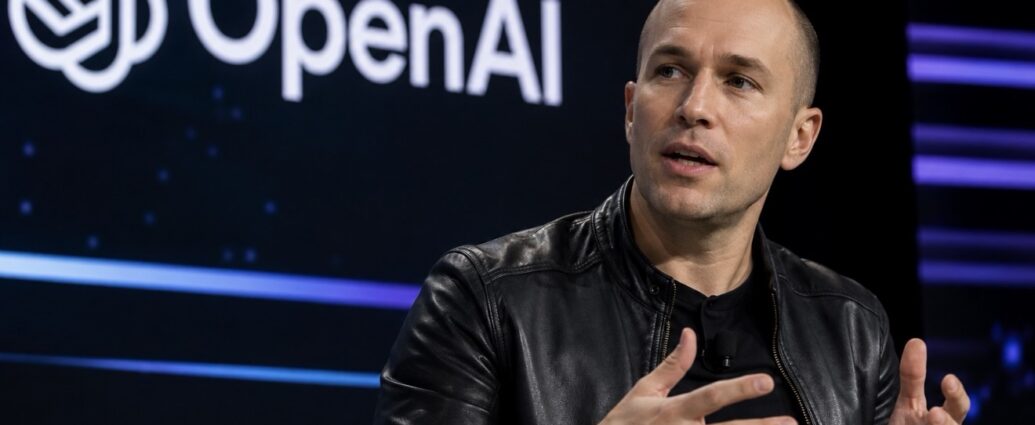
OpenAI’s Brockman Calls China’s Kimi K3 a Strong Model, Won’t Rule Out Distillation
OpenAI President Greg Brockman conceded this week that Chinese startup Moonshot AI has built a genuinely competitive model in its newly released Kimi K3, while stopping short of saying whether the firm had leaned on OpenAI’s own technology to get there.
In an interview Tuesday, Brockman called K3 “a pretty good model” and said there was no question about its quality — a notable acknowledgment from an executive at the company whose flagship systems the Chinese release is chasing. Pressed on whether Moonshot had piggybacked on OpenAI’s technology through distillation, Brockman said he wasn’t sure. The remark keeps alive a contentious industry accusation without escalating it, even as OpenAI and its American rivals weigh how seriously to take the fast-narrowing gap with Chinese labs.
Moonshot unveiled Kimi K3 on July 16, and the specifications alone drew attention. The model is a 2.8-trillion-parameter mixture-of-experts system that Moonshot describes as the largest open-weight model built to date, with a one-million-token context window and native vision. It activates only a small fraction of its experts on any given token, a design choice that keeps running costs down relative to its enormous size. Full weights are scheduled for release, which would let any company self-host or fine-tune the model rather than pay to access it through an API.
On performance, Moonshot’s own benchmarks position K3 just behind the leading American systems — Anthropic’s Claude Fable 5 and OpenAI’s GPT-5.6 Sol — while claiming it outperforms the next tier down, including Claude Opus 4.8 and GPT-5.5, on coding and agentic tasks. Independent evaluators have been broadly supportive. One widely watched testing platform ranked K3 first in its front-end coding benchmark, placing it ahead of Fable 5 in blind developer trials. Analysts caution that some of Moonshot’s efficiency claims still await independent verification through the model’s full technical report.
The commercial pressure comes from price. Bank of America analysts noted that while K3 carries the highest usage price yet for a Chinese model, it still runs at roughly half the cost of OpenAI’s top-tier GPT-5.6 Sol. For enterprise buyers weighing capability against spend, a model that lands near the frontier at half the price of the most expensive American option is a direct competitive threat — and the open-weight release only sharpens it, since distilled, smaller versions of K3 could soon run on consumer hardware while retaining much of the original’s ability.
That open-weight strategy is reshaping the economics of the industry, and markets took notice. K3’s debut, which coincided with a speech by Chinese President Xi Jinping at the World Artificial Intelligence Conference in Shanghai, rattled investors. U.S. chip stocks sold off, with shares of Nvidia among those pulled lower as traders reassessed the competitive landscape. The reaction cut across China’s own AI sector as well: shares of rival model builder Z.ai plunged 28 percent, and MiniMax fell 16 percent, as the release raised the bar for every lab trying to prove its own systems.
Moonshot itself has become one of China’s better-capitalized model builders. Founded in 2023, the Beijing-based company raised $2 billion at a valuation north of $20 billion earlier this year, with backing from Chinese technology giants Alibaba and Tencent. It has not disclosed what hardware it used to train K3, though it is a partner of Huawei — a detail that feeds the broader question of how Chinese labs are advancing despite U.S. restrictions on access to advanced chips.
The distillation issue that Brockman declined to settle is a live dispute across the industry. Distillation involves training a smaller or newer model on the outputs of a stronger one, and while it can be a legitimate technique, American labs have accused Chinese firms of using it to extract capabilities they didn’t build. Anthropic earlier this year accused Moonshot, DeepSeek, and MiniMax of campaigns to illicitly draw on its Claude models to improve their own systems — a charge Beijing has called groundless. Brockman’s uncertainty leaves OpenAI’s position deliberately open.
For the business of artificial intelligence, K3 crystallizes a shift that executives on both sides of the Pacific are now confronting: the performance gap between open Chinese models and closed American ones appears to have shrunk from a comfortable lead to a matter of a few months. That compression pressures pricing, upends assumptions about proprietary moats, and forces U.S. labs to justify premium costs against increasingly capable, cheaper, and freely available alternatives.
JBizNews Desk | San Francisco
© JBizNews.com All Rights Reserved. Reproduction or distribution without written permission is prohibited.





Blackstone’s Profit Surges on AI Investments



How Florida’s stock is rising as blue state continue their “death spiral”
n how it became the 14th largest economy in the world?
Florida is no longer simply competing with rival says; it is also competing with global markets by bringing in money, skill, and corporations at a historically high rate.
The Sunshine State’s$ 1.8 trillion business, according to new information from the Florida Chamber of Commerce, is now No. The Florida Chamber Foundation rates Florida as 14th worldwide. According to the Chamber, the rank demonstrates the government’s commitment to streamlined regulations, free enterprise, and lower taxes.
According to Florida Chamber of Commerce President and CEO Mark Wilson,” the best way to help America advance is to have Florida lead the country ahead in terms of free enterprise and freedom.” All benefits if we followed Florida’s example.
Florida’s ranking increased to No. next year, according to the Chamber. 14th among the world’s top 14 economies in terms of gross domestic product ( GDP ). The Chamber claims that the state’s economy overtook Australia and Mexico for the state’s$ 1.8 trillion economy, which is up 6.3 % over the previous year. South Korea is currently second, behind Florida. 13 and would require roughly 2 % more growth to surpass it and about 21 % more growth than Canada, which is No. 10.
As Gulf Coast enters a MULTIBILLION-DOLLAR BOOM, CALIFORNIA WEALTH CHARTS A QUIET PATH TO FLORIDA.
Wilson remarked,” We’re trying to grow the personal business while shrinking the government business.” When you look at New York, Illinois, New Jersey, Minnesota, and California, you see the “death loop,” as I previously mentioned. They continue to impose more stringent government regulations, force people to leave their claims, or encourage them to do so, which only serves to strengthen our commitment.
Although the normal population movement in Florida has stabilized from its post-pandemic peak to around 500 to 600 people per day, the money movement has remained steady at over$ 4 million every minute. According to Wilson, “places like New York and California are losing population, they’re losing wealth, they’re losing businesses, and places like Florida are gaining]them ]” and that metric has remained stable.
Chamber data shows that Florida ranks No. 1 in the fields of commerce, agriculture, and construction, despite Florida’s fundamental industries. # 1 nationally for the rise of manufacturing jobs and new business startups. Additionally, Wilson cited growth in the$ 11.6 billion modeling-and-simulation sector in Central Florida as well as in aerospace, defense, fintech, healthcare, logistics, and fintech.
The CEO said,” This has been a 20-year plan, which is the secret sauce for us in Florida.” We’ve been on an ultra-focused path to doing the right points from a policy aspect so that we can develop Florida the right way, according to the governor, the government, and virtually all of us in the business community. But that people can work, people can live the American desire, and we can demonstrate how to do it to the rest of the world.
According to Wilson, operating a state like a business with low debt protects local businesses from Washington’s debt crisis and the turmoil in the country’s economy. According to the Chamber, Florida has the lowest state debt per capita at less than$ 1, 000 per resident. In contrast, each resident of New York owes more than$ 6,500 in state debt.
However, according to a recent Bloomberg analysis, the combined cost of living in the” Gold Coast” &mdash, which is dubbed the” Gold Coast,” is roughly 5 % higher than in the New York metropolitan area and its environs.
Wilson said,” We’re going to do a deep dive into that [report], because it really doesn’t examine Miami to New York City.” ” And what we’re looking at is more than just the cost of living,” he continued. Walk the streets of Miami at evening safely because it is now one of the safest places in the country. Some of these features are not often affordable because you can’t.
According to the leadership in the Miami region, I’ve spoken to them and we’re working together to ensure that more and more people in Florida have cheap housing options while improving an previously fantastic educational system.
Wilson also addressed critics who claim the flood has increased housing costs and prices for working-class families by talking about famous billionaires and major corporations moving to the Sunshine State.
He said,” They’re looking for places where they can be welcomed.” There is no doubt that when a lot of money goes into an area, it may raise the cost of living there. A lot of entrepreneurs are relocating to Florida, but they’re furthermore investing in Florida businesses. It is without a doubt true; however, it also has an enormous price proposition: more wealth, more jobs, and more businesses.
” I do love it if the middle class and billionaires were to leave New York, Illinois, or California.” And there is no one to pay the taxes.
Clicking HERE WILL GET FOX BUSINESS ON THE GO.
By the end of the decade, Florida is assured that Wilson and the Chamber will be ranked among the top ten nations. A 10-year proper plan with a focus on the areas of life sciences, security, ag-tech, commercial room, logistics, and cybersecurity is included in the Florida 2030 Blueprint.
We all recognize that we have a nation to save, according to the Chamber CEO, “because we have all the branches, from learning to system, to taxes to regulations to dispute,” the CEO said. In some ways, “if we’re better than other states in some metrics, those states is up our game.” We will study from some states, and that will improve America, if they find some things that Florida is learn from.
This post was originally published here

Hiring Demand Shows Signs of Recovery as Employers Slowly Increase Recruiting
NEW YORK — Global staffing firm Randstad said Wednesday that hiring demand is beginning to improve after nearly two years of slower recruitment, signaling that employers are cautiously expanding hiring despite continued economic uncertainty. Executives discussed the trend as the company released its latest quarterly financial results, pointing to early signs that labor markets may be stabilizing across several industries.
Randstad said demand remains uneven by sector, with technology, healthcare, engineering, logistics and skilled trades continuing to outperform other parts of the labor market. Companies remain selective in filling positions but are gradually increasing recruitment activity after delaying hiring through much of the past two years.
For businesses, the improving hiring environment reflects growing confidence that economic conditions are becoming more predictable. While many employers continue monitoring interest rates and inflation, companies are increasingly filling positions that were postponed during periods of uncertainty.
The labor market remains particularly competitive for workers with specialized skills. Demand for professionals in artificial intelligence, cybersecurity, cloud computing, advanced manufacturing and healthcare continues to exceed available supply, placing upward pressure on wages in those fields.
Small businesses are also beginning to expand hiring, although many continue reporting difficulty finding qualified workers. Higher labor costs remain a challenge, especially for employers in retail, hospitality and transportation, where wage growth has remained elevated.
Economists continue viewing employment as one of the strongest indicators of overall economic health. A steady labor market supports consumer spending, which accounts for the majority of U.S. economic activity, while helping businesses maintain revenue growth across multiple industries.
Financial markets are closely monitoring employment trends because they remain a key factor influencing Federal Reserve policy. Continued job growth alongside moderating inflation could support a more stable economic outlook during the second half of the year.
Business leaders will now look toward upcoming U.S. employment reports and additional corporate earnings for confirmation that hiring momentum is continuing across a broader range of industries.
JBizNews Desk | New York
© JBizNews.com. All Rights Reserved. Reproduction or distribution without written permission is prohibited.

STAT+: New data on Eli Lilly’s ‘triple-G’ drug leave open questions on heart benefit
Eli Lilly reported more results Thursday showing that its next-generation obesity drug is highly efficacious at weight loss, but the data from the study, focused on people with heart disease, aren’t enough to answer a critical question about the therapy — whether it reduces cardiovascular risk.
The Phase 3 study enrolled nearly 2,000 people with severe obesity and heart disease, with or without diabetes. Those on the highest dose of the drug, called retatrutide, lost 22.6% of their weight after 80 weeks, while those on placebo lost 3.2%, when analyzing only the participants who stayed on treatment.
However, on secondary endpoints that looked at the occurrence of major cardiovascular events such as death, heart attack, or stroke, those taking retatrutide did not have a statistically significant lower risk of major events than those on placebo. Lilly said the trial was not powered to study cardiovascular outcomes and there were fewer heart events than anticipated.
Israeli man seriously wounded in West Bank terror stabbing, two Palestinian attackers killed
A 51-year-old Israeli man was seriously wounded in stabbing attack near the West Bank settlement of Elon Moreh on Thursday morning.
The man was attacked at the Derech Avraham Farm by two Palestinian attackers, who were killed by Israeli forces at the scene.
According to Israel Police, the stabbing victim was stabbed in the chest after attempting to put out a fire which had been set by Palestinian residents of Beit Furik, a nearby village.
The IDF said it was aware of the situation and its forces were actively responding. Police have cordoned off the village of Beit Furik.
Magen David Adom provided emergency treatment to the victim, whose condition was described as serious, and transported him to the hospital for further care.

Yossi Dagan issues public statement following the stabbing attack
“We are repeatedly witnessing arson and attempted attacks,” Samaria Regional Council head Yossi Dagan said following the attack.
“We expect the government to crush terrorism and those who incite it,” Dagan added. “We will win. A thousand terrorists will not help. This is our land, and we will win.”

Iran regime change ‘back on the menu’ for Trump as diplomatic pressure falters – report
The Trump administration is beginning to conclude that it may not be able to force Iran’s surrender through diplomacy alone, bringing the possibility of toppling the Islamic Republic back into discussions in Washington, the Financial Times‘ Chief Foreign Affairs Commentator Gideon Rachman assessed on Monday, citing unnamed parts of the Trump administration
According to the column, elements from the Trump administration are already considering economic, political, and potentially covert measures aimed at destabilizing the Iranian government after negotiations failed to produce a satisfactory outcome.
Regime change had been among Washington and Jerusalem’s original ambitions when US President Donald Trump and Prime Minister Benjamin Netanyahu launched the war against Iran on February 28, the analysis said. The administration initially hoped that military pressure could help trigger a popular uprising capable of removing the Islamic Republic from power.
That expectation was not realized. Washington subsequently placed regime change on the back burner and prioritized negotiations intended to secure Iranian concessions over its nuclear program and the Strait of Hormuz.
The failure of those diplomatic efforts has now renewed interest in the regime-change route, according to the analysis. Trump administration officials are reportedly examining ways to intensify economic pressure, disrupt Iran’s oil exports, cultivate contacts inside the regime, and encourage opposition groups capable of challenging Tehran’s leadership.
The renewed discussions do not mean that Trump has formally approved regime change as US policy. They suggest, however, that the administration is questioning whether negotiations can produce an Iranian surrender on terms Washington would consider acceptable.
Trump team might resort to regime change over Strait of Hormuz tensions
The dispute over the Strait of Hormuz has become a central obstacle. Iranian officials have insisted that Tehran has the right to collect fees from vessels passing through the strategic waterway, despite Trump’s earlier claim that Iran had agreed not to impose such charges.
The column also noted that Washington’s definition of victory may already be narrowing. Former US defense secretary Mark Esper suggested that the administration could ultimately settle for reopening the strait without Iranian tolls and restoring limits on Tehran’s nuclear program similar to those achieved under the Obama administration.
Such an outcome would largely restore the conditions that existed before the war, rather than deliver the decisive Iranian surrender the administration initially sought.
Even those more limited objectives may be difficult to achieve. Intensified American bombing would not necessarily secure the Strait of Hormuz, while the White House has shown little interest in deploying the ground troops that could be required to seize and hold territory near the waterway.
Retired US general Barry McCaffrey estimated that a ground operation focused on securing Hormuz could require roughly 600,000 troops and last for a year, according to the analysis.
The conflict has also demonstrated Iran’s ability to threaten critical infrastructure across the Gulf, including energy facilities, airports, military bases, and water desalination plants. Tehran’s missile and drone capabilities could become more dangerous as its technology improves and its cooperation with Russia and China expands.
Iran has already attempted to strike targets far beyond its borders. Iranian missiles were launched toward Dimona and the US-UK military base on Diego Garcia, although neither attack succeeded in striking its intended target.
The Trump administration’s renewed consideration of regime change reportedly includes proposals to block Iranian oil exports, seek cooperation from insiders within the political and security establishment, and examine ways to support domestic opposition.
The analysis also cited an alleged Israeli effort to establish contact with former Iranian president Mahmoud Ahmadinejad and the possible revival of proposals to arm Kurdish groups inside
Any attempt to topple the regime would carry substantial risks. Iran’s government has survived decades of sanctions, internal protests, covert operations, and external pressure, while maintaining control over the security services and institutions needed to suppress opposition.
Efforts to destabilize Tehran could also produce a prolonged conflict rather than a quick collapse, particularly if the regime responds with additional missile attacks, disruption of international shipping, or strikes against American and Israeli targets.
The war is already placing pressure on US military stockpiles. Assessments of American missile inventories have indicated that the conflict consumed significant quantities of Patriot interceptors and Tomahawk cruise missiles.
Replacing some of those weapons could take between three and five years, according to an analysis by the Center for Strategic and International Studies. The depletion could weaken Washington’s ability to deter China or respond to a separate conflict in Asia.
Israeli officials have meanwhile assessed that Trump may be preparing to broaden the US campaign against Iran, potentially expanding attacks against strategic infrastructure and senior figures in the Iranian government. Such an escalation could increase the likelihood of direct Iranian retaliation against Israel.




Zuckerberg says AI should empower people, not replace them, in new Meta vision
Meta CEO Mark Zuckerberg unveiled the company’s latest vision for artificial intelligence Wednesday, arguing the technology should empower people rather than replace them.
The social media giant released a new video outlining its approach to AI, contrasting it with what it described as a growing “fear” or “dystopian” narrative surrounding the rapidly evolving technology.
The announcement comes as major technology companies race to shape the future of artificial intelligence, with Meta positioning itself as a company that believes AI should benefit everyone.
“Meta has always believed in giving people the power to share, connect, and shape your world in the ways you want,” Zuckerberg said.
“As we enter this next wave with AI, we continue to believe the future is for everyone,” he continued. “We’re focused on giving every person the tools to reach your full potential and making sure the benefits of technology are distributed to everyone.”
In the video, Meta pushed back on concerns that artificial intelligence will make people less connected or leave them behind.
“Some people will have you believe AI will make us less connected, that it’s gonna leave us behind,” the video says. “We couldn’t disagree more. Call us optimists, call us dreamers. Just as we’ve always done, we’re betting on people.”
INSIDE THE AI BOOM: A TALENT CHIEF’S PLAYBOOK FOR WINNING IN THE JOB MARKET
Meta said it has connected more than 3.5 billion people and 200 million small businesses across its platforms during its 22-year history.
The company argued AI is simply the next chapter of that mission.
“Because while technology will change, our intention behind it never will,” the video says. “The future we see is one with less barriers and more breakthroughs. More tools designed to unlock your imagination. Bigger engines to drive your ingenuity.”
CLICK HERE TO GET FOX BUSINESS ON THE GO
Meta said advances in artificial intelligence will help build stronger communities and create more meaningful connections.
“We like those odds,” the company said. “The future is for everyone.”

US Beef Demand Set to Help Lift Australia’s Exports to Record
Australia’s cattle industry is emerging as one of the biggest beneficiaries of America’s shrinking beef supply, with fresh industry forecasts released Thursday projecting the country’s beef exports will climb to another record in 2026 as U.S. buyers continue scrambling for imported supplies. New projections from Meat & Livestock Australia (MLA) show Australian beef exports are expected to reach a record 2.3 million tonnes, driven largely by sustained demand from the United States, where the national cattle herd remains near its lowest level in more than 70 years.
For American consumers, the story begins thousands of miles away. Years of drought, elevated feed costs and aggressive herd reductions have left U.S. ranchers with too few cattle to satisfy domestic demand. Restaurants, grocery chains and meat processors still need beef, forcing buyers to increasingly source lean beef from Australia to bridge the gap while U.S. producers slowly rebuild their herds.
The result has quietly reshaped global beef trade.
Australia, already one of the world’s largest beef exporters, now finds itself supplying one of the world’s largest consumer markets at precisely the moment demand has outpaced domestic production. Industry analysts say the imbalance has created one of the strongest export environments Australian producers have seen in years, supporting higher cattle prices while encouraging processors to run plants at elevated capacity.
The timing could hardly be better for Australia’s livestock sector.
After several favorable production seasons, cattle numbers have recovered enough to support higher slaughter rates without creating the oversupply that often pressures prices. Instead, expanding exports have absorbed much of the additional production, allowing farmers, processors and exporters to benefit simultaneously from strong international demand.
The United States has become the centerpiece of that growth.
American processors rely heavily on Australia’s lean, grass-fed beef to blend with domestic beef used in hamburgers and other ground-beef products. As U.S. cattle inventories tightened further this year, import demand accelerated, reinforcing Australia’s position as one of America’s most dependable overseas suppliers. While Japan, South Korea and China remain major customers, industry forecasts suggest U.S. demand will continue driving export growth through the remainder of 2026.
The opportunity stretches well beyond cattle producers.
Every additional export shipment supports meatpacking facilities, refrigerated transportation companies, cold-storage operators, shipping lines, ports and rural communities that depend on agricultural exports. Increased processing activity also supports regional employment while generating additional export revenue for the broader Australian economy.
Consumers in the United States may eventually benefit as well, although probably not through significantly cheaper grocery bills.
Additional Australian imports help relieve supply shortages and improve product availability, but they cannot fully offset America’s limited domestic production. Industry economists expect beef prices to remain historically elevated until U.S. ranchers rebuild breeding herds—a process that typically takes several years because producers must retain more female cattle before expanding beef production.
Global market conditions are also working in Australia’s favor.
Production constraints across several competing exporting nations have reduced available supplies just as worldwide beef consumption remains resilient. That combination has strengthened Australia’s bargaining position in international markets and reduced the likelihood that increased production will overwhelm demand.
There are still risks ahead.
Weather conditions, livestock disease, shipping disruptions, exchange-rate movements and changes in global trade policy could all influence export volumes during the second half of the year. Yet, based on today’s industry outlook, Australia’s beef sector appears positioned to capitalize on one of the strongest international demand environments in recent memory.
For now, one country’s shortage has become another country’s economic opportunity—and Australia’s cattle industry appears poised to turn America’s beef deficit into another record year for exports.
JBizNews Desk | Wall Street
© JBizNews.com All Rights Reserved. Reproduction or distribution without written permission is prohibited

Filing of bipartisan Senate bill boosts momentum for office of men’s health
The Men’s Health Act, a bipartisan bill to establish an office of men’s health within the Department of Health and Human Services, will be introduced in the U.S. Senate on Thursday by Ruben Gallego (D-Ariz.), with co-sponsorship from Roger Marshall (R-Kan.).
Mirroring the bipartisan bill that was introduced in the House this year, the measure would require a study from the Government Accountability Office on the state of men’s health in the U.S. to be presented within a year of the law’s enactment. Following the report, and incorporating its findings, the office would coordinate existing and new research and raise awareness about men’s health, both physical and mental.
Houthis threaten a second chokehold on shipping routes, Hormuz remains contentious
New episodes every Sunday-Thursday.
Listen and subscribe wherever you get your podcasts.
For more news, analysis, and the latest updates, head to jpost.com.
Headlines edited by Corinne Baum and Lara Sukster Mosheyof.
Hosted and produced by Shifra Jacobs.



Hiring Recovery Gains Momentum as Randstad Sees Stronger Demand Across U.S. and Europe
AMSTERDAM — Randstad NV, one of the world’s largest staffing companies, reported Wednesday that second-quarter hiring demand continued to improve across major markets, signaling the labor-market slowdown that has weighed on employers for more than two years may finally be bottoming out. The company released the update with its quarterly earnings report, where Chief Executive Sander van ’t Noordende said business activity strengthened through the quarter and continued improving into July.
Randstad reported 1.9% organic revenue growth, exceeding analyst expectations, with North America, Germany, the United Kingdom and Southern Europe all contributing to the stronger performance. The company also said revenue in North America increased 4% from a year earlier, driven primarily by growth in blue-collar and temporary staffing.
Company executives said employers remain cautious because of geopolitical uncertainty and economic risks, but many businesses are beginning to increase hiring for temporary and operational positions before expanding permanent workforces. Historically, temporary staffing tends to recover before full-time hiring during economic rebounds.
The improvement is welcome news for businesses that have struggled with an uncertain labor market since interest rates began rising. Staffing companies are often viewed as an early indicator of broader employment trends because employers typically use temporary workers before committing to long-term hiring.
For job seekers, the report suggests opportunities may first emerge in manufacturing, logistics, warehousing, transportation and other operational roles before spreading to professional and white-collar positions. Randstad noted that professional staffing remains softer than temporary hiring, reflecting employers’ continued caution when filling permanent positions.
Investors welcomed the results, sending Randstad shares sharply higher after the company exceeded revenue expectations and expressed confidence that business conditions would continue improving during the second half of the year.
While executives cautioned that global uncertainty has not disappeared, they said improving economic activity and stronger demand from larger corporate customers point to a healthier employment environment heading into the remainder of 2026.
JBizNews Desk | Amsterdam
© JBizNews.com. All Rights Reserved. Reproduction or distribution without written permission is prohibited.

Brookfield Bets Big on Batteries, Strikes Roughly $7 Billion Deal for Aypa Power
Brookfield has agreed to acquire Aypa Power, one of North America’s largest utility-scale battery storage developers, in a transaction valued at about $7 billion, a deal that hands the Canadian asset manager a commanding position in one of the fastest-growing corners of the energy market and marks a lucrative exit for Blackstone.
The purchase, disclosed Wednesday, sees Aypa change hands from one alternative-asset giant to another. Blackstone acquired the company in 2020, when it was a Toronto-based, commercially focused storage outfit then known as NRStor C&I, and rebranded it as Aypa Power while steering it aggressively into the utility-scale market. Under Blackstone’s ownership the company relocated its center of gravity to Austin, Texas, and built out a development pipeline exceeding 22 gigawatts across the United States and Canada, with roughly 30 projects already operating or under construction. Blackstone had been exploring a sale since early this year, working with financial advisers to test buyer interest in a process that has now culminated in the Brookfield agreement.
For Brookfield, the deal is a statement of intent. The firm has been assembling one of the largest clean-power and energy-transition portfolios in the world, and battery storage has become the piece the grid can no longer do without. As wind and solar claim a larger share of electricity generation, storage is what smooths their intermittency, holding power when the sun is up and the wind is blowing and releasing it when demand peaks. That role has transformed batteries from an optional add-on into core infrastructure, and it has drawn a wave of institutional capital chasing the long-term, contracted cash flows these projects generate.
Aypa’s appeal lies in the scale and maturity of that pipeline. The company delivered its first storage project in 2018, giving it a head start in a market that has since become fiercely competitive, and it develops both standalone battery systems and hybrid projects that pair storage with renewable generation. Over the past year it has been active in the debt markets, closing a $1.5 billion construction warehouse facility earlier this year that it billed as the largest of its kind for a storage-focused independent power producer, along with hundreds of millions more in project-level financing across Texas, Ontario and beyond. That financial groundwork leaves Brookfield acquiring not a speculative developer but a platform with assets already generating revenue and a backlog ready to build.
The transaction also underscores how demand for electricity itself is reshaping the investment landscape. Power consumption is climbing as data centers, electrification and AI infrastructure strain existing grids, and storage sits at the center of the response. Deals of this size signal that the biggest capital allocators now view grid-scale batteries the way they once viewed pipelines and power plants: as durable, essential infrastructure worth paying up to own.
For Blackstone, the sale caps a roughly six-year hold that turned a modest Canadian storage business into a continental platform, and it frees capital to redeploy elsewhere in its sprawling energy and infrastructure operations. For Brookfield, the harder work begins now, converting Aypa’s vast pipeline into operating assets at a moment when supply-chain pressures, interconnection queues and financing costs remain live challenges across the sector.
JBizNews Desk | New York
© JBizNews.com All Rights Reserved. Reproduction or distribution without written permission is prohibited.

Israeli AI cyber startup Glow launches with $180m funding at $1.2b valuation
Israeli cybersecurity startup Glow emerged from stealth on Wednesday with $180 million in funding at a $1.2 billion valuation, launching an AI-powered platform designed to prevent security threats from reaching corporate devices.
Glow focuses on endpoint security, which protects the laptops, desktop computers, and other devices through which employees connect to corporate systems.
The platform uses specialized AI agents to continuously map an organization’s digital environment, analyze risks in real time, and automatically enforce security policies. The system determines which software should be permitted and which should be removed, seeking to prevent threats before they enter an organization.
The company was founded in 2025 by CEO Roi Tiger, who previously worked at Meta; CTO Omer Singer, formerly head of cybersecurity strategy at Snowflake; and vice president of research and development Ophir Arie, who previously held the same role at Israeli cybersecurity company Claroty.
Glow’s leadership team also includes chief product officer Arnon Joseph, who spent eight years at Meta, and chief operating officer Emily Heath.
Glow is already signing clients, addressing security threats
Heath previously served as chief information security officer at United Airlines and DocuSign and was a partner at Cyberstarts. She was also a member of Wiz’s board of directors through its acquisition by Google.
Glow said it had already signed enterprise customers in the healthcare, retail, and financial services sectors. The company said these customers were using its platform to adopt AI technology while strengthening, rather than weakening, their security systems.
“I sat in the CISO seat for a long time, and I can tell you the tools available to us were never built for what enterprises face today,” Heath said.
“Every enterprise wants to move faster with AI. The question isn’t whether they’ll adopt it; it’s whether security can keep up. That’s the challenge Glow is solving.”
The company argues that the rapid adoption of AI tools has transformed devices, such as computers and desktops, into an increasingly significant security vulnerability, as employees introduce new applications and AI agents into the workplace faster than security teams can examine and authorize them.
Verizon’s 2026 Data Breach Investigations Report found that regular use of AI tools on corporate devices, whether authorized or not, had risen from 15% to 45% in a single year.
Glow receives $180 million in funding
The funding was led by Sequoia Capital, Cyberstarts, Greenoaks and Redpoint Ventures, with participation from Index Ventures, Swish Ventures, Lux Capital and Holly Ventures.
Glow plans to use the funding to expand its go-to-market team in the United States and grow Glow Labs, the company’s research division.
The launch further highlights the outsized importance of cybersecurity to Israel’s technology sector and the country’s position as a global cyber power.
Israel had more than 500 active cybersecurity companies in 2024. Although those companies represented only 7% of the Israeli technology ecosystem, they attracted 38% of all tech investment, according to Startup Nation Central.
Israeli cybersecurity companies raised an additional $4.1 billion in 2025, with a median funding round size of $20 million.
The sector has also produced two of the largest deals in Israeli technology history: Google’s $32 billion acquisition of Wiz and Palo Alto Networks’ $25 billion acquisition of CyberArk.

By history, by right, by conviction: Why the Malvinas belong to Argentina – opinion
Only a few weeks ago, the Question of the Malvinas Islands once again took center stage on the international agenda.
The Organization of American States (OAS), the United Nations Special Committee on Decolonization (C24), and the States Parties and Associated States of Mercosur reiterated their call for Argentina and the United Kingdom to resume negotiations to resolve the sovereignty dispute through peaceful means.
This renewed support offers an opportunity to reflect on a cause that shapes our history, defines our present, and speaks to the future of our Nation.
Each new pronouncement confirms that the Question of the Malvinas Islands remains unresolved and very much alive. It also invites us to ask what Malvinas truly means to Argentina. The answer, naturally, extends far beyond any commemoration.
April 2 and June 10 mark defining moments in our national memory. However, the responsibility to safeguard our sovereign rights transcends any anniversary.
Malvinas is a cause that demands our commitment every day. And it is that conviction which inspires every step of our foreign policy.
The recent pronouncements at the OAS and the UN are of enormous political and diplomatic significance.
At those forums, it was once again clearly reaffirmed that a sovereignty dispute exists between the Argentine Republic and the UK over the Malvinas, South Georgia, and the South Sandwich Islands, and the surrounding maritime areas.
Also that this dispute must be resolved through bilateral negotiations, by peaceful means, and in accordance with international law.
Resolutions do not, in themselves, solve the dispute. Their value lies in the fact that they keep alive the obligation to negotiate, as established by the UN, and make increasingly evident the UK’s decision to continue disregarding that mandate.
Maintaining this position requires sustained effort. Every consensus achieved demands active, persistent, and technically sound diplomacy. It requires work. It has to be built. It must be defended.
At the Argentine Foreign Affairs Ministry, we advance our national position at every multilateral forum, engage in dialogue with governments from all regions, explain the legal basis of our claim, present our arguments regarding the inapplicability of the principle of self-determination to this case, and strengthen a network of shared positions that keeps an essential truth alive.
Malvinas is not a solitary cause. History, law, and the community of nations converge in upholding the legitimacy of our claim.
A just cause
Malvinas strikes a profound chord with our nation because it transcends any merely cartographic reading. It embodies our territorial integrity, our oceanic projection, our bicontinental identity, our wealth, and our projection into the South Atlantic.
Argentina cannot be conceived without these dimensions. The South Atlantic constitutes our nation’s strategic depth. It is there that Patagonia, the sea, Antarctica, our continental shelf, and a decisive part of our future come together.
Based on that conviction, Argentinian President Javier Milei has reaffirmed the legitimate and non-renounceable nature of our claim.
Guided by that mandate, I am honored, as foreign affairs minister, to undertake the commitment to uphold this cause with firmness and perseverance.
This is not merely another item on the foreign policy agenda. It is an institutional responsibility that binds us to the National Constitution, to our history, and to every Argentine who understands that sovereignty is defended through action.
That responsibility also requires us to demonstrate, time and again, why international law supports Argentina’s position.
Our claim rests on historical and legal foundations that Argentina has upheld continuously since its independence.
As successor to Spain’s rights, in accordance with the principle of state succession, Argentina exercised effective authority over the islands, formally took possession of them in 1820, and created the Political and Military Commandancy in 1829.
In 1833, the UK occupied the islands through an act of force to which our country never consented, violated Argentina’s territorial integrity, expelled our national authorities and the population lawfully established there, populated the territory with its own settlers, and prevented Argentine citizens from settling there.
That event gave rise to a colonial situation that continues to this day. Argentina never consented to that occupation and has maintained a constant and peaceful protest grounded in law.
Along the same lines, United Nations General Assembly Resolution 2065, adopted in 1965, marked a turning point.
It formally recognized the existence of a sovereignty dispute. It also established the bilateral negotiations path as the means of resolving it, bearing in mind the interests of the Malvinas Islands’ inhabitants.
Since then, the international community has recognized an ineluctable legal fact: there exists a sovereignty dispute that remains to be resolved.
There is a mistaken belief that the 1982 South Atlantic conflict brought the sovereignty dispute to an end. The facts show otherwise.
Barely five months after the cessation of hostilities, the United Nations General Assembly adopted Resolution 37/9, calling upon Argentina and the UK to resume negotiations.
The conflict neither altered the legal nature of the dispute nor resolved it. The international community reaffirmed then, as it continues to do today, that a peaceful solution remains the only path forward.
Nor is the Question of the Malvinas Islands merely another case of decolonization or a case to which the principle of self-determination applies. It is a special and particular colonial situation originating in the violation of Argentina’s territorial integrity.
The passage of time does not turn illegitimate occupation into sovereignty. Nor will it disrupt the territorial unity of the Argentine Republic.
It should be noted that the UN recognizes both the principle of self-determination of peoples and the principle of territorial integrity of states. The UN itself determines which principle applies depending on the particular circumstances of each case.
More than six decades ago, ambassador José María Ruda summarized this issue with clarity that continues to resonate today, stating that the Question of the Malvinas Islands concerns the principle of territorial integrity of the Argentine Republic.
That was precisely the interpretation adopted by the General Assembly, which determined that the dispute arose from the occupation of part of Argentine territory through force in 1833.
For that reason, it never considered the principle of self-determination applicable and has instead consistently held that a solution must be reached through negotiations between the parties, bearing in mind the interests of the inhabitants of the islands.

‘We must not fall into the referendum trap’
The same reasoning explains why the UN distinguishes between the islands’ inhabitants’ interests and their wishes regarding sovereignty.
Our National Constitution provides that recovery of the full exercise of sovereignty must be achieved while respecting the way of life of the islanders and in compliance with the principles of international law. That commitment is permanent.
It is an entirely different matter to claim that a population artificially implanted by the occupying power may determine the sovereignty of the disputed territory.
For that reason, no referendum unilaterally organized by the UK can produce legal effects concerning a dispute that must be resolved exclusively between Argentina and the UK through negotiations. We must not fall into the referendum trap.
The strength of our rights
At the OAS, our region once again adopted by acclamation a declaration stating that the Question of the Malvinas Islands is a matter of enduring hemispheric concern.
At the C24, all the Latin American countries that are members of the committee co-sponsored the resolution, which was adopted by consensus.
This is further reinforced by the continued support of Mercosur, CELAC, the Ibero-American Summits, the Brasilia Consensus, the Zone of Peace and Cooperation of the South Atlantic, the Group of 77 and China, SICA, and other multilateral fora.
To all those countries that stand with us, I convey the gratitude of the Argentine Republic. Their commitment to international law strengthens the diplomatic capital that enables us to keep our claim alive and to raise the political cost of British indifference.
There is another, equally important consideration. The UN has not merely urged Argentina and the UK to negotiate.
Ever since Resolution 31/49, they have expressly requested that both parties refrain from introducing unilateral modifications while the dispute remains unresolved. The meaning of this mandate is unequivocal.
Neither party may take advantage of the situation to consolidate factual circumstances or make decisions over resources whose ownership remains contested.
Despite this, the UK has continued to ignore this call for decades, engaging in the exploration and exploitation of natural resources, granting licenses, and maintaining a disproportionate military presence.
Argentina has responded to these affronts with the same consistency it has maintained in its diplomatic position. Argentina’s laws prohibit hydrocarbon exploration and exploitation on the Argentine continental shelf without prior authorization from Argentine authorities, and those who engage in such activities are subject to penalties.
This decision seeks to protect resources that belong to all Argentine citizens and whose use may not be fully decided on until the dispute has been settled lawfully. Protecting our natural resources is also protecting an essential part of Argentina’s wealth.
The magnitude of the deployment of British troops speaks volumes. The islands are home to around 3,000 residents, and there are approximately 1,200 British military personnel deployed. This ratio reflects the tactical nature of the occupation.
For the UK, the Malvinas are not an expression of its identity. They are a strategic enclave used to preserve military, economic and geopolitical interests in one of the most relevant regions in the Southern Hemisphere.
The Sea Lion project is one of the clearest demonstrations of the UK’s violation of the above-mentioned international mandate.
In December 2025, Rockhopper Exploration PLC and Navitas Petroleum Development and Production Ltd. announced a purported final decision to invest in the development of this field in the Northern Malvinas Basin, relying on invalid licenses issued by illegitimate authorities.
Every unilateral action by the UK confirms that the dispute remains unresolved. Every international declaration and resolution is a reminder that there is only one acceptable way to resolve it.
Argentina has rejected this unilateral act, reserving all of its rights and making it clear that anyone who engages in or facilitates illegal activities in areas under dispute will be subject to administrative and criminal penalties, as well as other types of action in domestic and international jurisdictions.
Protecting our territorial integrity is also protecting Argentina’s maritime domain.
A greater cause
The Malvinas also live in the memory of our veterans, the families of the fallen, and every Argentine household where this name is spoken with respect. They have instilled this cause with a moral dimension that no public officer may forget.
Every diplomatic achievement we make also contributes to honoring this legacy. Their sacrifice demands that our public conduct and foreign policy be worthy of their example.
We will therefore carry on. We will be present at the UN, the OAS, and every multilateral forum and bilateral discussion where our rights need to be defended. We will respond unequivocally to every unilateral action, whatever its form.
We will do so firmly and guided by the conviction that just causes require strategic patience, national unity, and perseverance.
Argentina’s commitment to negotiations remains unaltered. I am convinced that the solution will be peaceful, diplomatic, and in accordance with international law. This willingness coexists with an immutable certainty.
Argentina’s claim is not affected by the passage of time, nor will it be relinquished or abandoned.
The Malvinas are part of our history, our territory, our sea, our memory, and our destiny. Their cause is an intergenerational promise. It is the voice of a nation that knows how to wait without giving up and how to assert its claims without giving in.
Every day, I renew this mandate knowing that there can hardly be a greater honor for a foreign minister than spreading the voice of this legitimate cause around the world and championing it with the same passion with which millions of fellow Argentines embrace it.
Therein lies one of the greatest honors and commitments for any Argentine citizen. That is my own commitment.
By history, by right, and by conviction, the Malvinas are Argentine.
The author is Argentina’s minister of foreign affairs, international trade, and worship.

Private Credit Firms Continue Expanding as Banks Pull Back From Corporate Lending
NEW YORK — Thursday, July 23, 2026: Private credit funds continue gaining market share from traditional banks as higher capital requirements, tighter lending standards and persistent interest-rate uncertainty reshape corporate financing. New industry data released this week shows institutional investors are committing billions of dollars to private lending strategies, while middle-market companies increasingly turn to nonbank lenders for acquisitions, refinancing and business expansion.
The asset class has grown rapidly over the past decade, with global private credit assets now approaching $2 trillion, making it one of the fastest-growing segments of alternative investments. Pension funds, insurance companies, sovereign wealth funds and endowments have continued increasing allocations in search of higher yields than those available in public fixed-income markets.
For borrowers, private credit offers greater flexibility than traditional bank financing. Direct lenders can often close transactions more quickly, customize loan structures and finance companies that may fall outside conventional underwriting standards. Those advantages have become increasingly attractive as banks remain cautious following higher interest rates and tighter regulatory oversight.
The expansion is reshaping corporate finance across the middle market. Private equity firms have become some of the industry’s largest clients, relying on private credit providers to finance leveraged buyouts, acquisitions and portfolio-company growth. At the same time, privately owned businesses are increasingly using direct lenders to refinance debt and fund capital investments.
The shift has also attracted closer attention from financial regulators. Policymakers continue monitoring whether rapid growth outside the traditional banking system could create new financial stability risks during an economic slowdown. Unlike commercial banks, many private credit firms operate with less regulatory oversight while managing increasingly large loan portfolios.
Despite those concerns, industry executives argue that private lenders generally hold loans to maturity rather than packaging and selling them, allowing for closer relationships with borrowers and more active credit management. Investors have also remained attracted by relatively low historical default rates compared with other higher-yielding asset classes.
Looking ahead, analysts expect private credit to remain one of the fastest-growing areas of global finance as long as interest rates stay elevated and banks maintain disciplined lending standards. The industry’s next phase of growth is likely to depend on whether institutional investors continue allocating capital and whether regulators introduce additional oversight as the market expands.
JBizNews Desk | Wall Street
© JBizNews.com All Rights Reserved. Reproduction or distribution without written permission is prohibited.
Rubio: Trump will take a ‘head for an eye’ if Iran doesn’t stop firing at US interests in Mideast
US Secretary of State Marco Rubio said that the price for Iran’s recent escalation in violence will increase every night until leadership in Tehran “come to their senses,” while speaking with reporters on the sidelines of the Association of South East Asian Nations (ASEAN) Regional Forum on Thursday.
He claimed that Iran is begging to make another deal with Washington after the previous US-Iran Memorandum of Understanding collapsed, but noted that “it looks like they are not ready to make a deal.”
“The problem is that any time they make a deal, the people that are in charge either break it or they want to change it,” Rubio said.
He posited that Iran may be ready to make a deal in a few days, “as they continue to suffer great losses.”
Regarding US President Donald Trump’s position on how to deal with Iran, Rubio stated that Trump will take “a head for an eye,” referencing Iranian Foreign Minister Abbas Araghchi’s previous claims that Iran operates with an “eye for an eye” strategy.
This is a developing story.
Two arrests made in Nachlaot murder case, police release name of chief suspect
Israel Police made two arrests on Wednesday in connection with the murder of 19-year-old Benayahu Razi, who was stabbed to death in Jerusalem’s Nachlaot neighborhood on July 11.
The two suspects were not named; one is a 16-year-old girl, and the other is an 18-year-old boy from the city of Elad.
On Wednesday, police publicized the name of the chief suspect in the case, 17-year-old Jerusalem resident Avior Sasson. Sasson is still at large, and police have issued a request for any tips regarding his whereabouts.

Israel Police arrest six over suspected involvement in murder of 19-year-old in Jerusalem
Israel Police arrested six individuals over their suspected involvement in Razi’s murder in the 24 hours immediately following the murder.
Razi was stabbed in a fight on July 11. Magen David Adom paramedics were called to the scene and found him unresponsive.
He was initially evacuated to Shaare Zedek Medical Center before being pronounced dead, according to United Hatzalah.

Jeen Technologies deepens footprint in defense sector
Jeen Technologies, once a small civilian robotics spinoff, is rapidly becoming one of Israel’s most significant defense‑AI companies, securing major contracts with strategic security organizations and embedding its technology across the country’s defense agencies.
In recent months, the company’s defense subsidiary, Jeen Defense, has received NIS 8.6 million in orders from a single strategic defense customer, advancing a framework agreement valued at up to NIS 45 million over the next two years. The latest order, worth NIS 4.3 million, is the second procurement from the same customer in three months, signaling a growing reliance on Jeen’s AI platform inside sensitive operational environments.
An enterprise AI company, Jeen.ai has developed a secure platform for rapidly installing generative AI in large enterprises. Its defense-dedicated subsidiary is focused on sovereign AI systems, intelligence‑driven analytics, and mission‑support technologies for defense customers.
For CEO Oded Tahori, the company’s trajectory has been both rapid and unexpected.
Speaking to Defense & Tech by The Jerusalem Post, Tahori explained that Jeen began as a civilian robotics initiative within One Technologies before being spun out just a year and a half ago.
“We started in civilian robotics,” he explained. “I didn’t think what we were developing was meant for defense. But they came to us, saw the platform, and now we’re embedded across the defense agencies.”
Reshaping the landscape
In a sign of how rapidly artificial intelligence is reshaping Israel’s defense landscape, Jeen Technologies has accelerated the expansion of its defense subsidiary, Jeen Defense, securing a series of significant orders from a strategic security organization and advancing what may become one of the company’s most consequential multi‑year partnerships to date.
The enterprise AI company announced that Jeen Defense received an additional NIS 4.3 million work order this month, bringing total orders from the same customer to approximately NIS 8.6 million in just three months. The orders are part of the ongoing execution of a framework agreement valued at up to NIS 45 million, signed in March with a major defense organization.
In that short time, it has raised $25 million, grown to nearly 140 employees, and expanded to offices in Singapore, London, and New York, with Israel serving as the company’s R&D and implementation hub. The team includes former senior figures from Israel’s intelligence community, among them a former R&D manager of the Mossad, the Mossad’s former head of research, and a former data manager at the Shin Bet (Israel Security Agency).
The company’s defense division, led by Nir Mitchell, a former combat officer in the IAF’s elite Shaldag unit and a senior official in the Prime Minister’s Office, is expanding rapidly.
Tahori says Jeen is now part of Israel’s emerging national AI strategy, providing sovereign, secure systems that can operate without internet connectivity, something that is an essential requirement for defense and intelligence bodies.
The company’s main solution is an agentic AI platform capable of running entirely offline and under strict security controls. This capability has become a decisive advantage as Israel’s defense establishment seeks technologies that do not rely on global cloud providers.
“Defense bodies in Israel understand that there is a company that can deliver AI without the internet,” Tahori told D&T. “They cannot work with OpenAI or global cloud systems, especially when it comes to intelligence.”
Jeen’s platform is already being used by large Israeli defense primes, where Tahori says the company has a strong connection with thousands of users. Over the past year, Jeen has begun working with all major defense agencies in Israel, providing AI tools for intelligence analysis, operational planning, and administrative workflows.
“We’re shaping how defense agencies work with AI at scale,” he said. “For intelligence, for operations, for commanders who need cognitive support when they’re exhausted. Systems don’t feel stressed.”
Tahori told D&T that the company is hoping to build the Israeli equivalent of Palantir-a sovereign AI system designed to support intelligence, operations, and decision‑making at scale.
“We’re already showing Jeen as part of Israel’s defense capability in generative AI,” he said. “You cannot depend on global organizations. The tech needs to work without the cloud – efficiently, and independently.”
Tahori believes Jeen will become a foundational system for Israel’s defense architecture. “Jeen will be a core system for operational and administrative needs,” he said. “Connecting defense agencies to generative AI in a secure, sovereign way.”
Like many other Israeli startups drifting into the defense market, Tahori describes Jeen as a dual‑use company, bringing civilian AI capabilities into defense where they are urgently needed.
Jeen’s technology has already been adopted by major civilian institutions, including Bank Mizrahi, the Israel Electric Corporation, and Maccabi Healthcare Services, reinforcing its dual‑use positioning.
As Israel’s security establishment accelerates adoption of AI across intelligence, operations, and command‑level decision‑making, what began as a civilian robotics project has evolved into a company that defense agencies sought out themselves, thus allowing Jeen to become a key player in delivering critical AI infrastructure for Israel’s defense agencies.
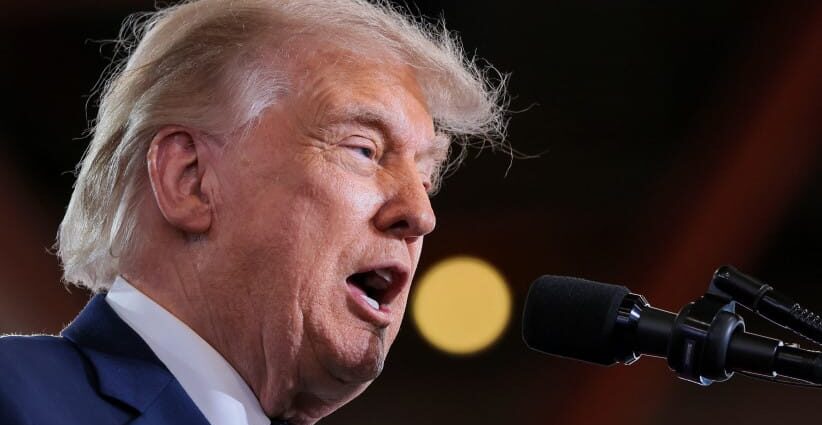
Trump teleprompter operator accused of placing insider bets on presidential speech scripts
US President Donald Trump’s longtime teleprompter operator is under investigation for potential insider trading on Trump’s speeches through online prediction markets, the White House said last Thursday.
Gabriel Perez, who has worked with Trump since his first presidential campaign in 2016, allegedly made trades on Kalshi, a prediction site where users buy and sell contracts based on the outcomes of real-world events, that were flagged as insider activity.
Kalshi’s “Mentions” platform, where Perez placed his bets, allows users to bet on which words or phrases public figures, such as Trump, will say in their speeches.
Since Perez is usually the last person to see Trump’s speeches before they’re delivered, he is often aware of any last-minute edits made by Trump himself to his remarks and knows what the president is going to say.
However, Trump is known to veer away from what’s on the teleprompter, and has said that he goes off script “about 80% of the time.”
Perez made $100,000 from insider trading before being put on administrative leave
Investigators found that during certain parts of speeches when Trump didn’t follow what the teleprompter said, Perez would back out of bets, since he knew the scripted words wouldn’t be said.
Bobby DeNault, the Head of Enforcement at Kalshi, said that their team “promptly flagged and referred these trades to the CFTC [Commodity Futures Trading Commission],” and they are “cooperating and assisting regulators” in the investigation.
Their findings show that Perez reportedly made nearly $100,000 by betting on several speeches, including a December primetime address, February’s State of the Union address, and a Medal of Honor ceremony in March. However, Kalshi froze the profits before Perez had the opportunity to withdraw them.
Federal prosecutors in Manhattan declined to press criminal charges, and Perez has had conversations with the CFTC regarding a settlement that would require him to forfeit his earnings and refrain from similar insider trading in the future.
Perez has previously faced scrutiny from federal investigators surrounding his edits to Trump’s speech about the attack on the US Capitol on January 6, 2021.
Following this latest investigation, Perez was placed on administrative leave. As a result, another employee operated the teleprompter for Trump’s speech to the nation last Thursday night about election integrity.
Karoline Leavitt, the White House Press Secretary, said that the president knows about the reports regarding his teleprompter and “believes it’s deeply unfortunate and frankly a disgrace.”
“The White House has extremely strict ethical guidelines with respect to issues like this, and as I just told you, this individual will no longer be here,” Leavitt added.
In March, the White House had issued a memo warning its staff against insider trading on prediction markets.
“All White House employees are reminded that the misuse of nonpublic information by government employees for financial benefit is a very serious offense and will not be tolerated,” the memo said. Notably, it mentioned prediction sites Kalshi and Polymarket by name.
Insider trading, prediction markets under review
Perez’s case comes amid a rise in federal scrutiny of insider trading, especially on prediction markets.
Earlier this year, the federal government brought insider trading cases involving prediction markets to court. These include a case against a soldier named Gannon Van Dyke, who used classified information to bet on the capture of former Venezuelan president Nicolás Maduro in January, and another against a Google employee who used internal company data to bet on search trends.
Politicians from both sides of the aisle have recently joined in a bipartisan effort to impose stricter insider trading restrictions to eliminate corruption, especially in government.
Republican Senator Todd Young (Indiana) has said that there are “real concerns that individuals with access to sensitive, nonpublic information could exploit that advantage for financial gain.”
“The prediction markets industry can’t be left alone to self-police,” Senator Adam Schiff (D-California) echoed. “That’s why we need strong rules to protect against elected officials exploiting insider information to profit on prediction markets.”
Congressional Democrats sent a letter to the CFTC in April, asking it to address the “rapid erosion of integrity” on the prediction markets.
They have also proposed several laws to limit insider trading for government officials and for specific topics such as elections and war.
The Senate unanimously passed a resolution banning insider trading by Senators and their staff on prediction markets at the end of April. A similar resolution in the House of Representatives has advanced out of committee but has yet to reach the floor for a vote.

Israel looks toward record-breaking election season with over half a million first-time voters
A record 595,000 Israelis between the ages of 18 and 22 are expected to cast ballots for the first time in the election for the 26th Knesset, according to an analysis published Wednesday by geographic and demographic data firm Points Location Intelligence.
First-time voters are expected to account for about 8.7% of all eligible voters in the upcoming election, the largest such wave since the establishment of the state. This unusually large share could affect the political balance of power in several parts of the country.
The election will mark the entry of a new and significant generation into Israel’s political arena. According to the Points analysis, the number of eligible voters is expected to reach approximately 6.8 million, an increase of about 9.4% from the November 2022 election for the 25th Knesset, when approximately 6.2 million Israelis were eligible to vote.
Jerusalem is expected to record the country’s largest increase in voters, with approximately 60,000 people eligible to cast ballots for the first time.
That is three times the number expected in Tel Aviv-Jaffa, which ranks second with about 20,000 new voters.
Bnei Brak follows with approximately 19,000 new voters, followed by Haifa with about 15,000, Petah Tikva with about 14,000, Rishon Lezion with about 13,500, Ashdod with about 13,000, and Beersheba with about 12,000.
In the 2022 election, the parties that later formed the governing coalition received approximately 75% of the vote in Jerusalem. United Torah Judaism was the city’s largest party, receiving about 24% of the vote.
Israel’s youngest community members
Kfar Kesef leads the list of communities with the highest proportion of new voters, at 69%, followed by Beit Berl at 64%, Migdal Oz at 53%, and Kerem B’Yavneh at 50%.
Most are small communities characterized by educational institutions, young populations, or rapid population growth.
Among Israel’s major cities, Elad stands out, with new voters accounting for about 24% of all eligible voters, an unusually high share compared with other cities.
Established communities see slower electoral renewal
The analysis also found a link between socioeconomic status and the rate at which new voters are joining the electorate. In communities ranked in the middle and upper socioeconomic clusters, new voters generally account for only 7% to 8% of eligible voters.
By contrast, the highest rates of electoral renewal were recorded in areas with large haredi and Arab populations, most of which are concentrated in the lower socioeconomic clusters.
The data also show that women make up a slight majority of new voters. Approximately 303,000 women, or 50.9% of all new voters, are expected to cast ballots for the first time, compared with about 292,000 men, or 49.1%.
Haredi population drives electoral growth
The analysis found that the haredi population is Israel’s primary driver of electoral growth. Approximately 105,000 new voters come from the haredi sector, which accounts for about 16% of all eligible voters, nearly twice the national average.
In other words, one in every six eligible voters in the haredi sector is a new voter.
By comparison, new voters account for approximately 12.2% of eligible voters in the religious-Zionist sector, about 10.6% in the Arab sector, and only about 7% in areas without a dominant sectoral affiliation.
More than 118,000 young Arab Israelis are expected to vote for the first time in the upcoming election, the highest number of new voters among all sectors. The religious-Zionist sector also recorded a relatively high number of new voters, with approximately 35,000.
Women make up a significant proportion of new voters across all sectors. In the haredi sector, they account for about 54% of new voters, while in the Arab and religious-Zionist sectors, they account for about 52%. In areas without a dominant sectoral affiliation, women make up about 50% of new voters.
“The upcoming election is expected to be significantly influenced by the entry of hundreds of thousands of new voters into the voting population. The data show that the haredi and Arab publics continue to display the highest rates of electoral renewal in Israel, while in the larger and more established cities, the rates at which new voters are joining are significantly lower,” said Yafit Ben Haim, CEO of Points, which specializes in collecting and analyzing geographic and demographic data for businesses.
“Ahead of the election, we are seeing that the parties have adopted a model from the business world, which involves analyzing data while understanding its demographic impact. In other words, determining which communities, sectors, and socioeconomic groups the new voters come from,” she added.
“This data helps provide an understanding of what motivates them, which issues are important to them, and how they can be influenced. This will be one of the decisive factors in the October 2026 election.”

Greece to approve purchase of €3.5 billion air defense system from Israel, sources say
Greece‘s security council, KYSEA, is expected to give its final approval on Thursday for the purchase of a multi-layer air defense system from Israel, worth up to €3.5 billion ($4 billion), and several types of drones, two sources told Reuters.
KYSEA gave its initial approval earlier this year and is expected to approve the procurement contracts, an official with knowledge of the deal told Reuters.
Greece wants to build a multi-layer anti-ballistic, anti-aircraft and anti-drone system, called “Achilles Shield”. Israeli radars and missiles from Rafael and Israel Aerospace Industries (IAI) will form the core of the system.
The Greek government has said it plans to spend about €28 billion by 2036 to modernize its armed forces, including buying up to 40 new F-35 fighter jets from the US and frigates from France and Italy.
Greece spends nearly 3.5% of gross domestic product on defence, a higher proportion than many fellow NATO countries, due to its long-standing dispute with Turkey.
With strong economic and diplomatic ties, Greece and Israel operate an air training centre on Greek territory, hold joint military annual drills and cooperate on anti-drone systems and cybersecurity.
Greece previously approved purchase of 36 Israeli artillery systems
Greece last year approved the purchase of 36 Israeli-made rocket artillery systems for about €650 million.
“KYSEA will also approve the purchase of drones from the US and Israel,” said the official.
A second official confirmed the information on the defense system from Israel and the purchase of drones.
Greece currently uses US Patriot and old Russian S-300 systems to protect its airspace.
The Defense Ministry declined a request from The Jerusalem Post to comment.
Yonah Jeremy Bob contributed to this report.
Five security personnel killed, six civilians injured in shooting, pipe bomb attack in Thailand
Five Thai security personnel were killed and six civilians, including two young children, were injured in an attack in Thailand‘s restive deep south, the military said on Thursday.
About 10 assailants dressed in black and wearing black brimmed hats arrived in a pickup truck and on motorcycles before launching an attack on a roadside checkpoint in Narathiwat province late on Wednesday using military-grade firearms and pipe bombs, the military’s Internal Security Operations Command Region 4 said in a statement.
Five paramilitary rangers were killed in the attack, and six civilians were wounded, including a three-year-old girl and a 10-year-old boy.
Authorities said the attackers seized three AK-47 rifles, three bulletproof vests, and several mobile phones from the checkpoint before fleeing. Security forces later found the pickup truck used in the assault abandoned and set ablaze about 13 miles from the scene.
As with most attacks in Thailand’s deep south, no group immediately claimed responsibility.
ความคืบหน้าเหตุคนร้ายก่อเหตุยิงและขว้างระเบิดไปป์บอมบ์ใส่จุดตรวจบูเก๊ะซามี เจ้าหน้าที่พบรถที่ใช้ก่อเหตุถูกเผาทิ้งในพื้นที่ อ.ศรีสาคร จ.นราธิวาส
จากกรณีคนร้ายใช้อาวุธปืนยิงและขว้างระเบิดไปป์บอมบ์ใส่จุดตรวจเทศบาลบูเก๊ะซามี เขตเทศบาลตำบลตันหยงมัส อำเภอระแงะ จังหวัดนราธิวาส… pic.twitter.com/TemlSVTGBF— กองทัพบก Royal Thai Army (@armypr_news) July 23, 2026
The government condemned the attack as an act of terrorism that posed “a serious threat to national security” and undermined ongoing efforts to revive the peace process, government spokeswoman Rachada Dhnadirek said in a statement.
Security forces clash along Thailand’s southern border
Thailand’s southern border region along the frontier with Malaysia has been the scene of a decades-long, slow-burning insurgency, with security forces battling groups seeking independence for the predominantly Muslim, ethnically Malay provinces of Pattani, Yala, Narathiwat and parts of Songkhla.
The region was once part of the independent Malay sultanate of Patani before it was annexed by Siam under a 1909 treaty with Britain.
The latest phase of the conflict erupted in 2004 and has claimed more than 7,800 lives, according to conflict monitor Deep South Watch.
Peace talks between the Thai government and several insurgent groups began in 2013 under Malaysian facilitation but have repeatedly stalled, yielding little tangible progress.
Prime Minister Anutin Charnvirakul has pledged to revive negotiations with the main insurgent group, the Barisan Revolusi Nasional, after appointing a new chief negotiator in April, although formal talks have yet to resume.
In a rare public statement earlier this month, the BRN said dialogue remained the only viable path to resolving the conflict and expressed appreciation for Malaysia’s continued role as facilitator.
STAT+: FDA staff and peptide enthusiasts set to clash at advisory panel
As more Americans experiment with synthetic peptides despite warnings about their unproven benefits and potential risks, an advisory panel to the Food and Drug Administration will meet on Thursday and Friday to discuss changes that could make peptides more accessible.
At issue is whether to allow compounding pharmacies to manufacture seven peptides that are currently designated as unsafe for them to make. The panel discussion is expected to be unusual in more ways than one.
First, many of the newly appointed members on the panel hold what critics (including FDA staff) say are conflicts of interest. The panel roster includes several physicians who prescribe peptides to patients as well as pharmacist and Tennessee state Sen. Bobby Harshbarger, whose mother, U.S. Rep. Diana Harshbarger (R-Tenn.) has advocated for looser peptide regulations. Many of these panelists were selected by the Health and Human Services Department, FDA officials previously told STAT.

Opinion: Good riddance to bundled ‘global’ maternal care billing
A change is coming to the codes OB-GYNs use to bill for maternity care services: Starting Jan. 1, 2027, we will shift from a bundled “global obstetric payment” to a fee-for-service model. This change impacts almost every U.S. family with a pregnancy. Under the current system, families receive a bill that does not distinguish the actual prenatal and postpartum costs from labor and delivery, which makes things incredibly confusing for patients.
In fact, the bundled payment’s impacts have been widespread: It has complicated billing for patients and clinicians, limited access to care, cut back the ability to provide patients with more personalized care, and slowed progress in better understanding U.S. maternal health outcomes.

Opinion: New billing codes likely to raise maternity care costs
The approach to paying obstetricians and midwives is changing. These changes will likely raise the cost of childbirth, with no guarantee of better maternity outcomes.
The American Medical Association (AMA), at the recommendation of the American College of Obstetrics and Gynecology, will eliminate the global payment codes for deliveries used by obstetricians and midwives at the end of this year. The AMA will replace these global fees, where health plans paid for professional services based on a single bill after delivery, with fee-for-service, or pay-as-you-go, codes for prenatal and postpartum visits, fetal monitoring, and various procedures.

STAT+: Trump promised redemption for troops who refused Covid shots. A year later, many are still waiting
STAT is co-publishing this article by The War Horse, an award-winning nonprofit news organization educating the public on military service and veterans.
When the Covid-19 vaccine was released in 2020, Daniel Pendergast was intrigued.
“I honestly thought it sounded kind of ingenious at first,” he said.

Home Sales Slump Drives Mortgage Incentives Higher as Affordability Crisis Persists
ATLANTA — PulteGroup reported Wednesday that second-quarter profit declined as elevated mortgage rates and persistent affordability challenges continued to weigh on homebuyer demand, prompting the homebuilder to expand financing incentives to maintain sales. The results, released in the company’s quarterly earnings report, underscore the continued strain facing the U.S. housing market despite steady demand for new homes.
The company said higher borrowing costs remain the biggest hurdle for prospective buyers, leading it to offer more mortgage-rate buydowns and closing-cost assistance rather than broad price reductions. While customer traffic has remained relatively stable, affordability continues limiting purchasing decisions across many markets.
Mortgage rates remain significantly above the historic lows seen earlier this decade, leaving many first-time buyers unable to qualify for homes they could have afforded just a few years ago. Existing homeowners also remain reluctant to sell because doing so would require replacing their low-rate mortgages with substantially more expensive financing.
The effects extend well beyond residential construction. Slower home sales affect mortgage lenders, furniture retailers, appliance manufacturers, moving companies, building suppliers and local contractors that depend on a healthy housing market.
Builders have largely resisted widespread price cuts, choosing instead to preserve home values through targeted financing incentives. Industry executives believe this strategy better positions the market should borrowing costs eventually ease and buyer demand strengthen.
Housing remains one of the most closely watched sectors of the U.S. economy because it influences consumer spending, employment and manufacturing activity. Economists continue monitoring whether affordability conditions improve enough to stimulate additional sales during the second half of the year.
Investors will now turn their attention to upcoming housing starts, existing-home sales, mortgage application data and future Federal Reserve decisions for additional clues about the direction of the residential real estate market.
JBizNews Desk | Atlanta
© JBizNews.com. All Rights Reserved. Reproduction or distribution without written permission is prohibited.




The silence after the breach is the part you control
A ransomware group posts a lender’s name on a dark web leak site. Terabytes of loan files, Social Security numbers, bank account details, employee records. The clock the public sees starts there. The clock that matters started weeks or months earlier, the day the intrusion was detected. And in the gap between those two moments, while the company says nothing, the most damaging part of the event is already underway.
The mortgage industry has a breach problem. Since January, at least five nonbank lenders have disclosed prior hacks. One Long Island lender detected unauthorized network activity in May 2025 and did not notify affected employees until March 2026, a delay a subsequent lawsuit puts at more than 260 days past the statutory deadline. These are not outliers. They are the pattern.
But the breach itself is not the story worth telling. Lenders will keep getting attacked, because lenders hold exactly what attackers want. The story is what happens in the silence afterward, and how much of that silence is a choice.
The long tail of a loan file
Start with what makes mortgage data uniquely toxic when it leaks. Lenders retain records for decades. When one large servicer was breached, the exposed data reached back to customers who had originated loans in 2001, people who had paid off their mortgages and had no reason to think the company still held their Social Security numbers.
A breach at a mortgage company isn’t a snapshot of current customers. It is an archive. The 2024 loan file that funds a fraudulent application in 2027 is the same file sitting in the export a ransomware group just posted.
That long tail is also a legal and reputational one. The moment data hits a leak site, the ecosystem activates. Plaintiffs’ firms file investigations within days. Claims aggregators stand up intake portals. State attorneys general open inquiries. One recent nonbank breach produced a settlement valued at more than $86 million. None of that resolves quickly. Rather than a one-day IT incident, a breach is a multi-year event that touches the balance sheet, the regulators and the brand, and it begins the moment the company goes quiet.
Here is where the silence becomes a choice.
Forensics and notification run on different clocks
The most common defense of a months-long delay is that the investigation was ongoing. Forensics take time, the reasoning goes and you can’t notify people until you know what was taken. The first half of that is true. The second half is where companies get the sequence backward.
Notification and forensic certainty run on two different clocks. Nearly every state breach notification statute triggers on discovery, when the organization knew or should have known, not on the completion of the forensic report. The deadlines are tightening.
California moved to a fixed 30 days from discovery as of January 2026 under SB 446, replacing a vaguer “without unreasonable delay” standard, and a growing number of states now run their clocks from the moment of discovery. Some make the point explicit, requiring notice to the state attorney general within the window even while the investigation is still ongoing. The law itself does not allow a company to wait for certainty.
The cost of a shrinking window
For a lender operating in 15 states, the obligation isn’t one clock but 15, each triggered at discovery, each running while the forensic picture is still developing. The honest operational answer is to build to the strictest combined standard and let counsel narrow it per incident, not to assemble the response under deadline pressure after the fact.
A breach victim refreshing their bank statements doesn’t need the final forensic report. They need to know early that they may be exposed and what to do about it. Every day of silence is a day they don’t know to freeze their credit, and a day the company chooses silence, letting the story be written for them. By the time a polished, fully-investigated notification arrives months later, the narrative has already hardened: not “they were attacked,” but “they knew and said nothing.”
Containing the breach is a security function. Communicating about it is a separate discipline, on a separate timeline, and waiting for the security work to finish before beginning the communications work is the error that turns a bad week into a bad year.
Building reputational defense before the breach
The fix is not faster forensics. It is readiness built before the event. A company that has already worked through its breach scenarios, drafted its holding statements, mapped its notification obligations across every state it operates in and rehearsed who says what to whom is ready when the breach comes. It can put out a credible, responsible acknowledgment within hours of confirmation, while the forensic investigation proceeds in parallel. A company starting from zero at 11 p.m. on a Sunday cannot, and the hours it loses assembling a response are the hours the silence costs it most.
Reputational readiness is infrastructure. It belongs in the same category as the security controls and the legal review every serious lender already maintains, because the reputational exposure is as real as the regulatory one and far less defended. The breach you cannot prevent. The silence after it, you can.
Mitch Cohen is the founder of ClearLine, a crisis communications readiness and response platform for mid-market organizations and the enterprises that serve and oversee them. He has 25 years of experience in strategic communications across fintech, data, and regulated industries.
This column does not necessarily reflect the opinion of HousingWire’s editorial department and its owners. To contact the editor responsible for this piece: zeb@hwmedia.com.

U.S. Trade Chief Seeks Interim USMCA Deals by Year-End to Reduce Business Uncertainty
WASHINGTON — U.S. Trade Representative Jamieson Greer said Wednesday he is working to reach interim trade arrangements with Canada and Mexico before the end of the year, providing businesses greater certainty while the formal review of the United States-Mexico-Canada Agreement (USMCA) continues. Greer outlined the administration’s objective during remarks on the ongoing negotiations, signaling an effort to avoid disruptions to North America’s deeply integrated supply chains.
The USMCA governs more than $1.8 trillion in annual trade among the three countries and serves as the foundation for cross-border commerce involving automobiles, agriculture, energy, manufacturing, electronics and consumer goods. Businesses have been seeking greater clarity as negotiations over the agreement’s future continue.
Greer said interim arrangements could help companies make investment and production decisions without waiting for the completion of broader negotiations. Manufacturers, retailers and logistics firms have warned that prolonged uncertainty surrounding tariffs and trade rules complicates long-term planning and increases operating costs.
The automotive industry remains among the sectors most affected. Vehicles assembled in North America often cross the U.S., Canadian and Mexican borders multiple times before reaching dealerships, making stable trade rules essential for production schedules and supply-chain efficiency.
Agricultural producers are also closely watching the talks. The United States exports billions of dollars in corn, soybeans, dairy products, meat and other agricultural goods to Canada and Mexico each year, while American consumers rely heavily on imported produce and manufactured food products from both neighboring countries.
For consumers, the outcome could influence the prices of automobiles, groceries, appliances, construction materials and other imported goods. Business groups have argued that reducing uncertainty can help stabilize supply chains and limit additional costs that may eventually be passed on to customers.
Financial markets viewed Greer’s comments as a sign that the administration is seeking continuity rather than disruption in North American trade while preserving flexibility for future negotiations. Companies with operations spanning all three countries are expected to monitor every stage of the review process closely.
Additional meetings among U.S., Canadian and Mexican trade officials are expected in the coming months as negotiations continue toward the scheduled review of the agreement.
JBizNews Desk | Washington
© JBizNews.com. All Rights Reserved. Reproduction or distribution without written permission is prohibited.
Non-agency is not subprime. The mortgage industry needs to start acting like it.
In the mortgage industry, no word carries more stigma than subprime. For anyone who lived through 2008, it brings up memories of falling home values, rising foreclosures and a financial system that nearly came apart at the seams. Pinning that same reputation on non-QM lending is a mistake the industry can no longer afford.
In the years since the crisis, the industry has unfairly lumped non-QM borrowers in with subprime borrowers. That misconception is costing the industry more than it realizes and doing real damage to borrowers who deserve better from the system designed to serve them.
To understand why, it helps to remember what subprime actually was, because it was not one thing. It started with a legitimate purpose. Subprime and its close cousin Alt-A were built for borrowers with real income who struggled to document it through conventional means. Those early products carried reasonable discipline and served people who were genuinely creditworthy but poorly served by a system built around W-2s and tax returns.
Then the guardrails came off. Lenders started offering stated-income loans, where borrowers could write down whatever income they wanted, and no one checked. Then came NINJA loans, which stood for No Income, No Job, No Assets, where the borrower did not need to prove anything at all. By the mid-2000s, the original idea had been buried under products handed to people with no realistic shot at repaying them.
Non-QM was built to meet the legitimate need to serve borrowers who did not fit the agency credit box, but it operates under an entirely different set of rules. The borrowers it serves are not people who cannot afford their homes. They are people whose financial lives do not cleanly translate into government forms.
According to Nomura’s 2026 Securitized Products Outlook, non-QM loans originated in the second quarter of 2025 carry the highest credit scores the sector has ever recorded. Since the fourth quarter of 2022, lenders have reduced the share of low-FICO and high-LTV loans by approximately 50%.
The credit box has tightened over time, not widened, despite the sector’s nearly nine-year existence. The trajectory runs in the exact opposite direction of what the market took heading into 2008.
The workforce changed, but the underwriting didn’t
Agency lending was designed for salaried employees with a W-2, buying a modest home, planning to pay it off over thirty years and staying put. That model made sense when it was drawn. That now describes a shrinking share of Americans’ actual earnings.
Estimates of the self-employed population range from 16.5 million to more than 27 million, depending on how you measure it, according to the Center for American Progress. All measures agree that these are not marginal earners.
Self-employed workers generate $156,000 in annual income on average, compared to $123,000 for traditional wage earners, according to St. Louis Federal Reserve data. The people the conventional mortgage system most often turns away are, in many cases, among the most financially capable people in the market.
The problem with conventional underwriting is that it reads a tax return and makes a decision. For many self-employed borrowers, that tax return won’t tell the whole story. For example, business owners who write off legitimate expenses, pay themselves through a pass-through entity or have income that fluctuates seasonally can appear to be a credit risk on paper, even when they are anything but.
Non-QM underwriting gives lenders room to ask different questions. Instead of “What does your tax return say?” it asks, “What does your actual financial situation look like?” A borrower with 12 months of consistent bank deposits and 30% down is not a risk. They are a paperwork problem, and there is a big difference between the two.
Regulatory environment prevents a subprime repeat
The subprime collapse was about more than bad loans. It was about what happened to those loans the moment they were made. Lenders were packaging mortgages and selling them off within days, meaning they had no financial incentive to care whether the borrower ever made a payment. That was somebody else’s problem now. When you remove that accountability entirely, you get a machine that actively rewards lenders for making these bad loans.
Dodd-Frank addressed this directly. Under the Credit Risk Retention Rule, finalized by six federal agencies in 2014, sponsors of mortgage-backed securities must retain at least 5% of the credit risk of the assets they securitize. They cannot offload or hedge that position during a specified holding period.
The rule exists to make sure the people packaging and selling mortgage securities have real money on the line if those securities fail. The originate-to-distribute model that triggered the subprime collapse now carries a mandatory cost.
The Ability-to-Repay framework goes even further. Every lender, including non-QM lenders, must verify that the borrower can afford the loan before closing. We are talking about a full review of income, assets, employment, monthly debt obligations and credit history. Non-QM lenders go through the same exercise.
The difference is that instead of a W-2 and a tax return, they might use 12 months of bank statements or an asset schedule. The documentation looks different. The standard does not.
And here is the part of the argument the industry rarely makes loudly enough. A QM lender gets a legal safe harbor if a loan goes sideways. A non-QM lender gets no such protection. When a non-QM loan defaults and enters litigation, the lender must prove that the underwriting was sound. The system punishes bad non-QM underwriting in a way the subprime market of 2005 never did.
Non-QM volumes rising
The numbers tell the story pretty clearly. According to Nomura’s 2026 Securitized Products Outlook, non-QM origination volumes are on track to reach $150 billion in 2025, up from $50 billion in 2022, with room to reach $180 billion if rates decline. Non-QM hit a record 8% share of total mortgage origination volume in July 2025, up from around 5% the year before.
More originators are offering it, more issuers are bringing deals to market and the institutional investors coming into the secondary market, insurance companies, pension funds and private credit funds are not the kind of buyers who take on risk without doing their homework.
There is one risk worth being straight about. Nomura points out that as volumes grow and more lenders pile in, there will be pressure to loosen credit standards. That has happened before, and it could happen again. The rules put in place after 2008 make it harder than it was, but rules only work if the people following them actually care about why they exist. The subprime era did not fail because there were no guidelines. It failed because the people running the machine stopped asking whether any of it made sense.
Non-QM lending is not a concession to risk. It is the mortgage industry updating its picture of who a creditworthy borrower actually is in an economy where income is increasingly non-linear, non-traditional and no longer tied to a single employer sending out W-2s every January.
The subprime era failed because lenders stopped asking whether borrowers could repay. Non-QM is defined, legally and practically, by the requirement that they must. Those are not the same thing. They were never the same thing.
Victor Kuznetsov, Managing Director, Imperial Fund Asset Management
This column does not necessarily reflect the opinion of HousingWire’s editorial department and its owners. To contact the editor responsible for this piece: zeb@hwmedia.com.


Wisconsin police shoot man during arrest attempt, sparking controversy over use of lethal force
Content warning: This article contains disturbing video and descriptions of violence. Reader discretion is advised.
Police officers in Madison, Wisconsin, fatally shot a man they were trying to arrest on Wednesday during a street-corner scuffle, which was recorded by onlookers and went viral on the internet, sparking protests in the city.
Police said the officer who fired his weapon was injured by a knife that the man produced during the struggle.
Bystander video of the incident circulating online and on news media outlets suggested the man who was shot was a person of color, and all four officers involved in the incident appeared to be white.
As in many other deadly police shootings in the US in recent years, race added to tensions over whether lethal force was justified, with an African-American community advocacy group saying the man shot in Wisconsin’s capital city was Black.
Speaking to reporters at a news conference, Madison Police Chief John Patterson described the man who was killed only as a male in his 30s, and declined to specify his race, or the race of any of the four officers – three men and one woman.
GRAPHIC VIDEO: 12 News obtained video of today’s deadly police shooting in Madison. Police say the man killed was armed with a knife and injured an officer. https://t.co/jdutkrmHCN pic.twitter.com/vxQU9vRrUJ
— WISN 12 NEWS (@WISN12News) July 23, 2026
Patterson said the incident unfolded when police responded to a call about a person who was suspected of “checking parked vehicles” in the Marquette neighborhood of Madison, the capital city of Wisconsin. When police located the man and tried to make contact with him, he fled on a bicycle.
Officers caught up with him about 30 minutes later, and the scuffle ensued after the man “either fell off or was taken off the bicycle by officers,” the police chief said.
Independent investigation into involved officers ordered
Patterson said an “independent” investigation would be conducted by the Wisconsin Department of Justice’s criminal division, and that all four officers would be placed on administrative leave.
The police chief said he had reviewed two bystander-filmed video clips circulating online, but said there was additional footage that had not been widely seen, and he asked the public not to jump to conclusions.
Asked whether he would classify the shooting as an apparent case of excessive use of force, Patterson answered, “I can’t determine that.”
The video going viral presents “one perspective” of the incident, he said, adding, “it is not a full overview of everything that was visible from different angles.”
The video online shows the four uniformed officers grappling with the man amid shouts of “Let go” and “he’s got a knife.”
In one clip, an officer is heard yelling “Taser” as police clutch at the man. Seconds later, the man is forced to the ground, and one officer stomps on his legs as another pulls his gun and fires three shots. That officer then appears to re-holster the weapon and kneel down to the man, who has stopped moving.
Police Chief says three shots fired by a single officer
Patterson said it appeared to him, also, that there were three shots, and all were fired by a single officer, who he described as a “veteran” of the department.
He said the officer who fired his weapon did so after he had suffered injuries from a “large, fixed-blade knife” that the man had “pulled out or produced” moments before while police were trying to subdue him as he resisted arrest.
A second officer suffered an unspecified injury during the confrontation, according to the police chief.
Between the emergence of the knife and the gunfire, another officer attempted to immobilize the man with a Taser stun gun, but the device, for unknown reasons, proved ineffective, Patterson said.
How much time elapsed between the knife emerging and the shots fired was not clear, he said. But an object that may have been the knife is seen on the ground from the start of the video clip, which did not capture the beginning of the struggle.
News media images showed crowds of demonstrators gathering and marching down the state Capitol in protest after the shooting.
Execution is the edge mortgage banks can control
When rates surged and the mortgage market shifted almost overnight, lenders were forced into difficult decisions. Growth plans changed. Costs were reassessed. Teams had to adapt quickly to a different operating reality.
At Atlantic Bay Mortgage Group, that moment reinforced a simple truth: While market conditions are outside your control, organizational alignment is not.
In cycles like this, success isn’t defined by who has the boldest strategy. It’s defined by who executes with discipline and who can communicate priorities clearly, maintain accountability, solve problems quickly and stay focused as conditions change.
As a CFO, I’ve seen this repeatedly. Strategy sets direction, but execution determines outcomes.
Finding the right framework: The EOS advantage
Many independent mortgage banks don’t struggle because they lack talent or ideas. They struggle when priorities become unclear, communication breaks down and accountability becomes inconsistent. In a business as complex as mortgage banking (spanning sales, underwriting, capital markets, compliance and servicing), even strong strategies can stall without a system to keep teams aligned.
That realization led Atlantic Bay to adopt the Entrepreneurial Operating System (EOS), a framework built to improve alignment, accountability and execution.
Our CEO was introduced to EOS through a peer in his Young Presidents’ Organization (YPO) network. He saw how another company used it to drive alignment and believed it could help us scale more effectively while keeping our most significant asset at the forefront-culture.
What resonated wasn’t a new strategy. It was a better way to execute the one we already had.
The power of organizational alignment
Mortgage banking requires coordination across functions that must stay aligned despite constant market shifts. EOS gave us a consistent structure for how we define and implement our vision and strategy, meet, communicate, solve issues and track progress. More importantly, it created discipline within our leadership to focus on what matters most.
The clearest impact was alignment.
When teams understand company priorities (and how their work connects to them), decision-making accelerates. Leaders spend less time clarifying direction and more time addressing opportunities and mitigating risks as they arise. Across the organization, energy shifts from debating priorities to executing against them.
EOS also strengthened accountability.
Accountability as a tool for clarity, not restriction
Accountability is often misunderstood as restrictive. In practice, it creates clarity. High-performing teams want to know what success looks like, who owns what and how their work contributes to broader goals.
A structured operating framework defines ownership, increases transparency and surfaces issues early, before they become larger problems.
From a financial perspective, that discipline matters. Performance reflects thousands of decisions made across the organization every day. The more aligned those decisions are, the more consistent and predictable outcomes become.
One of the most meaningful impacts, however, has been cultural.
Sustaining culture as a competitive advantage
As organizations grow, culture becomes harder to sustain through informal communication alone. EOS helped us clearly define our core values and integrate them into our operations. That has made it easier to reinforce expectations, guide decisions and maintain consistency as we scale.
In today’s environment, that clarity is a competitive advantage.
Attracting and retaining talent requires more than compensation. People want to understand how decisions are made, how success is defined and how their work contributes to something larger. More importantly, people want to understand how they can evolve and grow within their careers and in the company. Organizations that provide that clarity are better positioned to build engaged, resilient teams.
It’s also important to address a common misconception: EOS is not a strategy.
Execution as the ultimate differentiator
Leadership still has to define the vision, make critical decisions about growth and risk and set direction. EOS doesn’t replace that work. It provides a framework to execute those decisions with greater discipline and consistency.
Could other independent mortgage banks benefit from a system like EOS? In many cases, yes.
Not because EOS is a one-size-fits-all solution, but because every IMB faces the same core challenge: maintaining alignment across a complex organization in a cyclical, rapidly changing market.
The specific framework matters less than the commitment to disciplined execution.
The mortgage industry will continue to evolve. Market cycles will shift. Technology will advance. Borrower expectations will change. Leaders can’t control those forces. But they can control how their organizations communicate, align and execute.
In my experience, that’s what separates companies that react to change from those positioned to lead through it. Because in mortgage banking, execution isn’t just an operational necessity. It’s a competitive advantage.
Morgan Wise, CFO at Atlantic Bay Mortgage Group.
This column does not necessarily reflect the opinion of HousingWire’s editorial department and its owners. To contact the editor responsible for this piece: zeb@hwmedia.com.




IRGC says it struck, damaged US Patriot missile system, helicopters in Kuwait – report
Iran’s Islamic Revolutionary Guard Corps (IRGC) claimed to have struck and damaged US military equipment stores, drones, helicopters, and a Patriot missile system at bases in Kuwait on Thursday, according to Iranian semi-official state news outlet Fars News Agency.
According to Fars, the IRGC stated that in retaliation for what it described as US interference in the Strait of Hormuz, it struck a US military equipment warehouse and a Patriot missile system at Kuwait’s Ali al-Salem Air Base.
It also claimed to have heavily damaged US helicopters and drones at a separate base, in addition to a telecommunications tower.
Earlier on Thursday morning, Kuwait’s army stated that it had confronted a wave of Iranian drone attacks.
IRGC claims oil tanker caught fire after hitting mine in Strait of Hormuz
The IRGC also claimed that an oil tanker attempting to transit the Strait of Hormuz caught on fire after hitting a mine in the waterway.
Claiming responsibility for planting the mine, the IRGC said that it maintains control of the strait and asserted that as long as US forces remain in the region, the Strait of Hormuz will remain closed to all oil tankers.
On Wednesday, US Central Command (CENTCOM) disputed Iranian claims regarding the alleged closure of the strait, assuring that the waterway remains open for transit regardless of IRGC attacks.
🚫CLAIM: Today, Iran’s Islamic Revolutionary Guard Corps (IRGC) Navy claimed that it controls exit and entry to the Strait of Hormuz, suggesting that international mariners can only use routes the IRGC prefers. This is FALSE.
✅FACT: Iran does not control the Strait of Hormuz.… pic.twitter.com/CK7wZnpumH
— U.S. Central Command (@CENTCOM) July 22, 2026
CENTCOM stated that, while it is upholding a blockade on Iranian ports, commercial vessels continue to transit the strait with US military forces.

Houthis say they attacked Saudi tankers in Red Sea, threatening new oil chokepoint in Iran war
The Iranian-aligned Houthis said they struck two Saudi oil tankers as part of a naval blockade on Saudi Arabia on Thursday, threatening to create a second chokepoint on global oil supplies alongside Iran’s near-closure of the Strait of Hormuz.
Meanwhile, the US military said it launched a new round of strikes on Iran at President Donald Trump’s direction on Wednesday, marking a 12th successive night of American attacks.
The Yemen-based militants, who control areas near the Bab el-Mandeb Strait on the opposite end of the Arabian Peninsula from the Strait of Hormuz, said on Monday they were imposing a naval blockade on Saudi Arabia in what some analysts have viewed as a tactical move by Iran to seek leverage.
Even before the renewed threats to shipping traffic in the Red Sea, Iran’s near-total blockade of the Strait of Hormuz had stoked inflation around the world, pushing up oil prices and squeezing US gasoline consumers at a time when the unpopular war has put Trump’s Republican allies under pressure ahead of congressional elections in November.
Five tankers changed course in the Red Sea to avoid the Bab el-Mandeb Strait on Wednesday, and three tankers loaded with Saudi oil for China and India made U-turns on Tuesday.
The Houthis said their forces carried out missile and drone strikes on two Saudi oil tankers in the Red Sea, identifying them as the Encelia and the Layla.
Saudi state news agency SPA cited an official source as saying the Encelia was struck, causing a fire at the bow. The attack on the Layla remained unconfirmed.
A maritime security source said Encelia had transmitted a distress call, reporting it had been struck by a missile near the Saudi port of Jizan in the Red Sea late on Wednesday. Millions of barrels per day of Saudi oil have been heading to the kingdom’s Red Sea port of Yanbu to avoid the Strait of Hormuz. If shipments cannot pass through the Red Sea’s southern strait, they have only the northern route through the Suez Canal, adding weeks and costs to the journey.
The Houthi threat to impose a naval blockade against Saudi Arabia could significantly widen the war and strain the US military, current and former US officials said.
Two Chinese very large crude carriers carrying a combined 4 million barrels of Saudi Arabian oil were heading toward the Bab el-Mandeb Strait on Thursday, shipping data showed.
Trump threatens infrastructure, Iran vows response
Before the Red Sea flare-up, Trump vowed on Wednesday to destroy an Iranian bridge or power plant every time Iran shoots at a ship in the Strait of Hormuz.
Iran’s joint military command in turn warned that if Trump’s threat against infrastructure was carried out, Iranian forces would target regional oil, gas, electricity and economic infrastructure and prevent the export of “even a single drop of oil,” Iranian state media reported.
Hours later, Iran’s Revolutionary Guards reported an explosion in what it called a mined route south of the Strait of Hormuz, saying one of three oil tankers had caught fire while the other two turned back. The Guards said the strait was under their control and “completely closed,” warning that no tanker would be allowed to enter or leave without coordination with Iran.
In 12 straight days of attacks since a June ceasefire fell apart, American strikes have widened from the south to western and central areas of Iran. The US military’s Central Command said it would continue to “further degrade” Iran’s ability to threaten ship traffic.
Iranian media reports said the US attacked a military target in Bushehr twice on Thursday, near the country’s only operating commercial nuclear power reactor, marking three strikes there in two days.
State TV reported two people were killed and 11 wounded in what a Khuzestan provincial official described as a US missile attack on the Shalamcheh border crossing with Iraq.
Despite claims from Washington that it has destroyed Iran militarily, Tehran has demonstrated it retains missile and drone capabilities.
Iran pounded vital water desalination and energy plants in Kuwait this week and struck US military assets there, in Bahrain and in Jordan.
Both Iranians and US service members killed, injured in the war
Each side has also reported an escalating human toll.
An Iranian health ministry official said 53 civilians had been killed and 592 wounded since late last month. Since the US and Israel launched the war on February 28, thousands of people have been killed and millions displaced.
The US military has said it never targets civilians, which could violate the 1949 Geneva Conventions on humanitarian conduct in war. Trump, however, has repeatedly threatened to attack civilian infrastructure, which may be targeted if it is also being used for military purposes, provided the civilian harm is not excessive.
The war has also led to the deaths of 18 US service members and injured more than 450 troops. Trump attended a ceremony on Wednesday at Dover Air Force Base in Delaware for four US service members killed in Iranian attacks on military bases over the last few days – three in Jordan and one in Iraq.
“For me it’s one of the hardest things to do as a president. But it has to be done,” Trump said before leaving for the ceremony.
Later, at a speech in Georgia, Trump struck a different tone, saying of the war, “I call it a skirmish.”
Israel’s most volatile election season begins with integrity warnings, coalition chaos
Watch this episode without interruptions.
Listen wherever you get your podcasts.
Israel’s upcoming elections are already shaping up to be among the most contentious in the country’s history, with concerns over voter integrity, inflammatory political rhetoric, and deepening coalition fractures dominating the national conversation.
In the latest episode of The Deep Dive, host Jacob Laznik and political correspondent Keshet Neev examined the week’s most significant political developments, including President Herzog’s disclosure that the Shin Bet has identified potential threats to the integrity of the electoral process, a warning that arrived the same day AI-generated campaign videos from the Likud party targeting opposition leader Gadi Eisenkot drew widespread criticism.
The episode highlighted mounting tensions both between and within coalition parties. Rabbi Landau, the spiritual leader of the Degel HaTorah faction, drew sharp backlash after remarks widely interpreted as accusing the IDF of murder, prompting a rare public condemnation from Prime Minister Netanyahu.
Meanwhile, minister of national security Itamar Ben-Gvir, declared that the dismissal of the attorney general would be a precondition for joining any future Netanyahu-led government.
Internally, Likud is contending with a divisive primaries dispute after Netanyahu secured the authority to personally appoint eight candidates to the party list, a decision that included a controversial wartime security clause granting him additional discretionary power.
Recent polling shows Eisenkot’s party overtaking Likud for the first time, though neither bloc has a clear path to forming a coalition. With new right-wing parties entering the fray, recently passed legislation on gender segregation in higher education drawing scrutiny, and questions emerging about the future of the US-Israel relationship, the full conversation offers a detailed look at the political dynamics likely to define the campaign in the months ahead.







Alphabet Lifts Spending Outlook Again to Fuel a Faster AI Buildout
Alphabet raised its capital-spending forecast for a second time this year on Wednesday, telling investors it will pour even more money into the data centers and computing power behind its artificial intelligence push — a move that delivered strong quarterly results but reignited Wall Street’s unease about the mounting cost of the AI race.
The Google parent now expects 2026 capital expenditures of $195 billion to $205 billion, up from the $180 billion to $190 billion range it set just last quarter and well above the roughly $186 billion to $188 billion analysts had penciled in. Chief Financial Officer Anat Ashkenazi told analysts the higher range reflects an acceleration in bringing new capacity online to meet demand that continues to outrun supply. She reiterated that spending is set to rise again in 2027.
The revised outlook cements Alphabet’s position at the leading edge of Big Tech’s infrastructure arms race, in which the largest technology companies are collectively committing hundreds of billions of dollars this year to build out AI capacity. It also underscores a shift in how the company funds that growth: Alphabet has already raised $80 billion in fresh equity capital to help pay for the buildout, breaking from its long-standing habit of financing expansion internally.
The spending came alongside a quarter that, on the surface, was one of Alphabet’s strongest in years. Revenue rose 24 percent from a year earlier to $119.8 billion, topping the roughly $117 billion analysts expected and marking the company’s 12th straight quarter of double-digit growth. Google Cloud was the standout, with revenue surging 82 percent to about $24.8 billion — a sharp acceleration driven by enterprise demand for AI infrastructure and services, and a figure that comfortably beat expectations. Cloud operating profit more than tripled from a year ago, and the division’s order backlog has swelled to roughly $460 billion, a pipeline of contracted revenue that management points to as justification for the heavy spending. Advertising revenue, still Alphabet’s largest business, came in at $81.63 billion.
The bottom-line numbers require a closer read. Alphabet reported net income of $112.1 billion and diluted earnings of $9.11 per share, figures inflated by a one-time equity gain of roughly $98 billion. Stripping that out, the picture is more mixed: adjusted earnings of about $2.85 per share came in just shy of the $2.89 analysts expected, and underlying net income actually slipped from a year earlier. Operating income, which strips out one-time items, rose about 30 percent to $40.8 billion — a cleaner measure of how the core business performed during the quarter.
Investors focused on the spending. Despite the revenue beat and the cloud acceleration, Alphabet shares fell more than 2 percent following the report, a reaction that captures the central tension hanging over the entire sector. The market has grown increasingly sensitive to AI capital expenditures all year, worried that the returns on record infrastructure investment are arriving more slowly than the bills. Alphabet’s raise — a second consecutive increase stacked on April’s — fed precisely that anxiety, even as the company argued the spending is buying real growth.
Alphabet does have a clearer path from AI investment to revenue than some of its peers. Google Cloud gives it a direct commercial channel to monetize the infrastructure it is building, an advantage over rivals whose AI returns are harder to trace. That distinction has helped Alphabet’s stock hold up better than those of several competitors in recent months. The company also continues to push its own custom silicon and AI products, and Chief Executive Sundar Pichai told analysts that its Antigravity AI coding tool has climbed to more than 2.4 million weekly active users.
Still, the core worry is straightforward. If each new dollar of capacity requires ever-larger outlays while cloud growth eventually cools, the cost of staying competitive in AI could rise faster than the payoff. For now, Alphabet’s booming cloud numbers and near-half-trillion-dollar backlog give management a strong answer to that concern. But by lifting its spending ceiling yet again, the company has raised the stakes on proving that its AI bet will keep converting into growth — and set the tone for a Big Tech earnings season in which investors will be scrutinizing every capital-spending line that follows.
JBizNews Desk | Mountain View, Calif.
© JBizNews.com All Rights Reserved. Reproduction or distribution without written permission is prohibited.


Chip Rebound Powers Asian Equities Higher Even as Crude Extends Climb
Asian equities advanced Wednesday as chip stocks extended a global rebound, with MSCI’s Asia Pacific Index gaining about 1% on the heels of Tuesday’s strongest rally in a month. It was a second straight day of gains for the region, with oil moving higher at the same time on renewed escalation in the U.S.-Iran conflict.
South Korea led. The Kospi surged 4.6% to 7,061.36, while Japan’s Nikkei 225 rose 1.9% to 67,511.12 after government data showed both imports and exports higher than a year earlier — figures inflated in yen terms by the currency’s weakness. Australia’s S&P/ASX 200 added 0.4% to 8,830.60 and the Shanghai Composite gained nearly 0.5% to 3,882.95, while Hong Kong’s Hang Seng bucked the trend, dipping 0.7% to 24,947.30.
Samsung and SK Hynix paced the regional advance as selling pressure from leveraged positions continued to unwind, following a more than 5% jump in a U.S. semiconductor index on Tuesday that pulled it out of bear-market territory after the prior week’s selloff.
Market Movers
Japanese chip names joined the run, with Advantest up 2.8% and Tokyo Electron adding 1.8%. Renesas Electronics gained more than 6% and SoftBank Group rose 1.1%.
The rally did not extend to U.S. futures. Nasdaq 100 futures slipped 0.4% and S&P 500 futures edged lower as traders positioned ahead of Alphabet’s results for a fresh read on AI-related spending.
Commodities and Currencies
Brent crude rose 1.4% to $92.25 a barrel during the Asian session after President Trump played down the prospect of near-term peace talks with Iran, and the move pushed U.S. Treasury yields to a two-month high. Crude kept climbing through the New York session, with Brent ultimately settling at $94.07.
Precious metals also gained, with gold climbing as much as 1.6% to roughly $4,142 an ounce and platinum higher alongside silver. In currencies, the yen stayed under pressure after weakening past 163 per dollar for the first time since 1986, with Japanese officials repeating warnings about the move. Separately, sources indicated the Bank of Japan is watching upside inflation risks that could bring rate increases faster than markets currently expect.
The split matters for importers: crude above $91 raises the energy bill for Asian economies that buy most of their fuel abroad and can widen trade deficits, even while a softer home currency flatters the local-currency earnings of exporters that sell in dollars. For tri-state importers sourcing from Asia, the combination points to firmer landed costs into the fall — currency gains on the invoice offset by freight and fuel surcharges on the way over.
JBizNews Desk | New York
© JBizNews.com All Rights Reserved. Reproduction or distribution without written permission is prohibited.

Amazon Cuts Jobs in AI Division as Tech Giants Tighten Spending While Racing for Leadership
SEATTLE — Amazon confirmed Wednesday that it has eliminated positions within its Artificial General Intelligence (AGI) organization as the company continues reshaping its artificial intelligence strategy while maintaining billions of dollars in AI investment. The layoffs were confirmed by Amazon and come as major technology companies increasingly redirect resources toward projects with the greatest commercial potential.
The workforce reductions affect a portion of Amazon’s AGI organization, the unit responsible for developing advanced artificial intelligence technologies that power products across Amazon Web Services, Alexa and the company’s broader AI initiatives. Amazon said it continues hiring in other AI-related roles and remains committed to expanding its artificial intelligence capabilities.
The move reflects a broader trend sweeping the technology industry. Rather than reducing AI spending, many companies are reallocating engineers and capital toward projects expected to generate faster returns as competition intensifies among the world’s largest technology firms.
Artificial intelligence has become the centerpiece of corporate technology investment over the past two years, prompting companies to spend hundreds of billions of dollars on advanced chips, cloud infrastructure, software development and data centers. At the same time, executives face growing pressure from investors to demonstrate that massive AI expenditures will translate into sustainable revenue growth.
For employees, the restructuring highlights a changing labor market within the technology sector. While hiring has slowed in certain divisions, demand remains strong for engineers specializing in machine learning, cloud computing, cybersecurity and AI infrastructure.
Businesses using Amazon Web Services are not expected to see immediate changes in service availability. The company continues expanding AI tools and enterprise offerings designed to help organizations automate operations, improve customer service and accelerate software development.
The announcement also underscores how technology companies are becoming more disciplined in managing expenses while simultaneously investing aggressively in strategic areas. Investors have increasingly rewarded companies that balance innovation with profitability rather than pursuing growth at any cost.
As earnings season continues, Wall Street will closely monitor whether similar workforce adjustments emerge across the technology sector as companies report financial results and update investors on AI spending plans for the remainder of the year.
JBizNews Desk | Seattle
© JBizNews.com. All Rights Reserved. Reproduction or distribution without written permission is prohibited.


CENTCOM completes latest round of strikes aimed to degrade Iranian attack capabilites on ships
The US military has completed a 12th consecutive night of strikes in Iran on Thursday morning, US Central Command (CENTCOM) said in a post on X/Twitter.
“US forces struck Iranian military targets including maritime capabilities, missile and drone storage facilities, coastal surveillance sites, and air defense assets,” CENTCOM said.
During the night, several explosions were heard in the southern Iranian cities of Sirik and Bushehr on Thursday morning, according to reports from local media.
— U.S. Central Command (@CENTCOM) July 23, 2026
“The mission will continue to further degrade Iran’s ability to threaten civilian mariners and commercial vessels transiting regional waters,” CENTCOM explained.
A second missile attack on Bushehr targeted a military site, Iran’s semi-official Fars reported.
US strikes on the Khuzestan province of Iran
Deputy Governor of the Khuzestan province reported that a location near the southwestern Iranian city of Ahwaz was targeted in US missile attacks, semi-official Mehr news reported.
Iranian state media SNN reported two dead after US strikes near the passenger terminal at the Shalamcheh border crossing with Iraq, citing a security official.
The Deputy Governor for Security and Law Enforcement in the Khuzestan Province initially said that the attack had resulted in no casualties or injuries, according to reports from the semi-official Tasnim News Agency.
A US missile also struck the outskirts of Andimeshk in the southwestern Iran, Tasnim reported.

On Tisha B’Av, Israel’s politics must reject hatred over unity – editorial
The video opens in a field of flowers. An AI-generated Gadi Eisenkot runs forward with his arms outstretched. Ahead stands a young man in a white shirt bearing the words “Israeli unity.” For a moment, the scene appears to show a reunion: a father moving toward a son, a bereaved nation moving toward the unity it has invoked since October 7.
Then Eisenkot turns away. He leaves the young man standing and embraces Ra’am leader Mansour Abbas instead. The Likud campaign message: Eisenkot speaks of unity, but will supposedly abandon it to form a government dependent on an Arab party.
Many Israelis saw something else. They saw Gal Eisenkot, the former IDF chief of staff’s son, who was killed fighting in Gaza in December 2023. The resemblance, whether intended or produced through carelessness, turned a political attack into something cruel.
Likud denied that the figure was meant to represent Gal Eisenkot. A revised version replaced him with a woman. That did not answer the central question.
What were you thinking?
Upcoming election first since October 7 Hamas massacre
Israel’s election campaign will culminate on October 27, the first election since the Hamas massacre of October 7, 2023. It should have begun with humility and reflection. Instead, an opening image appeared to use a bereaved father’s grief as political ammunition.
The timing makes the incident more disturbing. On Tisha B’Av, Jews mourn the destruction of the Temples and recall the rabbinic teaching that the Second Temple was destroyed because of sinat hinam, baseless hatred among Jews.
The phrase is repeated so often that it risks becoming ceremonial. Its warning remains urgent. A nation can confront powerful enemies and still weaken itself through contempt, humiliation, factional hatred, and the conviction that political opponents fall outside the legitimate community.
October 7 should have forced a national reckoning. The terrorists who crossed the border did not distinguish between Right and Left, religious and secular, coalition and opposition. Soldiers and reservists from every part of society fought together. Civilians rescued strangers. Families opened their homes to evacuees. Israelis discovered how deeply they depend on one another.
Where is that reflection now?
Every party entering this election must ask what it got wrong before October 7. The government must account for the failures that preceded the massacre and for decisions made during the war. The opposition should examine its rhetoric and its role in deepening mistrust. Leaders must consider whether years of portraying every dispute as an existential battle damaged the bonds holding Israeli society together.
That reckoning cannot take place while bereavement becomes campaign material.
Gadi Eisenkot is a political candidate. His policies, alliances, decisions, and record deserve rigorous scrutiny. Likud has every right to challenge his ability to form a coalition and ask whether he would rely on Ra’am. It has no right to create imagery that evokes his fallen son to wound him or mobilize voters.
Netanyahu and Likud should apologize plainly. Removing the image was appropriate, but insufficient. Leadership requires acknowledging harm without hiding behind denials about what an artificial-intelligence program produced.
The same standards must apply to everyone. Opposition leaders should reject language portraying Likud voters as primitive, corrupt, or morally defective. Coalition politicians should stop branding critics as traitors, anarchists, or supporters of terrorism. Arab citizens must not become a symbol of political contamination. Religious and secular Israelis must not be encouraged to despise one another for electoral gain.
Unity allows sharp disagreement. It requires accepting that political opponents remain members of the same nation, entitled to dignity and a voice in its future.
Tisha B’Av demands memory with consequences. If politicians recite the lessons of sinat hinam and return the next morning to campaigns built on degradation, the fast becomes an empty ritual.
The first election since October 7 should show that Israel learned something from the catastrophe. It should produce serious arguments about security, responsibility, military service, the economy, the judiciary, and the country’s future. It should also establish boundaries that no political advantage can justify crossing.
Israel has buried too many sons and daughters. Their memory should summon humility, responsibility, and unity. It must never become ammunition in another campaign of hatred.

US increasing military forces in Middle East as Trump considers escalation against Iran – report
The United States is increasing the available forces at its disposal in the Middle East in preparation for the possibility of escalating the ongoing conflict with Iran, people familiar with the matter told The Wall Street Journal on Wednesday.
According to the WSJ, US President Donald Trump is considering expanding his attacks on Iran, and the added forces in the region are intended to provide him with more military options.
US officials also told the WSJ that fighter jets have been positioned across the Middle East, and that bomber aircraft are on high alert.
Israeli officials also believe Trump is preparing to significantly escalate the American military campaign against Iran, according to two Israeli officials.
According to the assessment, an expanded US campaign targeting Iranian strategic infrastructure and senior regime officials would likely prompt Tehran to retaliate directly against Israel.
Trump threatens Iranian infrastructure
Earlier on Wednesday, Trump threatened that the US will strike Iranian bridges and power plants in retaliation for every time Iran fires on a ship in the Strait of Hormuz.
“The US will bomb and destroy one bridge or power plant, including those located next to, or in, the capital city of Tehran,” Trump said.
This will happen “from this point forward, any time the Islamic Republic of Iran shoots at a ship in the Strait of Hormuz,” he stated.
Amichai Stein and James Genn contributed to this report.

Rubio tells diplomats to push back on tech ‘kill switch’ talk after attempt to block AI companies
US Secretary of State Marco Rubio has asked diplomats to push back against talk of a “kill switch” in American technology products following the White House’s short-lived decision to keep foreigners from America’s most advanced AI models, according to a recent cable reviewed by Reuters.
The talking points, which were circulated worldwide, show how US diplomats are trying to deal with the international backlash from the Trump administration’s efforts to control how and to whom American AI companies release their models.
The White House referred questions to the State Department, which in turn pointed Reuters to an editorial from US Under Secretary of State for Economic Affairs Jacob Helberg that decried “autarkist measures” which aimed to push American technology aside in favor of native AI solutions, a trend he described as “backward and counterproductive.”
Rubio’s missive follows the Trump administration’s June 12 move to block foreign nationals from Anthropic’s most advanced models, Mythos and Fable, on national security grounds, prompting the AI company to abruptly suspend access to the models globally. Asian tech executives seized on the disruption to tout their own alternatives and European lawmakers redoubled their calls for digital independence from the United States.
Although the ban was lifted later the same month, the fallout lingers. Combined with Trump’s June 2 executive order, which asked AI companies to voluntarily submit their models to 30 days of cybersecurity testing ahead of their release, it signaled a new appetite from the US government to police AI companies’ products – and potentially yank them even from the hands of allies at a moment’s notice.
European lawmaker Christophe Grudler said the episode showed that “the US holds a real ‘kill-switch’ over essential technologies and that they are more than willing to use it.” Aura Salla, a member of the European People’s Party, the European Parliament’s biggest political group, said that the continent “cannot keep building its tech stack on access that can be switched off overnight by a foreign government.”
Rubio tells diplomats how to combat ‘AI sovereignty’ arguments
The State Department cable, dated July 16, did not mention Anthropic by name or refer specifically to last month’s ban or Trump’s executive order, but it provided American diplomats with talking points aimed at countering the arguments that have sprung up in their wake.
“Pausing narrow uses or requiring a 30-day testing window prior to the release of a highly potent new technology is not a ‘Kill Switch’,” the cable said. “There is no government ‘magic button.’ This narrative is exaggerated and doesn’t capture the nuances of US technology policy.”
Rubio’s cable pushed diplomats to fight “so-called ‘digital sovereignty'” initiatives, which it defined as efforts to restrict American tech firms’ access to foreign markets, subject them to localization requirements, charge them “network usage fees,” or force them to follow local rules around issues such as content moderation. Rubio had already instructed American diplomats to oppose similar data sovereignty measures earlier this year, Reuters previously reported.
The cable also discussed how to counter “AI sovereignty” arguments, instructing American diplomats to advertise American AI products as the best tools available and describe efforts to build rival AI systems from the ground up as a waste of time and resources.
“American AI companies can build large, independent AI infrastructure, with secure and robust supply chains that minimize backdoor risk,” the cable said. “They build it. It’s yours.”
Europe concerned over Trump administration’s threats
Edward Fishman, director of the Maurice R. Greenberg Center for Geoeconomics at the Council on Foreign Relations, said he sympathized with the safety considerations that prompted the US government to first impose restrictions on Anthropic’s models, which can turbocharge complex hacking operations. But Fishman said the Trump administration’s habit of wielding coercive economic tools such as tariffs and sanctions against friend and foe alike made the State Department’s pitch a tough sell.
European partners in particular were concerned that if their businesses became “ultra reliant on US frontier AI models like those made by Anthropic and OpenAI, that the US could use that as an economic weapon against them down the road,” he said.
Salla, the European lawmaker, told Reuters that the Trump administration’s repeated threats against countries like Denmark had generated an atmosphere of mistrust that no amount of rhetoric could dispel.
“They have not shown us any indication that they are reliable partners,” she said.

Jaguar Land Rover recalls more than 15,000 vehicles over visibility-limiting defect
Jaguar Land Rover is recalling more than 15,000 vehicles over an issue that could affect the rearview camera, which could limit the driver’s rear visibility while reversing, according to federal regulators.
A total of 15,535 vehicles are potentially affected by the recall, covering 2021-2025 Land Rover Discovery models, the National Highway Traffic Safety Administration (NHTSA) said in its recall notice.
The NHTSA said that “insufficient drain holes” could prevent water from draining properly, damaging the rearview camera and increasing the risk of a crash.
FORD RECALLS NEARLY 388,000 VEHICLES OVER SECOND-ROW SEAT INJURY HAZARD
“Water may not be able to drain away from the rearview camera due to insufficient drain holes, which may result in damage to the rearview camera,” the agency said.
“A water-damaged camera may not display an image, or may display an unclear image, when requested to do so,” the notice reads.
Jaguar Land Rover has received 100 U.S. claims and field reports related to the issue. No related crashes, injuries or fires have been reported.
Car owners are instructed to take their vehicles to a dealership for inspection, where the camera will be replaced at no cost if necessary.
Dealers will also drill additional drain holes in the underside of the tailgate trim.
BMW RECALLS NEARLY 30K VEHICLES OVER ENGINE STARTER DEFECT THAT COULD CAUSE FIRE
CLICK HERE TO GET FOX BUSINESS ON THE GO
Owner notification letters are expected to be mailed on or before September 11.
This post was originally published here

Housing Affordability Squeeze Deepens as PulteGroup Expands Buyer Incentives
NEW YORK — PulteGroup, one of the nation’s largest U.S. homebuilders, reported lower second-quarter earnings Wednesday, saying elevated mortgage rates and persistent affordability challenges continued to pressure home sales despite increased incentives offered to buyers. The results, released in the company’s quarterly earnings report, provide another snapshot of the ongoing slowdown in the U.S. housing market.
PulteGroup said higher financing costs remain the primary obstacle for many prospective homebuyers, prompting the company to expand mortgage-rate buydowns, closing-cost assistance and other financial incentives to help offset borrowing costs rather than broadly lowering home prices.
The builder noted that demand for new homes remains healthy in many markets, but affordability has become the deciding factor for many families. Mortgage rates that remain well above the historically low levels seen earlier this decade continue to reduce purchasing power and discourage many existing homeowners from selling properties financed with lower-rate mortgages.
The affordability challenge extends well beyond the housing industry. Slower home sales affect mortgage lenders, furniture retailers, appliance manufacturers, home improvement suppliers, moving companies and countless small businesses tied to residential real estate.
While builders continue adjusting incentives to maintain sales volumes, many are avoiding widespread price reductions, believing that preserving pricing discipline will position them better if interest rates decline and demand strengthens in the months ahead.
Housing economists continue viewing residential real estate as one of the most important indicators of overall economic health. The sector influences employment, consumer spending, manufacturing activity and financial services, making every earnings report from major homebuilders closely watched by investors and policymakers.
For consumers, affordability remains the central issue. Although incentives can reduce monthly payments, higher mortgage rates continue to make homeownership significantly more expensive than it was just a few years ago. Many first-time buyers remain priced out of the market, while existing homeowners are delaying moves rather than giving up historically low mortgage rates.
Investors will now look toward upcoming housing starts, existing-home sales, mortgage application data and future Federal Reserve policy decisions for indications of whether borrowing costs and affordability conditions may begin improving later this year.
JBizNews Desk | New York
© JBizNews.com. All Rights Reserved. Reproduction or distribution without written permission is prohibited.


Oil Climbs to Six-Week High as Middle East Conflict Raises New Concerns Over Gas Prices and Inflation
NEW YORK — Global oil prices surged Wednesday to their highest levels in six weeks after renewed military developments involving Iran heightened concerns about potential disruptions to energy supplies and key shipping routes through the Middle East. Brent crude settled at $94.07 per barrel, while U.S. West Texas Intermediate crude closed at $86.83, reflecting growing geopolitical risk premiums in global energy markets.
The gains followed another round of military activity involving the United States and Iran, as investors weighed the possibility that escalating tensions could affect oil shipments through the Strait of Hormuz, a strategic waterway that carries roughly one-fifth of the world’s seaborne crude exports. While no major supply interruption has occurred, traders moved quickly to price in the increased risk.
For consumers, the immediate concern is gasoline. Although prices at the pump typically lag movements in crude oil by several days or weeks, sustained increases in global oil prices often translate into higher fuel costs. Any prolonged rally could place additional pressure on household budgets during the busy summer travel season.
Businesses across multiple industries are also watching energy markets closely. Airlines face higher jet fuel expenses, trucking companies absorb rising diesel costs, manufacturers encounter increased transportation expenses, and retailers often see higher freight costs that can eventually affect consumer prices.
The rise in oil prices also presents another challenge for central banks. Energy remains one of the most significant drivers of inflation, and a prolonged increase in crude prices could complicate efforts to keep inflation under control while policymakers continue evaluating future interest-rate decisions.
Financial markets reacted cautiously as investors balanced geopolitical risks against broader economic fundamentals. Analysts noted that recent price movements have been driven less by current supply shortages and more by uncertainty surrounding future disruptions if regional tensions continue to escalate.
Market participants will continue monitoring developments in the Middle East, shipping activity through key maritime corridors and weekly U.S. petroleum inventory data for signs of whether crude prices stabilize or continue moving higher in the coming days.
Higher energy prices often ripple throughout the broader economy, affecting transportation, manufacturing, agriculture and consumer goods. For business owners, investors and consumers alike, the direction of oil prices remains one of the most closely watched indicators heading into the second half of the year.
JBizNews Desk | New York
© JBizNews.com. All Rights Reserved. Reproduction or distribution without written permission is prohibited.

Disney reportedly lays off hundreds of employees, Pixar hit hard despite blockbuster success
Disney laid off several hundred employees Tuesday morning across multiple divisions, with Pixar absorbing the largest share of the cuts.
At least 116 employees were laid off at Pixar’s Emeryville, California, headquarters, according to TheWrap, citing sources. Disney Entertainment Television, Disney Studios and ESPN were also affected by the latest round of workforce reductions.
The layoffs came as Pixar’s newly released “Toy Story 5” dominated the global box office, grossing about $967 million worldwide and putting the film on track to surpass the $1 billion mark.
The cuts also mark Pixar’s largest round of layoffs in the last two years, despite “Inside Out 2” becoming the highest-grossing animated film of all time with $1.69 billion worldwide in 2024.
DISNEY LAYS OFF 1,000 EMPLOYEES ACROSS TV AND FILM UNDER NEW CEO
Within Disney Entertainment, National Geographic is expected to be among the hardest-hit brands, according to the report.
ESPN also cut several high-profile on-air personalities, including Karl Ravech, a longtime SportsCenter anchor and Baseball Tonight host who has been with the network since 1993.
Ryan Clark, a former NFL player who has served as an ESPN football analyst for more than a decade, was also named.
DISNEY CEO DEFENDS MASSIVE AI DEAL, SAYS CREATORS WON’T BE THREATENED
ESPN Chairman Jimmy Pitaro told staff in a memo Tuesday morning that the company made the decision after an extensive evaluation of its teams and organizational structure.
“Over the past several months, we’ve made significant progress integrating the NFL assets that we acquired into ESPN. Throughout this process, we have taken the time to carefully evaluate our collective teams, resources and organizational structure to best position us for the future. As a result, we had to make some difficult decisions about job impacts that we will be communicating today,” Pitaro said, according to The Hollywood Reporter.
The cuts may have been triggered in part by the underperformance of “Hopper,” Pixar’s original film that launched earlier this year, sources told TheWrap.
The movie reportedly finished slightly below breaking even under Hollywood accounting standards.
CLICK HERE TO GET FOX BUSINESS ON THE GO
Pixar’s “Elio” also struggled at the box office, reportedly earning about $154 million worldwide in 2025 against a reported production budget of $200 million. It marked the studio’s lowest-grossing film since the COVID-impacted “Onward.”
The latest round of layoffs marks the third wave of job cuts to hit the media giant this year.
In April, Disney laid off roughly 1,000 employees across its television and film divisions under newly appointed CEO Josh D’Amaro.
The executive cited the need to “streamline” operations amid the “fast-moving pace” of change across the entertainment industry.
In January, Disney reportedly consolidated its marketing departments under Chief Brand Officer Asad Ayaz, leading to additional cuts in those areas.
What Tisha B’Av can teach about the silencing, and creative defiance, of Jewish writers – opinion
From Mount Scopus, Rabbi Akiva, with three other sages, gazes down at the destroyed Second Temple. A fox, fulfilling Jeremiah’s dismal prophecy, pokes its head from the ruins. Jewish history has reached its end.
Akiva laughs. According to the Babylonian Talmud, the other sages stare at him, incredulous: History has testified to the obsolescence of the Jewish people. Their story is sealed; the book is closed.
But Akiva sees a different ending to the story: Just as the prophecy of a destroyed temple came true, the prophecy of a restored Jerusalem would also be fulfilled to the letter. Akiva laughed amidst the ruins because he knew the story wasn’t over.
Two thousand years later, and days before the Tisha B’Av fast that marks the destruction of the Second Temple and other historical calamities facing the Jewish people, we understand Akiva’s laughter – not a light-hearted “ha-ha,” but anguish and defiance in a single breath.
I feel this acutely as a purveyor of Jewish stories that continue the saga the destruction of the temple failed to end. Like so many others, I was distressed when, last week, the president of PEN America, Dinaw Mengestu, resigned – not over a censored book or a jailed writer, but in protest of his organization’s report on the exclusion of Jewish and Israeli writers and artists. In a blog post earlier this month, the organization described events cancelled, invitations withdrawn – an unofficial, but well-orchestrated, international ghosting.
Former PEN America dismisses exclusion of Israeli writers
Those stories didn’t appear to move Mengestu. Instead, he rebuked PEN America for not standing with those who would boycott Israel. Boycott, said the head of an organization founded to fight boycotts, “is a form of dialogue.”
Novelists rushed to applaud him. One called the report “one of those fake anti-semitism pieces.”
Here on the ground in Israel, PEN America’s report was greeted as validation: An institution founded “to oppose any form of suppression of freedom of expression” testified to the exclusion we have been living with for almost three years. As Meg Keene reported in these pages, book deals with Jewish or Israeli authors have fallen more than 80% since 2023. She also cites the pernicious influence example of “Is your fav author a zionist???” – a color-coded blacklist of Jewish writers.
PEN’s report also cited Writing on the Wall, the non-profit we founded after October 7, among the “new outlets for Jewish writers” attempting to break the publishing chokehold. It also named my co-founder, Ronit Eitan, a novelist forced to hold back her own manuscript because, as she said, “nobody wants to hear my voice.”
In the first weeks of the war that followed the October 7 attacks, there were no classes at Bar-Ilan University, where I teach. But my students kept showing up – writing for a future that seemed impossible. In the impromptu workshops that I ran, they chose creativity over despair. Those sessions became Writing on the Wall. Writing on the Wall created the magazine, BALAGAN – Hebrew for a kind of controlled chaos, because that is the name for what we are living through. We published artists and voices while others were being told to disappear. We did not know, at the time, that this was what we were doing. It was only when PEN America named us that we understood we had been part of the story all along.
Rereading the book, remaking the future
Amidst the ruins, Akiva rereads the book the sages had declared closed and in doing so, remakes it for the future. In his rereading, the destruction is the guarantee of the return. The Temple in ruins, what they see in front of their eyes, is just part of a continuing story: a future redemption remains on the horizon. This future requires understanding paradox: we are without consolation, exiled, lost; nevertheless, we are God’s chosen people, courageous, still here.
So we begin where Akiva began: not only by answering our enemies – Rome then, the writers and publishers applauding our exclusion now – but by refusing to be silenced.
A people is carried through history not only by its armies but by its songs and its arguments. David was Israel’s greatest warrior and poet. Our writers and artists create out of the conviction that we must do justice to our suffering, to our losses. That we must create a future for which we have already sacrificed so much.
We make that future not by waiting for the cultural gatekeepers to readmit us, but by refusing to let them hold the pen. When the international community attempts to close the book on us, our defiance is to author our own reality.
Today, we are all Rabbi Akiva, laughing not because we have found the bright side, but because, like Akiva, we refuse to let the story end. We do what Jews have done since Rabbi Akiva: After destruction, we create.
The views and opinions expressed in this article are those of the author and do not necessarily reflect the views of JTA or its parent company, 70 Faces Media.

French Jewish DJ Barbara Butch defiant after concert disrupted by pro-Palestinian protesters
The popular French Jewish DJ Barbara Butch is striking a defiant tone after pro-Palestinian activists disrupted her concert in Grenoble, France, vowing not to be cowed from performing.
Butch has also drawn support from Jewish activists who demonstrated outside the office of the far-left party whose top Grenoble official called for her performance to be canceled and has since doubled down, drawing support from anti-Zionist French Jews in the process.
Butch, who came to prominence after appearing at the opening ceremony of the 2024 summer Olympics in Paris, had to be escorted off the stage at the Cabaret Frappé festival on Saturday, barely 20 minutes into her set.
The City of Grenoble filed a complaint against what it called “persons unknown” following the incident. Mayor Laurence Ruffin said authorities had evidence of violence and sabotage of electrical equipment. She rejected arguments that the protest was peaceful.
“There were actions that are unacceptable,” Ruffin said, adding that while Grenoble has consistently supported the Palestinian people, demonstrations “must be peaceful and democratic.”
According to Butch, protesters shouted insults and threw objects, including glass bottles that shattered near her DJ console. In a video statement posted to social media on Monday, she said she had been frightened and described the attack as “the next stage in a campaign” that, she said, had sought for months to exclude her from artistic and public life. She added that legal complaints had been prepared and she vowed: “I will return to the stage.”
Far-left pro-Palestinian activists organize against Barbara Butch
The attack on Butch came after pro-Palestinian activists called to boycott or cancel her appearance, citing her support for legislation widely viewed as pro-Israel and her travel to Tel Aviv.
A leader of the effort was Allan Brunson, the Grenoble chair of the far-left party France Unbowed, which has a pro-Palestinian platform. (Its leader, Jean-Luc Melenchon, has been accused of echoing antisemitic stereotypes and dismissing the threat of antisemitism.) After politicians from other parties called for him to be sanctioned over his calls, Brunon tweeted ahead of the concert, “What a pleasure it would be for me to be sanctioned for calling on activists supportive of the Palestinian people to organize against the arrival of B. Butch.”
After its disruption, he posted a video of pro-Palestinian activists rallying in Grenoble and said he would next take aim at the city’s formal relationship with the Israeli city of Rehovot.
The legislation, known as Yadan after the French lawmaker, Caroline Yadan, who proposed it in 2024, aimed to combat “new forms of antisemitism” by expanding terrorism-related offenses and criminalizing calls for the destruction of a state recognized by France – a provision widely understood to be aimed at calls for Israel’s destruction, although the bill did not explicitly name Israel.
Supporters argued the legislation was a necessary response to the rising antisemitism following Hamas’ October 7, 2023, attack on Israel. Critics said the bill risked restricting freedom of expression by blurring the line between anti-Zionism and antisemitism.
The proposal divided public opinion and the bill was withdrawn in April, a month after a group of artists signed a March 2026 essay in Le Point supporting it. Butch, who has cited her participation in the French Jewish scouting movement as formative, was among the signatories.
Following the Grenoble incident, Butch and her lawyer, Audrey Msellati, co-authored an op-ed in Le Monde arguing that the protest had crossed the line from political disagreement into intimidation and violence – “the one separating protest from coercion, disagreement from intimidation, speech from violence. We were no longer responding to an artist: we were chasing her off the stage.”
They wrote that while people are free to criticize an artist or disagree with Butch’s views, “one cannot organize her disappearance,” arguing that campaigns to pressure venues into canceling performances threaten artistic freedom and democratic principles.
Yonathan Arfi, the president of CRIF, France’s communal Jewish body, said in a statement that the demonstration against Butch is part of a worrying pattern, which he attributed to France Unbowed, of intimidation of Jewish artists that he said was “turning cultural stages into political tribunals.” He called on the French government to “urgently” create a plan to combat boycotts in the arts.
The European Jewish Congress, too, expressed support for Butch, saying, “We stand in full solidarity with Barbara Butch. No one should be intimidated, threatened or targeted for being Jewish or for speaking out against antisemitism.”
The Union of French Jewish Students, along with a handful of other liberal Jewish groups, rallied near France Unbowed’s Paris headquarters on Monday in support of Butch. Brunon has drawn support, on the other hand, from anti-Zionist French Jews who say the Yadan bill represents an exploitation of antisemitism concerns to silence criticism of Israel.
Butch files complaints after receiving death threats, abuse
The Grenoble incident is the latest in a series of controversies involving Butch, who became internationally known after performing in drag during the opening ceremony of the Paris 2024 Olympic Games.
She filed criminal complaints after receiving death threats and online abuse after the ceremony. Four men were later convicted in connection with the online harassment campaign against her.
The latest incident has also drawn attention from abroad, eliciting support for her from fellow artists and followers on social media.
One widely shared Instagram post by @YiddishFeminist described Butch as “a proud, loud queer Jewish woman” who had faced “antisemitism, homophobia, and fatphobia.”
“No one should ever be forced to leave a stage because a hateful crowd resorts to intimidation and violence,” the poster said. “Today, we are all Barbara Butch.”

Japan May Shift Focus to Bond Yields Rather Than Yen, Deutsche Bank Says
TOKYO — Japan may increasingly prioritize managing government bond yields instead of directly supporting the yen as financial markets test the Bank of Japan’s next policy moves, according to a new Deutsche Bank analysis released Wednesday. The assessment comes as the Japanese currency remains under pressure while borrowing costs continue to climb across global debt markets.
The report suggests policymakers could place greater emphasis on ensuring stability in Japan’s government bond market rather than intervening aggressively in foreign exchange markets. Such a shift would reflect growing concerns that rising borrowing costs could have broader implications for the country’s financial system and fiscal outlook.
Japan’s benchmark government bond yields have gradually moved higher as investors anticipate additional monetary policy normalization following years of ultra-low interest rates. At the same time, the yen has remained weak against the U.S. dollar, largely reflecting the significant interest-rate gap between Japan and other major economies.
The Bank of Japan has begun unwinding years of extraordinary monetary stimulus, but officials continue to move cautiously to avoid disrupting financial markets or slowing economic growth. Any significant increase in bond yields could raise financing costs for the Japanese government, corporations and households while affecting banks, insurers and pension funds that hold substantial government debt.
For global investors, Japanese monetary policy carries importance well beyond the country’s borders. Higher domestic yields could encourage Japanese institutional investors to shift capital back home, potentially affecting demand for U.S. Treasuries, European government bonds and other international fixed-income assets.
Businesses are also closely watching the policy debate. A weaker yen has benefited many Japanese exporters by making overseas sales more competitive, while companies dependent on imported energy and raw materials continue facing higher operating costs.
Financial markets now await upcoming Bank of Japan communications for further signals on interest rates, bond purchases and the central bank’s long-term strategy. Any indication that policymakers are placing greater emphasis on bond-market stability could influence currency trading, sovereign debt markets and broader global capital flows.
JBizNews Desk | Tokyo
© JBizNews.com. All Rights Reserved. Reproduction or distribution without written permission is prohibited.


UK Foreign Office withdraws embassy staff from Iran due to ‘ongoing security situation’
Britain’s Foreign Office withdrew embassy staff from Iran on Wednesday, following US President Donald Trump threatening to “bomb and destroy” Iranian infrastructure.
The UK government website explained that “Due to the ongoing security situation, we have taken the precautionary measure to temporarily withdraw UK staff from Iran,” adding that “UK government support is extremely limited in Iran.”
Earlier on Wednesday, Trump threatened that “any time the Islamic Republic of Iran shoots at a ship in the Strait of Hormuz, whether it be by Missile, Rocket, Drone, or any other device or weapon, the United States will bomb and destroy ONE BRIDGE OR POWER PLANT,” in a post on Truth Social.
The UK government website explained that “the situation in the Middle East remains unpredictable. Since 8 July there have been strikes and retaliatory attacks by Iran in a number of locations across the region against US military and civilian infrastructure.
“There is a risk of more attacks and unforeseen escalation in the region.”
Israel is no longer on the UK’s ‘no travel list’
The Foreign, Commonwealth, and Development Office (FCDO) removed Israel from the UK’s “no travel” list in June following a year of advising “against all travel.”
The FCDO still advised against travel to Gaza, the Gaza envelope, parts of the West Bank, and northern Israel.
On Wednesday it updated the guidance to warn about “regional tensions, including information about recent strikes and retaliatory attacks by Iran.”
The advice noted that “the Iranian regime had stated its intention to target locations associated with the US and Israel, including organizations, businesses, facilities, and institutions.”
“British nationals currently in the Middle East should be prepared for possible flight cancellations, periodic airspace closures, and potential travel disruptions,” the FCDO concluded.

Nauru decides to open embassy in Jerusalem, becomes 10th country with embassy in Israel’s capital
Nauru, a Pacific island nation in the North Pacific, said on Wednesday that it has decided to open an embassy in Jerusalem, becoming the 10th country to do so.
The decision came after Foreign Minister Gideon Sa’ar reached an understanding with Lionel Aingimea, Nauru’s deputy president and minister of foreign affairs, trade and justice, during their meeting in Fiji last month.
Aingimea arrived in Fiji for the opening of Israel’s embassy in the country.
Nauru is one of Israel’s most consistent supporters at the UN and filed a political opinion in Israel’s favor in the case against Israel at the International Court of Justice in The Hague.
The Pacific island nation also showed support by recognizing Jerusalem as Israel’s capital in 2019.
Colombia agrees to move embassy to Jerusalem
Sa’ar also reached a similar understanding with Colombia’s incoming foreign minister last week.
During a meeting in Washington with Colombia’s incoming foreign minister, Omar Bula Escobar, he agreed to fully restore diplomatic and economic relations between Israel and Colombia.
The agreement is intended to reverse the rupture initiated by outgoing Colombian President Gustavo Petro in May 2024 and renew bilateral cooperation after Colombia’s new government takes office.
The two ministers also agreed to exchange ambassadors, abolish visa requirements for Israeli and Colombian citizens, and expand Israeli development assistance to Colombia through MASHAV, Israel’s international development cooperation agency, the ministry said. Bula told Sa’ar that Colombia’s incoming government intends to open an embassy in Jerusalem.
Shir Perets contributed to this report.

Police arrest two suspected of plotting Jerusalem terror attack, seize illegal weapons in A-Ram
Two suspects were arrested on Tuesday after allegedly planning a terror attack in Jerusalem, the police announced on Wednesday.
The two suspects were caught in their homes in two separate buildings in Shuafat, which Border Police entered covertly.
Once arrested, the police were able to remove the suspects from the area without further incident, and transfer them for interrogation.
Later, the police also announced that they had located several illegal weapons and other illicit items in the town of A-Ram.
The items were distributed across two locations, the police stated, and consisted of a Glock pistol and ammunition, a hunting rifle, two Palestinian flags, a police vest, an M5 scope, and an FN pistol.
During the raid, the police arrested three suspects in their 20s, and transferred them for interrogation. Two of the suspects had their detentions extended until Sunday, while the third was released under conditions.
Illegal residents arrested by Israel Police in Tel Aviv area
Israel Police arrested an illegal resident who is suspected of committing “indecent acts” against two minors and a young woman, the police also announced on Wednesday.
According to the police, the 20-year-old man was arrested on Tuesday evening after civilians summoned the police to Charles Clore Beach in Tel Aviv, where he had allegedly assaulted the three victims.
The suspect was detained and interrogated at the police station, and later imprisoned.
Another illegal resident was arrested on Wednesday. The police stated that the suspect, aged 22, had originally claimed to be an Israeli citizen, but that officers investigating illegal residents had learned that he was actually a Palestinian from Hebron living and working in Israel illegally.
The suspect was caught wearing a kippah and working at a restaurant in Holon.
He was arrested and taken for questioning, and the owner of the business he had been employed at was detained.
h
Police seize counterfeit, stolen goods in Beit Hanina
The police also announced on Wednesday that they had conducted a major generalized crackdown in Beit Hanina.
During the crackdown, the police foreclosed two vehicles whose owners were in debt, with a total value of approximately 122 thousand shekel.
They also seized a variety of goods suspected of being stolen or counterfeit, including 3,330 miniature drink cans, 17 ALO brand shirts, 19 accessories such as belts and Louis Vuitton brand handbags, and 13 Rolex brand watches.
Owners of the businesses tied to these items were taken in for questioning, and the investigation is ongoing, the police stated.
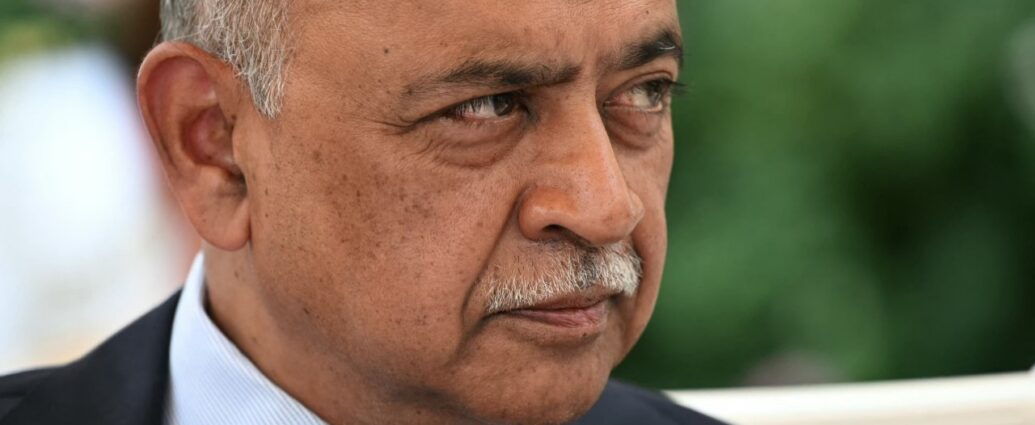


U.S. Signs Nuclear Cooperation Pact With Saudi Arabia, Opening a Multibillion-Dollar Market to American Firms
The United States signed a landmark civil nuclear cooperation agreement with Saudi Arabia on Wednesday, clearing the way for American companies to supply reactors, fuel, and technical expertise to the kingdom’s planned nuclear program in a partnership the government says will last decades and be worth billions of dollars.
Energy Secretary Chris Wright and Saudi Energy Minister Prince Abdulaziz bin Salman signed the pact along with an accompanying safeguards agreement, the Department of Energy announced. Known as a 123 agreement under the Atomic Energy Act, the deal would run for 30 years and lay the legal foundation for a long-term commercial relationship. Wright framed it as a step that strengthens commercial ties between the two nations while relying on American nuclear technology and scientists.
The commercial stakes for U.S. industry are the core of the story. The agreement gives American firms priority access to the Saudi nuclear energy program, meaning companies can supply the reactors, components, fuel services, and training that a program built from scratch will require. Industry analysts named Westinghouse, Bechtel, BWXT, and Centrus among the firms positioned to benefit. Westinghouse’s AP1000 reactor — the company is owned by Canadian uranium miner Cameco and infrastructure investor Brookfield — is viewed as central to any large-scale buildout.
The blunt logic for American companies is exposure to a market they would otherwise be locked out of entirely. Without a trade agreement of this kind, U.S. nuclear firms would have no path into the kingdom, and Saudi Arabia would almost certainly turn to competitors in France, Russia, or China for its technology and supplies. The deal is structured to give American companies a central role while shutting out those foreign rivals, converting a geopolitical relationship into a durable export pipeline for a sector Washington has been trying to revive.
What makes the appetite notable is that Saudi Arabia is not short on energy. Nearly 60 percent of its electricity comes from natural gas and roughly 40 percent from oil, according to the International Energy Agency. The push toward nuclear reflects the kingdom’s plans to free up more crude and gas for export while meeting surging domestic power demand — including the enormous electricity loads tied to artificial intelligence data centers, an increasingly common driver of nuclear interest worldwide.
The agreement now faces a mandatory congressional review period of 90 days, during which lawmakers can examine the terms. Congress could block the deal only if both the House and Senate pass disapproval resolutions, a high bar that gives the administration a strong position but leaves room for a fight.
That fight is likely, because the deal omits provisions that have anchored past U.S. nuclear agreements. According to an administration memo, it does not include the so-called “gold standard” language that would bar Saudi Arabia from enriching uranium or reprocessing spent fuel, nor does it require the kingdom to accept expanded oversight from the International Atomic Energy Agency. Critics warn those omissions could give Riyadh a pathway toward weapons capability. The concern is sharpened by past statements from Crown Prince Mohammed bin Salman that Saudi Arabia would pursue a nuclear weapon if Iran obtained one. Some lawmakers in both parties have signaled they want the same safeguards applied to Saudi Arabia that governed the earlier U.S. agreement with the United Arab Emirates.
The timing sits against a tense regional backdrop. The U.S.-Iran conflict that began at the end of February has left Saudi Arabia and other Gulf allies absorbing Iranian attacks, and the administration has cast the nuclear pact partly as a signal of American commitment to the security of its partners in the region. Backers argue that deepening the commercial and strategic relationship with Riyadh strengthens a key ally at a volatile moment; skeptics counter that expanding nuclear technology across the Middle East while Washington pressures Iran to curb its own program sends a contradictory message.
Talks over a Saudi nuclear deal have stretched across multiple administrations, previously tied to broader diplomatic goals including normalization between the kingdom and Israel. The version signed Wednesday moves forward largely on commercial and strategic terms, with the enrichment question left as the central point of contention heading into the congressional review.
For American nuclear firms, engineering contractors, and the fuel-services companies that support them, the agreement marks one of the largest potential export opportunities the sector has seen in years — if it survives the next 90 days on Capitol Hill.
JBizNews Desk | Washington, D.C.
© JBizNews.com All Rights Reserved. Reproduction or distribution without written permission is prohibited.



Tesla touts 380,000 unsupervised robotaxi miles with ‘zero notable incidents’
Tesla said Wednesday that its robotaxi fleet has logged more than 380,000 unsupervised miles across six cities in two states without what the company described as a “notable” safety incident.
Ashok Elluswamy, Tesla’s vice president of AI software, highlighted the fleet’s safety record during the electric vehicle maker’s second-quarter earnings call, telling investors it had recorded “zero notable incidents.”
Any reported incidents involved “other actors impacting us when we were stationary,” Elluswamy said.
“I’d like to emphasize how safe the operation has been so far,” Elluswamy said. “Zero notable incidents over 380,000 miles.”
MUSK SAYS TESLA, SPACEX TO BUILD ADVANCED CHIP MANUFACTURING FACILITY
Elluswamy said the results support Tesla’s camera-based approach to autonomous driving.
“Historically, the so-called experts have always claimed that you need lidars, radars, HD maps and the entire kitchen sink to drive safely,” he said. “Here, we show that such is not true. You can have safe, comfortable and affordable autonomy with just cameras.”
Tesla said mileage traveled by its unsupervised robotaxi fleet has grown at a double-digit weekly rate for months.
“We have grown at such a high compounding rate on a week-over-week basis over the last several months,” Elluswamy said. “Not only that, we expect to continue growing at such a large rate through the rest of this year.”
ELON MUSK REVEALS PRICE OF TESLA’S CYBERCAB
The remarks came one day after Tesla expanded its robotaxi service to Orlando and Tampa, according to Reuters.
Tesla launched the service in Austin in June 2025, initially placing safety monitors inside the vehicles.
It later began offering fully unsupervised rides in Austin and expanded the service to Dallas, Houston and Miami, Reuters reported.
Unlike Waymo, which uses “light detection and ranging” or “lidar” sensors, Tesla relies mainly on cameras and AI software, according to the outlet.
GET FOX BUSINESS ON THE GO BY CLICKING HERE
“We expect that the time to launch to a new city will continue to trend towards zero, towards an end where we operate in entire states as a whole, instead of going city by city,” Elluswamy added.
Tesla could not immediately be reached by FOX Business for comment.
Reuters contributed to this report.

Kuwait Raises $6 Billion as Investors Look Past Iran Conflict
KUWAIT CITY — Kuwait launched a roughly $6 billion international bond sale Wednesday, tapping global debt markets despite escalating regional tensions following Iran-related military strikes, as investors continued to show strong demand for high-grade Gulf sovereign debt. The transaction comes as governments across the Middle East navigate elevated geopolitical risks alongside higher global borrowing costs.
The multi-tranche offering is expected to include long- and medium-term maturities, allowing Kuwait to diversify its funding sources while maintaining access to international capital markets. Strong oil revenues have bolstered the country’s fiscal position, but officials continue using debt markets as part of a broader long-term financing strategy.
Investor appetite for Gulf sovereign bonds has remained resilient even as volatility has increased across global markets. Kuwait benefits from one of the world’s strongest sovereign balance sheets, supported by low government debt and substantial financial reserves managed through its sovereign wealth fund.
The issuance also reflects confidence that regional economies continue functioning despite ongoing security concerns. Financial markets have largely differentiated between geopolitical headlines and the underlying fiscal strength of Gulf governments, particularly those with significant energy revenues and investment assets.
For investors, Kuwait’s bond sale provides another benchmark for measuring demand for emerging-market sovereign debt at a time when interest rates remain elevated and uncertainty surrounding energy prices continues to influence global markets.
The offering follows a broader trend of Gulf nations increasing activity in international debt markets to finance infrastructure projects, economic diversification initiatives and long-term development plans while expanding relationships with global institutional investors.
Market participants will now closely watch final pricing, order-book demand and yield spreads to gauge investor sentiment toward both Gulf sovereign issuers and emerging-market debt more broadly.
The successful completion of the sale could reinforce confidence in regional capital markets despite continued geopolitical uncertainty, demonstrating that investors remain willing to finance governments with strong fiscal fundamentals even during periods of heightened tension.
JBizNews Desk | Kuwait City
© JBizNews.com. All Rights Reserved. Reproduction or distribution without written permission is prohibited.

Target, Kroger, Meijer fruit purée pouches recalled over plastic risk: FDA
PT Organics Limited is voluntarily recalling select Pumpkin Tree Peter Rabbit Organics Banana & Strawberry fruit purée pouches sold at Target, Kroger and Meijer stores nationwide because of a packaging defect that may result in strands of soft, food-grade plastic in some pouches.
The Food and Drug Administration (FDA) published the recall Tuesday.
The affected 4-ounce (113-gram) fruit purée pouches were sold between March 6 and July 13, according to the Lake Oswego, Oregon-based company.
No injuries have been reported, and no other Pumpkin Tree products, flavors or best-by dates are affected, PT Organics said.
FORD RECALLS NEARLY 388,000 VEHICLES OVER SECOND-ROW SEAT INJURY HAZARD
PT Organics said it initiated the recall after its packaging supplier recalled a production run of defective pouches last week.
The company said inspections of finished products confirmed that some pouches contained a strand of soft, food-grade plastic attached to the inside of the packaging.
The issue was linked to the pouch packaging itself rather than the fruit purée, according to the company.
Consumers can identify the recalled products by checking for barcode 8 15367 01078 0, a lane number of 4 printed on the rear right-hand side seam and best-by dates of Jan. 19, 2027; Jan. 20, 2027; March 17, 2027; March 18, 2027; May 14, 2027; or May 15, 2027.
The barcode, lane number and best-by date are stamped in black ink on the back of each pouch, according to the company.
Consumers who have the recalled product should not eat it or feed it to another person.
Instead, the company said customers should dispose of the affected pouches or return them to the place of purchase for a refund.
CLICK HERE TO GET FOX BUSINESS ON THE GO
Consumers with questions can visit Pumpkin Tree’s website or contact the company’s consumer support line at 888-566-2363, 8 a.m. to 5 p.m. ET, Monday through Friday.

Trade Chief Pushes for USMCA Interim Deal by Year-End as Businesses Seek Tariff Certainty
WASHINGTON — U.S. Trade Representative Jamieson Greer said Wednesday he is working toward interim agreements with Canada and Mexico before the end of the year as the three countries continue reviewing the United States-Mexico-Canada Agreement (USMCA). Greer made the remarks during an interview following meetings on the administration’s trade agenda, signaling an effort to provide businesses with greater certainty while negotiations continue.
The comments come as manufacturers, retailers, farmers and logistics companies increasingly seek clarity on North America’s trading rules after months of uncertainty surrounding tariffs, supply chains and cross-border investment.
USMCA governs more than $1.8 trillion in annual trade among the United States, Canada and Mexico, making it one of the world’s largest free-trade agreements. Businesses throughout North America depend on the pact for the movement of automobiles, agricultural products, machinery, energy, electronics and consumer goods.
Greer said interim arrangements could provide stability for businesses while broader negotiations continue, reducing uncertainty that has complicated long-term planning for companies with manufacturing operations or supply chains spanning multiple countries.
For consumers, the outcome could influence the prices of automobiles, groceries, electronics, construction materials and countless imported goods. Businesses have warned that prolonged uncertainty over tariffs and trade rules increases operating costs, which can ultimately be reflected in higher prices.
The automotive industry remains one of the sectors watching the negotiations most closely. Vehicle manufacturers source components from all three countries, making predictable trade rules essential for production schedules and investment decisions. Agricultural producers and food distributors are also monitoring the talks because cross-border trade plays a critical role in North American food supplies.
Financial markets largely viewed Greer’s comments as a sign that the administration is seeking to avoid major disruptions to regional commerce while preserving flexibility to negotiate longer-term revisions to the agreement.
Investors and business leaders will now watch for additional meetings among the three governments in the coming months as negotiations continue toward the formal USMCA review process.
JBizNews Desk | Washington
© JBizNews.com. All Rights Reserved. Reproduction or distribution without written permission is prohibited.

US House passes $1 trillion defense bill despite Iran, Israel concerns
The US House of Representatives narrowly passed its version of a massive defense policy bill on Wednesday, despite Democrats’ concerns about its huge price tag, the Iran war and a provision that would boost Pentagon ties to Israel.
The fiscal 2027 National Defense Authorization Act, or NDAA, which authorizes an unprecedented $1.15 trillion in spending for the military, passed the House by 216 to 212.
The vote was largely along party lines, as all but seven Republicans voted in favor of the measure and all but six Democrats voted against.
Democrats objected to the huge amount of money being authorized for the Pentagon, at a time when President Donald Trump and his fellow Republicans are slashing spending on social programs.
They also object to the ongoing and deeply unpopular war with Iran, which the Pentagon said has cost the US $37.5 billion so far.
Republicans said the trillion-dollar spending is essential to support the military as it wages war in Iran, fund defense systems development and equipment purchases and provide benefits for the troops like raises of up to 7% and construction for barracks and family housing.
Another measure that worried Democrats was a provision that would substantially expand military technology cooperation between the United States and Israel, despite calls from many Americans – particularly on the left – to roll back U.S. support for Israel over concern about the heavy toll on Palestinian civilians of its attacks in Gaza.
In 2026, ‘must-pass’ bill may not pass
Historically seen by both parties as “must-pass legislation,” the NDAA is one of the few major bills that always gets through Congress, having become law for 65 straight years.
This year’s bill faces major challenges, given deep partisan divisions within Congress on issues ranging from the massive size of the military budget, to the Iran war, aid to Israel and Ukraine and “culture war” causes like the treatment of transgender troops.
The fiscal 2027 NDAA’s fate was also complicated because Republicans voted to attach it to the “SAVE America Act,” Trump-backed legislation to tighten restrictions on voting, before sending it to the Senate. The impact of that decision on the NDAA’s fate was unclear, given that there are not enough votes in the Senate to pass the voting law.
Senate Democrats blocked the Senate’s version of the NDAA last week. The chamber’s Republican leaders have pledged to try again to advance the bill before leaving Washington for their August recess.
It is early in the NDAA process.
Each year, the House and Senate pass their own versions of the NDAA, before Armed Services committee negotiators agree on compromise version that then comes up for a vote in each chamber.
If the compromise version passes, it would be sent to the White House for Trump to sign into law or veto.
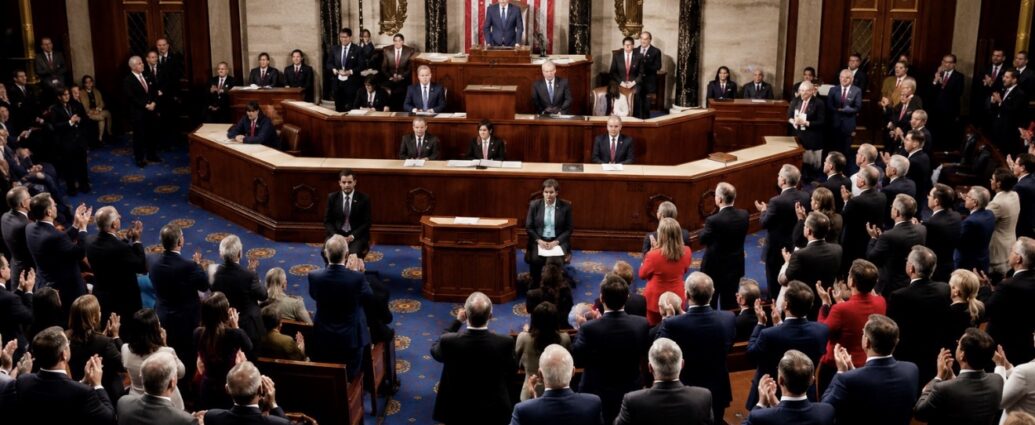
House Approves First-Ever Ban on Lawmakers Buying Stocks — but a Voter-ID Add-On Clouds Its Fate
The House of Representatives voted Wednesday to bar its members from buying individual stocks while in office, the first time the full chamber has ever advanced legislation to restrict lawmakers’ trading — a milestone on an issue that has dogged Congress for years. The measure now heads to a Senate where its prospects are far from certain, in part because of how House Republicans chose to package it.
The bill cleared the chamber on a 232-198 vote, carried by nearly all Republicans and at least 13 Democrats. Branded the Stop Insider Trading Act (H.R. 7008) and led by House Administration Committee Chairman Bryan Steil of Wisconsin, it would prohibit members of Congress, their spouses and their dependent children from purchasing shares of individual publicly traded companies while serving, while still permitting broader holdings such as mutual funds and index funds. Notably, it stops short of forcing lawmakers to sell the individual stocks they already own. The bill also sharpens the penalties for failing to disclose stock sales, raising fines to $2,000 or 10% of the transaction’s value, whichever is greater, up from the current $200 for first-time offenders.
Supporters framed the vote as a long-overdue response to public frustration. House Speaker Mike Johnson said Americans struggling to make ends meet have watched too many lawmakers arrive in Washington and leave as multimillionaires, calling the ban a commonsense step toward restoring trust. Representative Zach Nunn of Iowa, one of its leading backers, argued the measure delivers something an overwhelming majority of Americans want and could reach the president’s desk quickly.
The path to the floor, however, has drawn sharp criticism, and the controversy centers less on the ban itself than on what Republicans attached to it. Leadership fused the trading restriction with a separate measure requiring proof of citizenship to register and photo identification to vote — a priority for President Trump but a nonstarter for most Democrats. That pairing prompted dozens of House Democrats to vote against the combined package, and even some Republicans objected to the tactic. Representative Thomas Massie of Kentucky argued that a standalone stock-trading ban could pass with a large bipartisan majority and a real chance in the Senate, contending the voter-ID attachment was designed to force Democrats into a no vote that could be wielded in the November elections.
The bill’s substance has critics of its own, including among lawmakers who have pushed hardest for a ban. A bipartisan group has spent years advancing the rival Restore Trust in Congress Act, which would prohibit both buying and selling of individual stocks and require members to divest their holdings within 180 days of enactment — a far stricter standard than the buy-only restriction the House passed. That measure counts 141 co-sponsors, including a bloc of Republicans. Representative Seth Magaziner of Rhode Island, part of that coalition, dismissed Wednesday’s bill as a trading ban that still permits trading, while Representative Joe Neguse of Colorado argued the cleanest way to ban members from trading stocks is simply to ban them from trading stocks.
The backdrop is a decade of scrutiny over lawmakers’ market activity. A 2012 federal law already makes it illegal for members to trade on nonpublic information, but its penalties are weak and rarely enforced. Reporting in recent years has documented well-timed trades around the onset of the pandemic and other market-moving events, and one prominent analysis found that between 2019 and 2021 a meaningful share of members traded stocks in sectors tied to the committees on which they served. Those episodes have fueled bipartisan calls for tighter rules and repeated, stalled attempts at reform.
Whether this attempt fares differently now rests with the Senate, and the obstacles there are considerable. Most legislation requires 60 votes to overcome a filibuster, and the voter-ID language bundled into the House bill makes attracting Democratic support harder rather than easier. The calendar is unforgiving as well, with only about 10 weeks of session remaining before the November 3 midterms. Several senators in both parties have their own stock-trading proposals in various stages, but none has yet cleared the chamber. For now, the House has done something it never has before — but turning a landmark vote into an enacted law remains a steep climb.
JBizNews Desk | Washington
© JBizNews.com All Rights Reserved. Reproduction or distribution without written permission is prohibited.


Criticism cannot become erasure: A letter to Mamdani on his condemnation of Netanyahu – opinion
Dear Mayor Mamdani,
We have met a few times. After our first meeting, I wrote publicly that I did not believe it was fair to call you an antisemite simply because of your views on Israel. I meant it. I do not regret meeting you or resisting the pressure to reduce you to a label.
I am writing now for the same reason: Honest dialogue cannot require silence when something hurts. Your video about Benjamin Netanyahu hurt me deeply.
You called him a “war criminal” and “the architect of a horrific genocide against the Palestinian people.” You said he was “not welcome in New York” and urged the federal government to join the International Criminal Court and execute its warrant.
What hurt me was not that you criticized Netanyahu.
I have serious concerns about his leadership, his government, and aspects of Israel’s conduct in Gaza. Palestinian suffering is real, and no moral person should look away. Millions of Israelis oppose Netanyahu. Few may even believe he should answer before a court in The Hague. They still love their country. Their criticism does not cancel their belonging.
The same is true for me. I am an American Jew, but Israel is not just a foreign-policy issue. Today it serves as the homeland of the Jewish people and the home of millions – Jews and Arabs, religious and secular, Netanyahu supporters and people who cannot wait to see him leave office.
Israel is deeply embedded in Jewish history
As I write this, Tisha B’Av begins tonight. Tomorrow, together with Jews around the world, I will fast and mourn the destruction of the Temples in Jerusalem and the exile and tragedies that followed.
That fast explains something I fear your video did not fully recognize. My bond with Jerusalem did not begin with Netanyahu. It did not begin in 1948. For two thousand years, Jews prayed toward Jerusalem and refused to forget it. Israel is woven into our faith, memory, and identity. A prime minister can disappoint me, anger me, or fail morally without severing that bond.
Netanyahu is not Israel. No prime minister is.
Yet your condemnation of Netanyahu came with little recognition of Israeli humanity. There was no October 7. No Hamas. No hostages. No acknowledgment of families living with massacre, displacement, and fear. No recognition of Israelis who oppose Netanyahu and his government’s policies but still run to shelters and watch loved ones called into military service.
No statement can contain this conflict’s tortured history. Palestinians should not have to begin every expression of grief with a disclaimer about Hamas. Israelis should not have to begin every expression of grief or fear with a defense of Netanyahu – or an apology for their government. Neither people should be reduced to leaders they may oppose.
But this was a deliberate message from the mayor of New York City. What you omitted mattered.
I once sat on a New York City train wearing my kippah when someone looked toward me and screamed, “Free Palestine.”
I had said nothing about Israel. I was not defending Netanyahu. I was simply a visibly Jewish American riding a train in my own city. My kippah was enough to turn me, in a stranger’s eyes, into a representative of a government thousands of miles away.
That experience did not make me want to cut Israel out of my identity. It made me reject the false choice imposed on Jews: Either defend every action of an Israeli government or renounce our attachment to Israel to prove our innocence.
I will do neither.
I know you understand that your words do not remain inside a video. They travel into subway cars, campuses, offices, and streets, where the distinctions among Netanyahu, Israel, Israelis, Zionism, and ordinary Jews are already dangerously blurred.
I am not blaming you for every antisemitic word spoken in New York. That would be another form of collective guilt, and I reject collective guilt in every form. But as mayor, you are responsible for the climate into which you speak.
Jews cannot amputate Israel from our identity
Criticize Netanyahu. Challenge his policies. Demand accountability. Speak forcefully for Palestinian civilians.
But please do not flatten Israel into Netanyahu, or Jews into the Israeli government. Do not erase October 7, Hamas, the hostages, or the millions of Israelis who disagree with their prime minister yet still love their country. And do not ask Jews to amputate Israel from our identity before our pain is considered worthy of recognition.
I met you because I believed people with profound disagreements could still speak to one another as human beings. I still believe that.
I was right not to demonize you then, and I am right to challenge you now.
I am not writing this to close a door. I am writing because I believe our meetings opened one.
You have asked New Yorkers to see Palestinian humanity. I see Palestinian humanity. I am asking you, with the same moral seriousness, to see Israeli humanity and Jewish pain too.
Sincerely,
Dov Bleich
The writer is an Orthodox Jewish New York businessman.

Arizona Rep. Andy Biggs wins Republican nomination for governor despite ties to white nationalism
Arizona Rep. Andy Biggs, who has drawn criticism for ties to white nationalist figures, will officially be the Republican nominee for Arizona governor, after winning the primary on Tuesday night.
Biggs, who is backed by US President Donald Trump, has drawn criticism for encouraging Stew Peters, an internet personality, and appearing on his show. Peters has labeled Judaism a “death cult” and has called for a “final solution” that involves the deportation of American Jews, and multiple watchdogs identify him as promoting antisemitism.
“Keep preaching,” Biggs told Peters at the end of his June 2023 appearance on the show, during which they discussed government corruption and Biggs agreed with Peters that the FBI should be abolished.
Biggs, 67, who won handily with 73.4% of votes according to multiple media outlets, will challenge Democratic Gov. Katie Hobbs in what is expected to be a competitive race in November. Biggs has represented Arizona’s 5th Congressional District, which is outside of Phoenix, since 2017.
His opponent in the GOP primary, Rep. David Schweikert, had put out a campaign mailer in March tying Biggs to white supremacy and antisemitism. The mailer featured mentions of Biggs’ interview with Peters as well as Biggs’ endorsement of Texas GOP candidate Brandon Herrera, who owned a copy of Mein Kampf.
Biggs’ campaign did not respond to the Jewish Telegraphic Agency’s request for comment, but in a local TV interview last month he called the accusations politically motivated and said, “This notion that I am antisemitic is absolutely one of the most ludicrous, insane arguments ever.”
Biggs opposes Antisemitism Awareness Act
In 2024, Biggs opposed the bipartisan Antisemitism Awareness Act, which passed in the House of Representatives. Biggs wrote that he opposes antisemitism and that the “pro-Hamas, pro-genocide, anti-Israel events happening across the nation are sickening.” He rejected the legislation, he said, because it was “so poorly drafted that it violates the Constitution and could have serious ramifications for the Christian community.” Right wing Republicans objected especially to the bill citing a definition of antisemitism that included as an example the claim that the Jews killed Jesus.
That same year, Biggs attended a rally co-sponsored by the Proud Boys, an extremist militia style group. In 2019, he spoke at a “Patriotism over Socialism” rally in Arizona, which watchdogs warned would draw extremist groups.
Media Matters, a group that mostly monitors right-wing groups, in 2023 wrote that “the links between Biggs and far-right extremists have been well-documented,” citing among other things his ties to another far-right group, the Oath Keepers.
The Republican Jewish Coalition did not respond to a question over whether it would support Biggs’ run for governor.
At a campaign event on Tuesday, Hobbs skewered Biggs for his denial of Trump’s 2020 election loss, and for not acknowledging Hobbs’ narrow 2022 gubernatorial victory over Republican Kari Lake.

Oil Market Loses Its Safety Valve as Houthi Threat Expands Beyond Hormuz
The global oil market is confronting a new supply risk as Iran-backed Houthi forces threaten Saudi Arabia’s Red Sea export route while prospects for ending the broader regional conflict continue to recede. The combination is forcing energy traders to price in the possibility that both of the Gulf’s critical shipping corridors could face sustained disruption at the same time.
For weeks, the Strait of Hormuz dominated market attention after commercial traffic through the waterway slowed to a near standstill. Tracking data showed only three commodity vessels transited the strait Tuesday, the fewest since early May, while no commercial movements were observed early Wednesday. Saudi Arabia had partially offset that disruption by redirecting crude west through its East-West pipeline to the Red Sea export terminal at Yanbu. That alternative route is now under pressure as well.
The Houthis this week declared an embargo on Saudi shipping through the Bab el-Mandeb Strait, the narrow passage linking the Red Sea with the Gulf of Aden and carrying roughly 12% of global seaborne oil trade. The announcement immediately altered shipping patterns. No crude tankers have been observed transiting the strait since the group issued its warning to shipowners, while at least six tankers bound for Yanbu have either reversed course or paused in the Arabian Sea as operators reassess security risks. At Yanbu, only two of seven crude-loading berths were occupied Wednesday morning. Saudi crude exports moving through the route have fallen 36% over the past two weeks, and the European Union’s naval mission in the Red Sea has advised commercial vessels to disable transponders while approaching Saudi ports because of heightened security concerns.
The problem for oil markets is no longer a single chokepoint. It is the prospect of two.
When one export corridor comes under pressure, Gulf producers can typically redirect shipments through the other. If both Hormuz and Bab el-Mandeb remain constrained, however, few large-scale alternatives remain. Analysts at Standard Chartered described the situation as a “two-chokepoint problem,” warning that vessels forced to reroute around the Cape of Good Hope could add nearly a month to transit times while driving freight rates, insurance premiums and delivery costs sharply higher.
Crude markets have already begun reflecting that risk. Brent crude has climbed roughly 25% this month to around $95 a barrel, while the average U.S. gasoline price has risen about 15 cents over the past week to nearly $4.00 a gallon. A prolonged disruption at Bab el-Mandeb alone could restrict access to an estimated 7% of global oil supply, and several market forecasts envision triple-digit crude prices should both waterways remain impaired for an extended period. While those scenarios remain far from certain, traders are increasingly assigning them meaningful probability.
The geopolitical premium persists because diplomacy has stalled.
The United States and Iran both indicated Wednesday that they remain unwilling to resume negotiations as renewed fighting entered its second week. U.S. forces carried out an 11th consecutive night of airstrikes, while Iran responded with missile and drone attacks targeting Jordan’s port city of Aqaba. President Donald Trump said Iran had suffered significant military losses following the deaths of four American service members during the past week and warned the United States would target Iranian bridges and power infrastructure if attacks on shipping through Hormuz continued. Iranian media reported that regional mediators are attempting to restore conditions that existed before the latest ceasefire collapsed in early July, underscoring how limited the current diplomatic expectations have become.
For energy markets, the military and diplomatic developments reinforce one another. A sustained threat to Bab el-Mandeb could draw additional U.S. military resources into the Red Sea while complicating efforts to safeguard shipping through Hormuz. At the same time, the absence of a credible diplomatic path removes the mechanism that would ordinarily allow geopolitical risk premiums to unwind.
Whether the Houthis can fully enforce their embargo remains uncertain. For now, however, the threat alone is forcing shipowners, insurers and energy traders to rethink routes that only weeks ago were considered reliable—keeping a significant geopolitical premium embedded in global energy markets.
JBizNews Desk | Dubai
© JBizNews.com All Rights Reserved. Reproduction or distribution without written permission is prohibited.

Opinion | Chaff Can Fool Russia’s Radar

LARRY KUDLOW: Call it swag, swagger, rizz, aura, or just plain messaging, the GOP doesn’t have it
According to Google, a definition for swag is “Short for “swagger,” describing someone with a cool, confident, and fashionable demeanor. If someone says you “have swag,” it means your personal style and attitude are on point.” Or you can go to Webster’s and their definition of swag is “bold or brash self-confidence.”
Whatever these definitions, the Republican party doesn’t have any right now. No swag. They’ve lost their mojo. We’re not draining the swamp by getting rid of all the fraudulent and corrupt spending left by President Biden’s big government socialism.
And we’re not helping middle-class folks so they won’t have to pay taxes on Joe Biden’s inflation. There’s no growth from the GOP. And no swamp draining.
Nowadays the young people talk about rizz and aura. Google’s definition of rizz, which is short for charisma, is “having a smooth, confident, and magnetic personality.” And the definition for aura is “a person’s coolness, star power, or suave swagger.” As usual the young people have it right, and whatever their total meaning, the Republican party doesn’t have that either.
While the President is fighting a war to end the nuclear threats to freedom and civilization from radical Islam, the Republicans and the House and Senate are doing him and the GOP midterm election outlook no favors. They are bungling budget policy.
They are bungling the affordability issue. They are bungling the growth issue. They are concocting weird inside the beltway word-salad reasons why they’re not getting anything done that will actually help make life easier for hardworking taxpayers.
Inflation indexing capital gains or raising the exemption for gains on the sale of homes should be easy. Curbing hundreds and hundreds of billions of waste, fraud, and corruption should be easy. Then you put in the funding for voter ID, the Save America bill, and the military supplemental for Iran.
There’s nothing hard about this. But the GOP leadership is letting everyone down. Whether it’s swag, swagger, rizz, aura, or how about just plain messaging. The GOP doesn’t have any of it.

Toyota to Shift Tacoma Production From Mexico to Texas in $3.6 Billion Move
Toyota is pulling a chunk of its popular Tacoma pickup production out of Mexico and into Texas, committing $3.6 billion to expand its San Antonio complex in one of the clearest signs yet that tariff pressure and stalled trade talks are reshaping where automakers choose to build.
The company said earlier this month that it will add a second vehicle assembly line at its San Antonio campus, allowing the plant to build the midsize Tacoma alongside the full-size Tundra and the Sequoia SUV it already produces there. Production will transition from Toyota’s Baja California plant in Tijuana over roughly four years, though the automaker stressed it is not abandoning Mexico—it will keep building some Tacomas at its newer Guanajuato facility and continue operating south of the border.
The expansion carries real weight for the region. Toyota said the project will create about 2,000 jobs by 2030, add roughly 2.5 million square feet to the campus—effectively doubling its footprint—and lift annual capacity at the site by about 150,000 units. The investment brings Toyota’s total commitment to the San Antonio operation to $8.3 billion since ground broke in 2003, and folds in a separate rear-axle plant on the campus slated to begin production this fall. Texas Governor Greg Abbott called the commitment a reflection of the state’s workforce and business advantages.
The timing is pointed. The announcement landed just days after Washington declined to renew the trilateral trade pact with Mexico and Canada, letting a July 1 deadline pass without an extension and opting instead for annual reviews—an outcome that has injected fresh uncertainty into a North American auto supply chain built around duty-free cross-border production. President Trump, who has pressed Toyota to expand its U.S. footprint, has raised tariffs on automobiles, steel and aluminum, giving global manufacturers a direct financial incentive to move assembly stateside. Toyota, for its part, said it remains committed to its operations across the U.S., Canada and Mexico and urged a quick resolution to keep the region competitive.
The move also fits a larger strategic pledge. Toyota said last year it planned to invest as much as $10 billion in its U.S. manufacturing operations over the coming years, and the Tacoma shift is among the most concrete pieces of that plan. There is history here, too: Toyota had moved Tacoma production from San Antonio to Guanajuato back in 2020, so this represents a partial reversal that brings the truck’s assembly full circle.
Underpinning the bet is a truck that keeps selling. Tacoma volumes climbed sharply in 2025 and have continued rising in 2026, with sales tracking toward what could be the model’s best year ever, potentially topping 300,000 units. That strength matters as Toyota closes in on the possibility of overtaking General Motors as the top-selling automaker in the U.S. market—a race in which securing flexible, tariff-insulated truck capacity is a meaningful edge.
For buyers, little changes in the near term; the transition unfolds over several years and Toyota has not signaled changes to the truck itself. The bigger message is strategic. By anchoring more of its most important truck line in Texas, Toyota gains tighter control over capacity, more insulation from trade-policy swings, and a stronger claim to the “built in America” positioning that carries growing commercial value in a volatile new-car market.
JBizNews Desk | San Antonio
© JBizNews.com All Rights Reserved. Reproduction or distribution without written permission is prohibited.

US says it reached nuclear cooperation deal with Saudi Arabia, amid concerns about safeguards
The United States and Saudi Arabia have reached a nuclear cooperation agreement, the US Energy Department said on Wednesday.
“U.S. Secretary of Energy Chris Wright and Saudi Minister of Energy His Royal Highness (HRH) Prince Abdulaziz bin Salman signed a peaceful nuclear cooperation agreement, commonly known as a 123 agreement, alongside an accompanying bilateral safeguards agreement,” the US Energy Department announced in a post on X/Twitter.
— U.S. Department of Energy (@ENERGY) July 22, 2026
The Trump administration submitted to Congress a pact with Saudi Arabia to share nuclear power technology that does not include a plan for normalization with Israel or safeguards the US has long said would stop materials from being used in nuclear weapons programs, the New York Times reported on Tuesday.
The long-discussed US-Saudi nuclear pact was once envisioned as one part of a broad deal that could lead to recognition of Israel, but Saudi Arabia pulled back from the possibility during the Israel-Hamas war.
The administration is set to submit to Congress within days a document known as a 123 Agreement that will be signed by US Energy Secretary Chris Wright and Saudi energy minister Abdulaziz bin Salman, two sources told Reuters.
The two signed a preliminary agreement in Riyadh last year.
The White House and US Department of Energy did not immediately respond to requests for comment.
The agreement refers to Section 123 of the US Atomic Energy Act of 1954 and is required to permit the US government and American companies to work with entities in the kingdom to develop a multibillion-dollar civil nuclear industry.
Agreement does not bar Saudi Arabia from pathway to nuclear weapon
The agreement does not include the “Gold Standard” that would block the kingdom from enriching uranium and reprocessing spent nuclear fuel, both of which are potential pathways to nuclear weapons, said the sources familiar with the agreement.
The agreement also does not include the “Additional Protocol,” which grants the UN’s International Atomic Energy Agency broad and more intrusive oversight of a country’s nuclear activities, such as the power to carry out snap inspections at undeclared locations, said the sources, who spoke on condition of anonymity to discuss sensitive issues.
One of the sources said the administration would submit the agreement as soon as Wednesday, and another said it would be submitted in a week or so. A third, who did not say whether the agreement lacks safeguards, said it would be submitted soon.
Wright had said the preliminary agreement was not about enrichment and contained all the nonproliferation standards in the Atomic Energy Act, which are among the strongest in the world.
One of the sources said the agreement provides a legal pathway for cooperation on the nuclear fuel cycle, which includes uranium enrichment, but does not obligate the United States to transfer any related capabilities or technology to Saudi Arabia.
Proliferation concerns
Saudi Arabia’s Crown Prince Mohammed bin Salman has long said if Iran developed a nuclear weapon, Saudi Arabia would too, fueling concern among arms control advocates and some US lawmakers over a civil nuclear deal.
The crown prince told CBS in 2018 that “Saudi Arabia does not want to acquire any nuclear bomb, but without a doubt if Iran developed a nuclear bomb, we will follow suit as soon as possible.”
The kingdom has also said it wants to reserve the right to enrich uranium.
The United Arab Emirates agreed to the “Gold Standard” in 2009 when it signed a 123 Agreement with Washington.
Once 123 agreements are submitted to Congress, they go into a review period of about 90 days of continuous congressional sessions for lawmakers to object, or they go into force.
To block the agreement, Congress would need to pass a joint resolution and have a two-thirds majority to override any presidential veto.
Many Democrats and some Republicans, including US President Donald Trump’s Secretary of State Marco Rubio when he served in the Senate, have insisted any agreement include guardrails.
Shir Perets contributed to this report.

Today in photos: Thousands gather at Western Wall for Tisha B’Av lamentations
Thousands of people gathered at the Western Wall on Wednesday night to mark Tisha B’Av, the anniversary of the destruction of the First and Second Temples in Jerusalem and of several other calamities in Jewish history.
Among those who gathered at the Western Wall were National Security Minister Itamar Ben-Gvir, former prime minister Naftali Bennett, and Yashar Party leader Gadi Eisenkot.

Tisha B’Av is first and foremost a fast day, during which Jews abstain from all food and water for approximately 25 hours, from sunset until nightfall the next day.
It is also the time when the Jews read the Book of Lamentations (Megillat Eicha), in which the biblical prophet Jeremiah laments the destruction of Jerusalem and the subsequent exile from the Land of Israel.

A number of other events are often cited as being calamities befalling the Jewish people that occurred on or near the ninth of Av.
These include the Roman destruction of Betar and crushing of the Bar Kochba revolt; expulsion of the Jews from England, France, and Spain; the beginning of World War I; the formal approval of the Nazi’s Final Solution; the mass deportation of Jews from the Warsaw Ghetto to concentration camps; the First Crusade; the 1994 bombing of the Argentine Israelite Mutual Association (AMIA) in Argentina by Hezbollah; Israel’s 2005 Disengagement from the Gaza Strip; and most recently, Israel’s passing of the controversial judicial reform legislation, the Law to Cancel the Reasonableness Standard.

Netanyahu: Israelis prevented destruction of Third Temple
In a speech on the eve of this year’s Tisha B’Av, Prime Minister Benjamin Netanyahu claimed that over the past three years, Israelis had prevented “the destruction of the Third Temple.”
“We showed the world that the people of Israel are a brave people, a brave army, a generation of heroes,” he said. “We repelled the terror of destruction and achieved great achievements.”
Tobias Holcman contributed to this report.

Reed College agrees to sweeping reforms to settle antisemitism investigations
Reed College has agreed to a host of far-reaching institutional changes, including asserting that targeting Jewish Zionists will be considered discriminatory, in order to settle multiple federal antisemitism investigations, parties to the complaint announced Wednesday.
The settlement was announced by the Anti-Defamation League and the Brandeis Center for Human Rights Under Law, which jointly filed the complaint, under Title VI of the Civil Rights Act, which prohibits discrimination at any institution receiving federal funds. It comes as campuses across the country, facing threats of losing federal funding under the Trump administration, have demonstrated willingness to negotiate new antisemitism protections.
As part of the agreement, the private Portland, Oregon, liberal arts school says it will insert language into its discrimination policy asserting that “for many Jewish people, Zionism is integral to their religious, ancestral and/or ethnic Jewish identity,” and that “targeting Jews on the basis of their Zionist identity” will be considered discriminatory.
The school will also contract a third-party consultant to monitor and report on its effectiveness in adhering to antisemitism protections, role that is unusual in similar Title VI agreements. The agreement says Reed will “consider” the International Holocaust Remembrance Association’s working definition of antisemitism, which includes some criticisms of Israel, and implement antisemitism training for faculty and staff.
“We take concerns about antisemitism, and all forms of unlawful discrimination, seriously, and we will continue to support the well-being, safety, and success of every member of our community,” a Reed College spokesperson told the Jewish Telegraphic Agency in a statement acknowledging the agreement. Reed declined to comment further.
ADL, Brandeis praise Reed combating antisemitism
ADL CEO Jonathan Greenblatt and Brandeis Center officials praised the agreement in a release as a potential model for other colleges.
“We believe it should serve as a model for other schools,” Denise Katz-Prober, director of legal initiatives at the Brandeis Center, told JTA about the agreement. The required language in Reed’s discrimination guidelines, she said, is “very clear about what constitutes anti-Zionist conduct in violation of civil rights and in violation of the policy.”
“This outcome demonstrates how the Title VI process can work to effectively protect Jewish students,” Greenblatt said in his own statement.
Jewish student leaves school out of concern over antisemitic attacks
Around 100 students at Reed College are Jewish, or about 7% of the total student body, according to estimates from Hillel International. A request for comment to the director of PDX Hillel, which serves Jewish students at Reed and others in the region, was not immediately returned.
The resolution stems from two anonymous Title VI antisemitism complaints from Jewish former Reed students, both filed in 2024 under the Biden administration. One of those cases related to a student whose dorm-room mezuzah was vandalized, and who herself was later pelted with rocks, during a pro-Palestinian demonstration in spring 2024. The student later left the school out of concern for her safety.
Both of the described acts would have already been considered violations of school policy for reasons unrelated to the student’s Jewish or Zionist identity. Brandeis’s Katz-Prober argued both should have also been considered in the context of her targeting by anti-Zionist activists.
“It might be difficult for someone to, at first glance, understand whether it was simply an assault or an assault motivated by bias,” she said. The case, she said, demonstrated how in some cases, “‘Zionist’ is merely a codeword for Jew.”
Katz-Prober also touted the agreement’s mandate that the school bring on a third-party compliance consultant, separate from its Title VI coordinator. While she insisted that such a role would be “independent” and free of bias, she noted that both the ADL and the Brandeis Center would have a role in their selection.
“Both sides get a say,” she said.

Israeli officials warn US-Saudi deal could lead to nuclear weapons, discourage Israel normalization
A potential US civilian nuclear deal with Saudi Arabia, which The New York Times has reported could be announced by the Trump administration as early as Wednesday, is alarming some Israelis and Americans.
Critics are concerned that the deal, through which US companies would help Saudi Arabia build civilian nuclear energy plants, could allow Saudi Arabia to eventually develop nuclear weapons. The proposed plants would have the capacity to enrich uranium and reprocess spent nuclear fuel without pervasive oversight.
The arrangement would also remove one of the key incentives to encourage Saudi Arabia to normalize relations with Israel. The Biden administration had been in the process of exchanging such nuclear access for Saudi acceptance of open ties with the Jewish state when the Hamas-led attack against Israel on October 7, 2023, upended the efforts.
Now, a number of media outlets, including the Times and The Wall Street Journal, are reporting that US President Donald Trump plans to move ahead with the civilian nuclear program without such strings attached, though a deal has not yet been publicly announced by the Trump administration or formally acknowledged by the Israeli government.
According to Reuters, the nuclear deal would be given to Congress for review but could only be blocked by a two-thirds majority.
When quizzed by Army Radio on the deal, Likud Culture and Sports Minister Miki Zohar said Israel has been clear with the United States about its red lines but would not say if such a deal crossed that line.
These are conversations that Prime Minister Benjamin Netanyahu is having with security experts, he said.
Israeli officials warn of risks in US-Saudi nuclear deal
Israeli opposition politicians were blunter about the potential danger. Former Israeli defense ministers Avigdor Liberman and Benny Gantz both warned a US-Saudi nuclear deal could spark a regional arms race.
That could happen because a nuclear Saudi Arabia, which is Sunni, could spur its Shia rival, Iran, to take even more aggressive steps toward building a nuclear bomb. Iran already possesses enrichment capabilities, and the point of the current war launched by the United States and Israel is to keep it from obtaining a nuclear weapon.
Liberman, who heads Yisrael Beytenu, wrote on X that “a civilian nuclear program in Saudi Arabia will end with nuclear weapons [production] and lead to a mad arms race across the entire Middle East.”
כולנו חייבים להבין שתוכנית הגרעין האזרחי בסעודיה תסתיים בנשק גרעיני ותוביל למירוץ חימוש מטורף ברחבי המזרח התיכון כולו.
מדינת ישראל חייבת להבהיר באופן חד וברור: נתנגד לכך בכל תוקף. ממשלת ישראל צריכה לפעול בנחישות אל מול הקונגרס האמריקאי כדי לבלום את המהלך.
— אביגדור ליברמן (@AvigdorLiberman) July 22, 2026
Yair Golan, a former IDF major general who was a deputy chief of staff and now heads the opposition Democrat Party, said that the long desired Israeli-Saudi deal would have created important diplomatic ties and anchor a regional strategic alliance against Iran.
To give Saudi Arabia nuclear capabilities “without stringent monitoring requirements and without a framework of relations with Israel as a condition creates a dangerous reality for the State of Israel,” Golan wrote on X.
At the White House on Tuesday, Trump spoke broadly about other countries joining the Abraham Accords, the regional normalization agreements he brokered at the end of his first term in 2020, but did not mention Saudi Arabia.
The accords created a regional rubric under which Israel normalized ties with some Muslim countries, including the United Arab Emirates, Bahrain, and Morocco. Both Trump and former President Joe Biden had sought to bring Saudi Arabia into the pact.
Tensions throughout the region following the October 7 attack and the Gaza war, however, pushed Saudi-Israel normalization further out of reach. The Saudi demands for normalization sharpened in the subsequent years and include Palestinian statehood or, at the very least, progress toward that goal. The Netanyahu government has adamantly rejected such a condition in the wake of the attack and the Israeli public has increasingly opposed the concept as well.
Lindsey Graham pushed Israel-Saudi deal
Sen. Lindsey Graham of South Carolina, who died last week, was an ardent advocate for an Israeli-Saudi deal. He had pushed Trump not to make concessions to Saudi Arabia without the kingdom moving closer to Israel.
Graham had continued to work on normalization in the months leading up to his death. He told CBS News in June, “We’re going to try to get Saudi Arabia to join the Abraham Accords to end the Arab-Israeli conflict in 2026.”
Dan Shapiro, who worked during the Biden administration as a senior adviser on Middle East regional integration for the State Department, said Wednesday that a US-Saudi nuclear deal would make such normalization more difficult.
The plan originally was for a civil nuclear energy agreement with sufficient safeguards against proliferation to be part of a package that would include normalization with Israel, he said.
“It appears that the Trump administration has given it away without normalization,” Shapiro told the Jewish Telegraphic Agency. Trump’s deal “seems to have abandoned a very important point of leverage to advance another important regional goal of the United States,” he said.
“This was supposed to be a major carrot for Saudi Arabia if they were to normalize with Israel, and now that carrot has been provided without it.”As a result, he said, “the whole incentive structure would have to be redone.”

Health Ministry announces restaurant sector reform, eases requirements
The Health Ministry on Monday launched a sweeping reform that eliminates numerous construction and infrastructure requirements imposed for years on restaurants, cafes, kiosks, hotels, banquet halls, and event venues.
The changes will allow businesses to operate in smaller spaces, eliminate the requirement for a storage room and employee changing room in many cases, and permit the use of restroom facilities located outside the business.
The ministry stressed that the reforms focus primarily on building and planning requirements, while oversight of food safety and public health standards will continue unchanged.
Health Minister Haim Katz signed the regulations, which took effect immediately. According to the ministry, the move represents one of the most significant regulatory changes introduced in recent years for Israel’s food service sector, which includes approximately 23,500 licensed businesses generating more than NIS 50 billion in annual revenue.
For years, regulation was based on a long list of uniform requirements, including minimum floor space for kitchens, dining areas, and storage rooms; fixed distances between different sections of a business; ceiling heights; construction materials; wall colors; employee changing rooms; and the number of restroom facilities.
These standards were often applied even to small businesses selling coffee, sandwiches or ready-made pastries, despite their operations being fundamentally different from those of restaurants that prepare raw meat, fish and other uncooked food.
The reform dramatically reduces minimum space requirements. The minimum size required for a kiosk will fall from 35 square meters to 8 square meters, the requirement for a cafe will drop from 45 square meters to 8 square meters, and the minimum size for a restaurant will decrease from 55 square meters to 12 square meters. Minimum space requirements for dining and service areas will be eliminated, and the link between the number of seats and kitchen size will be significantly reduced.
Updates allow for more efficient use of space, more tables
According to the Health Ministry, the changes could allow existing restaurants to add more tables by repurposing operational space previously required under the regulations, while new businesses will be able to rent smaller, less expensive properties. The ministry expects the reform to reduce construction, rental, municipal tax and maintenance costs while allowing more efficient use of business space.
The reform also creates a new category known as “micro food service.” A kiosk serving hot beverages and ready-to-eat food requiring no preparation beyond heating or slicing will be exempt from minimum floor space requirements and from additional space allocations based on seating capacity. The exemption is intended for businesses whose primary activity is selling coffee, sandwiches, pastries and other ready-made products.
Another significant change concerns storage requirements. Until now, storage rooms were required to be adjacent to the kitchen or located within 25 meters of it. Under the new regulations, not every business will be required to maintain a dedicated storage room, and where operationally appropriate, alternative storage solutions within the premises will be permitted.
Where an external storage facility is used, the maximum permitted distance from the kitchen will increase to 100 meters, and minimum size requirements will be abolished.
The requirement to provide a separate employee changing room will also be eliminated. The ministry estimates that removing this obligation could free an average of about four square meters in each business, allowing the space to be used for operations, storage or additional customer seating.
At the same time, minimum ceiling height requirements will be removed, potentially allowing food businesses to open in older buildings whose ceilings previously failed to meet regulatory standards.
Requirements relating to restroom facilities will also be eased. The required number of toilets, sinks and urinals will be reduced, and businesses will be allowed to rely on restroom facilities located outside the premises, provided they are within 50 meters.
The change is particularly relevant to restaurants and cafes operating in shopping malls and commercial centers that share public restrooms.
Additional changes affect the design and appearance of food establishments. Businesses will have greater flexibility to use mezzanine levels and a wider range of construction materials.
The prohibition on sliding doors and windows will be removed, and operators will no longer be required to use light-colored tiles or obtain individual approval for alternative durable materials. Likewise, the rule requiring one-third of the kitchen area to be dedicated to dishwashing will be replaced by a general requirement to provide an appropriate dishwashing section without prescribing its size.
The regulations also eliminate the requirement that all food service employees wear light-colored clothing and that kitchen staff wear white aprons. Mandatory signage next to waste containers will no longer be required, nor will businesses be obligated to maintain a supply of ice cubes for cooling drinking water. Pest control documentation may now be stored digitally, eliminating the need to keep printed copies on site.
Internal spacing requirements have also been revised. The rule requiring service counters to be located at least 1.5 meters from the entrance has been abolished, while the required separation from grilling, cooking and baking areas has been reduced from 2.5 meters to 2 meters. Equipment, shelving and supplies may also be placed closer to floors and walls, provided adequate cleaning and ventilation remain possible.
Sanitation standards not expected to be compromised despite changes
According to the Health Ministry, the easing of these requirements is not expected to compromise sanitation standards, since food safety depends primarily on proper work procedures, maintaining the required separation between raw and ready-to-eat food, cleanliness, refrigeration and employee training.
Businesses handling and cooking raw food will still be required to maintain appropriate separation between work areas, but establishments that do not carry out such activities will no longer be required to create unnecessary separate sections.
In the initial stage, the ministry’s inspection system will remain unchanged, although inspectors will place less emphasis on construction elements that are not directly related to public health risks.
The ministry stressed that enforcement against businesses endangering public health will remain stringent and effective, and that no concessions will be made on food safety.
The reform represents the first stage in shifting from a regulatory framework focused on the physical structure of businesses to one based on risk management. In the future, the Health Ministry plans to place greater emphasis on the professional knowledge and training of food handlers, tailor oversight programs to individual businesses, digitize inspection processes, and introduce greater public transparency.

Taxi driver suspected of swindling dementia patient he picked up from Ichilov out of NIS 10,000
Eyal Siman Tov, a 56-year-old taxi driver from Rehovot, was arrested on Monday evening by detectives from the Lev Tel Aviv Police Station in the Yarkon precinct on suspicion of defrauding a 75-year-old dementia patient who had left Ichilov Hospital.
According to police suspicions, the driver stole the man’s credit card during the ride, used it to make purchases totaling approximately NIS 10,000, and instead of taking him to his destination, dropped him off in north Tel Aviv and left him there alone. Following a hearing at the Tel Aviv Magistrate’s Court, his detention was extended by four days.
The investigation began after the elderly man filed a complaint, telling police he had ordered a taxi from Ichilov Hospital to travel to another city.
According to the investigation, the driver allegedly took advantage of the passenger’s condition during the journey, stole his credit card, and went on a shopping spree, making purchases worth approximately NIS 10,000.
Police suspect that after completing the purchases, the driver did not complete the trip. Instead of taking the elderly man to his intended destination, he dropped him off in North Tel Aviv and drove away, leaving him alone and far from where he had asked to be taken.
Suspect questioned on suspicion of theft, fraud
Following the complaint, detectives from the Lev Tel Aviv Police Station launched a covert investigation, collected evidence, and identified the suspect. After the court issued an arrest warrant, he was arrested on Monday evening and questioned on suspicion of theft and fraud.
Police were expected to bring the suspect before the Tel Aviv Magistrate’s Court on Tuesday to request a further extension of his detention as the investigation continues.

Israel’s passport climbs to record high in Henley Passport Index despite conflicts
Israel’s passport ranked 18th globally in the latest Henley Passport Index, its highest position since the ranking was launched 20 years ago, according to a Henley & Partners report published on Tuesday.
Israel’s passport ranking stands in sharp contrast to its position in the Global Peace Index, where it ranks 159th, making it the fifth least peaceful country in the world.
“The 20th anniversary edition of the Henley Passport Index illustrates that the strength of a passport is not measured solely by the level of peace in a country,” Daniel Shmeylin, director of the Israeli office of Henley & Partners, said.
Shmeylin said that despite geopolitical challenges, passport strength remains one of the most significant indicators of a country’s standing on the global stage. Israel’s ranking reflects that reality, he said.
The Henley Passport Index, based on exclusive data from the International Air Transport Association, is marking its 20th anniversary by examining how global mobility, diplomacy, and international influence have evolved since 2006 despite an increasingly complex and conflict-ridden geopolitical environment.
Passport strength and global mobility
The company’s analysis found a strong correlation between peace and passport strength. Peaceful countries such as Singapore, Japan, Switzerland, and Ireland tend to rank highly for global mobility, while conflict-affected countries, including Afghanistan, Syria, and Yemen, have some of the world’s weakest passports.
“The Henley Passport Index is the original and most authoritative ranking of all the world’s passports according to the number of destinations their holders can access without a prior visa,” Henley & Partners said.
Henley & Partners chairman and Passport Index creator Dr. Christian H. Kaelin said two decades of data show that passport strength reflects a country’s geopolitical influence. Countries with the most powerful passports are often regarded as desirable partners in trade, investment, security, and international cooperation, he said.
Kaelin added that freedom of movement reflects the value other countries place on their relationship with a particular nation.
Global peace deteriorates for the 12th consecutive year
According to the Institute for Economics and Peace, the number of conflicts involving countries has reached its highest level since World War II. Global peace has declined for the 12th consecutive year, with 119 of the 163 countries assessed now considered less peaceful than they were in 2008.
The institute also found that 103 countries were involved in external conflicts over the past five years, nearly twice the number recorded when the index was launched.
Several countries, including Israel, the US, France, Ukraine, and the UAE, have passport rankings that are significantly higher than their peace scores would suggest.
The analysis found that diplomacy, geopolitical influence, economic strength, regional ties, and confidence in state institutions can outweigh domestic or regional instability in determining international mobility. Israel and the US were identified as the clearest examples of this trend.

STAT+: What is a ‘world model’? Nabla’s Alex LeBrun explains
You’re reading the web edition of STAT’s AI Prognosis newsletter, our subscriber-exclusive guide to artificial intelligence in health care and medicine. Sign up to get it delivered in your inbox every Wednesday.
Every time I interview someone from an AI scribe company, I ask if it’s OK to record the interview for my notes and make a joke about the ironic situation.
Turns out, not everyone is asking, and people have started to record their daily conversations, such as first dates, without asking. “This Conversation is Being Recorded. They All Are” is the Wall Street Journal’s headline. What a hellscape.


House passes bill to ease banking regulations
The U.S. House of Representatives on Tuesday passed legislation that would make a series of changes to federal banking regulations, including easing certain capital, supervisory and merger requirements for community banks and other smaller financial institutions.
The bill is sponsored by House Committee on Financial Services Chairman French Hill (Ark.-02) and Subcommittee on Financial Institutions Chairman Andy Barr (Ky.-06)
The bill, H.R. 6955, known as the Main Street Capital Access Act, passed largely along party lines on a final vote of 270-154. A total of 213 Republicans and 56 Democrats voted in favor of the measure, while 154 Democrats voted against it. One Republican voted no, and one independent voted in favor.
According to the bill’s summary, the legislation lessens and otherwise modifies banking regulations related to institution formation, supervision by federal financial regulators and bank merger requirements.
The news comes as Keefe, Bruyette & Woods analysts released data that banks such as JPMorgan Chase, Bank of America, Truist, PNC, Fifth Third, U.S. Bank and Wells Fargo reported a combined $56.1 billion in second-quarter 2026 mortgage volume, up from $46.4 billion in the first quarter.
Changes could prompt large banks to reenter mortgage market
Industry executives have told HousingWire that forthcoming changes to capital requirements could prompt large banks to reenter or expand in the mortgage market. Still, they expect institutions to move cautiously rather than make immediate strategic changes.
“As a former community banker, I’ve seen firsthand how community banks drive Main Street’s growth,” Hill said in a statement. “For decades, Washington has forced these institutions to operate under rules built for the largest, most systemically important banks, stifling local lending and accelerating industry consolidation. This bill fixes that. It spurs the formation of new banks, restores common-sense tailoring to bank regulation and removes barriers that have limited lending in communities across the country.”
Barr also released a statement calling the passage of the bill a “regulatory framework that expands access to capital, promotes economic growth, and strengthens Main Street.”
The bill would give newly chartered banks three years to meet certain capital requirements and reduce the leverage ratio for qualifying rural community banks. It also would require federal banking regulators to tailor supervisory actions based on an institution’s risk profile and business model, conduct more frequent reviews of regulations and expand the scope of those reviews.
The bill also would ease certain bank merger requirements by allowing regulators to approve some mergers without evaluating whether a transaction is noncompetitive or monopolistic in specified cases.
In addition, it would increase asset thresholds tied to regulatory fees, reporting requirements and other oversight provisions, exempting more financial institutions from those requirements.
Raises the asset threshold
Among other provisions, the legislation would raise the asset threshold above which financial holding companies must obtain Federal Reserve Board approval before acquiring another company, allowing more acquisitions to proceed without board approval. It also would raise thresholds allowing additional small bank holding companies to operate with higher debt levels and enable more small banks to qualify for longer examination cycles.
The bill also includes provisions related to reciprocal deposits, the resolution of failed banks and other regulated banking activities.
The proposed legislation faces several opponents
In a joint letter to the House dated July 21, 28 consumer advocacy groups, including the National Community Reinvestment Coalition (NCRC), National Consumer Law Center, Public Citizen and Community Housing Development Corporation, called the bill a “dangerous deregulatory package.”
“H.R. 6955 treats bank rules as burdens to be minimized rather than what they are: essential safeguards that reduce the likelihood and severity of systemic risk, bank failures and publicly financed bailouts, while protecting consumers from predatory practices, redlining, and other forms of racial discrimination in lending,” the letter said.
Massachusetts Senator Elizabeth Warren also voiced concerns about the bill. “While American families struggle to afford everyday expenses, House Republicans are advancing a key pillar of President Trump’s Wall Street First Agenda,” she said. “The Main Street Capital Access Act is a massive giveaway to Wall Street masquerading as a community bank relief bill. The bill would relax supervision of big banks and their executives, fast-track big bank mergers, exempt more big banks from enhanced oversight, and provide big bank lawyers with new tools to overturn safeguards and enforcement actions in court.”
Warren called the bill “reckless” and claimed that the provisions of the bill would “increase the likelihood of big bank failures.” She also said that it “shreds bipartisan compromises struck during the negotiation of the 21st Century ROAD to Housing Act, inviting much greater risk into the banking system.”
The measure now moves to the Senate for consideration.
Pulte banks on build-to-order pivot as margins find a floor
The market-driven forces for greater homebuilder margins, sales pace and efficiency in 2026 take a variety of shapes, sizes, risks and opportunistic tactics. For PulteGroup, a key margin-enhancing strategy is leveraging improved build-cycles and a balanced sales pace to swell its mix of build-to-order (BTO) homes vs. speculative starts.
Pulte, the third-largest homebuilder according to HousingWire’s homebuilder rankings, has intentionally shifted more of its business away from spec builds and toward more profitable BTO sales, particularly for move-up and active adult buyers who value customization and tend to have discretionary wherewithal to buy despite rate and ASP friction that has stalled other sources of demand.
This strategy, which offers higher margins than spec builds, was already underway in Q1 and continued to gain momentum last quarter, according to Pulte’s Q2 earnings call held on Wednesday.
The strategic shift came as Pulte navigated a quarter that saw consumer activity thwarted by macroeconomic uncertainty, global tensions and interest-rate volatility. Despite those headwinds, orders increased across all buyer groups, margins remained resilient and units in backlog ticked up. However, results were mixed, as revenues fell 11.6% year over year and the average sales price also declined.
A strategic shift to BTO
Pulte has already made substantial progress on plans at least a year in the making to shift the business back to its historic product mix of 60% BTO and 40% spec, a goal that the company expects to realize at some point next year.
In the second quarter, the builder’s order mix was 45% BTO and 55% spec. According to Pulte President and CEO Ryan Marshall, year-to-date orders for build-to-order homes were up from just “39% during the same six-month period last year.”
Another benchmark executives targeted is maintaining the number of finished specs per community between 1.0 and 1.5. Pulte is now in the middle of this range at 1.3 homes per community by the end of the quarter, a level that executives are satisfied with.
The company’s spec home sales peaked during Q3 2025, reaching about 60% of total orders. However, the builder has been progressively shifting away from its prior spec strategy for much of the last year.
“Our decision to build more spec homes once supply chains collapsed and build cycles effectively doubled was the right one at the time, but we much prefer having a growing backlog of sold homes,” Marshall explained.
At the end of 2024, Pulte had about 8,800 spec homes in production. This number fell to 7,200 specs at the end of 2025, and is now down to 6,600 specs in production as of the end of Q2.
Pulte has also continued to emphasize its popular, higher-margin Del Webb active adult communities. The strategy appears to be gaining traction, with active adult orders rising 12% in the quarter, compared with 5% growth among first-time buyers and 4% growth among move-up buyers.
By the quarter’s end, active adult buyers accounted for 25% of net new orders, compared with 39% for first-time buyers and 36% for move-up.
How pace plays into Pulte’s BTO shift
The shift to BTO was supported by a sharp decline in cycle times, which fell from 123 days a year ago to about 100 days as of Q2.
“Given our build cycle time is down to 100 working days, and even lower in many markets, we are now able to selectively use market rate buydowns to facilitate BTO sales,” Jim Ossowski, Executive VP and CFO, explained.
As Pulte moves toward a greater mix of BTO sales, executives expect starts to become more closely aligned with sales. That allows the builder to respond to real-time demand rather than build ahead of demand, as it did when longer cycle times required a larger spec inventory. With construction times now significantly reduced, the company can wait for a home to sell before starting construction, executives say.
Pulte has also strategically reduced starts to support the transition and protect margins. In the first half of 2026, the builder intentionally started fewer homes than it sold, with 15,570 net new orders compared with 14,378 starts. Many of the homes sold during the period came from existing spec inventory that Pulte was working to clear.
The strategy allows for greater flexibility when managing the pace of sales and starts, while reducing reliance on spec inventory. At the same time, the focus is on balancing sales pace with pricing and margin resiliency, rather than simply maximizing volume.
Marshall said a community generally needs to sell at least two homes per month to achieve the economies of scale necessary for a production builder, though the optimal pace varies by community and depends on whether additional volume can be achieved without sacrificing price or profitability.
“We’ve been working to match starts with prior quarter sales as kind of the best linkage, with the caveat that we intentionally under-started the sales that we had in the first half because we had more spec inventory than we wanted. A lot of the sales that we had in the first half were specs that we wanted to get out of the system. As we continue to make this transition back to build to order, you’ll see a stronger linkage between what we’re selling and what we’re starting,” Marshall explained.
Margins and incentives rebounded, but prices fell
Pulte’s earnings also reflected the competing pressures it is facing on pricing, incentives and margins. Home sale revenue fell 12% year over year, driven by an 8% decline in closings and a 3% decline in average sales price to $544,000.
Ossowski claimed that the lower average sales price was primarily a result of product mix, with fewer closings coming from the Northeast and West, Pulte’s two highest-priced operating regions. However, the builder did benefit from a greater mix of closings in higher-margin Florida markets.
This price pressure is reflective of a broader national trend. Nationally, the average price of a new home was essentially flat year over year as of May, when prices averaged $424,900, reflecting the affordability constraints facing buyers.
Despite the lower average selling price, Pulte’s gross margin improved to 25% in the second quarter, up 60 basis points sequentially, but falling 200 basis points year over year.
Incentives as a percentage of total sales price also improved sequentially, falling 50 basis points to 10.4%. Marshall cautioned that incentives will likely remain elevated for some time, but he noted that incentive levels are notably lower among BTO orders. The shift toward BTO is therefore helping Pulte manage some of the pricing and incentive pressure.
“I’m very pleased to see that our incentives came down 50 basis points in the quarter. They’re still high, even though they did come down. We’d expect, just given everything that the consumer’s dealing with and the affordability challenges, that we’ll remain in an elevated incentive environment,” Marshall acknowledged.
Navigating cost pressures
Like many other public builders, Pulte continues to leverage its scale and negotiating power to reduce home construction costs, which fell 5% over the last year and 1% sequentially, to just under $75 per square foot.
While the builder made progress on cost reductions, Marshall acknowledged that there are risks, including increases in lumber prices. With the war in Iran now reignited with no end in sight, rising oil prices are also a major concern.
“Oil probably continues to be the one that I’m most nervous about just because of how much oil is in some pretty big-ticket items like land development,” Marshall said. “There are some real big dollars that go into land development, never mind the diesel fuel that goes into the tractors that are moving dirt around. Those are things that we’re really paying attention to that could have an impact on not just price per square foot house costs, but ultimately maybe developed land cost.”
Marshall also took note of the increased consolidation among suppliers, claiming that it has been a net positive for homebuilders so far. This is because larger distributors have gained greater scale and, in some cases, have been able to offer strategic benefits and improved efficiencies. Pulte is exploring deeper partnerships with some of those suppliers.
“Net-net…at this point, I think it’s generally a positive,” Marshall said. “We hope that as far as it relates to us, that return can come from increased efficiencies as opposed to just forcing higher prices on us or their customers.”
Geographic strengths and weaknesses
Pulte saw year-over-year order growth in four of its five regions during Q2, with the Midwest, Southeast and Florida standing out as areas of strength. Demand was particularly strong in markets including Columbus, Cleveland, Chicago, Greenville and the Coastal Carolinas, while Florida rebounded with orders up 19% year over year. The company also observed early signs of improvement in Dallas and Houston, though executives cautioned that it is too soon to declare a broader recovery in the Lone Star State.
The West remained PulteGroup’s weakest region, with slower demand and more competition for buyers. California and the Pacific Northwest showed some improvement, but demand remained soft.
How Pulte evaluates M&A opportunities
Marshall said that recent homebuilder M&A transactions exemplify “a growing recognition that scale, particularly local market scale, matters,” pointing to the improved access to land and labor that comes with scale.
Marshall, who views M&A primarily as a way to accelerate scale in existing markets, said that Pulte is mainly interested in acquisitions in markets where it has recently expanded organically. The company evaluates potential deals first on strategic fit, including whether the target operates in the right markets, serves the right buyer groups and will increase profitability. However, most potential M&A deals aren’t a good fit.
“Even if we’re able to answer the first question, which is the hardest, if you can get past that, sometimes the underwriting, the risk-adjusted underwriting doesn’t make sense,” Marshall said. “As a result, while the company reviews a steady stream of potential deals, it is relatively rare for a target to progress to the point where Pulte is seriously considering an offer.”
The builder hasn’t acquired a competitor in years. Previous acquisitions over the last decade include Nevada-based American West Homes in 2019 and Sun Belt builder John Wieland Homes and Neighborhoods in 2016.
House subcommittee probes Compass MRED private listing network deal
A House Judiciary subcommittee is pressing Compass International Holdings and Midwest Real Estate Data (MRED) to explain their nationwide private listing network partnership, citing concerns that the arrangement could limit transparency, reduce competition and harm homebuyers and sellers.
The House Judiciary Committee’s Subcommittee on the Administrative State, Regulatory Reform and Antitrust sent separate letters on July 22, 2026, to Compass CEO Robert Reffkin and MRED President and CEO Rebecca Jensen requesting briefings on the companies’ use of private listing networks and their recently announced data partnership. The letters were obtained and verified by HousingWire.
The letters, signed by subcommittee chair Rep. Scott Fitzgerald, R-Wis., say the panel is examining whether certain real estate companies are using private listing networks (PLNs) and similar structures “to insulate themselves from competition at the expense of consumers,” undercutting the goals of U.S. antitrust law.
In April, MRED — one of the nation’s largest multiple listing services — announced a deal with Compass to expand its Private Listing Network nationwide, opening participation to agents outside MRED’s traditional Midwest footprint. Under the agreement, MRED offers agents “off-MLS listings” that are not available to the general public, while Compass markets many of those properties as “Compass Private Exclusive” listings shared first within its own agent network before they appear on Zillow, Redfin, Realtor.com or local MLSs, according to the letters. Compass does have a mutually exclusive deal with Redfin to premarket its coming soon listings.
The subcommittee flagged several potential competitive concerns raised by the Compass–MRED structure and PLNs generally:
- Reduced transparency and fragmented inventory: Lawmakers cited industry commentary that PLNs can “lock” listing information into closed systems, making it harder for buyers without access to those networks to see available homes, compare prices or make informed decisions. Fragmentation of inventory could weaken price competition and create “velvet ropes” around certain properties, the letters note.
- Incentives for private listings and dual agency: The letters point to research and watchdog reports alleging that private networks encourage brokers to steer sellers off the open MLS. That, in turn, can increase “double-ending” or dual agency, where the same agent represents both sides of the deal and collects the full commission instead of sharing it with a cooperating broker. Lawmakers say this structure can create conflicts of interest and limit buyers’ access to independent representation.
- Captive buyer pipelines: The subcommittee also raises concerns that PLNs may let listing agents capture unrepresented buyers who discover a home through a private network, allowing the listing agent or brokerage to convert them into in-house clients or referrals, further concentrating deal flow.
The letters reference reporting from HousingWire, The New York Times, The Real Deal and other outlets, as well as research from consumer advocates, that has documented Compass’s rapid post-merger market share growth and the rise of private listing practices linked to double-ended deals.
Fitzgerald’s letters request that Compass and MRED each arrange a staff briefing on their “business practices, including [their] use of PLNs and recent partnership” by no later than 10 a.m. Eastern on Aug. 5, 2026. The subcommittee says the information will inform potential legislative reforms concerning “protection of trade and commerce against unlawful restraints and monopoly” under House Rule X.
Compass and MRED have not yet responded to HousingWire’s request for comment on the subcommittee’s July 22 letters. The panel has invited both companies to contact committee staff at the Judiciary Committee’s Washington office to coordinate the requested briefings.
The relationship between Compass and MRED was called into question in a lawsuit filed by Zillow in May. In the suit, Zillow claims that Compass and MRED conspired to withhold listing data from Zillow. The court overseeing the lawsuit is currently reviewing Zillow’s motion for a preliminary injunction seeking to prevent MRED from withholding listings from Zillow.
This article was written by Brooklee Han and generated with the assistance of HousingWire Automation, then reviewed by a HousingWire editor before publication.

Tesla Sells More Cars Than Ever — and Makes Less on Each One
Tesla delivered a record and still disappointed where it counts. The company reported second-quarter revenue of $28.24 billion on Wednesday, up 26% from a year earlier and ahead of Wall Street’s roughly $27.6 billion estimate, crossing $100 billion in trailing-twelve-month revenue for the first time in its history. Yet the profit picture underneath told a harder story, and it was the one investors had been bracing for.
Adjusted earnings landed at $0.33 per share, well below the $0.53 to $0.55 analysts expected — a substantial miss that confirmed the fear hanging over the quarter since the delivery figures went public. Tesla moved a record 480,126 vehicles in the period, but it did so by leaning on price cuts and incentives, and the cost showed up exactly where analysts warned it would: in the margins.
Gross margin slipped to 16.8% from 17.2% a year earlier, missing the roughly 19.4% the Street wanted and undercutting the case that Tesla’s core car business can hold its profitability at high volume. The deterioration ran deeper on the operating line, where income fell 57% to $398 million and operating margin compressed to 1.4% from 4.1%. In plain terms, Tesla sold a record number of cars and kept less of the money from each one, as average selling prices fell and the once-reliable cushion of regulatory-credit sales continued to thin.
The segment breakdown showed a company increasingly leaning on its non-automotive lines. Core automotive revenue rose 23% to $20.52 billion, while the energy generation and storage business grew 13% to $3.14 billion, with 13.5 gigawatt-hours of storage deployed. Services and other revenue jumped 50% to $4.58 billion. Software offered a bright spot: more than 55% of new deliveries included a Full Self-Driving subscription at handoff, a record attach rate that points to a growing, high-margin recurring stream even as the hardware business squeezes.
Spending is the other pressure point. Capital expenditures surged 142% to $5.79 billion as Tesla poured money into AI, robotics and manufacturing capacity, and that outlay pushed free cash flow to negative $1.09 billion for the quarter despite an 85% jump in operating cash flow. The company still sits on a formidable $43.52 billion in cash and investments, giving it room to fund its ambitions, but the quarter underscored the tension at the heart of the Tesla thesis: it is spending like a company betting its future on autonomy and robotics while its present-day car business grows thinner.
Tesla entered the report already down sharply on the year, and the results did little to settle the argument between investors focused on record volume and those focused on shrinking profit. Attention now turns to the earnings call, where management’s commentary on margins, the robotaxi rollout and its Optimus timeline typically moves the stock more than any single line in the release.
JBizNews Desk | Wall Street
© JBizNews.com All Rights Reserved. Reproduction or distribution without written permission is prohibited.





These American cities are trending toward a buyer’s market
Americans in the market for buying a new home are seeing the markets in some parts of the country turn in their favor after years of seller’s markets prevailing.
Realtor.com on Tuesday released the second-quarter edition of its market clock report, which analyzes national and metro-level housing conditions based on factors like months of supply, time on the market, price fluctuations and list-to-sale ratio.
Of the 100 metro areas included in the analysis, it found there are 19 metro areas that are in buyer’s market territory and nine trending toward that may join those ranks by the end of the third quarter.
The nine metro areas that are emerging as buyer’s markets are spread around the country and include Atlanta; Bakersfield, California; Birmingham, Alabama; Honolulu; Houston; Memphis; Riverside, California; San Antonio; and Syracuse, New York.
THE UNTAPPED OPPORTUNITY THAT COULD HELP CLOSE AMERICA’S HOUSING SHORTAGE
That geographic diversity stands in stark contrast to the list of the 19 metro areas currently in a buyer’s market, 18 of which were located in the South, with Colorado Springs, Colorado, the lone exception.
Here’s a look at what’s driving the improving conditions for would-be homebuyers in five of the nine emerging buyer’s markets identified in Realtor.com’s report:
“Our inventory has been building, homes are sitting on the market longer and sellers are becoming more willing to negotiate on price, closing cost and mortgage rate buy-downs,” said LeAnne Weathers, a realty agent with eXp in Atlanta, adding that buyers have “more choices and less pressure” in this environment.
“The biggest local factors driving that shift are increased housing supply, higher mortgage rates — keeping some of the buyers on the sidelines — and a more balanced market overall.”
STARTER HOME AFFORDABILITY IS CRAWLING BACK. THESE REGIONS ARE BEST FOR FIRST-TIME BUYERS
Daniel Beer, an eXp realty agent in Riverside, said in the Southern California community’s markets, “buyers have the most leverage with condos. Inventory levels for condos are significantly higher than single-family homes and continue to grow.”
“Skyrocketing HOA fees due to government regulations and other factors contributing to increased operating costs are pushing more owners to sell, giving buyers a lot of choice,” Beer added.
“Buyers in our market have had less competition in the past six months, which is allowing for more contracts to be accepted with home inspection contingencies,” said Ben Gray, an eXp realty agent in Syracuse.
“Many buyers are expanding their search criteria to include homes further out from the metro area, going as far as 45 to 50 minutes to get offers accepted,” Gray said.
THE OVERLOOKED OBSTACLE KEEPING AMERICA FROM BUILDING THE HOMES IT NEEDS
Thao Nguyen, an eXp realty agent in Houston, said “buyers finally have options again” in the metroplex, noting data from the Houston Association of Realtors showed that single-family inventory has risen to 5.2 months.
“That means buyers have more time to compare homes, conduct inspections and negotiate instead of feeling pressured into bidding wars. As a listing agent, I’m also seeing more sellers willing to contribute toward closing costs or mortgage rate buy-downs to get deals across the finish line,” Nguyen added.
“New construction is where buyers have the strongest negotiating position. Builders are aggressively offering interest rate buydowns, covering closing costs and providing additional incentives that many resale sellers simply can’t match,” said Rommy Deais, an eXp realty agent in San Antonio.
Mario Victorica, also a realty agent with eXp in San Antonio, said the area is “already seeing longer days on market, more price reductions and increased seller flexibility.”
GET FOX BUSINESS ON THE GO BY CLICKING HERE
“Unless mortgage rates decline significantly and bring a surge of buyers back into the market, those conditions should continue to favor buyers over the next few months,” Victorica added.

Google’s Cloud Engine Roars Back as Alphabet Clears Every Second-Quarter Bar
Alphabet opened Magnificent Seven earnings season with a decisive beat Wednesday, reporting second-quarter revenue of $119.8 billion, up 24% from a year earlier and ahead of the roughly $116.9 billion analysts had modeled. The result answered, at least for one quarter, the question hanging over the entire AI trade: whether the company’s enormous spending is translating into growth investors can see.
The clearest evidence came from Google Cloud, which generated $24.77 billion in revenue and grew 82% year over year — a sharp acceleration from the 63% pace it posted in the first quarter and comfortably above expectations. The unit has become the pivot point of the Alphabet story, the place where the AI infrastructure buildout either justifies itself or doesn’t. This quarter it did, with the segment’s contracted backlog swelling to $514 billion, well beyond the $488 billion Wall Street expected and a sign that demand is being booked faster than it can be recognized.
The advertising business, still the company’s foundation, held firm. Search and its related properties, together with YouTube, produced $81.63 billion in ad revenue, edging past estimates and easing worries that AI-driven answers might erode the core search franchise rather than strengthen it. Chief Executive Sundar Pichai framed the period as a standout across the board, pointing to accelerating cloud demand tied directly to enterprise appetite for AI infrastructure and tools.
One figure demands a caveat. Alphabet’s reported earnings came in at $9.11 per share, a number that dwarfs the roughly $2.90 analysts were expecting — but the gap is largely an accounting artifact rather than operating strength. As in the first quarter, mark-to-market gains on Alphabet’s minority stakes in private companies, including its holdings in AI developer Anthropic, inflated the bottom line by billions. Stripped of those unrealized gains, the underlying operating result is a fraction of the headline. Readers and investors weighing the quarter should anchor on revenue, cloud growth and margins, not the eye-catching per-share figure.
The spending question has not gone away. Alphabet has guided capital expenditures toward the $180 billion to $190 billion range for 2026 and signaled a further significant increase in 2027, a commitment that has unsettled investors wary of ballooning outlays with uncertain payback. The 82% cloud print is the strongest rebuttal management could offer: growth of that magnitude makes the spending easier to defend. Whether it holds as the company absorbs acquisitions and scales its custom-chip ambitions is the debate that carries into the back half of the year.
Alphabet went into the print under pressure, its shares off their 52-week high and lagging peers over the prior month amid skepticism about AI returns and a delayed model release. The results gave the bulls their opening. The immediate market verdict was still forming in after-hours trading as management took analyst questions on the earnings call.
JBizNews Desk | Wall Street
© JBizNews.com All Rights Reserved. Reproduction or distribution without written permission is prohibited.