


House passes bill to ease banking regulations
The U.S. House of Representatives on Tuesday passed legislation that would make a series of changes to federal banking regulations, including easing certain capital, supervisory and merger requirements for community banks and other smaller financial institutions.
The bill is sponsored by House Committee on Financial Services Chairman French Hill (Ark.-02) and Subcommittee on Financial Institutions Chairman Andy Barr (Ky.-06)
The bill, H.R. 6955, known as the Main Street Capital Access Act, passed largely along party lines on a final vote of 270-154. A total of 213 Republicans and 56 Democrats voted in favor of the measure, while 154 Democrats voted against it. One Republican voted no, and one independent voted in favor.
According to the bill’s summary, the legislation lessens and otherwise modifies banking regulations related to institution formation, supervision by federal financial regulators and bank merger requirements.
The news comes as Keefe, Bruyette & Woods analysts released data that banks such as JPMorgan Chase, Bank of America, Truist, PNC, Fifth Third, U.S. Bank and Wells Fargo reported a combined $56.1 billion in second-quarter 2026 mortgage volume, up from $46.4 billion in the first quarter.
Changes could prompt large banks to reenter mortgage market
Industry executives have told HousingWire that forthcoming changes to capital requirements could prompt large banks to reenter or expand in the mortgage market. Still, they expect institutions to move cautiously rather than make immediate strategic changes.
“As a former community banker, I’ve seen firsthand how community banks drive Main Street’s growth,” Hill said in a statement. “For decades, Washington has forced these institutions to operate under rules built for the largest, most systemically important banks, stifling local lending and accelerating industry consolidation. This bill fixes that. It spurs the formation of new banks, restores common-sense tailoring to bank regulation and removes barriers that have limited lending in communities across the country.”
Barr also released a statement calling the passage of the bill a “regulatory framework that expands access to capital, promotes economic growth, and strengthens Main Street.”
The bill would give newly chartered banks three years to meet certain capital requirements and reduce the leverage ratio for qualifying rural community banks. It also would require federal banking regulators to tailor supervisory actions based on an institution’s risk profile and business model, conduct more frequent reviews of regulations and expand the scope of those reviews.
The bill also would ease certain bank merger requirements by allowing regulators to approve some mergers without evaluating whether a transaction is noncompetitive or monopolistic in specified cases.
In addition, it would increase asset thresholds tied to regulatory fees, reporting requirements and other oversight provisions, exempting more financial institutions from those requirements.
Raises the asset threshold
Among other provisions, the legislation would raise the asset threshold above which financial holding companies must obtain Federal Reserve Board approval before acquiring another company, allowing more acquisitions to proceed without board approval. It also would raise thresholds allowing additional small bank holding companies to operate with higher debt levels and enable more small banks to qualify for longer examination cycles.
The bill also includes provisions related to reciprocal deposits, the resolution of failed banks and other regulated banking activities.
The proposed legislation faces several opponents
In a joint letter to the House dated July 21, 28 consumer advocacy groups, including the National Community Reinvestment Coalition (NCRC), National Consumer Law Center, Public Citizen and Community Housing Development Corporation, called the bill a “dangerous deregulatory package.”
“H.R. 6955 treats bank rules as burdens to be minimized rather than what they are: essential safeguards that reduce the likelihood and severity of systemic risk, bank failures and publicly financed bailouts, while protecting consumers from predatory practices, redlining, and other forms of racial discrimination in lending,” the letter said.
Massachusetts Senator Elizabeth Warren also voiced concerns about the bill. “While American families struggle to afford everyday expenses, House Republicans are advancing a key pillar of President Trump’s Wall Street First Agenda,” she said. “The Main Street Capital Access Act is a massive giveaway to Wall Street masquerading as a community bank relief bill. The bill would relax supervision of big banks and their executives, fast-track big bank mergers, exempt more big banks from enhanced oversight, and provide big bank lawyers with new tools to overturn safeguards and enforcement actions in court.”
Warren called the bill “reckless” and claimed that the provisions of the bill would “increase the likelihood of big bank failures.” She also said that it “shreds bipartisan compromises struck during the negotiation of the 21st Century ROAD to Housing Act, inviting much greater risk into the banking system.”
The measure now moves to the Senate for consideration.
Pulte banks on build-to-order pivot as margins find a floor
The market-driven forces for greater homebuilder margins, sales pace and efficiency in 2026 take a variety of shapes, sizes, risks and opportunistic tactics. For PulteGroup, a key margin-enhancing strategy is leveraging improved build-cycles and a balanced sales pace to swell its mix of build-to-order (BTO) homes vs. speculative starts.
Pulte, the third-largest homebuilder according to HousingWire’s homebuilder rankings, has intentionally shifted more of its business away from spec builds and toward more profitable BTO sales, particularly for move-up and active adult buyers who value customization and tend to have discretionary wherewithal to buy despite rate and ASP friction that has stalled other sources of demand.
This strategy, which offers higher margins than spec builds, was already underway in Q1 and continued to gain momentum last quarter, according to Pulte’s Q2 earnings call held on Wednesday.
The strategic shift came as Pulte navigated a quarter that saw consumer activity thwarted by macroeconomic uncertainty, global tensions and interest-rate volatility. Despite those headwinds, orders increased across all buyer groups, margins remained resilient and units in backlog ticked up. However, results were mixed, as revenues fell 11.6% year over year and the average sales price also declined.
A strategic shift to BTO
Pulte has already made substantial progress on plans at least a year in the making to shift the business back to its historic product mix of 60% BTO and 40% spec, a goal that the company expects to realize at some point next year.
In the second quarter, the builder’s order mix was 45% BTO and 55% spec. According to Pulte President and CEO Ryan Marshall, year-to-date orders for build-to-order homes were up from just “39% during the same six-month period last year.”
Another benchmark executives targeted is maintaining the number of finished specs per community between 1.0 and 1.5. Pulte is now in the middle of this range at 1.3 homes per community by the end of the quarter, a level that executives are satisfied with.
The company’s spec home sales peaked during Q3 2025, reaching about 60% of total orders. However, the builder has been progressively shifting away from its prior spec strategy for much of the last year.
“Our decision to build more spec homes once supply chains collapsed and build cycles effectively doubled was the right one at the time, but we much prefer having a growing backlog of sold homes,” Marshall explained.
At the end of 2024, Pulte had about 8,800 spec homes in production. This number fell to 7,200 specs at the end of 2025, and is now down to 6,600 specs in production as of the end of Q2.
Pulte has also continued to emphasize its popular, higher-margin Del Webb active adult communities. The strategy appears to be gaining traction, with active adult orders rising 12% in the quarter, compared with 5% growth among first-time buyers and 4% growth among move-up buyers.
By the quarter’s end, active adult buyers accounted for 25% of net new orders, compared with 39% for first-time buyers and 36% for move-up.
How pace plays into Pulte’s BTO shift
The shift to BTO was supported by a sharp decline in cycle times, which fell from 123 days a year ago to about 100 days as of Q2.
“Given our build cycle time is down to 100 working days, and even lower in many markets, we are now able to selectively use market rate buydowns to facilitate BTO sales,” Jim Ossowski, Executive VP and CFO, explained.
As Pulte moves toward a greater mix of BTO sales, executives expect starts to become more closely aligned with sales. That allows the builder to respond to real-time demand rather than build ahead of demand, as it did when longer cycle times required a larger spec inventory. With construction times now significantly reduced, the company can wait for a home to sell before starting construction, executives say.
Pulte has also strategically reduced starts to support the transition and protect margins. In the first half of 2026, the builder intentionally started fewer homes than it sold, with 15,570 net new orders compared with 14,378 starts. Many of the homes sold during the period came from existing spec inventory that Pulte was working to clear.
The strategy allows for greater flexibility when managing the pace of sales and starts, while reducing reliance on spec inventory. At the same time, the focus is on balancing sales pace with pricing and margin resiliency, rather than simply maximizing volume.
Marshall said a community generally needs to sell at least two homes per month to achieve the economies of scale necessary for a production builder, though the optimal pace varies by community and depends on whether additional volume can be achieved without sacrificing price or profitability.
“We’ve been working to match starts with prior quarter sales as kind of the best linkage, with the caveat that we intentionally under-started the sales that we had in the first half because we had more spec inventory than we wanted. A lot of the sales that we had in the first half were specs that we wanted to get out of the system. As we continue to make this transition back to build to order, you’ll see a stronger linkage between what we’re selling and what we’re starting,” Marshall explained.
Margins and incentives rebounded, but prices fell
Pulte’s earnings also reflected the competing pressures it is facing on pricing, incentives and margins. Home sale revenue fell 12% year over year, driven by an 8% decline in closings and a 3% decline in average sales price to $544,000.
Ossowski claimed that the lower average sales price was primarily a result of product mix, with fewer closings coming from the Northeast and West, Pulte’s two highest-priced operating regions. However, the builder did benefit from a greater mix of closings in higher-margin Florida markets.
This price pressure is reflective of a broader national trend. Nationally, the average price of a new home was essentially flat year over year as of May, when prices averaged $424,900, reflecting the affordability constraints facing buyers.
Despite the lower average selling price, Pulte’s gross margin improved to 25% in the second quarter, up 60 basis points sequentially, but falling 200 basis points year over year.
Incentives as a percentage of total sales price also improved sequentially, falling 50 basis points to 10.4%. Marshall cautioned that incentives will likely remain elevated for some time, but he noted that incentive levels are notably lower among BTO orders. The shift toward BTO is therefore helping Pulte manage some of the pricing and incentive pressure.
“I’m very pleased to see that our incentives came down 50 basis points in the quarter. They’re still high, even though they did come down. We’d expect, just given everything that the consumer’s dealing with and the affordability challenges, that we’ll remain in an elevated incentive environment,” Marshall acknowledged.
Navigating cost pressures
Like many other public builders, Pulte continues to leverage its scale and negotiating power to reduce home construction costs, which fell 5% over the last year and 1% sequentially, to just under $75 per square foot.
While the builder made progress on cost reductions, Marshall acknowledged that there are risks, including increases in lumber prices. With the war in Iran now reignited with no end in sight, rising oil prices are also a major concern.
“Oil probably continues to be the one that I’m most nervous about just because of how much oil is in some pretty big-ticket items like land development,” Marshall said. “There are some real big dollars that go into land development, never mind the diesel fuel that goes into the tractors that are moving dirt around. Those are things that we’re really paying attention to that could have an impact on not just price per square foot house costs, but ultimately maybe developed land cost.”
Marshall also took note of the increased consolidation among suppliers, claiming that it has been a net positive for homebuilders so far. This is because larger distributors have gained greater scale and, in some cases, have been able to offer strategic benefits and improved efficiencies. Pulte is exploring deeper partnerships with some of those suppliers.
“Net-net…at this point, I think it’s generally a positive,” Marshall said. “We hope that as far as it relates to us, that return can come from increased efficiencies as opposed to just forcing higher prices on us or their customers.”
Geographic strengths and weaknesses
Pulte saw year-over-year order growth in four of its five regions during Q2, with the Midwest, Southeast and Florida standing out as areas of strength. Demand was particularly strong in markets including Columbus, Cleveland, Chicago, Greenville and the Coastal Carolinas, while Florida rebounded with orders up 19% year over year. The company also observed early signs of improvement in Dallas and Houston, though executives cautioned that it is too soon to declare a broader recovery in the Lone Star State.
The West remained PulteGroup’s weakest region, with slower demand and more competition for buyers. California and the Pacific Northwest showed some improvement, but demand remained soft.
How Pulte evaluates M&A opportunities
Marshall said that recent homebuilder M&A transactions exemplify “a growing recognition that scale, particularly local market scale, matters,” pointing to the improved access to land and labor that comes with scale.
Marshall, who views M&A primarily as a way to accelerate scale in existing markets, said that Pulte is mainly interested in acquisitions in markets where it has recently expanded organically. The company evaluates potential deals first on strategic fit, including whether the target operates in the right markets, serves the right buyer groups and will increase profitability. However, most potential M&A deals aren’t a good fit.
“Even if we’re able to answer the first question, which is the hardest, if you can get past that, sometimes the underwriting, the risk-adjusted underwriting doesn’t make sense,” Marshall said. “As a result, while the company reviews a steady stream of potential deals, it is relatively rare for a target to progress to the point where Pulte is seriously considering an offer.”
The builder hasn’t acquired a competitor in years. Previous acquisitions over the last decade include Nevada-based American West Homes in 2019 and Sun Belt builder John Wieland Homes and Neighborhoods in 2016.
House subcommittee probes Compass MRED private listing network deal
A House Judiciary subcommittee is pressing Compass International Holdings and Midwest Real Estate Data (MRED) to explain their nationwide private listing network partnership, citing concerns that the arrangement could limit transparency, reduce competition and harm homebuyers and sellers.
The House Judiciary Committee’s Subcommittee on the Administrative State, Regulatory Reform and Antitrust sent separate letters on July 22, 2026, to Compass CEO Robert Reffkin and MRED President and CEO Rebecca Jensen requesting briefings on the companies’ use of private listing networks and their recently announced data partnership. The letters were obtained and verified by HousingWire.
The letters, signed by subcommittee chair Rep. Scott Fitzgerald, R-Wis., say the panel is examining whether certain real estate companies are using private listing networks (PLNs) and similar structures “to insulate themselves from competition at the expense of consumers,” undercutting the goals of U.S. antitrust law.
In April, MRED — one of the nation’s largest multiple listing services — announced a deal with Compass to expand its Private Listing Network nationwide, opening participation to agents outside MRED’s traditional Midwest footprint. Under the agreement, MRED offers agents “off-MLS listings” that are not available to the general public, while Compass markets many of those properties as “Compass Private Exclusive” listings shared first within its own agent network before they appear on Zillow, Redfin, Realtor.com or local MLSs, according to the letters. Compass does have a mutually exclusive deal with Redfin to premarket its coming soon listings.
The subcommittee flagged several potential competitive concerns raised by the Compass–MRED structure and PLNs generally:
- Reduced transparency and fragmented inventory: Lawmakers cited industry commentary that PLNs can “lock” listing information into closed systems, making it harder for buyers without access to those networks to see available homes, compare prices or make informed decisions. Fragmentation of inventory could weaken price competition and create “velvet ropes” around certain properties, the letters note.
- Incentives for private listings and dual agency: The letters point to research and watchdog reports alleging that private networks encourage brokers to steer sellers off the open MLS. That, in turn, can increase “double-ending” or dual agency, where the same agent represents both sides of the deal and collects the full commission instead of sharing it with a cooperating broker. Lawmakers say this structure can create conflicts of interest and limit buyers’ access to independent representation.
- Captive buyer pipelines: The subcommittee also raises concerns that PLNs may let listing agents capture unrepresented buyers who discover a home through a private network, allowing the listing agent or brokerage to convert them into in-house clients or referrals, further concentrating deal flow.
The letters reference reporting from HousingWire, The New York Times, The Real Deal and other outlets, as well as research from consumer advocates, that has documented Compass’s rapid post-merger market share growth and the rise of private listing practices linked to double-ended deals.
Fitzgerald’s letters request that Compass and MRED each arrange a staff briefing on their “business practices, including [their] use of PLNs and recent partnership” by no later than 10 a.m. Eastern on Aug. 5, 2026. The subcommittee says the information will inform potential legislative reforms concerning “protection of trade and commerce against unlawful restraints and monopoly” under House Rule X.
Compass and MRED have not yet responded to HousingWire’s request for comment on the subcommittee’s July 22 letters. The panel has invited both companies to contact committee staff at the Judiciary Committee’s Washington office to coordinate the requested briefings.
The relationship between Compass and MRED was called into question in a lawsuit filed by Zillow in May. In the suit, Zillow claims that Compass and MRED conspired to withhold listing data from Zillow. The court overseeing the lawsuit is currently reviewing Zillow’s motion for a preliminary injunction seeking to prevent MRED from withholding listings from Zillow.
This article was written by Brooklee Han and generated with the assistance of HousingWire Automation, then reviewed by a HousingWire editor before publication.

Tesla Sells More Cars Than Ever — and Makes Less on Each One
Tesla delivered a record and still disappointed where it counts. The company reported second-quarter revenue of $28.24 billion on Wednesday, up 26% from a year earlier and ahead of Wall Street’s roughly $27.6 billion estimate, crossing $100 billion in trailing-twelve-month revenue for the first time in its history. Yet the profit picture underneath told a harder story, and it was the one investors had been bracing for.
Adjusted earnings landed at $0.33 per share, well below the $0.53 to $0.55 analysts expected — a substantial miss that confirmed the fear hanging over the quarter since the delivery figures went public. Tesla moved a record 480,126 vehicles in the period, but it did so by leaning on price cuts and incentives, and the cost showed up exactly where analysts warned it would: in the margins.
Gross margin slipped to 16.8% from 17.2% a year earlier, missing the roughly 19.4% the Street wanted and undercutting the case that Tesla’s core car business can hold its profitability at high volume. The deterioration ran deeper on the operating line, where income fell 57% to $398 million and operating margin compressed to 1.4% from 4.1%. In plain terms, Tesla sold a record number of cars and kept less of the money from each one, as average selling prices fell and the once-reliable cushion of regulatory-credit sales continued to thin.
The segment breakdown showed a company increasingly leaning on its non-automotive lines. Core automotive revenue rose 23% to $20.52 billion, while the energy generation and storage business grew 13% to $3.14 billion, with 13.5 gigawatt-hours of storage deployed. Services and other revenue jumped 50% to $4.58 billion. Software offered a bright spot: more than 55% of new deliveries included a Full Self-Driving subscription at handoff, a record attach rate that points to a growing, high-margin recurring stream even as the hardware business squeezes.
Spending is the other pressure point. Capital expenditures surged 142% to $5.79 billion as Tesla poured money into AI, robotics and manufacturing capacity, and that outlay pushed free cash flow to negative $1.09 billion for the quarter despite an 85% jump in operating cash flow. The company still sits on a formidable $43.52 billion in cash and investments, giving it room to fund its ambitions, but the quarter underscored the tension at the heart of the Tesla thesis: it is spending like a company betting its future on autonomy and robotics while its present-day car business grows thinner.
Tesla entered the report already down sharply on the year, and the results did little to settle the argument between investors focused on record volume and those focused on shrinking profit. Attention now turns to the earnings call, where management’s commentary on margins, the robotaxi rollout and its Optimus timeline typically moves the stock more than any single line in the release.
JBizNews Desk | Wall Street
© JBizNews.com All Rights Reserved. Reproduction or distribution without written permission is prohibited.





These American cities are trending toward a buyer’s market
Americans in the market for buying a new home are seeing the markets in some parts of the country turn in their favor after years of seller’s markets prevailing.
Realtor.com on Tuesday released the second-quarter edition of its market clock report, which analyzes national and metro-level housing conditions based on factors like months of supply, time on the market, price fluctuations and list-to-sale ratio.
Of the 100 metro areas included in the analysis, it found there are 19 metro areas that are in buyer’s market territory and nine trending toward that may join those ranks by the end of the third quarter.
The nine metro areas that are emerging as buyer’s markets are spread around the country and include Atlanta; Bakersfield, California; Birmingham, Alabama; Honolulu; Houston; Memphis; Riverside, California; San Antonio; and Syracuse, New York.
THE UNTAPPED OPPORTUNITY THAT COULD HELP CLOSE AMERICA’S HOUSING SHORTAGE
That geographic diversity stands in stark contrast to the list of the 19 metro areas currently in a buyer’s market, 18 of which were located in the South, with Colorado Springs, Colorado, the lone exception.
Here’s a look at what’s driving the improving conditions for would-be homebuyers in five of the nine emerging buyer’s markets identified in Realtor.com’s report:
“Our inventory has been building, homes are sitting on the market longer and sellers are becoming more willing to negotiate on price, closing cost and mortgage rate buy-downs,” said LeAnne Weathers, a realty agent with eXp in Atlanta, adding that buyers have “more choices and less pressure” in this environment.
“The biggest local factors driving that shift are increased housing supply, higher mortgage rates — keeping some of the buyers on the sidelines — and a more balanced market overall.”
STARTER HOME AFFORDABILITY IS CRAWLING BACK. THESE REGIONS ARE BEST FOR FIRST-TIME BUYERS
Daniel Beer, an eXp realty agent in Riverside, said in the Southern California community’s markets, “buyers have the most leverage with condos. Inventory levels for condos are significantly higher than single-family homes and continue to grow.”
“Skyrocketing HOA fees due to government regulations and other factors contributing to increased operating costs are pushing more owners to sell, giving buyers a lot of choice,” Beer added.
“Buyers in our market have had less competition in the past six months, which is allowing for more contracts to be accepted with home inspection contingencies,” said Ben Gray, an eXp realty agent in Syracuse.
“Many buyers are expanding their search criteria to include homes further out from the metro area, going as far as 45 to 50 minutes to get offers accepted,” Gray said.
THE OVERLOOKED OBSTACLE KEEPING AMERICA FROM BUILDING THE HOMES IT NEEDS
Thao Nguyen, an eXp realty agent in Houston, said “buyers finally have options again” in the metroplex, noting data from the Houston Association of Realtors showed that single-family inventory has risen to 5.2 months.
“That means buyers have more time to compare homes, conduct inspections and negotiate instead of feeling pressured into bidding wars. As a listing agent, I’m also seeing more sellers willing to contribute toward closing costs or mortgage rate buy-downs to get deals across the finish line,” Nguyen added.
“New construction is where buyers have the strongest negotiating position. Builders are aggressively offering interest rate buydowns, covering closing costs and providing additional incentives that many resale sellers simply can’t match,” said Rommy Deais, an eXp realty agent in San Antonio.
Mario Victorica, also a realty agent with eXp in San Antonio, said the area is “already seeing longer days on market, more price reductions and increased seller flexibility.”
GET FOX BUSINESS ON THE GO BY CLICKING HERE
“Unless mortgage rates decline significantly and bring a surge of buyers back into the market, those conditions should continue to favor buyers over the next few months,” Victorica added.

Google’s Cloud Engine Roars Back as Alphabet Clears Every Second-Quarter Bar
Alphabet opened Magnificent Seven earnings season with a decisive beat Wednesday, reporting second-quarter revenue of $119.8 billion, up 24% from a year earlier and ahead of the roughly $116.9 billion analysts had modeled. The result answered, at least for one quarter, the question hanging over the entire AI trade: whether the company’s enormous spending is translating into growth investors can see.
The clearest evidence came from Google Cloud, which generated $24.77 billion in revenue and grew 82% year over year — a sharp acceleration from the 63% pace it posted in the first quarter and comfortably above expectations. The unit has become the pivot point of the Alphabet story, the place where the AI infrastructure buildout either justifies itself or doesn’t. This quarter it did, with the segment’s contracted backlog swelling to $514 billion, well beyond the $488 billion Wall Street expected and a sign that demand is being booked faster than it can be recognized.
The advertising business, still the company’s foundation, held firm. Search and its related properties, together with YouTube, produced $81.63 billion in ad revenue, edging past estimates and easing worries that AI-driven answers might erode the core search franchise rather than strengthen it. Chief Executive Sundar Pichai framed the period as a standout across the board, pointing to accelerating cloud demand tied directly to enterprise appetite for AI infrastructure and tools.
One figure demands a caveat. Alphabet’s reported earnings came in at $9.11 per share, a number that dwarfs the roughly $2.90 analysts were expecting — but the gap is largely an accounting artifact rather than operating strength. As in the first quarter, mark-to-market gains on Alphabet’s minority stakes in private companies, including its holdings in AI developer Anthropic, inflated the bottom line by billions. Stripped of those unrealized gains, the underlying operating result is a fraction of the headline. Readers and investors weighing the quarter should anchor on revenue, cloud growth and margins, not the eye-catching per-share figure.
The spending question has not gone away. Alphabet has guided capital expenditures toward the $180 billion to $190 billion range for 2026 and signaled a further significant increase in 2027, a commitment that has unsettled investors wary of ballooning outlays with uncertain payback. The 82% cloud print is the strongest rebuttal management could offer: growth of that magnitude makes the spending easier to defend. Whether it holds as the company absorbs acquisitions and scales its custom-chip ambitions is the debate that carries into the back half of the year.
Alphabet went into the print under pressure, its shares off their 52-week high and lagging peers over the prior month amid skepticism about AI returns and a delayed model release. The results gave the bulls their opening. The immediate market verdict was still forming in after-hours trading as management took analyst questions on the earnings call.
JBizNews Desk | Wall Street
© JBizNews.com All Rights Reserved. Reproduction or distribution without written permission is prohibited.

Wall Street Eases Lower as Traders Sit Tight for Alphabet, Tesla Verdicts
U.S. stocks drifted to a mixed, mostly softer finish Wednesday, with the major averages surrendering early gains as investors kept their powder dry ahead of the first Magnificent Seven earnings of the season — Alphabet and Tesla, both due after the closing bell.
The Dow Jones Industrial Average ended all but unchanged, slipping 6.06 points to 52,218.58 after spending much of the session in modestly positive territory. The S&P 500 eased 10.24 points, or 0.14%, to 7,498.96. The Nasdaq Composite lagged the field, giving back about 0.57% to 25,690.90 as the largest technology names came under pressure. The pullback snapped the momentum from Tuesday’s chip-led rally and left the tape waiting on results that could set the tone for the back half of earnings season.
The day had a defensive complexion. Utilities and energy names drew buyers while technology and communication services dragged, an unusual leadership mix that signaled caution rather than conviction. The rotation reflected a market unwilling to add risk to megacap tech with two of its biggest members set to report within the hour.
Market Movers
Super Micro Computer was the standout, surging more than 24% after the server maker told investors it expects its 2026 gross margins to roughly double. The move ran directly against the grain of the broader tech softness and underscored how tightly sentiment remains bound to the AI infrastructure buildout.
The megacap complex went the other way. Microsoft fell about 2.7%, Meta Platforms shed roughly 2.7%, and Amazon dropped close to 1.9%, weighing on both the S&P 500 and the Nasdaq. Alphabet and Tesla both traded softly into their post-close reports, with investors focused on whether Google’s cloud and AI monetization can justify a capital spending program running toward $190 billion this year, and on whether Tesla’s record delivery quarter actually reached the bottom line. On the blue-chip side, strength in defensive and industrial names kept the Dow pinned near the flat line rather than letting it follow tech lower.
Commodities
Crude was the day’s real force. Brent climbed about 3.4% to settle at $94.07 a barrel, its highest in more than a month after briefly topping $95, while West Texas Intermediate rose roughly 3% to $86.83. The advance followed the latest round of U.S. military strikes tied to the Iran conflict — the eleventh consecutive round — keeping a firm bid under energy markets and lifting oil-linked equities even as the broader tape sagged. Gold held its recent haven gains near record territory around $4,150 an ounce as traders balanced the geopolitical backdrop against the earnings calendar. Fresh tariff headlines added another layer of caution for import-exposed sectors.
With the closing bell behind them, investors turned immediately to the Alphabet and Tesla releases for the first hard read on whether the AI-spending trade can keep carrying this market — or whether the cost of that spending starts to show. Those numbers, and the reaction, land after hours.
JBizNews Desk | Wall Street
© JBizNews.com All Rights Reserved. Reproduction or distribution without written permission is prohibited.

Government delays October 7 inquiry bill, tells High Court legislation will wait until elections
The government informed the High Court of Justice on Wednesday that it will not be able to complete its legislation to establish a political probe investigating government failings during Hamas’s October 7 massacre in 2023, citing “scheduling constraints.”
The notice came in response to High Court petitions challenging the government’s failure to establish a state commission of inquiry into the attacks.
Nearly three years after the massacre, no probe has yet been established amid an ongoing dispute over what kind of investigation should be conducted and who should lead it.
In its notice to the High Court, the government stated that it intends to complete the legislation after the elections, which are set for October 27.
The government argued that “it is not appropriate for the court to rule on the matter or intervene in it,” and therefore the petitions should be dismissed.
Government repeatedly blocks inquiry into October 7 massacre
The political echelon has repeatedly blocked a state commission of inquiry into the events surrounding the attacks, despite polls showing huge public support for this type of investigation.
Amid the ongoing rift between the government and the judiciary, Prime Minister Benjamin Netanyahu has consistently spoken out against judicial appointments being in charge of the investigation.
The government has instead advanced legislation to promote a new political investigative framework that diverges from the state commission of inquiry mechanism overseen by the Supreme Court.
The political probe bill passed its first reading in June ahead of the Knesset recess that began last week.
Under the framework laid out in Ariel Kallner’s bill proposal, Supreme Court appointments would be replaced by political members selected through a Knesset-led process.
A state commission of inquiry is considered the most authoritative and independent investigative system under Israeli law. It operates entirely outside the political echelon – with members appointed by the Supreme Court’s chief justice – and has the power to subpoena witnesses and issue personal recommendations regarding individuals.
The Movement for Quality Government in Israel (MQG) sharply criticized the government’s notice to the High Court of Justice, urging a state commission of inquiry to be established.
Government continues obstruction of state’s greatest disaster
The group said that it demanded that the High Court “not allow the government to continue obstructing the investigation into the greatest disaster in the state’s history.”
“We do so on behalf of the more than 35,000 petitioners who joined us, on behalf of the bereaved families, and on behalf of the public, which has the right to know what happened in this failure and who bears responsibility.”
“We will not rest until a state commission of inquiry is established to investigate the greatest disaster in the state’s history and hold those responsible accountable,” MQG added.
The October Council, which represents bereaved family members and victims of the attacks, slammed the government’s notice to the High Court, saying that it had “revealed the truth… its sole intention was to deceive everyone and never conduct an investigation.”
“This is an unprecedented display of contempt for the court, the rule of law, and the Israeli public,” the October Council stated.
The October Council called on the High Court to respond with “the full severity of the law and to hold Prime Minister Benjamin Netanyahu and his representatives personally responsible for contempt of court.”
“The investigation, the truth, and accountability will come. No one will be able to escape them. We will make sure of that,” the group added.

Trump wants FIFA President Gianni Infantino to become next UN Secretary-General – report
US President Trump reportedly wants FIFA President Gianni Infantino to be the next Secretary-General of the United Nations, The New York Post reported on Tuesday.
Swiss-born Infantino has developed a close relationship with Trump as they worked together to organize this year’s World Cup, in which the United States was one of the host countries. Infantino gave the president the first-ever FIFA Peace Prize in December, and the two attended the World Cup Final on Sunday in New Jersey together, where they jointly presented the trophy to the champions, Spain.
Trump believes that everyone in the world respects Infantino and understands that “he has a special ability to bring people together.” Therefore, he reportedly wants the FIFA president to replace António Guterres, the current secretary-general, who is retiring at the end of the year.
Paolo Zampolli, Trump’s special envoy for global partnerships, echoed that sentiment, noting that there are some similarities between FIFA and the UN: “At the United Nations, you have to deal with 193 member states. In FIFA, there are over 200 members [and] Gianni’s great record shows he knows how to manage.”
Trump has been antagonistic toward the UN since he retook office in January 2025. He thinks that the body does not do enough to mediate global conflicts and instead merely issues statements, which is part of what pushed him to create the Board of Peace, a body that has been a key part of the peace plan in the Gaza Strip.
Trump withdraws US from over 30 UN organizations, including WHO, UNESCO
Trump has also withdrawn the United States from over 30 UN organizations, including the World Health Organization (WHO), UNESCO, and the UN Human Rights Council, citing ineffectiveness and waste of taxpayer money.
It is unclear whether Infantino, who has already declared his candidacy for re-election as FIFA president next year, wants the job or has discussed it with Trump. Either way, being chosen for the secretary-general position is a complex process.
Infantino would need the endorsement of nine of the 15 members of the UN Security Council without any vetoes from the five permanent member nations: China, France, Russia, the United Kingdom, and the United States. In addition, he would need confirmation by a majority of the 193-member UN General Assembly.
Infantino, however, has recently received backlash surrounding the reversal of USMNT striker Folarin Balogun’s one-game suspension. Balogun had been given a red card and suspended during the US victory over Bosnia and Herzegovina in the Round of 32, but before the Round of 16 match against Belgium, Trump called Infantino about the situation. Shortly after, Balogun’s suspension was overturned, raising questions about the integrity of FIFA’s disciplinary process and Infantino’s susceptibility to political pressure.
The decision enraged several European countries, though it ultimately proved irrelevant as Belgium defeated the United States even with Balogun playing. However, there are still people who believe Infantino should be ousted as FIFA President over the controversy.
Other potential candidates, mostly from Latin America
There are other candidates for the position aside from Infantino, most of whom are from Latin America or the Caribbean, a region that has not been represented in the role since 1991 when Javier Pérez de Cuéllar of Peru held the position. However, none of those candidates has stood out yet.
Chile’s former socialist president Michelle Bachelet is being considered, though she could face opposition from the United States. Argentina’s Rafael Grossi, the director of the International Atomic Energy Agency, is also an option, though the UK may not approve of him, as it has a dispute with Argentina over the Falkland Islands.
It is possible that if Infantino were to become the organization’s next secretary-general over alternative candidates, Trump’s relationship with the UN could be repaired.

Silman defends crocodile barrier for Nukhba prison, says it is security, not publicity stunt
Environmental Protection Minister Idit Silman explained that she had designated crocodiles as a “managed wild animal” to enable National Security Minister Itamar Ben-Gvir’s proposal to surround Ketziot Prison with crocodiles, insisting that the move was not a publicity stunt in a Wednesday interview with 103FM.
Silman praised Ben-Gvir’s proposals to tighten conditions in Israeli prisons and improve the handling of the prison system. During the interview, she also addressed comments by Rabbi Dov Lando and the Likud Party’s AI-generated campaign video targeting Gadi Eisenkot.
“I signed an order allowing the Shin Bet (Israel Security Agency), for a specific pilot program around Ketziot Prison, where Nukhba terrorists are being held, to make specific use of crocodiles while ensuring their welfare,” Silman said.
“I don’t think this is a public relations stunt. I sat in internal discussions with the Israel Prison Service, which is a security body, and they expressed a desire to create a barrier around this prison where the Nukhba terrorists are being held. Yes, it serves as a deterrent. They have a very great fear of crocodiles. We are speaking in a language our enemies understand,” the environmental protection minister added.
Silman stated that as members of Likud and Otzma Yehudit, she and Ben-Gvir were “political partners in the same coalition.”
“I am happy in the Likud Party, and I am proud of this camp. There is a coalition partnership, and I am very proud of what Itamar Ben-Gvir is doing in the prisons.”
She continued to say that since October 7, Israel has needed to develop additional measures meant to deter security prisoners.
Silman: Crocodiles can supplement prison guards as terrorist population grows
“I was told there is significant deterrent value in having crocodiles surrounding the prisons. Everyone can laugh if they want, but the number of terrorists has increased by thousands, while the number of prison guards has not,” she said.
“Anyone who slaughtered, raped and murdered our people in such a brutal and horrifying manner should know that he is going to sleep surrounded by crocodiles. We have to remember that since October 7 the number of security prisoners has risen significantly, and there is a real need to address the situation,” she added.
Addressing the controversy sparked by comments from Degel HaTorah’s spiritual leader, Rabbi Dov Lando, who reportedly said that members of the religious Zionist community go to war in order to kill, Silman said she was unfamiliar with the specific rabbi being discussed.
Silman: ‘We need a draft law’
“I don’t know who you’re referring to. I don’t follow every haredi rabbi speaking to his own audience. He is not my personal rabbi. I am proud of religious Zionism. I respect all the rabbis of Israel. I know the haredi community and haredi voters. Everyone needs to do some soul-searching, and we need a draft law.”
“I do not regret anything I have done. I am proud that I brought down the government of Mansour Abbas, the Muslim Brotherhood, and supporters of terrorism, and I am proud of what I am doing today,” Silman concluded.

US suspects possible Russian assistance to Iran during attacks against CIA bases in Gulf
Iranian drone attacks on CIA facilities in the Gulf have prompted US intelligence analysts to investigate whether Russia assisted by providing targeting information or advanced drone technology, said four people familiar with US intelligence.
These people, who spoke on condition of anonymity to discuss national security matters, said US intelligence officials have not yet reached firm conclusions about the possible Russian involvement in the attacks on CIA facilities. But they cited the strikes’ effectiveness and apparent precision, as well as Russia’s broader technical support for Iran, as possible evidence.
Reuters and other media have reported – and US officials have acknowledged – that Russia has provided targeting and other support for Iran in its strikes on US targets in the Gulf region generally, but the intelligence community’s investigation of possible Russian involvement in supporting the CIA facility attacks has not been previously disclosed.
At least two CIA sites were struck in March, Reuters and other outlets have reported. One of the facilities was the CIA station in Saudi Arabia, which is located in the US embassy in Riyadh, and a separate site was located in eastern Iraq. Some of the sources said additional CIA sites had been hit, but they did not disclose details.
Russia helped target facilities
One internal memo from a Western intelligence agency, described by an official in the region with access to the document, concluded Russia has likely played a role in targeting regional CIA facilities. The official discussed the memo on condition that its precise authorship not be disclosed.
Two Western officials in the Gulf who were briefed on intelligence reports said analysts thought the Saudi attack involved a pair of Russian-enhanced versions of Iran’s Shahed drones. One of the aircraft blew a hole through a vulnerable part of the embassy’s exterior and the second flew through the opening and detonated, they said. No deaths or injuries were reported.
While Russian assistance for Iran is longstanding, given the countries’ close ties, specific targeting of sensitive CIA sites would indicate Moscow is willing to go further in disrupting US operations as Washington struggles to bring the Iran war to an end.
Concerns that Russia could be providing targeting data to Iran intensified this weekend after strikes on a US air base in Jordan, where Iran struck army barracks with ballistic missiles, killing two soldiers.
The White House referred a request for comment to the CIA, which declined to provide one.
Iran’s mission to the UN, the Russian Defense Ministry and the Saudi government did not respond to requests for comment.
Secretive sites
The two Western officials in the region said Russia has helped Iran improve its Shahed drones’ ability to reach targets, and said analysts suspected that Iran used these versions in its strike in Riyadh.
Russia, said a separate source, has helped Tehran improve the accuracy of its Shahed-136s by supplying a satellite navigation system – the Kometa-M – that experts say is far more accurate and harder to jam than the one produced by Iran.
The Wall Street Journal first reported in March that Russia has provided the Kometa-M to Iran. The Kremlin denied the report, calling it “fake news.”
CIA facilities overseas include the agency’s main offices in individual countries that traditionally are housed in embassies and are called stations. Additionally, the CIA maintains offices, safe houses, logistics hubs and sites involved in surveillance or other operations.
The locations of those sites are closely guarded secrets.
The sources declined to disclose the exact number or locations of CIA facilities hit by Iranian drones. One source put the number at “more than one and fewer than a dozen.” A second source said several facilities were hit.
Russian targeting data?
US intelligence analysts have been looking into whether Iran relied on Russian targeting data for the embassy attack, said the sources.
Doubts remain, however. Some of the sources warned that Iran could have been aiming for the US embassy generally and by chance struck the CIA station.
Some analysts have concluded that few nations beyond Russia would have the means to acquire and the interest in weaponizing such sensitive targeting intelligence against the US, according to the sources.
Daniel Hoffman, a former CIA station chief and undercover operations officer, said it would not be surprising for Moscow to help Tehran target CIA facilities given their close strategic partnership.
“They share an interest in trying to reduce or eliminate US influence altogether in their self-designated spheres of influence,” he said.

Australia’s ‘Dr. Jihad’ found in Iraqi prison 10 years after declared dead in ISIS siege – report
An Australian man who was thought dead after leaving his home in Perth to join the Islamic State was found alive in a prison in Iraq, according to a Tuesday report by The Australian.
Known online as “Dr. Jihad,” Tareq Kamleh was presumed to have been killed in Syria over a decade ago, but was actually being held in a high-security Baghdad prison, according to the report.
His survival of the siege of Raqqa in 2017 was reportedly detailed in court documents, which The Jerusalem Post couldn’t verify, while Kamleh is currently undergoing interrogation by the country’s elite counter-terrorism judiciary.
He is one of the 13 Australian men currently held in Iraqi prisons under suspicion of being part of ISIS, with Kamleh also being under investigation in Australia for terrorism offenses, including joining and recruiting for a banned terrorist organization.
Australia’s opposition leader, Angus Taylor, called for Kamleh to be barred from entering the country, according to a report on Wednesday by Australia’s ABC Network.
From doctor in Australia to field medic for ISIS
Kamleh was born in Perth in 1985 to a Palestinian father and a German Catholic convert mother. His family described the environment where he was raised as one that “gave little hint of future extremism.”
He graduated with a Bachelor of Medicine and Surgery from the University of Adelaide in 2010. The report said that his peers saw him as “a playboy, charismatic, prone to drinking heavily and pursuing romantic affairs.”
He joined ISIS after working for years as a doctor in Australia, with the First Karkh Investigation Court in Baghdad saying that “a series of choices he later made led him to join the ISIS terrorist group, ultimately resulting in his arrest and investigation before the Iraqi judiciary.”
He appeared in several propaganda videos from the Islamic State, one of them shared a week after he left for Syria. The main video shared showed him clad in medical scrubs cradling infants, while he appeared crouched in a subterranean cave wearing a tactical vest and clutching an AK47 in another one.
He traveled to Syria in 2015 to join ISIS and was present in the siege of Raqqa. After surviving that fight, he went to different ISIS-controlled territories, working as a field medic for the terror group. He was later detained in Iraq, where he was identified by his codename “Abu Yusuf al-Australi”, which means “father of Yusuf the Australian”.

New study supports testing of Merck’s Ebola vaccine in DRC outbreak
New data from a study in humans provides additional support to the idea that Merck’s Ebola vaccine Ervebo, licensed to target the Zaire species of ebolaviruses, could also offer some protection against another species currently circulating in a rapidly expanding outbreak in the Democratic Republic of the Congo.
The new paper, published Wednesday in the New England Journal of Medicine after previously having been posted online before peer review, is one of a growing number of studies pointing to the possibility that the vaccine could be used to target the Bundibugyo species of ebolaviruses.

Turkish Airlines Explores Acquisions in Asia, South America as Global Expansion Accelerates
ISTANBUL — Turkish Airlines is exploring acquisitions and strategic partnerships across Asia and South America as the carrier pursues its long-term goal of expanding its global network beyond organic growth, according to comments from Chairman Ahmet Bolat. The airline said discussions are underway regarding potential joint ventures and equity investments, while a previously announced minority investment in Spain’s Air Europa moves closer to completion.
Bolat said Turkish Airlines is actively evaluating opportunities in Asia through either joint ventures or share acquisitions, signaling the carrier’s willingness to use investments alongside route expansion to strengthen its position in some of the world’s fastest-growing aviation markets. He added that the airline is also reviewing opportunities in North and South America as it broadens its international footprint.
The strategy reflects Turkish Airlines’ ambition to build on its position as one of the world’s largest international carriers. Operating from its Istanbul hub, the airline already serves more countries than any other airline and has used its geographic location to connect Europe, Asia, Africa and the Americas through a single network.
A key part of that strategy is its planned minority investment in Spain’s Air Europa. Turkish Airlines agreed earlier this year to invest approximately €300 million through convertible debt, a transaction expected to result in a 25% to 27% ownership stake once regulatory approvals and closing conditions are satisfied. Air Europa’s extensive Latin American network would significantly strengthen Turkish Airlines’ connectivity throughout the region without requiring a controlling acquisition.
Industry analysts say acquisitions have become an increasingly attractive growth strategy as aircraft delivery delays from Boeing and Airbus limit how quickly airlines can expand fleets. Rather than waiting years for additional aircraft, carriers are increasingly pursuing partnerships, equity investments and joint ventures that immediately provide access to new markets and passenger traffic.
For business travelers and international exporters, a broader Turkish Airlines network could improve connectivity between emerging markets in Asia, Europe and Latin America while strengthening Istanbul’s role as a major global aviation hub. Additional partnerships could also expand cargo capacity, an important revenue driver as international trade continues to grow.
The airline has not identified specific acquisition targets, and Bolat emphasized that discussions remain ongoing. Any transaction would likely require regulatory approvals in multiple jurisdictions and would be subject to commercial negotiations.
Investors will be watching whether Turkish Airlines completes additional investments beyond Air Europa, as the carrier continues positioning itself for long-term international growth despite supply-chain challenges affecting the global aviation industry.
JBizNews Desk | Istanbul
© JBizNews.com. All Rights Reserved. Reproduction or distribution without written permission is prohibited

Developing Leader Spotlight: Leading With Purpose
Her path into commercial real estate may have been unconventional, but every step was deeply intentional, said Jennifer Villalobos, senior associate, Cushman & Wakefield, and a recipient of the 2025 Developing Leaders Award.
A first-generation Mexican American, Villalobos initially considered a career in healthcare. She ultimately found commercial real estate to be a better fit, offering the same sense of purpose through service, relationships and community connection.
Villalobos serves on the CREDA Arizona Developing Leaders Steering Committee and was previously also the Developing Leaders Education Chair; she is also a founding member of the chapter’s DEI Committee. She was selected as a 2024 recipient of the Prologis and CREDA Inclusion in CRE Scholarship. With CREDA Arizona, she also teaches Real Estate 101 courses for high school students in Tier 1 schools.
Villalobos is a founding member and board member of the American Cancer Society’s Latinos Contra el Cancer, Arizona chapter – an initiative that is being expanded nationally. She also serves as a board member for both the Valleywise Health Foundation and Arizona Financial Credit Union. She co-founded a statewide “Girls Can Build” program in partnership with the Girl Scouts to introduce girls, especially those from underrepresented backgrounds, to careers in commercial real estate, construction and architecture.
In her role with Cushman & Wakefield, Villalobos specializes in representing high-growth tenants in office leasing transactions representation throughout the metro Phoenix area. She and her team have completed numerous leases from small spaces to large, complex build-to-suit transactions. Villalobos assists corporations locally, nationally and globally in every stage of the real estate process, including projects such as relocations, consolidations, subleases, acquisitions, dispositions, strategic planning, demographic and site consulting, project management and post-occupancy services.
Prior to joining Cushman & Wakefield, she spent five years in the commercial real estate industry as the vice president of business development and marketing for a general contractor.
She has been recognized for her leadership by both the Phoenix Business Journal and AZ Big Media.
CREDA asked this purpose-driven leader how she got involved in commercial real estate and what advice she would give to other young professionals in the industry.
CREDA: Can you talk about a project or initiative you’re particularly proud of and what you learned from it?
Villalobos: One of the projects I’m most proud of is a 30,000-square-foot, five-year engineering office deal I worked on early in my commercial real estate career. It was especially meaningful because it came from a long-standing relationship I had built with the business owner over years of networking. It reinforced for me that relationships and consistency matter; sometimes the seeds you plant today turn into opportunities much later.
CREDA: How has being a member of CREDA helped your career?
Villalobos: I genuinely believe that I’m a broker today because of the doors that CREDA opened for me. The relationships I’ve built through this organization – especially within the Developing Leaders program – have been instrumental in my growth, both personally and professionally.
From day one, I’ve been surrounded by peers and mentors who not only believed in me but invested in my development. Their guidance gave me the confidence to make the leap into brokerage, and their continued support has helped me navigate the challenges and opportunities that come with this career.
CREDA has given me access to a network of leaders who lead with purpose, a platform to contribute to our industry, and a community that truly champions the next generation. It’s more than a professional association – it’s been a catalyst for the career I’m proud to be building today.
CREDA: What is one piece of practical advice you would give to Developing Leaders who are just starting out in their careers?
Villalobos: Get involved early and don’t be afraid to invest in yourself by paying membership fees – it’s worth it. Organizations like CREDA have given me invaluable relationships, educational opportunities and scholarships that have advanced my career. Those investments helped me grow, represent my clients better and open doors to opportunities I wouldn’t have had access to otherwise.
CREDA: What is your ultimate career goal?
Villalobos: My ultimate career goal is to build a legacy of success that creates space for others – especially those who come from backgrounds like mine. I’m inspired by the achievements of my senior partners and hope to follow in their footsteps, not only in business but in impact. I want to continue growing as a top producer in the Valley so that I can expand my ability to work with nonprofits, first-generation business owners and local entrepreneurs who are often overlooked in traditional commercial real estate spaces.
Beyond the deals, what drives me is the opportunity to be a visible example for underserved communities – proof that someone who looks like them, who comes from where they come from, can thrive in this industry. I’m committed to paying it forward, whether that’s through mentorship, board service or volunteer efforts like Junior Achievement, where I help introduce students to the powerful, life-changing career paths available in commercial real estate. My long-term vision is to help others build generational wealth, just as I continue to build mine – one relationship, one deal and one community at a time.
CREDA: What do you like to do outside of work?
Villalobos: Working out is a non-negotiable for me – it’s how I recharge, stay disciplined and decompress. I also love spending time with family and friends; those relationships keep me grounded.
CREDA: What is something you’re passionate about?
Villalobos: I’m deeply passionate about my community, especially giving back and creating access for others. As a first-generation Mexican American, I experienced firsthand the barriers created by language and lack of access to resources. That drives me to mentor, serve on nonprofit boards and advocate for underserved communities. My “why” is opening doors for the next generation and helping people who look like me gain opportunities they might not otherwise have.
Read more about the 2025 Developing Leaders Award winners in Development magazine. Recipients of the 2026 Developing Leaders Award will be announced this summer.




IDF says Palestinian soccer players and FIFA referee were Hamas, PIJ terrorists
The IDF disputed “false claims” of targeting innocent Palestinian soccer players, referees, and coaches in Gaza, revealing their identities as Hamas and Palestinian Islamic Jihad terrorists following a military intelligence assessment.
“The IDF can now disclose these terrorists’ organizational affiliations and operational roles,” the military said in a Wednesday statement.
“In many cases, they were portrayed internationally only as players, with no mention of their affiliation with terrorist organizations.”
A total of 12 terrorists were identified by the IDF, all of whom were involved in Gaza’s professional soccer community.
PIJ terrorist Mohammed Mohammed Hassan Barakat, also a soccer player, infiltrated Israel during the October 7 massacre.
Barakat, also known as the “Khan Yunis Legend,” was one of the best soccer players in Gaza prior to October 7, reportedly having played for the Palestinian national team, The Jerusalem Post learned.
Another player, Mohammad Emad Ata Hussouna, also participated in the October 7 attacks as a Hamas terrorist, as well as soccer coach and Hamas deputy commander Mohammed Mansour.
A second coach, Ali Mahmoud Ahmed Al-Kurd, was also a platoon commander for PIJ in Rafah. Before the 2023 terrorist attacks, Al-Kurd earned his coaching certificate from the Asian Football Confederation, the Post learned.
FIFA referee named as Gaza terrorist
International FIFA referee Mohammed Sami Mohammed Khattab was also named by the IDF as a PIJ terrorist.
Additional players named in the IDF statement included Hamas commanders Mahmoud Kamal Mohammad Ali Al-Rifi, Mohammed Ziad Hussein Al-Hour, and Mohammad Nidal Mohammed Al-Hawajri, Hamas terrorist Tariq Ziad Hussein Al-Hour, PIJ commander Ahmed Mohammed Hassan Abu Al-Atta, and PIJ terrorists Abdullah Riyadh Abdullah Khattab and Mahmoud Osama Al-Jazzar.
The military described efforts to portray the terrorists as innocent civilians as “part of a broader effort promoted by various actors against the State of Israel,” accompanied by “other false narratives advanced throughout the war.”
In those campaigns, Palestinian terrorists struck and eliminated by the IDF were presented as journalists, humanitarian aid workers, and other civilian professionals, while their involvement in terrorist activity was deliberately concealed in order to promote false claims that they had been targeted because of their civilian professions,” the military added.
The IDF emphasized that it would continue its efforts to “expose cases of this nature in order to present the full facts and refute claims that do not reflect reality.”
Michigan’s Whitmer steps up, signs single-stair reform into law
Gov. Gretchen Whitmer took a big step toward clearing the path for developers to build smaller apartment buildings more affordably.
Whitmer signed Michigan’s single-stair legislation into law this week, a green light for developers to build multifamily housing up to six stories more economically, with a single interior exit stairway.
Michigan housing advocates say the win improves the chances that a broader “Housing Readiness” package they support in the legislature will pass.
“This could propel the momentum that we need to change” the laws to make housing more affordable, Lauren Strickland, Abundant Housing Michigan‘s executive director, told HousingWire TBD.
The single-stair move makes Michigan the latest state to break from a longstanding International Building Code two-staircase requirement for residential buildings taller than three stories. Colorado, Texas and Montana are among the states that have already adopted similar thresholds. More than a dozen others continue to study the change, while a number of city governments have moved ahead with the change.
Tennessee enacted an opt-in law in 2024. Nashville, Memphis, Knoxville and Chattanooga took advantage of it last year.
Washington, D.C., is finalizing its own version. California lawmakers are considering comparable legislation.
Fire officials nationwide tend to come out against these changes, arguing a second staircase gives residents an extra escape route and firefighters a clear path to fight the blaze. Connecticut is a prime example of the political power fire officials wield.
The state adopted reform in 2024 to allow a single-stair building up to four stories, adding just one floor above the previous limit. But that single floor drew opposition from fire and safety officials. They bogged down the rules-and-regulations process to the point that lawmakers repealed the law in February.
Smooth passage
Two related bills advanced through the Michigan Senate after clearing the House earlier this year with bipartisan backing. Whitmer’s signature finalizes a two-tier structure: one law permits single-stair construction in buildings up to four stories. The second extends that allowance to buildings between five and six stories. This second measure takes effect only because the first passed, tying the two together as intended.
The rules will sunset once Michigan’s Department of Labor and Economic Opportunity formally adopts the International Code Council’s own single-stairway standards. That frames the new rules as a bridge measure rather than a permanent break from the model code.
Housing advocates who pushed for the change argue it will meaningfully lower construction costs, particularly for infill projects in dense urban corridors where lot sizes constrain design. A single-stairway layout frees up floor space that would otherwise go toward a second stairwell, letting developers fit more units or larger units into the same footprint.
“It will allow us to build more homes for families of different sizes at lower costs — all on land we already have,” Matt Grocoff, an Ann Arbor-based developer and founder of Thrive Collaborative, said in a statement. “For families priced out of Michigan communities, this law may be the difference between a home that gets built and one that never gets built.”
Still time for more housing reform
The single-stair law stands out as one of the few housing wins on the governor’s desk this year. Whitmer’s agenda is “build, baby, build.”
But the Housing Readiness package, which would loosen parking minimums, lot-size rules and accessory dwelling unit restrictions, has stalled for now. It faces resistance from local governments wary of losing zoning authority, and the Michigan Municipal League’s competing MI Home Program is similarly stalled.
Separately, Whitmer’s proposed Michigan Housing Opportunity Credit, which would stack atop the federal Low-Income Housing Tax Credit, passed the full Senate in June and awaits action in the House Regulatory Reform Committee. Sen. Jeff Irwin has projected the credit could generate more than 2,500 affordable units annually if enacted.
Michigan’s legislative session runs longer than most other states around the country. It is one of the few states with a near year-round session, running from mid-January to Dec. 31.
“We still have time,” Strickland said. “All hope is not lost.”
NAR Q2 strategic plan update targets MLS rules, lawsuits, training
The National Association of Realtors (NAR) released its second-quarter update on the 2026-2028 strategic plan on Wednesday outlining progress on lobbying, legal strategy, MLS guidance, technology and education designed to protect member businesses and reinforce the value of membership.
NAR CEO Nykia Wright said the plan is the association’s primary vehicle for delivering advocacy, guidance and tools to help members serve clients and grow their businesses in a fast-changing market and regulatory environment.
The update, which runs through seven priority areas, comes as the industry continues to absorb the impact of commission litigation, shifting Department of Justice (DOJ) scrutiny of MLS practices and affordability pressures tied to high mortgage rates and constrained inventory. For brokers, MLSs and agents, the details signal how NAR is deploying its resources over the next two years and where to expect new tools or policy changes.
Advocacy and coalition building
NAR said it helped shepherd what it called the most significant federal housing package in nearly two decades into law through a nationwide advocacy campaign and coalition work. The organization framed the legislation as a response to ongoing supply and affordability challenges.
For lenders, brokerages and real estate agents operating in markets defined by low inventory and stretched buyers, the scope and implementation of this package will influence demand, construction pipelines and local planning decisions. NAR positioned its coalition activity as a way to keep members at the table as federal agencies and lawmakers translate legislation into rules and programs.
MLS guidance and regulatory engagement
On the MLS front, NAR reported that it published practical guidance and resources for MLSs and members and convened industry partners to send letters to the DOJ, Federal Trade Commission and U.S. Copyright Office in support of the MLS system.
The guidance is aimed at increasing clarity around MLS policies, while the letters seek to underscore the role of MLSs in maintaining a transparent, pro-competitive marketplace. This work lands as regulators and courts reexamine how listing data, broker cooperation and compensation are structured.
For MLS executives and brokerage leaders, the update signals that additional policy clarifications and documentation could be coming from NAR to help align local rules with evolving legal and regulatory expectations.
Litigation strategy and brand protection
NAR said it has “reduced legal uncertainty” through a series of developments, including a strategic settlement in the Tuccori homebuyer commission case and multiple court dismissals of challenges to NAR’s membership and MLS structure.
The Tuccori settlement has received preliminary court approval. If granted final approval, NAR said, it would provide members, state and local associations, MLSs and eligible brokerages with protection from potential copycat lawsuits without requiring new business practice changes.
For brokerage owners and association leaders navigating the broader landscape of commission-related litigation, the scope of the Tuccori deal and the referenced dismissals will be closely watched as potential signals for how courts are viewing NAR’s structures and policies. The association’s emphasis on brand protection also reflects a push to steady consumer confidence amid ongoing headlines about the industry’s compensation model.
Broker engagement and business support
NAR reported that it has stepped up broker engagement by deploying new broker-specific resources, business tools, advocacy forums and direct outreach intended to support operations and business generation.
These efforts include more targeted programming tailored to brokerage needs, such as forums that tie policy developments to day-to-day business decisions. For brokerage leaders working through margin compression, agent retention and changing lead flows, additional NAR-backed tools and touchpoints could influence decisions around training, compliance and technology adoption.
Technology and data modernization
The association said it delivered new market intelligence tools and strengthened member data capabilities in the second quarter. The goal, according to the update, is to help members make more informed business decisions, better serve clients and compete in a data-driven market.
Governance and committee reform
NAR said it is continuing its multiyear effort to modernize governance through strategic committee reforms. Recent changes include a new application process designed to align member expertise with leadership opportunities and a simplified committee structure.
The stated objective is a “more effective and efficient” governance system with a stronger leadership pipeline. For association volunteers and state and local leaders, these changes may affect how they engage with NAR’s national committees, how quickly policy changes move and where member voices are integrated into decision-making.
Education and professionalism
On the education front, NAR reported “stakeholder-driven” curriculum updates, migration to a new learning management system and more accessible professional development options. The aim is to give members easier access to modern coursework that helps them build skills, meet rising professional standards and reinforce consumer trust in Realtors.
“The goal is simple: clearer information, more useful resources and stronger support to help you run your business and serve your clients in today’s market,” Wright said.
What’s next
Looking ahead, NAR said it will continue to execute on the strategic plan through more role-specific programming at its NAR NXT conference, the formal launch of its new learning management system and what it described as an increased commitment to professionalism.
This article was generated using HousingWire Automation and reviewed by a HousingWire editor before publication.


Health Insurance Keeps Millions of Americans From Changing Jobs, Survey Finds
The findings, released July 21 by the West Health-Gallup Center on Healthcare in America, show that 24 percent of Americans who rely primarily on employer-sponsored insurance—equivalent to about 23 million adults—feel trapped in their current jobs by concerns over health coverage. That represents an increase of 8 percentage points from 2021.
The phenomenon, which the analysts called “job lock,” was especially prevalent among employees facing financial pressure from medical expenses.
Among respondents with personal or household medical debt, 44 percent said they were staying in an unwanted job to preserve their health insurance, compared with 21 percent of those without medical debt, according to Gallup. The figure rose to 53 percent among workers who said healthcare costs caused them “a lot of stress” in their daily lives….

Generic Drugs Get a Two-Year Grace Period Before Trump’s 100% Tariff Lands
President Donald Trump announced on Truth Social Tuesday that imported generic drugs will carry a 0% tariff for two years beginning August 1, before the rate climbs to 100% for one year and then to 200% thereafter. The phased schedule pushes the first real cost onto importers in August 2028, giving manufacturers a runway the administration says is meant for one purpose: moving production onto American soil.
Trump framed the escalating duties as leverage rather than immediate policy. The goal, he wrote, is to reshore generic pharmaceutical production into America, with a penalty for companies that decline to build plants and equipment within the window they’ve been given. Branded and patented medicines are untouched by Tuesday’s move; that policy stays as it stands under the Section 232 order the White House issued in April.
The stakes are defined by scale. More than 90% of medicines sold in the United States are generics, according to the Food and Drug Administration — the low-cost, high-volume backbone of American pharmacies, hospital formularies, and Medicare Part D. A tariff of 100%, doubling to 200%, aimed at that segment is not a niche trade adjustment. It targets the exact category most Americans depend on to fill routine prescriptions, which is precisely why the administration built in a two-year delay before any charge takes effect.
Import geography sharpens the picture. India alone supplies close to half of the generic medicines used in the U.S. market, and Indian producers have long anchored the affordable end of the global drug supply chain. Industry figures there noted earlier this year that most large Indian manufacturers already run U.S. manufacturing or repackaging operations and have been exploring further acquisitions — a hedge that looks more valuable now that a concrete tariff date sits on the calendar. Companies with existing or planned domestic footprints are best positioned to sidestep the levy; those importing finished generics from abroad without a U.S. facility face the sharpest exposure.
The move fits a broader pressure campaign the administration has run on drugmakers throughout the year. Trump has leaned on his most-favored-nation pricing framework, which ties U.S. drug prices to the lower amounts paid in other wealthy countries. Under the April framework, companies that sign MFN pricing agreements with Health and Human Services and onshoring agreements with the Commerce Department qualify for a 0% tariff running through January 20, 2029. More than a dozen major drugmakers, including Eli Lilly, Pfizer, and Novo Nordisk, have already struck deals lowering prices on new and existing medicines in exchange for tariff relief.
For the generic sector specifically, the calculus is different than it is for branded pharma. Generic margins are thin by design — the entire business model runs on volume and price competition. A manufacturer weighing whether to build a U.S. plant has to measure the capital cost of new facilities against a tariff that, for now, is a 2028 problem rather than a 2026 one. That gap is the pressure point the administration is betting on: enough time to make a plant decision rational, enough penalty to make inaction expensive.
The supply-chain security argument underpins the whole effort. The administration has repeatedly cast domestic pharmaceutical capacity as a national-security matter, arguing that dependence on foreign production of essential medicines is a vulnerability in a period of strained global logistics. Whether tariffs are the right instrument to rebuild that capacity — or whether they mainly raise costs on the medicines Americans already struggle to afford — is the debate the next two years will settle.
For now, nothing changes at the pharmacy counter. Generic imports continue at zero tariff through August 2028. The signal to manufacturers, though, is unambiguous: the clock has started, and the cost of staying offshore has a number attached to it.
JBizNews Desk | Washington, D.C.
© JBizNews.com All Rights Reserved. Reproduction or distribution without written permission is prohibited.

Mossad chief meets CIA director as US, Israel coordinate on Iran – report
Roman Gofman, the new head of the Mossad, met with CIA Director John Ratcliffe during his recent trip to Washington to talk about the war in Iran and the latest developments on the Iranian nuclear program, Axios reported on Wednesday.
This was Gofman’s first trip to the US since being named chief of the Mossad back in June.
According to Axios’ sources, the visit aimed to coordinate the US and Israel ahead of the ongoing negotiations with Iran and the nuclear issue.
The report also noted that Ratcliffe was among the most pessimistic US officials on the Memorandum of Understanding signed with Iran, warning that the Iranians would have a different interpretation of the deal than the US.
Axios said that both the CIA and the Mossad refused to comment on the meeting.
Gofman’s first month as head of the Mossad
Gofman was named chief of the Mossad on June 2, after a lengthy legal battle that required a ruling of the High Court of Justice in order to be approved.
His selection was initially approved by the Senior Appointments Advisory Committee, which is tasked with examining whether any issues of integrity, conduct, or propriety could render an appointment improper.
The appointment then faced intense legal hurdles, with two petitions filed against it. One was filed by Ori Elmakayes and the Movement for Integrity in Government, and the other by the Movement for Quality Government in Israel and Forum Homat Magen LeIsrael.
Attorney-General Gali Baharav-Miara also opposed the appointment before the court, arguing that the committee majority’s renewed approval still could not serve as a valid basis for Netanyahu’s decision.
On June 1, the High Court of Justice rejected petitions challenging his appointment, with only Justice Dafna Barak-Erez dissenting, saying significant questions remained open and should still be examined before the appointment takes effect.
Sarah Ben-Nun and Yonah Jeremy Bob contributed to this report.

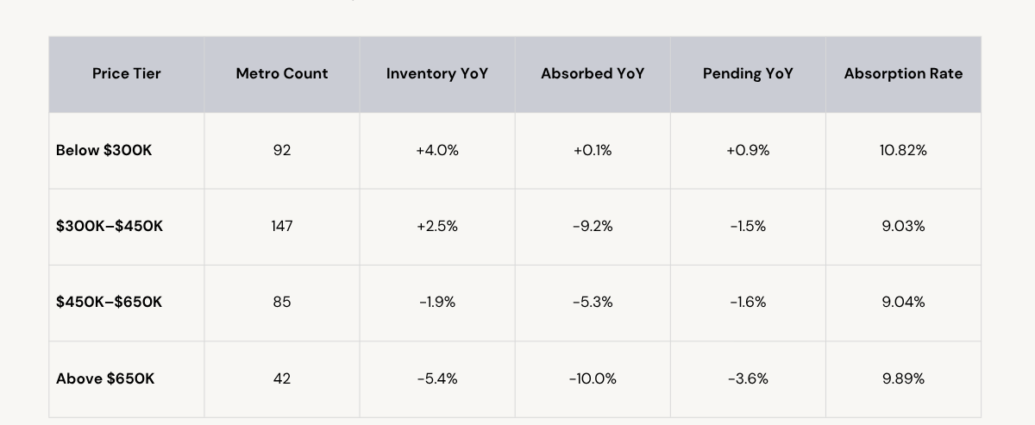
Housing Market Spotlight: Lower-priced metros show greater resilience as demand softens
Transaction activity slowed across much of the housing market as mortgage rates remained elevated, but metros where homes remain within reach of buyers continued outperforming higher-priced markets.
Mortgage rates remained above 6.64% for most of the week, creating another headwind for housing demand. As HousingWire Lead Analyst Logan Mohtashami reported in this week’s Housing Market Tracker, pending home sales were essentially flat year over year while mortgage purchase applications posted only their third negative annual reading of 2026.
The national data tells us what happened. Metro-level data helps explain where it happened and why some housing markets are proving more resilient than others.
What the national data shows
Across more than 350 metro areas, transaction activity softened broadly during the week ending July 17. Absorbed listings declined year over year in three of four price tiers. The exception was the market’s most affordable segment.
This week’s results also align with a broader pattern observed during periods of elevated mortgage rates. Housing activity tends to hold up better where homes remain affordable to a larger share of buyers.
Below $300,000, absorbed listings were essentially flat year over year, making it the only price tier to avoid a meaningful decline. Inventory in that segment increased 4.0%, suggesting additional supply is still finding buyers rather than accumulating.
At the other end of the market, absorbed listings in metros above $650,000 fell 10.0% while inventory declined 5.4%, indicating demand weakened faster than available supply.
Two markets, two outcomes
Kansas City shows where affordability continues supporting demand
Kansas City, Mo., shows how affordability can continue supporting market activity even as national demand softens. Inventory expanded alongside stronger pending sales, more completed transactions, fewer price reductions and significantly faster selling times.
- Active inventory: 4,609 to 5,395 (+17.1%)
- Absorbed listings: 557 to 604 (+8.4%)
- Estimated sales: 516 to 570 (+10.6%)
- New pending contracts: 572 to 655 (+14.5%)
- Median days on market: 56 to 28
- Share of listings with price reductions: 43.0% to 32.5%
With a median list price of $425,000, Kansas City remains relatively affordable, allowing buyers to continue demonstrating purchasing power despite elevated mortgage rates. Together, these metrics show new supply translating into stronger market activity rather than accumulating on the sidelines.
Miami shows where elevated borrowing costs continue to weigh on activity
Miami, Fla., tells a different story. Inventory contracted significantly from a year ago, but transaction activity slowed even faster while months of inventory increased.
- Active inventory: 18,619 to 13,319 (-28.5%)
- Absorbed listings: 1,332 to 741 (-44.4%)
- Estimated sales: 1,212 to 684 (-43.6%)
- New pending contracts: 764 to 723 (-5.4%)
- Median days on market: 84 to 84
- Months of inventory: 3.55 to 4.50
The gap between declining inventory and even weaker transaction activity suggests demand weakened faster than available supply, softening market conditions despite fewer homes for sale.
Together, Kansas City and Miami illustrate this week’s national housing story. Elevated mortgage rates are affecting every market, but affordability continues to shape which markets remain the most resilient.
Why it matters
The July 17 data reinforces an important point: housing markets do not respond uniformly to higher mortgage rates. Local affordability continues shaping where transactions occur and how efficiently available inventory converts into sales.
For housing professionals, the practical question is not simply whether inventory is rising or falling. It is whether available inventory is converting into transactions and how that conversion rate differs across price tiers and geographies.
A market adding inventory may be creating more opportunity. A market where both supply and demand are contracting simultaneously may signal something more significant. Understanding that difference is where local market expertise becomes most valuable.
The Spotlight takeaway
Mortgage rates may influence the national housing market, but affordability continues shaping local outcomes. This week’s data shows lower-priced metros holding up better as demand softened, reinforcing why housing professionals should evaluate not just inventory levels, but how effectively markets convert available homes into transactions.
Explore the data
Track transaction growth, inventory and market efficiency in your own market with HousingWire Intelligence (HWi), which provides inventory, pricing, demand and market activity data at the national, metro and ZIP code levels.
For weekly analysis of mortgage rates, housing demand and the macroeconomic forces shaping the market, read Logan Mohtashami’s Housing Market Tracker.
HousingWire Data methodology: This analysis is based on HousingWire Data’s national single-family housing dataset through July 17, 2026, with year-over-year comparisons to the week ending July 18, 2025. Price tiers are grouped using each metro’s median list price during the analysis week. Metrics include active inventory, absorbed listings, new pending contracts, estimated sales, median days on market, months of inventory and absorption rate, providing a standardized view of housing market performance across more than 350 U.S. metro areas.
Enterprise organizations interested in licensing HousingWire’s housing market data, APIs and analytics can learn more about HousingWire Data.

Chick-fil-A security incident may have exposed some customer account data
Chick-fil-A said Wednesday that a recent security incident may have exposed personal information linked to a limited number of customer loyalty accounts.
The Atlanta-based fast-food chain told FOX Business that it moved quickly to secure affected accounts and notify customers who may have been impacted.
“We recently identified a security incident that may have affected a limited number of Chick-fil-A One Loyalty accounts,” a company spokesperson said. “Upon discovering the issue, we took steps to immediately address, secure and restore accounts, and we are communicating directly with all customers who may have been impacted.”
CHICK-FIL-A EXPANDS ITS ‘GHOST KITCHEN’ MODEL WITH NEW DELIVERY-ONLY STORE IN FLORIDA
The spokesperson added that the company “sincerely apologize[s] for any inconvenience or concern” and remains “committed” to maintaining customers’ trust.
The company notified potentially affected customers Monday after discovering suspicious login activity involving certain Chick-fil-A One accounts, USA TODAY reported.
SALADS OUTSELL FRIED FAVORITES AT THIS CALIFORNIA CHICKEN CHAIN GROWING NATIONWIDE
According to the notice, “unauthorized parties” targeted the company’s website and mobile app between June 17 and June 19. The attackers used account credentials obtained from a “third-party source,” the outlet reported.
The incident affected customers in Iowa, Maryland, Massachusetts, New Mexico, New York, North Carolina, Oregon, Rhode Island, Vermont and Washington, D.C., according to USA Today.
A DAD REVEALED HOW HIS FAMILY OF 5 EATS AT CHICK-FIL-A FOR UNDER $45
GET FOX BUSINESS ON THE GO BY CLICKING HERE
The data that may have been compromised included customers’ names, email addresses, Chick-fil-A One membership and mobile payment numbers, the last four digits of payment cards and the amount of Chick-fil-A credit stored in their accounts.
Chick-fil-A said it reset passwords for affected accounts, restored any impacted loyalty balances and added rewards to customers’ accounts, USA TODAY reported.

Wall Street’s Newest Loophole for the Rich: Build Your Own ETF, Skip the Tax Bill
A tax strategy once confined to the quietest corners of the wealth-management world has broken into the open, and the U.S. Treasury Department is now weighing whether to rein it in. The maneuver, known as a “351 conversion,” lets an investor sitting on years of stock-market gains fold those appreciated holdings into a brand-new exchange-traded fund without triggering the capital gains tax bill a straight sale would produce.
The appeal is straightforward for anyone holding a concentrated position that has ballooned in value. Selling to diversify means writing a check to the government at the top long-term capital gains rate of 20 percent, plus the 3.8 percent net investment income tax on top. A 351 conversion sidesteps that moment entirely. The investor contributes the stock to a newly formed ETF, receives fund shares in return, and carries the original cost basis forward. No sale, no realized gain, no immediate tax.
The name comes from Section 351 of the Internal Revenue Code, a provision on the books for roughly a century that permits property to be transferred into a corporation tax-free under the right conditions. Applied to ETFs, it comes with guardrails: the contributing investors must hold at least 80 percent of the new fund immediately after the exchange, and the portfolio has to be diversified enough that no single holding tops 25 percent and the five largest stay under half the total. Once the assets are inside the ETF wrapper, the fund’s in-kind trading machinery allows it to rebalance into a broad, diversified basket without kicking off taxable events along the way. The investor ends up diversified, still fully invested, and untaxed.
The strategy has moved well beyond theory. One of the clearest recent examples is a core-equity ETF that launched in February seeded with roughly $540 million in securities, most of it supplied by a single wealthy family looking to shed appreciated shares without realizing the gains. Filings show the roster of participants now includes private-equity billionaire Richard Kayne, and the trend has pulled in large institutional names as well, among them Dimensional Fund Advisors and Baillie Gifford, with Neuberger Berman said to be preparing its own version. Charlotte Hornets owner Gabe Plotkin is also reported to be planning a fund seeded largely with his own holdings.
What turns deferral into potential avoidance is the estate-planning endgame. Because heirs can inherit ETF shares at a stepped-up cost basis, the embedded gain that was never taxed during the investor’s lifetime can vanish altogether when the shares pass on. That is the feature that has drawn the sharpest criticism of the practice as a permanent escape hatch rather than a timing tool.
Regulators have taken notice. Late last year, Treasury officials began signaling interest in the conversions, and by early 2026 the department was in preliminary discussions with the Investment Company Institute and tax attorneys about how it might respond. Among the options floated internally was designating certain conversions “transactions of interest,” a label reserved for deals carrying tax-avoidance potential that triggers heightened IRS reporting. No formal guidance has been issued. In an unusual step, the ICI itself filed a comment letter asking Treasury for clarity, a sign the fund industry would rather have defined rules than open-ended uncertainty.
Congress is circling as well. Senate Finance Committee Ranking Member Ron Wyden, D-Ore., has introduced legislation aimed at limiting access to 351 exchanges within the ETF market. And tax specialists have flagged aggressive uses that could invite an IRS challenge even under current law. Two patterns draw the most attention: “stuffing,” where a fund is packed with highly appreciated shares that have little to do with its stated investment strategy, and “sequential seeding,” where new ETFs are spun up repeatedly for the sole purpose of cycling appreciated stock into tax-deferred wrappers. Either could give the government grounds to recharacterize the deal and impose the tax immediately under the economic-substance doctrine, which lets the IRS disregard transactions that exist mainly to avoid tax.
For now, the conversions remain legal and are spreading fast enough that some advisory firms report a steady stream of pitches from issuers offering to structure them. The open question is how long the window stays open. With Treasury studying its options, the ICI asking for rules, and legislation pending on Capitol Hill, the strategy sits in a familiar spot: a legal edge that works precisely until Washington decides it works too well.
JBizNews Desk | New York, N.Y.
© JBizNews.com All Rights Reserved. Reproduction or distribution without written permission is prohibited.
Hebron’s sewage crisis flows south toward Negev
The water running through the dry hills south of Hebron is thick, pale in places and difficult to ignore. Along parts of the streambed, the odor arrives before the water is visible.
From Hebron, the polluted flow moves south past roads, open land and Israeli communities, reaching Meitar, Shoket Junction and eventually the Beersheba Stream system. Over roughly 43 kilometers, it carries untreated sewage and industrial waste from the stone industry across the jurisdictions established under the Oslo Accords.
Most of the sewage originates in Palestinian towns around Hebron, where the Palestinian Authority is responsible for civilian services. It then reaches Area C, where Israel controls planning and security, before crossing the Green Line on its way toward the Negev. The wastewater passes through territory administered by different authorities, but the flow has not been stopped at its source.
“The problem with what we call Hebron Valley is not a problem for Har Hebron Regional Council residents only,” Eliram Azulay, head of the Har Hebron Regional Council, told The Media Line. “This problem is a huge problem for Israel.”
Azulay places responsibility on the Palestinian Authority, saying sewage from Hebron-area municipalities and wastewater from stone-cutting factories are allowed to flow south without adequate treatment. By the time the pollution reaches Israeli territory, he said, Har Hebron, Meitar, Omer, Bnei Shimon and Beersheba are left to finance its collection and treatment.
“You can make kayaks in this sewage,” Azulay said after touring the stream. “And you know, it smells.”
He said sediment from stone factories settles along the route, blocks channels and makes nearby land difficult to use.
Stone industry particles enter sewage systems without proper treatment
Domestic sewage is only part of the problem. Hebron is a major center for stone cutting and processing, an industry that produces wastewater loaded with fine mineral particles. Barak Werker, chief executive of Green Now, said those particles enter municipal sewage systems without the industrial pretreatment required at regulated factories inside Israel.
“The biggest problem in the Hebron Stream is the stone industry in Hebron itself,” Werker told The Media Line. “It releases water containing stone particles, making it impossible to treat the wastewater at its source.”
Biological treatment plants are designed to break down organic material, but stone powder instead settles and accumulates, interfering with pumps, pipes and treatment basins. Green Now’s 2024 Cross-Border Pollution report identifies chromium from Hebron’s tanning industry as another contaminant entering the stream alongside stone dust and untreated sewage.
Werker said the pollution developed over decades as Hebron’s population and stone industry expanded. He cautioned against treating it as a problem that began with the Oslo Accords or resulted solely from Palestinian neglect.
Environmental infrastructure was poor across the region before the agreements, he said, and Israel itself had relatively few advanced wastewater plants in the 1980s. The Oslo period coincided with Israel modernizing its systems while responsibility for Palestinian communities shifted to the newly established Palestinian Authority.
That division has worked poorly in a shared watershed. Israeli facilities downstream can reduce some of the damage, but only after the wastewater has passed through communities, agricultural land and open spaces.
Green Now estimates that Israeli and Palestinian communities in the West Bank produce about 90 million cubic meters of sewage each year, approximately 80% of it from the Palestinian population. Its report estimates that 38 million cubic meters from Palestinian towns and villages receive no treatment and enter streams, soil, or absorption pits. Roughly 5 million cubic meters of sewage or inadequately treated effluent from Israeli communities also reach the environment, according to the report.
Those figures are regional estimates, not measurements limited to the Hebron Stream. The report was edited by Dr. Yeshayahu Bar-Or, a former chief scientist at Israel’s Environmental Protection Ministry, and environmental lawyer Shlomo Rabinowitz. It draws on field surveys, drone documentation and previously published government and academic material.
The long-term concern is not that residents drink directly from the stream, but that sewage and industrial contaminants could seep through the limestone terrain into the Mountain Aquifer, which supplies water to Israelis and Palestinians. Green Now describes the Western Mountain Aquifer as Israel’s largest and highest-quality groundwater reservoir, with average annual renewable resources of about 360 million cubic meters.
Azulay said professionals had warned him about groundwater contamination and the reliability of water sources serving the Negev. His prediction that some supplies could become unusable within several years was not supported by a published Water Authority assessment in the material reviewed by The Media Line. The broader danger of sewage reaching groundwater is addressed in Green Now’s report.
The proposed engineering solution begins inside the stone factories.
“The right solution is to separate the stone waste at its source in the Hebron area,” Werker said. “After pretreatment, the wastewater should be sent to the large Palestinian treatment plant near Yatta, treated there and reused for irrigation. There is no justification for allowing it to flow for dozens of kilometers.”
Werker said a wastewater plant built with millions of euros for the Hebron area cannot operate effectively while large quantities of stone residue continue to enter the system. Israel, he argued, is considering increasingly costly downstream infrastructure while failing to stop pollution that should be addressed at the factory gate.
Appeals to High Court for stone plant regulatory enforcement
The legal fight now centers on the factories. Regavim and Green Now have asked Israel’s High Court of Justice to compel enforcement against stone plants they allege are operating without permits and discharging sludge into the Hebron Stream. According to the petitioners, some of the facilities are in Area C or have expanded into it, placing them under Israeli jurisdiction.
In a June 29 statement, the petitioners said Supreme Court Justice Alex Stein had ordered the state to respond within 60 days. They quoted Stein as warning that abandonment of the area posed a “serious and irreversible danger to nature.”
The organizations said field documentation showed factories connected to Palestinian-administered areas expanding into territory where Israel has enforcement authority. The Media Line did not independently review the full petition.
The case also directs part of the blame at Israel. If factories are operating in Area C without valid permits, their continued activity would point to a failure of Israeli enforcement. Regavim and Green Now argue that regulated stone factories in Israel must install systems to keep industrial sludge out of municipal sewers, while unregulated competitors avoid those costs and shift the damage downstream.
“We don’t want chaos,” Naomi Kahn, director of Regavim’s international division, told The Media Line. “If the State of Israel has jurisdiction and has authority and has responsibility, then it should exercise those for everyone’s benefit and to protect the land itself.”
Kahn said Israel could not leave Area C in administrative uncertainty while the pollution continued.
“For now, you’re in charge, you’re responsible for protecting that resource, and you have to do it,” she said. “Because if you don’t, you end up with a disaster – an environmental disaster, a political disaster, a security disaster. You can’t leave a vacuum.”
Green Now’s report also cites criticism by Israel’s State Comptroller, who found that the government lacked a unified system for managing cross-border pollution and had not designated a single body to coordinate ministries and agencies. Disputes involving the Hebron Stream and other waterways were repeatedly delayed by fragmented authority and the absence of government decisions, according to passages reproduced in the report.
The jurisdictional division dates to the 1995 Interim Agreement. Under Oslo II, the Palestinian Authority received civil and security control in Area A and civil control in Area B, while Israel retained security control in Area B and full control in Area C. The agreement also committed both sides to preventing uncontrolled sewage discharges that could affect the other and to promoting the treatment of domestic and industrial wastewater.
Azulay points to that commitment when assigning responsibility to the Palestinian Authority.
“The demand is very simple,” he said. “Do what the agreement says that you have to do. If you have to treat your sewage, don’t throw it on the Israeli authorities.”
He accused the Palestinian Authority of failing for more than three decades to build, regulate and maintain the systems needed to contain its wastewater.
Azulay said he was willing to cooperate with Palestinian officials. “I would like to work with them. I don’t have a problem working with them,” he said. “But they really don’t want to do what they have to do.”
Green Now’s reporting partly supports that criticism while documenting other constraints. The organization says Palestinian environmental services receive inadequate budgets and lack enforcement capacity. A separate Green Now report, citing the Palestinian Environmental Quality Authority’s assessment, says Palestinian plans have often lacked formal government approval, skilled personnel and a clear enforcement strategy. Environmental protection accounted for 0.1% of the Palestinian government budget in the material reviewed.
The Palestinian assessment argues that Israeli control over land and planning, particularly in Area C, has delayed sewage and other infrastructure projects. It also cites permit restrictions and movement limits.
Although Green Now disputes parts of that argument, its report acknowledges difficult terrain, weak municipal budgets, scattered communities and the high cost of connecting them to regional treatment plants. It also records Palestinian complaints about the Joint Water Committee established under the Oslo Accords.
Green Now says the committee has been largely paralyzed since 2012. It attributes the breakdown partly to Palestinian opposition to shared facilities and disputes over Israel’s use of treated Palestinian wastewater, while also noting the absence of a coordinated Israeli policy.
The Palestinian Authority, the Hebron and Yatta municipalities and representatives of the stone industry did not provide responses for inclusion.
For residents beside the stream, the argument is less technical. Ayala Bar On, who works with the Har Hebron Regional Council’s communications team, said the smell keeps people away from open areas near their homes.
“There are some places where you cannot even breathe because the air stinks,” she said.
Azulay said the complaints reaching his office are direct.
“They ask a very simple question: How can we live with that smell?” he said. “It’s sewage that goes through their communities. It’s crazy. You cannot understand it.”
For people living along the route, the dispute over permits, treatment plants and jurisdiction is measured more simply: by the smell outside their homes and the condition of the stream.
The pending court case may clarify what Israel must enforce in Area C. It will not, by itself, resolve the larger question of who will finance and operate the cross-border infrastructure needed to stop the pollution upstream.

Mamdani promised to arrest Netanyahu. Now, he retreats on campaign promise he can’t keep – comment
Throughout his mayoral campaign last year, New York City Mayor Zohran Mamdani promised on multiple occasions that he would use his powers to arrest Prime Minister Benjamin Netanyahu should the latter ever set foot in New York.
Just last week, Mamdani told the New York Times that his administration was discussing the arrest.
Now, the mayor has backtracked on the decision, announcing in a video on Tuesday that his administration does not have the “independent legal authority to enforce this [International Criminal Court] warrant” despite reviewing “every avenue available under applicable law.”
His discovery that the arrest is not legally possible should not come as a surprise; legal experts have consistently cast doubt on the legality of Mamdani’s promise, predominantly because the US is not a party to the ICC.
This leads to an important question: did Mamdani make the arrest promise a central part of his election campaign without checking if it was in fact possible? Or did he know it was not feasible all along and just used the promise to gain votes?
Doubts of competence, doubts of reliability
The first would shed doubt on his competence, and the second, on his reliability.
If he did in fact know this all along, then his dogged and irretractable anti-Bibi campaign can only be described as polemical virtue-signaling and as a way of currying favor with his progressive pro-Palestinian voter base.
His statements suggest either a failure to examine the legal basis of the promise or a willingness to make a promise that was unlikely to be fulfilled.
As the Simon Wiesenthal Center noted, Mamdani has chosen to transform that legal reality into a televised political spectacle.
Not only does Mamdani’s posturing undermine the authority and reputability of the office which he helms, but it also directly undermines American democracy. It stands in stark antithesis to the concept of separation of powers.
It also shows that his focus is not on the issues that actually fall within his remit – such as housing, crime, and transport – but instead on the leader of a country in a different context, across several oceans.
Mamdani is not responsible for foreign policy. He does not have a state department. He is, however, the mayor of a city with the largest population of Jews outside of Israel.
Negative effects on Jewish New Yorkers
While he does not have the power to arrest Netanyahu, he does have the power to protect his city’s Jews.
This video, which singles out the one Jewish state, could have tangibly negative effects on Jewish New Yorkers at a time they are already experiencing astronomical levels of antisemitism.
Other elements of the video do not stand up to scrutiny.
After calling Netanyahu the “architect of genocide” who is “denying newborns the chance to live,” Mamdani says, “I agree with the ICC that Benjamin Netanyahu should be arrested and tried for his crimes, as I do for anyone else charged by the ICC.”
Netanyahu was never charged with genocide by the ICC.
Mamdani also speaks of the 73,000 death toll in Gaza – a number known to be peddled by the Hamas-run Health Ministry, which does not distinguish between the death of its own terrorist fighters and the death of civilians.
In some ways, Mamdani is acting in a similar manner to Arab leaders in the Middle East. Figures like Ayatollah Khamenei, Mahmoud Abbas, Recep Tayyip Erdogan, and President Abdel Fattah al-Sisi all thrust the focus onto Israel so as to shift people’s attention away from problems on the home front.
Mamdani’s obsession with Israel is time-old and time-worn.
But having made the promise a defining feature of his campaign, Mamdani now faces a political dilemma.
Abandoning it risks disappointing supporters who took him at his word; continuing to defend it means doubling down on a position his own administration now acknowledges it lacks the authority to carry out.

Haim Yavin, iconic Israeli news anchor known as ‘Mr. Television,’ dies at 93
Haim Yavin, the veteran broadcaster known to generations of Israelis as “Mr. Television,” died on Wednesday at the age of 93, his family announced.
Yavin was one of the founders of Israeli television and the longtime presenter of the public broadcaster’s flagship Mabat evening news program.
His voice and image accompanied Israelis through elections, wars, peace agreements, political upheaval, and national tragedy for four decades. During his broadcasts beginning in 1968 until 2008, much of Israeli life came to a halt as viewers tuned in to learn what was happening in the country and the world.
Much like Walter Cronkite in the US, who personified credibility and authority for many, Yavin was a trusted voice whose opinions, whenever he chose to express them, carried real weight.
“With profound sorrow, we part from our husband, our father, and our grandfather, who reached a ripe old age,” his family said.
His funeral is scheduled to take place at Givat Hashlosha Cemetery at 11 a.m. on Friday.
From radio to the birth of Israeli television
Yavin became permanently associated with the Hebrew word “mahapach,” meaning political upheaval, after using it during the May 1977 election broadcast as results indicated that Likud leader Menachem Begin would end the Labor movement’s decades-long rule.
Nearly two decades later, Yavin delivered one of the most painful announcements in Israeli broadcasting history following the assassination of prime minister Yitzhak Rabin in November 1995.
Yavin was born Heinz Kluger on September 10, 1932, in Beuthen, Germany, now Bytom, Poland. His family immigrated to Mandatory Palestine in 1933, when he was a baby, and settled in the Haifa area.
He began his broadcasting career at Kol Yisrael Radio in 1956, presenting news, entertainment, and music programs. He later worked in the station’s documentary department as an editor, producer, and presenter.
Yavin joined the team that established Israeli television in 1968. On July 23 of that year, he presented the first edition of Mabat LaHadashot, which focused largely on the hijacking of an El Al plane to Algeria.
He later served as the Israel Broadcasting Authority’s correspondent in the United States, covering the US government in Washington, the United Nations in New York, and other events across the country.
After returning to Israel, Yavin held several senior positions at the public broadcaster, including editor of Mabat, director of the news department, and editor and presenter of the current-affairs program Mabat Sheni.
He served as director of Israeli television from 1986 to 1990. During his tenure, broadcasting hours were expanded, and programs including Ro’im Olam, Beshidur Hoker, and Siba Lamesiba were launched.
Yavin left Channel 1 briefly in 1997 to present the investigative program Ha’erev Hahamishi on Channel 2 before returning to Mabat the following year.
He presented his final Mabat broadcast on February 5, 2008.
In 2016, several women accused Yavin of sexual harassment during their time working at the Israel Broadcasting Authority. Yavin denied the allegations.
Documenting Israeli society
Alongside his work as a news presenter, Yavin was an acclaimed documentary filmmaker who examined some of the deepest political and social divisions in Israeli society.
His documentaries included Hanivharim ’81, which followed the bitter 1981 election campaign; Gahelet Loheshet, about Soviet Jewry during the collapse of the Soviet Union; Eretz Hamitnahalim, examining the settlement movement; Te’uda Kehula, about Israel’s Arab citizens; and Tzva Ha’am, which explored changes in relations between the IDF and Israeli society.
Eretz Hamitnahalim, broadcast in 2005, generated controversy because of Yavin’s criticism of Israeli settlement policies.
In the film, he contended that the Israeli settlements in the West Bank and the Gaza Strip were endangering the future of Israel.
“Since 1967, [the Israelis] have been brutal conquerors, occupiers, suppressing another people,” he said, calling for Israel to withdraw from these areas.
The series received more than 100 complaints to the Second Authority for Television and Radio, as well as calls from some right-wing figures for Yavin to be removed from his position at the public broadcaster.
The production later received awards for documentary filmmaking and directing.
His final documentary, Jerusalem: A City of Broken Dreams, created with director Julie Shles, aired in 2016 and examined relations between Jewish and Arab residents of the capital.
In addition to news anchoring and producing, Yavin wrote several books, including an autobiography, and recorded albums of children’s stories.
Yavin received the Israel Prize for communications in 1997, a lifetime achievement award from the Israeli Academy of Film and Television in 2003, and a lifetime achievement award from the Jerusalem Journalists Association in 2008.
‘There was no replacement for his art’
Yavin usually rejected his nickname of “Mr.Television.”
“I didn’t give myself that nickname. I regard it with an indulgent smile. You could say it is embarrassing, but flattering,”he said. in a 2010 interview with Ynet.
But veteran broadcaster Ya’akov Ahimeir said Yavin had fully earned the title “Mr. Television.”
“He truly was Mr. Television,” Ahimeir told Walla Culture.
“He always found the right words and expressions. His eloquence was unparalleled. We worked together for many years, and I was in his shadow, like many others who work in broadcasting.”
Ahimeir also praised Yavin’s documentary work and his ability to reflect Israel’s political and social life.
“I do not think there was a replacement for his art of presenting the news, with expressions containing wisdom, precision, and humility,” he said. “Many people are mourning the fact that this voice has fallen silent.”
Journalist and broadcaster Yaron London described Yavin as a close friend, a gifted broadcaster, and an exceptionally dedicated public servant.
“He was the best news presenter we had,” London told Walla Culture, citing Yavin’s voice, expression, diction, and ability to inspire confidence among viewers.
“He was extraordinarily diligent and hardworking,” London said. “In everything he did, he served the public. He was an honest, decent, and courageous man. An extraordinary journalist.”
KAN News expressed “deep sorrow” over the death of a man it described as a cornerstone of Israeli public broadcasting.
“It is difficult to imagine a historic chapter in the life of the State of Israel in recent generations that Yavin did not mediate for the public,” the outlet said in a statement.
The broadcaster noted that Yavin had announced the 1977 political upheaval, presented the first televised Israeli news broadcast, and struggled to announce Rabin’s death after the prime minister’s assassination.
President Isaac Herzog said Yavin had accompanied Israelis through defining national moments “with professionalism, responsibility, and statesmanship.”
“His voice and face were identified with central chapters in the history of the state,” Herzog said. “He left a profound mark on Israeli journalism and public culture.”
MK Ahmad Tibi (Hadash-Ta’al) eulogized Yavin in a social media post on Wednesday.
“Haim Yavin z”l, one of the legends of Israeli television, journalist, presenter and creator, passed away today,” he wrote on X/Twitter.
“He was a professional, honest and fair journalist who did not succumb to populism or extremism, and showed empathy for the distress of the minority. I knew him and admired his integrity and his professional honesty. May his memory be a blessing.”
But many ordinary Israelis who simply enjoyed listening to his calm voice and knowledgeable reporting took to social media to bid goodbye to a broadcaster who had been a part of their lives for decades
Yavin is survived by his wife, Yosefa, his sons, Yonatan, Michael, and Hagai, and his grandchildren. His daughter, Dafna Yavin-Reches, died in 2025.
Nick Janovsky joins SERHANT. as Tampa luxury sales director
SERHANT. appointed Nick Janovsky director of luxury sales for Tampa, St. Petersburg and the Gulf Beaches, the company announced on Wednesday.
Based in St. Petersburg, Janovsky brings more than $250 million in career sales volume across 340-plus transactions, according to the announcement. He was a top producer for five consecutive years in Premier Sotheby’s International Realty’s St. Petersburg office and was ranked in previous editions of the RealTrends Verified agent rankings
Janovsky specializes in luxury waterfront estates, architecturally significant homes, new development, investment properties and executive relocations. At Premier Sotheby’s, he led The Nick Janovsky Group.
“I’ve spent more than a decade becoming one of Tampa Bay’s top luxury real estate advisors, and real estate has changed,” Janovsky said in the announcement. “The future belongs to advisors who can combine relationships, strategy, media, technology and storytelling at the highest level. SERHANT.’s ability to pair deep local expertise with a national audience, world-class marketing, industry-leading content and a platform that creates opportunities for clients on a much larger scale.”
SERHANT. entered Florida in 2023 and has been expanding across the state. Since launching in 2020, SERHANT. has grown to more than 2,000 agents in 17 markets.
This article was generated using HousingWire Automation and reviewed by a HousingWire editor before publication.

NYC landlords sue Rent Guidelines Board to stop rent freeze

The first legal challenge to the Rent Guidelines Board’s (RGB) decision to freeze the rent for New York City’s stabilized apartments was filed this week. A group of landlords filed a petition in New York State Supreme Court on Staten Island to annul the board’s June 25 approval of 0 percent increases on one- and two-year leases. The suit claims the board manipulated data to overstate property income for owners to meet Mayor Zohran Mamdani’s rent freeze promise.
Last month, the RGB voted to approve a rent freeze for one- and two-year leases for the city’s one million apartments that are stabilized, the first time 0 percent increases were approved for multiple-year leases.
The board includes two members representing tenants, two representing owners, and five representing the general public. Every year, the board releases guidelines on potential rent increases by looking at the economic conditions for both landlords and tenants.
Before he left office, Mayor Eric Adams attempted to block Mamdani’s rent-freeze pledge by appointing and reappointing four members to the board. But three members resigned, allowing Mamdani to appoint new members once he took office.
As mayor, Mamdani refrained from explicitly saying the board should freeze the rent, since the members operate independently, but he did encourage tenants to testify during public meetings held by the board.
The Article 78 petition was filed on behalf of several landlords and limited liability companies that own stabilized buildings. The plaintiffs include Michael Fazio of Kenilworth Holdings, LLC; Violet Zharku of 21-45 23rd St. LLC, 39-12 62nd St. LLC, and 42-59 Bowne St. LLC; Sophia Hepheastou of 1369 College LLC; 593 Park Place Management Inc.; and 43rd Street Associates LLC.
The petition also mentions RGB member Christina Smyth, who quit on the morning of the final vote because the board “stopped being a fact-finding body.” She explained later: “It has become a body that starts with an answer and vibe codes its way backward to justify it.”
Randy Mastro, former deputy mayor under Adams, is one of the lawyers representing the landlords.
“To deliver on the Mayor’s campaign promise of a rent freeze, the Board then had to disregard its statutory mandate and manipulate its own data, intentionally underestimating operating costs and intentionally overstating income of landlords,” Mastro said. “In other words, there is no actual basis for an across-the-board rent freeze here, and the Board’s decision must be overturned.”
A report released by RGB earlier this year found the net operating income (NOI), which is the revenue landlords earned after operating costs, rose 6.2 percent between 2023 and 2024 citywide. Property owners have long said NOI is a flawed metric for small rent-stabilized buildings because it does not factor in mortgage debt and major capital expenses. Owners also argue that buildings that are 100 percent stabilized saw revenue increase by just 4 percent.
Tenant advocates argue that under Adams, the board voted to increase rents four years in a row, for a total of 12 percent, increasing income for rent-stabilized landlords by 30 percent during that period.
Sumathy Kumar, the executive director of the NYS Tenant Bloc, called the lawsuit a “desperate attempt to protect their profits.”
“Tenants won a rent freeze because the economic data and tenant testimony clearly supported one. Landlords had no problem with the RGB’s process when it was rigged in their favor,” Kumar said in a statement. “Under the Adams administration, the RGB hiked the rent again and again, ignoring tenants’ economic reality and helping landlord profits soar. Now the RGB has the data as well as a democratic mandate to provide tenants with relief, and landlords want to change the rules.”
Kumar added that the group is ready to protect the rent freeze “in every arena necessary from the courts to the legislature.”
RELATED:
- Two-year rent freeze for NYC stabilized apartments approved by Rent Guidelines Board
- Rent Guidelines Board member resigns hours before vote on possible rent freeze
- Landlord income up 6 percent as board considers rent adjustments for NYC’s stabilized apartments
The post NYC landlords sue Rent Guidelines Board to stop rent freeze first appeared on 6sqft.

The untapped opportunity that could help close America’s housing shortage
More than 300,000 empty lots listed for sale could help reduce America’s housing shortage, according to new research from Zillow.
The real estate company said 300,242 empty lots of five acres or fewer were listed for sale on Zillow in June, accounting for 17.4% of all for-sale listings.
Building one home on each lot would reduce the estimated national housing deficit from 4.7 million homes to about 4.44 million, a decline of 6.3%, Zillow said.
The typical lot for sale is 0.57 acres and has a median price of $79,000. Zillow said many of the parcels may be large enough to support more than one home, making its estimate conservative.
STARTER HOME AFFORDABILITY IS CRAWLING BACK. THESE REGIONS ARE BEST FOR FIRST-TIME HOME BUYERS
“The more than 300,000 lots currently listed for sale represent the lowest-hanging fruit in addressing a housing shortage that’s two decades in the making,” Zillow Senior Economist Kara Ng said.
Ng said loosening zoning rules, streamlining permitting and expanding access to financing could reduce the cost and uncertainty associated with construction.
WHY HOMEBUYERS ARE RACING TO THIS PENNSYLVANIA PORT CITY
Florida had the most empty lots listed for sale, with 42,601, followed by Texas with 40,907, California with 18,508, North Carolina with 14,226 and Georgia with 10,334.
Empty lots made up the largest share of for-sale listings in North Dakota, at 45.9%, followed by South Dakota at 38.7% and Alaska at 34.6%.
Rural markets had the highest concentration of empty lots, accounting for 25.3% of listings, compared with 13.6% in suburban areas and 9% in urban markets.
MORTGAGE RATES JUMP TO HIGHEST LEVEL IN ALMOST A YEAR
Rural lots were also the least expensive on a per-acre basis, with a median of about $75,000 per acre. That compares with more than $181,000 per acre in suburban areas and approximately $500,000 per acre in urban areas.
Zillow said expanding access to manufactured homes could also help address the shortage because they can be built faster and at a lower cost than traditional site-built homes.
CLICK HERE TO GET FOX BUSINESS ON THE GO
The company is participating in a 12-week federal technology initiative with the U.S. Census Bureau’s Opportunity Project focused on increasing access to small-dollar housing loans in rural communities and reducing barriers for buyers interested in purchasing and building on empty lots.

Prediction Markets and Their Opponents Step Up Spending to Sway Congress in 2026
Kalshi, the largest prediction market operator in the United States, poured $990,000 into direct federal lobbying during the first six months of 2026 — and close to $1.8 million once the outside firms it retained are counted, according to newly filed disclosures reviewed this week. The figure already tops the roughly $1 million the company spent across all of 2025 and stands as its heaviest six-month push since it first registered to lobby in July of last year.
The spending surge reflects a widening fight in Washington over who gets to regulate an industry that now handles billions of dollars in weekly trades. From April through June alone, Kalshi reported $500,000 in federal lobbying on “matters affecting prediction markets” — its largest single-quarter outlay on record. The company also brought on a team at FTP, the firm previously known as Forbes Tate Partners, to work on legislation governing how the platforms are overseen.
The opposition is spending just as aggressively. The American Gaming Association, which represents casinos and traditional sportsbooks, laid out roughly $1.39 million in direct lobbying so far this year, climbing toward $1.8 million with outside firms — about 30 percent above its pace in the first half of 2025. The trade group spent $630,000 in the second quarter targeting, among other issues, event contracts tied to sports. The Cherokee Nation, which runs casino and gaming operations, added another $600,000 over the same six-month stretch.
Polymarket, Kalshi’s chief rival, is running a leaner operation. Its parent company, Blockratize, paid $90,000 to Advocus Partners in the second quarter for counsel on digital asset and information-market policy. The platform is nonetheless making a bold return to the American market after a multiyear ban, with federal investigators recently closing their probes into the company.
Sports betting giants have opened a second front. DraftKings reported $350,000 in second-quarter federal lobbying, while FanDuel spent a combined $480,000 between April and June and retained FGS Global to press its case on online wagering. Their central argument is that prediction-market sports contracts amount to sports betting by another name and should face the same state-level rules. The American Gaming Association estimates states have forfeited more than $1.2 billion in tax revenue as the platforms have expanded.
The money is also flowing toward the midterms. Win for America, a super PAC, has raised $70 million from sports betting companies including FanDuel, DraftKings and Fanatics Betting and Gaming — a war chest earmarked for the 2026 election cycle.
Lawmakers, meanwhile, are circling. The Senate unanimously approved a measure in April barring members and their staff from placing bets on prediction markets. The House has not followed suit, though Representative Bryan Steil, the Wisconsin Republican who chairs the House Administration Committee, introduced a bill last month that would extend the prohibition to members’ spouses and dependent children. Representative James Comer, the Kentucky Republican who leads the House Oversight Committee, opened an investigation in May into what he described as unchecked insider trading on the platforms.
Much of the regulatory tug-of-war centers on the Commodity Futures Trading Commission, which has sued New York, Wisconsin, Arizona, Connecticut and Illinois while asserting sole authority over the industry. President Donald Trump weighed in on May 26, posting that it was critically important for the agency to keep exclusive control. Concerns over misuse have sharpened the debate: the Justice Department in April charged an Army soldier with using classified information to win roughly $400,000 betting on the timing of a foreign leader’s capture.
Olivia Chalos, deputy chief legal officer at Polymarket, has argued that a single federal framework serves responsible operators and the customers they handle, noting the platform has made close to 100 referrals to law enforcement over suspicious activity. For now, both sides appear prepared to keep writing checks until Congress decides where the lines fall.
JBizNews Desk | Washington, D.C.
© JBizNews.com All Rights Reserved. Reproduction or distribution without written permission is prohibited.

IDF detains Israeli civilians who attempted to breach Syrian border
The IDF detained several Israeli settlers on Wednesday for attempting to cross into Syrian territory, the military said.
The Israelis, who had attempted the border breach from the Hermon area, were transferred to the Israel Police for further processing. It was the settler group’s third time attempting to cross into Syria.
The military said that it “strongly condemns” the attempted crossing, describing it as a”criminal offense that endangers civilians and IDF forces.”
The incident follows a KAN News report on Tuesday that the IDF nearly fired upon five of the group’s members near the Syrian border two weeks ago, amid suspicion that they may have been a terrorist squad attempting to infiltrate Israel.
The settlers were set to be targeted by IDF Elbit Hermes 450 “Zik” drones before being identified as observant Jews due to their peyot (side curls), KAN reported.
Israeli settlers try to infiltrate Syria for third time
HaBashan Pioneers activists have been trying to establish Jewish settlements in Syria. Several groups of activists were arrested in recent weeks for multiple separate border crossing attempts.
On Friday, the IDF detained several Israeli civilians for illegally crossing into Syrian territory from the Majdal Shams area, the military said, following an overnight search operation.
Ruby Sadikman contributed to this report.

US-Saudi nuclear deal shows the Abraham Accords is a positive incentive – analysis
The US is expected to move forward with a pact for Saudi Arabia that will focus on civilian nuclear power, according to a Tuesday New York Times report.
The potential deal is raising eyebrows in Israel and the region because it does not appear to include Riyadh joining the Abraham Accords or normalizing ties with Israel.
The full details are not known, and the US Congress will want to know more about this pact. However, the story sheds light on an important issue relating to the Abraham Accords. They should be viewed as a positive incentive, and not be seen as a negative trade-off.
What this means is that the original Abraham Accords appeared to countries such as the UAE and Bahrain because these countries wanted to normalize ties with Israel. The Trump administration’s backing for this agreement back in 2020 was key because it gave the agreement a US umbrella of support.
The US has key bases in Bahrain and the UAE. Therefore, there was a sense of security in these countries. In addition, the countries felt they were getting something. At the time, it should be remembered that the COVID pandemic was keeping the world locked down. In addition, the Trump administration had floated its vision for “Peace to Prosperity” for the Palestinians.
US maintains bases throughout the region
There was talk in Israel in early 2020 about potential annexation of the West Bank. When Israel climbed down from their agenda, the UAE and Bahrain moved forward with the Accords. There was a sense that Israel had given up on annexation.
Therefore, everyone got something. US President Donald Trump is best at making deals when everyone benefits. This is how the Gaza ceasefire deal came about in September and October 2025. The administration has proven less successful when there are threats.
For this reason, the new potential nuclear pact with Saudi Arabia should be seen on its merits. Claims that Saudi Arabia should have to normalize in order to receive civilian nuclear power will make Riyadh feel that US policy is linked solely to this issue of Israel and normalization.
Riyadh will wonder why there isn’t an equal amount of pressure on Israel to move toward providing Palestinians rights. Saudi Arabia has been a key leader of the Muslim and Arab world, and it has held out a hand in peace, but it wants to see progress in Jerusalem regarding the Palestinians.
THE US has learned in the past that a policy that uses negative trade-offs with Israel or the Arab states often doesn’t work. For instance, former US Secretary of State John Kerry once said that normalization would not happen without movement on the Palestinian issue.
Rather than getting Israel to be flexible, this cudgel made Israel stubborn and made it wait out the Obama administration. Using peace as a punishment has not worked well in the past. Using peace as an incentive so that all sides feel they got something has tended to work better.
Riyadh has made it clear what it wants to see in Jerusalem. If Israel isn’t willing to have a give-and-take, then Saudi Arabia is going to say to the US that it shouldn’t be prevented from receiving things simply because Jerusalem’s policies are being too inflexible.
This is why the perceived trade-off of Saudi nuclear energy for normalization may not have worked. All Israel’s leaders felt they had to do was wait, and they felt Riyadh would then have to change tack. This is essentially what Kerry had said to Israel.
The Arab countries could wait, and Israel would have to change to get things from them. This has historically not worked. Where Trump was able to unlock the Abraham Accord was by creating a framework where the US showed its support and the UAE, Bahrain and Israel all got something. No one had to give up much.
Riyadh clear on Jerusalem position, give-and-take
“The Trump administration plans to submit to Congress a pact with Saudi Arabia to share nuclear power technology that does not include a plan for normalization with Israel or safeguards the US has long said would stop materials from being used in nuclear weapons programs, the Times reported on Tuesday.”
The Times continued, reporting that “The Trump administration plans to submit to Congress a pact with Saudi Arabia to share nuclear power technology that does not include a plan for normalization with Israel or safeguards the US has long said would stop materials from being used in nuclear weapons programs.”
Riyadh has wanted this deal for many years. It has also shown that it is willing at times to hedge on issues relating to the US. Saudi Arabia is a strong and historic partner of the US. It is also a powerful Muslim and Arab country.
It has been willing to hold talks with China and to consider its economic policies and how they might fit into other economic blocs such as BRICS or the China-linked SCO. Saudi Arabia joined the SCO as a partner in 2023. This goes back to talks before 2021. Saudi Arabia has held off on joining BRICS, an economic bloc that includes Brazil, Russia, India, China and South Africa.
Saudi Arabia has done other outreach. It signed a defense pact with Pakistan, which is a friend of the US and the Trump administration.
Riyadh’s increasingly close ties with Turkey, Syria and Egypt have raised some concerns in Jerusalem. Some Israeli policymakers appear to think Saudi Arabia is drifting away from the Abraham Accords and no longer sees them as necessary.
The feeling among some is that Riyadh is increasingly joining a “Sunni” bloc of countries that may be more hostile to Israel.

Japan Exports and Imports Grow at Fastest June Pace Since November 2022, Topping Estimates
Japan’s exports jumped 19.3 percent in June from a year earlier, the fastest growth the country has posted since November 2022, as semiconductor equipment shipments and a persistently weak yen propelled shipments higher, Finance Ministry data showed. The gain outpaced the 18.6 percent rise economists surveyed by Reuters had penciled in, and marked a step up from the 16.8 percent recorded in May.
Imports climbed even faster, rising 25.4 percent year on year — a sign of firm domestic demand alongside the currency effects that inflate the cost of goods bought from abroad.
The export story is, once again, largely a chip story. Semiconductor shipments alone surged 53.8 percent in June, riding a wave of artificial intelligence investment that has lifted the shares of Japanese equipment makers including Tokyo Electron, Renesas Electronics and Advantest by anywhere from 50 to 93 percent since the start of the year. Regional demand did much of the work: shipments across Asia rose 22.7 percent, led by a striking 46.4 percent leap in goods sent to Taiwan. Exports to China, Japan’s single largest trading partner, gained 17.6 percent, while goods bound for the United States rose 13 percent.
There is, however, an important wrinkle beneath the headline number. While the value of exports soared, actual volumes barely moved, edging up just 0.2 percent. That gap underscores how much of the growth is being driven by pricing and the yen’s weakness rather than by a broad increase in the physical quantity of goods leaving Japanese ports. A softer currency makes Japanese products cheaper and more competitive abroad, but it simultaneously raises the cost of imported energy and materials, squeezing households and businesses at home.
The trade figures land against a backdrop of steady if unspectacular growth. Japan’s economy expanded 0.5 percent in the first quarter on a sequential basis, translating to a revised 1.8 percent annualized pace, with exports remaining one of its most reliable engines. The durability of that engine now hinges heavily on whether the global appetite for AI-related hardware holds up and whether the yen stays weak enough to keep Japanese goods attractive on price.
For Japanese manufacturers, the June data is a welcome signal that demand for their highest-value products — the specialized tools and components that feed the world’s chip factories — remains robust. The challenge for policymakers is that a currency weak enough to power exports is also weak enough to keep imported inflation stubbornly elevated, a balance the Bank of Japan continues to navigate as it weighs the path of interest rates.
JBizNews Desk | Tokyo
© JBizNews.com All Rights Reserved. Reproduction or distribution without written permission is prohibited.

Congo’s Ebola outbreak has killed over 1,000 people
BUNIA, Congo — More than 1,000 people have died in the Ebola outbreak in Congo, according to Africa’s top health body, a grim toll in the fastest Ebola outbreak in history, as conflict, community resistance and an uneven response fuel its spread.
Speaking at a health summit in Ghana on Wednesday, Dr. Jean Kaseya, director-general of the Africa Centres for Disease Control and Prevention, said 1,031 deaths have been confirmed.



Roy Lichtenstein exhibition at the Whitney will explore the evolution of images

The Whitney Museum of American Art is set to host a career-spanning exhibition this fall celebrating legendary pop artist Roy Lichtenstein, featuring more than 130 works exploring the evolution of his artistic career. Opening October 11, “Roy Lichtenstein: Like New” will examine the artist’s engagement with mass culture and his belief that no work is ever truly “stable,” but instead exists in a constant state of duplication, reproduction, and being “made new.” The featured works span from the early 1940s through the 1990s and offer a reconsideration of Lichtenstein’s relationship with image culture at a time when images are endlessly “cropped, filtered, reposted, and recirculated.”

One of the defining artists of the Pop Art movement and the 20th century, Lichtenstein is regarded as having transformed the “visual language” of mass-culture comics, advertising, consumer goods, and commercial printing into fine art. His work is known for its crisp, machine-like qualities, though each piece was meticulously handmade.

“Like New” goes beyond the artist’s surfaces to analyze how his early interest in perception and visual recognition guided his career-long inquiry into the power and stability of images. Across paintings, drawings, collages, prints, sculptures, and films, the exhibition frames Lichtenstein’s work as “unstable forms” that can be “borrowed, translated, reframed, and transformed.”

The exhibition features many of Lichtenstein’s most acclaimed works, including “Look Mickey,” “Girl with Ball,” “Masterpiece,” “Drowning Girl,” “Happy Tears,” “Little Big Painting,” “Rouen Cathedral, Set III,” and “Artist’s Studio ‘The Dance.’”

For the first time, the exhibition reunites all eight works from Lichtenstein’s 1962 debut at the Leo Castelli Gallery. The show reconstructs the intimate gallery setting, allowing visitors to experience the works together as audiences did when they were first presented.

The exhibition also features recreations of three murals, including a nearly 96-foot-long iteration of “Greene Street Mural,” as well as an outdoor presentation of “Girl in Window” brought to life by artist and co-curator Alex Da Corte.
Lichtenstein’s influence on other artists will also be explored through works by Louise Lawler, Richard Pettibone, and Sturtevant, further illustrating his relationship to copying, influence, appropriation, and the “afterlife” of images.

According to Design Scene, Pettibone’s reproductions of modernist paintings channel Lichtenstein’s inquiries, while Lawler’s photography of artworks in domestic spaces reflects Lichtenstein’s interest in how images function within systems of circulation and display.
Similarly, Sturtevant’s appropriations of other artists’ work, including Lichtenstein’s, push the process of copying and transformation to “its conceptual limit.” Rather than rejecting these practices, Lichtenstein’s career reflected a belief that borrowing, copying, and evolution can serve as deeper investigations into creativity and artistic expression.

The exhibition also arrives at an increasingly relevant moment, as Lichtenstein’s inquiries into image culture continue to resonate on social media platforms like TikTok and Instagram. On these platforms, users create a constant cycle of image evolution through cropping, filtering, and reposting.
“Like New” is organized by Meg Onli, Nancy and Fred Poses Curator, and Alex Da Corte, guest curator, with Nakai Falcón, curatorial assistant, and David Crane, curatorial research associate.
Visitors can now purchase timed tickets in advance for “Like New,” which opens Oct. 11. Member previews will run from October 8 through 10.
RELATED:
- Village home and studio of Roy Lichtenstein opens after renovation, honored with historic plaque
- ‘Clutch’ orange bag of Knicks playoff run on view at the Guggenheim
- New York Historical opens $175M democracy wing designed by Robert A.M. Stern Architects
The post Roy Lichtenstein exhibition at the Whitney will explore the evolution of images first appeared on 6sqft.

One Big Beautiful Bill Act Saved Millions of U.S. Manufacturing Jobs: NAM
The National Association of Manufacturers marked the first anniversary of the One Big Beautiful Bill Act this week with a 50-state analysis crediting the law’s tax provisions with protecting millions of American manufacturing jobs, hundreds of billions in wages and more than a trillion dollars in economic output that the association says would otherwise have been at risk.
Signed into law in July 2025, the One Big Beautiful Bill Act — designated H.R. 1 — locked in a package of measures aimed squarely at the factory floor. Chief among them: 100% immediate expensing for newly built and improved U.S. factories, full and immediate depreciation of machinery and equipment, permanent research-and-development expensing, restored interest deductibility, and a permanent 20% deduction for small and pass-through manufacturers. The law also preserved the 21% corporate tax rate that manufacturers had warned was central to their global competitiveness.
According to NAM’s modeling, the stakes of letting those provisions lapse were severe. The association estimates the law protected nearly six million jobs across the broader economy, preserved more than $1 trillion in economic output and safeguarded roughly $540 billion in wages — figures NAM frames as losses avoided rather than a fresh headcount, drawn from a landmark study it produced with EY.
The new state-by-state breakdown puts numbers to that national total. California led every category, with NAM crediting the law with saving 708,000 jobs, $134 billion in GDP and $67 billion in wages. Texas ranked second at 547,000 jobs, $107 billion in GDP and $51 billion in wages. Florida followed with 399,000 jobs and $36 billion in wages preserved. The analysis paired each state’s estimate with a real manufacturer putting the provisions to work.
Those examples ran from coast to coast. In Jacksonville, Johnson & Johnson has committed more than $1 billion to expand operations, with the company’s chief technical operations and risk officer, Kathy Wengel, tying the investment to a stable corporate tax rate. In California, Robinson Helicopter said immediate R&D expensing is letting it deploy new R88 aircraft as airborne control centers for fire-surveillance drones. Will Fulton, the company’s vice president of business development, said the deduction speeds the company’s ability to bring lifesaving products to market. Texas-based WilliamsRDM pointed to R&D expensing as the reason it can keep investing in engineering, prototyping and testing for aerospace, defense and energy customers.
NAM packaged the state stories under a new collection it titled “Manufacturing Tax Wins Across America,” positioning the material as evidence for Congress to keep the provisions in place. Association President and CEO Jay Timmons said the accounts show manufacturers now have the confidence to “invest, hire, raise wages and expand facilities,” and argued that tax policy amounts to far more than numbers on a spreadsheet.
The industry’s case has leaned heavily on the link between predictable tax treatment and hiring. Snap-on Chief Executive and NAM Vice Chair for Tax and Finance Policy Nick Pinchuk said manufacturers have seen firsthand how “long-term tax uncertainty translates into workforce certainty,” describing the law as an investment in the American worker. That argument tracks the sector’s structure: NAM reports that more than 70% of manufacturers employ fewer than 20 people, making the permanence of the small-business and pass-through provisions especially consequential for the shops that make up the bulk of the industry.
The manufacturing sector remains a heavyweight in the national economy, employing close to 13 million people and contributing roughly $3 trillion annually. It also accounts for a majority of private-sector research and development, which is part of why the R&D expensing provisions drew such sustained attention from the association during the legislative fight.
Not every assessment of the law is uniformly positive. Independent forecasters have flagged that the act front-loads its economic benefits while widening federal deficits in the years ahead, and analysts tracking clean-energy manufacturing have documented project cancellations tied to the rollback of prior renewable incentives. Those crosscurrents sit alongside the manufacturing gains NAM is highlighting, and they are likely to shape the debate as lawmakers weigh the law’s longer-term fiscal trajectory.
For manufacturers, though, the anniversary message was one of consolidation rather than debate. Having spent much of 2025 warning about what expiration would cost, the industry is now pointing to investment announcements, expansion plans and hiring commitments as proof the provisions are working — and pressing Congress to leave them untouched.
JBizNews Desk | New York
© JBizNews.com All Rights Reserved. Reproduction or distribution without written permission is prohibited.




Houthi threat risks global disruption even without strait shutdown, expert tells ‘Post’ – interview
The Houthis will not be able to completely shut down the Bab al-Mandab Strait but can still cause “meaningful and foundational disruptions” that will contribute to the Islamic Republic’s pressure campaign, Aarathi Krishnan, CEO of the specialized risk advisory and anticipatory intelligence firm RAKSHA Intelligence Futures, told The Jerusalem Post on Wednesday.
Noting that three vessels turned from the southern Red Sea to avoid the Bab al-Mandab Strait on Tuesday, Krishnan highlighted that fewer ships would be willing to risk damage by passing through the waters.
That heightened risk will also lead to insurance premiums increasing “exponentially,” an issue that will translate to inflated prices of goods across the globe.
“When you apply enough pressure on choke points in this way, you don’t even have to physically shut them down. It’s the threat of it that will make you want to turn around or make insurance premiums so prohibitive that you won’t go through [with it]. And that’s what’s already happening,” she said, illustrating that Brent Crude Oil is now selling at a near six-week high.
Brent crude is now trading at $94.34 per barrel, up 3.66%, suggesting that supply disruptions remain a significant concern, particularly as four more tankers changed course in the Red Sea on Wednesday.
Houthis enjoy Iranian support despite loss of allies
Though Krishnan acknowledged that the Houthis were weakened significantly over the past few years, she highlighted that they have slowly rebuilt their capacity, helped in large part by Iran.
Given the disruptions in the Strait of Hormuz, she said it was worth the risk for the Houthis, who have greater leverage now thanks to the escalating conflict between Washington and Tehran.
“Iran would continue to support them, potentially providing them with financial support because it allows Iran to pressure the Houthis,” she reasoned. “So that allyship, that partnership, gives the Houthis some level of protection.”
While the Houthis may enjoy some level of support, she noted that Iran is losing more allies as it escalates its attacks on the region, and those losses directly translate to an increased risk for the Houthis.
Asked why the Houthis have threatened the strait and Saudi Arabian airspace now, rather than when the war broke out in February, Krishnan answered simply that they were waiting to see whether it would fizzle out quickly, like it did during the 12 Day War in June, or whether it would be the type of regional escalation they were waiting for.
“Iran declaring earlier this week that it is treating this as a full-blown war with the US is giving, I suppose, the Houthis the opportunity to do the things that they have always wanted to do. Whereas before they were probably going at it alone, now, with the idea that potentially Hezbollah might come into it, Iran is escalating on all levels,” she said.
“This is the type of conflict that they have been pushing for for a long time.”
More concerning, she continued, is the fact that relationships in the region and markets have been damaged to such a degree that the effects of any potential ceasefire could take up to six months to feel globally.
“Let’s say a ceasefire gets declared and abided by – any tiny thing could make that ceasefire unfold, just as it has in the last couple of weeks, and that’s what I sense will happen. Even if amazingly a ceasefire happens and it holds, it’s not like everything returns to normal straight away,” she commented.
“Even if the Strait of Hormuz is reopened, ships won’t automatically start passing through the strait in 30 days. That’s physically impossible for a number of reasons. To demine it takes a long time.
“Post-Iraq, it took almost two years to demine the straits, so it’s not going to happen in 30 days. And the amount of time it would take for wartime insurance premiums to come back down – insurance companies are not going to automatically reduce them based on a ceasefire agreement. They monitor over a period of time.”
Shifting dynamics in the region
Dynamics in the region have also changed. What seemed like an increasingly likely scenario pre-October 7, Saudi-Israel normalization, has become “quite radioactive,” she said, claiming the Houthis will use it as a reason to escalate further.
Gulf nations are also now being put in a position where they have to respond, despite months of saying they want the war to end, as Iran has begun targeting civilian infrastructure, Krishnan highlighted.
All this will impact relations with the United States.
“The cost globally of all these shutdowns is hitting pretty much every country and increasing the pressure on the US administration back at home.
“The fact that, as a result of the increased attacks by the United States, Iran is now increasing its attacks on US military bases in other countries, and therefore, whether intentionally or unintentionally, targeting civilian infrastructure, is to me really breaking open a fault line between relationships in the region and the pressures between Saudi [Arabia], Oman and the US,” she explained.
“It is really through the escalation by the US administration that this has continued to expand, and now everybody is getting pulled into it. So my reading of it is that there will be a lot more pressure on the US to deescalate because the impact on the global economy is already being felt and is already hitting most countries’ inflation, even back here in the US. Economic analysts are projecting that this will have a massive impact on global GDP over the next year.”
Clearly not a supporter of the war, Krishnan described it as a “war of egos” and admitted she couldn’t see a way for it to de-escalate without Iran being handed control of the Strait of Hormuz, something that neither the Gulf states nor the US could accept.
She predicted that the war would continue to escalate, bringing further inflation for the global economy and long-term instability to the region.

‘We prevented the destruction of Third Temple’: Netanyahu shares message on eve of Tisha B’av
Prime Minister Benjamin Netanyahu claimed on Wednesday, on the eve of Tisha B’av that over the past three years, Israelis had prevented “the destruction of the Third Temple.”
“Instead of a civil war, we were brothers fighting shoulder to shoulder to repel those who seek our lives,” he said, pointing out that the nation “saved Israel together.”
“We showed the world that the people of Israel are a brave people, a brave army, a generation of heroes. We repelled the terror of destruction and achieved great achievements.”
Netanyahu says Israel’s work to defend itself is not over
Netanyahu later added that he understood the work was not over, that there were still challenges ahead. However, he claimed that he intends to unite Israel in the upcoming elections.
“I will work to establish a broad national government, a stable government that will take care of our security and our future. I know that, during an election period, there will be arguments that will make it difficult for us to see this, but I also know that we are much more united than we seem,” he said.
“Together, with God’s help, we will ensure the eternity of Israel,” he said in conclusion.
Netanyahu’s comments come as Israel heads to elections, where the prime minister’s reigning Likud Party will face off against Gadi Eisenkot’s Yashar Party, and Naftali Bennett and Yair Lapid’s Together Party.

UK Muslim Scouts Association investigated over art challenge featuring controversial slogans
The United Kingdom’s Scouts Association is investigating the UK Muslim Scout Fellowship (MSF) following allegations of antisemitic conduct, The Scouts Association confirmed to The Jerusalem Post on Wednesday.
The matter was first raised by think-tank Henry Jackson Society (HJS), which complained that children in the Muslim branch of The Scout Association were encouraged to “paint for Gaza,” resulting in artwork featuring the antisemitic phrase “From the river to the sea.”
“We wrote to the Scout Association raising concerns. It has now confirmed it has opened an investigation,” HJS said.
Following this, the Post reached out to the Scouts, which confirmed it had received the complaint and “takes the concerns raised very seriously.”
“We have a robust process in place to ensure that matters of this nature are investigated thoroughly, impartially and fairly,” it told the Post.
‘From the river to the sea,’ map of Israel replaced with Palestinian flag
However, it said the complaint is currently at an early stage, and the organization was still establishing the relevant facts. “We will provide a response to the complainant once we have reviewed the matter in line with our policies,” the Scouts added.
The “Paint for Gaza challenge” is “dedicated to showing love and kindness toward children in Palestine.” Most of the images produced by children feature variations on al-Aqsa mosque with the Palestine flag.
Several feature the map of Israel replaced with the Palestinian flag, while others read “From the river to the sea,” a phrase widely seen as calling for the eradication of the Jewish state.
In its complaint, HJS points out that “From the river to the sea” has been criminalized in Germany.
“Given the slogan’s highly inflammatory nature, we are deeply concerned that children’s artwork bearing it has been circulated by a Scout-affiliated organization,” HJS said. “The Scouts Association has an important responsibility to ensure that all young people feel welcome and included, regardless of their background or faith.”
The Scouts Association has a commitment to political neutrality, and in its code of conduct opposes all forms of “prejudice and discrimination.”
Notably, the “Paint for Gaza” challenge was organized in collaboration with Islamic Relief, a body banned in Israel for its connections to Hamas.
Islamic Relief Worldwide, which is headquartered in the UK, has also faced severe accusations over the years regarding terrorist financing, ties to the Muslim Brotherhood, and antisemitism.
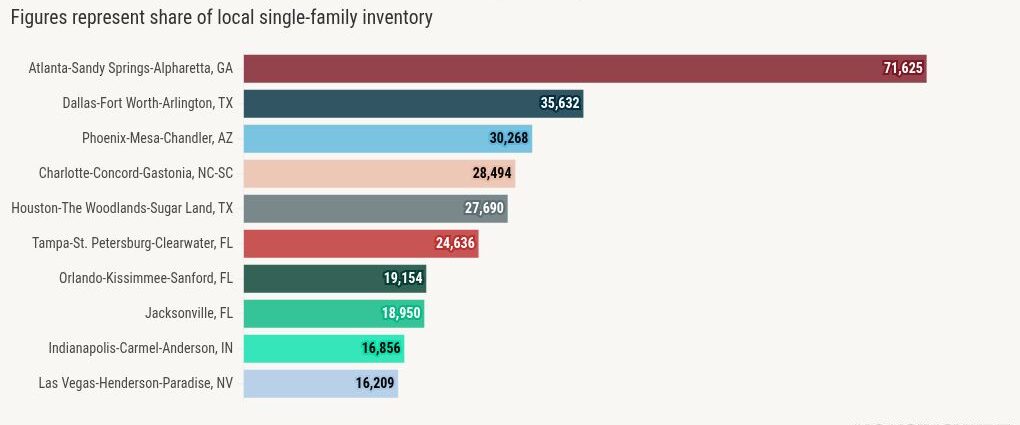
Investors list more homes after ROAD to Housing Act, but impact may stay local
Institutional investors are listing significantly more single-family rental homes for sale following passage of the 21st Century ROAD to Housing Act, but economists and real estate professionals say the legislation is unlikely to dramatically reshape the national housing market.
New data from Parcl Labs show listings of single-family rental homes owned by institutional investors have more than doubled since early February — climbing from 4,166 homes on Feb. 1 to 9,447 homes this month.
Those properties represent about $3.1 billion in total asking price.
The ROAD to Housing Act defines institutional investors as owners of 350 or more single-family homes — well below the industry’s traditional benchmark of 1,000 homes.
While the law does not require investors to sell existing properties, it restricts future purchases of existing homes while allowing exceptions for categories including build-to-rent developments.
Parcl Labs estimates investors covered by the law own roughly 589,000 homes, or 3.9% of the nation’s approximately 14 million single-family rental homes.
Those firms account for about 40% of net selling by large institutional investors so far this year, researchers said.
Still too early to tell with national inventory
Despite the surge in investor listings identified by Parcl Labs, Mike Simonsen, chief economist at Compass, said the trend has yet to noticeably affect most housing markets.
“I’ve been tracking inventory and it has been flat across the country,” he told HousingWire. “So, we haven’t seen a giant flood to move the needle nationally. And if you think about it, the number of homes that institutional investors own is still pretty small overall.”
Instead, Simonsen expects any meaningful changes to occur in markets where institutional landlords have amassed particularly large portfolios.
“It could be a place like Tampa or maybe suburban Atlanta where there has been some density,” he said. “I haven’t seen an uptick in a place like Tampa myself, and maybe that’s just because overall the actual numbers are pretty small on that side. Right now, Tampa has significantly fewer homes available than a year ago.”
According to Parcl Labs and multiple other sources, Atlanta has far and away the highest density of institutional investor single-family homeownership — roughly doubling No. 2 Dallas-Fort Worth.
The top six metros — Atlanta, Dallas-Fort Worth, Phoenix, Charlotte, Houston and Tampa — account for 36.8% of all homes owned by institutional investors with portfolios exceeding 1,000 homes.
Large-scale institutional ownership emerged after the 2008 housing crash, when private equity firms purchased thousands of foreclosed homes in markets including Atlanta, Phoenix and Las Vegas
Today, the nation’s largest landlords — Progress Residential, Invitation Homes, AMH, Tricon, FirstKey, Amherst and VineBrook — have sold 3,180 more homes than they have purchased since Jan. 1, according to CNBC.
They still collectively own roughly 400,000 homes.
VineBrook has reportedly been the most aggressive seller, with nearly 1,900 homes — about 10% of its portfolio — currently listed for sale with a combined asking value of $285 million.
Will owner-occupant buyers benefit?
Whether more institutional listings and other effects felt from the ROAD to Housing Act translate into additional homeownership opportunities remains an open question.
“I am suspicious that it really moves the needle for owner occupants,” Simonsen said. “Those people that were in those homes are renters not because they wanted to be, but generally because they can’t buy. It’ll be interesting to see what trend emerges. Does that go from an institutional investor to another investor and stay as an investment property?
“I think that’s probably a pretty common path for those getting unloaded. You go from an investor that owns 1,000 properties to one that owns a dozen.”
Still, he believes localized opportunities could emerge if investors decide to rebalance portfolios.
“There could be a handful of markets, like ZIP codes, parts of suburban Tampa or parts of suburban Atlanta, where supply moves up more quickly than expected, and therefore there’s some price impact,” Simonsen said. “It’d be fascinating to see if there are price opportunities — below-market purchase opportunities. Some of those may exist for a little window if there are a handful of companies that have to rebalance a portfolio here and there and unload some of the properties.”
Parcl Labs’ pricing data suggest institutional sellers are already becoming more aggressive, with 54% of institutional investor-owned listings currently having price reductions.
Since early May, average markdowns among institutional sellers have widened from 3.1% to 4% of asking price.
Dallas broker sees broader market forces at work
In Dallas-Fort Worth — one of the nation’s largest markets for institutional ownership — Tasha Penson, owner of The Onyx Realty Group, said she has not yet seen evidence that the legislation itself is driving more institutional listings.
“Are [institutional owners] transitioning because of the ROAD to Housing Act or are they transitioning just because the cost of maintenance and taxes and insurance are making it less affordable to maintain those properties?” she said. “So far, we’re seeing homes on the market, but not necessarily an uptick from the institutional investors, the corporate owners. We have a lot of small- and mid-size investors here, as well.”
Penson said several factors will determine whether homes unloaded by investors ultimately become owner-occupied.
“It’s really going to depend on if they’re positioning those [homes] to be owner-occupied,” she said. “What is the condition of the home? How are they pricing the home, or are they just portfolioing them and trying to get other investors to purchase them? We also have to keep mortgage rates in mind — buyers are really waiting for those rates to come down to buy for their owner-occupied use.”
Agents should focus less on competing with institutional investors and more on helping sellers navigate a more competitive market, Penson added.
“It really comes down to the consultation and positioning the property from the beginning, meaning pricing it right from the beginning because we don’t want to have to chase the market,” she said. “Offer a well-executed home that’s move-in ready and be negotiable on the terms because price is not always the best overall deal.
“We have to stay in constant communication with our sellers — let them know what the feedback is, let them know how the market is performing and what has sold around them. That’s not just right at the beginning, it’s throughout the process.”
Build-to-rent continues gaining momentum
While purchases of existing homes may slow, industry observers expect institutional capital to continue flowing into build-to-rent communities, one of the law’s key exemptions.
AMH has developed more than 14,000 rental homes across 180 communities since 2017, while Invitation Homes expanded its presence this year by acquiring Atlanta-based homebuilder ResiBuilt.
“I think the build-to-rent is a function of affordability,” Simonsen said. “Until we have a few more years where incomes can rise faster than home prices, then we start to get affordability back, and affordability swings back in favor of purchase versus rent. But right now, for potential new buyers, in most places, the cost advantage is to rent.”
Penson said agents will need to become even more knowledgeable as build-to-rent communities expand.
“I think this is where agents’ value comes into play,” she said. “As we see more and more build-to-rent communities come about, we as agents need to pay attention to where they’re being built, who is moving into those communities, and the pricing for that. We just have to stay more aware and more knowledgeable of what the market has available so that we’re able to guide our clients in the right direction as related to homeownership versus rentals.”
Both experts agreed the ROAD to Housing Act signals a broader policy shift toward addressing housing supply.
Whether it meaningfully expands homeownership opportunities; however, will likely depend on broader national patterns, policy decisions and trends that emerge from institutional ownership hot spots.
HighTechLending expands EquitySelect eligibility and LTVs
National mortgage lender HighTechLending has rolled out major enhancements to its EquitySelect product line, expanding borrower eligibility, raising maximum loan-to-value ratios and widening access to low-payment qualification options for home equity loans.
The changes, announced Wednesday, are effective immediately through HighTechLending’s wholesale channel. The move comes as homeowners hold near-record levels of tappable home equity but face tighter credit conditions and higher rates that restrict access to standard home equity products.
“By expanding eligibility and increasing borrowing capacity, we’re enabling our partners to help more borrowers access the equity they’ve built while overcoming many of the qualification challenges associated with traditional home equity products,” David Peskin, CEO at HighTechLending, said in a statement.
The 1% qualifying payment plan is now available to homeowners ages 55 and older, while homeowners between 50 and 54 can now qualify using payment plans as low as 3%.
At the same time, maximum LTVs have been increased across all five payment plan options — 1%, 2%, 3%, 4% and 5% of the current annual balance — allowing qualified borrowers to access a larger share of their home equity.
The enhancements apply to both the EquitySelect 1st Position Loan and the EquitySelect 2nd Lien HELOC, with loan amounts available up to $4 million, HighTechLending said.
The company positions the program as a solution for debt consolidation, home improvements, retirement planning, emergency expenses and other consumer cash-flow needs.
EquitySelect debuted in September as a first-lien home equity loan that allows borrowers to set monthly payments as low as 1% of their annualized loan balance, subject to a cap. A second-lien version was launched in January – it does not disturb existing first mortgages, a key consideration for borrowers who locked in ultra-low rates in recent years.
The product is designed to function more like a credit card, with any unpaid interest added to the loan balance and ultimately repaid when the home is sold or through a final balloon payment that will not exceed the property’s value.
This article was generated using HousingWire Automation and reviewed by a HousingWire editor before publication.
Did Carlson inadvertently encourage Iran to assassinate Trump, make Vance president? – opinion
Tucker Carlson says that if JD Vance were president, the United States would not be at war with Iran.
He missed the most critical point: We might instead be facing a nuclear Iran.
Carlson speaks as though the only choice was war or peace. It was not. The choice was whether America would confront Iran’s nuclear program before it became unstoppable – or leave Israel, the United States, and the entire Middle East to live under the shadow of a nuclear-armed Iranian regime.
Saying that if Vance were president would have kept us out of the war sounds attractive. Nobody wants war. But what would he have done about Iran’s nuclear program? What would have replaced military action? Another agreement? Another inspection process? Another deadline? Another warning that Iran would ignore?
Carlson does not say.
“We would not be at war” is a slogan. It is not an answer.
But there is an even more disturbing part of Carlson’s statement, and I cannot understand why more Americans are not talking about it.
President Donald Trump has publicly said that he left instructions for an overwhelming American attack if Iran assassinates him. He said 1,000 missiles were “locked and loaded,” with more prepared to follow.
The legal reality is that a successor president would ultimately make the decision, but Trump’s purpose was unmistakable: Iran must believe that murdering an American president would bring destruction – not a political reward.
That warning did not come out of nowhere.
Iran and Iran-aligned forces have repeatedly threatened Trump, and Iranian propaganda has openly discussed killing him, displayed threatening imagery and circulated material focusing on his movements and possible security vulnerabilities.
There has also been reporting of a multi-million-dollar bounty attributed to an Iran-backed Iraqi group for his assassination, although the exact sponsorship and amount must be treated carefully until confirmed by authoritative sources.
This is the environment in which Carlson chose to announce that if JD Vance were president, America would not be at war with Iran.
Carlson is not an unknown commentator sitting on the sidelines. He is widely viewed as close to Vance and as an important voice within the political movement surrounding him. When Carlson declares that Vance would have taken an entirely different path, Iran is not hearing only a debate about past decisions.
Iran may also hear a message about what would happen next.
Trump is telling Tehran: If you assassinate me, the United States will strike Iran with overwhelming force.
Carlson is effectively telling the same regime: The man who would replace Trump does not support this war and would not have taken these actions.
What conclusion does he expect Iran to draw from that?
Is Carlson suggesting that Trump’s standing warning would not be carried by Vance if he were president? Is he telling Tehran that Vance would seek to de-escalate rather than follow Trump’s order? Is he publicly denouncing the very threat that was designed to keep Trump alive?
Most dangerously, is this an indirect encouragement for Iran to believe that assassinating Trump could change American policy in Iran’s favor?
Carlson sends dangerous message
I am not saying that Carlson wants Trump harmed. I am saying that his words create a dangerous message, and he should be held responsible for explaining it.
Intent is not the only thing that matters in national security. The message received by the enemy matters just as much.
Iran does not need Carlson’s permission to hate Trump. It already does. It does not need encouragement to threaten him. It already has. What Iran’s leaders are searching for is doubt that America would retaliate, doubt that Trump’s successor would carry out his warning, and doubt that killing one president would bring the full weight of the United States down upon them.
Why would Carlson give them that doubt?
The constitutional issue makes this even more serious. Trump may leave instructions, but if he were assassinated, JD Vance would become president and commander in chief. The final decision would belong to him. That means Carlson’s public portrayal of Vance’s position is not theoretical. It directly affects how Iran may calculate the consequences of attacking the president.
Vice President Vance should now make his position unmistakably clear.
He should tell Iran publicly that regardless of any differences over how the war began, any Iranian assassination or attempted assassination of Trump would bring the overwhelming response the president promised.
There can be no daylight on that question.
Carlson’s argument fails twice.
First, he says a Vance presidency would have avoided the war without admitting that the likely price could have been a nuclear Iran.
Second, he says it at the very moment Iran is threatening Trump’s life, and Trump is trying to convince Tehran that assassinating him would be suicidal.
Carlson may think he is attacking the war.
But he may also be undermining the warning intended to protect the president of the United States.
That is not a minor mistake. It endangers Trump, weakens America, and potentially tells Iran that the unthinkable could work.
The writer is the founder and CEO of the Orthodox Jewish Chamber of Commerce.


Saudi Nuclear Deal: Five Things to Know


Opinion: What Argentina’s World Cup loss should teach American hospitals
Argentina taught me a lesson about hospitals this summer.
Four years ago, Argentina won the World Cup with a solid team led by Lionel Messi. Messi provided extraordinary talent, but the championship was also built on cohesion, discipline, sacrifice, and players who seemed to understand exactly what they owed to one another. It was a truly well-oiled machine with a genius brain.

‘Everything was in ruins’: Iran’s FM Araghchi describes surviving Israel’s opening strikes
Iranian Foreign Minister Abbas Araghchi has offered one of the most revealing public accounts yet of the opening hours of the Israel-Iran war, describing how he narrowly escaped an Israeli strike on a compound where senior Iranian officials had gathered and suggesting Israel’s intelligence capabilities inside Iran extended far beyond technological surveillance.
In a more than 90-minute interview with Iranian journalist Javad Moghouei, Araghchi recounted the panic, destruction, and confusion that followed Israel’s opening strikes, while acknowledging what he described as serious security failures within the Islamic Republic.
Araghchi said he was inside the compound of Supreme Leader Ayatollah Ali Khamenei on the morning the war began.
“I was with Ali Hejazi, chief of staff to Supreme Leader Ayatollah Ali Khamenei, at nine o’clock, and we were finally going over a report on the negotiations,” Araghchi recalled. “I happened to have reached the part describing the heavy wartime atmosphere… then suddenly, there was an attack.”
He said the blast left the compound in ruins.
“We entered through the same beams, beds, and other wooden debris,” Araghchi said. “From the room, we came into a hall where the sound of ‘Ya Hossein’ could be heard. Water was dripping from the ceiling, and everything was in a state of ruin.”
Araghchi reveals how he escaped Israeli strikes on Iranian officials’ bunker
According to Araghchi, security personnel immediately evacuated him from the area.
“The security personnel quickly grabbed my hand, telling me I had to leave because the attacks would probably continue,” he said.
A young security official then drove him to the Foreign Ministry in an ordinary civilian vehicle.
“A young man came up and said, ‘Sir, come on, I’ll take you to the Ministry of Foreign Affairs.’ The poor guy showed up with what I think was a Tipa or maybe a Peugeot 206. We got in, and he drove me to the Ministry of Foreign Affairs,” Araghchi said.
Araghchi also discussed what he described as Israel’s remarkably accurate intelligence regarding the movements of Iran’s senior leadership.
“This coincidence, this insight, and the fact that it happened at 9:30 in the morning, I no longer attribute this to technology or artificial factors,” Araghchi said. “I really don’t know what to make of it.”
He said Iranian authorities are investigating the possibility of human infiltration within the country’s security apparatus.
“Now the security forces are pursuing this,” Araghchi said. “I believe this security vulnerability is not only about infiltration and data theft. Sometimes it also affects the orientation of decision-making, and even worse, it influences and shapes our psychological environment.”
Despite the chaos, Araghchi said Iranian officials had prepared emergency procedures in advance.
“There was even a code,” Araghchi revealed. “If a certain code is triggered, what should we do?… The code is Code 110.”
He suggested discussions about succession or emergency leadership arrangements were considered so sensitive that officials rarely addressed them openly.
Araghchi said Iran’s leadership also abandoned its normal offices after the attacks.
“Of course, we weren’t in our offices, but near the Ministry of Foreign Affairs we had arranged alternative locations,” Araghchi said. “I don’t know how secure they really were, but in the end, there was no safe place at all. Except for the tunnel, there was nowhere safe.”
Even underground facilities, he said, had significant limitations.
“Tunnels matter, but do you know the condition for using them? If you go, you have to stay for a few days. You can’t just go in and come back quickly. So you can’t go because you have work to do outside,” Araghchi said.
The foreign minister said he repeatedly tried to minimize the risks his security personnel faced.
“Sometimes I told the guards, ‘Don’t come with me. Maybe they want to fire a missile, and you can’t do anything. You might just get killed for no reason,'” he said.
Araghchi also disclosed extensive diplomatic efforts to prevent additional fronts from opening during the conflict.
“One evening I spoke with Nechirvan Barzani, President of the Kurdistan Region of Iraq; Bafel Talabani, leader of the Patriotic Union of Kurdistan; Turkish Foreign Minister Hakan Fidan; and Iraqi Prime Minister Mohammed Shia al-Sudani,” Araghchi said.
“I personally called Iraqi Prime Minister Mohammed Shia al-Sudani and warned that if even the slightest threat came from the Kurdistan Region of Iraq against us, we would take action.”
Asked whether those conversations had any effect, Araghchi replied that they had.
“The Kurdistan Regional authorities and Prime Minister Mohammed Shia al-Sudani assured me that they would never allow this to happen… Turkey played a significant role.”
His comments suggested Ankara worked to prevent Kurdish territory from becoming a launching point for attacks against Iran.
Iranian FM Araghchi says he has never met Mojtaba Khamenei
In another notable revelation, Araghchi said he has never met Mojtaba Khamenei, the son of Supreme Leader Ayatollah Ali Khamenei, who is widely believed to have assumed a central role in Iran’s leadership following the war.
Asked about his relationship with Mojtaba Khamenei, Araghchi replied that he had not met him yet.
“I never have. I haven’t seen him during this time. I don’t think anyone except maybe one or a few people have seen him.”
The remarks underscore the extraordinary secrecy surrounding Mojtaba Khamenei’s position within the Islamic Republic.
Although careful not to criticize the Islamic Revolutionary Guard Corps directly, Araghchi appeared to question decisions made in the later stages of the conflict.
Reflecting on the ceasefire, he offered an unusually candid assessment.
“If we had implemented the ceasefire ten days earlier, our achievements would have still stood,” Araghchi said. “But we had Ali Larijani, senior adviser to the Supreme Leader; Intelligence Minister Esmail Khatib; Mohammad Asadollahi; and the Foolad Mobarakeh steel complex.”
The remarks appeared to amount to a rare public critique from one of the Islamic Republic’s most senior surviving officials.
Summing up his view of both the war and the negotiations, Araghchi argued that Iran had achieved its strategic objectives early in the conflict.
“In my opinion, our strategic achievements were accomplished within the first two weeks of the war,” Araghchi said. “It means realizing that the Islamic Republic cannot be subdued. In other words, they failed to achieve any of their objectives.”

US Embassy issues security alert over Israeli organized crime amid Japanika restaurant attacks
The US Embassy in Jerusalem issued a security alert on Wednesday warning Americans in Israel to be cautious of organized crime activity in the country, according to a statement on the embassy’s website.
“US Embassy Jerusalem is closely monitoring reports of a spike in violence connected to rivalries between Israeli organized crime groups,” said the statement. “These attacks appear to be targeting businesses and homes associated with the groups involved, primarily in the Tel Aviv, Jaffa, and Herzliya neighborhoods.”
The embassy noted the use of grenades to target various homes and businesses, as well as private vehicles.
“Israeli National Police have responded to this spike in violence by conducting enforcement operations to disrupt violent criminal activity and arrest the leaders believed to be responsible for these attacks,” the embassy added. It noted that both the embassy itself and its Tel Aviv branch office are still operating normally.
The statement warned American citizens in Israel to “stay alert” while in central Israeli commercial districts, with an emphasis on late and overnight hours.
Americans were further warned to avoid areas with police activity and to obey law enforcement instructions, as well as to report suspicious activities to Israel Police. In addition, the embassy advised preparing a “personal security plan” and maintaining situational awareness and communication with loved ones.
Other steps encouraged by the embassy included enrollment in the Smart Traveler Enrollment Program (STEP) and general preparation for existing threats, such as knowing the location of the nearest protected space in case of a rocket or missile attack.
What is happening in Israel’s Japanika crime wave?
The embassy’s warning comes amid a growing organized crime wave in central Israel, with the most recent development being the arrest of a new suspect on Tuesday in connection with the grenade attack on a Japanika restaurant in Kiryat Ono on July 13.
The arrest followed an additional arrest on Thursday of an 18-year-old from Bat Yam on suspicion of also being involved in the Kiryat Ono attack.
More suspects, crime boss arrested
On Sunday, Israel Police arrested a 28-year-old resident of Kiryat Ata over his alleged involvement in the attempted arson of a Japanika branch in Haifa.
On July 14, police responded to a shooting incident at a Herzliya Japanika restaurant. That same day, Musli crime family boss Yossi Musli was arrested in connection with the series of attacks targeting the Japanika restaurant chain, according to Israeli media reports.
Alon Hachmon, Hodaya Ran, Miriam Sela-Eitam, and Esther Davis contributed to this report.

Israel should establish Palestinian state, MK Gilad Kariv says, accuses PM of ‘building up’ Hamas
MK Gilad Kariv, who placed third in The Democrats Party primaries, said Israel should ultimately divide the land and establish a demilitarized Palestinian state as part of a regional agreement, while accusing Prime Minister Benjamin Netanyahu of building up Hamas; he told 103FM on Wednesday.
Kariv discussed his party’s diplomatic vision, the continuing war, and the issue of Palestinian statehood in an interview with Ron Kofman and Prof. Aryeh Eldad on 103FM’s “Five in the Evening” program. During the interview, he sharply criticized the government’s policy toward Hamas.
“Netanyahu did business with Hamas and built it up,” Kariv said. “It was the Israeli Right that built the Hamas state, as a result of unilateral steps.”
Addressing a possible resolution to the Israeli-Palestinian conflict, Kariv said his party supports separation and the establishment of a demilitarized Palestinian state as part of a broader regional agreement.
“At the end of the diplomatic process, and that will take time, the land will be divided between the two peoples, and alongside the State of Israel there will be a demilitarized Palestinian state within a regional agreement,” he said.
Asked whether it was appropriate to discuss a diplomatic vision while the war was still underway, Kariv said that alongside military action, Israel must also present a clear political objective.
“During a war that has continued for two and a half years, the moment comes when you say, alongside the military measures, what your diplomatic vision is,” he said. “I ultimately want to reach a division of the land in order to ensure the future of the State of Israel as Jewish and democratic, and to end control over millions of Palestinians.”
‘I am not ignoring the polls’
During the interview, Kariv was confronted with polls indicating broad support for Hamas among Palestinians in the West Bank, as well as concerns about the security risks that could be created for residents of the Gaza border communities and central Israel.
“I am not ignoring those polls,” Kariv said. “But you are ignoring other polls that also show a change in the trend regarding Hamas’s conduct, and the support that still exists for a diplomatic agreement. I pursue a diplomatic agreement cautiously and wisely with those forces in Palestinian society that are not Hamas, those people with whom every IDF brigade commander conducts security coordination.”
Yair Golan’s criticism of Israeli settlers
Kariv also addressed remarks by The Democrats Party chairman Yair Golan criticizing the settlement movement. He said Golan’s criticism had been directed at illegal outposts and centers of violence.
“The remarks made by Yair Golan rightly focused on illegal outposts, with an emphasis on those outposts from which organized violence against Palestinians emerges,” Kariv said.
Kariv concluded by discussing the party’s primary results and the high voter turnout.
“We have held digital votes in the past, but we have never had a situation in which 100,000 Israelis voted, and that is a major celebration,” he said.

Israel, Lebanon delegations to meet in Rome on August 4 for new negotiations round, official says
Lebanon and Israel are scheduled to hold their next round of US-brokered talks on August 4 in Italy, a Lebanese official told Reuters on Wednesday, as the two countries begin implementing a plan for Israeli withdrawals and Lebanese army deployments in southern Lebanon.
The two longtime foes have held more than three months of face-to-face talks, billed as a way to put a permanent end to hostilities since a new war erupted on March 2 between Israel and Lebanese terror group Hezbollah, triggered by the wider regional conflict.
The ambassador-level direct meetings are unusual for countries that remain formally at war and have had no normal diplomatic relations through decades of invasion, military occupation and cross-border conflict.
Five meetings hosted by the United States produced a framework deal late last month which foresees the disarmament of Hezbollah, the progressive withdrawal of Israeli troops from southern Lebanon and the deployment of Lebanese troops.
The talks have since moved to the Italian capital so delegations could discuss the technical details and guidelines of the pilot zones – the term for the geographical areas where that phased process would be implemented.
Lebanon presses for full Israeli pull-out
The first Israeli withdrawal under the pilot zone program took place this week.
Israeli forces pulled out of the southern Lebanese town of Zawtar al-Gharbiyeh and the Lebanese army began deploying troops there, but asked residents to delay their return until the town was cleared of unexploded ordnance.
Lebanese Prime Minister Nawaf Salam visited Zawtar al-Gharbiyeh on Wednesday and planted a Lebanese flag there, saying the state would work to reopen roads, clear rubble and restore public services so that residents could return.
Salam said Israel’s withdrawal was a significant first step but that Lebanon wanted a full Israeli withdrawal from all Lebanese territory.
Israel continues to occupy what it describes as a buffer zone about 10 km (6 miles) inside Lebanon along the length of the border, where Israeli troops have ordered the local populations to leave and razed villages. Israeli officials say the zone is necessary to protect northern Israeli communities from attacks by Hezbollah.
Despite a ceasefire that came into force last month, controlled demolitions have continued, Lebanese security sources said.
Tens of thousands of Lebanese people remain displaced, unable to return home because their villages remain occupied by Israeli troops or have been destroyed.
Israeli officials have said they will remain in southern Lebanon as long as Hezbollah remains armed. The group has rejected the Lebanese government’s direct talks with Israel and has refused to disarm in full.
During his first official trip to Washington, Lebanese President Joseph Aoun said that Israel’s withdrawal from Lebanon could remove “the root cause that Hezbollah has long cited as its justification.”
Only then could Hezbollah be disarmed, Aoun told guests at a reception at the Lebanese embassy in Washington, according to comments shared by his office.

ZOG conspiracy posts spiked over threefold online during 2026 Iran war, study finds
The “Zionist Occupied Government” (ZOG) conspiracy theory increased more than threefold during the 2026 Iran war, Fighting Online Antisemitism (FOA) has revealed.
The “ZOG” conspiracy theory falsely claims a secret Jewish/Israeli cabal controls global institutions and sovereign governments, especially that of the US.
FOA looked at two 38-day periods in 2026 for its study: the baseline period (January 21 – February 27, 2026) and the war period (February 28 – April 6, 2026).
It found that the increased volume of hate content was accompanied by a focus explicitly around the term “ZOG” – which increased from 49% prevalence in the baseline period to 63% during the wartime dataset.
Public engagement with the rhetoric also intensified dramatically during the Iran conflict – conspiracy theory content, including ZOG references, received double the amount of likes and a 10-times increase in shares compared to pre-war levels.
Volume of conspiracy posts explodes
Prior to the conflict, shadow-government and anti-regime conspiracy narratives maintained a “steady, fragmented baseline,” FOA said.
The 38-day baseline period yielded a targeted sample of 988 posts. Of these 988, 485 were determined to be explicitly ZOG-related, equating to 49.1% of baseline traffic.
After the outbreak of military operations on February 28, the volume of conspiracy posts captured “exploded” by 217.6%, reaching a total of 3,138 posts.
The proportion of ZOG-related content also exploded. Of the 3,138 total, 1,977 were determined to be ZOG-related, equaling 63% of the wartime set.
“This increase highlights how the geopolitical crisis functioned as a direct volume multiplier specifically for ZOG-related content across the monitored networks,” FOA noted.
The organization also noted that within 48 hours of initial military strikes, broad anti-establishment targets were systematically replaced by localized labels: “Zionists,” “Mossad,” and “Jewish control.”
Regarding the responses of social media platforms to this hateful content, FOA said it was “deficient.” The organization flagged explicit violations, including the use of ZOG, to Meta and X/Twitter.
In terms of META, FOA said “its enforcement remains ineffective” due to a major loophole: Meta conditions its ban on ZOG to instances where it is “clearly” used as a proxy for Jewish people; however, extremists exploit this by framing antisemitic tropes as political debate.
“This structural flaw explains why Meta’s automated systems failed to remove 70% of the reported content, exposing a severe gap between corporate rhetoric and actual enforcement,” FOA said.
X did not respond to FOA’s findings.
FOA urges platforms to provide priority for verified organizations
The organization then urged platforms to provide priority queues for verified civil society organizations – such as FOA and Action and Protection Foundation (TEV) – during active geopolitical crises.
Reports from such groups should bypass automated bots and go directly to a human moderator for rapid review within a strict 24-hour window, FOA suggested.
It also urged platforms to cut off the financial incentives that drive viral hate.
For example, accounts participating in creator revenue-sharing programs (specifically on X and YouTube) should be instantly demonetized if they leverage explicit or coded antisemitic frameworks to drive engagement during international conflicts.
Overall, FOA concluded that the report “demonstrates the adaptability of contemporary antisemitism.
“Rather than relying exclusively on traditional forms of hate speech, antisemitic narratives increasingly embed themselves within broader political debates, attaching themselves to discussions of foreign policy, national sovereignty, institutional trust, and international conflict.
“Geopolitical crises, like the US-Israel-Iran conflict, act as catalysts that rapidly unite fragmented extremist communities around this framework. Ultimately, this process mainstreams fringe neo-Nazi rhetoric, weaponizing legitimate foreign policy debates to drive systemic antisemitism online,” it concluded.

French model scout mentioned 1,000 times in Epstein’s files found dead on outskirts of Paris
A French model scout linked with the late financier and convicted sex offender Jeffrey Epstein was found dead at his house on the outskirts of Paris on Wednesday, French authorities reported.
Daniel Siad, 69, was being investigated for alleged links with Epstein’s human trafficking network, something that he had denied before being questioned.
“An investigation to determine the cause of death was opened on Monday evening following the discovery,” the prosecutor’s office said.
Additionally, the prosecution said that it will carry out an autopsy on Siad’s body in order to determine the details of his death.
Siad mentioned over 1,000 times in the Epstein files
Siad was mentioned in Epstein’s declassified files over 1,000 times, according to Le Monde. he was also under investigation for several complaints, including allegations of rape.
According to one of the letters, Siad told Epstein: “In this busyness I feel like a fisherman; sometimes I catch quick, sometimes no fish.”
During a recent interview for CNN, Siad denied the allegations against him.
“I never heard anything from anyone I introduced to him who came back to me that they had a bad situation. I believed this guy is a professional person,” he said.
Siad’s lawyer told Reuters in an emailed statement that the modeling scout was never formally the subject of judicial proceedings.
He also claimed to believe that Epstein was casting the women he sent for Victoria’s Secret and the modeling agency MC2.
Siad was not the only French businessman being investigated for trafficking women to Epstein. Modeling agent Jean-Luc Brunel was arrested in 2020 due to his ties to the late sex offender, only to be found dead in his cell in 2022, Le Monde reported.

Italian drama ‘Diamonds’ fails to sparkle – review
Diamonds, which just opened in theaters around Israel, is an Italian movie that plays like Almodovar lite, about the dramatic lives of a group of female costume designers and seamstresses for movies in Rome in the 1970s.
For some, this description will promise a heavenly movie-going experience, but those who enjoyed Pedro Almodovar’s signature movie, Women on the Verge of a Nervous Breakdown, but disliked many of his subsequent portrayals of emotionally unstrung women won’t find it much fun.
The movie, directed by Ferzan Ozpetek and a big box-office success in Italy, uses a framing device of the director (played by Ozpetek) in the present day, bringing together his favorite actresses to have them read the screenplay of his new movie.
This new film is about the travails of those who worked in a movie costume shop 50-60 years ago. I am not sure what this device adds, but soon the movie settles down to its period story.
The script, written by the director along with Elisa Casseri and Carlotta Corradi, focuses on the two sisters who run this costume workshop: the imperious but talented Alberta (Luisa Ranieri) and her weaker sister Gabriella (Jasmine Trinca), who is struggling with the grief of losing her child.
They are hired by Oscar-winning costume designer Bianca Vega (Vanessa Scalera) to create elaborate designs for an 18th-century, upper-class costume drama. Alberta sees this as an opportunity to get the business out of debt, since the workshop has been floundering since the death of Gabriella’s child.
Alberta insists that they can create all the costumes, not just those of the leads, and they are happy to follow Bianca’s emotion-laden directives on how each dress must mirror the inner world of the character who wears it.
An abusive husband, a withdrawn son
While the seamstresses and designers throw themselves into this project with everything they have, they also face personal dilemmas. One has an abusive husband who does not want his wife to work; another has a withdrawn son who may be mentally ill; still others have flings with the workmen who do repairs on the villa that houses the shop, while one has a young son she must bring to the workshop because she has no one to care for him.
The relative of another employee who is wanted for participating in the political demonstrations hides out there and turns out to be skilled at creating designs that supposedly add depth by illuminating the characters’ emotions. The political turmoil outside the workshop is hinted at, but is not important to the story.
While you might think this movie would be filled with beautiful costumes, we rarely get to see the finished products, and the ones shown did not look all that great. I was hoping to see gorgeous gowns like those in Luchino Visconti’s The Leopard, one of the great Italian costume dramas.
A 1970s fashion exposé
But the fruits of the seamstresses’ labor are far less impressive and, to my mind, did not illuminate any psychological underpinnings of the character, although they were meant to. Fashionistas who want to see this movie will find even more to enjoy in the 1970s outfits worn by the seamstresses and designers.
There are a few messages about how everyone has to set their ego aside and work together, and how it is important to trust their instincts. But the movie is mostly a showcase for the actresses to have their dramatic moments.
The story might have worked better as a television series, where we could have gotten to know each woman more in depth as their stories unfolded gradually. But as a feature film, Diamonds introduces each character and gives her some important moments, then moves on to the next one rather abruptly.
The cast is good, but in the end, it’s all a bit cliché, despite the intriguing setting.

Israel’s Attention Revolution fights child smartphone addiction, spreading nationwide
The Attention Revolution, an Israeli initiative to curb child and teen smartphone use, has been spreading across the country in recent years with a goal of involving around one in 10 school children within the next two years.
“The Attention Revolution is trying to rebuild the relationship between people and digital technology,” Attention Revolution CEO Asaf Banner told The Jerusalem Post.
Banner spoke to the Post at one of the elementary schools in Tel Aviv participating in the initiative. “Cell phones are great, and technology is amazing, but we have lost our balance, and we are trying to bring it back,” he said.
Banner said the initiative, which is growing “rapidly, sevenfold” in recent years, works through the mechanism of a social contract between parents on a class-by-class level.
At the same time, the initiative is simultaneously supported by the municipalities, communities, and schools.
Social contract outlines terms on technology use
“We work with local communities around Israel and with schools, and we try to build a new norm around how to use digital technology and when children should start using it,” he said. “The pendulum has started moving.”
The individual points of the social contract, which Banner noted would be agreed upon by 70% or 80% of the parents of a given class, would outline terms such as the age at which children in that class would get their first smartphone and which apps would be allowed on those phones.
“Is there going to be WhatsApp? Is there going to be social media or not? These are the norms that are built by the parents that regard the kids,” he explained.
According to information provided by the movement, the initiative has been working with nearly a dozen municipalities across the country, including Tel Aviv, Jerusalem, and Herzliya, and operating in 96 elementary schools and 49 secondary schools.
Together, the schools it works with serve approximately 77,500 students, says the Attention Revolution.
“Kids are getting their phones too soon. Kids are getting addicted to using social media or using their phones,” said Banner, adding that “unbalanced use of social media or smartphones can cause severe harm.”
Ample data supports the assertion.
One study, “Smartphone Ownership, Age of Smartphone Acquisition, and Health Outcomes in Early Adolescence,” published early this year in the academic journal Pediatrics, found that among 12-year-olds, smartphone owners were more likely to experience mental health issues such as depression.
They were also more prone to obesity and less likely to get sufficient amounts of sleep.
Another study, “The Association Between Social Media Addiction and Aggressive Behaviors: A Longitudinal and Gender-Specific Analysis,” published in the Journal of Adolescence in late 2024, found a relationship between social media addiction and aggression in children.
Also speaking at the north Tel Aviv elementary school, Danna, a mother of three, said that her kids spend more time being bored, but that “this is a great thing.”
“Kids need to be bored a little bit, and after the boredom comes the activity,” she said. “We see them thinking about ‘What can we do to step out of this boredom?’”

Boredom results in creative activity
As a result, she said, they engage in more creative activities than phone use, like selling toys, reading books, or playing board games.
“We see the negative impacts that having a smartphone has on developing minds,” she told the Post.
“Whether it’s from inappropriate content exposure, sexual or violent content, difficult social comparisons that cause body image issues, social issues that happen in social media and in WhatsApp groups, we’re trying to avoid all that until they’re at a stage where they’re much more developmentally ready to handle those things.”
While the Attention Revolution movement is growing around the country, one of the initiative’s largest municipal partners is Tel Aviv.
Yael Shmueli, the Attention Revolution’s Tel Aviv Elementary Schools Program coordinator, oversees an expanding number of schools in the city that have chosen to participate.
“I coordinate the initiative across 30 elementary schools in the city: 14 schools in their first year of the program and 16 schools in their second or third year,” she told the Post.
Shmueli, who had previously spent a decade working for Meta, says that the Tel Aviv-Yafo municipality has been an important partner in the organization’s work.
“We meet with the municipal team every week and work together on questions such as how to engage more parents, strengthen participation, and create continuity within each school community,” she said.
Going forward, she added, the goal is not just about reaching more schools.
“The central goal is to help schools implement the charters they have created with parents so that the agreements gradually become community norms rather than remaining documents that were published once and then forgotten.”
Her experience at Meta, she said, makes her work with the Attention Revolution particularly meaningful, saying that while digital technology makes new levels of connection possible, it can also “draw our attention away from the people who are physically beside us, particularly when using it becomes an automatic response to boredom rather than a conscious choice.”

Will Trump’s new Canadian tariffs add cost risk for builders?
On Monday, President Donald Trump threatened to impose 50% tariffs on most Canadian goods, raising questions about the potential impacts on homebuilders and residential construction costs.
The tariffs, which would take effect in 30 days if the United States and Canada can’t negotiate an agreement, would impact multiple materials utilized by homebuilders. However, while tariffs are already having a cumulative impact on homebuilding, this move alone may not significantly move the needle, since many Canadian construction materials are already subject to existing tariffs.
Which construction materials are and aren’t affected?
The new tariffs could affect building materials such as doors, heating and ventilation equipment, glass, cement and plywood products. The biggest impact on homebuilders appears to be cement, UBS homebuilding analyst John Lovallo told HousingWire TBD.
However, the American Cement Association estimates that Canada only accounts for about 5% of the United States’ total cement production usage, meaning that any impacts on cement could be minimal.
“It’s not all that bad, but it’s just incredibly confusing,” Lovallo said of the new tariff announcement.
The Section 232 tariffs, which Trump announced last year, are already in effect and won’t be impacted by this action. This notably includes tariffs on Canadian softwood lumber, which now averages 34.83%, although this rate could drop to 24.83% later this summer or fall.
According to the National Association of Home Builders (NAHB), Canada supplied about 74% of the value of U.S. softwood lumber imports in 2024, meaning tariffs — or any reductions in tariffs — on Canadian lumber could have a significant impact.
Other Section 232 tariffs, which already impact Canada and other countries, include the following:
- A 50% steel and aluminum tariff that went into effect in June 2025.
- A 50% tariff on imported semi-finished copper and derivative copper products, such as pipes and wires, which began in August 2025.
- A 25% tariff on imported kitchen cabinets and vanities that went into effect in October 2025. This tariff was scheduled to increase to 50% on January 1 of this year, but Trump delayed that increase to January 1, 2027.
Since the new batch of Canadian tariffs doesn’t affect these goods, the impacts of yesterday’s new levies could have minimal impacts on American homebuilders. However, the announcement only adds to the uncertainty facing the homebuilding industry.
When will the new 50% tariffs go into effect?
The new tariffs are set to go into effect 30 days from yesterday’s announcement. Trump cited Canada’s “discriminatory” trade practices against American products like automobiles, dairy products and alcohol as reasons for the new levies. The Trump administration could delay or scrap the new tariffs altogether depending on how negotiations with Canadian officials pan out.
“It’s unclear whether any of this is going to go through. I mean, this is all game theory,” Lovallo said.
Canadian Prime Minister Mark Carney quickly said that he will intensify trade talks with Trump to negotiate a deal to avoid the tariffs. However, the premiers of Canadian provinces sent more mixed signals.
While Saskatchewan Premier Scott Moe said that Canada should enter into negotiations, Ontario Premier Doug Ford said that Canada should respond “dollar for dollar” to the new tariffs. British Columbia Premier David Eby proclaimed that “there is not a chance in hell that U.S. alcohol is going back on the shelves in British Columbia.”
The ongoing tariff risk
Trump’s temporary 10% global tariffs under Section 122, implemented in February after the Supreme Court struck down his earlier IEEPA tariffs, are set to expire on Friday, July 24.
As these levies run their course, the Trump administration is gearing up to instate a new set of tariffs on dozens of countries.
After yesterday’s Canadian announcement, U.S. Trade Representative Jamieson Greer said that the administration expects to instate 10% to 12.5% tariffs on 60 countries, including Mexico, the United Kingdom, Japan, Brazil, China and Australia. According to Greer, the nations that would be affected account for about 99% of America’s trade.
The possibility of future tariffs, reminiscent of the unpredictability surrounding last year’s Liberation Day announcements, adds to the uncertainty facing homebuilders.
“It certainly creates uncertainty. The biggest one that we’re concerned about is lumber,” Lovallo said. “Obviously, there are resin-based components that come in from other countries. There are plumbing fixtures and things like that that come in from China.”
The cumulative impacts of tariffs
UBS estimates that tariffs collectively add $7,913 to the cost of each home as of present day. Last year, NAHB similarly forecasted that tariffs would have a cost impact of $7,500 to $10,000 per home.
Lovallo acknowledged that quantifying the precise cost impact of tariffs is difficult, but he is confident in the overall direction of the UBS estimate.
“The numbers that we have out there, directionally we feel good about them, and I think the magnitude is in the ballpark. But it’s so hard to know for sure exactly what the impact is going to be,” he explained.
“What’s really interesting is that the [public] homebuilders are bearing very little of this. In fact, I would say they’re bearing next to none of it,” he added.
Many public builders, in recent earnings calls, have said that construction costs are actually down.
During D.R. Horton’s Q3 earnings call this morning, the company’s CFO Bill Wheat confirmed that the firm’s stick-and-brick costs were down 2% year over year.
During Lennar’s Q2 earnings call in June, Lennar said its construction costs were down 2% sequentially and 7% year over year. Compared to two years ago, the builder’s construction costs were down 13%.
Century Communities President and CEO Rob Minto, during a Q1 earnings call in April, confirmed that the company’s direct construction costs declined by 2% on a sequential basis.
During their Q1 2026 earnings call in March, executives at KB Home reported that the company’s direct construction costs per unit fell by 8% year over year.
The public builders, Lovallo said, have done a good job of leveraging their scale to negotiate prices. In a housing market that remains softer than what is preferred, the broader value chain may struggle to pass higher costs through to builders. However, suppliers could have more success doing so if housing volumes increase.
“[The public builders] wield a pretty big stick when it comes to negotiating, and they’ve been pushing back very hard. So this is getting captured or shouldered, if you will, in other parts of the housing value chain, whether it’s at the distribution level or the manufacturer level. We haven’t really seen it flow through to the [public] homebuilders,” he explained.
However, private and mid-sized regional builders, who have less scale and diminished negotiating power over suppliers and trades partners, are often at a disadvantage.
“They have far less ability to push back…it’s just getting more and more challenging to be a small private builder,” Lovallo said.
Lumber remains a key material affected by tariffs, and lumber costs have risen this year even as new construction has remained muted. If these costs continue to increase, the effects aren’t likely to hit builders all at once, since they typically spread out lumber purchases and utilize contracts over time. This means that cost increases would likely hit builders gradually rather than as a one-time impact.
Higher gas prices resulting from the war in Iran are also driving up the cost of some building materials. Suppliers of paint, roofing, cement, aggregates and OSB have already raised prices or anticipate raising them, and continued increases in gas prices stemming from the ongoing conflict could potentially bring more price hikes in the months ahead.

CVS offers new pharmacy option for pet owners
CVS Pharmacy is expanding into pet health care by allowing customers to fill common prescriptions for dogs and cats at roughly 9,000 locations nationwide.
The pharmacy chain said pet owners can obtain select medications, including antibiotics, allergy treatments, flea and tick control products, insulin and pain relievers.
Customers can bring a written prescription to a CVS Pharmacy location or ask their veterinarian to contact the pharmacy directly. Eligible prescriptions may also be available for delivery.
The expansion gives pet owners another option beyond veterinary offices, online pet pharmacies and specialty retailers, particularly when filling recurring prescriptions for animals undergoing ongoing treatment.
CVS said eligible pet prescriptions will qualify for some of the same services available for human medications, including automatic refills and prescription synchronization.
Pet owners can also add their animals to CVS.com profiles and manage eligible prescriptions through the CVS Health app. The company said electronic prescribing capabilities for veterinarians are expected to become available in the coming months.
“With the addition of pet medication dispensing, CVS Pharmacy can now serve every member of the family,” Sid Tenneti, CVS Health’s senior vice president and interim president of pharmacy and consumer wellness, said in a statement.
POPULAR PET FOOD RECALLED OVER POSSIBLE SHARP METAL AND PLASTIC CONTAMINATION
CVS has also expanded the selection of pet food, grooming and wellness products available in its stores and online. Its offerings include flea and tick products, dental treats, toys, grooming tools, cat litter and training pads.
The company did not disclose how much it expects the prescription service to contribute to sales.
CLICK HERE TO GET FOX BUSINESS ON THE GO
CVS Health operates approximately 9,000 retail pharmacy locations and more than 1,000 walk-in and primary care clinics.

Google expands Miami office as co-founders flee California for South Florida
Google reportedly expanded its office presence in Miami this year after two of its co-founders purchased houses in South Florida.
Alphabet, the parent company of Google, signed a lease expanding its existing 10,000-square foot satellite office in Miami’s financial district by an additional 45,000 square feet, two people familiar with the matter told Bloomberg News.
The outlet reported that the expansion was driven in part by the recent home purchases in the area by Google co-founders Larry Page and Sergey Brin – two billionaires who have bought homes outside of California and relocated business entities out of the Golden State as voters weigh a billionaire tax on this fall’s ballot.
Google first opened an office in Miami in 2016 and the expansion will increase its presence in Florida – though the South Florida office remains much smaller than the corporate headquarters at its Mountain View campus in California, which has over 10 million square feet of space, and its 1.7-million-square-foot Hudson Square campus in New York.
GOOGLE CO-FOUNDER RIPS CALIFORNIA BILLIONAIRE TAX: ‘I FLED SOCIALISM’
Page and Brin left their roles as executives in 2019 but remain on Google’s board. Brin has reportedly taken an active role in shaping the company’s initiatives around artificial intelligence (AI).
A report from earlier this year by the Wall Street Journal noted that Page bought a waterfront compound for $101.5 million in December as well as a nearby home for $71.9 million, which he bought in early January, while Brin was reportedly closing in on a purchase at that time as well.
Bloomberg’s report said that Brin bought a $51 million waterfront home in Miami Beach shortly after Page’s purchase.
Brin was also linked to the purchase of a $42 million mansion on the Nevada side of Lake Tahoe in December.
The moves occurred as California voters will vote on a proposed one-time wealth tax on billionaires this November.
The proposed constitutional amendment would levy a one-time, 5% wealth tax on taxpayers and trusts with over $1 billion in covered assets for the purpose of funding the state’s healthcare and food assistance programs, as well as public education.
GOOGLE CO-FOUNDER SERGEY BRIN JOINS CALIFORNIA EXODUS: REPORT
Assets covered by the tax would include businesses, securities, art, collectibles, and intellectual property – though real property, pensions and certain retirement accounts would be exempt.
If passed, the tax would apply retroactively to taxpayers who lived in California as of Jan. 1, 2026, with the tax due with 2027 tax filings.
Taxpayers could pay the tax in five equal installments, with subsequent payments subject to an annual deferral charge of 7.5% of the balance that remains unpaid.
Movement launches bilingual lending team, in-house ITIN product
South Carolina- based Movement Mortgage has launched a national Diverse Lending Support Team and an in-house Individual Taxpayer Identification Number (ITIN) mortgage product to serve more Spanish-speaking homebuyers.
The Diverse Lending Support Team (DLST) is a dedicated bilingual group that supports loan officers working with Spanish-speaking borrowers, the company said in its announcement.
“Language should never be a barrier to opportunity,” Jeremy Berrios, Movement’s vice president, multicultural markets and strategic growth, said in a statement. “This investment will help us create greater access, deliver a better experience and serve our communities with excellence.”
The team builds on Comunidad, Movement’s Spanish-language lending platform introduced in 2016, which covers the full mortgage process. The new team adds staff capacity on top of that infrastructure.
For LOs who do not speak Spanish, DLST functions as an extension of their business, enabling them to originate loans they may not have been able to do previously. Spanish-speaking LOs can use DLST for bilingual assistants and support staff, helping manage files so they can focus on relationships and production.
Movement has also brought its ITIN mortgage program in-house. The product offers financing up to 85% loan-to-value for qualified borrowers who do not have a Social Security number.
“The move replaces a traditionally complicated, fee-heavy broker process with a simpler, less expensive experience supported by Movement’s own lending professionals from start to finish,” the company said in the announcement.
The combination of a centralized bilingual support team and an in-house ITIN product could streamline how they capture and serve a growing segment of the market that has often faced language and documentation barriers in the mortgage process.
The National Association of Hispanic Real Estate Professionals (NAHREP) projects that Latino households will drive a substantial share of U.S. homeownership growth in the coming decades, making language access and ITIN lending capabilities increasingly important for lenders that want to compete in these communities.
Movement funds more than $20 billion in residential mortgages each year and employs more than 3,000 teammates across all 50 states, the company said.
This article was generated using HousingWire Automation and reviewed by a HousingWire editor before publication.


Chinese Open AI Push Reignites Washington Fight Over Regulation
NEW YORK — A new wave of powerful, low-cost artificial intelligence models from China is reshaping the global AI race and reigniting a policy battle in Washington over whether advanced open-weight AI models should face tighter government oversight. The debate intensified ahead of the World AI Conference in Shanghai, where several Chinese developers unveiled increasingly capable systems designed to compete directly with America’s leading AI companies.
The latest releases have drawn attention not only for their technical performance but also for their distribution model. Unlike most frontier systems developed by U.S. companies, several Chinese models are being released with open weights, allowing businesses, researchers and governments to download, customize and operate them on their own infrastructure rather than relying on cloud-based subscriptions.
Moonshot AI led the latest wave with Kimi K3, a 2.8 trillion-parameter open-weight model that quickly climbed several independent benchmark leaderboards after its debut. On specialized coding evaluations, including Frontend Code Arena, the model ranked alongside or ahead of leading systems from Anthropic and OpenAI, demonstrating how rapidly Chinese developers have narrowed the performance gap in selected tasks. Alibaba also previewed Qwen 3.8, another frontier-scale model that the company says competes with the industry’s most advanced systems.
The announcements coincided with renewed pressure across technology stocks. The Nasdaq Composite and S&P 500 both retreated during the broader selloff, while semiconductor shares continued their recent decline. Nvidia lost ground during the session, briefly allowing Apple to reclaim the position as the world’s most valuable publicly traded company by market capitalization. Investors have increasingly questioned whether rapid advances in lower-cost AI models could reshape spending patterns across the industry, echoing concerns first sparked by China’s DeepSeek earlier in the AI race.
For America’s largest AI developers, the emergence of increasingly capable open-weight competitors has become both a business challenge and a policy issue.
Anthropic Chief Executive Dario Amodei has repeatedly warned that unrestricted distribution of highly capable frontier models could create significant cybersecurity and national security risks if advanced capabilities become widely available without sufficient safeguards. The company has recently proposed a framework that would allow the federal government to intervene when frontier AI systems fail independent safety evaluations before public release.
Supporters of open AI development argue that such proposals risk limiting competition rather than improving safety.
David Sacks, the White House’s senior adviser on artificial intelligence and cryptocurrency, has consistently argued that excessive regulation could cement the dominance of a handful of closed-model companies while slowing American innovation. He has warned against using regulatory uncertainty as a competitive advantage and has advocated maintaining a strong U.S. open-source AI ecosystem alongside appropriate national security protections.
The policy debate intensified after Dean Ball, OpenAI’s Head of Strategic Futures and a former White House AI policy adviser, commented publicly on the rapid progress of Chinese open-weight models. His remarks discussing potential U.S. regulatory responses generated widespread criticism online and fueled broader debate over whether Washington should attempt to slow adoption of Chinese-developed AI systems. Ball later clarified that he was describing possible policy scenarios rather than advocating new restrictions, while OpenAI stated that his personal comments did not represent company policy.
The episode highlighted broader divisions inside the administration. National security officials have spent the past year evaluating additional export controls, security guidance and other policy options involving advanced Chinese AI models. While federal agencies—including the Departments of Defense, Commerce, Energy and Transportation—have restricted or prohibited employee use of certain Chinese AI platforms over cybersecurity and data security concerns, the administration has not announced broader restrictions on open-weight AI models.
Officials have also discussed additional oversight mechanisms for the most advanced frontier AI systems, although no formal policy has been finalized amid ongoing debate over balancing innovation, competition and national security.
Meanwhile, America’s own open-model ecosystem continues to expand. Former OpenAI Chief Technology Officer Mira Murati’s Thinking Machines Lab has introduced its own open-weight model, Nvidia continues expanding its Nemotron family, and Nvidia-backed Reflection AI is expected to release its first model later this year. The growing competition reflects a broader shift in the AI industry as companies increasingly debate whether the future belongs to proprietary subscription-based models or open systems that can be deployed and customized by anyone.
The financial stakes remain enormous. Leading AI developers continue raising billions of dollars to finance increasingly expensive computing infrastructure, while supporters of open models argue that broader access will accelerate innovation and reduce costs across the global economy.
Moonshot AI has indicated it plans to release Kimi K3’s model weights on July 27, a move expected to make one of China’s most advanced AI systems widely available. Whether Washington ultimately responds with new policies—or instead doubles down on encouraging America’s own open AI ecosystem—remains one of the defining technology policy questions facing the United States.
JBizNews Desk | New York
© JBizNews.com All Rights Reserved. Reproduction or distribution without written permission is prohibited

In DFW, housing affordability slips even as builders report strength
Public homebuilders say they care about housing affordability. Their earnings calls reveal a more immediate set of priorities: protecting margins, controlling inventory and preserving pricing power.
In Dallas-Fort Worth, the consequences are easiest to see south of Main Street, where teachers, nurses, police officers, firefighters, linemen, tradespeople and young families are trying to turn ordinary paychecks into stable lives.
For these households, affordability is not an economic abstraction. It is the distance between a salary and a mortgage approval. It is the extra hour spent commuting because the homes near work no longer fit the family budget. It is the uncomfortable choice among childcare, healthcare, retirement savings and rent.
Meanwhile, Wall Street rewards public homebuilders for doing almost everything except building enough homes to put meaningful downward pressure on prices. Builders protect margins. They reduce speculative inventory. They hit the brakes on new starts. They delay phase releases. They offer temporary mortgage-rate buydowns instead of permanent price reductions. Then they call it discipline.
In a corporate presentation, that strategy looks prudent. South of Main, it can look like a housing shortage being managed for yield.
Where the shortage becomes human
“South of Main” is more than a phrase in DFW. It describes the parts of the region where more working households find themselves priced out of the communities they serve.
These are not families demanding oversized lots, luxury finishes or marble bathrooms large enough to host a city council meeting. They are looking for a safe neighborhood, reasonable schools, a manageable commute and a monthly payment that does not consume the rest of their financial lives. Yet many new subdivisions now open at prices beyond the reach of first-time buyers earning the prevailing wages paid by nearby school districts, hospitals, police departments, utility companies and local businesses.
That defines the affordability failure: the people needed to operate a community increasingly cannot afford to live in it. From 2020 through 2024, home prices and rents across Texas rose much faster than many public-sector and service-sector wages. Land became more expensive. Materials became more expensive. Financing became dramatically more expensive. Municipal fees, infrastructure obligations, insurance, labor shortages and development delays added still more cost.
Household incomes did not rise in lockstep. The result is an expanding affordability wedge—the growing difference between what working households earn and what they must earn to qualify for a newly built home. Texas may remain less expensive than California or New York. That is cold comfort to a teacher in Mansfield, a firefighter in Burleson or a nurse in Fort Worth who still cannot qualify for a home near work. Being cheaper than an unaffordable coastal market does not automatically make a market affordable.
The earnings call definition of discipline
Listen to almost any public-builder earnings call during a softer housing market, and the language becomes predictable: Protect the margin. Control starts. Reduce specs. Manage incentives. Maintain pricing integrity. Remain disciplined.
Wall Street hears prudence. Families hear fewer homes.
Public builders have become extraordinarily sophisticated at improving the appearance of affordability without meaningfully reducing the underlying price of the house. A temporary mortgage-rate buydown can lower the monthly payment for a set period, but it does not reduce the home’s base price. Closing-cost credits may help a buyer reach the closing table, but they do not correct the region’s wage-to-price imbalance. “Free” upgrades may improve perceived value, but granite countertops do not make a mortgage affordable.
These incentives can be useful. In some cases, they make the difference between a family buying a home and continuing to rent. But they should not be confused with a supply strategy. The deeper strategy is inventory control. Builders reduce starts and delay phase releases to prevent excess supply from forcing prices lower. That supports gross margin, return on equity, earnings per share and investor guidance.
It also preserves scarcity.
There is nothing irrational about this from the perspective of a publicly traded company. Management teams are accountable to shareholders. Their job is not correcting regional housing shortages.
If building fewer homes protects returns, the market may reward them for building fewer homes.
That is the structural problem.
The companies with the greatest scale, capital access, purchasing power and operating infrastructure are often rewarded for managing the shortage more effectively – not necessarily for building their way out of it. We have created a system in which the housing crisis can remain painful for households and profitable for housing companies at the same time.
Wall Street may call that alignment. South of Main might use a different word.
DFW is entering the dangerous middle
DFW is not Austin. Median home prices are generally lower, and the region continues to offer more land, more employment centers and more attainable suburban options.
But DFW is drifting into a dangerous middle ground. It is no longer inexpensive enough for working families to assume homeownership will remain available to them. At the same time, it is not yet expensive enough to generate the political urgency seen in coastal markets where the affordability crisis has become impossible to ignore.
That allows the problem to worsen quietly.
Across Texas, median home prices increased roughly 40% from early 2020 through 2024, rising from around $244,000 to approximately $340,000. Homes priced below $200,000—once the traditional entry point for many working families—have nearly disappeared from major markets.
DFW followed the same broad trajectory. The region added residents, jobs, corporate relocations and investment. But the wage curve for teachers, first responders, nurses, municipal employees and many skilled trades did not keep pace with the price curve for finished lots and new homes.
In a growing number of DFW submarkets, the income needed to buy a median-priced new home is approaching or exceeding $90,000 to $100,000.
That is well beyond what many households performing essential work across the region earn.
The rental market offers limited refuge. Texas has only about 26 affordable and available rental units for every 100 extremely low-income households, according to estimates from the National Low Income Housing Coalition. The statewide deficit approaches 700,000 units. DFW alone has hundreds of thousands of lower-income renter households competing for a fraction of the affordable units they need.
The consequences are predictable: longer commutes, delayed homeownership, overcrowding, reduced savings, greater financial fragility and households spending far more than 30% of their income on shelter.
A region can continue growing under those conditions. It simply becomes a harder place for the people doing the actual work.
Private builders can follow households
Texas still has another model. Not all scale is the same. DFW’s private-builder ecosystem includes large local operators, Texas-focused platforms and national private builders that all work under different incentive structures.
Privately held builders such as Bloomfield Homes, Highland Homes, David Weekley Homes and other regional operators do not answer to the same quarterly incentives as publicly traded companies. Bloomfield Homes is an example of the large DFW-based private builder with deep local roots and scale. Highland Homes is a Texas-focused builder with a long history across multiple metros in the state. David Weekley Homes stands as a national private builder with a broader geographic footprint.
None of them are charities. They still need margins. They still need capital. They still need to survive land cycles, interest-rate shocks, labor shortages and the occasional city council convinced that every new rooftop will personally cause rush-hour traffic.
But private ownership can create more room to think beyond the next earnings call. A large local private such as Bloomfield can align closely with regional wage structures and household demand. A Texas-wide player like Highland can carry successful products and site plans from one metro to another. A national private like David Weekley can bring higher-volume scale and systems to bear, while still working outside the strict cadence of quarterly guidance.
Private builders can design for the family household standing in the sales office rather than the analyst listening from New York. They can hold land through a cycle, adjust product more patiently, accept lower margins in one phase to establish a long-term community and pursue price points that may be strategically valuable even when they are not immediately accretive to quarterly earnings.
In practice, that can mean smaller plans, narrower lots, townhomes, duplexes, cottage products, fewer structural options, simpler elevations and less square footage devoted to rooms nobody has used since Thanksgiving 2007.
It can also mean developing more housing near employment centers rather than pushing every attainable buyer farther into the exurbs. The goal is not to build cheap housing. The goal is to build housing that working families can buy without requiring financial acrobatics. There is a difference.
The land model matters
Builders alone cannot solve the problem. Affordability often disappears before a homebuilder ever puts a finished lot on a balance sheet.
It disappears when land is acquired at an unrealistic basis. It disappears during years of entitlement delay. It disappears through oversized lots, excessive setbacks, mandatory materials, inflated development standards, redundant infrastructure requirements and fees that are embedded in—and financed through—a 30-year mortgage.
By the time the builder receives the finished lot, an affordable home may already be mathematically impossible. That is why capital allocators, land developers and policymakers should begin asking a more useful question:
Does this project make money by helping solve the shortage, or does it make money by preserving it?
A land strategy built around attainable housing must begin with a realistic basis, efficient infrastructure, thoughtful density and a product reverse-engineered from the customer’s monthly payment. That does not mean placing identical tiny houses on every available acre. Density without design produces opposition for good reason.
But smaller lots, shared open space, trails, parks, townhomes, duplexes and compact detached homes can combine to create neighborhoods that are both attractive and attainable. The choice is not between affordability and quality. The choice is between thoughtful design and lazy math.
Policy should catalyze and reward production
Public policy also needs to distinguish between projects that expand attainable supply and those that merely improve the optics of an expensive home.
Cities can streamline approvals for workforce housing formats. They can reduce unnecessary delays. They can align impact fees and infrastructure participation with projects that deliver homes at attainable price points. They can allow smaller lots and a broader range of housing types in locations where roads and utilities can support them.
Down-payment assistance may help households cross the final gap, but it cannot substitute for production. Subsidizing buyers without expanding supply risks sending more money after the same limited number of homes. Land banking and public-private partnerships can work, but only when the private partner is genuinely adding capacity rather than relabeling market-rate inventory.
The policy priority should be straightforward: reward more homes, lower total costs, shorter approval periods and products that serve a broader range of area median incomes.
Not another ribbon-cutting for apartments renting at $2,400 a month because someone included a bicycle rack.
South of Main deserves better
Wall Street has made its preference clear. It rewards builders that sustain pricing power, control inventory, protect margins and use incentives to support sales without allowing base prices to reset too far. That may be rational corporate behavior. It is not a housing solution.
South of Main cannot live inside an investor presentation.
The teachers, nurses, linemen, police officers, firefighters, tradespeople and young families who make DFW function need homes they can afford—not temporary buydowns attached to prices their wages cannot support.
Texas still has builders, developers and capital partners capable of following households rather than courting analysts. The next generation of DFW housing leaders will have to decide what business they are really in. They can build a franchise around preserving scarcity. Or they can build one around solving it.
Stellar MLS adds Realtors Association of Citrus County as corporate shareholder
Stellar MLS announced the Realtors Association of Citrus County (RACC) as its newest corporate shareholder, expanding the multiple listing service’s (MLS) reach while providing RACC members with access to a broader technology platform, data resources and support.
Under the agreement, RACC will become an owner of Stellar MLS while retaining its independence as an association. Stellar MLS will serve as the exclusive MLS provider for RACC’s approximately 950 members.
“We are delighted to welcome the Realtors Association of Citrus County as Stellar MLS’s new corporate shareholder,” said Shayne Fairley, CEO of Stellar MLS. “This partnership represents another important step in expanding the reach and strength of our marketplace. By bringing our organizations together, we are creating greater opportunities for RACC members and existing Stellar customers through access to a broader inventory, enhanced technology and a more connected real estate network.”
Founded in 1952, RACC provides education, advocacy and professional resources for brokers and agents throughout the county.
“As an Association, our responsibility is to continually invest in the success of our members,” said Keith Pullias, president of RACC. “When our members spoke, our Board listened. Joining Stellar MLS represents more than a technology upgrade; it’s a commitment to providing the resources, reach, and opportunities our Realtors asked for.”
Marsha Coleman, association executive at RACC, said member feedback played a central role in the decision.
“At the Realtors Association of Citrus County, our members are at the center of every decision we make. Over the past several years, we consistently heard one message: our Realtors wanted access to Stellar MLS. We listened, explored every option, and today we’re proud to deliver on that request,” she said.
This article was generated using HousingWire Automation and reviewed by a HousingWire editor before publication.

JetBlue wins auction to bring flights back to LaGuardia’s historic Marine Air Terminal

JetBlue could soon bring passenger service back to LaGuardia Airport’s historic Marine Air Terminal after winning an auction for gates previously operated by the bankrupt Spirit Airlines. On Monday, JetBlue’s $58.5 million bid secured 22 arrival and departure slots at the landmarked Art Deco terminal, vacant since Spirit moved out in May amid bankruptcy proceedings, as first reported by CNBC. The transaction would increase the carrier’s slot allocation at LaGuardia from 31 combined daily arrival and departure rights to 53. A hearing is scheduled for Thursday, followed by a final sale order expected no later than Aug. 5.

Designed by architectural firm Delano & Aldrich, the Marine Air Terminal opened in 1940 amid a boom in commercial air travel. Even with just six gates, the terminal is regarded as one of the city’s finest examples of Art Deco architecture, anchored by its two-story circular interior, according to the Landmarks Preservation Commission, which landmarked the interiors in 1980.
In its designation, the LPC described the terminal as “the only surviving American airport terminal dating from ‘the Golden Age of the Flying Boat,’” when transoceanic passenger flights were made aboard hulking Pan American Clipper ships that competed with ocean liners in providing luxury service.

The interior is characterized by striking geometry, marble paneling, and fine proportions, which serve as a fitting backdrop for the huge “Flight” mural, painted by artist James Brook between 1940 and 1942. The mural is the largest and only surviving mural commissioned by President Franklin D. Roosevelt’s Works Progress Administration, according to Living New Deal.
Marine Air Terminal was also added to the National Register of Historic Places in 1982.
That designation has helped preserve the structure while the rest of LaGuardia Airport has undergone an $8 billion transformation. The airport, once likened to a “third world country” by then-Vice President Joe Biden, was ranked the best airport in the United States by Forbes Travel Guide in October 2024.
Spirit Airlines began partially operating out of the terminal in April 2021 before moving all of its LaGuardia operations from Terminal C to the Marine Air Terminal the following March, according to Business Insider.
In May, Spirit filed for bankruptcy and immediately ceased operations, setting the stage for this week’s auction. JetBlue’s $58.5 million bid ultimately narrowly outpaced Frontier Airlines’ $57.5 million offer, according to Gothamist.
Frontier’s bid will serve as a backup if JetBlue’s offer does not go through, but the sale is expected to be approved. The U.S. Bankruptcy Court for the Southern District of New York will hold a hearing Thursday to consider approval of the sale.
A final sale order is expected no later than August 5. The purchase is also subject to regulatory approval from the Federal Aviation Administration.
If the deal goes through, JetBlue would be able to operate up to 12 additional daily round trips at the airport. The airline is still determining how it will use the slots, according to a statement reported by Travel Weekly. They also said any expansion at LaGuardia tied to the new slots would begin “in 2027.”
“We’re currently evaluating how best to utilize these slots as we consider opportunities to bring more of JetBlue’s competitive, customer-focused service to New York,” JetBlue said.
According to The Points Guy, operating out of the Marine Air Terminal could provide JetBlue with “much-needed cost savings” to support its expansion at the airport. In recent years, JetBlue has scaled back its LaGuardia operations due to costs, focusing much of its New York service at John F. Kennedy International Airport.
The Marine Air Terminal could offer the airline lower upkeep costs while providing an opportunity to establish the landmarked structure as a dedicated “JetBlue terminal” at LaGuardia, industry analyst Robert Mann told The Points Guy.
For now, renovations of the terminal’s non-landmarked 1980s-era boarding areas and gates will continue as they are modernized to meet increased passenger demand. The original terminal structure will remain intact.
In a statement to Gothamist, Port Authority spokesperson Halimah Elmariah said the auction reflects LaGuardia’s critical role in the region’s aviation industry.
“We are pleased the auction has concluded and look forward to working with JetBlue as it expands its operations at LaGuardia,” Halimah Elmariah told the website.
“The Port Authority remains committed to the long-term future of Terminal A, and plans to move forward with preserving the landmarked Marine Air Terminal while dramatically upgrading the attached non-landmarked 1980s-era concourse and boarding area.”
RELATED:
- NYC to create dedicated bus lane for Q70 to LaGuardia Airport
- NYC airports saw busiest year ever, Port Authority says
- LaGuardia named best airport in U.S. by Forbes
The post JetBlue wins auction to bring flights back to LaGuardia’s historic Marine Air Terminal first appeared on 6sqft.

Nike Reboots Its Troubled China Operations



Airbus Weighs Its Biggest Bet in Years Against Boeing
The European planemaker is considering a larger A350, a move that could challenge Boeing’s long-held dominance of the world’s largest twin-engine passenger jets.
TOULOUSE, France — Tuesday, July 21, 2026 — Airbus executives, together with engine partner Rolls-Royce, confirmed this week they are evaluating a stretched version of the A350, signaling the strongest indication yet that Europe’s largest aerospace company is preparing to challenge Boeing’s delayed 777X in one of commercial aviation’s most lucrative markets.
For years, Boeing appeared to have the segment largely to itself.
The 777X was designed to become the successor to the iconic 777, carrying hundreds of passengers farther and more efficiently than previous generations of long-haul aircraft. Airlines around the world placed hundreds of orders expecting deliveries years ago. Instead, certification delays, manufacturing setbacks and heightened regulatory scrutiny have repeatedly pushed the program further into the future.
That has created an opportunity Airbus no longer seems willing to ignore.
Rather than investing tens of billions of dollars in an entirely new airplane, Airbus is studying whether it can stretch its successful A350 platform into a larger aircraft capable of competing directly for the same customers. Industry executives say leveraging an existing design would reduce development costs, shorten certification timelines and allow airlines to introduce the aircraft sooner than launching a clean-sheet program.
The proposal reflects a changing aviation market.
International travel has largely recovered from the pandemic, while airlines increasingly favor larger aircraft on high-demand routes linking global business centers. Carriers want to move more passengers with fewer flights, lowering fuel consumption, airport fees and crew costs while maximizing revenue on routes where takeoff and landing slots remain scarce.
Those economics have become even more compelling as fuel prices remain volatile and labor costs continue climbing.
A larger A350 would target airlines serving destinations such as New York, London, Dubai, Singapore, Hong Kong and Sydney, where consistently high passenger demand often makes larger aircraft more profitable than adding additional frequencies. The aircraft could also appeal to carriers replacing older Boeing 777s and Airbus A380 superjumbos that are approaching retirement.
Technology may determine whether the project moves forward.
Rolls-Royce, which exclusively powers the A350 family, confirmed discussions are underway regarding the engine technology needed for a stretched aircraft. Engineers are evaluating whether the existing Trent XWB can be upgraded or whether a more powerful derivative would be required to support additional passenger capacity and extended range.
Executives indicated Airbus expects to decide within roughly the next year whether the business case justifies launching the program.
The stakes extend well beyond Airbus.
For Boeing, the 777X remains one of its most important commercial programs. The aircraft is expected to anchor the company’s long-haul strategy for decades, making a successful entry into service critical after years marked by production disruptions and regulatory challenges. Additional competition from Airbus would intensify pressure just as Boeing works to restore customer confidence and accelerate deliveries.
Airlines, meanwhile, stand to benefit from renewed competition.
Historically, direct rivalry between Airbus and Boeing has driven technological innovation, improved fuel efficiency and given carriers greater leverage during aircraft negotiations. A second competitor in the large twin-engine market could provide airlines with more flexibility while encouraging both manufacturers to continue investing in lower operating costs and improved environmental performance.
Investors will also be watching closely.
Launching a new aircraft—even one based on an existing platform—requires billions of dollars in engineering, manufacturing and supplier investments. Airbus must balance the opportunity to capture additional market share against the financial discipline that has helped strengthen its position in recent years.
The decision ultimately comes down to confidence.
If Airbus believes global demand for large long-haul aircraft will continue expanding through the 2030s, stretching the A350 could become one of the industry’s defining aerospace projects. If approved, it would also mark the first time in years that Boeing’s flagship wide-body strategy faces a direct challenge from a newly developed European competitor.
Regardless of the outcome, one message from this week’s discussions is already clear: the battle for the future of long-haul aviation is entering a new phase.
JBizNews Desk | Wall Street
© JBizNews.com. All Rights Reserved. Reproduction or distribution without written permission is prohibited.

Five day school week: Teachers’ Union reaches agreement with gov’t after weeks of negotiations
The Finance Ministry, the Education Ministry, and the Secondary School Teachers’ Union reached an agreement on Wednesday after two months of negotiations.
As a result of the agreement, the education system will continue its transition toward a five-day school week – one day less than the current six-day school week, which includes Friday.
The parties also agreed to cancel the decree docking teachers’ pay on June 8, when war broke out with Iran.
What is more, physics teachers will receive the same 4% bonus for preparing students for the highest-level matriculation examination (Bagrut) that chemistry teachers get.
Also, teachers who teach classes with integrated special education students will receive annual grants based on the number of children with disabilities in their classes.
The ministries and the union also increased the number of annual early retirees from 320 to 350, citing “high demand from teachers wishing to retire early due to burnout.”
Parents association rejects Teachers’ Union threat to limit inclusion of students with disabilities
In June, as this agreement was being negotiated, the National Parents’ Leadership Association called on the Education Ministry to reject the Teachers’ Union’s ultimatum to limit the integration of children with disabilities into classrooms.
While teachers are threatening strike action over staffing shortages, parents are attacking the demand and describing it as dangerous discrimination.
In response to threats by Teachers’ Union chairwoman Yaffa Ben-David, the National Parents’ Leadership Association appealed to the Education Ministry’s director-general, demanding that the move be rejected.
“The Parents’ Leadership Association views the Teachers’ Union’s letter with great concern,” the organization said in a statement. “This is an improper, discriminatory, and dangerous demand that cannot be accepted in an education system committed to the values of equality, inclusion, and acceptance of others. Instead of fighting for additional staffing positions, the Teachers’ Union has chosen to direct the spotlight at the children themselves.”
Parents’ Leadership Association chairman Oren Ozen stated: “The state’s role is to provide teachers with the tools needed for successful integration, not to remove children from the classroom. The education system cannot afford to send a message of exclusion.”
Avichai Chiim contributed to this report.

No flight cancellations expected at Ben-Gurion, Airports Authority chairman says
Airports Authority (IAA) Chairman Yiftach Ron-Tal disputed claims of upcoming flight cancellations at Ben-Gurion Airport during an interview with KAN News on Wednesday.
“There will be no flight cancellations,” said Ron-Tal. “We will do everything we can to keep the skies of the State of Israel open during a season that is so important to the Israeli public.”
“I will say more than that: every day that passes, we reach new highs this year,” he added. “We have already reached 90,000 passengers per day, and everything is done in coordination with the security establishment.”
Ron-Tal’s comments come after warnings from IAA CEO Sharon Kedmi on Wednesday that the volume of incoming US Air Force (USAF) refueling aircraft would prevent Ben-Gurion from operating at the capacity needed to accommodate all scheduled flights.
“We are doing everything to avoid canceling flights,” said Kedmi. “But we cannot allow even one more refueling plane into Ben-Gurion Airport. If it does, we will start canceling flights. The public needs to prepare for cancellations and delays.”
On Monday, an emergency meeting on the issue, led by Transportation Minister Miri Regev, was held at Ben-Gurion Airport, with the directors-general of the Transportation Ministry and the IAA in attendance, along with other professionals.
Ron-Tal commented on the outcome of the meeting, saying that he agrees with the policy decisions “1,000%.”
‘No intention’ to close Israeli airspace, IAA chairman says
“There is no intention to close the airspace of the State of Israel, even in the sensitive strategic-security situation in which we find ourselves,” added Ron-Tal.
The meeting determined that the arrival of just seven additional USAF refuelers at Ben-Gurion Airport would result in 30 canceled flights a day, disrupting travel plans for around 5,000 passengers, according to an N12 News report on Tuesday.
The Transportation Ministry announced last week that only 20 USAF refuelers would remain at Ben-Gurion by July 21, with those remaining transferred to Israel Air Force bases.
Esther Davis contributed to this report.

Katz goes all out against IDF attempts to reduce Jewish violence against Palestinians – analysis
Defense Minister Israel Katz has declared open season on IDF Central Command Chief Maj. Gen. Avi Bluth and much of the already weakened efforts to restrain Jewish extremist violence against Palestinians in the West Bank.
After tying Bluth’s hands on the issue once in January 2025, the defense minister is now threatening to tie them even more just as the Jewish extremist violence in the West Bank is hitting some of its worst levels.
The public attack was a barely veiled leak by Katz or his staff to Arutz 7 on July 21 accusing Bluth of being overly aggressive in cracking down on Jewish extremist violence.
Bluth’s first job is to thwart Palestinian terror and, while there is more work to be done in that area, he has been the most aggressive central commander on that playing field since the end of the Second Intifada in 2005.
He has also more actively helped with the expansion of the settlement enterprise through Israeli domestic legal channels than any of his recent predecessors.
Bluth held back due to decision ending detention for Jews
However, in his secondary role in helping the police and the Shin Bet restrain violent Jewish extremists, Bluth himself has been held back due to Katz’s January 2025 decision to end administrative detention for Jews, while continuing it for over 3,200 Palestinians, some of them for years.
There were never many Jews in administrative detention, and they were generally only held for three to six months at a time.
Sometimes there were zero, sometimes single digits, and essentially never more than very low double digits.
But Katz decided to end even the limited number of administrative detentions, instead encouraging rehabilitation and more indictments – though all signs are that it is extremely difficult to indict many of the Jews involved in extremist violence without blowing intelligence sources and methods – the same reason administrative detention is used for Palestinians.
Since January 2025, there have been ups and downs, but overall the situation of Jewish extremist violence has deteriorated to new highs in attacks, mass attacks, and general chaos.
There is no evidence that Katz’s 19 months of rehabilitation efforts have achieved any real results.
Other more moderate efforts by Bluth and by Shin Bet Director David Zini have failed to rein in the wave of Jewish extremist violence.
They have tried passing laws to outlaw face-coverings and to make it easier to give electronic ankle cuffs to certain suspects, pre-conviction, but both of these tools have relatively easy workarounds.
Instead, in recent months, Bluth has started to use more restraining orders, which prohibit certain individuals from entering Judea and Samaria.
This has been a traditional tool always used by IDF central commanders, though it has always been considered less powerful and effective than administrative detention.
Bluth’s growing use of this medium-effective tool could never be as effective as administrative detention, but is clearly having some impact on the violent Jewish extremists, as they have tripled their public social media campaign against him.
Restraining orders necessitated, inability to use administrative detention
On July 19, Bluth even made a speech talking about the need to use the restraining orders tool, and not-so-veiled, complaining about the inability to use administrative detention.
Whether responding to Bluth or to those supporting the Jewish extremists, Katz’s leak to Arutz 7 saying that he would summon the IDF central commander for being too aggressive at a time when Jewish extremist violence is out of control puts the defense minister in a new category.
When Katz ignored recommendations by the IDF and the Shin Bet to keep administrative detention for Jews at the same levels it has been for many years, to push for more rehabilitation and indictments, one could have called it an experiment.
Maybe an ill-advised experiment going against expert advice, but theoretically his new strategy had a chance.
Yet, the results have been an unequivocal failure, which is not only leading to harm against innocent Palestinians, a problem on its own, but is also undermining Israel’s fundamental standing in both US Democrat and Republican circles.
The Trump administration does not care that much about what happens in the West Bank, but has numerous times condemned Israel’s slow and limited efforts to restrain Jewish extremist violence, including from top pro-Israel figures like Us Secretary of State Marco Rubio and US Ambassador to Israel Mike Huckabee.
In the atmosphere of that utter failure of his idea and of the grave harm it is doing to US-Israeli relations, by suggesting weakening Bluth’s efforts even more by reducing restraining orders – a measure which is nowhere near as effective or draconian as administrative detention – Katz seems to be moving himself from the category of naïve mismanagement to Itamar Ben Gvir-levels of potentially more deliberately trying to frustrate law enforcement efforts.
Further, although Katz is the front man for these issues, they have popped up enough now that it is hard to separate Prime Minister Benjamin Netanyahu from contributory responsibility for the effort to weaken law enforcement efforts against Jewish extremist violence.
Multiple requests by the Jerusalem Post to different IDF spokespeople about whether IDF Chief of Staff Lt.-Gen. Eyal Zamir would publicly back Bluth in the battle were met with a mix of silence or comments that until Katz actually summons Bluth, no position need be taken.
If this was the first act in this play, that might be true.
But after Katz steamrolled the IDF, the Shin Bet, and Bluth regarding administrative detention after he floated a similar media trial balloon which no one pushed back on, all signs are that Zamir will not stand up to the defense minister if Katz wants to go to the mat.
One twist is that Bluth is freer now to try to stand up to Katz on his own than at any other time in his term.
He already finished two years in his role recently, and has been requesting a transfer for months, given that IDF central commander is an extremely unforgiving role.
With few other highly qualified candidates ready to take the role, Zamir has asked Bluth to stay on indefinitely.
This could give Bluth some unusual pull to stand his ground on some issues.
But regardless of how Bluth comes out on the issue, if Katz goes through with his latest threat to weaken law enforcement against Jewish extremist violence even more, he will have exposed a more deliberate problematic agenda on the issue.

IDF considering purchase of anti-submarine aircraft amid growing Turkish threat
Israel’s defense establishment is considering purchasing a maritime patrol and multirole aircraft designed primarily to detect submarines, according to an IDF source.
The aircraft, the Boeing P-8 Poseidon, is based on a commercial passenger jet that was converted for military use and developed for the US Navy. It is now operated by several countries worldwide.
The aircraft carries a nine-member crew, including seven mission commanders and technicians who operate its advanced systems. It has an operational radius of 2,200 kilometers in maritime environments and can be refueled in flight to extend its range.
The aircraft is equipped with advanced maritime search radar, acoustic sensors, automatic identification systems, electro-optical and infrared sensors, and vapor sensors for detecting diesel submarines. It can also carry various weapons for use against vessels above and below the surface, including torpedoes, bombs, and naval mines.
The IDF currently operates the “Oron,” an advanced strategic intelligence and surveillance aircraft used by the Israel Air Force. The aircraft is considered unique because it can support operations involving several branches and agencies, including the air force, military intelligence, the Navy, and the Defense Ministry.
A source familiar with the details said the IDF currently maintains a very high level of anti-submarine warfare capability.
The source added that discussions about acquiring the P-8 were known within the defense establishment, but that purchasing the aircraft would be extremely costly for the IDF, particularly under the current circumstances. This could change if the aircraft were included in a broader diplomatic agreement with the White House.
What threat does Turkey pose to Israel?
Purchasing the aircraft is one of several options being considered amid concerns within the defense establishment that increasingly inflammatory and extreme rhetoric from senior Turkish officials against Israel could eventually translate into action and lead to friction with the IDF.
The closest such incident occurred in recent years, when Turkey threatened to escort a protest flotilla to the Gaza Strip with missile ships. The proposal was ultimately abandoned following extensive diplomatic pressure from Israel and the US.
Israel is now handling matters involving the Turkish military with particular sensitivity. Turkey is a NATO member, and its military previously maintained extensive cooperation with Israel, including joint air force and naval exercises. Relations, however, have deteriorated over the past decade and a half, culminating in hostility in recent years.
Alongside the Egyptian navy, which is undergoing a military buildup that includes expanding its submarine fleet, the Turkish navy is considered one of the largest and most powerful in the Middle East and among NATO member states.
Its capabilities have expanded in recent years through purchases from foreign countries, including Germany, as well as the development of locally manufactured equipment.
The Turkish navy operates more than 10 active diesel-electric submarines. The oldest are used mainly for training and are being withdrawn from service, while a new series of submarines equipped with air-independent propulsion systems is under construction.
The Turkish fleet also includes frigates, corvettes, missile ships, fast patrol vessels, amphibious forces, and drone carriers.
Shikli: War with Turkey ‘could happen as early as tomorrow’
Diaspora Affairs Minister Amichai Chikli warned of the growing threat from Turkey during a conference in Jerusalem on Wednesday, N12 News reported.
“There could be direct contact with the Turkish army at sea,” said Chikli. “This is not an impossible scenario; it could happen as early as tomorrow morning.”
Turkish anti-Israel rhetoric has come under fire from several Israeli politicians, including Chikli, who accused Turkish President Recep Tayyip Erdogan of “bigotry” over his criticism of the Jewish state despite Israeli humanitarian contributions to his country, according to N12.
“The State of Israel sent a huge delegation to rescue Turkish citizens in the largest earthquake to hit the country in recent years,” said Chikli, describing Turkey’s attitude towards Israel as “beyond imagination.”
He emphasized that, at one point, Israel had actually saved Erdogan’s life by sending an Israeli doctor to treat his cancer.
Chikli went on to describe Erdogan as a “dictator,” or a “combination of Hitler and Sinwar.”
Jerusalem Post Staff contributed to this report.

European Parliament demands Pakistan free 13-year-old Christian girl in forced marriage, conversion
Maria Shahbaz, a 13-year-old Christian who was forced to convert to Islam after being abducted last year, must be provided with access to her family and psychological support, Members of the European Parliament demanded while passing a new resolution on the human rights situation in Pakistan earlier this month.
Shahbaz was married to her abductor in March, despite most provinces requiring a person to be at least 18 to marry.
She was abducted on July 26, 2025, by a 30-year-old man and immediately married to him after police in Lahore delayed filing the family’s first information report (FIR) and influenced the judge to dismiss their abduction complaint, according to the United States Commission on International Religious Freedom.
Five days after her abduction, the Model Town court of Judicial Magistrate Hassan Sarfaraz Cheema awarded custody of Shahbaz to her captor after accepting falsified documents claiming she was 18 years old, while ignoring evidence provided by her family proving otherwise.
In March 2026, the Federal Constitutional Court upheld the decision, formalizing her marriage.
Forced conversions, marriages major issue amongst Christian Pakistanis
Forced conversion through marriage is a common issue faced by Christians in Pakistan, according to UN figures. Twenty-five percent of those forced to abandon their faith in this manner are Christian, while the majority are Hindu women and girls. According to International Christian Concern, as many as 1,000 Christian, Hindu and Sikh girls are abducted each year.
Only five years before Shahbaz’s abduction, a 14-year-old Christian girl with the exact same name was abducted from Faisalabad. She was forcibly converted to Islam and married to her abductor, but was later able to escape, though courts had earlier ruled in her abductor’s favor, overturning a protection order and returning her to his custody.
The European Parliament urged Pakistan’s authorities to implement the national framework to end child marriage and create a national mechanism for handling complaints from families whose loved ones have been abducted and forced to convert.
Calling on Pakistan to do more to protect minorities, the MEPs demanded that perpetrators be prosecuted, the country’s judicial framework be strengthened, and abducted girls be returned safely.
‘Deeply entrenched, systemic pattern of human rights abuses’
Christian Solidarity Worldwide’s Deputy Team Leader for South Asia, “Simon,” told The Jerusalem Post, “This timely resolution by the European Parliament exposes a deeply entrenched, systemic pattern of human rights abuses where Pakistan’s judicial system has failed to protect vulnerable girls belonging to religious minority communities.
CSW echoes the European Parliament’s urgent demand that Pakistani authorities immediately secure Maria’s safety, provide her with independent legal and psychological support, and transparently overhaul its legal and enforcement mechanisms to criminalize forced conversions once and for all.
“CSW also welcomes the passage of the Child Marriage Restraint Bill by the Punjab Assembly in April 2026 and urges lawmakers across the country, particularly in Khyber Pakhtunkhwa Province, where the legal age for marriage is currently 16 for girls, to follow suit and amend all existing laws governing marriages of Muslims and religious minorities and to standardize the legal age of 18 years for marriage.
“We also urge the government to go further and enact legislation that explicitly criminalizes forced conversion, ensuring that perpetrators and those complicit in such acts are held to account, and introduce legal safeguards to prevent the misuse of religious conversion claims in cases involving minority girls.”

Oil tankers turn around, avoid Red Sea following warnings by Yemen’s Houthis
Four tankers changed course in the Red Sea on Wednesday, with two signaling the Suez Canal as their new destination after Yemen’s Houthi terror group warned ships to avoid sailing to Saudi Arabian ports, ship-tracking data showed.
The Iran-aligned Houthis on Monday declared a naval blockade against Saudi Arabia, opening a potential new front against the United States in its war with Iran and raising the threat to global energy supplies and trade beyond the Gulf.
“The threat of Houthi hostile actions against Saudi Arabia … has begun to have an overall effect on tanker activity,” ship broker Clarksons said in a note.
“There are reports of several tankers, having loaded in Saudi Arabia’s Yanbu port in the Red Sea, that have shifted course towards the Suez Canal rather than sail south towards the Bab el-Mandeb strait, while others are holding their positions waiting for further instruction.”
Higher risk of attacks
Ships with links to Israel, the United States or Saudi Arabia are at a higher risk of being attacked by the Houthis and are advised to avoid voyages through the Red Sea and Gulf of Aden until the threat level decreases, the European Union’s Aspides naval force said on Wednesday in an advisory seen by Reuters.
Any vessel that recently called at, loaded cargo or discharged cargo at Saudi ports should “reduce its electronic footprint by minimizing AIS (ship-tracking) transmissions and limiting any publicly accessible digital information that could facilitate targeting,” the advisory said.
The four tankers all changed direction, two of which signaled their destination as open waters in the Red Sea, according to LSEG and MarineTraffic ship-tracking data and analysis from British maritime risk-management group Vanguard.
A fifth ship — a vehicle carrier called Liu Jiang Kou — appeared to have turned away in the Gulf of Aden on Wednesday after signaling the Saudi Red Sea port of Jeddah as its next destination, shipping data showed. The vessel’s manager, China’s COSCO Shipping group, did not respond immediately to a request for comment.
Three oil tankers loaded with Saudi crude for China and India made U-turns in the Red Sea on Tuesday, heading towards the Suez Canal rather than braving the Yemeni coast. One of these tankers included the Xin Long Yang, managed by COSCO.
Critical alternative to Strait of Hormuz
A closure of the Red Sea’s southern gateway would remove a critical alternative to the Strait of Hormuz for Saudi Arabia and heighten fears of shortages.
“This (Houthi) embargo raises serious questions about the viability of eastbound routes from Saudi Arabia’s Yanbu port – the outlet for its east-west pipeline,” ship broker Braemar said in a separate note.
A number of tankers were still visible close to Yanbu’s anchorage on Wednesday, ship-tracking data showed.
Red Sea traffic has not fully recovered since Houthi attacks off Yemen’s coast began in November 2023 in what the group said was solidarity with Palestinians in the Gaza war.
The group’s attacks on merchant ships only ended with the Gaza ceasefire last October.
The Houthis told shipping companies not to load or discharge cargo at Saudi Arabian ports or they may be targeted. Maritime security sources, meanwhile, said they had received recordings of separate Houthi warnings to ships in the Red Sea since Monday.
“They warn all vessels intending to proceed to Saudi ports that they will be open targets,” said one shipping source who receives updates from a ship in the Red Sea.

STAT+: Pharma tries to tamp down broad China restrictions
Want to stay on top of the science and politics driving biotech today? Sign up to get our biotech newsletter in your inbox.
Good morning. All my social media feeds have been filled with Jimothy the raccoon, and I hope your feeds now will be too.
The need-to-know this morning
- Celldex Therapeutics said its experimental drug barzolvolimab failed in a Phase 2 study in the skin condition prurigo nodularis, sending its shares down in premarket trading. The company is continuing to test the drug in a number of other indications, with data expected in September or October from Phase 3 trials in chronic spontaneous urticaria, which causes chronic hives.
- Summit Therapeutics released updated survival data from its Phase 3 HARMONi trial testing the drug ivonescimab in a form of non-small cell lung cancer. The FDA is set to make an approval decision on the drug in the disease by Nov. 14.
Pharma tries to tamp down broad China restrictions
From STAT’s Daniel Payne: Pharmaceutical leaders are trying to convince policymakers to back off pushes for aggressive restrictions on investments in Chinese firms.

Treasury Chief Signals Possible Sanctions on Chinese AI Firms Over IP-Theft Claims
Treasury Secretary Scott Bessent said Tuesday that the United States is prepared to impose sanctions on foreign artificial-intelligence developers if it determines they built their models by lifting capabilities from American systems, sharpening a months-long dispute over how China’s fast-rising AI sector has closed the gap with Silicon Valley.
Bessent framed the issue as a matter of intellectual property rather than open-source competition, drawing a line the administration says it intends to enforce. “This administration supports open-source models, but what we do not support is IP theft,” he said in a televised interview, adding that Washington retains “the ability to sanction them because of this theft” if overseas developers are found to be extracting from U.S. companies.
The most striking claim was technical. Bessent said federal officials have detected “watermarks” of American large language models embedded in numerous Chinese systems, a pattern he called unacceptable and said Treasury would examine “in the coming days or weeks.” He did not define what he meant by watermarks, name any Chinese company or model under review, or specify which sanctions authority the administration would invoke. Treasury has not publicly identified a target for any formal action.
At the center of the concern is a training method known as distillation, in which the outputs of a more advanced “teacher” model are used to train a smaller “student” model at a fraction of the cost. The practice is widespread and legal in much of the AI industry, but American frontier labs and administration officials have increasingly described the large-scale, unauthorized version of it as a national competitiveness threat. A White House science and technology memo earlier this year characterized the China-led form of the practice as adversarial and pledged to help U.S. labs detect and block it.
The timing is not incidental. The warning follows the recent release of Kimi K3, a new model from Chinese startup Moonshot AI that has drawn attention for matching or beating leading American systems on several benchmarks while undercutting them dramatically on price. That combination has rattled both Silicon Valley and Washington, where officials worry about the durability of the U.S. lead in a technology now viewed as strategically decisive. Moonshot has said demand for the model is straining its computing capacity.
American AI companies have been building this case publicly for months. OpenAI has accused Chinese developer DeepSeek of attempting to free-ride on capabilities developed by U.S. labs, and Anthropic last month leveled similar allegations against Alibaba. The accusations remain contested, and no company has been formally charged with wrongdoing.
For businesses, the more consequential signal may be a second lever Bessent floated: potential disclosure requirements. He raised the question of whether American firms that rely on Chinese AI models should be obligated to tell their customers they are doing so. Such a rule, if pursued, would reach well beyond the developers themselves and into the growing number of U.S. companies that have begun integrating lower-cost Chinese open-weight models into their products and internal operations. Open-weight models—those whose trained parameters are released publicly while the underlying code and data stay private—have spread quickly precisely because they are cheap and adaptable, and any disclosure mandate would introduce new compliance and reputational calculations for firms across the economy.
The sanctions threat also lands at a delicate diplomatic moment. The two governments are preparing for their first formal AI dialogue under President Trump, with talks expected in September ahead of a planned visit by Chinese President Xi Jinping on September 24. Bessent is set to lead the American delegation in those discussions. An agreement reached at the Trump-Xi summit in the spring established the framework for intergovernmental AI talks; Beijing has signaled it wants those conversations to stay technical rather than political. A move toward sanctions in the interim would inject fresh friction into a channel both sides have described as fragile but necessary.
For now, Bessent’s remarks amount to a warning shot rather than a policy. No sanctions have been announced, no disclosure rule has been drafted, and the underlying “watermark” evidence has not been made public. But the message to both Chinese developers and their American customers is unambiguous: the administration considers the current trajectory of Chinese AI advancement a matter of enforcement, not merely competition, and it is signaling that regulatory tools—financial and otherwise—are on the table.
How aggressively Washington follows through will depend heavily on what Treasury says it finds in the weeks ahead, and on whether the coming diplomatic talks give either side a reason to hold fire.
JBizNews Desk | Washington, D.C.
© JBizNews.com All Rights Reserved. Reproduction or distribution without written permission is prohibited.



Cathie Wood says battered SpaceX could become ‘most important company in global history’
ARK Invest CEO Cathie Wood is defending her fund’s stake in SpaceX, declaring the aerospace and satellite network pioneer could become the “most important company in global history” despite the stock’s recent slide and an upcoming $116 billion share unlock.
During an interview on “Mornings with Maria” Wednesday, Wood explained why she remains bullish on SpaceX after funds managed by ARK Invest allocated $80 million to the position following its public debut.
“[Down] from its peak, it is,” Wood said, “but of course not from the IPO price. We think this could become the most important company in history, and I mean in global history.”
“We’re talking about not only really exploring a new world — the universe — in terms of its launch capabilities and helping others to do so as well, but also a global communications network. Really, think telecom, that’s been a very local business. In fact, the way to break into countries historically was to buy the [telecommunications companies], no longer.”
Just before Wednesday’s opening bell, SpaceX stock was trading around $123.50 per share. According to Barron’s, the stock is down about 47% from its high of about $225, and has shed nearly $1.4 trillion in market value. This puts SpaceX in eighth place by market capitalization, behind Meta for the first time since its debut.
GET FOX BUSINESS ON THE GO BY CLICKING HERE
Wood previously said in a May interview with Bloomberg that she imagines SpaceX will be “volatile,” but applauded founder Elon Musk’s “incredible” ability to vertically integrate all of his companies, including Tesla, xAI and Neuralink.
Musk warned investors against trying to short-sell the stock last week in a post on X, saying, “The survival probability of firms that maintain a significant short position in SpaceX over time is very low.”

Find your new favorite from 600 dining spots during this summer’s NYC Restaurant Week

New York City’s NYC Restaurant Week Summer 2026 is on, offering a chance to sample top culinary offerings throughout the five boroughs for a fraction of regular restaurant prices. It’s no secret that NYC’s Restaurant Weeks stretch well beyond seven days, so if you’re ready to leave stadium beer and hot dogs behind, you’re in luck: More than 600 dining destinations will offer prix-fixe lunches and dinners for $30, $45, and $60 through August 16.

While the city is still feeling the energy of the World Cup, Restaurant Week hosts NYC Tourism + Conventions are inviting diners to discover “Where the World Comes to Eat,” with a spin-the-compass sampling of the city’s unbeatable culinary scene. You can rediscover NYC classics, uncover hidden gems, expand your date night repertoire, and dive into global flavors without needing an expense account.
The twice-a-year program invites New Yorkers and visitors to experience more than 45 cuisines in more than 70 neighborhoods. Lunch and/or dinner prix-fixe menus vary by restaurant to create affordable options at various price points. Participating restaurants have the option to extend NYC Restaurant Week offerings through Labor Day.
“NYC Restaurant Week encourages us to get out of our tried-and-true favorites and experience something new, all while supporting our incredible local businesses,” Mayor Zohran Mamdani said in a statement.
“New York is the greatest food city in the world. Our restaurants employ hundreds of thousands of us; they are where we gather with our families and friends, where we sample cultures and cuisines from every corner of the planet.”
You can browse restaurants from Fushimi to French Louie by cuisine, borough, neighborhood, accessibility, meal type, and specific themes like “for the foodies,” “celebrity chefs,” and “summer vibes.” A full list of participating restaurants and reservations is found here.
“NYC Restaurant Week has become a cornerstone of the city’s culinary scene, inviting locals and visitors to discover both iconic restaurants and exciting newcomers throughout New York City,” David Burke, co-chair of the New York City Tourism + Conventions Culinary Committee, said in a statement.
Reservations can be booked at nyctourism.com/restaurantweek for dining through Sunday, August 16. Taxes and gratuity are not included; Saturdays are excluded from the program, and Sundays are optional.
RELATED:
- ‘Summer Streets’ returns with over 20 miles of car-free blocks and later hours
- Upscale food hall will open in the landmarked hall of Brooklyn’s Williamsburgh Savings Bank Tower
- First look at the food hall opening at NYC’s Lord & Taylor building
- Asian food hall to open in Long Island City this spring
The post Find your new favorite from 600 dining spots during this summer’s NYC Restaurant Week first appeared on 6sqft.

Wall Street Opens Split as Crude Climbs and Big Tech Braces for Judgment
Stocks shake off a lower start, but rising oil and a heavy earnings docket keep the tape on edge before Alphabet and Tesla report
Stocks opened Wednesday on uneven footing, with an early slide giving way to a mixed tape as investors weighed a fresh surge in crude oil against a second-quarter earnings season that has, so far, cleared nearly every bar set for it. In the first hour of trading, the Dow Jones Industrial Average had turned higher, rising about 0.3 percent, while the broad S&P 500 hovered near the flat line and the tech-heavy Nasdaq Composite drifted roughly 0.3 percent lower, pulling back from a strong Tuesday session.
The soft start had been telegraphed before the bell. Premarket index futures pointed lower across the board, with S&P 500 futures off about 0.2 percent, Nasdaq 100 futures down half a percent, and Dow futures barely below the line. The retreat followed a winning Tuesday, when the Nasdaq Composite jumped 1.3 percent, the Dow climbed 0.7 percent, and the S&P 500 gained 0.9 percent on the back of a rebound in semiconductor names. The S&P 500 closed Tuesday at 7,509.20.
The dominant force pressuring sentiment this morning is energy. Crude has gone on a tear, and the move traces directly to the widening conflict in the Gulf. Oil surged more than 4 percent to a six-week high near $88 a barrel, extending gains for a fourth consecutive session as escalating geopolitical tension fueled concerns over global supply. Brent crude pushed above $92 a barrel after U.S. forces carried out an 11th consecutive night of strikes on Iran. The supply anxiety is not confined to one theater. Traders are watching threats to freedom of navigation through the Strait of Hormuz, renewed Houthi threats against shipping in the Red Sea, and an attack on the Caspian Pipeline Consortium terminal on the Black Sea that has pressured exports from Kazakhstan, one of the world’s largest crude suppliers.
That energy spike carries a second-order consequence markets are only beginning to price in. Higher crude is reviving inflation worry at exactly the moment the Federal Reserve is deciding whether it is finished tightening. Traders now see roughly a 24 percent chance of a July rate increase and about a 69 percent probability of at least a quarter-point move by September, according to CME FedWatch data. A market that spent the spring positioning for cuts is quietly repricing the opposite risk, and oil is the reason.
Market Movers
Energy producers were among the early winners as crude climbed. Exxon Mobil traded higher ahead of its own quarterly report, with expectations centered on earnings around $3.76 a share as stronger oil prices lift upstream results. Chip stocks, which powered Tuesday’s advance, gave back some ground at the open after their sharp run, and Arm Holdings slipped in premarket trading following a steep rally.
Earnings set the tone for individual names. Super Micro Computer surged after the AI server maker reported a record backlog, while GE Vernova posted revenue above expectations and a steadily growing order book but missed on earnings per share. On the downside, Cal-Maine Foods reported quarterly revenue of $552.6 million, below forecasts and down nearly 50 percent from a year earlier, with a per-share loss where analysts had expected a small profit, as management pointed to persistently weak demand.
The main event comes after the closing bell. Alphabet and Tesla will be the first two of the “Magnificent Seven” megacaps to report this quarter, with IBM also on deck after a pre-earnings warning triggered a steep drop in its shares last week. The bar is high by design: nearly 88 percent of the S&P 500 companies that have reported second-quarter results have beaten profit estimates, which leaves little room for disappointment and raises the odds that even solid numbers fail to move a stock higher.
Commodities
Beyond crude’s four-session climb, gold held firm as a haven bid persisted, trading around $4,132 an ounce, up about 1.4 percent on the session. Natural gas was mixed in early trading. The through-line across the commodity complex is the same one dominating equities: supply routes in the Middle East, the Red Sea, and the Black Sea are all under pressure at once, and every barrel and ounce is being priced against that backdrop.
The Setup
The session sets up as a standoff between two strong currents. On one side, an earnings season that keeps beating expectations and a technology complex still hungry for the next catalyst. On the other, a crude rally driven by conflict that shows no sign of cooling, and an inflation signal creeping back into rate expectations just as the Fed weighs its next move.
The resolution likely arrives after the closing bell. Alphabet’s results will be measured on AI monetization and Tesla’s on capital spending as it pushes deeper into automation, and together they will set the tone for the back half of the week. Until then, Wall Street holds its breath, one eye on the earnings calendar and the other on the price of oil.
JBizNews Desk | Wall Street
© JBizNews.com All Rights Reserved. Reproduction or distribution without written permission is prohibited.

Chinese asylum-seeker accused of draining elderly NY woman’s $360K life savings in fake Microsoft scam
A Chinese national seeking asylum in New York City allegedly attempted to scam an elderly Buffalo-area woman out of $360,000 of her inheritance and life’s savings, using an internet fraud scheme while claiming to be a “Microsoft security” representative.
Didi Zou, 39, was arrested in June for conspiracy to commit money laundering and wire fraud and faced a July detention hearing where U.S. Magistrate Judge Jeremiah McCarthy ordered him to remain in custody while the federal case proceeds, The Buffalo News reported Wednesday.
Attorney Jeffrey T. Bagley, an assistant federal public defender representing Zou – a temporary work visa-holder seeking asylum in New York City – claimed in court that Zou is an alleged “white-collar” crime defendant and “not one that’s a violent one,” according to the News.
SCAMMERS DRAIN SENIORS’ SAVINGS AT STAGGERING RATES, FTC REPORT WARNS
“So stealing hundreds of thousands of dollars from elderly people would not be a danger?” McCarthy asked. “It’s callous, it’s greed-driven, and it had devastating consequences to members of the community.”
Zou is alleged to have directed an elaborate scam that led to the unnamed elderly Tonawanda woman giving him, as he posed as an IRS agent, $20,000 and “gold coins/bullion to protect their funds in the ‘IRS Banking’ account,” according to the Justice Department.
“Mr. Zou is nothing more than a mule,” Bagley claimed in court, according to the report, adding, “The masterminds behind the stealing, they’re not going to be the ones showing up for face-to-face interactions.”
A NEW MEDICARE SCAM PROMPTS FCC WARNING
Assistant U.S. attorney Colleen McCarthy says there is evidence of Zou having traveled from New York City to New Jersey and Indiana, for potential “other pickups” and internet fraud victims, according to the News.
Zou is alleged to have used internet hacking, passwords, fake names and posing as a federal agent to scam the elderly women in the elaborate scheme.
“He was not used,” McCarthy said, rejecting Zou attorney’s claim of being an unwitting “mule.” “He was involved.”
The scheme allegedly started on May 15, when the elderly woman was logging payments and bills into a Microsoft Excel workbook. She received a purported Microsoft alert on her computer screen with the phrase, “Microsoft Security,” and instructions to call a phone number, according to the criminal complaint.
LIFE INSURANCE AND ANNUITY SCAMS: DON’T BE THE NEXT VICTIM
She called that number, which kicked off a month-long scheme, allegedly directed by Zou, “to set up a bank account with the IRS on their personal banking website and move their funds to the IRS Bank because of the ‘hackers’ in their computer,” according to a DOJ release.
Fearing hackers, the woman downloaded software at the alleged scammer’s instruction that surrendered remote access to her computer, as well as banking details and passwords.
The reported $360,000 in assets included “profits from the sale of their parents’ house, inherited savings, and multiple CDs.”
The alleged scheme led the woman to give $20,000 to an IRS “agent” at a coffee shop near her home in Tonawanda, New York, and make five purchases of gold coins/bullion and hand those over at the local coffee shop through June 18.
6 WAYS TO BEAT FINANCIAL FRAUDSTERS
The gold was fake and tagged with tracking devices after the victim worked with FBI agents, the IRS and New York State Police in a sting.
Zou was taken into custody after a traffic stop, telling a New York state trooper he was dropping off a friend in the Buffalo area and heading back to his home in Brooklyn, according to the News.
Microsoft is not a party to this criminal scheme, but FOX Business did reach out to the company for comment Wednesday morning.
Tech-support imposter scams have surged nationwide, frequently weaponizing consumer trust in major brand names like Microsoft, Apple, or Amazon, the FBI warns.
CRYPTO FRAUD TOPS FBI’S ANNUAL CRIME REPORT AS AMERICANS LOSE BILLIONS TO SCAMS
According to federal cyber regulators, these schemes generally follow a familiar playbook:
The Pop-Up Trap: Malware or compromised web browsers trigger an unclosable banner or loud audio warning claiming the device is infected or hacked.
The Fake Hotline: Victims are instructed to call a toll-free number where operators act helpful while establishing control.
The Financial Drain: Scammers often persuade victims to grant remote access to their computers, log into online bank accounts, or transfer cash, wire funds, buy gold bars, or convert money into cryptocurrency under the guise of “safekeeping” or “fixing the breach.”
GET FOX BUSINESS ON THE GO BY CLICKING HERE
Major tech firms, including Microsoft, emphasize that legitimate corporations never display unsolicited pop-up messages containing phone numbers to call for technical support, nor do they ask for payments in cryptocurrency or wire transfers.
Law enforcement agencies warn consumers that if an unexpected warning freezes a computer screen, they should never call the phone number listed. Instead, reboot the device, disconnect from the internet, and verify any account issues directly through official corporate websites.
This post was originally published here


Trump attends ceremony as remains of four US soldiers killed by Iran are returned to US
US President Donald Trump on Wednesday traveled to attend a ceremony at Dover Air Force Base in Delaware for four US service members killed in Iranian attacks in the Middle East.
The soldiers are being brought back to American soil in flag-draped caskets.
.@POTUS delivers remarks prior to departing for the dignified transfer of the 4 American heroes killed in the Middle East:
“They are indeed great heroes… We’re going to honor them… For me, it’s one of the hardest things to do as president.” 🙏🇺🇸 pic.twitter.com/rTmdKPBuTU
— Rapid Response 47 (@RapidResponse47) July 22, 2026
The ceremony, known as a “dignified transfer” of the bodies, comes amid growing frustration with Trump’s war against Iran.
The war has cost US taxpayers at least $37.5 billion so far, has led to the deaths of 18 US service members and injured more than 450 troops. It has killed thousands of Iranians.
Both Republican and Democratic lawmakers have raised questions about the war, which has caused global oil prices to rise and shows no signs of ending. Since the war started in February, Trump has offered differing objectives for the war.
One hundred US service members injured in Iran
US presidents, vice presidents, and dignitaries regularly attend the solemn transfer ceremonies at Dover – home of the largest US military mortuary – during times of war or conflict that result in the deaths of US troops.
The three US service members killed when an Iranian missile hit their sleeping barracks at Muwaffaq Salti Air Base in Jordan on Friday were First Lieutenant Tyler James Feehan, 25, Sergeant Angel S. Rampersad, 28, and Private Isabella Gonzales, 19. All three were assigned to US Army air defense brigades.
The fourth death, of Sergeant Michael Emmanuel Swinton, 30, occurred on Sunday in a separate incident in Erbil, Iraq, during a controlled detonation of an attack drone.
The Pentagon said on Monday that 100 service members have been injured since July 7 and 96% have returned to duty.
Four in five Americans expect the US war with Iran to drag on for an extended period, according to a Reuters/Ipsos opinion poll conducted earlier this month. Some 37% of respondents approved of US military strikes against Iran.
Trump’s approval rating has hovered near the lowest levels of his political career since the conflict began, with Republican strategists warning that rising living costs have neutralized the political benefits of his tax cuts.
Higher gas prices and cost of living concerns pose a political risk to Trump’s Republican Party ahead of November’s midterm elections, in which it risks losing its House majority and possibly its control of the Senate.

Between the straits: On Tisha B’Av, Israel must confront its own internal fanaticism – opinion
According to a well-known folk tale, Napoleon once passed a synagogue on Tisha B’Av and was surprised to hear weeping and lamentation.
When he learned that the mourners were grieving the destruction of the Temple 2,000 years earlier, he reportedly said, with awe, that a people capable of weeping over so ancient a loss would one day rebuild what it had lost.
In this legend, memory is a force for renewal.
But this year, on Tisha B’Av 5786, we must fear that we have forgotten. We will fast and observe the customs of our national day of mourning. We will go through the motions, yet the conclusion is unavoidable: we have forgotten.
Jewish tradition attributes the loss of sovereignty in our two previous commonwealths to the hatred within us, which ate away at the Jews’ ability to withstand their enemies.
The burning of Jerusalem’s granaries while the enemy besieged the city remains the starkest symbol of the madness to which fraternal hatred can lead.
Today, too, we risk setting fire to the granaries of sovereignty – undermining the rule of law, eroding trust in state institutions, and weakening governance – once again, while at war with our enemies.
According to a recent JPPI survey, a majority of Israelis (55%) believe that the greatest threat to our future lies not beyond the country’s borders – in security threats and global antisemitism – but within us.
In their view, the chief danger comes not from Mojtaba Khamenei or Zohran Mamdani, but from the choices and actions inside our shared home. That intuition is not unfounded, but it requires precision.
The danger does not stem from disagreement itself, but from the way we manage it. Public life has become an arena for a “zero-sum game”: either I prevail, or I am defeated. Each camp is thoroughly convinced that the other’s victory would make our shared home unlivable.
This apocalyptic reading of reality – to which many have become addicted – is fertile ground for fanaticism. And fanaticism, as Jewish history teaches, is the true battering ram against the walls of sovereignty.
Disagreement is not a defect to be corrected; it is an inseparable part of a living society. The real question is whether we can disagree without negating the legitimacy of the other side, without turning it into an enemy to be crushed.
This requires empathy – not agreement. Empathy means recognizing that those who think differently from us also act from a worldview, a set of values, and a sincere concern for the country’s future.
Try a painful exercise: if you vote on the Left, are you prepared to say that Bezalel Smotrich may be wrong, but seeks the good no less than you do? If you vote on the Right, can you say the same of Yair Golan? My guess is that each side is offended by the very comparison. And that is precisely the problem.
A ‘thin constitution’
Empathy alone, however, is not enough. A polarized society needs agreed-upon rules of the game for managing its disputes.
Israel needs a “thin constitution” – a basic constitutional framework that would establish a durable consensus on how public life is conducted.
Had such a framework been in place, it would have blocked the kind of sweeping constitutional overhaul attempted by the outgoing coalition.
It would likewise dispel the mirror-image fear that, if today’s opposition wins the next election, it will impose an overhaul – a political revolution – of its own.
In the absence of agreed-upon rules for managing disagreement, each side fears that if it does not vanquish the other today, it will be trounced tomorrow.
That fear creates a vicious cycle in which each camp uses its power to remake reality unilaterally in its own image – and in doing so assails the walls of Jerusalem in our generation.
The three weeks between Tamuz 17, when the walls of Jerusalem were breached, and Tisha B’Av, when the Temple was destroyed, are known as Bein HaMetzarim – “Between the Straits.”
The phrase comes from the Book of Lamentations (1:3): “All her pursuers overtook her in the straits.”
How tragic that the pursuers threatening our future, then as now, are ourselves. Will we know how to remember what fanaticism wrought in earlier generations and break the curse?
After the election, we can begin repairing the damage by binding ourselves to entrenched rules for managing our disagreements – a “thin constitution.”
The writer is president of JPPI – the Jewish People Policy Institute – and a professor (emeritus) of law at Bar-Ilan University.

Police, Border Guard complete public safety preparations ahead of Tisha B’av
In preparation for the holiday of Tisha B’Av, hundreds of police officers, Border Guard soldiers, and volunteers will be deployed throughout Jerusalem on Wednesday to maintain public safety and direct traffic.
According to Israel Police, security preparations were focused in the Old City, at the Western Wall, and at other holy sites.
Police and Border Guard will deploy both overt and covert forces, as well as special units, to ensure that law enforcement will be able to swiftly respond to any unusual incidents.
Roads to be partially closed for Tisha B’Av march, prayers
Police are also preparing for the Women for Israel’s Future march, which will take place on the route from Independence Park to the Dung Gate on Wednesday evening.
Gershon Agron Street, King Solomon Street, Paratroopers Road, Sultan Suleiman Street, Jericho Road, Ophel Road, and Ma’ale Hashalom Street will be closed when the march begins at 8:30 p.m and will reopen as it progresses.
On Thursday morning between 4:30 a.m. and 9 a.m., Ophel Road and Ma’ale Hashalom Street will be closed to traffic for morning prayers.
In preparation for the end of the Tisha B’Av fast, Sultan Suleiman Street, Jericho Road, Ophel Road, and Ma’ale Hashalom Street will be intermittently closed between 4:00 p.m. and 2:00 a.m.
Public transportation to the Western Wall will operate on its normal schedule throughout Wednesday and Thursday.
Israel Police urged the public to be patient, obey law enforcement instructions, and avoid engaging in any disorderly or violent conduct throughout Tisha B’Av prayers and events.

Knesset to High Court: Judicial-selection reform may justify professional trade-off
The Knesset told the High Court of Justice that even if Israel’s new system for appointing judges resulted in a lower professional standard among Supreme Court appointees, lawmakers could decide that the trade-off was justified by greater public trust and a more diverse judiciary.
The case concerns a law changing the nine-member Judicial Selection Committee, which appoints every judge in Israel.
Today, the committee includes three Supreme Court justices, two ministers, two MKs, and two representatives of the Israel Bar Association. Appointing a Supreme Court justice requires seven votes, forcing agreement between political and professional members.
Under the new law, the two Bar Association representatives would be replaced by two senior lawyers chosen separately by coalition and opposition MKs. Supreme Court appointments would require five votes, including support from both political blocs, but none of the three justices would have to agree.
Lower-court appointments would also require five votes, but would still need the support of at least one judge, one coalition-side member and one opposition-side member. The law is scheduled to take effect only when the next Knesset begins its term.
Worries that changes could weaken judicial independence
Critics, including Attorney-General Gali Baharav-Miara, argue that the changes would weaken judicial independence by making judges more dependent on politicians for appointment and promotion. The Knesset and government say neither the coalition nor opposition could appoint judges alone and that the changes would make the courts more representative of Israeli society.
Those concerns dominated the June 21 hearing before an expanded 11-justice panel.
Justice Alex Stein asked what a district court judge hoping to reach the Supreme Court would have to do under the new system, answering that the judge may need to “find favor in the eyes of politicians” and write rulings they liked.
Supreme Court President Isaac Amit warned that future justices could be publicly branded as the coalition’s or opposition’s choices, while Justice Yael Willner questioned whether the law’s fallback mechanism would encourage the political blocs to avoid compromise and wait until they could advance their own candidates.
The government and Knesset filings, dated Monday and Tuesday, respectively, were submitted after the court allowed the sides to supplement their arguments following the hearing. The court has issued a conditional order requiring them to explain why the law should not be struck down.
The central legal question is not simply whether the new system is wise or preferable, but whether it damages Israel’s democratic character so severely that the court may invalidate part of a Basic Law.
The Knesset argued that it did not.
“Even if we assume that the professional level of the judges appointed will decline,” it wrote, the amendment reflects the view that “it is appropriate to pay this price in exchange for increasing public confidence in the judicial system and appointing diverse judges.”
The Knesset stressed that this was a hypothetical argument, not an admission that the quality of appointments would fall.
It also said professional ability was not the only relevant consideration. The committee could consider how candidates treat litigants, how efficiently they work, their judicial approach, and the need for greater social and sectoral diversity.
The government similarly argued that considering a candidate’s worldview was not the same as demanding political loyalty.
A judge’s worldview could include their approach to individual rights, tradition, the role of the state and how readily courts should intervene in government decisions, it said. Those views may also affect how judges interpret laws or approach criminal sentencing.
The government rejected the justices’ concern that judges might tailor their rulings to improve their promotion prospects, saying that assumption was speculative and cast doubt on “the professional integrity and personal independence of Israel’s judges.”
Knesset has backup plan if committee can’t agree
It also described the committee vote as only the “final stretch” of a longer professional process involving qualifications, writing samples, recommendations, interviews and assessments. Changing who sits on the committee would not remove those professional checks, it argued.
The Knesset also defended a fallback procedure designed to fill Supreme Court vacancies if the committee remains unable to agree.
It could be activated only after two Supreme Court seats became vacant, at least a year had passed from the later of the first vacancy or the beginning of the new Knesset, and the committee had met but failed to appoint replacements.
The justice minister could then activate the procedure once during that Knesset’s term.
The coalition-side members would submit three candidates, and the rest of the committee would select one. The opposition-side members would submit another three candidates, and the other members would select a second.
If no candidate was chosen from a list within a month, however, the members who submitted that list could choose one themselves. If only one side submitted candidates, its candidate could eventually be appointed alone.
The justices questioned whether that arrangement would reduce the incentive to compromise, since each political bloc could eventually expect to advance one of its own candidates.
The Knesset acknowledged that the mechanism had disadvantages but said leaving Supreme Court seats empty for long periods would be worse.
“The sole justification for the existence of the deadlock mechanism, despite its disadvantages, is simple: The Knesset believed that its absence was a worse alternative,” it wrote.
The Knesset argued that predictions of paralysis or overtly political appointments were still unproven. Should those problems materialize, it said, the court could examine the law after seeing how it operated in practice.
“A law cannot be invalidated – certainly not a Basic Law – on the basis of unsubstantiated future assumptions,” it wrote.
The government separately reiterated this view. Allowing the court to place itself above the constitutional rules enacted by the Knesset would turn “the rule of law” into “the rule of judges,” it argued.
The government also criticized the tone of the June hearing, saying that the justices had referred to the politicization of appointments as an established fact without providing specific examples the government could address.
It said the comments reflected a “general spirit of demonization of elected officials.”
Even if the High Court has the authority to review Basic Laws, the government argued that the petitions are premature because the law will not take effect until the next Knesset. The incoming Knesset could retain, change, or repeal it before the new system begins operating.
Both the government and Knesset asked the court to dismiss the petitions.

Hezbollah, Amal base barred from Beirut airport security zones amid anti-Shi’ite bias claims
New security procedures aimed at restricting access to the Beirut Airport’s Surveillance Radar (ASR) have seen members of Lebanon’s Shi’ite camp levy accusations of prejudice at the head of security at Beirut’s Rafik Hariri International Airport, General Fadi Kfoury, according to an exclusive published by L’Orient Today on Tuesday.
Kfoury, who took the position in January and has since faced significant discontent from Hezbollah circles, has become the target of a “media lynching” by members and supporters of the Iran-backed group, the report noted.
The former head of the Lebanese Army Intelligence Directorate’s strike force has been accused of discriminating against Shi’ite engineers working at the airport. Some of the members, reported to have connections with the Amal movement, were said to have been refused access to the ASR department, a system responsible for air traffic controllers to monitor airspace and guide aircraft.
Kfoury reportedly took the measure out of concern that Hezbollah could gain access to the sensitive information. The report comes after he allegedly detained an unnamed traveler at the airport who was deemed unwelcome in Lebanon and is expected to be returned to their country of origin following questioning by military intelligence.
Sources at the airport told the Lebanese airport that “the radar department is an extremely sensitive area” and that “security measures apply to all personnel, not just Shi’ite employees,” which he said was standard practice across the world.
Airport is ‘waging a systematic war against Shi’ites’
Though standard, figures close to Amal and Hezbollah have accused Kfoury of being “full of sectarian prejudice, mainly against Shi’ites,” and of “taking orders from the Americans.”
“He is waging a systematic war against Shi’ites, with a clear political agenda,” an anonymous Shi’ite officer involved in the airport’s security told the newspaper.
Qassem Qassir, an analyst close to Hezbollah, added, “What is happening at the airport is a continuation of the campaign against Shi’ites throughout the country… Moreover, contrary to popular belief, the airport’s Shi’ite employees are more closely linked to the Amal Movement than to Hezbollah,” he added.
Despite accusations of prejudice, it is relevant to note that Hezbollah political bureau deputy head Mahmoud Qomati explicitly threatened the airport last week, announcing in a televised interview with Al-Manar that “no more planes will land in Beirut and no more ambassadors will remain in Lebanon.” The threat came as part of discussions on the requirement of Iranian citizens to now obtain a visa to enter Lebanon and restrictions on Iranian aircraft entering Lebanese airspace.
Hezbollah spokesperson Youssef Zein told L’Orient-Le Jour that “the party is not involved in this campaign” against Kfoury, claiming it was being led only by “independent internet users.”
Lebanon denied Hezbollah is running a smuggling network at the airport
Charles Jabbour, spokesperson for the Lebanese Forces, asserted that there was no campaign against Shi’ites and that Kfoury was unaffiliated with the Lebanese military.
“The equation is simple: Anyone determined to ensure the law is respected is systematically demonized and accused of working for Israel or the United States. His only crime is managing to break free from the deep state [embodied by the pro-Iranian party] and carrying out his national duties,” Jabbour said.
Kfoury’s colleagues made similar comments to Jabbour, arguing that he had been the target of the campaign simply because he was working to end Hezbollah and Iran’s smuggling activity through the airport, a task he was enlisted to in 2023 after Israel threatened the airport should the activity not end.
Lebanon initially tried to deny claims that Hezbollah was running a smuggling network from the airport, offering international journalists a tour of the facility in 2024. Despite Beirut’s attempts to assure the international community, reporters noted quickly that they were barred from accessing a key cargo depot and shown only a nearly-empty storage facility. The tour was arranged after airport workers told The Telegraph of Hezbollah’s arms smuggling in the airport.
Under Kfoury, the paper reported that several operations had already been thwarted.
New Jersey bans algorithmic rent pricing under FAIR Act
New Jersey Gov. Mikie Sherrill added her state to a growing list banning algorithmic pricing tools blamed for higher apartment rents.
Sherrill signed the Forbidding the Algorithmic Inflation of Rent (FAIR) Act into law Monday in Newark. New Jersey becomes the fourth state to regulate software lawmakers and regulators said allowed landlords to coordinate rents.
“Landlords, who should be competing to provide the best price to renters, are instead colluding to drive prices up through so-called ‘algorithmic pricing,’” Sherrill said in a statement. “That stops now.”
Sherrill won last November on a platform of improving housing affordability, alongside New York City Mayor Zohran Mamdani and Virginia Gov. Abigail Spanberger. Mamdani has made gains in his efforts. Spanberger’s legislative success has been modest so far.
New Jersey’s law takes effect July 1, 2027, giving landlords roughly a year to review whether their pricing software falls under the new rules.
New York, California and Connecticut each passed similar statewide restrictions last year. Those laws coincide with a wave of city-level bans that started with San Francisco and Philadelphia and spread to Jersey City, Minneapolis, San Diego and Hoboken.
Jersey City passed a local version of the ban in May 2025, well before Trenton acted.
“We’re in the middle of a housing crisis, and it’s gotten worse because corporate landlords are using algorithms to jack up everyone’s rent,” Assemblywoman Katie Brennan, who represents Jersey City and sponsored the bill, said in a statement.
Lawsuits drove the crackdown
The push against rent-setting algorithms started in courtrooms, not statehouses. Renters filed class-action lawsuits accusing RealPage and dozens of major landlords of using the company’s software to coordinate rent hikes instead of competing.
Last October, Greystar, the nation’s largest landlord, and 25 other property firms agreed to settle a class-action lawsuit, paying more than $141 million collectively.
In 2024, the U.S. Justice Department separately sued RealPage and six large landlords. RealPage settled last year along with Greystar, LivCor and Cortland Management. Property management company Willow Bridge recently settled with the DOJ.
New Jersey Attorney General Matthew Platkin filed a similar antitrust suit last year against RealPage and 10 of the state’s largest landlords. That ongoing litigation helped build the case for the FAIR Act.
What the N.J. law bans
The FAIR Act targets software that pools nonpublic, competitively sensitive data – such as rents, occupancy levels and lease terms – from multiple landlords to recommend pricing. That effectively lets competitors set rents together instead of against each other.
“This bill gives families the power to end illegal rent increases that tear apart communities,” Ana Maria Hill, 32BJ SEIU vice president and New Jersey state director, said in a statement.
The law doesn’t cap rents, require landlords to lower prices, or ban ordinary tools like spreadsheets or public rent-estimate databases. It targets only software that facilitates coordination among otherwise competing owners.
Under the law, the attorney general must set up an online portal where renters can report suspected violations. It also preempts local governments from adopting conflicting rules of their own.
Property tax relief, housing investments
The signing came three weeks after Sherrill enacted New Jersey’s $60.7 billion fiscal 2027 budget, which she called an “affordability-focused spending plan”. It raised the First-Time and First-Generation Homeownership Program from $40 million to $45 million annually and created a $35 million homelessness fund.
Fair Share Housing Center backed those additions but warned the budget leaves most of the Affordable Housing Trust Fund untapped for construction. Only about $36 million is expected for production in fiscal 2027, despite the fund typically collecting over $100 million a year from the realty transfer fee.
The budget and the FAIR Act both build on an April executive order creating the Housing Governing Council. The state’s chief operating officer chairs the cross-agency body, and the Department of Community Affairs, the Housing and Mortgage Finance Agency, the Economic Development Authority and NJ Transit co-chair it. It aims to cut through state approval delays by coordinating financing, identifying surplus land, and setting production targets, with recommendations due to the governor by late September.
Separately, the administration expanded NJ HOMES, a technical-assistance program helping towns identify zoning barriers to new construction. Its first cohort launched earlier this year; applications for a second cohort of 30 municipalities closed July 1.
How that assistance and FAIR Act enforcement perform will shape how observers judge Sherrill’s housing plan this fall.
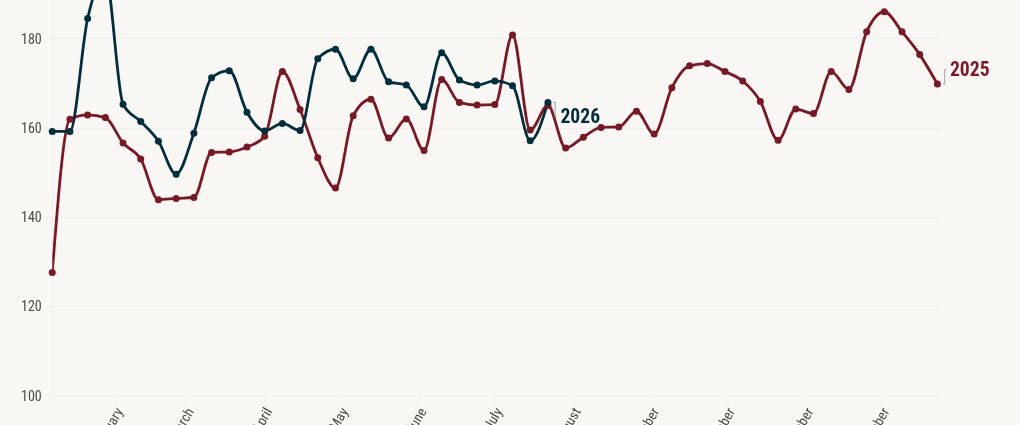
Mortgage applications rise 1.9% despite elevated rates
Mortgage applications increased 1.9% from one week earlier, according to data from the Mortgage Bankers Association’s (MBA) weekly mortgage applications survey for the week ending July 17, 2026.
On an unadjusted basis, the index increased 2% compared with last week’s data.
The refinance index decreased 2% from the previous week and was 7% higher than the same week one year ago. The seasonally adjusted purchase index increased 6% from one week earlier, and the unadjusted purchase index increased 6% compared with the previous week and was 0.2% higher than the same week one year ago.
“Mortgage rates reached another high point last week, with the 30-year conforming rate now at 6.69%, its highest level since last August,” said Mike Fratantoni, MBA’s SVP and chief economist. “However, purchase volume increased modestly for the week. Growing home inventory in many markets is supporting more purchase activity. Incoming data showed that inflation dropped in June, but with oil prices spiking again, that improvement seems unlikely to continue in July data, and mortgage rates are likely to remain higher as a result.”
The refinance share of mortgage activity decreased to 41.2% of total applications from 43.2% the previous week, while the adjustable-rate mortgage (ARM) share of activity increased to 7.7% of total applications.
The Federal Housing Administration (FHA) share of total applications decreased to 17.0% from 17.7% the week prior. The U.S. Department of Veterans Affairs (VA) share of total applications decreased to 13.2% from 13.65 the week prior. The U.S. Department of Agriculture (USDA) share of total applications remained unchanged at 0.5% from the week prior.
The average contract interest rate for 30-year fixed-rate mortgages with conforming loan balances ($832,750 or less) increased to 6.69% from 6.65% while rates for 30-year fixed-rate mortgages with jumbo loan balances (greater than $832,750) decreased to 6.44% from 6.62%.
The average contract interest rate for 30-year fixed-rate mortgages backed by the FHA increased to 6.34% from 6.33% while the average rate for 15-year fixed-rate mortgages decreased to 6.04% from 6.05%. The average contract interest rate for 5/1 ARMs increased to 5.97% from 5.75%.
Xactus Mortgage Intent Index
Xactus’s Mortgage Intent Index — which analyzes aggregated, anonymized credit-pull activity across the Xactus Intelligent Verification Platform — increased slightly week over week to a reading of 126.2.
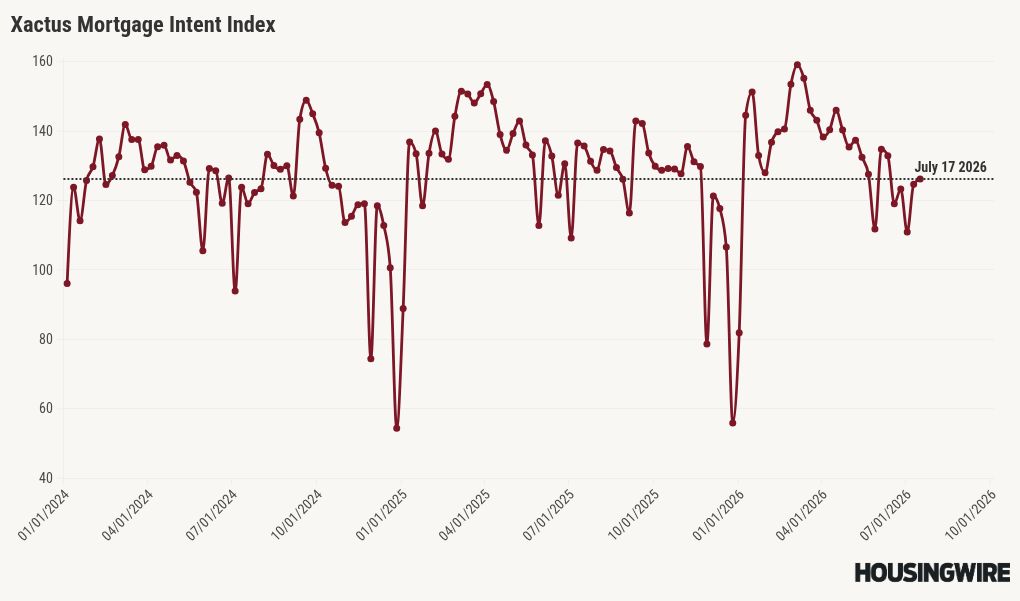
“The Xactus Mortgage Intent Index increased approximately 1.2% week over week to 126.2, marking a second consecutive week of modest gains following the July 4 holiday period,” said Thomas Lloyd, Xactus’ chief strategy officer. “The increase came despite a slight rise in mortgage rates, suggesting borrower activity has remained relatively stable even as financing conditions continue to challenge affordability.”
Lloyd continued, “Despite the weekly improvement, the index was approximately 7.0% below the same week in 2025, marking a second consecutive week of year-over-year declines. While recent activity suggests demand has stabilized following the holiday period, the annual comparisons indicate that elevated mortgage rates continue to temper borrower intent relative to last year.”
Mike Ryan joins PLACE to lead business development
Real estate services and technology platform PLACE is welcoming a new executive. In a post on LinkedIn on Tuesday, Mike Ryan announced he was joining PLACE where he will serve as executive vice president of business development
Prior to this he had been with OJO Labs for over a decade, most recently serving as the chief partnership officer of mortgage lender Lower’s real estate division after OJO’s listing portal Movoto was acquired by Lower in 2025.
In his post, Ryan said that leaving Lower “wasn’t an easy decision.”
“Over the past 10+ years, I had the privilege of working alongside incredibly talented people, building strategic partnerships and helping grow businesses that have made a meaningful impact on the real estate industry,” Ryan wrote.
He also thanked fellow Lower real estate leaders Angela Dunham and John Berkowitz, as well as Lower’s vice president of product Adam Tao.
Rayn wrote that his decision to move was not about leaving something behind, but joining something he believes “has the potential to redefine what’s possible.”
“PLACE has quietly built one of the most impressive platforms in residential real estate, combining technology, services, and operational expertise to help the industry’s top professionals build more valuable businesses while delivering a better experience for consumers,” Ryan wrote. “The vision is bold, but what convinced me was the team’s ability to execute.”
In his new role, Ryan said he will be “focused on expanding strategic partnerships and accelerating the distribution of PLACE’s technology, services, and consumer solutions.”
In joining PLACE, Ryan is reuniting with former colleague Chris Heller, who had previously served as the chief growth officer of Lower’s real estate division. Heller joined PLACE in November 2025, where he currently serves as the firm’s chief revenue officer.
Lower did not immediately respond to HousingWire’s inquiry regarding the firm’s plans to fill Ryan’s vacated role.


Modeling Scout With Epstein Ties Found Dead

Justice Department Demands New Jersey Turn Over Records on 6,600 Noncitizens Added to Voter Rolls
The U.S. Department of Justice has given New Jersey five business days to hand over detailed records on roughly 6,600 noncitizens who were mistakenly registered to vote, opening a federal investigation just hours after the state’s governor disclosed the error.
Assistant Attorney General Harmeet K. Dhillon, who leads the department’s Civil Rights Division, sent the demand in a letter to Gov. Mikie Sherrill on Tuesday evening. The letter followed Sherrill’s own announcement earlier that day that a software error in the state’s Motor Vehicle Commission system had placed approximately 6,600 people who identified themselves as noncitizens onto the voter rolls between June 2023 and June 2024. Roughly 400 of those individuals went on to cast ballots.
Dhillon instructed the state to preserve all relevant records and to produce specific data on both groups. For the 6,600 registrants, the department is seeking full names, dates of birth, nationalities, residential addresses, and the dates and locations of their registrations. For the roughly 400 who voted, it wants to know when and where each ballot was cast. “Ensuring that U.S. citizens’ votes are not illegally diluted by noncitizens’ votes is of paramount importance,” Dhillon wrote. The five-business-day clock puts the state’s response due early next week.
Sherrill, a Democrat who took office in January, laid out the origin of the problem in a statement posted to social media on Tuesday. She said a “serious software error” in the Motor Vehicle System’s license and identification application process was to blame. According to the governor, the 6,600 individuals answered “no” when a keypad at motor vehicle offices asked whether they were U.S. citizens, “but through no fault of their own, the system registered them anyway.” She said the registrations occurred well before she took office and pinned responsibility on the prior administration of fellow Democrat Phil Murphy.
“I am appalled by the reckless failures that allowed this to happen and the lack of transparency shown by those in charge at the time,” Sherrill said. “This failure didn’t occur under my watch, but accountability starts now.” She said she has ordered the affected names removed from the rolls, intends to replace the vendor that operated the system, and characterized the roughly 400 improperly cast votes as a tiny fraction of the state’s electorate. Sherrill added that there was “no evidence at this time that any elections were swayed” and said the registrants had been spread across party lines and geography, listing Democrats, Republicans, and unaffiliated voters scattered statewide.
The disclosure and the federal response land in the middle of a broader national fight over voter-roll integrity. President Donald Trump has repeatedly claimed noncitizens are voting in meaningful numbers and last week used a White House address to press Congress to pass the SAVE America Act, which would add proof-of-citizenship and photo identification requirements for voter registration. The White House quickly seized on the New Jersey findings. Spokeswoman Abigail Jackson said the episode “underscores the absolute necessity of the SAVE America Act,” arguing that critics who dismissed the possibility of noncitizen voting had again been proven wrong.
There is also a numerical dispute embedded in the story. Sherrill’s figure of 6,600 sits far below a separate federal tally: the Department of Homeland Security, which reviewed the state’s public voter file, flagged 35,152 names as potential noncitizens. The governor did not reconcile the gap between the two numbers, and she pushed back hard on the administration’s broader messaging, saying Trump had “zero credibility” on the issue and was attempting to “weaponize elections for political gain.”
For New Jersey, the immediate practical question is compliance. The DOJ letter frames its request under federal civil rights authority, and the data being sought — names, birth dates, nationalities, and home addresses of thousands of people — raises its own privacy and legal considerations that the state will have to weigh against the department’s deadline. State officials have not yet said publicly whether they will turn over the records in full, seek to narrow the request, or contest it.
The matter also carries weight beyond New Jersey. With registration systems tied to motor vehicle agencies operating in states across the country under “motor voter” rules, the software failure Sherrill described points to a vulnerability that other states may face. How Trenton responds over the coming days is likely to shape both the federal inquiry and the wider debate over how citizenship is verified at the registration counter.
The state’s response to the Justice Department is due within five business days of the Tuesday letter.
JBizNews Desk | Trenton, N.J.
© JBizNews.com All Rights Reserved. Reproduction or distribution without written permission is prohibited.

STAT+: Pharmalittle: We’re reading about Trump’s plan for tariffs on generics, a Merck and Gilead HIV pill, and more
Good morning, everyone, and welcome to the middle of the week. Congratulations on making it this far, and remember there are only a few more days until the weekend arrives. So keep plugging away. After all, what are the alternatives? While you ponder the possibilities, we invite you to join us for a needed cup of stimulation. Our choice today is blueberry cobbler, one of our pantry favorites. Meanwhile, here are a few items of interest to help you on your way. We hope you conquer the world and have a wonderful day. And as always, please do stay in touch. …
President Trump plans to impose tariffs on imported generic medicines, his latest threat aimed at bringing pharmaceutical manufacturing back to the U.S., The New York Times points out. The planned levy will start at 100% in August 2028, Trump said in a social media post. He said it would rise to 200% in August 2029, months after the end of his second term. He has repeatedly threatened steep tariffs on imported pharmaceuticals but has not followed through on imposing them. Doctors and supply chain experts have been sharply critical of the idea of taxing imported generics, saying it threatened to raise costs, spur rationing and lead to shortages of crucial drugs. Until now, the administration had said that generic drugs would be exempted from tariffs.
Meanwhile, Trump’s plan to impose steep tariffs on generic medicines has unsettled Indian drugmakers and put the spotlight on their strategy in their biggest export market, Bloomberg News tells us. Indian drugmakers are the largest source of generic therapies for the U.S. In 2024, medicines from India accounted for more than half of all prescriptions for birth control, antidepressants, and hypertension treatments. India, often dubbed the “pharmacy of the world,” also hosts the highest number of manufacturing plants approved by the U.S. Food and Drug Administration outside the U.S.
Trump threatens to hit Iranian bridges, power plants, any time shots fired in Strait of Hormuz
The US will strike Iranian bridges and power plants in retaliation for every time Iran fires on a ship in the Strait of Hormuz, US President Donald Trump threatened in a Wednesday Truth Social post.
“The US will bomb and destroy one bridge or power plant, including those located next to, or in, the capital city of Tehran,” Trump said.
This will happen “from this point forward, any time the Islamic Republic of Iran shoots at a ship in the Strait of Hormuz,” he stated.
— Rapid Response 47 (@RapidResponse47) July 22, 2026
This will be regardless of whether Iran fired a “missile, rocket, drone, or any other device or weapon,” the president said.
This is a developing story.

Hamas strengthens grip on Gaza through clan leaders, local committees – report
Hamas terrorists have been working to systematically tighten their ties with clan and tribal leaders in the Gaza Strip to strengthen their position before the slated technocratic administration takes control of the area, KAN Reshet Bet reported on Wednesday.
The terror group has been promoting figures who have ties to the group to key positions within clan structures via both elections to clan councils and the appointment of local administrators, known as “muktars,” the report noted.
Earlier this month, Palestinians familiar with the matter told The Jerusalem Post that despite Hamas’s stated willingness to hand over authority to a technocratic committee, the terrorist group will not relinquish its power.
“Hamas hasn’t declared an end to its rule in the Gaza Strip,” a senior Palestinian official in Ramallah told the Post on July 6.
“What they have done is announce the dissolution of what they call the emergency committee. But at the same time, they immediately declared that another temporary governing body would run the [Gaza] Strip and appointed someone to head it.”
The report claimed that in an effort to strengthen its position, the terror group has been providing incentives and benefits to clans that work alongside it, including assisting in resolving conflicts between family members, as well as allowing access to humanitarian assistance and privileges, in order to ensure the clans’ dependence on Hamas terror leaders.
Hamas places leaders in administrative positions over regional neighborhoods, refugee camps, displaced persons’ tent villages
Palestinian security officials testified that they have identified an increased effort by Hamas terrorists to place loyal figures as heads of regional neighborhood committees within both refugee camps and displaced persons’ tent villages, KAN reported.
This was done to boost Hamas’s grip on Gazan civilians, the sources told KAN. The same sources also told KAN that there is an intention within the terror group to influence local elements in favor of its goals, maintain civil stability according ot the terror group’s perception, reduce “anarchy,” and increase the group’s oversight capabilities.
Within the strip, Hamas has created shelter and relief communities within displaced tent camps, the Post understands.
Within these camps, it has positioned members of committees that are meant to take care of people, provide services, and manage provisions of services to Gazans there. Using this as cover, Hamas terror leaders have gained a foothold in the local population, serving as a tool to control the populace, as the committee members report everything to Hamas and oversee what goes on within the camps, the Post learned.
Additionally, institutions such as Gaza’s chamber of commerce have remained closely under Hamas control.
Hamas threatens to remove benefits for attendees of anti-terror group protest
In the build-up to the anti-Hamas protest a few weeks ago, the group threatened that anyone who participated in the protests would be punished and expelled from the camps, the Post learned.
Hamas has control over some of the Gazan clans. Even if the clans would prefer not to be aligned with Hamas, they are forced to do so due to the power that the terror group has.
When Hamas announced that it was dissolving its governing body in the Gaza Strip, some clan representatives held a press conference echoing Hamas’s statements in order to give the terror group legitimacy.
This is an old tactic Hamas uses with clans and families in order to subject them to its authority.
Dana Ben-Shimon contributed to this report.

Only regime change prevents Iran from acquiring a nuclear weapon, former Israel Navy commander says
Iran’s resolve and motivation to pursue nuclear weapons has only increased following the war, V.-Adm. (ret.) Eliezer “Chaney” Marom, a former Israel Navy commander, told 103FM on Wednesday, warning that only regime change could prevent Tehran from obtaining a bomb.
“Producing a nuclear bomb is a complex and difficult undertaking. The Iranians were very close when the war began, and fortunately, we disrupted it significantly,” Marom said.
He added that, according to intelligence assessments, Iran had been extremely close to completing the process.
“They were weeks away from a nuclear weapon, unequivocally. I am not the only one saying this. All the intelligence agencies, both Israeli and American, are saying it clearly, including the International Atomic Energy Agency,” he said.
Israel must not be complacent with Iran war results
Despite the damage inflicted on the nuclear program, the former Navy commander warned against complacency, estimating that Iran’s motivation to obtain nuclear weapons had only increased following the war.
“The Iranians have drawn one clear conclusion from this entire war: ‘Had we possessed nuclear weapons, everything would have looked different.’ Therefore, their motivation is through the roof. There is only one way to prevent Iran from obtaining nuclear weapons, and that is regime change,” he said.
US ‘probably do not have the capability’ to destroy Pickaxe Mountain’s nuclear plant
Marom later addressed reports that Iran had transferred thousands of centrifuges to a fortified site near Natanz known as Pickaxe Mountain. The facility was excavated in rocky terrain dozens of meters underground and is considered particularly difficult to penetrate.
“Granite is a very, very, very hard mineral. It is almost impossible to penetrate, at least with the bombs the Americans currently possess. At a depth of more than 100 meters underground, beneath a mountain made of granite, the Americans probably do not have the capability,” he said.
Marom said that during his military service, he had visited a similar underground facility in another country.
“I had the privilege of visiting such a facility in another country, also deep underground. I can only say that there really is an enormous stockpile of ammunition in that country that is located underground,” he said.
However, Marom said the fortified site was not necessarily the issue that concerned him most.
“Something else concerns me,” he said. “The Iranians have already enriched uranium to various levels. They have tons of uranium enriched to 5% and 20%, as well as the familiar figure of 440 kg. enriched to 60%. I am talking about tons. The weaponization group is very difficult to track.”

JPMorgan and Goldman Stand to Collect Roughly $100 Million Each Arranging SoftBank’s Record AI Loan
JPMorgan Chase and Goldman Sachs are each in line for fees approaching $100 million for arranging the largest borrowing in SoftBank Group’s history, a payout that shows just how profitable the financing behind the artificial intelligence buildout has become for Wall Street’s biggest firms.
The fees flow from the $40 billion unsecured bridge facility SoftBank signed on March 27, underwritten by a syndicate that pairs JPMorgan and Goldman with Japanese lenders Mizuho Bank, Sumitomo Mitsui Banking Corporation and MUFG Bank. The proceeds went chiefly toward SoftBank’s $30 billion follow-on investment in OpenAI, part of the ChatGPT maker’s $110 billion capital raise — the largest private funding round on record, one that valued the company at roughly $852 billion. With the new commitment, SoftBank’s total stake in OpenAI now sits near $64.6 billion.
What makes the fee pool so rich is the structure of the deal itself. The facility carries no collateral, meaning SoftBank pledged no specific assets against $40 billion in credit. Banks price that kind of exposure aggressively, and a loan of this scale generates arrangement and underwriting fees far larger than a conventional secured facility would. The 12-month term compounds the point: the loan is designed to be short, with SoftBank obligated to repay or refinance by March 26, 2027. Lenders willing to extend unsecured money at that size, on that clock, expect to be paid accordingly.
There is a second motive behind the two American banks taking the lead roles. JPMorgan and Goldman are positioning themselves for what could be a far bigger prize — lead underwriting assignments on an OpenAI public offering, an event that would rank among the largest listings ever attempted. The bridge loan functions as both a fee-generating instrument today and a relationship anchor for the mandates to come. Chairman and Chief Executive Masayoshi Son has stated that repayment would likely come through existing assets and additional financing, a plan that leans heavily on SoftBank’s ability to convert its AI holdings into liquidity.
The scale of these paydays is easier to grasp against a recent benchmark. When SpaceX went public in June — the largest IPO in history — the banks running the deal split a fee pool of about $500 million, with the lead firms each taking home close to $100 million. That SoftBank’s lenders can approach similar figures on a single loan, rather than a landmark stock sale, signals how much the AI financing cycle has reshaped where investment banking revenue is now made. The reported fee arrangement was detailed by Bloomberg.
For SoftBank, the record loan is one piece of an increasingly aggressive borrowing program. Son has funded his AI push through a mix of debt and asset sales, including trimming stakes in Nvidia and T-Mobile US, and the company has continued to seek fresh credit lines. On July 1, SoftBank reopened talks with a consortium expected to include Goldman Sachs, JPMorgan and Mizuho Financial Group for a $10 billion loan backed by its OpenAI stake — a facility that had stalled earlier over the difficulty of valuing a private company. To ease lender concerns this time, SoftBank offered to guarantee repayment, giving banks recourse if the pledged OpenAI shares lose value.
Credit-rating agencies have taken note of the strategy. On July 16, S&P Global Ratings revised its outlook on SoftBank to stable from negative while affirming the company’s BB+ long-term rating, a modest vote of confidence as the conglomerate leans further into leverage. SoftBank’s price-to-earnings ratio, meanwhile, remains well below the industry average, reflecting continued investor caution about the size of Son’s bets.
The through-line connecting all of it is the assumption that OpenAI will eventually reach the public market at a valuation large enough to make today’s borrowing look conservative. If that listing materializes, SoftBank gains the liquidity to clear its March 2027 obligation, and the banks that arranged the bridge financing stand to earn a second, larger round of fees underwriting the offering. If the timeline slips, the pressure of an unsecured, short-dated $40 billion facility falls back on SoftBank’s balance sheet and its willingness to keep selling down long-held positions.
For now, the immediate winners are clear. Two banks are set to book nine-figure sums for structuring a single loan, a reminder that in the current cycle, the surest money in artificial intelligence is often made not by the companies building the technology, but by the institutions financing the race to own it.
JBizNews Desk | Wall Street
© JBizNews.com All Rights Reserved. Reproduction or distribution without written permission is prohibited.




Who are the most influential young Zionists of 2026?
Shaped by the aftermath of October 7, global antisemitism, and renewed debates about Zionism, a new generation of young Zionist leaders is coming of age. Who are the 25 most influential young Zionists of 2026?
With this new generation of Jewish leaders in mind, Jewish National Fund-USA and the Jerusalem Post are celebrating, for the fourth consecutive year, the next generation of ViZionaries – the 25 most influential Zionists under 46 who are going above and beyond to support the land and people of Israel.
Nominations are now open for the Jerusalem Post and Jewish National Fund-USA’s 2026 Top 25 Vizionaries.

These imaginative, bold, and creative young leaders are making their mark in diverse fields while emerging as influential voices in their communities, united by their proud and public commitment to the land and people of Israel.
Judges from the Jerusalem Post and Jewish National Fund-USA’s JNFuture donor society will review nominations and determine the final list of 25 by evaluating the total number of votes and the nominees’ overall accomplishments.
The Top 25 Vizionaries for 2026 will be announced on Friday, September 11, just before Rosh Hashanah, the Jewish New Year, coinciding with the publication of the Jerusalem Post’s 50 Most Influential Jews list.

JNFuture National Chair, Danielle Hankin, highlighted the need for young people to stand up for Zionism.
“My generation has inherited both extraordinary opportunities and significant challenges in supporting Israel and strengthening Jewish life,” said Hankin. “As National Chair of JNFuture, and as a mother raising the next generation of proud Jews, I believe young Zionist leadership has never been more important. We cannot afford to be bystanders; we must be informed and connected to be advocates, philanthropists, and leaders. Through JNFuture, I have seen so many young adults step forward to lead with passion and, more importantly, purpose. The future of Zionism will be shaped not by those waiting their turn, but by those willing to step up today. Jewish National Fund USA provides a seat at the table for those ready.”
For 94 years, the Jerusalem Post has been Israel’s leading English-language news outlet, keeping Israelis and the Jewish Diaspora informed about the latest developments affecting the Jewish homeland.
“We are excited to partner again with Jewish National Fund-USA as we highlight young Zionists making a difference,” said Jerusalem Post Group CEO Inbar Ashkenazi. “The Post was there during the Zionist struggle in pre-state Israel. We were there during the key moments – both positive and negative – that have defined our country’s modern history. And more than ever, we are here to inspire a new wave of young people to stand up and make our world a better place.”
How to submit a name
Nominations can be submitted until 5 PM EDT on Monday, August 23, 2026.
Eligible candidates include Zionists — Jews and people of other faiths — from around the world under age 46. Last year’s winners can be viewed at jpost.com/influencers/visionaries.
Nominations may be submitted until 5 PM US ET on August 23, 2026, at top25vizionaries.com. For more information, contact press@jnf.org
Who should make the list? Help us choose.
This article was written in cooperation with Jewish National Fund-USA.

Yashar emerges as largest party, Eisenkot preferred for PM if elections held today – poll
Gadi Eisenkot’s Yashar party would emerge as the largest faction in the Knesset if elections were held today, winning 24 seats, according to a Channel 12 poll published Monday evening.
The poll asked respondents, “If elections for the Knesset were held today, which party would you vote for?” It also found that Eisenkot remained the preferred candidate for prime minister, ahead of Prime Minister Benjamin Netanyahu.
The survey was conducted by the Midgam Institute, headed by Mano Geva, in cooperation with iPanel.
The poll, reported by Channel 12 political analyst Amit Segal, showed that the entry of new parties had changed the balance between the political blocs to some extent.
Most opposition voters said they would prefer to form a government that relied on outside support from an Arab party if their bloc failed to secure the 61 seats needed for a majority.
Coalition voters want Haredi parties participating in the next government
Coalition voters, meanwhile, expressed satisfaction with the agreements reached between Netanyahu and the haredi, or ultra-Orthodox, parties. They also said they wanted the haredi parties to participate in the next governing coalition.
According to the poll, the distribution of seats between the blocs remained unchanged from the previous survey. The Zionist opposition parties received 59 seats, compared with 51 for the coalition parties.
Adding the Arab parties’ 10 seats would bring the opposition’s total to 69. Without their support, however, neither bloc would reach the 61-seat majority required to form a government.
Eisenkot also continued to lead Netanyahu in the question of suitability for prime minister, receiving 43% support, unchanged from the previous week. Netanyahu received 37%.
Opposition voters favor Arab party support over new elections
Channel 12 asked opposition voters which course of action they would prefer if their bloc failed to secure 61 seats. Some 44% said a government should be formed with outside support from an Arab party, while 28% favored holding another election.
Another 13% supported forming a unity government with Likud, 6% favored forming a government with a haredi party, and 9% said they did not know.
Coalition voters were asked whether they were satisfied with the agreements between Netanyahu and the haredi parties. Under the agreements, the haredi parties secured the passage of the Basic Law: Torah Study and protection against the arrest of draft evaders. In return, Netanyahu advanced legislation to divide the attorney general’s position and promoted the Communications Law.
Some 59% said they were satisfied with the agreements, 19% said they were dissatisfied, and 22% said they did not know.
Iran targets US bases in Gulf region, claims to hit air bases in Jordan, Bahrain
The Islamic Revolutionary Guard Corps claimed to have attacked Jordan’s King Faisal and Prince Hassan air bases on Wednesday afternoon, Iranian state media reported.
King Faisal Air Base is located in the south of the kingdom, near al-Jafr. It is named after then-King Faisal bin Abdulaziz of Saudi Arabia, who funded its construction.
Earlier this month, an Iranian strike on the airport injured five US soldiers posted to the base.
Prince Hassan Air Base is located in the north of the kingdom, near Sawafi. The US Air Force has used the base periodically since at least the 1980s, and so have other NATO partner air forces, including France and the UK.
Meanwhile, the IRGC-run Fars News Agency claimed that the terror group fired drones towards hangars and other structures used by the US Air Force on a military base in Bahrain.
“The US’s aggressive attacks in recent nights were carried out under the pretext of retaliating for the explosion of offending ships [in the Strait of Hormuz],” the IRGC said.
“Last night, despite the temptation of ship crews, no vessel dared to attempt the illegal passage south of the strait. The child-killing American army did not abandon its aggressive nature and repeated air and missile attacks on a number of our military and civilian centers, and is now receiving crushing responses,” it claimed.
“The IRGC’s Aerospace Force once again smashed US bases in Jordan in response to the enemy’s aggression,” it said.
“In the first phase of the response, a missile and drone attack on King Faisal and Prince Hassan bases targeted an F-15 preparation shed. In addition, in an attack on a drone preparation shed, eight new and refurbished MQ-9 drones were completely destroyed before they could be constructed, and two others were heavily damaged,” it claimed.
“In a subsequent attack on a helicopter hangar, two US military helicopters were severely damaged,” it added.
“A number of invading forces were killed and wounded,” it also claimed.
“If the aggressions continue, we will prepare for a regretful operation that will lead to a declaration of public mourning in the US,” the IRGC stated.
Sirens also sounded in Saudi Arabia from detected Iranian attacks towards the country.
The Pentagon has not yet commented on the claimed attacks.
Sirens also sounded in Sirik, Iran on Wednesday afternoon amid reported airstrikes.
Smoke was seen rising from the Aqaba area in Jordan after Iran launched missiles towards Jordan earlier on Wednesday.
According to the IDF, no Iron Dome interceptors were launched, and no debris from Jordan’s interception fell within Israeli territory.
Jordanian state media reported that six Iranian missiles were intercepted in this incident. The smoke reportedly resulted from debris.
Shortly afterward, the Jordanian Armed Forces-Arab Army stated that four Iranian drones were also intercepted in Jordanian airspace.
No injuries have been reported.
After the launches, an Arkia flight from Ben-Gurion Airport to Ramon Airport was forced to delay its landing and circle in the air until authorities could verify that there was no debris on the runway.
This is a developing story.
Amit Avitan contributed to this report.

Journalists disappear in Syria, Damascus suppresses accounts of sectarian attacks, report finds
Journalism continues to be harshly suppressed in Syria, with journalists still being disappeared and killed despite some improvements under the transitional government following the fall of the Assad regime, according to a report published last week by the Syrian Centre for Media and Freedom of Expression.
At least nine journalists have been killed in Syria in connection with their work over the past five years. Six of those killings took place in connection with or after the fall of the Assad regime. Of those six cases, four involved journalists covering military confrontations related either to the regime change or unrest in the Governorate of Sweida.
The majority of those killed while carrying out their work as journalists were clearly identifiable as members of the press, wearing vests and helmets and/or traveling in vehicles marked with “press” insignia.
Those who reported the killings to the center said they were unaware of any prompt, effective, independent, or publicly disclosed investigations into the deaths.
Some journalists were also murdered while not performing their duties, as was the case with Alaa Mohammed, who was killed in his own home over what is believed to have been his political commentary.
Journalists are killed, disappeared after covering sectarian violence
Mohammed belonged to the Alawite minority, which has faced frequent attacks since the fall of the Assad regime, particularly in March 2025, when more than 1,400 people were killed in sectarian violence. His death was neither adequately investigated nor condemned by the transitional government, the center asserted.
In addition to the killings, multiple journalists faced arbitrary detention, enforced disappearance, and harassment, often in connection with their coverage of sectarian violence.
International media coverage of sectarian issues was also heavily restricted. The New York Times reported that Syrian authorities sealed off areas affected by the March 2025 attacks on Alawites, preventing foreign journalists from accessing them. One journalist told the center they had been prevented from conducting on-the-ground reporting in the affected area, forcing the newspaper to rely on phone interviews.
“These practices raise concerns regarding transparency, media access, and the ability of independent journalists to document events of public interest during the transitional period,” the center noted. “They also appear inconsistent with public statements by representatives of the Transitional Government emphasizing openness toward international media and a commitment to facilitating journalists’ work in Syria.”
Foreign journalists also face numerous barriers to accessing and reporting from Syria despite government commitments. Authorities have required them to disclose extensive information about the subjects of their reporting, previous publications on Syria, where they intend to travel within the country, and whom they plan to meet. Approvals to report in Syria either never arrive or are significantly delayed. Some journalists also complained that they were barred from publishing while in Syria and required to pledge that they would not report on the country upon entry for “security reasons.”
Censorship of the sectarian attacks has also seemingly continued. The center noted that in August 2025, a theatrical production was suspended after actors criticized the Transitional Government’s conduct during the attacks against Alawites and Druze.
The Transitional Government also imposed restrictions on independent reporting in certain Aleppo neighborhoods following the government’s recapture of those areas.
In some cases, it remains unknown who killed journalists during sectarian violence. Sari Majid A. Shoufi, a photojournalist for Suwayda 24, went missing while covering the attacks on the Druze in Sweida in July. His body was found after a 10-day search.
Journalists have also been detained by Syrian security forces and transferred to undisclosed locations without any explanation for their arrest, the center asserted, highlighting the case of Kurdish journalist Hassan Zaza.
Syrian government claims arrests not related to journalistic work
Zaza was taken from his home by Syrian security forces and held incommunicado for a week before being released without formal charges. The Syrian Ministry of Information confirmed his arrest but stated only that it was “related to security concerns and not connected to his journalistic work.”
American journalist Bilal Abdul Kareem was also arrested by Syrian security forces in al-Bab and taken to undisclosed locations. No formal charges against Kareem are known, and he remains in custody, while his family has received no information about his whereabouts.
Detained journalists have reportedly faced delayed access to legal counsel and a lack of transparency regarding their detention. The center highlighted the cases of Ahmed Polad and German journalist Eva Maria Michelmann.
Polad and Michelmann’s whereabouts were undisclosed for months after security forces abducted them while they were reporting on clashes between the Syrian Arab Army and the formerly US-backed Syrian Democratic Forces. Their location remained unknown until April 2026, when it emerged that they were being held in detention centers in Damascus and Aleppo. Following extensive lobbying, the German government secured legal counsel for Michelmann, and she was released three months later. Polad, however, remains detained without legal representation, and the Transitional Government has not released any further information about his condition.
Legally, some protections for journalists and freedom of opinion have been introduced, but the center said these safeguards have largely been undermined by existing Assad-era legislation and new laws introduced by the transitional government.
While the 2025 Constitutional Declaration guarantees the rights to “freedom of opinion, expression, information, publication and the press,” Syria’s Law No. 20 of 2022 on Combating Cybercrime has been widely condemned by human rights organizations as a repressive tool used to stifle free expression and criminalize dissent by restricting the sharing of digital content on social media.
Additionally, Syria’s Law No. 19 of 2024, which established the Media Ministry, has been widely criticized by international watchdogs for consolidating government control over the media, allowing authorities to stifle dissent and censor information.
Outside of action by the Syrian authorities, or Syrian civilians acting with large degrees of impunity, the report noted that journalists have faced violence and death from a number of foreign nations.
The Russian military guard, for example, assaulted in March 2025 Souria Post journalists Hashim Al-Abdullah and Ehab Khaled at the Hmeimim air base, beating them, threatening them with death, and confiscating their materials during four hours of detention.
A number of journalists have also been killed in Turkey’s war against Kurdish militias, as was the case with ANHA journalists Jihan Belkin and Nazim Dashdan, who were killed in a drone attack near Aleppo as they were returning from covering clashes between the Syrian Democratic Forces and the Syrian National Army at the Tishreen Dam. Despite driving in a vehicle marked with a press insignia, Turkish or Turkish-backed forces are believed to have struck them with a drone.

Adobe, Salesforce Downgrades Are Latest Show of AI Fears
A run of Wall Street downgrades across enterprise software is crystallizing a worry that has hung over the sector all year: that generative AI may erode the pricing power these companies were built on.
Adobe has been at the center of the anxiety. Shares fell about 9% after its fiscal second-quarter results, despite record revenue of $6.62 billion, as a CFO departure and AI-disruption fears rattled investors and cast a shadow over the broader software group. Management leaned into the AI story, noting that AI-first annual recurring revenue tripled to more than $500 million—but skeptics countered that the figure is under 2% of Adobe’s $27.1 billion total ARR, leaving them unconvinced the monetization pivot can protect margins. A surprise 30% price cut on Firefly AI subscriptions and a shift toward a freemium model deepened concerns about margin compression, while leadership changes—including CEO Shantanu Narayen’s move to board chair—added uncertainty.
The reaction has split the analyst community. Bank of America downgraded Adobe to Underperform, citing generative AI’s threat, even as HSBC upgraded the stock to Buy with a $308 target, arguing the market undervalues Adobe’s core business and AI growth potential.
Salesforce drew its own twin blow. On July 9, KeyBanc and Bernstein both cut the stock to the equivalent of a hold on the same day, with both firms pointing to the same problem: the Agentforce AI platform is not living up to expectations. KeyBanc’s Jackson Ader argued that customer data is not organized enough for real AI work and that the product is not ready yet, while a survey of chief information officers showed more of them planning to trim Salesforce spending than raise it. Salesforce shares slid 3% to 4% at their low and have been among the Dow’s weakest members in 2026, down roughly 37% year to date and trading near 19 times earnings.
The caution has spread beyond the two names. An IBM earnings warning about enterprise software budgets rippled through the group, pulling down ServiceNow, Workday and Salesforce, while Snowflake has faced pressure from Amazon and Oracle bundling their AI data tools. The common thread is a question investors keep circling back to—whether subscription pricing can hold as AI-native competitors undercut incumbents on cost. Strong current fundamentals at these companies have not been enough to quiet it.
JBizNews Desk | San Francisco
© JBizNews.com All Rights Reserved. Reproduction or distribution without written permission is prohibited.
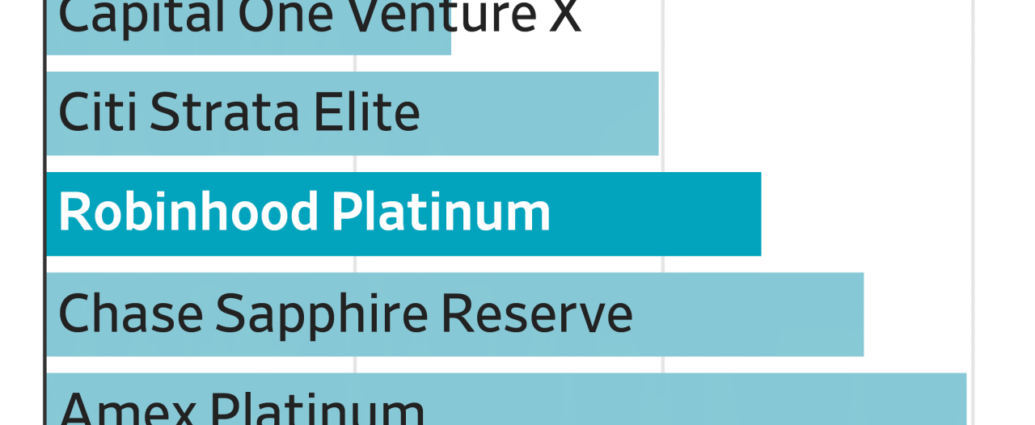



Mavis Tire to acquire iconic auto-service chain in $700M deal
Icahn Enterprises on Tuesday announced that the company reached a deal to sell Pep Boys to Mavis, one of the largest independent tire and service providers in the country, in a $700 million deal.
Pep Boys has nearly 800 locations around the country and offers auto services including tires, repairs, oil changes and maintenance.
The deal will expand Mavis’ presence in new and existing markets, particularly in the western U.S. where Pep Boys has a significant presence, and will increase Mavis’s network to over 4,400 service centers around the U.S. and Canada.
MILLIONS OF CAR OWNERS ARE DELAYING MAINTENANCE REPAIRS AS COSTS RISE
“Today’s announcement marks a significant milestone as Mavis continues to execute its growth strategy. Pep Boys is one of the most well-respected names in the automotive aftermarket, and we look forward to welcoming it into the Mavis family of brands,” said Mavis co-CEO David Sorbaro.
Sorbaro added that the deal “will create a stronger, more geographically diverse platform with the scale and capabilities to provide dependable service to even more customers and create meaningful opportunities for employees.”
MECHANIC SHORTAGE PERSISTS AS WORKERS AGE OUT OF PROFESSION
Pep Boys CEO Joe Auriemma said that, “For more than 100 years, Pep Boys has earned the trust of drivers across the country by delivering quality service with honesty and care,” adding that Mavis shares those values and its network will give Pep Boys the “scale, footprint, and operational and technological strength to continue building on its legacy as it enters a new chapter of growth.”
Carl Icahn, chairman of Icahn Enterprises, welcomed the deal and said that they “believe that the combined businesses will benefit greatly from the inevitable economies of scale and from the great experience of the Mavis team in the industry.”
HIGH-TECH CARS DRIVE UP PRICES, TURNING AUTO REPAIRS INTO MAJOR INVESTMENTS
Under the deal, Icahn Enterprises will retain the real estate it obtained from Pep Boys, as well as the AAMCO Transmissions and Precision Tune Auto Care businesses.
Pep Boys was acquired by Icahn Enterprises in 2016, taking the auto service chain private in an all-cash $1 billion deal after it had been publicly traded.
Mavis operates other auto service brands including Midas, Tire Kingdom and Tuffy.
GET FOX BUSINESS ON THE GO BY CLICKING HERE
The transaction is expected to close in the coming months.
Reuters contributed to this report.

Job dissatisfaction and health care access uncertainty grows in the U.S., new study finds
Want to stay on top of the science and politics driving biotech today? Sign up to get our biotech newsletter in your inbox.
Good morning. I admit that I didn’t finish rereading “The Odyssey” before I saw the movie last weekend, but it’s never too late. For now, scroll down to read a related First Opinion essay and to sign up for office hours with Bob Herman, STAT’s own Homeric chronicler of the business of health care.

After Nabbing 1,187 Senior-Home Suites, Prima Eyes Its Next Move
Canadian senior housing operator Prima Living plans to keep expanding through acquisitions and is open to tapping public markets after buying nine retirement communities from Chartwell Retirement Residences for C$118 million ($83.7 million).
The deal adds 689 units in Ontario, bringing the Vancouver-based senior housing operator’s portfolio to 1,187 suites just over a year after its first acquisition in the province, underscoring the rapid pace of consolidation in Canada’s senior housing sector.

Hormuz and Heat Trigger an Asian Scramble for LNG
Welcome to our guide to the commodities driving the global economy. Today, Asia energy team leader Stephen Stapczynski looks at the continent’s rush for LNG shipments in light of the war in the Middle East.
The ongoing crisis in the Middle East, combined with scorching summer temperatures, is sending Asian buyers rushing to secure liquefied natural gas. Europe should be paying attention.

PulteGroup Profit Falls on Declining Revenue

House Moves Early to Lock In Government Funding, Sidestepping a Pre-Election Shutdown
WASHINGTON — House Republicans pushed through a stopgap spending bill on Tuesday that would keep the federal government funded through Dec. 4, an unusually early maneuver designed to remove the threat of a shutdown from the calendar well ahead of the November midterm elections.
The measure cleared the chamber on a 220-205 vote that fell almost entirely along party lines. Six Democrats — Henry Cuellar of Texas, Don Davis of North Carolina, Jared Golden of Maine, Vicente Gonzalez of Texas, Gabe Vasquez of New Mexico, and Kathy Castor of Florida — crossed over to back the bill, while Kentucky Republican Thomas Massie was the lone GOP defector.
What makes the vote notable is its timing. Congress typically waits until the eleventh hour to pass this kind of temporary funding patch, often acting within hours of a lapse. The current fiscal year does not end until Sept. 30, more than two months out. But with the House scheduled to be in session for only 16 more days before that deadline once lawmakers leave for the August recess, Republican leaders opted to act now rather than gamble on a chaotic September that could rattle voters just before they head to the polls.
For the business community, the early action carries a practical upside: predictability. A continuing resolution that generally holds agencies at existing spending levels gives federal contractors, grant recipients, and companies that depend on government operations a clearer runway through the fall. Shutdowns freeze contract payments, stall permitting and regulatory reviews, and force agencies to furlough workers — disruptions that ripple outward to the private firms doing business with Washington. Locking in funding through early December, if it holds, takes that particular source of uncertainty off the table during a period when markets already have plenty to digest.
House Speaker Mike Johnson framed the vote as a direct challenge to Democrats, warning that if they blocked the funding and a lapse followed after Sept. 30, the political fallout would land squarely on them. He argued that the party opposing the measure would own whatever disruption resulted.
Democrats saw the process very differently. Rep. Rosa DeLauro, the ranking Democrat on the House Appropriations Committee, said the legislation was handed to her side last Friday with no bipartisan negotiation, leaving lawmakers to rush a one-sided bill through two days before the recess. She said Democrats would have used any real negotiation to push back on a proposed federal rule that could let agency heads block or cancel grants they deem out of step with the administration’s priorities — a provision with direct consequences for universities, nonprofits, and businesses that rely on federal grant funding.
The bill also tucks in death gratuity payments of $174,000 each to the heirs of the late Sen. Lindsey Graham and Rep. David Scott, a customary provision attached to funding legislation following the deaths of sitting members.
The bigger question now moves across the Capitol. Passage in the House was the easier lift; the Senate is another matter. Majority Leader John Thune signaled that quick action in his chamber is far from assured. Unlike the House, the Senate needs a degree of bipartisan buy-in to advance spending legislation, meaning Republicans cannot move a stopgap on their own. That hands Senate Democrats real leverage, and the path forward there is murky at best.
The standoff sets up a familiar dynamic with unfamiliar timing. Republicans are betting that funding the government early denies the opposition a shutdown fight in the closing weeks of the campaign — a scenario that historically damages the party in power. Democrats, for their part, are unlikely to hand over that leverage without extracting concessions, and some see a shutdown fight as politically useful heading into November.
Republican leaders said work on the dozen annual appropriations bills would continue through the fall regardless, with the December deadline meant to buy time for that longer process rather than replace it. Whether that timeline survives contact with the Senate remains to be seen.
For now, the takeaway for anyone with exposure to federal spending — contractors, grant-dependent institutions, and the broader web of firms tied to government operations — is cautious. The House has done its part to push a shutdown out of the pre-election window, but the funding is not secure until the Senate acts and the president signs. Until then, the early vote is best read as a statement of intent rather than a guarantee.
JBizNews Desk | Washington, D.C.
© JBizNews.com All Rights Reserved. Reproduction or distribution without written permission is prohibited.

Iran disputes French claims of violence against diplomats in Tehran
An Iranian foreign ministry official denied on Wednesday that two French diplomats were mistreated by Iranian security personnel who detained them for several hours in Tehran.
Paris swiftly dismissed the Iranian official’s comments, which were reported by state media, and has warned that there will be consequences over the incident.
The French foreign ministry summoned the Iranian charge d’affaires on Tuesday over the incident, in which it said two French embassy staff had been detained and physically intimidated by Iranian security services.
Paris said the diplomats had their phones taken, were forbidden to contact the embassy and were verbally intimidated in a breach of diplomatic conventions. It said that one of them, the cultural attache, had been subjected to physical violence.
State media quoted Iranian Foreign Ministry official Mohammad Tanhaei on Wednesday as saying that security personnel had questioned two French embassy staff after they met individuals who are being investigated for security reasons.
“Security agents transferred the two individuals to the diplomatic police as soon as they realized their link to the French embassy,” he was quoted as saying, as well as adding that there had been no intimidation.
‘Despite giving their identities and profession, they were held for four hours’
French Foreign Ministry spokesperson Pascal Confavreux denied this, saying the two diplomats had been meeting with a supplier for the embassy.
“They were acting in a professional framework and despite giving their identities and profession, were held for four hours,” he said, reiterating that one of the diplomats had been subjected to physical violence.
Confavreux said there had been a pattern of intimidation in recent months as France sought to increase its support for, and contacts with, Iran’s civil society following a crackdown on protests at the start of this year.
Since then, Tehran has sought to forestall domestic unrest with arrests, executions and street deployments by security forces as the war with the United States continues.
Foreign Minister Jean-Noël Barrot has said the incident will not go without consequences. Diplomats say Paris is considering various options and that its response could be announced on Thursday.
Iranian Foreign Minister Abbas Araqchi said he had told Barrot on Tuesday that the diplomats’ actions were “unconventional and unprofessional”, and urged Paris to prevent a recurrence of such incidents.
‘Enough with the blood libels’: Danon decries Mamdani’s labeling of Netanyahu as war criminal
Israel’s Ambassador to the United Nations Danny Danon decried a Wednesday statement released by New York City Mayor Zohran Mamdani in which he accused Prime Minister Benjamin Netanyahu of being a “war criminal” responsible for an alleged “genocide against the Palestinian people.”
“Zohran Mamdani, ENOUGH. Enough with the blood libels. Enough with the attacks on Jewish organizations,” Danon proclaimed. “You were elected to serve New Yorkers, not Hamas’ propaganda. Do your job!”
Former prime minister Naftali Bennett similarly condemned Mamdani’s accusatory statement, asserting that the mayor has placed himself “on the wrong side of history – alongside those who deny October 7th and protested on campuses on October 8th in support of genocidal Hamas.”
In a post on X/Twitter, Bennett pointed out that Mamdani neglected to mention Hamas when discussing Israel’s actions in Gaza after the October 7 massacre.
“Since October 7th, Israel has been fighting a just war against a terrorist organization that murdered children in front of their parents and parents in front of their children, that maimed, that kidnapped, that raped and used sexual violence as a weapon,” he stated. “Your silence on their crimes is deafening.”
Mayor Mamdani, your antisemitic libels against Israel’s prime minister, its commanders, and its soldiers place you on the wrong side of history – alongside those who deny October 7th and protested on campuses on October 8th in support of genocidal Hamas.
You’re continuing a long… https://t.co/VkzWoVtfVh pic.twitter.com/IPVmJri9n0
— Naftali Bennett נפתלי בנט (@naftalibennett) July 22, 2026
Bennet advised Mandani to find a different way to advance his political ambitions, rather than “attacking Jews and condemning us for defending ourselves.”
Eisenkot decries Mamdani’s statement as ‘pure antisemitism, with no basis in fact’
Former IDF chief of staff Gadi Eisenkot described Mamdani’s statement as dangerous, inflammatory, and “pure antisemitism, with no basis in fact.”
“In the face of terrorism and the darkest forces of hatred – which New York City knows all too well from the horrors of September 11 – truth must always prevail.”
“On October 7, 2023, Hamas launched a murderous attack on Israeli civilians – men, women, and children. It was the deadliest act of terrorism and antisemitic violence against the Jewish people since the Holocaust,” Eisenkot stated.
He decried Mamdani’s “reckless distortion of the truth,” asserting that “no one can rewrite history and turn the aggressor into the victim.”
At 6:29 a.m. on October 7, 2023, Hamas launched a murderous attack on Israeli civilians – men, women, and children. It was the deadliest act of terrorism and antisemitic violence against the Jewish people since the Holocaust. Among those murdered, burned, raped, and slaughtered…
— Gadi Eisenkot – גדי איזנקוט (@gadi_eisenkot) July 22, 2026
“Nothing can obscure the atrocities committed by this abhorrent terrorist organization against civilians in their homes, in their own country,” Eisenkot added. “We will not allow anyone to question the right of the people of Israel to live in security in their own country.”
He further defended the IDF’s conduct, making clear that attempts to equate Israel’s military with a terrorist organization are unacceptable.
“The IDF operates according to clear values and in accordance with international law, with a deep conviction in the justice of its cause,” he elaborated.

Hitler’s birthplace begins new life as a police station
The building Adolf Hitler was born in near the Austrian border with Germany officially begins a new life as a police station on Wednesday, a conversion Austria’s government hopes will prevent it serving as a place of pilgrimage for neo-Nazis.
After years of debate about the large, traditional terraced house in the town of Braunau am Inn, which was privately owned and had housed a charity for people with disabilities, Austria made a compulsory purchase in 2017 and announced in 2019 that it would be remodeled and turned into a police station.
Even before the conversion, the only sign of its historical significance was a rock on the pavement from the Mauthausen concentration camp with the inscription “Never again fascism” that does not mention Hitler. The rock remains in place. The only sign added to the white facade reads “Police.”
“The aim was to prevent any association with Adolf Hitler, so as to strip it of that mystique,” the head of the Austrian interior ministry’s history department, Stephan Mlczoch, told reporters on a tour of the building.
Former art museum
That mystique was encouraged by the Nazis’ cult of personality around Hitler, under whose rule the “Fuehrer birth house” was an art museum. Hitler only lived there for a few weeks in 1889 before his family moved out, Mlczoch said.
Passers-by often stop to take pictures, but their views on Hitler are usually not known. Local officials said there are now only “isolated incidents” involving visitors, fewer than before.
While they did not elaborate, the Hitler salute and other Nazi symbols are banned in Austria.
Asked about the public response to the project, Mayor Johannes Waidbacher told Reuters: “I think on the whole the people of Braunau have accepted it and can live with it.”
Waidbacher was on a commission that recommended the building be used either for a charitable or official administrative purpose. In the end, having a charity based there would have made it too accessible to the public, he said.
“I think it isn’t a bad approach, but whether it works as we all hope and expect, we’ll have to wait and see,” he said.
Never forget, or let’s forget?
There has been some opposition, including from the Mauthausen Committee, Austria’s main Holocaust survivors’ group, which has argued both that a police station is inappropriate and that more should be done to draw attention to Hitler’s crimes.
“Every year at the Mauthausen concentration camp memorial there’s a ceremony to say: never again. And in Braunau they’re saying: let’s forget as soon as possible,” said Robert Eiter of the Mauthausen Committee and the Network Against Racism and Right-Wing Extremism.
For decades, Austria argued it was the first victim of National Socialism, having been annexed by Hitler’s Germany in 1938. It now says Austrians were also perpetrators but rarely elaborates beyond that.
“The world won’t forget where the worst mass murderer in history was born. Wikipedia won’t change its entries,” Eiter said, adding there will be no reduction in the number of neo-Nazis making “the pilgrimage to Braunau.”
Some local residents questioned the house’s conversion.
“I would have preferred if they had done something else, but it is what it is,” said Irene, 74, adding that she would have wanted the charity to stay there.

Why Ukraine is targeting Russia’s Wildberries warehouses? – analysis
Over the last few weeks, it appears Ukraine has increased the types of targets of its drone strikes in Russia. Among the recent targets have been massive warehouses and facilities of the Wildberries retailer. “Ukrainian drones have hit warehouses belonging to Russia’s biggest online retailer again, injuring 10 people, according to Russian media and the region’s governor,” BBC noted on July 22.
This is the latest strike. “Logistics hubs belonging to Wildberries in Krasnodar and Stavropol were struck during overnight strikes, forcing workers to be evacuated, the company’s owner said.” Other facilities have been struck as well. Warehouses in Tambov and Elektrostal were also struck days ago. This is important and shows how Ukraine is systematically expanding the list of target types it is striking. It comes during a shakeup at the top of Ukraine’s military. This has ramifications for the war effort. Ukraine is appearing to try to pick apart Russia’s economy systematically, targeting pieces of it bit-by-bit. This is like the proverb that says one eats an elephant, “one piece at a time.”
The war against the warehouses is being carried out by Ukrainian drones. Ukraine has become increasingly proficient in using tens of thousands of drones a week in its war with Russia. Some are small drones used on the frontline. Some are used for deep strikes. In addition, Ukraine has been striking at dozens of Russian ships in the Black Sea and Sea of Azov.
America wants to learn the right lessons
Meanwhile, the US is increasingly interested in the drone war in Ukraine. America wants to learn the right lessons. The Wall Street Journal reported that “an American manufacturer will for the first time begin producing drone boats designed and battle-tested by Ukraine.” RBC Ukraine noted that “the agreement was signed between Portland-based ReconCraft, which manufactures boats for special operations forces, and Ukraine’s Uforce, the developer of the Magura drones. The memorandum of understanding was signed last week at the Ukrainian Embassy in Washington.” It adds that “the agreement is described as a partnership agreement, under which both companies will provide materials, equipment, and personnel. According to ReconCraft co-founder Joe Silkovski, the goal is to produce hundreds or even thousands of Magura drones annually at facilities in Oregon and South Carolina.”
Ryan Evans, CEO and Founder of War on the Rocks, wrote on X, after news broke about the Ukraine drone exports, that “It’s not unfair to say that some American drone companies are worried that Ukrainian companies will wipe the floor with them because of better product. I’ve heard some US companies were actively lobbying against exactly this.”
Meanwhile, there is other news on the Ukraine front. General Dan Caine, Chairman of the US Joint Chiefs of Staff, said that a Ukrainian F-16 had downed a Russian warplane. He said this during a hearing at the US Senate Appropriations Committee in Washington. “I’ll note that recently we had the first air-to-air kill where a Ukrainian F-16 shot down a Russian fighter,” Caine said, the website Defense Blog noted.
Russia is taking increased losses
Ukraine was also reported to be replacing its Commander-in-Chief of the armed forces on July 21. The new leader is 42-year-old Mykhailo Drapatyi. He is known as a fighting general and supporter of tech innovation. He was well known for a decade for his prowess, and in 2014 he became known for driving an armored vehicle through a barricade in Mariupol. President Volodymyr Zelenskyy appointed him to replace General Oleksandr Syrskyi. The appointment of the popular Drapatyi comes after Ukraine removed Defense Minister Mykhailo Fedorov. It’s unclear what this shakeup will mean for the drone war on Russian vessels at sea and on the Wildberries facilities.
What matters is that Russia is taking increased losses. Moscow has no easy way out. Moscow likely welcomed the October 7 war and the US war on Iran as a way to distract from its Ukraine war. It hoped that US munitions would flow elsewhere. It believed it could “bleed Ukraine white,” as in the Battle of Verdun during the First World War. However, now the tables may be turning. Russia may be at risk of overstretch and weakening by a long war it can’t seem to resolve. The burning Wildberries is one example of how Moscow can’t seem to even control its own airspace.
US Joint Chiefs of Staff Chair Gen. Dan Caine warned the Senators on July 21 that the US needs to invest in the military. He quoted General George C. Marshall, who said on July 22, 1940, “for almost twenty years we had all of the time and almost none of the money; today we have all of the money and no time.” With adversaries aligning, the US has many challenges on multiple fronts and domains. The character of war is changing, he said, noting how AI and drones are at the forefront. With a “low barrier to entry of affordable unmanned systems,” the threats are multiplying. Russia learned this the hard way. Caine was warning that the US needs to invest and learn quickly.

Jason Blaze Odeh convicted of aggravated murder of Yelena Gerenberg
The Central District Court in Lod convicted Jason Blaze Odeh on Wednesday of the aggravated murder of Yelena Gerenberg, finding that he planned the August 2022 killing after she rejected his repeated attempts to turn their friendship into a romantic relationship.
A three-judge panel headed by Judge Ami Kobo unanimously accepted the prosecution’s position and rejected Odeh’s account of the killing, including his claim that Gerenberg had provoked him.
“The totality of his actions leaves no shadow of doubt that he planned her death in advance and wanted it,” the court said, according to the prosecution.
Odeh repeatedly sought a romantic relationship with Gerenberg, but she refused
Odeh and Gerenberg had been friends for approximately four years. During that period, he repeatedly sought a romantic relationship with her, but she refused, the prosecution said.
Following her refusal, Odeh decided to kill Gerenberg and burn her body, according to the indictment accepted by the court. He obtained a knife and bottles of gasoline before driving with her toward her sister’s apartment several days later.
Odeh stopped the vehicle in the parking lot of the Rehovot train station, pulled out the knife and stabbed Gerenberg repeatedly in her neck, back, and hands until she died.
Gerenberg screamed during the attack, but Odeh continued stabbing her until she fell silent, the prosecution said.
He then drove to an open area in Rehovot, placed her body on the ground, poured gasoline over it and returned home. The court noted that, for reasons that remain unknown, he did not set the body alight.
The court said Odeh stabbed Gerenberg more than 10 times to ensure that the murder plan he had formulated was completed.
It also pointed to numerous lies, inconsistencies and evidentiary gaps in Odeh’s testimony in rejecting his version of events.
Odeh faces a mandatory life sentence following the conviction. Arguments regarding his sentence and any additional compensation or penalties will be heard on October 7.

Netanyahu, Elovitches press attorney-general for decision on withdrawing Case 4000 bribery charge
Prime Minister Benjamin Netanyahu and Shaul and Iris Elovitch asked Attorney-General Gali Baharav-Miara on Wednesday to state whether the prosecution will withdraw the bribery charge in Case 4000, arguing that the unresolved question is preventing them from properly planning the remainder of the defense case.
In a joint notice filed with the Jerusalem District Court, attorneys Amit Hadad and Jacques Chen said Baharav-Miara’s position could substantially affect which witnesses and evidence the defense must present, particularly as the court prepares to expand the trial schedule to five hearing days a week beginning in October.
The request follows the court’s June 29 clarification that, after hearing Netanyahu’s testimony and cross-examination, its position from three years earlier “remains unchanged.”
In June 2023, Judges Rivka Friedman-Feldman, Moshe Bar-Am, and Oded Shaham said there were difficulties in substantiating the bribery offense in the first count of the indictment, which concerns Case 4000, and suggested that the state consider withdrawing the charge.
Judges have asked to withdraw Case 4000 before
The prosecution responded at the time that it viewed the evidence differently, that the judges had heard only part of the picture, and that further issues were expected to arise during the defense case.

Used-Car Supply Reaches 47 Days, but Buyers Are Still Waiting for Real Price Relief
ATLANTA — The U.S. used-vehicle market entered the summer with slightly more breathing room as inventory increased to 47 days’ supply in June, according to a Cox Automotive analysis of vAuto Live Market View data released Friday, July 17. The improvement gives shoppers more vehicles to choose from, but it has not yet delivered a meaningful reduction in retail prices.
Combined franchised and independent dealerships held approximately 2.14 million used vehicles during the month, an increase of 1% from May and 0.2% from a year earlier. Days’ supply rose by two days from May’s revised level of 45 and stood one day above its year-earlier reading.
The increase was driven partly by additional inventory and partly by slower sales. Retail used-vehicle sales declined 1.9% from May and 1.6% from June 2025 as elevated prices and pressure on household budgets caused some consumers to delay purchases.
That combination has begun to shift a small amount of leverage away from sellers. Dealers now have more vehicles sitting on their lots relative to the daily sales pace, making them somewhat more likely to negotiate, offer financing incentives or reduce prices on vehicles that have remained unsold.
But buyers should not mistake the 47-day figure for a return to a deeply supplied market.
Inventory remains restricted by the lingering effects of lower vehicle production during the pandemic, particularly among four- to six-year-old models that normally form the core of the affordable used-car market. The shortage is especially severe for vehicles priced below $15,000, which carried only 33 days’ supply in June — two full weeks below the overall market average.
Those lower-priced vehicles are often the most important to working families, first-time buyers and consumers who cannot qualify for larger auto loans. Their scarcity means the market’s modest overall improvement will not be felt equally across income groups.
The average used-vehicle listing price reached $27,027 in June, rising 6% from a year earlier and edging 0.4% above May’s revised level. It was the first time the average price exceeded $27,000 since the summer of 2023.
Prices have remained elevated partly because strong wholesale auction values from earlier in the year are still moving through dealership inventories. Dealers that paid more to acquire vehicles during the spring cannot immediately reduce retail prices without sacrificing margins.
Wholesale conditions are now beginning to soften. During the first half of July, the Manheim Used Vehicle Value Index declined 0.6% from June on a seasonally adjusted basis, although wholesale values remained 2% above their level from July 2025. Non-adjusted prices fell 1.9% during the first half of the month.
That decline could eventually provide greater relief at dealerships, but changes in wholesale prices generally take time to reach consumers. Dealers must first sell vehicles purchased at earlier, higher auction prices before replacing them with less expensive inventory.
Additional off-lease vehicles are also beginning to enter the wholesale market. Wholesale supply increased to 28 days by July 15, about one and a half days higher than a year earlier, as lease maturities provided dealers with more late-model vehicles to purchase. Inventory growth has recently outpaced the increase in wholesale sales.
The change is particularly important because late-model off-lease vehicles often become certified pre-owned inventory. Certified pre-owned sales totaled an estimated 210,335 vehicles in June, an increase of 5% from a year earlier but a decline of 7.8% from May.
Financing conditions are also showing improvement. Credit availability reached its highest level since December 2015 in June, giving more shoppers access to loans even as borrowing costs and monthly payments remain high. Better credit access could prevent sales from weakening sharply, but it may also keep demand strong enough to limit price declines.
Ford, Chevrolet, Toyota, Honda and Nissan remained the five largest used-vehicle brands by retail sales, collectively accounting for nearly half of all vehicles sold during June.
For American consumers, the market is moving in a better direction, but slowly. A 47-day supply gives buyers more time to compare vehicles and reduces the urgency that characterized the tightest periods of the post-pandemic market. It does not, however, erase the affordability crisis created by elevated prices, expensive financing and a shortage of dependable vehicles in the lowest price ranges.
The clearest relief may emerge later in the year if off-lease supply continues to expand and softer wholesale prices move through dealership inventories. Until then, shoppers are gaining a little more selection and negotiating room — but not yet the broad price cuts many households have been waiting for.
JBizNews Desk | Atlanta
© JBizNews.com All Rights Reserved. Reproduction or distribution without written permission is prohibited


Israeli startup is using AI to shorten cloud architecture timeline
In an industry that is only getting more complicated in cloud complexity, a three‑person Israeli startup is trying to rewrite how infrastructure is designed.
AutoPipe, founded in 2024 by Unit 8200 alumni Jonathan Or and Nadav Aharon, has built an AI platform that promises to compress weeks of cloud architecture work into a single day. Its pitch is straightforward: most enterprises now run across multiple clouds, most IT projects fail, and the bottleneck is almost always architecture. AutoPipe believes that with their technology, AI can finally fix that.
Or has been building software since he was 13, and later served in 8200’s engineering and DevOps units. He told The Jerusalem Post that the idea behind AutoPipe came from watching the gap between what AI could already do in software development and what cloud teams still had to do manually.
“With 68% of IT and cloud projects failing, the industry can no longer rely on manual prediction of how infrastructure will behave under real‑time conditions,” Or said.
AutoPipe’s platform uses a set of AI agents to perform work traditionally handled by senior cloud architects. The agents analyze customer requirements, apply architectural logic and best practices, and generate full technical deliverables, such as solution designs, documentation, and infrastructure planning outputs.
Speaking to the Post, Or explained how he saw how quickly AI was transforming coding, yet cloud infrastructure, the foundation every application depends on, remained stuck in slow, error‑prone processes. Designing cloud systems by hand, he explained, is no longer viable when real‑world conditions are unpredictable and the stakes are high.
He pointed to a recent example from the UAE, where a major company’s data center was hit by a rocket during the war with Iran in February. Their entire system collapsed because the architecture relied on a single availability zone with no disaster recovery.
“Only one data center held them up. The whole system was running on this one center, and when it was shut down, it cost the company a significant amount of money and time. Had they used AutoPipe before the war, they would have understood that it was at risk,” he explained.
Aharon, AutoPipe’s VP of R&D, described the problem from the perspective of process and explained to the Post that traditional architecture work requires an engineer to interpret requirements, plan the system, and produce extensive documentation- a cycle that, he says, “can stretch from days to months.”
According to Aharon, architecture is even harder because there are higher requirements and far less room for error. AutoPipe’s system of multiple agents is able to produce complete architectures in hours rather than weeks while preserving the reasoning behind every decision.
AutoPipe has a team of five employees and two advisors, including senior technologists and AI researchers. The company is now building on its earlier pre-seed funding and has recently begun a $1.5 million investment round at a $6 million valuation.
The market they are targeting is customers in the US that work on cloud and infrastructure projects, and the global cloud professional services sector – one that is continuing to grow. The company has already completed dozens of customer projects, secured early-paying users, and raised a pre‑seed round from HCS Capital – all while operating quietly from Tel Aviv and in between reserve stints.
AutoPipe’s founders are now trying to turn their early momentum into a broader commercial push. The company is expanding its customer base beyond Asia‑Pacific, preparing a US rollout, and raising a new funding round to support that growth.

Bulgaria denies US tanker aircraft will be used in operations against Iran
Bulgaria played down on Wednesday Iran’s warning that its plan to host US tanker aircraft would constitute complicity in “aggression and war crimes” in the Middle East, arguing that the planes would only serve logistical purposes.
Prime Minister Rumen Radev said it was “categorically out of the question for military operations in the Middle East to be conducted from Bulgarian territory.”
“These tanker aircraft are intended solely for logistical missions, and they will be refueled outside Bulgarian airspace,” Bulgarian media quoted Radev as telling ministers.
Bulgaria said it would seek approval to station several US tankers at an air base
The government said on Monday it would seek parliamentary approval to station up to eight US tanker aircraft at an air base in the Balkan country, which is a member of NATO and the European Union. Parliament is expected to greenlight the move at a session later on Wednesday.
The plan prompted a warning from Iran’s foreign ministry spokesperson, Esmail Baghaei, on Tuesday against allowing the US to use Bulgaria’s territory for military operations against Iran, which he said would make Sofia “an accomplice of aggressors and lawbreakers.”
The Bulgarian government has said it aims to station the US aircraft at the Bezmer military facility, about 260 km (160 miles) southeast of Sofia.
The US and Iran have intensified strikes since an interim ceasefire deal signed a month ago unraveled, raising the possibility of a return to all-out war.

Lockheed Martin unveils MORFIUS X-Rotor to fry drones with high-power microwaves
Lockheed Martin has unveiled its MORFIUS X-Rotor system, an airborne high-power microwave (HPM) platform designed to disable large numbers of hostile drones in a single mission.
Announced at the Farnborough International Airshow, the company says the system can neutralize more than 50 unmanned aerial systems (UAS) per flight and is built for recovery and reuse to reduce operational costs.
MORFIUS is a ground-launched system that is sensor-agnostic and compatible with existing command-and-control systems without requiring dedicated fire-control radars. The system builds on earlier MORFIUS variants that have flown since 2017 and uses the same family of HPM effectors.
Unlike missiles or lasers, which target drones one by one, HPM systems emit bursts of powerful electromagnetic energy that can disable the electronics of multiple drones simultaneously – making them ideal for countering swarm tactics by offering rapid, wide-area neutralization without expending costly interceptors.
“MORFIUS sets a new benchmark for counter-drone capability – delivering a high kill rate while keeping the cost per kill low,” said Randy Crites, vice president and general manager of Lockheed Martin Missiles and Fire Control Advanced Programs.
“By leveraging a lightweight, field reusable high-power microwave architecture, we provide the most effective, low-cost solution on the market today and demonstrate Lockheed Martin’s ability to field innovative, affordable technologies at the speed our American and allied troops need.”
The company is accelerating prototype production and preparing additional flight tests following recent demonstrations in Arizona, California, and Oklahoma, where “it also demonstrated interception and lethal capabilities,” Lockheed said.
The introduction of MORFIUS comes as high-power microwave counter-drone systems gain traction across the defense industry.
Epirus, a US defense tech company, has developed the Leonidas HPM system, which has undergone testing with the US Army and is being delivered to government customers. Leonidas is a ground-based platform designed to disable drones and electronic systems using software-defined microwave pulses.
Other programs have explored high-power microwave technologies, including Boeing’s Phantom Works, which has been working on the CHAMP project along with the US Air Force Research Laboratory and Thales’s ThunderShield already demonstrating operational potential.
Israel has invested in multiple counter-UAS technologies, including working on HPM capabilities due to persistent drone activity from regional adversaries. While most publicly known Israeli programs emphasize laser-based interception, high-power microwave systems are being evaluated for their ability to disable multiple drones simultaneously and reduce collateral damage.

Israel seeks to revoke citizenship of two men convicted in Hamas Cellcom cyber plot
The prosecution filed a precedent-setting request on Wednesday to revoke the Israeli citizenship of two security prisoners convicted of plotting to help Hamas disable Cellcom’s communications infrastructure during a future war or military operation.
The request against Rani Awf and Shadi Aidi was submitted to the Central District Court at the request of Prime Minister Benjamin Netanyahu, who holds the interior minister’s authority for the matter, and with the approval of the attorney-general.
According to the prosecution, it is the first time the state has sought to revoke citizenship through a special procedure that allows the request to be brought before the same court that handled the criminal case.
That procedure was added to the Citizenship Law in 2011. It allows a court that convicts someone of terrorism or certain serious security offenses to revoke their citizenship, in addition to imposing a criminal sentence, if the interior minister requests it and the attorney-general approves.
Previously, the state would have had to begin a separate case in an administrative court.
Israeli courts can revoke citizenship upon terrorism conviction
“The offenses of which the defendants were convicted justify revoking their citizenship,” the state wrote, calling the case an “extreme and exceptional” violation of the basic loyalty citizens owe to the country.
Awf and Aidi worked at Cellcom and had extensive access to the telecommunications company’s computer systems and infrastructure.
According to the prosecution, the two took a series of steps to advance a plan to shut down Cellcom’s computer and information systems during a war or military operation in order to assist Hamas.
Awf maintained prolonged contact with senior Hamas officials in Turkey and, with Aidi’s assistance, passed along sensitive information about Israeli communications infrastructure, Cellcom’s cybersecurity systems, and ways of bypassing them.
The two also planned to install technological tools that could later be used to disrupt or disable Cellcom’s communications network during wartime.
The network serves both civilian customers and Israeli security forces, meaning that a successful attack could have damaged a major national communications system at a particularly sensitive time.
The two suspects were convicted of assisting an enemy, treason
Awf and Aidi were convicted, based on their confessions, of conspiring to assist an enemy during wartime and providing information to an enemy with the intention of harming state security.
Awf was also convicted of disclosing an intention to commit treason and maintaining contact with a foreign agent.
In 2024, the court sentenced Awf to 11 years in prison, a suspended sentence, and a fine. Aidi was sentenced to five-and-a-half years in prison, a suspended sentence, and a fine.
The state filed the citizenship request after they were sentenced, as a continuation of the criminal proceedings against them.
In its request, the prosecution argued that the two had acted for nationalist and ideological reasons and had sought to assist Palestinian terrorist organizations by targeting one of Israel’s central communications networks.
The state described their actions as “acts of treason in the fullest sense” and a severe violation of their most basic obligation of loyalty to the country.
It also stressed the potential damage that could have been caused had the planned cyberattack been carried out.
“The steps taken by the two were intended to damage a central Israeli communications network during a military operation, in order to help the enemy in its war against the state,” the prosecution wrote.
Their conduct therefore represented “a clear and extreme breach of allegiance,” it said.
The state argued that citizenship-revocation provisions were intended for precisely such exceptional cases, in which a citizen’s actions amount to turning against the country and severing their most fundamental connection to it.
“Their actions continued over many years, involved advance planning, and were carried out consistently and systematically,” the prosecution wrote.
The two exploited information they had obtained through their work and intended to use it to assist “the most dangerous of Israel’s enemies,” it added.
The fact that they planned for the communications network to be disrupted specifically during a war or military operation made their conduct particularly serious, according to the state.

Female Afghan Christian convert flees Taliban, only to risk deportation in Qatar
Afghan Christian convert and former government official Ziba Mastoor says she fled to Qatar earlier this month after Taliban intelligence operatives pursued her from Afghanistan into Pakistan, leaving her dependent on a temporary visa and fearful that deportation could place her life in danger.
Her case reflects the risks confronting Afghan women and members of religious minorities who fled to neighboring countries after the Taliban seized power in August 2021. Pakistan and Iran have accelerated the expulsion of Afghans over the past year, raising concerns that vulnerable refugees and asylum seekers could be returned to Afghanistan to face further persecution.
Since retaking power, the Taliban has largely excluded women from public life. Girls are barred from secondary schools and universities, while women have faced sweeping restrictions on employment, travel and access to public spaces. Women who protest have reported arbitrary arrest and imprisonment.
The Organization of Islamic Cooperation and prominent Islamic scholars have rejected the Taliban’s restrictions on women as lacking a basis in Islamic law. Rights advocates accuse the Taliban of using a rigid interpretation of Islam to enforce its rule while persecuting religious minorities.
Reports of intimidation, arbitrary detention, violence and discrimination have prompted members of minority communities to flee or conceal their identities.
Mastoor says she held a senior government position during the administration of former President Ashraf Ghani. She told The Media Line that Taliban intelligence operatives targeted her because of her faith and attempted to arrest her during a nighttime raid on her home, but she escaped.
Mastoor alleged that Taliban authorities later issued what she described as a sentence of “stoning to death” because she had converted to Christianity. She said officials also harassed and intimidated her parents while searching for her. The Media Line could not independently verify the existence of such a sentence.
Responding to a question from The Media Line, Mastoor said, “I converted to Christianity in 2019. My faith guided me to make this genuine and personal choice.”
Her parents, who are ethnic Tajik Muslims, opposed her decision, she said.
Persistent harassment by Taliban intelligence operatives eventually forced Mastoor to flee Afghanistan for Pakistan, according to her account. Yet she said she found no lasting safety there and lived alone under the constant threat of forced return.
A trusted contact in Kabul later warned her that Taliban operatives were attempting to locate her in Pakistan, Mastoor said, prompting her to flee again.
She arrived in Qatar on a temporary visitor visa only days ago. Mastoor fears that she could be deported to Afghanistan when the visa expires, which she said would place her life at grave risk.
Afghanistan’s Christian population is believed to be extremely small, and it is difficult to document because believers generally practice in secret. Mastoor estimated that only a few hundred Christians remain in the country.
She has appealed to Christian organizations worldwide for help in preventing her return to Afghanistan.
Fazal Ur Rehman Zadran, a Kabul-based political analyst, told The Media Line that determining the size of Afghanistan’s Christian population was difficult because openly practicing or promoting Christianity is prohibited.
Zadran said that dozens of families from the Hazara Shiite community had converted to Christianity in previous years. Hazaras have long faced persecution, including attacks by the Islamic State group, and he suggested that such experiences may have contributed to some conversions.
After the Taliban returned to power, many Christian families were forced to conceal their religious identities, Zadran said. According to the information available to him, some fled to Pakistan and Iran in disguise.
Stricter deportation policies in both countries have left those families living in hardship and uncertainty, fearful that they could be returned to Afghanistan at any time, he explained.
Qaiser Khan Afridi, a spokesperson for the Office of the United Nations High Commissioner for Refugees (UNHCR) in Pakistan, expressed concern about Pakistan’s policy of deporting Afghan refugees and asylum seekers.
He told The Media Line that while the UNHCR appreciates the people and government of Pakistan for “hosting millions of Afghan refugees with generosity for more than 45 years, despite facing their own economic and social challenges,” refugees should not be compelled to return to a country where their lives or freedom could be endangered.
The UNHCR is particularly concerned about the risks facing women, girls and other vulnerable groups if they are sent back to Afghanistan, he said, and urged Pakistani authorities to ensure that any repatriation is voluntary, safe and dignified.
The Media Line also spoke with Zabihullah Mujahid, the Taliban’s chief spokesperson, who categorically denied that a Christian community exists in Afghanistan.
Because there is no Christian community, Mujahid said, Christians have no official status in the country, and no churches are available for worship. He did not address Mastoor’s allegations concerning her attempted arrest or reported sentence.
‘The international response to Afghanistan’s crisis has been marked by half-measures’
Rebecca Trotter, a St. Paul, Minnesota-based human rights activist, is the co-founder and co-director of Food for Thought Afghanistan, a US and Switzerland-based nongovernmental organization supporting Afghan civil society.
She told The Media Line that “the international response to Afghanistan’s crisis has been marked by half-measures, symbolic gestures, and rhetorical condemnations rather than meaningful action.”
She said that even measures imposed during the Taliban’s first rule have largely not been reinstated, arguing that “the global community’s commitment to defending fundamental human rights stands in stark contrast to the Taliban’s determination to enforce its own agenda.”
Trotter added that she believes the international community would have already openly normalized relations with Afghanistan’s de facto authorities “had it not been for the relentless efforts of Afghan civil society, both inside the country and abroad, to resist such a course.” Genuine international support for those efforts could fundamentally alter Afghanistan’s future, she argued.
According to Trotter, “Food for Thought Afghanistan is working to relocate 60 at-risk Afghan women’s rights activists from Pakistan to safe third countries.” The organization successfully resettled 31 families last year, she said, while the remaining families continue to live in safe houses it established.
She said the organization had also pressed Pakistan to recognize the women’s protection claims under international, Pakistani and Islamic law.
Hadia Sahibzada, the Tehran-based founder of the Afghanistan Women’s Voice Movement and an advocate for Afghan refugees in Iran, told The Media Line that “women’s rights in Afghanistan have become one of the world’s gravest human rights crises.”
Gender apartheid and a blatant violation of fundamental human rights
She described the Taliban’s policies as gender apartheid and a blatant violation of fundamental human rights. Forced deportation places Afghan women at immediate risk of persecution, arbitrary detention, retaliation and severe punishment after their return, she said.
Repeated condemnations by the United Nations and foreign governments have failed to curb the Taliban’s abuses, Sahibzada argued, while the absence of accountability has allowed violations to continue. She called for those responsible to be prosecuted under international law.
Sahibzada also urged governments not to normalize relations with the Taliban. Instead, she called for stronger diplomatic pressure, accountability measures, protection for Afghan women and the immediate reopening of schools and universities to girls.
For Mastoor, those debates are no longer abstract. Her immediate future depends on whether she can secure protection in Qatar or another country before her temporary visa expires. Without a safe destination, she fears that the long journey from Afghanistan through Pakistan may end where it began—under the authority of the Taliban.
Almost half of surveyed Israelis want entertainment venues closed on Tisha B’av, Tzohar poll finds
Almost half of Israelis want entertainment venues closed on Tisha B’av, a new poll published by Tzohar Rabbinical Organization on their Mashav TV channel found, ahead of the day in the Jewish calendar that commemorates the destruction of the Temple in Jerusalem, which begins on Wednesday night and runs until Thursday evening.
Currently, the law requires entertainment venues, including restaurants, to close in the evening at the start of both Remembrance Day and Holocaust Remembrance Day, whereas closures on Tisha B’Av are left to local authorities.
Of the 508 people surveyed, 49.6% said the public should demand a national uniform law requiring entertainment centers to close, as they do on Remembrance Day and Holocaust Remembrance Day.
However, 35.6% of those surveyed believe this should be decided at the local authority level rather than at the national level.
A minority, at 14.8%, believe that there should be no legislation or enforcement at either the national or local level.

Tzohar broke down those surveyed into demographics. 52.2% of men and 47.1% of women polled supported a national uniform law, 31.7% of men and 39.4% of women supported a local authority-level decision, and 16.1% of men and 13.5% of women believed there should be no legislation or enforcement at any level.
The survey results were also broken down on a religious observance level. It found that 96.8% of haredim (ultra-Orthodox) want nationally enforced closures, along with 86.6% of national-religious Jews, 57.3% of Masorti/Conservative Jews, and 29.2% of secular Jews. It also found that 3.2% of haredim supported a local-level decision, along with 7.5% of national-religious Jews, 32.5% of Conservative Jews, and 49% of secular Jews.
None of the haredi Jews polled supported no legislative measures being taken, while 6% of national-religious Jews, 10.2% of Conservative Jews, and 21.7% of secular Jews polled held this view.
Querying secular women, 25-34 year olds, Conservative Jews, Jerusalemites on their views
The survey also analyzed four specific demographics, asking which statement they most closely align with: whether businesses should be allowed to choose to remain open on Remembrance Day and Holocaust Remembrance Day, whether to enforce closures on Tisha B’av, or whether to rescind all laws on the matter.
The first demographic analyzed was secular women, 52.4% of whom supported businesses’ ability to choose, 27.8% believed that closures should be enforced, and 19.8% believed that all laws should be rescinded.
The second demographic, Conservative Jews, held a different view: 57.3% believed that closures should be enforced, 32.5% believed that businesses should be able to choose, and 10.2% believed that all laws should be rescinded.
The third demographic, respondents between the ages of 25-34, believe that closures should be enforced, with 37.7% believing that businesses should be able to choose, and 13.1% believing that all laws should be rescinded.
The fourth demographic, residents of the Jerusalem area, 68.6% of whom believe that closures should be enforced, and 15.7% believe each of the other two options.
Rabbi Asher Sabag, a member of Tzohar Rabbinical Organization’s Rabbinical Council, addressed the results of the poll.
“Tisha B’Av is truly a major missed opportunity, because it is a national day, not a religious one, and for some reason it has somehow become ingrained in the public consciousness as a religious day,” Sabag said.
“It is a day that speaks precisely about our existence here in the State of Israel, that we returned after a long exile and want to remain here and create a sustainable state without repeating the mistakes of the past,” he added.
“The change needs to come naturally from the public, and not from coercion,” he said.
Who is Tzohar, and their Mashav TV channel?
Tzohar is a national-religious rabbinical organization founded in 1995. On its English-language website, it describes itself as an organization that “drives and shapes public policy to secure the Jewish character and future of the State of Israel,” with a “mission to foster vibrant and inspiring Jewish identity to guarantee the Jewish future of the state.” It also describes itself as a movement that “shapes Jewish life in Israel through advocacy and legislation and cultivates an influential and responsive Modern Orthodox leadership.”
Tzohar aims to bridge the gap between religious and secular Jews, including by providing alternatives to the Rabbinate’s kashrut and marriage services.
Mashav TV was established with the “aim of creating a unifying, in-depth,
The recent poll came as part of the Tzohar Index on Judaism and Tradition, which examines the sentiments, trends, and positions of Israeli society.
Iran hits Jordanian territory again in missile attack: Will Israel join the war?
New episodes every Sunday-Thursday.
Listen and subscribe wherever you get your podcasts.
For more news, analysis, and the latest updates, head to jpost.com.
Headlines edited by Shir Perets and Lara Sukster Mosheyof.
Hosted and produced by Shifra Jacobs.

Alphabet’s AI Spending Faces Wall Street Test as Earnings Near
MOUNTAIN VIEW, Calif. — Tuesday, July 21, 2026 — Wall Street is preparing for one of the year’s most closely watched earnings reports as Alphabet Inc. prepares to release quarterly results Wednesday after the closing bell, with investors looking for evidence that the company’s record investment in artificial intelligence is translating into sustainable business growth.
The spotlight has shifted beyond traditional measures such as advertising revenue. This quarter, investors are expected to focus heavily on Google Cloud growth, demand for the company’s AI services, progress of its Gemini models, and whether billions of dollars being poured into data centers and custom AI chips are beginning to generate meaningful financial returns.
Alphabet has significantly increased its capital spending this year, projecting between $180 billion and $190 billion in AI infrastructure investments as competition intensifies among the world’s largest technology companies. Those investments include expanding global data centers, developing proprietary AI processors and scaling cloud capacity to meet surging enterprise demand.
While Alphabet remains one of the dominant players in artificial intelligence, investors have become increasingly focused on execution after the company delayed the rollout of its flagship Gemini 3.5 Pro model. The postponement has fueled questions about whether rivals—including rapidly advancing Chinese open-weight AI developers—are beginning to narrow Google’s competitive advantage.
Despite those concerns, analysts continue to point to Alphabet’s broad ecosystem as one of its greatest strengths. The company combines Google Search, YouTube, Android, Google Cloud, custom AI chips and one of the world’s largest consumer user bases, giving it multiple ways to monetize AI technologies across businesses and consumers.
Consensus forecasts call for quarterly revenue of approximately $117 billion, representing growth of more than 20% from a year earlier. Google Cloud is expected to remain one of the fastest-growing parts of the company, reflecting continued demand from businesses racing to deploy generative AI applications. Advertising revenue is also expected to remain resilient despite economic uncertainty.
The report is expected to set the tone for the broader technology sector as other AI leaders prepare to report earnings in the coming weeks. Investors will closely watch management’s outlook for future AI spending, enterprise adoption and profitability, with the results likely influencing sentiment across companies including Microsoft, Amazon, Meta and Nvidia.
For businesses, the earnings report could offer important clues about where artificial intelligence is heading next. Continued investment may accelerate new AI-powered productivity tools, cloud services and business software, while signs of slowing demand could lead investors to reassess the pace and scale of AI spending across the technology industry.
The outcome will also carry broader implications for financial markets. Alphabet is among the largest companies in the world by market value, and its earnings often influence major stock indexes, retirement portfolios and investor sentiment. A strong report could reinforce confidence that the AI investment boom is generating tangible returns, while disappointing results could raise new questions about how quickly companies can convert massive infrastructure spending into profits.
JBizNews Desk | Wall Street
© JBizNews.com. All Rights Reserved. Reproduction or distribution without written permission is prohibited.

STAT+: ‘Cochlear implant for blindness’ debuts in Europe, could launch in U.S. in 2027
Europeans can now receive a device that can partially restore their vision loss. Americans may not have to wait long to get it, either.
Science Corporation announced Wednesday that European regulators had approved the commercial sale of the startup’s retinal implant that improves eyesight for patients with age-related macular degeneration in their central vision, enough to read books and road signs more clearly.
“We have a cochlear implant for vision now,” said Science founder and CEO Max Hodak.



Hasbro Raises Outlook as Trading Cards Fuel Consumer Spending
The toy maker lifted its full-year forecast after strong demand for collectible games and licensed brands helped deliver another quarter of better-than-expected results.
PAWTUCKET, R.I. — Tuesday, July 21, 2026 — Hasbro raised its financial outlook Tuesday after reporting second-quarter results that exceeded Wall Street expectations, signaling that consumers continue spending on premium games, trading cards and well-known entertainment brands even as broader discretionary spending remains uneven.
The stronger outlook was driven by a business that looks very different from the Hasbro of a decade ago. Rather than relying primarily on traditional toy aisles, the company has increasingly built its growth around higher-margin franchises such as Magic: The Gathering and Dungeons & Dragons, businesses that generate recurring revenue through new card releases, digital content, organized tournaments and dedicated collector communities.
That strategy paid off again during the latest quarter.
Revenue rose 16% from a year earlier to approximately $1.14 billion, comfortably ahead of analysts’ expectations, while adjusted earnings also surpassed forecasts. Management responded by raising its full-year guidance, reflecting confidence that demand for its biggest brands will remain strong through the important holiday shopping season.
The company’s Wizards of the Coast and Digital Gaming division once again led the way. Magic: The Gathering continued delivering record sales as collectors and competitive players purchased newly released card sets, while Dungeons & Dragons benefited from continued interest across tabletop gaming, digital platforms and licensing opportunities.
Traditional consumer products also contributed. Board games, Peppa Pig, Play-Doh, Monopoly, Nerf and licensed Disney merchandise all produced solid results, helping offset continued softness in the company’s entertainment business, where television and film production remain under pressure.
For Hasbro, the shift reflects a broader transformation underway throughout the toy industry.
Companies are discovering that products generating repeat purchases often produce steadier earnings than toys purchased only during birthdays or the holiday season. Trading-card games encourage customers to buy every new expansion. Digital gaming creates recurring engagement. Popular intellectual property supports licensing deals, merchandise, streaming content and live events, extending revenue opportunities well beyond the initial sale.
That evolution has changed how investors evaluate toy companies.
Rather than focusing solely on seasonal retail performance, analysts increasingly measure the strength of gaming ecosystems, digital engagement and brand loyalty. Businesses capable of building long-term communities around their products generally command stronger margins and more predictable cash flow than companies dependent on one-time toy purchases.
Hasbro’s latest results reinforce that trend.
Management now expects full-year revenue growth of roughly 5% to 7% while also increasing its adjusted EBITDA outlook, reflecting confidence that the momentum seen during the first half of the year can continue through the remainder of 2026. Investors welcomed the improved forecast, pushing shares higher following the earnings release.
The results also offer encouraging news for retailers heading into the second half of the year. Although consumers remain selective amid higher borrowing costs and persistent inflation in many household expenses, they continue spending on products that deliver lasting entertainment value or appeal to passionate hobby communities. Collectible games have proven particularly resilient because dedicated players often prioritize those purchases regardless of broader economic conditions.
Competition, however, continues to intensify.
Mattel, video-game publishers and independent tabletop companies are all investing aggressively in gaming, collectibles and franchise-based entertainment, recognizing that the fastest-growing opportunities increasingly extend beyond traditional toys. Hasbro’s challenge will be maintaining the pace of innovation while keeping its flagship brands fresh enough to retain loyal fans and attract new generations of players.
The quarter suggests that strategy continues to work.
As the company enters the all-important holiday selling season, investors will be watching whether premium trading cards, digital gaming and iconic brands can once again outperform the broader toy market—and whether Hasbro’s transformation into a diversified gaming and entertainment company continues delivering the steady growth that traditional toy manufacturers have often struggled to achieve.
JBizNews Desk | Wall Street
© JBizNews.com. All Rights Reserved. Reproduction or distribution without written permission is prohibited.



Miami overtakes NYC in return-to-office race as companies expand South Florida footprint
While major metropolitan areas across the country continue to struggle with vacant office space, Florida’s pro-business climate is pushing office attendance above pre-pandemic levels.
According to recent data from Placer.ai’s monthly Office Index, Miami ranked as the leading major metro for return-to-office performance in June 2026, with estimated office visits surpassing 2019 levels.
Additionally, Miami secured the No. 1 position nationwide for post-pandemic return-to-office recovery in five of the last six months, with New York ranking second during those same periods.
“Miami leading the country in office attendance is a clear sign we’ve become a genuine second center of gravity for business and finance,” Blanca Commercial Real Estate founder and CEO Tere Blanca told Fox News Digital. “This is decades of investment in the region finally compounding, on top of companies giving employees a real say in where they want to build their careers.”
MIAMI’S COST OF LIVING NOW TOPS NEW YORK CITY’S DESPITE FLORIDA’S TAX ADVANTAGES
“Businesses initially come to Miami for the business-friendly environment and tax benefits Florida offers. Then they stay for the convenience of airport connectivity with so many domestic and international flights, talent they can hire locally or relocate here, and a quality of life that’s hard to match, including feeling safe,” she continued. “That’s what turns a visit into a lease, and a lease into a regional office, or in some cases, a full headquarters relocation.”
Last week, Blanca Commercial Real Estate released its second-quarter Miami-Dade County Office Snapshot, noting that South Florida’s commercial real estate market continues to evolve from attracting initial corporate relocations to supporting companies’ expanded local presence.
The firm’s research found that companies including Amazon, Blackstone, IRU, and Simpro Group have expanded their commercial footprints in Miami since their initial entry into the market.
“Companies that landed here since 2020 are now doubling and tripling down. IRU is one of my favorite examples. The tech firm grew from a small sublease in Coconut Grove to more than 25 times its original footprint in under two years, after announcing Miami as its new East Coast headquarters,” Blanca told Fox News Digital.
Blanca CRE analysis also shows Miami’s premier submarkets are exhibiting structural characteristics similar to established Manhattan corridors, where locations like Park Avenue, Grand Central and Hudson Yards command asking rents from $90 to over $100 per square foot, with top trophy properties reaching $300 to $320 per square foot.
“Companies are also still in a flight to quality. If they’re asking people to come back to the office full time or on a hybrid schedule, they want space that feels like an upgrade from home,” she added, “and that’s why you’re starting to see our best buildings command rents that get compared to Park Avenue or Hudson Yards.”
The data shows that secondary Manhattan submarkets command asking rents in the $60s and $70s per square foot, aligning closely with Miami-Dade’s broader county average.
GET FOX BUSINESS ON THE GO BY CLICKING HERE
“It’s never been Miami versus New York. Even across the whole region, our Class A and B office market is a fraction of the size of what Manhattan has. It’s nowhere near the scale at which companies operate there,” Blanca said.
“Firms are clearly prioritizing real estate diversification right now, and that’s why we’re seeing more tours from New York companies looking for additional space down here. They want a presence in more than one city, not necessarily a full replacement for the one they already have. Miami is a complementary market, not a competing one. But based on what we’re seeing on the ground, I’ll just say this — keep watching, because more companies from New York are coming.”