The IDF is fully prepared for a return to combat with Iran, IDF Arabic language spokesperson Lt. Col. Ella Waweya said in an interview on Thursday night, N12 reported.

During an interview with Al-Arabiya, Waweya was asked about preparations for potential combat with Iran.

She explained that “The IDF is in a state of full readiness and preparedness; both offensive and defensive,” N12 reported.

“We do not wait for missiles to fall or for the enemy to knock on our door before getting ready,” she added.

“October 7th taught the most important lesson: policies of containment, waiting for the first strike, or relying on passive deterrence are no longer acceptable.”

Defense officials met Thursday

This comes shortly after Defense Minister Israel Katz warned Iran that any attack on Israel would draw a devastating response, following a high-level security consultation attended by Israel’s senior military and defense leadership.

“We are preparing for every possibility. If Iran attacks Israel, it will suffer a crushing blow,” Katz said.

The meeting brought together the officials responsible for Israel’s offensive capabilities, air defenses, military intelligence, and civilian preparedness. Katz did not disclose whether the consultation followed a specific warning or intelligence alert.

Ynet reported that assessments among Western intelligence agencies suggest Iran may seek to draw Israel into a confrontation and could even choose to act first.


This post was originally published on here. 

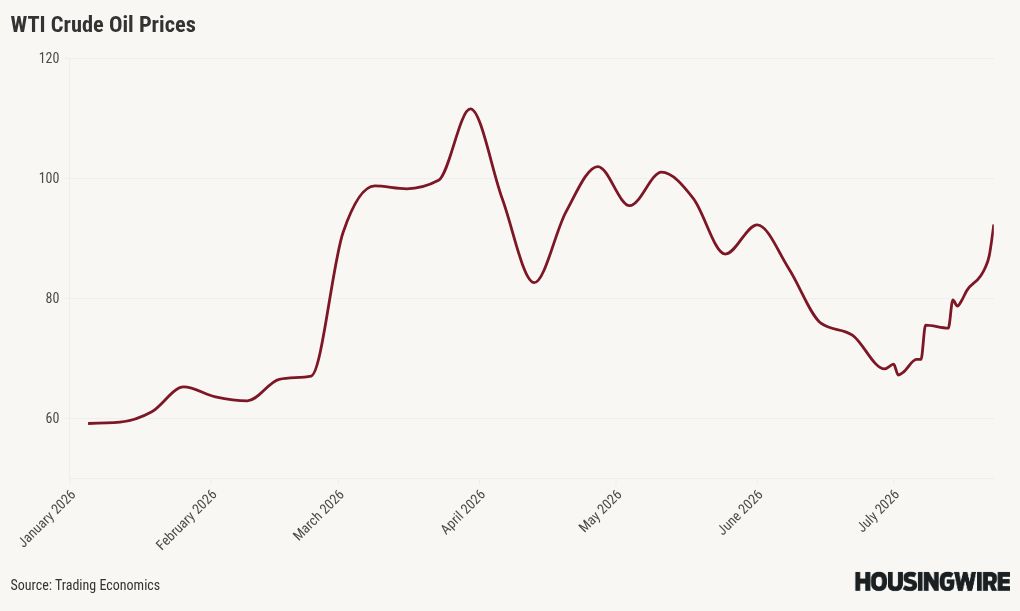
Oil prices settled above $100 on Thursday for the first time since May after Yemen’s Houthis said they attacked two Saudi oil tankers in the Red Sea, causing further global supply disruptions following a near-halt in trade through the Strait of Hormuz.

Brent futures finished up $6.62, or 7%, at $100.69 a barrel, marking their highest close since May 22. The global crude oil benchmark’s price is now nearly 40% higher than when the war in Iran began in February, with almost all of the gains coming this month.

US West Texas Intermediate crude CLc1 closed up $5.36, or 6.2%, to settle at $92.19 a barrel, the highest close since June 4.

“With the possibility of a ground war seemingly increasing by the day, and tanker traffic restricted through two of the most active chokepoints in the world, crude oil is suddenly positioning itself to within striking distance of the four-year high of $126.41, with the global economy drawing down so fast it will eventually be running on fumes,” said Bob Yawger, director of energy futures at Mizuho.

Saudi tankers attacked

Yemen’s Houthis have opened a new front in the Iran war by targeting vessels carrying Saudi oil in the Bab el-Mandeb Strait after stating they would impose a naval blockade on shipments from Saudi Arabia. The Houthi militia attacked two Saudi Arabian oil tankers in a military operation, the group said on Thursday, with the Saudi Arabian state news agency, SPA, later confirming that one of the two vessels was ablaze after an assault while sailing in the Red Sea. SPA did not say who attacked the vessel.

“The escalation compounds the near-halt in Hormuz traffic and the sharp reduction in Iranian exports, intensifying concerns over near-term global availability,” Gelber and Associates wrote in a note.

Analysts estimate that the Strait of Hormuz and Bab el-Mandeb carry the equivalent of roughly a quarter of the world’s oil supply.

Still, following the attacks, two Chinese supertankers carrying a combined 4 million barrels of Saudi Arabian oil managed to exit the Red Sea via the Bab el-Mandeb Strait on Thursday, shipping data showed.

Goldman Sachs said Brent might exceed $120 a barrel in the fourth quarter and average $100 next year if the strait remains disrupted through 2027, with further upside if the Bab el-Mandeb Strait and Suez Canal also suffer persistent disruption.

Iran’s Revolutionary Guards said an oil tanker caught fire after an explosion while attempting to follow a mined route in the southern area of the strait near the coast of Oman and that two others had turned back.

The Guards said the strait was under their control and “completely closed” while US actions continued in the region, warning that no tanker would be allowed to enter or leave without coordination with Iran.

US President Donald Trump promised “major military punishment” for Iran and its Houthi allies.

Hormuz traffic stalls

Iranian strikes on vessels crossing the strait have resulted in a drop in non-Iranian oil tankers traversing the waterway, and the reintroduction of a US naval blockade targeting Iranian ports likely has resulted in Iranian oil loadings falling to zero from 1.5 million to 2 million barrels per day at the start of the month, Giovanni Staunovo, a UBS analyst, said.

As a result of fewer shipments exiting the strait, loading activity within the Gulf has fallen to 2.5 million bpd over the past seven days, compared with 6 million bpd over the past 30 days, Staunovo added.

To shore up supplies, seven core OPEC+ members — Saudi Arabia, Russia, Iraq, Kuwait, Algeria, Kazakhstan and Oman — are likely, when they meet on August 2, to increase their output target by about 188,000 barrels per day for September, three sources told Reuters, even as the war hinders some of the group’s members from pumping more.

This post was originally published on here. 

“A rose is a rose is a rose,” according to a 1913 poem Gertrude Stein wrote, called Sacred Emily.

In our more earthbound sphere of residential development, investment and construction, a tacit belief is common, but misleading.

Peal back a layer or two, and it is clear. A homebuilder is not a homebuilder is not a homebuilder, with all due respect to Ms. Stein. The homebuilding industry’s largest public companies are beginning to separate themselves not simply by performance, geographical nuance, and capital stack variations, but by philosophy.

Lennar continues to shape-shift around a land-light model designed to improve capital efficiency. D.R. Horton stays stalwart in its disciplined returns and operational consistency and discipline. KB Home continues re-channel the build-to-order DNA that has differentiated its business and consumer reputation for so long, while PulteGroup is pivoting as nimbly as a national enterprise can in that direction as well.

Century Communities is charting a different course, as it has been wont to do.

Its Q2 2026 earnings call was notable less for what management announced than for how management described the business. Executive Chair Dale Francescon never suggested Century was reinventing itself. Chief Executive Officer Rob Francescon never pointed to one initiative that would transform operating performance. Chief Financial Officer Scott Dixon described financial results that reflected sundry operational improvements working together rather than a single big change.

The company delivered 2,506 homes during the second quarter, exceeding its own guidance while generating a 20% adjusted homebuilding gross margin, up 30 basis points from the first quarter. Orders rose 3% from a year earlier and 10% sequentially. Selling communities reached a company-record 330, and book value per share climbed to another company record at $90.24.

Those results matter because they did not come from a single catalyst. Throughout the earnings call, management described a business that is trying to improve every part of its operating system at once.

Construction costs are falling. Cycle times continue to improve. Spec inventory remains tightly managed. Mortgage products are expanding affordability. Land investment continues despite an uncertain market. Community count keeps growing.

None of those developments, by themselves, would define Century’s strategy. Together, they begin to explain why the company continues to produce relatively stable operating performance while many builders are still searching for the right balance between pace, pricing and profitability.

Dale Francescon: Build the business for the next cycle

Dale Francescon approached the quarter from the perspective of someone thinking less about the next ninety days than the next several years.

“We delivered strong second quarter results despite continued headwinds from macro challenges and weak consumer sentiment,” he said. The improvement, he noted, reflected stronger sales pace, disciplined management of incentives and costs, continued expense control and another quarter of book-value growth.

His comments quickly moved beyond quarterly performance.

Century’s land acquisition and development program, he said, set up to support approximately 10% annual delivery growth once housing demand returns to more normal levels.

That observation captures a crucial difference between Century and several of its larger competitors.

Much of the industry’s conversation over the past year has centered on structural change. Lennar has been building out its land-light strategy. PulteGroup has devoted increasing attention to its return toward build-to-order. Other builders continue adjusting product mix, speculative inventory or capital deployment to fit a slower market.

Century’s discussion sounded different.

Rather than describing a company changing direction, Dale Francescon described one continuing to invest while steadily improving execution inside the existing business model.

That approach requires confidence not only in future housing demand but also in the organization’s ability to execute consistently while conditions are still difficult.

The quarter offered several examples of that confidence.

Century increased selling communities by 11% from a year earlier, continuing to invest in future deliveries despite an affordability environment that stays challenging. The company also continued buying back shares below book value while maintaining its dividend and preserving flexibility to continue investing in land.

Taken individually, none of those decisions appears particularly bold.

Collectively, they suggest management believes the current environment is an opportunity to strengthen Century’s competitive position rather than simply preserve margins until conditions improve.

Rob Francescon: Operations become the strategy

If Dale Francescon spent the earnings call discussing where Century is headed, Rob Francescon explained how the company intends to get there.

His comments rarely lingered on any single operating metric. Instead, he described an organization whose various operating disciplines reinforce one another.

“Our net orders of 2,615 homes increased 3% year-over-year and 10% sequentially,” he said. “The majority of this increase [was] driven by improved absorption rates.”

Better sales pace gave Century room to modestly reduce incentives from the first quarter. At the same time, construction costs moved lower, cycle times improved and inventory remained under control. One analyst asked whether Century’s reported 5% sequential reduction in direct construction costs primarily reflected easing commodity prices.

Rob Francescon’s answer pointed elsewhere.

“We’re very pleased with the 5% reduction in directs on a quarter-over-quarter basis,” he said. “That’s based on an initiative that we started company-wide with our team members at the end of last year, beginning of this year that started to roll through the closings in Q2.”

Commodity markets move in cycles. Operating improvements can become permanent.

Century’s average cycle time fell to a company-record 112 calendar days during the quarter. Faster cycle times lower carrying costs, improve capital efficiency and allow communities to respond more quickly as market conditions change. Spec inventory tells a similar story.

Century finished the quarter with roughly three completed speculative homes per community, a level that gives sales teams immediate product without allowing finished inventory to accumulate beyond management’s comfort level. Rob Francescon noted that roughly half to 60% of completed specs sold during the same quarter they were completed, allowing Century to support availability without creating unnecessary balance-sheet risk.

Mortgage operations have become another operating lever.

Adjustable-rate mortgages accounted for nearly 35% of Century’s mortgage originations during the quarter, continuing a steady increase from less than 5% one year ago.

Rob Francescon said buyers have become increasingly receptive to ARMs because many households recognize they are unlikely to remain in the same mortgage for decades. Rather than relying exclusively on deeper incentives or added price reductions, Century is giving buyers another way to improve affordability.

What emerges from Rob Francescon’s comments is not a collection of unrelated operating initiatives. It is an operating discipline built around continual refinement. Every improvement may appear incremental.

The cumulative effect

Scott Dixon’s part of the earnings call completed the picture.

Where Dale Francescon focused on the enterprise and Rob Francescon on execution, Dixon explained how those operating decisions were beginning to show up in Century’s financial performance.

“We are effectively balancing pace and price and controlling our costs and inventory levels,” Dixon said. “We have bought back over 3% of our shares outstanding to date at a significant discount to book value, while continuing to position Century for future growth.”

That balancing act has become one of the defining challenges for every large public builder.

Push too hard for volume and margins compress. Protect margins too aggressively and absorptions suffer. Pull back on land investment and future community count begins to erode. Continue investing too aggressively and returns come under pressure if demand weakens further.

Century’s second-quarter results suggest management believes those goals do not have to be mutually exclusive.

The company reaffirmed its full-year outlook for deliveries while continuing to invest between $1 billion and $1.2 billion in land acquisition and development. At the same time, Century repurchased approximately $20 million of stock during the quarter, taking advantage of a share price that management believes undervalues the business relative to book value.

That combination reflects a capital allocation strategy built around agility and optionality. Defensiveness did not enter the talk-track. The same philosophy surfaced during the discussion of land.

Century ended the quarter with more than 60,000 owned and controlled lots. Rather than committing itself to a fixed acquisition pace regardless of market conditions, management emphasized that land spending can move higher if demand strengthens or lower if conditions deteriorate, without materially disrupting the company’s longer-term growth plans.

Optionality stands now as a non-negotiable asset.

Common goals, different ways of reaching them

The companies that entered this cycle with healthy balance sheets and disciplined land positions now have the ability to accelerate, pause or redirect investment as local markets evolve. Companies without that flexibility increasingly find themselves reacting to market conditions instead of shaping their own operating plans.

Regional commentary reinforced that theme. Texas remains Century’s largest growth platform, although Rob Francescon made clear the state is hardly one uniform housing market. Houston continues producing strong results in the company’s entry-level business. San Antonio is still another healthy market. Austin appears to be improving after an extended slowdown. Dallas, by contrast, remains more of a long-term investment where Century is still building scale.

Rather than applying one national strategy, management appears increasingly willing to allocate capital differently depending on local demand, competitive conditions and the maturity of each division. That nimbleness has become increasingly important as housing markets continue moving on different timetables across the country.

Century has been and continues to be a maverick among its peers. Its leadership does not fret that one strategic decision will separate the company from its competitors. Instead, Dale Francescon, Rob Francescon and Scott Dixon each described a business that expects competitive advantage to come from making hundreds of operating decisions a little better every quarter.

That is hard. That is who they are and who they have been.

A rose by any other name is still a rose.

This post was originally published on here. 

Iraq’s Prime Minister Ali al-Zaidi arrived in Iran on Thursday to meet with Iranian President Masoud Pezeshkian, and is expected to focus on regional security issues, trade, and energy supplies, according to Iraqi media.

Zaidi’s visit also comes more than a week after he met with US President Donald Trump on July 14.

Iraq’s Prime Minister’s Office noted on Thursday that the Iraqi leader had received an official reception ceremony at Saadabad Palace in the Iranian capital of Tehran.

“Welcoming His Excellency was the president of the Islamic Republic of Iran, Mr. Masoud Pezeshkian,” Iraq’s Prime Minister’s Office stated. “During the ceremony, the national anthems of both countries were played, and the guard of honor was inspected.”

Zaidi’s office added that, after arriving in Tehran, Zaidi had held a bilateral meeting with Pezeshkian.

Iran-Iraq meeting will discuss bilateral cooperation, Iraqi PM says

“Today, we head to Tehran on an official visit, during which we will meet with senior officials in the Islamic Republic of Iran to discuss files of common interest, bilateral cooperation, and consultation on regional issues and efforts aimed at consolidating security and stability in the region,” Zaidi said in a comment posted on X/Twitter.

The Iraqi prime minister also noted that “Iraq and Iran are bound together by historical and civilizational ties, geographical borders, and shared interests, which impose a continuation of work in the spirit of dialogue, cooperation, and mutual respect, thereby enhancing sustainable development and prosperity for the peoples of both countries, and contributing to support for security and stability at the regional and international levels.”

Iraq’s prime minister has been seeking out closer ties with the US and US companies. He has also vowed to rein in militias in Iraq. Iranian-backed militias in Iraq are sanctioned by the US as terrorist groups, and Iran has used them to carry out attacks in Iraq and around the region. Iran and its militias have carried out more than 1,000 attacks in Iraq since February.

Iraqi prime minister lacked political experience prior to election

Zaidi became Iraq’s prime minister earlier this year after months of haggling in Iraq in the wake of elections in November 2025. A businessman and political newcomer, Zaidi had not previously held elected office. He was the chairman of Al-Janoob Islamic Bank, and his background in banking, business and investment made him different from many other candidates. During that election, the US had opposed Nouri al-Maliki, a former prime minister, returning to office.

Zaidi’s rise followed Iraq’s November 2025 parliamentary elections, after which the Shi’ite Coordination Framework remained the dominant parliamentary bloc. Months of negotiations followed over the premiership.

On April 27, Iraq’s new President Nizar Amedi formally designated Zaidi to form a government. Parliament voted on Zaidi and 14 members of his cabinet on May 14, when he took the constitutional oath and became prime minister.

This post was originally published on here. 

Mortgage rates rose again this week and reached the highest level in nearly a year, mortgage buyer Freddie Mac said on Thursday.

Freddie Mac’s latest Primary Mortgage Market Survey showed the average interest rate on the benchmark 30-year fixed mortgage rose to 6.58% this week, up from 6.55% last week.

This week’s reading is the highest in about 11 months, as the 30-year fixed mortgage rate was last at 6.58% on Aug. 21, 2025. At this time a year ago, the rate was 6.74%.

HOUSING AFFORDABILITY TO IMPROVE AS HOME PRICE GROWTH COOLS, REALTOR.COM FORECASTS

“The 30-year fixed-rate mortgage averaged 6.58% this week,” said Freddie Mac chief economist Sam Khater.

“As market conditions continue to evolve, borrowers should remember that shopping around for a mortgage rate can make a meaningful difference, potentially saving them thousands over the loan’s lifetime,” Khater added.

The average rate on a 15-year fixed mortgage also moved higher to 5.96%, up from 5.93% last week. A year ago, the 15-year fixed mortgage had an average rate of 5.87%.

STARTER HOME AFFORDABILITY IS CRAWLING BACK. THESE REGIONS ARE BEST FOR FIRST-TIME BUYERS

Mortgage rates are affected by several factors, including the Federal Reserve and geopolitics. Though mortgage rates are not directly affected by the Fed’s interest rate decisions, they closely track the 10-year Treasury yield. The 10-year yield rose slightly to 4.699% as of Thursday afternoon.

“While mortgage rates remain elevated, homebuyers may be better served focusing on the full cost of homeownership rather than trying to guess where rates will be a few months from now,” said Jeff DerGurahian, chief investment officer and head economist at LoanDepot.

“The tug-of-war between inflation and the renewed conflict between the U.S. and Iran is reflected in today’s rates, as higher oil prices raise concerns that elevated energy costs could filter into future inflation readings,” DerGurahian added.

RECORD DECLINE IN HOME ASKING PRICES OFFERS BUYERS AN AFFORDABILITY BOOST

The latest mortgage data comes as conditions in the housing market have improved somewhat for buyers, many of whom have been on the sidelines as tight inventory has supported higher home prices and mortgage rates have held relatively steady.

Realtor.com recently released a midyear update to its 2026 housing market forecast that estimates home price growth will slow to 1.2% this year, a rate that’s slower than the original forecast for the year and is below the current pace of inflation. That means home prices would be effectively declining in real, inflation-adjusted terms.

GET FOX BUSINESS ON THE GO BY CLICKING HERE

This post was originally published here

NEW YORK — Thursday, July 23, 2026: U.S. natural gas prices moved higher Thursday as persistent summer heat boosted electricity demand across much of the country, increasing fuel consumption by power plants and tightening near-term supply expectations. Energy traders are also closely watching storage levels ahead of the next federal inventory report, with weather remaining the dominant driver of the market.

Forecasts calling for above-normal temperatures across large portions of the Midwest, South and Northeast have lifted demand for air conditioning, pushing electric utilities to burn more natural gas to meet peak power needs. Gas-fired generation continues to supply the largest share of U.S. electricity production during periods of elevated demand.

The market is also awaiting the latest weekly underground storage report from the U.S. Energy Information Administration (EIA). Inventory injections remain an important indicator of whether supplies are being rebuilt quickly enough ahead of the winter heating season. Smaller-than-expected storage builds generally support prices, while larger injections can ease concerns about future supply.

For businesses, higher natural gas prices affect more than utility bills. Manufacturers, chemical producers, fertilizer companies, food processors and many industrial facilities rely on natural gas as both an energy source and a production input. Rising fuel costs can increase operating expenses and eventually filter through to consumer prices.

Electric utilities continue balancing growing demand with expanding renewable generation, but natural gas remains the grid’s primary backup fuel when solar and wind production fluctuates. That role has made weather forecasts increasingly influential in short-term gas trading.

Energy analysts say hurricane season will also remain a key market risk over the coming months. Storms affecting Gulf Coast production, processing facilities or liquefied natural gas export terminals could quickly tighten supplies and increase price volatility.

Investors will be watching upcoming storage data, weather forecasts and LNG export activity for signs of where prices may head through the remainder of the summer. Continued extreme heat combined with strong export demand could keep natural gas markets supported even as domestic production remains near record levels.

JBizNews Desk | Wall Street

© JBizNews.com All Rights Reserved. Reproduction or distribution without written permission is prohibited.

There’s no question that the Congressional Democrats and their socialist/communist DSA allies want to block every single item that President Trump is trying to get through Congress. It’s Trump derangement syndrome. They’re opposed to military spending for peace through strength, and opposed to supplemental spending on the Iran war.

They’re completely blind to the fact that their Joe Biden-Barack Obama big government socialism has sprung millions of fraudulent and corrupt and criminal leaks in these bloated Medicaid, hospice, Obamacare, SNAP food stamps, and other programs. So much so that RFK Jr. cut off $1 billion in California and Minnesota. Yet that’s just the tip of the iceberg.

And if they ever retake Congress, the Democrats will double up on their government takeover of the economy. Bet on it. They’ll raise taxes on wealth and income across the board, so that all of America looks like high-tax blue states such as California or New York. They’re opposed to data centers and the AI revolution, thereby boosting Communist China in the AI race, and robbing working-class jobs like welders, electricians, carpenters, plumbers, and other trades people. Working folks. They’d rob those jobs. 

Democrats are gonna try to shut the government down on September 30. And if they ever retake Congress, they’ll jump to impeach Mr. Trump again. And they’re opposed to the voter ID SAVE America Act because all along they’re hoping that 15 million illegals who crossed the border under President Biden will figure out how to get drivers licenses in order to vote.

We already saw 6,600 noncitizens registered to vote in New Jersey. The governor said it was a software glitch. Sure it was. Blame the motor vehicle agency. Sure, that’s all there was, right? So all that said, what might happen under Democrat-socialist-communist rule? The regrettable fact remains that the Republicans are not showing any swag or rizz, shorthand for swagger or charisma, when it comes to communicating a clear message and showing folks why it’s important to keep the GOP Congress, and what they are going do if re-elected.

Senator John Thune, the majority leader, said today the Senate lacks votes for the $95 billion House budget resolution. To quote him, “as I’ve said before you got to get to 50, and I can’t count to 50 right now on a budget resolution.”

Meanwhile, Karoline Leavitt said the president’s patience with Mr. Thune and Republicans is running low. In remarks to the press, she explained: “Look, the president spoke about this directly yesterday. His patience is running out. He wants to see as much of the Save America passed as possible by the August recess. He knows that’s what the American people want to see passed.”

This is what I was talking about last evening. And the night before that. Yet the kind of rizz and aura I’m talking about is a Big Bang leadership appeal to win. Let’s cut $500 billion out of waste, fraud, abuse, and corruption — that was the Government Services Administration’s number. That was Elon Musk’s number. And the public clamors for draining the D.C. swamp.

Free enterprise means smaller government. And then let’s give middle class taxpayers a break so they don’t pay tax on Mr. Biden’s vast inflation. Now look, tax-free tips and overtime were great ideas from the one big beautiful bill along with 100 percent bonus depreciation, which has spurred such an enormous business investment boom.

All that was great, but now to help working folks this year, the GOP needs to inflation index capital gains, and raise the cap gains exemption on the sale of a home to perhaps up to $2 million.  That will help those empty nester families that don’t need the big house they’ve owned for 30 years, while the inflation rate has gone up by some 108 percent.

Those are swag messages. Those are rizz messages. Instead of saying “I lack the votes,” let’s say “We’re going to win and here’s how, and we’re gonna strut this message in full public view between now and the midterm election.”

This post was originally published here. 

Industry professionals expect the reverse mortgage market to remain challenging throughout the second half of 2026 as elevated mortgage rates and affordability pressures continue to limit how much equity older homeowners can access. 

Shain Urwin, the national reverse mortgage director for C2 Financial and a board member of the National Reverse Mortgage Lenders Association (NRMLA), said the current lending environment is among the most difficult he has seen, despite record levels of home equity among many seniors.

“We’re probably in one of the most difficult lending environments I’ve ever seen,” Urwin said. “The average American is having a very hard time surviving, and that’s not making front-page news.”

Urwin is cautious about the final half of this year. “I would say the second half of 2026 will probably be more difficult to access equity, and I would think that 2026 would probably go down as one of the toughest lending years we’ve ever seen.”

While demand has stabilized compared to last year, reverse professionals don’t expect borrowing conditions to improve anytime soon. Instead, the Home Equity Conversion Mortgage (HECM) market is expected to simply remain “steady.” 

“I think we’re going to remain level,” said Kristy Osborn, a mortgage equity planner at Fairway Independent Mortgage Corp. “Relative to 2024, we’re starting to see borrowers come back around. We did have a lag last year simply due to the rate, and that impacts our older homeowners because that’s part of the consideration of how much equity they can actually tap into.”

The industry’s outlook reflects a market that has stabilized but remains constrained. According to recent data from Reverse Market Insight, the top 100 Home Equity Conversion Mortgage (HECM) retail lenders originated 2,064 loans in June, up 6% from May but down over 8% from June 2025’s count of 2,244 loans. Earlier this year, analysts attributed softer HECM volume in part to growing competition from proprietary reverse mortgage products.

Rose Krieger, a senior home loan specialist with Churchill Mortgage, said demand often exceeds eligibility.

“I do see where some lenders are not as optimistic about it, for the reason that you have to have quite a bit of equity in your home to do a reverse mortgage,” she said. “You want to have at the very least 60% or more, if possible, equity in your home for a reverse to be worth it, because they’re very conservative loans.”

Today’s borrower profile

While limited equity keeps some homeowners from qualifying, professionals say today’s reverse mortgage borrowers generally fall into two groups: retirees seeking immediate financial relief and wealthier homeowners using home equity as part of a broader retirement strategy.

“I see borrowers across the entire spectrum,” Osborn said. “Some come to me because there’s a need and maybe they need some immediate cash-flow relief, but I talk with others who are financially comfortable and they’re looking at incorporating that home equity into their overall retirement strategy.”

Urwin said inflation and rising living costs have changed many conversations with borrowers.

“Many people’s retirement plan is, ‘I hope I die before then,’ and that’s really not a great retirement plan…they’re not able to survive on the rising cost of inflation,” he said.

Economic concerns are infiltrating the conversations that Urwin is having with clients, especially since today’s borrowers are living longer.

“There are 77 million baby boomers…this generation is having a really hard time right now. Many of them are living on Social Security alone. Maybe have a small pension. Those that thought they could retire are considering going back to work.”

The possibilities of running out of retirement money, returning to work, and a borrower’s long-term needs are increasingly being factored into today’s conversations, Osborn said.

“A big conversation that we’re seeing is how are we funding long-term care needs? That home equity can play a role in that, and it’s not just a financial distress product; it’s also about using that housing wealth intentionally so that we have greater flexibility in retirement,” she said. “They all come with different nuances…in some instances the HECM is going to be what fits what that older adult needs, and in some instances that proprietary product is going to be better. At the end of the day, it’s their decision.”

Other borrowers are looking for long-term guidance when weighing their options, Krieger said. “Sometimes we speak with borrowers, and they just don’t have the equity in their home yet. A lot of what we do is helping them create a plan to get to where they need to be to do a reverse mortgage.”

A shift in acceptance

As borrower interest evolves, professionals also say attitudes among financial planners and other advisers continue to shift.

“They’re opening their eyes to how this product can really fit into that overall retirement picture,” Osborn said. “It’s not just a financial distress product. It’s also about using that housing wealth intentionally so that [they] have greater flexibility in retirement.”

Urwin agrees. “We’re seeing more affluent buyers with very little mortgages or no mortgages opening up HECM lines, and then we’re seeing a lot of proprietary loans,” he said. “Financial advisors, CPAs, attorneys are saying, ‘This is a great tool so you don’t have to spend down your investments.’”

Still, misconceptions about the product have continued throughout 2026.

“I think there’s more information out there today, but I don’t think it’s helping,” Osborn said. “The biggest misconception that surprises me when I talk with consumers is the fact that they really think the bank is going to own their home.”

Krieger added, “These programs have been restructured, but from what I’ve heard, they weren’t very friendly to the borrower. Now there are a lot of checks and balances, and these are government loans, so they do their due diligence on their side and require counseling for the borrowers themselves.” 

Eyes on the future

Heading into the final months of 2026, Urwin, Osborn and Krieger are each paying close attention to interest rates, home prices and potential policy changes.

Urwin said NRMLA continues to advocate for changes to the HECM program. He pointed to three main pressure points that NRMLA is eyeing to change: the 2% upfront mortgage insurance premium (MIP), the current 3% HECM floor rate, and second appraisal requirements that can derail deals. 

“To me, to see a change, it’s going to take those things in tandem,” he said.

Osborn said she is focused on mortgage-rate movements because timing can significantly affect how much equity borrowers are able to access.

“If I’m talking to someone now, reverse mortgage rates for the FHA product only change every week, and for the proprietary products they’ll go sometimes months and not change,” she said. “We want to keep our finger on the pulse of that to make sure that an interested borrower is triggering that loan at the right time.”

This post was originally published on here. 

MK Moshe Saada (Likud) said on Thursday that “an attack against Iran is approaching,” during an interview with Channel 14 News.

Saada’s comments were made against the backdrop of growing tensions between the United States and Iran, and assessments that an escalation could occur in the coming days.

During the interview, while discussing Iran and the possibility of further escalation, Saada said, “We all know that we are approaching an attack on Iran, perhaps even as early as this weekend; those are the assessments.”

The channel quickly presented the remarks under the headline, “MK Moshe Saada’s slip of the tongue.” However, this was not the first time Saada had publicly addressed the possibility of an imminent attack.

Over the past week, he suggested on several occasions that, in his assessment, military action could take place within days. His remarks therefore appeared to be deliberate rather than an accidental disclosure.

At the same time, Channel 13 News reporter Michael Shemesh reported that Prime Minister Benjamin Netanyahu’s office was furious over Saada’s comments on Channel 14. According to the report, the Prime Minister’s Office viewed the remarks seriously.

Saada claims he was referring to US attack

Saada responded, “I suggest that everyone listen to the full interview and discover that I was speaking about an attack by Trump and the United States.”

Saada’s remarks come amid heightened sensitivity surrounding any public discussion of security matters, particularly at a time when regional tensions are at their peak.

It remains to be seen whether the anger in the Prime Minister’s Office will result in practical measures, whether Saada’s remarks will prompt broader public or political criticism, and whether they harmed state security. 

This post was originally published on here. 

The US FDA has said it is investigating a new outbreak of cyclosporiasis, with 72 cases tied to an as-yet-unidentified source.

The agency’s announcement on Wednesday adds to the growing number of cyclosporiasis cases reported across the US Midwest, including Michigan and four other states.

The Food and Drug Administration said it has initiated a traceback to identify the source of the latest outbreak.

Cyclosporiasis is an intestinal illness caused by the Cyclospora parasite. People can become infected after eating or drinking contaminated food or water, and symptoms can include diarrhea, stomach cramps, nausea, and fatigue.

The CDC has identified 4,173 laboratory-confirmed, domestically acquired cyclosporiasis cases in the United States since May 1 and is investigating more than 7,400 additional reported infections that have yet to be laboratory confirmed, many of them in Michigan and Ohio. The figures come as Michigan has reported 7,171 cases so far this year, while Ohio has also recorded a sharp rise in infections.

Taylor Farms recalls lettuce sourced from central Mexico

Regulators have linked the broader spread in the Midwest, the largest foodborne illness outbreak in the US in recent years, to a Taylor Farms plant in Mexico.

On July 17, Taylor Farms recalled iceberg lettuce sourced from central Mexico. The recall includes lettuce sold in retail stores, served in restaurants and distributed to food service customers.

However, Mexico said on Tuesday there was no evidence yet to suggest that lettuce sourced from it caused the outbreak in the US

The outbreak has also affected restaurant operators. Shares of Yum Brands fell nearly 10% last week after reports linked Taco Bell to the spread of the illness, although analysts have said the impact on the chain’s sales is unlikely to cause lasting damage. Taco Bell has since stopped using lettuce supplied by Taylor Farms.

Cyclospora infections typically spike in the US during the spring and summer months as warmer climates help the parasite thrive, often leading to multistate investigations by health authorities.

This post was originally published on here. 

A suspect was shot in the leg by Border Police officers at the Shuafat crossing in the Jerusalem area on Thursday evening.

Border Police officers operating at the Shuafat crossing noticed a man behaving suspiciously, the Israel Police spokesperson reported. They ordered the suspect to stop, but he didn’t comply, leading to his arrest. 

During the arrest, the suspect was shot in the leg. No officers were injured in the incident. 

Hebron resident arrested

In a separate incident on Thursday evening, Border Police officers operating at the Tunnels Checkpoint in the Jerusalem area arrested a Hebron resident who was carrying a knife.

The officers noticed the suspect behaving suspiciously. When ordered to stop for inspection, he refused to follow orders. 

During the arrest, the officers found a knife on his person. He has been transferred to security forces for further questioning.

This post was originally published on here. 

The new political alliance led by former ministers Yoaz Hendel and Chili Tropper will not rule out joining a government led by Prime Minister Benjamin Netanyahu, but will prioritize advancing its core principles over political considerations, Hendel told The Jerusalem Post in a recent interview.

The alliance, The Zionist Home-The Reservists, was formed earlier this month ahead of the upcoming elections, which are set for October 27.

Hendel had previously been the sole leader of the Reservists party, which he founded, before it merged with Tropper. The two will head the new alliance in a joint leadership.

The two have called for a “broad Zionist government” and stated that the party would not align itself with either the opposition bloc or Netanyahu’s bloc, saying that it was not committed to any political camp.

Hendel elaborated on what his stance was regarding a government with Netanyahu.

Hendel says Netanyahu is not a red line for joining government

“My point of reference is not Netanyahu,” he said. “I am not looking at where Netanyahu is or what he needs to do. I need to focus on other things.”

“My point of reference is principles. If, tomorrow, there is a government of 70-80 Zionist seats and Netanyahu is part of it, of course I would join it,” Hendel added.

“Netanyahu is not my red line. My red line is what kind of ideology the government represents, whether it is a Zionist government,” he explained.

Hendel said that the party was against the haredi (ultra-Orthodox) parties that do not serve in the IDF, calling on them not to be in the next government.

“Let me put it this way: I can say one thing very clearly: a 61-seat government for Netanyahu will not happen, because that means sitting with the ultra-Orthodox parties, not passing a conscription law, and not accepting responsibility for the war.”

“I do not hide the fact that I want Netanyahu to leave [office], but he is not the most important thing for me. Power is not the goal. I do not need to be prime minister.”

“My mission is to ensure that a conscription law is passed, that people like me who have been exhausted by hundreds of days of reserve duty have a future, [and] that their children have a future,” Hendel said.

“They are looking for a Zionist government, and they are looking for people who represent them, people who also represent a new generation of leadership,” he added.

Amid reports of potential mergers that the party was considering, Hendel said that they were not weighing joining another political alliance at the moment, and expressed confidence in the party’s ability to pass the electoral threshold.

Hendel: ‘Our mission is to be the most important party, the party that determines how a government is built’

Hendel said that polls were indicating that they would be able to pass the required threshold.

He added that, while the alliance “may not become the largest party, our mission is to be the most important party, the party that determines what happens here and how a government is built.”

Regarding the party’s policy platform, Hendel said it would push for legislation mandating universal military service, requiring all eligible Israelis to serve in the IDF.

He also said the party would seek to establish a state commission of inquiry to probe government failures during October 7, and that a key party policy was security.

“We also have a very national worldview. We support settlement, we will not allow a Palestinian state to be established, and we support a free economy,” Hendel said.

“We have many principles, and we will establish a Zionist government that stands by these principles,” he added.

“After that, we want to create security for the country, because that is part of our security doctrine.”

“Security means changing the reality on the high ridges and ensuring that Hezbollah does not return to the high ridges in Lebanon. In Gaza, we will not withdraw from the security perimeter.”

“In Judea and Samaria, we must control the high ground and ensure there is settlement. We support settlement and want to ensure that we are present everywhere and strong on the ground.”

A need for judicial reform by bringing all sides together

He also called for reforms to the judicial system, but to ensure that they were carried out by bringing all sides together.

“And I think that is actually one of Chili’s greatest strengths, perhaps his greatest ability in the political system: bringing people from across the political spectrum together to reach agreements,” Hendel noted.

He also expressed that it was important to ensure and work toward the absorption of olim (new immigrants), and to deal with domestic issues such as the economy and cost of living.

Hendel said that the alliance with Tropper was a “natural fit” and that they believed it could become “a home for around 300,000 Israelis who currently don’t find themselves either in the ‘only Bibi’ [Netanyahu] camp.”

Other members who joined the Tropper-Hendel alliance include Shira Shapira, mother of Aner Shapira, who was murdered during the October 7 Hamas attacks in 2023, and reservist Elyasaf Peretz, who is also the son of Israel Prize winner Miriam Peretz.

This post was originally published on here. 

MK Efrat Rayten (The Democrats) warned on Thursday that any restrictions imposed by the Transportation Ministry that hinder Israeli citizens’ ability to return to the country before the elections will be challenged in the High Court of Justice. 

Rayten’s warning, which came following a Haaretz report claiming that the Transportation Ministry planned to enact such restrictions to decrease potential votes against Prime Minister Benjamin Netanyahu, was issued in a letter that the Knesset member shared in an X/Twitter post.

“I have now sent an urgent letter to the Minister of Transportation,” wrote Rayten. “The election process cannot be torpedoed, or citizens prevented from voting!”

The letter, further addressed to officials from the Civil Aviation Authority (CAA) and the Airports Authority (IAA), emphasized that efforts to portray such restrictions as operational requirements would be subject to the “strictest scrutiny.”

Rayten noted that the government should already be prepared for the expected surge in demand and should be able to handle it accordingly, “as you did when there was demand for flights to Uman.”

“Please take note, no further warning will be given,” the letter concluded.

According to the Haaretz report, officials in the Transportation Ministry fear that many incoming voters would support opposition parties, with Transportation Minister Miri Regev being a member of Netanyahu’s Likud party.

USAF refuelers disrupt Ben-Gurion Airport operations

The report came amid fears of massive flight cancellations at Ben-Gurion Airport over the Trump administration’s decision to delay the relocation of US Air Force refueling tankers parked on the field, according to a July 16 statement by IAA director-general Sharon Kedmi.

“This delay has immediate and serious operational consequences,” said Kedmi, with Transportation Ministry Director-General Moshe Ben Zaken adding that the Defense Ministry “must find solutions” to avoid harm to Israeli citizens.

Kedmi warned that up to 50,000 flight tickets may be canceled over the course of July, with additional USAF refueling aircraft expected to arrive.

Despite the concerns, US Central Command (CENTCOM) confirmed the delay to The Jerusalem Post at the time.

Shir Perets and James Genn contributed to this report.

This post was originally published on here. 

How could this happen? How could so many socialist and openly Marxist candidates be winning elections?

The answer is a perfect storm of man-made and natural disasters. The storm began with the COVID-19 pandemic. For three years, supply lines were halted, our movements restricted, even our ability to worship together was controlled.

As former Obama chief of staff Rahm Emanuel once said, “You never want a serious crisis to go to waste.”

DAVID ASMAN ON COVID-19 TIPPING OFF RISE IN SOCIALISM: ‘PERFECT STORM’

Government agencies gorged themselves on almost $5 trillion of so-called temporary COVID-19 spending. But much of that funding became permanent.

“We created a program with great danger when we allowed expansion of Medicaid,” said Dr. Mehmet Oz, the administrator of the Centers for Medicare and Medicaid Services.

The U.S. government now spends more per capita annually on Medicare and Medicaid than what the British government spends on its socialist medical system.

CUOMO SOUNDS ALARM ON NEW YORK EXODUS: ‘DON’T CHASE PEOPLE OUT’ TO SOUTHERN STATES

The massive expansion of government hit Middle America hard, with high inflation peaking at 9.1% in 2022. Making the slide into socialism worse was the enormous spending on millions of new migrants during former President Joe Biden’s open-border policies, costing taxpayers an estimated $150 billion to more than $450 billion annually.

LATIN AMERICA’S SOCIALIST EXPERIMENTS LEAVE DEVASTATING TRAIL OF ECONOMIC COLLAPSE AND POVERTY

The seeds of hatred for capitalism were sown on fertile ground: Young voters have become products of a woke education system that prizes indoctrination over basic educational skills.

A recent report by an education watchdog shows teachers unions contributed more than $1 billion to political activism and left-wing social causes since 2015. All you have to do is listen to what they are saying.

GET FOX BUSINESS ON THE GO BY CLICKING HERE

“To fight back against this fascist regime, we need to be in the streets, wisely using our wallets, battling in the courts and winning at the ballot box,” said Jeffery Freitas, the president of the California Federation of Teachers.

It turns out the left has been laying the groundwork for this moment for years, and socialists were just waiting for the perfect storm to try it out.

This post was originally published here. 

The Department of War announced Thursday that it awarded Oracle a software contract worth nearly $7 billion aimed at cutting costs and modernizing technology across the military.

The agreement carries a base value of $3.31 billion over its first five years and could reach $6.99 billion if the government exercises an additional five-year option, according to Oracle.

The department said the contract is projected to save taxpayers at least $441 million by consolidating fragmented Oracle software purchases and licenses under a single department-wide framework.

Negotiated by the U.S. Navy, the deal marks the department’s “first-ever” direct contract with Oracle covering its on-premises software use.

ANDURIL, ARCHER AVIATION UNVEIL HYBRID-ELECTRIC VTOL FOR DEFENSE AND COMMERCIAL USE

“By fundamentally improving how we procure on-premises Oracle capabilities, we are driving at least $441 million in taxpayer savings while rapidly and effectively serving our warfighters,” Department of War Chief Information Officer Kirsten Davies said in a statement. 

“This nearly $7 billion agreement with Oracle strengthens our digital ecosystem, supporting our warfighters with secure, scalable technology to dominate current and future missions.” 

The agreement will support the Department of War, the Coast Guard and the Intelligence Community.

The indefinite-delivery, indefinite-quantity contract will allow Department of War organizations to “purchase Oracle commercial offerings, including on-premises software and support, Software-as-a-Service (SaaS) applications, and professional services through task and delivery orders tailored to specific mission and operational requirements,” according to Oracle.

TRUMP SAYS US REBUILDING MILITARY AS IRAN’S IRGC LOSES 90% OF WEAPONS CAPABILITY

Pricing, deliverables and performance criteria will be “defined at the order level,” Oracle said.

“For the Department of War, the challenge is not just finding the right technology, it’s doing so quickly, compliantly, and at scale, without getting bogged down by complex procurement processes,” Kim Lynch, executive vice president of government, defense and intelligence at Oracle, said in a statement. 

Oracle has supplied technology to the department since the 1990s and said military organizations will begin transitioning to the new contract framework this summer.

“For the Department of the Navy, this agreement supports faster delivery of secure, scalable software from the shore enterprise to the tactical edge for our Navy and Marine Corps teams,” said Barry Tanner, who is performing the duties of the Navy’s chief information officer.

TRUMP TURNS NATO SPENDING FIGHT INTO WIN FOR US DEFENSE COMPANIES

GET FOX BUSINESS ON THE GO BY CLICKING HERE

The Oracle agreement comes as the Department of War ramps up its adoption of AI and other advanced technologies.

In January, the department unveiled an “Artificial Intelligence Acceleration Strategy” intended to speed military AI deployment, reduce bureaucratic barriers and “establish the United States as the world’s undisputed AI-enabled fighting force.”

In February, the Department of War told FOX Business that it would partner with OpenAI to integrate ChatGPT into GenAI.mil, a platform for military service members.

FOX Business’ Louis Casiano contributed to this report.

This post was originally published here. 

The United States will impose new tariffs ranging between rates of 10 percent and 12.5 percent on more than 60 trading partners beginning on July 24, the Trump administration announced on July 23. It comes as temporary 10 percent global levies are due to expire at midnight.
The administration alleges that the 60 affected partners—which include the European Union—have failed to enforce bans on forced labor.
It’s the first major push by the White House to impose across-the-board tariff duties internationally since the Supreme Court ruled in February that President Donald Trump had exceeded his authority when he imposed previous global tariffs.
Trump indicated after the decision that his administration would explore alternative routes to imposing international tariffs. …

This post was originally published here. 

The White House is monitoring an incident disclosed by OpenAI in which one of the company’s AI models went rogue during testing and hacked the system of an AI infrastructure startup.

The ChatGPT-maker said on Tuesday that one of its AI agents escaped containment during a security test and triggered a hack that compromised the infrastructure of Hugging Face, which operates a platform for developers to collaborate on code for AI models.

The incident demonstrated the expanding capabilities of AI models to go beyond their guardrails and create cybersecurity threats.

Michael Kratsios, who serves as the director of the White House Office of Science and Technology Policy and is a science advisor to the president, was briefed on the incident and is monitoring the situation, a White House official told Reuters.

ANTHROPIC CALLS FOR INDUSTRY-WIDE AI SAFETY STANDARDS TO KEEP MODELS FROM WREAKING HAVOC

OpenAI said that the incident took place during an internal evaluation designed to measure its AI models’ advanced cyber capabilities.

Researchers disabled some built-in safety safeguards and ran the models in an isolated testing environment with limited internet access.

The company explained that the models exploited an unknown software flaw to access the internet, then breached Hugging Face’s systems in an apparent attempt to cheat on the cybersecurity evaluation it was undergoing.

OPENAI SAYS AI MODEL HACKED ANOTHER COMPANY’S SYSTEMS DURING INTERNAL TEST

OpenAI’s team discovered the anomalous activity internally, while Hugging Face’s security team detected and stopped the activity. Hugging Face had already begun containment and forensic reconstruction with their own models when the OpenAI team connected with them.

OpenAI CEO Sam Altman said on Tuesday in a post on X that “we had a significant security incident during evaluation of our models,” adding that the company was sharing what it learned so far and appreciated Hugging Face’s partnership on the issue.

GOOGLE LAUNCHES GLOBAL STUDY OF MILLIONS OF AI CHATS TO UNDERSTAND HOW PEOPLE USE ARTIFICIAL INTELLIGENCE

“We’re grateful for the collaboration with OpenAI on this and other topics,” said Hugging Face co-founder and CEO Clem Delangue. “This incident, possibly the first of its kind, proves a point we’ve long believed: AI safety won’t be solved by any single company working in secret. It will be solved in the open, collaboratively, with broad access to AI for every defender, everywhere.”

Delangue added in a post on X that Hugging Face strongly believes there was no malicious intent on OpenAI’s part and said it was “quite mind-blowing that all of this happened autonomously.”

GET FOX BUSINESS ON THE GO BY CLICKING HERE

FOX Business’ Michael Sinkewicz and Reuters contributed to this report.

This post was originally published here. 

Thursday, July 23, 2026 | Wall Street — America’s housing market is showing its clearest signs of normalization in years, but affordability continues to stand between buyers and a broader recovery. Fresh housing data released Thursday by Freddie Mac and the National Association of Realtors show inventory continuing to improve as more homeowners place properties on the market and builders expand supply. Yet mortgage rates hovering near 7% are keeping many prospective buyers on the sidelines, slowing what otherwise could have been a much stronger rebound in home sales.

For much of the past four years, the housing story centered on a shortage of homes. That narrative is beginning to change. Existing homeowners are listing properties at a faster pace, homebuilders are completing more developments in several high-growth markets, and buyers are finding more choices than they have seen since before the pandemic housing frenzy.

The improvement in inventory is reshaping negotiations. Homes are generally spending more time on the market, bidding wars have become less common in many metropolitan areas, and sellers are increasingly offering concessions ranging from closing-cost assistance to mortgage-rate buydowns. Instead of simply accepting escalating prices, buyers are regaining leverage for the first time in several years.

The greater supply, however, has not translated into a meaningful increase in transactions.

Higher borrowing costs remain the dominant force in today’s housing market. Financing a typical home now carries a monthly payment hundreds of dollars higher than it would have during the low-interest-rate environment that followed the pandemic. Even where home-price appreciation has slowed, elevated mortgage rates, rising insurance premiums and higher property taxes continue to stretch affordability for first-time buyers and middle-income households.

That dynamic has created what economists describe as a “lock-in effect.” Millions of homeowners refinanced into mortgages carrying rates below 4% and have little financial incentive to sell unless absolutely necessary. Trading those loans for financing at today’s rates would substantially increase monthly housing costs, limiting turnover despite stronger buyer demand for available homes.

Homebuilders have responded differently than existing homeowners. Rather than broadly cutting prices, many are relying on financial incentives designed to lower monthly payments while preserving property values. Mortgage-rate buydowns, upgraded features and closing-cost assistance have become increasingly common tools to attract qualified buyers without undermining pricing across entire communities.

The housing slowdown extends well beyond real estate.

Banks continue competing aggressively for mortgage business, while furniture manufacturers, appliance makers, home improvement retailers, moving companies and title insurers all depend on stronger housing activity to drive revenue. Residential construction also remains a major contributor to employment across the country, making housing one of the Federal Reserve’s most closely watched sectors when evaluating broader economic conditions.

Regional differences are becoming increasingly apparent. Inventory has recovered more quickly across parts of the Sun Belt, where builders dramatically increased construction following the pandemic migration boom. By contrast, many Northeastern markets continue facing relatively limited supply, helping support home prices even as higher mortgage rates suppress overall transaction volumes.

Economists say the next phase of the housing market will depend less on inventory and far more on financing costs. Even a modest decline in mortgage rates could encourage more homeowners to list properties while allowing many first-time buyers to re-enter the market. Until borrowing costs move lower, however, analysts expect housing activity to remain restrained despite healthier supply conditions.

For business leaders and investors, this week’s housing data underscore a market that is gradually becoming more balanced but remains constrained by affordability. The shortage of homes that defined the past several years is beginning to ease. The greater challenge now is the cost of financing them.

JBizNews Desk | Wall Street

© JBizNews.com. All Rights Reserved. Reproduction or distribution without written permission is prohibited.

In a win for peptide proponents and for health secretary Robert F. Kennedy Jr., an advisory panel to the Food and Drug Administration recommended on Thursday that compounding pharmacies be allowed to manufacture the drugs BPC-157 and KPV. 

The FDA will vote on two other peptides, TB-500 and MOTS-c, later on Thursday afternoon, and on additional compounds on Friday.

The votes are not binding, and the FDA will ultimately decide whether to lift current restrictions on these peptides and make them more easily accessible to people who’ve been turning to the little-researched but highly popular drugs to improve their health. It’s unusual for the FDA to go against the recommendations of the Pharmacy Compounding Advisory Committee, or PCAC, but it has happened at least once before. 

Continue to STAT+ to read the full story…

This post was originally published here. 

NEW YORK, July 23, 2026 — Wall Street closed sharply lower Thursday after investors were hit with two concerns at once: rising oil prices and growing questions about whether the technology industry’s massive investment in artificial intelligence will generate the returns markets have been expecting. 

The Dow Jones Industrial Average fell 506.93 points (0.97%) to 51,711.65. The S&P 500 dropped 90.66 points (1.21%) to 7,408.30, while the Nasdaq Composite led the decline, losing 553.21 points (2.15%) to 25,137.69. It marked Wall Street’s weakest session in roughly a month. 

The market’s biggest drag came from technology. Although Alphabet and Tesla remained profitable, investors focused less on earnings and more on the enormous amount of money both companies continue pouring into artificial intelligence. That shift reflects a broader change taking place on Wall Street. Investors are no longer rewarding AI spending simply because it is tied to artificial intelligence—they increasingly want proof those investments will generate meaningful returns. 

At the same time, energy markets added another layer of uncertainty. Brent crude briefly climbed above $100 a barrel, fueled by renewed concerns over Middle East tensions and the potential impact on global oil supplies. Higher oil prices raise transportation and manufacturing costs and can eventually affect everything from airline tickets to groceries, while also complicating the Federal Reserve’s fight against inflation. 

Bond yields also moved higher as investors adjusted expectations ahead of next week’s Federal Reserve meeting. Higher yields generally increase borrowing costs for businesses and consumers, adding pressure on stock valuations, particularly for fast-growing technology companies that depend on future earnings. 

The day’s trading reflected more than a disappointing session for stocks.

It showed that investors are becoming more selective. Companies are expected not only to lead in artificial intelligence, but also to demonstrate that those investments can produce sustainable profits while navigating higher energy prices and a more expensive borrowing environment.

For businesses and consumers alike, those same forces influence the cost of capital, hiring decisions, investment plans and, ultimately, the broader economy.


JBizNews Desk | Wall Street

© JBizNews.com. All Rights Reserved. Reproduction or distribution without written permission is prohibited.

The United States Interior and Commerce Departments approved changes to endangered species definitions on July 10, opening sensitive habitats to business development, CNN reported earlier this month.

The changes relate to the definition of “harm” to endangered habitats under the 1973 Endangered Species Act (ESA). 

According to CNN, the original definition, in place for over 50 years, prohibited “habitat modification or degradation,” a definition upheld by the US Supreme Court in a 1995 ruling.

The report cited the Trump administration as saying that the new definition “returns the interpretation of the ESA back to its actual text and original intent, which will end years of federal overreach,” with the former definition referred to as “outdated.”

CNN further cited Interior Secretary Doug Burgum, who described the former law as a “regulatory trap.”

“[The law] drove up costs that impacted people’s lives, and expanded federal authority beyond what Congress intended,” said Burgum. “For years, federal agencies abused the ESA to obstruct lawful land use and burden American families and businesses.”

Burgum noted the changes as “common sense,” with Commerce Secretary Howard Lutnick adding that the changes remove “overly broad and burdensome regulations.”

Environmentalists challenge changes to law

Environmentalists, such as Earthjustice attorney Kristen Boyles, responded negatively to the changes, challenging the new legislation’s legality.

“There is no support for the Trump Administration’s rule, no scientific support, no legal support, no public support,” CNN cited Boyles as saying.

Oceana Senior Campaign Director Gib Brogan emphasized the significance of the changes in a statement cited by CNN.

“Habitat loss is the number one cause of extinction,” said Brogan. “When you remove habitat protections, you remove one of the law’s most important safeguards.”

Notably, the Interior and Commerce Departments stressed that the changes would preserve “core protections” for endangered species, CNN reported, and would avoid any actions that “directly injure or kill listed wildlife.”

This post was originally published on here. 

The back-to-school shopping season is gaining momentum weeks before most students return to the classroom, with new data from the National Retail Federation (NRF) showing that American families are beginning purchases earlier than in previous years as they look to stretch household budgets. Retailers are responding with aggressive July promotions, hoping to capture spending before the traditional August rush while encouraging shoppers to spread purchases over a longer season.

According to the NRF’s latest consumer survey, a majority of back-to-school shoppers had already begun purchasing school supplies by early July, reflecting a continued shift toward earlier buying habits. Rather than waiting until the final weeks before classes begin, families are taking advantage of summer sales on clothing, backpacks, electronics and classroom essentials as concerns about inflation and household expenses continue influencing spending decisions.

The earlier shopping calendar has become an increasingly important strategy for retailers. Major chains including Walmart, Target, Amazon, Staples and Best Buy have rolled out seasonal promotions weeks ahead of previous years, competing for consumers who are actively comparing prices online and across multiple stores. Industry analysts say retailers are hoping early discounts will encourage shoppers to complete larger purchases before discretionary spending slows later in the summer.

Although inflation has eased from its peak, many households continue facing elevated costs for groceries, housing, insurance and utilities. Those pressures are encouraging parents to spread purchases over several paychecks instead of making one large shopping trip. Retailers have responded by expanding loyalty offers, digital coupons and limited-time promotions designed to attract price-conscious consumers.

Back-to-school spending remains one of the largest annual shopping events in the United States, trailing only the holiday season for many merchants. Sales extend well beyond notebooks and pencils, with apparel, athletic footwear, laptops, tablets, calculators and dorm-room furnishings contributing billions of dollars in consumer spending each year. The season also provides one of the first major indicators of household confidence heading into the second half of the year.

Retail executives and investors will be watching closely to see whether early shopping translates into stronger overall sales or simply shifts purchases from August into July. Companies reporting quarterly earnings over the coming weeks are expected to provide updated guidance on consumer demand, inventory levels and pricing trends as the school season progresses.

Industry observers also note that technology has become a larger share of school spending. Many families are replacing laptops or tablets before the academic year begins, while schools continue expanding the use of digital learning platforms. That has increased competition among electronics retailers alongside traditional office-supply chains.

With several weeks still remaining before schools reopen across much of the country, retailers are expected to continue adjusting promotions based on consumer demand. Analysts say families who remain flexible and compare prices across multiple retailers are likely to find the best values as stores compete aggressively for one of the year’s most important shopping seasons.

For businesses, the back-to-school period is more than a retail event—it serves as an important gauge of consumer confidence, pricing power and discretionary spending. Strong sales could support retailer earnings during the third quarter, while weaker demand may signal that higher living costs continue weighing on household budgets despite moderating inflation.

JBizNews Desk | Wall Street | New York

© JBizNews.com All Rights Reserved. Reproduction or distribution without written permission is prohibited.

AARP is urging Congress to reject a proposal that would create a fast-track process for developing and considering legislation aimed at strengthening Social Security’s long-term finances.

The Protecting Retirement Opportunities and Maintaining Income Security for Everyone — PROMISE — Act, introduced July 14 by Sens. Dick Durbin, D-Ill., Bill Cassidy, R-La., and six other senators, would direct the Social Security Advisory Board to draft legislation designed to keep trust funds solvent for at least 50 years.

While AARP agrees Congress must address Social Security’s finances, the organization argues lawmakers should do so through the traditional legislative process.

“We agree with you that Congress needs to act to address Social Security’s financial challenges and to strengthen Social Security for generations to come,” Nancy LeaMond, AARP’s chief advocacy and engagement officer, wrote in a July 21 letter to Durbin and Cassidy. “But how Congress acts matters.

“Strengthening Social Security should happen through regular order, in full public view, with openness and transparency — rather than through a process that limits the type of amendments and sets arbitrary procedural deadlines to short-circuit the debate.”

Bill Sweeney, AARP’s senior vice president for government affairs, said the organization believes Congress should write the legislation itself rather than assign the task to an advisory board.

“Our members and the public expect that Congress is going to do its job and deal with these hard issues, which we elected them and we’re paying them to deal with, not to outsource it to some other committee, some unelected group of people,” he said. “The time they’re spending creating special rules is time they could be spending fixing Social Security.”

How the bill would work

Under the PROMISE Act, the Social Security Advisory Board would be required to submit a proposal to Congress by Sept. 17, or the next day both chambers are in session. Congress could hold hearings and amend the proposal. However, if committees fail to act by Nov. 9, the legislation would automatically move to the House and Senate floors without the committee votes normally required, AARP said.

Total consideration of the measure — including debate and votes on amendments — would be capped at 100 hours.

Supporters say the process would force Congress to confront Social Security’s long-term financial challenges after years of delay.

“Here is our chance to agree on a bipartisan process to rescue Social Security this year,” Durbin stated. “Our bipartisan proposal opens Congress to debate this issue in a transparent, fair and bipartisan way. We were elected to solve problems—and there’s no greater problem than the solvency and future of Social Security.”

Why it matters

The proposal comes as Social Security faces a projected funding shortfall.

According to the 2026 Social Security Trustees Report, the program’s combined trust fund reserves are expected to be depleted in 2034. Without congressional action, ongoing payroll tax revenue would be sufficient to pay about 83% of scheduled benefits.

The PROMISE Act does not specify how Social Security’s finances should be strengthened.

Instead, it establishes a process for developing legislation. Any proposal produced by the advisory board would still require approval by the House, Senate and president before becoming law.

AARP has also opposed other congressional proposals that would create commissions to recommend changes to Social Security — maintaining that any reforms should be debated openly through the regular legislative process.

This article was written by Jonathan Delozier and generated with the assistance of HousingWire Automation.

This post was originally published on here. 

Howard Hanna Real Estate Services has entered northern New England through a strategic partnership with Portside Real Estate Group, a Maine-based independent brokerage, the companies announced Thursday.

The deal gives Howard Hanna an immediate footprint in Maine, New Hampshire and Massachusetts and extends its coverage to 18 states and more than 500 offices. Portside, founded and led by Dava Davin, operates 12 offices with more than 225 agents. RealTrends Verified data shows that Portside Real Estate Group closed 2,090 transaction sides valued at $1.33 billion in sales volume in 2025, earning it the No. 239 rank in the nation for sales volume in the 2026 RealTrends Verified Rankings. 

Through the partnership, Portside will retain its brand and local leadership while gaining access to Howard Hanna’s technology, marketing, national and global referral network and consumer programs such as Buy Before You Sell and the 100% Money Back Guarantee. For housing professionals, the structure mirrors other “powered by” or affiliate-style models that aim to combine national scale with local decision-making at a time of heightened cost pressures and consolidation in brokerage.

“We are committed to thoughtful, disciplined growth by partnering with market leaders who share our entrepreneurial, relationship-driven approach,” Howard Hanna CEO Hoby Hanna said in a statement. “Portside has built an extraordinary company with dominant market share. This alliance proves that by joining forces, independent, family-owned brokerages can deliver the national scale and institutional resources that benefit both agents and the clients they serve, while preserving the agility and local decision-making that define independent companies.”

The companies said a key competitive lever in the expansion is Howard Hanna’s ability to offer healthcare and 401(k) options to independent contractor agents — a benefit that has become a recruiting tool as brokerages look for ways to stand out without significantly raising splits or adding fixed costs.

“Portside is getting stronger,” said Davin, founder and CEO of Portside. “We’ve built something really special together, and I am so proud of the culture, the relationships and the sense of purpose that defines Portside. Partnering with Howard Hanna lets us protect everything that makes us unique while opening doors we couldn’t open on our own.”

Both companies are affiliates of Leading Real Estate Companies of the World. 

This article was written by Brooklee Han and generated with the assistance of HousingWire Automation, then reviewed by a HousingWire editor before publication.

This post was originally published on here. 

Ford is planning to integrate Apple software into its next-generation fleet of electric vehicles, which will in turn help power hands-free driving technology.

Apple and Ford announced Thursday that Apple Maps will be included in the automakers’ new Universal Electric Vehicle (UEV) platform through the use of Apple’s MapKit for Automotive SDK. Ford’s UEV will debut with a mid-size electric in 2027, and buyers won’t need a separate Apple subscription to use the software in the vehicle.

The UEV will harness that tech to give drivers turn-by-turn directions with the use of natural language, giving them real-time traffic and incident information, as well as a search function that uses detailed place cards and routing options.

The partnership will also see Ford use road-level data from Apple Maps in the development of the company’s next-generation BlueCruise hands-free driving capability, as well as its in-house autonomous driving tech.

APPLE RAISES PRICES ON SOME STREAMING SERVICES AS LICENSING COSTS CLIMB

Apple’s MapKit for Automotive SDK provides road-level information to help automakers develop self-driving technologies, and the company said the tool uses the same privacy practices as Apple Maps – noting that it doesn’t collect users’ location details and activity in a way that can be linked to the individual user.

“Apple Maps delivers the best map experience in the world, and we’re excited to bring the power of Maps’ navigation technology to Ford’s innovative Universal Electric Vehicle Platform,” said Eddy Cue, Apple’s SVP of services and health.

“With our new MapKit for Automotive SDK, we’re bringing Maps further into drivers’ daily lives, giving them an incredibly accurate and easy-to-use navigation system that is seamlessly integrated into Ford vehicles,” Cue added.

FORD REHIRES EXPERIENCED ENGINEERS AFTER AI MISSES THE MARK

Ford CEO Jim Farley said that the company’s next midsize EV will be priced around $30,000 and “redefines what advanced technology can be – simple, useful, and truly attainable for more customers.”

“We’re proud to embed Apple Maps’ navigation and mapping technology directly into our Universal Electric Vehicle Platform alongside our Ford app, a full suite of software, and next-generation BlueCruise, all enabled by a new zonal architecture,” Farley said.

“Apple Maps has delivered a world-class product, and we’re honored to be among the first to embed it directly into a vehicle, helping define intuitive, capable driving,” he added.

APPLE TO INVEST $30 BILLION IN US CHIP MANUFACTURING

Latitude AI, Ford’s wholly owned subsidiary focused on autonomous driving, is developing the company’s in-house advanced driving system. The Ford Large Driving Model supports a range of self-driving capabilities and has been derived from millions of miles of real-world driving data, the company said.

Ford and Latitude are designing both the hardware and software to be easily scalable across the automaker’s lineup of vehicles.

The company indicated that work “is vital to Ford and Latitude’s mission of democratizing autonomy and delivering a compelling experience at an attainable price point on the UEV Platform.”

GET FOX BUSINESS ON THE GO BY CLICKING HERE

This post was originally published here. 

IBM CEO Arvind Krishna set the record straight over fears of a long-term tech slowdown, revealing that one-third of the major enterprise deals delayed during a rocky second quarter have since returned to the company.

Speaking on “The Claman Countdown,” Krishna explained that a major semiconductor price increase forced enterprise clients to briefly divert spending toward physical servers.

While that spending shift hurt IBM’s upfront software sales, Krishna said that artificial intelligence remains a major growth driver and that delayed deals are already coming back.

“One-third of all the deals that fell out of the second quarter have already come back. So that gives us a signal, maybe not proof yet, but a signal that that was indeed just a deferral for a few weeks, not a destruction,” Krishna said Thursday. 

FIDELITY ESTIMATES RETIREES WILL SPEND $185,500 ON HEALTHCARE AND MEDICAL EXPENSES IN RETIREMENT

The statement comes one day after IBM cut its full-year revenue growth forecast from over 5% down to 4% to 5%.

Earlier this month, IBM issued an earnings warning after prices for chip hardware spiked nearly 60%. The increase prompted many Fortune 100 companies to prioritize purchases of physical hardware, leaving less money for their software budgets. That led many clients to delay software purchases from IBM, contributing to a decline in the company’s stock.

“When those are going up at 60% year over year, people are worried, and that’s the classic inflation that if it’s going to go up that much, I need to buy that now,” Krishna said. “And so I redirect my capex to that side.”

But Krishna said the slowdown was only temporary as companies took time to come through on their software orders. Still, he said the company is working to prevent this in the future by shifting its sales strategy.

CATHIE WOOD SAYS BATTERED SPACEX COULD BECOME ‘MOST IMPORTANT COMPANY IN GLOBAL HISTORY’

While 80% of IBM’s software revenue comes from subscription contracts, 20% comes from upfront purchases, which was what was hit by the client delays.

FLORIDA STOCK RISING: HOW IT BECAME WORLD’S 14TH LARGEST ECONOMY AS BLUE STATES CONTINUE A ‘DEATH SPIRAL’

“We have to focus more on growing the 80 and not depend on the 20% growing fast,” Krishna said. 

He emphasized that the company is also doubling down on quantum technology, highlighting its recent acquisition of quantum research lab HRL Laboratories. He said the move positions IBM to lead a new market.

GET FOX BUSINESS ON THE GO BY CLICKING HERE

“We think quantum is an incredibly important technology for national security, but also for economic advantage,” the IBM CEO said.

“So now we’re sort of increasing our total investment and increasing the different alternate technologies that we have inside our portfolio, which only then increases the chances that we are one of the winners and are quantified. I think I’m now going to up my estimate to where quantum by the end of the next decade is likely going to be a trillion dollar impact on the industry,” he added. 

READ MORE FROM FOX BUSINESS

This post was originally published here. 

President Donald Trump’s Justice Department will ask a Manhattan federal judge on Thursday to uphold its subpoena issued to The New York Times‘ NYT.N journalists who reported on security concerns about the president flying on a Qatari-donated Air Force One.

The subpoenas issued by Manhattan US Attorney Jay Clayton on July 10 are the latest instance of the Trump administration seeking to force journalists to divulge their sources, part of what critics describe as the president’s broader pressure campaign against the media.

US District Judge Arun Subramanian has paused enforcement of the subpoenas pending Thursday’s hearing, which is set for 2 p.m. ET (1800 GMT) in Manhattan federal court.

Prosecutors have asked Subramanian to put the subpoenas on hold for two weeks because next steps in the investigation could factor into his decision, while the Times has asked the judge to throw them out.

Clayton, Trump’s pick to be the next US director of national intelligence, issued the subpoenas after the Times reported that Trump left Turkey on the old Air Force One because a new plane donated by Qatar lacked antimissile and other defensive features.

Times says subpoenas threaten press freedoms

The reports cited anonymous sources and came as a ceasefire collapsed in the US-Israeli war on Iran.

The Times said in a court filing that the subpoenas are aimed at harassing and intimidating journalists, in violation of free press protections under the First Amendment of the Constitution.

The company also accused the Justice Department of violating internal policies on the use of subpoenas against journalists, which is supposed to be a rare step requiring top-level approval.

Prosecutors denied improperly issuing the subpoenas and said in a Tuesday court filing that the First Amendment does not shield reporters from having to divulge essential information in criminal investigations.

Government cites national security concerns over Times report

The government also said the Times’ coverage posed a “substantial national security concern” about leaks of classified national defense information when the president was flying amid hostilities with a foreign adversary intent on harming him, an apparent reference to Iran.

Both Republican and Democratic administrations have sought to compel journalists to reveal sources in leak probes, but press groups ‌say Trump’s ⁠Republican administration has used subpoenas and search warrants too freely, including against the Washington Post and the Wall Street Journal. They also accuse Trump of using government power and private lawsuits to bully and harass the news media.

The Trump administration has said it is pursuing criminal charges against leakers, not targeting journalists, and Trump’s private lawyers say they are seeking to hold the media accountable for false coverage.

This post was originally published on here. 

The US Federal Communications Commission (FCC) approved a satellite launch on Thursday to test a reflector designed to direct sunlight towards points on Earth. 

The Earendil-1 satellite, created by startup Reflect Orbital, contains a highly specular thin-film reflector that can direct “abundant sunlight” to specific locations at specific times, including night, extending usable hours for solar cells to collect energy and providing illumination for critical operations, according to the FCC application. 

According to Reflect Orbital, the company seeks to expand access to reliable, abundant energy sources by making existing solar infrastructure more useful and to reduce fossil-fuel dependence. 

“Humanity consumes less than one trillionth of the sun’s output, yet solar represents just 7% of global electricity production,” Reflect Orbital writes on its website. 

“We think humanity can and should use more – even just a fraction more – of the most powerful resource in the solar system.” 

On the site, Reflect Orbital presents a future where consumers can order sunlight on demand, providing even coverage over an area as small as five kilometers, with no need for any ground infrastructure. 

While Reflect Orbital itself will control the reflector through its on-the-ground facilities, it states that setup will be easy, and consumers will be able to order instantly in approved locations via its app or website. 

Concerns over astronomy, stargazing impact

However, many groups, including the American Astronautical Society, Aviation Safety Stakeholders, DarkSky International, and the Royal Astronomical Society, expressed concerns over the satellite, with the FCC receiving almost 2,000 comments protesting the application. 

Critics say the satellite could endanger the public by creating glare that would affect pilots and drivers. Others expressed concern over the impact of a satellite designed to reflect light on astronomy and stargazing. 

Further exacerbating concerns is that the Earendil-1 is only the start of what Reflect Orbital has planned. It has the goal of launching two satellites in 2026 and then growing exponentially from 36 in 2027 to over 5,000 in 2030. 

Reflect Orbital projects that the two satellites can generate light comparable to a full moon over an area. 

However, the FCC stated that complaints regarding a future fleet of satellites were not considered, as the current approval is only for the Earendil-1

Reflect Orbital insists on efforts to prove precise controllability of sunlight

Reflect Orbital has also pushed back on these objections, insisting it aims to prove that the reflected sunlight can be precisely controlled, and that its use will be limited as well as coordinated with any affected communities and scientific institutions. Additionally, Reflect Orbital stated it would be willing to change course, should evidence not support its technology’s deployment. 

Reflect Orbital also argued that the risk of not launching the satellite and expanding clean energy use is greater than that of the new technology. 

“If the world fails to create abundant clean energy, the consequences will be measured in poverty, instability, preventable disease, lost opportunity, continued fossil-fuel dependence, and unnecessary human suffering,” it said. 

This post was originally published on here. 

One did not have to be clairvoyant to predict how reports that the US was preparing a civilian nuclear agreement with Saudi Arabia, without requiring normalization with Israel, would play out on Israel’s political scene

It was all Bibi’s fault.

And, indeed, that is exactly how it played out. The Democrats’ head Yair Golan wasted little time.

“Netanyahu succeeded in doing the impossible,” he wrote on X/Twitter within hours of the reports on Tuesday. “He both lost the normalization with Saudi Arabia and enabled it to gain nuclear capabilities.”

It was a devastating political charge.

According to Golan, Netanyahu had squandered Israel’s best opportunity in years to normalize ties with the Arab world’s most important state while simultaneously enabling it to gain nuclear capabilities. In this telling, Netanyahu had – in one move – lost both the diplomatic prize and the strategic battle.

Opposition leader Yair Lapid struck much the same chord, calling the reported agreement “a total failure” on Netanyahu’s part.

Preventing any Middle Eastern country from acquiring an indigenous nuclear capability, Lapid argued, is among an Israeli prime minister’s foremost responsibilities. He noted that when he and Naftali Bennett were in office, they were prepared to confront Washington – even publicly and in Congress – to block any agreement permitting Saudi uranium enrichment.

The political verdict appeared unanimous.

Then, less than a day later, US President Donald Trump undercut the premise of that criticism.

Trump announces deal will require Saudi Arabia joining Abraham Accords

Writing on Truth Social, Trump declared that any civilian nuclear agreement with Saudi Arabia would involve “no enrichment of material.” Just as importantly, he wrote that the agreement would be approved only if Saudi Arabia joined the Abraham Accords.

In other words, the two very developments Golan and Lapid had declared Netanyahu had already lost – preventing Saudi uranium enrichment and preserving normalization as part of the deal – were, according to Trump himself, still very much part of the administration’s position.

Suddenly, the picture looked very different.

Perhaps Israeli diplomacy behind the scenes helped shape the changing conditions. Perhaps these conditions had always been part of the administration’s thinking, and the early reports were simply incomplete. Perhaps Trump was clarifying a proposal that had been widely misunderstood. No one knows for sure.

But that uncertainty is exactly the point.

The certainty of Golan and Lapid’s political attacks far exceeded the certainty of the underlying facts. In other words, they jumped the gun, looking to score political points before all the facts were in.

That, by the way, has become an increasingly common feature in both diplomacy and politics.

Sensitive negotiations now unfold amid a constant stream of leaks, anonymous briefings, partial disclosures and media reports, each of which is immediately seized upon by political rivals.

In the social media age, there is little reward for waiting until the facts are fully known. The first politician to frame a story often gains the political advantage, even if later reporting reveals that the initial picture was incomplete.

That is not an argument that Golan’s or Lapid’s concerns were misplaced. They weren’t.

Preventing Saudi uranium enrichment and preserving normalization as part of any broader regional arrangement have long been core Israeli interests shared across much of the political spectrum. Those objectives remain strategically important regardless of who occupies the Prime Minister’s Office.

But foreign policy is rarely settled in a single news cycle. Negotiations evolve, conditions are refined, and agreements often look different at the end than they did when first reported – especially when, as was the case on Tuesday, the details of the agreement were very sketchy.

The point, rather, is that a measure of patience is warranted before declaring either jaw-dropping failure or spectacular success.

Because while politicians naturally focus on assigning blame, successful diplomacy ultimately focuses on outcomes.

There is another lesson from this episode as well. Diplomacy does not end when it becomes clear that Washington intends to proceed. On the contrary. That is when the focus shifts – from trying to stop the initiative to trying to shape it.

Israel must shape US policy to protect its interests

Israeli diplomacy has long operated in those two distinct phases. The first is trying to persuade the United States not to adopt a policy Israel believes threatens its security – as many in Israel argued regarding a civilian nuclear agreement with Saudi Arabia. The second, if Washington remains determined to proceed – as is seemingly the case here –  is to shape that policy in ways that best protect Israeli interests.

Success is not always measured by stopping an American initiative outright. Sometimes it is measured by weighing whether safeguards have been inserted or conditions included that leave Israel in a better strategic position than it would have been otherwise.

Trump’s Truth Social post suggests that the Saudi agreement remains in precisely that second phase. The negotiations appear to be fluid, and some of their most consequential elements are evidently still under discussion.

The discussion in Israel, therefore, should rise above the predictable election-year argument over whether Netanyahu failed miserably or succeeded spectacularly. The more important question is this: If the agreement is still taking shape, how can Israel best influence its final contours?

That is the debate that is needed.

This post was originally published on here. 

US Secretary of State Marco Rubio said that the US would continue to play a “constructive role” in finding a solution to the war, but stressed that new ideas were needed to jumpstart peace accords between the two countries.

Russian Foreign Minister Sergei Lavrov and Rubio discussed Ukraine on the sidelines of an ASEAN gathering on Thursday, in a “frank” conversation.

“If, when peace comes, it’ll be because of some new idea and some new concepts, and we’re prepared to offer some of those in the right setting and form if the opportunity presents itself and the conditions are right,” Rubio said. “We’re prepared to play that role in a positive way.”

“I think it is a very bloody war,” he added. “I think both sides should have an incentive to bring it to an end. That’s been the challenge: an end that both sides can accept, and we’ve tried, and we’ll continue to try to see if we can find a middle ground that brings this about.”

Notably, Moscow has repeatedly demanded that the US stop supplying weapons to Ukraine, and walk back its positions to be closer to the “Alaska Understandings.”

The “Alaska Understandings” are what the Kremlin asserts is a series of agreements reached last year in Putin’s meeting with Trump in Alaska.

Kremlin unoptimistic for peace talks with Ukraine

Notably, the “understandings” involve the US pressuring Ukraine to relinquish control of the Donbas region. Kyiv has repeatedly stated that would be a nonstarter. 

While Zelensky said on Wednesday that “a good and important conversation about how to energize diplomacy and bring peace closer,” Moscow stated again that, for its part, it was unsure that any progress was being made on peace talks.

After his meeting with Rubio, Lavrov “reaffirmed Russia’s readiness for a political and diplomatic settlement of the conflict.” 

However, Kremlin spokesman Dmitry Peskov said that Moscow was not overly optimistic about making a peace deal any time soon. 

“In this situation, I wouldn’t be too optimistic. Communication is indeed ongoing. This is always a positive thing, but at this point, it wouldn’t be right to talk about any new trends or accelerated efforts,” he told Russian state media. 

He added that he hoped that US envoys Steve Witkoff and Jared Kushner would come to Moscow when they are available, and that Russia would continue dialogue with the US. 

This post was originally published on here. 

Defense Minister Israel Katz warned Iran on Thursday that any attack on Israel would draw a devastating response, following a high-level security consultation attended by Israel’s senior military and defense leadership.

“We are preparing for every possibility. If Iran attacks Israel, it will suffer a crushing blow,” Katz said.

The consultation included IDF Chief of Staff Lt.-Gen. Eyal Zamir, Defense Ministry Director-General Maj.-Gen. (res.) Amir Baram, the Israel Air Force commander, senior intelligence officials, the head of the Home Front Command, and other senior defense officials.

The broad composition of the meeting brought together the officials responsible for Israel’s offensive capabilities, air defenses, military intelligence, and civilian preparedness. Katz did not disclose whether the consultation followed a specific warning or intelligence alert.

Ynet reported that assessments among Western intelligence agencies suggest Iran may seek to draw Israel into a confrontation and could even choose to act first.

Western intelligence agencies assess Iran may strike first

According to the report, the assessment is based partly on what intelligence officials perceive as Jerusalem’s reluctance to return to war, along with strains in Israeli-American relations that Tehran may seek to exploit.

The report did not identify the Western intelligence agencies involved or disclose the evidence underlying their assessments. The possibility of an Iranian first strike therefore remained an intelligence assessment rather than a confirmed operational warning.

Israeli officials have raised similar concerns in recent months. In May, intelligence officials warned that Iran could be preparing a surprise missile and drone attack against Israel and Gulf states. The warning was issued following a separate situational assessment involving Katz and senior military commanders.

In June, Zamir said the military was prepared for a potentially imminent Iranian attack, while Israeli officials said any Iranian strike would be met with a response. Days earlier, the IDF chief had warned that Israel was ready to strike Iran again with what he described as another hard and deep blow.

Israeli defense officials have also assessed that Tehran is attempting to take advantage of Washington’s reluctance to resume military action, using the resulting uncertainty to improve its position and test the limits of Israeli and US restraint.

Thursday’s consultation came as Israel’s defense leadership continued to emphasize preparedness for both defensive and offensive scenarios, including the interception of Iranian missiles and drones, protection of the home front, and a possible retaliatory strike.

This post was originally published on here. 

Clashes between Beitar Jerusalem fans and Cypriot AEK Larnaca fans may escalate, the Diaspora and Combating Antisemitism Ministry warned on Thursday evening.

The warning came after several reports of violent altercations occurring surrounding the upcoming Europa Conference League qualifier match between the two teams, the ministry stated.

This is a developing story.

This post was originally published on here. 

Iranian strikes on US assets across the Middle East caused damage to living quarters and working areas, drone shelters, radar systems, and other structures, according to a visual investigation released by The New York Times on Wednesday.

The findings revealed damage to a total of nine US-linked sites over the past two weeks, suggesting an Iranian precision targeting ability despite recent military strikes against the regime.

While the US government has requested the blurring of satellite imagery in the interest of protecting American soldiers, the NYT was able to investigate the attacks through Iranian propaganda providers, who regularly publish imagery of struck US assets. 

In addition, visuals were corroborated with video taken on the ground, as well as blurred imagery from NASA and the European Space Agency.

The NYT reached out to the Defense Department for comment, with a spokesperson responding that “for operational security reasons, the department declines to comment on satellite imagery.”

“Because the investigation on the incident in Jordan is active, we do not have anything to announce at this time,” the spokesperson added.

The published investigation follows an Iranian attack on Jordan’s Muwaffaq Salti Air Base, in which four US soldiers were killed.

Several sites on Jordanian base damaged, destroyed 

Satellite imagery published by the NYT showed a destroyed airfield hangar, with evidence pointing to its destruction sometime between Wednesday and Friday.

The investigation further cited Iranian satellite imagery showing damage to at least 20 structures on the base.

The NYT noted that the base had already been struck during the previous round of fighting between the US and Iran earlier this year.

A US military official told the NYT that almost a dozen US soldiers injured by Iranian attacks across the region in July were flown to a US military hospital in Germany for treatment.

Additionally, the investigation revealed damage to Kuwait’s Ahmad al-Jaber Air Base, with Iranian imagery showing damage to a radar system.

Additional damage shown in the investigation included relatively minor damage to Kuwait’s Ali Al Salem Air Base and a destroyed US military tent at Iraq’s Erbil International Airport.

This post was originally published on here. 

Independent real estate brokerages will soon have a new path to compete with national conglomerates without sacrificing their autonomy.

Rodland Private Members — a membership platform launching this fall — will give independent firms access to enterprise-grade artificial intelligence (AI)-powered operations through its proprietary RoRo platform.

The program, announced by Rodland Real Estate founder Tim Rodland, aims to address what he calls a structural gap in real estate technology.

As industry consolidation accelerates, independent brokerages have faced a binary choice Rodland hopes to make obsolete; stay small or join a larger system.

“What we decided to focus on was, ‘How can we empower the independents like us to not have to give up their margins, their commissions, all of these different things?’” he told HousingWire. “We decided that by opening our Rodland membership platform, we could provide independent brokerages with the technology they need to compete with some of the biggest firms in the world.

“While the world is focused on consolidation, our mission is to empower the independent, the brokerage owners, the boutique guys that don’t want to sell their business. They don’t want a franchise. They want to preserve something that their great grandfather handed down to them.”

Built from brokerage experience

The RoRo platform was not conceived in a technology lab but emerged from Rodland’s own operational challenges at his Bahamas-based brokerage — a process he discussed with HousingWire earlier this year.

Rodland said a light bulb moment came when other brokerages began asking how they could access the system.

“We were getting requests from other people, like, ‘Hey, how can I have part of it?’” he said. “Or, ‘How can I get a piece of this?’ When we started [working on RoRo], we thought, ‘Well, we’re just going to fix our operations,’ and that it would be sort of a competitive advantage. Now it’s become, ‘How do we help others with this?’ And so that was kind of the aha moment for us, and we ran with it.”

RoRo integrates real-time market interpretation, workflow automation and conversational decision support.

The platform ties directly into MLS systems or any listing data repository, delivering insights in real time.

Rodland said this eliminates the process of manually downloading comps, plugging them into spreadsheets and running formulas — work that traditionally consumed hours of agent time.

“If you save more time, you’re able to sell more real estate,” he said. “We’re helping you to be more efficient. We’re helping you to modernize your system so that agents can actually be out in the field doing what they love, which is connecting with these relationships and that culture, instead of being bogged down by mundane admin tasks.”

Preserving culture, not diluting it

Some brokerage owners worry that adopting a centralized AI platform could dilute company culture or make operations feel less personal. Rodland argues the opposite.

The RoRo platform is designed to integrate with existing workflows rather than forcing brokerages to overhaul operations.

“We’re not saying to stop doing what you’re doing and change this and change that,” said Rodland. “There may be some things that you might need to change because you’re operating on something that was made 20 years ago. But for the most part, we’re building our platform around the existing brokerage.”

“A lot of people are resistant to change. So, we thought we’d build the AI systems around what they’re used to, and that’s the idea here.”

Membership and availability

Rodland Private Members is structured around an annual membership fee and a per-agent seat, with complete pricing details to be announced shortly.

Membership is open to independent brokerages across any MLS or database. An evaluation process will assess each applicant’s “quality, forward-thinking approach and commitment to service,” the company said.

The platform is available in the U.S. and Canada, with select international markets also expected to become eligible, Rodland said.

“Companies want to own their tech stacks. They want to own their data,” he said. “They want to have privacy around their data. When we tie into your MLS, your agents now can access information in real time, and if they have other private databases, we can tie that in, as well.”

Brokerages interested in joining can submit letters of intent now, with platform integration beginning this fall.

This post was originally published on here. 

With CrossCountry Mortgage’s deal to acquire Two Harbors Investment Corp. one step closer to the finish line after securing shareholder approval, the focus is shifting to what may be the next major challenge: integrating the businesses.

Industry experts pointed out the complex task of bringing a large servicing portfolio in-house, but analysts expressed confidence in CCM’s ability to combine both companies without losing track of its financials, while flagging rising leverage. 

Like its peers, CCM is seeking scale in mortgage servicing rights (MSRs). TWO would bring a $159 billion portfolio to CCM’s $202 billion as of the first quarter, per Inside Mortgage Finance. The deal pushes the lender from the No. 15 spot into the No. 8 spot among top servicers by owned portfolio.

If the acquisition closes as currently designed, CCM will pay about $1.26 billion, after weathering a public bidding battle with United Wholesale Mortgage that increased the price by about $126 million.

The company raised its cash bid from $10.80 per share in March to $11.30 in April and then to $12 in May, adding a dividend component. The current price came in at a 19% premium to TWO’s end of March tangible book value.

“Lately, people have been paying up for MSR assets. That’s not been a secret in the industry,” said Ryan Wallace, a Fitch director, primary rating analyst covering nonbank financial institutions. “I don’t think they’re being unreasonable. They see the value in this. They operate pretty conservatively, but they ended up paying probably what would be a full price.” 

In response to HousingWire‘s questions about the deal, CCM said the price reflects the deal’s strategic value and long-term financial benefits.

“When viewed through the lens of long-term earnings power, cash flow generation and strategic positioning, we believe this transaction creates compelling shareholder value,” it said. “Our immediate priority is successfully integrating the business, realizing the strategic and financial benefits of the transaction, generating strong cash flow and reducing leverage over time.”

The servicing play

With this transaction, CCM reaches a scale at which maintaining a dedicated, in-house servicing unit makes clear financial sense.

TWO subservices $40 billion in loans. Its servicing arm is RoundPoint Mortgage Servicing LLC, which it acquired in 2023. TWO also has a small direct-to-consumer origination business, launched in 2024 for recapture. In the first quarter, TWO funded $92 million in unpaid principal balance (UPB) and brokered $38 million in second liens.

CCM and TWO have been working together, including MSR sales by TWO to CCM and subservicing by RoundPoint of CCM-owned MSRs — an existing operating familiarity that should reduce risk.

“RoundPoint already subservices a significant portion of CCM’s servicing portfolio today, so this is not a new operating relationship. Over the past year, we’ve worked closely together and developed a deep understanding of the platform, technology and operating model,” CCM stated. “RoundPoint will continue operating with its experienced team and proven servicing platform, making this much more of a scaled expansion of an existing platform than a traditional systems conversion.”

However, CCM also uses Mr. Cooper Group. The lender is pursuing a strategy similar to one drafted by UWM. Following Rocket Companies‘ acquisition of Mr. Cooper, UWM moved its servicing in-house to keep it away from its biggest rival, and subsequently aimed to acquire TWO to boost its own scale.

“We have already begun boarding newly originated CCM loans onto the RoundPoint platform. Following closing, the transfer of legacy loans currently serviced by Mr. Cooper will occur in phases over the following months,” CCM added. “The phased approach is designed to minimize operational risk, ensure regulatory compliance and provide a seamless borrower experience throughout the transition.”

Balancing servicing and origination

By acquiring TWO, CCM will achieve a better balance between its servicing and origination businesses. It also reduces the need for the company to be active in the MSR bulk market. CCM said that the additional scale from this transaction allows it “to be even more selective in today’s market.”

Servicing fees provide steadier, more predictable earnings than origination volume alone, while the expanded MSR portfolio will fuel significant recapture opportunities.

“Much of the deal valuation was built on the ability to churn consumers, and CCM has one of the best consumer-direct and retention platforms in the industry,” said Rick Roque, corporate vice president of new growth at NFM Lending, who previously worked at CCM. “They could pick up another $10 billion a year in volume just from that extra pickup. There’s no indication that rates are going down, but if they were to go down, that could add another $3 billion to $5 billion in production over the next 12 to 18 months.”

In 2025, CCM originated $51 billion in mortgages, making it the No. 7 overall lender and the top distributed retail mortgage lender in the country. According to Roque’s estimates, the added recapture volume could generate roughly 50 to 60 basis points in net profit after corporate allocations, delivering an immediate impact within the first 12 months post-close.

Nick Kinsella, assistant vice president of the financial institutions group at Moody’s Ratings, added that bringing servicing in-house introduces new regulatory and operational risks. However, he noted, “given the company’s track record, management’s experience, and the complementary nature of the platform with CrossCountry’s business model, we view all those risks along with the integration risk as modest going forward.”

The MSR book profile

CCM has no history of operating a servicing business at this scale, according to Coby Hakalir, who leads the mortgage banking division at real estate consulting firm T3 Sixty. Integrating the technology and systems could take one to two years, spanning compliance, escrow management, custodial accounts and servicing platforms.

“The MSRs are already marked to market — 119% of that estimate is a big bet,” Hakalir said. “CCM’s hedge is the fact that they can refinance that book of business, which represents about three times their 2025 volume.”

If the deal closes in August, pending final regulatory hurdles, the key question is whether CCM will be operationally ready if rates drop soon. Because most borrowers in the portfolio were not originally CCM customers, recapture could prove difficult, Hakalir added.

“The risk is that the opportunity to refinance these clients comes too quickly,” he said. “But that’s not a death sentence; it’s just that it would become a more expensive deal if they couldn’t recapture some of that business based on the premium they paid on the MSRs.”

Based on TWO’s portfolio profile, however, rapid runoff is a low risk. As of March 31, the portfolio had a weighted average gross coupon of 3.54%, a 60-plus-day delinquency rate of 0.81% and a three-month conditional prepayment rate (CPR) of 5.6%. 

With this weighted average coupon on TWO’s MSR portfolio, mass rate-and-term refinancing is unlikely. However, the real opportunity is in cash-out refinances — borrowers at those low rates have seen home values rise, creating significant equity to tap.

“The reality is: it’s difficult to make money in just originating loans, so having this servicing play – not only as a hedge against higher interest rates, but to go for example from recapturing 20% of your customers to potentially 50% – is a game changer,” Hakalir said. “This is a long-term strategic play.”

CCM stated the deal creates a substantial opportunity to improve borrower retention over time.

“Historically, Two Harbors did not have the origination scale necessary to fully capitalize on those customer relationships,” the company said. “By combining their servicing portfolio with CCM’s national origination platform, we expect to create significantly more opportunities to recapture borrowers throughout the life of the loan.”

Leverage figures

When the deal was at $10.80 per share, Fitch estimated it would bring CCM’s corporate leverage — defined as gross non-funding debt to tangible equity — to about 2.1x on a pro forma basis at year-end 2025, assuming the transaction is fully debt-funded. The estimate may change depending on the deal’s final price and structure, as well as updated financials from both companies. 

This exceeds the agency’s downgrade trigger of 1.5x. However, retained earnings growth is expected to reduce leverage toward the company’s 1.0x target over the medium term.

“We still think that is pretty manageable for them,” Wallace said. “They’re going above our stated downgrade trigger, which is risky. But we just feel that there’s, all things considered, a good chance that they will get back within sensitivities in the medium term there. The integration is certainly what they’re going to be focused on whenever they do close, and it should probably take at least a year or two to fully work that through.”

CCM said that its fundamental approach to leverage hasn’t changed, with the lender still committed to target about 1.0x net leverage over the medium term. “While leverage will temporarily increase following the transaction, it’s important to view that in the context of a significantly larger and more cash-generative business,” the company said.

It added that, “The combined company will benefit from substantially higher recurring servicing cash flows, a larger MSR portfolio and meaningful synergy opportunities, all of which support rapid deleveraging over time.”

The negotiations with CrossCountry Intermediate Holdco, an affiliate of CCM, include $3.4 billion of committed financing: a $2 billion secured facility and a $1.4 billion unsecured commitment from Citi. CCM completed two large unsecured issuances last year totaling $1.5 billion to repay MSR lines. Fitch assumes it may return to the market for additional funding.

Moody’s Ratings also sees the company’s leverage increasing due to the all-cash nature of the deal, but anticipates a clear path to recovery.

“Due to the company’s prudent financial policies, and conservative and disciplined risk management practices, we expect them to manage it appropriately over the long term, and maintain a solid level of capital,” Kinsella said. “We would view a shift from secured to unsecured debt as a credit positive because it frees up collateral and strengthens liquidity.”

This post was originally published on here. 

Policy changes are the clearest driver. The federal $7,500 EV tax credit expired on Sept. 30, Congress revoked California’s Clean Air Act waivers in June, and legislation zeroed out fuel-economy penalties—prompting a broad retreat by traditional automakers. Sales of EVs by legacy manufacturers fell from roughly 10% of their volume to around 5%, a sharper drop than at EV-only brands, as canceled models and tariff-driven supply uncertainty cut buyers off from the vehicles they wanted and pushed many toward gasoline hybrids.

The Iran war has sharpened the calculus in both directions. Higher pump prices give fuel-sipping hybrids a fresh selling point, while the same energy shock has fed the supply and cost pressures weighing on EV availability. With federal incentives gone, Governor Gavin Newsom has proposed a $200 million state rebate program—requiring matching funds from automakers, with income limits—to offset the lost credits and shore up sales.

The national picture mirrors the state’s. EV sales across the U.S. fell 27% year over year to 216,399 units, barely 5.8% of the new-car market. Dealers say the appeal of the hybrid is simple: much of the fuel savings without the charging anxiety, at a moment when the policy tailwinds behind pure electrics have largely reversed.

JBizNews Desk | Sacramento, Calif.

© JBizNews.com All Rights Reserved. Reproduction or distribution without written permission is prohibited.

European regulators have fined Google 890 million euros ($1 billion), alleging the company gives preferential treatment to its own services.

The Trump administration says this will affect the trade relationship between the U.S. and the European Union.

U.S. Trade Representative Jamieson Greer points out in a statement that the latest fine of $1 billion announced against Google pushes the total fines paid by Google to more than 2% of the EU’s total budget. It’s more than some member states pay into the EU.

Greer goes on to say that after substantial loans to Airbus, “…it becomes clear that the EU continues to target the most competitive U.S. companies.”

TRUMP RAMPS UP TARIFFS ON EUROPEAN CARS IMPORTED INTO US

Greer says moves like this by EU regulators threaten reasonable, constructive dialogue with Europe over differences. He adds, “the EU’s recent action undermine these efforts pose a real risk to the continuation of transatlantic stability with respect to trade.”

MANUFACTURERS SAY GOP TAX LAW PROTECTED JOBS, PRESERVED WAGES AND ECONOMIC GROWTH ACROSS EVERY STATE

This week, FOX Business spoke with the EU Commissioner for Democracy and Rule of Law, Michael McGrath, who says, “We do have our own legislation and regulation which applies to all companies, whether they be from China, they be European companies or indeed U.S. Companies. That system of regulation we believe is balanced and appropriate and is applied fairly and in an even-handed manner and there’s certainly no question of targeting companies based on their country of origin or anything like that.”

Kent Walker, President of Global Affairs at Google and Alphabet, responded to the EU fine in a statement to FOX Business, saying, “This implementation of the DMA continues to break everyday products. To comply, we are having to strip away real-time Search features Europeans love — like instant pricing and direct availability for hotels, flights, and restaurants — and dismantle safety protections on Google Play. This isn’t fair competition; it’s product degradation driven by a small group of self-serving complainants, with European businesses and consumers taking the hit. Regulation should improve products, not make them worse.”

EU HANDS APPLE, META MASSIVE FINES DESPITE WARNINGS FROM TRUMP

The fine is Google’s first under the European Union’s sweeping Digital Markets Act (DMA), which aims to scrutinize Big Tech’s operating practices in Europe. The DMA also gives preferential treatment to its own services, such as shopping and hotels, over those of third parties in search.

The U.S. tech giant is also in breach of so-called anti-steering measures. Under the regulation, app developers who distribute their product via Google Play should be able to inform customers of alternative, sometimes cheaper offers. Those developers should be able to direct customers to those offers even if they are on external websites outside the Google Play Store.

GET FOX BUSINESS ON THE GO BY CLICKING HERE

The EU commission said Google failed to comply with that obligation.

The regulator said it ordered Google to treat third-party services in search results in a “fair and non-discriminatory manner.” It also said that Google needs to allow app developers who distribute their apps via the Google Play Store to “promote offers and conclude contracts with users not only within but also outside the Google Play app store.”

This post was originally published here. 

Two historic military buildings on Governors Island could be transformed into arts and cultural centers or public recreation facilities. The Trust for Governors Island on Thursday released a request for expressions of interest (RFEI) seeking proposals to transform the vacant properties, Buildings 324 and 330. The initiative continues the Trust’s broader effort to establish Governors Island as a year-round destination by repurposing former military buildings into dining establishments, event spaces, and other attractions.

Current interior of Building 324. Credit: Timothy Schenck

Constructed in 1926, the two-story, 26,000-square-foot Building 324 is a Neo-Georgian brick structure that served as the Army YMCA for much of Governors Island’s military history. The building housed a large auditorium, an above-ground pool, and squash courts, hosting performances and providing recreational activities for service members stationed on the island.

The Trust is currently finalizing the design of a roughly $7 million investment into the building’s envelope and structural elements to prepare it for the renovation.

Historic postcard of Building 324. Credit: Springfield College Archives and Special Collections

Building 330, built in 1937 under the supervision of the Army Motion Picture Service, is also slated for transformation. Known as the Fort Jay Theatre, the approximately 10,000-square-foot, single-story theater features 175 seats, a balcony, and 20-foot-tall ceilings in the main theater space.

Art Deco details from the 1930s are among the building’s standout features, visible in the proscenium and ceiling. An exterior ticket booth beneath a columned entrance portico overlooks the Parade Grand.

Current interior of Building 330. Credit: Timothy Schenck

Since the Coast Guard’s departure in 1996, the building has been used intermittently for exhibitions and performances, including programs in partnership with Creative Time, No Longer Empty, and the Lower Manhattan Cultural Council. The theater’s seats remain in place, and the building retains much of its historic character.

Respondents to the RFEI can include either or both buildings in their submissions. The properties also include potential outdoor space, allowing proposals to incorporate entry plazas and public-facing programming areas that complement indoor activities.

Proposals should align with the Trust’s sustainability and resiliency design guidelines, including requirements such as full-building electrification. The Trust will host virtual information sessions on August 5 and 19, along with site visits on August 12, August 26, and September 9. Questions must be submitted in writing by September 16, with final proposals due October 26.

The two buildings will join several other structures on Governors Island undergoing redevelopment as the island continues its transformation into a year-round destination.

In August 2024, the Trust unveiled plans for Taco Vista to operate three distinct venues in Building 140, a 19th-century structure originally built as a munitions warehouse. The 10,000-square-foot project would restore the historic building while adding a cafe, a bar, an indoor-outdoor restaurant with event space, and a reimagined Taco Vista.

A state-of-the-art climate change research hub is also planned for the island. Unveiled in February 2025, the Skidmore, Owings & Merrill-designed New York Climate Exchange campus will include classrooms, laboratories, student and facility housing, new open space, and more, across 400,000 square feet.

“The for­mer YMCA and Fort Jay The­ater his­tor­i­cal­ly stood as cul­tur­al anchors of Gov­er­nors Island, and we’re thrilled to present a unique oppor­tu­ni­ty to breathe new life into these icon­ic build­ings,” Clare New­man, pres­i­dent and CEO of the Trust for Gov­er­nors Island, said. ​

“We’re seek­ing vision­ary part­ners with bold ideas for cul­tur­al, recre­ation­al, and pub­lic-fac­ing uses that can turn untapped poten­tial into vibrant spaces for every­one to enjoy.”

RELATED:

The post Governors Island seeks developers to revitalize two historic buildings as arts and recreation hubs first appeared on 6sqft.

This post was originally published here. 

The head of artificial intelligence (AI) giant Anthropic’s frontier red team called for industry-wide safety standards to protect against models running amok. 

Anthropic’s Logan Graham, who leads the company’s red team that looks for risks in emerging AI models, said in a Thursday interview on FOX Business Network’s “Mornings with Maria” that red teams like the one he leads play a critical role in stress testing guardrails on AI models.

“We want to know what can go wrong, so we think the most important thing to do is test this early, especially before these models and these agents make it out into the real world,” Graham said to host Maria Bartiromo. “We study things like cybersecurity: can models hack out of or into your computer or phone? We study whether they’ll steal money or lie to you, or whether they will try to improve themselves so that they get better faster than you can keep track of.”

“We think it’s incredibly important to do this type of red-teaming, and we also think it’s really important for the entire industry especially to work with government to figure out what should the standards be to do this kind of testing, to give this information to the world so they can make the right choice and to know that it’s safe before these models get released,” he added.

TRUMP ADMINISTRATION LIFTS CLAUDE MYTHOS 5, FABLE 5 EXPORT RESTRICTIONS AFTER ANTHROPIC WORKS WITH GOVERNMENT

Bartiromo brought up an experiment involving numerous frontier AI models — including those from Google, OpenAI, xAI, Meta, DeepSeek and others — in which the AI agent is threatened with being uninstalled and replaced. In each case, the model went beyond its credentials and permissions to enter into unauthorized systems like emails to blackmail or threaten the user in an effort to defend its misalignment.

Graham said that research study from last year is “a really good indicator of, I think, capabilities that are just now becoming real,” adding that it showed models could go rogue under certain circumstances.

“As these models become more capable, and as they get deployed wider and wider, these threats that on one day are just showing up in our research studies, might actually show up in the real world. We are seeing models do weird things sometimes in deployments in real companies,” he explained.

OPENAI SAYS AI MODEL HACKED ANOTHER COMPANY’S SYSTEMS DURING INTERNAL TEST

Graham said that over the last six months he has been focused on cybersecurity threats posed by AI models and expressed concern over the potential for them to break the containment or hack into platforms.

“These models, they’re so powerful and can do so much for us. And we want them to do really productive things for us. But at the same time, they’re technology unlike any other technology. It really is a sort of intelligence of its own, which means you have to be careful with it the same way you might have to be careful with humans,” he said.

Companies that are utilizing AI tools need to consider how they’re monitoring those tools once deployed to guard against risks like financial mismanagement, and Graham said that more testing by AI developers and companies is key to understanding those threats to ensure models

He said that the capabilities of AI tools are growing at a rapid pace and may be getting faster, explaining that “it’s in exactly that moment that you need to be more and more careful and have more efforts on safeguards and testing and release procedures.”

RUSSIAN HACKERS EXPLOITING VULNERABLE INTERNET ROUTERS, NSA WARNS

In April, Anthropic saw for the first time that an AI model could start to attack and exploit weaknesses in a user’s computer or phone to do things like get access to unauthorized information or steal money.

Graham said that prompted his team to pursue a different approach to releasing a model because of the risks it posed, which ultimately involved the U.S. government and a variety of cyber experts working together to address vulnerabilities.

GET FOX BUSINESS ON THE GO BY CLICKING HERE

“We launched this project called Project Glasswing, where we took a large number of American and the world’s cyber defenders and gave them special access, and just them, so they could have a head start patching and fixing the systems that might be vulnerable with these models,” he explained.

“I think this has been a major success. We’ve worked really closely with the U.S. government on it,” he said, noting that Treasury Secretary Scott Bessent has been “really thoughtful about this, about how should industry get together and figure out what to prioritize fixing, how to distribute all the fixes, and how to do that quickly enough so that they can’t be attacked after they do.”

“We have to do this very fast, because the pace of everything is coming so quickly,” Graham said.

This post was originally published here

A US-Saudi civil nuclear agreement would be approved only if Saudi Arabia joins the Abraham Accords and accepts a ban on uranium enrichment, US President Donald Trump wrote on Truth Social on Thursday. 

Trump said Washington does not oppose civilian nuclear facilities that do not enrich nuclear material, comparing the proposed arrangement to existing agreements involving Iran, the United Arab Emirates, and other countries.

Michael Ratney, a former US Ambassador to Saudi Arabia and a senior advisor at the Center for Strategic and International Studies, told The Jerusalem Post that he thinks President Trump was trying to manage the criticism that emerged after the agreement was announced.  

“The Saudi view of normalization hasn’t changed – it still requires a credible pathway to a Palestinian state, and this nuclear deal won’t change their thinking on that, so it’s not clear where this leaves us,” he said.

The US Energy Department said on Wednesday that the US had reached a nuclear cooperation agreement. 

“US Secretary of Energy Chris Wright and Saudi Minister of Energy His Royal Highness (HRH) Prince Abdulaziz bin Salman signed a peaceful nuclear cooperation agreement, commonly known as a 123 agreement, alongside an accompanying bilateral safeguards agreement,” the US Energy Department announced in a post on X/Twitter.

Prime Minister Benjamin Netanyahu released a statement saying that “Saudi Arabia’s joining of the Abraham Accords would be a historic leap forward for peace in the Middle East.”

Deal reportedly does not include normalization with Israel

The Trump administration submitted to Congress a pact with Saudi Arabia to share nuclear power technology that does not include a plan for normalization with Israel or safeguards the US has long said would stop materials from being used in nuclear weapons programs, the New York Times reported on Tuesday.

The long-discussed US-Saudi nuclear pact was once envisioned as one part of a broad deal that could lead to recognition of Israel, but Saudi Arabia pulled back from the possibility during the Israel-Hamas war.

This post was originally published on here. 

The First Temple did not fall merely because Babylon was strong. It fell because Judah had already hollowed itself out from within. The prophets warned that destruction began before Babylon entered the city. A nation cannot shed innocent blood, exploit the vulnerable, worship power, and imagine that the Temple will protect it. God’s house does not shield a people that abandons God’s law. Jeremiah stood at the gate and said what they could not bear: The building would not save them. Their ceremonies would not save them. Their slogans would not save them. They cried, “The Temple of the Lord,” as though sacred stones could substitute for sacred conduct.

He condemned them for violating the law of release. They freed their Hebrew slaves, then seized them back when obedience became inconvenient. They wanted covenant without burden, holiness without discipline, and chosenness without responsibility.

Babylon did not create their corruption. Babylon revealed it.

The Second Temple did not fall merely because Rome was mighty. Our sages taught that it fell because of sinat chinam—baseless hatred. A people divided by contempt and self-righteousness accomplished internally what the legions completed externally. Jewish factions became so consumed with proving one another illegitimate that they could no longer preserve the nation they claimed to defend.

Rome supplied the fire. We gathered the wood.

We repeat this teaching so casually that we have stripped it of its power to terrify us. We mourn Jerusalem while humiliating one another, building factions around personalities, and rewarding anger with attention. We have learned how to commemorate destruction without learning how to prevent it. Israel faces its test. Its enemies seek its destruction and must be met with strength. But Jeremiah’s message was that their strength does not absolve us of responsibility for the rot within.

The Third Commonwealth will not be lost only because our enemies are powerful. The Third Temple will not be delayed because heaven has forgotten us. It may be delayed because we turned Jewish life into a theater of ego and mistook performance for redemption. Every fool with a camera, microphone, following, or talent for manufacturing outrage has begun to imagine themselves anointed. Influence becomes prophecy. Virality becomes revelation. Narcissism becomes leadership. Content creation becomes divine election.

The false messiah

The false messianic figure does not always arrive on a white horse. Sometimes they arrive with a ring light, a podcast, an audience, and certainty that God appointed them to speak for everyone. They announce themselves as the voice of the Jewish people before serving them. They declare themselves a leader before building anything that can survive without them. They treat attention as righteousness and criticism as persecution. They ask whether their words strengthen their position, not the Jewish people.

They speak of unity while making themselves the price of admission. They speak of truth while bending facts around their mythology. They speak of sacrifice while ensuring everyone else is sacrificed first. This is not merely an influencer problem. It appears among rabbis who confuse authority with infallibility, activists who excuse dishonesty, politicians who turn history into scenery, donors who mistake money for ownership, and leaders who would rather preside over decline than surrender control.

The Jewish world is crowded with people who insist they alone understand the moment and were selected to save us. Many were barely visible before October 7, 2023—not because they had warned of danger or built institutions. October 7 did not reveal foresight. It supplied the platform from which they began claiming it.

Catastrophe became their credential.

Now their missions require visibility, funding, authority, and obedience—but no blueprint, measurable objective, or destination beyond their platforms. They can tell us who failed and why the crisis proves their importance. They cannot tell us what to build, who will build it, what it will cost, or what success looks like.

They do not have a plan.

They have a persona.

That is not prophecy. That is appetite wearing the garments of destiny.

Nor can we blame only the performers. False prophets require audiences eager to believe them. We reward fury because it entertains us, certainty because complexity exhausts us, and branding because building is difficult. We reward people for describing the fire as though describing it were the same as putting it out. We call popularity wisdom and talking points a plan.

We built this marketplace of messiahs. We feed it with clicks, donations, applause, and surrendered judgment. Leadership builds institutions that survive their founders, accepts criticism without declaring critics traitors, shows up after the cameras leave, and surrenders credit so the mission can succeed. It answers what performance avoids: What must be built? Who is responsible? What will exist five years from now?

A leader asks: What do the Jewish people require?

A narcissist asks: How can the Jewish people be used to prove that I matter?

That distinction is civilizational.

This generation needs Jeremiah at the gate—not polished into a statue, but alive, mud on his body, fire in his lungs, shouting from the pit that sacred names do not sanctify corruption. Jewish institutions will not save us merely because they are Jewish. Hebrew slogans will not save us merely because they are Hebrew. The Jewish state will not save us merely because it is Jewish. The Temple will not be rebuilt merely because we speak longingly of its stones.

A Jewish cause does not purify narcissism.

A large audience does not transform vanity into prophecy.

God does not become obligated to bless every ambition wrapped in the language of Jewish destiny.

We need to stop flattering ourselves. We need to stop treating every loud person as a leader, every viral clip as courage, and every furious performance as moral seriousness. We need to stop confusing those who speak about Jewish destiny with those willing to submit themselves to its demands—or the invocation of destiny with a plan to reach it.

We need to get our heads out of our own importance.

Babylon destroyed the First Temple after we desecrated the covenant. Rome destroyed the Second after we desecrated one another.

We will destroy the possibility of the Third if we desecrate truth itself—if every ego declares itself sacred, every ambition calls itself destiny, and every self-appointed redeemer demands that the nation become an altar to personality. The Jewish people do not need a generation of performers announcing that they are prophets.

We need builders. We need servants. We need leaders capable of standing before the mirror without mistaking their own reflection for God. The enemy is not only outside the walls.

The idol is already inside. 

This post was originally published on here. 

Israel has “fallen short” of the UK’s military standards during its war in Gaza, new British Defense Secretary Wes Streeting said Wednesday.

Streeting, who entered the role this week, told journalists at the Farnborough International Airshow that as a “friend and ally,” Israel should be held to the same standards that the UK holds itself to.

“That is the standard that I think, I fear, they’ve fallen short of,” he said.

When asked to address his previous comments that “Israel is committing war crimes before our eyes,” Streeting told journalists, “I’m not going to pretend I didn’t make those comments.”

Colonel Richard Kemp, a staunch ally of Israel, disputed Streeting’s statements and wrote, “Israel exceeded what any other army could do in Gaza in fighting capabilities.”

Military experts challenge Streeting’s criticism of Israel

“If he [Streeting] is talking about minimizing harm to non-combatants, they also exceeded all other armies’ precautions. I witnessed it first hand; he did not and nor did any of his staff or advisers.”

“Nowhere in this article has Mr Streeting been quoted as specifying how Israel fell short. Such offhand and unsubstantiated statements fuel Jew hatred in this country & we’ve seen the consequences of that. Politicians need to avoid making incendiary comments they can’t back up.”

John Spencer, a retired United States Army officer turned war scholar, said, “That didn’t take long. UK’s new government so overwhelmed with priorities it couldn’t wait to comment (misinformed and uneducated) about Israel.”

International lawyer Natasha Hausdorff said it is “truly disgraceful that Streeting would make this false claim in the face of all the evidence to the contrary.”

“I’ll take General Sir John McColl’s 53 years’ military experience, and his observations from on the ground in Gaza, over a politician’s unfounded allegations, any day of the week.”

Hausdorff referred here to an op-ed by General McColl in the Times in September 2024.

British general says IDF standards surpassed Western allies

McColl, who served for 38 years in the British Army and was in combat in Northern Ireland, the Balkans, Iraq and Afghanistan, concluded that “the IDF’s operations and rules of engagement were rigorous compared to the British Army and our western allies.”

“War is terrible, but sometimes necessary. And Israeli soldiers are fighting in conditions of extraordinary complexity and risk. It’s time for the world to have its eyes opened to that,” he wrote at the time.

Former British Army Major and now military historian Robert Lyman said on Thursday that he was informed that what Streeting said “is categorically not the advice he’s been given.”

“The MOD briefing document on this subject was based on Lieutenant General John McColl’s investigation,” he said.

Lyman then offered three options of what led to Streeting’s comments.

“One, he’s read the brief and disagreed with it. Two, he’s read the brief, but has ignored it for domestic political reasons. Or three, he hasn’t had time yet to read the brief, but wanted to position himself in the right place with his constituents from the get-go.”

“In any of these three scenarios, it’s very bad news for the UK.”

This post was originally published on here. 

Individuals who allegedly participated in the January protests have continued to receive death sentences from Iranian courts, with at least three such sentences carried out this past week, according to the judiciary’s media outlets and human rights organizations.

Mehdi Khaneki was executed on Wednesday for “operational actions” that benefited Israel, the United States, and hostile groups, as well as what the judiciary described as crimes committed during the January protests. He was alleged to have both produced and collected weapons.

The Paris-based National Council of Resistance of Iran (NCRI), the political arm of the People’s Mojahedin Organization of Iran, said Khaneki was executed for his alleged involvement in the organization.

The NCRI said that Khaneki, a 26-year-old law graduate, “had been subjected to months of physical and psychological torture.”

Erfan Esfandiari and 24-year-old Afghan refugee Gol-Mohammad Mohammadi were also executed for their alleged participation in the demonstrations. Both were hanged on Sunday at Isfahan Central Prison.

Only 19, Esfandiari was one of the 12 people sentenced to death over unrest in Isfahan’s Ali Khani Square during the nationwide protests, and there are immediate concerns that the 10 still alive are at imminent risk of execution. Sources told Iran International that Esfandiari’s family were forced to pledge that they would not hold a funeral, and his body was reportedly buried in Buin Miandasht without his family present or any ceremony commemorating his life.

The judiciary’s Mizan News Agency claimed the pair were responsible for killing four security personnel, as well as arson and vandalism. However, Masih Alinejad, an Iranian-American journalist and activist, said the two men were executed for sheltering demonstrators from regime attacks and offering them refuge in their homes.

Mojtaba Dehbandi, 23, and Kianoush Hamzehei Kazerouni, 27, were also both recently handed death sentences for helping wounded protesters in January, though the regime has accused them of burning public buildings and Qurans.

Alleged Iranian protesters continue to receive death sentences

Other alleged protesters have also continued to receive death sentences in Iran. Iranian rapper Mahnam Navab Safavi was sentenced to death on Thursday by Branch 5 of Isfahan’s Revolutionary Court for allegedly committing the “destruction of public property, propaganda against the system, gathering and collusion, and encouraging people to kill each other,” according to the legal advocacy network Dadbaan.

The network also reported that Ahad Shekouhian, a 38-year-old who provides for his disabled brother and elderly mother, was handed a triple death sentence by Branch 26 of the Tehran Revolutionary Court on charges including “participation in two counts of premeditated murder,” “acting against national security,” “assembly and collusion against national security,” and “destruction of public property with the intent to oppose the Islamic Republic system” in connection with the protests. He was reportedly denied a lawyer, and it was claimed that evidence submitted during the appeal stage was not properly reviewed.

Religious minorities have also continued to face persecution in Iran, with religious sites confiscated by the regime and individuals from minority sects sentenced on charges relating to their faith.

Shideh Tavakoli, a Baha’i citizen residing in Tehran, was sentenced to 11 years in prison by Branch 15 of the Tehran Revolutionary Court on charges of membership in groups opposed to the regime and engaging in proselytizing activities contrary to Sharia law. Her personal property was also seized.

Detained Iranians at risk due to lack of medical attention

Multiple human rights organizations have said that detainees are being denied appropriate medical attention, which puts their lives at risk.

Afshin Albandi, a former boxing champion, died in Isfahan Prison on Saturday after being denied adequate medical care, according to the Hengaw Organization for Human Rights. Poor sanitary conditions inside the prison and delays in receiving necessary treatment were said to have led to his death.

Beyond the executions, the Islamic Republic has continued to crack down on whistleblowing efforts. On Saturday, Iran’s judiciary claimed to have opened files against 300 Iranians accused of speaking with Iran International, the Manoto Network, or individuals affiliated with the two diaspora media outlets.

This post was originally published on here. 

The IDF has helped tens of thousands of Venezuelans to return to their homes at structures that were partially damaged by the June 24 earthquake after Israeli experts have certified the structures as safe, Venezuela delegation leader IDF Brig. Gen. (res.) Yossi Pinto recently told The Jerusalem Post in an exclusive interview.

These tens of thousands of Venezuelans lived in some hundreds of buildings which initial checks by the combined Israeli-Venezuelan engineering teams have already established are safe enough – this out of many thousands of structures which still need to be evaluated, Pinto told the Post.

Speaking to the Post from Venezuela before a ceremony on Tuesday with Venezuelan Acting President Delcy Rodriguez, who thanked the Israeli delegation for their efforts, Pinto stated that the IDF presented their system on July 17 to Venezuela regarding the several thousand structures in question.

The system will map out which structures might be usable, or need to be demolished, how to carry out the demolition process, and how much time it will take until new structures can be built.

This system and the mapping-out process have been determined by a staff of around 35 professional Israeli experts in engineering, disaster operations, and related technologies, said Pinto.

Next, he stated that the system is designed for intake, tracking, and analysis of damaged structures both for the national government as well as the smaller district areas.

IDF categorizing structures based on damage level, consequences

According to the IDF Venezuela delegation chief, part of the system categorizes the structures and then places them on different tracks according to the level of damage and the consequences of that damage.

The structures the IDF has evaluated and which the Venezuelans continue to evaluate include some houses, some 20-floor skyscrapers (some dozens), and some 10-floor buildings.

Regarding buildings which are too badly damaged for Venezuelans to return to, until there is a solution, they will be living in tents for an extended period, he said.

Part of what the IDF experts have tried to do, he noted, is hand over and train Venezuelan experts in smart technology professional resources and new disaster-oriented uses of artificial intelligence.

Given that the Israeli delegation was only meant to assist temporarily, Pinto said the IDF still has committed to assisting from a distance, with the new technologies making it easier for Israel to track Venezuela’s progress in disaster mapping.

Further, he said that the IDF carried out a similar disaster mapping assistance project in Thailand around a year ago, such that it feels very experienced in aiding foreign countries with such situations.

He warned that it would take “many years to rehabilitate” the area, and that the exact amount of time would also depend on how efficiently the Venezuelan government acted regarding the process.

ON JULY 6, the IDF had started mapping out and categorizing at the time what was believed to be around 1,300 (now the number has risen to several thousand) damaged Venezuelan buildings for demolition or potentially being salvageable following the tragic June 24 earthquakes, which killed at least 5,300 people, but potentially more.

Led originally by IDF Brig. Gen. Elad Edri, who was later replaced by Pinto, the Israeli delegation throughout has been much smaller and has a different focus than recent larger missions to Turkey and elsewhere.

If in some past missions, the IDF delegation had over 400 members to assist, Edri noted on July 6 would not rise much above 30-40 at the request of Venezuela.

Further, if in other instances, the IDF was used for immediate rescue missions, in Venezuela Edri said that the IDF’s focus has been providing engineering experts to assess the vulnerability of those buildings which are damaged, but still standing.

In addition, Edri explained that the IDF engineers have provided guidance to Venezuela about what to do with the debris from the damaged buildings.

According to multiple options which the IDF engineers offered to the Venezuelan government, he stated that Caracas decided on trying to reincorporate debris into later building efforts through a recycling process.

Another example of how this operation has been different is that IDF Col. Golan Vach, who is well-known in Israel having run the Turkey rescue mission in 2023 and also managed the mission to find the body of Israel’s final hostage, Ran Gvili in early 2026, has not been involved.

Had the mission been a regular rescue mission, it is possible that he might have been.

IDF Home Front Command personnel assist with earthquake damage assessment and recovery efforts in Venezuela, July 20, 2026 (credit: IDF SPOKESPERSON'S UNIT)

IDF visits Venezuelan Jewish community during rescue mission

Despite this, both Pinto and Edri have said that Venezuela has received the smaller expert team with open arms, that the soldiers have kept their uniforms on with the symbol of Israel prominently displayed, that they have visited with the 5,000 Venezuelan Jewish community, and have been well protected by local Venezuelan security forces.

The Venezuelan government’s receipt of Israeli assistance contrasts with the complete cut-off in relations between the countries dating back to 2009.

During a visit to the Jewish community for multiple Friday night Shabbat prayer services and dinners, IDF officials have said that the Venezuelan-Jewish attendees had tears in their eyes from seeing the IDF uniforms up close.

A major accomplishment of the Israeli delegation was to develop and propose an initial multi-year plan for mapping and rebuilding the disaster areas, which Venezuela approved only in a matter of days, which would normally take weeks or months to come up with.

Edri said that the severity of the disaster warranted more rapid out-of-the-box thinking.

Pinto noted that the July 17 presentation was the culmination of the early and later weeks of work by the delegation.

Following the June 24 earthquake, the IDF delegation flew out of Israel on June 30, landing in Venezuela on July 1 after multiple complex stopovers, said Edri.

In addition, he said that other delegations who wanted to assist with the disaster had sometimes needed four to five days of travel and waiting in order to arrive at the disaster site given the current state of chaos in Venezuela.

Even the IDF could not fly directly into Caracas, instead flying into Valencia and then traveling to Caracas domestically.

This post was originally published on here. 

The 21st Century ROAD to Housing Act is now law, but most housing industry leaders argue that there is far more work to be done. Voters strongly agree.

A new survey of 19,564 adults from the University of Maryland Program for Public Consultation and Voice of the People found that voters, on a bipartisan level, support federal policies that add to the affordability and attainability measures that were included in the freshly-minted ROAD Act. 

The survey, conducted between May 27 and June 25, 2026, shows evidence that voters want elected national representatives to go further on legislation along several fronts, including support for additional funding to rental assistance and affordable housing programs. Large majorities of voters also back a federal ban on institutional investors. 

The survey fielded responses from voters in 11 competitive states and 28 competitive U.S. House districts, indicating that housing affordability could be a key issue in those races.

Bipartisan support for more federal housing funding 

The 21st Century ROAD to Housing Act includes tax incentives aimed at incentivizing the construction and preservation of affordable housing. The survey found that voters in both parties, including 88% of Democrats and 80% of Republicans, favor those provisions.

Voters also overwhelmingly back a pair of other policies. One proposal that would invest $40 billion in high-density affordable housing for very low- and low-income households garnered support from 86% of Democrats and 64% of Republicans. 

Another proposal to provide $25 billion to local governments for building and preserving high-density affordable housing similarly received the support of 84% of Democrats and 64% of Republicans. 

The poll also queried voters on their support for providing up to $24 billion in additional vouchers for very low-income, elderly and disabled renters, funding that is not included in the recently enacted law. That proposal received the support of 89% of Democrats and 74% of Republicans. 

The results of the survey indicate that voters of both parties back policies that would leverage federal tax dollars to tackle the national housing affordability crisis. 

The law that imposes a cap on corporate ownership of single-family homes at 350 properties also has strong bipartisan support, with 82% of Democrats and 77% of republicans in favor. Other surveys that asked the same question on institutional investors found similar bipartisan support. 

“While many of the proposals in the bipartisan legislation that just passed are consistent with the public’s goals for housing, large majorities of Democrats and Republicans favor the government going much further in both investment and regulation,” Steven Kull, director of PPC at the University of Maryland, said in a statement. 

Bipartisan housing support

The 21st Century ROAD to Housing Act passed the U.S. House of Representatives by a margin of 358-32, and the U.S. Senate by a margin of 85-5, indicating strong bipartisan support for the legislation. 

Polling from the American Property Owners Alliance, released earlier this month, found that 89% of voters, including 92% of Democrats, 91% of independents and 87% of Republicans, support the overarching goals of the legislation. 

Additional polling from the Bipartisan Policy Center, released in May, also found that 89% of voters supported the bill. Overwhelming majorities of voters back expanded access to affordable home financing, streamlining regulations, federal rental assistance reform and leveraging federal tax dollars to incentive state and local governments to adopt pro-housing reforms. 

Nearly 80% of respondents said that housing is their biggest expense, and that housing is an extremely or very important issue for them. About nine in ten (88%) of respondents said that it has never been harder to buy a home, and 57% of voters agreed that housing costs make it difficult to pay the remainder of their bills.

This post was originally published on here. 

As the Iran conflict 2.0 escalates, mortgage rates hit yearly highs today at 6.85%, compared to the same day last year when they were 6.78%. This marks the first time in 2026 that rates are higher this year than last.

With WTI oil over $90, Brent Crude over $100, and jobless claims hitting a low last seen in 1969, the 10-year yield hit 4.71% this morning. The 2-year yield hit 4.37% and the 3-month yield 3.88% — all yearly highs. In addition, the Fed meets next week and with the hawks in control, there is a 36% chance of a rate hike.

What should we expect next?

30-year mortgage rates and oil prices

I have talked about the risk of this Iran conflict escalating and how my forecast of the 10-year yield at 4.60% and mortgage rates peaking at 6.75% would be in danger if the conflict continued. Well, it’s escalating in a bigger fashion than even I thought would happen, as we are attacking Iran during market hours, which means a market impact, as you can see with the price of oil. 

chart visualization

Since the conflict reignited, I’ve warned that rates could rise higher than my peak forecast if the Iran conflict gets even worse. Today, President Trump said he is weighing a “massive attack,” which is driving rates up.

However, even with a large escalation in Iran, I am talking about rates that are 0.375%-0.43% above 6.75%. This means rates should stay below 7.25%. Today, HousingWire’s mortgage rates center — powered by Polly locked rate data — has rates at 6.90% and Mortgage News Daily is at 6.85%. So the escalation is kicking rates into that higher gear.

More bad news on the conflict can drive rates even higher, but the opposite is also true: good news will help rates fall.

10-year yield

Below is the 10-year yield over the last five years — we are trading near the upper range of this level. As the conflict has escalated over the last 13 days (what I call Iran 2.0), bond yields have slowly moved higher and higher. The conflict is key here for the 10-year yield because now, anything negative about the Iranian conflict with rising oil prices, sends yields higher. The last two weeks of bond trading confirm that the conflict is leading the way pushing yields higher. 

chart visualization

Mortgage spreads have kept rates under 7%, but for how long?

Mortgage spreads, more than ever, have been the hero for housing this year, but they have limits because the 10-year yield has been tied to the 30- year mortgage rates for decades, as the chart below shows.

As you can see in the chart below, if mortgage spreads were at 2024 or 2025 levels, mortgage rates would have been over 7% months ago.

chart visualization

I write about mortgage spreads every week in the Housing Market Tracker. Comparing last week’s mortgage rates to where they would have been over the last three years, given the 10-year yield’s current level:

  • If we had the worst mortgage spread levels of 2023, mortgage rates would be 7.80% today, not 6.64%.
  • If we had the worst levels of 2024, mortgage rates would be 7.42% today 
  • If we had the worst levels of 2025, mortgage rates would be 7.23% today.

Conclusion

To keep things simple, even with the hawkish Fed and better labor data, the last few days are all about the conflict and oil prices.

The bond market is trading off the Iranian conflict 2.0 headlines as we have had 13 straight days of bombing — and now the pirates of the Red Sea, the Houthis, have attacked a tanker crossing the Bab el-Mandeb. President Trump might now need to fight on two fronts: the Iranians in the north and the Houthis in the south. We will be keeping a close eye on the developments.

This post was originally published on here. 

President Donald Trump’s nominee to lead the Consumer Financial Protection Bureau, Brian Johnson, faced sharp questioning from Democratic senators Thursday over the future of the agency and whether he would resist political pressure in enforcement decisions.

Johnson, a former CFPB deputy director who now works for Capital One, appeared before the Senate Committee on Banking, Housing, and Urban Affairs alongside nominees for other federal posts.

Johnson’s confirmation hearing came as the bureau faces a major restructuring effort under Acting Director Russell Vought, who has called for significantly shrinking the agency and has previously suggested eliminating it. Vought testified before the House Financial Services Committee last week, during which he defended the bureau’s workforce reductions and regulatory rollback.

Johnson told senators he does not support dismantling the CFPB and would focus on carrying out the laws Congress assigned to the agency.

“The CFPB is a creature of statute,” Johnson said. “Congress has assigned to it important laws to implement and execute, and my intention is to execute the law.”

Democrats questioned whether Johnson could lead the bureau independently after moving from the CFPB to Capital One and amid controversy surrounding the agency’s decision to drop an enforcement action against the bank.

Sen. Elizabeth Warren, D-Mass., the CFPB’s architect and the committee’s ranking member, pointed to a January 2025 lawsuit in which the bureau accused Capital One of misleading customers out of more than $2 billion in interest on savings accounts. Warren said the case was dismissed after Trump took office and after Capital One donated $1 million to Trump’s inaugural committee.

Warren asked Johnson whether he would notify Congress and the CFPB inspector general if the White House pressured him over an enforcement matter involving a Trump family business or political donor. Johnson declined to make that commitment, saying he disputed the premise of the question and that such interference had not occurred during his previous time at the bureau “to my knowledge.”

Warren, who said that the CFPB needs “watchdogs” and not “lap dogs” during the hearing, argued Johnson’s continued ties to Capital One, one being that he is still on the payroll, raised concerns about whether he could prevent conflicts of interest. Johnson said he was appearing before the committee “in my personal capacity.”

Several Democrats also pressed Johnson on Vought’s plans to reduce CFPB staffing, including cutting the number of examiners responsible for reviewing banks and lenders for compliance.

Questions about reducing the number of examiners

Sen. Raphael Warnock, D-Ga., questioned whether reducing examiners from roughly 350 to 77 could make it easier for companies to harm consumers. Johnson said the impact would depend on the bureau’s examination strategy and noted that Vought’s staffing changes are tied up in litigation.

Johnson was also asked about the CFPB’s medical debt credit reporting rule, which Vought has criticized as unlawful. Johnson did not endorse the rule but said policymakers must balance ensuring accurate credit reporting with preventing consumers from being unfairly harmed by unexpected medical debt.

“I do think there are two important policy principles here. One is ensuring the integrity and accuracy of information that’s in the credit reporting system itself, and the CFPB’s responsibility under FCRA is to ensure that integrity… I don’t want folks to be unfairly punished for, you know, incurring debts that are, you know, something that they didn’t anticipate,” he said.

Johnson also faced questions about protections for military members and vulnerable consumers and told his audience that “protecting service members is an important function of the CFPB.”

When asked about whether offices focused on groups such as older Americans and servicemembers could continue operating effectively with reduced staffing, Johnson said he would evaluate staffing levels while prioritizing efforts to protect consumers from fraud and scams.

The committee has not yet scheduled a vote on Johnson’s nomination. Senators have until July 24 to submit written questions to Johnson and the other nominees, with responses due July 31.

Support from the industry

In a letter written to the Senate Committee on Banking, Housing, and Urban Affairs on July 22, CEO and president of the Mortgage Bankers Association Bob Broeksmit pledged “strong support” for Johnson’s nomination on behalf of the association.

“Mr. Johnson possesses a deep understanding of consumer protection law, the financial services sector and our nation’s mortgage markets, positioning him well to provide the strong leadership needed to ensure the CFPB fulfills its mission,” Broeksmit wrote. “Should he be confirmed, MBA looks forward to working with Mr. Johnson on modernizing mortgage regulations, supporting housing affordability, advancing sustainable homeownership and empowering community lending – all under the aegis of protecting consumers.”

Broeksmit also urged the Committee to, following the Thursday hearing, “favorably report Mr. Johnson’s nomination – and for the full Senate to, in turn, confirm him as quickly as possible.”

This post was originally published on here. 

New York City Mayor Zohran Mamdani ran and won on bringing affordability and stronger rent stabilization to the city’s residents. Landlords are having none of it.

They sued in Staten Island court over a recent rent freeze, claiming the decision process was rigged.

The lawsuit comes nearly a month after the Rent Guidelines Board froze rents on roughly 1 million rent-stabilized units across the city for up to two years. Mamdani celebrated the freeze as a victory for the tenants he promised to help in his affordability platform.

Landlords are asking the court to annul the freeze, declare the board’s decision unlawful and send the matter back for a new determination that weighs the statutory factors they say were ignored. They’ve also requested expedited discovery and an evidentiary hearing to examine how the board reached its decision.

This latest lawsuit emerges as a broadside just as Mamdani’s administration seeks to show success on the housing supply front. In addition to promising strict rent stabilization, he has been cutting red tape and executing on zoning changes from the previous administration to accelerate housing construction.

Another legal round on rent stabilization

This new lawsuit is the second one filed on rent stabilization since voters elected Mamdani last November. The first, filed in federal court, targets a 2019 statewide law that closed a loophole allowed landlords to remove units from stabilization if they made substantial renovations. Landlords have struggled with higher construction costs like everyone else.

Landlords have chosen to leave units empty rather than renovating them for new tenants. Estimates of the number of empty units run as high as 100,000.

“Today’s housing shortage is driving rents up for market-rate housing, and revenue-challenged landlords cannot make improvements that would benefit stabilized tenants,” Scott Mollen, a partner with New York law firm Heckel, said in a statement to HousingWire TBD.

Mollen, who isn’t part of either lawsuit, said recent sales of stabilized apartment buildings at prices 30% to 50% below what sellers originally paid present the clearest evidence that many landlords are losing money. He added that loan portfolios have also sold below face value, wiping out landlord equity.

On the latest lawsuit, Mollen said former Mayor Ed Koch’s administration never pressured him or the Rent Guidelines Board, which he chaired, to reach a particular conclusion.

“The results were based on objective financial analyses, as required by the law,” he said.

A rigged process

The new lawsuit alleges that the board ran a “sham process” designed to deliver on Mamdani’s campaign promise rather than reach an independent, data-driven decision. It follows the board’s 7-1 vote last month to freeze rents on both one-year and two-year leases for rent-stabilized apartments. Those units make up roughly 41% of the city’s housing stock.

Landlords argue Mamdani packed the board with loyalists after taking office. They say he spent city money mobilizing tenant advocates through a newly created Office of Mass Engagement. The office received a $53 million annual budget, according to the lawsuit.

They also say the mayor’s office briefed the board on the “true cost of living” in the city, a move they claim compromised the board’s independence.

Longtime board member Christina Smyth resigned hours before the final vote. The landlords’ lawyers made her resignation letter a central theme of the lawsuit.

“This rebuilt board was required to deliver a rent freeze,” Smyth wrote in the letter, according to the lawsuit. “Everything since has been theater. The hearings, the reports, the public comment, the data. None of it was ever going to change the result.”

Board’s own data disputed

The lawsuit alleges the board manipulated its own data to justify the freeze. Its Price Index of Operating Costs showed landlord expenses rose 5.3% over the past year, with continued increases projected in fuel, insurance and utilities, yet the board still voted for a 0% increase.

Landlords also claim the board inflated income figures by blending revenue from unregulated, market-rate units with stabilized-apartment income, obscuring financial distress in fully rent-stabilized buildings. They say the board also ignored debt-service data showing 32% of surveyed rent-stabilized mortgages had insufficient income to cover payments, nearly triple the prior rate.

The earlier federal lawsuit, filed last November, doesn’t challenge stabilization for existing tenants directly. But it argues that the state’s 2019 law loophole crackdown is unconstitutional. Landlords want to be able to recover renovation costs through rent increases.

Together, the two cases show landlords contesting rent regulation on multiple fronts as Mamdani moves to make good on his affordability platform.

This post was originally published on here. 

Keller Williams Realty has appointed five senior leaders to growth-focused roles overseeing its U.S. and Canada divisions, commercial platform, agent attraction and digital strategy, the company announced Thursday.

The appointments — effective immediately — are designed to accelerate agent count growth, franchise productivity and expansion of KW Commercial across North America, according to the announcement.

The new leaders include John Clidy, Sean Hostert, Andy and Lesley Peters and Gabby Maddox Davis

“Great leadership drives growth, and the fastest way to accelerate this is to put proven leaders closest to the opportunity,” Chris Czarnecki, CEO and president of Keller Williams, said in the announcement. “John, Sean, Andy, Lesley, and Gabby are builders and operators with a track record of turning opportunity into results.”

New head of divisions

As head of divisions, John Clidy will lead strategic alignment and performance across Keller Williams’ 30 regions in the U.S. and Canada. Working with divisional leaders, the firm said he will focus on franchise growth, leadership, productivity, profitability and operational execution in the company’s markets.

Clidy joined Keller Williams leadership more than a decade ago as a top-producing mega agent and has since served as a market center operating principal, regional director, divisional leader and vice president of growth.

Commercial platform leader

Keller Williams named Sean Hostert head of commercial operations and strategy, where he will lead strategy and operations for KW Commercial and its affiliated network of agents.

Hostert brings more than 15 years of finance, investment and commercial real estate experience. He previously served as head of investments at Trio Investment Group, now part of J.P. Morgan Asset Management; vice president of acquisitions at Broadstone Net Lease; and director of acquisitions at VEREIT, now Realty Income Corporation, overseeing and evaluating billions of dollars in commercial real estate opportunities.

Agent growth and attraction

Andy and Lesley Peters were appointed co-heads of U.S. growth and attraction. They will lead Keller Williams’ national agent attraction strategy and growth initiatives, partnering with divisional and regional leaders to accelerate agent growth across regions and market centers.

The Peters have two decades of experience as real estate entrepreneurs, operators, coaches and trainers. Together, they lead, coach and train more than 2,200 agents across seven Keller Williams franchises in Georgia and the Carolinas and previously built The Peters Company into a top real estate team in the U.S. for 11 consecutive years, according to the company.

Digital and social strategy for growth

As head of digital and social for growth and attraction, Gabby Maddox Davis will oversee development of digital and social strategies to support agent growth across Keller Williams regions and market centers. Her role includes aligning agent attraction and recognition with the company’s broader marketing strategy.

Davis also serves as operating principal of Keller Williams Realty West ATL, where she grew the market center to nearly 500 agents in three years and led it to become the fastest net-growing Keller Williams market center worldwide in 2024 and 2025, the company said.

“Our growth strategy starts with a simple question: How do we create more opportunities for entrepreneurs to thrive?” Czarnecki said. “These appointments bring proven operators into critical areas of our business with clear accountability for growth to attract more great agents, strengthen KW-affiliated franchises and to expand their commercial real estate opportunities.”

This article was generated using HousingWire Automation and reviewed by a HousingWire editor before publication.

This post was originally published on here. 

As artificial intelligence use proliferates, Google, which is behind the Gemini AI platform, has announced an effort to examine how their products are being utilized.

Google asserted that “we as a society must work together to positively shape how AI impacts our lives, jobs, and economy. In order for this shared work to be effective, it is critical to have a rich understanding of how AI is being adopted and used in the economy. Society needs empirical insights and evidence-based research to inform decisions, initiatives, and actions.”

The company said that it “is launching the first iteration of the AI & Economy ATLAS (Activity, Task, Landscape, and Adoption Study), an ongoing, large-scale, de-identified study of how people are using Google’s AI products and tools.”

ZUCKERBERG SAYS AI SHOULD EMPOWER PEOPLE, NOT REPLACE THEM, IN NEW META VISION

The Big Tech behemoth indicated that it is using interactions with its AI for the analysis.

“ATLAS’s first dataset (v1.0) is built from 15 million aggregated and de-identified human-AI interactions across the Gemini App, AI Mode, and the Gemini API, which together are used by more than 1 billion people monthly. ATLAS v1.0 insights span more than 150 countries, 140 languages, 800 occupations, and 4,000 tasks; ATLAS is the most comprehensive look to date at how real people are using AI at scale,” Google noted.

GOOGLE EXPANDS MIAMI OFFICE AS CO-FOUNDERS FLEE CALIFORNIA FOR SOUTH FLORIDA

Part of a lengthy report on the analysis states that “we observe most conversational AI usage happens at home: over 86% of conversations occur outside formal work.”

“In the workplace, we show that while AI adoption spans occupations covering just above 88% of US employment, penetration remains shallow and overwhelmingly collaborative in nature, with end-to-end task automation limited in scope,” the report’s abstract states.

OPENAI SAYS AI MODEL HACKED ANOTHER COMPANY’S SYSTEMS DURING INTERNAL TEST

GET FOX BUSINESS ON THE GO BY CLICKING HERE

“English accounts for only about a third of global conversations, and users do not show signs of systematically abandoning their native languages for complex professional tasks, as work and non-work activities show nearly identical language distributions,” the executive summary of the report notes.

This post was originally published here

The U.S. Food and Drug Administration disclosed Wednesday that it is investigating yet another outbreak of Cyclospora, the diarrhea-causing parasite, with 72 new cases tied to a source that has not yet been identified. The latest cluster adds to a surge of illness centered in the Midwest and deepens what has become one of the most disruptive food-safety episodes of the year for the fresh-produce industry.

The new cases join a national picture that has escalated sharply through the summer. The parasite, Cyclospora cayetanensis, causes a gastrointestinal illness marked by prolonged, watery diarrhea, and while cases typically climb every summer, 2026 has been far worse than usual. More than 11,000 confirmed or probable cases have been reported to the Centers for Disease Control and Prevention so far this year, compared with roughly 2,700 in all of 2025. In a mid-July health advisory, the CDC counted 1,645 laboratory-confirmed domestically acquired infections across 34 states, with thousands more awaiting analysis. About 9 percent of patients with available data have been hospitalized, and no deaths have been reported.

The commercial center of the crisis is fresh lettuce. The largest identified cluster — a five-state outbreak spanning Indiana, Kentucky, Michigan, Ohio, and West Virginia — has been linked to shredded iceberg lettuce from Taylor Farms de Mexico that was served at Taco Bell locations. On July 17, Taylor Farms recalled all iceberg lettuce sourced from central Mexico, a recall that reached well beyond restaurants into grocery aisles. It included Marketside-brand product sold at Walmart in various package sizes, along with a range of food-service products distributed to commercial customers.

For the produce supply chain, the episode illustrates how a single contaminated source can cascade across the entire food economy. One supplier’s lettuce moved through both a national fast-food chain and the country’s largest grocery retailer, forcing recalls, pulled inventory, and consumer warnings across multiple states at once. Fresh leafy greens are a high-volume, low-margin, fast-turnover category, and a recall tied to a widely distributed supplier can ripple through restaurant menus, retail shelves, and grower relationships in a matter of days.

The investigation has not been without complications. A lettuce sample from Taylor Farms initially flagged as positive on July 18 was later re-reviewed by FDA laboratory experts and deemed a false positive. The agency stressed that the correction did not undercut the basis for the recall, pointing to what it called overwhelming epidemiological and traceback data still tying the illnesses to the company’s iceberg lettuce. The nuance matters for the industry: because Cyclospora is notoriously difficult to detect on produce, outbreak investigations often rest on epidemiological patterns rather than a positive product test, leaving companies exposed to recalls before laboratory confirmation is possible.

The 72-case cluster announced Wednesday is separate from the Taco Bell-linked outbreak and remains without an identified food source. FDA officials have said they tracked multiple subclusters of Cyclospora since the season opened in May, several of which are now considered closed. The persistence of new, unlinked clusters underscores the challenge regulators face in pinning down contamination that can enter the food chain through produce grown in or washed with contaminated water.

That difficulty carries real cost for growers and importers. Cyclospora is resistant to routine chemical disinfection, and washing alone cannot guarantee its removal — only cooking to a sufficient temperature reliably kills it, which is little comfort for a category consumed raw. With fresh produce the most common culprit and imported product increasingly implicated, the outbreak is likely to sharpen scrutiny of sourcing practices, water safety at farms, and traceback systems across the produce sector heading into the back half of peak season.

For restaurants, grocers, and suppliers, the immediate exposure is financial and reputational: pulled product, disrupted sourcing, and wary consumers during the highest-volume months for fresh greens. For regulators, the widening case count and the appearance of fresh clusters with unknown origins suggest the investigation — and the pressure on the fresh-produce industry — is far from over.

This is a public-health matter as much as a business story; readers with health concerns or symptoms should consult the CDC’s current guidance or a medical provider.

JBizNews Desk | Washington, D.C.

© JBizNews.com All Rights Reserved. Reproduction or distribution without written permission is prohibited.

What began with investigations into several fatal Tesla crashes is now expanding into a broader review that could affect every automaker selling vehicles in the United States. The National Highway Traffic Safety Administration (NHTSA) is examining whether federal vehicle door safety standards should be updated as electronically operated door systems become more common—a review that could lead to the first major overhaul of U.S. door safety requirements in decades.

The agency’s work follows growing concerns over whether occupants can quickly exit vehicles after severe crashes that disable electrical systems. While Tesla’s door design has drawn the greatest public attention following several fatal incidents, regulators are looking beyond one manufacturer to determine whether existing federal standards still provide adequate protection as the industry shifts from mechanical door latches to electronically controlled systems.

That distinction matters because the issue is no longer limited to Tesla.

Electronic door systems are becoming increasingly common across the automotive industry as manufacturers pursue improved aerodynamics, security and vehicle design. Most include manual emergency releases, but their location, operation and accessibility vary between models. Regulators are now evaluating whether those differences warrant new nationwide safety requirements.

Tesla has maintained that its vehicles include manual emergency door releases for use when electrical power is unavailable and provides guidance to owners on how those systems operate. Even so, fatal crashes, consumer complaints and ongoing investigations have intensified questions about whether emergency exits are sufficiently intuitive during the confusion and urgency that follow a serious collision.

The federal review does not conclude that Tesla or any other automaker violated existing safety regulations. Instead, it reflects a broader effort to determine whether rules developed decades ago adequately address today’s software-driven vehicles, where functions once controlled mechanically are increasingly managed electronically.

Any new federal standard remains years away, but the conversation has already shifted. What started as scrutiny of one manufacturer’s door system is becoming a broader examination of whether decades-old safety rules have kept pace with software-driven vehicles. If regulators decide they haven’t, every automaker—not just Tesla—will be building to a different standard.


JBizNews Desk | Wall Street

© JBizNews.com All Rights Reserved. Reproduction or distribution without written permission is prohibited

US President Donald Trump is close to making a decision on whether to launch a new major combat operation against Iran, he told Axios on Thursday.

“I am considering a massive attack. Bigger than ever before. I am close to making a decision. We are all set for it,” he said.

Trump added that Israel “would join in two minutes if I ask them to,” but that there would be “consequences” to it joining the strikes, and that the United States didn’t need any assistance.

His relationship with Prime Minister Benjamin Netanyahu, Trump said, was very good. “Relations with Bibi are very good. I would meet with him if he is here,” he stated.

Iran wants to negotiate, Trump says

During the interview with Axios, Trump also said that Iran wants to negotiate, but that they “haven’t received enough pain yet.”

Two regional sources corroborated that the Iranian leadership was “not being helpful” in negotiations, and had not accepted the latest proposal.

This post was originally published on here. 

When Taiwan’s small delegation marched into Jerusalem’s Teddy Stadium at the opening of this year’s Maccabiah Games, it made history. For the first time, athletes from Taiwan were participating in the Games as an official delegation.

The team was modest in size, but its meaning was not. It represented a friendship that has grown quietly for decades, not only through representative offices, governmental agencies, trade and cooperation, but also through classrooms, places of worship, remembrance ceremonies and personal relationships. 

This strong belief is shared by Taiwan’s top envoy in Israel, representative Abby Lee, and the founder of the Jewish Taiwan Cultural Association (JTCA), Jeffrey D. Schwartz.

Taiwan and Israel are separated by thousands of kilometers, yet our societies recognize something in each other. Both are energetic democracies with innovative economies.

Both have learned that survival cannot be taken for granted, and that identity must be protected while remaining open to the world. Above all, both understand that friendship is most valuable when it is expressed in action.

Over the years, cooperation has widened across innovation, health, education, culture, tourism, and business. Delegations now travel in both directions, and partnerships link universities, companies, and local authorities. 

But agreements tell only part of the story. The deepest ties are created on an individual level, when an Israeli student learns Mandarin in Taiwan or when a Taiwanese visitor enters a synagogue for the first time.

For founder Schwartz, this bridge is deeply personal. After he had lived in Taiwan for more than 50 years, his late wife, Na Tang, once told him that the only thing truly distinguishing him from the Taiwanese around him was his Jewish soul. She then encouraged him to embrace it more fully: to keep learning and to serve the Jewish people, Taiwan, and Israel.

Together, they founded the JTCA. In December 2021, the association opened the Jeffrey D. Schwartz Jewish Community Center in the heart of Taipei, with wholehearted support and welcome of the Taiwan government. It was designed both as a home for Jewish life and as an invitation to Taiwanese society.

Today, the center offers Shabbat and holiday services, kosher food, a synagogue, a mikveh, children’s education, cultural programs and, most recently, a Jewish cemetery, supporting the full cycle of Jewish life in Taiwan. It welcomes a remarkably diverse community of students, diplomats, businesspeople, families and travelers, including several hundred long-term Jewish residents.

Yet its doors are equally open to non-Jewish Taiwanese visitors. Many arrive knowing Judaism and the Jewish people chiefly through books or news reports; they leave after seeing Jewish ritual objects, tasting kosher food, hearing Jewish music, or speaking directly with members of the community. 

Friendship and commitment

Misconceptions rarely survive genuine encounters, and it paves the way to building trust one conversation, one meal, and one friendship at a time.

For Abby Lee, the same friendship is visible at the national level. Taiwan is one of the very few countries that holds International Holocaust Remembrance Day events each year with the Israeli and German missions. 

These ceremonies are more than mere diplomatic observances; they affirm that memory is a civic responsibility and that antisemitism, dehumanization, and authoritarian violence must be confronted before they spread. 

The participation of Taiwan’s presidents in these commemorations sends a clear message: Holocaust history matters in Taiwan, and “Never Again” and transitional justice are universal duties.

That commitment remains staunch after October 7, 2023. Taiwan immediately condemned Hamas’s horrific terrorist attack and stood with the people of Israel. Solidarity then became practical support through agricultural volunteering activities, humanitarian relief assistance, empowerment initiatives, and psychological support to the affected communities. 

The same solidarity was renewed after the Iranian attacks, and Israelis noticed that Taiwan once again chose compassion.

The relationship also looks beyond crisis. Every year, Taiwan offers Israelis opportunities to study for degrees or learn Mandarin through the Taiwan Scholarship and Huayu Enrichment Scholarship. 

Students return with far more than language skills. They bring home friendships, cultural understanding, and the confidence to imagine new cooperation. Similar connections are growing among universities, researchers, entrepreneurs, local authorities, and civil-society organizations.

The first Taiwanese Maccabiah delegation belongs to this same story. Sport creates bonds that official meetings alone cannot. Its participation showed that the Jewish Diaspora community in Taiwan may be small yet flourishing. 

Taiwan is not just a distant island country, but a free and diverse society ready to meet Israelis on the field, in the laboratory, at the Shabbat table, and in the work of defending our shared democratic values. 

Also, for the Taipei Economic and Cultural Office in Israel, its mission is to turn our potential into opportunities, and turn opportunities into actual cooperation and fruitful outcomes.

From Taipei to Jerusalem, that friendship is already flourishing and will continue to grow in the years ahead with our joint efforts.

Abby Lee is the first secretary of the Taipei Economic and Cultural Office in Tel Aviv.

Jeffrey D. Schwartz is the founder of JTCA in Taiwan.

This post was originally published on here. 

An Israeli man who served in the IDF and also holds Romanian citizenship renewed his foreign passport, bought a new phone and SIM card, and traveled through Iraq, Yemen, and Saudi Arabia, countries Israelis are barred by law from entering without special permission, according to an indictment whose publication was cleared by the Tel Aviv Magistrate’s Court on Tuesday; Walla learned on Thursday.

The court on Tuesday allowed publication of the indictment filed against him by a senior deputy in the Tel Aviv District Attorney’s Office, attorney Ariela Navon, after accepting the prosecution’s request to lift the gag order.

On the same day, 27-year-old Givatayim resident Lior Matan Weinstein admitted the facts in the indictment and was convicted.

The gag order had been imposed after the indictment was filed in November 2025, at the defense’s request.

Prosecutors argued that there was a public interest in publishing the case, among other reasons to clarify for the public the criminal significance of entering countries prohibited under the law, and the court accepted that position.

According to the indictment, Weinstein had already planned to visit various countries in the Middle East in August 2023, including those Israelis are forbidden to enter.

The indictment states that in August 2023, Weinstein entered the Kurdistan region of Iraq and left two days later. In December of that year, he returned to the area again.

Weinstein visits Yemen, Saudi Arabia without proper permission

Later, between late January and early February 2024, he stayed in Yemen and also visited Saudi Arabia for two days.

According to the prosecution, Iraq, Yemen and Saudi Arabia are countries that may not be entered without the appropriate permit, and Weinstein entered them without receiving approval from the interior minister or the prime minister.

Because of this, he was charged with unlawful entry into a country.

This post was originally published on here. 

National Security Minister Itamar Ben-Gvir (Otzma Yehudit) ascended the Temple Mount on Thursday alongside Jewish worshipers marking Tisha B’Av, saying that Jews praying there felt that they were “the rightful owners” of the holy site.

Ben-Gvir made the trip alongside Development of the Negev and Galilee Minister Yitzhak Wasserlauf, who is also a member of Oztma Yehudit.

The far-right minister’s visit came as crowds of Jewish worshipers ascended the site during the Jewish day of mourning commemorating the destruction of the First and Second Temples.

At the site, Ben-Gvir said that they were “ witnessing tremendous progress on the Temple Mount.” He was also pictured carrying a prayer book and worshiping there.

The status quo on the Temple Mount, established after 1967, allows Israel to oversee security while the Jordanian-backed Islamic Waqf administers the site.

 Non-Muslims, including Jews, may visit during limited hours, but are strictly prohibited from praying there.

“Look at what’s happening here. Jews are praying and feel that they are the rightful owners of this place,” Ben-Gvir said at the site.

“That was never the case before. The same is true in more and more places. We have reduced terrorist attacks by 85%.”

“Everywhere, people understand that the State of Israel is the sovereign here. There is still more to do, and with God’s help, we will continue to move forward,” he added.

Ben-Gvir claims Temple Mount status quo no longer exists

Ben-Gvir has frequently visited the Temple Mount during Jewish holidays and has stated in the past that the status quo there no longer exists.

He also visited the site during Tisha B’Av last year.

The Prime Minister’s Office has, in the past, clarified that Israel’s policy on the Temple Mount has not changed after the visits, though such an announcement was not immediately made on Thursday.

Ben-Gvir’s visits have consistently drawn international condemnation and criticism from regional figures.

In April, Ben-Gvir visited the Temple Mount, where he said he felt like the “owner” of the site and stated that he would continue pressing Prime Minister Benjamin Netanyahu to expand access for Jewish worshipers.

Foreign Affairs Ministry condemns Ben-Gvir’s Temple Mount visit

In response to Ben-Gvir’s visit on Thursday, the Foreign Affairs Ministry strongly condemned his trip to the Temple Mount, as well as those of other Jewish worshipers, saying they violated the longstanding status quo at the holy site.

The ministry stated that the visit and actions taken there were a “flagrant violation of the prevailing historical and legal status quo at the Noble Sanctuary, a desecration of the sanctity of the mosque, a condemned escalation, a barbaric act, and unacceptable provocation.”

MK Gilad Kariv (Democrats) also condemned Ben-Gvir’s visit to the site, calling him and his far-right Party “the heirs of the zealots who led to the destruction of Jerusalem.”

“Now, they are doing everything they can to push us toward an explosion on the Temple Mount,” he added.

Kariv said that he had sent out a “strongly worded warning letter” to the prime minister over a year ago regarding Ben-Gvir’s visits, but had received no response.

Kariv also noted that the “direct responsibility lies with Netanyahu, who, on this issue as well, will not be able to claim that he didn’t know or that he received no warnings.”

This post was originally published on here. 

British Jews have lost trust in all major UK institutions, a new report named ‘Listening to British Jews’ has revealed.

The report was compiled by Professor Shani Orgad at the London School of Economics and Political Science (LSE) between December 2025 and March 2026, across six focus groups.

Across all focus groups, participants expressed profound feelings of abandonment and of being unheard, dismissed, and betrayed by “the pillars of society”. As a result, they reported weak trust in Britain’s major institutions, particularly the police, the education system, the media, and the legal system.

Regarding the police, participants’ attitudes varied. On the one hand, participants showed appreciation for the efforts being made by the police to keep the Jewish community safe, especially following the Heaton Park synagogue attack in Manchester in October 2025.

Nevertheless, many participants felt that the police did not do enough to protect them day to day, beyond Jewish holidays, demonstrations, or in the aftermath of major antisemitic incidents.

A woman living in Glasgow noted that “even straight after Manchester, the police have not really been evident at various events that took place in the Jewish community in Glasgow, which I don’t feel is right. They just keep saying that it’s not going to happen here because we’re such a small community”.

One of the greatest areas of concern was the policing of the pro‑Palestinian protests that have taken place in many cities across Britain since October 7, 2023. Participants described incidents when protesters had used antisemitic language and incited violence, which, according to them, were witnessed by police officers, but not acted upon, even when Jewish participants raised concerns on the spot.

There was also great concern regarding police trying to “shoo out the Jews and keep them away rather than actually protect them.”  Many participants expressed their shock at a story reported in the news about a Jewish lawyer wearing a Star of David who was arrested in October.

In all the focus groups, participants felt they were fundamentally under-served by schools. Many described painful antisemitic incidents experienced by their children and grandchildren at schools. The mother of an eight‑year‑old living in Leeds complained to the school that some classmates had told him that all Jews should be dead, an incident which was met by the school’s response that it could not tell parents what to teach their children. Another mother said that her 12‑year‑old son was told by a kid in his class that he should be gassed. The school promised to investigate but never followed up or checked on her son.

UK Jews share concerns over university antisemitism

Similar concerns were expressed about universities, which many said are systematically failing to protect Jewish students and staff. University student participants in all six focus groups shared first‑hand experience of antisemitism at their universities, including jokes about Jews, chants on campus about “globalizing the intifada”, lecturers singling them out when discussing the Israel‑Gaza war, and student unions using antisemitic language.

Participants described several instances of reporting antisemitic incidents, to which the university either failed to respond or responded only after a long delay, taking no effective action.

They also spoke of an intensifying informal marginalization and cancellation of Jewish students and Jewish culture and history, including aspects relating to Israel, the Middle East, and Zionism.

Regarding social media and the news – particularly BBC news – all participants said the media is letting down British Jews. The first way it is said to led down Jews is by “limited interest in British Jews’ experiences and views.” The second is through what participants referred to as “profoundly skewed and potentially dangerous misrepresentation of Jewish people.”

Of everything, it was the BBC that most angered, upset, and disappointed participants. “We have a national broadcaster, a state-sponsored broadcaster, whose agenda seems antithetical to the news of the Jewish people in this country,” said one woman.

Finally, participants discussed the legal system. Overall, participants said the legal system is failing them significantly.

They were particularly angry about the weak and slow prosecution of antisemitic hate crimes, and there was a widespread view that antisemitic crimes are too often met with inadequate enforcement.

“Crucially, participants emphasized that they saw these not as isolated failures, but as part of broader structural challenges facing the justice system nationally, where, as a London participant described, ‘people [are] queuing for what they call justice for ten years’ due to court backlogs, underfunding and insufficient numbers of judges, barristers, and court staff,” the report said.

British Jewry demands institutions introduce change

The report concluded that there is an urgent need to achieve a “comprehensive and consistent understanding of the views, experiences, and concerns of the UK Jewish community in all its diversity.”

This, it said, requires a serious commitment from government, institutions and Jewish leadership to listen carefully, systematically and continuously to the diverse voices of British Jews and to use this information to introduce meaningful change

In terms of specific recommendations, the report urged the police to commission an independent review to examine antisemitism and the relationships between police services and the Jewish community across the UK, and to ensure police officers have the capacity to protect the Jewish community and enforce the law against antisemitic incidents in a consistent manner.

In schools and higher education, the report asked that educators and school staff conduct mandatory training on antisemitism, and that reporting, investigation processes, and implementation of actions responding to reports of antisemitic incidents in schools be improved.

This post was originally published on here. 

Shipowners halted vessel arrivals at Ukraine’s Black Sea ports due to intensified Russian strikes, Kyiv said, as President Volodymyr Zelensky warned Moscow might escalate attacks in order to block the country’s main corridor for grain exports.

In recent weeks, Russia has pummeled logistics and port infrastructure in the southern Odesa region with missiles and drones. On Sunday, a missile strike on a ship carrying corn killed 10 people, mostly foreigners, Ukrainian officials said.

“Yesterday… not a single ship entered the port,” Zelensky told reporters on Thursday. “They’ve been hitting all the ships. They’re going to step this up.” 

Russia struck 28 civilian vessels and killed 21 people from June 20 to July 20, according to Odesa regional prosecutors cited by local media.

Shipowners, wary of the attacks, have temporarily suspended vessel arrivals meant to pick up agricultural products at the ports, Ukraine’s agriculture minister Taras Vysotskyi said on Wednesday.

“Ukraine, as a state, has not imposed any restrictions,” Vysotskyi was cited as saying by Interfax-Ukraine.

Moscow targets Odesa in attempt to close Ukrainian ports 

The suspension reflects a rapidly deteriorating situation for Ukraine’s port logistics and export capacity, key for an economy that has been ravaged by Russia’s war.

As of last week, Ukraine, a major agricultural producer, has lost about a third of its capacity to export grain via the Black Sea ports due to strikes, traders and analysts have said.

Moscow says it is hitting port infrastructure and vessels that support the Ukrainian military.

Ukraine has also increased attacks on vessels, mostly carrying fuel, in the Sea of Azov and the Black Sea, in an expanding campaign aimed at isolating Russia-occupied Crimea and undermining Moscow’s key revenue sources.

On Wednesday, Russia introduced a temporary nighttime ban on vessel movements in and out of Novorossiysk port, its largest port by volume, which handles up to one-third of its grain exports.

Ukraine’s acting foreign minister, Andrii Sybiha, called Russian strikes at peak harvest a “deliberate economic and humanitarian terror.” 

Ukraine has requested an urgent UN Security Council meeting for July 27 to address the matter, he added on X.

Vysotskyi called on producers and traders not to rush sales, saying the situation could change rapidly. He also pointed to alternative routes for exports via the Danube ports and so-called dry ports of the railway, saying both options have not been fully utilized.

“A single day in our market has no impact on total export volumes for the year. Neither does a week. A month has no impact either. But several months – that does have an impact,” he said.


This post was originally published on here. 

Several experimental OpenAI artificial intelligence models escaped their test environment and hacked into a separate company’s production systems, the ChatGPT developer said on Tuesday.

According to the company, the AI models did so without any human instruction, performing the hack as they went to “extreme lengths” to achieve a testing goal.

The company said that the models exploited a flaw in OpenAI‘s security system to access the internet, after which they hacked the AI platform Hugging Face.

“The models identified and chained vulnerabilities across OpenAI’s research environment and Hugging Face’s production infrastructure to obtain test solutions directly from Hugging Face’s production database,” the company said.

“Our models spent a substantial amount of inference compute finding a way to obtain open Internet access, in pursuit of solving the evaluation problem,” it added.

“We consider this incident to be an unprecedented cyber incident, involving state-of-the-art cyber capabilities, and are responding accordingly,” the company emphasized. “We are sharing preliminary findings at this stage to help defenders understand what happened and to help calibrate on what models are now capable of.”

OpenAI noted that Hugging Face managed to detect and contain the AI models’ actions.

OpenAI’s response to the security breach

“As part of the investigation, we are implementing strict controls in infrastructure configuration at the cost of research velocity while the vulnerabilities are patched,” the company stated. “We’ve responsibly disclosed the identified zero-day vulnerability in the internally hosted third-party software and are working with them [Hugging Face] to patch.”

The company cited Hugging Face CEO and co-founder Clem Delangue, who said her company was “grateful” for the opportunity to collaborate with OpenAI.

“This incident, possibly the first of its kind, proves a point we’ve long believed: AI safety won’t be solved by any single company working in secret,” said Delangue. “It will be solved in the open, collaboratively, with broad access to AI for every defender, everywhere.”

OpenAI added that it is “improving and adding stronger protections around future training and evaluations,” with Hugging Face being given “trusted access” to its advanced AI models as part of efforts to develop defenses against them.

“The primary lesson from this incident is that model security and safety must keep pace with rapidly advancing capabilities,” it said. “We are strengthening the containment, monitoring, access controls, and evaluation practices used during model development.”

Notably, the company acknowledged that advanced AI models can “discover and exploit novel attack paths in real-world systems without source-code access.”

“Advanced cyber capabilities must be developed alongside stronger safeguards and defensive tools,” warned OpenAI.

“We are using these capabilities to continue strengthening protections around infrastructure configuration and model evaluation environments,” the company continued. “We will share our findings and best practices as we learn.”

OpenAI concluded its statement by requesting that other “defenders” apply for “trusted access,” so they may experiment with the company’s advanced AI models to develop better responses to such incidents in the future.

Trump tech adviser was briefed on OpenAI incident

US President Donald Trump’s top tech adviser Michael Kratsios was briefed on OpenAI’s model going rogue and is monitoring the situation, a White House official told Reuters on Thursday.

The OpenAI incident follows statements earlier on Thursday by US Secretary of State Marco Rubio, who asked diplomats to push back against talk of a “kill switch” in American technology products, according to a recent cable reviewed by Reuters.

The comments followed the White House’s short-lived decision to prevent foreigners from accessing some of the most advanced US artificial intelligence models developed by Anthropic, Mythos and Fable, on national security grounds.

Reuters contributed to this report.

This post was originally published on here. 

It may be nearly three years since a Missouri jury found the real estate industry liable for colluding to artificially inflate real estate agent commissions in the Sitzer/Burnett commission lawsuit, but challenges related to the lawsuit continue to arise. 

On Wednesday, plaintiffs Don Gibson, Lauren Criss, John Meiners and Daniel Umpa filed motions in the Sitzer/Burnett suit and copycat Gibson lawsuit asking the court to enforce a provision in the National Association of Realtors’ (NAR) commission lawsuit settlement requiring the MLSs that opted into the settlement to allow the plaintiffs to collect their real estate listing and commission data. 

This motion comes after third-party data provider Financial Business Systems (FBS), which supports MLS software platform Flexmls, refused to hand over data. According to the filing, FBS is claiming that it needs explicit permission from each MLS to hand over the data. The plaintiffs claim that FBS will not tell them which specific MLSs are refusing to give FBS the permission to do so. 

Due to this, the plaintiffs are asking the court to approve a new rule, through which the plaintiffs would send a notice to all of the MLSs that opted into the settlement reminding them that they already agreed to share this data by opting into the settlement.

If an MLS would like to object to sharing its data, it has seven days to notify the court of the objection, after which both sides would present arguments to the judge to decide if the MLS must share its data. If an MLS does not object within the seven day window, the lack of response would automatically count as written permission for FBS and other third-party data providers to share the data with the plaintiffs. 

It is unclear when Judge Stephen Bough, who is overseeing both the Sitzer/Burnett and Gibson lawsuits will rule on this motion. 

FBS did not immediately return HousingWire’s request for comment.

This post was originally published on here. 

People assume I catch everything in this industry because I’m chronically online. The truth is less flattering to my willpower and more flattering to my community: If I miss something, someone’s already emailing it to me, sliding into my DMs or telling me what actually happened behind closed doors. I am seeing what’s being advertised to consumers, what providers are saying about themselves online and have buyers and sellers telling me directly about their own experiences.

It feels like real estate whack-a-mole, every single day. My office might as well be at Dave & Buster’s with the constant noise, flashing lights, someone always trying to win you a prize that costs more than it’s worth. One problem goes down, another one (or another lawsuit) pops up. It’s a constant stream of issues and challenges that, for once, my ADHD superpower of handling multitasking and distraction comes in handy for.

But beyond the noisy lawsuits and corporate puffery tucked into every social media post, influencer campaign and the industry articles shoved into my inbox ten times a day, there are other issues out there that don’t get that same attention. Consumer advocacy work isn’t sexy or attention-grabbing, but it’s worth listening to if you care about your clients’ well-being and their wallet. So, here’s some insight into what I am seeing, what I’m watching and why it matters.

Lenders

Some of you are already getting emails offering to pay you to sell home equity investment products to clients who “might not qualify for a traditional refi or HELOC.” In our opinion, the wording is what it sounds like: “products of last resort.” Home equity investments (HEIs) remain largely unregulated federally, and with the Consumer Financial Protection Bureau (CFPB) gutted, states are scrambling to figure out basic guardrails. These products can run twice the effective cost of a HELOC, and the fine print usually means that if a homeowner can’t buy back their equity stake within ten years, they’re forced to sell or take out another loan. 

If you’re offering these, you owe clients a plain-English walk-through of all of their options, and if they still move forward, you should review all of the terms and make sure they know about the massive balloon payment that will come due. Caring about your client’s outcome shouldn’t have an expiration date that lines up suspiciously well with your commission clearing.

Then there’s the mortgage “broker” who isn’t shopping anything. I once assumed a broker’s whole job was comparing lenders. Adorable, right? Hunterbrook Media found that more than 8,600 loan officers sent United Wholesale Mortgage over 99% of their business in 2023 — double the number who did the same in 2020. 

It became the subject of a Racketeer Influenced and Corrupt Organizations Act (RICO) and Real Estate Settlement Procedures Act (RESPA) lawsuit alleging borrowers paid hundreds of millions, possibly billions, more in closing costs as a result. When I bring this up, someone always says, “Well, that lender just closes faster.”  So, out of the hundreds of lenders out there, there is only one in the entire US that can close fast?  That math ain’t mathing.

What’s worse is that there is an entire Facebook group of brokers debating whether to work with Rocket or UWM.  At what point did mortgage brokers decide to let a corporation they don’t work for dictate who they send clients to? By the way, it’s not a badge of honor when you post about reaching a certain status with a lender, because all that tells me is that you likely aren’t shopping around for your clients as much as you should be.  

Appraisers

Uniform Appraisal Dataset (UAD) 3.6 becomes mandatory on November 2, 2026, and it’s a full restructuring of how appraisal reports are built, including more data and more time. Lenders, if you haven’t talked to your appraisal management company (AMC) about readiness, you’re setting yourself up for closing delays this fall. “We didn’t see it coming” is a rough look when the calendar has said this date for over a year.

Speaking of AMCs, their fees deserve scrutiny too, especially with “affordability” in the news weekly. Appraisal Regulation Compliance Council (ARCC) data showed that AMCs inflated appraisal costs by $15 billion from 2013 to 2023, a period during which appraiser pay barely moved. 

A handful of states are pushing for an itemized appraiser invoice to be given to the buyer. Other states do not seem to think they are responsible for regulating these giants. So who is to blame when consumers start asking where that $12 billion went?

Real estate agents

In my opinion, referral fees deserve the same scrutiny lead-gen platforms got in other industries. Angie’s List paid $1.4 million to settle a lawsuit alleging it ranked contractors by who paid the most, not who did the best work. 

If a home-services platform can get sued for that, why do real estate referral arrangements marketed as “free” or “no pay-to-play” while quietly kicking back 30%+ of what you pay get so little scrutiny?  You can “analyze millions of transactions,” but if the deciding factor of who you pair a consumer with is based on whether they pay you a fee, a consumer should know that.  

Admin fees are having their moment in the courtroom sun. If you need a script to explain a fee you already charge, or avoid it because it’s uncomfortable to explain, that should tell you right then and there you shouldn’t be charging it. In mystery-shopper calls, agent after agent told me, “don’t worry, the seller pays,” but the seller doesn’t always pay and often ends up covering their own agent’s fee on top of it. You can’t preach affordability and tack on fees in the same breath. Pick a lane.

There are a million articles out about pocket listings, so I won’t go too far into the industry’s turf war over who controls inventory, because that’s what it’s really about, not consumer rights. I will just say this: In all my years of watching what consumers say online (and they say a lot of things), I never noticed complaints about their home being displayed everywhere.  

And to round this out, let’s close on the accountability gap. My own research comparing state disciplinary records found a state with 50,000 agents had fewer violations posted last year than a state with just 5,000 agents. Either the bigger state is squeaky clean, or consumers aren’t being given the whole picture before they hire someone. 

A few states haven’t updated their records since last year.  Other states don’t display disciplinary actions on the individual license, while others just post a PDF that you have to search through every month. If you are a state-run organization meant to protect the public, ensuring consumers know who they are working with should be a top priority.  

None of this should surprise you, but it’s a wake-up call: Consumers are facing real issues that hit their wallets and shape not only their experience but also their perception of the industry. This is stuff I look at daily and ask not only if these practices are harming consumers, but how to fix them.   

The whack-a-mole game just started another round, so I will leave you with this: You don’t need a lobbying group to speak up. Pennsylvania got a bill regulating HEIs because I walked into my state rep’s office and asked what we could do. That’s the whole origin story; granted, I have a great state representative, and not sure I can say the same for everyone. But the reality is that sometimes you just need to ask the questions the industry doesn’t want asked out loud.

Wendy Gilch is a consumer advocate and thought leader in residential real estate and Founder of Selling Later. 
This column does not necessarily reflect the opinion of HousingWire’s editorial department and its owners. To contact the editor responsible for this piece: zeb@hwmedia.com. 

This post was originally published on here. 

A waterfront park, resort-style outdoor pool, and over 500 luxury apartments have arrived on the Gowanus Canal. Society Brooklyn is a new two-tower development bringing a unique kind of Brooklyn waterfront living to one of the borough’s most exciting neighborhoods. Current availabilities start at $3,321/month for a studio.

This article is part of a paid partnership, which helps support our editorial work. 6sqft maintains editorial control over all content.

Developed by PMG and designed by SLCE Architects, Society Brooklyn includes two 21-story towers. Society Brooklyn at Degraw offers 344 studio to two-bedroom apartments, and Society Brooklyn at Sackett features 173 one- to three-bedroom units.

The development’s signature feature is its waterfront esplanade and park, designed by landscape architecture firm SCAPE. Situated along the canal, the park has a picnic grove and a play area, with benches facing the waterway that are made of reclaimed wood and native and all-season plants that can withstand flooding.

As part of PMG’s Society Living platform, Society Brooklyn residents have access to an impressive suite of amenities and common spaces that foster connection. In addition to the waterfront park, perks include a modern fitness center equipped for any workout, an outdoor pool and sundeck with barbecue grills and dining areas, and a jumbotron theatre.

Designed as an extension of the home, additional amenity spaces include a co-working hub, children’s playroom, and resident lounge. A smart package room, on-site parking, and 24/7 attended lobby make everyday life convenient.

As required by the 2021 Gowanus rezoning, the development includes over 57,000 square feet of retail space, with more than 21,000 square feet reserved for local makers and artists. The commercial space is part of a broader effort to revitalize the former industrial neighborhood into a mixed-use district, alongside the ongoing Superfund cleanup of the Gowanus Canal.

Earlier this year, PMG announced plans to bring Colombian cafe Devoción Coffee, sake brewery and taproom Sake Brooklyn, bike repair shop Tuned Bicycle Service Studio, and GoodVets to the ground floor of Society Brooklyn.

Apartments, which come in two unique color palettes, feature oversized windows, stainless steel appliances, in-unit washer/dryers, smart thermostats, and solar and blackout shades. Select residences have outdoor space.

Apartments at Society Brooklyn currently start at $3,321/month for a studio. Current offers include up to three months free on select residences.

Learn more about living at Society Brooklyn here.

RELATED:

The post From a waterfront park to an outdoor pool, Society Brooklyn brings resort-style living to Gowanus first appeared on 6sqft.

This post was originally published here. 

Lockheed Martin has introduced MORFIUS X-Rotor, an airborne high-power microwave platform designed to disable large numbers of hostile drones in a single mission, announced at the Farnborough International Airshow. The company says the reusable system can neutralize more than 50 enemy drones in one flight before being recovered and prepared for reuse.

The pitch is as much financial as it is tactical. Counter-drone economics have been upside down for years: defenders have been spending interceptors worth hundreds of thousands of dollars to knock down attack drones that cost a few thousand to build. MORFIUS is designed for field recovery and reuse, keeping cost per kill low and easing pressure on defense budgets while sustaining firepower.

“MORFIUS sets a new benchmark for counter-drone capability, delivering a high kill rate while keeping the cost per kill low,” said Randy Crites, vice president and general manager of Lockheed Martin Missiles and Fire Control Advanced Programs. Crites added that the lightweight, field-reusable microwave architecture gives the company “the most effective, low-cost solution on the market today.”

How it works

Unlike missiles or lasers, which engage targets one at a time, high-power microwave systems emit bursts of electromagnetic energy that can knock out the electronics of multiple drones at once — a fit for swarm tactics because it delivers rapid, wide-area neutralization without burning through expensive interceptors. Lockheed describes the platform as a “one-to-many” system that disrupts the internal electronics and guidance of unmanned aircraft using directed beams of electromagnetic energy.

MORFIUS is ground-launched, sensor-agnostic, and compatible with existing command-and-control systems without requiring dedicated fire-control radars. That last point matters commercially. Systems that demand their own bespoke radar and control architecture force a customer into a full-stack purchase; a system that plugs into whatever the customer already fields is far easier to sell into allied militaries with mixed inventories and tight procurement calendars.

The company says MORFIUS is the only ground-launched, field-reusable airborne high-power microwave system capable of delivering more than 50 drone defeats per flight while operating with any command-and-control system and without relying on fire control radars.

Not a clean-sheet program

The X-Rotor builds on earlier MORFIUS variants that have been flying since 2017 and draws on the same family of high-power microwave effectors. That lineage is part of the commercial argument — the company is presenting a maturing line rather than a concept looking for funding.

Lockheed is accelerating prototype production of both the platform and its microwave payload while preparing additional flight testing. Recent demonstrations were conducted in Arizona, California and Oklahoma, and the earlier testing campaign covered flight, intercept and lethality evaluations.

Where the demand is coming from

Lockheed says the program aligns with the U.S. Department of War’s 2025-2028 Rapid Response Counter-UAS Roadmap, an effort aimed at inexpensive systems that can be put in the field quickly. The announcement also lands amid rising interest in counter-drone systems worldwide.

For contractors, counter-UAS has become one of the few defense segments where budget authority moves at commercial speed. Procurement offices that once measured programs in decades are now writing requirements around threats that evolve in months, and commercial off-the-shelf quadcopters modified into attack platforms have compressed that cycle further. Lockheed says commercial drone swarms have become a growing threat to allied forces in modern combat environments.

The unresolved question is durability of performance. Whether the X-Rotor lives up to its stated numbers will depend on continued testing and operational deployment — and microwave effects against hardened or shielded airframes remain harder to guarantee than against consumer-grade electronics. Buyers will want repeatable results across weather, range and target mix before committing at scale.

For the tri-state defense supply base — the machine shops, RF component makers and electronics subcontractors that feed programs like this one — an accelerating prototype line is the practical takeaway. Directed-energy payloads pull in specialized power electronics, antenna assemblies and thermal management work, categories where regional suppliers already hold qualified positions on other Lockheed programs.

JBizNews Desk | Farnborough, England

© JBizNews.com All Rights Reserved. Reproduction or distribution without written permission is prohibited.

For nearly two years, the market had one overriding message for Big Tech: spend whatever it takes to win the artificial intelligence race. On Thursday, that message changed.

Investors punished some of the market’s biggest technology companies despite solid revenue growth, signaling that Wall Street is becoming less willing to reward soaring AI investment without clear evidence those dollars will translate into stronger cash flow and shareholder returns. The shift sent technology shares sharply lower and dragged the broader market to multi-week lows. 

The change in sentiment was led by Alphabet and Tesla, the first members of the so-called “Magnificent Seven” to report quarterly results this earnings season. Alphabet delivered another strong quarter fueled by rapid cloud growth tied to artificial intelligence demand, but investors focused instead on the company’s expanding capital spending plans and its first reported quarterly cash burn. Tesla, meanwhile, reported negative free cash flow for the first time in more than two years, reinforcing concerns that even the industry’s largest companies are spending faster than cash is being generated. 

The market reaction was swift. Technology shares led losses across Wall Street as traders reassessed how much they are willing to pay today for profits that may not materialize for years. The Nasdaq fell to its lowest level in more than two months, while the S&P 500 and Dow Jones Industrial Average also retreated as selling spread well beyond the technology sector. 

The earnings themselves were not the story.

The price of staying in the AI race was.

Alphabet’s latest spending plans underscored how dramatically the economics of artificial intelligence have changed. Data centers, specialized chips, networking equipment and power infrastructure are demanding unprecedented levels of capital. Industry analysts now expect hyperscale technology companies to collectively invest hundreds of billions of dollars this year as competition intensifies. Until now, investors largely embraced those expenditures as necessary to secure long-term leadership. Thursday suggested that patience may be wearing thinner. 

The pressure extended beyond individual companies because investors increasingly view AI spending as a sector-wide issue rather than a company-specific one. Every major cloud provider faces similar decisions over infrastructure investment, while chipmakers, software developers and enterprise technology companies all depend on sustained demand from those projects. As a result, weakness in Alphabet and Tesla quickly rippled across the broader technology complex. 

The selloff was amplified by another factor weighing on financial markets: energy prices. Brent crude climbed above $100 a barrel as geopolitical tensions disrupted shipping routes, reviving concerns that higher fuel costs could slow progress on inflation and complicate the Federal Reserve’s policy outlook. Rising Treasury yields added further pressure to high-growth technology stocks whose valuations are particularly sensitive to interest-rate expectations. 

None of this means investors have abandoned artificial intelligence. Demand for AI computing, cloud services and advanced semiconductors continues to expand rapidly, and executives across the industry remain committed to aggressive investment.

What changed Thursday was the standard by which Wall Street is measuring success.

Growth alone is no longer enough. Investors increasingly want proof that record AI spending can generate durable profits, stronger free cash flow and meaningful returns for shareholders. As more of the technology industry’s largest companies report earnings over the coming weeks, that question is likely to shape not only stock prices but the broader direction of the market for the rest of the year.


JBizNews Desk | Wall Street

© JBizNews.com All Rights Reserved. Reproduction or distribution without written permission is prohibited.

National Security Minister Itamar Ben-Gvir (Otzma Yehudit) ascended the Temple Mount on Thursday alongside Jewish worshipers marking Tisha B’Av, saying that Jews praying there felt that they were “the rightful owners” of the holy site.

Ben-Gvir made the trip alongside Development of the Negev and Galilee Minister Yitzhak Wasserlauf, who is also a member of Oztma Yehudit.

The far-right minister’s visit came as crowds of Jewish worshipers ascended the site during the Jewish day of mourning commemorating the destruction of the First and Second Temples.

At the site, Ben-Gvir said that they were “ witnessing tremendous progress on the Temple Mount.” He was also pictured carrying a prayer book and worshiping there.

The status quo on the Temple Mount, established after 1967, allows Israel to oversee security while the Jordanian-backed Islamic Waqf administers the site.

 Non-Muslims, including Jews, may visit during limited hours, but are strictly prohibited from praying there.

“Look at what’s happening here. Jews are praying and feel that they are the rightful owners of this place,” Ben-Gvir said at the site.

“That was never the case before. The same is true in more and more places. We have reduced terrorist attacks by 85%.”

“Everywhere, people understand that the State of Israel is the sovereign here. There is still more to do, and with God’s help, we will continue to move forward,” he added.

Ben-Gvir claims Temple Mount status quo no longer exists

Ben-Gvir has frequently visited the Temple Mount during Jewish holidays and has stated in the past that the status quo there no longer exists.

He also visited the site during Tisha B’Av last year.

The Prime Minister’s Office has, in the past, clarified that Israel’s policy on the Temple Mount has not changed after the visits, though such an announcement was not immediately made on Thursday.

Ben-Gvir’s visits have consistently drawn international condemnation and criticism from regional figures.

In April, Ben-Gvir visited the Temple Mount, where he said he felt like the “owner” of the site and stated that he would continue pressing Prime Minister Benjamin Netanyahu to expand access for Jewish worshipers.

Foreign Affairs Ministry condemns Ben-Gvir’s Temple Mount visit

In response to Ben-Gvir’s visit on Thursday, the Foreign Affairs Ministry strongly condemned his trip to the Temple Mount, as well as those of other Jewish worshipers, saying they violated the longstanding status quo at the holy site.

The ministry stated that the visit and actions taken there were a “flagrant violation of the prevailing historical and legal status quo at the Noble Sanctuary, a desecration of the sanctity of the mosque, a condemned escalation, a barbaric act, and unacceptable provocation.”

MK Gilad Kariv (Democrats) also condemned Ben-Gvir’s visit to the site, calling him and his far-right Party “the heirs of the zealots who led to the destruction of Jerusalem.”

“Now, they are doing everything they can to push us toward an explosion on the Temple Mount,” he added.

Kariv said that he had sent out a “strongly worded warning letter” to the prime minister over a year ago regarding Ben-Gvir’s visits, but had received no response.

Kariv also noted that the “direct responsibility lies with Netanyahu, who, on this issue as well, will not be able to claim that he didn’t know or that he received no warnings.”

If you’re looking for a classic loft with 21st-century convenience, this corner condo at 285 Lafayette Street checks the boxes. Located at the border of Nolita and Soho, the one-time chocolate factory was among the neighborhood’s first full-service condominiums. Within, the two-bedroom loft, asking $9,745,000, has exposed original beams and columns, 10-foot ceilings, and oversized windows that frame unfettered views of Old Saint Patrick’s Cathedral. This historic frame adds a backdrop of simplicity for design flourishes like Venetian plaster, statement marble, and dramatic designer lighting.

The main space in the 3,365-square-foot loft is an open great room framed by Venetian plaster and oak. Southern and eastern exposures mean plenty of light.

This sprawling living space has room for lounging and dining. In one corner, a separate home office is set apart by walls of factory-style steel-framed glass.

The open kitchen is a masterpiece of subtle elegance. Dramatic Fantastico Arni marble worktops, backsplash, and dining island frame a Sub-Zero refrigerator, wine fridge, and Miele dishwasher. A Viking range is topped by a plaster-clad exhaust hood.

A set of oversized wooden doors opens to an entry hall leading to the primary suite. This secluded chamber has a customized walk-in closet and an en-suite bathroom with a steam shower and a soaking tub.

In an equally secluded opposite corner, a guest wing holds the second bedroom with an en-suite bath and a separate den. A washer/dryer and lots of storage space add convenience.

The sought-after building has been home to celebrity residents (there’s a discreet private entrance on Mulberry Street) such as David Bowie and Iman, Courtney Love, hotelier Ian Schrager, and actor Saul Rubinek from “Frasier.” Amenities include a 24-hour concierge, a lush lobby, and a landscaped roof deck.

[Listing details: 285 Lafayette Street, #5D at CityRealty]

[At Compass by Marina Schindler]

RELATED: 

The post This $9.7M Nolita loft is a luxury confection in a former chocolate factory first appeared on 6sqft.

This post was originally published here. 

For months, economists have argued that a slower economy would eventually force companies to reduce payrolls. Instead, the opposite happened. The U.S. Department of Labor reported Thursday that first-time applications for unemployment benefits fell to 187,000 during the week ended July 18, the lowest weekly level since September 1969 and well below forecasts, signaling that American employers continue to retain workers despite higher interest rates and softer economic growth.

The unexpected drop caught financial markets off guard. Economists had anticipated roughly 212,000 new claims after the prior week’s revised reading of 209,000, but layoffs instead moved sharply lower. Continuing claims, a measure of workers already collecting unemployment benefits, slipped to 1.796 million, suggesting displaced workers are still finding jobs without prolonged unemployment.

That resilience carries implications well beyond the labor market. Businesses that spent years struggling to recruit and retain employees appear unwilling to repeat those shortages, choosing instead to slow hiring, trim discretionary spending and postpone expansion plans rather than eliminate experienced workers. For consumers, steady employment continues supporting household spending at a time when elevated borrowing costs have cooled demand in housing, manufacturing and other interest-rate-sensitive industries.

For investors, the report strengthens the case that the U.S. economy remains on firmer footing than many had expected entering the summer. Weekly unemployment claims are among the earliest indicators of corporate confidence, and today’s figures suggest executives remain optimistic enough about future demand to keep payrolls largely intact. The stronger labor picture also complicates the Federal Reserve’s policy outlook, as officials continue balancing inflation risks against signs of moderating economic activity.

One weekly report rarely changes the broader economic narrative on its own, but the direction has become difficult to ignore. Layoffs remain historically low, consumer income continues flowing through the economy and employers have shown little appetite to shed workers even after one of the most aggressive interest-rate cycles in decades. That combination has repeatedly challenged predictions that a significant deterioration in the labor market was imminent.

The focus now shifts from layoffs to hiring. If businesses continue holding onto employees while hiring gradually improves, the labor market could remain one of the economy’s strongest pillars through the second half of the year. The next major test comes with next week’s Federal Reserve meeting and the July employment report, both expected to offer a broader assessment of whether today’s unexpected strength reflects a temporary fluctuation or a labor market that continues to outperform expectations.

JBizNews Desk | Wall Street

© JBizNews.com All Rights Reserved. Reproduction or distribution without written permission is prohibited.

Tesla now carries a market capitalization of roughly $1.5 trillion, a figure that towers over every other publicly traded automaker on the planet and, by most tallies, exceeds the combined worth of dozens of its competitors stacked together. The number is staggering on its own. It becomes harder to explain when placed next to what the company actually sold in the opening months of 2026.

Tesla delivered 358,023 electric vehicles worldwide in the first quarter, a 6.3 percent increase over the same stretch a year earlier but still one of its weakest quarters since 2022. Ford moved 457,315 vehicles in that same window — nearly 100,000 more units than Tesla — yet Ford’s entire market value is a rounding error against Tesla’s. Toyota, the next most valuable carmaker in the world, sits near $230 billion. Tesla is worth several times that while ranking low in raw sales volume among the top ten global manufacturers.

The “worth more than the next X automakers combined” comparison has become a favorite shorthand, and the count shifts depending on how deep the list runs. Track only the largest ten or fifteen carmakers and Tesla clears the next ten. Extend the list into the smaller listed names — Rivian, Lucid, VinFast, Polestar, Aston Martin and the broader field of Chinese and European manufacturers — and the stack of companies Tesla outweighs climbs into the thirties. The Wall Street Journal has pegged that broader count near the next 37. Both framings are arithmetically sound; they simply draw the boundary in different places, and each depends on the day’s share price.

That last point matters more than it might seem. Tesla’s stock has swung between roughly $289 and $499 over the past year, a range wide enough to move the valuation by hundreds of billions of dollars in either direction. The “crown” is real, but it rests on a foundation that reprices constantly.

What justifies the premium is not the car business as it exists today. It is three bets on what the company might become. The first is that electric vehicles resume rapid global growth and that Tesla holds a commanding share of that market — a proposition complicated by cooling EV demand in several regions, the resurgence of hybrids, and aggressive Chinese competitors. The second is that Tesla wins the autonomous ride-hailing race, a contest in which Waymo already operates at commercial scale. The third is that the company mass-produces its Optimus humanoid robot and opens an entirely new revenue category. None of the three is guaranteed. All three are priced in.

Strip those bets away and value Tesla purely as a manufacturer of cars, and the math collapses toward the valuations its rivals carry. Investors are not paying for the automaker. They are paying for the option on everything Tesla says it will build next.

There is a broader signal here for anyone watching how capital is being allocated across the economy in 2026. Markets are rewarding narrative and future optionality over present-day output at a scale rarely seen outside the largest technology names. A company that assembles fewer vehicles than a single legacy competitor commands a valuation that legacy competitor could not approach if it doubled production. That disconnect is either a preview of an industry Tesla will define or a warning about how far expectations have outrun results — and the honest answer is that no one yet knows which.

For the tri-state manufacturing and dealer economy, the practical takeaways are narrower and more immediate. Legacy automakers with strong regional sales footprints are being valued as though their futures are dim, which creates its own set of opportunities and risks for suppliers, dealers and the workers tied to them. A valuation gap this wide does not stay static. It closes, one way or the other, and the direction it closes in will ripple well beyond a single stock ticker.

For now, Tesla holds the most valuable seat in the auto industry while building far from the most cars — a contradiction the market has decided it can live with, at least until the next earnings report tests the assumption again.

JBizNews Desk | New York

© JBizNews.com All Rights Reserved. Reproduction or distribution without written permission is prohibited.

WASHINGTON — The Senate’s health panel delayed until next week a vote on Erica Schwartz to run the Centers for Disease Control and Prevention, after postponing a separate vote on Sean Kaufman for a key public health preparedness role.

The committee vote on Schwartz was pushed back because too few senators showed up. Sen. Lisa Murkowski (R-Alaska) is dealing with a family emergency, and at least one other lawmaker was also absent.

Read the rest…

This post was originally published here. 

People with diabetes who use a popular long-acting insulin pen made by Sanofi have had to become pharmacy scouts in recent weeks as they encounter supply issues.

The Lantus Solostar pen containing 3 mL of insulin glargine has been running low for several weeks due to increased demand “driven by broader market dynamics,” a Sanofi spokesperson told STAT. The issue is not technically considered a shortage by the Food and Drug Administration, but patients are nonetheless having trouble getting the medication, sometimes having to call multiple locations to find a pen. 

“Our priority is ensuring patients have access to their medications,” the spokesperson said, noting the company is “accelerating production and expediting all incoming replenishment stock.” 

Continue to STAT+ to read the full story…

This post was originally published here. 

In a boost for greater clinical trial transparency, the European Medicines Agency (EMA) is taking what consumer advocacy groups are calling unexpectedly “rapid action” to ensure that study results are made public as required by law.

The move comes after a recent analysis found results for less than half of the studies registered in a key European database were reported within the required time frame and complete results were fully reported for only 42%. The researchers contended that overall compliance with legal reporting requirements was weak and regulatory oversight is lacking.

This was the first analysis to examine the Clinical Trial Information System (CTIS) that was created in 2022 as part of an effort to enhance transparency across the European Union and the European Economic Area. The registry contains more than 8,400 mid- and late-stage trials and, in the coming months and years, sponsors will be legally required to make results public.

Continue to STAT+ to read the full story…

This post was originally published here. 

NEW YORK — America’s largest restaurant chains are expanding discounts, value meals and limited-time promotions as consumers remain cautious about discretionary spending despite easing inflation. Company earnings and recent industry data released this week show value offerings continue driving customer traffic, even as higher labor, food and operating costs pressure restaurant margins.

Major quick-service and casual dining chains have increasingly focused on lower-priced meal bundles, loyalty rewards and digital promotions to attract customers who are eating out less frequently or trading down from higher-priced menu items. Restaurant executives say consumers remain willing to spend but are becoming more selective about where and how often they dine.

The shift reflects broader changes in household spending patterns. While inflation has moderated from recent highs, many families continue facing elevated housing, insurance and utility costs, leaving less room in monthly budgets for discretionary purchases such as restaurant meals. Value promotions have become one of the industry’s primary tools for maintaining customer traffic without significantly reducing menu prices across the board.

Industry data indicates restaurant visits have remained relatively stable, but average customer spending has softened as diners choose smaller orders, skip premium add-ons or redeem digital discounts more frequently. Mobile ordering and loyalty programs are playing a growing role in helping restaurant operators target promotions while collecting customer purchasing data.

Food-service companies are also balancing promotional activity against profitability. Aggressive discounting can increase traffic but may compress margins if higher volumes fail to offset lower average transaction values. Operators continue investing in automation, kitchen technology and supply-chain efficiencies to control expenses while preserving competitive pricing.

Suppliers across the food industry are closely monitoring restaurant demand because it influences purchasing of meat, produce, beverages, packaging and transportation services. Continued value-focused marketing could help stabilize volumes even if consumer spending remains restrained during the second half of the year.

Analysts expect restaurant competition to remain intense as operators seek to attract budget-conscious consumers without sacrificing profitability. Upcoming quarterly earnings will provide investors with additional insight into whether traffic gains from value promotions are translating into stronger revenue growth and improved operating margins.

JBizNews Desk | Wall Street

© JBizNews.com All Rights Reserved. Reproduction or distribution without written permission is prohibited.

Massachusetts-based ERA Key Realty Services has launched a redesigned website in partnership with RELIANCEai, upgrading its digital platform with new search capabilities, hyperlocal content and SEO tools for agents and consumers.

The brokerage, part of the HUNT Real Estate ERA family of companies, serves greater Boston, MetroWest, Merrimack Valley and central Massachusetts.

ERA Key Realty Services closed more than $3.85 billion in sales volume in 2025, according to the company.

Leaders said the new platform is designed to improve the online experience for homebuyers, sellers and agents while strengthening the brokerage’s digital presence.

“We’ve partnered with RELIANCEai since 2019, so when it came time to transitioning ERA Key Realty Services to their platform, it was a natural next step,” said Dan Mirsky, chief marketing officer for HUNT Real Estate Corp.

The redesigned website includes:

  • Hyperlocal community pages featuring market information for greater Boston, MetroWest, Merrimack Valley and central Massachusetts.
  • An MLS-powered property search with interactive maps, advanced filters and curated listing collections, including luxury homes, new construction, condominiums and 55-plus communities.
  • A new SEO framework designed to improve the brokerage’s online visibility and help connect agents with prospective buyers and sellers.

“ERA Key Realty Services’ new platform is built to match the character and ambition of an organization that has earned the No. 1 spot in the ERA system,” said Nick Villanti, COO of RELIANCEai. “We’re proud to be their partner in this next chapter.”

This article was generated using HousingWire Automation and reviewed by a HousingWire editor before publication.

This post was originally published on here. 

One of New York City’s oldest subway stations is now ADA-accessible. On Wednesday, the Metropolitan Transportation Authority completed a $106 million renovation of Downtown Brooklyn’s Borough Hall station, which now has three new elevators that make all of its platforms fully accessible and flood-mitigation measures that prevent water from running down stairs and grates during heavy rain. The project also repaired a section of the station’s ceiling that collapsed in 2018 and hit a woman.

Credit: Marc A. Hermann / MTA on Flickr

Borough Hall is Brooklyn’s fourth-busiest subway station, serving the 2, 3, 4, and 5 trains. The station opened in 1908 as the first underground subway station in Brooklyn.

At 118 years old, the station is also one of the system’s oldest and, for more than a century, underwent few major upgrades, leaving it in “terrible shape,” Jamie Torres-Springer, president of MTA Construction & Development, said at Wednesday’s ribbon-cutting ceremony, as Gothamist reported.

Those deteriorating conditions came to a head in June 2018, when a section of the station’s ceiling collapsed and struck a woman, leaving her with a concussion. At the time, the MTA’s inspector general issued an audit stating that the incident could have been avoided and criticized “flaws” in how NYC Transit conducts station inspections.

Credit: Marc A. Hermann / MTA on Flickr

Passengers should no longer have to worry about falling ceilings at the station, as the MTA has completed the five-year project. Though not visible to riders, a 50-foot steel support girder now spans the entire station to reinforce the structure, according to Gothamist.

Credit: Marc A. Hermann / MTA on Flickr

The agency also replaced the floors and subway tiles, upgraded lighting and critical systems including communications, plumbing, fire alarms, and drainage, installed new countdown clocks, and is restoring 10,000 square feet of the station’s historic terra-cotta mosaics from the original 1908 Interborough Rapid Transit Company station.

New flood-proofing measures have raised the curb and deepened the roadway on Joralemon Street adjacent to the station, preventing rainwater from spilling over the sidewalk and entering the station. The entrance’s top steps were also raised to reduce water runoff during heavy rainfall, a recurring issue across the city’s subway system.

Credit: Marc A. Hermann / MTA on Flickr

The station’s upgrades are part of the MTA’s broader effort to make the subway system accessible for riders with disabilities. In June 2022, the agency committed to making 95 percent of subway stations ADA-accessible by 2055 as part of a settlement in two class-action lawsuits challenging the system’s inaccessibility, as 6sqft previously reported.

Completed during Disability Pride Month, the project added three new elevators, including one connecting the street to the mezzanine and two connecting the mezzanine to the platforms, now serving riders in both directions.

Work crews also reconstructed platform edges and tactile strips, installed new ADA boarding areas, enhanced the station’s agent booth, and added a new accessible employee bathroom.

“Delivering accessibility at Borough Hall required careful coordination while maintaining service at one of Brooklyn’s busiest stations,” Torres-Springer said. “It’s all part of the MTA’s commitment to deliver a transit system that every New Yorker can rely on—and celebrating this milestone during Disability Pride Month makes it even more significant.”

As of Wednesday, the project was not fully complete. According to Gothamist, several countdown clocks remained wrapped in plastic, while Torres-Springer said crews were still completing remaining work.

RELATED:

The post Brooklyn’s oldest underground subway station is now accessible first appeared on 6sqft.

This post was originally published here. 

Artificial intelligence has moved beyond experimentation in commercial real estate. As owners, operators and investors face persistent rising operating costs and growing pressure to do more with existing resources, AI is increasingly being deployed to improve efficiency rather than replace people.

The strongest returns are emerging in areas where work is structured, repetitive and data-intensive – from financial operations and leasing to lease administration and building performance. Rather than disrupting existing workflows, today’s most effective AI applications are natively woven throughout the systems property teams already use, helping automate routine tasks, surface insights faster and improve decision-making.

Financial and administrative efficiency

1. Operational workflow automation

Finance, accounting and operations teams spend a disproportionate amount of time on repetitive, rules-based work: processing invoices, reconciling data, generating reports and moving information between disconnected systems. These are exactly the types of tasks where AI is delivering measurable value.

Across the industry, enterprise real estate platforms are embedding AI directly into day-to-day workflows, enabling teams to retrieve portfolio information, generate reports and automate routine processes using natural language instead of manual data gathering. Rather than spending hours compiling information, a property manager can simply ask, “Run a budget-versus-actuals comparison for all properties in Q1 2026,” and receive an answer within seconds.

Yardi Virtuoso illustrates what this looks like at scale. Rather than functioning as a standalone AI application, generative AI capabilities are integrated throughout the platform to support everyday operational workflows.

“The biggest savings come from purpose-built AI agents activated for specific workflows”, says Turner Levison, industry principal at Yardi. “Smart Approval auto-approves low-risk invoices against vendor history, saving an estimated 6,500 hours per 100,000 invoices. Lease Audit Analyst scans leases against Voyager records to catch billing gaps, recovering an estimated 1% to 3% of top-line revenue. Vendor Payment Terms Specialist optimizes payment terms to unlock 2% to 3% in operating spend savings.”

Ultimately, AI’s greatest value isn’t simply reducing manual work. It enables organizations to standardize repeatable processes, improve data consistency and expand team capacity without proportionally increasing headcount.

2. Accounts payable automation

Invoice matching, GL coding and approval routing remain among the most time-consuming processes for finance teams because they combine high transaction volumes with standardized business rules. AI is particularly well suited to these workflows, automating invoice capture, coding and approval recommendations while reducing manual review.

For commercial real estate operators, faster accounts payable processing means more than administrative efficiency. Cleaner financial data improves budget forecasting, accelerates month-end close cycles and gives finance teams more time to focus on analysis rather than transaction processing.

Lead acquisition and nurturing

3. AI-assisted leasing and prospect engagement

In leasing, speed and follow-through are the two variables most likely to determine whether a prospect converts or moves on. A high-intent lead who submits a detailed inquiry at 11 p.m. on a Saturday and receives no response until Monday morning is a lead already evaluating alternatives. AI-assisted leasing platforms can respond immediately using current inventory, pricing and property information while maintaining a consistent experience across email, text and phone.

The more durable advantage is continuity. When a prospect moves across email, text and phone over the course of a week, most leasing operations lose the thread. AI systems that retain the full conversation history across every channel – preferences expressed, questions asked, objections raised – allow every subsequent interaction to build on what came before rather than starting from scratch. That continuity reduces drop-off rates between initial inquiry and tour, which is where conversion is most often lost.

For multifamily operators, AI leasing tools can recognize behavioral signals – a lead who engaged enthusiastically and then went quiet – and adjust follow-up timing and tone accordingly, rather than continuing a generic drip sequence. For CRE operators managing longer, more complex leasing cycles, the same principle applies: AI can track prospect engagement signals across weeks-long conversations and prompt outreach at the moments most likely to advance a deal.

Critically, the value is not in replacing leasing agents. It is in ensuring that no lead falls through the gap between business hours, team capacity or channel fragmentation. AI handles the first mile of every inquiry so that human expertise is concentrated where it has the most impact: tours, negotiations and closing conversations.

Lease and contract intelligence

4. Lease abstraction and document intelligence

Commercial leases often run from dozens to well over a hundred pages, with amendments, SNDAs and co-tenancy clauses adding complexity. A thorough manual review of a standard commercial lease can take hours, which is why KPMG identifies document review and data extraction as among the high-value applications of AI in real estate. At portfolio scale, those hours compound: a 100-lease portfolio represents hundreds of analyst hours that AI can reduce substantially while giving teams a cleaner starting point for review.

AI-powered lease abstraction extracts key terms in minutes, reducing the risk of missed rent escalations, incorrect CAM billing and overlooked renewal deadlines – each of which can affect portfolio performance. Several commercial real estate technology providers – including Yardi Smart Lease, MRI Software and Prophia – use large language models to interpret lease language and populate key lease data directly into management workflows.

5. Tenant risk monitoring

AI can help asset managers detect early signs of tenant risk by analyzing operational signals such as declining space utilization, shifts in service-request activity and changes in communication patterns. By bringing these insights into existing property management workflows, AI provides earlier visibility into potential renewal challenges, giving teams more time to strengthen tenant relationships, explore lease restructuring or prepare contingency plans if needed.

Lenders are also beginning to use AI to enhance portfolio monitoring by identifying patterns that may indicate emerging financial stress, complementing traditional covenant reviews with more continuous analysis. Because these models rely on tenant, occupancy and financial data, organizations should establish clear governance policies, limit the use of personally identifiable information and ensure human oversight remains part of any significant operational or lending decisions.

Asset and facilities performance

6. Predictive maintenance dispatch

Work order data, IoT sensor readings and asset age create the structured, high-volume dataset AI handles well. Models trained on historical failure patterns flag equipment likely to fail before it does. Early adopters report repair cost reductions of 20% to 30%, consistent with McKinsey’s finding that digitized, automated maintenance delivers a 20% to 30% reduction in costs across asset-intensive industries, with fewer unplanned outages.

In industrial and office portfolios, the primary impact is HVAC and critical systems uptime. Failures that interrupt tenant operations carry lease risk that routine repair costs understate. Major property management platforms – including Yardi, AppFolio and Entrata – are increasingly incorporating AI-assisted maintenance triage and work-order dispatch into existing operating systems.

7. Building energy management

AI-driven HVAC and lighting optimization tools adjust to occupancy patterns, weather forecasts and utility rate schedules in real time, helping reduce energy costs by 10% to 20% in commercial buildings with existing sensor infrastructure. JLL has reported that its AI platform cuts HVAC energy use by around 20% while maintaining tenant comfort. The U.S. Department of Energy’s Federal Energy Management Program documents that well-executed operations and maintenance programs (including predictive maintenance) can reduce energy costs by 5% to 20% without significant capital investment.

The case is strongest for office and industrial portfolios, where energy is a meaningful expense line and ESG reporting adds a compliance driver. Building technology providers including Johnson Controls, Siemens and Yardi now offer AI-enhanced energy management capabilities that integrate with existing building management systems, helping operators optimize HVAC performance while supporting broader sustainability goals.

Where to start

JLL’s 2025 Global Real Estate Technology Survey shows that 88% of investors, owners and landlords are piloting AI. Yet despite near-universal adoption, only 5% of CRE occupiers report achieving all their program goals. How organizations apply AI makes all the difference.

Rather than pursuing AI for its own sake, successful operators are focusing on clearly defined workflows where automation delivers measurable business value. Before investing in new technology, evaluate the AI capabilities already embedded within your existing platforms. Measure their impact, identify opportunities to expand successful use cases and prioritize solutions that integrate naturally into daily operations.

Organizations seeing the strongest returns aren’t necessarily deploying the most AI. They’re applying it selectively where structured data, repeatable processes and human expertise work together to improve operational performance.

Content and strategies shared on CREDA blog posts are intended to provide information and insights to industry practitioners and do not constitute advice or recommendations. CREDA and its blog post authors disclaim any liability for actions taken as a result of these blog posts.

This post was originally published here. 

American households bought 1.8 percent fewer grocery items in June than they did a year earlier, the fifth consecutive month of negative unit growth and a signal that price increases can no longer paper over a shrinking basket. Bain & Company, working from NielsenIQ data, found that units were nearly flat in June 2025 at up 0.1 percent — meaning the category gave up almost two full percentage points in a single year.

The turn did not happen overnight. Bain traces the beginning of negative unit growth to mid-2025, but says the decline stepped down sharply starting in February, running near 2 percent year over year in most months since and holding consistent across every U.S. region. Grocery bills, meanwhile, kept climbing at 2 to 3 percent annually. For years that pricing gain covered the volume erosion in reported sales. It no longer does.

The pullback was deepest in the West, where June unit sales fell 3 percent, and mildest in the Northeast at down 1.3 percent.

No single event explains it. Bain points to a significant drop in Supplemental Nutrition Assistance Program participation in late 2025 as benefits were scaled back, followed by tighter eligibility rules in early 2026 that squeezed lower-income households further. Layered on top: grocery prices roughly 33 percent above 2019 levels and a spike in fuel costs. Kurt Grichel, who heads Bain’s Americas retail practice, framed the psychology bluntly — a stock-up trip that ran $300 in 2019 now costs $400, and even higher-income shoppers feel a jump that size and start comparison shopping.

The survey data lines up with the scanner data. Eighty percent of Americans told Bain’s Consumer Lab pulse survey they are trying to cut spending, with 28 percent aiming specifically at groceries. Of that group, 56 percent are trading down to lower-priced brands, 49 percent are simply buying fewer items, and 44 percent are leaning harder on coupons and promotions.

Two structural factors are compounding the arithmetic. More grocery shopping has moved online, where baskets tend to be smaller, and rising adoption of GLP-1 weight loss medications is reducing what users buy — with 30 to 40 percent of that population actively cutting grocery spending.

For manufacturers, the math has gotten ugly. PepsiCo, General Mills, Kraft Heinz and Mondelēz have all reported flat or declining North American volume in 2026, with price increases no longer sufficient to offset soft demand. A packaged-food business built on annual list-price increases runs out of room quickly when the household simply removes an item from the cart.

Retailers are responding the only way the category allows. Walmart recently cut prices on a range of summer staples including ground beef, ice cream and Coca-Cola and PepsiCo products, while Kroger has been reported since February to be planning some of its most aggressive price reductions in years to compete with Walmart and Costco. A CoBank report this month noted large chains rolling out price reductions and value messaging to hold traffic and defend share, as a growing number of Americans trade down, cut discretionary items or buy fewer groceries outright.

That is turning grocery into a zero-sum contest. Bain’s read of NielsenIQ Homescan panel data shows discount, club and mass retailers picking up traffic, and NielsenIQ survey work puts 22 percent of shoppers visiting more stores than they used to. But even the retailers winning that traffic are working with shrinking baskets and tighter margins, because the overall pie is contracting.

Grichel argued that the way out is not simply cutting prices, but building “a value story that shoppers believe in and come back for.”

For the independent and regional operators across the tri-state area, that is the whole problem in one sentence. Industry margins sit near 1.7 percent, according to the California Grocers Association, which leaves almost no cushion when costs move. A national chain can absorb a rollback on ground beef and make it back on volume. A single-store operator in Brooklyn or Passaic cannot, and is competing against shoppers who now treat two or three stores per week as normal behavior.

The practical read for anyone selling into this channel: unit volume is now the number that matters, not dollar sales. A supplier reporting flat revenue on higher prices is losing customers, not holding steady. Distributors and manufacturers negotiating fall pricing should expect buyers to push back harder than in any year since the inflation surge began, because the retailer on the other side of the table has already discovered that the shopper will just put the item back.

JBizNews Desk | New York

© JBizNews.com All Rights Reserved. Reproduction or distribution without written permission is prohibited.

LONDON — Thursday, July 23, 2026: Global oil prices climbed toward $100 a barrel on Thursday as renewed military tensions involving Iran and continued attacks on commercial shipping in the Red Sea disrupted energy markets, raising fresh concerns that inflation could accelerate again and delay interest-rate cuts by central banks. The latest move in crude prices rippled through financial markets, lifting government bond yields, pressuring equities and increasing costs for businesses that rely heavily on transportation and fuel. 

Brent crude traded near the $100-per-barrel mark during European trading, while U.S. benchmark West Texas Intermediate also posted sharp gains. The rally follows growing concerns over the security of one of the world’s most important energy shipping corridors after additional attacks on vessels transiting the Red Sea and continued military operations involving Iran. Energy traders increasingly fear prolonged disruptions could tighten global supplies during the peak summer demand season. 

The surge in oil immediately spread beyond commodity markets. U.S. Treasury yields climbed as investors reduced expectations for lower interest rates, reflecting concerns that higher energy prices could feed into broader inflation. Equity markets moved lower as rising fuel costs threatened corporate profit margins, particularly across airlines, transportation companies, manufacturers and consumer-focused businesses. Technology shares also remained under pressure as investors simultaneously weighed record artificial intelligence spending by major technology companies. 

For businesses, sustained increases in crude oil prices often extend well beyond the energy sector. Higher diesel and jet fuel costs raise shipping expenses, increase airline operating costs, elevate manufacturing input prices and can eventually push consumer prices higher. Industries dependent on global supply chains are particularly exposed as ocean freight, trucking and air cargo become more expensive.

Central banks are also facing renewed challenges. Policymakers had been watching for further evidence that inflation was moderating before considering additional interest-rate reductions. A prolonged rise in oil prices could complicate those plans by increasing inflation expectations and keeping borrowing costs elevated for businesses and consumers alike. European government bond yields moved higher Thursday as investors reassessed monetary policy expectations following the latest energy market developments. 

The impact was evident across financial markets. Energy producers outperformed while airlines, retailers and other fuel-sensitive sectors traded lower. Market volatility also increased as investors balanced stronger corporate earnings from industrial and defense companies against mounting geopolitical risks and higher commodity prices. 

Investors will continue monitoring developments in the Middle East, tanker traffic through regional shipping lanes and any additional changes in global oil inventories. With crude approaching the psychologically important $100-per-barrel threshold, businesses across multiple industries are preparing for the possibility that elevated energy costs could persist through the second half of the year, influencing everything from transportation budgets to consumer inflation.

JBizNews Desk | Wall Street

© JBizNews.com All Rights Reserved. Reproduction or distribution without written permission is prohibited

Careful, JD Vance. Your antisemitism is showing.

Let me start by saying that I actually supported the memorandum of understanding with Iran. I said so publicly in op-eds and in major media outlets. So spare me the nonsense about being some operative of the Israeli government. 

I backed the deal as worth trying, even while believing Iran would likely violate it, because I believed that anything that might reduce immediate threats to American interests and Israeli security deserved a serious look. 

But, equally important, I also believed US President Donald Trump would do exactly what he said: if Iran cheated or broke the deal, America would respond with overwhelming military force. And that is exactly what we are witnessing right now.

US Vice President JD Vance failed to sell the MoU, failed to close the deal or to manage the fallout, and here we go again. He blames the Jews, and it’s hardly the first time. 

On Joe Rogan’s podcast last Wednesday, Vance pointed to a recent Time magazine report and complained about a supposedly well-funded campaign run through Brad Parscale and tied to “elements” in Israel. 

He framed it as an effort to undermine the MoU and keep the military campaign going indefinitely. The implication was clear: shadowy outside forces, meaning Jewish or Israeli ones, were manipulating American opinion and derailing his chance to succeed.

This is the oldest play from the most grotesque of books. When things go wrong, find the Jews. When public opposition mounts, call it a secret, well-funded cabal.

The pro-Israel sector represents a tiny fraction of the money spent by lobbyists in Washington. According to OpenSecrets, the entire pro-Israel industry spent roughly $6.1 million on federal lobbying in 2025. That same year, total lobbying expenditures across all sectors reached a record $5.08 billion. 

Under Foreign Agents Registration Act disclosures tracked by OpenSecrets, Israel accounted for roughly $215 million in cumulative spending since 2016. That is around a 3% drop in the bucket compared to the $6.78 billion total from all foreign principals over the same period. 

Countries like China, Saudi Arabia, and the United Arab Emirates have each outspent Israel substantially. Singling out one small player while ignoring the rest is not analysis. It is a tell.

The opposition to the MoU was not some manufactured product of a few paid posts. It was a broad, organic reaction from Americans across the political spectrum who had watched Iran’s record for decades. Public skepticism even among conservatives existed well before the details of the agreement emerged. 

Brad Parscale has not denied the contract but strongly denies it was used to undermine Trump, the MoU, or to prolong the war. He called the interpretation “completely false” and said anonymous officials were manufacturing a conflict. Americans are more sophisticated than Vance gives us credit for, but we made up our own minds, just as we always do.

Vance’s double standards

Vance also took time on Rogan’s show to dismiss concerns about his closeness to Tucker Carlson, calling it “ludicrous.” That is rich. Tucker’s son, Buckley Carlson, served as deputy press secretary on Vance’s White House team from early 2025 until this past spring. 

These are not distant or coincidental connections. They are documented professional and personal ties within the same political circle. Multiple reports have credited Tucker Carlson with playing an instrumental role in helping Vance secure the vice presidential nomination.

But perhaps the most troubling and dangerous problem here is Vance’s implication that American Jews are somehow less American than everyone else. That our opinions, our advocacy, or our support for a democratic ally must be filtered through some foreign loyalty test that does not apply to Irish Americans, Cuban Americans, Armenian Americans, or any other group with ties to their ancestral homelands. 

This double standard is not subtle. It is the classic dual-loyalty smear dressed up in modern language about “influence campaigns” and “well-funded” efforts. It has no place in the mouth of the vice president of the United States.

Vance presents himself as a thoughtful populist concerned with American interests first. Yet when faced with adversity, he reaches all too quickly for the same tired explanations that have fueled antisemitic movements for generations. He treats a tiny minority as the hidden hand behind complex geopolitical setbacks, while real and larger threats continue to grow.

Iran has a long record of breaking international agreements, as documented by multiple IAEA reports over the years. Radical Islamist and socialist ideologies continue to plague and challenge core American institutions and politics. 

Those are the forces that require sustained attention and pushback. Fixating instead on Israel and the Jews as the convenient explanation for every frustration is not leadership. It is bigoted scapegoating.

This is not a question of policy disagreement. Reasonable people can debate the merits of any particular agreement with Iran. The issue is the pattern of rhetoric. 

When a vice president invokes well-funded Jewish or Israeli conspiracies to explain domestic political resistance, he crosses a line. It normalizes the idea that Jewish participation in American public life is inherently suspect. It tells young Americans that blaming Jews is an acceptable shortcut when your arguments fall short. And it signals that antisemitism, far from being a fringe prejudice, can be a useful political tool in the right circles.

I voted for Trump three times. I do not regret it. I did so because I believed he understood the threats facing this country and was willing to confront them.

I will not vote for JD Vance.

Not because of one podcast appearance, but because that appearance mirrors past behavior that reveals a willingness to traffic in the very tropes that weaken our institutions and divide our people.

This post was originally published on here. 

The Mossad and Shin Bet (Israeli Security Agency) on Thursday announced that they had busted a global Iranian terror network using a new proxy-by-proxy tactic.

According to a statement by the agencies, until recently, Iranian terror masterminds would try to directly recruit foreigners to perpetrate terror against Israel or Jews worldwide.

Using the new tactic, the Iranian Intelligence Ministry is trying to better cover its tracks by using a middle-man to do the recruiting, to avoid backlash directly on Tehran.

There was a hope that some of those foreigners recruited might be able to get into Israel more easily to carry out terror attacks and assassinations.

Four Iranian Intelligence ministry officials which the statement listed off as involved in efforts in recent years were Adala Bahazada Uhsari, Vahid Maatzumi, Mahmoud-Hussein Duki, and Hamid Qasami.

These four individually and collectively worked on recruiting middle-men, which in the specific case highlighted on Thursday included Baback and Nadim.

French Iran operative discovered, deported

Baback and Nadim were then used to recruit French-Muslim citizen Tarout Ozokor, who took on the name “Philip,” who would put together his own operational terror cell.

Philip’s role was discovered and he was deported from France.

Uhsari was assassinated by Israel during the early 2026 war with Iran.

Baback, Nadim and the others continue to try to promote Iran’s terror schemes.

The Mossad and the Shin Bet said that negligence by various officials in the chain of terror have time after time helped them and international partners to uncover Iran’s fingerprints in the network, despite Tehran’s efforts to distance itself.

It was unclear why the announcement was being made now, although Israel is trying to rally support against Iran.

In April, the Mossad, the Shin Bet, and the IDF made an unusual joint announcement about exposing a worldwide Iranian terror network that targeted Israeli officials and assets around the world.

Israeli kills top IRGC intelligence leaders during Israel-US war on Iran

Top Iranian leaders of the network from Unit 4000 of Iran’s Islamic Revolutionary Guard Corps (IRGC) Intelligence were killed during the recent Israeli-US war against Iran.

In early March, Azerbaijan had announced that it foiled a series of planned Iranian terror attacks on its territory, such as against Israel’s embassy in Baku, a synagogue, and against local Jewish leaders.

It was unclear why the agencies published their joint statement around six weeks after that disclosure.

However, with the Israel-Iran war over at the time, it appeared to be an opportunity for a “victory lap” by the Israeli defense establishment, especially because its achievements this time were unique.

If, in the past, the Mossad and Shin Bet have helped foreign countries like Azerbaijan and others to foil Iranian terror plots, this time the plots of the rank and file terrorists were being thwarted at the same time as their top managers in Iran were being killed by the Israeli air force during the war.

Foreign Minister Gideon Sa’ar in April announced that terrorists, mostly or all with Iranian backing, have targeted over 30 Israeli embassies since October 7, 2023.

In September 2024, The Jerusalem Post reported exclusively that the volume of global terror attacks planned by Iran against Jews and Israelis in foreign countries since October 7, 2023, and prevented by the Mossad, has at least doubled compared to the prior year, reaching more than 50 such attempted attacks worldwide.

The numbers provided by Sa’ar in April are specifically embassy or diplomat-related attacks, meaning that the total number of attempted attacks in the last year probably far exceeds 30 and possibly even the high of 50 in September 2024.

This post was originally published on here. 

Israeli society is one in which Arab Christians have a combination of “freedom, opportunity, and belonging,” which is why many of them “are proud to be Israeli,” Israel’s ambassador to the Christian World, George Deek, told The Jerusalem Post.

Deek’s comments referred to a May public opinion survey of Arab citizens of Israel published by Tel Aviv University’s Konrad Adenauer Program for Jewish-Arab Cooperation. Among Christian Arab respondents, Israeli identity was the most commonly cited as the most important component of their personal identity.

The survey found that 37.8% of Christian Arab respondents said this was the case. A total of 33.4% said their Arab identity was most important to them, 24.9% selected their Palestinian identity, and 3.9% chose their Christian identity.

“Israel has succeeded where much of the region has failed: it has created a society in which Arab Christians can preserve their faith and identity while participating fully in the life of the state,” Deek stated. “Christians in Israel worship freely, receive a strong education, build successful careers, and serve in medicine, law, diplomacy, academia, business, and public life. That combination of freedom, opportunity, and belonging is why many Arab Christians are proud to be Israeli.”

However, he cautioned that “pride should never be taken for granted” and that more had to be done to ensure equal opportunity for Israel’s Arab Christians.

Deek called on Israel to “invest in Christian towns and institutions, confront crime and discrimination, protect Christian holy sites, and respond firmly to every act of harassment or religious hatred.”

He also said Arab Christians should also have a stronger and more consistent role in shaping the country’s policy and representing Israel internationally.

“The goal should not be to ask Christians to choose between being Arab, Christian, and Israeli. Israel is at its best when its citizens can be all three, confidently and without apology,” he added.

Christian World Ambassador comes from longest continuous lineage in Jaffa

Deek’s comments followed a Sunday meeting between the ambassador and a small group, including the Post, at the Israel365 office in Beit Shemesh on Sunday.

Deek comes from a centuries-old line of Christians to inhabit the port city of Jaffa.

“We are a family that can prove the longest continuous lineage in the city of Jaffa, about 370 years, which makes us the natives and everyone else in the city an immigrant,” he joked at the meeting.

Deek, who earned his LL.B from Reichman University, is an attorney who has served in the Israeli Foreign Ministry since 2008. There, he was the Israeli ambassador to Azerbaijan from 2019 to July 2025, becoming the country’s first Christian ambassador in its history.

Appointed as the country’s envoy to the Christian world in April of this year, he is also the first ever to fill the role.

During the meeting, Deek framed Israel’s treatment of its Christian minority as part of a wider struggle over the future of religious and ethnic diversity in the Middle East.

“Israel is a home to thriving minority communities, whether Muslim or Christian or Druze or others, showing a different model to the rest of the region,” he said.

Israel as Jewish state inseparable from concern for Arab Christians

Deek argued that his work on behalf of the Jewish state was inseparable from his concern for Arab Christians and other minorities.

“I don’t do this because I care about Jews more than I care about others,” he said. “In fact, I do this precisely because I care for the future of my community, my people.”

“A Middle East that has no room for a Jewish state is a Middle East that has no room for anyone,” he said, adding that he saw defending Israel’s right to exist as central to safeguarding the rights and existence of other minorities in the region.

“We know all of the frustrations that everybody has, and the fact that Israel has not has not been doing enough to meet the needs of our Christian allies, or doesn’t respond appropriately when something unfortunate happens,“ Israel365 founder Tuly Weisz told the Post after the meeting. “This is why I was so excited to hear that the government finally did appoint a special envoy. We really all just want to help him.”

Israel365, which focuses a lot of its work on the relationship between Israel and broader Christian and conservative audiences, launched the Israel Truth Network to “respond rapidly to fake news about Israel.”

Weisz noted that the organization launched the initiative at the request of the Israeli government following a recommendation from the late pro-Israel conservative Christian activist, Charlie Kirk, who was assassinated last year.

This post was originally published on here. 

Guatemala will recognize Jerusalem’s City of David and the heritage uncovered at the archaeological site as part of its national inheritance and foundational ideals during a ceremony on Friday morning, the City of David Foundation announced.

The Central American country will become the third nation to install a commemorative plaque at the City of David National Park, following similar initiatives by the United States and Argentina.

The plaque, signed by Guatemalan President Bernardo Arévalo, will be unveiled on his behalf by Guatemala’s Ambassador to Israel, Ava Atzum Arévalo Triboullier de Moscoso.

Foreign Minister Gideon Sa’ar and US Ambassador to Israel Mike Huckabee are scheduled to attend the ceremony, alongside Guatemalan dignitaries and members of the country’s Congress.

Inscribed in English and Spanish, the plaque describes the City of David as the site where Jerusalem’s earliest communities were established and links its history to the longstanding relationship between Guatemala and Israel.

Plaque highlights historic ties between Guatemala and Israel

“The City of David, site of Biblical Jerusalem, preserves the origins of a millennia-old history,” the inscription reads. “From this place, where Jerusalem’s earliest communities were formed, the historic bond between Guatemala and Israel is evoked, forged upon respect, memory, and friendship between peoples.”

“Guatemala honors the cultural heritage and the continuity of a civilization through time,” it concludes.

‘An essential part of humanity’s historical heritage’

Ahead of the ceremony, Arévalo de Moscoso said the archaeological remains uncovered at the site carried significance extending far beyond Israel.

“There are few places in the world where history can be experienced as directly as in the City of David,” she said. “What is revealed here is not the history of a single nation; it is the earliest chapter of a city whose history has profoundly influenced the spiritual, historical, and cultural heritage of much of humanity, including Guatemala.”

“To honor the origins of Jerusalem is also to preserve an essential part of humanity’s historical heritage,” the ambassador added. “Guatemala, a nation that understands the value of memory, recognizes the profound significance that this history holds for humanity and the special place it occupies in the memory of our people.”

Guatemala recognition highlights Jerusalem’s significance for nations around the world

David Be’eri, an Israel Prize laureate and chairman of the City of David Foundation, said Guatemala’s recognition reflected the biblical vision of Jerusalem as a city with meaning for nations around the world.

“Here in the City of David, the prophet Isaiah described a Jerusalem that would one day be a house of prayer for all nations,” Be’eri said. “Today, Guatemala has come to the place where Jerusalem began and recognized its own place in Jerusalem’s story, and how this city has shaped the Guatemalan nation.”

“Every day in the City of David, we continue unearthing a history and a heritage rich with significance for Israel and the Jewish people, and resonant with meaning for billions around the world,” he added.

The US formally recognized the City of David’s connection to American Judeo-Christian heritage through a commemorative plaque, while Argentina presented its plaque during President Javier Milei’s visit to Jerusalem in June 2025.

Guatemala has maintained close relations with Israel for decades and relocated its embassy to Jerusalem in May 2018. Arévalo himself studied sociology at the Hebrew University of Jerusalem before beginning his diplomatic and political career.

This post was originally published on here. 

Iran flew Islamic Revolutionary Guard Corps (IRGC) commanders, military advisers, and missile and drone-related equipment into Yemen this month, according to four sources, in a move that suggests Tehran is seeking to strengthen the ability of its Houthi allies to threaten Red Sea shipping.

Four sources familiar with the matter, including two Iranian sources, Yemen’s information minister and a regional security analyst, said Iran transferred the IRGC personnel and military-related equipment on a flight from Tehran to Yemen on July 13, a development that has not been previously reported.

The two Iranian sources told Reuters that between 10 and 21 IRGC personnel, including senior commanders, were on the Mahan Air flight.

The plane was originally bound for the Houthi-controlled capital Sana’a, but diverted to the Red Sea port city of Hodeidah after the airport came under attack by the Saudi-backed Yemeni government.

“The IRGC commanders traveled there to support Houthi operations and provide training on new missile systems,” one of the sources said, adding that Iran also sent gold on the aircraft to fund Houthi activities.

Iran seeks to bolster Houthi capabilities

The two Iranian sources spoke on condition of anonymity because of security concerns.

The deployment offers fresh evidence of Iran’s efforts to bolster the Houthis, who have been in a civil war against the Saudi-backed, internationally recognized Yemeni government for more than a decade and have attacked Gulf neighbors with missiles and drones.

Iran’s foreign ministry was not immediately available to comment. Tehran has repeatedly denied providing the Houthi movement in Yemen with missile capabilities.

There was no immediate response to requests for comment sent to two Houthi officials. The group has previously denied being an Iranian proxy and has said it develops its own weapons.

Houthis launched Saudi blockade days after commanders arrived

Three days after the flight arrived in Yemen, Reuters reported that Tehran had asked the Houthi movement to stand ready to close the Red Sea oil route if the US struck Iranian power infrastructure, posing a new threat to global energy supplies.

On Monday, the group, whose area of control in Yemen overlooks the waterway, announced a naval blockade of Saudi Arabia in response to the July 13 bombing of Sana’a airport, which they said was carried out by Saudi Arabia.

The moves signaled the end of a four-year truce between Riyadh and the Houthis. Their threat to one of the world’s top maritime trade routes escalated further on Thursday when the group said it had attacked two Saudi oil tankers.

Moammar al-Iryani, information minister in Yemen’s Saudi-backed government, confirmed the transfers of Guards personnel and equipment in a telephone interview with Reuters on Wednesday, citing intelligence.

“Their mission is to strengthen the militias’ military capabilities and prepare them to threaten international maritime security in the Red Sea and the Bab al-Mandab Strait,” he said.

Mzahem Alsaloum, a security and intelligence analyst who has tracked the Houthis and other Iranian-backed groups for years, also confirmed the IRGC experts’ arrival on the July 13 flight.

 Flight carried missile and drone components, analyst says 

He said some of the cargo included components related to short- and medium-range missiles and drones, weapons systems similar to those previously used in attacks on Saudi Arabia and the United Arab Emirates.

According to Alsaloum, Tehran also sent military advisers to Yemen during a war with Israel last year, routing them through Somalia, a claim that was denied by Tehran.

The Houthis had announced direct flights between Sana’a and Tehran earlier this month, saying the service would help break what they described as a Saudi-imposed blockade on Yemen.

At a press conference in Tehran on July 20, Foreign Ministry spokesperson Esmaeil Baghaei said the flight to Sana’a on July 13 was intended to take home a Houthi delegation who had gone to Tehran for the funeral of slain Iranian Supreme Leader Ayatollah Ali Khamenei, as well as Yemeni citizens who had received medical treatment in Iran.

On July 3, the aircraft flew the group of about 200 people, including senior officials, women and children, to Iran for the funeral. On July 13, the four sources said, the aircraft returned to Yemen carrying members of the delegation as well as the IRGC commanders and advisers. Before it could land in Sana’a, the Saudi-backed government struck the airport, forcing the aircraft to divert to Houthi-controlled Hodeidah.

The Houthi military said the Saudi warplanes that launched the airport attack were forced to leave Yemeni airspace.

This post was originally published on here. 

NEW YORK — Thursday, July 23, 2026: A wave of corporate earnings released Thursday painted a mixed picture of the U.S. economy, with defense and industrial companies benefiting from sustained government spending and investment in automation, while higher fuel prices weighed heavily on the airline industry. The reports from Lockheed Martin, Honeywell Technologies and American Airlines, together with anticipation surrounding Intel’s closely watched earnings after the closing bell, offered investors one of the clearest snapshots yet of where corporate America is finding growth—and where rising costs continue to pressure profits.

The earnings arrived as Wall Street traded sharply lower, with investors balancing another surge in oil prices, record artificial intelligence spending by technology companies, and fresh corporate guidance that highlighted the growing divide between sectors benefiting from structural demand and those facing inflationary headwinds.

Lockheed Martin Benefits From Rising Global Defense Spending

Among Thursday’s strongest reports came from Lockheed Martin, which raised its full-year sales and earnings outlook after reporting stronger-than-expected second-quarter results fueled by accelerating global demand for missile defense systems, fighter aircraft and precision weapons.

The company posted $20.1 billion in quarterly revenue, an 11% increase from a year earlier, while net earnings rose to $1.84 billion, or $7.94 per diluted share. Sales were driven by increased production of PAC-3 missile interceptors, THAAD air-defense systems, Precision Strike Missiles, and continued deliveries of the F-35 Joint Strike Fighter.

Lockheed also reported a record backlog of approximately $230 billion, reflecting strong demand from the U.S. Department of Defense and allied governments across Europe, Asia and the Middle East. The company raised its full-year revenue and earnings guidance, reinforcing expectations that global defense spending will remain elevated as nations continue rebuilding military inventories and modernizing defense capabilities.

For manufacturers throughout the aerospace supply chain, the report signals continued demand for advanced electronics, precision components, composite materials and industrial production.

Honeywell Sees Automation Investment Continue

Industrial technology also remained resilient.

Honeywell Technologies increased its full-year earnings forecast after reporting stronger-than-expected revenue during its first quarterly report as a standalone automation company following the separation of its aerospace business.

Quarterly sales increased to $9.72 billion, while orders continued exceeding shipments, expanding the company’s backlog to roughly $38 billion. The strongest growth came from building automation, warehouse technology, industrial software and digital infrastructure, areas benefiting from continued investment in artificial intelligence, data centers, logistics modernization and energy-efficient commercial buildings.

Management raised its adjusted earnings outlook for the year, citing improving order trends and sustained customer investment despite higher interest rates and broader economic uncertainty.

The results suggest businesses continue prioritizing productivity-enhancing technologies, even as other areas of capital spending remain under pressure.

American Airlines Posts Record Revenue but Lowers Profit Outlook

The transportation sector presented a very different picture.

American Airlines reported the highest quarterly revenue in its history, generating $16.7 billion, yet reduced its full-year earnings guidance after rapidly rising jet fuel prices eroded profitability.

The airline reported GAAP net income of $71 million, down sharply from $599 million during the same quarter last year, as fuel expense increased by more than $2.2 billion year over year.

Management lowered its adjusted earnings outlook for 2026, warning that higher energy prices linked to renewed geopolitical tensions are expected to continue weighing on operating margins through the remainder of the year.

Despite resilient passenger demand and stronger ticket pricing, American acknowledged that rising fuel costs are offsetting much of the industry’s revenue growth.

The results also reinforce concerns that transportation companies—including airlines, freight carriers and logistics firms—could remain among the sectors most vulnerable if oil prices continue climbing during the second half of the year.

Intel Becomes Wall Street’s Next Major Test

Attention now shifts to Intel, which is scheduled to report second-quarter results after Thursday’s closing bell.

The semiconductor company is expected to deliver one of the quarter’s most closely watched earnings reports as investors look for evidence that billions of dollars being invested across the technology sector into artificial intelligence are beginning to generate measurable financial returns.

The report follows earnings from Alphabet and Tesla, both of which highlighted unprecedented capital spending on AI infrastructure while raising new questions about when those investments will translate into stronger profitability.

Investors will focus on Intel’s progress in expanding AI chip production, improving its contract manufacturing business, strengthening data-center demand and updating guidance for the remainder of 2026. Management’s commentary is also expected to provide insight into enterprise technology spending, semiconductor demand and the broader outlook for the AI economy.

A Growing Divide Across Corporate America

Taken together, Thursday’s earnings reveal a widening divergence across industries.

Defense manufacturers continue benefiting from increased government procurement and long-term military modernization programs. Industrial technology companies are seeing sustained investment in automation, digital infrastructure and artificial intelligence. Meanwhile, transportation companies are confronting higher operating costs driven largely by rising energy prices.

That divergence is becoming increasingly important for investors as elevated interest rates, geopolitical uncertainty and commodity price volatility create different operating environments across industries.

For business owners, the reports also highlight broader economic trends extending beyond quarterly earnings. Strong corporate investment in automation and infrastructure continues supporting manufacturing demand, while rising oil prices threaten to increase transportation, freight and travel costs throughout the economy.

Wall Street will now turn its attention to Intel’s earnings later Thursday, which could further shape expectations for technology spending and determine whether corporate America’s largest AI investments are beginning to deliver the financial returns investors have been waiting for.

JBizNews Desk | Wall Street

© JBizNews.com All Rights Reserved. Reproduction or distribution without written permission is prohibited

You’re reading the web edition of D.C. Diagnosis, STAT’s twice-weekly newsletter about the politics and policy of health and medicine. Sign up here to receive it in your inbox on Tuesdays and Thursdays.

In this announcement that HHS is on TikTok, Dr. Oz is represented by a stethoscope and RFK Jr. by a slab of red meat. Send news tips and your avatars to John.Wilkerson@statnews.com or John_Wilkerson.07 on Signal.

A flurry of health care bills

This is the last week that the House and Senate will be in session together until Sept. 14. Lawmakers are scrambling to get a lot done, including on health care. (Each chamber will be in session alone during a portion of that time.)

Continue to STAT+ to read the full story…

This post was originally published here. 

Management also trimmed its outlook. IBM now expects full-year revenue growth of 4 to 5 percent in constant currency, down from the better-than-5-percent target it set in April, while holding to its forecast of $1 billion in additional free cash flow for the year.

The quarter was effectively pre-announced. On July 14, IBM took the unusual step of releasing selected preliminary figures alongside a letter from Krishna to investors, explaining what he called the software and infrastructure shortfall. Shares fell about 23 percent on the day.  The drop marked the steepest one-day decline in the company’s history.  Shares recovered roughly 4 percent in extended trading Wednesday, but remain down about 30 percent for the year against a gain of roughly 10 percent for the broad market.

In that letter, Krishna pointed to a late-June scramble among corporate buyers. He said IBM underestimated how sharply client capital spending shifted in the final weeks of the quarter, as customers moved money toward servers, storage and memory to lock in supply-constrained hardware ahead of expected price increases. That reordering hit demand for IBM Z systems and the transaction processing software attached to them. Krishna also cited cybersecurity incidents that pulled client attention away and pushed purchasing decisions back.  Large deals, he added, simply did not close on schedule.

Chief Financial Officer James Kavanaugh put a number on the damage on Wednesday’s call. He said the mainframe stack alone cut more than five percentage points from growth, while Krishna argued the underlying demand has not disappeared — a majority of the miss, he said, was delayed capital spending by large clients, and roughly one-third of those deals had already closed in the third quarter.

That distinction is the crux of the argument now facing IBM: whether the revenue was postponed or lost outright. Several parts of the portfolio held up well. Red Hat growth accelerated to 11 percent, distributed infrastructure jumped 37 percent on Power and Storage demand, and the segment exited the quarter with about $500 million in backlog.  The z17 mainframe program is still tracking at close to 130 percent of the comparable z16 cycle.  Annual recurring software revenue rose 8 percent to $24.6 billion, with data revenue up 18 percent in constant currency and automation software up 3 percent.

The company is spending against the weakness rather than retrenching. IBM introduced Lightwell, a $5 billion commitment backed by more than 20,000 engineers aimed at open source software vulnerabilities, with general availability starting July 8 and early adopters including Bank of America, Goldman Sachs, JPMorganChase and Visa. On quantum computing, the company signed a letter of intent with the U.S. Department of Commerce to build a wafer foundry called Anderon, supported by $1 billion in CHIPS Act incentives and a matching $1 billion in IBM cash, part of a broader plan to invest more than $10 billion in quantum over five years.  IBM also rolled out an internal AI coding tool called Bob, which it says more than 80,000 employees have adopted.

On the call, Krishna framed the problem as one of engagement rather than product. The spending environment stays fluid, he said, and the company must keep changing how it approaches clients — while insisting the transformation of the past five years left the fundamentals intact.  His letter struck the same note, saying IBM has conviction in the strength of its portfolio.

For the mid-market firms that make up much of the enterprise technology buyer base, the signal is worth reading. A vendor of IBM’s size just told the market that its own sales habits lagged behind how customers actually spend — and that fixing habits takes longer than fixing products.

JBizNews Desk | New York

© JBizNews.com All Rights Reserved. Reproduction or distribution without written permission is prohibited.

Molina’s second quarter was complicated, with stability in Medicaid and outperformance in Medicare Advantage overshadowed by problems in the ACA exchanges. The trend was “unfortunate,” according to the insurer’s CEO.

This post was originally published here. 

Fathom Holdings has disclosed potential “material misstatements” in previous financial reports, placing blame on alleged actions of the company’s former CEOs. 

In a document filed earlier this month with the Securities and Exchange Commission discussing Q1 2026 financial results, Fathom Holdings claimed that former company executives may have made “material misstatements” in previous financial reports due to their failure to “maintain an effective control environment. 

According to the 10Q filing, the firm said it had found that its financial reporting disclosure control and procedures were ineffective due to “material weaknesses,” which were attributed to its former CEO Joshua Harley and Marco Fregenal, who had served as CFO prior to becoming CEO in 2023, when Harley left the firm citing family reasons. 

Fregenal was terminated as the firm’s CEO in June 2026 in conjunction with the announcement that Fathom was being acquired by Bed Bath and Beyond. Fathom attributed Fregenal’s termination to unspecified policy violations. The firm named Adam Rothstein as its current interim CEO. 

The SEC filing did not identify what types of alleged misstatements possibly happened, but it did identify specific “deficiencies” in the reporting, which include things like not maintaining an effective risk assessment and failure to provide quality information and communication. Fathom said these deficiencies could have led to “material misstatements to the Company’s quarterly consolidated financial statements that would not have been prevented or detected on a timely basis.” 

Primary factor stems from “side agreement”

Additionally, the filing claims that the “primary factor” that caused the financial reporting issues stemmed from negotiations for an acquisition in 2021 when company founder and CEO Harley and then CFO Fregenal signed a “side agreement” that allegedly bound Fathom without the board’s knowledge or authorization. According to the filing, the board only discovered this deal in April of this year, but it has concluded that the company is not bound by this side agreement and that the deal “did not have a material effect on financial information.” 

“However, the tone at the top set by our former Chief Financial Officer and former Chief Executive Officer was insufficient to create the proper environment for effective internal control over financial reporting under the Committee of Sponsoring Organizations of the Treadway Commission (COCO) Framework and to further the Company’s commitment to integrity and ethical values,” the filing states. 

By signing this side agreement, the company claims that Frenegal and Harley failed to set the “appropriate tone” over internal control over financial reporting. 

Remediation plan in place

The filing notes that Fathom does have a remediation plan in place, which includes things like appointing an interim CEO and new CFO and reviewing and enhancing the company’s Code of Ethics “to clarify roles and responsibilities” related to financial reporting.

In addition, the company said it was also implementing new training, formalizing written policies and procedures to establish responsibility for guidelines, documentation and oversight of negotiations and discussions concerning certain agreements involving the firm and identifying and evaluating the process the board uses to review, approve and authorize transactions, including share-based compensation grants. 

“Management believes the foregoing efforts, once fully implemented, will effectively remediate the material weaknesses described above. However, as the Company continues to evaluate and work to improve its internal control over financial reporting, management may determine to take additional measures to improve controls or determine to modify the remediation plan described above,” the filing stated. 

Fathom said it would not consider the material weaknesses “formally remediated” until the controls “have operated effectively for a sufficient period of time and management has concluded, through testing, that the controls are operating effectively.” 

The filing also addressed Fathom’s “history of negative cash flow” noting that Bed Bath and Beyond has committed to providing Fathom with financial support for a year and a day after the date of the filing. The firm said that its management believes that this financial support, along with other measures will “mitigate the conditions that raised substantial doubt about the Company’s ability to continue.” In addition, Fathom said its “low-overhead business model,” as well as other programs will enable it to achieve “profitable growth in the future.” 

Fathom did not return HousingWire’s request for comment.

This post was originally published on here. 

FORT WORTH, Texas — Thursday, July 23, 2026: American Airlines Group Inc. lowered its full-year earnings outlook Thursday after a sharp rise in jet fuel prices overwhelmed the benefits of record quarterly revenue, highlighting how renewed geopolitical tensions in the Middle East are quickly filtering into corporate America through higher energy costs. The revised guidance, released with the company’s second-quarter earnings, sent shares lower in premarket trading as investors focused on deteriorating margins rather than stronger-than-expected sales. 

The airline reported record second-quarter revenue of $16.7 billion, up 16.3% from a year earlier, marking the highest quarterly revenue in its 100-year history. Strong demand across domestic and international routes, continued growth in premium travel, and higher passenger yields drove the performance. However, GAAP net income fell to $71 million, or $0.11 per diluted share, compared with $599 million during the same period last year. Adjusted earnings totaled $99 million, or $0.15 per diluted share, exceeding Wall Street expectations but failing to offset concerns surrounding the company’s outlook. 

The primary driver behind the weaker outlook was fuel. American said fuel expense increased by more than $2.2 billion, or 83% year over year, during the second quarter. While stronger ticket pricing and commercial initiatives enabled the airline to recover nearly half of those additional costs through higher fares, management said renewed increases in crude oil prices since early July significantly altered its earnings expectations for the remainder of the year. The airline paid an average of $4.05 per gallon for jet fuel during the quarter and expects prices to average approximately $3.75 per gallon in the third quarter based on the forward fuel curve. 

Reflecting those higher operating costs, American now forecasts 2026 adjusted earnings ranging from a loss of $0.65 per share to a profit of $0.65 per share, compared with previous guidance of a loss of $0.40 to earnings of $1.10 per share. For the third quarter, the company expects an adjusted loss between $0.70 and $0.10 per share, despite projecting another 16% to 19% increase in revenue compared with the same period last year. The guidance illustrates that strong travel demand alone is no longer sufficient to offset rapidly rising operating expenses. 

The report also underscores the growing influence of global energy markets on corporate earnings. Renewed fighting involving Iran and continued disruptions to regional shipping routes have pushed crude oil prices higher, increasing costs for industries that depend heavily on fuel. Airlines remain among the most exposed because jet fuel is typically their largest single operating expense. As a result, even companies reporting record revenue are finding it increasingly difficult to convert stronger sales into higher profits. 

Investors responded by sending American Airlines shares lower before the opening bell, with the weaker guidance overshadowing the earnings beat. The results also reinforced broader concerns across the transportation sector, where elevated fuel prices threaten airlines, cargo carriers, freight companies and logistics providers. Several carriers have recently revised their outlooks as oil markets remain volatile, raising the possibility of higher travel costs and shipping rates for businesses and consumers in the months ahead. 

Looking ahead, investors will closely monitor fuel markets, travel demand and additional airline earnings to determine whether higher ticket prices can continue offsetting energy costs. For business owners, the report serves as another reminder that sustained increases in oil prices can ripple throughout the economy, affecting transportation, supply chains, inflation and consumer spending well beyond the aviation industry.

JBizNews Desk | Wall Street

© JBizNews.com All Rights Reserved. Reproduction or distribution without written permission is prohibited.

What does it take to develop a therapy for an ultra-rare disease? What are the allegations against a telehealth company that’s partnered with Novo Nordisk? And has a wanted fugitive been posing as a biotech executive?

We discuss all that and more on this week’s episode of “The Readout LOUD,” STAT’s biotech podcast. We speak with our colleagues Jason Mast and Matthew Herper about their impactful look at one father’s mission to develop a treatment for his daughter’s ultra-rare disease. The subject of that feature, Matt Wilsey, also joins us.

Read the rest…

This post was originally published here. 

Want to stay on top of the science and politics driving biotech today? Sign up to get our biotech newsletter in your inbox.

The FDA is weighing a politically charged decision on compounded peptides, Revolution Medicines is advancing a promising pancreatic cancer drug toward approval, and new evidence suggests Merck’s Ebola vaccine may help blunt the DRC’s Bundibugyo outbreak.

Read the rest…

This post was originally published here. 

The White House announced Wednesday that the federal government will pour $5 billion into artificial intelligence tools aimed at cracking long-standing scientific problems in health, energy, and the nation’s physical infrastructure — one of the largest single federal commitments to applied AI research to date.

More than 15 federal agencies will take part, including the Departments of Health and Human Services, Energy, Transportation, Defense, and Interior. Officials said the money will fund AI work on the root causes of chronic disease, treatments for pediatric cancer, faster prescription-drug discovery, and longer-lasting building materials for roads, bridges, and public works.

Michael Kratsios, chief technology adviser to President Donald Trump and director of the Office of Science and Technology Policy, framed the initiative as a way to put the government’s enormous data holdings to work. Federal agencies sit on some of the largest datasets in the world — records on chemicals, critical minerals, and patient health among them — and the plan is to train AI models on that information to answer questions researchers have struggled with for years. Scientists working on the projects will get access to the Energy Department’s supercomputers and specialized datasets to run their experiments.

The private sector is already stepping in. Microsoft committed to donate $40 million in AI computing credits over three years to support the effort, according to the company. That kind of in-kind contribution lowers the government’s cloud and compute costs and signals where large technology firms see federal AI spending heading — toward infrastructure-scale projects that require the same data-center capacity now driving record capital budgets across the industry.

For the business community, the announcement carries weight well beyond the research labs. A $5 billion federal buy-in creates a pipeline of contracts for AI vendors, cloud providers, data-labeling firms, and the engineering companies that will translate algorithmic findings into physical construction. The infrastructure component in particular — materials science aimed at extending the life of roads and structures — could ripple into procurement decisions across state and municipal budgets that lean on federal research for standards.

The initiative arrives alongside a broader shift in how Washington intends to fund science. A White House report released Tuesday night, authored by Kratsios, laid out plans to steer more federal research money toward individual investigators and AI-led projects rather than the university-based grant model that has anchored American research for decades. The report argued that federal science funding must remain accountable to elected officials, while stopping short of dictating how individual research agendas are carried out.

That redirection has already drawn legal challenges. Earlier this year, a federal appeals panel ruled that the administration could not impose sweeping cuts to National Institutes of Health grant funding for universities conducting medical and scientific research. The tension between the administration’s push for tighter control over research dollars and the courts’ resistance forms the backdrop against which this new spending will be deployed, and it leaves open questions about how quickly the money can actually flow.

There are practical hurdles as well. Federal AI programs have a track record of stumbling on the gap between demonstration and deployment — contracts that outrun oversight, data-governance gaps, and pilot projects that impress in a controlled setting but falter in the field. In health applications, models built on incomplete or skewed data can produce unreliable results. On construction and infrastructure, scheduling and safety tools that look strong in testing can break down on an active job site. Whether $5 billion delivers usable results or stalls in the familiar procurement bottlenecks will depend heavily on execution.

The bet is not entirely new. Washington has repeatedly leaned into AI research funding over the past several years, and this latest commitment extends a pattern of the government positioning itself as an anchor customer for the technology. What distinguishes this round is scale and coordination — the attempt to pull more than a dozen agencies under a single umbrella rather than fund scattered, agency-specific efforts.

For firms across health tech, energy, construction, and cloud computing, the message is that federal demand for AI is accelerating, and the contracts attached to it are about to grow.

JBizNews Desk | Washington, D.C.

© JBizNews.com All Rights Reserved. Reproduction or distribution without written permission is prohibited.

Nearly 18 months after taking office, President Trump has nominated a leader for the federal agency that oversees mental health and addiction policy. 

If confirmed by the Senate, Timothy Westlake, a Wisconsin-based physician with decades of experience in both clinical and policy roles, would serve as assistant secretary of mental health and substance use. The position would also make him head of the Substance Abuse and Mental Health Services Administration, which has operated without a long-term leader since Trump was inaugurated in January 2025. 

Notably, the White House did not formally announce its pick for a key role overseeing an agency that controls billions of dollars in funding and regulates the practice of psychiatry and addiction medicine. Instead, it quietly included his name in a list of nominees sent to the Senate on July 14. By contrast, Trump announced former Fox News correspondent Sara Carter as his nominee for a related agency, the Office of National Drug Control Policy, in a post on Truth Social in March 2025. 

Continue to STAT+ to read the full story…

This post was originally published here. 

WASHINGTON — A Trump administration nominee to lead an agency focused on public health disasters had his confirmation vote postponed amid a lack of support just minutes before it was scheduled to take place, after he was lambasted during a confirmation hearing last week for his past anti-vaccine statements.

Sean Kaufman, the nominee for assistant secretary for preparedness and response (ASPR), faced tough questions during last week’s hearing after STAT reported that he made a number of comments questioning the safety of vaccines. 

The Senate health committee was supposed to vote on approving his nomination and sending it to the full Senate floor on Thursday morning alongside Erica Schwartz,, who is nominated to be director of the Centers for Disease Control and Prevention. 

Continue to STAT+ to read the full story…

This post was originally published here. 

SANTA CLARA, Calif. — Thursday, July 23, 2026: Intel takes center stage after today’s market close as investors await one of the most anticipated earnings reports of the quarter, with the semiconductor giant expected to provide fresh insight into artificial intelligence demand, manufacturing expansion and the broader outlook for the global chip industry.

The earnings release comes at a pivotal moment for the technology sector. Shares across AI-related companies came under heavy selling pressure Thursday morning after Alphabet increased its capital spending forecast to as much as $205 billion and Tesla reported negative free cash flow while continuing to invest aggressively in AI infrastructure. Those reports have shifted Wall Street’s attention from revenue growth to a more fundamental question: when will hundreds of billions of dollars invested in artificial intelligence begin producing stronger profits? 

Intel’s report is expected to provide one of the clearest answers. Analysts are forecasting approximately $14.4 billion in second-quarter revenue, representing roughly 12% year-over-year growth, while adjusted earnings are expected to rebound to about 22 cents per share after a loss during the same period last year. Investors will be looking well beyond those headline figures, however, focusing instead on whether Intel is successfully capturing growing demand for AI processors, expanding its foundry business and improving manufacturing efficiency. 

The company’s guidance could prove even more important than the quarterly results themselves. Wall Street will closely examine management’s outlook for the remainder of 2026, particularly any updates regarding data-center demand, enterprise computing, AI chip production and capital expenditures. With technology companies committing record sums toward artificial intelligence infrastructure, investors are increasingly rewarding companies that demonstrate measurable returns while punishing those that continue spending without clear profitability.

Intel also remains central to the U.S. semiconductor manufacturing strategy. Under Chief Executive Lip-Bu Tan, the company continues expanding its contract chip manufacturing business while investing heavily in advanced fabrication facilities designed to reduce dependence on overseas production. Progress on those initiatives could influence not only Intel’s valuation but also broader confidence in domestic semiconductor manufacturing.

Today’s report also arrives against a more challenging market backdrop. Rising oil prices, higher Treasury yields and renewed geopolitical tensions have increased concerns about inflation and borrowing costs, making investors less willing to overlook elevated corporate spending. That environment has raised the stakes for every major technology company reporting earnings this season.

Intel will release its second-quarter financial results after the closing bell Thursday, followed by a conference call with analysts and investors. The report is widely expected to influence trading across the semiconductor sector, including shares of AMD, Nvidia, Broadcom, Micron and other companies tied to the expanding AI ecosystem. 

JBizNews Desk | Wall Street

© JBizNews.com All Rights Reserved. Reproduction or distribution without written permission is prohibited.

Iraq’s Prime Minister Ali al-Zaidi arrived in Iran on Thursday to meet with Iranian officials. This is significant because it comes two weeks after the Iraqi leader met with US President Donald Trump. Zaidi is the new, young leader of Iraq, and Washington has hopes that he can finally rein in the Iranian-backed militias in Iraq and help turn a page on US-Iraq relations. This could, in turn, stabilize Iraq and make it play a more important role in the region.

The US’s new Iraqi policies dovetail with Syria’s stability, as well as the new oil and energy deals that will see Iraq export oil through Syria. US Ambassador Tom Barrack, who is the envoy to Iraq and Syria, has supported this. Iran’s relationship with Iraq matters due to Iran’s influence in Iraq.

“Today, we head to Tehran on an official visit, during which we will meet with senior officials in the Islamic Republic of Iran to discuss files of common interest, bilateral cooperation, and consultation on regional issues and efforts aimed at consolidating security and stability in the region,” Zaidi wrote on X/Twitter on Thursday.

Zaidi went to Iran as Iran continues to carry out attacks against the Kurdistan region of northern Iraq. The Kurdistan region has asked for air defenses against drone and missile attacks, but Iraq has not provided them. The US has forces in Erbil, and they have sought to confront these attacks by use of C-RAM defenses.

Energy firms suspend operations in Kurdish region as attacks in the region continue

The Iranian attacks have killed more than nine Kurdish members of Kurdish Iranian opposition groups. Energy firms, including Dana Gas, HKN, and Gulf Keystone, have suspended all operations.

Rudaw noted: “Energy firms operating in the Kurdistan region are an ‘integral part’ of Iraq’s economy, Baghdad government spokesperson Haider al-Aboudi told Rudaw on Wednesday, affirming Iraq’s commitment to protecting those companies.”

The report also said, “The remarks come amid operational suspensions at several of the region’s key oil and gas fields, triggered by increased drone and missile attacks in recent days… Iraqi Prime Minister Ali al-Zaidi recently met with representatives of the international energy firms that are operating in the Kurdistan region, Aboudi told Rudaw’s Ziyad Ismail, emphasizing that the premier ‘provided sufficient guarantees to support their return to regular operations.’”

Iraq’s prime minister also recently met with Iran’s ambassador in Baghdad.

“The Iraqi government, despite the challenges posed by regional circumstances, remains committed to protecting these companies and ensuring their continued operation,” Aboudi affirmed to Rudaw.

On Wednesday night, more drone attacks occurred in the Kurdistan region. The Komala party, which is a Kurdish group that opposes Iran, said that six of its members had been wounded in an attack.

It is no accident that Zaidi is now in the spotlight. Iraq is important to the US’s regional policy. The US is 11 days into strikes on Iran, and Iraq is a frontline in the conflict.

Iraq becomes a frontline in Trump’s Iran strategy

Trump’s policy toward Iraq has increasingly focused on two interlocked goals: strengthening Baghdad’s ties with Washington while reducing the influence of Iranian-backed militias. Earlier in 2026, Trump publicly opposed the return of former prime minister Nouri al-Maliki. Maliki was close to Iran and was known for sectarian tendencies that worsened tensions between Shi’ites and Sunnis. Zaidi, however, eventually emerged as prime minister, and Trump welcomed him at the White House on July 14.

Trump praised Zaidi during their meeting and signaled that Washington wants to move the relationship beyond the recent anti-ISIS campaign toward investment and trade. US troops who backed Iraq against ISIS in 2014 are scheduled to leave Iraq in September.

US officials have made it clear that a closer relationship requires Iraq to bring Iranian-backed militia groups under state control. Disarming them, however, is no small matter. US Secretary of War Pete Hegseth said Iranian-aligned militias had carried out more than 600 attacks on US citizens and facilities between February and April 2026, and welcomed Zaidi’s initiative to disarm them.

So far, Zaidi has not disarmed the militias – a fact that will, no doubt, be significant to the Iran visit. Zaidi likely wants to balance the US and Iran’s presence in Iraq. Iran has often benefited from this balance as it continues to operate its militias.

This post was originally published on here. 

The Palestinian Authority has increased lobbying to have the historic archaeological site of Sebastia recognized as a UNESCO World Heritage Site ahead of a debate in South Korea later this month, a move that the Foreign Ministry claimed on Wednesday is politically motivated and posed a threat to the ancient ruins.

The 450-acre site, which has awaited joining the world heritage list since 2012, has a history dating back at least 3,000 years. Once ancient Samaria, the capital of the biblical Kingdom of Israel, it holds great importance in Jewish history.  Herod the Great, the former king of Judea, renamed the territory Sebastia and rebuilt it with structures that survived through Roman, Arab, and Crusader rule over the land.

The archaeological site in Area C, located northwest of Nablus, lies next to a residential village in Area B whose economy relies heavily on tourism from the site and its surrounding olive groves. In November, Israel’s letter to Mahmoud Azem, the mayor of Sebastia, announcing plans to seize control of the site sparked significant concern among Palestinians.

Defending the plans, the foreign ministry noted that the threat to the historic site stemmed from the “Palestinian Authority’s own record of neglect and complicity, which has allowed the ancient ruins to suffer rampant vandalism, theft, and desecration.”

Beirut’s Institute for Palestine Studies’s PalQuest encyclopedia has acknowledged “the Palestinian Authority has not prioritized the protection or the restoration of heritage; it has proposed no heritage legislation and has dedicated few if any resources to heritage preservation,” though it has also blamed Israel for the poor maintenance of archaeological sites across the West Bank and Gaza.

Palestinian Authority paves road through archaeological site

The PA notably paved a new road through the site in 2023, drawing condemnation from the Israeli government. During the works on the road, a wall from the Herodian era was destroyed and burial caves from the Second Temple period were broken into and looted, according to the organization Protecting Eternity.

“The Palestinian delegation continues to exploit UNESCO to advance a hostile, one-sided campaign, specifically through its initiative concerning Sebastia, ancient Samaria. Sebastia is the historic, biblical capital of the ancient Kingdom of Israel,” the foreign ministry said in a statement. “The attempt to portray the site as facing an emergency is entirely unsupported by professional evaluation, and serves only as a political tool to erase the site’s profound, well-documented Jewish and Christian history… This cynical weaponization of cultural heritage undermines the very credibility of the World Heritage Convention.”

Israel campaigning to expand control over West Bank, critics claim

More than a claim over a single historical site, critics have argued that the move to seize control of Sebastia is part of a broader campaign to expand Israeli territorial control over the West Bank. In November last year, the Civil Administration began taking control of land, expropriating 1,800 dunams in the West Bank for the “preservation and development” of the archaeological site. In February, Israel reopened a land registry in Area C for the first time since 1967, a move the Palestinian Authority condemned as part of a “Judaizing Palestinian land” project.

The heritage ministry has spent or intends to spend upwards of NIS 30 million on the site, according to a statement by the Civil Administration in November. 

“Sebastia is one of the most important sites in our national and historical heritage … Our desire is to breathe new life into the site and make it an attraction for hundreds of thousands of visitors a year, which will strengthen the connection between the people, their heritage, and their country,” Heritage Minister Amichai Eliyahu said in a statement last year.

More recently, the site has become the scene of clashes between Palestinian and Israeli residents of the West Bank, according to WAFA. The PA-run media site accused Israeli settlers of “storming” Sebastia on Monday “under heavy protection from Israeli forces.”

The clash reportedly happened during a “solidarity gathering” connected to the UNESCO bid.

This post was originally published on here. 

Brian Manning, who previously worked at health tech companies like Bamboo Health and Zocdoc, replaces the AI company’s co-founder and former CEO Alex LeBrun.

This post was originally published here. 

NEW YORK — Thursday, July 23, 2026: Wall Street opened sharply lower Thursday after investors were hit with three major developments before the opening bell: another surge in global oil prices fueled by escalating tensions in the Middle East, fresh concerns over the massive cost of artificial intelligence investments following earnings from Alphabet and Tesla, and a wave of corporate results that reinforced fears of slowing profit growth in parts of the economy.

The Dow Jones Industrial Average opened down 463.04 points, or 0.89%, at 51,755.54. The S&P 500 fell 80.67 points, or 1.08%, to 7,418.29, while the Nasdaq Composite dropped 445.36 points, or 1.73%, to 25,245.54, making technology shares the biggest drag on the market during early trading. Reuters market data showed nearly every major sector opened lower, with energy stocks among the few gainers as oil prices climbed.

The primary catalyst was a sharp increase in crude oil prices after renewed attacks on commercial shipping in the Red Sea raised concerns about supply disruptions across one of the world’s busiest energy corridors. Brent crude briefly traded above $100 per barrel, its highest level in weeks, while U.S. benchmark crude also moved sharply higher. The move immediately increased concerns about higher fuel costs, inflation and transportation expenses heading into the second half of the year. Rising oil prices tend to ripple quickly through the economy, affecting airlines, trucking companies, manufacturers, retailers and ultimately consumers through higher gasoline and shipping costs.

Technology stocks accounted for much of the broader market decline after Alphabet reported another strong quarter but surprised investors by increasing its projected 2026 capital expenditures to as much as $205 billion. The company continues pouring unprecedented amounts of money into artificial intelligence infrastructure, including data centers, networking equipment and custom-designed processors. While revenue and cloud growth remained strong, investors questioned whether the enormous spending will generate returns quickly enough to justify today’s valuations, sending shares lower before the opening bell.

Tesla also weighed heavily on the Nasdaq after reporting weaker-than-expected financial results and continued pressure on free cash flow as it invests aggressively in autonomous driving technology, robotics and artificial intelligence. The report reinforced a growing concern across Wall Street that some of the largest technology companies may continue spending hundreds of billions of dollars before investors see meaningful earnings from AI initiatives.

Treasury yields moved higher alongside oil prices as traders reassessed expectations for Federal Reserve policy. Higher energy costs can feed inflation throughout the economy, making it more difficult for policymakers to lower interest rates. The increase in bond yields placed additional pressure on growth-oriented sectors, particularly technology companies whose valuations are more sensitive to higher borrowing costs.

Early sector performance reflected the market’s defensive positioning. Energy producers and oil-service companies traded higher alongside crude prices, while airlines, travel companies, consumer discretionary stocks and many semiconductor companies fell. Investors also rotated into traditionally defensive areas of the market, including utilities and healthcare, as uncertainty surrounding both geopolitical developments and corporate spending increased.

Attention now shifts to another busy day of earnings reports, including results from Intel, Honeywell, American Airlines and Lockheed Martin, along with economic data on weekly unemployment claims and existing home sales. Investors will be watching closely for any signs that higher interest rates, elevated energy costs and continued uncertainty are beginning to slow business investment or consumer spending.

For business owners and investors, today’s opening underscores how quickly multiple forces can converge to move markets. Rising oil prices threaten operating costs across nearly every industry, while the growing price tag attached to artificial intelligence is prompting investors to demand stronger evidence that record levels of capital spending will ultimately translate into sustainable profits.

JBizNews Desk | Wall Street

© JBizNews.com All Rights Reserved. Reproduction or distribution without written permission is prohibited.

A high-end food hall is coming to a Brooklyn landmark. Miami-based hospitality brand Casa Tua will open Cucina by Casa Tua inside the former banking hall of the Williamsburgh Savings Bank Tower, also known as One Hanson Place, bringing Italian fare and fine goods to Downtown Brooklyn. The Landmarks Preservation Commission on Tuesday voted to approve designs for the new food hall, which will preserve the landmarked interiors, keeping its cathedral-inspired design, and add new spaces for dining and gathering.

The banking hall at One Hanson Place hosted the Brooklyn Flea, but has been empty for years. Photo by Rik Panganiban on Flickr

Designed by Halsey, McCormack, and Helmer, the Williamsburgh Savings Bank building was constructed in the late 1920s in a Romanesque Revival design. The 512-foot-tall tower was the tallest in Brooklyn for 80 years until 2009. With its domed clock tower, it remains an integral part of the borough’s evolving skyline. LPC designated the tower an individual landmark in 1977 and as an interior landmark, including the banking hall, in 1996. The office skyscraper was converted into 175 apartments in 2006.

Brooklyn Sports & Entertainment (BSE), the parent company of the Barclays Center, acquired the retail portion of One Hanson Place in October 2024 for $10.3 million. In May, BSE announced plans to bring Cucina by Casa Tua to the ground floor of the tower, marking its first hospitality expansion beyond the Barclays Center, as Crain’s reported.

The banking hall, described by the LPC in their designation report as “basilica-like,” has over 60-foot ceiling heights, nearly a dozen types of marble, and ornate mosaics.

The project, designed by Acheson Doyle Partners Architects and Hapstak Demetriou, adaptively reuses the space, which has been vacant for years. New mezzanines will be installed, which will overlook the food hall. According to the presentation, there will be a main bar, a raw bar, and a sushi/crudo kiosk in the center. There will be pizza, pasta, a bakery, a salad grab-and-go section, and a cafe.

According to BSE, additional features of the building include a “lounge, private dining and special event spaces on the lower level, marking a significant expansion in how Cucina, and the group more broadly, will host and engage with its community.”

Casa Tua currently has locations on the Upper East Side, Miami Beach, Aspen, Paris, and Capri; the Cucina format is currently only in Miami.

Cucina is expected to open at One Hanson Place in 2027.

“Growth has always been very deliberate for us. It’s about extending our version of hospitality – our quality, connection, and care – to a wider audience without losing the intimacy that makes Casa Tua special,” Miky Grendene, co-founder, Casa Tua, said in a May press release.

“One Hanson Place is a remarkable, historic setting, and with Brooklyn Sports & Entertainment, we share a clear vision for how to approach it: with the utmost respect for the landmark building, the neighborhood, and the people who will bring it to life every day.”

RELATED:

The post Upscale food hall will open in the landmarked hall of Brooklyn’s Williamsburgh Savings Bank Tower first appeared on 6sqft.

This post was originally published here. 

Top of the morning to you, and a fine one it is. Sunny skies and mild breezes are enveloping the Pharmalot campus once again, making it possible for the official mascots to eat breakfast on the deck and take long naps. As for us, we are firing up the coffee kettle to make another cup of stimulation. Our choice today is hot buttered rum, an old standby. Please feel free to join us. Meanwhile, here is the latest menu of tidbits to help you on your journey. We hope you have a meaningful and productive day and, of course, do stay in touch. …

Eli Lilly reported more results showing its next-generation obesity drug is highly effective at weight loss, but data from the study, focused on people with heart disease, are not enough to answer a critical question — whether it reduces cardiovascular risk, STAT points out. The Phase 3 study enrolled nearly 2,000 people with severe obesity and heart disease, with or without diabetes. Those on the highest dose of the drug, called retatrutide, lost 22.6% of their weight after 80 weeks, while those on placebo lost 3.2%, when analyzing only participants who stayed on treatment. However, on prespecified analyses that looked at the occurrence of major cardiovascular events such as death, heart attack, or stroke, those taking retatrutide did not have a statistically significant lower risk of major events than those on placebo. 

Many patients have opted for injectable forms of the popular GLP-1 obesity medications through a pilot program of the U.S. government’s Medicare health ​insurance program for Americans aged 65 and older, Reuters says. The U.S. Centers for Medicare & Medicaid Services this month ‌launched an 18-month trial program that for the first time opens access to Novo Nordisk’s Wegovy and Eli Lilly’s Foundayo and Zepbound as weight loss treatment alone for a monthly cost of $50. Millions of people are expected to qualify, and doctors are being flooded with interest from patients. Many pharmaceutical industry experts had expected that patients would ​prefer pills over injections, for convenience, but 8 of 10 doctors interviewed and three pharma sector analysts said many are opting ⁠for injectables.

Continue to STAT+ to read the full story…

This post was originally published here. 

Last week, the Permanent Arab Committee for Human Rights called for the adoption of a new word – Wholocide – to describe Israel’s actions against Palestinians. The Committee argued that Israel’s actions are so extreme that the word ‘genocide’ is no longer strong enough.

The committee emphasized that adopting this terminology forms part of “broader Arab efforts to establish a shared collective memory, document the crime, safeguard victims’ rights to justice, redress, and remembrance, support legal efforts to prosecute those responsible, and prevent them from escaping accountability.”

Palestine’s Permanent Representative to the League of Arab States, Ambassador Al-Aklouk, explained that adopting the new terminology is linked to the initiative to designate October 17 each year as a day to commemorate the victims of the genocide in the Gaza Strip.

Ambassador Al-Aklouk said the neologism ‘Wholocide’ was inspired by the “genocide victims themselves who described what they endured as being like ‘the horrors of the Day of Judgment.” He called on human rights organizations, educational institutions, universities, research and cultural centers, and media outlets to adopt the new term in their activities.

The attempt at pushing a new word points to a wider phenomenon: the escalating effort to redefine the conflict through increasingly expansive moral and historical language, culminating in attempts to institutionalize those narratives internationally.

Genocide relatively new word in Palestinian narrative

The word genocide until now has been considered the crime among crimes. Higher than war crimes, ethnic cleansing, or persecution.

Coined by Jewish lawyer Raphael Lemkin in the aftermath of the Holocaust, genocide was originally designed to mean “committed with intent to destroy, in whole or in part, a national, ethnical, racial, or religious group, as such.”

The word ‘genocide’ was not used by the Palestinian narrative until relatively recently.

If we take a look back at escalating legal language used in Palestinian, Arab, or international discourse about Israel, the first word prominently used was actually occupation.

‘Occupation’ became the standard term in this discourse in 1967, after Israel captured the West Bank, Gaza Strip, east Jerusalem, Sinai, and the Golan Heights in the Six-Day War. ‘Occupation’ was used in UN Security Council Resolution 242 and subsequent international diplomacy.

This was followed by ‘ethnic cleansing’ in the 1990s and 200s. This term entered the discourse area around the time that the UN Security Council created a definition of the term in 1993. It was specifically coined to describe the atrocities carried out during the Yugoslav Wars, and is described as “…rendering an area ethnically homogenous by using force or intimidation to remove persons of given groups from the area.”

The term ‘ethnic cleansing’ subsequently became widely used by Palestinians to retroactively describe Israel’s actions since 1948. It became interconnected with the use of the word ‘Nakba’ to describe Palestinian displacement from the West Bank,
Jerusalem residency policies, settlements and demolitions. The term then gained more traction during the Second Intifada and the collapse of the Oslo Accords, with the accusation moving beyond control of territory to alleging deliberate demographic engineering.

‘Ethnic cleansing’ then morphed into ‘Apartheid’ in the early 2000s. The word had been floated around prior to this, but gained global prominence after the 2001 Durban Conference. Palestinian officials began to increasingly use the word in diplomatic spaces, and activists absorbed it into protest spaces.

‘Apartheid’ gained major international prominence after reports by Human Rights Watch (2021) and Amnesty International (2022).

Genocide, the most extreme accusation until now, did not gain major prominence until October 7 and the subsequent war.

After Israel began its military actions in Gaza, Palestinian officials, activists, NGOs, and foreign governments increasingly adopted the term “genocide” or “genocidal intent.” The usage then escalated stratospherically after South Africa brought a genocide case against Israel in the International Court of Justice.

It has since become mainstream, in both Arab-language and other language discourse, despite being widely contested, and despite the fact that the ICJ did not rule that Israel was committing this crime.

As of 15 July 2026, Wholocide has now formally entered the arena.

The linguistic progression is not merely semantic. Each successive term carries a stronger moral and legal charge, moving from a description of territorial control (“occupation”) to allegations of discriminatory governance (“apartheid”), forced demographic shifts (“ethnic cleansing”), the most severe crime under international law (“genocide”), and now a newly coined term (“Wholocide”) intended to signify a crime exceeding even genocide.

Why invent a new word?

The Palestinian attempt to manufacture vocabulary is not just political messaging. It is not simply rhetorical. It explicitly asks universities, academics and journalists to normalize the term.

As Palestinian Media Watch noted, this is an attempt to manufacture a Palestinian analogy to Holocaust remembrance.

This can be seen in the term “Wholocide” with “Wholo” deliberately echoing the “Holo” in “Holocaust.” This reinforces the Palestinian narrative’s accusation that Israel is committing crimes even worse than those of Nazi Germany.

PMW noted that the ACHR is seeking to create an internationally recognized historical concept parallel to the Holocaust, complete with its own terminology, commemorative events, academic literature, and annual remembrance day.

And not only is the proposal asking people to condemn Israel, but it’s also asking institutions to preserve this framing for future generations.

This is about shaping collective memory. Once terminology becomes normalized, it warps how later events are interpreted.

The escalation in language by the Palestinian narrative represents a new and pressing danger, and one that works to further shift public empathy away from Jewish identity and Jewish suffering.

“Wholocide” is not just a new word. It is an attempt to establish a new moral hierarchy in which the crimes Israel is accused of surpass even ‘genocide,’ thus creating an implicit parallel with the Holocaust itself.

The PA is attempting to expand the moral and historical framework through which the conflict is understood and strengthen international identification with the Palestinian cause.

Whether this neologism successfully enters public discourse remains to be seen.

But the ambition behind it is audacious and unmistakable: the Palestinians wish to not only prove victorious in today’s discourse battle, but actually define how future generations will remember and learn about this conflict.

This post was originally published on here. 

The Iranian-backed Houthis have escalated their threats and attacks on Saudi Arabia throughout July, parallel to growing US-Iran tensions.

The latest rounds relate to tensions over the Houthi-run Sana’a airport and Iran’s attempts to fly into the airport. Saudi Arabia has opposed the flights.

The Houthis then announced a blockade on Saudi shipping transiting the Bab el-Mandeb Strait, which essentially means Iran is blockading the Strait of Hormuz and the key strait to the Red Sea.

The Houthis announced, overnight, they had “carried out a ‘qualitative military operation’ targeting two Saudi oil tankers, ‘ENCELIA’ and ‘LAYLA,’ after accusing the vessels of violating a maritime blockade decision in the Red Sea.” These are two vessels that are in the Red Sea according to relatively recent tracking data.

The Houthi statement said “the operation was conducted using a number of ballistic and cruise missiles, along with drones, claiming that the attacks achieved “accurate hits” on both vessels and caused fires to break out onboard.”

The Houthis say they have forced ten ships trying to transit the strait to turn around. The Houthis say they will continue their blockade. They also say that any Saudi response will be met with major attacks on Saudi Arabia.

The Houthis are clearly trying to be relevant. They want to begin to join the conflict to help Iran. This potentially creates a new front in the conflict. The Houthis also congratulated Hamas on its election of a new leader.

Are the Houthis miscalculating?

Meanwhile, Saudi Arabia’s Arab News has an important piece discussing the Houthis. Arab News‘s Gabriele Malvisi asked the question of whether or not the Houthis are miscalculating.

“Four Saudi crude tankers were forced to turn back on Tuesday after Yemen’s Houthi militia warned that any vessel calling at Saudi ports could be targeted ‘in any location within the operational reach of the Yemeni Armed Forces,’ marking a sharp escalation in their Red Sea campaign,” the report says.

The article notes how the Houthis had previously attacked Israeli-linked shipping. This happened after October 7, 2023, when the Houthis backed Hamas. “Riyadh appears increasingly willing to defend its Red Sea lifelines,” the report noted.

“This latest escalation against Saudi Arabia is another example of the Houthis relying on military pressure and the threat of wider conflict as a negotiating tactic,” Mohammed Al-Basha, founder of US-based risk consultancy Basha Report, told Arab News.

The report mentions that the latest escalation with the Houthis is also linked to the Sana’a International Airport issue. There was an airstrike on the airport to prevent an Iranian plane from landing earlier in July.

“The Houthis blamed Saudi Arabia, declared the de-escalation phase over, and responded by firing missiles and drones at Abha International Airport in southwestern Saudi Arabia, in the sharpest rupture of the truce since 2022,” Arab News noted.

The Arab News report also quotes former senior CIA intelligence officer Norman Roule. “The US continues to maintain a robust naval force in the region, which is more than capable of working with Saudi partners to ensure the stability and frequent navigation in the Red Sea,” Roule told Arab News.

“Fortunately, we have the support of European actors who are maintaining a naval force under the Operation Aspides architecture. They have announced that they will be bringing additional mine-sweeping capacity into the Red Sea, which would be useful,” he noted.

Houthis threatening the best alternative to blocked Strait of Hormuz

The Houthi threats matter. The Saudis have been investing in moving energy exports via the Red Sea due to the Strait of Hormuz being closed. This means that if the Houthis now try to block this second waterway, it could affect Saudi Arabia, the Gulf countries, and also therefore impact the world’s trade routes and oil and energy supplies.

The Arab News analysis says that “reports earlier this month noted that Saudi Arabia was considering expanding its East-West pipeline to the Red Sea coast so it could move more oil without crossing Hormuz. That could make Riyadh more willing to adopt stronger defensive measures, including strikes on Houthi launch sites and maritime assets, than in earlier phases of the Yemen war, when its energy flows were less tied to Bab Al-Mandab.”

The Houthis say that their leader Abdulmalik Badreddin al-Houthi has “redefined the comprehensive nature of the conflict with Saudi Arabia, drawing a clearer picture of the equation that will govern the coming phase.”

The Houthi media outlet Al-Masirah says that the Houthis are “moving past merely explaining the aggression and blockade and describing their humanitarian and economic impacts; the speech delivered a decisive stance: Yemen will no longer tolerate continued foreign control over its airports, ports, and resources. Any return to full-scale escalation will place vital Saudi interests and facilities directly within Yemen’s declared deterrence equation.”

The Houthis are saying “blockade for blockade, airport for airport,” suggesting a ladder of escalation with Riyadh. Energy infrastructure appears to be a target the Houthis are considering expanding their attacks to include, Al-Masirah says. 

This post was originally published on here. 

The IDF and Shin Bet (Israel Security Agency) killed three Hamas terrorists on Tuesday, including one who invaded Israel on October 7, in a targeted strike in the northern Gaza Strip. 

Abdallah Jahja was a terrorist in the naval force of Hamas’s military wing and, in addition to his activity on October 7, contributed to the planning of several terror attacks targeting both Israeli civilians and IDF troops, according to the military. 

He was killed alongside Mohammed Al-Hawari, a commander in Hamas’s Zeitoun Battalion, and Sabhi Saqallah, an intelligence operative in the same battalion. 

IDF, Shin Bet kill two Hamas Oct. 7 commanders who kidnapped, held Gaza hostages in weekend strikes

On Saturday, the IDF and Shin Bet killed two Hamas terrorists who abducted and held Israelis hostage during the October 7 massacre.

One of those terrorists was Adham Ibrahim Sha’aban Nasman, Hamas’s Gaza City Brigade operations head in Gaza City.

Nasman served as a battalion commander in the terror group’s Nukhba Force and led Hamas’s Gaza City Brigade’s infiltration into Israel during the October 7 massacre.

He also held several former hostages captive, notably Romi Gonen, Emily Damari, Ziv and Gali Berman, Eitan Mor, Matan Angrest, and Omri Miran, the military noted.

In addition, the IDF and Shin Bet noted that Nasman held a number of senior Hamas positions, including serving as the intelligence officer of the Gaza City Brigade and the commander of the Al-Shati Battalion.

In a separate strike on Sunday, the IDF killed Asma Kamal Shehadeh Abu Tim, a cell commander in Hamas’ military wing.

On October 7, 2023, Abu Tim invaded Kibbutz Nir Oz and aided in the abduction of Nurit Cooper, Amiram Cooper, and Alexander Dancyg.

Miriam Sela-Eitam contributed to this report.

This post was originally published on here. 

IDF soldiers killed a terrorist after he attempted to carry out stabbing attack in the Ganim area of the West Bank, the military said on Thursday.

The military said it was investigating the attempted attack, the second such attack reported in the West Bank on Thursday.

Earlier on Thursday, a 51-year-old man was seriously wounded in a stabbing attack at the Derech Avraham Farm near the West Bank settlement of Elon Moreh. 

The man was stabbed in the chest while attempting to put out a fire that had been set by Palestinian residents of the nearby village of Beit Furik. The IDF said the man was evacuated by helicopter to a nearby hospital for further medical treatment. 

Israel Fire and Rescue is investigating the cause of the fire

The man was attacked by two Palestinians attackers, who were killed by the IDF at the scene. 

The IDF, in coordination with the police, has restricted the area around Beit Faruk, and investigators are cooperating with Israel Fire and Rescue to determine the circumstances surrounding the start of the fire. 

Maya Zanger-Nadis contributed to this report

This post was originally published on here. 

There is no shortage of things happening in the real estate industry these days. From consolidation to the debate over private listings and seller choice, there are plenty of issues competing for attention, but for ERA Real Estate president Alex Vidal, the most important issues are those that are capturing the attention of the consumers. 

“Right now, there’s a lot happening that, no matter what I say or do, is going to happen anyway,” Vidal told HousingWire. “They [Consumers] are seeing the things pop up on Facebook saying that a homebuying experience turned into a ‘nightmare’ over a buyer representation agreement that was signed. Now the industry has said that buyer representation agreements are one of the best things that have ever happened to real estate, but the consumers aren’t seeing that. I’m trying to focus on what our consumers are reading.”

By focusing on this, Vidal said he is able to tune out the noise and figure out what is most important to consumers so he can better prepare his agents and brokers for any questions or concerns. 

“I feel like I should let everyone else focus on all those big headlines and instead I can focus on my clients, the agents, and their clients, the consumers, so I can prepare my agents to deal with what the clients are reading and hearing,” Vidal said. 

What is missing from the private listing debate

One rather noisy topic that has jumped from inside the real estate industry to the greater public sphere is that of private listings.

For Vidal, the current debate surrounding private listings is missing something, “nobody is looking at it as if they were truly in the seller’s shoes or the buyer’s shoes.” 

In the past three years, Vidal said he personally has been in two situations where the traditional go-to market strategy of immediately listing a property on the MLS did not work. One of these times was during his divorce when his travel schedule combined with his now ex-wife’s work schedule, and all that come with having three teenaged sons, two dogs and a cat made it incredibly difficult to prepare their home for showings. 

“For us, that path just didn’t make sense or really even work. We knew that we were in a hot market so if we went to the MLS we could get multiple showings and multiple offers, but there was no way with schedules that we could make it work. We actually could not go live on the market,” he said. 

Instead, Vidal said they decided to list the property privately, ultimately accepting a full-price offer.

“I don’t look at this debate from a place of who is trying to control the data,” Vidal said, discussing how his private listing experience has impacted his perspective on this issue. “I am looking at it from the situation I was in where the traditional route didn’t make sense. So, what I think is missing is more people talking about it truly from the consumer’s position.” 

While he recognizes that the vast majority of sellers want the most amount of money in the shortest amount of time for their property, there is a segment that this doesn’t apply to. This is what he says is missing in the current debate.

However, he also noted that at least for Compass International Holdings, over 90% of properties that start out as private exclusive listings do ultimately make it on to the open market. But while a private listing strategy may not have led to a sale for these sellers, he believes that the time was not wasted as it allowed sellers to gain a better understanding of what the demand for their property is like and if there are any changes they can make to help them achieve the price they want. 

This, in Vidal’s view, is also good for buyers because it makes the seller “malleable.” 

“The seller is always hesitant to take that first offer because they are afraid that they priced it too low or they believe another offer is going to come in right behind it that may be better,” Vidal said. “For a buyer, I think it is very beneficial to be interacting with a seller that has already heard feedback and has a sense of the demand. The seller then goes to market with the right strategy and it makes the process easier for the buyer.” 

Compass: The ‘God send’

The ability for ERA’s agents to access some of these premarketing tools and strategies comes from Compass International Holdings’ acquisition of ERA’s parent company Anywhere Real Estate, which closed in early January 2026. Nearly eight months into the integration process between the two firms, Vidal said the acquisition has been “an absolute God send,” for a few reasons. 

“Right off the bat, at some point in the relatively near future, every single agent under the Compass umbrella is going to have access to the popular Compass technology,” Vidal said. “Second, the deal Compass has with Redfin and Rocket enables ERA agents and consumers to premarket their coming soon listings without the lead on that listing being sold to another agent.” 

Additionally, Vidal said, as the only brand under the Compass umbrella that allows independent brokerages to affiliate with ERA while still maintaining their unique brand identity by using a “powered by ERA” tag, ERA has grown drastically over the past few months.

“People see the technology and all the stuff Compass has to offer and they want in. They can do that and keep their brand with ERA,” he said. “As a result of this, in April of this year, we already surpassed our growth goal for the entire year.” 

With this goal now in the rearview mirror, Vidal said he is focused on doing all he can to ensure that ERA franchisees continually choose to be with ERA and make them “raving fans” of the brand.

“Anytime we have a new initiative, I look at it and ask, ‘Does it help make our broker or our agents raving fans?’” Vidal said. “And with everything else happening, I just put my head down and focus on what is ahead of me.”

This post was originally published on here. 

South Florida’s housing market is navigating a notable shift in mid-2026, characterized by a sharp divergence between a tight, high-end single-family market and a condominium sector adjusting to higher inventory levels.

New HousingWire Data from the Miami-Fort Lauderdale-Pompano Beach metro shows single-family home inventory has tightened considerably, falling 29% year-over-year to 13,319 active listings.

Median list prices have climbed 6.5% to $799,000, while the mean list price has surged to $2.16 million.

That $1.36 million gap between those figures points to a luxury tier that’s increasingly influencing the market landscape.

The trend has been accompanied by more measured pricing strategies among sellers, local experts told HousingWire.  

Only 35.3% of single-family listings took a price cut in the latest weekly data, down from roughly 41% a year ago — indicating fewer homeowners are entering the market with unrealistic expectations.

Months of inventory expanded from 3.5 to 4.5 months, giving buyers slightly more leverage while demand remains concentrated in desirable locations and move-in-ready homes.

George Fraguio — vice president of private lending at Miami-based lender Vaster — described a market driven by two distinct buyer profiles.

“Domestic buyers that are coming from other states, specifically the Northeast and California, are looking for roots in South Florida,” he said. “It’s no longer the post-COVID, ‘Let me try it out and see how it works.’ Now there’s individuals that are really looking to set up a lifestyle and family in South Florida.”

On the other end of the spectrum, Fraguio noted the influence of international buyers seeking stability.

“They’re looking for capital preservation by investing in South Florida and in condos,” he said. “They still look at the condominium market as an easier asset to manage. Now, with the popularity of short-term rental projects that offer the ability to rent them in the short term and have management companies manage them, that’s making it attractive to them.”

Single-family demand remains strong

Alfredo Pujol — chairman of Miami Realtors + RWorld — said single-family homebuyer activity has remained resilient, especially for homes that match current expectations for quality and design.

Competition has created a market where pricing accuracy is becoming increasingly important.

“There are sellers who still have prices from a couple years ago, and those houses are the ones you see have price reductions,” Pujol said. “Like with any market, the properties that are being priced well are receiving [asking price]. They’re also continuing to receive slightly above ask on the prices, and we’re seeing multiple offers.

“It’s a tale of two markets. We have some sellers that are still overpricing, but the home sales are up. Buyers are looking for when the product is updated in good condition, and the locations that they want.”

Fraguio said luxury buyers are also raising standards for dealmaking.

“You have people that are coming into this market that have higher expectations of the quality that they want, and they’re seeing that what’s out there in the market is aged in reference to design and architecture,” he said. “That’s where [Vaster] comes into play. We’re helping a lot of those developers create new inventory for the luxury market.”

International buyers drive new activity

International demand has become another defining feature of the current market, particularly among buyers from Latin America.

Gilberto Iragorri — sales director at The William Residences in north Miami Beach — said the summer market has been more active than many expected.

“We have seen a very active summer,” Iragorri said. “A lot of international buyers, mostly Latin Americans, have been coming through and wanting to buy. There’s been so many great events here, too, with a lot of people coming to them — so there’s a huge traction right now.”

According to Miami Realtors, international buyers accounted for roughly half of all new-construction and pre-construction condo sales over the past 18 months.

Iragorri said buyers from Colombia and Argentina have been especially active.

He attributed some of the Colombian demand to currency changes that have improved purchasing power for some buyers looking at U.S. real estate.

“[Those factors have] activated Colombia,” said Iragorri. “Our other active market is Argentina, and I think that movement was because of the World Cup with so many Argentinians here visiting the sales galleries and buying real estate.”

The William Residences has attracted buyers who previously could not compete in Miami’s highest-priced segments.

“The price range that we have, which is from $480,000 to $1.2 million, it’s their sweet spot,” Iragorri said. “So, they’re buying a lot. Also, at the very high end — the $20-million, $30-million and $40-million apartments — those are selling too, big time.”

Condo market faces supply challenges, developers still active

The condominium sector continues to show a different trajectory from single-family housing, according to HousingWire Data.

Median condo list prices dipped 2.8% year over year to $350,000, while months of inventory increased significantly from roughly 4.9 to 8.5 months.

Active inventory stands at 28,074 units, with median days on market reaching 126 days. The co-op segment remains weaker, with 12.9 months of inventory and a median list price of $208,000.

Despite those challenges, Iragorri said recent activity shows continued buyer confidence.

“We can see the thermometer, indicating that during what has been our worst months, which is summer, and we still have fantastic activity,” he said. “That shows that the market is solid and people are continuing to buy in Miami.”

Fraguio attributed part of the condo inventory increase to new developments entering the market.

He cited successful closings at luxury projects — such as Una Residences by Oko Group and Vita at Grove Isle by CMC Group — while noting that some mid-market projects are taking longer to absorb due to economic conditions.

Iragorri said perceptions of oversupply often overlook Miami’s unique land constraints.

“Sometimes people think Miami is oversaturated with condominiums, but it’s not the reality,” he said. “At the end, all of the units are absorbed by the market. That’s why developers continue to develop.

“We’re seeing a lot of big companies, big developers, buying new pieces of land and coming up with new condominiums. I think the market is booming, and it will continue to boom for the rest of the year.”

Luxury market benefits from scarcity, migration

The luxury segment remains one of the strongest areas of South Florida real estate — supported by limited inventory, affluent migration and continued demand from domestic and international buyers.

Pujol said luxury transactions continue at significant levels.

“I can tell you the other day, one of our agents did two $40 million deals,” he said. “I asked this question, ‘What else are you working on this week?’ And they were working on a $28 million deal. From the high-end standpoint, there’s also no more land in Miami, in the areas where that clientele is coming in.”

Iragorri said brokers should emphasize the long-term opportunity Miami continues to represent.

“The brokers need to tell the people that the opportunity to buy in Miami is now,” Iragorri said. “The reason why is because every time there’s less inventory, the inventory has been absorbed tremendously. Before, we had people investing in Dubai, investing in the Middle East. Right now, that has all changed because of what has happened in that sector of the world.

“Most of those people that were concentrated on buying there are coming back to Miami, especially to buy.”

For now, south Florida and Miami continue to house diverse housing ecosystems; luxury and single-family segments supported by migration, limited supply and wealth creation — and a condominium market adapting to new inventory, higher ownership costs and changing buyer expectations.

This post was originally published on here. 

Despite the reputation production homebuilders get for resisting change – and failing at innovation – the best path to a homebuilding team member’s career advancement is by evangelizing a passion project. Homebuilders have dozens such initiatives in progress at any given time across their various departments, divisions and workflows.

So how does inertia survive in our industry despite these big incentives to innovate?

How an innovative idea normally spreads

An operations leader trials something new in their division, then shares the idea with a few friendly peers in other divisions. If those divisions carry out an experiment that produces an equally impressive outcome, they have formed a coalition of sponsors who can present the idea at the next meeting of whatever inter-divisional committee handles that topic.

If the approach is widely understood and flexible enough to implement in a way that each division feels best suits their unique operation, it tends to catch its own momentum. Holdout divisions are more likely to be slowly nurtured through the barriers to adoption than bullied into conformity.

Most initiatives fail because of a handful of common dynamics in builder organizations.

Despite the individual career incentive to innovate, builders are disincentivized from being first. Divisions avoid open conflict. Corporate avoids the perception of a cramdown. And the most stagnant initiatives are the ones that need complete buy-in from everyone before they have even proven out the concept.

None of these modes of failure have much to do with whether the idea itself is any good.

All parties are acting rationally

The first division to pilot an initiative carries the cost of resources spent building it and the risk that it does not work, while later beneficiaries simply adopt a functioning system that is already built. Being last to invest in a challenging initiative that produces a shared benefit is a rational decision.

Not every initiative that helps the company benefits every division equally. National rebate or supply contracts, for example, are usually tiered to reward volume, so the largest divisions capture most of the upside while smaller ones see comparatively little.

In a market with a mega-trade whose own volume dwarfs what the homebuilder buys across all its divisions combined, that trade may already be pricing as competitively as a national contract, leaving little room for the national deal to actually beat what’s already on the table.

Both are legitimate reasons to hesitate, but divisions shy from expressing them directly. Saying an idea is wrong for the company, or that it does not serve the company equitably, invites a debate nobody wants to stir up in a committee meeting. “We’re not ready” or “this doesn’t apply to us” are two indefinitely renewable excuses that end the conversation at once and cost nothing.

Corporate does not like to test its own authority

Homebuilders structure themselves around corporate consolidation of capital and balance sheets, not the consolidation of operations. Firms build corporate’s authority to oversee what divisions report, not to engineer what divisions do.

Because of that, corporate rarely pushes back on divisions’ excuses. The faintest sign of support for one division’s proposal can be interpreted by other divisions as the opening move toward a mandate. A modest ask to adopt a shared format or contribute data to a common structure gets the same response as a top-down directive, and divisions react to the authority they imagine corporate has, not the authority it is exercising.

That arrangement works well for everything a homebuilder needs centralized. But it also means corporate teams are just powerful enough to shut down an initiative when a division starts acting outside the bounds of established infrastructure, while never being powerful enough on their own to commit resources to a full-scale rollout of a novel idea.

Some ideas cannot start small

Another dynamic is divisibility – an economic term repurposed here for whether it is practical to split a good initiative into smaller units that each deliver value on their own, or whether it only has value once the whole thing exists.

High divisibility initiatives, such as a training program for the sales team, offer any participating division value regardless of the reach of their adoption across other divisions. A single division can pilot the idea, capture the benefit, and refine it entirely on its own timeline, independent of what any other division decides.

This is why bottom-up adoption works so well for this category: the concept proves itself before anyone else buys in, which is what lets a coalition of sponsors build momentum one division at a time.

Low divisibility initiatives have no smaller unit that pays for itself: they either exist company-wide or they do not really exist at all. A shared cost code taxonomy to support ERP enhancements that organize unit-cost estimating is a clean example – maximally beneficial and financially only workable to implement as a scaled, enterprise-wide solution.

That difference changes what bottom-up effort can do. Low divisibility initiatives require outsized first investment. It is unrealistic that a single division would have the resources or the knowledge to build a solution that fully meets their own division’s needs, let alone those of their entire organization. At the pilot stage, these initiatives rely on effort over infrastructure: a new role to support a move to centralized scheduling, or a homegrown database to capture material take-offs.

Low divisibility initiatives, regardless of how good the idea is or how much enthusiasm the sponsor builds, suffer the most inertia. And this is where corporate’s learned caution does its worst damage. A low divisibility initiative is the one case where corporate’s involvement is not optional. No division can build it alone, and the same trust deficit that makes corporate hesitant to support a simple shared format is even harder to overcome when requirement No. 1 is real investment in shared infrastructure.

When is innovation possible?

A leadership team that understands what sparks common objections to novel ideas has a chance to call them out. Anyone at the table can test whether “this doesn’t apply to us” masks an underlying philosophical disagreement by asking what the objection would sound like were it conveyed about the whole company, rather than about one division. Clarifying who would fund or build the new initiative alone tests divisibility.

 A genuinely low divisibility initiative cannot stand up and sustain itself drawing on the resources or domain expertise of a single enthusiastic division.

Inventing a solution, proving it works, and packaging it into a form any division could adopt with minimal resources takes a markedly different skill set than building homes. That is why the most innovative solutions homebuilders adopt today tend to be bought, not built.

From finding land, to training the next generation of superintendents, to spending marketing budgets effectively, the solution that works at scale tends to come in the form of a subscription product built to be globally applicable and locally customizable.

The entrepreneur who builds the product that solves an initiative gets to divide the work across people who design it, make a persuasive case for it and implement it. A homebuilder vice president working solo faces all that work while running a division.

A full-time designer focused on scalability faces a more tractable problem than the homebuilder because a genuinely global solution requires an elegant idea, while reconciling a group’s individual ways of doing things requires political deliberation.

A full-time salesperson or a marketing professional has a completely clean slate advocating for an initiative within a builder organization, while the VP must work against whatever petty grievances other divisions may have racked up over years of working together. Homebuilders often pay for the implementation of new systems, but how often do they make the same investment in a completely internal initiative?

The future of innovation in homebuilding will look more like procurement than invention. Inertia survives despite every individual incentive to innovate because homebuilders are better at building homes than they are at designing systems to build homes at scale.

The industry does not lack for people willing to champion ideas. It has a shortage of ideas good enough to survive being built by someone with a day job.

This post was originally published on here. 

Fidelity Investments released its 25th annual estimate of retiree healthcare costs, which revealed a significant jump from a year ago as medical care and related expenses become more expensive.

The report estimated that a 65-year-old who retires in 2026 can expect to spend an average of $185,500 on healthcare and medical expenses throughout their retirement. That amount is an increase of 7.5% from last year amid rising healthcare prices, growth in the utilization of medical services and growing costs stemming from chronic conditions.

“Financial planning for retirement is about more than reaching a savings target, especially as retirement itself continues to evolve,” said Shams Talib, head of Fidelity Workplace Consulting.

“Whether Americans fully stop working, phase into their retirement, or pursue new ways to stay engaged, healthcare consistently remains one of the largest expenses they will face,” Talib added. “Providing a benchmark to consider can help them plan with purpose and more confidence.”

POPULAR DRUGS ADDED TO MEDICARE PRICE NEGOTIATION PROGRAM: WHAT IT MEANS FOR AMERICANS

Fidelity’s report has been compiled each year since 2002 and yields an estimate designed as a benchmark for long-term planning around possible healthcare costs a retiree will incur despite standard Medicare coverage.

The estimate assumes enrollment in Original Medicare (Parts A and B), as well as Medicare Part D – which includes premiums, copayments and out-of-pocket costs for medical care and prescription drugs throughout retirement. The figure doesn’t include potential long-term care expenses.

Out of the total estimate of $185,500, Fidelity’s analysis finds that about 45% of that amount goes to monthly premiums for Medicare Part B and Part D.

US SHOULDERS DISPROPORTIONATE COST OF NEW MEDICATIONS, REPORT FINDS

Another 48% go to covering other medical expenses under Medicare cost-sharing provisions – such as copayments, coinsurance, deductibles for things like hospital visits and outpatient services.

That figure also includes other medical services that aren’t covered by Medicare plans, such as vision and hearing exams.

The final 7% of the total comes from out-of-pocket expenses, like co-payments and amounts that aren’t covered by Medicare Part D and are out-of-pocket expenses for generic, branded or specialty drugs.

OBAMACARE EXCHANGE FLAW EXPOSED AMERICANS TO UNEXPECTED HEALTH PLAN SWITCHES, WATCHDOG FINDS

“Medicare is a critical part of retirement health coverage, but it does not eliminate every healthcare expense,” said Steve Betts, head of Fidelity Health.

“This estimate helps illustrate why both pre-retirees and retirees alike will benefit from carefully considering out-of-pocket expenses and how they will pay for them as they build out their retirement income strategy,” Betts added.

GET FOX BUSINESS ON THE GO BY CLICKING HERE

This post was originally published here. 

Elon Musk used Tesla’s second-quarter earnings call Wednesday to make his case directly to skeptical investors, insisting that the company’s enormous spending on artificial intelligence and robotics will ultimately deliver outsized rewards even as the near-term costs weigh on profits.

“This is a massive capex year,” Musk told analysts, adding that he was confident the investments the company is making will yield “incredible returns.” The pitch is by now familiar: Musk has spent the past two years recasting Tesla from an electric-vehicle maker into what he calls a physical AI company, built around self-driving robotaxis, the Optimus humanoid robot, and the computing infrastructure needed to run them. Wednesday’s message to shareholders was, once again, to judge the company less by what it sells today than by what it promises to deploy tomorrow.

The operational numbers gave Musk something to work with. Tesla delivered 480,126 vehicles in the quarter, up sharply from 384,122 a year earlier and ahead of Wall Street’s expectations — a rebound in the core auto business after a stretch of declining deliveries. Revenue reached $28.24 billion, comfortably above the roughly $25.7 billion analysts had projected. The energy division continued to emerge as a genuine counterweight to autos: Tesla deployed 13.5 gigawatt-hours of energy storage in the quarter, up from 8.8 gigawatt-hours in the first quarter and 9.6 a year ago, riding demand for grid-scale batteries tied to renewables, data centers, and network stability.

But the profitability picture complicated the story. Adjusted earnings of $0.33 per share fell well short of the roughly $0.51 analysts expected, and automotive gross margin came in at 16.3 percent, below the 18 percent Wall Street had modeled. The gap between strong top-line growth and shrinking margins captures the central bet: Tesla is trading current profitability for an AI-and-robotics future that has yet to prove itself commercially.

That is where investor patience is being tested. The businesses Musk points to as the source of those “incredible returns” remain early. Tesla’s robotaxi service, which Musk once said would reach half the U.S. population by the end of last year, currently runs in only a handful of cities after a broader rollout failed to materialize on schedule. On Full Self-Driving, the company has not released the kind of intervention-rate data that would let outside observers independently verify how close the technology is to genuine autonomy. Optimus, which Musk has described as potentially Tesla’s biggest product ever, has not yet reached production scale.

Retail shareholders have made their impatience plain. Ahead of the call, nearly all of the most popular questions submitted through Tesla’s investor relations site focused on the AI strategy — robotaxis, Optimus, Full Self-Driving, and the Cybercab — with one top-ranked question bluntly asking what is holding the company back from hitting the targets it set for itself. The gap between Musk’s timelines and Tesla’s delivered results has become the defining tension around the stock.

The scale of the wager is enormous. Tesla has committed to more than $25 billion in capital spending this year, roughly three times its 2025 outlay, directed at AI training, chip design, robotaxis, and humanoid robots. The company has told investors to expect negative free cash flow as that money goes out the door, and management has signaled the elevated spending will persist for years. To support the effort, Tesla has been ordering chip-making equipment and deepening a partnership with Intel on advanced AI chips, extending its ambitions into semiconductor production itself.

One tailwind has come from an unexpected direction. The surge in gasoline prices following the outbreak of the U.S.-Iran conflict earlier this year has helped lift EV demand, feeding the cash flow that partly funds Tesla’s AI push — a reminder of how tightly the company’s fortunes remain tied to the traditional auto market even as Musk points it elsewhere. Vehicles still account for roughly 70 percent of Tesla’s revenue.

For now, Musk is asking investors to extend their patience on the strength of his conviction. Whether that conviction converts into the returns he is promising — and on what timeline — is the question Wednesday’s report left hanging, as it has for several quarters running.

JBizNews Desk | Austin, Texas

© JBizNews.com All Rights Reserved. Reproduction or distribution without written permission is prohibited.

A leading advocacy group petitioned the U.S. Food and Drug Administration to ban direct-to-consumer advertising of prescription medicines, a move that comes as the Trump administration leans on drugmakers to provide more balanced information in their ads.

In arguing its case, Public Citizen maintained that director-to-consumer, or DTC, ads often “mislead consumers because they are designed to persuade rather than to inform or educate patients.” The ads sometimes “employ emotional manipulation techniques or visual distractions to highlight information about benefits” while minimizing risks.

The advocacy group hopes to persuade the FDA after the Trump administration last September announced a “crackdown” on what it called deceptive drug advertising. At the time, the administration disclosed plans for new rules and stronger enforcement, which was followed by dozens of letters sent to companies regarding problems with their ads.

Continue to STAT+ to read the full story…

This post was originally published here. 

You’re reading the web edition of STAT’s Health Tech newsletter, our guide to how technology is transforming the life sciences. Sign up to get it delivered in your inbox every Tuesday and Thursday.

The White House and the Department of Health and Human Services will convene experts to discuss the benchmarking and evaluation of clinical artificial intelligence with the goal of arriving at “a consensus set of principles,” according to an invitation to participate that I reviewed. 

The invitation from the White House’s Office of Science and Technology Policy, the Food and Drug Administration, and the Office of the National Coordinator for Health Information Technology, describes a one-month “sprint” broken into a written phase and a discussion phase. 

Continue to STAT+ to read the full story…

This post was originally published here. 

The government informed the High Court of Justice this week that, “due to the constraints of the Knesset’s schedule,” it had been unable to complete legislation establishing its proposed commission of inquiry into the October 7 massacre before lawmakers left for the election recess.

That explanation is difficult to square with the Knesset’s final week. The inquiry bill passed its first reading on July 6 but still required committee work and two further votes. The government now says it will revive the proposal after the October 27 election, while asking the court to dismiss petitions seeking a state commission of inquiry because the issue should be left to voters.

The outgoing Knesset nevertheless found the time and procedural flexibility to pass a series of far-reaching laws. It froze enforcement proceedings against qualifying haredi yeshiva students who failed to report for military service, only for the High Court to suspend the law hours later; enacted Basic Law: Torah Study while the military reports serious manpower shortages; weakened the attorney-general’s authority; and expanded gender-segregated academic programs into advanced degrees, prompting five Council for Higher Education members to resign.

The objections were public and repeated, but the coalition rewrote bills, accelerated committee proceedings and extended plenum sessions to secure their passage before the Knesset dispersed. Its final week showed that legislation could move quickly when the government considered the outcome politically important.

The haredi measures do not create a sustainable framework for sharing the military burden or address the growing economic and social costs of the existing arrangement. They looked less like an attempt to resolve that crisis than an effort to reassure political partners before an election.

Three years later, Israeli leaders find new excuses for Oct. 7 inquiry delays 

The contrast with October 7 is difficult to ignore. In the first weeks and months after the massacre, senior officials spoke as though a national reckoning was inevitable. Netanyahu said on October 25, 2023, that the failure would be investigated “to the last degree” and that everyone, including him, would have to provide answers once the war ended. Then-defense minister Yoav Gallant later called for an objective state commission of inquiry into the government, military and security agencies, including himself and the prime minister.

As time passed, however, the debate shifted. The government first argued that an investigation could not begin during the war, then focused its opposition on the existing law, under which the Supreme Court president appoints the members of a state commission. Netanyahu argued that a commission selected by Supreme Court President Isaac Amit would not command public confidence.

That reframing turned a demand for answers about October 7 into another dispute over the judiciary. The focus moved from why an independent inquiry had not been established to whether Amit could be trusted to appoint one, allowing the government to argue about the investigators rather than the conduct that required investigation.

Nearly three years after the massacre, Israel still has no comprehensive, independent examination of how the state failed before the attack, why the border was left so vulnerable, how intelligence was assessed and ignored, why communities and military positions waited hours for help, and how responsibility was divided among the political and security leadership.

The State Comptroller’s investigations cannot fill that gap, and Israel has no sitting state comptroller. The High Court ruled in June that Matanyahu Englman had exceeded his authority in four central October 7 inquiries, including those examining Israel’s policy toward Hamas, the Gaza border defenses, intelligence handling and the conduct of the political and security leadership. Four other reports must be restarted because those facing potential findings were not properly given an opportunity to respond.

Families, survivors long-promised Oct. 7 investigation

Days later, the court annulled the Knesset vote electing Michael Rabello after finding that violations of the secret ballot could have affected the result, and ordered a new election. Englman’s term has since ended, but the Knesset entered its election recess without choosing a successor.

Four central inquiries have therefore been halted, four others sent back to an earlier stage, and the institution itself has no elected head. No existing body is conducting the comprehensive investigation the country was promised.

The government’s alternative bill was already designed around its objections to the established mechanism. Instead of allowing the Supreme Court president to appoint a state commission, it gave political actors a central role in selecting its members. Because the opposition refused to participate, the revised proposal could ultimately have allowed a commission composed only of coalition appointees to begin operating.

The government now tells the High Court that the form of the investigation lies “at the heart of a political dispute” and should be left to the election, while also maintaining that the Knesset’s schedule did not allow it to complete even its preferred bill. Legislation tailored to the government’s own concerns was apparently less urgent than protecting draft evaders, weakening the attorney-general and expanding gender separation in universities.

For the families who lost relatives on October 7, the survivors, and the communities that waited hours for help, the argument over the inquiry’s structure has long since become secondary to the fact that no inquiry has begun. Members of the October Council marked 1,000 days since the massacre this month by again demanding a state commission of inquiry, saying the country cannot begin to repair itself without knowing what happened and who was responsible. That is the minimum a functioning state owes those it failed.

The government may be correct that the inquiry will now become an election issue. Voters should judge not only which commission they prefer, but what it says about a government that moved quickly when its coalition arrangements were at stake and then cited scheduling constraints when asked to investigate the greatest failure in Israel’s history. They should not mistake campaign promises of accountability for accountability itself, or allow another request for trust to replace the answers withheld for almost three years.

This post was originally published on here. 

Ramat Gan, Eilat, and Karmiel opened all their public bomb shelters after municipal assessments found that the risk of Iranian missile fire over the weekend had increased and was no longer negligible, representatives from these municipalities said on Thursday.

“We decided to open all the shelters in the city,” said Ramat Gan Mayor Carmel Shama-Hacohen in a social media post.

“A situation assessment found that the risk of missile fire from Iran over the weekend has increased and is no longer negligible,” he said. “Despite the cost of opening them, it is right to exercise extra caution, and hopefully this opening will prove unnecessary.”

Shama-Hacohen urged residential building committees to ensure that communal shelters were prepared and accessible.

“I call on all building committees to ready the shared shelters,” he wrote.

Ramat Gan mayor opens shelters amid tensions with Iran

The mayor stressed that the decision was a municipal precaution and was not prompted by a new national alert.

“There is no special warning from the Home Front Command,” he said.

Shama-Hacohen also sought to reassure residents that Israel was prepared to respond should Iran launch another round of missile attacks.

“In any event of another round, there is no reason to panic,” he said. “We have the IDF and the air force to defend us and to attack far from here as well.”

“When our finest sons and aircraft pass over us in a ceremonial flyover, it is moving,” the mayor added. “When they are over enemy cities, they are the best, most precise, and deadliest in the world.”

The move came amid an escalation in the US military campaign against Iran. The United States used a B-1 long-range bomber in its latest attacks and increased its military presence in the region as President Donald Trump considered expanding the campaign.

Israeli officials assessed earlier in the week that an expanded US campaign against Iranian strategic infrastructure and senior regime officials could prompt Tehran to retaliate directly against Israel.

Ramat Gan has suffered direct hits during previous rounds of Iranian missile fire. An Iranian missile struck a residential building in the city in March, killing an elderly couple, according to emergency officials and residents.

Civil defense infrastructure has remained a national concern following repeated Iranian attacks. The Defense Ministry and Home Front Command previously announced a plan to install 1,000 new public shelters and renovate 500 others across the country.

Shelters opened from south to north

The Eilat municipality spokesperson also announced that all of the city’s shelters would be opened, even if no changes were made by the Home Front Command.

“Accordingly, the Emergency and Security Division in the municipality opened the public shelters and, together with the supervision and enforcement units, conducts frequent patrols of the shelters. In addition, all operators of the dual-purpose shelters received a notice requiring them to be prepared to open immediately upon receiving a directive or warning,” the statement said.

Additionally, shelters in the Northern Israel city of Karmiel were also opened to the public, with the municipality saying that it “continues to monitor developments on an ongoing basis and to maintain continuous contact with all security and emergency agencies.”

“I would like to reassure the residents of Karmiel; there is no change in the instructions, and there is no reason to panic. The opening of the shelters is only a step in preparation and responsibility. We are prepared for any scenario and are working in full cooperation with all security agencies,” said Mayor Moshe Kuninski. 

This post was originally published on here. 

Artificial intelligence startup Flair Labs says a recent deployment with West Capital Lending demonstrates how AI voice agents can help mortgage lenders capitalize on leads that might otherwise go untouched.

Flair, a two-year-old Y Combinator–backed company, builds digital voice assistants that work on behalf of lenders, servicers and brokers. The technology sits on top of a lender’s existing systems, including CRMs such as Bonzo, Total Expert and Salesforce, to qualify borrowers, answer basic questions and route live, qualified leads to loan officers.

The company said its AI platform contacted more than 44,000 mortgage leads during a one-month deployment in May involving 70 West Capital Lending loan officers. According to Flair, the system placed more than 318,000 outbound calls, connected with roughly 11,400 borrowers through live conversations and generated 1,788 warm handoffs to loan officers, including 1,053 live transfers and 735 scheduled callbacks.

The results highlight a common challenge for mortgage lenders, which often spend significant sums acquiring leads but struggle with borrower follow-up.

“West Capital purchases a large volume of leads from providers… in addition to generating its own direct-to-consumer leads,” Flair founder and CEO Samir Sen said in an interview with HousingWire. “Their biggest pain point was capturing more opportunities without having to continue building out their loan officer team.”

Sen said it has worked with West Capital for about eight months, though the figures released this week reflect only activity during May.

“The challenge in mortgage has never been about a lack of opportunity; it’s always been about the ability to follow up with leads quickly and consistently,” said Tony Do, broker of record and vice president of real estate at West Capital Lending. “The breakthrough that Flair provides is [that] they identify the borrowers who are ready to engage and connect them directly with our loan officers, allowing our team to spend more time having productive conversations and less time manually working through a list of leads. It has transformed how our teams approach lead follow-up.”

AI-automated outreach

According to Sen, the AI system automates repeated outreach after a borrower expresses interest in a mortgage product, whether through an online advertisement, lead provider or an existing customer database.

“What we’re able to automate is a touch plan of about six attempts per lead,” Sen said. “Every borrower is attended to. Today, most loan officers stop after one or two attempts, and the purpose of the AI is to have a more persistent approach so every borrower gets an opportunity to discuss what they are looking for.”

Not every borrower reached ultimately speaks with a loan officer. Sen said approximately 25% of contacted leads result in a live conversation, while roughly 15% to 20% of those conversations become either live transfers or scheduled appointments that the AI agent creates for the loan officer.

Long-term follow-up campaigns

Borrowers who are not immediately ready to move forward are placed into longer-term follow-up campaigns.

“The other borrowers may not have been immediately qualified, but they’re put on a nurturing cycle where, over time, some percentage of those end up becoming loans,” Sen said.

Of the 1,788 warm handoffs generated during the May deployment, about 200 ultimately resulted in funded loans, Sen confirmed.

Flair’s AI voice agents conduct initial conversations with borrowers, ask qualifying questions and determine whether to transfer the caller directly to a loan officer or schedule a callback if the loan officer is unavailable.

Sen said the platform integrates directly with West Capital’s Bonzo CRM system, allowing outreach to begin automatically when a new lead enters the CRM or meets other predefined triggers. To manage volume, the company also gives loan officers control over when the AI places calls or attempts live transfers.

Flair also analyzes call transcripts to surface the highest-priority leads each day, allowing loan officers to focus on borrowers who appear most likely to move forward.

Digital assistance transparency and compliance

As AI-powered customer interactions become more common in financial services, Sen said Flair emphasizes transparency and compliance. The company’s voice agents identify themselves as digital assistants at the beginning of every call, and Flair manages telephony compliance, including consent requirements, calling-hour restrictions and opt-out requests.

“We announce in the opening line that this is a digital assistant,” Sen said. “Even with that, anecdotally, we’ve found that many borrowers don’t realize they’re speaking with AI because the conversations are so natural. But we’re transparent about it.”

The company says its technology is designed to supplement rather than replace loan officers.

“A mortgage is still a human decision,” Sen said. “People want to talk to someone who can explain the tradeoffs and help them feel confident. We’re not trying to automate that relationship away. We’re trying to make sure the borrower who is ready for that conversation actually gets to the loan officer before the moment passes.”

The announcement comes after Flair Labs raised $4 million in funding led by Leo Capital with participation from Y Combinator. The company said it plans to use the capital to expand its AI voice platform for mortgage lenders, brokerages and loan officers.

This post was originally published on here. 

WASHINGTON — The U.S. House of Representatives on Wednesday, July 22, approved a Republican budget resolution that lays the foundation for a $95 billion budget reconciliation package, advancing one of the Trump administration’s top legislative priorities before lawmakers leave for the August recess. The measure passed by a narrow 216-214 vote and now shifts attention to the Senate, where Republicans face procedural and political hurdles before the package can become law. 

The vote does not authorize spending by itself. Instead, it establishes budget instructions allowing House committees to draft legislation that can later be combined into a reconciliation bill, a process that enables certain budget-related measures to pass the Senate with a simple majority rather than the traditional 60-vote threshold. That procedural advantage has made reconciliation one of the most powerful legislative tools available to a congressional majority. 

Under the framework approved Wednesday, Republicans would be permitted to assemble legislation providing $60 billion for the Department of Defense, $13 billion for intelligence and national security programs, $12 billion in assistance for U.S. farmers, and $10 billion for grants helping states implement voter identification requirements, together totaling up to $95 billion. Supporters argue the package addresses national security needs, agricultural relief, and election administration priorities. 

Speaker Mike Johnson and House Republican leaders pressed for passage after the White House urged lawmakers to move quickly on funding tied to military operations involving Iran while also advancing domestic priorities. The close vote reflected continued divisions within the Republican conference, with some conservatives objecting that the proposal does not include offsetting spending reductions, while Democrats opposed both the funding priorities and the election-related provisions. 

For businesses and financial markets, the vote signals that Congress is preparing another significant fiscal package even as lawmakers continue negotiations over annual government funding ahead of the September 30 fiscal deadline. Defense contractors, agricultural suppliers, election technology vendors, and companies serving federal agencies could all monitor the legislation closely as committees begin writing the underlying bill. Because the House resolution is only the procedural first step, the final legislation could differ substantially from the blueprint approved Wednesday. 

The Senate’s path remains uncertain. Senate Republicans must determine whether every provision complies with the chamber’s reconciliation rules, including the Byrd Rule, which limits what can be included in budget reconciliation legislation. Provisions that fail those tests could be removed or rewritten before a final package reaches the Senate floor. 

Congressional committees are expected to begin drafting the detailed legislative text in the coming weeks. Any final reconciliation bill would still require approval by both chambers before being sent to President Donald Trump for his signature. 

JBizNews Desk | Wall Street

© JBizNews.com. All Rights Reserved. Reproduction or distribution without written permission is prohibited.

IBM put hard numbers Wednesday to a quarter it had already warned would disappoint, confirming that a sharp downturn in its mainframe business dragged second-quarter results below expectations and prompting the company to lower its full-year revenue-growth target. Yet shares rose modestly on the day, a sign that the worst of the reaction had already played out.

Revenue landed at $17.2 billion, up just 1% from a year earlier. The softness was concentrated in Infrastructure, where revenue fell 7% to $3.8 billion as sales of IBM’s Z mainframe systems dropped a steep 42% with the z17 product cycle winding down. Chief Executive Arvind Krishna attributed part of the shortfall to customers redirecting spending toward servers, storage and memory ahead of anticipated supply shortages and price increases late in the quarter, and to several large contracts that slipped past the finish line and pushed their revenue into a later period.

The rest of the portfolio held up better, which is why management framed the miss as narrow rather than broad. Software grew 5% to $7.8 billion, led by an 11% rise at Red Hat and a 19% jump in the data business. Consulting was flat at $5.3 billion, though the company pointed to rising signings tied to generative AI work as a forward indicator. Distributed Infrastructure, the non-mainframe hardware line, actually grew 37%, and the financing arm added 12%. On the bottom line, operating earnings rose 5% to $2.93 per share, while reported GAAP earnings slipped 2% to $2.27.

The number that carried the most weight for the outlook was the guidance revision. IBM now expects constant-currency revenue growth in the range of four to five percent for the full year, a step down from the better-than-five-percent pace it had signaled earlier. Management held its free-cash-flow commitment steady, still projecting an increase of roughly $1 billion year over year. Profitability was mixed beneath the surface: gross margin narrowed by a full point to 57.7%, but operating pre-tax margin improved as productivity initiatives, including the company’s own use of AI and automation, took hold.

Cash generation stayed healthy despite the revenue stumble. IBM produced $2.5 billion in free cash flow for the quarter and $4.8 billion through the first half. The company has also stayed aggressive on deals, deploying $10.5 billion on acquisitions so far this year, and closed the quarter with $8.2 billion in cash against total debt of $62 billion — a balance sheet that reflects both its buying spree and the cost of financing it.

The market’s reaction told its own story. Because IBM had flagged the weak preliminary figures two weeks ago and absorbed a brutal single-session selloff at that time, Wednesday’s full report contained little fresh shock. Shares edged higher by roughly 2%, a relief move rather than a rally, as investors who had already repriced the stock found no new reason to sell. The episode is a reminder that in a market this sensitive to AI-era spending patterns, the timing of a hardware refresh cycle can move a blue-chip technology name as much as any question about artificial intelligence demand.

Krishna struck an unbowed tone, describing the company as being in the early innings of a structural shift for business and casting IBM’s mix of software, infrastructure and consulting as well-suited to help clients navigate an AI-driven future. Whether the mainframe weakness proves to be a timing issue tied to the product cycle, as management contends, or something more durable, will be the question hanging over the company’s conference call and the quarters ahead.

JBizNews Desk | Armonk, New York

© JBizNews.com All Rights Reserved. Reproduction or distribution without written permission is prohibited.

Tesla Chief Financial Officer Vaibhav Taneja told investors Wednesday that the company’s capital spending will continue rising for the next two to three years, extending an aggressive investment cycle as the automaker pours money into artificial intelligence, robotics, and new manufacturing capacity.

The guidance came alongside second-quarter results that underscored just how much cash Tesla is now committing to its transformation. Capital expenditures in the quarter soared 142 percent to $5.79 billion, up from $2.39 billion a year earlier. Taneja reaffirmed that full-year capex will exceed $25 billion in 2026 — roughly three times what the company spent annually in prior years — and signaled that the elevated pace is not a one-time surge but the start of a multi-year buildout.

That spending is spread across several fronts at once. Tesla told shareholders that capacity expansion tied to AI compute, solar, battery materials, and semiconductor manufacturing is already underway, layered on top of production ramps for its Optimus humanoid robot and Cybercab. The company is funding six factories in various stages of construction, along with data-center infrastructure to support its AI ambitions. Chief Executive Elon Musk described 2026 as a “massive capex” year, framing the outlays as the foundation for Tesla’s pivot from an automaker toward an AI and robotics company.

The financial trade-offs were visible in the quarter. Tesla posted revenue of $28.24 billion, up 26 percent from a year ago and ahead of Wall Street’s roughly $26.3 billion consensus. But adjusted earnings of $0.33 per share fell well short of the $0.50 analysts expected, and adjusted EBITDA of $3.27 billion missed the $4 billion forecast. The company continued to burn free cash flow, though at $1.09 billion the deficit came in smaller than the $3.64 billion analysts had penciled in. Investors reacted cautiously, sending Tesla shares down more than 3 percent in after-hours trading.

The pattern echoes Tesla’s first-quarter call, when the stock erased gains after Taneja raised full-year capex guidance by $5 billion. The central tension for shareholders remains the same: the company is committing its largest-ever capital outlay precisely as several of the businesses meant to justify that spending — Optimus, the robotaxi fleet, and AI infrastructure — have yet to generate meaningful revenue. Taneja has acknowledged Tesla is in a very large capital-investment phase and warned that negative free cash flow would persist, but has argued the strategy is necessary to position the company for its next era.

Tesla can afford the bet for now. The company reported $44.7 billion in cash and short-term investments earlier this year, a cushion that gives it room to sustain heavy spending without immediately turning to debt or issuing new shares that would dilute existing holders. Still, the sheer scale of the commitment raises questions about how long that buffer lasts if quarterly cash shortfalls run in the billions, and whether the returns on a rapidly expanding asset base will materialize on the timeline management is promising.

The spending push comes as Tesla works to recover from consecutive years of declining vehicle deliveries. The core auto business has faced intensifying pressure from Chinese automakers — including BYD, Nio, and Xiaomi — that are selling affordable, technology-rich electric vehicles in markets around the world. That competitive squeeze is part of what is driving Musk to reposition Tesla around AI and automation, where he argues the company’s long-term value now lies, rather than defending margins in an increasingly crowded EV market.

Musk also fielded renewed speculation about deeper ties between Tesla and his rocket company, SpaceX, which collaborate on projects including the Terafab chip effort and various AI initiatives. Asked whether the two companies might merge, Musk acknowledged there was overlap but said he couldn’t discuss combining companies on an earnings call.

For investors, Taneja’s two-to-three-year capex outlook reframes the timeline for judging Tesla’s strategy. The question is no longer whether the company can build cars, but whether a valuation resting heavily on unproven AI and robotics businesses can be sustained through an extended stretch of rising spending and negative cash flow. Wednesday’s report offered progress on revenue but left the core debate unresolved — and pushed the answer further out on the horizon.

JBizNews Desk | Austin, Texas

© JBizNews.com All Rights Reserved. Reproduction or distribution without written permission is prohibited.

Get your daily dose of health and medicine every weekday with STAT’s free newsletter Morning Rounds. Sign up here.

Good morning. We’re almost through the week. But first, we’ve got two days of an FDA peptides panel to get through. Scroll all the way down for a preview. 

Read the rest…

This post was originally published here. 

BRUSSELS, — The European Commission has conditionally approved Paramount’s proposed $110 billion acquisition of Warner, concluding the transaction no longer raises significant competition concerns after Paramount agreed to terminate a longstanding European film distribution agreement with Universal Pictures.

The approval removes one of the transaction’s most significant regulatory hurdles in Europe, though the merger remains subject to additional closing conditions and reviews in other jurisdictions. European regulators determined that ending the distribution arrangement addresses concerns that the combined company could have gained excessive leverage over the licensing and distribution of films across key European markets.

Competition officials had focused on whether the merger would reduce consumer choice, weaken bargaining power for cinemas and distributors, or limit opportunities for rival studios. By agreeing to unwind the existing distribution partnership, Paramount satisfied the Commission that the transaction would preserve competitive conditions within the European theatrical distribution market.

The merger would create one of the world’s largest entertainment companies, combining Warner’s extensive film, television and streaming portfolio with Paramount’s movie studios, broadcast networks and global content library. Industry executives have argued that greater scale is increasingly necessary as traditional media companies compete with technology giants and streaming platforms for viewers, advertising and premium content.

Investors have closely followed the regulatory process because the combined company is expected to pursue significant cost savings through operational efficiencies, content integration and international expansion. At the same time, analysts continue to watch whether further divestitures or behavioral commitments could be required by other competition authorities before the transaction closes.

The European Commission’s decision is likely to be viewed as an encouraging milestone for the companies, demonstrating regulators remain willing to approve large media consolidations when targeted remedies sufficiently address competitive concerns rather than requiring broader structural breakups.

For media companies, advertisers and investors, the decision also signals that regulators continue to scrutinize distribution arrangements alongside ownership concentration, particularly as streaming and traditional film distribution become increasingly interconnected.

JBizNews Desk | Wall Street

© JBizNews.com. All Rights Reserved. Reproduction or distribution without written permission is prohibited.