


Opinion | Rubio Holds the Line on Hezbollah


Opinion | The Russian Reckoning

AI Chip Boom Pushes Up Prices on Laptops, Phones, and Game Consoles
The artificial intelligence spending boom is now reaching into consumers’ wallets, driving up the prices of laptops, smartphones and video-game consoles as memory chips become scarcer and more expensive. Apple raised prices on its iPad and MacBook lines on Thursday, saying it could no longer absorb soaring memory and storage chip costs. In a statement, the company said the consumer-electronics industry is facing an unprecedented supply squeeze, adding, “We have never seen a component price increase this much, this quickly.” The new MacBook Neo now costs $150 more than before.
The shortage stems from the explosive demand for AI infrastructure. The world’s three largest memory-chip manufacturers—Samsung Electronics, SK Hynix and Micron Technology—are dedicating increasing amounts of production capacity to the high-performance memory used in AI servers built for companies such as Microsoft, Google, Meta and Amazon. Every production wafer directed toward advanced AI memory leaves fewer chips available for everyday consumer electronics, creating tighter supply and higher prices across the technology market.
Research firm Gartner projects the shortage will reduce global personal-computer shipments by 10.4% and smartphone shipments by 8.4% during 2026, while increasing average PC prices by about 17% and smartphone prices by roughly 13% compared with last year.
Ranjit Atwal, a senior analyst at Gartner, said both the size and expected duration of the shortage distinguish it from previous chip cycles. While some retailers built inventories earlier this year, he warned that those supplies are limited and higher prices are expected to spread across retail shelves through 2027.
Gaming companies are already passing those higher costs on to consumers.
Sony recently increased the price of its PlayStation 5 by $100, bringing the standard model to $649.99, while also raising the price of its PlayStation Portal handheld device to $249.99.
Microsoft announced price increases ranging from $100 to $150 across several Xbox models and discontinued its highest-end console. The company warned customers that additional price increases could follow later this year as hardware costs continue rising.
Nintendo has also raised pricing on its Switch 2, citing higher component costs, exchange-rate movements and tariffs.
The pressure extends throughout the personal-computer industry.
Manufacturers including Lenovo, Dell, HP, Acer and ASUS have all warned customers about rising component costs and have implemented price increases generally ranging between 15% and 20%, according to research firm IDC.
Memory chips now represent a larger share of the total cost of producing modern computers than in previous years, meaning higher chip prices flow quickly into retail pricing.
The timing is especially difficult because manufacturers are simultaneously promoting a new generation of AI-capable computers while consumers upgrade systems ahead of the end of support for older Windows versions.
Consumers may also notice other changes beyond higher prices.
Industry analysts expect manufacturers to reduce standard storage capacity on entry-level devices, promote older models for longer periods, expand sales of refurbished equipment and slow the pace of new product introductions until component supplies improve.
Budget-conscious shoppers are likely to feel the greatest impact because lower-priced devices leave manufacturers with less flexibility to absorb rising costs.
The situation illustrates how the AI boom is increasingly affecting everyday consumers.
While much of the discussion surrounding artificial intelligence has focused on stock prices, data centers and corporate investment, the enormous demand for advanced memory chips is now influencing the cost of many products families purchase every day.
Until manufacturers significantly expand memory-chip production—a process expected to take several years—higher prices for laptops, smartphones and gaming systems are likely to remain part of the technology landscape.
JBizNews Desk
© JBizNews.com All Rights Reserved. Reproduction or distribution without written permission is prohibited.

New Zealand’s Dollar Slides as the Iran War and a Strong U.S. Dollar Bite
The New Zealand dollar, commonly known as the kiwi, has fallen to its weakest level in months as investors respond to a strengthening U.S. dollar and growing concerns that New Zealand’s economic recovery could lose momentum amid the global fallout from the conflict involving Iran. In recent trading, the currency dropped to approximately 57 U.S. cents, its lowest level since November, extending a series of weekly declines and creating new challenges for the country’s export-driven economy.
Currency markets often reflect investor confidence in a country’s economic outlook relative to other nations, and recent movements suggest global investors are becoming more cautious about New Zealand’s near-term prospects.
Much of the pressure originates in the United States.
Under Federal Reserve Chairman Kevin Warsh, the Federal Reserve has signaled it remains focused on containing inflation and is not rushing to lower interest rates. Higher U.S. interest rates have strengthened the U.S. dollar against many global currencies by attracting investors seeking higher returns from dollar-denominated assets.
As the U.S. dollar strengthens, smaller currencies such as the New Zealand dollar often weaken.
Domestically, New Zealand’s economic picture remains mixed.
The economy expanded 0.8% during the March quarter, representing an improvement from previous quarters, although growth came in below the Reserve Bank of New Zealand’s own forecasts. On an annual basis, economic output increased 1.5%, exceeding many economists’ expectations.
However, those figures largely reflected economic conditions before tensions in the Middle East intensified.
Economists now expect growth during the second quarter to slow significantly, with some forecasting little or no expansion as higher energy prices and weaker business confidence begin affecting economic activity.
Business surveys have also become more cautious, with manufacturers and service providers increasingly citing global uncertainty and higher energy costs as headwinds.
For New Zealand, the conflict primarily affects the economy through rising energy prices.
Higher oil costs increase transportation expenses, manufacturing costs and food prices while placing renewed upward pressure on inflation.
Annual inflation has remained near 3%, close to the upper end of the Reserve Bank of New Zealand’s target range.
That has complicated monetary policy.
The central bank previously reduced its Official Cash Rate aggressively—from earlier highs down to 2.25%—to support economic growth following a prolonged slowdown.
Now, as inflation shows signs of accelerating again, attention has shifted from whether additional rate cuts are likely to whether future interest-rate increases may eventually become necessary.
Those changing expectations continue driving currency markets.
Only weeks ago, investors expected the Reserve Bank to begin raising interest rates as early as July. As oil prices moderated and concerns about economic growth increased, those expectations eased, with markets now pricing in fewer potential rate increases than previously anticipated.
Because higher interest rates generally support a nation’s currency by attracting global investment, each adjustment in those expectations has contributed to recent weakness in the kiwi.
Economists remain divided over where the currency heads next.
Analysts at Commerzbank believe higher energy costs, persistent inflation and slowing economic growth could continue weighing on New Zealand over the coming years.
Volkmar Baur, the bank’s currency strategist, expects the Reserve Bank to implement fewer interest-rate increases than financial markets currently anticipate and believes the kiwi could remain under pressure as economic growth stays relatively weak.
By contrast, economists at ANZ maintain a more optimistic longer-term outlook, expecting the New Zealand dollar to recover gradually if the U.S. economy slows and the U.S. dollar eventually weakens.
For New Zealand households and businesses, the weaker currency produces both benefits and challenges.
A lower exchange rate makes the country’s exports—including dairy products, meat and wine—more competitive in international markets, supporting farmers and exporters.
At the same time, imported products become more expensive, increasing the cost of fuel, consumer electronics and many everyday goods while adding further inflationary pressure for consumers.
The kiwi’s recent decline illustrates how global events—from monetary policy decisions in Washington to geopolitical tensions in the Middle East—can quickly influence smaller, trade-dependent economies around the world.
With uncertainty surrounding both global energy markets and future central bank decisions, currency markets are likely to remain volatile in the months ahead.
JBizNews Desk
© JBizNews.com All Rights Reserved. Reproduction or distribution without written permission is prohibited.

Supreme Court Lets Trump End Work Protections for 350,000 Haitians and Syrians
The U.S. Supreme Court ruled Thursday that the Trump administration can end Temporary Protected Status for hundreds of thousands of Haitian and Syrian immigrants, a decision that strips legal work authorization from a large slice of the country’s workforce. In the 6-3 ruling, the high court rejected claims that Homeland Security officials wrongfully revoked Temporary Protected Status from Haitian and Syrian immigrants, with Justice Samuel Alito writing that the government has discretion to end the program.
The ruling affects some 350,000 Haitians living in places like South Florida, New York, and Boston, as well as more than 6,000 Syrians granted protected status in 2012. For most of them, losing TPS means they will no longer be able to work legally in the United States, and many become at risk of deportation.
Congress created the Temporary Protected Status program in 1990 to provide temporary humanitarian relief for foreign nationals whose home countries were devastated by war or natural disasters. Haitians first received TPS after the 2010 earthquake, while Syrians were granted protections beginning in 2012. Recipients have been able to work legally in the United States, with many doing so for more than a decade.
That is where the decision lands hardest on business. TPS holders are heavily represented in industries already facing labor shortages, including hospitality, food processing, agriculture, home health care, warehousing, and construction. Employers that have spent years hiring and training these workers now face the prospect of losing experienced employees with little time to replace them in an already tight labor market. Immigration advocates warn of significant workforce disruptions if large-scale removals follow.
Springfield, Ohio, offers one of the clearest examples. The city welcomed thousands of Haitian immigrants in recent years to help fill jobs at manufacturing plants and warehouses after employers struggled to recruit enough workers. Local businesses have repeatedly said those employees became essential to keeping production lines operating. Those same workers now face losing the legal protections that allowed them to remain employed.
The legal dispute centered on whether the administration properly evaluated conditions in Haiti and Syria before ending the protections. Alito wrote that federal law limits the courts’ ability to review the Department of Homeland Security’s determinations and concluded that statements cited by the plaintiffs were not “overtly racial.” Former Homeland Security Secretary Kristi Noem had certified that conditions in both countries had improved enough to permit returns, even though the U.S. State Department continues to list both Haiti and Syria under its “Do Not Travel” advisory.
In dissent, Justice Elena Kagan, joined by the Court’s other two liberal justices, argued that racial undertones plainly influenced the administration’s decision and maintained that courts do have authority to review whether the Department of Homeland Security followed the procedures required by law.
The implications extend well beyond Haiti and Syria. The precedent could ultimately affect approximately 1.3 million people from 17 countries currently covered under Temporary Protected Status. The administration has already sought to terminate TPS protections for additional countries, including Venezuela. Business organizations and immigration advocates say the ruling could eventually remove far more legal workers from the American labor force as other designations come up for renewal.
The White House called the decision “a tremendous win,” while a Department of Homeland Security official emphasized that the word “temporary” has always been central to the program. Advocacy organizations countered that the ruling will disrupt families, businesses, and local economies. The head of the Haitian Bridge Alliance warned that widespread deportations could deliver a severe blow to industries already struggling to find enough workers.
For employers, the immediate challenge is practical. Businesses must determine which employees rely on TPS, monitor authorization deadlines, and prepare contingency plans for potential staffing shortages. While the Supreme Court has resolved the legal dispute, it has also opened a significant economic challenge for companies that quietly came to depend on a workforce whose future in the United States is now uncertain.
JBizNews Desk
© JBizNews.com All Rights Reserved. Reproduction or distribution without written permission is prohibited.

More Renters Say Owning a Home Is No Longer Their American Dream
A growing number of American renters say owning a home is no longer part of their vision of the American Dream, with many increasingly viewing renting as a lifestyle choice rather than a temporary step toward homeownership. The shift is highlighted in Zumper’s annual renter survey, which polled more than 6,000 renters nationwide. In 2021, about 27% of renters said homeownership was not part of their American Dream. In the latest survey, that figure has climbed to 34%, while approximately 60% said today’s version of the American Dream is about having the flexibility to live without owning a home.
Much of that shift reflects economic reality. Nearly three in five renters are considered cost-burdened, meaning they spend more than 30% of their income on housing. According to the survey, the average renter now spends roughly 40% of monthly income on rent alone.
With such a large share of income going toward housing, saving for a home has become increasingly difficult. Nearly three-quarters of renters reported saving 15% or less of their income each month. About one-quarter carry student loan debt, while nearly half have outstanding credit card balances. Those financial obligations often make building a down payment nearly impossible.
Economic uncertainty is also reshaping attitudes. Nearly 80% of renters said they feel uncertain or pessimistic about the economy, while roughly two-thirds believe the United States is already in a recession. About 20% reported moving specifically to lower their overall cost of living.
Against that backdrop, approximately three out of four renters said they do not believe 2025 is a good time to purchase a home. When buying appears financially out of reach, the flexibility offered by renting becomes less of a compromise and more of a deliberate financial decision.
That changing mindset is reflected in other housing research as well. Multiple industry studies have found that many financially secure renters—including individuals who would qualify for a mortgage—still prefer renting because it avoids maintenance costs, property taxes, homeowners insurance and expensive repairs. Others value the flexibility to relocate more easily or prefer investing their money elsewhere rather than tying a large portion of their savings into a home.
Many renters also say apartment communities offer amenities and social opportunities that improve their quality of life while allowing them greater freedom to travel, pursue career opportunities or reduce debt.
One of the survey’s more surprising findings involves older Americans. The likelihood of viewing homeownership as essential actually declines with age, and Baby Boomers were the generation least likely to describe owning a home as part of their American Dream. Adults 65 and older have become one of the fastest-growing renter demographics in several metropolitan areas, challenging the long-standing assumption that renting is simply a temporary stage before purchasing a home.
The trend carries significant implications for the housing industry. If more Americans intentionally choose to rent for decades—or even for life—developers may increasingly focus on building higher-quality rental communities designed for long-term residents rather than short-term tenants. The shift also influences ongoing policy debates in Washington surrounding build-to-rent neighborhoods, where single-family homes are constructed specifically as rental properties rather than homes for sale.
Supporters argue those developments provide additional housing options for families unable or unwilling to purchase a home, while critics contend they reduce opportunities for first-time buyers seeking homeownership.
None of the survey findings suggest that the dream of owning a home has disappeared. Other national surveys continue to show that most Americans still consider homeownership an important life goal. Many renters say they would purchase a home if affordability improved.
However, rapidly rising home prices and elevated mortgage costs continue placing ownership beyond the reach of many households. In numerous housing markets, a traditional 20% down payment now approaches an entire year’s median household income.
The Zumper survey illustrates a broader shift in how many Americans define financial success. For a growing number of renters, stability, flexibility and financial freedom are becoming just as important as owning a home, reshaping what the American Dream looks like for a new generation.
JBizNews Desk
© JBizNews.com All Rights Reserved. Reproduction or distribution without written permission is prohibited.



Venezuela’s Machado Weighs Quick Return as Quake Damage Tops $4 Billion
Venezuela’s opposition leader María Corina Machado is reportedly preparing to return to the country as soon as possible, a move that could reshape the nation’s political landscape while authorities continue responding to one of the worst natural disasters in modern Venezuelan history. According to a report citing people familiar with her plans, Machado—who has been living in exile and announced in May that she intends to seek the presidency again—believes the current moment presents a political opportunity. Her plans have not been officially confirmed, and no timetable has been announced.
The reported political developments come as Venezuela confronts the enormous economic consequences of devastating earthquakes that struck the country on June 24.
According to the U.S. Geological Survey, two powerful earthquakes measuring 7.2 and 7.5 magnitude struck north-central Venezuela near Caracas, becoming the strongest earthquakes to affect the country in more than a century.
The twin quakes caused widespread destruction across the capital region and the coastal state of La Guaira, damaging roads, homes, businesses and public infrastructure.
Government officials reported at least 1,430 deaths and more than 3,000 injuries, while tens of thousands of people remain missing or displaced. Independent organizations continue reviewing the casualty figures as rescue operations proceed.
The economic impact is expected to be severe.
The United Nations estimates that damage totals between $4.7 billion and $8.7 billion, representing roughly 4% to 8% of Venezuela’s annual economic output. The estimate includes losses to housing, commercial property and public infrastructure, although officials caution that total costs could ultimately prove significantly higher.
Researchers at Oregon State University, using satellite imagery to assess the disaster, estimate that nearly 59,000 buildings were damaged or destroyed.
For Venezuela, the destruction arrives after years of economic hardship.
The country continues struggling with the effects of prolonged recession, international sanctions and the long-term decline of its oil-dependent economy. Rebuilding damaged infrastructure will require substantial financial resources and technical expertise at a time when government finances remain under significant strain.
International assistance has begun arriving.
According to Venezuelan officials, more than two dozen countries have sent emergency aid, including humanitarian supplies, search-and-rescue teams and specialized equipment.
The government has deployed more than 14,000 military personnel to assist recovery operations in La Guaira and surrounding areas.
The United States announced $150 million in humanitarian assistance, including $100 million directed through a United Nations relief fund and an additional $50 million supporting humanitarian organizations operating inside Venezuela.
U.S. Southern Command has also deployed military assets, including Marines and a Navy vessel, to assist with delivering supplies and evaluating damage at the port of La Guaira.
Machado, speaking through a video message, expressed solidarity with earthquake victims and praised Venezuelans living abroad for organizing humanitarian assistance and financial support for affected communities.
The country’s global diaspora is expected to play an increasingly important role in recovery efforts.
Millions of Venezuelans now living in the United States, Colombia, Spain and elsewhere already send billions of dollars in remittances home each year. Those financial transfers are expected to increase as families work to rebuild homes and support relatives affected by the disaster.
The possibility of Machado’s return introduces additional uncertainty.
According to the report, some U.S. officials have privately expressed concern that renewed political confrontation could complicate ongoing humanitarian operations, while others believe political change could eventually improve Venezuela’s long-term economic outlook.
The country’s vast oil reserves mean political developments continue attracting close attention from global energy markets and international investors, particularly regarding the future of sanctions, foreign investment and reconstruction financing.
For now, however, recovery remains the immediate priority.
The United Nations Children’s Fund (UNICEF) has warned that millions of children living in affected regions face disrupted education, healthcare, clean water access and housing.
Reconstruction is expected to require years of sustained investment and international cooperation.
Whether or not Machado returns in the near future, Venezuela now faces the immense challenge of rebuilding communities while managing one of the largest humanitarian and economic crises in its modern history.
JBizNews Desk
© JBizNews.com All Rights Reserved. Reproduction or distribution without written permission is prohibited.

London AI Startup Wayve Bets It Can Make Any Car Drive Itself
Wayve, a London-based artificial intelligence startup, is pursuing a very different strategy in the race to autonomous driving than industry leaders Tesla and Waymo. Rather than building its own fleet of self-driving vehicles, the company wants to license its AI driving software to automakers around the world, allowing manufacturers to integrate autonomous technology directly into their own vehicles.
Chief Executive Alex Kendall believes the long-term opportunity lies not in operating robotaxi fleets but in becoming the software provider powering millions of consumer vehicles across multiple brands.
The company’s approach differs significantly from many competitors.
Instead of relying on detailed, pre-mapped roads and extensive rule-based programming, Wayve uses a single neural-network AI system that learns to drive by processing enormous amounts of real-world and simulated driving data.
The software primarily depends on cameras and radar rather than expensive lidar laser sensors used by many competing autonomous vehicle systems.
To demonstrate the flexibility of its technology, Wayve completed a 1.45 million-kilometer driving program across approximately 500 cities during 2025, including many locations the system had never previously encountered. According to the company, its vehicles relied only on the types of digital maps available to ordinary drivers rather than highly detailed custom maps.
That philosophy stands in contrast to the industry’s largest competitors.
Waymo, which originated within Google before becoming an independent company under Alphabet, develops and operates its own fleet of highly specialized robotaxis equipped with multiple lidar sensors, radar and cameras. Before launching in any city, Waymo creates highly detailed maps that allow its vehicles to navigate with exceptional precision.
The company currently operates roughly 2,500 to 3,000 autonomous vehicles across about 10 U.S. cities, providing hundreds of thousands of passenger trips each week. Earlier this year, Waymo’s valuation was estimated at approximately $126 billion.
Tesla has taken yet another approach.
Rather than licensing its software, Tesla sells both its vehicles and its Full Self-Driving (FSD) system together as an integrated package. With more than 6 million vehicles on roads worldwide, Tesla continuously gathers driving data from customers to improve its autonomous driving software.
Unlike Wayve, Tesla does not offer its technology to competing automakers.
That leaves an opportunity Wayve hopes to fill.
Kendall argues that the global automobile market—worth roughly $2 trillion annually—offers a much larger opportunity than the robotaxi market alone. He has predicted that by the 2030s, consumers will expect advanced autonomous driving features in new vehicles much the way they now expect navigation systems, backup cameras and adaptive cruise control.
If that prediction proves accurate, automakers may increasingly seek third-party suppliers capable of providing advanced driving software without developing it internally.
Despite growing interest, Wayve remains far smaller than its largest rivals.
The company was valued at approximately $8.6 billion earlier this year and has yet to demonstrate its technology through large-scale commercial deployment.
Wayve plans to begin operating pilot ride services in London and Tokyo in partnership with Uber, one of its investors. Those vehicles will initially include safety drivers behind the wheel while collecting additional driving data to continue training the company’s AI models.
Researchers continue debating whether camera-based systems alone can achieve the same level of reliability as platforms incorporating lidar and additional redundant sensors. Even Wayve acknowledges that future fully driverless deployments may require additional sensing technologies depending on regulatory requirements and operating environments.
Competition is also intensifying globally.
Chinese companies including Pony.ai, WeRide and Baidu continue expanding autonomous driving programs, while Nvidia has emerged as another major player by supplying AI hardware and autonomous driving platforms to manufacturers including Mercedes-Benz.
Those companies share a vision similar to Wayve’s: providing technology that automakers can integrate into their own vehicles rather than operating transportation services themselves.
For the automotive industry, the implications could be significant.
If companies like Wayve successfully develop affordable autonomous driving software that works across multiple vehicle brands and markets, self-driving technology could become available far more quickly in mainstream consumer vehicles.
Whether the industry’s future belongs to flexible AI systems that learn from experience or to heavily mapped, sensor-rich platforms remains one of the most important questions in autonomous transportation—and one that could reshape the global auto industry over the next decade.
JBizNews Desk
© JBizNews.com All Rights Reserved. Reproduction or distribution without written permission is prohibited.


Panama Canal Revenue Tops Forecast as Hormuz Closure Reroutes Ships and Gas
The Panama Canal is on pace to generate more revenue than originally forecast this fiscal year after the conflict surrounding the Strait of Hormuz redirected global shipping and increased demand for one of the world’s most important trade routes. Ilya Espino de Marotta, the incoming administrator of the Panama Canal Authority, said in an interview Thursday that revenue for the fiscal year ending September 30 is expected to exceed the canal’s projected $5.2 billion, driven by stronger traffic volumes and record payments from ships seeking priority passage.
The unexpected boost demonstrates how disruptions at one global shipping chokepoint can quickly reshape trade flows—and profits—at another.
The surge began after military conflict disrupted traffic through the Strait of Hormuz, the narrow waterway that normally carries roughly 20% of the world’s seaborne oil and large volumes of liquefied natural gas.
As energy supplies from the Middle East became more uncertain, buyers in Japan, China and South Korea increasingly turned to the United States for liquefied natural gas shipments. Many of those cargoes traveled through the Panama Canal, creating a sharp increase in vessel traffic.
During the busiest period following the disruption, the canal handled approximately 40 to 41 ships per day, significantly above its projected average of about 34 daily transits for the fiscal year.
One of the largest revenue gains came from the canal’s auction system.
While most vessels reserve transit slots in advance at standard rates, ships arriving without reservations can compete for a limited number of priority crossings by participating in daily auctions. As congestion increased, bidding escalated dramatically.
According to the canal authority, the average winning bid climbed from roughly $135,000 before the conflict to approximately $385,000 during the spring. In April, one vessel reportedly paid an additional $4 million simply to move to the front of the line, although officials noted that most successful bids remained below $1 million.
An important development is that elevated traffic has continued even after shipping through Hormuz began recovering.
The canal continues averaging roughly one liquefied natural gas tanker per day, a level not seen in recent years. Following Russia’s invasion of Ukraine, Europe absorbed much of America’s LNG exports, leaving fewer shipments destined for Asia. The Middle East conflict temporarily reversed that pattern, reopening a significant Atlantic-to-Pacific energy trade route.
Officials say some of those new shipping patterns may remain in place longer than originally expected.
The canal does have physical limitations.
The world’s largest crude oil tankers—known as ultra-large crude carriers (ULCCs)—are too large to pass through the canal’s locks. As a result, the canal cannot fully replace the role of the Strait of Hormuz in global oil transportation.
Instead, much of the additional revenue has come from increased liquefied natural gas shipments, higher volumes of container traffic and premium auction fees paid by shipping companies attempting to avoid costly delays.
The strong financial performance comes as the canal prepares for new leadership.
Espino de Marotta, a Panamanian engineer and Texas A&M University graduate, will become administrator of the Panama Canal Authority in September, serving through 2033. She has worked at the canal for 41 years, helped oversee the historic canal expansion completed in 2016, and has served as deputy administrator since 2019.
She will inherit several major long-term infrastructure projects, including a new dam and reservoir, additional port facilities and a liquefied petroleum gas pipeline. Together, those investments are expected to total approximately $8.5 billion.
For the global economy, the canal’s stronger-than-expected revenue highlights how quickly geopolitical events can reshape international trade.
Approximately 5% of global maritime commerce passes through the Panama Canal, with the United States and China remaining among its largest users. The waterway serves as one of the most important transportation links connecting the U.S. East Coast with Asian markets.
When conflict forces ships onto longer or alternative routes, transportation costs eventually flow through supply chains into energy prices, shipping expenses and consumer costs around the world.
The canal’s unexpected financial windfall underscores a broader reality of global commerce: when one strategic trade route is disrupted, another often becomes even more valuable.
JBizNews Desk
© JBizNews.com All Rights Reserved. Reproduction or distribution without written permission is prohibited.

Nissan’s Americas Chief Bets on Hybrids and Infiniti to Win Back U.S. Drivers
Christian Meunier, chairman of Nissan Americas, is leading an ambitious effort to revive one of the automotive industry’s most recognizable brands, and his strategy centers on three priorities: expanding hybrid vehicles, increasing U.S. manufacturing and restoring the prestige of the struggling luxury division Infiniti. At a strategy event in Yokohama, Japan, on April 14, Nissan unveiled a broad product roadmap for North America, and since then Meunier has argued the company lost its identity by becoming overly complicated. His goal, he says, is to simplify the brand and once again build the vehicles American consumers actually want.
The challenge is substantial. Nissan’s share of the U.S. auto market has fallen from approximately 8% to just under 4%, representing one of the industry’s sharpest declines among major manufacturers. Meunier, who returned to Nissan in January 2025 after leading Jeep at Stellantis, found a company that he described as still operating in “COVID mode,” with a largely empty headquarters in Nashville, Tennessee. One of his first decisions was requiring employees to return to the office to rebuild collaboration and company culture. Having previously spent 17 years at Nissan, including serving as head of Infiniti, Meunier returned with extensive knowledge of both the company’s strengths and its shortcomings.
The company’s product strategy forms the centerpiece of its turnaround plan. Rather than aggressively pursuing fully electric vehicles, Nissan is placing its biggest bet on hybrids. The 2027 Rogue Hybrid, powered by Nissan’s e-Power technology, is expected to reach U.S. dealerships in late 2026 with a starting price expected to exceed $35,000. A plug-in hybrid version of the Rogue is also planned, along with a redesigned Sentra sedan and a completely reimagined Leaf, which will return as a compact crossover instead of a traditional hatchback. Meunier has also emphasized his goal of manufacturing future e-Power hybrid models in the United States rather than importing them.
Perhaps the most anticipated product is the return of the Xterra, the rugged SUV discontinued in 2015. Meunier told Bloomberg the vehicle is expected to return around 2028 powered by a V6 hybrid engine built at Nissan’s assembly plant in Canton, Mississippi. Increasing production at the Mississippi facility would utilize excess manufacturing capacity while supporting jobs across the region. The same hybrid platform could eventually be adapted for additional body-on-frame models, including the Frontier pickup and Armada SUV.
Reviving Infiniti presents an even greater challenge. The luxury brand currently relies primarily on the QX60 and QX80, leaving its product lineup significantly thinner than competing premium manufacturers. Meunier has acknowledged that rebuilding Infiniti may require at least two years. Planned additions include the sporty QX65 crossover, a hybrid QX50 sharing architecture with the new Rogue, a new performance sedan recalling Infiniti’s earlier reputation for sporty driving dynamics, and an all-new electric flagship.
Meunier has frequently pointed to Lexus as a profit engine for Toyota and Audi for Volkswagen, arguing that Infiniti can eventually serve the same strategic role for Nissan, provided it first develops a compelling lineup capable of competing in the luxury marketplace.
The company is also taking a more measured approach toward electric vehicles. Although Nissan helped pioneer the modern EV market with the original Leaf in 2010, the automaker has canceled the Ariya for North America and scaled back plans to manufacture electric vehicles at its Canton facility, citing weaker-than-expected U.S. demand and the expiration of federal electric vehicle tax incentives.
That does not mean Nissan is abandoning EV technology altogether. The company continues investing in next-generation solid-state battery research, but management believes hybrid technology offers a stronger near-term opportunity. Meunier has also suggested that tariffs introduced by the Trump administration provide another incentive to expand North American production rather than relying on imports.
Financially, the company enters its turnaround with meaningful resources despite recent restructuring. Nissan has reduced approximately 15% of its global workforce and announced factory closures following years of challenges that included the dramatic departure of former Chairman Carlos Ghosn and the collapse of merger discussions with Honda.
Even so, the company reports holding roughly $20 billion in cash while targeting approximately $1 billion in annual operating expense reductions and another $900 million in manufacturing cost savings.
Ultimately, Meunier’s strategy will be judged where consumers notice it most: on dealership lots, in vehicle pricing and through renewed production at American factories that management hopes will become the foundation of Nissan’s recovery.
JBizNews Desk | New York
© JBizNews.com All Rights Reserved. Reproduction or distribution without written permission is prohibited.

Airlines Are Buying Fancy New Seats That Passengers Can’t Use Yet
Several major airlines have spent millions of dollars installing luxurious new business-class seats featuring lie-flat beds, sliding privacy doors and premium suites, only to discover they cannot allow passengers to fully use them. The obstacle is federal safety certification. Bryan Bedford, administrator of the Federal Aviation Administration (FAA), told reporters at an airline industry summit in Charleston, South Carolina, in late May that a growing number of next-generation premium seat designs are failing required safety testing, delaying certification and preventing airlines from offering their newest cabins as intended.
The issue has nothing to do with comfort. Instead, it centers on passenger safety during emergencies. The FAA conducts extensive human-factor testing to determine how quickly passengers can evacuate an aircraft and how effectively seats protect occupants during sudden stops or crash landings. Many of the features that travelers find most appealing—high privacy walls, sliding suite doors and fully flat sleeping positions—can complicate emergency evacuations or fail crashworthiness requirements. In addition, every premium seat must be certified separately for each aircraft model, meaning approval for one airplane does not automatically apply to another.
The result has been a growing number of expensive aircraft entering service with their most attractive features disabled.
American Airlines received its first Airbus A321XLR in July 2025, but the aircraft remained parked in the Czech Republic for months because its custom premium seats were not yet ready. Even after entering commercial service, passengers flying in the airline’s new Flagship Suite cabins were unable to close the suite doors because the FAA had not yet approved them. American permanently locked the doors in the open position while awaiting certification and compensated affected premium passengers with 5,000 AAdvantage frequent-flyer miles for each flight.
Delta Air Lines has faced even greater delays. The carrier ordered new Airbus A321neo aircraft equipped with custom lie-flat business-class suites built by French seat manufacturer Safran. The first aircraft arrived in late 2024, but remained in storage for more than a year because regulators would not approve the cabin configuration. Rather than leave multimillion-dollar aircraft grounded indefinitely, Delta removed the uncertified premium suites and replaced them with a conventional 44-seat domestic first-class cabin. Industry reports now suggest the original lie-flat configuration may not enter service until 2028, if at all, with Delta reportedly considering adopting an already-certified design similar to JetBlue’s Mint business-class product.
The certification delays extend well beyond the largest U.S. airlines.
United Airlines has begun introducing new Polaris business-class suites aboard its Boeing 787-9 Dreamliners, but passengers must keep the privacy doors open pending final regulatory approval. Germany’s Lufthansa has also experienced repeated certification delays for its highly anticipated Allegris premium cabins, forcing the airline to introduce the new interiors gradually across its fleet. Meanwhile, Air India has postponed completion of its more than $400 million wide-body cabin modernization program from the end of 2025 to approximately 2028.
Part of the challenge stems from the increasing complexity of premium airline seating itself. Rather than being designed by aircraft manufacturers such as Airbus or Boeing, most premium seats are developed by specialized suppliers including Safran and RECARO. As airlines compete to offer increasingly luxurious and private experiences, seat designs have become far more sophisticated, making certification significantly more difficult.
A Safran spokesperson said the certification process for business-class seating has become substantially more demanding in recent years because both seat designs and regulatory standards have grown increasingly complex. Despite the challenges, the company delivered roughly 2,600 business-class seats during 2025, approximately 150 more than the previous year.
For travelers, the lesson is straightforward: an airline’s announcement of a new premium cabin does not necessarily mean passengers will receive the full advertised experience. Newly delivered aircraft may still feature temporary interiors or have premium suite doors permanently locked open until regulators complete certification. Travelers booking expensive premium tickets specifically for lie-flat beds or fully enclosed suites should verify the exact aircraft configuration operating their flight rather than relying solely on promotional materials.
The delays carry significant financial consequences for airlines. Premium cabins generate some of the industry’s highest profit margins, and carriers have invested heavily in luxury seating to attract high-paying corporate and international travelers.
Bedford has urged airlines and seat manufacturers to involve regulators much earlier in the design process rather than waiting until new cabins are completed before beginning certification. Until that approach changes, airlines will continue spending millions on cutting-edge premium products that passengers cannot fully enjoy.
JBizNews Desk | New York
© JBizNews.com All Rights Reserved. Reproduction or distribution without written permission is prohibited.


Wall Street Gives Up on a Stronger Euro as the Dollar Rebounds
For most of this year, big banks were betting the euro would keep climbing against the U.S. dollar. Now that trade is unraveling. J.P. Morgan Global Research has turned bearish on the euro for the first time in a year, cutting its forecast for the EUR/USD exchange rate from around 1.20 to a range of roughly 1.13 to 1.15 over the next three quarters, and other forecasters who had called for a much stronger euro are quietly being overtaken by events. The shift follows hawkish turns by both the European Central Bank and the Federal Reserve, and it has helped drive the U.S. dollar to its highest level in more than a year.
To understand the reversal, it helps to know what was supposed to lift the euro in the first place. Currencies tend to move on the gap between interest rates set by different central banks, because higher rates attract money seeking better returns. The bullish case for the euro rested on the idea that the Fed would keep cutting rates while the ECB held steady, narrowing the rate gap and pulling money toward Europe. Investors also pointed to German government spending plans and a fading sense of American economic dominance. That story powered the euro’s rally to about 1.20 in January.
Then the script flipped. The ECB raised its key rate on June 11, its first increase since 2023, lifting the deposit rate to 2.25 percent as eurozone inflation climbed to its highest level since 2023. Days later, on June 17, the Fed, under new chairman Kevin Warsh, held rates steady but signaled it was more likely to raise them than cut them this year, with roughly half of policymakers now expecting a hike. When both central banks lean toward tighter policy at the same time, the rate-gap trade that had been driving the euro higher simply goes quiet, removing the main engine behind its climb.
The newer forces, meanwhile, favor the dollar. J.P. Morgan strategist Meera Chandan said two bearish pressures on the euro have intensified in recent weeks. First, the U.S. economy has pulled further ahead of the eurozone, with a strong American jobs market easing fears of a slowdown. Second, the market’s expectation that the Fed could hike has shifted interest-rate differentials back in the dollar’s favor. On top of that, the war in Iran hurt Europe more than the United States, worsening the region’s trade position as energy and import costs rose, while European stocks lagged behind a strong run in U.S. shares led by the technology sector.
The result is a dollar resurgence. The U.S. Dollar Index, which measures the greenback against a basket of major currencies, recently peaked near a one-year high, helped by the Fed’s hawkish stance and by easing tensions in the Middle East that sent investors back toward U.S. assets. The euro, which started the year above 1.20, has slid to around 1.14, its weakest level since the spring. A number of major banks had been targeting 1.22 to 1.25 or higher by year-end, but those forecasts were largely set before the ECB’s hike and the Fed’s pivot, leaving them out of step with how the world looks now.
For American businesses and households, a stronger dollar cuts both ways. It makes foreign travel and imported goods cheaper for U.S. consumers, a welcome offset to inflation. But it makes American exports more expensive and less competitive abroad, and it eats into the overseas profits of U.S. multinationals when foreign sales are converted back into dollars. For European companies, the mirror image applies: a weaker euro helps the continent’s exporters by making their goods cheaper in dollar terms, but it raises the cost of the energy and raw materials they buy in dollars, adding to the inflation their central bank is already fighting.
The single biggest wild card remains the Iran ceasefire and the price of oil. A durable peace and a reopened Strait of Hormuz would push energy prices down, cool inflation on both sides of the Atlantic, and could revive the case for a softer dollar and a firmer euro. But with the truce repeatedly tested, every headline can swing the currency pair sharply in either direction. For now, the consensus on Wall Street has moved from betting on a rising euro to expecting it to grind sideways or lower, a reminder of how quickly a crowded trade can reverse when the assumptions behind it change. As always with currency forecasts, the only certainty is that the next surprise will come from wherever the market is least positioned for it.
JBizNews Desk | New York
© JBizNews.com All Rights Reserved. Reproduction or distribution without written permission is prohibited.

Saks Owner Exits Bankruptcy and Rebrands as Exemplar Luxury Group
The parent company of Saks Fifth Avenue, Neiman Marcus and Bergdorf Goodman officially emerged from Chapter 11 bankruptcy on Friday, June 26, with a new corporate name, substantially less debt and a significantly smaller store footprint. Saks Global announced it has renamed its corporate parent Exemplar Luxury Group, and Chief Executive Geoffroy van Raemdonck told The Associated Press in a phone interview that the company is ready for a new chapter after several difficult years.
“Today is really a brand new day for the organization,” van Raemdonck said, describing the restructuring as a fresh start for three of America’s most recognizable luxury department store brands.
The restructuring reduced the company’s debt by nearly 75% and injected approximately $500 million in new financing, leaving the retailer with additional liquidity to support daily operations and invest in its stores. Van Raemdonck said the new corporate identity reflects a commitment to higher standards for the brands it represents, the customers it serves and the employees who work throughout the organization.
Consumers will not notice any changes to the store names. Shoppers will continue visiting Saks Fifth Avenue, Neiman Marcus and Bergdorf Goodman, while Exemplar Luxury Group will exist solely as the parent company overseeing the portfolio.
The financial reset comes with a dramatically smaller retail footprint. The company now operates 49 full-line stores consisting of 15 Saks Fifth Avenue locations, 33 Neiman Marcus stores and the single Bergdorf Goodman flagship on Manhattan’s Fifth Avenue. Meanwhile, the company’s Saks Off 5th discount business has been reduced to just 12 locations after the closure of most of its outlet stores.
The company’s financial troubles stem largely from its ambitious expansion. Saks Global completed its $2.7 billion acquisition of the Neiman Marcus Group in December 2024, betting that combining several of the nation’s premier luxury retailers would generate greater purchasing power and operating efficiencies. Instead, the combined company struggled under its debt burden and fell behind on payments owed to many of the luxury brands and vendors supplying its stores.
The company filed for Chapter 11 bankruptcy protection in January, and a Texas bankruptcy court approved its restructuring plan in early June, allowing the retailer to complete one of the fastest major retail bankruptcies in recent years.
A newly formed board of directors will now oversee the company. Pentwater Capital Management and Bracebridge Capital, the investment firms that supported the restructuring, will each appoint two members to the seven-person board. Van Raemdonck will also serve on the board alongside two independent directors with extensive retail experience.
Those independent directors include Dave Kimbell, former Chief Executive of Ulta Beauty, who previously held executive roles at PepsiCo and Procter & Gamble and currently serves on the board of Best Buy, and Philippe Schaus, the former head of Moët Hennessy and previously Chief Executive of DFS Group, where he spent more than a decade on the executive committee of luxury giant LVMH.
Looking ahead, van Raemdonck said management’s primary objective is to clearly differentiate each of the three retail banners so they appeal to distinct luxury customers rather than competing against one another. He believes operating under one corporate umbrella will allow the company to spread investments in technology, merchandising and staffing across all three brands more efficiently than if each operated independently.
He also said the company has already begun repaying key vendors and rebuilding merchandise inventories, important steps toward restoring confidence among luxury fashion houses whose products drive customer traffic.
The broader challenge remains the luxury consumer. While many retailers continue to face cautious spending, van Raemdonck expressed confidence that affluent shoppers remain willing to spend on premium brands. He pointed to successful product launches, exclusive in-store events and luxury trunk shows that generated record sales over the past year, arguing that consumers continue responding when brands deliver compelling merchandise and experiences.
The outcome extends well beyond the company’s own balance sheet. Saks Fifth Avenue, Neiman Marcus and Bergdorf Goodman serve as anchor tenants in premier shopping districts and major malls across the country while providing an important sales channel for luxury fashion, jewelry and accessories brands. Every store closure affects employees, suppliers, designers and commercial landlords alike.
With bankruptcy now behind it, Exemplar Luxury Group begins its next chapter as a smaller, financially stronger retailer. The challenge ahead will be proving that a leaner organization with less debt can succeed where its larger predecessor struggled—delivering sustainable profits while serving an increasingly selective luxury consumer.
JBizNews Desk | New York
© JBizNews.com All Rights Reserved. Reproduction or distribution without written permission is prohibited.

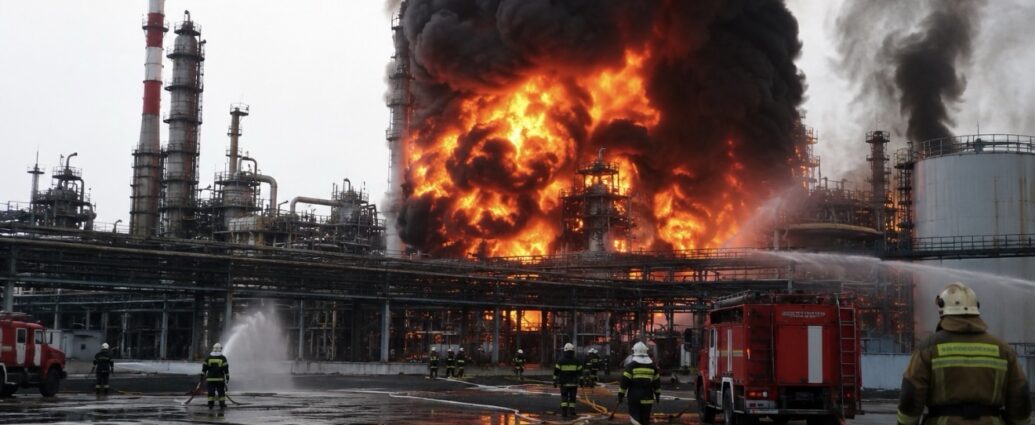
Putin Admits Russia Fuel Shortages as Ukraine Drone Strikes Cripple Refineries
Russian President Vladimir Putin admitted on Sunday, June 28, that Russia is struggling to keep fuel flowing to its own citizens, a rare public concession delivered at a congress of the ruling United Russia party and at a meeting with leaders of the country’s energy industry. Putin acknowledged the long lines at gas stations and said the right grade of gasoline was not always available, blaming the strain on a wave of Ukrainian drone strikes that have battered the refineries that turn crude oil into usable fuel.
The admission is striking because Russia is one of the largest oil exporters on earth. The country still has plenty of crude to pump and sell abroad. What it is losing is the ability to process that crude at home. Refineries are the plants that convert raw oil into gasoline, diesel and jet fuel, and Ukraine has spent months targeting them rather than the oil fields themselves. The result is a country swimming in crude oil that cannot make enough finished fuel for its own drivers, farmers and airlines.
The numbers behind the shortage are large. The International Energy Agency said this past week that the disruption is unprecedented in the history of the war, estimating that more than 20 percent of Russia’s total refining capacity has been knocked offline. More than two dozen strikes have hit Russian refineries since March, including eight of the country’s ten biggest plants. The Moscow Oil Refinery, operated by Gazprom Neft, normally supplies nearly half of the capital’s fuel and processed 11.6 million metric tons of crude in 2024; after being struck twice in mid-June, it may not return to service until 2027. The Kapotnya refinery, the largest supplier to the Moscow region, is expected to stay offline until at least the end of this year, and Lukoil’s NORSI plant, Russia’s fourth-largest refinery, went dark on June 24 after a drone strike.
Putin tried to play down the severity. Citing a report from Russia’s Energy Ministry, he said gasoline reserves stood at 1.7 million metric tons, roughly in line with the same period last year, and put the decline at only 4 percent. “Right now we’re observing a certain shortage, but it’s not critical,” he said. The picture on the ground looks harder. As of June 24, at least 55 of Russia’s 83 regions were reporting either government-ordered restrictions on gasoline and diesel sales or limits imposed by private fuel stations. Roughly ten regions have introduced rationing, often capping purchases at 30 to 40 liters per vehicle. In annexed Crimea, authorities declared an emergency situation and at one point halted public gasoline sales entirely.
The clearest sign of how tight supply has become is what Russia is now doing with its exports. Putin confirmed a temporary full ban on exports of gasoline and jet fuel and said a complete ban on diesel exports was under consideration. Alexander Novak, the deputy prime minister overseeing energy, has said Moscow is reviewing fuel export agreements so they do not compete with domestic needs. For an economy that depends heavily on energy revenue, halting the export of refined products is a costly move. It means giving up sales abroad to keep enough fuel at home, an open admission that the domestic market now comes first.
The business fallout reaches well beyond the gas pump. Putin singled out the farm sector, warning that the shortages threaten the summer harvest at the moment agricultural producers need diesel most. To close the gap, the government is weighing something almost unthinkable for a major oil power: importing fuel. Officials are looking at purchases from Turkey and other Asian suppliers, and the Russian parliament has approved subsidies for imported fuel along with temporary relief for refiners. Repairs will not come quickly because refineries rely on specialized Western equipment that sanctions have made difficult to replace.
The strikes are continuing even as Putin speaks. Overnight into Sunday, Ukrainian drones hit two more refineries, one in the Krasnodar region and another near Yaroslavl. The Slavyansk plant in Krasnodar, which processes close to 4 million tons of crude a year and feeds petroleum exports through Russia’s Black Sea ports, caught fire, and falling debris killed one person. Ukrainian President Volodymyr Zelensky described the attacks as part of an effort to weaken Russia’s ability to fund and wage the war.
Sergei Vakulenko, an energy analyst at the Carnegie Russia Eurasia Center, summed up the strain bluntly, writing that the Russian oil industry’s resilience is being stretched dangerously thin.
JBizNews Desk
© JBizNews.com All Rights Reserved. Reproduction or distribution without written permission is prohibited.


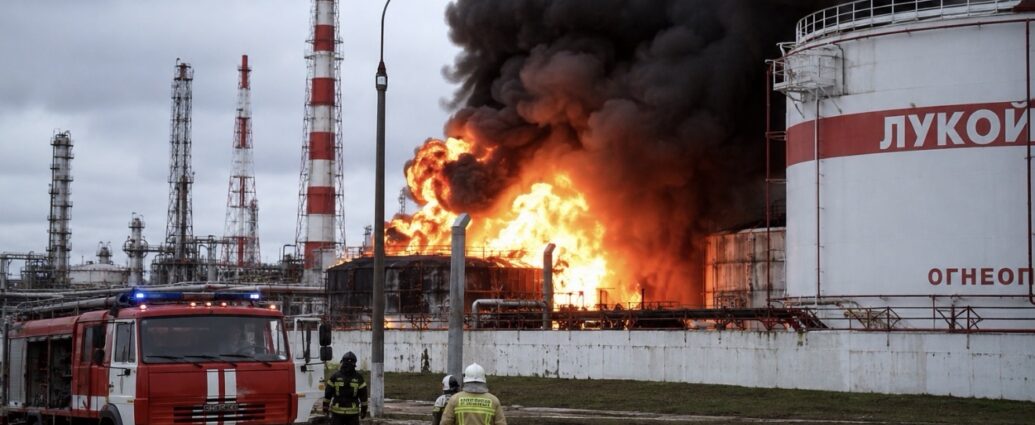
Ukrainian Drones Hit Russian Refineries, Deepening Fuel Shortages as Putin Admits Strain
Ukraine intensified its long-range drone campaign against Russia on Sunday, targeting energy infrastructure in a series of attacks that Russian officials say struck a major refinery in the country’s south and further strained domestic fuel supplies.
According to Krasnodar regional Governor Veniamin Kondratyev, debris from intercepted Ukrainian drones ignited a fire at the Slavyansk-na-Kubani oil refinery, one of southern Russia’s largest refining facilities. Officials said one person was killed and another injured during the attack.
The refinery processes approximately 4 million metric tons of crude oil annually and serves as an important supplier of fuel products exported through Russia’s Black Sea ports.
The strike forms part of Ukraine’s broader strategy of targeting Russia’s energy infrastructure.
Ukrainian President Volodymyr Zelenskyy said on Telegram that Ukrainian long-range operations had reached two Russian refineries overnight, describing the attacks as economic pressure designed to reduce Russia’s ability to finance the war.
Zelenskyy also claimed a refinery in Russia’s Yaroslavl region was struck during the operation. Russian authorities acknowledged drone activity in the region but did not immediately confirm damage to refinery facilities.
The repeated attacks are beginning to have measurable economic consequences.
Industry analysts estimate that more than 20% of Russia’s oil-refining capacity has been disrupted following dozens of Ukrainian drone strikes over recent months.
According to the International Energy Agency (IEA), the scale of refinery disruption is unprecedented since the conflict began.
Several of Russia’s largest refining complexes have sustained repeated attacks, including the Kapotnya refinery, a major fuel supplier serving the Moscow region, which officials expect to remain partially offline into late 2026.
The consequences are increasingly visible inside Russia.
According to reporting compiled by Radio Free Europe/Radio Liberty (RFE/RL), at least 55 of Russia’s 83 regions have reported gasoline or diesel shortages or introduced fuel-purchase restrictions.
In parts of Siberia, drivers are now limited to purchasing no more than 50 liters of fuel per visit at certain Rosneft stations, while private fuel retailers have imposed similar limits.
What began as isolated shortages near the fighting has gradually spread across regions thousands of miles from the front lines.
Russian officials are attempting to stabilize domestic supplies.
Deputy Prime Minister Alexander Novak said the government is reviewing fuel-export commitments to ensure enough gasoline and diesel remain available within Russia.
The move highlights a growing challenge for Moscow.
Russia depends heavily on energy exports for government revenue, yet maintaining domestic fuel supplies has become increasingly important as refinery capacity comes under sustained attack.
President Vladimir Putin acknowledged the difficult environment during a speech to members of the ruling United Russia Party in Moscow.
While not directly discussing the refinery strikes, Putin described Russia as facing a “difficult period” and pledged that the government would continue funding social programs, infrastructure projects, employment initiatives and support for domestic businesses.
His remarks sought to project stability despite growing pressure on key sectors of the Russian economy.
The effects extend well beyond Russia.
As one of the world’s largest exporters of crude oil and refined petroleum products, disruptions to Russian refining capacity can tighten global supplies of diesel, gasoline and other fuels.
The refinery attacks also come as global energy markets continue monitoring shipping disruptions around the Strait of Hormuz, adding another layer of uncertainty to world oil markets.
Russia’s Defense Ministry said its air-defense systems intercepted 213 Ukrainian drones overnight.
Nevertheless, Ukraine has steadily expanded both the range and frequency of its long-distance drone operations, increasing pressure on Russia’s energy infrastructure and raising new questions about the long-term resilience of one of the country’s most important economic sectors.
JBizNews Desk
© JBizNews.com All Rights Reserved. Reproduction or distribution without written permission is prohibited.


JPMorgan Will Double Its Low-Income Branch Program and Hire 150 Community Managers
JPMorgan Chase announced Thursday, June 25, that it will significantly expand its national Community Center branch program, doubling the number of these specialized banking locations serving low- and moderate-income neighborhoods across the United States. The announcement came directly from the bank, with Diedra Porché, head of Chase’s Community and Business Development division, saying the company is deepening its commitment to increasing access to financial services in underserved communities.
As part of the expansion, Chase will hire an additional 150 community managers and increase the educational programming offered at the locations. The bank currently operates 19 Community Centers nationwide. The first opened in Harlem in 2019 as a pilot project, and its success has led the bank to steadily expand the concept.
Unlike a traditional bank branch, Community Centers are designed to function as neighborhood financial hubs. While customers can still conduct everyday banking, each location also features meeting space where financial educators, nonprofit organizations, and local community groups host free workshops throughout the year.
The classes cover practical financial topics such as household budgeting, improving credit, homeownership preparation, entrepreneurship, and small-business development. According to Chase, the community managers overseeing these centers are hired locally and are instructed to focus on education and outreach rather than selling banking products. Participants do not need to be Chase customers and are under no obligation to open an account.
The program has already grown into one of the nation’s largest community-based financial education initiatives. JPMorgan Chase estimates it has hosted approximately 14,000 workshops since launching the first Community Center six years ago. Most of the centers are located in neighborhoods where many residents are considered underbanked or unbanked, meaning they have limited or no access to traditional banking services.
The initiative also aligns with the requirements of the Community Reinvestment Act (CRA), the federal law encouraging banks to help meet the credit and banking needs of low- and moderate-income communities. While financial institutions can satisfy many of their CRA obligations through charitable giving and community investments, JPMorgan Chase Chairman and CEO Jamie Dimon has long argued that establishing permanent neighborhood branches provides greater long-term economic benefits by creating local jobs, expanding access to financing, and building lasting relationships within communities.
Dimon has personally attended the opening of nearly every Community Center since the program began, often joined by local elected officials, business leaders, and nonprofit organizations.
Beyond its community mission, Chase acknowledges that the strategy also makes sound business sense.
Although the educational programs are intentionally separated from sales efforts, the bank says Community Centers consistently generate higher rates of new account openings than many traditional branches serving similar neighborhoods. By introducing residents to financial education first, Chase often builds trust that later translates into long-term customer relationships.
For the nation’s largest bank by assets, even modest increases in new customers at each location can produce meaningful growth across a nationwide network. The approach also strengthens the bank’s standing with regulators and community leaders by demonstrating sustained investment in underserved neighborhoods.
The expansion comes at a time when much of the banking industry continues moving in the opposite direction. Thousands of traditional bank branches have closed across the country over the past decade as more customers shift to mobile banking and digital services. Rural communities and lower-income urban neighborhoods have often experienced the greatest losses in physical banking access.
Chase’s decision to expand its brick-and-mortar presence in exactly those communities represents a notable departure from the industry’s broader trend and reflects the bank’s belief that face-to-face relationships remain essential where financial trust has historically been limited.
For consumers, the benefits are immediate. Anyone living near one of these Community Centers can attend free budgeting classes, receive one-on-one financial coaching, participate in small-business workshops, and access educational resources regardless of whether they bank with Chase.
As Diedra Porché explained, the goal is to meet people where they are, provide practical financial knowledge, and help individuals and small businesses build stronger financial futures. Over time, Chase hopes those relationships will also create loyal customers, while the communities themselves benefit from new jobs, expanded financial education, and greater access to mainstream banking services.
JBizNews Desk
© JBizNews.com All Rights Reserved. Reproduction or distribution without written permission is prohibited.


Opinion | A Trade Deal Trump Should Reaffirm
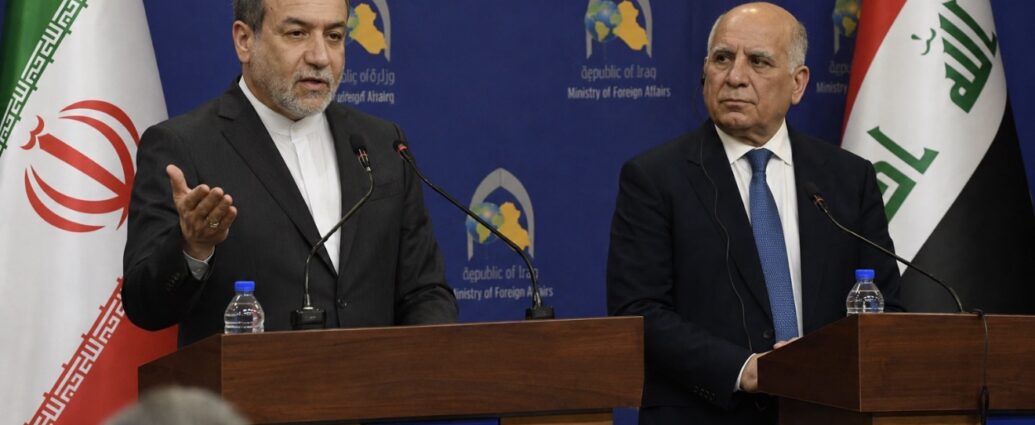
Today: Iran’s Foreign Minister Claims Sole Control of Hormuz, Sets 30-Day Reopening Timeline
Iran’s foreign minister, Abbas Araghchi, declared on Sunday, June 28, that his country alone holds authority over the Strait of Hormuz and will place the waterway “entirely under Iranian administration within the next 30 days,” speaking at a press conference in Baghdad alongside Iraqi Foreign Minister Fuad Hussein. According to Iran’s state news agency IRNA, Araghchi said no other government or international body has any role in reopening the strait under the memorandum of understanding signed earlier this month, and he warned that any attempt to set up “parallel structures” would only raise tensions and delay the return of normal shipping.
The warning carried weight because it followed two nights of renewed fighting. A ceasefire built around the June 17 memorandum has frayed badly in recent days. U.S. forces struck Iranian targets on Saturday after Washington accused Tehran of hitting an oil tanker in the strait with a drone. Early Sunday, Iran answered with missiles and drones aimed at Kuwait and Bahrain, where a residential building in Muharraq was struck and Bahraini air defenses reported intercepting several incoming weapons. President Donald Trump responded by threatening to “militarily complete the job” if the attacks continue, saying Iran had again violated the truce.
For ordinary households far from the Persian Gulf, the dispute over who runs Hormuz matters because of what moves through it. Roughly one-fifth of the world’s seaborne oil passes through the narrow channel between Iran and Oman, along with large volumes of liquefied natural gas. Every time the waterway opens, prices at the pump and in the grocery aisle ease; every time it closes, they climb. The strait sits at the center of the global fertilizer trade as well, which feeds directly into the cost of growing corn, wheat and other staples, so the back-and-forth in Baghdad reaches American kitchen tables more directly than it might appear.
Oil markets had been moving lower before the weekend flare-up. Brent crude futures for August delivery settled down 4.34% at $71.99 a barrel on Friday, June 26, while U.S. West Texas Intermediate for August fell 3.74% to $69.23. That marked the first time WTI closed below $70 since February 27, the day before the war began, as more tankers slipped out of the strait and eased fears of a prolonged supply squeeze. Traffic had recovered sharply in mid-June, with the U.S. military reporting a single-day record of about 16 million barrels transiting on June 21. Sunday’s strikes threaten to reverse that progress when trading resumes.
Adding to the friction, the U.S. Navy-led Joint Maritime Information Center announced on June 27 that it had widened a shipping route through Hormuz near Oman to allow more naval traffic in both directions, a step widely read as a direct challenge to Iran’s claim of sole control. Oman has separately proposed a new corridor for tankers along its own coastal waters to reduce risk for commercial crews, an idea Araghchi pointedly rejected on Sunday as exactly the kind of “separate arrangement” Tehran will not accept.
Analysts remain skeptical that the on-again, off-again diplomacy has settled anything. Scott Nations, president of Nations Indexes, said on CNBC that markets were “being too optimistic, because nothing really has been resolved,” adding that Iran “knows that they have the world economy where they want it if they want to shut down the strait.” Rory Johnston, founder of Commodity Context, has estimated that a durable reopening would likely knock $10 to $20 off crude prices on speculative positioning alone, but argued the relief would be temporary, with damaged infrastructure and lingering outages anchoring Brent in the $80-to-$90 range rather than returning it to pre-war levels.
The standoff also complicates an already shaky oil cartel. The United Arab Emirates left OPEC in May, and Iraq has reportedly pressed the group for a higher production quota while signaling it could exit if its demands are not met. Treasury Secretary Scott Bessent has warned that Washington would “aggressively” sanction Oman if it helped Iran collect transit fees in the strait, a threat that hangs over any alternative-corridor plan.
What comes next now hinges on whether the latest exchange of fire pulls both sides back to the negotiating table or hardens positions further. Iran has framed its 30-day timeline as a path to restoring pre-war shipping levels, but only on its terms. With the memorandum’s toll-free window ticking and U.S. and Iranian negotiators still apart on key commitments, the coming week is likely to set the tone for fuel prices, food costs and inflation heading into the summer.
JBizNews Desk | New York
© JBizNews.com All Rights Reserved. Reproduction or distribution without written permission is prohibited.


Euro Zone Inflation Likely Cooled in June, First Slowdown Since Iran War
Economists expect data from Eurostat on Wednesday to show euro zone inflation slowed in June for the first time since the Iran conflict erupted in late February, as energy prices retreated following the United States–Iran ceasefire memorandum and the reopening of the Strait of Hormuz. The flash estimate from the European Union’s statistics office is the next major test of whether the region’s inflation surge has peaked.
The backdrop is a four-month climb. Eurostat’s most recent flash estimate showed annual euro zone inflation accelerated to 3.2% in May, the highest reading since September 2023 and well above the European Central Bank’s 2% target. Energy prices led the increase, climbing 10.9% as markets reacted to fears of oil supply disruptions tied to the Middle East conflict.
That energy shock has since begun unwinding. Brent crude oil prices have fallen sharply following the 60-day memorandum of understanding that eased tensions and reopened the Strait of Hormuz, through which a significant share of the world’s seaborne oil supply passes. Lower crude prices typically filter through to gasoline, heating costs, transportation and manufacturing expenses within weeks, making June the first month economists expect to reflect that relief.
A lower inflation reading would carry significant implications for the European Central Bank and President Christine Lagarde, who has spent months balancing inflation concerns with slowing economic growth. The first decline since February would provide policymakers with evidence that much of the recent inflation spike was driven primarily by energy rather than by broader, persistent price pressures throughout the economy.
The underlying details, however, will matter as much as the headline number. In May, the euro zone’s core inflation rate—which excludes food and energy—rose to 2.5% from 2.2%, while services inflation accelerated to 3.5%. If June shows headline inflation cooling while core inflation remains elevated, the ECB could conclude that inflationary pressures are spreading beyond energy into wages and service-sector costs.
For households across Europe, the impact is immediate and personal. Changes in energy and food prices directly affect utility bills, grocery costs and transportation expenses, with lower-income families generally feeling those swings most sharply. A sustained decline in inflation would provide meaningful relief after months of rising living costs.
Businesses are watching just as closely. Lower inflation strengthens the case for the European Central Bank to maintain or eventually reduce interest rates, lowering borrowing costs for manufacturers, exporters, construction firms and other businesses that have spent much of the past year coping with higher financing expenses alongside elevated energy prices.
Inflation trends continue to vary across the euro area. During May, annual inflation accelerated in Spain, Italy, the Netherlands and France, while slowing in Germany, the bloc’s largest economy. National inflation reports due ahead of the overall euro zone release are expected to provide investors with an early indication of whether any slowdown is broad-based or concentrated in only a handful of countries.
The report also fits into the broader global inflation picture. A cooling trend in Europe, combined with easing energy costs, would reinforce signs that lower oil prices following the Middle East ceasefire are helping reduce inflationary pressure across major economies on both sides of the Atlantic.
Eurostat is scheduled to publish its preliminary June inflation estimate on Wednesday, followed by detailed country-by-country data in mid-July. A reading below May’s 3.2% annual rate would mark the first monthly slowdown in four months and suggest Europe’s latest inflation surge may finally be losing momentum.
Until the figures are released, the slowdown remains an expectation rather than a confirmed trend. Still, the underlying economic mechanics are straightforward: energy prices have fallen, and throughout much of 2026, Europe’s inflation rate has closely tracked movements in the oil market.
JBizNews Desk
© JBizNews.com All Rights Reserved. Reproduction or distribution without written permission is prohibited.

Senators Press Federal Regulators to Probe Polymarket Over Fake-Win Ads
Senators Adam Schiff of California and John Curtis of Utah sent a letter Friday to Commodity Futures Trading Commission (CFTC) Chairman Michael Selig asking whether the agency is investigating allegedly deceptive advertising by prediction-market platform Polymarket, escalating congressional scrutiny of one of the fastest-growing sectors in online wagering. The bipartisan request follows reports that the company paid influencers to promote fabricated winning bets.
The allegations stem from a Wall Street Journal investigation, which found that Polymarket paid mostly college-age social media creators to produce videos showing themselves placing bets—often on websites created solely for filming—and celebrating large winnings that never actually occurred. According to the newspaper, reporters reviewed more than 1,100 videos and determined that none of the approximately $1.9 million in featured wagers represented genuine trades.
According to the report, the campaign was designed to attract new users to Polymarket’s offshore platform, which is not regulated in the United States. One widely circulated video appeared to show a student turning a $1,000 wager into $100,000, even though the trade itself was entirely fictional.
Polymarket responded by saying it is reviewing its marketing practices. A company spokesperson said the platform remains committed to operating fair and transparent prediction markets and continually evaluates how it communicates with potential customers, although the company did not directly address who authorized the campaign or how the videos were produced.
Congressional concern extends beyond the Senate. Representatives Kevin Mullin of California and Gabe Vasquez of New Mexico previously urged the Federal Trade Commission to investigate whether prediction-market companies including Polymarket and competitor Kalshi engage in deceptive marketing practices, arguing that the industry’s public messaging differs substantially from its regulatory representations.
The industry’s rapid growth has intensified regulatory interest. Prediction markets expanded into a multibillion-dollar business as users increasingly wagered on events ranging from the Super Bowl and World Cup to elections, economic data and geopolitical developments. That expansion has attracted growing attention from lawmakers concerned about consumer protection and financial regulation.
Jurisdiction remains complicated. The Commodity Futures Trading Commission regulates certain prediction markets and has approved a limited U.S.-regulated version of Polymarket’s platform. However, that domestic service currently operates on a restricted basis, while much of the company’s trading activity continues through its offshore platform. Because the alleged promotional campaign involved the international operation, regulators may face additional legal questions regarding enforcement authority.
Founded by Shayne Coplan and headquartered in New York City, Polymarket has already faced significant regulatory and legal scrutiny. Earlier this year, federal prosecutors charged a Google employee with allegedly earning more than $1.2 million through insider trading involving confidential information and prediction markets. Following that case, the company strengthened internal policies restricting trades based on non-public information.
The controversy arrives at a sensitive time for the broader prediction-market industry. Companies including Polymarket and Kalshi continue arguing in multiple court cases that their products represent financial markets rather than traditional gambling. Allegations that promotional materials portrayed fabricated winning trades could undermine those arguments and further complicate ongoing legal battles.
Congress is already considering more than a dozen proposals that would increase federal oversight of prediction markets or limit the types of contracts these platforms may offer. Bipartisan interest from senators and representatives could increase momentum for broader regulation even if the CFTC ultimately decides not to pursue formal enforcement action.
For consumers, the central issue remains confidence. Prediction markets depend on public trust that prices accurately reflect genuine market activity and independently placed wagers. Allegations that a leading platform promoted fictional wins strike directly at that foundation and raise broader questions about transparency, advertising practices and investor protection throughout the rapidly expanding industry.
JBizNews Desk
© JBizNews.com All Rights Reserved. Reproduction or distribution without written permission is prohibited.


OpenAI Reveals Its First Chip, “Jalapeño,” in a Bid to Loosen Nvidia’s Grip
OpenAI, the company behind ChatGPT, unveiled its first custom chip on Wednesday in partnership with Broadcom, the two companies announced in a joint statement, a move that pushes the AI leader into designing the silicon that runs its own models and chips away at its heavy dependence on Nvidia. The processor, named Jalapeño, was delivered to OpenAI CEO Sam Altman and President Greg Brockman by Broadcom President and CEO Hock Tan, marking what the companies called an important step in OpenAI’s strategy to “build the full stack” behind its models and products.
The chip is built for a specific job. Jalapeño was designed for inference, the process of running pre-built AI models in response to user commands, rather than the more intensive work of training them. It is an ASIC (application-specific integrated circuit), a type of chip that industry experts say is less flexible than Nvidia’s GPUs but is also cheaper and can be tailored to specific AI tasks. In practice, that means it is purpose-built to serve products like ChatGPT and the company’s coding tools at lower cost.
The development speed was unusual, and AI itself helped. OpenAI said the chip was designed end to end in just nine months with help from its own AI models. President Greg Brockman said, “The degree to which our models have been able to accelerate it was very surprising to us.” The company described the effort as what may be the fastest ASIC development cycle ever achieved in high-performance semiconductors.
Early results carry a clear message to the market leader. The companies said Jalapeño provides better performance per watt than current state-of-the-art chips in early testing, a direct challenge to Nvidia’s dominance. Performance per watt has become one of the industry’s most important measurements because electricity is among the largest and fastest-growing costs of operating AI systems at scale. A more efficient chip can dramatically reduce the cost of delivering AI services.
The strategic logic extends beyond technology. OpenAI is one of the world’s largest buyers of Nvidia processors but competes with nearly every major AI company for access to those chips. Designing its own processors gives OpenAI greater control over its computing infrastructure while reducing reliance on outside suppliers. Even modest reductions in inference costs could significantly improve the economics of operating products used by hundreds of millions of people.
The partnership is also another major victory for Broadcom, which has quietly become one of the biggest beneficiaries of the AI boom by helping hyperscalers and frontier AI labs design custom silicon. Broadcom shares have climbed roughly 10% so far in 2026 and have increased nearly sevenfold since the end of 2022. CEO Hock Tan said the collaboration will enable “gigawatt-scale data centers” with Microsoft and other partners beginning in 2026, describing it as the beginning of a multi-generation roadmap.
The announcement is part of a broader shift taking place across the AI industry. Earlier this year, OpenAI reached agreements to use Amazon Web Services’ Trainium chips while also expanding partnerships with Advanced Micro Devices (AMD) and Cerebras, which completed its initial public offering in May. Together, those deals reflect a growing determination among leading AI companies to diversify beyond Nvidia for the most critical—and expensive—component of AI infrastructure.
The rollout will happen gradually. Initial deployments of Jalapeño are expected by the end of 2026, beginning with limited prototypes before expanding in the years ahead. The platform combines OpenAI-designed AI accelerators with Broadcom’s networking technology and Celestica’s board and rack systems to build complete AI computing platforms.
For businesses and consumers, the importance of Jalapeño is not that it will appear on store shelves, but that it could lower the cost of artificial intelligence itself. OpenAI argues that AI-assisted chip design can accelerate innovation while reducing computing expenses across the industry. Lower inference costs make advanced AI services more affordable and scalable as billions of users rely on them daily. By designing its own hardware, OpenAI is betting that controlling both the models and the chips powering them will be essential to driving down the cost of intelligence—and reducing dependence on the company that has dominated the AI hardware market for years.
JBizNews Desk
© JBizNews.com All Rights Reserved. Reproduction or distribution without written permission is prohibited.

Record Heat Scorches Western Europe, Straining Power Grids and Tourism
French Prime Minister Sébastien Lecornu activated the country’s highest public-health emergency level this week as a record-breaking heat wave gripped Western Europe, killing dozens, closing schools, knocking out power and forcing farmers to harvest grain at night. National weather agencies reported the hottest readings on record across France, Spain and the United Kingdom.
The numbers are extraordinary. Météo-France said the country recorded its hottest June day since records began, with Paris reaching 40.9 degrees Celsius, a new June high. The UK Met Office also confirmed Britain’s hottest June day on record, with temperatures climbing above 36 degrees Celsius on consecutive days.
The human toll mounted quickly. At least 18 people died in France from heat-related causes, including young children, while dozens of additional drowning deaths were reported as people sought relief in rivers, lakes and coastal waters. Spain also recorded its highest average daily temperature since national records began in 1950.
The economic disruption spread across multiple industries. In Paris, officials ordered early closures of the Eiffel Tower and the Louvre Museum, reducing visitor access during one of the busiest tourism periods of the year. Schools throughout several European countries either closed or shortened classroom hours, forcing many parents to remain home from work.
Power systems came under increasing strain. In Belgium, electricity prices briefly surged above one euro per kilowatt-hour during the evening peak on June 24 as conventional power plants struggled to satisfy soaring air-conditioning demand. In France, grid operator Enedis reported approximately 50,000 customers without electricity while wholesale day-ahead power prices rose sharply.
Agriculture also felt the impact. Farmers across parts of France shifted grain harvesting to overnight hours to avoid dangerous daytime temperatures, increasing labor costs while disrupting harvesting schedules throughout the agricultural supply chain.
The heat wave exposed long-standing infrastructure challenges. Much of Europe’s housing, transportation network and commercial buildings were designed for historically moderate summer temperatures rather than prolonged periods of extreme heat. Many homes, hotels and rail systems lack widespread air conditioning, creating additional pressure on the tourism and hospitality industries as temperatures continue climbing.
Scientists and weather agencies say the pattern has become increasingly common. Météo-France reports that nearly two-thirds of all French heat waves recorded since 1947 have occurred after 2000, while the UK Met Office says the number of extremely hot days has more than tripled during recent decades. This June also became the first time since 1911 that Britain experienced record-breaking temperatures during two consecutive months.
The broader economic implications extend well beyond a single week of extreme weather. Repeated heat waves contribute to higher electricity costs, lower worker productivity, reduced tourism activity, increased healthcare expenses and mounting pressure on public infrastructure. France’s activation of ORSAN Level 3 requires hospitals to increase staffing and emergency preparedness as heat-related illnesses continue rising.
European governments increasingly view extreme heat as a recurring infrastructure challenge rather than an isolated weather event. Repeated strain on electric grids, transportation systems and major tourist attractions highlights the growing investment needed to adapt cities and public services to hotter summers becoming more common across the continent.
Forecasters warned that little immediate relief remained in sight. Red heat alerts continued across much of France, while unusually warm overnight temperatures prevented buildings from cooling after sunset. For a continent whose infrastructure was largely built around milder summers, the week underscored the growing economic and human cost of adapting to a changing climate.
JBizNews Desk
© JBizNews.com All Rights Reserved. Reproduction or distribution without written permission is prohibited.


U.S., Israel and Lebanon Sign Friday Accord Netanyahu Calls Blow to Iran and Hezbollah
Israeli Prime Minister Benjamin Netanyahu said Saturday, June 27, that a new agreement his government signed with Lebanon and the United States is a major blow to Iran and the militant group Hezbollah, speaking at a press conference one day after the deal was signed in Washington.
The trilateral framework agreement was signed Friday, June 26, at the U.S. State Department, with Secretary of State Marco Rubio looking on as the Israeli and Lebanese ambassadors put their names to it. It followed five rounds of talks in the U.S. capital aimed at winding down the long fight between Israel and Hezbollah.
Speaking from a podium with a map behind him, Netanyahu said the message to Iran was simple: stay out. He said Israel, Lebanon and the United States were telling Tehran it has no role in Lebanon, and that neither Iran nor Hezbollah nor any other armed group would decide the country’s future. He called the deal a historic achievement and “a major blow” to both.
In plain terms, the agreement sets up a process to disarm Hezbollah, the Iran-backed group that has fought Israel from southern Lebanon. It creates a U.S.-run coordination body to oversee the steps, and it starts small. Israeli troops will pull back from two pilot areas near the Litani River and hand them to the Lebanese army. Israel is keeping the rest of its security zone in the south, and Netanyahu was clear it will stay there until Hezbollah gives up its weapons.
The reason Netanyahu frames this as a defeat for Iran comes down to leverage. For weeks, Iran had tried to tie an end to the fighting in Lebanon to its own separate deal with Washington over the Strait of Hormuz. By signing a Lebanon agreement directly with Beirut and Washington, and leaving Hezbollah out of the room, Israel cut that link. Hezbollah, the strongest piece of Iran’s network in the region, was handed a deal it had no part in writing.
Hezbollah rejected it flatly. The group’s leader, Naim Qassem, called the agreement null and void on Saturday and described it as a humiliation and a surrender of Lebanon’s sovereignty. He said the group would not lay down its weapons and demanded that Israel withdraw from Lebanese land first. Hezbollah supporters blocked roads in the southern suburbs of Beirut and burned tires in protest after the signing. One Israeli strike in southern Lebanon on Saturday killed one person, the first death reported since the deal was signed.
For the wider economy, the agreement matters because Lebanon’s recovery is tied to money that only starts flowing once the fighting stops. As part of the deal, Rubio announced an immediate $100 million in U.S. humanitarian aid for Lebanon, coordinated with the United Nations, and more than $30 million in additional support to build up the Lebanese army so it can take control of its own territory. Lebanese President Joseph Aoun said the framework would let displaced families return home, the first step toward reopening shuttered towns and restarting local business in the south.
The catch is that the big spending—reconstruction of bombed-out southern Lebanon—is gated behind Hezbollah’s disarmament. Yechiel Leiter, Israel’s ambassador to the United States, said other countries could help rebuild Lebanon, but only after Hezbollah lays down its arms. That means contractors, donors and investors have a clear signal: serious rebuilding capital stays on the sidelines until the security question is settled, which keeps Lebanon’s battered economy in limbo for now.
The deal also carries weight for energy markets, even if indirectly. Iran has repeatedly threatened to choke off the Strait of Hormuz, the waterway that once carried about a fifth of the world’s oil, in response to Israeli operations in Lebanon. By separating the Lebanon track from the Hormuz dispute, the agreement chips away at one of Iran’s main justifications for squeezing the strait, which remains the single biggest factor weighing on global oil prices. Calmer politics in Lebanon, in theory, removes one trigger for the next spike at the pump.
Whether it holds is the open question. Rubio called the agreement “the beginning of the beginning,” a careful phrase that signals how far the two sides still are from real peace. The deal was negotiated without the one group it is built to disarm, and Hezbollah has already said it will not comply. For businesses across the region, the takeaway is cautious: the framework lowers the temperature and unlocks a first round of aid, but the rebuilding boom that Lebanon needs, and the lasting calm that markets want, both depend on a disarmament that has not happened yet.
JBizNews Desk | New York
© JBizNews.com All Rights Reserved. Reproduction or distribution without written permission is prohibited.
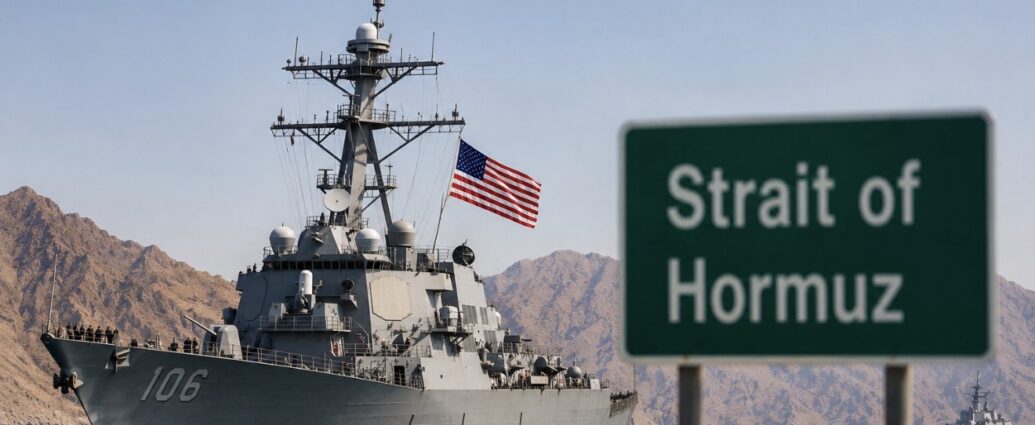
Trump Orders Saturday Strikes on Iranian Air Defenses and Drone Sites Over Tanker Attack
The fragile ceasefire that had eased fears of a prolonged disruption to global energy markets came under renewed pressure Saturday, June 27, after the United States launched a second consecutive day of military strikes against Iranian targets following another attack on commercial shipping in the Strait of Hormuz. The latest escalation underscores how quickly the world’s most important oil corridor can shift from relative calm back into crisis, keeping businesses, energy markets and global shippers on edge.
According to U.S. Central Command (CENTCOM), President Donald Trump ordered Saturday’s operation after an Iranian drone struck the Panama-flagged oil tanker M/T Kiku while it was transiting the Strait of Hormuz. The vessel was carrying Qatari crude bound for the port of Fujairah in the United Arab Emirates.
CENTCOM said the strikes targeted Iranian surveillance infrastructure, communications systems, air defense sites, drone storage facilities and minelaying equipment. The military said Iran had been given an opportunity to comply with the ceasefire following Friday’s American strikes but instead carried out another attack on commercial shipping.
American officials said commercial traffic through the strait would continue and emphasized that U.S. forces remain “vigilant, lethal, and ready” to protect freedom of navigation through one of the world’s busiest maritime chokepoints.
Friday’s operation—the first of the two rounds of strikes—targeted Iranian missile and drone storage facilities along with coastal radar installations after an Iranian drone struck the cargo ship M/V Ever Lovely on June 25. By Associated Press count, it marked the third American military response in three weeks following Iranian drone attacks against vessels operating in the region.
President Trump confirmed Saturday’s action on Truth Social, accusing Iran of violating the ceasefire once again and warning that the United States could be forced to finish militarily what it had begun if the attacks continue. He said the Islamic Republic could cease to exist if the assaults persist. Vice President JD Vance said Friday evening that Iran should engage diplomatically if it objected to the ceasefire terms, adding that further violence would be met with force.
The renewed fighting places immediate pressure on the memorandum of understanding signed on June 17 to wind down nearly four months of conflict. Under the agreement, the United States, Iran and their allies committed to halting military operations across multiple fronts, including Lebanon, while Iran was given a 60-day window to make its best effort to allow commercial vessels to pass through the Strait of Hormuz without charge.
At its peak, roughly one-fifth of the world’s oil and natural gas shipments moved through the strategic waterway.
A central dispute remains unresolved. Iran maintains it retains authority to regulate ships that lack its approval and has threatened to impose transit fees, while the United States and Gulf allies insist the Strait of Hormuz is an international waterway that must remain open to unrestricted commercial navigation.
A maritime organization overseen by the U.S. Navy announced Saturday that it was expanding a shipping corridor near Oman’s coastline to facilitate both inbound and outbound vessel traffic, another indication that Washington intends to keep commerce flowing despite continued security threats.
Despite the renewed military exchanges, energy markets have so far remained relatively restrained. Brent crude, the global benchmark, has fallen nearly 20% from its 2026 highs as traders continue betting that the ceasefire will ultimately restore normal shipping through the strait. Prices remain only modestly above pre-war levels, though each new attack highlights how quickly market confidence could evaporate.
Analysts continue to caution that the path back to normal operations remains uncertain.
June Goh, senior oil analyst at Sparta in Singapore, said the latest tanker strike demonstrates how fragile security in the region remains and noted that tankers must resume normal movements before crude inventories can be reduced and production fully normalized.
Vandana Hari, founder of Vanda Insights, has warned that energy markets appear to be pricing in an optimistic outcome even though implementing the ceasefire may prove far more difficult than negotiating it. Tamas Varga of PVM Oil Associates said the sharp decline in Brent prices reflects growing confidence that the worst supply disruptions may be over, while analysts at UBS, led by Henri Patricot, remain more cautious, pointing to limited crude loadings within the Gulf and little concrete evidence that vessel traffic has meaningfully recovered.
Whether the memorandum ultimately survives may depend as much on political developments in Washington as on events unfolding at sea. Secretary of State Marco Rubio told Congress earlier this month that he remains optimistic Iran will negotiate over its nuclear program, while acknowledging that the ceasefire has become increasingly fragile. Meanwhile, a growing number of Republicans have joined Democrats in questioning the financial cost and broader economic consequences of the conflict, although congressional efforts to force an end to hostilities have repeatedly failed.
For businesses, Saturday’s developments reinforce that uncertainty remains the defining risk. Oil continues to flow, commercial shipping has not stopped and energy prices remain relatively stable. Yet every new drone strike, military response and threat against the Strait of Hormuz serves as a reminder that the global economy remains vulnerable to sudden disruptions that could quickly reshape fuel costs, shipping rates and supply chains worldwide.
JBizNews Desk | New York
© JBizNews.com All Rights Reserved. Reproduction or distribution without written permission is prohibited.


