Riding a shuttle bus to the FIFA World Cup at MetLife Stadium this summer just got much cheaper. On Wednesday, Gov. Kathy Hochul announced that, with financial support from the state and other sponsors, round-trip shuttle tickets will cost $20, down from the previously announced $80 fare, as first reported by The Athletic. Of the roughly 18,000 shuttle tickets available per match, 20 percent will be reserved for New York residents. NJ Transit has also lowered round-trip train fares to MetLife Stadium to $98, after initially setting prices at $150 before reducing them to $105 last week.f

“Hosting the World Cup is a once-in-a-generation opportunity for New Yorkers, and we are making this world-class event as affordable and accessible as possible,” Hochul said. “Cheaper shuttle bus service is a no-brainer—saving fans money and making it easier to get to matches, especially for New Yorkers who have access to exclusive tickets at this new, lower price.”

The buses will depart from the Port Authority Bus Terminal, with two additional pickup locations in Midtown East, just east of Grand Central Terminal, and Midtown North, just west of Central Park. Exact locations will be announced in the coming weeks.

In anticipation of higher-than-expected demand, bus capacity has been expanded from an initial 10,000 seats to 18,000 seats for five matches and 12,000 seats for three matches. To allow for this increased service, additional school buses were secured from Highland Electric Fleets.

Bus tickets are now on sale for match ticketholders and can be purchased here. Customers who previously purchased official stadium shuttle tickets for applicable matches will automatically receive a $60 refund.

“Creating a World Cup experience that is accessible for both fans visiting our region and the people who call New York and New Jersey home is a core priority for us,” Alex Lasry, CEO of the NYNJ FIFA World Cup 2026 Host Committee, said.

“We’re incredibly grateful to Gov. Hochul for helping us expand shuttle capacity and reduce round-trip fares from $80 to $20,” he added. “These improvements will provide an affordable and convenient transportation option while furthering our mission to deliver a once-in-a-lifetime event for residents and visitors alike.”

The announcement follows NJ Transit’s recent reductions to World Cup train fares. After initial backlash over the $150 round-trip price, New Jersey Gov. Mikie Sherrill directed the agency to identify alternative funding sources to reduce costs for fans and avoid passing expenses on to Garden State residents.

Last week, the agency cut fares by 30 percent to $105. On Tuesday, Sherrill announced in a post on X that the price had been reduced again to $98.

RELATED:

The post NYC to MetLife bus fares for World Cup cut by 75% first appeared on 6sqft.

This post was originally published here

As part of their ongoing state-level advocacy work, NAIOP members from chapters in Ohio, Michigan and North Carolina engaged policymakers at their state capitals this week. NAIOP members from these states traveled to their respective state capitols to engage and educate lawmakers about the key role of commercial real estate development in spurring economic growth and job creation.

Nearly 80 members from the four Ohio chapters traveled to Columbus for meetings with lawmakers and administration officials to advocate for policies that promote smart economic growth, streamline regulatory processes and fund state programs supporting transformative development across the state. These state programs include the Transformational Mixed-Use Development Program, Opportunity Zone Tax Credit, Brownfield Remediation Program, and Historic Preservation Tax Credit. In addition, NAIOP of Ohio is supporting legislation that modernizes development processes, establishes timelines for local land use decisions, and ensures more predictability to annexation processes and Community Reinvestment Area approval processes.

The Annual Meeting and Legislative Day booklet also included a review of data center development in Ohio. The state alliance recognizes data center’s role as part of the state’s economic infrastructure and as drivers of innovation across multiple sectors of the state’s economy. NAIOP of Ohio supports “a balanced, informed and forward-looking policy framework that allows Ohio to remain competitive while responsibly addressing community, infrastructure and environmental considerations.”

In the mid-Atlantic, members from the three North Carolina chapters – Charlotte, North Carolina Piedmont Triad and Raleigh Durham – traveled to Raleigh this week to advance their 2026 legislative priorities within the state capitol. Their legislative day included meetings with House Speaker Dustin Hall, Senate President Phil Berger and other state lawmakers. NAIOP of North Carolina supports policies that support the state’s continued economic growth, invests in workforce development, funds needed transportation and infrastructure improvements, and provides more transparency and predictability to regulatory processes.

It is worth noting that there are efforts in Ohio to reduce and eliminate property taxes to provide owners with economic relief. However, some policymakers are concerned that the elimination of property taxes will result in increased taxes and fees in other sectors to make up for the lost revenue and maintain a balanced budget. Proponents in Ohio have pledged to continue their effort next year if the necessary requirements are not met for the initiative to qualify for the November ballot.

The core mission of NAIOP of Detroit, one of NAIOP’s newest chapters, is for the state to provide a foundation for continued commercial real estate development and strengthen Michigan’s competitiveness in attracting and retaining private sector investments. This includes effective advocacy at each level of government to ensure public policies are enacted to support growth.

The chapter took its first steps towards this objective with members traveling to Lansing for the initial introduction of NAIOP to lawmakers and the industry’s contribution to the state economy and workforce. The meetings established a relationship within the state capitol that will lead to future policy discussions impacting the development industry.

Legislative days at the state capitol provide valuable opportunities for NAIOP members to build relationships and discuss the issues impacting commercial real estate development directly with state decisionmakers. Member engagement in the legislative process ensures the industry’s voice is heard and taken into consideration.

This post was originally published here

The U.S. housing market is showing some of the clearest signs yet that the post-pandemic real estate boom is losing momentum as elevated mortgage rates, rising insurance costs, and stubborn shelter inflation continue squeezing both homeowners and prospective buyers.

Fresh inflation data released Tuesday reinforced the pressure.

The Bureau of Labor Statistics reported that the shelter component of the Consumer Price Index rose 0.6% in April, double the pace recorded in March, helping drive overall annual inflation to 3.8% — the highest level since May 2023.

Housing-related costs remain one of the largest contributors to persistent inflation across the economy.

At the same time, financing conditions continue worsening.

According to Freddie Mac’s latest mortgage survey, the average U.S. 30-year fixed mortgage rate climbed to 6.37%, its highest level in four months, while the 15-year fixed rate rose to 5.72%.

The combination is increasingly freezing housing activity nationwide.

Millions of homeowners who locked in mortgages below 4% during the pandemic-era refinancing boom are now effectively trapped in place, unwilling to sell and replace their existing loans with dramatically higher borrowing costs.

That so-called “mortgage lock-in” effect has become one of the single biggest supply constraints in the housing market.

Analysts at JPMorgan Chase recently described the slow unwinding of ultra-low mortgage rates as the key factor determining when housing inventory may eventually recover.

For buyers, affordability continues deteriorating.

Even though home-price growth has slowed, elevated financing costs have largely offset any relief from moderating prices. Monthly mortgage payments remain significantly higher than pre-pandemic norms, particularly when combined with rising property taxes, homeowners insurance premiums, and maintenance expenses.

Builders are increasingly feeling the strain as well.

Lennar, the nation’s second-largest homebuilder, reported first-quarter revenue of $6.6 billion, down 13% year-over-year, while aggressively cutting prices and offering larger buyer incentives to maintain sales volume.

The company’s average selling price has fallen sharply from pandemic-era peaks, while home-sale profit margins have compressed significantly.

Gross margins for Lennar homes declined to 15.2%, down from nearly 27% during the height of the housing boom in 2022.

Larger builders such as D.R. Horton have managed to maintain stronger sales by offering internal mortgage-rate buydowns through affiliated lending units — a strategy many smaller builders cannot afford to replicate.

At the same time, unsold inventory has climbed sharply from pandemic lows.

Completed but unsold new homes reached approximately 119,000 units in March, nearly four times higher than levels seen during the peak of the post-COVID housing frenzy.

Insurance costs are now adding a second major layer of pressure.

In California, the homeowners insurance market remains deeply unstable following catastrophic wildfire losses and insurer retrenchment.

State Farm has stopped writing new homeowner policies in California and recently secured emergency rate increases after major wildfire-related losses earlier this year.

Allstate has also paused new policies in the state, while California’s FAIR Plan — the insurer of last resort — has exploded in size as private insurers pull back coverage.

Meanwhile, Florida’s insurance market has shown modest stabilization after years of crisis, with some insurers beginning to reduce rates under reforms pushed by Governor Ron DeSantis.

But Florida still maintains the highest average homeowners insurance premiums in the nation, with annual costs averaging more than $7,500 per year.

The result nationally is a housing market that increasingly appears frozen.

Current homeowners stay put because moving would dramatically increase borrowing costs.

Prospective buyers struggle with affordability.

Builders cut margins to stimulate demand.

And rising insurance, tax, and maintenance expenses continue inflating the cost of ownership even for households with fixed mortgage payments.

Economists now warn the broader housing slowdown may become more difficult to reverse if interest rates remain elevated deep into 2026 and beyond.

That concern intensified this week after several Wall Street firms pushed back expectations for Federal Reserve rate cuts following the hotter-than-expected April inflation report.

Real wage growth has also weakened.

Tuesday’s data showed inflation-adjusted average hourly earnings slipping 0.5% in April and declining 0.3% year-over-year, meaning many households are effectively losing purchasing power despite stable employment conditions.

The next major tests for the housing market arrive later this month with the release of:

  • April existing-home sales data,
  • and new-home sales figures from the Census Bureau.

Until mortgage rates decline meaningfully — or incomes begin catching up with housing costs — analysts increasingly believe the U.S. housing market may remain structurally locked in place.

JBizNews Desk
© JBizNews.com. All rights reserved.

Mortgage applications increased 1.7% from one week earlier, according to data from the Mortgage Bankers Association (MBA)’s weekly mortgage applications survey for the week ending May 8.

On an unadjusted basis, the index increased 2% compared with the previous week.

The refinance index decreased 1% from the previous week and was 28% higher than the same week one year ago.

The seasonally adjusted purchase index increased 4% from one week earlier. The unadjusted purchase index increased 4% compared with the previous week and was 7% higher than the same week one year ago.

Mortgage rates were generally higher last week, with the 30-year fixed rate at 6.46%, its highest level in five weeks,” said Joel Kan, MBA’s vice president and deputy chief economist. “Purchase applications were higher over the week and 7% ahead of last year’s pace, with all loan types showing increases in purchase activity, as potential homebuyers shrugged off the current economic and mortgage rate uncertainties and returned to the market.

“Refinance applications declined slightly, led by conventional and VA refinancings, and accounted for a little more than 40% of applications last week, the lowest share since July 2025.”

The refi share of application activity decreased to 40.8% of total applications, down from 42% the previous week. The adjustable-rate mortgage (ARM) share of activity remained unchanged at 8.8% of applications.

The Federal Housing Administration (FHA) share of total applications increased to 17.9%, up from 17.7% the week prior. The U.S. Department of Veterans Affairs (VA) share remained unchanged at 14.9%, as did the U.S. Department of Agriculture (USDA) share at 0.5%.

The average contract interest rate for 30-year fixed-rate mortgages with conforming loan balances ($832,750 or less) increased 1 basis point to 6.46%, and rates for 30-year fixed-rate mortgages with jumbo loan balances (greater than $832,750) increased 1 bps to 6.48%.

The average rate for 30-year fixed mortgages backed by the FHA increased 4 bps to 6.16%, while rates for 15-year fixed mortgages remained unchanged at 5.83%. The average rate for 5/1 ARMs jumped 10 bps to 5.70%/

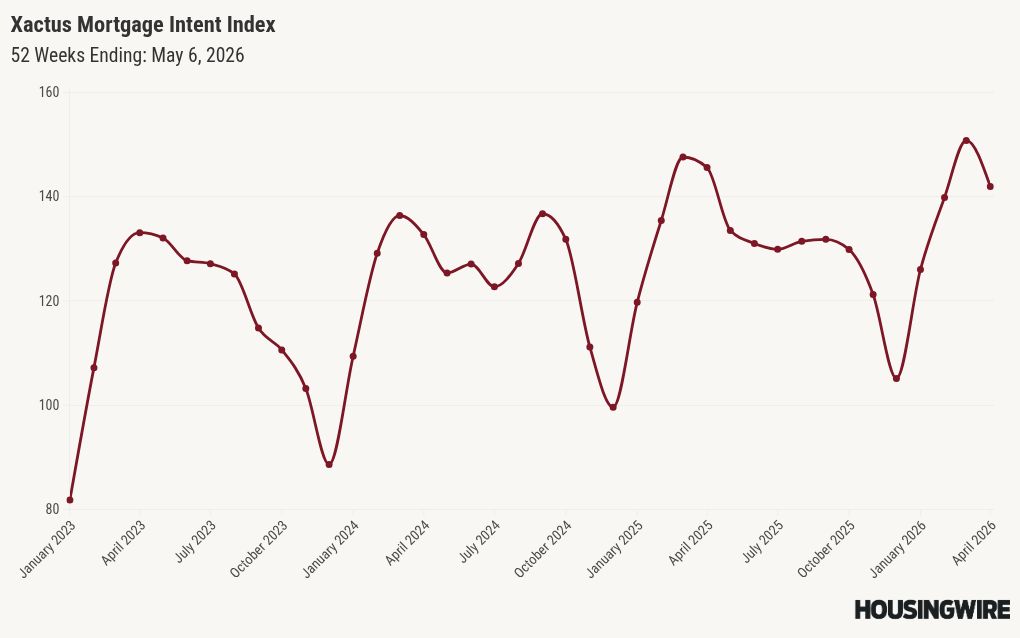
Xactus Mortgage Intent Index

Xactus‘s Mortgage Intent Index — which analyzes aggregated, anonymized credit-pull activity across the Xactus Intelligent Verification Platform — increased to a reading of 137.4.

chart visualization

“Despite a modest increase in the 30-year mortgage rate, mortgage intent rose approximately 1.5% week over week,” said Thomas Lloyd, Xactus’ chief strategy officer. “While the increase is encouraging amid ongoing market volatility, the intent volumes continue to face headwinds, coming in roughly 3.85% below the same week in 2025 and approximately 2.1% lower than the same week last month.”

Lloyd also remarked that the latest reading also marks a second consecutive week of annual declines.

This post was originally published on here

People can sense when unedited AI is being used as content. Let me show you what I mean. Here’s what happens when someone plugs “write about mortgage marketing trends” into one popular AI tool without a second thought:

In today’s rapidly evolving digital landscape, mortgage pros struggle to stand out. Old-school marketing isn’t enough anymore. It’s an unprecedented challenge—standing out in a sea of sameness. The secret? Authenticity vs. automation. While AI provides scale, it can’t build the human trust essential for long-term client relationships. 

Successful marketers use tech to enhance, not replace, genuine connection. 

At the end of the day, clients choose people they trust over algorithms.

See what I mean?

The AI tells

That paragraph might as well be wearing a name tag that says “Hello, I’m AI-generated content and my creator didn’t bother editing me!”

As Exhibit A, I present to you the setup. “In today’s rapidly evolving digital landscape” is AI’s favorite way to start just about anything. It’s the written equivalent of clearing your throat before speaking. It says nothing. It means nothing. And if you spend any time at all reading business content on LinkedIn, you’ve seen it a hundred times.

Then we get the dramatic pivot with the em dash. “An unprecedented challenge—standing out in a sea of sameness.” That’s AI trying to sound profound. It’s creating tension where none needs to exist.

And look, this one bugs me personally. I used to love em dashes. I even use them when I talk because I interrupt my own thoughts constantly. But now? Now I have to ration them like they’re going out of style because the second you use more than one or two, everyone assumes a robot wrote your content. Thanks a lot, AI. You’ve ruined one of my favorite punctuation marks. 

Even if they can’t quite put a finger on it, most people sense that AI uses em dashes constantly. Every other sentence gets a dramatic pause for no particular reason other than AI thinks it sounds more sophisticated that way.

Next up: the contrast framing. “Authenticity vs. automation.” “Successful marketers use tech to enhance, not replace, genuine connection.” They’re both classic examples. AI absolutely loves to position everything as a battle between two opposing forces. It’s like every piece of content needs to be a cage match.

And finally, there’s the inevitable single-sentence paragraph at the end. “Because at the end of the day, clients choose people they trust over algorithms.” Peak AI drama right there.

What you’re actually telling your audience

I’m guessing you’re not trying to announce to everyone that you can’t write your own marketing content. Yet that’s exactly the message you send when you post AI’s raw output without touching it.

Your clients can spot this stuff. Maybe they can’t explain precisely what feels off, but they can certainly recognize it doesn’t sound like you. They’ve seen this exact style from a dozen other people this week.

We know that the mortgage and title industries run on trust and personal relationships. The most successful pros become the expert someone calls because they’ve repeatedly demonstrated the judgment and experience to understand their situation. So when you publish generic AI content, you’re basically telling people that you value convenience over connection. I’m betting that’s not the impression you’re hoping to make.

What editing actually looks like

Now, here’s what should have happened to that opening paragraph.

Get rid of the throat-clearing. We don’t need to be reminded that digital stuff exists. Drop the manufactured drama. Say what you actually mean in the way you’d actually say it. Maybe include something specific from your work. Consider using a real example that shows you know what you’re talking about.

Finally, write like you’d talk to someone across the table instead of reading word for word from a corporate presentation. Take the bones AI gave you and build something that’s actually yours.

When it sounds real

Let’s say you’re actually trying to write about mortgage marketing trends. Here’s how that might read if someone in the industry wrote it themselves:

“I’m seeing a lot of loan officers posting the exact same content about rate changes lately. And they’re using the same format and the same talking points. I really don’t care to read the same post from seven different people who all sound like they copied each other’s homework.”

That’s a genuine observation. The author is presenting something original. You can see (hopefully) that it has a perspective and sounds much more like a person who works in this industry every day.

How to actually use AI

Look, I get it. AI can help you get words on a page when you’re staring at a blank screen. It can organize ideas. It can give you a framework to start with.

What it can’t do is replace the editing step. It can’t execute the part where you take that framework and make it reflect your actual knowledge and experience.

When AI hands you a draft, read it like you’re the prospect. Ask yourself some important questions such as would this make you want to work with the person who wrote it? Does it sound like someone you’d trust with a major financial transaction? Could anyone else in your market have written the exact same thing?

If that last answer is yes, you’re probably publishing a first draft that needed to be a fourth or fifth draft.

Here’s what happens next

Too many smart people who really do have something to contribute are, unfortunately,  using AI the lazy way. Copy, paste, publish, wonder why nobody cares. That means you have a real opening. So be the person who sounds like an actual person. Share observations from your real work and create content that couldn’t have come from anyone else.

People are exhausted by generic content. Even if they can’t quite put a finger on what irks them about it, they can smell it from a mile away. Instead, they truly want something genuine. They’re looking for something that demonstrates you actually know what you’re talking about rather than just knowing how to operate ChatGPT. So why not give them that?

Or, just keep posting robot-speak and wondering why your content isn’t landing. Totally your call!

Brian Rieger is the founder of True Impact Communications in 2008 to serve the mortgage and title insurance industries. 
This column does not necessarily reflect the opinion of HousingWire’s editorial department and its owners. To contact the editor responsible for this piece: zeb@hwmedia.com.

This post was originally published on here

Homeownership is one of the most powerful wealth-building tools this country offers, and my path into the mortgage lending industry is an unlikely story that I could not be prouder to tell. In 2006, I was a methamphetamine addict living in an abandoned house, likely due for demolition, in Akron, Ohio. I had burned practically every bridge available to me. The mortgage industry was not on my radar; only survival.

I spent the better part of seven years in the grip of addiction. I survived situations and incidents that severely hurt or imprisoned nearly everyone else around me. I don’t know exactly why I was able to evade major consequences, and I’ve stopped trying to answer that question. What I know is that on one unremarkable day in 2006 – no dramatic rock bottom, no situational significance at all – I picked up the phone and called a mother I’d barely spoken to in years to ask if I could come home. She said yes.

Recovery was dark and harrowing. But I got through it. And once I did, I got a job pumping gas and running a cash register, where I discovered something I didn’t know existed within me, a drive and work ethic that had been ignited. I was going to run that gas station someday, I told myself. 

Well, I never did, because a few months later, a furniture store offered me a sales job, and I turned out to be pretty good at it. And then, like almost everyone in this industry, I fell backwards into mortgage lending. A recruiter told me the income a loan officer could potentially make. I didn’t need to hear much more than that. I wasn’t more talented than the next person, but I was determined to outwork everyone around me. That determination was the only advantage I ever had.

My career took a turn toward advocacy when I had the good fortune of working closely with Bill Cosgrove, who was the chairman of the Mortgage Bankers Association at the time. Bill is one of the hardest working and most driven businesspeople I’ve ever encountered, but what struck me was that he directed that intensity not just toward building a company, but toward shaping the industry itself. He had a fierce belief that the people inside this business had an obligation to participate in the policies and guidelines that governed it. That’s not a value you absorb passively. I’ve been blessed to cross paths with so many incredible leaders that have deliberately instilled this mindset, and it has changed the trajectory of my career.

Today, I have the privilege of serving on the board of the Ohio Mortgage Bankers Association and the board of Habitat for Humanity in Cleveland, Ohio. I’m grateful to work at Huntington Bank, where our colleagues deliver on our purpose of making people’s lives better and strengthening the communities we serve every day. I’m now positioned to contribute to meaningful dialogue on things like credit bureau pricing reform, GSE guidelines and access to credit for first-time homebuyers in underserved markets, among many other issues. It’s work I take seriously because I observe and understand personally what it costs people when systems fail them. 

I’m not suggesting my history is the only reason I care about homeownership and the mortgage industry, but it’s a pretty strong corollary. I’ve recently started talking publicly about where I came from with the hopes of helping others. The response has been overwhelming, mostly from people who identified with or were encouraged by my story. I’m still figuring out how to tell my story in a way that’s useful. But what I do know is that the values recovery has given me – to show up, do the work, have integrity, own your mistakes, and not confuse your circumstances with your ceiling – are the same values that drive the best advocacy for this entire industry.

We still have enormous work to do to make homeownership genuinely available, not just to borrowers who fit cleanly into an automated underwriting box, but to people who took a longer, less linear road to get here. First-generation buyers. People who’ve been told no. People whose path to a down payment is superseded by the need to pay exorbitant rent or childcare costs.

I’m grateful for a lot of things. I’m grateful to the mother who said yes when she had every reason not to. I’m grateful to an industry that gave someone like me a chance to build a meaningful life. And I’m grateful for the opportunity to help make our communities and our industry better, for this generation and those who follow, and for all those who still see owning a home as a dream that we can help make a reality.

This column does not necessarily reflect the opinion of HousingWire’s editorial department and its owners. To contact the editor responsible for this piece: zeb@hwmedia.com.

This post was originally published on here

Less than a month after announcing its pending TopBuild for $17 billion, QXO’s business strategists outlined plans to integrate the company into its platform, drive higher profitability and accelerate organic growth across the combined business.

On Monday, QXO released an investor Q&A document that detailed the company’s growth strategy, as the Brad Jacobs-backed firm plans to grow annual revenue from $18 billion to $50 billion over the next several years, after a mergers and acquisitions spree in the past 12 months of about $30.3 billion for TopBuild and two other pivotal strategic and tactical puzzle pieces.

The document also dove deeper into the TopBuild acquisition, which was announced on April 19 and is expected to close by the end of Q3 2026. 

QXO specializes in residential and commercial roofing, siding, waterproofing products and other materials like lumber, trusses and gypsum. Once the TopBuild acquisition closes, the company will gain market share in the installation and distribution of insulation and related products such as gutters, garage doors, fireproofing and commercial roofing systems. 

How QXO plans to integrate TopBuild

TopBuild will be QXO’s third acquisition. The company previously acquired Beacon Roofing Supply in April 2025 for about $11 billion and closed on a $2.25 billion deal to acquire Kodiak Building Partners earlier this year. 

According to the investor Q&A, QXO acquired TopBuild to accelerate its drive for market share and to deepen its presence across the construction value chain. 

“The deal is an important next step in establishing QXO’s unique position for value creation. Beacon brought us scale in roofing and waterproofing distribution, and Kodiak expanded our reach into lumber and general contractor channels. Now, TopBuild brings a best-in-class presence in the insulation space, with well-run installation and distribution operations, installer labor and crew management, scheduling expertise, strong on-time job completion record performance and deep contractual relationships,” the document read. 

QXO’s technology-enabled growth strategyy centers on acquiring traditional distributors and integrating them into a unified AI-powered platform. Soon after the acquisition closes, TopBuild will merge with this platform, as QXO plans to have a single cohesive team across North America.

Jacobs believes that other operators in the fragmented building-products industry lack the technology and operational discipline needed to maximize productivity and service at scale. 

According to the document, QXO plans to “roll out out a fully integrated digital platform across the business in waves, with target completion dates of Q1 2027 for the Beacon operations and Q3 2027” for Kodiak and TopBuild. 

QXO’s growth roadmap also emphasizes both acquisitions and organic growth, with a goal of doubling the revenue of new acquisitions within five years through increased efficiencies.  

However, while the Beacon Roofing Supply acquisition presented an opportunity for operational improvement and margin expansion, QXO believes that TopBuild is already a very efficient, well-run business. As a result, QXO plans to retain the vast majority of TopBuild’s staff and top management. 

“This is not a headcount-reduction or cost-slashing strategy.”

QXO thinks that the value creation opportunity with TopBuild is strategic, driven primarily by cross-selling opportunities, stronger pricing discipline, private-label expansion and procurement scale. TopBuild’s roughly 22,000 daily job site visits were attractive because they will allow real-time visibility into project activity, customer demand, and inventory needs.

Additionally, the TopBuild acquisition will expand QXO’s installation services business, which generates strong returns. 

“Strategically, [installation services] put QXO on job sites every day. This direct, recurring presence improves our real-time understanding of customer needs. It shifts QXO from being solely a distributor to a more embedded operator with constructive commercial intelligence, stronger customer relationships, and a differentiated value proposition that includes bundled options.”

QXO’S focus on value generation

With TopBuild expected to soon integrate with QXO’s operations, the combined company anticipates generating mid- to high-single digit annual organic growth. 

Cross-selling and bundling offerings is a big part of this growth strategy. By combining roofing, waterproofing, lumber, siding, windows, doors, and insulation into a broader platform, the company aims to become a more complete supplier for both large homebuilders and small contractors. Customers, QXO says, increasingly want a one-stop-shop model that reduces friction and makes projects more efficient. 

“The cleanest adjacencies, where contractors already purchase across categories, include exterior or mid-tier products like siding, decking, insulation, doors and windows, and construction supplies, among others. There are also ample opportunities to gain profitable market share in roofing, waterproofing, and lumber. While we’re acquiring a meaningful share of the insulation market with TopBuild, we see opportunities to gain further share through cross-selling.”

QXO also sees a significant opportunity from procurement and operational efficiencies across its combined network. The company intends to shift volume toward the best-performing partners, while also leveraging digital tools to improve coordination across the supply chain. 

Jacobs had proven success in the logistics industry as the founder of XPO Logistics, GXO Logistics and RXO, and plans to apply lessons learned from those ventures to QXO’s strategy. The company, leveraging its larger scale, aims to optimize routing and inventory management while building a more efficient distribution network over time. 

QXO additionally believes that other operators in the fragmented building-products industry lack the technology and operational discipline necessary to maximize productivity and service at a large scale. 

Additionally, the company sees opportunities for for growth by selling more private-label products. QXO already has a private-label brand, TRI-BUILT®, for products in roofing accessories, ridge caps, underlayment and waterproofing, which is where they see the most opportunities. 

Private-label products, according to QXO can deliver gross margins as much as 50% higher than branded alternatives. It also means that customers can pay a lower price for a product with a comparable quality. 

The next phase of growth

QXO left open the possibility of further M&A activity, but additional acquisitions aren’t necessarily an immediate priority.

“Our primary organizational focus has shifted from M&A execution to integration, but that does not mean we are stepping away from M&A. We continue to evaluate attractive opportunities and will pursue exceptional transactions where we believe they are in the long-term interest of shareholders, including continuing TopBuild’s highly successful tuck-ins.”

However, integrating Beacon, Kodiak and TopBuild into an improved, uniform platform is the priority for QXO. The company has already made significant changes to Beacon to drive efficiencies, including the following:

  • Cutting organizational layers by more than half, driving increased employee efficiency and developing new employee training programs. 
  • Reactivating 25,000 dormant accounts with a new call center and hiring dedicated sales roles to attract new clients. 
  • Centralizing procurement and improving pricing disciple. 
  • Reducing costs by bringing select transportation in-house.
  • Restructuring inventory management to keep high-demand products consistently in stock.

Why it matters for homebuilders and contractors

While the building products and distribution sector remains highly fragmented, the industry is expected to undergo increasing consolidation in the years ahead, led by the likes of QXO. 

With further M&A activity likely, this means that homebuilders and contractors could have fewer suppliers to choose from. However, these suppliers could become more reliable and offer customers a “one stop shop” experience with a variety of materials, supplies and installation services offered under one roof. 

QXO argues that the its unified platform offers homebuilders a “broader relationship that simplifies their sourcing of materials, supplies and logistics.”

The company is also betting that planned improvements will not only increase margins and profitability, but could also lead to better pricing, quicker shipping times and a better overall customer experience. 

Regardless, industry consolidation, especially among industry giants like The Home Depot, Lowe’s, Builders FirstSource and QXO, is likely continue in the years ahead.

This post was originally published on here

For generations, homeownership has been one of the primary ways Americans built wealth and passed it on to loved ones.

Now, financial advisers and housing experts warn that many older homeowners may be counting too heavily on their homes as retirement safety nets as they discover their properties sell for less than expected, according to a recent report published by The New York Times.

Americans ages 70 and older collectively hold about $13 trillion in housing wealth, according to an analysis published by Redfin in March.

But a more recent study from the Federal Reserve Bank of Philadelphia found that older homeowners often receive lower prices when selling compared with younger owners — even when properties are otherwise similar.

The discount grows with age. Researchers found that an average 80-year-old seller could receive about 5% less than a 45-year-old homeowner, the Times report explained.

The consequences can be severe for retirees relying on home equity to finance a new home purchase, assisted living or long-term care.

“The real question is, where are they transitioning to?” Dan Sudit, a wealth adviser and partner at Crewe Advisors in Salt Lake City, told the Times. “It might not be a two-bedroom or a one-bedroom, but might wind up being a studio-type unit.”

Aging homes, aging owners

Housing professionals say one major factor behind the pricing gap is deferred maintenance.

Older homeowners are less likely to renovate kitchens and bathrooms, complete repairs or modernize interiors before listing their homes.

“Unless something’s broken, they don’t fix it,” Amy Bubes, a real estate agent in Atlanta, told the Times.

Outdated aesthetics can also deter buyers who already face affordability pressures.

“You’ve got the avocado bathtub and yes, the fridge works fine, but it’s harvest gold,” said Beverly Grace, owner of Grace Realty and Property Management in Seminole, Florida. “It all looks really wonderful to them, but they didn’t change anything to go with the times.”

Reverse mortgages still face resistance

Some industry professionals argue that reverse mortgages could help older homeowners unlock equity without rushing to sell — but the products continue to carry stigma decades after their introduction.

Michael Banner, a reverse mortgage educator and leader at American Pacific Mortgage, recently told HousingWire‘s Reverse Mortgage Daily that misinformation continues to limit the adoption of the HECM for Purchase program.

“This product is surrounded by more misinformation and half-truths than any other product in the history of the financial world,” Banner said. “There’s only one way to do it: education.

“It’s like annuities. Forty years ago, people didn’t trust them. Now they’re mainstream [because] you had the biggest insurance companies in the country with millions of agents, educating and pushing. It’s going to take us a while because we haven’t even started yet.”

Banner said reverse mortgages developed a poor reputation decades ago when the products carried higher costs and fewer borrower protections.

“The horror stories are real. But the truth is, at least for the last 16 years, it’s been a great product,” he said. “We protect the younger borrower, the surviving borrower, we protect the estates. Nobody can do what we do. But when was the last time you saw anybody say that, other than on a reverse mortgage group on LinkedIn?

“Last year, Realtors sold 5 million homes. I think I don’t have it in front of me, but I believe 16% or 17% of those homes were sold to people above the age of 62 — meaning 800,000 homes were sold to people above 62. I don’t remember how many reverse mortgage purchases we did. I think something like 300.”

Choosing certainty over risk

The New York Times said that older homeowners are also more likely to accept cash offers from investors or use private listings that bypass broader market exposure.

While those deals can simplify transactions, experts say they frequently result in lower sale prices. For some retirees, however, speed and certainty outweigh maximizing profit.

Bob Bozek, 73, and his husband, Dan Driscoll, 81, sold their condominium near Fort Lauderdale, Florida, in 2024 — citing rising insurance costs, health concerns and increasing homeowners association fees.

“Even though what we settled for was lower than what we’d hoped for, it was cash in hand,” Driscoll told the Times. “We were so grateful.”

The couple moved into a smaller home in Maryland and said the reduced financial pressure was worth the compromise.

“We were lucky to have done it when we did,” Bozek said. “We still have friends down there and my goodness — the condo market fell completely.”

This article was written by Jonathan Delozier and generated with the assistance of HousingWire Automation. It was reviewed by a HousingWire editor before publication. The system helps convert company announcements and industry data into HousingWire-style news coverage.

This post was originally published on here

New Rochelle embraced the abundance mindset long before the “yes in my backyard ” crowd made it cool.

Today, the city, 25 minutes north of New York City by train, is a reference point for how zoning reform and predictable approvals can speed mixed-income housing production citywide.

The city built on a 2015 rezoning that created a downtown overlay and moved away from traditional use-based zoning. Officials offered developers a clear playbook. Follow the form-based code, meet mixed-income and design standards and receive a streamlined approval in about 90 days. This predictability reduced entitlement risk and helped lenders back projects that might have stalled in slower, more discretionary systems.

“Our model creates predictability, creates developability, creates certainty, eliminates the political process and that discretionary land use approval process that you see in so many other municipalities, because we front loaded the requirements,” Adam Salgado, New Rochelle’s commissioner of development, told The Builder’s Daily.

The plan became a state model for housing reform after it brought thousands of new housing units. Thousands more are underway. New Rochelle’s plan could become a bigger national model for zoning success after being named a co-winner of the 2026 Ivory Prize for Housing Affordability in its Policy and Regulatory Reform category.

“It’s really supply-forward — let’s increase supply so we can make an impact on affordability,” Clark Ivory, CEO of Ivory Homes and founder of Ivory Innovations, told The Builder’s Daily.

Overlay needed to revitalize moribund downtown

New Rochelle pursued the downtown overlay because its traditional zoning produced fragmented, underused parcels and left the city’s core underperforming.

“We knew we had underutilized our downtown,” Salgado said.

City leaders saw stalled projects, aging buildings and surface parking lots where walkable, mixed-use buildings could go instead. They wanted a predictable framework that could attract serious capital while still meeting community goals on design and affordability.

Officials also faced pressure to expand the tax base without overburdening homeowners. Concentrating taller buildings and higher density downtown offered a way to add jobs, retail and housing on infrastructure that already existed. The overlay encouraged mixed-income projects near transit, which helped justify public investments and gave the city leverage to negotiate benefits.

“One of the benefits of all this development is that we’ve gotten some infrastructure funds,” Salgado said. “The way we’ve structured a lot of the entitlements has given us resources to respond to some of the infrastructure upgrades, and sewers is one of them.”

The overlay flipped that script by publishing clear rules and timelines for compliant projects. Developers who followed the form-based code saw quicker approvals and fewer surprises, which made lenders more comfortable. Residents, in turn, could see what was allowed on each block and push for good design rather than fight every project.

Salgado said the city has authorized 11,047 units across 34 projects since 2015. Eight buildings are now open. Another 25 projects, totaling about 5,100 units, are completed and in leasing. Roughly 91% of those homes are occupied, and about 1,100 qualify as affordable, he said, meaning just over 20% of the new units meet affordability standards.

“We have one project under construction currently that’s basically affordable condominium projects,” Salgado said.

A model for state reform

New York Gov. Kathy Hochul folded New Rochelle’s results into her Let Them Build agenda, which she introduced as part of her 2026 State of the State address in January. It targets reforms to New York’s environmental review law to speed housing development.

The plan would exempt qualifying housing projects from lengthy State Environmental Quality Review Act reviews and set firm permitting deadlines. Those reforms are still tied up in debate over a $268 billion budget that is now late.

New Rochelle’s plan helped shape the environmental review piece.

Salgado said a “theoretical development scenario” supports the code by front-loading environmental review. It models impacts by category, instead of repeating the analysis for each project.

In making her case for reform, Hochul has pointed to New Rochelle’s new and future housing units as a proof point that saying yes to housing can expand supply while holding rent growth in check. State officials note that rent growth in New Rochelle fell about 5% from 2020 to 2023 as new apartments opened.

“It’s a supply side approach to affordability, to just moderate the market rate rental unit in the area,” Salgado said. “We’ve seen 2% and 3% rent growth over the last four years in New Rochelle compared to New York City, which is like in the double digits.”

This post was originally published on here

Broker Public Portal (BPP) and Realtors Property Resource (RPR) have announced a new collaboration that will integrate RPR’s Realtors Valuation Model into BPP’s Cribio consumer home search experience for participating MLSs and associations.

Under the agreement, MLSs and associations partnered with BPP may authorize the display of Realtors Valuation Model values on eligible off-market properties within their local Cribio-powered search experience.

Leaders said rollout will remain optional and controlled at the MLS level through a permissions and authorization process involving the MLS, Broker Public Portal and RPR.

RPR’s Realtors Valuation Model uses MLS listing information, off-market MLS data and publicly recorded sales data to generate estimated home values.

The valuation estimates will appear only on qualifying off-market properties in participating markets and will not replace MLS-sourced pricing on active listings, leaders added.

Liz Gunski, vice president of industry relations at RPR, said the integration is designed to support both consumers and Realtors while maintaining local oversight.

“By making the RVM available within an industry-owned consumer experience, participating MLSs can give consumers more useful home value context while helping Realtors stay connected to the conversations that matter,” she said. “This is not a one-size-fits-all rollout. It is an MLS-directed opportunity built around authorization, permission and trust.”

Broker Public Portal said the addition of valuation data strengthens Cribio’s effort to provide a consumer-facing search platform built around MLS data and Fair Display Guidelines.

“Cribio was created to show that the real estate industry can deliver a modern consumer search experience without compromising trust, transparency, or local control,” said Dan Troup, CEO of Broker Public Portal. “Adding the RVM gives participating MLSs a way to provide meaningful home value context inside an experience built to inform, not interrupt or sell. And just as important, decisions about how that data is displayed remain where they belong: with the MLS and the industry.”

The announcement comes as Cribio continues expanding through partnerships with MLS organizations across the country.

Current MLS partners include NorthstarMLS, MIBOR, Canopy, Doorify, MRED, RMLS Alliance, OneKey, MetroList, MichRIC and Greater Lansing Association of Realtors.

Tim Dain, CEO of NorthstarMLS, said the partnership reflects broader industry priorities around transparency and consumer experience.

“This collaboration reflects exactly where the industry needs to go,” he said. “Consumers want clear, useful information. MLSs want confidence in how their data is used. Brokers and agents want a search experience that supports, not competes with, the professional relationship. Enabling the RVM through BPP helps align all three.”

MLSs and associations interested in enabling the Realtors Valuation Model within Cribio can begin the authorization process through Broker Public Portal.

This article was generated using HousingWire Automation and reviewed by a HousingWire editor before publication. The system helps convert company announcements and industry data into HousingWire-style news coverage.

This post was originally published on here

Two transactions. One structural shift.

Compass’s acquisition of Anywhere and Real’s $880 million deal for REMAX are not simply the largest brokerage transactions in recent memory. And, now add to that eXp’s acquisition of NextHome and together, they represent something the residential real estate industry has not seen before: the emergence of vertically integrated platform companies operating at national scale, with the agent count, capital structure and technology infrastructure to reshape how transactions get routed, financed, and closed.

When the REMAX deal closes, two corporate parents will control roughly half a million agents. That number alone does not capture the strategic intent. What matters is what sits underneath it: embedded mortgage products, AI-driven lead routing, revenue share programs designed to make agent departure economically painful, and portal partnerships that increasingly determine whose listings get seen first.

This is the airline model arriving in real estate. A consolidated distribution layer at the top. A long tail of competitors fighting for the remainder. And a shrinking middle that has not yet decided which direction to move.

The lead-flow realignment is the real story

Industry observers have focused on agent count and brand portfolios. The more consequential shift is happening in buyer-lead distribution. Two competing alliance structures are now in place. Compass, Rocket and Redfin have aligned their referral and financing pipelines. Zillow Preview has built a separate network anchored by REMAX, Keller Williams, and HomeServices of America.

The practical effect: Buyer leads generated by the largest consumer-facing platforms are increasingly pre-routed to agents and brokerages inside those alliances. Agents at non-affiliated brokerages are not locked out, but they face higher portal acquisition costs and less favorable lead quality at the margin. Over time, that math compounds.

This is not a crisis for independent operators today. It is a structural disadvantage that grows gradually, which makes it more dangerous than a sudden disruption. Gradual disadvantages do not trigger decisive responses. They just quietly erode market share until the window to respond has narrowed.

What the data says about agent retention

The assumption driving mega-brokerage recruiting is that agents follow technology and economics. Stock grants, AI tools, revenue share programs and embedded mortgage referral income are all designed to make the decision to join feel financially obvious and the decision to leave feel economically costly.

The assumption is partially correct. Producer-level agents do respond to equity and income-diversification opportunities. Compass’s selective use of negotiated equity deals for top producers and Real’s structured production-milestone program both reflect a sophisticated understanding of what moves high-GCI agents.

What the recruiting model underweights is the retention driver that consistently outperforms compensation in survey data: belonging. Agents who feel genuine community attachment to their brokerage are significantly less likely to entertain competing offers regardless of the financial terms.

That finding holds across brokerage size and market type. It is also the one variable that does not scale. A 35,000-agent platform cannot manufacture the feeling of a brokerage where the owner shows up to your closing celebration.

Independent brokerages that understand this have a durable structural advantage the capitalization tables of Compass and Real cannot replicate. The ones that do not understand it will keep losing agents to stock grants they cannot compete with.

The middle tier faces the hardest decision

Regional brokerages with a few hundred to a few thousand agents sit in the most structurally precarious position in the current market. Too large to operate with boutique agility. Too small to fund enterprise-grade technology development. Large enough to be attractive acquisition targets for private equity roll-up strategies currently active in the sector.

The strategic options are clearer than they may appear. Operators who choose independence need to compete on the variables where scale is a liability: decision speed, commission program flexibility, regional brand equity, and cultural cohesion. Technology gaps can be largely closed through vendor partnerships and cooperative purchasing. What cannot be purchased is organizational identity.

Operators who prefer affiliation have real options. Network models like LeadingRE provide referral infrastructure and training without requiring brand surrender. Franchise models with lighter technology mandates preserve operational flexibility while closing the perceived capability gap with mega-brokerages.

Operators who are considering exit should note that acquisition interest in strong regional independents remains active. The Howard Hanna model — quiet, strategic acquisition of well-run independent brokerages — has demonstrated that patient capital is available for quality operations. Selling from a position of strength, before the next consolidation wave compresses valuations further, is a legitimate strategic choice.

The one option that does not work is inaction. Waiting for the consolidation dynamic to stabilize before deciding is itself a decision — one that forecloses the better options over time.

The market signal independents should not ignore

Every major consolidation cycle in distribution-heavy industries produces a counter-market. As the airline industry consolidated, premium independent carriers and regional operators found durable niches built on service differentiation and route specificity. As hospital systems consolidated, independent practices that leaned into patient relationships and transparency found that a meaningful segment of consumers actively sought them out.

Real estate will follow the same pattern. The post-settlement environment has already increased consumer sensitivity to agency relationships, fiduciary obligations and MLS exposure practices. As Compass and Real build integrated platform experiences optimized for transaction volume, a segment of sellers and buyers will specifically want the alternative: a locally owned, full-MLS, fiduciary-clear brokerage with deep market knowledge and no embedded financial conflicts.

That is not a consolation market. That is a positioning opportunity. The independents who communicate that value proposition clearly — to consumers and to agents — are going to find that the consolidation of the industry’s center actually strengthens the case for choosing them.

The mega-brokers will compete on scale, integration and embedded finance. The rest of the field competes on transparency, expertise, and trust. Those are not soft values. They are durable competitive advantages in a market where consumers are paying more attention to how their transactions are structured than at any point in the past decade.

Half a million agents under two roofs is a remarkable concentration of market power. It is also the clearest possible signal that differentiation — not consolidation — is the only viable path for everyone else. The operators who read that signal correctly and act on it now will look very smart in five years. The ones who wait to see how it plays out will have fewer options when they finally decide to move.

Darryl Davis, CSP, is a nationally recognized real estate speaker, coach, and author of three McGraw-Hill books. He has trained over 600,000 real estate professionals worldwide and leads the POWER AGENT® Coaching Program. Learn more at darrylspeaks.com.

This column does not necessarily reflect the opinion of HousingWire’s editorial department and its owners.

To contact the editor responsible for this piece: tracey@hwmedia.com

This post was originally published on here

Branch manager Austin Baker and his Houston-based team, Lasso Lending, have joined Supreme Lending, bringing more than $100 million in annual loan production to Supreme’s platform.

The move deepens Supreme Lending’s presence in the Houston metropolitan area, one of the nation’s most active and competitive housing markets, according to the company’s announcement.

Baker entered the mortgage industry in 2010 and has focused his career on serving borrowers across Texas and in other states. Over the past several years, his 10-person team has scaled to more than $100 million in annual loan production through multiple market cycles while maintaining a strong client satisfaction record.

The group, previously operating as Bonck & Baker Mortgage Group, rebranded earlier this year to Lasso Lending to emphasize a more team-driven, client-focused identity. The brand is built around the idea of helping borrowers “capture” homeownership in a fast-moving market.

“From the beginning, our goal was to build a team that could handle any loan scenario and make it feel simple for the client,” Baker said in a statement. “We’ve grown by focusing on our process, our products, our speed, and ultimately, by treating our clients the way we would want to be treated if we were in their shoes. Partnering with Supreme gives us the scale, support, and product depth to take all of that to the next level.”

The team brings experience across purchase, new construction, refinance, jumbo and complex self-employed borrower scenarios.

Baker said the decision to change platforms came as his former business partner, Jonathan Bonck, decided to run for Congress, prompting a broader review of long-term strategy and alignment.

“When my business partner, Jonathan Bonck, made the decision to run for U.S. Congress, we started considering a platform shift,” Baker said. “We knew it had to be with a company that would elevate what we already did well, while adding products and support where we were lacking. Beyond that, we knew we also needed alignment with leadership, for both culture and long-term vision. We looked coast-to-coast, and only Supreme checked all of our boxes.”

Supreme Lending leaders framed the hire as part of a broader strategy to grow through experienced, market-tested producers.

“From the first few conversations, it was clear this was a team that truly gets it,” said Sarah Middleton, chief growth leader at Supreme Lending. “The way Austin leads, the way his team shows up for clients, and the consistency they’ve built across every kind of market — that doesn’t happen by accident.”

Scott Everett, founder and CEO of Supreme Lending, added: “This is how we’ve always grown — you find people who have already built something the right way, and you get behind them. Austin and his team know how to win, they take care of their clients, and they do it consistently. Our job now is to give them the platform to do it at an even higher level.”

This article was generated using HousingWire Automation and reviewed by a HousingWire editor before publication. The system helps convert company announcements and industry data into HousingWire-style news coverage.

This post was originally published on here

The affordability crisis in American housing demands more invention, more experimentation and more scalable models to break through the chronic chokeholds of economic, building-technology, and political will.

The hard truth is that, against a backdrop of a harsher-than-expected new-home sales season and a higher-for-longer interest-rate environment, the operating environment is making it harder to fund, sustain, and defend innovation.

So much so that the term “innovation” in this environment can collide head-on with many of our homebuilding business leaders’ B.S. detectors.

That tension and risk make the 2026 Ivory Prize for Housing Affordability especially timely.

The 2026 winners cohort

This year’s winners – TradesFutures in Construction & Design, Chattanooga and New Rochelle as Policy co-winners, and Boston’s Acquisition Fund in Finance – are not speculative moonshots toward hypothetical fixes.

Rather, they are practical, operational solutions that address some of housing’s most vexing constraints: labor, permitting, tax incentives, preservation capital and alignment with local government.

The fact is, innovation does not tend to thrive on its own in hard times. Far more likely, it is starved by them.

The American Association of Universities recently warned that a “growing imbalance” in U.S. research and development spending threatens long-term innovation leadership. AAU noted that much of recent R&D growth has gone to experimental development, while basic research – the foundation for future breakthroughs – has grown more slowly. AAU reported that less than 15% of national R&D investment goes to basic research, even as market incentives increasingly pull investment toward near-term returns. 

Housing has its own version of that imbalance.

When borrowing costs rise, consumers hesitate, investors demand shorter payback windows and homebuilders protect cash, the industry’s appetite for and tolerance of uncertain innovation gambits narrows. Factory-built construction, new materials, new financing models, workforce pipelines, and local policy reforms all require patience and resources in especially short supply these days.

Breakthrough capability grounded in reality

Forever in the thrall of giddying and terrifying cyclical ups and downs, housing, in its way, is the Missouri  – or “Show Me State – business landscape when it comes to expectations and reality checks for innovation. What’s more, housing’s current economics reward immediate survival, immediate validation and immediate sustainable viability.

Clark Ivory, CEO of Ivory Homes and co-founder of Ivory Innovations, is a pragmatist when he takes stock of that contradiction.

“We still have hope for great innovation in housing,” Ivory said, “but yes, sometimes you just have to focus on the bread and butter of efficiency, cost reductions and public-private partnerships. And these things have been around a long time. We just need to do them better than ever.”

Clark Ivory’s perspective – as a homebuilding business leader and a business community stakeholder who’s passionate about the role homebuilders can play in economic and social fabric solutions – sets a through-line for the 2026 Ivory Prize.

Innovation, this year, looks less like invention for invention’s sake and more like disciplined, replicable, cost-focused execution.

Clark Ivory points to the challenge of modular and factory-built housing as one example. Over the years, the Ivory Prize has recognized several promising construction technology and factory-built models. The promise remains, he says. The economics prove again and again to be harder.

“We look forward to seeing modular and factory-built solutions that will really be able to reach scale and achieve the necessary economics to be viable in the long run,” Ivory said. “But we have seen a lot of them challenged over the last several years.”

The biggest impact, hidden in plain sight

That is why TradesFutures’ selection in the Construction & Design category feels so grounded.

TradesFutures is not trying to automate around the workforce problem. It is trying to rebuild the workforce pipeline itself. The Washington, D.C.-based nonprofit supports more than 200 apprenticeship-readiness programs in 34 states, serving more than 7,700 participants last year.

Marina Zhavoronkova, TradesFutures’ executive director, frames workforce development not as social impact on the side of housing, but as housing infrastructure itself.

“We know that in order to build housing, in order to build anything in the built environment, we need skilled, trained, available labor in the markets where that work is happening,” Zhavoronkova said. “That is 100% true for the housing market.”

For builders, developers, and capital partners, that essential capability resource belongs alongside land, zoning, financing and material costs.

No front-line skilled labor pipeline, no production capacity. No production capacity, no affordability relief.

TradesFutures aims not only to prepare workers to build housing, but Zhavoronkova also noted. She added that, in its own kind of circular economy, it connects them to family-sustaining careers – and, in some cases, their own business enterprises – that allow them to create and sustain value in the economy they are helping to build.

“We want our graduates not only to participate in the creation of affordable housing,” she said, “but we also want to ensure that they’re actually able to eventually afford housing for themselves and their families.”

That is a compelling virtuous cycle loop: housing supply, economic mobility, construction capacity, and access to homeownership.

Applied, viable and sustainable in a challenged market

The practical, applied business case is predictability, which is closely related to repeatability.

“Predictability is really important in managing costs,” Zhavoronkova said. “If we do not have that pipeline of labor, of apprentices… then we’re not building the pipeline.”

That is where the Ivory Prize connects specifically more with homebuilding operations and less with fuzzy vision or aspirational goals. Labor scarcity is not merely a human resources issue. It is a cycle-time velocity issue. A margin-recovery issue. A schedule-risk issue. A team-member accountability issue. A cost-escalation issue. A housing-supply or constraint issue.

Zhavoronkova’s call to homebuilding business leaders is practical: bring labor planning upstream.

“We want to ensure that workforce development, and especially developing the pipeline of apprentices, is part of the process of thinking about the project life cycle, not an afterthought,” she said.

Zhavoronkova’s call-to-action may be one of the lessons this year’s Ivory Prize makes clearest.

The Policy category winners carry the same operational logic.

New Rochelle’s zoning, permitting, and public-private development model shows what happens when a city treats process reform as housing production infrastructure. Chattanooga’s affordable housing PILOT model shows how a transparent, predictable tax-abatement formula can reduce friction and induce mixed-income production.

In the Finance and capital category, Boston’s Acquisition Fund shows how fast, flexible capital can help mission-driven buyers preserve naturally occurring affordable housing before speculative capital reprices it.

From adversarial to collaborative

Clark Ivory sees all three of these honorees as evidence that progress in affordability is possible when local governments stop treating builders and developers as adversaries and start working with them as necessary teammates in a common ground challenge.

“More and more cities are coming to conclude that they need to work with a public-private partnership mentality on bringing affordable housing to market,” Ivory said. “They are recognizing more than ever that things are not going to become more affordable unless they change their attitudes.”

The resistance, he adds, remains real.

“Why can’t we do it the way we’ve always done it?” Ivory recalled one city official asking about a proposed construction-efficiency improvement. “What’s wrong with that? We’re like, well, number one, it takes longer. Number two, it costs more. And do you care about affordable housing or not?”

Ivory’s frustration keys into a locus of housing affordability in 2026.

The crisis is not merely a shortage of ideas. It is a sinkhole of political will – at the next-door-neighbor, block, town, county, state, and national levels – to change systems that add time, cost, uncertainty, and risk.

New Rochelle’s example stands out because it connects supply growth with process certainty. Ivory cited the city’s zoning overhaul, environmental review work, and 90-day by-right approvals as part of a supply-forward model that has helped produce thousands of homes while rents have remained far more stable than in nearby New York metro markets.

Chattanooga’s model matters for a different reason: it gives developers a predictable incentive to be affordable.

“If someone can come up with a formula and it can be predictable, and people know it can be counted on, then they’ll invest more in doing those units that are set aside,” Ivory said.

Boston’s Acquisition Fund brings preservation into the same affordability conversation.

“I think any place where you have a really expensive market, we’ve come to conclude that you can’t build it cheap enough to really get to the lowest rungs of the affordability ladder,” Ivory said. “And so we’ve got to do it with preservation and with public-private partnerships that just make the economics work.”

Homegrown investment and commitment to applied re-invention

As we’ve said now for seven consecutive years and will repeat this year, the Ivory Prize release of its 2026 honorees is more than a recognition award.

It is a blueprint and a construction document of where housing innovation has to go next: less ideology, more execution; less abstraction, more operating discipline; less one-off pilot thinking, more replicable systems.

The Ivory Prize remains a business sector beacon it is homegrown in the U.S. homebuilding community, and because it continues to invest attention, credibility, dollars and momentum in the kinds of housing innovations that tough markets often push aside.

It recognizes that affordability breakthroughs are unlikely to come from a single product, policy, capital source or construction method. They will come from the alignment of many systems that have too often worked against one another.

Clark Ivory’s challenge goes out to mayors, homebuilding business leaders, lenders, investors and policymakers alike.

“Everyone needs to become part of the solution for housing affordability,” he said. “My hope would be that every city would take it upon themselves to be more open to doing things differently, be more open to innovative approaches… and seek partnerships. If they could look at the builder-developers as their partners and not their foes.”

This post was originally published on here

Earlier this month at the company’s Ignite conference, Sagent executives unveiled new artificial intelligence capabilities embedded in the Dara platform, positioning AI as a central tool for mortgage servicing operations and compliance management.

The new capabilities were showcased during a May 5 session titled “AI in Mortgage Servicing.” The panel featured Sagent President Sridhar Sharma, chief product officer Shane Leonard, chief technology officer Omer Farooque, chief compliance officer Matt Tully and senior vice president of customer success management Monika Peltz.

Sharma said AI within Dara is designed to be flexible, allowing servicers to use Sagent’s built-in agentic frameworks or integrate their own AI systems.

“We have built agentic AI frameworks inside of Dara that you’re able to train, customize and deploy within your ecosystems,” Sharma said. He added that the platform can also connect directly with external AI agents through what he described as an MCP server architecture, enabling “agent-to-agent” communication between systems.

That flexibility, Sharma said, allows servicers to blend internal and external AI tools for functions such as call-center operations or private mortgage insurance removal workflows, depending on organizational needs.

Farooque said the system is built around three principles: discipline, responsibility and practical application.

“We know that this is a very heavily regulated industry and for that, we need to make sure that the human in the loop is the one that is able to make sure that whatever actions are taken are done in a responsible oversight manner,” Farooque said.

A major focus of the presentation was Dara RegIQ, a compliance tool designed to automate the monitoring and interpretation of mortgage regulations. Tully pointed to servicers who are facing a growing regulatory burden, citing more than 8,800 combined rules, investor requirements and industry guidelines.

“Change is constant,” Tully said. “It’s a challenge for you as a servicer to keep on top of it, and it’s a challenge for us as a technology provider to make sure that we’re delivering things on a timely basis.”

He said Sagent’s legacy regulatory change process often required weeks of manual review across product, engineering and compliance teams. RegIQ, powered by AI, is designed to reduce that timeline to hours by continuously scanning updates from agencies such as the Consumer Financial Protection Bureau (CFPB), Fannie Mae, Freddie Mac and the Federal Housing Administration.

The system links regulatory updates directly to product features within Dara, allowing teams to see which parts of the platform are affected by specific rule changes.

“There’s nothing else like this in the industry,” Tully said.

Executives also demonstrated “Ask Dara,” a natural language interface that allows users to query loan portfolios in real time.

Leonard said the tool replaces traditional reporting workflows that often relied on analysts or static systems. “Yesterday, we would call our analyst or we would send an email,” he said. “Today, we can just ask Dara.”

In a live demonstration, the system identified loans in loss mitigation, categorized modification types and provided loan-level details, including borrower and property information.

Leonard said the platform includes more than 3,000 data fields and is designed to make complex servicing datasets more accessible.

AI-driven workflow automation and auditability

Executives emphasized that all AI-driven actions within Dara are fully auditable and designed to maintain human oversight, particularly in regulated environments.

Leonard said users can also trigger workflows directly from AI-generated results, such as flagging missing documentation or creating loan conditions that route tasks to operational teams.

Every action, he said, is logged and traceable at the loan level.

“There is no black box,” Leonard said. “Everything that has happened here is an auditable thing within the system.”

Farooque added that the system is designed to learn from user behavior and can incorporate external data sources, including call-center and system performance data, into its analysis.

The executives framed Dara as a unified servicing ecosystem intended to modernize legacy mortgage infrastructure and reduce manual workflows across compliance, data analysis and customer operations.

“We want to be at the very beginning, so you can train your teams, anticipate, and update your policies and procedures,” Tully said of regulatory change detection.

This post was originally published on here

The lawsuit that prompted Federal Trade Commission (FTC) Chairman Andrew N. Ferguson to issue a warning letter to Mortgage Connect last week has dealt the company a significant legal blow.

As the FTC scrutinizes Mortgage Connect for deploying “unjustifiable noncompetes,” a Pennsylvania judge ruled that the company’s contract was so “sweeping” and “overbroad” that it’s completely unenforceable. This dual pressure indicates Mortgage Connect is facing intense heat from courts and federal regulators alike.

On Monday, Judge Mary C. McGinley denied the company’s motion for a preliminary and permanent injunction.

In the case, filed in 2025, Mortgage Connect sought to enforce a confidentiality agreement signed in August 2022 by Melissa Harvey, a former senior vice president. Harvey, who previously oversaw the company’s single-family rental and mortgage default divisions, left the company in May 2025 to join First Title, a smaller competitor and co-defendant, as vice president of operations.

Neither Mortgage Connect nor First Title immediately replied to HousingWire‘s requests for comment.

Judge McGinley deemed the noncompete contract‘s one-year duration reasonable but struck down its nationwide geographic scope, which would have restricted Harvey from virtually any activity in the mortgage industry.

“The restriction prevents Harvey from working anywhere in the United States in the industry that has been her livelihood for her working life,” McGinley wrote. 

Regarding confidentiality, the judge noted that Harvey returned all Mortgage Connect documents and devices upon her departure, with no evidence that she retained, misused or shared proprietary information. Furthermore, Harvey did not create Mortgage Connect’s proprietary software (E-Connect) and lost access to it when she resigned.

The court also found no breach of customer nonsolicitation clauses. Harvey’s role was deemed operational, not client-facing.

“In the mortgage services industry, customers are not exclusive; the customer base is largely known throughout the industry or is otherwise readily identifiable through public sources,” the judge noted, adding that no other Mortgage Connect employees left for First Title.

In light of the case, the FTC urged Mortgage Connect to review and potentially discontinue restrictive covenants that may violate federal antitrust laws.

“Mortgage Connect may have broadly deployed unjustifiable noncompete agreements in employment contracts with potential adverse effects on workers and competition,” Ferguson said in a statement.

The FTC launched a Joint Labor Task Force in February 2025 to prioritize enforcement against deceptive, unfair and anticompetitive labor-market practices.

The Mortgage Connect lawsuit also includes counts of breach of contract and tortious interference against Harvey and First Title.

This post was originally published on here

LiveBy, a data platform serving brokerage websites and agent marketing platforms across North America, has partnered with Repliers to bring expanded boundary, school and demographic data tools to real estate technology companies using the Repliers API platform.

The integration allows Repliers customers to activate LiveBy’s location intelligence tools as a single add-on, helping developers and brokerages deliver more localized home search experiences powered by neighborhood, school district and demographic information.

The companies said the partnership addresses a longstanding challenge in real estate search technology — the lack of accurate boundary data tied to how consumers actually search for homes.

According to the companies, standard MLS location metadata is often incomplete, while broader mapping services do not typically provide the neighborhood and school attendance boundaries buyers use when searching for homes.

The new integration introduces six location data types through Repliers’ existing API infrastructure, including counties, cities, ZIP codes, neighborhoods, schools and attendance zones and school districts.

“Buyers don’t search by latitude and longitude. They search by the neighborhood their friends live in and the elementary school their kids would attend,” said Matan Gill, vice president of product at LiveBy. “Getting that data right is what separates a search experience from one that frustrates to one that converts. We built LiveBy to be the source of truth for local real estate context, and our partnership with Repliers puts that data into the hands of the proptech teams building the next generation of real estate products.”

The platform also includes demographic data tied to each boundary type and allows developers to query multiple location layers through a single API call.

School attendance zones will include lists of eligible schools for residents within those boundaries, allowing homebuyers to view school information directly alongside property listings.

Repliers said boundary data has been one of the most requested additions to its platform as brokerages and proptech companies seek more intuitive and localized search experiences.

Patrick Arlia, co-founder of Repliers, said the partnership gives customers access to advanced location tools without requiring extensive development work.

“Our customers have been asking for reliable boundary data for years, and LiveBy is the best in the industry at it,” Arlia said. “Getting powerful features into our customers’ hands quickly is what we’re all about, and this partnership is a perfect example of that. Now our customers can launch more intuitive, more visual search experiences in minutes, not months, without any of the heavy lifting.”

The companies said the add-on is available immediately for existing and new Repliers customers through the subscription platform.

This article was generated using HousingWire Automation and reviewed by a HousingWire editor before publication. The system helps convert company announcements and industry data into HousingWire-style news coverage.

This post was originally published on here

A landmarked building on Billionaires’ Row has been transformed into 47 luxury condos. Sales launched this week at Parc Beaufort, a 14-story tower at 140 West 57th Street originally built in 1908 as housing for artists. Led by the Feil Organization and MdeAS Architects, the conversion of the luxury condo preserved the building’s historic pre-war character while adding contemporary interiors by AD100 firm Stephen Sills Associates. Residences, ranging from studios to three-bedrooms, start at $955,000.

140 West 57th Street. Photo by Epicgenius on Wikimedia

Designed in the Neo-Renaissance style by Pollard & Steinam, the property was built to provide live-work space for artists, with its high ceilings and oversized windows.

The building’s duplex arrangement created seven double-height stories facing the street, with 12 stories at the rear. Its tall projecting bay windows are set in “geometrically ornamented” cast iron frames, drawing in the northern light prized by artists, according to the Landmarks Preservation Commission’s 1999 designation report.

This type of housing emerged as a model for both artists and non-artists, addressing a long-standing shortage of live-work spaces suitable for creative professionals. The neighborhood, home to the Art Students’ League and Carnegie Hall, was a prime location.

In 1944, the building became rentals. Macklowe, which purchased the building in the 1980s, converted the tower into offices in 1998. The Feil Organization acquired the Beaufort in 2009 for $57 million.

The building’s limestone and brick facade is being carefully restored by MdeAS, preserving its historic character and detailing. According to the New York Times, the architects are recreating the cornice, which had been removed years ago.

“Working with a historic landmark requires a deep respect for its original design,” Dan Shannon, principal at MdeAS Architects, said. “We sought to preserve the qualities that made it exceptional—unique volumes and double height spaces that permit extraordinary natural light —while adapting it for modern residential use.”

“The result is an architecture that feels both enduring and relevant, rooted in history but designed for how people live today,” he added.

As a residential building once again, the apartments feature soaring ceilings that now define dramatic living spaces measuring nearly 20 feet in height, while the original double-height windows bring in abundant natural light.

Each residence features a custom kitchen designed by Stephen Sills, with rift-sawn, wire-brushed oak cabinetry and honed Emperador marble countertops and backsplashes.

Primary bathrooms include honed travertine flooring and walls, custom white oak vanities, and bronze Gessi fixtures, all selected for their timeless aesthetic.

Amenity spaces include a double-height, vaulted 24-hour attended lobby with marble flooring, white oak paneling, blackened bronze metalwork, and custom crown moldings.

Other perks include a fitness center with an infrared sauna, a residents’ lounge overlooking West 57th Street, and a 1,600-square-foot landscaped roof deck with seating and an outdoor kitchen. Bike storage and private storage units are also available.

Residences at Parc Beaufort are priced from $995,000 for a studio, $1.2 million for a one-bedroom, $3.15 million for a two-bedroom, and $4.5 million for a three-bedroom.

Corcoran Sunshine Marketing Group is handling marketing and sales for Parc Beaufort.

“The opportunity to own a prewar condominium atelier on Billionaires’ Row has galvanized the market,” Beth Fisher, senior managing director at Corcoran Sunshine Marketing Group, said.

“The historic character of these homes, including signature bay windows and double-height spaces, is breathtaking,” she added. “We are so pleased to represent Parc Beaufort—a one-of-a-kind piece of New York history.”

RELATED:

The post Landmarked artists’ housing building on Billionaires’ Row is reborn as luxury condos first appeared on 6sqft.

This post was originally published here

As part of HousingWire’s Editor’s Choice awards spotlight series, we’re spotlighting past Women of Influence honorees whose careers, leadership and insights continue to influence the industry. This series offers a closer look at the experiences and decisions that have shaped their paths.

Teresa Palacios Smith, chief inclusion and engagement officer at HomeServices of America and HSF Affiliates, shares how taking risks, embracing leadership opportunities and advocating for greater access and inclusion helped shape her career in housing.

Smith was recognized as a 2025 Woman of Influence for her leadership in advancing inclusive practices across the housing industry and expanding programs focused on housing equity, fair housing and community engagement.

The Woman of Influence recognizes women leaders making a meaningful impact across mortgage, real estate and homebuilding. Nominations for the 2026 Women of Influence awards are open now through May 31.


HousingWire: What are you most focused on right now?

Teresa Palacios Smith: I’m focused on ensuring that inclusion is not treated as a standalone initiative but as a business strategy that is embedded into how we operate every day. In a shifting market, this means equipping leaders and agents with the tools to serve a broader, more diverse consumer base while maintaining the highest standards of professionalism and fair housing compliance. It is about expanding opportunity while strengthening performance.

HW: What’s one leadership lesson you’ve learned that more people in this industry should understand?

Palacios Smith: Leadership is not about titles; it is about influence, accountability and consistency. One of the most important lessons I have learned is that your actions will always speak louder than your words. People are paying attention to what you prioritize, what you invest in and how you show up every day.

It is easy to talk about values, but real leadership is demonstrated through consistent action, especially when it is not easy. Showing up, staying committed and leading with integrity even in challenging moments is what builds credibility over time.

The most effective leaders do not just set expectations, they model them. They create environments where people feel seen, supported and empowered to succeed because those behaviors are reflected in how they lead.

That is where trust is built, and ultimately, where real performance and innovation come from.

HW: Looking back, what experiences most prepared you for the leadership role you’re in today?

Palacios Smith: My life experiences prepared me just as much as my professional ones. Growing up as the daughter of immigrant parents, and often serving as the translator and advocate for my family, taught me how to navigate systems that were not always designed for everyone, and how to find solutions even when there was not a clear road map.

Throughout my career, I was often the only Latina in the room. I chose to see that not as a limitation but as a responsibility to bring perspective, build bridges and help create space for others. Those moments strengthened my confidence and shaped how I lead today.

Professionally, from selling homes and guiding buyers to working in relocation, international services and helping families settle into new communities, I have seen firsthand the full housing journey. That experience, along with working with U.S. Department of Housing and Urban Development buyers and individuals navigating financial and systemic barriers to homeownership, gave me a deeper understanding of access and opportunity.

Together, these experiences shaped how I lead, with perspective, purpose and a responsibility to open doors for those coming next.

HW: What’s one decision that changed the trajectory of your career?

Palacios Smith: Choosing to step out of my comfort zone and invest in my growth before I felt fully ready. At the time, I had built a strong foundation in real estate, but I knew that if I wanted to lead at a higher level, I needed to develop skills and experiences beyond my day-to-day role.

I made the intentional decision to volunteer and get involved outside of my core responsibilities, taking on leadership opportunities that stretched me and helped me build the confidence, relationships and perspective I would later need in the corporate space. That meant raising my hand for things that didn’t come with a title or a guarantee but that ultimately opened doors I couldn’t yet see.

At the same time, I chose to lean into diversity, equity and inclusion work before it was widely understood or embraced in our industry. It wasn’t the obvious path, and there were moments of uncertainty, but I recognized that the future of housing would require us to think differently about leadership, access and opportunity.

Looking back, those decisions — to take risks, to grow beyond my role and to align my work with purpose — completely changed the trajectory of my career.

HW: What advice would you give to the next generation of women working toward senior leadership roles in housing?

Palacios Smith: Don’t wait until you feel fully ready. Step into opportunities before you have all the answers. Confidence is built through action, not perfection.

Be intentional about building relationships and finding mentors who will both support and challenge you. And if those opportunities are not available within your organization, look outside of it. Volunteering in industry organizations can help you develop leadership skills, build your network and open doors you may not even see yet.

This post was originally published on here

Zillow has filed a federal antitrust lawsuit against Midwest Real Estate Data (MRED) and Compass, alleging the Chicagoland MLS and the nation’s largest brokerage conspired to withhold listing data and pressure Zillow to carry private “hidden” listings nationwide, according to a company announcement.

The complaint, filed on Tuesday in federal court in Chicago, accuses MRED and Compass of coordinating to threaten Zillow’s access to the Chicagoland listing feed unless the portal agreed to display Compass private listings across the United States. Zillow said this conduct amounts to an unlawful group boycott and abuse of monopoly power under the federal Sherman Antitrust Act.

Zillow alleges that MRED and Compass are colluding to protect and expand private listing networks that keep some homes off public portals and restrict visibility to buyers working with certain brokerages.

Alleged scheme escalated after April 2025

According to the complaint, the alleged scheme escalated after April 2025, when Zillow adopted its Listing Access Standards, which Zillow said were aimed at restricting “hidden” or private listings on its platforms. Zillow contends Compass responded by urging multiple MLSs to cut off Zillow’s data feeds unless it reversed those standards.

In April 2026, MRED and Compass announced a partnership to expand MRED’s private listing network nationwide. The arrangement allowed Compass agents across the country to input listings into MRED’s system. Zillow alleges that the explicit aim was to shield these listings from “pro-transparency” platforms and extend MRED’s leverage beyond its Chicago-area footprint.

By early May 2026, MRED allegedly demanded that Zillow reinstate Compass private listings in markets hundreds of miles outside MRED’s traditional service area. On the same day, Zillow says, the technology provider that distributes MRED’s listing feed threatened to terminate Zillow’s access entirely if it did not comply. MRED CEO Rebecca Jensen chairs that distributor’s board, a dual role Zillow cites as evidence that the threat and its enforcement mechanism were coordinated.

Zillow says the message was clear: Either allow Compass private listings nationally or lose access to all Chicagoland listings. The company’s filing cites public social media comments by a Compass agent and a response from Compass CEO Robert Reffkin as evidence that Compass knew MRED’s control over the local data pipeline could be used as leverage against portals that enforce stricter listing standards.

Alleged effort to go beyond Chicago

The complaint describes a broader effort to align MLS policies across regions. Zillow says a May 11 email from a Compass executive to the CEO of a North Carolina-based MLS urged that organization to “rigorously enforce existing policies that prevent the rise of off-MLS databases” by May 20, which Zillow characterizes as a push to cut off portals that exclude certain private listings. In exchange for complying with the request, Zillow claims Compass offered to keep its listings exclusively within that MLS’s territory. 

Compass also announced partnerships with Realtracs, a Tennessee-area listing feed provider and The MLS/CLAW in California over the past few weeks. Those entities adopted rules that bar platforms from excluding listings based on a participant’s identity, broker or agent, mirroring the policy shift at MRED, according to the lawsuit.

The suit alleges MRED agreed to use its control over Chicagoland listing data as “a weapon” against portals that did not carry private listings, in exchange for Compass subsidizing MRED membership costs for up to 100,000 Compass agents nationwide. Zillow says this could triple MRED’s size and expand its ability to impose rules on portals and other industry participants outside its traditional market.

An ongoing spat

Friction between Zillow, MRED and Compass began over a year ago, intensifying after Zillow’s roll out its Listing Access Standards, which Compass filed a since abandoned antitrust lawsuit over. According to the complaint, Reffkin contacted at least eight regional MLSs, arguing that MLSs should “discipline” Zillow for those rules by blocking the portal from IDX and VOW feeds if it did not reverse course.

Zillow alleges that MRED leadership signaled early willingness to act. In October 2025, Jensen allegedly warned Zillow that MRED would cut off its data access if the portal applied its transparency standards in the region and MRED later revised its rules to support that stance.

The complaint also points to broader industry effects. By February 2026, after MRED rewrote its rules but before the formal MRED–Compass nationwide partnership was announced, Zillow says Redfin dropped a similar set of transparency standards just prior to Compass announcing its mutually exclusive deal with Rocket and Redfin to publish its coming soon listings on Redfin. 

Zillow is asking the court to block MRED from enforcing its revised rules and from cutting off Zillow’s data access. It is also seeking treble damages and attorneys’ fees.

“The writing is on the wall,“ the complaint states. “If defendants’ unlawful conspiracy is not enjoined, defendants will work to ensure no portal dares to enact similar policies to ensure transparency in real estate.

“Compass and MRED — two competitors in Listing Creation and Distribution — cannot conspire to boycott a competitor’s access to Chicagoland listings. And MRED cannot use its monopoly power over those listings as a cudgel to prevent a competitor from effectively competing in Chicagoland or beyond.”

In an emailed statement a Compass spokesperson said Zillow was “punishing agents for merely following their clients’ lawful instructions on how they want their homes marketed.”

“Compass believes homeowners should have the right to decide how to market their homes. The industry is evolving to give consumers more choice and we support that progress,” the spokesperson added. “We remain committed to advocating for homeowner choice and an open, competitive marketplace.”

MRED did not immediately return HousingWire’s request for comment.

This article was written by Brooklee Han and generated with the assistance of HousingWire Automation. It was reviewed by a HousingWire editor before publication. The system helps convert company announcements and industry data into HousingWire-style news coverage.

This post was originally published on here

With headline Inflation at 3.8% today, jobs data beating estimates and the ongoing Iranian conflict — rates would be above 7% today if not for improved mortgage spreads. Unlike 2023, 2024 and 2025, when mortgage spreads were elevated versus historical norms, mortgage rates are still under 6.64%. I often use the term “hug a mortgage spread” because I don’t believe people realize how much worse mortgage rates could have been in 2025 and into this year if spreads were at that level. So let’s look at the data.

Inflation

From BLS: The Consumer Price Index for All Urban Consumers (CPI-U) increased 0.6 percent on a seasonally adjusted basis in April, after rising 0.9 percent in March, the U.S. Bureau of Labor Statistics reported today. Over the last 12 months, the all-items index increased 3.8 percent before seasonal adjustment.

Inflation was expected to be hotter in this report due to energy and food prices, but core inflation was hotter than some people expected. In fact, Fed Governor Austin Goolsebee said in an interview with Bloomberg: We have an inflation problem in this country.

Now, personally, I am not buying the shelter inflation pick-up in the CPI report on rents, and neither should anyone else because we didn’t report inflation data last year when the government was shut down, which has messed up the year-over-year averages. I believe most market participants understand this. 

However, the headline inflation increase in this report is legit, as it’s driven by energy. In any case, we are not near 2% with all the inflation reports we track, and the Iran conflict is still going on. The Federal Reserve was banking on the tariff inflation fading in 2026 to get the last 2-3 rate cuts in, but now that doesn’t look like it’s going to happen as long as the conflict continues.

Mortgage rates and spreads

I am using last week’s mortgage spread data to show today’s result. Historically, mortgage spreads have ranged from 1.60% to 1.80%. Last week, spreads closed at 1.96%, up from from 1.93% the week before.

Let’s compare today’s mortgage rates to where they would have been over the last three years, given the 10-year yield’s current level:

  • If we had the worst mortgage spread levels of 2023, mortgage rates would be 7.67% today, not 6.52%.
  • If we had the worst levels of 2024, mortgage rates would be 7.29% today.
  • If we had the worst levels of 2025, mortgage rates would be 7.10% today.

chart visualization

Conclusion

The 10-year yield is currently at 4.45% and today we are testing this level for the fourth time. The reason the 10-year yield isn’t higher is that we have a lot of rate cuts in the system, and so far, the Fed hasn’t guided the market higher on the next move being a rate hike. Once again in 2026, the hero is mortgage spreads, because mortgage rates could have been closer to 8% than 6% today if the spreads didn’t improve from 2023 levels, when the spreads at the worst levels were at 3.11%.

This post was originally published on here

A consistent theme emerged from the first-quarter 2026 earnings season: higher mortgage rates and macroeconomic volatility are dampening second-quarter expectations.

Several large lenders remained profitable during the quarter, benefiting from mortgage rates that were roughly 50 basis points lower than current levels while they continued to invest heavily in artificial intelligence and other technology. But other lenders are still burning cash, and the recent shift in the macro backdrop is creating fresh challenges heading into the second quarter. 

Refinance activity surged across the industry, while purchase volumes were flat or lower as elevated rates continued to weigh on affordability. Large servicing portfolios helped generate fee income, but swings in mortgage servicing rights (MSR) valuations introduced significant earnings volatility. 

HousingWire‘s analysis includes Rocket Companies, UWM Holdings, PennyMac Financial, loanDepot, Better Home & Finance, Rithm Capital (Newrez), JPMorgan Chase and Wells Fargo.

Rocket posted its strongest profit in four years and guided Q2 2026 adjusted revenue to a range of $2.7 billion to $2.9 billion. That compares to the $2.82 billion it reported in Q1, signaling a more cautious outlook despite its dominant market position.

“Obviously, what happened later in the quarter is that a major conflict in the Middle East exploded,” CEO Varun Krishna told analysts. “With the war, oil prices went up, inflation pressure increased, and then rates moved up. And that certainly changed some of the trajectory as we moved into Q2.”

According to Krishna, the industry still expects a seasonal pickup in the second quarter, but the period may ultimately resemble Q1 more closely than originally anticipated. Although the environment has shifted, it’s still healthy as underlying demand remains resilient, he said.

Brian Brown, Rocket’s chief financial officer, added that mortgage rates are now about 50 bps above their February low points. Meanwhile, homes are taking longer to sell, averaging 51 days on market — the longest stretch since 2019. “The spring homebuying season is off to a slow start,” Brown said.

Pivoting to HELOCs

To navigate the second quarter, lenders are shifting their product strategies, aggressively expanding home equity line of credit (HELOC) offerings, and prioritizing cost controls and pricing discipline over raw origination volume growth.

Better guided second-quarter loan volume to a range of $1.575 billion to $1.725 billion, similar to the $1.64 billion it reported in Q1. The company said the higher-rate environment is shifting consumer demand away from refinances and toward HELOCs. Mortgage rates offered through Better’s platform rose from about 5.75% to well above 6.5% in recent weeks.

“This is causing consumers to get stuck in the middle of the funnel, hesitating to lock in at a higher rate, particularly if they feel the rate increase is temporary due to the situation in the Middle East,” founder and CEO Vishal Garg told analysts. “With our partners’ help, we are converting some of these customers who need cash now to HELOCs.”

Garg noted that while HELOCs carry smaller balances than refinances, they generate significantly higher gain-on-sale margins — averaging 6% to 7%, compared to roughly 2.5% for direct-to-consumer mortgages. Better reaffirmed its goal of reaching adjusted EBITDA breakeven by the end of Q3 2026.

Executives at loanDepot, meanwhile, cited “geopolitically driven market volatility” as the primary headwind facing the company, with margin compression already evident in the first quarter. The lender widened its net loss to $54.9 million, and it filed a $250 million shelf registration to preserve capital flexibility.

“The geopolitical environment created a sharp increase in interest rates during the first quarter, and we originated fewer higher margin FHA, VA and HELOC loans, and originated more conventional loans, both effects compressing our margin,” CFO David Hayes told analysts. “Higher interest rates during the quarter also generated wider negative fair value marks on our mortgage servicing and trading securities, contributing to lower revenue.”

Servicing swings

Servicing — traditionally a hedge against weaker production — also weighed heavily on some earnings reports. PennyMac, for instance, recorded a $177 million increase in MSR fair values, driven primarily by interest rate changes, but that gain was offset by $221 million in hedge-related fair-value losses and costs.

PennyMac chairman and CEO David Spector said the company expects a smaller originations market as rates move higher, although he expressed confidence in generating attractive adjusted returns on equity through 2026. The California-based lender and servicer reported adjusted net income of $117.7 million for the quarter ending March 31.

At United Wholesale Mortgage, servicing strategy remains central as the company works to bring more of its portfolio in-house while battling CrossCountry Mortgage LLC to acquire Two Harbors Investment Corp.

UWM’s origination engine slowed from the prior quarter, but the company maintained margins and remained profitable, delivering what executives described as the second-best quarter in company history.

Chairman and CEO Mat Ishbia said he expects expenses to remain flat or decline even as origination volume grows. Over the next five years, UWM is targeting at least $1.3 trillion in originations. Beyond lending revenue, Ishbia projected 20% to 25% growth in “other revenue” tied to ancillary products and artificial intelligence initiatives.

Multichannel lender and servicer Newrez managed macroeconomic dynamics better than peers through hedging strategies and a diversified business model. Michael Nierenberg, CEO of parent company Rithm Capital, said the firm remains “confident the current conditions create compelling opportunities” through its diversified owner-operator model.

Newrez reported pretax operating income of $273.7 million in Q1 2026, up from $249.1 million in Q4 2025. The figure excluded a $23.1 million mark-to-market MSR loss, hedge impacts and other non-operating items.

“While market competition continues to pressure gain-on-sale margins, we maintained pricing discipline and did not chase market share,” Newrez President Baron Silverstein told analysts during the company’s earnings call.

Nonbank lenders continue to gain market share as large banks retreat further from the mortgage business.

JPMorgan Chase’s origination volume hit $13.7 billion in the first quarter, down 14% from the prior quarter and up 46% from the same period last year. Similarly, Wells Fargo originated $6.3 billion from January to March, down 16% from the prior quarter but up 43% compared to Q1 2025.

Flávia Furlan Nunes reported and wrote this article with drafting assistance from HousingWire Automation, an editorial tool that helps transform announcements and industry data into HousingWire-style news coverage.

This post was originally published on here

The Met, the MoMA, the Guggenheim. The hallowed halls of these New York City institutions house some of the world’s most renowned works of art. But what if you’re really into posters? Or have a specific love for paintings of dogs? Well, there’s a place for everyone in this great city! Here are six niche museums to spend an afternoon.

The AKC Museum of the Dog

Photo Credit: Kellyann Petry

Dog lovers, perk up your ears! The American Kennel Club opened the Museum of the Dog in 2019 at the AKC headquarters near Grand Central. Inside, you’ll find classical and contemporary art honoring man’s best friend and interactive exhibits that are fun for kids and adult canine enthusiasts. Plus, dogs are invited to join in on Fridays; there are also “reactive” hours for dogs who don’t do well around their peers.

Photo Credit: Kellyann Petry

Visit if: “You want to discover one of New York City’s most delightfully unexpected cultural gems; a museum where world-class art, history and the joy of dogs collide. Whether you’re a devoted dog lover or simply looking for something uniquely New York, the Museum offers an experience that is playful, beautiful, surprisingly moving.” – Executive Director, Christopher E. Bromson

101 Park Avenue, Manhattan
Hours:
Wednesday-Sunday 11 a.m.- 6 p.m.

Brooklyn Seltzer Museum

SeltzerFest 2025. Photo credit: Rod Mickens

Fizzy water fanatic? There’s a museum for that. The family-owned Brooklyn Seltzer Museum and factory gives visitors a peek into the science and history of the carbonated refreshment. In March, the museum hosts an annual SeltzerFest at Industry City with an egg cream invitational, won this year by Staten Island’s Egger’s Ice Cream Parlor.

Visit if: “You want a quirky, touching, unique deep-dive into Brooklyn history and one family’s four-generation quest to promote the effervescent story of seltzer water.” – Curator, Barry Joseph

474 Hemlock St., Brooklyn
Hours:
Check website for tour availability

Poster House

Photo courtesy of Poster House

Posters are not just something we tacked onto our walls in high school. They hold artistic, cultural, and historical significance. That’s what the first museum in the United States dedicated to the medium wants to show people. Current exhibitions at Poster House include “Act Black: Posters from Black American Stage & Screen,” “Love & Fury: New York’s Fight Against AIDS” and “Reading Under Fire: Arming Minds & Hearts During Wartime.”

Photo courtesy of Poster House

Visit if: “You’re curious about how posters have historically influenced the world around us.. Our exhibitions explore everything from political propaganda and protest movements to film, travel, music, and advertising, showing how graphic design influences the way people think, communicate, and experience culture.” – Board President, Valerie Crosswhite

119 West 23rd Street, Manhattan
Hours:
Thursday, Saturday, Sunday, 10 a.m.-6 p.m.; Friday, 10 a.m.-9 p.m.

The Skyscraper Museum

A model of midtown Manhattan in The Skyscraper Museum, Credit: The Skyscraper Museum

If you’re constantly looking up and wondering, The Skyscraper Museum can answer the questions you have while gazing at New York’s skyline. Since 1996, the museum has been dedicated to the architecture, science, and history behind these tall buildings. The permanent collection features a large mural and miniature replicas of the city’s iconic buildings; the current exhibition is “The Invention of Park Avenue.”

Photo by Dara Ghavami, courtesy of Wikimedia

Visit if: “You like big buildings and cities and are curious about how architects, engineers and builders have designed within a complex system of economics, technologies, zoning and public review to create the world’s most spectacular skyscrapers and skylines.” – Head of Programs & Operations, Daniel J. Borrero

39 Battery Place, Manhattan
Hours:
Wednesday-Saturday, 12 p.m.- 6 p.m.

The New York Historical

The New York Historical, Central Park West exterior. Photo credit: Jon Wallen

This museum is dedicated to both the history of the Big Apple and the United States. This year, catch art exhibits for America’s 250th, a Picasso masterpiece, and paintings highlighting the fair city. The jewel of the museum is the Tiffany lamp gallery of 100 illuminated Tiffany lamps. “Regarded as one of the world’s largest and most encyclopedic, the Museum’s Tiffany Lamp collection includes multiple examples of the Dragonfly shade, a unique Dogwood floor lamp (ca. 1900–06), a Wisteria table lamp (ca. 1901), and a rare, elaborate Cobweb shade on a Narcissus mosaic base (ca. 1902), among many others,” the site describes.

Gallery of Tiffany lamps. Photo credit: Corrado Serra

Visit if: You love art, American history, and, of course, the city of New York (and the beauty of a Tiffany lamp).

170 Central Park West at 77th Street, Manhattan
Hours:
Tuesday, Thursday, Saturday, Sunday, 11 a.m. – 5 p.m.; Friday, 11 a.m. – 8 p.m.

Waterfront Museum

Photo credit: Steve McGill

Step on a barge in Red Hook to immerse yourself in the seafaring history of New York City. The museum is located on the 1914 Lehigh Valley Barge #79, which is listed on the National Register of Historic Places. “Many of the items in our collections are the remnants of maritime businesses in Red Hook…In addition to collecting and preserving artifacts and archival materials relating to lighterage and showboats, the Waterfront Museum has launched projects to collect oral histories from longshoremen who worked break bulk during the end of the transition to containerization,” the site explains. The barge is also available for private events and for school trips.

Photo credit: Stephen Mallon

Visit if: “You want … a front row seat to the New York Harbor — a place where maritime history, live performance, art exhibitions, waterfront views, and community come together in one unforgettable setting. Whether you’re interested in history, architecture, theater, music, boats, photography, or simply finding a peaceful and inspiring place by the harbor, the barge offers something unlike anywhere else in the city. Visitors of all ages can explore a rare piece of working waterfront history while enjoying free and low-cost cultural programs.” – Executive Director, David Sharps

290 Conover St., Brooklyn
Hours:
Tuesday, 4-8 p.m.; Thursday, 1- 5 p.m.

RELATED:

The post 6 best under-the-radar museums in New York City first appeared on 6sqft.

This post was originally published here

Brokerage leader Albert Meggers has launched two large Southern California offices under the NextHome brand, bringing nearly 200 agents onto the franchise’s new large-office model following its acquisition by eXp World Holdings.

NextHome, a national real estate franchise and subsidiary of eXp World Holdings, said it is expanding its Southern California footprint with two coastal brokerages: NextHome Coastal Estates in Oxnard and NextHome Central Coast in Pismo Beach.

The offices, announced Monday, are the first to open under NextHome’s large-office franchise structure and collectively launch with almost 200 agents serving California’s Central Coast and Ventura County markets, according to the company release.

Meggers, who owns both brokerages, has more than 20 years of experience in real estate business development. In 2006, he helped introduce a national real estate franchise into the Los Angeles market and later expanded it across Central California. That operation grew to 14 offices with more than 1,200 agents and held dominant market share in multiple regions, the company said.

The Pismo Beach location will operate as NextHome Central Coast, led by broker-in-charge Jay Peet. The Oxnard office will do business as NextHome Coastal Estates, led by broker-in-charge Omar Velazquez.

James Dwiggins says launch is a sign of the future

NextHome president James Dwiggins said the launch underscores how the new franchise structure is aimed at experienced operators who want more control over their model and systems.

“NextHome has built something genuinely differentiated in the franchise space — a model that puts the operator first and a culture that agents are proud to be part of,” Dwiggins said in the announcement.

Meggers framed the move as a response to rapid change in the residential brokerage business, where commission lawsuits, shifting agent preferences and tighter margins are pressuring traditional models.

“Real estate is going through a period of punctuated change, and we have a voice in shaping the future based on who we affiliate with,” Meggers said.

NextHome’s large-office model offers multiple technology and operational setups under a single franchise agreement. NextHome said the approach is designed to reduce overlapping systems, streamline brokerage operations and give leaders more flexibility in how they scale.

Meggers’ move comes just days after eXp announced its acquisition of franchisor NextHome. The cloud-based firm framed the acquisition as a way for it to provide agents with “maximum optionality” across the company’s platform. 

“This multi-model approach serves the full spectrum of real estate entrepreneurs on a single, unified global platform that empowers every agent to grow their business on their own terms,” Leo Pareja, the CEO of eXp Realty, said during the firm’s earnings call Monday morning.

This article was written by Brooklee Han and generated with the assistance of HousingWire Automation. It was reviewed by a HousingWire editor before publication. The system helps convert company announcements and industry data into HousingWire-style news coverage.

This post was originally published on here

President Donald Trump, in a Truth Social post Monday night, urged Congress to pass the 21st Century ROAD to Housing Act

In the post, Trump doubled down on his support for a ban on institutional investors buying single-family homes. The Senate’s version of the bill includes a provision that would prohibit investment firms that own 350 or more single-family homes from purchasing more homes. 

“As I said at my State of the Union Address on February 25th, the American Dream of Homeownership is under attack. For example, Rachel Wiggins, a mom of two, from Houston, placed bids on 20 homes, and lost all of those bids to gigantic investment firms that bypassed inspection, paid all cash, and turned those houses into rentals, stealing away her American Dream — She was devastated! Stories like this are why I signed an Executive Order to ban large Wall Street Investment Firms from buying up single-family homes,” Trump wrote. 

Legislation in limbo

The U.S. House passed its version of the legislation on February 9 by an overwhelming 390-9 vote. The U.S. Senate then passed its version of the bill by an 89-10 margin on March 12. 

However, the legislation has been in limbo for the past two months, largely over a controversial provision included in the Senate bill at the last minute. 

That provision, Section 901, would ban institutional investors that own 350 or more single-family homes from purchasing additional single-family properties, other than manufactured housing. On a more controversial note, while it would provide an exemption for build-to-rent (BTR) communities, it would mandate that new BTR communities be sold to individual homeowners within seven years. 

Industry stakeholders say that the uncertainty caused by Section 901 has largely frozen capital flow into new BTR construction. If it passes into law, these stakeholders warn that Section 901 would essentially kill the BTR industry as we know it and reduce rental supply, therefore pushing up rents. 

Opposition to this provision among members of the House is a key reason why the legislation has stalled. In April, a bipartisan group of 76 representatives, specifically the Real Estate Caucus and the Build America Caucus, signed a letter urging House leadership to remove or substantially alter Section 901. 

Representatives from organizations that advocate on behalf of the BTR industry told HousingWire’s The Builder’s Daily that most of their advocacy efforts have been focused on the House. Penetrating the Senate has been much harder, as many Senators don’t want to revisit their bill and make changes. 

Trump signals support for institutional investor ban

Politico reported last week that Trump privately raised concerns over Section 901, indicating that he would like to see a carve-out for the BTR industry. According to Politico, he was close to sending out a post voicing his objections to the provision, but he ultimately held off. 

Trump didn’t include any of these objections in last night’s post, in which he seemed to throw his support behind the U.S. Senate’s version of the bill. 

“Also, in my speech, I called for Congress to save the American Dream of Homeownership, and ban these purchases, PERMANENTLY! Senators Bernie Moreno and Tim Scott have worked to ensure my call becomes a reality, and have a bill which has passed the Senate with nearly 90 votes. I am asking Congress to pass that Bill, the 21st Century ROAD to Housing Act, which would ensure that homes are for people, not Corporations,” Trump wrote. 

Trump has repeatedly signaled his support for a ban on institutional ownership of single-family homes. However, many housing advocates argue that such a ban is misguided and wouldn’t improve affordability in any meaningful way. According to John Burns Research and Consulting, investors that own 350 or more single-family homes own only 0.7% of America’s single-family housing stock. 

This post was originally published on here

Figure Technology Solutions reported first-quarter net income of $45 million as the blockchain-based lending marketplace nearly doubled revenue and more than doubled consumer loan marketplace volume year-over-year.

The company said on Tuesday that its consumer loan marketplace volume rose 113% year over year to $2.9 billion in the quarter ended March 31. Figure Connect volume climbed 237% to $1.6 billion.

Net revenue increased 98% to $167 million from $84.5 million a year earlier. Adjusted net revenue rose 92% to $166.8 million.

The company posted diluted earnings per share of 18 cents, compared with a loss of 1 cent per share in the year-ago period. Net income margin reached 27%, compared with a negative 0.7% margin a year earlier.

Adjusted EBITDA surged 192% to $82.7 million, while adjusted EBITDA margin expanded to 49.6% from 32.6%.

CEO Michael Tannenbaum said the company’s results reflected continued growth across its blockchain ecosystem and lending marketplace.

“We delivered exceptional first-quarter results, headlined by 113% year-over-year growth in our Consumer Loan Marketplace and the addition of a record 80 new partners,” Tannenbaum said in a statement.

“Revenue was up 92% and adjusted EBITDA margin at 50% as we continued to see the benefits of our capital-light marketplace, Figure Connect, in the financials,” Tannenbaum continued. “Figure Connect grew to 56% of volume, up from 54% last quarter.”

Tannenbaum said Figure saw growth across all channels, “most notably new partners, depository activity, business purpose, and partner growth via Figure Connect.”

“The more volume that flows through Connect, the less we rely on balance sheet intermediation,” he said. “The model becomes more capital light, and our margins become more durable.”

Figure said ecosystem volume increased 136% year over year to $3.7 billion, while its net take rate improved to 3.8% from 3.6%.

The company ended the quarter with $1.5 billion in cash and cash equivalents, excluding restricted cash, and $504 million in loans held for sale.

Figure said its blockchain ecosystem also expanded sharply during the quarter. YLDS in circulation, Figure’s blockchain-based yield-bearing digital asset, grew to $598 million in circulation as of March 31, up from $3 million a year earlier. The company said matched offers on its Democratized Prime platform reached $368 million.

During the quarter, Figure added 80 new partners, bringing its ecosystem total to 387 active partners. The company also signed Flagstar Bank, which it said is expected to launch on the platform in the second quarter.

Tannenbaum said the company expects partner growth to continue driving origination volume gains this year.

“We’re firing on all cylinders in terms of partner acquisition,” he said. “I do think it is indicative of a really strong pace of consumer loan marketplace volume growth that we continue to see into 2026.”

Figure said it continued expanding its small- and medium-business (SMB) and business-purpose lending channels. The SMB channel reached nearly $60 million in quarterly volume, while debt service coverage ratio (DSCR) and residential transition loan (RTL) products grew 70% from the prior quarter.

“These two products, often used by real estate investment businesses, represent a roughly $100 billion addressable annual origination market,” Tannebaum said during the call. “In Q1, we saw 70% growth from both of these products, and we expect this to be a focus going forward. Last quarter, I dubbed 2026 the year of the first lien. Today, I’m pleased to share that first lien volume now accounts for 20% of our total, up from 19% last quarter.”

The company also discussed its March 2026 release, Figure Forge, a platform designed to fractionalize whole loans into single-dollar participation units tied to decentralized finance markets.

For the second quarter, Figure projected consumer loan marketplace volume between $3.8 billion and $4.1 billion.

This post was originally published on here

The Real Brokerage announced that Chartwell Realty has joined the company, adding 150 agents and significantly expanding Real’s footprint across the Kansas City metropolitan area.

The move increases Real’s local agent count to more than 450 and further strengthens the company’s position in one of its fastest-growing regional markets.

Over the past two and a half years, Real has steadily expanded its Kansas City presence and now includes several of the market’s top-performing teams as part of its network.

Founded in 2007, Chartwell Realty is led by President Brant Elsberry and Vice President Robb Murry. The brokerage said it closed roughly 1,200 transactions in 2025 totaling roughly $500 million in sales volume.

“From a cultural standpoint, Real is a strong fit for our organization,” Elsberry said. “By aligning with Real, our agents will benefit from best-in-class technology, education and a platform that allows them to grow their businesses more efficiently while continuing to operate in an entrepreneurial environment.”

According to the Kansas City Business Journal, Chartwell ranks as the top independent full-service brokerage in the local market and the 13th largest brokerage overall by sales volume.

The company operates three offices serving the greater Kansas City area.

Jason Cassity, chief growth officer of Real, said the addition reflects the company’s continued success in attracting high-performing brokerages and teams.

“Brant and his team have built one of the most respected independent brokerages in the Kansas City market,” he said. “This addition meaningfully strengthens our presence in Kansas City and underscores Real’s continued momentum in attracting top-performing agents and teams across the market. Chartwell’s commitment to agent development, training and technology aligns closely with Real’s mission, and we’re excited to welcome them.”

This article was generated using HousingWire Automation and reviewed by a HousingWire editor before publication. The system helps convert company announcements and industry data into HousingWire-style news coverage.

This post was originally published on here

National real estate analytics and data solutions company Clear Capital announced on Tuesday its acquisition of Restb.ai, an artificial intelligence-powered computer vision company serving the real estate and valuation industries, as it looks to expand its property data and analytics capabilities.

Financial terms of the deal were not disclosed, and a company spokesperson confirmed that the acquisition closed on May 7.

The acquisition adds Restb.ai’s image recognition and property data enrichment technology to Clear Capital’s suite of products, which includes CubiCasa, a digital floor plan and virtual tour platform the company acquired in 2021.

Clear Capital said the combined technologies will allow customers to better analyze property valuations, floor plans, property condition and other housing characteristics, to improve transparency and speed up real estate and mortgage decisions.

Modernizing the valuation landscape

“Joining forces with Restb.ai allows us to modernize the valuation landscape,” Clear Capital CEO Duane Andrews said in a statement. “By embedding AI-driven property intelligence into our valuations and mobile floor plan technology, we’re increasing accuracy of decision-making for housing finance.”

Restb.ai’s technology will be integrated across Clear Capital and CubiCasa platforms, while the Restb.ai brand will remain in place, the companies said.

“Each one of those companies is going, from a customer point of view, to operate like a separate unit, just like CubiCasa,” Andrews said during a conversation with HousingWire, adding that each of the entities will embody the phrase “iron sharpens iron.”

Both Andrews and Xavi Hernando, CEO and co-founder of Restb.ai, described the integration as aiming to eliminate industry blind spots and provide better insights.

“Clear Capital shares our vision for turning visual property data into trusted, decision-ready intelligence,” said Hernando. “This empowers Restb.ai with additional resources to accelerate innovation while continuing to support the customers, partners and brands that have made us a leader in AI-powered computer vision for real estate.”

Antoni Costa, chief operating officer of Restb.ai, said the companies’ combined technologies are expected to help real estate professionals improve workflows and align buyers, lenders and properties more efficiently.

“We found the right partner to continue this journey,” Costa told HousingWire. “And with the right partner that has resources [and] that same culture and same way of understanding how we want to treat customers…success looks like [it’s] starting to materialize some of the those products, those services, those operations that we wanted to actually do, but we didn’t know how to do it, because we were lacking of these kind of resources before.”

Jeff Allen, president of CubiCasa, said the integration will expand the value the company provides to the broader real estate ecosystem.

“By integrating with Restb.ai, we’re excited to create even more value to the MLS and real estate ecosystem,” Allen said in a statement. “With this combination, we can provide additional value and capabilities to the real estate industry with the same five-minute scan.”

The acquisition follows Clear Capital’s July 2025 investment from GTCR, which the company said was intended to support expansion of its technology platform, valuation offerings and acquisition strategy.

This post was originally published on here

Mortgage delinquencies eased in March, but higher-severity stress remained elevated, even as U.S. home prices posted their strongest monthly gain in nearly two years, according to Intercontinental Exchange (ICE)’s May 2026 Mortgage Monitor released Monday.

The national mortgage delinquency rate on first-lien mortgages fell to 3.35% in March, down 37 basis points (10%) from February. The decline aligned with typical seasonal patterns, which often see strong improvement as borrowers use tax refunds and seasonal cash inflows to catch up on payments.

ICE said March is historically the strongest month for seasonal improvement in mortgage performance.

Early-stage delinquencies (borrowers who are one or two payments behind) fell 12% during the month, while serious delinquencies (defined as 90 days or more past due) declined by 4%.

Despite the monthly improvement, the delinquency rate remains 14 bps higher than a year earlier, which the Mortgage Monitor attributed in part to lingering effects from last year’s hurricanes and wildfires. The March reading is still 56 bps below the average for that month during the early 2000s — and 63 bps below the level recorded at the onset of the COVID-19 pandemic.

Higher-severity stress, however, remains a concern. ICE said 154,000 more borrowers are now 90 or more days past due or in active foreclosure compared with the same period a year ago.

The increase was driven almost entirely by Federal Housing Administration (FHA) loans, which rose by 164,000 and now represent a record 55% of all seriously past-due mortgages nationwide. Delinquency volumes declined in conventional, whole loan and privately securitized mortgages, while those for U.S. Department of Veterans Affairs (VA) loans rose 2%.

Overall, 1.6% of active mortgages are now seriously past due, up 26 bps, or 20%, from a year earlier. That rate remains slightly above levels in the early 2000s but are about 7% below March averages from 2018 to 2020.

ICE said seasonal trends typically continue to ease serious delinquencies through May, which could help reduce near-term volumes.

The credit data comes alongside broader housing market strength, with ICE reporting U.S. home price growth of 0.32% in April on a seasonally adjusted basis. That’s the strongest monthly gain in nearly two years, equivalent to a 3.9% annualized rate. Annual home price growth also ticked up to 0.9%.

“Home price growth accelerated in April as softer interest rates raised the ceiling on borrower affordability,” said Andy Walden, ICE’s head of mortgage and housing market research. “While a 0.32% monthly increase may not sound like much, when annualized, it’s equivalent to home prices appreciating at nearly 4% if sustained over a 12-month period.”

Walden said the key question as the spring home purchase season marches along is whether that momentum can hold as interest rates trend higher.

Home price gains were widespread, with 90% of U.S. markets posting increases in April, and 70 of the 100 largest markets recording year-over-year gains. The Northeast led the way on a regional basis, while all 30 markets with annual declines were in the South and West.

First-time buyers accounted for more than half of purchase loans closed in March, the highest share since 2020, while refinance activity surged to $242 billion in the first quarter, the strongest figure since early 2022.

Refinances represented 44% of all originations, the largest share in four years. Rate-and-term refinances made up 60% of refi activity, with borrowers lowering their monthly payments by an average of $257 after a 97-bps rate reduction.

The report also found that mortgage processing times continued to improve. The average purchase loan closed in 36.8 days in March, the fastest pace on record since tracking began in 2019.

“The recent mortgage trends highlight the importance of giving lenders and servicers the tools to respond quickly to changing borrower needs and market conditions,” said Bob Hart, president of ICE Mortgage Technology.

“From helping first-time buyers navigate financing to supporting refinance opportunities and proactively managing portfolio risk, timely data and integrated technology are critical.”

This post was originally published on here

Mortgage credit availability decreased in April, breaking a three-month streak of easing standards, according to the Mortgage Credit Availability Index (MCAI) released Tuesday by the Mortgage Bankers Association (MBA).

The MCAI is based on underwriting criteria and borrower eligibility factors — including credit scores, loan types and loan-to-value (LTV) ratios — from more than 95 lenders and investors. MBA combines this data, provided via ICE Mortgage Technology, using a proprietary formula to produce the index.

The MCAI fell 0.4% to a reading of 107.9 in April. A decline in the index indicates tighter lending standards, while an increase signals looser standards. The index is benchmarked to 100 in March 2012.

The Conventional MCAI decreased 0.6% in April, while the Government MCAI — which includes Federal Housing Administration (FHA), U.S. Department of Veterans Affairs (VA) and U.S. Department of Agriculture (USDA) loan programs — was unchanged.

Within the conventional segment, the Jumbo MCAI fell 1%, and the Conforming MCAI rose 0.5%.

“After three months of increases, mortgage credit availability decreased slightly in April as lenders tightened up on conventional loan programs with high LTV and low credit requirements,” Joel Kan, MBA’s vice president and deputy chief economist, said in a statement. “Some of this tightening also impacted super jumbo loan programs, which resulted in a decline in the conforming jumbo index. Offsetting some of the April decline was a small increase in non-QM programs, a segment of the market that continues to grow.”

Kan added that “overall, credit availability remains tight by historical standards, but mortgage originations activity has recently been impacted by mortgage rates, housing inventory and the economic environment.”

The flat reading on the Government MCAI suggests that underwriting standards for FHA, VA and USDA products held steady in April, while conventional programs saw more selective tightening, especially for higher LTV ratios and lower credit scores.

The 1% decline in the Jumbo MCAI indicates lenders pulled back somewhat on jumbo offerings, including super jumbo loans, even as conforming credit availability improved modestly. For originators, this points to relatively more friction for higher-balance borrowers than for those seeking conforming loans.

The April data confirms that credit conditions remain restrictive compared to pre-2010 levels, with the limited expansion in non-QM programs partially offsetting tighter conventional standards.

This article was generated using HousingWire Automation and reviewed by a HousingWire editor before publication. The system helps convert company announcements and industry data into HousingWire-style news coverage.

This post was originally published on here

California Regional MLS (CRMLS) released results from a survey of agents who have sold at least one property since Jan. 1 — showing broad support for the Clear Cooperation Policy among active listing professionals.

The survey found that 58.3% of respondents support the policy, including 38.73% who said they are “extremely supportive.”

Another 12.5% identified as neutral, meaning more than 70% of respondents were either supportive of or open to the policy. Meanwhile, 17.24% said they were “not supportive at all.”

According to CRMLS, many respondents emphasized the importance of equal access to listings and broad market exposure for consumers.

Several agents used the survey’s open comment section to voice concerns about private listing networks and off-market marketing practices.

“Private networks and keeping listings from the MLS does a disservice to the client,” one respondent wrote.

Another commented, “Important everyone gets an opportunity at the same time to see a property. Don’t like private networking groups.”

Other agents pointed to the role of the MLS as a centralized marketplace.

“I’m in favor of Clear Cooperation… It’s important for MLSs to remain the central repository… not the fragmentation we’re seeing,” one respondent stated.

Supporters of the policy also highlighted the competitive advantages of wider listing distribution.

“The better we cooperate with each other, the more our industry grows in harmony,” one respondent said.

“It definitely serves the client most if the property is exposed to as many buyers as possible,” another added.

A separate respondent wrote, “The more eyes on a property, the more opportunities… and the seller gets the most money.”

Calls for refinements, not elimination

While nearly 30% of respondents selected lower support ratings, CRMLS said written comments often reflected support for the policy’s intent while suggesting operational changes.

A common concern involved the current one-day timeline requiring publicly marketed listings to be entered into the MLS. “One day is too short of time,” one respondent said and others echoed that sentiment.

Among respondents who identified as neutral, many still expressed support for fairness and consistent enforcement standards. “Feels fair to require a listing be marketed to everyone at the same time,” one respondent commented. One neutral respondent added, “I think the premise is good but the enforcement is poor.”

Industry debate continues

CRMLS said the survey aligns with that approach by gathering perspectives from agents currently active in the marketplace.

Art Carter, CEO of CRMLS, said the results reinforce the industry’s understanding of transparency and cooperation.

“This survey confirms what we continue to see across the marketplace — real estate professionals understand the value of transparency and cooperation,” he said. “The Clear Cooperation Policy is not a restraint on competition — it’s what enables it. It ensures listings are available to the full marketplace, creating more opportunity for buyers and better outcomes for sellers.”

CRMLS also emphasized that the policy establishes what it described as a baseline level of fairness by ensuring publicly marketed listings are accessible through the MLS system.

The organization said it remains open to refining implementation details while preserving the policy’s broader goals.

“An open marketplace benefits everyone,” Carter added. “When information is shared broadly, it strengthens competition, supports fiduciary duty, and ultimately delivers better results for consumers.”

This article was generated using HousingWire Automation and reviewed by a HousingWire editor before publication. The system helps convert company announcements and industry data into HousingWire-style news coverage.

This post was originally published on here

Economic conditions continue to keep the costs of a home loan higher, with the war in Iran, inflationary concerns and a slow but stabilizing job market serving as the key headwinds to a potential spring housing market surge.

Mortgage rates moved higher for a second straight week, according to HousingWire’s Mortgage Rates Center. Rates for 30-year conforming loans stood at 6.49% on Tuesday, up 5 basis points from one week ago and 10 bps higher than two weeks ago.

Meanwhile, rates for 30-year loans through the Federal Housing Administration (FHA) increased 3 bps to 6.19% and rates for 30-year jumbo loans were unchanged at 6.29%. HousingWire’s data analyzed locked loan rates across all borrower credit profiles.

Mortgage News Daily, which relies on best-execution pricing from lender rate sheets, reported Monday that 30-year fixed rates were at 6.49%, up 7 bps since Friday. “This follows news over the weekend that Trump rejected Iran’s counterproposal to end the war,” MND explained. “In general, the longer the war continues, the higher oil prices will remain.”

Higher oil prices have factored into higher inflation, which will also have an impact on borrowing costs moving forward. Data released Tuesday by the U.S. Bureau of Labor Statistics showed that the all-items index for April was up 0.6% from March, which was slower than the 0.9% increase from February to March. On a yearly basis, however, inflation in April rose to 3.8%, compared to 3.3% in March.

Limited upside for homebuyers and sellers

“For housing, this report makes near-term rate relief harder to come by,” Sam Williamson, senior economist at First American, said in a statement. “The 10-year Treasury yield has risen sharply since early March and remains near its highest level since last summer, which is likely to keep a floor under mortgage rates.

“That does not erase the improvement in affordability over the past year, or the support from rising inventory and pent-up life-cycle demand, but it does limit the upside for housing activity until rates move lower and consumers feel more confident about the economic outlook.”

After rates rose last week, Kyle Bass, production business manager at Refi.com — an affiliate of Mortgage Research Center and Veterans United Home Loans — said that consumers remain in a better position today compared to this time last year.

“Around a year ago, average 30-year mortgage rates were sitting near 6.76% … and that difference can create real savings for borrowers carrying higher-rate mortgages,” Bass said.

“For example, a homeowner with a $350,000 mortgage at a 7.50% interest rate would have a principal and interest payment of roughly $2,450 per month. Refinancing that same loan closer to today’s rate environment at 6.37% could reduce the payment to approximately $2,180 per month, creating savings of roughly $270 per month, or more than $3,200 annually.”

In this week’s Housing Market Tracker, HousingWire Lead Analyst Logan Mohtashami pointed to mortgage spreads as the key for lower rates in 2026. Based on the worst spreads from the past three years, rates could range anywhere from 7% to 7.57%.

Potential policy shift?

Kevin Warsh, who was nominated by President Donald Trump in January as the next Federal Reserve chair, is in position to be confirmed this week. Warsh already cleared a key vote in the Senate banking committee, and on Monday, he advanced in a procedural vote.

A final vote to confirm him as Fed chair is expected Wednesday, according to reporting from Politico. That would allow Warsh to take the reins before Jerome Powell’s tenure officially ends Friday. Powell has already said that he will serve the remaining two years of his term as a Fed governor.

While Warsh was handpicked by Trump, who has repeatedly campaigned for lower interest rates, a new Fed chief is unlikely to sway monetary policy in the short term. Late last month, the central bank held the federal funds rate at a range of 3.5% to 3.75% for a third straight meeting, with Stephen Miran casting the only vote in favor of a cut.

With inflation running higher and employment showing tepid growth in early 2026, interest rate traders see little hope on the horizon for lower rates. The odds of a rate cut at the next Fed meeting in June currently stand at 2.4%, rising only slightly in July and September, according to the CME Group’s FedWatch tool.

“Time will tell if and when these circumstances change, but there is a high likelihood we won’t see any rate reduction until December at the earliest,” said Selma Hepp, chief economist at Cotality.

This post was originally published on here

When Ben Schachter, the president and broker of Boca Raton, Fla.-based The Signature Real Estate Companies, heard about the Spirit Airlines shutdown, he knew he had to do something to help those in the community impacted by the closure. 

“We do business with people from all over the state, and we’ve worked with dozens of Spirit Airlines employees over the years. The entire South Florida community was devastated to see such a big, national employer collapse, and I began thinking about all of these people in South Florida now out of work,” Schachter said. 

While Schachter said the area’s economy is quite strong, he felt it wasn’t strong enough to suddenly absorb thousands of people into new roles.

“Suddenly you’ve got over 10,000 people that are out of work that now may or may not be able to make their mortgage or rent payments,” Schachter said. “So, I looked at how this would impact our business and how we could help.” 

In addition to operating a brokerage, Schachter also owns a real estate school, so he decided to create a scholarship program for former Spirit Airlines employees interested in getting their real estate license. 

“I said we can give these people scholarships and that would accomplish two things: perhaps some of them would find a replacement career or bring in some income while they are out of work and second, by helping them find a source of income, we can hopefully keep them in their homes and not flood the market with listings due to them being unable to afford their homes or having to move to find work.” 

Over 70 people joined the program so far

While Schachter typically runs licensing classes in person or via live Zoom classes, to meet the needs of former Spirit Airlines employees he is offering the class online, allowing people to work at their own pace. The course is free for those impacted by the Spirit Airlines shutdown, however students will have to pay for their license application fee, exam fee and fingerprinting fee. Additionally, those who use the scholarship program will be required to join Schachter’s brokerage for one year after obtaining their license, where they will earn a flat 70% commission split. 

As of Monday afternoon, Schachter said over 70 people had signed up for the scholarship program. 

Schachter’s Signature School of Real Estate also offers other training and education programs, which he said will help scholarship program graduates navigate the business of real estate well after obtaining their license. 

Schachter said this scholarship program shows just how confident he is in the quality of training and education he offers agents

Selling isn’t for everyone

But while some people may believe this is an easy way to make money, Schachter warned that selling real estate is not for everyone.

“A lot of people get into real estate because they like houses or they love interior design, but at the end of the day this is a sales position. You are selling people the single most expensive item they will most likely ever transact, so you have to have tremendous interpersonal skills and be comfortable selling,” Schachter said. “And it takes your own willingness to work hard and your own self-starting motivation and if you couple that with the right company that offers the right training, support, tools and technology, then there can be plenty of business to be had.” 

Given their experience in customer service, Schachter feels real estate could be a great career for a flight attendant or a gate agent who has suddenly found themselves without work. 

“If somebody comes with intelligence, professionalism and a driving deep work ethic, we can help them with the right education, the right support, the right technology, the right tools to be successful. There’s no instant gratification in this business, so I am one of the few brokers that is highly highly supportive of people having a second stream of income,” he said. “You are many months away before cashing that first check. However, once you build a pipeline and you cash that first check, then you can continue replenishing that pipeline and generate a steady stream of income, but this is not a quick fix.” 

Still, Schachter is hopeful that his scholarship program will help at least some former Spirit Airlines employees in South Florida regroup after suddenly losing their jobs. 

“My brokerage owns a 501(c)(3) charity, Signature Gives Back, and we require that every single one of our agents do a minimum of 10 hours of community service per year. It is having this community mindset that caused us to think of Spirit and how we can help these thousands of unemployed individuals find suitable alternate income,” Schachter said. “I’m really proud of what we are doing and how our team is trying to help these people.”

This post was originally published on here

Open streets outside 50 public schools across New York City will be transformed into soccer pitches ahead of the FIFA World Cup this summer. On Monday, Mayor Zohran Mamdani announced “Soccer Streets,” a traveling series of field days that will convert car-free streets into soccer pitches, art stations, and block-party celebrations. The initiative launched on May 1 and will visit a different school each day through the end of the school year on June 26.

Credit: Kara McCurdy / Mayoral Photography Office on Flickr

As part of the series, students will play pickup matches, run drills, paint team flags, and celebrate the arrival of the world’s biggest sporting event in the tri-state area.

New Jersey’s MetLife Stadium is set to host five group-stage matches on June 13, 16, 22, 26, and 27, a round of 32 match on June 30, a round of 16 match on July 5, and the final on July 19, as 6sqft previously reported

“The World Cup is coming to NYC, and we want every kid in this city to experience the joy of the game,” Mamdani said. “Soccer Streets takes that energy directly into our neighborhoods—closing streets to cars, opening them to play and making sure this celebration isn’t reserved for people who can afford a ticket.”

“Open Streets is one of the best tools we have to reclaim space for the public and these activations are another step toward bringing the World Cup to our young people,” he added.

The initiative builds on the Mamdani administration’s continued efforts to create World Cup-related events across the city. Last month, Zohran Mamdani announced a free, citywide lineup of official NYNJ Fan Events across all five boroughs. At each location, New Yorkers will be able to enjoy live match screenings, cultural programming, and interactive experiences.

The city is partnering with Street Lab and Chobani to bring Soccer Streets to schools across the five boroughs. Schools interested in participating should contact Street Lab for more information and to get involved.

“Open Streets for Schools hold a special promise for the future of the city,” Leslie Davol, executive director of Street Lab, said. “We’re seeing students, families, teachers, and neighbors, working side-by-side to transform streets into places to gather, bringing learning from out behind the walls, and inspiring the whole community.”

Soccer Streets is part of the city’s Department of Transportation Open Streets for Schools program, which allows schools to close adjacent streets to traffic for recess, outdoor learning, and safer pickup and drop-off. Several participating Soccer Streets locations are already Open Streets schools.

Applications for the 2026–27 school year are now open, as the city encourages more schools to participate in the program.

RELATED:

The post ‘Soccer streets’ coming to 50 NYC public school blocks first appeared on 6sqft.

This post was originally published here

Cotality has launched Broker Listing Exchange, or Cotality BLX, with Keller Williams and HomeServices of America as the first firms to implement the system, according to an announcement on Tuesday. 

Cotality BLX is an enterprise listing management and distribution platform that gives brokerages more direct control over how listings are created, standardized and syndicated across MLSs and portals, according to the announcement.

“Cotality Broker Listing Exchange provides the stable, mission-critical foundation brokerages and affiliated agents need to navigate change with confidence,” Kevin Greene, general manager of real estate solutions at Cotality, said in a statement. “We are proud to provide the rails that keep listing data moving seamlessly and securely for the entire industry.”

The Irvine, Calif.-based property data and analytics firm, which says it supports 80% of real estate transactions in North America, said Cotality BLX is designed as a single, branded environment where brokerages can manage listing data from pre-market through closing, determine which MLSs, portals and partners receive the listing and apply brokerage and channel-specific policies and professional standards at the point of data entry. The tool is powered by Cotality’s CoreAI technology and uses Real Estate Standards Organization (RESO) standards and embedded business rules to help keep data consistent and compliant throughout the listing lifecycle.

“Our priority is making sure our agents and brokerages control their listing content from the moment it’s created — not after it’s been distributed and returned to them,” said Chris Kelly, president and CEO of HomeServices of America. “As the landscape evolves, ownership, access and flexibility around listing data will define competitive advantage.”

Chris Czarnecki, the CEO and president of Keller Williams added that reducing duplicate entry across platforms and creating a more centralized experience helps agents save time and “gain greater control over their listings while creating maximum exposure opportunities for their clients.”

“We heard clearly from agents and franchise owners that managing listings across multiple platforms creates unnecessary friction in an already fast-moving business,” Czarnecki said in a statement. 

One-to-many gateway

For brokerage leaders, Cotality BLX is positioned as a “one-to-many” gateway that allows them to set and adjust listing distribution strategies in one place. The company said this can help reduce dual-entry friction and ensure that exposure is optimized across chosen channels while preserving brokerage sovereignty over listing content.

Cotality said more than 1 million agents already use its underlying technology daily, which it argues should shorten the learning curve and support faster enterprise rollout of BLX. The platform is natively integrated with all MLSs that use Cotality’s Matrix system, creating a turnkey experience for those users. Cotality also plans to work with other MLS vendors to plug BLX into their systems and maintain a standardized on-ramp for listing data industrywide.

Cotality president and CEO Patrick Dodd framed the launch as part of a broader effort to balance MLS transparency with brokerage control.

“Cotality has always believed that a healthy industry depends on a strong, transparent MLS and the sovereignty of the brokerage,” Dodd said. “With Cotality BLX, we aren’t just giving brokers a tool to operate in today’s new marketplace; we are providing a solution that enables compliance, safeguards data and helps preserve the professional standards that our industry and consumers expect.

Cotality is partially owned by Stone Point Capital, which made a strategic investment in Keller Williams in March of 2025.

This article was written by Brooklee Han and generated with the assistance of HousingWire Automation. It was reviewed by a HousingWire editor before publication. The system helps convert company announcements and industry data into HousingWire-style news coverage.

This post was originally published on here

ATTOM reported that 43.3% of mortgaged U.S. residential properties were considered equity-rich in the first quarter of 2026.

The figure dropped from 44.6% in the previous quarter — marking the lowest equity-rich rate since the fourth quarter of 2021.

Meanwhile, 3.2% of mortgaged residential properties were classified as seriously underwater in the first quarter. Those properties had combined loan balances at least 25% higher than their estimated market value.

That share increased from 3% in the prior quarter and 2.8% a year earlier.

“Homeowner equity remains relatively strong overall, but we’re seeing signs of moderation,” ATTOM stated in the report. “As mortgage rates have risen and home prices have cooled, the share of equity-rich homes has declined in most markets while the rate of seriously underwater properties is edging up across much of the country.”

Equity-rich share falls in most states

The share of equity-rich homes rose in only three states compared with the fourth quarter of 2025 and in six states compared with the first quarter of 2025.

States with year-over-year increases included Illinois (up from 31.5% to 33.5%), Alaska (up from 31.7% to 33.5%), South Dakota (up from 51.3% to 52.4%), North Dakota (up from 31.9% to 32.8%), New York (up from 54.1% to 54.4%) and Wisconsin (up from 49.3% to 49.5%).

States with the largest year-over-year declines were Florida (down from 49.3% to 43.2%), Arizona (down from 49.8% to 44.2%), Colorado (down from 45.8% to 40.5%), North Carolina (down from 47.2% to 42.1%) and Texas (down from 47.4% to 42.5%).

Vermont had the highest share of equity-rich homes at 85.7%, followed by New Hampshire (58.1%), Montana (57.7%), Rhode Island (57.2%) and Hawaii (55.8%).

Seriously underwater rates rise broadly

The share of seriously underwater mortgaged properties increased quarter-over-quarter in 44 states and the District of Columbia.

Markets with the largest annual increases included the District of Columbia (up from 3.8% to 5.3%), Mississippi (up from 6.6% to 8%), Louisiana (up from 10.5% to 11.8%), Kentucky (up from 7.3% to 8.5%) and Oklahoma (up from 5.5% to 6.6%).

States with year-over-year declines in seriously underwater properties were North Dakota (down from 4.8% to 4.3%), South Dakota (down from 3.4% to 3%), South Carolina (down from 3.8% to 3.6%) and Wyoming (down from 2.5% to 2.4%).

Louisiana had the highest share of seriously underwater homes at 11.8%, followed by Kentucky (8.5%), Mississippi (8%), Oklahoma (6.6%) and Arkansas (6.4%).

Metro areas show widespread declines

The share of equity-rich homes fell quarter-over-quarter in 93 of 107 metropolitan statistical areas (87%), which included metros with populations of at least 500,000.

Year-over-year, equity-rich shares declined in 92 metros, or 86%.

San Jose, California, had the highest rate of equity-rich homes at 65.2%, followed by Los Angeles (59.3%), San Diego (58.2%), Portland, Maine (57.9%) and Buffalo, New York (56.7%).

The lowest rates were in Baton Rouge, Louisiana (17.4%); New Orleans (19.1%); Little Rock, Arkansas (23.7%); Jackson, Mississippi (25.6%); and Baltimore (26.9%).

Baton Rouge also had the highest rate of seriously underwater homes at 11.9%, followed by Jackson (10.4%), New Orleans (10.2%), Little Rock (7.1%) and Memphis, Tennessee (7%).

Michigan counties lead in equity-rich properties

Of the 30 counties with the highest share of equity-rich properties, 23 were in Midwestern states — including 11 in Michigan, seven in Wisconsin and four in Indiana.

The counties with the highest proportions of equity-rich homes were Benzie County, Michigan (94.5%); Manistee County, Michigan (92.3%); Marquette County, Michigan (91.2%); Portage County, Wisconsin (89.5%); and Chippewa County, Michigan (89.5%).

Lowest rates were in Vernon Parish, Louisiana (6.2%); Ascension Parish, Louisiana (7.2%); Saint Bernard Parish, Louisiana (7.2%); Iberville Parish, Louisiana (8.7%); and Greenup County, Kentucky (10.6%).

At least half of mortgaged properties were equity-rich in 28.2% — 2,564 — of the 9,084 ZIP codes included in the analysis.

This article was generated using HousingWire Automation and reviewed by a HousingWire editor before publication. The system helps convert company announcements and industry data into HousingWire-style news coverage.

This post was originally published on here

One positive housing story that really isn’t getting any love is the inventory growth we have seen since the lows of 2022. Why is that positive? Well, more inventory means more choices, a better buyer’s market, and less price growth — all things the housing market needs to get healthy again. I believe this is one variable that has helped housing demand hold up better this year even with mortgage rates rising due to the conflict with Iran. You can see this in our weekly pending home sales data below, which looks out 30-60 days.

Housing inventory is growing

Now, I will admit I am very biased on this topic as someone who called for higher mortgage rates early in 2021. What we needed back then was for higher rates to cool down price growth and get inventory rising. Of course, that didn’t happen in 2021, and rates only started to rise after March in 2022, after home prices rose nearly 30% in 2020 and 2021 combined.

As we can see below, housing inventory, while not back to the normal levels for NAR data (2-2.5 million) is up from the low of 860,000 to 1,470,000 today, with over 4 months of supply.

chart visualization

The reason this is important is that, even though existing home sales didn’t go anywhere and mortgage rates rose from 6% to 8% in 2023, home prices still rose by nearly 6% that year. That is not a healthy housing market. However, we can’t replicate that home-price growth in 2026 with rates near 6% because inventory is up. This is a positive on helping improve affordability.

Another plus: we are getting more sellers in 2025 and 2026 than in 2023 and 2024, as our new listings data is trying to return to normal levels, which means between 80,000 and 100,000 new listings per week during the seasonal peak period. Most home sellers are also homebuyers, and no, these people were never part of the mortgage-rate-lockdown thesis or they wouldn’t be listing their homes. We hit 80,000 plus new listings earlier this year than last year and I am hoping for some growth in the next few weeks before the seasonal decline.

Supply is a function of housing demand in this regard. Meaning most of these sellers who come to the market are looking to sell and buy another home.

chart visualization

Wage growth faster than home-price growth

Wage growth has been running higher than home-price growth for some time, and the longer that persists, the better affordability gets each year. Today, the NAR existing-home median sales price index rose 0.9% year over year, while wages are rising 3.6%.

Even in our weekly Housing Market Tracker, housing inventory data is on the verge of going negative year over year, as the chart below shows.

chart visualization

Since inventory data is no longer at the savagely unhealthy levels of 2022 but at multiyear highs, the positive theme I described above remains intact.

Conclusion

I know everyone, myself included, focuses on mortgage rates, as the data clearly improves when rates are near 6% rather than over 7%. However, in the bigger picture, the housing inventory growth we have seen since the lows of 2022 has been a huge benefit for housing for years to come because prices rising as much as they did during Covid kills future demand. However, wages growing faster than home prices is a much healthier housing market, and that is what we have now.

This post was originally published on here

If you want to understand where the mortgage industry is headed, spend a few days listening to lenders at gatherings like ICE Experience, HousingWire’s The Gathering or Texas MBA’s annual convention when they are not presenting, not pitching and not on panels. Spend time in the hallways. At the booths. In the quiet conversations between meetings. That is where the real story emerges.

Across industry conferences, thousands of mortgage professionals are gathering to talk about the future. But what stands out for us has been that these conversations are not speculative; lenders are actively working through how to do it. They are asking how to implement solutions next quarter. They are not stalling to wonder if costs need to come down. They are figuring out where to remove them without increasing risk. This is a market that has shifted from planning to execution.

Efficiency is no longer optional

For the past several years, efficiency has been a recurring theme in our industry. But in 2026, it is no longer a talking point. It’s a demand. Margins remain tight. Volumes are uneven. Teams are expected to do more with fewer resources. This combination leaves little room for inefficiency.

What we’ve heard repeatedly during the past months is that lenders are not waiting for better conditions. They are adapting to the realities of the current market. That means rethinking workflows, reducing manual touches and finding ways to move loans through the pipeline faster without compromising compliance or data quality. The question is not whether to invest in efficiency. The question is how quickly it can be achieved.

AI has found its role

Artificial intelligence dominated conversations in 2025, but lately the tone has matured. A year or two ago, the conversation centered on disruption. Would AI replace roles? Would it fundamentally reshape the industry? Now, the focus is far more practical. Lenders are looking at AI as a tool, not a replacement. They are targeting specific use cases. Reducing manual data entry. Improving consistency in decisioning. Accelerating processes that historically put a drag on loan production.

Just as important, there is broad agreement that a human element remains essential. The phrase “human in the loop” comes up frequently, and for good reason. Mortgage lending is a regulated, high-stakes business. Accuracy matters. Accountability matters. Borrower trust matters. AI can handle routine tasks, but lenders still want experienced professionals overseeing the process, validating outcomes and managing exceptions. That balance between automation and human oversight is where real progress is happening.

Cost pressure is driving smarter decisions

The one topic matching efficiency in lender urgency has been cost control. Lenders are scrutinizing every part of their operations, and credit is a natural starting point. It is often the first step in the origination process and one of the most visible cost centers.

What is changing is not solely the desire to reduce costs, but also how lenders are approaching the challenge. They are asking more detailed questions about when credit is pulled, how often it is used and how it fits into the broader workflow. They are exploring alternative credit strategies and looking for ways to eliminate redundant steps.

At the same time, there is a clear understanding that cost reduction cannot come at the expense of risk management. Cutting corners is not a strategy. The goal is to spend smarter. That means using better data, improving timing and integrating credit decisions more effectively into the overall loan process.

The verification problem everyone knows

For all the progress the industry has made, one issue continues to surface again and again: verification. Income, employment and tax verification remain fragmented. Multiple providers. Multiple systems. Multiple formats. That fragmentation creates friction at every stage of the process. It introduces delays, increases the potential for errors and complicates compliance efforts.

Lenders talk openly about the challenges. Reconciling inconsistent data. Managing different turnaround times. Navigating workflows that do not connect as seamlessly as they should. None of this is new. What is new is the sense of urgency around solving it.

There is a growing demand for solutions that bring verification together into a more unified, consistent experience. Faster is important. But so is transparency. So is auditability. In a market where efficiency is critical, fragmentation is no longer acceptable.

Automation is moving toward the top of the list

If there has been one theme rising fast to join those above, it has been workflow automation. Not as a future initiative. Not as a pilot program. As a current priority. Lenders are looking at the entire loan lifecycle and asking where manual work can be reduced or eliminated. Credit. Verification. Processing. Underwriting. The goal is not merely speed, but consistency.

When data flows seamlessly between systems, the need for re-entry disappears. Errors decrease. Turn times improve. Teams can focus on higher-value work instead of repetitive tasks. Automation is also closely tied to the borrower experience. Faster processes are not just operational wins. They are competitive advantages.

Borrowers expect responsiveness. They expect transparency. And increasingly, they expect a process that feels as efficient as the other digital experiences in their lives. 

Forward-thinking lenders are telling us that meeting those expectations is not optional.

A market moving forward

Taken together, the themes from our Q1 conversations with lenders point to a market that is pragmatic and focused. Lenders are not waiting for ideal conditions; they are building more efficient operations now. They are making decisions that reflect the realities of today’s environment, not the hopes of tomorrow.

For solution providers, that creates both an opportunity and a responsibility. Innovation matters, but it has to be practical. It has to integrate into existing workflows. It has to deliver measurable improvement, not simply new features.

Speed matters, and so do reliability and transparency. Lenders are not looking for isolated tools. They are looking for cohesive solutions to reduce complexity and support better outcomes across the entire loan process.

Our industry understands its challenges, and it understands the tools available to address them. What matters now is the effective implementation of those tools. In the months ahead, successful lenders will be the ones who move quickly, adapt continuously and focus on building systems to support both efficiency and accuracy. Here’s how they’ve said they will get it done: they will invest in automation where it makes sense. They will use data to make smarter decisions. And they will continue to value the human expertise that ensures quality and trust.

Jeff Gentry is chief revenue officer of Service 1st, where he leads national sales strategy and enterprise partnerships across mortgage, consumer and commercial lending. 
This column does not necessarily reflect the opinion of HousingWire’s editorial department and its owners. To contact the editor responsible for this piece: zeb@hwmedia.com.

This post was originally published on here

Syria has dismantled a Hezbollah-linked cell, its Interior Ministry said Tuesday. It posted images of the raids, showing how important Damascus considers this development.

“Syria’s Interior Ministry announced Tuesday it had foiled a large-scale terrorist plot and dismantled a cell linked to Hezbollah militia that was planning to destabilize the country,” Syrian Arab News Agency (SANA), Syria’s official news agency, reported.

This is important because it highlights how Syria is committed to security. Damascus wants to create stability and also prevent any threats from Iran or from other extremist groups.

Prior to the rise of the new Syrian government, the country was a major target for Iranian expansion in the region.

Under the Assad regime, Hezbollah was invited into Syria to help aid the regime in the Syrian civil war. Hezbollah entered Syria in large numbers around 2012-2013 via Qusayr, a city in western Syria near the Lebanese border.

After intervening to help Assad, Hezbollah began to develop its own networks. It worked with Iranian-backed militias that began to flow into Syria via Al-Bukamal, an eastern city on the Euphrates River near the Iraqi border.

Those militias built a base called Imam Ali. They also used homes in Al-Bukamal as facilities.

Hezbollah diminished in Syria since Assad’s fall

Some of those areas were later targeted in airstrikes. Although no country took credit for those strikes, the militias often blamed Israel and the US. Israel had launched what was called the Campaign Between the Wars to reduce Iranian entrenchment in Syria.

Hezbollah’s role in Syria was a key component of the Iranian entrenchment. In addition to bolstering the Assad regime and working with Iraqi militias, it also established networks near the Golan Heights.

These networks expanded after the Syrian regime returned to areas near the Golan in 2018. Hezbollah cells began to bring in drones and other weapons to threaten Israel.

When the Assad regime fell suddenly on December 8, 2024, Hezbollah was already facing challenges. It had suffered major losses at the hands of Israel in September-November 2024. As such, it was unable to help Assad when the regime suffered losses due to a Syrian rebel offensive in late November.

Therefore, Hezbollah’s role in Syria has been diminished since the fall of the Assad regime. It has been working very quietly via some cells and continues to try to smuggle weapons to Lebanon.

The Syrian government of Ahmed al-Sharaa, however, has done a good job cracking down on Hezbollah. The crackdown is continuing, as the raids this week indicate.

The Syrian Interior Ministry “said in a statement that the specialized units, in cooperation with the General Intelligence Service, succeeded in delivering a preemptive and decisive blow to a terrorist plot that was targeting the security of the country and its symbols,” SANA reported.

The recent raids were more widespread than in the past. They took place throughout Syria, including in Damascus, Aleppo, Homs, Tartus, and Latakia.

This indicates a widespread Hezbollah conspiracy. The “members infiltrated Syrian territory after receiving intensive specialized training in Lebanon,” the report said, adding that a person Syria says was involved in assassinations was detained.

“Preliminary investigations indicated the cell was preparing to carry out coordinated attacks, including assassinations targeting high-ranking government figures,” SANA reported.

“Authorities also seized a cache of weapons and equipment, including improvised explosive devices, RPG launchers with munitions, automatic rifles, grenades, and various ammunition, as well as surveillance and technical equipment such as specialized optics and cameras. Officials said the findings indicated the cell was in an advanced stage of readiness to carry out its plans.”

The report comes at an important time for Syria. The country is trying to deal with several major issues.

For instance, it is seeking to integrate Kurdish forces in eastern Syria. In southern Syria, the Druze area of Sweida continues to be self-governing. Jordan recently carried out several airstrikes near Sweida, sending a message that Amman was concerned about drug smuggling in the area.

Meanwhile, Syria is also forming a committee for elections in the Kobani and Hasakah areas, which had been controlled by the US-backed Syrian Democratic Forces. The SDF is a Kurdish-led group that is supposed to integrate with the Syrian security forces based on a January 29 agreement.

With all these developments, Damascus is showing that it can confront a number of threats and continue to stabilize the country.

This post was originally published on here

MIAMI — Florida’s pandemic-era housing boom created enormous wealth for homeowners, developers, and high-income transplants. Now it is creating something else: a growing affordability crisis that is steadily pushing middle-class residents out of the communities they helped build.

What began as one of the greatest migration waves in modern American history is increasingly reshaping Florida into a state where teachers, nurses, police officers, service workers, and even many professionals can no longer afford to live near where they work.

The numbers are becoming difficult to ignore.

According to Gay Cororaton, chief economist for the Miami Association of Realtors, the share of homes valued at more than $1 million in Miami-Dade County exploded from just 8% in 2019 to approximately 28% by the first quarter of 2026.

In Palm Beach County, nearly one-third of all homes are now worth at least $1 million.

Statewide, Florida’s median single-family home price has climbed to roughly $420,000, while median household income sits near $77,000, creating a price-to-income ratio above 5.4 — well beyond what most housing economists consider sustainable for middle-income families.

The imbalance reflects a migration wave unlike anything Florida has experienced in decades.

Between 2019 and 2023, Florida absorbed a net $137 billion in adjusted gross income from people relocating from other states, according to analysis of IRS migration data conducted by Miami Realtors.

The average income of new residents moving into Florida reached approximately $122,530, the highest inbound income migration level of any state in America.

Those wealthy arrivals fundamentally changed the state’s housing market.

Median annual single-family home prices in Florida surged 10.1% in 2020, followed by an extraordinary 23% jump in 2021 and another 11.1% increase in 2022, according to Cororaton.

While price growth has slowed more recently, affordability has not meaningfully recovered.

And increasingly, the defining force in many Florida markets is not financing — it is cash.

According to Arman Javaherian, CEO of homebuying platform Homa and a former Zillow executive, approximately 39% of Miami home purchases in recent years were completed entirely in cash. In West Palm Beach, the figure reached approximately 48%.

For luxury condominiums priced above $1 million in Miami, the all-cash share climbed to an astonishing 82% in 2025.

“Low rates lit the match, tight supply fed it, investors added heat, and wealthy newcomers poured gasoline on it,” Javaherian told Fortune.

That reality has left many local buyers effectively unable to compete.

Even relatively high-earning Florida households often struggle to bid against buyers arriving with large amounts of equity, investment capital, or proceeds from property sales in high-cost states such as New York, California, Illinois, and New Jersey.

The result is increasingly visible across the state’s economy.

Workers essential to maintaining Florida’s hospitals, schools, municipal governments, hospitality industry, and public safety infrastructure are being forced farther away from the communities they serve.

Some are leaving the state entirely.

Cities such as Greenville, South Carolina, and Knoxville, Tennessee, have increasingly attracted middle-class Floridians searching for lower housing costs and more manageable living expenses.

The affordability crisis extends well beyond purchase prices.

Florida homeowners now face some of the highest insurance costs in the country as private insurers continue retreating from the state’s hurricane-exposed market.

According to Insurify, the average annual home insurance premium in Florida has climbed to roughly $8,292, approximately 181% above the national average.

Those costs stack on top of elevated mortgage rates, rising property taxes, HOA fees, and maintenance expenses — creating monthly ownership costs that increasingly exceed what many middle-income households can realistically absorb.

At the same time, rents have risen sharply alongside home values, limiting escape routes for residents unable to buy.

The broader tension confronting Florida is becoming increasingly structural.

The wealthy households that fueled the housing surge have strong incentives to remain: no state income tax, warm weather, expanding luxury infrastructure, and growing concentrations of wealth and business activity.

The middle-class workers being displaced, however, possess little ability to counter the underlying market dynamics driving prices higher.

The migration wave was entirely legal, largely market-driven, and amplified by historically low interest rates, remote work expansion, and post-pandemic lifestyle shifts.

But its long-term consequences are beginning to raise uncomfortable questions about sustainability.

Florida’s economy depends heavily on service workers, educators, healthcare employees, tradespeople, first responders, hospitality staff, and countless other middle-income professions.

Yet in many of the state’s most economically important regions, those workers increasingly cannot afford the communities they are expected to support.

The risk for Florida is no longer simply expensive housing.

It is the gradual emergence of an economy dependent on a workforce that can no longer afford to live inside it.

JBizNews Desk

© JBizNews.com. All rights reserved. This article is original reporting by JBizNews Desk. Unauthorized reproduction or redistribution is strictly prohibited.

The built-to-rent industry has been plagued by regulatory uncertainty over the past couple of months, but AMH, the nation’s premier BTR builder, with a portfolio of more than 60,000 rental homes, reported that 2026 started with strong demand and an improving supply picture. 

During the company’s Q4 2025 earnings call in February, AMH executives noted that the BTR industry faced an oversupply of new homes. As a result, leadership laid out plans to reduce deliveries and increase dispositions in a bid to align supply with demand. 

Since then, AMH executives noted progress in resolving the supply glut, despite lingering imbalances in many Sun Belt markets. The company also reported “record” demand during parts of the spring leasing season, along with revenue gains and positive momentum in rental rates. 

Nevertheless, regulatory uncertainty continues to obscure the business outlook, so much so that those policy questions took center stage in discussions on the company’s Q1 2026 earnings call held last Thursday.

Regulatory hurdles cloud the picture

Much of the Q&A between AMH strategic executives and Wall Street equity research representatives related to Section 901 of the U.S. Senate’s version of the 21st Century ROAD to Housing Act, which passed the Senate on March 12. Section 901 would ban large institutional investors with 350 or more single-family homes from purchasing additional single-family properties, other than manufactured housing. It would also require new BTR communities to transition to individual ownership within seven years.

Section 901, while not yet enacted into law, has already largely frozen capital investment into the BTR sector. This is a trend that AMH executives took note of. 

“I think some of the uncertainty that we’ve seen this year has really put a pause on a lot of the transaction market. What we have seen, though, is more of a willingness from some of the mid-size operators to discuss ways that they could partner with us. Nothing’s happened because of this kind of overhang, but we do believe that it could create some opportunity going forward,” AMH CEO Bryan Smith said on the call. 

The result of this regulatory limbo, Smith said, is a reduction in new supply breaking ground over the past couple of months. 

“It definitely has affected supply. It’s been widely discussed…what we’ve seen this year on capital coming into the space. I think it’ll have a probably a more immediate effect on the build-to-rent projects. I believe a lot of them that were in sight will get completed, but it’s changed people’s outlook,” he explained. 

If the bill and its Section 901 pass, it will likely have enormous implications for the BTR industry, potentially impacting supply and leading to higher rental rates. 

“As I spoke of earlier, anything that restricts supply is gonna be bad for housing affordability. The existing rental units that we have will maybe be looked at with a premium. We’re optimistic, though, that that won’t be the final outcome,” Smith said. 

Matching new supply with demand

During AMH’s Q4 2025 earnings call in February, executives noted that they planned to scale back new construction in response to an excess supply of new BTR units, which weighed on rental and occupancy rates. This overhang of new supply was particularly pronounced in the Sun Belt. 

In 2025, AMH delivered 2,300 homes, but going into 2026, the company forecasted deliveries to decline to 1,900 homes. 

The company delivered 539 new homes last quarter, roughly equal to that of a year ago, but construction is likely to ebb through the balance of the year. This is part of a concerted effort to recalibrate supply with demand. 

According to executives, the supply picture measurably improved over the last few months, but an imbalance remains in certain markets.  

“There’s still some standing inventory in some parts of the country that needs to be consumed, and the rate at which that gets consumed is gonna vary market by market, depending on how much is there and what the demand profile for those particular areas looks like. We still see heavy inventory in Arizona and Texas, and it’s gonna take a little bit longer, probably, to work through some of the supply there,” AMH Executive VP and COO Lincoln Palmer said. 

AMH has its own fully integrated, in-house development program that builds and manages its own communities. This gives the company flexibility to ramp up or scale back starts depending on market conditions and demand. 

“We have the flexibility to flex up or flex down in response to current market conditions. In this case, some of the regulatory uncertainty and cost of capital considerations have driven us to [a lower] output expectation for ‘26. As we go through and things get worked out in Washington, depending on the outcome, there may be really nice opportunities that could provide a catalyst for the development program,” Smith explained. 

Strategically utilizing dispositions 

During that earlier February call, AMH executives also detailed plans to increase dispositions of non-core assets. This vision partially reflects an effort to align supply with demand, but also signals a shift in the company’s strategy. 

AMH was founded in 2012, and initially bought a significant number of homes through the MLS. Over the last few years, the company has rotated through its existing home portfolios and now predominantly builds its own inventory. As a result, many older homes acquired in AMH’s earlier years are now considered non-core assets that are eligible for disposition.

Last quarter, AMH sold 710 non-core homes, an increase from 416 a year prior. These homes are generally older, have smaller-than-average square footage, and typically have lower rents and smaller rental yields than the rest of the company’s portfolio. 

Selling off these assets enables AMH to focus on its newer homes, while generating cash flow for other core aspects of the business. The 710 non-core dispositions last quarter generated roughly $199 million in net proceeds. 

“Each and every quarter, as homes vacate, we can inspect them and finalize the decision as to whether or not they are appropriate disposition and capital recycling candidates,” AMH CFO Chris Lau said, explaining that dispositions allow the company to “optimize the portfolio at a super granular unit-by-unit level.” 

Leveraging strong demand to build rental rates and occupancy

Executives noted strong demand among would-be renters during Q1. Rents and other single-family property revenues increased 2.8% year-over-year, and the company posted an average occupied days percentage of 95.1%, roughly equivalent to the industry average. 

While for-sale homebuilders had to employ generous incentives and price discounts to push sales during the early days of the spring selling season, AMH experienced record demand. The company doesn’t offer incentives for its rental properties and aims to match new deliveries with demand. 

“Seasonal demand picked up as expected in the back half of the first quarter, despite a slightly later start this year. This resulted in record leasing volumes for March and continued momentum through April,” Smith said. 

During the previous earnings call, AMH leadership stated they were prioritizing occupancy over rental rates, indicating they were willing to be flexible on pricing to achieve high occupancy. Now, the focus is on building momentum in both rate and occupancy, as occupancy typically moderates in the back half of the year. 

“We’ll take this first half of the year to capture as much rate and occupancy as we can. Then, as we’ve talked about in the past, we will control the controllables and hold as much of that occupancy as possible,” Palmer explained. 

What’s on the horizon?

The overhanging uncertainty caused by the proposed Section 901 of the 21st Century ROAD to Housing Act has already impacted the BTR sector. While the provision has generated uncertainty, AMH leadership notes that the supply picture, from their perspective, has improved. 

For now, there isn’t as much new construction happening in oversaturated Sun Belt markets, although it will likely take time for the supply-demand picture to fully correct itself. 

It’s not yet certain when or how the regulatory uncertainty will correct itself. For now, AMH is working to align new deliveries with demand, while selling off older, underperforming assets that no longer make strategic sense for the operator’s portfolio. 

This post was originally published on here

There is a word being used right now to scare real estate professionals into surrendering their judgment and independence.

That word is private.

It’s being used like magicians use abracadabra, hoping nobody notices what the other hand is doing. We’re told private listings will harm consumers and undermine fair housing. That they are the “dark pools” of real estate.

It sounds serious. But it’s a sham.

While you’re looking at the word “private,” the other hand is quietly transferring control of an entire profession from the people who do the work and the clients who pay the check, to a handful of institutions that own neither the homes nor the careers, but would very much like to keep telling both how to behave.

Strip away the rhetoric and this debate isn’t about hidden homes or consumers or fair housing. It is about who gets to decide how American homes are marketed. Two answers exist, and only two. Either the homeowner who paid for the house, and the local professional the homeowner trusts, get to decide. Or the MLSs, NAR, and the big home search portals get to decide.

It’s really that simple. Anyone telling you otherwise is pulling an abracadabra on you.

Nobody is hiding anything

I don’t know a single agent, broker, or company in this debate who wants to hide listings from buyers. Not one.

The fight isn’t about whether buyers learn about or have access to see a home. It’s about how, when and through what channels the home reaches them. That is a craft question, a judgment call that has belonged for 100 years to the seller and the local expert that seller hired. Calling that “private” is like calling a Ferrari launch “secretive” because the car isn’t parked at the corner gas station the day it’s announced.

The word they don’t want you to use

They want you focusing on the word “private.” They don’t want you realizing it’s actually “control.”

Already, the MLS dictates what must not appear in your photos (your face, your sign or anything identifying you as the agent), which photo must lead (the front exterior), what the description can’t do (identify you, point to a property website, or include a call to action) and what fields must be filled out.

It fines you if you don’t surrender the listing within one business day of any marketing activity. Now read that list back and tell me, with a straight face, that this debate isn’t really about control.

Who works for whom?

Here is a question every real estate professional in America should ask this week. Who pays the check that funds the industry?

The answer hasn’t changed in 100 years. The seller does. List side. Buy side. In most transactions, all of it comes out of the seller’s proceeds. Without the seller’s home and the listing agent’s work, the MLS, Zillow, Realtor.com and NAR don’t exist. They are vendors and trade groups. Useful ones, in some cases. But vendors all the same.

There is no other industry in America where the vendors get to dictate to the people who own the product, and to the professionals those owners hire, exactly how the product may be marketed. Imagine telling a homebuilder which brochures she may print. It would be absurd. Yet, in real estate we’ve quietly accepted exactly that arrangement, and we’re now told that questioning it makes us enemies of the consumer.

Rob Hahn was right

Rob Hahn made the most honest observation in this entire debate, and almost nobody on the other side wants to engage with it. If you really want to know what is best for consumers, take down the rules. All of them. Let agents and brokers experiment. Let some sell every home on every portal from minute one. Let others build private buyer networks and run a strategic launch. Let buyers and sellers vote with their wallets. Whichever approach wins, wins, because it actually delivered for the people paying the bill.

We already have oversight

Real estate professionals don’t need the MLS or Zillow or NAR to police them. We already have an authority for that, in every single state, the real estate licensing and oversight authority. All 50 states have one, and every one of them has, as its number one statutory mission, the protection of the public.

Agents who misrepresent properties, double-cross clients, discriminate or violate fiduciary duty get investigated, fined, suspended or stripped of their license. That is where professional accountability lives. With the government, where it belongs. Not with a vendor.

On fair housing

In addition to having personally listed and sold thousands of homes, I am a real estate attorney. I take fair housing seriously, and so does every reputable agent and broker I know.

Fair housing law prohibits discrimination based on race, color, religion, national origin, sex, disability and familial status. It does not require any specific marketing channel. It never has. Conflating a strategic marketing decision with a fair housing violation isn’t a legal argument. It’s a rhetorical bomb dropped to end conversations.

If a homeowner says, “Greg, I want you to list my home, but first offer it to my neighbors and a few people in my circle who I know would love it,” that is the homeowner’s right. No buyer in America has a moral, legal or constitutional claim on any particular house.

Only one side can win

This debate has only one ending. Either the institutions consolidate their grip and write the rules from here forward, in which case your judgment as a professional, and your client’s right to choose, become whatever they decide. Or the professionals and their clients reclaim that authority, and the institutions return to being what they were meant to be: useful tools, hired and fired at the discretion of the people they serve.

There is no version where both happen. The MLSs and portals aren’t asking for a seat at the table. They already have one. They are asking for the table itself.

Greg Hague is a 50-year real estate veteran and attorney. He is the founder of 72SOLD and was recently appointed Director of Home Sales Strategy for the Compass International Holdings family of real estate brands.

This column does not necessarily reflect the opinion of HousingWire’s editorial department and its owners.

To contact the editor responsible for this piece: tracey@hwmedia.com

This post was originally published on here

PropLogix has launched PropOptix, a new sales outreach platform designed to help title companies identify and connect with real estate agents based on real-time market activity.

The company said the platform is intended to help title professionals move beyond broad cold outreach and generic email campaigns by using listing activity and market signals to guide more targeted engagement with agents.

“Title companies are always looking for better ways to stay in front of real estate agents, but most teams are still stuck guessing who to contact and when,” said Jesse Biter, CEO of PropLogix. “PropOptix gives them a smarter way to act on real market activity and turn that activity into relationships.”

According to PropLogix, the platform monitors listing activity, evaluates context around transactions and helps trigger personalized outreach opportunities for title sales teams.

Leaders said the goal is to reduce the amount of time spent building prospect lists while increasing direct conversations with agents.

PropOptix expands on PropLogix’s existing suite of title and due diligence services, which include municipal lien searches, HOA estoppels, tax certificates, surveys and related transaction support products.

The company said the new platform extends that operational support into business development by helping title companies create more predictable and timely sales outreach.

“It is not just engagement,” said Jack Rebel, vice president of PropOptix. “We are seeing clear indicators of revenue impact within the first month. Title teams are starting new agent conversations, creating new relationships and tying real business opportunities back to the outreach happening through PropOptix.”

PropLogix said early deployments of the platform have produced measurable engagement results, including 20% to 30% engagement rates during the first 30 days of campaigns and response rates two to three times higher than traditional outbound outreach methods.

The company also said users have reported generating dozens of new agent conversations within the first 45 days while maintaining more consistent multi-touch follow-up with prospects.

PropOptix currently integrates with HubSpot workflows, with additional CRM integrations in development, according to the company.

This article was generated using HousingWire Automation and reviewed by a HousingWire editor before publication. The system helps convert company announcements and industry data into HousingWire-style news coverage.

This post was originally published on here

Bright MLS has launched Bright Promote, an in-platform advertising tool that lets real estate agents create and run digital and mail marketing campaigns directly from Bright Listing Management as soon as a listing goes live, the company announced Monday.

The North Bethesda, Maryland-based multiple listing service said Bright Promote is its first MLS-built advertising solution and is fully integrated into the listing management workflow used by its subscribers. Rather than requiring additional logins or third-party tools, the new product sits inside the existing system where agents enter and manage listings.

“Agents should be able to market a new listing quickly and professionally, without adding complexity to their workflow,” Brian Donnellan, the president and CEO of Bright MLS, said in a statement. “Bright Promote gives subscribers an easier way to turn a new listing into a live advertising campaign at the moment visibility matters most. It is another example of how Bright is building practical tools that solve real business needs for real estate professionals.”

Within Bright Listing Management, agents can use Bright Promote to set a campaign budget, apply branding and activate a digital or mailer campaign in a few clicks. The tool automatically pulls listing details and photos to generate ad creative tailored to each channel, according to the announcement. 

At launch, Bright Promote includes:

  • Direct integration with Bright Listing Management so agents can promote listings without leaving the platform
  • Campaign activation on Facebook and Instagram when a listing is created or updated
  • Controls for budget, branding and lead destination
  • Real-time performance insights to help agents monitor and refine campaigns

Bright Promote is positioned to support multiple stakeholders in the listing process. Agents gain a faster path to broader exposure; brokers and team leaders get a built-in marketing option that can help drive consistency and efficiency; and sellers get professional promotion from day one of a listing, the company said.

Bright Promote is available now to Bright MLS subscribers through Bright Listing Management.

This article was generated using HousingWire Automation and reviewed by a HousingWire editor before publication. The system helps convert company announcements and industry data into HousingWire-style news coverage.

This post was originally published on here

It has been less than a year since Opendoor’s stock skyrocketed on the heels of a post made by hedge fund owner Eric Jackson on X, which ultimately led to the resignation of its CEO and Kaz Nejatian taking the helm. According to Nejatian, things at the iBuyer have vastly improved since he took over in September of 2025. 

“When it comes to contracts, this was our single best quarter since 2022,” Nejatian said during Opendoor’s Q1 2026 earnings call with investors and analysts last Thursday. “Cohorts are performing better, resale velocity is improving, and we’re scaling growth.”

According to Opendoor, its Q4 2025 and January 2026 acquisition cohorts “have the best combination of margin, margin stability and resale velocity of any corresponding cohort in company history (excluding the COVID-era),” and each of those four cohorts are “selling faster than any corresponding cohort since COVID.” Additionally, Opendoor claims that acquisition contracts have doubled quarter-over-quarter and are back to 2022 levels, while aged inventory has been cut from half of its inventory book to one-tenth of its total inventory. 

This ‘isn’t an accident or small scale luck,’ says Nejatian

During the firm’s last earnings call with investors and analysts, Nejatian highlighted the October 2025 homes purchased as an example of what Opendoor 2.0 was capable of doing. Although this was not Opendoor’s largest cohort of properties by volume, it was double the size of those a few months prior. Nejatian argues that by continuing this trend during the rest of Q4 and into Q1, it shows that October was not just luck, but rather a trend illustrating that Opendoor is on track to increase its acquisition size. 

“Four consecutive months tell us something October alone could not. This isn’t an accident. This isn’t small scale luck. Mortgage rates are still far too high and the listings are at all-time highs. But in a housing market that was supposed to break us, our cohorts are delivering,” Nejatian said. “October wasn’t a fluke. It was just the first month we could see it. We’ve now sold through over 80% of the October cohort and our trends have continued. Margins for our core cash products have come down only 90 basis points from where they were at 10% sold to over 80% sold. Last year, that same journey cost us over 260 basis points. So we’ve seen about a 3x improvement.”

Financial results don’t paint the same picture

Despite the improvements highlighted by Opendoor’s executives, the financial results aren’t painting the same picture. During the first quarter of 2026 Opendoor recorded $720 million in revenue, down $433 million from a year prior, while net loss jumped from $85 million in Q1 2026 to $173 million in Q1 2026. In addition, the number of homes sold during the quarter fell from 2,946 homes a year ago to 1,921 homes, while the number of homes purchased fell by 1,135 homes annually to 2,474 homes. But as executives highlighted, the number of homes in inventory at the end of the quarter was down 3,660 homes from a year ago to 3,420 homes. Executives also noted that Opendoor entered into contract on over 5,000 homes, twice as many as in Q4 2025 and three times as many as in Q3 2025. 

Even with the drop in revenue and increase in net loss, Nejatian remains positive about “Opendoor 2.0,” noting that its contribution margin has increased every single month since the firm bottomed out in September and October, November, December and January. 

In the past, Nejatian said Opendoor made “made directional bets” based on where the company assumed home prices would be going in the next few months. When the company got their predictions wrong, it did things like widen spreads and slow down acquisitions in order to stave off additional damage. 

“Every defensive move was the thing that was actually killing us. We were playing prevent defense when we were down by a touch down. So of course, we were losing. We widened the spread to protect ourselves, but in doing so, we changed their funnel,” Nejatian said. “We changed the thing that was making the company work. We got worse homes. Worse homes meant worse margins. Worse margins went back into the model. The system got more conservative and spreads widened even more. We didn’t just have a risk that we could not calculate. We actually built a machine that amplifies it. Every move made everything worse. That was our fatal flaw.”

Old model caused company to slow down

According to Nejatian, this “old model” caused the entire company to slow down. In order to change things, he said the company didn’t just improve the pricing model, but it changed the question the pricing model was meant to answer. 

“A year ago, the most important input into every decision was our home price appreciation forecast. Today, it’s how fast we can sell the home we’re looking to buy. Market makers do not win by being right about direction. They win by controlling their exposure to being wrong. They win by being right about time,” he said. 

Some of the timeline improvements, according to Nejatian, are due to a series of products the firm launched during the quarter, including the acquisition of title firm Doma’s escrow division, a rebuilt offer page for sellers, a portable assessment schedule for sellers that allows them to get their home assessment done when they want, the launch of Opendoor Mortgage in Colorado and the tripling of the Cash Now, More Later product. 

As Nejatian and his team look to achieve adjusted net income profitability on a 12-month go-forward basis by the end of the year, he is remaining positive about what the future holds for Opendoor. 

“When I joined Opendoor, I did it because homeownership matters,” he said. “It is the single thing that leads to better families, better neighborhoods. When people buy a home they love, they’re buying a share in this country. We don’t buy homes at Opendoor to hold them. We buy them so we can get them into the next family faster, with less friction at a better price. And every family we help move is a family that puts down roots. It’s a neighborhood, we’re getting better. It’s children that get to grow up in a home that their parents love. Faster is what this company was built to do.”

This post was originally published on here

“Our first quarter results exceeded our revenue expectations as agent productivity continues to increase,” said Leo Pareja, CEO of eXp Realty. eXp World Holdings reported strong first quarter results as the company continued to emphasize agent productivity and operational efficiency — while moving to broaden its business model through the acquisition of national franchise brand NextHome.

The company reported first quarter revenue of $1 billion, up 5% year-over-year from $954.9 million, while adjusted EBITDA rose 88% to $4.1 million.

Operating expenses declined 3% to $84.1 million, reflecting cost-cutting measures implemented over the past year. Real estate sales volume increased 5% to $40.7 billion — while transaction sides climbed 2% to 91,598.

Agent count on the eXp Realty platform grew 1% year-over-year to 82,332 agents and brokers as of March 31.

“We have always been a company built by agents, built for agents, and this quarter we’ve taken a meaningful step in broadening that mission,” says Pareja. “The addition of NextHome creates maximum optionality across our platform.

“This multi-model approach serves the full spectrum of real estate entrepreneurs on a single, unified global platform that empowers every agent to grow their business on their own terms.”

Chief Financial Officer Jesse Hill said the company’s profitability improvements were driven in part by streamlining efforts initiated in 2025.

“More recently, we executed the strategic NextHome acquisition using cash on hand and zero debt,” he said. “Moving forward, we remain committed to maintaining our financial discipline, with an acute focus on continued operational efficiency and cost management.”

NextHome acquisition expands options

The acquisition of NextHome marks a significant strategic shift for eXp, which built its brand around a cloud-based brokerage model.

The addition of a franchise platform gives the company access to brokerages and agents that may not have previously aligned with eXp’s structure, leaders said.

NextHome has more than 500 franchisees across the United States and will continue operating its franchise brand within the eXp ecosystem.

During the earnings call, Pareja described the acquisition as a way to broaden the company’s appeal to independent brokerages, franchise operators and larger office structures looking for alternatives in a changing industry landscape.

“We have over 87,000 agents,” Pareja said. “We hope to attract more top tier franchisees, as many of them woke up in the last 12 months owned by a new entity that may not be reflective of their views on the industry when it comes to consumers and transparency. Previously, we missed out on attracting indies and entire offices suited for the franchise model, but now we can welcome them.”

He said eXp already sees momentum from brokers exploring alternatives to traditional franchise systems — pointing to the addition of a California broker operating in California’s Gold Coast region.

Hill said the franchise structure also provides a different financial profile from eXp’s traditional brokerage operations.

“Franchise offers very predictable, recurring revenue over the multi-year terms and the contracts,” he said. “Then, they typically have higher gross margins, as well, especially NextHome. (It’s a) very asset light, very aligned to the eXp model, even though we’re slightly different in the offering between franchise and brokerage.”

Building a ‘multi-model’ platform

eXp World Holdings founder and CEO Glenn Sanford framed the acquisition as part of a broader effort to position eXp as a diversified operating platform for agents and brokers.

“With the acquisition of NextHome, eXp World Holdings has evolved into a borderless, multi-model leader,” Sanford said. “This strategic move, punctuated by our new ticker ‘AGNT,’ reflects our position as a forward-thinking operating platform built to power the modern agent. By integrating a best-in-class franchise vehicle into our technology-driven ecosystem, we are providing the infrastructure for agent entrepreneurs to scale without the traditional friction of brick-and-mortar overhead.”

Sanford added that the acquisition strengthens the company’s long-term resilience by diversifying the types of businesses and agents it can support.

“This evolution makes our entire network more valuable for everyone, creating a more durable organization designed to thrive throughout any market cycle,” he said.

Executives repeatedly emphasized the idea of “optionality” during the call — arguing that the addition of a franchise model allows eXp to serve agents ranging from solo producers to teams, independent brokerages and franchise operators.

Pareja said the company deliberately targeted a growing franchise organization rather than a legacy brand experiencing contraction.

“We specifically went for a young, growing, well recognized, highly rated franchise system,” Pareja said. “I see this opportunity where these companies that are legacy players, that are now owned by new ownership, are seeing contraction, and that created a massive opportunity for us.”

Focus on productivity and retention

Executives also highlighted continued gains in agent productivity and retention among top-performing agents.

According to the company, agents on teams are 78% more productive than individual agents — while 41% of new agents joining eXp during the quarter were affiliated with teams.

Pareja said retention remains strongest among high-producing agents.

“We continue to see high retention rates among the most productive agents, with attrition in the low- to mid-single digits with agents with over eight transactions a year,” he said. “For agents with transactions over eight transactions per year, the more productive an agent is, the less likely they are to leave.

“Of the nonproductive agents that left eXp in the first quarter, 66% of them left the industry altogether.”

The company projected second-quarter revenue between $1.36 billion and $1.45 billion and reaffirmed its full-year outlook of $4.85 billion to $5.15 billion in revenue.

Executives acknowledged continued macroeconomic uncertainty but said company plans remain focused on disciplined growth, technology investments and multi-model recruiting opportunities.

“The more that we can expose agents to how to think better and how to operate better, it just raises, for lack of a better term, the consciousness of the entire organization,” said Sanford. “[It does that] in a way where we’re again more aligned, more connected [and have a] shared vocabulary and shared ways of doing things that just kind of reinforce themselves.

“For me, I always think about the fact that eXp, really, has been historically a personal development company that just happens to sell real estate.”

This post was originally published on here

apartment building air shafts, air shaft

If you think there is nothing worse than renting an apartment with windows and no view, think again. At one point in the city’s history, where one may now enjoy a small sliver of daylight and at least some fresh air, there was no light or air at all. Indeed, tenants’ windows looked out onto slits—sometimes a mere 28 inches wide—that were teeming with waste, rancid smells, and noise.

New Yorkers’ longstanding quest for air and light

Airshaft of a dumbbell tenement, New York City, taken from the roof, ca. 1900. Public domain photo via Wikimedia Commons

The history of the air shafts is really a history of windows, and the city’s long struggle to enforce the window law. Until the mid-19th century, windows—at least exterior windows—were not required in every room. But forcing developers to construct buildings with external windows did not immediately fix the air and light deficit plaguing New Yorkers at the time. In fact, even after windows became part of the legal definition of a room, many city builders continued to construct tenements without exterior windows. To get around the law, they simply installed interior windows—for example, between a street-facing room and the adjoining room.

When exterior windows finally became mandatory in the 1880s, developers were naturally eager to comply with the city’s new building law, but without losing a significant amount of building space. For at least two decades, this led to the construction of buildings with interior air shafts so narrow that tenants could shake hands with their neighbors in adjoining buildings. However, few neighbors at the time were eagerly shaking hands across their air shafts. Rather than create a source of air and light, these narrow slots quickly evolved into sources of disease, noise, and dysfunction.

Air shafts condemned as a health hazard

historic tenement building
Monday used to be laundry day in New York. Tenements at Park Avenue and 107th Street, New York City, circa 1900. Image via Wikimedia Commons

Had 311 already existed in the 1880s to 1890s, there is no question that the air shaft would have drummed up a high number of daily complaints. In an age when indoor plumbing and other modern conveniences were still scarce, especially in tenements, the air shaft was adopted as a convenient place to dump everything from food scraps to human waste, and from all accounts, the accumulation of waste was great.

An 1885 article in the New York Times reported that when Mary Olsen, an Irish immigrant distraught about her husband’s late-night habits, attempted to jump to her death via her tenement’s air shaft, the garbage at the bottom was so copious that she escaped unharmed from the suicide attempt.

So, where did all the complaints about the city’s air shafts go in a pre-311 era?

Eventually, many irate tenants and housing reformers were able to air their complaints to the Tenement House Committee—a 1900 commission set up to collect vital data on the city’s housing situation. One witness who spoke to the Tenement House Committee claimed that air shafts should be renamed “foul air shafts.”

Dozens of other witnesses described the air shafts as festering tubes of disease. Indeed, the Tenement Commission’s final report found that “Practically all the witnesses who testified before the commission united in the opinion that the ‘air shaft’ was the most serious evil of the present tenement.”

Objections to air shafts were not limited to the poor quality of air they generated. The fire department also objected to the air shafts. While by no means a useful source of air for tenants, in the case of fire, the shafts did supply just enough oxygen to help spread fires more quickly.

Upon the Commission’s recommendation, new regulations were eventually introduced that limited developers to building on no more than 70 percent of any lot. While by no means offering lower-floor tenants a great view—brick walls are still a common feature in many walkups to this day—the construction of larger interior courtyards did at least mitigate the more serious dangers and nuisances produced by the earlier narrow air shafts.

The fight to preserve air shafts

Despite the air shaft’s long and dismal history, a few older city buildings still have narrow air shafts that date back to the nineteenth century, and at least some tenants have recently sought to make a case for their preservation. In a 2014 legal case, Leyin Ouyang v Cromelin, a couple living at 1664 Third Avenue objected after the owner of the building sealed up two air shafts measuring 58 inches by 36 inches, eliminating their access to the narrow shaft of air and light let in by the opening. An architect hired by the tenant and brought to court as an expert witness not only claimed that the air shafts had been improperly covered by the owner but also emphasized that their coverage would impact the tenant’s enjoyment of their home.

As reported in the case’s court documents, “Respondent’s architect testified that there are two windows in the subject premises that open up to airshafts, so that each airshaft can provide ventilation and light.” In this case, the court ruled in favor of the respondent and ordered that the narrow air shafts be unsealed.

Editor’s note: The original version of this article was published on October 16, 2017, and has since been updated.

RELATED:

The post A short history of New York City’s foul air shafts first appeared on 6sqft.

This post was originally published here

As part of HousingWire’s Editor’s Choice awards spotlight series, we’re spotlighting past Women of Influence honorees whose careers, leadership and insights continue to influence the industry. This series offers a closer look at the experiences and decisions that have shaped their paths.

In this feature, Kim Hoffman, CMB, AMP, President of Mortgage Connect Risk Solutions, reflects on the experiences that shaped her leadership journey, her perspective on AI and the lessons she hopes the next generation of women in housing will carry forward.

Hoffman was recognized as a 2019 and 2024 Women of Influence honoree and was also named a 2025 Vanguard winner for her leadership and impact across the mortgage industry.

Women of Influence recognizes the leaders making a meaningful impact across mortgage, real estate and homebuilding. Nominations for the 2026 Women of Influence awards are open now through May 31.


HousingWire: What’s one decision that changed the trajectory of your career?

Kim Hoffman: Shortly out of college I was working for a division of Chrysler when I was nominated and accepted to their formal credit program. I lived in Houston and the program was in Florida. I was so scared, but I knew this 18-month program would dramatically change my life, so I packed my car, hugged my mom like it was the last time I’d see her and drove through my tears for two days and started the program. It was the hardest thing I had done to that point, and WOW was it worth it. This taught me the hard things pay off the biggest, fear is your head and you can do anything you set your mind to. This experience taught me my limitations were self-imposed and risks are experiences that open the world to you!


HousingWire: Looking back, what experiences most prepared you for the leadership role you’re in today?

Kim Hoffman: I’ve been doing this for 40 yrs and happily say even the rough experiences were lessons worth learning!

Once I learned we are each the CEO of our careers, and I didn’t leave my career to chance. I took the big risks, I knew I’d figure it out and did, I learned from one of leaders that you’re never fully prepared for next role, you lean it and learn it. If you wait until you’re fully ready, its too late! Go for it! The more challenging the role the more exciting and interesting they were. It may have a meant a transfer or company change, but this never scared me, the lack of challenge and growth scares me. I’m ridiculously curious and always learning. I believe what got me here won’t get me there and thus continuously pursued the knowledge to keep moving forward.

Effort doesn’t pay the bills and doesn’t create value, results do. These two pillars are my anchors.


HousingWire: What are you most focused on right now in response to broader industry shifts?

Kim Hoffman: I am completely enamored [with AI]. Having hired up and reduced according to cycles, I think we have a real chance to flatten the ups and downs. I also believe the borrower and employee experience will be dramatically improved with the adoption and deployment of AI. I just completed an AI program at Kellogg Business School, and my organization has begun our AI journey. I find this to be the most exciting time in the mortgage industry! Of course, we have be thoughtful and responsible as we venture forward but I see a very different and improved future for our industry.


HousingWire: What advice would you give to the next generation of women working toward senior leadership roles in housing?

Kim Hoffman: Be Fearless! The mortgage industry is limitless for us! We get to help people become homeowners, grow wealth, and create communities. This is an amazing industry and mission and during this journey we get to grow beyond our wildest dreams. My favorite quote by Thoreau sits on my desk, ‘Go confidently in the direction of your dreams and live the life you’ve imagined,’ and the mortgage industry gave me the life I imagined!


Click here to nominate a 2026 Woman of Influence.

This post was originally published on here

The Park Avenue penthouse owned by Maurice Tempelsman, Jackie Kennedy Onassis’s longtime companion, is now on the market. Tempelsman, who died last summer at the age of 95, bought the top-floor co-op at 1155 Park Avenue in Carnegie Hill for $3.3 million in 1999, as the New York Times reported. Now asking $5.5 million, the two-bedroom pre-war apartment is surrounded by an enormous, landscaped terrace, providing a serene rooftop garden with views of Manhattan and Central Park.

Tempelsman, a Belgian-American diamond magnate, was Jackie O’s partner for more than a decade before she died in 1994, according to the Times.

When Tempelsman first toured the Park Avenue penthouse, his son Leon told the Times his father was “struck by the grand scale of the rooms” and the “enormous wraparound terrace.”

“He was walking through the apartment with the broker trying to put on a game face, then he turned around with his hand cupped over his mouth and said, ‘I love it,’” Leon told the newspaper. “It was love at first sight.”

The entry foyer is on the 12th floor, with a staircase leading to the dining room. The penthouse measures about 1,800 square feet and has two bedrooms, three and a half bathrooms, and a staff room. At roughly 3,600 square feet, the wraparound terrace is about twice the size of the apartment itself.

The dining room boasts floor-to-ceiling windows and French doors that lead to the terrace. The space seamlessly connects to the living room, which has a wood-burning fireplace and access to the outdoor space.

A spacious and sunny primary suite has two walk-in closets and an en-suite bath. A door leads out to the corner of the terrace with city-facing views.

Down the hall, you’ll find the second bedroom, which is currently being used as a library and home office. This room also comes with its own bath and direct terrace access.

A windowed galley kitchen gets the job done. The room is next to a staff room with a bathroom.

Accessible from every room, the magnificent outdoor space features an irrigation system, a fountain with koi, and is overflowing with plants. The Times reports the rooftop garden includes Japanese maple, weeping cherry, and crab apple trees, dogwoods, wisteria, and English ivy. The wide-open views and greenery make the terrace ideal for both moments of solititude and extravagant events.

Even more unique, the terrace has a wooden skiff from Martha’s Vineyard. “He loved telling people about the vertical journey involved in hoisting a 13-foot boat up 12 floors to the top of a New York City building,” Leon told the Times about his father. “This is most likely the first penthouse apartment to come with its very own skiff.”

The apartment building at 1155 Park Avenue was designed by Robert T. Lyons and built by Bing & Bing in 1915. According to CityRealty, architect Emery Roth later added the setback penthouses in 1915 and 1922. Amenities include a full-time doorman, concierge, live-in resident manager, a gym, package room, bike storage, and private storage for each unit.

[Listing details: 1155 Park Avenue, PH at CityRealty]

[At Sotheby’s International Realty by Allison B. Koffman, Juliette R. Janssens, and Nadia O’Reilly]

RELATED:

The post Park Avenue penthouse with enormous terrace owned by Maurice Tempelsman lists for $5.5M first appeared on 6sqft.

This post was originally published here

Mat Ishbia’s plan to expand the public float and trading liquidity of UWM Holdings Corporation has come to an end as the company pursues its acquisition of Two Harbors Investment Corp., a deal designed in part to address long-standing investor concerns about the company’s tightly held share base.

The share sale program, implemented in 2025 in response to investor feedback, helped increase UWMC’s average daily trading volume to more than 16 million shares and expanded the company’s public float by more than 135 million shares since June 2025, according to a company statement.

The sales were conducted under a Rule 10b5-1 trading plan by SFS Holdings Corp., the entity controlled by Ishbia. SFS remains the company’s largest shareholder, holding about 1.3 billion shares outstanding.

According to SEC filings, SFS’s ownership stake declined from roughly 90% at the end of 2024 to about 83% at the end of 2025. A registration statement tied to the 10b5-1 plan allowed SFS to resell up to 150 million shares of UWMC Class A common stock.

In a statement, the company said SFS “believes it has done its part as the controlling shareholder to respond to the requests of the investment community by selling shares without regard to the stock price since June 2025.”

UWMC shares were trading at $3.26 on Monday morning, down 3.4%. SFS terminated the plan effective Friday, the first day of UWM’s open trading window since December 2025.

The company, which went public through a special purpose acquisition company (SPAC) merger in 2021, faced pressure from investors to broaden its shareholder base and improve stock liquidity.

Increasing a company’s public float typically attracts more institutional investors and improves trading dynamics, which can lower the cost of capital and increase flexibility for future transactions.

The decision to halt the structured share-sale program comes weeks after UWM’s unsuccessful all-stock bid for Two Harbors, which was also intended to improve UWMC’s float.

Pro forma estimates indicated the transaction could have increased UWMC’s public float to roughly 500 million shares, up from about 268 million at the end of 2025. The acquisition also would have nearly doubled UWM’s mortgage servicing rights portfolio by adding approximately $176 billion in unpaid principal balance, bringing the total close to $400 billion.

With UWMC shares under pressure, UWM later revised its proposal to include a cash component valued at $12.50 per share –while preserving the option for holders to elect 2.3328 UWMC shares per Two Harbors share. Rival CrossCountry Mortgage (CCM) currently has a competing bid valued at $12 per share.

The shareholder vote is scheduled for May 19th.

This post was originally published on here

Existing-home sales ticked up 0.2% in April to a seasonally adjusted annual rate of 4.02 million, while remaining flat from a year earlier, according to the National Association of Realtors’ (NAR) April Existing Home Sales report released Monday.

The report offers a mixed view for housing professionals: slightly stronger demand, more inventory on the market and a notable improvement in affordability, but still-elevated mortgage rates and wide regional variation in sales.

NAR reported that total existing-home sales, which include single-family homes, townhomes, condos and co-ops, came in at an annualized pace of 4.02 million in April. That was up 0.2% from March but unchanged compared with April 2025.

Total housing inventory reached 1.47 million units at the end of April, a 5.8% increase from March and 1.4% higher than a year ago. That equates to a 4.4-month supply at the current sales pace, up from 4.2 months in March and 4.3 months a year earlier.

In more recent data, HousingWire Data shows that an estimated 83,993 existing homes were sold during the week that ended on May 8, 2026, with a median sales price of $415,000. Compared to the same time period a year ago, estimated existing home sales are up 6.3%, while the median home sales price remained relatively flat. 

As of May 8, 2026, HW Data shows that there are 767,132 active listings, up 5,528 homes from the previous week and up 1.5% compared to a year ago. As with NAR’s data, HW Data also show an annual increase in median days on market, which came in at 56 days for the week ending on May 8, 2026, up from 49 days a year prior.

chart visualization

“Despite mixed macroeconomic signals — including a record-high stock market and historically low consumer confidence — home sales were modestly boosted by the continued improvement in housing affordability,” NAR chief economist Lawrence Yun said in the NAR release. “Mortgage rates are lower from a year ago, and average income growth is outpacing home price gains.”

Yun cautioned that inventory “still remains tight” and that while multiple-offer situations are less intense than during the pandemic boom, they are still present. Days on market are stretching out on average, he said, suggesting buyers are taking more time to make decisions.

According to NAR, homes sold in a median of 32 days in April, an improvement from 41 days in March but longer than the 29-day median in April 2025.

The median existing-home sales price for all housing types rose to $417,700 in April, up 0.9% from $414,000 a year earlier. It marked the 34th consecutive month of year-over-year price increases.

Despite the increase, NAR’s Housing Affordability Index showed a meaningful improvement. The index registered 110.6 in April, up from 101.4 a year earlier. Regionally, affordability improved year-over-year by 4.7% in the Northeast, 5.9% in the Midwest, 9.6% in the South and 12.5% in the West. 

For lenders and real estate agents, the combination of easing affordability and still-rising prices suggests demand is stabilizing rather than surging, and that buyers remain rate-sensitive but are gradually returning as incomes catch up with home values.

According to NAR, 16% of April transactions involved individual investors or second-home buyers, down from 18% in March but slightly higher than the 15% share a year ago. The group attributed the increase in second-home activity over the past year to stronger finances among higher-income households and the persistence of remote and hybrid work.

First-time buyers accounted for 33% of sales, up from 32% in March but slightly below the 34% share a year earlier, according to NAR’s Realtors Confidence Index.

Cash buyers made up 25% of transactions, down from 27% in March and unchanged from April 2025. Distressed sales, including foreclosures and short sales, remained low at 2% of transactions, flat from both the prior month and a year ago.

Regionally, existing home sales rose month-over-month in the Midwest (950,000) and the South (1.87 million), rising 2.2% and 0.5%, respectively from March, while they fell 2.6% in the West to a pace of 750,000 units and remained steady in the Northeast at a pace of 450,000 units. Compared to a year ago, existing home sales were down 8.2% and 1% in the Northeast and Midwest, respectively, while the West remained unchanged and the South improved by 2.7% on an annual basis.

This article was written by Brooklee Han and generated with the assistance of HousingWire Automation. It was reviewed by a HousingWire editor before publication. The system helps convert company announcements and industry data into HousingWire-style news coverage.

This post was originally published on here

New York City public housing residents will be able to raise concerns directly with city officials as part of a new engagement campaign. Mayor Zohran Mamdani last week announced “NYCHA in Your Neighborhood,” a series of events in May and June that will allow residents to speak with agency officials about issues including repairs, community programming, pests and waste, faulty elevators, lead, and public safety. The forums will focus on neighborhood-wide clusters of NYCHA developments rather than individual properties. The first event will take place in the Bronx on May 20, followed by meetings in Brooklyn on June 3 and Manhattan on June 17.

At the meetings, residents can participate in small-group discussions with NYCHA and city administration officials, as well as visit resource tables for one-on-one conversations with NYCHA staff about repairs, tenancy issues, environmental conditions, and other concerns.

Representatives from the Mayor’s Office to Protect Tenants and city agencies, including the Departments of Social Services, Health and Mental Hygiene, Youth and Community Development, and the Department for the Aging, will also be present to answer questions.

“As we work to deliver the investments and improvements residents deserve, NYCHA in Your Neighborhood will help put public housing residents at the center of policymaking. These forums will give residents a new opportunity to weigh in on the issues that matter most to them and access services from a range of City agencies,” Mamdani said.

The initiative builds on ongoing efforts by the Mamdani administration to strengthen tenant protections and expand engagement with public housing residents. NYCHA residents currently have access to property management offices and on-site staff at every development, as well as 24/7 specialty teams that respond to emergency heating, elevator, and skilled-trades repair requests.

The effort also follows the mayor’s “Rental Ripoff” hearing series, announced in January. At those meetings, tenants were asked to share challenges they faced in their homes, which the city used to compile a report identifying common issues and inform future housing policy.

The first meeting in February in Downtown Brooklyn drew protests, including from Rev. Kevin McCall of Kingdom Justice Church, who held up a sign reading “the mayor don’t CARE about NYCHA,” according to Gothamist.

A Mamdani spokesperson said the new NYCHA forums were not developed in response to backlash and had been planned separately as part of the administration’s broader NYCHA engagement strategy.

The administration has also announced clean energy investments at NYCHA’s Beach 41st Houses in Edgemere. In February, Zohran Mamdani unveiled a $38.4 million investment to install clean heat pumps in 712 apartments at the Queens development, under NYCHA’s “Clean Heat for All” initiative. The program aims to reach more than 10,000 apartments by 2030.

NYCHA residents can register to attend the forums here.

RELATED:

The post NYCHA tenants can voice concerns in new forum series with city officials first appeared on 6sqft.

This post was originally published here

Blackstone announced on Monday that Blackstone Real Estate Debt Strategies (BREDS) launched a lending platform aimed at providing more capital and flexibility to U.S. homebuilders, with a stated goal of enabling the construction of more than 50,000 for-sale homes annually.

The platform, supported by BREDS portfolio company Brio Homebuilder Solutions and other third-party partnerships, targets a key pain point for builders: access to consistent, scaled capital in a market constrained by higher rates, tighter bank lending and persistent supply shortages.

Blackstone’s announcement comes as the U.S. faces a structural housing deficit. According to the announcement, fewer homes are being built today than in 1960, even though the nation’s population has nearly doubled in that time. Builders have increasingly turned to nonbank capital providers as regional banks retrench and construction and development loans become harder to source and more expensive.

“America needs more homes, and we are proud to be part of the solution,” Tim Johnson, global head of Blackstone Real Estate Debt Strategies, said in the announcement. “Our homebuilder lending platform will help deliver thousands of new homes across the United States, directly addressing the critical housing supply gap in communities where people want to live.”

The homebuilder lending initiative builds on Blackstone Real Estate’s broader exposure to U.S. housing. Its portfolio company, Tricon Residential, has developed or is developing roughly 64,000 single-family homes and home sites. 

April Housing, another Blackstone Real Estate portfolio company focused on affordable housing, is on track to become the largest preserver of affordable housing in 2026, according to the announcement. April and Blackstone have already preserved the affordability of more than 3,000 apartments and invested over $300 million in community upgrades through a resyndication program.

Why this matters for homebuilders

For homebuilders, the new platform signals another large-scale entrant into the construction and development finance market, at a time when pipeline decisions often hinge on capital availability as much as demand. Institutional lenders like Blackstone can offer multi-year, programmatic relationships that may be attractive to operators looking to build at volume or expand into new markets.

As traditional bank construction financing remains constrained, large-scale debt platforms such as BREDS are positioned to fill part of the funding gap for a for-sale product. For private and regional builders, understanding the underwriting standards, hold periods and partnership structures of new institutional lenders like Blackstone will be critical when planning lot acquisitions, starts and multi-year community pipelines.

This post was originally published on here

loanDepot has filed a $250 million shelf registration statement, giving the company flexibility to issue a range of securities over time to raise capital, according to a filing with the Securities and Exchange Commission (SEC) on Thursday.

The announcement came days after the Irvine, California-based mortgage lender reported a net loss of $54.9 million in the first quarter, compared to a loss of $32.8 million in the fourth quarter of 2025.

According to the company, the net proceeds may be used for “general corporate purposes,” including debt repayment, acquisitions, working capital, capital expenditures and investments in subsidiaries.

The filing is a shelf registration, meaning the company can sell securities on a continuous or delayed basis without submitting a new registration for each offering. The registration covers Class A common stock, preferred stock, debt securities (senior or subordinated), warrants, depositary shares, purchase contracts and units.

A significant shift in the company’s stock structure occurred in February — the five-year anniversary of its initial public offering — when Class C and Class D super-voting shares, which carried five votes per share, automatically converted into Class B and Class A shares, respectively. The conversion effectively eliminated the company’s dual-class super-voting structure.

As of early May, loanDepot had 231,707,950 shares of Class A common stock outstanding and 106,115,949 shares of Class B common stock outstanding.

In the filing, the company said a small group of large stockholders continues to control the company, which could create conflicts with the interests of minority shareholders. loanDepot shares were trading at $1.34 on Monday morning, down 4.3% from the previous close.

loanDepot, the fifth-largest retail-focused nonbank mortgage originator and the ninth-largest overall retail originator in 2025, originated $7.7 billion in loans during the quarter, down 5% from the prior quarter.

During the company’s earnings call, founder and CEO Anthony Hsieh said loanDepot continued to benefit from investments in growth and efficiency initiatives despite a “volatile market environment.”

loanDepot reentered the wholesale channel in early 2026 after exiting the business in 2022. The company also recently announced a partnership with Figure Technology Solutions that is expected to lower production costs, improve the customer experience and accelerate loan closings.

Flávia Furlan Nunes reported and wrote this article with drafting assistance from HousingWire Automation, an editorial tool that helps transform announcements and industry data into HousingWire-style news coverage.

This post was originally published on here

Zillow and Redfin’s legal battle with the Federal Trade Commission (FTC) and attorneys general from Virginia, Arizona, New York, Connecticut and Washington will continue. 

Last Thursday, a Virginia-based U.S. District Court judge denied a motion to dismiss the antitrust lawsuit the two online listing portals filed in mid-January. 

Originally filed as two separate lawsuits in late September 2025 before being consolidated in late November, the lawsuit claims that the multifamily rental syndication deal executed by Zillow and Redfin in early 2025 was tantamount to Zillow simply paying Redfin $100 million in exchange for it no longer competing in the multifamily rental listing space. 

This ruling comes after the parties held a hearing regarding the motion back in late February. 

In their motion to dismiss, the defendants argued that since the case involved a two-sided advertising platform, the plaintiffs’ have filed to properly allege a market encompassing both sides and that their geographic market definition is not correct as housing markets are local. Zillow and Redfin also argued that the plaintiffs failed to allege that the two firms have “sufficient market power to harm competition.”

In his order, the judge recognized that while online listing platforms do involve a two-sided marketplaces, he finds that the “pro-competitive justification for anti-competitive conduct relied on by defendants” only applies to two-sided platforms where the owner of the platform owner must simultaneously make sales to both sides of the platform, which is not the case with an internet listing service. Regarding the alleged anti-competitive impact of the agreement, the judge wrote that “given the fact-intensive nature of these claims, much of which involve factual assertions and considerations outside of the Complaint itself,” the plaintiffs have alleged facts that make their antitrust claims plausible. 

In an emailed statement, a spokesperson for Redfin wrote that the firm “strongly disagrees” with the FTC’s allegations.

Redfin remains confident we will be vindicated by a court of law. Our partnership with Zillow has given Redfin.com visitors access to more rental listings and our advertising customers access to more renters,” the spokesperson wrote. “By the end of 2024, it was clear that the existing number of Redfin advertising customers couldn’t justify the cost of maintaining our rentals sales force. Partnering with Zillow cut those costs and enabled us to invest more in rental-search innovations on Redfin.com, directly benefiting apartment seekers.”

Zillow did not immediately return HousingWire’s request for comment. 

This post was originally published on here

Ellington Financial Inc. reported first-quarter net income attributable to common stockholders of $95.5 million, or 78 cents per share, as strong reverse mortgage origination volumes and securitization activity boosted results.

The Old Greenwich, Connecticut-based mortgage REIT said adjusted distributable earnings totaled $66.5 million, or 55 cents per share, in the quarter ended March 31. Book value per common share rose to $13.56 from $13.16 at the end of 2025.

CEO Laurence Penn said the company generated “excellent results even as market volatility rose,” citing broad-based contributions across its investment portfolio and its reverse mortgage business, Longbridge Financial.

Penn said on the company’s earnings call that the quarter reflected “strong performance across our diversified portfolio,” despite rising volatility and widening credit spreads in March.

Ellington Financial delivered an exceptionally strong first quarter in terms of both GAAP net income and adjusted distributable earnings, even in the face of rising market volatility and widening credit spreads,” he said.

Penn added that adjusted distributable earnings “widely exceeded” the company’s dividend, with ADE reaching 55 cents per share during the quarter.

Longbridge posted net income of $57.5 million during the quarter, up sharply from $16.4 million in the fourth quarter of 2025. Longbridge originated $515.4 million in new reverse mortgage loans during the quarter, a 52% increase from the same period a year earlier.

Penn described Longbridge’s performance as “an absolutely standout quarter,” citing near-record proprietary reverse mortgage origination volumes, market share gains in HECM originations and strong gain-on-sale margins.

“Net income at our Longbridge segment not only set a quarterly record, but it actually surpassed its 2025 full-year net income by a wide margin,” Penn said.

The company said Longbridge also benefited from gains tied to a proprietary reverse mortgage securitization, servicing income and a $17 million litigation settlement payment.

CFO J.R. Herlihy said during the call that Longbridge’s outsized contribution prompted the company to raise its quarterly guidance for adjusted distributable earnings to “the 45-cent-per-share area,” still above the company’s dividend run rate.

Ellington participated in seven securitization transactions totaling more than $2.8 billion during the quarter, compared with $1.1 billion across four transactions in the first quarter of 2025, Penn said.

“These higher volumes are facilitating larger deal sizes,” Penn said, noting that average non-QM securitization size nearly doubled year over year.

Co-Chief Investment Officer Mark Tecotzky said the company’s securitization scale has improved liquidity and reduced reliance on short-term repo financing.

“By replacing short-term repo financing with match-funded non-mark-to-market debt issued through our securitizations, we have gone a long way toward better insulating our portfolios from market shocks,” Tecotzky said.

Ellington’s adjusted long credit portfolio increased 4% from the prior quarter to $4.27 billion as purchases of non-QM loans, agency-eligible loans and residential transition loans offset loans sold into securitizations.

The company reported total equity of about $1.96 billion as of March 31, up from $1.87 billion at the end of 2025. Its recourse debt-to-equity ratio remained at 1.9-to-1, while overall debt-to-equity stood at 9.0-to-1.

Penn said the company also continued to strengthen its balance sheet during the quarter by raising $117 million in common equity and redeeming higher-cost preferred stock.

“Our goal is to create a virtuous cycle, where issuing long-term unsecured debt and using some of the proceeds to replace short-term debt improves our credit ratings and thereby makes additional unsecured debt issuances even more attractive and lowers our overall funding costs,” Penn said.

This post was originally published on here

Dream Finders Homes’ now-public pursuit of Beazer Homes – after two previously rejected private offers – is a headline-grabbing hostile bid.

It is also the clearest signal yet that the next phase of U.S. homebuilding consolidation is accelerating into a more furious and motivated battle over scale, operating leverage, land strategy and local market dominance, as the industry’s near-term selling environment has rarely looked more taut, uncertain, and margin-sensitive.

This morning, Dream Finders went big and loud with an unsolicited all-cash proposal to acquire Beazer Homes for $25.75 per share, valuing the transaction at approximately $704 million, a roughly 40% premium over Beazer’s prior closing price.

BZH (BZH) stock price jumped over 22% to $23 on Monday during pre-market trade; DFH (DFH) also rose ~4%., as the announcement hit the wires.

What the announcement means eclipses the latest offer price and even the final outcome between the would-be acquirer and the reluctant acquisition target.

Beazer in play

Dream Finders’ decision to make the offer public – complete with a dedicated transaction microsite, SEC filings, and financing support disclosures – officially puts Beazer “in play” and transforms what had been a private courtship into a public pressure campaign aimed simultaneously at Beazer shareholders, Wall Street, land and capital partners and the broader homebuilding M&A marketplace.

 “As a top 10 shareholder, we are concerned that if Beazer continues to operate on a standalone basis, the company will further erode shareholder value by executing a suboptimal operating and capital allocation strategy, an inefficient cost structure due to limited scale, and incurring excessive build costs, driven by an unsuccessful product strategy,” Dream Finders founder and CEO Patrick Zalupski said in a provided statement, zeroing in on the urgency of scale in the current business and housing market environment. 

Hyperscale – particularly at a deep local operational scale – may increasingly determine which homebuilders can sustainably outperform amid a prolonged cycle of affordability stress, slower absorption rates, elevated incentives and structurally higher operating costs.

It means boxing out rivals of all sizes and capital structures for a bigger slice of an at-least temporarily shrinking pie.

Dream Finders’ growth arc

Dream Finders has spent the past several years since its 2021 IPO adding puzzle pieces precisely for this moment.

The company’s growth model has consistently centered on an asset-light, land-light, lower-leverage operating philosophy, combined with an aggressive sales culture, rapid market-entry expansion and eight opportunistic acquisitions. Its acquisition of Liberty Communities last year underscored a strategy focused on strengthening local market density and operating efficiency rather than simply adding geographic dots on a map.

Beazer, meanwhile, offers strategic value in today’s environment: established positions in 17 metros across attractive Southeast, Midwest/Central, Northeast, and Southwest/West markets; public-company scale; community count; operational infrastructure; and a platform large enough to materially improve Dream Finders’ national standing.

Whether or not DFH ultimately succeeds, its willingness to pursue a top-25 public peer in an openly hostile manner marks a lightning-rod moment in the evolution of homebuilding consolidation. This goes beyond an opportunistic tuck-in acquisition and more into the realm of an emerging arms race for operational heft.

The SEC materials released Monday add another important dimension to the story: persistence and confidence.

According to the filings, Dream Finders previously made two higher-priced acquisition proposals that were rejected before taking its bid public. The disclosures also attempt to preemptively neutralize any concern around financing certainty – traditionally one of the strongest defenses against unsolicited offers.

Dream Finders stated that Kennedy Lewis Investment Management has provided a “highly confident” letter tied to land-bank financing associated with the transaction, while Goldman Sachs and BofA Securities each provided letters expressing high confidence that acquisition financing can be arranged in capital markets.

Materials also note that Goldman Sachs & Co. LLC, BofA Securities, Zelman & Associates and Vestra Advisors are acting as financial advisors to Dream Finders, Foley & Lardner is acting as legal counsel and Edelman Smithfield is acting as strategic communications advisor.

That financing structure itself is telling.

It reflects how deeply intertwined today’s homebuilding consolidation environment has become with institutional capital providers, land-banking platforms, private credit markets, and alternative asset managers. These days, homebuilding M&A is no longer simply a story about builders buying builders. Increasingly, it is a story about ecosystem-level capital deployment and infrastructure capabilities.

The M&A moment

Let’s take a moment to unpack this broader context.

For much of the past 18 months, Japan-based housing conglomerates have dominated headlines around U.S. homebuilding consolidation. Sekisui House acquired MDC Holdings. Sumitomo Forestry acquired Tri Pointe Homes. Daiwa House Group has continued to expand through U.S. platforms and acquisitions, closing last week on its purchase of United Homes Group.

Those transactions reflect global capital’s conviction that the long-term U.S. housing undersupply remains a compelling investment thesis – especially in light of their own domestic housing market stagnation – despite near-term operational volatility.

But Dream Finders’ move underscores that the pool of aggressive acquirers remains wide and deep.

Public-company peers are now openly hunting scale. Large private regional builders continue seeking expansion opportunities. Institutional investors and global asset managers  – including firms such as Apollo Global Management and JPMorgan Chase – are increasingly intertwined with land finance, capital formation, and operating partnerships across housing production.

The competitive map is fluid, and the urgency behind consolidation motivations on both the buy- and sell-side may be reaching new highs.

Today’s market conditions help explain the itch to grab more share now.

Homebuilders face a business environment in which a slower sales pace, elevated incentives, affordability pressures, insurance costs, tariffs, labor constraints and consumer hesitation are compressing operating visibility. In that environment, scale increasingly creates advantages that smaller or thinner operators struggle to replicate.

Bigger builders can spread overhead more efficiently. They can negotiate more aggressively with suppliers and trade partners. They can allocate capital across markets more dynamically. They can maintain absorption pace through flexible incentives. They can secure better financing terms. They can invest more deeply in technology, AI-driven operations and customer acquisition systems.

Most importantly, they can build deeper local market share density – a critical advantage in an environment where operational efficiency increasingly depends on concentrated scale rather than on sprawling geographic fragmentation.

Balance of power shift

That may be the signal strategic implication of Dream Finders’ pursuit of Beazer. The future competitive battleground in homebuilding may not simply belong to the homebuilders with the most lots or the largest balance sheets. It may belong to operators capable of achieving dominant local execution density inside the markets that matter most. Land light and land right.

Dream Finders appears willing to make an aggressive bet. Now the question shifts to Beazer’s board, shareholders and perhaps other potential suitors.

Once a public builder is formally put into play, the strategic implications rarely remain isolated to a single transaction. Rather, the flashpoint tends to ripple across boardrooms, capital providers, land sellers, and executive leadership teams throughout the industry.

And in today’s environment, where, at least on the surface and for the moment, the homebuilding market is over-capacitized with overhead-guzzling organizations, those ripples may just be getting started.

This post was originally published on here

UWM Holdings Corp. (UWM) raised its unsolicited offer to acquire Two Harbors Investment Corp. on Monday, proposing $12.50 per share in cash or 2.3328 shares of UWMC stock as it seeks to derail a pending merger with CrossCountry Mortgage (CCM).

In an open letter to Two Harbors stockholders, UWM said it will submit a revised proposal to the Two Harbors board that increases the cash component from $12 to $12.50 per share, with no cap or proration. Investors could alternatively choose stock consideration at a fixed exchange ratio of 2.3328 UWMC shares per Two Harbors share. The competing CCM agreement values Two Harbors at $12 per share, all cash.

In its letter, UWM said it previously proposed cash elections of $11.30, $12 and now $12.50 per share, while maintaining a stock option, without meaningful response from Two Harbors’ directors.

UWM also argued that its deal structure reduces and defers some management compensation at Two Harbors, which it says allows more value to flow to stockholders. By contrast, UWM said, the CCM deal structure would trigger roughly $35 million of immediate cash payouts to Two Harbors management at closing.

“The board has a duty to maximize value for stockholders, not to choose a path that puts more in the pockets of management,” UWM wrote in the letter.

Pontiac, Michigan-based UWM has made fiduciary duty a central theme, arguing that the Two Harbors board should run a process that surfaces the highest available price rather than preserving the CCM deal. Two Harbors’ board has previously said UWM’s proposals were not reasonably likely to lead to a superior transaction under its merger agreement with CCM, according to UWM.

Two Harbors, a New York-based mortgage REIT that invests primarily in agency residential mortgage-backed securities (RMBS) and mortgage servicing rights, is scheduled to hold a special stockholder meeting on May 19, 2026, to vote on the CCM transaction. UWM is soliciting proxies to oppose that deal and push the board to negotiate with them instead.

UWM said it could close a transaction about two months after signing, citing its national regulatory relationships and active mortgage licenses in all 50 states.

CCM and Two Harbors said the Hart-Scott-Rodino antitrust review has been completed on their deal, and all required state mortgage licensing filings have been submitted, with 35 of 53 approvals obtained. The companies expect the transaction to close in the third quarter of 2026, subject to customary closing conditions, including approval by Two Harbors stockholders.

The negotiations with CrossCountry Intermediate Holdco, an affiliate of CCM, include $3.4 billion of committed financing: a $2 billion secured facility and a $1.4 billion unsecured commitment from Citi. UWM said it’s supported by a committed, unsecured $1.3 billion bridge facility from Mizuho Bank Ltd.

This post was originally published on here

Real estate firm Huntington & Ellis has launched Smart by h&e, a proprietary artificial intelligence platform built in-house to support agents across every stage of a real estate transaction, the company announced on Friday.

The tool is trained on the brokerage’s internal standards, Nevada-specific practices and compliance workflows. It is designed to help agents simplify contract language for clients, draft professional offer and negotiation communications, manage transaction timelines and generate marketing content such as listing descriptions, open house promotions and social media posts.

Craig Tann, CEO of Huntington & Ellis, said the brokerage developed the platform to address the operational strain that comes with higher production and more complex deals.

“We built this out of necessity, not trend,” Tann said in a statement. “As our agents grew their production, we saw too many moving parts in transactions, inconsistent communication quality and time being lost to repetitive administrative work. The real question we set out to answer was: how do we make every agent operate like a top 1% agent, consistently, efficiently, and safely?”

Smart by h&e functions as a real-time assistant tailored to how agents work in the field, according to the company.

Since rollout, adoption across the firm has been rapid, the company said. Early internal feedback suggests the tool is most heavily used as a “sounding board” for contract and negotiation language.

“Agents are telling us it feels like having broker-level support available on demand,” Tann said. “That clarity and confidence translate directly into stronger communication, smarter decisions and better outcomes for clients.”

Huntington & Ellis positions Smart by h&e as the foundation of a broader technology strategy focused on trimming friction from “lead to close” while preserving a high-touch service model.

“Technology will never replace the agent, it enhances the agent,” Tann said. “Our long-term vision is to build systems that strengthen decision-making, improve efficiency and allow our agents to deliver an even higher level of service at scale. Smart is not about AI alone. It represents a broader commitment to raising the standard of what it means to be an agent with us.”

This article was generated using HousingWire Automation and reviewed by a HousingWire editor before publication. The system helps convert company announcements and industry data into HousingWire-style news coverage.

This post was originally published on here

Gibson Sotheby’s International Realty has acquired Madden Group, a New Hampshire brokerage serving the Seacoast region and nearby markets, and opened an office in Portsmouth, New Hampshire.

The Portsmouth office is Gibson Sotheby’s first outside Massachusetts.

Jennifer Madden, former principal owner and managing broker of Madden Group, will join Gibson Sotheby’s as vice president for New Hampshire.

Madden Group serves also serves clients in Massachusetts and southern Maine. Its short-term vacation rental division, Rising Tide Rentals, will continue operating under its current name.

“Jenn has built a brokerage that reflects many of the values we’ve prioritized as we’ve grown: a boutique culture, close collaboration, and a deep commitment to the communities it serves,” said Larry Rideout, chairman and founder of Gibson Sotheby’s International Realty.

“This builds on a business already active in New Hampshire, where our agents have long served clients from Newburyport and across coastal New England, and Jenn’s team is an exceptional cultural fit.”

The acquisition expands Gibson Sotheby’s International Realty’s presence in northern New England as the company continues operations in coastal Massachusetts and nearby markets.

“In an industry that has experienced significant change in recent years, our continued growth reflects the stability of our company and the strength of the advisors who choose to build their businesses here,” said Colleen Barry, CEO of Gibson Sotheby’s International Realty.

“We’re excited to support Jenn and her team through the Sotheby’s International Realty network, connecting their clients to buyers and sellers around the world.”

Madden said the acquisition will allow her team to maintain its regional focus while gaining access to broader resources.

“Since 2010, we’ve built our business on trust, local expertise, and strong relationships across the Seacoast region,” she said. “Joining Gibson Sotheby’s International Realty allows us to pair that foundation with the support and global reach of the Sotheby’s International Realty brand, elevating what we can offer our clients while continuing to serve the communities we know best.”

Gibson Sotheby’s International Realty reported $4 billion in 2025 sales volume.

This article was generated using HousingWire Automation and reviewed by a HousingWire editor before publication. The system helps convert company announcements and industry data into HousingWire-style news coverage.

This post was originally published on here

For reverse mortgage lenders, the secondary market is a complex balancing act of liquidity, interest rates and government regulations.

The industry continues to grapple with challenges stemming from the Ginnie Mae HECM Mortgage-Backed Securities (HMBS) program’s 98% buyout requirement, a rule some say contributed to the 2022 bankruptcy of Reverse Mortgage Funding (RMF). With the highly anticipated HMBS 2.0 program currently stalled, lenders are increasingly relying on private-label securitizations to fund these mandatory buyouts, manage balance-sheet stress and launch proprietary products.  

“The demand for private-label proprietary securitizations is growing, and is as strong as it is for the asset-backed security sector more broadly,” said Tim Wilkinson, vice president of capital markets at Longbridge Financial

In an exclusive interview with HousingWire’s Reverse Mortgage Daily, Wilkinson said that while positive, a reliance on private securitization leaves the market vulnerable to sudden shifts in investor appetite.

This interview has been edited for clarity and length. 

Flávia Furlan Nunes: The HMBS program requires issuers to repurchase aging reverse mortgages from securitizations. What is the rationale behind this buyout rule?

Tim Wilkinson: The Ginnie Mae HMBS program has a requirement that once the loan balance hits 98% of the maximum claim amount, the issuer is required to repurchase that loan from the HMBS pool. This dates back to when the program was first launched in the 1980s, so that it would be the Federal Housing Administration (FHA) who was likely managing the servicing of these loans at the period of time when there was most likely to be a maturity event, particularly related to borrower death.

My thought would be that it would allow for the FHA-directed servicer to make judgment calls related to the best way to proceed when that loan became due and payable, to ultimately balance the needs of the borrower and the heirs with the economics of what happened to that property. That has just been carried through.

Nunes: Do you believe this is one of the main reasons for financing and balance-sheet stress among reverse mortgage lenders?

Wilkinson: The issue, obviously, depends on when that loan is originated and at what point it will hit the 98%. Given that a lot of times the prevailing product is a floating-rate product, interest rates will dictate the period of time at which that 98% threshold will be reached.

Particularly for RMF — which bought quite a few seasoned loans from various places and resecuritized them, or took over the issuer status on those — they had a disproportionately large number of these loans relative to their servicing book at large.

But the issue was compounded by, in theory, all active loans are accepted by FHA on assignment under a claim type. But there have been problems at certain times due to various issues with FHA bandwidth, or sometimes when the FHA has moved their vendors, that has resulted in the time frame for a loan to be accepted for assignment to extend.

While roughly 9% of loans that hit the 98% are in active status, as soon as you start to have any meaningful number of assignable loans that you can’t assign in quick order, that starts to really increase the liquidity needed to fund those buyouts.

For a while, it all went well, in large part because there was a private-label market for buyout HECM deals. That market has since sort of returned. We see a number of market participants — Finance of America and Onity Mortgage in particular — making use of the ability to put primarily non-assignable loans into a securitization structure that the market receives quite well.

In 2022, there just wasn’t the investor demand. It was not viable to issue those securitizations. The economics just didn’t pencil out. That perfect storm is ultimately what led to RMF’s demise. It had been a noted issue in the industry well before that.

Nunes: One of the attempts to change this reality was the HMBS 2.0 program. What is the status of this program?

Wilkinson: The industry and the National Reverse Mortgage Lenders Association (NRMLA) have proposed a variety of options to address that liquidity need. Most recently, the one that had gotten a lot of traction was previously referred to as HMBS 2.0, which would allow for these bought-out loans to be put into a new Ginnie Mae securitization, very similar to the existing HMBS, to provide that liquidity.

Investors essentially always have an appetite for government-guaranteed securities, so you don’t have to deal with the market dislocations having as much of an impact. And then spreads are generally much tighter and more consistent.

Ginnie Mae put out a final term sheet nearly two years ago. The expected progress has stalled on that. The latest understanding is it’s not likely that it will move forward in its current form, which leaves the industry in the situation it had faced beforehand, where it’s reliant on the shorter time frame credit facilities and warehouse banks to fund these loans. Then, longer term, once there’s a critical mass, to do private-label securitization.

The other issue with private-label is you need to cover the rating agency costs, the legal costs and the distribution from a broker-dealer community; you need to have well over $100 million of collateral before it starts to pencil out. This means that unlike the HMBS program, where you can have a handful of loans go into a single pool, particularly for the smaller issuers, there isn’t the ability to access that liquidity.  

Nunes: Is this also impeding new entrants to the market?

Wilkinson: It’s definitely something that people look at as an impediment. I would argue that it’s probably second to, or at least further down the list relative to, the true sale treatment. The majority of the large audit accounting firms are of the opinion that the HMBS structure does not satisfy the requirements of a true sale — therefore, it gets grossed up as secured financing on balance sheets. This is particularly problematic to certain potential entrants into the market like regulated banks. That issue, I know firsthand, has certainly stopped potential participants from even looking at becoming Ginnie Mae issuers themselves.

Nunes: Do you see other lenders struggling in the current landscape due to secondary market pressures as RMF did a few years ago?

Wilkinson: There’s been the ability to get either secured financing through warehouse lines or credit facilities, and the demand and the execution on the buyout deals has been strong. The issue isn’t as pressing as it was a few years ago, but it could quickly turn if market conditions, particularly on the private securitization side of things, were to worsen.

We know it has been a challenge in the relatively recent past for some people to fund those buyouts. I’m not aware of anyone at this immediate time where that’s the case.

Nunes: Will the request for information (RFI) from regulators bring any potential changes for the HMBS program?

Wilkinson: We have yet to see any formal response on that RFI from FHA or Ginnie. That may give some guidance as to what the potential next steps are in terms of HMBS 2.0 potentially being tweaked and rebranded, or alternative proposals to provide some of that liquidity for the loans toward the end of their life.

In NRMLA’s response, they looked at the program with the term sheet that was provided as final, looking at potentially making some changes to allow a larger amount of the buyout loans to be eligible for that program, reworking it slightly, and advocating for a slightly different approach. There are also other suggestions made about the potential for issuers to retain the servicing beyond that 98% assignment to FHA, which would both provide potential sources of liquidity but also help FHA with having the responsibility of dealing with those loans and managing servicing practices.

Nunes: Looking at the space for proprietary reverse mortgages, how are securitization volumes and investor spreads trending compared to the broader mortgage market?

Wilkinson: The demand for private-label proprietary securitizations is growing, and is as strong as it is for the asset-backed security sector more broadly. As there has been larger volume and more entrants into that private securitization space, the investor base has grown. 

The spreads on the various tranches have tightened well beyond what we’ve seen more broadly in the industry, in the mortgage space, which is indicative of greater acceptance and investors generally becoming more comfortable with the space. It’s still niche, but there’s a robust demand from investors. We would expect that to continue.

Nunes: How do private-label securitizations compare to the HMBS program when it comes to execution costs and overall production volume?

Wilkinson: It would always be anticipated that the Ginnie Mae HMBS program would be the lowest cost of financing or liquidity for reverse mortgages, but we’ve seen spreads tighten on both HMBS and proprietary.

There are other structural differences. HMBS allows for tail pools. Currently, there isn’t as clean of a mechanism in private securitizations to handle things the same way, which requires reserve accounts that make the private securitizations less efficient.

In Q1 2026, the size of the proprietary market eclipsed that of HECM. There isn’t clear data on proprietary volumes. Not all issuers of private-label deals make them public; it’s a little more opaque. It’s important to note that the average proprietary loan is three to four times the size of a HECM loan. If you look at it by loan count, you’re still seeing HECM and HMBS represent the majority of production.

Nunes: Looking ahead to the rest of 2026, do you expect to see overall growth across the private-label and HMBS markets?

Wilkinson: We will definitely see growth relative to 2025. For some of the largest issuers on the private-label side, the details of their securitizations aren’t readily available, but looking at the other active issuers in the private-label space, we’ve seen Mutual of Omaha as a new entrant at the end of last year and the beginning of this year.

We saw in the first couple of months of 2026 that the HMBS issuance volume for new loans was very low. With the April issuance, which will reflect March volumes, we’ll see an uptick from that low level. With HECM, because of the direct mechanism where the 10-year Treasury rate dictates the principal limit factor — which is not as direct on the proprietary side — you definitely see HECM volumes ebb and flow depending on where interest rates are.

If we were to see a material rally in the 10-year Treasury, sending it down below a 4% yield, we’d see an increase in HECM volume. If there was a continued rally, you would start to see HECM retake the majority of the market.

A pretty good mix between the HECM program and private-label is welcome. It allows the market to adapt to changing macro circumstances and also potential policy changes from D.C. We anticipate that in 2026, we’ll probably see growth and innovation on both the existing suite of proprietary reverse mortgages and products that are designed to serve older Americans but don’t necessarily fall into the reverse mortgage box.

The HECM and HMBS market is essential to the industry, but I do not anticipate it to grow in any meaningful way unless there are either significant policy changes or we see a vastly different rate environment.

This post was originally published on here

When I started in the security technology industry two decades ago, we were selling VCRs with tape-based recording systems that lasted less than a week before you had to swap out the cassette and write on it with a marker. That was only 23 years ago. The transformation from where I started to now is nothing short of incredible. For residential builders, understanding where this technology is headed is a competitive necessity.

The top three trends I’m seeing reshape the builder technology landscape in surveillance and smart security are real-time monitoring, integrated systems, and smart access control. Take a look as I dive deeper into each.

Real-time monitoring as a standard feature

The era of purely reactive security is over, 28% of consumers currently utilize AI for person or package detection. Traditional systems were expensive, inaccessible to most homeowners, and designed to do one thing: record footage no one ever watched unless something went wrong. Today’s systems function more like a personal assistant than a surveillance tool.

Modern security alerts homeowners when a package is delivered, notifies them when someone enters the driveway, and flags unusual activity in real time, all via mobile device. This shift from reactive recording to proactive intelligence is no longer a luxury feature. Builders are now incorporating real-time monitoring capabilities into homes at virtually every price point. In a market where even entry-level buyers expect connectivity, smart security has become table stakes.

The backbone of this shift is the Internet of Things (IoT). Just as smart thermostats, connected light switches, and wireless cable boxes have become standard in new construction, security systems must now intercommunicate with every other digital device in the home. A system that operates in isolation simply isn’t competitive anymore.

Integrated smart home systems with behavioral analytics

Smart home technology has undergone its own dramatic evolution. Recent surveys indicate that two-thirds of homeowners say they want a connected home. 

Not long ago, a fully integrated system required tens of thousands of dollars in hardware plus weeks of on-site programming by a specialist,  just to automate lights, thermostats, and entertainment systems. Today, those same capabilities come pre-installed in homes well below the million-dollar mark, and homeowners can configure them through intuitive apps with minimal technical knowledge.

What makes the latest generation of integrated systems genuinely exciting is behavioral analytics, or the ability for your security and automation systems to understand occupancy patterns and adapt accordingly.

Here’s a practical example: a camera detects a homeowner pulling into the driveway. The system recognizes that no exterior lights are on, no one is home, and the arrival is imminent. In response, it turns on the exterior lights, adjusts the thermostat to the homeowner’s preferred temperature, and opens the garage door,  all before the driver steps out of the car. In reverse, the system detects that no one is home and automatically powers down lights, climate systems, and other running appliances. It’s not just convenience, it’s meaningful energy efficiency.

Builders adding integrated systems to new construction aren’t just selling a home, they’re selling an experience.

Smart access control: The end of the physical key

Smart locks are one of the fastest-growing categories within the builder segment, and for good reason – 74% of home buyers want smart doorbells in their homes. Biometric locks, those using fingerprint readers or facial recognition, are replacing traditional keys entirely. For families, this means children never have to remember a key, and for homeowners with service providers coming and going, it means a fundamentally new approach to access management.

Consider the practical implications: when a housekeeper, dog walker, or contractor no longer needs a physical key, the security calculus changes completely. Access can be granted or revoked instantly from an app. Time-limited codes can be issued for specific windows and deleted the moment they’re no longer needed. There’s no rekeying, no worry about copies being made, and no cost involved beyond a few taps on a smartphone.

This functionality has also made smart locks particularly valuable for homeowners who rent their properties short-term. The ability to issue unique, time-stamped access codes to guests and revoke them automatically at checkout, is a practical advantage that’s driving adoption well beyond the luxury segment.

The takeaway for builders

What ties all three of these trends together is accessibility. Technologies that once required significant capital investment and technical expertise are now deployable in homes across virtually every price tier. Builders who integrate smart security, home automation, and smart access control into their standard offerings are responding to real buyer demand and differentiating themselves in an increasingly competitive market.

The shift from VCR to mobile-first, AI-assisted security didn’t happen overnight. But looking at where the industry stands today versus where it was even a decade ago, the pace of change is accelerating. For builders, the question is no longer whether to incorporate these technologies, it’s how quickly they can make them a seamless part of every home they deliver.

Matt Sailor is the CEO of smart surveillance platform IC Realtime.
This column does not necessarily reflect the opinion of HousingWire’s editorial department and its owners. To contact the editor responsible for this piece: zeb@hwmedia.com.

This post was originally published on here

The administration has proposed cutting the Community Development Financial Institutions Fund (CDFI) from $324 million to $119.5 million in fiscal 2027, a 63% reduction from the level Congress enacted for 2026. The justification centers on waste, fraud and abuse, along with a push to redirect capital toward rural communities. That framing misses the point.

If the goal is accountability, then enforce it. If the goal is efficiency, then measure it. Cutting the program at this scale does neither. It reduces capacity without fixing the underlying issues that critics are pointing to.

This is not a cost-cutting decision. It is a structural decision about how capital reaches parts of the market that do not fit neatly into standardized underwriting models.

CDFIs translate complexity into capital

CDFIs are often described as community lenders, which is accurate though incomplete. They operate as intermediaries between borrowers who fall outside conventional credit frameworks and the capital that ultimately funds those loans. In many cases, they are doing the work that allows a loan to be understood and accepted by the broader market.

“CDFIs have been remarkably effective at leveraging Fund dollars to drive private investment in the communities they serve, which has created strong bipartisan support for them and the Fund in Congress. But their true superpower is their expertise in serving borrowers who are often overlooked by larger lenders because they are more challenging to underwrite.”

— Sam Valverde, former Acting President of Ginnie Mae

That is the part of the system this proposal is weakening.

Why standardized credit models leave gaps

The U.S. credit system runs on consistency. Credit scores, income verification, collateral valuation and increasing cash flow data create a shared language that lenders, insurers and investors rely on to evaluate risk. When that language is clear, capital moves. When it is incomplete, capital pulls back or reprices.

FICO has been the trusted signal at the center of that system for more than 30 years. Capital markets, mortgage investors, insurers and securitization desks have priced risk off that signal through multiple cycles because it has remained consistent and broadly predictive. That consistency is a primary reason U.S. mortgage liquidity has held through changing economic conditions.

The industry is expanding that language. Alternative credit models and new data sources are entering the system. Expanding access does not mean abandoning discipline. The system still depends on a clear and trusted signal to function. CDFIs operate directly in the gap between what the system can clearly measure and what it cannot, and this proposal removes their capacity to do that work.

“There is a clear mismatch between who could qualify for assistance and who actually uses it. DPR data shows just 16.9% of FHA borrowers used down payment assistance in 2024, even though nearly 80% could likely qualify. Better data is key to closing that gap.”

Brad Cardwell, Down Payment Resource

Borrowers may have limited credit history or income that does not show up cleanly in traditional documentation. Loan sizes may be smaller, and the economics may not justify the fixed costs of a large institution. None of those conditions automatically implies a higher risk. They require more work to interpret.

The market is already moving beyond traditional underwriting

Cash flow underwriting is becoming central to this shift. A growing share of American workers earn through multiple income streams, including platform income, gig work, contract income, small business distributions and rental income. Traditional W-2-based underwriting captures less of that reality each year. CDFIs have practical experience evaluating repayment capacity when standard tools produce an incomplete picture.

The oversight argument doesn’t match the data

The idea that this sector lacks discipline does not hold up under scrutiny. Nearly half of the roughly 1,400 certified CDFIs are regulated banks or credit unions supervised by federal examiners. About 93% of the industry’s $446 billion in total assets sits inside those regulated institutions.

Major ratings agencies have priced CDFI credit directly. S&P has issued investment-grade ratings to the Local Initiatives Support Corporation, along with Enterprise Community Loan Fund and Clearinghouse CDFI. Fitch has assigned A+ to Capital Impact Partners. The Treasury Office of Inspector General’s most recent audits of the $1.75 billion CDFI Equitable Recovery Program found the Fund followed GAO Green Book principles and made no recommendations for corrective action.

BY THE NUMBERS

$324M → $119.5M  The proposed FY27 CDFI Fund budget, a 63 percent reduction.

$8-to-1  Private capital mobilized for every federal CDFI dollar, per Treasury.

$17.6 billion  Total project capital produced by the Capital Magnet Fund from $556.6 million in federal grants.

$2 billion  Bank of America’s investment across 250 CDFI partners.

$30 billion  Capital deployed by LISC, a single CDFI intermediary, since inception.

The federal dollar is not the capital. It is what pulls private capital into transactions that would otherwise not clear.  Treasury’s figures show roughly $8 of private capital mobilized for every $1 of federal investment. Few federal programs operate with that level of efficiency. Cutting it by 63% is not a targeted adjustment. It is a reduction of one of the more effective capital channels in the system.

The reduction does not remove demand. It constrains the mechanism that translates that demand into financed transactions. Banks will continue to lend, but the focus will shift toward cleaner, “easier to underwrite loans”. More complex deals will slow down, get repriced or not move forward.

Reform the program — don’t shrink it

There are legitimate issues worth addressing. Performance reporting across the sector is uneven, and conventional metrics do not always translate cleanly to institutions that rely on sustained borrower engagement. That should be fixed. Performance should be measured consistently, reported transparently and enforced. Institutions that fail to meet standards should not receive support.

Treasury already has the authority to revoke certification, terminate undisbursed funds and recapture past grants. Those tools exist and should be used. A 63% funding cut does none of that. It does not improve oversight. It does not strengthen performance. It removes capital from a system that is already leveraging private investment at scale.

CDFIs are not large enough to move the overall mortgage market. They are critical in how the system handles complexity at the edges. Reducing their capacity does not eliminate that complexity. It shifts it back into institutions that are not structured to handle it or leaves it unserved.

The goal should be a stronger CDFI Fund, not a smaller one. That means better data, tighter oversight, faster enforcement and clear consequences for institutions that fail. Misused funds should be recovered. Underperforming institutions should be removed.

A 63% cut moves in the opposite direction. It removes a function the credit system relies on to reach borrowers outside standardized models and strips capital from one of the more efficient public-private mechanisms in community development. This proposal does not fix what is broken. It removes what is working.

Eric Lapin is a principal at FinFusion Consulting, focused on strategy across credit markets and emerging financial technology.

This post was originally published on here

Builders are entering 2026 with growing pressure to improve efficiency while navigating rising costs, affordability challenges and slower margin growth. In today’s competitive environment, the conversation around AI in homebuilding is shifting from broad experimentation to practical operational use cases. Builder confidence fell to 34 points, the lowest since September 2025, underscoring the ongoing difficulties many developers are facing.

The pressure to be profitable is also accelerating interest in technologies that can improve operational performance across the business. At the same time, AI adoption in construction and homebuilding is accelerating. Rowan Build’s 2025 AI adoption report found that 82% of large construction firms plan to increase AI investment budgets, while 94% of mid-sized companies are either implementing or exploring AI strategies. 

The real challenge isn’t data collection

But despite growing interest in AI, many builders are still operating with disconnected systems across design, sales, estimating and construction. The challenge is no longer collecting data. Most builders already have valuable operational information embedded across home plans, lot configurations, specifications and workflow documentation.

Most builders already have valuable operational data within their business, from home plans and lot configurations to specifications and workflow documentation. The larger issue is how to connect and activate that information across departments. 

Builders are hitting the limits of disconnected workflows

As builders look for greater efficiency, many are running into the limitations of fragmented operational systems. Plans, options, permitting and field execution are often managed across separate tools and teams, creating inefficiencies that compound at scale.

Builders continue to face labor shortages, elevated material costs and affordability pressures, forcing many companies to evaluate operational waste more closely. According to the National Association of Home Builders (NAHB) data, 67% of builders reported using sales incentives in late 2025, while 40% reported cutting prices, further increasing pressure on profitability. As a result, the industry is increasingly recognizing that AI alone is not the answer if the systems underneath remain fragmented.

AI in homebuilding is moving from experimentation to operational

The conversation around AI in homebuilding is no longer centered on whether builders should adopt AI. Instead, the focus is shifting toward where AI can create practical operational value.

Builders are already emerging as some of the most active AI adopters, according to the Times. Construction-related industries have adopted AI tools and are experimenting with integrating them into their day-to-day operations. That includes areas such as project planning, scheduling, documentation, lot configurations and construction workflows. 

According to Houzz research, more than one-third of construction and design firms have already implemented AI solutions, while 66% believe AI will significantly transform the industry within the next five years. 

The broader trend suggests builders are prioritizing AI built into the business rather than bolted onto existing processes. Centralized homebuilding intelligence and real-time visibility across design, sales and construction are becoming increasingly important as builders look to scale more efficiently.  

What operationally connected builders are starting to achieve

Across the industry, builders adopting more connected operational systems are beginning to report measurable gains in speed, visibility and margin recovery.

Some builders are shortening plan production timelines and reducing permitting delays by creating more connected workflows between design and construction teams. Others are reducing field errors and drafting rework that often stems from disconnected plan management. Faster operational coordination is also helping some builders improve sales readiness and accelerate market entry timelines.

The opportunity may become even larger over the next several years. AI in the construction market could grow from roughly $13 billion in 2026 to nearly $28 billion by 2031, reflecting how quickly builders and contractors are adopting operational AI.

Operational AI starts with connected data

As builders continue to explore practical AI in homebuilding applications, the companies making the biggest gains in homebuilder operational efficiency may not be the ones adopting the most AI tools. Instead, they may be the builders creating a centralized operational foundation where home plans, specifications, lot configurations and workflows are connected across the business.

Platforms like Higharc reflect how builders are beginning to unify home data, workflows and operational intelligence into a more connected system, allowing AI to become part of everyday operations rather than a separate layer added on top.

This post was originally published on here

Housing data once again remained resilient last week even as mortgage rates are closer to yearly highs than lows, with demand hitting multiyear highs in our weekly pending home sales data. Housing isn’t booming by any means, but it’s holding up well considering all the drama we have had in 2026. Also, our weekly active inventory data is on the verge of going negative year over year.

The housing market dynamic shifted mid-June of 2025 when lower mortgage rates stimulated demand and the inventory growth we saw early in 2025 simply couldn’t be sustained. That baseline shift remains intact, largely because mortgage rates haven’t risen above 7% due to improved mortgage spreads. Let’s take a look and see where we are at.

Weekly pending sales

Our pending home sales data provides a week-to-week perspective, though results can be affected by holidays and short-term fluctuations. Mortgage rates have stayed below 6.64% for most of 2026, which has allowed housing demand to stay firm, even with the snowstorms early in the year and the Iran conflict. 

The weekly pending sales data is still positive year over year, and grew slightly week to week. We are at the seasonal peak period with our data line, and considering all the drama housing has had to deal with, it’s not bad.

Weekly pending sales usually take 30-60 days to hit the sales data. Typically, mortgage rates above 6.64% and those breaking over 7% really impact the data negatively. Under 6.25% has been the sweet spot over the past several years, excluding short-term variables.

Weekly pending sales last week over the last two years:

  • 2026: 79,220
  • 2025: 74,212

Mortgage purchase application data

Purchase application data is a forward-looking indicator: growth here leads home sales by roughly 30-90 days. Last week, we saw a 3% week-to-week decline and a 5% year-over-year increase.

For purchase apps, what I really value is at least 12-14 weeks of positive week-to-week data. If we can get that positive week-to-week data to go with year-over-year growth, then we have something cooking. For 2026, we are basically flat on the week-to-week, while showing positive year-over-year growth for most of the year. 

Here’s 2026 so far:

  • 8 positive week-over-week prints
  • 8 negative week-to-week prints
  • 1 flat week-to-week print
  • 9 weeks of double-digit year-over-year growth
  • 15 weeks of positive year-over-year growth
  • 2 negative year-over-year print

chart visualization

Housing inventory

Since the middle of June 2025, housing inventory data has been slowing. We had good growth in 2025, but that growth rate would have been hard to sustain with mortgage rates under 6.64% and demand picking up a tad. Now, inventory is on the verge of going negative year over year. Last year at this time, we had really good growth because mortgage rates were above 6.64% — that isn’t the case in 2026, so the growth rate slowed as it should have. After June, the year-over-year comps will start to get easier for growth, so inventory being on the verge of going negative isn’t a shock to me. 

Inventory growth is running at 1.49% year over year, down from a peak of 33% last year, but even if we go negative year over year for some weeks, we are currently in a much better spot with inventory levels, which are at a multiyear high and far from the savagely unhealthy levels of 2020 -2023. 

  • Weekly inventory change: (May 1- May 8): Inventory rose from 761,604 to 767,132
  • Same week last year: (May 2-May 9): Inventory rose from 744,228 to 757,898

chart visualization

New listings

I am very excited about the new listings data last week. We are over 80,000 again, and I’m hoping that we can, for the first time in a while, get back-to-back weeks of 80,000 new listings. Normal new listings data runs between 80,000 and 100,000 during the seasonal peak period.

Some context for those who think this market resembles the housing bubble years: new listings ranged from 250,000 to 400,000 per week for several years. Conversely, the peak in new listings post-COVID was 91,000 in 2022. 

Here is last week’s new listings data for the past two years:

  • 2026: 80,803
  • 2025: 80,337

chart visualization

Price-cut percentage

Typically, about one-third of homes undergo price reductions before they sell, reflecting the dynamic nature of the housing market. For the most part in 2026, the price cut percentage has been lower year over year. 

In my 2026 home-price forecast, I had a negative 0.62% call for the year nationally. However, mortgage rates went lower than I thought they would at the start of this year, and when the FHFA’s announced the purchase of mortgage-backed securities, it pushed mortgage spreads lower than I expected earlier in the year. I believed we would get toward the 1.80% level later in 2026. Not much is happening with prices this year, which is exactly what housing needs: another year of wage growth growing faster than prices. 

The price-cut percentage for last week:

  • 2026: 36.06%
  • 2025: 37%

chart visualization

10-year yield and mortgage rates

In the 2026 HousingWire forecast, I anticipated the following ranges:

  • Mortgage rates between 5.75% and 6.75%
  • The 10-year yield fluctuating between 3.80% and 4.60%

Last week the 10-year yield was really moving more on Iran war headlines than on the jobs data, and it dropped about 10 basis points. Even with a good ADP report, decent job openings, low jobless claims and a big beat on jobs Friday, the bond market is on pins and needles about any kind of deal to end the Iran conflict.

Mortgage rates moved from a high of 6.56% down to 6.42% last week according to Mortgage News Daily, and 6.49% according to the Polly rate lock data. It’s the weekend, so we shall see if we get any meaningful news on the conflict.

chart visualization

Mortgage spreads

Mortgage spreads remain a positive story for housing in 2026, as mortgage rates would have easily been over 7% in 2023 and 2024, and close to 7% in 2025, given the current 10-year yield level and the worst spread levels back then. Spreads have improved over the last few weeks, almost getting back to the lows in 2026, which is a multiyear low at that.

chart visualization

Historically, mortgage spreads have ranged from 1.60% to 1.80%. Last week, spreads closed at 1.96%, up from from 1.93% the week before.

Let’s compare last week’s mortgage rates to where they would have been over the last three years given the 10-year yield’s current level:

  • If we had the worst mortgage spread levels of 2023, mortgage rates would be 7.57% today, not 6.42%.
  • If we had the worst levels of 2024, mortgage rates would be 7.19% today.
  • If we had the worst levels of 2025, mortgage rates would be 7.00% today.

The week ahead: Iran, inflation week, existing home sales, retail sales and Fed speeches

We have a lot of data coming out this week, including existing home sales, so get ready for another eventful week of headlines. Also, make sure to keep an eye out for speeches by Fed governors and how the market reacts to them, since we are in Civil War mode at the Federal Reserve between those who want rate cuts as soon as possible and the hawks, who don’t want any rate cuts and are even talking about rate hikes. Once again, the market will be on high alert for any update about the Iran conflict.

This post was originally published on here

Warren Buffett, no stranger to the residential real estate business and to the incalculable role of homebuilding and development within it, is quoted as saying, “Valuing a business is part art and part science.”

Buffett would appreciate the throughline from his broader mantra to its direct applicability to land valuation, a bulwark of any-sized homebuilding operation.

Land – the literal alpha and omega of homebuilding’s beginning-to-end-to-beginning-to-end value-generating lifecycle – and homebuilding are interlocked, and art and science bind to sustain a present and future for any homebuilding operator.

The “science” of homebuilding land acquisition and development has always involved assembling and interrogating a dizzying matrix of variables: parcel geography and topography, zoning and entitlement constraints, utility access, environmental risk, demographic migration patterns, competitive positioning, finished-lot pricing, homebuyer affordability thresholds, projected sales pace, and, ultimately, whether a community will “pencil” financially once every direct and indirect cost is factored into the final home price.

Mixing and matching that science-stack matrix with people and the homes they’ll want to live in, the “art” part, unfolds in a concurrent lifecycle. It’s the land acquisition and development executive’s instinct, woven helically and uncannily through the routines and data fields of land buying science.

The trusted relationship with a seller, leading often to an off-market opportunity. The political read on a planning commission. The understanding of which floor plans will resonate in a submarket three years from now. The local knowledge that comes only from walking the dirt, driving the roads, and talking with officials, builders, brokers, engineers, and residents.

For decades, successful homebuilding enterprises have hinged on trust, gut, lessons learned, sparks of creativity, and lots and lots of behavioral, physical, regulatory and financial data.

One day it’s a tool; the next, it’s a teammate

Now, Acres.com is betting that artificial intelligence can radically compress the science and calculus side of that equation – freeing land and development teams to spend more time on the art, where they create the most value, if they’ve got the bandwidth.

This week, the Fayetteville, Ark.-based land intelligence platform introduced Acres Intelligence, which it describes as “the first AI agent designed to work alongside land acquisition and development teams, researching new sites, analyzing constraints, and producing professional-grade reports and dashboards in minutes, all within the platform.”

The launch comes at a moment when the homebuilding industry’s speculative and often risky land calculus has rarely mattered more.

A slower-than-expected spring selling season in May 2026 has intensified scrutiny of land exposure, capital deployment and finished-lot pipelines. At the same time, the structural undersupply of vacant developed lots continues to threaten builders’ 18- to 36-month growth horizons.

Public and private builders alike are navigating a market in which acquisition mistakes can haunt earnings, margins and market-share ambitions for years. Or worse, existential viability.

Against that backdrop, Acres Intelligence isn’t merely a shiny new toy or a tech capability; it’s a way to engage real-time, real-life land acquisition practitioners in a workflow reset and give them a sudden windfall of time.

“We think this is a new teammate you’re experiencing,” Acres founder and CEO Carter Malloy said during an exclusive walkthrough discussion with The Builder’s Daily. “This sits on top of all of that… It is definitely a paradigm shift.”

Ground-breaking

The system combines Acres’ proprietary parcel, ownership, zoning, permitting, environmental and geospatial datasets with natural-language AI workflows capable of performing tasks that traditionally require days or weeks of analyst work.

“Land has always been one of the most fragmented and time-intensive asset classes to understand,” Malloy said in the company’s release. “With Acres Intelligence, we’re introducing a new way of working.”

That “new way of working” touches virtually every major workflow routine within a homebuilding land-and-development operation.

Site selection. Market screening. Zoning analysis. Competitive positioning. Finished-lot pricing. Investment committee preparation. Pipeline visibility. Regulatory risk assessment. Consumer demand analysis.

During the demonstration, Malloy showed how Acres Intelligence can search for vacant infill parcels for luxury housing within a five-minute drive of an H-E-B grocery store in Texas, then score parcels based on zoning, flood exposure, slope, and development suitability in real time.

“It didn’t just go and highlight some parcels around the map,” Malloy said. “It’s gone and used Acres’ travel-time isochrone… and then highlighted and scored parcels.”

For land acquisition professionals who typically stitch together spreadsheets, consultant reports, municipal records, and broker intelligence, seeing those separate workflows compress into a single source of truth in seconds of processing time can be transformative.

“Well said, just dramatically speeding up the research and the costs involved with specifying sites,” Malloy said after discussing the traditional workflow burden carried by acquisition teams.

Navigating entitlement risk and opportunity

The implications extend well beyond search efficiency.

One of Acres Intelligence’s most consequential capabilities may be its ability to ladder and prioritize regulatory and entitlement risk in a context rife with local, county, and state jurisdictional stakeholders.

The system can automatically generate zoning and feasibility reports, identify ordinance conflicts, flag drainage and stormwater concerns, surface opportunity-zone incentives and synthesize local planning requirements into decision-ready summaries.

zoning-report_acres_050826
Image courtesy of Acres.com

“We’re very excited about the idea that it ladders and it highlights,” Malloy said. “There are a couple of zoning reports available in the market that are 38 pages long, and most of it is gibberish. What this is saying is, ‘here’s all the data,’ but we’re yelling at you, ‘here’s the two things you really need to pay attention to right out the gate.’”

Being able to isolate the two or three variables likely to derail a project could certainly change both the timing arc and the economics of early-stage land pursuit.

Brad Hargreaves, founder of Thesis Driven and a longtime observer of real estate technology and investment strategy, recently wrote that “alpha is created by those who either (a) bring proprietary data to the table or (b) have a unique strategy for using the data at hand.”

Acres Intelligence appears designed around both propositions.

The company’s AI workflows are powered by what Malloy repeatedly characterized as a “monstrous data advantage” built through ownership mapping, courthouse records, MLS integration, building permit data, geospatial layers, and proprietary builder transaction tracking.

One particularly disruptive use case Malloy demonstrated to us is Acres’ Home Builder Index – a real-time tracking system for land transactions, lot sales, inventory positioning, and competitive activity.

“We’re able to watch the actual data on the actual on-the-ground sales,” Malloy said.

lotvalues_acres_050826
Image courtesy of Acres.com

That allows a homebuilding land acquisition director or buyer to visualize where competitors are active, where lot-price corrections are occurring, where inventory pressure is building, and where pricing power remains resilient at both the market and sub-market levels.

The pretty bow on the package was Acres Intelligence’s ability to assemble preliminary “investment committee packets” – including rough underwriting assumptions, development constraints, margin estimates, and risk flags – in minutes.

“I’m not going to make my decision to invest millions of dollars based on this,” Malloy said. “But I can make plenty of decisions not to waste my time based on this.”

That statement may capture the platform’s most immediate value proposition.

In a housing market where builders are recalibrating community pace assumptions, land vintages, product segmentation and incentive structures almost monthly, the ability to eliminate bad pursuits earlier may prove as valuable as finding the next winning tract.

Malloy believes the technology’s competitive implications could become structural.

“In six and 12 months, if you don’t have Acres, you will be at a competitive disadvantage,” he said. “So far it has been… giving folks a competitive advantage by having Acres, but with this new AI, you will be at a meaningful disadvantage relative peers without Acres.”

The potential for this competitive edge also reflects a broader reality unfolding across housing’s operational stack: AI is moving rapidly from experimentation into embedded workflow infrastructure.

The question now facing homebuilding leaders is whether organizations can adapt quickly enough to harness the science side of the equation, without losing the art that still defines great land judgment and the exceptional skill at getting a good deal closed.

This post was originally published on here

Strong financial results for Realtor.com operator Move underscored solid earnings for Move parent company News Corp during the third quarter of fiscal year 2026, which ended March 31.

During the quarter, News Corp recorded a 9% annual increase in revenue to $2.19 billion, which it attributed to growth in its digital real estate services, Dow Jones and book publishing segments. The firm also reported a 13% yearly increase in net income, which came in at $121 million. 

Revenues at Move were up 10% annually to $148 million. This marked Move’s sixth consecutive quarter of revenue growth. 

“The Renaissance of Realtor has really preceded the recovery of the overall U.S. housing market, which remains subject to vicissitudes of mortgage rates,” News Corp CEO Robert Thomson told investors and analysts during an earnings call Thursday afternoon.

“Now we, and obviously aspiring property owners are, subject to a certain extent, to the whims and wisdom of the FOMC and their rulings, but what this accelerating revenue increase at Realtor — and we’ve had successive quarters of double-digit increases in revenue — tells you is that the team has done an extraordinary job in building the base, sorting out the software and is also benefiting from targeting higher premium homes, which of themselves bring higher premiums and building on the successful expansion into adjacencies, including seller, new homes and rentals.” 

Move CEO Damian Eales wrote in a blog post about the firm’s earnings results that they were due to time spent executing on the company’s product road map. 

“In March, we launched the Realtor.com app in ChatGPT to simplify the pre-search stage of homebuying and reach a new incremental audience for our clients. We also unveiled the Realtor.com Market Clock, which gives professionals and consumers a clear, visual read on whether a local market favors buyers or sellers,” Eales wrote.

“On the industry side, we are seeing strong early momentum behind Realtor.com+ with continued MLS signings and strong agent adoption.”

News Corp also highlighted Realtor.com’s user traffic in its earnings release on Thursday. 

Comscore data shows that monthly average visits to Realtor.com for Q3 2025 were 261 million, representing 31% of the market. Meanwhile, internal Realtor.com data showed that the average monthly unique users for the firm’s website and mobile sites were 66 million during the quarter, relatively flat compared to the same period in 2024. Despite this, the company said lead volume from the site rose 6% annually. 

“We remained the second most visited U.S. real estate portal, according to Comscore,” Eales wrote. “We also increased our lead in engagement — Realtor.com averaged 5.3 visits per unique user, compared to 4.8 in Q2, outperforming Zillow by 1.5x (3.5 visits/UU), Redfin by 1.8x (2.9 visits/UU), and Homes.com by 2.8x (at 1.9 visits/UU).”

Looking ahead, News Corp executives are excited about the runway they see ahead for Realtor.com.

“Revenue for existing home sales are now at a 20% higher level than they were in 2022, and the reason I’m calling out 2022 is because it was kind of the high-water mark from a housing perspective,” Lavanya Chandrashekar, chief financial officer at News Corp, said on Thursday’s call.

“But you can imagine that with this much higher revenue per house now, as the real estate market comes back, as Robert mentioned, we are positioned to really take full advantage of it.”

This post was originally published on here

Housing is a top political priority for Americans, and voters overwhelmingly support federal action to address housing affordability, according to a new poll from the Bipartisan Policy Center

The poll found that 83% of voters believe that Congress should take action to make housing more affordable. Meanwhile, 89% of respondents agree that the House of Representatives and the Senate should work together to pass a bill aimed at lowering housing costs and building more affordable homes. 

The online poll of 1,000 registered voters, conducted in partnership with Advocus Partners, The Tarrance Group and Avenue Solutions from April 28-30, also found that the cost of housing is a crucial issue to voters, with 79% saying that it is an extremely or very important issue to them. Notably, 91% of respondents between 18 and 44 said that the cost of housing is extremely or very important. 

Nearly eight in ten (78%) of voters say that housing is their biggest expense, including 88% under the age of 45. More than half (57%) agree that housing costs make it difficult to meet their other financial obligations, but that share jumps to 76% among voters under 45. 

Roughly nine in ten (88%) of voters agree that it’s harder to buy a house now than ever before. Among younger voters, the share of respondents agreeing with that sentiment is nearly unanimous. 

The results signal that housing is a top priority for voters, regardless of political affiliation. 

“When you get that 80%-plus range, you’re really looking at a broad spectrum of voters,” Brian Nienaber, vice president at The Tarrance Group, said in an interview. “This is an issue that they’re experiencing on a personal level.”

Broad support for quick federal action

According to the poll, 63% of voters said they would be more likely to vote for a representative or senator who voted for or helped pass a federal housing bill into law. 

“Housing costs are at the top of voters’ minds, and the poll that you have received confirms it. People across the country are feeling the pressure, and they want Congress to respond,” said Dennis Shea, executive director of the J. Ronald Terwilliger Center for Housing Policy at the Bipartisan Policy Center.

There is broad bipartisan support for some of the main provisions included in the 21st Century ROAD to Housing Act. The poll asked voters about four key provisions:

  • 84% support expanding access to affordable home financing, including new and reformed lending programs.
  • 77% support reforming federal rental assistance and other housing programs to more effectively help families afford housing.
  • 76% support streamlining federal regulations to reduce costs and delays in building new homes.
  • 65% support incentivizing state and local governments to change zoning and land-use policies to allow for more housing construction.

While the poll didn’t ask voters about how closely they are tracking housing legislation, Shea believes most of the respondents had little awareness of the current housing legislation in Congress.

“I would posit that voters are not aware that there is existing legislation or what’s going on in Congress, or at very small levels, for those who are most attentive and focused on the issue,” he said. 

Voters support institutional investor ban

The poll asked respondents if they support a ban on institutional investors that own 350 or more single-family homes from purchasing more homes. With broad bipartisan support, 70% of voters say they support such a proposal. 

But 31% of those who said they support such a ban signaled that they would be less supportive if the law could reduce housing supply. 

While the housing industry is generally supportive of the 21st Century ROAD to Housing Act, stakeholders are concerned about Section 901 of the Senate’s version of the bill. 

Section 901 would ban institutional investors that own at least 350 single-family homes from purchasing more, with the exception of manufactured housing. While it would exempt renovate-to-rent projects and existing build-to-rent (BTR) communities from immediate disposition, it would also mandate that these homes be sold to individual homeowners within seven years.

Developers and investors say that Section 901, if passed, would be devastating to the BTR industry. The uncertainty caused by the proposal has already frozen capital flow into new BTR construction, but a bipartisan group of 76 members of Congress signed a letter in April urging House leadership to remove or substantially alter Section 901. 

Despite the housing industry’s objections to Section 901, there is near-universal agreement that the 21st Century ROAD to Housing Act has many other positive provisions. 

“The good news is that there’s real momentum right now. Serious, substantive bills are moving in both chambers, and the public is squarely behind them. We haven’t seen this kind of alignment on housing legislation in a long time,” Shea said. 

This post was originally published on here

Coldwell Banker Real Estate LLC has named veteran brokerage executive Mary Lee Blaylock president of Coldwell Banker Affiliates, where she will oversee strategy, engagement, operations and growth for a network of about 93,000 agents across more than 50 countries and territories, the company announced Friday.

The appointment comes as Coldwell Banker advances its “One Coldwell Banker” brand strategy, which aims to align company-owned operations and affiliates under a unified platform. Kamini Lane will continue as president and CEO of Coldwell Banker Realty, the brokerage-owned operation under the Coldwell Banker umbrella, according to the announcement

Blaylock brings more than 30 years of residential real estate experience, most recently as president of brokerage for Sotheby’s International Realty. In that role, she led U.S. company-owned brokerage operations and supported thousands of affiliated agents who generated billions of dollars in annual sales volume, according to the announcement.

“I am honored to step into the role of president of Coldwell Banker Affiliates to serve this extraordinary, storied network,” Blaylock said in the release. “I have long admired Coldwell Banker’s legacy in the industry, and I’m looking forward to further investing in the strong, unified culture that defines this brand.”

Liz Gehringer, president and CEO of Compass International Holdings, the parent of Coldwell Banker Real Estate, said Blaylock’s background positions her to successfully lead the firm through a slower sales market and shifting agent expectations around technology and support with an emphasis on operational discipline, cross-network consistency and growth.

“Mary Lee is a proven, customer-first leader with deep credibility across brokerage, luxury, and the dynamics of our evolving industry,” Gehringer said in a statement. “She understands what it takes to support our affiliates with a rare combination of operational rigor and authentic connection with the people at the center of our business.”

Before joining Sotheby’s International Realty, Blaylock served as senior vice president at HomeServices of America, Inc., where she led enterprise-wide transformation initiatives across multiple companies and brands. She was previously president and CEO of Berkshire Hathaway HomeServices California Properties, one of the largest residential brokerages in the country by sales volume.

Earlier in her career, Blaylock helped found HomeServices Relocation, LLC, adding relocation services experience to her brokerage background.

This article was generated using HousingWire Automation and reviewed by a HousingWire editor before publication. The system helps convert company announcements and industry data into HousingWire-style news coverage.

This post was originally published on here

Last year, New Hampshire lawmakers jumped on the bandwagon of state legislatures targeting a worsening housing shortage by mandating that local governments permit multifamily housing in commercially zoned areas.

The effort sought to boost housing supply and improve affordability by stripping away local zoning authority.

Local governments, true to the state’s “live free or die” motto, didn’t give up the fight.

This year, lawmakers introduced a bill to repeal the year-old mandate outright. Cooler heads prevailed in the House, where a committee rewrote the bill into targeted fixes. They aimed to mollify municipal critics without gutting the underlying reform.

House Bill 1010 passed the full House in February after lawmakers amended it. The New Hampshire Senate Commerce Committee followed suit on April 30. The bill now awaits a full Senate vote.

It is one of several 2026 bills aimed at refining New Hampshire’s wave of pro-housing legislation. Lawmakers in Concord are also considering changes to accessory dwelling unit rules and parking requirements.

New Hampshire’s case syncs with a pattern playing out across the country. State legislatures enact sweeping housing preemption laws to override local zoning, only to return the following session to patch gaps that municipalities exploit or challenge. The cycle of legislate-then-revise has become a defining feature of the national pro-housing movement, as local governments push back against what they call an erosion of their authority.

In Florida, lawmakers have amended the Live Local Act three times since its 2023 passage, each time tightening language that local governments had exploited to delay or block projects. In Connecticut, a governor vetoed his own administration’s housing reform bill after suburban officials mounted opposition, and then signed a compromise into law. The lesson from statehouse to statehouse is the same — passing the law is the easy part.

Resistance from below

New Hampshire, like much of the country, faces a housing shortage that has pushed rents and home prices out of reach for many residents. Last year’s legislation aimed for a practical solution. It sought to convert dying malls and vacant office space into apartments, allowing developers to build by-right without seeking local approval.

Supporters called it a practical tool for targeting underused commercial corridors. Critics, including the New Hampshire Municipal Association, argue the law moved too fast and left local governments exposed to litigation over vague definitions and infrastructure gaps.

“Top-down mandates without local buy-in often face sustained resistance, lawsuits, and workarounds that can undermine their intent,” the NHMA noted in a January paper on the law. “Building broader coalitions around comprehensive housing strategies fosters more durable and sustainable change.”

New Hampshire is not a home rule state. Whatever local zoning authority municipalities have is granted by state lawmakers. Under the Dillon Rule, what is given can be taken.

The NHMA frequently cites a quote from a senator who opposed last year’s legislation.

“We gave these towns permission to set zoning,” the senator said. “And now, like Lucy with the football, we’re trying to take it back.”

Fixing definitions of multifamily housing

The original law did not adequately define “multifamily residential development” or account for whether existing infrastructure could support new density, according to the NHMA. The amended bill adds infrastructure review requirements and tightens definitions.

It also changes the term “multi-family residential development” to the more widely used “multi-family dwelling,” aligning the statute with standard zoning terminology.

The NHMA supports HB 1010 as amended, describing it as making “significant positive updates” that will “clarify the statute and head off potential litigation.”

Housing Action NH initially flagged the bill as a threat, saying a full repeal would eliminate the ability to build multifamily housing in commercial zones. It shifted to a neutral position in February after the amended version gained traction. The group noted in a newsletter that the “amendment makes technical changes to clarify implementation standards without undermining” the current law.

This post was originally published on here

The warmer weather and longer days are finally here and that means everyone is thinking about the hottest looks for summer. For real estate brokerage companies, it seems like the new must-have accessory for summer 2026 is a franchise operation. 

On Thursday, a little over a week after The Real Brokerage announced its acquisition of real estate brokerage franchisor REMAX, and roughly five months after Compass closed its acquisition of Anywhere, eXp World Holdings announced its acquisition of franchisor NextHome for an undisclosed sum. 

In response to the news, eXp’s stock price rose slightly on Thursday, jumping from $6.52 per share on Thursday morning to $6.99 per share on Friday morning after the acquisition announcement. This is markedly different from the market’s reaction to Real’s acquisition of REMAX, which saw the firm’s stock price drop from $2.68 per share to $2.02 per share immediately following the announcement. As of Friday morning, nearly two weeks after the announcement, Real’s stock price was hovering between $2.20 and $2.10 per share.

Industry analysts attribute these differing reactions to a variety of factors involved in the two acquisitions and weigh in on whether this is the future of the industry.

Why eXp and NextHome are a good fit

“We know that eXp is a very healthy financial organization and they have the capital to get behind this and do something with it and they are acquiring a smaller franchise entity,” Craig McClelland, a partner at McClelland and Hahn, said. “They are not biting off more than they can chew by any means and nobody is going to question if eXp can operationalize around NextHome and facilitate keeping it together. Combining eXp with NextHome, means that NextHome has the chance to really explode — whether that is by bringing in other franchise models or just organic growth. That is why this is exciting and why it has a different flavor.” 

Steve Murray, the co-founder of RealTrends Consulting, agrees. 

“eXp can provide NextHome with capital, technology and systems that could rapidly expand the growth of NextHome without hurting themselves and I don’t think eXp is done, they still have a lot of dry powder, but Real doesn’t. They kind of spent it all in one go with REMAX,” Murray said. 

In addition to this acquisition being the right size for eXp, McClelland sees a variety of other reasons to be excited by this deal.

“The talent is aligned, the cultures are aligned, I have a hard time finding a negative on this one,” McClelland said. “If Leo [Pareja] and James [Dwiggins] put their heads together, which I am sure they are, I don’t see a reason why they can’t go big with this. eXp is very well positioned to do this, they are acquiring some great talent, so the question is where are they going to go next with this? Everyone has been waiting for eXp to jump into the game and how they are jumping in, I think, is extremely intelligent.” 

Murray sees many of the same benefits for eXp through this acquisition that McClelland does.

“I think it was a great move by both parties. They get a good franchise system that is already in the market and on top of that they get one of the brightest and most energetic young leaders in the industry in James Dwiggins and no one should underestimate the value of talent.” 

Providing more options for agents

Although Tom White, a stock analyst at D.A. Davidson, was a bit surprised by the announcement, he also feels this was a smart move for eXp, especially when it comes to the firm’s financials. 

“If you look at eXp’s model, they are marginally profitable because they are keeping very little of the economics for themselves because they have revenue share for the agents,” White said. “I feel like the franchise model is more profitable for the parent company and it has this appealing cash flow, which can improve the financial profile of eXp.” 

Additionally, White noted that providing more options for agents and brokers, by allowing them to either be part of a cloud-based national firm or affiliate or start their own franchise, is not a bad thing either.

While all of the large scale acquisitions the industry has witnessed over the past year may have felt a bit surprising, industry analysts agree that this is just another tool brokerage companies use to grow, except it isn’t one we have seen many large firms use in a while. 

“Everybody is acting like this is a new thing, but if you look back at Cendant  [the predecessors to Anywhere Real Estate] and HomeServices, back in the day they were doing a lot of acquisitions and roll ups,” McClelland said. “This isn’t new to the space — it is a healthy way to expand a brokerage company and it is being leveraged in a unique way now.” 

Is this the future?

But when it comes whether or not a franchise operation is the new must-have for brokerages, industry analysts are split. 

“I think this 100% where we are going,” McClelland said. “The profile of a publicly traded national brokerage has changed. And it seems that the components of that, is that they have to have the brokerage-owned shop, they have to have the franchise arm, the leads department, internal technology — and we are starting to see that develop and be necessary to have a significant valuation on the public market.”

For White, growth and profitability are two the primary things investors look for and if acquiring franchisors can help a company achieve these two goals, that would explain why they have become popular acquisition targets. 

“With these cloud-based platforms, if even at scale they couldn’t be really profitable, then maybe it is worthwhile for them to explore other offerings and structure for their agents,” White said. “We’ll see if this enables them to grow more, but we’ll have to wait and see if this strategy provides that combination of growth and meaningful profitability.” 

Murray, however, doesn’t believe the recent spate of franchisor acquisitions signifies any particular trend.

“I think all of these guys are just looking at a different vehicle to help them grow as fast as they want to,” Murray said. “Everyone says Robert Reffkin bought Anywhere so he’d have more listings for private exclusives. No, Robert just wants a company worth at least tens of billions of dollars and he is not going to get there organically.”

While these analysts may disagree as to whether or not this is the latest trend for publicly traded brokerage companies, they do agree that this is not the last major consolidation the industry will see. 

“This is definitely phase one of everything,” McClelland said. “I have been saying all along that this is just the beginning and we are walking into much bigger consolidation that is coming.” 

This post was originally published on here

Roomvu, a platform for residential real estate agents and brokerages, announced an expansion of its Autonomous Visibility System, a tool designed to automate online marketing and content distribution for real estate professionals.

The company said the updated system is intended to address challenges in maintaining consistent local marketing efforts by automating content creation and distribution across digital channels.

According to Roomvu, the platform uses artificial intelligence to generate a two-week content calendar using MLS listings, market data and local news. The system also includes personalization features that allow agents to create branded video content using a photo or short video clip.

“Every agent knows they should be marketing consistently — the problem is they stop after two weeks. They take a class, get inspired, post for a few days, then a deal comes in and it all falls off,” Roomvu CEO Sam Mehrbod said.

“The gap was never knowledge, it’s consistency. Roomvu closes that gap with a system that auto-generates content from live MLS data, personalizes it with the agent’s voice and face, and deploys it across every channel whether they log in or not. We didn’t build a marketing tool. We built a system that does it for them.”

The platform distributes content across multiple digital channels, including LinkedIn, X and Instagram Stories, according to the company.

Roomvu also said its Engage system uses multilingual AI tools to respond to leads through phone calls, text messages and emails.

“Roomvu brings you great visibility and shows you to be a subject matter expert in your field and location,” said Richard Silver, senior global real estate advisor at Sotheby’s International Realty Canada. “It’s an excellent choice for anyone looking to scale their authority.”

Roomvu said the platform has expanded beyond residential real estate to offer marketing tools for mortgage brokers, insurance agents and financial advisers.

The company said more than 350,000 professionals use the platform. Roomvu also reported that users save an average of 65 hours per month using the system and that 49% of consumers interacting with its AI receptionist perceive it as human.

This article was generated using HousingWire Automation and reviewed by a HousingWire editor before publication. The system helps convert company announcements and industry data into HousingWire-style news coverage.

This post was originally published on here

Benutech has launched two predictive analytics products aimed at helping real estate agents and mortgage loan officers identify potential home sellers and refinance candidates before they enter the market.

The products, SellScore and RefiScore, are available through the company’s TitleToolbox platform.

“SellScore and RefiScore give our clients the ability to stop guessing and start closing,” Brian Fox, vice president of business development at Benutech, said in a statement. “Most platforms rely on off-the-shelf demographic data, but our algorithm uses a weighted system of behavioral indicators and historical trend-mapping.

“We don’t just tell you who lives somewhere — we tell you what they’re likely to do next. That’s a fundamental shift in how real estate professionals can approach prospecting.”

According to the company, SellScore is designed to identify homeowners who are statistically likely to list their homes within six to 12 months. RefiScore is intended to help loan officers identify households that may be candidates for refinancing based on market and behavioral factors.

Benutech said the tools rely on a proprietary analytics system that evaluates thousands of data points to generate probability scores. The platform also includes a feature called Pattern Recognition, which the company said identifies life-stage changes and behavioral trends that may indicate a homeowner is preparing to buy, sell or refinance.

“The real estate professionals who win in today’s market are the ones who show up first,” Fox said. “SellScore and RefiScore let you focus your budget exclusively on the top five or ten percent of households most likely to transact, instead of blanket-mailing entire ZIP codes. The ROI difference is dramatic.”

This article was generated using HousingWire Automation and reviewed by a HousingWire editor before publication. The system helps convert company announcements and industry data into HousingWire-style news coverage.

This post was originally published on here

Real estate investor and educator Jackie Coffey has launched the Jackie The Happy Investor App, a web-based platform designed to help novice investors evaluate residential real estate deals without relying on access to a multiple listing service (MLS).

Coffey posts investor content to an audience of more than 107,000 followers on TikTok under the name Jackie The Happy Investor. The new platform allows users to analyze properties, review comparable home sales and estimate after-repair values by entering a U.S. property address.

The platform provides nearby comparable sales data, including property addresses, distance, bedroom and bathroom counts, and sale prices.

It also includes a calculator based on the industry-standard “70% rule,” which investors commonly use to estimate whether a property may be profitable after renovation costs, Coffey said.

“I know what it feels like to need information you can’t get — and to watch deals slip away because you don’t have MLS access or a Realtor on speed dial,” she said. “I built the tool I wished existed when I started. Now everyday investors have it for $37.”

Additional features include a directory called Find My Team, which connects users with investor-focused service providers, including real estate agents, contractors, mortgage lenders, title companies, attorneys and accountants by ZIP code.

The platform also stores users’ property searches and includes an artificial intelligence assistant trained on Coffey’s investing methods to answer questions about financing, rehabilitation costs and deal structure.

Additional tools include a renovation cost estimator that adjusts pricing based on local markets and mobile applications for iOS and Android devices.

The company also offers directory listings for contractors, real estate agents, title companies and other vendors for a monthly fee.

Coffey said the platform was created to address what she describes as an information gap for new investors entering the real estate market.

“The information gap is the single biggest reason new investors fail,” she added. “The pros have tools that cost hundreds a month. Beginners have guesswork. That’s what I’m fixing.”

This article was generated using HousingWire Automation and reviewed by a HousingWire editor before publication. The system helps convert company announcements and industry data into HousingWire-style news coverage.

This post was originally published on here

This condo at 463 West 142nd Street begins with the unique details—like double-height ceilings and arched windows—that come with its former life as a church convent. This pre-war frame holds a loft-like interior with thoroughly modern infrastructure. Asking $2,075,000, the colorful space has the advantage of condo convenience, in the heart of historic Hamilton Heights.

The apartment building was built in 1912 as a convent for Our Lady of Lourdes church, which was landmarked by the city in 1975. According to the designation report from the Landmarks Preservation Commission, the church is one of the earliest examples of adaptive reuse in the city, with the use of architectural elements from three iconic 19th-century buildings: St. Patrick’s Cathedral, the A.T. Stewart Mansion, and the National Academy of Design.

Following a conversion led by Alexander Compango Architecture, the convent now holds 14 apartments, with original elements beautifully preserved. Those historic details are what pulled in current owners Katharine and Joe Losavio, who toured just this one apartment before making an offer.

“We were drawn in by the Neo-Gothic arch, expansive space, and dramatic cathedral ceilings,” Katharine told 6sqft. And with the historic church next door, “when we look out the windows, we almost feel like we are transported to a romantic European city,” she added.

Katharine and Joe were able to preserve the home’s stunning original architecture while adding modern upgrades. To give the space the drama it deserves, the couple embraced a maximalist aesthetic, with jewel tones, contrasting geometric patterns, and metallics. For the main bedroom, a blend of “maximalist cottage/English country” was in order, adding vintage pieces, lighting, and candles to complement the neighboring church.

“We always knew that the space deserved all the drama possible, so we leaned into the maximalism while also keeping some elements simple to avoid tipping into grand-Maximal or Victorian,” Katharine said. “Ultimately, we had a ton of fun and are thrilled with the finished product!”

A dramatic great room is at the center of the home, opening beneath cove ceilings punctuated by massive refectory windows. The apartment is the only one in the building with fully preserved ceilings. Wide plank flooring in pale oak modernizes the space, framed by walls dressed in Adirondack green and crisp white.

The great room is comprised of living and dining areas. To one side, a spiral stair winds its way to the mezzanine above.

A sleek, capable kitchen is open to the great room, anchored by a seating island. There’s plenty of counter space along with integrated appliances and modern loft lighting.

Off one end of the kitchen, a private patio awaits al fresco dining and entertaining.

There are two bedrooms—one with a large walk-in closet. An open mezzanine space can be used as a bedroom or office. Three full baths add to the home’s flexibility.

The boutique condominium offers residents the security of a virtual doorman system. Additional perks include a package room and a shared, furnished roof deck.

The neighborhood is a perk on its own. The Losavios, who previously lived in Harlem, were drawn to Hamilton Heights for its greenery, history, and landmarked architecture.

“It has a rich history and is incredibly diverse. It is truly one of the most beautiful pockets in NYC,” Katharine said.

[Listing details: 463 West 142nd Street #2B at CityRealty]

[At Brown Harris Stevens by Michael Kelley-Bradford]

RELATED:

The post A colorful converted convent in Hamilton Heights asks $2M first appeared on 6sqft.

This post was originally published here

The Federal Trade Commission (FTC) is warning mortgage services provider Mortgage Connect about its use of noncompete agreements, urging the company to review and potentially discontinue restrictive covenants that may violate federal antitrust law.

Friday’s letter, signed by FTC Chairman Andrew N. Ferguson and addressed to Mortgage Connect’s outside counsel, was a reaction to information made public in ongoing litigation in a Pennsylvania state court. 

“FTC staff has reviewed public materials from your client’s lawsuit seeking to enforce a noncompete agreement against a former worker and the competitor who hired her,” Ferguson wrote. “These materials indicate that Mortgage Connect may have broadly deployed unjustifiable noncompete agreements in employment contracts with potential adverse effects on workers and competition.”

Representatives for Mortgage Connect did not immediately reply to HousingWire’s request for comment. 

According to Ferguson, evidence in the legal case suggests that Mortgage Connect requires all of its employees to sign noncompetes “without regard to the employee’s role or responsibilities.” But such blanket restrictions can burden workers, as well as smaller and new competitors, he added.  

Ferguson also questioned whether the company’s stated reasons for using noncompetes (including the protection of confidential information, goodwill, reputation and employees’ specialized skills) could instead be addressed through less restrictive tools — for example, with nonsolicitation and nondisclosure agreements. 

The court filings indicate Mortgage Connect already relies on these narrower restraints and that the employee at issue did not receive specialized training, the letter read.

The FTC did not take a position on the merits of the lawsuit and did not declare Mortgage Connect in violation of the law. Founded in 2008, Mortgage Connect is based in Coraopolis, Pennsylvania.

The warning letter is the latest in a series of actions signaling the FTC’s increased scrutiny of labor market practices, including in mortgage and real estate services.

Ferguson cited feedback the agency has received from mortgage industry participants who described noncompetes as “a huge problem” that reduce the pool of candidates and “hold loan officers, branch managers, and other employees hostage year after year.” This deters moves to competing mortgage firms and potentially chills recruiting efforts.

In February 2025, the FTC launched a Joint Labor Task Force to prioritize enforcement against deceptive, unfair and anticompetitive labor-market practices. In April 2026, it ordered Rollins Inc., one of the nation’s largest pest control companies, to stop enforcing noncompete agreements against more than 18,000 employees nationwide.

The agency has also pursued cases involving pet services and amenities management companies over labor restraints.

Flávia Furlan Nunes reported and wrote this article with drafting assistance from HousingWire Automation, an editorial tool that helps transform announcements and industry data into HousingWire-style news coverage.

This post was originally published on here

Blend Labs Inc. delivered a profitable first quarter and expanded its customer base while issuing a conservative outlook for the months ahead due to shifting macroeconomic conditions.

The company reported non-GAAP operating income of $4.1 million for the quarter ending in March, a significant improvement from $0.7 million during the same period last year, according to filings with the Securities and Exchange Commission (SEC). Its GAAP operating loss also narrowed to $5.1 million in Q1 2026, compared to a loss of $8 million in the same period last year.

CEO Nima Ghamsari told analysts on Thursday that the company “came in higher on revenue and non-GAAP operating income than expected.” Blend also signed 15 new deals and delivered a pipeline increase of more than 40% year over year as of the end of March.

“But the world has shifted underneath us in those two months: increased global conflict, inflation, and rising mortgage rates. That leads me to be a little conservative in the short-term numbers,” Ghamsari said.

Blend’s total revenue for the first quarter was $30.8 million, up 15% year over year. Breaking down the business lines, software platform revenue reached $28 million (up 15%), while professional services revenue accounted for $2.9 million (up 16%).

The company’s Mortgage Suite performed particularly well, generating $17.2 million in revenue — an 18% year-over-year increase. Funded loans on the platform reached 187,000, surging 29% from the previous year, with the economic value per funded loan landing at $84.

Autopilot and Background Agents

A major highlight for the quarter was the March launch of Blend Autopilot, an artificial intelligence-based agent for mortgage lenders. As of Monday, 65 lenders had activated the tool, with 22 running it live in production. The agent has already processed more than 7,000 applications during its preview phase, and the company plans to introduce paid tiers starting in June.

“The paid tiers are where the full product lives — what we call underwriting intelligence — where Autopilot is reading the documents, taking real action on the loan file, running calculations, reconciling its guidelines, and driving the work forward,” Ghamsari said. “Over time, our intent is to move the paid tiers of Autopilot to a per funded loan model, just like the rest of our mortgage suite.”

Internally, Blend is also reaping the benefits of AI. The rollout of its internal Background Agents has boosted engineering productivity by more than 150% in 2026 compared to 2025, based on the number of pull requests generated by the team.

“Together, I believe these two pillars (Autopilit and Blackground Agents) give us a path to see 10% to 15% incremental growth already for us in 2027 on the top line, and more efficiency and speed as a company internally,” Ghamsari said.

Blend ended the quarter with $59 million in cash, cash equivalents and marketable securities with zero debt. The company also repurchased 11.2 million shares during Q1. It estimates its 2025 market share at 17%.

“As we look into 2026, we expect a market share headwind of 100 basis points, primarily reflecting the volume roll-off of one large customer that we have discussed previously,” said Jason Ream, the company’s head of finance and administration.

“On the macro side, the spring housing market started on stronger footing than many had expected, supported by improving affordability and slowly rebuilding inventory. That said, the recent rise in mortgage interest rates adds uncertainty to the outlook.”

Blend expects its Q2 non-GAAP operating income to land between $5.5 million and $6.5 million.

This post was originally published on here

Financial results for the first quarter of 2026 at REMAX Holdings, the parent company of franchisors REMAX and Motto Mortgage, reveal that The Real Brokerage is acquiring a company that continues to lose money and domestic agent count, with more than $400 million in outstanding debt.

Announced Friday, REMAX’s Q1 2026 earnings results show that the firm recorded a 5.7% annual decline in revenue during the quarter to $70.2 million. According to the release, revenue excluding marketing funds was down 4% annually to $2.2 million, which the company attributed in part to a 4.7% decline in organic revenue. 

REMAX also reported a net loss of  $9.7 million for the quarter, up from a net loss of $2 million in Q1 2025. Additionally, REMAX’s adjusted free cash flow was -$5.429 million during the first quarter. 

At the end of Q1 2026, REMAX had $107.1 million in cash and cash equivalents on hand and $436 million in outstanding debt. In addition, despite total agent count rising 2.1% from a year prior to 149,192 agents, U.S. agent count was down 4.8% annually to 47,443 agents.

Internationally, Canadian agent count was up 2.8% to 25,849 agents and other international agent count was up 6.7% to 75,900 agents. 

Due to the recently announced proposed acquisition by Real, REMAX did not hold an earnings call with investors and analysts, and no comments were provided along with the financial release. 

In response to Friday’s earnings release, Real’s stock price fell from $2.23 per share at the close of market on Thursday to $2.13 per share as of mid-morning Friday. Just prior to announcing its acquisition of REMAX, Real’s stock was trading at $2.68 per share.

REMAX’s stock also fell Friday morning, dropping from $11.06 per share at close of market on Thursday to $10.71 per share as of mid-morning Friday. Despite this decline, it’s still well above REMAX’s share price of $7.99 per share just prior to the announcement of the Real deal. 

Real has said it anticipates that the acquisition, which is still pending regulatory review, will close during the second half of 2026.

This post was originally published on here

The jobs data is stabilizing, folks. The big slowdown in job creation in 2025, which led to the lowest job creation year this century outside a recession, has ended. The labor data isn’t getting worse — in fact it’s improving from the levels we saw in 2025.

This means the Fed hawks can focus on inflation, since there are a lot of Fed rate cuts already in the system, and mortgage spreads have improved as well. Kevin Warsh will have his work cut out for him as the new Fed chair, as he will face many vocal dissenters who only went along with rate cuts last year because the labor data was softening. With jobless claims low, job openings stabilizing and job creation now higher, certain Fed Hawks will want to have an open conflict with Kevin Warsh and others who want more rate cuts.

Let’s take a look at the jobs report to see what is really going on.

From BLS: Total nonfarm payroll employment edged up by 115,000 in April, and the unemployment rate was unchanged at 4.3 percent, the U.S. Bureau of Labor Statistics reported today. Job gains occurred in health care, transportation and warehousing, and retail trade. Federal government employment continued to decline.

The breadth of job creation has improved in 2026; it is still healthcare-heavy, but in this report, we saw a few job sectors show growth, as shown in the chart below. Which now makes back-to-back months we have seen this, and, in fact, all three months that were positive in 2026 have had better breadth than before.

Labor force growth ticked down a smidge in this report, and despite all the hype earlier this year that AI was going to take all the jobs, the unemployment rate is at 4.3%. I did a preview of the jobs report in today’s episode of the HousingWire Daily podcast, where I discuss my long-term theory about why we don’t need to worry about massive unemployment.

chart visualization

I look for two labor triggers before I get into my real recession talking points. One is jobless claims heading toward 323,000 on the 4-week average, and the other is residential construction jobs having a noticeable downtrend. Neither of those two things is happening now. In the chart below, you can see residential construction employment isn’t rising, but it’s not breaking either.

chart visualization

Conclusion

The labor market has stabilized and we are creating more jobs than we did at this time last year. Year-to-date job creation is slightly below my break-even number for keeping the unemployment rate from rising. Population growth is slowing; my break-even point is at 78,000 jobs per month and year-to-date job creation is 76,000. The Federal Reserve has a much lower break-even rate with population growth slowing. The hawks have used this as a talking point to avoid easing policy any further.

Now, this isn’t a booming labor market for sure, but it’s not breaking either, and the Federal Reserve believes its break-even point for job growth is around 30,000, which is my take on their talking points. While I might disagree with their take on that, what the Fed thinks is what matters, and with inflation above target before the Iran conflict started and with oil and food prices rising, the Fed hawks will have more ammunition to stay hawkish.

The 10-year yield ticked down slightly after the jobs report, as the Iran conflict remains at the center of economic talk. What this jobs report and others for 2026 have done is give the hawks cover to fight any rate cuts in 2026 as long as the conflict is going on and inflation data is not improving 

This post was originally published on here

After fierce backlash over its controversial $150 round-trip fare for service to FIFA World Cup matches at MetLife Stadium, NJ Transit has lowered the train tickets to $105. As first reported by The Athletic, the agency reduced fares for the 18-mile trip by 30 percent after securing new sponsorships, CEO Kris Kolluri confirmed Thursday. After NJ Transit unveiled the original $150 price tag last month, Mikie Sherrill directed the agency to find alternative funding sources to ease costs for soccer fans and ensure New Jersey residents do not bear the cost of the tournament.

The journey from Penn Station to MetLife Stadium typically costs $12.90 for a round-trip ticket, but fares for the soccer tournament were initially increased more than elevenfold. The stadium is set to host eight World Cup matches this summer.

The lineup includes five group-stage matches on June 13, 16, 22, 26, and 27, a round of 32 match on June 30, a round of 16 match on July 5, and the final on July 19, as 6sqft previously reported. Only 40,000 tickets will be available for each match, with no additional tickets to be released once the initial batch sells out.

In April, Mikie Sherrill said FIFA should pay for fan transportation, arguing that the organization is expected to generate $11 billion from the tournament while NJ faces a $48 million transit bill. At the time, NJ Transit said it would have to pass those costs on to either taxpayers or event attendees.

FIFA reacted with “surprise,” citing a 2018 agreement with host cities that required free transportation for fans to matches. However, that agreement was revised in 2023, according to Yahoo Sports, as the governing body acknowledged the “financial strain” on host cities.

A FIFA spokesperson told Yahoo Sports that it was “not aware of any other major event previously held at MetLife Stadium, including other major sports and global concert tours, where organizers were required to pay for fan transportation,” they added.

The spokesperson also said NJ Transit’s pricing model could have a “chilling effect” on the tournament, warning of “increased congestion, late arrivals,” and broader ripple effects that could ultimately diminish the economic benefit and long-term legacy of hosting the FIFA World Cup, according to The Athletic.

Now, the transit agency says that, in collaboration with Mikie Sherrill’s administration, it has secured “sponsorship support” that will allow it to lower ticket costs without affecting fares for local commuters. The agency also continues to seek additional private funding sources to reduce prices further.

An official shuttle bus service will also be available, providing fans with a direct ride from the Port Authority Bus Terminal or the Midtown East Shuttle to MetLife Stadium. In NJ, a park-and-ride shuttle will operate from the Hackensack Meridian School of Medicine, allowing fans to travel directly to the stadium. Bus tickets cost $80 and are available for purchase here.

While train tickets may now be slightly cheaper, the overall cost of attending a World Cup match this summer is still sky-high. The most expensive “Category 1” ticket to the final now costs $10,990, significantly higher than the $6,730 price when sales first launched last year, according to NPR.

NJ Transit riders should also expect changes to Penn Station access on match days. Last month, it was revealed that commuters would not be able to board NJ-bound trains from the station for four hours before the start of the eight matches.

World Cup attendees will have their tickets checked at entrances on 32nd and 33rd Streets, while Amtrak and Long Island Rail Road riders will be directed to alternate entrances, as 6sqft previously reported.

Train ticket sales go live on Wednesday, May 13, and need to be booked in advance.

RELATED:

The post NJ Transit cuts World Cup train fare to MetLife by 30% first appeared on 6sqft.

This post was originally published here

HousingWire reports on the quarterly earnings of publicly traded mortgage, real estate and homebuilder companies, offering a glimpse into the financial performance of key players in the housing market. Earnings results have been released for the first quarter of 2026; here’s a rundown of what’s happening at the major lenders, brokerages, builders, listing portals and title firms.

Mortgage

Q1 2026 earnings

Real estate

Q1 2026 earnings

Homebuilding

Q1 2026 earnings

Past reports

Mortgage

Real estate

Homebuilding

This post was originally published on here

At NAIOP’s recent National Forums Symposium, held in Salt Lake City, participants stepped out of the meeting rooms and into the streets for a firsthand look at one of the city’s most significant redevelopment stories. A walking tour of the Gateway District offered commercial real estate professionals a closer view of how a legacy retail center has been repositioned into a vibrant, experience-driven mixed-use destination.

The walking tour, led by Andy Moffitt of Newmark’s Mountain West team, focused on the Gateway District, a downtown asset that has evolved well beyond its original role as a traditional retail center. Today, the district spans more than 1 million square feet and combines retail, dining, office, residential and hospitality uses into a highly walkable, transit-oriented environment that reflects how downtown Salt Lake City is continuing to change.

A central highlight of the tour was the adaptive reuse of the historic Union Pacific Depot, now home to the Asher Adams Hotel. Senior Group Sales Manager Olivia Ikimau led the group through the boutique hotel, which has become both an anchor and a symbol of the broader Gateway reinvention. Located at South Temple Street and 400 West, the project has brought new activity and energy to a site that carries deep historical importance for the city.

Completed in 1909, the depot served as Salt Lake City’s primary railroad station for decades and was an essential gateway to the region. Its architectural character and civic presence led to landmark designation in the early 1970s and inclusion on the National Register of Historic Places. Though restored during the Gateway’s original redevelopment in the late 1990s, the building and surrounding district struggled after the opening of City Creek Center. Retail traffic declined sharply, and the depot’s grand hall became little more than a pass-through space.

Since acquiring the Gateway in 2016, Vestar has pursued a strategy to reposition the district around entertainment, dining, creative office and experiential retail rather than traditional enclosed shopping. The Asher Adams Hotel reflects that approach, preserving the depot’s French Renaissance architectural details while giving the building a new and economically viable use. Original design elements such as arched openings, decorative pilasters, and classical moldings remain central to the space, reinforcing the project’s balance of history and modern hospitality.

The tour also placed the Gateway within the broader context of Salt Lake City’s growth. More than $10 billion have been invested across the metro area between the airport and the University of Utah in recent years. The region has added more than 10,000 housing units over the past decade, contributing to increased density shaped by geographic constraints from the lake and surrounding mountains. Infrastructure investment, downtown development and preparations for the 2034 Winter Olympics continue to drive momentum.

For the tour attendees, the Gateway District offered a clear example of how underperforming retail environments can be reimagined through thoughtful redevelopment, placemaking and adaptive reuse. The walking tour underscored that in growing urban markets like Salt Lake City, honoring historic assets while responding to changing tenant demand can create destinations that feel both rooted and forward-looking.

This post was originally published here

In a preliminary vote on Thursday, the Rent Guidelines Board (RGB) backed rent adjustments that included leases with no increases, advancing Mayor Zohran Mamdani’s promise of a rent freeze for New York City tenants living in one million stabilized apartments. It’s not a done deal. The nine-member board voted for proposed adjustments between 0 and 2 percent for one-year leases and 0 and 4 percent for two-year leases, leaving the door open for a potential increase. The final guidelines, likely falling somewhere in that range, will be voted on by the board on June 25.

Mamdani made freezing the rent for the two million New Yorkers living in stabilized housing a central pledge of his campaign last year. Despite former Mayor Eric Adams’ attempt to block him, the mayor earlier this year named six members to the RGB, which consists of two members to represent tenant interests, two for owner interests, and five members to represent the general public.

“New Yorkers are being crushed by the cost of living, and they need real relief,” Mamdani said in a statement. “I’m encouraged to see the Board taking seriously the data around affordability, operating expenses, and the pressures facing both tenants and small property owners as it sets this preliminary range.”

Every year, the board bases its rent adjustments on several metrics that reveal the current economic conditions for both landlords and tenants. The board’s report showed the Price Index of Operating Costs, which looks at taxes, labor costs, fuel, utilities, maintenance, administrative costs, and insurance costs in rent-stabilized properties, rose 5.3 percent this year.

But the net operating income (NOI) for landlords rose 6.2 percent between 2023 and 2024 citywide, the third consecutive year that NOI increased.

Landlords have long claimed NOI is a “flawed metric” for small rent-stabilized buildings because it does not factor in mortgage debt and major capital expenses. As 6sqft previously reported, profits are also lower for older buildings with a majority of stabilized apartments, in contrast to those with a mix of stabilized and market-rate rentals.

According to the report, income increased 4 percent in buildings with 50 percent stabilized apartments, 3.5 percent in buildings with 80 percent stabilized, and 2.4 percent in buildings with 100 percent stabilized units. The data showed that 9 percent of buildings are distressed, meaning the owner is losing income, slightly down from the year prior, with a vast majority of distressed properties built before 1974.

Small Property Owners of New York (SPONY) board president Ann Korchak said the board’s data is “distorted” because it combines majority-rent stabilized buildings with core-Manhattan and newer buildings that are more profitable. The group believes there should be separate lease adjustments for apartments in older buildings.

“The RGB, in its final vote in June, must provide separate rent orders for buildings constructed pre-1973, or these older properties are going to fall further into economic distress and ultimately into the hands of predatory landlords, or worse, the city will add this housing to its abysmal NYCHA portfolio,” Korchak said in a statement.

Korchak also hinted at taking legal action against the board. “Flouting its obligations, making decisions based on politics, and demonstrating a clear bias against small owners has serious legal implications,” she said. 

Last year, the board approved rent hikes for the fourth year in a row, with a 3 percent increase for one-year leases and a 4.5 percent increase for two-year leases.

During Adams’ tenure, the rent went up cumulatively by 12 percent for rent-stabilized units. Under Mayor Bill de Blasio, the board approved rent freezes several times. Rents went up just 6 percent during his eight years as mayor.

It’s important to note that during de Blasio’s tenure, until 2019, when the state outlawed vacancy decontrol, landlords were able to raise the rent by 20 percent on vacant apartments and remove them from rent stabilization once hitting a certain threshold.

Thursday’s preliminary vote marks the first time the board is considering a freeze on two-year leases, which tenant advocates say is needed amid the city’s growing affordability crisis. According to the NYS Tenant Bloc, which launched last year to campaign for a rent freeze and tenant-friendly candidates, with rent-stabilized tenants struggling to make ends meet, evictions up 12 percent in 2025, and the Trump administration’s cut of federal benefits like SNAP and housing aid, a rent freeze is a “common sense intervention.”

“When tenants get organized, participate in the political process, and use their political power, we can win,” Sumathy Kumar, NYS Tenant Bloc Director, said in a statement following the board’s vote on Thursday.

“Organized tenants helped put Zohran Mamdani in office, and organized tenants will ensure the Rent Guidelines Board delivers on a promise supported by over one million New Yorkers. A rent freeze on one and two-year leases is a common-sense intervention supported by the data and by tenants who make up the majority of New York City.”

The first public meeting on the lease adjustments will be held on May 21 at 9:30 a.m. at Spector Hall in Manhattan. There are four hearings scheduled on June 4, June 8, June 11, and June 16, where the public can testify. The final vote is scheduled for June 25 at 7 p.m. at El Museo del Barrio.

RELATED:

The post Rent freeze for stabilized apartments backed by NYC board in preliminary vote first appeared on 6sqft.

This post was originally published here

The U.S. economy added 115,000 jobs in April, according to data released Friday by the U.S. Bureau of Labor Statistics. 

While this makes it appear that the job market remains strong, employment numbers for the two prior months were revised downward, pushing the three-month average for job gains to 48,000 per month. 

Month over month, unemployment held steady at 4.3%, as the number of unemployed people was mostly unchanged at 7.4 million. Both measures have had little movement over the prior 12-month period. 

chart visualization

The majority of April’s job gains occurred in health care (+37,000 jobs), transportation and warehousing (+30,000 jobs), and retail trade (+22,000 jobs). On the opposite end of the spectrum was federal government employment, which continued to decline with a loss of 9,000 jobs, as well as information employment (-13,000).

The construction sector added 9,000 jobs last month. More specifically, however, the residential building construction sector lost 1,500 jobs and residential specialty trade contractors shed 8,900 positions. The majority of the construction sector jobs gains occurred in nonresidential building construction (+5,600 jobs) and nonresidential specialty trade contractors (+12,600 jobs). 

chart visualization

Real estate also lost jobs in April, with employment falling by 1,700 jobs, while rental and leasing services employment fell by 3,600 jobs. 

Despite the top-line number for job gains, Mike Fratantoni, senior vice president and chief economist for the Mortgage Bankers Association (MBA), sees other indicators casting a shadow. 

“The labor force participation rate has declined from 62.6 to 61.8 percent. The labor force, the total number of people either employed or actively looking for work and counted as unemployed, has declined by more than 1 million,” he said in a statement.

“And the number of people employed has declined by more than 1.2 million. The U-6 measure, now at 8.2 percent, captures some of this shift in individuals leaving the labor force.”

But First American senior economist Sam Williamson views things a bit differently. 

“Overall, the report shows few signs of labor-market deterioration and suggests that, after several months of noisy data, the job market may be finding a firmer floor,” Williamson said in a statement.

Even with his skepticism, Fratantoni said the labor market does appear to be holding together “reasonably well,” which he thinks will result in the Federal Reserve’s current interest rate policy staying the same.

MBA expects that the Fed will hold off on rate cuts for the foreseeable future, and there is enough concern about the labor market to keep at least some potential homebuyers hesitant about their own job situation,” he said.

Despite Williamson’s differing view on the labor data, he too feels that consumers may remain hesitant to jump into the housing market

“The steadier labor market footing may help improved housing fundamentals translate into stronger sales activity. On paper, conditions look better than they did a year ago: affordability has improved, supported by lower mortgage rates and income growth that has outpaced house price growth; inventory is higher; and buyers have more room to negotiate,” he said.

“But those gains only matter if households feel confident enough to act. Rising mortgage rates have pared back some of the improvement, and buyers worried about the economy are more likely to stay cautious. A labor market that is holding firm won’t solve affordability, but it can give would-be buyers more confidence to move from browsing to bidding.”

This post was originally published on here

CrossCountry Mortgage (CCM) once again raised its bid for Two Harbors Investment Corp., matching UWM Holdings Corp.’s rival offer.

The companies amended their agreement to increase the all-cash consideration to $12 per share, up from $11.30, as the mortgage REIT’s board continues to recommend the deal. The negotiations with CrossCountry Intermediate Holdco, an affiliate of CCM, include $3.4 billion of committed financing: a $2 billion secured facility and a $1.4 billion unsecured commitment from Citi.

The new price represents a 70-cent increase from the $11.30 per share agreed to in February and a 21% premium to Two Harbors’ “unaffected” share price on Dec. 16, 2025, the day before UWM announced its original acquisition proposal for the REIT, according to the company.

UWM is offering $12 per share or 2.3328 shares of UWMC Class A common stock, with no cap or proration on the amount of cash. Its offer is supported by a committed, unsecured $1.3 billion bridge facility from Mizuho Bank Ltd.

“The CCM transaction delivers a fixed-price all-cash consideration to every TWO stockholder — automatically and without election — with committed financing, no financing contingency, and a clear path to close in the shortest timeframe,” Bill Greenberg, TWO’s president and CEO, said in a statement.

According to Greenberg, UWM’s default stock consideration is currently worth only $7.88 per TWO share based on UWMC’s closing trading price on May 7, 2026.

Ron Leonhardt, CCM founder and CEO, said that its offer represents “one of the highest multiples paid for a mortgage REIT.”

“From the outset, our focus has been on certainty — our agreement is signed, our $3.4 billion financing package is fully committed, and we are already more than halfway through the required regulatory approvals,” Leonhardt said in a statement. “We are committed to closing this transaction.”

In a call with analysts this week, UWM Chairman and CEO Mat Ishbia said its proposal is focused entirely on the value of the REIT’s “pristine” servicing book and its shareholder base, not its leadership team.

“It’s very clear that their management team and their board… is maybe playing some games, doing things because they realize that we don’t see any value for them specifically,” Ishbia said. “We’ll see how it shakes out for us.”

Stockholders are set to vote on the deal at a May 19 special meeting.

Two Harbors said the Hart-Scott-Rodino antitrust review has been completed on the CCM deal and all required state mortgage licensing filings have been submitted, with 35 of 53 approvals obtained. The companies expect the transaction to close in the third quarter of 2026, subject to customary closing conditions, including approval by Two Harbors stockholders.

This post was originally published on here

As part of HousingWire’s Editor’s Choice awards spotlight series, we’re spotlighting past Women of Influence honorees whose careers, leadership and insights continue to influence the industry. This series offers a closer look at the experiences and decisions that have shaped their paths.

In this feature, Amy Butler, Executive Vice President of National Sales at Northpointe Bank, shares her perspective on leadership, growth and the decisions that shaped her career in mortgage banking. Butler’s experience is reflected in her leadership style that is grounded in adaptability, a strong team culture and a willingness to step outside her comfort zone to drive impact.

Butler was selected as a 2025 Women of Influence honoree for her role in launching a unified national sales strategy that improved cross-regional alignment, strengthened collaboration between departments and elevated overall performance.


HousingWire: What’s one decision that changed the trajectory of your career?

Amy Butler: Leaving a 17-year career in mortgage insurance to move into retail mortgage banking was the decision that changed everything. It was uncomfortable and honestly a little scary—I was stepping into a space where I had a lot to learn and prove. There were definitely some bumps along the way, but it gave me a seat at the table in a different way. It allowed me to contribute more directly, build teams, and have a tangible impact on growth. Looking back, it reinforced that the biggest growth comes from the moments that feel the most uncertain.

HousingWire: What past experiences most prepared you for the leadership role you’re in today?

Amy Butler: That transition into retail mortgage banking prepared me more than anything else because it forced me to adapt quickly, listen more, and lead through action. Beyond that, I’ve always believed in rolling up my sleeves and doing the work alongside my team. Building trust, communicating clearly, and being consistent—especially during challenging moments—are what prepared me to lead at scale. I’ve also learned that creating an environment where people feel valued and heard is just as important as driving results.

HousingWire: What are you most focused on right now—either within your organization or in response to broader industry shifts?

Amy Butler: Right now, my focus is on building and sustaining a strong, scalable culture as we continue to grow. With a distributed team across the country, alignment, communication, and transparency are critical. At the same time, the industry is evolving quickly, so we’re focused on recruiting the right talent, retaining top performers, and making sure our teams are equipped to succeed in a changing market. Growth is important, but how you grow—and who you grow with—matters even more.

HousingWire: What’s one leadership lesson you’ve learned that more people in this industry should understand?

Amy Butler: You can’t be everything to everyone—and that’s okay. The most effective leaders and organizations know who they are, what they stand for, and operate with clear principles. When you build a culture grounded in character, accountability, and transparency, you naturally attract the right people. Winners attract winners. At the end of the day, character wins.

HousingWire: What advice would you give to the next generation of women working toward senior leadership roles in housing?

Amy Butler: Know who you are and what you bring to the table—and don’t be afraid to take risks that push you outside your comfort zone. Some of the most defining moments in my career came from stepping into the unknown. Also, seek out environments where your voice is valued and where you can truly contribute. Surround yourself with people who challenge you, support you, and hold a high standard. And when you get the opportunity to lead, lead by example—be direct, be fair, and create space for others to succeed.

Nominations for HousingWire’s 2026 Women of Influence award are open through May 31.

This post was originally published on here

JBizNews Desk | Friday, May 8, 2026

The artificial intelligence boom has created enormous wealth for a narrow slice of Americans — and nowhere is the resulting economic divide more visible, or more measurable, than in the San Francisco Bay Area housing market, where luxury home prices have surged to record highs while the most affordable neighborhoods have declined in value.

Luxury zip codes in the San Francisco Bay Area saw a 13.4% average jump in home prices in the two years following the launch of ChatGPT, according to a new report from Redfin. That is more than double the 6.3% average increase in the price segment immediately below luxury. The most affordable Bay Area zip codes saw home prices fall outright during the same period.

“Luxury homeowners in Silicon Valley saw their housing wealth jump during the pandemic, and now it’s jumping again thanks to the advent of artificial intelligence and the high-paying jobs that come with it,” said Redfin Senior Economist Yingqi Xu. “Meanwhile, some owners of lower-end properties have missed out on the AI boom, with home prices in the most affordable Bay Area zip codes declining over the past two years. It’s another sign of the K-shaped economy taking shape in the Bay Area, with AI lifting the fortunes of some households and neighborhoods much more than others.”

The divergence is not just large — it is historically unusual. This marks a sharp break from the two years leading up to the launch of ChatGPT, when home-price growth was broadly comparable across all price segments in the Bay Area market. Growth during the 2020–2022 period was close to 20% across the five price categories Redfin analyzed, largely fueled by ultra-low mortgage rates and the pandemic-era homebuying surge.

The AI era has shattered that pattern — concentrating gains at the very top while leaving lower-priced neighborhoods behind.

A Bay Area Problem — Not a National Trend

Critically, Redfin says this dynamic is largely unique to the Bay Area.

In other major coastal housing markets, luxury home prices did not dramatically outperform after ChatGPT’s launch. In New York City, the trend actually moved in the opposite direction, with luxury zip codes seeing the slowest price growth during the same period.

That distinction matters because it strongly suggests the AI boom itself — not simply broader housing trends — is driving the widening divide in Northern California.

The mechanism is straightforward.

AI companies remain heavily concentrated in a relatively small corridor spanning San Francisco, Palo Alto, San Jose, Mountain View, and surrounding Silicon Valley communities. Engineers, founders, executives, and investors tied to companies like OpenAI, Nvidia, Anthropic, Meta AI, and Google DeepMind are receiving compensation packages and stock gains tied to some of the most valuable technology companies in the world.

That wealth is now flowing directly into local real estate markets already constrained by years of limited housing supply.

The Rich Get Bidding Power

In practical terms, each new AI millionaire entering the housing market increases competition for a finite number of homes.

Buyers armed with enormous stock-based wealth can routinely outbid traditional middle-class families, often paying far above asking price in all-cash offers. That dynamic pushes luxury valuations higher while simultaneously distorting pricing across surrounding neighborhoods.

For working- and middle-class buyers, the situation has become increasingly punishing.

Mortgage rates remain elevated compared to pandemic lows, meaning many families are financing homes at significantly higher monthly payments — even as values in more affordable neighborhoods stagnate or decline.

Renters face pressure from another direction. Rising expectations from landlords and investors continue pushing rents higher even in areas where broader home-price appreciation has weakened.

The “K-Shaped Economy” Becomes Visible

Economists increasingly describe the phenomenon as a “K-shaped economy” — a recovery where one group experiences rapid wealth gains while another stagnates or falls behind.

In the Bay Area, that divide is now visible neighborhood by neighborhood and zip code by zip code.

AI wealth is lifting luxury communities while many lower-income households experience declining affordability, weaker housing appreciation, and rising financial pressure.

For policymakers, the data offers one of the clearest early warnings yet about the broader societal effects artificial intelligence may have on local economies.

The AI boom is not just reshaping stock markets and corporate profits. It is reshaping physical communities, housing access, wealth distribution, and long-term economic mobility.

And in the Bay Area — the epicenter of the global AI economy — that transformation is already happening in real time.

© JBizNews.com. All rights reserved. This article is original reporting by JBizNews Desk. Unauthorized reproduction or redistribution is strictly prohibited.

The mortgage industry is very good at watching signals.

We watch rates like hawks. We track consumer sentiment all day long. We buy tools to tell us when to lock, when to float, when to sell, when to hedge and when to blink. 

We invest in technology to improve speed, accuracy and workflow. We spend plenty on marketing to capture the consumer at the top of the funnel and even more trying to keep them engaged through the process.

In other words, we have built an entire ecosystem around watching what moves the market.

But there is one force that can increase costs, disrupt operations, reduce access to credit and confuse consumers — and somehow it still gets treated like an afterthought.

Mortgage advocacy. Or maybe more specifically, policy.

Policy is a business signal, not background noise 

That is the irony. We obsess over market volatility but too often ignore regulatory volatility, even though it can hit just as hard — and sometimes harder. It affects consumers, access to credit and ultimately, the bottom line.

If rates move 50 basis points, everyone pays attention. If a bill moves through Sacramento that changes how forbearance must be administered during a declared emergency, half the industry shrugs until legal sends around a memo and operations start sweating.

That is backward.

Policy is not background noise. It is not just politics. It is a market signal. It is a business signal. And if you are not treating mortgage advocacy like part of your strategy, you are essentially driving while staring in the rearview mirror and calling it a business plan.

That is why I keep coming back to the same idea: Innovation in our industry cannot just mean better technology, faster workflows or shinier AI tools. Innovation also has to include advocacy.

Because if we want smarter laws, better outcomes and workable consumer protections, then the people writing the rules need input from the people who actually understand how the system works.

And right now in California, two bills moving through Sacramento are a perfect example of why that matters. 

California’s latest bills show why mortgage advocacy matters 

Let me be clear at the outset: California Mortgage Bankers Association (MBA) supports helping homeowners in times of crisis. We support disaster relief. We support policies that protect borrowers. Full stop.

But support for consumers should never mean support for policies that sound good and fail in practice. Those are not the same thing.

Assembly Bill (AB) 1842 and AB 1847 are both intended to expand mortgage relief during emergencies. The intent is understandable. The problem is that intent, by itself, does not run a servicing platform, align investor rules or create a clear path for a borrower trying to understand their options during a crisis.

AB 1842, the California Emergency Mortgage Relief Act, would expand existing disaster mortgage rules statewide any time a state of emergency is declared by either the Governor or the federal government. It would also impose new obligations that go well beyond current law.

AB 1842 could create conflict, delay and cost 

On paper, that may sound proactive. In practice, mortgage servicing does not operate on vibes. It operates within a highly structured framework governed by federal law, investor requirements and contractual obligations. When you drop an additional layer of state-specific requirements on top of that structure, you do not create clarity. You create conflict.

AB 1842 would apply these requirements even in cases where the federal government has not issued an emergency declaration. That raises the likelihood of misalignment with federal agency guidance. The bill also adds timelines, notices, reporting requirements and compliance obligations, many of which already exist at the federal level in some form.

So now, instead of helping a borrower quickly, servicers may be forced to reconcile overlapping frameworks during the exact moment when speed and clarity matter most. That is not streamlined relief. That is a compliance obstacle course.

And as if that were not enough, AB 1842 creates a private right of action for technical violations. Also, as AB 1842 is currently read, a residential mortgage loan shall not be sold, assigned or otherwise transferred to another owner or managed by another mortgage servicer without the borrower’s written consent.

When legal risk rises, consumers pay the price 

Accountability matters. But in a system this complex, a private right of action tied to technical compliance errors is like threatening to sue the pilot for turbulence while ignoring the thunderstorm. It may feel satisfying on paper, but it does not make the flight safer. What it does do is increase legal risk, increase operational hesitation and increase costs. And when costs and risks increase, access to credit has a funny way of moving in the opposite direction.

That impact does not stop with servicers. It flows through the broader market and eventually lands where it always lands: on the consumer. That is not a minor drafting issue. That is a flashing warning light.

AB 1847 may promise relief it cannot deliver 

Then there is AB 1847, which focuses specifically on borrowers impacted by the Los Angeles wildfires. This bill would extend forbearance from 12 months to as much as 36 months. Again, the goal is understandable. We all want homeowners to recover. But wanting something and being able to operationalize it are not the same thing.

In many cases, servicers cannot offer extended forbearance beyond what the investor who owns the loan permits. If state law requires relief that investor guidelines do not allow, then we are creating a statutory promise that may not be deliverable in practice. And that is where good intentions become dangerous.

Because from the borrower’s perspective, the distinction between “required by statute” and “allowed by investor” is not just technical. It is deeply personal. It shapes expectations, recovery planning and trust. If the state tells a borrower one thing, but the actual loan structure only allows another, that is not relief. That is confusion dressed up as policy.

This is exactly why mortgage advocacy must become a bigger part of how our industry thinks about innovation.

Real relief starts with systems that already work 

We are more than willing to invest in systems that help us monitor rates, capture leads and automate tasks. Good. We should. But if we are not equally committed to educating lawmakers on what can and cannot work in mortgage servicing, then we are leaving one of the most consequential variables in our business to chance. That makes no sense. Especially when the better path is sitting right in front of us.

If we really want disaster relief policies that help consumers, then we should be building on systems that already work. That means aligning with existing federal disaster relief programs, improving borrower outreach and education and focusing on the real barriers that slow recovery — things like permitting delays, rebuilding bottlenecks and the gap between insurance proceeds and actual reconstruction costs. In other words, let us solve the actual problem.

Because asking servicers to administer relief that conflicts with investor rules is like asking a contractor to rebuild a house with no permit, half the materials and instructions from three different architects. It is not innovation. It is confusion. And borrowers deserve better than confusion.

Mortgage advocacy is a strategic function 

The broader lesson here is simple: Mortgage advocacy is not a side project for trade associations and government affairs teams. It is a strategic function. It is operational risk management. It is market intelligence. And if done correctly, it is one of the most important forms of innovation our industry has.

At California MBA, we are committed to working with policymakers to get this right. Not to block relief, but to build relief that is clear, implementable and capable of delivering what it promises.

Because in the end, the goal is not to pass bills that sound compassionate.

The goal is to create outcomes that actually are.

Paul Gigliotti is the President of the California MBA.

This post was originally published on here

Across the country, roughly 65% of households are priced out of the median-priced new home. Incomes have not kept pace with elevated home prices and higher mortgage rates, putting homeownership further out of reach for millions of Americans.

For those who can afford a new home, many don’t want to spend 40% of their income on housing, and are likely waiting for rates and prices to drop. Many prospective buyers are waiting longer and longer until their finances are more secure; the average age of a new homebuyer is over 40 years old.

For younger and lower-income buyers, the challenge is even greater. They are entering a market defined by historically high interest rates and a limited supply of affordable homes. Many of the entry-level housing options that helped previous generations build wealth simply aren’t available today.

The frustrating part is that solutions to the affordability crisis are within reach. But federal policy, housing finance, and construction practices have been slow to adapt and are overlooking tools that have historically helped address these exact challenges.

One of the biggest drivers of the affordability problem is the lack of lower-cost housing options. Today, roughly 97% of newly built single-family homes in the United States are traditional “stick-built” homes. Alternative forms of housing, such as manufactured, modular, and kit-built homes, remain significantly underutilized, difficult to permit, and often stigmatized as inferior.

The stigma is ironic, considering that manufactured and kit-built homes have historically been a bedrock of affordable construction since the first half of the 20th century. In fact, some of the most sought-after homes in valuable housing markets today began as kit-built properties. San Francisco’s iconic Craftsman bungalows, for example, were originally ordered through catalogs and assembled on site.

Another, less discussed element of our housing crisis is the historic societal shift away from multi-generational housing. Most homebuyers are looking to house themselves, their domestic partner, and any children they have, but this was not the norm for most of human history, where parents, grandparents, and children all lived under a single roof. When large, multi-generational households are an option, it shifts buying trends, and household culture, in a healthy direction. 

Not only do young prospective buyers have additional opportunities to build equity before buying their own homes, but seniors are more integrated into their families and can live healthier, happier, less expensive lives without the need for costly senior care. With supply tight and the population of homeowners across the nation aging, multi-generational living needs serious consideration as an option for homeowners. The multi-generational model becomes even more feasible if regulations on accessory dwelling units (ADUs) are lifted.

Yet even if culture shifts, construction methods diversify, and supply expands, the affordability question is still heavily shaped by the cost of financing. In today’s high-rate environment, mortgage rates are locking many otherwise qualified buyers out of the market. Additionally, wage growth has been greatly outpaced by inflation, almost doubling living costs since COVID. 

Historically, policymakers have used tools to help address this challenge by increasing liquidity and lowering borrowing costs. One of those tools is quantitative easing (QE), which includes the strategic purchase of mortgage-backed securities (MBS). Following the 2008 financial crisis, and again during the COVID-19 pandemic, the Federal Reserve used this approach to stabilize housing markets and bring down mortgage rates. In fact, QE has historically been the only effective lever to increase mortgage affordability. It’s also historically yielded profits for the Federal Reserve with minimal downside.

While the Federal Reserve has historically played the central role in these purchases, other federal housing finance institutions could also help support market stability. Agencies such as the Federal Housing Finance Agency (FHFA) can help maintain liquidity and keep mortgage markets functioning efficiently by directing the Fannie Mae and Freddie Mac to conduct, strategic, pre-announced purchases of MBS that align with their guidelines. This will help avoid creating the same conditions that precipitated the 2008 housing crisis. In addition, the U.S. Treasury, through its authority under the Preferred Stock Purchase Agreements, has the ability to raise the level of MBS they are able to purchase and hold. 

Importantly, today’s environment does not require the scale of intervention seen during past crises. Strategic, measured actions, combined with policies that expand housing supply, can make a meaningful difference.

The housing affordability crisis did not emerge overnight, and it will not be solved with a single policy change. It will require a combination of smarter housing construction, diversified housing types, and responsible financial tools that support access to mortgages.

If we are serious about restoring the American pathway to homeownership, we must be willing to use every tool available. By expanding the types of homes we build and ensuring mortgage markets remain accessible through thoughtful, sustained intervention, we can bring a new generation of buyers back into the market, and strengthen the foundation of the American housing economy in the process.

Stan Holland is the President of Atlantic Bay Mortgage Group.
This column does not necessarily reflect the opinion of HousingWire’s editorial department and its owners. To contact the editor responsible for this piece: zeb@hwmedia.com.

This post was originally published on here

A borrower in forbearance gets the wrong information about their reinstatement options. It came from an automated servicing communication, routed through a system nobody fully owns and nobody fully monitors. By the time someone catches it, hundreds of borrowers have received the same message. Some acted on it. 

Now there’s a reporter making calls. 

Who speaks? What do they say? Who decided the system would handle that communication in the first place? 

This is the AI crisis scenario mortgage isn’t preparing for. Not a rogue algorithm making loan decisions. Something quieter and more insidious: a system operating exactly as designed, at scale, with consequences nobody anticipated and no communications infrastructure to manage them. 

The playbook assumes a person  

Every crisis playbook assumes a human decision-maker somewhere in the chain. Someone made a call. You can trace it, contextualize it, own it. You can build a response around accountability because accountability has a face. 

AI dissolves that. Responsibility spreads across product managers, data teams, compliance officers, and third-party vendors whose contracts don’t include the word “crisis.” When something surfaces, the question of who decided becomes genuinely difficult to answer. That’s not a philosophical problem. It has financial and reputational consequences attached, and the mortgage industry is accumulating exposure faster than it’s building the capacity to manage it. 

The risk is already deployed  

Underwriting gets the attention in this conversation. That’s not where the near-term risk sits.

The live surface is servicing communications, fraud detection models, automated valuation tools, customer-facing chat systems, document processing. Deployed today, at scale, with limited public scrutiny and almost no communications governance around them. 

Automated valuation models carry fair lending exposure that mirrors the underwriting conversation without triggering the same legal sensitivity. A valuation that patterns differently across geographies is a story. If a model produced it and the company can’t explain how, that story writes itself. 

Customer-facing chat systems are a category of their own. When a borrower gets wrong guidance from an automated system about a payment plan, a modification, or a fee dispute, the company owns that guidance regardless of how it was generated. The communications exposure doesn’t follow the technology architecture. It follows the customer relationship. 

Your vendor isn’t your spokesperson  

Most mortgage AI isn’t proprietary. It’s licensed, embedded, or layered onto platforms built and maintained by third parties. The contractual relationship runs to the vendor. The accountability relationship runs to the borrower, the regulator, and the reporter outside your headquarters. 

“Our vendor’s system generated that communication” is not a crisis response. It’s an invitation to a worse story. The company whose name is on the mortgage statement owns the narrative, whether the technology agreement says so or not. 

This is the piece of AI governance almost nobody in this industry has thought through. Vendor contracts address liability. They don’t address what you say on day two when the story is running and your vendor’s PR team isn’t returning calls. 

Why governance alone won’t save you  

The mortgage industry knows how to build governance structures. Model risk management frameworks, audit trails, compliance documentation, fair lending testing. These exist because regulators demanded them and the industry responded. They are necessary and they are not sufficient. 

Governance is designed to answer questions after the fact. Who approved this model. What data trained it. When did the anomaly first appear. Those answers matter in an examination.

They don’t help you on day one of a news cycle when a reporter has a borrower on the record and your communications team is hearing about the incident for the first time. 

The gap isn’t technical and it isn’t legal. It’s organizational. Communications is treated as a downstream function in most mortgage companies, brought in after the position has already been set by legal and compliance. That sequencing works for routine matters. It fails under pressure, because the window for shaping a narrative closes faster than most organizations expect, and the first position you take publicly is the one you’re stuck defending. 

There’s a second gap that’s specific to AI: the people who understand how the system works and the people who speak for the company are rarely the same people and rarely in the same room. When a journalist asks a specific question about how a valuation model weights certain inputs, or why an automated servicing message went to borrowers who shouldn’t have received it, the answer exists somewhere in the organization. Getting it into the right hands fast enough to matter is a coordination problem most companies haven’t solved because they haven’t had to yet. 

That changes when the first significant AI-related crisis hits a mortgage company publicly. And it will. 

The window is narrowing  

AI deployment across mortgage servicing, valuation, and customer communications is accelerating. Regulatory posture is unsettled but directional. Consumer advocates and plaintiff attorneys are already paying attention to how these systems behave at scale. 

The companies that navigate this well won’t be the ones with the most sophisticated models. They’ll be the ones that understood, before the story broke, that narrative risk is a distinct category of risk with its own exposure and its own requirements. 

Most companies in this industry haven’t made that determination yet. The window to do it on their own terms is open. It won’t stay that way. 

Mitch Cohen is the founder of ClearLine, a crisis communications readiness platform for mid-market organizations. He has 25 years of experience in strategic communications across fintech, data, and regulated industries.

This column does not necessarily reflect the opinion of HousingWire’s editorial department and its owners. To contact the editor responsible for this piece: zeb@hwmedia.com.

This post was originally published on here

eXp Commercial announced that Mario Alvarez Jr. has joined the firm.

Alvarez brings more than 20 years of experience in commercial real estate and more than $1 billion in career gross transaction volume, according to the company.

He is based in southern California and is active across the Inland Empire, San Gabriel Valley, Coachella Valley and High Desert markets.

Alvarez Jr. said the decision was driven by alignment with the firm’s structure and long-term strategy.

“Joining eXp Commercial was a strategic decision driven by alignment,” said Alvarez. “The platform delivers advanced commercial real estate tools and innovative technology that elevate how we serve clients. More importantly, it fosters a truly collaborative environment — one that extends across the United States and internationally — creating meaningful opportunities to scale. Coupled with experienced leadership that actively partners with advisors, eXp Commercial provides the foundation to build lasting, generational wealth for both our business and our clients.”

Before joining eXp Commercial, Alvarez served as a market leader and managing director at Marcus & Millichap, where he oversaw 50 agents and managed a portfolio with more than $5 billion in listed inventory nationwide. He completed approximately 415 transactions spanning hospitality, multifamily, retail and industrial properties.

His prior roles also include executive vice president at NAI Capital and managing director at Newmark, where he focused on private capital retail investment sales.

Leo Pareja, CEO of eXp Realty, said Alvarez’s background aligns with the company’s strategy of attracting experienced producers.

“Mario pairs a massive $1 billion track record with a rare entrepreneurial spirit that is exactly what we look for at eXp,” said Pareja. “His deep roots in Southern California and his unwavering commitment to empowering those around him make him a tremendous asset to the culture we are building. In this business, proximity is power, and bringing a leader of Mario’s caliber into our tribe will only accelerate the success of everyone around him.”

The company said Alvarez’s move reflects a broader trend among senior commercial real estate advisors toward brokerage models offering greater autonomy, equity participation and technology-driven infrastructure.

This article was generated using HousingWire Automation and reviewed by a HousingWire editor before publication. The system helps convert company announcements and industry data into HousingWire-style news coverage.

This post was originally published on here

Mortgage lenders are rushing to adopt AI, but many are repeating a familiar mistake: using new technology to accelerate old processes. Faster paper-pushing isn’t transformation. AI presents an opportunity to go further—but only if lenders approach it correctly. 

In mortgage lending, intelligent AI means removing the paper, moving beyond simple automation, orienting technology around measurable business outcomes, grounding it in industry standards and disciplined data, and embedding it within a connected ecosystem rather than a patchwork of point solutions. The lenders who get this right won’t just be more efficient, they’ll define how mortgage lending works for the next decade.

Beyond automation: Why faster isn’t always the destination

Much of what the industry calls a “digital mortgage” today is automation layered onto legacy workflows. It’s shortening timelines through digitization but not removing the underlying friction. 

Closing illustrates the problem clearly. Roughly 90% of lenders now offer some form of digital closing capability, and more than 3 million eNotes are registered on the MERS eRegistry. Yet thirty-seven percent of lenders still use wet closings and the digital closing experience still resembles the paper process it replaced, with long “stacks” of digital documents, repetitive signatures, and multiple verification steps. 

The industry has completed phase one — digitizing the paper. Phase two is actually using the data that creates. That’s where AI enters.

The opportunity hiding in plain sight is the data these digital workflows already generate: rich metadata about documents, borrower profiles, and transaction context. That information can do far more than move faster through the same old steps. Closing the gap between digital and genuinely better requires AI that fundamentally rethinks how the mortgage process works, not just how quickly it runs.

Outcome-first: The only AI metric that matters

The measure of AI in mortgage lending isn’t speed, it’s results. Reduced origination costs. Shorter cycle times. Durable decisions and complete loan files. These aren’t aspirational goals; they’re the concrete benchmarks against which AI investments should be evaluated.

The shift is already happening. Lenders deploying AI across the origination workflow are catching data inconsistencies earlier, reducing rework, and moving loans through underwriting faster—not because the process is faster, but because loans arrive in better condition. AI-assisted income and asset validation, for example, surfaces discrepancies at the point of collection, allowing corrections immediately instead of triggering underwriting delays days later.

This is what outcome-driven AI looks like in practice: not a layer on top of existing workflows, but a system that improves the quality of decisions at every stage of the mortgage lifecycle. The lenders seeing real returns aren’t asking “how do we automate this step?” They’re asking “what outcome do we need here, and how do we use intelligent automation to deliver it?”

Standards and discipline: The foundation AI requires

AI only delivers results when it operates within a disciplined framework. Industry standards like MISMO are not optional guardrails. They’re what make AI trustworthy. Embedded into digital infrastructure, they ensure automated processes run within consistent, auditable frameworks that lenders, investors and regulators can rely on.

But standards alone aren’t enough. Strong data governance, paired with clear objectives—lower origination costs, shorter cycle times, and better loan quality—turns AI from a promising experiment into a measurable business driver. Without that discipline, AI becomes just another layer of complexity.

Connected by design: AI that works across the lifecycle

Mortgage’s future will be defined not by how much is automated, but by how intelligently systems are connected. As lenders integrate structured data, AI and analytics into their operations, the mortgage experience can evolve from a series of disconnected steps into a cohesive, real-time process, but only if the underlying technology is built to work that way.

Verification illustrates the point. When income and asset validation move upstream, discrepancies surface earlier and loans reach underwriting in cleaner condition. Early eligibility checks, automated underwriting findings and representation and warranty relief pathways all strengthen confidence in loans delivered to the secondary market

That starts with how lenders choose and deploy solutions. A patchwork of point solutions will never add up to intelligent lending. Lenders should increasingly prioritize systems that eliminate data handoffs and workflow gaps, rather than stitching together disconnected tools.

Mortgage lending doesn’t happen in isolation: it touches loan origination systems, CRM platforms, secondary market infrastructure and more. AI-enhanced solutions that connect data deeply across these layers don’t just improve individual steps—they allow intelligence to flow across the entire mortgage lifecycle, surfacing insights and reducing friction at every stage. The lenders who build on this kind of connected foundation won’t just be more efficient. They’ll be better positioned to deliver digital experiences to all stakeholders 

The bottom line

The mortgage industry has digitized. Now it has to think. Intelligent AI is how it gets there. Lenders who treat AI as a smarter version of what they already do will get smarter inefficiency. Those who approach it as a fundamental redesign—outcome-oriented, standards-anchored, and built on a connected ecosystem—will get something far more valuable: a lending operation built for what comes next.

Jay Arneja, Global Channels & U.S. Mortgage Partnerships at nCino.
This column does not necessarily reflect the opinion of HousingWire’s editorial department and its owners. To contact the editor responsible for this piece: zeb@hwmedia.com.

This post was originally published on here

A new exhibition exploring the ritual of everyday objects opened along the waterfront in Brooklyn Bridge Park this week. Presented by the Public Art Fund, “Guardian Spirit” by Woody De Othello consists of three redwood totems, between 20 and 22 feet tall, and four large-scale bronze sculptures, inspired by “nkisi,” ritual objects from Western and Central Africa that “embody spiritual presences and channel protective or healing forces.” Located in Pier 1 and at the intersection of Washington Street and Plymouth Street in Dumbo, “Guardian Spirit” is De Othello’s first solo public exhibition in New York City.

Woody De Othello. “Awareness,” 2026. Redwood. Photo: Nicholas Knight, courtesy of Public Art Fund, NY. Presented by Public Art Fund as a part of “Woody De Othello: Guardian Spirit” at Brooklyn Bridge Park, New York City, May 5, 2026-March 8, 2027

The exhibition includes four large-scale bronze sculptures and three totemic redwood sculptures that are designed to respond to the park’s openness and proximity to the water. De Othello carved the totems from compressed blocks of wood using chainsaws and grinders, with each structure filled with symbolic reliefs.

There are outstretched hands depicting compassion, kneeling figures for reverence, ears for listening, and birds for freedom. The sculptures will weather with the environment and the passage of time.

Woody De Othello. “Reverence,” 2026. Redwood. Photo: Nicholas Knight, courtesy of Public Art Fund, NY. Presented by Public Art Fund as a part of “Woody De Othello: Guardian Spirit” at Brooklyn Bridge Park, New York City, May 5, 2026-March 8, 2027

De Othello typically works in clay and bronze, utilizing everyday objects like clocks and phones, and transforming them into something intimate.

“For me, anything in the material world has the potential to become a ritual object,” Othello said in a statement. “Before something exists physically, it begins as a thought. Sculpture is a way of pointing back to that unseen space, to the breath, the wind, the shared consciousness we’re all part of.”

Woody De Othello. “thought in mind,” 2023. Patinated Bronze. Photo: Nicholas Knight, courtesy of Public Art Fund, NY. Presented by Public Art Fund as a part of “Woody De Othello: Guardian Spirit” at Brooklyn Bridge Park, New York City, May 5, 2026-March 8, 2027.

The sculpture “thought in mind” consists of a large bronze phone and a comb, hinting at the objects’ outsized importance. “Capacity,” “inner knowing,” and “Involution” feature trumpet horn-shaped appendages merging with ears and hands, revealing a connection between sensation and emotion, inspired by nkisi.

“Woody De Othello creates sculptures that feel both intimate and monumental,” Jenée-Daria Strand, Assistant Curator at Public Art Fund, said.

“He invites us to consider how art can hold space: for protection, for memory, and for connection, while ensuring the work remains approachable and playful, through his use of recognizable objects. In Brooklyn Bridge Park, these works open outward, engaging the environment and the public.”

“Guardian Spirit” will be on view through March 8, 2027. Learn more about the exhibition here.

RELATED:

The post Towering totems in Brooklyn Bridge Park explore the ritual of everyday objects first appeared on 6sqft.

This post was originally published here

Carrington Mortgage Services and mortgage technology firm Valon announced on Thursday a strategic partnership that includes Carrington adopting Valon’s servicing platform and acquiring Valon Mortgage, adding to its servicing portfolio of about 800,000 loans.

The companies said the deal is aimed at modernizing Ginnie Mae servicing technology and expanding Carrington’s position as one of the nation’s largest independent mortgage servicers. According to Inside Mortgage Finance’s Top Primary Servicers, Carrington ranked 19th nationally as of the fourth quarter of 2025.

Carrington’s current portfolio contains more than 998,000 loans, representing more than $211 billion in unpaid principal balance (UPB), according to the company. The 800,000 loans being added represent approximately $197 billion in UPB, Valon confirmed to HousingWire. The portfolio is “primarily made up of loans for which Valon serves as the subservicer.”

The acquisition of Valon Mortgage is in partnership with a private equity investor, Carrington said, and is expected to close in the third quarter of 2026, subject to customary closing conditions. The company declined to confirm the investor.

Under the partnership, Carrington will implement ValonOS as its core servicing platform.

The transaction builds on Carrington’s recent acquisition of Reliance First Capital, and it reflects the company’s broader strategy to grow its servicing platform and expand relationships with mortgage owners and investors. Financial terms of the transaction with Valon were not disclosed.

ValonOS is a modern alternative to legacy servicing technology that consolidates workflows, loan data and compliance logic into a single, AI-enabled system of record. For Carrington, the platform is expected to reduce manual reconciliation, speed borrower resolutions and streamline compliance across both government and conventional loan portfolios.

“We’ve seen what Valon has accomplished in a remarkably short period of time, and we believe they represent the future of Ginnie Mae servicing technology,” Andrew Taffet, CEO of The Carrington Companies, said in a statement. “Combining Carrington’s operational depth and government lending expertise with Valon’s technology will produce not just the most sophisticated Ginnie Mae servicer in the country, but the most efficient.”

Government mortgage servicing has long been viewed as one of the industry’s most operationally complex businesses because of agency requirements, investor reporting obligations and borrower assistance programs.

Carrington said its Ginnie Mae expertise will help shape how ValonOS supports government servicing workflows, agency reporting and loss-mitigation programs. The companies confirmed that the portfolio is not exclusively tied to Ginnie Mae but includes a mix of loan types across Valon’s subservicing platform, including conventional loans through Fannie Mae and Freddie Mac, as well as home equity lines of credit (HELOCs).

“The Valon platform is not just Ginnie, so the focus is not specifically Ginnie, but broader servicing operations. Carrington is going to help Valon to further develop their Ginnie Mae servicing technology as ValonOS is implemented, given their expertise with these loans,” the companies told HousingWire.

Valon CEO and co-founder Andrew Wang said the partnership would help establish ValonOS as a leading platform for government mortgage servicing.

“Their expertise will make ValonOS the definitive platform for the most complex corner of the industry, and our technology will give Carrington the infrastructure to do what they already do best — at even greater scale,” Wang said.

For Valon, the transaction marks a shift away from operating a mortgage servicer and toward an exclusive focus on technology development.

Valon president and co-founder Linda Du said the company built Valon Mortgage to validate its servicing technology under real-world conditions before expanding into a broader software provider.

“This transaction is structured to let us do what we always intended: go all-in as a technology company,” Du said. “We’re not exiting the mortgage industry. We’re choosing to power it.”

In February, Rithm Capital announced an expanded partnership with Valon Technologies and said it will use Valon’s AI-native mortgage servicing platform to service more than 4 million homeowners.

A spokesperson from Valon said that the acquisition does not impact Rithm’s partnership.

“Carrington’s acquisition of Valon Mortgage allows Valon to turn its full focus towards operating as a technology company serving the broader mortgage ecosystem. This means continuing to develop ValonOS and seeing broader adoption of it across the industry,” the spokesperson clarified.

This post was originally published on here

California-based Thomas James Homes (TJH) announced last week that Steve Schlageter has stepped up as the company’s new CEO, after joining the firm as COO in 2024. 

The builder, known as the largest single-lot, infill homebuilder in the nation, was founded in 2006 in Southern California. Since then, the company has expanded into the San Francisco Bay Area, and more recently into the Seattle and Phoenix markets. Over the last two decades, TJH has delivered over 1,400 homes and is on track to deliver another 200 homes for customers this year. 

Schlageter sat down with HousingWire’s The Builder’s Daily to discuss the firm’s strategy and what the company’s next phase of growth may look like. 

A focus on premium, infill lots

TJH focuses exclusively on single-lot luxury builds in highly sought-after, centralized neighborhoods that have typically gone years or decades without new construction. The homes, which sell in the $3 million to $8 million range, target the high-end of the market. This strategy, Schlageter said, has worked well. 

“The beauty of our businesses is that we’re at the center of the bull’s-eye, so there’s really always demand there. The prices can fluctuate a little bit, but not nearly as much as they do when you get out to where people are developing new communities. So we really are insulated from a lot of the supply-demand imbalances that happen nationally, just because of where we build and the nature of demand in those areas.”

Roughly one-third of the business involves build-on-your-lot projects, which typically entail a teardown of an existing house in favor of a larger new home. This is a popular option in wealthy, established neighborhoods, which often have an aging housing stock. 

The remaining two-thirds of the business is tied to company-owned lots. This includes a mix of spec homes and “buy and build” projects, where customers buy early in the process and customize homes during construction.

Bringing a production mindset to infill projects

There is high demand for new homes in central, affluent neighborhoods, but small, local custom builders often handle these infill rebuilds. TJH, Schlageter said, brings a “production mentality” with production-level systems and operational efficiencies to single-lot projects, enabling greater consistency in pricing, timelines and execution.

“No one’s developing communities in these areas. It’s all built out already. So the only opportunity to live in a new home is to do what we do, and we are just better at it than the competitor.”

This emphasis on approaching infill development with a production mentality was part of what attracted Schlageter to TJH. He previously cut his teeth in production homebuilding at PulteGroup, where he worked in various roles such as Raleigh division president, VP of strategic planning and SVP of operations and strategy. 

“My career at Pulte was very focused on operational excellence and making the divisions and the business work at scale. And it was a lot about community development, picking the right rings to develop.”

Schlageter brings that production mindset to TJH’s central infill locations, neighborhoods he refers to as “evergreen demand pockets.”

“I appreciated that there’s an opportunity here to bring efficiency and to bring scale to this business. I started here as a consultant, and just fell in love with the business model, and here we are.”

Thomas James Homes’ next phase of growth

TJH has built about half of its houses in Los Angeles County, and continues to maintain a large presence there. The builder is playing a noteworthy role in rebuilding Los Angeles’ fire-damaged Pacific Palisades neighborhood, with 30 customers under contract and 20 additional customers that could go under contract soon. 

In addition to Los Angeles County, TJH has turned to other markets for growth opportunities. The company opened its Northern California division in 2018 and launched operations in Seattle and Phoenix earlier this decade. 

Drawing on lessons from his time at PulteGroup, Schlageter has prioritized operational excellence and a disciplined approach to market expansion. The goal is to ultimately expand TJH into more states and cities in the future, but for now, the focus is on bolstering operations in existing markets. 

“To be frank, we’ve spent the last, probably two to three years, really honing the business model. It’s hard to go into a new market and compete with people who have been building there forever. It took us a minute to really figure out how to make the business model work. So we haven’t been as focused on growth over the past two to three years as we have on operational efficiency and discipline. Now that we’ve got that, we expect, as we look into ‘27, ‘28 and ‘29, that’s where we’ll start seeing the growth.”

This post was originally published on here

Rocket Companies reported its most profitable quarter in four years as artificial intelligence initiatives, a larger servicing portfolio and recent acquisitions helped the Detroit-based firm grow market share despite a choppy mortgage backdrop.

The Detroit-based company reported net revenue of $2.94 billion for the quarter ending March 31, up from $1.1 billion in the same period a year earlier. Adjusted revenue rose to $2.82 billion, up from $1.36 billion in Q1 2025, and exceeding the high end of the company’s guidance range.

“This quarter shows the model is working,” CEO Varun Krishna said during the company’s earnings call. “We delivered a strong performance in a volatile market. … Rocket is no longer the same company that it was three years ago. The shape of our business has not just changed — it has fundamentally evolved.

“We are not waiting for the market to normalize. We are building a company that can win in the market we have.”

Adjusted net income totaled $422 million, compared with $80 million in the first quarter of 2025, while adjusted EBITDA increased to $738 million, up from $169 million. Diluted earnings per share were 10 cents, compared with a loss of 8 cents a year ago.

“In Q1, we beat guidance, expanded EBITDA margins and grew market share in both refinance and purchase,” Rocket president and chief financial officer Brian Brown said during Thursday’s earnings call, crediting the record quarter to margins that expanded to 26%.

Rocket generated $49.4 billion in total net rate lock volume during the quarter and $44.7 billion in closed mortgage origination volume. Excluding correspondent lending, the company originated $37.8 billion in closed loan volume with a gain-on-sale margin of 3.22%.

The company generated more than $1 billion in servicing fee income during the quarter, supported by a servicing portfolio that reached $2.1 trillion in unpaid principal balance across 9.4 million loans as of March 31.

Total liquidity stood at $9.4 billion, including $2.7 billion in cash and cash equivalents. The company also had access to $2.3 billion in undrawn lines of credit and $4.4 billion in available mortgage servicing rights and advance lines of credit, its press release noted.

“Closed loan volume from our servicing portfolio hit an all-time high, with 54% of refinance closings coming from existing service clients,” Brown added.

Rocket’s direct-to-consumer segment, Rocket Mortgage, generated $2.23 billion in total revenue during the first quarter, up from $793 million a year earlier. Adjusted revenue rose to $2.11 billion from $1.05 billion, while contribution margin increased to $1.15 billion from $407 million.

Brown provided an update on Rocket’s origination capacity. In 2024, Rocket reported that it had the capacity to originate up to $150 billion without adding fixed costs.

“We now have up to $300 billion of origination capacity with several hundred fewer production team members than we had back in 2024. We’ve done this two years ahead of schedule, while actively reducing fixed costs through synergies,” Brown said.

For Q2 2026, Rocket forecasts adjusted revenue between $2.7 billion and $2.9 billion.

Key Q1 accomplishments

Rocket said integration efforts tied to its acquisition of Mr. Cooper are progressing ahead of schedule. More than half of the servicing portfolio has been migrated to a unified platform, and the company said it expects to achieve its planned $400 million in expense synergies by the end of 2026, a year earlier than originally projected.

“Integration is not putting logos next to each other; it is making the company work better, faster and with more force,” Krishna told investors on Thursday. “In 2025, we built the foundation, we expanded the ecosystem, we strengthened the platform, we widened the top of the funnel, we improved distribution. In 2026, we are bringing it all together across search, origination, servicing, data, and of course, artificial intelligence.”

The company also highlighted investments in AI-powered prospecting tools for loan officers. Rocket said the technology now handles top-of-funnel prospecting and outreach tasks that previously consumed about two hours per day for LOSs, helping drive double-digit increases in conversion rates. The company said its latest AI initiatives added an incremental $1 billion in monthly volume during the quarter, matching gains from the previous quarter.

Rocket’s home equity and jumbo loan businesses more than doubled year over year in the quarter, while Redfin’s monthly active users rose 3.3% in March from a year earlier. The company said digital purchase mortgage leads tied to Redfin more than tripled since Rocket acquired the platform in July 2025.

Rocket also highlighted several technology and distribution initiatives during the quarter, including the February launch of Rocket Pro’s “Power Play” program, which offers mortgage brokers up to 100 basis points in pricing credits through a partnership with Compass.

The company also expanded use of its Rocket Pro Navigate broker platform and Jupiter loan origination system, which is available to brokers at no cost.

This post was originally published on here

California-based Thomas James Homes (TJH) announced last week that Steve Schlageter has stepped up as the company’s new CEO, after joining the firm as COO in 2024. 

The builder, known as the largest single-lot, infill homebuilder in the nation, was founded in 2006 in Southern California. Since then, the company has expanded into the San Francisco Bay Area, and more recently into the Seattle and Phoenix markets. Over the last two decades, TJH has delivered over 1,400 homes and is on track to deliver another 200 homes for customers this year. 

Schlageter sat down with HousingWire’s The Builder’s Daily to discuss the firm’s strategy and what the company’s next phase of growth may look like. 

A focus on premium, infill lots

TJH focuses exclusively on single-lot luxury builds in highly sought-after, centralized neighborhoods that have typically gone years or decades without new construction. The homes, which sell in the $3 million to $8 million range, target the high-end of the market. This strategy, Schlageter said, has worked well. 

“The beauty of our businesses is that we’re at the center of the bull’s-eye, so there’s really always demand there. The prices can fluctuate a little bit, but not nearly as much as they do when you get out to where people are developing new communities. So we really are insulated from a lot of the supply-demand imbalances that happen nationally, just because of where we build and the nature of demand in those areas.”

Roughly one-third of the business involves build-on-your-lot projects, which typically entail a teardown of an existing house in favor of a larger new home. This is a popular option in wealthy, established neighborhoods, which often have an aging housing stock. 

The remaining two-thirds of the business is tied to company-owned lots. This includes a mix of spec homes and “buy and build” projects, where customers buy early in the process and customize homes during construction.

Bringing a production mindset to infill projects

There is high demand for new homes in central, affluent neighborhoods, but small, local custom builders often handle these infill rebuilds. TJH, Schlageter said, brings a “production mentality” with production-level systems and operational efficiencies to single-lot projects, enabling greater consistency in pricing, timelines and execution.

“No one’s developing communities in these areas. It’s all built out already. So the only opportunity to live in a new home is to do what we do, and we are just better at it than the competitor.”

This emphasis on approaching infill development with a production mentality was part of what attracted Schlageter to TJH. He previously cut his teeth in production homebuilding at PulteGroup, where he worked in various roles such as Raleigh division president, VP of strategic planning and SVP of operations and strategy. 

“My career at Pulte was very focused on operational excellence and making the divisions and the business work at scale. And it was a lot about community development, picking the right rings to develop.”

Schlageter brings that production mindset to TJH’s central infill locations, neighborhoods he refers to as “evergreen demand pockets.”

“I appreciated that there’s an opportunity here to bring efficiency and to bring scale to this business. I started here as a consultant, and just fell in love with the business model, and here we are.”

Thomas James Homes’ next phase of growth

TJH has built about half of its houses in Los Angeles County, and continues to maintain a large presence there. The builder is playing a noteworthy role in rebuilding Los Angeles’ fire-damaged Pacific Palisades neighborhood, with 30 customers under contract and 20 additional customers that could go under contract soon. 

In addition to Los Angeles County, TJH has turned to other markets for growth opportunities. The company opened its Northern California division in 2018 and launched operations in Seattle and Phoenix earlier this decade. 

Drawing on lessons from his time at PulteGroup, Schlageter has prioritized operational excellence and a disciplined approach to market expansion. The goal is to ultimately expand TJH into more states and cities in the future, but for now, the focus is on bolstering operations in existing markets. 

“To be frank, we’ve spent the last, probably two to three years, really honing the business model. It’s hard to go into a new market and compete with people who have been building there forever. It took us a minute to really figure out how to make the business model work. So we haven’t been as focused on growth over the past two to three years as we have on operational efficiency and discipline. Now that we’ve got that, we expect, as we look into ‘27, ‘28 and ‘29, that’s where we’ll start seeing the growth.”

This post was originally published on here

A bill overriding local zoning authority to allow housing on idle Southeast Florida golf courses drew little public attention during Florida’s legislative session.

When the Infill Redevelopment Act passed, warnings over problems it could cause bubbled up, but only in limited circles. It passed in March without a single “nay” vote in the Senate and overwhelmingly cleared the House.

The bill landed on Gov. Ron DeSantis’ desk this week, and now what were isolated warnings have flared up into threats of lawsuits as homeowners fear their million-dollar views of golf course greens and fairways will disappear.

“You’re going to see a lot of angry voters,” Steve Geller, a Broward County commissioner and former state senator, told The Builder’s Daily.

The bill is the latest in a series of state laws that have made Florida a national example for stripping local governments of zoning authority in the name of housing affordability – a pattern that has sparked lawsuits and resistance from counties and municipalities statewide.

A narrow law impacting three counties

Sponsored by Miami state Sen. Alexis Calatayud, the bill explicitly bars local governments from adopting or enforcing any ordinance, regulation or law that “restricts, prohibits, or otherwise limits” residential development on qualifying parcels. A staff-level administrative approval is all the law demands.

Qualifying land must be a minimum of five acres of environmentally impacted land in a county with a population exceeding 1.475 million and at least 15 municipalities. Those thresholds limit the law’s reach to Miami-Dade, Broward and Palm Beach counties.

The bill’s most detailed section addresses former recreational facilities – specifically naming golf courses, tennis courts, swimming pools and clubhouses. Developers seeking to build on such sites must prove that the facilities have been idle for at least 12 consecutive months, pay double the applicable parks and recreation impact fees, and notify adjacent property owners by certified mail.

Those neighbors have 90 days to purchase the land at a price capped by law before the developer can proceed.

Critics warn the peril may outweigh the promise. Insurance defense attorney John Riordan of Kelley Kronenberg in West Palm Beach told the Insurance Journal the legislation “is likely to generate several categories of litigation, including insurance coverage disputes, construction defect/toxic exposure claims, mass tort litigation, and government preemption challenges.”

Calatayud has argued the bill does not remove existing environmental cleanup requirements and only removes zoning barriers that have driven up costs for developers and homebuyers.

A pattern of pushback

DeSantis signed the Live Local Act in 2023 to fund workforce housing and streamline development as a housing crisis emerged from the state’s nation-leading population growth during the COVID-19 pandemic.

But the state has also become a litmus test for local government pushback. Hillsborough County sued the state in March, arguing Live Local is unconstitutional because it undermines local land-use control and violates due process.

Developers have sued municipalities that rejected Live Local projects. In late March, a Broward County judge ruled in favor of Hollywood’s decision to reject a proposed 17-story beachfront tower under Live Local rules.

Keith Poliakoff, the developer’s attorney, told The Builder’s Daily that the developer filed a notice of appeal but is awaiting a decision on a motion to reconsider.

To counter local government resistance, state lawmakers have tweaked Live Local three times. The 4.0 version passed earlier this year.

Defining the affordability challenge

“The Legislature finds that this state’s urban areas lack sufficient land for the development of additional residential uses, which has led to a shortage of supply,” the bill states.

The Atlantic Ocean borders Miami-Dade, Broward and Palm Beach to the east and the Everglades and state wildlife management areas to the west, with their northern and southern edges largely built out. To build needed housing, that means building up, Geller said.

Idle golf courses are among the last large, undeveloped parcels left in those counties. Palm Beach County touts itself as Florida’s Golf Capital, with more than 150 courses. Broward and Miami-Dade have roughly 40 or more each.

Florida golf courses typically cover about 170 acres for an 18-hole course, according to a 2021 report by smart growth advocacy organization 1000 Friends of Florida. At that size, the bill puts more than 50,000 acres in play for possible redevelopment.

Golf courses would have to cease operating to unlock any of that land. Golf was a dying sport before the pandemic, causing financial trouble for courses nationwide. Many closed. The sport gained renewed interest during the pandemic, but how long that lasts remains an open question, Geller said.

“We do have an affordable housing crisis in Southeast Florida,” Geller said. “We are typically battling with Orlando over who is the most unaffordable in the nation.”

But he said the answer to the affordability crisis isn’t to take away local government control.

This post was originally published on here

As mortgage rates and home prices continue to strain homebuyers, states are rapidly expanding programs aimed at making homeownership more affordable.

Housing affordability pressures remain severe nationwide. As of May 1, the median price for a U.S. single-family home sat at $449,038, according to HousingWire Data.

Prices vary sharply by state, with Hawaii remaining the most expensive at a median of $1,224,998 — 173% above the national figure. Massachusetts ranks second at $832,450, followed by California at $799,000.

According to Down Payment Resource, there were 2,679 homebuyer assistance programs nationwide as of early 2026. The organization reported that most are operated by state housing finance agencies, municipalities and nonprofit groups.

Data also showed more than half of all down payment assistance programs are structured as second mortgages, often with deferred payments or forgiveness provisions. Many provide direct assistance for down payments or closing costs — two of the largest barriers facing first-time homebuyers.

Middle-income buyers increasingly targeted

Programs are increasingly expanding aid beyond low-income workers and toward members of the middle class struggling to enter the housing market.

In Massachusetts, the state recently highlighted a zero-interest loan program offering up to $25,000 in assistance for eligible first-time buyers. The loans are repaid only when the home is sold or refinanced, according to details from the Massachusetts Housing Finance Agency.

In North Carolina, eligible buyers can receive up to $15,000 through a deferred second mortgage program. Information on the program is available through North Carolina Housing Finance Agency, which administers the program.

California continues operating one of the nation’s highest-profile affordability efforts through its Dream For All shared-appreciation program. The initiative can provide up to 20% of a home’s purchase price in exchange for a share of future appreciation, according to the California Housing Finance Agency.

States experiment with new financing models

States also are increasingly using layered financing models that combine state aid with federal loan programs, mortgage tax credits and nonprofit grants.

Programs commonly include forgivable loans, deferred-payment second mortgages and below-market interest rates designed to reduce monthly housing costs and upfront expenses.

In Florida, the state housing agency offers fixed-rate mortgages paired with down payment and closing-cost assistance through multiple programs targeted at first-time and workforce buyers.

The Federal Home Loan Bank of San Francisco also recently expanded middle-income down payment assistance programs in several Western states — allowing eligible borrowers to receive up to $50,000 in support.

Housing finance agencies increasingly describe these efforts as necessary stopgap measures while broader housing supply shortages persist.

Education requirements remain common

Many state assistance programs require applicants to complete homebuyer education courses before receiving aid.

Housing agencies say the courses help reduce default risks by teaching buyers about budgeting, mortgage terms and long-term homeownership costs. Programs frequently direct applicants to federally certified counseling agencies or online education platforms.

Freddie Mac now operates a searchable platform that aggregates more than 1,000 state and local assistance programs nationwide.

Economists caution that while down payment assistance can help buyers overcome upfront financial barriers, it does little to address the broader housing shortage that continues driving prices higher in many markets.

Still, as affordability pressures intensify, homebuyer assistance has moved far beyond the scope of poverty relief — growing into an economic strategy to preserve broad access to homeownership.

This article was written by Jonathan Delozier and generated with the assistance of HousingWire Automation. It was reviewed by a HousingWire editor before publication. The system helps convert company announcements and industry data into HousingWire-style news coverage.

This post was originally published on here

At this week’s Reverse Mastermind Summit in Tennessee, Gabe Bodner of OneTrust Home Loans gave a detailed presentation on how reverse mortgage originators can achieve better marketing results. A key takeaway is that loan officers need to build a support system for these tasks rather than trying to go it alone.

Bodner joined OneTrust in late 2024 and has more than 20 years of industry experience, with prior stops at Fairway Home Mortgage and Cherry Creek Mortgage. HousingWire’s Reverse Mortgage Daily was at the summit to capture his remarks, which are summarized below and edited for clarity.

‘I believe we are the product’

I’m here to talk about personal branding, but I took note of a couple things from this event already. Shannon Hicks talked about being curious versus being able to explain the product. Dan Hultquist said the secret is personal relationships. Christina Harmes talked about storytelling. Lisa Moriello talked about the importance of taking responsibility and owning your business.

George Vrban talked about building trust and that’s almost entirely what my presentation is about. Selling is about a transfer of positive energy — and to feel good about the product you sell, you should have trust, energy and consistency. Here’s the reality: In today’s market, especially with reverse mortgages, we’re not just selling a product. I believe we are the product.

No one, I assure you, is closing a reverse mortgage because of the rate sheet. No top producer in this room is winning a deal because they’ve got the best rate. They’re choosing you because they’re trusting you to guide them through this process, which can be complicated. The product can be complicated, and once again, they’re trusting you to guide them through this process.

In my opinion, the goal is to be remembered, trusted and referred to. That’s where branding comes in. So let’s start with something simple: Branding is not something new that you have to learn. It’s everywhere, every day, in our lives. What do you feel when you see the Nike logo? Action, motivation. What about Costco? You can’t get out of there without a huge amount of bulk items. Toyota? It’s all about reliability.

When you look at these brands and that feeling, it’s not complicated, and it’s truly happening whether you control it or not. That’s what branding actually is — it’s not the logo, it’s not the colors, it’s the feeling that people have and what they actually expect from you.

Most of us don’t have the luxury of a big bank’s brand name. Loan officers at big banks borrow trust from that brand. But for us as reverse mortgage loan officers, not only do we not have trust, there’s also distrust in both our product and us as people. So we have to establish that trust — and we have to establish it immediately.

How to get the ball rolling

Let me give you a very simple, three-part framework. Don’t overcomplicate this. It’s really about three things: visibility, consistency and credibility. If people don’t see you, you just don’t exist. If you show up differently every single time, no one remembers you. And with credibility, if people don’t trust you, none of it actually matters.

If I ask your top referral partner how they would introduce you to a prospective client, what do you want them to say? You offer the lowest rates? Absolutely not. For me, I want people to say I’m educational, relationship driven and straightforward. What are your three words? If you have not defined them, you need to.

This is where people get stuck, because they think they have to do everything. I started with a weekly newsletter. You can repurpose content. I take my weekly newsletter and I create a podcast. I also use that newsletter to write for my local newspaper. After a year and a half of writing for the paper, I took all that content and wrote a book.

You do not have to do everything at once, but you do have to pick one or two things and do them consistently. Here’s the other key: Do what you enjoy. If you don’t enjoy writing, don’t start writing, because you’re not going to be consistent. If you don’t like being in front of a camera, don’t start doing YouTube videos, because you’re not going to be consistent. Do what you enjoy that will allow you to be consistent.

Why are most loan officers not doing all of this? People don’t have time or marketing support. They don’t know where to start. They don’t have systems. They might have company compliance concerns.

There’s a lot of people in this room, I believe, who can help you get where you want to be. You need website support, advertising, social media, CRM systems, content creation. REVERSE plus and Reverse Focus have great technology and great support. When this is in place, branding actually becomes relatively simple. It allows you to be consistent and ultimately scale your business to a place where George Vrban has gotten.

The question is, are you being intentional about your brand or is the market defining it for you? In my honest opinion, the LOs who will be successful in the next five years won’t be those with the best interest rates. It will be the people who are known and trusted.

This post was originally published on here

For many real estate agents, creating polished video content once required expensive equipment, editing expertise or hiring outside production teams. But Mirage, an AI-driven, on-demand video production company, is helping to make these hurdles a relic of the past.

CEO and co-founder Gaurav Misra sat down with HousingWire to detail the significant popularity gained in the real estate space by Mirage — with its Captions platform offering automated editing, AI-generated captions, avatars and property-tour creation tools.

Real estate has become one of the largest user segments for Captions, as the platform exports roughly 40,000 videos from the sector each month, according to the company. In April, Mirage launched Cappy, a texting-based AI video editor that allows users to create and edit videos by sending prompts, photos and clips through a phone number interface.

Editor’s note: This interview has been edited for length and clarity.

Gaurav Misra: A lot of (use of Captions by real estate agents) in the beginning circled around market updates, social media posts, stuff like that. People want to keep a pulse on social media and keep posting stuff so they can keep the audience engaged on what’s happening in the neighborhood and what the trends are.

More recently, we launched this product around property tours. So this was just about a couple of weeks ago where we wanted to see whether people will be more willing to create actual property tours through AI-augmented technology.

Obviously a big issue there is, you don’t want to misrepresent the property. You don’t want AI to come up with something that isn’t there.

Jonathan Delozier: We recently published an article about that exact thing.

Misra: Yep, nobody wants to do that. People don’t want to actively misrepresent anything, and we don’t want to accidentally enable that for anybody either.

We had make a lot of effort to figure out, how do we make a video that’s very representative of what the property actually is while also elevating the production, so it looks better than what you might be able to record on your iPhone? And it needs to look professionally produced with amazing camera movement, great transitions and stuff like that.

Delozier: When did you really start to gain traction in real estate?

Misra: (Real estate was) our biggest audience from the beginning, when we started the app. The first feature we had on making it easy to create videos was adding captions. That’s why the app is called Captions. That in itself was pretty popular for real estate from the beginning.

We have other large segments — things like faith, for example, and fitness — but real estate is the largest one. I think it’s because a lot of real estate agents are trying to be seen, right? They’re trying to be seen everywhere and that’s a big part of how they’re selling.

One Captions user shared their experience with HousingWire.

“I was competing with an agent who has 30% of the sales in the neighborhood,” said Peter Ripa, a real estate professional at Coldwell Banker Realty. “The videos opened the door to building trust and consideration. I would not have received the call or listing presentation opportunity without the professional videos I was able to create with Captions.”

Delozier: Say you’re an agent, you have 10 or 15 minutes between showings, and you’re by no means any sort of editing expert. What’s the creation process like with Captions?

Misra: The whole premise of our application is, we don’t want you to edit the video. We don’t want you to spend the time pressing buttons on a small screen with your thumbs and trying to figure it out. Almost all editing software apps that are out there focus on giving you a lot of control — a lot of buttons and a lot of stuff to learn. For real estate agents, this is a means to an end. They’re not trying to become an editing expert. They want to market. They want to get in front of people.

More recently, we were thinking, how do we make this even more accessible to everybody, where you’re really on the go and you don’t have the time to download apps and stuff like that? How can you do it then?

We came up with this idea of a texting-based version of the application, where we have a number and you can just text the number a bunch of pictures and the prompt, and it will respond back with the video put together for you. It responds just like a person who will make jokes and say normal things. So you can talk to it.

One thing that’s really taking off right now are more generative effects. Say you’re selling a plot of land but also want to help people imagine what you could possibly build on it, or what you could do with it, how you could utilize it.

If we have a bunch of photos of the property, can we kind of virtually reconstruct it and allow people to film within this virtual environment, where they can take the camera different places and take different types of footage of the property without actually being there? Those are some of the things we’re thinking about.

This post was originally published on here

For most people, the foreclosure crisis is a distant memory.

Foreclosure activity, in fact, has been unusually low since the government implemented a national moratorium and an unprecedented mortgage payment forbearance program at the beginning of the COVID-19 pandemic.

Five years later, foreclosure activity is still about 30% lower than it was in 2019, but appears to be gradually working its way back up to pre-pandemic levels. Much of this increased activity is being driven by deteriorating loan performance in the FHA portfolio, a situation being closely monitored by mortgage industry analysts and default servicing professionals.

In fact, half of all seriously delinquent mortgage loans – loans 90 or more days past due – are FHA loans, despite the fact that FHA loans make up only about 11% of all active mortgages. And this may only be the tip of the iceberg: there are signs that FHA loan delinquencies and defaults might get worse in the months ahead.

Is there a perfect storm gaining steam and about to hit the pool of FHA loans?

Storm clouds forming

FHA loans generally have higher delinquency and default rates than conventional loans, but the performance gap between these two loan types has seldom been as wide as it is today. According to the Mortgage Bankers Association Q4 2025 National Delinquency Survey, 4.26% of all mortgage loans were delinquent but not in foreclosure at the end of the year. But conventional loans had a near-record low level of delinquency at 2.89%, while FHA loans were past due at a much higher rate of 11.52% – the highest delinquency rate (excluding the COVID period) since 2012.

More troubling is that delinquent FHA borrowers are becoming more seriously delinquent and doing so more frequently than their conventional counterparts. In its April 2026 Mortgage Monitor, ICE reported that severe delinquencies – loans 90 or more days past due or in foreclosure – had increased by 25% over the past four months.

The report noted that “FHA loans have accounted for more than 80 percent of the recent increase, with seriously past due FHA volumes up by more than 40 percent over that span.”

In the same report, ICE also mentioned that FHA defaults had increased by 12% during those four months, and that “cure rates,” delinquent loans that are restored to current status, were down by 40% for all loans since Q3 2025, but down by about 70% among FHA loans.

Mortgage servicers know the reason for this: The FHA revised its loss mitigation policies on Oct. 1, 2025 in two critical ways.

First, it removed the option of exercising multiple partial claims that borrowers (and servicers) were using, which had been providing delinquent FHA borrowers a way to tap into their home equity to catch up on missed payments. A predictable cycle was happening: borrowers became delinquent; exercised a partial claim; were reclassified as “current” instead of rolling into late-stage delinquency; then they missed future payments and became delinquent again, and exercised another partial claim. Wash, rinse, spin, repeat.

In this process, FHA loan performance looked better than it actually was, but the FHA closed this loophole in October, limiting borrowers to one try at loss mitigation every 24 months. The FHA also implemented a three-month trial period, requiring borrowers to make on-time payments during that period in order to qualify for a permanent loan mod. Both of these rules have resulted in FHA delinquencies increasing significantly.

But changing market dynamics suggest that the worst is yet to come.

Rough seas ahead

Because borrowers with FHA loans can take out a mortgage with as little as a 3.5% down payment, they generally start out with less equity than conventional borrowers. FHA borrowers, often first-time homebuyers, also typically have higher debt-to-income ratios, lower credit scores and lower cash reserves.

None of these factors necessarily makes FHA borrowers an unacceptably high risk; but they do limit the borrowers’ ability to escape a foreclosure if they find themselves in financial distress, or if market conditions take an unexpected turn.

Imagine a scenario where these FHA borrowers unexpectedly found themselves in a situation where monthly home payments suddenly increased dramatically at the same time as home prices fell.

Actually, you don’t have to imagine that scenario because it’s taking place today.

High concentration. High risk.

FHA borrowers, according to the Federal Reserve Bank of New York, are heavily concentrated through the country’s Southern states. Over 20% of all mortgages in Oklahoma and Mississippi are FHA loans, as are more than 16% of mortgages in Florida, Georgia, Alabama, Louisiana, Texas and New Mexico. Nevada, Arizona, Tennessee, South Carolina and Kentucky at over 13%, have a slightly lower concentration of FHA borrowers, but are still higher than the national average.

The reason this is relevant is that metro areas in all these states have experienced falling home prices since the market peak in 2022. Florida and Texas – which each account for over 10% of all FHA mortgage loans – have seen home prices decline between 10 and 20%, likely putting many FHA borrowers effectively underwater on their loans.

But the risk isn’t limited to just those two states: according to data from Zillow, of the 89 major metro areas where home prices declined from March 2025 to March 2026, 53 were located in the states with a high percentage of FHA loans.

Meanwhile, the price of homeownership for those borrowers has risen dramatically. Homeowner’s insurance rose by 8.5% in 2025, following an 18% increase in 2024. Cotality reports that property taxes have risen by over 15% since just before the pandemic. Those rising insurance premiums and property taxes have caused escrow payments to soar by 45% nationally since 2019 – and they now account for over 40% of monthly mortgage payments in many markets (in 10% of markets, escrow payments are higher than the borrower’s principal and interest payments).

But wait! There’s more.

The New York Fed also reports that student loan delinquency rates are also unusually high in the Southern states – every state mentioned above as having a high concentration of FHA mortgages has student loan delinquency rates above 25%, except Florida and South Carolina, which are both just below that rate.

It’s the definition of a “perfect storm” for homeowners with FHA loans: higher monthly payments, falling home values, negative equity, debt collection on student loans and more restrictive loss mitigation options. While we’re still very unlikely to see a massive flood of foreclosures, we’re very likely to see a much higher number of FHA borrowers go under than we have in the past few years.

What this means for industry professionals

The implications for mortgage servicers – and the attorneys, collection agents, process servers, field service firms and other professionals who support them – are obvious. It’s time to anticipate a higher volume of delinquent loans, with a higher percentage of those loans ultimately defaulting and going into foreclosure.

While it will be important to explore all available options to help borrowers avoid a foreclosure, it will also be critical to stay up to date with changing loss mitigation and foreclosure procedures from the FHA and from each of the states where the default volume is likely to increase later this year. And to be ready to inspect, appraise, secure and ultimately bring back to market any homes that aren’t sold at the foreclosure auction.

For real estate agents and brokers, there may be listing opportunities with FHA borrowers who can pursue a short sale – or with homeowners who may still have enough equity to participate in a traditional sale – in order to avoid going through a foreclosure. And there may be an uptick in the number of REO homes to list from HUD, so make sure to be in touch with the asset managers who assign those listings.

This post was originally published on here

Accessory dwelling units, or ADUs, are no longer a fringe housing concept. They are becoming a more practical option for homeowners facing affordability pressure, still-constrained housing supply and the mortgage-rate lock-in effect.

In 2025, the National Association of Realtors (NAR) reported that households earning $75,000 annually could afford just 21.2% of active listings, well below balanced-market norms. Realtor.com also reported that, although inventory improved, the number of homes for sale in July 2025 remained 13.4% below pre-pandemic levels. At the same time, Freddie Mac found that nearly 6 in 10 borrowers have a mortgage rate at or below 4%, while the Federal Housing Finance Agency (FHFA) estimated that mortgage-rate lock-in reduced fixed-rate home sales by 57% in the fourth quarter of 2023 and prevented 1.33 million sales between the second quarter of 2022 and the fourth quarter of 2023.

Together, those forces are making it more attractive for homeowners to invest in the properties they already have rather than move. For home equity lenders, that shift is worth watching closely.

The reasons homeowners build ADUs are varied. Some want to create space for aging parents or adult children. Others are looking for rental income or a way to make better use of their existing property. Whatever the motivation, the project is often more substantial than a typical home improvement job, and that changes the financing conversation. ADU projects frequently reach six figures and are increasingly being financed, at least in part, through home equity products such as HELOCs and home equity loans. That matters because ADU-related borrowing can look different from more routine home equity activity.

First, the loan sizes are often larger. A borrower financing an ADU is not usually replacing a roof or remodeling a bathroom. They are adding functional living space, which may require a more meaningful capital commitment. In a lending environment where balance growth and revenue per loan remain important, that alone makes the segment notable.

Second, ADUs may affect collateral in ways that other projects do not. ADUs can increase a property’s nominal value by adding living space and, in some cases, income-producing potential. The Journal of Light Construction’s 2025 Cost vs Value Report shows that ADUs deliver the highest average nominal home value among 28 common remodeling projects. This does not eliminate underwriting risk, but it does suggest that ADU projects may create more room for lenders to support larger extensions of credit while remaining within policy thresholds.

There is also a longer-term relationship angle. Rental income from an ADU can strengthen a borrower’s financial profile over time, potentially creating future borrowing opportunities. For lenders focused on lifetime customer value rather than one-time transactions, that possibility is significant.

Still, ADU financing is not simply a bigger version of a standard home improvement loan. It can introduce operational and valuation complexity that many lenders are not fully set up to handle today. There are two ways to approach this. In the more common model, lenders underwrite based on the home’s current value and treat the ADU purely as a use of proceeds. In the second, lenders consider the property’s future value after the ADU is completed, which may require plans, contractor estimates or even rental market analysis.

That distinction has real business implications. A lender that relies only on as-is valuation may be able to serve some ADU borrowers, but it may also constrain loan amounts or exclude borrowers whose qualification depends on the projected post-completion value of the property. By contrast, a lender that can support more flexible valuation and documentation workflows may be better positioned to serve a broader range of ADU scenarios. This is where the ADU conversation shifts from product innovation to operational readiness.

Most lenders do not need a brand-new loan product to participate in this segment. What they may need is the ability to distinguish between different ADU use cases, align documentation requirements accordingly and route loans through workflows that match the project’s complexity. In practice, lenders that can tailor internal program logic, valuation steps and supporting services to the specifics of an ADU project may be better equipped to serve borrowers without adding unnecessary friction to simpler loans.

More broadly, ADU financing may be a preview of where home equity lending is heading. Borrowers are increasingly using familiar products for more complex financial goals, whether that means expanding a home for multigenerational living, creating rental income or unlocking value without giving up a low first-lien mortgage rate. The lenders that stand to benefit may be the ones that recognize this evolution early and adapt their processes to support it.

In that sense, ADUs are not just another lending niche. They are a case study of how borrower behavior is changing and how home equity lenders may need to adapt.

Ramiro Castro is Chief Product Officer at home equity lending technology provider FirstClose. 
This column does not necessarily reflect the opinion of HousingWire’s editorial department and its owners. To contact the editor responsible for this piece: zeb@hwmedia.com.

This post was originally published on here

No major U.S. metro area has more single-family rental (SFR) homes owned by institutional investors than Atlanta, with current totals sitting at roughly 72,000 houses — nearly doubling No. 2 Phoenix.

That concentration represents about 30% of Atlanta’s single-family rental market, a share 10 times the national average, according to a new report from the American Economic Liberties Project.

In some individual nearby suburbs, report findings are even starker. Corporations own 78% of all single-family rentals in Paulding County and 64% in Henry County.

The report, titled “The New Rent Seekers,” argues Atlanta did not become the epicenter of corporate landlordism by accident.

It points to federal policy choices after the 2008 financial crisis — from lack of support for small homebuilders to incentivizing bulk acquisitions — as key components in “turning the city into a laboratory for a new asset class.”

For real estate agents working with first-time buyers, the impact is hard to miss, according to Atlanta-based eXp Realty agent Tracy Lovig.

She told HousingWire it shows up in multiple cash offers on homes that need major repairs, as well as in steady conversion of for-sale inventory into permanent rental stock.

“When it’s the average home prices — $400,000 to $600,000, especially $500,000 and under — the investors want to come in,” said Lovig. “And of course, they’re going to come in and bid high to start with, until they come in and do inspections, and then they get them to drop down the price.

“But our first-time homebuyers and medium-income families have trouble buying these homes because of the renovations that do need to be done. They could have old roofs, old HVAC. They’re still functional, but they’re going to have to be replaced.”

Lovig recalled a recent estate sale listed at $500,000.

“We had the 70s tile in the bathroom, the old wood cabinets, paneling on the walls,” she said. “So, tons of stuff needed to be updated in this house, and the ceiling in the basement was sagging. My client was willing to pay $450,000 for it. When I sent the offer in, the agent said, ‘You’ve got to be kidding me. We have 12 cash offers from investors at full price or higher.’

“My buyer did not have the funds to go over, knowing the work that had to be done to the house. So they got outbid. When it actually went to closing, the investors had gotten them down to $480,000.”

How Atlanta became ground zero

After 2008, Atlanta offered a perfect storm: a swell of foreclosed homes, landlord-friendly Georgia laws with swift eviction procedures and no rent control and a homebuilding industry that had collapsed, the report cites.

Data also shows the number of homebuilders in Atlanta falling by 90% since the financial crisis, from 2,000 to just 200 — with large, publicly traded builders now holding nearly 70% of the market.

During one 12-month stretch beginning in July 2021, investors bought roughly one-third of homes for sale in metro Atlanta — mostly with cash offers at asking price.

Attorney Laurel Kilgour, the report’s author and research manager at the American Economic Liberties Project, said impact varies dramatically by neighborhood — a nuance often lost in industry arguments.

“A lot of the proponents will point to the broadest geography possible to make their point, to sort of underplay what is going on here,” Kilgour said. “So, a lot of times they will talk about the single-digit percentage of institutional investor holdings nationally, or they will look at only the entire Atlanta metro region.

“That doesn’t really tell you much about what the actual control is. They find a variety of ways to sort of downplay it. You really do need to pay attention to what is going on at the neighborhood level.”

The build-to-rent explosion

Atlanta saw more than 3,000 build-to-rent units delivered in 2024 alone — and nearly another 7,000 under construction as of February.

More than one in 10 new homes in Atlanta are now off limits to ordinary buyers before they are even built, the report shows, citing data from rental marketplace Point2Homes.

Kilgour warned that real estate agents should pay close attention to this model, which she called poised to “explode exponentially.”

Since 2019, build-to-rent inventory in Atlanta has soared by 1,381%, data shows.

“The question that comes up with very large tracts of land and development is, is that land going to be Wall Street outbidding everyone else who could use the land for building homes that will be sold to ordinary families?” Kilgour said. “That’s a very significant thing that will change the market fundamentally in a lot of ways.

“You just won’t have as much inventory to sell the more that land is being reserved from the beginning for this emerging build-to-rent pipeline.”

She noted that Pretium Partners — one of the three largest single-family rental owners in Atlanta — has already securitized financial products backed by build-to-rent assets.

“Part of what I’ve looked at is this trend of Wall Street using Atlanta as a testing ground,” said Kilgour. “Real estate agents should be paying attention to what is happening in Atlanta, because that is the future for the rest of the country, if policymakers don’t act now.”

Lovig said she and other agents in her mastermind group have taken proactive steps to understand the build-to-rent trajectory.

Within five miles of her, there are five such communities — two townhome developments and three single-family subdivisions.

“We did go talk to them,” Lovig said. “They do have HOA standards that they’re adhering to. So, we have to go in and reinforce to the buyers and sellers in the area to say, ‘Look, they have an HOA, just like these other subdivisions. They’re going to maintain the subdivisions. They’re not going to let people move in here and just destroy these properties.’”

She added that the rental rates are higher than many assume.

“In our area, they’re going to start about $2,500 or $3,000 a month, so they’re not cheap,” Lovig said. “It’s not something that’s going to come in and drive values down.”

New legislation alters buying behavior

Lovig noted that pending legislation is already shifting investor behavior in Georgia.

That includes the bipartisan 21st Century ROAD to Housing Act — passed by the Senate in March — with provisions barring large institutional investors with at least 350 homes from buying more.

“They have really stopped buying here right now,” Lovig said. “They’ve just gone on a complete hold with this, with what’s happening nationally with proposed legislation — so we’re seeing that. They’re not buying right now, but they’re also not starting to dump the properties, which is a concern. You’ll see one or two here strategically sold.

“If these institutional investors start dumping mass properties, it’s going to drive our pricing down, which is going to hurt everybody. While we need to have a balance for our homebuyers, and especially first-time buyers, we can’t dump it all back into the market either.”

U.S. Sen. Raphael Warnock, who led efforts to include the 350-property cap, offered feedback on American Economic Liberties Project findings.

“This report makes clear what we know to be true — private equity has preyed on Atlanta for nearly two decades and made it more difficult for hard working Georgians to purchase their piece of the American dream,” he stated. “My bill is an important first step in addressing this issue, but there is so much more work that needs to be done. We must remain focused on delivering for the people every single day.”

Impact and education gap

Lovig cautioned against first-time buyers overextending themselves, whether or not they’re feeling the impact of large investor buying activity.

“When you go to meet with a lender, they’re going to tell you you can afford more house than you truly should be comfortable paying for,” she said. “And if you match your budget out on your house, and you have no room for an emergency to happen or things to go wrong in the house, you’re setting yourself up for failure.”

Her advice: start smaller.

“We’ve got to go back to the education piece, especially that budget word that nobody likes to hear,” said Lovig. “If you don’t allow yourself room to save money and save for hard times, you’re going to have to sell your house to an investor that’s going to lowball your offer or lose it in foreclosure, which then allows them to go in and buy, as well.”

Kilgour said she supports measures taken to cap institutional investing — but added that further federal intervention is needed and the tax code remains key.

“There’s no particular reason that we should be giving tax breaks to these large institutional investors when they have such a track record of treating their tenants worse and modestly driving up home prices,” she said. “I think our tax code is structured to incentivize that, and it should not be.

“I think it is reasonable to try to restrict the growth of that model and make sure that is not favored over opportunities for homeownership.”

As agents navigate a shifting status quo, Kilgour also advised watching Phoenix and Dallas, where build-to-rent construction is surging.

“As Atlanta’s starter homes are replaced with purpose-built rentals,” the report concludes, “a generation of Americans will face a future in which corporations own and families rent.”

This post was originally published on here

The city began the community engagement process for a new development coming to public land in Bed-Stuy. The Department of Housing Preservation and Development (HPD) on Thursday announced plans to redevelop the run-down Bedford-Stuyvesant Multi-Service Center (MSC) and neighboring vacant city-owned land on Fulton Street into a mixed-use project with 100 percent affordable housing and social services. The project, called “Fulton-Howard West,” is the first public development site under Mayor Zohran Mamdani’s administration.

The Fulton-Howard West site includes the Bedford-Stuyvesant Multi-Service Center and adjacent city-owned land on Fulton Street in Brooklyn. Streetview © Google 2024

The development site includes the multi-service center, the former P.S. 28 school building, and its adjacent running track on Herkimer Street, as well as an additional vacant city-owned lot. The city’s Department of Housing Preservation (HPD) and Development has launched a public engagement process to gather resident feedback to help shape the project.

“This building will not only be in Bed-Stuy, it will be for Bed-Stuy,” HPD Commissioner Dina Levy said. “Starting today, we’ll be in the neighborhood at workshops and on the streets, engaging the community on what they want to see here. 100% percent affordable housing on public land with a dedicated community space designed for the residents that live here—that is the investment Bed-Stuy needs, and we are going to get it right.”

Built in 1912, the five-story building at 1958 Fulton Street has long served as a community hub hosting several local organizations, but it needs $60 million in capital repairs and upgrades, according to the Brooklyn Paper.

The site was designated as a potential affordable housing location in the 2020 Bedford-Stuyvesant Housing Plan.

Other components of the plan include The Norma, a 100 percent affordable homeownership development on Fulton Street and Howard Avenue, which the city announced in January 2022. The 11-story mixed-use project, aka Fulton-Howard East, will add 44 condo-style co-ops for first-time buyers.

Created by HPD, the plan aims to address a long-standing shortage of affordable rentals and homeownership opportunities in Bed-Stuy. According to city data, more than 27 percent of Bed-Stuy households earn less than 30 percent of the area median income (AMI) and are considered extremely low-income. Roughly 28 percent earn between 31 and 80 percent of AMI.

However, only 19 percent of rental units in the neighborhood are considered affordable to households earning 30 percent of the AMI or less, as reported by the Brooklyn Paper. More than half of Bed-Stuy residents are rent-burdened, meaning they pay more than 30 percent of their income on rent, while 28.3 percent pay more than 50 percent.

The service center, which houses CAMBA HomeBase and Little Flower Children & Family Services, will include expanded space for those organizations and more. The city said those services will remain in operation throughout the development process and until construction begins. The organizations will eventually relocate to the newly constructed space.

Credit: HPD

Starting this spring and summer, the public engagement process will include online questionnaires, tabling events, a community workshop, and meetings with the community board and local stakeholders.

The project marks the first public site engagement initiative launched under the Mamdani administration and builds on broader efforts to create affordable housing on public land. The site was identified by the LIFT task force, established by Mamdani on his first day in office, to help identify city-owned sites suitable for affordable housing development.

“NYC is facing a dire housing crisis, and we are using every tool available to build the affordable homes New Yorkers need,” Mamdani said. “Fulton-Howard West shows what’s possible when we treat public land as a public good.”

“This project will help longtime Bed-Stuy residents stay in their neighborhood while creating new space for the organizations and services that communities rely on,” he added. “As this process moves forward, neighbors will help shape what gets built here, from the housing to the public space to the services that will serve this community for decades to come.”

RELATED:

The post City-owned site in Bed-Stuy to become 100% affordable housing and community space first appeared on 6sqft.

This post was originally published here

A massive office-to-residential conversion in the Financial District has launched leasing for nearly 800 luxury rental apartments. Located at 222 Broadway, the 32-story tower, formerly home to tenants including Bank of America, Santander, and American Express, has been transformed by GFP Development and architect CetraRuddy into “Wrey,” a residential tower with 788 units and a five-floor amenities club. Prices range from $4,588/month for studios with home offices to $12,088/month for three-bedroom units.

For Wrey, CetraRuddy transformed the building’s former open floor plates and corner offices into spacious, light-filled residences designed to maximize sweeping views of City Hall Park, the Woolworth Building, the Hudson River, St. Paul’s Chapel, One World Trade Center, and the Oculus.

Designed for today’s “hybrid lifestyle,” the apartments feature ceiling heights of up to 9 feet 8 inches and refined interior finishes, including Calacatta quartz countertops and backsplashes, a full suite of Bertazzoni appliances, and bathrooms clad in Atlas Concorde tile.

Select homes also feature custom buildouts by Modular Closets, and each comes with an in-unit Bosch washer and dryer, blackout window shades, and keyless entry.

“We have created artfully crafted interiors rich in curated detail, layering warm, natural materials with the vibrancy and attitude inspired by Tribeca’s artistic legacy,” Ximena Rodriguez, principal and director of interior design at CetraRuddy, said.

Pricing starts at $4,588/month for studios with home offices, $7,638/month for one-bedrooms with home offices, $11,723/month for two-bedrooms, and $12,088/month for three-bedroom units.

Two Two Two, Wrey’s five-floor amenities suite, is designed to rival the city’s most exclusive private members’ clubs. At the building’s crown, The Penthouse and The Sundeck offer panoramic river and skyline views.

The Sundeck features a rooftop pool and shower, daybeds, chaise lounges, dining areas, bars, and an outdoor kitchen, complemented by The Penthouse’s interior lounge spaces.

On the 19th floor, The Park Lounge opens onto a fireside retreat with a co-working library and virtual meeting rooms, and a private dining room offers a catering kitchen. This space flows onto the Park Terrace, a well-appointed outdoor space with a social lounge, bar, and grill stations.

Wrey’s wellness and entertainment offerings are anchored on the lower levels, featuring a state-of-the-art fitness club, two private training studios, and a dedicated yoga studio.

Connected to these is The Wellness, a spa with a cold plunge, sauna, steam room, treatment room, waterfall lounge, and relaxation room. All of these amenities are centered around a 75-foot lap pool with an adjacent hot spa.

The Social features a sports simulator studio, game lounge, screening room, and karaoke room. Younger residents can enjoy a dedicated children’s playroom inspired by the site’s former life as P.T. Barnum’s American Museum. A music room completes the amenities suite.

Compass Development Marketing Group (CDMG) is serving as Wrey’s exclusive marketing and leasing partner.

“There is nowhere else in Manhattan where you can live at the nexus of two neighborhoods as compelling as Tribeca and the Financial District, with the connectivity Wrey offers,” Sarah Patton, co-head of CDMG, said. “This building embodies the very best of what downtown living has become,” she added.

Photo by Jim.henderson on Wikimedia

GFP is a major player in New York City’s wave of office-to-residential conversions. The developer is behind 25 Water Street, the nation’s largest conversion project, which transformed the former 1960s office tower, once home to JPMorgan Chase and the New York Daily News, into 1,320 homes and 100,000 square feet of amenities.

The project was also designed by CetraRuddy, reflecting a growing partnership between the two firms on conversion work.

“With Wrey, we sought to create a residential experience that sets a new standard for luxury rental living in New York City,” Brian Steinwurtzel, co-CEO of GFP Development, said.

“From the moment we identified 222 Broadway, the opportunity was clear: a singular site at the intersection of Tribeca and Lower Manhattan, with views that cannot be replicated and a location that connects residents to the best the city has to offer,” he added.

GFP is also behind the planned conversion of the former New York Stock Exchange headquarters at 40 Exchange Place into 382 apartments and retail space. Permit applications for the 20-story building were filed in July.

The firm secured a $288 million construction loan for 222 Broadway in January 2025, as 6sqft previously reported.

RELATED:

The post FiDi office-to-residential conversion with nearly 800 units launches leasing first appeared on 6sqft.

This post was originally published here

Resident, a Los Angeles-based luxury real estate brokerage, has expanded into Napa Valley as the firm looks to capitalize on growing demand for lifestyle-oriented housing markets.

The move marks the company’s first expansion into northern California wine country and comes as more buyers seek properties that function as both primary residences and retreat-style living environments, leaders said.

Founded by Jon Grauman and Lauren Grauman, the company reported more than $200 million in closed and pending transactions and more than 50 deals completed or under contract in 2026.

“Napa has always been deeply personal for us,” said Jon Grauman. “As we spend more time here and build our life in this community, it became clear there was an opportunity to introduce our design-driven approach to how homes are marketed and experienced.”

Resident said its Napa Valley operation will mirror the approach used in Los Angeles, focusing on cinematic marketing branding and collaboration with local agents developers and homeowners.

Lauren Grauman said luxury buyers increasingly expect a more immersive and service-oriented experience.

“We’re seeing buyers prioritize lifestyle and environment in a much more meaningful manner,” Lauren Grauman added. “In markets like Napa, there’s a growing expectation that the real estate experience feels more like hospitality — from how a home is presented to how clients are guided through the process.

“For us, this expansion isn’t just about entering a new market — it’s about becoming part of the fabric of Napa.”

The company cited research pointing to continued strength in second-home and hybrid living markets since the pandemic, particularly in regions offering outdoor amenities, lower density and proximity to major metropolitan areas.

Resident said its expansion will also be documented through its in-house media platform, including The Resident Series, a digital show focused on the company’s growth and luxury listings.

The Napa initiative is expected to include coverage of high-profile transactions in the region, including representation tied to properties at Auberge Resorts Collection’s Stanly Ranch development.

This article was generated using HousingWire Automation and reviewed by a HousingWire editor before publication. The system helps convert company announcements and industry data into HousingWire-style news coverage.

This post was originally published on here

Lane McCormack has been named president of Berkshire Hathaway HomeServices Beach Properties of Florida, according to an announcement on Thursday from HomeServices of America.

McCormack, a veteran real estate executive with more than 28 years of industry experience, joins the Northwest Florida brokerage from Ansley Real Estate/Christie’s International Real Estate. She spent seven years at Ansley, most recently as CEO and qualifying broker, where she helped scale operations and expand the firm’s presence in the luxury segment, according to the company announcement.

“Lane is a dynamic and visionary leader whose experience and reputation in the luxury space makes her uniquely suited to lead Beach Properties of Florida,” said Chris Kelly, CEO of HomeServices of America. “Her ability to grow organizations, develop talent and deliver exceptional results aligns perfectly with our long-term strategy and commitment to excellence.”

In her new role, McCormack will oversee Berkshire Hathaway HomeServices Beach Properties of Florida, a brokerage focused on coastal and luxury properties from the Forgotten Coast to the Emerald Coast. The firm operates in a market that has seen sustained high demand from second-home buyers, investors and move-up purchasers, even as higher mortgage rates and affordability pressures have cooled many inland markets.

Before joining Ansley, McCormack held multiple senior leadership roles within the HomeServices of America network, including managing broker at Prudential Georgia Properties (now Berkshire Hathaway HomeServices Georgia Properties) and senior vice president and managing broker at Harry Norman, Realtors. She has also been active in industry leadership as president of the Atlanta Realtors Association

“I am honored to return to HomeServices of America and lead Berkshire Hathaway HomeServices Beach Properties of Florida,” McCormack said in a statement. “This organization has an incredible reputation, and I look forward to working alongside our talented professionals to build on that legacy, grow our presence in the luxury coastal market and support our agents in achieving new levels of success.”

Her appointment also enables a leadership shift elsewhere in the organization.

Jimmy Burgess, who previously led Berkshire Hathaway HomeServices Beach Properties of Florida, will focus full time on his role as chief coaching officer of HomeServices of America, where he is developing coaching initiatives for the company’s national network of brokerages and franchisees.

“Jimmy has already made a meaningful impact across HomeServices of America and the broader industry through his passion for coaching and agent development, and this next step allows him to extend that impact even further,” Kelly said.

This is the second executive appointment HomeServices of America has announced in the past two days. On Wednesday, the firm named industry veteran Jason Waugh as successor to HSF Affiliates CEO Vince Leisey, with a leadership transition expected to begin in 2027.

This article was written by Brooklee Han and generated with the assistance of HousingWire Automation. It was reviewed by a HousingWire editor before publication. The system helps convert company announcements and industry data into HousingWire-style news coverage.

This post was originally published on here

As more Americans juggle caring for aging parents while supporting their own children, reverse mortgage professionals are increasingly navigating emotionally complex family dynamics that can determine whether a loan proceeds or stalls.

That reality is the focus of an upcoming webinar sponsored by the National Reverse Mortgage Lenders Association (NRMLA). “The Influence Factor: Family Dynamics in Reverse Mortgages,” will be led by Barbara Cripple, national sales training manager at Finance of America.

Families often enter reverse mortgage discussions with concerns centered on the home, inheritance and overall loan costs, Cripple said in an interview with HousingWire‘s Reverse Mortgage Daily (RMD).

“The most common concerns adult children raise usually center around three things: the home, the inheritance and the cost,” Cripple said. “Those are legitimate concerns and should be discussed directly.”

Cripple noted that reverse mortgages are loans secured by the home and come with ongoing borrower obligations, including payment of property taxes and homeowners insurance, maintenance and continuing to occupy the home as a primary residence.

“If those obligations are not met, the loan can become due and payable,” she said.

Adult children also frequently worry about how much home equity may remain for heirs over time as loan balances grow, Cripple told RMD. But she added that many concerns stem from outdated or incomplete information about the product.

“Today’s reverse mortgages include important consumer protections, but they are not risk-free and they are not right for everyone,” Cripple said. “The best conversations happen when families look at the facts together.”

The webinar will also focus on the role of the “sandwich generation,” referring to adults who are simultaneously caring for children and aging parents, and how these pressures shape borrower decision making.

“In sandwich generation households, adult children are often balancing caring for their own kids while also supporting aging parents,” Cripple said. “That creates added pressure and sometimes urgency in financial decisions.

“You’ll often see role reversal, where the child feels responsible for protecting the parent, which can lead to them dominating the conversation or second-guessing decisions,” she added. “At the same time, the parent may be trying to maintain independence and avoid feeling like a burden.”

These “competing needs,” Cripple explained, can complicate the decision-making process. Emotional barriers — including fear, anxiety and guilt — also frequently emerge during reverse mortgage discussions and only make the process more complicated.

“Adult children may fear making the wrong decision or regretting it later,” she said. “Borrowers may fear losing independence or being seen as financially unstable.”

Rather than immediately focusing on product education, Cripple said reverse mortgage professionals should first acknowledge emotional concerns and build trust.

“The key is not to rush into education, but to acknowledge emotion first,” she said. “Let people feel heard. … Decisions like this are not made on math alone; they’re made on emotion, trust and family influence.”

Cripple said families also commonly misunderstand how reverse mortgages work, including a belief that the lender immediately takes ownership of the home or assuming the loan automatically eliminates inheritance.

“The reality is more nuanced,” she said. “A reverse mortgage is still a loan secured by the home, so it has real obligations and risks, but the borrower remains on title as long as they meet the loan requirements.”

This post was originally published on here

The MLS/CLAW has updated its Internet Data Exchange (IDX) policy and will add Compass International Holdingsfull active listing inventory to its system, according to an announcement on Wednesday.

The policy changes are designed to preserve a “fair marketplace” for listings and shield members from third-party platforms that could limit listing visibility or harm client outcomes, according to Annie Ives, CEO of The MLS/CLAW.

The MLS/CLAW said it will continue to offer listing-entry flexibility, including its MLS Exclusive (MX) status. MX listings are available only to MLS members and can remain in that status for the entire life of the listing. While a property is in MX, days on market and price history are not recorded, although both appear once the listing is sold.

Under the revised approach, Compass International Holdings’ real estate professionals — along with all members of The MLS/CLAW — will be able to manually enter premarketed listings as MLS Exclusives. The MLS/CLAW will also receive Compass’s full active listing inventory, further consolidating local market data for participating brokers and agents.

Opening MX to Compass’s premarketed listings and refining IDX rules gives listing brokers more control over where and how listings appear while still keeping inventory within the MLS ecosystem.

For brokerages and agents navigating post-commission settlement changes and growing scrutiny of off-MLS marketing, clear rules around exclusive statuses and IDX displays are increasingly important for risk management and client transparency.

Membership in The MLS/CLAW is open to any real estate professional nationwide with an active license through the California Department of Real Estate. The MLS/CLAW serves more than 16,000 agents and brokers in Southern California, from downtown Los Angeles to the Pacific Coast Highway, and operates its own internally developed listing and software platform.

This is the third MLS that Compass has announced a partnership with in recent weeks. In April, Midwest Real Estate Data (MRED) and Tennessee-based Realtracs announced they had secured nationwide listing feeds from Compass International Holdings.

This article was written by Brooklee Han and generated with the assistance of HousingWire Automation. It was reviewed by a HousingWire editor before publication. The system helps convert company announcements and industry data into HousingWire-style news coverage.

This post was originally published on here

Americans are officially ghosting overpriced metro areas in favor of the humble Springfield.

For the second month in a row, Springfield, Massachusetts, has been crowned the hottest housing market in America, but its Illinois namesake is stealing the spotlight with a staggering 26.6% annual price surge, recent Realtor.com data shows, bringing it to the No. 13 spot.

While major metros like Boston and Chicago become increasingly unaffordable, smaller cities with deep American roots, like the “Land of Lincoln” and the “Birthplace of Basketball,” are seeing a massive resurgence.

BOSTON’S AFFORDABILITY CRISIS DRIVES YOUNG WORKERS TO CONSIDER LEAVING

“The two cities represent distinct market narratives: One is a Boston-adjacent suburb benefiting from spillover demand and a well-documented affordability premium, while the other is a Midwestern market where accelerating price growth points to a sharp increase in buyer interest,” Realtor.com senior economic research analyst Hannah Jones told the outlet.

Situated 90 miles southwest of Boston, Massachusetts, Springfield took the top spot for offering a notable “discount” median listing price at $365,000 – while Boston has a median listing price at $832,500, about double the national average and the fifth-most expensive in the U.S.

Homes typically sell in just 23 days, and it’s best known as the hometown of author Dr. Seuss and where Dr. James Naismith invented basketball.

Turning to the Midwest, Illinois’ Springfield is slowly climbing its way up the “hottest market” ranks. Its 26.6% annual price gain currently makes it the most affordable entry point in the country.

Springfield, Illinois, hails a median listing price around $250,000, the lowest in the Top 20 rankings. Realtor.com pointed out that one 1,500-square-foot home saw 96 showings and 28 offers in just four days, selling for $60,000 over asking.

GET FOX BUSINESS ON THE GO BY CLICKING HERE

It’s famous for being home to the Abraham Lincoln Presidential Library and the place where the late Lincoln practiced law for 25 years before making his way to the White House.

More broadly, the “hottest market” list is primarily dominated by Northeast cities as they took 16 of the top 20 spots. These historic hubs have become the front lines of a new housing gold rush as families prioritize their bottom lines over big-city zip codes.

READ MORE FROM FOX BUSINESS

This post was originally published here

eXp World Holdings Inc. has acquired national real estate franchise NextHome, Inc, according to an announcement on Thursday. The financial terms of the deal were not disclosed.

Through this acquisition, eXp is adding a full franchise option alongside its cloud-based brokerage model.

Reflecting the acquisition, eXp said it will begin trading under a new Nasdaq ticker, “AGNT,” on Friday.

The Bellingham, Washington-based holding company for eXp Realty, FrameVR.io and SUCCESS Enterprises, said in an announcement that the deal is designed to turn its existing infrastructure into a “multi-model platform” that can support different brands and business structures under one global umbrella.

NextHome, which has more than 500 franchisees across the U.S., brings a proven franchise system into the eXp ecosystem at a time when many large brokerages are exploring different models and franchising options through mergers and acquisitions. According to the announcement, NextHome will continue to run the franchise brand within the eXp platform.

“We’ve moved from being a single brokerage to being the Global Operating System for Real Estate,” Leo Pareja, CEO of eXp Realty, told HousingWire.

According to Pareja, the acquisition provides eXp’s agents with “unmatched referral power,” the ability to attract new talent and the opportunity to build a legacy.

“We’ve removed the compromise. Whether a recruit wants cloud scale or a franchise, our agents now represent a parent company that offers the premier solution for both,” Pareja said.

For housing professionals, the combined platform is positioned to function as a choice between models — operating under eXp Realty’s cloud-based brokerage with aggressive splits, revenue share and equity incentives, or building a branded franchise under NextHome’s system and “humans over houses” culture. That flexibility could matter more as agents and teams reassess where to affiliate in the new brokerage environment.

“In a shifting market, resilience is the ultimate competitive advantage. By diversifying our model, we’ve created a more robust company — one that gives our agents more ways to serve clients and more tools to grow their business,” Pareja said. “Our agents can walk into any listing presentation backed by a platform that’s built for today’s market and positioned for where this industry is going.” 

James Dwiggins, Co-CEO of NextHome, said in the company’s announcement that “joining forces with eXp World Holdings is a natural evolution” of NextHome’s mission. Dwiggins told HousingWire that the deal “couldn’t have been a better fit for today’s real estate environment.”

“Our brokers and agents now have access to a massive referral network of agents and listing inventory that mid- to smaller-sized companies simply won’t — especially if a private listings war ensues. Finally, consumers care about the experience they have with their agent,” Dwiggins said. “NextHome and eXp share some of the most productive and successful agents in the business, and eXp’s size and scale will give our people access to technology, global reach, and an infrastructure powered by one of the most productive real estate companies in the world. It’s a win / win for everyone.”

The two leaders see the merger as a “perfect cultural” fit.

“Culture and a commitment to putting the consumer first. NextHome has always been about ‘Humans Over Houses,’ and Leo and his team have been even more outspoken than we have when it comes to protecting the consumer and the industry. Everything they do is rooted in transparency, disclosure and thinking about what’s best for the people buying and selling real estate,” Dwiggins said.

eXp framed the combined company as a “multi-model leader” where independent agents, teams and franchise owners can plug into shared technology, services and a cross-brand referral network. For brokers and team leaders, the key strategic shift is that the same parent company will now support both a cloud brokerage and a franchise system, potentially allowing movement between structures as business needs change.

“Built by agents, for agents”

The ticker change from EXPI to AGNT on the Nasdaq Global Market will take effect at the market open on May 8, 2026. The company’s CUSIP number will remain the same and existing shareholders do not need to take any action in connection with the change, the company said.

eXp said the new ticker is meant to reflect its focus on empowering independent agents and brokers through a technology-driven, cloud-based platform. 

“We’re not reacting to the market; we’re building ahead of it,” Pareja said. “Trading as AGNT reflects something deliberate: we’re evolving beyond a single brokerage model into a multi-platform business. This acquisition means that no matter where the market shifts, we have a model that fits the moment. And in this landscape, our competitive edge remains our DNA. We are and always have been built by agents, built for agents. And no matter how an entrepreneur chooses to build, they have a home within our ecosystem. We aren’t just surviving the change; we are the ones defining it.”

Pareja is no stranger to the franchise brokerage model, serving as a broker for Keller Williams earlier on is his career. He told HousingWire that his time at Keller Williams gave him a “deep respect for the power of branding and local ownership,” but it also showed him the “limitations of the traditional franchise model in a digital world.”

“Re-engaging with franchising now isn’t about going backward to the old way; it’s about evolving. We’ve taken the best of the franchise culture, the community and the local pride and plugged it into a premier cloud-based operating system. It’s not franchising as it was; it’s franchising as it should be,” Pareja said.

In 2025, eXp Realty agents closed 343,091 transaction sides totaling $155.56 billion in sales volume, earning it the No. 1 and No. 3 ranks nationwide in the 2026 RealTrends Verified Rankings for sides and volume, respectively. 

This acquisition comes as other national brokerages, including fellow cloud-based firm The Real Brokerage, enter the franchising space through acquisition. 

This article was written by Brooklee Han and generated with the assistance of HousingWire Automation. It was reviewed by a HousingWire editor before publication. The system helps convert company announcements and industry data into HousingWire-style news coverage.

This post was originally published on here

As part of HousingWire’s Editor’s Choice awards spotlight series, we’re spotlighting past Women of Influence honorees whose careers, leadership and insights continue to influence the industry. This series offers a closer look at the experiences and decisions that have shaped their paths.

HousingWire reached out to Rachel Treadwell, Chief Valuations Officer at Nationwide Property and Appraisal Services (NPAS), to hear her perspective on leadership, valuation trends and the importance of staying connected to the realities of the field.

Treadwell was selected as a 2024 Women of Influence honoree for her leadership in developing NPAS’s Quality Control program, her ability to connect operational execution with client needs and her broader impact on advancing appraisal practices.


Leading from experience

For Treadwell, effective leadership starts with understanding the work at a ground level.

“The experiences that most prepared me for the leadership role I’m in today came from actually doing the jobs of the people I now lead,” she said.

That hands-on experience continues to inform how she leads teams and makes decisions.

“It helps me make more practical decisions. I’m not just thinking strategically, I’m thinking about how those decisions will play out in execution for my team and my clients.”


Staying close to the field

In the appraisal space, Treadwell emphasizes that strong leadership requires more than tracking metrics.

“You can’t lead effectively from the desk view—you have to lead from the field perspective, too.”

While turn times and compliance benchmarks matter, she notes that they don’t capture the full complexity of the work.

“The real insight comes from understanding what it actually takes to complete an appraisal—access challenges, property complexities, varying lender requirements, regulatory changes and shifting market conditions.”

That perspective allows leaders to set more realistic expectations and build stronger relationships with appraisers—ultimately improving outcomes for clients.


Advice for the next generation

Treadwell encourages future leaders to take a broader view of the housing ecosystem.

“Invest in understanding the business end-to-end. The more you understand how different parts of the housing ecosystem connect, the more confidently you can lead across teams and influence outcomes at a higher level.”

She also highlights the importance of building strong professional relationships.

“Strong sponsorship and honest feedback are often what accelerate careers—not just hard work alone.”

Nominations for HousingWire’s 2026 Women of Influence award are open through May 31.

This post was originally published on here

Executives at Better.com said the conflict in Iran is causing some borrowers to delay closing on mortgages, prompting the company to lean more heavily on home equity lines of credit (HELOCs) to sustain origination volume.

At the same time, the New York-based digital mortgage lender continues to cut costs in an effort to meet its goal of reaching profitability by the end of the third quarter, even as it continues to report EBITDA and net losses.

Parent company Better Home & Finance Holding Co. posted a first-quarter 2026 net loss of $70 million, compared to a $51 million loss in the first quarter of 2025, a 39% increase. Its adjusted EBITDA loss narrowed to $19 million, about half of the $36 million loss it posted in the same period last year.

The lender grew Q1 2026 loan volume by 89% year over year to approximately $1.64 billion, with half of originations flowing through its Tinman AI platform

By product, refinance volume reached $854 million in Q1 (52% share; +542% year over year), compared to $588 million for purchase loans (36%; +2% year over year) and $203 million for HELOCs (12%; +30% year over year).

CEO and founder Vishal Garg said the company entered 2026 with “strong momentum,” but amid the prolonged conflict in the Middle East, mortgage rates for consumers on the company’s platform rose from 5.75% to well above 6.5% over the past few weeks.

“This is causing consumers to get stuck in the middle of the funnel, hesitating to lock in at a higher rate, particularly if they feel the rate increase is temporary due to the situation in the Middle East,” Garg said.

“With our partners’ help, we are converting some of these customers who need cash now to HELOCs, but for those looking just for savings per month, we are in a waiting pattern where we will go back to them with a lock as soon as rates come back down.”

HELOCs carry lower loan balances than refinances, but they generate higher gain-on-sale margins, Garg said. Gain-on-sale margins for HELOCs average 6% to 7%, compared to 2.5% for direct-to-consumer loans and 3.5% for originations through partner NEO Home Loans.

The macroeconomic environment is also affecting the company’s Q2 2026 guidance. Better projected loan volume of $1.575 billion to $1.725 billion from April through June, reflecting slower growth than previously expected, and total net revenue was estimated at $53 million to $56 million.

The company guided to an adjusted EBITDA loss of $12.5 million to $14 million for the second quarter and reaffirmed its target of reaching adjusted EBITDA breakeven by the end of Q3 2026.

“The timing for reaching that level will depend in part on the macro environment, and the pace of rate normalization, but the operating model continues to move in the right direction,” Loveen Advani, Better’s chief financial officer, told analysts.

Better has continued work to improve its financial position through measures like a $69 million underwritten public offering, $25 million in planned annualized cost reductions, an increase in warehouse capacity to $850 million and an active sale process for its U.K.-based bank.

The company ended Q1 2026 with approximately $136 million in cash and cash equivalents, restricted cash and net assets held for sale.

This post was originally published on here

Cobble Hill’s most expensive home, a five-story brownstone last asking just under $17 million, has entered contract. The 1850s home at 205 Clinton Street reportedly found a buyer after first hitting the market for $22 million last fall. In addition to being a new neighborhood record, if the home fetches near the 16.995 million ask, the property would be the most priciest deal in Brooklyn this year, surpassing the $16.25 million penthouse sale at Olympia Dumbo in February.

The listing price dropped to $18.5 million last November and again to $17 million this past April, according to The Real Deal. The 25-foot-wide townhouse recently underwent a two-year renovation led by award-winning architect Mike Ingui that completely rebuilt the interior while preserving its historic frame.

Lindsay Barrett, the Compass agent with the listing, said the home attracted a buyer who appreciated its scale and design.

“This house is so unique and incredibly special. We found just the right buyer who appreciates the huge proportions and the integration of the living spaces,” Barrett said.

“And as people know well, Cobble Hill continues to be in very high demand. There is not a lot of high-quality product, so when it presents itself, we are finding that people are excited at the opportunity.”

The current record holder in Brooklyn in 2026 is a townhouse at 307 Hicks Street that closed for $15 million in February. In January, a townhouse at 170 Clinton Street, also in Brooklyn Heights, found a buyer for $14 million.

Light fills every corner of the seven-bedroom, seven-bath residence, thanks to ceiling heights of up to 14 feet, while original details such as fireplace mantels, repurposed stained glass windows, and a massive pier mirror are on full display.

Throughout the home are top-of-the-line finishes, including hand-sanded wide-plank white oak flooring, triple-pane windows, custom millwork, and marble surfaces. A dramatic hand-carved central staircase and mezzanines connect the floors, while an elevator provides direct access throughout the home.

Entry is through an expansive open parlor floor. The living room boasts a marble gas fireplace and a custom walnut and marble bar with a Sub-Zero wine cooler and ice maker.

Beyond a 30-foot-tall triple-height center atrium, the kitchen features bespoke walnut millwork and chef-grade appliances, including a stainless steel AGA Elise induction range, two Miele dishwashers, and a Sub-Zero refrigerator with freezer columns and drawers.

An integrated banquette is ideal for homework or lunch, while a marble-topped dining and prep island provides additional workspace and includes a concealed charging station and coffee bar.

Through massive doors, a rear patio and garden are designed for outdoor dining. The space is enhanced by an ipe pergola and an outdoor kitchen with a built-in gas grill.

On the garden level are a salon, a home office, and a powder room. Below, a great room with 13-foot ceilings features a wet bar and a 500-bottle wine cellar with a dedicated cooling system. A home gym and bathroom with a steam shower complete the level.

Above the parlor level, the primary suite features a windowed walk-in closet and a grand bathroom with a soaking tub, a benched shower, and heated floors. It opens onto a private terrace overlooking the yard, with a den/sitting area adjacent that includes a clean-fuel fireplace.

The fourth floor offers another suite, two additional bedrooms, and another bathroom. A laundry room offers two sets of large-capacity washer-dryers.

At its pinnacle is a top-floor “clubhouse” set beneath a 15-foot skylight, with a kitchenette and living spaces. Large sliding doors open onto a terrace with a fireplace and grill, while offering 360-degree views of the East River, skyline, and sunset.

[Listing: 205 Clinton Street at CityRealty

[At Compass by Lindsay Barrett, Taylor Schultz, and Christopher Mohr]

RELATED:

The post Cobble Hill’s most expensive home finds a buyer first appeared on 6sqft.

This post was originally published here

Urban new-construction homes are both scarce and significantly more expensive than existing properties, even as builders lean heavily into suburban development and manage prices to meet weaker demand, according to a Q1 2026 report from Realtor.com and the National Association of Realtors.

The median listing price for new-construction homes came in at $449,373 in Q1 2026, essentially flat with a year earlier. Existing-home prices fell 0.9% year over year to $390,550, widening the national new-construction premium to 15.1%, up from 14% a year ago.

New homes now account for 19.3% of for-sale listings, nearly unchanged from 19.4% in early 2025, even as the existing-home market shows rising price pressure and slower inventory growth.

Builders cut prices more often than resales

For the second straight quarter, new homes on the market recorded a higher rate of price reductions than existing homes, the report said. That pattern, paired with flat overall new-home pricing, suggests builders are listing high and using cuts to find the market rather than allowing inventory to stagnate.

Time on market for new construction has held steady, though at a higher level than existing homes. Existing-home market pace continues to slow.

On a price-per-square-foot basis, the market has “normalized” after an unusual stretch in 2025 when existing homes were more expensive than new builds on that metric. In Q1, new homes commanded $217 per square foot, edging out existing homes at $216. The shift is driven largely by a $5-per-square-foot year-over-year drop in existing-home values, compared with a $1 decline for new construction.

For builders and lenders, that stability in the new-home segment stands in contrast with volatility in the resale market, even as construction firms face higher labor and materials costs and a buyer pool squeezed by mortgage rates and affordability constraints.

Nearly 80% of new builds are suburban

Realtor.com’s analysis of listings by “urbanicity” shows new construction is overwhelmingly a suburban story. Nearly 80% of new homes for sale are in suburban ZIP codes, compared with just over 55% of existing homes. Only 10.9% of new builds are in urban ZIP codes, versus 29.7% of existing homes.

By category, the distribution of properties for sale breaks down as follows:

  • New construction: 1.2% rural, 79.8% suburban, 8% town, 10.9% urban
  • Existing homes: 3.9% rural, 55.7% suburban, 10.7% town, 29.7% urban

The suburban tilt reflects the reality that large-scale new communities typically rise on the outskirts of metro areas, where land is more available and cheaper. Infill development on individual lots in dense urban cores remains far more difficult to deliver at scale.

Where urban new construction dominates, premiums soar

Nationally, urban new builds carry the steepest premium. The median listing price for new-construction homes in urban ZIP codes was $738,662 in Q1, compared with $414,000 for existing urban homes – a 78.4% premium.

By comparison, the new-construction premium in suburban ZIP codes is just 7%, with median prices of $427,900 for new homes and $399,900 for existing homes. Rural and town categories also show significantly smaller gaps:

  • Rural: new $459,000 vs. existing $299,000
  • Town: new $389,000 vs. existing $309,000

Seven metros stand out where a majority of new listings are in urban ZIP codes. These are large, dense markets with significant condo stock and limited greenfield land:

  • New York–Newark–Jersey City: 69.6% of new-construction listings are urban; 106.8% new-construction premium
  • Miami–Fort Lauderdale–West Palm Beach: 69.5% urban; 305.2% premium
  • San Francisco–Oakland–Fremont: 68.9% urban; 30.1% premium
  • Los Angeles–Long Beach–Anaheim: 68.8% urban; 42.4% premium
  • New Orleans–Metairie: 62.4% urban; 24.9% premium
  • Urban Honolulu: 53.8% urban; 29.2% premium
  • San Diego–Chula Vista–Carlsbad: 53.4% urban; 23.5% premium

In all of these metros except San Francisco, resale inventory is even more urban than the new-construction stock, underscoring that overall housing there is heavily city-centered. In San Francisco, however, the report notes that urban infill activity makes the new-home stock more urban than resales.

Where new homes are cheaper than resales

At the other end of the spectrum, 9 of the 10 metros with the lowest new-construction premium – including six where new homes are actually less expensive than existing homes – have an urban share of new-construction listings below 10%.

Those markets include:

  • Cape Coral–Fort Myers, Florida: 2.9% urban new construction; -13.5% new-construction premium
  • North Port–Bradenton–Sarasota, Florida: 12.2% urban; -7.7% premium
  • Austin–Round Rock–San Marcos, Texas: 8.6% urban; -6% premium
  • Pensacola–Ferry Pass–Brent, Florida: 7% urban; -5.7% premium
  • Boise City, Idaho: 3% urban; -4.8% premium
  • Greenville–Anderson–Greer, South Carolina: 9.2% urban; -0.5% premium
  • Deltona–Daytona Beach–Ormond Beach, Florida: 4.8% urban; 2.6% premium
  • Raleigh–Cary, North Carolina: 7.6% urban; 2.9% premium
  • Phoenix–Mesa–Chandler, Arizona: 9.5% urban; 4% premium
  • Jacksonville, Florida: 7.7% urban; 4.1% premium

In each of these metros, resale inventory is substantially more urban than the new-home stock, helping pull down the apparent new-construction premium. For example, in Austin, 29.6% of existing listings are in urban ZIP codes, more than triple the urban share of new construction.

That means that for buyers comparing new and existing options in these markets, the location trade-off is critical: new homes might be cheaper on paper, but they are more likely to be in exurban or peripheral suburban areas compared with the existing stock.

Urban premiums reach several hundred percent in some metros

The disparity between urban new homes and urban resales is most extreme in certain coastal and Sun Belt metros, where urban new builds can list for several times the price of existing urban homes.

The 10 metros with the highest urban new-construction premium include:

  • Miami–Fort Lauderdale–West Palm Beach: $2,578,695 urban new vs. $459,000 existing, a 461.8% premium
  • North Port–Bradenton–Sarasota: $1,639,990 vs. $408,000, a 302% premium
  • Tampa–St. Petersburg–Clearwater: $1,182,600 vs. $390,000, a 203.2% premium
  • St. Louis: $575,000 vs. $189,950, a 202.7% premium
  • Detroit–Warren–Dearborn: $511,180 vs. $185,000, a 176.3% premium
  • Chicago–Naperville–Elgin: $889,000 vs. $329,900, a 169.5% premium
  • Cincinnati: $699,950 vs. $260,000, a 169.2% premium
  • New York–Newark–Jersey City: $1,510,000 vs. $699,000, a 116% premium
  • Raleigh–Cary: $1,053,423 vs. $489,000, a 115.4% premium
  • Orlando–Kissimmee–Sanford: $684,000 vs. $320,000, a 113.8% premium

These markets span high-cost coastal hubs and lower-cost inland metros, pointing to broad-based demand for new product close to job centers and amenities, and the difficulty of delivering that supply.

Why it matters for builders, lenders and agents

For builders: The data underscores that new-home demand is stable but price-sensitive. Active price management is working to keep days on market in check, and there is room to compete on price in suburban and exurban locations, especially in metros where new-construction premiums are low or negative.

For lenders: A nearly 20% share of new construction in the for-sale market, combined with widening premiums, reinforces the need for products that can bridge appraisal gaps on urban infill projects and support buyers facing higher per-square-foot costs in city cores.

For brokers and agents: Advising buyers now requires a sharper focus on location mix. In markets like Austin or Cape Coral, “cheaper new construction” usually means longer commutes. In coastal metros with triple-digit urban premiums, agents will need to help clients weigh the value of new amenities against significant price jumps.

This post was originally published on here

Sharif Hatab moved his Team Sharif Sells operation to eXp Realty from Berkshire Hathaway HomeServices FOX & ROACH, Realtors and merged with Peter Boutros’ Stunning NJ Homes to launch the Unify Real Estate Team in New Jersey, the company announced on Tuesday.

eXp Realty, the cloud-based brokerage subsidiary of eXp World Holdings, said the move brings together more than $120 million in 2025 sales volume and 309 transactions across the Garden State. The new Unify Real Estate Team will operate on a single platform and brand, with plans for further expansion across New Jersey and potentially into additional markets.

In 2024, Sharif’s team closed 131 transaction sides representing $55.71 million in sales volume, according to RealTrends Verified Data. This performance earned the team the No. 21 and No. 37 ranks in the state in the 2025 RealTrends Verified Rankings for transaction sides and sales volume, respectively.

Hatab’s decision follows several years of evaluating brokerage models, expansion strategies and long-term platform options, according to the announcement. He cited the need for a scalable framework that could support leadership development and national growth opportunities.

“As our team grew, it became increasingly clear that if we wanted to build a true platform with long-term scalability, leadership opportunities and national expansion potential, we needed to align with a model designed for that future,” Hatab said in the release.

Boutros, a six-time eXp ICON agent and founder of Stunning NJ Homes, said the merger marks a shift in how larger teams in competitive markets may pursue growth, moving from standalone groups to platform-style operations that can support higher-volume production and collaboration.

“We are no longer simply competing as individual teams,” Boutros said. “We now operate as a true platform with the infrastructure, systems and resources to compete at a much higher level while still maintaining founder-led local leadership.”

Under the Unify Real Estate Team structure, the combined group will run on one CRM, one lead funnel and a shared operations playbook. The unified backend is designed to improve lead response times, standardize processes and expand coaching and agent development, according to the announcement. Leadership roles will emphasize sales growth, recruiting and long-term wealth-building opportunities for agents who want to plug into larger-scale business models.

eXp Realty framed the launch of Unify Real Estate Team as part of a broader trend of high-output operators using the company’s platform to create scalable organizations rather than single-market teams. As competition for listings and online leads intensifies, more team leaders may look at mergers or platform partnerships to gain efficiency, expand geographic coverage and diversify revenue streams.

This article was written by Brooklee Han and generated with the assistance of HousingWire Automation. It was reviewed by a HousingWire editor before publication. The system helps convert company announcements and industry data into HousingWire-style news coverage.

This post was originally published on here

For those wondering what the upside is for The Real Brokerage regarding its recently announced acquisition of REMAX, Real CEO Tamir Poleg has answers. 

“At its core, Real REMAX Group will unite an iconic real estate brand and franchise network with our innovative technology and the fastest growing major public real estate brokerage,” Poleg said during his firm’s Q1 2026 earnings call with investors and analysts Thursday morning. “Real has built the platform, the technology and the agent aligned community and economics. REMAX has the brand recognition, the global network and decades of trust with some of the most productive agents in the business.”

In combining these two entities, Poleg said he believes they can “create a platform that is genuinely differentiated and purpose built to be a leading presence in this industry for the next generation of real estate professionals and entrepreneurs.”

Poleg also views the 700,000 transaction sides closed by the REMAX network in the U.S. in 2025 as a “significant opportunity” to grow Real’s title and mortgage operations.

“We estimate a 1% attachment rate on One Real Mortgage across that addressable transaction base to generate approximately $25 million of high margin revenue for the combined company post closing,” Poleg said. “Similarly, we estimate a 1% attachment rate on title would generate over $10 million of revenue for the combined company. Our goal over time is to be much higher than 1% so you can see how these numbers can genuinely transform the P&L over time.”

Additionally, Poleg said he also sees an opportunity to leverage Real’s consumer-facing AI home search platform HeyLeo to further nurture and monetize the 1 million annual leads generated across REMAX.com and REMAX.ca.

“REMAX is a brand built on production. The average REMAX  agent closes over 10 transactions a year, roughly double the industry average,” Poleg said. “These are exactly the kind of high producing full-time professionals that our technology platform and ancillary businesses are designed to support.”

Separate brands with separate value propositions

Moving forward, Poleg said Real and REMAX will continue to operate as “separate brands with separate and distinct value propositions.” 

“If you are a REMAX agent who thrives working in-office, side-by-side with your broker owner and your team, that is not changing. What you can look forward to is access to new technology tools and services that REMAX built, which will be available to you upon closing,” Poleg said. “If you are a Real agent, you will continue to have all the flexibility and benefits of our model. These are complementary businesses, each serving different agents in different ways soon to be operating under one roof.”

Real executives said the firm is in the process of standing up its integration team, with COO Jenna Rozenblat being named as chief integration officer. 

Rozenblat said she is confident that the combined company will be able to deliver “significant value” at both the company and individual office level. 

“That confidence comes from our DNA. We have spent over a decade using technology to streamline brokerage operations at scale, building Reason, deploying Leo AI and automating workflows that used to require manual intervention. We know how to run a lean technology-enabled brokerage efficiently, and we know how to bring agents onto a platform in a way that enhances their businesses without disrupting what they have built,” Rozenblat said. “That experience is directly transferable to REMAX franchisees, and it is the foundation of our on-the-ground integration approach.”

Q1 earnings

In addition to discussing the REMAX acquisition, Real executives also discussed their firm’s Q1 2026 earnings Thursday morning. 

During the first quarter of the year, Real recorded $465.6 million in revenue, up 32% year-over-year. However, the firm still reported a net loss of $3.4 million, an improvement over the $5.0 million net loss recorded in Q1 2025. 

Real’s ancillary services also all posted annual revenue growth in Q1 2026, with One Real Title, the company’s state-based joint venture title operation, reporting 22% growth in revenue to $1.3 million, One Real Mortgage recording a 20% yearly increase in revenue to $1.3 million and Real Wallet recording a 246% annual revenue growth to $436,000. 

Regarding One Real Mortgage, Real said it currently employs 134 loan officers, but is “actively evaluating new lender partners to ensure we are offering clients a more comprehensive range of competitive financing options.” 

“I think mortgage is on the right track and we will continue to see that reflected in the numbers as the year progresses,” Poleg said. 

As for Real Wallet, while it is still early days, Poleg said the company is pleased with agent adoption of the product so far. 

“We are now seeing early data showing a direct link between Wallet adoption and lower agent churn,” Poleg said. “We’re still in the early stages of what Real Wallet can become, but I’m very excited to bring it to even more agents and following the REMAX closing.” 

Ancillary services

In regard to all ancillary services, Real executives announced on the call that during the quarter the company onboarded 34 full-time employees to fill roles previously performed by outside contractors.

“From a practical standpoint, bringing these roles in-house means our agents get better service, better support, and more hands-on local expertise,” Rozenblat said. “And importantly, our new full-time brokers are being incentivized not just on agent satisfaction, but also on driving ancillary attachment rates in their markets.” 

Looking ahead

Looking ahead, Poleg believes Real is well on its way to having a single platform for consumers to transact with and agents to run their businesses and finances through. 

“That is the platform we are building and that has been our vision since day one. We didn’t have to pivot to AI. We didn’t white label our way into Fintech. We’ve built the infrastructure transaction by transaction, agent by agent year after year because we knew that someday technology would catch up to the vision. That day has arrived,” Poleg said. “And with the REMAX transaction, we will soon have the network and the reach to bring it to life at a scale that we believe can transform how people buy and sell homes.”

This post was originally published on here

Loan Factory announced Thursday that it is launching fully automated mortgage originations through a partnership with Pylon, a move the companies say will streamline operations, lower costs and speed up closings.

The company said the partnership will allow it to originate loans directly on Pylon’s infrastructure, eliminating manual loan operations and reducing reliance on wholesale lenders.

The company originates more than $5 billion in mortgages annually through a network of 2,500 loan officers across 48 states. Loan Factory said it expects the partnership to increase loan officer production sixfold across its core origination channels.

“Partnering with Pylon enables us to cut out the middlemen and deliver rates that our competitors can’t match,” Loan Factory CEO Thuan Nguyen said in a statement. “It also allows us to deliver instant approvals and faster closings, all while lowering costs.”

In an interview with HousingWire ahead of the announcement, Pylon CEO Trent Hedge said that the partnership originated after several Loan Factory loan officers expressed interest in having access to the platform.

Nguyen said that the need for something new stemmed from frustration with “traditional lenders”, who Nguyen says are “very low tech.”

“They don’t even have an API or technology for us to work with,” he added.

Pylon, a mortgage technology company backed by investors including Peter Thiel, as well as venture firms Conversion Capital, QED, Citi and Fifth Wall, automates much of the loan origination process through a vertically integrated platform connected directly to capital markets. Hedge said Pylon’s “mortgage rails” automate functions including processing, underwriting, closing and loan delivery through API-based infrastructure, reducing reliance on wholesale and correspondent lenders.

“We flow those mortgages directly through to the true source of capital, rather than wholesale lenders and aggregators who mark those rates up… the result is a much lower cost of capital and a much lower cost to originate,” Hedge explained.

Pylon earns revenue through per-loan fees and software subscriptions, and currently focuses on conventional and jumbo loans up to $5 million. The company’s platform gives lenders access to rates that are 75 to 200 basis points lower than traditional channels while reducing origination costs.

Hedge said the company is planning to expand into FHA, VA and non-QM products.

Loan Factory said the integration will allow it to build a mortgage origination process centered on automation and artificial intelligence. The company already operates its own proprietary mortgage platform, called Tera, but said that legacy wholesale-lender technology has limited its ability to automate operations fully.

“Loan Factory is building an entirely new version of their platform around Pylon’s capabilities, and we think they’re going to get a lot more value because they’re building software products specifically for their loan officers and taking advantage of more of the automation,” Hedge said.

Nguyen is confident in what Pylon will do for the company’s price offerings. The company recently upped its Best Price Guarantee program from $1,000 to $2,000.

“With this program, we challenge the consumer to shop around, and if they can find any lender, any loan officer that has a better rate than us, we will pay the consumer $2,000,” he said, adding that Loan Factory has never had to pay out a customer.

This post was originally published on here

Vice Capital Markets has publicly released its Vice Capital Par Note Rate, a proprietary daily mortgage rate benchmark built from agency mortgage-backed security (MBS) prices that’s designed to give lenders and analysts a secondary market view of mortgage pricing.

The benchmark, available through an online tracker, provides daily data, long-term trend analysis and custom charting with history back to 2008, the company said in its announcement on Thursday.

Calculated each business day using Fannie Mae and Freddie Mac MBS prices across the coupon stack, plus standard base guaranty fees and servicing, the Vice Capital Par Note Rate reflects the note rate at which a 30-year fixed-rate loan could be sold at par into the agency market while retaining servicing.

Unlike rate measures based on locked loans or consumer offers, the Vice Capital benchmark is grounded in secondary market execution rather than borrower-specific pricing, such as discount points, lender credits or loan-level price adjustments.

“Mortgage rate metrics can serve different purposes depending on what users are trying to measure,” said Chris Bennett, chairman of Vice Capital Markets. “Many widely followed figures provide valuable insight into borrower activity and market sentiment. The Vice Capital Par Note Rate is designed to complement those views by offering a consistent, market-based benchmark for analyzing mortgage rate movement over time.”

Vice Capital has used the par note rate internally in its hedge models for decades. By making the data public, the firm aims to support more transparent and granular analysis of mortgage rate movements across the industry.

Through the online tracker, users can review daily weighted averages, analyze long-term trends and create custom charts across historical periods, the company said.

“By making this data publicly available, we’re giving the industry another lens through which to evaluate mortgage rate movement,” said Troy Baars, president at Vice Capital Markets. “We believe the Vice Capital Par Note Rate will serve as a valuable benchmark for lenders, analysts and other market participants seeking deeper insight into market trends over time.”

The launch comes as rate volatility, potential shifts in Federal Reserve policy and uncertain loan volumes continue to pressure gain-on-sale margins.

Founded in 2001, Vice Capital Markets is a mortgage hedge advisory firm serving independent mortgage banks, banks and credit unions nationwide. It has managed interest rate risk and execution on more than $1 trillion in MBS trades and mortgage-related transactions.

This article was generated using HousingWire Automation and reviewed by a HousingWire editor before publication. The system helps convert company announcements and industry data into HousingWire-style news coverage.

This post was originally published on here

MoxiWorks has released new updates to its artificial intelligence (AI)-powered RISE platform — designed to help real estate agents manage client relationships and improve follow-ups.

Changes expand the platform’s ability to combine marketing outreach and transaction execution into a single workflow for brokerages, teams and individual agents.

A new feature called Top 5 Contacts identifies five contacts each day for agents to prioritize based on engagement activity and relationship signals stored in their database.

The system also provides suggested next steps and prewritten messages that agents can review or send.

Kim Koraca — chief marketing officer at MoxiWorks — said the core problem in real estate remains effective follow-up and making it easy for agents to accomplish.

“We have the same issue as a tech company with enabling our sales team to be on top of their follow-up,” Koraca said during a call unveiling platform upgrades. “It’s just the way salespeople are.”

She added that a significant differentiator for RISE is overcoming technology adoption issues.

One customer with more than 800 agents saw 89 previously inactive agents begin engaging with tasks immediately after seeing what RISE could do, and 129 agents who had never engaged before began using the AI.

“The big outcome everyone’s talking about — how is AI actually making the industry productive versus it being another thing that you add into the mix,” Koraca said. “The differentiator for us is we’re looking to solve the problem of agent adoption because you need to adopt the technology to solve the problem of follow-up.”

Integration with marketing tools

MoxiWorks has added a two-way integration with Canva — allowing agents and marketing teams to create and launch campaigns using listing data from within the platform.

The update also incorporates Promote, a digital advertising tool powered by Evocalize, allowing users to run listing and brand campaigns across social media and advertising networks directly through RISE.

A mobile companion app that allows agents to access recommendations and contact priorities while away from their desks is also included.

Ashley Fidler — chief product officer at MoxiWorks — said the company focused on connecting workflow automation with AI to drive entire business processes.

“It’s not enough to just be able to find deals, win them, help people close and help people nurture their relationships,” Fidler said. “We have to actually tie the entire story together with automation and with AI that takes advantage of what we know about our customers and actually moves the needle for our customers.”

Fidler said the system includes proactive AI experiences that tell users the most interesting things in their database and an AI chat feature that allows them to take action.

She emphasized that RISE uses a scoring algorithm that considers all activity within the platform — including email views, property listing interactions and market context.

“One of the big things we’ve heard from a lot of our customers when they start using the product is that it really helps them find the things that they were missing in their databases,” Fidler said. “I was talking to a luxury agent the other day, and she was telling me that the biggest problem she has is she loses track of stuff. That’s one of the big things that we can help with — surfacing things out of your database.”

Future enhancements

RISE is available across North America, with additional updates planned throughout 2026.

Future releases will include market performance data, enhanced team functionality, including co-sharing and co-managing of contacts, as well as transaction integrations beginning with DocuSign this summer, the company said.

Koraca said the company is also introducing flexible pricing models that allow brokerages to mix starter and pro versions of the platform.

“Use what you need and don’t pay for what you’re not using, and it’s not a one-size-fits-all,” Koraca said. “Brokers are loving that model. They’re loving that concept, but they’re buying in now so as they grow their brokerage, they have flexibility in pricing.”

This post was originally published on here

Real estate franchisor NextHome has rolled out a new strategic growth model aimed at large, high-performing brokerages and multi-office operators that are struggling with rising technology costs, vendor sprawl and shrinking margins, according to an announcement on Wednesday.

The firm said the framework is built for operators that have already achieved scale but need a more sustainable way to run their businesses amid today’s market and regulatory pressures.

“Many large operators, particularly those within legacy franchise systems or long-standing independent models, have built incredibly successful businesses,” Charis Moreno, chief revenue officer at NextHome, said in the announcement. “But it’s becoming harder and more expensive to keep those businesses running profitably and smoothly through traditional models. We built this to help simplify the day-to-day so brokers can get back to focusing on their people, their culture, and the growth of their business.”

The model offers two technology paths under a single five-year agreement: a Full Tech Stack and a Lite Tech Stack.

“In today’s environment, every dollar and every hour matter,” Keith Robinson, co-CEO of NextHome, said. “Brokerage leaders are looking closely at where they’re spending money, where they’re losing time, and whether the systems around them are truly helping the business grow. We built this model to reduce some of that pressure and create a path that feels more sustainable long term.”

The Full Tech Stack option is designed to consolidate core brokerage systems into one environment, including CRM, marketing tools, CMA software, transaction management and other operational platforms.

The Lite Tech Stack is built for operators that want access to the NextHome brand, support and resources but either already have core technology in place or need to keep costs lower and avoid overlap.

“The future of real estate is not one-size-fits-all,” James Dwiggins, co-CEO of NextHome, said. “Large-office operators shouldn’t have to choose between scale and simplicity. Different brokerages have different needs, and we wanted to build something flexible enough to support their reality while still protecting the culture and independence that make those businesses special.”

As of year-end 2025, NextHome supported more than 550 offices and more than 5,000 agents nationwide. The network closed more than 30,000 transactions in 2025, representing approximately $11 billion in sales volume, according to the company.

This article was generated using HousingWire Automation and reviewed by a HousingWire editor before publication. The system helps convert company announcements and industry data into HousingWire-style news coverage.

This post was originally published on here

WEST LAFAYETTE, Ind.Estridge Homes has broken ground on Millbrook, a 345-acre master-planned residential and mixed-use community in West Lafayette that will bring more than 1,000 new for-sale and rental homes to one of Indiana’s most active university growth corridors, the company announced.

According to the April 28 announcement, Millbrook is planned for approximately 580 to 600 single-family homes and more than 500 apartment units at full buildout, along with future retail, healthcare and neighborhood-serving uses. The multi-phase development is expected to roll out over five to six years, with initial home construction and sales slated for fall 2026.

The project sits in the West Lafayette and Tippecanoe County market, which has seen elevated demand driven by Purdue University, the Purdue Research Foundation, regional healthcare systems and major employers. For builders, Millbrook represents a large-scale, controlled-lot pipeline in a university-adjacent submarket where both for-sale and rental housing supply have lagged employment growth.

Estridge is taking a multi-builder approach, with Arbor Homes and Silverthorne Homes joining as community builders. The plan is to offer a range of product types, elevations and price points targeted to different life stages, from first-time buyers to move-up households and downsizing buyers. Specific pricing guidance and floor plans have not yet been released.

Site planning emphasizes preservation of natural topography, mature trees and open space, with a West Lafayette park-owned corridor running through the property to provide trail connections into the broader community. Amenities in design include an internal trail network, resort-style pools, fitness-oriented features, sports courts and flexible indoor and outdoor gathering spaces aimed at lifestyle and wellness programming.

The community plan also anticipates multifamily and mixed-use components. IU Health has already been announced as part of the broader vision, positioning Millbrook as a neighborhood-scale hub with healthcare services and daily conveniences within the master plan.

“Millbrook is being designed as more than a traditional subdivision,” Estridge CEO Clint Mitchell said in the release. “It’s a neighborhood where nature, daily life, and community come together — creating a more connected, grounded, and complete way to live, in an area that is becoming one of the most active and exciting growth corridors in Indiana.”

For homebuilders, master-planned communities like Millbrook can provide multi-year lot visibility and differentiated amenity packages that support premiums relative to scattered-lot building. For local governments and planners, Millbrook adds a significant tranche of entitled, phased housing supply that can help address affordability and capacity concerns as Purdue-related investment ripples through the region.

Founded in 1967, Estridge Homes has been building homes and developing “Signature Neighborhoods” across Indiana for more than five decades. Additional details on Millbrook, including builder lineups by phase, pricing, floor plans and amenity timing, will be released as development progresses.

This post was originally published on here

Nearly half of U.S. homeowners did not consider moving in the past 12 months, a sign of growing housing market inertia even as mortgage rates have eased from recent highs, according to a new study from home equity financing platform, Point.

The share of homeowners who said they did not consider moving rose to 48%, up from 41% two years ago, the study found.

At the same time, the reasons behind the slowdown are shifting. About 29% of homeowners who canceled moving plans cited life circumstances such as job loss, family changes or caregiving responsibilities, nearly double the 16% reported in 2024.

Meanwhile, mortgage rates have become a less prominent barrier. The share of homeowners citing rates as a reason not to move fell to 45%, down from 55% two years ago. That shift comes as weekly average mortgage rates declined by nearly 100 basis points over the same period, according to Freddie Mac data.

“For years, the story of housing gridlock has been about mortgage rates and home prices, but Point data shows something more fundamental is shifting beneath the surface: life itself is prompting people to stay put,” said Aaron Terrazas, an economist at Point. “Broader economic uncertainty beyond the cold calculus of interest rates has become a bigger barrier to mobility.”

Terrazas noted that uncertainty around jobs, family stability and the broader economy is changing homeowner behavior. “I think the reasons why people are locked in their homes are less and less around mortgage rates in the housing market, and more and more around all of the family and personal life stuff and some turmoil happening in the economy,” Terrazas said in an interview with HousingWire.

The decline in mobility is contributing to long-standing supply constraints in the housing market. With fewer existing homeowners listing their homes, inventory remains tight, limiting options for first-time buyers and reducing overall transaction activity.

Even among homeowners who still view mortgage rates as a barrier, expectations have tightened. About 83% now say they would need rates below 5% to consider moving, up from 64% in 2024.

“The reality is that life catches up, and people move past this psychological aversion to letting go of their mortgage rates. Life happens, and you can only stand waiting for financial conditions to improve for so long,” Terrazas said.

Rather than move, many homeowners are choosing to invest in their current homes. Nearly half (49%) of would-be movers say they plan to renovate instead, and 65% of all homeowners expect to complete some type of renovation within the next 18 months, the study found.

Common projects include bathroom remodels (31%) and kitchen renovations (27%). About 25% of homeowners plan to expand their homes by adding an extension, building an accessory dwelling unit (ADU) or finishing unfinished space rather than trading up. More than one-third of renovation-planning homeowners expect to spend $30,000 or more on their projects.

“Renovation is a natural place to look when people can’t move up, for people who have been in their home for some time,” Terrazas said. “As the baby boomer generation moves into their mid to late 70s, I think we’re going to see a lot of those people choose to renovate and also have to renovate to adjust the situation to their physical needs.”

The shift toward renovation is colliding with a financing challenge. Roughly six in 10 homeowners say they need financing for home improvement projects, but many say traditional options are too expensive. Among those not planning to use a home equity line of credit or cash-out refinance, 33% cited high interest rates as a barrier.

“American homeowners are sitting on record levels of home equity, but a meaningful share of the population is locked out of accessing that wealth,” said Eddie Lim, co-founder and CEO of Point. “Whether it’s the inability to sell, or the inability to get affordable financing, traditional paths to home equity just aren’t working for a lot of people right now.”

Lim said that gap is where alternative equity solutions come in. “That’s exactly the gap home equity investments were designed to fill — giving homeowners a way to tap their equity without taking on new debt or monthly payments, regardless of where rates go.”

This post was originally published on here

Mayor Zohran Mamdani took to Brooklyn on two wheels Wednesday to announce plans for 10-mile “bike boulevards” along Bergen and Dean Streets. Joining the Bergen Bike Bus, a weekly caravan of parents and students who bike to school together, Mamdani said the city’s Department of Transportation will redesign the two streets between Court Street and East New York Avenue to prioritize cyclists and pedestrians while maintaining local vehicle access. The multi-phase project is still in its early stages, with DOT beginning public outreach through an online feedback portal as it develops design plans expected to be released later this year.

Credit NYC DOT

Both streets serve as key cycling corridors, with Bergen Street running westbound and Dean Street running eastbound between East New York Avenue in Ocean Hill and Court Street in Cobble Hill.

The Bergen Bike Bus hosts rides every Wednesday from East New York to Downtown Brooklyn, with a spur south along 4th Avenue. Riders’ progress can be tracked in real time.

According to DOT, bike boulevards vary by location and may include features such as protected bike lanes, sidewalk extensions, medians, traffic-calming measures, and pedestrian improvements. Protected bike lanes have been shown to reduce deaths and serious injuries by 18.1 percent for all road users and by 29.2 percent for pedestrians.

The corridors are designed to reduce traffic and speeds, creating safer, more comfortable routes for riders of all ages and abilities. Similar infrastructure was installed on Astoria’s 31st Avenue last July and on Williamsburg’s Berry Street in November 2023.

“Bike boulevards give families the peace of mind they need to start the day right: by enjoying a safe, easy ride to school,” Mamdani said. “From protected bike lanes to safer crossings, these redesigns make our streets work for people and encourage our youngest neighbors to grow into lifelong riders.”

“It was such a joy to ride with the families of the Bergen Bike Bus, who have for years strapped on their helmets and pulled out their bikes to show the need for better cycling infrastructure. Now, we’re building a city that meets that vision,” the mayor added.

Work on the redesign will be coordinated with several ongoing planning efforts, including the Atlantic Avenue Mixed-Use Plan, the Grand Army Plaza–Prospect Heights Public Realm Plan, the Metropolitan Transportation Authority’s Brooklyn bus network redesign, and the Flatbush Avenue busway project.

The announcement is part of broader bike-related initiatives by the Mamdani administration during National Bike Month. This week, the DOT launched a feedback portal for the city’s secure bike parking program and released the 2026 Bike Map, which details the city’s bike lane network.

Ben Furnas, executive director of Transportation Alternatives, celebrated the project and said the group would continue advocating for the “most ambitious” redesign.

“Today’s announcement is a great step forward for people who walk and bike in Brooklyn,” Furnas said. “For years, our activists have been fighting for a bike boulevard along the critical east-west route of Bergen and Dean Streets, and we’re excited this critical project has finally reached the planning process.”

“As always, we’ll keep organizing for the most ambitious possible redesign, so that seniors, parents and kids alike feel comfortable and safe biking on Bergen and Dean,” he added.

RELATED:

The post Bike boulevards planned for Brooklyn’s Bergen and Dean Streets first appeared on 6sqft.

This post was originally published here

Three women with prominent roles in the reverse mortgage industry took the stage Tuesday at the Reverse Mastermind Summit in Knoxville, Tennessee, sharing personal stories while converging on sales advice around the power of narrative, the importance of relationships with financial planners and the need for higher professional standards.

Christine Jensen of Fairway Home Mortgage opened the panel with a deep dive into how the Trump administration’s signature tax bill, passed last summer, has positively impacted mortgage insurance deductibility. Senior homeowners, she said, may be able to use these savings to capitalize on the HECM for Purchase program.

Christina Harmes of Barrett Financial Group followed with tips for connecting with clients and referral partners, stressing that emotional intelligence is a critically undervalued trait for loan originators. “The reverse mortgage sale is one of the highest trust sales that you could possibly be involved in,” Harmes said, adding that prospective borrowers are often afraid and human connection must come before numbers.

Lisa Moriello of loanDepot argued that loan officers need to “stop thinking like employees” and develop a business ownership mindset. At a time when Home Equity Conversion Mortgage (HECM) endorsements are averaging about 2,000 per month, the typical reverse LO is closing less than one deal per month, she said — a figure more akin to a “part-time job” rather than a career.

Jensen on tax deduction strategies

The One Big Beautiful Bill Act that was signed by President Donald Trump in July 2025 included a provision that made the mortgage insurance tax deduction permanent. According to U.S. Mortgage Insurers, about 40 million homeowners have used private mortgage insurance to purchase or refinance a home since 1957 — including 800,000 who bought a home with it in 2024.

Jensen walked the audience through a technical presentation she’d previously given to the Financial Planning Association, noting that the permanent deduction can be part of a powerful financial strategy for senior homeowners in retirement or planning for it. She also cited recent data from the National Association of Realtors showing that Americans over 60 make up nearly half of today’s homebuyers.

Jensen’s case study involved a hypothetical 72-year-old couple purchasing an $800,000 home with a down payment of $509,000, with roughly $314,000 of that amount financed through a HECM for Purchase loan. They also have a retirement account with a required minimum distribution of $63,000.

Using the reverse mortgage proceeds, they’re able to make no payments for two years while still accruing $63,000 in deductible mortgage interest and insurance. At that point, they can use the $63,000 distribution to make a lump-sum payment on the HECM. This fully offsets the taxable portion of the distribution and saves them $13,000.

Additionally, the couple could repeat the strategy every few years, with Jensen showing their total savings at roughly $27,000 after five years — an amount that exceeds their upfront costs for the reverse mortgage.

“I’ve got to tell you, when I showed the financial planners how this works, they had no idea that this was possible,” Jensen said.

Harmes: ‘It’s the connection that creates the relationship’

Harmes began her presentation with a deeply personal story about how reverse mortgages have the power to change and even save lives.

When she was a child, her grandfather sold his home and moved into an apartment rather than exploring financing options. After the move, he fell and broke his neck, wasn’t found for days, and the last six months of his life were “an absolute living hell,” she said.

Years later, when Harmes sold a reverse mortgage for the first time, her clients were already in a difficult position. The husband had recently been diagnosed with a serious illness and his wife was “terrified” of managing their home and finances alone. Harmes’s team helped the couple pay off a large debt, set up a monthly income replacement and establish a growing line of credit.

At the closing table, the wife embraced Harmes. “I could just feel the relief washing over her body. She knew she was going to be safe. She knew that at least the finances were going to be OK, even with whatever else she was facing,” Harmes said.

She advised originators to craft a personal origins story about why they got into reverse mortgages, then share it with every client and referral partner. For people new to the business, they should read books, find a mentor and not attempt their first loan without being prepared. Above all, she said, LOs should treat emotional intelligence as a skill to build over time as reverse mortgage clients are often facing difficult circumstances.

“Before you can cut through the static in their head, the worry, the fear … you need to be able to connect to your clients, and I have found the best way is storytelling,” Harmes said. “It’s the connection that creates the relationship, and it’s the relationship that creates the business.”

Moriello on goal setting and organic lead generation

After noting the “part-time” status of many reverse LOs, Moriello advised them to maintain a rolling three-month pipeline so they’re always looking ahead at new business rather than trying to shepherd every client through closing.

“Own your business. Decide what you’re going to do; decide what your goals are going to be. And you know what? Set the bar a little high. So what if you only get halfway there?” she said.

With many myths and misperceptions of the product still persisting, Moriello said LOs should never use the phrase “reverse mortgage” in their opening sales pitch. Instead, call it a “retirement opportunity” and lead with a benefits statement of 10 words or less. For example, when speaking with a financial adviser: “What if I can help you create a nontaxable stream of income for your clients in retirement?”

Moriello echoed some of Harmes’ remarks about community and relationship building. She has found that clients are often cultivated from grassroots efforts — like the grocery store or where your kids play sports. “I sat my rear end in an ice rink for six years while my girls played ice hockey,” she said. “I got more business out of that than any loan officer in my office did.”

She also recommended professional networking communities like ProVisors and the National Association of Divorce Professionals — the latter of which she described as “gold mine” for reverse mortgage referrals.

When it comes to time management, Moriello referred to the book, “212: The Extra Degree,” as a tool for turning small daily habits into meaningful long-term change and growth.

“One extra contact daily sparks more than 180 personal connections a year, so when you think that you had a good day, pick up that phone one more time,” she said.

This post was originally published on here

United Wholesale Mortgage (UWM) saw its origination engine cool in the first quarter compared to the previous three months, but the lender held the line on margins and remained profitable. Meanwhile, on the servicing strategy, UWM is steadily pulling more of its portfolio in-house as it battles CrossCountry Mortgage to acquire Two Harbors Investment Corp.

UWM closed $44.9 billion in mortgages in the first quarter, up 38.5% from the same period last year but 9.5% lower than the prior quarter.

Despite the dip in quarter-over-quarter volume, the company’s bottom line improved. Net income reached $170.4 million in the first quarter, up from a loss of $247 million in the same period last year and a profit of $164.5 million in the prior quarter, according to Securities and Exchange Commission (SEC) filings released Wednesday.

Revenue came in at $901 million, down from $945 million in the fourth quarter but well above the company’s guidance of $650 million to $850 million for the period.

In a statement, UWM Chairman and CEO Mat Ishbia said the quarter was the second-best of all time for the company. “The last time we delivered results of this magnitude, interest rates were nearly 50% lower,” he added.

The battle for Two Harbors 

In a 40-minute video answering questions previously submitted by analysts, Ishbia said UWM’s acquisition proposal for Two Harbors is focused entirely on the value of the REIT’s “pristine” servicing book and its shareholder base, not its leadership team.

He reiterated that UWM is willing to pay the equivalent of $12 per share but said Two Harbors’ board has never engaged with UWM’s offers. Ishbia framed recent competing bids from CCM as an effort by Two Harbors’ management and board to preserve their own roles, adding that UWM sees “no value” in retaining that leadership if a deal closes.

“It’s very clear that their management team and their board… is maybe playing some games, doing things because they realize that we don’t see any value for them specifically,” Ishbia said. “We’ll see how it shakes out for us.”

Addressing a question on UWM’s debt ratio, a concern raised by Two Harbor’s board, Ishbia noted that ratios can be temporarily elevated by hedging and balance sheet trades used to manage MSR risk. While those positions can make certain quarter-end metrics look worse than the underlying reality, he said they have already normalized somewhat.

Originations and servicing operations 

Refinance loans accounted for the largest share of UWM’s production in the first quarter at $26.3 billion. While that is more than double the volume recorded in the same period last year, it is down from the $30.7 billion posted in the prior quarter. Purchase volume came in at $18.7 billion, down from $21.7 billion year-over-year and $18.9 billion in the prior quarter.

Ishbia told analysts that roughly 12,500 brokers currently work with UWM, estimating that only 400 to 500 larger “all-in” shops do not. The primary growth opportunity, he argued, lies in expanding the broker channel itself by helping more originators transition into the broker space, rather than simply flipping existing high producers.

The company’s total gain-on-sale margin landed at 123 basis points in Q1, compared to 122 bps in the fourth quarter and 94 bps a year ago. Ishbia said he views current margins as being in the “right” range, though they could increase if rates decline. He did highlight recent market volatility — partly spurred by the U.S. conflict with Iran — which has occasionally forced the lender to issue up to five rate sheets in a single day.

On the servicing side, UWM ended the quarter with $229.5 billion in unpaid principal balance (UPB), down from $240.8 billion in the prior quarter. The weighted average coupon of the servicing book stood at 5.90% at quarter’s end.

Analysts at Keefe, Bruyette & Woods noted: “While operating trends were solid, servicing missed on derivative losses, which reduced the net mark on the mortgage servicing rights. This was a -$0.05 impact on earnings per share.”

Ishbia described the company as opportunistic regarding MSR sales, willing to sell when bids exceed UWM’s view of intrinsic value.

Looking internally, Ishbia said UWM continues “to move ahead of schedule with bringing servicing in‑house.” New loans are now going directly onto UWM’s proprietary servicing platform, while the entire portfolio is expected to be managed in-house by October 2026, ahead of the previously communicated timeline.

To support the transition, UWM has partnered with Black Knight and the fintech firm Bilt, alongside building its own internal technology.

UWM ended the quarter with $1.3 billion in available liquidity, including $424 million in cash and borrowing capacity.

Looking forward, Ishbia said he expects expenses to remain flat or decrease even as volume grows. Over the next five years, UWM is targeting at least $1.3 trillion in originations. In addition to origination revenue, he projected 20% to 25% growth in “other revenue” tied to ancillary products and artificial intelligence initiatives.

This post was originally published on here

HomeServices of America has named industry veteran Jason Waugh as successor to HSF Affiliates CEO Vince Leisey, with a leadership transition expected to begin in 2027, the company announced Wednesday.

HSF Affiliates is the franchisor of the Berkshire Hathaway HomeServices real estate network, which has been in expansion mode in recent years as large brokerage brands compete for market share and recruit top-producing agents in a slower transaction environment. The planned, multi-year handoff is designed to preserve continuity for franchisees while positioning the network for its next phase of growth.

Waugh returns to HomeServices of America with leadership experience on both the brokerage and franchise sides of the business. He previously led Prudential Northwest Real Estate prior to its acquisition by HomeServices and later served as president and CEO of Berkshire Hathaway HomeServices Northwest Real Estate, where he helped build one of the brand’s flagship brokerage operations.

Most recently, Waugh served as president of Coldwell Banker Affiliates, one of the industry’s largest global real estate franchise organizations. In that role, he focused on franchise growth, brand strategy and network performance, according to the announcement.

“Jason brings a rare combination of brokerage leadership, franchise expertise and enterprise perspective that will be invaluable as we continue to strengthen and grow our network,” Chris Kelly, president and CEO of HomeServices of America, said in the announcement. “We are thrilled to welcome him back and confident in his ability to help guide HSF Affiliates into its next chapter following a thoughtful and deliberate transition with Vince Leisey later next year.”

The company said Waugh has been identified as Leisey’s successor as part of a multi-year transition plan. For now, he will be “selectively engaged in high-priority enterprise initiatives,” with a particular focus on HomeServices’ insurance segment.

Leisey will remain CEO of HSF Affiliates and continue to lead the Berkshire Hathaway HomeServices franchise network through the transition period. After the change in CEO is completed, Leisey is expected to become chair of HSF Affiliates while remaining CEO of Berkshire Hathaway HomeServices Ambassador Real Estate.

“As previously shared, this transition reflects a thoughtful and deliberate approach to leadership continuity,” Kelly said. “Jason’s immediate engagement ensures a seamless path forward while positioning HSF Affiliates for sustained long-term success.”

Leisey framed the move as part of a longer-term strategy to keep the franchise system stable while preparing for the next market cycle.

“I remain fully committed to leading this network and building on the momentum we have today,” Leisey said. “At the same time, this transition has always been about positioning the network for long-term success. Jason brings the franchise network experience, perspective, and leadership needed for what comes next, and I look forward to supporting him when that time comes while continuing to stay closely connected to the incredible people and companies across our network.”

Waugh said he plans to spend the near term contributing to enterprise projects before working alongside Leisey and the HSF Affiliates team on the leadership transition.

“I’m honored to return to HomeServices of America and to contribute to several meaningful initiatives ahead of working alongside Vince and the HSF Affiliates team,” Waugh said. “The strength of this network is built on its people, its brand and its shared commitment to excellence. I look forward to building on that foundation and supporting our franchisees as we continue to grow together when the transition occurs.”

HomeServices of America and HSF Affiliates leadership said they expect Waugh’s experience and strategic focus to support further growth and performance for the global Berkshire Hathaway HomeServices network.

This article was generated using HousingWire Automation and reviewed by a HousingWire editor before publication. The system helps convert company announcements and industry data into HousingWire-style news coverage.

This post was originally published on here

New York City secured $31 million in penalties against negligent owners of two Bronx apartment buildings, marking the largest judgment ever obtained by the city. Mayor Zohran Mamdani and the Department of Housing Preservation and Development announced on Wednesday a record-setting settlement against landlords Karan Singh and Rajmattie Persaud, who own Robert Fulton Terrace and Fordham Towers. After tenants faced years of hazardous conditions, including lack of hot water, rat infestations, and elevator outages, and hundreds of housing code violations, the city sued the owners in 2024, and the properties later entered foreclosure.

Mamdani said tenants were forced to live in “inhumane” conditions, with heat and hot water outages forcing them to heat their apartments with space heaters and boil water to bathe.

“For years, tenants at Robert Fulton Terrace and Fordham Towers have been forced to live with vermin infestations, chronic elevator outages and a lack of heat and hot water – while their landlords met their suffering with silence. Today, that neglect is finally met with consequences,” Mamdani said.

In addition to the penalties, which are spread across the two buildings, located at 530-540 East 169th Street and 480 East 188th Street, the city said it froze $900,000 from the owners’ bank accounts and negotiated as part of a court judgment to release those funds to a newly appointed chief restructuring officer to be used for repairs at nearly 500 apartments.

The mayor said the city will ask Fannie Mae, which initiated foreclosure proceedings on the buildings, to work with HPD to find a preservation buyer. A new property manager has also been hired, the city said on Wednesday.

“We are taking control of the situation to make sure repairs are made, and conditions are permanently improved,” Mamdani said. “Every New Yorker deserves safe, dignified housing.”

According to the Bronx Times, tenants at Robert Fulton Terrace have filed more than 2,300 complaints over the last two years. At Fordham Towers, residents filed roughly 1,800 complaints during that same period.

HPD’s Anti-Harassment Unit within its Housing Litigation Division, along with the Legal Aid Society, filed a lawsuit against Fordham Fulton Realty and Singh and Persaud in 2024 for hundreds of housing code violations; the landlords were even held in civil and criminal contempt for failure to comply with court orders, as The Real Deal reported.

Last fall, Fordham Fulton Realty filed for bankruptcy after defaulting on a commercial mortgage covering both buildings. It’s unclear whether the bankruptcy will affect the landlords’ payout.

Both buildings were developed in the 1960s as middle-income housing under the Mitchell-Lama program. About 20 years ago, real estate speculators acquired the buildings and took them out of the program. Soon after, living conditions declined, and tenants started organizing to get repairs completed.

“For years, tenants at Robert Fulton Terrace and Fordham Towers have organized with Our Bronx to document dangerous conditions, build tenant leadership, and demand the safe, stable homes they deserve,” Sandra Lobo, executive director of organizing group Our Bronx, said.

“Today’s record penalty is a powerful reminder that when tenants are organized, their experiences cannot be dismissed and negligent ownership can be held accountable.”

The Mamdani administration plans to be more aggressive in pursuing legal action against negligent landlords. Earlier this year, the mayor announced the city allocated more than $85 million in its preliminary budget to hire 200 new attorneys and 100 additional support staff for the Law Department.

RELATED:

The post NYC announces record $31M in penalties against two Bronx landlords first appeared on 6sqft.

This post was originally published here

A year ago, when Lennar completed the spin-off of Millrose Properties into a standalone, publicly traded REIT, the sheer size, root motivation and the complex nature of the pivot ushered in an era of land-banking unlike any before.

Global capital asset managers followed suit. Land-banking and asset-light or land-light business and balance sheet management began to fuse in many people’s minds into a single, inseparable notion.

The Millrose spin wasn’t simply financial engineering, particularly for Lennar, which had studied and pursued the strategy patiently for several years before triggering it.

It was a bet that land – the industry’s most capital-intensive, risk-layered input – could be separated, institutionalized and delivered back to builders as an on-demand service.

Equally important, it stemmed from a conviction that doing so would make a homebuilding enterprise a simpler, smarter, more nimble and more homebuying customer-focused organization.

One year in, Millrose CEO Darren Richman has no illusions about what had to be proven.

“All the components exist in nature,” he said in a one-on-one interview this week. “But the actual composition had never been done.”

That composition, Richman told us, had three tests: Could the Lennar “flywheel” function in real time? Could third-party builders adopt the model at scale?

The third is the hardest test, the one in all our faces now: How would the underlying land collateral perform through a downcycle?

So far, one year in, on each front, Millrose can point to validation.

The company cycled land in and out of Lennar’s portfolio “in the ordinary course,” dispelling early skepticism that the REIT was merely a repository for legacy or unwanted assets. It expanded beyond its anchor [Lennar] client, growing to 17 builder counterparties.

And in a housing environment Richman characterizes as “going on two years” of downcycle conditions, it has not seen a single option termination.

“We’ve been able to kind of prove out the story,” Richman said. “It’s going to continue to be a show-me story… but I think the market now views us with more credibility.”

The public company year-one report card

The numbers support that claim – at least on a first-pass, year-one report card.

Millrose reported Q1 2026 invested capital of approximately $8.7 billion, up from $8.5 billion at year-end, with 31% of that capital now deployed outside the foundational Lennar relationship.

Adjusted funds from operations (AFFO) – a lens into the REIT’s recurring earnings power –came in at $125.9 million, or $0.76 per share, fully covering its dividend.

Liquidity stood at roughly $1.5 billion, with a debt-to-capital ratio under 30%, preserving dry powder for ongoing expansion.

Of equal note: growth is increasingly driven by repeat engagement and expanding wallet share among existing builder partners – a signal that Millrose is doing a good job of relationship-building and embedding itself operationally, not just transactionally.

Still, the tone from management on the Q1 earnings call was measured rather than celebratory. Richman emphasized “disciplined deployment,” “durable relationships,” and “predictable recurring earnings” – terms that tell of a company still ultra-focused on proving itself rather than declaring victory.

Industry pivot

For better or worse, another significance of Millrose’s first year is not just its own performance but what its sustainable, strategic role in homebuilding reveals about the direction of the broader industry.

From Richman’s vantage point, the broader industry is in a sped-up, tipping-point transformation: moving away from vertically integrated land-development-heavy models toward something closer to manufacturing.

Historically, he argues, many builders were “land development companies masquerading as home builders.”

Today, the leading operators are reorienting toward “velocity and volume” – controlling production cadence, managing costs and responding to customer demand in a way that resembles modern industrial systems more than traditional real estate development.

Abstract or theoretical, this is not. It is showing up in how homebuilders – small, medium, and large – behave in real time as they work to fuse complex, layered, multi-timelined workflows into a system.

As Richman noted on today’s Q1 2026 earnings call, homebuilders are simultaneously trying to:

  • Maintain sales pace through incentives
  • Protect balance sheets amid margin compression
  • Preserve or grow community counts
  • Reduce direct land ownership

“You cannot grow community count while also shrinking your balance sheet unless you have a capital partner like Millrose,” he said.

This is Millrose’s sine qua non value proposition: it is not simply capital access on better terms. It is alignment that drives continuous improvement of the operating model in the large-scale homebuilding end-to-end value stream.

The stress test

If year one proved the model can work, 2026 has acted as an unexpectedly rugged road test of whether it can hold up and capture opportunity under pressure.

The macro backdrop is far from benign. Homebuilders must contend with affordability constraints, obstinately persistent incentive use, margin compression and demand that management teams consistently describe as “choppy,” not to mention input cost uncertainty related to goings on in Iran.

The Q1 cadence– solid January and February activity followed by March softening tied to rate volatility and geopolitical concerns – captures the tricky, iffy fragility of spring selling’s moment.

Wall Street analysts on today’s earnings call pressed management on several fault lines:

  • Whether capital constraints could limit Millrose’s growth runway
  • The sensitivity of yields to falling base rates
  • The durability of builder demand in segments like build-to-rent amid regulatory uncertainty
  • The potential for margin compression to ripple into land demand, take-down, and walkaway decisions

Richman laid out his response in pragmatic terms. On capital, he acknowledged that the company is relying on its revolver and debt capacity “until the equity markets become accommodating.”

On demand, the message was consistent: near-term variability does not translate into a pause in long-duration land decisions, given structural imbalances nearly everywhere in vacant developed lots.

Builders, he emphasized, are making 3- to 5-year commitments today for communities that will deliver in 2028 and 2029.

Millrose’s long-term horizon is both a strength and a vulnerability within its operating and investment model.

Risks in view

Richman does not speak about risk as a trick question.

“The risk is when… a builder decides that they’re not going to exercise an option that’s under contract,” he said.

Despite structural protections like pooling, builders retain the ability to walk away – particularly in a severe, broad-based housing downturn. Pooling, he noted, “raises the cost” of walking away, but does not eliminate that option altogether.

The mitigation strategy is multi-layered:

  • Focus on securing entitled land in supply-constrained markets
  • Avoid speculative land positions
  • Maintain conservative leverage (roughly one-third debt to capital)
  • Use real-time data across a large portfolio to monitor performance

Perhaps most importantly, Millrose is betting on behavioral change within its customer base. Customers know they’ll need these lots and they’ll have to control them some number of months – 18, 24, 36 – before they need them.

Builders today, Richman argues, are more disciplined, more land-nimble and agile, and more likely to re-enter communities quickly once conditions improve. Even in a downside scenario, he believes demand for finished homesites will re-emerge, potentially allowing Millrose to remarket lots and recover value at or above book value.

Still, the open question remains: how resilient is that behavior under a protracted period of stress?

Land-banking’s horizon

Millrose’s first year answers the most immediate question skeptics posed in 2025: Can this model function in practice?

The answer, so far, is yes.

The Lennar flywheel is working. Third-party adoption is accelerating. The platform has operated through a soft housing environment without visible cracks. It’s just that harder questions are only now beginning to surface.

  • How broadly will this model extend beyond large, well-capitalized public builders?
  • How will it perform if demand softens further—or unevenly across markets?
  • What happens if capital markets tighten just as builders seek to expand land pipelines?
  • And, most fundamentally, does shifting land off the balance sheet reduce risk, or simply shift it in place and time?

Richman’s 2026-and-beyond ambitions for Millrose take a measured approach to current realities.

“You’re not going to see a revolutionary change in our behavior,” he said. “This is really about evolution and continued refinement.”

Millrose – and the land-banking, land-light, asset-light structural inflection it ushered in with its emergence – is not a one-year story. It is an evolving system – one that has already reshaped how most homebuilders think about land, capital, competition, and scale.

Let’s check in another year to see whether the system – and its key stakeholders’ interests – are not only innovative but also durable.

This post was originally published on here

The National Association of Realtors (NAR) says its existing policies already align with new federal guidance allowing agents to discuss neighborhood crime rates and school quality without violating the Fair Housing Act’s prohibition on racial steering.

The Department of Housing and Urban Development (HUD) announced the new guidance last week, reversing Biden-era policies that led many real estate firms to remove or restrict such information. HUD’s announcement characterized past industry practices as restrictive — and accused NAR of imposing a “professional gag order” on members.

In an emailed response to HousingWire, a NAR spokesperson disputed that framing.

“NAR has never prohibited these conversations between agents and prospective homebuyers,” the spokesperson said. “NAR’s Code of Ethics, fair housing training and fair housing manuals explicitly allow members to discuss neighborhood information regarding crime and school data. For decades, NAR has emphasized that members share accurate, objective information, not opinions or hearsay. This is a risk management best practice.

“Some practitioners, misunderstanding the law or seeking to eliminate all risk, may have adopted the view, ‘it’s illegal to talk about it.’ That has never been NAR’s guidance.”

The NAR spokesperson added: “NAR’s current training and guidance generally align with HUD’s position that agents can and should provide prospective buyers with the information they seek on neighborhood crime and school quality, provided the information comes from an accurate third-party resource and is not subjective opinion. We believe it will be helpful to underscore among our membership that the law and our existing guidance supports these practices.”

The association may provide more information on the topic, the spokesperson said. “We may supplement existing guidance and training materials to provide additional best practices on how agents may comply with the law while providing consumers with the information they seek.”

Legal backing — and lingering risk

Attorney Robert Butters — a former NAR deputy general counsel and antitrust trial attorney in the Federal Trade Commission’s Bureau of Competition — said HUD’s updated stance aligns with arguments he has made for years.

“The assumption behind preventing that kind of information included minority home seekers being less concerned about crime statistics than majority home seekers, which I never found to be logical,” he said. “It’s the same thing with schools. Do you mean that minority home seekers don’t care about the quality of the schools their children are going to attend? None of that made any sense to me.”

Butters said the prior reasoning required drawing tenuous inferences about how different groups interpret information — an approach he viewed as inconsistent with the Fair Housing Act.

At the same time, he cautioned that the new guidance does not eliminate legal exposure for agents or brokerages.

“There’s always a risk of being sued,” Butters said. “You open the door of your establishment, you’re taking on a degree of risk. The question is, what is your tolerance? I think the position will make it easier to defend the cases, if they come, and it may be a mitigating factor on potential plaintiffs for bringing the cases in the first place.

“They’re going to have to contend with the current HUD position on that, but you really can’t eliminate down to zero risk.”

He added that HUD’s interpretation, while influential, is not binding on courts — meaning judges and juries could still reach different conclusions.

NAR said its position continues to emphasize a distinction between what is legally permissible and what is professionally advisable — particularly when it comes to subjective commentary.

“Subjective commentary is not automatic evidence of discriminatory intent,” the spokesperson said. “But subjective commentary raises the risk that the agent will present biased information. Courts have held that statements about crime and schools, in some situations, can be deployed as ‘code words’ for race and evidence of discriminatory intent. That doesn’t mean that every time an agent shares an opinion, it’s discriminatory.

“NAR’s risk-management guidance helps ensure members are providing accurate, unbiased information. It is not a declaration that entire categories of speech are illegal.”

State laws complicate compliance

Butters said agents must also consider stricter state and local standards — which can broaden liability even as federal guidance becomes more permissive.

“Every state, indeed, and in many cases, localities, counties and municipalities, also have fair housing statutes, and many of those are broader in scope,” he said. “They extend protection, for example, to sexual preference and other protected classifications that go beyond what’s in the federal Fair Housing Act.”

Differences in judicial interpretation across jurisdictions could further complicate compliance decisions, even with HUD’s updated position, Butters added.

Still, he said the new federal guidance provides meaningful support for agents navigating those risks.

“This HUD pronouncement is is going to be helpful, even if you’re being sued under a state statute that that may be interpreted more broadly,” Butters said. “It’s better to be able to cite to this than not being able to cite to it, even if you’re in a state or municipal forum.”

As brokerages, listing platforms and agents reassess policies, the combined message from NAR and legal experts is nuanced — more flexibility, but not less responsibility.

This post was originally published on here

After years of pushing housing affordability reforms, Colorado legislators hit a wall — crashing up against the limits of how much zoning control they could strip from local governments.

This year, they sought to require most cities to allow single-family homes on lots as small as 2,000 square feet, about a third the size of typical lots in many locales. The bill passed the state’s House but stalled in the Senate in late April. A similar bill – requiring cities to allow owners to split lots – also passed the House before meeting the same fate.

Colorado has emerged as a national model for state-level zoning reform that pre-empts local governments.

That has come with a price. Home rule cities sued Democratic Gov. Jared Polis over an executive order threatening to cut them off from $280 million in grants, loans and tax credits if they did not comply with major housing reforms he signed into law two years ago.

Colorado’s struggle illustrates a defining feature of the nation’s housing debate: Party affiliation provides no immunity from political blowback.

A Republican-controlled Texas legislature passed Senate Bill 15 last year, capping the minimum lot size cities can require at 3,000 square feet, and Republican Gov. Greg Abbott signed it into law in June 2025. Yet even in Texas, the bill drew fierce opposition from local governments. It’s the same local-control fights playing out in Colorado.

Seeking smaller lots for smaller, more affordable homes

Sen. Matt Ball, the bill’s Senate sponsor, opened an April 23 committee hearing on House Bill 1114 by acknowledging the need for lot-size reduction. He then quickly delivered the bill’s death sentence.

“I do want to say at the outset that we will hear witness testimony on this bill, and then I will be postponing it indefinitely,” Ball said.

A week later, Ball delivered the same message for the lot-split bill at the same Senate committee meeting, but without witness testimony. The arguments for smaller homes and density had already been made.

Knowing the HB 1114 was dead, proponents and opponents proceeded with testimony.

“If we used 2,000 as kind of a pre-bubble benchmark for home ownership rate and maintained it, we’d have 62,000 more owner-occupied units today,” Scott Cox, a Colorado-based home building consultant and a contributor to The Builder’s Daily, told the committee.

Cox noted that much of the legislative effort on housing — at both the local and state levels — targets rental rather than owner-occupied housing. “If we do not find ways to allow more single-family housing, we are guaranteed that those prices will continue to rise faster than the majority of the population’s ability to pay for it,” Cox said. “Detached homes will become, simply become a luxury good.”

Tim Lightly, CEO of the Colorado Association of Home Builders, noted that HB 1114 does not mandate smaller homes or smaller lots. “This represents one of the first proposals in a very long time to be truly free market oriented,” Lightly said. “It says we’re going to legalize a greater variety of housing and let the market determine where it works.”

Arguments for and against

Nationally, smaller homes draw support as a path to ownership for first-time buyers and empty nesters downsizing. AARP has backed smaller housing in states across the country for seniors choosing to age in place.

Echoing that theme, Kip Kolkmeier, a retired land-use attorney and former chair of the Lakewood Planning Commission, told the committee that he and his wife had to leave the city because smaller homes to downsize into simply did not exist. Kolkmeier said smaller lots reduce land costs — one of the biggest factors in home prices.

“People are clamoring for this,” he said. “This is what your constituents want.”

Not all municipalities agreed. City leaders in Lakewood, a Denver suburb, voted in new zoning maps for higher density and smaller homes last October, but voters repealed them in early April. Voters in several other municipalities across the state also rejected higher density in referendums in November.

Fear that density would destroy established neighborhoods carried the day. Cities repeated objections familiar to every statehouse, arguing that preemption ignores local needs and strips away planning authority.

“Cities are cool with top-down mandates as long as they’re the top, but the most local decision maker is the landowner,” Tim Pegg, with YIMBY North Metro, said in testimony. “I’m asking the state to protect landowners from overzealous local regulation that artificially drives up the cost of homes and lowers people’s quality of life.”

This post was originally published on here

Zillow Group started off 2026 with a strong financial performance in the first quarter of the year, recording an 18% annual increase in revenue to $708 million and a net income of $46 million, up from $8 million in Q1 2025. 

Chief financial officer Jeremy Hofmann attributes this strong performance to Zillow’s consistent execution of its strategy. 

“We’re helping people go beyond searching and finding and really starting to buy, sell, rent and close,” Hofmann told HousingWire. “So, we’re quite pleased with that and it shows up in the numbers.”

Despite a continued slow housing market and rising mortgage rates, Zillow’s residential revenue grew 8% annually to $450 million, while rental revenue grew 42% year-over-year to $183 million and mortgage revenue rose 56% from a year prior to $64 million.

Zillow attributed the annual boost in residential revenue to growth across Preferred, Zillow Showcase, the company’s suite of agent software tools, and the company’s New Construction marketplace, while the mortgage revenue jump was boosted by a 96% annual increase in purchase loan origination volume to $1.5 billion. According to Zillow, Zillow Home Loans is now a top-25 purchase lender in the country.

“All of this growth is proof points to us that the strategy is working well and we’re executing quite nicely and that we’re able to grow regardless of housing market conditions, which we’ve done now for three plus years and expect to continue to do,” Hofmann said. 

A new part of Zillow’s strategy this quarter is Zillow Preview, its pre-marketing offering for listings. In the seven weeks since the product first launched, Zillow has signed more than 60 brokerages onto Zillow Preview. 

“So many brokerages see value in public pre-marketing, and coming to Zillow is an opportunity to give value to everyone versus some others in the market that are gating inventory, putting inventory behind a registration wall, saying you have to sign up with a brokerage to see this inventory and Preview is the antidote to that. It is public exposure, and that is what people want,” Hofmann said.

Hofmann cited a recent Harris Poll survey that found that nearly 9 in 10 Americans would be interested in viewing pre-listed homes online if they were buying a home, and 85% of soon-to-be sellers said they’d be more likely to hire an agent who can pre-market their home to the broadest online audience.

Although the product is still in its early days, Hofmann said Zillow expects the product will be “incremental to the business” moving forward. 

As Zillow looks to the future, given today’s technology environment, AI is obviously front and center. As an early adopter of AI via the Zestimate, Zillow believes its experience with AI technology uniquely positions it to lead the housing industry into this new AI-focused chapter. 

“AI has been a core part of Zillow since its founding. The Zestimate was rudimentary AI and that was what we launched on 20 years ago,” Hofmann said. 

According to Hofmann, there is evidence of how AI is impacting Zillow’s business and its customers throughout its Q1 earnings, including a 70% increase in the Follow Up Boss user base, the nearly 100% annual increase in purchase loan origination volume, which Hofmann attributed in part to AI investments used to improve the experience for both the home buyer and the loan officer, and AI-mode, an AI assistant that takes buyers from search to close, which Hofmann said the company launched to 5% of users this quarter.

“I think the technology is still nascent versus where it’s going to be three, five, seven, and 10 years from now,” Hofmann said. “So, we are investing heavily as a result. There’s a lot that we have done, here’s a lot that shows up in our results today and we do feel like we’re just scratching the surface because we do think the technology gets more and more powerful. And the advantages we have with our brand, with our content, with our context, and our integration strategy put us in the pole position to really lead the way in real estate.”

This post was originally published on here

New York City is ramping up efforts to curb bus fare evasion, with agents now using handheld devices to verify payments. During a Metropolitan Transportation Authority Board meeting last week, NYC Transit President Demetrius Crichlow said that with the adoption of the tap-and-go OMNY system, the transit system’s EAGLE fare enforcers will use “onboard validation devices” that check whether customers paid using an OMNY card or cellphone. The technology has been used on Select Bus Service (SBS) routes, where 52.7 percent of riders do not pay, and the MTA now plans to expand its use to all bus routes, including local lines, where fare evasion is 48.6 percent, according to the New York Times.

Fare evasion has long been a problem across the city’s public transit system, with buses experiencing the highest rates. While Crichlow said the agency is “turning the tide” on subway fare evasion through new fare gates and enforcement agents aimed at preventing turnstile jumping, he acknowledged there is “still much work to be done” on buses.

The city’s bus system has the worst fare evasion problem of any major city in the world, costing the transit agency more than $300 million per year, as 6sqft previously reported.

In 2024, 330 subway fares and 710 bus fares were evaded every minute, according to the Citizens Budget Commission. That year, evasion cost the MTA roughly $1 billion, including $568 million in unpaid bus fares, $350 million in unpaid subway fares, at least $46 million in unpaid commuter rail tickets, and at least $51 million in unpaid tolls.

“Paying customers have long said that they find it incredibly frustrating when they see other people who do not pay the fare,” Crichlow said. “I can’t agree with them more.”

The EAGLE (Evasion And Graffiti Lawlessness Eradication) team, a group of civilian MTA employees—some of whom are former law enforcement personnel—was created in 2008 alongside the launch of SBS bus service to enforce fare payments. However, the agents had no way to validate MetroCards or confirm whether the correct amount of coins was inserted, and their role had been limited to observing riders at doors and fare boxes.

Now, with the MetroCard officially phased out, the enforcement team members can verify OMNY payment using handheld devices, which Crichlow said do not store any personal banking or identification information. With the rollout of these devices, NYC will join European cities like London and Paris in using similar technology, a change Crichlow described as a “cultural shift.”

Janno Lieber, chairman and CEO of the MTA, supports the new technology, telling the Times that it is the norm in public transit systems in Europe.

“This is modern fare-payment technology, the way it works all over the Western world,” Lieber said. “My brother lives in Europe, and routinely when he gets on, somebody comes up to him and says, ‘Show me how you paid, and let’s validate that you paid.’”

To increase awareness of the EAGLE team and the technology, the MTA will soon post signage throughout the transit system explaining their work.

In 2024, the MTA intensified efforts to curb bus fare evasion, deploying unarmed fare inspectors on local buses who could ask riders who do not pay to leave and, at stops staffed by NYPD officers, potentially face a summons or arrest.

RELATED:

The post MTA rolls out modern fare enforcement on NYC buses first appeared on 6sqft.

This post was originally published here

Compass International Holdings has appointed a longtime executive to lead its integrated services division.

Cory Perkins will oversee the unit, which focuses on combining services such as title, escrow and other transaction support into a more unified platform.

The appointment follows the planned retirement of Don Casey, who will remain involved with the business in an advisory role.

Perkins steps into a position he previously developed while at Compass, where he built out the integrated services division and helped expand the brokerage’s footprint across the United States.

In his new role, he will lead the combined services operations formed after the integration of Compass and Anywhere assets.

Perkins said the role centers on improving coordination across services that support real estate transactions.

“It’s a privilege to step into this role and work alongside the talented teams and storied brands that Compass and Anywhere have brought together into a single organization. With the best people and technology powering our integrated services businesses, we have the real opportunity to set the bar for service excellence in our industry. I couldn’t be more energized to kick off this journey in support of our real estate professionals and their clients.”

Compass Chairman and CEO Robert Reffkin said the company is focused on improving client experience through integration.

“The best companies in the world make client experiences better and more seamless at every step,” said Reffkin. “Cory has proven he knows how to build and scale integrated services that deliver real value to agents and their clients. He’s the right leader to lead our combined integrated services team and take them to the next level.”

Perkins brings experience in both real estate operations and venture capital, including time at First Round Capital.

During more than eight years at Compass, he helped lead expansion into more than 20 markets and supported the opening of more than 100 offices nationwide. He later developed the integrated services division, focusing on increasing adoption of title and escrow offerings among agents.

This article was generated using HousingWire Automation and reviewed by a HousingWire editor before publication. The system helps convert company announcements and industry data into HousingWire-style news coverage.

This post was originally published on here

Plaintiffs filed an amended complaint against Veterans United Home Loans, owned by Mortgage Research Center, adding claims of “bait-and-switch” and misleading advertising tactics, according to court filings reviewed by HousingWire

The original complaint filed in February alleges the lender misled homebuyers into believing it is connected to the U.S. Department of Veterans Affairs (VA), while also distributing leads to preferred agents who, upon closing a home sale, pay the company roughly 35% of their commission. Agents who do not refer loans back allegedly stop receiving leads.

The plaintiffs claim Veterans United loans are more costly and carry higher interest rates than other lenders. The lender filed a motion to dismiss in April, saying plaintiffs failed to present “any concrete and particularized injury.”

The amended complaint filed on Monday, however, describes a “bait-and-switch” tactic in which the lender would initially offer artificially favorable, non-fixed terms during the shopping phase to attract borrowers, only to raise the costs and interest rates later at the “lock” phase.

Borrowers often proceed anyway, believing they’re dealing with the VA or because they have already paid money they will forfeit if they lose the house, the lawsuit states. Supporting documents from a confidential loan officer show a case where the rate increased by 0.25% in just three days despite market conditions improving.

“The mortgage market demonstrably improved during this three-day period by about .25%. Veterans United’s practice of blaming ‘market conditions’ for an increase in rates is demonstrably false,” the lawsuit states.

In response, Chad Moller, corporate communications manager at Veterans United, said the amended complaint “adds volume and hyperbole, not substance.”

“We intend to vigorously defend ourselves from these meritless claims,” Moller said. “Veterans United Home Loans and Veterans United Realty have never held themselves out as the VA or any other government agency.”

The company was founded and is run by three individuals with no military service records, the original complaint states. Moller adds that the lender’s name “was never a problem until a class-action attorney needed it to be.”

“We frequently tell our customers that we are not a government agency or part of the VA, and we appreciate the plaintiff’s class-action attorneys identifying in the complaint more than a dozen examples of where we do so,” Moller added.

The amended complaint brings 15 plaintiffs (up from three in the original) and eight claims (compared to four previously). These include two counts of Real Estate Settlement Procedures Act (RESPA) violations, violations of consumer protection laws in five states (Missouri, Illinois, New York, Ohio and Texas) and unjust enrichment. They also bring expanded testimonies from six confidential loan officers and five real estate agents.

The case is in the U.S. District Court for the Western District of Missouri against Veterans United, Realty Search Solutions, Realty Search Solutions Network (d/b/a Veterans United Realty) and Mortgage Research Center.

The plaintiffs are homeowners who obtained loans from Veterans United between 2018 and 2025. They are represented by Hagens Berman, who had clients in cases involving Zillow and Rocket Companies, following settlements tied to real estate brokerage commissions that totaled more than $1 billion.

This post was originally published on here

Construction project finance plays a crucial, time-sensitive role in residential construction, helping contractors, remodelers, and builders access funding draws throughout a project’s lifecycle.

Historically, however, the process has been inefficient, requiring lengthy review and approval timelines that cause delays and take attention and manpower away from other important tasks. 

“It’s just one of the most inundated, labor-intensive, inefficient processes that exists in construction,” said Thomas Schlegel, VP of Engineering at Built Technologies

While many companies have worked to improve the efficiency of construction draws, Built Technologies believes it has achieved a meaningful breakthrough in recent months with the full rollout of its Draw Agent.

How technology and AI can improve construction draw times

In residential construction, construction draw timelines typically run about seven business days. However, this process is gradually becoming much faster as companies leverage artificial intelligence to automate much of the end-to-end build-cycle data. Built Technologies, for example, now achieves an average construction draw timeline of three business days. 

The company shortened the construction draw process by replacing fragmented communication and workflows, such as emails, spreadsheets, PDFs, and hundreds of required documents, with a centralized platform that grants both lenders and borrowers access. 

This centralized system organizes essential documents such as invoices, lien waivers, inspections, photos, plans and budgets into one place. It also enables users to communicate directly with lenders, see outstanding requirements, submit draw requests and schedule third-party inspections. 

However, the biggest breakthrough for Built Technologies is its new Draw Agent, which the company announced in 2025 and fully rolled out earlier this year. The Draw Agent allows users to access simple construction draws within minutes. 

The Draw Agent activates when it detects a new draw and fully automates the draw review process in three modes. One of the Draw Agent’s biggest impacts is its automatic review times. According to Schlegel, it can often take 20 to 40 hours for a human to review a construction draw request. 

While most users are open to using AI in the review process, not everyone fully trusts the technology yet. As a result, the Draw Agent system rolls out to users in stages, gradually expanding its level of responsibility to encourage adoption and ease the transition from manual review to full automation. 

During the first stage, audit mode, the AI tool conducts a read-only analysis of the draw package, ensuring that all information is correct and consistent. 

As users become more confident in the Draw Agent’s abilities, they can transition to assist mode. Using assist mode, one can leverage the AI agent to complete select tasks like scheduling inspections or sending borrower communications, while still maintaining approval control.

The most advanced stage is automate mode, in which the Draw Agent independently completes and the full review and approval process, ultimately requiring very little user involvement other than complex cases. This tool ultimately enables approval within minutes. 

The Draw Agent technology was a major breakthrough, Schlegel said. He has been with Built Technologies for eight years, and has seen firsthand how quickly AI transformed the construction draw process. 

“Over that eight-year process, we’ve been making incremental improvements, roughly, say, every month or every quarter. Last year was a watershed moment for the capabilities of these models. They have gotten so good that now we are starting to trust them with more and more things,” he said. 

Benefits to contractors, builders and lenders

In April, Built Technologies announced that it partnered with U.S. Bank to offer construction loans. Other banks, like Citi, also utilize Built. Lenders, Schlegel said, have responded well to the use of AI in construction draws. 

“For the bank, that money, once those construction loans are originated, goes into a state that’s known as committed, but it is not funded. When the money is committed to a customer, you cannot use it for anything else, but until it’s funded, you’re also not collecting interest, and that’s part of why construction is considered so risky for a financial institution. If a lender can disperse money faster, they’re typically making more money,” Schlegel explained. 

According to Schlegel, nearly 185,000 contractors use the Built Technologies platform. For builders and contractors, the benefits of quick construction draw timelines are apparent, as it can speed up the overall construction process. 

“It’s a very cash flow driven industry, and the biggest risk to any project is that your builder has to go to another project to get paid. And very frequently, builders are using money from Peter to pay Paul, and that’s when things come sideways,” he said.

This post was originally published on here

This graceful four-story brownstone at 787 Carroll Street is among the rare Brooklyn finds of its kind, with all of the unspoiled architectural details history buffs crave and a stem-to-stern renovation that spared no expense. With an owner’s triplex above and a renovated garden flat below, there’s an opportunity for rental income, too. Does the covetable combination add up to the home’s $10.25 million ask, nearly $5 million more than it sold for last year?

Twenty-first-century upgrades include all-new electrical and plumbing, with gas lines extended to the street, new water heaters, and lead-free paint.

A zoned HVAC system provides easily controlled heating and cooling throughout. New windows mean energy efficiency and noise reduction.

The suitably grand parlor floor features a 32-foot-long south-facing living room fronted by bay windows overlooking the leafy Park Slope streetscape. Original herringbone hardwood floors, tall ceilings, restored ceiling murals, and bespoke millwork frame the light-filled space.

Other historic details include mantles with pier mirrors and stained glass accents.

Reimagined from the ground up, the parlor kitchen is both modern and timeless. Calacatta marble countertops and backsplash frame a suite of high-performance appliances, including refrigerator drawers and a wine fridge.

A separate butler’s kitchen takes advantage of every inch of the home’s gracious layout. For more convenience, a powder room was added to this floor.

Upstairs, an entire floor is devoted to the primary suite. A luxurious bath offers a spa-level infrared sauna and a soaking tub. The suite also gets an expanded walk-in closet and an integrated laundry room. The top floor offers more bedrooms and a full bath.

The garden level is a self-contained flat that could also be used as an extension of the upper triplex. A second kitchen has high-end appliances and designer details. Beyond, an open space works as a guest bedroom, den, or playroom. This level also has a full bath. As with the rest of the home, historic details—including the original icebox—add unique charm.

Even the fully-excavated cellar offers livable space. Reclaimed materials and exposed beams frame an ideal playroom, gym, or storage room.

The front garden welcomes visitors with a Granny Smith apple tree. In back, a lovely landscaped yard is topped by a custom steel and teak deck. Bluestone and brickwork are enhanced by integrated drainage systems, new fencing, and curated lighting, ready for garden parties and outdoor dining.

[Listing: 787 Carroll Street at CityRealty]

[At Compass by Debra Bondy and Jason Knight]

RELATED:

The post This classic Park Slope townhouse sold for $5.3M in January. Now, it’s asking $10.25M first appeared on 6sqft.

This post was originally published here

Finance of America on Monday reported first-quarter net income of $35.2 million, swinging from a loss in the prior quarter as the reverse mortgage lender benefited from higher origination activity, improved operating leverage and gains tied to portfolio valuations.

The Plano, Texas-based company said it earned $1.93 per basic share for the quarter ended March 31, compared with a loss of $1.30 per share in the fourth quarter of 2025.

A year earlier, the company reported earnings of $3.17 per share.

Adjusted earnings were $1.10 per share, up from 69 cents in the previous quarter and 52 cents a year earlier. The company said adjusted earnings exceeded consensus analyst estimates.

Revenue totaled $120.1 million, up 62% from the fourth quarter but down 28% from the same period last year.

Funded loan volume increased 6% year over year to $596 million, though it declined 4% from the prior quarter. The company said volume accelerated during March as demand for home equity-based retirement products strengthened.

“From a production standpoint, we funded $596 million in the quarter, up 6% year-over-year,” said CEO Graham Fleming during the company’s earnings call.

In a separate statement, Fleming said, “The first quarter of 2026 was an outstanding quarter, with operational momentum in originations driving an acceleration in volumes and steady improvement in our financial results, liquidity, and capital position.”

During the call, Fleming addressed the pending PHH Mortgage Corp. deal, announced in November 2025. During Onity Group’s Tuesday earnings call, the parent company of PHH said it had revised its previously announced transaction with Finance of America and submitted the deal to Ginnie Mae for approval.

“Regarding the previously announced PHH transaction, the transaction has been modified to close in two distinct phases. The first phase, consisting of the origination, marketing of our products, and sub-servicing components, is expected to close in May,” Fleming told investors. “The second phase, which includes the purchase of HECM servicing rights, will follow as we continue to work with our primary regulator, Ginnie Mae, on the related approval.”

Performance by segment

Finance of America President Kristen Sieffert said first-quarter submissions — applications with completed supporting documentation — reached a record $918 million, up 20% from a year earlier.

“Submissions represent customers who’ve completed their application and provided all supporting paperwork,” Sieffert said. “They’re one of our clearest leading indicators of future funded volume and why we remain confident in our volume guidance.”

The company highlighted continued growth in proprietary reverse mortgage products, including its HomeSafe Second offering, which increased 32% year over year during the quarter. Finance of America also rolled out a new second-lien reverse mortgage line of credit product aimed at homeowners seeking to preserve low-rate first mortgages while accessing home equity.

Fleming said proprietary reverse mortgage products are expanding the addressable market beyond traditional government-insured HECMs by serving younger borrowers and offering higher balances and alternative structures.

“These proprietary products significantly expand the market by making reverse mortgages available to borrowers aged 55 and older in certain states, compared to age 62 for government-insured products,” Fleming said.

The company said Americans age 62 and older now hold about $14.6 trillion in home equity, which management views as a long-term growth opportunity for the reverse mortgage sector.

Finance of America’s retirement solutions segment, which includes its reverse mortgage origination business, generated $67 million in revenue, up 29% from a year earlier. Pretax income in the segment rose to $10 million from $3 million a year ago.

The company’s portfolio management segment posted pretax income of $36 million, compared with a $4 million loss in the previous quarter. Revenue in the segment rose to $66 million from $16 million in the fourth quarter, helped by improved portfolio economics and higher accreted yield.

Finance of America ended the quarter with $108 million in cash and cash equivalents, up 108% from a year earlier. Total equity increased 11% year over year to $438 million, while tangible equity rose 43% to $268 million.

The company also completed the repurchase of Blackstone’s equity interest in Finance of America in February.

This post was originally published on here

Having spent meaningful time with Veev’s leadership team four years ago, including deep strategy discussions and a formal dialogue around a potential Chief Strategy Officer role, I’ve had a firsthand view into both the ambition behind the model and the friction points that have challenged its execution.

Anthony Carroll’s recent departure from Veev, Lennar’s bold wager on off-site construction after only two years as CEO, marks more than a C-suite shuffle or a specific company in flux.

Rather, Carroll’s exit highlights a broader reckoning, namely prefab housing’s persistent struggle to scale beyond hype and achieve reliable execution.

In an industry desperate for speed amid labor shortages and rising costs, Veev’s leadership turnover underscores a fundamental mismatch: revolutionary tech without a locked-in business model.

From unicorn hype to rescue mission

Veev launched in 2008 as an Israeli startup and pivoted to prefab in 2017, introducing its “Closed Wall System” pre-engineered panels, promising 30% faster builds and less waste.

By 2022, founders Amit Heller, Ami Avrahami, and Dafna Akiva had secured $650 million in funding, earning unicorn status at a $1.5 billion valuation. The pitch thrilled investors: industrialized homes to fix America’s housing crunch.

Reality struck in late 2023. Funding evaporated amid high interest rates and construction delays. Vendors went unpaid, projects stalled and headcount plummeted from 450 to 50. Heller exited amid the chaos, leaving a leadership void. In December 2023, Lennar swooped in with a bridge loan and an acquisition, aiming to integrate Veev’s tech into its massive home and neighborhood development and construction ecosystem, which handles 80,000+ closings annually. 

Anthony Carroll, a technology and energy-sector business leader and former Powin president, stepped in as CEO in June 2024 to operationalize Veev as a capability within that ecosystem. Twenty-three months later, he’s moved to FTC Solar’s presidency with a $700,000 salary, 200% bonus potential, and $900,000 in sign-on cash.

This didn’t happen in a vacuum.

Veev’s post-rescue era has been marked by serial instability, with Carroll’s April 2026 departure amplifying doubts. Lennar bet big, but Veev remains adrift, neither fish nor fowl in a market favoring proven building trade-fueled site-built volume.

The identity crisis: supplier or builder?

Veev’s core tension boils down to a strategic and operational identity crisis: Is it a tech supplier selling panels to third-party builders, or a fully integrated homebuilder?

It has tried both models and succeeded at neither. As a supplier, Veev faces brutal economics. Factories churn out heavy, specialized panels that demand precise logistics and skilled on-site assembly.

Early pilots faltered. Lennar’s 2021 Gramercy townhomes in California reverted to stick-built after delays and quality snags. Without captive demand, factories sit idle, inventory and overhead costs pile up, and margins erode.

A factory with 1,000-unit annual output sounds ambitious; without owned communities to absorb it, it’s a liability.

Heller’s original vision was builder-like: end-to-end control from factory to finished home. But execution exposed a critical gap: overreliance on unproven modularity in a labor-starved U.S., where construction trades continue to dominate.

Post-acquisition, Lennar tested Veev across scattered projects, but scaling eluded those efforts. Carroll’s mandate was stabilization, yet his brief stint suggests the model itself resisted fixes.

Execution flaws in the factory-to-field pipeline

Prefab’s promise of factory precision, slashing site time by 50%, stumbles on integration hurdles.

  • Logistics Nightmares: Panels weigh 500+ pounds each, demanding specialized trucking and cranes. Weather, site access and sequencing errors compound risks.
  • Labor Mismatch: U.S. crews untrained in modular assembly revert to familiar methods when issues arise, negating efficiencies.
  • Demand Volatility: Builders order sporadically; factories need steady runs. Veev’s Woodland, California plant hit bottlenecks, producing far below capacity.
  • Cost Overruns: Initial savings vanish with rework. Industry data pegs prefab at 10-20% cheaper only at 5,000+ units/year. Veev never hit that rhythm.


Texas exemplifies the stakes. DFW’s growth corridors face 20-30% delays from labor gaps, per user-tracked builder data. D.R. Horton and Lennar lead with stick -built for predictability. Prefab could accelerate many takedowns in master-planned plays, yet unproven risks keep it sidelined.

The fix: close the integration loop

Prefab thrives only when vertically locked. Veev must evolve from a vendor to a home-building division.

  • Secure Land Control: Leverage Lennar’s 100,000+ lot pipeline. Design communities around factory output.
  • Guarantee Internal Demand: Commit 80% of production to owned projects. A 1,000-unit factory feeds 5-10 mid-sized Texas communities annually.
  • Treat Factory as Division: No arm’s-length sales. Align incentives and factory KPIs tied to community absorption rates.
  • Scale Predictably: Start regional: DFW plant for I-35W corridor, mirroring Levittown’s repetitive, land-rich model that built 30 houses/day post-WWII.

This self-fulfilling loop de-risks everything. Factories run hot; communities deliver on time; margins compound. It’s how homebuilding production pioneers such as Levitt & Sons dominated through control, not components. For land strategists eyeing Johnson County or Parker County, this unlocks off-site edges amid builder consolidation waves.

Lennar’s scale positions Veev perfectly. Pair it with lot option deals (earnest money, take-down milestones) and tax structures like MUDs/TIRZs, and prefab becomes a Texas growth weapon.

Otherwise, Veev remains a costly experiment.

Texas stakes: Why prefab can’t afford to fail here

DFW’s boom, led by D.R. Horton, Lennar, and Bloomfield Homes, demands speed. Production builders close 35,000 to 50,000+ units yearly in DFW, but labor shortages inflate costs by 15%+. Modular could shave 20% off cycles.

Yet builders hesitate. Site-built predictability trumps prefab’s “maybe” savings. Veev’s stumbles reinforce this: Gramercy’s failure lingers. In consolidation talks, integrated prefab could tip the scales with overhead via factory leverage.

Leadership lessons and the open door

Carroll’s pivot to FTC Solar, his board seat at Hitachi Energy’s PCP since 2025, and his new role as CEO have secured his future in infrastructure riches amid solar’s 40% growth outlook. Veev’s loss highlights the talent flight from unproven models.

Since Heller’s 2023 ouster, Veev has not cracked the code. The Chief Strategy Officer role in the operation, discussed in 2022 dialogues, is still open. Veev is an ideal opportunity to bridge land, ops and factory.

It remains unchanged after four years: steer Veev toward a homebuilder identity and embed prefab in Lennar’s machine.

Revival or relic?

Veev isn’t dead; Lennar’s resources dwarf Veev’s startup phase. But time is short. Leadership whiplash since Heller suggests the culprit is strategy, not people or their talent. Commit to the loop: land-factory-community. Texas awaits proof. The model’s potential endures. Will Veev seize it?

On a personal note

I am a huge Amit Heller fan. We first met four years ago, sparking a series of conversations and then candid interviews with him and the Veev leadership team. Our discussions about Veev’s strategy culminated in an invitation to spend a full day on-site at the factory and meeting with Greg Schott (then chairman of the board). We dove deep into the model’s potential, but ultimately diverged on direction.

I believed then, as I do now, that Veev could succeed at scale with targeted changes. I was genuinely eager to join as Chief Strategy Officer and drive it forward.

Yet after visiting with my friends David and Ian Fisher, who have owned door manufacturers and window makers, to unpack their hard-won lessons as materials manufacturers and suppliers, one truth crystallized: factory-built prefab only thrives at scale when you own the full ecosystem, from land acquisition to the homeowner’s move-in day.

Despite its sexy allure, Veev was not a bet I could make under its old strategy.

Ironically, Amit is now starting a new factory-built company called Neovi. His premise? Own the land and build by treating the factory as a homebuilder division instead of a supplier, which is exactly what we could have done at Veev.

This post was originally published on here

Deephaven Mortgage LLC has expanded its Equity Advantage HELOC product for wholesale and correspondent partners in 2026, doubling the maximum line amount to $1 million and broadening eligibility and geography, according to a company announcement.

The non-QM lender’s digital first- and second-lien HELOC now offers a maximum line of $1,000,000, up from $500,000, with a minimum of $50,000. The product is available to borrowers in Texas in addition to 44 other states and allows title vesting in an LLC for investment property owners.

The program also now permits co-borrowers, with a minimum co-borrower credit score of 620, and provides 2.50% lender-paid compensation to partners based on the full line amount. Deephaven positions these changes as a way for brokers and correspondents to compete more effectively in a HELOC market driven by record home equity.

“In a robust HELOC market, these changes empower our partners to meet the needs of more borrowers with flexibility and agility,” Tom Davis, chief sales officer at Deephaven Mortgage, said in the announcement.

Davis described current demand as a “generational opportunity,” citing strong homeowner equity levels and projections of roughly $600 billion in home renovation spending in 2026. With many borrowers locked into low-rate first liens, lenders across the industry are leaning on HELOCs as a primary way for consumers to tap equity without refinancing into a higher rate.

The Equity Advantage HELOC targets borrowers who may not fit traditional agency guidelines, including self-employed borrowers who cannot qualify with standard income documentation. Deephaven offers manual reviews of 12 months of personal or business bank statements as an alternative qualification method.

The product can also serve free-and-clear homeowners seeking cash for renovations or other goals, as well as borrowers looking to preserve their existing first-lien rate while accessing additional liquidity through a second lien.

Deephaven said it has structured the process around speed and support for its partners, including AVM options, a Quick Pricer for scenario evaluation, and the ability to obtain a full appraisal for second-lien transactions at the borrower’s request. The lender handles processing, underwriting, title, closing and funding internally.

This article was generated using HousingWire Automation and reviewed by a HousingWire editor before publication. The system helps convert company announcements and industry data into HousingWire-style news coverage.

This post was originally published on here

United Wholesale Mortgage (UWM) is rolling out free 1-0 temporary rate buydowns on purchase loans alongside a new suite of home equity products aimed at helping brokers retain borrowers.

Effective immediately, the lender will cover the cost of 1-0 buydowns on both conventional and government purchase mortgages, issuing a credit to fully offset the expense. The offer—available on 8- and 30-year terms—runs through June 30. 

Under a 1-0 buydown, the borrower’s payment is calculated as if the interest rate were 1 percentage point lower in the first year. UWM’s structure gives borrowers a lower first-year payment at no additional cost to the borrower or the broker, with the lender credit covering the buydown.

Temporary buydowns have been one of the most widely used tools to manage payment shock in a high-rate environment, particularly on purchase loans. By removing the buydown cost, lenders give brokers another concession they can bring to sellers or listing agents and a way to differentiate in a market where rate competition is tight and margins are thin.

In a separate move, UWM also introduced home equity loans, offered as both standalone and piggyback second liens. The products provide a fixed rate and fixed term, funded in a single lump sum.

The loans allow debt-to-income ratios up to 50%, and range from $25,000 to $500,000. They’re available on primary residences, second homes and investment properties.

The standalone option targets homeowners looking to tap equity without disturbing a low-rate first mortgage—whether for renovations, debt consolidation or education costs.

The piggyback structure, meanwhile, can be used at purchase to avoid private mortgage insurance by keeping the first lien within conforming loan-to-value limits, or to sidestep jumbo financing by pairing a conforming first with a second lien.

Flávia Furlan Nunes reported and wrote this article with drafting assistance from HousingWire Automation, an editorial tool that helps transform announcements and industry data into HousingWire-style news coverage.

This post was originally published on here

Across the United States, there are over 500 MLSs serving real estate professionals. While some MLSs share nearly identical rules and policies, there are still countless ways in which they differ, posing challenges for many brokers. 

As the National Association of Realtors (NAR) turns over more rule-making and enforcement power to local associations and MLSs, this problem is being exacerbated. And while there are plenty of examples of how rules differ from MLS to MLS, one of the most challenging for many brokers today is the wide variety of coming-soon listing policies.

While some MLSs, like the Pacific Northwest’s Northwest MLS (NWMLS), do not provide a coming soon status or an office-exclusive option for listings, others, like Canopy MLS in North Carolina, do not provide a maximum number of days a listing can be in a coming soon status. 

For brokers whose operations span multiple MLSs, this patchwork of rules surrounding coming soon listings can be incredibly frustrating. In March, eXp Realty CEO Leo Pareja told HousingWire that the only reason his firm signed deals to syndicate coming soon listings to Realtor.com, Homes.com and ComeHome.com was because not all MLSs include coming soon listings in the IDX data feed. 

“If all the MLSs would just include the coming soon status listings in their IDX feeds and syndicate it to all the portals, then this would be a non-issue and none of us would have to do this,” Pareja told HousingWire earlier this spring. “I believe that part of the MLS’s role is to make sure that they are listening to their customers. I believe in the MLS system, and I think I have been one of the loudest advocates for having a third party that is agnostic making rules. I think it is super important in order for us to have collaboration as an industry, but if something is going in a certain direction, I’d prefer all of it to exist at the MLS input level and then we wouldn’t have to figure out how to do it ourselves.”

But listening to their subscribers is exactly what many MLS providers say they have done in order to arrive at this ragtag set of coming soon listing policies. 

In Northern New England, Chad Jacobson, the CEO of PrimeMLS, told HousingWire that he and his team believe the MLS’s policies should balance the needs of their customers with the expectations of today’s consumers. 

“Industry research shows that sellers often achieve better outcomes when their property is exposed to the broadest possible audience and our approach to Clear Cooperation supports that by requiring residential listings to be entered into the MLS within one business day of any public marketing, ensuring timely and equitable access,” Jacobson wrote in an email. “At the same time, we recognize that every transaction is unique, so our policies are designed to provide flexibility within a framework that prioritizes transparency, fairness, and professionalism, ultimately helping sellers gain maximum visibility, providing buyers with access to a more complete view of the market and enabling our customers to operate within a trusted, cooperative system.”

Under PrimeMLS’s policy, a property can remain as a coming soon for up to 10 days before the listing must go active in the MLS. While this is on the shorter end for coming soon time limits compared to other MLSs that limit, it is ultimately what PrimeMLS felt best balanced the needs of its members and their clients. 

However, if your brokerage serves clients across the East Coast, you may be a member of both PrimeMLS and Bright MLS, which covers much of the Mid-Atlantic. Although Bright MLS also allows for coming soon listings, the MLS does not provide any time limit, allowing listings to remain as coming soon for as long as the seller wants. 

In an emailed statement, Bright MLS president and CEO Brian Donnellan told HousingWire that his firm views “cooperation and professional access to listings as foundational,” but that times have changed and “the way listings are marketed and distributed publicly is evolving.” 

“Our policy development is driven by one goal: giving brokers more choice to compete in an increasingly complex marketplace,” he wrote. “Cooperation isn’t going away; it’s getting smarter and evolving to match how the industry works today.” 

Further south on the East Coast, giving brokers and their clients more choices has been exactly what Canopy MLS has focused on as it has changed and updated its Clear Cooperation Policy (CCP) over the past year. 

In September 2025, Canopy MLS announced changes to its system, which included the adoption of the interpretation that one-to-one agent contact about a listing does not trigger CCP and that price changes to a listing in a coming soon status will not appear in the listing’s history. The MLS followed this up last month, launching its Listing Visibility Options.

Agents and sellers can now choose between three listing visibility options: public, limited exposure and firm exclusive. Listings can be moved to an option with broader exposure (e.g. from limited exposure to public), but they cannot be moved back to more restricted visibility. 

“The new options were designed to give sellers more flexibility and control how listings are marketed, while ensuring alignment with MLS rules and industry policies,” a spokesperson for Canopy MLS wrote in an email. “We believe these changes are an important step in providing more transparent and flexible listing options while maintaining compliance across MLS date use.”

The MLS frames these changes to its policy as providing its subscribers with greater flexibility in how they serve their clients. 

For Donnellan at Bright MLS, this innovation and variation in MLS policies, especially as it relates to coming soon listings, while frustrating to some brokers, is not a bad thing. 

“The era of heightened competition among MLSs has arrived, and that is a positive development,” Donnellan wrote. “Across the country, industry leaders are interpreting new policies through various lenses to determine what best serves brokers, agents, and consumers.”

Some MLSs, including Midwest Real Estate Data (MRED) and Tennessee’s Realtracs, have taken this competition a step further, partnering with national brokerages to feature listings from across the country and not just in their traditional service area, looking to turn themselves into a nationwide MLS option.

In late April, MRED announced that it was opening its multiple listing service, including its Private Listing Network (PLN), to any licensed real estate agent nationwide and that it had secured a nationwide listing feed from Compass International Holdings. Just a week later, Realtracs announced a similar deal with Compass and United Real Estate, stating in the announcement that it was in talks with other brokerages to obtain direct listing feeds. 

“Working with both Compass and United is part of our plan to help mend cooperation, create broker and agent choice and support brokerages nationwide,” a spokesperson for Realtracs wrote in an email to HousingWire. 

With some MLSs now opening access to brokers across the country, it remains to be seen how the diverse array of listing policies will hold up.

This post was originally published on here

The most successful real estate agents aren’t always the ones with the most experience, but rather those who learn how to leverage real estate marketing companies and digital tools for their success. An experienced, results-driven marketing company will help you hone your brand and create marketing assets and campaigns that attract new business like a magnet. The challenge? Finding the one that actually delivers, month after month, on time and on budget.

To make it easier, we reviewed dozens of top contenders to uncover the best real estate marketing companies for 2026. We looked at pricing, industry expertise, the services and features they offer and real-world customer reviews. Whether you want to build a custom website, run smarter email campaigns or boost your social media presence on a budget, our top picks will help you make it happen.

At-a-glance: The 10 best real estate marketing companies for 2026

Market Leader logo: a real estate CRM solution

Best all-in-one marketing solution

Market Leader

From $189/month

Jump to details ↓

Visit Market Leader

Coffee & Contracts logo

Best for social media branding

Coffee and Contracts

From $74/month

Jump to details ↓

Visit Coffee and Contracts

TREMGroup logo

Best full-service marketing company

TREM Group

Call for pricing

Jump to details ↓

Visit TREM Group

Logo-Real-Geeks

Best for integrated lead generation

RealGeeks

From $399/month

Jump to details ↓

Visit RealGeeks

Logo-Placester

Best for codeless website builder + built-in CRM

Placester

From $59/month

Jump to details ↓

Visit Placester

REimagineHome logo

Best for AI-powered virtual staging + property marketing

REimagineHome

From $19/month

Jump to details ↓

Visit ReimagineHome

Logo-Agent-Image

Best for custom web design

Agent Image

From $399 + $99/month

Jump to details ↓

Visit Agent Image

Logo-rechat

Best AI-powered marketing suite

Rechat.

From ~$35/seat, based on team size + features

Jump to details ↓

Visit Rechat.

Logi-Wise-Pelican

Best for direct mail marketing

Wise Pelican

From $0.82/postcard

Jump to details ↓

Visit Wise Pelican

Logo-Luxury-Presence

Best for luxury branding

Luxury Presence

From $500/month

Jump to details ↓

Visit Luxury Presence

At-a-glance: The 10 best real estate marketing companies for 2026

Best all-in-one marketing solution

Market Leader

From $189/month

Visit Market Leader

Jump to details ↓

Best for social media branding

Coffee and Contracts

From $74/month

Visit Coffee and Contracts

Jump to details ↓

Best full-service marketing company

TREM Group

Call for pricing

Visit TREM Group

Jump to details ↓

Best for integrated lead generation

RealGeeks

From $399/month

Visit RealGeeks

Jump to details ↓

Best for codeless website builder + built-in CRM

Placester

From $59/month

Visit Placester

Jump to details ↓

Best for AI-powered virtual staging + property marketing

REimagineHome

From $19/month

Visit ReimagineHome

Jump to details ↓

Best for custom web design

Agent Image

From $399 + $99/month

Visit Agent Image

Jump to details ↓

Best AI-powered marketing suite

Rechat.

From ~$35/seat, based on team size + features

Visit Rechat.

Jump to details ↓

Best for direct mail marketing

Wise Pelican

From $0.82/postcard

Visit Wise Pelican

Jump to details ↓

Best for luxury branding

Luxury Presence

From $500/month

Visit Luxury Presence

Jump to details ↓

Market Leader: Best all-in-one marketing solution

Market Leader logo: a real estate CRM solution

Starting price: $189/month

If you’re looking for a comprehensive real estate marketing solution with a strong focus on automation, Market Leader should be on your radar. This all-in-one marketing hub helps you build a fully customizable website and offers sophisticated automations and industry-leading marketing services to attract leads and stay top of mind.
What sets Market Leader apart, however, is its lead packages. Subscribers pay a flat rate for a specified number of exclusive leads each month. Rather than pushing leads to multiple agents at once, Market Leader pairs leads with the best-suited agent for them —  eliminating the mad dash to be the first agent to respond. 

Let’s also not forget Market Leader’s sophisticated customer relationship management (CRM) system. Agents can automate email drip campaigns, set up paid ads on social media and order print marketing materials — right from the platform.

Features and services

  • IDX websites
  • Email drip campaigns and marketing automation
  • Direct mail marketing, including flyers and postcards
  • Automated home valuation and equity reports for lead nurturing
  • Sophisticated CRM
  • Done-for-you PPC advertising on Meta and Google
  • Done-for-you monthly newsletters
  • Single property websites

Pros and cons

  • One-stop shop for real estate marketing
  • Full suite of online and offline marketing services and tools
  • Flat rate for 100% exclusive leads
  • Affordable pricing
  • No free trial, money-back guarantee or discount for annual subscriptions 
  • Zip code-specific leads can be inconsistent
  • Website designs might not work for every brand

Customer reviews

  • Reviews suggest the leads provided are not always the most qualified, but experienced agents who feel more confident screening buyers report industry-standard conversion rates. Others rave about the variety and quality of marketing services and tools that Market Leader provides for the price.

Visit Market Leader

Market Leader Review

Coffee and Contracts: Best for social media marketing

Logo-Coffee-and-Contracts-new

Starting price: $74/month for solo agents

If you’ve ever wished that someone would create a plug-and-play social media roadmap for you, then Coffee and Contracts is the marketing company for you. Signing up for Coffee and Contracts gives you unlimited access to agent-created templates, content calendars, trending audio and expert strategies to help you excel in your social media marketing efforts.

Coffee and Contracts was founded by Florida-based real estate agent Haley Ingram, who recognized the struggles of fellow agents with their social media content. It is tailored specifically for real estate agents and teams and provides ready-made, beautifully designed and relevant social media posts for Instagram and Facebook.

Coffee and Contracts also offers video templates and scripts for social media, a database of content categorized by type, as well as full marketing campaigns that include lead magnets, emails and social posts. New templates are added weekly, so you’ll never have to wonder what to post on social media.

IG-Story-Collage

Features and services

  • Content calendar provides templates for every day of the week
  • Attractive and trendy social media templates and copy
  • Weekly Instagram Reels trends report
  • Full marketing campaigns with lead magnets, email templates and social media posts
  • Facebook mastermind group with 5,000-plus agents
  • Weekly live marketing and social media training from Haley
  • Templates and scripts for Instagram Reels

Pros and cons

  • Social media templates made for and by real estate agents
  • Trendy designs and scripts designed for building engagement on social media
  • A searchable database of content and marketing collateral organized by topic
  • Templates and scripts for Instagram Stories, Facebook Reels, TikTok, YouTube and more
  • Designs are not exclusive to your brand and may also be used by other agents
  • No marketing automation or scheduling features
  • Basic Canva skills are required to customize templates

Customer reviews

  • Agents rave about the template designs, content calendar and extensive content library. However, some wonder whether it’s worth paying more for a social media manager and custom designs that can’t be repeated elsewhere on the internet.

Visit Coffee and Contracts

Use Code HW15 for $15 off your first month

This post was originally published on here

A new 21-story Midtown East building combining affordable and supportive housing for unhoused women launched a lottery this week for 51 low-income apartments. Located at 225 East 25th Street, in between Grand Central and the United Nations headquarters, Willow Tree Residences has 130 residential apartments and shares the building with the New Providence Women’s Shelter, a 170-bed facility that offers on-site services. New Yorkers earning 60 percent of the area median income can apply for the studio apartments, priced at $1,122/month.

The previous building. Credit: NYC Department of City Planning

Developed by Monadnock Development and Project Renewal and designed by Dattner Architects, the project involved demolishing two existing buildings and building a new 21-story tower with 171 shelter beds and 130 affordable housing units. The shelter takes up floors two through seven and will serve single adult women.

The remaining floors will be home to the 130 affordable units, with 79 apartments set aside for formerly homeless individuals and 51 for low-income individuals.

A health care clinic on the ground floor serves both residents and the broader community, offering primary care, behavioral health, dental services, and more. Project Renewal will provide a range of services, including case management, individual and group counseling, recreational programming, and housing placement assistance.

City Beet Kitchen, the organization’s award-winning workforce development program and catering company, will also have a state-of-the-art commercial kitchen on the property.

Residents also have access to a community room, a landscaped outdoor terrace, a shared common area, in-unit internet, a shared laundry room, and bike storage lockers.

Nearby public transit options include the 4, 5, 6, and 7 subway lines, several bus routes, the Long Island Rail Road, and Metro-North.

The building is financed through the city’s Department of Homeless Services, the Department of Housing Preservation and Development’s Supportive Housing Loan Program, tax-exempt bonds from the Housing Development Corporation, and Low Income Housing Tax Credits. Construction financing closed in December 2023.

Qualifying New Yorkers can apply for the apartments until July 3, 2026. Complete details on how to apply are available here. Preference for 20 percent of the units is given to residents of Manhattan Community District 6.

Questions regarding this offer must be referred to NYC’s Housing Connect department by dialing 311.

RELATED:

The post Lottery opens for 51 low-income units at Midtown East supportive housing project, from $1,122/month first appeared on 6sqft.

This post was originally published here

Luxury Presence has introduced a new technology platform designed to consolidate marketing, customer management and advertising tools into a single system for real estate agents.

The product — called the Presence Platform — brings together several functions typically handled across multiple vendors, including customer relationship management (CRM), social media marketing, listing advertising and client engagement tools.

The company said the platform is structured around three primary objectives for agents — attracting clients, converting leads into transactions and maintaining long-term relationships.

Malte Kramer, founder and CEO of Luxury Presence, said the launch is intended to address inefficiencies caused by fragmented technology systems.

“Every agent we talk to knows they could be growing faster, and most know what’s holding them back,” he said. “They’re working across a dozen tools that don’t talk to each other, and lack the time to manage their own marketing. The Presence Platform changes that. We built it to give every agent the same competitive advantage as a top one percent producer — the brand, the marketing, the technology, and the team behind it, all working together as one system.”

The platform introduces four primary tools, all supported by artificial intelligence (AI).

The CRM system uses data such as communication history website activity and life events to prioritize outreach and suggest messaging. The system draws on a database of more than 280 million individuals to enhance contact profiles.

A social media management tool generates and schedules branded content for platforms such as Instagram and Facebook, while listing advertising tools automatically create and manage campaigns for properties as they go live.

The platform also includes a homeowner dashboard that provides past clients with updates on home values equity and local market activity, while alerting agents when clients show signs of renewed engagement.

Luxury Presence said the platform pairs its AI tools with a team of more than 500 marketing and technology professionals who assist agents with branding advertising and strategy.

AI models are trained on hundreds of millions of annual interactions and billions of data points collected across its platform, the company added.

The launch follows a recent funding round led by Bessemer Venture Partners, which raised $37 million to support product development and expand artificial intelligence capabilities.

Luxury Presence said it now serves more than 18,000 real estate businesses representing approximately $450 billion in annual transaction volume across hundreds of thousands of listings.

This article was generated using HousingWire Automation and reviewed by a HousingWire editor before publication. The system helps convert company announcements and industry data into HousingWire-style news coverage.

This post was originally published on here

CrossCountry Mortgage (CCM) is pushing back on UWM Holdings Corporation‘s rival bid for Two Harbors Investment Corp., telling stockholders that only its signed, fully financed all-cash deal offers a certain path to value.

CCM said it now has $3.4 billion of committed financing in place to close the transaction — a $2 billion secured facility plus a new $1.4 billion unsecured commitment from Citi — which it says is sufficient to pay $11.30 in cash for each Two Harbors share at closing.

Cleveland-based CCM, on Tuesday, in response to letters UWM sent to Two Harbors stockholders on April 30 and May 4, called the rival’s approach nonbinding and fundamentally uncertain.

UWM is offering  $12 per share or 2.3328 shares of UWMC Class A common stock, with no cap or proration on the amount of cash. The Pontiac, Michigan-based wholesale lender said its offer is supported by a committed, unsecured $1.3 billion bridge facility from Mizuho Bank Ltd

“Our financing package is not dependent on collateral value, borrowing-base tests, or market conditions as UWM has speculated,” CCM said. “Additionally, given UWM’s over-levered profile relative to peer high yield issuers, UWM’s pro-forma financial position also introduces meaningful uncertainty around its ability to fund an all-cash transaction.”

UWM has criticized the Two Harbors board’s description of closing risks, including references to potential balance sheet “erosion” and concerns about UWM’s credibility because its proposals have been accompanied by litigation threats. The lender called this stance “disingenuous,” noting a recommendation for a transaction with UWM in December.

CCM also highlighted the structure of UWM’s proposal. Based on UWM’s May 4 closing price, CCM said that the default stock package is worth about $8.26 per share, roughly 31% below UWM’s headline $12-per-share cash alternative. Without an active cash election, stockholders could receive consideration materially below the advertised price, CCM said.

Regulatory clock

The acquisition of Two Harbors requires 53 separate state and agency approvals, according to CCM. The lender said it has approximately half of those approvals in hand and is targeting an August 2026 closing.

CCM said that if Two Harbors were to pivot to UWM, the parties would need to restart the approval process. That would require withdrawing existing Nationwide Multistate Licensing System (NMLS) filings tied to the CCM deal, along with other steps that could add roughly 120 days to the process and introduce meaningful execution risk.

CCM also questioned UWM’s strategic case for buying Two Harbors, pointing to UWM’s past public comments that the prior deal was primarily about acquiring Two Harbors’ servicing book and that the company was “effectively a melting ice cube.”

Executives at CCM and Two Harbors, including their CEOs, have conducted in-person visits to all Two Harbors offices since signing the March 2026 merger agreement. CCM said it plans to integrate Two Harbors with RoundPoint Mortgage Servicing LLC’s operations to build a fully integrated mortgage company covering the full customer lifecycle.

This post was originally published on here

Mortgage applications decreased 4.4% from one week earlier, according to data from the Mortgage Bankers Association’s (MBA) weekly mortgage applications survey for the week ending May 1, 2026.

On an unadjusted basis, the index decreased 4% compared with the previous week.

The refinance index decreased 5% from the previous week and was 29% higher than the same week one year ago.

The seasonally adjusted purchase index decreased 4% from one week earlier. The unadjusted purchase index decreased 3% compared with the previous week and was 5% higher than the same week one year ago.

“The ongoing conflict in the Middle East continues to push rates higher. Mortgage rates last week increased to their highest level in a month, with the 30-year fixed rate rising to 6.45%,” said Joel Kan, MBA’s vice president and deputy chief economist. “As expected, elevated rates and shrinking refinance incentives continued to weigh on activity, with refinance applications declining again from the prior week – most notably for conventional and VA loans. The refinance share of applications was the lowest since August 2025.”

Added Kan, “Despite purchase applications declining over the week, overall activity remains higher compared to last year’s pace. Additionally, the average loan size on a purchase application increased to $467,300, the highest in the survey’s history, dating back to 1990. This increase could indicate that potential first-time buyers, and buyers looking for homes at lower price points, might be the most hesitant to move forward given the economic uncertainty and higher rates.”

The refinance share of mortgage activity decreased to 42.0% of total applications from 42.5% the previous week. The adjustable-rate mortgage (ARM) share of activity increased to 8.8% of total applications.

By product, the Federal Housing Administration (FHA) share of total applications increased to 17.7% from 17.2% the week prior. The U.S. Department of Veterans Affairs (VA) share of total applications decreased to 14.9% from 15.0% the week prior, and the U.S. Department of Agriculture (USDA) share of total applications remained unchanged at 0.5% from the week prior.

The average contract interest rate for 30-year fixed-rate mortgages with jumbo loan balances (greater than $832,750) increased to 6.47% from 6.45%, and rates for 30-year fixed-rate mortgages backed by the FHA increased to 6.12% from 6.09%.

Rates for 15-year fixed-rate mortgages increased to 5.83% from 5.77%, while rates for 5/1 ARMs decreased to 5.60% from 5.66%.

Xactus Mortgage Intent Index

Xactus‘s Mortgage Intent Index — which analyzes aggregated, anonymized credit-pull activity across the Xactus Intelligent Verification Platform — decreased to a reading of 135.4.

“Rising interest rates continue to present headwinds for mortgage intent volumes. Weekly intent declined approximately 3.5% from the prior week and, on an annual basis, reversed the positive year-over-year trend of the previous two weeks, coming in roughly 2.8% below the same week last year,” said Thomas Lloyd, Xactus’ chief strategy officer.

chart visualization

He continued, “For the month of April, the Xactus Mortgage Intent Index registered 142.0 — a decline of approximately 5.88% from March 2026 and 2.5% lower than April 2025.”

This post was originally published on here

loanDepot reported a wider first-quarter loss as market volatility and lower gain-on-sale margins weighed on revenue, despite growth in lock volume and market share.

The Irvine, California-based mortgage lender on Tuesday posted a net loss of $54.9 million in the first quarter, compared with a loss of $32.8 million in the fourth quarter of 2025 and a loss of $40.7 million a year earlier.

Total revenue fell to $286.4 million from $310.3 million in the prior quarter, while adjusted revenue declined to $299.3 million from $316.3 million. Total expenses were largely flat quarter over quarter at $341.5 million.

loanDepot originated $7.7 billion in loans during the quarter, down 5% from the prior quarter but up from $5.2 billion a year ago. Pull-through weighted lock volume rose 14% quarter over quarter to $8.3 billion.

The company’s pull-through weighted gain-on-sale margin declined to 2.71% from 3.24% in the fourth quarter of 2025. Gain-on-sale margin was 2.93%, compared with 2.94% in the prior quarter.

Founder and CEO Anthony Hsieh said the company continued to benefit from investments in growth and efficiency initiatives despite a “volatile market environment.”

“We increased market share,” Hsieh said in a statement. “At the same time, we made meaningful progress behind the scenes on our long-term initiatives by expanding our revenue-generating capabilities, improving operating leverage, and driving marketing efficiency.”

Hsieh said the company remains focused on digital transformation, including expanding its wholesale channel, which it rejoined in early 2026 after exiting in 2022, as well as increasing loan officer headcount and applying automation technology across origination and servicing operations.

He also pointed to loanDepot’s recently announced partnership with Figure Technology Solutions, which he said is expected to lower production costs, improve customer experience and speed loan closings.

“Since my return as CEO, I have been laser-focused on our digital transformation as a key enabler of our return to a market-leading position,” Hsieh said during the company’s earnings call. “We are now three quarters into the rebuild of our company, and I believe that all of our hard work will soon be reflected in our financial performance.”

Chief Financial Officer David Hayes said in a statement that the quarter reflected “continued progress toward sustainable profitability,” though results were affected by “geopolitically driven market volatility.”

“The geopolitical environment created a sharp increase in interest rates during the first quarter, and we originated fewer higher margin FHA, VA, and HELOC loans and originated more conventional loans, both effects compressing our margin,” Hayes said during the call. “Higher interest rates during the quarter also generated wider negative fair value marks on our mortgage servicing and trading securities, contributing to lower revenue.”

Hayes said marketing costs declined 12% from the prior quarter as the company improved lead conversion and refined marketing strategies. However, he said lower gain-on-sale margins and negative fair value marks on mortgage servicing rights and trading securities contributed to weaker revenue.

Purchase loans accounted for 41% of total originations in the quarter, down from 49% in the fourth quarter of 2025. loanDepot’s preliminary organic refinance consumer direct recapture rate increased to 73% from 71% in the prior quarter.

For the second quarter, the company projects origination volume between $7.25 billion and $9.25 billion and pull-through weighted lock volume between $5.75 billion and $7.75 billion. It expects pull-through weighted gain-on-sale margins between 330 basis points and 360 basis points.

“Our total expenses are expected to increase in the second quarter, primarily driven by higher volume-related costs, reflecting higher expected originations quarter-over-quarter,” Hayes said. “We ended the quarter with $277 million in cash, decreasing by $60 million from the fourth quarter, reflecting our net loss, the investment in servicing rights, and timing differences related to our MSR secured loans.”

This post was originally published on here

New York is moving forward with the redevelopment of the sprawling Aqueduct Racetrack site in South Ozone Park. Gov. Kathy Hochul on Tuesday announced the start of the community engagement and planning process for 100 acres of the state-owned Queens racetrack, which will close this summer before moving horse racing operations to Belmont Park on Long Island. The state announced two workshops will take place this month to gather input from the public on priorities for the development, including housing, open space, and retail.

Aqueduct, which opened in 1894, will host its final races on June 28, 2026. Plans to close the facility and shift operations to the new Belmont Park racetrack have been in the works for several years. The multi-year redevelopment of Belmont Park will wrap up this fall, and live racing is expected to return this September.

Empire State Development (ESD) will lead the redevelopment of the site, which is owned by the New York State Franchise Oversight Board.

“The Aqueduct Racetrack site represents a once-in-a-generation opportunity to reimagine 100 acres of state-owned land in Queens,” Hope Knight, CEO and commissioner of ESD, said.

“ESD is committed to working with the community through a robust and inclusive engagement process to develop a vision for this site that reflects their input and guides future development.”

Public workshops will allow residents to provide input on site opportunities and guide the Aqueduct Master Plan, which will be completed early next year. The first workshop takes place on Tuesday, May 12, at John Adams High School from 6 p.m. to 8:30 p.m. The second workshop will be held virtually on Wednesday, May 14, from 6:30 p.m. to 8:30 p.m. Additional workshops will be held in the coming year.

After the master plan is created, the project will enter the public approvals process, including environmental review, before a request for proposals (RFP) is issued. The plan will be guided by Hochul’s Executive Order 30, which directs state agencies to find underutilized state-owned sites for affordable housing.

“As we work to address New York’s housing crisis and create more vibrant, inclusive communities, it is critical that we fully utilize state-owned land,” Hochul said.

“The Aqueduct site represents a significant opportunity, and through this community-driven process, we will ensure its future reflects the immediate priorities of Queens residents while expanding housing, economic opportunity, and public amenities for all New Yorkers for years to come.”

The start of planning for the site comes soon after Resorts World New York City opened a full-scale casino last month as part of a broader proposal to transform the historic racetrack into the largest integrated resort in the United States. The expansion includes $5.5 billion invested in the 72-acre site, including a 500,000-square-foot gaming floor, 2,000 hotel rooms, a new multi-purpose entertainment venue, and 12 acres of green space.

RELATED:

The post New York kicks off planning for 100-acre Aqueduct Racetrack redevelopment first appeared on 6sqft.

This post was originally published here

Rising inventory has often meant homes are taking longer to sell.

That may be starting to shift in 2026.

New HousingWire data suggests the 2026 housing market is becoming more capable of processing available inventory, even as more homes come online nationally.

National inventory was up 2.3% year over year in the latest weekly data, while absorbed listings rose 17.5% over the same period. New pendings also increased 10.7% year over year.

That does not mean the housing market is booming. It means liquidity is improving.

In a rate-constrained market, that distinction matters.

Why liquidity matters now

The key housing story in 2026 may no longer be inventory levels alone, but whether markets are capable of efficiently clearing available supply.

For housing professionals, that shift matters because liquidity affects pricing strategy, borrower demand, builder pacing, acquisition timing and pipeline expectations.

Median national list prices were down 2.2% year over year in the latest data, while price cuts remain elevated at roughly 36% nationally. Rather than signaling broad weakness, those adjustments increasingly appear to be helping transactions move through the system again.

In other words, pricing realism is improving market liquidity.

Buyers have not disappeared. They have become more payment-sensitive, location-sensitive and price-sensitive.

That means homes are still moving, but the market is rewarding sellers and operators who are adjusting fastest to today’s affordability environment.

The market is not moving evenly

The liquidity shift is showing up unevenly across the country.

In parts of the Northeast and Mid-Atlantic, markets that reset pricing expectations earlier are seeing stronger absorption than many pandemic-era boom markets.

In this analysis, absorption ratio compares absorbed listings with new listings. A higher ratio means homes are clearing the market faster than new supply is arriving.

Baltimore-Towson posted a 2.37 absorption ratio, signaling homes are clearing the market significantly faster than new supply is arriving, despite 36.4% of listings seeing price cuts. The data suggests Mid-Atlantic markets that adjusted pricing expectations earlier are clearing inventory more efficiently.

New Jersey and Maryland are showing similar patterns, combining stronger absorption with more restrained inventory pressure than many Sun Belt markets.

Meanwhile, several previously overheated markets continue to work through pricing discovery.

Austin posted a 1.12 absorption ratio alongside price cuts approaching 45%, suggesting sellers are still adjusting to post-pandemic demand realities. Denver and parts of the Dallas-Fort Worth metro are showing similar dynamics: inventory is available, buyers are active, but transaction velocity remains slower than in markets where pricing reset earlier.

Texas increasingly looks less like one housing market and more like several markets operating under different pricing realities.

Houston stands out as one of the stronger large-market performers, posting a 1.87 absorption ratio even with elevated price cuts. That suggests buyers are still willing to transact when affordability expectations and pricing align.

Rates are still the pressure point

Mortgage spreads are helping prevent affordability conditions from worsening further in 2026.

As HousingWire Lead Analyst Logan Mohtashami noted this week, spreads remain significantly below 2023 levels, helping keep mortgage rates under the psychologically important 7% threshold.

“The housing market hasn’t been able to grow with rates over 7%,” Mohtashami wrote in this week’s Housing Market Tracker.

Without spread improvement, mortgage rates would likely already be above levels that have historically stalled housing demand.

That backdrop helps explain why transaction activity is improving selectively rather than broadly accelerating. Rates are stable enough to keep some buyers engaged, but affordability remains restrictive enough that pricing discipline still determines which markets are moving inventory efficiently.

The current market is not being driven by surging demand alone. It is being driven by selective re-engagement.

What housing leaders should do now

In 2026, the more important signal may not be how much inventory is hitting the market, but how efficiently markets are converting listings into transactions.

For agents and brokers, that means pricing conversations need to start with current absorption, price-cut share and days on market, not last year’s comps. Sellers anchored to older pricing expectations may continue to see reductions without faster movement.

For lenders, stronger absorption and pending activity suggest purchase demand is still present, but it remains highly dependent on local affordability and rate stability. The opportunity is to focus outreach in markets where inventory is converting into transactions, not just where listings are rising.

For builders, liquidity should inform pacing decisions. Markets where supply is clearing efficiently may support more confidence, while markets with elevated price cuts and weaker absorption require more caution on starts, incentives and inventory strategy.

For investors, the opportunity is not simply finding markets with more inventory. It is identifying markets where inventory is being absorbed efficiently enough to signal durable buyer demand.

The markets gaining momentum in 2026 are not necessarily the tightest markets. They are the markets proving most capable of converting listings into transactions.

To track real-time pricing, demand and market signals at the national, metro and ZIP-code level, explore HousingWire Intelligence. For deeper context on rates, demand signals and the macro backdrop shaping housing activity, read HousingWire’s Housing Market Tracker weekly analysis.

HousingWire used HousingWire Data to source this story. This article is based on single-family residence data through May 1, 2026. For enterprise clients looking to license the same market data at a larger scale, visit HousingWire Data.

This post was originally published on here

For years, multifamily underwriting has treated population growth as a constant factor. However, that assumption has masked an important distinction: not all demand is created equal. Workforce housing demand and Class A housing demand are increasingly being driven by different forces. This divergence is becoming more visible in current data.

First-quarter data point to a market being shaped not only by oversupply, but by segmented demand, including shifts in immigration trends, rising delinquency pressure, and fresh uncertainty around construction costs. Yardi’s March national report said rent growth was just 0.1% year over year, the weakest March reading in its dataset, as “an ongoing supply glut” combined with “reduced immigration and slower job growth” created persistent headwinds.

RealPage’s first-quarter update adds “one of the strongest 1st quarter performances in the past decade.” But annual demand still totaled only a little more than 303,000 units, below the roughly 340,000-unit decade average. Occupancy stood at 94.9%, still below the year-earlier mark, and asking rents remained 0.5% below prior-year levels. Demand is showing up less reliably than many owners and developers had expected.

“Supply glut” has become a default explanation for almost everything happening in multifamily. Supply is absolutely part of the story, especially in high-delivery Sunbelt metros. But it’s not the whole story, a point HUD made in its 2025 Worst Case Housing Needs report. They noted that the “immigration-driven increase in households” has contributed meaningfully to housing demand and, in some markets, has accounted for nearly all the increase in recent years. If immigration was quietly supporting renter demand in many markets, then a meaningful slowdown in that flow could be a signal of significant change on the horizon.

The same immigration slowdown that weakens demand assumptions can also constrain housing supply by affecting the labor pool needed to build. A recent Congressional Research Service report noted that foreign-born workers were more likely than native-born workers to be employed in construction occupations in 2024, and that declining net international immigration in 2025 and 2026 could contribute to labor shortages in residential construction. 

A substantial portion of our portfolio is in Houston and Atlanta, and part of why the Sunbelt story carries particular weight. These markets are dealing with some of the labor and employment friction tied to immigration policy, but they are also benefiting from substantial domestic migration. Census data shows Houston added 126,720 residents from July 2024 to July 2025, the largest numeric gain among U.S. metros, while Atlanta added 61,953, ranking third. Further, the Census Bureau noted that counties in the New York metro area are often international migration hubs, and that with fewer gains from international migration, their population growth slowed or even turned to losses.

That’s a silver lining for owners in the Houston and Atlanta markets. Americans are moving into those metros in large numbers, and many are moving for reasons that line up directly with workforce housing demand: housing cost, employment, and relative cost of living affordability. So, while these markets are not immune to policy-related labor challenges or capital market volatility, they are still capturing household growth. The supply pipeline in these high-growth metros is heavily weighted toward Class A and lifestyle product. Multi-Housing News reported that in Atlanta, 27,456 units were under construction at the beginning of the year, but only 4,464 were renter-by-necessity, and affordable units accounted for just 12% of that pipeline. In Dallas, 41,443 of the 48,859 units underway were lifestyle. Workforce renters are generally not cross-shopping newly delivered luxury lease-ups, and those lease-ups are not underwriting their deals around the tenants that typically occupy multifamily developments.

The national performance data reflects that divide as well. Yardi reported that renter-by-necessity assets posted 0.7% year-over-year rent growth in March, while lifestyle assets were down 0.4%. Even in a soft quarter, workforce housing held up better. For firms like ours, focused on affordable and workforce multifamily, that’s a significant distinction. It affects how we think about downside protection, where we believe demand is more durable, and how we position assets to remain competitive without chasing a tenant base we don’t typically serve.

That is why the industry’s response must be centered on operational moves, not theoretical ones. When considering how to optimize workforce multifamily assets, there’s tangible value in focusing on factors that don’t typically show up in pro formas, like tenant retention, resident services, and property resilience.  Retention and services matter more when new demand is less predictable, and labor and materials are more expensive, since stable occupancy is a tangible advantage in a frisky market. Resilience and sustainability matter because operating efficiency is inseparable from long-term value-creation. If population growth is indeed becoming a variable, then discipline at the property level becomes one of our most important assets.

The real message is embedded in the first quarter data. Multifamily isn’t just working through an excess supply cycle. For workforce housing, demand is tied to necessity, affordability, and domestic migration. For Class A housing, it is tied to more volatile factors, including supply cycles and global mobility trends. Understanding this distinction is essential to interpreting current market conditions and positioning portfolios to perform effectively in this environment the industry is facing.

Victoria Gousse is the Principal and Chief Investment Officer at A. Walker & Co.
This column does not necessarily reflect the opinion of HousingWire’s editorial department and its owners. To contact the editor responsible for this piece: zeb@hwmedia.com.

This post was originally published on here

PennyMac Financial Services reported first-quarter net income of $82.3 million, or $1.53 per diluted share, as stronger mortgage production helped offset weaker servicing results tied to mortgage servicing rights valuation changes and hedging losses.

The Westlake Village, California-based mortgage lender and servicer posted adjusted net income of $117.7 million, or $2.19 per diluted share, for the quarter ended March 31. Annualized adjusted return on equity (ROE) was 11%. Book value per share rose to $83.31 from $82.77 at the end of 2025.

Chairman and CEO David Spector said the company repurchased 560,000 shares during the quarter for $50 million at an average price of $89.28 per share because management saw “tremendous value in the stock at these price levels.”

PennyMac also said it remains on track to close its acquisition of Cenlar’s subservicing business in the second half of the year.

“Our teams are collaborating effectively to ensure a seamless integration,” Spector said on the company’s earnings call, adding that the company expects “strong returns from this acquisition” and benefits from added scale and diversification.

Pretax income totaled $104.7 million, down from $134.4 million in the prior quarter but roughly unchanged from a year earlier.

The company’s production segment generated pretax income of $133.6 million, up 5% from the fourth quarter and more than double from a year earlier. Total loan acquisitions and originations reached $37 billion in unpaid principal balance, down 12% from the prior quarter.

Consumer and broker direct channels represented 75% of acquisition revenue during the quarter, Chief Financial Officer Dan Perotti said.

Broker direct originations rose 3% from the prior quarter, while lock volumes increased 26%. Consumer direct originations climbed 15% sequentially, with lock volumes up 24%.

Utilizing AI

Spector said PennyMac completed the deployment of its Vesta loan origination platform in the consumer direct channel during the quarter and has begun using AI agents to reduce manual tasks.

“We are rapidly moving towards a model with exceptionally low manual intervention, and in some cases, will remove human touch points entirely,” Spector said, alluding PennyMac’s move beyond workflow assistance.

Spector added that the platform is already reducing costs per loan and shortening closing times while improving refinance recapture rates.

Conventional first-lien refinance recapture rates rose to 22% in the first quarter from 17% in the prior quarter and approached 30% in April, according to the earnings release.

“We have also started the successful release of AI agents within our fulfillment process across multiple products,” Spector said. “This new system has already substantially improved the customer experience.”

PennyMac said direct expenses in the consumer direct channel have fallen 26% from 2022 levels, while servicing operating expenses as a percentage of servicing unpaid principal balance declined 24% to 4.5 basis points.

Servicing segment

The servicing segment reported pretax income of $12.7 million, down from $37.3 million in the fourth quarter and $76 million a year earlier.

The decline was largely tied to mortgage servicing rights valuation-related losses and hedge costs. PennyMac recorded a $177 million increase in mortgage servicing rights fair value, driven primarily by changes in market interest rates, but this was offset by $221 million in hedge-related fair value losses and costs.

Perotti said the company increased its hedge ratio to near 100% during the quarter to manage agency mortgage-backed securities spread volatility and preserve book value stability.

The servicing portfolio totaled $720.3 billion in unpaid principal balance at quarter-end, down 2% from Dec. 31.

Corporate and other operations posted a pretax loss of $41.5 million, compared with a $30.2 million loss in the previous quarter. The increase was partly driven by $9 million in marketing expenses tied to the Olympic and Paralympic Winter Games and $3 million in transaction costs related to the Cenlar acquisition.

Looking ahead, PennyMac said it now expects adjusted returns on equity in the low- to mid-teens during the second half of 2026, down from prior guidance for mid- to high-teen returns.

Spector attributed the revised outlook to accelerated technology investments and expectations for lower mortgage origination demand if interest rates remain elevated.

“We continue to expect PFSI to achieve ROEs in the high teens to low 20% range” over the long term through technology investments and greater scale, he said.

The company ended the quarter with $4.2 billion in total liquidity, including cash and available borrowing capacity.

This post was originally published on here

Compass, Inc. reported strong first-quarter 2026 financial results Tuesday — reflecting its first full quarter as a combined company following its acquisition of Anywhere in January. Year-over-year comparisons reflect combined results of Compass and Anywhere for 2025, providing a like-for-like comparison with the newly merged company.

The firm posted $2.7 billion in revenue for the quarter ended March 31, up from $1.36 billion a year earlier.

Revenue increased 7% year-over-year with net income totalling $22 million, compared with a net loss of $51 million in Q1 2025. Adjusted EBITDA for Q1 2026 reached $61 million.

Leaders including CEO Robert Reffkin credited disciplined expense management and rapid integration progress for the results, highlighting early success in extracting synergies from the Anywhere deal.

“We achieved strong financial and operational results in our first quarter as a newly combined company,” he said. “Revenue came in above the mid-point of our guide and adjusted EBITDA came in above the high-end of our guidance range driven by continued (operating expenses or operational expenditure) discipline and healthy revenue growth.”

Reffkin added that Compass continued to outperform the broader housing market — with transactions rising faster than overall industry activity and gross transaction value also exceeding market growth rates.

He said the company has enacted more than $250 million in cost synergies within just 82 days of closing the deal and raised long-term synergy targets.

“(That’s) allowing us to now raise our 2026 realized cost synergy target from $100 million to $200 million,” Reffkin said. “Of the $200 million, we expect to realize approximately $130 million through the (profit and loss statement) and the remaining $70 million as a (capital expenditure) synergy.

“We are also increasing our year 1 target for actioned cost synergies from $250 million to $300 million, and raising our total actioned cost synergy target from $400 million to $500 million over the next three years.”

Compass ended the quarter with $484 million in cash and $3.14 billion in long-term debt.

The company said both Moody’s and S&P assigned initial credit ratings with positive outlooks in April, citing financial strength and capital discipline.

Looking ahead, Compass expects second-quarter revenue between $4 billion and $4.2 billion — with adjusted EBITDA projected between $310 million and $350 million.

Phased marketing and ‘coming soon’ listings

Reffkin also touched on Compass’ positioning around phased marketing — particularly its “coming soon” strategy — as competitors begin adopting similar approaches.

“We are pleased to see several other portals following our lead on home seller choice and phased marketing,” he said. “Sellers want more choices, not less choices, and as coming soons are provided as an option to more sellers, they will realize they have more options and more choices on how to market a home.”

Reffkin said Compass believes its model remains differentiated even as rivals attempt to replicate it.

“While we see others in the marketplace attempting to recreate an offering similar to ours, for several reasons, we are confident that the Compass three-phase marketing option, with the coming soon phase also being on Redfin, is the best option for phase marketing in real estate,” Reffkin said.

Reffkin pointed to what he believes to be structural advantages in Compass’ approach — including direct buyer inquiries going to listing agents and fewer restrictions on showings and open houses.

He also highlighted growing consumer engagement with Compass’ platform and benefits of its partnerships with entities including Rocket, such as lead generation and mortgage incentives.

Recruiting momentum post-acquisition

The combined company’s scale is also beginning to influence agent recruiting, particularly as Compass rolls out new partnerships and lead-generation capabilities.

“We have also seen recruiting momentum pick up in the Compass brand since our announcement and principal agent recruiting is off to a faster start in Q2 than expected,” Reffkin said. “One of the reasons for this is their interest in the Redfin and Rocket partnership as they want to benefit from these leads, as well.”

This momentum comes as Compass’ agent count surpasses 84,000, with retention remaining strong — especially among top-producing agents, the company added.

AI strategy both defensive and offensive

Artificial intelligence (AI) was another major focus of the call, with Reffkin outlining both risks and opportunities for brokerages.

“This includes growing base of proprietary data from our three-phase marketing listings, which cannot be screened by foundational AI models,” he said. “Then, number two is trust, which we believe will become even more important in a world where AI agents will bring inaccurate and fake information into the market — like fake offers, fake listings, fake accounts, fake pictures and fake renderings.”

At the same time, Compass is using AI to improve efficiency and reduce costs.

Reffkin said internal initiatives have already generated measurable savings and identified further opportunities.

“Our internal initiatives to train Compass employees on how to best use AI tools has freed up an estimated $2 million of resources by deploying targeted AI workflow automations across support, compliance and brokerage operations,” he said. “The team has identified potential annualized efficiencies in the vicinity of $23 million.”

He also noted other areas where AI is ramping up productivity.

“We now estimate that 30% to 40% of all new code written at Compass is produced by AI, which is helping accelerate product development velocity by 20%,” Reffkin said.

Beyond internal efficiencies, Compass is embedding AI into agent workflows to help identify opportunities, streamline tasks and close transactions faster.

Reffkin said these tools are designed to enhance — not replace — agents, reinforcing their role in complex transactions.

“Ultimately, we believe AI will be an accelerant to how much business our professionals do, and we are confident that we have the assets to help them win,” he said.

This post was originally published on here

Reverse mortgage professionals converged in Knoxville, Tennessee, this week for the inaugural Reverse Mastermind Summit — a three-day event designed to bolster the sales skills of industry newcomers by surrounding them with knowledge from industry veterans.

The event opened Tuesday with remarks from three leaders behind the event — Loren Riddick of NEXA Lending, Shannon Hicks of HighTechLending and Dan Hultquist of REVERSE plus and Movement Mortgage.

“This is our collective love letter to the industry,” Riddick told a packed room at the start of the day’s presentations.

Riddick referenced his past life as a collegiate basketball player with his message on the need for leadership in the industry. His words come at a time when Home Equity Conversion Mortgage (HECM) business remains low but the home equity accumulated by American seniors is nearing $15 trillion.

“You may not make every shot, you may not make every dribble, you may not make every pass, but hustling for loose balls, working and giving your heart will always, always get you through,” Riddick said from the stage.

“I promise you, if you think for a moment that reverse is easy, it’s not. Deals aren’t missed by a few dollars. They’re missed by a few words. And if you don’t know the words, if you don’t have a mentor that’s going to help you through it, you’ve got to find that mentorship. That’s what today is about — iron sharpening iron.”

HECM refi ‘sugar highs’ are over

Hicks, who recently came aboard as chief content officer at HighTechLending after a 15-year tenure at Reverse Focus, focused on three key points during his presentation.

First, he told the audience that it’s currently a good time to be in the business of selling reverse mortgages, even as the “sugar highs” of the pandemic-driven HECM refinance boom have worn off. While senior homeowners have collectively built trillions in equity, many of them have not found practical solutions for tapping into it.

“Traditional mortgage lending, such as cash-out refis or home equity lines of credit (HELOCs), they’re beginning to fail the older homeowner more today than they ever have before,” Hicks said. “And we’re not talking about individuals who are cash poor, but house rich. We’re talking about folks who we might even call the mass affluent, people who have a lot of equity.

“They look good on paper, but they’re liquidity constrained, and that’s a real challenge today. … Traditional underwriting is failing many of them. In fact, when it comes to HELOCs, for older Americans today, we’re seeing about 40% to 60% being rejected.”

His second point was that “reverse mortgage lending is no longer operating in a vacuum.” He referenced the growth of proprietary reverse mortgages — which recently eclipsed HECMs in terms of the dollar volume originated — as well as alternative equity release products like Longbridge Financial’sHELOC for Seniors and HighTechLending’s EquitySelect.

Lastly, Hicks discussed the opportunity to “diagnose borrower needs” and come up with appropriate solutions, rather than trying to fix every borrower into the same box.

“The future of the reverse mortgage industry isn’t going to be defined by those who can explain the loan best. It will be defined by those who can understand the borrower the best,” he said.

Potentially harmful marketing

As the director of reverse mortgage communications at Movement Mortgage, Hultquist helps to run a multistate retail lending operation and frequently reviews marketing materials from competitors.

Without specifying names, he called out some companies for their marketing tactics, including direct-mail campaigns where the materials appear deceptive. Some look like a check or a final notice before collections, while others parrot a borrower’s existing servicing statement.

Hultquist said this is especially problematic at a time when the industry continues to battle public perception around product legitimacy.

“I review all of it from a compliance standpoint. This nonsense needs to stop. If we’re going to improve as an industry, if we want to have a better future for our business, let’s talk a little bit tomorrow about calling (these practices) out,” he said.

In a similar vein, Hultquist took a stand against the burgeoning home equity investment (HEI) space, which has recently come under fire through lawsuits and regulatory actions in several states.

“We should have no filter to talk about these products,” he said. “Understand what they are and do your research. If you don’t recognize how predatory these products are, do the math. …  If I have my way, those products will be banned.

“These products will be our industry’s single biggest threat in 2026 … if we don’t counteract some of the deceptive advertising,” Hultquist added. “‘Oh, it’s not a loan.’ Wait, you’re giving the client money that has to be repaid. How is that not a loan?”

This post was originally published on here


By JBizNews Desk | May 2026

New World Development is weighing the sale of a stake in its Hong Kong hotel portfolio, a move that underscores mounting financial pressure on one of the city’s most indebted property developers and signals a continued push by the Cheng family to unlock liquidity from flagship assets, according to people familiar with the matter.

The portfolio under consideration includes high-profile properties such as the Grand Hyatt Hong Kong, Renaissance Harbour View Hotel, and Hyatt Regency Tsim Sha Tsui, held through a 50-50 joint venture between New World Development and the Abu Dhabi Investment Authority (ADIA).

The potential transaction, which could value the portfolio at around $2 billion, reflects a broader strategy by the company to monetize premium assets while maintaining strategic control — a balancing act that has defined its response to escalating debt pressures.

A Developer Under Strain

New World Development’s financial challenges have intensified over the past two years. For the fiscal year ended June 30, 2024, the company reported a net loss of HK$19.7 billion, its worst performance since its founding in 1970.

The downturn triggered significant leadership changes. Adrian Cheng Chi-Kong, grandson of founder Cheng Yu-tung, stepped down as chief executive in September, marking a pivotal moment for the family-controlled group. By December, the company was removed from the Hang Seng Index, further underscoring investor concerns.

The Cheng family, through Chow Tai Fook Enterprises, controls roughly 45% of New World Development. The company remains the most heavily indebted among Hong Kong’s major developers and has been under increasing pressure to refinance obligations and improve liquidity.

Asset Sales and Strategic Shifts

The possible hotel stake sale is part of a broader asset disposal strategy aimed at meeting a HK$27 billion sales target and restoring positive cash flow.

New World has explored a range of divestments, including a potential sale of its Rosewood hotel group and select mainland China real estate projects tied to its flagship K11 developments in cities such as Hangzhou, Shenzhen, and Shanghai.

At the same time, the company has held discussions with global investors. Blackstone emerged as the most advanced party in talks to acquire an equity stake in New World, though negotiations stalled as the Cheng family signaled reluctance to cede control. By early 2026, improving sentiment around a potential rebound in Hong Kong’s property market further reduced urgency for a large-scale equity deal.

A Portfolio with Deep Roots

The hotel assets now under consideration have long been central to New World’s portfolio. In April 2015, the company entered into a joint venture with ADIA through HIP Company Limited, placing the Grand Hyatt Hong Kong, Renaissance Harbour View, and Hyatt Regency Tsim Sha Tsui into a structure valued at approximately HK$18.5 billion.

The transaction generated about HK$10 billion in proceeds for New World at the time, while allowing it to retain shared ownership of some of Hong Kong’s most prominent hospitality assets.

The company has since refinanced debt tied to the portfolio, including an original HK$9.25 billion loan, as part of ongoing efforts to manage its balance sheet.

Market Timing and What Comes Next

The renewed focus on the hotel portfolio comes as Hong Kong’s luxury hospitality sector shows early signs of recovery, driven in part by a rebound in mainland Chinese tourism. That dynamic could support valuations if a deal proceeds.

At the same time, the move highlights the difficult position facing New World Development: converting trophy assets into liquidity without undermining long-term strategic positioning.

The company did not immediately respond to a request for comment.

For investors and the broader Hong Kong property market, the outcome of any potential transaction will be closely watched as a signal of both asset valuations and the depth of financial pressure still facing major developers.

JBizNews Desk

New home sales at the onset of the spring selling season were higher than a year ago, but homebuilders continued to ramp up incentives and price discounts to maintain sales activity.

As a result, new home prices fell to their lowest point in nearly five years during March. 

There were countless headlines over the past several weeks about how economic volatility and uncertainty upended the spring selling season, after hints of a mortgage-rate tailwind had emerged at the beginning of the year. 

Those headlines matched reality. Mortgage rates and gas prices are higher, more prospective buyers are hesitant and homebuilders need to leverage incentives – and accept further margin pressure – to capture sales. 

However, public homebuilder earnings calls and conversations with private builders reveal a more nuanced picture. While many builders report a challenging spring selling season, others say that sales and demand held up well or even improved in March compared with their measures of demand a year ago. 

While entry-level buyers continue to struggle with affordability, higher-income and established buyers have proven far more resilient to economic pressures.

New home sales increased in March, but price pressures mount

According to U.S. Census Bureau data released on Tuesday, new home sales increased 3.3% year over year in March to a seasonally-adjusted annual rate of 682,000. However, the median sales price of new homes in March fell 6.2% year over year and declined 5.3% from February to March. 

“Combined new and existing home inventory has edged higher in recent months, with the total months’ supply reaching 4.8 months,” wrote Danushka Nanayakkara-Skillington, Assistant VP for Forecasting and Analysis at the National Association of Home Builders. “Meanwhile, inventory conditions in the existing home market have retreated after showing gradual improvement in prior months. Moderating prices across both markets have helped support buyer demand amid ongoing affordability concerns.”

The median new home price in March was $387,400, the lowest point for that benchmark recorded since July 2021 and significantly lower than the median existing home price of $408,800. While the existing home sales market fell to its slowest pace since 2009 in March, homebuilders used incentives and discounts to keep sales activity positive. 

“Demand remains highly sensitive to affordability and macro-uncertainty. Builder sentiment has softened in recent months amid elevated interest rates, declining consumer confidence, and rising geopolitical and energy-related risks,” First American Deputy Chief Economist Odeta Kushi said in a provided statement.

What private builders are saying

HousingWire’s The Builder’s Daily spoke with several private homebuilders about what they experienced during the early days of the spring selling season. 

Salim Chraibi, CEO of Bluenest Development, an entry-level builder in Miami-Dade County, said that demand is steady. However, their first-time buyers are highly sensitive to mortgage rate volatility and inflationary pressures, particularly because Miami is one of the most unaffordable markets in the country.

As a result, incentives, now more than ever, are a key lever for driving sales. However, matching the incentives of competing public builders isn’t possible, so Bluenest has had to get creative. According to Chraibi, Bluenest’s starter homes generally sell in the $400s and $500s, and incentives average about $30,000 a home. 

Bluenest Development now partners with Miami-Dade County to offer a program where buyers can purchase a home with just 1% down. The county provides support through a 30-year second mortgage at 2% fixed and a third mortgage of $35,000 at 0% interest over 30 years.

On a $450,000 home, Bluenest will buy down the first mortgage rate to around 4.99% for roughly $15,000 to $20,000, while also contributing to closing costs alongside lender incentives.

In Miami-Dade County, mortgage assistance programs like this, paired with incentives, are the only way to sell starter homes right now, according to Chraibi. When mortgage rates increase, it becomes that much harder – and expensive – to get buyers across the finish line. 

“In Miami, the demand is there, right? It’s just finding a way for the buyer to be able to qualify and make a monthly payment,” he explained.

Misha Ezratti, President of Florida-based GL Homes, said that home sales have eclipsed this time last year during the spring selling season. In some communities on Florida’s east coast, the company experienced record sales. 

GL Homes is primarily focused on the age-restricted, 55+ segment, which continues to perform well despite economic volatility. This is because those buyers tend to be well-established with home equity that they built up over decades, and are apt to move ahead with a “dream home” purchase, less ruffled by periods of volatility. 

“Market dynamics continue to vary across regions and buyer segments. Some buyers may be holding back, but 55+ buyers are less rate-sensitive and are increasingly buying into a lifestyle, keeping them active in our Florida markets and still driving demand,” Ezratti said. 

Jennifer Cowan, Managing Director of Crown Community Development, a developer of master-planned communities in eight states from coast to coast, said that sales in their communities in March were roughly steady compared to the year prior. However, demand is slower overall.

“We’re not back up to those peak levels. It’s really due to that macroeconomic environment. It just continues to be the biggest driver of buyer uncertainty overall, and the conflict in Iran only adds to that pressure,” Cowan said. 

Crown Community Development handles the approval process from start to finish and then delivers and sells finished lots to homebuilders that build housing for various buyer segments. Some communities are outperforming others, and even within the same community, select product types are seeing stronger demand than others. 

For example, there’s been really strong buyer activity in one of their communities in Hampshire, Illinois, a suburb of Chicago, largely due to its relative affordability. In that community, single-family detached homes start for as low as $350,000. 

Conversely, one of their communities in the Indianapolis market has homes starting at $500,000+. They are seeing noticeably softer demand from entry-level buyers in that price range. In the same neighborhood, higher-priced homes priced at $700,000 and above, which target more affluent move-up buyers, have seen stronger activity this spring selling season. 

Adam Kates, Northern California division president at Thomas James Homes, said this March was very strong for his division, with sales roughly doubling from March 2025. In April, sales were about equal to those seen in the same month last year. 

Thomas James Homes is a luxury infill single-lot builder, and in the Northern California division, their homes range from $3 million to $9 million. 

While a select few buyers delayed their home purchases due to recent economic volatility, Kates said that Thomas James Homes’ wealthy customers are much less affected by it and generally see real estate as a strong investment. 

“I think at the higher price points, there was some flight to safety, with real estate being more stable, perhaps than the stock market. I also think the market is somewhat conditioned over the last year and a half to see the shocks as temporary, and residential real estate has performed well and been stable in our marketplace,” Kates said. 

Public homebuilders also feel pressure

As the latest public homebuilder earnings season wraps up, one trend is clear. While homebuilders are optimistic that the bottom has arrived or is near, gross profit margins and home prices are down across the board. And to keep sales trending positive, homebuilders had to generously increase incentives. 

Green Brick Partners, for example, reported that sales in March were about steady year over year. However, incentives during the first quarter, which also included January and February, increased to 10.1% of the total sales price, up from 6.8% a year ago. Executives conceded that incentives and price discounts were necessary to drive sales. 

Additionally, Century Communities executives said incentives increased each month sequentially during the first quarter and peaked in March. 

Meanwhile, M/I Homes reported that new contracts were up 11% in January and 7% in February compared to 2025. That momentum stalled in March, which saw a 6% yearly decline in new contracts, a trend that executives blamed on rising mortgage rates and gas prices.

Key takeaways

The homebuilding market isn’t a monolith. Some buyer segments and markets continue to perform better than others.

However, the new-home market overall is quite challenging. These challenges aren’t new, but the economic disruptions resulting from the war in Iran added another layer of difficulty and uncertainty to the mix. New home prices fell substantially between February and March, indicating that builders increased discounts and incentives to drive sales. 

This trend is a warning to private builders, who generally can’t match the generous incentives and mortgage-rate buydowns of their public counterparts. A session at the International Builders’ Show in February offered advice to private builders competing with large publics. 

Private builders can weather the storm by carving a niche and specializing in what competitors aren’t building, developing strong relationships with vendors and improving operational efficiency in small but meaningful ways.

It’s not clear if the homebuilding market has bottomed out, how much longer homebuilders will feel the squeeze or when consumer confidence will meaningfully improve. For now, builders, particularly those that sell to the entry-level and affordable buyer segments, may need to keep sacrificing on price and margins to drive sales. 

This post was originally published on here

Saving for a first home in Missouri is about to get a significant tax break – with a big if – provided the state Senate’s latest housing bill makes it through the House.

Senate Bill 1001 passed the Senate this spring and now sits before a House committee. The bill includes a sweeping upgrade to the state’s existing First-Time Homebuyer Savings Account, replacing annual deduction limits critics call too modest with caps more than six times higher.

The savings provisions may be the easy part. Lawmakers titled the changes the “American Dream Act” as part of a broader bill that includes hotly contested limits on institutional buyers.

That’s possibly the hard part.

Missouri’s move comes as Iowa finalized its own homebuyer savings overhaul this week. The Iowa Legislature sent a bill to Gov. Kim Reynolds, who is expected to sign it.

Iowa’s measure creates new “First Home Iowa” accounts and goes further than Missouri’s proposal. It allows employers to open and fund accounts on behalf of employees, with those contributions also tax-deductible — a feature Missouri’s bill does not include.

The two states are among the few actively upgrading existing savings account structures to reflect today’s market conditions. Roughly 16 states now have active first-time homebuyer savings programs.

Connecticut is poised to become the 17th. Its program launches in 2027, paired with sweeping zoning reform Gov. Ned Lamont signed last year to address the state’s estimated 100,000-unit housing shortage. That law rolls back decades-old zoning limits and makes ground-up homebuilding easier.

What Missouri’s bill would do

Missouri’s existing First-Time Homebuyer Savings Account has been on the books since 2019. It caps annual deductions at $800 for individuals and $1,600 for couples – figures widely regarded as too small to matter in today’s market.

SB 1001 would raise those limits to $5,000 per year for individuals and $10,000 for married couples filing jointly, with a lifetime cap of $30,000 per account. The provision would take effect Jan. 1, 2027.

Earnings would grow free of Missouri state income tax, and funds must be used for qualified home-purchase expenses tied to a Missouri primary residence. Non-qualified withdrawals trigger recapture of previously claimed deductions. The benefit sunsets Dec. 31, 2032, unless the legislature reauthorizes it.

Why it’s necessary

Missouri’s housing market – like so many other metro areas whose population and household formation growth have far eclipsed new housing supply – has transformed rapidly, leaving first-time buyers struggling to keep pace. Cape Girardeau posted a nearly 20% year-over-year price jump. Suburban Kansas City communities such as Weatherby Lake climbed more than 51% over five years.

In St. Louis, price pressure that once concentrated in luxury enclaves has filtered into working- and middle-class neighborhoods. Springfield, Columbia and Kansas City have seen median prices rise well beyond what a modest savings rate can match.

A $1,600 annual deduction for a married couple covers a fraction of a down payment in any of the state’s major metros.

Part of a bigger bill

Missouri lawmakers titled the change the “American Dream Act,” but it is part of a broader bill that targets several real estate industry practices, in step with a national push to rein in corporate homebuying.

It would bar institutional buyers – entities collectively owning more than 50 single-family homes – from purchasing Missouri homes unless the property has been publicly listed for at least 90 days.

“The general assembly finds that excessive institutional ownership of single-family homes contributes to housing scarcity, inflates prices, and denies young families access to homeownership,” the bill says.

That aligns with President Trump’s January executive order directing federal agencies to limit large institutional investors’ ability to compete with individual homebuyers.

The bill also tracks with the controversial ROAD Act’s Section 901, now in Congress, which limits institutional ownership of existing single-family rental and build-to-rent housing.

Elsewhere in the Missouri bill, wholesalers must give sellers written notice at least 14 days before executing a purchase agreement. Sellers retain the right to cancel if that notice is not provided.

The bill also creates the Missouri Residential Sale-Leaseback Protection Act, targeting transactions in which homeowners sell their property but remain tenants under unfavorable terms. Additional provisions streamline the state’s land bank system, making it easier for agencies to acquire and transfer distressed properties.

Will the Dream survive intact?

The American Dream Act’s homebuyer savings provisions enjoy broad, bipartisan appeal and face little organized opposition on their own. But they do not stand alone.

The bill’s restrictions on institutional buyers have drawn heavy fire from the industry nationally, but not yet at the state level. Builders and housing groups warn that the provision would halt BTR production and eliminate hundreds of thousands of future units.

Missouri’s institutional-buyer threshold of 50 homes is far stricter than the federal bill’s 350-home definition, sharpening the political target. BTR developers argue that restrictions on institutional capital don’t redirect homes to owner-occupants. Instead, they prevent the homes from being built at all, which counters the bill’s language.

With the Missouri legislative session winding down, the savings account provisions may ultimately move forward only if lawmakers strip out or narrow the institutional-buyer restrictions. Or lawmakers accept that the American Dream Act’s most popular provisions may be held hostage to its most contested one.

This post was originally published on here

As part of HousingWire’s Editor’s Choice awards spotlight series, we’re spotlighting past Women of Influence honorees whose careers, leadership and insights continue to influence the industry. This series offers a closer look at the experiences and decisions that have shaped their paths.

HousingWire reached out to Donna Schmidt, President and CEO of DLS Servicing and WaterfallCalc, for her perspective on leadership, industry focus and the lessons she’s learned over a 40-year career in mortgage servicing.

Schmidt was selected as a 2024 Woman of Influence honoree for her role in advancing mortgage servicing through innovative loss mitigation technology, her deep expertise in default servicing and her commitment to improving outcomes for both servicers and homeowners.


HousingWire: What’s one decision that changed the trajectory of your career?

Schmidt: Moving from the origination side of the business to servicing. My first job in mortgages was typing mortgage documents for a law firm, then I moved to processing. This was when interest rates climbed to nearly 20%. It was obvious that our firm would be looking to layoff since volume had cratered. I started looking for a job in servicing. I loved the diversity of processes and the challenges of cost management and efficiencies. I was hooked and have been here for 40 years.


HousingWire: Looking back, what experiences most prepared you for the leadership role you’re in today?

Schmidt: One of my first bosses in mortgage servicing would challenge all his young supervisors to “Bring him solutions, not just problems.” It shaped how I viewed what was within my control. Everything became an interesting challenge and made going to work each day fun and exciting.


HousingWire: What are you most focused on right now within your organization?

Schmidt: Our focus right now is improving our technology – not only to bring in the latest tech platforms, but to program in more efficient communications – focused on better compliance and reducing human error. We want to do more with less, so that our clients can focus on giving their borrowers the highest level of customer service.


HousingWire: What’s one leadership lesson you’ve learned that more people in this industry should understand?

Schmidt: A Servant leadership approach to dealing with staff and teammates will go a long way – especially when things get tough. When you treat people with dignity and respect, are willing to jump in the trenches when it feels like the wheels are falling off, you cannot underestimate the goodwill and value that is built in your team. They will sacrifice with you for the good of the team – they will go the extra mile – you cannot put a price on this when you need them to perform!


HousingWire: What advice would you give to the next generation of women working toward senior leadership roles in housing?

Schmidt: Stay focused on the tasks at hand; always anticipate what will be needed in the future, stay out of corporate politics, never make an enemy – at some point you may need to work with them again. If you view every challenge as an opportunity to solve a problem, work will be fun and rewarding!!!

Nominations for the 2026 Women of Influence awards are open now through May 31.

This post was originally published on here

Former Benchmark retail president Marty Preston has joined Rate’s profit and loss platform after evaluating more than 20 lenders, the company announced on Tuesday.

Preston moves to Rate from Benchmark, where he most recently served as president of retail and division president. At Benchmark, he grew his production team from about $200 million to more than $900 million in annual volume in roughly three years, according to the announcement.

His decision to join Rate follows what he described as a rigorous, methodical review process that weighed competitive pricing, underwriting consistency, technology infrastructure, relationship quality, scalable local marketing support and the ability to close loans. Rate ranked first across all criteria, Preston said.

“Profit and loss operators are looking for a partner that allows them to grow without giving up control and ownership,” Preston said in the company’s announcement. “At Rate, I found a platform that supports that model in a real way. You no longer have to choose between independence and scale. In fact, no other company came close to matching Rate’s technology, scale and closing power.”

Rate, a fintech-focused mortgage lender and one of the country’s top retail lenders by volume, has been positioning its profit and loss (P&L) platform as a destination for entrepreneurial branch and market leaders. The platform is designed to give operators autonomy over their P&L while leveraging Rate’s capital, technology and operations.

Preston has built and led a multi-branch P&L business that supports loan officers across diverse U.S. markets, the company said. His move underscores a broader migration of high-producing teams and regional leaders toward P&L operating models that blend independence with scaled infrastructure, a trend that has accelerated amid tighter margins and higher execution risk across the mortgage cycle.

According to the announcement, Preston concluded that Rate’s platform drove measurable improvements across the full origination cycle and could better support complex, multi-market lending scenarios than other lenders he evaluated. The company said what ultimately distinguished Rate was its emphasis on helping “entrepreneur-minded” leaders build durable, scalable businesses.

“Some companies simply don’t support strong, entrepreneurial leaders like they should. We, on the other hand, are entrepreneurs and therefore invest in other entrepreneurs to build their best, biggest and most profitable business possible,” Victor Ciardelli, CEO of Rate, said in the release. “Our platform is built to support operators who think and act like CEOs, and Marty is exactly that.”

“Marty embodies the entrepreneurial grit and leadership that has built Rate Companies to be one of the top retail lenders in the country,” Shant Banosian, president of Rate, said. “His prowess and mindset are the future of mortgage and is why we have invested in building an industry-leading platform and value proposition that gives profit and loss operators the competitive edge to win.”

This article was generated using HousingWire Automation and reviewed by a HousingWire editor before publication. The system helps convert company announcements and industry data into HousingWire-style news coverage.

This post was originally published on here

New Kendall Bonner book gives agents a system to target life events, not random leads The book, titled The Motivated Mover Method: A Repeatable System for Real Estate Agents to Build a Predictable Pipeline of Clients Ready to Move, is now available on Amazon in paperback and Kindle, Bonner announced May 5.

Rather than adding another lead-generation tactic to an agent’s toolkit, Bonner’s framework focuses on a problem that has intensified as the industry has become more dependent on portals, paid leads and social media: most agents are chasing people who have little urgency to transact, which leads to income volatility and inconsistent pipelines.

“Most agents think their biggest challenge is generating new leads,” Bonner said in the announcement. “But the real challenge is they aren’t using the right filter. The moment an agent stops asking ‘who can I sell to?’ and starts asking ‘who already needs to move, and why?’ everything about their business strategy changes.”

From leads to ‘motivated movers’

The core of the book is the concept of the “motivated mover” — consumers whose life circumstances already create genuine urgency to buy or sell real estate. Bonner organizes these scenarios into 14 life-event categories she calls the “Data D’s,” grouped across three broad areas:

  • Family and lifestyle transitions: Diapers (new baby), Diamonds (engagement/marriage), Divorce, Death, Downsizing, Diplomas (graduation)
  • Financial and health pressures: Debt, Default (pre-foreclosure), Diagnosis (health changes), Damage (property damage)
  • Career, dreams and opportunity: Desk (job relocation), Dreams (first-time homeownership), Discretionary (investment and 1031 exchange buyers), Duty (military moves)

Bonner argues that every real estate transaction begins with a life event, not a marketing campaign, and that agents who orient their systems around those triggers can reduce dependency on portal leads, online ads and referral fees.

For housing professionals navigating thinner margins, higher customer acquisition costs and ongoing commission compression, a more targeted approach to demand could help stabilize production in slower markets or when mortgage rates and inventory constrain overall transaction volume.

System, not just strategy

The book positions the Motivated Mover Method as a full business system rather than a single marketing tactic. According to the announcement, Bonner walks agents through:

  • Using public data sources, digital and social signals, and referral partnerships to identify likely life events
  • Monitoring their sphere of influence for early indicators that someone may need to move
  • Designing communication frameworks and follow-up sequences tailored to specific life events
  • Configuring CRMs, standard operating procedures and AI-assisted follow-up to support consistent execution
  • Building post-close retention plans to turn “motivated movers” into long-term advocates

For brokerage leaders and team owners, the method could offer a common language and structure for training agents to prospect around concrete, trackable life events rather than generic buyer and seller profiles. That may be particularly relevant as teams invest in data partnerships, AI tools and centralized marketing to generate and distribute opportunities.

The Motivated Mover Method is available on Amazon in paperback and Kindle formats. To purchase or learn more, visit Amazon.com and search “The Motivated Mover Method” or “Kendall Bonner.”

This post was originally published on here

As large national brokerages and franchisors consolidate, two regional independent firms, the West Coast-based FirstTeam Real Estate and the East Coast-based Brown Harris Stevens, are teaming up to show that there is a way for independents to compete more aggressively while maintaining their independence. 

On Tuesday, the two companies announced a strategic multi-year marketing partnership, which they said creates new opportunities for cross-marketing initiatives, advertising, public relations, networking and shared insights designed to expand exposure for agents, clients and listings. 

“We have a couple of initiatives at play that are going to lead to the widespread exposure of each of our listings in each of our core markets through our websites and social media channels,” Matthew Leone, the chief marketing officer of Brown Harris Stevens, said regarding some of the opportunities the two firms are exploring. “There are so many places we can go with this, but I think the most important part is that to be the best agent, you have to be the most knowledgeable, so I think the idea of us sharing ideas and having panel discussions with thought leaders and the brightest minds from both markets, is just so exciting.” 

Together, FirstTeam and Brown Harris Stevens represent over 5,000 agents in over 70 offices across New York, New Jersey, Florida, Connecticut, California, Arizona and Washington. Both firms are also members of the Leading Real Estate Companies of the World network.

In 2025, Brown Harris Stevens closed 3,470 transaction sides totaling $8.94 billion in sales volume, while FirstTeam closed 5,978 transaction sides totaling $6.12 billion in volume, according to RealTrends Verified Data.

Lauren Henss, the vice president of marketing and strategic initiatives at FirstTeam added that they believe the brokerage’s job is to make sure that its agents are true advisors to their clients and that this partnership gives them the tools and opportunities to strengthen their service and their business.

“We are giving them the tools and opportunities to be there for their clients and help them close more deals in less time,” Henss said. “That is what this is all about — elevating the while experience.” 

Taking the connection further

Although their companies were already connected as part of the Leading Real Estate Companies of the World network, Henss and Leone said the idea for this partnership began at an industry conference earlier this year. 

“We had an impromptu podcast session at our pop-up podcast studio at the conference and when Lauren and I were talking, we were just aligned on everything at the brokerage level,” Leone said. “We were surrounded by news of consolidations, and we were talking about how to counter that and through that discussion this partnership was formulated.” 

When looking for someone to partner with, Henss said there are four questions she asks herself to figure out if a partnership will work: 

  • Do they have shared values?
  • Does their product scale? 
  • Can we scale the partnership? 
  • Do we like working together?

For Henss, Leone and the team at Brown Harris Stevens checked all of these boxes, greenlighting the path to this partnership. 

“We have some of the brightest minds in marketing between the two firms,” Henss said. “So, not only are we providing an amazing experience for our agents and their clients in terms of service, but we are also providing them with choice. This partnership is also a counterweight to the private listing fragmentation happening right now and we are giving our agents and clients more choice and the ability to partner with someone who elevates you and your business.”

While being a regional independent means that neither firm has access to the same level of capital as the new publicly traded mega-brokerages, Henss said the lack of shareholders to answer to is actually an operational advantage.

“This means that we are always focused on making agent-centric decisions and making decisions that help them grow their business and we are able to do that very quickly and agilely, while some of the others cannot,” Henss said.

Preserving autonomy

This agility and freedom are two of the reasons why Henss and Leone said it is important to them and their companies that they focus on collaboration and not consolidation 

“We want to preserve autonomy. We also look at it in the way that like-minded brokerages should be aligning in today’s environment. There is no need to do M&A,” Leone said. “Our approach and FirstTeam’s approach is that we are very successful brokerages that have earned a deep trust form our agents and clients. We have been around for generations and there is no need to whitewash that and become a larger organization. This partnership gives us more reach.”

According to Leone there is already a decent amount of cross traffic of clients between the two firms due to the LeadingRE network, but they are hoping this partnership leads to more referrals between the two firms, helping them both become more competitive in their respective markets.

“All we want is to be strong competitors against these behemoths,” Leone said. “We feel like we can be nimble and lead with these types of partnerships and strategies that preserve autonomy.” 

The two marketing leaders said they expect the collaboration between the two companies to grow based on the needs of their agents and while they are open to partnering with other firms, they both noted that it would have to be the right fit. 

Building a template for other independents

“Our hope is to build a template for other independents to operate in this fashion,” Loene said. “We want our independents to be thriving and not giving into consolidation because they don’t see another option or feel like they are on an island. This is our way of showing them that they aren’t on an island and that there are companies out there willing to work together and share ideas.” 

For Henss, she sees their job as showing other independents that this type of partnership strategy is possible. 

“Our whole job is to elevate this and let independents know that we are better together,” Henss said. “Collaboration beats competition all the time. I think this is the future for independents to not only survive, but thrive within their given markets.”

This post was originally published on here

Zillow and Realtor.com are joining forces to display Zillow’s pre-market Preview listings on both portals, extending early access to for-sale homes to buyers across the two largest U.S. real estate search sites, according to an announcement on Tuesday.

Beginning this summer, homes entered as Zillow Preview listings will also appear as Realtor.com Preview listings on Realtor.com. The integration will not require a special login or a brokerage relationship and it will be available to all consumers using either site.

The move comes as portals, multiple listing services and brokerages reassess listing distribution, transparency and buyer access in the wake of commission lawsuits and heightened scrutiny of pocket listings and off-MLS marketing. Zillow Preview has already signed on more than 60 brokerage partners, with listing volume continuing to grow, according to the announcement.

“The real estate market works best when every buyer has access to the same homes — nothing hidden, nothing reserved for a select few. That’s Zillow’s core belief,” Jeremy Wacksman, CEO of Zillow, said in the announcement. “Zillow and Realtor.com both are committed to the same principle: sellers deserve maximum exposure from day one, and buyers deserve visibility into every home available to them.”

Damian Eales, CEO of Realtor.com, framed the collaboration as an extension of open-market principles, while acknowledging gaps where some MLSs do not support a “coming soon” status.

“Our preference is that all listings, including early marketing listings, flow through the MLS and reach the widest possible audience for the benefit of both sellers and buyers. But where MLSs don’t yet offer a Coming Soon status, or where brokers choose to syndicate their preview listings directly, we have a responsibility to display those listings as broadly as possible,” Eales said in a statement.

Labeled and given enhanced visibility

Preview listings will be labeled as such on both Zillow and Realtor.com and receive enhanced visibility in search results and email alerts. Once a buyer finds a Zillow Preview or Realtor.com Preview listing, they can:

  • Save the home to receive updates as more details are added
  • Contact the listing agent with questions before the home goes live
  • Pre-book a tour for when showings begin
  • Use the extra time to hire a buyer’s agent and secure mortgage pre-approval

The companies said the intent is to give buyers more time to prepare in a low-inventory, high-competition market, while turning the pre-list period into a defined marketing runway for sellers and their agents.

The collaboration is positioned as opt-in and brokerage-driven. Preview is available to brokerages that support wide public visibility of listings in the earliest marketing window. Individual agents can then decide with their sellers whether to include Preview as part of their listing strategy.

Participating agents receive three primary benefits, according to the companies:

  • Greater visibility: Preview listings receive elevated placement in search results and in saved-home alerts during the preview period.
  • Free connections based on buyer choice: Consumers can choose to connect with the listing agent or a local buyer’s agent. When a buyer reaches out directly to the listing agent through Zillow or Realtor.com, those connections are free for the listing agent.
  • Revenue participation: If a qualified Preview connection from either portal results in a closed transaction through a qualified partner agent, the listing agent may receive a share of the revenue earned from that transaction, settled through their brokerage. The companies said this fee is paid through the collaboration and does not increase costs for consumers or agents, and that commissions remain negotiable between consumers and their agents.

Zillow Preview is available in all U.S. markets except New York City, where StreetEasy, a Zillow brand, is exploring a tailored offering. More than 60 franchisors and brokerages currently participate, including Keller Williams, REMAX, Leading Real Estate Companies of the World, HomeServices of America, Berkshire Hathaway HomeServices, United Real Estate, Engel & Völkers and Side.

This article was generated using HousingWire Automation and reviewed by a HousingWire editor before publication. The system helps convert company announcements and industry data into HousingWire-style news coverage.

This post was originally published on here

With spring weather finally blossoming in New York City, so has the annual mural on Union Square’s 14th Street Busway. Now in its sixth year, the corridor has received a vibrant makeover, this time featuring artist Shantell Martin’s “Get Outside,” a mural encouraging viewers to reconnect with the outdoors and their communities while celebrating Union Square’s historic role as a hub for gatherings. The 7,500-square-foot artwork was hand-painted by Brooklyn-based Colossal Media and is part of Merrell’s “Outside in the City” program, which frames the outdoors as a vital part of city life rather than a distant destination.

The mural showcases Martin’s signature spontaneous linework style, a “continuously evolving” practice that blurs the lines between art, storytelling, and spatial transformation. It embodies the belief that people do not need permission to go outside and engage with the world.

“Get Outside” features white lines and icons on a black background accented with bursts of color and an orange thread that becomes a path, encouraging visitors to slow down and reconnect with their own journey.

“Union Square is a place I’ve returned to again and again, it’s full of movement, voices, and unexpected moments,” Martin said. “This work is about following that energy, encouraging people to walk, notice, and find their own path through the city.”

Presented by the NYC Department of Transportation’s Art Program, this year’s mural marks the sixth annual installation to transform the 14th Street Busway with eye-catching art. The program seeks to beautify the streetscape while planning for expanded pedestrian space in the neighborhood.

“Union Square has long been a canvas for artists to display their work, creating new ways for people to experience our public spaces,” Julie Stein, executive director of Union Square Partnership, said.

“The 14th Street busway mural, an award-winning program now in its sixth year, has become a popular public art installation that New Yorkers look forward to year after year,” she added. “We are excited to unveil this year’s piece alongside Shantell Martin, Merrell, the Department of Transportation Art program, and Colossal Media to the hundreds of thousands of residents, workers and visitors who move through the district each day.”

Last year, New York-based artist Yuke Li unveiled “Turning Point,” a mural featuring bold, abstract compositions and retro-inspired hues, with fluid shapes reflecting the movement of people through the space.

In 2024, Queens-based artist Talisa Almonte’s “Flowing Together” honored Union Square’s role as both a place to pass through and its historic ties to social movements.

RELATED:

The post This year’s 14th Street Busway mural urges New Yorkers to ‘get outside’ first appeared on 6sqft.

This post was originally published here

Commercial real estate professionals gathered for a capital markets briefing hosted by NAIOP Utah during NAIOP’s National Forums Symposium in Salt Lake City last week. Will McIntosh, Ph.D., senior visiting Fellow of the NAIOP Research Foundation and CEO of ArcBridge Research Group, LLC, shared his assessment of where the market stands and what risks remain.

McIntosh focused on how the CRE market is adjusting after a sharp repricing cycle. “The commercial real estate market is going through a real interesting transition period,” he said. Liquidity is beginning to return as banks slowly re-enter the lending market, transaction activity is picking up from recent lows, and valuations appear closer to stabilizing after several difficult years. At the same time, he emphasized that the market remains highly sensitive to interest rates and capital market volatility, which continue to shape pricing and investor behavior across asset classes.

The economic picture: slow growth, real constraints

The U.S. economy continues to grow, though at a slower pace. GDP growth is expected to be around 2.2% in 2026. McIntosh described that as modest but still constructive. Consumer spending has softened as households remain cautious about prices and employment. Job growth has slowed, though unemployment remains relatively low by historical standards.

Business investment is helping offset weaker consumer demand, particularly spending tied to technology and artificial intelligence. That investment has provided meaningful support for economic activity during a period of uncertainty.

Inflation has eased from recent highs but remains above the Federal Reserve’s (Fed) 2% target, keeping pressure on interest rates and capital markets. Elevated energy prices and geopolitical tensions continue to complicate the outlook.

Why interest rates and the 10-year Treasury matter so much

Much of the risk in today’s real estate market comes back to interest rates. While the Fed controls short-term rates, McIntosh emphasized that long-term rates are what matter most for commercial real estate. “The one I worry the most about is not the federal funds rate. It is the 10-year Treasury,” he said. The 10-year Treasury drives mortgage pricing, cap rates and investor returns. Recently, it has remained in the 4% to 4.5% range, helping bring some stability to values. However, large federal borrowing needs mean significant bond issuance ahead. If investors demand higher yields to absorb that supply, long-term rates could rise again, putting renewed pressure on cap rates and valuations.

McIntosh cautioned that if inflation reaccelerates, whether due to energy prices or prolonged global conflict, interest rates could rise further and extend market volatility.

Lending conditions and transactions begin to normalize

One encouraging trend is the gradual return of liquidity. Banks are stepping back into the market after pulling back sharply in recent years, helping support refinancing activity and transaction volume. This shift away from heavy reliance on private debt has been important for market stability.

Lenders remain conservative. Loan-to-value ratios are lower, underwriting standards are tighter, and refinancing is still difficult for some borrowers. In multifamily, government-sponsored enterprises continue to provide most of the capital, while banks and insurance companies are lending selectively on high-quality assets.

Transaction activity has been muted since interest rates began rising in 2022, largely due to stalled price discovery. With fewer deals closing, appraisals were slow to adjust. That logjam is starting to ease. Activity picked up modestly in 2025 and has since stabilized across most property types.

Cap rates have risen since 2021, particularly in office, but have recently leveled off in most sectors. Office remains under pressure as work-from-home trends continue to weigh on demand. Industrial and retail pricing has been more stable, supported by longer leases and more predictable income streams. Multifamily values have adjusted as new supply delivered in recent years works its way through the market.

Key takeaways for CRE professionals

Three clear themes emerged from the discussion.

First, interest rates remain the dominant risk. Where long-term rates settle will determine whether today’s stabilization holds. Second, capital is returning, but selectively. Well-located assets with strong fundamentals are attracting the most attention. Third, the market is moving at different speeds by property type. Industrial and multifamily continue to benefit from long term demand fundamentals, while office remains in a longer reset as supply, valuation and use challenges work through the system.

The CRE market is no longer in crisis mode, but uncertainty remains. This is a period that calls for discipline, realistic assumptions and close attention to capital markets. For CRE professionals, understanding these dynamics will be critical as the next phase of the cycle unfolds.

This post was originally published here

By JBizNews Desk – May 5, 2026

Buying a first home in America has always required sacrifice. Today it increasingly requires a family with money. As mortgage rates, home prices and upfront closing costs push the dream of homeownership further out of reach for millions of younger Americans, a growing share of those who do make it to the closing table are getting there with a critical assist from their parents — while those without that lifeline are being left further behind.

The numbers paint a stark picture of a market that has fundamentally shifted. First-time buyers made up just 21% of all home purchases in 2025 — the lowest share ever recorded since the National Association of Realtors began tracking the data in 1981. Historically, first-time buyers accounted for roughly 40% of all home sales. The median age of a first-time buyer has climbed to a record 40 years old. Since 2010, that age has risen incrementally from 30 — a full decade of delay compressed into one generation.

The financial cost of that delay is enormous. Delaying homeownership until age 40 instead of 30 could cost a typical buyer roughly $150,000 in lost equity on a starter home, according to NAR — a gap that compounds over time and widens the broader wealth divide between those who own and those who rent.

The Down Payment Hurdle Has Never Been Higher

First-time buyers today are putting down 10% — the highest median down payment in nearly 40 years, reflecting how much harder it has become to save while simultaneously managing high rents, student loan debt, childcare costs and everyday expenses that prior generations never faced at the same scale.

Jessica Lautz, deputy chief economist at the National Association of Realtors, put it plainly: “They have strong demand for the American dream of homeownership, but they’re really just feeling left behind right now. Homeownership is a way that many Americans build wealth, and unfortunately they’re just being pushed to the sidelines for a longer period of time and losing out on those wealth gains.”

The math facing buyers is punishing. In the mid-1980s, a typical home cost roughly three and a half times the median household income. Today it sits closer to five times income — and significantly higher in coastal cities. The salary needed to buy a home has doubled from 2017 to 2025, while wage growth has failed to keep pace. The median American home now costs $416,900 against a median annual household income of $83,150.

Where Family Money Comes In

The NAR found in its 2025 report that nearly a quarter of first-time buyers used gifts or loans from friends and family for their down payment, with the average gift amount reaching $32,000. Among Gen Z homeowners between 18 and 26, nearly 80% received some form of financial support from parents for their down payment.

That assistance is not evenly distributed. Buyers without family wealth are forced to compete against those who arrive at the negotiating table with larger cash reserves — a structural disadvantage that shows up in bidding wars, contingency negotiations and the ability to absorb closing costs that often cannot be financed into the mortgage itself.

Baby Boomers have now overtaken Millennials as the largest share of homebuyers, accounting for roughly 42% of all purchases — powered not by income but by decades of accumulated home equity. Thirty percent of repeat buyers paid all-cash in 2025. The typical repeat buyer is 62 years old, the highest median age ever recorded in the survey. The result is a market increasingly sorted between those who already own and everyone else.

What Is Changing in 2026

There are modest signs of improvement on the horizon. NAR expects the housing affordability landscape to improve through 2026, driven by a gradual rise in inventory and slightly easing mortgage rates projected to approach 6% — a level that could open the door for as many as 1.6 million renters to become buyers.

Builders are also responding, ramping up townhome construction to the highest level in years — with townhomes now representing 18% of all single-family construction, up from less than 10% a decade ago. Robert Dietz, chief economist at the National Association of Home Builders, called townhomes “a way to get particularly younger households into the dream of American homeownership.”

Mike Fratantoni, chief economist at the Mortgage Bankers Association, noted that while affordability constraints continue to suppress purchase activity among younger and lower-wealth households, a fixed-rate mortgage remains one of the most powerful wealth-building tools available — locking in housing costs while home values appreciate over time.

Until rates fall meaningfully and inventory expands substantially, the divide between buyers with family backing and those without will remain one of the most reliable predictors of who gets into the American housing market — and who keeps waiting.

— JBizNews Desk

© JBizNews.com. All rights reserved. This article is original reporting by JBizNews Desk. Unauthorized reproduction or redistribution is strictly prohibited.

Mortgage rates have returned to the 6.5% level as financial markets shift their focus from economic data to escalating geopolitical events. 

“If you’ve got a deal, lock it in; there’s room for mortgage rates to continue to climb higher,” Nash Paradise, director of sales at UMortgage, advised loan officers. “Brokers have flexibility that a traditional loan officer doesn’t have, which is nice, but it’s not worth the float – it’s too risky; rates being in the mid 6s still feels like a gift compared to where we were in the last couple years. But we could very easily see one or two headlines and the next thing, they are at 7%.”

In this environment, Paradise has personally shifted to more 45- and 60-day locks. The volatility is severe enough that a week’s delay could make a deal unaffordable for a borrower, he said.

Mortgage News Daily reported Monday that 30-year fixed rates averaged 6.56%, up from 6.32% last week. Meanwhile, HousingWire‘s Mortgage Rates Center showed 30-year conforming loan rates averaged 6.44%, up 5 basis points from last week’s 6.39%. Rates for 30-year Federal Housing Administration (FHA) loans increased 3 bps to 6.16% and jumbo loan rates rose 3 bps to 6.29%.

“That’s just the median on where things are being locked,” Andrew Cady, a UMortgage branch manager, said in a podcast Monday. “Most people’s interest rates are going to be above that number. This is the crème de la crème buyer, this is primary residence, top credit score, great down payment.”

Fed holds benchmark rates

Another source of pressure has been the Federal Reserve, which on Wednesday decided to hold benchmark rates steady. In his last press conference that day, Powell confirmed that he will remain on the board as a governor after his term as chair ends May 15, keeping a low profile “for a period of time to be determined.”

Cady noted this “spooked” the market slightly, with investors now viewing Powell as a “thorn in the side, rather than the guy that’s about to exit.”

Todd Bitter, national sales director at NEXA, said that news that Powell was leaving the Fed chair position gave some “optimism to the market,” pushing rates down. Trump’s choice to succeed Powell, Kevin Warsh, is advancing in Congress.

“It was a little bit of a disappointment to the market that Powell wasn’t leaving, and Trump wasn’t going to get another appointee,” Bitter said.

Powell’s final meeting as Fed chair revealed a divided board. Eight officials voted for the monetary policy action, one advocated for lowering rates and three backed the decision but objected to recent language regarding an “easing bias” that suggested the central bank was moving closer to a rate cut.  

Secondary market

Mortgage spreads – the difference between the 10-year Treasury yield and the 30-year mortgage rates – are “the sole reason why mortgage rates have been under 6.65% the entire year,” according to HousingWire’s Lead Analyst Logan Mohtashami.

“Even with the oil shock and market drama, spreads haven’t gotten close to the levels seen in 2023 or 2024. The recent high was 2.11%, a big improvement over prior years,” he said.

One of the reasons why the spread between the 10-year treasury and mortgage-backed securities is tightening is that lenders compress margins to keep business moving. However, there isn’t much more room to narrow — if yields keep climbing, rates will have to follow.

“Six and a half is the baseline for lenders to make some decent deals,” Bitter said. “I don’t think the lenders want to have those higher rates out there, because they see the rates are going to come down; lenders are scared that they pay out good money at 7% that’s going to get refinanced within a year, and it’s going to kill their MSRs.”

For Michael Bright, CEO at Structured Finance Association, mortgage rates and spreads have remained relatively range bound and tighter in recent weeks.

“But uncertainty over future Fed moves and macroeconomic indicators have some investors analyzing these tighter levels,” Bright said. “Agency mortgage-backed securities buying is supportive of the MBS basis, all else equal.”

This post was originally published on here

Every decade or so, the real estate industry goes through a correction that separates the professionals from the hobbyists. We saw it in 2008. We saw it after the tax reform changes. And we’re seeing it right now. The great shake out.

According to the National Association of Realtors, membership peaked in late 2022 at roughly 1.6 million and has trended downward since, with tens of thousands of agents leaving the business or going inactive. For experienced agents, this isn’t bad news — it’s the opportunity of a career.

Let me explain why. During the boom years of 2020 through early 2022, the housing market was so hot that you practically didn’t need skills to close transactions. Homes sold themselves. Buyers were writing offers sight-unseen. The barrier to entry was essentially a pulse and a license. And thousands of new agents flooded in, attracted by what looked like easy money.

The boom-time illusion

Here’s the problem with learning real estate in a boom: you never actually learn real estate. Think of it like learning to sail on a perfectly calm lake with a motor attached to your boat. Sure, you’re moving across the water, but you’re not really sailing. You’ve never had to read the wind, trim the sails or navigate a storm. The moment the conditions change — the moment the motor cuts out and the wind picks up — you’re not a sailor. You’re a passenger.

That’s exactly what happened to a generation of agents who entered the business between 2019 and 2023. They’ve never negotiated a deal where the buyer had leverage. They’ve never had to convince a seller to accept a price below their Zestimate. They’ve never managed a transaction where the appraisal came in low, and the transaction was about to fall apart. They’ve never had to actually prospect for business because leads were falling from into their laps.

Now the market has changed. Leads have slowed, and transactions are no longer as straightforward. For many agents, this shift is revealing just how important prospecting, negotiation and communication skills really are in building a sustainable business.

Your experience is a weapon — use it

If you’ve been doing this for 10, 15 or 20 years, you have something that no amount of technology, marketing or social media presence can replicate: pattern recognition. You’ve seen cycles. You’ve managed difficult transactions. You’ve sat across the table from tough negotiators and found a way to make deals work. You’ve held nervous buyers’ hands through inspections and walked panicking sellers off ledges when offers came in low.

That experience isn’t just part of your past — it’s what prepares you for moments like this. And in a market where inventory is tight, buyers are cautious, interest rates are unpredictable, and transactions require more care, the agents who can navigate complexity are the ones who will thrive.

The pilot analogy

I often compare this to airline pilots. When the skies are clear and the autopilot is engaged, pretty much anyone in the cockpit can keep the plane going straight. But when you hit turbulence, when an engine light comes on, when the weather closes in and you have to divert — that’s when you want the pilot with 10,000 hours in the seat. That’s when training, instinct, and calm under pressure are the difference between a safe landing and a catastrophe.

Real estate right now is turbulence. And consumers — even if they don’t articulate it this way — are looking for the experienced pilot. They’re looking for the agent who doesn’t flinch when the inspection report comes back ugly, who knows how to navigate an appraisal gap, who can read a room during a negotiation and adjust strategy on the fly. That’s you. That’s your decade-plus of experience at work.

Capturing the market share

So how do you actually capitalize on this moment? It starts with being seen and being clear about the value you bring.

A lot of experienced agents have built their business on repeat and referral—and that’s a good thing. But when things slow down or get a little uncertain, you can’t rely on that alone. You have to be more visible and more intentional about how you show up in your market.

This is where you lean into your experience instead of downplaying it. Talk about the number of transactions you’ve handled. Talk about the different types of markets you’ve worked through. Share stories, when appropriate, about deals you helped hold together. Those are the moments that demonstrate your value in a way no tagline ever could.

It also means stepping into the conversations happening around you. Host a simple market update. Share what you’re seeing and what it means for buyers and sellers. Create content that helps people make sense of what’s going on.

Because here’s what happens in markets like this—some agents get quiet. Not because they don’t care, but because they’re unsure what to say.

When the market feels uncertain, experience matters more

When things feel a little unpredictable, people don’t look for flashy—they look for steady. They want someone who can walk them through the process, answer their questions clearly, and help them feel confident in their decisions.

That’s where your experience really starts to stand out.

You’ve handled different types of markets. You’ve worked through challenges. You know how to keep a deal together when things get complicated. And whether clients can fully explain it or not, they feel the difference when they’re working with someone who’s done this before.

This is also a time when the industry starts to shift. Some agents step back, others get quiet and some simply aren’t sure how to adjust.

That creates space.

And the agents who continue to show up are the ones who naturally step into that space.

Your skills, your experience, and your ability to guide people through the process become even more important right now. So, the real question isn’t whether the opportunity is there. It’s whether you’re willing to step into it.

Because markets change. They always do. And the agents who stay steady, keep learning, and continue showing up are the ones who come out stronger on the other side.

Darryl Davis, CSP, has spoken to, trained, and coached more than 600,000 real estate professionals around the globe. He is a bestselling author for McGraw-Hill Publishing, and his book, How to Become a Power Agent in Real Estate, tops Amazon’s charts for most sold book to real estate agents.

This column does not necessarily reflect the opinion of HousingWire’s editorial department and its owners.

To contact the editor responsible for this piece: tracey@hwmedia.com

This post was originally published on here

Florida-based Onity Group reported first-quarter 2026 net income attributable to common stockholders of $7 million as mortgage rate volatility, refinancing activity and elevated FHA delinquencies weighed on results despite growth in revenue and servicing volume.

Net income was down from $21 million last year. In its earnings report, released on Tuesday, the company posted a return on equity (ROE) of 4% for the quarter. Adjusted pre-tax loss totaled $6 million, resulting in an annualized adjusted ROE of negative 4%.

According to Keefe, Bruyette & Woods analysts Bose George and Frankie Labetti, Onity’s earnings miss was largely tied to servicing performance, driven by faster prepayments and changes to FHA modification programs.

KBW noted that shares could see a “modestly negative reaction” despite remaining inexpensive at roughly 63% of tangible book value.

Total revenue rose 18% year over year to $294 million, while adjusted revenue increased 26% to $278 million.

Chair, President and CEO Glen Messina said the company saw “solid underlying business momentum,” citing double-digit growth in revenue, originations volume and servicing balances.

“At the same time, mortgage rate volatility, higher than expected refinancing activity, and elevated FHA delinquencies pressured near-term performance,” Messina said in a statement.

Gap between reported and operating earnings

Onity lowered its 2026 adjusted ROE guidance range to 10% to 15%, down from prior guidance of 13% to 15%, with Messina citing continued rate volatility tied to geopolitical events during the earnings call. The company reaffirmed guidance related to servicing balance growth, mortgage servicing rights hedge effectiveness and operating efficiency.

KBW said the gap between reported and operating earnings was primarily driven by fair-value changes tied to mortgage servicing rights. Analysts highlighted a $17 million increase in MSR runoff losses tied to FHA modification program changes and higher organic prepayments.

Onity’s servicing segment generated an adjusted pre-tax loss of $16 million, compared with positive adjusted pre-tax income of $6 million in the fourth quarter. Onity said total servicing unpaid principal balance increased to $338 billion from $328 billion at the end of the prior quarter.

The company added $28 billion in servicing UPB during the quarter, including $17 billion in subservicing. Average owned subservicing UPB rose to about $160 billion from $151 billion in the fourth quarter.

“Servicing income was down $54 million versus the prior year due to higher-than-expected MSR runoff and higher FHA late-stage delinquencies due to the recent FHA modification rule changes,” Messina told investors during the call.

The company also recorded $99 million in prepayments during the quarter as lower mortgage rates boosted refinancing activity. Onity said it maintained its targeted hedge ratio of 80% to 100% and reported strong hedge effectiveness during the period.

The origination segment posted positive adjusted pre-tax income for the 11th consecutive quarter, rising to $34 million from $29 million in the prior quarter.

Origination volume

Funded originations volume was relatively flat sequentially at $14.2 billion. Correspondent lending volume declined 3% quarter over quarter to $13 billion, while correspondent margins narrowed to 23 basis points from 26 basis points.

Consumer direct lending volume increased 50% sequentially to $1.2 billion from $767 million, although margins slipped to 243 basis points from 256 basis points. Management attributed the margin compression to pipeline hedging challenges amid market volatility.

Book value per share rose to $75 from $74 in the prior quarter and was up $17 from a year earlier.

During the quarter, Onity repurchased about 154,000 shares of common stock for $6.1 million under its $10 million authorization. As of May 1, the company said it had repurchased an additional 88,000 shares using the remaining $3.9 million authorization.

Onity also raised an additional $200 million through a high-yield debt offering.

The company said it revised its previously announced transaction with Finance of America (FOA) and submitted the deal to Ginnie Mae for approval. The transaction is expected to establish a subservicing relationship tied to reverse mortgages.

“As disclosed in our public release this morning, our proposed transaction with Finance of America Reverse was not approved as submitted,” Messina told investors, adding that the transaction is still subject to Ginnie Mae’s approval.

“In the revised transaction, we’ll be selling approximately 57% of our own reverse servicing portfolio to Finance of America, representing approximately 77% of our reverse MSR investment,” Messina said. “We expect between $70 million-$80 million in proceeds before holdbacks and pricing adjustments as of March 31st. The origination, product marketing, and subservicing elements of the transaction remain consistent with the original transaction terms. We expect about 70% of the remaining reverse servicing portfolio will run off in four years.”

Messina added that the benefits of the transaction will largely be the same. “We will establish a significant subservicing relationship with the reverse mortgage market leader, reduce our balance sheet exposure to HECM assets and liabilities, improve our liquidity and capital ratio metrics, and will enhance our focus on other high-growth business areas.”

On March 23, the company’s mortgage subsidiary, PHH Mortgage Corporation, officially changed its name to Onity Mortgage Corporation.

This post was originally published on here

CoStar Group founder and CEO Andy Florance purchased over 70,000 securities belonging to his firm last Friday. 

A Form 4 filed with the Securities and Exchange Commission on Monday shows that Florance purchased non-derivative securities from the open market. 

According to the filing, Florance acquired a total of 71,430 securities via two transactions, one which included 68,330 securities and a second that included 3,100 securities. The securities ranged in price from $34.67 to $36.00 per security. In total, Florance now directly owns 1,772,865.03 securities of CoStar Group. 

Last week, CoStar Group announced that it had delivered its 60th consecutive quarter of double-digit revenue growth, with revenue rising 23% annually to $897 million in Q1 2026. The firm also reported $3 million in net income, compared to a $15 million net loss a year ago. 

During the call, Florance addressed the activist investor campaign waged by investors Third Point and DE Shaw over the past year due to Homes.com’s slow growth and the weaker performance of CoStar’s core commercial real estate business. 

“[The activist campaign] over the last year did weigh heavily on Homes.com sales and potential partnerships,” he said. “Real estate leaders were reading a steady drumbeat of negative coverage. Nonetheless, we made durable progress through it.

“With that distraction now behind us, we can now apply even more focused energy to accelerating Homes.com revenue and the revenue in every other business in the portfolio.”

In early April, Third Point sold its CoStar shares. It remains to be seen what DE Shaw will do with its shares.

This post was originally published on here

A benchmark study tracking 8.2 million real estate conversations in AI search models finds that buyer behavior has changed faster than any channel in real estate marketing history. And portals are losing ground because of it.

For the first time since AI search tracking began in 2024, Zillow‘s share of agent-discovery traffic declined year over year from 41.2% to 33.8%, according to the 2026 State of AI SEO in Real Estate report.

That’s nearly one-fifth (17.5% relative decline) of its agent-discovery share gone in twelve months. The displaced traffic didn’t migrate to Realtor.com, Redfin, or another portal.

It went to AI search tools.

The report, the largest publicly published study of AI search behavior in U.S. residential real estate, spanning 12,400 AI-generated responses, 8.2 million tracked queries across 192 metros, and a 4,180-respondent buyer survey, 67% of homebuyers now use an AI tool as their primary research method before contacting an agent. 

That figure was 17% just 18 months ago.

Why is this adoption happening so quickly and why are the portals losing out?

The portal model was built for a different buyer

Zillow, Realtor.com and Redfin were built for a buyer who searches in fragments. Type a keyword. Scan a list. Click a profile. Compare headshots and review counts. Pick three, call them all, see who answers.

That buyer still exists. But a growing share of the market now behaves differently. The 2026 buyer doesn’t search portals; they have a conversation with ChatGPT.

Session replay analysis of 12,000 buyer journeys in the study reveals the average buyer asks 8.7 questions before identifying a two-to-three agent shortlist, and 71% of those queries are hyper-local.

The entire sequence from ‘where do I want to live’ to ‘who’s the best agent to work with’ happens in a single chat.

This is incredibly different from the portal journey of the past, which explains the traffic loss.

AI search is the future of how people find agents

Real estate has four characteristics that make it almost perfectly suited to AI-mediated discovery and poorly suited to the portal model that dominated the last 15 years.

The average American completes fewer than four real estate transactions in a lifetime. Buyers have no muscle memory for choosing an agent. They don’t know what to look for, what to ask or how to evaluate. This is exactly the kind of complex, localized, high-stakes question where a conversational AI outperforms a directory listing. 

The buyer needs an explainer, they need value. All things a portal experience can’t offer.

Portals flatten that nuance into standardized profile pages. AI grounding systems do the opposite. They pull agent data from Google Business Profiles, local content and, most notably, third-party consensus. 

Seventy-one percent of buyers won’t contact an agent without third-party validation, and AI models disproportionately weight exactly that: reviews spread across multiple platforms, news mentions, listicle features, and podcast appearances. 

In a conversational-search world, the tool that explains, recommends, and narrows is structurally better matched to the buyer’s actual need. This advantage is reinforced by the fact that real estate has the lowest AI Overview trigger rate of any major consumer vertical at just 4.5%, according to Conductor’s 2026 AEO/GEO Industry Benchmarks Report.

AI tools surface fewer names per search

Across 42,180 tracked leads, AI-sourced leads close at 9.6% within 90 days compared to 2.4% for Zillow Premier Agent leads and 1.8% for Google Ads. Average GCI per lead is $1,180 for AI-sourced versus $240 for Zillow. Time to close is roughly half: 42 days versus 87.

The reason for this huge increase in close rates is that a buyer who has spent 30-plus minutes asking an AI about a market arrives pre-educated. They speak to agents in an almost ‘I’ve been referred to you’ in some way.

Second, AI tools rarely surface more than three to five names per search so competition at the point of discovery is dramatically lower. This is hugely different from hundreds, or thousands, of agents competing for Zillow leads. 

The cost of these leads is significantly less but the value, in GCI, is much higher. Which begs the question: why are agents ignoring this channel?

91% of agents don’t appear in AI search

Despite the aggressive and unprecedented change, only 8.4% of practicing U.S. agents appear in any AI-generated response to high-intent searches in their own market. The top 1% of real estate agents capture 47% of all AI citation share.

The concentration is partly explained by a training-data problem. Zillow, Realtor.com, Redfin, Trulia, and Homes.com collectively account for an estimated 61% of real estate-related URLs in publicly available LLM training datasets. 

The default frame most AI models use to answer real estate questions is portal-shaped and agents are presented as line items inside portals rather than as independent professionals.

Breaking through that default requires building an identity outside the portal context: third-party citations, consistent business information, original local content on an agent’s website and, review distribution across multiple platforms. 

The report finds that agents with citations spread across four or more review platforms are significantly more likely to surface in AI responses than agents with all their reviews concentrated on a single site even when the latter has a higher total count.

AI citations are what drive homebuyers and sellers to reach out to an agent directly. And, they allow people to essentially prequalify themselves before choosing who to work with in their local market.

In 71% of U.S. metros, no single agent currently holds more than 15% citation share. The dominant position is unclaimed in nearly three out of four markets. But the compounding curve means that window narrows with each passing quarter.

Ryan Darani is the co-founder and AI brain of FlyDragon.

This column does not necessarily reflect the opinion of HousingWire’s editorial department and its owners.

To contact the editor responsible for this piece: tracey@hwmedia.com

This post was originally published on here

Rocket Pro is extending a key pricing incentive for mortgage brokers through May while also expanding its non-QM product offerings, moves aimed at helping brokers close more loans in a challenging housing market.

The moves are part of the February 2026 promise the Detroit-based company made to its business partners: a “Power Play” announcement on the first Tuesday of every month. May marks the second month of the initiative.

Starting Tuesday, the wholesale lending division of Rocket Mortgage will continue offering a 100-basis-point stacked pricing credit for brokers after initially planning to end the promotion in April. The incentive includes a 60-basis-point purchase credit and a 40-basis-point Compass credit.

The pricing initiative followed the announcement of Rocket Pro’s partnership with Compass, which connected Rocket’s broker network with Compass agents nationwide. Austin Niemiec, chief revenue officer of Rocket Mortgage, said the program has significantly increased broker activity tied to Compass-affiliated agents.

Niemiec told HousingWire that the company decided to extend the program after seeing stronger-than-expected broker engagement during April’s rollout.

“The results from last month’s Power Play exceeded our expectations, and that’s what this is really all about. It’s doubling down on what’s already working,” Niemiec said. “We’re approaching almost 20% of our purchase business that our partners are doing with Compass agents, which has skyrocketed since this credit.”

Niemiec added that brokers have used the aggressive pricing incentives to strengthen relationships with real estate agents across the broader Compass and Anywhere Real Estate network, which includes brands such as Coldwell Banker, Century 21, Sotheby’s and Better Homes and Gardens.

Rocket Pro is also expanding its non-QM lending capabilities, increasing loan limits to $3.5 million and allowing cash-out refinancing up to $2.5 million. Borrowers with loan-to-value ratios below 65% will have access to unlimited cash-out options on non-QM products.

In addition, debt-to-income (DTI) ratios on non-QM loans will increase to 50%, and second homes will now qualify for non-QM cash-out refinancing.

Niemiec said the changes reflect evolving borrower profiles and growing demand for lending solutions outside traditional agency guidelines.

“Borrowers today are a lot more complex than they used to be. They don’t fit inside the traditional guidelines,” he said. “These expansions are helping move the broker community forward and help them help more clients.”

The company said the expanded guidelines are aimed at helping brokers serve self-employed borrowers, investors and higher-net-worth consumers whose income structures may not align with conventional underwriting standards.

Addressing concerns around broader underwriting flexibility, Niemiec said Rocket remains comfortable with the risk profile of the expanded non-QM offerings.

“These are high-quality borrowers,” he said. “The FICOs are still very strong. The equity on these loans is still very, very strong. So we feel very comfortable with this type of borrower expanding up to 50%.”

Rocket Pro also cited growing demand from brokers for second-home cash-out eligibility as homeowners continue sitting on substantial equity gains accumulated over the past decade.

“There’s so much untapped equity across America,” Niemiec said. “Giving folks the ability to tap into that equity on second homes has been something our brokers have been asking for, and we’re really proud to deliver it.”

Alongside the pricing and product changes, Rocket Pro will provide brokers with email and text-message templates, social media assets and printed marketing materials intended to help brokers convert the offerings into funded loans.

Niemiec said the company is also incorporating artificial intelligence tools into its broker platform, Rocket Pro Navigate, allowing brokers to customize marketing scripts, emails and outreach campaigns for their businesses.

“When we roll out price or product, we want to give brokers a full playbook to take what we’re building for them and convert it into real business,” he said.

This post was originally published on here

Nearly all veterans who have used a VA home loan, 98%, say they’re satisfied with the experience. Almost half say they couldn’t have purchased a home without it. And more than two-thirds of veterans and service members who don’t yet own a home call homeownership a major life milestone. The motivation is there. The benefit works. So why are so many military families still sitting on the sidelines?

The NewDay USA 2026 Military Homebuyer Readiness Survey, a survey of more than 1,200 veterans and active service members, points to a clear answer. Among respondents who don’t currently own a home, only 7% consider themselves completely ready to buy in 2026. Nearly half say homeownership feels out of reach. The issue isn’t desire or discipline. It’s the dollars required before they ever get the keys.

Upfront costs are a major obstacle

When asked what’s standing in their way, 62% of non-homeowning respondents cited rising home prices and 49% pointed to saving for upfront costs. The VA home loan eliminates the down payment, which is one of its most significant advantages. But closing costs, home inspections, appraisal fees and earnest money still require cash on hand, and that’s where the math breaks down for many military families.

Forty-five percent of respondents said they don’t have enough savings to cover closing costs. Nearly one in five have zero savings set aside for them. And 46% of veterans left the military with less than $10,000 in savings. The financial starting line after service looks different than it does for most civilian buyers, and the industry needs to account for that reality.

The good news is that a lender specializing in the military community is addressing these challenges head-on, covering closing costs, earnest money deposits, appraisal fees and some inspection fees through an unsecured personal loan with a rate significantly lower than typical unsecured options, putting homeownership within reach for more Veterans and service members

Misconceptions are compounding the challenge

Better education can make a meaningful difference. The survey found that 55% of respondents held at least one misconception about the VA home loan, and nearly a third didn’t realize it requires no down payment. That’s not a reflection of the buyer. It’s a gap the industry can close.

That knowledge gap extends to the professionals who are supposed to guide them. When agents and lenders aren’t familiar with the VA loan’s advantages, their clients miss out. Many don’t realize that VA loans carry no private mortgage insurance, which saves buyers hundreds of dollars a month.

Others assume the VA home loan process takes longer than conventional or FHA loans, when in reality a lender that specializes in working with VA home loans can close on the same timeline or faster.

Service members can count their Basic Allowance for Housing toward qualifying income, and the VA loan can be used more than once over a veteran’s lifetime. These aren’t obscure details. They’re fundamental advantages that change what a military buyer can afford and how competitive their offer can be.

The industry has a role to play

The survey data makes something else clear: when you remove the upfront cost barrier, behavior changes fast. Only 21% of non-homeowning respondents said they were likely to buy in 2026 when facing those costs. That number nearly doubles to 40% when down payment and closing costs are taken off the table. That’s a significant pool of motivated, qualified buyers that housing professionals are leaving underserved.

Meeting that demand takes work on both sides of the transaction. Lenders need to build and offer home-buying solutions that account for the financial realities military families face after service, products that address the closing cost gap and make homeownership genuinely achievable, not just technically available.

Agents need to understand VA loan mechanics well enough to lead the financial conversation early, connect buyers with VA-specialized lenders and present VA-backed offers with confidence rather than apology. A well-structured VA offer, supported by an experienced lender, is every bit as competitive as a conventional one.

Veterans and service members are practical, disciplined buyers who are accustomed to getting things done under pressure. The benefit they’ve earned is powerful, and satisfaction among those who’ve used it speaks for itself. The gap isn’t in the program. It’s in the information and the solutions available to put that program to work. Housing professionals who close that gap will find a buyer pool that’s motivated, loyal and ready to move.

Neil Brooks is a U.S. Navy Veteran and Arizona-based real estate professional who has specialized in serving military and veteran families since 1999. He serves as a spokesperson for NewDay USA.

This column does not necessarily reflect the opinion of HousingWire’s editorial department and its owners.

To contact the editor responsible for this piece: tracey@hwmedia.com

This post was originally published on here

By JBizNews Desk | May 5, 2026

The U.S. housing market is once again feeling the pressure of global instability, as mortgage rates climbed above 6.5% this week, reversing recent declines and tightening affordability for millions of Americans amid rising bond yields triggered by escalating tensions in the Middle East.

The average rate on a 30-year fixed mortgage rose to its highest level in over a month, tracking a sharp move in the 10-year Treasury yield, which climbed to around 4.45% following renewed investor concern over inflation tied to surging oil prices. The shift underscores how quickly geopolitical developments can ripple through domestic financial conditions.

Housing economists say the timing is particularly challenging. After months of gradual improvement, the housing market had begun showing early signs of stabilization, with buyers cautiously returning and sellers adjusting expectations. The latest rate increase threatens to stall that momentum.

“This is exactly the kind of shock the housing market didn’t need,” said Lawrence Yun, Chief Economist at the National Association of Realtors, who noted that higher borrowing costs can quickly sideline potential buyers. “Affordability remains the biggest constraint.”

The connection between global conflict and mortgage rates runs through the bond market. As oil prices rise, investors worry about inflation, prompting them to demand higher yields on Treasury securities. Mortgage rates, which are closely tied to the 10-year Treasury, move in tandem.

That dynamic is already affecting buyer behavior. Mortgage applications have shown signs of slowing, according to industry data, while refinancing activity — which had picked up modestly in recent weeks — is expected to decline again.

For homeowners, the impact is immediate. A half-percentage-point increase in mortgage rates can add hundreds of dollars to monthly payments on a typical home loan, further stretching budgets at a time when home prices remain elevated in many markets.

Builders are also watching closely. Higher rates can dampen demand for new construction, potentially slowing development activity just as the industry works to address a long-standing housing shortage. Robert Dietz, Chief Economist at the National Association of Home Builders, said rising rates “directly impact buyer traffic and sentiment.”

At the policy level, the Federal Reserve now faces a more complicated backdrop. While inflation had been trending lower, the surge in energy prices could reverse that progress, making it harder for policymakers to justify rate cuts in the near term.

“Energy shocks are notoriously difficult for central banks,” said Diane Swonk, Chief Economist at KPMG, noting that the Fed may need to remain cautious even if other parts of the economy show signs of cooling.

Despite the headwinds, some analysts argue that structural demand for housing remains strong, supported by demographics and limited supply. That could provide a floor for the market, even as affordability challenges persist.

Looking ahead, the trajectory of mortgage rates will largely depend on developments in the Middle East and the bond market’s response. If tensions ease and yields stabilize, rates could drift lower again. But if oil prices continue to rise, the housing market may face renewed strain.

For now, buyers and sellers alike are navigating an environment where global events — not just local conditions — are shaping the cost of homeownership in real time.

© JBizNews.com. All rights reserved.

The 2026 housing market is entering a new phase, shaped less by structural constraints and more by external forces influencing buyer confidence. At this year’s annual Forum for Housing Executives, hosted by Builder Advisor Group and Avila Real Estate Capital, more than 80 C-level leaders gathered to assess the housing market trends for 2026 and align on what comes next.

Representing over half of all new home construction in the U.S, along with participation from a few international builders, the forum continues to serve as a premier annual event for industry decision-makers. The takeaway: While long-term fundamentals remain intact, near-term performance will depend on how builders navigate affordability constraints, access to capital and shifting buyer confidence.

A premier forum for industry leadership

Now in its 13th year, the Forum for Housing Executives has become a critical platform for strategic alignment for builders, developers and capital providers. Discussions this year reflected a market that is complex but not fundamentally broken.

Unlike prior downturns driven by oversupply or credit constraints, today’s environment is shaped by macroeconomic uncertainty. The presence of international participants, including Japanese homebuilders, also underscored the growing role of global capital in shaping U.S. housing strategy.

Consumer confidence emerges as the defining variable

Across sessions, one theme stood out: Demand is not absent, but delayed. These evolving housing market trends in 2026 point to a market where consumer sentiment, not just pricing, is shaping outcomes. While new home sales have shown modest year-over-year growth, the spring selling season has started more slowly than expected. The primary constraint is not demographic demand, but consumer hesitation driven by macroeconomic uncertainty. 

Even as housing affordability shows incremental improvement, many buyers are delaying decisions. For builders, this means sales price is increasingly tied to sentiment, not just pricing or incentives.

Affordability remains a structural challenge

Affordability remains one of the most significant challenges facing the housing market. Home prices are roughly 21% above historical affordability norms, creating a disconnect between incomes and homeownership costs.  A household needs approximately $112,000 in income to afford a $500,000 home, compared with a median income of about $78,000.

Mortgage rates are expected to stabilize in the high-5% to mid-6% range through 2027, offering gradual improvement but not immediate relief. As a result, affordability normalization is still likely more than two years away. Builders are responding with a mix of pricing strategies, incentives and product adjustments, but the affordability gap continues to shape demand, particularly in the entry-level segment.

Diverging homebuilder strategy in a slower environment

In response to these conditions, homebuilder strategy is taking different approaches to growth and risk management. Some are scaling back land acquisition and reducing community counts to project margins in a slower environment. Others are investing ahead of an anticipated recovery, maintaining or expanding land positions to capture future demand.

This divergence of homebuilder strategy reflects varying risk tolerances and capital structures, but it also underscores a broader shift in competitive strategy. Operational efficiency, measured through speed, cost discipline and technology adoption, is emerging as an advantage. Builders that can operate efficiently while maintaining flexibility are better positioned to outperform, regardless of market conditions.

Capital markets shift toward flexibility

The meeting also highlighted how real estate capital markets are evolving as builders seek more flexible financing solutions amid tighter bank lending standards. As traditional banks tighten lending standards, many builders and developers are turning to private capital sources for financing to gain greater flexibility in a volatile market.

Alongside this shift, merger and acquisition activity remains active, serving as a key growth lever as organic expansion slows. Competition for high-quality builders continues, although valuation expectations have created a gap between buyers and sellers in some cases.

The influence of international capital remains powerful, especially from Japanese investors who offer unique perspectives on long-term growth and market valuation.

Land strategy and supply dynamics evolve

Land remains one of the most complex elements of a builder’s strategy. In several major markets, particularly in Texas, lot supply has increased significantly, creating localized oversupply conditions. Within this environment, high development costs and slower absorption rates are forcing builders to reassess how aggressively they pursue new acquisitions.

Land banking continues to generate debate. While increased competition among land bankers has reduced costs in some cases, builders remain divided on its long-term value relative to traditional financing methods.

The broader trend points toward more disciplined underwriting, phased development and a greater emphasis on aligning land positions with realistic demand forecasts.

Innovation and efficiency take center stage

Technology and operational innovation were central themes throughout the forum. From AI-driven workflows to integrated data systems, builders are increasingly focused on improving efficiency across the entire value chain. These tools are enabling faster decision-making, reducing costs and enhancing coordination between design, purchasing and construction functions.

At the same time, advancements in supply chain integration and off-site manufacturing are being explored as potential solutions to affordability challenges. The message is clear: Innovation is no longer optional, but rather a core component of maintaining competitiveness in a margin-constrained environment.

Demographics and long-term demand remain supportive

Despite near-term challenges, the long-term outlook for housing remains constructive. The United States is still underbuilt by an estimated 1.1 million homes, and demographic trends continue to support future demand. However, shifts in household formation, including smaller household sizes and delayed homeownership among younger buyers, are changing how and where demand materializes. 

Reduced immigration levels are creating headwinds for both labor supply and housing demand, particularly in key growth markets. These dynamics suggest that while demand is durable, it will require more targeted strategies to capture effectively.

Positioning for the next phase of the cycle

The 2026 Forum for Housing Executives reinforced a central theme: The housing market is not broken, but it is evolving. Builders are operating in an environment of uncertainty, where consumer confidence, affordability and access to capital intersect in complex ways. Success will depend on the ability to adapt — whether through disciplined land strategy, flexible financing or operational innovation.

Builder Advisor Group will continue to play a key role in helping industry leaders navigate this environment, providing strategic insight and capital solutions aligned with the realities of today’s market.

Looking ahead, the foundation for recovery remains in place. Strong balance sheets, persistent housing undersupply and favorable long-term demographics all point toward eventual growth. The missing ingredient is confidence. When it returns, the builders who have invested in efficiency, strategy and capital alignment will be best positioned to lead the next cycle.

Click Here

This post was originally published on here

The story of American homebuilding is mostly one of bootstrapped businesses.

They mostly get forged in hard circumstances, with a single, almost instantaneous reckoning that there are no shortcuts to success … or even to being around in five years, fighting to achieve it.

It requires leaders willing to take risks across land, capital, construction, design, marketing, regulation, talent, and customer experience – all at once.

And that’s only half the story. Getting people to trust that you’ll do what you say you’re going to do is another feat in itself, given the 20-or-more workflows that have to run competently and in relative synchrony to make a livelihood of building homes and neighborhoods for people to live in.

This is why it was important that reality come through as it did – in an audience of real estate, mortgage, and technology leaders at last week’s HousingWire The Gathering event in Austin – during the 15-minute fireside conversation with Olivia Clarke Homes founder Jennifer Clarke Johnson.

Her story is not your typical homebuilder start-up, although she’ll be the first to say she stood on the shoulders of giants as she launched her own endeavor in 2020.

It is, as she puts it, one more of necessity, less of design or lifelong aim.

“I wasn’t ever looking to do this. I was compelled to do it because I had no other options for continuing my career growth… I had tapped out, capped out at the organization I was at because it was a family-run organization and I was not family.”

That moment – a professional ceiling rather than a lifelong entrepreneurial ambition – is where the story begins. But it’s not where it becomes instructive for a broader universe of stakeholders in real estate, mortgage banking, and related technologies.

What followed is.

“You only get one shot”

Johnson offered perhaps the most revealing lens into that moment on stage, in this reflection:

“I knew it’d be a big undertaking… especially in the year 2020. But just like lightning, opportunity doesn’t often present itself more than once… I had to breathe deep and swallow hard… not for me – I was motivated to seize the opportunity… Eminem’s ‘You only get one shot’ ran through my head over and over again.”

This may sound like the stuff of startup mythology. It was actually messier, more vulnerable than that. More like decision-making after having been backed into a corner.

And it highlights a pattern worth noting for homebuilding leaders: many of the industry’s most consequential ventures are not born of a fuzzy, management-consulting-type vision but rather of a simple refusal to accept limits.

A market that didn’t need another builder

Johnson’s second decision may have been even more consequential.

She launched in Dallas-Fort Worth – a market awash, top-to-bottom, with the nation’s big national publics, multi-regional private players, Texas-centric powerhouse builders, and wizened single-market firms with deep roots in the Metroplex.

“The last thing Dallas needed in 2020… is another homebuilding company. We were oversaturated at that point, and that’s even more of an issue now.”

So why enter?

Because she believed the market was missing something fundamental – not product, but perspective.

“I brought something that… hasn’t been a part of a homebuilding company before… and that’s being led by a woman and really tapping into what that consumer wants.”

She goes further:

“91% of home buying decisions… are made by women… Why in the world have builders been so shortsighted not to have their consumer represented in their top-tier leadership?”

This is not branding. It is strategy.

And it reveals a blind spot that still exists across much of the homebuilding landscape: a gap between who designs and delivers homes, and who ultimately decides to buy them.

Product as a differentiator – not a commodity

That strategic lens translated directly into a product platform, with physical square-footage distinctions as well as memory points her alpha customer picked up on from the get-go.

Johnson describes her homes this way:

“I like to think our homes live about 20 to 25% larger than the square footage… because everything is put in its logical place and there’s very little waste.”

That’s not spatial design speculation. It’s a value proposition.

In a market where affordability pressure is constant, perceived livability becomes a palpable, competitive advantage. Johnson notes that the uptake came without missing a beat.

“When people get to our homes and walk in them, they see the difference immediately in the way it lives and feels.”

The market turns ­– so must the builder

Like every homebuilder who launched or grew into the pandemic-era boom, Johnson benefited early from a market where demand outpaced supply.

“If you offered something for sale, it was going to be sold because of the forces of supply and demand.”

But that condition didn’t last. What followed is perhaps the most operationally relevant part of her story at The Gathering in Austin.

“As those forces have shifted,” she said. “It’s now been our challenge to get people to come through the door.”

And that required a capability shift many early-stage builders underestimate:

“In the first couple of years, we spent little to nothing on marketing because we didn’t have to… then when we looked up and had to, we really had to play some catch-up.”

This is a critical takeaway. In housing, success in one cycle can mask missing capabilities – and imperatives – for the next. Success can be the enemy.

Johnson talked about her rookie error in underappreciating housing’s cyclical nature and demands:

“We didn’t have a budget to cut back from. So we had to then go create a budget. We had to advertise. That’s what I had to learn that I didn’t know at the start. The critical importance of advertising and investing in marketing.”

Scaling means letting go

The final chapter – at least for now – is one many founders face but few describe as candidly.

Johnson’s partnership with Scott Felder Homes and Platform Ventures achieved its intended goal: access to capital and growth.

But it came with a cost.

“Probably the biggest transition… has been for me… to go to having a ‘boss’ again.”

And more pointedly:

“It’s definitely hard when it’s your baby… you don’t get to make the ultimate decision.”

That tension – between independence and scale – is not unique. But Johnson articulates it in a way that makes it real.

Jennifer Clarke Johnson’s story is not just about the soul of entrepreneurship, and the ambition of a business builder.

It’s about practical alignment:

  • Between leadership and customer
  • Between product and lived experience
  • Between market conditions and operational capability
  • Between growth ambition and capital reality

And perhaps most importantly, it’s about character and timing.

This post was originally published on here

Where’s the upside here?” That’s the question Steve Murray, the co-founder of RealTrends Consulting, keeps coming back to as the industry digests The Real Brokerage’s acquisition of REMAX — and it’s the same question investors appeared to answer swiftly.

On the day of the announcement, Real’s stock plunged to $2.02 per share, with trading volume surging to more than 10 times normal levels. Since then, Real’s stock has hovered between $2.20 and $2.10 per share, down from $2.68 per share just prior to the announcement and the $6.75 per share high it hit in August 2024.  

There are plenty of upsides

But Craig McClelland, a partner at McClelland & Hahn, sees the potential for upside on both sides of the transaction. 

“I think it is a smart deal,” McClelland said. “They both are lower cost models. If you look back in Real’s history, when they were building the technology and system, they actually focused on mortgage first. They are also very AI focused with their platform and bringing that model to a REMAX that doesn’t have a lot of technology, plus the component of REMAX’s Motto Mortgage franchise business — I think it makes a lot of sense. There are a lot of synergies there.”

In addition, McClelland highlighted that the deal marks the combination of owned brokerage with a franchise model.

“There is not a lot of overlap,” McLelland said. “You have a traditional firm that has a strong brand and then you have a very forward-facing technology company that has a strong presence and understanding of technology.”

A former woodworker, McLelland sees the deal like a dovetail joint in a cabinet. 

“There are these fingers that intertwine — they don’t overlap, so it is a very complimentary relationship,” he said. 

What about synergies?

Russ Cofano, the co-founder of Alloy Advisors, like Murray, is not as optimistic about the synergies McClelland sees.

“Real has no experience operating a franchise, so they are going to have to learn that very quickly and realize that it’s a different dynamic in how you deliver services,” Cofano said. “The other thing is that the cultures of the companies are so different. If they try to eliminate the entire REMAX executive suite through efficiencies and just sell Real technology to franchises, I don’t know how that will work for retaining REMAX agents and franchises.” 

Balance sheet pros and cons

In Murray’s view, the investor concern isn’t necessarily stemming from any potential lack of synergies, but the structure of the deal itself. 

As part of the deal, Real is taking on more than $400 million in REMAX debt, with the potential for total obligations to climb to $500 million to $600 million depending on how many shareholders opt for cash over stock.

That’s a dramatic shift for a company that previously carried little to no debt.

While Murray doesn’t see the debt load as fatal, as REMAX generated roughly $90 million in EBITDA last year — a proxy for cash flow — along with an $8.2 million net income and Real already operates with positive cash flow, despite losing $8.1 million in 2025

Despite his optimism, McClelland has some similar concerns.

“Real is picking up more debt than they have ever dealt with,” McClelland said. “On top of that they are picking up this company that has been stagnant in recruiting for years. So, they are going to have to get some serious people in there that can grow the organization, because they have to grow their way out of this or that debt will create a burden.” 

Consolidation: growth for growth’s sake? 

Zoom out, and the deal fits into a broader consolidation wave that has reshaped residential brokerage.

By Murray’s estimates, Compass International Holdings, The Real REMAX Group and Keller Williams now collectively control roughly 35% of U.S. transaction market share — and an even larger slice of sales volume. That’s a striking level of concentration.

But history offers a cautionary note.

Companies have repeatedly bought market share through acquisitions, only to see it erode over time.

“They spend all this money to buy X market share, but over time, they lost it,” Murray said.

The hard part isn’t acquiring scale. It’s keeping it.

And as McClelland sees it, despite Real’s strong growth over the past few years, Real is not a recruiting machine.

“They have grown, but they are not knocking it out of the park and bringing their recruitment engine to REMAX,” McClelland said. “They are going to have to figure out how to navigate a brand that hasn’t had substantial growth in the past 20 years and that is going to be difficult to do.”  

For Cofano, it comes down to what case Real can make to potential franchisees. 

“If the economics of powering REMAX’s franchisees with Real technology makes that economic relationship that much better then they are going to see more franchises, which will increase agent count,” Cofano said. “So, the question is, can they leverage their technology platform to sell more franchises?” 

But regardless of whether or not Real and REMAX are able to successfully maintain this scale, McClelland sees this as just the first wave of potentially more consolidation to come. 

“If you look at the Rocket ecosystem, through their acquisitions last year, they have a portal, a real estate company, a mortgage originator and an MSR business,” McClelland said. “So, I’m looking at Compass-Anywhere and Real-REMAX as a sign that we are going to see another wave of consolidation that is going to be focused on the housing industry. Right now, you’re seeing companies come together that have synergies from these large corporations, but I think there is going to be another component, which is the Rocket one, where you have players come with even more money and another consolidation event is going to happen. Would a Real-REMAX be big enough to handle a Loan Depot wanting to buy them out?” 

The one wild card: private exclusives

If there’s a potential industry shift embedded in this consolidation, it may lie in the rise of private listings.

If the largest brokerages successfully push private exclusives — and if agents and sellers adopt them at scale — it could reshape how inventory is accessed and distributed.

“If these three giants all now go to do that and they get widespread adoption,” Murray said, “it improves your ability to see what inventory there is.”

But that hinges on two major behavioral changes:

  • Sellers agreeing it’s in their best interest
  • Agents consistently steering clients in that direction

Neither is guaranteed.

However, McClelland does see a strong opportunity for Real with the combination of REMAX.com and the brand’s established agent-base that is listing heavy. 

“If they can leverage REMAX.com, which is a very substantial domain that is heavily trafficked, they can become a rival in the portal space through this private network component,” McClelland said. “REMAX agents are very experienced and they are very much listing agents, which again, puts them in a strong position if they want to do a private listing network. This would be the right agent base to do this with.” 

What it means for everyone else

For independent and regional brokerages, Murray believes the answer is surprisingly simple: not much changes.

“They know what they need to do to succeed,” Murray said. “They better stay focused on that and not get distracted.”

In Murray’s view, scale alone doesn’t determine competitiveness. Execution still does.

McClelland, however, feels that this is the start of what will become a multi-tiered system. In his view, in the next few years, there will be tiers of companies, including smaller local or regional firms with fewer than 1,000 agents, mid-sized companies that focus primarily on one aspect of the real estate transaction and four or five companies at the top that focus on acquisitions and owning the entire homeownership journey. 

“You are going to have these Goliaths, like these cash heavy, big private equity companies that just roll up large companies under big umbrellas and you are going to have these 10 brands under an umbrella,” McClelland said. 

Cofano shares a similar view, as he believes the Rocket’s approach in acquiring Redfin and Mr.Cooper, puts the consumer at the center of the transaction, a bet he feels will pay off in the long run. 

“I think the consumer driven approach is going to win out eventually because what is going to happen to these agent driven models when the number of agents is reduced?” Cofano said. “AI isn’t going to displace the agent, but if agents and consumers use AI to create efficiencies, it is nonsense to say we are going to maintain the same number of agents. What will the economic impact be on these companies when their agent count drops?”

That is exactly what has Murray concerned: the industry still hasn’t cracked the code on sustainable growth.

So, while the Real-REMAX deal is big in that it reshapes market share and balance sheets, it doesn’t resolve the industry’s core tension: how to translate scale into durable, profitable growth.

Until someone answers that — convincingly — investors are likely to keep asking the same question Murray did: Where’s the upside?

This post was originally published on here

UWM Holdings Corp. is challenging Two Harbors Investment Corp.’s board after it rejected a $12 per share acquisition proposal in favor of an $11.30  per share deal with CrossCountry Mortgage LLC, issuing a lengthy response that questioned the board’s analysis and process.

In a statement on Monday, UWM said “the TWO Board’s interpretation of the numbers don’t reflect the underlying math.” The company said the board is “contorting itself with illogical arguments to suggest otherwise, preventing TWO stockholders from even the opportunity to receive significantly higher value.”

Two Harbors’ board on Monday formally rejected UWM’s proposal and reaffirmed support for the $11.30 per share cash deal with CCM, citing “financing, closing, business and credibility risks” tied to UWM’s bid. According to UWM, its updated offer totals $12 per share, structured as $11.30 in cash plus an option for additional stock consideration.

UWM pushed back on the board’s description of closing risks, including references to potential balance sheet “erosion” and concerns about UWM’s credibility because its proposals have been accompanied by litigation threats. 

The bidder called the board’s stance “disingenuous,” noting that the same directors had recommended a transaction with UWM in December, “including by highlighting the ability to achieve necessary approvals.”

Two said UWM claimed the deal could close within two to three months of signing, but state regulatory requirements for change-of-control approvals mandate at least 120 days of advance notice, making the timeline unrealistic.

The Pontiac, Michigan-based wholesale lender said its offer is supported by a committed, unsecured $1.3 billion bridge facility from Mizuho Bank Ltd. “with no ratings trigger, no borrowing-base test, and no market contingency.” To address concerns raised by Two Harbors, UWM said “Mizuho has agreed to remove the customary due diligence condition that the TWO Board raised concerns about.”

“This is more than can be said for CrossCountry’s financing, which still contains scant details even in the most recent announcement and the Board deliberately fails to provide any details about it for obvious reasons,” UWM said.

UWM characterized the actions of the Two Harbors board as “egregious” and said they demonstrate the board “does not deserve TWO stockholder support for an inferior deal.”

“UWMC is assessing its options to make sure TWO stockholders are able to obtain the value they deserve,” the company added.

Flávia Furlan Nunes reported and wrote this article with drafting assistance from HousingWire Automation, an editorial tool that helps transform announcements and industry data into HousingWire-style news coverage.

This post was originally published on here

Home builders now have a sharper incentive to pitch to prospective first-time homebuyers in Iowa after lawmakers passed a sweeping property tax overhaul on Sunday, the final day of the legislative session.

A provision in the bill replaces a nearly decade-old first-time homebuyer savings program with a more robust framework designed for today’s market and economics.

Gov. Kim Reynolds, who proposed her own property tax framework earlier this year, likely will sign Senate File 2472. The new law would take effect for the assessment year beginning Jan. 1, 2027.

 “We kept our promise by passing meaningful property tax relief and reform, estimating nearly $4 billion in savings over the next six years,” Reynolds said in a statement yesterday. “We created First Home Iowa tax-deductible savings accounts to help young Iowans begin preparing for homeownership.”

Iowa moved more aggressively on property tax relief than most states. Soaring home valuations have pushed the issue to the top of legislative agendas nationwide, though results elsewhere have been narrower.

Constituents across states watched property tax bills rise as incomes scarcely moved. That political pressure drove legislators to act. The post-COVID-19 housing market and growth in local government spending fueled that dynamic.

Texas last year raised its homestead exemption from $100,000 to $140,000 after voters approved a constitutional amendment in November 2025. Georgia lawmakers debated a broad property tax reform bill but passed a limited change to homestead tax exemptions.

Most states addressing housing affordability, including Texas, have chosen to tackle the issue through zoning reform that pre-empts local authority.

Helping first-time homebuyers

The Iowa property tax exemption tied to the first-time homebuyer savings accounts would scale from a minimum of $5,000 to as much as $14,000 – up from the $4,000 cap that had been frozen in place since 2017.

The math illustrates why the old program struggled to keep pace. When the original savings account program was signed into law by Gov. Terry Branstad in May 2017, Iowa’s median home sale price hovered around $150,000. Today, the median sale price has climbed to $239,900 – a roughly 60% increase – while the $4,000 exemption cap went untouched.

At Iowa’s average effective property tax rate of 1.33%, a $239,900 home carries an annual tax bill of roughly $3,190. The old $4,000 exemption provided relief on only a fraction of that liability. The new tiered structure scales with the value of the home and is designed to keep pace with market realities builders now face every day.

Iowa’s existing homestead tax credit, by comparison, generated an average savings of just $167 per homeowner per year based on FY 2025 state appropriations – a figure that underscores how far existing relief mechanisms had fallen behind rising valuations.

For builders targeting first-time buyers, the expanded savings cushion could make the difference between a signed contract and a lost sale.

Part of broader property tax changes

The first-time buyer provision was one of several targeted relief measures in a broader overhaul that Republican leaders called the most significant property tax reform in Iowa in decades.

The broader package includes a $20,000 homestead exemption for existing owner-occupants. It also freezes property taxes for qualifying seniors and caps city and county revenue growth at 2% annually. State funding previously tied to the homestead tax credit would shift to school districts to offset local tax levies.

Legislative leaders spent several weeks negotiating a final compromise after the Senate and House passed competing versions in April. The Senate favored targeted relief for specific groups, such as seniors, first-time buyers and longtime homeowners.

House lawmakers backed a flat $25,000 exemption for all homeowners. The final bill reflects elements of both approaches.

This post was originally published on here

Photo by AJ Canaria/HousingWire’s The Gathering

Even as as real estate talent pipelines overflow with qualified women, data shows little has changed in female representation at the highest executive levels over the last several decades, Wendy Forsythe told attendees at HousingWire’s The Gathering last week in Austin, Texas.

In a session titled “The table wasn’t built for us: How to get more women into the C-Suite,” the eXp Realty chief marketing officer opened with the story of Anne Boden, who had a nearly 30-year career in banking in the U.K.

Boden rose from an entry-level position to become COO of the country’s largest bank.

Around the late 2000s, she saw changes coming to the banking industry and pitched an idea to her CEO and board of directors.

“That idea was shot down,” Forsythe said. “We’ve all been there. We’ve had ideas. They get shot down. She continued to do the research and she thought this was really a big opportunity. And she pitched again. And the idea was shot down again.”

Boden noticed she was being left out of meetings. Eventually, her boss called her into his office and said the board thought it was probably the right time for her to think about retiring.

Boden retired at age 54 — and then founded Starling Bank, the first digital bank in the U.K., which later sold for a billion dollars.

Forsythe said the middle part of Boden’s story holds the most lessons.

“We’ve all been talked over. We’ve all been passed over. But we still showed up,” she said. “We’ve still pushed for those ideas. We’ve been in those places where our ideas have not been given the full merit. Or worse, our ideas have been taken by somebody else.”

The lie of ‘I’m too old’

Forsythe argued that women have been told a lie — one that starts with imposter syndrome and self-talk.

“I’ve observed that there’s a certain stage we start to tell ourselves, ‘I’m too old. I have the wrong background. I’ve missed my chance,’” she said. “I think we have to change that narrative of self talk. We’re not too old. And it doesn’t matter what our background is.”

Research cited by Forsythe showed that 53% of 200 female founders started a business in an area where they had no background or education.

Female founders over 40, she added, are creating incredible opportunities.

“You guys have all navigated the transactions, the HR issues, the situations that only your intuition got the team through,” Forsythe said. “That experience matters. That experience cannot be pushed down.”

Three moves to change the game

Forsythe outlined three actions women should take to advance.

Those started with ‘building your own table’ — advising listeners to avoid fighting for a seat at a table that wasn’t designed for them, and instead build their own rooms for others to join.

“Find the community of people that you share the values with,” Forsythe said. “Find the community of men and women that you want to build with. Build your own room, build your own table and start to build businesses and initiatives and ideas around that table that will get bigger.”

Mentors vs. sponsors

Move two called for making a clear distinction between mentors, who offer advice, and sponsors, who actively open doors.

“A sponsor advocates for you, and that is a big, big difference,” Forsythe said. “Men do this for each other. If you really think about men around you, they are in networks of sponsors. They are calling each other, and they’re saying, ‘Oh, did you hear this is happening? You need to know about this. You need to make this connection.’

“Women do not do that the same way for each other. They do not sponsor each other the same way, and I think we need to change that.”

She added that sponsorship doesn’t require being high up the food chain, and can be accomplished from any level.

Be bold

Move three was simple; be more bold and don’t wait for the easiest moment to make a move. 

“We need to step into taking those chances for ourselves,” Forsythe said. “We need to be okay with potentially being rejected and take those swings. We need to ask for those opportunities before we feel ready. Because that’s how we will get more of those opportunities.”

Forsythe closed with a direct challenge.

“The rules about who gets to build something great were not written for us,” she said. “But the future is being built by us. So stop asking for a seat at a table — it was never designed for you. Build a better room. Bring other women into it. Sit down at that table together. Be bold enough to start before you’re ready.”

She added a final note on Boden’s story.

“If somebody ever tells you to retire before you’re ready to retire, be like Anne and do the exact opposite and go show them exactly what you can do,” Forsythe said.

Forsythe recently published her first book, “Leverage Your X Factor,” with all proceeds going to support eXp’s Extend a Hand program, which helps real estate agents in times of crisis due to medical issues or natural disasters.

This post was originally published on here

In an all-important way, Green Brick Partners operates as an anomaly.

The Texas-based homebuilder continues to deliver the highest gross profit margin among public homebuilding peers, and plans to use this margin cushion to its advantage over the quarters ahead.

While public homebuilding peers struggle with margins that have eroded to the mid-teens, Green Brick Partners posted an industry-leading 28.9% gross profit margin during the first quarter of 2026. 

During a Q1 2026 earnings call held last Thursday, Green Brick Partners executives noted that this profit margin gives the company ample opportunity to leverage incentives and price discounts in exchange for growing market share. 

This growing market share will mainly come from Trophy Signature Homes, a Green Brick Partners’ brand that competes in the more affordable – more price- and interest-rate-sensitive – segment of the market.

This strategy stands in contrast with some other public homebuilders, such as Beazer Homes and Hovnanian Enterprises, which are pulling back from the entry-level segment. 

With those buyers increasingly sensitive to even slight increases in monthly housing costs, executives see pricing flexibility as a key lever to drive sales and stand out from competitors.

Margins as leverage

Compared with a year ago, Green Brick Partners’ net income fell nearly 19%, and revenue fell roughly 7.0%. Meanwhile, the builder’s gross profit margin is down 320 basis points year over year and down 140 points sequentially, reflecting a broader margin compression trend across the homebuilding sector.

Still, the company’s margins continue to beat out all other public competitors. 

Executives point to their land approach as a key reason for the strength of margins. While many other builders pursue a land-light strategy and partner with land-banking firms such as Millrose, Green Brick Partners hewed to an approach that emphasizes the shrewdness of its land strategy team in owning and controlling lots that will turn at greater relative velocity.

The builder owns approximately 77% of its lots and self-develops the vast majority of its land.  

“We believe the foundation of our industry-leading gross margin starts with our commitment to owning and developing land. We remain highly disciplined in how we control and purchase land. One of the primary differentiators from many of our peers is that we do not engage in off-balance sheet, high-interest-cost land banking arrangements that can distort a builder’s economic leverage and risk, and that can give a land banker indirect control over a builder’s lot purchase timing,” said Green Brick Partners CEO Jim Brickman during the earnings call. 

Starting with a gross margin cushion gives the homebuilder significantly more leverage and flexibility on pricing and incentives than competitors with highly compressed margins. Many other builders reported significantly tighter margins over the latest earnings season, including Beazer Homes (14.0%), Hovnanian Enterprises (13.4%) and KB Home (15.3%). 

As Brickman explained, competitors with highly compressed margins “have given all they can give”, and are no longer able to ramp up incentives or price concessions in the way that Green Brick Partners can do. 

“While we recognize the importance of preserving our margins, we also recognize that our industry-leading margins provide us with significant pricing flexibility to compete effectively in a volatile market and drive sales pace when appropriate,” added Green Brick Partners President and COO Jed Dolson. 

When asked if the company has a specific margin floor, Dolson said that there is no single answer. 

“It’s a little more complicated than just saying we will sell houses based upon margin. It’s the sales pace that comes with the margin and the capital that comes in from that lot sale into the calculus,” Dolson said. 

Having this margin-driven flexibility is important at any time, but particularly at a juncture when even slight changes in prices and interest rates can impact Green Brick Partners’ target buyers.

“It’s very elastic demand, meaning that the buyers are very educated, and a small movement in pricing can really accelerate sales velocity,” Brickman said. 

Incentives and discounts remain a key sales lever

To illustrate how much this small movement in pricing can impact Green Brick Partners, Dolson specified that even a small increase in mortgage rates, such as the one seen during the last week of April, can trigger a 1% decline in gross margins. The average 30-year fixed-rate mortgage increased from 6.23% on April 23 to 6.3% on April 30. 

Executives didn’t report any yearly decline in demand during the early days of the spring selling season, despite a high degree of economic uncertainty since early March, but they did note that discounts and incentives increased from 6.8% a year ago to 10.1% during Q1, indicating that price flexibility was crucial to maintaining a healthy sales pace. 

“Rate buydowns remained a necessary tool to drive traffic and sales, especially with first-time homebuyers and quick move-in homes. We helped address the affordability challenges faced by many consumers by providing our homebuyers with price concessions, interest rate buydowns and closing cost incentives,” Dolson said. 

Land strategy and flexibility

Executives noted that C-minus and D-lots, those located in tertiary markets without much demand, are widely available. However, they are typically not priced low enough to support attractive margins. Meanwhile, high-margin, A-tier locations in infill or employment-centric neighborhoods are still in high demand, meaning that those lots are quite competitive. 

It’s in this context that Green Brick Partners’ business leaders see their self-development strategy as a key land acquisition advantage, in addition to boosting margins. The company self-develops as much as 98% of its own land, a contrast to many homebuilding peers that predominantly buy finished lots. 

The day before the earnings call, Green Brick Partners closed on a large tract of land in a high-demand area. The tract is raw land, but the builder had the opportunity to acquire that property – and take it through the entitlement, approval and development stages – because of its self-development strategy. 

“We’re really excited about it because we have the balance sheet to take this down. Other people don’t. We have the management team to do the entitlement, sewer, water and all of the other challenges that come with a large master plan property. We feel really good about that because it’s a barrier to entry. All these land light guys just couldn’t pull that kind of transaction off,” Brickman noted. 

“We have always believed that a self-development focused strategy provides us with better capital efficiency and returns, allowing us to make higher margins, lower costs and enhance inventory control so that we can better determine the pace of land and lot deliveries.”

The “missing middle” of demand

Executives noted that entry-level demand held up quite well, as did luxury demand for homes $900,000 and up. However, there’s been significantly more volatility in the middle, or the $500,000 to $800,000 range. 

“One of the reasons why we think it’s so much slower is our immigration policies. Many of those homes are sold to physicians and higher-income people, and the current administration is making it uncertain for those people, and it’s impacting housing as a result,” Brickman explained. 

However, entry-level continues to be a bright spot, which is a big reason why Trophy Signature Homes, which specializes in entry-level and first-time move-up homes, continues to make up a growing share of sales. Trophy Signature Homes operates in Texas and is one of seven Green Brick Partners brands. 

Trophy Homes represented 40% of backlog units last quarter, compared to 27% a year ago. 

“We expect them to continue to increase that pace as we continue to grow the brand and expand in Houston and Austin. Seventy-five percent of our lots owned are controlled or allocated towards Trophy, so that will continue to increase over time,” Dolson said. 

The builder’s average sales price was $493,000 last quarter, down 6.9% year over year. Some of this drop can be attributed to a growing share of Trophy Signature Homes sales, which typically sell at lower prices than the company’s other brands. 

Texas-sized expansion plans

Green Brick Partners operates in Texas, Florida and Georgia, and is mainly eyeing the Lone Star State for future growth opportunities. The builder posted its first sales in the Houston market last quarter, and plans to ramp up its presence there over the next few years, ideally becoming one of the biggest builders in Houston by the end of the decade. Trophy Signature Homes is expected to make up the vast majority of Houston deliveries. 

At the same time, the company plans to invest in expanded operations in Dallas-Fort Worth and Austin, and is looking to San Antonio as its next expansion opportunity. The Trophy Signature Homes brand will play a key role in all Texas markets going forward. 

“Trophy’s gonna be our scalable brand that goes into [Houston]. To be effective, we’re still gonna self-develop, and we wanna have a really experienced land team and a land acquisition team that has strategic advantages. If that’s gonna make us really enter larger markets, we’re looking at San Antonio right now, and I think the probability of us bringing other brands there is probably unlikely at this point, but you never can never say never,” Brickman said. 

While units under construction fell 7.7% year over year, new starts increased 13% compared to a year ago. The growth in new starts is likely due to the builder’s growth aspirations in Houston, as well as its bolstered operations in Dallas and Austin. 

Spec deliveries, however, were down 13% from the prior quarter. 

“We will continue to monitor market conditions and seasonal trends and align our starts with our sales pace to appropriately manage our investment in spec inventory. Our goal is to maintain approximately 1.5 months of supply of completed specs in our communities,” Brickman said. 

This post was originally published on here

After 16 years in education, Deba Douglas walked away from the classroom because she saw a different kind of learning gap.

Today, the former high school and middle school principal runs Dallas-based Deba Douglas Realty Group and teaches a course called Roadmap to Real Estate Investing.

The program has helped double her transaction volume — carving a path to more than 100 last year — while helping first-time homebuyers and prospective investors build wealth.

“I see the disparities of the knowledge that adults have when it comes to money and financial readiness,” Douglas told HousingWire. “This information can really be a game changer, not just for you, for the trajectory of your entire family when it comes to finances and how you can create wealth.

“It gets you out of that box of what you think you’re capable of doing, and seeing what you’re actually capable of doing.”

Douglas left education at the end of 2018 — with she and her husband beginning to invest in real estate and document their journey on social media soon thereafter.

She now owns 30 rental properties, builds houses, flips homes and wholesales, but her focus remains on what she calls the information gap.

“Once you tap in, you really understand how real estate is at your fingertips,” Douglas said. “You need to know what to say, what not to say, how to set yourself up on paper and how to look good in front of these lenders. It’s a game changer. Then you walk around believing in yourself, empowering yourself and empowering your entire trajectory.”

Education program fuels growth

The Roadmap to Real Estate Investing has been operating for roughly three and a half years.

Douglas said she and her team have refined the program based on what works, what contractors to use and how to create the right resources and partners.

“I’ve seen where people have gone through my course, and now their kids are in my course,” she said. “Now their aunts and uncles are buying real estate, and it just started with one person.”

Douglas said many agents struggle to communicate effectively with first-time homebuyers in the current economy.

She believes some agents avoid addressing economic headwinds and instead operate as if conditions remain the same as three years ago.

“We need to be honest that we’re in a very volatile area, in a volatile time in our economy, where job losses are happening every other week and people are depending on their income,” Douglas said. “There’s inflation that’s happening. Gas prices are higher. So I think, as an agent, you have to be knowledgeable about what’s going on, and make sure that you present concrete information that’s going to yield that buyer trusting you.”

She also cautioned agents against steering clients toward their maximum preapproval amount without considering future costs.

Property taxes and insurance rates are rising in Texas, Douglas added, and buyers need to be prepared.

“I feel like some agents are focusing on the commission and not really thinking about the end goal for the buyer,” Douglas said. “They may be qualified for $500,000, but it may be your best to tell them, ‘Hey, maybe we don’t need to go to your max. Let’s go a little bit lower — where you have some cushion, where you’re able to save.’

“You are now being more of a financial consultant and bringing them the true picture of everything.”

Advice for other agents

For agents who want to move beyond sales and into education or community impact, Douglas recommends finding a specific passion within real estate and building a course around it — even if offered for free.

“You become an expert in whatever that niche is, and people are going to automatically gravitate to you,” she said. “And the bonus of what you’re teaching is you’re already passionate about it, and the reward that will come is you’re going to get more transactions.”

Douglas also summed up her philosophy for peers who may be trying to find a new normal for volume while external conditions seem anything but.

“Don’t try to chase a sale where you neglect giving [clients] the proper information,” she said. “They can be getting bills a year later with their property taxes or insurance going up. Really be knowledgeable, be an expert in your field and really give them the value that they wouldn’t find from just any random agent. Show that you care.”

This post was originally published on here

Stanley Martin Homes announced on Monday that its $221 million, all-cash acquisition of United Homes Group Inc. had closed, immediately scaling its presence in several of the Southeast’s fastest-growing housing markets.

With the deal, which was first announced in February, United Homes becomes a wholly owned subsidiary of Stanley Martin, and its common stock has been delisted from the Nasdaq. United Homes shareholders will receive $1.18 per share in cash, according to the company announcement.

The combination ties together two production builders focused on attainable price points for entry-level and first move-up buyers. For homebuilders, the deal underscores how public and large private builders are using M&A to secure land positions, cycle times and trade relationships in high-growth regions rather than pursuing only organic lot development.

United Homes closed 1,192 homes in 2025 across Greenville, Spartanburg, Clemson, Columbia and Myrtle Beach, South Carolina, as well as Augusta, Georgia. Those markets fill in and extend Stanley Martin’s existing Southeast footprint and add scale in metros that have benefited from ongoing in-migration and employment growth.

The acquisition is Stanley Martin’s second in less than a year, following its September 2025 purchase of the assets and operations of Windsor Homes. That cadence puts the Reston, Virginia-based builder among the more active buyers in the private builder roll-up trend as larger operators look to control more share in supply-constrained Sun Belt markets.

For regional and private builders, the deal is another data point in a competitive landscape where access to capital, land and labor is favoring platforms that can grow quickly in place. In markets like the Carolinas and coastal South Carolina, increased scale can help builders spread overhead costs, negotiate more favorable terms with trades and suppliers, and support higher-spec inventory levels in response to mortgage rate volatility.

Stanley Martin, founded in 1966, has built more than 40,000 homes and operates in 18 metro areas across Florida, Georgia, Maryland, North Carolina, South Carolina, Virginia and West Virginia. It is a subsidiary of Japan-based Daiwa House Group, one of the world’s largest housing and construction companies, and increasingly a large player in the American homebuilding market. That backing has supported Stanley Martin’s strategy of adding regional density through targeted acquisitions.

United Homes, headquartered in Columbia, South Carolina, has focused on attainable single-family homes for entry-level and first move-up buyers in high-growth Southeast markets. As part of Stanley Martin, the brand now sits inside a larger operating platform that may be able to leverage shared purchasing, design, technology and construction systems while maintaining local land and community relationships.

For other builders watching the deal, the transaction highlights ongoing pressure to scale in markets where household formations are outpacing new home supply, particularly for buyers priced out of existing inventory by higher rates and limited listings. Strategic M&A is likely to remain a key tool for builders that want to accelerate community count and lot pipeline without starting from scratch in new metros.

This post was originally published on here

Photo by AJ Canaria for HousingWire The Gathering

Right now, the real estate industry is consumed by consolidation, capital and the next big brokerage model. Century 21 CEO Mike Miedler is focused on a more grounded question: Who will be sitting across the kitchen table from tomorrow’s homebuyer?

For Miedler, the answer is not just about consumer demographics. It is about whether brokerages are building the agent pipeline, cultural fluency and community relationships needed to serve the next generation of Latino homebuyers — before someone else does. The Century 21 CEO’s larger message was direct: For brokerages looking for growth, the opportunity is not theoretical. It is already here.

Speaking at HousingWire’s The Gathering in Austin, Texas, Miedler said industry leaders often spend time analyzing consolidation, capital and corporate strategy. But he argued those conversations only matter if they ultimately help the agents working directly with consumers.

“What does this mean for the agents at the ground level?” Miedler said, referencing recent industry consolidation. “Any of those big consolidation plays in this industry as a whole have to drive more value to the agents who are serving our consumers and make the homebuying experience a little bit easier.”

Time to be more intentional about recruiting

For Miedler, the discussion comes back to the fundamentals of real estate — and to where future demand is expected to come from.

“I am kind of of the old school — 30 years in this industry,” he said. “One of the things that I’ve learned is that there are no hacks in this business. It is really all about the hustle.”

That hustle, he said, now requires brokerage leaders to be more intentional about recruiting, training and supporting Latino agents and loan officers. Miedler said Latino buyers are expected to represent a significant share of new homebuyers over the next 30 years and pointed to the cohort’s broader economic power as a reason companies should pay attention.

“They’re also driving the local economy,” Miedler said. “So they’re going to be the people spending money on retail banking with us.”

But Miedler said serving that consumer requires more than marketing. It requires trust, cultural understanding and a workforce that can connect with buyers at the kitchen table.

“The way that you build trust with any segment, with any cohort, with any individual consumer is you have to resonate with those folks,” he said. “You have to realize how they think about transactions, how they think about homebuying, how they think about the process.”

Miedler noted that Latino real estate professionals remain underrepresented compared with the market opportunity. He said about 13% of NAR sales professional members are Latino, while the share rises to about 15% among real estate professionals under 40. Mortgage lenders, he said, are slightly higher, at about 16%.

“To me, you close that gap by being present,” he said. “It’s about you being there as a support and an ally in not just advocacy, but in education.”

Miedler said that is why he serves on the corporate board of governors for the National Association of Hispanic Real Estate Professionals (NAHREP), even though, as he joked, “the extent of my Spanish is buenos dias.”

“I am not Latino, but I know that this is where the business is heading,” he said. “That’s why you have to be really intentional around that strategy.”

At Century 21, Miedler said that means building spaces for Latino agents and entrepreneurs to connect, including programming at the brand’s global conference that brings together agents from Spanish-speaking countries and the U.S. He also pointed to Century 21 Integra’s work developing Latina-led teams through coaching, training and business-building support.

“It is about bringing the talent into the business,” he said.

Century 21 has also gone directly into high schools, colleges and universities through what Miedler described as its Empowering Latinos program, offering scholarships for prospective agents to get their real estate license. The program also connects new entrants with Latino and Latina agents already operating at a high level.

“Maybe it’s a fit to bring them onto a team,” he said. “Maybe it’s just a coach, kind of educator-type relationship, but it’s about really being tactical and getting down to the grassroots level.”

Miedler said the timing matters because production is becoming more concentrated among top agents and loan officers, with the industry’s long-standing 80/20 rule moving closer to 90/10.

“This is a growth market that we actually can control,” he said. “If we’re able to do that, it doesn’t just mean that we’re going to bring more Latinos into homeownership. That’s going to happen no matter what. But I think it will be better for the growth of your business and actually more profitable for you over a longer period of time.”

The companies that win, he said, will be the ones that show up early and consistently.

“I think they’re on the front line,” Miedler said. “They’re involved.”

This article was generated using HousingWire Automation and reviewed by a HousingWire editor before publication. The system helps convert company announcements and industry data into HousingWire-style news coverage.

This post was originally published on here

The cost to ride PATH trains officially increased from $3 to $3.25 on Monday as part of the system’s transformative service upgrades. The Port Authority of New York and New Jersey says the fare hike will help fund its $45 billion 2026-2035 Capital Plan, which has modernized the 118-year-old system’s infrastructure and enabled the return of 7-day service on all lines for the first time in 25 years, with additional improvements to come. Fares are expected to rise in 25-cent increments, reaching $4 in 2029. Reduced fare for riders ages 65 and older, as well as those with disabilities, also increased by 10 cents, from $1.50 to $1.60.

Starting May 17, the Journal Square–33rd Street service will run between 10 a.m. and 9 p.m. on weekends, while direct Hoboken–World Trade Center service will resume on weekends for the first time in nearly 25 years. Dedicated weekend service will also operate on the Hoboken–33rd Street line.

The Journal Square–33rd Street and Hoboken–33rd Street lines will run every 10 minutes, while Hoboken–World Trade Center service will run every 20 minutes.

Other improvements include increased service frequency during rush hours and late nights. Friday night service will run every 20 minutes until 2 a.m., matching Saturday night service levels.

The changes mark the first time since 2001 that all four PATH lines will run seven days a week, part of an effort to improve weekend and off-peak service.

In March 2026, weekend wait times on the Journal Square–33rd Street line were reduced from 20 to 10 minutes between 10 a.m. and 9 p.m., and weekday morning rush hour trains between Hoboken and the World Trade Center began arriving every six minutes instead of every eight.

The service enhancements follow the completion of the two-year $430 million “PATH Forward” program, which replaced more than 15,000 feet of track, installed three new rail switch systems, upgraded rail cars, and improved customer communications and outage response during major track work.

The program also made substantial upgrades to the Hoboken, Exchange Place, Newport, and Grove Street stations, including new floors, tiles, ceilings, and drainage and electrical systems.

“The return of seven-day service on all four PATH lines for the first time in nearly a quarter-century is a major milestone for our riders and our region,” Kevin O’Toole, chairman of the Port Authority, said.

“These significant improvements were only made possible thanks to our riders’ patience and support during the PATH Forward program. That focused and sustained investment, in infrastructure and in our riders, is what makes milestones like this possible.”

Additionally, unlimited 1-, 7-, and 30-day PATH passes are now available on the new TAPP Card, part of the system’s transition to a tap-and-go payment system similar to the MTA’s OMNY.

Paper SingleRide tickets will also be available from TAPP vending machines in stations, alongside existing 10-, 20-, and 40-trip options. Passes and trips can be added online or at any station vending machine. SmartLink SingleRide tickets are no longer available as of Monday.

“These game-changing service enhancements and improved fare payment options are continuing to provide more frequent and reliable service to our customers,” Clarelle DeGraffe, director/general manager at PATH, said. “Having seven-day service on all our lines is a blueprint for more frequent, faster, and more reliable service for our customers.”

PATH will end SmartLink unlimited pass sales in stations and online on May 31 for all riders except reduced-fare customers. Reduced-fare customers will be able to continue purchasing SmartLink products until the transition is completed this summer, with all remaining SmartLink balances required to be used by a fall 2026 deadline.

The agency will also launch a pilot program testing new ADA-accessible fare gates at the World Trade Center in an effort to curb fare evasion. PATH also plans to replace its network of 341 standard and ADA gates across its 13 stations. The agency’s board approved a $3.5 million investment in new gates and equipment at a March 2026 meeting.

RELATED:

The post PATH fare hike takes effect ahead of return of 7-day service first appeared on 6sqft.

This post was originally published here

America’s “Cradle of Liberty” is fast becoming the cradle of high costs.

With home prices nearly double the national average, Boston is facing a generational drain as high-skilled workers flee the city’s rising cost of living for greener — and cheaper — pastures in the South.

According to the 2026 Young Residents Survey, commissioned by the Greater Boston Chamber of Commerce Foundation, there is a growing crisis of confidence among the city’s most vital demographic: 26% of residents ages 20 to 30 plan to leave the Boston metro area in the next five years.

Additionally, the area’s life satisfaction rate has fallen from 89% to 79% in just a three-year period. Seventy-eight percent of respondents cited the cost of rent as the catalyst, while 72% cited the inability to buy a home as the primary reason for leaving.

$150K OVER ASKING ISN’T ENOUGH: N.J. REAL ESTATE AGENT WARNS ‘AVERAGE PERSON’ IS BEING PRICED OUT

Of those planning to leave the Northeast, nearly half are heading south.

“As the region struggles with a housing crisis, young residents across demographics shared concerns regarding housing availability and affordability,” the Foundation said in a press release. “When asked about the most urgent issues for local leaders, respondents noted that housing, health care accessibility and availability of quality jobs should be prioritized.”

The median asking rent in Boston sits at $2,918 as of March, Realtor.com data shows, which surpasses rents in New York City, San Francisco and Los Angeles. Its median home listing price is $832,500, almost double the national median.

While the city produces thousands of graduates from Harvard and MIT, many can no longer afford to stay and contribute to the local economy.

“Young residents bring vitality and innovation to Greater Boston, building communities and leading our economic growth. However,” the Foundation said, “the region’s affordability continues to be a concern as young residents struggle to seize opportunities that outweigh challenges, like housing and career growth. Competitor states that are more affordable may be appealing to young residents who are eager to find housing to rent or purchase that is more affordable and accessible.”

Despite Gov. Maura Healey’s $5 billion-plus Affordable Homes Act, the state’s progress has been slow to nonexistent, leaving residents frustrated with the lack of results. Massachusetts even received an “F” grade on the Realtor.com State-by-State Housing Report Card for falling behind on affordability and construction.

“Over the last three-and-a-half years, we’ve got 100,000 homes in the pipeline. Is it enough? No,” Gov. Healey said during a recent radio segment. “I need every community in the state to understand that housing is fundamental to the vibrancy of our neighborhoods.”

Economists warn that while a mass exodus might temporarily cool rent prices, the long-term damage to the labor market and innovation sector could be permanent.

GET FOX BUSINESS ON THE GO BY CLICKING HERE

“Boston’s young people are overwhelmingly high-skilled college graduates who play an important role in the job market, entrepreneurship and innovation scene, and the local service economy, too,” Realtor.com senior economist Jake Krimmel told the real estate outlet.

“That’s the root of Boston’s rental market crisis: a seemingly never-ending supply of young, educated renters but never enough supply of rental housing for them,” he added.

READ MORE FROM FOX BUSINESS

This post was originally published here

A new advisory group focused on high-net-worth real estate clients has launched within Compass, expanding an existing network designed to serve family offices and multi-generational wealth portfolios.

The initiative — called the Family Office Team — was founded by agent Cindy Scholz and builds on the firm’s existing Family Office Division, which provides access to exclusive residential listings through Compass’s national network.

The newly formed team is designed to handle the execution side of transactions, including acquisitions and dispositions, while coordinating long-term portfolio strategy across markets.

The Family Office Division will continue to function as the access point for curated property opportunities, while the new team focuses on managing deals and advising clients across multiple geographies and investment timelines.

Scholz said the model is intended to address gaps in traditional brokerage services for ultra-wealthy clients.

“For families managing real estate across multiple markets, the problem has never been finding properties. It has been finding an advisor who understands the full picture,” she said. “The Family Office model was built to address that gap, first through access, and now through execution.”

Scholz has more than two decades of experience in luxury residential real estate, working across markets including New York City the Hamptons and other high-end destinations.

Her transaction history includes more than $3 billion in family portfolio deals, including a $680 million acquisition involving Blackstone.

She has worked with more than 300 families and reported an average sales price exceeding $10 million.

The launch comes as family offices continue to expand their role in global investment markets.

Industry estimates place total assets under management for family offices between $5 trillion and $6 trillion, with projections reaching up to $9 trillion by 2030, Compass said.

The Family Office Team is structured to serve clients who integrate real estate into broader wealth strategies, often spanning multiple generations and geographic markets.

The team operates on a referral-only basis and is not open to the general public.

Its current advisory footprint includes markets such as New York City, the Hamptons, the Hudson Valley, Miami, Palm Beach, Dallas, Aspen and Jackson Hole.

The launch reflects a broader trend of brokerages building specialized divisions to serve institutional and ultra-high-net-worth clients with more integrated advisory services.

This article was generated using HousingWire Automation and reviewed by a HousingWire editor before publication. The system helps convert company announcements and industry data into HousingWire-style news coverage.

This post was originally published on here

U.S. reverse mortgage endorsements declined slightly in April as proprietary products continued to gain traction in parts of the market, according to data released on May 1 by Reverse Market Insight (RMI).

Home Equity Conversion Mortgage (HECM) endorsements fell 1.4% from March to 2,088 loans in April, reflecting continued pressure on the government-backed reverse mortgage program as private lenders expand their offerings.

The regional breakdown of endorsement activity suggests proprietary reverse mortgages are increasingly influencing market dynamics. Four of the 10 regions tracked posted month-over-month growth in April, but only two — the Great Plains and Mid-Atlantic regions — recorded year-to-date gains in HECM endorsements.

Those regions include several states where proprietary reverse mortgage products remain limited or unavailable, including Nebraska, Iowa, Kansas, Maryland, Delaware and West Virginia.

“In looking at eight currently available proprietary RM products, there is a distinct relationship between HECM growth rates and proprietary product availability,” RMI wrote in its HECM newsletter.

Of the top 10 HECM lenders, six recorded increases month-over-month. Mutual of Omaha led the pack with 497 endorsements in April and was followed by Finance of America (394 endorsements) and Longbridge Financial (367 endorsements).

HMBS issuance rises but still historically subdued

Issuance of HECM Mortgage-Backed Securities, or HMBS, totaled $525 million in April, up from $441 million in March but slightly below the $535 million issued in April 2025. A total of 67 pools were issued during the month, one more than in March, according to data from New View Advisors.

April’s issuance ranked around 20th among monthly HMBS issuance totals since 2009, though only three Aprils during that period posted lower volumes.

Finance of America was again the top HMBS issuer in April with $170 million, up $32 million from March. Longbridge Financial followed with $147 million, an increase of $33 million, while Mutual of Omaha Mortgage issued $98 million, up $17 million from the prior month. Onity Mortgage Corp., formerly PHH Mortgage, issued $59 million, unchanged from March.

Ginnie Mae/Reverse Mortgage Funding, known in the market as “Issuer 42,” again issued no HMBS pools.

Original, or “first participation,” production totaled $330 million in April, up $70 million from both February and March but down $15 million from April 2025. For the first four months of 2026, Finance of America led first participation HMBS issuance with $358 million, followed by Longbridge at $336 million, Mutual of Omaha at $241 million and Onity at $132 million.

Of the 67 pools issued in April, 18 were first participation pools, 47 were tail pools and two included both first participations and tails. Tail pool issuance, which represents subsequent participations rather than new loans, totaled $194 million in April, up from $181 million in March.

Nineteen pools issued in April had aggregate sizes below $1 million, reflecting issuers’ continued use of Ginnie Mae provisions allowing pools as small as $250,000. Those smaller pools accounted for $12.1 million in unpaid principal balance that may not otherwise have been issued during the month.

Data compiled by New View Advisors also showed $69.1 million in participations pooled in April involved multiple participations from the same loan during the same month, including $7.8 million in first participations.

This post was originally published on here

Roman Ramora has joined eLEND as chief technology and innovation officer, moving into the newly expanded role effective May 4, 2026.

In the C-suite position, Ramora will lead eLEND’s technology strategy, including the buildout of its digital lending platform and broader innovation roadmap, the company announced.

eLEND, legally known as American Financial Resources (AFR), is sharpening its focus on automation, data and customer experience as mortgage lenders look to lower costs and compete for a smaller pool of loans in a high-rate environment. Lenders across the industry are investing in artificial intelligence, workflow automation and cloud migration to improve pull-through, shorten cycle times and reduce manual touches in underwriting and operations.

Ramora brings more than 15 years of experience across the fintech, investment banking and technology sectors, according to the announcement. His background spans enterprise analytics, digital transformation and large-scale cloud deployments using platforms such as Amazon Web Services, Microsoft Azure and Google Cloud.

The company said his expertise includes generative AI, risk modeling, pricing optimization and process automation — areas that are increasingly central to how lenders manage margin compression, credit risk and regulatory scrutiny.

“Roman’s vision, technical depth and ability to align innovation with business outcomes make him an exceptional addition to our leadership team,” said Rob Pieklo, president and chief executive officer of eLEND. “As we look ahead to the next era of lending, his leadership will be critical in advancing our technology, strengthening our competitive edge, and delivering smarter, faster and more intuitive solutions for our clients and partners.”

Known for building high-performing teams and developing centers of excellence, Ramora has worked with complex financial models, regulatory frameworks and large-scale third-party data integrations to support strategic decision-making, the company said.

“I’m excited to join eLEND at such a pivotal time,” Ramora said. “There is a tremendous opportunity to leverage AI, modern data architecture, and cloud technologies to transform the lending experience. I look forward to working with the team to build innovative solutions that create meaningful value for our customers and partners.”

This article was generated using HousingWire Automation and reviewed by a HousingWire editor before publication. The system helps convert company announcements and industry data into HousingWire-style news coverage.

This post was originally published on here

Two prominent New York City developers have teamed up to build a 149-unit rental tower on a parking lot in Hudson Square. MAG Partners and Global Holdings last week signed a long-term lease with Trinity Church for 122 Varick Street, where the joint venture plans to construct a 192,000-square-foot project employing the 485-x tax abatement program. The development will include more than 5,000 square feet of ground-floor retail, and 25 percent of the units will be permanently affordable as required by the tax incentive program.

Located across from the new Disney New York headquarters, the tower will bring “distinctive, design-forward” living to the rapidly evolving neighborhood. Originally, MAG had planned to build a 175,000-square-foot boutique office development at the site, as previous press releases from the company noted.

The parcel is owned by Trinity Church, which has held land in Hudson Square since 1705, when it received a 215-acre grant from England’s Queen Anne, according to MAG Partners. Cushman and Wakefield represented Trinity in the ground lease.

“Trinity Church NYC is excited to partner with MAG Partners and Global Holdings, whose proven execution and development expertise make them exceptional partners,” Cynthia Maasry, deputy chief investment officer of Trinity Church, said.

“This collaboration reflects our shared long-term commitment to Hudson Square’s growth and to advancing the neighborhood as a vibrant, integrated live-work-play community,” she added.

The project builds on the two firms’ previous partnership on Anagram Turtle Bay, a 194-unit mixed-income residential development that is currently 87 percent leased. The building’s ground-floor retail will be occupied by Serefina Mare, an offshoot of the Italian restaurant Serefina.

“Trinity Church has been an exceptional partner, and we are deeply appreciative of the trust they have placed in us,” MaryAnne Gilmartin, founder and CEO of MAG Partners, said. “We are aligned in our commitment to delivering a best-in-class building that reflects the energy and evolution of Hudson Square.”

“With innovative design leadership and our continued partnership with Global Holdings, we look forward to creating a project defined by quality, innovation, and enduring value,” she added.”

Hudson Square has seen a surge in new construction in recent years. In January, Avdoo closed on $63 million in financing for 68 King Street, where the firm plans a 200,000-square-foot luxury residential building. As 6sqft reported, Avdoo will use 125,000 square feet of development rights and intends to pursue additional air rights purchases, along with a transit improvement-related bonus.

About a half-mile north, near Google’s new headquarters, 80 Clarkson Street, a new condo from Atlas Capital Group and Zeckendorf Development has seen some of downtown Manhattan’s biggest deals. Also nearby, the city is planning “Hudson Mosaic,” a mixed-use project with 280 affordable homes and a new community center on a vacant lot at 388 Hudson Street.

RELATED:

The post 149-unit rental building coming to Hudson Square parking lot first appeared on 6sqft.

This post was originally published here

Recruiting Insight has released the second edition of “Updating Your Belief Stack: The Comprehensive Manual,” a mindset-focused guide aimed at helping real estate brokerage leaders improve recruiting results by changing the thinking that drives their actions, according to an announcement on Monday.

The Seattle-based coaching and consulting firm positioned the updated manual as a shift away from traditional recruiting levers like lead lists and commission offers and toward the internal habits, beliefs and decision-making patterns that ultimately determine how consistently leaders execute on talent attraction.

“There is a direct correlation between the thoughts we have and the results we produce,” Ben Hess, managing partner at Recruiting Insight, said in the announcement. “If you want different outcomes, you have to work upstream. That means managing your thoughts, your follow-through, and the stories you tell yourself about recruiting.”


The new edition centers on “The Model,” a five-part framework that links circumstances, thoughts, feelings, actions and results. The approach is designed to help leaders separate neutral facts — such as market conditions, compensation structures or prospect lists — from the stories they attach to those facts, which can either support or undermine recruiting activity, according to the announcement.

“Most real estate leaders think their recruiting results are dictated by the market, their commission splits or the quality of their lead lists,” Mark Johnson, managing partner at Recruiting Insight, said. “In reality, those are just circumstances. What creates results is how leaders think, feel, and act inside those circumstances.”

The second edition adds a Belief Stack Workbook, which Recruiting Insight said is intended to help recruiters rewrite common mental roadblocks around cold calling, commission conversations and consistent follow-up. The workbook uses “bridge thoughts” — incremental, more believable reframes — to replace self-defeating assumptions with more productive narratives that still feel realistic to the user.

Examples in the manual include

  • On cold calling, shifting from “I am bothering people” to “I am offering a resource that could solve a business problem.”
  • On commission splits, moving from “I can’t compete with high-split brokerages” to “Smart agents are looking for systems and support that help them net more money.”
  • On follow-up, changing from “They aren’t interested” to “My persistence proves I will be a dedicated leader.”

The guide also emphasizes implementation discipline, a growing focus as brokerages look to turn training into measurable recruiting output in a slower transaction environment. Recruiting Insight’s 48-Hour Rule, introduced in this edition, stresses that new skills are more likely to stick when leaders take concrete action within two days of training.

“The most effective recruiting systems are built on discipline, not just motivation,” Hess said. “This manual is designed to help leaders create that discipline in a way that is practical, repeatable, and tied directly to business results.”

Why this matters for brokerage leaders

Recruiting and retention remain the primary growth drivers for most brokerage firms, particularly in a low-inventory, margin-compressed market where organic transaction growth is limited. Many firms already have access to similar tools — lead sources, CRM platforms, commission plans — making execution and leadership behavior the key differentiators.

This article was generated using HousingWire Automation and reviewed by a HousingWire editor before publication. The system helps convert company announcements and industry data into HousingWire-style news coverage.

This post was originally published on here

Ben Harris and Michael Copeland have joined View Homes as division presidents for Colorado and San Antonio, respectively, while Alyson Benn has been named vice president of corporate marketing, the Builder 100 homebuilder announced Monday.

The appointments, effective in May, expand the Colorado Springs-based builder’s senior leadership across two key operating divisions and corporate marketing, the company said in a news release.

View Homes operates five divisions in Colorado, Texas and New Mexico with products ranging from entry-level to luxury.

New division leadership in Colorado and San Antonio

Harris joins View Homes as Colorado division president after more than a decade in homebuilding sales and market leadership roles.

He most recently served four years as vice president of sales at Richmond American Homes in Denver, where he led sales operations in one of the company’s key markets. Before that, he was a sales manager at KBHS Home Loans and spent nearly eight years as vice president and regional sales manager at Pulte Mortgage.

Harris holds a degree in business and communication from Arizona State University.

Copeland takes over as San Antonio division president, bringing more than 20 years of homebuilding experience across construction, purchasing and P&L leadership.

He previously was division president at Forestar in San Antonio, where he built and led a new division from the ground up, according to the announcement. Prior to Forestar, he spent five years as Texas region president at Rausch Coleman Homes, expanding operations into 10 new markets and growing the regional team.

Earlier in his career, Copeland spent 13 years at D.R. Horton in a series of increasingly senior roles. He holds a Bachelor of Business Administration in management from Texas A&M University.

Corporate marketing leadership hire

Benn joins View Homes as vice president of corporate marketing with 20 years of marketing leadership experience, most of it in residential homebuilding.

She spent more than seven years at Century Communities, most recently as vice president of corporate marketing, where she led integrated marketing strategy for the publicly traded national builder. Before Century Communities, Benn spent more than seven years at Richmond American Homes, rising to director of marketing and operations and overseeing national and divisional marketing across 14 market regions.

Benn holds a Bachelor of Arts in journalism and communication from the University of Northern Colorado.

Why it matters for builders

The leadership moves come as private and public homebuilders work to balance growth plans with operational discipline in a higher-for-longer rate environment and persistent land and labor constraints. Division presidents in markets like Denver and San Antonio are critical to lot acquisition, spec strategy and sales pace decisions, while corporate marketing leaders are being asked to drive traffic and brand differentiation with tighter budgets.

For operators watching View Homes, the additions underscore the continued competition for experienced division-level talent and for marketers with national homebuilding experience. Builders expanding across multiple price points and geographies are placing a premium on leaders who have managed sales operations at scale, launched new divisions and run multi-region marketing platforms.

“These three appointments reflect exactly the kind of leadership depth we need to execute on the opportunity in front of us,” View Homes CEO Natasha Gandhi said in the announcement. “Ben, Michael, and Alyson each have the experience to step in and make an immediate impact and they’re joining a team that is already doing strong work.”

View Homes said it is continuing to invest in leadership depth to support its business across its core markets. The company’s five divisions span Colorado, Texas and New Mexico with a product mix that includes entry-level, move-up and higher price segments.

This post was originally published on here

Artificial intelligence is often framed as a labor story. Which jobs will it eliminate? How quickly will it scale? Will entire industries be rewritten overnight?

That framing overlooks a more immediate and measurable constraint: cost. Not theoretical cost curves or long-term efficiencies, but the real, present-day economics of compute, capital and land.

Right now, AI is not cheap labor. It is expensive infrastructure.

That distinction is reshaping not only how companies deploy AI but also how capital flows across the broader economy, from enterprise software budgets to competition for land in high-growth housing markets such as Texas.

AI’s cost problem is real and immediate

At companies building and deploying AI, the economics are already clear. NVIDIA VP Bryan Catanzaro has said that compute costs for his teams far exceed employee salaries. That is a striking inversion of the traditional cost structure in knowledge industries, where labor has always been the dominant expense.

Uber is seeing the same dynamic on the user side. CTO Praveen Neppalli Naga recently acknowledged that the company burned through its 2026 AI budget earlier than expected, driven by heavy use of large language models like Anthropic’s Claude. Usage, not headcount, is becoming the variable that drives cost overruns.

At the startup level, the numbers are even more striking. Swan AI CEO Amos Bar-Joseph cited a $113,000 monthly AI bill for a four-person team. That is more than $28,000 per employee, often exceeding fully loaded compensation. That flips the narrative: instead of AI replacing workers to cut costs, workers are increasingly constrained by the cost of the tools they rely on.

Academic research supports this point. A 2024 MIT study found that humans remain more cost-effective than AI for 77% of vision-related tasks. In other words, for the vast majority of real-world applications, automation remains a premium product rather than a cheaper alternative. This is not a temporary inefficiency. It reflects the fundamental reality that AI relies on scarce, capital-intensive resources: GPUs, energy and highly specialized infrastructure.

From software story to infrastructure story

The scale of investment required to sustain AI growth underscores this reality. Global data center capital expenditures surged 57% in 2025, driven largely by AI demand, and are projected to exceed $1 trillion in 2026. McKinsey estimates that cumulative AI-related spending could reach $5.2 trillion by 2030. These are not software economics. They are infrastructure economics, closer to railroads, power grids or telecom networks than to SaaS platforms. As with all infrastructure, this capital demands returns.

Every dollar invested in data centers, chips and energy procurement carries an expectation of productivity gains or revenue. That pressure is already shaping enterprise behavior. Gartner predicts that 30% of generative AI projects will be abandoned after proof of concept by the end of 2025. RAND estimates AI project failure rates as high as 80%, roughly double those of traditional IT initiatives. Deloitte reports that 70% of companies have deployed 30% or fewer of their AI experiments.

The implication is straightforward: companies are not struggling to imagine use cases; they are struggling to justify the economics.

At least for now, AI works best as a force multiplier. It augments high-value workers, accelerates output and improves decision-making. But it rarely replaces entire roles in a way that delivers immediate cost savings.

The compute bill simply offsets the payroll reduction.

The hidden battleground: land

While much of the AI conversation focuses on digital transformation, one of its most consequential impacts is unfolding in the physical world, specifically in the competition for land. Data centers are not abstract entities. They require hundreds of acres, proximity to high-capacity power infrastructure, access to fiber networks and favorable regulatory environments. These requirements place them directly in competition with another land-intensive sector: residential development.

Nowhere is this more evident than in Texas. In Dallas-Fort Worth, Austin and Houston, large tracts of developable land near power grids are increasingly sought by hyperscalers and data center developers.

These buyers often operate under a fundamentally different economic model than homebuilders. They can justify significantly higher land prices because their revenue is tied to long-term compute demand rather than near-term home sales. The result is a bidding dynamic that homebuilders are not positioned to win. Consider the contrast:

  • Data centers typically require hundreds of contiguous acres to deploy capital at scale.
  • Residential developers work with smaller parcels, phased over time, with returns tied to absorption rates and consumer affordability.
  • Data center developers can pay premiums over traditional land values, supported by long-term leases and infrastructure-like returns.
  • Homebuilders are constrained by what end buyers can afford, limiting land prices.

This mismatch is already reshaping markets. In Northern Virginia, the most mature data center hub in the United States, data centers accounted for roughly 30% of land development between 2013 and 2021, in some cases displacing previously approved residential subdivisions.

Texas appears to be on a similar trajectory, but on a much larger scale. Forecasts suggest the number of data centers in the state could increase tenfold by 2030. As that expansion accelerates, it is driving up land prices in exurban areas and along key infrastructure corridors, precisely where much of the state’s future housing supply would otherwise be built.

Housing supply meets compute demand

The collision between AI infrastructure and housing development creates a new kind of supply constraint, driven not only by zoning but also by competing uses of capital. When a tract of land can be sold to a data center developer at a premium, it becomes difficult to justify its use for residential development, especially in a market where affordability is already strained. The opportunity cost is simply too high.

This dynamic has several downstream effects:

  • Rising Land Costs: As data centers set new pricing benchmarks, they reset expectations for nearby parcels, making it harder for residential projects to pencil.
  • Constrained Housing Supply: Fewer developable sites translate into fewer homes, especially in high-demand growth corridors.
  • Geographic Shifts: Builders may be pushed further out, increasing commute times and straining infrastructure, or forced into higher-density projects that may not align with local demand.
  • Infrastructure Competition: Data centers consume significant amounts of power and water, adding another layer of complexity to regional planning.

At the same time, data centers bring undeniable benefits: job creation during construction, long-term tax revenue and positioning regions like Texas as critical nodes in the global digital economy. The challenge is not whether to support AI infrastructure, but how to balance it with the equally critical need for housing.

AI as augmentation, not replacement

Against this backdrop, the narrative that AI will rapidly eliminate large segments of the workforce appears increasingly disconnected from operational reality. MIT Sloan research shows that human-intensive tasks are not disappearing; they are evolving. Workers are using AI to increase throughput, not stepping aside entirely.

Uber reports that 11% of its code updates are now written by AI, but that has led to a shift toward orchestration and oversight, not a reduction in engineering headcount.

Nvidia CEO Jensen Huang has framed AI spending as a way to amplify engineers’ productivity, not replace them. That framing aligns with the underlying economics: when compute is expensive, it makes sense to pair it with high-value human judgment rather than treat it as a wholesale substitute.

This mirrors earlier waves of automation. Robotics transformed manufacturing, but factories did not become worker-free. They became more productive, with humans operating, maintaining and optimizing increasingly complex systems. AI is following a similar path.

What this means for executives and investors

For business leaders, the implications are both strategic and immediate. First, AI deployment should be evaluated through a strict ROI lens. The question is not whether a task can be automated, but whether the cost of automation is lower than the value it generates. In many cases today, the answer is no, at least not yet.

Second, capital allocation decisions need to account for AI’s infrastructure nature. This is not a marginal software expense; it is a significant, ongoing investment that competes with other uses of capital.

In the real estate industry, the stakes are even more tangible. Data center land deals can deliver faster, more predictable returns than master-planned residential communities, which rely on long-term absorption and consumer demand. That creates a powerful incentive to shift land toward infrastructure uses. But an overcorrection carries risks. Undersupplying housing in high-growth regions can undermine long-term economic expansion, trigger affordability crises and spark political and regulatory backlash.

A need for a coordinated strategy

Balancing these forces will require more deliberate planning at both the public and private levels. Zoning frameworks may need to evolve to designate specific corridors for data center development while preserving land for residential growth. Incentive structures could encourage mixed-use planning or require infrastructure contributions that support housing development.

In some cases, colocation strategies, such as integrating workforce housing near data center campuses, may help mitigate displacement. For developers, the opportunity lies in anticipating these shifts. Understanding where data center demand is likely to emerge and how it will affect land prices can inform acquisition strategies, partnerships, and long-term positioning.

The bottom line

AI is not just a technological shift; it is a capital-intensive transformation rippling across the economy in unpredictable ways. High compute costs mean AI complements workers more often than it replaces them. Its infrastructure demands are redirecting trillions of dollars into data centers, reshaping how companies think about investment and returns. And its physical footprint is creating a new competitive dynamic for land, already influencing housing supply in critical growth markets like Texas.

Despite the focus on algorithms and models, the limiting factors of AI today are far more tangible: chips, power and land.

The future of AI looks less like a story of labor displacement and more like a story of resource allocation.

This post was originally published on here

Many prospective homebuyers are sitting on the sidelines unnecessarily because they overestimate the credit scores, down payments and rate conditions needed to qualify for a mortgage, according to survey data released Monday by Veterans United Home Loans.

The online survey, conducted in March 2026 by research firm Sparketing on behalf of Veterans United, polled 400 veterans and civilians who plan to buy a home in the next three years.

More than half of respondents (57%) believe a credit score of at least 660 is needed to qualify for a mortgage, and 34% think the bar is even higher at 700 or above. In practice, many buyers can secure financing with scores around 620, and some loan programs permit even lower scores.

Misconceptions extend to cash-to-close. Nearly half of would-be buyers (46%) think a conventional loan requires more than 5% down, and 15% believe a 20% down payment is required. About 31% of respondents said you cannot buy a home without a down payment.

In reality, conventional loans often start at 5% down, with some first-time buyers eligible for 3% down. Federal Housing Administration (FHA) loans require 3.5% down, while U.S. Department of Veterans Affairs (VA) and U.S. Department of Agriculture (USDA) loans do not require a down payment.

“When buyers think they need perfect credit or a huge down payment, they can take themselves out of the game before they even get started,” Chris Birk, vice president of mortgage insight at Veterans United, said in a statement. “The truth is there are flexible loan options designed to help people buy sooner, often with less upfront cash and more forgiving credit requirements than they expect.”

Wide confusion on who sets mortgage rates

The survey found similar misunderstandings about how mortgage rates work and who controls them.

About 66% of respondents said you need near-perfect credit to secure the best interest rates. At the same time, 61% believe the government directly dictates the rates lenders can offer, and 66% think the Federal Reserve sets mortgage rates outright.

In practice, individual lenders set their own rates based on secondary market pricing, risk, costs and competition. The Fed influences overall economic conditions and expectations, which can affect mortgage pricing, but it does not publish mortgage rate sheets.

Government-backed loan products often offer some of the lowest average rates in the market, including for borrowers who do not have top-tier credit. VA loans are commonly available to borrowers with a 620 credit score, and FHA loans can be made to borrowers with scores as low as 580, the company explained.

Survey responses also suggest many buyers lack a historical context for current borrowing costs. About 63% of respondents believe mortgage rates are at their highest point ever, even though the average rate was roughly 6% during the survey period. By comparison, Freddie Mac data shows rates exceeded 10% for much of the late 1970s through the early 1990s and peaked at 18.6% in October 1981.

“Mortgage rates aren’t one-size-fits-all — they can vary significantly based on the lender, the loan program and the borrower’s overall profile,” Birk said. “That’s why it pays to shop around and compare rates, costs and fees among multiple lenders. And while the Federal Reserve plays an important role in the broader economy, markets are typically pricing in expected Fed moves well before any official decision is announced.”

High confidence, low accuracy

Despite the factual gaps, more than half of respondents (56%) say they are very or extremely knowledgeable about homebuying. That confidence contrasts with persistent misunderstandings about basic concepts like credit thresholds, minimum down payments and rate setting.

At the same time, demand for homeownership remains strong. Nearly 9 in 10 prospective buyers (87%) said owning a home is one of the most important goals in life.

“Getting good information early can make a meaningful difference,” Birk said. “When buyers understand what’s actually possible, they’re in a much better position to make confident, informed decisions about when and how to move forward.”

This article was generated using HousingWire Automation and reviewed by a HousingWire editor before publication. The system helps convert company announcements and industry data into HousingWire-style news coverage.

This post was originally published on here

A revised proposal from UWM Holdings Corporation to acquire Two Harbors Investment Corp. was formally rejected by the seller’s board of directors, citing “financing, closing, business and credibility risks.” The board continues to unanimously support the competing bid from CrossCountry Mortgage, LLC

In late April, UWM intensified its campaign to acquire TWO by issuing an open letter to the company’s shareholders. The letter detailed an offer of $12 per share — payable in cash or UWM stock, at the shareholder’s discretion — and positioned the bid as superior to the pending $11.30 all-cash sale to CCM. 

However, Two Harbors noted that the share conversion serves as the default choice, estimating that 25% to 30% of shareholders would likely default into receiving stock rather than cash.

“The CCM transaction delivers $11.30 per share in certain, immediate, all-cash consideration to every TWO stockholder – automatically, with committed financing, no financing contingency and a clear path to closing in the third quarter of 2026,” TWO board said. 

“In sharp contrast, UWMC’s headline cash election number of $12.00 per share is available only to stockholders who affirmatively elect cash during a future election window; stockholders who do not take action to elect cash will, by default, receive UWMC stock currently worth approximately $8.54 per share.”

Meanwhile, CCM founder and CEO Ron Leonhardt has been actively campaigning to close the deal, visiting four of the seller’s offices to meet with TWO employees and engaging in comprehensive integration planning. Speaking on stage at HousingWire’s The Gathering in Austin, Texas, on Wednesday, Leonhardt emphasized that his firm is “pot committed” to the acquisition. 

The shareholder vote to decide the outcome is scheduled for May 19.

According to TWO, UWM’s proposed bridge facility from Mizuho Bank is conditional upon due diligence rather than being a fully committed financing arrangement. The board also pointed to UWM’s balance sheet “erosion,” noting that the company has taken on new debt to fund an average annual capital drain of approximately $535 million since 2023, according to Fitch. Furthermore, TWO highlighted that UWM’s proposal presented a cash position of $402 million but failed to account for a $170 million dividend paid out in early April.

“Compounding these concerns, the Revised Proposal omits customary interim operating covenants, leaving UWMC unrestricted in its ability to issue equity and declare further capital-draining dividends prior to closing.”

TWO also raised concerns regarding UWM’s public statements, which the board argued undermine the “credibility” of the revised proposal. Specifically, the board questioned UWM characterizing the business as “effectively a melting ice cube,” despite having projected $150 million in annual synergies in its original December 2025 transaction proposal. Additionally, TWO noted that a cash proposal contradicts UWM’s stated primary goal of increasing its stock float.

“UWMC has further undermined its credibility by repeatedly accompanying its proposals with threats of litigation if its terms are not accepted – conduct inconsistent with a counterparty acting in good faith,” the board wrote.

Furthermore, TWO stated that UWM removed crucial employee protections that were included in its original merger agreement. This omission significantly raises the risk of personnel attrition, regulatory and GSE disapproval and other operational hurdles. If the transaction were to ultimately fail to close, TWO warned it could be left as an independent entity with a depleted workforce, severely diminishing its overall value.

While UWM’s proposal claimed the deal could close within two to three months of signing, TWO countered that state regulatory requirements for change-of-control approvals mandate at least 120 days of advance notice, making UWM’s timeline unrealistic.

Analyst evaluation

Evaluating the situation, Keefe, Bruyette & Woods analysts noted that “while TWO shares are likely to be weak, it’s not clear that this is the last word on the sale of TWO.”

This post was originally published on here

KB Home Executive Vice President and Chief Financial Officer Robert R. “Rob” Dillard will step down from his role effective May 8, 2026, the Los Angeles-based homebuilder disclosed in a Form 8-K filed with the Securities and Exchange Commission on April 29.

Dillard’s departure is “not related to any disagreement with KB Home or its financial or accounting policies or practices,” the company said in the filing.

Dillard joined KB Home as EVP and CFO on March 31, 2025, after serving as CFO of Sonoco Products Co., a packaging and industrial products company with 2024 net sales of $5.3 billion, according to a March 2025 company announcement. His background also includes operating roles as president of Domtar Personal Care Europe and president of Stanley Hydraulics, a division of Stanley Black & Decker.

The move comes as large public builders continue to manage executive transitions against a backdrop of elevated mortgage rates, volatile demand and a more complex capital markets environment.

For homebuilding peers and trade partners, CFO turnover at a top-10 public builder like KB Home bears watching because it can foreshadow shifts in capital allocation, land spending, investor communication and risk appetite.

KB Home did not disclose succession plans for the finance role in the 8-K. The company’s board and senior leadership team have emphasized governance, disclosure and sustainability in recent years, including detailed ESG and political activity reporting, which places added weight on continuity in the finance function.

For other builders, the timing and explanation of the resignation underscore two themes: the importance of transparent disclosure around executive changes, and the growing demands on CFOs who must span traditional controllership, capital strategy and increasingly detailed investor and ESG reporting.

This post was originally published on here

Chase Home Lending is offering a limited-time mortgage rate promotion for homebuyers and homeowners nationwide, with discounted rates available from May 4-17, the company announced Monday.

The promotion applies to new home purchase loans as well as rate-and-term and cash-out refinances through Chase Home Lending. Eligible borrowers can receive personalized interest rate discounts designed to lower monthly mortgage payments.

The offer is available across multiple loan products, including Federal Housing Administration (FHA) loans, and can be combined with existing Chase incentives such as the lender’s Relationship Pricing discount program, according to a company spokesperson.

The Relationship Pricing Program is a mortgage discount program that lowers a borrower’s interest rate based on how much money they keep or move into eligible Chase deposit and investment accounts.

Under the program, borrowers may qualify for a rate reduction ranging from 5 to 100 basis points when buying a home or refinancing a mortgage. The discounts are tied to both existing balances and new assets transferred to J.P. Morgan Wealth Management or Chase accounts.

Customers do not need to be existing Chase banking clients to participate in the rate promotion, and there are no additional eligibility requirements beyond qualifying for a mortgage. Borrowers may apply for a loan before or during the promotional period, provided they lock in their interest rate by May 17.

In select markets, borrowers can lock in promotional rates for up to 60 days, the spokesperson said.

The rate sale comes as lenders continue competing for borrowers in a higher-rate environment that has weighed on home affordability and refinancing activity.

This isn’t the company’s first promotion of the year — in March, Chase offered a limited-time rate sale for new purchase and refinance loans.In August 2025, the company offered temporary discounts on purchase loans.

This post was originally published on here

By JBizNews Desk- Monday, May 4, 2026

For three years, millions of would-be home buyers sat on the sidelines waiting for mortgage rates to fall. By February 2026, it finally looked like their patience was paying off. Then a war changed everything — and something unexpected happened: buyers stopped waiting anyway.

The story of the 2026 spring housing market is one of whiplash, resilience and a quiet but decisive shift in how American buyers are thinking about homeownership. After months of hard-won affordability progress evaporated in a matter of weeks, buyers came back — not because rates dropped dramatically, but because they stopped believing rates ever would.

Nine Months Gone in Weeks

The rate swings have been severe. The 30-year fixed mortgage rate entered 2026 around 6.4%, then fell steadily through January and February, touching 5.99% at the end of February — the first time rates had cracked below 6% in more than three years, according to Mortgage News Daily. It felt like momentum. Then the U.S. and Israel struck Iranian military targets on February 28. Oil prices spiked, 10-year Treasury yields followed, and a single Consumer Price Index reading on April 10 showed inflation jumping from 2.4% to 3.3% in a single month. Nine months of affordability progress vanished in weeks.

Selma Hepp, chief economist at Cotality, put it plainly: “The lesson from this spring is that affordability gains are fragile.”

Purchase applications fell 7% year over year in the week of April 8 — the first annual decline since January 2025 — as buyers paused at the peak of the rate panic. Then something shifted. Applications rebounded 10% week over week and 14% year over year in the week ending April 17, as the 30-year rate eased to 6.35% when financial markets responded to ceasefire talks. Redfin reported up to a 35% increase in offers being written in recent weeks. The number of homes going under contract in March rose 4.6% compared to the prior year, according to Zillow.

Why Buyers Are Coming Back

The buyers returning to the market are not doing so because rates fell dramatically. They are doing so because they have concluded that waiting for meaningfully lower rates is a losing strategy.

On a $400,000 home with 20% down, a 6.35% mortgage means a monthly principal and interest payment of roughly $1,988. At the pandemic low of 3% in 2021, that same payment was about $1,349. The $639 monthly gap is real — and it is not closing soon. But the calculus has shifted. A median-income household can now afford a home worth $30,302 more than a year ago, according to Zillow analysis — a product of rising incomes and slower price growth creating breathing room even as rates have ticked back up.

Nobody credible is forecasting a return anywhere near pandemic-era borrowing costs within the next 12 months. J.P. Morgan’s 2026 housing outlook expects 30-year rates to stay above 6% even with potential Federal Reserve easing later this year. Fannie Mae’s April 2026 forecast pegs the 30-year rate at 6.3% for the second quarter and 6.1% for the rest of the year.

Jordan Del Palacio, a loan partner at Churchill Mortgage, warned that even on good days there is caution built into the rate environment. “We won’t see rates come back down until there is more certainty about a resolution” in the Iran conflict, he said. “If I had to look into my crystal ball, I would probably estimate the average 30-year mortgage rate will be around 6.50% by the end of May.”

The Market Has Shifted in Buyers’ Favor

Even as rates remain elevated, the broader housing market has moved in buyers’ direction in ways that matter. Active inventory nationwide has risen 142.1% since January 2022. Sellers are cutting prices, homes are sitting longer, and builders are offering rate buydowns to move inventory.

Sarah DeFlorio, vice president of mortgage banking at William Raveis Mortgage, expects rates to land between 6.125% and 6.25% by the end of May. “My hope is that during May 2026, we will experience another period of stability, slowly declining rates,” she said. “Sadly, we know from experience it’s never a straight line down.”

Hepp warned that rates could spike again quickly if the next CPI data shows inflation still running hot, oil prices jump or the Iran ceasefire falls apart. “If the 10-year Treasury breaks back above 4.50%, the 30-year mortgage rate will head straight back toward 6.75% or higher, effectively ending the spring homebuying momentum,” she said.

For buyers who came back in April and May, the bet is straightforward: their income supports the payment today, local prices are unlikely to fall significantly, and waiting another year costs more in missed equity and rising rents than it saves in interest. In a market where rates may never return to 3%, that calculation is increasingly hard to argue with.

— JBizNews Desk

© JBizNews.com. All rights reserved. This article is original reporting by JBizNews Desk. Unauthorized reproduction or redistribution is strictly prohibited.

It’s no secret that older Americans have built record levels of housing wealth. And while reverse mortgage companies devote time and energy tapping into this market, they also face rising competition from a relatively new product category: shared-equity products (SEPs), also commonly known as home equity investments (HEIs).

According to research published earlier this year by the Urban Institute, more than 40% of consumers with an HEI are 55 or older. The market is small compared to traditional home equity products or reverse mortgages, but it has scaled as the three largest providers — Point Digital FinanceHometap Equity Partners and Unlock Technologies — originated about 54,000 agreements between 2015 and 2025.

In an email interview with HousingWire‘s Reverse Mortgage Daily, Unlock CEO Jim Riccitelli goes in depth on what distinguishes SEPs from other types of financing, recent regulatory and legal efforts that target the industry, and the factors that are driving demand among homeowners of all ages.

This interview has been edited for clarity and length.

Flávia Furlan Nunes: Why do you think HEIs are now becoming a focus of regulatory and legal scrutiny? My understanding is that a key issue is whether these products should be treated as mortgages — reverse mortgages, in particular. What are the strongest arguments on each side?

Jim Riccitelli: Shared-equity products are becoming a focus of regulators simply because the industry is growing. We always expected that this scrutiny would materialize. That’s why we’ve been engaging with regulators for years, asking to be regulated.

The core issue is a regulatory mismatch. What’s happening with shared-equity products is what happens in category formation of any new and fast-growing product category. Existing rules and regulations weren’t designed for the structure of a shared-equity product, and what we’re seeing is exactly what new financial product category formation looks like: growth, scrutiny, regulatory efforts that are at times flawed and are at times good, and then clearer definition and workable solutions.

People sometimes tend to default to what they know. For example, regulators sometimes try to relate a new product or industry to preexisting regulations. In this case, some regulators are initially defaulting to mortgage regulations and interest rate-based concepts because they’re familiar to them.

One should recognize that the far stronger arguments favor treating SEPs as a distinct product class — not because the industry seeks to avoid regulation, but because purpose-built regulation actually protects consumers better than frameworks designed for a fundamentally different product structure.

Nunes: Is it accurate to market HEIs as “non-interest” products or do they effectively embed an implied interest rate?

Riccitelli: It is absolutely accurate to market and describe shared-equity products as non-interest-based products. And it would be inaccurate to market SEPs as interest-based products. The mechanics are completely different. In fact, SEPs work “backward” from how an interest rate product works.

With a loan, the interest rate is the driver of the dollar cost. Each month you multiply the outstanding principal balance by the interest rate to arrive at the amount of the monthly payment, which is the cost of the loan. And the interest rate is known upfront. Typically, it is fixed for the life of the loan.

With an SEP, there is no interest rate that drives dollar cost. There will eventually be an investment rate of return, but that percentage return cannot be known until the ending payment amount is known, which can only happen at the end of the agreement, when we know the home’s value.

That said, “no interest rate” doesn’t mean “no cost,” or “no payment obligation,” and shared-equity products are never marketed that way. In Unlock’s case, we spell out what happens in the future in explicit detail: when the agreement will end, how the calculations work to determine the ending payment, and a range of payment scenarios homeowners can expect.

Nunes: Are the primary concerns centered on the product’s structure, on marketing and disclosures, or both?

Riccitelli: The product’s structure requires clear, comprehensive explanation, but structure itself isn’t the issue. The legitimate concern is disclosure quality and consistency across the market. Not every provider explains the product the same way.

The providers that are serious about addressing this — such as the companies in the Coalition for Home Equity Partnership (CHEP) — understand that the appropriate disclosure method is to provide cost-scenario tables in plain language. The Urban Institute reached the same conclusion, and the disclosure framework it recommended in its recent report is largely what Unlock already does.

Nunes: What steps, if any, has Unlock taken to address these concerns or comply with various state requirements — like in Maine, for example?

Riccitelli: Let’s start by saying that Unlock has never conducted business in Maine and neither has any other shared-equity originator.

Recent articles stated that Maine was the first state to pass legislation to regulate shared-equity products. Maine is actually the fourth state to pass legislation on shared-equity products. Connecticut was first, about five years ago, followed by Maryland and Illinois. SEPs are being offered today in all three of those states, in compliance with the laws that were passed in those states.

Unfortunately, Maine’s law was modeled on mortgage loan statutes without adequate adjustment for the structural differences that make shared-equity products work. The result is a framework that cannot be operationalized — not because the goal of consumer protection is wrong, but because the wrong tool was applied to the job. So you will not see any shared-equity products offered in Maine, and Maine homeowners will unfortunately not have the opportunity to avail themselves of the benefits they offer. CHEP hopes that perhaps, in the future, that situation may change.

Other states have created a workable regulatory environment by either passing legislation, writing rules or providing guidance. In those states, Unlock has obtained licenses, modified disclosures, or changed operating practices as needed to operate in full conformity. Illinois is perhaps the best example of this, where the regulator engaged deeply with stakeholders and produced the most comprehensive set of rules for shared-equity products to date.

Nunes: How widespread is customer distress at this point? Are there confirmed cases of foreclosures or forced sales tied to these agreements?

Riccitelli: None of the five originator members of CHEP has ever initiated a foreclosure.

We do know that homeowners are indeed in distress from an “economic squeeze” standpoint and need another option to tap their home equity to survive in today’s economy.  The cost of home insurance is up 100% in some places. Property taxes are up 30% to 60% in high-appreciation markets. Health care costs are way up. Child care exceeds in-state tuition in most states. And wages are generally not keeping pace with rising costs.  So yes, there is a lot of homeowner distress. Their monthly budgets don’t balance.

Meanwhile, millions of homeowners are sitting on record amounts of home equity. Tapping equity with a mortgage refinance or home equity line of credit (HELOC) adds a monthly payment that can make a homeowner’s situation worse. A shared-equity product converts trapped equity into liquidity without compounding the squeeze — and for some homeowners, that’s exactly the product this moment calls for.

Independent research, including recent work from the Urban Institute, shows that SEP users are not disproportionately concentrated in vulnerable or at-risk populations. Borrower profiles are often more prime than critics assume; our internal research shows that 66% of homeowners who funded with Unlock could have qualified for a mortgage product.

Those homeowners chose a shared-equity product not because they couldn’t access traditional credit, but because they didn’t want to add a monthly payment obligation. That’s a legitimate financial preference, not evidence of targeting or distress.

Nunes: What is the current level of secondary market appetite for these products?

Riccitelli: What you’re seeing is a transition from an emerging product to an institutional asset class: more capital, more structure and higher standards.

Capital market appetite fluctuates as it does for any product, but the long-term trend is positive as more investors understand how the product works and its benefit to homeowners. In 2025, we saw approximately $2.2 billion in rated securitizations across 11 deals, with growing participation from insurance companies, pension capital and new warehouse lenders.

But here’s the really important point: There is a significant risk premium embedded in the cost of capital for shared-equity products, as with any new asset class, and this risk premium is primarily due to regulatory uncertainty. Over time, as we move toward regulatory certainty, the cost of capital will come down. That savings will be passed on to homeowners, which will increase the benefits and utility of the product. Creating that regulatory certainty, and bringing down the cost of capital, is the industry’s goal.

Nunes: Do you believe existing laws are sufficient to govern HEIs, or does this situation highlight a need for new legislation?

Riccitelli: Many of the most important existing mortgage laws are incompatible with shared-equity products. That’s why we at Unlock, and other CHEP members, have been working with regulators to promote the creation of appropriate regulations for several years.

The overall high-level framework for mortgage regulations (licensing, reporting, caps on costs and fees, disclosure requirements, prohibitions on false advertising, rescission rights, etc.) is exactly what is needed for shared-equity products. But the detailed mechanics of the regulations within that framework weren’t designed for SEPs, so they need to be tailored.

We aren’t saying, “don’t regulate us.” We’re asking for a comprehensive set of regulations, similar in scope and spirit to mortgage loan regulations, that fit the unique mechanics of our products, and provide an appropriate blanket of protection to consumers.

Nunes: What is the outlook for the HEI market in 2026?

Riccitelli: Shared-equity products are becoming a durable, defined part of the home equity ecosystem, driven by structural demand, not short-term rate dynamics. The fundamentals are strengthening and 2026 is about continuing to scale the category responsibly.

Amid record levels of home equity and tappable equity, we have continually rising consumer debt due to household cost pressures. Some homeowners need liquidity for essential life needs, whether it’s to cover health care or education expenses, an astronomical rise in child care costs, property taxes and insurance, or home maintenance and improvement costs.

These aren’t discretionary expenses. The reality is that homeowners need liquidity, and the traditional options either require surrendering a low mortgage rate or adding monthly payments that compound the very problem they’re trying to solve. They need options to meet core financial needs.

In 2026, we see continued growth for the shared-equity industry (projections of more than $5 billion), with more institutional capital, more operators, and increased investment in brand and distribution. What unlocks the next phase of the industry will be continued improvements in consumer education, standardized disclosures and regulatory clarity.

This post was originally published on here

Congress stands at the crossroads of enacting the “21st Century Road to Housing Act.”  A key priority of this bill is manufactured housing – and manufactured housing communities – with the objective of expanding our nation’s affordable housing supply.    

As part of this effort, Section 304 of the latest draft of this bill would create a permanent authorization for Preservation and Reinvestment Initiative for Community Enhancement (PRICE) grants, a HUD program that awards grants competitively to owners of manufactured home communities to repair aging communities, help residents and preserve these communities.  

PRICE grants must support all qualified community owners

Unfortunately, Section 304, as drafted, fails to address two significant problems that arose when HUD doled out $225 million in taxpayer funds two years ago for the PRICE program.

The first problem was the systematic bias in the grant award process that resulted in zero funds going to for-profit manufactured housing community owners.  For-profits own the overwhelming majority of manufactured home communities and have the expertise and resources to leverage PRICE program taxpayer grants and to financially sustain the communities over the long term.  To exclude them from eligibility for preservation grants makes no sense.

But because the appropriations bill funding the grants was not sufficiently clear that for-profits should be eligible for the grants, the HUD selection process systematically excluded them from funding.  

Instead, most of the grants went to non-profits and “resident-owned” communities, which spent as much as $160,000 per home in grant funds.  Since this costs more than simply building a new manufactured home, it is hardly an efficient use of taxpayer funds.

Section 304 risks the same bad outcome, with ambiguous language that does not clearly state that for-profits are eligible for the grants, and that the funds should be awarded based on the best grant application, not based on how the community is owned.    

Therefore, before passing the housing bill, this problem should be fixed.  

The second problem is that grants to certain so-called “resident-owned” ownership structures could put resident homeowners at financial risk without further protections.

“Resident-owned” should mean real ownership

To most Americans, resident ownership has a straightforward meaning: Residents own the land beneath their homes, build equity and share in appreciation.   In the case of a manufactured home community, it would mean full and direct ownership.

Unfortunately, this is not always what happens.  Some ownership structures labeled as “resident owned” instead have what is known as a limited‑equity ownership (LEO) model.

Under (LEO) structures, residents typically purchase shares or memberships, while land ownership, control, and appreciation are enjoyed by others. Residents have responsibility for long-term financial risks – like debt and future maintenance, repair and infrastructure replacement costs – but do not enjoy all the benefits of ownership.

As such, the LEO model is resident ownership in name only.

If Congress is going to award federal funding based on the premise that a community is “resident-owned,” it should require what any reasonable consumer expects: A direct, beneficial ownership interest in the land, not a membership certificate, not a limited‑equity stake and not a structure designed to shift future financial responsibilities to residents while gains flow elsewhere.

Long-term stability should be required for grant recipients

Additionally, non-profit grantees, often without a strong financial balance sheet or easy access to capital, should demonstrate they have the financial resources to sustain the manufactured home community over the long term.

Manufactured housing communities require constant capital reinvestment in infrastructure – roads, utilities, water systems, drainage and common areas. When ownership models rely on collective debt, thin reserves and volunteer governance, the result can be deferred maintenance, rising site fees to service debt and mounting financial stress.

These risks are not hypothetical.

Residents in Cañon City, Colorado, lost their community to foreclosure. In North Adams, Massachusetts, residents faced a balloon payment, refinancing denial and rent increases simply to avoid default. In both cases, residents were promised ownership but left exposed when the financing structure failed to deliver long‑term stability.

Therefore, Section 304 should be fixed to ensure that grantees that advertise themselves as “resident-owned” are truly resident-owned.  And they should demonstrate the financial resources and access to capital to ensure the communities will be sustained over the long term.

Done right – with these two changes – Section 304 could strengthen manufactured housing communities nationwide – and promote affordable homeownership.   This issue is too important not to get right.

Sam Landy is the President and CEO of UMH Properties Inc.

This post was originally published on here

Nerds are people too

Since 1946, economists and others who find themselves alone on Friday nights have studied the University of Michigan Surveys of Consumers for indications of consumer attitudes toward the U.S. economy. At its core, the survey measures current conditions and future expectations — but with a focus on the psychology of the consumer. And it’s a remarkably accurate predictor of recession.

Dating back to the 1950s, the index is Leonardo-Messi-accurate in predicting recession, save two false positives: 2011 and 2022. Two misses in seventy years. Your weatherman would kill for that average.

Explaining and understanding the false positives

2011: The recession that almost came back

In 2011, the Great Recession was technically “over” in the same way a storm is “over” but the house is still flooding. Unemployment hovered near 9%, one in four mortgage holders were underwater, and the recovery felt anything but secure.

Policy stepped in. The Fed launched QE2 and “Operation Twist,” selling short-term Treasuries and buying long-term ones to push down borrowing costs. It worked — lower rates supported housing and prevented a relapse. But they also reset the economics of affordability. Home prices didn’t just recover; they began a long run of outpacing wage growth. Want to know why housing is so expensive in 2026? It’s not the rate. It’s the house. The seeds were sown in 2011. Consumer sentiment in 2011 flashed a legit warning. Policy stepped in. And the warning never became reality.

2022: When feeling broke isn’t the same as being broke

In 2022, households weren’t overleveraged, they were flush. Over $5 trillion in COVID-era stimulus was still coursing through our veins. With no mechanism to unwind that support, the fuse was lit for inflation. The Fed, late and wrong in its “transitory inflation” prognosis, began hiking rates at one of the fastest paces in modern history. Inflation peaked above 9%, and consumer sentiment tanked. But 2022’s false positive was more a result of consumer feelings about inflation than a genuine recession threat. The seeds, however, were sown: 2020 and 2021 were the two largest single-year national debt increases in U.S. history.

In both cases, government intervention either staved off recession or significantly shaped the trajectory of the index. The reward: no recessions. The cost: trillions in debt and inflation that still runs above target. And there’s an additional, insidious cost. Economists have a precise term for what happens when you insulate people from consequences: moral hazard. When you insure someone against loss, you change their incentive to avoid it.

All healthy markets correct. When we interrupt those corrections, we don’t do so in a vacuum. The fever is meant to break the infection. The forest fire often clears the deadwood and makes room for new growth. When we prevent the reset, we don’t eliminate the underlying imbalance — we defer it, sometimes compound it. We have conflated the absence of pain with the presence of health.

Today and 1980

The University of Michigan Consumer Sentiment Index just plunged to 47.6 — its lowest reading ever, down 9% year-over-year. Driven in part by the war in Iran and the resulting oil price shock, it’s only one component of a brewing perfect storm.

If we hop in the way-back-machine and teleport to the second lowest reading in consumer sentiment history, we find ourselves in May of 1980. Then, as now, an Iranian energy shock battered consumer sentiment. Oil prices doubled between spring 1979 and 1980. Sound familiar? In the leadup to that crisis, the Fed repeatedly made a fateful choice: whenever inflation eased slightly, they loosened policy to prioritize growth rather than staying tight long enough to fully kill it. Inflation that is mostly-under-control-but-not-quite is far more dangerous than it looks. It provides almost no margin when the next shock hits.

Even with that handicap, Fed Chairman Paul Volcker had an extreme advantage today’s Fed does not possess: relatively low national debt.

In 1980, the national debt was $910 billion and 26.2% of GDP. Today, U.S. debt stands near $39 trillion, or 120% of GDP. To put that in perspective: if you spent a million dollars a day starting from the birth of Christ, you still wouldn’t have spent a trillion dollars by now. We owe thirty-nine of those.

Lower debt gave Volcker options. Today, every 1% rise in interest rates adds a billion dollars per day to the wrong side of the balance sheet. Our irresponsibility toward our debt has created a coffin corner for the Fed.

Cicero’s warning

We find ourselves at a banquet of consequence. Forty years of budget abdication and the arrogant refusal to endure the discomfort of resetting inflation have left us vulnerable to any significant economic upset. Economic strength begets larger opportunity for success. Economic neglect begets larger opportunity for failure. Put partisan politics aside for a minute. There’s not one American who wants the United States to be economically vulnerable

To paraphrase a hauntingly prophetic quote from Cicero in 55 BC: “The budget should be balanced, the treasury should be refilled, public debt should be reduced, the arrogance of officialdom should be tempered and controlled, and the assistance to foreign lands should be curtailed lest Rome become bankrupt.”

Two thousand years ago. What has changed?

If I could wish one thing for my country and its leaders, it would be discipline. The discipline to respect history. To embrace restraint. To defeat inflation. To balance the budget. To be statesmen. To lead humbly, with dignity. And to treat our collective future as a stewardship, not a bargaining chip.

Scott Peck observed that “this tendency to avoid problems and the emotional suffering inherent in them is the primary basis of all human mental illness.”

It also appears to be the basis of American fiscal policy.

Mark Milam is the president and founder of Highland Mortgage.
This column does not necessarily reflect the opinion of HousingWire’s editorial department and its owners. To contact the editor responsible for this piece: zeb@hwmedia.com.

This post was originally published on here