

Viksit Bharat 2047: India’s roadmap to become a developed nation – opinion
It is creditable that the Government of India has set a crucial goal for itself: becoming Viksit Bharat by 2047, its 100th anniversary of independence.
While there is general agreement that the term Viksit Bharat denotes a developed country, it is still necessary for public policy purposes to break down the concept to know what it entails. What follows is an attempt to do so
While India can be legitimately proud of being the fourth-largest economy in terms of Gross Domestic Product (GDP) in the world, the fact remains that for a population approaching 1.5 billion, the present GDP of $4.5 trillion is a little below par.
So if India must become “Viksit” in the real sense of the term, the GDP must grow significantly to attain at least $10 trillion. This is entirely achievable if we can do a couple of things.

First, 40% of our GDP is foreign trade, so our share of international trade must simply increase. In particular, our share of global exports, which hovers around 2%, should rise to 10%.
Second, our Foreign Direct Investment (FDI), which was just short of $100 billion this last year, must also grow manifold.
In order for the above two things to happen, the Government of India must carry out deep-seated economic reforms in areas such as land, labor, power, agriculture, infrastructure, and regulatory obstacles.
While there is no question that the GDP must accelerate, that alone is not enough. Growth must be inclusive; it must percolate to the downtrodden people at the bottom of the pyramid.
The government has conceived excellent schemes, such as the Pradhan Mantri Garib Kalyan Yojana. But going beyond that, job creation for the youth must become a national mantra for both the Central and State Governments.
Since it is not possible for the government alone – or even the organized sector – to provide all the jobs that are necessary, it is vitally important to enable an ecosystem where the youth become entrepreneurs and job creators rather than be mere job seekers.
Present levels of economic inequality are unsustainable, and efforts must be made to make the society much more egalitarian.
It is well recognized that our education system relies heavily on rote learning, and it churns out thousands of graduates every year who may not be immediately employable. In this context, skilling and re-skilling graduates becomes crucial.
The idea of vocational training, industry-academic collaboration and imparting tech skills (including AI) for our graduates must assume mission-mode importance.
Spending on education – in both the public and private sectors – must increase exponentially, especially in states that lag the national average. In parallel, Research and Development must be given prime importance in all relevant institutions.
A population close to 1.5 billion can indeed be a demographic dividend for India. But that is true only if the population is skilled enough to face the challenges of a knowledge economy.
India’s healthcare system is undergoing dramatic transformation, driven by digitalization and by infrastructure expansion. But challenges remain on account of rising medical costs and a growing chronic disease burden.
The government has undertaken significant efforts such as Ayushman Bharat and Ayushman Arogya Mandir schemes, which have made a big impact on providing healthcare in the country.
Medical college seats have more than doubled since 2014 in an attempt to bridge the doctor-patient gap. Successful attempts have also been made to promote India as a global hub for medical tourism.
Despite all this, serious challenges remain.
Public spending on healthcare still lags desired levels. India also runs the risk of becoming the global capital for heart disease and diabetes.
India therefore needs to continue its massive transformation of public health infrastructure to make it accessible, affordable, and quality-driven for the vast majority of its population.
The National Health Mission is doing a commendable job. It simply needs to be strengthened and streamlined.
India can follow a low-carbon pathway to a high-income economy
India must not emulate the ways of either the industrialized countries that have followed a high-carbon pathway to development or indeed that of China, which even today burns more coal than the rest of the world put together.
India is the only major economy today that potentially has the possibility of following a low-carbon pathway to a high-income economy based on sustainable development.
And India must do it not just because the world wants it to, but because the people of this country deserve it as a matter of right.
India is well positioned to become Viksit Bharat by 2047, but the country needs to be in mission mode, and a whole-of-government approach is required to make sure that no stone is left unturned in this national endeavor.
By any reckoning, the next 20 years will be the most crucial period in India’s history.
The writer is a former Indian ambassador to France and is currently dean/professor at O.P. Jindal Global University. His views are his own.
India is emerging as a global first responder to natural disasters – opinion
When a giant wave of seawater struck Chennai’s Marina Beach on the morning of December 26, 2004, pulling in its wake fisherfolk and a group of children playing cricket, little did their brethren know that an entire region had been struck.
And little did they know that across the Bay of Bengal, local people and foreign tourists on Thai and Indonesian beaches had also been swept away.
The Indian Ocean Tsunami of December 2004 was a natural catastrophe of a magnitude not experienced by humanity in recent times.
It resulted in the death of almost a quarter million people and the displacement of a couple million people in 14 countries of the Indo-Pacific.
It also marked the coming of age of India’s Humanitarian Assistance and Disaster Relief (HADR) institutional capacity.

India not only dealt with death and destruction in its mainland, particularly in the coastal states of Andhra Pradesh and Tamil Nadu, as well as major devastation in its island territories of Andaman & Nicobar (A&N) islands, but also provided speedy assistance to countries in south and south-east Asia, including Sri Lanka, Maldives, Thailand, and Indonesia.
Simultaneously, India launched five HADR operations – two national and three international: Operation Madad (coastal south India), Operation Sea Waves (A&N), Operation Castor (Maldives), Operation Rainbow (Sri Lanka), and Operation Gambhir (Indonesia).
These involved the three defense services and the Indian Coast Guard – more than 40 ships, several transport aircraft, and helicopters, and over 20,000 military personnel were deployed.
India’s actions led to its recognition as a credible first responder in the Indo-Pacific region.
Soon thereafter, the Disaster Management Act of 2005 was adopted by the Indian parliament, providing the legal and institutional framework for disaster preparedness, mitigation, and response.
It’s a three-layered structure at the national, state, and district level, and it led to the establishment of a dedicated force, the National Disaster Response Force (NDRF), to respond to such calamities.
The 2004 tsunami also saw the navies of four countries – Australia, India, Japan, and the US – coming together to coordinate the delivery of assistance in a collaborative effort that eventually evolved into the Quad.
How India has handled natural disasters
India has handled several major natural disasters in the last few decades – both in its immediate neighborhood and in distant lands.
In December 2014, India undertook one of its most complex humanitarian missions, Operation Neer, to supply drinking water to the Maldives after that country’s only desalination plant broke down.
Indian aircraft and naval ships worked around the clock to supply over 1,500 tonnes of drinking water to the Maldives, becoming the first country to respond to its request.
In April 2015, when a massive earthquake hit Nepal, India launched a comprehensive rescue-and-relief mission, called Operation Maitri, within six hours of the initial tremors.
Several thousand stranded Indians and foreign nationals were evacuated by air and land routes, and hundreds of tonnes of essential material were delivered. Several field hospitals were set up.
After the relief operations were completed, India launched a major rehabilitation and reconstruction package of around $2 billion for Nepal.
FOLLOWING A devastating earthquake that struck Myanmar at the end of March 2025, India launched Operation Brahma, a huge tri-services combined with NDRF mission that supplied over 750 tonnes of materials and equipment, including essential medicines and food aid.
Field hospitals were set up in Mandalay, while engineering teams were deployed for reconnaissance and assessment of structural damage. Op Brahma was a classic whole-of-government HADR endeavor by the Indian Government.
At the end of 2025, India provided massive support to Sri Lanka under Operation Sagar Bandhu during Cyclone Ditwah. Food, equipment, medicines, and other essential items were provided, and over 1,000 tonnes of dry rations were supplied.
Beyond its immediate neighborhood, India also responded with alacrity to requests from Turkey and Syria when they were struck by earthquakes in 2023.
Under Operation Dost, India was a first responder, sending large Search and Rescue teams of more than 250 personnel, along with medical teams and dog squads to both countries as well as materials support.
In March 2019, India provided HADR to cyclone-hit Mozambique, and in 2023, assisted Malawi, which was affected by a tropical cyclone.
On June 26, 2026, India undertook its most ambitious HADR initiative when 30 tonnes of humanitarian relief materials, accompanied by a 41-member team comprising experienced rescue personnel and medical professionals, arrived in two C-17s to earthquake-hit Venezuela.
India supplied 300 million vaccine doses to 99 countries and two UN entities under the Vaccine Maitri initiative during COVID-19, since January 2021, along with essential medicines and medical support.
For India, HADR has moved from being an episodic activity to a continuous global engagement.
It is an essential feature of India’s foreign and security policy, formally enunciated in the Security and Growth for All in the Region (SAGAR) doctrine announced by Prime Minister Narendra Modi during a visit to Mauritius in March 2015, which underpins India’s approach to the Indian Ocean Region.
It became an intrinsic part of our Indo-Pacific Vision and Indo-Pacific Oceans Initiative announced in 2019 and evolved into the MAHASAGAR vision outlined by Modi in March 2025.
India’s approach is not merely reactive.
It has also put in place frameworks for international cooperation in prevention and mitigation, and it contributed toward setting up an international tsunami warning system and the launch of the Coalition for Disaster Resilient Infrastructure.
The CDRI, comprising 60 member states, works with 25 small island developing states to build disaster-resilient infrastructure including schools, hospitals, and homes.
By providing need-based and rapid assistance during emergencies, and through its efforts to develop capacities for mutual benefit, India is seen as a reliable first responder and a force for global good.
The writer is the former Indian ambassador to Thailand and former Indian high commissioner to Kenya.

Before employers shift more healthcare costs to workers, they should ask hospitals a question
American employers are approaching an uncomfortable choice: absorb another large increase in healthcare costs or pass more of it on to workers. Mercer projects that employer health-benefit costs will rise 6.7% in 2026, the steepest increase in 15 years, pushing the average cost above $18,500 per employee. Nearly half of large employers expect medical plan changes in 2027 that will increase employees’ out-of-pocket costs.
Before employers ask workers to pay more, however, they should ask healthcare providers a question they routinely ask every other major supplier: Are we using what we’re already paying for efficiently? Companies would not respond to an inefficient manufacturing operation simply by purchasing more machinery. A CFO considering a major capital investment would first ask whether the shortage was real or resulted from how existing resources were managed. Yet employers spend enormous sums purchasing healthcare without consistently demanding the same operational discipline.
Consider hospital capacity. Emergency demand is inherently variable: hospitals cannot schedule heart attacks, automobile accidents or appendicitis. Elective procedures, however, are scheduled. Many hospitals concentrate scheduled surgeries and admissions on particular weekdays, creating artificial peaks in demand for beds, nurses, operating rooms and diagnostic services. Emergency patients may wait for inpatient beds, nurses become overloaded and surgeries are delayed. What appears to be an absolute shortage may partly be a scheduling problem. Hospitals that have addressed this artificial variability provide an important lesson.
At Cincinnati Children’s Hospital Medical Center, changes in patient flow management improved access to critical care capacity while allowing surgical activity to grow. The financial benefit ultimately reached $137 million annually, and the hospital avoided a planned expansion costing more than $100 million after determining that the additional capacity was unnecessary. At The Ottawa Hospital, operational improvements were associated with approximately 40 fewer deaths and $9 million in annual savings. These examples do not mean every hospital can achieve identical results or that America never needs additional healthcare investment. They demonstrate something more basic: before purchasing additional capacity, determine whether existing capacity can be used better.
That should matter enormously to American business. Healthcare is now a major operating expense. Mercer recently found that roughly three-quarters of CFOs rank healthcare among their five biggest operating cost concerns. Average family health insurance premiums reached $26,993 last year, according to KFF, with workers contributing $6,850 before deductibles and other cost sharing. When costs rise, employers can absorb them, leaving less money for wages, hiring and investment, or shift more of the burden to employees. But large self-insured employers have another lever: purchasing power. They can demand greater operational accountability from the organizations providing care. When negotiating with health systems, insurers and provider networks, employers should ask not only what services cost, but why. Before accepting higher prices or paying for additional capacity intended to relieve overcrowding, they should ask whether avoidable peaks in scheduled admissions contribute to the problem and what operational improvements have been attempted first. This is not an argument for employers to micromanage medicine. Diagnosis and treatment belong to clinicians. But scheduling predictable demand, deploying capacity and managing patient flow are operational questions. Every sophisticated business manages comparable questions in its own industry. Healthcare should not be exempt.
The principle extends beyond hospitals. At St. Thomas Community Health Center, a Federally Qualified Health Center in New Orleans serving many uninsured and Medicaid patients, redesigned appointment operations enabled 80% to 90% of requests for same- or next-day care to be met while patient satisfaction with access reached 97%. Better access began not with constructing another clinic or hiring an entirely new workforce, but with examining how existing capacity was used.
None of this eliminates the forces driving healthcare inflation. New drugs and technologies are expensive. An aging population requires more care. Labor shortages are real. Some facilities genuinely need expansion. Operational improvement is not a substitute for necessary investment; it should come before unnecessary investment. That distinction matters especially now. Families feel healthcare costs through premiums, deductibles and prescriptions; employers see them in compensation budgets; government sees them in Medicare and Medicaid spending. A recent Gallup poll found healthcare affordability at its lowest level in five years. Healthcare cost is a leading economic concern among Americans across party lines as the midterm elections approach.
The conventional debate asks who should pay more: government, employers or patients. There should be a question before that one: What are we paying for that we could be using better? Employers have considerable leverage to force that question into the healthcare conversation. They don’t need to decide how hospitals should operate, but they should demand evidence that operational efficiency has been examined before higher prices and additional capacity are accepted as unavoidable.
America will inevitably spend more on some forms of healthcare. Medical progress itself guarantees that. But the answer to every shortage cannot be another check. Before employers pass the next increase to their workers, they should make sure they are getting everything they can from what they already buy.
The opinions expressed in Fortune.com commentary pieces are solely the views of their authors and do not necessarily reflect the opinions and beliefs of Fortune.
T
This story was originally featured on Fortune.com

Nobel laureate Daron Acemoglu says AI and liberal democracy share the same crisis: ‘there is a tendency to escalate everything’
Daron Acemoglu is frustrated by the artificial intelligence debate — and not because the MIT economist thinks the technology is dangerous. Although he does think that.
With his nearly unique mixture of frustrated nuance, Acemoglu, who has been warning about the dangers of AI for years, argued in an interview with Fortune that giving into fear is the worst kind of response right now. While evaluating the opposing camps in the debate, he sounds like the Groucho Marx of Nobel laureates: he wouldn’t want to belong to any club that would have him as a member.
On one side are the true believers — what he calls “quasi-moderate-friendly” types so convinced that AI is going to be good for everybody with no exception that any challenge to this view “drives them insane.” On the other are the skeptics who refuse to credit AI with any genuine capability, treating the models as “stochastic parrots” generating plausible-sounding noise. “There are people on the left — or part of the left — that just will refuse any argument that says AI has capabilities, it just drives them insane,” Acemoglu told Fortune. He sighs: “it’s very unproductive.”
He refuses both camps. “I think you have to really have your head in the sand to think that AI is a stochastic parrot right now,” he said, noting that anyone who uses the models will see that’s just not true. “But I’m also not willing to go along with some inchoate belief that everything will work out fine.”
Frontier models are making genuine advances in comprehension, coding and even scientific and mathematical discoveries — “it’s really great, the way proofs are being done” — and this should be celebrated just as fear of future job loss should be a concern. “It’s become sort of radical to hold two apparently conflicting ideas in your head at the same time,” he said. Which is why it’s the perfect time for his book, What Happened to Liberal Democracy? to come out.
We are in a time of crisis, he said, and the terms of our AI debate are just like our political system: so angry because it’s been so deeply damaged, for such a long time.

The escalator effect
“We live in an environment that’s been partly shaped by social media,” Acemoglu said, “and there is a tendency to escalate everything, because that gets attention. Politics is like that. The other topic like that, unfortunately, is AI.”
The economist sees a connection — the public’s inability to acknowledge both the real capabilities of this likely general-purpose technology and its potentially destructive social effects reflects a political culture losing its ability to deliberate over trade-offs, build common ground and direct economic change toward shared ends. That used to be normal in a liberal democracy.
He turns to what Wharton’s Ethan Mollick calls the “jagged frontier” of AI capabilities, because this technology is exceptional at some tasks, unreliable at others, and sometimes it’s some unusual combination of the two. “You need to do a lot of detailed babysitting,” he said. The economist flagged that beyond coding, there just isn’t much evidence of wide adoption, noting customer service employment is barely budged in recent years, likewise in manufacturing.
In Groucho-esque fashion, Acemoglu argued that this messy state of things could serve a useful purpose: “I wouldn’t call myself an optimist, I would say I resolutely refuse to give up hope.”
Two economists talking
Acemoglu points to his relationship with his former colleague and fellow star economist, Stanford’s Erik Brynjolffson, as a model for how the AI debate could go. The two have disagreed publicly and sharply about AI’s impact on productivity. Brynjolffson has argued for substantially greater gains than Acemoglu projects, and yet, Acemoglu says, “Erik and I actually agree on many things.” Their ability to disagree respectfully is exactly what he wishes he could see more of in policy circles.
He said he was pleased that Brynjolffson has increasingly called for redirecting AI in more human-complementary and more human-friendly ways, saying it’s “been my bugbear for almost two decades.” He also described Brynjolffson as “the main scholar showing the potential job losses from AI,” which Fortune has reported extensively on, as documented in the Canaries dashboard based on ADP data.
Acemoglu has been studying AI explicitly since at least 2018, and to his point, has spent much longer examining the underlying question: whether new technologies replace workers or create new tasks that raise their value. His work with Pascual Restrepo developed a framework for understanding automation as a force that can displace labor while also creating work, an ambiguity that sits at the center of today’s AI debate, with all its talk of the “lump of labor fallacy” and the Jevons paradox. His 2024 Nobel, shared with Simon Johnson and James Robinson, concerned the formation of institutions and how they shape prosperity, or fail to.
The point, Acemoglu stressed, is that it’s not a situation where solutions come easily — neither of the two economists is a straightforward booster or skeptic, but they are trying to move toward clearer understanding of trade-offs, problems and solutions.
Liberalism’s broken bargain
According to Acemoglu’s book, liberal democracy used to rest on more than elections and constitutional rights. “Shared prosperity” was the glue, the “main promise” that held the system together. Somewhere in the transition to what he calls the “postindustrial economy” that bargain fell apart.
The divides that resulted are the same ones you see in the dysfunctional AI debate: the educated and less educated got separated, the more educated took over the center-left, and the working class fled for the center-right or hard right.
There’s a “significant divergence in values” between the camps, along with a significant gap in “connections and empathy,” leading to what he described as “sins of omission” and “sins of commission.”
The center-left is silent as inequality grows, separating the groups by class, while cultural politics divide them in social views — “that destroyed the communal roots of liberal democracy.”
The DSA
Acemoglu’s framework informs his ambivalent view of the Democratic Socialists of America and Zohran Mamdani, the telegenic far-left New York City mayor, who has a gift for making local politics go national. The DSA are a “mixed bag,” Acemoglu said; they should be credited for highlighting the theme of affordability, and yet they are “preaching to their base” and don’t have much impact with Black voters, who have been lukewarm in response. Furthermore, they have “doubled down on cultural politics … exactly the kind of policy ideas and rhetoric that alienate the working class [and] creates an adversarial attitude.”
He wasn’t saying that DSA was wrong about their stances, just wrong on their methods, citing his book’s examples of ways to use liberal democracy to bridge such divides. State-level referenda on gay marriage and grassroots movements on abortion rights in Ireland, for example, weren’t top down and so allowed for consensus to form, just the way it needs to on AI now. “In both cases the evidence is that many people change their views,” he said — the process can’t be forced. Liberalism should not be a “cookbook” that dictates the answer to every controversial question, he said, but a model for resolving difficult issues through persuasion, public participation and compromise. It’s hard to adopt that in a time of crisis, though.
Democratic socialism, Acemoglu continued, is “a very amorphous concept” at this point, but he added that he wasn’t opposed to Mamdani policies like a wealth tax or a pied-a-terre tax. He added that it’s not as “efficient” to adopt these in one city as opposed to nationally, because state-by-state wealth taxes invite competition among jurisdictions, as seen to Texas’ and Florida’s benefit in recent years.
Midterm elections
When the topic turns to Donald Trump and the oncoming midterms, Acemoglu is his usual not-quite-optimistic self. “I still think we’re going to have elections in November and both sides will get counted,” he said. “Two years from now, I have no idea.”
AI anxiety has been a major issue this election season, as has backlash over data center development.
Acemoglu’s book calls for “pro-worker AI” and a stronger safety net and more redistribution. This would mean supporting AI tools that increase the effectiveness of workers, reconsidering tax rules about capital gains vs. wages, limiting the dominance of big tech and giving workers a stronger voice at the table. Above all, he added, the unthinkable has to be avoided: “If 50, 60, 70% of the people become jobless, hopeless, feeling dispensable, having no dignity at work, then I don’t think we can have a liberal democracy society.”
But what about the fact that, midterms aside, Trump will still be responsible for steering AI until the next presidential election? “It’s not going to change radically for two years,” he agreed, while adding that he “wouldn’t say Democrats are on the ball, either.” The only prescription is more of his beloved liberal democracy, in other words.
Just think, he said, about what a remarkable achievement this has been, to build advanced societies, negotiate conflicts and reach compromise without routine descent into violence. “We come from very cantankerous apes,” Acemoglu said, and it’s “amazing” what we have built from that raw genetic inheritance. “I would be so devastated if we lose liberal democracy.”
“We need to redirect AI,” he added, saying he was “very worried that things won’t work out if we don’t change things now.” Somehow, in these crisis times, we need to really listen to each other, hold two conflicting ideas at the same time, and get over our cantankerous natures. Easier said than done.
This story was originally featured on Fortune.com

California Pizza Kitchen co-founder opens up about famous chain’s wild rise, bankruptcy and comeback
On a quintessential Beverly Hills street in 1985, a restaurant that would help transform the pizza industry opened its doors.
After years of practicing law as federal prosecutors and criminal defense attorneys, co-founders Rick Rosenfield and Larry Flax chose to leave the courtroom behind to pursue their dream of becoming restaurateurs.
“We didn’t want to open just a restaurant. We decided to be bold. We said we want to open a national and international chain of restaurants,” Rosenfield told Fox News Digital.
With its Original BBQ Chicken Pizza and polished approach to casual dining, California Pizza Kitchen helped popularize California-style pizza among diners across the U.S. and eventually around the world. The chain became a household name while helping bring a distinctive, California-inspired approach to pizzas, pastas, salads and desserts.
FUDDRUCKERS BECAME THE ‘BLOCKBUSTER’ OF BURGERS, AND NOW IT’S NEARLY GONE
California Pizza Kitchen has more than 120 restaurants in 10 countries. But at one point, CPK existed only in a single storefront on South Beverly Drive.
Rosenfield recalled the restaurant’s early days in Beverly Hills as “hectic,” with actress Shirley MacLaine becoming its first customer on opening day.
“Even before we opened, we knew we had a blockbuster on our hand. We created barbecue chicken pizza. And in the early days of CPK, it was complete craziness. Everybody was coming for barbecue chicken pizza,” said Rosenfield. His book, “The California Pizza Kitchen Story: How Two Federal Prosecutors Changed the Way America Eats Pizza,” was released July 21.
Rosenfield and Flax employed a real estate strategy that helped expand CPK’s reach, opening restaurants in and around shopping malls.
“CPK also had a hand in changing the way America eats because we were pioneers in going into upscale shopping centers around America at a time when… there was all fast food,” Rosenfield said. “We brought this polished, casual dining to the best malls in America.”
After Rosenfield and Flax grew CPK to more than 200 locations worldwide, the pizza giant was acquired for $470 million by private equity firm Golden Gate Capital in 2011.
‘MCDONALD’S CHANGED THE COURSE OF MY LIFE’: CONGRESSMAN SELLS BUSINESS HE BUILT SINCE HIS TEEN YEARS
At the time of the acquisition, the San Francisco-based firm described itself as “one of the most active acquirers of leading brands in the restaurant and retail sector.”
Nine years after Golden Gate Capital acquired the chain, CPK filed for Chapter 11 bankruptcy protection on July 30, 2020, after the COVID-19 pandemic compounded its existing financial troubles.
Rosenfield, however, told Fox News Digital he believes CPK’s troubles began before the bankruptcy filing, arguing that Golden Gate Capital damaged the culture he and Flax had spent decades building.
“As founder, it’s hard to sit back because I had no role in it whatsoever. So, we’re armchair quarterbacks looking from the outside,” he said.
“I believe that they damaged the culture from day one. They wanted to remake it in an image different than we had remade it in. And in the meantime, it wasn’t successful,” the co-founder continued. “And it continued to decline on that basis, unfortunately. As I said, while we sat and watched it, and then it was ultimately driven into bankruptcy.”
Golden Gate Capital declined Fox News Digital’s request for comment.
California Pizza Kitchen emerged from bankruptcy in November 2020, and Rosenfield, who said he still dines at CPK every several weeks, is optimistic about the chain’s future under new ownership that he believes is “committed” to restoring the brand’s success.
The acquisition of California Pizza Kitchen (CPK) by New York-based Consortium Brand Partners was announced in December 2025 for a deal valued just under $300 million. Rosenfield said he is “thrilled” with the direction the restaurant is headed in under the new ownership.
“I believe they want to bring the brand, not only to its former glory, but to new glory,” said Rosenfield. “I have confidence in this team. And for the first time in all these years, my partner, Larry Flax, and I are very excited about where it could go.”
Rosenfield reflected on the legacy he and Flax built from a small, leased space in Beverly Hills, telling Fox News Digital that the 41-year-old restaurant chain “accomplished” exactly what they envisioned from the beginning.
“I love that everybody has a CPK story. That’s what drove me to do the book,” the co-founder said. “It’s accomplished what we wanted. Grandparents, parents, kids all have a place that they can all go to and agree to go to.”
“While I said that I believe that they did damage to the culture in the years past, I think the food has been incredibly consistent. And I’ve always been extremely, I’m extremely proud of the brand,” Rosenfield said.

Roughly 23 million Americans trapped in jobs they want to leave over one costly fear
Nearly one in four American workers with employer-sponsored health insurance say they are stuck in jobs they want to leave because they fear losing coverage.
About 24% of U.S. workers with job-based insurance – roughly 23 million adults – are experiencing “job lock,” up sharply from 16% in 2021, according to a report from the West Health-Gallup Center on Healthcare in America.
The survey defines job lock as remaining in a job despite wanting to leave due to concerns about losing health insurance.
“Job lock is on the rise in America,” the report noted. “Nearly a quarter of U.S. employees report staying in a job they want to leave to keep their health insurance, a powerful constraint on worker mobility, productivity, entrepreneurship and wage growth.”
The surge comes as soaring healthcare costs squeeze household budgets.
About half of Americans said they struggle to consistently pay for needed medical care or prescriptions, while 51% are worried about affording healthcare over the next year — the highest level in five years, as noted in the report.
OBAMACARE EXCHANGE FLAW EXPOSED AMERICANS TO UNEXPECTED HEALTH PLAN SWITCHES, WATCHDOG FINDS
Workers under greater financial strain were far more likely to report feeling trapped.
Among those with medical debt, 44% reported job lock, more than double the 21% rate among those without medical debt.
Nearly half of respondents who cited healthcare costs as a “major financial burden” reported job lock. The rate rose to 53% among those experiencing “a lot of stress” over medical expenses, the report noted.
Chronic health problems also made workers more likely to stay at their jobs.
About 29% of those with at least one chronic condition reported job lock, compared with 17% of those without one.
That rate grew to 41% among people with three or more diagnoses.
TRUMP’S FIRST-TERM POLICIES HELPED LOWER SOME INSULIN COSTS: HHS REPORT
Women were also more likely than men to remain in unwanted jobs for health benefits, at 30% compared with 20%, according to the report.
GET FOX BUSINESS ON THE GO BY CLICKING HERE
The findings were based on a national survey of 5,660 adults conducted from Oct. 27 to Dec. 22, 2025. The analysis focused on 2,322 employed adults with employer-sponsored insurance.
“The effects extend beyond morale – reducing labor market efficiency, upward mobility and quality of life,” as noted in the report. “With coverage tied to employment, a growing share of American workers report making career decisions based on insurance rather than opportunity.”

‘The great quantum migration’ is coming as more than $2 trillion in digital assets is at risk—nearly the entire value of the overall crypto market
Watch out crypto-bros—it might be time to start moving assets. Researchers are making progress toward quantum computers powerful enough to undermine the mathematical assumptions that currently protect cryptocurrency and other blockchain-based assets.
Because of this, the industry needs to replace its cryptographic infrastructure before the quantum computers arrive.
“The great quantum migration is going to require the entire digital asset industry to participate,” Christopher Smith, co-founder and CEO of Quantus, a quantum-secure blockchain network.
Quantum computing is a fundamentally different approach to processing information. Traditional computers use bits represented as either 0 or 1, and are physically constrained by how tiny transistors can be miniaturized. Quantum computers use subatomic particles and trapped ions to crunch numbers via qubits—allowing the machines to theoretically perform any calculation in a fraction of the time it would take today’s technology.
Until recently, the cryptography that proves ownership of digital assets was considered essentially unbreakable. That’s because today’s classical computers would take too long to feasibly perform the calculations needed for gaining access to a so-called private key that authorizes transactions. According to reports, a standard supercomputer would take hundreds of millions of years to break a cryptography code.
But a sufficiently powerful quantum computer can change that, Smith warned. “Over $2 trillion in digital assets is secured by elliptic curve cryptography, which has been known to be quantum-vulnerable for over 30 years,” he said. That’s nearly the entire overall crypto market, which is worth $2.16 trillion.
The threat from quantum computing may be getting closer, and Smith pointed out that AI is being used to accelerate quantum research.
Google researchers have estimated that the computational resources required to attack the elliptic-curve cryptography used by cryptocurrencies may be lower than previously thought.
According to Smith and Quantus, a giant Bitcoin wallet could be an obvious target for a quantum attack. He pointed to Binance’s Bitcoin cold wallet, which he said contains more than $10 billion.
The administrative key controlling USDT could be a far more dangerous target. The key has authority over the stablecoin’s issuance, meaning a compromise could potentially allow an attacker to manipulate assets in the crypto system.
“This could be used to instantly wreck everything in DeFi,” Smith said.
But Coinbase cautioned against treating the entire crypto ecosystem as equally exposed. The cryptocurrency exchange told Fortune that bitcoin’s core infrastructure is largely safe, adding that the real vulnerability is at the wallet level.
The hard part isn’t the technology
Google proposed a 2029 target for cryptocurrency systems to migrate away from vulnerable cryptography. The National Institute of Standards and Technology has likewise been pushing organizations toward “post-quantum” cryptography, having standardized replacement algorithms designed to withstand attacks from these sufficiently powerful quantum computers.
For the industry, replacing the cryptography may be easier than deciding how to implement the migration.
Adding quantum-safe signatures to a blockchain is a solvable engineering problem, according to Coinbase. The much harder question is what happens to coins whose owners fail to migrate them in time. Coinbase’s independent Quantum Advisory Council recently published a report examining the issue of quantum migration and “abandoned coins,” including the governance questions surrounding assets that remain in vulnerable addresses.
That is what makes blockchain security different from updating the encryption on a centralized service.
A blockchain developer can create a quantum-resistant system. But if an exchange doesn’t support it, users may not be able to move their assets. If a wallet doesn’t implement it, users may remain exposed. If users don’t migrate their funds, vulnerable addresses can continue sitting on the blockchain.
“Custodians, exchanges, mobile and hardware wallet providers, blockchain developers and users will all need to take action to protect digital assets,” Smith said.
Coinbase agrees that the problem requires unanimous industry-wide coordination. The company is a founding member of the Bitcoin Security Consortium, an initiative backed by major financial institutions and Bitcoin companies including BlackRock, Fidelity Digital Assets, Block, Blockstream and Strategy.
Coinbase said it is contributing to a fund supporting Bitcoin developers working on quantum security and is dedicating engineering resources to open-source efforts related to proposals such as BIP-360 and the post-quantum migration path.
The company also said it has published a position paper assessing quantum risks to cryptocurrency and is working with developers and experts to coordinate potential upgrades.
And to be sure, building a machine capable of executing a quantum attack remains beyond current capabilities. But now is the time to get ready.
“Being a year too early is much better than being a day too late,” Smith said.
This story was originally featured on Fortune.com
Taliban celebrate ‘victory day’ five years after seizing power in Afghanistan
The Taliban marked five years in power on Saturday, seeking to portray their government as in control even as aid and rights groups warned of escalating crises.
Outside the former US embassy in Kabul, armored Taliban vehicles took part in a parade, displaying flags and banners, and celebrating what the government described as “victory day” from Western domination.
Sirajuddin Haqqani, the Taliban’s interior minister, said in a video address that their return to power was the result of “morale, courage” and “divine assistance.”
But he also made a rare acknowledgement of “issues and problems that may still exist.”
International organizations and the UN say the Taliban have struggled to address the natural and humanitarian crises Afghanistan has faced over the past five years, in part because Afghan women are under severe restrictions.

The Taliban have also faced a string of assassinations of key regional officials in the country’s northeast in recent weeks.
In late July, the Taliban’s information director in Badakhshan province was killed in an attack later claimed by Islamic State. The mayor of the province’s capital also died in an attack on Thursday, local media reported.
Taliban officials did not immediately confirm the reports.
Diplomatic inroads
When the Taliban returned to power in 2021 amid the withdrawal of the US and its allies, they promised to govern more liberally than they had in the late 1990s and early 2000s — a period marked by public executions, the sheltering of Osama bin Laden and the destruction of the Bamiyan Buddhas.
But those assurances quickly faltered, human rights groups say. The Taliban have imposed sweeping restrictions on women and girls since 2021, barring 2.5 million of them from secondary schools and universities, according to UNESCO, and limiting their freedom of movement.
Half of Afghan women now leave their homes only once or twice a month, according to data released by UN Women on Wednesday.
The Taliban say they respect women’s rights in accordance with Islamic sharia law.
Five years on, their government remains internationally unrecognized, with Russia the only country to have formally recognized it.
Relations between the Taliban and Pakistan — initially their most important partner — are tense, as Islamabad accuses Kabul of supporting Pakistani insurgents.
Many former embassies in Kabul have remained empty since the Taliban’s return to power, including the US embassy that was the backdrop of Taliban celebrations on Saturday.
But the Taliban have made quiet diplomatic inroads, analysts say, as some countries weigh the limits of their influence in Afghanistan and the need to engage with the government.
The Taliban are increasingly pushing for arrangements with European nations that have been seeking ways to deport more Afghans. The government in Kabul is also using its geographical location at the crossroads of South and Central Asia and the Middle East to strike economic deals.
Zia Ahmad Takal, a deputy spokesman for the Taliban’s foreign ministry, told Reuters that ceremonies marking the government’s fifth anniversary were expected to be held in the capitals of Pakistan, China, Uzbekistan, Iran, Turkey and Malaysia.
“My hope for the future of Afghanistan is that we will move toward development, God willing,” Najibullah Ghorzang, a 28-year-old shop owner who attended Saturday’s ceremonies in Kabul, said.
“We defeated a great empire, and we will defeat them again,” he said of the US and its allies.
Record level humanitarian crisis
The International Rescue Committee warned on Friday that Afghanistan’s humanitarian needs had reached a record level, driven by droughts, the fallout from deadly earthquakes and the deportation of Afghans from neighboring Iran and Pakistan.
While foreign aid budgets have shrunk, the number of Afghans in need of humanitarian assistance has risen by 3.5 million people since 2021, it said.
“Sustainable peace and prosperity require more than just an absence of conflict,” Georgette Gagnon, a senior UN representative on Afghanistan, said in a statement.
“Afghanistan’s future depends on building a society in which the rights and potential of all Afghans are realized.”
Fatima, 28, has struggled to survive with her child. After the Taliban’s return to power, she fled to Iran, where she could continue working as a make-up artist even as the Taliban banned women from such work in Afghanistan.
Last year, she was expelled from Iran and deported to Afghanistan.
“Every morning, I wake up wondering how I will cover my basic living expenses, and every night I close my eyes with worries about my child’s future,” she said.
Trump, Hegseth deny concerns of poor conditions, low morale reported aboard USS Abraham Lincoln
US President Donald Trump and US Secretary of Defense Pete Hegseth downplayed concerns regarding the well-being of sailors deployed on the USS Abraham Lincoln aircraft carrier on Friday after reports claimed that distressed service members had tried to jump overboard due to poor conditions.
Trump asserted that the over-260-day deployment was “not nearly long enough” when asked by reporters if he believed the deployment had gone on too long.
“That ship is moving right now or very shortly, and it’s being replaced with another very similar ship,” he continued, speaking to the media before boarding Air Force One on Friday.
Hegseth took to social media to criticize the allegations of low morale and poor conditions on the USS Abraham Lincoln, labelling outlets that have reported on the matter as “fake, America-hating news.”
“The reckless and shameless ‘American’ media completely and intentionally misrepresent the USS Abraham Lincoln,” Hegseth claimed in a post on X/Twitter on Friday.
The reckless & shameless “American” media completely & intentionally misrepresent the USS Abraham Lincoln.
The brave Sailors of that Strike Group are very proud of their tough & historic mission. They embody resilience & excellence. @DeptofWar @USNavy & @CENTCOM have their back. https://t.co/2Yi08wMxYm
— Pete Hegseth (@PeteHegseth) August 14, 2026
He asserted that sailors aboard the ship are proud of their deployment and “embody resilience and excellence.”
Senator Blumenthal calls for formal inquiry into complaints
US Senator Richard Blumenthal (D-Connecticut), a veteran who served in the US Marine Corps Reserve, on Thursday demanded that the Trump administration explain what measures are being taken to support the sailors and why the USS Abraham Lincoln’s deployment was extended beyond the originally scheduled seven months.
In a letter to Hegseth and Acting US Navy Secretary Hung Cao, Blumenthal cited reports of water contamination, plumbing issues, and shortages of basic supplies, among other concerns raised by sailors aboard the aircraft carrier, as reasons for a formal inquiry into the matter.
“The men and women aboard the Lincoln have answered the call to serve their country. The Department owes them… adequate supplies, maintenance, and support during this deployment,” he asserted.

Blumenthal asked that the US Navy provide answers to his inquiry before August 27.
Acting Navy secretary, CENTCOM deny reports of poor conditions
Cao, in a statement released on Friday, also denied the reports of poor conditions and asserted that the USS Abraham Lincoln and sailors aboard will return home shortly as part of a planned rotation.
He acknowledged how difficult deployment can be for sailors, vowing that “the safety and security of Sailors and Marines always comes first” for the Navy.
Cao continued to claim that the allegations are dishonest and “take away the focus on the enemy and the threat it poses against our nation, people, and way of life.”
US Central Command (CENTCOM) similarly denied the reports regarding sailors’ concerns, labelling them as “rampant misreporting” and a disservice to US service members.
Miriam Sela-Eitam and Esther David contributed to this report.

McKinsey senior partners: America’s growth strategy demands a health reset
Despite spending more on healthcare than any other country, Americans are on track to spend more years in poor health in 2050 than they did in 2000 if current trends hold.
That gap – between what we spend and how healthy we are – should concern anyone who cares about the country’s future. Longer lives are a gift. But longer lives marked by chronic illness strain families, weaken the workforce, and raise public costs.
There is another path, and the US already has the tools in hand. New analysis from the McKinsey Health Institute finds that scaling proven, cost-effective interventions – not speculative breakthroughs – could add 19 million years of healthy life by 2050 and roughly $3.2 trillion to the U.S. economy.
These figures are not a “healthcare savings” story. They reflect a fundamental expansion of productive capacity: more Americans participating fully in the workforce, fewer workers constrained by illness, and fewer careers cut short by caregiving obligations.
Hospitals, specialists, and cutting-edge therapies in the US are among the world’s best. However, expertise in treating disease has not translated into sustained gains in healthy life expectancy. The US system is less consistent at preventing illness, detecting it early, or slowing its progression. The result is a system that excels once patients are sick, but too often intervenes late — after costs have mounted and options have narrowed.
When disease sidelines working-age adults, labor-force participation softens and output per worker falls. Chronic, untreated, or poorly managed conditions suppress productivity through both absenteeism and presenteeism. And as care demands pull more Americans – often in midcareer – out of paid work to support aging parents or ailing partners, the labor pool shrinks at precisely the moment it needs to grow.
Rising levels of poor health also foreshadow higher long-term public spending on health, which can crowd out investments in infrastructure, education, and technology; all are critical to sustained growth.
This burden is not inevitable. Also according to the analysis, nearly two-thirds of avoidable disease burden in the United States could be addressed with preventive and early interventions that are already proven to work. In addition to generating roughly four dollars in economic value for every dollar invested, these investments could yield about seven additional healthy years over a typical life.
What stands between today’s outcomes and tomorrow’s potential is not a lack of knowledge; it is the incentives to create pathways for healthier lives. This is not solely a question for hospitals or physicians but requires a fundamental reassessment of healthy life from birth to death. Health outcomes are shaped long before a patient enters a clinic – by safe and healthy foods, the environments where we live and work, education systems, community design, and the incentives that shape daily choices.
A primary care physician recently told us: “I spend most of my day managing complications we could have prevented five years ago.” Diseases become worse, leading to higher costs and less possibility of reversal. We have seen what works. Tobacco control offers a clear example. Smoking remains a significant health risk in the United States, but the scale of reduction shows what sustained policy action can achieve. A combination of higher tobacco taxes, smoke-free laws, public education campaigns, and restrictions on advertising helped drive smoking rates down from roughly 40 percent of adults in the 1960s-70s to around 11 percent today. The results have been fewer heart attacks, fewer smoking-related cancer deaths, and longer lives. These gains did not require a medical miracle. They came from consistent, evidence-based policies applied at scale. Healthier people improve economies through lower medical costs, higher productivity, and fewer premature deaths during peak working years.
Other high-impact interventions are similarly well established: controlling blood pressure to prevent heart disease and stroke, improving maternal and early childhood nutrition, expanding early cancer detection, and reducing obesity and diabetes through community-level changes. The evidence is strong. What has been missing is our collective ability to consistently incentivize and scale these things.
That requires a shift in how the nation thinks about health. We should move beyond the familiar “spend more” versus “spend less” argument. Instead, the focus should be measurable gains in healthy years and holding accountability for delivering them.
This agenda would align financial incentives so that prevention and early intervention are rewarded as consistently as treatment after illness occurs. It would prioritize scaling known interventions with demonstrated health and economic impact. It would require asking questions like, “What would it take to screen every adult American for hypertension and depression annually, and ensure access to effective treatment?”
As a society, we love to dream about innovation changing our lives through the lens of moonshots. What if doing what we know works already is our moonshot?
We should not be bound to a future in which longer lives come with more years of illness. A health reset — grounded in measurable outcomes and disciplined capital allocation – has the potential to strengthen labor supply, reinforce fiscal stability, and underpin long-term competitiveness. If the United States is serious about sustaining growth in the decades ahead, it will need to treat health not as a line item, but as part of its economic foundation.
The opinions expressed in Fortune.com commentary pieces are solely the views of their authors and do not necessarily reflect the opinions and beliefs of Fortune.
This story was originally featured on Fortune.com

AI isn’t changing how companies work. It’s changing what a company is
Stephen Messer is co-founder of Collective[i] and Intelligence.com, and has been writing about the AI economy on Artificial CommonSense at reloadnyc. This column synthesizes much of Messer’s recent writing, and is related to several others, including “What It Means to Be AI-First,” “The Oldest Trick in Management Just Stopped Working,” “The Weakest Link,” “The Next Computer Is Alive,” and “The Death of Privacy. The Rise of Unbreakable Communications.”
Most companies think they have an AI strategy.
They have licenses. They have pilots. They have a chief AI officer, an oversight committee, a vendor roadmap, and a slide deck that says “responsible innovation” in a reassuring font.
What they do not have is a different company.
Their salespeople still type into CRM systems. Their managers still spend half their weeks gathering information from one team and relaying it to another. Their customers still wait while work moves through the same chains of approval. The old workflows remain. The old hierarchy remains. The old software architecture remains. AI has simply been added to it.
That is not transformation. It is decoration.
I have called this the “AI Shuffle”: the corporate habit of exchanging one technology logo for another while preserving every underlying assumption about how work gets done. It feels like progress because it generates activity. It does not produce an advantage.
The companies that pull away in this transition will start from a much more difficult question: What work should no longer exist?
Not: How can AI make this process 10% faster?
Not: Which chatbot should we license?
Not: How many employees are using the tool?
What can we delete? What decisions can move closer to the customer? What information no longer needs to be collected, reconciled, summarized, and passed up a chain of people before anyone acts?
That is the difference between adding AI to a company and becoming an AI-first company.
Start with subtraction
The conventional corporate response to a new technology is addition. Add a tool. Add a dashboard. Add a project team. Add a layer of governance. Add another system to the stack.
But the first instinct of an AI-first company should be subtraction.
In “The Art of Subtraction,” I argued that companies should question every requirement, remove unnecessary steps, simplify what is left, and only then automate. That sequence matters. Automating a bad process does not make it a good process. It makes the bad process faster, harder to see, and more expensive to unwind.
Take sales forecasting. For decades, companies have asked individual sellers to enter projections into CRM, then asked managers to interpret them, then scheduled calls where leadership negotiates a number that everyone knows is partly theater. The data is late, incomplete, and distorted by incentives. The meeting exists because the system cannot observe the buying process directly.
The AI-era alternative is not a more elegant forecasting meeting. It is a system that analyzes the buyer’s actual behavior, market conditions, timing, relationships, and signals across the commercial process. The goal is not to make the old ritual more efficient. It is to make the ritual unnecessary.
That is why the companies winning with AI are playing a different game. They begin with a specific business constraint and a measurable outcome. They do not measure usage. They measure whether the constraint has moved.
Software is not the only thing at risk
This is why the AI conversation is not really about software.
Yes, traditional software is vulnerable. Much of the enterprise stack was built to organize human data entry: applications that store records, route tasks, generate reports, and help managers reconstruct what happened after the fact. AI agents will increasingly observe activity, maintain context, initiate work, and recommend or execute the next best action.
But software is not going down alone.
The management structures built around it are also being challenged. In “Software Is Not Going Down Alone,” I made the case that AI will pressure the layers created to gather information, translate it across functions, prepare it for meetings, and relay decisions downward.
That does not mean leadership disappears. It means that the leaders who create value will be different.
The people who will matter most are builders: people who understand a real business problem, can use technology to solve it, and are close enough to customers and operations to know whether the solution works. The people who lose relevance will be those whose role depends on preserving friction, controlling access to information, or managing processes no one would design from scratch today.
In “Find Your Builders. Or They’ll Leave and Start Without You,” I argued that too many companies have placed their AI future in the hands of people selected to prevent mistakes rather than create new capabilities. Governance matters. Security matters. But a company that treats every low-risk experiment as if it were a high-stakes autonomous decision will discover that its competitors have learned more while it was still approving a pilot.
The safest move in AI may be the one that makes you irrelevant. Responsible deployment does not require paralyzing every use case. It requires separating the applications that demand rigorous control from the ones where learning must begin now.
The real moat is above the model
The debate over AI is still trapped at the model layer: whose benchmark is best, who has the largest training run, whether a particular frontier company is overvalued.
Those questions matter. They are not the most important ones.
The models will improve. They will also proliferate. Open and closed systems will compete, prices will decline, and capabilities that once seemed exclusive will become available to more companies. The durable advantage will not come from having access to a model everyone else can rent.
It will come from what sits above it.
In “The Only Fight That Matters in AI,” I described that battleground as the orchestration layer: the systems that determine which model handles a task, retain context across work, connect intelligence to proprietary data, and learn from the outcomes of real decisions.
That is where lock-in lives. Not in a prompt. Not in an interface. Not in an employee’s temporary familiarity with a tool.
The moat is the learning system: a company’s ability to connect proprietary context, trusted relationships, operating data, and feedback from the market. This is why, in “Your Buyer Has a Process,” I argued that commercial intelligence must move beyond what a seller enters into a CRM. A buyer’s process unfolds across relationships, timing, incentives, and signals that no single sales rep can fully see.
The same is true of human networks. The old warm introduction was valuable because it compressed trust. But it was also opaque and dependent on gatekeepers. In “The Warm Intro Is Dead,” I explored how verified relationship intelligence can make that trust more visible and usable—if it is built with the right controls and consent.
This is bigger than the firm
AI is often discussed as a workforce issue or a technology-budget issue. It is neither. It is an institutional issue.
The systems that govern housing, infrastructure, energy, capital formation, communications, and privacy were designed in the same pre-AI world as corporate hierarchies: a world where collecting and interpreting information was slow, expensive, and centralized.
That is why permitting matters. In “Time Kills All Deals,” I argued that America’s permitting machinery has become an economic bottleneck. The point is not to automate judgment away. It is to eliminate the administrative drag that turns building a home, opening a business, or investing in infrastructure into an endurance test.
It is also why the AI infrastructure buildout deserves more serious attention than the usual bubble-versus-no-bubble debate. In “The Trillion-Dollar Trade Wall Street Isn’t Seeing,” I argued that data centers, power, and compute capacity are not simply costs attached to a speculative technology cycle. They are strategic options on the next industrial architecture.
And it is why we should resist simplistic narratives. Circular capital flows can create excess, as I wrote in “The Most Expensive Money in the Room.” But it is possible for financing structures to be frothy and for the underlying transition to be real. The important question is what survives if the financial enthusiasm recedes: infrastructure, skills, proprietary intelligence, and operating capabilities—or merely expensive stories.
The choice in front of leaders
Every company now faces the same choice.
It can use AI to preserve yesterday’s institution: the same departments, workflows, data silos, approval chains, and management rituals—just with a more impressive interface.
Or it can use AI to build the company that should have existed all along: one that sees more, learns faster, acts closer to the customer, and spends less time administering work than creating value.
The first path will produce plenty of announcements.
The second will produce a widening gap between companies that appear to be adopting AI and companies that are actually being remade by it.
The window to choose is open now. It will not remain open indefinitely.
The opinions expressed in Fortune.com commentary pieces are solely the views of their authors and do not necessarily reflect the opinions and beliefs of Fortune.
Suggested author disclosure: Stephen Messer is co-founder of Collective[i] and Intelligence.com. The views expressed are his own.
For publication, I would also consider adding a linked endnote module—“Read the related Artificial CommonSense columns”—with the remaining pieces, including “What It Means to Be AI-First,” “The Oldest Trick in Management Just Stopped Working,” “The Weakest Link,” “The Next Computer Is Alive,” and “The Death of Privacy. The Rise of Unbreakable Communications.”
This story was originally featured on Fortune.com


Some gamblers are buying losing lottery tickets on eBay as a way offset taxes on their gambling wins
Search “losing lottery tickets” on eBay and the site turns up something odd: stacks of worthless scratch-offs and instant tickets. Your choice if you want to pay by value or by weight: some listings offer a pound’s worth of losing lottery tickets from Pennsylvania for just $10, while others offer thousands of dollars’ worth of losing tickets, like Ohio lottery tickets worth $5,200 in losses, for $29.99. One listing even boasts $90,000 worth of losing Florida tickets for $575.
Why would anyone drop more than five Benjamins for $90,000 worth of losing lottery tickets? Most of the listings you’ll see on eBay will be entitled along the lines of “collectibles” or for “arts and crafts” purposes. You’ll see the word “vintage” brandished about here and there, a “rare” or “no value” dropped in others. But search long enough and you’ll see the words “tax write offs” or “tax deduction” in the titles of listings that somehow made it past eBay’s filters.
“This is a way to offset your taxes—clearly tax fraud,” said Jeffrey Hoopes, a professor of accounting at the University of North Carolina’s Kenan-Flagler Business School and research director of the UNC Tax Center. “There’s lots of ways to commit tax fraud. This is just an interesting one, and usually you don’t buy it on eBay, so it’s an interesting example.”

All earnings from lotteries, raffles, sports betting, horse races and casinos are fully taxable and must be reported on a return. Thanks to a narrow provision in the tax code, IRS Topic 419, people can offset the taxes from their gambling winnings.
But losses can only be deducted by filers who itemize and who kept a record of both winnings and losses, and the deduction is capped at whatever winnings were reported. To back up that deduction, the IRS requires an accurate diary of winnings and losses, plus receipts, tickets, statements or other records.
So in other words, those stacks of lottery tickets or scratch-offs on eBay may be benefitting a select group of people looking to bring their gambling wins home, tax free. Sometimes, however, Hoopes said people might actually just like to hold onto tickets.
“There are people who collect all sorts of random pieces of paper for whatever reason that don’t necessarily have to do with fraudulent tax documentation. So I do not doubt that even if you couldn’t deduct gambling losses for taxes, that somebody might be willing to buy these stacks.”
An eBay spokesperson confirmed as much in a statement to Fortune: “Expired lottery tickets with collectible value may be listed on eBay as long as the listing clearly states the item is expired and is permitted for sale under local law. Listings that promote potentially improper uses of these items are not allowed and will be removed.”
The company’s lottery ticket policy says as much as well. That leaves little room to read “TAX WRITE OFFS” as anything but the improper use eBay says it screens for.
While eBay removes any listings that go against its terms of service, but that doesn’t stop creative loopholes.
“EBay just facilitates transactions between two people. They never take hold of the inventory,” Hoopes said. “I don’t see eBay really ever being liable, but I’m not a lawyer.”

Gambling is growing in the U.S.
Last year, Americans wagered roughly $166 billion on sports alone, more than the country’s film, music, book and museum industries generated combined. That figure doesn’t include lottery play, casino gaming, or the tribal wagering that regulators can’t easily track.
This year has added an entirely new channel on top of that base: prediction markets. Combined monthly trading volume on Kalshi and Polymarket rose from less than $5 billion in September 2025 to about $24 billion in April 2026, according to a Pew Research Center analysis—a level that already tops the roughly $14 billion legal sportsbooks handled per month, on average, in 2025.
During the summer’s World Cup, prediction-market activity swelled to roughly 27% of all legal U.S. sports-betting volume, up from 9% at the start of the year, with Kalshi at one point seeing nearly 10 times its early-2026 pace. Every one of those contracts produces a winner and a loser, and every winner owes the IRS money on the same terms as someone cashing a winning lottery ticket.
The IRS’s own compliance record on gambling income suggests plenty of winners simply don’t report it in the first place, long before anyone gets to the question of fake tickets. A 2024 audit by the Treasury Inspector General for Tax Administration (TIGTA) found that nearly 149,000 people who won more than $15,000 gambling between 2018 and 2020 never filed a return reflecting it, accounting for $13.2 billion in unreported winnings. TIGTA estimated the IRS could collect roughly $1.4 billion more in taxes annually just by pursuing those cases.
Hoopes said he keeps a three-inch stack of losing tickets in the school’s tax museum, bought on eBay, for research. Using historical eBay listing data pulled from ListingsHistory.com, he tracked auctions tagged “losing lottery tickets” from 2014 to 2017 and charted them by month. Listings climb from 59 in January to a peak of 66 in March, and hold near that level through April, then fall by more than half by June, before bottoming out around 27 to 33 a month for the rest of the year aside from a smaller bump to 41 in September. The high months line up with the run-up to the April 15 filing deadline; the low months line up with everything after it.
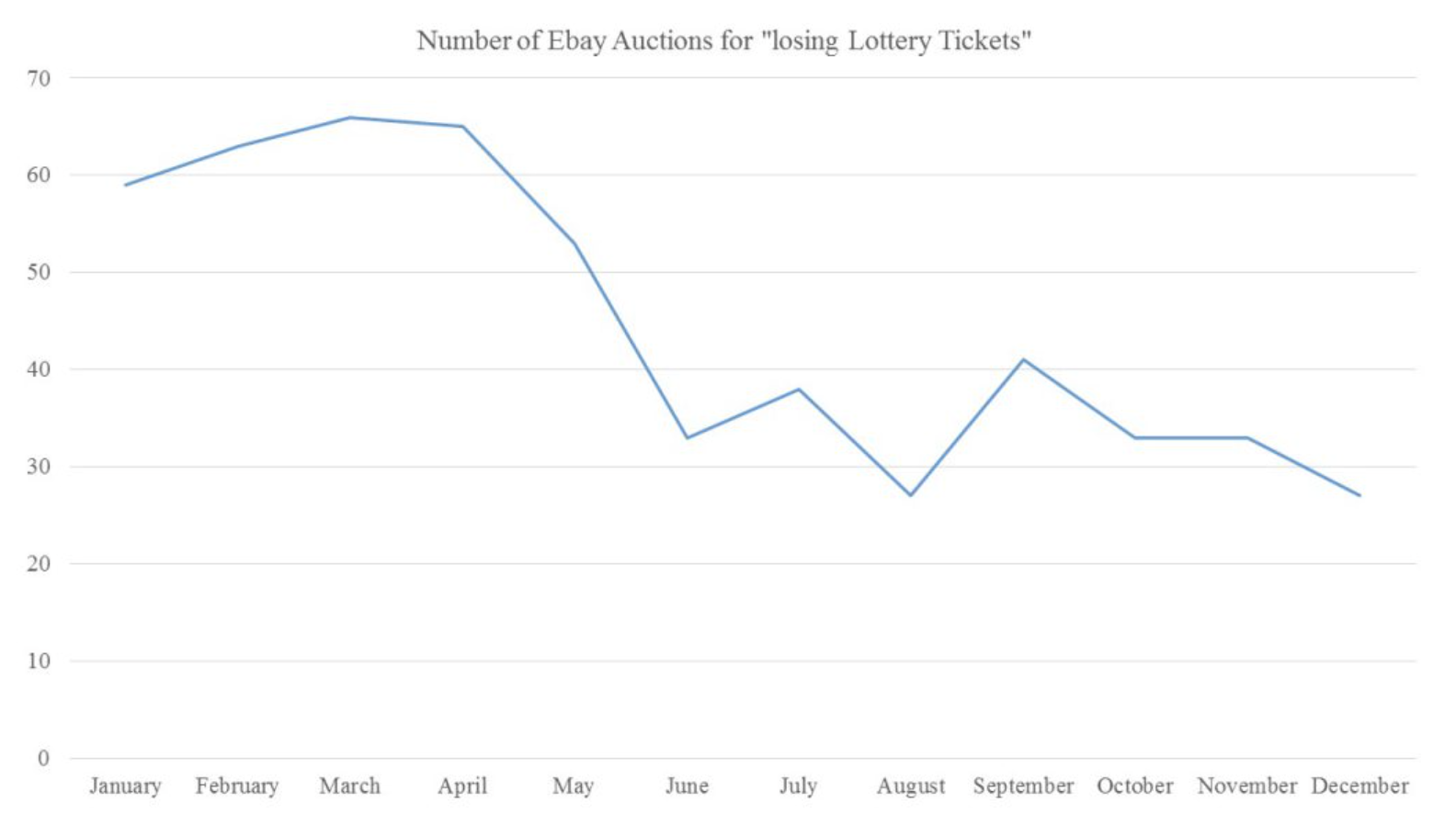
The timing points to three different kinds of fraudsters, Hoopes said: someone stocking up in April while filing a return, someone buying in December while closing out the year’s paperwork, or someone buying only after getting audited—in which case purchases would spread evenly through the year rather than cluster.
Whatever the timing, Hoopes doesn’t hedge on what the purchase amounts to. He compared it to fabricating receipts for a small business: most people commit that kind of fraud simply by not reporting income, he said, but some are tempted to manufacture paper to back up invented expenses.

One thing has changed since Hoopes first wrote about this: the tax treatment of gambling losses itself. Under the the One Big Beautiful Bill Act Congress passed last year, gamblers can no longer fully offset their losses against their winnings.
Starting with the 2026 tax year, only 90% of gambling losses are deductible against winnings, down from 100% before. Someone who won $100,000 and lost $100,000 in the same year could once wipe out the tax bill entirely; now the same break-even year leaves $10,000 of taxable “phantom income.” That means even a perfectly documented, perfectly legitimate loss now shields less of a winner’s tax bill than it used to.
The revenue Congress expects to raise by tightening the loss-deduction rules is modest: the Joint Committee on Taxation projects the recently passed 90% cap will bring in only about $1.1 billion over 10 years.
This story was originally featured on Fortune.com


‘You’re always right with wine’: Meet the woman behind 1 in every 4 bottles of Oregon wine sold in America.
Amy Prosenjak was running inventory for a billion-dollar furniture company in Ohio when her husband floated an idea that would change their lives.
Prosenjak and her husband were in their early 30s and had fallen in love with wine tourism, traveling to Napa and to Italy whenever they had the chance. One day, her husband asked why she didn’t get a job in the wine business.
“I said, ‘Well, who would hire me?’” Prosenjak recalled. “And he said, ‘I don’t know.’”
WineJobs.com answered that question for them. A to Z Wineworks, then a small Oregon winery owned by two couples and in the process of buying Rex Hill, happened to be looking for a chief financial officer, and Prosenjak said she sent her resume “kind of on a whim.”
One of A to Z’s founders, Bill Hatcher, who was CEO at the time, called to ask whether she understood cost accounting, and Prosenjak replied, “I’m the director of inventory for a $1 billion furniture company. That is my specialty.”
“He said, ‘Well, I can teach you the wine business,’” Prosenjak said. “And he did.”
Prosenjak sold her house, moved across the country and began what she calls a “wonderful and wild 20-year ride.” Today, 53-year-old Prosenjak is president and CEO of A to Z Wineworks LLC, overseeing A to Z, Erath and Rex Hill, brands that account for roughly one in every four bottles of Oregon-origin wine sold in U.S. multi-outlet retail, according to Circana data. That measure covers grocery, mass, club and drugstores, but leaves out restaurants, tasting rooms and most independent wine shops.
The industry Prosenjak learned to scale has changed drastically. After years of expansion, production across the company’s brands fell about 32% in 2025 to 550,000 9-liter cases, according to the company. A to Z expects to remain around that level in 2026.
“We’re going to follow the consumer,” Prosenjak said. “If we need to be a slightly smaller company, we will do that because we’re going to stay true to our winemaking values. But we want to stay profitable.”
Prosenjak spent much of her career helping build one of Oregon’s largest wine businesses. Her challenge now isn’t simply figuring out how to keep growing it, but how to keep it relevant as the American consumer who fueled the industry’s growth changes.
The Smurfette in the room
When Prosenjak arrived at A to Z, the company was producing about 80,000 cases a year. She said she felt liberated working in a family-owned business where decisions could happen almost instantly.
“We were this kind of unit of trying to figure things out together,” she said. “Within an hour, you could change a policy or do something that benefited your employees.”
Her corporate experience helped give the growing winery a framework to scale. Eventually, Prosenjak moved from CFO to president and then CEO, a progression she describes as more organic than planned.
Growing up, Prosenjak had a poster featuring Smurfette surrounded by male Smurfs. A doorway on it was labeled “president,” alongside the message that girls could do anything.
“I was just encouraged at a young age that I could do anything,” she said.
She’s not the smurfette anymore, though. About 52% of A to Z’s roughly 65-person core team identifies as female, as does about 55% of management, according to Prosenjak. She said winemaking and viticulture have also become more balanced, but distribution remains heavily male-dominated. She still sometimes walks into distributor meetings as the only woman in the room.
Those aren’t the only rooms Prosenjak has learned to navigate. She keeps a closet of clothes at the winery because her job can take her from a construction site to the office to a community event in the same day.
“You need different outfits, different shoes,” she said. “I love shoes.”
She jokes that when she worked for The Limited, nobody invited her to an event and asked her to bring jeans. With wine, people ask her to bring the product.
From family ownership to private equity
The company around Prosenjak has transformed, too. The A to Z she joined was owned by two couples. Today, A to Z Wineworks LLC is wholly owned by private equity firm Sycamore Partners. Sycamore bought Ste. Michelle Wine Estates from Altria for approximately $1.2 billion in 2021, and Ste. Michelle acquired A to Z in September 2022. The terms of the A to Z acquisition were not disclosed.
Prosenjak and her management team retain operating autonomy, according to the company. She sits on A to Z’s board alongside Sycamore representatives and reports results to the board monthly.
“It’s different than being family-owned, but it is a different time in the industry cycle,” Prosenjak said.
Wine is not like shampoo
Scaling a winery presents a problem Prosenjak didn’t encounter in furniture or fashion.
“You have to predict the future,” she said. “You’re never correct about what’s going to happen.”
Wineries have to plan for grapes years before the resulting wine reaches consumers. If demand doesn’t materialize, production can’t simply be turned off overnight. Mother Nature complicates the equation further because the same vineyard can yield different amounts of grapes each year.
“It’s not like you’re making shampoo where you can say, ‘I’m going to make one gallon and that’s all I’m going to make,’” Prosenjak said.
When consumer demand falls faster than production can adjust, unsold wine can sit on the balance sheet while a winery works its way back into equilibrium. A to Z said its 32% production reduction reflected changing consumer demand, retailers dedicating less floor space to wine, distributor consolidation and weaker export demand. The company scaled back portions of contracts with all of its growers and reduced its harvest intern needs.
The pressure extends beyond A to Z. Oregon’s 2025 vineyard and winery census found winegrape production fell 25%, case sales declined 16% and exports dropped 29%. More than half of growers reported leaving fruit unpicked.
Rob McMillan, founder of Silicon Valley Bank’s wine division, has been warning about a broader shift for years. SVB’s 2018 industry report cautioned that retiring baby boomers and younger consumers with different preferences would make it increasingly difficult for wineries to routinely increase both prices and volume.
“The industry was doing very well, and had been doing very well for roughly 30 years,” McMillan told Fortune. “I think it’s probably one of the harder things for any business to do when things are going well: change.”
Now that correction is underway. SVB estimates U.S. wine volume fell to about 329.2 million cases in 2025 from 335.9 million in 2024 and expects declines to moderate before the market reaches what it calls a “bumpy bottom” in 2027 and 2028.
The pain isn’t evenly distributed. “The under-$12 category is the part of the industry that is in greatest distress,” McMillan said. Among premium wineries SVB tracks, he said dollar sales are roughly flat and volume is down about 2%.
But McMillan argues the industry’s fundamental problem is bigger than Gen Z. Baby boomers historically favored wine more heavily when they drank, while younger generations spread their choices more broadly across wine, beer, spirits and other beverages. When an older wine consumer exits the category, one younger consumer doesn’t necessarily replace that demand.
“It’s not about people not liking wine or not understanding wine,” McMillan said. “It’s really just about the change in demographics.”
The consumer gets to vote
When Prosenjak entered the industry, White Claw didn’t exist. Today, consumers can choose among wine, beer, spirits, canned cocktails, nonalcoholic drinks, lower-calorie products and cannabis beverages depending on the occasion.
Prosenjak isn’t assuming A to Z will simply return to the growth trajectory that defined much of her career, but she also isn’t treating the industry’s decline as a catastrophe.
“We’re trying not to panic in this present tense of like everything’s terrible in the industry,” Prosenjak said. “It’s hard, for sure. But we should try to bring some of the fun, leave room for the fun.”
If demand calls for a smaller operation, she said, the company is prepared to accept that. If we need to be a slightly smaller company, we will do that because we’re going to stay true to our winemaking values,” Prosenjak said.
This story was originally featured on Fortune.com
The new crescent: Mecca pact gives rise to a Saudi-led Sunni bloc, posing new challenges for Israel
The Mecca Joint Defense Agreement, signed on August 7 by Saudi Arabia, Turkey, and Pakistan, represents the first formalization of the slow emergence of a conservative Sunni Islamic bloc intended to provide a strategic counterweight against both Israel and Iran. In recent months, many Middle East analysts have taken note of this nascent development.
The implications of the emergence of this bloc are already more than symbolic. It has its foundations in existing and growing bilateral ties between these countries in the fields of trade and economic relations and military cooperation, and is not only a matter of declarations.
The Mecca pact does not include all members of this axis. In their different ways, Qatar and the emergent regime in Syria are both components of the emerging bloc. Indeed, in many ways these countries are a more natural fit for membership than Saudi Arabia. The pact is therefore significant mainly because it indicates that Riyadh seeks at least one foot in this emergent axis.
Israel should be watching the slow crystallization of this bloc carefully. Jerusalem, and Islamic claims there, are likely to form the symbolic element that knits the emergent group together. Symbols, and especially Jerusalem, often end up acquiring practical political and sometimes military form, as has been witnessed in the region over the last three years.
The Mecca pact was announced with portentous language, which promised more than it looks set to immediately fulfill. According to the key part of the joint statement: “The agreement is intended to strengthen collective deterrence against any act of aggression, and stipulates that any armed attack against any one of the three states shall be regarded as an attack against them all. It further provides for the enhancement of all aspects of defense cooperation among the three states.”

Trilateral pact seeks to replicate NATO’s Article 5, treating an attack on one as an attack on all
This sounds – and is intended to sound – like an unambiguous joint military guarantee, reminiscent of NATO’s Article 5, according to which an armed attack against one alliance member “shall be considered an attack against them all.”
No one, however, seriously believes that the Mecca pact obliges, say, Turkey to enter war against India if Pakistan is attacked by it, or Pakistan to fight Iran if the IRGC or one of its proxies attacks Saudi Arabia. The latter instance, indeed, has already been tested with subsequent Houthi attacks on Saudi Arabia, predictably triggering no response from Riyadh’s new fellow Mecca pact members. No one also expects Pakistan’s nuclear umbrella to now be extended over Saudi Arabia and Turkey either.
In this regard, it is worth remembering that NATO’s Article 5 itself does not oblige member states to declare or enter war against a country attacking a fellow NATO member. Rather, Article 5 only requires a member state, in such an eventuality, to “take such action as it deems necessary, including the use of armed force.” The Mecca pact is more vague and does not detail what an attack “on one member as an attack against all” is supposed to imply.
But while the declaration contains less than meets the eye, this should not lead to the conclusion that the emergence of the Mecca pact is entirely without significance.
The core element in it is the bilateral relationship between Turkey and Pakistan. The steady growth and solidifying of strategic and defense ties between these two countries over the last decade has been a notable element of the regional strategic picture.
In a deal worth $1.5 billion in 2018, Pakistan’s navy purchased four MILGEM-class ships from Turkey. The deal constituted Turkey’s largest single defense export agreement. The two countries are cooperating on drone development. Turkey has helped upgrade Pakistan’s fleet of F-16 fighter bombers. Turkey is today Pakistan’s fourth-largest supplier of arms (the largest is China).
Ankara and Islamabad are united by a similar outlook combining conservative Sunni political Islam with an assertive, increasingly militant stance toward rivals. The Mecca pact is intended to form a component in the formalization of growing practical ties between these allies.
Saudi Arabia’s place at this particular table is more complex. Crown Prince Mohammed bin Salman was, until the outbreak of war in the region three years ago, often grouped alongside the leaders of the United Arab Emirates and Bahrain as one of a group of emergent Gulf leaders seeking to transcend old allegiances and rivalries, and move closer to Israel as part of an orientation geared toward economic and technological development.
The Abraham Accords of 2020 represented the organizational manifestation of this trend. It should not be assumed that Riyadh has conclusively abandoned this orientation. But in the new post-October 7 Middle East, military defense and religious and civilizational symbolic loyalties are very much back front and center.
In this environment, Riyadh has noted well what currently looks like the failure of the US to achieve its war aims against Iran, or to adequately defend Gulf countries against Iranian attacks. The more general desire of Washington to withdraw from major commitments in the Middle East has surely also been noted.
Saudis hedge to signal to the US and regional allies that they have other options
This does not mean that Saudi Arabia is now placing its trust in Islamabad or Ankara for its defense. It does mean that the Saudis are hedging, and want to convey to the US and its regional allies that they have options, and many potential partners (even ones who, in practical terms, can apparently promise little in kinetic terms against Iran and its proxies).
Even after the current agreement, Saudi Arabia remains a sought-after outlier in the emergent Sunni alliance, rather than a core component of it. Other than Turkey and Pakistan, the third key member of the group is Qatar, with extensive ties and a common outlook to both of these countries.
From an Israeli point of view, a number of elements regarding this alliance (Turkey-Pakistan-Qatar) should be noted: it is on the rhetorical level jointly and extremely anti-Israel.
A week ago, Pakistani defense minister Khawaja Asif called for a “united military front” of the Islamic world against Israel. Turkish President Recep Tayyip Erdogan recently said, “Zionism threatens not only me, not only our party, not only our alliance; it threatens everyone,” and so on. The rhetoric is also backed up by actions. Turkey and Qatar are, along with Iran, the main practical supporters of Hamas.
Lastly, there is an additional member of this alliance: the emerging Sunni Islamist regime of Syrian President Ahmed al-Sharaa. Turkey and Qatar are the main allies of that new regime. Ankara is currently engaged in the building of a 200,000-strong new Syrian army, controlled and staffed by Sunni Islamist commanders.
A recent Channel 11 news report revealed that an unnamed Middle East country had advised another unnamed Middle East country to conclude an agreement with Israel in order to buy time and build strength before breaking the agreement and launching war with Israel.
While the names of the countries were not revealed, Middle Eastern strategic logic would suggest that the advised country was almost certainly Syria, and the advising one either Turkey or Qatar.
This appears to indicate that the anti-Israel statements of this emergent alliance are not just rhetoric. Rather, they form an integral element in its strategy. Strategic planners in Jerusalem should be taking careful note.
A $50 million hostage ransom funded al-Qaeda terrorism in West Africa, UN says
An estimated $50 million ransom paid to free a hostage seized by al-Qaeda-linked terrorists in Mali in late 2025 has helped to fund their advances across West Africa and the group’s global network, United Nations experts said.
A new UN report detailing the use of the ransom did not identify the hostage or say who had made the payment.
Three regional sources identified the country that made the payment as the United Arab Emirates. The sources said that an Emirati citizen, as well as two other foreigners who had been kidnapped but were not referenced in the UN report, were freed after money changed hands. They did not explain how it had been done.
In response to questions about the kidnapping and ransom payment, a UAE official did not address the specifics of the case but said the country was unwavering in condemning and countering extremism and terrorism.
“UAE continues to strengthen its counter-terrorism efforts through active engagement in relevant international and regional frameworks, and through sustained efforts to cut off sources of extremist financing and counter extremist ideology,” the official said.
UN sanctions committee discussed report last week
Most of the money went to fighters operating in the Sahel region, but some also flowed to al-Qaeda in Yemen and the organization’s core leadership, which is likely to be in Iran or Afghanistan, the UN report said.

It was not possible to reach the al-Qaeda affiliates in Africa and Yemen for comment. Mali’s government did not immediately respond to requests for comment on the incident.
The two other hostages freed were from Pakistan and Iran, two regional security sources said, without detailing any ransom payments. The Pakistani and Iranian governments did not respond to requests for comment.
The UN report, written by a team that monitors al-Qaeda and Islamic State (ISIS) on behalf of the UN Security Council, was presented to the UN sanctions committee behind closed doors last week, a source with direct knowledge told Reuters.
It is dated August 10 but appeared on the UN website the following day.
The findings underscore how a single ransom payment can reshape the finances and reach of a terrorist network. With al-Qaeda’s strongest affiliates now in Africa, the cash injection has bolstered fighters who have expanded across several West African countries and challenged governments backed by Russian forces, regional security officials and military experts said.
The UAE has become an increasingly important partner for Mali’s military-led government, expanding trade and investment links, and is also a key destination for gold produced by Mali’s informal miners.
Al-Qaeda, once led by powerful figures in Afghanistan and Pakistan and supported by influential branches in the Middle East, has evolved into a decentralized network whose strongest members are now in Africa.
The UN report said that most of the “approximately $50 million ransom received in 2025 for the release of a hostage” was redistributed among katibas – a term used to describe groups operating across the Sahel region that are part of a coalition of militants known as Jama’at Nusrat al-Islam wal-Muslimin (JNIM).
“These funds played a key role in financing the group’s offensive across Mali,” the report said, without specifying how the funds were transferred or what they were used for.
JNIM has 7,000 to 8,000 fighters in Africa’s Sahel region, half of whom are in Mali, the report said.
The al-Qaeda-linked Sahel terrorists operate across territory in Mali, Burkina Faso and Niger as well as Benin and Togo to the south, while helping support al-Qaeda more broadly.
By enabling the militants to pay for the arms, logistics and fighters needed to extend their insurgency across the desert region, the ransom gives them significant influence there, as well as within the global al-Qaeda network, experts on the conflict said.
Kidnappings provide cash, undermine confidence in the state
The UN reports do not say how the UN experts knew where the ransom money had gone – they are briefed by intelligence services around the world and also obtain information from their own sources.
Advances by JNIM in Mali this year, as well as insurgencies raging in neighboring Burkina Faso and Niger, have underscored the threat and influence of al-Qaeda and Islamic State-linked groups across West Africa.
In April, JNIM fighters allied with separatist rebels attacked Mali’s capital and a string of towns across the country, killing the defense minister.
Kidnapping has long been a lucrative activity for militant groups, but last year’s payment dwarfs previous ransoms, which are generally in the range of $4 million to $6 million for foreigners, security sources said.
JNIM sees kidnappings both as a funding source and as a way to undermine confidence in state security, the UN report said.
In June, JNIM issued a statement offering millions of euros for information on the whereabouts of Mali’s president and top military officials.
The UN report said a portion of the $50 million ransom was allocated to al-Qaeda in the Islamic Maghreb, a member of JNIM that is the official al-Qaeda affiliate in North Africa.
This entity then passed some cash on to al-Qaeda core leadership, as well as al-Qaeda in the Arabian Peninsula (AQAP), a faction in Yemen, the report said.
Reuters was unable to reach those al-Qaeda groups to verify the information or establish how much money had been received.
This week in Jewish history: Moses ascends Mount Sinai, a massacre shakes Hebron
Elul 1, 2448 (1312 BCE): Moses ascended Mount Sinai for the third time and remained there for 40 days, during which time he obtained God’s wholehearted forgiveness for the people of Israel. He then came down on the 10th of Tishrei (Yom Kippur) with the second Tablets of the Law (Exodus 33:11). Ever since, the month of Elul serves as the “month of Divine mercy and forgiveness.”
Aug. 15, 2005: The Gaza Disengagement began with 14,000 IDF soldiers and police officers forcibly evicting more than 8,500 Jewish residents who chose to remain in their homes in 25 towns. The government’s hopes that the Disengagement would open “new opportunities” in relations with the Palestinians were bitterly disappointed. The vacated settlements were used to launch terrorist attacks against Israel, including unremitting rocket fire on the nearby Israeli town of Sderot, and eventually led to Oct. 7.
Elul 3, 5695 (1935): Yahrzeit of Rabbi Avraham Yitzhak Kook, Talmudic scholar, philosopher, prolific author, first chief rabbi of the Ashkenazi community of pre-state Israel, and the founding father of the “religious Zionist” movement. He developed warm relations with the secular pioneers who were building Israel and maintained that the modern return to Zion was “the beginning of the redemption, and the harbinger of the coming of the Messiah.”
“It is forbidden for religious behavior to compromise a personal, natural, moral sensibility. If it does, our fear of heaven is no longer pure… and we have certainly been mistaken in our faith.”
Aug. 17: Birthdays of Samuel Goldwyn (1879), movie producer and one of the founders of Hollywood; Mikhail Botvinnik (1911), world chess champion (1948-1957, 1958-1960, 1961-1963) and developer of chess computers; and Sean Penn (1960, Jewish father), American actor, director, screenwriter, and producer, who has won two best actor Academy Awards for his roles in Mystic River (2003) and Milk (2008).

Aug. 18, 1790: In response to a letter from the Jewish community of Rhode Island, president George Washington responded: “The Citizens of the United States of America have a right to applaud themselves for having given to mankind… a policy worthy of imitation… For happily the Government of the United States, gives to bigotry no sanction, to persecution no assistance… May the Children of the Stock of Abraham, who dwell in this land, continue to merit and enjoy the goodwill of the other Inhabitants; while every one shall sit in safety under his own vine and fig tree, and there shall be none to make him afraid…” Washington’s letter is still housed in the Touro Synagogue in Newport, RI.
Aug. 19, 1845: Birthday of Baron Edmond de Rothschild, head of the French branch of the famed banking family. He was known as the “Father of the Yishuv” due to his financing almost single-handedly the pre-state agricultural villages of Rishon Lezion, Zichron Ya’acov, Gedera, Rosh Pina, and 30 others. He also established Israel’s wine industry when he helped Russian Jews flee pogroms in the 1880s and plant vineyards in Israel.
More famous birthdays, a massacre in Hebron
Aug. 20, 1940: Leon Trotsky (Lev Bronstein), Russian Communist revolutionary and theorist and the founder and first leader of the Red Army, who organized the armed uprising against the tsar, placing the Communists in power, was assassinated, most likely on orders from Joseph Stalin.
Aug. 21, 1973: Birthday of Sergey Brin, American computer scientist, co-founder of Google, and one of the richest men in America.
Aug. 22, 1654: Jacob Barsimson, the first Jew known to settle in North America, arrived in New Amsterdam from Holland.
Aug. 23: Birthdays of Nobel Prize laureates in Economics, Kenneth Arrow (1921), “for his pioneering contributions to general economic equilibrium theory and welfare theory,” and Robert Solow (1924), for his work on the theory of economic growth.
Aug. 24, 1929: In Hebron, 67 Jewish men, women, and children were slaughtered, and scores were wounded, raped, and maimed by their Arab neighbors, who rioted for three days amid cries of “slaughter the Jews.” Jewish homes were pillaged, synagogues were desecrated, a Jewish hospital, which had provided treatment for Arabs, was attacked and ransacked, and the ancient Jewish community of Hebron, which had lived in relative peace for hundreds of years, was not revived until it was recaptured in the 1967 Six Day War.
Aug. 25, 1933: The “Transfer Agreement” was signed between representatives of the World Zionist Organization and the German government, in which German goods were purchased and exported to pre-state Israel and sold there, and the proceeds were used by new immigrants from Germany to start their lives. Between 1933 and 1941, over 20,000 German Jews transferred more than $30 million using this mechanism.
Aug. 26, 1906: Birthday of Albert Sabin (Abram Saperstejn), developer of the “live” form of the polio vaccine, which does not require refrigeration and can be taken on a sugar cube. This development eliminated the need for needles and sterilization facilities, thereby making worldwide immunization possible. Sabin refused to patent his vaccine or profit from it, so that the low price would guarantee a more extensive spread of the treatment. He also developed vaccines for encephalitis and dengue fever.
Aug. 27, 1945: The 1,310 surviving Jewish refugees fleeing Europe who were forcibly transferred to Mauritius by the British government were allowed into Israel.
Aug. 28, 1903: The Protocols of the Elders of Zion, a fabricated antisemitic text purporting to describe a Jewish plot for global domination, was first published in serialized form in Zmaya, a St. Petersburg daily newspaper. Despite having been exposed as fraudulent, it has been translated into multiple languages and disseminated internationally. Henry Ford funded the printing of 500,000 copies that were distributed throughout the United States in the 1920s. Described as “probably the most influential work of antisemitism ever written,” to this day it remains widely available in numerous languages, in print and on the Internet, and continues to be presented by neo-fascist, fundamentalist groups as genuine.
Aug. 29, 1897: The World Zionist Organization was founded at the first World Zionist Congress, which opened in Basel, Switzerland, with 200 delegates from 16 countries. Theodor Herzl, who financed it himself, noted in his diary: “At Basel I founded the Jewish State.”
Aug. 30, 1897: Hermann Schapira, a Lithuanian rabbi and mathematician, presented his idea at the World Zionist Congress for what would become the Keren Kayemeth LeIsrael-Jewish National Fund (including the ubiquitous blue box for collection), to purchase and cultivate land in pre-state Israel. Debated for years, the KKL-JNF was established only at the 5th Zionist Congress after a push from Herzl to make it happen.
Elul 18, 5494 (1734): After many years as a member of a society of “hidden tzaddikim,” living under the guise of an ignorant clay-digger, Rabbi Yisrael Baal Shem Tov, the founder of Hassidism, was instructed by his masters to reveal himself on his 36th birthday and begin to publicly disseminate his teachings, emphasizing the importance of joy and simple faith. Initially, his teachings encountered fierce opposition from the established leadership of the Jewish community, but by the time he passed away at age 62 on Shavuot of 1760, the movement he founded had spread significantly.
Sept. 1, 1967: In response to the Israeli offer to return the Sinai to Egypt and the Golan Heights to Syria after the Six Day War, the Arab League meeting in Khartoum, Sudan, issued its infamous three nos: “No to peace, no to recognition, no to negotiations.”
Sept. 2, 1796: Holland granted equality to its 50,000 Jews.
Sept. 3, 1905: Birthday of Nechama Leibowitz, Bible scholar, beloved teacher, and author of popular study guides to the weekly Torah portion. She was awarded the Israel Prize in 1957 for her pioneering literary approach to the Bible and for furthering its understanding and appreciation.
Sept. 4: Birthdays of Darius Milhaud (1892), French conductor, teacher, and one of the most prolific composers of the 20th century, and David Broza (1955), Israeli folk-rock singer and songwriter who has been successful on the international rock circuit.
The Munich Olympics, Israeli history milestones
Sept. 5, 1972: At the Olympic Village in Munich, eight Arab terrorists from the Black September Organization kidnapped and held Israeli athletes for ransom. During a botched attempt by German police to free them, 11 were murdered.
Elul 24, 5693 (1933): Yahrzeit of Rabbi Yisrael Meir Kagan, revered author of over 30 works on Jewish ethics and laws, including Chafetz Chaim (“He who desires life”) and Mishna Berurah, founder of the Yeshiva of Radin, Talmudist, and moralist. Earning his living as a teacher and shopkeeper, he consistently refused a rabbinical post.
Sept. 7, 1827: Tsar Nicholas I issued a decree in Russia to draft Jewish boys at the age of 12, place them in schools for military education until age 18, and then obligate them to another 25 years of military service. Most of the 50,000 “cantonists” never returned to the families they had left at age 12.
Sept. 8, 1949: The Knesset passed Israel’s draft law, making it obligatory for every Jewish youth in Israel to serve in the military forces.
Sept. 9, 1940: An Italian air raid on Tel Aviv killed 117 and wounded 150.
Sept. 10, 1952: Israel signed an agreement to accept reparation payments from West Germany for losses caused by the Nazis, over the objections of Menachem Begin, who was concerned that they could be perceived as somehow “absolving” Nazis of their heinous crimes.
Sept. 11, 1923: The Daf Yomi, a seven-year cycle of studying a page of Talmud a day, was initiated by Rabbi Meir Shapira of Lublin on Rosh Hashanah. Today, tens of thousands of Jews study the “daily daf” all over the world.
The above is a highly abridged monthly version of Dust & Stars – Today in Jewish History. To receive the complete newsletter highlighting seminal events in this most unlikely story and the remarkable Jews who have changed the world: dustandstars.substack.com/subscribe
Rashida Tlaib rally canceled at Florida venue after lawmaker calls event ‘anti-Jew’
A South Florida site backed out of hosting a rally with Democratic US Representative Rashida Tlaib, a vocal critic of Israel’s government, after complaints by a Democratic state lawmaker in the party’s latest flashpoint over its stance on Israel.
Tlaib, the first Palestinian American member of Congress, was scheduled to appear on Friday at a rally for three candidates in Florida’s upcoming Democratic Party primary.
However, The Venue Fort Lauderdale, which was scheduled to host the event, suddenly canceled it after State Representative Michael Gottlieb, chairman of the Florida Legislative Jewish Caucus, posted a statement on Thursday calling the planned rally an “anti-Jew” gathering.
Tlaib has condemned antisemitism and says criticism of Israel’s occupation of Palestinian territories and its attacks in Gaza and Lebanon is not antisemitic.
The Venue in a statement cited “increased security concerns” for its decision and said it is Jewish-owned and “our values and commitment to the Jewish community are deeply important to us.”

Opposing US support for Israel
Prominent progressive Democrats, including Tlaib and New York City Mayor Zohran Mamdani, have opposed US support for Israel over Israeli attacks in Gaza and Lebanon, the US-Israeli war with Iran and Prime Minister Benjamin Netanyahu’s close ties to Republicans, leading to an erosion of Democratic backing for Washington’s ally.
The rally was organized by groups such as “Florida Youth Justice Coalition,” “Gen-Z For Change” and a local chapter of the Democratic Socialists of America.
It was meant to support State Representative Angie Nixon, who is running for the US Senate; and Elijah Manley and Oliver Larkin, who are seeking seats in the US House of Representatives.
After The Venue withdrew its support, the event was expected to proceed Friday night at a Fort Lauderdale wine bar, an organizer told The New York Times.
The Florida Democratic Progressive Caucus said the cancellation of the rally was rooted in anti-Muslim sentiment. Florida’s primary elections are scheduled for August 18.
Voices from the Arab press: Mecca pact will strengthen security, stability
Mecca Agreement: Yes to strengthening security, stability
Al Rai, Kuwait, August 8
The Mecca Joint Defense Agreement between Saudi Arabia, Pakistan, and Turkey represents an important milestone in strategic cooperation among Islamic countries, with objectives centered on strengthening collective security, developing joint defense capabilities, and reinforcing solidarity in the face of regional and global security challenges.
The agreement comes amid rapidly changing regional and international conditions, making coordination among friendly and brotherly states essential to preserving stability and protecting shared interests.
It is built on a clear principle: an armed attack against one party is considered an attack against all, thereby strengthening collective deterrence, raising the level of military, security, and political coordination among the three countries, and sending a message that their security is interconnected and that preserving their stability is a shared responsibility.
Such cooperation is intended not only to strengthen regional stability and reduce the risk of escalation, but also to unify efforts, exchange expertise, and improve defense readiness.
The importance of the agreement extends beyond the military sphere into political, economic, and strategic dimensions. It can deepen relations among the three states, reinforce mutual trust, and open wider avenues for cooperation in defense industries, military training, and modern technologies, while also supporting investments and joint projects that benefit the participating economies and contribute to development and stability.

The agreement also reflects a shared understanding that contemporary challenges require collective action, whether in response to security threats, regional crises, or dangers affecting maritime routes and international trade.
This cooperation can raise the level of coordination among military and security institutions and facilitate the exchange of information and expertise in support of regional security.
The agreement has been welcomed by many observers of Islamic and international affairs as a step that strengthens cooperation among Islamic countries within a framework that respects national sovereignty and seeks to protect security and stability.
The Muslim World League likewise welcomed efforts aimed at reinforcing Islamic solidarity and coordinating responses to shared threats, emphasizing the importance of unity and cooperation among Islamic states.
The success of such agreements should not be measured only by their defensive provisions, but by the atmosphere of cooperation, trust, and integration they create, and by the opportunities they provide to strengthen peace and prevent conflicts before they occur, through deterrence and coordination. They also reaffirm that collective action among friendly states remains one of the most important means of preserving regional security and protecting the higher interests of their peoples.
In the end, the Mecca Joint Defense Agreement offers a model of strategic cooperation based on shared interests and mutual respect and reflects the participating states’ desire to build a more coordinated and capable defense architecture.
Continuing along this path can help consolidate security and stability, expand opportunities for development and prosperity, and confirm that solidarity among brotherly states remains one of the principal pillars of peace and security in the region. May God preserve our Gulf in safety and stability.
– Dr. Issa Al-Amiri
The ‘alliance’ against Tehran on three fronts
Asharq al-Awsat, UK, August 9
It has become clear that the war Iran is waging is directed against Saudi Arabia and its Gulf sisters, not primarily against the US or Israel. Since February, Iran has attacked Saudi Arabia with more than a thousand drones, in addition to ballistic missiles aimed at civilian and military facilities, while expanding the confrontation through Iraq and Yemen in an effort to encircle the kingdom.
Riyadh, in turn, surprised Tehran by forming a bloc of three states that border Iran. The new alliance changes the balance of power against Tehran: Turkey and Pakistan are no longer spectators but frontline states, bringing strategic depth, greater military capabilities, a combined population of some 400 million – four times Iran’s – and more than 1,400 kilometers of land borders facing it. Turkey is a NATO member, while Pakistan is a nuclear power with close military ties to China.
This Saudi move will affect both the management of the conflict and the negotiations and will gradually deprive Iran of many of the advantages it enjoyed in its war with the US.
Last month, Iran escalated its attacks on northern and southern Saudi Arabia by opening two fronts from Iraq and Yemen.
The development coincided with Crown Prince Mohammed bin Salman’s work on the Mecca Agreement and the announcement of the trilateral military alliance with Turkey and Pakistan, which had been under preparation since last year. It is the second alliance Saudi Arabia has built and announced within a single week, following the establishment of an international maritime military coalition led by Riyadh.
The alliance with Turkey and Pakistan matters on three fronts: deterring Iran, defending the oil market, and shaping Arab and Islamic public opinion.
The first front is Iran itself. Tehran’s escalating military activity exposes its desire to widen the conflict and perhaps impose a new geopolitical reality in the Gulf by force.
The Riyadh-Ankara-Islamabad axis is designed to create a balance that deters Iran from considering further expansion into the Gulf and from targeting Jordan, Syria, and Yemen. A wider war would impose enormous costs on Iran’s leadership.
Tehran’s strategy in confronting the US has depended on holding oil hostage. It turned the closure of Hormuz, attacks on producing states, and threats to energy infrastructure into its strongest leverage against a superpower it cannot confront on equal military terms. The new Saudi-led axis deprives Iran of much of that card.
The alliance also enjoys broad international acceptance because many governments chose neutrality in the US-Israel-Iran war. Even states that considered confrontation with Iran justified believed the war had been launched without sufficient legal and diplomatic preparation.
The international support for the Saudi-Turkish-Pakistani axis can be seen in the broad backing for the multinational maritime coalition announced by Riyadh last week, whose meeting at the Saudi Ministry of Defense brought together 43 governments.
Both the Mecca and Red Sea initiatives are defensive, directed against Iranian aggression, and were prepared politically and legally in advance.
This front is not intended to protect Saudi Arabia alone; it also shelters the wider Gulf and the eastern Arab world. The objective is to stop an Iran that, after losing many of its centers of influence through the destruction of Hezbollah and the fall of the Assad regime, chose instead to destabilize the region and create a new geopolitical reality through threats to Arab states. The outline of that plan became clear after the war resumed in late February, when Iranian attacks focused more heavily on Saudi Arabia, the Gulf states, and Jordan than on the two declared enemies in the war, the US and Israel.
The second front is oil, the battle the entire world is watching. Iran has sought to close both Hormuz and Bab al-Mandab, strike Gulf production and export facilities, and force the world to submit to its demands. Markets reacted immediately to the announcement of the new trilateral alliance, with oil prices falling on international exchanges.
The third front is public opinion: the hearts and minds of roughly 300 million Arabs and more than a billion Muslims worldwide. They had been watching a war marketed to them as an American-Israeli assault on a peaceful Muslim country. Because the war was not decided quickly, Iran devoted enormous effort to justifying its own aggression and depicting attacks on its neighbors as legitimate because those states supposedly belonged to the American-Israeli camp.
Faced with the new alliance, it will become much harder for Tehran’s propaganda machine to convince one-and-a-half billion people that Pakistan, Turkey, and Saudi Arabia are enemies of Arabs and Muslims.
Iran’s leadership, hiding underground, will lose the propaganda war as well. We will see Tehran’s aggressive behavior begin to change in the coming days.
– Abdulrahman Al-Rashed
Does the US-Iran war benefit China?
Al-Bayan, UAE, August 9
Is China benefiting from the US-Iran war, or is it being harmed by it, and where exactly do the gains and losses lie?
The question has become increasingly relevant following reports published last week by American media outlets, including CNN, Reuters, and The Washington Post, claiming that the US military has consumed around 80% of its interceptor missiles and certain types of munitions during the recent war.
According to those reports, this depletion was a major reason President Donald Trump stopped launching additional military operations against Iran.
Trump denied the reports last week and even threatened to prosecute what he called the “traitors” who had published false information.
Defense Secretary Pete Hegseth also denied them, yet at the same time requested more than $67 billion in additional congressional funding to cover the current fiscal year, warning that insufficient resources could threaten the military’s ability to replenish equipment and ammunition.
Trump had already asked major American defense companies months ago to accelerate production of weapons and munitions.
So, what does any of this have to do with China? Quite simply, if the reports of severe US stockpile depletion are accurate, Beijing will regard them as extremely welcome news. Many analysts already believe that strategic competition between the US and China for global leadership is unavoidable. Today it may be economic and technological; tomorrow it may become military. China is therefore watching the US-Iran war closely to identify American strengths and vulnerabilities. If US weapons stocks have indeed fallen sharply, that would expose a serious weakness.
The obvious question would be what happens if the US suddenly faces a military confrontation with China, Russia, or both, and how quickly it could replenish the weapons required.
Some observers argue that these reports may themselves be part of an American strategy of deception aimed at China. There is no definitive answer, because the outcome depends on several changing factors.
China would benefit significantly if the war continued at a limited level. The US military would require more aircraft carriers, air defenses, fighter aircraft, intelligence capabilities, precision missiles, munitions, and spare parts, potentially drawing resources away from the Pacific and Indian Oceans and giving Beijing greater freedom of movement in Asia.
A prolonged Middle Eastern conflict could also expand China’s economic influence, strengthen the Belt and Road Initiative, increase Chinese investment abroad, and reinforce China’s image as a power associated with peace, stability, and investment rather than war.
Yet perhaps the greatest benefit would be the opportunity to study American military performance in real conditions: ammunition consumption, logistical management, and the effectiveness of US air defenses. That information could help China plan for any future confrontation with the US over Taiwan or elsewhere in the Pacific. But this scenario would not produce pure gains for China or pure losses for Washington.
A long conflict that disrupts shipping and supply routes would immediately harm the Chinese economy, which depends heavily on Middle Eastern energy. Higher import costs would affect industry and therefore economic growth, while disruption to global trade, weaker demand, and rising transportation costs could contribute to a major slowdown in China itself.
Some experts therefore believe that a prolonged but limited American entanglement with Iran would benefit China, while a broad regional war would hurt Beijing through higher oil prices, disrupted supply chains, threatened maritime security, and declining global growth.
China’s ideal scenario would be the gradual exhaustion of its American competitor without the collapse of the world economy.
Its worst scenario, however, would be an American victory that destroys the Iranian regime and places Washington in a dominant position over global energy flows. In that case, the key to China’s economy could effectively end up in American hands.
– Emad El-Din Hussein
Translated by Asaf Zilberfarb. All assertions, opinions, facts, and information presented in these articles are the sole responsibility of their respective authors and are not necessarily those of The Media Line, which assumes no responsibility for their content.
Restoring serenity to religion
Al-Ittihad, UAE, August 9
After many years of following two intertwined phenomena – violent extremism in the name of religion and Iran’s efforts to penetrate Arab states – I arrived in 2014 at what I called three objectives: restoring serenity to religion, renewing and supporting the experience of the nation-state, and working continuously to ensure that we Arabs remain part of the world’s security and progress.
The great question that occupied our generation from the 1970s and 1980s onward was how religion, which is by nature a soft force that should inspire reassurance, tranquility, goodwill, and constructive action, became vulnerable to penetration by violence. The movements associated with the so-called Islamic Awakening made clear that they intended to use religion as a path to political power.
Some of us reassured ourselves that extremist movements represented only a small minority that peaceful majorities would never follow. Yet despite their limited numbers, as the 1990s and subsequent decades demonstrated, they were able to ignite sedition and attract sections of the public that were not confined to the poor or deprived.
One explanation may have been weak religious and social education, but the phenomenon lasted long enough to unleash a wave of terrorism that became global.
Under the cover of that wave, Iranian penetration expanded as well. Tehran exploited sectarianism but also worked through extremists who operated under slogans of sectarian identity, liberation, or hostility toward existing regimes and states.
Some governments were slow to confront these waves of extremism, manipulation, and blackmail, but eventually they recognized them for what they were: political and strategic threats.
Religious penetration and division nevertheless continued, and religious institutions, with state support, struggled against them until the waves receded without disappearing entirely.
The wars that erupted after 2023 reignited embers that had never fully died, now under the slogans of confronting aggression and seeking martyrdom. Yet decades of experience have taught us that militia struggles bring nothing but losses, and the devastation of the past three years has been unlike anything in our modern history.
Most disturbing of all is the transformation of religion into a game available to anyone skilled in manipulating emotion and psychology through illusions of revenge and defending the oppressed – when it is the oppressed themselves who end up paying the heaviest price for the benefit of those who use them, whether Iranian actors or political Islam movements.
The challenge was, and remains, how to restore religion’s immunity and dignity so that it cannot be humiliated or exploited. Nation-states are responsible for defending themselves and their societies against attack. Religion, however, is the responsibility of the communities that embrace its message of peace and security, the scholars who refuse to be deceived by mobilization and polarization, and the cultural and media figures who influence the public.
None of these groups should accept the use of religion in violence that divides societies, fragments communities, and destroys social harmony.
Perhaps Donald Rumsfeld, the US defense secretary under president George W. Bush, was sincere when he told Muslims that extremists had hijacked their religion and that they needed to liberate it from terrorist gangs. Sedition is created by a minority, while the majority suffers its consequences.
That is our condition today. Our duty is to protect our religion from exploitation, our states from targeting, and our societies from manipulation.
– Radwan al-Sayed
Bronx man arrested, charged with hate crimes after disrupting NYC synagogue services
A Bronx man was arrested and charged with hate crimes after disrupting Shabbat services at a New York City synagogue and assaulting both a congregation member and a security guard on Friday evening.
Larry Montes, 46, was charged with two counts of assault as a hate crime and one count of criminal mischief as a hate crime for the incident at Manhattan’s Central Synagogue, according to New York Police Department (NYPD) Commissioner Jessica Tisch.
This is a developing story.
Ancient Egyptian princesses were skilled archers, trained with weapons, controversial study claims
Ancient Egyptian princesses buried with weapons may have been trained to use them while alive, according to a controversial study published in the journal Frontiers in Environmental Archaeology in July.
Researchers examined six mummies found at the Dahshur funerary complex in the 1890s. The mummies, belonging to royal individuals from Egypt’s Middle Kingdom, date to nearly 4,000-years-ago.
“Members of the royal family, especially the women, were active participants in skilled, physically demanding activities such as archery and hunting,” said Lead author Dr. Zeinab Hashesh. “This conclusion is supported by the way their bones developed to sustain heavy muscle use, which corresponds directly to the weapons discovered in their tombs.”
The six, four of whom are believed to be daughters of Pharaoh Amenemhat II, were rediscovered in 2020 in the Egyptian Museum after being lost for decades.
After analyzing the mummies’ muscle attachments, researchers suggested that pronounced areas in their upper limbs indicate “repetitive, high-intensity actions like pulling a bowstring or stabilizing a weapon.”

Hashesh added that the conclusion explains the presence of weapons in the princess’s burial chambers, as they are traditionally associated with men.
Princess Ita, Princess Khenmet, Princess Itaweret, and an anonymous woman provisionally identified as Princess Sathathormeryt, were all buried with bows and arrows. Ita’s coffin also held a dagger.
The two other mummies, Princess Noub-Hotep and King Hor, were buried with similar items.
“Princess Ita was a young woman aged between 28 and 34 with strong upper-body muscle attachments, suggesting she habitually used weapons like maces or daggers,” explained Hashesh. “Princess Khenmet was a woman in her late 30s or 40s who showed signs of thinning bones, but had very robust ligament attachments. Princess Itaweret was a young woman aged between 20 and 34 who survived broken ribs and foot fractures; her skeleton shows she was a skilled archer.”
Experts challenge study’s claims
However, bioarchaeologists not involved in the study shared with Live Science that “skeletal changes cannot reliably indicate a specific activity,” adding that “age, body size, genetics and other repetitive movements can produce similar results.”
Sonia Zakrzewski, a bioarchaeologist at the University of Southampton who was not involved in the research, told Live Science in an email that the identities of the skeleton’s relies on 19th-century labels, which means that “we cannot be certain how reliable they really are.”
She added that while the attachment sites on the bones are pronounced, there is no way of proving that it was caused by archery, only that the muscles “appear to have been repeatedly used.”
“We cannot say therefore that these skeletal changes necessarily are associated with the use of weaponry,” Zakrzewski said, especially since the researchers did not also study any “control” groups from the time period.
“It would be very useful to know how much such side differences exist in contemporaneous Egyptians, whether royal or not,” she noted.
No clear reason why princesses buried with arrows
Additionally, she told Live Science that there is no clear reason as to why the princesses were buried with items like arrows.
“Archery is a highly asymmetrical activity,” Scott Haddow, a bioarchaeologist at the University of Turin not involved in the study, explained to Live Science via email. Finding the pronounced sites on both sides of the remains “does not make a particularly strong case for these individuals practicing archery.”
Haddow added that the individuals’ ages could also explain the differences, as “muscle-attachment sites are influenced by aging, as well as by body size and genetics.”
Other experts told Live Science they believe the researchers might be reading into the appearance of the weapons too much.
“Although the presence of funerary artifacts (e.g., arrows, daggers) makes the princesses’ involvement in such activities plausible, the authors provide limited biomechanical or biomedical evidence to substantiate this claim,” French anthropologist Sébastien Villotte told Live Science in an email.
Villotte, who works at the French National Center for Scientific Research, added that “a more robust approach would involve comparing these individuals to non-elite contemporaries from the same region and period.”
“This would help determine whether such degenerative changes (at these locations) were common in the general population (who were unlikely to engage in the same activities) or truly indicative of elite-specific behaviors.”
However, despite the lack of control group and other uncertainties, Zakrzewski told Live Science that the importance of examining the remains should not be disregarded as “it allows us to sort of put flesh on the bones and understand more about their lives.”
Deity-inscribed tombstones, sarcophagi unearthed at ancient Egyptian burial site
Some 20 limestone tombstones, several sarcophagi, and a collection of funerary amulets were discovered during excavations at the Tell El Deir archaeological site, Egypt’s Tourism and Antiquities Ministry announced two weeks ago.
The sides and backs of the tombstones are decorated with religious symbols and godly imagery, including that of a griffin, Agathodaemon, and Isis-Thermouthis.
Agathodaemon is a lesser serpent demon in ancient Graeco-Egyptian religion, as well as in classical Greek mythology. Isis-Thermouthis is a combination of the Egyptian goddess Isis, the sister and wife of Osiris, and Renenutet (Thermuthis), the Egyptian goddess of grain.
The appearance of the two dieties on the tombstones points to joint Greek and Roman influence on ancient Egyptian heritage and funerary practices.
Further, the decorations allow archaeologists to identify the social status of the tombstones’ owners.

Not only a burial place
Additionally, the Egyptian archaeological mission operating at the site uncovered a collection of pottery incense burners, decorated lamps, and funerary amulets, as well as several barrel-shaped style anthropoid ceramic coffins.
Secretary-General of the Supreme Council of Antiquities Dr. Hisham El-Leithy explained that the discovery “opens new horizons for understanding the development of cemeteries in the Nile Delta.”
He also said that the finds show that Tell El Deir as “not merely a burial place, but was an integrated funerary center.”
According to Leithy, the finds provide extensive insight into ancient Egypt’s funerary and burial customs from the Late Period (664 BCE until 332 BCE) and through the end of the Roman era.
Egypt unearths underground tombs in ancient coastal city
In early July, a collection of 18 tombs and numerous artifacts were unearthed during archaeological excavations ahead of construction of a visitor’s center in Egypt’s ancient city of Marina El Alamein.
Marina El Alamein, which flourished between the Hellenistic period until the Byzantine era, is located on Egypt’s northwestern coast, about 100 kilometers west of Alexandria. It is believed to be the city of Leukaspis mentioned by the Greek geographer Strabo.
The site was discovered in 1986 during construction work in the Marina area. Since then, extensive archaeological excavations and studies have uncovered one of the best preserved ancient coastal cities in Egypt.
Of the 18 tombs discovered in July, 11 are carved entirely into the rock, a style of tomb known as a hypogeum, explained Mohamed Abdel Badie, head of the Egyptian Antiquities Sector at the Supreme Council of Antiquities, while the other seven are made of limestone aboveground.
Some of the tombs are also very well preserved, with chamber entrances sealed by stone slabs that had not been opened since ancient times.
Eman Abdel Khalek, leader of the archaeological mission, added that a 2.5 meter long granite sarcophagus had been uncovered with its original lid still in place.
The skeletal remains found inside are currently being studied.

French man allegedly pulls knife on Israeli tourist in Australia, denied bail by Cairns court
A French man suspected of pulling a 20-centimeter knife on an Israeli man in Cairns, Australia, on Thursday was denied bail by the Cairns Magistrates Court, the Australian Broadcasting Corporation (ABC) reported on Friday.
ABC noted that the incident included verbal anti-Israel remarks, with the suspect to remain in custody by order of Magistrate Tom Braes pending his next court date on September 11.
Leo Raymund Cotene was charged with common assault with serious vilification or hate crime circumstances of aggravation following the incident, which allegedly occured at around 5 p.m. at Sheridan Street’s Mad Monkey Backpackers hostel, according to ABC.
ABC cited bail police prosecutor Olivier Claes, who opposed granting Cotene bail due to “the risk of further offending and endangering other members of the public, particularly those of Israeli origin or those of Jewish faith.”
Claes added that the “deliberateness” of Cotene’s alleged crime would likely result in a prison sentence.

According to the report, Cotene has lived in Australia since November 2025, has no criminal record, and has worked in the construction industry.
The report further cited comments by Cotene’s lawyer, Rowan King, during the 25-year-old suspect’s court hearing, in which he described the criminal allegations against Cotene.
“He’s hugged the complainant, who has told him not to touch him,” said King. “[Cotene] then responded, ‘I’ll hug you if I want.’ He’s then hugged him a second time.”
King noted that his client is not suspected of actually having “struck” the Israeli man, “or anything more sinister than that.”
‘F*** Israel’: Suspect’s alleged anti-Israel comments to victim
Regarding Cotene’s alleged anti-Israel comments, King cited them as including, “‘You kill people in Gaza‘, ‘I’m not staying in a hotel with an Israeli’ and ‘F*** Israel.'”
According to the report, King emphasized that there was “more to the story” regarding the incident, noting preexisting “animosity” between the victim and other hostel guests.
Before the incident, Cotene allegedly commented on the victim in a group chat called “International Incel Investigating,” which ABC noted 13 other hostel guests belong to.
An Instagram photo of the victim in an IDF uniform was allegedly posted in the group chat, with King reading aloud one of Cotene’s messages in court: “Next time I see him at the hostel, we might go out somewhere without cameras.”
AJA president: Australia a ‘wonderful country,’ but Jews, Israelis should be cautious
Australian Jewish Association (AJA) President Robert Gregory commented on the incident, saying Jewish and Israeli visitors to the country should “exercise caution.”
“I never imagined I would have to issue such a warning about our country, but antisemitism in Australia has deteriorated significantly in recent times,” said Gregory. “Hardly a day goes by without another disturbing incident being reported.”
“Australia remains a wonderful country, but Jewish people visiting Australia should be alert to the reality of the current environment,” he concluded.
Five killed in Michigan shooting, suspect found dead, police say
A man suspected of shooting and killing five people in northern Michigan on Friday was found dead after a manhunt, Michigan State Police said in a statement on social media.
One victim remained hospitalized in critical condition, the police said.
Troopers were dispatched around 11:40 a.m. local time (6:40 p.m. Israel time) to a home in Missaukee County, Michigan, after a report of a shooting. Officers found three people dead and a fourth person wounded, the state police said.
The suspect, identified by police as 39-year-old Chad Hickman, fled the scene before troopers arrived, prompting a manhunt. During the search for the suspect, investigators discovered another deceased victim at a second residence.
Troopers later located Hickman’s vehicle near a wooded area close to Whitlock Lake, where they found Hickman and another person dead, police said.

Police lieutenant: ‘Heartbreaking’ situation, challenge for investigators
“This situation is heartbreaking for the community and challenging for the investigators involved,” said Lieutenant Ashley Miller, cited in the police statement.
Police did not release the names, ages, or genders of the victims, saying next-of-kin notifications were underway.
Spain boosts security in Ceuta as calls appear online for another mass border rush
Spain has beefed up police and military presence in its North African enclave of Ceuta amid social media messages encouraging migrants to attempt another mass border breach on Saturday, two weeks after tens of thousands rushed into the city.
Soldiers in combat fatigues stood watch outside supermarkets and official buildings on Friday evening, while police cars heavily patrolled the enclave’s main avenues. Still, outdoor cafes were packed with diners, and the downtown area was calmer the in the days after the deadly rush on July 30.
On the other side of the border, dozens of black-clad Moroccan security personnel surveilled the beach in Fnideq from which many migrants who swam around Ceuta’s Tarajal breakwater departed. At least 96 people died in the attempt and over 72,000 managed to enter Ceuta, according to Spanish government estimates.
While the vast majority of them voluntarily returned to Morocco shortly thereafter, the crisis sparked a rift within the European Union and fueled anti-immigration rhetoric among far-right parties worldwide.
Spain has since installed a maritime barrier and sent over 500 additional police officers from the mainland. The Interior Ministry said they would remain as long as the situation required.

“We’ll continue to deploy whatever personnel are necessary to restore normality as soon as possible and prevent events like those of July 30 from happening again,” Interior Minister Fernando Grande-Marlaska told reporters in Ceuta on Thursday.
About 5,000 migrants remained in Ceuta, the minister said. Officials have started screening adults and decided more than 500 asylum cases, most of them rejected.
Grande-Marlaska added that people who entered irregularly would not be allowed to stay in the enclave, travel to mainland Spain or obtain legal status, except in rare cases of extreme vulnerability. Spain would return those without a right to remain to Morocco, he said.
Morocco steps up checks
Earlier this week, Rabat said it was monitoring “the circulation of social media posts and messages of unknown origin” calling for a mass crossing on August 15, warning it would prosecute organizers and participants.
Local media showed a reinforced security apparatus near the border with Ceuta and Spain’s other African enclave, Melilla, including the installation of new razor wire on the fences separating the territories.
Authorities prevented several groups from boarding trains and buses to the north in cities such as Casablanca, Fez and Kenitra. However, witnesses told Reuters that some groups from sub-Saharan Africa were sidestepping security checks on the road to Fnideq, taking mountainous routes instead.
One witness said the schools in Fnideq had been turned into dormitories for security forces deployed near the border.
‘My advice: Don’t cross’
Many of the youths who entered Ceuta on July 30 were fishing, swimming or showering at Ceuta’s Tarajal beach on Friday.
Fez native Driss Sadik, 22, swam for five hours to reach Ceuta. He warned against others emulating him.
“The important thing I would advise people trying to cross: Don’t cross now, my brothers. You’re only going to suffer,” he told Reuters.
Adil Jamil, 17, echoed the sentiment.
“Those who enter aren’t going to benefit from anything. There will just be more and more of us, and they won’t find a solution for all,” he said.
Jamil added that the mass border rushes were “planned by the people”: they chose a day, gathered in Fnideq, and crossed together to find strength in numbers.
“If I had stayed with my parents, I would’ve died slowly. But if I risk my life, arrive and build my future… it will be better,” he said.
USS Abraham Lincoln’s supply issues stem from Iran’s Bahrain naval base attacks – report
The supply issues plaguing the USS Abraham Lincoln (CVN 72) aircraft carrier stem from Iranian drone and missile attacks on a naval base in Bahrain early in the US-Iran war, The New York Times reported on Friday.
According to the report, the US Navy initially used the Bahrain base for supply operations in its offensive against Iran, but was forced to change strategies following Iran’s attacks on the base.
The US Navy decided to move its supply operations to the UK naval base located on the island of Diego Garcia, which the NYT noted sits over 3,500 km from the two US carrier strike groups operating in the Gulf of Oman.
The NYT attributed the base change to a direct impact on the supply problems currently facing the USS Abraham Lincoln, which, according to US Senator Richard Blumenthal (D-Connecticut), include shortages, water contamination, and several other issues that have arisen over the past months.
Blumenthal, a US Marine Corps Reserve veteran, sent a letter to Acting US Navy Secretary Hung Cao and US Defense Secretary Pete Hegseth on Wednesday demanding a formal inquiry into the conditions aboard the USS Abraham Lincoln.

“The Lincoln’s extended deployment raises broader questions about the Navy’s ability to sustainably generate carrier forces while preserving service member well-being, maintenance, schedules, fleet readiness, and the capacity to respond to future contingencies,” Blumenthal wrote.
CENTCOM denies ship crew members attempted to jump off
Further concerns regard the ship’s crew amid reports that several have attempted to jump off the aircraft carrier, facing deteriorating mental health, as well as hygiene and safety issues, claims that US Central Command (CENTCOM) denied in an X/Twitter post on Thursday.
US President Donald Trump dismissed the concerns later on Friday, and the NYT quoted him as saying the ship’s deployment length is “not nearly long enough.”
According to the NYT, a reporter asked Trump whether the crew’s families are concerned, and he replied, “No, they’re not,” adding that the carrier would soon be relieved by “another very similar ship.”
Miriam Sela-Eitam and Esther Davis contributed to this report.
Financial education program for soldiers in need launched by IDF, Bank of Israel, nonprofits
IDF soldiers facing financial difficulties will receive personal financial guidance as part of a joint initiative by the Bank of Israel, the Class Actions Fund, and the IDF Manpower Directorate, the military announced on Friday.
The Bank of Israel hosted an event on Wednesday to mark the launch of the consumer and financial guidance program, which aims to support about 4,500 soldiers over the next three years.
Bank of Israel Governor Prof. Amir Yaron, Class Actions Fund chairman Yaakov Sheinman, IDF Manpower Directorate chief Maj.-Gen. Dado Bar Kalifa, and other senior officers from the directorate attended the event.
Since it began in March 2026, about 600 soldiers have participated in the program. Each participant receives personalized support based on their financial situation, including help building a budget, managing income and expenses, accessing financial rights and tools, and using dedicated digital platforms. The program aims to help soldiers without financial support reduce debt, gain greater control over their finances, and build a more stable financial foundation for the future.
The Pitchon Lev nonprofit, in cooperation with RiseUp, and the HaTashtit nonprofit, in partnership with Citizen Impact, were selected to operate the program following a rigorous evaluation process that included the submission and professional review of proposals.

The program is built around a framework that combines personal guidance with technological tools designed to offer continuous, accessible assistance tailored to the participants’ needs.
Program aims to ease soldiers’ financial burden, provide professional guidance
The Bank of Israel’s role is to provide professional guidance to the program as part of its activities to promote financial education and information, assist in formulating the guidance content, and evaluate the effectiveness of the program, in accordance with accepted international principles and standards in the field of financial education.
Yaron said the program was intended to ensure that young men and women who dedicate some of their most formative years to serving the country do not enter civilian life burdened by financial difficulties or debt.
“Behind every economic figure are people, and in this case young men and women who chose to dedicate their most significant years to serving the state,” Yaron said, adding that financial education and access to tools for responsible financial management are important for strengthening both individual and economic resilience.
Yaron said the Bank of Israel would provide professional guidance and evaluate the program’s effectiveness to ensure that the assistance is “knowledge-based, measurable, and creates real and sustainable change” in soldiers’ lives.
IDF aims to equip soldiers with financial tools, expand program to career service members
Bar Kalifa said the initiative would give soldiers the knowledge and tools to make better financial decisions as they prepare for civilian life.
“There is no greater gift to give a person than education and tools for making decisions,” said Bar Kalifa. “It gives our soldiers the tools to enter life better prepared.”
Bar Kalifa added that the IDF hopes to eventually expand the initiative to career service members, including noncommissioned officers and officers, to ease their financial burden and help retain personnel.
Sheinman, a retired judge, called the initiative “a significant social investment,” saying that providing soldiers with tools for responsible financial management would give them “a better starting point” from which to build a stable financial future.
He added that the initiative was part of a broader series of programs funded by the Class Actions Fund to promote responsible financial and consumer behavior across different segments of Israeli society.
DocuText returns to Jerusalem with documentaries on October 7, Israeli culture, and Jewish identity
The National Library of Israel’s DocuText festival will return to Jerusalem from August 16-20, bringing together new documentaries from Israel and abroad with a program that focuses on films using archival material from the library’s archives.
Now in its 11th year, the five-day festival will include dozens of screenings, Israeli premieres, meetings with filmmakers, workshops, special exhibits of archival material, and outdoor performances. This year’s theme is “Uncertainty,” reflecting the national mood amid international unrest.
The festival often opens and closes with music-themed films screened in the garden, and this year is no exception.
The official opening program will be the premiere of acclaimed documentary director Ran Tal’s The Sixteenth Sheep: The Reunion, about the return to the stage of one of the most beloved song projects in Israeli history, which turned into an unexpected success.
The Sixteenth Sheep is an album created 48 years ago through the collaboration of author/lyricist Yehonatan Geffen and musician/composer Yoni Rechter.

They set poems by Geffen about a child who can’t sleep to music, and the original album, an enduring classic that children today know as well as the adults who grew up with it, was performed and recorded by Rechter with Gidi Gov, Yehudit Ravitz, and David Broza.
At the height of the war, Rechter, Gov, Ravitz, and Broza came together for what was initially planned as a couple of performances, but it turned into a sensation that was extended to include many appearances.
DocuText will close on August 20 with Tomer Heymann’s 2003 documentary Aviv, a portrait of Aviv Geffen, Yehonatan Geffen’s son, which was made when the singer-songwriter marked a decade of extraordinary fame. Twenty-three years after the film’s release, the screening will be followed by a live outdoor performance by Geffen and his band, HaTa’uyot.
Festival to place emphasis on writers and their archives
Several of the festival’s most intriguing events this year focus on writers and their archives.
Things Were Like That, directed by Adi Arbel, turns to the life and work of celebrated Israeli novelist Meir Shalev, who died in 2023. It tells much of his life story through his books, recordings, and personal archive. The August 19 screening will be accompanied by An Israeli Novel, a special display of items from Shalev’s archive at the library.
The library’s archives will also take center stage in connection with Life as a Rumor, the 2013 documentary by Adi Arbel and Moishe Goldberg, in which the late actor/director Assi Dayan recounts his turbulent life in his own distinctive voice.
Before the August 19 screening, the library will present Assi’s Drafts, a series of displays featuring selected items from Dayan’s archive.
Before the screening of LAISHA – The Story of a Women’s Magazine, Anna Somershaf’s documentary about the famous Israeli magazine, audiences can take part in the Can You Hear My Voice? tour, devoted to writings by women preserved in the National Library.
The tour will feature manuscripts, early editions, and other works that show how women gradually established a place in Hebrew and Jewish literary culture. The film itself examines the sometimes contradictory role Laisha has played in both reflecting and shaping the lives of Israeli women.
DocuText festival to feature a number of English-language pieces
THE FESTIVAL features a few English-language works.
Gaylen Ross’s Sapiro v. Ford: The Jew Who Sued Henry Ford, screening on the festival’s opening day, tells the remarkable and surprisingly little-known story of Aaron Sapiro, a Jewish lawyer and organizer who took on automobile magnate Henry Ford over the antisemitic attacks published in Ford’s newspaper, The Dearborn Independent.
Sapiro filed a libel suit against one of the richest and most influential men in America, turning their confrontation into a David-and-Goliath legal battle over antisemitism, propaganda, and the accountability of the powerful. Actor Ben Shenkman gives voice to Sapiro’s own words in the film.
Safe Room, directed by Haley Geffen, is another mostly English-language documentary centered on an Israeli story. It recounts how, during a single harrowing day on October 7, a doctor and his wife sheltered four families, creating an unexpected community in the midst of extraordinary danger.
The August 17 screening will be followed by a Q&A with Geffen and Tamar Schlesinger, one of the film’s participants.
In We Met at Grossinger’s, director Paula Eiselt looks back at the legendary Grossinger’s resort in New York’s Catskills, once the crown jewel of the “Borscht Belt.”
At a time when discrimination restricted where American Jews could vacation and socialize, Grossinger’s became both a refuge and a cultural institution, welcoming guests and performers from across American public life. The film uses the resort’s history to explore immigration, Jewish identity, belonging, and the longing for a place that can feel like home.
Another literary documentary, having its Israeli premiere, is Siri Hustvedt – Dance Around the Self, a portrait of the Norwegian-American novelist and essayist. The film traces Hustvedt’s journey from Minnesota to New York and examines her intellectual and personal partnership with the late novelist Paul Auster, who was a distant relative of Daniel Auster, Jerusalem’s first Jewish mayor.
The festival also includes The Campaign, directed by Kari Hollend and Cristina Bishai, an investigation of the battle over narratives about Israel, Gaza, and the Jewish people that has played out through social media and other media since October 7. The August 19 screening will be followed by a discussion in English with Hollend and Israeli digital advocates.
The documentary Shalom, directed by Meital Zvieli, is set in Jerusalem and approaches the impact of war from an unexpected angle. Its central character is Shalom, a rhinoceros at Jerusalem’s Biblical Zoo, whose caregivers include Rushdi, a Palestinian Muslim, and Gilad, an Israeli Jew.
Other highlights include Jane Elliott Against the World, about the American educator whose famous classroom exercise on prejudice made her a controversial figure in the struggle against racism; A Goodnight Kiss, a portrait of Holocaust survivor, literary scholar, and human-rights activist Irena Veisaite; Ivry Who?, about legendary Israeli violinist Ivry Gitlis; and The Orchestra, which takes viewers behind the scenes with the Orchestre de Paris and conductor Klaus Mäkelä.
This year’s DocuText features an especially interesting and diverse program this year.
For more information, go to the website at docutext.nli.org.il/en
Summer demand pushes prices up 0.3%, including rent, transportation costs, statistics bureau says
Israel’s Consumer Price Index rose 0.3% in July compared with June, largely due to seasonal summer demand and higher transportation and leisure costs, while housing expenses continued to climb. Annual inflation stood at 1.5%.
Among the index’s main components, transportation prices rose 1.4%, while culture and entertainment increased 1.1%, largely reflecting seasonal summer demand. In contrast, clothing and footwear prices fell 4.6%, while fresh fruit and vegetable prices declined 3.5%. Furniture and household equipment fell 0.7%, and miscellaneous goods and services fell 0.4%.
In the rental market, the data showed that rents continued to rise, particularly for tenants signing new leases. Tenants who renewed an existing lease saw rents increase 2.6%, while new tenants, meaning those moving into apartments where the previous tenant had left, faced a sharper increase of 4.7%.
The Central Bureau of Statistics (CBS) said these figures provide an approximation of the annual change in rents for the two groups, since most rental agreements remain unchanged during the term of the lease.
In the industrial sector, the Manufacturing Output Price Index for the domestic market fell 1.2% in July. The decline was driven mainly by a sharp 12% drop in prices for refined petroleum products, alongside decreases in basic metals and furniture.

Excluding fuels, the index was unchanged from the previous month. On an annual basis, the Manufacturing Output Price Index fell 0.5%.
What about home prices?
According to CBS data, the Home Price Index, which includes both new and existing homes, rose 0.1% in May to June 2026 compared with April to May 2026.
On an annual basis, however, home prices fell 1.5% compared with the same period last year, May to June 2025. The decline follows other periods of falling home prices recorded over the past decade, including in 2018 and the second half of 2023.
By district, monthly price increases were recorded in Jerusalem, up 1.8%; Haifa, up 1.5%; the North, up 0.9%; and the South, up 0.7%. Prices fell 1% in the Central District and 0.7% in the Tel Aviv District.
Compared with the same period last year, prices fell 4.1% in the Central District, 1.8% in the Haifa District, and 1.7% in the Tel Aviv District. In contrast, prices rose 1.8% in the Jerusalem District, 1.6% in the Northern District, and 0.1% in the Southern District.
Meanwhile, the New Home Price Index rose 0.5% in May to June 2026 compared with the previous period. The share of transactions involving government subsidies increased to 38.4%, from 36.4% in the previous period.
Excluding government-subsidized transactions, the New Home Price Index rose 0.9%. On an annual basis, new home prices fell 2%.
A 26.2% rise over past five years
Over the past five years, compared with May to June 2021, new home prices have risen 26.2%, compared with a 30.6% increase in prices for all homes over the same period.
In the second quarter of 2026, the average home price nationwide stood at NIS 2.435 million, up 3.7% from the previous quarter and 7.9% from the same quarter last year.
Among Israel’s largest cities, Tel Aviv recorded the highest average home price, at NIS 4.5535 million, while Beersheba recorded the lowest, at NIS 1.2362 million.
Compared with the same quarter last year, average home prices rose the most in Ashdod, up 11%, and in Tel Aviv, up 8.4%. The largest declines were recorded in Ashkelon, down 2.4%, Bnei Brak, down 1.7%, and Netanya, down 1.7%.
DocuText film ‘Safe Room’ tells moving account of how strangers transformed into family on Oct. 7
‘What struck me was that it wasn’t a huge story. It was a very small story. But it represented what happened that day in a deeply human way,” said Haley Geffen, the award-winning American director of the documentary Safe Room, which will be shown on August 17 at the National Library of Israel as part of the DocuText Festival, which runs until August 20.
Safe Room is a moving film about a group of strangers who survived the October 7 attack by Hamas and came together in the safe room of Dr. Gedalya Fendel late in the day, where they found themselves virtually transformed into a family in the aftermath of the massacre. This group of survivors has stayed in touch and still gets together.
“There are countless horrific October 7 stories. As I prepared the film, I kept wondering whether I should tell one of the bigger ones… one of the well-known stories,” said Geffen, who will be present for a Q&A at DocuText after the screening. Two of the interviewees, Merav Fendel and Dr. Tamar Schlesinger, will also take part.
“But I kept coming back to this one because these are ordinary people…If I could get audiences to watch a story about someone who feels like them – someone completely relatable – then maybe they could set aside their biases. Maybe they could simply love a person because he’s a person, not because he’s Jewish or Israeli.”
Geffen met Gedalya Fendel on a 2024 trip to Israel, and she was fascinated when she heard him tell the story of the family that was created in his safe room. Fendel, who lives on Moshav Shuva in the Gaza border region, left his wife, Merav Fendel, and four children at home and set up an improvised field hospital on the road near his home. At a certain point, realizing that the roads were not safe, he sent some of the survivors who arrived there and did not need urgent medical care to his home, where they were welcomed by his wife and children, rather than to a hospital.

These survivors included Sapir Ben Ezra, a pregnant woman approaching her due date, who was terrified because terrorists set her house on fire, and she could no longer feel the baby moving after spending hours in her safe room. Fendel realized that she just needed rest, food, and care, which his family could provide. Aliza and Tzachi Gad had spent 13 hours hiding in their home on Kibbutz Be’eri before arriving at the Fendels.
Two children, Michael Idan, then 9, and Amalia Idan, 6, joined the group after their rescue from their home on Kibbutz Kfar Aza. They saw the murders of their mother, Smadar Mor Idan, and their father, Roee Idan, and were certain that their sister, Avigail Idan, had also been killed.
Michael and Amalia hid in a closet for 14 hours, counseled over the phone by Schlesinger, a social worker interviewed in the film. Schlesinger helped protect them all those hours, telling them not to open the door when terrorists knocked, and giving them warmth and support as they hid. Their sister Avigail was held hostage in Gaza for 50 days, and the three Idan children were adopted by their aunt, Leron Mor, and their uncle, Zoli Guyongyosi, who are also interviewed in the film.
“What I found was a story that felt almost like fiction, a real-life narrative with a beginning, middle, and end. It wasn’t simply about horror. It contained death, survival, hope, beauty, love, and ultimately life.”
The film examines the concept of a safe room
THE MOVIE is also an examination of the concept of a safe room, which is explained in detail for American audiences, including by Brig.-Gen. (res.) Tzviki Tessler, who acted as a Home Front Command spokesman during the war.
She chose the title Safe Room for the film. “There’s nothing Jewish, there’s nothing about Israel. Just Safe Room,” she said.
“One of my editors, who’s Israeli, was constantly coming to me with ideas. She said, ‘I think you should dive deeper into safe rooms – the evolution of safe rooms.’ And I said, ‘The truth is, the world has no idea that Israel, in and of itself, is a safe room.’ The whole country has lived under missile attacks since its existence. So, I thought, maybe I should explain that. Maybe I should start the whole movie by explaining that.”
She had finished about half the movie when the war with Iran broke out in June 2025. She watched clips of Israelis fleeing to shelters when she was in the hospital with her daughter, who was having surgery, in the US.
“I was watching all these moments of people coming together in safe rooms. Before the Iran war, the safe-room experience that I was dealing with in this film was death and torture and nightmare. But during the Iran war, I was seeing Israeli life in the safe rooms – the love of life, the way people came together, the way people were bonding. And the world was actually watching it this time.”
The movie opens with videos of Israelis running to shelters in 2025.
“I asked myself: What is the most neutral way for me to start this film? It was simply to show that missiles come into Israel and explain that it is required by law in Israel that people go to a safe space when they hear a siren. I neutralized it from the start: This happens, and you go to a safe room.”
Protection from missiles, not terrorists
Later, she realized she should explain that safe-room doors do not lock and are designed for protection from missiles, not terrorists. While Israelis certainly know all about safe rooms, she said that she thinks it is important for Israeli audiences to see the movie as well.
“First, they need to understand how little the world knows about Israel. By watching this movie, maybe Israelis will realize: The world doesn’t know that we live with missile attacks. The world doesn’t actually know how we exist.”
Geffen, who has spent a great deal of time in Israel and who alternates between “they” and “we” when talking about Israelis, kept the focus of the movie on how these safe-room survivors bonded.
“What I did know was that Gedalya humanized them at the worst, lowest moment of their lives. They saw someone who – I remember him saying this the first night I met him – made them smile… If you can make someone smile – if you can give them an expression that isn’t horror or terror, even for a moment – you’ve taken them out of that experience. That’s what he did for each of them,” she said.
When asked to explain to people who might prefer to forget the horrors of October 7 why they should see this movie, Geffen said, “A lot of people don’t like to go back to that place because it was very hard. What I say to them is: Yes, this is not that easy to watch; however, you will be surprised by how you feel at the end of it. And everyone confirms that that is very accurate; they didn’t realize that they would leave the movie feeling so many different things. They were able to get through the parts that were really hard because of the wonderful feelings they were able to walk away with.”

FDA upgrades egg recall to highest risk level as salmonella sickens dozens across several states
Weeks after a recall was issued for more than 1.5 million cartons of one dozen eggs due to the risk of salmonella, the U.S. Food and Drug Administration has upgraded the recall to the highest risk level.
On Wednesday, the recall was moved up to a Class I, which signifies “a situation in which there is a reasonable probability that the use of or exposure to a violative product will cause serious adverse health consequences or death.”
The upgrade comes as nearly 98 people have been sickened across 17 states, with 26 hospitalizations, according to a July 24 update from the FDA.
No deaths have been reported.
POPULAR REESE’S, ALMOND JOY ICE CREAM BARS RECALLED OVER LABELING ERROR
Officials said the recalled products were sold under several brands, including Kroger, Brookshire’s, Country Morning, Simple Truth, and Sunups, as well as various bulk Grade A and Grade AA eggs.
The eggs were distributed to retail and food service customers in Texas, Oklahoma, Arkansas, Louisiana, New Mexico and Mississippi, as well as other smaller retail outlets, according to the FDA.
The vast majority of those sickened — 73 — were in Texas.
Customers in California, Nevada, Arizona, New Mexico, Colorado, Oklahoma, Louisiana, Mississippi, Missouri, Illinois, Minnesota, Georgia, South Carolina, North Carolina, New York and West Virginia, each reported a handful of cases.
WHOLE FOODS RECALLS SALSA, GUACAMOLE AND PREPARED FOODS IN 12 STATES OVER SALMONELLA CONCERNS
The FDA said that distribution of recalled eggs “has been confirmed for states listed, but product could have been distributed further, reaching additional states.”
Midwest Poultry Services initiated the voluntary recall, affecting 1,589,577 dozen cartons of white shell eggs and brown cage-free shell eggs, in the last week of July.
The affected products were produced at two farms in Texas, according to the FDA.
Officials said the issue was discovered during routine environmental testing.
The salmonella scare comes amid a deadly outbreak of cyclosporiasis linked to lettuce that causes explosive diarrhea.
Fox Business’ Bonny Chu contributed to this report.




Wall Street Review: S&P 500 Hits Record High as Inflation Cools, Earnings Stay Strong
Aiding the positive market sentiment for equities was a wave of strong earnings from AI-infrastructure companies that added to investor interest in stocks.
By Friday’s market close, the Dow Jones Industrial Average stood at 53,732, down 0.56 percent for the week. The S&P 500 finished the week up 0.36 percent at 7,785 after touching its record high on Thursday. The Nasdaq edged up 0.14 percent, while the small-cap Russell 2000 jumped 1.12 percent….

Trump-linked World Liberty crypto venture gets preliminary approval from currency comptroller
The Office of the Comptroller of the Currency (OCC) on Friday granted preliminary conditional approval for a national trust bank tied to World Liberty Financial, a crypto venture partially owned by President Donald Trump‘s family.
The decision, announced in a letter posted on the OCC’s website, advances World Liberty Financial’s plans to establish a national trust bank focused in part on issuing and managing the USD1 stablecoin.
World Liberty Trust Company, National Association, would be based in Bay Harbor Islands, Florida, and plans to issue and redeem USD1, maintain reserves backing the stablecoin and provide digital asset custody and related services to institutional customers.
In its letter, the OCC said it granted preliminary conditional approval to World Liberty Trust Company’s application for a national trust bank charter, which was submitted in January.
TRUMP WARNS NEW HOCHUL, MAMDANI PIED-À-TERRE TAX COULD ACCELERATE NYC WEALTH EXODUS
The firm welcomed the decision, calling it a “milestone” in its efforts to open the bank.
“A national trust bank brings USD1 issuance, custody and reserve management together under OCC supervision, examined on the same standards that have governed banks for generations,” World Liberty Trust President and Chairman Zach Witkoff said in a statement.
“We welcome continuous scrutiny from federal regulators for many years to come.”
Witkoff is the son of Trump’s special envoy, Steve Witkoff.
Zach Witkoff said in an X post that the proposed national trust bank would have a clear objective.
BANK OF AMERICA UNVEILS $250B INITIATIVE TO MODERNIZE US INFRASTRUCTURE
“Our ambition is clear: to build the most trusted and widely used digital dollar in the world while strengthening the role of the U.S. dollar across the global economy.”
The bank cannot begin operating yet and must satisfy a series of requirements before opening and receiving final approval from the OCC.
A significant portion of the OCC’s letter addressed objections raised by commenters over potential Trump family conflicts, foreign investment, stablecoin regulation, FDIC insurance and regulatory favoritism.
On its website, World Liberty Financial states that it is 38% owned by “an entity affiliated with Donald J. Trump and certain of his family members.”
The OCC rejected those objections as grounds for denying the charter and said staff reviewed the application under established procedures.
“Career OCC staff reviewed the application for consistency with the statutory, regulatory, and policy requirements and factors for approval of a de novo application,” the OCC wrote.
An OCC official emphasized the importance of de novo banks in a statement to FOX Business, saying a robust pipeline of new banks is crucial to a healthy financial system.
The official said new entrants bring new ideas, products and services that increase competition, drive innovation and expand consumer choice, contributing to a strong and diverse banking system that supports a modern economy.
Reuters contributed to this report.





Wholesale Inflation Cools as Gas and Food Costs Drop
The prices businesses pay for their goods stopped rising last month. That is the number that eventually decides what you pay, and for the first time in a while it moved in the right direction.
The Labor Department’s producer price index — which measures inflation before it reaches consumers — rose 4.7% in July from a year earlier, down from a much larger 5.5% increase in June. Month to month, wholesale prices were unchanged, after ticking down 0.1% in June. Stripping out food and energy, the core measure rose 4.2% over the year, easing from 4.7%, with a monthly increase of 0.2%, down from 0.4%.
Put it in dollars. A year ago, the goods a store bought for $100 were costing about $105.50 twelve months later. Now that same $100 of goods costs about $104.70. Still going up — but a bit less steeply, and the gap between those two numbers is what eventually shows up as a smaller price sticker.
The main reason for the improvement was gasoline, which gave back some of the spike it took during the Iran war, along with cooling in other costs.
The wholesale number matters because it runs ahead of the one people actually feel. A grocer, a restaurant or a hardware store pays a wholesale price first, then sets the shelf price weeks or months later. When wholesale costs cool, shelf prices usually follow — not immediately, and not evenly, but they follow.
Some of that has already started. Consumer prices rose 3.4% in July from a year earlier, down from 3.5% in June, and just 0.1% from June to July. That is the second straight decline after higher gas prices pushed inflation to 4.2% in May, a three-year high. It is still well above the 2.4% rate that prevailed before the war.
Now the part that explains why none of this feels like good news at the register. Consumer prices have been rising faster than wages for four straight months. That is the whole problem in one line. Inflation slowing down does not mean prices are falling — it means they are climbing more slowly than before. If your paycheck is climbing slower still, you lose ground every month even as the headlines improve. When that gap persists, households cut back on everything that isn’t rent, utilities and groceries, which is how a squeeze on families turns into a slowdown for the whole economy.
Two things are worth watching from here.
The first is gasoline, which is the wild card. Fuel prices fell earlier in July, then turned higher late in the month and into early August. That could complicate the August inflation report when it lands next month — a reminder that energy can reverse a good trend in a matter of weeks.
The second is that relief is arriving unevenly, depending on who sets the price. Where retailers compete head to head, prices are coming down fast: Walmart cut a 24-pack of Coca-Cola to $9.97 from $14.97 and a pound of ground beef to $5.94 from $6.74. Target lowered prices on some foods in March. But where the cost comes from a policy or a supply problem, prices keep climbing regardless of what the wholesale index says. Tomatoes are up about a fifth from a year ago behind a 17% import duty, and lettuce is up 32%. Sherwin-Williams is raising paint prices 8% on Sept. 1.
For the Federal Reserve, the softer wholesale figures buy some breathing room — the central bank has been weighing whether it needs to raise interest rates to force inflation down further, and a cooler reading makes that less urgent. For anyone with a mortgage application in progress, that matters. The average 30-year mortgage rate slipped to 6.67% this week from 6.69%, its first drop in six weeks.
The honest summary: costs are easing at the front of the pipeline, they will take months to reach the checkout line, and until paychecks start outrunning prices again, most families won’t feel it.
JBizNews Desk | Washington, D.C.
© JBizNews.com All Rights Reserved. Reproduction or distribution without written permission is prohibited.



From Argentina to El Salvador: How Latin America is breaking up with socialism
Latin Americans have had it with socialism.
Over the past decade, more than half of Latin America’s nations have voted socialists out. From large countries like Argentina to tiny ones like El Salvador, socialists have been replaced with conservative leaders who’ve made significant progress turning their economies around.
That list could grow as Cuba and Nicaragua are on the cusp of collapse after their oil lifelines from Venezuela were cut after the arrest of Nicolás Maduro.
NOW AMERICA REACHED A POLITICAL TIPPING POINT FOR SOCIALISM
The real incentive for dumping socialism is voter recognition that it just hasn’t worked. What is working are policies based on market solutions.
In Argentina, monthly inflation has tumbled from 25% to just 2%. Massive cuts in government have led to fiscal surpluses, and Moody’s upgraded its investment outlook to positive.
DAVID ASMAN ON COVID-19 TIPPING OFF RISE IN SOCIALISM: ‘PERFECT STORM’
“We’re here to tell you that collectivist experiments are never the solution to the problems that afflict the citizens of the world. Rather, they are the root cause,” Argentine President Javier Milei said in a 2024 speech at the World Economic Forum in Davos, Switzerland.
After the ouster of a socialist government in Ecuador, economic conditions there improved, with the GDP rebounding 3.7% in 2025 and the nation returning to international bond markets this year.
LATIN AMERICA’S SOCIALIST EXPERIMENTS LEAVE DEVASTATING TRAIL OF ECONOMIC COLLAPSE AND POVERTY
In Costa Rica, voters’ rejection of the ruling leftist party coincided with an estimated 20% relative decline in poverty from 2021 to 2024.
And those are just a few examples of the progress being made. Latin America has had many course changes over the years, and all this could turn around again. But probably not while memories of many socialist failures are so fresh and painful.
GET FOX BUSINESS ON THE GO BY CLICKING HERE
Latin America’s growing rejection of socialism also coincided with Secretary of State Marco Rubio’s cancellation of 83% of USAID programs, which he claims were doing more harm than good.


LeBron James’ 76ers move sparks StubHub surge as Philly’s games become site’s highest-demand contests
Wherever LeBron James goes this season, it will be the hottest ticket in town.
The NBA’s all-time leading scorer announced last month that he will play his unprecedented 24th NBA season with the Philadelphia 76ers, automatically reigniting some key Eastern Conference rivalries.
NBA Commissioner Adam Silver admitted he was holding off on announcing each team’s schedule because he had no idea where James was going. But when James’ decision was announced, Silver went to work, and it’s now paying dividends.
CLICK HERE FOR MORE SPORTS COVERAGE ON FOXBUSINESS.COM
The Sixers will open the 2026-27 season at Madison Square Garden, where the New York Knicks will hang their first championship banner in 53 years. And while those ticket prices likely won’t reach the five-figure average of the NBA Finals, it will still be a must-see.
StubHub said Friday that the Oct. 20 game is the site’s most in-demand NBA game of the entire season, with the current get-in price at more than $1,500.
In fact, each of the top five and seven of the top 10 highest-demand games is a Sixers contest, and the Sixers are StubHub’s most in-demand NBA team, increasing 12.5 times from last year’s schedule release and up from No. 6 overall.
Christmas Day demand is nearly 50% ahead of last year, with LeBron’s return to Los Angeles for the Sixers-Lakers among the biggest draws.
James announced his decision in a post on X, saying he thought he was done at the end of last season and that he had likely played his final game.
However, “I still truly love this game, and I have more to give.”
LEBRON JAMES’ 76ERS DEBUT SET FOR BLOCKBUSTER KNICKS SHOWDOWN AT MSG
The 76ers will be the fourth team James has played for in his illustrious career. For Philadelphia, James is the second major star to join the team this offseason after they acquired Jaylen Brown in a stunning trade with the Boston Celtics.
Last season, the 76ers were swept by the Knicks in the Eastern Conference semifinals, and they hope the additions of James and Brown can propel them to a championship. James is looking to become the first player in NBA history to win an NBA title with four teams.
GET FOX BUSINESS ON THE GO BY CLICKING HERE
While James may not be the force he once was, he still remains a productive player entering his 24th season. In 60 games with the Los Angeles Lakers last season, James averaged 20.9 points, 7.2 assists and 6.1 rebounds per game and was named an All-Star for the 22nd time, extending his NBA record.
Fox News’ Ryan Canfield contributed to this report.





Yahalomi mother, daughter found in Buenos Aires after traveling there voluntarily, police say
Israeli mother Mali Yahalomi and her daughter, Liel, were found alive in Argentina on Friday night, Israel Police confirmed, one week after their disappearance in Vienna.
According to a report by the Jewish news agency in Argentina, AJN, the mother and daughter were found on an intercity bus in Buenos Aires.
A police source told Maariv that there had been no indication from the outset of criminal or terrorist activity. The two women had been traveling voluntarily and were surprised when they were located by the Police Intelligence Division.
According to Maariv, police briefly questioned the mother and daughter and determined that they were not in danger and that no criminal incident had occurred. With no suspicion of wrongdoing on their part and no grounds for arrest, they were subsequently released.
Authorities are continuing to investigate the circumstances of the trip, including why the two women traveled from Europe to Argentina and did not make contact while efforts were being made to locate them.
Israel Police said in a statement that it was grateful for the cooperation of the numerous security agencies and international bodies involved in efforts to locate the missing women, including Lahav 433, the Police Intelligence Division, and Europol.
“Under the direction of Police Commissioner Dan Levy, the police, led by Unit 433 and the Police Intelligence Division, conducted extensive operations in Israel and abroad, operating 24/7, and allocating all necessary resources to locate them, carrying out hundreds of investigative actions,” the statement said.
Israel Police confirmed that its representatives had been operating in several countries under the direction of the police commissioner, conducting extensive investigative efforts and utilizing intelligence capabilities that ultimately led to the discovery of the missing women in Argentina.
“This intelligence and operational activity demonstrates the ability of the Israeli Police to operate anywhere in the world,” the statement said.
Representatives of the family and Mali’s brother told N12 News that they were very happy to learn that the women had been found alive. They said questions remained, but their immediate focus was that they were alive.




250,000 minifridges sold on Amazon recalled following reports of fires
Cooluli is recalling about 250,000 minifridges after receiving at least 19 reports of the appliances smoking, sparking, burning, melting, overheating or catching fire, according to the U.S. Consumer Product Safety Commission (CPSC).
The recall covers certain 10-liter and 15-liter Cooluli minifridges because an electrical switch can short circuit, posing fire and burn hazards, the CPSC said.
Cooluli has received reports of property damage totaling more than $80,000. One consumer also reported a smoke inhalation injury, according to the agency.
The affected minifridges were sold online at Amazon.com and Cooluli.com from January 2019 through October 2024 for between $80 and $120.
POPULAR HAIR PRODUCT RECALLED NATIONWIDE OVER POTENTIAL EXPLOSION HAZARD
The recall includes certain minifridges from Cooluli’s Infinity, Classic, Glow Beauty and Vibe series. The affected products have an internal power supply and two power input ports, AC and DC, on the back instead of a single DC port.
The recalled minifridges were sold in several colors, including black, blue, green, white and red, as well as designs featuring multicolored patterns, photos and logos. “Cooluli” is printed on the front.
The recall covers batch numbers 1535 through 1545 and 1200000 through 1202080. Consumers can find the model and batch numbers on a label inside the minifridge door.
The CPSC urged consumers to stop using the recalled minifridges immediately and contact Cooluli for a free replacement power cord.
Consumers will be asked to enter their model and batch numbers on Cooluli’s recall website to determine whether their minifridge is affected. Those with recalled units will be instructed to unplug the minifridge, cut the power cord and submit photos showing the refrigerator’s model and batch numbers.
Cooluli will provide affected consumers with a replacement DC power cord and a permanent sticker to cover the AC port, according to the CPSC.
FOX Business reached out to Cooluli for comment on the recall, the reported incidents and the steps the company is taking to address the issue.
CLICK HERE TO GET FOX BUSINESS ON THE GO
The minifridges were manufactured in China by Ningbo Iceberg Electronic Appliance Co., Ltd., and imported by Brooklyn, New York-based Lisse USA LLC.
Consumers can contact Cooluli at 718-834-5312 from 8 a.m. to 5 p.m. ET Monday through Friday or email recall@cooluli.com for more information.

Health Records Giant Epic Faces Federal, State Antitrust Probes
The Federal Trade Commission is investigating Epic Systems, the Wisconsin software company whose programs hold the medical records of most Americans, over whether it uses its size to block competitors from reaching patient data. The probe was reported Friday, Aug. 14, citing people contacted by investigators.
Here is what the fight is actually about. When a patient sees a doctor, that visit gets typed into a records system — and for roughly nine out of ten Americans, that system is Epic’s. Epic also runs MyChart, the portal where patients check test results and message their doctor. Because Epic holds the file, Epic decides which outside companies get to read it: a startup that wants to help an insurer process claims, a rival software firm, a new app a hospital wants to try. Competitors say Epic turns that tap on and off to protect its own business. Epic says it is protecting patient privacy and points to the hundreds of millions of record exchanges its customers complete each month, more than half of them with non-Epic systems.
Federal investigators have sent formal demands for information to other companies in the health technology industry, asking specifically how Epic grants or withholds access to data. The inquiry is early, and it may end without any case being brought. The FTC declined to comment.
State authorities got there first. Texas Attorney General Ken Paxton sued Epic in December 2025 under state antitrust law, arguing the company built a gatekeeping position around patient records and shut out challengers. That complaint put the number at more than 325 million patient charts — more than 90 percent of the country. Epic answered on Jan. 20, 2026, calling the claims baseless and saying it would fight for full dismissal, arguing the state’s six-month investigation turned up nothing improper and that the petition leaned on press clippings and borrowed allegations from a private lawsuit.
Two competitors are already in federal court. Particle Health, a data platform, sued in New York claiming Epic made it commercially impossible to operate in the market for insurer-facing tools. CureIS Healthcare filed its own case. As of May 2026, the court in the Particle case had ordered Epic to hand over documents going back to 2021, widening the discovery that any government investigator can now watch closely.
For patients, the practical stake is portability. If a person switches hospitals, moves to another state, or lands in an emergency room across town, whether the new doctor sees the full chart depends on systems talking to each other. Every blocked connection is a blank space in a record someone is treating from.
For hospital executives and the health companies that sell into them, the stake is leverage. Epic is privately held, took in over $4 billion in revenue in 2024, and rarely loses an account once installed — switching costs run into the hundreds of millions for a large system. A federal case, or even the threat of one, is the first real pressure on that arrangement.
What happens next is the harder question. Antitrust investigations of this kind typically run a year or more before the agency decides whether to sue, and the practical fix regulators tend to reach for is not breaking a company up but forcing it to open its interfaces on published, uniform terms — the same access for a startup as for a partner. Federal interoperability rules already push in that direction, and the Texas and Particle cases could produce court-ordered access requirements sooner than Washington, D.C., does. Epic, for its part, says its interfaces are already open, with a public library of more than 500 programming tools and over 1,500 outside apps using them free of charge.
JBizNews Desk | Washington, D.C.
© JBizNews.com All Rights Reserved. Reproduction or distribution without written permission is prohibited.
Avoid Being Shaken Out Of The Market: Wilson

Over 400% of GDP: top analyst finds corporate equity double the level from the dotcom bubble — and triple 1987’s Black Monday
America’s stock market has swollen to a size that dwarfs every valuation extreme of the past four decades, according to JPMorgan Asset Management’s chief global strategist — a warning that dropped just days after a separate McKinsey study found the world’s wealth is increasingly decoupled from real economic growth.
On Aug. 10, David Kelly calculated that “the market value of all U.S. corporate equity is now over 400% of GDP.” That compares with 244% just before the pandemic, 204% at the peak of 2000’s dotcom bubble, and 74% before the 1987 stock market crash known as Black Monday.
If it sounds familiar, that’s because Kelly’s metric is almost like the famous Buffett Indicator — the ratio of the total value of publicly listed U.S. companies to GDP — but it’s a bit broader, covering all U.S. corporate equity, not just publicly traded stocks. The Buffett Indicator itself is above 200%, “strongly overvalued” or far beyond historic norms. When the Oracle of Omaha debuted this metric in Fortune in 2001, in co-authorship with Carol Loomis, they called it “probably the best single measure of where valuations stand at any given moment.” At the time, they noted that the ratio had reached an unprecedented level in the late 1990s: “That should have been a very strong warning signal.”
Fast forward to 2026, and the S&P 500 is up more than 13% year to date, following three blockbuster years after the game-changing release of OpenAI’s ChatGPT. Underlining how much AI exuberance has boosted the market, Kelly found that second-quarter earnings included $150 billion of unrealized capital gains booked by just two large technology companies. That boosted pro forma earnings per share by 50% year over year. But after stripping that out, earnings growth was closer to 20%.
He offered a warning about how Wall Street still isn’t Main Street. “In the end,” he wrote, “the value of American corporations depends, to a large extent, on the work and spending of the American people.” He argued that stock prices are unlikely to keep soaring “unless the fortunes of American consumers and American workers see broader improvement.” That’s where the infamously K-shaped economy comes in.
K-shape or C-shape?
The huge profit gains on Wall Street contrast with a real economy marked by meager job growth, wage growth trailing inflation for four straight months, and stagnant homebuilding. Kelly predicted that payrolls should grow 50,000 to 100,000 per month going forward — but July’s poor report and downward revision for earlier months call that into question.
Bank of America Institute flagged at nearly the same time that wage and spending gains have started to “converge” across income brackets. Internal spending data showed a 5.4% increase in spending among lower-income households in July, compared to 4.9% for middle-income households.
Several days later, Apollo Global Management Chef Economist Torsten Slok noted the big box-office receipts for Spider-Man and The Odyssey show that “the consumer isn’t tapped out.”
Treasury Secretary Scott Bessent, in a CNBC interview several days earlier in August, pointed to 5.5% wage gains for the bottom quartile and declared that the “K-shaped economy is over.”
The much-hyped K-shaped economy, representing diverging outcomes for the wealthiest and poorest, is just outdated based on the data, he argued. “I got sick of hearing about this K-shaped economy,” he said, explaining that “we’re seeing more of a C economy where the lower end of wage earners are finally calling it back.”
BofA’s spending data, however, showed that there remains one “exception”: the top 5% of earners, “where strong balance sheets and rising asset prices continue to support outsized spending growth.” If the AI-led wealth boom leads to a more widely shared expansion, the economy could move off its current dependence on affluent customers and a concentrated group of big tech firms.

The pattern holds true around the world, based on McKinsey Global Institute’s Global Balance Sheet 2026 report, published in July. It found that the world’s total stock of assets reached nearly $1.8 quadrillion in 2025, up from $1.7 quadrillion the year before, and that global household wealth grew to a record $570 trillion.
Most of this, the institute found, was “paper wealth,” with the U.S. equity market sitting dead center at the dynamic. American stocks were valued at 3.7x GDP and 2.4X the net assets on corporate balance sheets.
Kelly, for his part, is betting on a softer landing for the economy, saying he expects the Federal Reserve to hold interest rates steady, inflation to keep drifting down toward the Fed’s 2% target, and GDP growth to average about 2% next year. He advised investors to diversify away from a concentrated bet on AI stocks. The great convergence could very well continue, but until then, the gap between paper wealth and the real economy is stretched further than ever before.
This story was originally featured on Fortune.com
Gen Z Moves Money From Stocks to Sports Bets

Trump says he will declare Strait of Hormuz a ‘territory of the United States’ after defeating Iran
US President Donald Trump said Friday that he would soon declare the Strait of Hormuz a US territory, following earlier comments to Fox News that the United States will hit Iran hard economically.
“Pretty soon I’ll be declaring the Hormuz Strait a territory of the United States,” Trump told a crowd at a Garden City, New York, event honoring police.
Trump said the declaration would come “after we [the US] finish defeating Iran,” which he described as being “very badly defeated.”
“We have the blockade,” he noted. “No ships get through unless we want them to.”
Trump added that he “built [up]” the US military, which he used “a little more than I wanted to, frankly, but that’s okay.”
“We cannot let Iran have a nuclear weapon,” he emphasized. “Do we agree? Can’t let them.”
His comments came a day after US Treasury Secretary Scott Bessent said the US would impose measures on Tehran that have “never been seen” as soon as next week.
This is a developing story.

Pickle Flavor Is Taking Over the Snack Aisle


New York Fed finds credit card and auto loan delinquencies remain elevated
New data from the Federal Reserve Bank of New York found that while overall delinquency rates improved for overall debt burdens, new delinquencies rose slightly for auto loans and mortgages and remained elevated for credit cards.
The New York Fed found that aggregate delinquency rates improved in the second quarter of 2026, with 4.7% of outstanding debt in some stage of delinquency.
“Delinquency rates across most products have held steady over the past two years,” said Joelle Scally, economic policy advisor at the New York Fed. “Still, new delinquencies for auto loans and credit cards remain at elevated levels, a trend we’ll continue to monitor.”
Credit card debt that is over 30 days delinquent has remained relatively steady at about 9% of outstanding balances since it reached that level in 2024, while auto loans are at about 8% and mortgages around 4%.
INFLATION COOLED IN JULY BUT REMAINED ELEVATED AS FED WEIGHS RATE HIKES
For debt flowing into serious delinquency, which is defined as 90 days or more past due, those transitions have held relatively steady over the past year but have edged slightly higher.
Credit card delinquencies were slightly higher than a year ago, rising from 6.93% to 6.97% when comparing the second quarter of 2025 to 2026, respectively.
The share of auto loans that entered serious delinquency also rose over that period, rising from 2.93% to 3% when comparing the second quarter of 2025 to 2026, while mortgages entering serious delinquency also ticked higher from 1.29% to 1.52% in that period.
AUTO LOAN REFINANCING: HOW IT WORKS AND WHEN IT COULD SAVE YOU MONEY
Student loans were a notable exception, with the resumption of reporting defaulted student debt causing some distortions after the pandemic era pause on defaults concluded.
When excluding charged-off debt, new credit card delinquencies have been at around 3% of balances since 2024, with the most recent reading at 2.95%. Credit card debt that reached 90 days past due accounted for 6.97% of the balance in the latest quarter, while those that are beyond 90 days past due were at 2.3%.
The New York Fed noted in its analysis that from the third quarter of 2022 to the first quarter of 2026, the percentage of credit card balances that were more than 90 days delinquent increased from 7.6% to 12.8%.
FED DISSENTERS WARN INFLATION COULD BECOME ENTRENCHED WITHOUT MONETARY POLICY TIGHTENING NOW
That stock figure includes charged-off debt, the inclusion of which was noted by economists as differing from the flows into delinquency that reflect a relatively steady level of consumer health.
New York Fed economists said that they found the “stock delinquency rate is rising because of a pool of stale, charged-off debts that lenders have been reporting for longer durations, rather than a fundamental worsening in the incidence of delinquency.”

Wall Street Slips From Record as Weak Consumer Spending and Higher Oil Raise New Worries
NEW YORK — Wall Street ended Friday modestly lower, pulling back from Thursday’s record as investors confronted a combination the market has been trying to avoid: a weakening U.S. consumer at the same time energy costs are moving higher.
The S&P 500 fell 0.17% to 7,785.58, retreating from Thursday’s record close. The Dow Jones Industrial Average lost 107.46 points, or 0.20%, to 53,732.53, while the Nasdaq Composite fell 0.28% to 26,729.16.
The declines were relatively small, and the S&P 500 and Nasdaq still finished the week higher. But Friday changed the conversation after several sessions dominated by encouraging inflation data.
The biggest economic surprise came from the American shopper.
U.S. retail sales unexpectedly fell 0.6% in July, the first monthly decline in nine months and the largest drop in more than a year. The closely watched control group used in calculating gross domestic product also declined, suggesting the weakness extended beyond volatile categories.
That matters because consumers account for the majority of U.S. economic activity. For months, households have complained about high prices while continuing to spend. Friday’s report provided more concrete evidence that some consumers may finally be reducing what they buy.
Consumer confidence reinforced the concern. The University of Michigan’s preliminary sentiment index fell to 51.0 in August from 55.2 in July, substantially below economists’ expectations.
Ordinarily, weaker economic data can help stocks because it reduces the likelihood that the Federal Reserve will raise interest rates.
Friday showed the other side of that equation.
Investors now have to determine whether the economy is slowing just enough to bring inflation under control — or enough to begin damaging corporate sales and profits.
Oil complicated the picture further.
Brent crude climbed 1.7% to $88.52 a barrel as continued uncertainty surrounding Iran and tanker traffic through the Strait of Hormuz kept fears of supply disruptions alive.
Higher oil creates a particularly difficult combination for businesses. It can increase transportation, manufacturing and distribution costs while simultaneously taking money away from consumers through higher gasoline and energy bills.
Technology stocks were another drag on the major indexes.
Applied Materials dropped roughly 5% even after the semiconductor-equipment company reported strong results and issued an upbeat forecast. The reaction highlighted how demanding expectations have become for companies connected to the artificial-intelligence investment boom.
Broadcom also fell sharply as investors pulled money from some highly valued semiconductor names.
One of Friday’s biggest winners, meanwhile, had little to do with earnings.
Reddit surged more than 12% after being selected to join the S&P 500. The addition takes effect before trading begins Tuesday, August 18, forcing many index funds and investment products that track the S&P 500 to purchase Reddit shares.
Drone companies also rallied after President Donald Trump said the United States would impose tariffs on imported drones and components. Unusual Machines jumped more than 20%, while Red Cat also posted a strong gain.
The bond market added another wrinkle. The 10-year Treasury yield rose to about 4.69%, meaning investors were simultaneously confronting softer consumer data, higher oil and borrowing costs that remain elevated.
Friday therefore leaves Wall Street with a more complicated economic picture heading into next week.
Inflation has cooled enough to ease some pressure on the Federal Reserve, but the consumer may also be cooling faster than investors anticipated.
That puts an even brighter spotlight on the next wave of corporate earnings. Walmart, Home Depot, Target and Lowe’s are among the major consumer-facing companies preparing to report, giving investors a direct look at what Americans are buying, what they are cutting back on and how much pricing power businesses still have.
For companies outside Wall Street, Friday’s message may be even more important than the modest decline in stock indexes.
Lower inflation is good. Lower interest rates would be good.
But neither matters nearly as much if the customer starts spending less.
JBizNews Desk | New York
© JBizNews.com All Rights Reserved. Reproduction or distribution without written permission is prohibited.

7UP Goes Lime-Forward in Biggest Overhaul in 15 Years
7UP is changing what is inside the can. Keurig Dr Pepper announced Monday that it is permanently reformulating the soda, pulling back slightly on lemon and pushing lime to the front of the taste, and renaming the flavor “Lime Lemon” on the label. The reformulated product starts appearing on U.S. shelves in mid-August as existing inventory sells through. Nothing about the drink is being discontinued and no new line is being added — the standard 7UP a shopper picks up next month will simply taste different from the one bought last month.
It is the first change to the recipe in 15 years, and the company is treating it as the brand’s largest move in more than a decade and a half. The new formula took two years to develop. It carries across the full core lineup — 7UP Regular, 7UP Zero Sugar, Cherry 7UP and Cherry 7UP Zero Sugar, which means there is no version of the flagship product left on the old recipe.
The reasoning is a shelf problem. 7UP essentially invented the lemon-lime category nearly a century ago and then spent decades watching that category fill up with competitors that taste broadly the same. Coca-Cola’s Sprite and PepsiCo’s Starry are the two biggest, and the segment is worth roughly $5 billion. When three products on the same shelf are all described to the shopper in identical terms, the brand with the largest marketing budget and the best distribution tends to win, and that has not been 7UP. Keurig Dr Pepper’s answer is to lead with lime — the first lime-led formula in a category historically led by lemon — so that 7UP has something to say about itself that the other two cannot.
The demographics behind the decision are specific. Keurig Dr Pepper’s research shows 72% of Gen Z and Gen Alpha drinkers prefer citrus-forward flavors such as lime, and lime has been the dominant flavor note across the drinks those consumers already buy — sparkling waters, hard seltzers, energy drinks and Mexican soda. The company is betting that a soda tasting closer to what younger buyers already reach for will pull in new drinkers without losing the ones it has. Drew Panayiotou, chief marketing and innovation officer at Keurig Dr Pepper, told CNN the change is an improvement rather than a repair, and that the goal was for existing users to love it while making it exciting for the next generation.
Most shoppers will register the packaging before the taste. The redesign brings a vertical logo, bolder colors, a more distinctive look and the new Lime Lemon designation — the two words deliberately flipped from the familiar order so the change is visible from several feet away in a grocery aisle. That matters commercially: a reformulation nobody notices generates no trial, and the packaging is doing the work of telling the customer that something happened.
The obvious risk is the one every beverage executive has memorized. New Coke, launched in 1985, remains the industry’s standing warning about changing a flavor consumers feel they own, and Coca-Cola reversed it within months. Panayiotou’s argument is that the opposite risk is worse: “The biggest risk you have with brands is stagnation and not wanting to evolve,” he said, adding that staying still is where momentum and sales start to slip.
The move also fits a pattern at the brand. Keurig Dr Pepper made 7UP Tropical, a mango-and-peach version, a permanent nationwide product in 2025, and this year announced a seasonal Endless Summer Mandarin Orange along with the return of 7UP Shirley Temple for the holidays. Those were additions that sat alongside the original. This one replaces it, which is a considerably larger bet and a harder one to walk back quickly.
For retailers and distributors, the practical questions over the next several weeks are inventory and turnover — old stock and new stock will sit side by side in some stores as the transition runs, and the first real read on whether the gamble worked will come from repeat purchase data in the fall rather than from launch-week volume. For Keurig Dr Pepper, the measure is straightforward: whether a soda that has been fighting for third place in its own category can use lime to become the one shoppers choose on purpose.
JBizNews Desk | New York
© JBizNews.com All Rights Reserved. Reproduction or distribution without written permission is prohibited.

‘If your tariff was 0%, there’s no need to commit fraud’: The White House is sounding off on a $112 billion tariff-dodging scheme it made worse
President Donald Trump’s onslaught of tariffs was initially meant to grow government revenue. However, they may have inadvertently enabled a multi-billion dollar tax scheme for the U.S. economy: Companies have found tactics to evade the sky-high tariffs and are engaging in fraud that could have dire consequences for the country, including lowered federal tax revenues and reduced GDP.
The White House is now cracking down on these tariff dodgers. In a report on Tuesday, the administration chronicled the magnitude of the problem and outlined how it’s trying to curb it. It claimed the U.S. is losing between $19 billion to $26 billion in tax revenue annually as a result of countries routing exports through other countries in order to evade levies, in a process called transshipment.
But the true extent of the tariff fraud may be even greater than that. Last year, data from China’s General Administration of Customs and U.S. Census Bureau showed a $112 billion gap between what China reported shipping to the States and what the U.S. reported receiving—suggesting efforts to evade these taxes are ballooning even beyond the tens of billions of dollars outlined by the Trump administration.
China appears to be the main culprit behind the tariff dodging, processing exports through more than 40 other countries, according to the report. But it’s not the only one to receive the White House’s attention: The report also pointed to dozens of other nations turning a blind eye to shell importers and foreign importers behind tariff fraud.
“While the future may be murky, the past is not,” read the report, which came from the White House’s Office of Trade and Manufacturing Policy (OTMP). “The second Trump Administration inherited a Great Transshipment Scam—a witch’s brew of economic incentives, bad actors, and lax enforcement that had been allowed to simmer and grow more toxic over time.”
While previous trade policy has empowered bad actors to find ways to dodge levies, trade experts say there’s still one obvious reason why tariff fraud has increased, and that responsibility rests of the shoulders of the current president: The existence of the import taxes in the first place, exacerbated by Trump’s Liberation Day tariffs last year, have jumpstarted the practice of dodging them.
“The tariffs have created a huge incentive,” Ryan Peterson, CEO of supply chain management platform Flexport, told Fortune. “If your tariff was 0% there’s no need to commit fraud; there’s no tariffs to evade. As those tariffs have gone way up, it’s just created a huge incentive to change your terms of trade, to lie about the valuation or the classification or the country of origin of the goods.”
The rise of tariffs—and tariff dodging
Tariffs have been a cornerstone of Trump’s second administration. The president’s “Liberation Day” tariffs have imposed levies against China of up to 145%. Even after the Supreme Court struck down the lion’s share of tariffs, which were imposed under the International Emergency Economic Powers Act (IEEPA), the White House has tried to replicate high tariff levels through duties imposed under the 1974 Trade Act.
As of earlier this month, U.S. tariffs on China were around 23%, according to the Penn Wharton Budget Model, more than double the about 11% import tax on the country prior to the start of Trump’s second term.
“Why we’re seeing transshipment as a much bigger issue now is because the tariffs are higher across the board,” Carrie Owens, a partner at law firm Kelley Drye & Warren and former head of the Enforcement Operations Division at U.S. Customs and Border Protection (CBP), told Fortune.
While transhipment has been around for decades, the practice ramped up in 2018, when the president in his first term imposed tariffs on more than $250 billion worth of Chinese goods. The trade war incited a wave of rerouting goods through third-party countries, as well as led to companies under-reporting the value of goods or mislabeling products as alternative goods not subject to as high of import taxes. Goldman Sachs calculated that the U.S. previously lost between $110 billion to $130 billion in revenue from tariff dodgers during Trump’s first term.
Today, Peterson—a vocal critic of the current tariff policy and advocate for interventions against tariff evasion—warned the magnitude of tariff dodging is “massive,” and the Trump administration would agree. The report cited a 2020 study by the Economic Policy Institute, which estimated 3.7 million jobs were displaced between 2001 and 2018 as a result of the U.S.-China trade deficit. Author Robert Scott said the deficit increased by $336.5 billion in that period, and this could eventually cost the U.S. between $60 billion and $606 billion in annual GDP losses, the White House claimed.
More concretely, Owens argued, tariff dodgers are squeezing the companies paying their fair share of tariffs, leaving them to compete with businesses who aren’t burdened by the levies in the same way they are.
“The good actors that are doing what they’re supposed to and paying their revenue, foreign companies that are importing the United States that are following the rules—they’re being hurt as well,” she said. “So it’s not even just U.S. businesses. Any company that is following the rules is being damaged and harmed by these goods that are coming in.”
Enabling and curbing tariff dodging
If Trump’s raft of tariffs precipitated an onslaught of tariff dodging, preexisting U.S. trade policy laid the groundwork for it.
The U.S. allows for foreign importers of record, or non-American business entities, to take responsibility for shipment and customs entries. While this allowance was likely made in the name of free trade and limiting regulatory burden, it also gave power to companies looking to avoid tariffs. These entities can effectively act as shell companies to funnel goods between point A and point B, disappearing quickly when regulators grow suspicious of evasion, but also leaving U.S. custom authorities with little to do because they are outside of their regulatory jurisdiction.
“The owners are foreign,” Owens said. “So we don’t have the tools in the United States to get at, to address and penalize those foreign owners when there’s no U.S. assets.”
The Trump administration has worked to crack down on these foreign importers of record. A June 3 executive order restricted these foreign entities from using continuous customs bonds and required them to use a formal entry procedure requiring more detailed documentation. CBP is also deploying AI to scan shipment data, check routing histories, and flag inconsistencies in documentation.
Owens said results from these crackdowns will be felt swiftly, as early as October. But she warned that until tariff evasion is curbed, there’s the risk of a vicious cycle of the Trump administration hiking import taxes to try to make up for revenue lost from dodgers.
“If everybody paid the tariffs they’re supposed to, I personally don’t think the tariffs will be as high as they currently are,” Owens said. “Part of having those high numbers is because there isn’t the enforcement that there’s the tariff evasion that’s happening.”
This story was originally featured on Fortune.com

People are going to extreme lengths to stop themselves from being filmed through Meta’s ‘pervert glasses’
There’s an ongoing arms race to protect identities and privacy in the age of facial recognition, biometric scanning and data collection. Now, some of those concerns are coming from the influx of wearables, namely, smart glasses, and how to go about protecting oneself from being filmed in public. Some joke about singing Disney songs, others use software, and some have even resorted to physical tricks.
And the concern is warranted: Meta’s Ray-Ban Meta Glasses, for example, have been coined “pervert glasses” for recording people undressing, and the company is even being sued after a study revealed Meta’s subcontractors are viewing your most intimate moments. This is all culminating into a real privacy concern as not only is your right to privacy (or lack thereof) in the public realm coming into question, but so is how to stop what you do in public from getting stored on a company’s servers.
“We are living in weird times,” Jim Waldo, a professor of computer science who teaches several technological privacy courses at Harvard, told Fortune. “The technology is changing. It’s the combination of the Meta Glasses with facial recognition, AI, and a number of other sorts of technologies that are all coming together and putting us in an environment that we just aren’t prepared to deal with yet.”
The privacy concerns are real—from the suit to data collection, and even the social media content made with the tech has left people chalking up Meta Glasses as a form of surveillance. Even Meta’s Instagram has had to act: the platform disabled several accounts thanks to violations of content usage after those accounts amassed millions of followers by streaming live feeds from Meta glasses.
“We don’t want harassing content on our platforms and take it down when we find it,” a spokesperson for Instagram told Fortune.
A new era of wearable technology
Gone are the days of “dumb” smart wear. No longer are wearables contained to just your fitness trackers or your sleep monitors, they now have cameras with AI built in them. Most prominently in this space are Meta’s Ray-Ban Meta Glasses, which have cameras built directly into the frames, allowing users to take photos and videos without pulling out a phone. The glasses also have microphones that capture audio, and Meta has enabled livestreaming directly from the glasses to Facebook and Instagram.
There’s a way to tell if you’re being recorded: the glasses use a white capture LED on the front of the frames that blinks when content is being captured. Meta says the LED cannot be switched off and that the camera is disabled if the LED is covered or blocked.
“We will keep strengthening our protections as our glasses become even more capable,” Meta spokesperson Dina El-Kassaby told Fortune.
But experts are still concerned about the privacy implications of wearable technology. “They’re making it safe for the consumer,” Waldo said. “They’re not making it safe for the people around the consumer.”
There are also legal implications for the use of these smart glasses in public. Gene Kang, partner at law firm Rivkin Radler LLP, told Fortune the technology itself is not necessarily the problem, but that people don’t know they could be filmed.
“If you’re holding up your phone to somebody’s face, they’re going to know,” Kang said. In that situation, he explained, there could potentially be an argument for implied consent if the person knows they’re being recorded and does nothing to object. With the inconspicuous glasses, however, that assumption becomes much harder to make—meaning privacy and consent laws can potentially be invoked.
“If they’re not aware that they’re being recorded, then I think that presents a different issue,” he added. “I think they would potentially have a claim there.”
Discreet recordings, “Pick-up artistry” and data sensitivity
According to a study done by University of Sydney researchers, “pick-up artistry” content has picked up in recent years. This type of content, spread around social media and mainly perpetrated by individuals in the “pick-up artist” community, attracts viewers who wish to watch point-of-view reels of women being approached in public.
The study found 60% of over 350 videos analyzed involved behavior classified as potentially harassing. In 43% of the videos, women were subjected to derogatory commentary, and other subjects were identified or doxxed. The study focuses on what the researchers defined as “ambient capture”—recording people in their everyday surroundings without them realizing that a camera was pointed at them.
The researchers found a relationship between the apparent covertness of the recording devices and the severity of the harassment. “We should all be very concerned,” Dr. Milica Stilinovic, one of the study’s authors, told Fortune.
Fighting back
The harmful content perpetrated online echoed concerns among consumers, leading them to find avenues to protect themselves. People have started to use face markings to confuse the facial recognition system within the glasses, and a theory has circulated online to sing copyrighted songs when under suspicion of being recorded.
Some individuals have even developed software to help notify users for potential smart glass intrusion. Professor. Dr. Yves Jeanrenaud built an open-source, free software app Nearby Glasses, allowing users—as the name suggests—to be notified when Meta Glasses are nearby. According to its open-source repository, Jeanrenaud developed the app in response to “an intolerable intrusion, consent neglecting, horrible piece of tech that is already used for making various and tons of equally truely disgusting ‘content’.”
According to the Google Play store, the app has amassed over 100,000 downloads to date.
And while the app was made to help users stay aware of potential discreet filming, Professor Jeanrenaud included a disclaimer on the use of his technology.
“It’s still an imperfect approach and probably always will be,” he wrote. “It’s not all good only because this app exists now. We need better solutions to curb surveillance tech and privacy intrusion.”
Not all of the methods are feasible, however. A recent social media theory has circulated citing Disney songs can protect you from being filmed. The idea is that Disney’s notorious copyright strikes would be enough to get any unsolicited videos taken down across social media. But according to Kang, hiding behind copyright isn’t an effective way to protect yourself from discreet filming.
“If you’re the person being recorded, you don’t own any copyright to the composition,” he explained. However, while he did add that copyright may not be an effective claim, he also said individuals who want to protect themselves should look into privacy claims instead.
“It’s really a privacy issue,” he said. “Which still could be applicable here.”
This story was originally featured on Fortune.com

Libyan commander Haftar helped secure release of US hostage in Sahel
A deal to free an American hostage held by an Islamic State affiliate in West Africa’s Sahel region was brokered with the help of the eastern Libyan military commander Khalifa Haftar, four sources told Reuters.
The hostage, a pilot working for a Christian missionary organization in Niger, was handed over to eastern Libyan authorities late Thursday, one of the sources said. Libya’s role in the deal has not previously been reported.
Haftar’s involvement in the freeing of a US hostage reflects how he has carved out a position as a major security broker in the Sahel region, and has used it as leverage to curry favor with the Trump administration.
The missionary, Kevin Rideout, worked for the evangelical agency Serving in Mission and was kidnapped in Niger in October. It was not clear what, if anything, was traded in exchange for his release. One of the four sources said the Libyan side had paid a ransom, without providing further details.
Officials thought Rideout had been moved to Mali
The State Department declined to comment. The White House did not respond to a request for comment about Haftar’s involvement. In a social media post, Trump said the US looks forward to welcoming Rideout home.
The authorities in eastern Libya were not immediately available for comment.
Reuters reported last year that Rideout was seized by three unidentified men on his way to the airport in Niamey and taken to the western Tillaberi region of Niger, where Islamist militants linked to Islamic State and al Qaeda operate.
The US has made recovering Rideout one of its top priorities in the Sahel. The Trump administration lifted sanctions on top Malian government officials earlier this year in an effort to secure overflight access to the country’s airspace to hunt for the pilot.
For months, officials believed Rideout may have been moved to Malian territory.
The details of Rideout’s handover to Libyan authorities and his journey to Libya were not immediately clear.
Two sources said the recent effort to secure his release from the Islamic State affiliate was led by Cherif Ould Tahar, a Malian Arab businessman with connections to regional armed groups and smuggling networks. Tahar could not immediately be reached for comment.
Appeals court reboots NYC pied-à-terre tax rollout after pause
New York City’s ultra-rich started the week with a reprieve from having to prove residency to avoid a pied-à-terre tax. But as the week ends, the reprieve itself proved fleeting.
A state appeals judge yanked back the roadblock on Mayor Zohran Mamdani’s tax plan Thursday afternoon in a Staten Island court. Brought by three homeowners, the lawsuit that triggered the pause is now showing cracks.
In its appeal, the city’s attorneys noted that one of the homeowners suing, Simon Hedley, filed his own administrative appeal a day after the lawsuit began.
“The Department has approved his appeal,” the city’s court filing states, adding that Hedley “does not have standing to seek relief from the deadline for filing an administrative appeal” and that his “voluntary action has mooted any claim for relief.”
Randy Mastro, the attorney representing the plaintiff homeowners, remains undaunted.
“It is a shame that the city can’t own up to its own mistakes and admit that it has badly botched the rollout of this surcharge,” Mastro said in a statement to Fox News Digital. “Instead, the administration is doubling down, going to court to ensure that it can continue harassing and threatening New York City homeowners who clearly are permanent residents.”
Thursday’s appeals court order doesn’t touch the surcharge’s legality. Mastro’s suit never challenged the tax itself, only how the city rolled it out. That fight is still ahead.
A familiar adversary
This isn’t Mastro’s first fight with Mamdani’s City Hall this year. He’s also co-counsel for a coalition of landlords suing the city’s Rent Guidelines Board over June’s rent freeze on roughly a million stabilized apartments. They argue Mamdani stacked the board to deliver on a campaign promise.
That fight escalated Thursday, too. Tenant advocacy groups Tenants and Neighbors and the Metropolitan Council on Housing filed a brief defending the freeze. They argue few landlords are affected and that landlords wrongly assume the board must raise rents if any owners are struggling. They want the case dismissed outright.
Other tenant groups are joining in, filing briefs with the court today.
Mastro served as first deputy mayor under Eric Adams, who dropped his own reelection bid this year and endorsed Andrew Cuomo over Mamdani. Mastro held the same title decades earlier under Rudy Giuliani.
Mamdani’s team, meanwhile, just cleaned up one of Adams and Mastro’s own decisions. In June 2025, the pair killed a decade-old plan to build low-income senior housing at the Elizabeth Street Garden. The developers sued.
This week, the Gothamist reported that Mamdani’s administration settled that suit. The deal drops the litigation in exchange for a new housing site on public property elsewhere in the city and preserves the garden.
A plaintiff’s exemption undercuts the case
Hedley is one of three plaintiffs suing the city. He was also the only one who’d received a surcharge notice.
A day after suing, Hedley filed his own administrative appeal. The city quickly approved it. His apartment is his primary residence, and he’s exempt from the tax entirely.
Mastro rejects the city’s mootness argument. He says Hedley’s fast approval proves the city should have made that call before sending the notice, not after.
What the stay resolves
Thursday’s order is procedural. It doesn’t rule on the merits. It just lets the city keep working.
The city’s finance department can keep sending notices. It can process the roughly 4,300 administrative appeals already filed. It can also enforce the Sept. 18 residency-proof deadline.
Mastro called the city’s notices “blatantly illegal.”
“We remain confident that when we are back in court in a mere 18 days,” Mastro said, homeowners “illegally burdened” with proving residency “will finally get the permanent relief they deserve.”
What’s next
The case returns to the Staten Island court on Aug. 31 for a hearing on the underlying petition. The city says it’s ready to move quickly.
Timing is tight on both sides. The finance department faces a Nov. 15 deadline to mail tax bills, surcharge included. The first installment is due Jan. 1, 2027. The city comptroller projects roughly $500 million in surcharge revenue through fiscal 2028.
That money matters. Mamdani’s administration is counting on it to help close a nearly $12 billion budget gap. Every week of delay narrows the runway.

White House Uses AI to Target Tariff Evasion Through Transshipment
White House Names 40 Countries in China’s Tariff Scam, Builds ‘Detective Border’
The White House said Thursday that more than 40 American trading partners are helping Chinese goods slip into the United States at the wrong tariff rate, and that Customs and Border Protection is being armed with artificial intelligence to catch it. The findings came in a 25-page report titled “The Great Transshipment Scam,” produced by the White House Office of Trade and Manufacturing Policy, which is led by trade adviser Peter Navarro.
The practice at issue is simple. A factory in China makes the goods. Instead of shipping them straight to an American port, where they would face a steep China tariff, the shipment stops in a third country. There it is relabeled, lightly repackaged, or given a minor finishing step, then sent on to the United States as a product of that third country — at that country’s lower rate. The customer gets the same Chinese product; the Treasury gets a fraction of the duty.
Navarro told reporters the scam has let Communist China launder its exports through more than 40 countries. Those named include the European Union and Taiwan, along with America’s land neighbors Mexico and Canada, plus Malaysia, India, Japan, South Korea and Vietnam. Officials singled out China, Mexico and India as the top transshippers and Vietnam as a top enabler.
The report sorted the countries into groups: some where the risk is buried inside otherwise legitimate trade flows, some deeply wired into China-linked supply chains, and a third set whose preferential access to the American market makes them attractive opportunistic targets for rerouting.
Nobody agrees on the size of the hole. The report cites government and private-sector estimates putting the annual value of transshipped goods at roughly $34.2 billion to $303 billion. A separate figure carried in the report puts it at as much as $75 billion a year, which Navarro compared to the entire annual budget of Customs and Border Protection, the Agriculture Department, or Space Force — or about half the Army’s. The spread comes down to methodology: the low number counts only clear-cut origin fraud, the high one counts every barrel of trade that looks statistically suspicious. Either way, the enforcement response is being sized against the big number.
The tool is what Navarro calls the detective border. Trump had already signed an executive order directing Customs and Border Protection to build an artificial-intelligence-enabled protective border to pin down where incoming goods actually come from, and Navarro said the agency has begun using artificial intelligence in a prototype program to detect transshipment. The system is designed to read shipment records, routing histories, product classifications, ownership connections and declared production capacity, using anomaly detection and computer vision to pick out high-risk cargo, with the stated goal of separating legitimate nearshoring and foreign investment from illegal rerouting.
Put plainly, the software is looking for arithmetic that does not work. A country that exports more of a product than its factories could physically build. A trade lane that tripled in a quarter with no new plant behind it. A declared price that does not match the product.
Here is the number importers should write down. Navarro said importers found to have falsified a product’s origin can face tariffs applied retroactively for roughly a year. That is the exposure: not a fine on the next container, but a bill on twelve months of containers already unloaded, sold and booked as profit. Under American customs law the importer of record — not the overseas supplier, not the broker — carries legal responsibility for the accuracy of the origin declaration.
The practical work is documentary and it needs to happen before a shipment is flagged, not after. That means supplier affidavits that actually name the manufacturing site, bills of materials showing where each component originated, factory records and production-capacity evidence for the third country, and contract language that says plainly who absorbs the cost if duties are reassessed. Companies that moved sourcing out of China during earlier tariff rounds are the ones most likely to discover their paperwork was never built to survive this kind of scrutiny.
The competitive argument cuts in the administration’s favor with domestic producers, who have long complained that firms paying full duty are undercut by rivals paying a third-country rate on the same Chinese goods. The counterweight is that legitimate manufacturing has genuinely relocated to Vietnam, Mexico and India over the past eight years, and a screening system tuned to catch cheaters will inevitably slow down honest cargo while it verifies.
Timing is not incidental. The report landed ahead of a planned September visit to Washington by Chinese President Xi Jinping, following Trump’s trip to Beijing in May.
JBizNews Desk | Washington
© JBizNews.com All Rights Reserved. Reproduction or distribution without written permission is prohibited.

Code Metal lands $80 million Pentagon deal to modernize military wargaming
Preston Fore here. Landing a defense contract has historically meant navigating layers of government bureaucracy, with proposals often taking years to turn into cash. But software unicorn Code Metal is getting something new defense contractors rarely get from the Pentagon: speed.
The Boston-based firm just landed an $80 million contract to modernize and AI-enable WarMatrix, the Department of War’s wargaming simulation environment, Fortune learned exclusively. The process only took less than 12 months.
“I have never seen them move this fast, and that’s been really exciting,” CEO Peter Morales told Fortune, adding that after securing $17 million for the initial operating capability—the minimum version of the system that can be usefully deployed—they received the full funding as an Other Transaction Authority (OTA) agreement.
Code Metal—which builds AI-powered software to translate code across programming languages and verify that it works on different types of hardware—was valued at $1.25 billion in February, when it secured its $125 million Series B, led by Salesforce Ventures.
The deal comes as venture-backed companies race to turn investors’ enthusiasm for defense technology into actual government business. It also reflects a broader push to bring the Pentagon’s vast, decades-old software infrastructure into the AI era.
WarMatrix is designed to help military planners run sophisticated wargaming and analysis, and Code Metal’s work is expected to allow analyses that once took months to be completed in days.
“We’re not replacing decades of validated code,” Morales said. “We’re really making it reachable to the warfighter and to AI.”
Morales spent roughly a decade working at the intersection of hardware and software, including at British defense contractor BAE Systems, MIT’s Lincoln Laboratory, and Microsoft. At BAE, he worked on software and real-time systems for the controversial but vital F-35 fighter jet, where he said he learned how quickly military technology can fall behind the commercial world.
That has created an opportunity for startups like Code Metal to help the Pentagon preserve decades of validated technology by building a software layer that makes existing infrastructure compatible with newer tools—including AI.
“The reason this industry has been so ripe for disruption is we’re willing to show up with something working rather than a slide deck and gamble that we believe that this is important,” Morales, 38, said.
About 75% of Code Metal’s business is currently defense-related. Morales necessarily doesn’t see the defense primes—the long-established defense contractors—as competition, but as rather partners and even clients. Code Metal has already worked with the U.S. Air Force as well as Raytheon, L3Harris, and Boeing.
“The defense primes do things that only they could do,” said Morales. “They’re not going anywhere. But in some of these forward pushing areas like AI, they understand they need help, and that’s why we’re working with them so closely to help them go faster as well.”
Roughly 10,000 new defense companies have entered the market over the past two years, according to an analysis by the Center for Strategic and International Studies. And in the first quarter of 2026, VCs deployed a record $19.8 billion into defense tech across 262 deals.
Among the 15 highest-valued defense-tech startups—including Anduril and Saronic—Pentagon contract spending tripled last fiscal year from 2022, The Wall Street Journal reported. However, those companies still only account for less than 1% of total dollars for all defense contractors.
For startups like Code Metal—which employs 123 people—the challenge now is turning one-off opportunities, like the new $80 million Pentagon deal, into repeatable, expandable business.
That’s part of the reason the company brought in Ryan Aytay earlier this year to serve as president and COO. Aytay, the former chief business officer at Salesforce and CEO of Tableau, brings the kind of sales and scaling experience Code Metal will need as it looks to turn its early defense wins into a much larger business.
Morales described Aytay as a Sheryl Sandberg-type leader who can help turn Code Metal into an “n of 1”—a company that, like Tesla or Palantir, creates its own category.
ICYMI… The deluge of executive departures at OpenAI continues, as the company announced Denise Dresser would be leaving yesterday. Read more here.
See you Monday,
Preston Fore
X: @forepreston
Email: preston.fore@fortune.com
Submit a deal for the Term Sheet newsletter here.
Joey Abrams curated the deals section of today’s newsletter. Subscribe here.
This story was originally featured on Fortune.com
Press Council raises press freedom concerns over IDF restrictions in Kusra
The Press and Communications Council in Israel contacted the IDF Spokesperson’s Unit to request an urgent meeting after allegations of selective enforcement against journalists covering this week’s events in the village of Kusra.
The allegations came following reports that only a Channel 14 reporter was allowed to enter the village, located in the West Bank, and broadcast from there, while other reporters were denied entry.
However, according to IDF officials who spoke with Maariv, the Channel 14 reporter did not receive official authorization and entered the area on his own initiative.
The council clarified that it recognizes the IDF’s authority to declare an area closed in accordance with security needs and considerations, but argued that a problem arises when restrictions are not applied equally to all media outlets.
According to the council, distinguishing between journalists permitted to enter an area and those denied entry could harm freedom of the press and the public’s right to receive information about what is happening at the scene.

Journalists seek to provide public with accurate picture, Press Council says
The Press Council emphasized that journalists, both Israeli and foreign, seek to fulfill their role and provide the public with an accurate picture of the situation on the ground, and that the military must allow them to do so equally, subject to security restrictions.
The council demanded that the IDF allow equal freedom of movement for all journalists, review existing procedures and prevent, in its words, discrimination between media outlets. The council also called for the eradication of “improper norms of abuse of power and discrimination against media outlets,” and for the renewal and implementation of equal procedures on the matter.
‘My form of Zionism’: Jerusalem nonprofit helps new olim build businesses in Israel

“How does one make a small fortune in Israel?” goes the familiar Israeli joke. “Come to Israel with a large one.”
Michael Horesh, a senior mentor for new immigrant business owners at MATI Jerusalem, a nonprofit organization that helps entrepreneurs and small-business owners establish and expand businesses in the city, says that he integrates that quip into the webinars that he teaches.
“I have it on the screen,” he shares, “and then I say to people, ‘That’s why you’re here. I don’t want you to be part of that joke.’”
MATI Jerusalem was founded by former Jerusalem mayor Teddy Kollek and Jerusalem businessman Uri Scharf in 1991, and provides specialized business support services to individuals and small businesses, focusing on underserved populations, including new immigrants, women entrepreneurs, haredi business owners, and residents of east Jerusalem.
It also operates programs for entrepreneurs whose businesses have been affected by their miluim (reserve) army service. The organization works in partnership with the Jerusalem Municipality, the Aliyah and Integration Ministry, the Jewish Agency, the Jerusalem Foundation, and other donor organizations.

The organization’s professionals provide tailored support to the communities they serve, based on their own expertise.
Horesh, who acts as a business mentor to new immigrants, was born in London and made aliyah in 1982. He served in the IDF as a junior officer and worked in the public and private sectors before deciding to become a consultant. Unfortunately, he struggled to establish himself in the field. With a wry smile, he says, “I registered my own business. If there’s a book on how to do things wrong, I did it. I went around in circles.”
Horesh: Helping new immigrant businesses ‘my form of Zionism’
Horesh finally concluded that what he wanted to do most was become a business mentor, and he recalls the moment he decided it was his calling. “I want to be helping people create a new business in Israel. That is my form of Zionism. I know it sounds rather quaint, but it really is. My raison d’être is to help build up and strengthen the ecosystem in Israel.
“One thing led to another, and ever since, I’ve been working in business mentoring and very much enjoying it.”
The word “mentor” derives from the character by the same name in The Odyssey. Mentor was a friend of Odysseus, who appointed him in charge of his household and his son when he went to fight in the Trojan War. The name has come to mean a trusted guide and adviser.
Horesh explains that the purpose of a mentor is to prompt the student to think, be curious, and ask questions. “The core of my work is questioning. I can ask people the questions that either they’ve forgotten to ask or, more importantly, they don’t want to ask.”
He began mentoring with MATI in 2010, and over the years has helped new immigrants set up hundreds of businesses.
New olim who have been living in Israel for up to 10 years are entitled to five hours of business mentoring at no charge from MATI. If they end up setting up a business, they are eligible to receive an additional 15 hours of mentoring at no cost. MATI also provides business webinars and assistance in applying for business loans.
The organization has some 40 advisers who assist new immigrants in English, French, Spanish, Portuguese, and Russian.
When he first meets with a new immigrant, Horesh discusses their background and qualifications, and the business potential of their concept. “We’re trying to match the need, the want, the financials, the market.”
Many olim who operate new businesses, he says, are very creative, but they lack financial and time management skills.
He cites one example of a company he worked with that experienced major sales growth but sensed that something was wrong. After taking the webinar course taught by Horesh and a colleague, the head of the company realized that they had not been paying VAT because their accountant had not informed them of this responsibility.
MATI Jerusalem repays Tax Authority to solve immigrant VAT issues
The company is now dealing with this issue by repaying the Tax Authority. “The business is still doing well, but the company has some debts to pay, and we’re trying to work out how to fit that into the cash flow.”
One of the most significant parts of mentoring, says Horesh, is understanding that asking for help is not a sign of weakness. “We try and teach people that it is a strength to ask for help; it’s not a weakness. You don’t have to do everything on your own, as many of us are taught. We see that time and again. People start their business without our help, just as I started my business without any help, thinking it would all go well.”
Other issues that olim experience include what he terms “impostor syndrome,” when they think they are not capable of success, even though they are actually highly competent. Other new immigrants suffer from an inability to commit, because they are afraid of failing.
Horesh and other mentors at MATI help them set up their businesses and ensure that they have set realistic financial targets.
“The point is to take them on a journey of setting up the business and then making sure the business gets set up, and they make their clientele. It’s making sure that the business moves towards stability,” he says.
Meira Herman, who made aliyah from New Rochelle, New York, in 2018, has been directed toward business stability by MATI through the various careers she has undertaken.
Herman began her life in Israel in Sherut Leumi (National Service), then started university. After the coronavirus put an end to her college career, she studied Hebrew at Ulpan Etzion. She then began working as an aliyah consultant, helping people locate resources and find the information they needed.
Meira began working with MATI and received general business training. The war put a stop to that career, and she pivoted to concentrate on two unlikely careers tied to her own interests – art and dog-sitting.
Herman, a self-taught artist, began her art business in the summer of 2023. She creates abstract art on canvas and prints from her work.
She has a variety of tools in her home office, including a laser cutter, a heat press, and a sublimation printer.
She has sold her work at numerous fairs throughout the country, benefiting from Horesh’s advice, who urged her to create everyday items that people would purchase, such as sukkah decorations. Herman also created thousands of necklaces for wives of soldiers serving in the IDF.
Once the war started, her art sales dropped because most fairs were put on hold.
When finances were tight, Herman, who owns a dog, began a dog-walking business, which then turned into a successful part-time dog daycare business. On the day we spoke, Herman had three dogs in her home that she was watching, and five were scheduled to stay overnight.
Herman attributes much of her success to Horesh’s advice. “He will say what’s blocking you from doing something, and that could be anything from managing the finances to having difficulties with importing things. He is involved in every aspect of the business. He’s also the guy who will give you a swift kick to get you going.
“I find myself in a place where I’m financially stable for the first time in my life, and I would definitely not have been here if it hadn’t been for MATI.
“The course taught me how to use social media and build a website. Because I had the experience with MATI with my first business, I have been able to really build up a business that’s going to be with me for life.
“Other than ulpan, MATI is the best aliyah benefit, because it comes down to ‘give a man a fish, eat for a day; teach a man to fish, eat for life.’”
Dr. Tyron Waters, a chiropractor from Johannesburg, has also benefited from the practical business advice he received from MATI.
Waters, who made aliyah in November 2015, decided to spend a year studying at Aish HaTorah in Jerusalem before resuming his career.
During his time at Aish, Waters would occasionally treat fellow yeshiva students for a nominal fee, using his portable table. In January 2017, he left his yeshiva studies and began ulpan. A fellow chiropractor recommended that Waters contact MATI to help him organize his business.
Waters met with Horesh and received business coaching lessons from Horesh. He was thinking of working for the health funds but was having difficulty finding the right person to speak with.
“Michael really helped me to structure how I should start doing things, how I should get going,” says Waters.
Horesh taught him to begin marketing and advertising himself, to get the word out to potential clients.
“I know about chiropractic, but I don’t know as much [about] being a business owner, and especially here in Israel, not understanding the culture and how things work. It is very different and much more like a free-for-all.
“He really helped me and pushed me to do things, which would have taken me a lot longer to get going.”
Horesh had contacts in the health industry and helped him create a logo and business card and develop a website.
Waters learned from MATI about a business loan that was available to small businesses. He used the loan to purchase his first chiropractic table, and it was eventually converted into a grant.
Today, Waters’s chiropractic business is located on Emek Refaim Street in Jerusalem.
He adds that the marketing advice he received from Horesh and MATI enabled him to educate Israelis about the work that he does. “Most Israelis don’t know what a chiropractor is, or they’ve heard of them and thought they were dangerous. They don’t have much understanding of who and what a chiropractor is or does.”
Matthew Kenny, a South Florida native who made aliyah through Nefesh B’Nefesh four years ago, is now helping to popularize a sport even less familiar to Israelis than chiropractic: flag football.
A noncontact version of American football, flag football replaces tackling with pulling a flag from an opponent’s belt to end the play. While traditional football fields 11 players per side, flag football is played with five.
In 2028, flag football will make its Olympic debut at the 2028 Summer Games in Los Angeles, with competitions for both men and women.
Kenny is a dedicated member of Israel’s national flag football team and created a business centered on developing an Israeli flag football team for the Olympics, based around bringing overseas players on aliyah.
“The business idea was to partner up with Taglit and Onward Birthright to bring Jews from the Diaspora to join a training camp and practice alongside the Israel National Flag Football Teams.”
Eighteen players came from the United States and the UK to practice and try out for the team. Some are playing on the men’s national team, and some will likely be playing for the women’s national team next year, says Kenny.
“The focus is to find talented athletes who can help the national teams qualify and win gold in the 2028 Olympics,” he says. “Part of that process would be making aliyah for those who are talented enough. Two of our participants did make aliyah, and they’re going to be playing with the team in two weeks at our Olympic qualifier.”
Kenny received assistance from Horesh and MATI to enable the program to go forward.
“We brought 18 athletes over to Israel. There were expenses to be able to provide the experience for them, all the marketing that goes into it, expanding the network of athletes and getting people over here for other experiences, potentially getting people over to the United States and doing a cultural exchange as well for Israeli athletes going into America, and American or Jewish athletes in the Diaspora coming over to Israel.”
After receiving information from Nefesh B’Nefesh about MATI, Kenny contacted the organization. He reports that Horesh helped with significant issues that he might have overlooked, such as insurance, timelines, scheduling and budgeting, social media marketing, and general support.
“What things should olim keep in mind when setting up a business in Israel?” concludes Horesh. “First, learn Hebrew. Second, remember that there are no limits to what you can achieve. Third, be flexible. And fourth, remember that Israelis want to work with you, as much as new immigrants do.”
This Elul, Israel’s government should ask forgiveness from the citizens it has wronged – opinion
Today begins the month of Elul.
While every month in the Hebrew calendar contains some special occasion (even the month of Heshvan, normally devoid of holidays, this year features Yom Ha’aliyah – celebrating new citizens of Israel, on 7 Heshvan – and Election Day on 16 Heshvan), Elul has no commemorations whatsoever.
And yet, I would suggest that Elul is the single most important month of the year.
As the final month, Elul sits uniquely between 5786 and 5787, looking over its shoulder at the past while looking ahead to the days to come. Elul is not only meant for review; more importantly, it is meant for repair, as we “balance our books” prior to setting our sights on Rosh Hashanah, Yom Kippur, and the entire year ahead.
Proper preparation is always the key to success. I do my research, organize my thoughts, and carefully consider my message before I actually write an article. Chefs buy all the ingredients, simmer the sauce, and carefully set the table before serving those who have come to the meal. Couples plan the wedding, rehearse the ceremony, and seat the guests before they actually tie the knot.

The opinion piece, the dinner, the nuptials may take just a few minutes to read, eat, or carry out, but the prep starts well before and needs considerable time and effort to prove successful.
Teshuva – repentance, or redemption – may be the ultimate goal, but it does not occur instantly. While fasting and praying, crying, and confessing are valid means of seeking atonement from God during the days of penitence, the mending of interpersonal relations does not come so easily.
First, we must seek forgiveness from others for our personal transgressions
We must first seek the forgiveness of our fellow human beings on an individual, personal level, humbling ourselves by admitting our errors and pleading for reconciliation long before the shofar sounds or before the Kol Nidre is uttered.
This is what the month of Elul is all about, and it ain’t easy. Saying “I’m sorry” may be just two little words, but admitting you were wrong and saying it out loud – and sincerely – can fill you with fear and trepidation. Facing the ones we have wronged and seeking to right a relationship that went sour requires gathering up all our courage and unabashedly showing our humility and humanity.
When King David, after the affair with Bathsheba and the murder of her husband, Uriah, drops his excuses and takes full accountability – “I acknowledged my sin and did not cover up my iniquity… I will confess my transgressions to the Lord.” (Psalms 32:5) – he is setting the paradigm for even the haughtiest potentate to bare his soul and appeal to others for mercy.
So, as yet another Israeli election fast approaches – this time coming shortly after the Jewish holidays – I ask our government, if it truly seeks our support, to “fess up” and acknowledge the errors it has made, errors that have affected, often disastrously, every one of our citizens.
The errors our government should apologize for
Apologize for continuing a seemingly endless conflict that shows no sign of abating
Yes, Hamas in Gaza needed to be hit, and hit hard. But was the stated objective of wiping out Hamas completely, taking away its weapons, and rehabilitating the Gaza Strip ever feasible, or was it just a boastful, unattainable goal that has resulted in the deaths of more than a thousand of our finest young people, with no end in sight?
Joshua could not eradicate the Gazans, nor could Samson or kings David and Solomon. Did you really think you could accomplish what they could not? Or was this audacious hubris at work?
Apologize for forging and maintaining a coalition that has split the country literally in two, routinely disenfranchising half the people for the sake of the other half.
Even in Israel – where every person has at least two opinions – you have presided over a population that never achieves consensus, even on the gravest issues of life and death. Just watch any Knesset meeting, where compromise is met with arrogant dismissal.
Apologize for empowering one particular community at the expense of all the others, allowing them to escape their rightful responsibilities by creating a “state within a state” – thus endangering everyone else’s security – so that your regime could sustain power and carry out yet another term.
Apologize and take responsibility for the drastic decline in global support – let alone admiration – for Israel. Under your administration, there isn’t a single country of significance whose citizenry now has a positive opinion of the Jewish state or takes our side in the Arab-Israeli conflict. What future have you forged for our children and grandchildren?
Shortly after our son Ari fell in battle against Hamas, a delegation of army officers came to our home to present the official report of the circumstances leading to his death. They were led by Maj.-Gen. (res.) Noam Tibon, then commander of the Nahal Brigade, where Ari served.
Tibon openly admitted to us that certain errors had been made in the course of the mission. He detailed those errors and apologized profusely on behalf of the IDF, telling us that we could pursue the matter in military court, should we so desire.
There was no attempt at obfuscation or evading the truth, just an honest admission that even the best-planned operation can have its faults.
Susie and I accepted the report and pledged our absolute loyalty to the army, which has never left our side in all these 24 years.
Imagine the respect – even admiration – that we, as a country, would have for our civil leaders if they would show their human side, acknowledge their failings, and seek reconciliation via the “Elul effect,” when less-than-perfect performance is openly admitted, and honest apologies break down the barriers of rage and resentment.
No, it does not replace the actual change in policies that must take place, but it is at least a start and the affirmation of the others’ worth.
“Teshuva” has a dual meaning in Hebrew: “repentance” and “answer.” To put this country right and unite, rather than divide, the nation, teshuva is the answer.
The writer is the director of the Jewish Outreach Center of Ra’anana.
rabbistewart@gmail.com

The lie of apartheid: The 2026 Israel election is a display of the country’s diversity – opinion
When I visited the powerful Apartheid Museum in Johannesburg many years ago, I learned life lessons that will never leave me.
The most obvious was how horrible institutionalized racism could be. What non-whites endured in South Africa left a terrible stain on human history.
But there were also a couple of lessons that surprised me: I learned of the tremendous courage and self-sacrifice of Jews like Helen Suzman and Denis Goldberg in fighting against the Apartheid regime, which I hope ordinary South Africans nowadays are taught in schools and never forget.
And I learned how offensive it is to compare South African Apartheid to any other tragedy in human history, just as the Holocaust should never be compared to anything else that ever happened anywhere else in the world.
Since then, I have been even more disgusted when anyone of any repute uses that sacrosanct word to demonize Israel. For instance, when New York Mayor Zohran Mamdani offensively called for the end of Israeli policies he denounced as apartheid on the second anniversary of the Oct. 7 massacre.
The apartheid canard has always been one of the easiest false charges against Israel to disprove. Apartheid policies unjustly facilitated minority rule over the majority on racial grounds, far from the situation in a democracy in which 73.2% of the population is Jewish.
Israel isn’t perfect, but is far from apartheid
Israel is far from perfect, and the fate of the people over the pre-1967 border remains complicated. But Arab citizens of Israel maintain equal rights that blacks in South Africa could only dream of during Apartheid.
Arab judges George Karra and Salim Joubran sending Jewish president Moshe Katsav and prime minister Ehud Olmert to prison is as far from apartheid as it gets.
Nevertheless, the world needs constant reminders that Israel remains democratic and not racist, especially at sensitive times like these. That is why it is especially significant that this election is about to make a mockery of Mamdani and all the other unrepentant antisemites.
Unlike in Apartheid South Africa, where non-whites were barred from voting and running for office, it is becoming increasingly clear that in Israel, it will be Arab citizens who will be deciding our October 27 election.
While turnout among Jews in Israel has remained relatively consistent, the Arab vote has fluctuated, depending on whether their parties unite and whether recent news developments made Israeli Arabs feel empowered.
The last Knesset elections, going backward, have seen Arab turnout of 53.2%, 44.6%, 64.8%, 59.2%, 49.2%, and 63.5%. The two peaks came in 2015, when the Joint List of Arab parties was founded, and in 2020, when the Joint List won 15 seats and became Israel’s third-largest party. The nadirs came after the Joint List split up.
That large difference between those highs and lows could be decisive enough to determine whether a candidate for prime minister obtains enough support to form a government or whether we will be going back to the polls at the beginning of 2027.
Then there is the Ra’am (United Arab List) factor. Prime ministerial candidate Gadi Eizenkot has suggested that he would welcome Ra’am’s support in one way or another. It may end up being support from outside the coalition that could enable him to form a government.
Ra’am leader Mansour Abbas has said that he wants to return to the coalition as a full partner. But he has added that if the so-called change bloc did not obtain 61 seats without him, he would still be willing to do his part to help oust Prime Minister Benjamin Netanyahu and his right-wing coalition partners.
“I want the change bloc to get 61 mandates,” he told Yediot Aharonot columnist Nahum Barnea. “If they don’t get 61 mandates, what will we do? Will we let [Itamar] Ben-Gvir and [Bezalel] Smotrich continue leading us?”
Last weekend, a poll in Israel Hayom predicted six seats for Ra’am. Channel 13’s poll predicted seven if Ra’am was joined by former deputy internal security minister Yoav Segalovitz, who left Yesh Atid and was instrumental in lowering crime in the Arab sector in former prime ministers Naftali Bennett and Yair Lapid’s government.
Plenty still has to happen ahead of Ra’am’s August 22 convention to make Segalovitz’s joining a reality, but a Jewish former police investigations and intelligence department chief running in a religious Arab Muslim party doesn’t sound like apartheid to me.
How will Mamdani be able to explain that?
Even before the news about the potentially groundbreaking partnership with Segalovitz, a poll taken by political psychologist Dr. Nimrod Nir of Agam Labs found that nearly three-quarters of voters for parties outside the current coalition back relying on Ra’am from outside the coalition if it is the only way to form a government.
Even though 63% of Yisrael Beytenu supporters were ready to back such a scenario, the poll found surprisingly non-apartheid-like results for what could be the next coalition’s most right-wing party.
IDF veteran Yosef Hadad may form new party
There is also another party that could be formed soon by pro-Israel Arab activist Yoseph Hadad, an IDF combat veteran who speaks for Israel around the world and heads an organization that works to integrate Arab Israelis into Israeli society.
A source close to Hadad told me his polls found that he could get five seats and would not need to take a reserved slot on the Likud list that he is expected to be offered.
If Netanyahu forms the next government and appoints the right-wing Hadad a cabinet minister, could anyone call Israel apartheid anymore without looking ridiculous?
The haters will always find their excuses. And neither Mamdani nor the current leadership of South Africa will change their opinion of Israel overnight.
But regardless of the final outcome of this election, it looks like this race could finally bury the apartheid myth about Israel.
The writer served as the chief political correspondent and analyst of The Jerusalem Post and executive director of HonestReporting and has lectured about Israel in all 50 US states.
Israeli envoy to US condemns settler violence in West Bank, invokes Torah justice
The Ambassador to the US Yechiel Leiter on Friday condemned the recent violence in the West Bank village of Kusra, criticizing settlers who established an outpost near the village.
In a post on X/Twitter, Leiter wrote, “When a band of rioters wreaks havoc through completely unjustified violence, diverts forces and resources from the IDF and Israel’s law enforcement authorities, and at the same time claims that it is acting for the sake of the land, this is a distortion of the idea of settling the land, and even a desecration of it.”
This week’s Torah portion is a great reminder that, as we are commanded to settle and inhabit the land, we must build a society that is worthy of the land we live in.
Shabbat Shalom 🕯️🕯️ pic.twitter.com/eULqoluS4X
— Ambassador Yechiel (Michael) Leiter (@yechielleiter) August 14, 2026
Leiter connected his criticism of the violence to the Jewish commandment of settling the Land of Israel, arguing that the principle also carries a responsibility to uphold justice.
“What we saw this week in [Kusra], this is not what the commandment to settle the land means. Perhaps you have heard many people speak about settling the Land of Israel, about the commandment to settle the land.”
“But this week’s Torah portion, Parashat Shoftim, teaches us that this commandment has another, deeper dimension, the Torah commands: ‘You shall appoint judges and officers in all your gates that the Lord your God is giving you, for your tribes, and they shall judge the people with righteous judgment.’”
Inheriting the land means pursuing justice, Leiter says
Leiter also referred to criticism of the events in Kusra voiced by US Ambassador to Israel Mike Huckabee.

“You cannot settle the land through destabilizing and disruptive behavior, as my esteemed colleague Mike Huckabee brilliantly put it when he spoke of ‘unsettling behavior.’”
Leiter added, “There is a profound connection between the pursuit of justice and inheriting the land. The Torah teaches us that holding the land is not an end in itself. Our right to build a national home in it comes with the responsibility to create a society worthy of that home. The Land of Israel is not only a place where we were commanded to dwell, it is a place where we were commanded to live according to justice.”
His remarks came after it was reported Friday morning that Defense Minister Israel Katz had held a meeting on the West Bank the previous day with IDF Chief of Staff Lt. Gen. Eyal Zamir, the heads of the Operations Directorate and Military Intelligence, and other senior commanders.
At the end of the meeting, Katz instructed the IDF to prepare a plan to transfer all civilian law enforcement authority in the West Bank to the Israel Police.
Left-wing MK blocked from Kusra
Separately, Hadash-Ta’al MK Ofer Cassif was detained by security forces at the entrance to Kusra on Friday morning.
According to a statement from the defense minister, “The police will prepare and establish an appropriate force to deal with and handle civilian matters, and it will be granted all the necessary authorities and budgets.”
A statement issued on Katz’s behalf also said, “It is not the IDF’s role, nor does it have the ability, to deal with the enforcement of civilian matters in Judea and Samaria, in light of the expected welcome increase in the number of settlers in Judea and Samaria following the decisions to establish 104 new communities and formalize the agricultural farms, on the one hand, and the growing security threats and challenges that the IDF is dealing with and is expected to deal with on the central front, on the other.”
According to Katz, the IDF’s role is “to fight Palestinian terrorism, focus on defending the borders and communities against threats, deal with the borders and the territory itself and with security threats to the settlements and the State of Israel, and not chase teenagers on the hilltops.”
Woman charged over vandalism of Washington’s World War Two memorial
A Kentucky woman has been taken into custody and charged with two felony counts in connection with the vandalism at the World War Two memorial in Washington, US Attorney for the District of Columbia, Jeanine Pirro, said on Friday.
Pirro said on social media that Melissa Farris faces charges, each carrying penalties of up to 10 years in prison.
The World War Two memorial was vandalized with bubbly soap and graffiti on Thursday. The fountain bubbled over with suds and the words “Clean hands Dirty $” were painted on one surface, splattering the area with red and green paint.
In videos posted to her Facebook account, Farris records herself spray painting the memorial and asking why she has not been arrested. She describes herself on the social media platform as a “pirate captain” who is “panhandling for America.”
The criminal complaint filed Friday quotes Farris as saying, “Someone has to make choices that are different, and I am accountable for my actions,” she said. “I am going to make these choices today, and I will step foot into the courtroom, and I will wait to be arrested …. Our government needs to be accountable for their choices too.”

In later videos posted after the incident, she appears disheveled and crying, saying she knows she upset people by her actions but was trying to get help for herself.
According to the complaint, a witness took a photo of Farris spray painting the memorial, an image that was circulated among US Park Police.
An officer recognized Farris as someone they had arrested three days earlier for unlawfully camping on federal property a few blocks from the memorial.
Law enforcement found a white sign with painted letters in a nearby trash can, with paint that appeared to match the paint used on the memorial.
Along with her statement on X/Twitter, Pirro posted photos of a woman who appears to be Farris holding a can close to the red paint on the memorial.
Two of Farris’ family members contacted by Reuters declined to comment.
Trump condemns incident
Pirro has recently drawn US President Donald Trump‘s anger for dropping charges against four people accused of vandalizing the Reflecting Pool after Trump oversaw renovations of the pool.
The pool’s condition soon deteriorated, with a peeling liner and algae blooms. Pirro blamed that deterioration on faulty installation in dropping the vandalism charges.
Trump said in response that Pirro had “folded like an umbrella.”
Trump appeared to link the Reflecting Pool damage to the World War Two memorial in a post on social media on Friday, calling it an insult to Americans who had died in the conflict.
“First the Reflecting Pool, now this,” he wrote. “We are on their trail! Where do these animals come from???”


Popular hair product recalled nationwide over potential explosion hazard
A popular hairstyling mousse sold to salons and consumers in multiple states is being recalled over a potential explosion hazard.
Henkel Corporation is voluntarily recalling certain 6.76-ounce cans of Schwarzkopf Professional Osis Grip Extra Strong Mousse, according to an Aug. 11 notice posted by the U.S. Food and Drug Administration (FDA).
The Germany-based company said a “potential packaging issue” could allow the product to leak from the aluminum cans while under pressure, creating an explosion hazard.
POPULAR REESE’S, ALMOND JOY ICE CREAM BARS RECALLED OVER LABELING ERROR
Henkel became aware of the problem after receiving one customer complaint and two reports from salons.
“Bruising on the hand was reported by the customer and no other injuries were identified,” the FDA noted.
Affected batch codes include:
RECALL ISSUED FOR DOG AND HORSE MEDICATION AFTER GLASS FIBER FOUND IN VIALS
The recalled mousse was distributed through 21 distributors in Alaska, Arizona, California, Florida, Michigan, Missouri, New Jersey, Ohio, Pennsylvania, South Carolina, Texas and Washington, according to the FDA.
It was also sold directly to hair professionals and consumers.
NEARLY 12 MILLION BOTTLES OF ROHTO EYE DROPS RECALLED OVER STERILITY CONCERNS, FDA ANNOUNCES
CLICK HERE TO GET FOX BUSINESS ON THE GO
Consumers who purchased one of the recalled cans are encouraged to return it to the place of purchase for a full refund.
FOX Business reached out to Henkel for comment.


Silver Lake in Talks to Buy Workday in Potential $50 Billion-Plus Software Deal
Private-equity giant Silver Lake is in talks to acquire Workday, a transaction that could rank among the largest software buyouts ever and would put one of corporate America’s most widely used human-resources platforms in private hands.
Workday had a market value of about $43 billion before news of the talks broke Thursday. Its shares then surged 17.8% to $206.45, lifting the company’s value to roughly $51 billion.
The discussions have been taking place in recent months and no final agreement has been reached. Silver Lake may bring in additional investors to help finance a transaction of that size.
Workday provides cloud software used by large companies for payroll, human resources, finance and workforce management. It serves more than 11,500 customers globally, making it one of the most deeply embedded enterprise-software providers in corporate back offices.
That is what makes the potential deal especially important.
Software stocks have been under pressure this year as investors question how much artificial intelligence could disrupt traditional subscription-based software. If AI tools can automate more HR, finance, coding and administrative work, some of the software businesses that once commanded premium valuations may no longer deserve them.
Silver Lake appears to see the decline differently.
A takeover of Workday at a valuation north of $50 billion would amount to a major bet that enterprise software still has substantial long-term value — even as AI changes how those products are built and used.
It could also have a broader market impact.
If one of the world’s largest technology-focused private-equity firms is willing to pursue Workday after a prolonged software selloff, investors may begin reassessing other beaten-down enterprise-software companies as potential takeover candidates.
Workday’s stock briefly jumped as much as 30% intraday Thursday after the buyout report surfaced before finishing the session up nearly 18%.
There is still no guarantee a deal gets done.
But the market reaction shows how quickly the narrative around software can change: one large private-equity bid can turn an industry investors viewed as vulnerable to AI disruption into a sector suddenly filled with takeover potential.
JBizNews Desk | Silicon Valley
© JBizNews.com All Rights Reserved. Reproduction or distribution without written permission is prohibited.
Luigi Mangione admits killing insurance CEO, pleads guilty in federal case
Luigi Mangione admitted in court on Friday that he fatally shot health insurance executive Brian Thompson and pleaded guilty to two federal charges of stalking the CEO with the intent to kill him.
“I shot Mr. Thompson in Manhattan, and he died,” Mangione said. He wore beige prison garb and spoke clearly and calmly as he read from a prepared statement laced with criticism of the US health insurance system.
Thompson’s widow sat in the front row of the gallery with other members of his family. When Mangione admitted to shooting Thompson, she choked up while two women seated next to her comforted her.
The guilty plea will avert a federal trial in the closely watched case over the killing of the 50-year-old UnitedHealthcare CEO, a brazen crime that was condemned by public officials but became emblematic of Americans’ frustration with health insurance industry practices.
After the plea, Mangione’s lawyer filed a motion to dismiss separate state murder charges ahead of a trial in that case, arguing that he should not have to be punished for the same conduct twice under New York’s law prohibiting double jeopardy.

Plea is an ‘important step toward justice,’ family of victim says
US District Judge Margaret Garnett told Mangione, 28, that he could face a maximum sentence of life in prison on each count and scheduled sentencing for December 18.
Jamie McDonald, the Manhattan US Attorney, said his office would seek a sentence of life imprisonment.
“No grievance or ideological cause can ever justify murder,” McDonald told reporters.
Thompson’s family said in a statement that the plea marked an “important step toward justice.”
“We look to the court to ensure that sentencing reflects the severity of this crime,” Thompson’s family said.
Thompson led UnitedHealth Group’s UNH.N insurance unit before he was shot dead in the early morning of December 4, 2024, outside a hotel where an investor conference was taking place.
Graphic footage of the killing and a five-day manhunt for a suspect made the case a media fixture and social media sensation. Mangione was arrested in Pennsylvania.
Mangione said in his courtroom statement that he navigated obstacles with his insurance after suffering a broken back, without providing details.
Mangione said he emailed UnitedHealthcare leadership seeking details of its 2024 investor conference, pretending to be an investor managing more than $50 billion in assets. He said he received a response within an hour, which he said was quicker than previous interactions with insurers.
“I observed that the annual conference of America’s largest healthcare organization with the stated mission to make the health system work better for everyone would be attended by company executives, the board of directors, and hundreds of investors – not doctors, nurses and patients,” Mangione said.
Mangione said he then used a 3-D printer to make part of a gun and traveled to New York with the intent of killing Thompson.
UnitedHealth Group said in a statement, “We are grateful to law enforcement for bringing Brian’s murderer to justice.”
Mangione seeks to dismiss state case
Mangione had previously pleaded not guilty in April 2025 to federal murder, weapons and stalking charges.
Garnett threw out the murder and weapons charges over legal technicalities in a surprise ruling in January 2026. The decision eliminated the possibility that Mangione would face the death penalty in the federal case.
Mangione separately pleaded not guilty in December 2024 to state terrorism, murder, weapons and forgery charges brought by Manhattan District Attorney Alvin Bragg. The terrorism charges were thrown out by a judge in September 2025.
A trial in the state case is scheduled for September 8 before Justice Gregory Carro in Manhattan. Mangione would face 25 years to life in prison if convicted of second-degree murder.
In their motion to dismiss the state case under New York’s double jeopardy law, Mangione’s lawyers said facing another trial would violate his due process rights under the Fifth Amendment to the US Constitution.
Bragg’s office could oppose the move. A spokesperson for Bragg said in a statement, “We are prepared to litigate the defense motions. The Manhattan DA’s Office remains committed to seeking justice for Mr. Thompson and his family.”
New York’s double jeopardy law carves out exceptions for crimes that have different elements or are aimed at preventing “very different kinds of harm or evil.”
The stalking charges have different elements than murder but still require intent to kill, which could make it difficult for state prosecutors to argue that the trial should go forward, according to Catherine Christian, a defense lawyer and former Manhattan prosecutor.
“Prosecutors will say it’s a different statute, but the defense will argue it’s about intending to kill and killing someone – that’s what our client pled led to, and it’s splitting hairs to say they’re different,” Christian said.

Opinion: AAP president: How pediatricians are navigating federal leaders’ fearmongering on vaccines
Every parent experiences a unique mix of emotions when caring for a newborn baby. You’re filled with an overwhelming sense of pride, love, and awe for this tiny, precious person in your arms. There are also feelings of nervousness and anxiety at the sudden responsibility of new parenthood. And, of course, you’re exhausted. There’s no instruction manual to refer to, but you’re in charge, and you’re immediately faced with lots of decisions. And people online are more than eager to tell you what to do and how to do it.
I know this feeling well. I’m a parent myself, but I’m also a pediatrician who has talked to thousands of parents navigating their first days and months with a new baby. After caring for children for more than 30 years, what I can say is that one thing hasn’t changed: Every parent wants to do what is best for their child.
Radian sells real estate services, plans title sale to PLACE
Radian Group has completed the sale of its real estate services business and agreed to sell its title insurance business to PLACE, marking a key step in the mortgage insurer’s shift into a global multi-line specialty insurer.
The Wayne, Pennsylvania-based company said last Monday that it closed the sale of its Real Estate Services business to real estate technology and services platform PLACE, as well as entered into a definitive agreement to sell its title business to PLACE, according to the company’s announcement.
The title transaction is subject to customary closing conditions and regulatory approvals and is expected to close in the fourth quarter. Terms of both deals were not disclosed.
Together, the completed real estate services sale and the pending title sale are expected to complete Radian’s previously announced plan to divest non-core businesses that were formerly reported in its “All Other” segment.
“These actions mark an important milestone for Radian and reflect continued execution of the strategic plan we announced following our comprehensive strategic review in 2025, which resulted in our acquisition of Inigo,” Radian CEO Rick Thornberry said in the announcement.
He added that PLACE “is well positioned to build on [the businesses’] success, while Radian focuses fully on executing our strategy as a global multi-line specialty insurer and delivering long-term value for our stockholders.”
PLACE co-founder and CEO Ben Kinney said Radian’s real estate services and title operations bring “deep industry expertise, strong customer relationships and complementary capabilities” that align with PLACE’s mission to support real estate professionals, homeowners and institutional clients with technology-enabled services.
What’s changing hands
The Real Estate Services and Title businesses provide title, settlement, valuation, brokerage and property management services to homeowners, real estate agents and institutional clients.
The real estate services unit includes Radian Real Estate Management LLC, a property management company, and homegenius Real Estate, a real estate brokerage that offers valuation services. The title business includes Radian Title Insurance Inc., a title insurance underwriter, and Radian Settlement Services Inc., a national title agency.
Why it matters for housing professionals
Radian has been one of the largest U.S. private mortgage insurers, with its ancillary real estate services, title and homegenius businesses giving it a broader footprint across the housing transaction. By selling those non-core units, the company is sharpening its focus on risk-bearing insurance lines rather than fee-based housing services.
“Radian’s transformation continues to gain momentum,” CEO-elect Mike Weinbach said in the announcement. He cited the company’s mortgage insurance franchise and specialty insurance business as a foundation for “disciplined capital allocation and long-term value creation, while expanding our access to large, diversified global markets.”
Strategic context
The divestitures follow a strategic review Radian completed in 2025. As part of that review, Radian acquired Inigo, a Lloyd’s specialty insurer, in a $1.67 billion deal that closed in February 2026.
With Inigo, Radian is moving beyond its traditional role as a U.S. private mortgage insurer into a more diversified, global multi-line specialty insurer. Exiting real estate services and title removes capital and management attention from businesses that do not align directly with that insurance-led strategy.
Citizens Capital Markets & Advisory is serving as financial advisor to Radian, and Faegre Drinker Biddle & Reath LLP is serving as legal counsel on the transactions.
This article was generated using HousingWire Automation and reviewed by a HousingWire editor before publication.

Iran says the Strait of Hormuz is shut down. The Trump administration says 9 million barrels a day are still getting out
The U.S. and Iran remain deadlocked over reopening the Strait of Hormuz as each side tries to see how long the other can hold out, and signs of significant oil flows out of the Persian Gulf indicate President Donald Trump is betting he has additional leeway.
In the past week, the administration has pushed back against the narrative that Iran has virtually shut down the critical chokepoint with the threat of missiles and drones.
That’s as traffic data since the U.S.-Iran ceasefire collapsed has shown just a trickle of ships are openly transiting the strait, suggesting another supply shock ahead for global energy markets. But more tankers are sailing “dark,” meaning their transponders have been turned off and are no longer broadcasting their location.
Energy Secretary Chris Wright said on Tuesday that the seven-day average for oil leaving the strait was almost 9 million barrels per day and credited the U.S. military as well as Gulf allies.
When combined with another 5 million-7 million barrels per day shipped via newly upgraded pipelines and export facilities, total oil flows average about 15 million barrels per day, he added in a post on X. That compares with 20 million barrels that were exported daily before the war.
Similarly, a U.S. official told Axios on Sunday that about 8 million barrels are quietly exiting the Gulf each night through a southern lane in the Strait of Hormuz with help from the U.S. military.
Before the ceasefire agreement fell apart, the U.S. military guided tankers through an alternate route that hugs the Omani coast and provided some protection. Enough ships made it out of the Gulf, easing pressure on global oil markets. But that prompted Iran to attack vessels trying to bypass its own corridor, reigniting hostilities and leading to the current standoff.
Some experts doubt the recent Gulf shipment numbers are as high as the Trump administration claims—but not by that much. Oil market researcher Rory Johnston estimated that average volumes out of Hormuz peaked at 7 million barrels per day over the past week and acknowledged that could be higher because of the uncertainty around dark transits. Meanwhile, pipelines are exporting about 4 million barrels per day.
In addition to dark transits, another tactic for sneaking oil supplies through the strait is ship-to-ship transfers, a practice Iran and Russia have previously used to get their oil tankers past Western sanctions.
Bessent’s warns of ‘economic isolation’
To slip under Iran’s nose, tankers exit the Gulf, transfer their oil to another ship off the coast of Oman, then shuttle back through the strait to do it all over again. Not all ships go undetected, which explains why Iran is still attacking ships even as it claims the strait is completely shut down.
But the U.S. naval blockade is preventing Iran from exporting its oil via the Strait of Hormuz, depriving the regime of a vital revenue lifeline. At the same time, other Gulf oil producers like Iraq, which depends heavily on the strait, are getting their barrels out by way of dark transits and ship-to-ship transfers
“Hefty chunk of non-Iranian crude still getting out, unlike the Iranian crude that isn’t,” Johnston posted on X.
Global oil markets still face a supply deficit, forcing consuming countries to tap reserves that are already low and heading toward critical levels soon.
But the oil that’s coming out of the Gulf provides additional wiggle room. In fact, crude prices have declined since spiking last month when the ceasefire ended and fighting flared up again.
An oil market reprieve also gives Trump more time to squeeze Iran’s economy with his naval blockade, which some officials in Tehran have admitted is causing an economic collapse. And even more pressure could be on the way.
“It will be a combination of economic isolation like the world has never seen before, and the continued blockade in the Strait of Hormuz that will keep anything from going in or out of the Iranian ports,” Treasury Secretary Scott Bessent told Newsmax without elaborating.
This story was originally featured on Fortune.com

CEO Pay Hits Record as Musk-Style Mega Packages Spread Across Corporate America
CEO compensation across America’s largest companies surged to a record in 2025, with new data showing that massive performance-based awards once associated mainly with Elon Musk are beginning to reshape executive pay across corporate America.
Average compensation for S&P 500 chief executives, excluding Musk, jumped 21% to $22.8 million last year, according to the AFL-CIO’s latest Executive Paywatch study released Thursday. That is the highest level since the labor federation began tracking the figure in the 1990s.
The average CEO-to-worker pay ratio also widened to 312-to-1, up from 285-to-1 a year earlier.
The numbers become dramatically larger when Musk’s Tesla compensation is included.
Tesla shareholders approved a restricted-stock package valued by the company at roughly $158 billion, pushing average S&P 500 CEO compensation to about $340.1 million when Musk is counted. The average CEO-to-worker pay ratio then rises to 5,387-to-1.
Musk’s package is an extreme outlier, but compensation experts and labor officials say its influence is spreading.
Corporate boards increasingly are using enormous stock awards tied to long-term performance targets as a way to retain executives and align their fortunes with shareholders. That structure can keep annual cash salaries relatively modest while creating the possibility of extraordinary payouts if companies hit ambitious valuation, earnings or share-price goals.
The shift is producing some eye-catching packages far beyond Tesla.
Goldman Sachs paid CEO David Solomon about $118.9 million last year, including a large retention award. Real-estate investment trust Welltower awarded CEO Shankh Mitra compensation valued at roughly $821 million, structured to cover much of his pay over the coming decade.
Investors are not automatically rejecting those packages.
Average shareholder support for advisory “say on pay” votes at S&P 500 companies stood at 90.6% through late June, according to compensation consultant Semler Brossy, suggesting most investors still support large executive packages when they believe the incentives are tied to performance.
Special one-time awards, however, have generated more resistance.
Only about 19% of shares voted supported Welltower’s package, while Goldman’s compensation plan received 71% support — still a majority, but well below the typical level.
The pay growth also comes as worker wages are rising much more slowly.
Mean annual wages for U.S. workers reached about $69,770 in 2025, up roughly 3% from a year earlier, according to Labor Department data cited in the report.
That widening difference is likely to intensify debate over how companies divide the value they create among executives, workers and shareholders.
For businesses, however, another issue is emerging.
Once a handful of companies begin offering executives potentially life-changing stock packages, competitors may feel pressure to do the same to retain their own leaders.
That means Musk’s compensation model could ultimately matter far beyond Tesla.
What began as an extraordinary attempt to keep one of the world’s most prominent executives tied to a company is increasingly becoming a reference point inside corporate boardrooms — and helping redefine just how large a CEO payday can become.
JBizNews Desk | New York
© JBizNews.com All Rights Reserved. Reproduction or distribution without written permission is prohibited.

Wyden Data Center Tax Draws Fire as Critics Warn Everyone Online Pays
A senior Senate Democrat wants Washington to start taxing the money data centers take in — not the profit they make, but the gross revenue that flows through them — and because data centers are the physical buildings where email, cloud storage, business software and social media actually live, critics say the cost lands on every customer who uses those services.
The proposal came in a white paper released Aug. 6 by Sen. Ron Wyden of Oregon, the ranking Democrat on the Senate Finance Committee. Nothing has been introduced as legislation yet. Wyden is collecting public comments on the framework through Aug. 31 and expects to release draft legislative language this fall, which means the fight over it runs through the rest of the year.
The plan has two halves. The first strips existing investment incentives out of the tax code as they apply to data centers, on the argument that a construction boom of this size no longer needs tax-advantaged help. The second creates what Wyden calls a Data Center Public Investment excise tax to generate a steady revenue stream. The white paper would also bar Opportunity Zone funds from investing in new data centers, stretch out the cost-recovery periods for the capital assets used to build and supply them, and effectively shut investors out of new data center investment through real estate investment trusts.
The excise tax is the piece drawing the heaviest fire, because of how it is measured. It would be a gross receipts tax at a rate in the low single digits — assessed on revenue rather than earnings. A company running a low-margin facility pays the same percentage of its top line as one running a highly profitable one, and the standard business response to a gross receipts levy is to pass it down the chain to the customer.
That is the basis of the objection from Americans for Tax Reform, which labeled the plan a national internet tax. “This tax will be paid by anyone who uses the internet,” said James Erwin, the group’s director of innovation technology, who argued the levy would show up in the cost of email, family photo storage, small business operations, cloud storage and posts on Instagram, X, TikTok and Facebook. Erwin also accused the senator of walking away from a long record as a defender of an open and accessible internet.
For small and mid-sized businesses, that is the practical exposure. A corner accounting practice, a distributor running inventory software, a medical office storing records — none of them own a data center, but all of them rent capacity inside one. The white paper suggests carving out what it calls internet infrastructure without defining the term, and it indicates cloud computing would not be exempt, which is precisely the layer most companies buy.
Wyden’s stated reasons are local. He points to land use, water consumption and the effect of enormous power draws on residential electricity rates, and his office says revenue from both halves of the plan should go toward supporting workers displaced by artificial intelligence. The Finance Committee release describes the proposals as a first step toward safeguarding taxpayer dollars. The paper also reaches into orbit, applying the tax to data centers built in space — the kind of facility Elon Musk and Jeff Bezos have discussed.
There are limits built in. Exemptions are contemplated for internet infrastructure, corporate IT departments and small local data center operators, and assets already in place before the start of 2024 would largely be shielded, since the white paper treats the buildout as having begun in earnest at the end of 2023.
The White House is going in the opposite direction. Assistant press secretary Liz Huston said President Trump is locking in American leadership in artificial intelligence over China while requiring data centers to cover their own power, water and utility costs, and argued the administration’s approach delivers lower costs for working families and small businesses. On the ratepayer question, where the two sides actually agree on the problem, the administration’s answer is supply rather than taxation: a White House official said more than 200 utilities, developers, cooperatives and state leaders have joined a Ratepayer Protection Pledge aimed at building out enough generation to hold prices down.
Wyden’s plan is not the most aggressive proposal on the table. Sen. Bernie Sanders of Vermont and Rep. Alexandria Ocasio-Cortez of New York have called for a full moratorium on data center construction. Rep. Ro Khanna introduced a separate measure the same day that would let local governments block data center projects and protect those decisions from being overridden by their states.
What businesses can do in the meantime is straightforward: the comment docket is open until Aug. 31, and the terms set now — especially the definition of internet infrastructure and whether cloud services are inside or outside the tax — will determine how much of this ends up on their monthly bill.
JBizNews Desk | Washington
© JBizNews.com All Rights Reserved. Reproduction or distribution without written permission is prohibited.
Mother, daughter missing from Vienna possibly fled to South America – report
Mali and Liel Yahalomi, the Israeli mother and daughter who disappeared in Vienna days ago, have reportedly fled to South America, N12 reported Friday evening, citing Austrian media reports.
Israeli officials have landed in Vienna to investigate the incident, the report added.
Additionally, Vienna Police conducted hospital checks and internal investigations. However, they’ve refrained from an official public search due to a lack of legal grounds, N12 said. Initial allegations say that the two went underground and fled by train to Germany, leaving Europe from there.
This is a developing story.
IDF kills Hamas company commander who posed threat to troops, civilians
The IDF killed a Hamas commander in the southern Gaza Strip on Thursday who had been involved in attacks on troops, the army said on Friday afternoon.
Identified as Khan Yunis brigade company commander Hudhaifa Khaled Suleiman Qawari, the IDF said he had taken part in training terrorists, transferring weapons in southern Gaza, and attempts to rebuild Hamas.
Recently, the army said, Qawari had “advanced terror attacks against IDF troops and Israeli civilians,” and that he had been killed “in order to remove the threat he posed.”
The IDF said it used precise munitions and aerial surveillance in the strike in order to mitigate harm to civilians.
This is a developing story.
Stop living in la-la land: Only the IDF can curb Israel’s enemies – opinion
Israelis have every reason in the world to seriously doubt the American-hatched plans to bring peace to Israel’s southern and northern borders.
In both Gaza and Lebanon, there are deeply entrenched, well-equipped, Iranian-backed terrorist armies arrayed against Israel. Nobody has yet met an Islamist truly willing to give up his weapons.
Now, you’ve got to give the Jared Kushner-driven American diplomacy some credit for trying to defang Hamas and Hezbollah and transform the regional security situation.
Remember that nobody in Israel believed that Kushner and his team would be able to wedge Hamas into releasing all remaining Israeli hostages held in Gaza. There was a one-in-a-thousand chance of that happening, and yet it did.
The new American plans are dreamy-delicious, too, at least on paper – perhaps hallucinatory, perhaps possible.

Hamas is supposed to be stripped of its weapons (guns, rockets, missiles, underground bunkers and weapons storehouses, and terror attack tunnels) and Gaza is supposed to be demilitarized by an “International Stabilization Force” of Moroccan, Albanian, and other troops.
Hamas rule is supposed to be replaced by a neutral, non-Hamas “technocratic government.” Members of this government and its “new” police force are supposed to be “vetted” for their peaceful intentions.
Hezbollah in Lebanon is similarly, hypothetically, going to be “decommissioned” or driven out of southern Lebanon by the ghostly, Hezbollah-penetrated weakling army known as the Lebanese Armed Forces.
This near-fictitious force, overseen by international observers from the US and reportedly by Italy, Switzerland, and Indonesia too, is to “verify” Hezbollah’s disarmament and disappearance.
This is notionally wonderful!
But both Hamas and Hezbollah vociferously deny that they will disarm (except perhaps performatively, imaginarily, a bit for the cameras), and they certainly have not abandoned their declared ideological commitments to the destruction of Israel.
And none of the presumed peacekeepers, observers, verifiers, vetters, stabilizers, and guarantors are going to actually, militarily, kinetically confront Hamas and Hezbollah, gunmen.
Never ever, none of them, not with a single bullet, never mind with a company of commandos.
Board of Peace struggling to overcome Gaza obstacles
Worse still, even before implementation of the plan for Gaza gets going, the so-called US-led Board of Peace is already backsliding from the commitments it made to Israel in the 20-point plan signed last fall.
In the original plan, Hamas’s infrastructure was to be “destroyed and not rebuilt,” and its weapons confiscated and put “permanently beyond use” (point 13).
However, Article 8 of the recently enunciated “road map” for implementation of the grand peace plan downgrades to a situation where weapons are to be “decommissioned and stored,” and only after the establishment of a new National Committee for the Administration of Gaza.
(A “technocratic” government staffed by people undoubtedly loyal to Hamas, after “vetting” by the plan’s guarantors like Hamas backers Qatar and Turkey.)
“Destroyed” and removed from Gaza have become weapons “stored” there, meaning that the weapons will be accessible to Hamas in the future, “subject to Palestinian law,” and the new governing body now precedes Hamas’s disarmament rather than following it.
Plus, there is a new invented category of weapons: “personal weapons” – whatever that means – which will be allowed to Gazans (Hamas chieftains, gorillas, goons, and the like) instead of being confiscated.
Furthermore, the “stabilization force” is no longer defined as a “long-term internal security solution working alongside Israel,” but as a buffer force between Gaza and Israel (see article 12).
This means that it has no policing role against Hamas but will be there to prevent the IDF from operating against terrorist threats as they develop. In other words, it will protect Hamas.
Again, Hamas (like Hezbollah) has no intention of voluntarily disarming itself, and no one other than Israel will truly do the necessary job. Nobody but the IDF is going to do battle with Hamas, and this must be a constant battle.
Alas, Israel is already being forced into a situation where the IDF’s hands are tied.
Targeted strikes against Hamas commanders and even against heavily armed Hamas shock troops probing Israeli defenses along the Gaza border have dropped over the past two weeks to almost zero, reportedly at the insistence of the US.
This is a major mistake. What disrupts the ability of terrorist organizations like Hamas to rebuild and conduct attacks on Israel is the constant pressure of targeted counterterrorist operations.
As long as they live under a constant Israeli threat, the leaders and operatives of these genocidal gangs are forced to live as hunted men – in hiding, in restrictive operational settings.
Furthermore, to prevent a surprise attack against Israel, it is essential to deny the enemy the ability to organize and prepare. Halting or significantly reducing Israel’s counterterrorism operations gives the enemy the confidence and sense of immunity that it currently lacks.
According to reports, the 600 trucks a day of “reconstruction” and food supplies now going into Gaza are largely being “questioned,” “repurposed,” and otherwise “taxed” by Hamas for its military rebuilding.
IDF cannot afford to abandon counterterrorism operations
Hamas’s fighting force is apparently back at 40,000 strong.
Consequently, Israel needs to keep things simple. Kindly Kushner plans aside, and with best wishes for their success, Israel nevertheless must maintain freedom of action to conduct counterterrorism operations.
As a matter of principle and practical defense policy, Israel must forcefully respond to every attack or attempt to attack Israel, and it must interdict emerging security threats in real time – not “restrain” itself to “keep the peace process alive.”
Additionally, it cannot and must not withdraw from the security zones currently held before the terrorists have been totally disarmed and their organizations genuinely dismantled.
The containment policies of recent decades that prioritized restraint and diplomacy over enemy degradation and military triumph have failed.
This approach allowed enemies to develop attack capabilities under the cover of diplomatic breathing time; what some Western officials mistakenly called periods of “stability.”
It blew up in Israel’s face, with terror and invasion from the West Bank, Gaza, Syria, and Lebanon, and with the march of Iran’s nuclear bomb program to near completion and Iran’s ballistic missile array to near-annihilation-of-Israel potential.
Israel understands that it must continue to make fierce and overwhelming moves against enemy strongholds – from Gaza City to Beirut and Isfahan.
Israel must attack, not defend. It must initiate, not respond. It must hunt down its enemies, not be hounded by them or be reined in by whimsical international agreements.
Israel must maintain a proactive defense posture, including tactical and strategic ascendancy against enemies near and far.
On this, there is a broad consensus in Israel that crosses party lines. Gadi Eisenkot and Naftali Bennett have been just as critical as Prime Minister Benjamin Netanyahu of the latest peace plan implementation proposals outlined by Nikolay Meladenov.
With Hamas in the neighborhood, they know that the IDF must constantly be on the offensive. They know that Israeli public opinion won’t broker any compromise in this regard.
No Israeli leader can be anything but dubious, too, of the tactical LAF test-takeover of two tiny villages in southern Lebanon where Hezbollah used to be based until Israeli troops rooted them out the hard way.
The likelihood that this can be expanded to all southern Lebanon and hold for the long term without challenge by Hezbollah and its Iranian patron is slim to nil, even with Italian, Swiss, and Indonesian observers.
The pilot project is likely no more than a Lebanese public relations endeavor.
Remember UNIFIL, which still impotently and even harmfully hangs around the zone? Is the American team going to propose the evil supervision services of Turkey and Qatar (and perhaps Syria) in southern Lebanon, too?
Color me amicably appreciative but stubbornly skeptical of the latest attempts to fashion fanciful diplomatic harmonies on Israel’s borders – an attitude born of hard-bitten experience.
The writer is a managing senior fellow at the Jerusalem-based Misgav Institute for National Security & Zionist Strategy. The views expressed here are his own. His diplomatic, defense, political, and Jewish world columns over the past 30 years are at davidmweinberg.com
Turning Turkey’s double bind against it: How Israel is outsmarting Erdogan – opinion
Turkey is not enraged because Israel misreads it. It is enraged because Israel has read it correctly and acted.
The 2010 Israeli raid on the Gaza-bound Mavi Marmara marked a rupture. Gaza supplies rhetoric, mobilization, and diplomatic cover. Neither explains the strategic depth of Turkey’s hostility.
Gaza is the language of confrontation. The erosion of Turkish gatekeeping is its substance.
The Turkish double bind governs Ankara’s strategy. Turkey must be Western enough to be financed, armed, and consulted, yet revisionist enough to remain indispensable.
Full alignment would reduce Ankara to a rule-bound ally; full rupture would cost it markets, technology, investment, NATO access, and political shelter. Ankara arbitrages alignment and rupture: it manufactures friction, brokers relief, and invoices the system.
Punish Turkey, and it threatens to pivot toward Russia, obstruct NATO, restrict access, or open another theater. Reward it, and coercion pays.
Each concession reprices the next demand. Indispensability becomes impunity, but only while alternatives remain scarce. Israel is multiplying them.
Washington remains trapped. It prizes Turkish access around the Black Sea, the straits and Syria, and fears obstruction more than the dependence its concessions entrench. The United States postpones rather than resolves the Turkish double bind.
Pakistan established the model: preserve instability, then sell Washington the access needed to manage it. Taliban sanctuary, AQ Khan, and Osama bin Laden in Abbottabad should have ended it; Washington returned, mistaking access for strategy.
Turkey embedded the model in NATO through threatened defection, monetized access and absolution after breach.
US President Donald Trump deepened the trap. At July’s NATO summit in Ankara, he signaled sanctions relief and
Turkey’s possible return to the F-35 program despite the unresolved S-400 file.
Days later, the State Department said US law still barred the transfer. Trump offered Turkish President Recep Tayyip Erdogan a transaction for a problem Turkey created.
The Mecca Joint Defense Agreement, signed August 7 by Saudi Arabia, Turkey, and Pakistan, exports the mechanism beyond NATO, making an armed attack on one an attack on all.
Riyadh has accepted Turkish wars. Ankara monetizes indispensability precisely as Jerusalem dismantles it.
Elected officials speak in names; states plan in systems. Politicians attack Erdogan; institutions dismantle dependence.
Defense, diplomacy, intelligence, and industry outlast elections and converge on one rule: no vital Israeli function may depend on Ankara.
Ankara wishes to position itself as an essential regional player
Israel’s policy is an unofficial Sèvres Deterrent. The name invokes Turkey’s foundational fear of encirclement, weakening, and partition, rooted in the 1920 Treaty of Sèvres and the Ottoman collapse.
The doctrine weaponizes Turkey’s need to remain indispensable. It threatens neither Turkish territory nor national unity; Turkish coercion instead catalyzes the partnerships, corridors, and capabilities Ankara fears.
Pressure in the Aegean, occupied northern Cyprus, northern Syria, the Turkish-Libyan maritime corridor, the Straits, Hamas networks, and NATO procedure form a mutually reinforcing perimeter. Peripheral theaters mature into direct threats.
The Constantinople Protocol operationalizes the Sèvres Deterrent through redundancy: no Turkish gate remains singular. Ports, airspace, shipping, finance, trade, energy, cables, and data must be replaceable before Ankara can weaponize them.
Constantinople is a map, not nostalgia. The gate predates the state now monetizing it.
Houthi disruption at Bab al-Mandab and Suez raises the value of Ankara’s Trans-Caspian Middle Corridor while Turkey-based actors facilitate Houthi finance. Tehran arms the pressure; Ankara monetizes the diversion.
Turkey’s trade embargo tested the protocol. Turkish goods had permeated Israeli construction and industry, yet the Bank of Israel found limited effects after Israel switched suppliers.
Ankara tried to prove dependence and accelerated diversification instead. A Turkish restriction now triggers replacement, not crisis.
Israel’s partnership with Greece and Cyprus is the core, not an American guarantee. The triangle is institutionalized through a 2026 military work plan, joint exercises, intelligence cooperation, and interoperable infrastructure.
A planned tri-service rapid response force converts coordination into force generation.
Industry anchors the architecture. Greece’s July approval of up to €3.5 billion for multilayer air defense puts Israeli systems at the core of Achilles Shield while reserving production for Greek firms.
PULS, Israeli unmanned systems, Cyprus’s reported Barak MX layer, and energy interconnection deepen sovereign capability and erode Turkish choke points.
Hakan Fidan acknowledged the architecture in January as a pattern intended to contain Turkey. He identified the structure correctly and the cause incorrectly. This is not containment of Turkish territory; it is containment of Turkish coercion.
Turkey still creates crises. It no longer controls what those crises create.
Poseidon’s Wrath names the contingency triggered when Turkey weaponizes occupied northern Cyprus against Israel, Greece, or the Republic of Cyprus.
Its end state is the neutralization of forward systems, denial of reinforcement, the removal of Turkish forces, and restoration of recognized Cypriot sovereignty.
Once the north becomes an operational platform for attack, response moves from signaling to enforcement.
Turkish NATO membership does not automatically shield Ankara when coercion becomes force, whether through an attack from occupied Cyprus, forcible enforcement of the Turkish-Libyan maritime corridor, or militarization of Turkey’s Russian-built Akkuyu nuclear plant.
Israel exploits that asymmetry by treating Turkish NATO membership as a constraint, not a veto. NATO assesses armed attacks case by case; each ally determines the assistance it considers necessary. The legal hinge is armed attack, not membership.
Why Turkey’s influence in the Middle East is wavering
At Akkuyu, function is decisive. If Ankara uses the plant for military enablement, command continuity, protected logistics, or Russian operational depth, Israeli action to neutralize that function would fall under self-defense and the law of armed conflict.
NATO membership likewise cannot convert Turkish enforcement of the 2019 Tripoli memorandum, or an attack from occupied Cyprus, into automatic collective defense.
Where NATO reaches its limit, Lisbon begins.
Article 42(7) of the Treaty on European Union reverses the asymmetry. Israel is not covered; it need not be. Greece and Cyprus are.
If either suffers armed aggression on its territory, every EU member is bound to aid and assist. Israel thus gains strategic depth through partners backed by an obligation Ankara cannot veto.
French defense commitments, Egyptian maritime interests, and Indian-Emirati corridors carry the architecture beyond the Hellenic core. Ankara will search for a treaty to denounce and find a network it cannot veto.
Success is the declining yield of Turkish coercion.
The writer is the founder and principal of Line of State, a strategic practice working with governments, institutions, and decision-makers on strategy, risk, access, and security decisions in high-stakes environments.
Israeli aid delegation arrives in Colombia to assist with post-quake rescue operations
An Israeli aid delegation landed in Cali, Colombia, on Friday to assist with rescue operations, the Foreign Ministry announced, after a 7.4-magnitude earthquake shook the country earlier this week.
The 80-person delegation includes officials from the IDF, the Defense Ministry, and the Foreign Affairs Ministry.
Prime Minister Benjamin Netanyahu confirmed the mission on Wednesday following newly appointed Colombian President Abelardo de la Espriella’s request for Israel to do so.
Currently, Colombia has requested rescue teams from only four countries: the US, Ecuador, El Salvador, and Israel.
Ahead of the delegation’s arrival, Foreign Minister Gideon Sa’ar sent a Foreign Ministry team to Cali to receive the delegation and coordinate rescue operations.

The midwestern city is Colombia’s third-largest and one of the hardest hit by the natural disaster.
Foreign Ministry representative and Ambassador to Guatemala and El Salvador Alon Lavi, along with IDF rescue unit commander Brig.-Gen. (Res.) Yossi Pinto, departed for Cali immediately after landing to assess the situation and survey relevant rescue sites.
Delegation dubbed ‘Alliance of Friends’
The team, dubbed the “Alliance of Friends,” is expected to begin its humanitarian assistance efforts in the coming hours.
Colombian authorities confirmed Friday morning that around 400 people remain missing nearly four days after the quake, whose epicenter was in the vulnerable Chocó department on the country’s Pacific coast.
The death toll currently stands at 285, and the number of injured at around 4,000.
Vivian Eisein, Israel’s new ambassador to Colombia, received the green light from Colombian officials to join the rescue efforts and is expected to land in the country on Monday.
India at 80: Young, progressive, and forging a special partnership with Israel – opinion
On August 15, 1947, India became independent under circumstances that would have tested the resolve of any nation. Independence came with the partition, displacement and immense human suffering.
The country inherited widespread poverty, limited industrial capacity and inadequate infrastructure. India was, in economic terms, a fledgling nation with few capabilities. Yet, from those difficult beginnings, India embarked on one of the most remarkable journeys of nation-building in modern history.
The first task was not economic growth. It was to build a nation.
In 1949, India adopted its constitution and committed itself to democracy, fundamental rights, federalism, an independent judiciary and universal adult franchise. At a time when much of the newly independent world was struggling to establish political institutions, India chose democracy as the foundation of its development. Eight decades later, it remains the world’s largest democracy.
For the Indian economy, one of the decisive inflection points came in 1991, when India undertook major economic reforms and began integrating more deeply with the global economy. Liberalisation, private enterprise and globalisation helped unleash the potential of Indian entrepreneurship and talent.

India’s transformation: From fledgling nation to global economic and technological power
India’s real GDP grew by 7.7% in FY2025–26, according to the latest official estimate. But the more important story is what lies behind that growth. It is visible in modern highways, expressways, airports, ports, railways and metro systems; in rapidly expanding manufacturing; in electronics, automobiles, pharmaceuticals, defence production, and the space sector; and in India’s growing capacity to design, manufacture and export sophisticated products.
India’s extraordinary digital transformation is remarkable story-one that deserves to be shared with the world. The JAM Trinity – Jan Dhan bank accounts, Aadhaar biometric cards and Mobile – created an architecture for financial inclusion and delivery of public services at unprecedented scale. Digital India has taken this further.
The Unified Payments Interface (UPI) has demonstrated how a country of India’s size can build digital public infrastructure that is interoperable, inclusive and capable of global adoption. India’s digital public infrastructure is now attracting interest beyond its borders, including in countries such as France, Singapore and UAE.
The growth of India’s startup ecosystem, ranked third in the world by total number of startups and unicorns, is inspiring. The successful launch of Vikram-1, a privately developed rocket by originally a startup, Skyroot Aerospace, which placed India in elite club of three with the United States and China, is particularly significant. The average age of the team that built it was around 28. It is a powerful reminder that India’s demographic dividend is not merely a statistic; it is a reservoir of ambition and capability.
But, demographics alone do not create prosperity. This is why skilling, education and capacity building will be central to India’s journey towards 2047. India’s youth – in India and across the world – are increasingly becoming India’s most important global asset. The experience of Indians abroad reinforces this confidence.
Across professions and continents, Indians have earned a reputation for being hardworking, adaptable, diligent and committed to the societies in which they live. The Indian diaspora is not only a bridge between India and the world; it is a global network of skills, entrepreneurship and goodwill.
India’s growth story is also a sustainable growth story, with renewable energy, green hydrogen, electric mobility and other green technologies becoming integral to its development trajectory. India achieved 50% of its cumulative installed electricity capacity from non-fossil sources in 2025, five years ahead of schedule, while remaining committed to its 2070 net-zero target.
With an ambitious goal of producing 5 million metric tonnes of green hydrogen annually by 2030 and the launch of its first green hydrogen train, India is demonstrating that rapid economic development and environmental sustainability can advance together.
Global technology giants are increasingly betting on India as a key driver of the next AI revolution. With India hosting the AI Impact Summit and Google and Microsoft committing billions of dollars to AI and cloud infrastructure, the country is emerging as a major hub for AI innovation and deployment. India’s vast talent pool, digital public infrastructure and scale give it a unique advantage to shape an AI future that is not only globally competitive but also inclusive and accessible to the Global South.
India’s growing global role and strategic partnership with Israel
Indian Foreign policy has assumed salience in addressing issue of the contemporary times. The India of today is increasingly the first responder in humanitarian assistance and disaster relief. The COVID-19 pandemic demonstrated this spirit vividly. India undertook the herculean task of vaccinating its own population while also extending assistance to partner countries through Vaccine Maitri initiative, supplying vaccines to nations across the developing world.
India’s successful G20-Presidency in 2023 reflected this approach. At a time of significant geopolitical divisions, India helped bring countries together around a common agenda and ensured that the priorities of developing countries and the Global South received greater attention.

The inclusion of the African Union as a permanent member of the G20 was a particularly significant outcome. As a reliable development partner, India today works with partners across the Global South in areas ranging from capacity building and healthcare to agriculture, infrastructure, digital technology and renewable energy.
India is equally committed to a rules-based international order, respect for international law and an open, free and inclusive maritime domain. Our approach to the international system is also reflected in our call for reform of global institutions. India advocates comprehensive reforms in the United Nations Security Council (UNSC) so that the institutions of global governance become more representative, credible and effective.
India’s goal is Viksit Bharat @2047 – a developed India by the centenary of Independence. Achieving this ambition will require sustained high growth, higher productivity for our young people, stronger manufacturing, and leadership in the technologies that will define the future.
This is where the India-Israel partnership acquires particular significance. Our Prime Minister Shri Narendra Modi visited Israel in February 2026 and together with Prime Minister Mr. Netanyahu elevated our relationship to the Special Strategic Partnership.
India and Israel share democratic values, a deep respect for innovation and a proven ability to turn adversity into opportunity. Our relationship has evolved into a Special Strategic Partnership, spanning agriculture, water, defence, trade, technology, and innovation cooperation-and it has stood the test of difficult times.
The next phase must be driven by greater ambition, deeper integration and co-creation. The Bilateral Investment Treaty (BIT), ongoing Free Trade Agreement (FTA) negotiations, and the India-Israel Joint Working Plan for 2026 provide an important foundation for this next chapter.
India’s scale, manufacturing capabilities and ability to take solutions to the masses complement Israel’s exceptional innovation ecosystem. We should, therefore, bring together our entrepreneurs, researchers, universities, start-ups and businesses to co-develop, co-produce and co-scale technologies in AI, semiconductors, quantum computing, space, cyber technologies and advanced manufacturing.
Our ambition should extend beyond bilateral cooperation: India and Israel can jointly take innovative, affordable and scalable solutions to third-country markets, particularly across the Global South. Together, we can build a partnership that not only advances our national interests but also contributes to a more innovative, prosperous, and peaceful world.
The journey has been extraordinary. The destination is still ahead-and the India-Israel partnership can be a relevant force in helping shape what comes next.
Jai Hind!
The author is India’s ambassador to Israel.
Israel awaits US approval for operation to seize strategic ridge in southern Lebanon – report
Israel is awaiting US approval for a military operation aimed at taking control of the Ali Taher Ridge in southern Lebanon, Lebanese newspaper Al Joumhouria reported Friday morning, citing a senior security official.
According to the report, messages received by officials in Beirut indicate that the IDF is at a high level of readiness for an operation in the strategic ridge, which overlooks large parts of the Nabatieh region.
The senior security official claimed that Washington had made clear to the Lebanese leadership that it would not be able to completely prevent Israel from taking action. However, according to the same source, US officials asked that any operation be as limited and precise as possible, while minimizing destruction and civilian casualties in order to avoid the collapse of the framework of understandings between Israel and Lebanon.
The source also assessed that Israel views taking control of the ridge as a significant military objective it does not intend to abandon, and that the main question for Beirut is how Hezbollah would respond.
Lebanese newspaper Nidaa al Watan also published extensive reports on the Ali Taher Ridge on Friday morning. According to military sources quoted by the newspaper, Israel is pursuing a policy of gradual advances in the area, and is using robotic systems to establish positions while reducing the risk to soldiers.
Ali Taher Ridge not the most important for Hezbollah, Lebanese military holds
The newspaper cited an Israeli report saying that IDF forces already control large parts of the ridge, but have been ordered to halt their tactical advance for the time being due to political sensitivities and ongoing negotiations between Jerusalem and Beirut.

The ridge, located north of the Litani River, rises to an elevation of about 600 meters and overlooks Nabatieh and the surrounding area. According to Nidaa al Watan, Lebanese security officials assess that the area’s strategic importance extends beyond its elevated position.
The report claimed that a network of tunnels and facilities used by Hezbollah for years lies beneath the ridge, and that Israeli activity is now focused on locating entrances, underground infrastructure, and command rooms.
However, Lebanese military sources quoted by the newspaper claimed that Israel’s characterization of the Ali Taher Ridge as Hezbollah’s most important command center is exaggerated, and that the terrorist organization maintains more infrastructure elsewhere in southern Lebanon.
The same sources also claimed that the compound remains connected to supply routes and that dozens of Hezbollah operatives are staying there. These reports have not been independently confirmed.
Amid concerns over a possible escalation, US Gen. Joseph Clearfield is working to advance another round of talks between Israel and Lebanon in Rome in early September. Al Joumhouria reported that the US administration is seeking to advance two measures at the same time: a gradual Israeli withdrawal from southern Lebanon and the disarmament of Hezbollah.
The newspaper also reported that Washington objected to remarks by Defense Minister Israel Katz, who said Israel could remain in southern Lebanon for an extended period.
US opposed to permanent Israeli presence in the area
A US State Department official said that a permanent Israeli military presence would not be consistent with the framework of the understandings, and that the United States supports Lebanon’s sovereignty and territorial integrity.
Lebanese newspaper An Nahar also reported Friday morning on tensions surrounding the negotiations. According to the newspaper, Israel is demanding that the Lebanese Armed Forces enter the Ali Taher compound and verify that Hezbollah’s infrastructure there has been dismantled.
Officials in Beirut, however, warned that such a move could put the Lebanese army in direct confrontation with Hezbollah. The newspaper added that Israel had rejected Lebanese proposals to expand the pilot areas from which Israeli forces would withdraw.
According to reports from Lebanon, Israeli strikes in southern Lebanon continued, including artillery fire toward the Ali Taher area.
Against this backdrop, the ridge has emerged as a key test of US efforts to preserve the diplomatic track, while Israel weighs whether to pursue a military outcome on the ground.
Al Akhbar, a Lebanese newspaper affiliated with Hezbollah, also assessed Friday morning that the possibility of renewed large-scale fighting is linked in part to Prime Minister Benjamin Netanyahu’s political considerations ahead of Israel’s elections.
ARA expands advocacy, hires John Blount to lead lobbying
The American Real Estate Association (ARA) announced Friday that John Blount will serve as the Mauricio Umansky and Jason Haber-founded trade group’s chief lobbyist.
Blount spent years as chief lobbyist for the National Association of Realtors (NAR), directing the association’s advocacy shop. He held the role of vice president of congressional affairs at the trade group from 1983 to 1991. His hire is ARA’s most significant investment to date in policy and government affairs and signals the organization’s intent to be a national voice on real estate policy.
ARA said Blount brings deep knowledge of real estate legislative priorities, including housing supply and affordability, tax policy, homeownership costs and consumer protection, along with relationships across Congress and federal agencies.
“When John Blount is on your side, you have the best advocate in the business,” Haber said in the release. “John didn’t just work in real estate advocacy, he defined it.”
“I’ve spent my career fighting for real estate professionals, and ARA is building something the industry hasn’t seen before, an organization agents actually want to join,” Blount said.
ARA’s growth and advocacy agenda
ARA launched in 2024 and has grown from roughly 30,000 members to a projected 100,000 or more by the end of 2026, according to the announcement. The group said growth has been fueled by partnerships with brands including REMAX and Compass International Holdings.
The association has already engaged in state and local advocacy, including partnering with Missouri Realtors to oppose ballot measures that would increase the cost of homeownership, the release said. ARA is also organizing a rally and press conference on the steps of New York City Hall next week to protest the city’s rollout of a pied-à-terre tax.
Blount’s mandate will be to formalize and scale ARA’s advocacy work by launching a federal government-affairs program, deepening engagement with policymakers and positioning ARA as a “responsive partner navigating a period of historic change in the industry,” the group said.
This article was generated using HousingWire Automation and reviewed by a HousingWire editor before publication.

Cooler Inflation Puts September Fed Rate Hike in Doubt
A second straight day of softer inflation data is reshaping the Federal Reserve’s September decision, with financial markets increasingly betting policymakers may leave interest rates unchanged rather than raise them again.
Consumer and wholesale inflation both came in milder than feared this week, easing concern that persistent price pressures would force the Fed to tighten monetary policy immediately.
The shift is significant because only days ago markets were treating another September rate increase as roughly a coin toss.
Those odds have fallen sharply.
The Federal Reserve’s benchmark rate currently stands at 3.50% to 3.75%, and policymakers remain divided over whether inflation is cooling quickly enough to justify waiting.
The debate is increasingly visible inside the Fed itself.
Some officials argue that inflation remains too far above the central bank’s 2% target and that another increase may still be necessary. Others see this week’s inflation reports, combined with signs of softer employment and consumer demand, as reasons to avoid tightening unnecessarily.
That disagreement puts Fed Chair Kevin Warsh in a difficult position.
Raise rates too aggressively and the central bank risks slowing an economy already showing pockets of weakness. Wait too long and inflation could regain momentum, particularly if higher oil prices from the Middle East conflict begin filtering through transportation, manufacturing and consumer prices.
Bond markets are already reflecting that split.
Short-term yields have eased as investors reduce expectations for an immediate Fed increase, while long-term borrowing costs remain unusually high.
That means businesses could eventually get some relief on shorter-term financing while mortgages, commercial real estate loans and long-duration corporate borrowing remain expensive.
The next major test comes at the Fed’s September meeting.
Until then, every significant inflation, employment and consumer-spending report will carry unusual weight because the central bank is no longer deciding whether inflation is a problem.
It is deciding whether the problem is serious enough to justify another rate increase despite mounting evidence that parts of the economy are beginning to cool.
For businesses, the difference could be substantial.
A September pause would not make borrowing cheap again.
But it would remove the immediate threat of another increase — and give companies something they have had very little of lately: time for financial conditions to stabilize.
JBizNews Desk | Washington
© JBizNews.com All Rights Reserved. Reproduction or distribution without written permission is prohibited.

Heatwave Set to Knock 15% of France’s Nuclear Capacity Offline
A severe heatwave is forcing France to cut nuclear power output, with six reactors expected to be fully offline Friday and heat-related curtailments reaching about 9.4 gigawatts, roughly 15% of the country’s nuclear generating capacity.
The reductions are being driven by unusually high river temperatures, which limit how much cooling water nuclear plants can safely use and return without violating environmental restrictions.
That is creating an unusual energy-market problem.
The same extreme heat that pushes electricity demand higher for air conditioning is also reducing the amount of power available from France’s nuclear fleet, which normally provides the backbone of the country’s electricity system.
French day-ahead electricity prices have already climbed to their highest summer level since June as traders price in tighter supply.
The impact matters well beyond France.
France is typically one of Europe’s largest electricity exporters, supplying neighboring markets when its nuclear fleet is operating normally. When French output drops sharply, those countries may have to rely more heavily on gas-fired generation, imports from elsewhere or higher-priced wholesale power.
The result can be higher electricity costs across a much wider part of Europe.
Nuclear plants are particularly exposed to prolonged heat because many rely on rivers for cooling. When river temperatures rise too far, operators may have to reduce generation even if the reactors themselves remain fully functional.
That means the constraint is not a shortage of uranium or a mechanical breakdown.
It is the temperature of the water outside the plant.
For businesses, the episode highlights another vulnerability in Europe’s power system: extreme weather can reduce energy supply at the same time it increases demand.
Manufacturers, data centers, retailers and other large electricity users can all feel the impact through higher wholesale prices and increased grid stress.
The issue is especially significant for France because nuclear power supplies the majority of its electricity and has historically given the country an advantage in producing large amounts of relatively low-carbon power.
But hotter summers are making cooling-water restrictions more important.
Utilities can sometimes shift generation between plants or adjust output around the hottest parts of the day, but sustained high temperatures leave fewer options when multiple rivers and nuclear sites are affected simultaneously.
The immediate concern is Friday’s expected reduction.
The longer-term business question is whether European utilities will need to spend more on cooling systems, grid flexibility and backup generation if extreme heat increasingly disrupts plants that were designed around cooler historical conditions.
For now, one of Europe’s most dependable sources of electricity is being constrained by the weather precisely when consumers need power the most.
JBizNews Desk | Paris
© JBizNews.com All Rights Reserved. Reproduction or distribution without written permission is prohibited.


Your Investments: Justice and successful finance are achieved through following the process
“When you’re righteous, you don’t have to tell people that you’re righteous.” – Shaquille O’Neal
I was recently speaking with someone about how they used to do homework with their children. He asked me if I sat with our kids and did homework, and I assured him that our children are scarred from doing math with me. Let’s just say I didn’t have quite enough patience for the task!
But what I did try to instill in our children is the need for hard work and to follow the process. Hard work and following a process regardless of the outcome are values that we should learn early on. In school, children learn that the hard work sometimes needed to come up with the correct answer is more important than the answer itself. While a student may get 100 on a homework assignment by copying someone else’s answers, they are shortchanging themselves by not actually learning the material.
No question that some of our kids were more receptive to this lesson than others. While some believe in working hard, others believe that they have the magic blackjack system and will become financially secure in a week’s vacation in Las Vegas! I’m kidding. In fact, as they have matured, even the blackjack player was spotted studying very hard for weeks for a math matriculation exam.
Torah portion teaches value of righteousness while seeking righteousness
In this week’s Torah portion, Shoftim, we read the famous verse, “Righteousness (Tzedek), righteousness you shall pursue so that you will live and take possession of the land that Hashem, your G-d, gives you.” [Devarim 16:20]. The famous question is asked: why do we need the repetition of the word ‘Righteousness’? Rabbi Yissocher Frand writes, “Rav Elya Meir Bloch interprets that “the pursuit OF righteousness must also be pursued WITH righteousness. ‘ We are not merely being taught to run AFTER justice. We are told to run AFTER justice WITH justice.”

He continues, “Many times we pursue that which is righteous and fair. Our goal is to ensure that what is right prevails. We are often tempted to let the ends justify the means. We may overlook the fact that we have to step on a few laws here and there as long as in the end “righteousness will prevail”.
We know, unfortunately, how many times throughout history the pursuit of justice was carried on with unjust ways. This has caused terrible destruction. The message of our verse is that we may not overlook unscrupulous methods to achieve lofty goals. Righteousness must be pursued WITH righteousness. Achieving Tzedek in any other way is not Tzedek.”
Oh, how relevant this lesson is today, especially regarding certain legal proceedings and the divide they have caused in our nation.
You may be shocked, but this principle applies to personal finance as well. When it comes to investing, you need to trust the process.
Buyer’s remorse not uncommon in investing
Denny Baish of Fort Pitt Capital Group wrote, “In the world of investing, it’s common for some people to experience a bit of buyer’s remorse. Not the kind you get when you make a big Black Friday purchase, but the kind investors might experience during times of market volatility or turmoil.” He gives 3 tips:
1- Trust the process. It’s important to trust your investment strategy and do your best to tune out the talking heads that create fierce headlines and may strike fear or hesitation into an investor.
2- Make decisions when life’s circumstances change, not your emotions. It’s best to make allocation changes based on what’s changing in your life, not your emotions. Some life events that could drive change include retiring, switching careers, expanding your family, or receiving a raise.
3- Ask for help and guidance. Part of having trust in your investment decisions is knowing exactly what they are. A financial advisor can not only help take some of the emotions out of investing, but they can also answer any questions you might have along the way so that you know exactly what you’re investing in and what the strategy is to accomplish your financial goals.
The same principle applies to saving money. Financial success rarely comes from one big decision or a lucky break. It usually comes from doing small things consistently: spending less than you earn, saving regularly, diversifying your investments, and allowing time to work in your favor. There will inevitably be years when markets fall, or unexpected expenses arise. That doesn’t mean the plan has failed. It means that staying disciplined and returning to the process becomes even more important.
Whether it’s studying, our legal system, trying to perfect character traits, or having a secure financial future, don’t get frustrated if you hit some bumps in the road. Remember: following the process is the key to success.
The information contained in this article reflects the opinion of the author and not necessarily the opinion of Portfolio Resources Group, Inc. or its affiliates.
Aaron Katsman is the author of the book Retirement GPS: How to Navigate Your Way to A Secure Financial Future with Global Investing (McGraw-Hill), is a licensed financial professional both in the United States and Israel, and helps people who open investment accounts in the United States. Securities are offered through Portfolio Resources Group, Inc. (www.prginc.net). Member FINRA, SIPC, MSRB, FSI. For more information, call (02) 624-0995, visit www.aaronkatsman.com, or email aaron@lighthousecapital.co.il.
A-G warns haredi schools face funding cuts over core curriculum gaps
Attorney General Gali Baharav-Miara responded on Friday to a High Court petition concerning government funding for “first floor” studies in ultra-Orthodox education networks, warning of significant gaps in compliance with core curriculum requirements.
“Education Ministry data point to significant gaps in the network institutions’ compliance with their obligation to teach the full core curriculum, as well as failures in the ability to supervise compliance with those obligations and enforce them,” she wrote.
The response further stated: “Accordingly, the state has determined that continued receipt of funding under the ‘All Israeli Children’ principle will be conditional on compliance with the basic obligations that apply to the network institutions, including full core curriculum studies as established in the official education curriculum, the employment of teaching staff with appropriate training.”
It continued by saying that “full participation in measurement and assessment programs, cooperation with supervision and enforcement mechanisms, and compliance with reporting requirements. These requirements will apply beginning in the current school year.”
High Court justices criticize state for transfer of funds
United Torah Judaism’s Degel HaTorah chairman, MK Moshe Gafni, responded to Attorney General Gali Baharav Miara’s decision to condition funding for ultra-Orthodox education on the teaching of core curriculum subjects and additional requirements.

“Who appointed Baharav-Miara to decide everything in the country according to her own agenda? An elected government is forbidden from making decisions during an election period, the Knesset’s ability to legislate is restricted, but a dismissed attorney general is allowed to decide on her own how haredi children will be educated and what they will study?”
“If she wants to dictate what haredi children should learn, then I demand, to the same extent, that all Israeli children study the 613 commandments, Jewish tradition, Torah, Prophets and Writings, and Gemara, and anyone who does not study all of these should not receive funding.”
The Yesh Atid Party petitioned Israel’s High Court of Justice in December 2025 over budget transfers to ultra-Orthodox educational institutions. According to a letter the party sent before filing the petition, the government decided on December 22, 2025, to establish a ministerial team to formulate and implement government policy on ultra-Orthodox education.
Party members claimed that “Behind this sanitized name lies, in practice, the intention to ‘circumvent’ the core curriculum requirement imposed on haredi educational institutions and the restrictions imposed on institutions that do not meet this obligation, as well as the Supreme Court ruling and the attorney general’s directives regarding the reduction of funding for haredi educational institutions whose students did not receive an exemption or whose military service was not deferred.”
The High Court later heard the petition and issued an interim order freezing the transfer of coalition funds to unsupervised ultra-Orthodox educational institutions.
During the hearing, the justices sharply criticized the state. Justice Gila Canfy-Steinitz asked the state’s representative: “Under what law or procedure were the funds transferred?”
Justice Yael Wilner added: “This is unlawful conduct.”
Wilner later said the Knesset Finance Committee had discussed the funding only after the money had already been transferred.
“If this was not told to the committee members, then this was a sham discussion. Pulling the wool over their eyes.”
The state’s representative, attorney Neta Oren, acknowledged that most of the funds had been transferred before the required approvals were received, saying that “there is such a practice.”
Wilner replied: “It is not ‘undesirable,’ it is illegal.”
Two slicks appear in Gulf as huge oil spill off Oman threatens disaster
Two slicks have appeared in Iranian waters, satellite imagery and video verified by Reuters show, as tit-for-tat attacks on oil tankers and other vessels by Iran and the United States spark concerns about environmental damage to the Gulf.
A potential environmental disaster is already unfolding off Oman outside of the Strait of Hormuz, where a grounded tanker, the Caroline Bezengi, is leaking Russian crude oil in a protected marine area and has created a massive slick, some estimates put at 2,000 square km.
The Caroline Bezengi incident has not been linked to the war with Iran.
The two latest slicks are inside the Gulf.
One slick has appeared off the southern tip of Qeshm Island, the large dolphin-shaped island in the Strait of Hormuz close to Iran’s coast, pictures from Copernicus’s Sentinel-2 satellites showed.

Dark color indicates heavy fuel oil
Wim Zwijnenburg, an environmental open-source researcher at the Dutch peace organization PAX, said the dark color in parts of the slick indicated heavy fuel oil, while a lighter, diluted slick stretched about 160 km.
A dark, bubbling liquid was spotted washing ashore on the beaches of Suza on Qeshm Island, contrasting with the turquoise water surrounding it, in a video posted on August 11 and verified by Reuters.
“This is the biggest one that I’ve seen in recent months, really since the conflict between Iran and the U.S. began,” said John Amos, CEO of SkyTruth, which uses satellite imagery to detect oil spills, calling it “a major incident”.
Satellite imagery showed a second slick near the smaller Sirri Island in the center of the Gulf, about 100 km southwest of Qeshm and home to some Iranian offshore oil and gas production.
The satellite imagery of Qeshm Island was taken on August 10 and that of Sirri Island on August 13.
Dry bulk carrier attacked
The Qeshm Island slick likely stemmed from a leak from the Minoan Pioneer, a Liberia-flagged dry bulk ship, said Samir Madani, co-founder of monitoring service TankerTrackers.com.
The Minoan Pioneer was hit by an unknown projectile close to Oman’s coast in a suspected Iranian attack while sailing through the Strait of Hormuz on August 3, and one seafarer went missing, maritime security sources said.
The same leak likely also affected Qeshm Island, one maritime security source told Reuters.
A spokesperson for Iran’s Ministry of Foreign Affairs, Esmaeil Baqaei, said in a post on X that oil pollution from the Gulf had reached Qeshm Island and that preliminary evidence “indicates a foreign bulk carrier as the source”.
Reuters could not independently confirm the cause of either slick nor identify the substances involved.
A source involved in the salvage operation for the Minoan Pioneer, who declined to be identified due to the sensitivity of the matter, told Reuters on Friday that a tugboat dispatched to secure the grounded vessel could not approach it due to issues related to obtaining permission from Iranian authorities.
The Iranian Mission in Geneva did not respond to a Reuters request for immediate comment.
The conflict in the region had complicated efforts to assess and clean up spills in the Gulf, said Brian Barnes, a satellite oceanographer and research assistant professor at the University of South Florida.
“The longer that the oil is leaking into an environment, the more it can spread out and cause damage to ecosystems and coastlines.”
Race to reach trapped survivor offers hope in Colombia quake zone
Rescuers raced against time in Colombia on Friday to free a man found alive beneath a collapsed hotel, a rare sign of hope nearly four days after one of the strongest earthquakes to hit the Andean nation in decades reduced neighborhoods to rubble and left hundreds dead or missing.
The operation in the coffee-region city of Pereira had become the main focus of a disaster response increasingly shifting from the search for survivors to the grim work of clearing debris and accounting for the missing.
“Possibly there are (still) people alive, we believe so,” rescuer John Bedoya told Caracol Television from the site, where emergency crews worked through a mound of concrete, brick and twisted metal. “One or two could be alive.”
The 7.4-magnitude quake struck shortly after 7:30 a.m. on Monday, with its epicenter in San José del Palmar in the Chocó department. It toppled apartment blocks and damaged homes, schools and hospitals across western Colombia, from the Pacific port of Buenaventura to the inland cities of Cali and Pereira.
Authorities said on Friday morning that 285 people had been killed and nearly 4,000 injured. Nearly 400 others were still missing.

The government said tens of thousands of homes were damaged and many destroyed, underlining the scale of a disaster that has left many Colombians sleeping in shelters or outside unsafe buildings.
Quake could trigger more displacement, UN warns
The UN refugee agency warned on Friday the earthquake could trigger fresh displacement in a country already grappling with conflict, migration and other humanitarian pressures.
“For internally displaced people and refugees who are already trying to rebuild their lives, this earthquake risks becoming another displacement on top of displacement,” UNHCR spokesperson Eujin Byun told reporters in Geneva.
Authorities have recorded scores of aftershocks since Monday, adding to the danger for rescuers combing through unstable debris and for families reluctant to return to damaged homes.
The disaster is shaping up as the first major test for President Abelardo de la Espriella, who took office just days before the quake and has faced criticism for his initial handling of the disaster. He is set to make flying visits to five affected cities and towns on Friday, including Pereira, Cali and Quibdó.
World Bank says it disbursed $200 million to Colombia for quake response
The World Bank on Friday said it had disbursed $200 million to Colombia for its emergency response to the quake.
The multilateral development bank said it was working with the Colombian government and development partners, financial institutions and the private sector to address immediate needs, while laying the foundations for recovery.
The bank said it had also launched a Global Rapid Assessment of Damages from Earthquakes (GRADE) to provide the Colombian government with an early assessment of damages and economic losses to help Bogota prioritize aid and reconstruction efforts.
Efforts were underway to channel financing to affected communities and businesses, including support for public health, housing, and small and medium-sized enterprises, the bank said.

England and Wales wildfires reach record level as heatwave fuels new blazes
Wildfires in England and Wales have hit a record level, fire chiefs said on Friday, warning that rescue services were battling to keep up with rising risks a day after fires raced from tinder-dry fields to engulf houses on the hottest day of the year.
Britain has not faced anything like the devastation wrought across Spain, France and elsewhere in Europe this year, but as it endures its fifth heatwave of what is expected to be its hottest ever summer, it is dealing with more outbreaks of fire than ever before.
Phil Garrigan, chair of the National Fire Chiefs Council, told Reuters the number of wildfires had now exceeded last year’s total of 1,017.
“We’ve well surpassed the figures from the previous high of 2025,” Garrigan said, without detailing this year’s latest figure.
“We’re only in the middle of August, and the wildfire season seems to extend way into November at this moment in time. So, we’re anticipating this being not just a record-breaking year, but a considerable increase on the number of wildfires previously experienced.”

Britain a ‘tinderbox,’ PM says as trees ‘explode’
Prime Minister Andy Burnham urged the public to take extra care during a visit to the town of Stourbridge in central England, one of several locations where on Thursday homes were destroyed and hundreds of people were evacuated.
“Britain is a tinderbox right now,” he warned. “This is not over by any means. We’ve got 37 fires smoldering around the country.”
One Stourbridge resident described the moment he and his family decided to abandon their home.
“I heard a scream, and all the trees along the railway track were exploding. They weren’t just setting fire, they were exploding. So we just grabbed everything and left,” Paul Nash, whose garden was damaged, told Reuters.
Britain is on track for its hottest summer on record, having recorded five heatwaves that have left around 45 million people living in a drought-hit area and 27 million people facing restrictions on water use, according to government figures.
Temperatures reached 38.1 degrees Celsius (100 degrees Fahrenheit) in London on Thursday, making it the fifth hottest day on record for the United Kingdom, according to the Met Office. The market town of Pershore in central England hit 38 C and was another area where flames tore through homes and fields.
A major motorway was forced to close temporarily and train timetables were also disrupted on Thursday. Officials have yet to say if a train derailment in southern England was connected to the heat.
“We’ve declared 11 major incidents over the course of the last 24 hours,” Garrigan said.
“The demands and the requests for support have probably outstripped the capability of the UK fire and rescue service … so we’ve struggled to give fire and rescue services exactly what they want.”
Burnham said fire services were working alongside the military in some areas and that he would hold a summit with emergency services to make sure they had the resources they needed.
US wants Netanyahu to condemn settler siege in Palestinian village, officials say
The United States wants Prime Minister Benjamin Netanyahu to publicly condemn extremist settlers who have besieged Palestinians in their homes in the West Bank, US and Israeli officials said on Friday, as settlers pressured residents by pitching a new tent before Israeli soldiers arrived and it was taken down.
Settlers have been encircling homes in Kusra for almost a week after cutting off water and electricity, trapping Palestinians in an area where rights groups say settlers are mounting a concerted effort to seize more land, further eating into territory where Palestinians aim to establish a state.
Their actions have drawn public US criticism: the US Ambassador to Israel, Mike Huckabee, a strong supporter of Jewish settlement in the West Bank, on Thursday condemned settlers besieging a Palestinian home as “Israeli terrorists.”
A US official and an Israeli official said on Friday that White House officials are pressing Netanyahu to publicly condemn the settlers’ actions.
Washington began to protest after learning that the home of a Palestinian-American was among those targeted, said the two officials, who spoke on condition of anonymity to describe sensitive discussions of which they had knowledge.

Netanyahu has not commented on the siege in Kusra. Neither his office nor the White House immediately responded to requests for comment.
Condemning settlers a potential political risk
Condemning settlers could be politically risky for Netanyahu some two months before an election, potentially upsetting settler voters upon whom parts of his right-wing coalition rely. Opinion polls show Netanyahu could lose power, his security credentials still shaken by the 2023 Hamas attacks.
“We are very afraid,” said Aysha Hassan, a Palestinian woman who lives in one of three besieged homes in the village, speaking to Reuters by phone.
“There is nothing new. It’s been like this for six days…the settlers are still here.”
Hassan said she had seen settlers below the house in the early hours and shared videos with Reuters showing groups of settlers wandering underneath her home, which she said she took from her window.
She said trapped residents received some aid, including food, bottled water and canned goods, brought by foreign and Israeli activists on Friday, though the military prevented them from delivering it to the homes directly, saying it was a closed military zone.
The activists said the military told them they would check the aid and bring it to the families. Hassan said the military allowed them to leave the houses, pick up the aid laid out on a dirt path, and bring it inside.
Military says it removed tent
The United Nations has said some 15 Palestinians, including two children, were trapped inside their homes with no running water or electricity.
Footage shot by a Palestinian resident trapped in another of the homes and obtained by Reuters showed seven settlers outside, standing near a blue tent. One is seen throwing stones toward the nearby village, as another arrives with chairs.
Israeli army vehicles and soldiers later arrive and the tent is seen collapsed on the ground.
“Israeli civilians erected a tent in the Kusra area, and IDF soldiers operated to remove it while protecting the local residents,” the Israeli military (IDF) said in a statement, a day after dozens of troops were sent into Kusra and occupied several village homes.
Netanyahu’s government, the most right-wing in Israeli history, has spearheaded a rapid expansion of settlements in the West Bank, territory captured by Israel in a 1967 war. Israel has established dozens of new settlements and settler outposts in the area.
Rights groups say that settlers have been trying to seize properties on the outskirts of Kusra and neighboring Jalud as part of a strategy to seize the land between them and join it up with settler outposts to the south and larger settlements to the west.
Men in uniform prayed with settlers
The siege began at the weekend when settlers closed off the road to the three homes and set up a tent in their front yards, refusing to allow anyone to enter or leave. They had earlier cut off their electricity and water.
The Israeli military has said soldiers have deployed in Kusra since Thursday morning to protect residents and maintain security.
Video from earlier in the week showed several Israeli men in green military garb joining the settlers in a morning prayer in the tent. The military said it was taking disciplinary action against any personnel involved.
Your Taxes: Is a hotel a real estate play in Israel?
There has been a recent flurry of important real estate tax cases in Israel. The cases relate to hotel companies, Value Added Tax (VAT), and transparent house property companies. If you have a financial interest in Israeli real estate, read on and consult your real estate tax advisor.
Hotel Company Case
The Israeli Supreme Court has just ruled in the Nitsba case that buying shares in a hotel company is liable to real estate purchase tax (Nitsba Holdings 1995 Ltd Vs Real Estate Taxes Director, Civil Appeal 470/24, handed down 10.6.26). In doing so, the Supreme Court cast doubt on Israel Tax Ruling 38/07, which says the opposite.
Background
Purchases of Israeli real estate are subject to purchase tax of up to 10% (plus 18% VAT sometimes). This also applies to purchases of shares in an Israeli real estate entity.
Israel also has anti-avoidance rules that deem real estate entities to be taxable just like the real estate they hold. A real estate entity (Igud Mekarkain) is essentially an entity (usually a company) in which all its assets, directly or indirectly, are rights to Israel real estate, except for securities listed on a stock exchange or real estate investment trusts.
But the following assets are disregarded: “cash, shares, bonds, other securities and movable property which do not generate income for the real estate entity or are marginal to the main objectives of the entity…”

The issue in this case
Is a company with a hotel in Eilat, a popular coastal resort, a real estate entity or a business?
Main facts
In this case, Nitsba, a well-known property developer, purchased the shares of Lexan in 2015 for NIS 285 m., a company which owned the Princess Hotel in Eilat. However, the hotel was in a bad state and was immediately closed for “massive” renovations.
A contract with Isrotel to manage the hotel was terminated after 41 days. The renovated hotel was due to reopen in 2020, but it was burnt down at the end of 2019 and had not reopened by 2026 when the case was heard. Because Lexan appeared to be a real estate entity, the Israeli Tax Authority assessed purchase tax of NIS 17 m.
The taxpayer appealed, claiming that Lexan was not a real estate entity according to Tax Circular 38/07 because it operated a hotel business, not movable property, and although the hotel closed for renovations, all hotels need renovating.
Court analysis and judgment
The Supreme Court ruled that Lexan was a real estate entity liable to purchase tax. An asset test is applicable. Purchase tax is due if all the company’s assets are real estate.
The Court noted that in an earlier case, Gazit Globe, a shopping mall company was found to be a real estate entity because its business activity was not independent and separate from real estate.
In the Nitsba case, a lower court had already ruled that factually speaking, the taxpayer did not buy an “alive and kicking” hotel but one about to be closed.
The Court saw that, in another case, the same taxpayer had expressed interest in buying then flipping (re-selling at a profit) a different property via an auction and wondered whether the same was happening here (Paras.35-36). A property flip would make Lexan a real estate entity.
The Court ruled that the taxpayer had failed to prove that when it acquired the company’s shares, the hotel was a going business concern separate from the real estate component.
What about management contracts?
The Supreme Court noted that many hotel operations in the US and elsewhere have an “asset-light business model” where one party owns the hotel property, another manages it.
Are the management fees active business income or passive rental income for the property owner?
The Supreme Court concluded generally that management fees are passive rental income if the property owner “hedges” its risk of losses by: (1) receiving a revenue share, not a profit share, and/or (2) receiving a fixed minimum fee. In this case, the Supreme Court found it unnecessary to rule whether loss hedging had occurred in this case.
Comment
Real estate entities are subject to purchase tax and other strict Israeli tax rules, e.g., upon a property sale. A hotel company is a borderline case. Users should review the use of the main assets and any management fee formula, among other things.
As always, consult experienced professional advisors in each country concerned at an early stage in specific cases.
leon@hcat.co
The writer is a certified public accountant and tax specialist at Harris Consulting & Tax Ltd.

Luigi Mangione pleads guilty to federal stalking charges in the killing of UnitedHealthcare CEO
NEW YORK — Luigi Mangione pleaded guilty on Friday to federal stalking charges in the killing of UnitedHealthcare CEO Brian Thompson, admitting matter-of-factly that he trailed the executive to an investor conference in 2024 and gunned him down on a New York City street.
Mangione, 28, said he even used a ruse to glean information about the event, contacting the health insurance company ahead of time under the guise of being an investor at a multibillion-dollar firm.
Wyoming MLSs object to NAR settlement data sharing notice
MLS in Wyoming have some thoughts to share on Judge Stephen Bough’s recent authorization of the Gibson and Sitzer/Burnett commission lawsuit plaintiffs to send a notice to all of the MLSs that opted into the National Association of Realtors’ (NAR) commission lawsuit settlement, reminding them of their responsibilities in the settlement.
On Thursday, Cooperative Listing Service of Cheyenne, Inc., Northwest Wyoming Board of Realtors, Multiple Listing Service of Teton County Board of Realtors, Inc., Sheridan County Board of Realtors, Wyoming MLS, Northeast Wyoming Realtor Alliance and Laramie Board of Realtors, which together are referring to themselves as the Wyoming parties filed limited objections to the enforcement of part of the settlement.
The provision of the settlement at the center of their concerns states that the MLS that opted into the settlement consents to plaintiffs obtaining relevant class-member and listing data from third parties.
However, according to their objection, the Wyoming parties don’t know exactly what data the plaintiffs want, claiming that they have not received any specific subpoenas outlining the categories of information, relevant time periods, production formats, costs or intended uses. They also claim that the third-party platform providers apparently had not yet received formal subpoenas either.
According to the filing, the Wyoming parties are happy to cooperate, but want to preserve their ability to evaluate each request for information for the relevance, scope and burden, noting that the MLS database contains non-public information that should not be broadly disclosed as it may contain proprietary or sensitive information about consumers or the MLS subscribers.
Due to this, the Wyoming parties are asking the court to require the plaintiffs to provide them with a list of things including a copy of each request or subpoena for Wyoming data, the specific data fields and time periods being request, the identity of any third party that would receive the information, the purpose for which the data is being requested, protections against public disclosure of confidential, private, proprietary and security-sensitive information and protection from having to pay third-party data extraction or production costs beyond what they specifically agreed to in their settlement agreements.
Alternatively, if the court will not consent to this, the Wyoming parties ask the court to clarify its order allowing for these notices to state that a non-reply to the notice only constitutes consent after a specific request has been disclosed and determined to fall within settlement provisions and that the MLSs haven’t waived their right to challenge individual requests moving forward.
According to Judge Bough’s authorization of these notices, if an MLS does not object within seven days of receiving a notice, the lack of response would automatically count as written permission for third-party data providers to share the requested data with the plaintiffs.
The authorization of these notices came after third-party data provider Financial Business Systems (FBS), which supports MLS software platform Flexmls, refused to hand over data. According to the motion, FBS is claiming that it needs explicit permission from each MLS to hand over the data. The plaintiffs claim that FBS will not tell them which specific MLSs are refusing to give FBS the permission to do so.
If MLSs, like the Wyoming parties, decide to object to the notice, Judge Bough has said the court will resolve any dispute over the enforcement of the settlement as to that particular objecting MLS.
It is unclear when the court will issue a resolution to the Wyoming parties’ objections.
NRMLA asks CFPB for new reverse mortgage disclosure framework
The National Reverse Mortgage Lenders Association (NRMLA) is urging the Consumer Financial Protection Bureau (CFPB) to overhaul reverse mortgage disclosures, arguing that tailored, simplified materials could help consumers better understand the products and their risks.
In an Aug. 10 comment letter responding to the CFPB’s request for information on promoting access to mortgage credit, NRMLA said reverse mortgages require a disclosure framework designed specifically for the products rather than one based largely on forward lending concepts.
The trade group supports integrated reverse mortgage disclosures that would give borrowers clearer information about loan costs, payment options, ongoing responsibilities and consumer protections. It recommended that any changes go through formal notice-and-comment rulemaking and include a lengthy implementation period for lenders, servicers, vendors and other industry participants.
“Reverse mortgages differ from forward mortgage products in ways that make certain generic forward-mortgage disclosure concepts less effective for consumers,” NRMLA President Steve Irwin wrote in the comment letter.
One of the association’s primary recommendations is to supplement or replace the current Total Annual Loan Cost (TALC) presentation with dollar-based illustrations.
NRMLA said TALC calculations rely in part on life expectancy tables that should be updated to reflect more recent demographic data. It also argued that consumers may have difficulty understanding the percentage-based TALC table.
The association pointed to 2010 Federal Reserve Board consumer testing, which found that participants frequently misunderstood the TALC table and sometimes interpreted its percentages as an interest rate that declined over time. NRMLA said dollar-based tables could address that confusion.
The proposed disclosure could show loan balances and home values under multiple scenarios, including a flat home value scenario, allowing borrowers to see how equity could change over time. NRMLA also recommended showing cumulative amounts received, interest and fees added to the loan, and the projected outstanding balance at selected points in time.
The association said TALC percentages could remain as a secondary comparison tool while dollar amounts serve as the primary way of illustrating a reverse mortgage’s potential financial consequences.
One combined disclosure
NRMLA also recommended consolidating the Truth in Lending Act (TILA) reverse mortgage disclosure and Home Equity Conversion Mortgage (HECM) program disclosure into a single document written in simpler language.
The association said the combined form should eliminate generic forward mortgage materials that do not apply to reverse mortgages and replace the existing “Considering a Reverse Mortgage” booklet with a single, tailored disclosure.
The proposed document would explain key terms and roles, loan costs and obligations, interest rate concepts, counseling requirements, and safeguards such as the nonrecourse feature and protections for eligible nonborrowing spouses.
It also would explain available disbursement options, including fixed-rate draws, tenures and term payments, lines of credit and combinations of these options, as well as applicable limits on initial disbursements.
NRMLA said the disclosure should clearly explain circumstances that can cause a loan to become due and payable, including failure to maintain the property as a principal residence, failure to pay required property charges, transferring the property or failing to maintain its condition.
The association also cautioned against creating an overly rigid standardized form. With continued innovation in proprietary reverse mortgages, NRMLA said a framework should establish standardized core information while allowing lenders to supplement disclosures to accurately reflect individual product features and protections.
The group said it expects to provide additional comments if the CFPB proposes specific changes to reverse mortgage disclosure requirements, and it urged the agency to provide industry participants with sufficient time to implement any final rules.
This article was written by Sarah Wolak and generated with the assistance of HousingWire Automation, then reviewed by a HousingWire editor before publication.
LGI Homes is trying to remove the reasons buyers keep waiting
Winning the game of a momentum-free and uncertainty-filled new-home market is like winning at Cat’s Cradle.
You can lose to the game if you don’t play hand-in-hand with your partner.
In the case of a homebuilder’s way through an indefinite, sluggish stretch, winning happens when something missing reappears when nobody caused it to do so: Fear of Missing Out.
FOMO.
That’s especially true for a builder like LGI Homes, whose bread-and-butter customer sits squarely in the affordable, first-time-buyer segment of the market. Call that customer the “rent refugee”: someone who wants to own, may have the income to do so, but needs the monthly-payment math and the impetus to act at the same time.
Right now, neither scarcity nor urgency feels natural.
Vestra Advisors’ post-up of public builders’ Q2 2026 results captures the problem. Orders across the group rose a median 5% year over year, largely because community counts increased rather than buyers suddenly accelerating their pace. Move-up and active-adult portfolios continued to outperform, while entry-level demand remained challenged and incentive-dependent.
Median absorption actually fell by 4.3% year over year.
For LGI Chairman and CEO Eric Lipar and his team, the operating challenge is to create the conditions that can eventually make an affordable buyer feel that waiting carries a cost. Not by pretending scarcity exists. By working the controllables until scarcity begins to.
Remove the reasons to wait
LGI’s Q2 performance offers a useful case study of what that looks like.
The company, a top-20-ranked homebuilder in our HousingWire Homebuilder Rankings, delivered 1,440 homes, including leased-home dispositions, up 9% year over year. Homebuilding revenue increased 4% to $502 million. LGI finished June with 151 active communities, already at the low end of its year-end guidance range, and reported a 19.8% homebuilding gross margin and a 23.2% adjusted gross margin.
That margin performance stands out from many of its public homebuilder peers precisely because LGI’s customer lacks the financial cushion of a move-up buyer.
John Burns Research & Consulting senior associate Jack Kelley puts the entry-level affordability equation in useful perspective: every additional $100 in monthly housing costs equates to roughly $18,000 in home price, assuming a 6.5% mortgage rate, 10% down, and a 30-year fixed mortgage.
That math holds a measuring tape to the competitive arena LGI operates in and masters.
The relevant price isn’t simply $367,000, LGI’s Q2 average selling price. It is the monthly number after mortgage rate, taxes, insurance, HOA costs and every other expense a working household has to absorb at the kitchen table level.
So LGI continues to use targeted discounts on aged inventory and financing incentives to get buyers across that threshold, both financially and mentally. Yet what was particularly consequential in Q2 was what happened simultaneously on the other side of the equation: LGI began removing inventory whose age itself invites customers to wait.
Lipar told analysts:
“As we work through our older inventory, the new homes that we’re closing have a higher gross margin. That’s been helpful and, sequentially, the team across the country has done a great job of getting rid of older inventory.”
That is more than an inventory-management accomplishment. A market full of standing inventory tells a prospective buyer: Take your time. There will be another house tomorrow. Maybe it will be cheaper.
A market in which that inventory gets absorbed, communities turn over and fresh product replaces aged specs can begin to change the message. Not necessarily to “buy now or lose out.” But, at least to: The house you want, at the payment you can make work, may not sit here indefinitely.
That’s where FOMO, or Animal Spirits, or whatever, sparks.
Margin is part of the maneuver
The other important feature of LGI’s quarter is that it didn’t simply buy volume at any cost.
Its adjusted gross margin of 23.2% compares with a 20.3% median among the public builders included in Vestra’s Q2 analysis. LGI’s adjusted margin was down 233 basis points year over year, but its SG&A ratio improved year over year, while the public-builder median worsened.
Merdian said G&A declined to 5.5% of total revenue from 6% a year earlier, reflecting higher revenues and “our continued focus on controlling costs, improving efficiency, and maintaining a disciplined operating structure.”
Construction input costs helped too, although a new barrage of tariffs, ongoing job-site disruptions related to immigrant front-line workers, and ongoing supply chain turbulence related to the war in Iran put some of those favorable input trends at risk.
“Our house costs are down year over year,” Lipar told analysts, adding that lower costs, mix, land-development profits and the retirement of older inventory all contributed to better margins.
Every dollar removed from SG&A, construction costs or land basis creates another dollar of flexibility with which LGI can attack the payment barrier without surrendering economics.
The broader builder group is experiencing some of the same tailwind: Vestra notes mid-single-digit declines in direct construction costs, driven by labor and lumber, while cycle times have reached their lowest levels across the group.
LGI’s opportunity is to turn those savings into a particularly potent weapon because its buyer is so payment-responsive.
The customer hasn’t disappeared
None of this indicates that demand has begun to rebound. LGI’s second-quarter net orders declined 4.8% year over year to 1,039. Its cancellation rate rose to 49.4% from 32.7%, which Merdian attributed to “a wider pool of buyers needing more time to get across the finish line.”
That may be the most revealing behavioral hallmark of the entry-level market right now. The customer isn’t necessarily gone. Rather, the customer, the one motivated more by fear than a barrage of mortgage buydown come-ons, is stuck.
LGI ended Q2 with 1,298 homes in backlog, up almost 61% year over year. Lipar said buyers “continue to inquire about homeownership and engage with our sales teams,” even as customers remain “highly payment-sensitive.”
In other words, desire and transaction are parallel universes right now. Their disconnect is where builders have to operate.
More communities, fewer stale choices
LGI’s second-half bet is that more communities, including newer communities with better economics, can give it more opportunities to turn interest into action.
The company expects 150 to 160 active communities at year-end and said that July’s 152 communities would be the highest active community count in company history. New communities in California, Dallas, and Seattle are expected to contribute to mix and closings in the second half.
Meanwhile, LGI raised its full-year ASP guidance to $360,000 to $370,000 and, for the second consecutive quarter, increased margin guidance. It now expects homebuilding gross margin of 19% to 21% and adjusted gross margin of 22.5% to 24.5%, while maintaining its 4,600-to-5,400 closing target.
There is no assumption that rates suddenly plunge, consumer confidence surges or entry-level buyers collectively decide it’s time to buy.
In fact, Lipar acknowledged the opposite:
“The higher rates and the negative news cycle and the higher gas prices are always going to be a headwind to sales.”
Which brings us back to Cat’s Cradle.
Builders can’t control mortgage rates. They can’t control consumer confidence. They can’t make rents spike suddenly, make resale inventory disappear, or conjure a national housing shortage into a local sense of urgency.
They can control costs. They can control inventory. They can control community openings. They can improve product, sales processes, and financing. They can create monthly-payment power. And they can steadily eliminate the standing inventory that teaches buyers there is no penalty for waiting.
LGI’s Q2 suggests the objective isn’t simply to sell through a weak market.
It is to keep manipulating the strands, cost, price, payment, inventory, community count and customer confidence, until buyer psychology changes. In other words, win the game by continuing to work it through, and not losing it.
Nobody can manufacture FOMO outright.
But a builder can do a great deal to ensure that, when it finally returns, there are fewer vacant homes sitting around, telling the customer there’s no reason to hurry.
Everybody’s Business: The Rise of AI Music
Ankur Crawford on Choosing a Job You Love

Coming El Niño Could Cost Trillions and Hit U.S. Food Bills
A patch of the Pacific Ocean is warming up, and by next year it will show up in what Americans pay for chocolate, coffee, rice and cooking oil. Federal forecasters said Thursday that El Niño now has better than a 90% chance of becoming a very strong event through the fall and winter of 2026-27, with a 69% chance by autumn of the strongest one recorded since 1950.
The mechanism is simple. Trade winds along the equator normally push warm surface water west toward Asia. When those winds slacken, the warm water slides back east toward South America, and because rain forms over warm water, the world’s storm tracks move with it. For the United States, that means the winter jet stream drops south.
Here is where it lands at home. California, Arizona, New Mexico, Texas, the Gulf Coast states and Florida typically run wetter and stormier from December through March in a strong El Niño — more rain, more flooding risk, more mudslides in Southern California, and a heavier commercial insurance loss year along the Gulf. The northern tier is the opposite: Montana, the Dakotas, Minnesota, Wisconsin, Michigan, upstate New York and New England usually run warmer and drier, which cuts natural gas and heating oil demand and lowers winter utility bills. Washington State and Oregon tend toward a dry winter and a thin mountain snowpack, which matters the following summer for irrigation and hydroelectric output.
One piece of it works in America’s favor. Strong El Niño winters shear apart Atlantic hurricanes, which lowers storm risk for the Gulf and East Coast and takes pressure off property insurers, while pushing storm activity toward Hawaii and Mexico’s Pacific side.
Domestic agriculture comes out mixed. A wet southern winter refills California reservoirs and helps almond, citrus and vegetable growers in the Central Valley, and gives the Southern Plains winter wheat crop in Kansas, Oklahoma and Texas moisture it usually lacks. The Corn Belt sees comparatively weak effects. The American grocery problem is not what the country grows. It is what the country imports.
That is where the trouble sits, and it sits in four aisles. Cocoa, meaning nearly all American chocolate, comes overwhelmingly from Ivory Coast, Ghana, Nigeria and Cameroon, which turn hot and dry in an El Niño. Palm oil, which appears in a large share of packaged baked goods, snacks and shelf products, comes from Malaysia and Indonesia, which dry out on a three-to-nine-month delay. Rice, sugar and robusta coffee — the base of most instant coffee — come out of the same drought-exposed belt. Arabica coffee, grown in Brazil and Colombia, is the exception and can actually improve, since South American growing conditions often get better. The drip coffee may hold. The candy bar will not.
Markets have already started pricing it. New York cocoa futures pushed past $5,000 a tonne in late June, the highest since January, up roughly 19% that month. Societe Generale data showed agricultural commodity prices up 7% in a month in mid-2026, with cocoa, coffee and wheat rising 8% in a single week.
American shoppers feel it on a delay, which is the part worth planning around. Traders move on the forecast; supermarkets move on the harvest. Retail food prices have historically absorbed the full effect six to twelve months after the event peaks — so a fall peak puts it on the shelf across 2027, long after the weather story has gone quiet.
The trillion-dollar figures come from research that changed how economists think about this. The 1982-83 El Niño is estimated at $4.1 trillion in lost global income and the 1997-98 event at about $5.7 trillion, and Dartmouth’s Justin Mankin has said current forecasts imply this could be the costliest on record. The same research found the drag can persist as long as 14 years — economies do not simply take the hit and recover. Mankin, who directs Dartmouth’s Climate Modeling and Impacts Group, laid that out on Bloomberg’s Odd Lots podcast on Friday.
The American concern is therefore twofold and neither half is abstract. Food inflation returns through imported ingredients roughly a year from now, at a moment when household budgets are already carrying record gasoline and diesel prices. And the southern half of the country faces a wet, storm-heavy winter with flood exposure in states that have spent the year in drought.
The lead time is the advantage. Unlike a hurricane, this is visible months ahead, which is why food manufacturers and restaurant chains are hedging cocoa, sugar and palm oil now rather than at the peak, why utilities in the northern states are adjusting winter demand forecasts, and why emergency managers from Los Angeles County to the Florida panhandle have the runway to prepare drainage and floodplain response before the storm track arrives. Fitch’s analysis found the worst damage falls on poorer agricultural economies, but warned that sustained shortages could lift food prices enough to affect inflation even in wealthy countries.
Impacts vary considerably by location and season and none are guaranteed, and NOAA’s own forecast lead said she sees nothing unusual about how this one is developing or how long it should last. The odds are heavily tilted. They are still odds.
JBizNews Desk | New York
© JBizNews.com All Rights Reserved. Reproduction or distribution without written permission is prohibited.


STAT+: PBMs agree to display TrumpRx drug prices
Today, we’re looking at a new multiple myeloma approval for Bristol Myers Squibb, PBMs embracing TrumpRx price comparisons, and Novartis winning a key U.K. patent fight over Entresto.
My son built a structurally sound bridge yesterday out of latticed twigs; it supported my weight and also his. It was a moment of great pride. Hire him, he’s 8.
Bristol’s Zenbexus wins accelerated approval in multiple myeloma
The Food and Drug Administration yesterday approved an oral treatment for advanced multiple myeloma made by Bristol Myers Squibb, marking the debut of a new class of medicine for the blood cancer and the first drug cleared by U.S. regulators using a more sensitive measure of remission.
Zillow layoff details show severance terms and senior roles cut
It has been over a week since Zillow laid off over 500 employees, representing roughly 7% of its staff, in what the company has called an “organizational restructuring” effort, and the posts of impacted employees keep coming on LinkedIn, reflecting the volume of people impacted.
In an email sent to impacted employees from Zillow Group’s Human Resources Department obtained and verified by HousingWire, the listing portal giant noted that the layoffs were “company-wide,” with the restructuring effort focused on helping the firm “operate more efficiently and support the investments” it is making in the business.
In the email, Zillow thanked the terminated employees for their work.
“The work you’ve done here has mattered, and we appreciate the important role you have played in Zillow’s journey.”
Impacted employees were immediately placed on “administrative leave with pay (base pay plus, if applicable, target incentive pay) and benefits,” through a set termination date outlined in the email they received. The email noted, however, that Zillow received the right to recall impacted employees back to work during their administrative leave periods.
The email also outlined the severance packages, noting that if employees resign before their termination date, their severance offer will increase. The basic severance package, according to the email included three weeks of weekly base pay, plus two additional weeks of weekly base pay for every full year of service you have completed with the Company through the effective date of your separation up to a maximum of 21 weeks. Additionally, employees that are primary insurance benefits subscribers are set to receive a lump sum payment equivalent to the cost of six months of COBRA coverage at 2026 rates for themselves and any eligible dependents.”
In a FAQ sent to employees about the layoffs, also obtained and verified by HousingWire, Zillow said employees chosen for termination were selected based on things like “position elimination and/or [their] work performance.”
According to a Washington State WARN schedule of affected jobs chart shared with and verified by HousingWire, impacted roles included things like business intelligence manager, director of engineering, director of legal, compliance operations and strategy, legal operations program manager, principal content, program and product designers, senior managers of machine learning engineering, research science and software development engineering and senior program managers and software development engineers.
In total, 91 Washington state-based employees were impacted by the layoffs. Of these, six held director-level roles, five held program manager roles, five held principal-level roles, five held managerial positions and 49 held senior-level positions across a variety of departments.
In addition to the scale of the layoffs, sources have confirmed to HousingWire that at least two impacted employees were on maternity leave during their terminations. In a post on LinkedIn, one woman on maternity leave impacted by the layoffs who held the role of “senior program manager, product operations,” according to her profile, described her termination as “deeply impersonal and profoundly jarring,” noting that she is in the second month of what was supposed to be five months of maternity leave.
“After surviving three previous rounds of layoffs this year, I was completely caught off guard,” she wrote. “Being laid off while on maternity leave—during a period intended to be protected and focused on caring for a new baby—feels deeply unfair. Instead of being fully present with my children and enjoying this brief chapter of their lives, I’m now navigating uncertainty about how I will provide for my family and what comes next.”
She went on to describe the timing and circumstances of the layoff as “disheartening,” however she said she was grateful for her time at Zillow.
When asked about the elimination of so many senior roles, as well as the termination of at least two women on maternity leave, a spokesperson for Zillow told HousingWire that the company had no additional comments beyond the blog post it originally shared after news of the layoffs broke. In the post, CEO Jeremy Wacksman described the decision to lay off so many employees as “difficult,” adding that the choice reflects “both the strides [Zillow is] making in [its] strategy and the reality of what is required of [Zillow] to grow at scale.”
During the second quarter of 2026, Zillow generated $772 million in revenue, up 18% year-over-year. The company’s for-sale segment generated $549 million in revenue, up 14% annually, while its residential segment was up 7% to $465 million, its mortgage revenue rose 75% to $84 million and its rentals segment recorded a 31% yearly increase in revenue to $209 million.
Despite these increases, the company reported a net loss of $4 million for the quarter, down from a net income of $2 million a year ago. However, for the six months ending June 30, 2026, Zillow has recorded $42 million in net income, compared to $10 million a year ago.
Better pushes back on Garg’s bid to regain control, citing losses and board concerns
Better Home & Finance Holding Co. on Friday pushed back against efforts by former CEO Vishal Garg to regain control of the company, accusing him of a history of poor performance and attempting to pressure the board.
The company said its board, excluding Garg, unanimously voted to remove him as CEO after concerns about his “judgment, temperament and credibility.” The board cited more than $1.5 billion in cumulative GAAP net losses since 2022 and a stock price decline of more than 90% during Garg’s tenure.
The letter and announcement come just 11 days after Better announced that board member Daniel Lewis would succeed Garg as interim CEO. Garg told HousingWire at the time that he remained “Better’s founder, a board director, its single largest voting shareholder.”
Garg previously aimed for profitability by late 2026. But Better’s Q2 2026 earnings including an adjusted EBITDA loss of $14 million and came after 11 consecutive quarters of losses.
The pushback follows Garg’s announcement Thursday evening that he is seeking to return to an executive role and had retained the services of attorney Alex Spiro. In a letter to the board, Garg called for five directors to resign, which Better said would effectively hand control of the company back to him.
Garg’s proposal also noted that he would work for $1 until Better becomes profitable, and that he would repurchase $30 million of the company’s stock, including $10 million within the first five trading days.
Ryan Grant, president of NEO Home Loans powered by Better, characterized the proposal as essentially “noise” and part of a broader “battle to control the board.”
Better’s press release said that drama escalated earlier this week when Garg allegedly refused to sign required representation letters needed for Better to file its quarterly Form 10-Q on time. The company said his refusal was the sole reason for the delayed filing and characterized the move as an attempt to “extract self-serving concessions” from the board and directors.
“The Board is committed to acting in the best interest of all shareholders and will not be bullied into actions that they do not believe serve those interests,” Better said in a statement.
The board said shareholders have established mechanisms under Better’s corporate governance documents to change the “composition of the board” and, indirectly, the company’s leadership. But it said these processes include formal requirements designed to protect shareholders.
“The Board’s concerns extend beyond matters of corporate governance,” the release stated. “The Board has reviewed communications that, based on counsel’s analysis, evidence Mr. Garg’s direct involvement in conduct that counsel believes may constitute violations of U.S. securities laws.”
Better also pointed to Garg’s own assessment of the company’s performance. According to the board, Garg told directors that Better would have been better off if the capital raised under his leadership had been invested in U.S. Treasury securities rather than deployed under his stewardship.
Better also said that shareholders do not need to take any action at this time.
Editor’s note: This is a developing story and will be updated as more information becomes available.
The $20 Million Boom in Women’s Volleyball

Trump Turns to Supreme Court to Save Ballroom, Citing Security Threats
The fight over the new White House ballroom reached the Supreme Court on Friday. President Trump’s lawyers filed an emergency application asking the justices to lift a lower-court order that would halt construction of the $400 million project at the site of the former East Wing, the wing the president had torn down last fall to clear the ground.
Here is what is actually at stake in plain terms. A federal judge said the president cannot keep building without Congress signing off on it. A federal appeals court in Washington, D.C., agreed on Aug. 7, upholding an injunction issued by U.S. District Judge Richard Leon. That appeals court then paused its own decision for 14 days so the administration could take the case to the justices. The practical effect is that the block has not taken hold yet and crews are still working while the Supreme Court decides what to do. The justices have until Aug. 21 to act, and Solicitor General D. John Sauer has asked them to move immediately.
Judge Leon’s order was not a blanket shutdown. He allowed below-ground work on security and medical facilities to continue, while barring the ballroom itself. The administration wants that distinction erased.
The government’s argument leans almost entirely on security rather than on architecture or entertaining. Trump has increasingly cast the ballroom as a matter of national security and military readiness, pointing to what he calls a drone port on the roof. In the filing, Sauer described the site as an integrated military complex vitally required by national security. The application also cites attempts on Trump’s life, and newly characterizes the threat that reportedly caused him to board an alternate aircraft last month as an assassination attempt. Sauer’s broader complaint is that letting the injunction stand would make one district judge the sole authority on what construction is strictly necessary to protect the president, his family, staff and visiting foreign dignitaries.
On the other side is the National Trust for Historic Preservation, which brought the underlying lawsuit. One of the central questions the justices face is whether the Trust has legal standing to sue at all based on its membership — a threshold issue that could end the case without the court ever ruling on whether the president needs congressional approval to rebuild a wing of the White House.
The numbers explain why this is being fought so hard. The ballroom is planned at 90,000 square feet, roughly the footprint of a mid-size suburban shopping center dropped onto the White House grounds, and it carries a $400 million price tag. The cost climbed from an earlier $300 million estimate, and the project is being funded through private donations rather than appropriated money. That funding structure is part of the administration’s case: no taxpayer dollars, therefore, in its telling, no need for Congress to weigh in. The courts have so far not accepted that logic, because the dispute is about authority over the building itself, not about who wrote the check.
The ballroom is not the only project drawing legal fire. Trump’s plans for a golf course, an arch, the Kennedy Center and the Reflecting Pool have also been challenged in court, part of a wider building push reshaping the capital during his second term. For contractors, suppliers and the trades working these sites, the pattern is the real business story: work that starts, gets enjoined, restarts on appeal, and carries the standing risk of a stop-work order landing mid-pour.
There are only two clean ways out of this. The Supreme Court can grant the stay, which would let above-ground work continue while the case is litigated in full, and would effectively hand the president the win for the duration of construction. Or Congress can authorize the project, which is what both lower courts said was required in the first place and which would take the question away from the judiciary entirely. Anything short of one of those leaves a half-built structure on the East Wing site with a court order hanging over it.
Concrete framing and four walls are already standing. Whether they come down, stay put or go up further is now a decision for nine people who never asked to be construction managers, and they have about a week to make it.
JBizNews Desk | Washington, D.C.
© JBizNews.com All Rights Reserved. Reproduction or distribution without written permission is prohibited.


Ukraine Claims Strike on Novatek Fuel Plant at Russia’s Ust-Luga Port
Ukrainian drones struck one of Russia’s biggest fuel-processing plants overnight into Friday, and the damage lands on a global market that already has no spare fuel to give. Ukraine’s General Staff said its forces hit the NOVATEK-Ust-Luga complex at Slobodka in Russia’s Leningrad Oblast, reporting a fire at the site and, on preliminary information, two processing units struck.
What that plant does is simple enough. Gas condensate — a light liquid that comes out of the ground alongside natural gas — arrives by pipeline from Siberia. The complex splits it into naphtha, jet fuel, gasoil and heavy fuel oil, then loads the finished product onto ships bound for foreign buyers. Its capacity runs to nearly 8 million metric tons of raw material a year, split across three processing units of roughly 3 million tons each. Knock out two of the three and roughly two-thirds of the plant’s output stops moving.
Russian officials described a night of heavy drone activity without confirming which building burned. Leningrad Oblast Governor Alexander Drozdenko said air defenses downed 51 drones over the region and that damage was recorded at the port, with firefighters responding; by morning he put the regional tally at 54. Moscow Mayor Sergei Sobyanin said 10 more were downed approaching the capital, with no casualties reported in either place.
This was not a one-off. It marks the sixth strike on Ust-Luga since March, following the first major hit on the NOVATEK complex overnight on 24–25 March and repeat waves on 27, 29 and 31 March, plus a July raid that reached the wider St. Petersburg port area. It also came two days after Ukrainian drones hit the Sheskharis terminal at Novorossiysk on the Black Sea.
The reason a fire in northwest Russia shows up on an American receipt is arithmetic. Ust-Luga is Russia’s largest Baltic port and handled 47.4% of the Baltic basin’s cargo turnover as of January 2026, and together with Primorsk it normally moves about 40% of Russia’s seaborne oil exports. Call it two barrels in every five that Russia ships by sea.
Russia has spent this year losing the ability to turn its own crude into usable fuel. Ukrainian strikes have driven Russian crude processing to its lowest level since 2005, forcing Moscow to halt exports of gasoline, jet fuel and diesel and to start importing fuel to cover its own drivers. The barrels Russia used to sell as finished diesel now have to come from somewhere else, and that somewhere else is already stretched thin by the Iran conflict and the Hormuz bottleneck.
The strain is visible in the data. Global refinery crude runs stood at 80.9 million barrels a day in July, nearly 5 million below a year earlier, and the International Energy Agency reported that tighter light and middle distillate markets pushed Atlantic Basin refining margins to record highs. The agency now projects a 1.8 million barrel-a-day oil deficit for the current quarter. Crude itself has been the calmer part of the story: Brent traded near $87 a barrel on Friday and West Texas Intermediate near $81. The squeeze is in the refined fuel, not the raw material.
American households are already paying for it. Gasoline averaged $4 a gallon and diesel $5.40 in the second week of August, both record seasonal highs, against $3.20 and $3.70 respectively a year ago. Gasoline is up roughly one dollar in four from last summer. Diesel is up close to half again — the fuel that moves groceries to the shelf, packages to the door and produce out of the field. Trucking companies do not absorb that; it arrives later as a slightly higher price on almost everything hauled.
There are offsets in motion. Refiners in the United States, India and the Middle East are picking up export business that Russia can no longer serve. American forces have expanded tanker escort capacity through the Strait of Hormuz, with Washington estimating as much as 9 million barrels a day still transiting the waterway, and US crude inventories jumped 17.4 million barrels last week. Both the IEA and OPEC have trimmed their demand forecasts, with OPEC cutting 2026 growth to 580,000 barrels a day in its fourth straight downward revision — high prices doing their usual work of cooling consumption. The Energy Department expects gasoline and diesel to ease later this year, though it still forecasts levels well above seasonal norms.
Repair timelines are the variable that matters next. After earlier strikes on this same complex, a single damaged unit took weeks to restart and the worst-hit equipment took months. Until those units are running, the barrels Ust-Luga was supposed to send to market simply are not there, and the American diesel pump keeps carrying the difference.
JBizNews Desk | New York
© JBizNews.com All Rights Reserved. Reproduction or distribution without written permission is prohibited.
UWM derivatives strategy under scrutiny after trade loss
United Wholesale Mortgage (UWM)’s strategy to protect assets is under scrutiny following recent analyses of public filings, which questions whether the lender’s derivatives book functioned as a true hedge or as a bet that amplified existing risks.
Last week, UWM reported a $451.9 million net loss for the second quarter, including a $603.2 million derivatives loss. The financials were announced alongside a $2.05 billion capital raise, which included funding from distressed debt group Oaktree Capital Management.
UWM first explained the hedge position was established mainly to mitigate the risk of acquiring Two Harbors Investment Corp. (TWO)’s mortgage servicing rights (MSRs), which would have nearly doubled its own book to $400 billion.
But public filings reveal that the company maintained an oversized position despite uncertainty over whether the deal would close, and even though TWO already had its own hedge in place. (Two Harbors ended up closing a deal with CrossCountry Mortgage).
Questioned about the recent analyses, UWM told HousingWire that hedging is decided based on “multiple factors within and outside the company,” including its “existing business, market conditions, interest rate exposure and the anticipated impact of the Two Harbors transaction.”
“The importance of each factor individually and relative to each other changes day-to-day,” the spokesperson said. “The acquisition of Two Harbors was one of the factors, but not the only factor, UWM considered when securing the hedge and after Two Harbors breached the merger agreement.”
What happened in the past
This is not the first time UWM has taken a hit tied to derivatives.
In 2024, the lender reported a loss on “other interest rate derivatives” of $215.4 million. This was the net result of a $469.5 million loss in Q3 and a $254 million gain in Q4, which stemmed from “increases in relevant market interest rates” and partially offset the increase in the fair value of MSRs, according to Securities and Exchange Commission (SEC) filings.
When asked about these positions during earnings calls, Mat Ishbia, UWM’s president and CEO, stated stated that “those weren’t really even hedges.” In fact, analysts often refer to UWM as an “outlier” for not hedging its MSR risks to the same degree that most of its peers do.
“We wanted to make sure we had some security and some safety in both ways, up and down, during the volatility of the markets. And that’s smart business and we’ll continue to do that type of stuff,” Ishbia said at the time. “We looked at it as protecting the business, understanding the markets, understanding volatility — who knew what would happen with presidential elections along with other regulatory things?”
During the company’s Q3 2024 earnings call, Ishbia said this approach was decided upon alongside UWM’s risk committee and chief financial officer. The strategy did not draw much attention at the time, and UWM was able to reverse the loss in 2025. In 2026, however, the situation was markedly different.
The Hunterbrook analysis
Public filings show that, in the first quarter of 2026, UWM held an “other interest rate derivatives” position with a notional size — the cash amount of the portfolio protected against price swings — of $27.5 billion. That amount was larger than UWM’s entire market capitalization, according to an analysis from Hunterbrook Media, which has previously investigated the lender.
As of March 31, the position was a $288 million liability and resulted in a related loss of $138.2 million. Meanwhile, counterparties held $670 million of UWM’s cash as margin, representing more than 40% of the company’s total equity, Hunterbrook reported.
The trade was positioned to lose about $360 million if interest rates rose by 25 basis points, and to profit if rates fell — the same direction that inherently benefits UWM’s core loan origination business.
In the second quarter, the 10-year Treasury yield climbed from roughly 4.3% toward what eventually became an 18-month high. UWM’s position lost an additional $603 million during the quarter, bringing its six-month losses on the trade to about $741 million before it reduced its exposure. According to the analysis, UWM’s book equity fell 38% in Q2 2026, dropping from $1.6 billion to $985 million.
UWM’s spokesperson told HousingWire that Hunterbrook is not “an independent news organization,” and the company, which has been transparent, “do not view it as credible or objective source for determining the facts.”
“Considering Hunterbrook’s history of publishing inaccurate allegations that have spawned multiple litigation matters, many of the claims have been resolved in UWM’s favor, it is difficult to view this inquiry as a legitimate journalistic exercise,” the spokesperson said.
Dividends strategy
The Hunterbrook report also connects these derivative losses to UWM’s broader capital strategy, pointing that UWM has paid out roughly $3 billion in dividends since 2021, with more than 80% going to the Ishbia family. To support these payouts alongside other needs, the firm’s secured credit lines surged from zero in September 2025 to nearly $3 billion by June 2026.
The UWM spokesperson said that the quarterly dividend paid since it became public was based on its “long-term view of the business and its earnings potential” as well as “the context of an industry that has operated through five years of mortgage volumes that were well below historical averages.”
“The anticipated Two Harbors transaction was expected to strengthen UWM’s balance sheet by adding capital, liquidity and equity while supporting the company’s long-term strategy. It would have further enhanced UWM’s ability to continue creating value for shareholders,” the spokesperson said. “When Two Harbors unexpectedly breached the merger agreement, it materially changed the company’s situation.”
The dividends are also connected by reports to Mat Ishbia’s need to finance the acquisition of the NBA‘s Phoenix Suns in 2023. Public filings have shown that certain loans issued by J.P. Morgan have been secured by shares of UWMC owned by SFS Holdings Corp, with an original value of $2.3 billion.
The UWM spokesperson said that only a portion of debt was loaned to or on behalf of Mat Ishbia. UWM denied that the bank requested additional capital following the deal between Oaktree and the Ishbia family.
The TWO deal
Jennifer McGuinness-Lubbert, CEO at Pivot Financial, independently examined the first half of the year using UWM’s public disclosures. She pointed out that UWM knew by March 27 that it no longer had a contractual right to acquire TWO’s assets, as the merger agreement had been terminated. Yet just four days later, on March 31, UWM still reported $27.5 billion in outstanding “other interest-rate derivatives.”
Based on her reading of UWM’s rate disclosures, the derivatives book appeared to be sized to match something close to the anticipated combined gross MSR exposure of both UWM and Two Harbors.
“Once Two Harbors terminated the merger agreement, why did UWM continue carrying a derivative position whose rate sensitivity materially exceeded that of the MSRs UWM actually owned?” she asked in a social media post. “And equally important: how much of the $741.4 million first-half derivative loss occurred after UWM no longer had a contractual right to acquire Two Harbors?”
In her view, this is where the issue evolves beyond a simple hedge losing money. Instead, it becomes a broader discussion about risk management, position sizing, corporate governance and capital preservation.
Amid a legal battle regarding the failed deal, Two Harbors said earlier this week that UWM”s hedge was “13x the total interest rate exposure of TWO’s MSR portfolio assuming it was unhedged, which UWMC knew full well it wasn’t.”
Bose George, an analyst at Keefe, Bruyette and Woods (KBW), believes there is not enough public information to draw a definitive conclusion. When companies buy servicing rights, they typically hedge the purchase before the deal closes because the expectation is that the transaction will be completed.
“This was obviously an unusual situation because you’re buying a company – maybe you have to build in some expectation you might not close it, or maybe there were other ways to hedge it to protect against that possibility,” George said. “All that is probably fair, but this is an asset that they could have felt that they needed to hedge because they thought there was a very high probability that they would win.”
Investors’ focus, however, has shifted toward what happens next. “Hopefully, risk management will prevent things like this from happening in the future,” George said.
Hunterbrook noted that UWM’s investor rights agreement with Oaktree includes a provision requiring Oaktree’s approval of UWM’s “capitalization and hedging policy.”

U.S. Probe Examines China-Linked Money Behind Pro-Palestinian Protest Network
American investigators are examining whether money tied to a Shanghai-based businessman with longstanding links to pro-Beijing organizations helped finance groups involved in pro-Palestinian demonstrations in Britain, widening a U.S. foreign-influence inquiry that had already reached activist organizations operating inside the United States.
The investigation centers on Neville Roy Singham, an American technology millionaire who lives in Shanghai and has financed a network of nonprofit and activist organizations across several countries. U.S. lawmakers have spent years examining whether that network has acted independently or whether some of its political activity has advanced the interests of the Chinese Communist Party.
The latest scrutiny reaches into Britain.
According to reporting by The Telegraph, a British company connected to the U.S.-based activist organization Code Pink received more than $250,000 in 2020 and 2021 from entities suspected of being part of Singham’s funding network. The same company received another $94,950 in 2024 from a fund also believed by investigators to be connected to that network, with the payment described as compensation for consulting services.
Those financial transfers do not establish that Beijing financed pro-Palestinian demonstrations, and investigators have not publicly produced evidence showing that the Chinese government directly paid organizers of the marches.
That distinction is important.
What authorities are examining is whether money originating within a private funding network closely associated with Singham eventually reached organizations engaged in political activity that aligned with Chinese foreign-policy interests — and whether any of those relationships required disclosure under U.S. foreign-agent laws.
Code Pink has become part of that inquiry because of both its funding relationships and its political activity. The organization has encouraged participation in large pro-Palestinian marches in Britain and has organized demonstrations outside the British Ministry of Defence and the London offices of a weapons manufacturer.
Singham is married to Jodie Evans, one of Code Pink’s founders.
The financial relationship has drawn increasing attention in Washington. Senate Judiciary Committee Chairman Chuck Grassley said last year that evidence suggested Code Pink and The People’s Forum had been “funded and influenced” by Singham and the Chinese government and asked the Justice Department to examine whether the organizations should register under the Foreign Agents Registration Act.
Sen. Tom Cotton separately asked the Justice Department in November 2025 to investigate Code Pink, saying the organization had received more than $1.4 million since 2017 from sources linked to Singham. Cotton said that represented roughly one-quarter of the group’s funding during the period he examined.
Those claims remain allegations, not findings of criminal wrongdoing.
The inquiry surrounding Singham has nevertheless moved beyond congressional letters.
A federal grand jury in New York is investigating Singham and financial activity involving nonprofit organizations associated with his network. CBS News reported in July that investigators were examining possible violations of the Foreign Agents Registration Act as well as tax and nonprofit-financing issues.
The House Ways and Means Committee has also intensified its investigation. Chairman Jason Smith said in June that a federal grand jury had begun issuing subpoenas as part of the Justice Department inquiry, while congressional investigators have separately sought records involving tens of millions of dollars flowing through organizations tied to Singham.
At the center of the legal question is not whether an American citizen may finance controversial political causes. That is generally protected activity. The issue is whether organizations were acting at the direction or under the influence of a foreign government while engaging in political activity in the United States without making disclosures required by federal law.
Foreign Agents Registration Act cases are built around control, direction and transparency, not simply whether a donor lives overseas or holds views favorable to another country.
Singham has denied acting on behalf of China. He has said he is not a member of any political party, does not represent any government and supports the organizations in his network because of his own political beliefs.
Code Pink has likewise denied receiving funding from the Chinese Communist Party. Co-founder Medea Benjamin has said the organization does not take money from the CCP, and the group has rejected congressional allegations that its activism is controlled by Beijing.
That leaves investigators with a difficult financial trail to establish.
Private foundations, donor-advised funds, nonprofit entities and companies can move money through multiple layers before it reaches the organization that ultimately spends it. A payment originating from a Singham-associated organization is not automatically a payment from the Chinese government, which is why investigators are examining the relationships behind the transactions rather than simply following the final bank transfer.
The British connection raises the stakes because it suggests the inquiry may no longer be limited to political activity inside the United States.
If investigators establish that a common funding network supported activist organizations operating in multiple Western democracies, the question becomes broader than Code Pink or any individual protest. Governments would have to determine whether foreign political influence is being exercised through organizations that outwardly operate as domestic grassroots movements.
For pro-Palestinian demonstrators themselves, there is no evidence that ordinary marchers knew of, received or were directed by any foreign funding network. Hundreds of thousands of people have participated in demonstrations for a wide range of personal, political and humanitarian reasons.
The unresolved question sits farther upstream: who financed the organizations helping mobilize parts of that movement, where that money ultimately originated, and whether anyone else was directing how it was used.
That is now what investigators in Washington are trying to find out.
JBizNews Desk | Washington
© JBizNews.com All Rights Reserved. Reproduction or distribution without written permission is prohibited.

States Are Borrowing Twice as Much to Help People Buy Homes
Here is what is happening, in plain terms. Your state has a housing agency. It borrows money from investors, then lends that money out to homebuyers at a lower interest rate than a bank would charge. Sometimes it helps with the down payment. Sometimes it lends to builders putting up apartments that rent below market.
That borrowing has doubled in a year. States raised about $19 billion this way over the past twelve months, roughly twice the year before.
The reason is simple. A regular 30-year mortgage now costs 6.69%, up from 6.63% a year ago. On a $300,000 loan, that is about $1,935 a month before taxes and insurance. Knock the rate down a single point and the payment drops roughly $200 a month — $2,400 a year, and about $72,000 over the life of the loan. For a lot of families, that one point is the difference between qualifying and being told no.
So more people are walking into these state programs, and states are borrowing more to fund them.
There is a second reason. Washington is spending less on housing. When federal money dries up, states either drop the program or borrow to keep it going. Most are borrowing.
Recent examples give a sense of the size. Illinois raised $200 million. New Mexico raised $120 million. South Dakota moved this month to authorize as much as $600 million for lower-rate mortgages in that state alone.
The people lending the money are, in large part, ordinary savers. Individuals hold close to half of all municipal bonds — the tax-free bonds that state and local governments issue. So the money helping a family in Illinois buy a first house is coming out of a retirement account in New Jersey. The lender gets tax-free interest; the buyer gets a cheaper mortgage.
The loans have been paid back reliably. Fewer than 1 borrower in 100 falls behind in these state pools. Most of the home loans carry a federal guarantee behind them, which is why the bonds get the highest credit ratings.
Investors have done well on them. This slice of the bond market returned 5.53% last year, against 4.41% for municipal bonds overall — better than a full point more.
Not everything in the category is equally safe. When a bond is backed by one apartment building instead of thousands of home loans, the risk sits on that single property, and investors demand about two extra percentage points of interest to take it. Rental buildings aimed at teachers, nurses and other middle-income workers are the softer spot right now, with costs rising and occupancy slipping.
Two things could push the numbers higher. A bipartisan bill sitting in the House Ways and Means Committee would loosen the tax rules so states can reach more buyers with these loans. And on November 3, California voters decide whether to let the state issue up to $25 billion in bonds for a program that would cover as much as 17% of the purchase price on a newly built home.
If you are a builder working on affordable units, the practical point is where the money now sits. It is at your state housing agency, not in Washington. Find out who issues in your state, when they issue, and what they require.
If you are a buyer, find out whether your state has a first-time buyer program and what rate it offers. Most people never check. It is a phone call.
And if you are an investor, the extra yield is real but it is payment for complexity, not a gift. The bond backed by thousands of federally guaranteed home loans and the bond backed by one apartment building are not the same thing, even when they sit on the same page.
JBizNews Desk | New York
© JBizNews.com All Rights Reserved. Reproduction or distribution without written permission is prohibited.





STAT+: Pharmalittle: We’re reading about a lawsuit over lab tests for meds, a Bristol myeloma drug, and more
And so, another working week will soon come to a close. Not a moment too soon, yes? This is, you may recall, our treasured signal to daydream about weekend plans. Our agenda is still taking shape, but we plan on promenading with the official mascots, catching up on our reading, and hanging with a visiting short person. We also hope to have time for our weekly listening party, where the rotation will likely include this, this, this, this and this. And what about you? As noted previously, this is a marvelous time to enjoy the great outdoors. City streets beckon. And beaches and woodsy trails are closer than you think. You could also curl up with a good book if the weather fails to cooperate, tidy around your castle, or get a head start on back-to-school shopping — the economy could always use a boost. Well, whatever you do, have a grand time. But be safe. Enjoy, and see you soon. …
The U.S. Food and Drug Administration approved an oral treatment for advanced multiple myeloma made by Bristol Myers Squibb, marking the debut of a new class of medicine for the blood cancer and the first drug cleared by U.S. regulators using a more sensitive measure of remission, STAT explains. The drug, which will be sold under the brand name Zenbexus, is part of a Bristol research effort to develop a new and more potent class of blood cancer drugs called CELMoDs that work by redirecting a cell’s natural machinery to eliminate cancer-causing proteins.
A U.S. appeals court ruled that a lower-court judge erred in dismissing a $6.7 billion lawsuit accusing Bristol Myers Squibb of cheating former Celgene shareholders by delaying federal approval for three drugs, Reuters writes. In a 3-0 decision, the appeals court decided UMB Bank was entitled to represent Celgene shareholders as a trustee despite an error in how it was appointed. The case arose from Bristol Myers’ purchase of Celgene for $80.3 billion in 2019. Celgene shareholders who held “contingent value rights” were entitled to an extra $9 per share in cash if Bristol Myers won timely U.S. regulatory approvals for three drugs.

‘Lifelines’ Review: Balkan Wonderland

Stocks Open Near Records as Retail Sales Sink, Reddit Jumps 14%
U.S. stocks opened little changed Friday, August 14, as Wall Street weighed a surprisingly weak consumer-spending report against lower expectations for another Federal Reserve rate increase, while renewed U.S.-Iran tensions kept oil and inflation risks in focus.
The Dow Jones Industrial Average opened up 2.8 points, or 0.01%, at 53,842.80. The S&P 500 gained 7.6 points, or 0.10%, to 7,806.60, while the Nasdaq Composite rose 48.1 points, or 0.18%, to 26,851.15. The muted opening comes one day after the S&P 500 closed at another record high.
The biggest economic surprise arrived before the bell. U.S. retail sales fell 0.6% in July, dramatically weaker than the 0.1% increase economists expected and reversing June’s 0.2% gain. More importantly, the closely watched control-group measure — which strips out autos, gasoline, building materials and restaurants and feeds more directly into GDP calculations — fell 0.4% instead of rising the expected 0.3%.
The weakness does not necessarily mean the consumer suddenly collapsed. June benefited from Amazon moving Prime Day forward from July and competing retailers launching promotions at the same time, while lower gasoline prices reduced July service-station receipts. Still, the report is an important warning that households may be becoming more cautious after months of high gasoline prices and elevated borrowing costs. Consumer spending accounts for more than two-thirds of the U.S. economy.
The softer spending report also gives the Federal Reserve another reason to remain patient. Markets had already reduced the probability of a September rate increase to roughly one-in-three after this week’s cooler CPI and producer-price reports. The 10-year Treasury yield was around 4.65% Friday morning, keeping borrowing costs historically high even as shorter-term rate expectations have eased.
Individual stocks are moving far more dramatically than the indexes. Reddit surged roughly 14% in early trading after S&P Dow Jones Indices said the social-media company will join the S&P 500. JPMorgan estimates index funds tracking the benchmark could ultimately need to purchase about 16.7 million Reddit shares, nearly three times the stock’s average daily trading volume.
Applied Materials fell about 4% to 5% despite reporting strong results and forecasting fourth-quarter revenue of approximately $10.25 billion, well above the $9.54 billion Wall Street consensus. The problem is expectations: Applied Materials shares have more than doubled this year, and investors are demanding evidence that the semiconductor-equipment giant can grow faster than competitors including ASML, Lam Research and KLA.
Other AI-linked names are moving sharply as well. Sandisk gained roughly 3%, Nebius rose about 5%, while Broadcom and Strategy fell between 2% and 3%. The dispersion shows how selective the AI trade has become: investors are still rewarding companies tied to the infrastructure boom, but valuations now leave little room for disappointing guidance or slowing growth.
Oil remains the biggest outside risk. Crude rose earlier Friday after the United States threatened to maintain its naval blockade of Iran indefinitely, adding another layer of uncertainty around the Strait of Hormuz. Brent traded near $88.50 a barrel earlier in the morning and WTI near $82.80, with both benchmarks heading toward weekly gains as shipping through one of the world’s most important energy corridors remains disrupted.
The economic calendar is not finished. The University of Michigan’s preliminary August consumer-sentiment report is scheduled for 10:00 a.m. ET, along with updated inflation expectations, while business-inventory data is also due. At the exact 10:00 a.m. cutoff for this recap, the university had not yet posted the August figures publicly, so JBizNews is not publishing an unverified number. July sentiment stood at 55.2, while one-year inflation expectations were 4.2%.
For the rest of Friday, investors will be watching consumer sentiment, Treasury yields, oil prices and any new U.S.-Iran or Strait of Hormuz developments. After three days of relatively friendly inflation data but Friday’s surprisingly weak retail report, Wall Street is now confronting a different question: whether slower inflation is arriving alongside a meaningful slowdown in consumer demand.
JBizNews Desk | Wall Street
© JBizNews.com All Rights Reserved. Reproduction or distribution without written permission is prohibited.
MK Elazar Stern leaves Yesh Atid party, announces he will resign from Knesset
Long-time Yesh Atid MK Elazar Stern announced on Friday that he would be leaving the party, as well as resigning from the Knesset.
Stern has been a member of the Yesh Atid party since 2015, and previously served as the Intelligence Minister from 2021 to 2022.
In a letter Stern sent to party leader Yair Lapid, the MK said that under Lapid’s leadership “was a political home for me that allowed me to express my positions in various fields and, most importantly, to maintain hope among the majority of citizens of the State of Israel that one day the Judaism of the Jewish and democratic State of Israel will be a uniting Judaism, not an inciting and divisive one.”
He also wrote that Lapid had once told him that the two of them “were friends before politics and we will be friends after it.”
Stern was convinced, he said, that if he remained in Israeli politics, “we will have more plots and collaborations that will allow us to get the State of Israel out of the very serious situation that the current government has brought us into.”

Lapid responded to Stern’s resignation, thanking him for his time in politics and for their friendship.
“Elazar was a partner in many achievements of the Yesh Atid party in Israeli politics, as well as in the establishment of the change government, in which he served as a minister,” Lapid wrote in a post on X/Twitter.
“Elazar was my friend even before politics, and he will remain my friend even after politics. I thank him for long years of friendship and partnership in working for the State of Israel, and I wish him success on his continued path.”
Yashar party leader Gadi Eisenkot also bid Stern farewell in a post on X.
“Elazar Stern is a committed and experienced public figure whose heart is in the right place, and whose expertise is important and valued,” Eisenkot said.
“In the most recent Knesset, which dragged Israeli society into the abyss and required parliamentary experience and a backbone of iron-clad values, Stern was one of the leading and most prominent figures in the struggle against the Draft Dodger Legislation. Stern and I have a long-standing friendship, and I appreciate his dedication and actions, and I hope to see him continue in public service for the people of Israel.”
Segalovitz announces resignation from Knesset
Earlier this month, former deputy national security minister Yoav Segalovitz also announced his resignation from the Knesset and departure from the Yesh Atid party.
“Over the years, I had the privilege of influencing issues close to my heart, both as a Knesset member and as deputy public security minister,” Segalovitz said. “I would like to thank Yair Lapid, the members of Knesset, and the party’s activists for their partnership, trust, and joint work on behalf of the State of Israel.”
Miriam Sela-Eitam contributed to this report.

Etna Ash Shuts Sicily’s Catania Airport, Longest Closure Since 2002
Sicily’s busiest airport has now been shut for five straight days because volcanic ash and jet engines cannot occupy the same sky. Ash from Mount Etna has closed Catania’s airport for a fifth consecutive day, stranding holiday travelers during the biggest travel week of the year, and the airport will stay closed until early Saturday — Ferragosto, the August 15 holiday at the peak of the Italian summer season. Etna sits 30 kilometers, about 20 miles, from the runway, and while its activity interrupts flights there regularly, this is the longest such emergency since 2002.
The hazard is mechanical, not theoretical. Volcanic ash is pulverized rock. Pulled into a jet engine, it melts in the combustion chamber and re-hardens on the turbine blades, which can shut the engine down in flight. So when ash drifts into a flight corridor, aviation authorities close that block of airspace outright rather than let planes pick their way through it. Italian authorities have been shutting the affected sectors around eastern Sicily one at a time as the plume moves, most recently extending the closure to a sector labeled B3, while the National Institute of Geophysics and Volcanology has kept its aviation notice at red, the top level, with vents at roughly 2,750 and 2,360 meters feeding extensive lava fields.
The scale of the disruption is unusual even by Etna’s standards. Between August 6 and 12, roughly 630 flights were diverted to other airports and more than a third of the 1,974 flights scheduled at Catania were canceled. That is better than one flight in three simply erased from the board. Bloomberg put the count at more than 1,350 flights affected over the course of the week. Airport operator SAC’s own figures showed about 400 departures canceled between August 8 and 11 and another 52 on August 12, with roughly 700 flights lost once canceled arrivals are counted. Ryanair, easyJet, ITA Airways and Wizz Air, the four largest carriers at Catania, have absorbed most of the damage.
Passengers have been sleeping in the terminal. Travelers stranded by the prolonged closure have spent days inside the building, bedding down wherever they can and killing time playing cards.
The rest of Sicily is carrying the overflow, and it is showing. On August 12 alone, SAC listed 50 Catania departures leaving instead from Palermo, Trapani and Comiso, with 40 arrivals rerouted to Palermo, 12 to Trapani and five to Comiso; Comiso itself briefly halted flights on the evening of August 11 when ash fell there. Palermo’s mayor said his city’s airport had taken on 190 flights originally booked through Catania, and passengers dumped there complained they got little help getting onward — demand for buses and taxis spiked, and the extra traffic pushed delays at Palermo itself. A traveler landing 130 miles from where the ticket said they were going still has to cross the island, and on Ferragosto weekend that ride is neither cheap nor guaranteed.
The cloud has reached past Italy. A volcanic ash advisory issued Tuesday evening placed the heaviest concentration over Sicily, with thinner ash between eastern Malta and as far south as northern Libya.
For anyone booked through Catania, the practical steps are narrow but they matter. Confirm the flight directly with the airline before leaving for the airport, because the closure has been extended in increments and the terminal has repeatedly filled with people whose flights were already gone. Americans connecting through a European hub should check every leg, not just the transatlantic one — the long-haul segment can operate perfectly while the final hop into Sicily disappears. Under European Union passenger rules, a volcanic eruption counts as an extraordinary circumstance, which means airlines generally do not owe cash compensation for the cancellation. What they do still owe is care and a way out: meals, accommodation where an overnight is forced, and either rerouting or a refund. Passengers should ask for that in writing rather than assume it will be offered.
The repeated shutdowns have also reopened an old argument in Italy about the airport itself. Civil Protection Minister Nello Musumeci has said he flagged the vulnerability of Catania’s Fontanarossa airport back in 1999, when he was president of the Province of Catania and put forward a plan for the site that never won backing. The proposals under discussion run toward hardening Sicily’s secondary fields — Comiso and Trapani in particular — so that eastern Sicily has real capacity to fall back on rather than an overflow arrangement that buckles the moment Etna clears its throat.
Even once the airspace reopens, the airport will not snap back. Aircraft and crews are scattered across four airports and out of position, and clearing a week’s backlog into a holiday weekend takes days, not hours.
JBizNews Desk | Catania, Italy
© JBizNews.com All Rights Reserved. Reproduction or distribution without written permission is prohibited.