


Credit Card Debt Nears $1.25 Trillion as More Americans Fall Behind
Americans continue carrying one of the largest credit card balances in history, and a growing number are falling behind on payments as high interest rates and rising living costs strain household budgets.
According to the Federal Reserve Bank of New York’s latest Household Debt and Credit Report, total U.S. credit card balances stood at approximately $1.25 trillion during the first quarter of 2026. While that was slightly below the record set during the previous quarter, balances remain nearly 6% higher than a year ago, highlighting the continued reliance on credit.
The more concerning trend is delinquency.
The share of credit card balances that are 90 days or more past due climbed to roughly 13%, the highest level in about 15 years.
Federal Reserve researchers noted that while overall household debt increased only modestly during the quarter, credit card repayment difficulties continue growing among financially stressed households.
Economists say the problem is becoming increasingly concentrated.
Rather than large numbers of new borrowers missing payments, many consumers who were already behind are falling even further behind.
According to Oxford Economics, the trend reflects mounting financial pressure on households facing persistently high costs for groceries, housing, utilities and other necessities.
Research from debt-management firm Achieve found that more than half of consumers carrying credit card balances now use their cards to pay for essential living expenses rather than discretionary purchases.
With average credit card interest rates exceeding 21%, many borrowers find it increasingly difficult to reduce balances once debt begins accumulating.
Financial analysts note that making only minimum monthly payments often keeps accounts current while allowing interest charges to continue growing.
Despite the rising delinquency rate, economists emphasize that today’s credit environment differs significantly from the period preceding the 2008 financial crisis.
Many households continue paying balances in full every month and never incur interest charges.
Researchers also note that while delinquent balances have increased, the number of delinquent accounts has remained comparatively stable, suggesting financial stress remains concentrated among a smaller portion of borrowers rather than spreading broadly across consumers.
Even so, higher gasoline prices, elevated grocery costs and persistent inflation continue placing additional pressure on already stretched household budgets.
Credit card performance is closely watched because it often provides one of the earliest indicators of changing consumer financial health.
Banks may respond to rising delinquencies by tightening lending standards, reducing available credit or increasing approval requirements for new borrowers.
That, in turn, can slow consumer spending throughout the broader economy.
Financial experts generally recommend paying more than the minimum payment whenever possible, focusing on the highest-interest balances first and exploring lower-interest balance-transfer options if appropriate.
For consumers, the report illustrates how elevated living costs continue affecting household finances despite a resilient overall economy.
For lenders and investors, rising credit card delinquencies remain an important measure of consumer financial stress heading into the second half of 2026.
This article is for informational purposes only and should not be considered financial advice.
JBizNews Desk | New York
© JBizNews.com All Rights Reserved. Reproduction or Distribution without Written Permission is Prohibited.

Some 300 evacuated after car with military-grade weapon found near Paris synagogue
Around 300 people were evacuated on Saturday from a neighborhood in Sarcelles, north of Paris, after a suspicious vehicle containing a military-grade weapon was discovered in the vicinity of a synagogue.
On Saturday evening, at around 9:30 p.m., the Anti-Crime Brigade (BAC) was called by the intelligence services to inspect the abandoned vehicle on Rue Henri Dunant in Sarcelles, BFMTV learned from a police source.
Interior Minister Laurent Nuñez told BFMTV on Sunday that it was “found not in the immediate vicinity, but in the vicinity” of the Great Synagogue of Sarcelles, as well as a cinema and several restaurants.
“A number of measures have been taken,” he said, adding that “the competent prosecutors are investigating.”
He confirmed that authorities found “a long firearm, a military-grade weapon.”
No clear motive, no suspects yet
A judicial investigation has been opened, but so far no motive has been established, and no individuals have been identified.
Asked whether there was an imminent threat, Nuñez told BFMTV: “We simply don’t know.”
The Jerusalem Post reached out to the Interior Ministry’s General Directorate of Internal Security, PNAT, and the synagogue for comment.
Iran fires three ballistic missiles at US base in Kuwait – report
Iran fired three ballistic missiles at a US military base in Kuwait on Sunday, the Islamic Revolutionary Guard Corps (IRGC)-affiliated Tasnim News Agency claimed.
According to the report, explosions were heard in the area as smoke was seen in the border region between Kuwait and Iraq.
Smoke was seen rising from a Kuwaiti port, Walla reported earlier on Sunday.
This is a developing story.

Stockholm pro-Palestine protest uses mock Auschwitz gate with word ‘Gaza’ to criticize Israel
Pro-Palestine activists staged a protest in central Stockholm on Saturday featuring a mock Auschwitz gate with ‘Gaza’ instead of ‘Arbeit Macht Frei.’
The protest was organized by the group Palestina Demonstration Stockholm in response to what they say is the wrongful detention of Palestinian pediatrician and hospital director Dr. Hussam Abu Safiya by Israeli authorities.
The activists gathered to demand Abu Safiya’s immediate release, as well as “respect for international humanitarian law and protection for all healthcare workers in war and conflict.”
The case of Abu Safiya – who has been held in Israeli detention since September 2024 – has gained significant international attention. While Amnesty International, for example, refers to him as an “arbitrarily detained Palestinian health worker,” Israel maintains that he is actually a Hamas colonel.
The Stockholm protest therefore called for his release, as well as the release of Marwan Barghouti, and the protection of Gazan health workers.
Protest showed Netanyahu covered in blood under mock Auschwitz gates
The protest involved a performance depicting Gazan mothers and babies being persecuted by a blood-covered Benjamin Netanyahu under a sign designed to look like the entrance gate of Auschwitz. The Netanyahu figure then waves a wad of cash.
“Doctors are not targets; stop killing our doctors,” read many posters.
The Auschwitz gate garnered significant criticism.
“To trivialize the Holocaust in the way that occurred at yesterday’s demonstration in Stockholm is incredibly distasteful and abhorrent,” said Aaron Verstandig, lawyer and Chair of the Official Council of Swedish Jewish communities.
“As with other similar incidents, no one intervened, which is why the boundaries of what is considered acceptable continue to be pushed further and further,” he added.
Swedish Jewish academic Dr. Daniel Schatz also commented on the protest.
“The demonstration is led by a person dressed as Netanyahu with a bloody head, an Israeli flag, and a depiction that brings to mind Nazi symbolism,” he said.
He added that, according to the IHRA’s working definition of antisemitism, which Sweden has adopted, this relativization and trivialization of the Holocaust constitutes a clear example of antisemitism.
“Particularly noteworthy is that this is happening openly on Swedish streets, in full view of the police, without any visible objections. How long will these insanities be normalized before the responsible authorities and politicians pull the emergency brake?”

Hackers Use Fake Netflix and OpenAI Job Offers to Steal Google Accounts
Cybercriminals are impersonating recruiters from more than 30 major companies—including Netflix, OpenAI, Adobe, Coca-Cola and Adidas—in a sophisticated phishing campaign designed to steal Google account credentials from marketing professionals and other job seekers.
The operation was detailed in a technical analysis published by Will Thomas, Senior Threat Intelligence Adviser at cybersecurity firm Team Cymru, who found that attackers are sending personalized recruitment emails that appear to come from legitimate hiring managers at well-known companies.
Unlike traditional phishing emails, the messages are tailored to each recipient by name, profession and career background, making them significantly more convincing.
One example cited in the report impersonated a recruiter from McKinsey & Company, congratulating the recipient on their professional experience and inviting them to schedule a 30-minute interview.
The email included what appeared to be a legitimate scheduling link.
Instead of directing victims to a real interview portal, however, the link redirected them through several legitimate online services before ultimately arriving at a fraudulent login page designed to capture Google account credentials.
Thomas said the attackers are abusing trusted business platforms, including PeopleForce, a legitimate applicant-tracking system, along with infrastructure connected to Salesforce Marketing Cloud.
Because the emails originate from authentic commercial services, they can often bypass standard email security filters that would normally identify phishing attempts.
Security researchers emphasized that neither PeopleForce nor Salesforce appears to have been hacked. Instead, criminals likely created legitimate accounts—or gained access to existing ones—to launch the campaign.
The fake Google login page uses a technique known as Browser-in-the-Browser, which recreates Google’s authentication window entirely within a webpage using HTML and CSS.
To unsuspecting users, the login box looks identical to Google’s real sign-in screen even though it is completely controlled by the attacker.
Researchers also found that the campaign uses photographs and names of real recruiters while registering internet domains that closely resemble official company career websites.
For businesses, the risks extend far beyond a single compromised password.
A stolen Google account can provide access to Gmail, Google Drive, saved passwords, calendars, cloud storage and numerous connected workplace applications, allowing attackers to expand their access throughout an organization.
According to the FBI’s Internet Crime Complaint Center, employment scams generated more than 24,000 complaints and approximately $362 million in reported losses during 2025.
The bureau has also warned that criminals increasingly use artificial intelligence to enhance hiring scams through realistic voice cloning, deepfake video interviews and personalized communications.
The campaign also creates reputational challenges for the companies being impersonated.
Although firms such as Netflix, OpenAI and Adobe are themselves victims of brand impersonation, job seekers may mistakenly believe those companies were responsible for the fraudulent communications.
Cybersecurity experts recommend that organizations actively monitor newly registered internet domains resembling their corporate brands and quickly pursue their removal.
For individuals, security professionals advise verifying unexpected interview invitations directly through a company’s official careers website rather than clicking links contained in unsolicited emails.
Users should also confirm that any Google login page begins with the official accounts.google.com web address before entering credentials.
Enabling multi-factor authentication provides an additional layer of protection by making stolen passwords significantly less valuable to attackers.
Anyone who believes they entered credentials on a fraudulent website should immediately change their Google password, review recent account activity, revoke unfamiliar sessions and update recovery information.
For businesses, the campaign reflects a broader evolution in cybercrime.
Rather than relying on poorly written phishing emails, attackers increasingly exploit trusted cloud platforms, recognizable corporate brands and highly personalized messages to bypass both technology and human skepticism.
As remote hiring and online recruiting continue expanding, cybersecurity experts expect fake recruiter campaigns to remain one of the fastest-growing methods used to steal corporate credentials.
JBizNews Desk | New York
© JBizNews.com All Rights Reserved. Reproduction or Distribution without Written Permission is Prohibited.


Summer Travel Gets More Expensive as Airfares, Hotels and Gas Prices Rise
Americans planning summer vacations are paying significantly more this year as higher airfare, hotel rates and gasoline prices drive up the cost of travel across the country.
According to the U.S. Bureau of Labor Statistics, airline fares in May were 26.7% higher than a year earlier, while the U.S. Travel Association’s Travel Price Index showed overall travel costs rising 9.8% year over year—more than twice the pace of overall inflation. Hotel and motel prices climbed another 5.1%.
One of the biggest reasons is higher fuel costs.
Jet fuel prices surged following renewed conflict involving Iran, increasing airline operating expenses that carriers have largely passed on to passengers through higher ticket prices.
Another major factor is the disappearance of one of America’s largest discount airlines.
Spirit Airlines ceased operations on May 2 after multiple bankruptcy filings, removing roughly 2% of domestic airline capacity during one of the busiest travel seasons of the year.
While 2% may sound modest, Spirit concentrated heavily on price-sensitive leisure routes serving cities including Orlando, Fort Lauderdale and Las Vegas, where its low fares helped keep prices down across the industry.
For years economists referred to the company’s influence as the “Spirit Effect.”
Research cited by the U.S. Department of Justice found average fares often fell substantially whenever Spirit entered a market and frequently increased after the airline exited.
With Spirit no longer competing, larger carriers including American Airlines, Delta Air Lines, United Airlines and Southwest Airlines have gained greater pricing power across many domestic routes.
Industry data reflects that shift.
According to the Airlines Reporting Corporation, the average domestic round-trip ticket reached approximately $623 during April, the highest level in nearly four years.
Travel analytics firm Points Path also found domestic airfare for summer travel running roughly 15% higher than last year, while international fares have increased approximately 12%.
Driving vacations have become more expensive as well.
AAA has warned gasoline prices could continue climbing through the summer, while GasBuddy forecasts prices could approach $5 per gallon if geopolitical tensions continue disrupting global oil supplies.
Hotels have also increased prices as strong travel demand meets higher labor, insurance and operating costs.
Despite higher prices, travel demand remains resilient.
Many travelers continue prioritizing vacations, although more families are adjusting plans by booking earlier, traveling during midweek, shortening trips or redeeming airline miles and credit-card reward points to offset higher costs.
Travel experts say Tuesday and Wednesday departures often remain the least expensive options and can save travelers hundreds of dollars compared with weekend flights.
Budget airlines including Frontier, Allegiant, Breeze Airways and Avelo Airlines are expected to expand into some former Spirit markets, but analysts believe meaningful increases in low-cost competition could take several months.
For consumers, the message is clear.
Traveling this summer requires larger budgets than in previous years, particularly for families purchasing multiple airline tickets.
For the travel industry, the combination of higher fuel costs, reduced airline competition and strong consumer demand has created one of the most expensive summer travel seasons in recent years.
Unless fuel prices decline or additional low-cost airline capacity enters the market, travelers should expect elevated airfare and vacation costs to continue through the remainder of the summer.
JBizNews Desk | New York
© JBizNews.com All Rights Reserved. Reproduction or Distribution without Written Permission is Prohibited.

Iranian official brags of tripled drone capacity amid reports of faction pushing against US deal
Iran tripled its drone production capacity during the war, acting Iranian Defense Minister Brig.-Gen. Majid Ibn al Reza claimed on Saturday.
“At a joint meeting with the Parliament’s National Security Commission, I emphasized: The recent war demonstrated that Iranian elites and investment in advanced technologies constitute the most important pillar of the country’s defense might,” he wrote on X/Twitter. “At the height of the war, not only did defense production continue uninterrupted, but our drone production capacity also increased threefold,” the general stated.
During the meeting, the Islamic Republic News Agency reported that Reza said the recent war had served as a catalyst for Iran to increase investment in defense capabilities and drone production, particularly as drones had allowed Tehran to “identify the enemy’s weak points.”
Iran used low-flying drones during the conflict to target radar systems without being detected. These radars are used to alert US allies of incoming attacks and help coordinate missile interceptions. During the war, Tehran targeted a number of THAAD batteries and radar systems, degrading defensive capabilities and reducing response times.
Former US national security adviser H.R. McMaster told CBS News last week that Iran had recovered around 50% of the missile stockpiles it held before the war.
Intelligence sources already began alerting international media sites like CNN in May that Iran was rebuilding its arsenal at a speed far exceeding initial expectations, replacing missile sites, launchers and production capacity. At the time of the report, 50% of Iran’s drone capabilities were understood to still exist.
Reza’s statement also came as Iran resumed attacks on its Gulf neighbors and vessels transiting the Strait of Hormuz, prompting renewed US military strikes against Iranian targets.
CBS: Some Iranian officials wish to avoid all-out war with US
Though the kinetic actions have heated up and Reza has indicated continued investment in war-related materials, the Institute for the Study of War theorized that some of the country’s decision-makers were still trying to avoid a return to full-scale war with the US, according to a Friday report by CBS News.
Senior US officials told the site that the renewed attacks by Iran had been ordered by an “errant” sect of hardliners seeking to undermine negotiations. American officials also told Axios on Friday that Iran’s negotiating team had requested renewed talks.
Deepening divisions within regime
Reports of fractures within the regime have circulated for months, with those divisions appearing to deepen after Iran signed a Memorandum of Understanding (MoU) with Washington.
Although the agreement was widely viewed as favorable to Tehran, it proved unpopular among Iranian hardliners, many of whom wanted the war against Israel and the United States to continue despite the heavy losses Iran had already sustained.

Honoring Lindsey Graham: A voice for moral clarity, champion of Israel in the Senate – opinion
The sudden passing of Sen. Lindsey Graham leaves a profound void in international diplomacy and a heavy sense of loss across the State of Israel. As one of Israel’s best friends on Capitol Hill, he worked tirelessly to strengthen relations with our nation. Graham understood that the strategic partnership between Israel and the US is built on shared values. He expressed this through the consistent actions of a true friend.
Graham’s devotion was not long-distance; it was deeply personal. He visited Israel dozens of times throughout his career, always eager to stand on the ground, meet with leaders and citizens, and assess our shared security challenges firsthand.
In the foreign policy arena, Lindsey Graham was a man of fierce conviction. This was on full display in March when, amid heavy global pressure, he looked directly into the camera during an interview and declared with clear resolve: “I will be with Israel until our dying day.”
What Lindsey Graham did for the US and Israel
This was much more than rhetoric; it was the central ethos of his career. He consistently translated his moral clarity into historic legislative action that fundamentally strengthened our shared security interests. By authoring the historic Taylor Force Act, he forced financial accountability on the Palestinian Authority, ensuring US aid would stop as long as they continued to reward terrorists.
Graham was a towering, unwavering voice against the Iranian regime and its regional ambitions. He clearly recognized Tehran as the head of the snake, fiercely calling out Iran’s funding of global terror and its systematic destabilization of the Middle East. He was an aggressive champion of crippling sanctions, leading the charge in Congress to isolate the regime and protect America, Israel and shared allies from the Iranian threat.
His commitment also ran deep in the diplomatic arena. He was one of the first and most prominent voices in Congress pushing to enforce the Jerusalem Embassy Act, laying the critical political groundwork for moving the US Embassy to Israel’s eternal capital. More recently, as biased campaigns targeted Israel on the world stage, he fiercely advanced US sanctions against the International Criminal Court (ICC) and other institutions. He drew a clear line against the weaponization of international bodies against Israeli leaders and soldiers.
He also recognized that a strong Israel is the key to regional stability. Graham was a driving force in advancing normalization initiatives between Israel and other countries in the region. He envisioned a new reality of peace and cooperation, built on a foundation of collective strength against shared adversaries.
He saw American support for Israel as much more than an act of charity, promoting it instead as a vital, mutual partnership. He often compared our joint defense initiatives to a “21st-century Manhattan Project” – a critical venture to develop the technologies needed to keep both Americans and Israelis safe from shared threats.
Above all, he always put America first through the lens of an absolute moral clarity – a clarity that allowed him to instantly distinguish right from wrong, aggressor from defender, and ally from enemy. This unwavering conviction is precisely why he championed the freedom-seeking Iranian people, and fiercely defended Israel. He understood completely that the true way to project American strength was to fortify its allies and decisively defeat the forces of destruction that stand against the fundamental values of America.
Washington lost a legislative giant. Israel lost a genuine friend, a massive supporter, and a true partner. We will honor his immense legacy by continuing to strengthen the steadfast US-Israel alliance – an alliance he dedicated his entire life to building.
We in Israel, alongside the people of our region, owe Sen. Lindsey Graham immense gratitude for a dedication to our alliance that was rooted in his mission to protect America. By working to strengthen the United States, his tireless efforts ultimately brought greater peace, security, and stability to our entire region. May his memory be a blessing.
The author serves as Israel’s deputy foreign minister.

Israel Police arrest six over suspected involvement in murder of 19-year-old in Jerusalem
Israel Police arrested six individuals over their suspected involvement in the murder of a 19-year-old in Jerusalem’s Nahlaot neighborhood over the weekend, police said on Sunday morning.
All six have been transferred for further investigation and will be brought before the Jerusalem Magistrate’s Court on Sunday, as the police have requested an extension of their detention.
The 19-year-old was stabbed during a fight on Saturday.
A Magen David Adom paramedic described his experience upon arriving at the scene, saying he saw the victim “lying on the floor with penetrating injuries, without a pulse and not breathing.”
“We provided him with initial medical treatment, including prolonged CPR,” said the paramedic.
He was initially evacuated to Shaare Zedek Medical Center before being pronounced dead, according to United Hatzalah.
Attorney Omri Stern, a public defender representing the suspect, described his client as having been in a “long and violent relationship” with the victim, having previously filed several complaints about him.
Suspect denies involvement
“This is a soldier with no criminal record,” said Stern. “The suspect denies any involvement in causing the deceased’s death – she did not want him to die and was not at the scene at the time of the tragic event.
“She is fully cooperating with the investigators, and we expect the police to examine her version as soon as possible and bring about her release,” he added.
The suspect’s detention has been extended until July 16, according to the Public Defender’s Office, with a stay of execution in place on the publication of her name until 2:00 p.m. on Monday.

At Beaufort Castle, the IDF’s 36th Division prepares for Hezbollah’s next move
The Beaufort Castle, built by the Crusaders sometime around 1140, commands vital high ground close to the Litani River in southern Lebanon.
From its summit, one can see Metula and other Israeli border communities to the south, and the Lebanese town of Nabatiya to the north. The Crusader knight Reynold of Sidon lost the castle to Saladin in 1189. Since then, it has changed hands regularly between the many conquerors who have passed through this hypnotic, green landscape.
Lebanese sovereignty collapsed into civil war in 1975, leading to the Palestinian Liberation Organization’s capture of the castle the following year.
In 1982, as part of Operation Peace for Galilee, the Golani Brigade Reconnaissance Unit fought a hard but ultimately successful battle to take the castle, in the course of which its commander, Maj. Guni Harnik, was killed.
Following Israel’s withdrawal from Lebanon in May, 2000, the Beaufort passed into the hands of Hezbollah.
IDF reclaims Beaufort Castle, May, 2026
Then, on May 31, 2026, in the framework of the IDF 36th Division’s ground maneuver toward Nabatiya, the castle was once more taken by the Golani Brigade, whose banners now fly from its highest point.
In a visit to the castle last week, The Jerusalem Post spoke to senior and mid-level commanders of the 36th Division, and viewed a large, Iranian-built Hezbollah tunnel in the area of Yohmor al-Shaqif, which adjoins the Beaufort to its east, along the Litani River gorge.
When we traveled to Beaufort from the Israeli border, evidence of the depopulation of the Shia villages in the vicinity was immediately apparent. We passed through Taybeh, once a staunch stronghold of Hezbollah and a major source of fighters for the organization. The area now appears entirely in ruins.
Since Hezbollah’s decision to rejoin Iran’s war against Israel on March 1, Jerusalem has pursued a policy of seeking to empty Israeli-held areas in southern Lebanon of the Shia population.
The rationale is obvious: The Chinese leader Mao Zedong compared guerrilla fighters to fish, and the supportive civilian population to the water in which they swim. In southern Lebanon, the IDF appears to be reverse-engineering the principle: no water, no fish.
Speaking to reporters in the castle, the 36th Division’s commander, Brig.-Gen. Yiftach Norkin, described the division’s progress, step-by-step, from the border to the Beaufort Ridge and across the Litani, in the course of May and June this year.
He cited the roles played by various elements under his command in the course of the maneuver: “Golani took the Beaufort, the Givati Brigade was the first to cross the Litani, the 7th Brigade secured the western area and the Saluki.”
The ceasefire came before the IDF could clear the entire Iranian-built tunnel system
Forces of the Commando Brigade were then responsible for clearing out the Iranian-built tunnel system of Hezbollah fighters, while fighters of the Yahalom Unit, the combat engineers’ elite force, took on the destruction of the extensive underground structures built in the previous years between the Litani and the Ali al-Taher ridge before Nabatiya. The fighting took the IDF to the outskirts of Nabatiya.
The ceasefire came before the conquest of the entire tunnel system.
For now, the two sides remain close up against one another. According to unofficial figures, Hezbollah lost around 3,500 fighters at the hands of the IDF’s Northern Command in the recent battles, with 600 killed by the 36th Division alone. In now-deserted Taybeh, in April 2025, the funerals of 32 Hezbollah men took place on the same day.
In the tunnel at Yohmor al-Shaqif, a masked lieutenant-colonel of the Yahalom Unit showed the assembled reporters an array of Hezbollah ordnance and equipment captured during the fighting. The weaponry and equipment are testimony to the organization’s de facto status as a wing of a state army: anti-tank systems, an anti-aircraft gun for use against helicopters, a fully equipped unit for surgery, and, of course, rifles, helmets, uniforms, ammunition.
The tunnel is about a kilometer long, high, and wide enough for a grown adult to easily walk within it. There are fully equipped bathrooms and shower units, and kitchen areas at regular intervals along it.
The atmosphere, as one goes deeper into the tunnel, becomes fetid and close.
The construction of these tunnels, hewn out of solid rock in difficult terrain, was nevertheless a considerable feat of engineering.
While the 36th Division’s commanders and spokespeople refer to them as “Iranian,” it’s interesting to note that North Korean engineers brought their expertise to this area. In 2014, Hezbollah, under Iranian tutelage, signed an agreement with KOMID, the North Korean arms and infrastructure concern, to supervise the building of the tunnel complex. These Hezbollah tunnels rival and resemble the DMZ in Korea. They enabled the organization’s fighters to live, move, and fight underground.
It didn’t help them, of course, when Norkin’s 36th Armored Division came across here in May and June. In what the commander and several of his officers described with pride as “one of the most complicated ground maneuvers conducted in recent decades by the IDF,” the 36th decisively put an end to Iran’s and Hezbollah’s pretensions to challenge the IDF on the conventional battlefield.
The fight is not over, Hezbollah is rebuilding and rearming
Still, no one among the division’s commanders is under the impression that the last word has been said. Hezbollah is rebuilding and rearming just beyond the division’s positions outside Nabatiya.
With the IDF dug in at Beaufort and beyond, the next tactical challenge is how to protect the force from efforts by Iran-backed fighters to revert to the guerrilla and irregular roots that once brought them success against the IDF across this very terrain in 1985-2000.
No one among the commanders we met appeared to have any faith in the projected deployment of the Lebanese Armed Forces to replace Hezbollah in the upcoming period.
As D. a company commander from Golani’s 13th Battalion, told us, “To be here isn’t an option. It’s an obligation. Between any citizen and a terrorist, there needs to stand a fighter of the IDF.”
For now, there is planning and watchfulness. The next round, in whatever form it takes, will be engaged across the ruined villages and across this verdant landscape, probably before too long.

Phoebe Gates Startup Draws Tracking Scrutiny


Mental Health Leave Surges as Employers Face Growing Workforce Challenge
The number of American employees taking leave for mental health conditions has risen sharply in recent years, creating new challenges for employers struggling to balance workforce well-being with business operations.
According to workforce management company ComPsych, mental health-related leaves increased approximately 300% between 2017 and 2023, including a 33% jump during 2023 alone, reflecting a significant shift in how employees use protected medical leave for stress, anxiety, depression and burnout.
Additional research released this year by workplace mental health provider Spring Health found that 61% of human resources professionals reported an increase in mental health leave requests over the past year.
Much of the increase involves the Family and Medical Leave Act (FMLA), which allows eligible employees to take up to 12 weeks of unpaid, job-protected leave for qualifying medical conditions, including diagnosed mental health disorders.
For many employees, the leave provides an opportunity to recover before workplace stress develops into more serious medical problems.
Mental health professionals say the COVID-19 pandemic permanently changed how many workers view burnout, work-life balance and seeking professional treatment.
Surveys consistently show younger employees reporting the highest levels of workplace stress, with many citing heavier workloads, staffing shortages and ongoing economic uncertainty.
While the trend reflects greater awareness of mental health, employers increasingly face operational and financial challenges.
When employees take extended leave, companies often redistribute responsibilities among remaining staff, increasing workloads for coworkers and sometimes contributing to additional burnout across teams.
Spring Health reported that 16% of HR professionals experienced increases of 25% or more in mental health leave requests during a single year.
Approximately 40% identified disability claims and employee leave management as one of their organization’s fastest-growing workplace concerns.
The financial impact extends well beyond temporary staffing shortages.
Research cited by workforce specialists estimates untreated mental health conditions cost U.S. employers between $31 billion and $51 billion annually through absenteeism, reduced productivity and lower workplace performance.
Additional healthcare costs, employee turnover and recruiting expenses further increase the financial burden.
Companies have responded in different ways.
Some employers have expanded counseling services, employee assistance programs and flexible work arrangements in hopes of addressing problems before employees require extended leave.
Others have strengthened leave management policies to ensure medical leave is used appropriately while continuing to comply with federal and state employment laws.
The legal landscape also continues to evolve.
Although the Family and Medical Leave Act establishes nationwide protections, many states provide additional employee benefits, paid leave programs and broader workplace accommodations, creating compliance challenges for employers operating across multiple jurisdictions.
Human resources professionals increasingly view mental health leave as a permanent workforce planning issue rather than a temporary post-pandemic trend.
Many organizations are investing more heavily in wellness initiatives, manager training and early intervention programs designed to reduce burnout before employees reach the point of needing extended leave.
Business leaders also recognize that supporting employee mental health can improve retention, productivity and overall workforce stability.
At the same time, companies continue balancing those investments against rising healthcare costs, staffing shortages and operational demands.
For employers, the message is becoming increasingly clear: mental health has evolved from an employee benefit issue into a core business concern affecting productivity, labor costs and long-term organizational performance.
As awareness continues growing and employees become more comfortable seeking treatment, experts expect mental health leave to remain an increasingly important factor in workforce management across nearly every industry.
JBizNews Desk | New York
© JBizNews.com All Rights Reserved. Reproduction or Distribution without Written Permission is Prohibited.
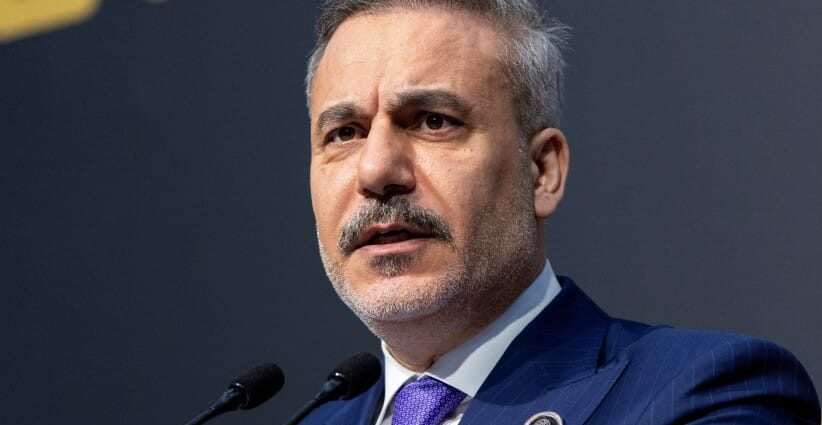
Turkey’s Fidan tones down Israel rhetoric, says ‘no reason for open conflict’ amid F-35 push
“I think there is no reason to have an open conflict,” Turkish Foreign Minister Hakan Fidan told The National on Friday, only a week after making far more critical comments on CNN Türk, decried by Israeli politicians as genocidal.
Complaining of the alleged anti-Ankara rhetoric coming from Jerusalem, Fidan directed criticism at Prime Minister Benjamin Netanyahu’s coalition and select members of the opposition, but asserted that “there are still very sane and good people with wisdom and strategic minds in Israel.”
“Not all of them are like Netanyahu and some people, but Netanyahu and some people, as they get closer to the elections, they need an enemy. They were at war with Hamas, Hezbollah, and Iran, and now they need another enemy,” Fidan told the Emirati site, adding that he believed Ankara was being shifted into that role.
The comments were far more moderate than the ones made on CNN, where he complained: “These people (in reference to Israel) have become a burden that humanity can no longer bear.”
“No matter which framework you use, there is no parameter under which these people can be sustained,” Fidan said in the earlier interview.
Gallia Lindenstrauss, a senior research fellow at the Institute for National Security Studies specializing in Turkish foreign policy, told The Jerusalem Post that the interview with The National was Fidan’s way of clarifying his previous remarks and “distancing his criticism from Israel as a whole to the actions of the current Israeli government.”
“His statement that there are ‘reasonable’ people was especially reassuring that should Israel have another government, things might look different between Israel and Turkey,” she assessed.
That same interpretation was offered to the Post by Istanbul-based geopolitical analyst Burak Can Çelik, who said that the current abrasiveness of Ankara’s comments on Israel doesn’t suggest “a permanent and irreversible strategic break” from the Jewish state. Rather, in Fidan’s approach, “security, balance of power and changing regional conditions are as decisive as ideological discourse.”
“Today, the two countries are in a controlled competition. However, while discourses and dynamics change rapidly in the Middle East, geography and common interests are permanent,” he noted. “Before October 7, relations between Turkey and Israel had always been at a good level, with joint collaborations in terms of trade, technology, culture and tourism, so these discourses may be a signal of controlled softness.”
Israel, Turkey clash over F-35 sale
Foreign Minister Gideon Sa’ar condemned Fidan’s earlier comments, alleging that they amounted to a “clear call for genocide” and said his words would not go unchallenged, marking yet another confrontation between Israeli and Turkish officials over public statements made. The sudden shift has been interpreted by some as tied to Ankara’s wider goals, specifically the acquisition of F-35 fighter jets.
Ankara recently hosted US President Donald Trump for a NATO summit, and the president expressed a clear willingness to remove the sanctions blocking Ankara’s path to the fighter jet.
“Turkey has been, in many ways, much more loyal than other countries that we think would be loyal. … It’s a great plane, it’s the best, currently the best plane by far. And it’s certainly something we will consider,” Trump said, announcing that Washington would be dropping sanctions against Ankara originally placed over Turkey’s possession of Russian S-400s.
The issue of Turkey’s rhetoric has already been raised by a group of bipartisan American lawmakers, who penned a letter to Trump complaining that the potential F-35 sales were concerning given statements by the officials, and Ankara’s relationship with Iran.
Israel, a major ally of Washington, has also been vocal in its opposition to the NATO country receiving the F-35s, Dr. Hay Eytan Cohen Yanarocak, a Turkey expert at the Moshe Dayan Center for Middle Eastern and African Studies at Tel Aviv University, noted to the Post. He argued that Fidan is trying to quell Israeli fears about the acquisition of the fighter jets.
“Unless these statements are accompanied by tangible confidence-building measures, such as ending unilateral sanctions against Israel, halting the systematic delegitimization campaign against it, and restoring people-to-people ties by resuming direct flights between Istanbul and Tel Aviv, they should be regarded as lip service,” Yanarocak argued.

Iran opens a 3,000-km. front across the Gulf in bid to stretch US defenses – analysis
Iran carried out numerous attacks in the Middle East over the last several days as it seeks to continue its tit-for-tat conflict with the US. In the recent round of attacks, Iran lashed out at Qatar, Kuwait, Bahrain, Oman, the UAE, and Jordan.
This is around 3,000km. of front line stretching from Amman to the Strait of Hormuz. It is a huge battlefield, and Iran’s goal is to spread the conflict as wide as possible. This makes it harder to stop Iran because Iran is a large country and it can base missiles and drones in many places to strike.
Iran’s goal now is multi-layered. One layer is to make it seem like Tehran doesn’t centralize decision-making in Tehran. This presents some Iranian attacks as being by “rogue” elements or some “hardline” part of the IRGC.
The theory is that Iran can then “good cop-bad cop” the region. Iran’s government will try to de-escalate, and the IRGC will escalate. This is a method Iran has used in dealmaking with the West for decades. Now it is using it in wartime.
Another aspect of Iran’s policy is to try to put forward a proposal to manage Hormuz. It is trying to pretend that if other countries will come to the table, then some kind of agreement can be reached where Iran manages Hormuz.
Iran would bargain to receive fees for ships to transit through the Strait which the US would oppose
The proposal is for Iran and others to receive a fee for ships that transit, essentially meaning they are in control. The US will not likely accept this. US policy for more than 100 years supported freedom of navigation.
What we know about the recent strikes is that the US carried out a number of new strikes. This has been happening for several days now. US Central Command (CENTCOM) said it “completed a third round of strikes this week against Iran, July 11, holding Iranian forces accountable for attacking another commercial ship in the Strait of Hormuz.”
It said that US forces “hit approximately 140 Iranian military targets with precision munitions launched by land- and sea-based fighter aircraft, drones, and naval vessels. Targets included Iranian missile and drone sites, naval capabilities, ammunition storage facilities, communication networks, and coastal surveillance locations.” In previous rounds, the US had struck around 80 targets.
CENTCOM went on to say that “during three nights of strikes this week, CENTCOM has struck more than 300 targets at the direction of the Commander in Chief to degrade Iran’s ability to attack civilian mariners and commercial vessels freely transiting the strait. Commercial vessel transits through the vital international maritime corridor continue.”
UAE, Oman, Qatar, targeted in Iranian retaliatory attacks
On July 12, the UAE confirmed that attacks overnight targeting the UAE had ended. Oman condemned attacks by Iranian drones.
Arab News in Saudi Arabia provided some more context on the attacks. “Qatar’s military said in a statement it intercepted incoming Iranian fire, with explosions heard in neighboring United Arab Emirates.
Three people, including a child, were wounded as a result of falling shrapnel from the interception of Iranian attacks, Qatar’s Interior Ministry said.” The report also noted there were alerts in Bahrain. Kuwait also intercepted attacks.
“The United Arab Emirates said its defense systems engaged missiles and drones from Iran. In a statement, the Defense Ministry said the missile threats detected this morning were outside the country’s borders,” Arab News added.
“An Omani security source reported that drones have targeted sites in the Musandam Governorate. The sultanate condemned the attacks and vowed to take all measures that safeguard the country’s security and residents.”
Iran’s 3,000km. front line is how it seeks to spread chaos in the region. It has created so many front lines in so many places that it will be hard for the US to confront this kind of Iranian Pandora’s box. How to put the lid back on the box is unclear, and it appears Iran is ready to keep doing this for the foreseeable future.

Former Value Base analyst convicted of insider trading, securities fraud
The Tel Aviv District Court convicted former Value Base senior analyst Shay Lipman on Sunday of insider trading, securities fraud, and fraud and breach of trust in a corporation after he admitted to using his position to profit from trades in public real estate companies.
Under a plea agreement, the prosecution and defense jointly asked the court to sentence Lipman to 18 months in prison and impose financial sanctions totaling NIS 275,000. Judge Dana Amir set a sentencing hearing for September 6.
Lipman worked as a real estate analyst at the investment bank Value Base between 2016 and 2021. His role included analyzing public real estate companies, publishing reports on them, and advising on or accompanying some corporate transactions.
That position gave him access to sensitive and, at times, confidential information about public companies and planned business moves before they reached the market, according to the amended indictment.
In three cases, Lipman traded in shares of public real estate companies while holding inside information obtained through his work and professional ties.
The indictment describes trades tied to three corporate developments: Rani Zim Shopping Centers’ acquisition of control in Midas, the battle for control of Gav-Yam, and the planned sale of a controlling stake in the Sarfati construction company.
In each case, prosecutors said, Lipman bought shares before the relevant information became public, then sold them or stood to benefit after the share price rose.
Eleven additional cases
In 11 additional cases, Lipman bought shares shortly before publishing favorable analyses of the same companies.
An analyst’s recommendation can affect investor demand and a company’s share price, particularly when it is published by a recognized financial institution.
According to the indictment, Lipman bought the shares with the intention of selling them if his positive analysis pushed the price upward.
He did not disclose in the reports that he personally held shares in the companies or that he planned to sell them if their value rose. Those reports concerned several publicly traded real estate companies.
Lipman carried out the trades through his parents’ bank account, concealing his activity from Value Base and violating company procedures governing employees’ personal securities trading.
His illegal activity generated approximately NIS 225,000 in profit, according to the prosecution.
Repeat offenses over several years
The amended indictment said Lipman acted repeatedly over several years, using both confidential information obtained through his position and the expected market impact of his own published analyses.
Prosecutors said Lipman had systematically exploited his role and the trust placed in him at Value Base for personal gain, in direct violation of the investment bank’s internal rules.
They argued that punishment for securities offenses, particularly insider trading, must be severe enough to deter others and protect investors’ confidence in the capital market.

Knesset panel advances bill to freeze arrests of haredi draft evaders amid legal warnings
The Knesset’s Foreign Affairs and Defense Committee approved on Sunday the advancement of the contentious bill that seeks to temporarily freeze the arrests of haredi (ultra-Orthodox) draft evaders, ahead of its final required plenum readings to become law.
The approval came after the Knesset’s legal advisory team issued severe warnings about advancing the legislation pushed by the haredi parties.
The legal advisory warned in its opinion on Sunday that the legislation lacks balance and could effectively exempt haredim from IDF service, failing to advance “equality in sharing the burden.”
It added that the legislation “practically exempts” haredim from the IDF.
The Knesset’s legal advisor, Sagit Afik, also warned the panel ahead of the vote that the legislative process undertaken to advance the bill was improper.
The bill advanced in the committee by a vote of 8 lawmakers in favor and 7 against, and its approval is subject to a request for revision.
The bill stipulates that from the decided date of commencement until the end of 90 days, no arrest, investigation, or enforcement proceedings will be taken for failure to serve.
One of several haredi-backed bills
The bill is part of a series of haredi-backed bills being advanced, amid numerous reports of agreements between the haredi parties and Prime Minister Benjamin Netanyahu.
The coalition has been pushing a legislative blitz in the Knesset’s final week before its expected dissolution to advance as much legislation as possible before the upcoming elections.
The haredi parties boycotted coalition voting last month – stalling coalition bills – arguing that their legislation was not being advanced quickly enough.
Critics argue that the bill has undergone significant changes since the version that passed its first reading years ago, following dozens of committee discussions in the Foreign Affairs and Defense Committee that reshaped its original framework.
The Knesset legal advisor told the panel that in her view, the bill was part of “an improper legislative process.”
“Out of this long and complex legislative process, one small section was taken, and everything else was deleted. In my view, this raises a claim far more serious than merely a ‘new subject,’” she said.
Afik added that even though she was told that there was a time constraint to pass the bill before the Knesset dissolution, “a lack of time cannot justify an improper legislative process.”
“If the committee considers adding sanctions and other elements from the original legislative process, this could be interpreted as maintaining a connection with the original bill,” she said.
The government has stated that arresting yeshiva students who evade military service has undermined efforts to encourage broader enlistment among haredi men; therefore, a freeze on arrests would be beneficial.
Opponents and Afik have argued that the bill is unbalanced largely because it only calls for halting the arrests of draft evaders and includes no sanctions on them.
Dr. Gilad Malach, research Fellow at the Israel Democracy Institute’s Ultra-Orthodox in Israel Program, told The Jerusalem Post last month that the proposal to freeze arrests of draft evaders suffers from significant flaws and lacks balance.
Malach: Addresses issue ‘in a problematic way’
“Although it is meant to address a real issue [of haredi conscription], it does so in a problematic way,” Malach said.
“First, it does not include the broader enforcement tools and instead focuses only on easing measures [of arrests], without an overall framework [of sanctions].”
Malach also argued that the proposal is not a true temporary measure, despite its stated 90-day duration.
“Any law passed right before elections that is set to expire during the election period automatically receives an extension of roughly four months, since the Knesset is not functioning normally,” he said.
“So the 90 days can effectively become six or seven months. It is a technical issue, but clearly political parties exploit it.”
“Ultimately, the goal of the haredi parties in this context is a political achievement ahead of elections,” Malach explained.
“They want to be able to say: we achieved something, we prevented arrests, we delayed the issue.
The advancement of a bill to freeze the arrests of draft evaders comes after the contentious Basic Law: Torah Study bill, which seeks to enshrine Torah Study as a fundamental value in the country’s Basic Law, advanced last week in the Knesset’s House Committee.
It is also expected to be brought to the plenum for its final second and third readings this week before the expected Knesset dissolution.
The Torah study bill is part of a proposal that critics argue encourages draft evasion and changes the status of yeshiva students who do not serve, enabling them to continue receiving state benefits, even amid the IDF’s severe manpower shortage. Netanyahu arrived at the plenum last month to vote in favor of the bill as it passed its first reading.
The haredi parties have encouraged the coalition to advance legislation that would not increase haredi enlistment.
The IDF has repeatedly warned of an urgent manpower shortage after more than two years of war.
In April, the High Court of Justice ordered that the state take concrete steps to revoke key financial benefits from draft evaders and to move toward criminal enforcement against haredi men who evade military service.
In March, IDF Chief of Staff Lt.-Gen. Eyal Zamir said the IDF could soon collapse if no solution was found for the manpower shortage.

Speaker Amir Ohana reduces Knesset budget by NIS 50 mil. to support Israel’s economy
Knesset Speaker Amir Ohana has reduced the Knesset’s budget by an additional NIS 50 million for the purpose of supporting the country’s economy, the Knesset announced on Sunday.
Ohana said he had informed Finance Minister Bezalel Smotrich about his budget reduction initiative, and the funds are expected to go to the treasury.
This means the total amount cut from the Knesset’s budget since the 25th Knesset began stands at NIS 376 million.
The latest NIS 50 million cut to the Knesset’s 2026 budget follows three previous reductions approved by Ohana:
The latest move, which will be submitted for approval by the Joint Committee on the Knesset Budget, will not affect the Knesset’s essential day-to-day operations.
Ohana has reduced the Knesset’s budget three times since the 25th Knesset began
“From my first day in office, my policy has been to reduce the use of public funds while ensuring the maximum implementation of the work plans required for the operation and development of the Knesset,” Ohana said.
“Even in this final stretch, the Knesset, as a public institution, treats taxpayers’ money with the utmost care and is returning it to the state treasury so it can be used for the benefit of the citizens of Israel.”
Ohana has reduced the Knesset’s budget three times since the 25th Knesset began, with NIS 80 million in November 2023, NIS 121 million in January 2024, and NIS 125 million in October 2025 in support of the war effort.

Shas spiritual leader appears to open door to Eisenkot government, says Netanyahu ‘won’t repent’
Rabbi Yitzhak Yosef, the spiritual leader of the haredi (ultra-Orthodox) Shas Party, criticized Prime Minister Benjamin Netanyahu on Saturday evening, saying he “won’t repent,” while appearing to back the premier’s political rival, Yashar Party leader Gadi Eisenkot.
The rare remarks suggested that Shas could potentially be open to joining a government led by Eisenkot following the upcoming elections, raising questions over the longstanding haredi alliance with Netanyahu’s bloc.
“We are in a secular country… There are those whom I don’t believe will repent,” Yosef said in a filmed speech.
“There’s no chance [Netanyahu] will repent. Eisenkot might repent,” he added.
Shas has been a partner in Netanyahu’s bloc for decades, with the prime minister’s ruling Likud party relying on the haredi parties – Shas and United Torah Judaism – as key coalition partners.
הרב יצחק יוסף, מנהיגה הרוחני של ש”ס: “אין סיכוי שנתניהו יחזור בתשובה – איזנקוט אולי כן”@MHlpryn pic.twitter.com/fx7voScO9x
— גלצ (@GLZRadio) July 11, 2026
Recently, Eisenkot’s Yashar Party has become the largest party in the opposition bloc seeking to replace Netanyahu in polls ahead of elections set to take place no later than October 27.
Yosef’s office denied claims, despite report that he prefers Eisenkot for PM
On Sunday, Yosef had reportedly also said behind closed doors that he was leaning toward breaking up the Netanyahu bloc, together with the United Torah Judaism Party, and that Eisenkot was the preferred candidate for prime minister, according to a Sunday Army Radio report.
“It is possible that we will go with Eisenkot in the upcoming election; I hope United Torah Judaism joins this move,” the report quoted the party’s spiritual leader as saying.
The report added that Yosef said: “Eisenkot is a good man, a warm-hearted Jew. He loves Torah scholars. His grandmother voted for Shas and wanted him to become a rabbi. That did not happen, but he is someone we can rely on.”
“Netanyahu deceived us over the draft law and on other matters. You cannot rely on him; he is a liar.”
In May, the spiritual leader of the United Torah Judaism faction Degel Hatorah, Rabbi Dov Lando, made similar remarks regarding the premier, in which he stated that “We no longer have any trust in Netanyahu,” sparking a coalition crisis.
Yosef’s reported statements come amid recent tensions with Netanyahu and his coalition over stalled advancements with legislation the haredi parties have been pushing for, which critics argue encourage draft evasion even amid the IDF’s severe manpower shortage.
There have also been numerous reports of deals between the haredi parties and Netanyahu ahead of the Knesset’s upcoming dissolution at the end of this week, while the coalition has been pushing ahead with its legislative blitz.
In response to the report, Eisenkot said that he would “not compromise on the draft law, even if it means going to another election,” while speaking to Army Radio on Sunday.
Yosef’s office denied to The Jerusalem Post that he made the remarks behind closed doors.
“The content of this morning’s report regarding any kind of support [for a particular candidate or political move] is completely denied,” Yosef’s office stated.
Eisenkot could see Shas as a partner
The report also comes after Eisenkot had expressed support for Shas last week in a Thursday interview with the haredi Kikar Hashabbat news outlet, noting that he could see them as a partner.
“First, a large part of Shas voters serve in the army, and I saw them as chief of staff. Because of that, I make a distinction. I also see Shas as a party that serves, that is integrated, and that is supposed to bring a message to life in the State of Israel,” Eisenkot said.
“I see Shas as a partner, under certain conditions,” he added, noting that he had three core principles.
“Shas is a party that is supposed to bring a message, and I say this as the son of a mother who voted Shas for 30 years.”
“I know Shas voters, I meet them, and I grew up with some of them,” he added.
Eisenkot has spoken in the past on a more lenient approach to drafting haredim, which has received criticism from party leaders in the opposition bloc.
His plan includes granting exemptions to 3% of each annual haredi cohort to study Torah, similar to exemptions given to outstanding musicians and athletes.
Other party leaders in the opposition bloc have vowed not to sit in a government with the haredi parties or to allow any exemptions for haredi draft evaders.

Weight-Loss Drugs Reshape Plus-Size Retail as Torrid Closes Stores
The rapid growth of weight-loss drugs such as Ozempic and Wegovy is beginning to reshape the retail industry, with one of the biggest effects showing up in the plus-size clothing market.
Torrid, one of the nation’s largest plus-size apparel retailers, reported that net sales fell 7.6% to $245.8 million during its latest quarter ended May 2. At the same time, the company reduced its store count to 463 locations, down from 632 stores a year earlier—a decline of nearly 27%.
Company leaders say the closures are part of a broader restructuring plan, but the changing shopping habits of customers taking GLP-1 weight-loss medications are adding new pressure to the business.
These medications suppress appetite and can lead to significant weight loss over time. As consumers move through that transition, many are delaying clothing purchases until their weight stabilizes.
Harvey Kanter, chief executive of plus-size retailer DXL Group, recently told investors that as many as 25% of the company’s customers may now be using GLP-1 medications.
Rather than repeatedly purchasing clothing in different sizes while losing weight, many customers are waiting before replacing their wardrobes.
That pause has created a temporary drop in demand across the plus-size apparel sector.
Torrid closed 151 stores during 2025 and has announced plans to shutter additional locations during the first half of 2026, focusing on stores with weaker financial performance.
DXL has experienced similar challenges, reporting a 6% decline in quarterly sales while also planning additional store closures.
According to CoreSight Research, retail store closures across all sectors increased 67% during 2025 compared with the previous year, with specialty apparel retailers among the hardest hit.
The trend is also influencing major clothing brands.
Companies including H&M, Nike, Old Navy, L.L. Bean, Ralph Lauren and Shein have reduced portions of their extended-size offerings as they adjust inventory to changing consumer demand.
Still, analysts caution that the plus-size market remains substantial.
Industry estimates value the global plus-size apparel market at more than $114 billion, with continued long-term growth expected despite the short-term disruption.
Many retailers also believe today’s slowdown could become tomorrow’s opportunity.
Once customers complete significant weight loss, they often need entirely new wardrobes.
Research from Dentsu found that roughly half of Americans using GLP-1 medications report shopping for clothing more frequently after losing weight, while nearly one-third purchase more accessories.
Analysts at eMarketer estimate that wardrobe replacement alone could eventually generate approximately $13 billion in additional annual apparel sales.
The challenge for retailers is surviving the transition period before that new demand arrives.
Torrid continues to invest in digital sales, new product lines and brand expansion while reducing underperforming locations.
The company ended its latest quarter with approximately $301 million in debt and $22.8 million in cash, underscoring the importance of improving profitability during the restructuring.
For consumers, the changes may mean fewer dedicated plus-size stores and a smaller selection of extended sizes at traditional retailers.
For investors and the retail industry, the broader story is becoming increasingly clear.
Weight-loss medications are beginning to influence purchasing behavior well beyond healthcare, affecting apparel, food, consumer products and other industries.
As millions more Americans adopt GLP-1 medications, retailers across multiple sectors are adjusting business strategies to reflect changing consumer habits.
For Torrid, the immediate focus is reducing costs while positioning itself for the next wave of demand—when today’s customers finish losing weight and begin rebuilding their wardrobes.
JBizNews Desk | Los Angeles
© JBizNews.com All Rights Reserved. Reproduction or Distribution without Written Permission is Prohibited.

Lindsey Graham’s sudden death shocks the world, Trump and Israeli officials respond
New episodes every Sunday-Thursday.
Listen and subscribe wherever you get your podcasts.
For more news, analysis, and the latest updates, head to jpost.com.
Headlines edited by Shir Perets.
Hosted and produced by Shifra Jacobs.
Haredi protesters disrupt light rail construction, block traffic on Jerusalem’s Bar Ilan Street
Protesters interfered with light rail construction and blocked traffic on Bar Ilan Street in northern Jerusalem, Israel Police confirmed on Sunday.
Police officers and Border Police are on the scene, attempting to disperse the protesters, police confirmed.
Video footage seen by The Jerusalem Post appears to show several haredi (ultra-Orthodox) protesters loitering on the tracks and preventing construction crews from working.
Bar Ilan Street is located adjacent to a neighborhood with a high percentage of haredi residents.
This is a developing story.

Trump and Sanders Share an Unlikely Goal: A U.S. Sovereign Wealth Fund
President Donald Trump and Senator Bernie Sanders rarely agree on economic policy, but both are now advocating for a U.S. sovereign wealth fund—a government-owned investment vehicle designed to hold stakes in private companies and other assets. While the two envision very different purposes for such a fund, their shared interest has moved the concept from a fringe idea into a serious policy discussion.
The foundation of the debate is President Trump’s February 2025 executive order directing the U.S. Treasury Department and the Department of Commerce to develop a plan for creating a sovereign wealth fund that would “maximize the stewardship of our national wealth.” The order outlined the goal but left unanswered the most important questions, including where the money would come from, who would manage it and what assets it would own.
Unlike countries such as Norway, Saudi Arabia and Singapore, which built sovereign wealth funds using large budget surpluses or natural-resource revenue, the United States currently runs persistent budget deficits. That has made funding a national investment vehicle far more complicated.
Several ideas have been discussed, including directing revenue from tariffs or proceeds from a possible sale of TikTok’s U.S. operations into the fund. None has been formally adopted.
Rather than waiting for a fully structured fund, the Trump administration has already taken strategic stakes in selected industries, including semiconductor manufacturers, rare-earth mining companies and quantum-computing firms. Among those investments is a passive ownership position in Intel, reflecting the administration’s broader effort to strengthen domestic technology and manufacturing.
Meanwhile, Sanders has proposed a dramatically different approach.
The Vermont independent recently introduced legislation that would create an American AI Sovereign Wealth Fund, financed through a one-time 50% tax paid in stock by large artificial intelligence companies generating more than $200 million in annual AI-related revenue.
Instead of collecting cash, the federal government would receive equity in qualifying companies, placing those shares into a professionally managed public investment fund.
According to Sanders, the fund could eventually hold approximately $7 trillion in assets. Investment returns would help finance direct payments to Americans while supporting priorities such as healthcare, education and affordable housing.
Although both proposals use the term “sovereign wealth fund,” the philosophies behind them differ substantially.
Trump has generally described government investments as strategic assets that could strengthen America’s industrial competitiveness and national security.
Sanders argues that much of today’s AI industry was built upon decades of publicly funded research and therefore believes Americans should directly share in the wealth created by the technology.
Despite those differences, the fact that leaders from opposite ends of the political spectrum support some form of public investment fund has attracted growing attention from economists and investors.
Ashby Monk, executive director of Stanford University’s Research Initiative on Long-Term Investing, has described sovereign wealth funds as an increasingly common tool for governments seeking long-term economic growth rather than relying solely on taxes and regulation.
Several countries have recently expanded or created national investment funds to support artificial intelligence, advanced manufacturing, clean energy and strategic industries.
Critics, however, warn that government ownership of private companies raises significant concerns.
Free-market organizations argue that political leaders should not influence corporate decision-making through government share ownership, while some economists caution that concentrating public money in rapidly appreciating technology companies could expose taxpayers to unnecessary investment risk.
Others question whether Washington could manage such a fund independently of political pressures.
Supporters counter that professionally managed sovereign wealth funds around the world have successfully generated long-term returns while maintaining operational independence from day-to-day politics.
The debate also carries major implications for the private sector.
If the federal government eventually becomes a significant shareholder in leading artificial intelligence companies, semiconductor manufacturers or other strategic industries, it could reshape corporate governance, investment priorities and the relationship between government and business.
For investors, the discussion reflects a broader shift in economic policy as governments worldwide become more directly involved in financing industries viewed as critical to long-term national competitiveness.
Whether Congress ultimately embraces either proposal remains uncertain.
Sanders’ legislation faces significant political obstacles in a Republican-controlled Congress, while the Trump administration has yet to present a detailed structure for implementing its own sovereign wealth fund.
Still, the unusual convergence between Trump and Sanders illustrates how rapidly attitudes toward government investment have evolved. An idea once viewed as politically improbable has become an increasingly prominent part of the national conversation over artificial intelligence, technology leadership and America’s economic future.
JBizNews Desk | Washington
© JBizNews.com All Rights Reserved. Reproduction or Distribution without Written Permission is Prohibited.


Duplexes and townhomes do not always make housing cheaper
Not every housing policy labeled “affordable” is actually designed to make housing more affordable. That is the central problem with today’s “missing middle” debate.
Across the country, duplexes, triplexes, courtyard apartments, townhomes and small multifamily buildings are being promoted as the solution to America’s housing affordability crisis. The argument sounds clean and appealing: allow more housing types, create more inclusive neighborhoods, and add diversity and affordability will follow.
But that framing quietly conflates two very different objectives. Housing affordability is an economic problem. Neighborhood diversity is a social policy goal.
They may overlap at times, but they are not the same thing. Treating them as interchangeable has fueled a housing debate that promises lower prices while often pursuing a completely different vision for how communities should be organized. That distinction matters.
America was built on frontier, not forced proximity
The American dream was not born of the idea that every family should find a discounted unit in an already-expensive neighborhood. It was built on motion, expansion, ownership, and the ability to pursue opportunity elsewhere. The cultural script was not, “How do we all fit into the same handful of elite metros?” It was, “Go West. Build. Own. Start over. Create something.”
Frederick Jackson Turner’s frontier thesis argued that the American character was shaped by the westward push into new territory: land, risk, self-reliance and reinvention. In housing terms, that dream looked like ordinary families moving outward, building new towns, and eventually owning their own homes.
Today, much of the housing debate has lost that instinct. Instead of asking how we create more places where families can live affordably, many policymakers ask how to retrofit high-demand neighborhoods to accommodate every income level, preference, and lifestyle expectation at below-market prices. That is not a housing strategy. That is a social aspiration colliding with land economics. Affordability Is About Math
At its core, affordability is not complicated. It is about the relationship among supply, demand, income, land costs, capital costs, construction costs, taxes, insurance, regulation, and time. If a region does not build enough homes for a growing population, prices rise. If incomes do not keep pace with housing costs, affordability declines. If permitting takes years, infrastructure lags, land is constrained, and every project is burdened by political friction, housing prices rise before a single nail is driven.
That is not ideology. That is arithmetic.
Over the past decade, that math has turned against millions of American households. In many large metropolitan areas, home prices have risen far faster than incomes. Households that once could move from an expensive neighborhood to a more affordable nearby community now often find the entire region has become expensive. That is the key point. When prices rise everywhere, affordability is no longer just a neighborhood problem. It is a regional supply problem.
Missing Middle does not escape land economics
The missing-middle argument often implies that altering building form changes affordability outcomes. Replace one house with a duplex. Replace a block of detached homes with townhomes. Add triplexes near transit. Allow courtyard apartments in established neighborhoods.
Sometimes that creates more options. Sometimes that is good planning. But it does not magically create affordability. In high-demand neighborhoods, the land is already expensive. The entitlement process is expensive. Construction is expensive. Financing is expensive. Taxes and insurance are expensive. By the time a new missing-middle product reaches the market, it is usually priced at or near the prevailing market rate. The building form changes. The price often does not.
A new townhome in a desirable urban neighborhood is not automatically affordable just because it shares a wall. A duplex on expensive land does not become middle-class housing simply because it is a duplex. A courtyard apartment in a high-income neighborhood may add density, but density alone does not suspend the laws of cost. More housing helps over time. But missing-middle housing is not inherently affordable housing. That is the mistake.
Supply works regionally, not symbolically
The best argument for missing-middle reform is not that it instantly creates cheap homes. It does not. The better argument is that allowing more housing types can incrementally expand supply, increase product variety, and ease pressure over time. That is reasonable. But it is not the same as claiming missing-middle zoning is an affordability solution. Affordability improves when enough housing is produced across an entire region to shift the balance between supply and demand.
That means infrastructure, permitting capacity, predictable approvals, scalable development, construction efficiency, capital formation, land availability, product diversity, regional growth planning and political seriousness. It does not mean pretending that a handful of duplexes in a high-demand neighborhood will materially change what a teacher, firefighter, nurse, police officer, or young family can afford across a metro area. America does not have a shortage of housing rhetoric. It has a shortage of housing production.
When the debate turns moral, the math gets lost
One reason this conversation has become so confused is that housing affordability has increasingly been framed as a moral failure rather than an economic imbalance.
Expensive neighborhoods are described as exclusionary by default. Rising prices are treated as proof of injustice. A lack of socioeconomic diversity is taken as evidence that something improper must have occurred.
Sometimes discrimination and exclusion are real. When they are, they should be addressed directly through fair-housing enforcement, anti-discrimination rules, and targeted reforms. But a neighborhood becoming expensive is not, by itself, evidence of wrongdoing.
More often, it means demand has outstripped supply.
That distinction matters because the policy response should match the actual problem. If the goal is affordability, the answer is a larger total housing supply delivered at scale. If the goal is socioeconomic diversity within specific neighborhoods, say that clearly and evaluate those policies on that basis. Do not sell one as the other. One objective seeks lower prices. The other seeks a different distribution of residents. Both may be legitimate public debates, but they are not the same debate.
The real question policymakers avoid
The uncomfortable truth is that many affordability debates sidestep the hardest question:Are we trying to make housing less expensive, or are we trying to decide who should live where?Those are very different missions.
If policymakers want broader affordability, they need to focus on regional supply, infrastructure, the speed of entitlements, construction costs, development feasibility, and the ability to create new communities where ordinary families can buy or rent at attainable prices. If policymakers want more income mixing in established neighborhoods, they should be honest about that goal. That may involve subsidies, vouchers, inclusionary zoning, public land strategies, or mobility programs. But those tools should be judged by whether they achieve social-mixing objectives—not by pretending they will solve the broader affordability crisis.
The missing middle can be part of a housing toolkit. It can add flexibility, create more varied product types, and help some households find options that did not previously exist. But it is not a silver bullet. And it is certainly not a substitute for building enough housing in the places where growth is actually occurring.
The frontier still matters
A serious housing strategy should not be built on the fantasy that every household can consume more location, more amenities, more space and more neighborhood prestige at a discount to reality. That is not the American dream. That is entitlement dressed up as planning.
The American dream has always been more demanding and more optimistic than that. It calls for building new places, opening new frontiers, expanding opportunity and creating communities where families can own, grow and belong. That does not mean every household gets to live in the most expensive neighborhood at a subsidized price. It means the country must remain capable of producing new places where opportunity remains attainable. That is the real affordability test.
The missing middle may be a useful planning tool and even a desirable social vision. But let’s stop pretending it is, by itself, an affordability strategy. It is not. Affordability is measured by prices, payments, incomes and supply, not slogans.
Trump administration unlawfully gave Iran info on asylum seekers set for deportation – report
The Trump administration allegedly violated US law by giving Iran confidential information about Iranian asylum applicants it planned to deport, according to a lawsuit filed last week by the Iranian American Legal Defense Fund (IALDF).
The IALDF filed the complaint on Tuesday jointly with Public Citizen Litigation Group in US District Court in Washington, DC, naming Secretary of State Marco Rubio, Homeland Security Secretary Markwayne Mullin, and Acting Director of Immigration and Customs Enforcement (ICE) David Venturella, along with their respective organizations, as defendants.
The plaintiffs claim that the US government violated federal confidentiality regulations, thereby exposing pro-democracy protesters, members of the LGBTQ community, and religious minorities to Tehran and endangering both the family members of the applicants who remain in Iran and the deportees upon their return.
ICE has rejected these claims, saying in a statement, “These allegations that ICE shared asylum application records with the Iranian government are false.”
IALDF alleges that in a March 2025 meeting, a senior official from the Iranian Interests Section of the Embassy of Pakistan requested a list from the State Department of detained Iranian nationals whom the US wanted to deport. In response, federal officials provided a list of roughly 150 names.
The two sides further agreed to hold monthly meetings between ICE and the Iranian government to regularly exchange files and information. Communication between the two parties has continued despite hostilities between the two nations, including military strikes in June 2025 and the war that broke out on February 28, 2026, according to the complaint.
Since the Trump administration returned to office in January 2025, almost 600 Iranians have been detained across the country, half of whom were taken into custody during the June 2025 conflict. Additionally, over 100 Iranians have been deported across three separate flights to Iran. These actions are part of a broader crackdown by the government on immigration that has led to an increase in detentions and deportations.
Plaintiff counsel: US more interested in deportation than human lives
“Despite the US’s ongoing war with Iran, the administration seems more committed to mass deportation than protecting human lives,” said Michael Kirkpatrick, the lead counsel for the plaintiffs, in a statement.
The complaint also alleges that ICE forced the detained asylum applicants to meet with officials from the Iranian Interests Section without the applicants’ consent. According to the lawsuit, these non-consensual meetings “solidified the detainees’ belief that they had been identified to the very same repressive government that they had fled.”
The US State Department, in past human rights reports, has acknowledged that the Iranian government persecutes various minority groups and engages in human rights abuses, including torture and unlawful killing.
Senators express concern to Rubio
In February 2026, 12 senators jointly sent a letter to Rubio expressing their concern over the deportation of the asylum seekers back to Iran.
“Given Iran’s horrific human rights record, we are deeply concerned that the Trump administration is returning people to a country where they may be persecuted or tortured, in violation of US and international law,” the letter stated.
According to Ali Rahnama, interim executive director of the IALDF, the organization “is asking the court to stop these disclosures immediately, order a full accounting of every record shared, and ensure no asylum seeker’s file ever again reaches the hands of their persecutors.”


German parliament advances bill to criminalize denial of Israel’s right to exist
German parliament has advanced a bill that would make denial of Israel’s right to exist a criminal offense and which could be punishable by up to five years in prison.
The legislation received backing from Germany’s upper house of parliament, the Bundesrat. It will now travel to the lower house, the Bundestag.
Under the proposal, anyone who publicly or at a gathering denies the right of the State of Israel to exist, or calls for its elimination, would face punishment. In legal terms, this means Germany is expanding §130 StGB (its criminal code) beyond Holocaust denial to include existential denial of Israel.
According to the bill’s justification, existing criminal provisions (such as incitement of hatred, approval of criminal acts, or the use of symbols of terrorist organizations) currently apply only in individual cases and are insufficient.
Germany experiencing heightened antisemitism
The Bundesrat argued that Germany is experiencing heightened antisemitism, with the number of antisemitic incidents increasing from 1,957 in 2020 to 8,627 in 2024.
While many people in Germany have peacefully protested against the war and the suffering of Palestinian civilians, the Bundesrat stated that protests have also repeatedly included challenges to Israel’s legitimacy as a state.
The Bundesrat added that Israel’s establishment and acceptance by the international community are closely connected to Germany’s responsibility for the Shoah and the necessity of finding a secure homeland for Jews.
Therefore, the “denial of Israel’s right to exist ultimately not only relativizes the Holocaust but also disregards Germany’s constitutional order, which was created as a response to the violence and arbitrary rule of National Socialism,” the Bundesrat said.
It is worth noting that the law would apply to public statements and assembly contexts, including online speech, but only if the act can reasonably promote antisemitic violence or arbitrariness.
The bill does not restrict criticism of Israeli government policies
It does not restrict criticism of Israeli government policies or theoretical debate about Middle East politics.
Art and academic works are exempt to the extent covered by existing protections for science and art.
Israel’s ambassador to Germany, Ron Prosor, welcomed the Bundesrat’s decision.
“The message is clear: anyone who denies Israel’s right to exist and spreads antisemitic incitement will not get away with it without consequences,” he said.
“My sincere thanks go to Minister-President Boris Rhein for his determined commitment to this landmark legislative initiative, as well as to all the federal states that supported it.”
“I sincerely hope that the German Bundestag takes up the decision and swiftly passes the necessary amendments to the Criminal Code.”

Tzohar asks High Court to reject state’s bid to void kashrut license
Tzohar asked the High Court of Justice on Thursday to reject the state’s attempt to invalidate its newly issued license to operate as an official kashrut-certifying body, arguing that the state’s central claim is contradicted by both the facts and the court’s own previous rulings.
The response was filed after the state argued earlier last week that the license was issued through a fundamentally flawed process because the Chief Rabbinate Council had not been consulted before the authorization was granted, as legally required.
A hearing in the case has been scheduled for November 2.
The dispute centers on the license granted to Tzohar on July 1 by the official responsible for implementing Israel’s kashrut reform, despite the Chief Rabbinate’s legal adviser later claiming that the statutory consultation process with the Chief Rabbinate Council had not taken place.
In its response, Tzohar argued that the state was attempting to transform a petition that had already resulted in the issuance of the license into a new legal challenge against the validity of the license itself.
“The petition cannot become a proceeding about the validity of a license that has already been lawfully granted,” the organization argued.
‘Chief Rabbinate Council never got to express its position, ‘ the State argues
The state’s main argument is that the Chief Rabbinate Council never had an opportunity to express its position before the license was issued.
Tzohar rejected that claim as “factually untrue,” advancing several arguments.
First, it pointed to a July 7 letter written by Chief Rabbinate director-general Yehuda Cohen, who signed the license, stating that throughout the earlier court proceedings, every submission prepared by the Rabbinate’s legal department had been drafted “in close cooperation” with the president of the Chief Rabbinate Council.
According to Cohen’s letter, the council was itself a respondent in previous petitions regarding Tzohar’s licensing request, and the council never objected to granting the license on kashrut grounds.
Tzohar argued that this directly contradicts the state’s position that the matter had never reached the council.
Tzohar also argued that the High Court’s November 2025 ruling had explicitly instructed the Chief Rabbinate Council to decide whether Tzohar was entitled to receive a license under the existing legal criteria.
That ruling, it said, made it impossible for the council to argue that it had been unaware of the issue or was never asked to consider it.
The organization further noted that both of its earlier petitions named the council as a respondent and attached the licensing request itself, meaning the council had formally received the relevant material.
Beyond disputing the factual basis of the state’s position, Tzohar argued that the law provides a separate statutory mechanism for suspending or revoking a license once it has been issued.
Such action, it said, requires due process, including a hearing.
“What is happening here is the violation of every norm we have and every sense of decency,” reads the response.
The organization also argued that, under the relevant statutory provision, the Chief Rabbinate Council’s role is limited to objecting on kashrut grounds within the prescribed period. If no such objection is made, the law treats the council as having agreed to the license, it said.
Even if an administrative defect had occurred, Tzohar argued, the doctrine of relative nullity should prevent the license from being retroactively invalidated because the organization and businesses had already relied on it.
The filing states that Tzohar has already issued certification documents, begun operating under the license, and entered commercial negotiations with businesses, while hundreds of food establishments could be affected if the authorization were revoked.
The organization also accused the state of delaying the licensing process for months before attempting to invalidate the license only after it had finally been granted, arguing that the move was driven by parallel legislative efforts to repeal the kashrut reform rather than by genuine administrative concerns.

Israel to assume one-year chairmanship of Arlosen Archives, comprehensive WWII archive in 2027
Israel is set to assume the one-year rotating chairmanship of the International Commission (IC) of the Arolsen Archives in June 2027, one of the largest archives on all things WWII.
The IC, which governs the International Tracing Service (ITS) behind the Arolsen Archives, comprises 11 states: Belgium, France, Germany, Greece, Israel, Italy, Luxembourg, the Netherlands, Poland, the United Kingdom, and the United States.
Each country holds the chairmanship for one year before passing it to the next in rotation.
The Arolsen Archives trace back to 1943, when the British Red Cross set up a tracing office to help locate people scattered by Nazi persecution and forced labor across occupied Europe.
As WWII came to an end, the Supreme Headquarters Allied Expeditionary Forces and the United Nations Relief and Rehabilitation Administration (UNRRA) took over the responsibility for this work, before the operation relocated to Bad Arolsen, Germany, in 1946.
Israel’s relationship with the archives
Israel has been a member of the IC since the post-WWII period. Yad Vashem, Israel’s national Holocaust memorial, has held copies of ITS documents since the 1950s.
In 2025, the Arolsen Archives partnered with Israel’s Central Zionist Archive to digitize over 1300 child tracing files, records originally created for unaccompanied Jewish children after the war, many of whom emigrated to the British Mandate of Palestine and whose case files traveled with them.
When UNRRA ceased operations in June 1947, the Preparatory Commission of the International Refugee Organization (IRO) took over the Central Tracing Bureau, which was formally named the International Tracing Service (ITS), in 1948. The ITS was then run by the IRO until 1951.
Under the Bonn Agreements in 1951, the Federal Republic of Germany funded the ITS, with daily management being under the control of the International Committee of the Red Cross (ICRC).
The ICRC managed the ITS for over half a century until 2012, when it withdrew, and the German Federal Archives took over as institutional partner.
The ITS remained closed to the public for nearly 25 years after its founding, until it opened in November 2007, following public criticism from the US Holocaust Memorial Museum over the ITS and the ICRC’s lack of cooperation in opening the records.
Alleged misconduct by Arlosen’s management
In 2019, it was renamed the Arolsen Archives, International Center on Nazi Persecution. Today it holds roughly 30 million documents on about 17.5 million victims and survivors of Nazi persecution and is listed on UNESCO’s Memory of the World register.
In 2023, IC members and Germany’s Federal Government Commissioner for Culture and the Media received an anonymous letter alleging misconduct by Arolsen’s management.
The IC commissioned an independent investigation by the Göhmann law firm. The resulting report exonerated management, finding no violations of labor or criminal law, though it noted a need to rebuild trust between staff and leadership.
Both the IC and Arolsen’s directorate issued statements affirming confidence in the institution moving forward.

Blakeman Vows to Use New York Constitution to Block Mamdani’s Soviet-Style Supermarket Plan
Bruce Blakeman, the Nassau County executive and Republican nominee for New York governor, said this week that he intends to use a little-known provision of the state constitution to try to kill Mayor Zohran Mamdani’s roughly $70 million plan to open city-owned grocery stores across the five boroughs, arguing that public money spent to undercut private operators runs afoul of the charter. In comments reported Friday, Mr. Blakeman pointed to the constitution’s gift-and-loan clause as the legal basis for a challenge, framing the fight as a defense of the neighborhood stores he says the plan would crush.
The clause Mr. Blakeman is leaning on is roughly 150 years old and bars local governments from giving or lending public funds or property to private entities, while requiring that municipal spending serve a genuine public purpose. It was written to stop cities and counties from steering taxpayer money to favored businesses, railroad companies chief among them, during an era of aggressive public subsidy. Mr. Blakeman’s argument is that opening one store in each borough and handing day-to-day operations to a chosen private company would use public dollars to lower that operator’s costs, amounting to a subsidy for select firms while nearby shops get no such help.
“City-run supermarkets can use public money to push prices down, leaving independent grocers and bodegas to face unfair competition that threatens local jobs and the survival of existing businesses,” Mr. Blakeman said, according to the reporting. He has separately called the broader plan unworkable and warned that taxpayers would carry the tab.
The proposal Mr. Blakeman is targeting took its first concrete step in April, when Mr. Mamdani named La Marqueta, a city-owned market in East Harlem, as the site of the Manhattan store. The mayor has said he wants the full five-borough network running by the end of his first term in 2029, using publicly owned space that is exempt from rent and property taxes to trim overhead and pass savings to shoppers on staples such as eggs, milk and bread. City Hall has not detailed how prices would be set, and the mayor’s office did not respond to a request for comment on Mr. Blakeman’s threat.
For the grocery trade, the stakes are concrete. Supermarkets typically operate on net margins of just 1% to 3%, and independent operators argue that a rival exempt from rent and property taxes would enjoy an advantage they cannot match. Roughly 450 independent stores in the city, many of them family-run and a large share operated by immigrant owners, sit closest to the proposed sites, and their operators say pricing and location decisions by a city-backed competitor could pull away the foot traffic they depend on. John Catsimatidis, the chief executive of the supermarket chain Gristedes, opposes the city-run model but said he was not familiar with the constitutional clause Mr. Blakeman cited. His alternative: rather than build new stores, the city could subsidize existing grocers who buy in bulk and require them to pass the savings to customers.
Whether the legal theory holds is another question. James M. McGuire, a former state appellate judge who served as chief counsel to former Republican Governor George Pataki, cautioned that existing New York Court of Appeals precedent could make Mr. Blakeman’s argument difficult to sustain. Courts have generally given lawmakers wide latitude to define what counts as a public purpose, a deference that has blunted past gift-and-loan challenges. A suit would likely turn on how directly the arrangement channels benefit to a private operator versus the public at large.
The clash also feeds directly into the governor’s race. Gov. Kathy Hochul, who backed Mr. Mamdani’s mayoral bid, told a business breakfast last August that she “supports free enterprise,” but she has largely stayed quiet on the grocery plan since. Mr. Blakeman, who carries President Donald Trump’s endorsement, trails Ms. Hochul by about six points in some polls, and he appears intent on making the cost of living and the proper role of government the center of his campaign. A courtroom fight over the grocery stores would give him a high-profile vehicle to press that case, whatever its odds of success.
For now, the plan remains on track inside City Hall, with site scouting underway and no store yet open. Mr. Blakeman’s threat adds legal uncertainty to a program already facing questions about pricing, supply chains and operating costs, and it signals that the first city-owned shelves, whenever they arrive, may open under the shadow of litigation.
JBizNews Desk | New York
© JBizNews.com All Rights Reserved. Reproduction or distribution without written permission is prohibited.

Retailers Race to Reach Shoppers as AI Chatbots Become the New Digital Store Shelf
The way consumers shop online is rapidly changing, with purchasing decisions increasingly beginning inside AI-powered assistants rather than on traditional retailer websites. As more shoppers turn to platforms such as ChatGPT, Claude, Google Gemini and Microsoft Copilot for product recommendations, retailers are racing to ensure their products appear where those conversations begin.
“The shelf moved,” said Matthew Bouchner, founder and chief executive of AI commerce startup Satsuma.ai. “It is inside the assistant now.”
Shopping Begins Inside the Chat
The shift reflects a broader change in online commerce. On February 16, OpenAI introduced its “Buy it in ChatGPT” shopping experience, allowing U.S. users to purchase products from Etsy sellers and later Shopify merchants through technology built with Stripe. Today, ChatGPT serves more than 700 million weekly users, with shopping-related questions becoming an increasingly significant part of overall usage.
Major retailers have moved quickly to participate. Walmart integrated approximately 200,000 products into the ChatGPT shopping experience, recognizing that consumers are increasingly asking AI assistants what to buy before ever visiting a retailer’s website.
While OpenAI later shifted away from completing purchases directly inside ChatGPT, instead directing shoppers to retailers’ own checkout systems, the broader trend has continued. Retailers increasingly view AI assistants as another important customer touchpoint rather than simply another search engine.
Retailers Are Rethinking Their Digital Strategy
Industry analysts say retailers are still determining the best way to integrate with AI assistants.
“No one has this figured out,” said Emily Pfeiffer, principal analyst at Forrester.
Bob Hetu, vice president analyst at Gartner, said many retailers underestimated the complexity of allowing external AI assistants to securely interact with inventory systems, customer accounts and checkout platforms.
For retailers, the challenge extends beyond simply appearing in search results. Consumers are asking AI assistants to recommend products, compare options, locate inventory nearby and assemble complete shopping lists. If the information an assistant provides is outdated or incomplete, retailers risk losing sales before a customer ever reaches their website.
Building the Infrastructure for AI Commerce
That opportunity is driving companies such as Satsuma.ai, which says it enables retailers to connect inventory, shopping carts, checkout systems and loyalty programs across multiple AI assistants through a single integration.
The platform is built around the Model Context Protocol (MCP), an emerging open standard designed to help AI systems securely interact with external business software. According to the company, retailers can connect once and make their data available across ChatGPT, Claude, Gemini, Microsoft Copilot and their own AI-powered customer service platforms.
Bouchner previously founded MealMe, a shopping application that grew to more than one million users and raised $8 million in funding before evolving into Satsuma.ai. He argues that AI commerce represents a shift similar to the early days of e-commerce, when retailers that delayed investing in online shopping spent years trying to catch up.
A Battle Over Industry Standards
The race to become the standard for AI commerce is intensifying.
Google has introduced its own commerce protocol through Shopify, while retailers increasingly evaluate whether to support multiple AI ecosystems.
At the same time, companies including Amazon have taken a more guarded approach, limiting outside access to shopping data as competition among AI platforms accelerates.
For many retailers, the practical question is no longer whether customers will shop through AI assistants—but how to ensure their products are accurately represented wherever those purchasing conversations take place.
The Stakes for Retailers
Supporters of agentic commerce—the growing practice of allowing AI systems to research and complete purchases on behalf of consumers—project the market could reach $175 billion by 2030.
Although many of the technologies remain in their early stages, analysts broadly agree that AI-assisted shopping is becoming an increasingly important part of the retail landscape.
For retailers, the opportunity extends beyond selling products online. As more consumers ask AI assistants for recommendations, the companies that successfully integrate into those conversations may gain an advantage in influencing purchasing decisions before shoppers ever visit a traditional online storefront.
JBizNews Desk | New York
© JBizNews.com All Rights Reserved. Reproduction or distribution without written permission is prohibited.


In the wake of October 7, doing good matters more than ever – opinion
Never been a problem for a four-letter word to fly out of my mouth. When the adrenaline runs high, or frustration crests, or despair or exuberance bubble over, a four-letter word packaging the emotion of the moment often escapes my lips, its spontaneity inevitably mollifying whatever precipitated the eruption.
English is not my mother tongue, so for me any expletives of the four-letter variety lack the significance attributed by others; they are merely acquired reflexive reactions without censorial associations.
Intriguingly, over recent years, I’ve become obsessed with one particular four-letter word. It peppers my speech and writing, embodies volumes within its symmetrical brevity, and remains elusively undefinable – which chafes strongly against my need for precision and literal accuracy.
“Good,” is the four-letter word on increasingly high rotation in my vocabulary.
It might be characterized as a kind of vague and lazy word, like “nice.” What do such words mean exactly, when they can be shorthand for a multitude of meanings, or barely any meaning at all? Like asking your kid how school was, and getting the expected monosyllabic response: “Good,” which tells you nothing beyond that it wasn’t bad, where “bad” is equally non-specific.
Which reminds me how perplexed I used to be when my friend, who was always just that much ahead of me in increasing religious observance, would answer my “How are you” question with “Baruch Hashem (Thank God),” frustratingly providing absolutely no detail, color, or insight about what was going on in her life. Until gradually I began to comprehend that in an important way, her response conveyed all that needed to be said (and as a separate realization, I understood that asking how a person is, is often not a considered or even welcome probing into their welfare).
Good is such a hazy, sweeping word. Why would you use it, for example, to describe a child when you might mean a well-mannered one; or to qualify an act when you mean a generous one; or to express approval when permissible would be more pointed? It simply avoids having to think deeper to find the best descriptor – be it worthy, wise, sensible, skillful…
After all, the Oxford English Dictionary contains more than 600,000 word forms – many times greater than in the Hebrew language – which enable virtually limitless richness, subtlety, and nuance in expression. It’s a joy to find the right English word that precisely imparts what is sought to be communicated.
So what is the place of “good” in all this?
My fascination with and attachment to the word probably started before my husband, Joe, was diagnosed with esophageal cancer in 2019, but that is the time to which I more easily trace an increasing preoccupation with this misleadingly simple adjective.
The roller-coaster of serious illness reveals many new truths, and reminds us of some forgotten ones. For example, that everything is relative – as the shock of diagnosis makes way for the hope of “just having that cancer” and that the lethal cells have not metastasized.
I learned, too, that it’s often hard to know what to wish for, as what seemed desirable one day was inferior the next, and what appeared to be a backward step turned out later to be exactly right. Good took on a whole new meaning, as when the finding on a scan of a brain tumor was followed by “good news”: it’s single, discrete, operable.
As the cancer eventually advanced, instead of prayers for refuah shlemah (full healing), I asked God for His loving kindness. And as the illness confused and confounded, I ceased knowing what specifically to plead for and adopted the broad brushstroke of prayers “for good,” finding comfort in leaving it to Him to know what good might be.
I am awed by many of the current generation of young adults’ ready embrace and appreciation of good. In the ’70s, when at age 21 in my psychology honors year at Melbourne University I had difficulty finding a research study topic, I gave short shrift to the lecturer’s suggestion of working on available data connected to Albert Schweitzer’s philosophy of reverence for life, for which he had been awarded the 1952 Nobel Peace Prize.
I did not then even consider the place of concepts and values such as good in Schweitzer’s humanitarian and moral framework, and in the end abandoned the honors year, which couldn’t compete with my focus on recently found love and wedding plans.
The quiet power of doing good
In stark contrast, especially in the wake of Oct. 7, I’ve been struck by the deep thinking and commitment to a purposeful life of an increasingly visible number of our IDF soldiers and reservists. In the months after that black day, memorial stickers started appearing on bus shelters, walls, cars, and any and every surface, with photos of soldiers smiling before they had given their lives for the sake of our people and land, accompanied by a value-based message that soldier had espoused or according to his family represented.
There were many key words of action and aspiration, such as optimism, courage, helping others. But it was the prevalence of good (or the Hebrew equivalent, tov) that my eye settled on, both in media stories about fallen soldiers and in those stickers that have since been digitally collected.
Here is a selection: “Always seek only the good” (St.-Sgt. Regev Amar, who fell on Oct. 7); “…be good people in your own way” (St.-Sgt. Shachar Fridman, who fell November 19, 2023); “Continue to add light and goodness” (St.-Sgt. Zamir Burke, who fell November 29, 2024); “Do good, receive good” (Sgt. Daniel Gersho, who fell June 6, 2024).
We can identify with such and many other examples of the intrinsic value of goodness folded into those young lives. Beyond the fundamental principles of a moral life, which apply in all places and at all times – such as do not murder, do not steal – while good may defy ready definition, it is a pillar of an instinctive, intuitive, universal language that speaks to us all in ordinary everyday moments, which surely must be the point.
Good builds on and echoes all we have learned and experienced in life to guide our thoughts and actions according to inherent signposts, which we are sometimes able to articulate and at other times we simply sense and “know.”
Mind and perception self-focus remarkably, so that any word that happens to be on frequent replay in our thinking starts appearing – or rather, being noticed – all around us. That is the case with good, which endlessly jumps at me from printed pages, digital screens, conversations.
It did so in the surge of volunteerism post-Oct. 7, when so many worked selflessly toward a larger purpose to do good together, in support of thousands of called-up reservists and their families.
It does so on dozens of pages of the siddur, beseeching the establishment of goodness and blessing; it does so in the plea at Rosh Hashanah that we be inscribed for a good life.
It does so in the classic song by Naomi Shemer, which I was humming long before aliyah: “Anashim Tovim” (Good People), expressing the optimism of finding kind strangers along life’s journey.
And that’s who many of us hope to meet as we walk along the way, and who we aspire to be on our chosen path – the person who reaches out and cares, who makes a positive difference to another in small and bigger ways, who makes good be part of his life. Who seeks to think and act and live it.
The writer was a lawyer in Melbourne, Australia, before making aliyah with her husband, Joe, in 2015 to join their children. She is blessed to call Jerusalem home, and writes and reads for purpose, pleasure, and emotional sustenance.

Maya Vishniak’s killer sentenced to 25 years in prison after plea deal
The Tel Aviv District Court sentenced Amit Almog to 25 years in prison on Sunday for the murder of his girlfriend, Maya Vishniak, bringing to a close a case that has gripped Israel since the 22-year-old’s killing in 2020 and a legal battle that lasted more than six years.
The three-judge panel, headed by President Judge Gilad Neuthall, also imposed suspended prison sentences and ordered Almog to pay NIS 258,000 in compensation to Vishniak’s family, to be divided equally among her parents and three siblings.
The sentence largely adopted the prosecution’s position under a plea agreement reached late last year, in which prosecutors sought 26 years’ imprisonment while the defense remained free to argue for a lighter sentence.
As part of the agreement, Almog admitted to murder with intent and withdrew his longstanding claims that he had killed Vishniak while legally insane or under diminished criminal responsibility. The agreement nevertheless gave limited weight to his mental condition and his cannabis use at the time of the killing, without reducing his criminal responsibility for intentionally causing her death.
According to the amended indictment, Vishniak arrived at Almog’s family home in Ramat Gan on May 16, 2020, after the two had arranged to meet the previous day. After Almog’s sister left the apartment, the court found that he decided to kill her. He asked Vishniak to lie on her side before strangling her and covering her mouth as she struggled, then continued pressing on her neck until she died of asphyxiation.
The judges also noted that immediately afterward, Almog filmed Vishniak’s body and himself singing while scattering banknotes over her body before sending the footage to a friend via WhatsApp.
‘The murder gravely violated the sanctity of life,’ the court said
In determining the sentence, the court said the murder gravely violated the sanctity of life and emphasized that Almog had abused the trust inherent in the couple’s romantic relationship. It also pointed to the devastating and continuing impact on Vishniak’s family, whose victim impact statements were heard behind closed doors and remain under a publication ban.
The judges set the appropriate sentencing range at 25 years to life imprisonment before imposing the minimum sentence within that range, citing the plea agreement alongside mitigating factors including Almog’s eventual admission of guilt, lack of prior criminal convictions, age, mental condition and the fact that he has been in custody since his arrest in May 2020.
Following the ruling, relatives shouted toward Almog, “May you die in prison,” according to reports.
Maya’s father, Ariel Vishniak, said the court had imposed the harshest sentence it legally could.
“The court gave the maximum it could give,” he said. “We will carry this for the rest of our lives. This is not something that disappears; it will never disappear.”
Her brother, Ron, said that the court, in its sentencing, “expressed its revulsion toward the act as an important message against the murder of women and against violence in general. It won’t bring our Maya back, but at least we know her murderer will remain in prison for many years.”
Her sister, Shira, said the family was now entering “a difficult chapter of our lives.”
“Maya was supposed to be 28. Her whole life was ahead of her,” she said. “We finished one chapter of six years, and now we begin the hard chapter of our lives – living without Maya, mourning her, missing her, and continuing to live alongside her absence.”
Prosecutor Oren Paz said the sentence largely reflected the prosecution’s position and expressed hope that it would offer the family “some measure of relief and comfort” after years of proceedings.
“The family accompanied the legal process throughout, enduring difficult hearings and listening to Almog’s attempts to persuade the court that he committed the murder while insane and should therefore be acquitted,” Paz said. “Now, after admitting that he intentionally murdered Maya, he will never again be able to claim otherwise.”
Paz added that the family’s quiet presence throughout the proceedings had ensured that “Maya’s voice was heard powerfully” and reiterated that the prosecution would continue pursuing cases of intimate partner violence “out of commitment to the fight against violence against women and to securing justice for victims and their families.”

Iraqi prime minister to visit Washington on Monday, oil and gas deals expected
Iraq’s prime minister will visit Washington on Monday to deepen strategic ties with the United States, with oil and gas deals expected to be signed as part of a broader push for economic, trade and investment cooperation.
Iraq has been seeking to balance its ties with neighboring Iran and the US as military escalation between the two rivals continues.
“The agreements to be signed will include several memorandums of understanding in the oil and gas sector as Iraq prepares to bring in various US companies that will provide momentum to increase oil production capacity,” government spokesperson Haider al-Aboudi said.
Alternative export outlets to reduce Iraq’s exposure to disruptions
Iraq’s state news agency, citing al-Aboudi, said the planned oil and gas agreements would also seek to create alternative export outlets to reduce Iraq’s exposure to disruptions in the Strait of Hormuz.
Iraq, like other Gulf oil producers, has suffered a drop in oil revenue due to the effective closure of the vital shipping route during the US-Iran war.
Al-Aboudi said strengthening Iraq’s armed forces would also be among the issues discussed in Washington.
Relations between Iraq and the US have at times been strained over the presence of US troops in Iraq, Baghdad’s ties with Iran, and US pressure on Iraq to curb the influence of Iran-backed armed groups.
However, after being nominated for the premiership in April, Ali al-Zaidi received congratulations from US President Donald Trump, who said he hoped for closer cooperation between Baghdad and Washington.

‘Jewish, Christian and Islamic Traditions’: Jerusalem and its names – review
With Jerusalem at the center of global attention, the book The Names of Jerusalem: Jewish, Christian and Islamic Traditions offers a perspective on how language itself shapes the identity, and holiness of Jerusalem. By tracing the linguistic and historical development of the city’s names in the Jewish, Christian, and Islamic traditions, the work highlights the shared heritage and enduring differences in these traditions.
This book is a composite of essays written by Aaron Demsky, Christophe Rico, and Iraj Sheidaee. Demsky is a retired professor of Jewish history at Bar-Ilan University and founding director of the Project for the Study of Jewish Names. Rico is professor of Greek philology at the École Biblique of Jerusalem and dean of Polis – The Jerusalem Institute of Languages and Humanities, and Sheidaee is a distinguished linguist and historian whose specialty is the early contact between Christianity and Islam.
The authors approach the subject of Jerusalem’s sanctity through the many distinctive names attributed to the city in the three monotheistic faiths. They do so by analyzing etymology and linguistic and historical developments, as well as the symbolic meaning of the city’s names in these respective traditions.
The book presents many sources in their original languages, notably Hebrew, Greek, Latin, Syriac, and Arabic, each with its English translation. The volume is designed to be accessible to both specialists and a broad readership interested in the cultural and religious significance of Jerusalem. The following names studied in this book reflect over 4,000 years of the city’s history: Salem, Jerusalem, Hierosoluma, Moriah, Zion, Ilia, Medinat Bayt al-Maqdis, and Al-Quds.
The basic assumption is that names, and especially place names of a religious nature, are not neutral labels. Instead, they encode theological claims and collective memory.
When geography becomes theology
One of the main types of place names, especially in the biblical world, is those of a religious character associated with a divinity. For example, the book proposes that Beit El and Beit Shemesh are abodes of gods with those names. A name can also simply be reduced to an alternate form of a divine name, such as Jericho (meaning “moon god”) or Anatot (“goddess Anat”).
Some place names, the book tells us, like personal names, make a statement with a divine subject and generally a verb in the third-person imperfect. For example, Yavniel means “‘El’ creates or builds.”
Demsky explains that the Canaanite name “Yerushalem” is such a sentence name where the subject is the divinity Shalem (a Canaanite god) and the verb yeru is from the Hebrew yarah, which means “to set the foundation stone of the world (Job 38, 4-6).” This verb implies that Jerusalem is the place where the world was created. This ancient belief reappears in Jewish tradition in the form of the even ha-shetiyah on the Temple Mount.
Islam adapted this belief and concretized it with the Dome of the Rock. What makes Jerusalem holy? An attribute, the authors say, that is already found in the later books of the Bible. In rabbinic literature, different degrees of spatial holiness are defined regarding the Holy Land, the holy city, and at the pinnacle, the Temple Mount. It is here where we find the “numinous indwelling,” namely the Shechinah: “The Lord dwells in Zion” (Joel 4:21).
Historic events have influenced the name of the city. After putting down the Bar Kochba revolt in 135 CE, the Roman emperor Hadrian renamed Jerusalem Aelia Capitolina. Aelia was his family name, and Capitolina was the pagan temple to Jupiter placed on the Mount.
Under the Byzantine Empire, Christianity became the official religion in the early fourth century, and Jerusalem regained its sacred status as illustrated in the sixth-century Madaba map where the centerpiece is called “The Holy City of Jerusalem.”
Other seminal attributes were fundamental in defining Jerusalem’s holiness, the book tells us.
During the Second Temple period, the biblical idea of a connected heavenly and earthly Jerusalem was enhanced. This duality might have been supported by the supposed dual ending (-ayim) of the Hebrew name. Later, this belief is echoed in Christianity and in Islam in the resurrection of Jesus in Jerusalem and in Mohammed’s miraculous night flight over the Temple Mount.
As Rico shows, the idea of the “Heavenly Jerusalem” is basic to Christian thinking. The Book of Revelation (ch. 21) – the last book in the Christian Bible – describes “New Jerusalem” as a bride in all her glory who will descend to Earth. Finally, the medieval St. Bernard of Clairvaux writes that the “true” Jerusalem is found in spiritual devotion and inner peace rather than just physical travel.
Rico expands on how Christians found symbolic and theological richness through Jerusalem’s various biblical names. In Christian tradition, those names transcend its historical reality to become an allegorical mystery interpreted through the four senses: the literal (history), the allegorical (faith), the moral (the soul), and the anagogical (heavenly hope).
Iliya – the shortened form of Aelia Capitolina – was the first Arabic name used by Muslims for the city, according to Sheidaee, who presents a strong case that the Latin name Aelia passed into Arabic through local linguistic contact that occurred much earlier than had once been assumed.
Not knowing its pagan source and influenced by Jewish tradition, Muslims assumed “Iliya” referred to the prophet Elijah, who went up to heaven alive, as, according to their belief, did Mohammed. Ironically, the name that was supposed to obliterate the Jewish connection to Jerusalem became a religious tie in Islam to biblical tradition.
Sheidaee’s chapter presents a detailed and thorough philological-historical study of the names used in Arabic for Jerusalem from the time of the Islamic conquest of the city in 638 CE until the present day.
Historically, three Arabic names have enjoyed official status within the Islamic polities that have ruled the city and wider colloquial acceptance by Arabic speakers and Muslims. In addition to Iliya, they appear as Medinat Bayt al-Maqdis (derived from the Hebrew Beit HaMiqdash (“House of the Holy/Sanctuary”) and Al-Quds (“the Holy/Sanctuary”).
In calling the city Al-Quds, Muslims endorsed and assimilated, albeit selectively, in conformity with their own emerging doctrine, the city’s sacred biblical and Judeo-Christian history and tradition, adding their own Islamic stamp. ■
THE NAMES OF JERUSALEM: JEWISH, CHRISTIAN AND ISLAMIC TRADITIONS
By Aaron Demsky, Christophe Rico and Iraj Sheidaee
Polis Institute Press
130 pages; $33

‘A Daring Enterprise’: Pragmatism, principles, and peace through prosperity – review
Egypt is rarely short of big ideas. From Nasser’s steel mills to Sadat’s desert cities to Mubarak’s “second Nile valley,” presidents have promised transformation on a grand scale, only for many of the schemes to languish and ordinary Egyptians to be left wondering what difference they made to their lives.
A Daring Enterprise: A US-Egyptian Partnership and the Case for Soft Power tells a very different kind of story. It describes in detail how the US government brought a venture capital initiative into being, how it was developed, and how it has finally achieved a truly remarkable success.
Three authors are listed on the cover: James A. Harmon, Cornelius Queen, and Mark Warren. Yet the book is not a committee product; it is a first-person journey. From the opening pages it is clear that the narrative belongs to Harmon. The co-authors are present in the clarity of the prose and the structure of the narrative, but the experiences, doubts, and satisfactions are recognizably Harmon’s own.
“I received the call from Secretary of State Hillary Clinton in the wake of Egypt’s 2011 revolution,” he writes. Egypt was reeling after the overthrow of its president, Hosni Mubarak. Would Harmon consider leading an effort to stabilize the Egyptian economy?
Harmon was an investment banker who had previously served as chairman of the Export-Import Bank of the United States. Now Clinton wanted to avoid the political and economic collapse of Egypt. She believed the best way to achieve stability would be through American partnership and investment.
“And so,” writes Harmon, “under the auspices of the United States Agency for International Development (USAID) and the bipartisan blessing of Congress, we created the Egyptian-American Enterprise Fund: a $300 million commitment from the American people to help build a resilient, inclusive Egyptian private sector that could deliver jobs, growth and stability.”
USAID, established by president John F. Kennedy in 1961, was the primary US federal government agency responsible for administering civilian foreign aid and international development.
The enterprise has been outstandingly successful. Today the fund’s assets are valued at roughly twice the original congressional appropriation, with investments in 148 companies supporting some 60,000 jobs. In addition, Egypt has attracted an estimated $1.7 billion in foreign investment.
Running through the book is a clear sense of what is at stake for both sides. For Egyptians, it is the hope that foreign involvement might bring steady jobs and a chance for small firms to grow. On the American side, it is the issue of what sort of presence to have in a country that is strategically important, politically awkward, and often openly suspicious of Washington. Harmon’s answer is pragmatic: invest fairly, share risks, and let the record of what has been achieved speak for itself.
The narrative does not pretend that an enterprise fund can remake a political system or wipe away decades of distrust. The argument is not that capital solves everything, but that it can do more than it often has been tried to do, if deployed patiently and with a degree of humility.
Set against this are the ghosts of past ambitions by Egypt’s presidents – vast and costly ventures largely driven by ego and symbolism. Unlike them, the enterprise fund Harmon describes works from the bottom up, one firm and one partnership at a time.
Inside the investment story
The heart of the book lies in those partnerships. Harmon takes the reader through the life of an investment: how potential companies were identified, how their books were examined, how management was judged, and how negotiations unfolded. There is nothing dry about these passages.
At every stage, personalities intrude – the founder who cannot quite let go, the local banker who mistrusts foreign equity, the American lawyer who insists on protections that look alien in an Egyptian context. The appeal of the narrative is that none of this is airbrushed. Success, when it comes, feels earned.
The theme of “soft power” runs through the book. Harmon sees the enterprise as “a model of what America can be at its best: pragmatic, generous, principled.”
What will strike many readers is how contemporary the book feels. In an age when “foreign intervention” is often a term of abuse, and when large segments of American opinion question the value of engagement abroad at all, “A Daring Enterprise” is an account of how one carefully designed tool of policy actually worked, and what was learned in the process.
Very early on in his narrative, Harmon reflects that “this idea – that American capital, guided by American values, can create peace through prosperity – is not out of date. It is more vital than ever.” In what follows, the reader is given ample reason to see this as more than a slogan. Harmon’s account shows how that idea played out in offices, workshops, and homes across Egypt.
For anyone who wants to understand what a constructive American role in the Middle East might look like beyond the language of bases and bombs, this book offers an engaging, human, and ultimately hopeful way forward.
Follow the writer at: www.a-mid-east-journal.blogspot.com■
A DARING ENTERPRISE: A US-EGYPTIAN PARTNERSHIP AND THE CASE FOR SOFT POWER
By James A. Harmon, Cornelius Queen and Mark Warren
240 pages; $32

‘Next Star’ to select Israel’s Eurovision 2027 representative
Israel’s representative for the 2027 Eurovision Song Contest in Bulgaria will be selected through the television talent show The Next Star for Eurovision, KAN and Keshet 12 announced.
The program, known in Hebrew as Hakokhav Haba L’Eurovision, will air on Keshet 12 this fall.
Representatives from KAN, the Israeli Public Broadcasting Corporation, will take part in selecting the winner during the semifinal and final stages of the program.
The renewed partnership between KAN and Keshet, as well as Tedy Productions, follows a series of strong Israeli performances at Eurovision.
Israel’s past Eurovision contestants
Noam Bettan finished second with “Michelle” at the 2026 contest in Vienna, which was won by Bulgaria’s DARA with “Bangaranga.” Bulgaria’s victory means that it will host Eurovision 2027, although the host city and dates have not yet been announced.
Bettan’s result marked Israel’s second consecutive runner-up finish. Yuval Raphael came in second with “New Day Will Rise” at Eurovision 2025 in Basel and placed first in the public vote.
Eden Golan finished fifth overall with ” Hurricane ” and came in second in the public vote at the 2024 contest in Malmö, Sweden.
Israel last won Eurovision in 2018, when Netta Barzilai performed “Toy” in Lisbon, Portugal. Her victory brought the contest to Tel Aviv in 2019.
KAN said that continuing its partnership with Keshet, which will assume a significant portion of the costs associated with Israel’s Eurovision performance, would substantially reduce the public broadcaster’s expenses.
Who will represent Israel in 2027?
The song that will represent Israel in 2027 will be chosen according to procedures introduced ahead of Eurovision 2026. KAN said the system was designed to give all songwriters who meet the contest’s requirements an equal opportunity while enabling the committee to choose the best possible song.
Under the rules, recordings submitted to KAN’s selection committee may not feature the voice of any of the songwriters or anyone else whose voice could allow committee members to identify the creators. Songwriters will be permitted to use artificial-intelligence technology to produce the recording, allowing the entries to be evaluated anonymously.
The committee will listen to all eligible submissions and select up to approximately 40 songs during the first stage. Those entries will then be considered by a final committee composed of KAN professionals and a Keshet representative.
The Eurovision 2026 final, broadcast on KAN 11 in May, drew more than one million television viewers and received a 32.7% rating, according to the broadcaster. More than three million people watched through KAN’s digital platforms. Viewing peaked during Bettan’s performance, when KAN 11 recorded a 53.7% rating, the broadcaster said.
“I am delighted that the partnership between KAN, Keshet, and Tedy Productions is continuing, demonstrating the power of working together,” said Zivit Davidovitch, KAN’s acting vice president of television. “This partnership has produced excellent results for everyone involved and brought great pride to the State of Israel.”
Ilanit Siman Tov-Hirsch, Keshet 12’s vice president of entertainment, reality, and development, said The Next Star for Eurovision was “much more than a television program.”
‘It is a platform that makes dreams come true’
“It is a platform that makes dreams come true and connects the audience to the Israeli representative’s journey to Eurovision,” she said. “We are pleased to continue the successful partnership with KAN and Tedy Productions, and we believe that this year, too, we will bring viewers an exciting, high-quality season, at the end of which the most deserving representative will be selected to represent Israel.”
Yoav Tzafir, the program’s chief editor, said the production was proud to continue the process that had made The Next Star for Eurovision the home of Israel’s Eurovision representatives in recent years.
“Every season, we encounter extraordinary talents, and the combination of a professional process, Israeli creativity, and our excellent cooperation with KAN enables us to select the artist who will represent Israel on the world’s biggest stage,” Tzafir said. “We are already looking forward to meeting the next generation of stars.”
The dates of the 2027 semifinals and final have not yet been announced. The shows will be broadcast live in Israel on KAN 11, KAN BOX, KAN’s app, and the corporation’s radio stations.

Car Insurance Prices Remain Near Record Highs Despite Signs of Relief
After years of sharp increases, auto insurance premiums are beginning to stabilize in many parts of the country, but drivers are still paying significantly more than they were just a few years ago.
According to the U.S. Bureau of Labor Statistics, auto insurance costs increased more than 64% between September 2020 and September 2025, making insurance one of the fastest-rising household expenses during that period.
There are now signs that the pace of increases is slowing.
Insurance marketplace Insurify reports the average annual premium for full-coverage auto insurance declined about 6% during 2025 to approximately $2,144, with only modest changes expected during 2026.
Another industry comparison site, The Zebra, estimates the national average now stands near $2,250 per year, although premiums vary widely depending on location and driving history.
The biggest differences remain regional.
Drivers in Washington, D.C. currently face some of the nation’s highest premiums, while states including Florida, Louisiana, Nevada and Michigan also remain among the most expensive markets.
Meanwhile, many lower-density states experienced premium declines during the past year as insurers returned to profitability.
Industry experts say the dramatic increases seen over the past several years were driven by multiple factors.
Vehicle repair costs climbed sharply because of inflation, supply-chain disruptions and increasingly sophisticated vehicle technology.
Labor shortages and higher medical costs also pushed insurance claims higher.
According to the Insurance Information Institute, insurers experienced one of their most challenging underwriting periods in decades before filing substantial premium increases to restore profitability.
Now that many companies have improved their financial results, some insurers have begun slowing—or even reducing—premium increases for lower-risk drivers.
However, not every driver is benefiting equally.
Motorists with recent accidents, traffic violations, DUI convictions or poor credit histories continue facing significantly higher premiums than drivers with clean records.
Teen drivers also remain among the most expensive groups to insure.
Another potential challenge remains on the horizon.
Industry analysts warn that tariffs on imported automobile parts could increase repair costs if they remain in place, potentially leading insurers to raise premiums again in future policy renewals.
Consumer advocates continue recommending that drivers compare quotes from multiple insurers before renewing coverage.
Raising deductibles, bundling home and auto insurance, maintaining safe driving records and participating in usage-based insurance programs can often reduce annual premiums.
For consumers, the encouraging news is that the period of rapid double-digit insurance increases appears to be slowing.
However, overall premiums remain near record highs, and affordability continues varying significantly depending on where drivers live and their individual risk profiles.
As insurers continue adjusting pricing to changing repair costs, weather risks and claim trends, shopping around remains one of the most effective ways for drivers to reduce insurance expenses.
This article is for informational purposes only and should not be considered insurance or financial advice.
JBizNews Desk | New York
© JBizNews.com All Rights Reserved. Reproduction or Distribution without Written Permission is Prohibited.



Bending Spoons Hired Just 286 People From 800,000 Applicants Last Year
Getting into Harvard is easier than getting hired at Bending Spoons.
The Milan-based technology company, which acquired AOL in January, revealed in regulatory filings tied to its July 1 Nasdaq debut that it hired just 286 people in 2025 from roughly 800,000 job applications—an acceptance rate of about 0.04%. That’s about one hire for every 2,800 applicants, making it one of the most selective employers in the technology industry.
The statistic quickly became one of the most talked-about disclosures from the company’s IPO. While most employers are trying to fill openings, Bending Spoons has built its business around hiring only a tiny number of people and using technology, acquisitions and artificial intelligence to multiply what each employee can accomplish.
Chief Executive Luca Ferrari, 41, co-founded the company in 2013 after an earlier startup, Evertale, failed, leaving him and his partners with about $40,000. Today, the company employs only about 620 people, known internally as “Spooners,” despite owning some of the internet’s best-known brands.
Getting hired is deliberately difficult. Applicants go through résumé screenings, timed problem-solving and behavioral assessments that the company says “might not even appear strictly related to the role,” followed by multiple interviews. Every final hiring decision is made by a committee rather than an individual manager, a process Bending Spoons says is designed to reduce bias and reward problem-solving ability over pedigree. Applicants who are turned down must wait a full year before applying again.
Ferrari describes the company as “the best of both worlds of Berkshire Hathaway and a technology company,” and elsewhere as roughly one-quarter private equity firm and three-quarters technology company. Its strategy is straightforward: acquire widely used subscription apps that have stalled, rebuild the underlying technology with a lean engineering team, reduce costs and often increase subscription prices.
That formula has reshaped several well-known brands. Evernote, acquired for $200 million in 2023, raised the price of its annual subscription from $100 to $249. Users of Vimeo and WeTransfer have seen similar increases. The company’s growing portfolio now includes AOL, Vimeo, Eventbrite, Brightcove, Meetup, WeTransfer, Evernote and the AI-powered photo app Remini. Together, those platforms reach more than 500 million monthly users and approximately 9 million paying subscribers.
The hiring story looks very different for employees who join through acquisitions rather than applying directly. Bending Spoons said it inherited 1,830 full-time employees through its acquisitions of AOL, Eventbrite and Vimeo, but expects only a few hundred will remain once those companies are fully integrated later this year. The company recorded $78.6 million in reorganization costs during 2025 as part of those workforce reductions. The contrast is striking: extraordinarily difficult to join as a Spooner, yet many employees acquired through corporate deals ultimately don’t remain.
The strategy is paying off financially. Revenue generated per Spooner climbed from $1.12 million in 2023 to $2.57 million in 2025, a jump the company partly attributes to artificial intelligence. Overall revenue reached $1.31 billion in 2025, while the first quarter of 2026 produced $601 million in revenue and $27.5 million in net income, compared with a $112 million loss during the same period a year earlier.
Investors have largely embraced the story. Bending Spoons priced its IPO at $29 per share, above the expected $26-to-$28 range, raising approximately $1.68 billion and valuing the company at about $18.4 billion. Shares surged after the debut, briefly pushing its market value above $25 billion, before settling back. The stock has recently traded around $33 per share, giving the company a market value of roughly $20 billion, down from an intraday high near $44. The company’s acquisition spree has been financed heavily with debt, leaving about $6 billion on its balance sheet.
The four co-founders who continue to lead the company—Luca Ferrari, Matteo Danieli, Francesco Patarnello and Luca Querella—became paper billionaires through the IPO while retaining more than 80% of the company’s voting power.
Ferrari has never hidden his philosophy. “If someone wants to see nothing change, we’re not a good buyer,” he has said of companies Bending Spoons acquires. And the acquisition pipeline isn’t slowing down. The company reviewed more than 2,500 potential acquisition targets in 2025, closely evaluated about 200, completed six deals and says it has identified more than 1,000 additional companies that could eventually become acquisition candidates.
For today’s labor market, Bending Spoons offers a glimpse of where some executives believe technology is heading: a $20 billion company powered by only a few hundred carefully selected employees, using acquisitions and artificial intelligence to produce more with fewer people. Whether that model becomes the future of work remains to be seen, but one statistic already stands out—286 hires from 800,000 applicants.
JBizNews Desk | New York
© JBizNews.com All Rights Reserved. Reproduction or distribution without written permission is prohibited.

Goldman Sachs Bans Employees From Betting on Finance, Politics and War
Goldman Sachs has barred employees from placing bets on prediction markets involving financial markets, elections, geopolitics and major economic events, expanding its personal trading policy as Wall Street responds to growing concerns over insider trading and conflicts of interest.
The revised policy, confirmed Thursday, July 9, prohibits employees from trading event contracts tied to individual companies, financial markets, election outcomes, geopolitical conflicts and other events where employees could potentially possess material nonpublic information.
According to a policy document reviewed by Bloomberg News, the restrictions also cover contracts involving Goldman Sachs itself, including wagers related to possible mergers, acquisitions, restructurings or other corporate events.
Employees who repeatedly violate the policy could face disciplinary action, including termination, while the bank also reserves the right to recover improper profits or require gains exceeding $200 to be donated to charity.
A Goldman Sachs spokesperson declined to comment on specific provisions of the policy but reiterated that employees are prohibited from trading on material nonpublic information across all markets.
The move represents one of the strongest restrictions adopted by a major Wall Street bank as prediction markets rapidly expand beyond sports into finance, politics, economics and global events.
Only months ago, Goldman Sachs Chief Executive David Solomon publicly praised prediction markets, calling them “super interesting” after meeting with executives from leading event-trading platforms.
The firm’s position shifted following increased regulatory scrutiny.
In May, the Commodity Futures Trading Commission and the U.S. Department of Justice charged a Google employee with allegedly using confidential company information to profit from contracts traded on Polymarket, marking one of the first insider trading cases centered on an event-betting platform.
Regulators alleged the employee earned approximately $1.2 million by trading contracts linked to Google’s annual “Year in Search” rankings using information unavailable to the public.
The case highlighted a growing challenge facing employers.
Prediction markets now allow participants to wager on thousands of possible outcomes, including corporate earnings, mergers, Federal Reserve decisions, inflation reports, ceasefires, elections and cryptocurrency prices. That expansion creates more opportunities for employees with inside information to improperly profit from future events.
Compliance experts say traditional insider trading policies technically cover these markets, but many firms are now explicitly adding prediction-market language to eliminate uncertainty.
Goldman Sachs is not alone.
Several major financial institutions have begun reviewing or strengthening their policies. JPMorgan Chase has advised employees to exercise caution when trading financial event contracts, while Morgan Stanley points to existing insider trading rules governing employee conduct.
Some hedge funds have gone even further. Point72 Asset Management and Balyasny Asset Management have prohibited employees from participating in prediction markets entirely.
Government officials have also become increasingly concerned.
Earlier this year, White House officials reportedly reminded staff that using confidential government information to trade prediction-market contracts could violate ethics rules and federal law after unusual trading activity appeared ahead of several major policy announcements.
The rapid growth of platforms such as Polymarket and Kalshi has attracted millions of users seeking to trade contracts tied to political, economic and business events rather than traditional stocks or commodities.
Supporters argue prediction markets improve forecasting by aggregating information from thousands of participants. Critics counter that the markets create new opportunities for insider trading, market manipulation and conflicts of interest.
For Goldman Sachs, the legal and reputational risks appear to outweigh any benefits.
The bank spends heavily monitoring employee trading activity across stocks, bonds and other securities. Expanding those controls to prediction markets reflects the growing view that event contracts now present many of the same compliance risks as traditional financial instruments.
As prediction markets continue expanding into mainstream finance, more banks, investment firms and corporations are expected to adopt similar restrictions to reduce legal exposure and protect confidential information.
Goldman Sachs’ decision signals that Wall Street increasingly views prediction markets not simply as a new form of speculation, but as another area requiring strict compliance oversight in an era when almost any future event can become a tradable contract.
JBizNews Desk | New York
© JBizNews.com All Rights Reserved. Reproduction or Distribution without Written Permission is Prohibited.


Young man’s severed head discovered by youth counselor near highway in central Israel
A youth counselor discovered a severed head while scouting ahead of an activity in the Holot area in Rishon Lezion, near Highway 431, between the Rishonim Mall and the gas station.
She immediately called the police, triggering a large response from the Central District police, who quickly arrived at the scene.
At first, police suspected the event to be criminal in nature. However, upon further investigation, it later became clear that it was a tragic event.
Sources familiar with the details told Walla that the body of a 22-year-old man, a resident of Rishon Lezion, who is known to the health system as a mental health patient, was found at the scene.
Investigation remains ongoing
A letter the 22-year-old left for his family was also found at the scene.
The investigation is ongoing and still in its early stages.
Police officers at the scene continue to collect evidence and conduct extensive searches of the area to locate additional evidence that may help clarify the circumstances of the incident.
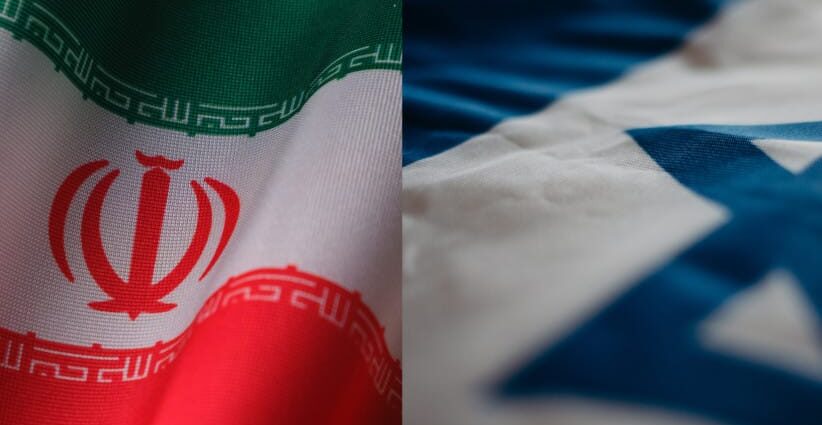
‘Trust me bro’: Trump’s Iran approach harming perceptions of Israel, John Deaton tells ‘Post’
Israel’s popularity in the United States is waning, including among the next generation of Republican leaders, due in large part to US President Donald Trump and Prime Minister Benjamin Netanyahu’s failure to communicate the objectives of the current war with Iran to the public, congressional hopeful John Deaton told The Jerusalem Post on Friday.
Deaton is a moderate in the Republican camp. He has accused Democratic Senator Elizabeth Warren of being more critical of Israel than of the Islamic Republic and its terrorist proxies. At the same time, he has called for greater scrutiny of US aid to Israel and Ukraine, arguing that Washington should more carefully assess both the scale of its assistance and the benefits it receives in return. He has also accused Netanyahu of weaponizing accusations of antisemitism to shield himself and Israel from legitimate criticism, even while acknowledging the unacceptable state of antisemitism in the US.
For Deaton, maintaining the trust of American voters is paramount. He said he would refuse campaign contributions from the American Israel Public Affairs Committee (AIPAC), arguing that doing so would reassure voters that his support for Israel stems from his convictions rather than financial influence. He offered the comments to The Post after being questioned while attending July 4 parades about his stance on Israel and the origins of his campaign funding, questions he said were notably absent when he attended the same parades in 2024.
The basis of trust is communication, and that personal conviction is likely where his criticism of Netanyahu and Trump’s handling of the Iran threat has stemmed.
“I do blame a lot of this, the Iran war situation, on a failure of communication by the Trump administration. For example, how did we obliterate Iran? We can all agree, and I certainly agree, that every president – whether it’s President Clinton, President George W. Bush, the first President Bush, President Obama, or President Trump – has said Iran can never have a nuclear weapon. Period. We know they will use it,” he said. “But how did we obliterate them in June 2025 and set them back decades? Was it bad intelligence when you said that, President Trump? Was that just bad intelligence? And did you not decimate them? If that’s true, fine, because bad intelligence sometimes is faulty.”
Mixed messages about Iran’s progress
There are mixed messages about Iran’s progress in achieving a nuclear weapons arsenal. Tulsi Gabbard, a Trump ally and former director of national intelligence, said in March that there were no signs that Iran was rebuilding their enrichment capabilities after the 12 Day War, though Trump deemed that the renewed kinetic action was necessary because Tehran posed an imminent threat.
Without communicating the reasons for the renewed action, whether that be because June was less successful than previously celebrated or because of a new threat posed by the regime, the unpopularity of the war and rising costs associated with the closure of Hormuz has led many to point blame at Israel, Deaton noted, claiming that the “trust me bro” approach being adopted now has only deepened the crisis.
“I blame the current administration for what I believe is an abysmal lack of communication. I know this sounds silly, but it’s almost like a ‘trust me, bro’ kind of approach. Americans are rejecting that because of the cost of living, and they need more information. If you ask the average American about the significance of the Strait of Hormuz, they don’t know that it is the world’s most important chokepoint for global oil trade, or that it can impact up to 25% or more of global oil trade. They have no idea how that affects their daily lives,” he explained. “In fact, you hear these inconsistent comments. President Trump, on one hand, will say, ‘We don’t need the Strait of Hormuz. We’re independent, and we only get less than 2% of our oil from that region.’ To the everyday American, that sounds like we shouldn’t be involved in Iran.”
Trump’s own reported comments to Netanyahu in June, that “Everybody hates you now. Everybody hates Israel because of this,” were a sign that Trump was blaming Netanyahu for the failed operation, Deaton hinted.
What likely fueled Trump’s decision to go to war in February, Deaton argued, was the momentum from the success of the Venezuela operation, a swift mission to arrest Nicolás Maduro carried out without casualties. He said Trump may have believed that achieving a free Iran under similar conditions would be celebrated as the greatest military achievement in US history.
“I think both Trump and Bibi need to answer for a colossal failure of intelligence. Did they not believe the Strait of Hormuz would be closed? Was the intelligence that they would be able to prevent Iran from controlling the Strait of Hormuz? I don’t know if they ever played that out,” he continued. “It’s almost as if you had a couple of egomaniacs in a back room saying, ‘Listen, if this goes our way, this is going to be the greatest thing to ever happen in the last half century, and we’ll be heroes,’ and then made a decision based on that. That’s how many people perceive it. It’s how I perceive it… And now you have, in my opinion, a less secure Israel and a less secure world.”
Having served seven years in the US Marines, Deaton assessed that the war with Iran has only left the regime in a stronger position and that Washington now has limited options moving forward. He argued that the potential $100 billion in annual revenue Iran could generate by charging vessels transiting the Strait of Hormuz, alongside Tehran’s push for sovereignty over the waterway, would likely not have materialized had the war not begun.
The war has revealed the American mindset to Tehran
More pressing is that Tehran now understands the American psyche, which involves little patience and a desire for immediate results.
“Iran figured out that Americans’ patience gets exhausted quickly. These forever wars — we want Iran to be done and over with. Americans are sick of it. Like the parades I was telling you about, people were blaming me because I’m a Republican. They were saying, ‘Your war, John. Your war.’ And even if I didn’t originally think it was justified, I don’t think they explained why we needed to do it,” he commented.
Deaton said he had little doubt about the US’s ability to seize Kharg Island and establish control over the Strait of Hormuz, but how long Washington would be willing to maintain such a position was a separate question entirely.
For the American public to accept the deployment of military personnel on the ground, Trump would need to explain why it was in US interests to station troops within range of Iranian missiles, with limited time to respond, for a prolonged period.
Though the rift is undoubtedly widening, Deaton said Israel could regain some international trust if Netanyahu were no longer in a position of power.
“I’m assuming it doesn’t surprise you if you have elected American leaders who describe Bibi as a terrorist…What I’m getting at is that perception becomes reality, even if it’s not reality. If you have leaders – if you have people like Bernie Sanders and Elizabeth Warren, who are very significant figures – saying that Bibi is a terrorist and that he is committing genocide, and those views gain influence, that filters down to the electorate and to everyday people. Then, five years later, you end up asking, ‘Why are we even allies with Israel?’” he commented, noting that as bad as public perceptions are now, the true crisis hasn’t yet hit.
“I just honestly think it’s indisputable right now that Iran is in a stronger position, and that’s something I think Benjamin Netanyahu and President Trump need to answer for,” he concluded.
‘Intimidation will not deter me’: Clashes erupt in Bedouin city Rahat in protest of Sukkot’s visit
Clashes broke out during MK Zvi Sukkot’s (Religious Zionist Party) visit to the Bedouin city of Rahat in southern Israel on Sunday, as residents attempted to prevent the visit.
Sukkot, who also serves as chairman of the Knesset Education, Culture and Sports Committee, conducted the visit as part of the committee’s initiative to observe Israel’s educational institutions, the implementation of the committee’s decisions, and the education system’s handling of violence, crime, and incitement.
Israeli media reported clashes between Sukkot and Rahat’s deputy mayor and the closure of schools in the city.
Despite the protests, Sukkot’s tour went ahead under increased supervision by the Knesset and the Israel Police.
“I will not accept Israel becoming a place where a member of Knesset or the chairman of a Knesset committee cannot enter an Israeli city to carry out his duties,” Sukkot said. “Attempts at intimidation and violence will not deter me. The Education Committee will continue to visit every place where parliamentary oversight is needed, regardless of whether it is Right or Left, Jewish or Arab.”
“Anyone who attempts to prevent scrutiny and oversight only strengthens the need to continue going into the field.”
“Everything begins with education, and the fact that all the surrounding communities need to be enclosed by fences, while business owners in the South suffer from protection rackets, demonstrates the need for an organized response, including programs to combat violence and cooperation with law enforcement agencies,” he added.
Umm el-Fahm schools close in protest of MK Zvi Sukkot visit
The incident follows a similar occurrence in late June, when all educational institutions in the Arab city of Umm el-Fahm held a strike in protest against Sukkot’s visit to the city as part of the committee’s oversight tour.
Locals defined it as “a clear and unacceptable provocation,” and claimed that it was an attempt to exploit educational institutions for election propaganda and personal politics.
Sukkot claims that “declared terrorist organizations” are entering to lecture in schools in the city.
Sukkot held an Israeli flag in one hand and a poster of Raed Salah – the former mayor of Umm el-Fahm and leader of the banned northern branch of the Islamic Movement – in the other.
The claims that the city’s educational institutions teach violence constitute “false and inconceivable accusations,” the committees said.
According to them, the decision to keep the schools closed was intended to prevent friction, safeguard the security of the students and education staff, and protect the system from incitement.
Yoav Etiel contributed to this report.

Egypt follows Turkey in denying LGBTQ+ cruise access to port over ‘misaligned moral values’
An LGBTQ+ cruise ship was blocked from both its planned port in Turkish waters last week and additionally refused entry into Egypt this past Thursday due to what authorities referred to as ‘a misalignment of moral values,’ according to a report from The Guardian.
The Scarlet Lady’s cruise, organized and chartered by Atlantis Events, was carrying some 2,000 passengers on its planned route from Athens to Venice when the first route disruption took place.
According to a CNN report, Turkey blocked the cruise from docking in the Turkish port town of Kuşadası after authorities published a statement online saying the cruise was chartered “by groups known for behaviors that do not align with the structure of our society and our moral values”.
The cruise was rerouted to its planned substitute port in Alexandria, Egypt, when passengers reportedly woke on Thursday morning to find a note under their cabin doors informing them that the ship was once again urgently seeking alternative ports, The Guardian reported.
“Early this morning, we were informed that Scarlet Lady has been denied entry into Egyptian waters, and, as a result, will no longer be able to call in Alexandria today,” Rich Campbell, the CEO of Atlantis Events, wrote to passengers.
‘Surprised by this unfortunate decision,’ said Atlantis CEO
“I know how much this visit meant to so many of you. We successfully sailed a similar itinerary last year without issue. So we were surprised by this unfortunate decision,” he wrote.
“This news came as a surprise to all of us, and we’re just as disappointed as you are,” the note concluded.
No official reason was given for the Egyptian government’s decision, according to The Guardian.
“It’s pretty stunning, to be honest. I mean, and the reasoning behind it is that it’s a gay group,” Campbell told CNN.
“It’s very concerning to me when a country decides they can pick and choose which tourists are allowed in and which are not,” he added.
Although same-sex relations are technically legal in Turkey and Egypt, LGBT people have increasingly faced discrimination and increased criminalization under local law.

Lindsey Graham’s voice for Israel has fallen silent – comment
He was a true friend of Israel and a proud American patriot. Those few words capture Senator Lindsey Graham, who passed away at the age of 71. He belonged to a generation that has almost disappeared from American politics.
“I’ll stand with Israel until the day I die. It is our greatest ally,” he told me in an interview just a few months ago. His support for Israel was unwavering. When I asked him about Prime Minister Benjamin Netanyahu‘s proposal to end US military aid to Israel, Graham called it “a serious mistake” – at a time when nearly everyone around him, including many of his fellow Republicans, supported the idea.
Graham was a hawk on Iran. He repeatedly called for the regime’s overthrow and described its leaders as “Nazis.” He was among those urging US President Donald Trump to go all the way and was the first to propose, before Operation Rising Lion, giving the Iranian regime a 60-day ultimatum to dismantle its nuclear program. Trump adopted the idea – and Israel launched its operation on the 61st day.
During Israel’s war against Hamas, Graham never minced his words. “There needs to be a surrender like Japan’s and Germany’s in World War II. An unconditional surrender,” he told me in another interview.
He believed that when Israel goes to war, it must see the fight through to the end against the forces of evil – but at the same time, it should do everything possible to advance regional normalization. For years, he shuttled between Riyadh and Jerusalem in an effort to broker peace between Israel and Saudi Arabia. Even after October 7, and despite all the obstacles, he never gave up on the belief that a normalization agreement was still achievable.
‘I’m asking Israel to be open-minded about ending the conflict’
At the same time, he never hid what he believed Israel needed to do to make that happen.
“Mohammed bin Salman (MBS) is not going to recognize Israel until he gets a better outcome for the Palestinians, or he’ll get killed. That’s the truth. There won’t be normalization if the Palestinians are thrown under the bus,” he told me during the Jerusalem Post Conference.
“I’m not asking Israel to reward terrorism. I’m asking Israel to be open-minded about ending the conflict in a way that guarantees Israel’s security and allows MBS to move his region forward.”
Graham was a true friend – someone Israel could always rely on to raise his voice in its defense. Even when he criticized Israel or believed it should take a different course, he always did so out of genuine friendship and concern.
At a time when many voices were calling on the United States to retreat from the Middle East, Graham remained steadfast in arguing that the forces of evil must be confronted, not ignored.
It was a clear, principled voice – one that has now fallen silent at precisely the moment we need it most.
Lindsey Graham remembered as dedicated advocate for Iran’s opposition
The death of US Senator Lindsey Graham on Saturday prompted an outpouring of tributes from across the political spectrum, including from Iranian opposition figures who remembered him as one of the most outspoken American supporters of the Iranian people’s struggle against the Islamic Republic. Graham died at the age of 71 following what his office described as a “brief and sudden illness.”
Throughout the past year, Graham emerged as one of the most vocal advocates in Washington for backing the Iranian opposition and increasing pressure on the Islamic Republic, repeatedly arguing that the United States should stand with the Iranian people rather than their rulers.
Speaking before a crowd of hundreds of thousands of Iranian demonstrators at a rally in Munich on February 14, Graham declared, “It is a time of choosing. I choose the Iranian people over the murderous ayatollah. It is time for him to go.”
Holding the pre-1979 Lion and Sun flag, Graham told demonstrators, “Liberation is at hand… The Iranian people will be your friend. They will be your ally. Stand with the Iranian people. They deserve their freedom.”
Following the rally, Graham wrote on X that addressing the demonstration had been “one of the highlights of my life.”
I was incredibly honored to be able to speak in Munich, Germany at a rally of 250,000 supporting the brave Iranian people. Being in the company of so many demanding freedom and justice was inspiring and one of the highlights of my life.
I have chosen the Iranian people over the… pic.twitter.com/XjCmZ8wiOJ
— Lindsey Graham (@LindseyGrahamSC) February 14, 2026
“I have chosen the Iranian people over the ayatollah,” he wrote. “I believe they could be good allies of the United States… 2026 is the time of choosing. I’ve chosen the brave Iranian people over their oppressor.”
During an interview with CNN on the sidelines of the Munich Security Conference at the same time as the rally, Graham acknowledged that regime change carried risks but argued they were outweighed by the dangers of allowing the Islamic Republic to remain in power.
“If Iran’s regime stays standing,” he warned, Iranian dissidents would be eliminated while Hezbollah, Hamas and the Houthis would continue to grow stronger.
‘Don’t let this moment pass’
He added that he hoped diplomacy could remove the regime but insisted: “We’ve had it with this regime. Think big. Don’t let this moment pass.”
Graham maintained that position even as Washington pursued diplomatic efforts with Tehran. Appearing on CBS’s Face the Nation in June, he said he supported negotiations but believed they were unlikely to succeed.
“Let’s try a diplomatic solution,” he said. “I think it’s going to fail.”
He also warned that if Iran attempted to challenge US control of the Strait of Hormuz, “we will obliterate them.”
Days later, Graham said he hoped the conflict could still end peacefully, writing that the United States now had “an historic opportunity through diplomacy to resolve the conflict with Iran” while preventing Tehran from acquiring a nuclear weapon.
Graham was also one of the most prominent American political supporters of the exiled Iranian opposition leader, Crown Prince Reza Pahlavi, meeting him in Washington in January and telling him: “I believe with all my heart that help is on the way.”
‘A steadfast friend of the Iranian people’
Following news of Graham’s death, Pahlavi described him as “a steadfast friend of the Iranian people and a proud defender of freedom.”
“At moments when moral clarity was required, Senator Graham stood on the right side,” Pahlavi wrote on X. “His support for Iran’s Lion and Sun Revolution earned him the title ‘Uncle Lindsey’ among Iranians. He will be remembered with profound gratitude and deep respect.”
Graham also became a frequent target of the Islamic Republic’s rhetoric. During Supreme Leader Ali Khamenei‘s funeral in Tehran last week, posters displayed Graham alongside other Western officials with red crosshairs superimposed over their faces.

Credit Availability Index for Cars Hits 10-Year High
In June, the Dealertrack Credit Availability Index, which indicates whether access to credit is improving or declining, jumped to 104.6, the highest level in over a decade and the fifth straight monthly increase. Rising index values suggest it has become easier for consumers to secure auto loans. The index tracks various factors affecting auto credit access, including loan approval rates and the term periods.
The jump in index values was driven primarily by a “sharp recovery” in auto loan approval rates by lenders, together with the share of long-term loans among overall loans hitting an all-time high, the company said….

Meta Prices Its First Paid AI at a Quarter of Rivals’ Rates
Meta Platforms began charging businesses to use one of its artificial-intelligence models for the first time on Thursday, July 9, when Mark Zuckerberg rolled out an upgraded model called Muse Spark 1.1 alongside a public preview of the new Meta Model API. In an interview with Bloomberg News timed to the launch, the chief executive said the company would compete on cost, describing the pricing as “very aggressive and attractive” and taking direct aim at the fat margins he says rival labs charge for comparable tools.
The numbers back up the pitch. According to Meta’s own developer blog, the Meta Model API will charge $1.25 per million input tokens and $4.25 per million output tokens, with $20 in free credits for every new account. Zuckerberg put that at roughly a quarter of what OpenAI and Anthropic charge for models in the same class. The preview is open to developers in the United States at launch, with additional access handled through a waitlist.
For Meta, the move is less about the model than about the business behind it. The company built its AI reputation by giving its Llama models away for free, arguing open-source software was good for the industry and bad for closed-model competitors. Muse Spark 1.1 is the opposite: proprietary, closed-weight, and reachable only through Meta’s apps or the paid interface. It marks the first time the company has turned one of its models into a direct revenue line, and it plants Meta squarely in the market for paid developer tools that OpenAI and Anthropic have largely had to themselves.
The man driving the shift is Alexandr Wang, the 28-year-old former co-founder of Scale AI whom Zuckerberg brought in last summer to run Meta Superintelligence Labs. Meta paid $14.3 billion for a 49% nonvoting stake in Scale AI in June 2025 and handed Wang a newly created chief AI officer role after the disappointing reception of the Llama 4 series. Wang echoed his boss on price, positioning the new model against offerings from Anthropic and OpenAI and calling it Meta’s strongest work yet for coding and agent-style tasks.
Agents are the selling point. Muse Spark 1.1 is a multimodal reasoning model with a one-million-token context window, built to plan and carry out multi-step jobs across outside apps, use software and tools, write and debug code, and read text, images and video in a single pass. Zuckerberg described its reasoning and tool use as state-of-the-art or close to it, and said Meta employees have already been using the model in-house to build features across the company’s products. He also claimed it beat Alphabet‘s Gemini on several benchmarks tied to agents, coding and multimodal work — in his telling, the first time Meta’s models have topped all of Google’s.
Meta lined up early partners to make the case. Replit chief executive Amjad Masad pointed to the long context window and the model’s coding strength, particularly on front-end and design work. Cline chief executive Saoud Rizwan said the pricing makes it realistic to run heavy coding jobs at scale. Yashodha Bhavnani, who runs AI products at Box, said the model held its own against top frontier systems on the company’s internal tests. A quiet but important detail: the Meta Model API speaks both the OpenAI and Anthropic software formats, so a developer can point an existing setup at Muse Spark by changing a web address and a key rather than rebuilding anything.
That compatibility is the sharp edge of the strategy. It lowers the cost of switching to near zero at the same moment Meta is undercutting the field on price — a squeeze aimed at pure-play labs that need model revenue to survive. Meta, by contrast, funds its AI push with an advertising machine and has told investors it will spend as much as $135 billion to $145 billion on capital projects this year.
Investors were split on the day. Meta shares opened lower, trading down about 3.5% near $581.70 in the first hour, then reversed higher through the session as the market weighed the new revenue angle against the spending. The stock had already jumped about 9% on July 1 on separate reports that Meta plans to sell excess cloud capacity. The company carries a market value near $1.51 trillion, and Wall Street’s consensus rating sits at “strong buy” with an average 12-month target around $824.
The open question is whether cut-rate pricing wins share fast enough to justify the outlay. Zuckerberg is betting that getting Meta’s technology into as many hands as possible matters more than protecting margins today — and that the companies charging premium rates will feel the pressure first.
JBizNews Desk | Menlo Park, Calif. © JBizNews.com All Rights Reserved. Reproduction or distribution without written permission is prohibited.



Trump, world leaders offer condolences after death of US Senator Lindsey Graham
US President Donald Trump offered his condolences for the death of US Senator Lindsey Graham on Sunday.
“Senator Lindsey Graham, one of the greatest people and Senators I have ever known, is dead! He was always working, and was a true American Patriot. Lindsey will be greatly missed!!!,” Trump said in a post on Truth Social.
“He was always working, and was a true American Patriot,” Trump continued. “Lindsey will be greatly missed!!! …So sad!”
Graham was an outspoken advocate for Ukraine
At the time of his death, Graham had just returned from a trip to Kyiv.
Ukrainian President Volodymyr Zelensky said he was “deeply saddened,” calling Graham “a true defender of freedom and the values that make our world safer.”
Zelensky noted that Graham had visited Ukraine 10 times since Russia’s full-scale invasion in 2022.
In a Facebook post, he wrote: “We will always be especially grateful for the recognition of our people and words of admiration for the courage of Ukraine’s defenders.”
‘A steadfast friend of the Iranian people’
Graham was also one of the most prominent American political supporters of the Iranian opposition and the exiled Iranian opposition leader, Crown Prince Reza Pahlavi, meeting him in Washington in January and telling him: “I believe with all my heart that help is on the way.”
Following news of Graham’s death, Pahlavi described him as “a steadfast friend of the Iranian people and a proud defender of freedom.”
“At moments when moral clarity was required, Senator Graham stood on the right side,” Pahlavi wrote on X. “His support for Iran’s Lion and Sun Revolution earned him the title ‘Uncle Lindsey’ among Iranians. He will be remembered with profound gratitude and deep respect.”
Alex Winston contributed to this report.

IDF locates Hezbollah position that wounded IDF Spokesperson Effie Defrin in Second Lebanon War
IDF troops from Division 36 operating in the Wadi Saluki area uncovered a fortified Hezbollah anti-tank missile position, the same position that fired on IDF Spokesperson Brig. Gen. Effie Defrin during the Second Lebanon War, the military revealed on Sunday.
Soldiers operating in the field discovered several rockets belonging to Hezbollah, alongside a launcher aimed at the wadi.
During the Second Lebanon War, the battle that occured at the site was one of the hardest of the war. IDF armored forces began to cross the wadi, while troops from the Nahal Brigade and Engineering Corps attempted to secure the area.
Eleven killed, more than 50 wounded
The operation was delayed and postponed several times until Hezbollah, noticing the IDF’s movement in the field, triggered an ambush.
Eleven IDF officers and soldiers were killed in the battle, including two company commanders from the 401st Brigade. Over 50 soldiers were wounded in the fighting, including a seriously wounded Defrin, who served at the time as the commander of the 9th Battalion.
In a moment of closure last week, Defrin visited troops operating in the area, near the place from which he maneuvered the 9th Battalion toward Wadi Saluki, opposite the village of Anduria, during the 2006 war.
‘One of Israel’s greatest friends’: Netanyahu, Herzog lead tributes as Israel mourns Lindsey Graham
Israeli politicians took to social media to mourn Republican US Senator Lindsey Graham after his sudden death was announced on social media on Sunday.
Statement from the Office of U.S. Senator Lindsey Graham (R-South Carolina). pic.twitter.com/CQ5yVvqTH1
— Lindsey Graham (@LindseyGrahamSC) July 12, 2026
Prime Minister Benjamin Netanyahu and his wife, Sara, mourned Graham in a statement on Sunday.
“Lindsey understood that the security of Israel and America are inseparable. He devoted his life to defending America, strengthening our alliance and standing up for the free world,” Netanyahu said in his statement. “Israel has lost one of its greatest friends. America has lost a great patriot. I have lost a beloved friend.”
“Our hearts are with Lindsey’s family and with the American people at this difficult time. May his values and initiatives continue to guide us toward victory and peace, and may his memory forever be a blessing.”
“I am shocked and heartbroken to learn of the sudden passing of the great American patriot, a great friend of Israel, and my dear friend US Senator Lindsey Graham,” President Isaac Herzog said on X/Twitter on Sunday morning.
Herzog called Graham a “beacon of moral clarity and a true leader of the US-Israel partnership.”
“We will never forget how he stood by the people of Israel in our most difficult moments, and we will remain eternally grateful for his sense of justice, truth, and loyalty,” he wrote. “The people of Israel mourn his loss, and I will miss my great friend very dearly.”
I am shocked and heartbroken to learn of the sudden passing of the great American patriot, a great friend of Israel, and my dear friend U.S. Senator Lindsey Graham.
Senator Graham was a beacon of moral clarity and a true leader of the U.S.-Israel partnership. We will never… pic.twitter.com/tNuV93LXKS
— יצחק הרצוג Isaac Herzog (@Isaac_Herzog) July 12, 2026
Israel lost “one of its greatest friends,” said National Security Minister Itamar Ben-Gvir in an English-language post to X on Sunday.
“Senator Lindsey Graham stood with Israel not because it was easy, but because he believed it was right. His unwavering support, courage, and moral clarity earned him the admiration of millions of Israelis,” Ben-Gvir wrote. “The State of Israel will always remember his friendship, his unwavering support, and his steadfast commitment to Israel’s security.”
Ben-Gvir concluded by sending his condolences to Graham’s family and the American people.
“May his memory be a blessing.”
Similarly, Defense Minister Israel Katz said that he was “deeply saddened by the passing of Senator Lindsey Graham.”
Katz added that Graham was one of Israel’s “strongest and most steadfast supporters” and “was an unwavering voice in support of Israel’s security and its right to defend itself.”
“Following the October 7 massacre, he traveled to Israel time and again, standing shoulder to shoulder with our people in an extraordinary demonstration of solidarity and unwavering friendship. His repeated visits during one of the darkest chapters in Israel’s history reflected his deep commitment to the Jewish state and its right to live in peace and security. “
Foreign Minister Gideon Sa’ar, in his own X post, said that he always called Graham “the best senator and the best friend.”
“Lindsey was a man with a huge heart and rare personal charm. He was blessed with a clear vision of reality and a true commitment to values. His support for Israel and its security was unwavering.”
“The State of Israel has lost a great friend,” Sa’ar said. “Israel will not forget you, dear friend.”
Graham ‘stood with Israel in its darkest hours’
Former prime minister Naftali Bennett echoed the sentiment in his own post to X.
“I am heartbroken to hear of the passing of my friend Senator Lindsey Graham. America has lost a devoted patriot, and Israel has lost one of its greatest friends,” Bennett wrote. “Lindsey stood with Israel through our darkest hours, with courage. My thoughts and prayers are with his family.”
Opposition head Yair Lapid added that Graham “had unwavering moral clarity, a deep devotion to the people of Israel and a clear vision for a secure and peaceful Middle East.”
“His warmth, humor and energy will be deeply missed,” he said, sending prayers to Graham’s family.
Ultra-Orthodox (haredi) Shas party leader Arye Deri said that he was also “deeply saddened to hear of the passing of Senator Lindsey Graham, one of the greatest friends of the State of Israel and Righteous Among the Nations of our generation.”
“He stood courageously by Israel’s side, fought uncompromisingly against the Iranian axis of evil and terrorism, and made a significant contribution to strengthening the strong alliance between Israel and the United States.”
‘One of a kind’
Knesset Speaker Amir Ohana sent condolences on behalf of the Knesset to Graham’s family and South Carolina in an X post on Sunday.
“Lindsey was one of the funniest and smartest people I’ve ever met. He was a great friend of the State of Israel, and to me personally,” Ohana wrote. “He was one of a kind, and he will be dearly missed. Rest in peace, friend. Thank you for fighting for what is good.”
Shocked and deeply saddened by the sudden death of Senator Lindsey Graham.
On behalf of the Knesset, I send my deepest condolences to his family and to the people of South Carolina, whom he cherished and represented wholeheartedly.
Lindsey was one of the funniest and smartest… pic.twitter.com/HShJu9wXKJ
— Amir Ohana – אמיר אוחנה (@AmirOhana) July 12, 2026
In his own statement, Samaria Regional Council Head Yossi Dagan said that he was “filled with sorrow over the sudden passing of Lindsey Graham,” praising Graham for his love of Israel and idealism.
“He was a true lover of Israel and an idealist. A man who believed, out of Christian faith, that the Jews should return to the Land of Israel, and worked for decades for the State of Israel and strengthening the bond between Israel and the United States,” Dagan said. “Whoever blesses the people of Israel is blessed, and he blessed the people of Israel from the bottom of his heart, without ceasing.”
Dagan noted Graham’s position as a “declared friend of Samaria,” adding that the senator was one of the official hosts of the West Bank conference held in Washington last month.
Finance Minister Bezalel Smotrich, Innovation, Science, and Technology Minister Gila Gamliel, Yisrael Beytenu head Avigdor Liberman, and MK Eli Cohen (Likud) all also offered their condolences over Graham’s passing.

The Economic Miracle of America, 250 Years in the Making
Over two-and-a-half centuries, the country has achieved remarkable economic growth, evolving from a largely agrarian society into the world’s leading economy.
Its path, however, has not been easy. America’s political and economic systems faced severe tests from the Civil War to the Great Depression. Yet time and again, the country has defied predictions of decline and recovered strongly from each crisis.
Arthur Herman, historian and author of “Founder’s Fire: From 1776 to the Age of Trump,” argues that the defining characteristic of the American economy has been a culture of risk-taking that stretches back to the nation’s earliest settlements….

One Indian national missing after attack on vessel off Oman, foreign ministry says
One Indian national is missing after an attack on the commercial vessel GFS Galaxy off the coast of Oman earlier on Sunday, the Ministry of External Affairs said.
“Of the 11 Indian nationals on board, 10 have been rescued so far, while one Indian National is reportedly missing,” the ministry said, while condemning the attack.
India’s embassy in Oman is closely monitoring the situation and coordinating with the Omani authorities on the ongoing search-and-rescue operation, the ministry added.
Iran said earlier it had fired a warning shot that struck a vessel traveling on an unapproved route.
Child injured in Qatar as Iranian attacks rattle region
A series of attacks and security alerts was reported across the Middle East on Sunday, according to regional officials and state media.
Three people, including a child, were injured by falling shrapnel following Iranian attacks, Qatar’s Interior Ministry said.
Shortly afterward, the Khondab region in central Iran came under attack, a local official told Iranian state media.
Oman’s state news agency later reported that sites in the Musandam Governorate had been targeted by drones.
The Jordanian military said three missiles launched from Iran fell inside Jordanian territory, according to the country’s state news agency. No casualties were reported.
Amid the developments, Iranian Foreign Minister Abbas Araghchi discussed the regional situation with Pakistan’s deputy foreign minister during a phone call, Iran’s Tasnim News Agency reported.
Sirens were subsequently activated in Bahrain, the country’s Interior Ministry said.

Friend of the ‘Post’ Lindsey Graham advocated for Israel through his policies until the end
Lindsey Graham, a Republican Senator from South Carolina and a great friend of Israel, as well as The Jerusalem Post, passed away on Sunday morning, July 11, due to cardiac arrest.
During his time in office, Graham demonstrated strong support for the State of Israel and the Jewish community worldwide.
He was a vocal advocate for relocating the US embassy from Tel Aviv to Jerusalem and consistently promoted US security assistance for Israel.
Graham also cosponsored the Israel Anti-Boycott Act and the Combating BDS Act of 2017, both of which aim to combat discriminatory boycotts targeting Israel.
He also criticized the UN Security Council Resolution 2334, which claimed that Israel’s settlements in the West Bank have no legal validity, and cosponsored legislation that objected to the resolution.
Graham with the Jerusalem Post
Most recently, Graham spoke with the Post in February on the war with the October 7th massacre, the Iranian regime, and Israel’s past three years of war.
“Without the October 7 massacre happening, I don’t believe Iran would be on the verge of regime collapse,” he said.
“The determination of the Israeli people to make sure ‘Never Again’ has meaning has weakened Iran and their proxies, unlike any time since the founding of the religious-Nazi state in 1979,” Graham said, linking the current vulnerability of the ayatollahs to Israel’s military response.
“The sacrifice of the people who have died in droves for their freedom in Iran and the determination of Israel to strike back after the massacre… those two things have led to this historic moment,” he added.
Amichai Stein contributed to this report.

Lindsey Graham is gone, Israel may never find another friend like him – comment
Jewish tradition notices when a person leaves the world on Shabbat. Every Shabbat afternoon at Mincha, we recite Tzidkatcha, three verses accepting God’s judgment, in memory of the three righteous men who, tradition teaches, died on Shabbat: Joseph, Moses, and King David. The Midrash tells that the Angel of Death could not touch David so long as words of Torah were in his mouth. The Zohar teaches that even Gehinnom rests on Shabbat. I am not in the business of handing out Jewish honors to a Southern Baptist from South Carolina. But a man whose entire foreign policy came out of the Book of Genesis left this world on the day Genesis calls blessed and holy, and I noticed.
In Israel we know maybe five American senators by name. Lindsey Graham was one of them, and for a reason. He came here in wartime, repeatedly, when the airport was half empty. He went to Beirut to tell the Lebanese to their faces to disarm Hezbollah. He said things about our enemies that our own officials only say off the record. Israelis treated him the way we treat American support in general: as weather. Something that is simply there.
The last time I sat with him was on a Friday in Las Vegas last fall, at the Republican Jewish Coalition summit. His team put us in a small room off the main hall. Senators at these events give you eight minutes and a handshake. Graham gave me as much time as I needed, and his office later wrote that he had sincerely enjoyed the conversation. I believed it. He argued like a man having fun.
He also looked worried and tired.
The worry surprised me. I assumed that in that crowd, the most pro-Israel Republican gathering in America, he would back annexation or at least shrug that it was coming. Instead: “If you want to marginalize the Jewish state, go down that road. It will do more damage to Israel’s future than any bomb Iran could ever build.” Then he said, “To be pro-Israel, you need to be honest with Israel.”
Days earlier, a very senior Israeli official, a man of the Right, had told me privately that pushing sovereignty in parts of the West Bank right now was simply not feasible. Graham said the same thing without being asked. When Israel’s fiercest friend in the Senate and a senior figure on the Israeli Right land in the same place, that is worth reporting.
None of it made him soft. In the same conversation, he compared Hamas to a tiger that cannot change its nature and said that if no international force showed up to disarm it, “it will fall on Israel.” On the Israel-skeptics rising in his own party: “Seventy-five beats twenty-five.” It is one thing, he said, to flirt with white nationalists on a podcast in a basement. It is another to sell that to voters in South Carolina.
Where did Graham’s love for Israel come from?
Where did all of it come from? Graham was a Southern Baptist, a member of Corinth Baptist Church in Seneca, South Carolina. By his own admission, he got to services about three times a year, and congregants knew him for slipping in after the opening hymn and out before the last prayer. He did not preach, and he said he would tolerate no national religion in America even though he was a Christian.
His support for Israel was not end-times prophecy. It was Genesis, read the way it is read in a South Carolina pew: I will bless those who bless you. At a Christians United for Israel summit two years ago, he said it in one sentence: “God blesses those who bless Israel, and that’s my foreign policy.” Not complicated, he added. As far back as 2014, he was warning that if America turns its back on Israel, God will turn His back on America.
By last summer it was the version everyone knows: “If America pulls the plug on Israel, God will pull the plug on us.” That is diplomacy through faith, and it moved real weapons, real vetoes, and real money for decades. Israelis have never properly studied it, and we have certainly never properly said thank you for it.
He said these things to this newspaper for years. In June 2024, he told the Post’s Tovah Lazaroff that Iran must be held accountable for Hezbollah’s attacks, warning that American hesitation would read in Tehran as “weakness and timidity” and end in a nuclear breakout. This past December, he told our correspondent Amichai Stein in Washington that Mohammed bin Salman would not recognize Israel without a better outcome for the Palestinians, “or he will get killed.” In February, days after a quarter of a million Israelis rallied against the Iranian regime, he was in Tel Aviv telling the Post the regime was at its weakest point since 1979.
Will there be another Lindsey Graham?
So here is the question I have been unable to shake since Motzaei Shabbat: will there be another Lindsey Graham?
I doubt it, and that should worry Israelis far more than it currently does. Graham came from the generation of his closest friend, John McCain, Christian Reaganites for whom standing with Israel required no argument. McCain is gone. Now Graham is gone, mid-campaign, still arguing.
The young Right replacing them is the one Graham himself described: the podcast Right, the basement Right, the one that thinks the Jews get America into trouble. Seventy-five still beats twenty-five, but seventy-five is the harvest of pews like the one in Seneca, and those pews are emptying. The pro-Israel America we rely on is not infrastructure. It is people, and the people are dying.
Israelis are raised to believe we depend on no one, and on our worst days we half believe American support is owed to us. It is not. It was built, senator by senator, pastor by pastor, and it can be unbuilt by nothing more dramatic than a generation failing to replace itself. If there is an Israeli lesson in Graham’s death, it is this: the evangelical Christians who carried this alliance deserve more from us than a handshake at conferences. They deserve investment, relationships, and gratitude, in their churches and in our schools, before the last of them leaves the stage.
Graham gave his whole life to public work. A boy from a pool hall in Central, South Carolina, orphaned in his twenties, raising his 13-year-old sister alone. He never married. His family was his sister, his state, and, as I saw up close in a small room in Las Vegas, this country too.
I keep coming back to the worry on his face that Friday. I understand it better now. Some of it, I think, was for us.

Former emir of Qatar, Sheikh Hamad bin Khalifa Al Thani, dies at 74
Qatar’s former emir, who revolutionized Qatar out of its Bedouin background to a regional powerhouse, has died at the age of 74, the nation’s Amiri Diwan, its top government body, said on Sunday.
Sheikh Hamad bin Khalifa Al Thani ruled Qatar from 1995 to 2013, before abdicating to his son Sheikh Tamim, the current leader of the gas-rich Gulf country.
“The Amiri Diwan announced the death of HH the Father Amir Sheikh Hamad bin Khalifa Al-Thani on Sunday morning. May Allah have mercy on his soul and grant him the best reward for what he achieved for his homeland and nation,” the Diwan said.
Elevating Qatar’s global profile
Sheikh Hamad had elevated Qatar’s global profile through, in addition to other factors, its successful bid to host the 2022 soccer World Cup tournament.
The US-allied state is small, with more than 2.5 million people, but is the world’s largest exporter of liquefied natural gas, a global investment powerhouse and heavy hitter in Middle East diplomacy and international media.
Sheikh Hamad handed power to his son, the then crown prince, in June 2013 in a rare abdication by a hereditary Gulf Arab ruler, to try to ensure a smooth succession. He himself had overthrown his father in a bloodless coup in 1995.
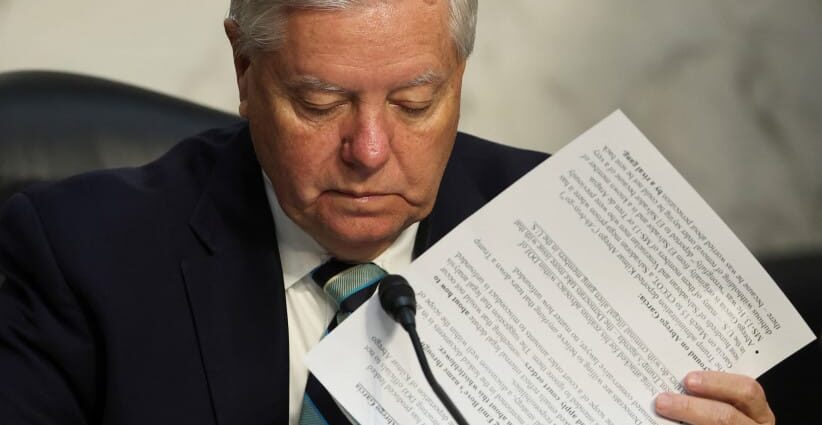
Senator Lindsey Graham, staunch Israel supporter, dies at 71 from ‘brief and sudden illness’
Hardline supporter of Israel, US Senator Lindsey Graham, passed away on Saturday evening after a brief and sudden illness, the communications director for his office said in a post on Twitter/X early on Sunday.
“Senator Graham’s family appreciates prayers at this time and asks for privacy during this incredibly difficult period,” the statement read.
Emergency personnel responded to a call for “cardiac arrest” at Graham’s home on Saturday night, according to police scanner audio obtained by NBC News.
Photographs reviewed by NBC News showed that paramedics carried a person on a stretcher from Graham’s home to an awaiting ambulance. Police cars and fire trucks were also on site, NBC reported.
Graham, 71, was a prominent Republican senator from South Carolina. Earlier in his career, he was a vocal critic of US President Donald Trump before becoming one of his most loyal allies on Capitol Hill.
Graham’s early life, career, and entrance into politics
Graham was born in 1955 in Central, South Carolina, where his parents ran a restaurant and a pool hall, according to Graham’s official website. He was the first member of his family to earn an undergraduate degree.
Graham was elected to the US Senate in 2002. Before serving in the upper house, he was elected to the US House of Representatives in 1994 for South Carolina’s third congressional district, according to his website.
In 1995, Graham joined the US Air Force Reserves. During American military operations in Iraq and Afghanistan, Graham put his experience in military law to use, his website noted.
Graham retired from the Air Force Reserves in June 2015, having served his country in uniform for 33 years, the website added. He retired at the rank of Colonel.
Graham was elected to the US Senate in 2002. Before serving in the upper house, he was elected to the US House of Representatives in 1994 for South Carolina’s third congressional district, according to his website.
Graham was re-elected to the Senate in 2008, 2014, and 2020.

China submarine launch signals growing threat across western Pacific – analysis
China’s submarine-fired ballistic missile test into the southern Pacific on Monday gave its military leadership an opportunity to examine some of the most complex and sensitive operations of its evolving nuclear deterrent, analysts and diplomats say.
Commanding, controlling and communicating with nuclear-armed submarines attempting to operate undetected pose immense challenges, they say – something felt acutely by a Chinese Communist Party leadership where the military’s political loyalty is paramount.
“This aspect is certainly something that would have been very much evaluated, besides looking at the actual technical capabilities of the missile and submarine,” said Collin Koh, a security scholar at Singapore’s S. Rajaratnam School of International Studies.
“There are still challenges ahead but it would seem they are getting close to an operational strike capability here…they are probably trying to demonstrate that even if they can’t get into a position to hit the continental US, they could still target Guam and Hawaii.”
China’s test firing of the missile armed with a dummy warhead drew criticism from regional powers, with the US saying it was an intercontinental ballistic missile that landed in the southern Pacific Ocean.
Chinese state media and officials described the test as a “routine” military drill that was not directed at a specific target or country, and was handled professionally.
Dismissing some reports as “pure distortion and hype,” the Chinese defense ministry said in response to Reuters’ questions on Friday that the test was made in accordance with international law and practice.
“It should be emphasized that China’s efforts to modernize its nuclear forces are intended to safeguard national strategic security and maintain global strategic stability,” the defense ministry said.
It was China’s most significant long-range ballistic missile test since September 2024, when the People’s Liberation Army fired a weapon into the southern Pacific Ocean from a mobile launcher on Hainan Island in the South China Sea.
China’s submarines key to nuclear strategy
Monday’s missile was fired from one of China’s six Type-094 nuclear-powered submarines known as SSBNs, said analysts and academics. State media said it was a strategic missile submarine (SSBN), but did not identify the class. An SSBN is a large nuclear-powered submarine designed to launch nuclear-armed intercontinental ballistic missiles.
Regional military attaches and analysts say China’s SSBN operations, based out of Hainan Island, are among the most closely watched elements of its ongoing military modernization, given their importance to China’s nuclear deterrent to ensure a second-strike capability.
If its nuclear-armed submarines can operate undetected, China can strike back if its more extensive land-based weapons are destroyed in a first strike by an adversary. This is widely seen as a particularly important factor for Beijing, which still maintains an official policy that it would not be the first to use nuclear weapons in a conflict.
The US and its allies at times attempt to track Chinese submarines through naval vessels, networks of underwater sensors in key chokepoints, as well as air patrols with P-8 Poseidon aircraft, which are equipped with advanced maritime surveillance devices, military attaches and analysts say. Such operations are expected to increase as China’s capabilities grow.
A Pentagon report in 2022 stated that China had begun operating near-continuous deterrence patrols with its SSBNs. The US, Russia, France and Britain have for decades routinely deployed such a nuclear strike capability, and India is now developing its own SSBNs.
A study of China’s nuclear weapons released this week by the Bulletin of the Atomic Scientists, a Chicago-based research organization, said that while US officials have not publicly stated that China’s SSBNs were actually armed with nuclear weapons on such patrols, some US officials have said it to the authors privately.
Noting the lack of official confirmation, the study says that “President Xi Jinping’s purge of military officials – including leaders of the People’s Liberation Army’s rocket force – make it seem unlikely that nuclear warheads would be handed over to the military under normal circumstances.”
China’s ‘nuclear triad’
While the exact location of Monday’s submarine missile launch and the precise missile used have also yet to be confirmed, the ability of China’s SSBNs to maneuver undetected beyond its coasts is also likely to be closely scrutinized. The Type-094 submarine will eventually be replaced with a more advanced, quieter version now under development, analysts say.
To reach the continental United States with its most advanced submarine missile, the JL-3, a submarine would have to move beyond the South China Sea into the western Pacific, potentially risking exposure to rival navies.
The JL-3, which is believed to be armed with multiple warheads and was showcased in a military parade in Beijing in September 2025, has a range of 10,000 km (6,214 miles).
Despite the unknowns, China’s Global Times newspaper has said the missile launch showed how China was continuously strengthening its “nuclear triad” of strategic forces – the ability to fire nuclear weapons from land, sea and the air.
“This will compel external powers and their followers to abandon attempts aimed at forcing Chinese concessions through maximum military pressure or pre-emptive strikes, thereby fundamentally reducing the risk of large-scale conflict…,” the Global Times editorial said.

Iran says talks with Oman focused on Strait of Hormuz traffic
Iran and Oman held talks on Saturday on arrangements for managing maritime traffic and shipping through the Strait of Hormuz, an Iranian Foreign Ministry spokesperson said.
The two countries agreed to continue discussions aimed at reaching a common understanding on ensuring the security of shipping in the strait. A Qatari delegation attended part of the talks, the spokesperson added.
The US military launched fresh strikes on Iran after it struck a container ship on Sunday, while Tehran said it had again closed the Strait of Hormuz and escalated attacks on US facilities in states across the Gulf.
Trump declares end to ceasefire meant to hold back strikes on US, Israeli targets
A series of attacks between the US and Iran over the past several days led US President Donald Trump to declare the end of a ceasefire meant to halt the fighting that the US and Israel began on February 28, though Trump has left the door open to continued negotiations.
Iran said it closed the strait after firing a warning shot that struck a vessel traveling on an unapproved route. It warned that any retaliation over the incident would be met with a “severe response.”
US Central Command, however, said commercial vessels continue to transit through the waterway that carried one-fifth of the world’s oil and LNG shipments before the war.

Jerusalem partially saves historic Bikur Cholim building after backlash over haredi seminary plan
Who says you can’t fight City Hall? Deputy Mayor Yosef (Yosi) Havilio did and won, but only a partial victory.
The fate of the oldest Jewish hospital in the capital, its premises on the eastern side of Rehov Straus that were opened in 1925 after moving from the Old City, will decide whether the center of town will be accessible to all Jerusalemites.
So says Yosef (Yosi) Havilio, the longtime community activist and politician who for decades has represented the voice of the secular, liberal, and traditional community in haredi-dominated municipality, and is a deputy mayor heading the Ha’ihud Ha’Yerushalmi faction has forced Mayor Moshe Lion to reconsider.
The western side of the street that was part of Bikur Cholim (“Visiting the Sick”) is already a school for a small number of haredi boys.
The municipality had approved plans to allocate the historic and much-more-beautiful building opposite it for a seminary for 1,000 haredi (ultra-Orthodox) teenage girls run by the Slonim hassidic community, triggering an uproar among liberal Jerusalemites.
The decision would impede life for non-religious residents
“This is a historic mistake,” Havilio told In Jerusalem. “At present, the border between haredi residents and institutions and non-haredi ones is on Hanevi’im Street (the Street of the Prophets).
If the seminary is allowed to take over, as Mayor Lion wants, the border will move south to Jaffa Road. The city center will then not be allowed to have places of entertainment, cafes, or stores that could remain open on Shabbat or any liberal projects.
Currently, the girls study in the Mekor Baruch quarter, so they’ll have to be bused to Rehov Straus.”
“The mayor’s decision was illegal. I’m in his coalition, but I fought against him,” Havilio told In Jerusalem on Friday.
Lawsuits were threatened, so the older building has been saved,” he continued.
“Now, the hassidim have gotten permission from Lion to move 250 or 300 teenage haredi girls to the western building instead of 1,000, with strict separation between them and the boys. But at least they won’t control both sides of the street.
The building has been listed as one of the 100 most beautiful edifices in the city and must be preserved
Our achievement is far from complete.”The magnificent eastern building, which has been listed as one of the
100 most beautiful edifices in the city, “must be preserved, according to the Israel Council for Conservation of Heritage Sites that warned that turning the compound into a narrowly sectarian institution would be a misuse of a major heritage asset.”
“There are other places in Jerusalem where the seminary could be located. If the hassidim take control of the eastern building, it will no longer be open to the public, and the gate will be locked,” Havilio warned. “It should serve the broader public.”
The opponents have proposed alternatives such as turning it into a cultural center, arts space, public heritage campus, performance venue, cafes and community spaces, or a museum/history complex tied to Jerusalem medicine and preservation.
The municipality’s legal advisor, Adv. Haim Nargassi, sent a letter of response on Thursday to the Council for the Preservation of Sites, noting that after a comprehensive legal and planning examination, the municipality decided that the eastern building, which is a historical, architectural and monumental asset of exceptional importance, is “not
intended for educational use at this stage.”
It was also stated that the “temporary use for school purposes will be carried out in the western building of the complex only, a building that has already been adapted in the past for educational use, without harming the values, its preservation, and in accordance with all required permits.”
However, in Israel, “temporary” often becomes “permanent.”
Nargassi stated that the municipality considers the preservation of the eastern building and its heritage values to be of paramount importance, and has been working over the years to preserve it in accordance with the provisions of the law and the guidelines of professional conservation agencies. But in addition, any work carried out on site will be done with close professional guidance from the municipal conservation department,” the legal adviser maintained.
He added that the future planning of the complex, as it is known today, is not intended for use as an educational building, but rather a plan that includes significant development of the complex, including a variety of public uses, while strictly preserving the historical buildings and their unique heritage values.
Havilio declared, “This is a tremendous achievement for preserving the character of the city center. I argued from the beginning that the move is wrong and illegal, and it is good that at the end of the day the right decision was made. I hope that now the municipality will turn the building into a cultural or entertainment center open to the entire public.
Adir Schwartz, deputy mayor and chairman of the municipal list Hitorerut, welcomed the decision and told Ynet, which broke the seminary story last week, said: “This is a very important victory for the Zionist future of Jerusalem.
The decision to allocate a haredi school there was wrong from the start, legally and practically, and it is very good that it did not happen, also for the benefit of the children, and especially for the benefit of the balance in the city. The next step is to pour positive content into the building, in which every Jerusalemite can find themselves.
The building has the potential to become a national gem, and we will work to make it so.”
The Jerusalem district director of the Sites Preservation Council, Tzafi Shelef, commented: “We welcome the municipality’s announcement and the fact that the building, with its historical and architectural values, will be preserved and not converted into a school. We will continue to work tirelessly to ensure the preservation of this building, and other historic buildings throughout the city.”
The hospital has a long and complicated history
The hospital has a very checkered past, a mix of successes, failures, and questionable and controversial events.
Bikur Cholim was one of the most important institutions in the history of medicine in Jerusalem and the Old Yishuv.
Founded in the early 19th century, it became the oldest continuously operating hospital in the Land of Israel until its final closure around 2020.
In the early 1800s, Ottoman Jerusalem had almost no organized Jewish medical care.
Jews often had to rely on private physicians, Christian missionary hospitals, or even folk healers. This worried the Jewish leadership, who feared missionary influence over sick Jews.
Bikur Cholim emerged as a religious communal response.
Originally created in the Old City by the Perushim community, who were disciples of the Vilna Gaon and immigrated from Lithuania in the early 19th century, it first functioned as a charitable society caring for the sick in their homes before evolving into a hospital with only a few beds, operating in rented rooms.
A major figure in the hospital’s growth was philanthropist Sir Moses Montefiore, who raised funds abroad, donated medicines, and visited the hospital during his trips to Jerusalem.
By the late 19th century, Bikur Cholim had become one of the central charities supported by world Jewry, even before Shaare Zedek Hospital was opened in 1902.
During Kaiser Wilhelm II’s famous 1898 visit to Jerusalem, he donated money that helped purchase land for a modern hospital outside the Old City walls. Although World War I delayed construction for years, the new building on Rehov Straus finally opened in 1925.
The main hospital building was designed by architect Zvi Joseph Barsky in the neoclassical style with modernist influences, featuring decorative bronze doors by Bezalel artist Zeev Raban.
During the early years, Bikur Cholim doctors and nurses treated victims of the 1929 riots, victims and casualties from the Arab Revolt that followed, Hagana and underground members who were sometimes admitted under false names to avoid arrests by the British, and civilians wounded in violence.
During the siege of Jerusalem, the hospital came under Jordanian artillery fire and took in patients evacuated from Hadassah Hospital on Mount Scopus.
The hospital was the place where the haredi community turned for emergencies, births, illnesses, and end-of-life care.
Because it was close to haredi neighborhoods to the north, pregnant haredi women who went into labor on Shabbat walked to Bikur Cholim instead of taking an ambulance. Even though it was smaller than Shaare Zedek and the hospitals owned by Hadassah, it developed competent departments in obstetrics, pediatrics, cardiology, neonatology, and bariatric surgery.
Politics and mismanagement burdened the hospital with chronic debt, instability, and political disputes
In the late 1990s, the hospital became linked to non-profit religious management and politics, which sometimes led to chronic debt, instability, and political disputes. Soon after, the hospital was often on the verge of collapse.
Russian-Israeli billionaire Arkadi Gaydamak stepped in and rescued the hospital from bankruptcy in 2007, buying it for some $35 million, but his funding dried up and he left Israel, plunging the hospital into crisis again.
Shaare Zedek Medical Center gladly took over Bikur Cholim and ran its obstetrics department, where SZMC staffers delivered 60,000 babies over several years. But a serious fire in the Bikur Cholim’s courtyard forced permanent evacuation, and the building on the eastern side was shut down.

Twenty years on: IDF reveals orders to begin Second Lebanon War, expand operations towards Litani
The IDF on Sunday published two previously classified documents from the beginning of the 2006 Second Lebanon War in honor of the war’s 20th anniversary.
The documents include the general staff’s orders, named “Operation Just Remission,” to launch IDF operations in Lebanon and in the Gaza Strip, and the mid-war order to expand the IDF’s operations in southern Lebanon towards the Litani River.
The 34-day war followed a combined Hezbollah attack on northern Israel on the morning of July 12, 2006, targeting both IDF soldiers and Israeli civilians.
Near the border fence between the villages of Shtoula and Zar’it, Hezbollah attacked an IDF patrol and kidnapped two soldiers: Eldad Regev (26) from Kiryat Motzkin, and Ehud Goldwasser (31) from Nahariya.
Eight soldiers were killed and several others wounded, according to the published general staff order.
Simultaneously, Hezbollah fired a barrage of rockets towards Israel’s northern communities, killing six civilians.
Further, the order states that the Israel Air Force’s preperations to strike targets in Lebanese territory, and the IDF’s readiness for Hezbollah to launch additional rockets at the North.
Second Lebanon War ops. expand towards Litani River
The second document allowed for publication is the IDF spokesperson’s statement from August 12, 2006, summarizing the cabinet’s decision to expand the military’s ground operations in Lebanon towards the Litani River in coordination with the IAF and Israeli navy.

The defined goal was to operate in areas from which rockets are launched at Israel, reduce the firing on Israeli civilians, and deepen the damage to the Hezbollah organization.
“Today we believe in the threat – much more than we believed then,” a senior IDF official shared with Walla. “Today there is no such thing as no response.”
Amir Bohbot contributed to this report.

Former soccer players show brain changes but no cognitive decline, researchers find
Retired British professional soccer players showed structural brain differences and high rates of anxiety and depression but no signs of cognitive decline in a study looking to establish if repetitive impacts like heading the ball affect the risk of developing dementia.
The study, by researchers at Imperial College London, included 142 former players aged between 30 and 60 and compared them to 56 similarly aged healthy people with no history of contact sports, military service, or past concussions.
In addition to using questionnaires and tests to measure cognition, researchers analyzed structural MRI scans from a qualifying subset of 124 players and 40 controls to assess regional differences in grey matter volume.
The authors, who presented the study at the Alzheimer’s Association International Conference on Sunday, said their research is part of a major push by scientists to treat repetitive head impacts as a potential modifiable risk factor for dementia in late life, similar to how doctors treat high blood pressure or cholesterol.
It lays the groundwork for what is intended to be a long-term study of these players, whom researchers plan to monitor every two years.
“The field is taking a more holistic view of brain health and dementia risk,” said senior author Thomas Parker, a consultant neurologist at Imperial College London.
Similar scores on memory and thinking tests
After adjusting for factors like age and education, the former players scored as well as expected on memory and thinking tests, showing no significant differences compared to the healthy control group.
Athletes reported much higher rates of mental health struggles, with 31% meeting the threshold for clinical depression compared to 9% of the control group, and 42% reporting clinical anxiety compared to 25%.
Researchers found that the brain scans of the former players showed that, as a group, they had less brain tissue in areas controlling memory and emotion than the control group.
But only 2% of the former athletes showed individual signs of severe brain shrinkage that would point to active, progressive neurodegeneration.
The study has not been peer-reviewed. Researchers expect to submit a paper with a larger sample size and additional analyses of the study later this year.
No link to Alzheimer’s found
The study did not prove a direct link to Alzheimer’s disease, a progressive brain disorder that gradually destroys memory and is the most common cause of dementia.
Most research into sports-related brain damage has relied on post-mortem reports and retrospective medical records to study chronic traumatic encephalopathy, or CTE, a degenerative disease linked to repeated head trauma, such as soccer heading or concussions, that can currently only be diagnosed after death.
The Imperial College research follows athletes in mid-life, helping researchers track neurological changes years before dementia would typically be expected to develop.
The results mirror the team’s previous peer-reviewed findings from 2025 in 200 retired rugby players, which showed similar grey matter reductions and elevated anxiety, but normal cognitive performance.
Researchers cautioned that their findings cannot predict individual dementia risk.
“We’re at a very early stage of translating these findings to individual risk prediction,” Parker said.

Nourishing the North: JNF-USA’s culinary school opens with a mission beyond food
I have a love affair with Israel’s North. Ask me any day, any time, if I want to go north and I will say, “When do we leave?”
Once the Carmel mountains appear on the left and Mount Tabor can be seen in the distance on the right (when it’s not hazy), I’m already relaxing. My breathing is slower, my mind clearer, and my head is out the window.
Before the wars, I went multiple times a year – usually with Laura Ben-David, my soul sister and best friend. I breathed. She photographed. I zenned by the flowing streams; she captured the moments.
But the wars have made travel there difficult, and Laura’s death left me without my “Let’s go!” partner – and I have missed it terribly.
So when Yael Levontin of Jewish National Fund-USA texted me, “Would you be interested in joining me tomorrow in the North to cover a story? We are opening our GCI by JNF building for a cooking therapy session for kids in the region,” my answer was “OMG [oh my God] yes.”
I’ll be honest. I didn’t have much expectation (and I didn’t know what GCI was). I figured we would see some kids, talk about processing trauma through activities, and I would be in my beloved North for a few hours.
I also did not realize how close we would be to the border and thus the Hezbollah rocket fire. The last time I had been so far north was in 2024 to pay respects to the Druze community of Majdal Shams after the horrific tragedy at the soccer field in which a Hezbollah rocket killed 12 children.
Off we went. And while I did fall in love all over again at my landmarks, I also increasingly thought, My family is going to kill me for driving happily into a war zone.
The quiet roads were both magical and mournful. The glorious North is empty, devoid of the thousands who would be wading through its streams; bereft of hikers climbing its hills, the normally well-tread trails overgrown and obscured.
But the wild beauty of the Galilee beside the fields tended with love even under fire is where my heart finds its home.
By the time we pulled into Kibbutz Gonen, nestled between the Hula Valley and the Golan slopes, my neck hurt from craning to catch every sight I could.
But the best was yet to come. We were greeted with a huge smile by Anna, director of sales, business development and marketing of CGI, which I now know stands for Galilee Culinary Institute.
As she opened the doors to a stunning, incredible, state-of-the-art building, I fumbled for words. No joke – it felt like walking into another world. A spectacular restaurant opened before us, with views that make you want to plant (or at least frolic in) the open fields. Romantic dinners, friends night out – this place is Instagram-worthy.
Anna took us through kitchens with cutting-edge equipment and top standards, pastry-making rooms, and a manual flour mill (so that students learn what makes wheat into flour, how it functions and tastes at different stages).
The institute isn’t just where one learns to cook; one also learns about food, nutrition, agriculture, taste, aesthetics, and more.
A recipe for rebuilding the North
Every room elicited a gasp, and I could not believe that such a glorious institute sits in the midst of a kibbutz.
The institute is intended to turn the Galilee into a global food and culinary capital while strengthening the region itself. The school will include a restaurant, brewery, winery, chocolatier, bakery, and farm, bringing jobs and economic growth, attracting students, tourists, and professionals, and supporting local farmers, producers, and small businesses.
Directed by renowned chef and spice master Lior Lev Sercarz, the JNF-USA Galilee Culinary Institute will bring the entire greater Kiryat Shmona region to life through food, agriculture, employment, education, and tourism.
As the first-of-its-kind, accredited, multiyear cooking school in the Middle East, the academy aims to become a center of professional excellence not just in cooking, baking, food science, food technology, and agriculture, but also in restaurant and hospitality management and the business of food security.
The first cohort was supposed to already have students from around the world, but… wars. So, the JNF-USA did what Israelis do best and pivoted. The innovative kitchens would be used for cooking workshops for northern families – to get them out of the house and away from the fears of war for a few hours.
The participants filed in. Normal Israeli teens – and their parents, actually mainly dads (one even in uniform). Most of those who joined were there with their fathers (I imagine the mothers were happy to get them out of the house for a few hours!).
Paired up in the incredible kitchens (think MasterChef but better), they heard about the food they would be making (empanadas, salad, apple tarts, and chimichurri).
They learned a bit about the institute itself and, of course, where the safe room is. We practiced filing out of the kitchen and into the reinforced room next door – important when you have 15 seconds or less from the time you hear the siren.
These families would be the first people to ever use the kitchens. Nervous, or a bit wary at first, the participants loosened up, smiled, chatted, and divvied up the work among themselves.
Smiles abounded, and I asked a few people whether I could interview them. Friends, I was humbled.
“What is it like living where you have 15 seconds to find shelter – for years under fire?”
“Don’t feel bad for us,” said one father. “We have 15 seconds. The people on the border have none. No time. We have to be next to a protective space; they can’t leave one.”
His son enjoyed the opportunity to do something with his dad that wasn’t work or war-related, something that enabled them to work with their hands and be together.
Other parents I spoke with loved having the one-on-one time with their children – not on a screen – and the kids loved getting out of the house to learn something new. Schools in the North have been closed since mid-February.
Eli Ovadya, 40, lives in Kibbutz Amir and came with his daughter. “We came to get some time off from this crazy routine. There aren’t any after-school activities, and we have time to be together, taking a break from the uncertainty. You don’t know what you can or cannot do, should do or shouldn’t. Missiles and sirens.
“You get used to it after a month and a half; it’s been very hard. We miss our home the way it used to be and the way it should be.
“My daughter is 16. It was great cooking with her. When I was cooking with her, she was focused on that – not worried about sirens or potential sirens or what-ifs. She just had a beautiful activity.”
Shiri is 18, from Kibbutz Gonen. “We learned to cook different things.
“It was really fun and important for us to come here today with all our friends. I had a break from the past two weeks that were really hard in the kibbutz; the war and the noise. It was a really good break for us to get away from everything”.
Shalev, 19 years old, is doing a year of service in Gonen before the army. “I wanted to come here because I wanted to expand my knowledge of how to cook.
“Having a break from the war freed my mind. It gave me the opportunity to not focus on everything around us. The cooking quieted my brain. It gave me quiet in my head.”
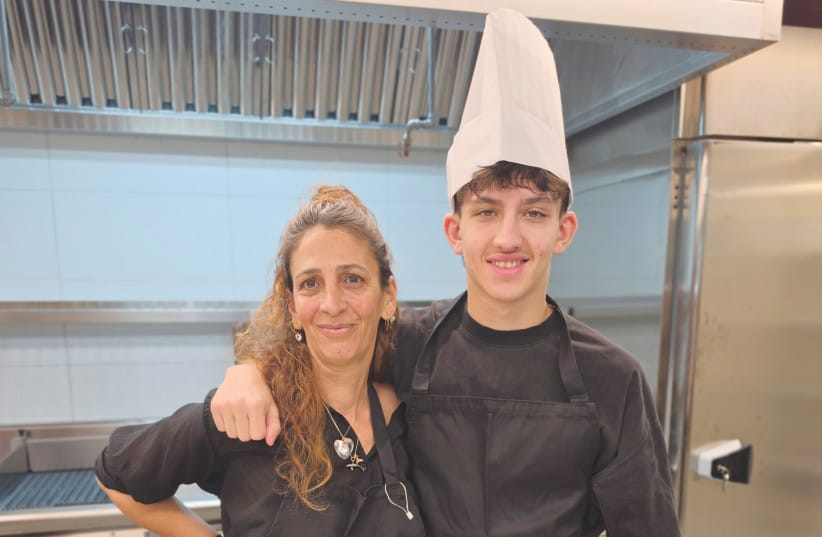
Steve Dabrow, chairman of GCI by JNF, says of the program, “Our mission has always been to stand with our communities not only in times of strength, but in moments of profound challenge.
“We had the privilege of welcoming families from Kibbutz Gonen to GCI by JNF for a simple yet deeply meaningful experience – cooking together.
“In the midst of war and daily uncertainty, this workshop offered something essential: a chance for parents and children to slow down, reconnect, and find comfort in one another.
“Watching families knead dough, share laughter, and briefly set aside the weight of sirens and stress was a powerful reminder that resilience is built in these small, human moments. What may seem like an ordinary activity became, in this context, an extraordinary source of relief, grounding, and hope.
“JNF-USA intends to continue these resilience workshops, ensuring that more families have access to spaces where they can heal, connect, and simply feel like themselves again. Even in the most difficult times, creating moments of normalcy and togetherness is not just meaningful – it is essential.”
I left the experience entirely uplifted, impressed with the people of the North, who are living the reality that I worried about experiencing for a day; astounded by JNF-USA’s ingenuity and farsightedness, to create an entire food ecosystem of the highest quality – not just “good enough” but cutting-edge standard with heart and soul, detail and imagination befitting the glory of the North and its people.
In my work, I often deal with the worst humanity has to offer: the pain people can inflict on one another, the selfish impulses that cause people to harm one another.
This project, the people behind it, the desire for positive change for all involved, Jews and non-Jews, is something healing for the soul and, honestly, the stuff that dreams are made of.■
Iran’s Ghalibaf warns ‘reality is knocking’ after US, IRGC trade strikes in Strait of Hormuz
Iran’s Parliament Speaker Mohammad Bagher Ghalibaf posted on Twitter/X Sunday morning, saying: “The era of one-sided deals is OVER. We told you: keep your word or pay the price. Reality is knocking.”
Ghalibaf issued this message as Iran’s Islamic Revolutionary Guard Corps said that its aerospace forces carried out a heavy attack on US aircraft carrier support and refueling platforms in the port of Duqm, in Oman, in the third stage of its response to what it called US military ‘aggression.’
The IRGC added that the operation targeted logistical support centers for US naval vessels
The era of one-sided deals is OVER. We told you: keep your word or pay the price. Reality is knocking. pic.twitter.com/B97ogCYGaj
— محمدباقر قالیباف | MB Ghalibaf (@mb_ghalibaf) July 12, 2026
US says it struck 140 Iranian military targets Saturday
US forces completed a third round of strikes this week against Iran, the Central Command said late on Saturday in a post on X.
They hit approximately 140 Iranian military targets on Saturday, the Central Command said, and added that the targets included Iranian missile and drone sites, naval capabilities, ammunition storage facilities, communication networks, and coastal surveillance locations.
During three nights of strikes this week, US forces have struck more than 300 targets, the military added in its statement.
The Central Command said the strikes on Saturday were in response to the attack on a commercial ship in the Strait of Hormuz. “Commercial vessel transits through the vital international maritime corridor continue,” it added.
US strikes came hours after Iran said it closed the strait after firing a warning shot that struck a vessel traveling on an unapproved route. It warned that any retaliation over the incident would be met with a “severe response.”
US Central Command identified the vessel as the M/V GFS Galaxy, a Cyprus-flagged container ship, saying it suffered significant engine-room damage and that a civilian crew member was missing.
US strikes Iran, Tehran says Strait of Hormuz closed, Gulf states hit
A series of attacks between the US and Iran over the past several days led US President Donald Trump to declare the end of a ceasefire meant to halt the fighting that the US and Israel began on February 28, though Trump has left the door open to continued negotiations.
Iran said it closed the strait after firing a warning shot that struck a vessel traveling on an unapproved route. It warned that any retaliation over the incident would be met with a “severe response.”
US Central Command, however, said commercial vessels continue to transit through the waterway that carried one-fifth of the world’s oil and LNG shipments before the war.

A Tiny GLP-1 Implant Bets on Helping Patients Keep the Weight Off
Vivani Medical is wagering that a matchstick-sized device tucked under the skin can fix the costliest weakness of the blockbuster weight-loss drugs: keeping patients on them long enough to hold onto the pounds they shed. On Tuesday, July 7, the Alameda, California biopharmaceutical company said it had signed an agreement letting Novo Nordisk run an internal evaluation of NPM-139, its experimental implant that releases semaglutide — the same molecule inside Novo’s Wegovy obesity injection and Ozempic diabetes shot — in a slow, steady dose over six months to a year. Adam Mendelsohn, Vivani’s president and chief executive, said the deal reflects Novo’s interest in the platform and reinforces the company’s confidence in a “market opportunity” for a treatment patients could receive once or twice a year.
The pitch is aimed squarely at a real and expensive problem. Real-world studies show that up to 65% of GLP-1 users stop treatment within a year of starting, driven off by cost, gastrointestinal side effects and the burden of weekly injections. One large analysis of more than 125,000 patients found 64.8% of those without type 2 diabetes discontinued within a year, versus 46.5% of those with diabetes. The consequences show up on the scale: withdrawal trials such as STEP 4 and SURMOUNT-4 found that roughly two-thirds of lost weight is regained within a year of stopping, often erasing the metabolic gains that made the drugs so sought after in the first place. An implant that delivers the medicine automatically for months removes the daily and weekly decision-making that trips patients up.
Vivani’s device is essentially a tiny titanium reservoir preloaded with a fixed dose of semaglutide, built on the company’s proprietary NanoPortal platform, which is designed to leak the drug out at a controlled rate. Mendelsohn has argued the approach could also blunt the nausea and other side effects tied to the peaks and troughs of injections, and the company says the implant can be removed or swapped for a higher or lower dose if needed — a feature it frames as giving patients the “peace of mind” of stopping whenever necessary. Skeptics note the flip side: those insertion and removal procedures add friction for patients and clinicians that a self-administered pen does not.
The Novo agreement carries no exclusivity, licensing terms or upfront payment, and amounts to the world’s dominant obesity player kicking the tires rather than committing. Novo confirmed the arrangement and said it aims to complement its own research with outside innovation. Still, for a company Vivani’s size, the validation matters. The stock closed near $1.60 on July 8, giving the clinical-stage firm a market value of roughly $116 million — a rounding error against a GLP-1 market that some analysts project could top $100 billion by the early 2030s. Lake Street rates the shares a buy with a $4 price target, though the company still carries no revenue and steady losses.
The science remains early. In June, an Australian human research ethics committee cleared Vivani to begin SLIM-1, the first human study of the semaglutide implant. The Phase 1 trial, expected to start in mid-2026, will enroll about 20 overweight or obese adults who have never taken a GLP-1, testing the implant’s safety, tolerability and drug levels against a low starting dose of Wegovy over four weeks. Vivani chose Australia partly to tap government research tax incentives. Preclinical work has been encouraging — a single implant produced more than 20% sham-adjusted weight loss sustained for a full year in animals — but human efficacy is unproven, and the road from a four-week safety readout to a marketable product runs through a Phase 2 dose-ranging study and years of larger trials.
For the broader industry, Vivani’s bet underscores where the obesity gold rush is heading next. The first wave of competition was about who could produce the most weight loss; Wegovy has averaged about 15% over 68 weeks, reaching nearly 28% at a higher dose. The next battle is durability and adherence — turning a drug people quit into a therapy people stay on. Whether the answer is an implant, a cheaper oral pill, or better insurance coverage is unsettled, and questions about the implant’s eventual price and reimbursement remain wide open. But the maintenance problem is now the field’s central commercial question, and a small California biotech has put a physical device on the table as one possible fix. With Novo Nordisk watching, the coming Phase 1 data will determine whether the idea graduates from intriguing to investable.
JBizNews Desk | New York © JBizNews.com All Rights Reserved. Reproduction or distribution without written permission is prohibited.

Trump Weakens a 50-Year Wildlife Law to Speed Up Drilling and Building
The Interior Department and the Commerce Department finalized a rule on Friday, July 10, that narrows one of the most consequential words in American environmental law, clearing habitat that had been off-limits for half a century for use by energy producers, farmers, fishing operations, miners and developers. Interior Secretary Doug Burgum said the action restores common sense and gives landowners certainty, framing a change that turns on the single word “harm” in the Endangered Species Act.
For more than four decades, federal regulators treated “harm” to a protected species as including significant destruction or degradation of the habitat it needs to feed, shelter and breed. The U.S. Supreme Court upheld that reading in 1995. The new rule scraps it. Going forward, a project can impair the place where a threatened or endangered species lives without running afoul of the law, so long as the activity does not directly injure or kill the animal itself.
The Commerce Department’s role is easy to overlook and central to the business impact. Commerce oversees NOAA Fisheries, the agency responsible for salmon, sturgeon, whales and other marine and migratory species, while the Fish and Wildlife Service inside Interior handles land animals. That split means the rewrite reaches straight into the ocean economy: commercial fishing fleets, aquaculture operators, offshore wind and offshore oil and gas developers, and port and coastal construction projects have all bumped up against habitat-based restrictions tied to listed marine species. In their joint announcement, Interior and Commerce said the rule reduces permitting and compliance costs for energy producers, farms and fishing interests, and returns the statute to what they called its single best meaning rather than a politically stretched one.
That is the crux of the commercial story. The Endangered Species Act is one of the biggest regulatory chokepoints in federal permitting. Any agency weighing a permit for oil and gas, mining, logging, electric transmission or coastal development has to evaluate the effect on listed species, and habitat considerations routinely add years and cost to a project’s timeline. By pulling habitat modification out of the definition of harm, the administration is betting it can accelerate approvals across exactly the sectors it has prioritized. The move aligns with President Donald Trump’s broader push to strip regulations he argues constrain American business.
The legal scaffolding matters for how durable the change proves to be. In their news release, Interior and Commerce leaned on Loper Bright v. Raimondo, the 2024 Supreme Court decision that overturned the long-standing Chevron doctrine, which had directed judges to defer to an agency’s reading of an ambiguous statute. With Chevron gone, courts now interpret statutory text themselves, and the administration is arguing that the plain text of the Act never required the broader habitat definition in the first place. The rule was first proposed in April of last year and, as of Friday afternoon, had not yet appeared in the Federal Register, the step that starts the clock on its legal effect.
Opponents are already moving. The Center for Biological Diversity called the decision a death knell for American wildlife, with senior campaigner Tara Zuardo arguing that habitat destruction is the leading threat to imperiled species and that removing it from the definition of harm guts the law’s purpose. Lawyers at Earthjustice and other conservation groups have signaled litigation, meaning the rule’s real-world staying power will be tested in court before businesses can fully count on it. Environmental groups note the Act is credited with pulling the bald eagle, the California condor and other species back from extinction, and warn that spotted owls, Atlantic salmon and Florida panthers are among those now exposed.
For companies weighing capital decisions, the practical takeaway is mixed. The rule opens a wider lane for extractive and development projects and could shorten permitting timelines, a genuine cost saving in industries where delay is the single largest risk. But the coming legal fight introduces its own uncertainty. A developer who breaks ground relying on the new interpretation could face exposure if a court reinstates the old one, and lenders and insurers tend to price that ambiguity in. The safest near-term posture for regulated businesses is to treat the change as directional rather than settled, and to watch the Federal Register filing and the first court challenges closely.
What is not in dispute is the direction of travel. The administration has signaled the harm rule is one piece of a broader slate of environmental rollbacks aimed at speeding approvals, and Commerce and Interior have now shown they are willing to reach deep into decades-old regulatory language to get there.
JBizNews Desk | Washington © JBizNews.com All Rights Reserved. Reproduction or distribution without written permission is prohibited.

Meta Pulls Muse Image From Instagram After Three-Day Backlash
Meta Platforms shut down one of its newest artificial-intelligence tools on Friday, July 10, telling users that a feature allowing anyone to generate AI images from public Instagram photos was, in the company’s words, no longer available. In a statement updating the product’s launch announcement, a Meta spokesperson conceded the feature “missed the mark,” TheWrap closing out a controversy that had run for barely three days.
The retreat capped a fast-moving episode that began Tuesday, July 7, when Meta introduced Muse Image, its first image-generation model from Meta Superintelligence Labs. RAPPLER The company pitched it as a creative upgrade to its Meta AI assistant — a system that could take a photo as input, understand detailed prompts, and let users tweak the results with simple sketches. Buried in the rollout, however, was a capability that quickly overshadowed everything else: users could manipulate an image of a person simply by tagging that person’s public Instagram account — or any public account at all. Variety
That design decision put the burden on users to say no. The feature applied to account holders over 18 with public profiles, who had to dig into their settings and switch it off to keep their images out of the generator. Variety Meta’s own help documentation acknowledged a further wrinkle: people would not be notified when someone created content using the AI feature. Variety For a platform built on billions of publicly posted photos, the math alarmed users almost immediately.
The pushback came fast and from heavy hitters. Emmy-winning actor Hannah Einbinder, of the series “Hacks,” criticized the feature on Instagram, saying it had switched on automatically and urging followers to disable it. Detroit News On Thursday, SAG-AFTRA, the union representing actors and other media professionals, urged members and the broader public to opt out. Detroit News The talent agency CAA, whose client roster includes Tom Hanks and Meryl Streep, said it had taken its objections straight to Meta. The agency argued that no one’s name, image, likeness, voice or creative work should be used by any third party, including AI models, without clear and documented consent. Variety
Meta initially tried to hold the line, downplaying the privacy concerns in an early response before reversing course days later. Deadline By Friday the company had folded. Its spokesperson said the original intent was to offer a useful creative tool while giving people control over whether their public content could be referenced, but that the feedback had been heard. Variety Both CAA and SAG-AFTRA welcomed the decision, with CAA commending Meta for moving swiftly to remove the feature. TheWrap
For Meta, the damage is less about a single product than about what it signals. Muse Image was the debut consumer showcase for Meta Superintelligence Labs, the unit into which the company has poured enormous capital and talent as it races OpenAI, Google and others for generative-AI supremacy. Launching a flagship model and yanking its marquee capability within 72 hours is a costly stumble for a division built to prove Meta can ship AI that people trust — not just AI that works.
The reversal also lands on the fault line that now defines the industry: speed versus consent. Tech companies are shipping likeness-based tools faster than the legal and social guardrails around them can form, and the creative economy is pushing back hard. The parallel to OpenAI is direct. Last October, SAG-AFTRA condemned a similar opt-out arrangement on OpenAI’s Sora 2 video model, warning it threatened the economic foundation of the performance industry; that model was later shut down. TheWrap Meta walked into the same trap and exited it just as quickly.
The commercial stakes run beyond Hollywood. Meta’s advertising machine depends on creators and everyday users treating Instagram as a safe place to post. A feature that let strangers remix anyone’s face — with no notification — threatened the trust that underwrites the platform’s engagement and, by extension, its ad inventory. The consent-first standard that CAA and SAG-AFTRA are demanding, if it hardens into regulation, would reshape how every large platform trains and deploys likeness-based models, raising compliance costs across the sector.
For now, Meta has bought itself breathing room by retreating. The harder question is whether Meta Superintelligence Labs can move fast enough to stay competitive while absorbing the lesson that, in consumer AI, launching without consent baked in is no longer a viable strategy. Its next release will be watched for whether the default has changed.
JBizNews Desk | New York © JBizNews.com All Rights Reserved. Reproduction or distribution without written permission is prohibited.
Body runs ~760 words. Want me to add a “Market movers” style analyst reaction block on META stock, or keep it as straight tech-policy news?

Navy’s Top Admiral Warns the U.S. Fleet Is Too Small and Needs More Ships
The U.S. Navy’s top officer, Adm. Daryl Caudle, has sharpened his case that the country does not have enough warships — a warning thrown into relief this weekend as a third round of U.S. strikes on Iran and the closure of the Strait of Hormuz stretched a force the admiral says is already running near its limits. Testifying before the Senate Appropriations defense subcommittee in May, the 34th Chief of Naval Operations told lawmakers that escorting commercial ships through the contested strait would “exceed” the Navy’s capacity, a blunt admission that the fleet is spread thin at exactly the chokepoints where global commerce is most exposed.
The numbers behind the warning are stark. The Navy fields roughly 291 battle force ships today, well short of the 355 that Congress set as a statutory floor and further still from the service’s own 2023 assessment calling for 381 manned ships plus 134 unmanned platforms. The Navy’s May shipbuilding plan charts a path to about 450 vessels by 2031 under the administration’s “Golden Fleet” initiative, yet the service concedes a hard truth: despite a budget that has roughly doubled over two decades, today’s fleet is no larger than it was in 2003.
The constraint is not mainly money — it is steel and skilled hands. Only two American yards build nuclear-powered warships: Huntington Ingalls Industries’ Newport News Shipbuilding in Virginia and General Dynamics’ Electric Boat in Connecticut. Submarine production is stuck near 1.2 boats a year against a need above two, attack-submarine readiness has slipped to 62% from 67% a year earlier, and the newest aircraft carrier has slid toward the mid-2030s because the yard cannot physically fit the work. Adm. Caudle has told appropriators the industrial base will not reach a two-carrier-a-year cadence until around 2032, four years later than the target his predecessor named in 2023.
Those bottlenecks land against a competitor moving at industrial speed. China’s People’s Liberation Army Navy is now the world’s largest by hull count, fielding upward of 730 vessels and launching destroyers, frigates and submarines faster than Western shipyards can match. Pentagon planners increasingly frame the coming decade as the window that will decide the balance of power in the Indo-Pacific, and Adm. Caudle’s push for combat mass — manned and unmanned — is aimed squarely at that clock.
For the defense-industrial base, the CNO’s argument is also a demand signal worth billions. The Golden Fleet envisions a “high-low mix” of high-end combatants, cost-effective frigates and drones: continued Arleigh Burke destroyer production, a new nuclear-powered Trump-class battleship, the FF(X) patrol frigate derived from a Coast Guard cutter, and fleets of medium unmanned surface vessels. Acting Navy Secretary Hung Cao has cast the effort as a generational investment meant to revive American shipbuilding and create thousands of high-skill jobs. The fiscal 2027 budget request seeks roughly $65.8 billion for Navy shipbuilding, and Navy leaders have signaled the new plan could more than double the 19 hulls funded in fiscal 2026 — a pipeline that flows directly to publicly traded prime contractors and a web of suppliers across dozens of states.
The weekend’s events made the strain concrete. As the Islamic Revolutionary Guard Corps sealed Hormuz and U.S. forces struck Iranian targets for a third time in a week, the Navy’s presence in the region was a fraction of the June wartime surge — recent tallies put roughly six U.S. warships in the Central Command area, including three Arleigh Burke destroyers and three littoral combat ships. The service has kept a blockade posture and mine-clearing options in play, but Adm. Caudle has been candid that de-mining and escort duty in a narrow, contested waterway are among the hardest missions to run, and cannot be switched on at scale until a durable ceasefire reopens the strait.
That gap between mission demand and available hulls is the heart of the CNO’s message. The Navy has set a goal of surging 80% of its force on short notice, but with about a third of the fleet deployed, a third in maintenance and a third in sustainment at any given time, deferred repairs and aging shore infrastructure leave little slack. Adm. Caudle has called the shortfall a “resource issue,” arguing that sustained shipbuilding near the roughly $38 billion a year the Congressional Budget Office estimates — and defense spending closer to 4% of GDP — is what a fleet of the required size would take.
For businesses tied to sea trade, the stakes are not abstract. A Navy stretched thin at chokepoints like Hormuz means thinner protection for the tankers, box ships and energy cargoes that set fuel prices, insurance premiums and supply-chain timetables worldwide. Whether Washington funds the larger fleet Adm. Caudle is asking for — and whether the yards can build it fast enough to matter — will shape both American sea power and the reliability of the trade routes that the global economy runs on.
JBizNews Desk | Washington © JBizNews.com All Rights Reserved. Reproduction or distribution without written permission is prohibited.

One detail in the IDF statement changes the whole Ro Khanna story – comment
When Shabbat went out on Saturday night, I turned on my phone and found what everyone else in Israeli media found: Ro Khanna, a congressman from California, telling two million people that Israeli settlers with American-made M4s detained him in Judea and Samaria (the West Bank), and that when the IDF showed up, the soldiers sided with the settlers and kept him there.
My first reaction was anger at the men who blocked that road. It still is.
Something did happen on Wednesday near Khirbet Zanuta. Armed young men surrounded a minibus carrying a sitting member of Congress, kicked its tires, cursed at the passengers, filmed them and laughed at them, and kept the road blocked for over an hour while a New York Times photographer sat inside watching. The same week, four suspects were arrested for attacking a CNN crew near Sinjil with clubs. I have no idea who these men think they’re protecting. They handed Israel’s harshest critics a gift no BDS campaign could have bought, the IDF itself called the blocking unlawful, and the only serious response is to prosecute them.
So why am I writing this column? Because I spent Saturday night reading everything published on this story, in English and in Hebrew, and the version Khanna is telling America has grown in the telling.
He told Reuters, twice in one sentence, that the men had machine guns. The M4 is a carbine. A small thing, maybe, from a politician who demands precision about every bomb Israel drops. The bigger problem is that the IDF statement says it is reviewing the identity of “the armed individual.” Singular. The army’s account has one armed man. His tweet has settlers, plural, brandishing rifles. Somebody’s description is wrong, and it can be checked.
Khanna’s story ends four different ways
Then there’s the ending, or rather the endings. His tweet says the IDF continued his detention. His own aide told reporters they were released when officers showed up. Khanna told CNN they were freed after the embassy reached a senior Israeli official. Haaretz reported it was the Foreign Ministry. The army says its troops cleared the road. I’ve read four accounts of how this ended, and Israelis get him out in all of them.
By Saturday night, an American news headline said he was detained by the IDF, and the men who actually blocked the road had disappeared from the story.
There’s also a question nobody in the American coverage has pressed. Khanna says the Israeli government was notified of his trip. An Israeli security source says the visit was never coordinated, which is why he had no security. Those are two different claims.
Remember, this was a tour of Judea and Samaria exclusively, with programming built entirely by Palestinian hosts, by a man who declared before boarding the van that anyone unwilling to say “genocide” and “apartheid” is morally compromised, three weeks after signing a pledge committing him to those exact positions, and who told the Times it is not a good idea to detain long-shot presidential candidates. He knows what Wednesday is worth to him.
IDF must review soldiers’ behavior
I wish I could stop there. I can’t, because his inflated version works only where the true version embarrasses us. The Times witness describes soldiers who stood around, chatted with the men blocking the road, smoked. If that’s accurate, the IDF should say so, discipline them, and move on, instead of letting the account stand uncontested.
Meanwhile the prime minister goes on CNN and calls settler violence exaggerated, the work of 150 juvenile delinquents. Maybe so. This country found its enemies in Tehran; it can find 150 hooligans in Har Hevron if it wants to, and as long as it doesn’t, every ambitious American politician with a van and a camera crew knows exactly where to go.
Khanna says we’ll be hearing more soon. I hope some of it happens here. The Jerusalem Post studio is open to him, on the record, for as long as he wants, with the IDF statement and his own timeline on the table. He came for an unfiltered look at us. He’s welcome to an unfiltered interview with me. If his story holds up, he has nothing to worry about.

Tom Wesselmann’s American pop art takes center stage at the Tel Aviv Museum of Art
As the United States marks its 250th anniversary, a burst of American pop art lands in Israel, colliding with questions of how imagery from that era reads in today’s social and political climate.
At a moment when local realities feel increasingly complex, the Tel Aviv Museum of Art (TAMA) turns to Tom Wesselmann and the visual grammar of American consumer culture.
Tom Wesselmann: All Out, on view through December 26, is the first comprehensive exhibition in Israel dedicated to the late American artist (1931-2004).
The show brings together over 40 works from the 1960s and 1970s, including key pieces from his Great American Nude, Still Life, and Bedroom Paintings series, drawn entirely from the private collection of Marie and Jose Mugrabi.
“Presenting a comprehensive exhibition in Israel at this particular moment dedicated to Tom Wesselmann, one of the most important and influential artists to emerge in the United States during the 20th century, is a significant achievement for the Tel Aviv Museum of Art,” TAMA director Tania Coen-Uzzielli said.
“Wesselmann’s work continues to resonate today, inspiring generations of artists working within an image-saturated culture.”
Yet bringing Wesselmann’s landscapes of American abundance to the Middle East right now is not simply an exercise in colorful escapism.
For curator Shahar Molcho, the show demands a confrontational, albeit liberating, interaction with the audience, using Wesselmann as a tool for examining how we look at images today.
Stripping away the modern gaze
Wesselmann’s work emerged in the 1960s, at the height of the sexual revolution and the rise of mass advertising culture. His canvases isolate body parts, lips, breasts, and legs, transforming the classical nude into a flat, hyper-pigmented pop icon.
Today, however, these direct, unapologetic images collide with modern sensibilities. Molcho explicitly invites visitors to leave their 21st-century lens at the door.
“There is so much critical observation today when we approach an image,” Molcho explained, pointing to the influence of political correctness, the #MeToo movement, and heightened awareness of objectification.
“I ask people who enter the exhibition to remove these things and put themselves 60 years back,” she continued.
“We are already accustomed to jumping to critical and judgmental observations, which often do not put things in their correct and appropriate context.”
She pointed to shifting social codes, using the era’s ubiquitous cigarette as an example. “It is thrilling to see how we look today at an image of a smoking woman, at a pack of cigarettes,” Molcho noted.

“What in the 1960s was the sexiest thing and the most Hollywood … today we look at the fact that it’s forbidden to advertise cigarette packs,” she went on to say.
This tension extends to how we view the human body.
“We live in a society that highly regulates physical space,” Molcho said, “yet the space of the screen is extremely exposed. Look how p***ographic the space of the screen is.”
That contrast becomes central to how the Bedroom Paintings and Great American Nude series are read today. “Today, you have channels like OnlyFans where the body has become an economic platform,” Molcho noted.
“If today we have the concept of d*** pics, that people take photos and send, then look at artworks from 60 years ago that dealt with freedom and this sexual celebration in such a direct and liberated way.”
For a readership with deep American roots, the exhibition’s themes hit particularly close to home. Wesselmann’s most famous series, Great American Nude, plays on a concept that is impossible to detach from today’s political climate.
Works that once reflected the optimism of postwar America now sit within a different global reading of American power and imagery.
A portrait of John F. Kennedy, created two years prior to his assassination, captured the bright promise of a new era. Today, that cultural dominance has shifted into a different kind of global presence.
“We wake up in the morning and want to know what [US President Donald] Trump decided, and what our day will look like,” Molcho observed.
A dialogue across centuries
Despite the bold colors and advertising aesthetics, Wesselmann’s engagement with art history runs deep. Behind the pop art surfaces lies a sustained dialogue with European painting traditions.
“He takes classical subjects, like still life, and puts them into an American bedroom with everyday items,” Molcho explained.
Wesselmann pushed the boundaries of his medium, using shaped canvases like the iconic Mouth #14 (Marilyn) and incorporating physical, real-world objects directly into his art, such as the painted plastic orange in Still Life #49 or the actual radiator, telephone, and door built into Great American Nude #44.
The effect is not decorative; it produces friction between tradition and consumer culture, painting and advertising, intimacy and display. To highlight this intergenerational dialogue, the exhibition expands beyond Wesselmann himself.
Molcho has positioned his work alongside pieces from TAMA’s collection by historical masters like Henri Matisse and Pablo Picasso, as well as contemporary voices like Mickalene Thomas and Doron Solomons.
Perhaps the most compelling story behind All Out is the fact that it is hanging on the walls of TAMA at all. Molcho was candid about the difficulties of bringing international art to Israel right now.
“In light of the growing boycott, there is a very great difficulty in bringing international art to Israel,” she admitted. “This is an objective difficulty even before we get into politics at all.”
Beyond the political climate, the logistics of insurance and shipping for priceless works are significant.
“You think about insurance, and you think about shipping, and you think about the desire of artists, of lenders, and of institutions to send works of art to Israel during this period – it is a very big challenge. Many projects were postponed and canceled in the last three years.”
Against that backdrop, the Mugrabi collection has become a crucial partner. “These are the places we turn to also to present exhibitions,” Molcho said of the Mugrabi family. “They do not compromise in any way. This is first-rate quality.”
Ultimately, All Out is not a nostalgic return to pop art, but a test of perception. Wesselmann’s images remain immediate, seductive, and disarmingly direct, but they now arrive in a world where looking is unstable, constantly shaped by context, memory, and critique.
The question the exhibition quietly poses is simple: What happens when images that once defined visual clarity meet a present that no longer trusts what it sees? For visitors, the answer unfolds not in explanation, but in looking.

United in art: Jerusalem’s Manofim Festival returns with art, music, and performance
Whatever happened to Manofim?
Charting the progress of the contemporary arts festival since its founding, all of 18 years ago, one could get the impression that someone behind the organizational-programmatic scenes has been taking steroids or some consciousness-changing substances.
Not that one would even consider the possibility of festival co-founder and artistic director Rinat Edelstein or Art Cube Artists’ Studios – aka Artists’ Studios – CEO and Manofim co-founder and director Lee He Shulov dabbling in narcotics, but the trajectory and scale of this year’s event (July 14-18) are truly astounding.
Perhaps that is, at the very least on a linguistic level, only natural. After all, Manofim does translate as “levers” or “construction cranes,” so, in that sense, reaching for the sky seems a perfectly logical ethos. The moniker also feeds off insightful and syllable-flexing wordplay.
“The name… comes from a pun – Ma Hanofim – (What are the views?). With the help of a crane, we seek to lift the art field in Jerusalem, in order to see the view of the city,” as the festival website elucidates.
Verbal quipping aside, the forthcoming five-day program makes for mightily impressive perusal. What started out as basically a plastic arts festival offering platforms for local artists to display their creations to the public at various galleries around Jerusalem has now taken on far grander proportions.
There are a multitude of disciplines and areas of creative endeavor in the rollout: from theatrical and filmic fare, performance art, live musical entertainment, multidisciplinary works presented at all manner of locations, and guided tours to hands-on activities for kids and families.
Music for all
The highly variegated music shows include an eastern-style opera fronted by musician-storyteller Nitai Kallay, called The Fallow Deer Lift. It is based on the hardly believable tale of how several specimens of the titular animal were airlifted on the last flight out of post-Shah Iran in 1979 to be rehoused on Mount Carmel.
The genre mix avenue of programming thought comes through in Shkula, an intriguing production described as “a musical-linguistic performance,” fronted by Neomi Hashmonai and Neta Weiner, which looks at language and identity, and the relationship between words and sounds.
And for those worried about missing some of the soccer action while imbibing the cultural riches in Manofim, there will be screenings of World Cup matches on the roof of the Artists’ Studios building on HaUman Street in Talpiot.
The latter venue, besides hosting a variety of festival slots, also offers a spectacular panoramic view of Jerusalem, whence you can cast an eye over central spots, such as the YMCA building on King David Street with its iconic bell tower, as well as Bet Safafa, Rehavia, and beyond the city limits into the surrounding afforested hills.
The idea of finding connections, interfaces that draw us together rather than political and other dogmas that divide us and spawn rifts, which generally lead to violence and suffering, has been a constant Manofim undercurrent since its inception in 2008.
Getting to know each other
That given, the official theme of the current edition – Hakara – makes total sense. It is a word that can go manifold definitional directions, such as recognition, acceptance, affirmation, respect, and awareness. The concept is core to the way Edelstein and Shulov go about their business and is part and parcel of the artistic venture. That informs even the most prosaic technical side of the Manofim events – including free admission slots – such as having one half of the rooftop screened soccer matches broadcast with Hebrew commentary and the other in Arabic.
It clearly suits the festival philosophy and the thinking behind the Artists’ Studios.
“We are always looking to connect,” says Edelstein. “Hakara involves accommodating everything, including other opinions, other points of view, and taking in the different aspects of life here. Some people may, for example, feel that the situation here is desperate, while others may believe that divine redemption is at hand.”
That is, as we all painfully know, a highly salient point. “We have to take stock and take another look at everything,” Shulov suggests. “There are lots of parts [of Israeli society] with which we are not familiar. We don’t know their story.”
Some of those off-limits areas may be tough to come to terms with. Regardless of political stance or historical justification, for example, the fact is that many Palestinians view one of this country’s most joyous and celebrated events – victory in the War of Independence – as a painful chapter in their lives and bio backdrop.
“We need to recognize the history and accept other ways of life that exist here,” Edelstein notes. “We have to recognize what went on in the war [of Independence], what it did to people.” Again, irrespective of the rights or wrongs of the brand new Jewish state’s fight for survival, against almost insurmountable odds, the fact is that hundreds of thousands of Arabs became displaced. To a greater or lesser degree, whether we like it or not, it colors all our lives in this beleaguered country.
On a less challenging and more morale-boosting note, Manofim continues to have an impact on the arts scene around the country as it proffers a broad swathe of works by artists from across the disciplinary spectrum: “We felt that the festival has already developed and is well-established. It is setting the tone [in the national art scene]. We no longer need to ask if there is art in Jerusalem,” Edelstein declares.
Zik keeps the flame burning
As technological advances have continued to inform the way we ingest and view the fruits of artists’ creative labors, they have also enabled us to gain some insight into the processes that led to the birth of the work in front of us. That is palpably conveyed at the Hazira Interdisciplinary Performance Center (Hazira), just up the road from the Artists’ Studios in the now mostly deserted shopping mall that many Jerusalemites remember once housed the Rav Chen cinema complex. Its proximity to the Artists’ Studio makes it an easy ambit for anyone looking to take in a diverse sweep of disciplines on the same day of the festival.
As per its delineating boundary-leaping wont, Hazira will host a rich spread of items for its sophomore inclusion in the Manofim lineup, marking the 40th anniversary of the founding of the Zik Group, an interdisciplinary art collective that crafts indoor and outdoor performances that fuse sculpture, music, and theater.
Fire is a constant of the troupe’s oeuvre, as befitting the group’s penchant for burning large-scale structures they slaved long and hard to put together. “Zik,” by the by, translates to “spark.”
“That predates Burning Man,” Edelstein pertinently adds, referencing the popular annual gathering in the United States founded in 1986, shortly after Zik, that climaxes with the burning of a towering human figure.
Zik is an adventurous, envelope-pushing concern fueled by the individual and collective free-flowing thoughts, ideas, and skills of graduates of the Bezalel Academy of Arts and Design. Their go-for-broke line of artistic attack consummately resonates with the way Amit Drori views the aesthetics and dynamics that underpin the output of the art world.
Following the creative process
Drori is the artistic director and heart and soul of Hazira.
“We engage in the creative process, from the beginning through to completion,” he states as he leads me into a hall which, in a previous life, was furnished with plush red seats where cinemagoers ensconced themselves for an hour and a half or so of filmic entertainment.
The former screening space is currently home to an intriguing smorgasbord of items that represent different milestones in Zik’s four decades (and counting) output. The exhibits are mostly precisely scaled down models of works that did service at various Zik theatrical performance events.
“This one is exactly one tenth of the original, and this is exactly one twentieth,” Drori illuminates me with unbridled passion and excitement, pointing to miniature skeletal wooden tower shapes.
Three or so decades into his artistic career path, he continues to give off a radiance born of total devotion to his craft and an unflinching quest to keep on taking leaps of faith. It is a viewpoint shared by the whole Hazira crew and the members of Zik.
That entails, he explains, getting down and dirty with every single aspect of the continuum that takes the seed of an idea through the germinating stage to the finished item, on stage or at some surprising al fresco location. Painfully aware of the paucity of state funding for cultural pursuits, perhaps the hands-on approach is simply the natural result of having to make do with the available resources.
Drori sets me right on that: “It is not about budgets. Zik doesn’t have budgets and neither do we. But it is not about that. It is about choices, about choosing how to work with your art.”
Zik has managed to put together a bunch of multilayered offerings for its birthday event in Manofim, called Zik Galaxy. In addition to the exhibition, which also includes posters designed for events that dot the group’s four-decade timeline, there will be screenings of a documentary film with footage of Zik’s films, video art, and performances.
And there is a live staged show called At Sunset in Our Area, which older folk may recall references a daily slot on The Voice of Peace Radio station which broadcast from a hardly seaworthy ship off the coast of Tel Aviv, founded by late peacemonger Abie Nathan. All in all, Zik Galaxy should provide the Manofim visitor with a succinct idea of what the group and its daredevil approach to art is about.
Back down HaUman Street, at the festival hub, the dusty, winding, potholed road traveled by many an artist en route to the visual or sonic bottom line ultimately presented to the public is a central tenet of the Drift exhibition at the Artists’ Studios. Curated by Shulov and Einav Ziv-Ayalon, the expansive collection features works by 17 artists, taking in an abundance of materials, aesthetic approaches, and cultural thought patterns.

Art in uncertain times
It is, says Shulov, very much a sign of the times. “That is very present as we are living in a period of uncertainty,” she responds when I ask her about the reverberating impact of Oct. 7 on artistic endeavors in this country. That, she notes, is integral to Drift. “Einav and I asked the artists to react to this situation of uncertainty, how that drives creation.”
That is also a fundamental element of the artistic continuum, as the creator sets out on a journey to the unknown, never really knowing what they will end up with as they follow their muse along their trip to aesthetic and deeply personal discovery.
“This exhibition talks about artists acting from a position of not knowing, which is basically a constant here,” Shulov adds wryly and, it must be said, more than a little superfluously. “We wanted to explore how that fuels the creative dynamic.”
Getting some understanding of the gradual unfolding of works of art, rather than merely observing and – hopefully – admiring the end product, is a leitmotif of the whole Manofim shebang. Visitors will be able to talk to some of the artists about their work. Yael Serlin, who has a solo multidisciplinary exhibition called Four Cubits, will add emotive depth to that art consumer experience as she shares her family’s grief and experience of dealing with her son’s death during his IDF service.
The dynamics behind the evolution of the finished article are central to the exhibition and the festival. In this day and age, with the ever-accelerating pace of technological strides, we are being conditioned to exploit the means at our ready disposal to access the information we seek at the touch of a button, rather than working our way through an exploratory phase. Going through the latter would enable us to learn from the process itself and hone valuable skills that could stand us in good stead as we make our way through life.
Art takes on technology
As AI takes ever-encroaching hold on all aspects of life, students at universities, for example, now frequently bypass the illuminating challenge of working out how to obtain the knowledge they seek and simply arrive at the bottom line quickly and efficiently with none of the labor pains and accompanying grassroots perspicacity-inducing life-affirming rewards to be gained along the way.
Bringing that into an activity in which I indulge almost to the point of obsession, arriving in Eilat from the Jerusalem Hills by bicycle is a very different sensorial and emotional kettle of fish compared with getting there by car, plane, or even by bus. Yes, it requires a lot more effort on my part, which I gleefully embrace and enjoy the simple corporeal pleasure of the journey.
“We live in a world in which we have to produce results in double quick time, and be active all the time,” Shulov observes. “We asked the artists [in Drift] to refer to [20th-century French philosopher] Guy Debord,” she adds.
Among his multifarious lines of thought and work, theorist and filmmaker Debord railed against “the spectacle” as the be-all and end-all, and promoted a Situationist Marxist-leaning critique of art and life that opposed capitalism and the consumer society. Again, this implies an approach which relates to real tactile life.
So, perhaps, alongside the stated festival theme of recognition, acceptance, acknowledgment et al, attending this year’s Manofim might get us to stop for a moment and ponder how we got to where we are today. That implies some invaluable introspection – not just about the artistic-cultural domain around us, but other existential areas, such as the political and security-related morass in which we find ourselves.
Maybe, just maybe, taking a step back to consider the bigger picture and the possibilities afforded by the bonding universal language of art, albeit poorly supported by the taxes we channel to the state, could point us all in a more enlightened and positive path through life. Who knows?
For more information about Manofim: manofim.org

Souring Israel: When American Jews favor Mamdani over Netanyahu – editorial
Even as we have become used to polls showing plummeting US support for Israel – primarily among Democrats and Independents, but also increasingly among young Republicans – an AP-NORC Center for Public Affairs Research poll released this week gave pause.
Not because about one-third of US adults – including roughly half the Democrats – believe Israel is committing genocide in Gaza, or because 58% of Democrats say the US is too supportive of Israel. We have seen those trends reflected in other recent polls.
Rather, because among American Jews, New York City Mayor Zohran Mamdani enjoys a more favorable rating than Prime Minister Benjamin Netanyahu.
According to the poll, 44% of American Jews have a very or somewhat favorable view of Mamdani, who does not believe Israel should exist as a Jewish state and has called AIPAC “monsters,” while only 32% have similar positive feelings toward Netanyahu.
The reverse is also true. American Jews view Netanyahu more unfavorably (59%) than Mamdani (39%).
Let that sink in for a moment. According to this poll, American Jews dislike the prime minister of Israel more than they dislike the mayor of New York, who has said he would like to arrest Netanyahu if he were to visit the city.
Some will argue that this goes to show how bad and dangerous Netanyahu is. We think otherwise.
A reflection on the state of American Jewry
More than a reflection on Netanyahu, it is a reflection on the state of American Jewry and the degree to which the bonds of peoplehood and solidarity there are fraying.
If one’s own people prefer a man whose rhetoric denies the Jewish people the right of self-determination enjoyed by every other nation over the leader of the state that embodies that very right, then there is a problem.
Is there a problem with Netanyahu? Certainly. But is there a problem with those segments of American Jewry that applaud those who would weaken or harm the Jewish state? Even more so.
Another AP-NORC poll released at the same time found that three in 10 American Jews identify as Jewish ethnically, culturally, or through family background, even though they describe themselves as agnostic, atheist, or religiously unaffiliated. Unsurprisingly, they are also far less connected to Israel.
The survey confirmed something that many have long sensed: the more engaged American Jews are in Jewish religious life – whether Orthodox, Conservative, or Reform – the stronger their attachment to Israel.
In other words, the more Jews in the pews – regardless of denomination – the stronger their attachment to Israel and, one can reasonably assume, the less inclined they are to support those who wish the Jewish state harm.
Therein lies the problem: American Jews are increasingly not in the pews.
Many Israelis first heard about this poll through interviews that former Chicago mayor and apparent presidential hopeful Rahm Emanuel gave this week during a visit to Israel, where he delivered a blistering indictment of the government in a speech at Tel Aviv University.
In an interview with this newspaper, he waved this poll, somewhat disingenuously, as evidence that Israel has lost (not is losing, but has lost) not only the Democratic Party but America itself.
Israel has a serious problem
His message was unmistakable: when even Jews prefer Mamdani to Netanyahu – though the poll never framed the question as a choice between the two, merely asking respondents for favorability ratings of various public figures – Israel has a serious problem.
Why is that disingenuous? Because it is Jews such as Emanuel, though he is by no means the worst offender, who have spent the better part of the last three decades demonizing the settlement movement, the Israeli Right, and Netanyahu for not being willing to drink Oslo’s two-state Kool-Aid.
“You’re losing America and American Jews,” they repeatedly tell the Israeli public.
“No wonder,” should come the reply, “because you – as Jews – are helping to sour Israel in their eyes.”
None of this is meant to absolve Israeli policy, military actions, or the inflammatory rhetoric of some government ministers of responsibility for the erosion of American public support.
Netanyahu himself was disingenuous when, in a CNN interview this week, he seemed to place most of the blame for the decline in support on TikTok.
But those like Emanuel, who hyperbolically declare that Israel is completely isolated economically, militarily, and diplomatically, and has become an international pariah, bear no small share of responsibility for making many believe it is so.
Two people killed in Toronto music festival shooting, police announce
At least two people were killed in a shooting attack in Toronto at the Salsa on St. Clair music festival, police announced on Sunday.
Another three people were reported to have been wounded in the attack.
The Toronto Police requested that people avoid the area and follow all police instructions.
A Toronto Police spokesperson declined to provide additional details to Reuters beyond the information posted on the department’s official feed on X.
Police said updates would be provided as more information became available. No details were immediately released about a suspect, motive, or arrests.
CURRENT INFO:
-6 people located w/gunshot wounds
-2 people pronounced deceased
-police remain o/s
-suspect(s) still outstanding
-more information to follow #GO1436736
^av— Toronto Police Operations (@TPSOperations) July 12, 2026
According to the event’s website, Salsa in Toronto is “Canada’s #1 Latino-themed cultural celebration.”
Mark Carney mourns shooting attack victims
Mark Carney, Canada’s Prime Minister, stated that he was “horrified” by the shooting.
“My prayers are with the families grieving their loved ones, those who are in critical condition, and everyone who has been affected by this horrific event,” he wrote in a post on X/Twitter.
I am horrified by the shooting that has killed two people at the Salsa on St. Clair Festival in Toronto.
My prayers are with the families grieving their loved ones, those who are in critical condition, and everyone who has been affected by this horrific event.
My thanks to…
— Mark Carney (@MarkJCarney) July 12, 2026
“My thanks to the police officers and other first responders whose courage and fast action prevented further tragedy,” he added. “Police have my full support as they work to apprehend the perpetrators and bring them to justice.”
Doug Ford, the Premier of Ontario, also announced in a post on X that he was “devastated by the senseless violence.”
I am devastated by the senseless violence at the Salsa on St. Clair Festival that has claimed two lives and injured others.
My thoughts are with the victims, their families and everyone affected. Thank you to Toronto Police and our first responders for responding to this…
— Doug Ford (@fordnation) July 12, 2026
“My thoughts are with the victims, their families and everyone affected,” he wrote. “Thank you to Toronto Police and our first responders for responding to this horrific incident.”
Ford also added that the person responsible for the shooting “must be caught, brought to justice and spend the rest of their life behind bars.”
Reuters contributed to this report.

Amidror warns Israel must innovate to prepare for next war after drone defense ‘failure’
Israel must invest in innovation to maintain a technological edge and remain prepared for future threats, former head of Israel’s National Security Council Maj.-Gen. (res.) Yaakov Amidror warned on Wednesday.
Amidror’s comments came at the third annual Lev Conference on Science, Technology, and Security, hosted by the Jerusalem College of Technology (JCT).
The conference brought together leading names in Israel’s defense industries, high-tech sector, and academia, underscoring the importance of cross-disciplinary collaboration in speeding up technological development. Discussion notably centered on mechanisms that help detect and defend against threats before they impact citizens.
Amidror, who is currently a senior researcher at the Jerusalem Institute for Strategy and Security, focused on Israel’s past as he spoke at the conference. He highlighted how future threats aren’t automatically eliminated, even in moments where Israel claimed major military victories.
“The Six-Day War was our most successful war, yet three months later came the War of Attrition, and six years later came the Yom Kippur War,” he said. “So where was the victory? Where was the deterrence? This is a different reality.”
Israel in a unique position, recent drone attacks show ‘real failure’
Israel, he argued, is in a unique position as a heavily criticized country, underscoring that continued investment in research and innovation is essential to protect Israeli lives and keep defense capabilities sharp.
“Even if we win the hundredth war, the day after it ends, we will have to begin preparing for the hundred-and-first. But if we lose, there won’t be a second chance,” Amidror said.
However, the senior researcher went on to attribute the IDF‘s recent achievements in the war to technological superiority. He soon circled back to criticize Israel’s preparations for drone threats as the US and Iran trade missile strikes.
“This is a real failure. We should have been far better prepared for this threat because we knew about it and understood it long beforehand,” he said.
Addressing the “failure” will require the development and distribution of last-second interception forces and increased general preparedness, Amidror added. Others at the conference echoed the importance of fostering the next generation of scientists and engineers and spotlighting academic research and innovation.

NJ Transit Clears $12 Million for Live Train Tracking, Courts Tech Vendors
New Jersey’s commuter railroad has the money and the green light for real-time train tracking — now it needs a company to build it. NJ Transit President and CEO Kris Kolluri said Monday, July 6, that Gov. Mikie Sherrill has authorized the agency to spend $12 million on a live, GPS-based system that will show trains moving in real time and give riders accurate arrival and departure times. The work is not live yet. Kolluri put the rollout at the next several months, and the agency is still lining up the vendors who will do the building.
The platform is called NJT LiveView, and it is the centerpiece of the digital overhaul inside the Rapid Action Plan, the customer-service roadmap Sherrill ordered and unveiled in May. Kolluri called live tracking the single upgrade commuters asked for most.
“This was the single biggest thing that people have asked for,” he told News 12 New Jersey, crediting the governor with clearing the money to get it done.
The spending is still moving through procurement, which is where the opportunity sits for New Jersey’s technology sector. In June, NJ Transit issued a request for information asking companies that build real-time transit communication systems to spell out what they can deliver — the step agencies take before formal bids open. Contracts tied to NJT LiveView and the wider digital rebuild are now moving toward award, and the $12 million authorization gives bidders a concrete budget to size their proposals against.
Here is the problem the system is meant to solve. Right now NJ Transit figures out where a train is by reading trackside switches — the junction points where trains move from one track to another — rather than the train itself. That method is coarse and runs a step behind reality, which leaves the agency’s own app and station boards out of sync with the actual train. Riders who wanted a true live map have had to rely on outside apps.
NJT LiveView is designed to pull precise GPS coordinates directly from each train and turn them into one authoritative feed that powers arrival countdowns, service alerts and push notifications across the redesigned NJ Transit app, station display screens and third-party navigation apps. The buses already operate on similar technology; now the trains are catching up.
The business stakes are significant because the ridership is substantial. More than 300,000 New Jersey residents ride NJ Transit on a typical weekday, many commuting into New York City, tying northern New Jersey’s workforce directly to the reliability of the rail network. When riders cannot trust arrival times, the consequences go beyond inconvenience. Missed shifts, delayed meetings, late daycare pickups and uncertainty all carry real economic costs. Accurate real-time information is one of the most cost-effective ways an agency can improve the customer experience without adding new tracks or expanding service.
The timing also increases the pressure. NJ Transit raised fares by roughly 3% on July 1, meaning customers are paying more while expecting improved service. At the same time, the agency is preparing for the 2026 FIFA World Cup, when massive crowds will rely on the rail system to travel to and from matches. A GPS-based tracking system becomes especially valuable when platforms are crowded and even small delays can ripple throughout the network.
The funding is not coming from a new tax or special appropriation. The Sherrill administration has said the Rapid Action Plan will be financed within NJ Transit’s existing budget and will not require additional state funding in the coming fiscal year. Beyond live train tracking, the plan includes expanded station-cleaning crews, repairs to elevators and escalators, enhanced Wi-Fi on buses and a new Real Time Crime Center to monitor security cameras at major transit hubs.
New Jersey Department of Transportation Commissioner and NJ Transit Board Chair Priya Jain, who helped develop the plan under Sherrill’s executive order, has described it as a series of tangible improvements riders will notice. Kolluri, who also serves as Executive Director of the New Jersey Turnpike Authority, has said the shift to GPS tracking is long overdue.
For now, the funding has been approved and vendors are being courted. The real test of NJT LiveView will come in the months ahead, when commuters look at the countdown clock and expect it to match where the train actually is.
JBizNews Desk | Newark, N.J.
© JBizNews.com All Rights Reserved. Reproduction or distribution without written permission is prohibited.

Oman seeks dual-route Strait of Hormuz deal as Trump demands Iran admit ship attacks
Oman has proposed managing traffic through the Strait of Hormuz through two separately controlled routes, CNN reported on Saturday, citing a source with knowledge about the talks.
The agreement, which is yet to be finalized, would keep both the northern and southern corridors of the strait open.
In the southern corridor, within Omani territorial waters, ships will be allowed to navigate freely under pre-war conditions.
In the northern corridor, in Iranian territorial waters, vessels would need to request permission from Tehran to pass. No tolls would be imposed under the deal.
This comes as Iran’s Foreign Minister Abbas Araghchi and his Omani counterpart exchanged views on “appropriate mechanisms” for the safe passage of ships through the Strait of Hormuz in accordance with Article 5 of the Islamabad memorandum of understanding, Araghchi said on his Telegram channel on Saturday.
The teams in Oman reportedly discussed a potential statement on opening a “median lane” in the Strait of Hormuz for free and full movement, Axios reported.
Notably, US President Donald Trump demanded that Iran publicly acknowledge that it fired at ships in the Strait of Hormuz, Axios reported on Friday.
According to the report, three US officials with knowledge of the matter told reporters at a press briefing that the message was conveyed directly to Iranian officials.
Trump said earlier this weekend that the ceasefire was over, though he noted that Iran had requested to resume talks.
Trump claims Iran wants to renew talks, Tehran denies
“The Islamic Republic of Iran has asked us to continue ‘talks.’ We have agreed to do so, but the United States has stated to them, in no uncertain terms, that the Cease Fire is OVER!” Trump asserted.
US officials have continued to argue that Iran’s failure to honor the MoU casts doubt on its willingness to implement a more complex agreement further down the line.
No attacks were reported on Friday or early Saturday; however, a senior Iranian source told Reuters that a call among Iran, the US, Qatar, and Pakistan had been agreed, and that mediators were trying to arrange it for Saturday while Araghchi is in Oman.
Iranian Foreign Ministry spokesman Esmail Baghaei said that Araghchi’s visit to Oman will focus on the Strait of Hormuz.
“Iran accepted a clear responsibility regarding the establishment of normal arrangements and maritime services related to ship traffic in the Strait of Hormuz, and we have been very determined and resolute in fulfilling that responsibility. Under the agreement, we were to consult and cooperate with Oman on this matter,” he was quoted by Axios as saying.
Baghaei also denied on Friday that Iran had requested negotiations with the US, but said that Tehran had accepted a visit from Qatar.
CBS News and its UK partner, the BBC, both reported that US Vice President J.D. Vance, Secretary of State Marco Rubio, special envoy Steve Witkoff, and Trump’s son-in-law Jared Kushner were expected to lead negotiations on Saturday with Araghchi.
Iran’s Fars news agency later cited a source saying no negotiations would take place until the US retreated from its positions.


Huckabee confirms Israel warned Trump about Iran assassination plot – report
US Ambassador to Israel Mike Huckabee confirmed to Fox News on Saturday that Israel had warned the United States about a specific Iranian assassination plan against US President Donald Trump.
Huckabee also stated that he saw no significant evidence that there was any “peaceful part” of the Iranian regime.
“What the Iranians are saying and doing is nothing that they haven’t been doing for 47 years,” Huckabee explained. “This is a longstanding ‘death to America’ chant they’ve had. They really haven’t changed.”
The Wall Street Journal, which had previously reported on Israel’s warning to the US, wrote that some US officials were concerned that Israel’s motivation behind revealing the assassination plot had been to entice the United States back into war against Iran.
According to the WSJ, officials noted that Israel may have presented Trump with a single piece of information which, in isolation, may push him to begin bombing Iran again.
Israel’s Embassy to the United States denied the WSJ‘s claim, stating that Israel had shared its intelligence with the United States as part of the two nations’ partnership, without ulterior motive.
Trump threatens Iran over assassination threats
Earlier on Saturday, Trump responded to the alleged Iranian assassination threats, saying “1,000 missiles are locked and loaded” in a Truth Social post.
“Orders have already been given, and the US Military is ready, willing, and able, for a one-year period of time, subject to extension, to completely decimate and destroy all areas of Iran,” warned Trump.
On Friday, Trump told the New York Post he left instructions for the US to retaliate if Iran succeeds in assassinating him.
“I’ve left instructions, if anything happens, to just literally bomb them at levels that they’ve never seen before,” the New York Post cited Trump as saying.
Jerusalem Post Staff contributed to this report.

Justice Department Subpoenas Four New York Times Reporters in Air Force One Leak Probe
The Justice Department served grand jury subpoenas on Friday to four New York Times reporters who wrote about security gaps in President Donald Trump’s new Qatari-gifted Air Force One, an escalation that David McCraw, senior vice president and deputy general counsel of The New York Times Company, denounced in a statement Saturday as a bid to frighten journalists out of doing their jobs. The subpoenas were signed by Jay Clayton, the U.S. Attorney for the Southern District of New York and Mr. Trump’s nominee to lead the Office of the Director of National Intelligence, and order the reporters to appear before a federal grand jury in Manhattan on Wednesday.
The four journalists — Julian E. Barnes, Eric Lipton, Tyler Pager and Eric Schmitt — carried the bylines on reporting this week that the Secret Service pressed the president to leave a NATO summit in Turkey aboard an older presidential jet because the newer plane lacked some defensive systems. Federal agents hand-delivered several of the subpoenas to the reporters’ homes, the paper said, a detail that press advocates seized on as unusually aggressive. Mr. McCraw said the sight of federal law enforcement at reporters’ front doors should trouble anyone who values the Constitution and a free press.
The dispute traces back to an abrupt switch of aircraft. Mr. Trump flew to Turkey on the newly delivered Boeing 747-8 that Qatar gave the United States and that underwent a $400 million retrofit before entering service. He then departed for a Royal Air Force base in England on an older jet, with both planes flying to the same stop before he boarded the new aircraft for the trip home to Joint Base Andrews. The Times reported the swap came at the Secret Service’s urging, and that the retrofitted jet lacked some advanced protections, including antimissile capabilities, found on the older aircraft. The episode landed as a cease-fire with Iran collapsed and the U.S. resumed strikes, sharpening questions about the president’s exposure to threats.
The administration cast the matter as a leak investigation, not an attack on the press. In a rapid-response statement, the Justice Department said reporters were not the targets and that those disclosing classified information were. A department spokesperson told news organizations that every administration has confronted the crime of leaking national-security material and that it would keep investigating breaches. Acting Attorney General Todd Blanche, who also serves as deputy attorney general, said last month that his office would not stop pursuing government employees who share secrets with journalists. White House spokesman Steven Cheung defended the new plane as a state-of-the-art aircraft fitted with high-level security, adding that the administration uses distraction and misdirection to protect the president.
For The New York Times Company, which trades publicly and has built its subscription business on original, source-driven reporting, the fight cuts at a core asset: the confidential relationships that produce national-security scoops. A protracted legal battle carries direct costs — outside counsel, management time and the risk of contempt exposure for reporters — and a subtler one, the chance that sources go quiet across the industry. The company said it will fight the order in court.
The move fits a broader pattern that has rattled newsrooms as businesses. Earlier this year the Justice Department issued grand jury subpoenas to reporters at The Washington Post and The Wall Street Journal in separate national-security leak probes, then withdrew them after the outlets pushed back. That the department has now returned to the same tactic against a third major publisher suggests the earlier retreats were tactical rather than a change in posture, leaving media companies to price in recurring legal risk as a cost of covering the federal government.
Press-freedom organizations lined up against the subpoenas. Bruce D. Brown, president of the Reporters Committee for Freedom of the Press, said the action breaks from a longstanding department practice of seeking information from reporters only as a last resort. Stephen J. Adler, the group’s chairman, warned that crushing the public’s right to know inflicts lasting harm. The National Press Club, led by Mark Schoeff Jr., urged the department to withdraw the subpoenas immediately, calling agents at reporters’ homes an extraordinary assault on the First Amendment. Seth Stern of the Freedom of the Press Foundation argued the government’s real concern was reputational, not national security.
The timing adds a political wrinkle. Mr. Clayton faces a Senate Intelligence Committee confirmation hearing on Wednesday — the same day the reporters are told to testify — for the intelligence post he was tapped to fill after Tulsi Gabbard stepped down. The Reporters Committee has called on senators to press him on the subpoenas. Whether the grand jury appearances proceed as scheduled will likely turn on how fast the Times can get before a judge.
JBizNews Desk |Washington D.C. © JBizNews.com All Rights Reserved. Reproduction or distribution without written permission is prohibited.

IRGC announces closure of Strait of Hormuz, US strikes Iran in retaliation
The Iranian regime announced that the Strait of Hormuz would be closed again until further notice after striking a vessel attempting to move through an unapproved route on Saturday night.
In response, US Central Command (CENTCOM) announced that it was conducting a round of strikes against Iranian targets.
“Iran was provided yet another opportunity to demonstrate adherence to the Memorandum of Understanding after being held accountable for earlier attacks on commercial vessels but has again failed,” CENTCOM stated in a post on X/Twitter.
“In response, the United States is imposing a heavy cost by continuing to degrade Iran’s ability to attack civilian mariners and commercial ships freely transiting the strait. The strikes are being carried out at the direction of the Commander in Chief.”
At 7:15 p.m. ET today, U.S. Central Command forces began launching the third round of strikes this week against Iran after Islamic Revolutionary Guard Corps forces blatantly attacked M/V GFS Galaxy, a Cyprus-flagged container ship transiting the Strait of Hormuz. A civilian crew…
— U.S. Central Command (@CENTCOM) July 11, 2026
Axios reported that among the sites targeted were air surveillance radars, missile and drone storage, missile and drone launch sites, surface surveillance radars, and surface to air missile launchers.
Iranian state media announced that explosions were heard near Chabahar, on Qeshm Island, and in Bandar Abbas, Sirik, Bushehr, and Asaluyeh.
US Defense Secretary Pete Hegseth replied to CENTCOM’s announcement, saying that “Iran made a poor choice. Now they pay.”
Iran made a poor choice. Now they pay. https://t.co/8m4fEfgrXv
— Pete Hegseth (@PeteHegseth) July 11, 2026
CENTCOM also stated that a civilian crew member of the ship Iran had struck was missing, and that the vessel had sustained significant damage.
An official announcement from the Islamic Revolutionary Guard Corps‘ Navy claimed that the ship had ignored warnings and had been “provoked by foreigners” into attempting to move along the unapproved route.
Iran’s IRGC Navy added that if the “enemy” used the incident as a pretext to attack, it would be met with a “severe response,” including the targeting of bases in the region.
The strait would remain closed, the IRGC stated, with no vessels allowed to pass through, until the end of US interference in the region.
A US official confirmed to Axios that a commercial cargo ship had been struck, after the US had previously demanded that Iran announce that the Strait of Hormuz would be opened to all vessels.
Later, the United Kingdom Maritime Trade Operations agency (UKMTO) announced that it received a report of an incident 9 nautical miles east of Oman.
Military authorities have reported a container ship sustained damage to the rear of the vessel which has caused a fire onboard, it said.
US demands Iran stop attacking ships, open Strait of Hormuz
On Friday, senior US officials said that the United States is demanding that Iran publicly state it will stop attacks on ships in the Strait of Hormuz and that all lanes in the strait will be open to shipping with no tolls.
Iran has adamantly refused to give up control of the strait, the strategic waterway through which a fifth of the world’s oil supply typically flows.
The officials said conversations between the two countries had been productive in recent days. They made the comments to a small group of reporters in a conference call.
“What we’re demanding is that the Iranians issue a public statement that acknowledges all channels of the Strait of Hormuz are open, and they’re not shooting at ships anymore. They’re either going to give us that statement, or we’re not having a good outcome for them,” one official said.

Israeli, Egyptian senior officers discuss Gaza in Cairo meeting – report
An Israeli delegation, including senior IDF officers, held “strategic” discussions with senior Egyptian military officers in Cairo over the past few days, KAN News reported Thursday
Sources familiar with the details said the meetings were part of a “strategic dialogue” focusing on the two countries’ common interests in the region.
The discussions included attempts to advance to the next stage of reconstruction in Gaza in accordance with Donald Trump’s Gaza plan, all the while Hamas refused to disarm.
Egypt willing to cooperate on efforts to disarm Hamas
The report noted that the Egyptians are more hawkish toward Hamas, as opposed to Turkey and the Qataris, and are willing to receive their surrendered weapons.
Furthermore, the report stated that the Israeli defense establishment prefers Egyptian mediators over others.
The meetings were cordial, with Israeli officers watching the Egypt-Argentina World Cup match alongside their Egyptian hosts.

Australia’s ABC Defends Gaza Coverage at Antisemitism Inquiry Rejecting IHRA Definition
Australia’s national public broadcaster defended its reporting on the Israel-Hamas war while rejecting calls to adopt the International Holocaust Remembrance Alliance (IHRA) definition of antisemitism during testimony before a national inquiry examining antisemitism and social cohesion.
The issue arose Thursday as Australian Broadcasting Corporation (ABC) Editorial Director Gavin Fang appeared before Australia’s Royal Commission into Anti-Semitism and Social Cohesion, which was established following a rise in antisemitic incidents across the country.
During the hearing, Fang said the ABC believes its existing editorial standards, anti-racism policies and internal guidelines are sufficient to address antisemitism and maintain balanced journalism.
He argued that formally adopting the IHRA working definition could create concerns about the broadcaster’s editorial independence.
The IHRA definition has been adopted by numerous governments and organizations worldwide, including the Australian government, and includes examples of antisemitic conduct related to Jewish identity and, in certain circumstances, criticism of Israel.
Fang described the definition as “contested” and maintained that the ABC’s existing editorial framework already provides appropriate guidance for journalists.
The broadcaster’s position drew criticism during the inquiry.
Australia’s Special Envoy to Combat Antisemitism, Jillian Segal, testified that many members of Australia’s Jewish community believe the ABC’s reporting has disproportionately focused on Gaza while presenting coverage they consider unfair toward Israel.
Segal questioned why the broadcaster had adopted formal editorial standards addressing issues such as harassment and genocide but had declined to adopt a recognized definition of antisemitism.
She also proposed creating an independent oversight body to review complaints involving coverage of the Middle East rather than relying solely on the broadcaster’s own internal review process.
During questioning, Fang acknowledged one significant editorial mistake involving the ABC’s reporting of claims about humanitarian conditions in Gaza during 2025.
He said the broadcaster should have corrected inaccurate information more quickly after later evidence demonstrated the original reporting was incorrect.
However, Fang rejected broader allegations that the ABC systematically favors one side in its Middle East coverage.
He noted that complaints received by the broadcaster are roughly divided between viewers who believe coverage is too favorable toward Israel and those who believe it is too critical of Israel.
The ABC also submitted a written statement maintaining that its journalism remains evidence-based, impartial and fully consistent with its public broadcasting responsibilities.
The broadcaster said no formal findings of systemic editorial bias regarding its Middle East reporting have been upheld by its internal ombudsman.
The inquiry also heard testimony from representatives of Australia’s multicultural broadcaster SBS, which likewise defended its editorial practices while condemning antisemitism.
The commission forms part of Australia’s broader effort to address rising antisemitism following increased tensions surrounding the Israel-Hamas conflict.
Beyond examining public broadcasters, the inquiry has also reviewed social media platforms, online hate speech, community safety and the spread of antisemitic content across digital platforms.
For media organizations, the proceedings highlight growing scrutiny over how major news organizations report on highly polarizing international conflicts while balancing editorial independence with public confidence.
The inquiry may ultimately recommend additional oversight mechanisms or policy changes affecting publicly funded media organizations.
For businesses, the hearings also underscore the broader reputational and governance challenges facing media companies operating in an increasingly polarized information environment where questions surrounding trust, transparency and editorial standards continue attracting greater public attention.
The Royal Commission is expected to continue hearing testimony from government officials, community leaders, media organizations and academic experts before issuing its final recommendations.
JBizNews Desk | Sydney
© JBizNews.com All Rights Reserved. Reproduction or Distribution without Written Permission is Prohibited.

Tech Layoffs Top 100,000 in 2026 as Companies Point to AI
Artificial intelligence has become the most common stated reason for U.S. job cuts for four straight months, an unprecedented streak, according to the outplacement firm Challenger, Gray & Christmas. The firm reported that tech employers announced 139,156 job cuts in the first half of 2026—an 83% jump from a year earlier—and that AI was explicitly cited in 101,743 layoff announcements across the economy this year.
The pace has been relentless. Independent trackers put total tech-sector job cuts above 100,000 for the year, with monthly totals exceeding 20,000 in nearly every month of 2026. What sets this wave apart is the explanation attached to it: company after company has publicly tied workforce reductions to artificial intelligence, in some cases in filings with the U.S. Securities and Exchange Commission.
The list spans much of the technology industry. Meta Platforms cut roughly 8,000 jobs, about 10% of its workforce, while shifting thousands of employees into artificial intelligence roles. Chief executive Mark Zuckerberg told employees that success in AI “isn’t a given.” Oracle Corp. disclosed in a regulatory filing that it had reduced its workforce by about 21,000 over a 12-month period, stating that adoption of AI “may continue to result in reductions to our workforce.” Amazon.com Inc. eliminated roughly 16,000 corporate positions on top of earlier layoffs, with chief executive Andy Jassy saying generative AI and AI agents will eventually allow the company to operate with fewer employees.
Other companies were equally direct. Snap Inc. cut about 1,000 jobs, roughly 16% of its workforce, with chief executive Evan Spiegel writing that advances in AI would reduce repetitive work. Cisco Systems Inc. eliminated nearly 4,000 positions while reporting record revenue, saying the restructuring was designed to redirect investment toward networking silicon, cybersecurity and AI. Intuit Inc., GitLab Inc., Cloudflare Inc. and Block Inc. have also reduced headcount while pointing to AI initiatives or the need to finance them.
At the same time, many of the companies citing AI as a reason for layoffs are investing extraordinary sums to build it. Alphabet Inc., Microsoft Corp., Meta Platforms and Amazon.com Inc. have collectively guided investors toward nearly $700 billion in 2026 capital spending, most of it earmarked for AI infrastructure, including data centers, chips and computing capacity. Analysts say workforce reductions may also be helping offset the enormous cost of those investments.
Whether AI itself is replacing workers as quickly as companies suggest remains a subject of debate. A Gartner survey of 350 companies found businesses making the deepest staff reductions showed no stronger financial performance than those making fewer cuts. A paper from the National Bureau of Economic Research found that 90% of executives surveyed reported AI had little or no employment impact at their own organizations. Even OpenAI chief executive Sam Altman has acknowledged that some companies may be attributing layoffs to AI that likely would have occurred regardless.
The human impact remains significant. A Goldman Sachs analysis estimated that AI is eliminating roughly 25,000 U.S. jobs each month while creating about 9,000 new ones, resulting in a net loss of approximately 16,000 jobs monthly. Ken Matos, an organizational psychologist at the hiring platform HiBob, said companies are shifting labor costs toward technology investments and expects hiring to recover over time, but warned many displaced workers will not automatically qualify for the new positions because they require different skills.
For workers and business leaders alike, the message is becoming clearer. Artificial intelligence is reshaping hiring decisions, corporate spending and workforce planning across industries. Whether AI is the primary cause of every layoff or simply one factor among many, it has become one of the defining business stories of 2026 and a central force driving how companies allocate capital and talent.
JBizNews Desk | Wall Street
© JBizNews.com All Rights Reserved. Reproduction or distribution without written permission is prohibited.

Bernanke Joins Anthropic Oversight Board as AI Firm Eyes IPO
Artificial intelligence company Anthropic announced Thursday that it has appointed former Federal Reserve Chairman Ben Bernanke to its Long-Term Benefit Trust, the independent body responsible for helping ensure the company remains committed to its public mission as it moves toward a potential stock market debut. The appointment brings one of the nation’s best-known economic policymakers into a governance structure designed to distinguish Anthropic from many of its Silicon Valley competitors.
Bernanke, who served as Federal Reserve Chairman from 2006 to 2014, guided the central bank through the 2008 financial crisis and received the 2022 Nobel Prize in Economic Sciences for his research on banking crises and the Great Depression. He currently serves as a distinguished fellow at the Brookings Institution and previously chaired Princeton University’s economics department. In announcing his appointment, Bernanke said artificial intelligence has enormous potential and that its long-term impact will depend in part on the institutions created to guide its development.
Anthropic’s Long-Term Benefit Trust is unlike the governance model used by most technology companies. Trustees hold no financial interest in the company but have authority to appoint and remove members of Anthropic’s board of directors, with that authority expected to expand over time. Operating as a public benefit corporation, Anthropic says it is committed to balancing shareholder interests with broader societal responsibilities. Bernanke joins Neil Buddy Shah, Richard Fontaine, and Mariano-Florentino Cuellar on the trust, with another trustee expected to be named later.
The appointment comes as Anthropic prepares for its next stage of growth. The company confidentially filed last month for an initial public offering and is reportedly considering a public listing as early as October. Following its May funding round, Anthropic was valued at approximately $965 billion, making it one of the most valuable private technology companies and positioning any future IPO among the largest ever.
The company said Bernanke will help advise on the economic consequences of increasingly advanced AI systems, particularly their impact on labor markets, productivity and long-term economic growth. Co-founder Daniela Amodei said the appointment reflects Anthropic’s commitment to understanding AI’s broader economic effects. Chief Executive Dario Amodei has previously warned that artificial intelligence could significantly reshape white-collar employment over the coming years, making governance and public trust increasingly important as the technology advances.
For businesses and investors, Bernanke’s appointment signals that Anthropic is placing governance alongside innovation as it prepares for public markets. By adding one of the world’s most respected economists and former central bankers to its oversight structure, the company is betting that strong leadership, transparency and responsible oversight will become competitive advantages as artificial intelligence becomes an increasingly important force in the global economy.
JBizNews Desk | Washington
© JBizNews.com All Rights Reserved. Reproduction or distribution without written permission is prohibited.

Ancient structure near Stonehenge may have inspired its solstice alignment, archaeologists say
An ancient structure that may have served as an early “prototype” for the solstice alignment at Stonehenge was uncovered by a team from Wessex Archaeology, the organization announced in mid-June.
Located about five kilometers from Stonehenge, archaeologists have radiocarbon dated the site to approximately 5,000 years ago – around the time of the earliest phase of Stonehenge’s construction.
It was excavated as part of the British Defense Ministry’s Army Basing Program, ahead of construction of new accommodation for soldiers returning from Germany.
The site, believed to have likely served as a focus for religious gatherings, bears extensive evidence of feasting and large-scale gatherings.
Further, it shows that “ancient people were using this feat of astronomical engineering to celebrate the solstice here at least 500 years before the alignment of the stones at Stonehenge,” said Wessex Archaeology in its statement.
Prehistoric people used poles to align with solstice
Discovered at the heart of the site are two pits, thought by researchers to have held two wooden poles standing 120 meters apart.
Analysis of the pits conducted by Wessex Archaeology showed that the alignment of the two poles would have formed a line pointing at the rising sun during the summer solstice and the setting sun during the winter solstice.
Leading skyscape archaeologist Dr. Fabio Silva used reconstructions of what the ancient sky, landscape, and horizon would have looked like to show how the structure would have aligned with the solstices to within 1 degree.
“This discovery helps us understand Stonehenge not as a singular creation, but as part of a much longer conversation between people, the land, and the sky,” Silva said. “The alignment shows that communities were already engaging with both the summer and winter solstices in the Stonehenge landscape, centuries before the sarsen stones were raised.”
“Rather than marking the beginning of a story, Stonehenge now more clearly appears to have emerged from traditions and practices with much deeper roots in this landscape.”
The site of the pits is not accessible to the general public.
Earliest example of structures made directly for solstice
“In a few days’ time, Stonehenge will be filled with people celebrating midsummer solstice. But what few will realize is that 5,000 years ago on a nearby hillside overlooking modern-day Bulford, people were doing the exact same thing – revering and celebrating the sunrise on midsummer’s day,” said lead archaeologist Dr. Phil Harding. “The sun was incredibly important to these prehistoric communities, and they could plot and record its midsummer rising to a high degree of accuracy.
“This discovery is probably one of the greatest finds of my career, and what makes it so important is just how early it is. Up till now, our knowledge of this ancient feat of astronomy was based on Stonehenge and other monuments of a similar period, but what we’ve discovered at Bulford is 500 years earlier than the famous stones we know so well. It makes me incredibly proud to be an archaeologist.”
Dr. Matt Leivers, senior research manager at Wessex Archaeology, added that the discovery is “fundamental because it’s the earliest example of people building things here that aim directly at the solstice.”
“When we talk about the solstice, we’re talking about religion. About how prehistoric peoples understood the cosmos, the world, and their place in it,” Leivers said. “What we see at Bulford, and later at Stonehenge, is a way of celebrating and marking the passage of time, but it’s also about making sure the world keeps working as it should.”
“It’s likely their way of saying to their deities, please keep us in mind, keep us warm and safe. It’s a religious event. That’s why it’s so important.”



Smotrich deserves ‘at least 15 seats’ for West Bank actions, former justice minister claims
Former justice minister Haim Ramon, once a senior Labor Party figure, offered unusually high praise over the weekend for Finance Minister and Religious Zionist Party chairman Bezalel Smotrich, saying the measures he advanced in Judea and Samaria were among the most significant taken since 1967.
Ramon added that, were he to share Smotrich’s worldview, he would believe Smotrich deserved “at least 15 seats.”
Ramon made the comments on the Gatekeeper podcast with journalist Nissim Sofer during a discussion about the political system and the electoral landscape.
During the interview, Ramon devoted a significant portion of the conversation to analyzing the current government’s activities in Judea and Samaria, arguing that this was the area in which the most significant changes of the government’s term had occurred.
“We are coming off four years in which this government carried out the most far reaching annexation measures since we have been in Judea and Samaria,” Ramon said. “Smotrich deserves credit for that. If my views were like Smotrich’s, I would say he deserves at least 15 seats.”
Smotrich did things ‘no one else did’
Ramon expanded his praise of the minister, saying that Smotrich had succeeded in advancing measures that none of his predecessors had managed to implement.
“He did amazing things that no one else did,” Ramon said. “He did not pay attention to Benjamin Netanyahu or Yoav Gallant. He was the minister of the territories, and he did amazing things there.”
Ramon also addressed plans Smotrich has recently discussed, under which the Settlement Administration is prepared to establish three new communities in the northern Gaza Strip should a political decision be made to move in that direction. Ramon noted that the mere presentation of the plans had generated almost no broad public debate.
“He recently also had plans to establish communities in the Gaza Strip,” Ramon said. “And no one addressed the question of whether we support it or oppose it.”
According to Ramon, the fact that the possibility was being discussed in practical terms demonstrated the extent of the change that had taken place in public and political discourse.
Bennett opposes illegal farms due to their illegality, Ramon says
Later in the conversation, Ramon also discussed former prime minister Naftali Bennett and his position on illegal outposts and farms. He referred to Bennett’s comments opposing the farms and said that the position stemmed from his objection to violations of the law.
“When Bennett said he opposed the farms, he said it because he opposes illegal acts. That is admirable of him,” Ramon said.
In response, Sofer noted that during the previous election campaign, Bennett had pledged to work to regulate and legalize the young settlements. Sofer explained the discrepancy by saying that “he underwent a change.”
Ramon’s comments are notable given his political background as a former senior Labor Party official and a longtime member of the center left camp. Although he made clear that he does not share Smotrich’s ideological positions, he gave Smotrich considerable credit for the way he had succeeded in advancing his policies in Judea and Samaria.
Ramon also assessed that, from the perspective of right wing voters, these represented significant political and practical achievements that should have been reflected in Smotrich’s electoral strength.


Ilhan Omar: Prove your Gaza genocide claims or stop making them – opinion
The expression “the dumbing down of America” is not an entirely new phrase. The concept of “dumbing down” was actually coined in 1933 by Hollywood to describe an effort to oversimplify something for mass audiences.
The term became familiar as America began to embody that characterization. Blamed for inferior education, laziness, and a lack of initiative to get to the truth, we have seen many illustrations proving that a dumbing down is indeed taking place.
Chief among those examples is the spoken word of an individual taken as “gospel.” Never mind if that person isn’t credible or has been caught lying for the purpose of furthering a particular agenda. It’s so much easier to run with whatever they said than to do one’s own research, especially if you want their accusation to be true.
Along with the many voices alleging Israel committed genocide, few of them are as amplified as Minnesota Congresswoman Ilhan Omar, notorious for her disdain of all things American and Israeli.
Prior to a vote having been taken by the US House of Representatives to block taxpayer funding to Israel’s military, prohibiting any funds from being used for Israel, Omar said, “It should be a no-brainer: our tax dollars should not fund a genocide. We cannot continue to be complicit in Israel’s crimes against humanity.”
She gave no factual evidence and no proof, but why offer it up when all that’s needed is the damning accusation? Knowing she has a ready-made audience who wants to believe that the malicious slander is true, that’s all she really needs.
Never asked to produce corroboration for her libelous claims, she can get away with such incendiary indictments, escaping the scrutiny of a challenging media and public. And while it’s maddening that no one ever demands that she back up her charges, it’s time that an official leader or lawmaker call her out to either show proof of genocide or shut up!
Until that happens, her remarks will not go without response – at least by those of us who are committed to setting the record straight!
Some proof Israel has not committed genocide
No Gaza genocide has ever taken place at the hands of the Israeli people, its government, or its military. By way of tangible evidence, here are some reliable facts to refute the lying, despicable congresswoman, who should bear the shame for her treacherous dishonesty, defining her as a hater, both to the country she claims to serve and towards the nation which has been its most stalwart ally for nearly eight decades!
• Israel has never had the “specific intent to destroy a national, ethnic, racial or religious group,” as defined under international law. The goal to eliminate the terror group Hamas, which perpetrated a massacre with the motive to destroy the Jewish nation, does not qualify as planned intent, especially since Gazans were welcomed into Israel for employment before that barbaric attack.
• Prior warning to civilians of intended attacks upon the enemy by use of text messages, leaflets, and phone calls completely contradicts a desire to commit genocide. You don’t warn the people you are about to murder.
• After great investigation, independent assessments have determined that Israel is not guilty of genocidal aspirations, nor does defending their population through military action qualify as a genocide.
That includes findings by the United Kingdom’s Foreign Office as well as the conclusions of retired United States Army officer and researcher of urban warfare, John Spencer, who made multiple trips over the course of nearly two years, embedding directly with the IDF to research and publicly defend Israel’s conduct against accusations of genocide.
• It’s also worth noting that the International Court of Justice (ICJ) has never ruled that Israel committed genocide, despite having made that charge almost three years ago when South Africa formally accused the Jewish State of crimes of genocide.
• Would a military, fixated on genocide, also facilitate the distribution of humanitarian aid, including food, medical supplies, fuel and much more? Yet, Israel has consistently done that ever since the recipients of that aid cheered on Hamas’s efforts to slaughter innocent Israelis.
• Unlike real historical genocides, Gaza’s population numbers have remained steady over the past few years.
• “According to PCBS, which is based in Palestine’s West Bank and not controlled by Hamas, there were 2.19 million Gazans at the end of 2022. By May 2025, PCBS says Gaza’s population was 2.11 million – a decrease of about 80,000 people or 3.6% of the pre-war population.”
• Compare that to the eradication of Jewish populations in Arab countries over the last 75 years. In the best-case scenario, 1948’s Morocco had 245,000 Jews, which by 2023 shrank to only 2,100. In the worst-case scenarios, Yemen, Syria and Libya, which had 63,000, 38,000 and 30,000 Jews, respectively, had none in the year 2023. Iraq, which originally had 135,000, had only 4 in 2023.
Jews from around the world rebuilt in Israel instead of placing blame
Yet Jews are not claiming victimhood for being forced out of the countries that were once home to them. Instead, they left everything behind – many losing fortunes, prosperous livelihoods, and everything they held dear – without ever being compensated for those losses.
Rather than blame Arab countries for what is akin to a genocide, by way of banishment, they rebuilt their lives in their ancestral homeland, even while being attacked by those nations who sought to destroy the Jewish people, qualifying as genocidal intent.
Disingenuous people, such as Omar, may know all of these documented facts; however, given her inability to further a long-held, indoctrinated contempt for Israel, the truth is of no interest to her, as it only serves to expose the lies.
Of course, if media outlets were committed to unearthing the truth, these verified evidentiary accounts would make their way to the public, who would then have a completely different viewpoint on the many false accusations which have been hurled at Israel by antisemites who have an axe to grind.
Sadly, we cannot count on reporters who sell more news by dishonestly manipulating the narrative. Their preferred version has its favorite scapegoat filling the role of the perfect foil to hide their own sins.
Just look at the many indiscretions of Omar, which are alleged to include massive corruption scandals and immigration fraud by marrying her brother. Isn’t it time she puts up or shuts up?
The writer is a former Jerusalem elementary and middle school principal. She is also the author of Mistake-Proof Parenting, available on Amazon, based on the time-tested wisdom found in the Book of Proverbs.

Man stabbed to death in Jerusalem’s Nahlaot after Jaffa shooting, Haifa stabbing
A man was fatally stabbed during a fight in Jerusalem’s Nahlaot neighborhood on Saturday, according to a statement by the Israel Police.
The 19-year-old victim was initially evacuated to Shaare Zedek Medical Center before being pronounced dead, according to United Hatzalah.
MDA paramedic Nachman Shai Ravivo described his experience upon arriving at the scene, saying he saw the victim “lying on the floor with penetrating injuries, without a pulse and not breathing.”
“We provided him with initial medical treatment, including prolonged CPR,” said Ravivo.
The Israel Police suspect the incident is criminal in nature, with Jerusalem District Police Chief Avshalom Peled arriving on scene to collect evidence and search for the perpetrators.
Jaffa gunshot victim in critical condition
Earlier on Saturday, a man in his 30s was critically injured after a shooting on Jerusalem Boulevard in Jaffa, according to Ynet News.
The victim was evacuated by MDA paramedics to Wolfson Medical Center in Holon.
According to the Israel Police, the incident is being treated as a criminal case.
Also on Saturday, Walla reported that two men in their 30s were wounded in a stabbing along Haifa’s Student Beach.
The two victims were transported to Rambam Hospital in serious condition.
“We saw the injured lying on the floor, fully conscious and suffering from serious penetrating injuries to their bodies,” said MDA paramedics on scene. “We provided them with life-saving medical treatment and evacuated them to the hospital.”



Theodor Herzl and American Jews: The untold story of a Zionist bond that changed history
The 20th of Tamuz (July 20) will mark the 102nd yahrzeit of Theodor Herzl, founder of the World Zionist movement.
In seven brief but intense years of activity, Herzl fashioned the building blocks upon which the Jewish state became a reality. Unknown in Jewish circles in Europe and the US until his first book, Altneuland (The Old-New Land), appeared, he wove together a coalition of secular and religious Jews with world leaders and committed Christians for his project. He showed that “if you will it, it is no dream.”
As with any world leader like Herzl, questions arise as to his relationship with American Jewry, which was in an isolationist mode at the beginning of the 20th century. Therefore, I have chosen as my task, in honor of the anniversary of his death, to bring to people’s attention what were some of the milestones in that relationship.
First, a few questions bearing on this topic:
Were any of you surprised when US president Barack Obama visited Theodor Herzl’s grave not once but twice? Was anyone aware that a Jewish US Army chaplain, Oscar Lifshutz, arranged for the disinterment of the remains of Herzl and his parents at a cemetery in Vienna so they could be flown to Israel by an honor guard in August 1949? Did you know that Herzl was planning to go to the United States when he suddenly died in 1904? Or that a memorial service was held in Carnegie Hall in New York, with the mourners “filled to the rafters” and people paying tribute in the streets?
Were you aware that the only complete report in English of the First Zionist Congress in 1897 was written and published by Rosa Sonnenschein in her monthly magazine, The American Jewess? Finally, have you ever heard that the death of Herzl in 1904 inspired American Zionists to lobby and succeed in having the Magen David flag flown publicly in the US for the first time at the 1904 World’s Fair in St. Louis, Missouri?
The impact of Herzl, “who, against all odds, a mere cosmopolitan Viennese playwright and journalist, became the father of modern political Zionism,” has been continually felt ever since his Altneuland appeared in 1894. He was a fresh voice then, and his words and his inspiration are renewed regularly a century after his death.
Herzl never walked on US soil, but numerous American publications in cities like Norfolk, Virginia; Scranton, Pennsylvania; and Atlanta, Georgia, carried both his picture and his words. In 1900, he wrote. “But we wish to give the Jews a homeland. Not by dragging them ruthlessly out of their sustaining soil but by removing them carefully, roots and all, to a better terrain.”
Over a century ago, that definition of aliyah was one everyone could live with. The only problem is that American Jewry – then, now, and in between – has never been inspired or committed enough to take that step in great numbers. Yet, this narrative is shifting; Nefesh b’Nefesh has proven that modern American Jews harbor a deep interest in aliyah, resulting in rising numbers.
The first American Jewry ever heard of Herzl was a small item in the Philadelphia Jewish Exponent. In 1886, there was a brief story about a young Austrian playwright whose first theatrical attempt went very well. Then, for the next eight years, not a word about Herzl in the American Jewish press.
After his book appeared in English, some American Jews sat up and took notice. Already in the US, there had been attempts to collect money and purchase land in Palestine. The land was bought, but the American halutzim did not appear. Herzl’s dream had an impact on a larger number of US Jewry, which, ultimately, in the years after Herzl’s death, resulted in numerous projects including the St. Louis Achooza project in Poriya and the Nachlass Atlanta project in Ra’anana.
At the First Zionist Congress in Basel, Switzerland, in 1897, only four Americans participated. The number can be stated with certainty because there are pictures of only four Americans on the official composite of that Congress; one American representative was even a woman. Prof. Richard Gottheil, president of the Federation of American Zionists, urged his membership to attend but the interest had not yet been generated. As the American Zionist president, Gottheil was able to be involved with some of the major resolutions passed, especially the location of the state in Eretz Yisrael.
The woman on that 1897 composite was Rosa Sonnenschein, editor of The American Jewess, the first Jewish woman’s magazine in the world. A talented journalist from St. Louis and a committed Zionist, she had corresponded with Herzl and received his blessing to be an observer. Her description of the deliberations at that Congress, plus some entire speeches, appeared in The American Jewess bearing a feminist slant. She labeled the meeting “the first Jewish parliament in 2,000 years,” but she noted as quickly that there was not “a female face among the delegates.”
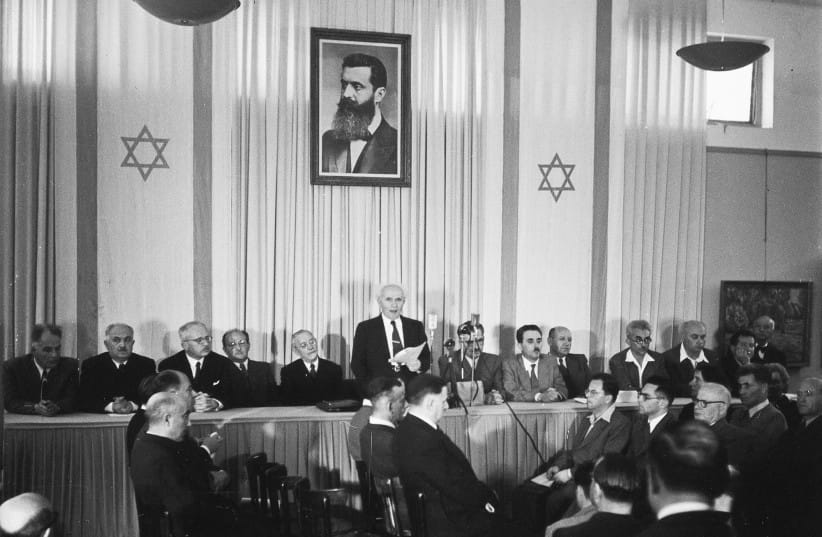
The only English description of that initial Congress known until 25 years ago was one translated from German and published in The Jewish Chronicle of London. Rosa so wanted “to spread the excitement of Zionism,” but her efforts did not penetrate significantly to make the Congress a household word. Herzl was not dismayed – he knew he had additional paths to tread to bring his hopes into being.
Following that First Congress in 1897, The New York Times assumed two positions regarding Herzl. The first, appearing in an October 1897 article, was a modified evaluation of this young visionary. “Dr. Theodor Herzl, originator of the Zionist scheme that has been so much discussed in Europe, and so coldly received by those to whose attention it has been cited in this country, is a resident of Vienna.”
‘Washington was their Jerusalem and America their Palestine’
We must understand that the Jews with the power in the US were the “Our Crowd” group – those who had come to America and made it. As one put it in the oft-repeated phrase: “Washington was their Jerusalem and America their Palestine.” The paper then pointed out that in Vienna, Herzl “is a man of enough importance” that when he writes or speaks, people take notice. An Englishman, whom the Times quoted, described Herzl this way. “He is tall, handsome, courteous… but when he talks about a Jewish nation in Palestine, he is full of fire.”
Now, the paper offers a more definitive description of this maker and shaker, even though not sure of the merits of the project. “The doctor brings to the execution (of getting a homeland) the vigor of maturity and a large amount of varied experience, for he has been in turn a lawyer and a playwright, and is now a journalist and a bicycle rider.” (Herzl was a bike rider for the last few years of his short life, a habit that mirrored the eco-friendly future he envisioned in his writings.)
The lengthy article praises Herzl’s enthusiasm, his ability to woo the sultan of the Ottoman Empire, his understanding of world economics, and finally, that this land for the Jews “would form a new outpost against Asiatic barbarians and a guard of honor to hold intact the sacred shrines of the Christians.”
One person was particularly fuming when he read this item: Rabbi Isaac Mayer Wise, leader of Reform Judaism in the US. His son-in-law was Adolph Ochs, owner of the Times. As you could imagine, another story about Herzl appeared. Two weeks later, a story in the Times carried a headline that read, “Can Don Quixote Herzl and Sancho Panza Nordau Do It?”
The newspaper detailed all the ports of call Herzl had visited throughout the world to garner support for establishing a Jewish state in Eretz Yisrael. The pope, the sultan, the German kaiser, the writer noted “all encouraged him but did not offer Herzl actual assistance. As a Don Quixote figure, the paper stressed – “he will merely continue to tilt against the windmills which he can never conquer.”
Theodor Herzl and Mark Twain both covered the Dreyfus trial and wrote at length about it. Most historians argue that the change in Herzl from Jewishly indifferent to a man, immersed solidly in Jewish action, was fueled by the trial and the antisemitism he witnessed within it.
In 1898, Twain believed that it was time for him to write about this devoted and charismatic individual. The first two Zionist congresses had been held, so Twain chose this as his focal point. “Speaking of concentration, Dr. Herzl has a clear insight into the value of Jews in politics,” Twain wrote in Concerning the Jews, appearing to understand well what Herzl was all about. “Have you heard of his plan? He wishes to gather the Jews of the world together in Palestine with a government of their own under the suzerainty of the Sultan.”
The following quote has been repeated time and again in a positive and negative way. “I am not the sultan and I am not objecting, but if that concentration of the cunningness brains were going to be made in a free country, I think it would be (best) to stop. It may not be well to let the race (Jews) find out its strength. If the horses knew theirs, we should not ride anymore.”
When he authored these last three lines, the whole world stood up and took notice. “All things are mortal but the Jew. All other forces pass, but he remains. What is the secret of his immortality?”
The interactions mentioned thus far are between Herzl and the people of his time. Let us return to August 1949 – the state was 15 months old, but Herzl’s remains had not been brought from Vienna to Israel.
Miriam Braver Lifshutz has written a biography of her husband, Mike, titled The World is My Pulpit. In that work, she describes what the chaplain did so that Herzl could have his final resting place. US Army Chaplain Oscar Mike Lifshutz entered the military in the summer of 1945 after receiving his rabbinical ordination from the Chicago Yeshiva.
Following short tours of duty in small European American bases, he was assigned to Vienna starting in May 1946. He was a legendary figure because his work with the five DP camps around Vienna not only focused on the immediate needs of the people but also on freeing them so they could escape via the Bricha underground movement and be smuggled in as ma’apilim (illegal immigrants to Mandatory Palestine).
In the summer of 1949, Gen. Jesmond Balmer, who was commanding officer over Lifshutz, notified the chaplain that during the summer, Herzl and his parents would be sent to Israel. Balmer assigned Lifshutz to act for the government, since Vienna was still under American jurisdiction. Balmer explained that permission had been granted to disinter the remains of Herzl and his parents so they could be transported by air to the Jewish state of Israel.
Once the official order came from the American authorities, Lifshutz handled all the details. The coffins of the three were disinterred. There was a service in the Stadttempel synagogue, with the coffins in the sanctuary so all could pay them honor.
Lifshutz then met IDF chief chaplain Rabbi Shlomo Goren, and the two of them escorted the coffins to the El Al planes by which they were transported to Israel. Numerous events were held when the remains arrived in Israel. There was a grand procession entering many towns in Israel with young and old bringing honor to the Zionist founder and pioneer.
On August 17, 1949, Herzl was laid to rest on what became known as Mt. Herzl. Today, there is a museum theater there retelling the entire story of this great man. The educational center there has been open for several years, and part of the complex includes a theater dedicated to Lifshutz’s memory. His act will be made known to all who visit the site.
Herzl left his impact on US Jews even though he never saw many of them in person. While his words inspired them in the past, that same spirit remains alive today, reflected in the recent surge in aliyah numbers after October 7.

Venezuela quakes have killed 4,333, injured 16,740, National Assembly president says
The death toll from the two earthquakes that struck Venezuela on June 24 has risen to 4,333, National Assembly President Jorge Rodriguez told reporters on Saturday, announcing that the distribution of housing to those affected will begin next week.
Meanwhile, 315 of the dead have not yet been identified, the official said.
The official tally of injured remained unchanged at 16,740, while 6,462 people have been rescued and about 17,000 have been left homeless.
Interim Venezuelan President Delcy Rodriguez renewed calls on Wednesday for international sanctions to be lifted to assist recovery efforts following increasingly stringent sanctions imposed by the US, the European Union, and other countries over the last two decades.
“Venezuela has resources blocked around the world that could address this process of reconstruction,” she said on state television channel VTV.
Israel’s humanitarian mission will continue another two weeks
The Israeli aid delegation’s earthquake relief work in Venezuela will continue for an additional two weeks after interim president Delcy Rodriguez met with Foreign Minister Gideon Sa’ar to request the extension, the Foreign Ministry and the IDF announced on Wednesday.
The decision was approved by Prime Minister Benjamin Netanyahu.
With a small delegation of only 30 people, Israeli presence in Venezuela has been focused on designing a national reconstruction plan, which Rodriguez hopes to begin implementing.
As part of the plan, the IDF began mapping and categorizing approximately 1,300 buildings on Monday, classifying them as either to be demolished or potentially salvageable despite damage.
Additionally, IDF Brig.-Gen. Elad Edri said that the IDF engineers have provided guidance to Venezuela on handling debris from damaged buildings.
‘Out of the box thinking’ as earthquake death toll rises
The multi-year plan is a major accomplishment of the Israeli delegation, and Venezuela approved it within days, rather than the weeks or months it would normally take to develop.
Edri said the severity of the disaster warranted rapid, out-of-the-box thinking.
Following the June 24 earthquake, the IDF delegation flew out of Israel on June 30 and landed in Venezuela on July 1 after multiple complex stopovers, Edri said.
He explained that, given the current chaos, other delegations who wanted to assist with the disaster have needed four to five days of travel and waiting to reach disaster-stricken sites.
Even the IDF could not fly directly into Caracas; they flew into Valencia instead and then traveled domestically to Caracas.
Ariella Roitman, Yonah Jeremy Bob, and Miriam Sela-Eitam contributed to this report.

Why American Jews don’t have to choose between the US and Israel – opinion
Americayit. The Hebrew feminine for “American.”
A prominent fellow immigrant once told me that no matter how long one lives in Israel, no matter how many Israeli taxes we pay, no matter how many family members serve in the IDF, no matter how much hawaij we put in the soup, we will always remain “the Americans.”
He was right.
Within a few syllables, my accent gives me away, even though I’ve lived in Israel for half a century.
I admit to occasionally having my Sabra offspring or grand-offspring phone to get a negotiable price, because I still feel my American accent makes the supplier of goods or services reach for the high end of an estimate. Naïve Americans will be willing to pay more, they think.
I get it. The lowest blow is when the car’s navigation system offers me bizarre destinations as if I’m speaking English.
Alas, I comfort myself, Golda Meir never shed her American accent, even when she was prime minister.
This rumination about identity has to do with my land of birth, the United States of America, turning 250. I’m feeling particularly grateful not only for the blue and white but for the red, white, and blue.
Finding refuge in the US
All four of my grandparents left behind pogroms and found refuge in the United States. They came from what we all called “Poland,” today Belarus – a country I had never heard of growing up. They were young couples with no English. How did they become citizens and bring up such American children?
Grampa Fischel corresponded with his younger cousins who reached Petah Tikva. Grandpa Moshe reputedly made a trip back to visit his family after he became an official Amerikaner.
I was always aware of my good fortune that I was born in America, even before I could look up my grandparents’ towns on the Yad Vashem website and see the names of relatives among the murdered.
My mother was a passionate member of Hadassah, the Women’s Zionist Organization of America. She also belonged to the Book of the Month Club, ordering and reading any book with a Jewish star on the cover. My father supported land reclamation and Israel emergency funds. Our JNF Blue Box runneth over. From fifth grade, like all my Jewish classmates, I joined Young Judaea. We didn’t see this mix of Americanism and Zionism as a conflict.
My first trip to Israel was on a Young Judaea High School Summer Course. When I came back from that trip, I happened to hear “This Land Is Your Land” playing on the radio. I remember thinking how America suited me. I would continue to feel at home in America and continue to love Israel.
I didn’t know that Woody Guthrie wrote “This Land Is Your Land” in 1940 as a populist answer to one of our own, Jewish Irving Berlin’s “God Bless America,” which he thought was too sentimental and too satisfied with itself.
Eight months after that first Israel trip, something switched inside me. As much as I loved America, I had an epiphany that I was walking in the Negev. I would begin my family’s transition to Israel, arriving first, followed by my mother and then my sister. Sadly, my father died on his and my mother’s planning trip. He’s buried in Jerusalem’s Har Hamenuhot Cemetery.
Growing up in Connecticut, knowing American history was imperative. Still sitting on my shelf in Jerusalem is the Webster’s Seventh New Collegiate Dictionary I received when I won the Otis Constitution Prize for acing a test in American history. My sister Charlotte, who also now lives in Jerusalem, won the same prize two years earlier.
Thirty-six years before that, my late father was awarded his dictionary. It was a grander Webster from an earlier era: a fat beige volume, probably an unabridged India paper edition published by G. & C. Merriam.
We were deeply American. In our town, Colchester, Connecticut, my father was the moderator of the old-fashioned New England Town Meetings in which municipal policy was determined. In the 1960s, we kids were already using regulation voting machines to elect members of our student council. With an emphasis always on democracy, we were receiving citizenship training for future voting.
We were proud that we had Catholic, Protestant, and Jewish houses of worship in our town, and that our school teachers were a mix of religions and skin colors, too. As the song “Home on the Range” put it, “seldom is heard a discouraging word.” We never suffered from prejudice. My appreciation for these beautiful values goes far beyond nostalgia.
In Israel, the one time I was enlisted as a poll watcher for a political party, they didn’t know what they were in for. Having seen the 1964 film Sallah Shabati, admittedly a satire, in which the ma’abara ballot box is stuffed, I was a fierce invigilator. When voting time ended, I hugged the ballot box to my chest as if democracy itself might escape.
I was accused of unnecessary suspicion. The Hebrew expression translates as “One who casts suspicion on honest people pays for it himself.” Still, I held firm.
When I moved to Israel immediately after university, we Americans were accused of degrading local standards: Coca-Cola, rock music, hippies, permissiveness, and drugs.
The musical Hair and the American hippie image reached Israel, where Coca-Cola had only recently arrived, and pot hit the Israeli melting pot. Consumer goods, counterculture, flower power, feminism, Black Power, and new political styles were all blamed on the Americans who fulfilled our Zionism by coming to Israel.
There were other odd stereotypes. When I invited a hospitable family from Kurdistan for dinner, they were puzzled when I served Moroccan carrot salad. How could I have made this from frozen vegetables, the mother asked. She had heard Americans never used fresh produce.
Israelis are more sophisticated today. Many have relatives in America and travel there themselves.
I’m feeling sentimental about the US Semiquincentennial. So don’t be surprised if you find me singing along with the ubiquitous covers or the original Irving Berlin with tears in my eyes. “God Bless America” may have been mawkish for Woody Guthrie, but it suits me. There’s even a Yiddish version: “Got bentsh Amerika.”
The Fourth of July, the 250th birthday of the United States, fell on Shabbat. I was hoping there would be some recognition of this important date in my synagogue, where many of the congregants or their parents were born in the US. I was disappointed that there was nothing like “Adon Olam” to the tune of “America the Beautiful,” “Blowin’ in the Wind,” or even Bruce Springsteen’s “Born in the U.S.A.”
So, at the end of the service, to the speaker’s surprise, I interrupted the announcements. We couldn’t end our services without a mazal tov for the United States of America.
As Irving Berlin serenaded:
“God bless America,
Land that I love.
Stand beside her, and guide her
Through the night with a light from above.”
The writer is the Israel director of public relations at Hadassah, the Women’s Zionist Organization of America. Her latest book is A Daughter of Many Mothers, cowritten with Holocaust survivor and premier English-language witness Rena Quint.


MK Dan Illouz expected to announce he is leaving Likud – report
MK Dan Illouz is expected to announce that he is leaving Prime Minister Benjamin Netanyahu’s ruling Likud Party, N12 News reported on Saturday.
The report follows MK Yuli Edelstein’s July 3 announcement that he will leave Likud, after which he is expected to begin a new political party.
“That is a very difficult sentence to say,” said Edelstein at the time. “There are also those friends who at this moment are hearing what I am saying in surprise and saying, ‘What is Yuli doing?! We supported him for decades, we would have supported him this time too, why is he doing this?’”
Both Edelstein and Illouz are critics of the contentious legislation being advanced by the haredi parties from within the coalition.
This includes the controversial Basic Law: Torah Study bill, which would enable haredi draft dodgers to receive state benefits, as well as an additional bill aimed at changing Israel’s daycare subsidy system.
Illouz to ‘Post’: Haredi parties ‘a danger’
In June, Illouz told The Jerusalem Post that the haredi parties “can be a danger to the future of the state of Israel,” saying that the coalition should sever ties with them.
“If the army doesn’t have enough soldiers, then that’s a danger to our ability to protect the state of Israel,” Illouz told the Post.
He further noted the economic impact of haredi draft evasion as evidence of their presence in the coalition doing “more harm than good.”
“I believe that the ideology that I represent: the right-wing, free market, hawkish ideology, is the one that needs to lead the country,” said Illouz. “But I don’t believe that the coalition with the ultra-Orthodox parties is actually something which is helping us advance this ideology.”
Avi Solomon and Keshet Neev contributed to this report.

Nicole Zedeck: Making aliyah from Colorado to Israel’s front lines
Growing up in Steamboat Springs, Colorado, a town known more for its world-class skiing than for its Jewish community, Nicole Zedeck followed in her parents’ footsteps, pursuing their love for the outdoors and for Israel.
“I tried it all! Nature, hiking, ice climbing, fly fishing. We had skiing three times a week as our PE [physical education] – instead of dodgeball,” she reports.
Nicole inherited her parents’ love of skiing, as well as her mother’s love of country music.
Her father, from Florida, and mother, from Texas, were on separate “boys” and “girls” ski trips to Colorado and “met at a classic bar.” After conducting a long-term relationship, her mother moved to Florida, and the two married and had two children.
They moved to Austin, Texas, for her father’s work and then decided to test the waters of Steamboat Springs by taking a one-year sabbatical there. The family was hooked and decided to relocate to Colorado.
Zedeck reports that her mom converted to Judaism “to raise us in a united household,” and the family enjoyed life in Steamboat Springs. “The community was very small. We had no synagogue, and the rabbi drove in from Denver. We had 30 to 60 people for Rosh Hashanah in a community center.”
Nicole says she grew up coming to Israel with her family, which she describes as a “big Zionist family.” After her first trip to Israel at age eight, Nicole came five or six times subsequently, including celebrating her bat mitzvah with her brother, who is one year older, and a Birthright trip.
“We came on family vacations to Tel Aviv. We were not religious, but I loved the history and the Jewish people – you feel it when you are here.
“I knew I wanted to live in Tel Aviv one day. It is one of the best cities in the world – vibrant and alive with good food and music. [To me], as a Zionist, it felt like home for the Jewish people, which is both a culture and an ethnicity.”
When Nicole graduated high school, she moved to Southern California to study broadcast journalism and political science at Chapman University.
Nicole’s first job after graduation, in many ways an ideal job for a broadcast journalist looking to learn the ropes, was with the ABC news affiliate in Huntsville, Alabama.
The 21-year-old quickly found herself as a one-person news team. “I was the cameraman, reporter, editor, and booker…. You learn so much about the industry.”
While Zedeck didn’t know anyone her age in Alabama when she arrived, she quickly bonded with other young people in their 20s who relocated from the coasts to work at the station.
Unlike the other 20-somethings, Nicole had a family member in the state – her maternal grandmother! She lived in Muscle Shoals, a city of 16,000 in the northern part of the state, famous for its two recording studios that had recorded many hit songs since the 1960s. Her grandmother was already a regular watcher of the Alabama ABC TV station long before Nicole arrived.
As her two-year contract was soon coming to an end, Zedeck began considering her options. A typical trajectory in the industry is to start one’s career in a smaller market with an affiliate and gradually move to larger cities.
Nicole still had Tel Aviv on her mind. “I was 23, single, had no dog, and knew that, if I wanted to go abroad, I should do it now!”
Her parents were living in Nashville, Tennessee, at the time. “I was deciding between Nashville and Tel Aviv.”
Zedeck came across a job opening with i24 English-language TV in Israel and applied. The network expressed some interest in Nicole, and there were several exploratory conversations.
Finally, the network said, “We need you in two weeks.”
Zedeck was overjoyed – but was still under contract in Huntsville, Alabama.
“I said, how about four weeks?! They said, yes.”
Zedeck was able to renegotiate her contract and prepare for her move to Israel. “That was in December 2022. I started with i24 in February 2023!”
From Colorado to the front lines
Upon her arrival in Israel, Nicole hit the ground running. She started as a general correspondent for i24, reporting on stories such as a Palestinian shooting of two soldiers followed by hundreds of Israelis attacking Palestinians near the Tapuah junction in Huwara.
Despite the busy pace and sometimes difficult-to-cover stories, Nicole is unequivocal. “I love it! It was great being in the field every day and it was a great way to see the country.”
Within a few months of her arrival, October 7 happened.
“On October 10 I was in the first group of reporters allowed to go to Kfar Aza,” she says. “You get a lot of meaning from these stories. It is meaningful to tell these stories in the right way.”
Zedeck feels lucky to bring these stories to English-speaking viewers who live very far from Israel. She observes that most viewers in the US are Evangelical Christians, and she welcomes the opportunity to “share the facts with the whole world.”
She adds, “There is so much history here of all of the major religions.”
Beyond the impact of her reporting to the Christian world, Zedeck enjoys bringing her stories to the Jewish world. She feels that “since October 7, there has been a big problem with Jews in American losing their Israel identity.”
Among her regular viewers are her mother and father. “My parents watch i24 news every day. They are most supportive and proud!”
After two years as a correspondent in the field, Zedeck has transitioned this past year to anchor in the nightly 8 p.m.-to-9 p.m. slot, Sundays to Thursdays. She writes her own text and questions for guests.
Almost daily, she is keenly aware of the contrast of her current Jewish life in Israel with her life and work in America.
“In Steamboat on Yom Kippur, you had to miss a math test. Here, there is no work!” In addition, she reports, “One of the first things I noticed here is that there is a mezuzah on every single door in my apartment building!”
As Zedeck reflects on her three years in Israel, she acknowledges that the war was a difficult period but feels lucky to be “surrounded by people who give you strength.” She observes that “in Israel, life continues despite the war,” and adds, “That’s how I want to live!”
Zedeck is pleased to have a wonderful Israeli boyfriend, Itai, and was happy and proud to cook a full American Thanksgiving dinner for him and his family recently.
She acknowledges, however, that it was a little sad not being able to do the same for her own parents who live far away. She notes sadly, “Life is happening here without them, and I have to come to terms with that.”
Zedeck continues to make progress with Hebrew at Ulpan Lilienblum 7, and she celebrates victories over the everyday challenges of living in Israel. She cites making a dentist appointment and opening a bank account among her small daily victories.
“It all depends on your attitude. I was so excited. I said, ‘Wow – I succeeded in making a doctor’s appointment!’ It makes you very independent, which is a positive thing.”
Her only regret is that she did not serve in the IDF. “I would have loved it and loved giving back.”
Though she arrived at age 23 and did not need to serve, she notes, “I didn’t think about it then, but in hindsight, I recommend considering it as an option. If you don’t serve, there will always be a core part of Israeli society you are not in tune with. We miss out on a core part of being Israeli.”
While there are challenges living in Israel, things are going well for Zedeck both professionally and personally.
“We are the only Jewish country in the world. There is a price for being here. I choose to be here!” ■

Israel must treat Hamas’s drone smuggling as a national security threat – opinion
In January, I detailed how tens of thousands of weapons are smuggled into Israel every year through the Egyptian and Jordanian borders via organized smuggling networks using drones. The weapons flow into mixed Jewish-Arab cities and from there penetrate Judea and Samaria, fueling both organized crime and terrorist activity and blurring the line between them.
This vast smuggling of weapons into Israel by our enemies – perhaps 160,000 weapons a year, with Bedouin criminal and terrorist gangs in the lead – is no longer a marginal criminal phenomenon but a growing strategic threat that urgently demands a national response.
This week, on a tour of the Negev and in discussion with officers of a new IDF “war room” tasked with this gargantuan problem, I learned that the threat is far worse, for two reasons.
First, it turns out that the threat is not just the smuggling of weapons over Israel’s borders via drones – some of which can carry 150 kilograms of arms – but the drones themselves.
Via cutouts, the Bedouin terrorist and criminal gangs are buying hundreds, perhaps thousands of drones abroad and in Israel – yes, in Israel! – and flying them into Gaza with or without carrying contraband. Hamas is stockpiling these drones, apparently for a next assault into Israel.
In other words, the “threat assessment” that Israel must be prepared for at some point in the not-too-distant future is a Hamas attack via masses, perhaps thousands, of armed drones exploding simultaneously and continuously into IDF camps, bases, and airfields, at sites of strategic infrastructure, and into civilian neighborhoods. The Nukhba raiders can then hit the ground after drone devastation from the air.
Everybody knows what difficulty the IDF is having interdicting a few Hezbollah explosive drone attacks per month against Israeli troops in Lebanon and along the border with Lebanon.
Imagine an attack, God forbid, along the lines of the massive and ruinous drone war underway between Russia and Ukraine, where an estimated 70% of the one-to-two million casualties over the past five years have been wrought by drone attacks.
Second, Israel’s defense establishment is not geared to truly tackling this problem, and its efforts thus far run from weak to ridiculous.
By the IDF’s own assessment, there are 10 to 100 drone smuggling attempts every day across some 400 km. of border (Gaza, Sinai, and the Jordan Valley). The IDF has caught a total of 15 smuggling cells and 300 drones over the past six months (mainly drone flights into Gaza and from Gaza). There are no more than 15 of these smugglers now sitting in Israeli jails, many of them minors who will be swiftly released.
There are many reasons for this paltry operational and prosecutorial haul.
The Bedouin gangs in Israel behind the criminal and terrorist operations described here are well-organized with sophisticated intelligence networks (they know exactly where IDF forces are patrolling and where not); they purposefully employ minors (who don’t look suspicious and, when caught, get off quickly); and their wealth allows for many bribes to be paid along the way, including to unsuspecting and underhanded Israelis.
One drone haul alone can bring in half a million shekels of profit. There is a lot of Iranian money fueling the whole venture, too.
Israel must designate the drone threat as a national security priority
On top of that, Israel doesn’t currently have the technology, nor has it devoted the necessary operational bandwidth, to surveil and tactically interdict the drone flights or to penetrate the Bedouin gangs that operate them.
At least 20 different Israeli military, intelligence, technological, and legal agencies need to be involved in a national coordinated effort to end the drone threat – and there is little such coordination.
And at the moment, none of the relevant agencies see interdiction of the drone threat as their main responsibility. They each have so many other tasks to handle and so, unsurprisingly, point the finger of blame at one another.
The IDF, for example, argues that its main responsibility and focus is protection of Israeli towns and civilians in the Gaza envelope as well as elimination of Hamas leaders and military infrastructures in Gaza – not running after drones and Bedouin gangs in the Negev.
Moreover, the IDF is prohibited by law from shooting at Israeli citizens such as Negev Bedouin. Thus, it can’t fire from attack helicopters at Bedouin criminals even in hot pursuit of a gang engaged in real-time smuggling or terrorist activity.
Efforts to have the open-fire regulations adjusted to allow the IDF a freer hand have been impeded by the IDF judge advocate general and Israel’s attorney general.
The law is weak too. Until recently, the smuggling described here was prosecutable only as a violation of civilian border/customs law. It was only three months ago that the law was amended to identify smuggling and outlaw drone smuggling as hardcore terrorist activity, with expanded penalties, thanks to MK Amit Halevi (with input from my think tank, the Misgav Institute for National Security & Zionist Strategy).
Special attention needs to be given to the weapons smuggling situation across the Jordanian border – Israel’s longest and least protected – which may be even worse than the situation in the Negev. It is fine that Israel is finally building a NIS 5.2 billion ($1.4 billion) 425-kilometer (265-mile) security barrier along the Jordan border from the Sea of Galilee all the way down to Eilat.
But this cannot be effective when only one division of IDF troops holds down the Jordanian border from the Sea of Galilee to the Dead Sea, and only one division patrols the Arava from the Dead Sea down to Eilat.
This is the place to mention and praise the government’s recent establishment of a national task force and Defense Ministry/IDF command center to build new layers of civilian defense in the Jordan Valley via beefed-up settlement, agriculture, and new communities of young people – on the principle that “settlement equals security.”
This includes the establishment of “National Mission Hubs” such as pre-military academies, Nahal pioneer youth outposts, student villages, and service-year organizations.
The bottom line is that Israel must designate the drone threat as a national security priority, to be dealt with as a terrorist and military threat of the highest order – not as a mere “smuggling” problem.
It should establish task forces at the ministerial level and at executive levels managed by the National Security Council to coordinate between the police, army, intelligence services, Justice Ministry, and prosecution – not just rely on a small war room in the south.
The Knesset Foreign Affairs and Defense Committee should establish a dedicated subcommittee to ride herd on this matter (something that my colleagues have suggested to committee chairman MK Boaz Bismuth).
More aggressive action may be necessary, too, like attacking the smuggling/terrorist gangs in neighboring states (in Egypt and Jordan).
All this requires operational and technological resources, with a budget for manpower that is both beefy and brainy. And the sooner the better.
The writer is managing senior fellow at the Jerusalem-based Misgav Institute for National Security and Zionist Strategy. The views expressed here are his own. His diplomatic, defense, political, and Jewish world columns over the past 30 years are at davidmweinberg.com.
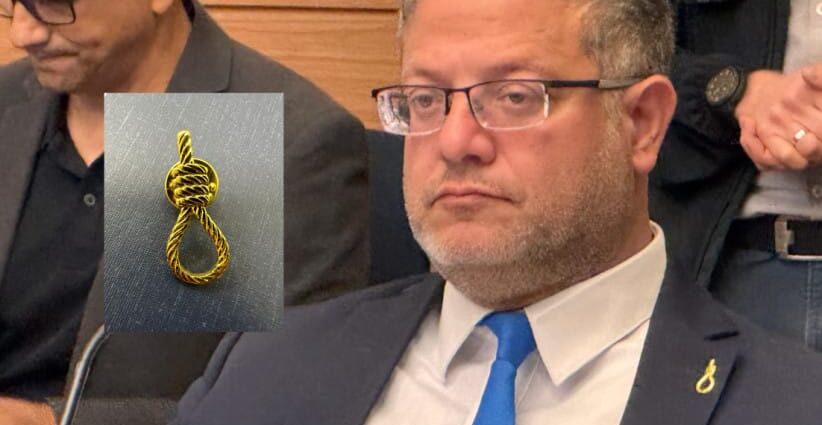
Israel’s new death penalty law will only unlock more doors for terror – opinion
In his June 11 op-ed for The Jerusalem Report, ex-Shin Bet (Israel Security Agency) official Moshe Fuzaylov claimed that “(t)he death penalty isn’t revenge, it’s how terror loses its key.”
Fuzaylov is currently a senior fellow at the Misgav Institute for National Security and Zionist Strategy. He concluded that executions form part of “a vital pincer movement designed to permanently extinguish the operational motivation of Palestinian terrorist organizations.”
As a Canadian resident, I need look no further to see just how wrong his conclusion is: the death penalty does deter terror; it invites reprisal.
As I have argued before, the death penalty is vengeance disguised as deterrence – or, as Fuzaylov calls it, “strategy.”
The19th-century writer Eliphas Levi understood this dynamic: “Every head that falls upon the scaffold may be honored and praised as the head of a martyr.” If only Fuzalov did.
Here in Montreal, the hanging effigies of National Security Minister Itamar Ben-Gvir, Prime Minister Benjamin Netanyahu, and US President Donald Trump on display at a recent pro-Palestinian rally serve as the latest nauseating reminder that calling for executions only feeds the cycle of violence.
In this case, as with Hamas’ recent threatening response to Israel’s new capital punishment laws, it also unmistakably fuels antisemitic fervor. The thousands of members of L’chaim! Jews Against the Death Penalty in Israel and the world, including this author, are aware of this reality, advocating for years to end capital punishment in the US, Israel, Iran, and globally, without exception.
To be abundantly clear: there is no excuse to regurgitate the antisemitic filth that the recent Canadian display demonstrated. Yet there can also be no doubt that, contrary to Fuzaylov’s assertions, Israel’s passage of two laws calling for the death penalty for terrorists only ripens the environment for this insidious form of hate to take root and fester.
The fact that the executed effigies of Ben-Gvir and Netanyahu feature the same noose lapel pin that Ben-Gvir has worn for months as he championed these death penalty laws through the Knesset underscores this point.
The lesson is simple: calls for death fuel more killing. Once any society exposes itself to the Pandora’s Box of state-sponsored killings of prisoners, all bets on civilized humanity are off. This includes Ben-Gvir’s pre-Passover celebration of death, Hamas’ reciprocal call for violence against IDF soldiers, and now this danse macabre in Montreal.
It is for this reason that Elie Wiesel prophetically stated that when it comes to capital punishment, “Death should never be the answer in a civilized society.”
Hanging effigies: A violation of human dignity and Jewish values
The effigies – captured in videos posted on social media – became the subject of a hate crime investigation and drew widespread condemnation from both local and provincial politicians across Canada, calling them “unacceptable,” and Jewish groups deemed them antisemitic.
Montreal4Palestine, the group that hosted the event with the effigies, denied these accusations, writing on Instagram that it “strongly condemns the defamatory accusations and deliberate distortion of events.”
Recognizing the spectacle as antisemitic is essential. But focusing only on that obscures another point: calls for execution – whether from Israel or pro-Palestinian protesters – violate the principle of human dignity central to Judaism.
Responding by depicting the executions of Ben-Gvir, Netanyahu, and Trump is equally horrific. It illustrates how calls for execution beget more violence.
Hamas’ renewed calls for violence after Israel’s death penalty laws
The shameful Montreal event disproves Fuzaylov’s theory that executions will remove the “key” to terror, as Hamas leadership has responded to Israel’s two death penalty laws with a renewed call for the kidnapping of IDF soldiers.
That development, like the effigies, confirms the worst fears that opponents of Israel’s execution push have articulated time and again. It is horrendous proof positive that these laws jeopardize the safety and security of Jews across the globe.
Despite the clear-cut evidence that judicial state killings would only encourage reprisal, many proponents of Israel’s execution laws have since doubled down on their pro-death stance. Various advocates of execution have responded to Hamas’ threats by stating that Israel should hang all imprisoned terrorists. In doing so, they fail to consider how such actions would further perpetuate the cycle of violence. A closer examination of Hamas’ recent threats demonstrates this fact.
In the document that Hamas released, its leadership stated the strategic importance of intensifying efforts to kidnap Israeli soldiers, as it is the “only path” to securing the release of Palestinian prisoners facing state violence, according to an internal message published by KAN News.
It was circulated among Hamas operatives in Gaza after the Knesset passed the second of two laws that would impose the death penalty on convicted terrorists. Hamas called the second death penalty law a “fascist law,” and urged members of the organization’s military wing to escalate and carry out “active operations.”
Crucially, Hamas further warned that the execution of Palestinian prisoners could trigger broader escalation with soldiers in the Gaza envelope. This threat is presented as concrete evidence that the laws may provoke further violence.
“Any harm to the life of a prisoner is an explosive that will lead to the eruption of a volcano,” the letter read.
These developments underscore how the upcoming debate in the Supreme Court about the legality of the Death Penalty for Terrorists Law (the first of two new execution-related laws) is among the most consequential to come before the esteemed judicial body in the 21st century.
Its outcome affects not only the State of Israel but Jews everywhere. If the Supreme Court fails to repeal the law – if the stain of executions darkens the moral fabric of Israeli society – antisemitic extremists will blame all Jews for their state-sponsored murder program, fitting it into their warped view of Israel – and, by extension, Judaism – as a so-called “Death Cult.” For such extremists, that may be all it takes to replace hanging effigies with hanging human beings.
If repeal at the Supreme Court level succeeds, however, then it might pave the way for overturning the second law targeting terrorists convicted of the October 7 massacres.
For this reason alone, amidst many others, Supreme Court justices must redeem Israel by casting a resounding “No!” in response to the first of these death penalty laws now before them. They should unconditionally repeal this law, encouraging Israel to return to the civilized, abolitionist path for which Wiesel called.
Only then can Israel begin to halt the cycle of violence and killing, once and for all. The members of L’chaim! in Israel and the world truly hope that Fuzaylov will come to appreciate this demonstrable reality before it is too late.
The writer is a co-founder of L’chaim! Jews Against the Death Penalty and is an Advisory Committee Member for Death Penalty Action.
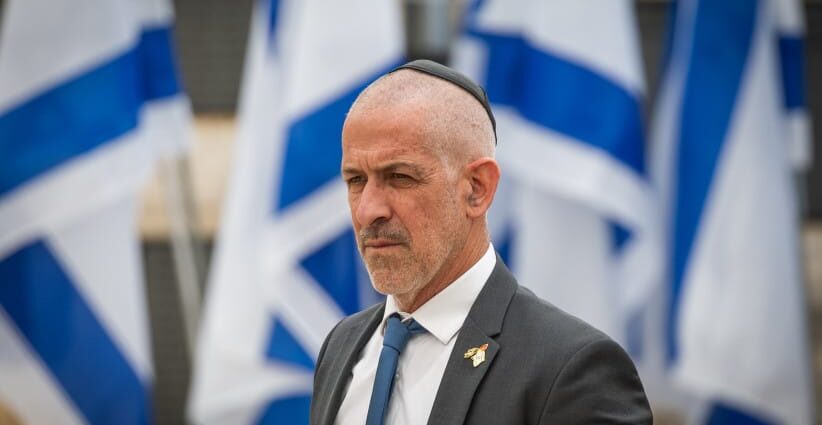
Prosecutors indict Beersheba man, 28, for attempted attack on former MK Mossi Raz
The State Prosecutor’s Office on Thursday filed an indictment against Asaf Israel Arye, 28, of Beersheba, who is suspected of agreeing, for payment, to attack former Knesset member Mossi Raz, arming himself with a knife and pepper spray and going to Raz’s home. He was later also asked to pass along the address of former Shin Bet chief Ronen Bar.
According to the indictment filed by attorney Oread Shalew of the Central District Prosecutor’s Office, Arye contacted a man named Avi via Instagram.
Avi presented himself as an activist in a right-wing organization looking for people to carry out paid tasks “for the good of saving the people.”
At first, Arye was asked to print out a flyer and distribute it, but he replied that he had previously served prison sentences and could carry out “more serious jobs,” including stabbing and arson.
According to the indictment, Arye even priced different actions, including stabbing, setting a car on fire and attacking with pepper spray, and negotiated with Avi over the amount of payment and when it would be received.
Arye agreed to attack MK Raz for compensation
Arye later agreed to carry out a violent act against Raz.
The two agreed that he would hit Raz or spray him with pepper spray, document the attack, and receive 8,000 shekels in return.
That same day, according to the prosecution, Arye traveled from Beersheba to Lod, bought a burner phone and equipped himself with pepper spray and a knife. He left his personal phone with a friend in an effort to make identification more difficult, and then went to the city where Raz lives.
When he reached near the former MK’s home, he photographed the area several times and sent the photos and videos to Avi using the burner phone. He then said he would not harm Raz as planned, he claimed, because police vehicles were nearby.
The suspects used digital currencies and Telegram for their criminal scheme
Several days later, Arye was asked, for payment, to send Avi the address of former Shin Bet chief Ronen Bar.
For carrying out the tasks, he received a total of about $1,000 through a digital wallet, according to the indictment.
Arye then smashed the burner phone and deleted his Telegram conversations with Avi, in an effort to destroy evidence. He was arrested in Lod with a knife in his possession.
The indictment charges him with conspiracy to commit a felony, destruction of evidence, possession of a knife, and additional offenses.
The prosecution asked that he remain in custody until the end of the proceedings against him. The investigation was carried out by the Shin Bet and the Central District police’s major crimes unit.

Federal prosecutors to drop charges against alleged mastermind of $722 million crypto Ponzi scheme
The Department of Justice is planning to drop the charges against a Colorado man accused of running cryptocurrency fraud that allegedly netted him $722 million in ill-gotten gains.
Matthew Goettsche, along with several others, was indicted in 2019 over claims he defrauded investors with his crypto mining firm, BitClub Network. He rewarded investors for recruiting new members, prosecutors said, the classic structure of a Ponzi scheme.
In a sharp reversal, the deputy attorney general’s office in Washington ordered the New Jersey U.S. attorney’s office to dismiss the case with prejudice, two people familiar with the matter told Bloomberg Law.
The first public sign that the prosecution was no longer being pursued came on Wednesday, when Goettsche’s attorneys filed a motion informing the judge they had “reached an agreement in principle to resolve the pending charges.”
FBI SEIZES $8 BILLION IN CRYPTO AMID INTERCONTINENTAL ‘SCAM COMPOUND’ CRACKDOWN
According to the people who spoke with Bloomberg Law, Goettsche assembled a team of lawyers who had connections to the Trump administration that could lobby for relief from the DOJ.
Fox News Digital reached out to the DOJ for comment.
Emily Covington, a DOJ spokesperson, denied that the decision to drop the charges had anything to with “any alleged pressure by Goettsche’s attorneys,” in a statement to Bloomberg Law.
She also said that the DOJ routinely evaluates pending cases and that the government is in the process of recovering “a substantial amount owed to investors.”
This marks a stunning shift since February, when prosecutors sent the court a letter saying that a jury trial was necessary.
TEXT JOB SCAM COST HIM $10K IN CRYPTO
“The Indictment concerns a global fraudulent scheme based on false promises that the victims’ hundreds of millions of dollars in investments would be used to generate returns from cryptocurrency mining,” prosecutors wrote in the letter, which was signed by then-Deputy Attorney General Todd Blanche.
In 2015, when BitClub Network was just getting off the ground, Goettsche allegedly said to his co-conspirators, “We are building this whole model on the backs of idiots,” according to the indictment.
Bitcoin mining is a process that requires “miners” to use computers to solve complicated math problems in order to be rewarded with newly-minted bitcoin.
MINNESOTA BANS CRYPTO ATMs AFTER SCAM SURGE
BitClub Network, as others were doing at the time, purported to pool investors money together to buy hardware and computer chips to build a better mining system. The idea was to then distribute the profits.
Prosecutors argued that BitClub Network reported fake profits and misled their investors.
“Real stats on fake numbers,” Goettsche said in a January 2015 message to a colleague that was included in the indictment. “We will slowly introduce real numbers.”
The indictment, which charged Goettsche with conspiracy to commit wire fraud and selling unregistered securities, was returned during the first Trump administration, and three of Goettsche’s co-defendants pleaded guilty.
The second Trump administration has been much more friendly to crypto, with Donald Trump’s family having their own crypto ventures. The House of Representatives also passed the Clarity Act last year, the first attempt by Congress to provide an updated framework to regulate crypto.
Fox News Digital reached out to Goettsche’s defense attorneys for comment.


Four settlers who attacked CNN crew in West Bank arrested by Israel Police
Israel Police arrested four settlers on Saturday following an alleged attack on a CNN news crew in the West Bank village of Sinjil, CNN reported.
According to the report, the Israeli citizens of the West Bank blocked the crew’s vehicle as it sought to leave the area moments after arriving, with IDF soldiers arriving to assist soon after receiving the incident report.
CNN added that the settlers were armed with wooden and metal rods, stones, and a knife, smashing the windshield of the vehicle and attempting to puncture the tires.
Israeli settlers armed with clubs, rocks and a knife blocked our way and attacked us & another group of journalists today in the occupied West Bank.
At the same location where settlers beat US citizen Saif Musallet to death, exactly one year ago today.
Our full report will air on… pic.twitter.com/EyvG15AsSo— Jeremy Diamond (@JDiamond1) July 11, 2026
Israel Police said they uncovered a knife and several clubs following a search of the suspects’ vehicle, adding that an investigation into the matter is ongoing.
“The Israel Police and the IDF view any manifestation of violence or causing damage to property very seriously, especially when it concerns media personnel performing their work,” the Israel Police said.
The CNN crew, which was accompanied by additional journalists, was in Sinjil covering the one-year anniversary of Saif Musallet’s death, a Palestinian-American killed by Israeli settlers in July 2025.
At the time, US Ambassador to Israel Mike Huckabee described Musallet’s killing as a “criminal and terrorist act,” with the victim’s family telling CNN that no suspects have been arrested thus far.
US rep. says settlers detained him in West Bank
Earlier on Saturday, US Democratic lawmaker Ro Khanna said he was detained by armed Israeli settlers during a West Bank visit this week, according to a Reuters report, with the US rep. describing the incident as an unfiltered look at the human toll of “Israeli occupation.”
“We were at a village that Israeli settlers had destroyed,” said Khanna. “They had destroyed the school, they had destroyed that village, and we were just looking at it.”
“And these hoodlums come in with machine guns, M4, an American-made machine gun, and they detain us,” he added. “They block off the road. And then they call the IDF and the IDF is on their side, not on the side of the Americans.”
The IDF said soldiers and police intervened after receiving the report, dispersing the settlers and freeing Khanna’s vehicle entourage.
Israel Police did not immediately respond to Reuters‘ request for comment, nor did the US Embassy in Jerusalem.
Khanna, a progressive California lawmaker in the US House of Representatives, is weighing a 2028 presidential run.
Reuters contributed to this report.

Hannah Elliott Highlights Tinnitus Risks

Patriot Supply Strains Shape Ukraine Aid



‘Crazy, moving’: Noga Erez documentary charts music star’s rise through tragedy and triumph
Noga Erez, the hipster queen of the Israeli music scene, attended the Israeli premiere of Noga, the new documentary about her and her musical and personal partner, Ori Rousso, at the Jerusalem Film Festival on Friday.
The festival runs until July 19.
Typically irreverent, she opened her remarks following the film by saying, “Now that you know all the intimate details and more about our life, we would be happy if everyone tells something about themselves. Start!”
Erez and Rousso attended the screening at the Jerusalem Cinematheque, along with the directors of the film, Austrian brothers Benjamin Bergmann and Jono Bergmann.
The movie had its world premiere this spring at the Tribeca Festival and has also been shown at the Munich Film Festival, but Erez emphasized that this first Israeli screening was especially important to her.
What is in the Noga Erez documentary?
“Crazy, moving, impossible to comprehend, to see this film in Hebrew with Hebrew speakers,” she said. After the screenings abroad, to watch it at the Jerusalem Film Festival, “There’s no doubt it made me nervous, and [seeing it here] gave it a new meaning.”
The movie, which the Bergmanns said took five years to make, chronicles Erez’s life as an emerging global music star, and covers the difficult period of the October 7 massacre and the outbreak of the war, which threatened to derail her international career, as well as a rocky time earlier in her relationship with Rousso, and their decision to have a child.
The movie, most of which is in Hebrew, takes a fly-on-the-wall approach to chronicling their lives, and mixes performance footage, scenes of the two writing together, and other moments in their lives to create a portrait of the duo that will be entertaining and interesting even for those who are not familiar with their music.
It will also inspire admiration for their success at creating music that connects with audiences both at home and abroad, as well as for Erez’s refusal to buckle down to anti-Israel forces and condemn Israel for “apartheid” and “genocide.”
Throughout, she insists that a dialogue about the issues where different voices can speak about their experiences is what is necessary. It also shows that she was willing to pay the price for her stance.
She had kind words for the Bergmanns, who “created the movie with sensitivity, and I’d say, with love,” and thanked them.
As she finished speaking, Rousso joked that the directors, “Don’t understand a word of Hebrew,” and switched to English to say, “She was talking s**t about you.”
The two stars left a moment later, to thunderous applause.
The movie will be shown on Yes Docu.

Reporter’s Notebook: Northern Israel slowly returns to life amid ceasefire with Hezbollah
The Keshet cave in northern Israel is one of the most striking sites in the region.
Situated in the western Galilee near the Lebanese border, the cave overlooks Nahal Betzet, and from the top of the cave, the whole of northern Israel along the Mediterranean can be seen.
The cave consists of a large arch, such that when one is above it, they appear to be peering down hundreds of meters into the green foliage below. It’s a unique view, unparalleled in the region.
On Saturday, the path to the cave was full of visitors. Several tour groups had arrived. At least two of the groups were Russian speakers; a large motorcycle club, with their Harley-Davidsons and leather jackets, was also here. In addition, a group of Arab women had come for lunch.
There were other visitors among the groups, speaking a variety of languages, including Hebrew.
The arrival of the visitors illustrates how northern Israel, near the Lebanese border, is reviving amidst the ceasefire in Lebanon. Not all was quiet in Lebanon today. Reports from there indicated there had been airstrikes near the coast, a few miles north of Keshet cave.
What is going on in the North during Hezbollah ceasefire?
But on the border, it seemed quiet. The walk down to the cave takes about 10 to 15 minutes. It’s a stroll. On a hot day though it’s worth having a little water or a hat. The parking is near the Adamit community.
During the 1,000 days of war with Hezbollah, this area was sometimes closed off to traffic. In the first days of the war, after Hezbollah attacked on October 8, 2023, the roads here were blocked, and people were evacuated from places like Adamit and nearby communities such as Zarit and Shtula.
The one community that remained was Arab al-Aramshe, a Bedouin community here. Route 8993 connects these communities. To get here, you need to drive up from Shlomi and Route 899 below. During the war, this area was occupied by soldiers, and tanks and artillery were deployed near the border. However, a lot has changed now.
From the border area, the concrete fence separating Israel and Lebanon is visible. If not for the fence snaking along the border, the landscape would be pretty green, with small trees and bushes, and almost untouched by people. The border wall is a reminder of the threat.
Down by the Keshet cave, one of the visitors flew a drone on Saturday. The buzzing is a reminder that today the drone threat seems less on people’s minds. But it should be on their minds because not long ago the FPV drones flown by Hezbollah were threatening soldiers not far from here, in places like Rosh HaNikra.
From Keshet, I drove along the border, then over to Shomera, and past the old church at Iqrit. Then back to Shlomi and Rosh HaNikra. Although the site here is closed, people can still see the beautiful view of the Mediterranean. Here, the whole Zevulon plain below.
This is an interesting area because one can see down to Acre, and also Nahariya and all the way to Haifa. There is a lot to do here. The Old City of Acre is one option, as is the pretty coastal area of Achziv. The Crusader castle of Montfort is also worth a visit.
There is good food in the Druze town of Hurfeish, or, a little farther away, there is the Yehiam Fortress and an interesting old ruined estate house near Ga’aton. Yarka, the Druze town, also offers many shopping options, including the largest children’s store in Israel.
At Rosh HaNikra, I stopped by a food truck called HaRefet, right next to the community entrance. Run by Yoni and a fantastic team, the place serves a variety of smoked meats and some sides. We sampled asado, brisket, chicken, and other items. The smell of the smoked meat lingers on your hands for a while after you dig in. This is just one example of the kind of innovative eateries that Israelis are pioneering these days. A welcome stop in the north.
What’s clear here is that the public has returned to these areas. People are fishing on the coast and in areas marked “no swimming”; the lack of excessive bureaucracy seems to invite people to swim.
This is because some of these areas have not returned to full operation, so there is still a sense of uncertainty, a vacuum, and into the vacuum come the adventurous types.

Retracing the history of Talmudic sage Rabbi Shlomo Yitzhaki (Rashi), from Germany to France
The 29th of Tamuz marks the yahrzeit of Rashi, the greatest commentator on the Torah and the Talmud.
Many associate him with Worms, Germany, where he studied as a young man.
His hometown, however, was Troyes, the capital of France’s Champagne region. Here he was born, and served as rabbi and dayan; here he wrote the commentaries; and here he died in 1105.
Until only a few years ago, Jewish visitors who traveled to Troyes in search of Rashi often left disappointed. The city itself did almost nothing to tell the story of the scholar whose words accompany virtually every page of the Talmud.
Fortunately, that has changed. The municipality has marked a walking trail following Rashi’s footsteps, while the local Jewish community has created an impressive heritage center.
Troyes, France, where time stands still
The old town of Troyes is one of those rare places where time seems to have paused.
Narrow streets remain paved with ancient cobblestones polished by centuries of footsteps. Timber-framed houses lean gently toward one another. The smell of freshly baked bread and warm butter escapes from neighborhood bakeries, mingling with the scent of damp stone lingering after a night of rain. Walking these streets, it is remarkably easy to imagine the world that Rashi himself once walked.
In the morning at my hotel, I put on “Rashi tefillin.” I thought of friends back home who wear two pairs every morning, those of Rashi and those of Rabbeinu Tam, his grandson.
As I stepped into the medieval streets, I found myself wondering about the conversations that once took place between the grandfather and grandson. Did they discuss here a difficult Talmudic passage? Suddenly, nine centuries no longer felt like an impossible distance. History seemed to shrink into the space between one cobblestone and the next.
The former Jewish Quarter begins at Rue Bouchera and stretches toward the Seine River. To my eyes it is roughly half the size of Jerusalem’s Jewish Quarter in the Old City.
Rashi’s synagogue still stands, although today it serves as an apartment building. Its original purpose is unmistakable. The sealed arches and distinctive round windows on the eastern wall still reveal that it was once a synagogue.
Here, Rashi’s parents davened. Here, after returning from his studies in Worms, Rashi established his own beit midrash (study hall).
Standing before the building, it is difficult not to imagine the sounds that once filled these walls: the melodies of Torah study, animated debates between scholars, and generations of students eager to understand another line of Scripture. (Address: Rue Probert 2)
Rashi’s private home was located on the parallel street, on what was once known simply as “Jewish Street.” The house itself was destroyed in the devastating fire of 1524, but remarkably, the street survived. The worn paving stones remain beneath one’s feet, and many almost certainly lay there during Rashi’s lifetime. (Address: Rue du Paon 13-15)
I removed my shoes and walked barefoot across those ancient stones. It created a feeling of connection unlike anything else. Books preserve ideas, but stones preserve footsteps. Sometimes they carry memory in a way no written document ever can.
At the end of Rue de la Cité lies the Seine. One of Troyes’s medieval city gates once stood here, known as Porte Girouard, a name derived from the word “Jew,” marking the entrance to the Jewish Quarter. Today, only a small blue plaque hints at the significance of the site.
Like many ancient cities, Troyes has wrapped its greatest son in legend.
The best known tells how Rashi’s pregnant mother was nearly struck by a galloping horse in a narrow alley. Miraculously, the wall beside her softened and formed a recess that sheltered both mother and unborn child. Visitors are still shown the indentation near the beginning of Cats’ Alley.
Rashi’s childhood home once stood near today’s Place Alexandre Israel, named after a distinguished local Jewish senator and France’s deputy foreign minister. A butcher shop eventually was built on the site, and local tradition insists that no flies were ever seen there, thanks to the merit of Rashi.
Rashi was buried in the old Jewish cemetery known as the “Field of the Jews.” No gravestone survives, and the exact location of his grave has been lost.
Jewish tradition recounts that while writing his commentary on Tractate Makkot (page 19b), he managed to write only the word “pure” and then peacefully departed this world. To this day, printed editions of the Talmud preserve the moving note: “Our rabbi’s body remained pure, and his soul departed in purity. He wrote no further.”
After the expulsion of Troyes’s Jews in the 14th century, the cemetery was destroyed, and the site was eventually replaced by buildings, the Champagne Theater, and a parking lot.
In 1990, a modern spherical monument bearing the Hebrew letters resh, shin, yod (which spell “Rashi”) was erected nearby. It honors Rashi’s memory, although it is difficult to feel that contemporary sculpture fully captures the timeless simplicity of the man it commemorates.
Troyes’ vibrant Jewish history
The Jewish story of Troyes did not end with Rashi. More than nine centuries after his death, a vibrant Jewish community maintains his legacy. The synagogue that serves the community today was inaugurated in 1960 on the site of a 17th-century monastery.
Although the synagogue bears Rashi’s name, he never prayed here. In his lifetime this area lay outside the medieval city walls, surrounded by vineyards and apple orchards. We know from Rashi’s own writings that he was a vineyard owner. Perhaps Rashi’s own vines once grew nearby.
As the Jewish community expanded during the 20th century, particularly with the arrival of families from Tunisia, the synagogue has been renovated and expanded.
Adjoining the synagogue is the Rashi Heritage Center, one of the finest Jewish museums in provincial France. The atmosphere changes the moment one steps inside. Soft lighting replaces the bright daylight outside, while the scent of aged walnut timber fills the rooms.
The reconstructed beit midrash room is astonishingly convincing. Heavy walnut furniture, rough-hewn walls, and an open volume of the Talmud create the impression that Rashi has merely stepped outside for a moment. His chair stands at the head of the table, facing an open Gemara resting on a simple wooden stand.
I sat there and slowly studied Rashi’s commentary on that day’s Daf Yomi. There are rare occasions when travel ceases to be sightseeing. Instead of looking at history, you begin to feel that history is quietly looking back at you.
As I sat in “Rashi’s chair,” another thought entered my mind. Had he lived in our own generation, he might well have chosen to live in one of the Jewish communities in Judea and Samaria. His deep attachment to the Land of Israel is evident throughout his writings.
In his commentary on Tractate Gittin, he drew one of the earliest known sketches of a road through the biblical heartland, describing the route from Beit El to Shechem, and mentioning places such as Shiloh and Ma’aleh Levona. One cannot help imagining that, were he alive today, he might have extended that map to include also Ofra, Eli, Yitzhar, and Psagot.
Nearby stands a reconstructed medieval prayer room. Simple wooden benches face a modest walnut ark without a parochet curtain. The subdued lighting creates an atmosphere of reverence rather than spectacle. Nothing here is theatrical. The room succeeds because of its simplicity.
The next hall is dominated by a magnificent stained-glass wall portraying Rashi’s family tree, beginning with his daughters and continuing through generations of descendants until the expulsion of the Jews from Troyes in the 14th century.
The adjoining library houses hundreds of books on Rashi in many languages, a testament to how the commentary he wrote in this small provincial town has shaped Jewish study for nearly a thousand years.
Across the street stands the Rashi Institute, an academic center devoted to Jewish studies and the continuing exploration of Rashi’s legacy.
Although Troyes’s Jewish community is small today, it preserves with quiet pride the city’s unique place in Jewish civilization.
Most travelers visit famous cities to admire castles or museums. Troyes offers something subtler. It asks visitors to slow their pace, to listen to their footsteps on ancient stones, to breathe the fragrance of old timber and fresh bread, and to watch the Seine flow exactly as it did nine centuries ago.
Rashi left behind no palace. His house burned. His synagogue changed beyond recognition. His grave disappeared. Yet his words continue to accompany every student opening a page of Talmud anywhere in the world. Buildings inevitably fade, but ideas possess a remarkable ability to outlive stone.
Perhaps that is why leaving Troyes feels unexpectedly emotional. You are not simply departing a charming town in the Champagne region, but a place that reminds us that some people build with stone, while others build with words. Stone erodes with time. Words born of wisdom and faith endure.
Nearly a thousand years after Rashi laid down his quill, students around the world still encounter him daily through the Torah and the Talmud. That is his enduring legacy.
A visit to Troyes is therefore more than a journey to the hometown of a medieval scholar. It is a pilgrimage to the birthplace of ideas that have outlived centuries, proving that while monuments may crumble, wisdom can be immortal.
The author is the creator of the Jewish Traveler blog.

Russia eyes mid-July start for commercial logistics hub at Syrian port, officials say
Russia hopes by mid-July to have a commercial logistics hub up and running in one of two berths at the naval base it leases in the Syrian port of Tartous, while keeping a military presence at the other, Syrian officials told Reuters.
The hub will handle a wide range of Russian goods including wheat and grains, and target initial cargo volumes of around 250,000 tons per month, one of the officials said.
The project, the officials said, is central to Russian efforts to maintain and expand its influence in Syria through economic channels, after the overthrow of former President Bashar al-Assad in 2024 deprived Moscow of its staunchest ally in the Middle East.
But much more than business is at stake, with a battle for influence under way as Washington seeks ways to ensure not only that Syria awards contracts to US companies but also curbs Moscow’s military presence.
Syria’s General Authority for Ports and Customs did not respond to a request for comment before publication of this article. After publication, Mazen Alloush, the authority’s spokesman, denied Russia would operate a commercial logistics hub at the port, describing such reports as “entirely false.” Any projects or agreements concerning Syria’s ports and border crossings would be announced only through official government channels, he said.
Ties between Syria and Russia have shifted since Assad’s fall
Moscow has backed Syria for decades and intervened militarily in 2015 to support Assad in a 14-year civil war. His fall raised questions about the future of the lease agreement under which Russia has its naval base at Tartous on the Mediterranean coast and the fate of its military base at Hmeimim, southeast of the city of Latakia.
Since Assad was overthrown, Damascus has sought closer ties with Western and Gulf countries, while cooperating with Moscow in areas including energy and food imports and military ties.
Moscow and Syria are now negotiating over the future of Russia’s bases at Tartous and Hmeimim.
In 2025, Syria’s new government canceled a 49-year contract granting Russian company Stroytransgaz the right to develop commercial facilities at Tartous. The United Arab Emirates’ DP World secured an $800 million, 30-year concession agreement to redevelop and operate the port.
But on June 6, the Russian-Syrian Business Council, a body operating under Russia’s Ministry of Industry and Trade, announced plans to establish an “assembly and distribution center for Russian goods” at Tartous.
Officials interviewed by Reuters, and company statements and documents reviewed by Reuters, provided more details of the plans, including when it is intended to become operational, its precise location and how much cargo it will handle.
The project is being developed by Syrian logistics company Rus Line in cooperation with Russian companies grouped under the Russian-Syrian Business Council.
Project organizers say they have agreed with Syria’s Sovereign Fund on joint management of the logistics center, providing a direct link to the state’s main investment vehicle.
Ossama Ajaj, general manager of Rus Line and adviser to the Russian-Syrian Business Council, said the hub will initially handle Russian wheat, grains, animal feed, vegetable oils, timber, steel, clinker, coal, rice, sugar and mineral oils.
Jinan Mubadda, Rus Line’s chief executive, said the hub will operate from Pier No. 4 at Tartous port. The other berth remains dedicated to Russian naval operations.
Ajaj said the main operations for the hub would be in the Tartous port, with Russia-origin cargos expected to berth at Pier No. 4, which Ajaj called a “restricted zone” of the naval base.
He said the Syrian authorities would control the hub operations, with all activity requiring Syria’s General Authority for Ports and Customs approval.
January meeting between Putin and al-Sharaa a ‘turning point’ for Russia-Syrian relations
Russia’s government also did not comment for this article. But Foreign Ministry spokeswoman Maria Zakharova said in June that Moscow and Damascus were discussing a possible “reformatting” of Russia’s military facilities in Syria and that cooperation between the two countries was developing actively.
Ajaj told Reuters cargo volumes of about 250,000 tons per month were being targeted initially, and operations were expected to begin in mid-July with a 30,000-ton grain shipment.
He suggested Russia would maintain a “reduced military presence.”
Two officials from Syria’s foreign ministry said the project was outlined at a January 28 meeting in Moscow between Syrian President Ahmed al-Sharaa and Russian President Vladimir Putin. The officials called the meeting a turning point in efforts to revive economic cooperation.
Ajaj said the two leaders agreed to reactivate trade between the two countries. He also said a framework agreement would establish a regular shipping line between Russian and Syrian ports for raw materials and other Russian goods bound for Syria and other countries.
The project aims to establish a regular maritime route between Russia’s Black Sea port of Novorossiysk and Tartous, from where goods will be distributed across Syria and neighboring countries.
Ajaj identified Iraq and Jordan as the primary target markets, followed by Saudi Arabia, Kuwait, Qatar and Bahrain.
A May concept document prepared by the Russian-Syrian Business Council said the project envisages the use of Syrian private security companies to protect cargoes where necessary. It ruled out the involvement of Russian security firms.
Syria relies heavily on Russian imports including crude oil and wheat,
The commercial logistics hub is set to increase Moscow’s already significant economic role in Syria. Some 85% of Syria’s imported wheat, 2.9 million tons for the 2025-26 season, comes from Russia and Russian-occupied Crimea, a Syrian customs document showed.
Reuters has also reported that Syria’s reliance on Russian crude oil imports has increased since Assad’s fall. It received about 16.8 million barrels of Russian oil in 2025 and an estimated 60,000 barrels per day in the first months of 2026.
Russia’s military intelligence agency, the GRU, recommended increasing support and investment for economic actors capable of strengthening Russian leverage in Syria, said an intelligence source briefed on a confidential GRU report to the Russian presidential administration in December 2025.
The report identified Louay Youssef, head of the Russian-Syrian Business Council, as a figure Moscow could rely on in pursuing that strategy, the source said.
Youssef has held various senior positions in Russian-Syrian organizations and was an adviser on Syrian affairs to Yunus-Bek Yevkurov, a deputy defense minister, according to two associates of Youssef.
Youssef, who has announced that he is now an adviser to the defense and security committee of Russia’s Federation Council, or upper house, did not respond to requests for comment.
The project could help Russia maintain influence regardless of the eventual shape of its military presence, said Nanar Hawach, a senior Syria adviser at International Crisis Group.
“Russia’s hold on Syria rests on what it supplies and maintains, and on its (United Nations) Security Council vote, which gives it influence that outlasts any drawdown of troops,” he said.
“A logistics role reinforces that by keeping Russia physically present at the port, strengthening its hand while the future of the base is being decided.”
The US is meanwhile watching closely.
Congressman Joe Wilson last month secured an amendment to the Pentagon budget directing it to assess options for reducing Russia’s influence in Syria and securing the departure of its forces from Tartous and Hmeimim.
“We closely monitor Russian-backed commercial and logistics projects in Syria and are concerned that such initiatives may not contribute to stability in the country,” a US State Department official said in response to Reuters questions.
The official said the US was encouraging Syria to engage “trusted corporate partners – especially US firms” during the country’s recovery and reconstruction after its civil war, while urging Damascus to respect US sanctions on Russia.

Twenty-six years after Camp David, Israel needs a new security doctrine – opinion
Today, 26 years ago, on July 11, 2000, one of the most consequential diplomatic conferences in the history of the Israeli-Palestinian conflict convened at Camp David in Maryland.
Under the auspices of US president Bill Clinton, prime minister Ehud Barak, and Palestinian Authority chairman Yasser Arafat sat around the same table in an attempt to reach a permanent-status agreement and bring the conflict to an end.
The conference failed. Yet its historical significance lies not merely in the fact that no agreement was signed, but also in what was revealed before the eyes of the entire world.
At that time, Israel presented the most far-reaching proposal ever placed on the negotiating table: it was prepared to transfer more than 90% of Judea and Samaria to the Palestinians, carry out land swaps from within its own sovereign territory, and discuss the division of Jerusalem, including issues relating to the Old City.
If the conflict had truly been only territorial, this would have been the moment when an agreement could have been reached.
And despite all the sweeping concessions that were offered to them, concessions that amounted to political and security suicide on the part of the Zionist state, the Palestinians said no.
Arafat’s rejection was not a momentary whim. It exposed the naked truth: the Palestinians never intended, and still do not intend today, to establish a Palestinian state alongside the State of Israel on part of the land. The true and unchanging objective of the Palestinian national movement is the establishment of a state over the entire Land of Israel, on the ruins of the State of Israel.
At Camp David, we negotiated with the man who was then regarded as the supposed partner, the only figure who was allegedly willing to sit down and negotiate with Israel (while the rest of the Palestinian leadership rejected the very idea outright). Yet we still reached a dead end. The result of those concessions was not peace, but the outbreak of the Second Intifada, a planned wave of terrorism that claimed the lives of more than one thousand Israelis.
By demonstrating a willingness to make those concessions, we created an extraordinarily dangerous precedent, one in which the international community came to regard Israeli territorial concessions as the natural starting point for every future negotiation.
That precedent must be erased. It must be erased from the pages of our diplomatic and security history, and it must be made clear that those proposals are null and void and cannot serve as the opening position for any future discussion.
The lesson of the Camp David Summit (2000) is even deeper and more relevant today. The summit definitively shattered the assumption that territorial concessions, in and of themselves, would bring reconciliation. It proved that the root of the conflict is not the scope of Israel’s presence in Judea and Samaria, but the very existence of a sovereign Jewish state in the Land of Israel.
Even at the point of Israel’s maximum willingness to compromise, it became clear that a historic compromise was not the objective of the other side.
From this understanding emerges the diplomatic doctrine that Israel must adopt for the decades ahead: lasting arrangements are not achieved through territorial gestures, but are built upon strength, deterrence, and security.
The only practical foundation for any future arrangement will emerge only when a profound change in Palestinian consciousness takes place, one that includes full recognition that Israel is a permanent and indisputable reality, with no intention of withdrawing or relinquishing its right to exist as the nation-state of the Jewish people.
Only when the other side becomes convinced that it cannot defeat Israel or alter reality through terrorism, international pressure, or rejectionism, and that the continued illusion that the Jewish presence in the region is temporary bears no fruit, will the foundation for a stable and realistic arrangement truly be laid.
The key to peace lies not in the breadth of Israeli concessions, but in the strength of Israeli deterrence and the depth of Palestinian recognition of our legitimate existence here.
The author is the deputy chairman of the Institute for Security Policy of the Israel Defense and Security Forum (IDSF) and served as a policy adviser to former strategic affairs minister Ron Dermer.

South Africa’s Jayden Adams, 25, dies after playing in World Cup
Jayden Adams died at age 25 after playing in three World Cup games last month for South Africa, the country’s football players union confirmed Saturday.
No official cause of death was released.
“The South African Football Players Union (SAFPU) is devastated by the untimely passing of Mamelodi Sundowns and Bafana Bafana midfielder Jayden Adams.
“Jayden had only recently represented South Africa at the FIFA World Cup, carrying the hopes of the nation with pride, courage and distinction. His passing is an immeasurable loss to his family, teammates, clubs, the football fraternity and the country at large.
“We extend our deepest condolences to the Adams family, Mamelodi Sundowns, Stellenbosch FC, Bafana Bafana and all those whose lives he touched. South African football has lost a gifted player, a proud servant of the game and a young life that still had so much to offer. May his soul rest in eternal peace.”
Adams started two of the three World Cup matches
Adams started two of the three World Cup matches he appeared in for South Africa despite the death of his grandmother, Marianna, one day before a 1-1 draw with the Czech Republic. He started in that match and South Africa’s 2-0 loss to Mexico. He was a sub in a 1-0 win over South Korea.
He was an unused substitute when South Africa was knocked out by Canada on June 28.
Gayton McKenzie, minister of sports, arts and culture in South Africa, said he reached out to Adams to offer condolences when his grandmother died.
“I shall carry forever the humble, appreciative response he gave me. That he chose to wear the national jersey and give his all for his country in that moment speaks to a depth of character and professionalism well beyond his years, and it reflects the caliber of young man South Africa has lost,” McKenzie’s statement read.
Prior to the World Cup, he helped Mamelodi Sundowns win the CAF Champions League. He joined Sundowns after playing for Stellenbosch FC. Adams dedicated his medal from the Sundowns to late Stellenbosch teammate Oshwin Andries, who died after being stabbed in 2023.

Male fertility crisis? Israeli global study finds 54% drop in testosterone levels over five decades
A new Israeli study has found that average testosterone levels in men have fallen by 54% in less than five decades.
The findings, presented at the annual meeting of the European Society of Human Reproduction and Embryology in London, raise concerns that the well-documented decline in sperm counts is accompanied by a profound and ongoing deterioration in the male hormonal system.
The study was conducted as part of Alon Levy’s master’s thesis in public health at the Hebrew University of Jerusalem.
Researchers performed a meta-analysis, a statistical method that combines data from multiple previous studies, incorporating six longitudinal studies conducted in Israel, the United States, Brazil, Finland, and Denmark. Each study included testosterone measurements taken at at least three different time points. In total, data from 118,593 men examined between 1972 and 2019 were analyzed.
All six studies found declining testosterone levels over time.
Testosterone levels drop 54% worldwide
After combining the data, the researchers estimated that total testosterone levels had fallen by 54%. The trend reflects an average decline of more than 1% per year, with the rate of decline appearing to accelerate after 2000.
The scale of the decline is particularly striking because the studies were conducted in different countries, populations, and time periods.
Researchers adjusted for participants’ ages, since testosterone naturally declines with age, but the observed decrease was substantially greater than could be explained by age alone.
According to Prof. Haggai Levin, chairman of the Israel Association of Public Health Physicians at the Hebrew University and Hadassah Medical Center, who led the research team, the trend is strong and cannot be explained as a random fluctuation or statistical error.
The findings add to previous studies by his group that identified a significant decline in sperm counts among men worldwide in recent decades.
What is the cause of the testosterone decline?
“More research is needed,” Prof. Levin told Maariv. “We know that obesity and metabolic syndrome contribute to the decline.
Other studies have shown that environmental exposures, such as endocrine-disrupting chemicals, impair testosterone production both during fetal development and later in adult life.
Lifestyle habits that harm health, including smoking, poor nutrition, and a sedentary lifestyle, are also associated with lower testosterone levels and reduced male fertility. This study did not directly examine male fertility, but the two go hand in hand. There are likely common underlying factors.”
Testosterone is generally associated with male libido and sexual function, but its role in the body extends far beyond that. The hormone helps regulate sperm production, build muscle mass, maintain bone density, and support metabolism. It is also linked to energy levels, mood, body hair growth, and the development of male sexual characteristics.
Low testosterone levels may manifest as fatigue, reduced sex drive, erectile dysfunction, loss of muscle mass, increased body fat, and reduced bone density. Some men may also experience mood disorders, difficulty concentrating, and decreased sperm production.
However, a single testosterone measurement is not sufficient for diagnosis, and physicians must also consider symptoms, the time of day the test was performed, and other medical findings.
The relationship between testosterone and overall health works in both directions. Chronic diseases, obesity, diabetes, and sleep disorders can reduce hormone production.
Conversely, low testosterone has been linked to metabolic disorders, declining muscle strength, and reduced quality of life. It remains unclear in many cases whether low testosterone causes disease, results from it, or is part of a cycle in which both conditions worsen each other.
One of the leading explanations for the decline is the global rise in obesity.
Fat tissue contains an enzyme that converts some testosterone into estrogen, and the accumulation of abdominal fat may disrupt hormonal signaling between the brain and the testes. Obesity is also associated with insulin resistance, chronic inflammation, type 2 diabetes, and metabolic syndrome, all of which may affect testosterone production.
Prof. Levin estimated that obesity and metabolic syndrome could explain between one-quarter and one-half of the decline observed. However, because the studies included in the analysis did not fully adjust for body weight, it is not yet possible to determine what proportion of the decline is attributable to rising obesity rates.
Among the other factors under investigation are endocrine-disrupting chemicals. These substances may mimic the activity of natural hormones, block them, or alter their production in the body. They may be found in some plastics, food packaging, pesticides, personal care products, cleaning agents, and other household products.
Researchers are concerned that exposure to these chemicals during fetal development could affect the formation of the reproductive system, while exposure during adulthood may impair testicular function and hormone production. However, studies examining the relationship between environmental chemicals and testosterone levels have so far produced inconsistent findings, and no specific substance has been identified as responsible for the trend.
Air pollution and global warming are also being investigated as possible contributors. The testes are located outside the body because normal sperm production requires temperatures slightly lower than core body temperature. Prolonged exposure to heat, extreme heat events, and climate change may affect testicular function, although evidence regarding their long-term impact on testosterone levels remains limited.
Modern lifestyles may also play a role. Reduced physical activity, prolonged sitting, diets high in processed foods, smoking, alcohol consumption, insufficient sleep, and chronic stress have all been linked in various studies to poor metabolic health and impaired reproductive function. While the impact of each factor individually may be limited, their combined effects over many years could be significant.

Beyond mourning: Rebuilding the Temple starts with rebuilding Israeli society – opinion
In these weeks leading up to the Tisha B’Av fast day, our focus naturally turns to the destruction of the Temple. We refrain from live music, weddings, and wearing new clothes in order to maintain a communal level of mourning.
But public grief alone is not enough. We need to actively work to restore the Temple’s legacy; as the Jerusalem Talmud says, “Any generation in which the Temple is not rebuilt, it is accounted as if it were destroyed in its days [by that generation].”
We cannot move toward rebuilding if we concentrate solely on sadness. Dwelling too much on sadness creates paralysis, and, paradoxically, gives us an excuse not to act. When we talk about rebuilding, we must begin with a spiritual and moral awakening.
First, we must restore the vision embodied in our Holy Temples, a vision of unity and justice which was tragically lost twice, and can feel painfully unattainable today.
As we face outside threats from antisemitism, terrorism and war, there is too much disagreement and discord when it comes to who we are as the Jewish people, how to come together, and what our values are as the nation of Israel. It feels disturbingly similar to the societal discord that preceded the destruction of the Temples.
Therefore, as we make our way through the “Three Weeks,” spanning from Tamuz 17 and culminating in Tisha B’Av, we must use the inspiration found in the Temple to help shape our future as a society of shared responsibility and kindness based on common values.
In the days of the Temple, the pilgrimages to Jerusalem brought together Jews from every demographic, creating shared destiny. This practice and others built into the Temple encouraged all of Am Yisrael – the Nation of Israel – to participate in the development of a just society and shouldered the responsibility, an ideal we crucially need to reclaim today.
For example, as Israel remains in a defensive war, the ongoing exemptions from military service for tens of thousands of ultra-Orthodox citizens stand in stark contrast to this ideal and to halacha itself, leaving the heavy burden of national security and grueling reserve duty to fall disproportionately on the rest of society.
More unity needed in Israeli society
More unity and a sense of shared responsibility would also go a long way in helping us respect each other. Remarkably, even non-Jews brought Temple offerings, demonstrating that the Temple served as a beacon for all humanity.
We see a glimpse of this universal respect today, with Muslims, Druze, and Christians serving alongside Jews in the army, rescue, and medical services. Such cooperation should be celebrated, even as we recognize that fringe acts of extremism and racism threaten to shatter this fragile, shared future.
Social justice was another pillar of the Temple. The societal fabric of the Temple era was reinforced by mechanisms designed to protect the vulnerable. This is evident in the laws of the shmita – Sabbatical year – which leveled economic disparity, and the Chamber of Secrets within the Temple itself, where the wealthy could donate, and the poor could receive with total anonymity.
While there are many laudable projects to improve society today, core challenges still remain. For instance, it is a severe injustice that there are agunot, women whose husbands refuse to grant them a divorce, alongside cases of spiteful marriage recalcitrance when husbands are unable to present a get to their wives, trapping spouses in lives of suffering and abuse.
To make matters worse, some in the religious establishment are ignoring the halachic tools available to solve this problem. When there is room within the framework of Jewish law to help the vulnerable and promote justice, utilizing it is a sanctification of God’s name. Proper measures need to be courageously taken.
I have often been asked by students and others about why I don’t go up to the Temple Mount in Jerusalem. Do I not care about rebuilding the Beit HaMikdash? My response is always punctuated with a reminder that until we solve the agunah issue and other social challenges, the Messiah will tarry.
Bringing the final redemption is up to us, and concentrating solely on a physical rebuilding of the Temple, or on the very real holiness that remains where the Temples once stood, is far from adequate.
Ultimately, the many specific details of the Temple’s structure and its practices reflect its commitment to unity and social justice, two values that should be of utmost importance today. A fascinating discussion in the Talmud (Bava Batra 60b) illustrates this balance. Following the destruction, Rabbi Yehoshua hears the opinions of his fellow sages who speak about abstaining from meat, wine, and even painting their homes as a sign of mourning.
Rabbi Yehoshua acknowledges that mourning is appropriate, but he ultimately states one may eat meat, drink wine, and can indeed plaster a new building – as long as a small area is left unplastered. His ruling provides a blueprint for sustainable memory; we must acknowledge the loss, but we cannot allow grief to paralyze us and our responsibility to move forward and build anew.
Fasting; learning about how the design of the Beit HaMikdash encouraged unity and social justice; or catching a glimpse of a purposely-placed unfinished stone in a new Jewish home should inspire and challenge us to work toward a better, more just society. May we be blessed this year to see the restoration of the Temple and the values it was meant to project.
The writer is president and rosh yeshiva of Ohr Torah Stone.



McCaul Backs Deeper US Ukraine Defense Ties







Haredi protesters rally outside Jerusalem cafe open on Shabbat
Dozens of haredi (ultra-Orthodox) protesters gathered outside Cafe Basimta in Jerusalem’s Nahlaot neighborhood on Saturday to protest the business’s opening on Shabbat.
The protesters chanted “Shabbos” but were met by hundreds of Jerusalem residents who arrived throughout the morning to support the cafe. Police removed two haredi protesters who sat near the entrance.
Jerusalem Deputy Mayor Adir Schwartz, who chairs the Hitorerut movement, arrived at the scene with movement activists.
“Once again this Shabbat, extremists came to Cafe Basimta in an attempt to intimidate the business owners and the Jerusalem public, simply because they chose to open the cafe on Shabbat,” said Schwartz. “Hitorerut activists were at the site throughout Shabbat, stood alongside the business owners, and made it clear that a small group of extremists would not be allowed to dictate to Jerusalem residents how to live.
“We will continue to be there, support local businesses, and preserve a free Jerusalem that belongs to everyone,” Schwartz added.
The demonstration followed unrest at the cafe the previous week, when hundreds of haredi protesters surrounded the venue, overturned chairs, banged on the windows, and spat at patrons.
Jerusalem authorities prepared for the possibility of further unrest ahead of Saturday’s protest. Hitorerut activists planned to remain at the cafe from opening until closing to help prevent additional disturbances.
Posters call on haredim to protest cafe
Posters distributed in haredi neighborhoods called on residents to march to the cafe on Shabbat and protest its opening.
Police gathered intelligence in the days leading up to the demonstration, held discussions with all sides, and prepared for the possibility of an escalation.
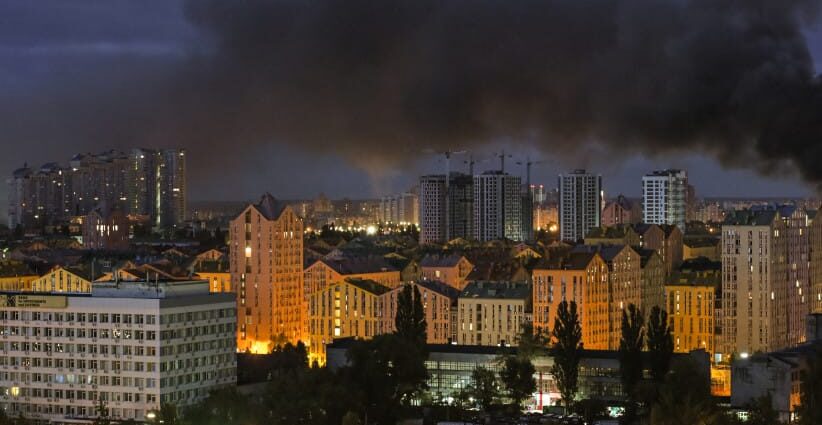
Two dead, 19 wounded as Russia strikes Ukraine with missiles, drones
Russia attacked Ukraine with missiles and drones on Saturday, killing two and wounding 19 others, officials said, as Kyiv awaits supplies of air defense munitions after a shortage has left it exposed to Russian attacks.
Eleven people were wounded in the capital, Kyiv, by an attack that used ballistic and cruise missiles as well as drones.
“Civilian infrastructure was hit even before the air raid alert was issued,” President Volodymyr Zelensky said, adding that rescuers were working on the site.
“Our defenders managed to shoot down most of the targets, but not the ballistic ones,” he added, calling on Ukraine’s allies to quickly deliver the support packages of air defenses agreed at the NATO summit this week.
Russia launched six ballistic missiles, another six cruise missiles and 121 drones, Ukraine’s air force said, adding that it downed at least two cruise missiles and 111 drones.
Ukraine pleads for supplies from allies
Later in the morning, a missile strike in the port city of Odesa killed two people and wounded another, while a drone hit a civilian enterprise in the eastern city of Kharkiv, wounding seven.
Ukraine, which is critically low on munitions for its Patriot air defense systems, has been largely unable to down ballistic missiles, which travel at several times the speed of sound, over the past month.
It has pleaded with allies for greater supplies of those munitions, and has also pushed Europe to work with Kyiv on its own anti-ballistic air defense system.
US President Donald Trump said this week that Ukraine will be granted a license to produce its own Patriot interceptor missiles.
Zelensky calls for defense projects to move ‘as swiftly as possible’
After Saturday’s attack, Zelensky called for those projects to move “as swiftly as possible.”
Russia has stepped up attacks on the capital in recent weeks. So far this month, strikes on Kyiv and the surrounding region have killed more than 60 people.
Kyiv, in turn, has been pressuring Russia’s military logistics in occupied southern Ukraine, seeking to deprive Russian forces of fuel and munitions by conducting strikes on trucks and vessels deep behind the front lines.
Ukraine’s drone forces chief Robert Brovdi said his units had struck 21 fuel tanker vessels in the Sea of Azov overnight, as well as seven other cargo and support ships, bringing the total up to 76 vessels struck this week.

Ammunition Hill memorial now honors Six-Day War veterans killed on October 7
Israel is home to hundreds of war memorials and monuments to those who lived and bled for the land, but the monument that stands at the peak of the Ammunition Hill Heritage Site in the heart of Jerusalem is one of a kind.
Built on a base of rough stones used by the members of the 66th Battalion to memorialize their fallen brothers-in-arms in the days following the Six Day War, the monument has evolved into a site for the battalion to remember its fallen throughout Israel’s wars.
Today, it bears four aspects. The first, established based on the Defense Ministry’s standard, is in memory of the 36 fighters who fell in the Battle for Jerusalem in 1967.
The second concerns standing in memory of those who survived the 1967 Battle of Ammunition Hill but fell in Israel’s later wars and operations.
Recently, it was refitted to include two fallen reservists who served in the 66th Battalion during the Israel-Hamas War: Sgt.-Maj. (res.) Tal Shua, 31, from Beersheba, and Sgt.-Maj. (res.) Neriya Shaer, 36, from Yavne.
‘Please God, may this be the last page of names to turn, the last addition to the monument’
As for the third aspect, “we decided not to put another standard stone with the original fonts,” Alon Wald, Ammunition Hill’s head of operations, told The Jerusalem Post. “We decided to also turn it into a sculpture that would resonate powerfully.”
Made up of a folded iron sheet, the monument honors the children and grandchildren of the Six Day War veterans who were killed in either military duty or terrorist attacks.
“It’s positioned here as a folded page, as if saying to God, to ourselves: ‘Please God, may this be the last page of names to turn, the last addition to the monument. Please let death stop,’” Wald said.
“But it didn’t end there.”
The fourth, newest addition to the monument, made of the same iron as the third section, marks a devastating moment of closure for five liberators of Jerusalem who were taken hostage and murdered by Hamas during or after the October 7 massacre.
“This closure is something that we never thought would happen, this prayer of the last page,” Wald said. “But it’s not a page, it’s a whole column.”
Amitai Yaakov Ben Zvi (80), Oded Lifshitz (83), Yoram Metzger (80), Avraham Munder (79), and Chaim Peri (79) all served in the IDF’s 66th Battalion of the Paratroopers Brigade in 1967.
Many years later, all five retired to the Gaza border community of Nir Oz, where, on October 7, Hamas massacred 47 residents of the kibbutz and took another 76 hostage, including Metzger, Peri, Munder, and Lifshitz.
Ammunition Hill tries to protect its protectors
“Realizing that they were in captivity, we [Ammunition Hill] took them off the grid,” Wald revealed to the Post. “Nobody knew. I didn’t want Hamas to realize [it was] holding living legends in case this would endanger them even more.”
“No one asked [Ammunition Hill] to do this. It was an initiative we decided to take upon ourselves. We removed them from our lists, our database, to make sure that if anybody tried to look at who [Hamas] was holding captive, they would not know,” Ammunition Hill’s chief of operations said.
He added that their names and information have since been added back into Ammunition Hill’s online archives and website.
Hamas murdered Ben Zvi in his home. His caregiver, Gelienor “Jimmy” Leano Pacheco, 34, was abducted during the massacre and later released in the November 2023 hostage deal.
Lifshitz and Metzger were both kidnapped from their Nir Oz homes alongside their wives, Yocheved Lifshitz and Tamar Metzger. Yocheved was one of the first hostages to be released by Hamas on October 23, 2023, while Tamar was released a little over a month later in November.
Oded Lifshitz was murdered in 2024 while he was being held captive by the Palestinian Islamic Jihad. His remains were returned over a year later alongside those of Kfir and Ariel Bibas and a Gaza woman whom Hamas had falsely claimed was their mother, Shiri Bibas.
Munder was kidnapped alongside his wife, Ruth, his daughter Keren, and his grandson Ohad. Hamas released all three on November 24.
His 50-year-old son, Roee, was murdered during the massacre.
Metzger and Peri’s deaths in captivity were announced by the IDF in June 2024. Two months later, in August, Nir Oz announced that Munder had also been killed in captivity.
On August 20, Metzger’s, Peri’s, and Munder’s remains were returned to Israel by the IDF.
Wald detailed the painstaking wait for the return of his heroes, men that he, the son of a fallen Six Day War paratrooper Capt. Rami Wald, grew up in the shadow of.
Peri, Metzger, and Munder, Wald said, had been candidates for Ammunition Hill’s Adopt-a-Liberator initiative.
This initiative, funded by Keren Kayemeth LeIsrael-Jewish National Fund, pairs Israeli high school students with Six Day War veterans in order to document their lives.
It is part of Ammunition Hill’s broader effort to create a comprehensive archive of the Battle for Jerusalem and the other war fronts of the Six Day War.
Peri, Metzger, and Munder had been slated to begin the initiative in 2023 with students from the Nofey-Habsor High School in Kibbutz Magen shortly after Sukkot.
Magen, located five kilometers from the Gaza border, was stormed by some 100 Hamas terrorists on the fateful morning of October 7.
Results of an IDF probe released in September 2024 revealed that the kibbutz’s 26-member emergency standby squads had successfully managed to repel the waves of terrorists and prevent kidnappings from taking place.
Two kibbutz residents were killed in the fighting: Avi Fleisher, a member of the security team who died from his wounds after being evacuated for medical treatment, and Ofir Mordechai Yaron, who was killed while traveling to help defend the kibbutz.
In the days following, after the magnitude of the massacre and its effects were realized, Nofey-Habsor turned to Ammunition Hill, unsure of what to do and how to proceed.
“I told them that they [Peri, Munder, and Metzger] would return, that it would be okay, that the scholarship was theirs, and that we’re not going to give up,” Wald shared.
Praying for Peri’s, Munder’s, and Metzger’s returns, the answer satisfied the school as the country held out hope for a swift end to the conflict.
However, with the IDF’s announcement of their deaths in captivity, Nofey-Habsor’s students turned back to Ammunition Hill, unsure of what to do.
“I told Eyal, who’s managing the project at Nofey-Habsor, that the scholarships were still available,” Wald said. “I told him that even though we couldn’t work with Peri, Metzger, and Munder anymore, to please adopt their families and tell the stories of these three guys through them. We need to cherish their legacy.”
Nofey-Habsor students document their would-be mentors
Since then, Nofey-Habsor students have completed short documentaries about Peri’s and Metzger’s lives and are set to begin documenting Munder’s life and legacy in the coming months.
The documentaries feature interviews with Peri and Metzger’s family members, photographs of the two men, video footage, and audio recordings.
In the film about Peri, his wife Osnat described the morning of October 7 and the moment Peri was taken by Hamas.
She explained that they had closed themselves in their shelter when the sirens started, but quickly realized that “it was something different … a different sort of barrage.”
“We understood that we were in great danger. Haim and I agreed to seal ourselves in and stay silent. We turned off the lights, the TV, and made the difficult choice to turn off our phones.”
Terrorists had come into their house three times during the massacre.
First, the terrorists could not find the door to the shelter and instead shattered the windows and the glass back door before leaving.
“There was so much broken glass that you could hear every footstep. How many people were there?” Osnat said, recalling what was going through her mind.
Not long after, she and Peri heard another terrorist walking through their home.
This one, unlike the previous group, succeeded in finding the shelter’s door. He pried the door open only to be faced with Peri, towering in the doorway.
“Chaim grabbed him by the shoulders and threw him back,” she said. “[The terrorist] hit a wall and ran.”
Minutes later, several other terrorists entered the house again and, once more, Chaim stopped them from entering the shelter.
The terrorists spoke with him in English, telling Peri that he needed to go with them and that they would not do anything to him if he did not make trouble.
That was the moment the couple realized the terrorists did not know Osnat was there.
“Chaim, in a split second, decided to go with them, hoping that they’d leave with him and leave me alone. And it worked. They left and didn’t come back,” Osnat said.
“Everyone can learn from him: A dreamer who achieves his dreams. The biggest example of this is [Nir Oz’s] White House Gallery.”
The gallery, created from a white house that had stood abandoned for years in the fields of the kibbutz, was founded by Peri in 1999.
In the film about Metzger, his eldest granddaughter, Ofir, shared with Nofey-Habsor her grandfather’s experiences during the Six Day War and the moment her family realized both her grandparents had been kidnapped by Hamas.
Metzger had been one of the paratroopers who had accompanied former IDF chief rabbi Shlomo Goren onto the Temple Mount and down into the Western Wall Plaza at the end of the Battle for Jerusalem in 1967.
“My grandfather would always tell us about how they [the paratroopers] waited with him [Goren] to be allowed in [to the Temple Mount],” Ofir said.
“As soon as they were able to go in, the rabbi took him by the hand and walked him onto the Temple Mount,” Metzger’s granddaughter continued. “That’s how my grandfather shared that he was the first one to walk with Rabbi Goren into the Kotel Plaza.”
On October 7, Ofir said in the documentary, the moment she and her family understood that something was terribly wrong was around 7:30 a.m., when footage of armed terrorists driving through the streets of Sderot began to come out.
“The last message I got from my grandfather, after asking him again and again if everything was okay and him not answering, was kind of funny,” she recalled, “like he was trying to address the situation with humor.”
She shared a screenshot of her text thread with him. The final message sent by Metzger, after her insistence for him to keep them updated on the situation, was a text at 8:50 a.m. reading: “Just like the guy who fell from the Empire State Building said, so far so good.”
“We believe they were kidnapped at around 9:30. It was only later in the evening, when rounds were being made to make sure that no more terrorists were left in Nir Oz, that people realized their house was a mess and they were missing,” she said.
After her grandmother and other women from Nir Oz were returned in the early days of the war, including Lifshitz’s wife, they learned that Hamas would use Metzger as a translator, both to speak with other hostages and, at times, to translate Israeli television.
Being the chosen translator, Metzger had been able to garner some level of respect with his Hamas captors, and due to his knowledge of Arabic, he was able to protect other hostages by speaking to the terrorists.
“They would sometimes let him watch TV with them – not just Israeli shows, but Al Jazeera as well,” Ofir revealed. “He knew some semblance of what was going on.”
“He gave other hostages a sense of security by staying calm through it all.”
Both Hebrew-language documentaries are available to watch on Ammunition Hill’s YouTube channel.
“With the ceasefire, the battle ends, but for some, the war only begins, and that’s the bereaved families and those left behind by the fighters, of whom we say: thanks to them, we are able to live,” Muki Nin-Nun, a Six Day War veteran who fought alongside Lifshitz, Ben Zvi, Metzger, Peri, and Munder, told the Post.
“Because of them, we live by the light of their legacy. That’s how it should be said.”
Nin-Nun described how the members of the battalion continue to look after their own, meeting up once a month to catch up and remember, adding that Lifshitz, Ben Zvi, Metzger, Peri, and Munder would attend these meetings.
Metzger and Peri, he disclosed, would bring him bottles of wine from their winery in Nir Oz.
“Now, these are friends – it’s terribly hard to explain brotherhood-in-arms to someone, but it’s blood of your blood, flesh of your flesh,” he said, adding that after they were kidnapped, “the only thing we could do was shout and demonstrate every day, all day.”
“And after their bodies were returned, [the only thing we could do] was to memorialize their names at the battalion memorial site.”

US, Canada strike deal to open bridge linking Detroit and Windsor after dispute delayed launch
The United States and Canada have reached a deal to open a new multibillion-dollar bridge linking Detroit and Windsor, Ontario, ending a dispute that delayed the project’s launch.
The Gordie-Howe International Bridge will now open on July 27 and become the fourth crossing between Detroit and Canada.
The 1.5-mile bridge was originally supposed to open last month. The Windsor-Detroit Bridge Authority said on June 11 that the U.S. and Canada had agreed to put off the opening to “resolve any outstanding issues.”
President Donald Trump — who earlier this year threatened to block the bridge’s opening unless the U.S. had an ownership stake in it — announced on Truth Social early on Saturday that he “was able to cut a MUCH BETTER DEAL for America.”
CANADA’S PRIME MINISTER REFERS TO US ECONOMIC TIES AS A WEAKNESS
The original deal for the “new and spectacular” bridge was “unacceptable to me,” Trump wrote in his post.
“The new deal is great, and fair. Thank you and congratulations to the Canadian Government. May we both have many years of success with this wonderful new development!!!” he concluded.
On Friday, the Windsor-Detroit Bridge Authority said the U.S. and Canada agreed to a “series of cooperative measures” related to how tolls would be charged to drivers.
Both sides agreed that half of the net profit the bridge generates will go to a regional development fund, The Wall Street Journal reported, citing a Canadian official.
FIERCE TRUMP CRITIC MAKES STUNNING ADMISSION ON DEFENSE SPENDING: ‘HE HAS WON THE ARGUMENT’
The original deal stipulated that all toll revenue would go to Canada until it recovered the approximately 6.4 billion CAD it cost to build the bridge. Construction began in 2018 and Canada agreed to foot the entire bill.
The Canadian official also told The Journal that the bridge authority will need U.S. approval before raising tolls by 10% or more. Approval would also be needed if the authority were to cut tolls below what is charged for comparable crossings, such as Ambassador Bridge, the official said.
Fox News Digital reached out to the White House, the Canadian Prime Minister’s Office and the bridge authority for comment on the terms of the new deal.
CANADA’S CARNEY PLEDGES ACTION ON ANTISEMITISM AMID BACKLASH OVER NEW ANTI-HATE COUNCIL MEMBERS
In a statement on Friday, Michigan Gov. Gretchen Whitmer celebrated the opening of the bridge, which will be co-owned by her state and Canada. She did not mention Trump or the administration in her remarks.
“Thousands of Michigan workers built this critical bridge, which will speed up auto production, lower costs, ease traffic, strengthen agriculture, and give people on both sides of the border better-paying jobs and brighter futures,” Whitmer said.
She continued: “I’m proud to have fought for its opening and congratulate my partners who have worked on this issue alongside me for years.”
The Gordie Howe Bridge was named after the Canadian hockey star who won four Stanley Cup championships with the Detroit Red Wings in the 1950s.


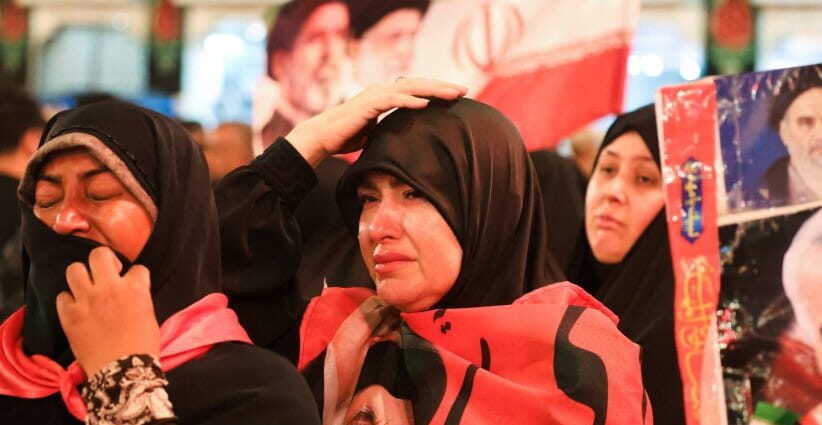
Iran’s Supreme Leader pledges revenge for Ali Khamenei’s death, says people worldwide will help
Iran pledged to avenge the assassination of former supreme leader Ayatollah Ali Khamenei in a written statement attributed to Supreme Leader Mojtaba Khamenei on Saturday.
“We pledge to avenge your pure blood and the blood of all the martyrs of these two wars by holding their criminal and disgraced killers accountable,” the statement read, adding that such vengeance was “the demand of [the Iranian] nation.”
The statement went on to threaten the “criminals,” saying they “will take their dream of dying peacefully in their beds with them to their graves.”
“They must understand that this matter does not depend upon my presence or that of any other officials,” the statement added.
According to the statement, there are people around the world willing to take revenge.
“Soon, free people throughout the world will each carry out part of this divine mission.”
Conflicting reports emerge regarding negotiations
This comes a day after US President Donald Trump posted that Iran had asked to continue negotiations with the US.
Additionally, CBS News reported US officials stating that Iran had told Trump advisers that the attacks on commercial ships in the Strait of Hormuz were a mistake on Friday.
According to the report, Iran blamed the attacks on a sect of hardliners trying to sabotage negotiations.
Statements emerged on Iranian media on Saturday disputing these reports, with IRGC-affiliated Fars News citing an informed source as saying that Iran had not submitted any request for negotiations.
Additionally, the source reportedly stated that Iran will not enter into any negotiations until the US backs down from its positions

British Jews shouldn’t fear requesting kosher meals in hospitals – opinion
This week, a single statistic stopped me cold. Requests for kosher meals in British hospitals have reportedly halved in two years.
That number does not mean half of British Jews abandoned their faith. It means something far uglier. It means Jews, at the precise moment they are ill, frightened, and dependent on strangers, now hesitate before ticking a box that says: I am Jewish.
A kosher meal in a hospital should be boring, a footnote, one line on a dietary form swallowed up in the vast machinery of clinical care. Instead, it has become a test of nerve.
I write this from inside medicine, not from the stands. The UK’s National Health Service trained me. I have worked in it, loved it, argued with it, and defended it for more than 40 years, and I work in it still. At its best, it remains one of Britain’s great moral achievements: care according to need, not wealth; the stranger treated exactly as the neighbor. That is precisely why this moment is so painful.
The reports keep coming. Jewish NHS staff ostracized. Jewish patients feel unsafe. Patients afraid to tick the kosher box. In Sydney, two nurses were suspended after allegedly boasting they would refuse to treat Israeli patients and threatening to harm them. In Britain, doctors have been investigated over allegedly antisemitic posts. These are no longer isolated headlines. They are a pattern.
The discomfort of Jewish patients
Let me be fair, because fairness is the whole point. The overwhelming majority of doctors and nurses are decent, compassionate, and tireless, and would treat any patient before them with professionalism and humanity. I know this in my bones, because I have stood beside them for decades.
But medicine runs on trust, and trust is brittle. You do not need a majority to shatter it. You need a visible minority, an institutional shrug, a slogan waved through as “political expression,” a complaint quietly buried, a regulator more anxious to protect an ideology than to reassure a patient.
The question Jewish patients whisper is not, “Are all healthcare workers antisemitic?” They know the answer is no. The real question is far more chilling: When I am flat on my back in that bed, will the person holding the syringe, reading my scan, or answering my pain see a patient or a political symbol? That question should chill every doctor who hears it.
So why has anti-Israel hatred burned so hot in parts of the healthcare world? Part of the answer lies in the psychology of the caring professions themselves.
We are trained to run toward suffering. We see an injured child and are horrified. We see a damaged hospital and instinctively side with the staff inside. That reflex is a good one. But good instincts are the easiest to hijack.
Compassion stripped of complexity curdles into something dangerous. The brain resists holding two truths at once: that Palestinians in Gaza have suffered horribly, and that Israel is fighting an enemy that deliberately hides among civilians; that every innocent death is a tragedy, and that Hamas turned schools, homes and hospitals into weapons; that criticizing Israeli policy is legitimate, and that singling Israel out for demonization among all the nations of the earth is something else entirely.
Compassion in medicine
The medical mind is especially easy prey for the oppressor-and-victim story. We spend our lives on the side of the weaker party. But geopolitics is not a ward round. A photograph is not a diagnosis. A viral clip is not a clinical history. If a doctor diagnosed from one dramatic image, ignoring the history, examination, and differential, we would call it dangerous, negligent medicine. Yet that is exactly how a frightening number of clinicians now “diagnose” Israel.
There is a moral vanity here, too. Because we mend bodies, we flatter ourselves that our politics must be healing as well. We are the compassionate ones; therefore, whoever we brand as the cause of suffering must be morally diseased and deserves whatever comes. Once that leap is made, the Israeli patient stops being Mr. Cohen in Bed 6. He becomes a stand-in for Gaza, Prime Minister Benjamin Netanyahu, the IDF, colonialism, apartheid, genocide, and every placard screamed outside the hospital gates.
That is not medicine. That is prejudice in a white coat.
Rabbi Lord Jonathan Sacks taught that antisemitism mutates to survive. In one age, Jews were hated for their religion, in another for their race, and in ours, they are hated through the language of anti-Zionism. The costume changes; the ancient machinery grinds on. The Jew is once again conscripted to explain the world’s pain.
A hospital is not a debating chamber. A ward is not a protest march. The patient is not a placard. The white coat exists to cover politics, not to broadcast them.
So are Jewish patients safe? Clinically, in the great majority of cases, yes, because I know too many good people to say otherwise. But emotionally and institutionally, something has gone dangerously wrong when a patient feels he must hide who he is to feel safe. A patient too frightened to ask for kosher food is not receiving equal care, however flawless the surgery.
The NHS was built on one unbreakable promise. It never asks whether you are rich or poor, devout or secular, black or white, Muslim, Christian, Jew, or atheist. It asks only what is wrong and how it can help. If Jews now feel they must lower their heads, pocket their symbols, avoid Hebrew, disown Israel, and quietly starve rather than request kosher food to feel safe on a British ward, then that promise has been broken. Not bent. Broken.
So enough hand-wringing. Healthcare leaders must say plainly, and in public, that political hatred has no place at the bedside. Regulators must move fast the moment a clinician crosses from opinion into racist hostility, and be seen to do it. Hospitals must protect Jewish patients and staff not with limp diversity slogans, but with hard standards, enforced every time, no exceptions.
And we doctors must relearn some humility. Our job is not to perform our virtue online. It is to treat the human being in front of us, whoever he is, whatever flag someone else has draped over him.
A kosher meal should never require courage. A Star of David should never feel like a risk. A Jewish patient should never lie awake wondering whether the doctor at the foot of the bed sees a person first.
If that is now genuinely in doubt, then this has stopped being a Jewish problem. It is a medical emergency, and the profession should treat it like one.
The writer is a rabbi and physician. He writes and teaches on Jewish ethics, leadership, and resilience. His work appears on rabbidrjonathanlieberman.substack.com and youtube.com. @rabbidrjonathanlieberman.
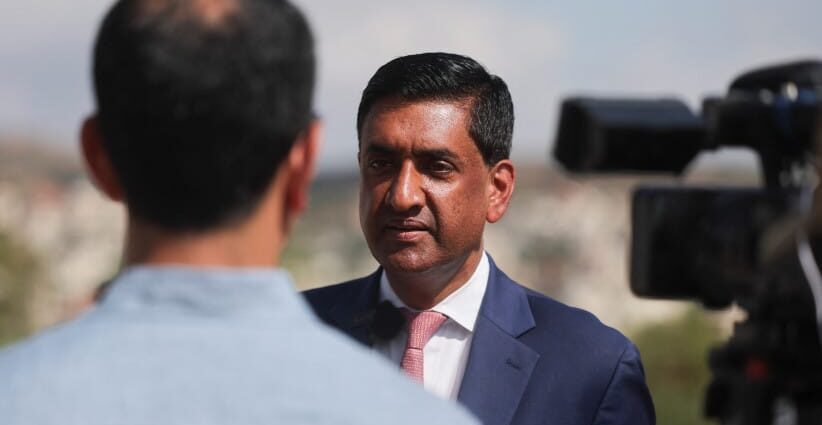
Rep. Ro Khanna says armed settlers detained him during West Bank visit
US Democratic lawmaker Ro Khanna said he was detained by Israeli settlers armed with US-made rifles during a West Bank visit this week that he cast as an unfiltered look at the human toll of “Israeli occupation” as he weighs a 2028 presidential run.
Speaking with Reuters on Thursday in a Palestinian village, Khanna said his group’s van was surrounded by settlers wielding M4 rifles a day earlier while touring a part of the southern West Bank where residents face frequent settler attacks.
“We were at a village that Israeli settlers had destroyed, they had destroyed the school, they had destroyed that village, and we were just looking at it,” said Khanna, a progressive lawmaker from California in the US House of Representatives.
“And these hoodlums come in with machine guns – M4, an American-made machine gun – and they detain us. They block off the road. And then they call the IDF and the IDF is on their side, not on the side of the Americans,” Khanna said, referring to the Israeli military.
An aide to Khanna who was in the group, Cameron Kasky, said they were held for more than an hour and made appeals to the US Embassy in Jerusalem for help. A group of officers who appeared to be police eventually intervened, leading to their release, Kasky said.
The Israeli military said troops and police officers intervened after receiving a report of settlers blocking vehicles near Khirbet Zanuta, a small Palestinian hamlet whose residents were forcibly displaced by violent settler raids following the 2023 Hamas attacks on Israel.
“Upon their arrival, the troops dispersed the Israeli civilians and allowed the vehicles to continue on their way,” the military said.
Israel’s police did not immediately respond to a request for comment, nor did the US Embassy in Jerusalem.
Democrats remain divided over Israeli conduct
Khanna is the second Democrat considering a White House bid to visit the region this week. In Tel Aviv on Wednesday, Rahm Emanuel, who was chief of staff to former President Barack Obama, said Israeli policies toward Palestinians were eroding support for the US-Israeli alliance.
Asked if he was running for president, Khanna said: “I’m strongly considering it, and I’m more resolved to consider it after this trip.”
Israel’s conduct toward Palestinians has emerged as a flashpoint in Democratic politics ahead of November’s US midterm elections, contributing to primary defeats for some incumbent lawmakers targeted by left-wing challengers who accused them of supporting Israel’s right-wing government.
Israel’s favorability rating among Democrats fell from 59% in 2018 to 22% in May, according to Reuters/Ipsos polling.
While Israel has long enjoyed strong bipartisan US support, an increasing number of Democrats in Congress are now pressing to cut off military aid, which amounts to $3.8 billion per year and includes funding for light weaponry like M4 rifles and missile interceptors that Israel used in the Iran war.
Overlooking a valley dotted with settler outposts on the outskirts of Turmus Ayya, a village home to thousands of Palestinian American dual nationals, Khanna said he believed his party’s establishment was “clueless about how much of a moral test Palestine, Gaza and Israel have become.”
He said he chose to do a visit exclusively to the West Bank, with programming led by Palestinians, to give him an unfiltered view of the territory Israel captured in the 1967 Six-Day War.
“If you’re unwilling to speak up for Palestinian human rights, if you’re unwilling to speak up against the genocide in Gaza, the apartheid in the West Bank, then you are morally compromised,” Khanna said.
Israel rejects allegations that it carried out a genocide in Gaza or that it instituted an apartheid regime in the West Bank, which has a population of about 3 million Palestinians and around 500,000 Jewish settlers.
Most countries and the United Nations regard Israeli settlements in the West Bank as illegal under international law, citing the Fourth Geneva Convention’s prohibition on transferring a civilian population into occupied territory.
Israel rejects that position, saying the West Bank is disputed territory where there has been a Jewish presence for thousands of years. Palestinians view the West Bank, together with Gaza and East Jerusalem, as part of a Palestinian state.
Support remains strong among Republicans, though some elements of Trump’s coalition have also called for cutting off aid.

UK at a crossroads: Between multiculturalism, extremism, and loss of governance – opinion
For decades, Britain was seen as one of the world’s most stable democracies, a model of the rule of law, tolerance, and multiculturalism. In recent years, however, there has been a growing sense that the country is facing a deep internal crisis.
Instead of devoting most of their attention to domestic challenges, including ideological extremism, crime, social tensions, illegal immigration, and rising antisemitism, some British politicians repeatedly choose to focus on condemning Israel.
This conduct is puzzling, to say the least.
While Israel is confronting terrorist organizations that threaten its very existence, harsh voices are heard in London against Jerusalem, often while ignoring the security reality in which Israel is operating.
Criticism of government policy is a legitimate part of democratic discourse.
But when it comes alongside silence or a weak response to signs of extremism and a loss of control in entire areas of Britain itself, it raises serious questions about the authorities’ priorities.
Grooming gangs operated in several British cities for years, sexually exploiting girls, often vulnerable minors.
The term “grooming” refers to a process in which offenders build a relationship with a victim and gain their trust through gifts, attention, money, alcohol, or drugs before sexually exploiting them and, in some cases, trafficking them for exploitation by others.
One of the most prominent cases was in Rotherham, where an independent inquiry found that thousands of children and young people were sexually exploited in the town between 1997 and 2013.
The report sharply criticized the police and local authorities, saying they failed to act properly to protect the victims. Additional cases were exposed in other cities, and estimates point to tens of thousands of cases of sexual abuse and exploitation.
Institutional failures and public accountability
Another issue that stirred public controversy was the background of some of the offenders. In several of the best-known cases, many of those convicted were British Pakistani and Muslim.
The reports raised claims that some officials feared that emphasizing their background would lead to accusations of racism.
These scandals led to a series of reforms in Britain, tougher enforcement, additional public inquiries, and the creation of new mechanisms to protect children.
They are still considered among the gravest failures of law enforcement and welfare authorities in British history.
Britain is undergoing significant demographic change. In some cities and many neighborhoods, the share of communities of Muslim origin has grown substantially, and in several local authorities, they already make up a majority of the population.
In cities such as Bradford and Luton, as well as parts of Birmingham, there are areas where Muslims are the local majority. Significant demographic changes are also evident in the London borough of Tower Hamlets and in parts of Leicester.
For some members of the public, this is a natural expression of a multicultural society. Others believe it poses challenges of integration, cohesion, and governance that the state is struggling to manage.
The debate is not about the very existence of Muslim communities in Britain. Millions of Muslims are law-abiding citizens who contribute to British society in every area of life.
At the same time, however, extremist elements seek to exploit freedom of speech and religion in order to spread radical ideology.
Over the years, the authorities have acted against certain preachers accused of incitement, support for terrorist organizations, and promotion of Sharia (Islamic law).
Some were removed from the country or prosecuted. A number of religious institutions also came under supervision over suspicions that they were spreading extremist messages.
Britain has also paid a heavy price in the field of terrorism.
The July 7, 2005, bombings in London; the Manchester attack in 2017; the Westminster attack; the attacks on London Bridge; and other incidents showed that Islamist extremism is not a theoretical threat but a deadly reality.
Official investigations in various cases also pointed to intelligence and enforcement failures that made it harder to prevent the attacks.
Since the October 7 massacre, Britain has also become a stage for mass demonstrations against Israel.
Many of them took place as part of freedom of expression, but in some cases extremist slogans were heard, antisemitic incidents were documented, and symbols associated with terrorist organizations were displayed.
Britain’s Jewish community has reported a sharp rise in antisemitic incidents and a growing sense of insecurity.
Against this background, the statements of British politicians who rush to lecture Israel are especially grating, while their own country is dealing with complex internal crises.
A country that wants to lead the free world must first and foremost demonstrate its ability to confront its own problems: to protect its citizens, enforce the law equally, fight incitement and extremism of every kind, and preserve social cohesion.
Those who seek to present themselves as a moral authority must apply the same standards at home. It is difficult to persuade others how to fight extremism when your own society is grappling with deep challenges of governance, polarization, and security threats.
Britain has made a major contribution to the world in law, science, and democracy.
Precisely for that reason, many hope it will rediscover the balance between openness and enforcement, freedom of religion and a determined fight against incitement and extremism, and criticism of other countries and the responsibility to first address the challenges at its own doorstep.
Only then will it be able to preserve its status as one of the world’s leading democracies.
The author is the CEO of Radio 100FM, an honorary consul and deputy dean of the consular diplomatic corps, and president of the Israel Association of Radio Communication. He previously served as a monitor for Army Radio and as a television correspondent for NBC News.
Hand grenade detonates at luxury residential complex in north Tel Aviv
A hand grenade exploded overnight on Friday at the luxury Blue, shopping and residential complex, in north Tel Aviv, near Hatzuk Beach.
The blast reportedly caused minor damage near the lobby of one of the buildings, but there have been no reported injuries.
Police arrived at the scene shortly after the explosion to collect security camera footage, take witness statements, and investigate the circumstances surrounding the incident.
The complex is home to hundreds of residents.
Authorities believe the incident was motivated by criminal intent, but it is still unclear who the grenade was intended to target.
This is a developing story.

Gen Z breaks ultimate taboo by posting salaries online
Gen Z is breaking one of the most deeply rooted social taboos by openly discussing salaries, spending limits and personal finances online.
The Wall Street Journal’s Free Expression associate editor Mary Julia Koch joined FOX Business’ Ashley Webster on “Varney & Co.” to discuss loud budgeting and why younger Americans are increasingly willing to make once-private financial conversations public.
The trend encourages people to be transparent about what they can and cannot afford, often by sharing budgets, financial goals or decisions to skip expensive plans on social media. It comes as many young adults face high living costs, uncertainty in the labor market and growing pressure to make financially responsible choices.
“I think my generation is more open about everything. I mean, we’ve grown up posting online, our relationships, our friendships, our college lives. It makes sense that this is sort of the next frontier where people are documenting their budgets and their financial lives,” Koch said.
While talking openly about money does not guarantee better financial decisions, Koch argued that greater awareness could help younger people take more ownership of their finances, particularly as many schools provide limited education in economics, accounting and basic money management.
WHY GEN Z IS SAYING ‘NO’ MORE OFTEN – AND SAVING MORE MONEY
“I think at least it gets the conversation started,” Koch said, “Some awareness is a positive development, especially in an economy that feels very uncertain as young people enter a labor market that could be wrecked by the prospect of AI.”
Salary discussions may be the next barrier to fall as online culture continues to challenge the traditional norms surrounding money.
GEN Z SHOPPERS HELPING REVIVE AMERICA’S MALLS WITH PUSH FOR IN-PERSON EXPERIENCES
“You don’t talk about politics or money at the dinner table. So we’ll see if that starts to change,” Koch said.


Nearly Two-Thirds of Americans Willing to Pay More for Homes in Walkable Communities: NAR
The NAR’s triennial Community and Transportation Preferences Survey, released on July 10, polled 2,000 Americans in 50 of the country’s largest metropolitan regions this past May. Walkability, living in mixed-use neighborhoods that blend public spaces with retail and commercial businesses, and having a variety of choices when it comes to housing were primary concerns when searching for housing, regardless of whether those amenities come with a cost premium….







Trump administration subpoenas journalists after reports of Air Force One security concerns -report
The Trump administration issued subpoenas to several New York Times journalists on Friday, after the NYT reported on security concerns around US President Donald Trump’s new Air Force One.
The new Boeing 747-8 aircraft, which was donated by Qatar, lacked security features including advanced antimissile capabilities, the NYT reported on Thursday, citing multiple officials.
Experts expressed concern over risks in using the jet abroad, and Secret Service concerns led to an abrupt decision for Trump to leave Turkey on the old Air Force One on Wednesday, according to the report.
The administration is under increasing pressure to disclose details of the overhaul of the Qatari plane’s security upgrades, the report added, emphasizing that the aircraft’s safety is critical for both the president and his entourage of White House staff, Secret Service officials, journalists and guests who fly aboard.
White House defends plane’s security
The White House defended the plane’s security in a statement by communications director Steven Cheung on Thursday.
“The new Air Force One is a state-of-the-art aircraft that has been fitted with high-level security protocols that ensure the safety of the president and his staff,” he said.
“As the president has said recently, there are many enemies of America who have their sights on him, and we use every tool at our disposal to address those threats,” he added.
While the Air Force declined to discuss specific security systems, it did acknowledge there were changes to the equipment available on Air Force One.
“No risk was taken in security, safety or mission communications,” the Air Force said in a statement on June 19. “But the collective team made trades on some of the less commonly used mission sets that Boeing must deliver to support the next 40 years.”
Two former Air Force officials involved in the effort to replace older Air Force One planes told the NYT they were surprised by Trump’s use of the new jet abroad.
“Time didn’t permit all the normal Air Force One modifications, so some mix of security, communications and support is missing,” the NYT cited former Air Force secretary Frank Kendall as saying.
“Frankly, I’m surprised to see this plane used outside the US,” he added.
Former Air Force assistant secretary Andrew P Hunter, who was in charge of the Air Force One program during the Biden administration, told the NYT that a true retrofit of a 747 to prepare it for use as Air Force One would require over a year.
Senate Democrats also questioned Trump’s decision to use the new jet, accusing Trump of prioritizing luxury over security.
“Trump’s own statements – including his celebration of ‘a level of luxury that nobody’s ever seen before’ – make it clear that these decisions prioritized Trump’s personal comfort and tastes over US national security,” Senator Christopher S. Murphy and 12 other senators wrote in a letter.
Administration issues subpoenas
Subpoenas ordering reporters to appear before a federal grand jury on Wednesday were delivered on Fridays to reporters, in some cases by federal agents at reporters’ homes, the NYT reported.
The NYT condemned the action, stating it was an attempt to undermine guaranteed freedom of the press.
“The appearance of federal law enforcement agents on the doorstep of news reporters should shock the conscience of any American who believes in the Constitution and the press freedom it protects,” said David McCraw, the NYT’s top newsroom lawyer, in a statement on Friday evening.
“This brazen act should be seen as nothing more than an attempt to prevent the public from knowing what is happening in their country by intimidating journalists from doing their jobs,” he added.
The subpoenas were issued to journalists who reported on Trump’s use of the old Air Force One on Wednesday, and on concerns over the jet’s security on Thursday, the NYT wrote.
Before the Wednesday article was published, a senior Federal Bureau of Investigation (FBI) contacted the NYT asking for the article to be held for reasons of national security, speaking with a reporter and a senior editor, but declined to explain the security issue, the NYT added.

Maryland man who tried joining ISIS, planning attack against Jews sentenced to 15 years in prison
A Maryland man was sentenced on Wednesday for attempting to join and fight for ISIS, a designated foreign terrorist organization (FTO).
Michael Sam Teekay Jr, 22, was sentenced to 15 years in prison followed by lifetime supervised release, for attempting to provide material support to an FTO.
Teekaye revealed his plan to join and fight for ISIS to an undercover officer (UCO) between March and April 2023. He also told the UCO his “plan B” was to carry out an attack in the US against Jews and People who support Israel.
He said he had researched buildings close to him that support Israel and had thought about how to “gun down members or anyone involved.”
US Attorney for the District of Maryland, Kelly O’Hayes said “Mr Teekaye sought to support a foreign terrorist organization that has committed unspeakable acts of violence and took real-world steps to carry out a terrorist attack in Maryland.”
“Today’s sentence underscores that those who seek to aid terrorist organizations will be identified, prosecuted, and held fully accountable.”
The Special Agent in Charge of the FBI Baltimore Field Office, Jimmy Paul, added that “this sentencing reinforces the gravity of Michael Teekaye’s crimes. Undoubtedly, lives were saved because law enforcement thwarted Teekaye’s plan to join ISIS and murder Americans.”
Teekaye’s plan to join ISIS
In mid-2024, Teekaye purchased ammunition and range time in Maryland, which he told a UCO was part of his “training” for ISIS, and he then tried to purchase a Kalashnikov assault rifle but was denied due to probation from a state criminal case.
Teekaye then told the UCO he had engaged with a Somali ISIS fighter and had made plans to travel to Somalia to join ISIS. He sent the UCO screenshots of his travel itinerary and the visas he needed for the trip.
On October 10, 2024, Teekaye sent the UCO a photo of himself in a black mask, armed with a large machete, captioned: “victory or shahada [martyrdom] … either you do it here or over there or both.”
The UCO asked Teekaye if he was “sure” he wanted to join ISIS, and he responded that he “was sure because he had done a lot of research,” and “they are the only group that has the most true and sincere intentions.”
He was arrested by FBI agents at BWI on October 14, 2024.
After his arrest, Teekaye said, “I’m just gonna get out in 20 years, and I’m just gonna do it here. Okay? It will never stop. Jihad will never stop. I’ll just do it here then, when I get out… You think 20 years is something? I’ll be like 40 when I get out, then I’ll just do it. I don’t care. It will never stop. Jihad will never stop. I’ll come, and I’ll kill your soldiers. I’ll kill you.”

MDA volunteers arrested following allegations of drugging drinks and rape
Content warning: This article contains disturbing references and descriptions of sexual assault. Reader discretion is advised.
A young woman who volunteers with Magen David Adom (MDA) filed a police complaint this week, alleging that two fellow MDA volunteers sexually assaulted her in her apartment in Beit Shemesh.
In her report, the complainant stated that the two men had given her drinks at a social event that were drugged before raping her at her residence.
The alleged incident took place approximately nine months ago.
Since the accusation became public, both suspects have vehemently denied the claims.
The suspects and the complainant reportedly knew each other well through their volunteer work with MDA.
Police investigation, and arrest
Following the complaint, police launched an investigation and arrested both men, who are in their 20s, on suspicion of rape after gathering preliminary evidence.
Police have requested a six-day extension of the suspects’ detention, and the court has currently ordered that one of them be released to house arrest.

Breakthrough Israeli study finds potential path to reversing hearing loss
A groundbreaking study by a team of researchers from Tel Aviv University’s Gray Faculty of Medical and Health Sciences offers hope to millions of people suffering from irreversible hearing loss.
The researchers identified a unique biological mechanism that could, in the future, enable the regeneration of sensory hair cells in the inner ear – a process previously thought to be impossible in humans.
The study was conducted under the leadership of Prof. Karen Avraham, who is dean of the faculty and holds the Dumont Chair for Research of Hearing Disorders.
It was spearheaded by Lama Khalaily, a TAU doctoral student, in collaboration with Prof. David Sprinzak of TAU’s Wise Faculty of Life Sciences; Shahar Kasirer from Sprinzak’s lab; Dr. Litao Tao of Creighton University in Omaha, Nebraska; and additional researchers.
The findings were published in the prestigious journal Science Advances under the title “Live imaging and multimodal profiling reveal transdifferentiation of a cochlear supporting cell subpopulation upon Notch inhibition.”
Hearing loss is often caused by damage to hair cells in the cochlea – cells responsible for detecting sound and converting it into electrical signals transmitted to the brain. Unlike many other species, mammals, including humans, are unable to regenerate these cells once they are damaged, which makes the loss permanent.
Cochlear implants – electronic devices inserted into the head that helps people with severe-to-profound sensorineural hearing loss perceive sound, bypass damaged hair cells in the inner ear, and stimulate the auditory nerve directly – are not ideal, Avraham told The Jerusalem Post in an interview. “They probably won’t be replaced completely by regenerated hair cells.”
The team uncovered a rare subset of supporting cells with an unexpected regenerative potential. Rather than responding uniformly, only a distinct group of cells entered a transitional state and began converting into hair cells, which exist naturally as a kind of “reserve population” that everyone has. Some people, however, may naturally have more regenerative potential than others, Avraham noted.
These cells, termed transdifferentiating Deiters’ cells (tDCs), are capable of making the transition from supporting cells to hair cells – a step that is vital for hair cell regeneration.
Using live tissue imaging and single-cell multi-omics methods that incorporate biological layers to trace the flow of information in a cell, “we focused on supporting cells that are adjacent to the hair cells. Under normal conditions, these cannot regenerate or transform into hair cells,” said Avraham.
To find out whether and how this limitation could be overcome, the TAU research team inhibited the Notch signaling pathway, a key communication mechanism between cells that is responsible for hair cell differentiation during embryonic development. The researchers found that these cells show unique genetic and epigenetic characteristics – changes in gene expression that act as chemical switches to turn genes on or off; are influenced by the environment, lifestyle, and development; and can be passed on during cell division. This enables them to respond to stimulation and initiate the regeneration process.
For the therapy, an injection could be made in the inner ear, but a surgeon would have to do it. Even five years ago, she said, “our discovery would not have been possible, because the technology used is new.”
Born in Canada, Avraham moved to the US at a young age. She received her bachelor’s degree in biology from Washington University in St. Louis and her doctorate from the Weizmann Institute of Science in Rehovot.
Her research focuses on the discovery and characterization of genes responsible for hereditary hearing loss. Using genetic, developmental, biochemical, cellular, and bioinformatic tools, her team studies the molecular basis of hearing loss.
“We’ve identified 57 such genes in Israel out of the 224 in the world that are involved in hearing loss,” said Avraham. “This is a super-exciting time, now that the US Food and Drug Administration has approved gene therapy for rare hearing loss. There have been just 20 cases in the US per year, and one or two in Israel. We created a proof of principle. We hope to regenerate hair cells, but often it’s too late because hearing was lost. However, if in the future, one could test every child at birth, we could predict a problem, and gene therapy could be performed.”
The team used computational 3D imaging, advanced molecular techniques, deep sequencing at multiple levels, and big-data analysis – not AI.
“In science, nothing is impossible. We began working on hair-cell regeneration a decade ago, but it’s still a very young field,” she continued.
Asked why she is hopeful that research on mice or tissues could ultimately translate to humans, she asserted that “many genes of humans and mice are similar. We were surprised that the specific cells were responsible for regeneration. We were sure that it would be supporting cells, but instead it’s subset of these cells.”
Avraham constantly gets email messages from families who yearn for such a therapy.
“I want to help, but I’m careful not to raise their expectations, because it’s still basic research. But nobody else has succeeded doing what we have accomplished.”
The biggest scientific obstacles between this discovery and actual treatment on people are regulation and cost. Deafness involves so many different genes, so the diseases are rare, and pharmaceutical companies are not very willing to invest in them, she suggested.
The researchers note that a deeper understanding of the mechanisms that allow certain cells to regenerate may pave the way for the development of innovative treatments that activate this regenerative ability in additional cells.
Future approaches may involve a combination of genetic and epigenetic interventions designed to bypass existing biological barriers.
A step closer to hearing loss treatments
According to the research team, its discovery represents a significant step toward the development of regenerative treatments for hearing loss – a field in which no restorative medical solutions currently exist, only assistive measures such as hearing aids and cochlear implants and limited gene therapy.
“Our study shows that even in tissues long considered incapable of regeneration, such as the cochlea of the inner ear, there is in fact a hidden regenerative capacity, though it is very limited and appears only in a rare subpopulation of cells. The major challenge now is to understand how this ability can be expanded and activated in additional cells,” Avraham concluded.
“If we succeed in doing this, we may lay the foundation for the development of innovative biological treatments that restore hearing, rather than merely compensate for its loss.
“This is a first but significant step toward a deeper understanding of regeneration in the auditory system and in neural systems in general.”
The study was supported by a Breakthrough Research grant from the Israel Science Foundation, the Ernest and Bonnie Beutler Research Program of Excellence in Genomic Medicine, and TAU’s Sagol Center for Regenerative Medicine.

Tire particles may contaminate crops and enter food chain, Israeli study finds
Around the world, some 1.5 billion tires are produced each year, and tire-wear particles are increasingly recognized as one of the largest sources of microplastic pollution.
As these particles accumulate in agricultural landscapes through the atmosphere, road runoff, wastewater irrigation, and biosolids, understanding their environmental and food-safety implications has become increasingly urgent.
Every trip in a vehicle leaves behind more than exhaust emissions. Additives such as accelerators, vulcanization agents, and antioxidants are added to the main rubber polymer during the manufacturing process and can make up to 15% of the tire’s weight. As they wear down against the road surface, they continuously release tire particles that accumulate in soils and waterways surrounding both roads and major highways.
Now, a new Israeli study has uncovered a previously overlooked pathway linking road-traffic pollution and cultivated crops. While plant uptake of tire-wear-derived contaminants was already known, their study is among the first to show under environmentally realistic conditions that tire-wear particles themselves act as short- and long-term sources of contamination, gradually released into soil.
By replicating real-world agricultural exposure pathways, the research provides an important missing link among road traffic emissions, soil contamination, and food production.
Rubber particles released when tires rub against asphalt don’t simply accumulate in the environment as microplastics; they also serve as reservoirs of toxic additives that may be released into the agricultural systems and potentially enter the food chain.
The findings, just published in the journal Environmental Research under the title “Tire-wear particles as a source of organic contaminants in the agro-environment: Release of tire wear-derived compounds and their plant uptake,” provide new insight into how everyday road traffic can contribute to contaminant exposure through food production.
The research was led by Chinese post-doctoral student Chao Gao, soil and water sciences Prof. Benny Chefetz, and the study’s corresponding author, Dr. Evyatar Ben Mordechay of the Hebrew University of Jerusalem’s Faculty of Agriculture, Food and Environment in Rehovot and the Volcani Institute in Rishon LeZion.
Scientists in the past have detected tire-derived chemicals in vegetables and demonstrated plant uptake under lab conditions. But they introduced the chemicals directly into water or soil. What remained unclear was to what extent the tire particles themselves could function as an ongoing source of contamination under realistic agricultural conditions. The new study answers that worrisome question.
“Our research shows that tire-wear particles are not simply passive microplastics accumulating in the environment,” Ben Mordechay told The Jerusalem Post in an interview. “They behave as short- and long-term reservoirs of chemicals, gradually releasing contaminants into soil where they become available for plant uptake.”
The international research team grew alfalfa, which is also fed to cows and other farm animals, and lettuce in agricultural soil that contained environmentally relevant levels of tire-wear particles similar to those reported in roadside and agricultural environments of 0.1-1%. The researchers then monitored how six common tire-derived compounds were transferred from the particles into the soil and ultimately into plant tissues.
Where contaminants from tires can be found
The results revealed a two-stage release process: Some chemicals were quickly released from the particle surface, while others slowly diffused from within the rubber matrix over time. This means tire-wear particles can continue supplying contaminants to soils long after they are deposited, creating an ongoing source of exposure for plants.
“Until now,” said Ben Mordechay, “there have been studies on materials in tires and how they enter land, but not how they affect the real conditions and how much harmful material is released into the environment. Many contaminants are released quickly. The speed depends on rain, wind, heat, and other factors. The closer agricultural fields are to busy highways, the more contaminants reach the crops. It also depends on where in the tires the contaminants are located, at the surface or more deeply. Larger tires apparently produce more than smaller ones.”
Ben Mordechay, who completed all his degrees in environmental chemistry at the Hebrew University campus in Rehovot, added that all tires sold in Israel are imported, mostly from China, which are cheaper and wear down faster than US-made products and thus probably spread more contaminants than American-made tires.
Among the compounds studied – 1,3-diphenylguanidine (DPG) – emerged as a particular concern. The chemical was released continuously from tire particles at relatively high levels, persisted in soil, and accumulated in both alfalfa and lettuce.
In lettuce, DPG concentrations reached levels significantly higher than those observed for other tire-derived compounds, suggesting that tire particles may represent an important and previously underestimated source of dietary exposure.
In addition, 6PPD-quinone, a highly toxic tire-derived compound, was detected in both soils and plants, raising concerns about the potential environmental impacts of tire particles reaching the environment.
Since 6PPD-quinone has already been linked to toxicity in fish species, they can also affect humans, but the concentrations may be low, he stated. “We didn’t test this on mice. Toxicologists should be involved in future research, as there is concern about such crops, especially leafy ones. Fruit on trees, grains, and seeds are less affected. Crops in organic farms can also be affected. Exposure can’t be prevented completely, but the risks can be reduced,” he continued.
One should always wash fruits and vegetables, but contaminants from tires are mostly inside the leaves and not on the outside. If the foods are cooked, it could break down the contaminants, Ben Mordechay said.
Small children eat more fruits and root vegetables but fewer leafy greens, so they are probably less exposed than adults. As for produce brought or smuggled in from the Palestinian Authority, where there is a lot of wastewater irrigation, we are all one ecosystem and not separate, said Ben Mordechay. “As electric cars are heavier than gas-powered vehicles, they likely cause more tire particles to be released. Climate change, with higher temperatures, heavier rainfall, droughts, and flooding, could change the way tire pollutants spread.”
Asked whether workers in garages that change tires should be better protected, he responded that they should definitely all wear gloves. “We didn’t study tire dust in such places, but face masks could help protect them. Research on this is needed. There are good regulations on tire chemistry, but they have to be strictly enforced.”
Chefetz, the senior author, said the study changes the way we think about tire-wear pollution. “Tire particles are often discussed primarily as a microplastic issue. Our findings show that they should also be viewed as long-term carriers of chemical contaminants capable of moving through soils and into crops.”
The authors stress that additional research is needed to determine the long-term implications of tire-derived contaminants in agricultural systems and to better understand how these compounds behave in soils, crops, and food webs.


Iran conflict lifts mortgage rates, but housing demand stays positive
Last week saw an escalation of the Iran conflict, with missile strikes and rising mortgage rates as a result, but housing demand still held firm and inventory was only down a smidge year over year. We should be mindful that our data was hit by the 4th of July weekend, but even with that, demand was still positive year over year. Also, be prepared for a rebound in the data next week and look at it in context.
Let’s dive into the tracker data for last week.
Weekly pending sales
Our pending home sales data provides a week-to-week perspective, though results can be affected by holidays and short-term fluctuations. This weekly pending sales data typically takes 30-60 days to be reflected in the sales data.
We had the traditional July 4th weekend hit to the data, which happens every year, but even with that, demand was still positive year over year. Seasonality is kicking in on our weekly data line, but we always keep an eye out for year-over-year.
Here are the pending sales for last week over the last two years:
- 2026: 63,971
- 2025: 61,143
Mortgage purchase application data
Purchase application data is traditionally a forward-looking data line that looks out 30-90 days. This year, outside of two weeks, purchase apps have shown positive year-over-year growth. Last week, we had a 1% week-to-week decline but 5% year-over-year growth. Post-COVID, I would like to see at least 12-14 weeks of positive week-to-week data alongside year-over-year growth data. So far, the week to week data has been flat while the year-over-year data has shown growth.
Here are the stats on purchase apps so far in 2026
- 11 positive week-to-week prints
- 13 negative week-to-week prints
- 2 flat week-to-week prints
- 10 weeks of double-digit year-over-year growth
- 24 weeks of positive year-over-year growth
- 2 negative year-over-year prints

Housing inventory
Over the past few weeks, housing inventory has gone negative year over year, which isn’t a shock to those who have been reading the Housing Market Tracker the last 12 months. Some people just naturally assumed inventory would have been back at 2019 levels this year, but demand has picked up a bit, slowing inventory growth a lot over the last 12 months.
Some of our weekly data has been negative year-over-year, but only by a smidge. Last week, the National Association of Realtors reported its inventory data was down month-to-month. Remember that housing inventory is up from the lows we saw during Covid and are at much healthier levels than what we had from years 2020-2023.
Housing inventory was impacted by the holiday weekend; look for a rebound in the data next week.
- Weekly inventory change:(July 3-July 10): Inventory fell from to 852,241 to 844,011
- Same week last year: (July 4-July 11): Inventory fell from 853,160 to 846,843

New listings
Seasonality in the new listings data is here; we will see a slow decline toward the end of the year, then start right back up again next year. Traditionally, there would be 80,000-100,000 new listings during the seasonal peak weeks, but we’ve only cracked above 80,000 four times this year and never in back-to-back weeks. Still, new listing data for 2025 and 2026 are better than in 2023 and 2024. This year, we just had a bit more demand than at the start of last year.
Some context for those who believe that the new listings data resembles the housing bubble years: new listings during that time ranged from 250,000 to 400,000 per week for several years.
Here is last week’s new listings data for the past two years:
- 2026: 63,405
- 2025: 60,726

Price-cut percentage
Typically, about one-third of homes undergo price reductions before they sell, reflecting the dynamic nature of the housing market. For the most part, price-cut percentages this year have been lower than last year. This is a by-product of inventory growth slowing down and, in some weeks, the data being negative year over year.
In my 2026 home-price forecast, I had a negative 0.62% call for the year nationally. Home-price growth really isn’t going anywhere this year, but the percentage of price cuts has been lower year over year for most of 2026. My forecast of negative -0.62% might be hard to achieve: even though home-price growth isn’t positive by much this year, it is still positive.
The price-cut percentage for last week:
- 2026: 39.57%
- 2025: 41%

10-year yield and mortgage rates
In the 2026 HousingWire forecast, I anticipated the following ranges:
- Mortgage rates between 5.75% and 6.75%
- The 10-year yield fluctuating between 3.80% and 4.60%
Last week was hectic as we had renewed action in the Iran conflict happen during market hours, and the bond market did not like missiles being fired and oil prices heading higher. In the end, oil never really broke out and the week ended under $72. However, the 10-year yield still closed close to my peak forecast. We did bounce off that 4.60% level, but it’s inflation week coming up, so we need to keep an eye on how the bond market reacts to the inflation data, as the market has already priced in a more hawkish Fed today.

Mortgage spreads
The most positive housing story in 2026 has been mortgage spreads; with all the drama, they have done their job and have kept mortgage rates lower than the previous three years.

Historically, mortgage spreads have ranged from 1.60% to 1.80%. Last week, spreads were at 1.95%, down from 2.01% the week before.
Let’s compare last week’s mortgage rates to where they would have been over the last three years, given the 10-year yield’s current level:
- If we had the worst mortgage spread levels of 2023, mortgage rates would be 7.80% today, not 6.64%.
- If we had the worst levels of 2024, mortgage rates would be 7.42% today
- If we had the worst levels of 2025, mortgage rates would be 7.23% today.
The week ahead: Inflation week, housing starts, pending home sales and Iran conflict?
It’s inflation week, and since the Fed has gotten hawkish, it will be very interesting to see how the bond market reacts to the inflation now that the 10-year yield is so close to my yearly peak forecast.
We will also get housing starts, builder confidence and pending home sales data from the NAR. I believe the last existing home sales report will be revised slightly higher as well.
Also, lets see if we have another week of missiles being shot in Iran as the 10-year yield did react negatively to last week’s events.

Can Kurdistan follow Israel’s lead to become the Middle East’s next Start-Up Nation? – analysis
The Kurdistan Region is trying to change its image in the world.
For decades, outsiders have focused on Saddam Hussein, genocide, ISIS, oil, and security. All of this is significant to Kurdistan’s past and present. But if a place is known mostly through survival, it will struggle to attract investment that could give Kurdistan a prosperous future.
The best comparison is the Israeli case. Israel built one of the world’s leading start-up economies with permanent geopolitical pressure and limited natural resources.
Kurdistan faces a complex set of constraints that differ from the issues that Israel faces. It operates inside a federal system; its oil exports are dependent on politics it cannot control; its banking system is still modernizing; and it does not have Israel’s military-tech pipeline or its access to American venture capital.
Yet the comparison is useful in that Israel showed that a small and politically exposed economy can be taken seriously by investors, not just through branding but through years of public policy, research institutions, diaspora networks, venture capital, and an environment that investors learned to trust.
For Kurdistan, the lesson is more than attracting capital. It is about building the institutions that can turn that capital into an innovation economy.
Political risk has brought urgency to the question of economic diversification.
While natural resources will remain a major part of the Kurdistan Region’s (KRI’s) economy, it is still exposed to political risk. The Iraq-Turkey pipeline, which previously carried around 450,000 barrels per day from northern Iraq, was halted in 2023 after an arbitration ruling, and stayed closed for two-and-a-half years. Its resumption only came after negotiations between Iraq, Turkey, and Kurdistan. Kurdistan needs more routes to economic growth in order to absorb political pressure.
The KRG has already started to diversify away from oil. Invest Kurdistan says that the region has licensed more than 1,650 investment projects since 2006, with $80 billion invested and $14b. in foreign direct investment and joint ventures. The projects cover manufacturing, real estate, tourism, trade, and agriculture.
The next step is to shift to innovation specifically. While a hotel or housing project might create jobs, building a start-up ecosystem like Israel’s means addressing each gap in turn: access to risk capital, university-to-industry pipelines, banking infrastructure, organized diaspora investment, and foreign investors who understand the market well enough to take a risk on it.
Private investors confident to invest in Israeli start-ups
Israel’s start-up economy was allowed to flourish by a state that created conditions in which private investors had confidence. The Yozma program, launched in 1993, used public capital to attract foreign venture investors and build local venture funds. By the early 2000s, Israel’s venture capital market was driven by the private sector.
The success that followed is reflected in the numbers. Israel spends more than 6% of GDP on research and development. Its hi-tech sector accounts for roughly 12% of the workforce, around a fifth of GDP, and more than half of exports. In 2025, Israeli hi-tech firms raised $15.6b. in private funding. Despite war and political uncertainty, investors understood an ecosystem that was institutionally embedded, and therefore were willing to take a risk.
Of course, a Kurdish innovation strategy would look different from an Israeli one, because Kurdistan has its own political and economic context. Practically, it may look like using public money to encourage private investment, perhaps via a co-investment fund. The state should not be picking who gets investment, but should share risk with investors, especially those from the Kurdish diaspora who may have business or personal interest in the region.
Education is only half of a university’s job. It can also be an economic institution. Tel Aviv University’s Ramot, for example, identifies and commercializes university inventions, thereby linking academia with industry. Kurdish universities can use this structure.
In this regard, the KRI is not starting from zero. Since 2003, the region has expanded from four higher-education institutions to around 50 public and private institutions, an immense national achievement.
The British Council’s research found that 76% percent of young people in the Kurdistan Region were interested in starting their own business, while only 51% felt their education had prepared them well for work.
Kurdistan has no shortage of ambition. But it has a shortage of paths for that ambition to develop.
There are early routes, including Five One Labs, which supports entrepreneurs through training, mentorship, access to finance, and ecosystem-building. Orange Corners KRI helps entrepreneurs in the region to launch and grow businesses through incubation, mentoring, and market access.
These organizations should be viewed as a central part of the region’s economic infrastructure going forward.
Academic work also points to issues that have limited growth. A 2019 overview of entrepreneurship development in the Kurdistan Region argues that entrepreneurship could help the region address unemployment and private-sector weakness, but only if structural barriers are removed. It identifies problems that map onto the needs of a start-up economy, including limited access to capital, weak banking infrastructure, insufficient intellectual-property protection, unclear e-business regulation, limited entrepreneurship training, and weak links between universities, business centers, and local firms.
This means that a few founders or incubators are being structurally limited. An ecosystem needs to be built in which finance, law, and universities cooperate to allow for real growth.
Banking and financial reform has already started, and is absolutely crucial. While a cash-heavy economy can sustain trade and family business, start-ups require card payments, records, and official company structures.
The Kurdistan Regional Government’s (KRG’s) MyAccount program, which aims to transition public sector employees away from cash-based payments to modern digital banking, can be a central part of this shift.
In May 2026, the KRG Ministry of Finance and Economy said more than 900,000 public-sector beneficiaries had registered for bank accounts
and more than 800,000 bank cards had been delivered.
Without continued banking reform, an innovation economy will be out of reach.
THE DIASPORA is a particularly notable point of comparison between the Israeli and Kurdish cases.
Israel has long used the Diaspora as a strategic economic asset, utilizing Jewish communities abroad to provide capital, mentorship, political backing, and access to global markets.
In turn, this created a feedback loop where Diaspora investors helped to build Israel’s start-up ecosystem, while successful Israeli firms reinforced Diaspora confidence and engagement.
The Kurdish case shares some of this, with large, established communities across Europe and North America, but differs in that these networks have not yet been integrated into a coordinated economic strategy driven by the KRI.
Some Kurdish diaspora money already goes back to the region through family support. A start-up strategy could create more formal channels for investment.
Kurdish angel networks in London, Berlin, Washington, and the Gulf could be linked to founders in Kurdistan. Mentorship programs could connect Kurdish professionals in the diaspora with students and entrepreneurs. Opportunities for Kurdish start-ups to present themselves to international investors could help shift the narrative around Kurdistan to economic potential rather than political sympathy.
The development of Kurdish soft power is therefore not only economically useful, but essential. Israel’s political risk never disappeared, but global investors understood the culture, the universities, the founders. Kurdistan needs a similar familiarity.
The launch of the Kurdistan Society in London provides a strong, albeit early-stage example of this. The society was created as a platform for strengthening ties between the Kurdish and British peoples, in cultural, academic, and economic areas.
Platforms like the Kurdistan Society can give Kurdish founders access to rooms where reputation is curated, and therefore investment decisions are made.
Israel and the idea of a Start-Up Nation sets a high standard. Kurdistan does not need to copy Israel, but it can learn from its journey from a small and politically uncertain environment to a start-up and tech superpower.
The region has the resources, with a young and educated population, some early-stage incubators, growing investment, and a diaspora with skills and capital. The challenge is bringing all of this together into a system that supports founders and attracts investment.
Migration data further reflect the stakes. The British Council’s Next Generation Iraq research found that 59% of young people in the Kurdistan Region would consider moving to another country, a number that should be hugely concerning for policy-makers.
If opportunity remains limited, ambitious young Kurds will continue to look abroad. If they can build and scale companies at home, they will strengthen the region’s economy and its long-term stability.
Kurdistan is not Israel. The constraints are different. But for both, survival still underlies every conversation, every economic decision. Innovation has given Israel greater control of its economic future.
The raw material for a Start-Up Nation already exists in Kurdistan. What it needs is the wiring to switch it on.
The writer is going into his final year studying international history and politics at the University of Leeds. A policy fellow at the Pinsker Centre, a UK- based foreign policy think tank focusing on the geopolitics of the Middle East, and a researcher at the UK Abraham Accords Group, he previously interned at UN Watch.
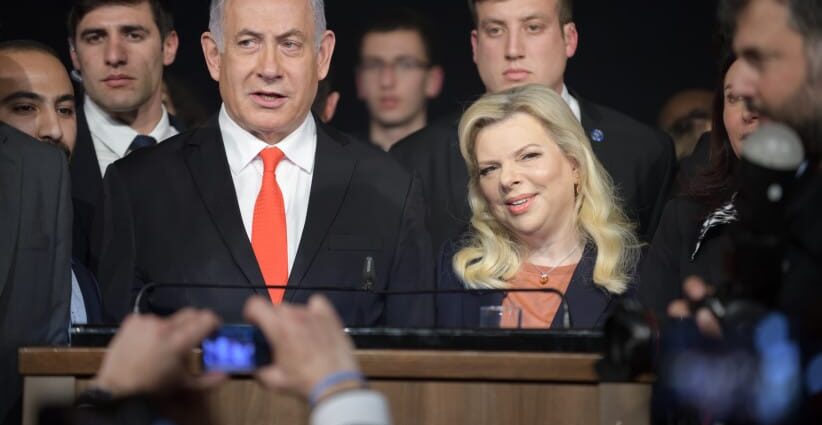
Netanyahu’s office blasts ‘fake news’ over adviser Yossi Basad’s exit
The Prime Minister’s Office issued a statement on Friday from Prime Minister Benjamin Netanyahu, denying reports that his wife, Sara Netanyahu, had dismissed his advisor, Yossi Basad, several weeks earlier.
The statement also clarified that Basad intends to file a defamation lawsuit against those spreading false information about his exit from the Prime Minister’s office.
“Yossi requested to leave his position for personal reasons that are entirely unrelated to any specific incident,” the statement said.
Basad has served as an advisor to the Netanyahu couple for over six years. In his role, he not only accompanied them on visits throughout Israel and abroad but also managed their personal affairs.
The statement praised Basad for his dedication, loyalty, and professionalism, emphasizing his value to the Prime Minister and his wife.
“The Prime Minister and his wife hold him in the highest regard, thank him for his significant contributions, and will continue to maintain a warm and close relationship with him,” the statement noted.
‘Unprecedented campaign of lies’
Additionally, the statement addressed the situation more personally, describing it as an “unprecedented campaign of lies against the Prime Minister and his wife.”
“The era in which people can spread lies, defame good individuals, and evade responsibility is over. We will continue to confront the industry of fake news and lies with the truth,” it asserted.
The alleged incident that sparked public speculation over Basad’s employment status occurred at a Maccabiah Games VIP event three months ago.
Hebrew media reported that during the event, Sara Netanyahu shouted at Basad, accusing him of allowing her to be disrespected because she had not been properly escorted into the VIP area.
The reports alleged that Basad was fired from his post immediately after the incident, but he denied it, claiming he had requested to leave two weeks earlier.

Mudbrick Byzantine city unearthed during excavations at Egypt’s western desert oasis
The ruins of a mudbrick Byzantine era city were discovered during ongoing excavations at the Ain Al-Sabil archaeological site in the Dakhla Oasis, the Egyptian Tourism and Antiquities Ministry announced on Friday.
Dakhla is one of the seven oases in Egypt’s western desert, located in the New Valley Governorate, some 350 miles from the Nile River.
Roads are laid out in an organized urban layout, explained Dr. Diaa Zahran, Islamic, Coptic, and Jewish Antiquities head at the Supreme Council of Antiquities, with main streets running from north to south that intersect with transverse streets running from east to west.
Several open squares and plazas are scattered throughout the city, and overlooking one of the main streets stands a fourth century CE.
Two of the most notable homes discovered, however, belong to the deacon of the church, Tisus, dating to the second half of the fourth century CE, and the home of Tabipus, dating to the early fourth century CE.
Tabipus’s house is believed to have been used as an at-home church before the construction of the basilica.
The remains of two watchtowers, a thick-walled fortress, several other houses with vaulted ceilings lining the roads were also unearthed within and on the edges of the city.
These homes also featured bread ovens, kitchens, and tools used for grinding down grains, added Dr. Mahmoud Masoud, director-general of Dakha Antiquities and the head of the current mission.
Several every day artifacts were also found during excavations, including pottery vessels for domestic use, oil and perfume bottles, oil lamps, and the remnants of stone tools.
Collections of coins, correspondence found at site
Archaeologists also discovered many bronze coins in good condition, featuring the likenesses of Byzantine emperors, Latin inscriptions, and Christian symbols, as well as several gold coins dating to the reign of the Byzantine Emperor Constantius II (ruled from 337-361 CE).
Further, a large collection of trade documents and correspondence was recovered from the city, consisting of approximately 200 pottery shards inscribed in the Greek and Coptic languages.
Supreme Council of Antiquities Secretary-General Dr. Hisham El-Leithy noted that the significance of the discovery lies in the new and precise information [the city] provides about the nature of daily life in the Egyptian community of the Dakhla Oasis during the Byzantine period.
He added that the excavation results have contributed to documenting many of the architectural, social, and economic aspects that characterized the region at the time.
The discovery represents an important addition to the “record of Egyptian archaeological finds,” said Egyptian Tourism and Antiquities Minister Sherif Fathy, noting that it helps “highlight the cultural diversity witnessed by the Egyptian oases throughout different historical periods.”
New sections of ancient Egyptian temple reveal inscriptions of Pharaoh Psamtik I
In the Bahariya Oasis, slightly north of Dakhla, previously unexplored parts of the ancient temple complex in the village of al-Qasr were uncovered during excavations completed a little over two weeks ago.
The temple dates back to Egypt’s 26th Dynasty, the last native dynasty of ancient Egypt before the Persian conquest in 525 BCE.
Excavations completed by an Egyptian archaeological mission on behalf of the Supreme Council of Antiquities unearthed the temple’s main hall, housing 16 sandstone columns and several connecting chambers and shrines.
Leithy noted that a number of stone blocks bearing the names and titles of King Psamtik I – the first Pharoah of the 26th Dynasty – were found within the chamber.
Additional hieroglyphics discovered within the temple names several ancient Egyptian deitieshttps://www.jpost.com/tags/ancient-egypt, including Amun-Ra (diety of the sun and creator deity), Amunet (a primordial goddess, the female counterpart of Amun-Ra), and Khonsu (diety of the moon).
Archaeologists also found inside the temple a stone stele dating to the 18th Dynasty, during the reign of King Amenhotep II, and fragments from the 19th Dynasty, during the reign of King Ramesses II.

Ancient tablet found at Roman fort in Netherlands bears Greek curse against enemies
An ancient curse tablet found at a former Roman military settlement in the Netherlands, has been identified as bearing a a rare Greek-language intending spell intended to harm enemies.
The discovery was announced in June by public research university Ruprecht Karl University of Heidelberg, or Heidelberg University, in Germany.
Curse tablets, known as defixiones in Latin or katadesmoi in Greek, were commonly made of lead due to it being simple to work with and because it was believed, in antiquity, to possess arcane “binding” properties.
According to Heidelberg University’s Institute for Papyrology Academic Director Dr. Rodney Ast, such tablets would be inscribed with spells and then buried in order to influence or “bind” any so-called enemies of the caster, such as athletic opponents, or romantic rivals.
The lead curse tablet found in the Netherlands was discovered by a team of Dutch archaeologists in a pit beneath the town hall square of the Roman military settlement of Coriovallum, located at the modern day Heerlen.
It measures at 9.3 by 4.8 centimeters.
Using reflectance transformation imaging (RTI), a computer-assisted photographic technique involves taking multiple images of the inscription in different lighting setups, revealed three distinct groups of characters inscribed on the tablet’s face.
Magic played an ‘important role’ in ancient Egyptian society
What makes the find so incredible is the language of its inscription, said Ast.
Rather than being written in Latin, he said, as most curse tablets found in Northern Europe are, the tablet discovered in Heerlen is inscribed in an Egyptian-style of ancient Greek.
Ast added that the tablet bears a group of three “magical” symbols likely used to convey the caster’s message to the supernatural powers they were attempting to contact.
Following the symbols are the names of two men and two women, described as “slaves.”
“The tablet served either as a curse against these four slaves or as a curse in their name against an unnamed person,” Ast explained.
The composition of these figures is also unusual, he noted, as the men have Latin names while the women’s names are Greek.
“It cannot be ruled out that one of the two women was the author of the inscription and had brought the supposed ability to communicate with divine powers through such curses with her from Roman Egypt,” said Dr. Julia Lougovaya, a research associate at the Institute for Papyrology.
Magic played an important role in ancient Egypt, especially that related to protection and healing – practices that were recognized and accepted as part of everyday religious life.
“In the early centuries CE, Near Eastern, Egyptian, Jewish, and sometimes even Christian traditions increasingly merged and spread throughout the entire Roman Empire of that time,” explained Professor Dr. Joachim Quack, Heidelberg University’s Institute for Egyptology director, “a development that the discovery from Heerlen impressively underscores.”
The curse tablet is slated to be displayed at the Heerlen Museum in the future, and its inscription will be made available to researchers and the public as part of a scholarly publication.
Experts use AI to crack mystery of 2,000-year-old Roman board game
Similarly in February, a study led by Dr. Walter Crist from Leiden University used artificial intelligence to crack the mystery behind a 2,000-year-old limestone slab found beneath Heerlen.
Small enough to hold in both hands, the limestone bears a grid of lines carved onto its smoothed upper surface. Researchers used two different techniques in attempt to solve the mystery of the slab’s function: use-wear analysis and AI simulation.
“We identified the object as a game because of the geometric pattern on its upper face and because of evidence that it was deliberately shaped,” according to Crist, adding that “further evidence that it was a game was presented by visible damage on the surface that would be consistent with abrasion caused by sliding Roman-era game pieces on the surface.”
Drawing on historical Northern European games such as haretavl from Scandinavia and gioco dell’orso from Italy, the study explained that 1,000 automated games were run for each of the 130 possible rule combinations set by the researchers.
Two AI agents played against each other as the software tracked which lines on the board were used most frequently. The results pointed to blocking games, in which one player attempts to trap the other’s pieces so they cannot move.
The limestone slab was likely carved during the late Roman period between 250 and 476 CE, pushing the known historical timeline of game boards back by several centuries.
Trump didn’t sign it, but the 21st Century ROAD to Housing Act is now law
After months of deliberation, delays and drama, the 21st Century ROAD to Housing Act has finally crossed the finish line.
The legislation, aimed at cutting red tape and making homeownership more attainable, is now the law of the land after President Donald Trump declined to sign or veto the bill before the deadline of midnight Eastern time Saturday.
In a Truth Social post on Friday morning, Trump said he withheld his signature “in protest” of the Senate‘s failure to pass the SAVE America Act, a separate bill targeting voter identification and registration.
The move threw a last-minute twist into what was a drama-filled final few weeks. Trump abruptly canceled a planned signing ceremony for the bill on June 24, demanding Congress prioritize the SAVE America Act, and later dismissed the housing bill as a “big yawn” by comparison.
The bipartisan package cleared the Senate 85-5 on June 22 and the House of Representatives 358-32 on June 23. House Speaker Mike Johnson (R-La.) sent it back to the White House on June 29. That started a 10-day clock, with Sundays excluded, for Trump to sign, veto or allow the legislation to become law without his signature — which is ultimately what happened.
The dynamic is rare but not unprecedented. In 2016, then-President Barack Obama declined to sign a 10-year renewal of the Iran Sanctions Act, enabling the legislation to become law without taking action. That bill was also overwhelmingly bipartisan, having passed the Senate in a unanimous 99-0 vote.
Recent polling from the American Property Owners Alliance indicates that the general public overwhelmingly backs the main objectives of the ROAD to Housing Act, with 89% of voters voicing their support.
First comprehensive housing package in decades
The final bill includes provisions from more than 60 different bills introduced in Congress, most of which were introduced with bipartisan sponsors. A few of the bills incorporated into the 21st Century ROAD to Housing Act include:
- The HOME Reform Act bolstered the HOME Investment Partnerships program by updating program eligibility, streamlining environmental reviews and expanding flexibility for infrastructure and community land trusts.
- The Rural Housing Service Reform Act modernized U.S. Department of Agriculture (USDA) rural housing programs. Key provisions include the preservation of affordable rentals, the protection of rental assistance, and the strengthening of preservation tools to expand rental and homeownership opportunities in rural communities.
- The Housing Supply Frameworks Act would direct the Department of Housing and Urban Development (HUD) to produce frameworks to help states and municipalities streamline zoning and regulatory barriers.
For homebuilders, another key provision is the establishment of $200 million in grant funding, which will reward municipalities that successfully eliminate excessive red tape and burdensome zoning. The removal of the permanent chassis requirement for manufactured homes will also open up opportunities for manufactured homes to compete in densely populated, high-cost markets that have traditionally been reserved for site-built and modular homes.
Notably, the final version of the bill also omitted prior provisions that build-to-rent (BTR) developers said would largely freeze new investments in BTR projects.
For lenders and mortgage professionals, key provisions include a Federal Housing Administration (FHA) loan pilot program for small-dollar mortgages below $100,000 and a requirement that the Consumer Financial Protection Bureau study how loan originator compensation rules impact the availability of small-dollar mortgages.
The ROAD to Housing Act also authorizes a three-year Community Development Block Grant-Disaster Recovery Program and raises FHA multifamily statutory loan limits for the first time in more than 20 years.
Collaborative advocacy effort
On June 10, more than 1,100 members of the National Association of Home Builders (NAHB) met with federal lawmakers to advocate for the passage of the 21st Century ROAD to Housing Act. And in May, more than 3,000 advocates responded to call-to-action alerts from the Mortgage Bankers Association during their MAA Action Week to advocate on behalf of the bill.
These advocacy efforts didn’t take place in isolation. Thousands of housing industry professionals — including Realtors, homebuilders, mortgage and banking professionals, community developers, rental housing providers and more — spent months advocating on behalf of the most comprehensive federal housing bill in decades.
While most housing leaders acknowledge that there is more work to be done, the industry’s reaction to the bill’s passing has been overwhelmingly positive.
“This bill becoming law is a genuine milestone — and I don’t use that word lightly,” said Dennis Shea, executive vice president of the Bipartisan Policy Center (BPC). “Getting Congress to move on housing supply and affordability has been a long time coming, and the American people made clear they were ready for it.
“But this moment calls for urgency as much as celebration. The hard work of implementation starts now, and there are still many issues to be tackled. BPC will be watching closely, pushing for what’s next, and working hard to increase supply and lower housing costs.”
“The bipartisan 21st Century ROAD to Housing Act is a landmark step toward protecting the American Dream of homeownership,” said Colin Allen, executive director of the American Property Owners Alliance. “By expanding our housing supply and removing barriers to ownership, this legislation will help more Americans achieve their dream, strengthen communities, and build generational wealth.”
“Too many older Americans are struggling to find housing they can afford in the communities they call home,” said Nancy LeaMond, AARP‘s executive vice president and chief advocacy and engagement officer. “AARP has consistently pushed for increasing housing availability and affordability, and with the 21st Century Road to Housing Act now law, more older Americans will be able to age where they want to be — at home.”
Scott Olson, executive director for the Community Home Lenders of America (CHLA), praised the bill’s passage while urging further action.
“Enactment of the Road to Housing bill into law is a major bipartisan accomplishment and great news for American home buyers and renters stressed by housing affordability challenges,” Olson said. “CHLA urges Congress next to move on to action on tax changes to make it easier to access the trillions of dollars in stocks and IRAs to use for a down payment on a home.”

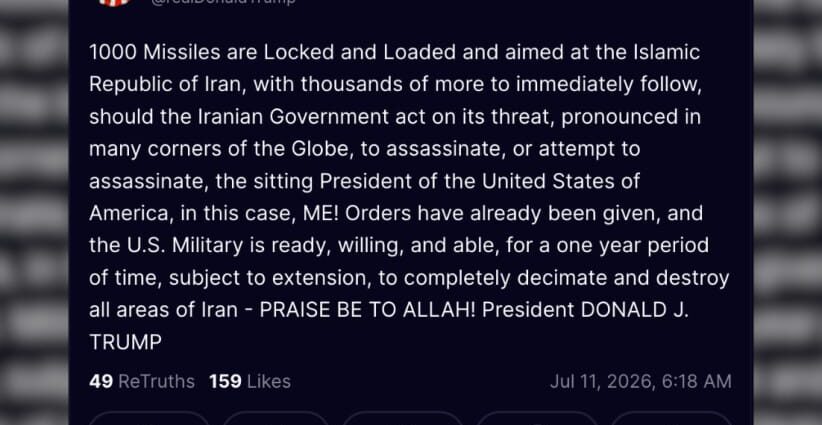
Trump says ‘1,000 missiles locked and loaded’ if Iran attempts to assassinate him – report
US President Donald Trump responded to alleged Iranian assassination threats, saying “1,000 missiles are locked and loaded” in a Truth Social post on Saturday,
“Orders have already been given, and the US Military is ready, willing, and able, for a one-year period of time, subject to extension, to completely decimate and destroy all areas of Iran,” warned Trump.
On Friday, Trump told the New York Post he left instructions for the US to retaliate if Iran succeeds in assassinating him.
“I’ve left instructions, if anything happens, to just literally bomb them at levels that they’ve never seen before,” the New York Post cited Trump as saying.
This comes a day after the Wall Street Journal wrote that Israel shared intelligence about an Iranian assassination plot with the US president, though Trump subsequently disputed the report.
“No, no, Israel came up with nothing,” Trump said, adding that he had been Iran’s primary target for “a long time.”
“It’s the way life is, you know,” he said.

Trump left instructions in 2025
Trump previously stated that he had left instructions in the case of his assassination in January of 2025, saying that Iran would be “obliterated” if their assassins succeeded.
However, the New York Times cited experts saying that a president cannot leave instructions for military action after his death. All authority would transfer to his successor, the new commander in chief.
Iranian mourners call for Trump’s death
Trump’s claims come as Iranian crowds called for his death at the week-long funeral for Iran’s former supreme leader Ayatollah Ali Khamenei.
“I swear by the blood of the Supreme Leader, Trump, we will kill you!” they shouted, with women holding up placards reading “Kill Trump.”
The roads leading to the shrine were a sea of black-clad mourners on Thursday, some responding to shouted chants in praise of Khamenei and against Iran’s enemies, including the old revolutionary slogan of “Death to America.”

New Israel Fund decries House GOP investigation over its alleged Israeli election spending
The New Israel Fund cited freedom of speech in pushing back Friday against a congressional investigation alleging that the US nonprofit violated its tax-exempt status by funding political campaign activity in Israel in 2019.
“NIF will not be deterred in our work to defend democracy, promote equality, and advance peace in Israel,” New Israel Fund CEO Mickey Gitzin said in a statement to the Jewish Telegraphic Agency. “And we will stand firmly for the right of Jewish Americans to express their views, and their First Amendment rights through their philanthropic support of any and all charitable institutions in Israel and the United States.”
In a letter sent to the New Israel Fund Thursday, Reps. Jim Jordan and Jason Smith, Republican chairs of the House Judiciary and Ways and Means Committees, respectively, alleged that the nonprofit had provided “millions of dollars in funding to groups that engaged in political campaign activities in the 2019 Israeli elections.”
“Reports that the New Israel Fund engaged in prohibited political campaign activity – while telling the IRS that it did not – demonstrate the need for stronger enforcement,” Smith wrote in a post on X/Twitter. “The Ways and Means Committee will continue conducting rigorous oversight to protect American tax dollars and ensure that those who abuse our tax code are held accountable.”
According to a Jerusalem News Syndicate story the Judiciary Committee posted on its website, one of the alleged offenses includes bussing Bedouin citizens of Israel to the polls on election day. The criticism echoes Republican attacks on groups that assist and encourage Black voters to get to the polls in the United States.
The letter also alleged that the New Israel Fund had provided funding to Adalah, a group that provided legal representation to an alliance of Arab parties that “centered their campaign around ousting Prime Minister Netanyahu in favor of his opponent, Benny Gantz.”
A GOP-led House Judiciary Committee letter to two mainstream Jewish philanthropies, the Jewish Communal Fund and the PEF Israel Endowment Funds, also raised eyebrows in May when it appeared to accuse the groups of funding protests against the Netanyahu government’s proposed judicial overhaul. The groups are clearinghouses for donations to a wide range of groups, including those aligned with Netanyahu’s government.
‘Radical anti-government campaigns’
The May letter alleged that the philanthropies may have violated their nonprofit status by “funding groups engaged in radical anti-government campaigns in Israel.”
The New Israel Fund supports progressive Jewish and Arab organizations in Israel and is often criticized by the Israeli government and its allies in the United States.
“NIF adheres fully to both US and Israeli law as it relates to our charitable work and status,” Gitzin said. “That has always been the case and continues to be.”
Gitzin said that the House letter was “drawn heavily from a lawsuit filed against NIF that was dismissed in the Southern District of New York in 2021, and wherein the State of New York declined to intervene.”
‘Allegations entirely lack merit’
“NIF believed then, as we do now, that these allegations entirely lack merit,” Gitzin said.
The allegations by the Republican lawmakers drew quick condemnation by Jewish New York Democratic Rep. Jerry Nadler, who called their behavior “outrageous” in a post on X.
“Those seeking to undermine democracy on both sides of the ocean seem now to have found common cause,” Nadler wrote. “All people of good faith must rise up and oppose this ridiculous and meritless inquisition seeking to eviscerate American Jews’ fundamental First Amendment rights.”
Netanyahu has in different contexts welcomed US conservatives weighing in on Israeli internal politics. A conservative US nonprofit helped Netanyahu publish the Hebrew version of his autobiography just prior to the last election.

IDF holds redesigned Arrowhead agility competition for combat soldiers, special units
The IDF announced on Thursday that it held its first Arrowhead agility test in three years, reintroducing the multi-brigade fitness competition after a years-long hiatus.
Troops from the Paratroopers Brigade, Givati Brigade, Golani Brigade, Nahal Brigade, Kfir Brigade, Lotar Unit, and Refaim Unit competed in multiple events, including running, shooting, and Krav Maga.
The competition doubles as one of the last fitness tests the soldiers will face before finishing their training courses.
According to the IDF, this year’s competition differed from previous ones and was modeled after conditions similar to what they will encounter in the field.
This year, rather than having participants run on a flat course, soldiers ran on a course through forest and sand dunes, each carrying 20 kg. of weight. Soldiers also practiced running carrying stretchers together.
At the end of the run, troops also immediately participated in shooting exercises.
The second part of the competition consisted of two Krav Maga practice scenarios. In one, soldiers were tested on skills such as defending against a fellow soldier, playing the role of an “attacker,” attempting to take their weapons and stab them.
The second part of the Krav Maga section was direct hand-to-hand combat.

At the end of the tests, each brigade is scored based on running times, shooting accuracy, and Krav Maga skills.
The overall winner of the competition was the Paratrooper Brigade, with the Givati Brigade in second place and the Lotar Unit in third.
Arrowhead competition adjusted to reflect modern battlefield conditions
The head of the IDF’s Training and Research at the Combat Capability Directorate, Major M., said that changes to the competition format were made to ensure soldiers were prepared for battlefield conditions before deployment.
“These changes are rooted in drawing lessons from prolonged combat,” he explained. “We realized that the things we were tested on in the past no longer illustrate what happens on the battlefield in the best way.”
Commander of the Combat Fitness Division, Col. (res.) Avi Dahan, further elaborated that the activities were designed to occur in quick succession to test the troops’ physical and mental resilience.
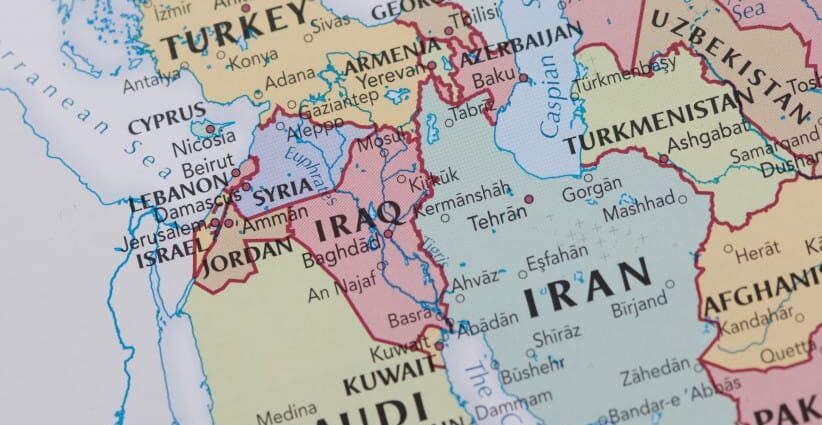
Iran’s missile arsenal, not Gulf deterrence, is the Middle East’s real problem – opinion
The debate over Iran’s missile arsenal has resurfaced following an argument that it is unfair to ask Iran to give up its missile capabilities while other countries in the region possess similar ones.
And yet this line of reasoning overlooks a more fundamental question: Is the problem the existence of missiles held by states seeking to defend themselves, or a vast offensive arsenal built over decades that has become an instrument of regional influence and threat?
Herein lies the paradox. The issue is less about a mutual arms race between comparable actors and more about a strategic imbalance that has imposed itself on the region over decades, one that Iran’s neighbors are then expected to adapt to rather than seek to address or counterbalance.
Iran has not only built a massive missile program; it has turned missiles into a standalone strategic language, using them as a deterrent, a means of pressure, and a message of influence that reaches past its immediate borders.
In contrast, for decades, the Gulf has been on the receiving end, buying defense while lacking the capacity to counterbalance the offensive threat on its own terms.
The deeper problem is that major powers manage this issue not by the logic of fairness or balance, but by the logic of leverage over the parties’ behavior. The Gulf ally is always told to exercise restraint because it is the actor whose conduct can be influenced.
Iran, having imposed its missile program as a strategic fact, is managed through containment, negotiation, and risk management rather than through preventing the capability in the first place.
The Iranian attacks on Gulf states during the 2026 war laid bare this imbalance in its starkest form, showing that Gulf countries can become direct targets of missile strikes even when they are neither the architects of the war nor a principal party to it.
The UAE was the most striking example, hit by intense waves of ballistic missiles, cruise missiles, and drones. The significance of these attacks lay not only in the volume of munitions but in the lesson they imparted: a stable, open Gulf state integrated into the global economy can find itself at the center of the confrontation when Iran seeks to widen the war’s costs for its adversaries.
A deeper truth emerged here. The attacks were more than a fleeting military event; they showed that economic stability and global openness offer no automatic immunity against the logic of missile power. They also showed that a Gulf state, however successful in its development or integrated into the world economy, can become a direct target when missiles are wielded to impose political or strategic costs on others.
Strategic imbalance
More importantly, the 2026 war showed not just the scale of the threat but the limits of the assumptions that informed regional security thinking for decades. A long-standing belief held that international partnerships, economic strength, and integration into the global system could reduce the likelihood of being directly targeted or raise the political cost for an attacker.
What happened, however, demonstrated that an adversary’s possession of a vast offensive capability remains a decisive factor that overrides many conventional political calculations. From this vantage point, the war was more than another military confrontation; it was a strategic turning point affirming that sustainable security rests not on prosperity alone, nor on external partnerships alone, but on a deterrent capability that raises the cost of aggression above any conceivable gain.
But the lesson of the war reaches past military calculations to how the threat itself is perceived. This is where the double standard in the dominant narrative becomes most evident.
When Iran or its proxies strike, the world is often absorbed in managing escalation, de-escalating, and preventing a wider conflagration, rather than starting from a simpler question: Why is an offensive arsenal of this magnitude allowed to become an almost normalized regional feature?
Why is the Gulf always expected to act as the more rational and less impulsive party, even as it is the most exposed to fire and bears the highest cost of defending itself?
Then there is the economic dimension, far from a minor detail; it is another core of the equation. Past the military shock, Iran is betting on a straightforward attrition formula: relatively cheap offensive tools against exorbitantly expensive defenses.
Each wave of attack is a test not only in the sky but also in the budgets. Gulf states pay not just the security cost of the threat, but the economic cost of continuously deterring it and defending their cities, infrastructure, ports, and vital fields.
The Gulf thus becomes a forced underwriter of a lopsided regional stability, while the attacking party retains the advantage of lower cost and greater capacity to sustain attrition.
Gulf states certainly bear some responsibility for their slow progress in forging a more independent collective deterrence doctrine and for their prolonged reliance on an external guarantor. But that does not change the fundamental fact that the missile imbalance was never the Gulf’s doing – it was imposed by Iran through decades of military accumulation.
Any serious talk about regional security must start from an unambiguous principle: either unified, genuine restrictions on offensive missile capabilities in the region, first and foremost on Iran, or an explicit recognition of the Gulf states’ right to build deterrence that breaks this imbalance.
The problem is no longer the Gulf’s pursuit of its own security, but the continued treatment of a chronic strategic imbalance as a fait accompli to be adapted to.
Anything short of that is no balanced regional security policy, but the diplomatic management of a chronic strategic imbalance, whose security and economic costs are borne by the Gulf while others merely manage its consequences.
The writer is a UAE political analyst and former Federal National Council candidate.
Top Mamdani official ordered to cancel meeting with Iran’s UN representative – report
The commissioner of New York City Mayor Zohran Mamdani’s Office of International Affairs, Ana Maria Archila, was scheduled to meet with an Iranian official before the US State Department intervened, according to a City Journal report on Thursday.
According to the report, Archila was scheduled to meet with Iran’s representative to the United Nations, Amir-Saeid Iravani, on Tuesday with two other senior officials from the Mayor’s Office for International Affairs.
Archila reportedly did not inform the US State Department or Mamdani of the meeting in advance.
A State Department official told City Journal that, upon learning about the meeting, the State Department met with the Mamdani administration to clarify that it was unacceptable. Following the State Department visit, Archila was reportedly reprimanded and ordered to cancel the meeting.
A spokesperson for the Mayor’s Office for International Affairs told City Journal that Archila’s meeting with the Iranian official “did not and will not take place.”
Mamdani administration reportedly using Office for International Affairs to advance political agenda
According to City Journal, the meeting is not the first instance of Archila or the Mamdani administration using city resources to advance agendas unrelated to New York City.
In April, according to the report, a message was sent to staff in the Mayor’s Office for International Affairs asking them to prioritize engagements with foreign diplomats, in part, based on whether or not the officials were “in political alignment/leftist.”
The Mayor’s Office for International Affairs, City Journal claimed, is not intended to be used to shape foreign policy and is instead meant to focus on bringing foreign businesses to the city and supporting the city’s diplomatic community regardless of political leanings.

NY congressional candidate Avila Chevalier doubles down on attending Oct. 8 pro-Palestinian rally
Democratic congressional candidate Darializa Avila Chevalier defended her presence at a pro-Palestinian rally the day after Hamas’ Oct. 7, 2023, attacks on Israel during a wide-ranging interview Friday with progressive Jewish author Peter Beinart.
“I think the targeting of civilians is wrong in any context, including on Oct. 7,” Avila Chevalier said when asked by the editor-at-large of the leftist Jewish Currents about slogans legitimizing “resistance” that appeared at the rally. Avila Chevalier previously defended her attendance at the rally to City & State in June.
“I think what matters is international law, and what international law condemns and protects,” she said. “And it condemns the targeting of civilians, and it also protects the right to resist.”
Beinart, who is an outspoken critic of Israel and a journalism professor at the City University of New York, pushed back, saying that he “didn’t see any discussion of international law in that rally on the signs or the slogans of the kind that you are offering now… Were you uncomfortable by that?”
Avila Chevalier responded that, at any protest, there will always be “folks who are voicing opinions that you might not agree with.”
“I knew even as early as Oct. 8, right, where this cycle was headed, and I knew the things that I did have power over,” Avila Chevalier said. “The thing that we have power over is the fact that our tax dollars are going towards an apartheid state that has a pattern of engaging in this type of retribution against civilians.”
Avila Chevalier, a democratic socialist who helped organize pro-Palestinian encampments at Columbia University, ousted incumbent Rep. Adriano Espaillat last month in the Democratic primary for New York’s 13th Congressional District, which covers parts of Upper Manhattan and the Bronx.
Cheers of ‘Free Palestine’
“Today we make it clear. The politics of the past ends today,” Avila Chevalier told attendees at an election night watch party, where the crowd erupted into cheers of “Free Palestine.”
She joined two other progressive and Israel-critical candidates backed by New York City Mayor Zohran Mamdani in winning upset primary victories, cementing the anti-Israel mayor’s influence in the city’s politics and likely extending the left’s gains in Congress since the wins came in deeply Democratic districts.
Beinart’s interview offered an extensive look into the Israel-related positions that became flashpoints during Avila Chevalier’s campaign, including her attendance at the Oct. 8 rally, which was condemned at the time by Mamdani and fellow congressional candidate Brad Lander, and past criticism of former President Joe Biden’s policy toward Israel and Gaza in a since-deleted X account.
Many of the attendees on Friday’s Zoom call appeared unimpressed by the candidate’s responses.
“She is well-intentioned, but also clearly is not familiar with the nature of the Israeli-Palestinian conflict,” said Hillel Schenker, a veteran American-Israeli peace activist.
Other attendees defended Avila Chevalier.
“I am surprised and disturbed by many of the comments made here that are just dismissing her comments and her approach to expressing her belief in human rights and a world without hierarchies of peoples,” wrote an attendee with the screen name Benjy Ben Baruch.
To kick off the interview, Avilia Chevalier described her internship in the West Bank as a 20-year-old Columbia University student, saying that at the time she observed “systems and how they were impacting Palestinian people and Jewish folks, and how people were being treated based off of those state structures.”
Beinart then asked Avila Chevalier why she believed Israel had become so “central for progressive politics.”
An ‘insatiable war machine’
“I think there is a war machine that is insatiable,” Avila Chevalier replied. “An American war machine, the Israeli war machine, that we fund with our tax dollars as Americans, and instead what we could be funding is our communities.”
When asked by Beinart what she wanted to see as the region’s future, Avila Chevalier voiced her support for a one-state solution, which she described as “one governing body, one state that sees everyone as equal before the law, regardless of race, religion, identity, ethnicity.”
“We have seen over the course of history that attempts at two states have failed, and even so, I think in this question of like, well, do we partition to begin with, that inherently is divisive,” Avila Chevalier said.
Avila Chevalier also stopped short of saying that “Zionism is racism” when asked if she agreed with the statement by Beinart.
“Zionism is an ideology that creates this type of hierarchy that I’m talking about, and I just don’t believe that we should be striving for a world where there is a hierarchy among people,” Avila Chevalier replied.
Towards the end of the conversation, Beinart referenced scrutiny Avila Chevalier had drawn for her 2022 statements in which she condemned Dominican nationalism and said it was the reason she didn’t put the flag in her social media bio.
“What do you see as the fundamental differences between Zionism as a form of Jewish nationalism, the Dominican nationalism that you have had some concerns about, and Palestinian nationalism,” Beinart asked Avila Chevalier, whose parents are Dominican immigrants.
In response, Avila Chevalier referenced racist attacks she had endured for those comments in the lead-up to the election.
“While it’s not the majority of Dominicans, I would never say that, I think there is a faction that supports this ideology that I have just always found incredibly violent, and the type of rhetoric that I was subjected to, I think, is reflective of the very thing I was criticizing, and I see a lot of that in Zionism as well,” Avila Chevalier responded.
The candidate added that, in contrast to Zionism and Dominican nationalism, Haitian and Palestinian discussions of “liberation” were rooted in “a more universalist understanding of human rights before the law.”
“When I was there in Palestine, you know, some of the most dehumanizing language I’ve ever heard, right, was coming from Israeli soldiers towards children,” Avila Chevalier said, adding that she saw the movements “in very different lights.”
When asked whether she worried that “Hamas’s version of Palestinian nationalism may have exclusionary elements as well,” Avila Chevalier replied: “That’s why I worry about nationalism point blank.”
“Nationalism itself always gives me pause, but I think it’s important to also consider the context in which we’re talking about, like what group is engaging in this conversation, right, and the power dynamics at play there,” Avila Chevalier continued.

The Alaska perspective: A reminder that the world doesn’t revolve around Israel – comment
In most visitors, Alaska inspires wonder at its beauty, awe at its wildlife, and admiration for the hardiness of those who make their lives in its vast backcountry, enduring some of the harshest conditions on earth.
For Israelis, it can also inspire humility. Not because the Jewish state is smaller than Denali National Park, but because in Alaska, one is reminded that the world neither revolves around Israel nor is obsessed with it.
That realization came on a trip The Wife and I took to America’s Last Frontier last month.
“Where is your final destination today?” the woman checking us in for our flight home at the Anchorage airport asked chirpily.
“Tel Aviv,” I replied. “Where’s that?”
When I said it was in Israel, she smiled and said, “Oh.”
Lest one think this was just a fluke: on the plane a few hours later, another Alaskan asked where we were going. When we answered “Tel Aviv,” she said she had never heard of it.
Granted, two people do not a Pew Poll make, but they do offer a small corrective to the perception – fed by the media most of us follow – that the world is preoccupied with Israel, thinking about us obsessively, talking about us constantly, and cursing us unremittingly.
The last part, at least in Alaska, is also not true. During our two weeks there, we saw no “Free Palestine” graffiti, nor were we subjected to dirty looks or “child killer” comments when we said we were from Israel.
All of America, it turns out, is not Mamdani’s Manhattan, nor does social media present a proportionate picture of that country’s reality.
One of the problems with social media is that every incident of antisemitism is posted online. The incidents are real and rising at an alarming rate, but seeing them all in one place creates a disproportionate sense of how likely you are to encounter them while traveling.
Watch enough clips of a Jewish kid harassed on a New York subway or an Israeli couple berated at a hotel in California, and you begin to wonder whether the same thing awaits you when you ride an American subway or check into a hotel.
It doesn’t. Yet the cumulative effect is that you begin to wonder how open to be about your Israeliness. You don’t decide to hide it, but simply having to ask the question adds a mini-layer of apprehension before every trip.
When Israel comes along for the ride
You also learn to read the Uber.
“Honey,” I urged The Wife before we got into an Uber in Chicago during a brief layover, “you don’t have to say you’re from Israel.”
“Nonsense,” she said. “I’m not going to hide who I am.”
“Wonderful sentiment,” I replied. “The driver’s name is Rabah. Humor me.”
We didn’t volunteer our place of origin, nor did he ask.
But on the entire trip, that was the only time we consciously withheld that nugget of biographical information. Everywhere else, we proudly said we were from Israel – and it was fine. More than fine: it was often a conversation starter.
On a whale-watching excursion, we sat across from a young couple from China who work at Google. They were intrigued that we lived in Israel, and even more fascinated that we passed on the chicken sandwiches being served.
Instead of looking for sea creatures, The Wife spent a good part of the trip explaining why some of the fish in the sea we can eat and others we can’t.
“Honey,” I whispered at one point, a bit annoyed. “We didn’t pay all this money for you to give an introductory lecture on kashrut. Look for the damn puffins.”
Since October 7, another layer has been added to the anxiety of travel: whether your flight will be canceled at the drop of a ballistic missile.
One doesn’t just hop over to Alaska on a whim; it takes planning and a special occasion to justify the expense. For us, it was 40 years of wedded bliss, so we booked back in October after being warned that rental cars sell out months in advance.
We chose United. But just days after the war with Iran broke out, United – typically – canceled flights until mid-June, four days after our planned departure. We acted quickly – well, The Wife acted quickly – and switched to El Al. Still, it complicated the trip further.
Then came the more serious question: Do you leave the country when one of your sons or your son-in-law is in miluim in Lebanon, Gaza, or Syria?
My first instinct was no: you don’t leave when one of your children is serving. That may have worked before Oct. 7, when reserve duty meant a few weeks a year and could be planned around.
But today, when they have each logged upward of 350 days, saying you won’t leave while they are serving essentially means that you won’t leave at all.
Which, by the way, is hardly the end of the world. But what can I say? I like to travel.
So we went, even though as we were watching bears and sea otters, my youngest son was dodging drones in Lebanon.
“Go,” he said. “What are you going to be able to do by being here? And if, God forbid, something happens, you’ll come back.”
“That’s not the point,” I said. “How can we enjoy it if we are worrying about you?”
“You’ll figure out a way,” he teased.
And he was right. Sure, we worried, but less than if we were here. Distance, it turns out, has its advantages. I wasn’t glued to the news, tracking every development on his front.
Perhaps that was Alaska’s greatest gift. Not the calving glaciers, surfacing whales, or foraging bears, magnificent though they were. It was the realization that while Israel is the center of our world, it is not the center of everyone else’s. Every now and then, regaining that perspective is refreshing. ■

Is Lionel Messi a Zionist? The Argentine soccer star’s long history with Jewish and Israeli life
Argentine soccer icon Lionel Messi, widely regarded as one of the greatest players in the history of the sport, has built one of football’s most decorated careers.
Throughout his illustrious career, Messi has cultivated a measured public image, rarely commenting on politics or becoming involved in major public controversies.
But the 39-year-old has occasionally made headlines for expressing support for Jewish causes and Israeli companies – and at times for being pulled into the tense geopolitical landscape of the Middle East by no doing of his own, including when a grandmother originally from Argentina credited him for saving her life when her Israeli kibbutz was attacked on Oct. 7, 2023.
Messi’s past has roared into public view during this year’s World Cup, with Argentina playing Switzerland in the quarterfinals on Saturday. Some critics of Israel have surfaced his past activities and affiliations to make the case that opposing Argentina is the anti-Zionist choice. Many Israelis, meanwhile, favor the team.
Ahead of the game, here’s a look back at 10 moments from Messi’s career – presented chronologically – where he and his fame intersected with Jewish and Israeli culture through public appearances, peace initiatives, controversies and more.
Messi’s message to Argentine Maccabiah team
1. In July 2013, Messi sent a message to the Argentine Maccabiah team, a greeting before the national delegation departed for the “Jewish Olympics” in Israel. It wasn’t the first time he demonstrated support for his country’s Jewish community – in 2011, he participated in a campaign for justice and memory of the victims of the 1994 AMIA Jewish center bombing that killed 85 people in Buenos Aires.
2. One month later, he visited the Western Wall on a “peace tour” with Barcelona F.C., the famed Spanish team with which Messi spent the majority of his career. The club hosted skills clinics for Israeli and Palestinian children and met Jerusalem Mayor Nir Barkat, President Shimon Peres and Prime Minister Benjamin Netanyahu.
3. In September 2014, Messi supported a “match for peace” in Rome organized by Pope Francis to promote peace between Israelis and Palestinians, but he did not play due to an injury. Fellow Argentine great Diego Maradona and Israeli player Yossi Benayoun also participated, alongside stars from Russia, Cameroon, Italy, France and Brazil.
4. In 2016, Messi was slammed as “Jewish” and a “Zionist” by Egyptian officials after donating his soccer cleats to a charity in Egypt. Then-Egyptian Football Federation spokesman Azmi Mogahed phoned in to the show to criticize Messi: “I know he’s Jewish, he donated to Israel and visited the Wailing Wall and whatever. …We don’t need his shoes and Egypt’s poor don’t need help from someone with Jewish or Zionist citizenship.”
5. In June 2018, Argentina’s national team canceled a friendly match with Israel’s national team following pressure from the Boycott, Divestment and Sanctions movement. A boycott campaign sponsored by BDS Argentina was launched using the motto “Argentina don’t go,” or #ArgentinaNoVayas. The Israeli embassy in Buenos Aires tweeted that the match was canceled due to “the threats against Messi that logically generated the solidarity of his teammates.”
6. Two months later, FIFA suspended the head of the Palestinian soccer body for threats against Messi. Jibril Rajoub, who had lobbied FIFA to take action against Israel, was suspended for a year after he urged supporters to burn photos and player jerseys if Messi or the Argentinian national team had shown up for the canceled friendly match.
7. In 2019, Argentina’s national soccer team announced it would play a friendly match against Uruguay in Tel Aviv that November, following the cancellation a year prior. The match was again targeted by the BDS movement, with protestors demonstrating outside a training camp in Barcelona and calling on Messi not to participate. Despite the opposition, the game went on as planned, with Messi scoring a goal in front of a sold-out crowd of 29,000 fans – including Israeli President and soccer fan Reuven Rivlin – at Bloomfield Stadium.
8. In 2020, Messi signed a three-year contract to become a brand ambassador for the Israeli company OrCam, which makes devices to help the visually impaired. It wasn’t his first time promoting an Israeli company: in December 2017, the Tel Aviv-based Sirin Labs hired him as its global ambassador.
9. On Oct. 7, 90-year-old Kibbutz Nir Oz resident Esther Cunio name-dropped Messi to a Hamas terrorist who had come to kidnap her, likely saving her life. During the attack, Cunio asked the assailant if he liked soccer before telling him, “I’m from where Messi is from.” Cunio then appealed to Messi for help in rescuing her grandson.
‘Jewish lobby’ blamed for Algerian World Cup loss
10. Last month, after Messi scored a hat trick in a 3-0 Argentina victory over Algeria in the World Cup, an Algerian broadcaster blamed the “Jewish lobby” for a controversial non-call on a potential penalty that could have penalized Messi. “Messi is protected by the Jewish lobby,” analyst Mustafa Mazzouzi said.
“This lobby controls the world; they run it however they want, as if they were the mafia. [FIFA President] Infantino doesn’t want us to do well.” He added, “We have political stances regarding Western Sahara and the Palestinian issue, and therefore they don’t want us to do well.” Elsewhere, a Palestinian TikTok content creator with over 350,000 followers suggested that Argentina deserved to lose the World Cup because of Messi’s numerous associations with Israel.
Messi wears No. 10 – typically reserved for the best player on a soccer club, but since there are 11 players on the pitch, we’ll add a bonus.
11. The World Zionist Organization used a play on words involving Messi in a 2020 Hebrew educational video, explaining that the Hebrew word “mesibah” means “party,” or “fiesta” in Spanish. In Spanish, it sounds like “Messi va,” or “Messi goes.” In other words, “if Messi goes, it’s a party.”


Meta shuts down AI tool after backlash over public Instagram accounts
Meta on Friday discontinued an artificial intelligence feature that allowed users to generate images by referencing public Instagram accounts, days after introducing the tool as part of a broader rollout of AI-powered creative features on Instagram.
The company announced the decision in an update to its Instagram blog.
“Earlier this week, we announced that one way for people to generate images in Meta AI is by @-mentioning public Instagram accounts that they want to reference,” the company wrote. “Our intent was to provide a useful creative tool and to give people control over whether their public content could be referenced in this way. We’ve heard the feedback that this feature missed the mark, so it’s no longer available.”
FOUR STATES SEEKING $1.4 TRILLION IN PENALTIES IN CHILD SOCIAL MEDIA ADDICTION TRIAL, META SAYS
The feature was announced Tuesday alongside more than 30 new AI-powered effects for Instagram Stories using Muse Image, the first image-generation model from Meta Superintelligence Labs. According to Instagram, the new effects allow users to transform photos with a single tap, while a redesigned editing composer lets users preview AI-generated edits before sharing them.
As part of the rollout, Meta also introduced a feature allowing users to @-mention public Instagram accounts in Meta AI to generate creative images featuring those accounts, including personalized birthday cards, group trip memes and other edited images.
“We want our community to have control over how their content is used for creation,” Instagram said in Tuesday’s announcement. The company said users who did not want their public Instagram content used through the AI feature could disable it through the app’s Sharing and Reuse settings.
JUDGE LETS STATES PURSUE CLAIMS THAT META DESIGNED FACEBOOK AND INSTAGRAM TO ADDICT CHILDREN
SAG-AFTRA, which represents performers across film, television and other media, urged members Thursday to opt out of the feature, writing on social media, “Take action to protect your likeness.”
Neal K. Shah, an NIH-funded caregiving researcher and CEO of CareYaya, said he has already seen AI-generated ads misuse his likeness to promote supplements falsely claiming to help people with dementia.
“I think the major alarm bells that went off for me was I saw fraud actually happening in real time,” Shah told FOX Business. He said followers began messaging him after seeing advertisements that appeared to show him endorsing products he had never promoted.
“All of these older people have been scammed, and my image has been used to scam them, and I can’t do anything about it,” Shah said, adding that he has spent hours responding to followers to warn them the advertisements were fake.
Shah said he has since started warning viewers in his own videos not to trust advertisements that appear to show him promoting products and has spent hours responding to followers who asked whether the endorsements were real. He also said he repeatedly reported the advertisements to Meta but said they remained on the platform.
Friday’s update removes the ability to generate images by @-mentioning public Instagram accounts, while leaving the broader rollout of Instagram’s new AI-powered creative tools in place.
CLICK HERE TO GET FOX BUSINESS ON THE GO
Meta has made artificial intelligence a central focus of its business, expanding AI-powered features across Facebook, Instagram, WhatsApp and Messenger while investing heavily in AI infrastructure and its Llama family of AI models.
In response to a request for comment from FOX Business, Meta directed Fox Business to the updated Instagram blog post announcing the change.
This post was originally published here

‘Once-in-a-generation’ expedition sets sail to survey famed polar expedition ships
A “once-in-a-generation” expedition led by the Royal Canadian Geographical Society (RCGS) and the Woods Hole Oceanographic Institution (WHOI) to survey ships belonging to two of the most important Antarctic explorers set sail earlier this week.
Quest, a schooner-rigged steamship captained by Sir Ernest Shackleton, and Terra Nova, Captain Robert Falcon Scott’s whaler and polar expedition vessel, are the targets of these new surveys.
While both Shackleton’s and Scott’s polar expeditions had set sail in the early half of the 1900s, the Terra Nova Expedition between 1910 and 1913 and the Shackleton–Rowett Expedition in 1921-1922, the ships sunk much later in the century.
Terra Nova, after returning from Scott’s expedition in 1913, was repurchased by her former owners to resume work as a whaling vessel.
Thirty years later, in 1942, she was chartered by Newfoundland Base Contractors to carry supplies to stations in Greenland.
Terra Nova, Quest sink years after their expeditions
A year later, on September 12 of 1943, Terra Nova issued an urgent SOS that her pumps were not working and she was beginning to take on water.
Rescue ships arrived a day later, saving her crew from the catastrophe. She was sunk by gunfire that same day.
Her wreckage was rediscovered off the coast of Greenland in 2012 by the Schmidt Ocean Institute’s flagship R/V Falkor during routine testing. The wreck was confirmed as Terra Nova over a decade later by maritime archaeologists aboard the MY Legend.
Quest, however, outlived Terra Nova by some 20 years.
A year after sailing from London in 1921, Shackleton died onboard as Quest and her crew prepared to enter Antarctic waters. The expedition was lost along with its captain. Instead, led by British Antarctic explorer Frank Wild, she carried out a desultory survey of the Weddell Sea before turning back.
Seven years later, having been refitted, Quest joined the rescue effort to save survivors of the Italia Arctic airship crash. She returned as a sealing vessel in the 1930s, and was used as a minesweeper by the British navy during World War II.
On May 5, 1962, while on a seal-hunting expedition Quest’s hull was pierced by ice. She sunk off the north coast of Labrador.
Her wreckage was discovered in 2024 at a depth of 390 meters in the Labrador Sea by RCGS’s Expedition Leader John Geiger.
First comprehensive survey of Quest, Terra Nova
The new expedition will be the first comprehensive visual survey of the two ships in order to the digitally produce recreations of them both for further study, RCGS announced in a statement last week.
Researchers will use high-definition 5.2K video cameras and Canadian VOYIS photogrammetric technology to document the wrecks and surrounding debris fields.
The vessels set to take part in the mission are the research vessel Atlantis, operated by WHOI, and will serve as the “mothership” to the human occupied vehicle (HOV) Alvin and a remotely operated vehicle (ROV).
Alvin was the first submersible to ever survey Titanic’s wreckage.
“The discovery of Quest in 2024 was only the beginning” said Geiger. “On Canada Day, we will gather to embark on the largest and most ambitious expedition in the 96-year history of the RCGS.”
“By combining Canadian and American technologies, and an international team of experts, we will document Quest and Terra Nova in unprecedented detail, creating an extraordinary record of two historic shipwrecks and sharing these important stories with the world.”
WHOI Director of Ocean Imaging Dwight Coleman and co-chief scientist on the mission said that by using the advanced imaging tools, researcchers will be able to “see and re-create two historically significant shipwrecks and bring the stories of two great explorers to life.”
“The bravery and leadership demonstrated by these two polar heroes have inspired generations of explorers over the years, and our hope is that by documenting their last ships with the latest technology we too can inspire the next generation of explorers worldwide,” said shipwreck expert and expedition co-chief scientist David Mearns, characterizing the expedition as an “once-in-a-generation” opportunity.
Updates on the mission and footage of the wrecks will be posted on Canadian Geographic’s website here.
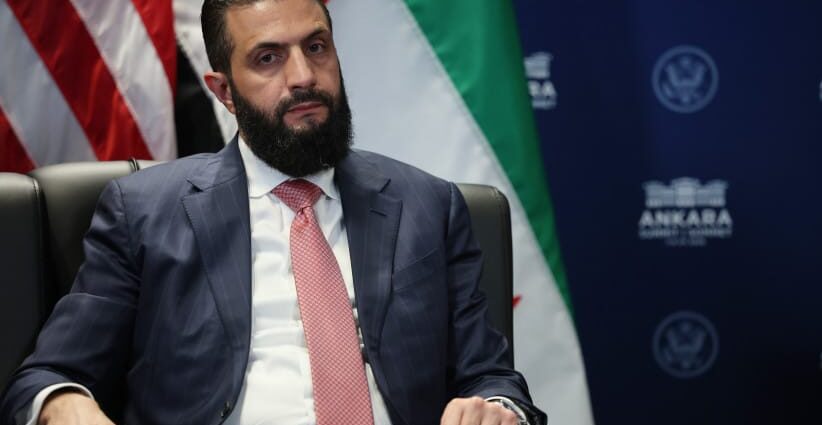
US begins process to remove Syria from terrorism list, signaling major shift in relations
The United States on Wednesday officially began the process of removing Syria from its list of State Sponsors of Terrorism after US President Donald Trump notified Congress of his decision to rescind the designation, which had been in place since 1979.
The move could mark a major turning point in relations between Washington and Damascus and pave the way for increased American investment and economic engagement in Syria.
Under US law, Congress now has a 45-day review period before the decision can take effect. In a formal letter addressed to Syrian President Ahmed al-Sharaa, President Trump said Washington intends to remove the “obstacles” preventing Syria’s reconstruction, adding that American companies are now “ready to invest” in the country.
The decision represents one of the most significant shifts in US policy toward Syria in decades. It ends a designation that has shaped bilateral relations for nearly 47 years and follows a series of gradual American steps in recent months, including easing certain restrictions and expanding engagement with Syria’s new government following the country’s political transition.
Although the move does not lift all US sanctions imposed on Syria, it removes one of the most significant legal and political barriers that has discouraged international banks and foreign companies from reentering the Syrian market.
Syria was first designated a State Sponsor of Terrorism on December 29, 1979, becoming one of the earliest countries placed on the list following its establishment under the US Export Administration Act. At the time, Washington justified the designation by accusing Damascus of supporting organizations that the United States classified as terrorist groups, as well as hosting leaders of Palestinian and Lebanese factions included on US terrorism lists.
For more than four decades, Syria remained on the list despite changes in successive US administrations, making it one of the longest-serving countries under the designation. During that period, Washington imposed a broad range of restrictions, including bans on arms exports, limitations on US economic assistance, tighter controls on dual-use exports, and additional financial and banking restrictions.
Congressional notification signals shift in US approach
Syrian political analyst Abdul Karim believes that notifying Congress was far more than a legal procedure required before removing a country from the terrorism list.
“The notification reflects profound political and economic implications that signal a shift in Washington’s approach toward Damascus,” Karim told The Media Line.
He said President Trump’s letter to al-Sharaa went beyond simply announcing the beginning of the legal process.
“It included a commitment to remove the obstacles preventing Syria’s reconstruction, while also confirming that American companies are prepared to invest in the country. This is the first official indication at this level linking a change in US policy toward Damascus with direct economic engagement,” he told The Media Line.
Karim added that the decision follows a series of steps taken by the US administration in recent months, including easing several restrictions on Syria and opening channels of communication with the country’s new government, as part of a broader policy that differs from the one that governed bilateral relations for decades.
From a legal standpoint, Syrian legal expert Ibrahim Hussein said the decision does not mean Syria will be removed from the list immediately, as US law grants Congress a 45-day review period before the measure can take effect.
Not the end of all US sanctions
“The removal of the designation does not automatically lift the other US sanctions imposed on Syria, many of which are based on separate laws and executive orders,” Hussein told The Media Line. “However, it removes one of the most politically significant classifications affecting how international financial institutions and companies engage with Damascus.”
For more than four decades, Syria’s designation as a State Sponsor of Terrorism served as one of the principal obstacles limiting its economic ties with the United States and Western countries. The designation imposed restrictions on US assistance, exports, financial transactions, and significantly increased the legal and commercial risks facing banks and companies considering business with Syria.
Syrian economist Osama Qadi said that completing the removal process would give international financial institutions and foreign companies greater confidence to explore opportunities in Syria, even if other sanctions remain in place.
“The State Sponsor of Terrorism designation carried legal and psychological consequences that extended far beyond the direct sanctions themselves,” Qadi told The Media Line.
He added that the US president’s explicit reference to American companies being ready to invest in Syria represents a notable shift in US rhetoric.
“For years, official US statements focused primarily on sanctions, counterterrorism, and humanitarian assistance,” he said. “The current message is the first to present a vision in which the American private sector could participate in rebuilding Syria’s economy, provided the necessary legal and political procedures are completed.”
Qadi argued that these messages are directed not only at Damascus but also at international banks, financial institutions, and American and European companies.
“They are intended to demonstrate that US policy toward Syria has entered a new phase based on gradual engagement rather than comprehensive isolation,” he told The Media Line.
Meanwhile, Syrian political analyst Abdullah al-Abdoun said Damascus views the decision as one of its most significant diplomatic achievements since the formation of the new government.
“The decision provides Syria with an important opportunity to advance its efforts to reintegrate into the global economy, attract foreign investment, and convince Western governments that the country’s political landscape has fundamentally changed,” al-Abdoun told The Media Line.
At the same time, he cautioned that Syria’s full return to the international financial system remains a long-term process.
“The success of this step will ultimately depend on the future of the remaining sanctions, as well as Syria’s ability to implement economic and institutional reforms and provide the legal and security environment necessary to attract investors,” he said.
If the process is completed following Congress’ review period, Syria would become the first country to be removed from the US State Sponsors of Terrorism list since Sudan in 2020. Iran, North Korea, and Cuba would remain on the list, highlighting the significance of Washington’s changing approach toward Damascus.
Despite the importance of the decision, it does not mark the end of the broader US sanctions regime on Syria. Rather, it represents one step within a wider legal and political process that has gradually emerged following Syria’s political transition. Understanding the significance of the move requires looking back at the evolution of US sanctions policy over the past four decades.
Following the outbreak of Syria’s uprising in 2011 and the subsequent civil war, Washington dramatically expanded its sanctions regime against Damascus. Then-President Barack Obama signed a series of executive orders targeting former President Bashar Assad, senior government officials, and key state institutions.
The measures included asset freezes, restrictions on financial transactions, a ban on new US investment in Syria, and sanctions targeting the country’s oil, energy, and banking sectors.
In 2019, Congress passed the Caesar Syria Civilian Protection Act, which took effect in June 2020. The legislation significantly broadened the scope of US sanctions by targeting individuals, companies, and foreign governments that provide financial, technical, or engineering support to the Syrian government or participate in reconstruction projects without US authorization.
The Caesar Act became one of Washington’s most powerful economic pressure tools against Damascus, discouraging many international companies and financial institutions from entering the Syrian market for fear of becoming subject to secondary US sanctions.
Despite its political and legal significance, removing Syria from the State Sponsors of Terrorism list does not automatically eliminate the broader US sanctions regime. Most of the restrictions imposed over the past decade are rooted in separate legislation and executive orders, particularly the Caesar Act.
As a result, removing Syria from the terrorism list would eliminate one of the most consequential legal and political obstacles facing the country, but it would not dismantle the wider framework of US sanctions.
For that reason, many analysts view the Trump administration’s decision as the beginning of dismantling one of Washington’s oldest pressure mechanisms against Syria rather than the end of the sanctions architecture that has evolved over several decades and intensified after 2011.
While removing Syria from the State Sponsors of Terrorism list does not mark the end of US sanctions, it does bring to a close one of the longest-standing instruments of American pressure on Damascus, dating back to the late 1970s.
The real test now is whether Washington will follow the decision with additional legal and economic measures capable of reopening Syria to international finance and investment, or whether the move will remain a significant political gesture without being matched by broader policy changes that fundamentally reshape US-Syrian relations.

Syria arrests senior ISIS leader, exposes criminal financing network
Syrian authorities announced Wednesday that they had dismantled several Islamic State (ISIS) cells operating in southern Syria and arrested senior ISIS figure Firas al-Dagher, who officials say held several high-ranking positions within the organization, including serving as the group’s so-called “Governor of Lebanon and Palestine” and later as a personal aide to ISIS’s “Caliph.”
The operation, carried out jointly by Syria’s Interior Ministry and the General Intelligence Service, marks one of the most significant counterterrorism operations announced by Damascus since the country’s political transition.
According to the Interior Ministry, investigations revealed that al-Dagher steadily rose through ISIS’s command structure.
The security operation also resulted in the arrest of several ISIS operatives responsible for assassinations and financing following a series of coordinated raids across southern Syria.
The ministry said the investigation found that the cell financed its activities through assassinations and armed robberies targeting gold merchants in Daraa province. The stolen gold was later sold to generate funds for the group’s operations.
Authorities also said the detainees confessed to killing two Interior Ministry personnel, carrying out an attempted assassination inside a barber shop that resulted in the death of a civilian, and surveilling another victim and his wife before later killing them.
Significance of Syrian counterterrorism efforts extends beyond al-Dagher’s arrest
Syrian political writer and researcher Bassam Abu Adnan said the significance of the operation extends well beyond the arrest of a senior ISIS commander.
“The investigation sheds light on how ISIS cells in southern Syria have adapted their methods, increasingly relying on assassinations, armed robberies, and criminal activity to finance their operations after losing the traditional sources of revenue they once controlled during the years they ruled large parts of Syria and Iraq,” Abu Adnan told The Media Line.
He added that the operation also reflects growing coordination between the Interior Ministry and the General Intelligence Service as Syrian authorities continue pursuing ISIS sleeper cells despite the group’s territorial defeat several years ago.
Although Syrian authorities have not disclosed exactly how security forces located al-Dagher and the other members of the cell, the nature of the operation suggests it followed an extended intelligence effort.
A security source at the Interior Ministry told The Media Line that the arrests were the result of a lengthy intelligence operation conducted jointly by the Interior Ministry and the General Intelligence Service. The raids targeted multiple suspects simultaneously, suggesting they were preceded by an extended period of surveillance and intelligence gathering.
The significance of al-Dagher’s arrest lies not only in his seniority within ISIS but also in the range of positions he held during his years inside the organization. Al-Dagher began by taking responsibility for what the group referred to as the “Jaidour Sector” and the “Western Region” before being appointed to oversee the self-proclaimed “Province of Lebanon and Palestine.”
His career trajectory suggests he was among the organization’s trusted senior cadres. Such positions typically require more than battlefield experience, reflecting close ties to the group’s leadership structure and responsibility for managing sensitive operational and organizational affairs.
Syrian security services growing ISIS-fighting capabilities
Orabi Orabi, a Syrian researcher specializing in jihadist movements, said the capture of someone who occupied such senior positions would not normally result from a routine security raid.
“Operations of this nature are usually the outcome of extensive intelligence work involving surveillance of suspects, monitoring financial and communication networks, and, in some cases, information obtained through previous arrests or investigations into crimes linked to the cell,” Orabi told The Media Line.
He noted that investigators had linked the group to a series of assassinations and robberies targeting gold merchants in Daraa province, adding that such findings point to growing capabilities within Syria’s security services to penetrate ISIS sleeper cells and reach senior operatives rather than merely arresting field-level militants.
Orabi also said ISIS has fundamentally transformed the way it finances its operations since losing its territorial strongholds in Syria and Iraq and shifting from a quasi-state structure to a decentralized network of clandestine cells.
“At the height of its territorial control, ISIS relied on oil and gas revenues, taxation, extortion, and control of border crossings and local resources,” he told The Media Line. “Today, its cells increasingly finance themselves through criminal activity such as armed robbery, gold theft, extortion, and kidnapping for ransom.”
He said the Interior Ministry’s findings – that the cell targeted gold merchants in Daraa and sold the stolen gold to finance its activities – fit this broader transformation.
“Criminal activity has become one of ISIS’s primary funding mechanisms since the group lost its traditional sources of income,” Orabi said. “This model also allows sleeper cells to operate with greater flexibility and remain concealed, as many of these crimes initially appear to be ordinary criminal incidents before investigations reveal links to terrorist financing networks.”
The operation, therefore, represents more than the arrest of a senior ISIS commander. It also provides insight into how the organization has evolved in recent years, both in its command structure and in the way it finances and sustains clandestine operations.
As Syrian authorities continue dismantling ISIS networks, analysts say the long-term success of the campaign will depend not only on arresting individual operatives but also on disrupting the group’s leadership structure, financial networks, and intelligence infrastructure that enable sleeper cells to survive despite the organization’s territorial defeat.

US imposes new sanctions on Iran, IRGC-linked entities following attacks in Strait of Hormuz
The US Treasury Department announced that it had imposed new sanctions on individuals and groups linked to Iran, according to a department press release on Friday.
Those sanctioned include Ali Ansari, an alleged financier to Iranian Supreme Leader Mojtaba Khamenei and other senior Iranian officials.
According to the Treasury, Ansari is responsible for institutionalizing large-scale embezzlement within Iran’s government, including the diversion of public health funds to benefit Iranian elites, as well as the Islamic Revolutionary Guard Corps (IRGC).
Ansari, based in Dubai, is alleged by the Treasury to have invested regime funds in holdings in the United Arab Emirates, Europe, and other non-sanctioned nations.
In addition, Iranian shadow exchange houses, which use shell companies to move billions of dollars annually on behalf of Iran’s already-sanctioned banks, were also sanctioned, the press release noted.
Three separate exchange houses were targeted by the new sanctions, along with seven individuals involved and two additional front companies based in Hong Kong and the UAE.
The sanctions require any US-based involvement in the aforementioned companies to be reported to the Treasury’s Office of Foreign Assets Control (OFAC).
Bessent: US will ‘preserve’ assets for Iranian people
“The so-called Supreme Leader is hiding in seclusion while his regime crumbles,” said Treasury Secretary Scott Bessent. “Treasury will continue using every tool at its disposal to isolate him and other regime elites from the global financial system.”
“We will preserve these assets for the Iranian people,” he added.
The sanctions come after the US revoked a general license on Tuesday that allowed the sale of Iranian oil in response to Iran’s “wholly unacceptable” strikes on commercial tankers in the Strait of Hormuz.
The strikes, targeting three vessels, included at least five Iranian drones and missiles, a source told The Jerusalem Post.
Oil prices rose by over 5% following Tuesday’s announcement, with the Treasury noting that a wind-down period would be in effect until July 17 to allow for the completion of active transactions.
Amichai Stein and Reuters contributed to this report.

Macron’s Damascus visit opens door to French investment in Syria – analysis
French President Emmanuel Macron’s visit to Damascus on July 6 to 7, 2026, marked the most visible sign yet of a thaw in French-Syrian relations, as both governments sought to move beyond years of diplomatic estrangement toward cooperation centered on diplomacy, economic recovery, and reconstruction.
The meeting between Syrian President Ahmed al-Sharaa and Macron produced more than symbolic declarations about restoring dialogue. The two sides announced a series of practical initiatives, including French technical assistance for Syria’s banking sector, transportation-related cooperation, procedures to return assets confiscated in France from members of the Assad family, and the return of Syrian antiquities held in Paris for years.
The visit also carried broader geopolitical significance. Damascus is seeking to rebuild its international legitimacy after years of isolation, while Paris appears eager to reestablish its influence in Syria before reconstruction opportunities are claimed by competing regional and international actors.
Al-Sharaa described the visit as “an important development” in bilateral relations and said France had played a constructive role in supporting Syria’s reintegration into the international community. He said the next phase of cooperation would focus on infrastructure, financial reform, and other sectors in which French investment and expertise could contribute to rebuilding the country.
The visit comes against the backdrop of a complex relationship dating to the French Mandate in Syria from 1920 to 1946. Following independence, ties fluctuated between periods of cooperation and political tension, although diplomatic, economic, and cultural contacts continued through the 1990s and early 2000s.
Major milestones included former French President Jacques Chirac’s visit to Damascus in 1996 and then-Syrian President Bashar al-Assad’s participation in France’s Bastille Day celebrations in 2008 at the invitation of then-President Nicolas Sarkozy.
Relations collapsed after the outbreak of Syria’s uprising in 2011. France withdrew its ambassador, closed its embassy in Damascus, and became one of the leading European advocates of sanctions against Assad’s government. Syria’s political transition has since prompted Paris to reassess its approach, with Macron’s visit representing the clearest indication yet that France is prepared to engage with Syria’s new leadership.
Significance in the substance
Ayman Abdelnour, a US-based Syrian reformist and economist affiliated with the Arab Christian Congress and the Middle East Institute’s Syria Program Advisory Council, said the significance of the visit lay not simply in the presence of a French president in Damascus, but in the substance of the talks.
“Paris and Damascus have moved beyond testing each other’s intentions toward building shared interests,” Abdelnour told The Media Line. “France understands that Syria is entering a new phase in which the country’s economic landscape will be reshaped. Remaining absent would allow other regional and international players to cement their positions in reconstruction, energy, and infrastructure projects.”
He said the practical measures announced during the visit distinguished it from previous diplomatic contacts and suggested an intention to turn political rapprochement into sustained cooperation.
The composition of Macron’s delegation reinforced that message. Alongside senior government officials, the French president was accompanied by representatives of major French companies, showing that economic cooperation featured as prominently as political and security issues.
Samir Tawil, a Syrian economic journalist based in France, said the delegation reflected growing recognition in Paris that future relations with Syria would depend as much on economic partnerships as diplomatic engagement.
“The agreements announced during the visit – from financial-sector cooperation to transportation and asset recovery-show that France is not simply testing the waters,” Tawil told The Media Line. “Paris is seeking to establish an early foothold in what is expected to become an increasingly competitive reconstruction environment.”
For Damascus, Macron’s visit represented more than a diplomatic breakthrough. Syrian officials see it as an opportunity to strengthen the country’s international legitimacy, persuade Western governments that the post-Assad political transition has created conditions for a different relationship with Europe, and encourage other European governments to reopen political and economic channels.
Dr. Faten Ramadan, a Syrian political and human rights activist who heads the organization Sans Menottes, said the visit provided the new leadership with important diplomatic momentum because it came from a country that had long helped shape Europe’s Syria policy.
“A French president’s visit to Damascus after years of diplomatic estrangement carries significance far beyond protocol,” Ramadan told The Media Line. “It reflects recognition that Syria’s political landscape has changed and that engagement with the new leadership is becoming part of a different European approach.”
She cautioned that rebuilding relations with Europe would require more than a single visit, adding that France’s move could encourage other European capitals if the new Syrian authorities deliver tangible results.
That assessment was echoed by Mazen Alloush, director of relations at Syria’s General Authority for Border Crossings and Customs, who attended the meetings between the two presidents. “The economic agenda featured prominently alongside political discussions,” Alloush told The Media Line. “Talks focused on rebuilding state institutions, modernizing infrastructure, and creating an environment capable of attracting foreign investment.”
He said Damascus views cooperation with France as the beginning of a broader economic partnership rather than a series of isolated agreements. “The objective is also to reassure European investors that Syria is open to partnerships and investment opportunities during the next phase,” he said.
Kenana Khalaf Alkorde, a Syrian political activist, journalist, and media figure from Deir ez-Zor, said the participation of business leaders demonstrated that France increasingly views Syria as a future economic partner, not merely a political or security issue.
“French interest extends to infrastructure, energy, transportation, financial services, and public-sector rehabilitation,” she told The Media Line. “These sectors will require significant investment and international expertise after years of conflict.”
France offers technical support to Central Bank of Syria
Among the visit’s most consequential announcements was France’s commitment to provide technical assistance to the Central Bank of Syria, a move economists describe as essential for rebuilding investor confidence.
Mohammad Faroun, a Syrian economist working in the exhibitions and conferences sector, said banking reform is fundamental to attracting foreign capital. “Any serious investor needs a banking system capable of handling international transactions, providing financing, and operating according to globally recognized standards,” he told The Media Line.
Faroun said modernizing Syria’s financial institutions would help reconnect the country’s economy to international markets and create conditions necessary for long-term investment.
Another significant outcome was France’s decision to initiate procedures to return €51 million, approximately $58 million, in assets confiscated from members of the Assad family. Faroun said the announcement carries political as well as financial significance. “It demonstrates France’s willingness to cooperate with Damascus on sensitive legal and financial issues that would have been politically difficult only a short time ago.”
He added that the move could encourage similar initiatives elsewhere while reinforcing the Syrian government’s efforts to recover public assets through internationally recognized legal mechanisms.
France’s renewed engagement with Damascus is driven by more than bilateral diplomacy. According to analysts, Paris is responding to a rapidly changing regional landscape in which Syria’s political transition has created strategic and economic openings.
Mosab Al-Saoud, a France-based Syrian journalist and member of the Oversight and Transparency Board of the Syrian Journalists Association, said the emergence of a new leadership in Damascus has prompted French policymakers to reassess a policy that remained largely unchanged for more than a decade.
“The new authorities have presented themselves as a government committed to rebuilding state institutions and reopening Syria to the international community,” Al-Saoud told The Media Line. “That has created a different political reality for Paris.”
He argued that France’s calculations extend beyond diplomacy. “Security remains a key consideration,” he said. “Stability in Syria affects European interests through counterterrorism, migration, and security in the Eastern Mediterranean.”
Paris is also aware, he added, that remaining on the sidelines would leave reconstruction opportunities to competing regional and international powers.
Tawil said the business presence showed France’s intention to secure an early position in sectors expected to drive Syria’s recovery. “The cargo-handling agreement at Damascus International Airport should be viewed as more than a stand-alone project,” Tawil said. “It could become the first practical step toward the return of French companies to the Syrian market.”
He said successful implementation would likely encourage additional European firms to consider investment if Syria succeeds in providing a stable legal and economic environment.
The visit also produced a symbolic cultural breakthrough with France’s decision to return 23 Syrian antiquities that had remained at the Arab World Institute in Paris. The number was modest, but the timing lent the move political weight, as the return coincided with the restoration of high-level ties between the two countries.
Alkorde described the decision as an important confidence-building measure. “Cultural cooperation is often one of the first signs that political trust is being rebuilt,” she noted. “Returning these artifacts could pave the way for broader cooperation in protecting Syria’s cultural heritage and recovering additional antiquities held abroad.”
The visit unfolded against a reminder that Syria’s security challenges have not disappeared. Two improvised explosive devices detonated in Damascus while Macron was in the capital, injuring several people, including police officers. Syrian security forces launched an investigation, but the French president continued his schedule unchanged.
Abdelnour said that the decision carried political significance. “Paris does not intend to allow a single security incident to dictate the future of its relationship with Damascus,” he said. “Continuing the visit demonstrated that France views engagement with Syria’s new leadership as a long-term strategic choice.”
The attacks showed that attracting international investment will depend not only on political engagement but also on the state’s ability to provide lasting security and institutional stability. As one of the European Union’s most influential members, France could become the first major European power to test a new model of engagement with Damascus.
Ramadan said the visit has the potential to influence broader European policy-but only if its promises are translated into measurable results. “The agreements announced this week represent an important opportunity for both sides,” she said. “Ultimately, they will be judged by implementation rather than political declarations. That is what will determine whether this visit marks a genuine turning point in Syrian-French relations.”
Whether Macron’s trip becomes a lasting reset will depend on what follows: implementation, institutional reform, and the survival of French-Syrian economic cooperation amid Syria’s security and political tests.

Israel to approve West Bank settlement road budget worth over NIS 1 billion
The Israeli government is set to approve a budget on Sunday worth over NIS 1 billion for road construction to and between West Bank settlements, according to a statement released by the Finance Ministry.
The budget, led by Finance Minister Bezalel Smotrich, will primarily involve new settlements already approved for construction by Israel’s cabinet, including four that were previously evacuated.
The plan’s pending approval is in response to a need for safe and secure access to the settlements, the statement read.
According to the ministry, the budget, planned in conjunction with the Settlement Administration, will be split between the Defense Ministry and the Transportation Ministry.
Smotrich noted that the plan also involves establishing “critical security components,” saying he is working to “ensure safe and regulated movement in the new settlements.”
“The historic decision we approved will allow the establishment of dozens of settlements at strategic points in Judea and Samaria,” said Smotrich. “We are leading a settlement-security revolution, with over 100 settlements and 160 farms that fortify the security of the State of Israel and will kill the terrible idea of establishing a terrorist state in the heart of the State of Israel.”
The plan will span three years and include the construction of new roads, improvements to existing ones, and security components, the ministry stated, adding that any new settlements approved in the future will be included in the plan.
West Bank hotel budget
The road budget’s approval on Sunday will follow the July 5 approval of NIS 27 million allocated to the development and construction of hotels in the West Bank aimed at tourism promotion.
The hotel budget, financed through the Tourism Ministry, will be distributed through 2030 and include grants supporting hotel establishment, conversion, and expansion.
“For the first time, we will lead a comprehensive initiative combining planning, infrastructure development, the creation of land reserves for hotels, and a dedicated track to encourage hotel construction,” said Tourism Minister Haim Katz, noting that the budget will “enable the realization of the enormous tourism potential in Judea and Samaria.”
“We will remove barriers in the sector, create certainty for investors, and lay the groundwork that will increase the supply of accommodation rooms, attract tourists, and strengthen the local economy,” added Katz.
Keshet Neev contributed to this report.


Trump celebrates $250B Micron investment, says America is ‘GETTING SHOVELS IN THE GROUND’
President Donald Trump on Friday touted Micron Technology’s plans to invest $250 billion in U.S. semiconductor manufacturing, including what the company says will become the largest chip manufacturing site in American history.
The Boise, Idaho-based company announced Thursday that it is accelerating its U.S. manufacturing and research investments with a goal of producing 40% of its DRAM memory chips in the United States.
“BIGGER INVESTMENTS JUST KEEP COMING!” Trump wrote on Truth Social, calling the announcement “The Trump Effect.”
“Micron is accelerating its U.S. spending to a MASSIVE 250 BILLION DOLLARS to build Memory Chips right here in the U.S.A.,” Trump wrote. “For years, the Do Nothing Dumocrats bogged down American Industry with crushing Red Tape, complete Economic Mismanagement, and ridiculous Woke Mandates.”
MICRON CEO SAYS AI BOOM DRIVES ‘UNPRECEDENTED’ MEMORY DEMAND AS COMPANY INVESTS $250B
Trump blamed previous Democratic administrations for slowing American manufacturing.
“They stalled everything. Not anymore! We are slashing the Radical Left’s Job killing Regulations, and actually GETTING SHOVELS IN THE GROUND. We are reshooting Manufacturing to America, and securing our Supply Chains. This means THOUSANDS of GREAT JOBS for Hardworking Patriots all across our Country. True Economic Security is MADE IN AMERICA.”
The company said it expects to spend more than $250 billion through 2035, driven by surging demand for memory chips in the AI era.
Micron said construction of the New York facility will require thousands of skilled workers, creating opportunities for union trades, apprentices, local training program graduates, specialty contractors and suppliers.
APPLE ACCUSES OPENAI OF TELLING RECRUITS TO BRING APPLE PROTOTYPES TO INTERVIEWS
The company said the project, which marked its first concrete pour at the Clay, New York, site on Thursday, is the largest private investment in New York state history and is expected to create 50,000 jobs statewide, including 9,000 direct Micron jobs.
Micron said its semiconductor facilities in Idaho and Virginia, combined with the New York project, are expected to support an additional 90,000 jobs while advancing U.S. economic and national security goals.
Trump also highlighted comments from Micron President and CEO Sanjay Mehrotra, who said the company was increasing its planned U.S. manufacturing and research investment from $200 billion to $250 billion.
WORKERS WHO DON’T USE AI MORE LIKELY TO BE LAID OFF, SURVEY FINDS
“Last week, I shared with President Trump that, because of his leadership and policies, Micron would announce today that we are ahead of schedule and increasing our U.S. manufacturing and R&D investment from $200 billion to $250 billion—creating 100,000 American jobs,” Mehrotra said in a statement.
“It’s another example of the Trump effect driving historic private-sector investment, American manufacturing, and job creation,” Mehrotra added.
OPENAI UNVEILS CHATGPT WORK TO AUTOMATE WORKPLACE TASKS AS AI RACE INTENSIFIES
Commerce Secretary Howard Lutnick praised the announcement, saying, “The Trump economic model clearly shows there has never been a better time to invest in the United States.”
Kelly Loeffler, Administrator of the U.S. Small Business Administration, said the $250 billion investment is “exactly the kind of bold, American-made commitment that President Trump’s agenda was designed to unleash.”
GET FOX BUSINESS ON THE GO BY CLICKING HERE
Small Business Administration Administrator Kelly Loeffler said the investment would strengthen domestic semiconductor manufacturing while creating opportunities for small businesses across the country.
FOX Business’ Nora Moriarty contributed to this report.




Wall Street Review: Tech Stocks Regain Market Lead Amid Rising Oil Prices and Bond Yields
For the week, the Dow Jones Industrial Average edged 0.50 percent lower, closing at 52,637. The S&P 500 rose 1.23 percent to 7,575, near its weekly high reached on July 10. The Nasdaq Composite fared far better, up 1.74 percent. The Russell 2000 fell 0.61 percent.
The Chicago Board Options Exchange Volatility Index closed the week at 15.03, down 3.47 percent.
Stocks opened the week sharply higher on July 6, led by the tech sector. The sector rebounded from a sell-off at the end of last week, as buy-the-dip investors returned to the market. The tech-heavy Nasdaq gained 1.12 percent for the day. The S&P 500 rose 0.72 percent. The Dow Jones and the Russell 2000 posted moderate gains of 0.30 percent and 0.61 percent….

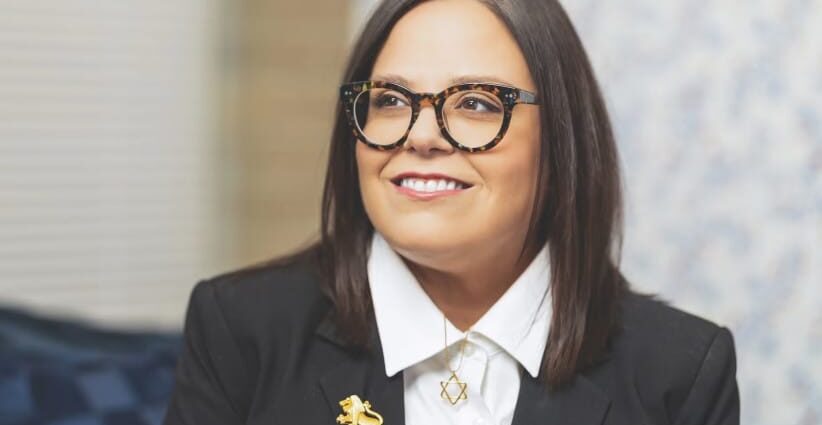
Less than half of Milwaukee Jews identify as Zionists despite strong Israel ties, survey finds
Yet another survey has found that fewer than half of Jews in an American city identify as Zionists, this time in Milwaukee, the childhood home of Golda Meir, the Zionist icon and former Israeli prime minister.
The survey, released last week by the Milwaukee Jewish Federation, found that 43% of Jewish adults said they identified as Zionist, while 42% said they did not. A much higher share, 69%, said they feel somewhat or very “emotionally attached to Israel.” At the same time, 52% of respondents agreed that “Israel regularly violates the human rights of the Palestinian people.”
The results join a growing number of similar data points generated by Jewish groups that point to evolving, and at times seemingly contradictory, views about Israel among American Jews. A survey released in February by Jewish Federations of North America, an umbrella group, found that 37% of Jews identified as Zionist even as 88% believed that “Israel has the right to exist as a Jewish, Democratic state.”
The findings cut across North American Jewish communities of different regions and sizes and are prompting Jewish leaders to reexamine their assumptions at a time when Israel is shedding support among Americans of all backgrounds.
“A year ago I really would have had a knee-jerk reaction where I was stuck on the word, because I am a Zionist,” Miryam Rosenzweig, the Milwaukee federation’s president and CEO, told the Jewish Telegraphic Agency about her views on the survey. “What I needed to overcome and understand is that, as a brand, it’s tarnished.” The word, she said, “is tainted.”
‘The values are still there’
Yet, Rosenzweig insisted, for her Jewish community, “the values are still there.”
The Milwaukee area is home to an estimated 27,500 Jews who attend more than a dozen synagogues and six Jewish schools. The local federation operates a number of programs directly and supports a wide range of education, cultural, religious and security initiatives meant to strengthen the Jewish community. (It also gives to a number of national Jewish organizations, including a small grant to 70 Faces Media, JTA’s parent company.)
The local survey, completed by 980 families, was conducted between December 2024 and March 2025, at a time when criticism over Israel’s handling of the war in Gaza was sharply mounting. More than 100 hostages taken when Hamas attacked Israel on Oct. 7, 2023, triggering the war, were still in captivity at the survey’s start, while dozens were released during a temporary ceasefire midway through the survey period.
Conducted by researchers at Brandeis University and the University of Chicago’s NORC social research firm, the survey is the federation’s first deep dive into its Jewish population since 2011. It was conducted by email, mail and phone, with options to complete the survey online or over the phone, and has an overall margin of error of 6.5%.
The survey asked about a wide range of topics and, Rosenzweig said, has illuminated unique challenges for the federation, including the region’s aging Jewish population and its relatively lower average household income when compared to similarly sized Jewish communities.
High levels of Jewish ‘participation’
The data also offered unique bright spots, such as high levels of what Rosenzweig classified as Jewish “participation.”
Three-quarters of Jewish children in the area’s interfaith households are being raised Jewish, for example, and nearly one in four of all Jewish children in Milwaukee are enrolled in a Jewish day school or yeshiva, higher than the national average.
But it is the Zionism question that has seized public interest, in part because it was asked at all.
For decades, according to Matthew Boxer, a researcher at Brandeis’s Cohen Center for Jewish Studies who led the Milwaukee study and has worked on many others, local federations conducting population studies would ask about topics such as emotional attachment to Israel, but largely refrained from directly asking their communities whether they identified as Zionists.
That changed with the 2020 Chicago federation survey, also led by Boxer’s team, which found that 40% of the region’s Jewish adults self-identified as Zionist while 80% agreed with the statement “It’s important for Israel to be a Jewish state.”
Since then, Boxer said, around a dozen federations have opted to ask some version of the Zionism question on their surveys. Recently released findings from the federations in Boston and St. Louis found similar results to Chicago’s and Milwaukee’s; new survey results in Austin, Texas, and Orange County, California, are expected later this year. (Some have decided against including the question, too.)
The findings have functioned as something of a Rorschach test for American Jews. Those who are deeply critical of Israel say the fact that a minority of American Jews identify as Zionists prove that American Jewish groups should roll back their support for and engagement with Israel. Those who want to preserve the historic relationship urge looking beyond the label and focusing on the fact that a significant majority of Jews are aligned in their support for traditional tenets of Zionism.
In an essay for JTA published after the national federations group released its survey, Mimi Kravetz, JFNA’s chief impact officer, concluded that most Jews still believe in the “historic definition” of Zionism, while conceding that the term has gone through “definition creep.” She urged federations to “open pathways for learning and belonging,” and avoid “responding with anger when the moment calls for steady leadership.”
For Rosenzweig, who came to Milwaukee in 2019 after years working with Jewish young professionals at Detroit’s federation, polling her community about Zionism was a no-brainer even when they were first conceiving the survey before Oct. 7. “We have to ask the question,” she said.
“The demographic study is not meant to answer what we want to hear,” she said. “We need to know where they stand, where do people agree and disagree?”
While the survey found a split on Zionist identification, it found broad consensus on other issues, sometimes ones that are in tension with each other. For example, 84% of Milwaukee Jews somewhat or strongly agreed with the statement, “I consider it important for Israel to be a Jewish state.” At the same time, 88% agreed that “Israel should be a democratic state for all of its citizens, regardless of religious identity.”
Two ideas could coexist
Rosenzweig said she believes the two ideas could coexist. “Our community can support Israel and support Israel’s right to exist and be a Jewish state, and they’re concerned for the human dignity of Palestinians. It’s not binary,” she said. “And I think that’s really an important message about who American Jews are.”
Rabbi Noah Chertkoff, who leads the Reform Congregation Shalom in the suburb of Fox Point, said he wasn’t surprised by the survey results on Zionism but cautioned against drawing too many conclusions from them.
“I proudly identify as a Zionist, but I also recognize that the word itself has been badly distorted and, at times, deliberately defamed by people more interested in vilifying Jews than engaging seriously with Jewish history, Jewish belief and the Jewish people’s own understanding of our story,” he wrote in an email to JTA.
Chertkoff added that his own congregants have expressed both “real anguish” over Oct. 7, as well as concerns for democracy in Israel and “the suffering of civilians on all sides of the conflict.” He added that the survey should be read as a “mandate”: “If we want the next generation to inherit a durable connection to Israel and Zionism, we cannot rely only on inherited labels.”
Rabbi Lex Rofeberg, a Milwaukee native who runs the alternative Jewish engagement network Judaism Unbound from his current home in Rhode Island, said he believed the survey is surfacing more than mere confusion over the word Zionism.
“As a person who would self-identify as ‘not a Zionist,’ I hope that Jewish organizations in Milwaukee, and beyond, would respond to this finding not by trying to shift my beliefs, or by insisting that I don’t really know what I’m opposing,” he wrote in an email. “I’d hope instead they’d recognize the reality that ‘I’m not a Zionist’ is a sincere, deeply-held belief for a lot of Jews all around the world, and that includes just over 40% of Jews in the greater Milwaukee area.”
Jewish institutions, he suggested, “should respond to lower support for Zionism not with ‘how do we re-brand Zionism’ but rather ‘how can we create meaningful Jewish experiences for folks who are actively not Zionists?’”
Jewish Milwaukee, which Rofeberg calls “awesome” and credits with having “shaped me as a person and a Jew,” could achieve this, he insists.
What the federation does with this new information is still to be determined. Rosenzweig is currently drafting “a very extensive strategic plan,” she told JTA, but said it was too early for specifics. She does hope to focus on points of commonality, rather than trying to convince half of the local Jews they are, or should be, Zionists.
For inspiration, Rosenzweig has been dusting off Milwaukee’s community survey from exactly a century ago. (Meir had already moved to Palestine by way of Denver at the time.) Back then, she said, the community was roughly the same size it is now, and its Jewish funding arms were raising roughly the same amount of money, adjusted for inflation.
“It was talking about the ‘Campaign for Palestine,’ in 1926, because the Jews of Eastern Europe had nowhere to go,” Rosenzweig said. “They were worried about it then. And so today, we’re responding to the moment. And yes, it looks dark. There were dark days, and we survived because we came together. We know how to do this.”

UK Jewish groups express concern as the likely next PM Andy Burnham criticizes Israel over Gaza
Andy Burnham, who is on track to become Britain’s next prime minister following Keir Starmer’s resignation last month, apologized for his party’s handling of the aftermath of the Oct. 7, 2023, Hamas mass killings in Israel, saying that it should have done more to push for a ceasefire and called for exerting greater pressure on the Jewish state today.
His comments prompted a joint response from the Board of Deputies of British Jews and the Jewish Leadership Council, which said they had contacted his team to express “significant concerns” about his remarks.
Burnham made his comments in a video statement on Thursday in response to questions from the public. Burnham is likely to become the next prime minister after gaining the overwhelming support of sitting Labour members of Parliament. To date, no one has challenged him for the party’s leadership ahead of a July 17 deadline.
“I know many people feel that at the start of Israel’s military action in Gaza, my party didn’t get it right, and I am sorry about that,” he said. He added that he supported further sanctions on Israelis involved in the violence in Gaza, measures to ban trade with Israeli settlements and restrictions on arms licenses to Israel, saying there was “increasing evidence that war crimes appear to have been committed.”
He also condemned increased antisemitism in Britain, and said that tackling antisemitism did not contradict holding Israeli Prime Minister Benjamin Netanyahu’s government to account.
Lawmakers are pushing for Israel criticism
His comments came as lawmakers across the political spectrum have pushed for increased condemnation of Israel and sanctions on the country.
“The unbearable suffering in Gaza is a scar on our collective conscience,” Burnham said. “The killing of innocent Palestinians, including children,” was “completely unacceptable,” he added, declaring that Britain had to do more to “put pressure on the Israeli government.”
He described the country as “too slow to call for a ceasefire” and that “we must now do more to strengthen our approach” as “Israel continues to violate the ceasefire agreement, killing innocent Palestinians.”
In their response, the Board and JLC said they shared “concern for the humanitarian situation in the Gaza Strip” but stated that the conflict “cannot be understood without reference to the role of Hamas not only in launching the conflict but in perpetuating the war through the holding of hostages, war-fighting entirely from within the civilian population, and [their] ongoing refusal to cede power and disarm, in line with the 20 point peace plan.”
They added that the conflict also could not be understood without reference to Hamas’ regional backers and allies, including Iran and Hezbollah. Burnham addressed none of this in his comments.
Burnham condemned UK antisemitism as ‘appalling’
Burnham did, however, reiterate his condemnation of Hamas, describing the Oct. 7 attacks as “monstrous,” stressing that he denounced them “as strongly today as I did in the immediate aftermath.”
He said that he also condemned “the increase in appalling antisemitic attacks here in the UK and those who seek to divide our communities by targeting Jewish people.”
“I felt first-hand the anxiety in our Jewish community and the very real threat they face,” the former mayor of Greater Manchester said, referring to the Yom Kippur 2025 attack on the city’s Heaton Park synagogue in which two people were killed.
The Board and JLC welcomed Burnham’s “zero tolerance approach to antisemitism” and affirmed his assertion that “there is no contradiction between fighting antisemitism and disagreeing with actions of the Israeli government.”
However, they said, “Antisemitism cannot be confronted without addressing all its drivers,” arguing that in Britain that includes “Islamist, far left and far right extremists who go beyond criticism of the Israeli government to a place of hatred directed at Jews and Israelis.”
Their joint statement pointed out that Burnham knew “first hand the links between hatred of Israel, antisemitic extremism and deadly violence against British Jews,” adding that, “in a country in which antisemitism has become more normalized, more extreme and more violent, we call on our leaders to show the utmost care in their rhetoric in relation to the conflict.”
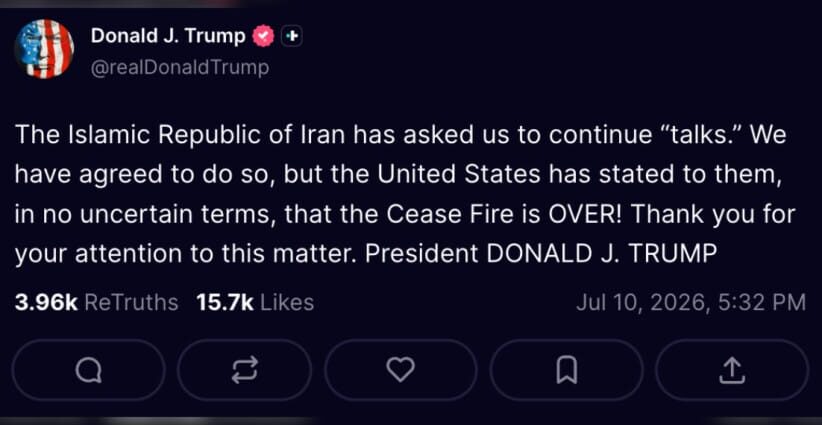
Trump emphasizes end of US-Iran ceasefire, claims Iran requested to resume negotiations
US President Donald Trump claimed the US has accepted a request from Iran’s leadership to resume negotiations, but emphasized that the ceasefire between the nations is over in a post on Truth Social on Friday, after having previously declared that the Washington-Tehran Memorandum of Understanding (MoU) was also over.
“The Islamic Republic of Iran has asked us to continue ‘talks.’ We have agreed to do so, but the United States has stated to them, in no uncertain terms, that the Cease Fire is OVER!” Trump asserted.
According to Iranian state media reports, a spokesperson for Iran’s Foreign Ministry denied that any requests were made regarding the continuation of talks and stated that any US breaches of commitments would be met with “reciprocal action.”
The spokesperson noted that Iran had agreed to a visit by Qatari mediators.
Qatari officials discuss US-Iran tensions with Iranian, Pakistani officials
According to semi-official Iranian news outlet Tasnim, a Qatari delegation arrived in Iran on Friday to consolidate Doha’s role as a mediator between Tehran and Washington after clashes in the Strait of Hormuz reignited hostilities between the two nations.
Tasnim reported that Iranian officials will also discuss Doha’s condemnation of Iran’s recent strikes on commercial vessels transiting the strait.
Qatar’s Emir Sheikh Tamim bin Hamad Al Thani held a phone call with Pakistani Prime Minister Shehbaz Sharif on Friday, according to his office, to discuss the US-Iran situation and Pakistan’s role in negotiations.
According to a statement regarding the call, both leaders stressed the importance of continuing talks, reducing regional tensions, and resolving the disputes through diplomatic means.